/





















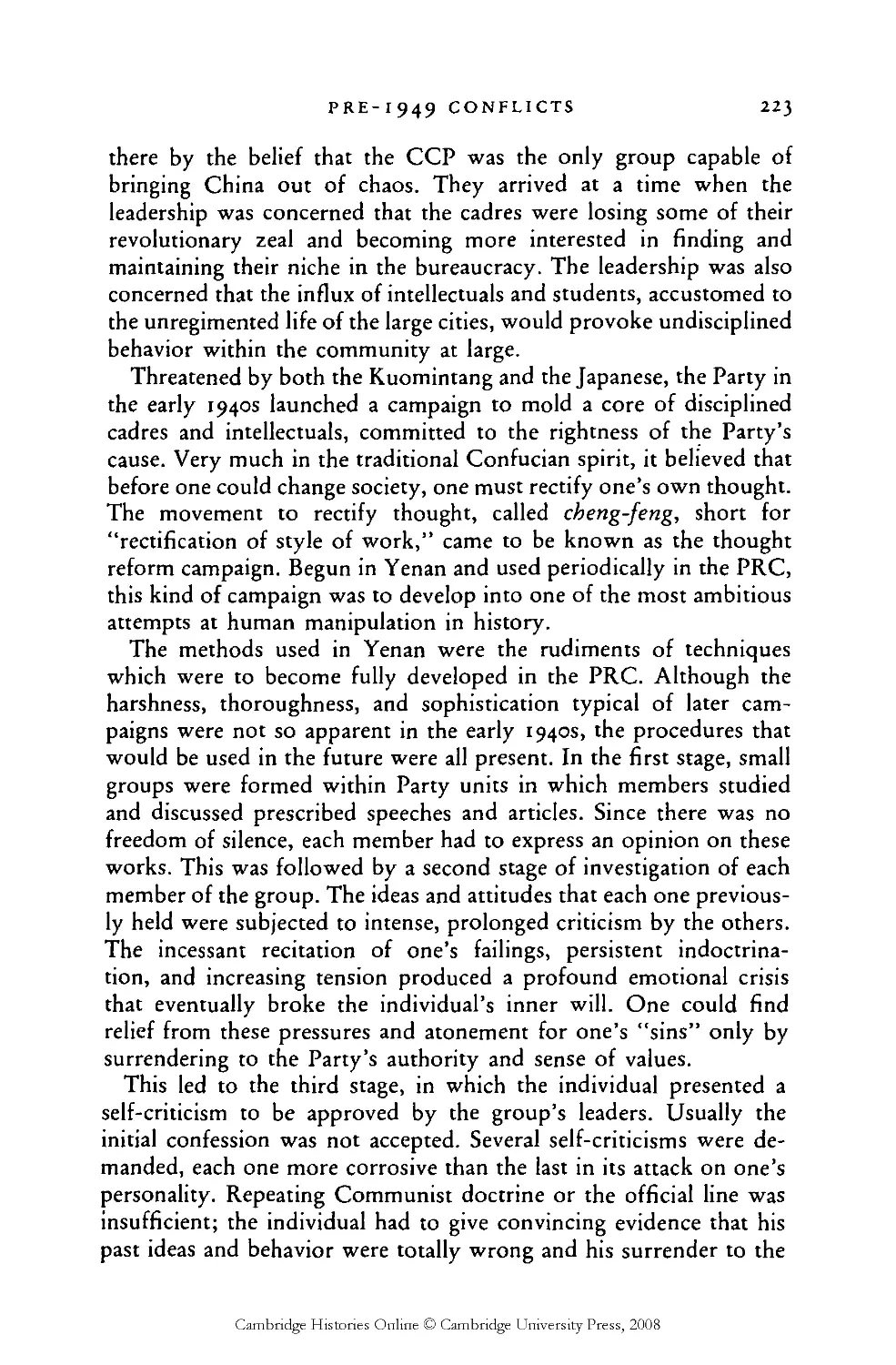
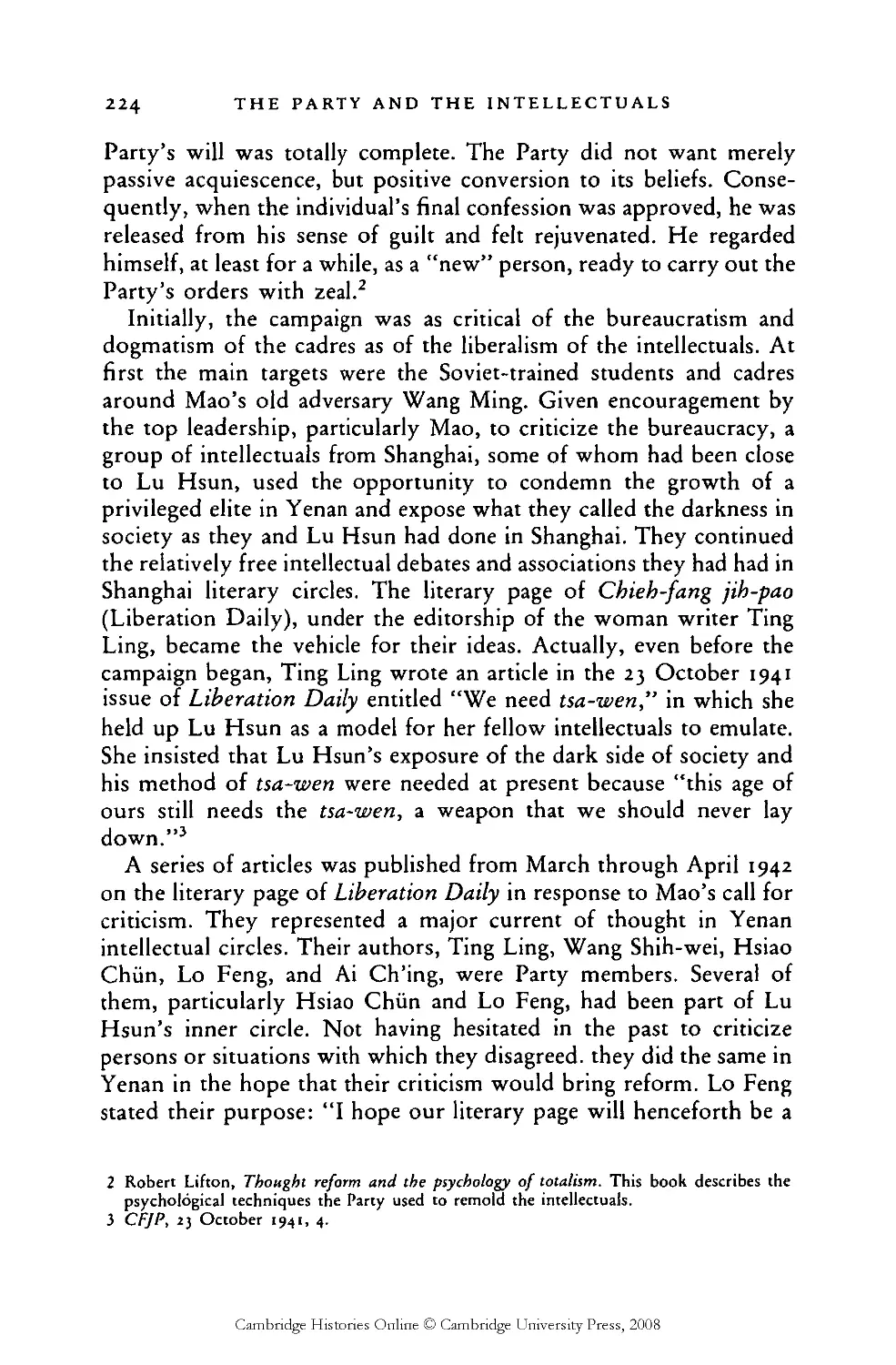
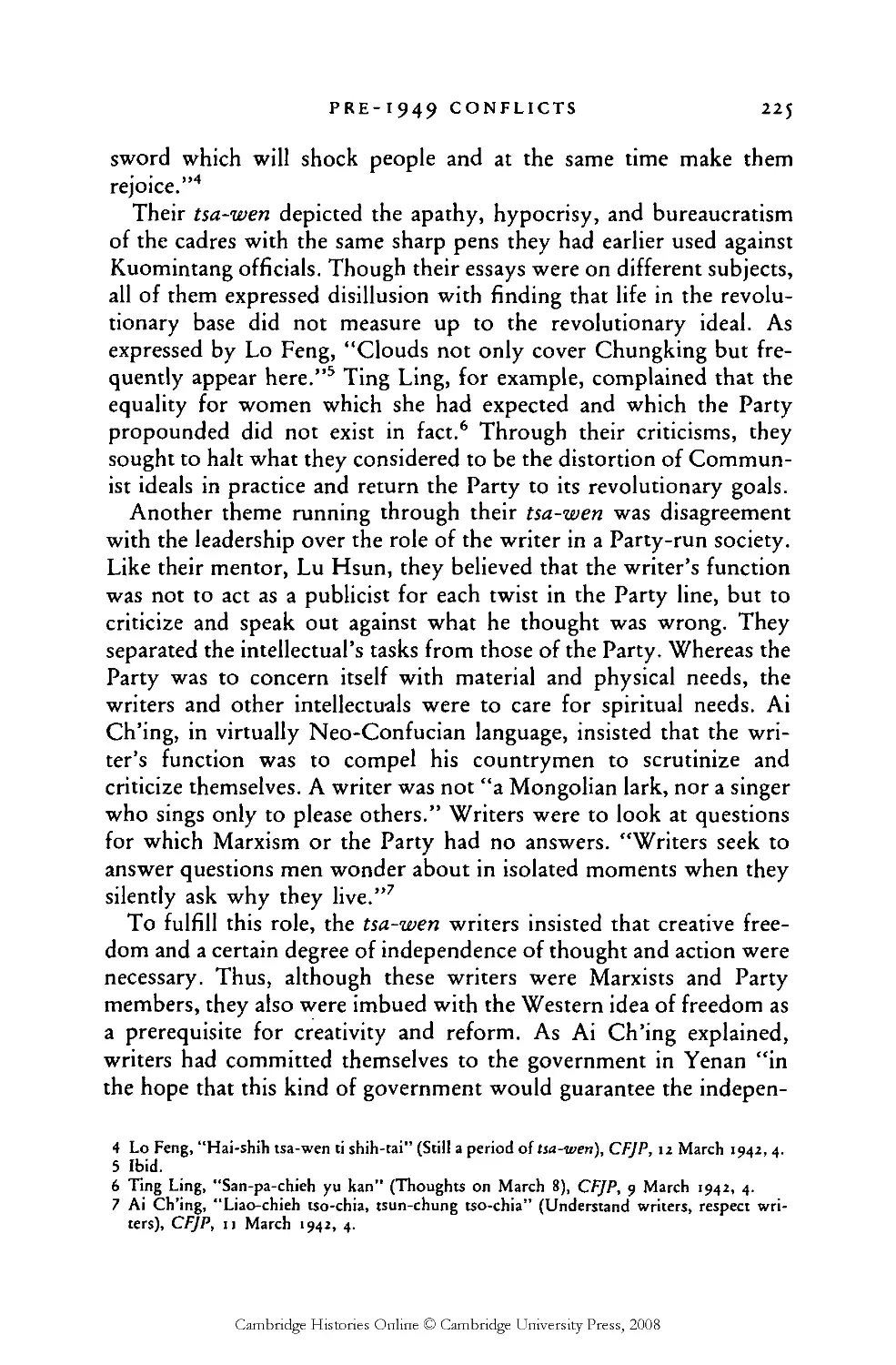
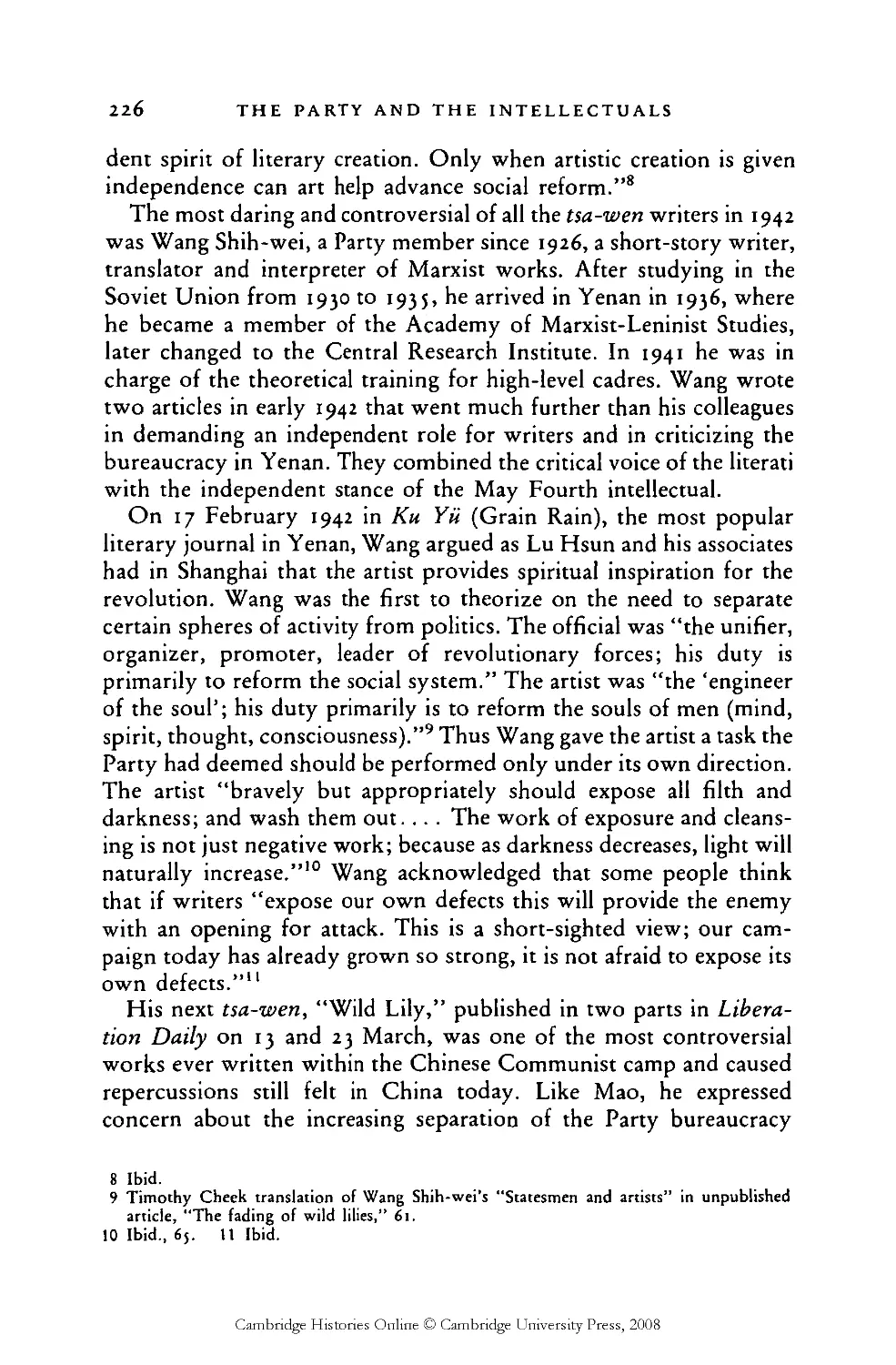







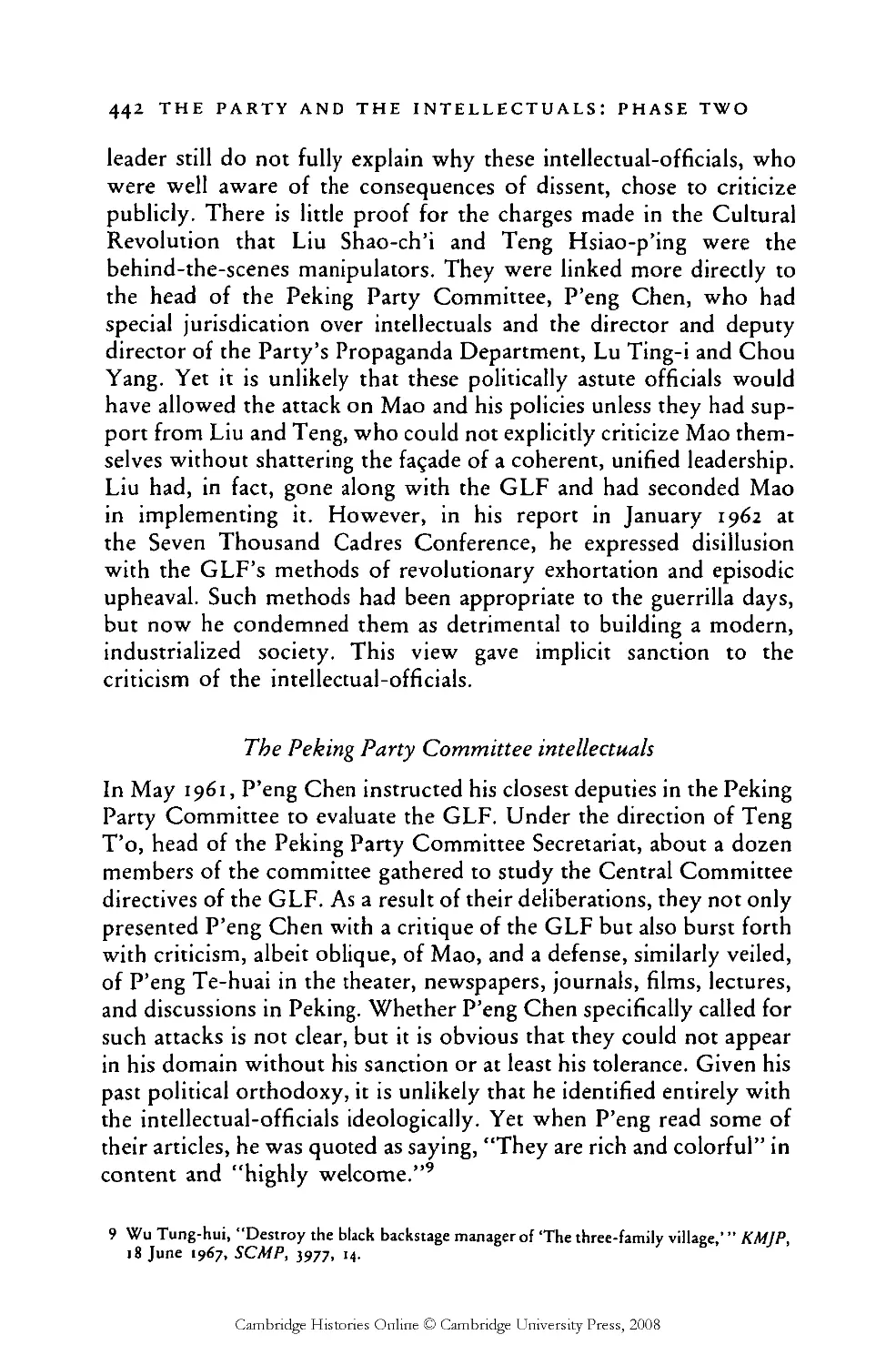
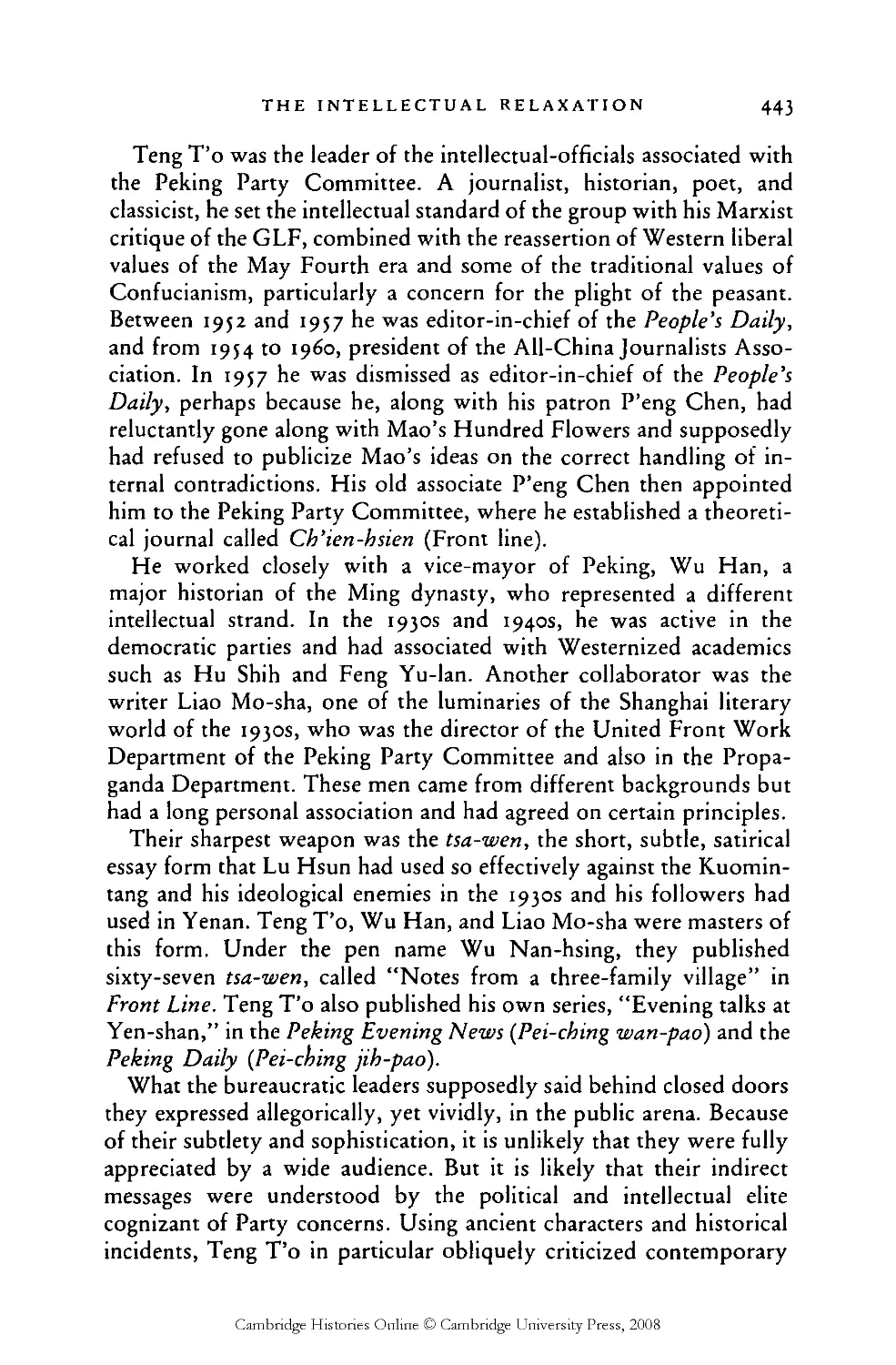
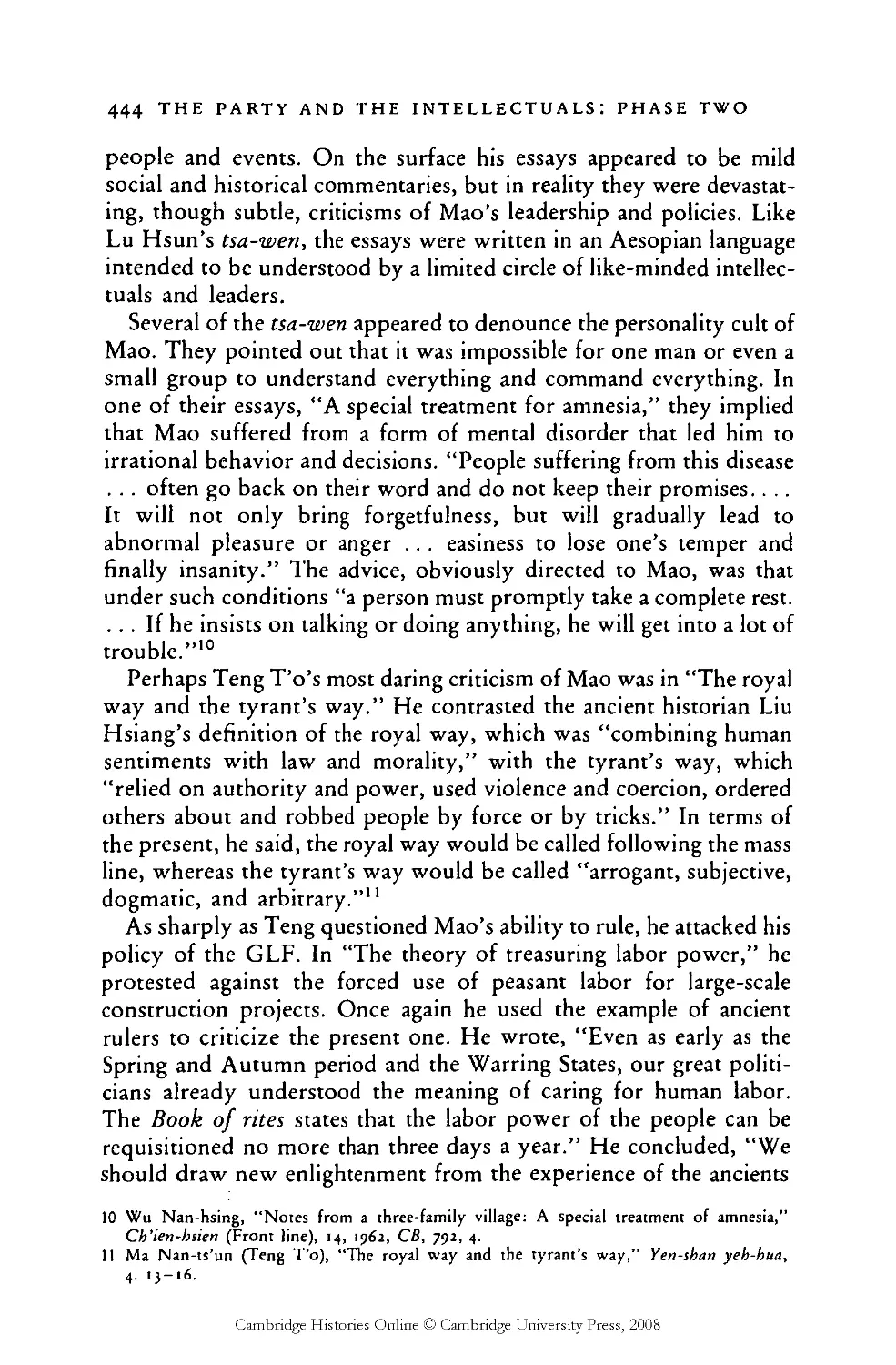
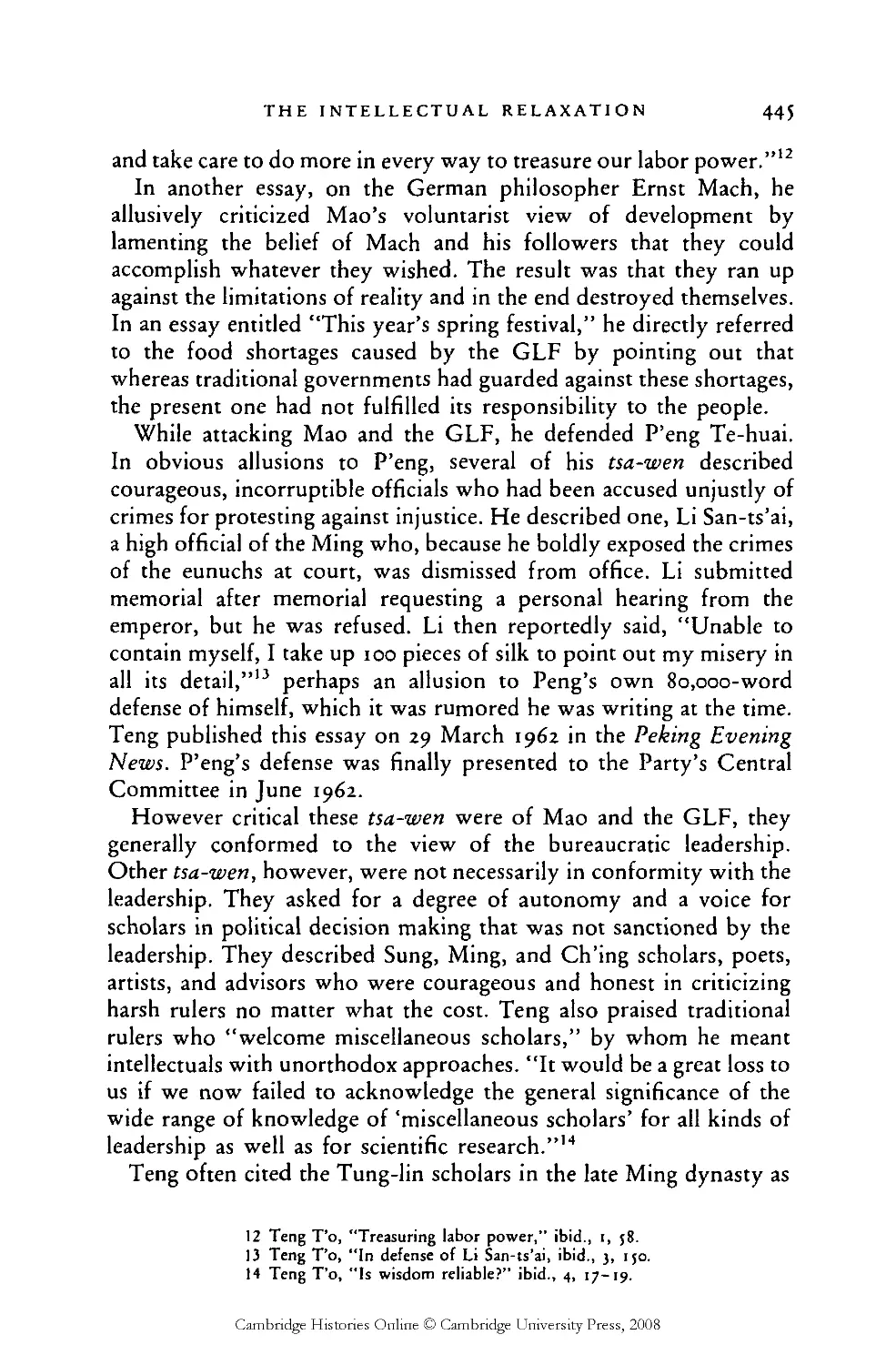











Author: MacFarquhar R. Fairbank J.K.
Tags: history cambridge history of china
ISBN: 0-521-24336-X
Year: 1995
Similar


Text
                    THE CAMBRIDGE
HISTORY OF
CHINA
VOLUME 14
THE PEOPLE’S REPUBLIC:
THE EMERGENCE OF
REVOLUTIONARY CHINA 1949-1965
PART 1

THE CAMBRIDGE HISTORY
OF CHINA
General editors
Denis Twitchett and John K. Fairbank
Volume 14
The People’s Republic, Part 1:
The Emergence of Revolutionary China 1949-1965
Cambridge Histories Online © Cambridge University Press, 2008

Cambridge Histories Online © Cambridge University Press, 2008

THE CAMBRIDGE
HISTORY OF
CHINA
Volume 14
The People’s Republic, Part 1:
The Emergence of Revolutionary China
1949-1965
edited by
RODERICK MacFARQUHAR
and
JOHN K. FAIRBANK
Cambridge
UNIVERSITY PRESS
Cambridge Histories Online © Cambridge University Press, 2008

Published by the Press Syndicate of the University of Cambridge
The Pitt Building, Trumpington Street, Cambridge CB2 1RP
40 West 20th Street, New York, NY 10011-4211, USA
10 Stamford Road, Oakleigh, Melbourne 3166, Australia
© Cambridge University Press 1987
First published 1987
Reprinted 1989, 1993
Printed in the United States of America
Library of Congress Cataloging-in-Publication Data is available.
A catalogue recordfir this book is available from the British Library.
ISBN 0-521-24336-X hardback
Cambridge Histories Online © Cambridge University Press, 2008

GENERAL EDITORS’ PREFACE
As the modern world grows more interconnected, historical under¬
standing of it becomes ever more necessary and the historian’s task
ever more complex. Fact and theory affect each other even as sources
proliferate and knowledge increases. Merely to summarize what is
known becomes an awesome task, yet a factual basis of knowledge
is increasingly essential for historical thinking.
Since the beginning of the century, the Cambridge histories have
set a pattern in the English-reading world for multivolume series
containing chapters written by specialists under the guidance of
volume editors. The Cambridge Modern History, planned by Lord
Acton, appeared in sixteen volumes between 1902 and 1912. It was
followed by The Cambridge Ancient History, The Cambridge
Medieval History, The Cambridge History of English Literature, and
Cambridge histories of India, of Poland, and of the British Empire.
The original Modern History has now been replaced by The New
Cambridge Modern History in twelve volumes, and The Cambridge
Economic History of Europe is now being completed. Other Cam¬
bridge histories include histories of Islam, Arabic literature, Iran,
Judaism, Africa, Japan, and Latin America.
In the case of China, Western historians face a special problem. The
history of Chinese civilization is more extensive and complex than
that of any single Western nation, and only slightly less ramified than
the history of European civilization as a whole. The Chinese histori¬
cal record is immensely detailed and extensive, and Chinese historical
scholarship has been highly developed and sophisticated for many
centuries. Yet until recent decades the study of China in the West,
despite the important pioneer work of European sinologists, had
hardly progressed beyond the translation of some few classical
historical texts, and the outline history of the major dynasties and
their institutions.
Recently Western scholars have drawn more fully upon the rich
traditions of historical scholarship in China and also in Japan, and
Cambridge Histories Online © Cambridge University Press, 2008

VI
GENERAL EDITORS* PREFACE
greatly advanced both our detailed knowledge of past events and in¬
stitutions and also our critical understanding of traditional histori¬
ography. In addition, the present generation of Western historians of
China can also draw upon the new outlooks and techniques of
modern Western historical scholarship, and upon recent develop¬
ments in the social sciences, while continuing to build upon the solid
foundations of rapidly progressing European, Japanese, and Chinese
sinological studies. Recent historical events, too, have given promi¬
nence to new problems, while throwing into question many older
conceptions. Under these multiple impacts the Western revolution in
Chinese studies is steadily gathering momentum.
When The Cambridge History of China was first planned in 1966,
the aim was to provide a substantial account of the history of China
as a bench mark for the Western history-reading public: an account
of the current state of knowledge in six volumes. Since then the
outpouring of current research, the application of new methods, and
the extension of scholarship into new fields have further stimulated
Chinese historical studies. This growth is indicated by the fact that
the History has now become a planned fifteen volumes, but will still
leave out such topics as the history of art and of literature, many
aspects of economics and technology, and all the riches of local
history.
The striking advances in our knowledge of China’s past over recent
decades will continue and accelerate. Western historians of this great
and complex subject are justified in their efforts by the needs of their
own peoples for greater and deeper understanding of China. Chinese
history belongs to the world, not only as a right and necessity but
also as a subject of compelling interest.
JOHN K. FAIRBANK
DENIS TWITCHETT
Cambridge Histories Online © Cambridge University Press, 2008

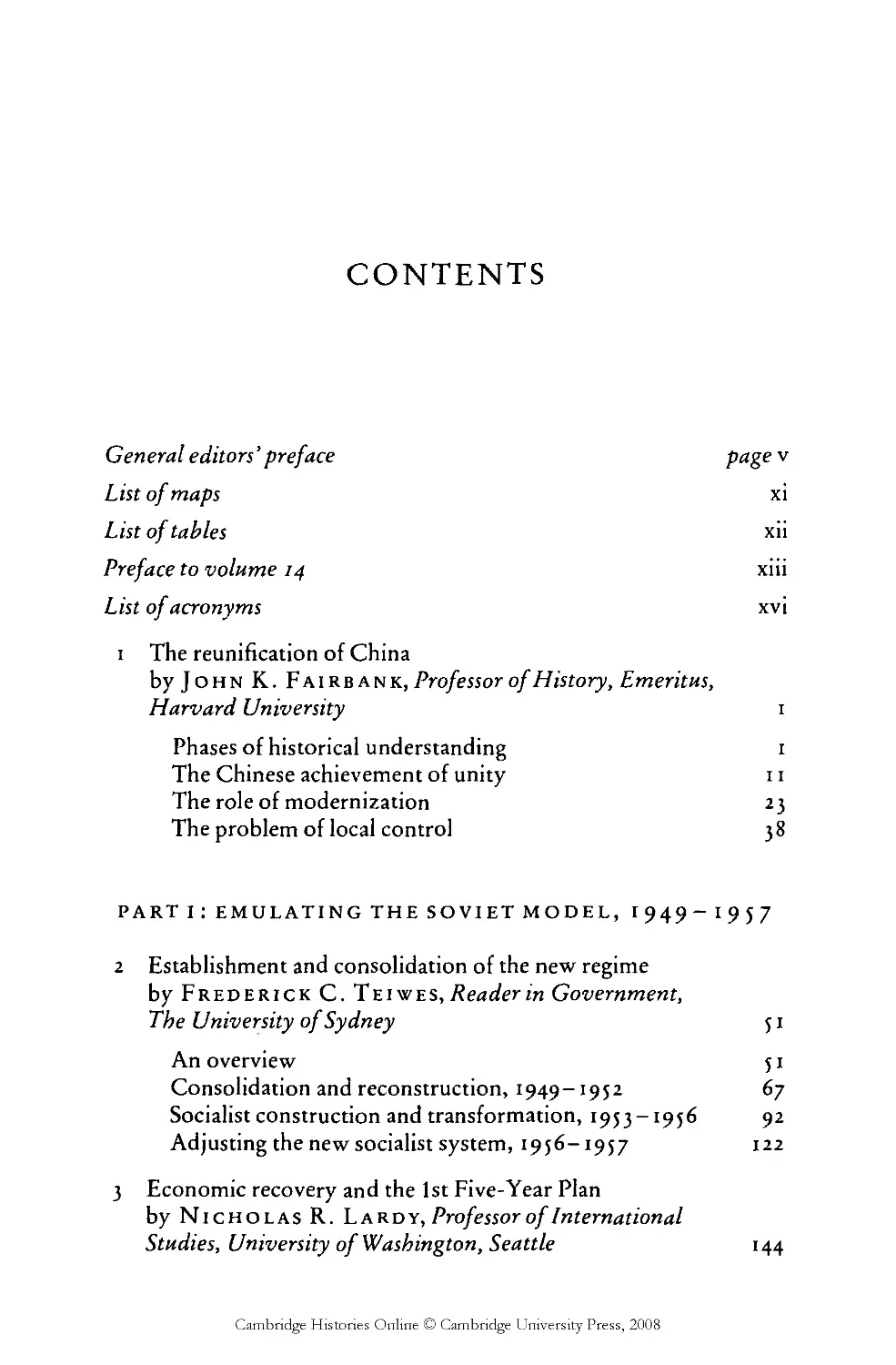
CONTENTS
General editors’ preface
page v
List of maps
xi
List of tables
xii
Preface to volume 14
xiii
List of acronyms
xvi
i The reunification of China
by John K. Fairbank, Professor of History, Emeritus,
Harvard University
Phases of historical understanding
The Chinese achievement of unity
The role of modernization
The problem of local control
i
11
23
38
parti: emulatingthesovietmodel, 1949-1957
Establishment and consolidation of the new regime
by Frederick C. Teiwes, Reader in Government,
The University of Sydney
An overview
Consolidation and reconstruction, 1949-1952
Socialist construction and transformation, 1953-1956
Adjusting the new socialist system, 1956-1957
Economic recovery and the 1st Five-Year Plan
by Nicholas R. Lardy , Professor of International
Studies, University of Washington, Seattle
5i
51
67
92
122
144
Cambridge Histories Online © Cambridge University Press, 2008

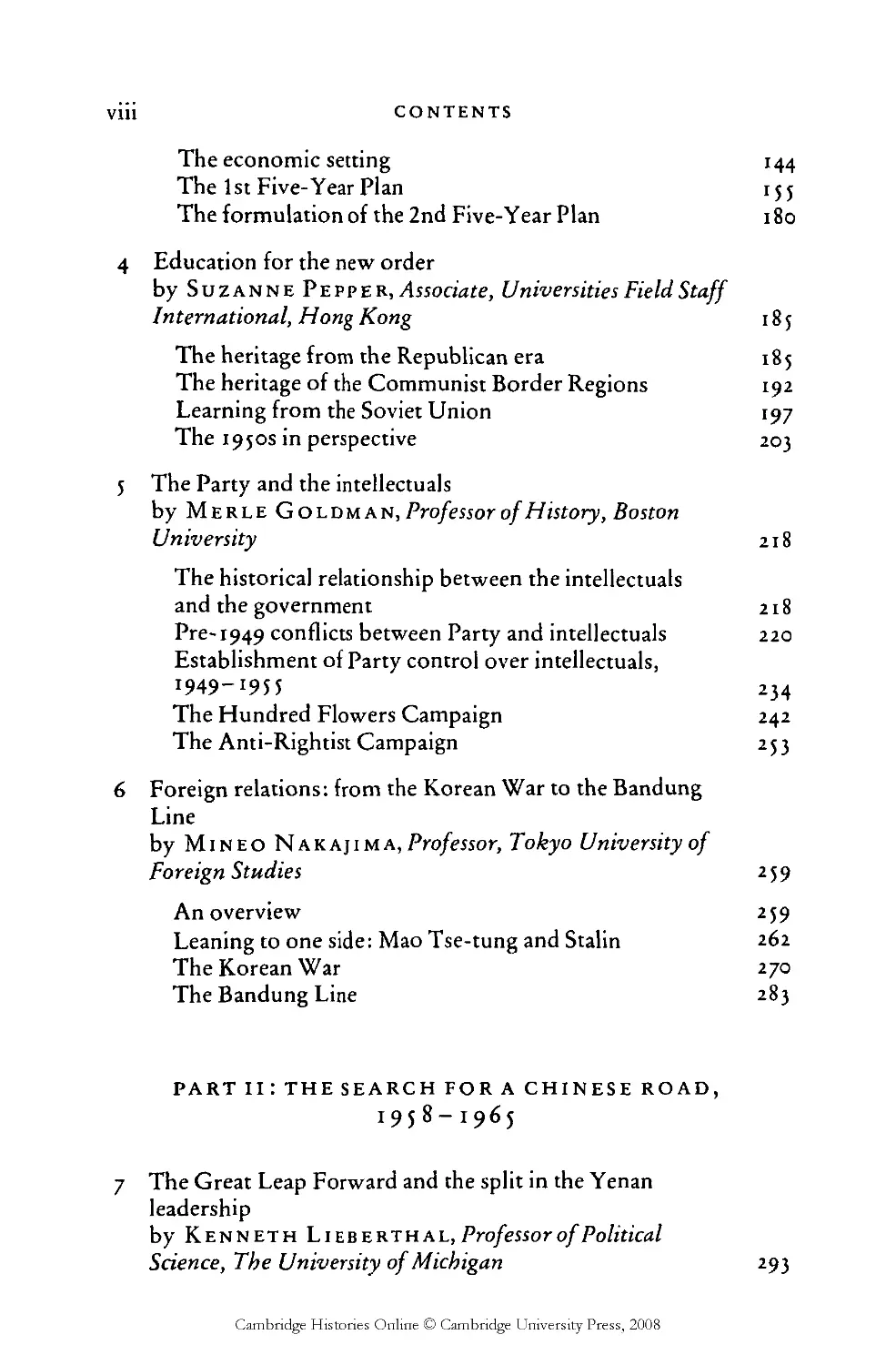
viii	CONTENTS
The economic setting	144
The 1 st Five-Year Plan	155
The formulation of the 2nd Five-Year Plan	180
4 Education for the new order
by Suzanne Pepper, Associate, Universities Field Staff
International, Hong Kong	18 5
The heritage from the Republican era	185
The heritage of the Communist Border Regions	192
Learning from the Soviet Union	197
The 1950s in perspective	203
j The Party and the intellectuals
by Merle Goldman , Professor of History, Boston
University	218
The historical relationship between the intellectuals
and the government	218
Pre-1949 conflicts between Party and intellectuals	220
Establishment of Party control over intellectuals,
1949-r95 5	234
The Hundred Flowers Campaign	242
The Anti-Rightist Campaign	253
6	Foreign relations: from the Korean War to the Bandung
Line
by Mineo Nakajima, Professor, Tokyo University of
Foreign Studies	259
An overview	259
Leaning to one side: Mao Tse-tung and Stalin	262
The Korean War	270
The Bandung Line	283
PART II : THESEARCH FORA CHINESE ROAD,
1958-1965
7	The Great Leap Forward and the split in the Yenan
leadership
by Kenneth Lieberthal , Professor of Political
Science, The University of Michigan	293
Cambridge Histories Online © Cambridge University Press, 2008

CONTENTS
ix
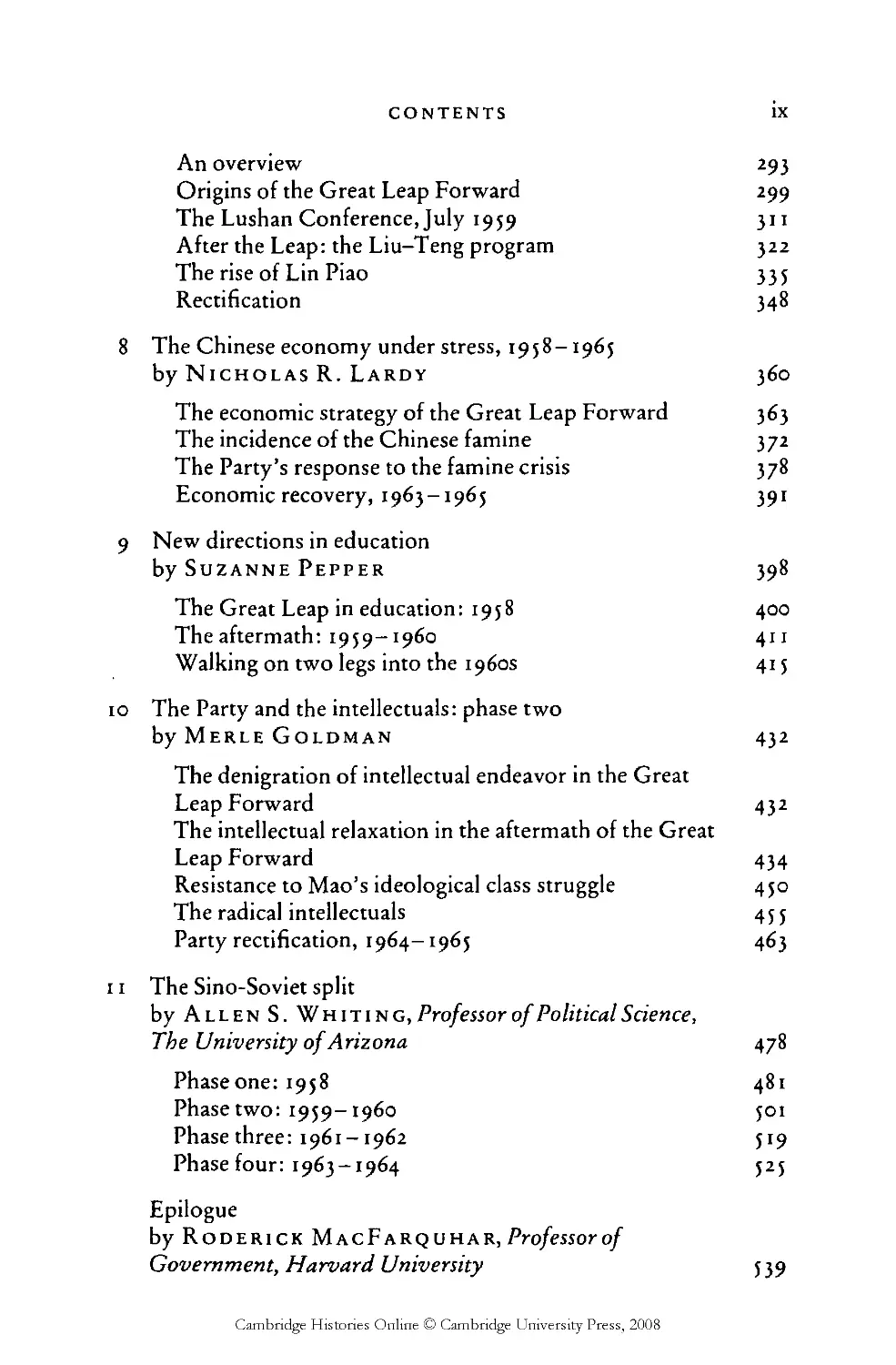
An overview	293
Origins of the Great Leap Forward	299
The Lushan Conference, July 1959	311
After the Leap: the Liu-Teng program	322
The rise of Lin Piao	335
Rectification	348
8	The Chinese economy under stress, 1958-1965
by Nicholas R. Lardy	360
The economic strategy of the Great Leap Forward	363
The incidence of the Chinese famine	372
The Party’s response to the famine crisis	378
Economic recovery, 1963 -1965	391
9	New directions in education
by Suzanne Pepper	398
The Great Leap in education: 1958	400
The aftermath: 1959-1960	411
Walking on two legs into the 1960s	415
10	The Party and the intellectuals: phase two
by Merle Goldman	432
The denigration of intellectual endeavor in the Great
Leap Forward	432
The intellectual relaxation in the aftermath of the Great
Leap Forward	434
Resistance to Mao’s ideological class struggle	450
The radical intellectuals	455
Party rectification, 1964-1965	463
11	The Sino-Soviet split
by Allen S. Whiting , Professor of Political Science,
The University of Arizona	478
Phase one:1958	481
Phase two: 1959-1960	501
Phase three: 1961-1962	519
Phase four: 1963-1964	525
Epilogue
by Roderick MacFarquhar, Professor of
Government, Harvard University	539
Cambridge Histories Online © Cambridge University Press, 2008

X
CONTENTS
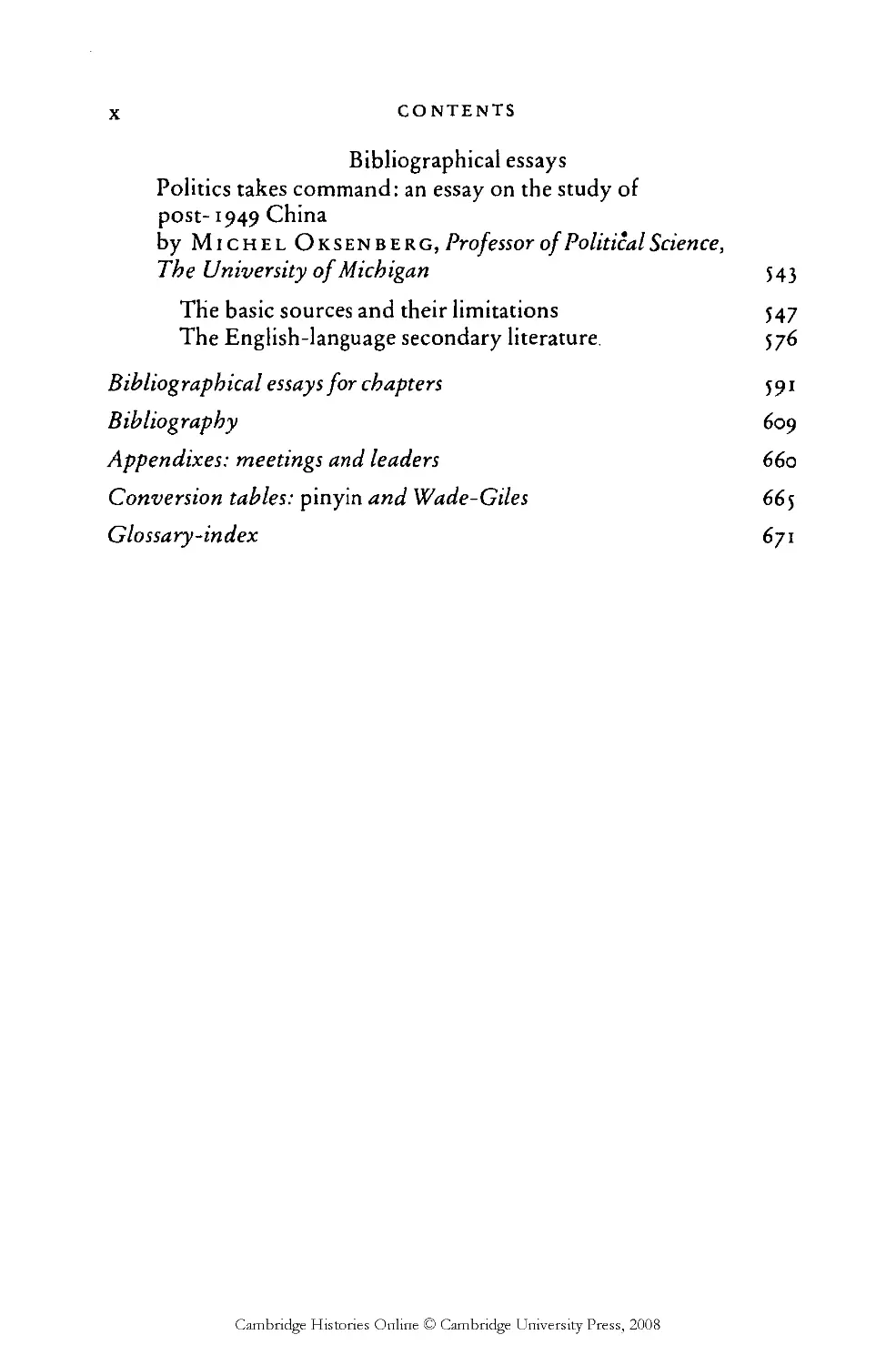
Bibliographical essays
Politics takes command: an essay on the study of
post-1949 China
by Michel Oksenberg, Professor of Political Science,
The University of Michigan
The basic sources and their limitations
The English-language secondary literature
543
547
576
Bibliographical essays for chapters	5 91
Bibliography	6 09
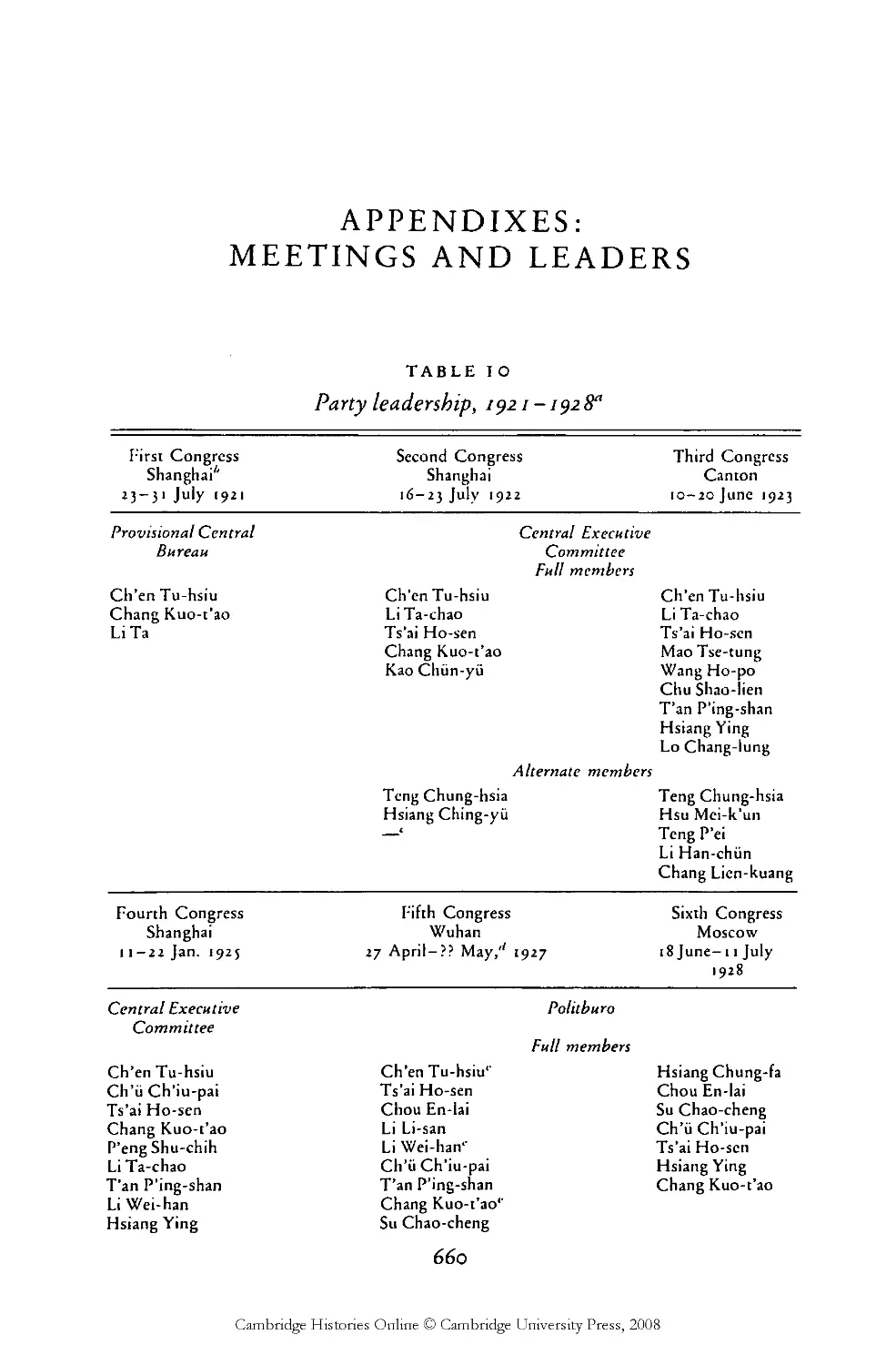
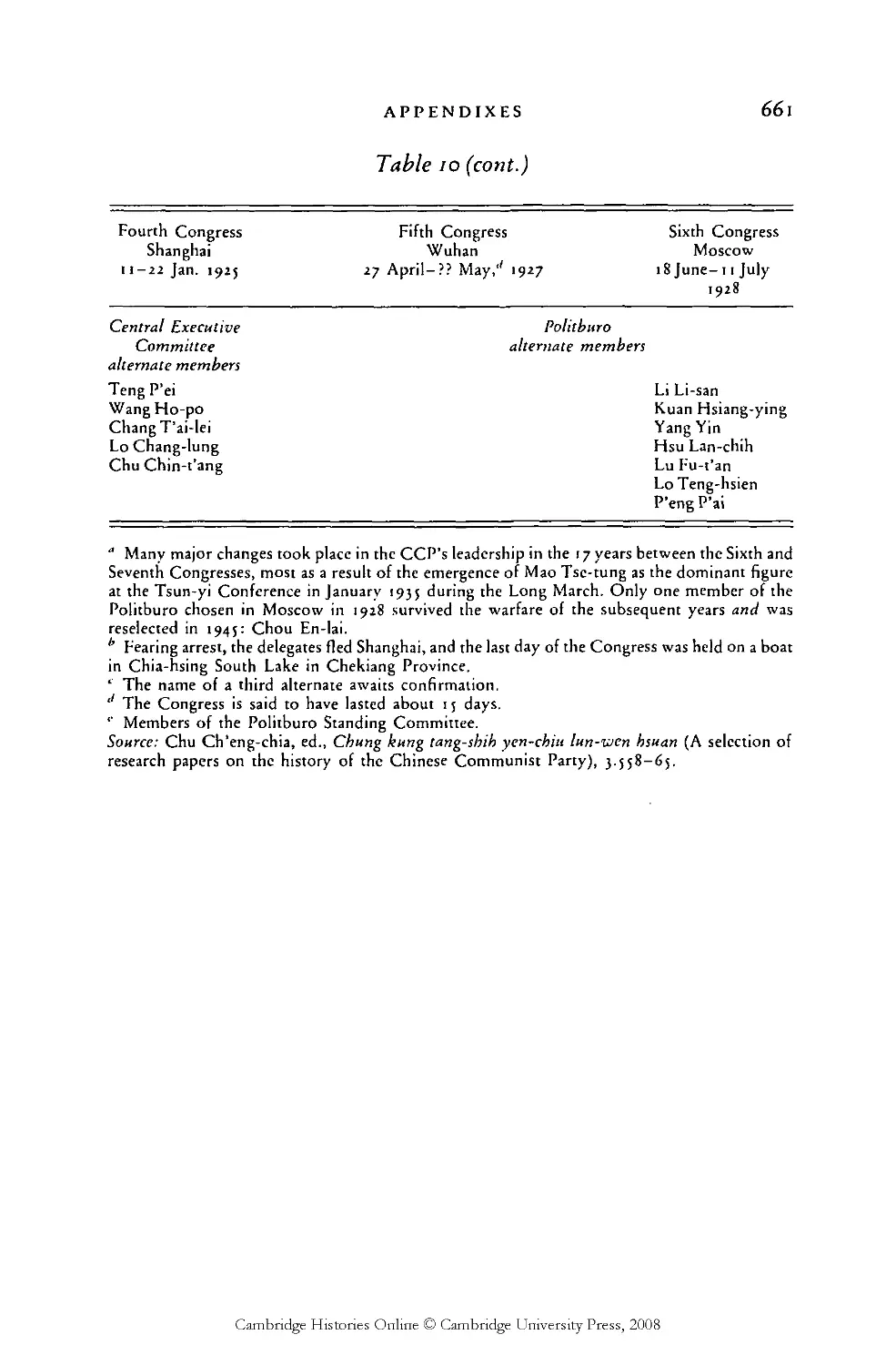
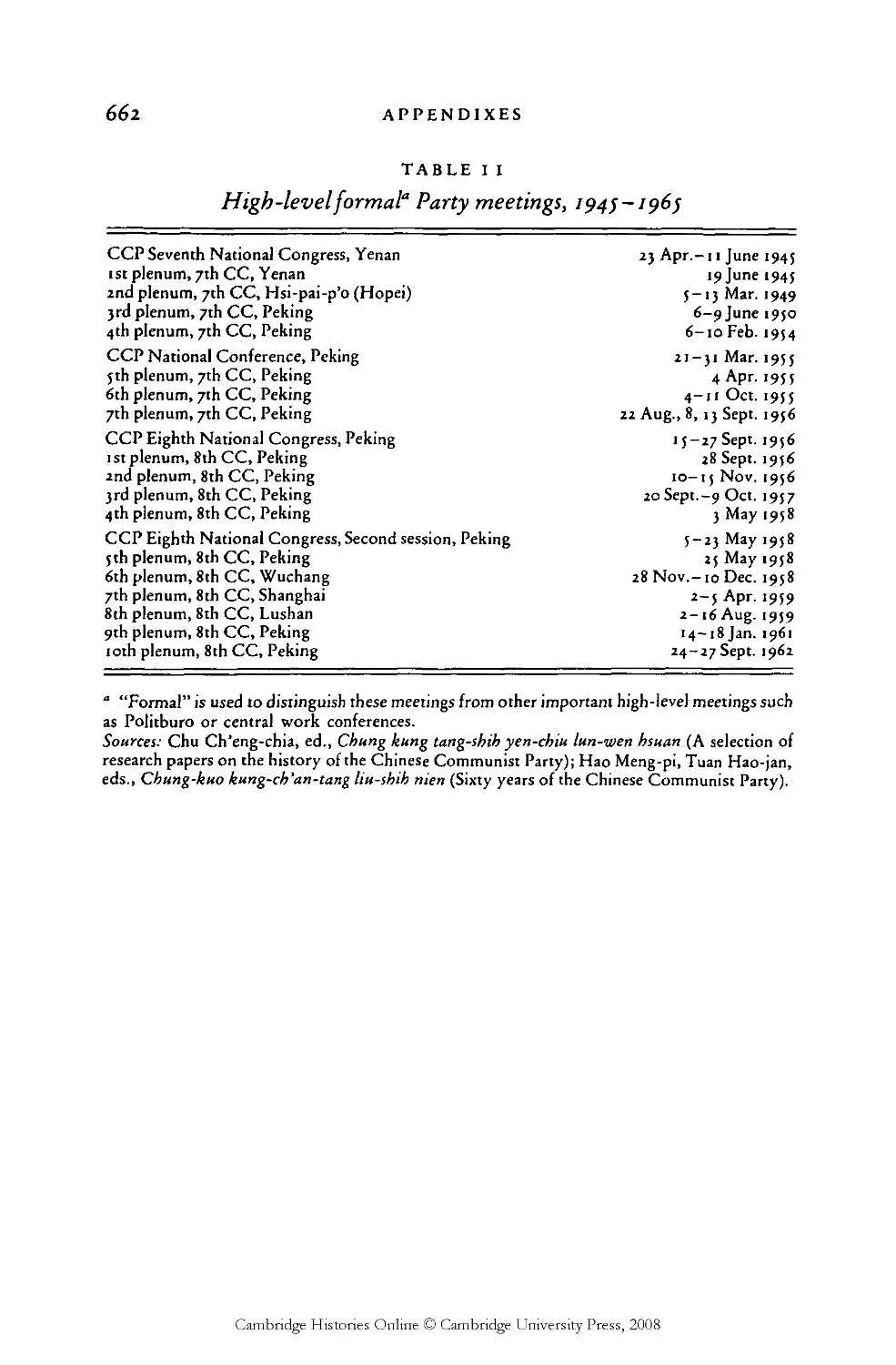
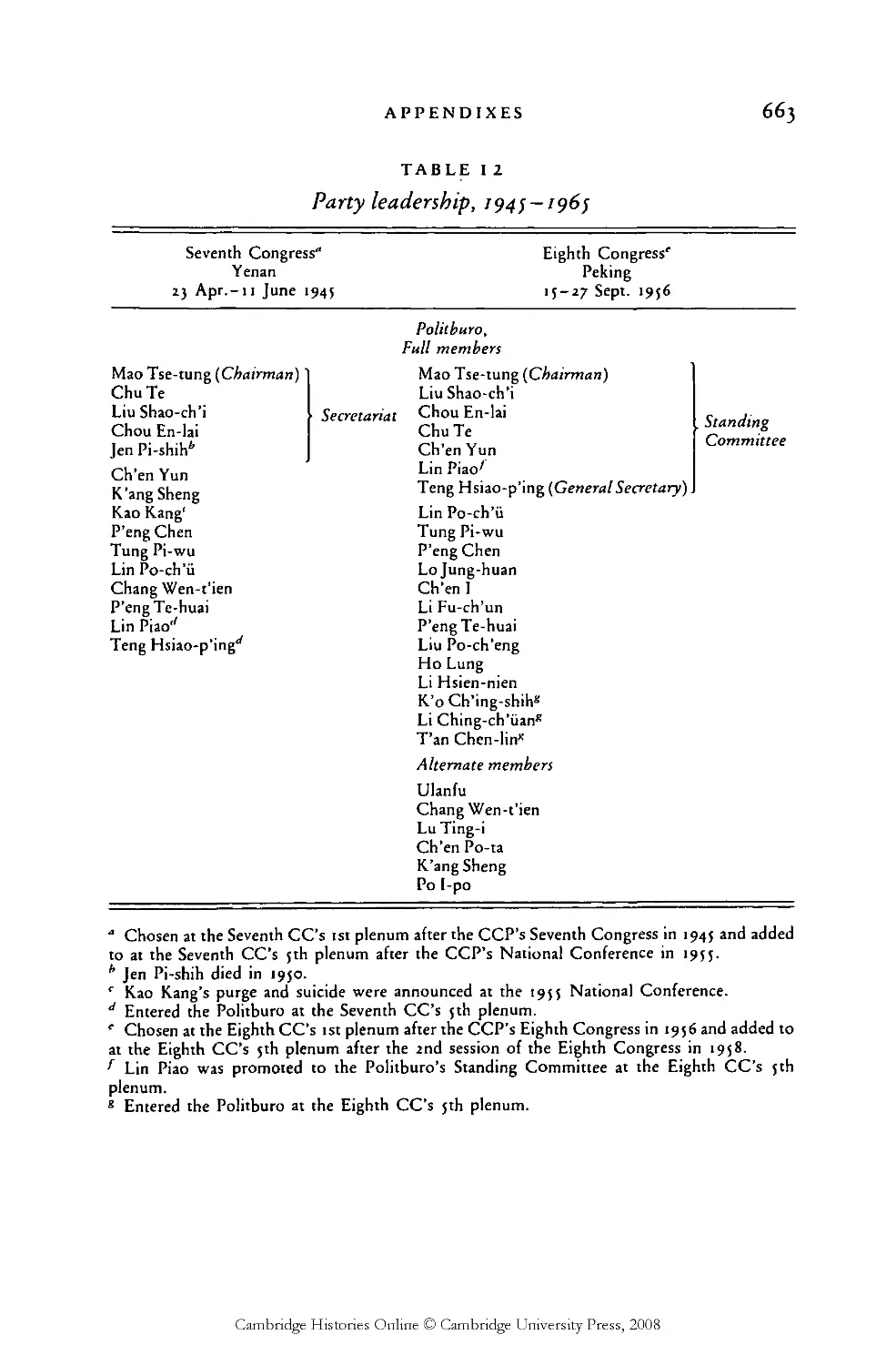
Appendixes: meetings and leaders	660
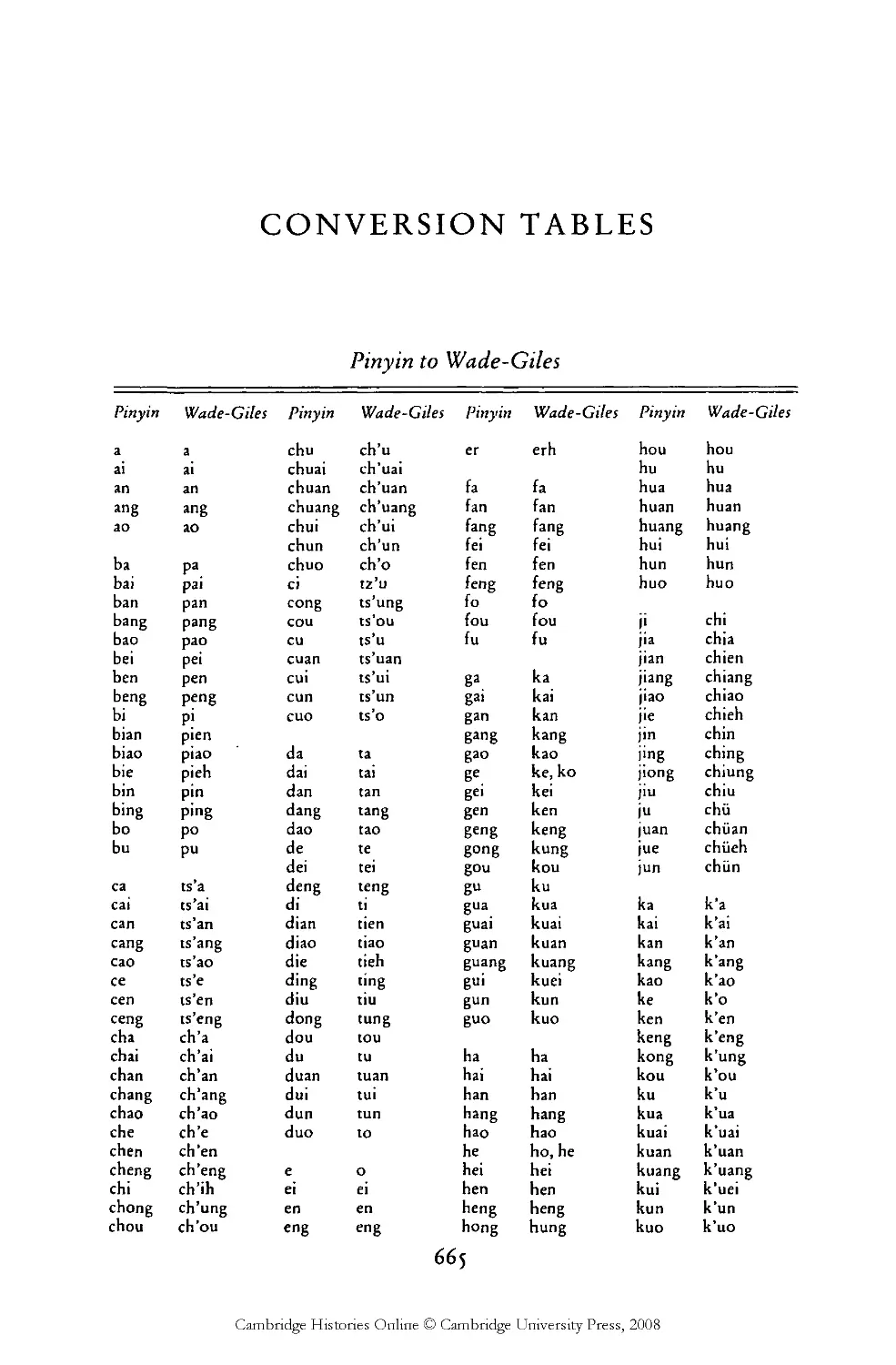
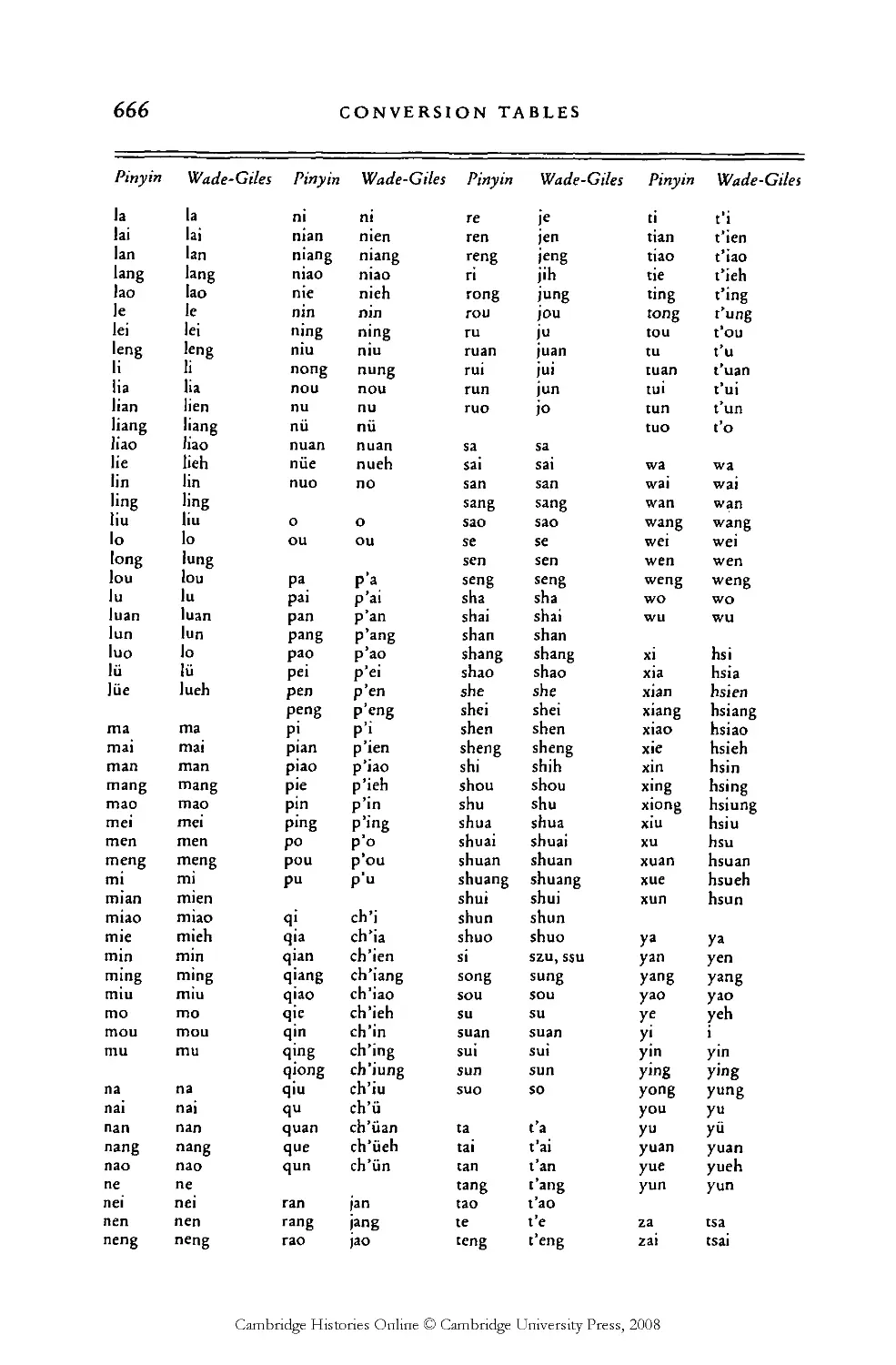
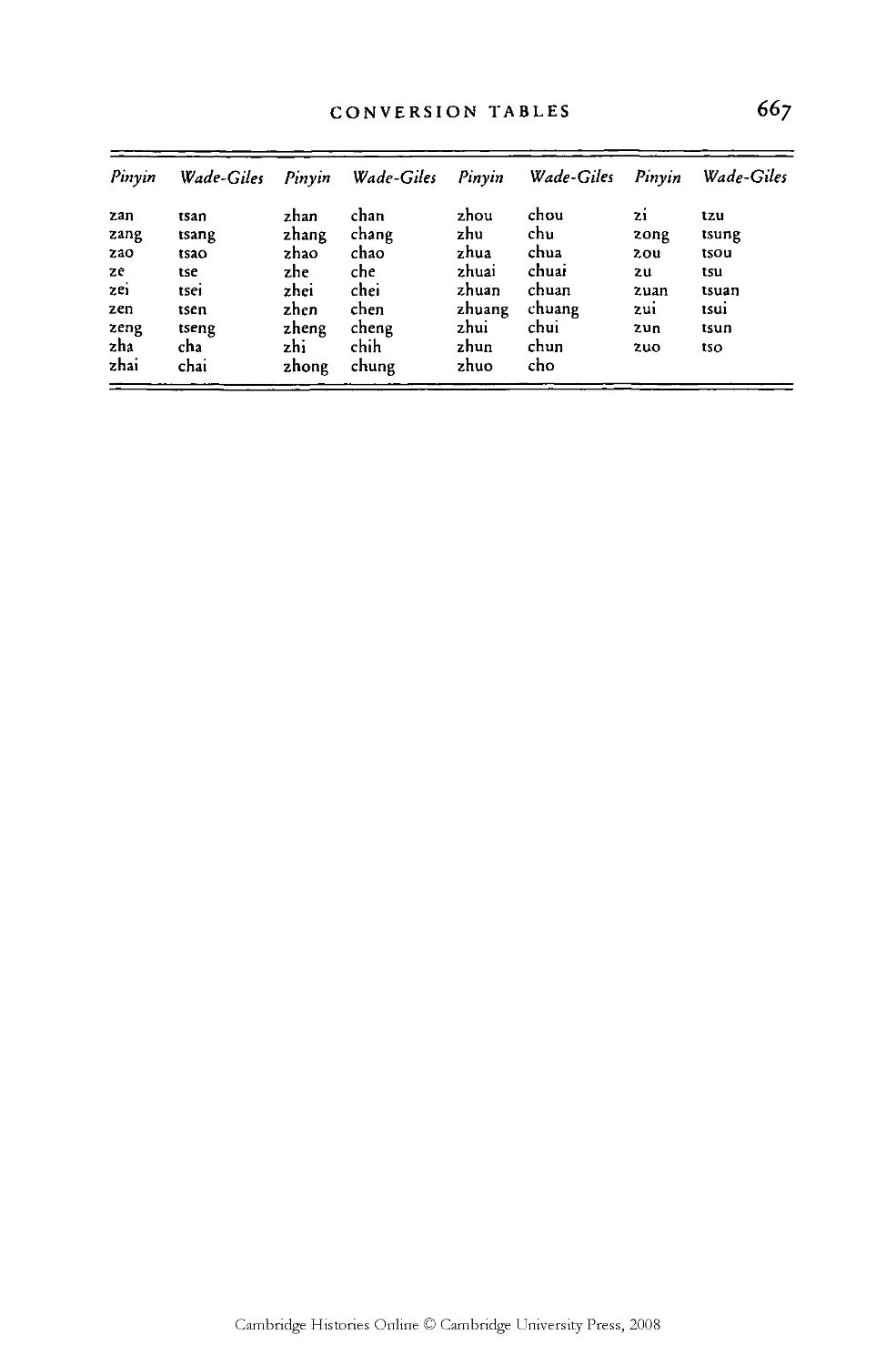
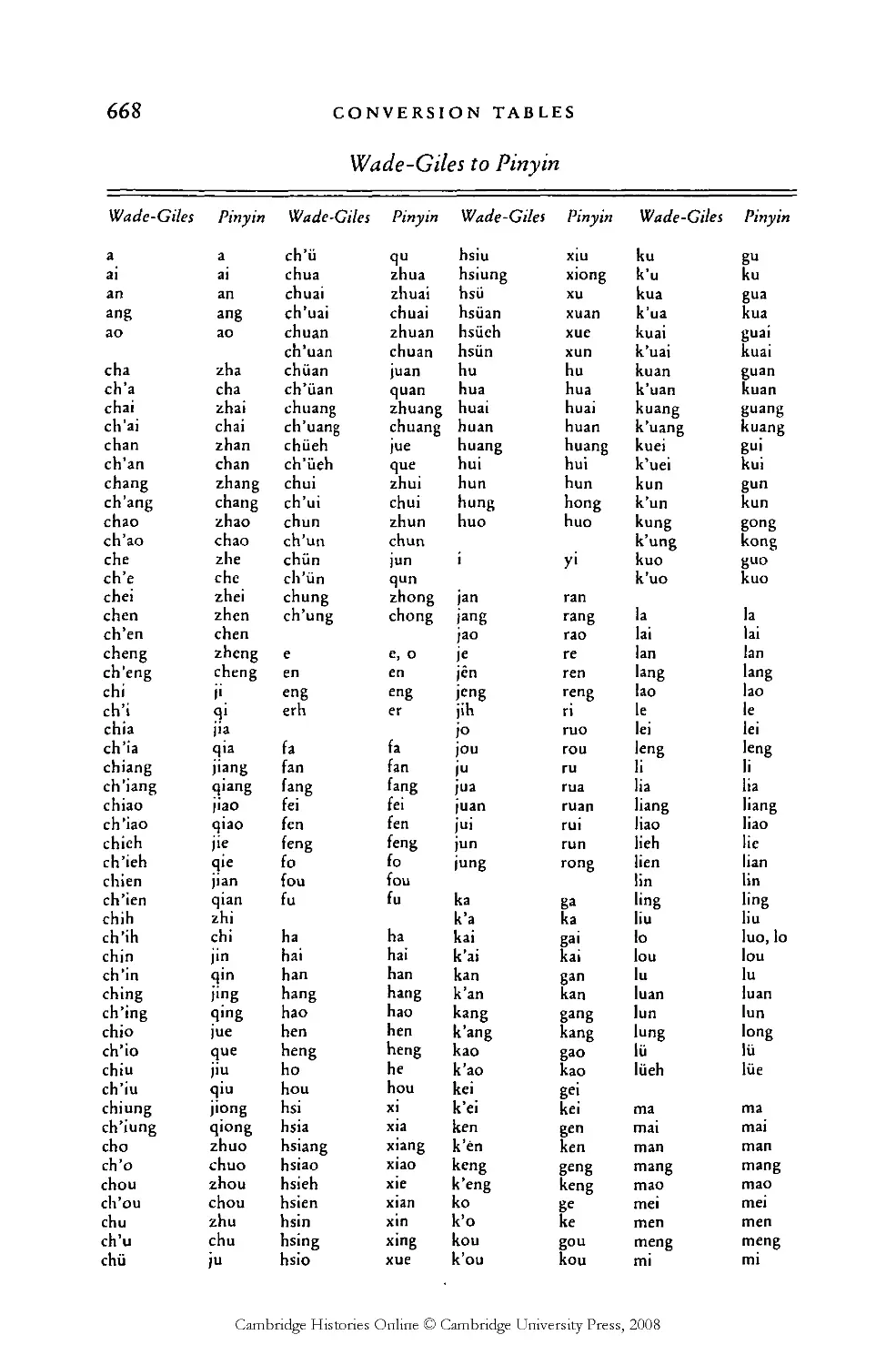
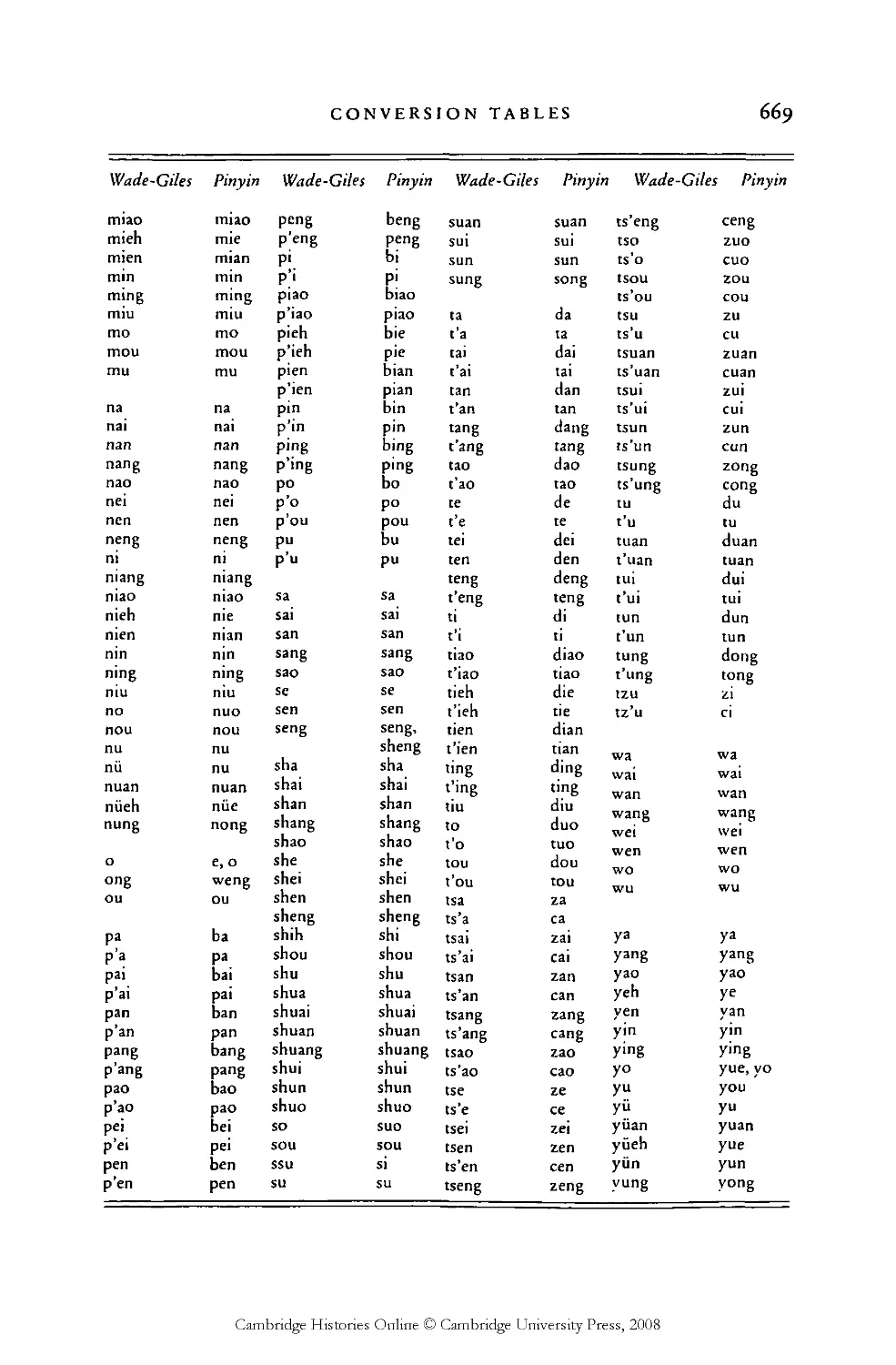
Conversion tables: pinyin and Wade-Giles	665
Glossary-index	671
Cambridge Histories Online © Cambridge University Press, 2008

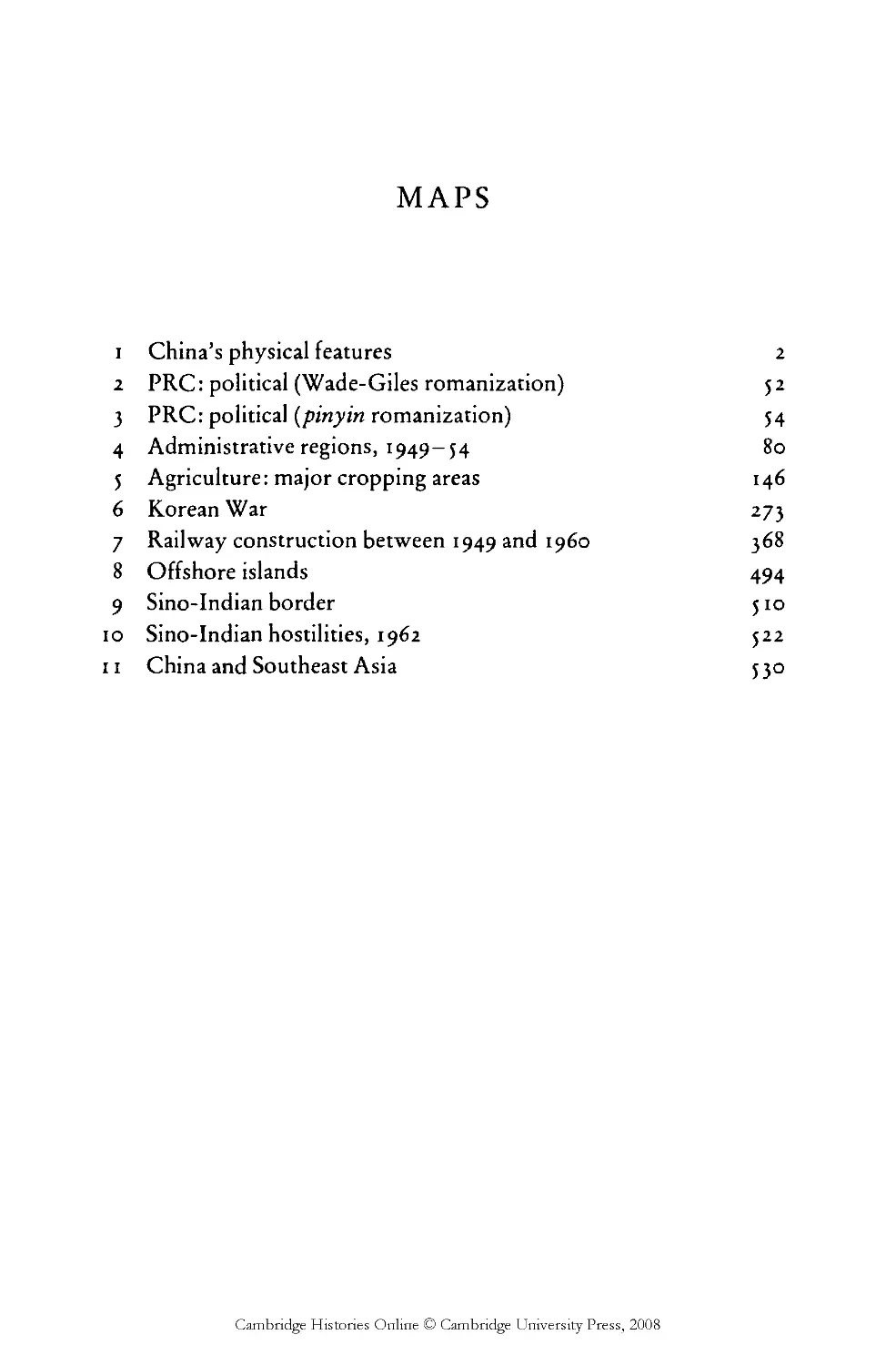
MAPS
I
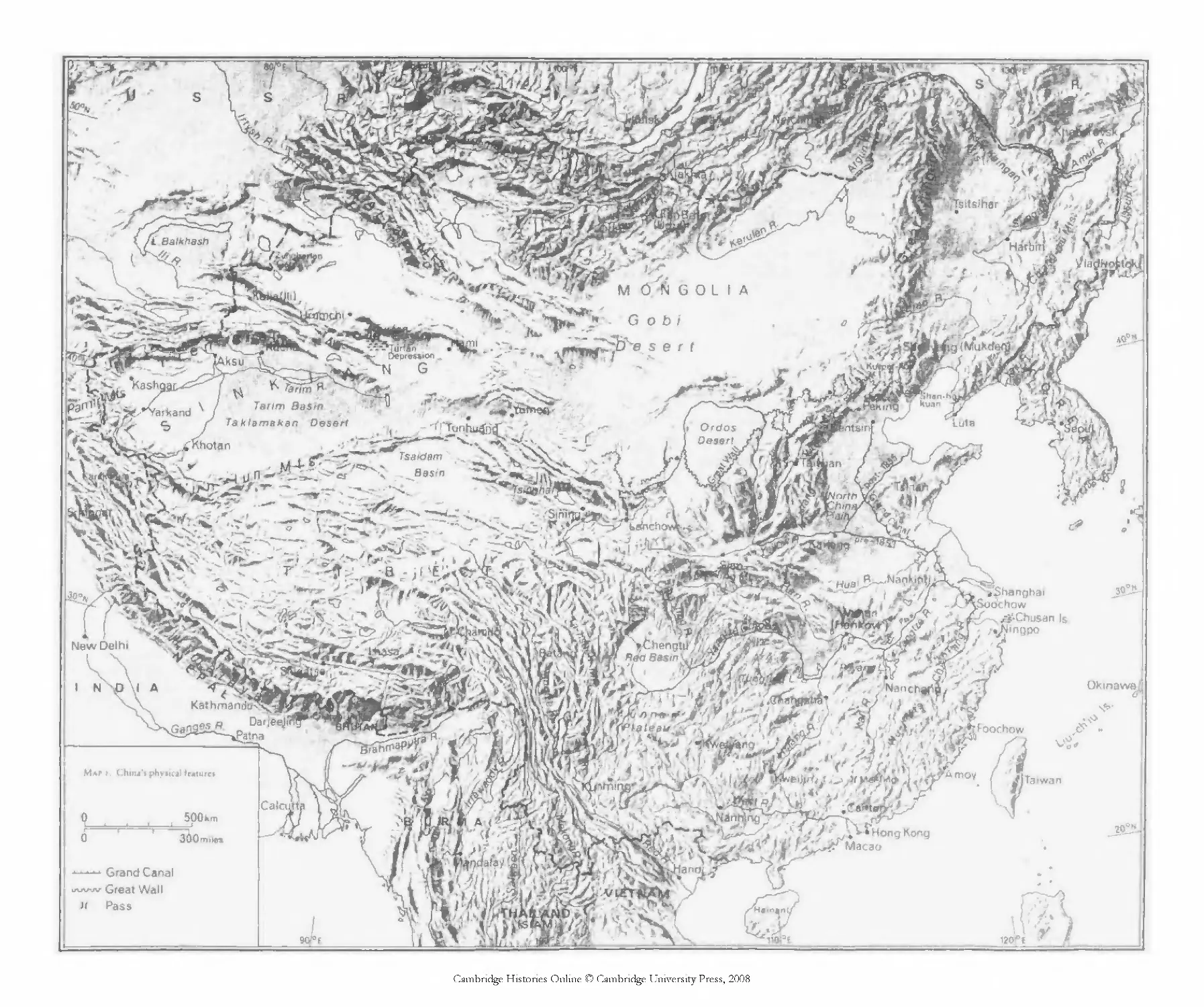
China’s physical features
2
2
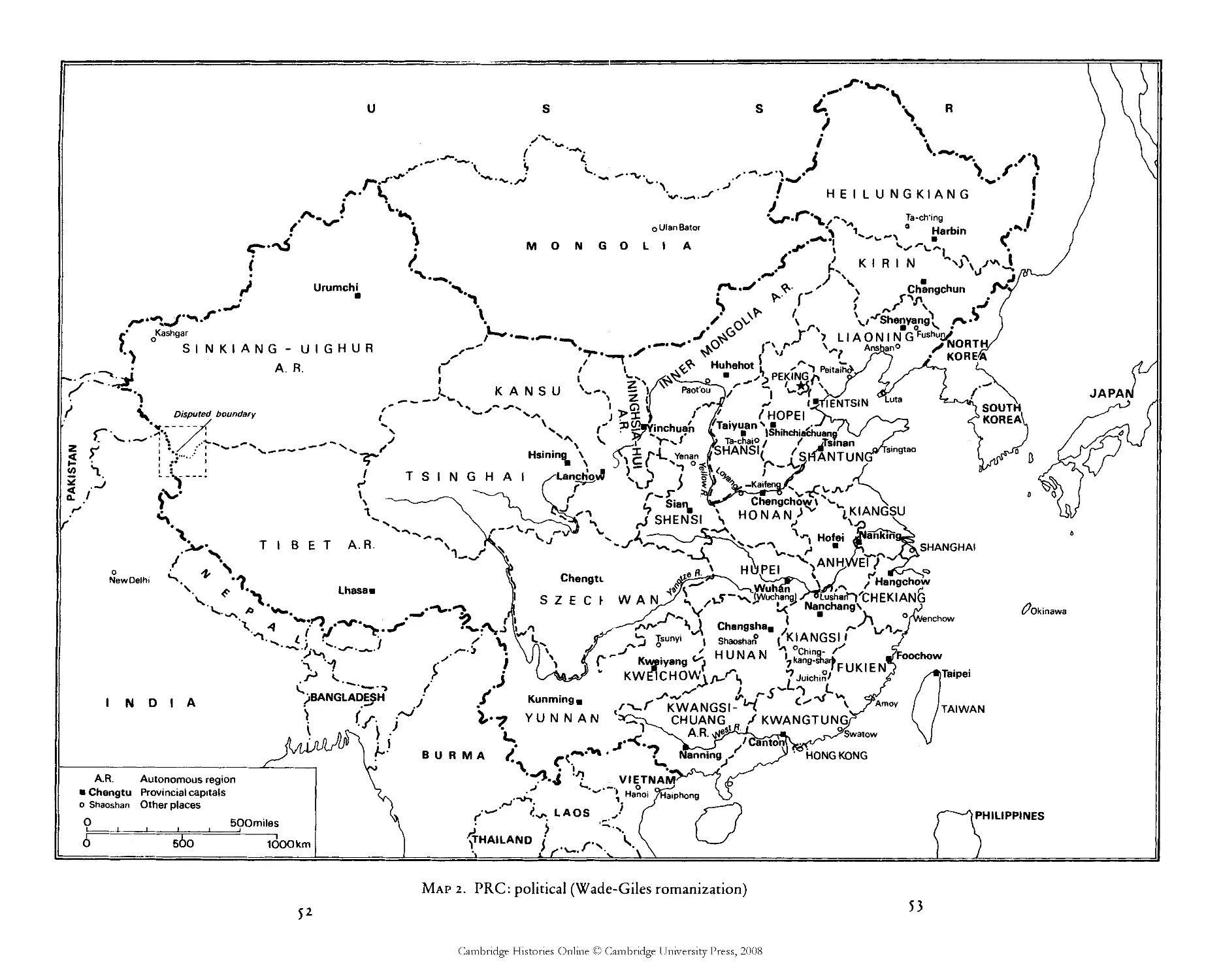
PRC: political (Wade-Giles romanization)
52
3
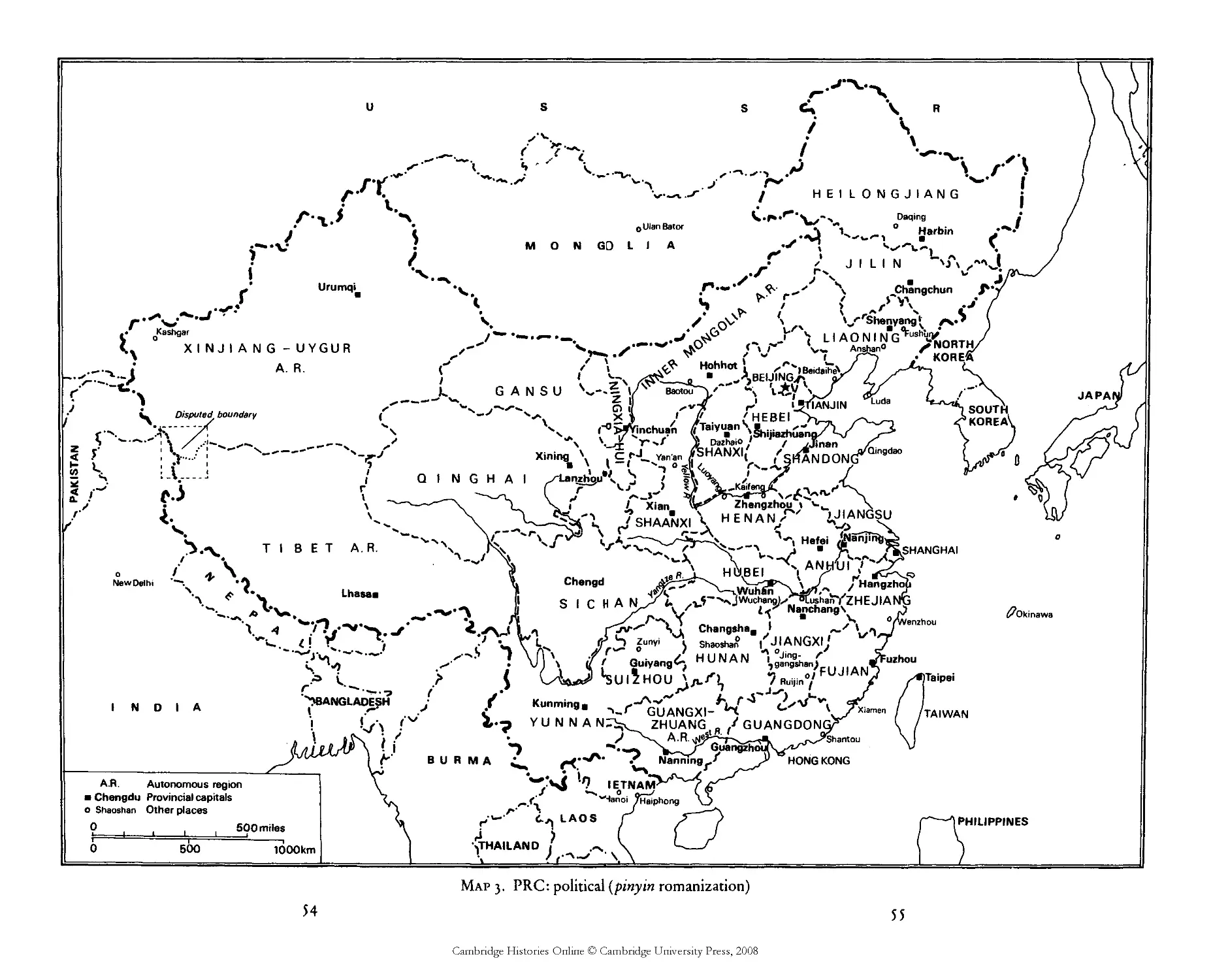
PRC: political (pinyin romanization)
54
4
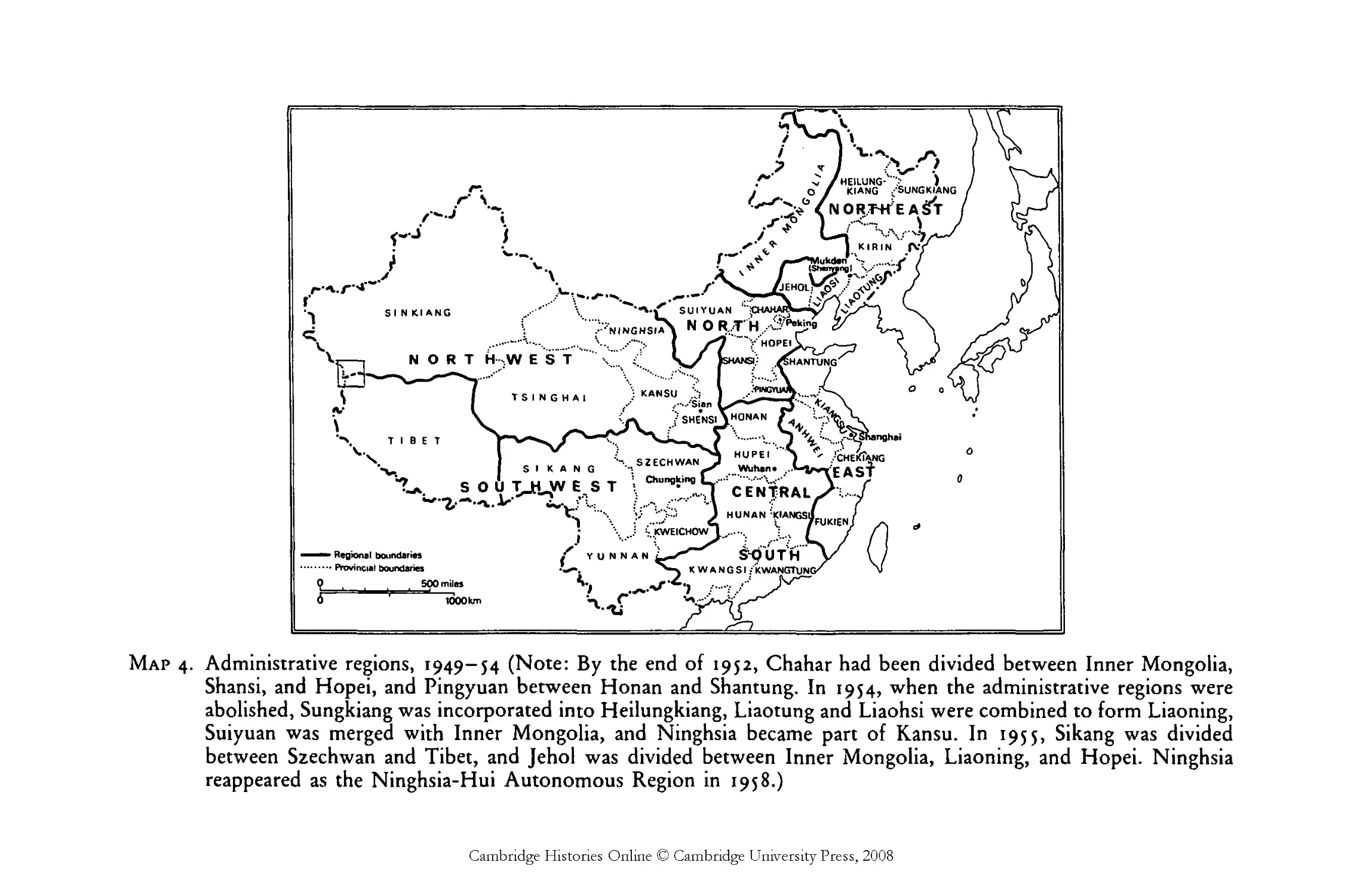
Administrative regions, 1949-54
80
5
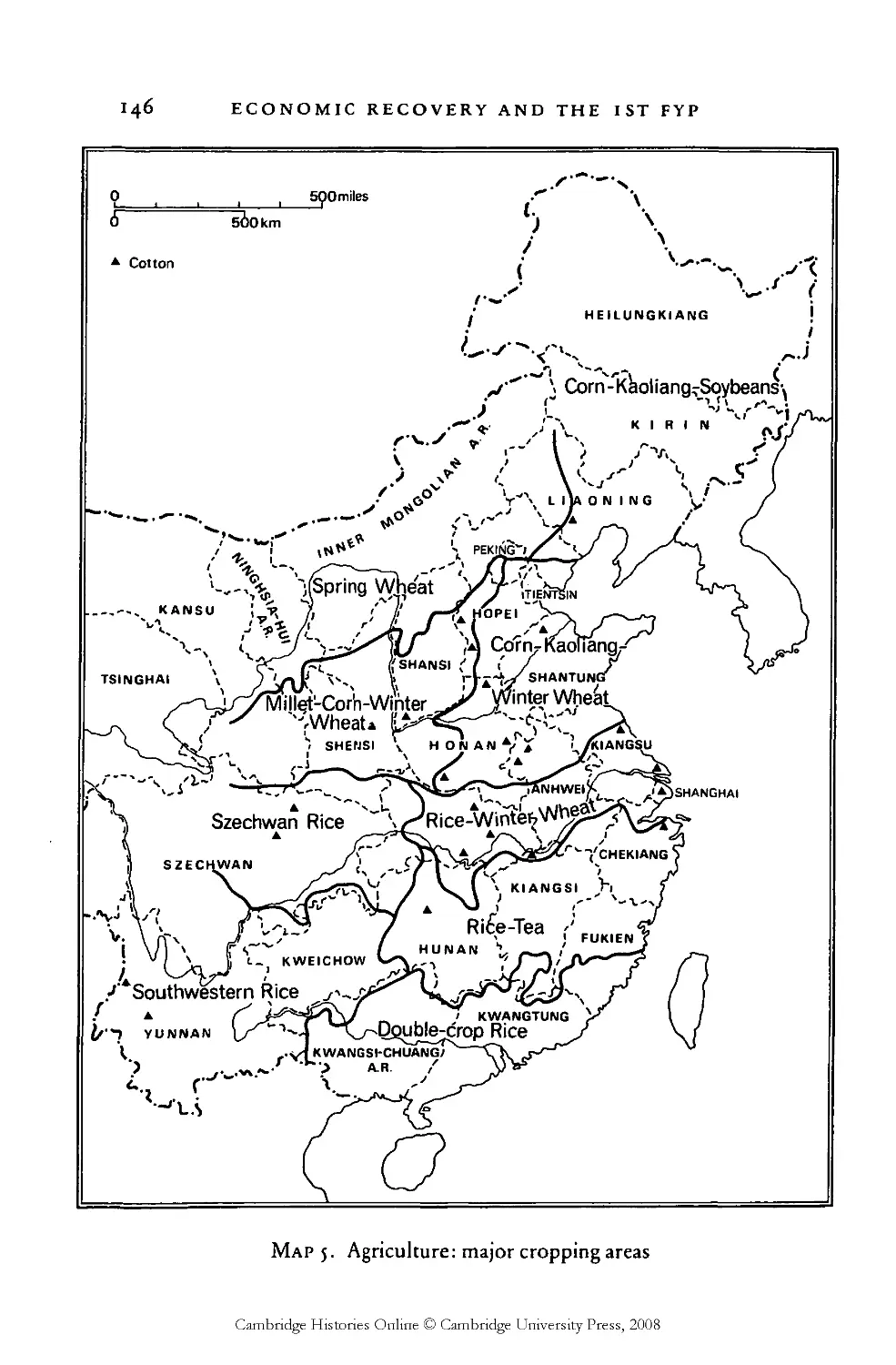
Agriculture: major cropping areas
146
6
Korean War
273
7
Railway construction between 1949 and i960
368
8
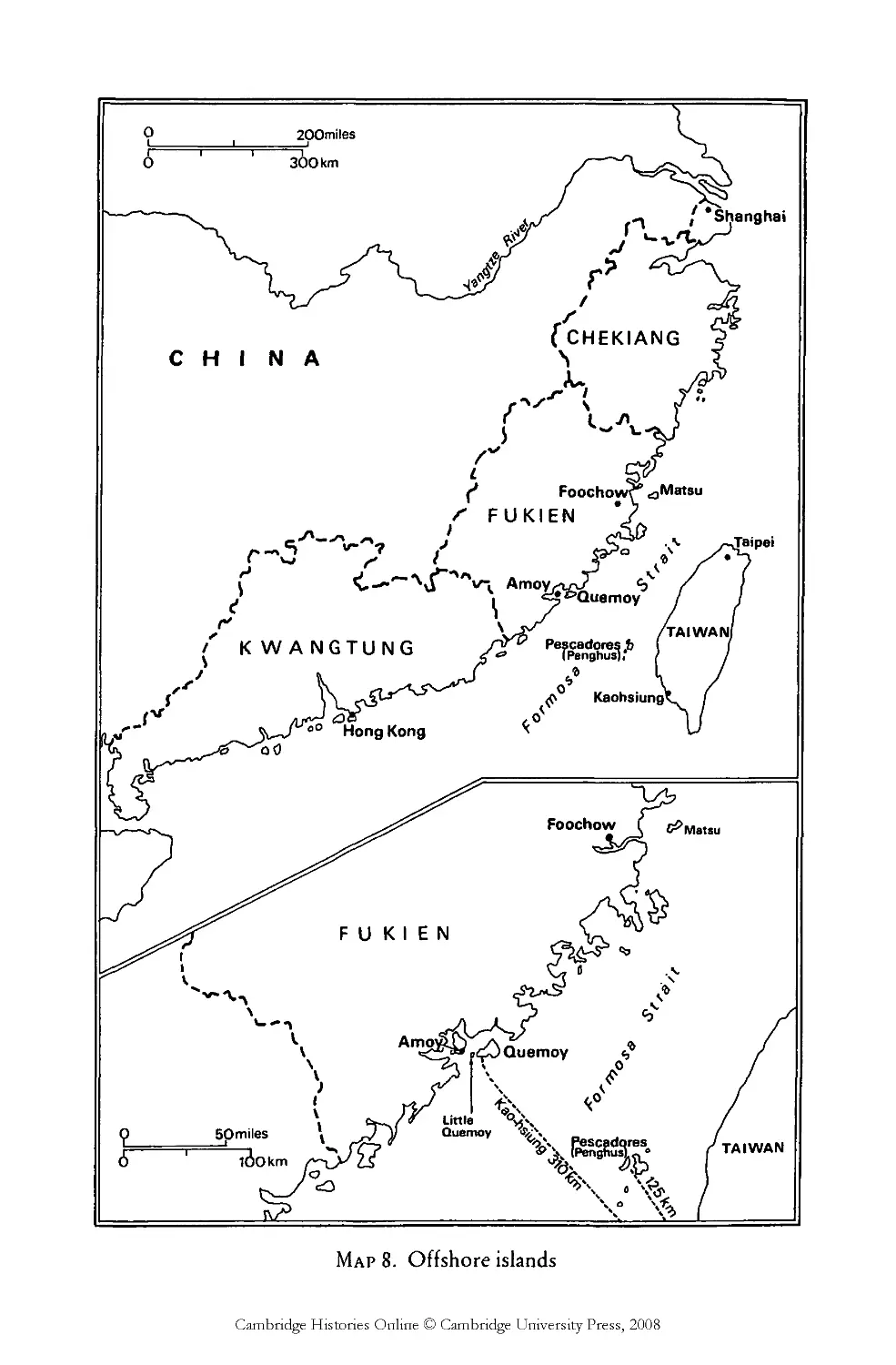
Offshore islands
494
9
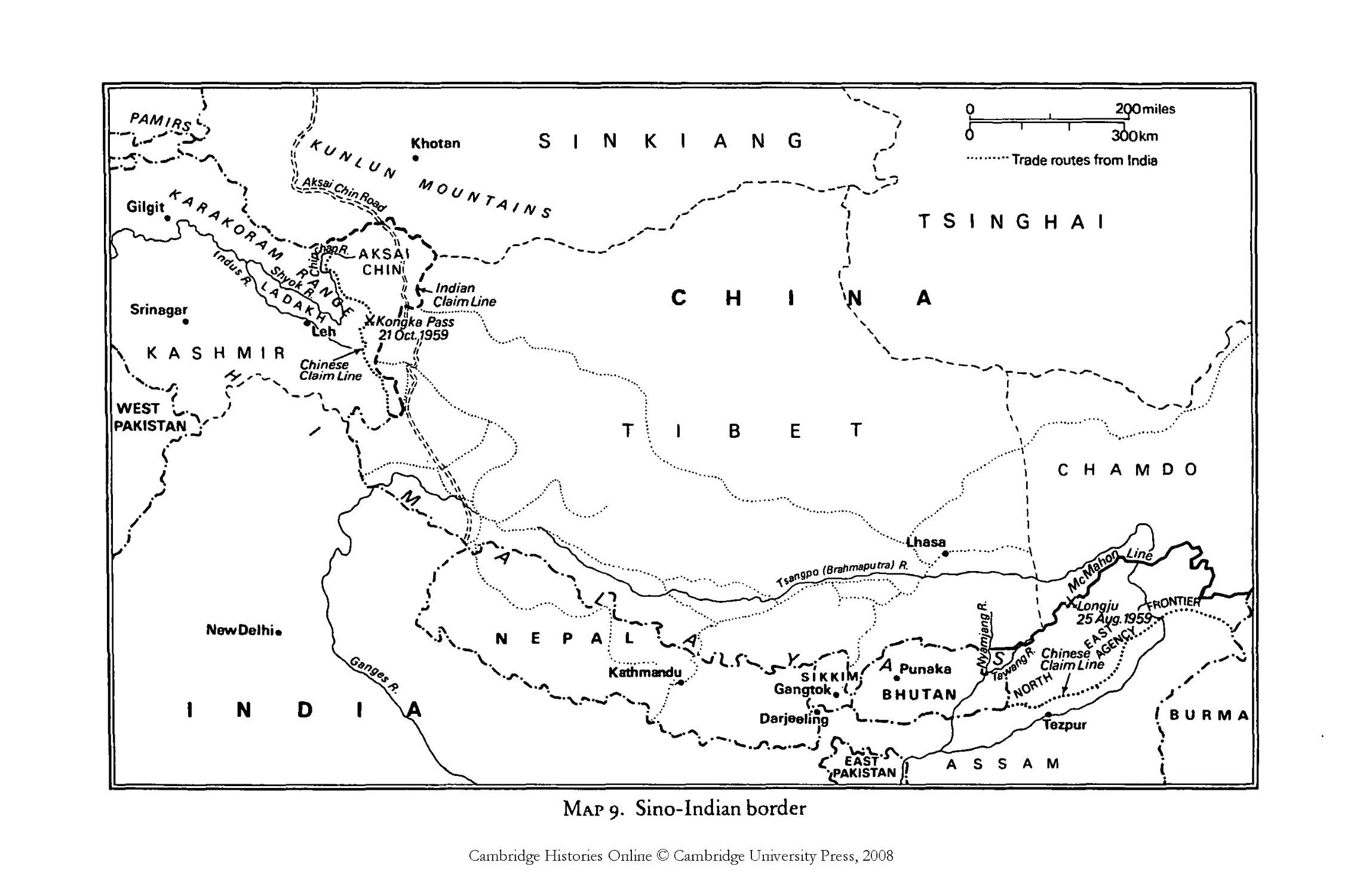
Sino-Indian border
510
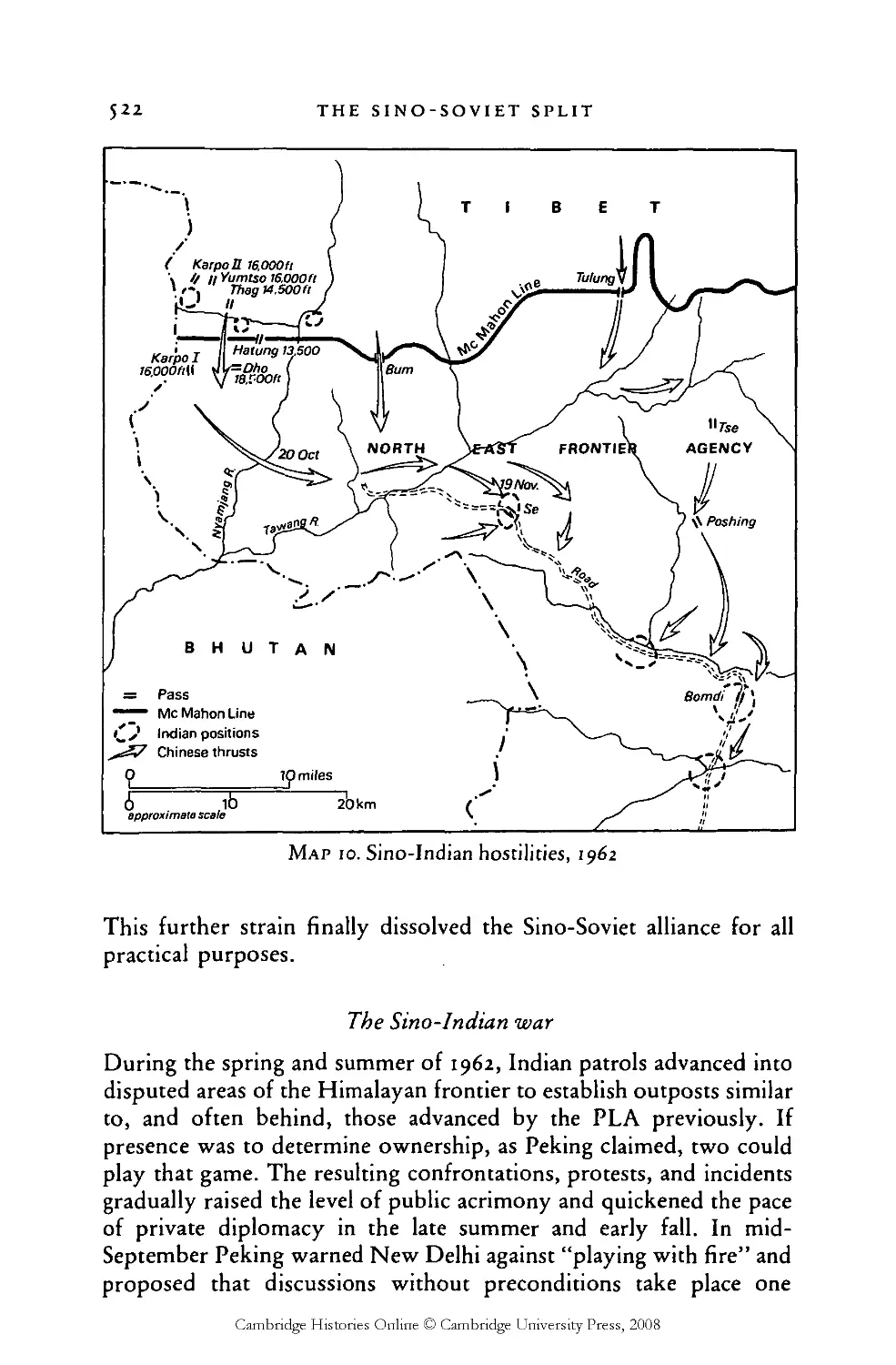
IO
Sino-Indian hostilities, 1962
522
11
China and Southeast Asia
53°
Cambridge Histories Online © Cambridge University Press, 2008

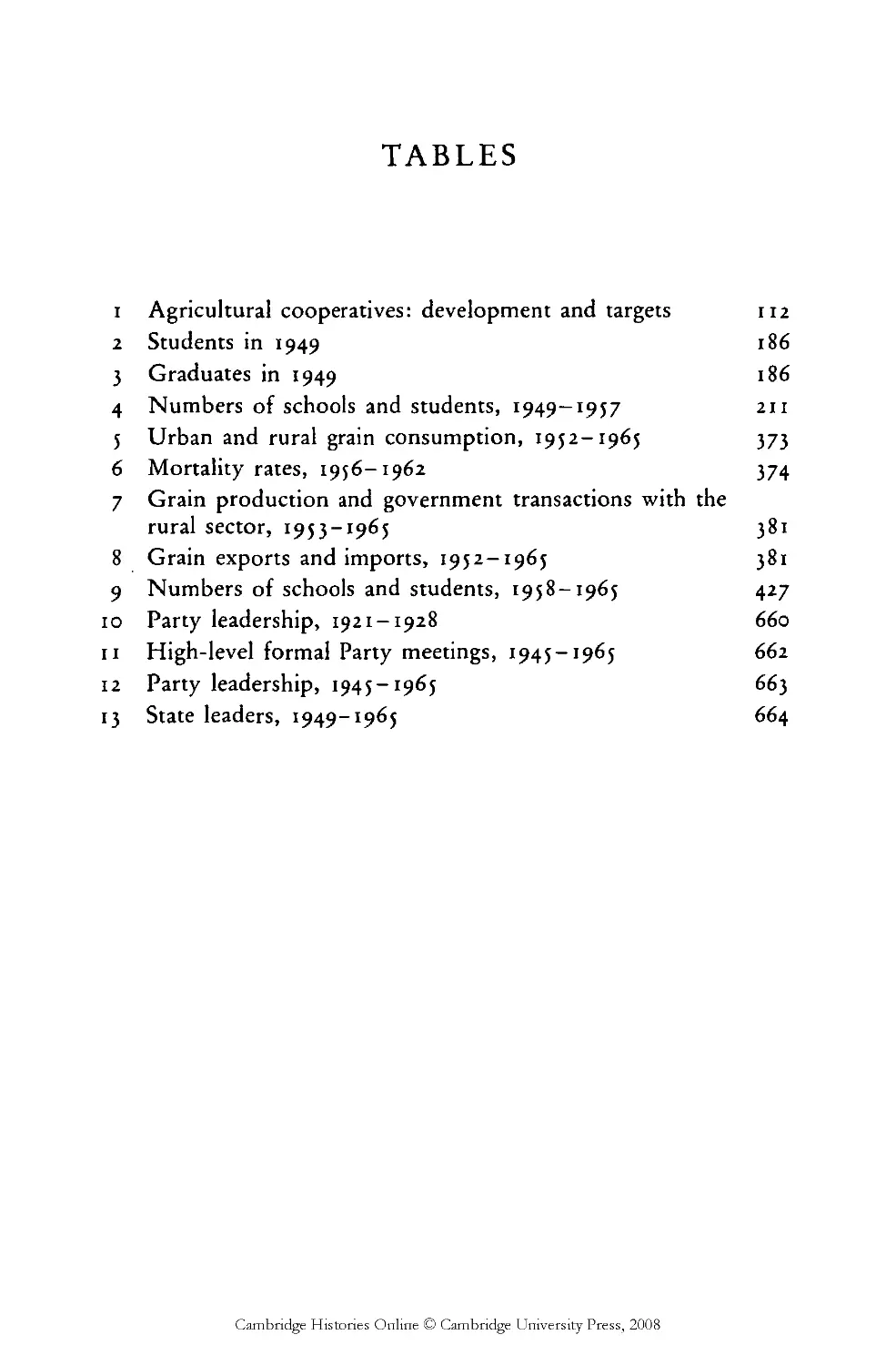
TABLES
1
2
3
4
5
6
7
8
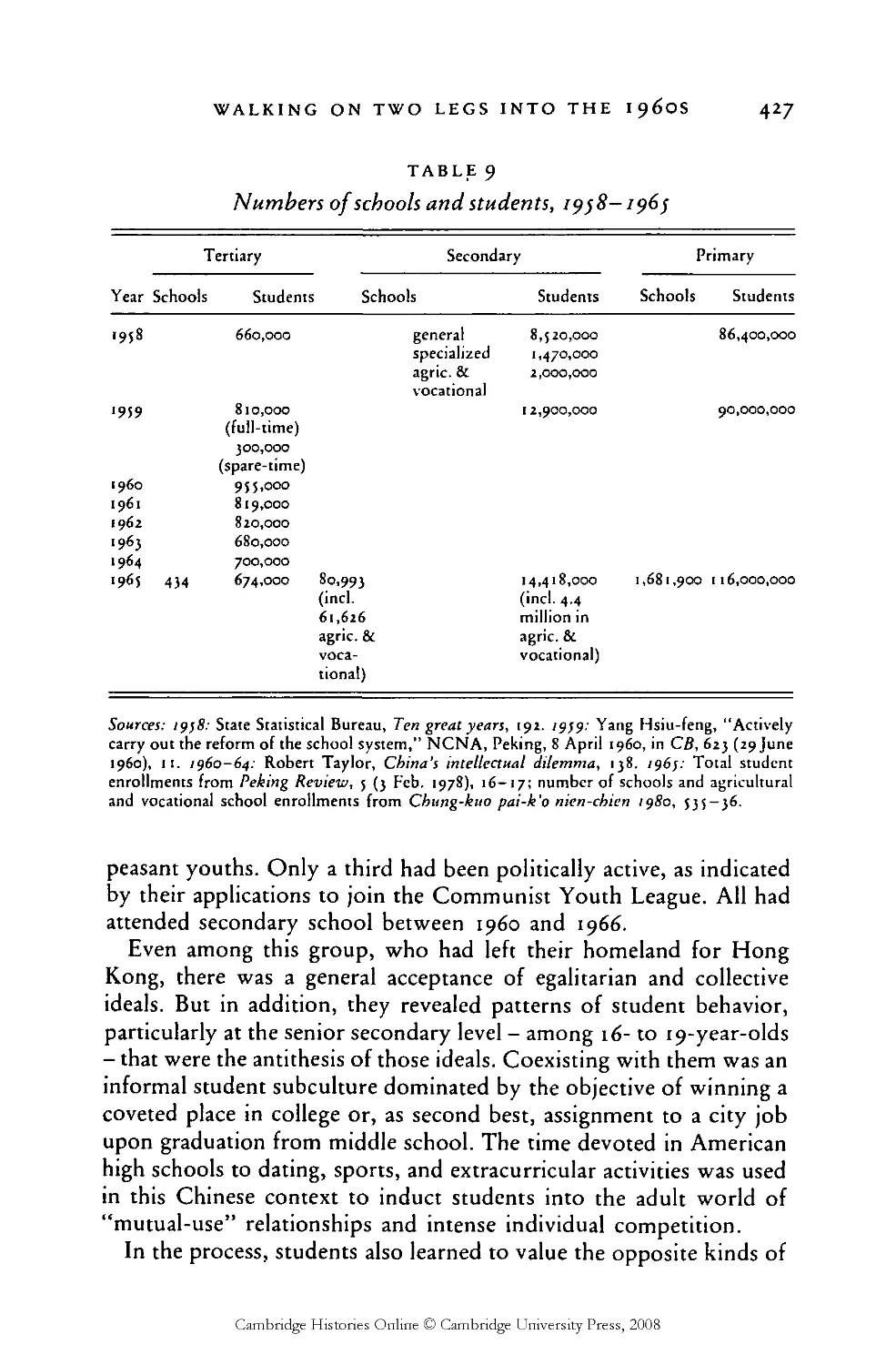
9
10
11
12
13
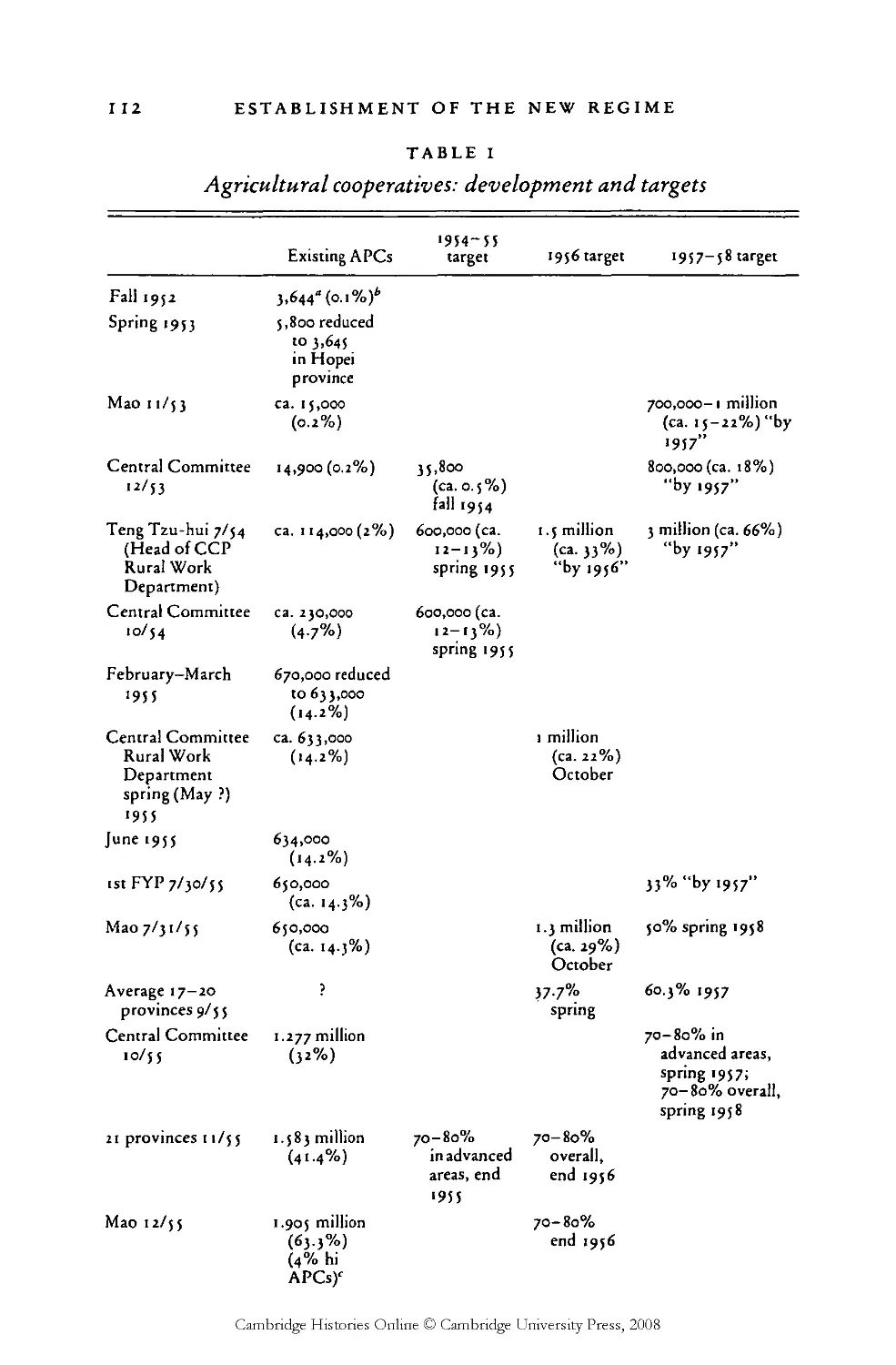
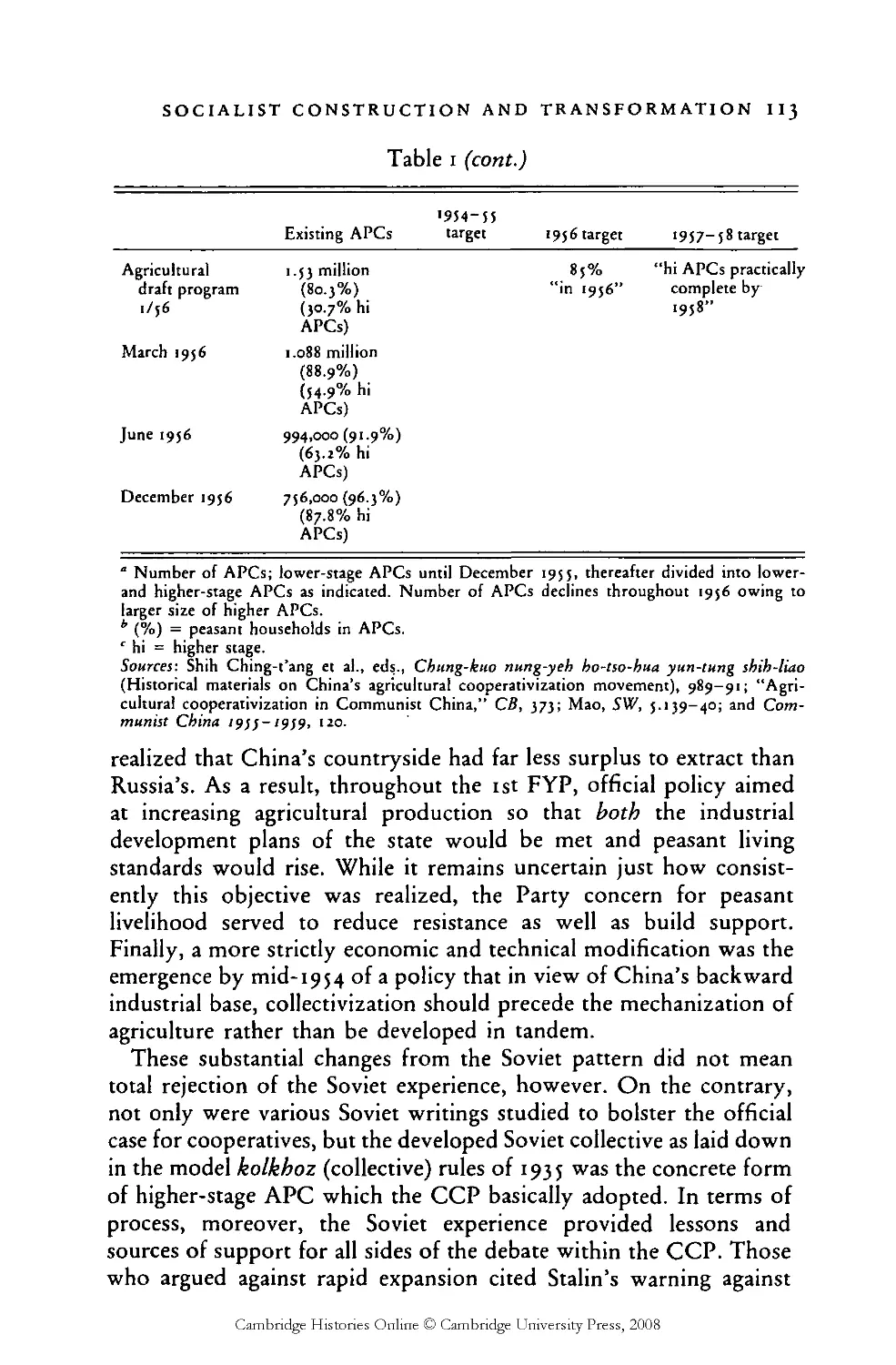
Agricultural cooperatives: development and targets
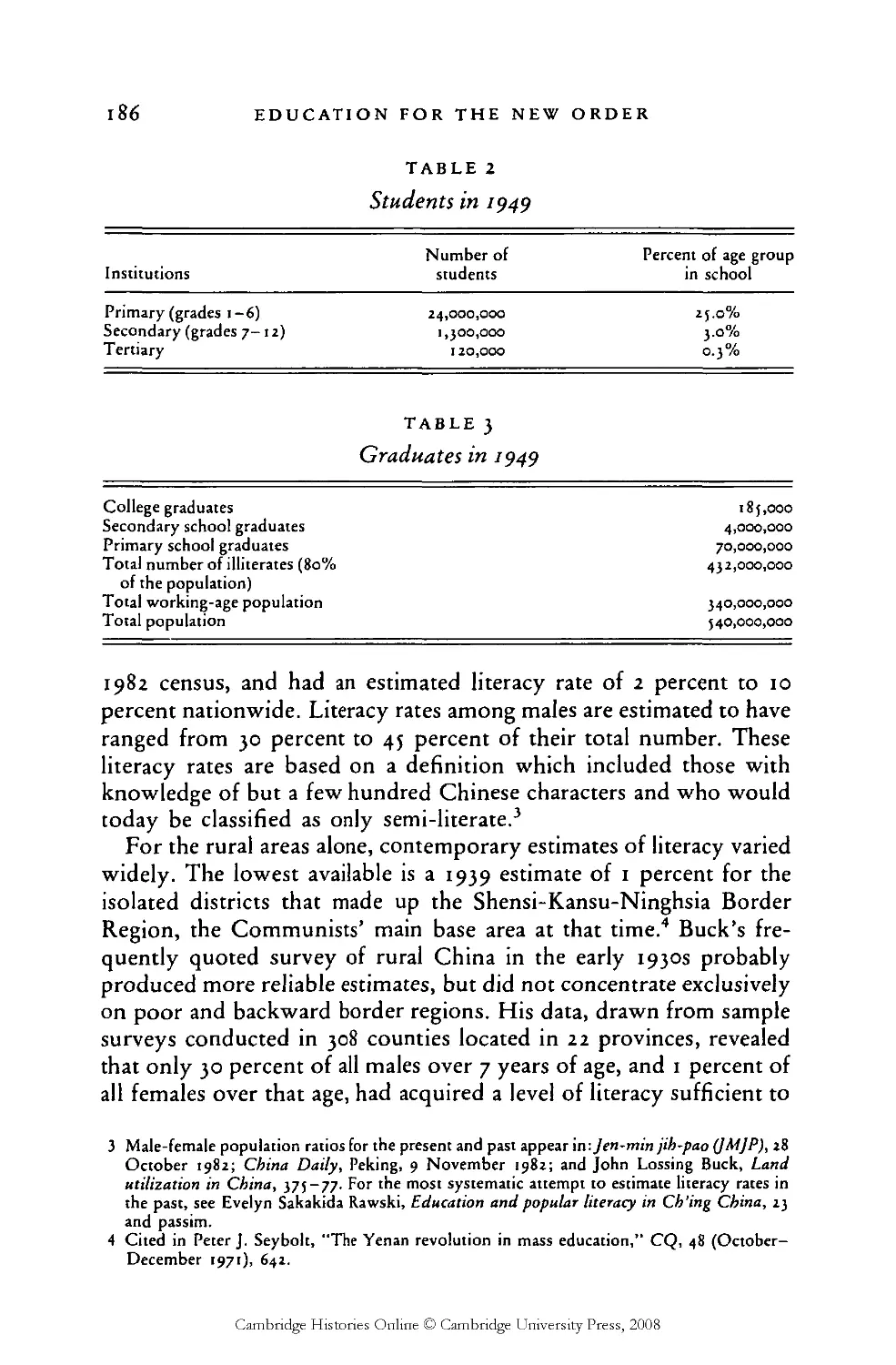
Students in 1949
Graduates in 1949
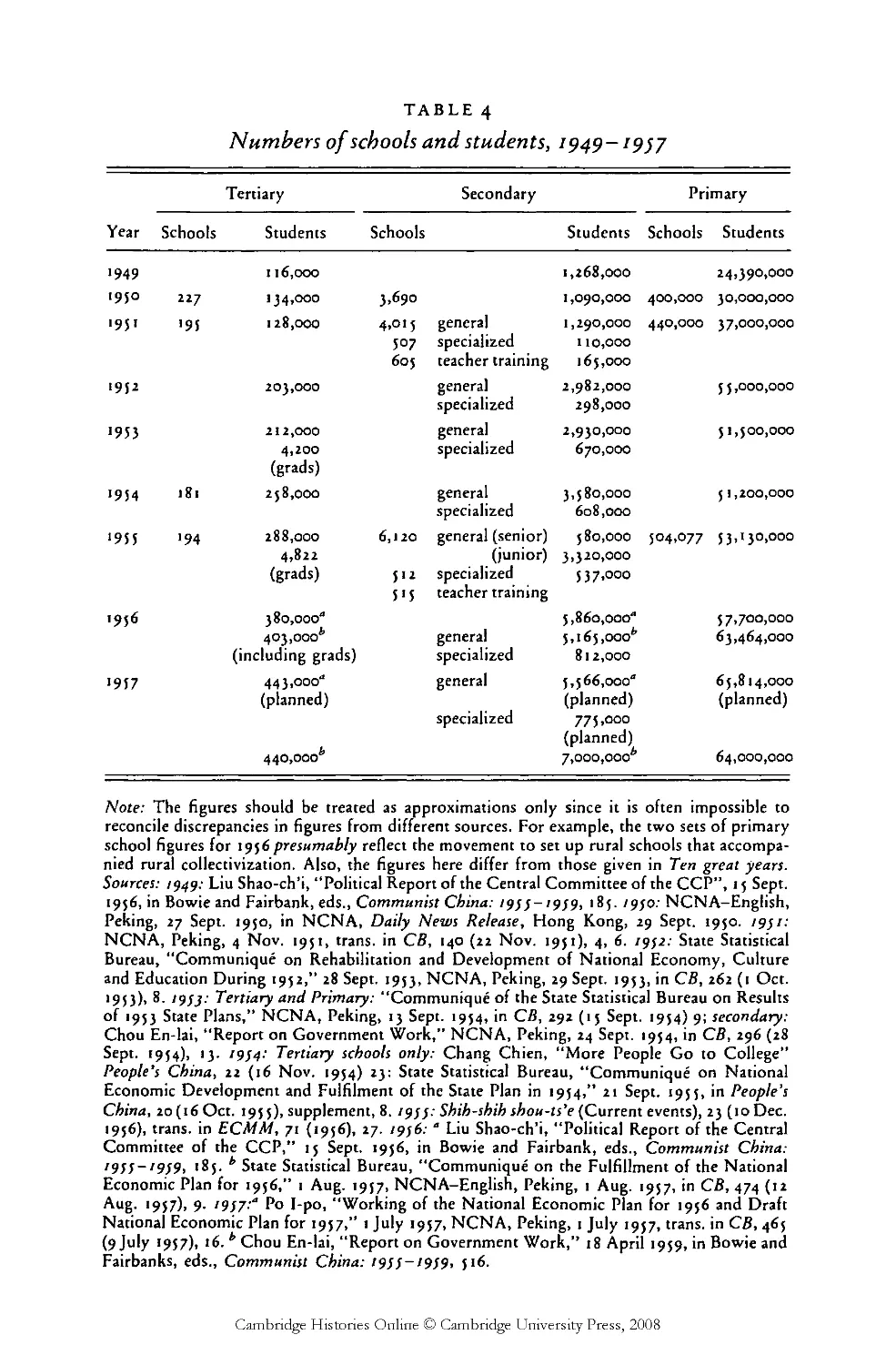
Numbers of schools and students, 1949-1957
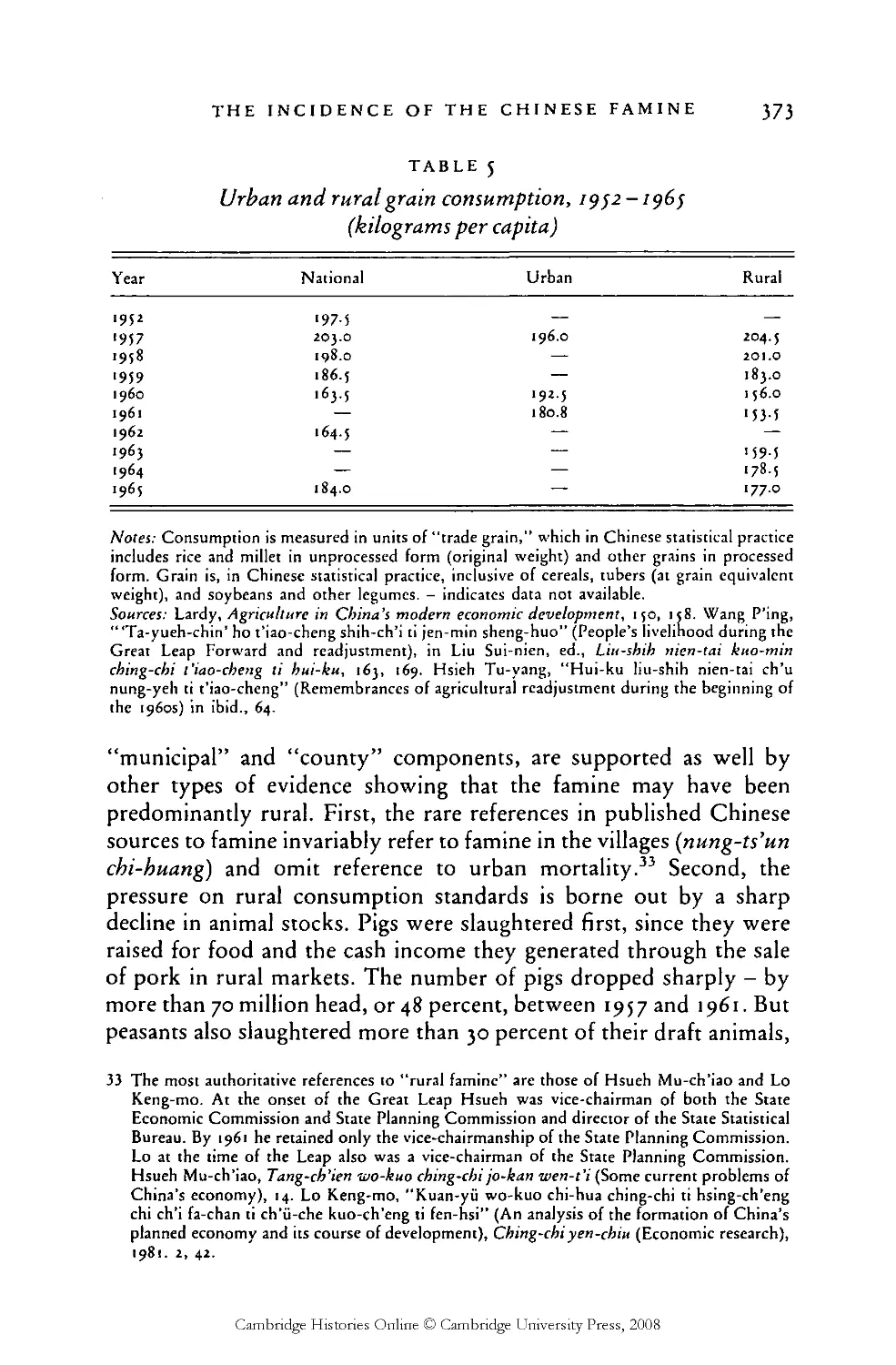
Urban and rural grain consumption, 1952-1965
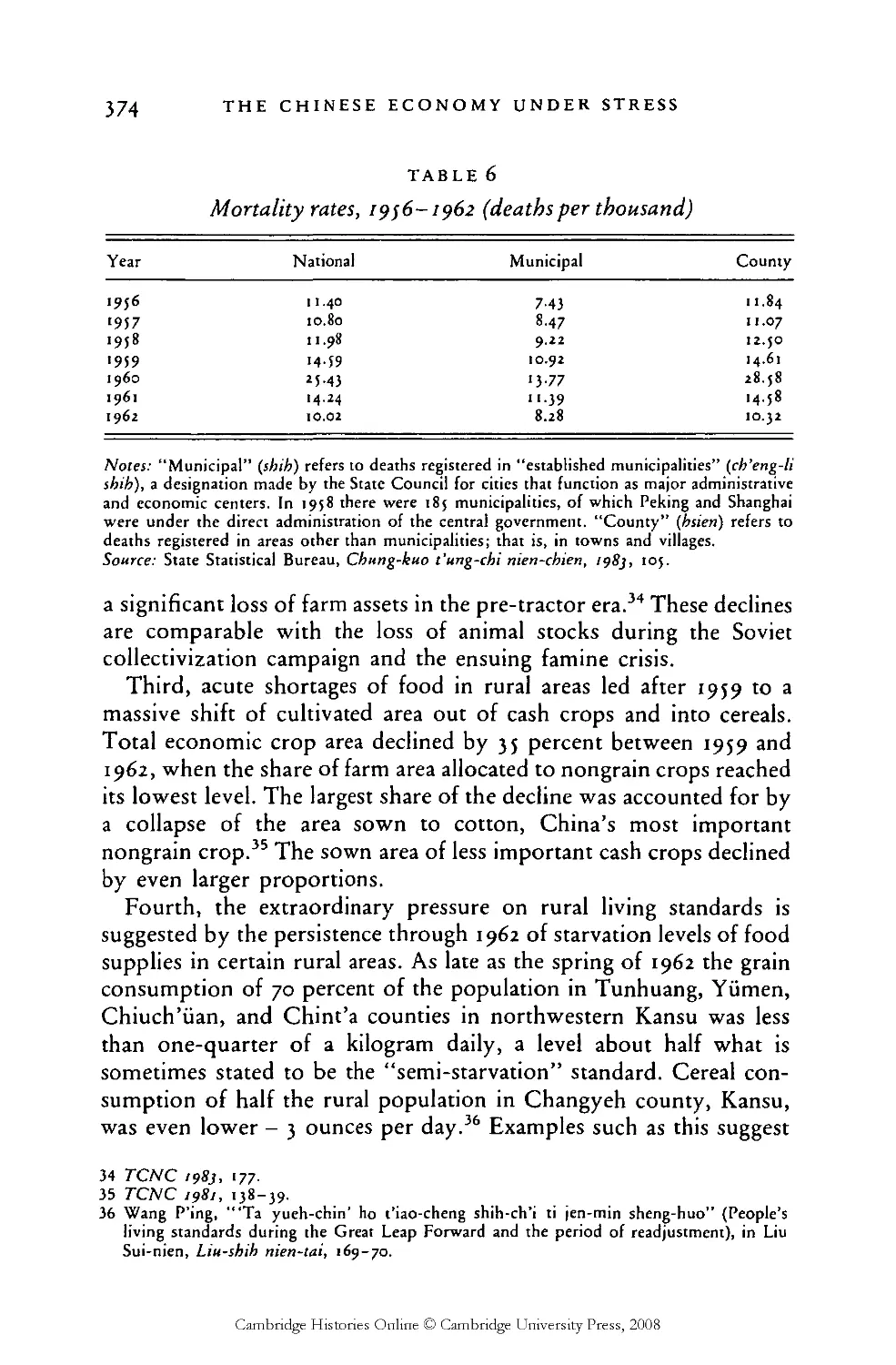
Mortality rates, 1956-1962
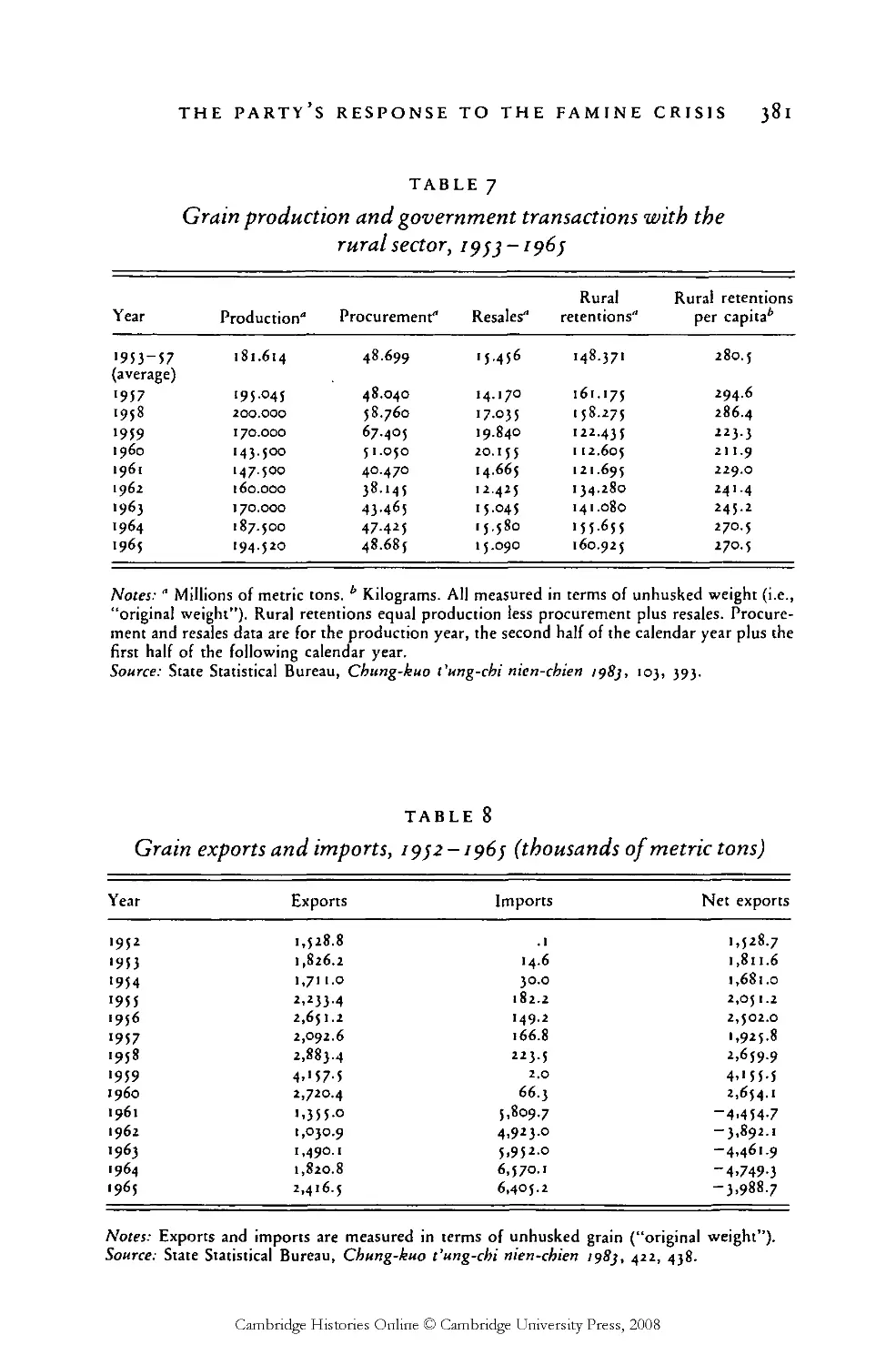
Grain production and government transactions with the
rural sector, 1953-1965
Grain exports and imports, 1952-1965
Numbers of schools and students, 1958-1965
Party leadership, 1921-1928
High-level formal Party meetings, 1945-1965
Party leadership, 1945-1965
State leaders, 1949-1965
112
186
186
211
373
374
381
381
427
660
662
66 3
664
Cambridge Histories Online © Cambridge University Press, 2008

PREFACE TO VOLUME 14
In 1949 a new stage was reached in the endeavors of successive
Chinese elites to meet domestic problems inherited from the Late
Imperial era and to respond to the century-old challenge posed by the
industrialized West. A central government had now gained full
control of the Chinese mainland, thus achieving the national unity so
long desired. Moreover, it was committed for the first time to the
overall modernization of the nation’s polity, economy, and society.
The history of the succeeding decades is of the most massive experi¬
ment in social engineering the world has ever witnessed. Volumes 14
and 15 of the Cambridge History of China attempt to chronicle and
analyze that experiment.
The very power and purposefulness of the Chinese Communist
regime have shaped the format of these volumes. Unlike in the imperial
and republican periods, under the Chinese Communists no aspect of
life, no region of the country has been immune from the determined
efforts of the central authorities to revolutionize China. It is simply
not meaningful to examine any part of Chinese society except in the
context of the Communist Party’s efforts to transform it. Perforce,
one must start by looking at China from the viewpoint of the Party’s
Politburo and the government’s State Council in Peking.
The division of this volume into two sections has been dictated by
the major change in Party policy that took place in 1958 and affected
all sectors of society. The division between this volume and the
succeeding one reflects the watershed of the Cultural Revolution
launched by Mao Tse-tung in 1966.
Of course, the ideas, objectives, strategies, policies, and actions
of Chairman Mao, his colleagues, and his successors do not amount
to a history of China. The greater part of these two volumes is con¬
cerned with assessing the impact they have had on the Chinese
nation. Given the enormous quantity of new data released and the
easier access to the mainland allowed by the People’s Republic in
Cambridge Histories Online © Cambridge University Press, 2008

XIV
PREFACE
recent years, it is possible now to delineate more clearly the outcomes
of the experiment so far.
Nevertheless, we are conscious that ours must be an interim
judgment - not so much because there remain vital data that have not
been released, for it is very likely that some never will be; nor because
the events we describe are so recent, for the assessments of historians
are continually subject to revision no matter how great the advantage
of distance; but because the experiment is far from over, and only
near its completion - a century hence? - will a rounded perspective
on these earliest decades be possible.
This is the fifth volume of The Cambridge History of China
covering the nineteenth and twentieth centuries. From the beginning
of this endeavor we have been conscious of our indebtedness to every
significant contribution to the field. Only our footnotes can tell that
story.
We can, however, express our gratitude to the experienced chief
manager and processor of this volume, Joan Hill, who pursues
precision with good humor, and a perseverance worthy of Chairman
Mao’s Foolish Old Man Who Removed the Mountains. Chiang
Yung-chen has given us valuable assistance with the Chinese bib¬
liography and calligraphy. Our thanks go also to Katherine Frost
Bruner and Gwendolyn Stewart for highly skilled indexing.
In January 1983, we ran a working conference of contributors
under the aegis of Harvard’s Fairbank Center, which was excellently
organized by Patrick Maddox, assisted by Debra Knosp and gener¬
ously financed by the Rockefeller Foundation. We are delighted to
acknowledge also with gratitude the support of the Ford and Mellon
foundations, which has been critical to sustaining the production of
these volumes, as well as the backing of the American Council of
Learned Societies and the National Endowment for the Humanities.
We are indebted to Harvard University and especially to Philip A.
Kuhn for assistance in his capacity as Center director.
RLM
JKF
ON ROMANIZATION
For purely technical reasons we continue, as in preceding volumes, to
use the Wade-Giles system for transcription of Chinese into alpha¬
betic writing. The main reason is that, in order to avoid confusion, we
have to use here the forms used in previous volumes - for example,
Cambridge Histories Online © Cambridge University Press, 2008

PREFACE
XV
Chou En-lai, not Zhou Enlai. At the same time, we note that names
and terms in publications today, both from the People’s Republic and
from around the world, are using the official pinyin romanization,
based on the incontrovertible assumption that a nation has the right
to decide how it wishes its writing system to be romanized abroad.
To meet this situation we have inserted conversion tables at the back
of the book, just before the Glossary-Index.
To avoid enslavement by the arbitrary nature of any romanization
system, we have consciously tolerated deviations, especially in per¬
sonal names. Thus the reader will sometimes find chow instead of
chou, yi instead of i, hwa for hua, teh for te, Anhui for Anhwei, and
almost always Peking for Beijing. (Such deviations need not be called
to our attention.) We also take no responsibility for the name Chen,
which should often be Ch’en.
Cambridge Histories Online © Cambridge University Press, 2008

ACRONYMS
Some of these abbreviations represent publications; others stand for
names and titles in the text. Characters for publications will be found
in the Bibliography; those for names and titles, in the Glossary-
Index.
AAPSO
APC
BDRC
CASS
CB
CC
CCP
CFJP
CHOC
Cl
CPPCC
CPSU
CQ
CSYB
ECMM
FBIS
FYP
GLF
GPCR
HC
HHPYK
HHYP
IASP
ICC
IMH
JAS
JMJP
Afro-Asian Peoples’ Solidarity Organization
Agricultural Producers’ Cooperative
Biographical dictionary of Republican China
Chinese Academy of Social Sciences
Current Background
Central Committee
Chinese Communist Party
Chieh-fang jih-pao
Cambridge History of China
Comintern
Chinese People’s Political Consultative Conference
Communist Party of the Soviet Union
China Quarterly
Chinese statistical yearbook
Extracts from China Mainland Magazines
Foreign Broadcast Information Service
Five-Year Plan
Great Leap Forward
Great Proletarian Cultural Revolution
Hung-ch ’i
Hsin-hua pan-yueh k’an
Hsin-hua yueh-pao
International Arts and Sciences Press
International Control Commission
Institute of Modern History
Journal of Asian Studies
Jen-min jih-pao
Cambridge Histories Online © Cambridge University Press, 2008

JPRS
KMJP
KMT
KTTH
LHCC
LSYC
MAC
Mao, SW
MC
MTHC
MTTC
NCNA
NEFA
nei pu
NFJP
NPC
NSC
OECD
PC
PKI
PLA
PR
PRC
SCMM
SCMP
SEATO
SMR
SWB/FE
TCNC
URI
use
Wan-sui
WFTU
ACRONYMS	xvii
Joint Publications Research Service
Kuang-ming jib-pao
Kuomintang
Kung-tso t’ung-hsun
Lu Hsun ch’iian-chi
Li-shih yen-chin
Military Affairs Commission
Selected works of Mao Tse-tung (English translation)
Modem China
Mao Tse-tung hsuan-chi
Mao Tse-tung chi
New China News Agency (Ffsin-hua she)
Northeast Frontier Agency
“Internal use only”
Nan-fang jih-pao
National People’s Congress
National Security Council
Organization for Economic Cooperation and Develop¬
ment
People’s China
Communist Party of Indonesia
People’s Liberation Army
Peking Review (later Beijing Review)
People’s Republic of China
Selections from China Mainland Magazines
Survey of China Mainland Press
Southeast Asia Treaty Organization
South Manchurian Railway
Summary of World Broadcasts (Far East)
T’ung-chi nien-chien
Union Research Institute
Universities Service Centre
Mao Tse-tung ssu-hsiang wan-sui
World Federation of Trade Unions
Cambridge Histories Online © Cambridge University Press, 2008

Cambridge Histories Online © Cambridge University Press, 2008

CHAPTER 1
THE REUNIFICATION OF CHINA
PHASES OF HISTORICAL UNDERSTANDING
Our comprehension of the great Chinese revolution of modern times
has developed through a series of well-marked phases. A brief review
of these phases is the best introduction to this volume of The Cam¬
bridge History of China, which deals with the first sixteen years of
the People’s Republic, 1949-65. A brief look at the phases that
preceded our present understanding may give the reader a useful
perspective on the current state of the art represented in this volume.1
These phases of understanding may be characterized as missionary,
diplomatic, journalistic, and social-scientific.
The missionary phase, inaugurated by the Jesuits and other Catho¬
lic missionaries of the sixteenth, seventeenth, and eighteenth centu¬
ries, gave us mainly a view of the ancient Chinese classical teachings,
the long series of dynasties, and what we may call the myth of the
state - the official doctrines of morality and history that emanated
from the ruling class and served to indoctrinate both the Chinese
masses and people in the West as they gradually heard about China. It
was, needless to say, a picture of benevolent government by scholars,
in the service of maintaining the family system and the traditional
Chinese social order, capped by the office of the emperor.2
The diplomatic phase was ushered in by British attempts, begin¬
ning in the late eighteenth century, to expand trade with China. The
Macartney mission of 1793 and the Amherst embassy of 1816 led
eventually to the Opium War of 1839-42, which opened China to
foreign contact under the unequal treaty system. During the
nineteenth century the treaty system of extraterritorial status for
foreigners of the treaty powers and for their business activities in the
1	For helpful comments I am indebted to Allen S. Whiting, Roderick MacFarquhar, Philip A.
Kuhn, and Benjamin I. Schwartz.
2	For a survey of early European images of China see Raymond Dawson, The Chinese
chameleon: An analysis of European conceptions of Chinese civilization. For the early
period, copious details and illustrations are provided in Donald F. Lach, Asia in the making
of Europe, vol. t, The century of discovery, ch. 9, "China,” 730-835.
I
Cambridge Histories Online © Cambridge University Press, 2008

Cambridge Histories Online © Cambridge University Press, 2008

'-Itsilslhar ^ '
\ Balkhash
\f*Wi
^	" rarim *
Tarim Basin
Та к lamakan Desert
^itunhu4b'C ' /
am	\ \ ЧЛЛ
-
'arkand
ii Ordos
Desert
hotan
'^i'^hanghal
iSoochow
^->jSiChusan Is
• /./lingpo
>ChengtiVjlu&TУi
B&sin\iifS.^r/ J у
New Delhi
lanch^i
Kathmandt?S
V n гит
DarjeejM
Foochow
|Taiwan
-• 'vf-AV,,
*0 **
Okinawa;
4*
Маг i dun* • phv mat Iraturc»
500 km
i- -A. ■ i >
J	K°°g
20 v.
О	ЗбО miles
Grand Canal
Macao
лллл; Great Wall
if Pass
m -i
Cambridge Histories Online © Cambridge University Press, 2008

4
THE REUNIFICATION OF CHINA
treaty ports continued to expand and be refined.3 By 1917 ninety-two
ports were open for trade, and several generations of foreigners had
dwelt in China and written home about it.
The phase of understanding to which they contributed was, on the
whole, one of disillusion. The ideal features of government and
humane society reported by the Jesuits were now visible at first hand
to peoples who were in the early stages of the Industrial Revolution
and believed in Western progress as well as Christianity and even
democracy, Western-style. To them, China seemed like an ancient
kingdom falling into a shambles.4 The diplomatic phase of Western
understanding came to its climax in 1898 with the attempted estab¬
lishment of foreign spheres of influence and in 1900 with the Boxer
Rebellion. In the latter year the decrepit Ch’ing dynasty hoped for a
time to throw out the foreign invaders, and when this failed the
settlement of 1901 ushered in a new twentieth-century era of reform
and revolution.5
What I am calling the journalistic phase of the Western view of
China arose in the 1890s with the modern journalism of mass-
circulation newspapers and foreign correspondents. George Morri¬
son, for example, who was correspondent of the London Times,
became an informant to the Western world on the machinations of
the Chinese political leaders until eventually some of them made him
their adviser.6 Journalism as the chief mode for understanding the
Chinese revolution has had a steady and fruitful growth throughout
the twentieth century. Television can bring the Chinese revolution
into the home of every Westerner.
All these three phases had, of course, been an accumulation. The
3	The complex system of treaty rights was set forth in W. W. Willoughby, Foreign rights and
interests in China (2nd ed., 1927).
4	For the most comprehensive disillusioned view, see S. Wells Williams, The Middle
Kingdom: A survey of the geography, government, education, social life, arts, religion etc. of
the Chinese empire and its inhabitants. This was only the most successful of a genre of
books telling all about China. See Henry Charles Sirr, M.A., China and the Chinese: Their
religion, character, customs and manufactures; the evils arising from the opium trade; with a
glance at our religious, moral, political and commercial intercourse with the country. R.
Montgomery Martin, China: political, commercial and social. The leading predecessor of
these works was John Francis Davis, The Chinese: A general description of the empire of
China and its inhabitants.
5	China's role as an object of international rivalry was put in context by William L. Langer,
The diplomacy of imperialism /892-/902. On Chinese-American relations the most ba¬
lanced, multilingual study is by Michael H. Hunt, The making of a special relationship.
6	For Morrison’s letters, see Lo Hui-min, ed., The correspondence of G. E. Morrison, vol. 1
(1895-1912), vol. 2 (1913-1920). The two British pundits, J. О. P. Bland and Putnam Weale
(B. Lenox Simpson), between them published a dozen large, popular books.
Cambridge Histories Online © Cambridge University Press, 2008

PHASES OF HISTORICAL UNDERSTANDING
5
Western missionaries continued to translate the classics and lecture
to their home constituencies on the promise of Christianity for the
Chinese heathen. The diplomats all continued to defend the unequal
treaty privileges, especially extraterritoriality, and further entrench
the foreign position in China until they were eventually thrown out.
Through the revolution of 1911, then the revolution of the 1920s
under the Nationalist Party (or the Kuomintang: KMT) in its first
united front with the Chinese Communist Party (CCP), through the
Japanese invasion of China from 1931 to 1945, and then throughout
the Communist period, the reporting of the current scene in China
has continued to progress in technique and expand in coverage.
These developments prepared the way for the period of social-
scientific understanding of China that got started in the 1920s and
1930s with the rise of the social sciences in Western civilization. This
broad development followed many institutional channels and went
through minor phases of its own. In general, the social sciences were
applied to China first in the fields of law and political science, studies
that reflected the proliferation of treaty and trading privileges and the
unequal status of China in an era of imperialist competition. The
application of economics to China began with the study of the China
trade, long a British specialty, and was then expanded by efforts to
understand the Chinese farm economy. By this time the Japanese
invasion of China had also triggered Japanese studies of Chinese
resources, production, and marketing.7 The 1920s saw not only the
rise of the Social Science Research Council in New York but also
mass education experiments in North China and the building up of
the Peking Union Medical College by the Rockefeller Foundation. In
short, after the end of the old dynasty in 1912, waves of foreign
influence rolled over China through the channels of treaty-port trade,
missionary education, and the training of a new Chinese intelligentsia
in Western institutions.
A turning point in the social-scientific approach was inaugurated
during World War II by the growth of area studies, which were an
effort to focus the various disciplines on China in an integrated
fashion and in the experience of each student. Language, history,
7	On law, see in addition to Willoughby, Foreign rights, C. Walter Young, The international
relations of Manchuria. On foreign economic relations, C. F. Remer, The foreign trade of
China and Foreign investment in China. On farm economy, J. Lossing Buck, Land
utilization in China. On early Japanese work on the Chinese economy, see J. K. Fairbank,
M. Banno, and S. Yamamoto, Japanese studies of modern China, part 7.
Cambridge Histories Online © Cambridge University Press, 2008

6
THE REUNIFICATION OF CHINA
geography, economics, political science, sociology, anthropology,
and eventually literature and the more detailed disciplines within
disciplines - all began to produce trained specialists.8 As concern
about the “Communist menace” entered its heyday in America in
response to the creation of the People’s Republic of China, the
Marxism-Leninism of the Chinese revolutionaries stimulated West¬
ern efforts at analysis.
Out of all this, after several generations, has emerged the present
ideal of understanding China through both its history and its current
reality, through both its own tradition and the techniques of social
science.9 This volume shows the emergence of the social scientist-
historian who may function as a specialist in one or another discipline
especially concerned with its subject matter but is at the same time
aware of the other approaches in the context of which work must be
done. Fluent reading and speaking of Chinese, traveling and inter¬
viewing in the country, and the amalgamation of fact and theory are
the stuff of this new scholar’s existence.
This growing capacity in Chinese studies has ushered in a new era.
The long sinological tradition of scholarship, focused on the Chinese
record, had so absorbed the attention and energy of pioneer students
that it cultivated a “Chinese exceptionalism.” Beginning with the
writing system, Chinese history displayed many extraordinary, if not
unique, features such as oracle bones, silk culture, early practice of
bureaucratic government, the examination system, the gentry class,
and above all the longevity of the state and its continuous records of
administration.10 Explication of such topics, and many more, still
necessarily occupies much time in the teaching of Chinese history.
But the context has changed.
Because the social sciences by definition concern principles and
evidence of worldwide scope, they are essentially comparative. So it
follows that the uniqueness of China has been diminished. “Chinese
exceptionalism” in subjects like social structure, the family system,
religious cults, administration, foreign trade, xenophobia, national¬
8	The boom in American area studies of China is summarized in John M. H. Lindbeck,
Understanding China: A report to the Ford Foundation.
9	See, among others, G. William Skinner, “Asian studies and the disciplines,” in Asian Studies
Newsletter, 29.4 (April 1984), 7-8. Fernand Braudel, The perspective of the world, vol. } of
Civilization and capitalism: ifth-i8th century: “And today now that it is in touch with the
various social sciences, is history not also becoming a science of a kind .. . ready to ask
questions as much as to answer them, to be a measure of the present as well as of the past?”
(see pp. 619-20).
10	Surveyed in Kenneth Scott Latourette, The Chinese: Their history and culture through j.ooo
years of cumulative development and recent radical change.
Cambridge Histories Online © Cambridge University Press, 2008

PHASES OF HISTORICAL UNDERSTANDING
7
ism, communism, and technology transfer has been reduced by the
study of China to one case among an array of cases. This, of course,
has produced new insights and broader perspectives.
Yet troubling questions arise. How far do the broadly competent
social scientist-historians find in China mainly what, according to
their categories, they seek? This perennial question, needless to say,
haunts all observers and investigators of humankind, no matter what
academic flags they fly. We shall not attempt an answer here. We may
assume that if earlier generations of scholars were culture-bound
creatures of their times, then we are too. We can claim only to be
more conscious of this fact.
Chinese scholars, like us, are now studying China through the
social sciences as members of a single world community of schol¬
arship. Therefore, it is desirable here to trace the phases by which
their Chinese predecessors have understood the history of China
since the eighteenth century. In other words, the Chinese counterpart
to the Western image of China, its history and its conditions, is
essential to our picture of the modern revolution. The Chinese view is
less well understood by outsiders, but the following phases may be
briefly distinguished: the dynastic cycle phase, which led into the
period of statecraft; the self-strengthening phase, which led into the
reform movement; the Republican revolutionary phase, which led
into party dictatorship; and finally the Communist phase of recent
years, which has led into “modernization.” Naturally, these phases
blend into one another.
The dynastic cycle phase, in the Chinese understanding of modern
history, was posited on one of the grand theories that underlay the
Chinese state, which we must discuss at greater length farther on.
Beginning in the late eighteenth century, Chinese scholars noted
increasing difficulties in administration, the decline of morale, and the
rise of rebellion. These phenomena, from the late eighteenth century
to about the 1870s, were slotted into the traditional cubbyholes of the
dynastic cycle theory." So were the remedies attempted under the
general name of statecraft (ching-shih), the techniques by which
scholar-administrators could deal with the problems of government. 1111	That much neglected but remarkably insightful scholar, Thomas Taylor Meadows in The
Chinese and their rebellions, expounded to Western readers the Chinese myth of the state,
including the theory of virtuous government, the Mandate of Heaven and the right of
rebellion that underlay the dynastic cycle, all of which he had learned from his Chinese
teachers. For a useful survey, see Frederic Wakeman, Jr., The fall of imperial China, ch. 4,
“The dynastic cycle,” 55-70.
Cambridge Histories Online © Cambridge University Press, 2008

8
THE REUNIFICATION OF CHINA
These involved a revival of scholarly studies in order to revive the
morale of the scholar-official class, ingenious administrative arrange¬
ments to meet the needs of governing the masses, efforts at economy
and probity in government, and a series of other well-known means
by which the Chinese imperial order had been from time to time re¬
suscitated and kept going over the centuries. Imperial Confucianism
had survived partly through a capacity for reform by a reassertion
of its ideals.12
One of the objectives of statecraft was to pacify the rebellious
barbarian traders on the frontier, both in Central Asia and in Canton
in the 1830s. Finding the Europeans to be more powerful, statecraft
scholars set about studying them and their technology. This was the
modern beginning of the opening of the Chinese mind to the outer
world.13
The phase of self-strengthening and Westernization grew out of
the recognition that Western arms could be helpful in suppressing
Chinese rebels and that treaty settlement with the invading British
and French could get their support for the dynasty to preserve it
against rebellion. In this way the treaty system appeared to Chinese
statesmen in the first instance as a device for taming the barbarian
with a “loose rein” (chi-mi) in the same way as one gets a powerful
horse to carry its rider or pull loads. It was a concept derived from
long experience in placating and sometimes collaborating with no¬
madic invaders of China.14 The superior military technology of the
12	On Confucian reformism, see W. T. DeBary, The unfolding of neo-Confucianism; James T.
C. Liu, “The variety of political reforms in Chinese history: a simplified typology,” in Paul
A. Cohen and John E. Schrecker, Reform in nineteenth century China, 9-1 j. For an early
exposition of the control system maintained by statecraft, see Kung-ch’uan Hsiao, Rural
China. For a recent conspectus, see the bilingual symposium volume, Proceedings of the
conference on the theory of statecraft of Modern China (Chin-shih Chung-kuo ching-shih
ssu-hsiang yen-t’ao-hui lun-wen chi). On the rise of statecraft, see Judith Whitbeck, ibid.,
323-40, “From k'ao-cheng to ching-shih: Kung Tzu-chen and the redirection of literati
commitment in early nineteenth century China”; and Benjamin Elman, From philosophy to
philology. Also Wang Erh-min, “Ching-shih ssu-hsiang chih i-chieh wen-t’i” (The problem
of definition in statecraft thought), in Bulletin of the Institute of Modem History, Academia
Sinica, 13 (June 1984), 27-38.
13	One leader was the versatile New Text scholar Wei Yuan, Hai-kuo t’u-chih (An illustrated
treatise on the maritime kingdoms), several editions: 1844, 50 chiian; 1847, 60 chiian; 1852,
100 chiian. On Wei Yuan’s career, see Wang Chia-chien, Wei Yuan nien-p'u. Jane Kate
Leonard, Wei Yuan and China’s rediscovery of the maritime world. A first systematic
geography was by Hsu Chi-yu, Ying-huan chih-lueh (A short account of the maritime
circuit). See Fred W. Drake, China charts the world: Hsu Chi-yu and his geography of 1848.
On the parellel Ch’ing policies in Kashgar and Canton in the 1830s, see Joseph Fletcher in
CHOC, 10. 375-83.
14	On the “loose rein” policy for temporizing with and making use of barbarians too powerful
to coerce, see Lien-sheng Yang, “Historical notes ...” in J. K. Fairbank, ed., The Chinese
world order, esp. 31-3.
Cambridge Histories Online © Cambridge University Press, 2008

PHASES OF HISTORICAL UNDERSTANDING
9
West was therefore the first thing to be borrowed, in the form of
firearms, cannon, and gunboats.
Military industry, of course, involved other kinds of heavy indus¬
try, and the Chinese went steadily farther into attempts at West¬
ernization (yang-wu)15 State mines, steamship lines, and eventually
factories were adapted to Chinese use from foreign models and with
foreign help. Meanwhile foreigners were taken into the Chinese
administration as a means of controlling other foreigners, particularly
through the Imperial Maritime Customs Service. The dictator of this
service, Robert Hart, knew how to serve as a minor Chinese official
while wielding influence greater than that of some foreign ambassa¬
dors.16 Late nineteenth-century imperialism thus entailed synarchy,
Chinese collaboration, and Sino-foreign cooperation in many fields.
Missionaries found that evangelism could be helped and indeed sup¬
planted by good works. Merchants found that the administration of
the treaty ports by foreign consuls and merchants had to have
Chinese cooperation and participation.17
In this phase, reform was induced by those scholars who saw the
West and its products and recognized that China had fallen behind
and must make great changes. The early reformers tended naturally to
become Christian converts, at least for a time. But Chinese fear and
dislike of the foreign invaders were so pervasive that efforts to start a
daily press, build up industries, and modernize the military were
delayed for a generation.18 The lightning Japanese victory over China
in 1894 was a stunning blow that opened the eyes of a whole
generation. K’ang Yu-wei proclaimed that China must reform or
perish. In the 1890s foreign teaching of Social Darwinism supported
this conclusion.19 After the fiasco of the Boxer Rising in 1900, even
the moribund Ch’ing dynasty launched reforms. The turn of the
century thus saw a great revolution in Chinese thought begin among
the scholar class, who alone could lead revolution.
15	On early Westernization in general, see Albert Feuerwerker, China’s early industrialization.
On military industry, Thomas Kennedy, Arms of Kiangnan: Modernization of the Chinese
ordnance industry 1860-189). On the economic institutions and practices that grew up in
Sino-foreign trade, see Yen-p’ing Hao, The commercial revolution in nineteenth-century
China: The rise of Sino-Western mercantile capitalism.
16	Stanley F. Wright, Hart and the Chinese Customs; ]. K. Fairbank, K. F. Bruner, and E. M.
Matheson, The I.G. in Peking: Letters of Robert Hart; J. K. Fairbank, “Synarchy under the
treaties,” in The Chinese world order.
17	Albert Feuerwerker, “The foreign presence in China,” CHOC, 12. 128-207, and Albert
Feuerwerker, “Economic trends in the late Ch’ing empire 1870-1911,” CHOC, 11. 1-69,
esp. 38—39 citing Wang Ching-yii.
18	See Paul A. Cohen, Between tradition and modernity: Wang T’ao and reform in Late Ch ’ing
China.
19	James R. Pusey, China and Charles Darwin.
Cambridge Histories Online © Cambridge University Press, 2008

IO	THE REUNIFICATION OF CHINA
The subsequent phase of revolution seemed to bear out the theory
of the dynastic cycle. The dynasty collapsed in 1911 and was soon
followed by a period of chaos and warlordism.20 From the Chinese
point of view, one chief achievement of this period was the substitu¬
tion after 1921 of a dictatorial party for the dynastic family. Accept¬
ance (beginning within ten years after the end of the dynasty) of the
Soviet model with the establishment of the CCP in 1921 and the
reform of the KMT on Soviet lines in 1923 had several advantages:
It created an ongoing and self-perpetuating powerholder but did so
by mobilizing the most committed revolutionaries as patriots intent
on saving China. The dynastic families had tried to provide capable
power-holders (emperors) from a harem that might produce twenty
or thirty sons in the palace, while providing bureaucrats from an
examination system open to talent in all the provinces. Party dic¬
tatorship instead dispensed with the family lineage, opened the
powerholding politburo to competing talent from within the Party,
and had Party members supervise government at all levels. The era of
party dictatorship thus launched an ongoing struggle between two
parties, the KMT and the CCP.21
By the time the Chinese Communists came to power in 1949,
Chinese patriots had spent two generations borrowing from Western
models of government and theories of social order. British liberalism
at the turn of the century was followed by the Japanese example of
political reform early in the 1900s. Western theories of politics
loomed largest in the conscious thought of Chinese revolutionaries.
Around 1911, leaders ranging from Sun Yat-sen and Sung Chiao-jen
to Liang Ch’i-ch’ao mainly had in mind the British and American
(and also the Japanese) creations of parliamentary democracy in
nation-states. During the 1920s Ch’en Tu-hsiu, Li Ta-chao, and other
leaders of the Chinese Communist Party saw their precedents in the
great French and Russian revolutions against feudalism and class
oppression. Meanwhile both the CCP and Sun Yat-sen and his
Kuomintang colleagues, including Chiang Kai-shek, were impressed
with Leninist party dictatorship as a means to counter imperialism.
The foreign models of revolution and nation building fitted the
Chinese situation sometimes only superficially, sometimes more
fundamentally. In order to appraise the degree and form of their
20	Chuzo Ichiko, “The role of the gentry: An hypothesis,” ch. 6 in Mary C. Wright, China in
revolution.
21	On the first united front, see C. Martin Wilbur, The Nationalist Revolution in China,
192J-1928.
Cambridge Histories Online © Cambridge University Press, 2008

THE CHINESE ACHIEVEMENT OF UNITY
11
influence, we must look first at certain basic concepts in Chinese
traditional thinking about politics, especially the nature of state
authority.
THE CHINESE ACHIEVEMENT OF UNITY
Our best starting point is the theory and practice of the dynastic
cycle, so prominent in Chinese political folklore and historical writ¬
ings. Let us begin at the simplest level and view it as an explanation of
events, before probing the assumptions underlying it. Without going
into the extensive literature on the rise and fall of dynasties, we can
note the historical circumstances that chroniclers have cited as typical
of a period of dynastic change and reunification.22 What I try to
summarize here comes from concepts put forward by Chinese official
historiography. First of all, it was preceded by prolonged disorder
produced by a combination of factors: unvirtuous conduct of the ruler
that would cost him the Mandate of Heaven; fiscal bankruptcy of his
regime due partly to extravagance and partly to corrupt withdrawal
of upper-class land from taxation, increasing the tax burden on the
peasantry, whose defaults impoverished the government; declining
popular welfare due inter alia to population pressure on resources and
failure of the regime to maintain public works, especially dikes for
flood prevention and granaries for famine prevention; low public
morale due to an increase in corruption on a sauve qui peut basis,
expressing the alienation of both officials and populace from the
rulers; military weakness, evident in the inability to suppress invaders
(foreign-based rebels) and domestic rebels.
This destructive syndrome was usually paralleled in retrospect by
the constructive achievements of the new dynastic founder: personal
- he was a charismatic leader who shrewdly induced able colleagues
to accept his command; strategic - he built a territorial base of
22	Western students of the dynastic cycle may best begin with Lien-sheng Yang, “Toward a
study of dynastic configurations in Chinese history,” in his Studies in Chinese institutional
history, i -17 (“Dynasties rise and fall just as man is mortal,” p. 17). For a useful analysis,
see Wakeman, cited in note 11 above. See also Mary Clabaugh Wright, The last stand of
Chinese conservatism: The T’ung-chih restoration, 1862-1872, ch. 4, "The idea of a
restoration.” Richard J. Smith, China’s cultural heritage: The Ch’ing dynasty, 1644-1912,
on pp. 104-5 notes the influence of the Buddhist concept of cycles. Burton Watson refers to
“one of the most persistent patterns of Chinese historical writing: the rule of a new house
set up by a man of extraordinary virtue and wisdom, and the gradual decline of the dynasty
until its termination under a monarch completely incapable or evil,” in Ssu-ma Ch'ien:
Grand historian of China, ch. 1, “The world of Ssu-ma Ch’ien,” 3-39, esp. 5. On the
massive anatomy of the dynasties see Charles O. Hucker, “Introduction: Governmental
organization era by era,” in his A dictionary of official titles in imperial China, 1-96.
Cambridge Histories Online © Cambridge University Press, 2008

12
THE REUNIFICATION OF CHINA
fighting men and food supply where his power could grow to
dominant proportions before expanding; ideological-the rebel leader
often asserted a popular faith that promised a new life for the people;
military — the unifier inspired his troops with a superior will to win,
so that they outmaneuvered and demoralized the enemy and won
popular support by their exemplary conduct; diplomatic- his regime
allied with other disaffected elements, domestic or foreign, secretly
recruited turncoat literati and bought over or neutralized minor
opponents; managerial - his team of loyal and talented assistants
divided the tasks of warfare, administration, and ideology and so
were prepared to take power.23
Finally, when this rise of the new regime intersected the decline
of the old, a sudden and accelerating swing of opinion seemed to
transfer the mandate to rule. Government efforts at repression be¬
came more desperate and severe but from a steadily shrinking base of
loyalty. In this situation the folklore of the dynastic cycle - Heaven’s
mandate as the legitimizing myth of the state - became a self-fulfilling
prophecy. Like the stock market speculator’s expectation of an
economic cycle of boom and depression, popular assumptions about
Chinese politics contributed to the outcome. Once popular opinion
shifted, the outgoing regime rapidly lost the power to govern. Its
demise was settled by force of arms.24
Such cycles, of course, were not to be found only in the history of
China. Foreign invaders, whose military and administrative resources
might accumulate on the frontier during the decline of central power
and allow them to break in and seize control, had figured in the
history of most empires. In China, “barbarian” invasion and rule had
been recurrent from earliest times. They were based on the geo¬
graphic fact of Inner Asian aridity, which fostered animal husbandry
and so the striking power of tribal cavalry. Nomadic incursions had
become more and more frequent until the dynasties of the Mongols
23	On the participation of nomadic or semi-nomadic tribal regimes, see O. Lattimore, Inner
Asian frontiers of China. Accounts of dynastic foundings are in Arthur F. Wright, The Sui
dynasty: the unification of China AD }8t-6ty; Howard J. Wechsler, “The founding of the
T’ang Dynasty,” ch. 3 in Denis Twitchett, ed., CHOC, 3. 150-241. Edmund H. Worthy,
Jr., “The founding of Sung China, 950-1000: integrative changes in military and political
institutions” (Ph.D. dissertation, Princeton, 1975); Edward L. Dreyer, Early Ming China:
A political history ijjj- 14J John W. Dardess, Confucianism and autocracy: Professional
elites in the founding of the Ming dynasty, Joseph F. Fletcher, Jr., and Gertraude Roth Li,
“The rise of the Manchus,” CHOC, 9 (in press), and Frederic Wakeman, Jr., The great
enterprise. On the Ch’ing decline, see Susan Mann Jones and Philip A. Kuhn, “Dynastic
decline and the roots of rebellion,” CHOC, 10. 107-62.
24	On the suddenness of shifts of loyalty see, for example, Edward J. M. Rhoads, China’s
Republican revolution, ch. 9.
Cambridge Histories Online © Cambridge University Press, 2008

THE CHINESE ACHIEVEMENT OF UNITY
13
(Yuan, 1279-1368) and the Manchus (Ch’ing, 1644-1912) became
major eras of Chinese history. Indeed, the Manchus had so identified
themselves with the imperial office that China’s modern nationalists
could not accept constitutional monarchy as a transitional form of
government with which to enter the twentieth century.25
More important for historians of today are the assumptions that
underlay and were implied by the dynastic cycle mode of explaining
events. The major assumption was the unity of the whole Chinese
realm, a polity coterminous with Chinese culture and society. To see
this concept as a Chinese version of the Western idea of the nation¬
state would be nonsense. The nineteenth-century unification of Italy
or Germany, for example, was a wholly different type of phe¬
nomenon, the creation of a national polity within the broad expanse
of Western civilization. When Chinese patriots of the 1890s took to
heart the Western examples of nation building by Peter the Great,
Cavour and Garibaldi, or Bismarck, they were clutching at straws.26
To be sure, their effort to save China from invasion during the
century and a half after the Opium War consciously stressed the
necessity to fight fire with fire, to defend China by learning the
secrets of Western power, and therefore to know and apply both
foreign technology and in the end foreign ideas. Western theories of
revolution and nation building thus appear to have dominated the
conscious thought of revolutionary leaders all the way from Sun
Yat-sen to Mao Tse-tung, from Social Darwinism at the turn of the
century to Stalinism in the 1950s. Moreover, this evident concern
with Western ideas made it all the easier for Western observers to take
the Chinese at their word and assume that the Chinese revolution
could be understood in Western terms such as feudalism, democracy,
capitalism, liberalism, socialism, or communism.27 Leaving aside the
moot question whether such terms even in the West still have
operational meaning, we can only conclude that the Chinese and we
have deluded ourselves on a grand scale. Of course, one cannot deny
that Western ideas and examples had increasing influence; yet a
25	Harold Z. Schiffrin, Sun Yat-sen, 293-99, notes how anti-Manchuism arose with anti¬
imperialism.
26	As early as 1861 the censor Wei Mu-t’ing pointed out that “Russia formerly did not have a
navy. After ... Peter came to the throne he personally went to Holland in disguise to . ..
learn about naval affairs and firearms.... Now in Europe the Russian troops are the
strongest.” Ssu-yii Teng et al., China’s response to the West, 68, translated from l-wu
shih-mo, T’ung-chih, 2.36.
27	The prehensile ingestion of foreign political concepts by the generation of the early
twentieth century is profusely illustrated by R. A. Scalapino and George Yu, Modern China
and its revolutionary process.
Cambridge Histories Online © Cambridge University Press, 2008

14	THE REUNIFICATION OF CHINA
moment’s reflection will suggest that the revolutionary changes in
China since 1840 have been inevitably superficial to the institutional¬
ized structures of language and ethical values, family system, social
norms, handicraft technology, agrarian-commercial economy, and
imperial polity that had taken shape through countless vicissitudes
over three thousand years of recorded and largely self-contained
Chinese history. Behavioral science take note: The Chinese state and
society in their contemporary guise are end products of a largely
separate evolution, comparable but far from identical with that of the
Greco-Roman, Judeo-Christian West.
The extent of our self-delusion is easily demonstrated. Who today,
at first glance, will not subscribe to the thesis that the virtue of
modern nationalism was demonstrated to Chinese reformers of the
nineteenth century by the example of the imperialist powers en¬
croaching on China, that Chinese nationalism thus inspired has been
the great motive sentiment of China’s twentieth-century politics, and
that the People’s Republic today is preeminently a nation-state
proudly taking its place among the world’s great powers?28 29 All well
and good, up to a point.
But a certain paradox has been overlooked: The peoples of Europe
and North and South America all counted together have been gener¬
ally no more numerous than the Chinese. There is even some
question whether they have been ethnically more diverse. In numbers
and even in ethnic variety, the Europeans and the Chinese have been
rather comparable, of the same order of magnitude. Yet in their
political life today, a billion or so Europeans in Europe and the
Americas live divided into some fifty separate and sovereign states,
while more than a billion Chinese live in only one stateP The
disparity between one and fifty can hardly be overlooked, once one
sees it.
The above as a simple statement of fact implies that our terms
nationalism and nation-state, when applied to China, can only mis¬
lead us. China is not be understood by a mere transposition of
Western terminology. It is a different animal. Its politics must be
understood from within, genetically. Thus when the modern press
facilitated the rise of mass nationalism in China a century ago, it
28	Nation-state nationalism is idealized in Chiang Kai-shek, China’s destiny, see ch. i,
“Growth and development of the Chunghua (Chinese) nation.”
29	See, for example, Demographic yearbook 1982, p. 132: total population of the Americas and
Europe, 1,096 million; China, 995 million.
Cambridge Histories Online © Cambridge University Press, 2008

THE CHINESE ACHIEVEMENT OF UNITY	IJ
could be based on a strong sense of identity and one-time cultural
superiority. We should call it cultural nationalism to distinguish it
from the usual political nationalism we meet elsewhere.
As to how the gigantic Chinese state evolved, we can assert first
that it grew by implosion, while the states of the West were the
products of explosion. While the Europeans became seafaring traders,
exploring and settling the New World, for example, the Chinese by
the development of such things as rice culture in the well-watered
hills of Central and South China could continue to pack their people
more densely together. They expanded overseas only in modern
times, mainly in foreign ships.30
Scholars have confronted this paradox for some centuries, but few
have explored its implications. The first attempt at explanation has
usually been geographical. In one way, of course, geography favored
political unity in China and diversity in Europe: Ancient China’s
growth was not stimulated by rivalry with equal antagonists overseas
like the Greeks versus the Persians or Rome versus Carthage. There
was little occasion for China to develop sea power and receive the
variety of stimulants that maritime trade and alien ships could offer.
In the end, the multistate Europeans, being seafarers, spread overseas,
the unistate Chinese stayed at home.
But does this fully explain the discrepancy? China and Europe
began as political entities of similar size. The Han and Roman
empires were of comparable scope in area and numbers. Europe’s
peninsulas and seas, to be sure, led outward. Yet geographically
China is far from united. A mountain chain lines the southeastern
coast, and other chains make a checkerboard between the coast and
the western highlands. Three river systems - north, central, and south
- drain the country from Central Asia toward the Pacific. But the
Yellow River, being generally unnavigable, does not link Shensi and
Shansi to the sea. Peripheral areas like Yunnan and especially Sze¬
chwan and Shansi have fertile cores ringed by mountains, ideal for
independent bases. The Yangtze gorges, for example, strictly limit the
eastern access to Szechwan. The Yellow River Plain in North China
from Peking to the Huai River is no easier to traverse than the North
European plain from the Urals to Hamburg. On balance, I think we
must conclude that China’s geographic terrain by itself did not
30 On expansion within China, see Herold J. Wiens, China’s march toward the tropics. On
foreign shipping, Robert L. Irick, Ch’ing policy toward the coolie trade, 1847-1878.
Cambridge Histories Online © Cambridge University Press, 2008

THE REUNIFICATION OF CHINA
16
facilitate the rise of central power; on the contrary, its ancient unity
was a triumph of human institutions over geography.31
China’s population growth, far from splitting up the state, seems to
have challenged it to greater feats of centralized though superficial
bureaucratic control. The Ch’ing record in the application of admin¬
istrative methods under the general heading of statecraft bears this
out. The late imperial era saw a massive population spread over a vast
area who nevertheless had a propensity for order through political
unity. This consensus was buttressed by administrative arrangements
such as those for shared labor service (li-chia), mutual surveillance
and responsibility (pao-chia), official indoctrination of the populace
(hsiang-yueh), superior status of gentry degreeholders (shen-shih),
and the imperial cult.32 Even more important were the cultural values
and assumptions that supported the state and social order through
deep-lying institutions: a single, theoretically all-powerful supreme
authority; the people’s indoctrination in the classical teachings of
social order carried on through family lineages and encouraged by the
supreme authority; an examination system that sought out the most
talented for official service in the state bureaucracy; the function of
the local indoctrinated elite as the connecting stratum between
bureaucracy and populace - all these ingredients of the late imperial
Chinese polity, noted by pioneers like Max Weber three-quarters of a
century ago, are still evident today and still in need of analytic
integration by the exploration of China’s sociopolitical institutions.33
The imperial Chinese state maintained its central power by all
manner of ingenious means. One was to monopolize or to license
large-scale economic activity. There is a vast literature on this
subject:34 The result is that feudalism, capitalism, and socialism,
which play such protean roles in European history, have no strict
counterparts in China. European socialists see “socialism” as some¬
thing to be striven for through the augmentation of state control over
the economy. To Chinese, however, this is what any central govern-
31	George B. Cressey, Land of the joo million, describes China’s terrain on the basis of 100,000
miles of travel there. See also T. T. Meadows (The Chinese, 1856, p. 39): “The Chinese are
one in spite of physical barriers - it is mind, О western materialistic observers, which has
yonder produced homogeneity.”
32	On these institutions, see Kung-chuan Hsiao, Rural China.
33	Two classic sources are Max Weber, The religion of China, and Etienne Balazs, Chinese
civilization and bureaucracy. This task has been brilliantly pursued by Lucian W. Pye with
Mary W. Pye in their Asian power and politics: The cultural dimensions of authority, see esp.
ch. 7, “China: The illusion of omnipotence” (182-214).
34	See Karl A. Wittfogel, Oriental despotism: A comparative study of total power. A more
up-to-date and multifaceted approach by leading European specialists is provided in S. R.
Schram, ed., The scope of state power in China.
Cambridge Histories Online © Cambridge University Press, 2008

THE CHINESE ACHIEVEMENT OF UNITY
4
ment would naturally expect to do. The achievement of socialism in
China would be very similar to the achievement of strong central
government - that is, reunification.35
Comparable adjustments to Chinese traditional realities must be
made in the case of the term “democracy.” If we take its Western
meaning to be the participation of the people in the processes of
government or in the legitimation of the government’s activities, then
we find in the old China a bifurcation of function between literati and
populace. When the literati degreeholders were allowed to memorial¬
ize or petition the authorities, they were participating in government;
when the populace by violent rebellion destroyed a regime’s mandate
and accepted its successor, then the people had in the popular view
legitimized it. The different meanings of democracy in the old China
hinged on the difference in status between the literati ruling class and
the largely agrarian masses.36 This gap is not gone.
Thus we may posit that in addition to unity, one of the Chinese
state’s core perceptions was the idea of elitism as the natural order
of things, of mind ruling over muscle. Another core feature flowed
from this fact - the perception that the government’s authority was
normally to be maintained by its moral prestige, which had to
be preserved by proper ritual acts, by propagation of orthodox
beliefs, and by watchful suppression of heterodox ideas.37 All these
considerations led to one final core perception - that the task of
the ruling elite was in moral terms paternal and in practical terms
managerial. The one pervasive assumption of Chinese political life
was the idea of the unity of the state as part of the order of nature.
Let us take a moment to see whence this idea had come.
Origins of the ideal of unity
The claim to central power was first recorded by the rulers of the
Shang kingdom in Honan early in the second millennium b.c. It was
35	Sun Yat-sen’s rather vague idea of People’s Livelihood (Min-sheng chu-i) used a phrase from
the classics which was sometimes equated with socialism. Thus min-sheng was cited by Ku
Yen-wu (1613-82) in an essay on centralized bureaucratic government (Chiin-hsien lun)-.
The latter’s evils, he says, are already extreme and if no sage arises (to govern), it will be the
old story: the people’s livelihood will be daily poorer, China will become steadily weaker,
and things will fall into disorder. Of Ku Yen-wu’s nine essays called Chiin-hsien lun, this is
from Essay I. See T’ang Ching-kao, ed., Ku Yen-wu wen, p. 2 of text. (I am indebted to
John Schrecker for this reference.)
36	See Balazs, “Tradition and revolution in China,” 150-70 in his Chinese civilization and
bureaucracy.
37	Richard J. Smith, China’s cultural heritage, stresses the craving for social order. Pye, Asian
Power, stresses the people’s dependence on a single supreme authority.
Cambridge Histories Online © Cambridge University Press, 2008

l8	THE REUNIFICATION OF CHINA
repeated by their successors of the Chou dynasty (ca. 1122-256 b.c.)
and then vigorously revived by the Ch’in dynasty reunification of
221 B.c. Again, after the decline of central power following the
Earlier and Later Han dynasties (206 b.c.-a.d. 220), the Sui
reunification of a.d. 589 reaffirmed the principle of unity in a fashion
that lasted (with only brief interregnums like that of 907-60) down to
1912, when Mao Tse-tung was in school and Chiang-Kai-shek
already a soldier.38
Archaeologists now tell us China’s political style was formed in
a rural scene where the authority of the ruler in his walled town was
sanctioned by cosmic myth and ritual as part of this agricultural
society’s animistic belief in the unseen spirits of nature, particularly
of the ancestors. In the early era of the Hsia, Shang, and Chou
dynasties (ca. 2700-256 b.c.) the ruler was the head of a lineage and
derived his authority from his genealogical descent from the ancestors
and from his shamanistic capacity to communicate with the ancestors,
aided partly by animal sacrifice. Indeed, it is now concluded that “the
king himself was actually the head shaman.” Since the earliest oracle
bone writing recorded his ritual communications with the ancestors,
writing was from the first an attribute of authority, used to buttress
the ruler’s moral claim to power: “The possessors of the oracular
knowledge may thus be the first known members of the ‘knowledge
class.’” Religious belief, literacy, and political authority thus were
closely linked from the beginning.39 They created a long-lasting
cultural orientation toward the primacy of the political order. The
writing system began and was maintained as a pillar of state and
culture. Not simply a monopoly of the scribes, it was a part of the
political structure. Mastery of it was the hallmark of the ruling class.
In the Bronze Age the hundreds of lineage-based town-states that
spread over North China were far less concerned with trade than
their seafaring counterparts in the eastern Mediterranean. They re¬
mained rooted in an agrarian life in which historical myth and record
agreed on the past unity of the state under the successive rulers of the
Hsia, Shang, and Chou lineages. The China that was so characterized
was essentially agrarian China, the heartland of intensive agriculture.
Inner Asian regions of a largely pastoral economy, such as Mongolia
38	On the longevity of the ancient idea of universal kingship, see Benjamin Schwartz, “The
Chinese perception of world order,” in Fairbank, ed., The Chinese world order, 276-88.
39	К. C. Chang, Art, myth and ritual: The path to political authority in ancient China; see 45,
90. This development is put in a broad context in Benjamin I. Schwartz, The world of
thought in ancient China, esp. ch. 1, “Early cultural orientations: issues and speculations.”
Cambridge Histories Online © Cambridge University Press, 2008

THE CHINESE ACHIEVEMENT OF UNITY
19
and Tibet, were of strategic concern to be sure, but in social and
cultural terms were only marginal to agrarian China.
Since China’s terrain in many areas nurtured particularism, the late
Chou saw the rise of more than a hundred separate states. The rivers,
lakes, plains, and passes permitted the invasion of one state by
another in tests of strength. Multistate diplomacy flourished among
the aptly named Warring States of the late Chou era (463-221 b.c.).
For the first several centuries of China’s recorded history, geography
facilitated interstate conflicts, negotiations, alliances, and mergers
through fair means or foul.40 If we suppose for a moment that the
Yangtze River had been a Mediterranean Sea, then we can no doubt
assume that there would have continued to be in China a counterpart
to what became the Warring States of Europe - where, for example,
Rome destroyed Carthage, and later the Iberian peninsula rivaled the
British Isles. But the Chinese realm was after all finite, between
Central Asia and the Pacific, and a long process set in of forming
confederations and of larger states swallowing smaller ones up to the
eventual Ch’in reunification of 221 b.c. In this turbulent and creative
era, Confucius and the other philosophers entered history as political
advisers on how to restore the presumed social order of earlier
times.41 Confucius taught that by his exemplary conduct a ruler could
secure popular acquiescence in his rule which would constitute the
Mandate of Heaven, for “Heaven sees as the people see.” The goal of
social order required the reunification of China.
It is highly significant that the Confucian classics used by the Han
and later dynasties to indoctrinate both rulers and subjects were
products of the era before the reunification of 221 b.c. They therefore
enshrined the aspirations for peace that prolonged warfare had made
dominant in the thought of Confucius and other advisors of the time.
By expressing the poignant craving for order in an age of disorder, the
classics perpetuated for all later ages the ideal of unity. In short, by its
very absence before 221 b.c. unity became the summum bonum of
Chinese politics thereafter. No doubt the founding myths that sanc¬
tion most regimes preserve the rationale that supported their original
40	Richard L. Walker, The multi-state system of ancient China’, Jacques Gernet, “The age of
the principalities,” ch. 2, 51-61, in A history of Chinese civilization, a translation of Le
Monde Chinois.
41	“The different philosophers themselves were in actual fact ‘creating antiquity.’ . . . Political
thought . . . never succeeded in wholly transcending the boundaries set in the pre-Ch’in
age.” Kung-chuan Hsiao, trans. F. W. Mote, A history of Chinese political thought, 1.12. For
the Confucian teaching of government by benevolence, see 116-24. Herriee G. Creel, The
origins of statecraft in China, vol. I, The Western Chou empire, synthesizing the sources up
to the late 1960s, asserts the vitality of the Chou imperial state of the era ca. 1122-771 b.c.
Cambridge Histories Online © Cambridge University Press, 2008

20
THE REUNIFICATION OF CHINA
coming to power. In the Chinese case, the disorder of the centuries
before 221 b.c. became the sanction for the ideal of unified order
during the two thousand years that followed.
A second institutional development made the ideal of unity more
feasible in China than in Europe. Chinese emperors who claimed the
Mandate of Heaven to rule all-under-Heaven (t'ien-hsia) were no
more grandiose than European kings who claimed to rule as incarnate
deities or by divine right. The difference was that the Chinese ruling
over a dense population had had to invent bureaucratic government.
While the Roman state was still entrusting public duties to its
equestrian class and other individuals, the Han emperors began to
train and examine civil servants who were appointed for fixed terms
on stipends at twenty levels of rank and strictly controlled by official
correspondence, statutory inspections, and rewards and punish¬
ments. Second, the early invention of paper and printed books made
possible by T’ang times the Chinese examination system, whose
graduates formed a genuine civil service open to talent - one of the
greatest political inventions of all time.42 Behind it lay many factors -
the esoteric nature of the Chinese writing system, the special concern
of the ruler for the literati who preserved the rituals and compiled the
records, the propensity of an agrarian society for regularity and
routine undisturbed by the vicissitudes of sea trade and its foreign
contacts. As a result, when the three and a half centuries of disunity
that followed the decline of the Later Han after a.d. 220 were ended
by the Sui reunification of 589, China avoided the breakup into
separate regional states that followed the reign of Charlemagne in
Europe.43 A reunified China under the T’ang (618-906) became the
most advanced part of the world, while medieval Europe fell behind.
42	On the earliest governmental structure, see Hans Bielenstein, The bureaucracy of Han times.
See also Etienne Balazs, Chinese civilization and bureaucracy; on the examination system,
Ping-ti Ho, The ladder of success in imperial China: aspects of social mobility, for a
sophisticated approach to China's bureaucratic practice, see Thomas A. Metzger, The
internal organization of Ch'ing bureaucracy: Legal, normative and communication aspects.
43	“Both Charlemagne and the Sui founder resorted to the old empire’s tradition of codified
law, Charlemagne first in the cumulative capitularies of old German law and later in an
attempted revival of Roman codification. The Sui were able to draw on the codes of many of
the successor states of the long-vanished Han.... Both Charlemagne and Sui Wen-ti faced,
when they came to power, a great diffusion of central authority: Charlemagne the crazy
quilt of claimants to local power - hereditary mayors of the palace, dukes, counts, and
bishops - and Wen-ti the long-entrenched great families . . . who regarded hereditary access
to office as a right and the official appointment function as an inheritable privilege. Both
took strong measures to reverse the centrifugal flow of power, but Sui Wen-ti strove to
restore the administrative rationality of the ancient Han Empire while Charlemagne
resorted mainly to the ties of sworn fealty and to gifts of land and serfs as means of insuring
loyalty.... The legacy of trained officials which the Sui inherited was lacking in eighth-
century Europe.” Arthur F., Wright, The Sui dynasty, 9.
Cambridge Histories Online © Cambridge University Press, 2008

THE CHINESE ACHIEVEMENT OF UNITY
21
The Chinese ideal of unity was mightily reaffirmed and never came
into question thereafter. Dynastic decline under the T’ang, Sung,
Yuan, and Ming led only and always to reunification, and the same
denouement was expected after 1911.
The big new fact in modern China from the 1880s had been the
spread of mass nationalism of the modern type based on China’s
ancient culturalism, as we have already noted, and fed by a modern
press in urban centers.44 Unity as the legitimator of dynasties took on
a new stature, bigger by a hundredfold, as the symbol of the Chinese
people’s existence not only as a culture but now as a nation, which
through international contact gradually superseded the province
as the identifying focus of loyalty for the Chinese elite. The
menacing imperialism of the 1890s culminating in the eight-nation
anti-Boxer invasion of Peking in 1900 injected a new and overriding
necessity into political life, the preservation of “China.”45 Soon the
1911 Revolution led to the falling away of the outlying regions of the
old Ch’ing empire. Outer Mongolia and Tibet were both autonom¬
ous by 1913. A unified Chinese nation became the great public ideal
to struggle for. The common people’s participation in politics,
activated by the successive disorders of warlordism, revolution,
Japanese invasion, and KMT-ССР civil war, revived the ideal of
unity with a vengeance. By 1949, when people wanted peace at any
price, China’s tradition was such that only a unified central govern¬
ment could provide it
To create a central power over China’s fissiparous terrain required
leadership capable of reactivating bureaucratic administration. To
achieve such leadership required the practice of coalition politics, the
extension on an ever-wider basis of the network of personal rela¬
tionships that began with the unifier’s original faction. As this central
faction spread its tentacles, active local leaders in outlying provinces
and regions became attached to it, ever more firmly as the new cause
neared its goal.46 The lore of earlier dynastic foundings provided a
full repertoire of situations and responses, requirements and strat-
44	Hao Chang, Liang Ch’i-ch’ao and intellectual transition in China, 1890-1907, 5-6.
45	See Mary Ciabaugh Wright, “Introduction: the rising tide of change,” pp. 1-6 in China in
revolution: The first phase 1900-191j. Themes adumbrated in this pioneer volume are
pursued in the Cambridge History of China (CHOC), vol. it.
46	Case studies of factionalism in China are still few. See Lucian Pye, The dynamics of Chinese
politics-, also his The dynamics of factions and consensus in Chinese politics: A model and
some propositions, mainly post-Mao. Factions as personal power groupings were often
animated by moral righteousness (ch’ing-i). For one famous instance, see Charles O.
Hucker, “The Tung-lin movement of the late Ming period,” pp. 132-62 in Fairbank, ed.,
Chinese thought and institutions. On ch’ing-i and the Ch’ing-liu faction, see Lloyd E.
Eastman, Throne and mandarins, 16-29, and ch. 8. The “Gang of Four” in the Cultural
Revolution provides a recent example.
Cambridge Histories Online © Cambridge University Press, 2008

22
THE REUNIFICATION OF CHINA
agems for the new unifying faction to utilize. As its control spread,
however, it soon reached a point where it could be consolidated and
maintained only by the institution of bureaucratic government.
Taken all together, the history of past dynastic foundings predisposed
the Chinese people to expect and welcome a return of central power.
The spawning of independent political offshoots, though it had often
occurred, was not sanctioned by history. Since the unit of self¬
determination was now the entire society, this provided fertile soil for
the rapid growth of modern mass nationalism in the twentieth
century.
To simplify this situation, let us assert that at least two major
features made China different: First was the strength of the Chinese
tradition of comprehensive imperial rule. Second was the great size of
the politically inert rural population - both its proportion relative to
the urban and ruling elements of the society (say, 80 percent) and its
absolute size (say, 325 million ca. 1900, 400 million ca. 1940). No
other country had ever had so large and dense a rural population
before the full onset of modern industrialization with its customary
doubling or tripling of numbers.47
Thus from the very start in 1949 the Chinese Communist Party
was saddled with a gargantuan task: Its legitimacy as a regime would
rest, like that of its predecessors, on making good its claim to rule all
China. Never mind that the population was rapidly doubling and by
1980 would total a billion people. Never mind that the rather new
(since 1885) province of Taiwan was 100 miles overseas in rival hands
protected by a hostile naval power. The precedents of history were
compelling. Since “China has stood up!” it must again be a political
unit under a central power. After all, the Ch’ing empire had broken
up only thirty-seven years before. (After the Ch’ing came to power in
Peking in 1644, Taiwan was not taken over until thirty-nine years
later.) In 1949, reunification, feasible or not, was naturally first on the
agenda.
Fortunately for the CCP, the modern development of transport
and communications, of firepower and police networks, had given
the new government of the People’s Republic various means to
control the Chinese state and, for a time, the society. Most important
and equally necessary as means of control, these material facilities had
grown up accompanied by a new view of the world, indeed of several
47	By the sixteenth century, most estimates suggest a Chinese population already double that
of Europe proper; see Albert Feuerwerker, “The state and the economy in late imprial
China,” Theory and Society, 13 (1984), 297-326, esp. 300-1.
Cambridge Histories Online © Cambridge University Press, 2008

THE ROLE OF MODERNIZATION
23
competing views of the world. Yet most patriots agreed that China
should be a nation-state like the other major nation-states. This goal
required that China’s inherited culture be drastically revised and
reshaped into a new orientation that would synthesize many elements
of foreign as well as Chinese origin. Although in this chapter we are
trying to look only at a restricted political sector of China’s history,
we cannot avoid looking also at the broader context subsumed under
the term modernization.
THE ROLE OF MODERNIZATION
The term “modernization” is constantly on our tongues, but like
“life,” “time,” or even “culture,” it is a term with fuzzy edges. The
fact that it is hard to define specifically does not seem to diminish the
popular use of it. China’s adoption in the early 1980s of the “four
modernizations” as a national program (modernization of agricul¬
ture, industry, science and technology, and the military) requires that
we try to sharpen our definition of this protean word.48
To begin outside China, the Industrial Revolution of the early
nineteenth century had obviously outgrown the sphere of industry.
After World War II the application of technology to national growth
and international relations took the name of “development.” In the
1950s, “modernization” was popularized as a term implying the
overcoming of tradition, the substitution through technology of new
ways for old. For a time it was felt that all industrializing societies
were so in the grip of modern technological development that there
would be a convergence of conditions worldwide, even though
cultural residues would show superficial differences among the var¬
ious peoples.49 By the 1960s, however, it was becoming apparent
that the peoples of different cultures coped with modernization and
made use of modern technology in quite different ways under the
influence of the deep-lying structures of their own cultural values and
inherited institutions. These, of course, were not unchanging, but
they appeared to change more slowly than the material gadgetry and
processes associated with modernization.
48	The principal symposium, edited by Gilbert Rozman, is The modernization of China. The
Institute of Modern History, Academia Sinica, Taipei, is publishing a series on moderniza¬
tion in various provinces.
49	The stages set forth in W. W. Rostow’s The stages of economic growth were applied to China
by him and others in The prospects for Communist China. Comparative development had
been adumbrated by a journalist, Grover Clark, in his A place in the sun, based on his The
balance sheet of imperialism: Facts and figures on colonies.
Cambridge Histories Online © Cambridge University Press, 2008

м
THE REUNIFICATION OF CHINA
In recent years it has become plain that modernization, however
defined, can be accepted only as a part of the forces of modern
history. This is because the studies of modernization comparing
different countries were obliged to center upon the most obvious
changes that these countries had shared in the modern period. These
changes were preeminently those that could be quantified, since
numbers are most easily comparable. Consequently, population
growth, urbanization, roads, rail traffic, factory production, and
gross national product were parts of the economic and material
complex of modernization.50 When scholars looked from economic
development to political development, they could no longer so easily
quantify and compare the processes at work. Readership of news¬
papers, voting in elections, devotion to the nation-state, acceptance of
science and technology, and the rise of individualism were subjects
that became increasingly more difficult to quantify. Students con¬
fronted the aspects of society that changed more slowly and were
more difficult to measure. Here it became evident that cultural
configurations, like geographical terrain, have great persistence and
indeed inertia, and thus there emerged a substratum above which the
evidences of modernization were superficial. Motifs of religious
belief, law and morality, as well as family systems and ideals of
conduct, were parts of an underlying hard core of each culture. These
core perceptions of the relationship of the individual to the state and
the family were capable of change at only a slower rate.
In the modernization of China, we consequently confront an
amalgam of old and new. Mule carts with ball-bearing wheels and
auto tires were more efficient vehicles. Things foreign had to be
adapted to native uses. At a more abstract level, the notions of
“equality” and “participation” are likely to have different meanings
when applied to China. The differential rate of change between
elements of material modernization and elements of the cultural
orientation thus sets the stage for students of the Chinese revolution.
Scholars have theorized about the Chinese revolution from either a
Western or a Chinese perspective, but neither approach has described
it adequately.
From this brief sketch of Chinese experience in facing China’s
modern problem of adjustment to the outside world, we may draw
certain tentative conclusions. The first is that the Chinese ruling class
was able within a remarkably short time to give up the tenets of
50	See Cyril Black, The modernization of Japan and Russia.
Cambridge Histories Online © Cambridge University Press, 2008

THE ROLE OF MODERNIZATION	2J
traditional Confucianism and accept the tenets of outside nations as
the new language to embody their patriotic purposes. Since 1900 the
writings of Chinese reformers and revolutionaries have increasingly
used Western ideas and subject matter.51 The conscious thought of
these patriots has coursed over the world seeking whatever ideas may
help China. But while Chinese tradition in written form had been
largely discredited as the guide to modern times, in fact the Chinese
value system, the status of the individual vis-a-vis government, the
dominance of the patrilineal family system in the villages, and a
hundred other features of Chinese life have shown remarkable con¬
tinuity. People sing different words to the same old tunes. The change
has been greater in the realm of conscious thought than in that of
daily conduct.
In the Chinese revolution, in short, we confront a problem where
the use of customary categories like continuity versus discontinuity
or indigenous versus exogenous do not help us. To be sure, at first
glance the foreign and the innovative have seemed to confront the
domestic and the traditional. Yet on closer inspection of late imperial
times we may find innovations arising within native traditions, such
as the entrance of the old gentry landlord-scholar-official class into
commerce and local administration, while also finding foreign in¬
fluences supporting ancient traditions, as when the gunboat, tele¬
graph, and firearms are used to suppress peasant rebels. The resulting
quandary may be exemplified by noting the Chinese application to
modern history of the rubrics of inner (nei) and outer (wai). These
two categories have, of course, been fundamental in Chinese think¬
ing, which has been rather given to categories, since the most ancient
times. In the nineteenth century wai easily encompassed things
foreign, such as the opium trade, imperialism and wars, the treaty
system, the Westernization (yang-wu) movement, Social Darwinism,
liberalism, communism, and modernization.52 The reader will note,
however, that these phenomena display a tendency to move from a
distinctly wai status to become eventually rather nei. The opium
trade indeed moved into China, where native-grown opium made the
Anglo-Indian import less in demand. Nei and wai proved to be
51	See Scalapino and Yu, Modern China.
52	The encyclopedia of government compiled by Chang Shou-yung and others published in
1902, Huang-ch’ao chang-ku hui-pien (Collected historical records of the imperial dynasty)
is divided in two parts: inner (nei-pien in 60 chiian) and outer (wai-pien in 40 chiian).
Everything new and even remotely concerned with foreign relations or foreign activities
within China is in the wai part.
Cambridge Histories Online © Cambridge University Press, 2008

2 6
THE REUNIFICATION OF CHINA
shifting sands. Western technology and then ideas were put to
Chinese uses. Eventually, Mao Tse-tung in his application of Marx¬
ism to China was obliged to base his revolution not on the proletariat,
as communism prescribed, but on the poor peasantry.
This problem can be met only by accepting a hybrid theory of
modernization. In certain ways the world is obviously becoming one
under the impact of modern technology, yet in other ways the world
remains seriously divided among cultures and peoples. We are, I
believe, forced to the structuralist position that Chinese society is
based on ancient structures of social order and political values that are
too deep for rapid change to transform them quickly. What Eisen-
stadt and others call the “core perceptions” change more slowly than
material technology and the trappings of international modernity.53
This differential rate of change between core and superstructure
is remarked upon by Marxist analysts, but with a reverse emphasis:
that the material mode of production eventually determines the non¬
material class structure and values - legal, religious, political, and
social. This difference in emphasis should not obscure the fact that
Marxist and non-Marxist tend to deal with the same categories. Their
understandings of the revolutionary process are not so far apart as
to be mutually unintelligible or prohibit discussion.54
We can best illustrate the revolutionary process under conditions
of hybrid modernization by singling out the changes in one typical
aspect of China’s deep-lying social structure, namely, the individual’s
subordination to the collectivity of family and state. While the rise of
individualism is by no means an entire explanation of the revolution¬
ary process, it can serve as a convenient example of it.
The litany of the individual’s emancipation from the old society
may well begin with the emancipation of women. Their degraded
status was well symbolized by the custom of foot-binding which
crippled them from childhood, made them less effective as manual
workers, and yet was practiced so widely among the Han Chinese
peasantry that its incidence has generally been estimated at 80 per
53	Prof. S. N. Eisenstadt’s writings include Modernization: Growth and diversity; Moderniza¬
tion: Protest and change; and Revolution and the transformation of societies: A comparative
study of civilizations. For an appreciation of his work, see Thomas A. Metzger, “Eisen¬
stadt’s analysis of the relations between modernization and tradition in China,” in Li-shih
hsueh-pao, no. 12 (June 1984), 348-418.
54	Within the Marxist camp, the relationship of Mao’s thought to earlier socialist and Soviet
ideas is analyzed in Brantly Womack, The Foundations of Mao Zedong’s political thought
1917-193 f- See also Stuart Schram, The political thought of Mao Tse-tung, and Arthur A.
Cohen, The communism of Mao Tse-tung.
Cambridge Histories Online © Cambridge University Press, 2008

THE ROLE OF MODERNIZATION
27
cent or more. Since the practice began at the capital in the court, its
subsequent spread is presumed to have been first among the ruling
class. Thus its prevalence among the peasantry in the nineteenth
century seemed to confirm the idea that the ruling class set the style
and the peasants followed it.
The anti-foot-binding movement which began in the 1880s and
became vigorous in the twentieth century was fostered partly by
missionaries, who saw the problem at first hand. The Western
missionary brought into the Chinese scene a concern for the indi¬
vidual soul and fostered the rise of a Chinese Christian community
that embraced Christian values. Meanwhile the feminist movement in
the West was trying to get legal and electoral rights for women in the
same early decades of the century when Chinese reformers were
trying to stop the deforming of girls’ feet.55 Another step in female
emancipation was the reform of marriage customs. By the time of the
New Culture movement of 1917-21, this had become part of the
rebellion of youth against family domination. Freedom of personal
choice in marriage was still another innovation.
A degree of independent, even unorthodox, political thinking had
raised its head first among the scholar class of the late eighteenth and
early nineteenth centuries. Under the patronage of high officials,
scholars of the Han learning in particular formed academic groups
and contributed to a literati opinion that became somewhat indepen¬
dent of the imperial power.56 This purely Chinese movement lay
behind the later rise of the professions distinct from the public
service. For example, in the late nineteenth century a noteworthy
series of Chinese from Hong Kong became barristers with London
law degrees. Surgeons received training at the early missionary hos¬
pitals. Journalists developed in the Treaty Ports. During the inter¬
regnum in central government between 1912 and 1949, the influx of
foreign examples and the demands of modern life combined to
nurture a new urban intelligentsia of writers, artists, and other
professional people not in government service. As revolutionaries
surfaced to become political leaders and military men received educa¬
tion as part of their training, China’s old social structure was under¬
mined on many fronts. In short, out of the stratum of the literati-
official ruling class there emerged upper-class individuals of many
types, some of whom in the 1900s embraced the ideas of Western
55	Howard S. Levy, Chinese footbinding.
56	Benjamin Elman, From philosophy to philology.
Cambridge Histories Online © Cambridge University Press, 2008

28
THE REUNIFICATION OF CHINA
liberalism while studying abroad and returned to China with the
ideal, for example, of using science for the salvation of China.57
A further step came with the concern of the new intellectuals for
the emancipation of the peasantry. The movement of young revolu¬
tionary intellectuals into the villages began sporadically in the 1920s
and became systematized under the Chinese Communist Party as one
of its keys to mobilizing a new central power. Fostering this growth of
contact was the major fact of modern means of communication. The
railroad and then the bus line gave the urban intellectual access to the
village communities. The telegraph and the press and then radio
brought the villages into the network of news about the national and
outside world, just as the growth of international trade had made
farm production gradually and increasingly dependent on interna¬
tional prices for silk, tea, cotton, and other farm products. Even the
conscripting of troops to serve in warlord armies broke the crust of
village parochialism. The new world of the twentieth century, in
brief, provided the means for peasant participation in a wider
world.58
Nevertheless, the new roles for the Chinese individual that de¬
veloped in this way remained, as suggested above, within a frame¬
work of great respect for Chinese cultural values and acceptance of
familial claims and central authority. Social and political duties
contrived to outweigh the appeal of Western doctrines of individual
rights.
The mixture in practice: modern forms of old motifs
In order to give the past its due (as a guide for, or incubus upon the
backs of, Chinese leaders), let us now look at a selection of problems
that China’s unifiers had often if not usually confronted as they came
to supreme power. Examples can, of course, be selected from two
millennia of history to illustrate almost any feature one fancies. Let us
try, however, to characterize the major transition periods with an eye
to three problem areas that also confronted the CCP: (1) the unifier’s
relations with his colleagues, (2) the degree of haste and excess in his
efforts, and (3) his control of the military. The combination of these
features differed in each dynastic case.
The first of these problems arose from the fact that no man ever
57	See Marianne Bastid, “Currents of social change,” in CHOC, u. 536-602. On saving
China through science, see D. W. Y. Kwok, Scientism.
58	Lucien Bianco, Origins of the Chinese revolution.
Cambridge Histories Online © Cambridge University Press, 2008

THE ROLE OF MODERNIZATION
29
took the empire singlehanded. Every unifier began as leader of a
faction, primus inter pares. Yet once he assumed Heaven’s mandate,
the political system demanded that he be on another plane, suddenly
above mankind and performing a superhuman role. For close associ¬
ates who had known him when, this might be hard to take if the new
emperor had not in fact already begun to act imperiously and set
himself distinctly apart from his followers.59 However, it was in
the nature of factionalism to recognize this hierarchic distinction
and join up as a follower, not as a junior partner. This loyal subser¬
vience was expected particularly from scholar-advisers who gave
their military leader the capacity to become a lawgiver and initiate
civil government.
The fact that a unifier came to power as head of a group of
supporters and associates set the stage for his post-takeover relations
with them. Chinese chroniclers make it clear that no Son of Heaven
gained power without the help of sage counselors and able adminis¬
trators. The First Emperor profited from the earlier Legalist reforms
of Shang Yang, the leading Ch’in official (361-338 b.c.) who im¬
posed upon the populace a system of strict rewards and punishments
plus collective responsibility and hence spying and mutual informing
upon one another. After Ch’in had conquered its last rival in 221 b.c.,
the First Emperor’s adviser Li Ssu abolished all the old states (kuo)
and their kings (wang) and divided China into 36 commanderies
(chiin) which were subdivided into hsien (translated later as counties),
each typically a walled town and its surrounding countryside. Li Ssu
also standardized the writing system, opposed private learning, insti¬
tuted a literary inquisition that burned the books of non-Legalist
thought, and is credited with burying dissident scholars alive. When
the hyperactive and megalomaniac First Emperor died in 210 B.c., Li
Ssu joined with the chief eunuch to engineer the succession, but the
eunuch soon did away with him.60
After the Ch’in collapsed amidst widespread disaffection engen¬
dered by its excesses, the commoner, Liu Pang, who founded the Han
in 206 b.c., at first backtracked. To satisfy his supporters, he “aban¬
doned centralized control over the Empire and revived the political
feudalism of the Chou dynasty.” Almost two-thirds of the Han
territory was divided into wang-kuo or “kingdoms,” ruled over by
the founder’s brothers, sons, nephews, and assistants. Only later were
59	See Harold Kahn, Monarchy in the emperor's eyes.
60	On Li Ssu, see Kung-chuan Hsiao, tr F. W. Mote, A history of Chinese political thought, vol.
1, From the beginnings to the sixth century A.D.t 434-46.
Cambridge Histories Online © Cambridge University Press, 2008

3°
THE REUNIFICATION OF CHINA
these kingdoms reincorporated into the imperial administration. The
Han rulers, though continuing to use Legalist practices, combined
them with the Confucian teachings in the potent amalgam known as
imperial Confucianism.61
The leader of the Sui reunification in 589, a general named Yang
Chien, was, like the First Emperor of the Ch’in, unable to limit his
ambitious demands upon the people. His rise was aided by a senior
general of a preceding state named Kao Chiung who won crucial
battles and guided the new emperor’s regime at every step; also by a
notably strict and ruthless commander named Yang Su, who set the
custom of beheading all soldiers who retreated; and a more humane
Confucian ideologist-administrator named Su Wei. In brutal haste
the two Sui emperors (Sui Wen-ti, 589-604, and Sui Yang-ti, 605-18)
drove their people unmercifully to complete their conquests and
build the canals and capital city to sustain their central power. These
ruthless exactions roused rebellion and gave the T’ang rulers who
followed a memorable object lesson in how to try too much too fast.
T’ang rule (618-906) could be longer lasting because it was more
moderate, once Sui had again set up the structure of central
government.62
After the T’ang collapse in 906, the Sung founder, Chao K’uang-
yin, gave a sterling example of how to hamstring the power of the
military so that centralized civilian control could be maintained in a
time of peace. Chao had been commander of the palace guard. After it
made him emperor (T’ai-tsu, 960-76) he pensioned off his generals,
replaced the military governors with civil officials, and concentrated
the troops in a new palace army while building up the civil service
examinations and bureaucracy and centralizing the revenues.63
The Mongol and Manchu minorities who set up the alien dynasties
of Yuan (1279-1368) and Ch’ing (1644-1912) were, of course, on
their mettle to remain warlike and impervious to miscegenation. The
Mongols collapsed after 89 years, but the Manchus succeeded in
ruling for 268 years, in part because the Manchu military were kept
under more strict control. Another part of the Manchu success lay in
61	Wang Yii-ch’iian, “An outline of the central government of the Former Han dynasty,”
HJAS, 12 (1949), 134-87.
62	Arthur F., Wright, Sui dynasty.
63	For Chao K’uang-yin’s role in the triumph of civil over military power, see Edmund H.
Worthy, Jr., “The founding of Sung China.” Also Charles O. Hucker, China’s imperial
past: An introduction to Chinese history and culture, 267-71. On the Sung military, see
“Introduction,” 45-48, in Hucker, A dictionary of official titles in Imperial China; and Karl
A. Wittfogel and Feng Chia-sheng, History of Chinese society: Liao (907-112;), 535 and
passim.
Cambridge Histories Online © Cambridge University Press, 2008

THE ROLE OF MODERNIZATION
31
superior ability to recruit Chinese collaborators. Having done so in
their territorial base outside the Wall, the Manchus’ experience of
administration had already prepared them to govern China.
Like every new regime, the Manchus faced the problem of what to
do with the defeated elements of the old establishment and how to
recruit, train, and ensure the loyalty of a new bureaucracy. After
1368, when Mongol rule collapsed in civil war, the Ming founder had
revived the examination system that the Mongols had been unable to
rely upon. When the Ming collapsed 276 years later, the Manchu
conquerors of 1644 left the Ming gentry and bureaucracy largely in
place, savagely destroyed the Ming holdouts in the lower Yangtze,
and continued to recruit Chinese civil administrators through the
examinations. When the K’ang-hsi Emperor came to power after
1667, he inserted his dynasty at the top of the Chinese society and
culture with minimal disruption.64
Mao Tse-tung likened himself, rather impudently (perhaps to
terrify the scholars), to the First Emperor, but his career resonates
more clearly with that of the Ming founder, Chu Yuan-chang, a
commoner whose life began in poverty when his family was largely
wiped out by famine and pestilence. Chu got his meager education in
a Buddhist monastery and had some contact with the secret sects of
the Manicheans (Ming-chiao) and White Lotus (Pai-lien chiao). As
disorder spread, in 1352 he joined a local leader, married this man’s
foster daughter, and succeeded to his command in 1353. The next
year Chu seized Nanking and made it his capital; and in the next
decade defeated rival warlords both up and down the Yangtze.
Throughout his rise he added able scholars to his staff and after 1360
also created a ruthless secret service with police and judicial powers.
Once in power, Chu Yuan-chang denounced all secret sects. He
intimidated Ming officialdom by having even high officials cere¬
monially beaten in open court. His suspicions grew to paranoid
proportions. In 1380 he had his chancellor (Hu Wei-yung) and
alleged accomplices executed and “more than thirty thousand people
allegedly involved in Hu’s case were ferreted out by the secret police
over a period of fourteen years.” In 1385 a vice-minister of revenue
64	See Wakeman, “Introduction: The evolution of local control in late imperial China,” 1-25;
Wakeman, “Localism and loyalism during the Ch’ing conquest of Kiangnan: The tragedy of
Chiang-yin,” 43 — 8 j; and Jerry Dennerline, “Fiscal reform and local control; The gentry-
bureaucratic alliance survives the conquest,” 86-120, all in Frederic Wakeman, Jr., and
Carolyn Grant, eds., Conflict and control in late imperial China; also Jonathan D. Spence
and John E. Wills, Jr., eds., From Ming to Ch’ing: Conquest, region, and continuity in
seventeenth-century China.
Cambridge Histories Online © Cambridge University Press, 2008

З2
THE REUNIFICATION OF CHINA
and hundreds of others were executed on charges of embezzlement.
In 1393 a veteran general (Lan Yii) who had repeatedly defeated
Mongols and other rebels on several frontiers and been rewarded and
ennobled accordingly, was executed along with more than fifteen
thousand others, including several high commanders, on charges of
plotting usurpation. Historians have concluded that the emperor used
this case “as a pretext to destroy the last vestiges of the corporate
independence of the military.”65
Without adducing further details (which often spoil grand conclu¬
sions), let us suggest that Mao’s achievements as a reunifier are in a
special class along with those of the First Emperor after 221 b.c. and
of the Sui founder after a.d. 589. Both were in a towering hurry to
reorganize China, both pushed their people too far too fast, wore
out their initial welcome, and left it to later rulers to mop up after
them. Yet Mao’s twenty-seven years in power, during which he
turned against his comrades and all but destroyed the CCP for
evils of “bureaucratism” and “revisionism,” has also some striking
resemblances to the Ming founder’s thirty-year reign.
What we call “revolution” is of course usually identified by the
striking discontinuities portrayed in events. Mao’s decision in 1949 to
“lean to one side” and set China to learning from a foreign land, the
Soviet Union, seemed at the time to be a sharp break with the past.
Yet preceding generations of Chinese leaders had accepted foreign
models from Britain, France, Japan, America, and other sources. But
in 1949 Mao and his colleagues of the CCP, as successful revolu¬
tionaries, were conscious of their creative capacities and the new
needs of a new era. Their underlying problem in making history anew
was how to break out of the parameters of China’s past politics.
China was far from being the “blank page” upon which, Mao
boasted, new things could be written at will. On the contrary, even
Mao’s presumption of his power of innovation was characteristic
of a new Son of Heaven. His repertoire of possible acts, though
enormous, had its limits and, in the circumstances of the day, its
65	Article by Teng Ssu-yu in L. Carrington Goodrich and Chaoying Fang, eds., Dictionary of
Ming biography, 1368-1644, 381-92. Edward L. Dreyer and Hok-lam Chan in DMB,
788-91. John W. Dardess, Confucianism and autocracy: Professional elites in the founding
of the Ming dynasty, quotes at length the paranoid rationalizations by which Ming T’ai-tsu
justified in Confucian terms his execution of innumerable subjects. On the other hand,
Hung Wu was a developer; he sent Imperial Academy students out over the empire to
encourage local public works. By 1395 completion was reported of work on 40,987
reservoirs and ponds, 4,162 projects on rivers and 5,048 on canals, dikes, and banks. See
Lien-sheng Yang, “Economic aspects of public works in imperial China,” 191-248 in his
Excursions in sinology, esp. 199.
Cambridge Histories Online © Cambridge University Press, 2008

THE ROLE OF MODERNIZATION
33
probabilities. For example, given the fact that one man had to be at
the top, it was also a fact that most of Mao’s predecessors had found
it useful to be the objects of a religious cult.
Modern innovations must be viewed within the perspective of
China’s local scene. Despite the new ideas, terms, and even cosmol¬
ogy in the revolutionaries’ minds, Chinese life has continued to show
unusual continuity and historical consciousness. In self-image China
differs profoundly from Europe and the Americas because its geo¬
graphical base has been so constant. The westward course of empire
from the ancient East to the modern West, from the Old World to the
New, has no counterpart in China’s experience. Chinese society
suffered no geographical displacement of its center comparable to
that from Athens to Rome or London to Washington. When Mao’s
Long March entered Shensi, thirty centuries looked down upon the
loess canyons from which the Chou conquerers had once emerged.
The historical precedents lying behind a Chinese reunification stretch
back into the past with as much vital immediacy as if, in an American
presidential election campaign, we knew that Caesar, Charlemagne,
King John, and Henry VIII had all in their time sought central power
by running for president across the rivers and plains and in the towns
and cities of New York and Virginia, Ohio and Illinois. In China, the
past is present in a way Westerners can hardly imagine.
If we now approach the CCP takeover of 1949 with these patterns
in mind, we may well conclude not only that history was on the side
of the takeover but that new modern factors arising in the twentieth
century also aided it. First, in traditional terms, political conditions
were ripe. The Chinese people had had little peace since 1911 and
widely craved it. Meanwhile, the CCP after 1921 had become an
integrated regime. It had known four years of revolutionary struggle
under the first united front, 1923-27; a decade of warfare against the
Nationalists, 1927-37; eight years of the second united front fighting
Japan, 1937-45; and four years of civil war against the Nationalists,
1946-49. These twenty-six years of unremitting struggle and the
experience of governing part of Kiangsi and later parts of North
China had prepared the CCP to seize and wield power.66
Second, in modern social terms, Chinese nationalism had come of
age, heightened by China’s pervasive culturalism, the sense of cultural
identity and former superiority. Profound changes in social struc¬
ture had weakened the hold of the patrilineal extended family lineage
66	See L. Van Slyke, ch. 12 in CHOC, 13.
Cambridge Histories Online © Cambridge University Press, 2008

34
THE REUNIFICATION OF CHINA
over women and youth. New professional roles had been acknowl¬
edged for the military, businessmen, teachers, literary and artistic in¬
tellectuals, publishers and journalists, even revolutionaries and party
members.
Meanwhile, in terms of foreign technology, innovations had moved
on from the use of steam power in industrial production and trans¬
portation by ship and rail to the use of the internal combustion engine
in buses and airplanes. Telegraphs and electric lighting had been
followed by the telephone and radio. Provision of urban services of
paving, street lighting, plumbing and sewage, public education, and
health care had been accompanied by modernized police and judicial
systems as well as a daily press, magazines, popular fiction, and a
cinema industry. Higher education and scientific research had paral¬
leled the growth of extractive and manufacturing industries, banking
and investment, and government capacities to finance the extension of
military power and bureaucratic administration. All this growth and
change were fostered by population increase and by growing inter¬
course with the outside world. In the 1940s the political symptoms
of decline of central power dominated the public scene while the
potential for a new and more modern order of life and government
steadily accumulated, awaiting integration under a new regime.
Soldiers and students, it may be suggested, were to be building
blocks of the new regime. The twentieth century had seen a trend of
increasing militarism. When the Ch’ing empire was suddenly decapi¬
tated by the removal of the Son of Heaven, Yuan Shih-k’ai became
China’s strong man by virtue of his having trained the Peiyang Army.
Only he in 1912 could promise to maintain order and thwart foreign,
presumably Japanese, aggression. Warlordism after 1916 spawned
even larger armies. The Nationalist revolution achieved its Northern
Expedition from Canton to the Yangtze only after Soviet military aid
and the Whampoa Academy had produced a KMT party army to
be its spearhead. Indoctrinated in Dr. Sun’s Three Principles of
Nationalism, Democracy, and the People’s Livelihood, the Whampoa
cadets and Soviet aid formed the nucleus of Chiang’s military power.
After China’s nominal unification under the Nanking government in
1928, the effort at troop disbandment failed, and thereafter the armed
forces of Nanking, Manchuria, Kwangsi, and other sectors grew until
the War of Resistance to Japan finally militarized both the KMT and
the CCP regimes. In the end China’s reunification came by force of
arms. After the CCP lost out in the first united front of the 1920s
Cambridge Histories Online © Cambridge University Press, 2008

THE ROLE OF MODERNIZATION
35
because it had no army of its own, the lesson had been learned. In
1949, its armies reunified China.67
The production of modern students was far less simple. In the late
imperial era the inherited edifice of the Chinese state began to fall
apart most notably at the upper level, where the examination system
had ordinarily produced scholars self-indoctrinated in the grand
principles of social order and imperial Confucianism. The necessity
to adopt Western learning and technology to strengthen China
against the imperialist invaders ended the classical examinations in
1905. The subsequent attempt to set up a school system modeled on
that of Japan was hampered by the weakness of central government
under the late Ch’ing and early Republic. By that time, moreover,
learning from Japan had begun to give way to learning directly from
Western Europe and North America. To the Japanese-influenced
educational reorganization of 1904 were added European academic
ideals after 1911; and in 1922 Chinese higher education was reor¬
ganized again on the American model. Urbanization meanwhile was
further differentiating modern city life from still traditional rural life.
The top class of scholars who returned from abroad were often
deracinated intellectuals trained to teach students for life abroad,
rather than in China. They usually lacked the field experience, ideas,
textbooks, and methods suited to China’s rural needs. The result
during the first two decades of the Republic was a buildup of higher
education largely on foreign models that widened the gap between
the highly selected and foreignized upperclass elite and the still
largely illiterate rural masses.68
By the time the Nationalist government began in 1928 to revive a
central power at Nanking, the modern universities had achieved a
considerable degree of autonomy, either as Christian colleges
financed partly from abroad, or as private Chinese institutions like
Nankai University at Tientsin, or as national universities like Peita
(Peking University) or Tsing-hua (financed by returned American
67	See P. A. Kuhn on the militarization of the orthodox elite, 105-64 in Rebellion and its
enemies in late imperial China: Militarization and social structure, 1796-1864. On later
developments, see Kwang-Ching Liu, “The military challenge: The North-west and the
coast,” ch. 4 in CHOC, 11, esp. 202-11 on “Ch’ing armies of the post-Taiping era.”
Militarism under the KMT was first analyzed by Ch’ien Tuan-sheng, The government and
politics of China.
68	This theme of deracination, though perhaps overstressed by Y. C. Wang, Chinese intellec¬
tuals and the West 1872 -1949, was a constant motif in the experience of returned students as
well as revolutionaries. See Jerome Grieder, Chinese intellectuals and the state', Jonathan
Spence, The Gate of Heavenly Peace.
Cambridge Histories Online © Cambridge University Press, 2008

}6	THE REUNIFICATION OF CHINA
Boxer indemnity funds), which enjoyed a special prestige in North
China. The collapse of the KMT came partly from its inability to
mobilize, inspire, and use China’s intellectual talent.69
When the CCP in 1949 inherited the task of creating a new
politically loyal managerial elite to staff a bureaucracy capable of
governing China’s masses, the old elite of the late imperial era, the
literati self-indoctrinated in the Confucian classics, had long since
disappeared, along with the Ch’ing empire. In their place modern
times had produced an intelligentsia of varied loyalties and outlooks -
journalists, writers, scientists, administrators, military, politicians -
professional people nurtured in the learning and traditions not only
of the old China but also variously of Japan, Western Europe,
America, and Russia. Emperors had faced constant problems in the
nurture and manipulation even of the Confucian-tinged literati.
China’s new intelligentsia were far less easy to control and utilize.
Throughout the twentieth century, their ambivalent relations with
government had been a central focus of strain between their roles as
loyal servants of the state and as autonomous scholar-specialists.
Republican China’s multiform intelligentsia not only demonstrated
how Chinese talent could catch up with modernity arising outside the
country, but also could assume professional roles in a politically
fragmented and therefore to some degree pluralistic new society. The
Peking and Tientsin professors, even when they had migrated to form
the Southwest Associated University (Lien-ta) at Kunming in war¬
time, continued to see themselves as exemplars both of modern
Western academic freedom and of Chinese political morality.70
With its much tighter discipline, the CCP’s claim to dominate the
new intelligentsia had been asserted in Yenan. But after the CCP
came to power in 1949 it would face a continuing dilemma: Intellec¬
tuals were needed for their skills in teaching, science, literature, and
the arts, but they were not the most reliably loyal followers of the
Party line. Systemically, they were not really successors to the
self-indoctrinated examination graduates of the late imperial era,
whose role as servants of the state had now been taken by the new
class of cadres, activists in the CCP machine. While party dicta¬
torship had taken the place of dynastic rule, the scholar class had
69	See E-tu Sun, “The rise of the academic community,” ch. ij in CHOC, 13.
70	John Israel, “An autonomous academy in a one-party state: The Lienta model,” paper
presented at the New England China Seminar workshop, “Chinese intellectuals and the
CCP: The search for a new relationship,” Harvard University, May 5, 1984. See also Merle
Goldman, China’s intellectuals: Advise and dissent, 3-9.
Cambridge Histories Online © Cambridge University Press, 2008

THE ROLE OF MODERNIZATION
37
bifurcated into two groups - professional intellectuals and party
cadres - who would now carry on the age-old struggle between the
autonomy of the individual scholar and the state authority.
These considerations enable us to highlight the capacity for creative
innovation that enabled China’s leaders to meet both the traditional
criteria of a dynastic reunification and the new requirements of social
revolution and modernization coming in large part from abroad.
These innovations began at least as early as the rise of the school of
Han learning in the eighteenth and early nineteenth centuries, with its
multifaceted reexamination of the hallowed classics and its question¬
ing of the received consensus embodied in the Sung learning.71 This
growth of academies and their critics and iconoclasts was followed by
the elite activism that had brought Chinese managerial talent into
local administration in the late imperial era, especially after the
beginning of the Taiping Rebellion in 1850.
In political discussion this trend was encouraged by the rise of a
modern press in Hong Kong and the treaty ports, followed by the
creation of patriotic study societies in the 1890s and of nascent
political parties after 1898. The 1900s saw the rise of constitutional¬
ism and the inauguration of local, provincial, and national assemblies.
Although the open parties campaigning for parliament in the elec¬
tions of 1912-13 were cut off, the Chinese Republic’s early experi¬
ment in liberal representative government left precedents for pos¬
terity.72 So also the flowering of liberal education during the warlord
era, though decried by later power holders, was a seeming importa¬
tion that nevertheless contained strong echoes of the Chinese past.
The autonomy of scholarship was by no means a wholly foreign
import, the remarkable Chinese talent for modern science and learn¬
ing had ancient roots.
We have noted that the most spectacular of all twentieth-century
innovations was the substitution of party dictatorship for rule by
family dynasties. However, the first such powerholder, the KMT,
remained riven by feuding factions almost as disastrously as the
Mongol conquerors of the house of Chingis Khan. But the younger
CCP until long after 1949 retained a notable cohesion of leadership.
In short, a Chinese political tradition that had led the world in its
early development of bureaucratic government proved quite capable
71	Elman, From philosophy to philology.
72	John H. Fincher, Chinese democracy: The self-government movement in local, provincial
and national politics /903 -1914; Andrew J. Nathan, Chinese democracy, Mary H. Rankin et
al., ch. 1, CHOC, 13.
Cambridge Histories Online © Cambridge University Press, 2008

38
THE REUNIFICATION OF CHINA
in the twentieth century of creating a system of control suited to
China’s modern conditions. The proof lies in the fact that gargantuan
China is still a single state.
This conclusion can, of course, be combined with the fact that
China’s revolutionary leaders chose the easiest path for creating a
new China by keeping within the inherited framework of supreme
authority, indoctrinated bureaucracy, and pervasive orthodoxy that
could keep China in order. The Marxism that served as the modern
form of this old motif, however, proved better at seizing and main¬
taining power than at economic modernization. Further innovation
therefore ensued.
Because the chapters that follow in this volume focus mainly on the
Chinese state and its policies under the rule of the CCP, let us look
finally at the rural scene where the new central authority came into
contact with the great mass of the Chinese people.
THE PROBLEM OF LOCAL CONTROL
China’s size as a political entity suggests that our Western concentra¬
tion upon the forms and vicissitudes of central government, so
generally necessary and rewarding in the case of smaller countries,
has brought us only part way to an understanding of Chinese politi¬
cal life. The fact is that the Chinese people, more than most, have
therefore participated mainly in local, not central, government. There
are few examples of the urban mob playing a political role in capital
cities. The populace was, to be sure, the reservoir from which talent
rose into the siphon of the examination system. But the world of the
scholar-official entered by that route (as well as by purchase and
nepotism) was a world apart, communicating in its own court dialect
and official channels. The two strata of a myriad muscle workers and
a selected few brain workers continued to bifurcate the society. For
the modern revolution to escape from the trammels of history, it had
to bring the rural masses into political life. This makes local govern¬
ment, the politics of the village and market center, a crucial topic, all
the more so because it has been so relatively neglected.
Let us begin with the problem of the long-continued growth of
the Chinese state, a phenomenon marked by a population total of
roughly 200 million in 1750, 400 million in the 1840s, nearly joo
million in 1950, and a billion in 1982.
If we look first at the old local government structure, we find it
focusing upon the hsien or county as the junction point where the
Cambridge Histories Online © Cambridge University Press, 2008

THE PROBLEM OF LOCAL CONTROL
39
lowest level of the imperial bureacracy met the local scene. In brief, as
China’s population had grown from the 60 million of Han times to
the 400 million of the early twentieth century, the number of counties
had not increased accordingly. Instead, it remained at a total of about
1,200 to 1,385, as though the imperial structure could not function
with a greater number of bottom-level magistracies.73 The result, at
all events, was to inflate the population of the average county from
roughly 40,000 people under the Han to a quarter of a million or so
under the late Ch’ing. As the imperial authority embodied in the
county (hsien) magistrate rose higher above the local scene, several
devices had been used to induce among the people a degree of
“self-control” (tzu-cbih), an ambiguous term that is now usually
translated “self-government.” Actually, of course, for the people of
their own accord to keep themselves in order may appear to some as
self-government, while superior administrators may see the same
situation as self-control. The most obvious Legalist devices were the
collective responsibility systems created among the decimal hierar¬
chies of families known as the li-chia for tax collection and labor
services and the pao-chia for census registration and mutual surveil¬
lance. Meanwhile, in more Confucian terms, the family lineages were
given legal responsibility for their members; and the local gentry
degreeholders were accorded sociopolitical prestige to help them
manage local matters of welfare, public works, defense, and order.
These devices, however, did not fill the widening gap between
magistrate and populace. Being appointed usually for three-year
terms and always outside their home provinces (by the so-called law
of avoidance to reduce nepotism), magistrates commonly had neither
kinship ties nor personal obligations in the local scene and all too
easily might become purely career-oriented, not service-oriented, and
often rapacious. Under such transient and alien masters, the local
yamen underlings became self-serving and rapacious too. A magis¬
trate who truly served the people thus became a paragon worthy of all
praise. China’s vaunted centralized bureaucracy (the chiin-hsien sys¬
tem) suffered from endemic corruption and callousness.
To counter these evils, political philosophers like Ku Yen-wu of
the early Ch’ing had urged a reversion to some aspects of the
73	G. William Skinner, ed., The city in late imperial China, 19. Skinner notes the “long-term
secular trend beginning in the T’ang whereby the degree of official involvement in local
affairs - not only in marketing and commerce but also in social regulation (e.g., dispute
resolution) and administration itself - steadily declined, a retrenchment forced by the
growing scale of empire”; ibid., 23.
Cambridge Histories Online © Cambridge University Press, 2008

40
THE REUNIFICATION OF CHINA
feng-chien system (“feudal” decentralization of authority) of pre-
Ch’in times. Ku advocated, for example, that magistracies be made
hereditary so that the emperor’s local agent would identify his
interest with that of the local people. No one, however, succeeded
in creating a new order at the village level.74
In this way certain residual features of the old polity would affect
the new politics of revolutionary China. First of all, the continued
need for unity in form and for the primacy of the center still required
a fine-tuned balance between coercion and persuasion, between
central domination and local acquiescence. A balance had been
worked out during the millennia of the imperial era, which of course
lay only one generation over the hill of history. As the imperial
bureaucracy had been steadily thrust upward by growth of popula¬
tion, it had coopted as its local allies the composite degreeholding
and landholding gentry class or local elite. This balance allowed the
bureaucracy to be superficial so that the localities could be managed
by gentry-level powerholders who had local roots and networks of
influence, but who could not easily combine their small-scale local
power with higher positions in the official ladder of administration.
This isolation and confinement of the local ruling class to its locality
was due partly, I suggest, to the frequently noted absence of midlevel
institutions that could connect locality and center. In short, one
secret strength of the late imperial regime was the gap it left between
local-informal-commercial and central-formal-political institutions.
There was no institutionalized political structure of market centers
that could be stepping stones to the domination of a county. By
having no formal structure below the county level, the imperial
administration forestalled the domination of a county or a group of
counties by rising local powerholders. In short, it may be suggested
that the “backwardness” of political institutionalization below the
county level was a defensive arrangement against the rise of particu¬
larism and the buildup under leading families of territorial bases of
local control and potential aggrandizement.75
74	See a series of articles by Philip A. Kuhn: “Local self-government under the Republic:
Problems of control, autonomy, and mobilization,” in Wakeman, Conflict and control,
257-98; “Late Ch’ing views of the polity,” in Select papers ... 4 (1979-80), 1-18; Philip A.
Kuhn and Susan Mann Jones, “Introduction,” Select papers . ■ . J (1978- 79), v-xix; and
Philip A. Kuhn, “Local taxation and finance in Republican China,” in ibid., 100-36. Ideas
of Ku Yen-wu were taken up by the conservative reformer Feng Kuei-fen in the 1860s. See
Kwang-ching Liu, “The Ch’ing Restoration,” CHOC, 10. 487-88.
75	F. Mote, “Local power,” in ch. 3, “Political structure,” in Gilbert Rozman, ed., The
modernization of China, 78-97. As to how the formal field administration was structured to
contain informal commercial interests (as of 1893), see G. William Skinner, “Cities and the
Cambridge Histories Online © Cambridge University Press, 2008

THE PROBLEM OF LOCAL CONTROL
41
This absence of local political institutionalization, so remarked
upon by Western political scientists, went along with the Chinese
lesser reliance on law and greater reliance on personal relations as the
means for powerholding.76 The importance of personal relations in
turn meant that leadership could accrue to individuals who were
moral exemplars of the official orthodoxy and so were tied in to the
network of patron-client relationships and upward-looking loyalties
that held together the bureaucracy and its hangers-on of the scholar-
official or gentry class. In the final analysis, the organization of power
by factions based on personal relations, rather than by law of a less
personal nature, meant that the supreme powerholder must represent
an absolute correctness of doctrine and conduct permitting of no
imperfection (except what he himself acknowledged on the occasion
of his ritual penance in the face of natural calamity). This amounted
to saying that the ruler of the state embodied in himself the state
power and claim to legitimacy of his regime. This made it impossible
to admit the existence of a loyal opposition of the Western type that
felt devoted to the state power but might oppose specific policies of
the powerholder.
In this specifically Chinese situation, the CCP as a minority
aspirant for supreme power was obliged either to join up in a united
front in a subordinate position or else to turn to rebellion. The brief
attempt in 1912-13 to set up representative party government had
notably failed. Since dynasties were out of style, the only possible
successor had to be a party dictatorship. The question for both KMT
and CCP was whether they could raise up a new elite to substitute for
the out-of-date gentry class at the local level.
Both parties had inherited from the late empire a trend toward
gentry activism. By late Ch’ing times the glaring inadequacies of local
government were being compensated for more and more by the
hierarchy of local systems,” in Skinner, ed., The city in late imperial China, 275-351. One
tactic was to divide each of 24 key cities between the jurisdictions of two counties. For
another example, note how a thin leg of Chihli province extended southward between the
commerical areas of Honan and Shantung (see 343-44). For a Japanese view of how the
ruling class literati-elite became imbedded in local society, see Joshua A. Fogel, “A new
direction in Japanese sinology,” review of Tanigawa Michio, ed., Chiigoku shitaifu kaikyii
to chUki shakai to no kankei ni tsuite no sogoteki kenkyii (Studies on the relationship
between the literati class and local society in China), in HJAS, 44.1 (June 1984), 225-47.
76	The intricate and sophisticated procedures of administrative laws within the imperial
government are analyzed in Thomas A. Metzger, The internal organization of Ch’ing
bureaucracy: Legal, normative and communication aspects. On the interpersonal networks,
see James Polachek, The inner Opium War; Judith Whitbeck, "The historical vision of
Rung Tzu-chen (1792—1841),” Ph.D. dissertation, U. of Calif. (Berkeley), 1980; and Elman,
From philosophy to philology.
Cambridge Histories Online © Cambridge University Press, 2008

42
THE REUNIFICATION OF CHINA
initiative of the local elite, outside strictly bureaucratic channels.
Against the Taiping rebels, for example, local degreeholders had
undertaken with the emperor’s blessing to mobilize militia and create
armies in which commanders at all levels felt personal bonds with
their subordinates because they had themselves recruited them. In
reconstruction after the suppression of midcentury rebellions, groups
of gentry-managers took on tasks of local relief and rehabilitation,
irrigation and flood control, and revival of agriculture and education.
Indeed, the late Ch’ing saw a great efflorescence of local elite leader¬
ship in many aspects of modernization. In Volume 13 of this series it
is argued that Chinese society by 1900 had begun to move out from
under the confines of the old state domination of large-scale activity
in economic, social, intellectual, and cultural matters. By the 1920s
modern literature, higher education, commerce and industry, politi¬
cal discussion, and party recruitment were all advancing outside of
central bureaucratic control.77
Republican China thus presented two faces to observers, who were
predisposed to see one or the other. To the patriotic and plural-
minded Westernizer, the small Chinese elite appeared heavily en¬
gaged in processes of modernization on a decentralized and pluralistic
basis. In the early 1930s the Nanking government’s efforts were still
paralleled by those of foreign and Chinese business enterprise in the
treaty ports and by missionary and other sino-foreign private efforts
in medicine and education. All this growth, of course, seemed
handicapped by the unreliability and malfeasance of local warlords
and absence of central power, and so the other face the Republic
presented to the patriotic observer of the 1910s and 1920s was the
crying need for strong and enlightened central government.
This widespread demand fueled the Nationalist revolution of
1925-27 and conduced to China’s nominal reunification under the
Nanking government of 1928-37 and its leader, Chiang Kai-shek.
The assumption that all public activity required official superin¬
tendence or leadership was thus reaffirmed. There had been many
examples of this. In 1913 the frustrated first president of the Repub¬
lic, Yuan Shih-k’ai, an old imperial official, had reasserted the
tenets of centralized (chiin-bsien) bureaucracy and so abolished the
hundreds of small assemblies that had been set up by the gentry in
the movement for constitutional government. After 1928 Chiang
77	On gentry activism, see P. A. Kuhn, Rebellion; and Mary Rankin, ch. i in C/-/OC, 13.
Cambridge Histories Online © Cambridge University Press, 2008

THE PROBLEM OF LOCAL CONTROL
43
Kai-shek, a military man, once in power became fully engaged in the
military politics of dealing first with rival warlords and then with
Japanese militarist invaders. After he abandoned the first united front
with the CCP, Chiang found no further use for the mass organiza¬
tions that had helped his Northern Expedition, and let them wither
away. Meanwhile, by having to absorb the armies and officials of
the warlord era, the once revolutionary KMT became a catchall of
opportunists and time servers, while Chiang sought to base himself
on modern armies and personally loyal followers.
In this context local government received attention under the
Nationalists mainly as an extension of central control downward,
which greatly increased the burden of government without creating
genuinely autonomous local organs capable of exercising initiative
and inspiring support. The popular complaint throughout the mod¬
ern era of reform from the 1890s to the 1940s was that upper-class
and government reform programs constituted principally a further
tax burden on the villagers, who saw little benefit to themselves from
the roads, railroads, schools, clinics, and rural industries so admired
by patriotic city people.78 Amid wartime chaos Nationalist rule often
deteriorated into cynical exploitation.79
The result was that the Chinese populace during the Japanese
invasion and World War II became mobilized for political participa¬
tion chiefly in the CCP areas. Yet here too the CCP’s need to
maintain its political control prevented genuinely autonomous self¬
government from ever taking root. Neither communist doctrine nor
practice were inclined to depart from “officialism,” the domination
from the bureaucratic center, that had been the hallmark of Chinese
political life since ancient times. The self-conscious tradition of
governing the villages from the cities would continue to be the norm,
even though the rural populace could take heart in a new doctrine of
class struggle leading to peasant “liberation.”
In the minds of CCP cadres at Yenan, however, there flourished
the kind of enthusiasm for egalitarianism that had typified earlier
popular movements. In some respects they were successors to the
members of millennarian cults, individuals idealistically committed to
a utopian vision and ready to share danger in pursuit of it. The
novelty lay in their view of China’s Marxist-Leninist revolution as
78	CHOC, 13, ch. 1 (Rankin), ch. 6 (Bianco).
79	Popular hatred of corrupt Nationalist powerholders was reported in detail. See Graham
Peck, Two kinds of time; Theodore H. White and Annalee Jacoby, Thunder out of China.
Cambridge Histories Online © Cambridge University Press, 2008

44
THE REUNIFICATION OF CHINA
a part of an international movement in the forefront of history.
The new faith of these intellectuals in the revolution of the com¬
mon man and the modern doctrine of liberation made them naturally
concerned for the common people locally on whose support they
were at the same time thoroughly dependent. Like previous rebels in
Chinese history, they therefore cultivated a life style of egalitarian
concern for the common man, and when they institutionalized mea¬
sures for literacy, public health, military training, and food produc¬
tion, they made use of modern technology. Their ideas of scientific
and social progress expressed a belief in human capacities for change.
This essential ability to go among the common people and mobilize
them in turn provided the basis for guerrilla warfare. The slogan
of the New Culture of the World War I era, “science and democ¬
racy,” seemed to some to be in process of realization under the CCP
in North China during World War II.
Defeat of the KMT by Japan and the CCP
Basic to the fate of the rival party dictatorships was the fact of
Japanese invasion of China. From 1931 this put the KMT government
at Nanking under a heavy burden of defense through army-building
and military industrialism. Most of all, the Japanese invasion required
Chinese leadership by a military man. Chiang Kai-shek became the
powerholder, and considerations of social revolution were shunted
aside. Japan’s attempt to conquer China was equally fateful for the
CCP. Once the Communists had been dislodged from Kiangsi and
had survived the Long March, their poverty-stricken habitat on the
periphery of North China might have let them be starved out, had it
not been for the Japanese invasion. In short, Japan supplied the major
circumstance that led to KMT decline and to CCP survival, growth,
and victory.
In comparison, the KMT fell behind in its competition as a party
dictatorship to reunify and rule China for one principal reason: that it
was an older organization, embedded in the outlooks and interests of
an earlier time. The KMT dated from 1912 or before, the CCP from
1921 or later. Consequently, the KMT’s failings were often mirror
images of the Communist factors of success.
The KMT was a looser organization on which the structure of
party dictatorship had been imposed only after the original party
leaders of Sun Yat-sen’s generation had spent twenty or thirty years
Cambridge Histories Online © Cambridge University Press, 2008

THE PROBLEM OF LOCAL CONTROL
45
in the chaotic, factional politics of the republican revolution and early
Republic. Thus the KMT was a congeries of provincial groupings
with a built-in factionalism almost impossible to eradicate. In ideol¬
ogy it was also transitory, combining the vaguely liberal Three
Peoples Principles of Sun Yat-sen with a Leninist party structure and
indoctrinated party army. The KMT thus was an amalgam of ingre¬
dients that could not stick together. The Soviet graft could not really
take. While the Whampoa cadets staffed a party army, they found
themselves intermingled with, and outnumbered by, nondescript
warlord armies. Provided only with a vague Sun Yat-senism as
ideology, they had to fall back on the ancient principle of loyalty to
their commander. Similarly, KMT discipline in recruitment and
indoctrination was woefully inadequate. The early KMT that came
out of Canton was inundated, as noted above, by the taking in of
local officials all across the land who simply could not be digested
into the party structure and accept its discipline. Such promising new
institutions as the mass organizations, once the Northern Expedition
had succeeded, were allowed to disintegrate; patriotic youth were
antagonized; and even the nascent capitalist class of the treaty ports
were victimized rather than given opportunity under the Nanking
government. The power structure soon became that of a warlord
coalition subject to all the vicissitudes of armed factionalism.80
Imperialism also contributed to KMT weakness. The unequal
treaty system, abolished only in 1943, impaired the Nanking govern¬
ment’s sovereignty in a particularly insidious way by limiting its
control of the preeminent economic center, Shanghai. The British-
dominated Shanghai Municipal Council provided the modern public
services, peace, and order to which foreigners pointed with pride. But
the SMC was quite unable to organize and administer the social,
economic, and political life of the tightly packed Chinese residents of
Shanghai. At the same time, it prevented the warloads or the Nanking
government from doing so. The result was the informal rule over the
Chinese population of Shanghai by an underworld headed by the
Green Gang (Ch’ing-pang). In the absence of a formal Chinese
government able to pursue productive policies, the Shanghai under¬
world fed on crime, beginning with the illicit opium supply that was
smuggled down the Yangtze from Szechwan and adjoining provinces.
So lucrative was this traffic that it suborned not only Chinese, but
80	Parks M. Coble, The Shanghai capitalists and the Nationalist Government, 1927-1937',
Marie-Claire Bergere, “The Chinese bourgeoisie 1911-37,” in CHOC, 12. 722-825.
Cambridge Histories Online © Cambridge University Press, 2008

4 6
THE REUNIFICATION OF CHINA
also some foreign authorities, especially in the French Concession
that lay between the old Chinese city and the International Settle¬
ment governed by the SMC. Battening on vice of all sorts, the
Green Gang, like the Mafia, existed for the sake of profit. In 1927 it
helped Chiang Kai-shek come to power and thereafter remained an
independent ally of the KMT regime.81
Nanking was also handicapped by having to take on the burden of
modernization at the same time that its resources went into the
attempt at military unification. Promising beginnings in the mid¬
thirties like those of the military-industrial complex under the
National Resources Commission and German assistance were in any
case cut short by the Japanese war. The fate of the KMT was sealed
by the fact that it had become the government of a nominally unified
and nationalistic Chinese republic only a very few years before
Japanese militarism fell upon it as an obvious target for destruction.
Where the CCP had been reborn after 1927 in the ashes of defeat
and a bitter struggle for survival, and therefore had adopted a
stripped-down populist militarism as its only way forward, the KMT
lacked the motivation, the ideology, and the leadership that could
have enabled it to follow the CCP example. It was opposed to
people’s war, opposed to class struggle and the mobilization of
villages on that basis, and not inspired by a doctrine of all-out
self-sacrifice for a common ideal. Being dependent already on foreign
trade for a substantial part of central government revenue, the
Nationalist regime could only enlarge its dependency on foreign
support, hoping for the Anglo-American defeat of the Japanese
invaders. American military aid as it swelled in volume made the
Nationalists increasingly dependent. This circumstance sapped their
innovative vitality, and moreover lost them credit in the eyes of
patriots.
Meanwhile the CCP in North China learned from experience. Its
cadres were young enough to follow new styles in thought and
practice. Because the CCP was isolated and Soviet aid indeed went
only to the Nationalist government, the Yenan regime learned to
modify Soviet doctrine to meet Chinese conditions. Through trial
and error it learned how to mobilize the villages by means of material
inducements, patriotic sentiment, egalitarian cooperation, military
control, and political manipulation.
81	For an early expose, see Ernest O. Hauser, Shanghai: City for sale. Sterling Seagrave, from
foreign sources only, has produced a sensationalized story of the Green Gang’s pervasive
influence: see his The Soong dynasty.
Cambridge Histories Online © Cambridge University Press, 2008

THE PROBLEM OF LOCAL CONTROL
47
The creative performance of the CCP in the liberated areas and
Border Region was like that of rebel movements of earlier times, but
it occurred in new circumstances. The young intellectuals recruited as
cadres at Yenan were separate from the city intelligentsia by choice,
and they survived only by adapting themselves to local needs. From
the first the CCP leadership maintained the domination of civil over
military but attacked old custom in demanding that the leadership
element cross class lines and work with their hands among the
masses. Yenan democracy thus set a very practical and face-to-face
style of social egalitarianism in support of a necessary party-military
dictatorship. The CCP in practice survived by creating a new order
at the village level. Abolition of private land ownership and state
management of the labor force harked back to the “equal field
system” of early T’ang in which equal allocation of land was primari¬
ly designed for the enhancement of government revenues through
efficient allocation of labor. Previous rebels also had often been
levelers. The Taipings had had the ideal of local groupings of 25
families each headed by a sergeant as the “building blocks of local
society.” But the Taipings were unable to apply their ideals and
generally had to leave in place the local magnates who dominated the
countryside. In contrast, the CCP through land reform wiped out the
local land-based elite and established Party control.82
One great difference between China before and after 1949 would
be that material means such as radio, other communications, and
police firepower could be combined with ideological sanctions in the
Soviet totalitarian form. This combination would now let the CCP
state penetrate Chinese society as never before.
82	On the Taipings, see P. A. Kuhn in CHOC, to. 278-79.
%
Cambridge Histories Online © Cambridge University Press, 2008

Cambridge Histories Online © Cambridge University Press, 2008

PART I
EMULATING THE SOVIET MODEL,
1949-1957
Cambridge Histories Online © Cambridge University Press, 2008

Cambridge Histories Online © Cambridge University Press, 2008

CHAPTER 2
ESTABLISHMENT AND
CONSOLIDATION OF THE
NEW REGIME
AN OVERVIEW
When the People’s Republic of China (PRC) was formally estab¬
lished on October i, 1949, the nation’s new leaders faced daunting
problems. Society and polity were fragmented, public order and
morale had decayed, a war-torn economy suffered from severe
inflation and unemployment, and China’s fundamental economic and
military backwardness created monumental impediments to the
elite’s goals of national wealth and power. Yet by 1957 the leaders of
the Chinese Communist Party (CCP) could look back on the period
since 1949 with considerable satisfaction. A strong centralized state
had been established after decades of disunity, China’s national pride
and international prestige had grown significantly as a result of
fighting the world’s greatest power to a stalemate in Korea, the
country had taken major steps on the road to industrialization and
achieved an impressive rate of economic growth, the living standards
of its people had made noticeable if modest progress, and the nation’s
social system had been transformed according to Marxist precepts in
relatively smooth fashion.
Moreover, all this had been accomplished with only limited divi¬
sions within the Party elite. Thus Chairman Mao Tse-tung could
convincingly claim at the Eighth CCP Congress in September 1956
that “we . . . have gained a decisive victory in the socialist revolution
[and] our Party is now more united, more consolidated than at any
time in the past.”1 A year later, intervening events and persistent
problems set the stage for considerably enhanced elite conflict as the
CCP began to evolve the bold new developmental strategy of the
Great Leap Forward; yet Mao reaffirmed that the socialist revolution
had been achieved,2 while his leading colleague, Liu Shao-ch’i, plaus-
1	Opening address at the Eighth National Congress of the Communist Party of China”
(lf September 19 f 6), in Eighth National Congress of the Communist Party of China, 1.7.
2	In his “Talk at a meeting with Chinese students and trainees in Moscow” (17 November
•957)> in CB, 891. 26, Mao declared that the victory represented by the change of ownership
51
Cambridge Histories Online © Cambridge University Press, 2008

Cambridge Histories Online © Cambridge University Press, 2008

PAKISTAN
о Ulan Bator
M О N G О L I A
b*.	>
/
/
4~"~.
HEI LUNGKIANG
1
Ta-ch'ing
9 Harbin
S’
S/-
KIRIN
<£• Huhehot
• Л .	.
\	Changchun Л1'
^ -/
rOv4^ ' rx V/^Shenya^g^ /**
J •> LIAONINGFushua' T
\r^	v^. AnsJ,an° //MORT
rvV
s
I
V=ra\“'“'
~l '-3-Y	■	^
,/ IJfTlENTSIN Lu,a
I HOPEI
'ч f ^^Vjnchua'n (Taiyuan ^.hihehia^
V\	Phansil ,'srt*
* 4. . ^ x-(	s-> °t
flnrhniAJ	'	1	/ Г
/Tsinan
ANTUN
SHANSI/	/сЛйт"'!.,, r%fy'Tsingtao
i
Chengchow \ N>-.	4
HONAN s' \KIANGSU
4^
L Siai^
Л SHENSI S
v V	—
/Л
Г W./*	, w
>JPEI VN^EU
Chengti
Л-г-, Hofei Rankin:
ЙРЕ1 ~ 	 '
SHANGHAI
SZECI WAN
J*Hangchow
enchow
^THAILAND ^
Z?Okir
Kunming.	^Г'KWANGS\-4	^
i,’7 YUNNAN ac^, CHUANG „ / KWANGTUNG/"
•	j’ > a^		 У J
BURMA £	flT**'* *	\ Nanning t> J> HONG KONG
\ a» •	l«_
*7 VIETNAM'3
*%	^ Hanoi THaiphong
LAOS J
>	,=4
PHILIPPINES
52
Map 2. PRC: political (Wade-Giles romanization)
53
Cambridge Histories Online © Cambridge University Press, 2008

Cambridge Histories Online © Cambridge University Press, 2008

PAKISTAN
Map 3. PRC: political {pinyin romanization)
54
55
Cambridge Histories Online © Cambridge University Press, 2008

$6	ESTABLISHMENT OF THE NEW REGIME
ibly argued that Party unity remained firm.3 As China began to move
in uncertain directions, the official judgment of the PRC’s first eight
years as a period of achievement and cohesion was still fully credible.
What explains the achievements of this initial period? To a con¬
siderable degree, the unity of leadership sustained throughout 1949¬
57 was the bedrock upon which other successes were built. The
extent of this unity was remarkable in view of not only the drastic
purges and bitter conflicts that marked the history of the Communist
Party of the Soviet Union, but also the factional cleavages that had
afflicted the inner Party life of the CCP in the 1920s and 1930s. Only
one major purge - that of Kao Kang and Jao Shu-shih in 1934-55 -
affected the top elite; as we shall see, even this conflict had a relatively
limited impact on Party cohesion. Even more significantly, nearly all
the surviving Central Committee members chosen at the Seventh
Party Congress in 1945 were reelected in 1956. In addition, elite
stability was reflected in the largely undisturbed pecking order within
the higher reaches of the regime. While subtle shifts of rank and
influence inevitably occurred, dramatic rises such as that of Teng
Hsiao-p’ing who vaulted from the relatively low twenty-fifth posi¬
tion on the 1945 Central Committee to Politburo status in 1955 and
then to the Party’s General Secretaryship in 1956 were rare indeed.
And apart from the very small number actually dropped from the
Central Committee in this period, key figures who suffered losses of
power and influence were generally restored to equal status after
relatively short periods of penance.
Such leadership stability was an enormous political asset. With a
strong elite commitment to maintaining both clearly defined power
relations and the principle of Party unity, policy issues could be
vigorously debated within official forums without danger to the
regime. Since personal maneuvering for advantage was kept to a
minimum under such circumstances - indeed, too blatant maneuver¬
ing would be counterproductive - relatively unfettered debate maxi¬
mized the likelihood of balanced and flexible decisions. Once a
decision was made, the commitment to unity as well as formal norms
of Leninist discipline usually guaranteed prompt implementation
by responsible leaders of the various hierarchies of the PRC.
systems in 1956 had not been conclusive but “genuine success in the socialist revolution”
had been achieved as a result of political and ideological movements in 1957.
3	After various debates in 1957, Liu in December told visiting Indian Communists: “Our
Party has guarded its unity at all times, there’s been no split . ..; no one has gone his own
way.” Cited in MacFarquhar, The origins of the Cultural Revolution, 1.311.
Cambridge Histories Online © Cambridge University Press, 2008

AN OVERVIEW
57
More broadly, the aura of authority and confidence generated by a
united leadership served to impress ordinary officials and the popu¬
lace and thus facilitate their enthusiasm for or acquiescence in Party
programs.
The sources of leadership unity were varied. The victory of 1949
against considerable odds was obviously a crucial factor. This victory,
which represented both the culmination of a protracted revolutionary
struggle and an opportunity for national renewal, greatly enhanced
the authority of the top leaders who had developed the Party’s
successful strategy. At a more prosaic level, revolutionary success
provided the spoils of power which were widely shared within the
elite. Individuals and groups from the many pre-1949 CCP civilian
and military organizations, leaders whose revolutionary credentials
were linked to particular episodes such as the Nanchang uprising of
1927, which marked the founding of the Red Army, or the December
9 movement of Peking students against Japan in 1935, and various
personal networks within the leadership, all benefited from the
parceling out of positions and influence. While the Long Marchers
who were closest to Mao tended to predominate in the highest bodies
overall, no major revolutionary group was discriminated against
except those leaders who had challenged Mao before he achieved
unquestioned preeminence, and even those figures received some
symbolic positions and tangible power. Thus there were few groups
with immediate grievances that threatened unity.
After 1949, moreover, shared ideological commitment to Marxism
and a broad consensus on ambitious industrialization and social
transformation further contributed to elite cohesion. While ideologi¬
cal movements are notorious for splits and infighting - phenomena
the CCP would experience in later years - and broad agreement on
goals does not necessarily prevent bitter conflict over means and
priorities, circumstances operated to inhibit such developments in the
early and mid-1950s. To a substantial degree, this resulted from the
mutually reinforcing interplay of Party unity and policy success
throughout the period. Unity contributed to effective solutions to
problems; success in solving problems further deepened leadership
solidarity. Success also served to mask or diminish any latent conflict
over goals. As long as rapid rates of economic growth were attained,
any unpalatable by-products of modernization would hardly give
cause for a fundamental challenge to existing policy. Another vitally
important element was the existence of a model that specified not
only goals but means as well: the experience of the Soviet Union in
Cambridge Histories Online © Cambridge University Press, 2008

58	ESTABLISHMENT OF THE NEW REGIME
building socialism. A wide consensus existed on following the Soviet
model, which served to focus policy debate on incremental modifica¬
tions rather than on fundamental approaches, and thus lower the
stakes of any conflict.
The high level of unity from 1949 to 1957 did not mean an absence
of leadership cleavages but simply that they remained latent in
comparison with later periods. One potential source of division was
the diversity of revolutionary careers among the Party elite. Although
unified by the larger struggle, at the same time participants in
different revolutionary events and organizations developed their own
personal networks and group identities. During the Cultural Revolu¬
tion after 1965, such groupings would become critically important:
For example, those who had engaged in “white area” or underground
work under the leadership of Liu Shao-ch’i generally shared the fate
of their leader during the troubled 1966-67 period. From 1949 to
1957, however, contrasting pre-1949 experiences normally did not
disrupt the larger leadership cohesion. The one major attempt to use
such differences for political gain, the Kao Kang-Jao Shu-shih affair,
was ultimately a failure.
Another source of tension carried over from revolutionary days
was the inevitable friction among various personalities at the apex of
the CCP elite. A clear example was the prickly relationship between
Mao and one of his leading generals, P’eng Te-huai, which reportedly
led P’eng to complain in 1953 that “The Chairman doesn’t like me
[nor] does he hold me in esteem.”4 Such personal conflict would
arguably contribute to P’eng’s dismissal as minister of defense in
1959, yet in the early years of the PRC it was basically submerged as
P’eng’s talents were utilized in key military roles and on the supreme
policy-making body, the Party Politburo.
Other cleavages arose from the circumstances of the early years
themselves. Inevitably the large agenda of policy issues facing the
new elite produced different views and thus conflict among various
advocates. One recurring cause of conflict was the question of how
quickly to push economic development and social transformation.
On any given question some voices would be heard for pressing
ahead to achieve the desired goals, while others would be raised in
warning against disruption due to too rapid a pace. Yet differences
among various approaches were relatively narrow; furthermore, the
4	As quoted in a Red Guard publication, Mass criticism and repudiation bulletin (Canton), 5
October 1967, trans. in The case of Peng Teh-huai /919-1968, 123.
Cambridge Histories Online © Cambridge University Press, 2008

AN OVERVIEW
59
positions of top leaders were not rigidly linked to one or another
tendency but shifted according to the issue and circumstances. As a
result, leadership polarization did not occur as it did in later periods,
when conflicting policy views were much more fundamental.
A related source of limited, nonpolarized conflict was the increas¬
ing identification of individual leaders with institutions and depart¬
ments they headed as the new system took shape and became in¬
creasingly bureaucratized by the mid-1950s. Thus, for example,
Premier Chou En-lai undoubtedly had an interest in developing the
roles and powers of the government apparatus as distinct from the
Party organization, which was more the direct concern of Liu
Shao-ch’i and Teng Hsiao-p’ing, while army leaders such as P’eng
Te-huai had a natural concern with maximizing military resources.
From 1949 to 1957, however, such conflicting bureaucratic interests
were largely accommodated in the pursuit of larger goals, and direct
institutional clashes such as that of Party and army during the
Cultural Revolution were avoided. Despite an increasing tendency to
approach issues from the perspectives of the departments they led,
individual leaders still placed priority on the overall Party line and the
consensus of the Politburo collective.
In sum, important cleavages and tensions existed within the CCP
elite, including the Politburo, throughout the early and mid-1950s,
but they did not seriously disrupt the predominantly consensual
mode of leadership. Ultimately it was not the lack of tensions but the
willingness of Mao and his colleagues to minimize the tensions that
did exist which created the unusual unity of these early years. Such
willingness, however, was inseparable from the circumstances ex¬
amined in this chapter. When these circumstances no longer prevailed
- when the Soviet model no longer commanded general agreement
and official policies produced major disasters rather than a string of
successes - latent cleavages became manifest and Party unity was
eroded and then shattered. Throughout this drama the character of
Mao Tse-tung’s leadership was a central factor. We turn now to
Mao’s crucial role in sustaining the unity of 1949-57.
The role of Mao Tse-tung
Mao Tse-tung was clearly the unchallenged leader of the CCP
throughout the 1949-57 period. Mao’s preeminent position within
the Party was already indisputable by the mid-1940s. Not only was
Mao the subject of a major personality cult, but by 1943 his leading
Cambridge Histories Online © Cambridge University Press, 2008

6о
ESTABLISHMENT OF THE NEW REGIME
colleagues ceased voicing subtle doubts about his theoretical capabili¬
ties and in 1945 “the thought of Mao Tse-tung” was enshrined in the
CCP’s new constitution. Moreover, despite the emphasis of Party
rules on collective leadership, Mao was granted formal powers to act
unilaterally in certain instances.5 The basis of Mao’s burgeoning
power was the success of Party strategies and policies after the onset
of the Sino-Japanese War in 1937 which he had shaped more than any
other leader; the conclusive success of these strategies and policies
from 1945 to 1949 further bolstered his ultimate authority. Much as
the victory of 1949 deepened Party unity generally, it also solidified
Mao’s authority. By virtue of that victory, Mao approximated the
ideal charismatic leader whose exceptional abilities were acknowl¬
edged as the key to success, as well as the ideal founder of a new
dynasty, with all the implications of obedience that role carried in
traditional culture.
Mao’s authority was further enhanced by his major initiatives in
the 1949-57 period, instances where his individual judgment clashed
with that of key colleagues and/or broader elite opinion. The Chair¬
man apparently took such initiatives on only three occasions during
these years. The first, in October 1950, concerned China’s response
to the northward march of American forces in Korea. On that
occasion Mao seemingly overrode reservations of the great majority
of his associates concerning costs and dangers, secured their acquies¬
cence, and ordered the involvement of Chinese troops in the war.6
While the costs of the PRC’s Korean venture were indeed high, the
benefits achieved in security and international prestige were widely
perceived as outweighing these costs and thus reinforced Mao’s
reputation for political wisdom. The second instance, which will be
examined in more detail later, was the Chairman’s initiative to speed
up the pace of agricultural cooperativization in mid-1955 despite an
official decision a few months earlier to temper the rate of growth.
The resultant basic achievement of collectivization by the end of
1956, far in advance of the most optimistic projections, once again
seemed to demonstrate Mao’s insight.
5	According to a recent inner Party report by Liao Kai-lung, “Historical experiences and our
road of development” (25 October 1980), in Issues & Studies, November 1981,92, in March
1943 a Politburo decision appointed a Secretariat of Mao, Liu Shao-ch’i, and Jen Pi-shih to
handle day-to-day work, but granted Mao individually the power to make final decisions
concerning matters before the Secretariat.
6	In addition to Cultural Revolution sources, this version of the Korea decision is supported
by the excerpts from the recollections of P’eng Te-huai published in 1981. P’eng Te-huai
tzu-shu (P’eng Te-huai’s own account), 257-58.
Cambridge Histories Online © Cambridge University Press, 2008

AN OVERVIEW
6l
The final initiative, Mao’s efforts in the face of substantial reserva¬
tions within the elite to promote intellectual criticism of the Party
through the Hundred Flowers movement in 1956-57 (also analyzed
later) was less successful. However, the damage to his prestige was
minimized by his abrupt shift of position in mid-1957.
On balance, both the broader achievements of the initial period and
the specific successes of Korea and collectivization left Mao’s position
at the end of 1957 as strong as ever despite the setback of the
Hundred Flowers. The Chairman’s strength was reflected in his
moves, apparently dating from 1953, developed at the Eighth Party
Congress, and reaffirmed in early 1958, to divide the leadership into
two “fronts.” Under these arrangements Mao would retreat to the
“second front,” where he could contemplate matters of theory and
overall policy while divorced from daily operations. Such steps
indicated not only great confidence that his ultimate authority was
secure but considerable faith in his leading colleagues as well.
The fact of Mao’s unchallenged authority was the linchpin of the
entire edifice of elite stability. Apart from the decisive initiatives
described above, Mao served as the final arbiter of policy disputes
when his associates were unable to reach a consensus. Under these
circumstances policy advocacy to a substantial degree was aimed at
winning the Chairman’s approval rather than functioning as a tool in
the pursuit of supreme power as in the Soviet Union after the deaths
of Lenin and Stalin. With all groups within the leadership owing
loyalty to Mao, any latent tensions among them were largely kept in
check.
While Mao’s authority made leadership unity possible, it by no
means guaranteed cohesion. Stalin had amply demonstrated how a
supreme leader could consciously create disunity among his sub¬
ordinates and in later years Mao’s erratic behavior would exacerbate
existing elite tensions. In the 1949-57 period, however, Mao sought
to enhance elite solidarity by generally adhering to official Party
norms of collective leadership and democratic discussion and more
broadly by emphasizing ability and achievement as criteria for leader¬
ship. Unlike Stalin, Mao did not set his colleagues at each other’s
throats; nor did he demand that they have close factional links to
himself. Instead, the ranking members of the ruling elite were men of
talent and major figures in the history of the CCP in their own right.
Liu Shao-ch’i had a quite distinct career involving work in the so-
called white areas behind enemy lines, while Chou En-lai, the third-
ranking figure and leading government administrator, had even
Cambridge Histories Online © Cambridge University Press, 2008

6 2
ESTABLISHMENT OF THE NEW REGIME
opposed Mao in the early 1930s. Red Army leader Chu Те and
economic specialist Ch’en Yun had been more closely associated with
Mao but were still individuals of independent prestige, and only Teng
Hsiao-p’ing of the inner core of the 1950s could be considered a
member of Mao’s longstanding personal faction. With his own power
secure, Mao chose to utilize the considerable talents of such leaders
and mold them into a cooperative team. Thus, in addition to there
being no advantage in challenging the Chairman, there was little gain
in exaggerating policy differences to outmaneuver potential rivals
because of Mao’s commitment to solidarity.
Closely linked to this commitment was Mao’s willingness to
observe, by and large, the formal rules of collective leadership.
Although Mao obviously reserved the right to insist on his own way
in matters of prime concern and collective leadership in fact did not
mean simple majority rule,7 his general practice in the early and
mid-1950s was to arrive at policies through wide-ranging discussions
where the opinions of all relevant officials were valued for the
contributions they could make to informed decisions. Moreover,
again with some lapses, Mao chose to observe the principle of
minority rights, whereby dissenters within the leadership could retain
their views and even reiterate them at a future date without fear of
punishment. This relatively democratic style served Mao well by
encouraging debate on key issues, deepening elite commitment to the
relatively open policy process generally, and thus reinforcing the
overall sense of leadership solidarity.
Mao’s contributions to effective decision making and Party unity
were further enhanced by the nature of his main political concerns
during the 1949-57 period. In these years Mao tended to limit his
interventions largely to those areas he knew best - agriculture and
revolution above all else. The Chairman clearly considered himself an
expert on the peasantry after years of leading a rural-based revolu¬
tion, and in the 1950s he continued to spend considerable amounts
of time in the countryside. By “revolution” Mao meant overall
strategies for extending CCP power and furthering the process of
socialist transformation, concerns well suited to his experience in the
pre-1949 period.
7	Mao acknowledged this in 1962 when he defined his adherence to democratic centralism in
the following terms: “[W]hen I say something, no matter whether it is correct or incorrect,
provided that everyone disagrees with me, I will accede to their point of view because
they are the majority” (emphasis added). “Talk at an enlarged central work conference”
(jo January 1962), in Stuart Schram, ed., Mao Tse-tung unrehearsed: Talks and letters:
19J6-71, 16}.
Cambridge Histories Online © Cambridge University Press, 2008

AN OVERVIEW
63
In addition, together with Chou En-lai, Mao was the architect of
China’s foreign policy, as befitted someone who had dealt with major
international actors during the anti-Japanese and civil wars. Finally,
as the author of the CCP’s basic policy on literature and the arts in
1942, Mao continued to take a keen if sometimes idiosyncratic
interest in this sphere and the affairs of higher intellectuals generally.
As a result, with the possible exception of the cultural sphere, in all
these areas Mao possessed credentials his colleagues respected; his
assertions of authority regarding them could not be regarded as
arbitrary or ill-informed. Equally important was the fact that the
Chairman generally restricted his role in areas he was not familiar
with to the synthesis of and arbitration among the opinions of his
more specialist colleagues. This was particularly the case in one of the
most crucial policy areas of the period - economic construction. Thus
both Mao’s prestige and elite solidarity were reinforced by the
hesitancy to impose his views in matters where, by his own admis¬
sion, he lacked understanding. In contrast to later periods, Mao’s
substantive policy impact was relatively limited throughout 1949-57;
his contribution to Party unity came from actively performing the
role of ultimate arbiter while keeping dramatic personal initiatives to
a minimum.
Finally, leadership unity was also bolstered by the fact that Mao’s
intellectual position in these years was on the whole orthodox and
mainstream. In good Marxist fashion his notion of social change
centered on the transformation of ownership patterns, and in good
Stalinist manner he gave high priority to rapid industrialization. In
most matters he shared with his colleagues a deep commitment to
economic and technical advance, a keen awareness of objective limits
to Party policies, and a determination to steer a course between
“leftist” excesses and “rightist” timidity. Thus when debate did
occur, generally Mao’s relatively centrist position served to amelio¬
rate conflict and build a consensus rather than polarize differences
within the leadership. The Chairman’s intellectual position, then,
aided his pursuit of consensus politics. But both Mao’s orientation
and his consensual politics depended to a substantial degree on the
existence of the Soviet experience of building socialism.
The Soviet model
In the 1949-57 period, broad agreement existed within the CCP
leadership on adopting the Soviet model of socialism. This model
Cambridge Histories Online © Cambridge University Press, 2008

64
ESTABLISHMENT OF THE NEW REGIME
provided patterns of state organization, an urban-oriented develop¬
mental strategy, modern military techniques, and policies and
methods in a wide variety of specialized areas. As already suggested,
given the consensus on following the Soviet path, policy debate was
shifted from the fundamental to the incremental level. In contrast to
the bitter disputes of Bolshevik politics in the 1920s due to basic
differences over both the ultimate shape of and the means to achieve
socialism, with an established model of socialism already in existence
Chinese policy debates by and large dealt with matters of nuance and
degree.
The basic issues were these: Precisely what were the positive and
negative features of the Soviet model? How should the CCP adapt
the model to suit Chinese conditions? How fast should the Soviet
path be followed? While such questions did result in spirited debate,
they were hardly the type of issues to split the Party. In addition, the
presence of an existing and ostensibly successful socialist system in
the Soviet Union served to bolster the confidence of the Chinese elite
and society generally in official policies, since the broad outlines of
both process and outcome were presumed to be known.
Various aspects of the Soviet model and Chinese adaptations will
be analyzed in both this and later chapters. Here it suffices to say that
CCP leaders never adopted a position of uncritical borrowing from
the Soviet experience. The essence of Mao’s program for revolution
before 1949 had been the need to address Chinese realities, and he
was not about to disown that principle during the stage of building
socialism. Moreover, Mao’s strong nationalism had led in the early
1940s to a clear declaration of independence from any Soviet control
over CCP affairs, and this too militated against unthinking imitation.
Nevertheless, the willingness to alter the model varied considerably
from sphere to sphere and over time. Where the Party had its own
established competence, as in rural policy, distinctive Chinese
approaches were common - although even in such areas the Soviet
model remained relevant. In contrast, where the CCP was without
experience, its creativity was limited. As Mao put it after the fact: “In
the early stages of nationwide liberation we lacked the experience to
administer the economy of the entire country. Therefore, during the
First Five-Year Plan we could only imitate the methods of the Soviet
Union.”8 Yet CCP leaders gained confidence with time and by 1956
8	“Reading notes on the Soviet Union’s Political economics” (1960-62?), in Miscellany of Mao
Tse-tung Thought, 2.310.
Cambridge Histories Online © Cambridge University Press, 2008

AN OVERVIEW
65
they began to modify Soviet experience regarding the economy and
other key areas. It would only be with the Great Leap Forward of
1958, however, that a fundamental break with the Soviet model
would take place.
Why was the Soviet model adopted so decisively by the Chinese
leadership after 1949? To a certain extent this was a logical corollary
of the decision to “lean to one side” in foreign policy. Whatever the
possibilities might have been for a more balanced international pos¬
ture had American diplomacy been less hostile to the CCP during the
civil war, in 1949 the PRC found the Soviet Union the only available
source of military and economic aid. Following the Soviet precedent
was at least in part a price that had to be paid for securing that aid.
More fundamental, however, was a long-term ideological orientation
toward Soviet Russia. This not only involved a sense of being part of
a common movement against international capitalism and imperial¬
ism but was also reflected in basic organizational principles and
practices. Despite unique emphases and Mao’s insistence on inde¬
pendence, in a fundamental sense the CCP had been following the
Soviet model since its earliest days, when Leninist organizational
principles and methods were infused into the fledgling Party by
agents of the Communist International.
Moreover, even though Mao continued to insist on a degree of
ideological distinctiveness in the immediate post-1949 period, there
was still a sense in which the Soviet Union remained an authority on
basic ideological questions. This was perhaps most graphically dem¬
onstrated by Mao’s nocturnal visits to the residence of Soviet
Ambassador Yudin to thrash out theoretical issues - sessions that
may have contributed to doctrinal adjustments in the Chairman’s
Selected works when they appeared in 1951.9 Given the acceptance
of Soviet ideological authority in the broadest sense, Russian pro¬
nouncements on building socialism were sure to carry weight.
While international factors and general ideological orientation
undoubtedly made CCP leaders receptive to the Soviet model, the
crucial factor was their deep commitment to socialist modernization.
The men who led the CCP to victory in 1949 were not mere agrarian
revolutionaries; they were both Marxists seeking a socialist future
and modernizers striving to realize the dream of a “rich and power¬
ful” China. They were acutely aware of their own inexperience with
9	Khrushchev reported Mao’s visits to Yudin in Khrushchev remembers, 464-65; see also
Khrushchev remembers: The last testament, 242.
Cambridge Histories Online © Cambridge University Press, 2008

66
ESTABLISHMENT OF THE NEW REGIME
developmental problems. As Mao declared in mid-1949: “We shall
soon put aside some of the things we know well and be compelled to
do things we don’t know well.”10 Given both the desire for develop¬
ment and the fact that the Soviet Union was the only existing example
of a state which both was socialist and had achieved rapid growth on a
backward economic base, the decision to follow the Soviet path was
all but inevitable.
The decision was further facilitated by the fact that as good
Marxists the CCP leaders accepted the transition to urban-oriented
developmental strategies as a natural consequence of revolutionary
success. Although CCP leaders were proud of their revolutionary
traditions and concerned about the corrupting tendencies of the
cities, there is little to indicate that Mao or anyone else initially saw
any fundamental contradictions between the revolutionary experi¬
ence of Yenan and the Soviet model. The predominant feeling, rather,
was one of desirable progression to a higher stage. Mao had regarded
guerrilla warfare never as an end in itself but rather as a necessary
stage of struggle forced on the CCP by its relative weakness; when
the time came for large-scale operations by massed troops, the more
advanced military style was pressed enthusiastically.
Similarly, the whole rural phase of the revolution had been neces¬
sary but was always seen as a prelude to the capture of the cities. At
the moment of victory Party leaders were eager to get on with the
task of nation building and showed little awareness that the imported
Soviet strategies might clash with CCP traditions. And even when
that awareness developed in the mid-1950s they expected that any
contradictions would be, in Mao’s terms, “nonantagonistic” and thus
safely handled by adjustments within the overall framework of the
Soviet model.
In conclusion, a few general remarks about the Soviet “model” are
in order. First, no single Soviet model in fact existed. While the basic
institutional and economic pattern to be followed was that of the
Stalinist system as it developed after the mid-i93os, CCP leaders had
a whole range of periods and practices in Soviet history to choose
from. During agricultural cooperativization, for example, the CCP
looked for guidelines more to the principles articulated by Stalin in
1927-29 during his debate with Bukharin than to Stalinist collecti¬
vization practice after 1929. Second, even where a strong desire to
institute Soviet methods on a broad scale may have existed, lack of
10 Mao, SW, 4.422.
Cambridge Histories Online © Cambridge University Press, 2008

CONSOLIDATION AND RECONSTRUCTION
67
requisite technical resources could severely inhibit their adoption.
Another consideration is that in altering specific Soviet practices, the
CCP was not necessarily rejecting Soviet advice. Throughout the
1949-57 period, Soviet leaders and specialists considered their mis¬
takes as lessons the Chinese could and should benefit from. In
particular, the Russians’ own criticisms of Stalinist practice after the
dictator’s death often influenced CCP thinking on the need to alter
existing approaches.
Finally, it is important to emphasize that Soviet influence had a
wide impact beyond the attitudes of top policy makers. While key
leaders were always, albeit in fluctuating degrees, aware of the need to
adapt Soviet experiences to Chinese realities, ordinary officials and
the general populace were often overwhelmed by the public emphasis
on advanced Soviet experience. Propaganda treatment of the Soviet
Union as a respected “elder brother” and such slogans as “The Soviet
Union of today is our tomorrow” hardly encouraged critical emula¬
tion, with the result that mindless copying did occur in many fields.
In still another sense, the positive image of the Soviet Union allowed
elements of China’s intelligentsia to pick up some less orthodox
tendencies of Russian intellectuals despite the disapproval of both
Soviet and Chinese officialdom. All in all, throughout the 1949-57
period Soviet influences affected both CCP policy and Chinese
society in a variety of complex ways. In some senses the process was
beyond the control of Party leaders, but more fundamentally it
reflected their conscious choice. And when those leaders - or a
dominant group of them - saw the need to break away from the
Soviet path after 1957, it was well within their capabilities to do so,
even though many Soviet influences inevitably remained.
CONSOLIDATION AND RECONSTRUCTION,
1949-1952
In 1949, victory came with startling suddenness. The traditional
northern capital, Peking, fell by negotiated surrender in January. The
People’s Liberation Army (PLA) crossed the Yangtze and quickly
seized Shanghai in April and the central China urban complex of
Wuhan in May. Thereafter the PLA met little sustained military
resistance. It took the southern commercial center of Canton in
October shortly after the formal establishment of the PRC, and
finally reached the southwest city of Chengtu in December. At the
end of the year only Tibet and Taiwan were beyond the reach of the
Cambridge Histories Online © Cambridge University Press, 2008

68
ESTABLISHMENT OF THE NEW REGIME
new leadership in Peking. The Tibetan situation would be rectified by
1951 through a combination of military action and negotiation with
the local authorities, while the Taiwan question would remain a
major item of unfinished national business over three decades later.
To a significant degree, the military victories of 1949 solved one of
the major problems of the preceding forty years - the lack of national
unity. This very fact was a substantial asset for CCP leaders as they
grappled with still unresolved questions. The national unity which
was necessary to restore China’s greatness was a heartfelt goal for all
patriotic Chinese. Mao expressed their sentiments in September 1949
by declaring, “Ours will no longer be a nation subject to insult and
humiliation. We have stood up.”11
But while the achievement of national unity considerably legiti¬
mized the new regime in the eyes of the educated elite, to secure the
deeper political control required for both social transformation and
modernization, it would have to confront the parochialism that had
dominated Chinese society from time immemorial. While the CCP
had attained some success in broadening horizons in the North China
villages that the Party controlled during the revolutionary period,
in most rural areas the awareness and interests of the peasants
were limited to events in their villages and nearby areas. Even in
China’s cities, the lives of ordinary people were bound by small social
groups and involved little consciousness of developments at either the
municipal or national level.
An integrated national political system would, therefore, require
the state’s penetration of society in a way that had never been
attempted by previous regimes, and such penetration in turn would
necessitate both the careful development of organizational resources
and intense mass mobilization to jar various sections of society out of
their narrow frames of reference. By reaching deep into society, the
CCP could tap new sources of support. At the same time, it ran the
risk of alienating affected groups. The new leaders also faced tasks
arising from the more immediate legacy of a dozen years of large-
scale warfare - the need to overcome continued resistance by ele¬
ments who had long struggled against the CCP, to rehabilitate a
severely damaged economy, and to restore orderly governmental
operations. All of this would tax CCP resources and ingenuity. But at
the same time the situation created a substantial reservoir of backing
from a war-weary populace longing for peace and order.
11	Mao, SW, 5.17.
Cambridge Histories Online © Cambridge University Press, 2008

CONSOLIDATION AND RECONSTRUCTION	69
In the early days of the PRC, Mao and his colleagues spoke of a
three-year period to restore China’s production to prewar levels and
establish the political control and organizational capacity needed
before socialist construction and transformation could be undertaken
in earnest. The projection proved remarkably close to the mark.
This recovery period inevitably saw conflicting emphases. On the
one hand, the initial needs of economic revival and political accept¬
ance argued for reassuring key groups in society and making tangible
concessions to their interests. The policy of reassurance, however,
was in tension with the imperative of establishing firm organizational
control as a prelude to planned development. While this contradic¬
tion was always present and the subject of debate within the leader¬
ship, a marked shift in emphasis occurred in late 1950. From that
time, roughly corresponding with the Chinese entry into the Korean
War, the CCP’s social programs intensified, mass movements were
launched, and the regime penetrated society in a much more thor¬
ough manner than initially. But in the first year or so of power, the
stress was on reassurance in view of both the fragility of the situation
and the limited resources the Party had at its disposal.
Initial problems and policies
The problems encountered in 1949 by the new leaders and the
policies they designed for dealing with them varied enormously over
the vast face of China. Differences in economic and cultural levels,
agricultural patterns, local customs, and ethnic composition all re¬
quired suitably varied responses. The crucial difference, however,
was the degree of CCP presence in various areas before 1949. While
the gradations in this regard are quite complex, in broad terms three
types of areas manifested fundamental differences. First were the “old
liberated areas” of North China, the Northeast, and parts of the
Northwest and East China containing about one-quarter of the
nation’s population, where the CCP had basically established its
power in the countryside by 1947-48 and often much earlier. These
were the areas where the revolution was essentially won; as Mao put
it in 1950: “It was the victory of the agrarian reform [in the old
liberated areas] that made possible our victory in overthrowing
Chiang Kai-shek.”12 Here the CCP had created an organizational
presence down to the grass roots, drawn substantial numbers of
12	Ibid, 33.
Cambridge Histories Online © Cambridge University Press, 2008

7°
ESTABLISHMENT OF THE NEW REGIME
peasants into the Party, basically eliminated organized resistance, and
made substantial progress in social reform programs which generated
considerable mass support among the poorer sections of rural society.
As Mao indicated, it was from this base that the CCP launched its
classic strategy of the “countryside surrounding the cities” as the
conclusive battles of the civil war were fought in 1947-48. By 1949
the main tasks in these areas were to extend political control and
begin land reform in those pockets where the Party had not ruled,
and to check up on the results of land reform and develop low-level
forms of cooperative agriculture elsewhere. By mid-1950 land reform
was declared complete in the old liberated areas, and in that year
something like one-third of peasant households in these areas had
been organized into mutual aid teams, the first step on the road to
collectivization.
In sharp contrast to the old liberated areas stood the “new liberated
areas,” consisting of much of East and Central China, the over¬
whelming portion of the Northwest, and the vast expanse of territory
south of the Yangtze. Here, apart from some scattered revolutionary
bases left over from the rural revolution of the 1920s and 1930s (plus
some underground Communists in the cities), the Party lacked
organizational resources or mass support. Unlike the protracted
revolutionary struggle in the north, victory in the new areas came by
military conquest from without by what were to a substantial extent
alien armies. Rather than the countryside surrounding the cities, the
pattern was the opposite one of first seizing cities and then extending
control outward to the rural areas.
A corollary of the absence of a CCP presence was the strength of
anti-Communist groups even after basic military victory. In its most
extreme form, continued armed resistance was offered by remnant
Kuomintang (KMT) military units and the forces of secret societies,
ethnic minorities, and other locally organized self-defense groups.
Even in mid-1950 Mao spoke of more than 400,000 “bandits”
scattered in remote regions of the new liberated areas that had not yet
been wiped out, and PLA mopping-up actions continued against such
forces, especially in the Northwest, as late as 1954. Most areas,
however, were reported clear by mid-1951. While such armed resis¬
tance obviously prolonged the process of establishing control, more
significant was the political and social influence of local elites whose
interest was in maintaining the status quo. To counter this influence,
thorough land reform would be required, and it would have to start
from scratch.
Cambridge Histories Online © Cambridge University Press, 2008

CONSOLIDATION AND RECONSTRUCTION	Jl
Finally, all the tasks that faced cities in the old liberated areas -
establishing public order, restoring production, curbing inflation, and
checking unemployment - also had to be dealt with in the urban
centers of the new areas from a more precarious position, given the
unsettled state of the surrounding countryside. While the more
advantageous rural conditions in the old liberated areas allowed cities
there to achieve the goals of urban reconstruction considerably more
quickly than those in the new areas, China’s urban centers, contain¬
ing some 50 million people, can be considered a separate category
from both the old and new areas.
With the exception of a few small and medium cities in North and
Northeast China, the CCP had not held urban centers before late
1948, while its hold over those seized was often tenuous and short¬
lived. The vast majority of cities before 1949 were centers of anti¬
Communist power where CCP presence was limited to relatively
weak underground forces, albeit much weaker in the south than the
north. These forces could play only an auxiliary role in the takeover
of the cities, and Party cadres from the liberated areas were often
scornful of underground Communists who, in their eyes, had contri¬
buted so little to success. This attitude was further reflected in the
new regimes established in the cities in which underground workers
were given clearly secondary roles, while power gravitated into the
hands of outsiders whose careers had been made in the PLA and rural
areas.
As the CCP moved into China’s major cities, it held substantial
assets; but it also suffered from major inadequacies. Ironically, in
some senses the problems encountered in 1949 were exacerbated by
the very rapidity of a final victory that considerably exceeded the
expectations of Party leaders. At the start of the civil war in 1946,
many top leaders such as Chou En-lai anticipated a struggle of up to
twenty years before the Communists could achieve ultimate success,
and even in the spring of 1948, when the tide of battle in North China
had turned in favor of the CCP, Mao predicted another three years
would be required for victory.13 The sudden and vast expansion of
areas under Communist control left the Party acutely short of the
personnel and skills needed for nationwide rule.
One solution was the rapid recruitment of new Party members as
the CCP extended its geographical control; in the period from 1948
13	Chou's views are reported in The New York Times, 25 September 1946. Mao’s prediction is
in Mao, SW, 4.225.
Cambridge Histories Online © Cambridge University Press, 2008

72
ESTABLISHMENT OF THE NEW REGIME
to the end of 1950, CCP membership increased from about 2.8
million to 5.8 million. Such a vast influx at a time of revolutionary
struggle and then the multiplying demands of rule could not be
carefully regulated. At the 1956 CCP Congress, Teng Hsiao-p’ing
criticized the “undue speed [of Party growth during] the two years
just before and after liberation [where] in certain areas [the CCP]
grew practically without guidance and without plan.”14 Given such
uncontrolled growth and the lack of systematic training, the pre¬
dominantly peasant new Party members often lacked even rudi¬
mentary knowledge of Marxist ideology or basic skills of literacy. An
additional problem was that most new recruits had entered the fold
under circumstances where eventual success was clear. As a result,
Party leaders could not be sure whether such individuals joined out of
genuine commitment or out of opportunism. Thus while the rapid
Party expansion around the time of takeover was undoubtedly neces¬
sary, it was only a partial answer at best to personnel and skill
shortages.
Inadequacies of manpower, skills, and experience affected the
countryside of the new liberated areas but were most sharply felt in
the cities. We have already noted the Party leadership’s acute sense of
inexperience when it came to the modern sector. In terms of person¬
nel, the CCP had at its disposal some 720,000 qualified individuals to
serve as civilian cadres in government administration where more
than 2 million posts had been filled under the KMT.15 But while the
CCP’s inadequacies and shortages were pronounced, it must be
emphasized that the skills and experience the Communists brought
with them from the rural base areas were considerable and rele¬
vant. Although the base areas were far less complex than the cities,
the administration of more than 100 million people had obviously
nurtured a whole range of governmental skills.
Similarly, despite the egalitarian ethos that marked the Yenan
years, the CCP was already developing specialized career lines with
cadres versed in finance, commerce, and education, as well as agricul¬
ture and military affairs. In addition, the CCP’s control of cities as
early as 1945-46, however restricted, had provided direct experience
14	Teng Hsiao-p’ing, “Report on the revision of the constitution of the Communist Party of
China” (16 September 1956), in Eighth National Congress, 1.215.
15	The CCP figure is given by An Tzu-wen, “Training the people’s civil servants,” People’s
China, 1 Januaiv 1953. The KMT figure is estimated by Yi-maw Kau, “Governmental
bureaucracy and cadres in urban China under communist rule, 1949-1965,” 237, on the
basis of data from the 1948 statistical yearbook of the Republic of China.
Cambridge Histories Online © Cambridge University Press, 2008

CONSOLIDATION AND RECONSTRUCTION
73
in consolidating urban control, dealing with the bourgeoisie, and
actually running urban enterprises. Indeed, when the major cities fell
in 1949, the CCP possessed sufficient cadres trained in economic
management to take immediate control of the 2,700 large enterprises
that dominated the modern sector. The radical excesses of the Party’s
earliest urban experience, moreover, facilitated the development of a
more moderate policy in 1947-48 that became the basis of programs
fully articulated in 1949.
But perhaps the most valuable asset the Party possessed was the
attitude of its leaders that the urban phase of the revolution was to be
eagerly welcomed. When Mao declared in early 1949 that “[t]he
period ‘from the city to the village’ and of the city leading the village
has now begun,”16 he expressed not only a willingness to give
priority to urban affairs but also a recognition that urban modes were
most progressive and the only path to modernization. This was
reflected in many ways, such as the 1950 decision to emphasize the
recruitment of workers into the Party, a measure that had the bonus
of bringing the CCP more into line with Soviet orthodoxy. The
overriding effects of the leadership’s orientation were to ensure that
urban problems were dealt with on their own terms and to discredit
the “charming but useless” notion of “urbanizing the countryside
[while] ruralizing the towns.”17 The key to CCP success in the base
areas of North China had been the insistence on focusing on the
actual problems of the villages, and the achievements of the initial
period of urban rule would similarly flow from a preoccupation with
the tasks at hand there.
These assets notwithstanding, the shortage of skills and personnel
clearly left the Party unable to assume total operational control of the
cities in 1949. In these circumstances, two strategies were adopted.
One was to limit Party involvement to critical areas while allowing
other segments of society to carry on as before; the second was to tap
additional sources of personnel to ensure the orderly functioning
of government and public utilities. One of the earliest acts of the
occupying authorities was to call on existing personnel to remain at
their posts. Only a small number of people with close ties to the
KMT were detained; the great bulk of officials continued to work in
the same jobs and at the same salaries as before. Communist cadres
were dispatched to the various administrative organs and key econo-
16	Mao, SW, 4.363.
17	From a 1949 CCP pamphlet cited in Suzanne Pepper, Civil war in China: The political
struggle, I94S-I949, 379.
Cambridge Histories Online © Cambridge University Press, 2008

74
ESTABLISHMENT OF THE NEW REGIME
mic enterprises to assume political control and gain an understanding
of operations, but actual administration and management to a sub¬
stantial extent remained in the hands of the “retained personnel”
from KMT days.
A second major source of personnel was the recruitment of “new
cadres” (not necessarily new Party members) from the ranks of
students and other literate urban youth. These intellectual youths
possessed skills lacked by many “old cadres” from the base areas who
had accompanied the PLA to the cities. While the inclusion of these
additional groups was absolutely necessary, it led to considerable
tensions within the hastily thrown together official class. Many old
cadres considered themselves tested by years of revolutionary strug¬
gle and looked down upon new cadres and retained personnel as
untrustworthy. In particular, they deeply resented the choice posts
obtained by young intellectuals by virtue of their abilities and the
fact that retained personnel continued to receive salaries while they
received only daily necessities under the revolutionary supply sys¬
tem. New cadres and retained personnel, for their part, resented the
domineering attitude of old cadres, who they felt received preferential
treatment on the basis of past political services. In the short term
Party leaders coped with the resultant problems by urging the various
groups to lay aside their grievances and strive for amicable relations.
In the longer term, from 1951 on, measures included transferring
old cadres lacking the necessary skills for urban work back to the
countryside, stepping up political and professional training of new
cadres while at the same time weeding out those who were judged
unreliable, and ousting retained personnel from official positions as
newly recruited cadres became available.
While expanding its personnel resources, the Party initially
limited its scope of activities. Given that many functions were beyond
the new government’s immediate capabilities, various private groups
were allowed or even encouraged to provide services to the public.
For example, the government mobilized traditional benefit societies
to provide relief for the needy, while in 1950 private and religious
bodies still controlled nearly 40 percent of China’s higher educational
institutions. This approach flowed from a decision taken early on not
merely to limit but actually to contract the scope of Party activities.
Despite warnings from the highest CCP authorities not to import the
methods of rural class struggle to the cities, in late 1948 and early
1949 many of the cadres entering the newly liberated cities still clung
to “leftist” notions of mobilizing the downtrodden and sought to do
Cambridge Histories Online © Cambridge University Press, 2008

CONSOLIDATION AND RECONSTRUCTION
75
so on a broad basis. They spread their limited resources thinly and in
uncoordinated fashion throughout residential areas and small-scale
enterprises. This practice was reversed by measures initiated by Liu
Shao-ch’i in Tientsin in April and May 1949 and subsequently
adopted in other urban centers. Liu centralized political organization
and reallocated cadres to the modern economic sector, the education¬
al sphere, and government administration, while leaving the tradi¬
tional sector to its own devices. The net effect was to enhance the
CCP’s capacity to shape the future course of events by giving it
control of the institutions and forces that really mattered.
Liu’s Tientsin interlude also enabled the Party to come to terms
with the key economic problem which Mao had only shortly before
singled out as the primary focus of urban work - the restoration of
production, especially industrial production. Here again the enthusi¬
asm of recently arrived cadres was proving an obstacle. Given both
the Party’s earlier official encouragment of worker demands under
KMT rule and the continuing labor unrest, such cadres backed the
workers against management, with the result that many factories did
not function, owing to industrial strife. This, Liu argued, was a
“leftist” deviation preventing economic recovery. He instituted pol¬
icies calling for labor discipline, managerial authority to limit wages
and fire excess personnel, and “reasonable” settlements of disputes.
The interests of workers regarding wages and conditions were far
from ignored, but the emphasis was to restrict their demands and
appeal to them to make short-term sacrifices in the interest of long¬
term gains.
These policies succeeded in restoring production; on a national
basis prewar peaks were achieved in many spheres by 1952. As a
result, major inroads were made in alleviating serious urban unem¬
ployment. Moreover, the revival of industrial production, together
with the opening of supply routes from the hinterland, helped bring
under control the severe inflation that had discredited the KMT.
These developments - together with such measures as removing
money from circulation by taxes, bonds, and forced savings; curb¬
ing government expenditures; controlling key commodities through
state trading companies; and severe punishment of speculation - suc¬
ceeded in reducing the astronomical levels of KMT inflation to the
manageable rate of about ij percent by 1951.
Meanwhile, the CCP was able to combine economic recovery with
an increasing capacity to control the private sector. While capi¬
talists saw Communist-controlled trade unions as a useful device for
Cambridge Histories Online © Cambridge University Press, 2008

j6	ESTABLISHMENT OF THE NEW REGIME
securing labor concessions, the unions, together with labor laws,
provided the CCP with potent devices for enforcing its demands as
well as modestly improving the lot of urban workers. In addition, the
leading economic role of the large nationalized enterprises, state
trading companies, and banks provided potent external controls over
capitalist enterprises through loans, contracts to purchase products
and supply raw materials, designated selling agents, and officially
determined prices. As a result, the process of economic recovery not
only secured broad public support for the CCP, but further added to
the Party’s capabilities for determining subsequent developments.
United front and democratic dictatorship
One of the keys to the CCP’s initial success in consolidating control
was its ability to maximize support and minimize fears. A number of
factors worked in the Party’s favor. As previously indicated, the very
fact of unification resulted in the patriotic support of educated elites
and broader public relief that peace had been restored. This also had a
traditional aspect, since the PRC was widely accepted as a new
dynasty which had the right to establish its own orthodoxy. Another
favorable circumstance was the near-total discrediting of the KMT,
especially among urban middle classes. The Communists were wel¬
comed even by groups such as the industrial bourgeoisie which had
good reason to fear their ultimate aims. The hopes and receptiveness
of the population, in the cities at least, was not simply a product of
circumstances; it reflected sustained CCP efforts to reassure key
groups and the public as a whole. As we have seen, civil servants were
kept at their posts and capitalists were assisted in reviving their
enterprises. Meanwhile, the populace as a whole was impressed by
the generally impeccable behavior of the occupying troops - in sharp
contrast to the performance of KMT forces when they returned to the
cities in 1945.
These and other measures, it must be stressed, were not improvisa¬
tions. Rather, they reflected one of the characteristic features of
Mao’s strategy - the united front. To a significant degree revolution¬
ary success was built on the principle of gathering a wide collection of
allies by setting relatively limited goals and defining enemies as
narrowly as possible. It was this united front practice which was now
applied to the postliberation situation.
The approach was reflected in the general program and institu¬
tional arrangements proclaimed at the founding of the PRC. A key
Cambridge Histories Online © Cambridge University Press, 2008

CONSOLIDATION AND RECONSTRUCTION
77
element was the effort to seek the broadest base of legitimacy by
linking the new regime to the past. In theory, the temporary supreme
organ of state power pending the establishment of a system of
people’s congresses was designated as the Chinese People’s Political
Consultative Conference (CPPCC), a body which drew its lineage
from the Political Consultative Conference convened by the KMT in
early 1946 as a multiparty body ostensibly seeking to avoid civil war.
Similarly, the united front itself was traced back to the founder of the
KMT, Sun Yat-sen.
Into the united front and CPPCC were drawn the so-called
democratic parties, the small, middle-class and intelligentsia-based
groups which had futilely attempted to become a third force during
the struggle between the KMT and CCP. Not only did delegates
from these parties vastly outnumber those formally assigned the
CCP, but more significantly eleven of the twenty-four ministers
appointed in the new government were minor party representatives
or unaffiliated “democratic personages.” While political power clear¬
ly rested in the hands of the CCP, these positions were not mere
formalities. More broadly, the advice of prestigious non-Communist
figures was genuinely sought throughout the early years of the PRC.
Equally significant was the moderate, conciliatory nature of the
CCP blueprint for the future: the Common Program. The hallmark
of this document was gradualism. While longer-term objectives parti¬
cularly in the economic sphere were included, the emphasis was on
immediate tasks. In Chou En-lai’s words, the ultimate goals of
socialism and communism were “not put ... in writing for the time
being [although] we do not deny [them].”18 Mao even more strongly
emphasized the gradual nature of the Party’s program in mid-1950
when he declared, “The view . . . that it is possible to eliminate
capitalism and realize socialism at an early date is wrong [and] does
not tally with our national conditions.”19
In addition to gradualism, the Common Program adopted the
classic united front tactic of narrowly defining enemies as “imperial¬
ism, feudalism and bureaucratic capitalism.” Policies for reasserting
China’s national rights and squeezing out Western enterprises were
genuinely popular, although this patriotic appeal was somewhat
undercut by the decision to align with the Soviet Union. “Bureaucra¬
tic capital” - the limited number of large enterprises that had been
run by figures closely connected with the KMT and were now
18	Selected works of Zhou Enlai, 1.406.	19 Mao, SW, 5.30.
Cambridge Histories Online © Cambridge University Press, 2008

7«
ESTABLISHMENT OF THE NEW REGIME
confiscated by the new state - was also a popular target, particularly
among private capitalists (the “national bourgeoisie”) who had suf¬
fered grievously from KMT favoritism toward well-connected firms.
Finally, feudal forces were defined as landlords, who made up only 3
to j percent of the rural population. Not only were rich peasants
excluded from the list of enemies, but the need to maintain the “rich
peasant economy” became a key aspect of CCP rural policies. This
approach further served, as Mao elaborated in early 1950, to “isolate
the landlords, protect the middle peasants [and] set at rest the minds
of the national bourgeoisie,” which was closely tied up with the land
problem.20
The united front was also enshrined at the level of Marxist theory.
A “new democratic state” was established that was not an orthodox
dictatorship of the proletariat but, instead, a “people’s democratic
dictatorship” in which the peasantry, petty bourgeoisie, and national
bourgeoisie joined the working class as ruling classes. In adopting
this concept, the CCP broke with current Soviet orthodoxy on state
forms. Although Soviet theoreticians had also accepted the bour¬
geoisie as part of the state apparatus in the East European “people’s
democracies” before 1948, that stand had been reversed in conjunc¬
tion with the split with Tito, and the Russians now refused to
acknowledge Chinese claims. By persisting in their position until
I953-54> when CCP writers began to acknowledge the fundamental
similarity of the proletarian and people’s democratic dictatorships,
Party leaders indicated not only the importance they attached to the
united front tactic but a determination to insist on ideological as well
as political independence where circumstances warranted.
Such assertions of independence notwithstanding, the Soviet in¬
fluence in the general theoretical as well as specific policy sense was
considerable. Various Soviet theoretical texts were widely studied in
China, and Lenin’s New Economic Policy served as a reference for
the gradualism of the new democratic economy. And in the larger
political sense the state form was, of course, identical to that of the
Soviet Union - the dictatorship was ultimately that of the Commun¬
ist Party. For as the theory of the people’s democratic dictatorship
made clear, the classes making up the state were not an alliance of
equals. The alliance was led by the working class - that is, its
vanguard, the Party - and the other members were to be educated by
the proletariat. In the case of the national bourgeoisie - a bone of
20	Ibid., 24-25.
Cambridge Histories Online © Cambridge University Press, 2008

CONSOLIDATION AND RECONSTRUCTION
79
contention with the Soviets - this education could be harsh indeed,
since that class was described as vacillating and having an exploitative
side. Initially the united front approach emphasized the role of the
bourgeoisie and vast majority of the population in building the new
China, but the democratic dictatorship could always quickly redefine
the political status of any segment of the “people.”
Military and regional rule
The situation in 1949 guaranteed that in the first instance Communist
rule would be military and decentralized. Since the newly liberated
areas fell to the PLA and the task of eliminating “bandit” opposition
remained, Military Control Commissions were initially established as
the supreme local authority. These, however, were explicitly tempo¬
rary. According to the Common Program, the duration of military
control would be determined strictly according to local conditions
and it would give way to civilian authority as soon as feasible.
Similarly, the great variations from area to area required decentralized
administration because no uniform policy could apply to the whole
nation. But this too was seen as transitional from the outset. For this
function China was divided into six large regions (excluding Inner
Mongolia and Tibet, which were administered separately). Reflecting
the conditions of the period, four of these regions - the Central-
South, East China, the Northwest, and the Southwest - were run by
military-administrative committees, while North China and the
Northeast were given people’s governments to indicate the successful
completion of the military tasks. These regional administrations, with
some changes in nomenclature, remained in existence until 1954, but
their powers were gradually transferred to the center as conditions
allowed. Party regional bureaus and military regions existed on the
same geographical bases, but these too were phased out in 1954-55.
The shift from military to civilian rule was remarkably smooth.
While the Military Control Commissions initially exercised wide
powers over governmental and Party organs, their personnel were
soon absorbed into the units they were sent to control. Within a
matter of months the commission became a coordinating and super¬
visory body whose offices were largely empty of staff as administra¬
tive functions were increasingly undertaken directly by the new
governments. By 1951, its functions were largely reduced to security
and garrison matters as local governments now issued decrees alone.
The fact that close relations had been built up between political and
Cambridge Histories Online © Cambridge University Press, 2008

Map 4. Administrative regions, 1949-54 (Note: By the end of 1952, Chahar had been divided between Inner Mongolia,
Shansi, and Hopei, and Pingyuan between Honan and Shantung. In 1954, when the administrative regions were
abolished, Sungkiang was incorporated into Heilungkiang, Liaotung and Liaohsi were combined to form Liaoning,
Suiyuan was merged with Inner Mongolia, and Ninghsia became part of Kansu. In 1955, Sikang was divided
between Szechwan and Tibet, and Jehol was divided between Inner Mongolia, Liaoning, and Hopei. Ninghsia
reappeared as the Ninghsia-Hui Autonomous Region in 1958.)
Cambridge Histories Online © Cambridge University Press, 2008

CONSOLIDATION AND RECONSTRUCTION	8l
military figures during the prolonged revolutionary struggle un¬
doubtedly goes far to explain the smoothness of the shift to civilian
rule. But at least equally important was the clear distinction between
civilian and military authority that Mao articulated in 1938: “Our
principle is that the Party commands the gun, and the gun must never
be allowed to command the Party.”21 This principle was reflected in
appointments to the large regions; the key position of Party first
secretary was held by political figures in every region except the
Central-South, where Lin Piao, one of the PLA’s most successful
commanders and a long standing favorite of Mao’s, occupied the
post. Moreover, the relatively limited degree of differentiation of
political and military roles was to be significantly widened. The
Common Program called for military modernization, including the
formation of an air force and navy, and the Korean War provided the
impetus for modernization in earnest with the help of substantial
Soviet aid. While many PLA commanders adopted civilian roles,
the great bulk found ample career opportunities in an increasingly
professionalized military.
Meanwhile, the powers of the regional administrations remained
considerable over the 1949-52 period. This was not apparent in the
strict legal sense, since they were placed directly under the Govern¬
ment Administrative Council or cabinet in Peking, with no auton¬
omous rights of their own. In fact, however, given that the fledgling
governmental structure was finding its legs and had only rudimentary
planning and statistical capabilities, much was necessarily left to the
regions. In addition, given the vast differences in conditions and
problems from area to area, central leaders remained uncertain as to
exactly how much regional authority was required and allowed
considerable local experimentation. The overall pattern was for the
center to lay down policies in fairly general form and leave to the
regions the issues of pace and means of implementation. For example,
in mid-1950 the Peking authorities passed an agrarian reform law but
apparently did not establish any central monitoring body; the process
of implementation was placed in the hands of land reform committees
set up in each regional administration.
The powers of the regions were also reflected in the fact that
initially some of the CCP’s most powerful figures headed military-
administrative committees and people’s governments. Looking at the
top elite broadly, some two-thirds of the Central Committee served
21	Ibid., 2.224.
Cambridge Histories Online © Cambridge University Press, 2008

82
ESTABLISHMENT OF THE NEW REGIME
outside Peking in these years. One key sign of change was the gradual
transfer of such leaders to the center as the period wore on. By t 2
the most powerful regional figures had assumed important duties in
Peking, even if they generally still continued to exercise their local
powers on a concurrent basis. Moreover, as the capacities of the
central bureaucracies increased and conditions in the regions became
more uniform, specific powers were transferred to Peking. Thus in
March 1950 the Government Administrative Council enacted a deci¬
sion unifying national financial and economic work, but in other
cases, such as a November 1951 decision increasing the appointment
powers of the regions, the continued need for decentralized adminis¬
tration was acknowledged.
Decentralized administration, of course, gave scope for the “local-
ist” deviation of ignoring the spirit of central directives in order to
further some parochial interest. Perhaps the clearest case of this in the
1949-52 period occurred with regard to land reform in the southern
province of Kwangtung. There local cadres carried out a milder and
slower process of reform than elsewhere, resulting in higher-level
criticism and eventually the displacement of key figures by new
leaders sent in from the outside. But what is significant about this
episode is that the main antagonists of the local cadres were less the
central authorities in Peking than the leaders of the Central-South
military-administrative committee in Wuhan. Indeed, there is little
evidence to suggest regional resistance to central authority in these
years although the inevitable “errors” of the regions were criticized
in Peking. The variations that did occur were accepted by the central
leaders as not only necessary but desirable under the circumstances.
Basically, this meant that programs were initiated first in North and
Northeast China, where conditions were more stable and organiza¬
tional resources more plentiful, and extended south only as the
situation allowed. The Northwest and Southwest in particular lagged
in the implementation of programs, but unlike the Kwangtung case
this was accepted by Peking as logical given the strong resistance of
“bandit” forces in these regions.
The outstanding case of regional particularity was the Northeast.
This had little to do with later distorted charges that Kao Kang had
established an “independent kingdom” there (to be discussed later).
Rather it reflected the fact that the Northeast was the most advanced
region and served as a bellwether for the rest of the country for a
number of reasons. First, having benefited from industrialization
under Japanese rule, the Northeast had the most developed economic
Cambridge Histories Online © Cambridge University Press, 2008

CONSOLIDATION AND RECONSTRUCTION
83
base. It provided 34 percent of China’s industrial output in 1949 and
52 percent in 1952. Second, by virtue of being the first region totally
liberated, the Northeast could move more quickly toward compre¬
hensive policies and was able to begin regional planning by 1950. And
finally, proximity to the Soviet Union and Soviet holdings in the
regional railroads and the port of Luta (Port Arthur-Dairen) com¬
bined to provide easy access to Soviet aid and influence. Thus the
Northeast instituted Soviet methods of economic management, albeit
with difficulty due to shortages of skilled personnel, and these
methods were generally endorsed by the central leadership in Peking
for extension to China as a whole.
The model role of the Northeast, whereby policies were tested and
refined there before being popularized on a nationwide basis, was not
limited to the advanced industrial sector. In youth work the region in
general and Harbin in particular were held up for emulation, while
one of the critical mass movements of the period, the Three Antis
Campaign focusing on urban corruption, was first carried out on a
trial basis in the Northeast. The attitude of the central leadership
toward the Northeast was summed up in an article recording im¬
pressions of the region by Soong Ching-ling, Sun Yat-sen’s widow
and a leading united front figure in Peking. According to Soong,
China had a bright future and “our Northeast is leading the way.”22
Peking encouraged the Northeast’s trailblazing role while at the same
time viewing the Northwest and Southwest as backward areas where
far different policies were needed and proper.
Land reform
The crucial task for the new liberated areas generally was land reform.
To this task the CCP brought experience and personnel that were
often lacking for the more complex conditions of the cities. The
Party, after all, had been engaging in rural revolution for over two
decades by the time the PLA crossed the Yangtze. In that time Party
leaders had attempted a variety of approaches and refined a set of
methods for peasant mobilization. Yet in some senses the job facing
the Communists in the vast rural areas was even more difficult than
that undertaken in the cities. For one thing, it was not totally clear
even to top Party leaders just how applicable past experience was to
the new situation. Mao called attention to the altered circumstances in
22	Jen-min jih-pao (People’s daily, hereafter JMJP), i May 1951.
Cambridge Histories Online © Cambridge University Press, 2008

84
ESTABLISHMENT OF THE NEW REGIME
early 1950: “[T]he agrarian reform in the north was carried out in
wartime, with the atmosphere of war prevailing over that of agrarian
reform, but now, with the fighting practically over, the agrarian
reform stands out in sharp relief, and the shock to society will be
particularly great!”23
Even more significant was the vastness of the territories now
seized. Even if the CCP could have miraculously dispatched all its 4.5
million members in 1949 to these areas, the resultant cadre force
would still have been inadequate for penetrating the widely dispersed
peasant population. Moreover, the Communists came to the villages
of the new liberated areas as outsiders with little knowledge of local
conditions, carrying ideas based on quite different agricultural and
ownership patterns, and often not even speaking the native dia¬
lect. Given both the sparseness of personnel and their alien status,
the success of the CCP in completing land reform in areas occupied
by over 90 percent of the rural population by fall 1952 is testimony
to the relevance of its earlier experience and particularly to the
determination of Party leaders.
The initial penetration of the countryside came in the form of PLA
units that fanned out from the cities to the rural market towns and
then to the villages. These troops, apart from “bandit suppression,”
generally limited themselves to disarming the local population,
carrying out security functions, and organizing village militias. In
the wake of the PLA, small groups or somewhat larger work teams
of cadres came to the village. Only a small proportion, perhaps 10
percent at most, were old cadres with experience in the north¬
ern agrarian struggle. The bulk was made up of students and other
urban intellectuals, young rural intellectuals with family ties to land¬
lords and rich peasants, urban unemployed and, where available,
local Communist underground workers. Extreme youth as well as
questionable class backgrounds often characterized these political
workers.
One of their earliest tasks was, with the aid of the PLA, to collect
taxes to support the new regime. This undertaking was bound to
create friction between cadres and peasants, as suggested by the fact
that more than three thousand cadres were killed in the first year after
takeover trying to collect the grain tax. As it became apparent that the
new policies were shifting the burden away from the poor to the rich,
however, support was generated for the new order. Other measures
23	Mao, SU/, 5.24.
Cambridge Histories Online © Cambridge University Press, 2008

CONSOLIDATION AND RECONSTRUCTION
8*
undertaken by the cadres in this initial period included the organiza¬
tion of peasant associations, carrying out a program of rent and
interest reduction, and conducting struggles against “despots” or
“local bullies,” in other words, the most oppressive elements of the
old elite. None of these efforts went without a hitch. “Despots” were
sometimes arbitrarily designated; peasants frequently returned rent
money to landlords in secret; and by the fall of 1950 in many areas
only about 20 percent of the hastily organized peasant associations
were judged reliable. Indeed, in these and later stages of land reform
programs often had to be repeated two or three times before success
was achieved. The limitations of the entire effort were further re¬
vealed by surveys at the end of land reform showing that only 40
percent of the peasants in some areas belonged to peasant associa¬
tions.
All these measures were preparatory for the main work of agrarian
reform - the confiscation and redistribution of landlord land. In June
1950 the central authorities promulgated the agrarian reform law to
guide this work. Reflecting Mao’s views on the differences of the
current situation from the wartime land reform of North China and
the policy of maintaining the “rich peasant economy,” the new law
and Liu Shao-ch’i’s report on it advanced an explicitly economic
rationale for the program. Thus the view that land reform’s main
function was to relieve the poor was rejected, while “freeing the rural
productive forces” and “paving the way for industrialization” were
emphasized. Moreover, the law was sanguine about the ease with
which landlord opposition could be overcome under peacetime con¬
ditions and insisted on political order as a prerequisite for imple¬
mentation.
This analysis was, however, already being undercut by difficulties
encountered in preparations for land reform in the villages of the new
liberated areas. One factor was peasant uncertainty as to how far the
CCP program would go, especially the concern that redistribution
would affect the land of rich peasants and even middle peasants. More
ominous from the CCP’s perspective was the traditional power and
influence of the landlords over the peasantry generally. Ordinary
peasants were simply afraid to oppose the forces that had been
dominant on the local scene for so long, because they had little
confidence that Communist rule was irreversible. A particularly
difficult problem was the blurring of class lines in the traditional
village. The distinction between various better off peasant strata and
landlords was often clearer to work teams of outsiders than to local
Cambridge Histories Online © Cambridge University Press, 2008

86
ESTABLISHMENT OF THE NEW REGIME
poor peasants. Also, social tensions were mitigated by traditional
obligations of landlords toward peasants in hard times, as well as
particularistic ties of family, local residence, and clan. All these links
could be and were used by landlords to subvert the peasant associa¬
tions, conceal land and other wealth, and maintain the existing power
structure through secret societies and other devices.
As reports indicating the entrenched power of the existing rural
social order came to the attention of responsible Party leaders in the
late summer of 1950, policy began to be reconsidered. The shift to a
more radical line came definitively in November and December -
shortly after the Chinese intervention in Korea. Some official state¬
ments cited the Korean conflict as a justification, and certainly
increased social tension and rumors of the return of the KMT were
a factor. Nevertheless, the fundamental reason for the change was
the great difficulties the relatively moderate program had already
encountered.
As a result, the new land reform program of stepped-up imple¬
mentation, an emphasis on class struggle, and mass mobilization even
at the risk of some social disorder was in sharp contrast to the
principles of the agrarian reform law. When Teng Tzu-hui, a leading
Central-South official who would soon become the CCP’s top
agricultural specialist, attacked peaceful land reform and asserted that
politics must come before economics, he was in effect criticizing the
official line of six months earlier. It is important to note that even so
substantial a policy shift had little political fallout, as Liu Shao-ch’i
and others who had articulated the earlier line retained their promi¬
nence. Undoubtedly this was partially due to the fact that the milder
policy had been Mao’s own, but it also reflected the willingness of all
concerned to treat program changes as necessary adjustments in the
light of new evidence, rather than as issues for political advantage.
Under the new line, land reform proper was launched. The major
steps were a class identification of all village inhabitants, followed by
the confiscation and redistribution of landlord land and other pro¬
ductive property. A leading role in the process was played by work
teams dispatched by county-level land reform committees, and one
of their main functions was to purify the peasant associations and
select activists from their midst for local leadership positions. This
new leadership was predominantly drawn from the poor peasants,
although official policy reserved one-third of the leading peasant
association posts for middle peasants. In many areas, by virtue of
their skills, middle peasants were able to dominate. In addition, the
Cambridge Histories Online © Cambridge University Press, 2008

CONSOLIDATION AND RECONSTRUCTION
87
work teams sought to mobilize the entire village against the landlords
through such devices as “speak bitterness” meetings and mass trials.
These methods subjected the landlords to public humiliation, and the
trials also resulted in the execution of members of this class on a
significant scale, perhaps a million to 2 million individuals.24 More¬
over, under the new guideline of “not correcting excesses premature¬
ly,” the aroused masses frequently engaged in unchecked outbreaks
of violence and brutality against landlords which resulted in addition¬
al deaths. While reports of peaceful land reform persisted throughout
the movement, it appears that continued efforts to draw class lines
and generate antagonism had a considerable cumulative effect.
As an economic reform program, land reform succeeded in redis¬
tributing about 43 percent of China’s cultivated land to about 60
percent of the rural population. Poor peasants substantially increased
their holdings, but middle peasants actually benefited most because of
their stronger initial position. It remains debatable how much of a
contribution land reform made to overall agricultural productivity. In
any case, the main achievement of the movement was political. The
old elite was stripped of its economic assets, some of its members
were killed, and as a class it had been humiliated. The crucial fact was
that the old order had proved powerless, and peasants could now
confidently support the new system. The old village institutions of
clan, temple, and secret society had been displaced by the new, which
assumed their educational, mediatory and economic functions. And a
new elite of village cadres emerged from the ranks of poor and middle
peasants whose horizons had been broadened by the class-oriented
perspective of the CCP.
In achieving this rural revolution, the Party had used both coercive
and persuasive methods. Constant propaganda on the evils of the old
system and benefits of the new was undoubtedly a significant factor
in winning the peasants to the CCP program, but the force used
against the landlords was crucial in convincing the entire rural
population where power lay. Yet as important as coercion were the
tangible rewards Party policies provided for the poorer elements in
24	In the absence of official statistics it is impossible to know the numbers involved, but it
appears clear that early 1950s estimates by anti-Communist sources of 14 to 15 million
deaths are far too high. For a careful review of the evidence and a cautious estimate of
200,000 to 800,000 executions, see Benedict Stavis, The politics of agricultural mechanization
in China, 25-30. A larger number is suggested by reports based on refugee interviews of a
“policy to choose at least one landlord, and usually several, in virtually every village for
public execution.” A. Doak Barnett with Ezra Vogel, Cadres, bureaucracy and political
power in Communist China, 228.
Cambridge Histories Online © Cambridge University Press, 2008

88
ESTABLISHMENT OF THE NEW REGIME
the villages. A more equitable tax burden, reduced rents, and finally
land - in addition to leading posts for the most active - did much to
convince the peasant masses of the rightness of the Party’s cause. By
demonstrating its credibility during land reform as both a force to be
feared and a provider of a better life, the CCP greatly enhanced its
future persuasive capabilities among the peasants.
Urban mass movements
While land reform radically altered life in China’s countryside, a
series of urban mass movements left an indelible impact on the cities.
The most important of these were the campaign to suppress counter¬
revolutionaries that was launched in February 1951 and lasted into
1953, and from fall 1951 to summer-fall 1952 the Three Antis
Campaign against corrupt cadres, the Five Antis drive against the
hitherto respected national bourgeoisie, and the thought reform
campaign aimed at the intellectuals. All these movements were ex¬
tremely intense and generated considerable tension and apprehension
in society. As in the countryside, official violence was used on a
substantial scale, particularly in the counterrevolutionaries campaign
and to a far lesser degree in the Three and Five Antis campaigns.25 In
addition, intense psychological pressure was brought to bear by
various measures, including forced confessions in small groups and
mass trials attended by tens of thousands (and broadcast to millions).
This not only fostered a climate of distrust that broke down estab¬
lished personal relationships, it also resulted in large numbers of
suicides - possibly on the order of several hundred thousand.26 These
campaigns indicated to broad sections of society the full extent of the
Party’s aims for social transformation. As the emphasis shifted from
reassurance to tightening control, many groups that had hitherto
been left basically alone were now drawn into the vortex of directed
25	Again, in the absence of precise official statistics, the number of executions cannot be
known. But the primarily urban campaign against counterrevolutionaries may have resulted
in as many as 500,000 to 800,000 deaths (see Stavis, The politics of agricultural mechaniza¬
tion, 29). The matter is obscure, since these figures are based on a 1957 reference by Mao to
counterrevolutionaries who had been liquidated, but from the context it is impossible to tell
whether the people in question were the targets of this particular campaign or a more general
category including the victims of land reform and other movements.
26	The main sources on the scope of suicides are refugee accounts. Chow Ching-wen, Ten
years of storm: The true story of the communist regime in China, 115, 133, estimates that
more than half a million people committed suicide during the suppression of counterrevolu¬
tionaries and another 200,000 plus during the Three and Five Antis movements. While these
estimates may be exaggerated, it is clear from official sources that suicides were a significant
phenomenon.
Cambridge Histories Online © Cambridge University Press, 2008

CONSOLIDATION AND RECONSTRUCTION	89
struggle. By the end of 1952 the CCP had become, for the majority of
China’s urban population, a force to be reckoned with.
All these campaigns were launched after Chinese entry into the
Korean War in late 1950, and their intensity was undoubtedly linked
to Korea. Party leaders saw a genuine need for vigilance, given not
only the danger of American attack but also the possibility of KMT
efforts to return to the mainland. In any case, KMT sabotage opera¬
tions were real, and dissident elements were encouraged by the
potential opportunities created by the Korean involvement. The
general level of social tension was further raised by a campaign
directed at all groups to “resist America and aid Korea” launched
in late fall 1950. The shift in leadership attitudes at the time of
the Korean intervention is indicated in Mao’s comments on counter¬
revolutionaries. In late September 1950, shortly before the deci¬
sion to intervene, Mao declared, “It is imperative that we do not
kill even a single agent”; by the start of 1951 he argued that “we must
firmly kill all those reactionary elements who deserve to be killed.”27
But while the Korean War undoubtedly contributed to the change
in attitude and probably made the various campaigns harsher than
they would have been otherwise, in another sense Party leaders used
the Korean situation to press ahead on tasks which would have been
undertaken anyway. Measures to deal with counterrevolutionaries
had been drafted before Korea, and the “vacillating” bourgeoisie and
Western-oriented intellectuals had clearly been targeted for ideologi¬
cal transformation. Indeed, the most significant campaigns started in
the fall of 1951, a year after the Korean involvement, and Mao
subsequently indicated that internal considerations were primary by
observing that only “after the completion of agrarian reform [were
we] able to launch the ‘Three Antis’ and ‘Five Antis’ campaigns.”28
The suppression of counterrevolutionaries movement was aimed at
spies and others engaged in active resistance to the new regime. High
on the list of those under attack were former members of the KMT
and KMT-linked organizations, as well as secret society leaders. The
definition of “counterrevolutionary,” however, was extremely broad,
and in implementing the campaign it appears that not only active
opponents but also genuinely popular local figures who had the
potential to become alternative leaders were affected. In the conduct
27	“Comments on the work of suppressing and liquidating counterrevolutionaries” (1950-51),
in Miscellany, 1.6.
28	“Summing-up speech at 6th expanded plenum of 7th CCP Central Committee” (September
1955), in Miscellany, 1.16.
Cambridge Histories Online © Cambridge University Press, 2008

90
ESTABLISHMENT OF THE NEW REGIME
of the movement, the CCP displayed a conscious effort to avoid
Soviet methods of public security work. While in many respects the
drive was a classic police effort marked by midnight arrests, Mao’s
directives emphasized a uniquely Chinese approach. First, there was
an effort to secure mass participation in the process of uncovering
counterrevolutionaries and a sensitivity to the need to avoid offend¬
ing public opinion by excesses; to this end non-Party personages
were invited to participate on committees overseeing the movement.
Even more important was Mao’s insistence on Party committee
authority over all public security work. In direct contrast to Stalinist
practice, where the secret police were virtually an independent hierar¬
chy capable of terrorizing the Party, Mao emphasized precise control
over counterrevolutionary matters by higher-level Party organs.
The general public seemingly found the counterrevolutionaries
campaign frightening but understandable, especially at a time of ex¬
ternal threat. The three interrelated campaigns of 1951-52, however,
came as a rude awakening to groups who had up to then received mild
and even supportive treatment from the CCP. The key targets of the
Three Antis Campaign were urban cadres, especially those in finan¬
cial and economic departments, who had become involved in corrup¬
tion as a result of their dealings with the bourgeoisie. While these
individuals included some relatively high-ranking Communists
(although no one of Central Committee or ministerial rank), the vast
majority were either retained personnel or new cadres whose com¬
mitment to the Communist cause had always been suspect. The Five
Antis Campaign was directed explicitly at lawbreaking capitalists,
particularly large capitalists, who allegedly engaged in a whole range
of economic crimes and defrauded the state and public, but its larger
target was the national bourgeoisie as a class. And while thought
reform focused on higher-level intellectuals who assertedly aided
“American cultural imperialism,” the more general objective was to
weaken the influence of all intellectual currents that strayed from the
CCP’s version of Marxism-Leninism.
What was being attacked in the largest sense was a whole complex
of urban non-Communist values which had hitherto been tolerated.
Many cadres, taking their lead from official policy encouraging the
bourgeoisie, had come to regard capitalists as progressive and capable
members of society. Capitalists, for their part, hoped to continue
both their business practices and well-to-do style of life. Finally,
leading intellectuals valued independent thinking and resisted being
pushed into a Marxist straitjacket.
Cambridge Histories Online © Cambridge University Press, 2008

CONSOLIDATION AND RECONSTRUCTION	91
The overall effect of the three movements was to bring these
elements to heel. This had several aspects. Direct punishment of the
most serious offenders plus the enormous psychological pressures
brought to bear destroyed the self-confidence of the concerned
groups. Moreover, these pressures undermined existing patterns of
social relations; kuan-hsi - that is, personal relations based on family,
school or workplace ties - could no longer guarantee protection
against the demands of the state. Related to this was the success of the
Party in discrediting these groups in the eyes of others who tradi¬
tionally had had submissive attitudes toward them. Thus workers in
small enterprises who had previously accepted the paternalism of
their employers now began to adopt official class struggle attitudes.
Organizationally, the control of the bourgeoisie over their enter¬
prises was weakened by both the establishment of new trade union
organs and the purging of existing unions which had often been run
by friends and relations of the capitalists. Of critical importance was
the recruitment of a new elite for lower-level positions in economic
enterprises and government. As retained personnel and tainted new
cadres were weeded out, their positions and others opened up by
economic expansion were filled by worker activists who had emerged
in the course of the Three and Five Antis or earlier. To a substantial
degree, the attack on retained personnel was made possible by the
availability of workers trained for administrative tasks in the preced¬
ing year who were now promoted to more responsible posts, and the
campaign itself generated large numbers of new cadres ostensibly
loyal to the CCP program. Given the continuing need for the
managerial and intellectual skills of existing groups, the change was
not as dramatic as in the countryside, but China’s cities as well as
villages saw the emergence of new elite elements in these years.
Finally, the Three and Five Antis campaigns had an important
economic impact. Apart from generating substantial funds for invest¬
ment and development through fines and back taxes, the movements
greatly enhanced state control over private enterprises through new
loans and government contracts which capitalists found necessary in
their financially weakened state. Moreover, these toughened external
controls were now accompanied by internal controls. A key measure
was that businesses with heavy fines to pay would meet their obli¬
gations by selling stock to the state and creating joint public-pri¬
vate enterprises - a process that resulted in sending state cadres to
assume leading positions in the concerned firms. Together with the
strengthened trade unions, the setting up of Party branches in many
Cambridge Histories Online © Cambridge University Press, 2008

92
ESTABLISHMENT OF THE NEW REGIME
large and medium enterprises, and especially the vast amounts of
information gathered during the investigation of capitalists’ “crimes,”
this now gave the authorities a much greater knowledge of the
internal workings of the private economic sphere. As a result, CCP
leaders had achieved a position where planned economic develop¬
ment was genuinely feasible.
SOCIALIST CONSTRUCTION AND TRANSFORMATION,
19 5 3 ~ 19 5 ^
On the basis of the substantially increased political control resulting
from the various mass campaigns in rural and urban areas, the PRC
entered a new phase of socialist construction and transformation in
1953. In that year, nationwide economic planning began. At first, due
to China’s primitive planning and statistical capabilities, the demands
of the Korean War, and apparent delays in negotiations with the
Soviet Union for economic aid, only annual plans were possible. But
with the Korean War and Soviet aid negotiations both concluded in
mid-1953, more comprehensive planning could be started. Finally, in
mid-1955 a 1st Five-Year Plan (FYP) for the entire 1953-57 period
was approved.
With planned construction went socialist transformation - the
change from private to state and collective ownership in agriculture,
handicrafts, and capitalist industry and commerce. A new emphasis
on transformation came with the formulation of the “general line for
the transition to socialism” in mid-1953 and its public announcement
in October. In some respects this general line reflected continuity
with the preceding period. First, its hallmark was gradualism; both
industrialization and transformation would take place over a fairly
long period of about fifteen years in a step-by-step manner. Also, the
practice of the general line was still within the framework of the
united front. The national bourgeoisie in particular would continue
to play a vital role. The initial stage of transition would be “state
capitalism” where the private sector was increasingly linked to the
state sector, but capitalists would still retain about one-quarter of the
profits from their enterprises. Given the nature of the CCP’s united
front policies, however, the process of transformation naturally
contained threatening aspects for the bourgeoisie, albeit in muted
form. As Liu Shao-ch’i put it in September 1954, “The idea that
there is no longer class struggle in our country is completely wrong
Cambridge Histories Online © Cambridge University Press, 2008

SOCIALIST CONSTRUCTION AND TRANSFORMATION 93
[but] the aim [of restricting capitalist exploitation] can be achieved
by peaceful means.”29
Despite its continuities, the general line meant a somewhat more
radical policy, reflected in the concept of transition to socialism
rather than New Democracy. The politics of its adoption in 1953,
furthermore, indicated differences within the leadership going back
several years over precisely how much emphasis to place on reassur¬
ing key groups in society and how much on controlling and trans¬
forming them. While Mao does not appear to have taken quite so
individual an initiative as in the Korean War, agricultural cooperati-
vization, and Hundred Flowers decisions, the Chairman now played
a major role in shifting the emphasis more decisively to the side of
transformation. At an important financial and economic work con¬
ference in summer 1933, Mao addressed a number of issues, including
concessions to rich peasants and hesitations in developing socialized
agriculture. But the sharpest issue, which became entangled in the
Kao Kang affair (discussed later), was the new tax system introduced
by Minister of Finance Po I-po in December 1952 that lightened the
tax load on private capitalists. This, Mao declared, was based on
“bourgeois ideas which are favourable to capitalism and harmful to
socialism.”30
The attack on Po served to warn others of like views of the need to
step up the process of change. This warning was effective without
being disruptive, since the policy shift called for was relatively
moderate, and the Chairman emphasized the need to guard against
“left” as well as “right” deviations. Moreover, the handling of Po’s
case was an instance of limiting elite conflict in the interests of Party
unity. At the conference Mao declared that Po’s error was not a
mistake in line and appealed for unity. And although Po stepped
down as minister of finance, in little more than a year he was again
appointed to one of the PRC’s leading economic posts.
By 1933 the CCP had amassed substantial resources on the basis of
which socialist construction and transformation could begin. In
economic terms, 70 to 80 percent of heavy industry and 40 percent of
light industry were state owned in late 1932. State trading agencies
and cooperatives handled more than 30 percent of total business
turnover, while government leverage over the remaining sectors had
29	Collected works of Liu Shao-ch'i 194}-I9}7, 191-9}.
30	Mao, .SW', 5.104.
Cambridge Histories Online © Cambridge University Press, 2008

94
ESTABLISHMENT OF THE NEW REGIME
increased due to the development of joint firms and revamped trade
unions. Organizationally, in addition to the large numbers of cadres
and activists who had emerged from training programs and mass
movements, the CCP had been strengthened as a result of a “Party
rectification and Party building” movement begun in 1951 which
would conclude in early 1954. This campaign for reform and recruit¬
ment weeded out about 10 percent of CCP members (some 580,000
individuals) who were either tainted by ties to enemy classes or
simply lacked commitment to or understanding of Party programs,
and at the same time in relatively cautious manner recruited about
1.28 million new members to bring total membership to 6.5 million at
the end of 1953.
In another organizational move, by late 1952 the CCP had ex¬
panded its network to cover most elements of the urban population
and part of the peasantry as well. In addition to the impact made by
the campaigns of 1951-52, the Party extended its control to the urban
grass roots by developing residents’ committees on a street-by-street
basis, a process which was finally formalized in 1954. At the same
time, the articulation of bureaucratic “units” (tan-wei) further en¬
hanced the CCP’s organizational sway in the cities. The tan-wei
became a potent force for political control both by providing the
framework for work, residence, and social intercourse for most
employees in official organizations, and by establishing regular pol¬
itical rituals involving all unit members in directed activities such as
the study of documents and mutual criticism in small groups.
Moreover, “mass organizations” originally organized as national
bodies in 1949 to educate and mobilize major population groups had
taken on substantial proportions. By 1953, the New Democratic
Youth League had grown to 9 million members, the trade unions
numbered 12 million, and the women’s federation at least formally
enrolled 76 million. While these and other mass organizations were
often passive in their actual activities, they nevertheless represented
an impressive framework for providing contact with Party policies
and some sense of popular participation. Such organizational scope
with “the great majority . . . belonging] to some organization,” Mao
noted in 1955, had never happened in thousands of years. But as a
result, he claimed, it had changed the oft-lamented Chinese condition
of “being like loose sand” into national unity.31
In focusing these resources on economic development, the CCP
31	Ibid., 173-74*
Cambridge Histories Online © Cambridge University Press, 2008

SOCIALIST CONSTRUCTION AND TRANSFORMATION 95
won genuine support from a people attracted by the promise of both
improved living conditions and national glory. Within leadership
circles there was unanimity that planned construction was the only
acceptable method - not only ideologically preferred but more
efficient than “chaotic” capitalist development. One important con¬
sequence of the emphasis on planning was that it created a critical link
between economic objectives and social transformation. The pro¬
jected change in ownership patterns not only expropriated suspect
classes, it gave the state the direct control over economic resources
without which planning would be ineffective. Thus while arguments
often raged over the precise nature of that link, there was fun¬
damental consensus on socializing not only the modern sector but
also agriculture, since, in the words of the Chairman of the State
Planning Commission, Li Fu-ch’un: “Socialism cannot be built on
the basis of a small peasant economy; it must have a foundation of
large scale industry and large scale collective farming.”32 Clearly
there was no basic contradiction between economic and political
objectives for CCP leaders as the ist FYP unfolded.
Another consequence of the planning ethos was the push for
regularization in all spheres of life. At the overall institutional level
this was manifested in the 1953-54 elections for a National People’s
Congress, and the adoption by that Congress when it met in Septem¬
ber 1954 of a formal state constitution. Administratively, regulariza¬
tion meant centralization. As the State Planning Commission and
new economic ministries were created in the latter half of 1952,
various regional powers were reduced and others placed directly
under central authority. Then, in 1954-55 the regional administra¬
tions and parallel Party and military bodies were abolished on the
grounds of incompatibility with the needs of planned construction.
Given the long buildup of increased central control, this explanation
is convincing, although there are indications that the timing may have
been influenced by the Kao Kang affair. More broadly, regularization
affected a whole spate of efforts to codify administrative practice,
organizational structures, and cadre recruitment, training, and wages.
By 1955, new tables of organization appeared to standardize pre¬
viously diverse administrative demarcations, staff offices were created
to coordinate the work of related bureaus, new recordkeeping and
accounting practices were introduced to provide a basis for compre-
32	“Report on the First Five-Year Plan for development of the national economy of the
People’s Republic of China in 1953-1917” (5-6 July 1955), in Communist China /933-
/959. Policy documents with analysis, 47.
Cambridge Histories Online © Cambridge University Press, 2008

96
ESTABLISHMENT OF THE NEW REGIME
hensive planning, cadre recruitment procedures completed the tran¬
sition from ad hoc training classes and personal introductions to
reliance on the regular school system and formalized assessments, and
the previous uncoordinated mix of cash wages and supplies gave way
to fixed, highly articulated salary scales for various categories of state
employees. A particularly significant development was a series of
military professionalization measures in 1955, including the introduc¬
tion of insignia, ranks, and wage scales that significantly altered the
informal and egalitarian traditions of the PLA. Clearly the new
planned society contained elements at variance with the CCP’s
revolutionary history, but there is little evidence that in those days of
high expectations Party leaders were particularly concerned about the
discrepancies.
The start of planned economic construction also deepened the
impact of the Soviet model; as Mao put it in early 1953: “There must
be a great nationwide upsurge of learning from the Soviet Union to
build our country.”33 The emulation of Soviet methods, study of
Soviet theory, placing Soviet experts in key ministerial, enterprise,
military, and scientific and educational advisory posts, dispatching
Chinese students and specialists to Russia, and publication of large
numbers of translated Soviet texts had been part of the Chinese scene
since 1949-50 or earlier, but the arrival of even primitive central
planning significantly enhanced the importance of these features. The
crucial element, of course, was the Stalinist economic strategy of high
rates of reinvestment, emphasis on capital-intensive high-technology
projects, agriculture as a major source of funds for industrial growth,
and priority investment in heavy industry. While there were con¬
tinual debates over the details of the plan and allocation of resources
within it, when the 1st FYP was belatedly formulated in 1955, it
closely followed the Soviet model in principle. Also of great impor¬
tance was Soviet financial and technical aid for the large-scale
modern plants that were the core of the plan.
The great weight of the model and the assistance of the Soviet
government, however, did not eliminate independent thinking in
China. Some ministries discussed problems caused by too hastily
adopting the Soviet model, and in areas where Chinese officials felt
particularly competent they were known to reject Soviet advice.
Nevertheless, the trend was the other way among many PRC admin¬
33	“Closing speech of the fourth session of the [C]PPCC“ (7 February 1953), in K. Fan, ed.,
Mao Tse-tung and Lin Piao: Post-revolutionary writings, 102.
Cambridge Histories Online © Cambridge University Press, 2008

SOCIALIST CONSTRUCTION AND TRANSFORMATION 97
istrators and specialists dealing with the modern sector. As Mao
complained subsequently: “‘Dogmatism’ took hold in many fields: It
didn’t matter whether [a Soviet] article was correct or not, the
Chinese listened all the same and respectfully obeyed.”34 In the
Г953 — 55 period, however, there was little sign of effort from the top
to correct this state of affairs.
The Kao Kang affair
Soon after socialist construction and transformation were launched,
the CCP suffered its only major leadership purge of the 1949-57
period. The ousting of Kao Kang and Jao Shu-shih from key Party
and state posts in early 1954, followed by their formal expulsion from
the CCP a year later, marked not only the most serious high-level
conflict of the period but one different in character from other
instances of elite friction. The principals were among the most
powerful in the regime: Kao was a Politburo member, head of the
State Planning Commission, and the top Party, government, and
military official of the Northeast region; Jao was director of the
Central Committee’s organization department, which controlled
high-level appointments, a Planning Commission member, and the
leading Party and government figure in East China. Seven lesser
officials from the Northeast and East China were denounced with
them, while Cultural Revolution sources linked about a dozen high-
ranking central and local leaders to the affair with varying degrees of
credibility.
The Kao-Jao affair has long been one of the most obscure chapters
in CCP history. Contemporary sources were relatively limited in
number and content, and the case received only minor attention
during the Cultural Revolution. In the absence of extensive informa¬
tion, various analysts have advanced speculative interpretations
emphasizing such factors as possible policy differences, regionalism,
Kao’s alleged ties to the Soviet Union, and Mao’s health.35 While
all these explanations have some relevance, none is adequate. Fortu-
34	“Talks at the Chengtu conference” (March 1958), in Schram, Mao unrehearsed, 98.
35	The most comprehensive account of the Kao-Jao case is Frederick C. Teiwes, Politics and
purges in China: Rectification and the decline of Party norms t$yo-1965, ch. 5, which
emphasizes Mao’s deteriorating health as the key circumstantial factor influencing Kao
Kang. Other interpretations include: Franz Schurmann, Ideology and organization in
Communist China, ch. 4 (on policy differences); John W. Lewis, Chinese Communist Party
leadership and the succession to Mao Tse-tung: An appraisal of tensions (on regionalism); and
Mineo Nakajima, “The Kao Kang affair and Sino-Soviet relations,” Review, March 1977
(on the Soviet connection).
Cambridge Histories Online © Cambridge University Press, 2008

98
ESTABLISHMENT OF THE NEW REGIME
nately, new data have become available in the post-Mao period that
allow a more detailed and accurate understanding of the political
maneuvering that briefly threatened the Party’s hardwon unity.36
The essence of the Kao-Jao affair was their attempt to oust Liu
Shao-ch’i and Chou En-lai from the number two and number three
positions in the CCP. The primary target was Liu, who as the
generally acknowledged successor to Mao, was the main obstacle to
Kao’s ambitions. Although there were maneuvers at formal Party
meetings, Kao and Jao basically operated outside established bodies
and conducted private negotiations with some of the regime’s highest
figures. As the 1955 official verdict on the case declared, their
activities could fairly be described as “conspiratorial” and as an
“unprincipled” effort to grasp enhanced personal power.
The immediate context for these activities, which were primarily
carried out from June to December 1953, included both the process
of centralization and regularization then under way and the debates
surrounding the implementation of the new general line. The former
consideration involved changes of institutional structure, and thus of
personnel to staff new structures, to meet the needs of planned
economic construction. In addition to a new state structure, con¬
sideration was also being given to holding an Eighth Party Congress,
which would require electing a new Party leadership. The possibili¬
ties for reallocation of power inherent in this situation were inten¬
sified by the end of the year when Mao, who wished to lighten his
responsibilities, raised the question of dividing the leadership into
two fronts, with others taking over some of his duties. The second
matter, debates relating to the general line, meant that policy discus¬
sions were taking place in a potentially divisive political climate.
Although the policy issues were in fact comparatively narrow, the
opportunity was there for ambitious politicians to attempt to enlarge
differences into questions of line.
If these circumstances opened up the possibility of conflict, the key
factor in Kao Kang’s bid for power was his assessment of Mao’s
attitude. Although Kao was reportedly reluctant to leave his regional
36	The major post-Mao sources relied on in the following interpretation are: Ch’en Shih-hui,
“Kuan-yii fan-tui Kao Kang, Jao Shu-shih fan-tang yin-mou huo-tung ti wen-t’i” (Ques¬
tions concerning opposition to the anti-Party conspiratorial activities of Kao Kang and Jao
Shu-shih); Cheng-chih hsueh-yuan Chung-kung tang-shih chiao-yen shih (Political
academy CCP history teaching and research office), Chung-kuo kung-cb’an-tang liu-shih-
ttien ta-shih chien-chieh (Brief introduction to major events in the CCP’s sixty years),
397-400, 405-9; Teng Hsiao-p’ing wen-hsuan (Selected works of Teng Hsiao-p’ing),
257-58; Liao Kai-lung, “Historical experiences,” Issues & Studies, October 1981, 79; and
discussions with Chinese officials and scholars.
Cambridge Histories Online © Cambridge University Press, 2008

SOCIALIST CONSTRUCTION AND TRANSFORMATION 99
power base,37 when he arrived in Peking in late 1952 he both assumed
impressive new powers as head of the Planning Commission and
resumed his close personal relationship with Mao. Kao had been on
friendly terms with the Chairman in Yenan. Mao respected Kao as a
founder of the Northwest revolutionary base area and felt he was a
local cadre with a good grasp of grassroots reality. The two also hit it
off personally. After 1949, Mao was further impressed by Kao’s
achievements in the Northeast and considered him a capable leader
who could strengthen the work of the Central Committee. This
favorable disposition toward Kao coincided with a certain dissatisfac¬
tion toward the work of Liu and Chou - especially their advocacy of
greater caution in both economic construction and the development
of agricultural cooperatives than Mao desired. Mao expressed this
dissatisfaction in several private talks with Kao in the first part of
1953. Whatever the Chairman’s intentions, Kao took this as a sign of
trust and an opportunity to move against Liu and Chou.
Another factor apparently feeding Kao’s ambitions was the initial
outcome of the post-Stalin succession in the Soviet Union, where the
relatively youthful Malenkov assumed the reins of leadership despite
the claims of the more senior Molotov and Kaganovich. By analogy,
Kao seemingly reasoned, he could supersede Liu and Chou, who
represented a slightly older generation of CCP leaders. By this point
Kao had already gained the support of Jao Shu-shih, who became
persuaded that Kao’s rising status was a prelude to his supplanting
Liu as successor. Jao did not want to back the wrong horse, despite
his own historical links to Liu. In fact, historical connections en¬
hanced Jao’s receptiveness to Kao’s blandishments, since Jao’s deputy
in the Central Committee organization department, An Tzu-wen,
had much closer ties to Liu than he had. Jao apparently felt he was
not in full control of his new post, and this facilitated his willingness
to make common cause with Kao Kang against Liu Shao-ch’i.
Although the official verdict in both 1955 and the post-Mao period
claimed that the Kao-Jao conspiracy lacked any policy content, this
37	The monopoly of regional power is the key to the official charge that Kao had set up an
“independent kingdom” in the Northeast. Kao reportedly sought to place all power in the
region in the hands of his close personal followers and deny real authority to other officials
such as the second-ranking Party secretary, Lin Feng. This did not mean that the Northeast
took an independent policy line from the center; in fact, the Northeast vigorously
implemented central directives and was in turn repeatedly praised for its trailblazing efforts
in carrying out new policies. The prompt implementation of central policy notwithstanding,
Mao later cited Kao’s exploitation of shortcomings in regional administration as one reason
for subsequently abolishing the regions. Mao, SW, 5. 293-94. See Teiwes, Politics and
purges, 184-91, for further analysis of the regionalism issue.
Cambridge Histories Online © Cambridge University Press, 2008

IOO
ESTABLISHMENT OF THE NEW REGIME
was not strictly the case. Kao and Jao did not present any comprehen¬
sive policy program of their own, but they did use the debates
surrounding the new general line to attack the policies of others. The
key instance was the attack on Po I-po’s tax policies at the June-
August 1953 finance and economic conference. Kao Kang initiated
the attack by likening Po’s policies to Bukharin’s peaceful trans¬
formation. Mao seemingly was impressed with Kao’s theoretical
sophistication and joined the criticism. The Chairman, however, was
unwilling to press the case to the extremes implied by Kao and by the
end of the conference concluded that there was no mistake in line and
that it was imperative to safeguard Party unity. It is unclear, however,
whether Mao at this stage realized the full implications of Kao’s
activities. By attacking Po, much as was the case when Jao attacked
An Tzu-wen at the subsequent September-October organization
work conference, Kao was actually aiming at his patron, Liu Shao-
ch’i. In any case, Mao seems to have contented himself with the
appeal to unity and did not directly criticize Kao Kang.
Kao Kang also sought to bolster his position by cultivating good
relations with the Soviet Union. As Party leader in the Northeast Kao
naturally had close working relations with Soviet personnel, but these
extended into gray areas. He apparently developed particularly close
ties with Soviet consular personnel in the Northeast and with Kosy¬
gin, who was dispatched on business from Moscow. In discussions
with these people, Kao pictured Liu and Chou as anti-Soviet in
contrast to himself. Subsequently, once he had already been defeated
politically, revelations of these links were used to build opinion
against Kao. But while his relations were regarded as abnormal, they
were not seen as equivalent to working for the Soviet Union. Con¬
trary to some Western interpretations, which saw Kao as Stalin’s
agent in the Northeast, Kao apparently was attempting to bank on
Soviet support in any fluid situation that might arise during his bid
for enhanced power. Given the economic, political, and ideological
ties with the Soviet Union in this period, a favorable attitude on
Moscow’s part could be a political plus. But it was a dubious game
given the strong commitment to national independence among CCP
leaders - a commitment none felt stronger than Mao. In the event,
Kao’s cultivation of the Soviets did not play a major part in his
conspiratorial activities or his fall, but it was nevertheless part of the
overall design.
More important than criticism of the performance of Liu, Chou,
and their allies or the pursuit of Soviet support was Kao’s effort to
Cambridge Histories Online © Cambridge University Press, 2008

SOCIALIST CONSTRUCTION AND TRANSFORMATION IOI
win backing for his cause by promising posts in a new Kao regime to
high-level leaders, and by fanning resentment on the part of leaders
whose revolutionary careers had centered in the Red Army or rural
base areas against specialists in white area work behind enemy lines,
such as Liu and Chou. The latter consideration seemingly had
considerable force in the context of the forthcoming reallocation of
posts. The opportunity was presented to Kao by a draft list for the
new Politburo prepared by An Tzu-wen, supposedly without the
knowledge of Liu Shao-ch’i, which shortchanged military leaders and
gave disproportionate prominence to white area figures. The key
distortion, from the point of view of military cadres, was that An’s
list included his white area colleague Po I-po but not the great
military leader Lin Piao. Although such cadres could accept Liu
Shao-ch’i’s position as number two, given his many contributions to
the revolutionary cause, they were disgruntled at the prominence
given to P’eng Chen and Po at the expense of leading PLA figures.
Armed with this issue, Kao Kang headed south on summer holi¬
days to recruit additional adherents to his cause. Already having
secured East China through Jao Shu-shih, as well as his own North¬
east, he calculated he could win over all of the six large administrative
regions except North China, where P’eng Chen and Po I-po ruled. In
his approaches Kao apparently claimed that he had Mao’s blessing
and this - together with the resentment generated by An’s list -
paid dividends. Both Lin Piao of the Central-South and P’eng Te-
huai of the Northwest expressed agreement with Kao’s views on
reorganizing the Party and state and reallocating leading positions,
although this apparently was the extent of their involvement. Kao
was less successful in his dealings with two other key leaders,
Teng Hsiao-p’ing and Ch’en Yun. Although Teng, the key figure
in the Southwest, apparently found Kao’s entreaties compelling
enough to enter “formal negotiations” (cheng-sbih t’an-p’an),
he ultimately rejected them on the basis that Liu’s role in the Party
“was the outcome of historical development.”38 Ch’en Yun, the
center’s economic overlord who was offered a Party vice chairman¬
ship upon Kao’s return to Peking, seemingly was even less receptive
than Teng.
The turning point came when Ch’en and Teng, apparently operat¬
ing independently, brought Kao’s actions to Mao’s attention. What¬
ever the Chairman’s intentions had been in his personal conversations
38	Teng Hsiao-p'ing wen-hsuan, 257.
Cambridge Histories Online © Cambridge University Press, 2008

102
ESTABLISHMENT OF THE NEW REGIME
with Kao at the start of the year, he now expressed anger at Kao’s
“underground activities.” The culmination of the affair came at a
December Politburo meeting when Mao proposed that he go on
holiday and that, in accord with existing practice, Liu would take
charge in his absence. Mao had been planning a holiday before Kao’s
maneuvers had been revealed to him, for several reasons - poor
health, a desire to reflect on the new state constitution, and depres¬
sion over the death of one of his sons in Korea. But at the Politburo
meeting he drew out Kao, who now proposed leadership by rotation
rather than entrusting power to Liu and indicated his own desire to
be Party vice chairman or general secretary, or premier. Mao then did
what he had failed to do at the finance and economic conference - he
criticized Kao sharply. This, together with carrying out his holiday
plans and entrusting Liu with the organization of the February 1954
plenum which would emphasize the theme of Party unity, effectively
squashed the plans of Kao Kang and Jao Shu-shih.
Unity was indeed emphasized in the winding up of the affair. Mao
apparently hoped Kao could be saved for important future duties, but
Kao attempted suicide during the February plenum and eventually
succeeded in August 1954. Lin Piao and P’eng Te-huai were not
punished for their complicity; instead, their assertions that they had
been deceived by Kao into believing he had Mao’s support was
deemed sufficient explanation.39 Moreover, the need to repair the
damage to unity which had been created by An Tzu-wen’s list was
recognized and Lin Piao, along with Teng Hsiao-p’ing, was raised to
Politburo status in 1955.
Several lessons can be drawn from the Kao-Jao affair that at once
indicate the importance and the fragility of Party unity. In political
terms, Kao Kang could not expect to match the enormous strength of
Liu and Chou. These leaders could not be easily categorized as white
area figures; their careers intertwined with crucial experiences
throughout the entire history of the CCP, including armed struggle
in base areas. Indeed, Liu and particularly Chou had substantially
broader contacts among PLA leaders than Kao Kang, who had played
no role in the pre-1935 southern phase of the revolution. Yet this
inherent weakness notwithstanding, Kao managed to win the support
of four of China’s six large administrative areas. Party unity started to
fray at the possibility of the military being shortchanged in the new
39	Tensions continued to linger under the surface, however. A major reason for Liu Shao-ch’i’s
strong support of Mao against P’eng Te-huai at Lushan in 1959 was Liu’s bitterness over
P’eng’s role in the Kao-Jao affair.
Cambridge Histories Online © Cambridge University Press, 2008

SOCIALIST CONSTRUCTION AND TRANSFORMATION IO3
leadership structure. The commitment to Party unity on the part of
Ch’en Yun and Teng Hsiao-p’ing, on the other hand, played a crucial
role in derailing Kao’s plans. These men valued the Party rules, which
rejected secret factional activities of the type engaged in by Kao and
Jao, and they feared the damage to the Party if those activities
succeeded.
But undoubtedly the greatest lesson of the affair was the crucial
role of Mao. The Chairman’s private statements to Kao, whatever
their intent, fueled Kao’s ambitions and launched his activities. The
claim that Mao supported his initiatives was enough to give pause to
or gain support from those approached by Kao Kang. Finally, when
Mao confronted Kao, the conspiracy collapsed with virtually no
resistance. Mao emerged from the Kao Kang-Jao Shu-shih case as the
crucial support of leadership stability. But the overall course of the
affair also indicated his potential to threaten Party unity.
The constitutional and institutional pattern
In September 1954 the PRC replaced the temporary arrangements
made in 1949 by adopting a state constitution. Strictly speaking, this
was not a permanent constitution; it was designed to meet the needs
of the period of transition to socialism. But given the long-term
nature of that period, it was expected to last many years. Continuity
with the past was explicitly asserted: “This constitution is based on
the Common Program of the CPPCC of 1949, and this is an advance
upon it.”40 In addition to the united front stance of the Common
Program, there were some basic structural similiarities with the
institutional arrangements laid down in 1949 by the Organic Law of
the Central People’s Government. Those arrangements, however,
had been comparatively skimpy, and the constitution laid out a much
more articulated state structure. The major changes reflected the
difference between the unsettled conditions of 1949 and the new
period of planned development. The system of people’s congresses
promised in 1949, theoretically the highest organs of state power, was
now formally established.
Of greater political significance, the shift from military to civilian
rule that had taken place in the first few years was also formalized.
Thus under the Organic Law, the military, in the form of the People’s
40	“Constitution of the People’s Republic of China” (20 September 1954), in Harold C.
Hinton, ed., The People's Republic of China, 1949-1979: A documentary survey, 1.99.
Cambridge Histories Online © Cambridge University Press, 2008

104	ESTABLISHMENT OF THE NEW REGIME
Revolutionary Military Council, had stood equal to the cabinet and
directly under the Central People’s Government Council. Now,
however, a Ministry of Defense was established and placed under the
new cabinet, the State Council, on a par with thirty-four other
ministries and commissions.
Although Mao claimed in mid-1954 that the constitution was
“based mainly on our own experience but has drawn upon what is
good in the constitutions of the Soviet Union and the [East Euro¬
pean] People’s Democracies,”41 in fact the document basically fol¬
lowed the pattern of the Stalin constitution of 1936. The basic
structure consisted of “elected” congresses from the local to national
levels, which theoretically appointed government administrative
bodies at each level. These administrative organs were legally re¬
sponsible both to the congresses that appointed them and to higher-
level administrative organs. In addition, an ostensibly independent
judicial system of courts and people’s procurators was set up.
All of this, as well as a similar list of citizen’s rights and duties, was
found in the 1936 Soviet document. Of the differences that did exist,
some - such as the Chinese failure to guarantee the universal, equal,
and direct suffrage by secret ballot of the Soviet electoral system -
were attributed to the fact that conditions lagged behind those in
Russia and, indeed, often reflected provisions of the earlier 1924
Soviet constitution. In a few major instances, however, Chinese
leaders clearly rejected Soviet practice as unsuitable. For example, a
few state bodies and offices had no Soviet counterpart. The most
significant was the creation of a clearly separate and highly visible
state chairman - in the event Mao - rather than simply relying on top
officials of the congress system (the Supreme Soviet in the USSR) to
perform the functions of a head of state. In this CCP leaders were
adopting imperial practice and, like the KMT before them, clearly
felt that Chinese tradition required such an office.
Another area where the new constitution deliberately parted from
Soviet precedent was in discarding the fiction that ethnic minority
areas could secede. The PRC was declared a “unified multinational
state” where “autonomous” minority regions were inalienable parts
of the national territory. In the Soviet Union, the “right” to secede
went back to the postrevolutionary civil war, when it was a useful
weapon against White and foreign forces who temporarily held most
minority areas. In addition, the fact that over the following decades
41	Мао, 5W7, 5.143.
Cambridge Histories Online © Cambridge University Press, 2008

SOCIALIST CONSTRUCTION AND TRANSFORMATION IOJ
minorities grew to half the Soviet population undoubtedly made any
withdrawal of the “right” unseemly as well as unnecessary. In China,
the problem is intrinsically less threatening, since minorities make up
only 6 percent of the population. But it is a key issue, nevertheless,
since minority areas occupy 60 percent of national territory, includ¬
ing most strategic borderlands, contain extensive mineral and pastoral
resources, and had been a major preoccupation of successive pre¬
Communist regimes.
Historically, the Han (ethnic Chinese) had expanded their sphere
of control outward from the North China plain by absorbing or
pushing back the minority “barbarian” peoples that stood in their
path. How to deal with these “barbarians” thus became an important
question of imperial policy. The thrust of this policy was minimal
control; it aimed at little more than nonaggression and securing a
vague commitment of loyalty to the imperial court while interfering
as little as possible in local ways of life. In contrast, the KMT regime,
influenced by Western concepts of nationalism, followed a much
more assimilationist approach denying minority autonomy, but the
inherent weakness of that regime forced it to compromise or resulted
in policies that alienated minorities without being able to impose
domination.
When the CCP came to power, it had an incentive to avoid the
counterproductive practices of the KMT, but its long-term goals
required more than the minimal imperial policies. As in other mat¬
ters, CCP leaders saw Soviet practice as the appropriate model. While
the “right” to secede was not taken over (indeed it had been discarded
as early as 1938, probably in response to the minority hostility that
the Communists encountered on the Long March and the encourage¬
ment of independence movements by foreign powers), the basic
Soviet institutional device of “autonomous” areas became the basis of
Chinese policy. Administrative subdivisions from the provincial to
autonomous village (hsiang) level were given “autonomous” status,
often using traditional minority nomenclature; native languages and
cultures were developed in these autonomous areas; and minority
figures were placed in official positions, although ultimate power
remained with the normally Han Party leaders.
While the autonomy principle has been a constant of the Soviet
model, the content given it by the CCP reflected more the benign
Soviet approach of the 1920s than the assimilationist approach of the
Stalinist period after 1929. Thus the emphasis was on “nationaliza¬
tion” - a process that involved not only the adoption of national
Cambridge Histories Online © Cambridge University Press, 2008

ю6	ESTABLISHMENT OF THE NEW REGIME
minority forms but also the recruitment of minority cadres, efforts to
train Han cadres in local ways, and genuine cooperation with the
“patriotic upper strata” - traditional leaders who had both local
prestige and expertise and thus could guarantee smooth relations with
the populace.
These policies were linked to others which sought gradually to
deepen CCP control - the development of transport and communica¬
tions links with Han areas, Han emigration to some but not all
minority areas, modest efforts to improve economic conditions with¬
out disrupting local customs, the development of new administrative
organs to replace traditional structures, political education emphasiz¬
ing that minorities were part of the larger Chinese motherland, and
social reforms in most nationality regions patterned on developments
in Han areas but implemented more slowly in light of local condi¬
tions. Overall, CCP policies sought to draw the minorities gradually
into the Chinese mainstream; they aimed at fundamental transforma¬
tion but at a pace and in a manner sensitive to local customs and
avoiding unnecessary disruption.
The CCP, using these policies, had considerable success in bring¬
ing the far-flung minority areas under central control and beginning
the process of social transformation, but such efforts in areas tradi¬
tionally hostile to the Han and possessing “backward” social struc¬
tures inevitably produced tensions. Despite the relatively moder¬
ate approach, throughout the early 1950s reports surfaced of “Han
chauvinism” as Han cadres alienated local populations by applying
Chinese practices mechanically. During the relaxation begun in 1956
and extended during the Hundred Flowers movement in 1957 (see
Chapter 5), official efforts to promote criticism of Party shortcom¬
ings led to a flood of attacks on Han cadre misbehavior and more
fundamentally on the limitations of autonomy, and even resulted in
separatist demands. The most extreme manifestation of minority
alienation was a 1956 revolt in the Tibetan areas of Szechwan against
the introduction of reforms. One consequence was the emigration of
a significant number of refugees to Tibet proper who later became an
important factor in the major 1959 Tibetan rebellion (see Chapter 7).
Clearly, even the skillfully modulated policies of 1949-57 had not
eliminated resistance to Chinese control; but on balance, the PRC
had gained a much firmer foothold in minority areas than any
previous regime.
As suggested by the minorities question, the actual institutional
pattern in operation was more significant than the constitutional
Cambridge Histories Online © Cambridge University Press, 2008

SOCIALIST CONSTRUCTION AND TRANSFORMATION IO7
prescription, and here too there were similarities but also major
differences from Soviet practice. Basically, this was a system of
parallel Party and state hierarchies, with the Party, unmentioned in
the constitution, the ultimate locus of authority. In this the Chinese
system was patterned more on the formal relationships in the Soviet
Union than on actual Stalinist practice. For Stalin the Party, although
theoretically supreme, was merely one of several hierarchies includ¬
ing the virtually independent secret police which he could personally
manipulate to guarantee his dominance. In China, true to Leninist
principles, Party leadership had a more concrete reality. Ultimate
policy-making power rested with central Party bodies, especially the
Politburo and Secretariat, while at local levels Party committees were
more powerful than people’s governments. Party control was also
ensured by the wearing of dual hats: Leading Party secretaries also
held key administrative posts, a practice at variance with the more
distinct Soviet hierarchies even after Stalin. Indeed, as the institution¬
al pattern for planned construction was taking hold in China, the
Soviet Party was only gradually reasserting its dominance in post-
Stalin Russia.
In another regard, however, institutional relationships were fun¬
damentally influenced by the Soviet pattern. The Soviet-style com¬
mand economy required a set of centralized administrative practices
that enhanced the relative position of the state structure. Although
there was no question of ultimate Party authority over policy, a vast
number of administrative decisions related to economic management
fell to the State Council and its subordinate bodies. The dominant
administrative pattern was that of vertical rule - units in the modern
sector were placed directly under central ministries, thus bypassing
local Party committees. Mao accurately captured the situation when
he declared, “The major powers grasped by the Central Committee
consist only of revolution and agriculture. The rest are in the hands of
the State Council.”42 At the central level, operational decisions
increasingly flowed to the specialists required by the capital- and
technology-intensive Soviet model, and these administrators exer¬
cised direct control over skilled personnel at each subordinate level.
This bolstered not only the position of Premier Chou En-lai but also
those of such key economic officials as Ch’en Yun, Li Fu-ch’un, Li
Hsien-nien, and Po I-po.
At the basic level in the modern sector, the industrial enterprise,
42	“Talks at the Nanning conference” (11-12 January 1958), in Miscellany, 1.84.
Cambridge Histories Online © Cambridge University Press, 2008

Ю8	ESTABLISHMENT OF THE NEW REGIME
this often left the Party organization in a fairly peripheral role. After
an initial period of considerable confusion and variation in the roles
of factory Party committees, by 1953 the trend was toward restricting
their functions to education and propaganda while the factory mana¬
ger assumed control of overall operations. This situation, as we shall
see, was changed by 1956, but in the early days of the 1st FYP,
factory Party committees were often simply another functional or¬
ganization within the enterprise. Overall the Party remained su¬
preme, but throughout the 1953-57 period the state’s powers fre¬
quently eclipsed those of specific Party organizations.
Another key part of the state apparatus, the “political and legal
work system” of courts, procurators (public prosecutors), and police,
was deeply influenced by the Soviet model, although it departed from
Stalinist practice in crucial respects. As in the Soviet Union, not only
were courts and procurators declared constitutionally independent,
but by 1954 they adopted Soviet-style administrative practices that
granted a substantial degree of functional autonomy. As part of the
overall emphasis on regularization and professionalization in the
mid-1950s, these bodies, as well as the police who theoretically were
an integral part of the government under the Ministry of Public
Security, increasingly handled individual cases without interference
from local Party committees or government councils. Ultimately, of
course, political and legal departments were subject to CCP authority
in that basic policies were laid down by central Party bodies and
closely coordinated with the overall goals of the official line. More¬
over, local Party committees maintained general oversight over this
sensitive area, which sometimes led to friction with the departments
as they attempted to assert the autonomy sanctioned by state policy.
The police were clearly the most important of the political and legal
departments. Although there are huge gaps in hard information about
the public security apparatus, it obviously played a crucial role from
the founding of the PRC as an instrument of public order and
control. In addition to ordinary police functions and its obscure role
as a political police, the public security force administers a large penal
system, including labor camps whose inmates undoubtedly number
in the millions and provide significant economic resources for the
state.43 With such resources at its disposal, the police have required
43	While remarkably little firm data are available on the PRC’s labor reform system, useful
descriptions are found in A. Doak Barnett, Communist China: The early years, 1949-f},
60-67; an^ 'he firsthand account in Bao Ruo-wang (Jean Pasqualini) and Rudolph
Chelminski, Prisoner of Mao. Both sources speculatively estimate a labor camp population
in the millions, with Bao and Chelminski (p. ion) suggesting a likely number well in excess
of 10 million.
Cambridge Histories Online © Cambridge University Press, 2008

SOCIALIST CONSTRUCTION AND TRANSFORMATION IO9
firm Party control. As already indicated, Mao, unlike Stalin, moved
to ensure that the police did not operate as an independent coercive
apparatus capable of destroying the integrity of Party and state
organizations. In the 1955 campaign against counterrevolutionaries,
as in the earlier 1951-53 effort, strict oversight by Party bodies was
again imposed. Day-to-day control over the police was exerted by
Minister of Public Security Lo Jui-ch’ing, a Party official of high
rank, but below Politburo status. Lo reported directly to Mao and
also to P’eng Chen, the Politburo member most heavily involved in
political and legal work.44 While guidance of the public security
apparatus undoubtedly provided individual figures with a potentially
potent instrument for inner elite conflict, under the conditions of the
1950s it was a resource of strictly limited utility.
While the Party and state hierarchies were clearly crucial, an
important auxiliary role was played by the various mass organiza¬
tions. These bodies were designed according to Lenin’s concept of
“transmission belts.” Although transmission belts performed the role
of representing the views of their members to leading Party author¬
ities, their primary function in both Leninist and Stalinist practice
was as purveyors of Party policies to the masses they represented. In
the initial period after liberation there was a significant debate as to
the relative weight of these two roles in the most significant mass
organization, the All-China Federation of Trade Unions, but the
issue was settled by the end of 1951 in favor of orthodox Soviet
practice.
In this debate many in the trade unions, apparently led by Li
Li-san, argued that unions had become too subservient to manage¬
ment in both privately owned and state-run enterprises and as a result
had alienated the workers. These cadres held that the basic task of the
unions was to uphold workers’ interests, and to accomplish this aim
some degree of operational autonomy was necessary. At the end of
1951 Party leaders intervened to denounce these views as “econo-
mism” and “denying Party leadership of the trade unions,” and in a
top-level reshuffle of union personnel in 1952, Li Li-san was replaced
as trade union chief. While Li’s personal setback was limited - he
44	Foreign observers have speculated that K’ang Sheng, a Politburo member heavily involved
in security work in the 1930s and early 1940s, continued to control the police after 1949, but
this was not the case. K’ang was relieved of security duties after the Seventh Party Congress
in 1945 and subsequently went on sick leave in 1949, allegedly out of pique that Jao Shu-shih
was given the top regional post in East China. K’ang reemerged after the Kao-Jao affair but
concentrated on theoretical work. It was only in the Cultural Revolution that he again
became involved with coercive instruments of rule. See Chung K’an, K’ang Sheng p’ing-
chtian (Critical biography of K’ang Sheng), 83, 96, 106-12, 114, 191, 284.
Cambridge Histories Online © Cambridge University Press, 2008

no
ESTABLISHMENT OF THE NEW REGIME
retained his posts as minister of labor and Central Committee mem¬
ber - and was perhaps related to the fact that he had been one of
Mao’s main opponents in the early 1930s, the net effect of the affair
was firmly to subordinate the union structure to Party leadership.
This standard Soviet role also applied to all other mass organiza¬
tions, and it became even more pronounced in the 1st FYP period,
when virtually all bodies centered their activities on plan fulfillment.
Agricultural cooperativization
The successful completion of agricultural cooperativization by the
end of 1956 was one of the most significant developments of the
entire 1st FYP period in a number of senses. First, it was an enormous
achievement of social and institutional transformation to bring the
great bulk of the Chinese people under socialist forms of organization
- a task fundamentally more difficult than the socialization of the
modern sector -.and one that on this ground alone demands detailed
examination. Second, while Soviet collectivization more than twenty
years earlier was relevant experience in a number of ways, CCP
leaders developed their own approach and methods, which resulted in
a far less disruptive process than had occurred in Russia. Moreover, as
a policy issue, cooperativization was a hotly debated question within
the leadership, although these debates did not fundamentally erode
Party unity. Finally, the resolution of this issue came as a result of
Mao’s personal initiative in calling for a stepped-up pace of building
agricultural cooperatives in mid-1955.
As Vice-Premier Ch’en I put it, Mao’s intervention “settled the
debate of the past three years.”45 Subsequently cooperativization was
accomplished far more quickly than had been previously thought
possible, although the pace also greatly exceeded Mao’s expectations
and the methods often violated his guidelines. In any case, the
achievement of an almost totally socialized agricultural sector by late
1956 was widely seen as both a great success for the Party and a
vindication of Mao personally. (For a more specifically economic
analysis of this development, see Chapter 3.)
Moves toward socialized agriculture had begun even before nation¬
wide liberation with the development of mutual aid teams (MATs) -
arrangements for pooling peasant labor - in the base areas of North
China. Mutual aid was developed after 1949 in both old and new
45	JMJP, 13 November 1955.
Cambridge Histories Online © Cambridge University Press, 2008

SOCIALIST CONSTRUCTION AND TRANSFORMATION III
liberated areas so that by the end of 1952 about 40 percent of all
peasant households were in MATs. Meanwhile, experimental Agri¬
cultural Producers’ Cooperatives (APCs) were established, but it was
only in 1952-53 that they appeared in substantial numbers. From
1952 until Mao’s intervention in 1955, the rate of cooperativization
intensified and relaxed several times. As Table 1 demonstrates, in the
winters of 195 2- 5 3 and 1954-55 sharp increases were registered in the
number of cooperatives, but in each following spring the rate of
growth was reduced and some cooperatives disbanded. This pattern
was clearly linked to the ongoing debate, but it also reflected the
problems of disorganization and planning confusion, harsh cadre
methods, and the alienation of better-off peasants that resulted from
hasty implementation of the program. After Mao’s intervention, in
contrast, not only did the movement surge forward at a stepped-up
tempo, but the following spring of 1956 saw the reorganization of the
cooperatives into so-called higher-stage or fully collectivized bodies
instead of a new period of consolidation.
Chinese policy contained several major modifications of the Soviet
experience. First, cooperativization was designed as a gradual, stage-
by-stage process, rather than the sudden and chaotic pattern of
the Soviet Union. CCP policy envisioned a three-step process: first
MATs, where labor was pooled but ownership rights over land and
other productive factors were retained by individual peasants; then
the lower-stage APC, where productive property was now controlled
by the collective but each peasant received a dividend according to
his relative contribution of land, tools, and animals; and finally
the higher-stage APC (or full collective), where the dividend was
abolished and payment was strictly according to labor.
Another important difference was the policy of restricting rather
than liquidating rich peasants. In contrast to the forced deportation
and killing of Russian kulaks, Chinese rich peasants saw their econo¬
mic position eroded by various means and were used as a target for
political mobilization until the latter stages of the movement, when
they were allowed into the APCs. Thus while the rich peasants were
still objects of class struggle, their comparatively mild treatment
limited the disorder and destruction of economic resources that
marked the Soviet campaign.
A third feature, which also ameliorated the rural situation, was
CCP avoidance of Stalin’s single-minded stress on extracting agri¬
cultural surplus to support industrialization. China’s 1st FYP also
relied heavily on agriculture supporting industry, but CCP leaders
Cambridge Histories Online © Cambridge University Press, 2008

I 12
ESTABLISHMENT OF THE NEW REGIME
TABLE I
Agricultural cooperatives: development and targets
Fall 1952
Spring 1953
Mao 11/33
Central Committee
H/J3
Teng Tzu-hui 7/54
(Head of CCP
Rural Work
Department)
Central Committee
10/34
February-March
1951
Central Committee
Rural Work
Department
spring (May ?)
■955
June 1955
1 st FYP 7/30/55
Mao 7/31/55
Average 17-20
provinces 9/55
Central Committee
10/55
21 provinces 11/55
Mao 12/55
.	‘954- 5 5
Existing APCs target	1956 target 1957-58 target
3,644" (o.i%)4
5,800 reduced
103,645
in Hopei
province
ca. 15,000
(0.2%)
14,900 (0.2%)
ca. 114,000 (2%)
35,800
(ca. 0.5%)
fall 1954
600,000 (ca. 1.5 million
12-13%)	(ca. 33%)
spring 1955	“by 1956’
700,000-1 million
(ca. 15-22%) “by
‘9 57”
800,000 (ca. 18%)
“by 1957”
3 million (ca. 66%)
“by 1957”
ca. 230,000
(4-7%)
670,000 reduced
to 633,000
(.4.2%)
ca. 633,000
(14.2%)
600,000 (ca.
12-13%)
spring 1955
1 million
(ca. 22%)
October
634.000
(14.2%)
650.000
(ca. 14.3%)
650.000
(ca. 14.3%)
1.277 million
(32%)
1.583 million
(41.4%)
1.905 million
(63.3%)
(4% hi
APCs)'
33% “by 1957”
1.3 million	50% spring 1958
(ca. 29%)
October
37.7%	60.3% 1957
spring
70-80% in
advanced areas,
spring 1957;
70-80% overall,
spring 1958
70-80%	70-80%
in advanced overall,
areas, end end 1956
‘955
70-80%
end 1956
Cambridge Histories Online © Cambridge University Press, 2008

SOCIALIST CONSTRUCTION AND TRANSFORMATION 113
Table 1 (cont.)
•954-И
Existing APCs target
1956 target
1957-58 target
Agricultural
draft program
1/5 6
1.53 million
(80.3%)
(30.7% hi
APCs)
85%
"in 1956”
“hi APCs practically
complete by
1958”
March 1956
1.088 million
(88.9%)
(54.9% hi
APCs)
June 1956
994,000 (91.9%)
(63.2% hi
APCs)
December 1956
756,000 (96.3%)
(87.8% hi
APCs)
“ Number of APCs; lower-stage APCs until December 1955, thereafter divided into lower-
and higher-stage APCs as indicated. Number of APCs declines throughout 1956 owing to
larger size of higher APCs.
b (%) = peasant households in APCs.
c hi = higher stage.
Sources: Shih Ching-t’ang et al., eds., Chung-kuo nurtg-yeh ho-tso-hua yun-tung shih-liao
(Historical materials on China’s agricultural cooperativization movement), 989-91; “Agri¬
cultural cooperativization in Communist China,” CB, 373; Mao, SW, 5.139-40; and Com¬
munist China 1955-1959, izo.	'
realized that China’s countryside had far less surplus to extract than
Russia’s. As a result, throughout the ist FYP, official policy aimed
at increasing agricultural production so that both the industrial
development plans of the state would be met and peasant living
standards would rise. While it remains uncertain just how consist¬
ently this objective was realized, the Party concern for peasant
livelihood served to reduce resistance as well as build support.
Finally, a more strictly economic and technical modification was the
emergence by mid-1954 of a policy that in view of China’s backward
industrial base, collectivization should precede the mechanization of
agriculture rather than be developed in tandem.
These substantial changes from the Soviet pattern did not mean
total rejection of the Soviet experience, however. On the contrary,
not only were various Soviet writings studied to bolster the official
case for cooperatives, but the developed Soviet collective as laid down
in the model kolkhoz (collective) rules of 1935 was the concrete form
of higher-stage APC which the CCP basically adopted. In terms of
process, moreover, the Soviet experience provided lessons and
sources of support for all sides of the debate within the CCP. Those
who argued against rapid expansion cited Stalin’s warning against
Cambridge Histories Online © Cambridge University Press, 2008

114	ESTABLISHMENT OF THE NEW REGIME
being “dizzy with success” when excesses threatened the Soviet
program. But others, like Mao in July 1955, could argue that the
Soviet experience showed it was possible to correct errors quickly
and accomplish cooperativization according to a more optimistic
schedule.
Some aspects of the crucial stage of the debate during the first seven
months of 1955 are clear, including Mao’s decisive role and the nature
of the arguments, but the precise political contours are less certain.46
As we have seen, there was undoubted consensus in early 1955 on the
desirability of cooperativization for economic as well as social and
political goals; promulgation of the 1st FYP in July reemphasized the
importance of building APCs for planned economic growth. There
was also the relatively recent agreement on collectivization before
mechanization, although differences remained over precisely how far
ahead of mechanization the socialization process should develop.
Moreover, a shared awareness of the problems facing the CCP
existed. Socially and politically, there was broad agreement that the
continued existence of small peasant production engendered rural
capitalism and thus threatened the consolidation of socialism. Econo¬
mically, all participants believed the failure of agricultural growth to
keep pace with the planned rate of industrialization threatened the
entire 1st FYP, since agricultural production substantially determined
industrial growth rates.
Since there is little indication of any key policy maker advocating a
substantial scaling down of industrial targets, how to increase farm
production became a key concern. The central issue was the pace of
setting up APCs. Throughout these months a cautious approach was
advanced primarily by the Central Committee’s Rural Work Depart¬
ment and its head, TengTzu-hui, in conjunction with the Politburo’s
leading economic specialist, Ch’en Yun. This approach was initially
endorsed not only by Liu Shao-ch’i but also by Mao himself. Teng
46	The following account differs somewhat from interpretations which, drawing on Cultural
Revolution sources, emphasize differences between Mao on the one hand and a whole array
of central officials on the other. See, e.g., Parris H. Chang, Power and policy in China, 9-17.
The analysis offered here, in addition to documentary evidence from 1954- j y, draws on
“Agricultural cooperativization in communist China,” CB, 373; Kenneth R. Walker,
“Collectivisation in retrospect: The ‘socialist high tide’ of autumn 1955 - spring 1956,” CQ,
26 (1966); and particularly documents in the post-Mao internal publication, Tang-shih
yen-chiu (Research on Party history), 28 February 1981, viz. TengTzu-hui, “Tsai ch’iian-
kuo ti-san-tz’u nung-ts’un kung-tso hui-i shang ti k’ai-mu tz’u” (Inaugural speech at the
third national rural work conference) (21 April 1955) 1981.1, 2-9; and Ch’iang Yuan-kan
and Lin Pang-kuang, “Shih-lun i-chiu-wu-wu-nien tang-nei kuan-yu nung-yeh ho-tso-hua
wen-t’i ti cheng-lun” (A discussion of the debate within the Party in 1955 concerning the
issue of agricultural cooperativization).
Cambridge Histories Online © Cambridge University Press, 2008

SOCIALIST CONSTRUCTION AND TRANSFORMATION IIJ
emphasized the overambitious planning, cadre excesses, and disillu¬
sionment of the more productive peasants which had accompanied
the rapid expansion of APCs in 1954 and early 1955. In this view, a
careful consolidation of existing APCs and a modest rate of future
growth aiming for a million cooperatives by fall 1956 was called for if
peasant hostility was not seriously to damage agricultural production.
In pursuing this policy, Teng ordered the dissolution of 20,000 newly
established but badly organized APCs. Against this approach were
those advocating a more expansionary policy on the grounds that
APCs had a demonstrated capacity for increasing production, could
more easily obtain the agricultural surplus for the state, and would
also check tendencies to rural class polarization that seemed to be
growing with agriculture still overwhelmingly private.
As indicated earlier, Mao initially supported Teng’s policies. In
March the Chairman proposed the slogan “halt, shrink, develop,”
which reflected the importance of consolidation before new advances.
In mid-May, however, Mao shifted his position to one of dissatisfac¬
tion with the pace of cooperativization, and a sharp debate with Teng
ensued. While Teng upheld the rural work department’s target of
one million APCs by October 1956, Mao warned against a passive
approach and argued for a goal of 1.3 million.47 In retrospect, it
appears Mao’s initiative in the latter part of May, and not his 31 July
speech on cooperativization normally cited by scholars,48 was deci¬
sive in producing policy change. Not only were the number of APCs
again expanding in June and July, but May also saw the decision to
launch a new campaign against counterrevolutionaries - a major aim
of which was to silence opposition to collectivization within society
at large. Moreover, owing to conviction, conversion, or calculation,
in the days before Mao’s speech such leading officials as Minister of
Agriculture Liao Lu-yen and Teng’s erstwhile ally Ch’en Yun spoke
out sharply in defense of collectivization.
Mao’s intervention starting in May 1955 and culminating in his
47	Mao’s target was laid down in his 31 July speech on cooperativization but was apparently
argued during the May debate with Teng. See Mao, SW, 5.187; and Ch’iang Yuan-kan
and Lin Pang-kuang, “Shih-lun tang-nei cheng-lun,” 13.
48	Analysts writing without benefit of post-Mao information on the Chairman’s May activities
often stressed the suddenness and decisiveness of Mao’s July speech because of its apparent¬
ly more radical targets than those incorporated in the 1st FYP published the day before Mao
spoke. See, e.g., Stuart R. Schram, “Introduction: The Cultural Revolution in historical
perspective,” in Schram, ed., Authority, participation and cultural change in China, 39. Such
analyses, however, overlook the fact that the 1st FYP target of one-third of all peasant
households in APCs "by 1957” was not necessarily more conservative than Mao’s target of
50 percent by spring г<)}8, since the winter season of 1957-58 would surely be a period of
significant growth.
Cambridge Histories Online © Cambridge University Press, 2008

II6	ESTABLISHMENT OF THE NEW REGIME
July speech was less significant as policy innovation than as a decisive
political act. In policy terms, although doubling the number of APCs
to be established over the next fourteen months was a significant
intensification of the campaign, Mao’s program was not overly
radical. It called for careful preparations for new APCs, allowed
peasants to withdraw or even dissolve unsatisfactory cooperatives,
and warned against rashness as well as timidity in cooperativization.
Moreover, even though Mao’s targets substantially raised those ear¬
lier decided on by the rural work department, the rate of increase was
less than that achieved in the year from early 1954 to early 1955, and
the absolute numbers involved were only slightly larger. Indeed,
Mao’s targets for 1956-57 were more conservative than the projec¬
tion made by Teng Tzu-hui in mid-1954.
But if the Chairman’s program was not excessively radical, its
political impact was. Mao ended the hesitation of the previous
months by indicating that expansion was the only ideologically
correct course. He began his July speech with a criticism of “some of
our comrades [who are] tottering like a woman with bound feet,”49
and throughout this period applied the “right deviationist” label to
Teng, who continued to express reservations. In the face of Mao’s
sharpened political definition of the issue, few officials held out;
vigorous implementation of cooperativization unfolded.
Mao’s success was undoubtedly due in the first instance to his
unchallenged role as leader, but several other factors were working
in his favor. One was the comparatively moderate nature of his
program and the argumentation behind it. Although the political
tone of the July speech was ultimately decisive, the marshalling of
survey data and careful reasoning carried considerable weight. Also
aiding Mao was the fact that his program at least came to grips with
the serious problems facing the rural sector, while the more conserva¬
tive approach held little promise of a breakthrough. Politically, the
fact that Mao was not speaking alone but expressing the views of a
significant segment of the elite gave his recommendations an impor¬
tant boost, as did the fact that even those opposed to rapid increases
shared a belief in the desirability of APCs on both economic and
social grounds. Although in later years objections would be voiced
to using the “rightist” label against Teng Tzu-hui, at the time the
traditional mild approach to inner elite dissent also contributed to
closing ranks behind Mao. Teng was required only to make a self¬
49	Mao, SWy 5.184.
Cambridge Histories Online © Cambridge University Press, 2008

SOCIALIST CONSTRUCTION AND TRANSFORMATION 117
criticism and temporarily suffered a reduction in power, but he never
lost his posts. Finally, as the campaign picked up steam, the overful¬
fillment of the Chairman’s targets seemed to discredit contrary views.
Indeed, the nearly complete establishment of fully collectivized
APCs by the end of 1956 was due more to the zealous implementa¬
tion of the campaign by the Party apparatus than to Mao’s program.
Cadres throughout rural China, reacting to the pressures created by
Mao’s speech and the campaign against counterrevolutionaries, con¬
cluded it was “better to err to the left than the right.” From the time
of the July speech until the end of 1955, China went through a cycle
of Mao and the Party center setting goals, the provinces outstripping
those goals, the center revising its targets upward, and the provinces
once again overfulfilling central targets. Even at the end of the year,
Mao estimated it would take another three to four years basically
to complete the higher-stage APCs. But in 1956 the localities yet
again greatly outstripped his targets. In the process, however, the
policy of advance by stages which the Chairman had carefully ad¬
vocated in 1955 was discarded. More than a quarter of all peasant
families joined APCs without prior organization into MATs, and a
widespread tendency to skip the lower-stage APCs altogether
appeared. Although Mao continued to warn against leftist excesses in
the fall and winter of 1955 — 56, he was fundamentally elated by the
rapid progress. This breakneck speed would cause serious problems
of adjustment in 1956-57, but the basic organizational breakthrough
had been achieved.
In comparative terms, Chinese cooperativization was accomplished
in a considerably smoother manner than its Soviet counterpart, but
outright revolts apart, nearly all forms of peasant resistance that had
occurred in Russia - withdrawing from cooperatives, reducing levels
of productive investment and activity, slaughtering livestock, spread¬
ing rumors - appeared in China, albeit to a lesser degree.
Various factors explain the easier passage. The conscious adapta¬
tion of Soviet practice in the direction of gradualism and reduced
social tensions were, of course, of major significance. Also crucial was
the disciplined Party apparatus in the countryside, an organizational
force which had been far weaker or even nonexistent in the Soviet
case. Strong Party committees at the county level were able to
organize large numbers of work teams and guide fundamental change
in villages. Particularly important was the CCP’s presence in the
villages themselves. Seventy percent of all hsiang had Party branches
by the start of 1955, and 90 percent had them by the end of the year.
Cambridge Histories Online © Cambridge University Press, 2008

I 18	ESTABLISHMENT OF THE NEW REGIME
The basis of this rural elite was the cadres who had emerged during
land reform. Added to this base were new recruits drawn from
activists during the cooperativization movement itself, a process
which intensified and increasingly focused on poorer peasants in
1955, and demobilized soldiers who became available as the PL A
stepped up modernization measures in 1954-55. Equally important
were repeated training programs and indoctrination of this rural
cadre force in socialist principles. Although there were pronounced
tendencies of cadres seeking a life of independent farming at the end
of land reform, such tendencies were checked by constant reinforce¬
ment which sought to relate all official tasks to the concept of socialist
transformation. At no time did the rural leadership structure fall
completely under the sway of small peasant production, as had
happened in the Soviet Union in the 1920s.
Another major reason for the relative success of the Chinese
program was the CCP’s carefully constructed rural economic
policies, which not only provided benefits for a majority of the
peasants but also gave the peasantry as a whole little choice but to
cooperate. Credit cooperatives, supply and marketing cooperatives,
and the planned marketing of grain and other key commodities all
increasingly restricted the private economic opportunities of rich
peasants and channeled economic resources preferentially to the
cooperative sector, thus increasing the attractiveness of joining the
APCs.
Policies were explicitly framed with an eye to protecting the
interests of the relatively well off and productive middle peasants
who before mid-19 5 5 often had a dominant role in APCs. Beyond
this, the basic propaganda appeal emphasizing better living standards
and the general ability of official policies to at least avoid a decline in
standards despite fair to poor harvest conditions in 1953 and 1954
gave the peasants some reason to expect tangible results from the
APCs. When the “high tide” of cooperativization was launched in
the context of a bumper harvest in mid-195 5, the regime’s economic
credibility, which had been established during land reform, was still
working for it.
The potent combination of administrative pressures, normative
appeals, coercion, and tangible results that had achieved remarkable
success in land reform and the initial period of cooperativization now
came into play during the “high tide.” The situation differed marked¬
ly from the immediately preceding stage in that tangible benefits were
now increasingly focused on the poorer peasants, to the detriment of
Cambridge Histories Online © Cambridge University Press, 2008

SOCIALIST CONSTRUCTION AND TRANSFORMATION 119
better-off middle peasants. The cancellation of the land dividend in
the higher-stage APCs represented a direct transfer of economic
resources between the two groups, and given the numerical domi¬
nance of the poorer elements - estimated at 60 to 70 percent of the
peasantry - a powerful interest group for the change was created.
Normative appeals, which continued to be heavily laced with the
promise of prosperity, as a result were especially potent for the poor,
although even within this group those who hesitated were with some
frequency forcefully herded into APCs. Pressure often bordering on
coercion was applied to the better-off middle peasants, and outright
coercion in the form of arrests and mass struggle was used against
“counterrevolutionaries,” including some rich peasants.
In all of this, the cadres continued to be a driving force that
responded to a similar set of pressures. Increasingly drawn from the
poor peasants by the recruiting measures of late 1955, village leaders
were at once the prime target of educational efforts, the direct
recipients of administrative pressures with coercive overtones, and
the main beneficiaries of local transformation. The switch to higher-
stage APCs not only benefited cadres as it did less well-off peasants,
it also eased their administrative tasks because they no longer had to
calculate the divisive land dividend. And it cemented their political
dominance by weakening the middle peasants. With this key group
highly motivated, the majority of peasants having reason to anticipate
material gains, and disadvantaged groups under tight control but not
threatened with liquidation, the momentum for rapid collectivization
proved irresistible.
Transforming the modern sector and the first leap forward
By fall 1955 the mounting evidence of a breakthrough in cooperati-
vization allowed Mao and his colleagues to turn some of their
attention to the transformation of industry and commerce. The Three
and Five Antis campaigns had been launched only after the basic
success of land reform. Similarly, with the vast, difficult to control
countryside now advancing rapidly toward socialism, Party leaders
felt the time had come to use their great leverage in the modern
sector. Earlier debates on the speed of the socialist transformation of
industry and commerce had paralleled those over the rate of building
APCs.
Some saw the need for pushing ahead in order to facilitate central
planning, while others urged caution on the grounds that conditions
Cambridge Histories Online © Cambridge University Press, 2008

120
ESTABLISHMENT OF THE NEW REGIME
were not yet ripe and overly hasty socialization would disrupt
production and overwhelm the state’s nascent planning capabilities.
In the fall of 1955, however, there was general agreement that
socialization of the modern sector would have to keep pace with
cooperativization. Although socialized industry and commerce were
well in advance of cooperativization in mid-195 j, 1st FYP goals were
modest in calling for only “the greater part” of privately owned
businesses to adopt some form of state capitalism by the end of the
Five-Year Plan period.
From the end of October through January, however, Mao and
other leaders met with prominent capitalists to impress upon them
the need for a stepped up pace of transformation while ostensibly
soliciting their views. In these encounters Mao, as he had with
agricultural cooperatives, warned against excessive rashness and even
declared himself more cautious than Ch’en Yun, but the invited
businessmen did not fail to pick up the essential message and quickly
pledged support for an accelerated program. On the basis of these
pledges, a new target of completing transformation into joint state-
private enterprises by the end of 1957 was laid down.
What followed paralleled the overfulfillment of APC targets but in
even more startling form. Ch’en Yun organized meetings of provin¬
cial leaders to press for the new target but was quickly overtaken by
the actions of another Politburo member, Peking mayor P’eng Chen.
In December P’eng set the end of 1956 as the target date for Peking,
and in January the actual transformation was completed in the first
ten days of the month. Other cities did not want to appear laggard,
and by the end of January the process had been basically completed in
all major urban centers. Obviously such an extremely rapid trans¬
formation was superficial. Instead of the prescribed process of careful
preparatory work that allowed the state to take operational control, it
amounted to a formal declaration of a change in ownership without
any change in personnel or internal organization. To avoid disrupting
production, the State Council in early February ordered that existing
operations be unchanged for six months following transformation.
The actual work of taking inventories and economic reorganization
was done gradually and was heavily dependent on the private capital¬
ists whose skills were still required in a modern sector where the
shortage of cadres remained acute.
While the extension of rapid socialization from agriculture to
industry and commerce was to be expected, a less predictable de¬
velopment occurred as Mao sought a “leap forward” in economic
Cambridge Histories Online © Cambridge University Press, 2008

SOCIALIST CONSTRUCTION AND TRANSFORMATION 121
construction. In December Mao attacked “right conservative think¬
ing” in a wide range of work: “The problem today . .. lies in
agricultural production; industrial production; . . . handicraft pro¬
duction; the scale and speed of capital construction in industry,
communications and transport; the coordination of commerce with
other branches of the economy; the coordination of the work in
science, culture, education and health.... In all these fields there is
an underestimation of the situation, a shortcoming which must be
criticized and corrected.”50 In late 1955 and early 1956 Mao apparent¬
ly saw an opportunity to attack China’s economic and cultural
backwardness in much the same way as he had the socialist trans¬
formation. Despite continued warnings against “left adventurism” as
well as “right conservatism,” Mao’s thought underwent a subtle shift
in the direction of radicalism in the period between his July speech
and the end of 1955.51 This was particularly apparent in his com¬
mentary on a volume dealing with cooperativization where
he claimed that “a raging tidal wave [is] sweeping away all demons
and monsters” and if “600 million ‘paupers’ . . . take their destiny
into their own hands . . . they can overcome any difficulty on
earth.”52
Mao would soon retreat from this highly optimistic view in the face
of mounting problems, but at the time there was little to indicate
significant opposition within top leadership circles. Whether because
of genuine enthusiasm over the advances in socialization or an
unwillingness to challenge a determined Chairman, other leaders
joined in the effort to push China’s first “leap forward.”
In terms of concrete policies, in November 1955 Mao proposed a
number of long-term measures to boost agricultural production
which were expanded and approved in January as a twelve-year draft
program for agricultural development over the 1956-67 period. This
program laid down ambitious goals, including 100 to 140 percent
increases in grain yields, something Mao had expressed doubts over
as recently as the previous fall. To accomplish this, the mass mobi¬
lization of peasant labor and rural financial resources was assigned
a central role. But the program also placed a heavy emphasis on
scientific and technical inputs and material incentives. In im¬
50	Ibid., 240.
51	See the 1980 report of Liao Kai-lung, “Historical experiences,” Issues and Studies, Novem¬
ber 1981, 88, which traces the origins of Mao's “leftist” thinking to his late 1955 prefaces to
Socialist upsurge in China’s countryside.
52	Mao, SW, 5.244, 250.
Cambridge Histories Online © Cambridge University Press, 2008

122
ESTABLISHMENT OF THE NEW REGIME
plementing the program, the same phenomena occurred as with
regard to socialist transformation - lower-level units significantly
increased the targets of the draft program and began to implement its
measures in a blind, disruptive manner. Similarly, spurred on by
Mao’s slogan demanding “more, faster, better, and more economical”
results, officials at all levels raised short-term targets for both
industrial and agricultural production in an effort to reach ist FYP
goals a year ahead of schedule. Various industrial ministries increased
their 1956 targets by 25 percent or more; Chou En-lai set a 9 percent
growth in grain output as a minimum goal for the year; and some
hsiang leaders called for 40 percent increases in grain production.
This too led to economic dislocations as the administrative system
had again proved itself too responsive to pressures from above. These
dislocations and the other problems arising from the “high tide” and
“leap forward” soon forced their attention on the leadership, and
dealing with them became a major feature of the period of adjustment
which followed.
ADJUSTING THE NEW SOCIALIST SYSTEM, 1956-1957
The new course which emerged in early 1956 was built on a basic
reassessment of conditions in China. According to Mao in January,
the “high tide” of socialist transformation had resulted in a “fun¬
damental change in the political situation.”53 This view, which would
be modified by the latter part of 1957, reflected the orthodox Marxist
concern with the relations of production - that is ownership. With
the means of production now largely in the hands of the state or
collective units, the victory of socialism over capitalism had been
basically decided.
A number of related propositions flowed from this analysis. First,
although class struggle was by no means eliminated, in the new
situation where enemies of socialism no longer had significant econo¬
mic means at their disposal, class conflict would markedly attenuate
so that, as Mao would put it a year later: “The large scale, turbulent
class struggles . . . characteristic of . . . revolution have in the main
come to an end.... ”54 Second, this situation called for a fundamental
shift in Party priorities to economic development. Mao outlined this
new direction while promoting the leap forward in January: “The
53	"Speech to Supreme State Conference” (January 1956), in Helene Carrere d’Encausse and
Stuart R. Schram, comps., Marxism and Asia, 292.
54	Mao, SW, 5.395.
Cambridge Histories Online © Cambridge University Press, 2008

ADJUSTING THE NEW SOCIALIST SYSTEM	123
object of the socialist revolution [is] to set free the productive forces
[and] wipe out China’s economic, scientific and cultural backward¬
ness within a few decades.”55 But the new priority was not simply a
product of the economic push; later in the year, after the leap for¬
ward was discarded, the Eighth Party Congress identified economic
backwardness as the heart of the “main contradiction.”
A third proposition was that the broadest range of social forces
could now be rallied behind the developmental effort in a new
adaptation of the united front. Under the slogan of “mobilize all
positive factors,” the leadership sought not simply to win the backing
of dubious sections of society but to encourage creative inputs by all
groups, especially China’s intellectuals, who had skills urgently re¬
quired for modernization. Finally, the victory of socialism meant the
establishment of a new system that inevitably had its shortcomings
and conflicts - what Mao termed “contradictions among the people.”
In this view tensions in society were predominantly manifestations of
legitimate divergences of interest, and the task of the Party became
one of mediating the claims of different economic sectors and social
groups while perfecting the new institutions of socialism.
A key innovation in these circumstances was a new policy toward
intellectuals. In 1955, steps were taken to win intellectual support
through forums addressing their problems and awards for top scien¬
tists, but these measures were compromised by attacks on such
figures as the literary theorist Hu Feng in the context of the campaign
against counterrevolutionaries. In 1956, however, the approach to the
intellectuals was pursued in a more relaxed political atmosphere
influenced in part by the thaw in Soviet treatment of its intelligentsia
begun in late 1955, but more fundamentally by the assumption of the
weakening of class struggle after socialist transformation.
A major statement of the new policy was made by Chou En-lai in
January 1956 in the context of promoting the leap forward in the
economy, and a further step came in a May speech by the head of the
Central Committee’s propaganda department, Lu Ting-i. Chou
advocated improved salaries and living conditions, the provision of
better working conditions and resources, and more rapid promotions
and easier admission into the CCP, while Lu explained Mao’s new
slogan “Let a hundred flowers bloom, let a hundred schools con¬
tend. ’* According to Lu, free discussion and independent thinking
were necessary to avoid academic stagnation, and the imposition
55	“Speech to Supreme State Conference” (January 1956), 292-93.
Cambridge Histories Online © Cambridge University Press, 2008

124
ESTABLISHMENT OF THE NEW REGIME
of dogmatic restrictions on intellectual life was hostile to true
Marxism-Leninism.
A further measure was an effort to bolster the status of the small
democratic parties which had been drawn into the united front in
1949. Under the slogan of “long-term coexistence and mutual super¬
vision,” these parties of intellectuals, one-time KMT officials, and
businessmen were urged to criticize the performance of the govern¬
ment and build up their own memberships and organizations. De¬
spite the more relaxed atmosphere, all these measures were circum¬
scribed by reassertions of the principle of Party leadership, calls for
the continuing ideological remolding of intellectuals, and assertions
that the handling of such dissidents as Hu Feng had been entirely
correct. As a result, throughout 1956 most intellectuals responded
cautiously, although there were enough sharp criticisms to cause a
substantial number of cadres to adopt an obstructionist attitude
despite efforts by the top leadership to push the new program.
While the new policies toward intellectuals continued to mid-1957,
the economic leap forward, together with the rapid pace of socialist
transformation, created a set of problems necessitating institutional
adjustments and policy reversals by late spring 1956. By this time
central officials were becoming aware of the imbalances and planning
chaos in the overall economy plus peasant disillusion with both
wasteful efforts to realize the draft agricultural program and the
rigidities of the new APCs. Starting in April 1956 and continuing into
the summer of 1957, measures to deal with these problems were
undertaken under a program that became known as “opposing rash
advance” - measures including insistence on realistic targets, empha¬
sis on coordination in planning and quality in output, increasing the
scope of peasants’ private production within the APC framework,
reestablishing a limited rural free market, reducing the size of APCs,
and heavy criticism of coercive leadership methods by APC cadres.
The major architects of this program were Chou En-lai and Ch’en
Yun, and broad support by the Party’s leading economic officials
quickly formed.
Mao was far from enthusiastic. Although he surely agreed with
some aspects of the program, particularly those increasing material
incentives for the peasants, and initially accepted the need to curb
excesses, by mid-1956 he was clearly distressed by retrenchment
measures that had ended the leap forward in production. Neverthe¬
less, Mao did not attempt to challenge the new program but, instead,
accepted the views of his colleagues in an area where, by his own
Cambridge Histories Online © Cambridge University Press, 2008

ADJUSTING THE NEW SOCIALIST SYSTEM
125
admission, he lacked competence. In so doing the Chairman adhered
to the consensual style he normally followed in the 1949-57 period,
but he also harbored doubts and regrets that would play a key role in
the launching of the Great Leap Forward.
Adapting the Soviet model
As CCP leaders developed policies for the new situation, they began
to examine the Soviet model in a more self-consciously critical
manner. Previously Mao and his associates had made significant
alterations in the Soviet pattern and called in a general way for
adapting Soviet experiences to Chinese conditions, but they had not
dwelled on Russian shortcomings or CCP innovations in public or
internal statements. Indeed, as late as January 1956 Mao could still
profess to believe that the CCP had merely elaborated on Soviet
achievements and “since the October Revolution there have been no
new things of note.”56 By this time, however, a systematic review of
the Soviet model was already under way which would soon lead to
explicit and sharp criticisms of defects in the Russian system.
All this would develop within the context of strains in Sino-Soviet
relations following the Twentieth Soviet Party Congress in February
1956, but such strains were not a fundamental cause of the reexamina¬
tion of the model. In any case, throughout 1956 and most of 1957, the
emphasis was still on learning from the Soviet Union, but in a highly
selective fashion that rejected backward aspects of Soviet practice.
A growing realization that the Soviet Union had begun from a
much higher industrial base than the PRC, yet had only achieved a
pace of growth that seemed somewhat slow, apparently set the stage
for the reevaluation of the model. This involved Politburo discussions
with leading personnel from thirty-four central economic depart¬
ments and led to one of Mao’s most significant speeches, the April
1956 “Ten great relationships.” As Mao later observed, this talk,
which drew general conclusions based upon the previous months’
discussions and thus represented more than Mao’s personal view,
“made a start in proposing our own line for construction [which] was
similar to that of the Soviet Union in principle, but had our own
content.”57 While references to Soviet shortcomings covered a wide
56	"Tsai Chung-kung chung-yang chao-k’ai ti kuan-yii chih-shih fen-tzu wen-t’i hui-i shang ti
chiang-hua” (Speech at the conference on the question of intellectuals convened by the CCP
Central Committee) (20 January 1956), in Wan-sui (1969), jj.
57	“Talks at the Chengtu conference” (March 1918), in Schram, Mao unrehearsed, 101.
Cambridge Histories Online © Cambridge University Press, 2008

126	ESTABLISHMENT OF THE NEW REGIME
scope, in many areas such as agriculture Chinese practice had long
been distinctive. Where Mao called for adjustments in existing
practices, the changes suggested were modest and left the basic
Soviet-style institutional structure and economic strategy in place.
A central question was the ratio of investment between heavy
industry on the one hand and light industry and agriculture on the
other. Mao attacked Soviet overemphasis on heavy industry but
reaffirmed its primary claim for investment funds, asking only that
“the proportion for agriculture and light industry must be somewhat
increased.”58 This was indeed done in June 1956, when the ratio of
heavy industry to light industry investment was marginally reduced
from 8:1 to 7:1; and in September proposals for the 2nd FYP slightly
increased agricultural investment from 7 to 10 percent in comparison
to the 1 st FYP.
Another key concern of the “Ten great relationships” was econo¬
mic administration: “We must not follow the example of the Soviet
Union in concentrating everything in the hands of the central author¬
ities, shackling the local authorities and denying them the right to
independent action.”59 Here too Mao was cautious, calling for greater
consultation with the localities, the enlargement of their powers “to
some extent” within the framework of unified central leadership, and
further investigation of the problem. What was envisioned here was a
move away from vertical ministerial control to a form of “dual rule”
where powers were shared between the ministries and regional
authorities, but there was no clarity as to method.
The State Council subsequently held a series of meetings on how to
curb excessive centralization, and the proposals for the 2nd FYP
assigned more construction projects to local authorities. Moreover,
other approaches to combating overcentralization were advocated
which emphasized indirect planning (norms for reference only) and
the use of market mechanisms. Proposals in this regard were made by
Ch’en Yun in September 1956 at the Eighth Party Congress, and in
the following months experiments with methods of enhancing enter¬
prise autonomy and selective purchasing on the market were carried
out. In January 1957, however, the State Council decided that the
basic pattern of planned allocation would continue for the year
because of the complex administrative problems any change would
require, and undoubtedly also because of the opposition of many
economic planners. Similarly, despite intense debate in economic
58 Mao, SW, 5.286.	59 Ibid., 292.
Cambridge Histories Online © Cambridge University Press, 2008

ADJUSTING THE NEW SOCIALIST SYSTEM	12J
journals over methods of decentralization throughout 1957, until the
fall of the year no major decision had been taken.
Throughout this debate on how to modify Soviet-style administra¬
tion, it is important to note, contemporary Soviet developments were
a contributing factor. The Soviet Union had undertaken decentraliza¬
tion measures of its own in mid-195 5, and views of Soviet economists
on the need to overcome the rigidities of central planning had made a
significant impact on leading participants in the Chinese debates.
Indeed, even in areas where the CCP was far less beholden to the
Soviet model than in economic planning, Soviet reforms played an
influential role. Thus Party leaders had initially adopted the Soviet
machine tractor station as the method for spreading the mechaniza¬
tion of agriculture. These stations, which were separate entities
contracting their services to APCs, had many inefficiencies and often
worked at cross-purposes with the cooperatives. Criticism of their
faults in the Soviet Union and Eastern Europe and Soviet experiments
with placing tractors under the direct control of collectives were
already under way in spring 1956 when Politburo member K’ang
Sheng represented the CCP at the East German Party Congress. The
problem was discussed extensively at this Congress, and upon his
return K’ang conducted an investigation in China. This resulted in a
critical report in November, experiments with alternatives in 1957,
and finally the decision to place agricultural machinery directly in the
hands of the APCs in 1958, the same year the machine tractor station
was abolished in the Soviet Union.
Additional aspects of modifying the Soviet model are illustrated by
another issue raised in the spring 1956 Politburo discussions - the
system of factory management. In the early 1950s the Soviet system
of “one man management” which placed ultimate authority in the
hands of the factory manager had been widely introduced in the
Northeast. This system had been recommended, but not ordered, for
the entire country in early 1953. Beginning in 1954, criticisms of the
system were increasingly aired but defenses were also published, and
during 1954-56 it continued to be allowed as one variant of enter¬
prise management pending a Politburo decision. One of the factors at
work in this case was that the PRC simply lacked sufficient numbers
of competent personnel to make one man management work. The
system not only never predominated in China as a whole but was
only partially implemented even in the Northeast. In addition, there
was significant resistance from Party cadres who objected to restric¬
Cambridge Histories Online © Cambridge University Press, 2008

128
ESTABLISHMENT OF THE NEW REGIME
tions on their powers and resented the authority the system vested in
managers from suspect class backgrounds.
Moreover, these cadres raised the potent charge that the system
violated CCP traditions of Party control and collective decision
making, that it was “only centralism and no democracy.” Such
arguments, in conjunction with the inadequate resources for one man
management and the increasing number of Party cadres who had been
recruited and trained in industry in the preceding years, were crucial
when the leadership decided on a new system upgrading the powers
of the factory Party committee above those of the factory manager.
In announcing this decision to the Eighth Party Congress, the Party
official responsible for industry, Li Hsueh-feng, emphasized the
importance of Party traditions. This change, however, was far
from a rejection of Soviet industrial methods. Indeed, in the same
period Soviet-style piecework wage systems were being extended
throughout most of China.
Another area where CCP traditions became a central issue in
adapting the Soviet model was modernizing the PLA. By 1956, Party
leaders clearly felt political traditions were being eroded by the
Soviet-aided modernization effort and began a series of measures to
check this trend. These included intensified political education for
officers, a strengthening of the Party committee structure within the
PLA, attacks on overspecialization and excessive emphasis on ranks
and titles, increased PLA participation in production, salary cuts for
higher-ranking officers, and an emphasis on democratic relations
between officers and men. By such measures Party leaders sought, in
the words of T’an Cheng, deputy director of the PLA’s political
department, to ensure that “no amount of modernization will change
the fact that ours is a people’s army.”60 This, however, in no way
implied a downgrading of military modernization. Thus T’an criti¬
cized the “guerrilla” tendencies of those who refused to adjust to the
needs of modern warfare; the need to assimilate Soviet military
experiences albeit in an undogmatic manner continued to be empha¬
sized; modernization measures continued unabated; and at the end of
1:957 a program was unveiled for professionalizing all officers within
five years. The basic aim of the 1956-57 adjustments was still to
modernize, but within the context of PLA traditions. This would
cause some strains within the officer corps, but Party and army
leaders saw no inherent incompatibility in the effort.
60	“Speech by Comrade T’an Cheng” (18 September 1956), in Eighth National Congress,
2.265.
Cambridge Histories Online © Cambridge University Press, 2008

ADJUSTING THE NEW SOCIALIST SYSTEM
129
Other policy shifts in 1956-57 represented modifications of the
Soviet model. Particularly in 1957, there was increasing attention to
small- and medium-scale industry, in contrast to the Soviet emphasis
on large, capital-intensive plants. Similarly, in education the expan¬
sion of elite specialized institutions which were the core of the
Soviet approach slowed down, and a renewed emphasis on small
community-run schools appeared (see Chapter 4). Thus a second
low-technology leg was gaining increased prominence, but it would
become a major feature of Chinese developmental strategies only
under the “walk on two legs” slogan of the Great Leap Forward. For
the time being, such programs were clearly auxiliary and did not
challenge the continued predominance of the modern, large-scale
sector. Finally, the reexamination of the Soviet model meant a new
receptiveness to alternative foreign sources of ideas, including not
only Communist Yugoslavia but also the advanced capitalist states of
the West. But there was, in fact, little of such eclectic borrowing, and
the Soviet-style structures and strategy remained fundamentally in
place until late 1957.
The Eighth Party Congress
When the Party Congress convened in September 1956 for the first
time in eleven years, the occasion was marked by an outpouring of
both self-congratulation and self-criticism. There was indeed much
reason for congratulation over both the victory of 1949 and the
success of socialist transformation in 1955-56. Moreover, the Party
had grown during the period of transformation into a mammoth
organization of 10.7 million members which now penetrated most
aspects of social, economic, and political life. But Party leaders also
recognized that many tasks remained and many faults existed within
the new system, and the Congress was marked by a remarkably frank
yet ultimately self-confident analysis of the problems facing the
regime.
The main task, as affirmed by the political resolution of the
Congress, was getting on with the job of economic development. The
policy line for this task elaborated the “opposing rash advance”
theme, although (perhaps with a view to Mao’s sensibilities) “right
conservatism” received pride of place in the official listing of devia¬
tions to be avoided. The proposals for the 2nd FYP announced by
Chou En-lai reflected balance, moderation, and realism, but they still
called for a slight increase in the rate of reinvestment compared with
Cambridge Histories Online © Cambridge University Press, 2008

130	ESTABLISHMENT OF THE NEW REGIME
the i st FYP. Overall, the program of the Congress was not one of
retreat, but the emphasis was decidedly on steady advance.
In many ways the 1956 Party Congress was less of a personal
triumph for Mao than its predecessor in 1945, which had put the seal
on his leadership of the Party. On the surface, several developments
diminished Mao’s role: The reference to his thought as part of the
CCP’s guiding ideology was deleted from the new Party constitution,
and the Congress placed heavy stress on collective leadership. In
1956, however, there were a number of factors operating against any
outpourings of adulation, although fundamentally Mao’s position
remained unchallenged.61 One consideration arose from external
events - Khrushchev’s denunciation of Stalin’s “personality cult” at
the Soviet Party Congress in February. Under these circumstances,
any lavish praise of the Chinese leader would have been unseemly,
and Mao later stated that he fully concurred in the decision to delete
his thought from the constitution.
A second consideration, one that suggests both Mao’s self¬
assurance and his confidence in his associates, was the need to arrange
for an orderly succession. Mao’s subsequent statements indicate that
he took several concrete steps at the Eighth Congress for his eventual
retirement to the “second front” - removed from operational deci¬
sions - so that his colleagues could gain sufficient prestige to ensure a
smooth transition after his death and thus avoid the strife that marked
Soviet politics after Stalin. The post of honorary Party Chairman was
created for Mao’s eventual retirement; Liu Shao-ch’i’s status as heir
apparent was bolstered by entrusting him with the presentation of the
political report (a role Mao filled in 1945); and strong collective
organs were established in the Politburo Standing Committee and an
enlarged Party Secretariat. None of this meant Mao was abdicating
real power. As he put it in early 1958, when proposing new measures
for his retreat to the “second front,” “Whenever the nation is
urgently in need ... I will shoulder this leadership task once
again.”62
Linked to Mao’s continued dominance was a much broader pattern
of leadership stability. This stability was reflected not only in the
reelection of virtually all Central Committee members but in person¬
61	This analysis (cf. Teiwes, Politics and purges, 226-30) differs from interpretations seeing
“Mao in eclipse” at the Congress (e.g. Chang, Power and policy, 29ff.) and those emphasiz¬
ing conflicts between Mao and other leaders (e.g. MacFarquhar, Origins, 1, part 2).
62	“Sixty points on working methods” (19 February 1958), in Jerome Ch’en, ed., Mao papers:
Anthology and bibliography, 75.
Cambridge Histories Online © Cambridge University Press, 2008

ADJUSTING THE NEW SOCIALIST SYSTEM	13I
nel arrangements at all levels. The new Politburo Standing Commit¬
tee consisted of the same five men who had made up the old
Secretariat, formerly the inner core of leadership, plus the rapidly
promoted Teng Hsiao-p’ing. The size of the full Politburo was nearly
doubled to take in all pre-Congress members plus most PLA mar¬
shals who were not already included and all vice-premiers except
Teng Tzu-hui, who apparently was made to pay for his views on
cooperativization. Within this top body there were some alterations
in the pecking order, but apart from the significant rise of Teng
Hsiao-p’ing and the dropping of Chang Wen-t’ien (an old opponent
of Mao’s in the 1930s) and K’ang Sheng to alternate status, these were
relatively minor.
Similarly, the more than doubled ranks of full Central Committee
members included not only nearly all former full members but also all
but three alternates, who were promoted en masse. In addition, over
100 new individuals were added to the new Central Committee -
roughly one-third as full members and the remainder as alternates -
yet the background characteristics of the 170-person body were
remarkably similar to the 1945 Central Committee.
The new central bodies also reflected the PRC’s emerging institu¬
tional pattern. The expansion of the Politburo and Central Commit¬
tee was essentially accomplished by coopting the key figures in the
regime’s various hierarchies. As a result, the broader elite tendency
toward specialization was carried into the highest bodies, guaran¬
teeing that the views and interests of each major sector would be
represented. Particularly important at the Politburo level was the
selection of three key officials responsible for the economy - Li
Fu-ch’un, chairman of the State Planning Commission, Finance
Minister Li Hsien-nien, and the chairman of the State Economic
Commission, Po I-po (as an alternate) - who now joined Ch’en Yun
on the vital policy-making organ. The appointments further demon¬
strated the centralized nature of the system under the 1st FYP, since
nearly three times as many Central Committee members served in
Peking as in the provinces. Finally, the composition of the new top
elite also reflected the post-1949 shift to civilian rule and the central
role of the Party in the system. Full-time civilian Party and govern¬
ment officials outnumbered PLA leaders by 2 to 1 on the Politburo
and nearly 3 to 1 on the Central Committee, while the Central
Committee ratio of full-time Party, government, and military leaders
was something on the order of 6:5:4.
The institutional representation on the new Central Committee
Cambridge Histories Online © Cambridge University Press, 2008

I32	ESTABLISHMENT OF THE NEW REGIME
was a manifestation of the substantial degree to which Chinese
politics had become bureaucratized. Party leaders had long been
critical of various bureaucratic practices - red tape, organizational
proliferation, decisions made in offices without firsthand knowledge
of actual conditions - and by the mid- 1950s were increasingly aware
of the constraints placed on their options by the ever more specialized
administrative machine they had created. Despite measures to reassert
control, including transfers of Party cadres to key ministerial posts,
strengthening the role of Party committees within government agen¬
cies, and attacks on excessive professionalization, leaders at all levels
found their perspectives increasingly dominated by the organizations
in which they served. Even the top decision-making generalists were
entrapped; as Mao complained in early 1958: “The Politburo has
become a voting machine, . .. you give it a perfect document and it
has to be passed.”63 The qualms of Mao and others notwithstanding,
in ways besides the composition of the new ruling bodies, the pro¬
ceedings of the Eighth Party Congress represented a full flowering
of bureaucratic politics.
With the period of revolutionary transformations ostensibly past
and economic development the main task, the Congress heard a long
series of speeches by leaders articulating their departments’ opinions
on how to accomplish the broader goal. Similarly, the need to adjust
the institutions of the new socialist system generated proposals
advancing the interests of specific organizations. In some cases a
degree of restraint was required when decisions had already gone
against the institution concerned, but even here bureaucratic interests
were expressed. Thus Minister of Defense P’eng Te-huai could not
explicitly call for more resources, since the decision had been made to
cut defense spending from 32 to 20 percent of budgetary expenditure
in the 2nd FYP, but he still emphasized the need to press ahead with
military modernization and to strengthen defense.
Where policies were still undecided, however, appeals for organ¬
izational interests were often blatant. This was especially the case in
speeches by provincial Party leaders who sought favorable considera¬
tion from the central authorities over resources and policy guidelines.
For example, Shantung’s T’an Ch’i-lung hoped that “the central
Ministry of Water Conservancy . . . will give us support with regard
to technology, investments, and similar problems,” and also asked
“the relevant central ministries when settling sowing plans ... not to
63	“Talks at the Nanning conference” (11-12 January 1958), Miscellany, 1.80.
Cambridge Histories Online © Cambridge University Press, 2008

ADJUSTING THE NEW SOCIALIST SYSTEM
*33
be too rigid [and] enable us to make a reasonable apportionment
in accordance with . .. actual conditions of the area.”64 Given the
relaxed political atmosphere and the specialized nature of the job at
hand, the Eighth Congress was a fitting occasion for articulating the
views and interests of a vast array of bureaucratic organizations.
Party rectification and the Hundred Flowers
The criticisms of shortcomings in the system that had marked not
only the Eighth Congress but much official commentary since spring
1956 foreshadowed a more systematic effort to overcome faults
through a Party rectification movement. Initially, this campaign was
to be patterned on the great Yenan rectification of 1942-44, an effort
to combat by relatively persuasive means dangerous ideological and
political tendencies within the Party so that it could more successfully
pursue the struggle against the Japanese and KMT. Now, with new
problems and opportunities arising in the socialist era, the Party
would again be reformed in an even more low-key manner, like a
“gentle breeze and mild rain,” to make it a more effective force for
economic construction.
A major target of the reform effort was “subjectivism,” the back¬
ward ideological state where unfamiliarity with changing conditions
caused Party officials to apply unsuited concepts and methods arbi¬
trarily to current problems. A particularly significant manifestation
criticized at this juncture was the dogmatic copying of foreign
(Soviet) experiences, and the recommended cure was to raise the gen¬
eral level of Marxist-Leninist theory in the Party, develop knowledge
of specialized fields, and carry out research into actual conditions.
Closely linked to “subjectivism” was the sin of “bureaucratism,”
the drifting away of officials from the masses and social reality and
toward becoming a privileged elite. This was particularly dangerous
because as a part of a ruling organization, Party members were in a
position to seek their own advantage and ignore the interests of the
people. Various forms of supervision were required to prevent such
abuses.
The third main evil attacked was “sectarianism,” the tendency of
Party members to feel superior to non-Party people and discriminate
against them in organizational life. This was a problem of critical
64	Cited in Roderick MacFarquhar, “Aspects of the CCP’s Eighth Congress (first session),”
paper presented to the University Seminar on Modern East Asia: China, Columbia
University, 19 February 1969, 10, 13.
Cambridge Histories Online © Cambridge University Press, 2008

44
ESTABLISHMENT OF THE NEW REGIME
importance regarding the skilled intellectuals, and the Hundred
Flowers and mutual supervision policies were aimed at overcoming it.
Concrete steps indicating a Party reform movement began in
mid-1956 with a program for the study of rectification documents,
but at the Eighth Congress rectification was still a relatively low-
priority item despite frequent attacks on the three evils. External
events - the Polish October and the abortive Hungarian revolt -
forced a higher priority for rectification. Mao subsequently claimed
the danger of letting problems fester revealed by Hungary and
Poland convinced him of the need to handle “contradictions among
the people” correctly, and at a November 1956 Central Commit¬
tee plenary meeting the Chairman announced a mild rectification
campaign for “next year.”
The lessons of Eastern Europe, however, were ambiguous. On the
one hand, restiveness of the population as a result of bureaucratic
perversions - a situation manifested to a more limited degree in China
by a significant number of industrial strikes in 1956 - argued for
dealing with such deviations before matters got out of control and
thus enhanced the significance of rectification. On the other hand, the
situation in Eastern Europe exploded in large part because political
controls had been eroded, and the official CCP analysis of these
events cited “revisionism” - the challenge to orthodox Party rule - as
the main danger. This position argued for caution regarding Party
reform, and in January a decision for full-scale rectification was
announced for 1958, not 1957.
Mao clearly contributed to this more cautious approach with
warnings against an “antisocialist tide” that allegedly had appeared in
the latter half of 1956, but it is equally clear that he did not want a
total halt to reform efforts or a return to arbitrary methods of dealing
with intellectuals. In winter 1956-57, however, many middle to
upper-echelon officials and ordinary cadres attempted to do just that
as a decidedly more restrictive atmosphere emerged.
By February Mao concluded that bold action was required if Party
reform was not to be totally eroded, and he intervened with two
major speeches. In them Mao reverted to the fundamentally confident
view of 1956. Victory had been achieved, and the main task was
attending to flaws in the system. The intellectuals were a basically
loyal force which could make great contributions to economic and
cultural development. Now the nation was united as never before,
and shortcomings could be overcome in a nondisruptive fashion. The
Chairman, however, when revealing that rectification was once again
Cambridge Histories Online © Cambridge University Press, 2008

ADJUSTING THE NEW SOCIALIST SYSTEM
135
scheduled for 1957, also introduced some novel and unsettling ideas
concerning reform methods. Not only would Marxism-Leninism not
be stipulated as the guiding ideology for criticism, but intellectuals
would be invited to play a key role in offering criticism of the Party.
Thus the Hundred Flowers was converted from an encouragement of
academic debate to a method of conducting rectification. Mao sought
to reassure cadres that intellectuals’ criticism would be of a helpful
nature and that rectification would still be according to “gentle
breeze and mild rain” methods. But the prospect of CCP members
being directly criticized by bourgeois intellectuals was enough to
send shudders of concern throughout the Party elite.
There was considerable resistance to Mao’s innovative approach,
although the precise contours of opposition remain unclear.65 Mao
himself claimed in April that 90 percent of “Party comrades” had a
negative attitude toward the refurbished Hundred Flowers and added
that “I have no mass base.”66 Indeed, there does appear to have
been widespread opposition among lower- and middle-rank cadres
charged with controlling intellectuals on a day-to-day basis. These
officials, whose immediate powers and prerogatives were at stake,
had a different perspective from the more removed top leadership.
Fearing that the process would get out of hand, such cadres failed
to encourage the “blooming and contending” of intellectuals, but
instead indiscriminately attacked their critical opinions.
At higher levels, there is good reason to believe that some leaders in
the Party propaganda apparatus responsible for both publicizing the
Hundred Flowers and organizing many of the conferences of intellec¬
tuals where “blooming and contending” took place were less than
enthusiastic about the new policy. Clearly the Central Committee’s
newspaper, the People's Daily, was laggard in responding to Mao’s
initiative and was sharply criticized by the Chairman as a result. This
apparent resistance can be explained in essentially similar terms to the
opposition of lower-ranking cadres - as officials responsible for the
daily management of intellectuals, they probably felt the dangers
of the new approach outweighed any possible benefits.
Conflict within the Politburo itself over rectification remains un¬
certain, despite some scholarly analysis that sees Mao seriously at
65	The following analysis and that for the subsequent section on the Anti-Rightist Campaign is
drawn from Teiwes, Politics and purges, ch. 6-7. For contrasting interpretations, see the
sources cited in note 67.
66	“Talk at the Hangchow conference of the Shanghai bureau” (April 1957), in Miscellany,
1.67.
Cambridge Histories Online © Cambridge University Press, 2008

I }6
ESTABLISHMENT OF THE NEW REGIME
loggerheads with his colleagues.67 Certainly it is likely that such a
novel policy, which exposed the Party of the proletariat to rebukes by
intellectuals from bourgeois backgrounds, caused debate within the
highest circles. Some information claims opposition to Mao on this
issue by Liu Shao-ch’i and P’eng Chen, but the total pattern of
evidence is inconclusive. P’eng in particular was a vigorous supporter
of “blooming and contending” in his publicized statements, while
Liu, although silent in public, nevertheless toured the provinces and
advanced views consistent with Mao’s to closed Party meetings. In
any case, if reservations were expressed behind the closed doors of
the Politburo, they did not sharply polarize the leadership. The
combination of Mao’s power and the general leadership commitment
to free debate within Party councils but disciplined implementation
outside undoubtedly were the crucial factors in dampening any
divisions. Other factors were also at work - the broad consensus on
the nature of the new situation; the fact that Mao had not over a long
period consistently pushed radical rectification methods which might
have crystallized opposition but instead had changed his position
according to altered circumstances; and finally the fact that the initial
response of the intellectuals to Mao’s invitation was restrained and
thus did not pose a dramatic threat to Party rule.
The at first tepid response of the intellectuals was understandable,
given the ideological remolding they had been subjected to since the
thought reform campaign of 1951-52. Despite anxiety that relaxation
would be followed by renewed pressure, they finally reacted to
repeated official prodding and to the fact that throughout May 1957
those who were bold enough to speak out were not punished with an
outpouring of countercriticism. In one sense, the intellectuals’ critic¬
ism by and large was not threatening to Party rule. The bulk of it
dealt with problems and conflicts directly related to their roles and
functions. Moreover, in the overwhelming number of cases, the
criticisms advanced were similar to strictures directed at “subjectiv¬
ism,” “bureaucratism,” and “sectarianism” in the official media since
1956. Even proposals for institutional change, such as the idea of
turning the CPPCC into an upper house of the National People’s
Congress, reflected ideas which had been advanced by the highest
Party leaders.
67	Major analyses holding that both the rectification and subsequent Anti-Rightist campaigns
were occasions for major dissension within the top leadership are: MacFarquhar, Origins, i,
parts 3 and 4; and Richard H. Solomon, Mao’s revolution and the Chinese political culture,
ch. 17. This interpretation is also adopted in Chapter 7 of this volume.
Cambridge Histories Online © Cambridge University Press, 2008

ADJUSTING THE NEW SOCIALIST SYSTEM
137
In another sense, however, the attacks were deeply unsettling. This
was due less to some suggestions that deviations might be somehow
intrinsic to the system or even the few extreme sentiments calling for
the Party’s demise than to the cumulative vehemence of complaints
concerning intellectuals’ daily confrontations with Party authority
and the depth of discontent they reflected. The strength of feeling was
particularly apparent in the views and actions of students, who even
took to the streets to articulate their grievances. By focusing on the
shortcomings of Party cadres in the everyday affairs of their work
units, intellectuals were in effect raising the issue of the Party’s
competence to guide China in the new period of socialist construc¬
tion. Yet it must be emphasized that this did not amount to a
rejection of the system. Even some of the most outspoken student
critics still supported public ownership, hailed Mao as “the revolu¬
tionary leader who saved China,” and expressed a loyal if ambivalent
attitude toward the CCP: “We want Party leadership, but we are
resolutely opposed to the Party alone making decisions.”68 The
results of “blooming and contending” suggested continuing support
for the broad outlines of the system and for the CCP program of
building a new China, but at the same time a deep alienation among
skilled groups from the concrete manifestations of Party rule. By
mid-May the Party leadership was dismayed at what had unfolded.
The extent of discontent among intellectuals who had been assigned
such a key role in development and especially among students who
had been raised in the PRC was deeply distressing. Moreover, cadre
morale had suffered a severe jolt as a result of being required to
endure the critical onslaught.
Why did the Hundred Flowers experiment fail? Essentially the
failure was due to some fundamental misconceptions concerning the
new situation in China. Assuming that the intellectuals essentially
stood on the side of socialism and had no fundamental clashes of
interest with the system, Mao concluded that they could make
positive contributions even to so sensitive an affair as Party rectifica¬
tion. This did not take into account the facts that bourgeois intellec¬
tuals as a group had often been subjected to severe pressure since the
early days of the PRC, that their interests as they conceived them had
often been grievously violated, and that their relations with Party
cadres were marked by mutual mistrust. When Mao thrust the
intellectuals into the forefront of rectification, he in effect asked them
68	From a Peking student pamphlet translated in Dennis J. Doolin, Communist China: The
politics of student opposition, 50, 55.
Cambridge Histories Online © Cambridge University Press, 2008

I38	ESTABLISHMENT OF THE NEW REGIME
to perform an impossible task: to criticize boldly Party authorities
they often feared and loathed, yet to do so in the spirit of a “gentle
breeze and mild rain.”
Party cadres too were placed in an unprecedented position. In
effect, they were being asked to redefine Party leadership in ways
which were never precisely stipulated to take into account the
views and talents of non-Party intellectuals. Moreover, they were
themselves subject to the criticism by these individuals of suspect
class origins and backward ideology, something which seemed most
unjust. Given the underlying tensions between cadres and intellec¬
tuals, any effort which exacerbated those tensions, however unwit¬
tingly, was bound to get out of control. (For further discussion, see
Chapter 5.)
The Anti-Rightist Campaign
Although a direct counterattack was launched only in early June
1957, by mid-May top CCP leaders decided that unchecked “bloom¬
ing and contending” was unacceptably weakening Party control over
the intellectuals. Mao was in the forefront of this effort despite his
earlier championing of the Hundred Flowers. Not only did the
Chairman undertake the key initiatives that began the policy shift,
but throughout the summer of 1937 Party policies toward “rightists,”
as the non-Party critics were dubbed, all bore his imprint. Mao,
moreover, was not shy about reversing himself on a whole series of
specific issues. For example, in April Mao hailed the non-Party
Shanghai paper Wen-hui pao for publicizing critical opinions. In July
he bitterly attacked the same newspaper as a “rightist” organ. In
February he proposed a review of counterrevolutionary cases, but in
October he denounced the democratic Party leader Lo Lung-chi for a
similar proposal.
Whatever the reasons for so unscrupulous an about-face in these
and other instances, the net effect was to remove any differences that
may have existed between the Chairman and other leaders. With his
illusions about the intellectuals shattered, Mao came down strongly
on the side of firm Party control.
The counterattack on the critics took the form of an Anti-Rightist
Campaign. This campaign was defensive in tone. It attempted to refute
critical arguments advanced by intellectuals in the spring and restore
Party dominance in the urban organizations where “blooming and
contending” had been primarily conducted. Ironically, given the
Cambridge Histories Online © Cambridge University Press, 2008

ADJUSTING THE NEW SOCIALIST SYSTEM	139
intellectuals’ criticism of heavy-handed Party methods, organization¬
al measures taken in conjunction with the Anti-Rightist Campaign -
particularly the transfer of reliable Party cadres to leadership posi¬
tions in educational and cultural units - resulted in a substantial
increase in Party control compared with the situation before the
Hundred Flowers. The main focus of the movement itself was
initially on leading members of democratic parties who were singled
out as the core of “rightist” groups. These individuals had quite
accurately been disparaged by student critics as “cautious old men”
for the moderate views they advanced in the spring, yet now they
were charged with plotting the overthrow of the regime. They were
subjected to violent press attacks and large-scale struggle meet¬
ings and forced into abject confessions; yet by late 1958-59 most
were restored to posts in the democratic parties, indicating that the
harshest accusations against them were not taken seriously.
Nevertheless, they served as useful symbols to set the tone for the
campaign which spread to “rightists” generally within intellectual
organizations from mid-July. While non-Party intellectuals were the
key targets, Party intellectuals who had spoken out for their profes¬
sional rather than their Party interests in the spring also suffered on a
smaller scale. The total impact on China’s intellectuals was devastat¬
ing: Altogether some 550,000 were labeled “rightists,” the psycho¬
logical pressures of struggle sessions resulted in a significant number
of suicides, and reform through labor was apparently meted out on a
large scale. In the post-Mao period the severity of the campaign has
been regarded as a major mistake of “enlarging the scope of class
struggle,” with perhaps 98 percent of all “rightist” labels wrongly
applied.69 (For further discussion, see Chapter 5.)
The harshness of the movement should not obscure the fact that
the leadership’s attitude toward intellectuals did not become totally
negative in mid-1957. In an effort to avoid complete alienation,
official guidelines for the campaign held that only a small number of
intellectuals were rightists and advocated a lenient overall approach.
This reflected a continuing belief that intellectuals had an impor¬
tant role to play in China’s modernization despite their ideological
backwardness.
69	The 98 percent assessment, and also the 550,000 figure for rightists, appears in the 1980
report by Liao Kai-lung, “Historical experiences,” Issues and studies, October 1981, 80-81.
The 1981 official “Resolution on certain questions in the history of our Party since the
founding of the People’s Republic of China,” Beijing Review, 27(1981), 19, more cautiously
affirmed the correctness of counterattacking "rightists,” but held that the scope of attack
was too broad.
Cambridge Histories Online © Cambridge University Press, 2008

140
ESTABLISHMENT OF THE NEW REGIME
Mao expressed the leadership’s ambivalence in July by attacking
intellectuals as unwilling to submit to the Party but, nevertheless,
citing the need to win over individual “great intellectuals [who are]
useful to us.”70 The Hundred Flowers fiasco had demonstrated that
intellectuals could not be relied on politically, but it did not settle the
issue of their role in economic and cultural development. As the
Anti-Rightist Campaign unfolded in the summer of 1957, overall
economic policy initially remained on the same moderate course as
1956, an approach requiring a major role for professional expertise.
Thus it was still quite possible that once Party control was reestab¬
lished, a policy of concessions to intellectuals short of a leading role
in Party rectification could have been adopted. The severity of the
Anti-Rightist Campaign, however, undoubtedly damaged the en¬
thusiasm of intellectuals for the Party’s developmental goals. The
leadership, moreover, now had reason to doubt a strategy that
placed wavering intellectuals in so central a role.
Other factors were also at work. The general attempt to deal with
grievances in society by political relaxation had adverse social effects
with important economic ramifications. Of particular significance
was the situation in the countryside. The critical atmosphere toward
APC abuses officially encouraged in 1956 led to what subsequently
was called a “small typhoon” including substantial peasant with¬
drawals from the cooperatives in the winter of 1956-57. The
Hundred Flowers led to further deterioration of the situation as
disgruntled peasants, reportedly encouraged by press and radio
reports of urban “blooming and contending,” challenged the rural
cadre structure and increasingly engaged in such “spontaneous
capitalist” activities as decentralizing APC responsibility to indi¬
vidual peasant households, demanding more money and grain from
the state while selling less surplus to it, and speculative activities.
Particularly disturbing was the fact that some cadres participated in
“capitalist” behavior and conspired with peasants to conceal or
underestimate grain output. This, together with another poor crop
whereby food output lagged behind the rate of population increase,
resulted in a severe grain supply crisis. Party leaders responded with a
summer 1957 decision to clamp down on the rural free market and
launch a rural socialist education movement. This movement con¬
ducted propaganda on the claimed superiority of socialism among the
70	“Tsai Shang-hai shih ko-chieh jen-shih hui-i shang ti chiang-hua” (Speech at the conference
of all circles in Shanghai municipality), (8 July 1957) in Wan-sui (1969), 121.
Cambridge Histories Online © Cambridge University Press, 2008

ADJUSTING THE NEW SOCIALIST SYSTEM	14I
peasants generally, arrested offending former landlords and rich
peasants, carried out a limited purge of rural Party members who
engaged in irregular practices, and as a result of bolstering the
collective sector, restored overall cadre authority vis-a-vis the peasan¬
try. Once again the combination of persuasive and coercive methods,
together with a direct appeal to the interests of the new rural elite,
was successful in achieving Party objectives.
Added to such social and political problems were related economic
ones. The unsatisfactory performance of the agricultural sector was
underlined by consecutive below-par years in 1956 and 1957. Not
only had the new cooperative structure failed to provide a production
spurt, but the subsequent emphasis on material incentives within the
APC framework had also been unsuccessful. The lag in agriculture
had its impact on industrial growth, and Chou En-lai announced a 20
percent cut in capital construction in June 1957. Following the logic
of the “Ten great relationships,” the leadership modestly increased
total state investment in agriculture in 1957, but this promised no
breakthrough. With the Soviet economic strategy called into ques¬
tion, one possible alternative was to focus on gradually increasing
agricultural output while accepting a reduced rate of overall growth.
But since Party leaders viewed a high rate of growth as a key goal,
such as alternative was an unlikely long-term strategy.
Thus by fall 1957 a number of pressures were converging for
change in developmental strategy: perceived deficiencies of the Soviet
model, the questionable reliability of the intellectuals, the socially
disruptive consequences of political relaxation, and a sluggish eco¬
nomy. Moreover, the cautious marginal adjustments which had been
made to the Soviet model - greater awareness of the key economic
role of agriculture, moves toward administrative decentralization,
and more emphasis on smaller-scale industrial projects and locally
supported education - provided outlooks and programs which could
be developed into a grander innovative strategy. Finally, Mao and
some of his leadership colleagues could look back from the latter part
of 1957 over the events of the preceding two years and draw some
dubious but nevertheless influential conclusions.
On the positive side, Mao decided that while his initial view on the
decisive victory of socialist transformation in 1956 had been prema¬
ture as success had been limited to the ownership front, the rectifica¬
tion and Anti-Rightist campaigns had achieved that fundamental
victory on the political and ideological fronts. Therefore, the Chinese
people were ready as never before to carry out an economic and
Cambridge Histories Online © Cambridge University Press, 2008

142
ESTABLISHMENT OF THE NEW REGIME
technical revolution. From a more negative perspective, Mao declared
that the “opposing rash advance” policies had been a serious mistake
that not only caused economic losses by dampening the enthusiasm
of the masses but also encouraged the “rightists” to launch their
political assault. The lesson to be drawn was that the leap forward
approach of early 1956 must be pushed without reservation in order
to sustain the ardor of the workers and peasants. These ideas began to
become dominant during the plenary meeting of the Central Com¬
mittee in September-October 1957, and by the end of the year China
was well on the road to the Great Leap Forward.
Conclusions
Although major problems faced Party leaders in late 1957, the overall
performance of the PRC since 1949 had been remarkably successful.
Despite resentment of particular features of CCP rule, the regime had
obtained far-reaching popular support as a result of achievements in
securing social order, launching economic development, improving
living conditions, and restoring national pride. At the same time it
had accomplished a basic social and institutional transformation so
that by 1956 China had entered the socialist stage.
The reasons for these successes varied. As emphasized throughout
this analysis, the Soviet model and leadership unity were critical
factors, factors that would be removed or weakened with the Great
Leap Forward. In particular, with the model providing clear goals
and unity producing strong commitment to official programs, condi¬
tions were optimal for utilizing to full advantage the disciplined Party
apparatus which had played such a central role in revolutionary
victory. While hardly immune to organizational and political short¬
comings, the Party organization generally proved responsive to major
initiatives and policies - sometimes overzealously so. In the 1949—57
period, with the brief exception of the Hundred Flowers experiment,
CCP programs reinforced the authority of this disciplined apparatus
and thus enhanced the regime’s capabilities for development and
transformation.
Success was also due to CCP leaders’ skilfully combining persua¬
sive, coercive, and tangible appeals in securing compliance. Constant
efforts to convince the populace of the Party’s view persuaded many
individuals and groups of the correctness of Communist policies and
made even more people aware of acceptable modes of behavior.
Coercion was used both to break the opposition of hostile groups and
Cambridge Histories Online © Cambridge University Press, 2008

ADJUSTING THE NEW SOCIALIST SYSTEM
43
to impress the majority that the Party was a force that could not be
resisted. And programs designed to further the tangible interests of
key social groups - especially poorer peasants and the burgeoning
cadre elite - provided crucial support for the CCP on the basis of
perceived self-interest.
Another important factor was the applicability of strategies and
methods which had served so well during the revolutionary period.
The mass mobilization techniques developed in the rural base areas of
North China proved adaptable to land reform and agricultural
cooperativization throughout China after 1949. Also, notwithstand¬
ing the miscalculations of 1956-57, the united front tactic which had
been effective against the Japanese and KMT generally succeeded in
narrowing active resistance, neutralizing wavering elements, and
maximizing support under conditions of CCP rule. Especially impor¬
tant was the fact that the pre-1949 realism and careful marshaling of
resources largely prevailed between 1949 and 1957. While the ambi¬
tious programs of this initial period often stretched organizational
resources, they rarely overextended them to the point where official
hierarchies could no longer effectively guide social and economic
change. And when this did occur in early 1956, it was corrected in a
matter of months.
Finally, the accomplishments of the first eight years were due in
large measure to the absence of any perceived incompatibility among
the goals pursued or methods used by the CCP. Social goals and
economic objectives were regarded as mutually reinforcing. Agri¬
cultural cooperatives were the accepted solution to production prob¬
lems as well as ideologically desirable, while socialization of the
modern sector both eliminated capitalism and facilitated planned
economic growth. Similarly, institutionalization and mass campaigns
were both accepted as appropriate means for socialist ends. Cam¬
paigns were suited to major efforts at social transformation, while
strong institutions were needed to guide planned development and
manage a socialist society. Even where tensions were acknowledged,
as between military modernization and PLA traditions, it was
assumed that contradictions could be resolved without damage to any
important goal. In later years, as Mao and other Party leaders
increasingly realized that economic objectives had major social costs,
that strong institutions could threaten some values while safeguarding
others, and that the very content of “socialism” was uncertain, the
potential for conflict grew and the relatively smooth advances of the
formative period became increasingly difficult to sustain.
Cambridge Histories Online © Cambridge University Press, 2008

CHAPTER 3
ECONOMIC RECOVERY AND
THE 1ST FIVE-YEAR PLAN
When the Chinese Communist Party (CCP) wrested control of
China from the Nationalist party (the KMT) in 1949, the economy
was near.collapse. Long-term structural problems characteristic of
premodern economies, such as low per capita income, short life
expectancy, low rates of savings and investment, and the predomi¬
nance of traditional methods of production, were compounded by
the loss of both physical and human capital and the hyperinflation
that had accompanied more than two decades of international and
civil war. But by the mid-1950s the short-term problems had been
largely resolved and the Chinese Communist Party was completing a
five-year development program that successfully addressed the most
persistent structural problems as well. The rate of savings and invest¬
ment had increased dramatically, life expectancy had already begun to
rise in response to public health programs that curtailed infectious
and parasitic diseases, and modern technology was being adopted on
a large scale in industry.
This chapter explores the magnitude of the development problems
faced by the Chinese at mid-century, analyzes the policies adopted,
and assesses the record of accomplishment through the 1st Five-Year
Plan (FYP) (1953-57)- It seeks also to illuminate why the relatively
successful strategy of the 1st FYP was abandoned almost immediately
and replaced by the Great Leap Forward, a program of massive and
unprecedented failure, the subject of Chapter 8 of this volume.
THE ECONOMIC SETTING
Before the Onset of the Sino-Japanese War in 1937, China’s economy
was largely premodern. Annual per capita national income in the
1930s ranked near the bottom of the world scale, about 58 yuan or 15
U.S. dollars per capita (1933 prices). The share of output allocated to
additions to the capital stock was only about 5 percent, about
one-third of the average savings rate in low-income countries. The
144
Cambridge Histories Online © Cambridge University Press, 2008

THE ECONOMIC SETTING
45
premodern character of the economy is confirmed by the composi¬
tion of output and the allocation of the labor force. Almost two-
thirds of output originated in agriculture, less than one-fifth in
industry. Moreover, since most industrial output was produced by
traditional handicraft methods and most services were traditional as
well, under io percent of aggregate output was produced by modern
means. Similarly, more than 90 percent of the work force was
dependent on traditional technology.1
The vast majority of the population was directly dependent on
agriculture for its livelihood, but agricultural growth was constrained
by the scarcity of arable land and the absence of modern agricultural
technology, For centuries the expansion of the population had ex¬
ceeded the increase in land under cultivation. By the 1930s, arable
land per capita was less than one-fifth of a hectare, far less than in
India at the time of independence, when arable land was about
one-third of a hectare per capita. China’s growing population had
been sustained not through innovation in the mechanical technology
of farming but through changes in the pattern of cropping. By
adopting new crops such as corn, peanuts, potatoes, and tobacco, as
well as improved varieties of cotton, average yields and value of
output per unit of land under cultivation rose gradually from the
sixteenth century onward.
This process was facilitated by increased specialization in produc¬
tion along lines of regional comparative advantage and rising rates of
marketing. In regions with good access to transportation, it was
common for more than three-fifths of all output to be sold off the
farm, and for China as a whole the rate of marketing of agricultural
products was about one-third, less than the rate in early Meiji Japan
as modern economic growth began there but far higher than the
marketing rates associated with subsistence agriculture. Thus by the
1930s yields per unit of land were remarkably high by international
standards yet output per worker, and thus income, was low and
despite short-term fluctuations, had evinced no change for several
centuries.2 Growth had been all demographic.3
1	The most comprehensive study of the Chinese economy in the 1950s is contained in
Ta-chung Liu and Kung-chia Yeh, The economy of the Chinese mainland, and in subse¬
quent revisions of this study by Kung-chia Yeh, for example, “China’s national income,
1931 — 36,” in Chi-ming Hou and Tzong-shian Yu, eds., Modern Chinese economic history,
95-128.
2	The best study of long-term agricultural growth in China is provided by Dwight H.
Perkins, Agricultural development in China, 1368-1968.
3	E. L. Jones, The European miracle, 202-22.
Cambridge Histories Online © Cambridge University Press, 2008

146
ECONOMIC RECOVERY AND THE 1ST FYP
Cambridge Histories Online © Cambridge University Press, 2008

THE ECONOMIC SETTING
47
The scarcity of arable land and the combination of high land but
low labor productivity that prevailed in the 1930s posed a fun¬
damental constraint. Economic growth could be sustained not
through an expansion of the arable frontier, a source of growth
exploited to varying degrees in all the earlier successful cases of
modern economic growth, including to some extent even Japan, but
through further improvements in what were already moderately high
levels of yields per unit of land. That, in turn, implied the necessity of
major investments in land infrastructure and in the chemical fertilizer
industry.
The long-term structural problems of low income, low savings, and
low labor productivity, particularly in agriculture, were compounded
by unusually severe regional fragmentation. Although the best esti¬
mates show no evidence of sustained growth of average per capita
national income in the decades preceding the outbreak of the Sino-
Japanese War, significant growth was under way in Manchuria and in
several treaty port cities in China proper.4 Economic growth in
Manchuria had been under way since i860, when the Ch’ing emperor
opened the region to settlement by Han Chinese. Rapid agricultural
growth, stimulated in part by the development after 1895 of a railroad
network (largely under foreign ownership) and by rising internation¬
al demand for soybeans, gave way to rapid industrial growth under
Japanese auspices after the late 1920s. By the mid-1930s per capita
output in Manchuria was at least 50 percent greater than in China
proper.5
Development of industry was not limited to Manchuria. Both
Chinese and foreign-owned factories producing predominantly tex¬
tiles, processed foods, and cigarettes developed rapidly after 1895 in
Shanghai, Tientsin, Tsingtao, Hankow, and other coastal and riverine
treaty port cities. The growth of industry (including Manchuria,
excluding handicrafts) in the three decades prior to the Sino-Japanese
War has been estimated as 7.5 to 9.4 percent per annum.6 The rapid
growth of the capital stock of modern industry and transportation
depended initially in large measure on imported machinery and
equipment, but domestic producer goods, especially in the engineer-
4	Dwight H. Perkins, “Growth and changing structure of China’s twentieth century
economy,” in Perkins, ed., China’s modern economy in historical perspective, 122.
5	Alexander Eckstein, Chao Kang, and John Chang, “The economic development of Man¬
churia: The rise of a frontier economy.’’ Journal of economic history, 34.1 (March 1974),
239-64.
6	John K. Chang, Industrial development in pre-Communist China, 71.
Cambridge Histories Online © Cambridge University Press, 2008

148
ECONOMIC RECOVERY AND THE 1ST FYP
ing sector, supplied a significant share of investment demand by the
mid-i930s.7
Rapid industrial growth, however, was concentrated regionally and
did not lead to sustained growth of national output. The size of the
modern sector was too small and its linkages to other regions and
sectors of the economy too weak to stimulate aggregate growth.
Manchuria contributed only 10 to 15 percent of national output by
the mid-i930s, so even its rapid development was not capable of
directly propelling the entire national economy forward. Moreover,
most industrialization in Manchuria was tied closely to Japan. Almost
all the capital goods for Manchurian industrialization were imported
from Japan, and a large share of the raw materials and intermediate
goods produced in Manchuria were exported to Japan. Industrializa¬
tion in Manchuria thus generated fewer backward linkages within the
region than it would have had it been less closely tied to rising
Japanese militarism. Moreover, the interregional trade in agricultural
products and manufactured goods that had flourished in the 1910s
and 1920s between the Northeast and China proper was drastically
curtailed when the Japanese imposed an embargo on trade with China
proper after they took over Manchuria completely in 1931. Thus the
Northeast, during its most rapid growth in the 1930s, became an
enclave with no significant economic linkages to China proper.
The spread effects of treaty port industrialization were also
limited.8 The modern sector was only a thin overlay on the traditional
economy and a portion of it was also enclavelike, with raw materials
imported from abroad and finished goods, such as cotton textiles,
exported to international markets. In short, most of China was
almost untouched by modern industry. An important objective of
economic development policy after 1949 was to integrate the three
separate economies inherited in 1949: Manchuria with its heavy
industrial base; the coastal treaty ports, largely oriented toward
textiles and light industry; and the vast hinterland, almost untouched
by modern industry.
The Sino-Japanese War and the civil war exacerbated these long¬
term structural problems. Industrial output and the capital stock,
largely because of rapid growth in Manchuria, continued to expand
into the early 1940s, but fell thereafter. Wartime damage was signi¬
7	Thomas G. Rawski, China’s transition to industrialism, 6-28.
8	Rhoads Murphey, The outsiders: The Western experience in India and China.
Cambridge Histories Online © Cambridge University Press, 2008

THE ECONOMIC SETTING
149
ficant, and the Soviet Union removed over half of the industrial
capital stock in Manchuria in 1945, the implicit price the Allies had
accepted at the Yalta Conference to secure Soviet entry into the
Pacific war.9 The output of major industrial products in 1949 ranged
from 1 j to 80 percent of the peak levels of the 1930s. Agricultural
production, since it was more dispersed, was less depressed than
industry. The major cost of the war was substantial disinvestment,
reflected in a marked decline in the amount of cultivated land
under irrigation. Wartime disruption inhibited the extremely labor¬
intensive maintenance of irrigation systems built before the war.
Moreover, the Nationalist government’s deliberate breaching of the
dikes on the Yellow River near Chengchow in 1938 in a vain attempt
to stem the advance of Japanese troops devastated farmland and
irrigation systems in parts of three provinces. By 1949 the area under
irrigation was actually less than in the closing years of the Ch’ing
dynasty and only about 60 percent of the average irrigated area in
1924-29. The prewar levels of irrigation were not reattained until the
mid-1950s.10
The most burdensome legacy inherited by the Communist regime
was hyperinflation. The Nationalist government had precipitated the
inflation through its deficit financing of the war, only a minuscule
portion of which was covered by the sale of bonds or other noninfla¬
tionary means. The Nationalists were unwilling or unable to restruc¬
ture the tax system to finance the war against Japan or against the
Communists. Prices had begun rising as early as 1935 and accelerated
after 1938 when the government lost control of the industrialized
coastal areas to Japanese forces and moved the seat of government to
Szechwan Province in the Southwest. As military expenditures in¬
creased in 1940, the share of government outlays financed through
monetary expansion rose steadily. By 1945 in excess of 80 percent of
outlays were financed through monetary expansion and, according to
official government data of the period, the price level by the end of
the year was 1,632 times the prewar level. No systematic effort was
made to restructure the tax system after the conclusion of the
Sino-Japanese War and, after a brief respite, the deficit rose to 70 and
80 percent of expenditures, respectively, in 1947 and 1948. Just prior
to the collapse of the domestic currency in August 1948, the
9	Edwin W. Pauley, Report on Japanese assets in Manchuria, 36—37.
10	Perkins, Agricultural development in China, ij68- 1968, 64.
Cambridge Histories Online © Cambridge University Press, 2008

IJO	ECONOMIC RECOVERY AND THE 1ST FYP
wholesale price index in Shanghai reached a level 6,600,000 times that
of 1937.11
Postwar recovery
The major objectives of the newly constituted government during the
recovery period were to restore the war-damaged economy, to stop
the inherited hyperinflation, and to lay the groundwork for the
institutional transformations that would follow during the 1st Five-
Year Plan. In the early years the regime relied primarily on indirect
mechanisms, such as taxation and price and credit controls, rather
than direct allocation of resources by bureaucratic means. But over
time the scope of government control of production, marketing, and
finance grew, and direct means increasingly replaced reliance on
market levers.
After the proclamation of the establishment of the People’s Repub¬
lic on October 1, 1949, the civil war continued in the South and
Southwest and government expenditures continued vastly to outstrip
revenues, as they had for more than a decade under the Nationalists.
Huge resulting deficits continued to be financed through expansion
of the money supply, and inflation continued largely unabated for the
first few months of the new regime. Between November 1949 and
February 1950 the price level increased by more than one and a half
times.
But within six months of coming to power, the new regime
undertook an unprecedented centralization of finance and an expan¬
sion of the tax base that provided the critical preconditions for
breaking the hyperinflation. The most important of the measures
undertaken was the creation of a unified fiscal system in which the
central government stripped local governments of the power to spend
based on the tax revenues, such as the agricultural tax, that they
administered. In 1928 the Nationalist government, largely because of
inability to impose its control on local governments, had formally
devolved the agricultural tax to provincial governments.12 In 1950
the agricultural tax, as well as the commodity tax and a variety of
11	Comprehensive analyses of inflation can be found in-Shun-hsin Chou, The Chinese
inflation, '9J7~ 1949; Kia-ngau Chang, The inflationary spiral: The experience in China,
1939-i9S°, and Arthur N. Young, China's wartime finance and inflation, 1937-1943.
12	Nominally central control of the land tax had been reasserted by the central government in
1941, primarily as a means of getting direct control of cereals. But the significance of this
change, from a fiscal point of view, was nullified by the center’s promise to compensate local
governments for the loss of revenue. See Chang, The inflationary spiral, 140-41.
Cambridge Histories Online © Cambridge University Press, 2008

THE ECONOMIC SETTING
151
industrial and commercial taxes, came under the uniform allocation
of the center, ending the system in which grain collected in kind and
other tax revenues were spent by the localities. The state bank
(known as the People’s Bank) played a key role in the restoration of
price stability. It was designated to serve as the government treasury
and was the instrument through which the government exercised
control of credit expansion.
The cumulative effect of increased administrative efficiency, a
broadening of the tax base, and increasing production was a substan¬
tial increase in government revenues, from 6.$ billion yuan in 1950 to
13.3 billion in 1951. Although deficits in current revenue and expendi¬
ture were substantial in 1950 and 1951, a significant share of them was
financed through bond issues. In 1950 more than 40 percent of the
deficit was so financed, a sharp increase from the Nationalist era,
when bonds rarely financed more than 5 percent of deficit spending.13
In part the success of the bond drive appears to have been due to
issuing the bonds not in terms of nominal currency units, but rather
in “commodity equivalent units.” Each bond, at the time of redemp¬
tion, would carry a value equal to specified quantities of four basic
commodities: rice, wheat flour, cotton cloth, and coal. Bank deposits
were also issued in terms of commodity equivalent units, encouraging
personal savings and reducing inflationary pressure.
Nothing captures quite so dramatically the contrast of the inherent
weakness of the Nationalist government’s fisc with the resource
mobilization capacity of the Communist regime that replaced it than
the share of national output allocated through the budgetary process
under the two regimes. In the 1930s, prior to the outbreak of the
Sino-Japanese War, government revenues (including central, provin¬
cial, and local authorities) comprised at most 5 to 7 percent of gross
domestic product.14 As early as 1952 the tax share of output was 24
percent and by 1957 it had risen to 30 percent, several times the
prewar level and twice or more the average share in countries at
comparable levels of economic development.15
By March 1930 the inflationary spiral was broken. Under the
13	The reported deficit was 289 million yuan, and bonds issued totaled 213.2 million yuan. But
budgetary receipts include bond revenues, so the deficit based on current revenue (net of
financing items such as bond sales) and expenditures was 502 million yuan. Thus slightly
more than two-fifths of the deficit was financed by bond sales. Choh-ming Li, Economic
development of communist China: An appraisal of the first five years of industrialization,
143, i J2.	...	.
14	Thomas G. Rawski, China's republican economy: An introduction, 26.
15	Nicholas R. Lardy, Economic growth and distribution in China, 41, 165. Liu and Yeh, The
economy of the Chinese mainland, 66.
Cambridge Histories Online © Cambridge University Press, 2008

IJ2	ECONOMIC RECOVERY AND THE 1ST FYP
pressure of increased government expenditures associated with the
outbreak of the Korean War there was a renewal of inflationary
pressure in the latter part of 1950. But overall inflation remained
under control in 1951, with the price level rising only 20 percent,
despite the burden of vastly increased military expenditures that
followed Chinese entry into the war in the fall of 1950.
The reestablishment of price stability was due largely to the
continued growth of tax revenues under the new fiscal system
established in 1950 and the curtailment of investment and other
nonmilitary outlays. Shortly after American entry into the Korean
War, the policy of placing development in a tertiary priority, after
war-related programs and the preservation of price stability, was
proposed by Ch’en Yun, a high-ranking Party member who oversaw
economic policy in the 1950s. It became known as the policy of
“resistance, stabilization, and construction.”16
Initially the program for restoring production was based on re¬
building war-damaged rail and other transport routes and factories,
rather than a substantial program of new construction. Moreover,
initially the state-owned sector was limited to the enterprises inher¬
ited from the Nationalist government. Government factories pro¬
duced about a third of industrial output, but the state controlled
directly far smaller shares of wholesale and retail trade. Because
government ownership was limited and state policy promoted the
coexistence of the public and private sectors, the economy remained
largely market-oriented, as it had been in the 1930s.
The slackening of military expenditures in 1952 and the signing of
the Korean armistice in 1953 set the stage for a more vigorous
program of economic development. State investment outlays rose
substantially and the share of industrial output produced by state-
owned plants expanded, not through outright nationalization of
private firms but by their gradual incorporation through economic
inducements, such as discriminatory tax and credit policy, into the
state sector. Between 1949 and 1952, the eve of the 1st Five-Year
Plan, the share of modern industrial output produced by the private
sector was squeezed down from more than half to less than a fifth,
and the share of private wholesaling and retailing had shrunk substan¬
16	Ch’en Yun, “K’ang-Mei yuan-Ch’ao k’ai-shih hou ts’ai-cheng kung-tso ti fang-chen” (The
policy of finance and economic work after starting to resist America and aid Korea) in Ch’en
Yun, Ch'en Yun wen-kao hsuan-pien /949-/956 (Selected manuscripts of Ch’en Yun,
1949-1956), 98-107.
Cambridge Histories Online © Cambridge University Press, 2008

THE ECONOMIC SETTING
1 53
tially as well. But the handicraft sector remained overwhelmingly
private.
A gradualist approach to institutional transformation also prevailed
in rural areas after 1949. The radical land-reform program adopted
during the civil war in 1946 for application in so-called liberated areas
was modified to ameliorate the class conflict that had inhibited the
recovery of agricultural production. A complex scheme was adopted
to classify the peasantry into five classes; landlords, rich peasants,
middle peasants, poor peasants, and (landless) laborers. These classi¬
fications, in turn, served as the basis for the redistribution of
landholdings. By the end of land reform in 1952, the ownership
of between 40 and jo percent of all cultivated land had changed
hands.
The land reform improved the economic position of the poorest
members of the peasantry decisively but was far from egalitarian in its
final results. The share of income accruing to the poorest 20 percent
of the farm population almost doubled between the 1930s and 1952.
Since average per capita farm income was unchanged over the same
period, the absolute incomes of the poorest members of rural society
doubled as well. However, the share of income accruing to the richest
10 percent of the peasant population, corresponding roughly to the
landlords and rich peasants in the categories of the Chinese Com¬
munist Party’s land reform program, in proportional terms was
reduced by only a modest amount, approximately 10 percent. Almost
all of that reduction appears to have occurred in the incomes of the
landlord class, which comprised a tiny minority of 2.6 percent of all
rural households. Former landlords, according to one estimate, were
left with about as much land as poor peasants held after the reform,
while prosperous middle and rich peasants continued to own signi¬
ficantly larger amounts of land and to earn incomes well above
average.17
While land reform was critical in consolidating the support of the
peasant masses for the Party and was an effective means for emascu¬
lating the old rural elite, for several reasons it did not lead to a stable
institutional equilibrium. Private ownership and the small holder
system of production, the most salient characteristics of pre-1949
agriculture, were strengthened by the distribution of land to millions
of former tenant farmers and landless laborers. This initially reduced
17	Charles R. Roll, “The distribution of rural income in China,” 76.
Cambridge Histories Online © Cambridge University Press, 2008

ECONOMIC RECOVERY AND THE 1ST FYP
: 54
Substantially the proportion of land rented and labor hired. But since
land could be bought and sold privately, these arrangements did not
preclude the reemergence of a more concentrated pattern of land
ownership. Despite a system of progressive rural taxation, there was
almost immediate evidence of the reemergence in some localities of a
politically dominant rich peasant class that controlled increasing
quantities of land. Thus almost simultaneously with the conclusion of
land reform, the Party promoted voluntary cooperativization that
would lead ultimately to a system in which household incomes were
linked primarily to their labor and in which land and other assets
were owned collectively.
Not only was individual ownership ideologically suspect, but the
initial preference of the Party leadership for collective production was
enhanced by two other factors. First, there appears to have been a
widespread belief that cooperative farming, which would consolidate
small landholdings averaging less than a hectare per household, would
capture considerable economies of scale in agricultural production.
Retrospectively at least, it was claimed that cooperativization raised
peasant income. But the evidence in favor of this proposition both for
China and for Asia more generally is weak. Chinese claims were
based on a survey of cooperatives that were not drawn at random but
selected on the basis of other, nonspecified criteria. Moreover, the
data do not distinguish between correlation and causation. For most
developing countries, particularly in Asia, smaller farms invariably
achieve higher levels of output per unit of land area and are usually
more efficient in production as well.
Second, the ability of the state to extract resources from the
countryside would be strengthened through the formation of co¬
operatives. As will be discussed later, by 1953 the ability of the state
to channel agricultural goods, particularly grain, to nonrural uses
preoccupied the planners in Peking.
Early forms of cooperative agriculture, called mutual aid teams
(MATs), were an extension of traditional forms of peasant coopera¬
tion in which labor and the use of draft animals and farm implements
were exchanged on a voluntary reciprocal basis, typically among
fewer than ten households. Initially these were formed on a seasonal
basis, but they were soon made permanent. Land, labor, tools,
and draft animals were all pooled permanently, but ownership of
the means of production, including land, was still individual, and
individual income shares of members included returns on these pri¬
Cambridge Histories Online © Cambridge University Press, 2008

THE 1ST FIVE-YEAR PLAN
45
vately owned assets. By the end of 1952, 40 percent of all peasant
households were members of MATs.18
THE 1ST FIVE-YEAR PLAN
The 1 st Five-Year Plan (1953-57)5 by conventional measures, was an
unusually successful program of economic development. With lim¬
ited resources and experience, the Chinese Communist Party was
able to sustain the economic growth that began during the recovery
period and to complete the institutional transformation that was
initiated so cautiously between 1949 and the end of 1952. Thus
China’s experience during these years stands in contradistinction to
that of the Soviet Union during its 1st FYP (1928-32), when institu¬
tional transformation in agriculture proved disastrous. What was the
character of economic performance in China during its 1st FYP?
What were the sources of growth? And why was the envisaged
program of successive FYPs replaced by a far more radical and
ultimately unsuccessful strategy known as the Great Leap Forward?
Measured in terms of economic growth, the 1st FYP was a stun¬
ning success. National income grew at an average annual rate
of 8.9 percent (measured in constant prices), with agriculture and
industrial output expanding annually by about 3.8 and 18.7 percent,
respectively.19 Since annual population growth was 2.4 percent,
output grew at 6.5 percent per capita, a rate at which national income
would double every eleven years. Compared to the pattern of growth
in China during the first half of the twentieth century, in which
output grew just barely as fast as population (each at about 1 percent
per annum), the 1st FYP marked a decisive acceleration.20 China’s
experience also compares favorably with most newly independent
developing countries in which per capita growth averaged about 2.5
18	State Statistical Bureau, Ten great years, 35.
19	These are based on official value added data, which differ somewhat from the gross value
data that were published in the 1950s. The growth rate for industry is subject to some
upward bias, since it is based on a price structure that overweights the faster-growing
producer goods sector and underweights the less rapidly growing consumer goods sector.
Yang Chien-pai and Li Hsueh-tseng, “Nung, ch’ing, chung chieh-kou” (The structure of
agriculture, light industry and heavy industry) in Ma Hung and Sun Shang-ch’ing, eds.,
Chung-kuo ching-chi chieh-kou wen-t’i yen-chiu (Research on problems in China’s
economic structure), 106.
20	Perkins, “Growth and changing structure of China’s twentieth century economy,” in
Perkins, ed., China’s modern economy in historical perspective, 122.
Cambridge Histories Online © Cambridge University Press, 2008

156	ECONOMIC RECOVERY AND THE 1ST FYP
percent per annum during the 1950s.21 For example, India, another
continent-sized agrarian economy with initial economic conditions
similar to those in China, achieved a per capita growth rate well under
2 percent during the 1950s.22
The limitations of national income as a measure of development,
particularly in low-income countries, are well known, but the success
of China’s development program is borne out by other measures as
well. Life expectancy, the single best indicator of a country’s health
status, rose from 36 years in 1950 to 57 years by 1957, fifteen years
longer than the average life expectancy of low income countries at the
time.23 The share of the children of primary school age actually
enrolled jumped from 25 to 50 percent over the same period and there
were large increases in secondary and university enrollments as well.
Urban housing standards rose as the state completed almost 100
million square meters of new housing for workers and staff. Private
consumption expenditures, measured in terms of constant prices, also
rose significantly. Nominal wages in the modern sector rose by more
than 40 percent while the cost of living for those workers rose by
only 10 percent. Thus wages rose by almost a third in real terms.
Peasant income rose about a fifth as a result of rising production and a
modest improvement in the terms of exchange of agricultural for
manufactured goods.
Moreover, China’s performance was achieved with only modest
foreign financial assistance. While, as will be noted later, capital
goods supplied by the Soviet Union were critical to the rapid buildup
of several key branches of industry, most machinery and equipment
acquired from the Soviets was paid for either on a current basis or on
relatively short-term credit, rather than through unilateral transfers
or long-term concessionary loans. Thus these imports did not
significantly relieve the need to constrain the growth of current
consumption.
Finally, by 1955-56 the CCP had completed, ahead of publicly
announced schedules, a series of institutional transformations that
eliminated the private sector as a significant source of output or
employment. Individually owned farming and handicraft enterprises
and factories were the source of about two-thirds of all output in
1953 but by 1957 were reduced to producing less than 3 percent. The
21	Organization for Economic Cooperation and Development, Development Center, National
accounts of less-developed countries, 1910-1966, 22, 26.
22	Ibid., 21, 25.
23	China: Socialist economic development, vol. I, 98.
Cambridge Histories Online © Cambridge University Press, 2008

THE 1ST FIVE-YEAR PLAN
47
state consolidated its control of the economy by expanding the sphere
of direct state ownership to encompass all of modern industry and
by exerting indirect control of private handicrafts by reorganizing
them into cooperatives. In agriculture, by the end of 1956 more than
95 percent of peasant households had been organized into Agricul¬
tural Producers’ Cooperatives, effectively eliminating private owner¬
ship of land, draft animals, tools, and so forth.24 Transformation of
the system of property rights in agriculture was a remarkably smooth
process compared to Soviet collectivization. Whereas agricultural
output in the Soviet Union dropped by fully one-fifth in 1932
compared with the last year of private farming in 1928, output value
rose by one-fifth in China between 1953 and 1957.25
The most striking difference, however, was in peasant investment
behavior. Soviet collectivization was accompanied by massive dis¬
investment. The population of draft animals fell precipitously as
peasants slaughtered them for their consumption value rather than
turn them over without compensation to the newly created collec¬
tives. Similarly, private investment in farming collapsed. By contrast,
in China in 1955-56 there was only a modest reduction in the stock
of draft animals, and a 15 percent reduction in the number of hogs,
since initially peasants received compensation for contributions of
draft animals and other implements. Moreover, private and coopera¬
tive agricultural investment in the 1st FYP totaled 17 billion yuan, an
average of 3.4 billion yuan per year, several times the state budgetary
investment in agriculture.26 Again, such investments were facilitated
by the perception that a large share of the returns on them would
accrue to those willing to forgo immediate consumption.
Strategy of the 1st FYP
The strategy of the 1st FYP rested squarely on the belief in the
Marxist law of expanded reproduction that identifies the industries
producing capital goods as the major source of growth. That strategy
was reflected in a pattern of resource mobilization and allocation
similar to the one prevailing in the Soviet Union from 1928 to 1937.
First, the rate of investment spurted from the prewar level of about
5 percent to an average well in excess of 20 percent. The rate at which
current output was allocated to replace or expand the capital stock,
24	State Statistical Bureau, Ten great years, 35.
25	Paul R. Gregory and Robert C. Stuart, Soviet economic structure and performance, 108.
26	Lardy, Agriculture in China’s modern economic development, 138.
Cambridge Histories Online © Cambridge University Press, 2008

i58
ECONOMIC RECOVERY AND THE 1ST FYP
rather than to increase current consumption, was almost twice that
achieved in India during the 1950s and approached that prevailing
during the peak of Stalin’s forced-draft industrialization program,
initiated in 1928. Even approaching the Soviet investment rate was
remarkable, since deferring increased consumption must have been
more difficult in China, where the level of per capita national income
was only about one-fourth that in the Soviet Union in 1928.
The second parallel with the Soviet Union lay in the overwhelm¬
ing allocation of investment resources to industry, particularly the
branches of industry producing capital goods. Agricultural invest¬
ment (not counting farmers’ self-investment) was extremely modest,
less than 8 percent of the total, given that it produced directly over
half of national income and employed over four-fifths of the entire
labor force. Over half of investment was channeled to industry, and
of this almost 90 percent was allocated to producer goods branches
such as the metallurgy, machine building, electric power, coal,
petroleum, and chemical industries. The small share of industrial
investment, 3 percent, alloted to expand the output of farm machinery
and chemical fertilizer confirmed the low priority assigned to agri¬
culture in the plan.27
Finally, China’s industrialization strategy paralleled that of the
Soviets in the 1930s in its preference for very large-scale, capital¬
intensive manufacturing. The core of the industrialization program
consisted of 156 Soviet-aided projects, which collectively absorbed
about half of total industrial investment. These plants were char¬
acterized by large scale and a high capital stock per employed
worker.
The pattern of resource mobilization and allocation and preference
for building very large-scale, capital-intensive manufacturing plants
almost necessitated a centralized planning system similar to that of
the Soviet Union. As early as 1949, economic planning was initiated
in the Northeast under the chairman of the Northeast Administrative
Area, Kao Kang. The Northeast, which came under CCP control in
1948, became an important testing ground for planning for several
reasons. First, an unusually large share of the industrial plants in the
region were government-controlled from the outset. The CCP took
them over from the Nationalists, who previously had claimed them
from the Japanese via the Russians. Thus, it was not necessary to
expropriate or nationalize the major industries prior to initiating state
27	Ibid., 130.
Cambridge Histories Online © Cambridge University Press, 2008

THE 1ST FIVE-YEAR PLAN
49
planning. Moreover, the plants were predominantly in heavy indus¬
try, notably ferrous metallurgy, the highest priority sector for the
new government.
Finally, proximity to the Soviet Union may have been a contribut¬
ing factor. The Soviets, since 1945, had controlled the Chinese
Manchurian Railroad (formerly Japan’s South Manchurian Railway)
and ran plants associated with the railroad as well as the enterprises
associated with the Soviet-controlled naval base in Port Arthur. A
trade agreement between the Northeast People’s Government and the
Soviet Union was signed by Kao Kang in Moscow three months
before Mao Tse-tung proclaimed the establishment of the People’s
Republic of China. The Soviet role in the region increased as early as
1949-50, when Soviet experts began to arrive at major iron and steel
enterprises such as Anshan and Penchihu, the two largest steel
enterprises in pre-Communist China.28
The techniques of planning initially used in the Northeast were
soon adopted on a national basis. In October and November 1952 the
State Statistical Bureau and the State Planning Commission were
established under the chairmanships of Hsueh Mu-ch’iao and Kao
Kang, respectively.29 At about the same time a panoply of vertically
organized industrial ministries was established to exercise control in
various specialized areas of production. Each of these ministries
exercised control of the most important enterprises in its sphere of
production, regardless of geographical location.30
The Chinese also adopted from the Soviets many of the systems of
resource allocation associated with this organizational structure.
Foremost among these was the system of material balance planning.
Under this system, the State Planning Commission and the central
government ministries drew up output and distribution plans for the
most important industrial products. That placed the distribution of
key commodities under the direct control of central planners, not the
market mechanism. Products were distributed in order to obtain plan
objectives. Between 1952 and 1956, the number of commodities
subjected to this form of allocation rose from 28 to more than 200.
Moreover, the share of output of these commodities subject to
material balances rose over time so that by 1956 the market allocation
of a portion of the output of these products was very sharply
28	M. Gardner Clark, The development of China's steel industry and Soviet technical aid, 4, 13.
29	Choh-ming Li, The statistical system of Communist China, 13; Audrey Donnithorne,
China’s economic system, 458.
30	The most exhaustive description of the evolution of the economic bureaucracy is contained
in Donnithorne, China’s economic system.
Cambridge Histories Online © Cambridge University Press, 2008

l6o	ECONOMIC RECOVERY AND THE 1ST FYP
reduced.31 Thus the role of relative prices in influencing the allocation
of industrial goods was minimized.
Agricultural growth and transformation
Somewhat surprisingly, the adoption of a Soviet-style big push indus¬
trialization strategy involving massive resource mobilization for
manufacturing and the neglect of agriculture does not appear to have
been controversial within the CCP. There is no evidence that prior to
the i st FYP there was anything approaching the industrialization
debate of the 1920s in the Soviet Union, which pitted E. A. Preobra¬
zhensky’s theory of a “big push” industrialization program against
N. I. Bukharin’s theory of balanced growth of industry and agricul¬
ture.32 Rather, the Preobrazhensky view of rapid industrialization
based on forced savings from agriculture was supported widely
within the CCP, a remarkable occurrence for what at the time was
the world’s only major ruling Communist Party with a plausible
claim to agrarian origins. But debate over the major resource alloca¬
tion issues did emerge during the implementation of the 1st FYP,
as critical underlying premises of the plan proved false.
A major assumption, unquestioned at least until 1954 or 1955, was
that agriculture would not impose a significant constraint on indus¬
trialization. As planning work got under way in 1952, agricultural
growth was unusually rapid. Output of China’s two most important
crops, grain and cotton, grew by an average annual rate of 11.5 and
37.3 percent during 1951 and 1952. Although it was recognized that
this unusually rapid growth was partly a one-time recovery and could
not be sustained, the target for the growth of cereal production for
the 1st FYP, announced for the first time in July 1953, was a relatively
high 5.3 percent per annum.33 Moreover, it was envisaged that this
rate could be achieved not through increased investment but largely
through the more efficient utilization of labor, land, and other inputs,
primarily through the spread of mutual aid teams. Cooperativization
would proceed extremely slowly. The target set in 1953 by the
Central Committee of the CCP envisaged that only 20 percent of
households would be in cooperatives by the end of 1957.34
The planned rate of growth of agricultural output surpassed the
31	Lardy, Economic growth and distribution in China, 15, 206.
32	Stephen F. Cohen, Bukharin and the Bolshevik revolution.
33	Kenneth R. Walker, “Collectivisation in retrospect: The 'Socialist high tide' of autumn
^S-spring 1956,” 24.
34	Ibid., 9.
Cambridge Histories Online © Cambridge University Press, 2008

THE 1ST FIVE-YEAR PLAN
l6l
anticipated growth of demand for cereals and other agricultural
products, as determined by the rate of growth of population and per
capita income, as well as by the income elasticity of demand for
agricultural products. Consequently, planning for industrial develop¬
ment proceeded without careful examination of the linkages between
industry and agriculture. The rate of growth of industrial output was
presumed to be constrained only by the capacity of the producer
goods sector. No serious consideration was given to the implicitly
necessary rates of increase in the supplies of foodstuffs for the
growing industrial labor force or of agricultural raw materials, such as
fiber crops for the textile industry.
Yet agricultural growth slowed markedly in 1953 and 1954, pre¬
cipitating a far-reaching debate over the character of the 1st FYP. In
1953 grain output rose by only 2.5 percent, well under the planned 9
percent increment, and raw cotton output fell by more than 9 per¬
cent, while the planned growth target was 16 percent. In 1954 grain
output grew quite modestly, 1.6 percent, as opposed to a planned rate
of more than 9 percent, while cotton production again fell by more
than 9 percent, as opposed to a planned growth of 17.8 percent.35
Because of the predominantly agrarian character of the economy,
these shortfalls had severe implications for the pace of economic
development and for the 1st FYP, which was still in the formative
stage although its first two years had passed. One of the reasons the
plan could not be presented to the Central Committee of the Party by
Ch’en Yun until March 1955 and made public by Li Fu-ch’un in a
speech to the National People’s Congress (NPC) in July was the issue
of how to deal with the unexpectedly poor agricultural performance
in 1953 and 1954.36
Declining agricultural growth forced planners to examine the
fundamental premises of the 1st FYP. The linkages between agricul¬
ture and industry, which had been largely ignored in the early stages
of plan formulation, became an especially salient part of this re¬
examination for at least two reasons. First, low agricultural growth
impinged both directly and indirectly on industrial output. Agricul¬
ture supplied more than four-fifths of the raw materials for the
manufacture of light industrial products, which comprised well over
half of industrial output. Agriculture also influenced the pace of
35	Ibid., 23.
36	Ibid., 24. Kenneth Lieberthal, A research guide to central Party and government meetings in
China 1949-197}, 68; Li Fu-ch’un, "Report on the First Five-Year Plan for development of
the national economy,” 42-91.
Cambridge Histories Online © Cambridge University Press, 2008

l6l	ECONOMIC RECOVERY AND THE 1ST FYP
industrial growth indirectly. Government revenues were derived in
large part from the high indirect taxes that were included in the retail
prices of most manufactured consumer goods. The high prices meant
that factories producing light industrial goods were unusually profit¬
able and, since these factories were government-owned, most of these
profits flowed directly to the government budget. A slowdown in
agricultural growth thus sharply reduced the growth of government
revenues, in turn reducing the flow of investment that could be
allocated to industry. Moreover, agricultural exports were the prin¬
cipal source of foreign exchange earnings used to pay for imports,
which in turn consisted predominantly of capital goods that formed
the core of the industrial investment program. During the ist FYP as
a whole, farm and processed farm products (including cotton and silk
textiles) comprised fully three-quarters of all of China’s exports,
whereas more than 90 percent of imports consisted of machinery and
equipment and other producer goods.37
Second, the slow pace of agricultural development led to a crisis in
food grain supplies throughout 1953. There were several symptoms
of that crisis, but they can be traced primarily to a single cause - state
intervention in grain marketing. In 1930 and 1951 the state had
encouraged the recovery of agricultural production by promoting
the revival of private rural marketing. The state sought to meet its
own needs (such as increasing the supply of grain to urban markets
to control the price level, supplying state-owned food processing
factories, and meeting export needs) through the agricultural tax in
kind and by purchases on rural markets. As state demands grew
while tax grain increased only modestly after 1951, state purchases
became an increasingly important source of supply. Because purchase
prices continued to rise, state procurement became increasingly
costly. To reduce the cost, the state sought to restrict private
marketing activity and establish a monopsonist position that it
could use as a lever to control the rise of or even force down market
prices.
But the strategy failed. Market prices of cereals and most other
agricultural products continued to rise in 1953, in part because
peasants were reluctant to sell grain to the state. In some areas private
merchants were paying peasants up to 40 percent more than the state,
and government procurement plans were substantially underfulfilled.
37	State Statistical Bureau, Chung-kuo t’ung-chi nien-chien, 1981 (Chinese statistical yearbook,
'9*0. 314-
Cambridge Histories Online © Cambridge University Press, 2008

THE 1ST FIVE-YEAR PLAN
163
Because demand for food in urban areas was continuing to rise and
widespread floods in 1953 also increased the demand for cereals in
rural areas, the state was forced to sell more grain than it was taking
in. State controlled food stocks began to decline. In contrast with
1950 and 1951, when state inventories reached a low in June, just
prior to the harvest of winter crops in central China, in 1953 state
sales exceeded purchases throughout the summer. From July to the
end of September, state stocks were reduced by 1.3 million metric
tons, an alarming quantity since total reserves were only 8.7 million
metric tons, of which a large portion represented irreducible demands
for seed and normal working inventories.
Moreover, according to Ch’en Yun, the outlook for the remaining
months prior to June 1954, when new grain would again come to the
market, was bleak. Even if the procurement plan could be fulfilled,
the estimated deficit was 4.35 million metric tons. But Ch’en revealed
in October 1953 that it was unlikely the plan would be fulfilled, given
the shortfalls in purchases through September and because severe
flooding in the Northeast had reduced estimated production there
from 22.0 million to 18.J million metric tons, leading to a reduction
of the procurement target from 5.0 million to 3.8 million metric
tons.38
Finally, the grain crisis was evident in a sharp reduction in the
ability of the state to move grain interregionally within China.
Interregional grain transfers were essential to sustain the claim of the
new government that it would deal more effectively with natural
disasters than had the Nationalists. The key lay in the Northeast, the
only region with reliable, relatively inexpensive rail transportation to
most regions of China that was, in normal years, a surplus region.
Because the Northeast was the first region to come under the control
of Communist forces, when Lin Piao’s Fourth Field Army decisively
routed the Nationalists in 1948, it was able to supply, as early as 1949,
2.6 million metric tons of grain.39 These supplies were transferred for
consumption elsewhere, including most likely in large part to the
military, which was increasingly swollen by the wholesale defection
of Nationalist-led military units as CCP forces swept south in 1949.
Northeast grain exports to the rest of China were reduced in 1951
38	Ch’en Yun, “Shih-hsing liang-shih t’ung-kou t’ung-hsiao” (Implementing planned purchase
and planned sale of grain), in Ch’en Yun wen-kao hsuan-pien (1949-1956), 189-203.
39	Allen S. Whiting, China crosses the Yalu: The decision to enter the Korean War, 19. On the
decline in output and procurement in 1951 and the 1953 targets for production and
procurement, see Ch’en Yun, “Shih-hsing liang-shih t’ung-kou t’ung-hsiao,” in Ch’en Yun
wen-kao hsuan-pien (1949-1956), 190.
Cambridge Histories Online © Cambridge University Press, 2008

164
ECONOMIC RECOVERY AND THE 1ST FYP
because of adverse weather but began to recover in 1952 and were
planned to amount to 2.1 million metric tons in 1953. This would be
almost half of the 4.8 million metric tons that the central authorities
would have available to move interregionally to meet the consump¬
tion needs of concentrated urban populations such as those of Peking
and Tientsin, and of peasants in regions suffering natural disasters
of such a magnitude that regionally available surpluses were
inadequate.40 But the reduction in production and procurement in the
Northeast reduced the surplus available for transfer out of the region
to 1.3 million metric tons, cutting the total supply of grain in the
grasp of the center to only 4.0 million metric tons, or about 2.4
percent of annual production.41
Thus, by the fall of 1953 a major crisis loomed. Grain prices had
risen substantially in many rural markets; shortages were manifest in
some cities - not just in regions of poor weather but in major cities
such as Peking and Tientsin; state grain stocks were low and shrink¬
ing; and the supplies that could be moved interregionally by the
central government to meet local shortages were astonishingly low.
One response to this crisis could have been to allow agricultural
purchase prices to rise to at least the market level to provide incen¬
tives for increased sales to the government. But given the commit¬
ment to fixed prices for cereal products sold to the urban population,
that course would have reduced the profits of the state-run grain
distribution system and thus directly curtailed the growth of state
revenues. Concomitantly, raising purchase prices would not only
reduce the flow of funds available for investment but also necessitate
a reallocation of this reduced investment in favor of the consumer
goods sector, since ultimately the success of the incentive program
would depend on increased supplies of consumer goods that would
match the increase in peasant incomes. Thus raising procurement
prices could not be envisaged as an isolated policy but was one that
would leave fewer resources for investment in producer goods and
thus a lower rate of investment in future years. Although there is
40	Ch’en Yun in a May 1951 speech bemoaned the absence of rail transport to move grain out
of Szechwan Province, an area of substantial surplus. “Fa-chan nung-yeh shih t’ou-teng
ta-shih” (Agricultural development is a matter of major importance), in Ch’en Yun, Ch’en
Yun wen-kao hsuan-pien (1949-19(6), 129. This concern undoubtedly underlay the major
effort to construct the Paochi-Chengtu rail line during the 1st FYP. The iine, which
provided the first rail link between the Szechwan basin and the rest of China, was opened to
traffic in 1956.
41	Ch’en Yun, “Shih-hsing liang-shih t’ung-kou t’ung-hsiao” [Implementing planned purchase
and planned sale of grain], in Ch’en Yun wen-kao hsuan-pien (1949-19(6), 190-91. Reiitsu
Kojima, “Grain acquisition and supply in China,” 66-68.
Cambridge Histories Online © Cambridge University Press, 2008

THE 1ST FIVE-YEAR PLAN
165
evidence that some individuals argued for a reduced scale of indus¬
trialization in the 1 st FYP, that course of action was rejected: Rapid
industrialization remained the highest priority.
The hoped-for solution was the implementation in the late fall of
1953 of a system of compulsory procurement of cereals at fixed prices
and a modest increase in the pace of cooperativization. The planned
level of procurement for the 1953 procurement year, which ended in
June 1954, was stepped up by 5 million metric tons to a total of 22
million tons, compared with a 17 million ton target that had been
approved in August for market purchases. To reach that higher
target, the state restricted private grain marketing and forbade private
millers to buy or sell grain on their own account. Rather, they became
state agents, acting on behalf of the Ministry of Food, the state
procurement agency. Traditional grain markets in cities and in market
towns were converted to state grain markets, primarily to ensure that
no transactions occurred until after stepped-up state procurement
targets were fulfilled. Finally, the central government increased its
ability to move grain interregionally by asserting its authority to
make adjustments in these flows on an annual basis.42
In the short run the system of compulsory deliveries provided the
resources to proceed with the forced draft industrialization program.
Procurement rose 5 million tons to meet the 22 million ton target,
providing the state with adequate grain to meet its multiple needs. In
a sense, the CCP drew upon the reservoir of goodwill that had been
created during land reform to step up procurement at lower prices so
as to initiate the major industrialization drive. Because the procure¬
ment system provided the means for partially unrequited transfers
out of the agricultural sector, the central authorities came to believe
that the original high rates of growth planned for industry could be
sustained with lower agricultural growth. Thus, after a year’s experi¬
ence with the compulsory delivery system, the planned rate of
growth of cereal output for the 1st FYP was scaled back from 5.3 to
4.6 percent, but target industrial outputs were not reduced.43
Yet, as has already been indicated, agricultural growth in 1954 was
quite disappointing, and it was not clear that the state would be
assured of adequate supplies of grain at low prices through the system
of compulsory deliveries. Thus the pace of cooperativization was
gradually increased in order to strengthen CCP control in the coun-
42	Nicholas R. Lardy and Kenneth Lieberthal, Chen Yun’s strategy for China’s development:
A non-Maoist alternative, xix.
43	Walker, “Collectivisation in retrospect,” 24.
Cambridge Histories Online © Cambridge University Press, 2008

166	ECONOMIC RECOVERY AND THE 1ST FYP
tryside and ensure the continued delivery of grain to the state. Yet by
the winter of 1954-55 the cooperativization program was encounter¬
ing considerable resistance from the peasantry. In order to meet
targets for the number of Agricultural Producers’ Cooperatives
(APCs) formed, local cadres widely violated the principles of volun¬
tarism and mutual benefit that underlay the program. Peasants were
forced to join APCs, even against their will, via both economic and
political discrimination. Cadres frequently withheld credit from pri¬
vate farmers and from MATs that were unwilling to form APCs, as
well as labeling holdouts as capitalists. In some regions there was
confiscation of private assets such as fish ponds, fruit trees, and
livestock. The most serious problems arose in areas where cadres
organized private farmers directly into APCs, bypassing the in¬
termediate MAT stage. In these regions there was little basis for
expecting cooperative agriculture to be successful, since there were
no established rules for the allocation of output into labor and capital
shares. For example, in Chekiang Province, in central China, land
reform was completed late, and by 1953 only 3,300 APCs had been
established. But in 1954 the number increased to 53,000.44
The most severe difficulties arose not because of problems of
internal APC management and organization but because of the
overprocurement of cereals by the state in 1954-55. Retrospectively,
in 1956, both Chou En-lai, in his report to the NPC, and Mao
Tse-tung, in his report on the “ten major relationships,” alluded
to the problems arising from what was described as procurement
of 3.5 million metric tons in excess of the planned target.45 While
that amount is quite small relative to total cereal output, it was
extracted primarily from those areas where APCs had already been
formed. In short, the power of local cadres to increase grain extrac¬
tions from the peasantry in response to political pressure, reflected
in People's Daily editorials calling for increased procurement at all
costs, was greatest in those regions that had already formed APCs.
Party cadres in these regions could simply retain more of the APC
output to deliver to the state, rather than having to negotiate with
44	Ch’iang Yuan-kan and Lin Pang-kuang, “Shih-lun i-chiu-wu-wu-nien tang-nei kuan-yii
nung-yeh ho-tso-hua wen-t’i ti cheng-lun” (A discussion of the debate within the Party in
1955 concerning the issue of agricultural cooperativization), Tang-sbihyen-chiu, 1981. 1, 11.
45	Chou En-lai, “Report on the proposals for the second five-year plan for development of the
national economy,” 286. Mao Tse-tung, “On the ten major relationships,” in Mao, SW,
5.290-91.
Cambridge Histories Online © Cambridge University Press, 2008

THE 1ST FIVE-YEAR PLAN	16j
individual peasant producers concerning the magnitude of deliveries
that they would be asked to make.46
Thus, by the spring of 1955 there was a genuine supply crisis in the
countryside, and many peasants who had been organized into APCs
were experiencing extreme food shortages. One of the most severe
cases occurred in P’ingyang County in Wenchou Prefecture in Che¬
kiang. A joint investigation of the Central Finance Commission, the
Discipline Inspection Commission, and the Chengfa Small Group
subsequently reported that the severity of food shortages caused by
excessive procurement had created “instability in Wenchou.” By
March, Teng Tzu-hui, the head of the Party’s Rural Work Depart¬
ment, with the concurrence of the Party center, cabled the Chekiang
Party Committee calling for a halt to the cooperativization program
and an appropriate shrinkage in the number of APCs. Subsequently,
the number of cooperatives shrank by 15,000 to total about 40,000.47
But the problems were not limited to Chekiang. In April, the State
Council, the highest government organ, passed a resolution to apply
to all of China calling for a halt to cooperativization. The hope was
to restore incentives for producers prior to the onset of the spring
planting season. At the end of April, Teng Tzu-hui’s Rural Work
Department convened the Third National Rural Work Conference to
explain the retrenchment policy to provincial Party cadres. Teng,
apparently following the suggestion of a critical meeting convened a
few weeks earlier by Liu Shao-ch’i, called not for an across the board
retrenchment but rather, for a regionally differentiated policy. Some
provinces in the Central-South and Southwest regions, where the
pace of cooperativization had been more moderate, could continue to
organize APCs, although at a modest pace. Where APCs had been
formed hastily during the winter of 1954-55, all organizational
activities should cease until after the 1955 fall harvest had been
completed. The APCs that had been formed without an adequate
foundation, primarily in Chekiang and Hopei, but also in Shantung,
Anhwei, and Honan, should be dissolved. The spirit of the policy
was encapsulated in a three-character slogan: “halt, shrink, and
develop.”48
46	Ch’iang Yuan-kan and Lin Pang-kuang, “Shih-lun i-chiu-wu-wu-nien tang-nei kuan-yu
nung-yeh ho-tso-hua wen-t’i ti cheng-lun,” n.
47	Ibid., 12.
48	Teng Tzu-hui, “Tsai ch’tian-kuo ti-san-tz’u nung-ts’un kung-tso hui-i shang ti k’ai-mu
tz’u” (Inaugural speech at the third national rural work conference), ibid., 7.
Cambridge Histories Online © Cambridge University Press, 2008

168	ECONOMIC RECOVERY AND THE 1ST FYP
The Third Rural Work Conference set off a divisive intra-Party
struggle. Mao Tse-tung came to believe that the Rural Work Depart¬
ment was undermining the cooperativization program. Too many
peasants had left APCs, and the scheduled pace of cooperativization
in 1955-56 was too slow in his view. In a meeting on 17 May with
provincial and municipal Party secretaries a few weeks after the
conference, Mao sought to shift the emphasis of the policy that had
been discussed at the Third Rural Work Conference to the third
character, “develop.”
Yet through the spring of 195 5, Teng’s views were widely supported.
Most critically the Politburo, even before Mao’s 17 May meeting,
endorsed Teng’s plan to use the following winter not to expand
the number of APCs but to consolidate the remaining 650,000
APCs. During the last ten days of May, Teng and Mao had what
was later characterized as a “violent dispute” over the planned pace
of cooperativization in 1955 — 5 6.49
Because the Politburo had endorsed the policy and Teng refused to
back down, Mao was temporarily isolated and had to seek an alter¬
native approach to accelerate the pace of cooperativization. Mao’s
approach was to launch an attack on the rightism of Teng Tzu-hui
and the Rural Work Department. The campaign was launched by
Mao’s famous 31 July 1955 speech to provincial Party leaders in
which he argued that conditions were favorable for cooperativiza¬
tion, that the leadership of the Party was lagging behind the demands
of the peasants, and that only APCs could prevent increased
polarization along class lines in the countryside.50 Apart from
directly encouraging provincial party secretaries to accelerate the
pace of collectivization, Mao appointed two of his most trusted
associates, Ch’en Po-ta and Ch’en Cheng-jen, to serve as deputy
directors of the Rural Work Department and began to lay the
foundation for officially censuring Teng.
By the fall, when the Sixth Plenum of the Seventh Central Com¬
mittee met in October, Mao had turned the tide. It was Ch’en Po-ta
who delivered the upbeat report on agricultural cooperativization.
Liu Shao-ch’i made a self-criticism of the conservative policy on the
pace of cooperativization that he had endorsed the previous winter.
Teng, apparently unrepentant, was isolated. He was personally
49	Ch’iang Yuan-kan and Lin Pang-kuang, “Shih-lun i-chiu-wu-wu-nien tang-nei kuan-yu
nung-yeh ho-tso-hua wen-t’i ti cheng-lun,” 13.
50	Mao Tse-tung, “On the cooperative transformation of agriculture,” in Mao, SW, 5.184¬
207.
Cambridge Histories Online © Cambridge University Press, 2008

THE 1ST FIVE-YEAR PLAN
169
criticized by Mao and the resolution of the plenum denounced
him as a “rightist empiricist.” Shortly after the conclusion of the
plenum, Mao’s July speech, which had been circulating among
Party members, was published by the People’s Daily.51
The plenum laid the groundwork for a sweeping reorganization of
agriculture. The high tide of socialist transformation predicted by
Mao became self-fulfilling, for local party cadres perceived that their
loyalty and political reliability would be judged by the pace of
cooperativization. In the fall, less than 15 percent of all peasant
households were members of APCs. By January 1956, three months
after the plenum, 80.3 percent had joined.52 The movement reached a
fever pitch in 1936, when virtually the entire agricultural population
was reorganized into APCs. At the beginning of that year almost all
APCs were lower stage, averaging 30 to 50 households. By the end of
the year, 88 percent of the peasantry was organized in some form of
APC, but most were higher-stage APCs, which averaged 200 to 300
families.53 The formation of higher-stage APCs was doubly attractive
to Party cadres, because they demonstrated their own activism in
persuading the peasantry to embrace a higher stage of socialism and
they alleviated the frequently contentious process of dividing net
farm income into rent and wage shares. Peasants who had made
substantial contributions of land, draft animals, and tools preferred
that a higher share of net output be allocated for rental payments as
their reward for a contribution of assets to the APC. Poor peasants,
who relied almost entirely on wage payments, preferred that a larger
share of income be distributed in the form of wages. Advanced APCs
obviated this conflict by eliminating all rental payments.
Although Mao appeared to have won a sweeping victory, the
collectivization campaign of 1955-36 did not provide even a partial
solution to China’s agrarian problems. In the immediate aftermath,
the policies accompanying collectivization were the source of a
substantial short-run disruption of agriculture. Initially it was
thought that the formation of higher-stage APCs would allow the
institution of direct planning in agriculture, replacing the reliance on
indirect or price planning that had prevailed since the early 1950s.
Under price planning, central planners had sought to influence the
allocation of land, labor, and current inputs on the basis of relative
51	Roderick MacFarquhar, The origins of the Cultural Revolution, i: Contradictions among
the people, 18-19.
52	Walker, “Collectivisation in retrospect,” 35.
53	State Statistical Bureau, Ten great years, 35.
Cambridge Histories Online © Cambridge University Press, 2008

170	ECONOMIC RECOVERY AND THE 1ST FYP
prices rather than direct commands dictating sown area targets. Thus
when relatively more cotton than grain was thought desirable, as for
example in 1950 and 1951, the cotton: grain procurement price ratio
had been altered to encourage some substitution at the margin of
cotton for grain, in respect of sown area, and the allocation of labor
and current inputs (such as fertilizers). Such a policy, combined with
rural markets in which sales of grain and other agricultural products
were permitted after procurement targets had been filled, encouraged
specialization along lines of local and regional comparative advantage.
When higher-stage APCs were formed, an attempt was made to
replace this system of indirect planning with a system of direct
planning based on detailed national sown area and output targets
drawn up at national level and then disaggregated and passed down
the administrative hierarchy to provinces, counties, and ultimately
APCs. Simultaneously with the introduction of direct planning, the
state closed most of the tens of thousands of rural markets that
facilitated comparative advantage cropping.
These extreme policies associated with the high tide of collectiviza¬
tion were quickly reversed. Rural markets were reopened in the
summer of 1956, and in the fall the CCP Central Committee and the
State Council implicitly admitted the shortcomings of direct planning
in agriculture by endorsing a return to reliance on the manipulation
of relative prices as the major tool to influence the pattern of cropping
and the growth of various crops.
Although short-run excesses were reversed, cooperativization does
not appear to have contributed to improved agricultural growth or
productivity. The pace of growth in 1956 and 1957 remained far
below the revised targets published in the Five-Year Plan. The worst
excesses of Soviet collectivization were avoided, but this was not due
simply to greater administrative finesse or the Party’s familiarity with
the rural scene. Rather, the relatively smooth transformation entailed
significant short-run costs to the state that could not be sustained
without major changes in development policy.
First, to persuade peasants that APCs were not simply a device for
increasing the unrequited flow of resources into state hands, state
procurement was scaled back from the level prevailing in 1954-55.
Second, to reduce the previous reliance on coercion, the Party
pledged in the fall of 1955 that 90 percent of the peasants who joined
APCs would experience a rise in income.54 Despite earlier claims, this
54	Vivienne Shue, Peasant China in transition, 293.
Cambridge Histories Online © Cambridge University Press, 2008

THE 1ST FIVE-YEAR PLAN
*7*
could not be assured through increased productivity, but was partial¬
ly achieved in the short run through a vast infusion of credit from
the People’s Bank to the APCs. Over several years the volume of
agricultural credit outstanding had increased annually by from ioo
million to 200 million yuan, but at year-end 1956, loans outstanding
to APCs jumped by more than 2 billion yuan.55 That allowed APCs
to increase their payout to members substantially. The infusion of
credit amounted to about 4 yuan for each member, a substantial
amount when peasant annual cash income was only about 15 yuan.56
Finally, collectivization was only partially successful in restricting
class polarization. Land reform had substantially redistributed land,
the most valuable rural asset, in favor of the poorest members of rural
society. The formation of lower-stage APCs presumably had little
effect on the distribution of income, since members were to receive
rent for their contributions of land and other assets such as draft
animals. Further equalization of income would not occur except to
the extent that the internal dynamics of the distributive process
within some APCs reduced the share of income paid as rent as
compared to the rental share of income prior to cooperativization.
Formation of higher-stage APCs marked an important step beyond
land reform toward more equal distribution both because it elimi¬
nated all payments for previous contributions of land and other
assets, and because labor payments were based on the collective
output of a larger number of families.
Yet when collectivization was completed in 1956, there were more
than three-quarters of a million separate producing and accounting
units, but only weak mechanisms for redistributing income or re¬
sources across these units. State expenditure and tax policies were
particularly weak redistributive instruments, since state expenditures
on agriculture were quite small and directed almost exclusively
toward a very small sector of state farms and large-scale water
conservancy projects. Moreover, agricultural taxation was predomi¬
nantly indirect and not designed to achieve distributive goals. Thus
while there were one-time distributive gains from collectivization, it
did not establish any mechanisms to prevent increasing disparities in
income and wealth among higher-stage APCs.
Despite these difficulties, agricultural performance overall during
the 1 st FYP was moderately good, given the low priority that the
sector enjoyed in the allocation of state investment resources and the
55	Lardy, Agriculture in China’s modem economic development, 141.	56 Ibid., 243.
Cambridge Histories Online © Cambridge University Press, 2008

172	ECONOMIC RECOVERY AND THE 1ST FYP
large unrequited outward transfers of resources generated within
agriculture to support industrial development. Output in value terms
rose by 4.5 percent annually, just above the published target rate.
Grain crops rose 3.7 percent and cotton 4.7 percent annually, each
just surpassing the final targets published in the plan in 1955.57
Yet in several respects agricultural growth must have been dis¬
appointing to China’s political leaders. First, as suggested earlier, the
growth targets for the sector had been scaled down on several
occasions prior to the promulgation of the final plan. The 4.6 and 7.7
percent target rates of growth for cereals and cotton, respectively,
that had been announced in 1954 were replaced by targets of 3.3 and
4.6 percent annual growth in the published 1st FYP.58 Thus while
performance met most of the targets, it was far below initial expecta¬
tions. Moreover, contrary to expectations, the collectivization of
agriculture did not lead to more rapid growth. On average, growth
for 1956 and 1957 was below that of earlier years. Second, there were
notable shortfalls below plan targets, as in the case of soybeans, the
output of which grew at about one-third of the planned rate, and
oil-bearing seeds (rapeseed, sesame, and peanuts) and meat, the
output of which stagnated.
Third, the low rate of growth meant that consumption gains for
most agricultural products on a per capita basis were modest to
nonexistent. Per capita consumption of grain rose less than 3 percent
between 1952 and 1957-59 Consumption of cotton cloth was subject
to more year-to-year fluctuation, but on average in 1956-57 was less
than 10 percent greater than the average of 1952-53. Per capita
consumption of edible vegetable oils declined significantly, while
consumption of pork, beef, and mutton showed no increase.60 For
grain, cotton cloth, and vegetable oils, it was necessary to institute
rationing to distribute limited supplies. Municipal administrations in
some areas initiated rationing of cereals and vegetable oils as early as
1953, and in 1955 a standard coupon rationing system for all urban
areas was instituted. Coupon rationing of cotton cloth for both urban
57	State Statistical Bureau, Ten great years, n8, 119. The growth of the value of output is
measured in gross value terms. Measured in value added terms, the rate was only 3.8 percent.
Yang Chien-pai and Li Hsueh-tseng, “Nung, ch’ing, chung chieh-kou,” 106.
58	First five-year plan for development of the national economy of the People’s Republic of
China in I9}J-I9S7, 115.
59	Lardy, Agriculture in China’s modem economic development, 150.
60	Estimates of cotton cloth, vegetable oil, and meat consumption are based on official output
and population data, the former adjusted for exports where appropriate. State Statistical
Bureau, Chung-kuo t’ung-chi nien-chien, 1981 (Chinese statistical yearbook, 1981), 144,
163, 221, 312.
Cambridge Histories Online © Cambridge University Press, 2008

THE 1ST FIVE-YEAR PLAN
*73
and rural inhabitants was introduced in 1954 and was not discon¬
tinued until 1983. Slow growth of agricultural production also meant
export performance was below expectations. By 1957 the export of
peanuts, peanut oil, and hogs was up to 50 percent less than the
export levels achieved in 1952, prior to the beginning of the plan.61
Finally, and in many respects most critically, deliveries of food
grains into the hands of the state lagged behind the demand for cereals
supplied through state distribution channels. On the one hand, the
sum of taxes in kind and deliveries to the state at fixed prices reached
a peak of 45 million tons in 1954 and then gradually declined. Initially,
as discussed above, this was a result of a deliberate policy to reduce
grain purchases below the level of 1954. But the drop continued in
1956 and 1957, in part because the state found it difficult to compel
deliveries when prices peasants could attain on the private market
were higher than those offered by the state. By the last year of the 1st
FYP, procurement had fallen to 39.8 million tons, more than 10
percent below 1954.62 Over the same period, grain production had
risen 23 million tons. In effect, the share of the crop delivered to the
state fell significantly.
As grain in the hands of the state declined in absolute terms,
demand was rising inexorably. The nonagricultural population (pri¬
marily permanent urban residents, but including state employees
resident in the countryside who were also eligible for rationed cereals
and edible vegetable oils) rose from 83 million in 1952 to 98 million in
1954 and then to 106 million in 1957.63 The introduction of compre¬
hensive grain rationing in urban areas in the summer of 1955 was an
attempt to reduce per capita grain consumption in the cities. But
ration levels had to be increased in 1956, partly in response to the
increased demand that followed a major reform which raised wages
by as much as 30 percent. Moreover, the surge in urban population
61	Ibid., 368.
62	Lardy, Agriculture in China’s modern economic development, 34.
63	The Chinese divide their population on the criteria of rural-urban and agricultural-
nonagricultural. The former differentiation is based primarily on place of residence,
although the minimum size a settlement must reach in order to qualify as urban and the
treatment of peasants residing in the suburban areas of towns and cities has been changed
with each census carried out since 1949. The differentiation agricultural-nonagricultural
determines whether or not an individual is entitled to cereal sold by the state through the
rationing system, an entitlement that became particularly important after the mid-1960s,
when the price of grain was increasingly subsidized. The nonagricultural population
simultaneously excludes some persons resident in urban areas, notably contract and
temporary workers not entitled to permanent urban residence status, and includes some
persons resident in rural areas, such as state workers involved in transportation, commerce,
and government administration.
Cambridge Histories Online © Cambridge University Press, 2008

174
ECONOMIC RECOVERY AND THE 1ST FYP
and in the industrial work force that occurred in 1956 placed further
strains on the available supplies for feeding the nonagricultural
population.64 In addition, from the limited cereals at its disposal, the
state had to supply the needs of the food processing industry (pri¬
marily for the production of distilled spirits), the animal feed indus¬
try, the consumption needs of the agricultural population engaged in
animal husbandry and other nongrain crop production activities, and
meet the demand for exports.
In short, while the growth of agricultural output exceeded that of
population, it was low relative to the expectations at the beginning of
the 1 st FYP and stepped-up collectivization was not accompanied by
more rapid growth, even with the encouragement of a twelve-year
draft program for agriculture unveiled in January 1956. Moreover,
some crops had not grown at all, and the state foresaw the demand for
grain outstripping the quantities they could extract from the country¬
side, even under a system of compulsory deliveries. The potential
magnitude of the conflict between rising urban demand on the one
hand and rural needs on the other had already been foreshadowed
by the rural grain crises of 1953 ar*d the spring of 195$.65
Industrial growth
While agriculture lagged behind the targets envisioned at the outset of
the 1 st FYP, industry surged ahead of planned targets. Industrial
output as a whole rose by 130 percent, substantially in excess of the
100 percent growth specified in the plan. Most of the above-plan
growth was of producer goods, which topped the planned level of
output by more than 40 percent. The largest share of increased output
was accounted for by steel, machinery, and chemicals.66
While producer goods output more than tripled, consumer goods
output grew only by 83 percent. Output of cotton yarn and cotton
cloth, the most important inherited industry, grew by less than
64	Walker, Food grain procurement and consumption in China, 68. Ch’iang Yuan-kan and
Ch’en Hsueh-wei, “Ch’ung-p’ing i-chiu-wu-liu-nien ‘fan mao-chin’” (A fresh review of
the ‘anti-rash advance’ of 1956), 35¬
65 Kojima, “Grain acquisition and supply in China,” 66-69. Thomas P. Bernstein, “Cadre and
peasant behavior under conditions of insecurity and deprivation in the grain supply crisis of
the spring of 1955,” in A. Doak Barnett, ed., Chinese Communist politics in action, 365-99.
Walker, “Collectivisation in retrospect,” 14-15, 21, 26-27.
66	State Statistical Bureau, Ten great years, 88; First five-year plan for the development of the
national economy in I9SJ-S7, 47; Thomas G. Rawski, China’s transition to industrial¬
ism, 34.
Cambridge Histories Online © Cambridge University Press, 2008

THE 1ST FIVE-YEAR PLAN
175
one-third.67 The slow pace of development of light manufacturing
reflected the slow growth of agricultural output. During the 1st FYP
more than four-fifths of all consumer goods were dependent on raw
materials supplied by agriculture. The growth of the cotton and silk
textile industries, food processing industries such as flour milling and
rice polishing, and the shoe industry were entirely dependent on raw
cotton, cereals, and animal hides supplied by the farm sector. Many
of these industries had substantial underutilized capacity due to
shortages of raw materials throughout the 1st FYP. The relatively
slow growth planned for these industries mirrored the low priority of
agriculture in the allocation of state resources and the commitment to
the priority development of producer goods, particularly steel and
machinery.
The disparate growth rates of producer and consumer goods was
reflected in the structural transformation of industry. On the eve of
the 1 st FYP, producer goods counted for only a third of all manufac¬
turing output, whereas at the end of the plan the share had risen
markedly to half.68
Industrial development during the 1st FYP also addressed the issue
of regional fragmentation. Existing industrial centers, such as the
Northeast and the former treaty port cities, had substantial advan¬
tages for future growth because of their considerable prior investment
in social overhead capital and infrastructure, large numbers of highly
skilled workers and experienced industrial managers, economies of
scale, and so forth. On the other hand, these regions had few
economic linkages with the hinterland, so it was likely that a strategy
based on concentrated investment in regions of initial advantage
would have few spillover effects and thus would lead to rapidly
increasing regional disparities. During most of the 1st FYP the central
leadership deliberately chose to redistribute human and investment
resources from the advanced to the poorer regions. Investment
projects in these areas included important infrastructure investments,
particularly railroads and roads; natural resource-based extractive in¬
dustries, notably coal, nonferrous metals, and petroleum; and manu¬
facturing establishments producing goods for national markets.69
The development of transportation and other forms of infrastruc-
67	State Statistical Bureau, Ten great years, 88, 99.
68	Ibid., 90.
69	Lardy, “Regional growth and income distribution in China,” in Dernberger, ed., China’s
development experience in comparative perspective, 176.
Cambridge Histories Online © Cambridge University Press, 2008

176	ECONOMIC RECOVERY AND THE 1ST FYP
ture in the hinterland was a particularly important component of
regional development policy. In 1950 less than a fifth of the Chinese
rail system lay west of the Peking-Canton line, and the inland
provinces of Sinkiang, Tsinghai, Ninghsia, and Szechwan had no rail
lines at all. During the 1st FYP total railroad track more than
doubled, with almost all of the new lines constructed in interior
regions. By 1957 each of these inland provinces was linked by rail to
the rest of China. These lines included, in addition to the Paochi-
Chengtu line, lines linking Paotou in Inner Mongolia to Sinkiang;
Chengtu to Chungking within Szechwan; and other major lines
within Kansu, Inner Mongolia, and Kweichow.
In large measure these projects were feasible only because of large
infusions of human and capital resources from more advanced re¬
gions. The unified fiscal system adopted in the early 1950s made it
possible to transfer budgetary resources interregionally to a degree
uncommon among either socialist or developing countries. Shanghai,
which is the most visible example, produced a fifth of industrial
output on the eve of the 1st FYP but was the site of only about 2.5
percent of national investment. Shanghai also supplied vast human
resources to support industrialization elsewhere. By 1957 more than a
quarter of a million workers, of whom 28,000 were specifically
identified as technicians and 170,000 as skilled workers, had been
permanently resettled away from Shanghai to industrial projects
elsewhere.70
The consequences of these programs were notable both by com¬
parison with Chinese historical experience and by comparison with
development elsewhere, which generally reflects a pattern of increas¬
ing interregional inequality in the first several decades of modern
economic growth. Overall, interprovincial variation in per capita
output declined significantly as a result of notably slower than
average growth in several of the most advanced regions - especially
Shanghai and Tientsin - and substantially more rapid growth in
poorer provinces, especially those targeted for industrial projects,
notably Sinkiang, Inner Mongolia, Shensi, Tsinghai, and Kansu.
While China’s regional development program contained a number of
obvious political white elephants, it did reverse the historic pattern of
growth. Of course, a single FYP could not ameliorate the effects
of the previous five decades of development. But a start was made.
70	Lardy, ibid., 176-77.
Cambridge Histories Online © Cambridge University Press, 2008

THE 1ST FIVE-YEAR PLAN
177
Magnitude and role of Soviet assistance
The rapid development of the producer goods sector and the geo¬
graphic redistribution of industry during the ist FYP depended
critically on capital goods acquired from the Soviet Union. The core
of the investment program consisted of 156 projects for which the
Soviets supplied design and technical assistance, advice on con¬
struction and installation, as well as machinery and equipment. These
projects absorbed almost half of all industrial investment in the ist
FYP.71 Chinese dependence is also brought home by examining the
import share of investment goods, including not only the complete
plant projects but machinery and equipment imported for other
projects as well. For the plan as a whole, imports were the equivalent
of 30 percent of total investment.72
Almost all the Soviet-assisted plants were in the producer goods
sector. They included 7 iron and steel plants, 24 electric power
stations, and 63 machinery plants. Among these facilities were the
largest and most important projects of the ist FYP: two new steel
mills built from the ground up at Wuhan, Hupei, and Paotou, Inner
Mongolia; the rebuilding of the Anshan steel plant in the Northeast;
the Changchun automobile plant; tractor and ball bearing plants in
Loyang and Harbin; and the Lanchou oil refinery.
The regional distribution of the Soviet-assisted plants reflected the
strong priority placed on ensuring the spread of industrial develop¬
ment away from coastal cities, built up before 1949, toward major
new industrial centers in the North, the Northwest, and Central
China, and the establishment of a foundation for future development
in the Southwest. The great majority of the Soviet plants were in cities
away from the coastal provinces, such as Wuhan, Hupei; Paotou,
Inner Mongolia; Changchun, Kirin; and Chengtu, Szechwan.
Technical assistance provided by the Soviets equaled or surpassed
in importance the machinery and equipment associated with these
plants. About 10,000 Russian specialists worked in China during the
decade, prospecting and surveying geological conditions, selecting
71	Lardy, Economic growth and distribution in China, 25.
72	Based on Chinese data on imports of producer goods and the share of national income
alloted to “accumulation” (fixed investment and increased inventories), both measured in
terms of Chinese currency. State Statistical Bureau, Chung-kuo t’ung-chi nien-chien, 1981
(Chinese Statistical yearbook, 1981), 21, 354. This share is somewhat higher than estimates
based on fragmentary information available before China published, in 1982, a complete
time series of imports disaggregated into producer and consumer goods.
Cambridge Histories Online © Cambridge University Press, 2008

178	ECONOMIC RECOVERY AND THE 1ST FYP
factory sites, supplying technical data, and training Chinese person¬
nel. Moreover, project and design institutes within the Soviet Union
were heavily involved in feasibility studies, project design, and the
preparation of blueprints and working drawings.73
During the same years, 28,000 Chinese technicians and skilled
workers went to the Soviet Union for training. The director, chief
engineer, and a large number of workers for each of the 156 Soviet-
aided plants received special training in Soviet factories: from
the Changchun automobile factory, 500 went for training to the
Moscow-Likhachev motor vehicle plant; 173 administrative staff and
technicians from the Loyang tractor factory received training at the
Khaikov tractor works in Moscow.74
The importance of Soviet technical assistance and capital goods
would be difficult to overestimate. Its effort to transfer design
capability has been characterized as unprecedented in the history of
the transfer of technology. Moreover, China appears to have received
the most advanced technology available within the Soviet Union, and
in some cases this was the best in the world. In the iron and steel
industry, the most important sector of Soviet assistance, the Soviets
during the 1950s built and operated the world’s best blast furnaces.
Soviet designs for the Chinese plants at Wuhan and Paotou incorpo¬
rated the latest in Soviet technology in blast and open hearth furnaces
and in large-scale iron ore benefication.75
Moreover, although Western restrictions on trade with China left
the Chinese with no visible alternative sources of supply, there is little
evidence that the Soviets exploited China’s dependence by manipulat¬
ing the terms of exchange of this trade to their own advantage.
Western studies suggest that the somewhat higher prices paid by the
Chinese as compared to European countries for some Soviet goods
appear to reflect higher transport costs rather than price discrimina¬
tion, although Chinese accounts reflect a belief that the exchange rate
established between the ruble and the yuan overvalued the Soviet
currency, to the disadvantage of the Chinese.76 Finally, China’s
treatment appears even more favorable when contrasted with the
73	Clark, Development of China’s steel industry, 30.
74	Chu-yuan Cheng, Scientific and engineering manpower in communist China, 1949-196J,
200-201.
75	Clark, Development of China's steel industry, 36, 90-91.
76	Alexander Eckstein, Communist China’s economic growth and foreign trade, implications
for U.S. policy, 170-72; Wu Hsiu-ch’iian, “Sino-Soviet relations in the early 1930s,”
Beijing Review, 47 (1983), 20-21.
Cambridge Histories Online © Cambridge University Press, 2008

THE 1ST FIVE-YEAR PLAN
179
pattern of Soviet exploitation of the Eastern European states during
those years.77
The Chinese, however, remained disappointed with the nature of
their economic relationship with the Soviet Union because they had
to pay for the goods and assistance they received. While Soviet-aided
industrial plants were central to both the structural and regional
transformation of China’s industry, only a small share of these
projects were made possible by credit, and the Soviets never provided
aid in the form of grants. Mao in late 1949 journeyed to Moscow, his
first trip abroad, where negotiation for Soviet support ensued for
almost two months. The result was the first of two economic de¬
velopment loans. But the amount was only 300 million U.S. dollars,
reportedly only a small fraction of the amount that had been sought
by Mao. A second loan of 130 million U.S. dollars was announced
when Nikolai A. Bulganin and Nikita S. Khrushchev led a delegation
to Peking to celebrate the fifth anniversary of the People’s Republic
of China in the fall of 1954.78
These amounts pale when placed against the 25 billion yuan
invested in industry during the 1st FYP. At the official exchange rate,
the value of the credits was only 4 percent of total industrial invest¬
ment. Moreover, the terms of the loans were relatively short. The
1950 loan, which consisted of trade credits dispersed at the rate of
$60 million per year during 1951-55, was to be repaid in ten annual
increments, beginning in 1954. As a consequence of the early repay¬
ment provisions, by 1957 China’s net credit position with the Soviets
was negative, meaning that China had to maintain a surplus in its
balance of trade with the Soviet Union.79
Other aspects of the Chinese economic relations with the Soviet
Union must have been equally disappointing. In the early 1950s the
Chinese and the Soviets established a number of joint stock com¬
panies - for example, the Dairen shipbuilding company, companies
for the exploitation of nonferrous and rare metals and for the
extraction and refining of petroleum in Sinkiang, and an airline
operating within northern and northwestern China and between the
two countries. But by 1954 the Chinese requested that the companies
77	Eckstein, Communist China's economic growth, 170; William E. Griffith, The Sino-Soviet
rift, 23 j.
78	O. Edmund Clubb, China and Russia: The great game, 402-3.
79	State Statistical Bureau, Chung-kuo t’ung-chi nien-chien, 1981, 350. Earlier Western esti¬
mates based on various Soviet sources showed the Chinese trade surplus emerging in 1956.
Eckstein, Communist China’s economic growth and foreign trade, 158.
Cambridge Histories Online © Cambridge University Press, 2008

l8o	ECONOMIC RECOVERY AND THE 1ST FYP
be dissolved, although they had been established to run for thirty
years. The Chinese, from the start, were sensitive to the Soviet use of
similar joint stock companies as a mechanism of exploitation in
Eastern Europe, and Mao by 1954 apparently felt it was no longer
appropriate for another country to hold a privileged position within
China.
Fortunately for the Sino-Soviet alliance, the post-Stalin leadership,
notably Khrushchev, agreed, and the issue seems to have been settled
without great rancor. The companies were formally dissolved in
January 1955, but the Soviets insisted on payment for their capital
contributions, valued at about 400 million U.S. dollars. The Soviets,
in effect, extended a loan by allowing the Chinese to pay for these
transferred assets over a ten-year period.
THE FORMULATION OF THE 2ND FIVE-YEAR PLAN
Discussion surrounding the formulation of the 2nd FYP foreshad¬
owed a potentially significant evolution in China’s development
strategy. In part this evolution was an inevitable response to the
successes and failures of the 1st FYP, but it also reflected an increas¬
ing independence and maturity of both the planning agencies at the
center and leading non-Party economists such as Ma Yin-ch’u, the
president of Peking University. Adherence to the Soviet model of
economic development was criticized, and a systematic effort was
made to shape a plan more congruent with China’s low level of
development, predominantly agrarian character, and immense
population. (Ultimately this effort was to be thwarted by Mao
Tse-tung’s Great Leap Forward, the subject of Chapter 8.)
The impetus for the debate on the character of the 2nd FYP appears
to stem from a series of unusual meetings in the late winter and early
spring of 1956 when thirty-four central government ministries and
the State Planning Commission presented detailed reports on indus¬
try, agriculture, transportation, commerce, and finance to Mao Tse-
tung, Po I-po, and other high-ranking Party officials.80 Although the
CCP had always specified economic priorities that formed the basis
of more detailed plans, this sequence of meetings provided planners
and economists with an unprecedented opportunity to specify in
80	Po I-po, “Ch’ung-ching ho huai-nien - hsien-kei tang tan-sheng ti liu-shih chou-nien”
(Respect and remembrance - marking the sixtieth anniversary of the founding of the
Chinese Communist Party), Hung-ch’i (Red flag), 1981. 13, 64.
Cambridge Histories Online © Cambridge University Press, 2008

THE FORMULATION OF THE 2ND FIVE-YEAR PLAN 181
detail the economic costs and implications of specific policy choices.
The context of these meetings was also unusual.
In late 1955 Mao had personally sought to increase the pace of
economic development. That effort was not limited to the accelerated
collectivization of agriculture discussed earlier, but included a
stepped-up pace of transformation to state ownership of privately
owned establishments in handicrafts and commerce, and an accelera¬
tion of industrial growth under the campaign slogan “more, faster,
better, and more economically.” Under mounting political pressure,
the targets contained in the original annual economic plan for 1956,
finalized by the State Planning Commission in November-December
1955, were raised in the second half of January 1956.81 Although the
texts of the survey and overview presentations of the planning
agencies were never made public, they appear to have constituted a
comprehensive refutation of excessive political intervention in plan
formulation. In short, the reports highlighted the high economic
costs of the political choices implicit in the mini-leap of 1956 that was
then under way.
In the aftermath of the internal Party meetings, Mao Tse-tung
prepared a summary report of the lessons learned entitled, “On the
Ten Great Relationships.” This report makes clear that the planners
envisaged a strategy for the 2nd FYP that would diverge in several
significant ways from its predecessor. Curiously, however, the report
was not officially published until twenty years later.82 Mao apparent¬
ly had not yet fully accepted the approach of the planners and sought
to reduce their independence by suppressing publication of his own
report. Outwardly Mao’s efforts seemed not to be successful. Work
on the 2nd FYP appears at least initially to have gone forward on
the basis of the reports Mao and other Politburo members received
between February and April 1956. By June the production drive
launched the previous winter was truncated, over the vigorous objec¬
tion of Mao Tse-tung.83
But Mao’s setback was apparently only temporary. Debate re-
81	MacFarquhar, The origins of the Cultural Revolution, i: Contradictions among the people,
30. Even prior to the increases of late January, output targets for 1956 for specific
agricultural crops were raised at least once between September 1955, when the report of the
State Planning Commission set forth preliminary targets, and December, when the plan was
finalized. Ch’iang Yuan-kan and Ch’en Hsueh-wei, “Ch’ung-p’ing i-chiu-wu-liu-nien ti
‘fan mao-chin,’” 34.
82	First publication occurred in JMJP, z6 December 1976. The report was included two years
later in vol. 5 of Selected works of Mao Tse-tung. A text had, however, become available to
Western scholars during the Cultural Revolution.
83	MacFarquhar, The origins of the Cultural Revolution, /, 86-91, 122-26.
Cambridge Histories Online © Cambridge University Press, 2008

182
ECONOMIC RECOVERY AND THE 1ST FYP
emerged late in the year when the first in a pair of major articles by
Ma Yin-ch’u appeared in People’s Daily.** Ma supported the adop¬
tion of a more balanced growth strategy that had been endorsed by
the State Planning Commission. The theme of his articles was “com¬
prehensive balance and proportionate development,” code phrases
for planning based on a careful examination of the linkages and
interdependencies among different sectors of the economy. Ma criti¬
cized the past neglect of agriculture, which had held down the growth
of light industry; the emphasis on excessively large capital inten¬
sive enterprises; and the replacement of the price mechanism by
bureaucratic planning in agriculture.
Nowhere was the divergence between the strategy implicit in the
i st FYP and that proposed by the planners and Ma Yin-ch’u for the
2nd FYP more clear than in the allocation of resources for agricul¬
ture. The State Planning Commission in April 1957 rejected the
principle of “exclusive concentration on heavy industry and disregard
or slight attention to agriculture and light industry” in favor of a plan
that would achieve priority development of heavy industry “through
the development of agriculture and light industry.”84 85 Both the com¬
mission’s and Ma Yin-ch’u’s writings recognized more fully than had
the 1 st FYP the importance of agriculture for raising the living
standards of the population, both through its provision of foodstuffs
and through its supply of raw materials to light industry. Thus the
share of state investment resources earmarked for agriculture and
light industry was to increase. At the same time there was increasing
recognition because of the shortage of arable land that agricultural
growth would become more dependent on increased yields, which in
turn implied an increased need for chemical fertilizers and certain
types of agricultural machinery. This marked a significant change
from the 1st FYP, in which there was an emphasis on land reclama¬
tion and low priority for the development of chemical fertilizers and
agricultural machinery.
84	Ma Yin-ch’u, “Lien-hsi Chung-kuo shih-chi lai t’an-t’an tsung-ho p’ing-heng li-lun ho an
pi-li fa-chan kuei-lu” (A discussion of the theory of comprehensive balance and the law of
planned proportionate development as it relates to Chinese reality), JMJP, 28, 29 December
1956. Reprinted in Ma Yin-ch’u ching-chi lun-wen hsuan-chi (Selected economic essays of
Ma Yin-ch'u), 2.121-44. “Lien-hsi Chung-kuo shih-chi lai tsai t’an-t’an tsung-ho p’ing-
heng li-lun ho an pi-li fa-chan kuei-lu” (A further discussion of the theory of comprehensive
balance and the law of planned, proportionate development as it relates to Chinese reality),
JMJP, 11,12 May 1957, Reprinted in Ma Yin-ch’u ching-chi lun-wen hsuan-chi, 2.145-69.
85	State Planning Commission, “Ch’u-pu yen-chiu ti kuan-yu ti-erh-ko wu-nien chi-hua ti
jo-kan wen-t’i” (Certain issues in preliminary studies on the 2nd Five-Year Plan), Chi-hua
ching-chi (Economic planning), 1957. 4, 10-12.
Cambridge Histories Online © Cambridge University Press, 2008

THE FORMULATION OF THE 2ND FIVE-YEAR PLAN 183
Finally, with regard to agriculture, there was a recognition that
compulsory procurement and excessive mobilization of investment
funds within APCs had detrimental effects on peasants’ incentives
and that deductions from income for investment and other purposes
should be limited to allow somewhat more rapid growth of personal
consumption.
The State Planning Commission also sought to modify the ist
FYP’s emphasis on very large-scale industrial enterprises and to
reduce the emphasis on rapid industrial development in less de¬
veloped regions. The change reflected a recognition that larger-scale
plants and development of interior regions involved longer construc¬
tion times and employed far fewer workers per unit of capital. The
increased concern for employment reflected the slow growth of the
labor force in modern sector industry during the ist FYP and
continuing high rates of urban unemployment. Industrial employ¬
ment rose by only 2.6 million annually during the ist FYP, a
relatively slow pace given the preponderant share of investment
resources industry absorbed and its relatively rapid growth.86
Although total nonagricultural employment rose more rapidly, the
rate of increase by all evidence was far less than the growth of the
urban working-age population. Urban unemployment, a major prob¬
lem inherited from the Nationalist government, actually increased
during the ist FYP. Aggregate male nonagricultural unemployment
by the end of the plan is estimated to have been io million to 16
million.87 In Shanghai, about which more accurate data are available,
there were 670,000 unemployed at the end of the ist FYP, which
given the number employed, implies an unemployment rate of 22
percent.88 Shanghai, in particular, would benefit from the reduction
in the drain of its resources to promote industrialization in the
interior.
Moreover, increased emphasis on smaller plants was related to a
decision to reduce the heavy reliance of the ist FYP on machinery
and equipment imported from the Soviet Union. This decision may
have been necessitated by the refusal of the Soviet Union to extend
significant additional credits after 1954, credits that may have been
requested by Mao on the occasion of his visit to the Soviet Union in
late 1957 for the celebration of the fortieth anniversary of the
86	John Philip Emerson, Nonagricultural employment in mainland China, 1949-1958, 129.
87	Chi-ming Hou, "Manpower, employment, and unemployment,” in Alexander Eckstein,
Walter Galenson, and Ta-chung Liu, eds., Economic trends in Communist China, j69.
88	Christopher Howe, Employment and economic growth in urban China, 1949-1957, 39.
Cambridge Histories Online © Cambridge University Press, 2008

184	ECONOMIC RECOVERY AND THE 1ST FYP
Bolshevik revolution. And it may also have reflected an internal
assessment by the planners of the difficulty of sustaining agricultural
exports sufficiently large to pay for continued large-scale machinery
and equipment imports on a current basis. But the discussion sur¬
rounding the 2nd FYP clearly envisaged that a much smaller share of
investment goods required by the plan would be imported.
Finally, the 2nd FYP foreshadowed a relaxation of the high degree
of centralization of the control of resource allocation that had evolved
during the 1st FYP. Mao’s 1956 report signaled the need to reduce the
planning and economic administrative bureaucracy at the center and
to provide greater leeway for local decision-making power. This
struck a responsive chord in many provinces, where local leaders had
complained of excessively rigid centralized control from the very
onset of the 1st FYP.
Although the planners appear to have had a vision of the 2nd FYP,
it was never to be fully developed. Chou En-lai presented a report on
proposals for the 2nd FYP to the CCP’s Eighth Congress in Septem¬
ber 1956 that reflected several of the principles discussed above. But
more than a year later, Li Fu-ch’un’s report on the plan to the
All-China Federation of Trade Unions was restricted to a similar
enunciation of principles and a few production goals, rather than
setting forth more detailed targets.89 The inability to set forth a
fleshed out plan almost certainly reflected continuing debate over
development strategy - a debate that was resolved decisively in the
spring of 1958 when the Great Leap Forward was launched.
89	Li Fu-ch’un, “Kuan-yu wo-kuo ti-i-ko wu-nien chi-hua ti ch’eng-chiu ho chin-hou
she-hui chu-i chien-she ti jen-wu fang-chen ti pao-kao” (Report on the achievements of the
First Five-Year Plan and the tasks and directions in future socialist construction), JMJP, 8
December 1957.
Cambridge Histories Online © Cambridge University Press, 2008

CHAPTER 4
EDUCATION FOR THE NEW ORDER
Three diverse traditions came together in Chinese education during
the 1950s, in an uncertain combination that has yet to be fully
reconciled thirty years later. The tradition that the Chinese Com¬
munist Party inherited from the Republican era was itself an amalgam
of modern Western-inspired learning grafted on an ancient Confu-
cian base. The second tradition the Chinese Communists brought
with them from their own recent experience as leaders of the rural
Border Region governments in the 1930s and 1940s. The third
tradition was introduced into China in the 1950s, when the new
Communist government embarked on an ambitious attempt to learn
from the Soviet Union. The influence of each of these three traditions
can still be seen in Chinese education, their outlines now firmly
etched in the public mind and in official discourse by the volatile
combination they have produced.
THE HERITAGE FROM THE REPUBLICAN ERA
Table 2 shows, in statistical terms, the educational system inherited
from the Kuomintang government in 1949/ and Table 3 presents
estimates of the educational levels of the population as a whole in the
same year.1 2 These national statistics obscured the diversities that
existed along every conceivable dimension. The most apparent were
those that are most apparent everywhere: between urban and rural,
between rich and poor, between economically developed coastal areas
and the more isolated hinterlands, and between men and women.
In terms of basic literacy, the male-female dimension was the least
ambiguous. Women in the early decades of this century probably
comprised less than the 48.5 percent of the population revealed in the
1	China: Socialist economic development, Annex G, Education Sector, World Bank Docu¬
ment (1 June 1981), 1. The first part of this chapter deals with elementary education in the
pre-1949 era which is dealt with, for higher education, in CHOC 13, ch. 8.
2	Ibid.
I85
Cambridge Histories Online © Cambridge University Press, 2008

186
EDUCATION FOR THE NEW ORDER
TABLE 2
Students in 1949
Number of
Percent of age group
Institutions
students
in school
Primary (grades 1-6)
24,000,000
25.0%
Secondary (grades 7- 12)
1,300,000
3.0%
Tertiary
I 20,000
0.3%
TABLE 3
Graduates in 1949
College graduates
18 5,000
Secondary school graduates
4,000,000
Primary school graduates
70,000,000
Total number of illiterates (80%
432,000,000
of the population)
Total working-age population
340,000,000
Total population
540,000,000
1982 census, and had an estimated literacy rate of 2 percent to 10
percent nationwide. Literacy rates among males are estimated to have
ranged from 30 percent to 45 percent of their total number. These
literacy rates are based on a definition which included those with
knowledge of but a few hundred Chinese characters and who would
today be classified as only semi-literate.3
For the rural areas alone, contemporary estimates of literacy varied
widely. The lowest available is a 1939 estimate of 1 percent for the
isolated districts that made up the Shensi-Kansu-Ninghsia Border
Region, the Communists’ main base area at that time.4 Buck’s fre¬
quently quoted survey of rural China in the early 1930s probably
produced more reliable estimates, but did not concentrate exclusively
on poor and backward border regions. His data, drawn from sample
surveys conducted in 308 counties located in 22 provinces, revealed
that only 30 percent of all males over 7 years of age, and 1 percent of
all females over that age, had acquired a level of literacy sufficient to
3	Male-female population ratios for the present and past appear in: Jen-min jib-pao (JMJP), 28
October 1982; China Daily, Peking, 9 November 1982; and John Lossing Buck, Land
utilization in China, 375-77. For the most systematic attempt to estimate literacy rates in
the past, see Evelyn Sakakida Rawski, Education and popular literacy in Ch’ing China, 23
and passim.
4	Cited in Peter J. Seybolt, "The Yenan revolution in mass education,” CQ, 48 (October-
December 1971), 642.
Cambridge Histories Online © Cambridge University Press, 2008

HERITAGE FROM THE REPUBLICAN ERA	187
allow them to read a simple letter. Of the 87,000 persons surveyed on
this question, 45.2 percent of the males and 2.2 percent of the females
reported receiving some schooling. Of that number, the males had
attended school on an average of four years and females an average of
three years, which is sufficient to attain basic literacy but not neces¬
sarily to sustain it over time. Also, of the males who had been to
school, 66 percent reported that the education they received was in
the traditional style.5
The distinction between modern and traditional-style schooling
was an important one, for it coincided with and thus reinforced the
urban-rural dichotomy. In her recent study of education during the
Ch’ing dynasty, Evelyn Sakakida Rawski has analyzed the extent and
substance of the traditional schooling, and the reasons for its persis¬
tence in the rural areas long after the more urbanized elite had seen
the future and enrolled its children in modern schools.
Traditional elementary schooling was diffused throughout the
countryside and was not confined to towns and cities, although it was
more prevalent there. Rural boys had access to basic literacy training
through a number of channels, the most common being the private
tutor and privately run classes. The children of the more affluent were
usually taught within the home itself, either by a literate family
member or a teacher engaged for that purpose. A variation of the
household tutor was the village school teacher. The less well-to-do
families in a neighborhood or village might jointly engage a tutor for
their children. Expenditures for such instruction were not great,
being confined largely to the teacher’s salary toward which the
parents of each child contributed an agreed-upon sum. Supplies and
furnishings were provided by the parents themselves, who might also
secure the use of a spare room in a village temple or some other
building where their children could gather daily for instruction. Or
pupils might go to the teacher’s home for this purpose.
Such tutors were drawn from among the relatively large pool of
advanced students and lower-level degree holders - numbering close
to 3 million - that existed as an important by-product of the imperial
examination system.6 Only a small proportion of those who prepared
for the examinations actually earned the higher degrees necessary to
qualify for appointments within the imperial bureaucracy. For aspir¬
ing degreeholders and unemployed literati of modest means, the
5	Buck, Land utilization in China, 373-75.
6	See, for example, Ichisada Miyazaki, China's examination hell: The civil service examina¬
tions of imperial China; Ch’ien Mu, Traditional government in imperial China.
Cambridge Histories Online © Cambridge University Press, 2008

188
EDUCATION FOR THE NEW ORDER
intellectual’s prejudice against manual labor and other occupations
held to be demeaning, such as those of clerk and bookkeeper, left few
alternative means of earning a living other than teaching.
Literati also staffed two other institutions capable of providing
elementary education. The first consisted of schools established by
the extended family or clan organizations. The latter were financed
not by individual households but from joint clan revenues. Some of
these schools were established specifically for poor boys within the
lineage whose parents could not otherwise afford to educate their
children.
The second type of institution was the public elementary school
inherited from the late imperial era, which was also intended to serve
children from poor families. Some such schools were fully equipped
and offered instruction entirely free of charge. Others required
students to provide their own furniture and supplies. These public
charitable schools, although established in accordance with imperial
government directive, did not necessarily receive direct government
financing and so had to rely on the interest and largesse of local
benefactors. These included, in addition to local officials, wealthy
families, guilds, merchants, and groups of ordinary villagers. Schools
founded in this manner were endowed with land, money, or build¬
ings, all of which were treated as investment capital and managed for
the long-term support of the school through the return of rent and
interest.	,
Such charitable schools, however, were able to accommodate only
a fraction of the approximately 40.3 million boys that made up the 7
to 14-year-old age group in the mid-nineteenth century. Rawski
estimated the proportion of that age group studying in such schools
at less than 1 percent in all but two of the eighteen provinces for
which information was available. In those two, Yunnan and Shensi,
the proportion of the age group studying in such public charitable
schools was calculated at 3.3 percent and 1 percent, respectively. The
clan schools also probably served only a small proportion of the total
school-age population. Thus the main channel for elementary educa¬
tion in the nineteenth century was the private tutor and privately
established classes.7
Regardless of the means by which it was conveyed, however, the
average boy who received it was exposed to such instruction for only
two or three years, and its content was essentially the same every¬
7	Rawski, Education and popular literacy in Ch*ing China, 93, 183-93.
Cambridge Histories Online © Cambridge University Press, 2008

HERITAGE FROM THE REPUBLICAN ERA
189
where. Basic instruction at the elementary level was intended to teach
children to recognize and write several hundred characters and to
inculcate the fundamental Confucian values. These were conveyed
through textbooks and teaching materials based on the classical
works used in formal studies by the minority who went on to prepare
for the imperial examinations. But at the elementary level which
marked the beginning and the end for most of the boys who had
access to such instruction, the objective was more modest. The end
result for them was what might be called not so much functional as
subsistence or survival literacy. The pupil would also have been
introduced, through the primary textbooks, to the Confucian con¬
cepts of morality, filial piety, and correct conduct in interpersonal
relations, as well as to basic information about China’s past. Practical
subjects including arithmetic and science were not normally included
in the curriculum. Calculation, account keeping, and the use of the
abacus appear to have been treated as specialized knowledge and
reserved for apprentices in commerce. But the average student would
probably have gained sufficient introduction to the skills of reading
and writing to be able subsequently to teach himself, with the aid of
popular illustrated character glossaries, enough practical vocabulary
to master the simple written communications needed for daily life.8
The abolition of the imperial examinations in 1905 may have
marked the abrupt end of traditional Confucian learning at the elite
level. But contemporary edicts to establish a new school system with
a modern Western inspired curriculum would take decades to be
realized. In the interim, while new generations of teachers were
themselves learning the new subjects of science, mathematics, history,
geography, and technical training, traditional schooling persisted.
By the 1930s, a network of modern schools, both government and
privately funded, had been established from primary school through
university.9 Yet it was sufficient to serve but a small proportion of the
nation’s school-age population, while old-style teachers continued
to offer instruction based on the classical Confucian texts to large
numbers of students. Hence Buck’s finding that of the rural males in
his survey with some schooling, 66 percent had received only the
traditional instruction.
Investigators found that rural people in particular actually pre¬
ferred the old-style learning because it more closely matched the
as yet unchanged patterns of their lives and work. The traditional-
8	Ibid., 44-53. 1 ^J — 39¬
9 See Theodore E. Hsiao, The history of modern education in China.
Cambridge Histories Online © Cambridge University Press, 2008

190	EDUCATION FOR THE NEW ORDER
style teachers were older and therefore more respected than those
in the modern schools; the new subjects were of no use, while the
traditional curriculum was more appropriate to rural needs, still
dominated as they were by the interpersonal relationships of village
and family life; the style of instruction was more informal and there¬
fore more easily adapted to the dictates of farm work; and financial
costs were lower.10
In this manner, education in Republican China became more
sharply differentiated: The new Westernized learning was concen¬
trated at the national and elite levels and in the cities, while the rural
areas remained to a much greater degree the preserve of traditional
values and learning. A 1932 report sponsored by the League of
Nations was highly critical of the disjointed nature of China’s
education system, which was by then clearly apparent.11 The report
referred to China’s schools as “independent organisms modelled on
the forms and ideology of private education instead of being included
in an organised system of public education related to immediate social
problems.” The authors blamed first the Chinese educational tradi¬
tion of family, clan, and village schools which were confined by
narrow private interests. Second, they blamed the new generation of
Chinese intellectuals for equating modernization with the mechanical
imitation of foreign educational institutions. Teaching plans, text¬
books, and teaching methods were all based on Western learning and
example.
Especially alarming in this respect was the excessive influence of
the American model. This was being introduced into China mainly at
the secondary and tertiary levels via the American missionary schools
and the enthusiasm of Chinese intellectuals themselves upon return¬
ing from their studies abroad:
The result is a favouring of schools of higher standard, generally rising far
above the condition of the impoverished country whilst the primary and
vocational instruction most indispensable for the people is neglected. There
is also the lack of social ideals within the schools, an abstract kind of instruc¬
tion not directly connected with surrounding life and the necessities of the
country’s rebirth usually obtaining. This creates an enormous abyss between
10	Rawski, Education and popular literacy in Ch'ing China, 163-65.
11	The League of Nations’ Mission of Educational Experts, The reorganization of education in
China. The report was prepared at the request of the Chinese government and was based on
data gathered during a three-month stay in China by the authors during the autumn of 1931.
The authors of the report were European: Professor С. H. Becker, University of Berlin and
former Prussian Minister of Education; M. Falski, Director of Primary Education at the
Polish Ministry of Education; Professor P. Langevin, College de France, Paris; and
Professor R. H. Tawney, University of London.
Cambridge Histories Online © Cambridge University Press, 2008

HERITAGE FROM THE REPUBLICAN ERA	191
the masses of the Chinese people, plunged in illiteracy, and not understand¬
ing the needs of their country, and the intelligentsia educated in luxurious
schools and indifferent to the wants of the masses.12
The report warned Chinese educators against superficial imitation of
foreign models and suggested that they borrow instead that “spirit of
originality with which Americans have succeeded in adapting the
culture of Europe to American conditions.”
The report was also critical of the deliberate elitist orientation
apparent throughout the school system. For example, public kinder¬
gartens were frequently located in the wealthier neighborhoods.
Enrollment was based on entrance examinations designed to select
those already demonstrating mental and physical superiority. These
were usually the children of the more affluent, thereby excluding the
very children who most needed such schooling. Tuition fees were
demanded from all alike, regardless of ability to pay. The same
practices governed attendance at the public primary schools, so
children from poorer families were denied access to them as well. At
the same time, these schools were underutilized and attended by
students whose parents could have arranged private tutoring for them
if necessary. The pattern of preferential selection for the children of
the more affluent and influential was duplicated at the secondary and
tertiary levels. Public scholarships were used primarily to finance
study abroad and were not awarded systematically on the basis of
need. Among the report’s recommendations for correcting these
features of the education system were the abolition of entrance
examinations and tuition fees in all public kindergartens and primary
schools.13
Finally, the report found much to criticize in the system of higher
education, which was then based on more than fifty institutions, all
established within less than a quarter of a century. The points of
criticism included: haphazard geographical distribution; the multi¬
plicity of institutions concentrated in the same area and doing almost
the same work without any rational division of labor between them;
and the “hypertrophy of legal, political and literary studies” to the
neglect of science and technology. Just over 59 percent of the students
enrolled in full degree programs were studying law, politics, or the
liberal arts, with another 6 percent in education. Just under 10 percent
were studying in the natural sciences; 11.5 percent, in engineering;
and only 3 percent, in agriculture. Without actually acknowledging
12	The reorganization of education in China, 21.	13 Ibid., 65-67, 92_95-
Cambridge Histories Online © Cambridge University Press, 2008

192
EDUCATION FOR THE NEW ORDER
the ancient tradition that was reproducing itself in modern guise,
the report noted regretfully that “the ambition of most Chinese uni¬
versity students is a career in the public service, central or local, and
failing that, a post as a teacher.”14
According to the statistics provided by the Chinese Ministry of
Education, the number of pupils in primary school during the
I929_3° academic year was 8,839,434, or 21 percent of the 41.4
million children in the 6- to 9-year-old age group. This calculation was
made with reference to the four-year junior primary system which
the new Kuomintang government was then attempting to popularize.
The authors of the League of Nation’s report estimated that approx¬
imately 9 percent of the total 460 million population fell into that age
group. The figures included students in the small single-classroom
schools in towns and villages, which accounted for perhaps half the
total number of existing primary schools. But it is unclear whether
the statistics included students in private or traditional schools, as
well as those in the new-style public ones.15
The Chinese Education Ministry provided two very different sets
of statistics on secondary schooling which the authors were never
able to reconcile. They concluded that the reality probably varied
somewhere between the two, namely, 307,906 students attending
2,066 secondary schools, as opposed to 783,140 students in 13,596
schools.16
As of September 1931, the students in the nation’s 59 national,
provincial, and registered private universities numbered 33,847 of
whom 5,170 were enrolled in less than full degree programs. An
additional 8,635 students were attending short courses and prepara¬
tory programs at these same institutions. These figures did not
include the 28 tertiary level technical schools with some 3,500
students.17
THE HERITAGE OF THE COMMUNIST BORDER REGIONS
It was of course the more traditional milieu which served as the base
for the Chinese Communist Party’s rise to power after it was driven
from the cities in the late 1920s. Like others who concerned them¬
selves with the problem, Mao Tse-tung discovered that the peasants
preferred the old-fashioned schools, or “Chinese classes,” as they
called them, to the modern ones. They rejected the education pro-
14 Ibid., 151.	15 Ibid., 76-85.	16 Ibid., 99-100.	17 Ibid., 130-31, 141, 151.
Cambridge Histories Online © Cambridge University Press, 2008

HERITAGE OF THE COMMUNIST BORDER REGIONS 193
vided by the new primary schools, referring to it as “foreign.” They
regarded it as inappropriate for the needs of village life.
In a hint of things to come, Mao recorded in his “Report on an
investigation of the peasant movement in Hunan” in 1927 that a
dispute had arisen between the county education boards and the
developing peasant movement. The former demanded that education
funds be used to establish modern foreign-style schools, while the
latter wanted to use the money to support their own evening classes
and “peasant schools.” As a result, the funds were usually split
between the two.18
But the larger conflict the dispute represented was not so easily
resolved. Rather, it sounded the underlying theme that has reverber¬
ated in one variation or another throughout the history of Chinese
education from that time to the present. The first major development
of the theme occurred in the Shensi-Kansu-Ninghsia Border Region
toward the end of the Anti-Japanese War. In the early 1940s, the
education system of the Border Region had undergone a period of
“regularization” aimed at raising quality and standardizing the con¬
tent of what was taught. According to directives issued in 1942, this
was to be achieved at the primary level by reducing the number of
schools, eliminating the weakest and strengthening the more success¬
ful. The best of these were to be designated “central” schools, the
forerunner of the controversial keypoint school system that would be
developed in later years. The best teachers and facilities were to be
concentrated in the central schools, which were given the responsibil¬
ity of leading the less well-endowed institutions in their vicinity.
All six secondary schools in the Border Region were to be brought
under the direct leadership of the Border Region Department of
Education, and all were to adhere to uniform standards and regula¬
tions. Secondary school admission requirements became more re¬
strictive, with fixed age limits and mandatory written entrance ex¬
aminations. Teachers were required to limit extracurricular activities
and increase the amount of time spent in the classroom.19
Criticism of the new system began within a year after the directives
proclaiming it were officially issued. These were blamed on the
Education Bureau, said to be staffed by former East Coast urban
intellectuals who were trying to apply the standards of their own
Western-inspired education to Border Region schooling. The subse¬
18	Mao, SW, 5.53-54.
19	Scybolt, “The Yenan revolution in mass education,” 650-52.
Cambridge Histories Online © Cambridge University Press, 2008

194
EDUCATION FOR THE NEW ORDER
quent critique denounced their efforts as inappropriate to the war¬
time conditions of the rural Communist-led base areas. But the
critique also pinpointed the dilemma of educational development
generally when the goal is development as defined by the experience
of the urbanized West and the target area is a predominantly rural,
non-Western society. The critique, which appeared in the Liberation
Daily on April 7, 1944, could have been a paraphrase from the League
of Nations’ report issued a decade earlier, and it would be reiterated
countless times during later decades by administrators in many other
countries besides China:
The old educational system (after the abolition of the imperial examinations)
wanted to study foreign countries, so its soul was the returned students.
Education in China was almost all of a kind to prepare students for abroad.
Foreign countries were everywhere taken as a model. It was based not on its
feet but on its head. The returned-student system has had its use. We should
not, in general, deny this, like the pretended patriots who, the more they
talk about restoring the classics, the more they cannot leave the foreign. But
we should certainly see that the base of education is firmly rooted in the
needs of the broadest mass of the people. The needs of the broadest mass of
the people are some kind of mass education and education for the cadres
working for the people. These two kinds of education are fundamentally
different from the old system of education. They are not preparatory and
are not concerned with passing to the next stage of education. They have
their own independent and clear objective in actual life and work.
The problem more specifically was that the developing Border
Region education system was of the formal kind which prepared
students to move on from primary to secondary school, and on up
the educational ladder. Yet only a minority could continue their
studies past primary school, while the majority who had then to
return home had nothing to show for their new-style modern educa¬
tion. They were dissatisfied, unwilling to work, and “actually worse
off than if they had not gone to school.”20
The correctives introduced in 1944 reversed the trend toward
regularization in Border Region schools. The aim was to create forms
of schooling more appropriate to the rural base areas, with their
“backward” techniques of production and “undeveloped division of
labor,” where even the children had to participate in household and
agricultural work. The min-pan school, or school run-by-the-people,
was the answer to the problem of trying to encourage more peasants
20	Chieh-fang jih-pao (Liberation daily), 7 April 1944, trans. in Michael Lindsay, Notes on
educational problems in Communist China, 1941-47, 56.
Cambridge Histories Online © Cambridge University Press, 2008

HERITAGE OF THE COMMUNIST BORDER REGIONS 195
to send their children to primary school at the same time that these
were being reduced in number to improve their quality.
The min-pan schools, financially supported and managed by the
villages themselves, were not so much an innovation as an adaptation
of a continuing tradition, the old-style privately run village school.
The min-pan schools might receive some money from the local
government. But the community which the school served was re¬
sponsible for maintaining and supplying it and looking after the needs
of its teachers, in much the same manner as the village had supported
the traditional classes. Hence existing classes of this sort could
be transformed with little difficulty into the new-style min-pan
schools.21 Education committees of local citizens were formed to
manage the schools, which they did together with the local officials,
obviating the need for the government’s lowest-level district educa¬
tion offices, which were abolished.
School calendars and holidays were determined by the demands of
farm work in the village, so that children could continue at the same
time to help their parents and to study, as in the traditional village
schools. The curriculum concentrated on the subjects the peasants
were most willing to accept: basic literacy training and arithmetic,
with the addition of practical knowledge wherever possible. Villages
where the local people wanted to continue using the old Confucian
textbooks as the basis of instruction in their schools presented
something of a problem. Official guidelines directed that in such
cases, the local authorities should persuade the village education
committee that a Confucian classical education was no longer of any
practical use.22
In fact, the full description of the new type of rural school was
actually min-pan kung-chu, or “managed by the people with public
help.” Popular management cannot be separated from public help,
cautioned one directive on such schools: “People’s management still
needs strong leadership, not laissez-faire.” More to the point, public
help meant “leadership in administration, system and methods of
instruction; the introduction, cultivation and training of teachers; the
printing of educational material; help in meeting expenses, etc.”23
But the slogans for the development of the new schools were
21	Michael Lindsay reported on one such case in his Notes on educational problems, 38.
22	Ibid.
23	“Directive on Research and Experiment on ‘People-Managed Public-Help’ Primary
Schools,” 2 October 1944, from Collected laws and regulations now in force (Shansi-
Chahar-Hopei Border Region Government, 15 December 1943), trans. in Lindsay, Notes on
educational problems, 103-4.
Cambridge Histories Online © Cambridge University Press, 2008

196	EDUCATION FOR THE NEW ORDER
“oppose the old-style uniformity” and “oppose regularity in educa¬
tion.” The objective was to find a teaching medium for each locality
that people there would accept. The min-pan schools were according¬
ly set up in many different ways and forms, based on the opinions of
parents and students deliberately solicited for that purpose. In statis¬
tical terms, the result of this innovation was that the regular primary
schools in the Border Region declined in number from a high of 1,341
in 1940 to 3J7 in 1946. Meanwhile, the min-pan schools had increased
to 1,оз8.24
At the secondary level, the earlier goal of transforming the Border
Region schools into college preparatory institutions was also aban¬
doned as inappropriate for the time and place. The new standardized
curriculum and enrollment procedures were revised to provide a
terminal education for students who could then fill the personnel
needs of the government, military, and production units within the
Border Region. Age limits were dropped and local cadres were given
preference in admission over recent primary school graduates.
The curriculum was redesigned with an eye to practical relevance,
or courses more directly related to the war effort and production
techniques. The nineteen courses in the standardized curriculum were
reduced to eight. But flexibility was the hallmark of the new system:
The period of study in every level of school must differ according to the
environment. It may at the shortest be less than one year and at the longest
three or four years. The top two years in the old six-year system primary
school can be joined to the first level of cadre school if the situation is
considered to warrant this, and be made a preparatory course in the regular
middle-school education, or it may be made into an independent training
course.. .. Inequality of standards is unavoidable, and so an exact linking
on of one stage of school to the next is almost impossible, but this is nothing
to worry about.25
The authority of the education bureaucracy was bypassed at the
central as well as the local levels with the demotion of the Border
Region Education Department to an advisory capacity. Education
policies were thereafter issued under the authority of the chairman of
the Border Region government. Responsibility for administering
secondary schools was sent down from the regional to the subregion¬
al level of government in an effort to associate the schools more
24	Seybolt, “The Yenan revolution in mass education,” 663.
25	CFJP, 27 May 1944, trans. in Lindsay, Notes on educational problems, 60-61.
Cambridge Histories Online © Cambridge University Press, 2008

LEARNING FROM THE SOVIET UNION
197
closely with the local government bureaus and work units, whose
present and future cadres they would be training.26
LEARNING FROM THE SOVIET UNION
The objective of the 1944 movement to reorganize education was
clearly stated: to create a system more appropriate to the immediate
needs of life and work during wartime in the rural base areas. “To
forget the future because of the present is incorrect,” commented the
Liberation Daily in announcing the reorganization measures, but “to
forget the present because of the future is especially incorrect.” It
acknowledged, however, that the present was “not our ideal.” In the
future, the problems of passing from one grade of school to another
or the need to regularize education would have to be confronted and
new solutions found.27
Within little more than five years, the Party would find itself the
leader not just of the backward border areas, but of the entire nation.
New forms of education would have to be devised appropriate for a
far more complex pattern of life and work. Undoubtedly, the ideo¬
logical commitments of the CCP, plus the urgency of the task and
their lack of preparedness for it, led Party leaders to embark upon the
same course they had so recently criticized others for taking. But the
net result was to imitate a foreign country - albeit a fraternal socialist
one - with the same kind of enthusiasm their precedessors had shown
in learning from the advanced countries of the West. The rationale
was that since the best of Western (that is, British and American)
science and technology had already been absorbed by the Russians,
the “quickest and best way” was to take the distilled essence directly
from the Soviet Union. And since education and industry are the
main social institutions necessary for the application of science and
technology, their organization and management were also reshaped
in the Soviet mold.28
26	Seybolt, “The Yenan revolution in mass education,” 658; also on these innovations and
their larger context, see Mark Selden, The Yenan way in revolutionary China, 267-74 and
ch. 6.
27	CFJP, 7 April 1944 and 27 May 1944, trans. in Lindsay, Notes on educational problems,
*6-S7, 61.
28	For early Chinese statements on acquiring the best of Western learning from the Soviet
Union in the field of industrial management, see Suzanne Pepper, Civil war in China: The
political struggle, /947-/949, 364-66, 374-75; also Ch’en Po-ta, “Speech before the study
group of research members of the Academia Sinica,” July 1952, in Stewart Fraser, ed.,
Chinese communist education, 184-85.
Cambridge Histories Online © Cambridge University Press, 2008

198
EDUCATION FOR THE NEW ORDER
One of the many difficulties with this approach, of course, was that
Soviet education would itself soon be in a state of transition resulting
from the general critique of the “Stalin model” that followed his
death in 1953. Moreover, Stalin’s model was a conservative reac¬
tion designed to accommodate the imperatives of industrialization.
Toward that end, the revolutionary experiments introduced into
Soviet education in the 1920s had been rejected and the regulations
abolished which barred the children of bourgeois parents from
higher education. Nevertheless, it was the more conservative Soviet
model that the newly victorious Chinese revolutionaries sought to
adopt, without giving any apparent thought to the incongruities it
represented for them.29
The effort to learn from the Soviet Union was most evident in
higher education, where Western influence had predominated in
earlier decades. Nationalization was the first order of business. The
exact number of tertiary-level institutions in China at this time varies
according to the source. But according to Education Minister Ma
Hsu-lun, there were, not including the new cadre schools, 227
institutions of higher learning in China as of mid-1950. Of these, 138
were state-run, 65 were private, and another 24 were run by foreign
religious organizations. The system was also still characterized by an
uneven geographic distribution, with schools concentrated in the
coastal cities. In mid-1950, 37 percent of all institutions of higher
learning were in the East China area, with 25 percent in Shanghai
alone. Only about 15 percent were located in the predominantly rural
old liberated areas.30
By the end of 1952, most of the foreign faculty and administrative
staff had departed, and all private control had been eliminated. This
paved the way for the reorganization of the entire system of higher
education along Soviet lines, which was essentially completed during
the following year. The objective was to create a more specialized
division of labor appropriate for China’s development needs. Marked
for elimination were the American-style liberal arts college and the
general undergraduate education characteristic of American and Brit¬
29	Jan-Ingvar Lofstedt, Chinese educational policy, 50-58; Martin K. Whyte, “Educational
reform: China in the 1970’s and Russia in the i92o's,” Comparative Education Review
(February 1974), 112-28; on the general applicability of Soviet education to Third World
countries, see Irene Blumenthal and Charles Benson, Educational reform in the Soviet
Union: Implications for developing countries, World Bank Staff Working Paper, 288 (May
1978)-	...	.	.
30	JMJP, 14 June 1950, trans. in Shi-ming Hu and Eli Seifman, eds., Toward a new world
outlook, 12.
Cambridge Histories Online © Cambridge University Press, 2008

LEARNING FROM THE SOVIET UNION
199
ish universities. Stated another way, the Soviet system was designed
to produce fewer hard-to-employ liberal arts graduates and more of
those trained to move directly into the specialized technical jobs
necessary for economic construction.
The Chinese system of higher education was thus divided into
several distinct kinds of institution, each with its own specialized
function. This was accomplished by eliminating liberal arts col¬
leges and also by splitting off arts and science departments from the
larger universities to form the core of new-style comprehensive
(itsung-ho hsing) universities. The remaining departments, schools,
and colleges of the old universities were reorganized into separate
technical institutes and/or merged with existing institutions of this
kind. Twenty new polytechnic colleges were created in this manner
by dividing up the old universities. Only thirteen comprehensive arts
and science universities remained, distributed more or less evenly
around the country with but one each in Peking (Peking University,
Peita) and Shanghai (Fudan University). In addition, twenty-six new
engineering institutes were established in specialized fields such as
steelmaking, mining, and geology. Other specialized colleges and
institutes that were either retained or reorganized at this time in¬
cluded those in the fields of agriculture and forestry, medicine,
finance and economics, education, politics and law, and national
minority training.31
As a result of this reorganization and the accompanying new
national student enrollment and job assignment plans, students
majoring in technical and engineering subjects rose from about 20
percent in the late 1940s to 35 percent of the total number of college
students in 1932. By 1953, the percentage of students majoring in the
fields of engineering, science, medicine, and agriculture had reached
63 percent of the total 212,000 college students enrolled at that time.
Teacher training accounted for another 18.8 percent of that total.
These percentages remained essentially the same thereafter.32
In this manner, the Soviet model finally transformed the generalist
Chinese intellectual into a modern specialist. In 1931, the League of
Nations’ mission had found that a majority of college students were
still preparing themselves for careers in government service. After
31	Tseng Chao-lun, “Higher education in new China,” People's China, 12 (16 June 1953), 7¬
32 Ibid., 8; “Communique of the State Statistical Bureau,” New China News Agency (here¬
after NCNA) - English, Peking, 13 September 1954, in Current Background (hereafter CB),
292 (1934), 9; Joseph C. Kun, “Higher education: Some problems of selection and enrol¬
ment,” CQ, 8 (October-December 1961), 139-40.
Cambridge Histories Online © Cambridge University Press, 2008

200
EDUCATION FOR THE NEW ORDER
1949, that career option was preempted by the Party, and as of
June 1956, only 11.7 percent of its 10.7 million members were
intellectuals.33 Meanwhile, college students were being reoriented
toward careers in the highly specialized fields for which the new
Soviet-style system of higher education was preparing them. The
traditional link between men of letters and public service was finally
cut.
Intra-institutional organization was also further specialized in
accordance with Soviet practice, through the subdivision of the
academic departments into specialties. The new departments tended
to be more broadly defined than their Western counterparts, and the
specialties usually narrower than their Western equivalent, the under¬
graduate major. The net effect was to reduce the breadth of study in
the average undergraduate course and to begin specializing earlier,
with the specific aim of job training.
Further in accordance with Soviet practice was the institution of
nationally unified teaching plans, materials, and textbooks for every
specialty. An early account of the fixed teaching plan method
described it in the following terms:
Each study-plan embodies a list of courses offered in the particular specialty,
and each course has a carefully worked-out program of study which gives
the concrete aim of the course and lists the various items to be taken up for
study in the academic year or term. It also specifies the time allotted for each
item and the exact material to be handled within each hour of instruction.
Textbooks are written and compiled according to this program. In this way,
standardization and uniformity have been brought about in methods and
content of instruction throughout all institutions of higher education in the
country.34
These teaching plans and outlines were in use in Chinese institu¬
tions of higher learning by 1952. The objective announced at that
time was that all should eventually adopt uniform teaching plans
as formulated by the Ministry of Education. In 1980, university
administrators recalled in interviews that the fixed teaching plan of
the 1950s was adhered to then “as though it was the law.”35 Similar
national unified curriculums and teaching plans were also prepared
for use in the regular primary and secondary schools throughout the
country.
33	Shih-shih shou-ts’e (Current events), 18 (25 September 1956), trans. in CB, 428 (19
November 1956), 2.
34	Tseng Chao-lun, “Higher education in new China,” 8.
35	Suzanne Pepper, “China’s universities: New experiments in socialist democracy and
administrative reform - a research report,” Modern China (April 1982).
Cambridge Histories Online © Cambridge University Press, 2008

LEARNING FROM THE SOVIET UNION
201
At the top of the administrative hierarchy, a separate Ministry of
Higher Education was set up in November 1952, also following
Soviet practice. At the bottom, the basic unit of this Soviet structure
was the teaching-research group (chiao-hsueh yen-chiu tsu), one of
the functions of which was to ensure that the teaching plan for each
specialty was actually followed by every teacher. All were organized
into these groups on the basis of the courses they taught, with one or
more groups being formed within each specialty. This small group of
teachers, usually comprising 10 to 20 persons, became the unit
responsible for overseeing course work preparation for each of its
members, training young teachers, exchanging experience and infor¬
mation, promoting new teaching methods, conducting mutual cri¬
ticism and evaluation, directing research work, and training graduate
students.
Complementing the forms and structures of Soviet learning were
the people and knowledge necessary to set them in motion. Accord¬
ing to one estimate, as many as 38,000 Chinese went to the Soviet
Union during the 1950s for study and training, including scientists,
technicians, teachers, students, and workers. Moving in the opposite
direction, Soviet experts, advisors, and teachers entered as the Amer¬
icans and Europeans withdrew. Some 10,000 Soviet citizens served in
these various capacities in China during the 1950s, of whom close
to 600 taught in China’s institutions of higher learning. Among
other things, the Soviet educators helped establish new courses and
participated in compiling the new teaching materials.36
Soviet materials and teaching plans for new courses and old were
translated for reference and for use as blueprints in devising Chinese
equivalents, and sometimes simply copied therein. The Chinese
Academy of Sciences organized the translation work and recruited
some 2,700 Chinese educators to participate. The areas in which they
were concentrated revealed those where Soviet learning would be
most heavily relied upon: 58 percent of the translators worked in
engineering and technology, including 14 percent in agriculture; 24
percent in pure science; and only 14 percent in the humanities and
social sciences.
According to one study, books translated from the Russian
36	Lofstedt, Chinese educational policy, 62; Theodore Hsi-en Chen, Chinese education since
1949: Academic and revolutionary models, 35-40. Also, Kuang-ming jih-pao, 7 November
1958, trans. in Survey of China Mainland Press (hereafter SCMP), 1908 (5 December 1958),
1 - 2; Chang Chien, “Are the achievements in the study of Soviet experiences not essential ?”
Jen-min chiao-yii (People’s education), 8 (9 August 1957), trans. in Extracts from China
Mainland Magazines (hereafter ECMM), 105 (1957), 8-15.
Cambridge Histories Online © Cambridge University Press, 2008

202
EDUCATION FOR THE NEW ORDER
accounted for 38 percent to 45 percent of all books published in
China during the years 1934-57. Books translated from other foreign
languages ranged from 3 percent to 6 percent. By 1956, approximate¬
ly 1,400 textbooks had been translated from Russian into Chinese,
including some for primary and secondary schools. Many of the new
textbooks at these lower levels that were introduced in the early 1950s
were essentially rewritten versions of Soviet originals, particularly in
the fields of mathematics, physics, and chemistry. The content of
history, politics, and economics at all levels was also naturally revised
in conformity with the new socialist and pro-Soviet orientation. And
the teaching of English as a foreign language at the secondary level
and above gave way to the study of Russian.37
Soviet pedagogy and teaching methods were also widely studied
and emulated. These created a fertile field for mechanical imitation,
some efforts being more commendable than others, according to the
recollections of former teachers and students. The Soviet five-point
grading system, equivalent to the American grades A through F,
replaced the more precise 100 points then in use. Also following
Soviet practice, a plan to establish advanced academic degree pro¬
grams was announced in 1955. The Chinese Academy of Sciences and
Peking University were two institutions that began preparations for
programs leading to the associate doctoral (fti-po-shih) degree, and
some students were enrolled in them at this time.
The oral examination was another Soviet import, along with the
props for conducting it. College students in cities as far distant as
Kunming took their orals seated at cloth-covered tables on which
were placed vases of flowers - “because that was the way the Russians
did it.” The extensive organization of extracurricular activities was
also new to Chinese education. One such activity, for example, was
that of the Mi-chiu-lin Small Group, named after the Soviet plant
biologist Michurin. This group of students, organized in primary
school classrooms, was responsible for tending the plants grown in
each classroom’s Green Corner. And young people were encouraged
to emulate the spirit of Soviet heroes whose lives and exploits became
for the 1950s generation as famous as those of Lei Feng and other
Chinese model persons would be in the 1960s.
The danger of uncritical imitation is, however, best illustrated by
37	R. F. Price, Education in modern China, 102-6; Lofstedt, Chinese educational policy, 62;
Chao Chung and Yang I-fan, Students in mainland China, 62-64.
Cambridge Histories Online © Cambridge University Press, 2008

THE I9JOS IN PERSPECTIVE
203
an example outside the field of education. Chinese women were for a
time actually rewarded as “heroine mothers” for giving birth to many
children, following the measures being used to encourage population
growth in the Soviet Union after World War II. Within the educa¬
tional sphere itself, the consequences of such emulation were perhaps
less bizarre but certainly no less dramatic. This was because the Soviet
import was in too many respects the obverse both of the Western-
influenced system it replaced at the elite level and also of the rural
model devised in Yenan in the 1940s. Party leaders would soon learn
that Westernized Chinese intellectuals could not easily be repro¬
grammed to accept the new system. And within the Party itself
there remained a continuing commitment to the Yenan experience,
inspired no doubt by the “objective” Chinese conditions from
which it sprang. The Soviet model also required an accommodation
with the “bourgeois” intellectual component of its population that
the young Chinese Communist system was not yet ready to make.
THE I9JOS IN PERSPECTIVE
According to a later report, the First National Work Conference on
Education, held in December 1949, had anticipated a more balanced
approach. It stated that: “The education of new China should use the
new educational experiences of the old Liberated Areas as the basis,
should absorb the useful experiences of the old education, and should
make use of the experiences of the Soviet Union.”38 During the
Cultural Revolution, Liu Shao-ch’i and others were accused of having
violated Mao’s intention to maintain this balance. They were accused
of having done their utmost to uphold the old system and transplant
the Soviet experience.
In fact, the three streams appeared to have been grafted one upon
the other in the early 1950s, with little apparent attempt to anticipate
or mitigate the contradictions that were bound to develop in the
process. The exigencies of the moment would have made such careful
deliberation difficult in any case. But the cavalier manner in which the
three streams were thrown together appeared to preclude their de¬
velopment into a viable and integrated system. The experience actual¬
38	Quoted in “Chronology of the two-road struggle on the educational front in the past
seventeen years,” Chiao-yii ko-ming (Education revolution), 6 May 1967, in Peter J.
Seybolt, ed., Revolutionary education in China, 7. (An original report from this conference
remains to be located.)
Cambridge Histories Online © Cambridge University Press, 2008

204
EDUCATION FOR THE NEW ORDER
ly had a certain Maoist flare about it, as if underwritten by his mass
movement dictum that any excesses occuring in the process could be
corrected afterward.39
Rehabilitation and reorganization
By the end of the rehabilitation and reorganization period (1949-52),
strains were already apparent and correctives being sought. The first
problem to be overcome was dissent within the academic community.
The reorganization of institutions of higher learning began in 1950, as
did resistance from faculty and staff. As noted, the centers of higher
learning in China were concentrated in the coastal cities, and virtually
all of these institutions remained under Kuomintang control until the
end of the civil war in 1948-49. Nevertheless, the majority of their
faculty members remained at their posts after 1949. They did so for
many reasons, not the least of which was dissatisfaction with the
defeated Kuomintang government. But while those intellectuals were
undoubtedly sympathetic to the socialist ideals of the CCP, there
were probably few committed Communists among them. Educated
primarily in the traditions of Western learning, Chinese university
intellectuals in the 1940s seemed more inclined toward socialism of a
liberal democratic variety. Certainly, there were few with more than a
passing knowledge of the tenets of Marxism-Leninism or the writings
of Mao Tse-tung.
In recognition of this fact, the CCP had long followed the practice
of requiring all students, teachers, and other intellectuals in newly
liberated areas to attend political education courses. This practice was
written into the “minimum program” of the CCP, which outlined
the basic principles of the New Democratic political system to be
established following the Party’s victory, and was carried out every¬
where thereafter.40 The subjects usually studied in the political train¬
ing classes for intellectuals included the history of the development of
society; political economy; the essentials of Marx, Engels, Lenin,
Stalin, and Mao; and current events. The education aimed also at
instilling an appreciation of the value of labor and destroying both
39	This thesis as it applied to the excesses in the movement for land reform and Mao’s
toleration of them is developed in Pepper, Civil war in China, 246, 250, 255-56, 258-60,
*6?-75. 3*5~*7-
40	This was the “Common Program of the Chinese People’s Political Consultative Confer¬
ence,” of which Article 47 read, “Revolutionary political education shall be accorded to
young intellectuals and old style intellectuals in a planned and systematic manner.”
Reprinted in Lindsay, Notes on educational problems, 194.
Cambridge Histories Online © Cambridge University Press, 2008

THE I9JOS IN PERSPECTIVE
205
illusions about the United States and ignorance of the Soviet Union.41
But sympathy for socialism and a basic introduction to Marxism-
Leninism were not enough to overcome commitments to the existing
structure and content of higher education, and reluctance to learn
from the Soviet Union. Resistance was such that it inhibited the task
of reorganization. This led to the decision, announced in October
1951, to launch an ideological reform movement as one of the current
three main national tasks.42 Political education escalated thereafter
into a rectification-style campaign based on individual criticism and
self-criticism and was developed among college and secondary school
teachers throughout the country in 1951-52. This ideological reform
movement, which followed a preliminary round against cultural
aggression in American missionary colleges early in the year, then
merged with the Three and Five Antis campaigns against cadres and
capitalists. The result was an overall assault against corruption,
bribery, waste, bureaucratism, and other adverse manifestations of
the bourgeois mentality in enterprises and government offices, and
also in schools and universities.
These campaigns, launched simultaneously with the Resist Amer¬
ica, Aid Korea movement during the Korean War, produced the early
literature of rectification, which inspired the term “brainwashing” in
the West: confessions such as Chou P’ei-yuan’s “Criticizing my
decadent bourgeois ideology”; anti-American declarations such as
that of Lu Chih-wei, president of Yenching University, against “U.S.
imperialist cultural aggression”; and children criticizing their parents,
as in his daughter’s, “I denounce my father, Lu Chih-wei.”43
According to Vice-Minister of Higher Education Tseng Chao-lun,
the result in institutions of higher learning was that resistance dissi¬
pated and reorganization could proceed more smoothly. College
teachers came to accept the movement to learn from the Soviet
Union, or so it was claimed, together with the new focus on technol¬
ogy training, and even Russian language study. They also came to
accept the job transfers that reorganization entailed. In some cases,
the splitting off of a technical college from the main university meant
no more than an administrative separation and perhaps the erection of
41	See, for example, Lu Ting-i, “Education and culture in new China,” People's China, 8 (16
April 1950), reprinted in Fraser, ed., Chinese communist education, 90-91.
42	Tseng Chao-lun, “Improvements in higher education during the past three years,” Jen-min
chiao-yii (People's education) (January 1953), trans. in CB, 238 (25 March 1953), 2.
43	These statements are reprinted in Fraser, ed., Chinese communist education, 104-10,
136-58; for a fuller selection, see CB 107, 167, 169, 182, 185, and 213; also, Theodore H. E.
Chen, Thought reform of the Chinese intellectuals, 30-79.
Cambridge Histories Online © Cambridge University Press, 2008

20 6
EDUCATION FOR THE NEW ORDER
a wall to mark the new division of the campus. In other cases, an
academic department from one school might be merged with another
in a different city. Or as in the case of Shanghai’s Chiaotung (Com¬
munications) University, virtually the entire campus was transplanted
to Sian. The reorganization therefore entailed considerable uproot¬
ing and often to less desirable locations for college personnel, whose
lives had already been disrupted a good deal in the preceding
decade. Nevertheless, by the start of the 1953-54 academic year,
reorganization had been accomplished in three-quarters of the
nation’s institutions of higher learning.44
The ideological reform campaign was thus used to ameliorate the
strains created by trying to transform China’s Western-influenced
system of higher education in the image of the Soviet model. More
difficult to contain were the tensions at the popular end of the
educational spectrum. The hope expressed just after liberation was
that within a decade, tens of thousands of workers and peasants
would become “highly educated” and capable of standing together
with intellectuals from other classes in service to their country.45
In pursuance of this aim, it was decided that all tertiary-level
institutions should lower their admissions requirements for workers
and peasants for the 1950-51 academic year. But only 400 students
were actually enrolled under this ruling. In early 1952, when the
ideological reform campaign was at its height, 10,000 cadres began
six-month preparatory courses, after which they were admitted into
institutions of higher learning.46
Also in pursuance of the same objective, the First National Educa¬
tion Work Conference of December 1949 directed that shortened
three-year secondary schools for workers and peasants be set up.
These were to be established by regular schools, factories, and
military units, specifically for cadres of worker-peasant origin with
three to eight years of work experience. Many students who enrolled
in these schools in 1950 had no formal education and had acquired
what knowledge they possessed through self-study. But it was
claimed that they would be able to enter college after a three- to
four-year course in the new accelerated schools.47 “Under the new
school system,” declared Education Minister Ma Hsu-lun, “all roads
44	Tseng, “Improvements in higher education during the past three years,” p. 3 ,JMJP (1
October 1953) in CB, 269 (1953), 30.
45	Lu Ting-i, “Education and culture in new China," 89.
46	Tseng, “Improvements in higher education during the past three years,” 6.
47	NCNA-English, Peking, 27 September 1950, in NCNA, Daily News Release, Hong Kong,
29 September 1950.
Cambridge Histories Online © Cambridge University Press, 2008

THE I95OS IN PERSPECTIVE
207
lead to higher education.” No longer would graduates from regular
secondary schools constitute the only qualified candidates. All classes
of people from all kinds of short-course and spare-time schools could
now go on to college.48
At the primary level, the institution for expanding education among
school-age children remained the min-pan school. These schools run
by the people predominated in the rural areas at this time and
continued to expand in number as land reform was carried out in
newly liberated areas. Land reform also brought an expansion in
winter schools and various kinds of short courses for adult peasants,
as had been the custom in the old liberated areas before 1949. The
purpose of this was partly political, in that the classes were supposed
to be used to propagandize the peasants about land reform and other
current events topics. But the primary objective was literacy training,
and peasants were typically taught a few hundred characters during a
single winter term. It was claimed that more than 42 million peasants
attended winter schools during the 1951-52 season. Additional mil¬
lions were said to be attending other kinds of spare-time schools for
workers and peasants.49
Indeed, so enthusiastically was rural education work being pursued
that during the first year after liberation a movement developed to
turn the winter schools and study groups for adult peasants into
regular min-pan schools for school-age children. The declared aim in
1950 was to establish a min-pan school in every village. One-third of
the winter schools in Shansi were said to have successfully converted
to regular studies by the autumn of that year. In the North¬
east provinces, 6,000 of the 59,662 winter schools and 44,400 of the
59,300 study groups had also established themselves on a regular and
permanent basis.50
The 1 st Five-Year Plan
The approach of the 1st Five-Year Plan (FYP) in 1953, however,
brought a sudden reappraisal. The State Statistical Bureau reported
with reference to the 1949-52 period that many defects had occurred
in education work. The words and phrases would become familiar in
later years and already echoed those used during the 1942 reform in
48	NCNA-English, Peking, 26 September 1952, in CB, 220 (1952), 11.
49	Ibid.
50	NCNA-English, Peking, 27 September 1950, in NCNA, Daily News Release, Hong Kong,
29 September 1950, 8-9.
Cambridge Histories Online © Cambridge University Press, 2008

208
EDUCATION FOR THE NEW ORDER
the Border Region a decade earlier: lack of planning and foresight;
insufficient coordination with economic development; blind and rash
advance; and giving importance to quantity and not quality in the
anti-illiteracy work and primary school education.51 Kuo Mo-jo
wrote that leadership comrades in educational work had failed to
coordinate needs with capacities correctly, sought quantitative
achievements to the disregard of quality, striven for figures and
speed, and tended to “look to the present to the disregard of the
future.” They did not understand that cultural construction was
supposed to follow economic construction, not precede it.52
A meeting of the chairmen of the various administrative-region
cultural and education committees was held in January 1953 to
discuss these mistakes and the recommended solutions. The confer¬
ence announced the new principles that would guide the education
work plan drawn up to coordinate educational development with the
first year of the 1st FYP: “adjustment and consolidation, keypoint
development, raising of quality, and steady progress.” The major
tasks were: (1) to concentrate on the reorganization and administra¬
tion of tertiary-level and intermediate technical institutions in order
to produce the necessary personnel for economic construction; (2) to
promote the appropriate development of secondary schools in order
to guarantee the quality and numbers of students for the tertiary
level; (3) to overcome the state of confusion in primary education and
improve its quality.53
Suddenly, all roads no longer led to higher education. That same
month, Vice-Minister Tseng Chao-lun wrote, “In view of the fact
that the laboring masses of workers and peasants had been almost
entirely deprived of the chance of education in the days of reactionary
rule, our present attempt to have worker and peasant cadres of a
certain cultural level admitted directly into institutions of higher
education is bound to be an action of restricted scope.”54
The new operative words were “systematic and planned.” A
national unified college entrance examination was given for the first
time in 1952, and the fixed Soviet-style teaching plans began to be
widely used during the autumn semester that same year. Their aim
51	NCNA-English, Peking, 29 September 1953, in CB, 262 (1953), 9.
52	JMJP, t October 1953, in CB, 269 (1953), 33; Kuo Mo-jo was then chairman of the
Committee of Cultural and Educational Affairs, Government Administration Council.
53	Ibid., 34; these tasks were reiterated by Chou En-lai in his “Report on government work,”
NCNA-English, Peking, 24 September 1954, in CB, 296 (1954), 13.
54	Tseng, "Improvements in higher education during the past three years,” 6.
Cambridge Histories Online © Cambridge University Press, 2008

THE I95OS IN PERSPECTIVE
209
was to bring “standardization and uniformity” into the methods and
content of instruction throughout the country. Students without an
adequate preparatory secondary education would have difficulty
keeping up with the fixed teaching plans, as by other accounts did
many of the cadre students of worker-peasant origin.
The new system being built along Soviet lines was in many
respects, therefore, the antithesis of the Yenan model, which had
served the needs of the Communist liberated areas from 1944 on¬
ward. That model had been launched under slogans to “oppose
uniformity” and “oppose regularity.” It stressed the needs of the
present over those of the future and deliberately attacked the conven¬
tional use of secondary schools as college preparatory institutions.
Within that system, “inequality of standards” was unavoidable and
an “exact linking on of one stage of school to the next” impossible,
but certainly nothing to worry about.
The attempt to purge the system of these rural antecedents
began in earnest with the inauguration of the 1st FYP, but Vice¬
Minister Tseng summarized the insoluble contradictions that attempt
contained:
In singling out the importance of education for the working people and the
worker and peasant cadres in all grades of schools, and in stressing that
proper connections and relations should be maintained between all grades
and categories of schools, the new pedagogical system preserves harmony
and unity within the educational system.5’
The problem was that harmony and unity were not so easily
achieved. Choices would have to be made, and in 1953 they began to
come down on the side of quality and proper connections. Mean¬
while, the number of primary schools was insufficient to cope with
the total school-age population, yet there were still more primary
school graduates than the existing secondary schools could accom¬
modate. And the supply of secondary school graduates was insuf¬
ficient to meet the demand for them at the tertiary level. But
these were imbalances that now could “only be gradually solved
and overcome over a considerably long period.”
The new line for education remained unchanged for just half the 1st
FYP period. During that time, primary school enrollments accor¬
dingly declined from 55 million as reported by the State Statistical
Bureau for 1952, to 51.2 million in 1954 (see Table 4). The goal of a 5555 Ibid., 5.
Cambridge Histories Online © Cambridge University Press, 2008

210
EDUCATION FOR THE NEW ORDER
min-pan school in every village was dropped, enrollment quotas at
secondary level normal schools (which train primary school teachers)
were reduced, and some of the schools themselves were closed. At the
college level, more than 80 percent of the 93,78 5 new students enrolled
for the 1954-53 academic year came directly from senior secondary
school, and only 3,700 were graduates from the accelerated middle
schools for worker-peasant cadres.56 These schools, the first of which
was established in 1950, now numbered 87 and had altogether 51,000
students, indicating that their pass rates to college were not very
high.57
That a stable equilibrium had not been achieved along the new line
became apparent in 1955. During the latter half of the 1st FYP period,
a sort of hybrid system began to develop in education which tried to
combine the best from both worlds. This system sought to maintain
the Soviet model at the elite level while drawing upon the CCP’s past
rural experience for popular use.
Li Fu-ch’un, chairman of the State Planning Commission, affirmed
the principles of the former in his “Report on the 1st Five-Year
Plan,” in July 1955. The shortage of scientific and technical personnel
had become a serious obstacle to economic development. But he
called for balance and caution in the quantity-quality equation: “The
tendency to go after numbers only and ignore quality is clearly not in
the interests of the state plan of construction,” he warned. Academic
standards were not high enough, particularly in engineering insti¬
tutes, where the number of students had increased too rapidly. These
schools were therefore phasing out their two- to three-year special
courses and lengthening their basic undergraduate course from four
years to five. He also called for further steps to raise the qualifications
of all college students. They should at least be “intellectually able to
keep up with the class,” he declared. “It is impossible or very difficult
to turn students who do not meet these minimum requirements into
useful construction personnel.” The increases in college admissions
were consequently revised for the latter half of the 1st FYP period.58
56	NCNA-English, Peking, 20 June 1956 in CB 400 (1956), 24; Chang Chien (Department of
Financial Planning, Ministry of Higher Education), “More people go to college,” People’s
China, 22 (16 November 1954), 23-24; “Directive Concerning Establishment, Develop¬
ment, and Reorganization of Normal Schools,” NCNA, Peking, 19 June 1954, in SCMP,
844 (9 July 1954), 33-34.
57	“Short-term middle schools,” People’s China, 8(16 April 1955), 39; “State Statistical Bureau
Communique,” People’s China, 20 (16 October 1955k supplement, 8.
58	Reprinted in Robert R. Bowie and John K. Fairbank, eds., Communist China: /953-
‘959, 76-
Cambridge Histories Online © Cambridge University Press, 2008

TABLE 4
Numbers of schools and students, 1949-19} 7
Tertiary
Secondary
Primary
Year
Schools
Students
Schools
Students
Schools
Students
>949
116,000
1,268,000
24,390,000
1950
227
134,000
3,690
1,090,000
400,000
30,000,000
1951
'95
128,000
4,015
5°7
605
general
specialized
teacher training
1,290,000
I 10,000
165,000
440,000
37,000,000
1952
203,000
general
specialized
2,982,000
298,000
55,000,000
1953
212,000
4,200
(grads)
general
specialized
*>930,000
670,000
51,500,000
'954
181
258,000
general
specialized
3,580,000
608,000
51,200,000
■955
194
288,000
4.8га
(grads)
6,120
512
515
general (senior)
(junior)
specialized
teacher training
580.000
3,320,000
537.000
504,077
53,130,000
1956
380,000”
403,000*
(including grads)
general
specialized
5,860,000“
5,165,000*
8 I 2,000
57.700.000
63.464.000
1957
443,000”
(planned)
general
specialized
5,566,000“
(planned)
775,000
(planned)
65,814,000
(planned)
440,000*
7,000,000*
64,000,000
Note: The figures should be treated as approximations only since it is often impossible to
reconcile discrepancies in figures from different sources. For example, the two sets of primary
school figures for 1956presumably reflect the movement to set up rural schools that accompa¬
nied rural collectivization. Also, the figures here differ from those given in Ten great years.
Sources: 1949: Liu Shao-ch’i, “Political Report of the Central Committee of the CCP”, 15 Sept.
1956, in Bowie and Fairbank, eds., Communist China: t9SS~'9S9t 185. /9}0: NCNA-Engiish,
Peking, 27 Sept. 1950, in NCNA, Daily News Release, Hong Kong, 29 Sept. 1950. 1951:
NCNA, Peking, 4 Nov. 1951, trans. in CB, 140 (22 Nov. 1951), 4, 6. /9*2: State Statistical
Bureau, “Communique on Rehabilitation and Development of National Economy, Culture
and Education During 1952,” 28 Sept. 1953, NCNA, Peking, 29 Sept. 1953, in CB, 262 (1 Oct.
1953), 8- t9S}: Tertiary and Primary: “Communique of the State Statistical Bureau on Results
of 1953 State Plans,” NCNA, Peking, 13 Sept. 1954, in CB, 292 (15 Sept. 1954) 9; secondary:
Chou En-lai, “Report on Government Work,” NCNA, Peking, 24 Sept. 1954, in CB, 296 (28
Sept. 1954), 13. 19S4-' Tertiary schools only: Chang Chien, “More People Go to College”
People's China, 22 (16 Nov. 1954) 23: State Statistical Bureau, “Communique on National
Economic Development and Fulfilment of the State Plan in 1954,” 21 Sept. 1955, in People’s
China, 20 (16 Oct. 1955), supplement, 8. /953: Shih-shih shou-ts’e (Current events), 23 (toDec.
1956), trans. in ECMM, 71 (1956), 27. /956: ” Liu Shao-ch’i, “Political Report of the Central
Committee of the CCP,” 15 Sept. 1956, in Bowie and Fairbank, eds., Communist China:
I9SS~I9S9, 185. * State Statistical Bureau, “Communique on the Fulfillment of the National
Economic Plan for 1956,” 1 Aug. 1957, NCNA-English, Peking, 1 Aug. 1937, in CB, 474 (12
Aug. 1957), 9. 1957:“ Po 1-po, “Working of the National Economic Plan for 1956 and Draft
National Economic Plan for 1957,” 1 July 1957, NCNA, Peking, 1 July 1957, trans. in CB, 465
(9 July 1957), 16. * Chou En-lai, “Report on Government Work,” 18 April 1959, in Bowie and
Fairbanks, eds., Communist China: t95S~i9S9, 516-
Cambridge Histories Online © Cambridge University Press, 2008

2X2
EDUCATION FOR THE NEW ORDER
The inauguration of advanced degree programs was also an¬
nounced at this time, and the undergraduate courses in a number of
fields besides engineering were lengthened to five years in 1955-56.
Reinforcing the demand for academic excellence, the Party pro¬
claimed a new climate of intellectual liberalism in the spring of 1956.
It acknowledged the need for trained personnel, and recognized that
China could not rely solely on its Soviet advisers for expertise.59 One
result of this reappraisal was the policy “Let a hundred flowers
bloom, let a hundred schools contend,” inaugurated in May 1956.
Within the context of this new climate, Kuo Mo-jo articulated the
grievances of the academic community when he called for free
academic discussion together with an end to Marxist-Leninist dog¬
matism, the mechanical application of the Soviet experience, the
neglect of research and theoretical study due to one-sided emphasis
on solving technical problems, and the neglect of non-Soviet foreign
learning.60
But 1955-56 also marked the upsurge of socialist transformation in
the countryside. Commenting on the speed with which the Agri¬
cultural Producers Cooperatives (APCs) were being formed, Mao
wrote at the end of 1955:
It tells us that the scale and speed of China’s industrialization and the scale
and speed of the development of science, culture, education, public health,
and so on can no longer be carried out entirely as was first intended; these
should all be appropriately expanded and accelerated.61
Balance and controlled growth may have continued to dominate the
tertiary level, but speed and numbers had once again overtaken the
country.
The new twelve-year program for agricultural development,
adopted in January 1956, proclaimed the goal of universal compul¬
sory primary schooling in the rural areas within seven to twelve
years. The village min-pan schools were to make this possible, the
“people” responsible for them now being the new collective unit in
the village, the APC. Local people would have to be pressed into
service as teachers. The Education Ministry criticized itself for having
so recently reduced enrollment quotas for teachers’ training schools;
59	See, for example, Chou En-lai, “On the question of intellectuals,” 14 January 1956,
reprinted in Bowie and Fairbank, eds., Communist China: 19}}-I9S9, 128-44.
60	Kuo Mo-jo, “Long live the policy - ‘Let diverse schools of thought contend!’” People's
China, 17 (1 September 1956), 7-9.
61	From Mao Tse-tung’s preface to Socialist upsurge in China's countryside; this preface was
first published in JMJP, 12 January 1956, 1.
Cambridge Histories Online © Cambridge University Press, 2008

THE I9JOS IN PERSPECTIVE
2I3
these would now be able to produce only a fraction of the 1 million
teachers needed to fulfill the new plan for popularizing primary
schooling. Primary school enrollments, nevertheless, resumed their
rapid upward movement, rising from 51.2 million in 1954 to some¬
thing between 57 million and 63 million in 1956, depending on the
source consulted.
Also according to the new twelve-year program for agricultural
development, illiteracy was to be eliminated within five to seven years
after 1956. Mao complained that early postliberation efforts to eradi¬
cate it had fallen by the wayside, and a new campaign followed in the
wake of the movement to collectivize agriculture. The standard for
eradicating illiteracy was fixed at an ability to recognize and write
1,500 characters. The plan was to provide 240 hours of instruction per
year in spare-time classes. These superseded the old winter schools as
the preferred method of instruction, since the peasants tended to
forget what they had learned from one winter to the next. Uniform
teaching materials were found to be less effective than those compiled
by and for each locality containing characters relevant to everyday
life, such as the names of local people, places, animals, farm tools, and
different kinds of work.62 In keeping with the spirit of the times, it
was announced that the accelerated middle schools for worker-
peasant cadres, which had a combined enrollment of only 51,000
students during the 1954-55 academic year, were planning to admit
33,000 new students in 1955-56.63
Yet the enthusiasm generated in the course of the mass movement
could not mask the tensions inherent in the system. Chou En-lai
analyzed these in some detail in his “Report on the work of the
Government” in June 1957. The report was a defense of his govern¬
ment’s performance during the 1st FYP period. He acknowledged in
the process the extent of the pressure its critics were mounting. He
noted, for example, that “some people think that our 1st FYP has
been completely bungled” and that “some people are against learning
from the experience of the Soviet Union, and even say that the
mistakes and shortcomings in our construction work are also the
result of learning from the Soviet Union.” Of education, he said:
62	“The draft program for agricultural development in the People’s Republic of China,
1956-1967,” 23 January 1956, reprinted in Bowie and Fairbank, eds., Communist China:
/955-/939, 125; “Decision concerning elimination of illiteracy,” NCNA, Peking, 30 March
1956, in SCMP, 1266 (12 April 1956), 3-7; NCNA-English, Peking, 20 June 1956, in CB,
400 (1956), 19, 22, 24.
63	“Short-term middle schools,” People’s China, 8 (16 April 1955), 39.
Cambridge Histories Online © Cambridge University Press, 2008

214
EDUCATION FOR THE NEW ORDER
In implementing educational reforms, the educational departments have in
the past made certain blunders, mainly in rejecting certain factors that were
rational in the old educational system, failing to systematically sum up and
carry forward the experience of revolutionary education in the liberated
areas, and in failing in the course of studying Soviet experience, to adapt it
sufficiently to China’s actual conditions. These shortcomings must be cor¬
rected. But if there are people who, because of these flaws, deny that the
achievements in educational reforms are the main thing, or even deny that
there was any need for such reforms at all and so attempt to turn the educa¬
tional system of today back onto the old path of education in pre-liberation
China, they will be all wrong.64
“Some people” were saying all these things and much more and
had just done so during a month of concentrated criticism in May
1957.65 In their criticism, the intelligentsia - teachers and students,
managers and administrators including some Party members among
them - sounded a discordant finale to the 1st FYP period. The new
post-1949 order had failed to win the approval of China’s educated
elite. And they resented, among other things, the changes that had
been imposed upon them within the education system.
Moreover, that system remained in one sense as bifurcated as it had
been before 1949. The Soviet model was most evident at the higher
level, where it was supposed to replace the influence of the West. But
like that model before it, this new one also rested on a base of mass
illiteracy which it could offer little hope of eliminating in the foresee¬
able future. According to Higher Education Minister Chang Hsi-jo,
78 percent of the total population was still illiterate in 1956, and only
about 52 percent of the school-age children were attending primary
school.66
The demands to improve quality through uniformity and stan¬
dardization could be achieved only at the cost of reductions in the
numbers of students and the rate at which teachers were trained to
teach them. The goal of universal primary schooling would thus
recede even further into the future under a rigorous application of the
Soviet model, an unacceptable alternative for a party which had
associated its interests so closely with those of workers and peasants.
The only way there could be a school in every village was by re¬
verting to the Yenan philosophy of not worrying too much about
equalizing standards, since these could only be achieved in a state-
64	Reprinted in Bowie and Fairbank, eds., Communist China: /933-/939, 310.
65	MacFarquhar, ed., The Hundred Flowers Campaign and the Chinese intellectuals, passim.
66	NCNA-English, Peking, 20 June 1956, in CB, 400 (1956), 21.
Cambridge Histories Online © Cambridge University Press, 2008

THE 195OS IN PERSPECTIVE
215
supported school system staffed by properly trained teachers. The
answer in the short term was the traditional-style village school,
albeit in its new updated version as a min-pan school run not by the
state but by the organized effort of the rural collectives.
A second reason for reconsidering the Yenan experience was the
changing structure of secondary schooling. As noted, the demand for
tertiary-level students was greater than the supply of secondary
school graduates, although by 1955 it had become apparent that
college enrollments could not continue their rate of expansion inde¬
finitely and maintain the desired standards. Nevertheless, through
1956 there were places in college for most of those graduating from
senior secondary school, and most junior secondary graduates -
except during 1954 and 1955 - were able to proceed to the senior
level, or so it was claimed.
Chou En-lai announced in 1957, however, that this situation was
“temporary and abnormal” and would not continue. Starting with
the 1957-58 academic year, institutions of higher learning and senior
secondary schools would be enrolling fewer students and would
continue to do so thereafter in relation to the number of applicants.
In other words, the pool of eligible candidates would be growing at a
faster rate than enrollments at the next higher level. Hence increasing
numbers of young people would have to curtail their studies and join
productive labor, a fate that had already caused “tension” in 1954 and
1955 at the junior middle level.67
At the same time, the thwarted aspirations created by the rapid
expansion of primary schooling, without a corresponding growth at
the secondary level, were also making themselves felt. “The inability
to send all the graduates from primary and middle schools to a higher
school will be a general state of affairs not only for this year but also
for a long time to come,” warned the minister of education in early
1957. But even when primary and secondary schooling had become
universal and everyone would by definition have “become an intel¬
lectual,” they would still have to get used to the idea of engaging in
67	Ibid.; Chou En-lai, “Report on the work of the government,” 26 June 1957, reprinted in
Bowie and Fairbank, eds., Communist China: I9ff-t9}9, jii. The numbers of senior
middle graduates in comparison with college entrants are tabulated for each year from 1952
through 1959 in Joseph C. Kun, “Higher education: Some problems of selection and
enrollment,” 138. The contemporary claims that all junior middle graduates could go on to
senior middle school is not borne out by the statistics available, although these do show a
decline in pass rates during 1954 and 1955 (Bernstein, Up to the mountains and down to the
villages: The transfer of youth from urban to rural China, 48). The claims should probably
be interpreted to mean that any junior middle graduate who wanted to continue studying
could do so.
Cambridge Histories Online © Cambridge University Press, 2008

216
EDUCATION FOR THE NEW ORDER
productive labor afterward. Society could not exist with only intellec¬
tuals and no farmers or factory workers. For the structural problems
of insufficient jobs and middle school places, the minister recom¬
mended that parents and local organizations help young people “to
find some work in the family or take up private study at home.” For
the educational component of the problem, he recommended the
intensification of labor training in the schools at all levels.68
The government therefore had to contemplate by 1957 another
potentially disruptive problem symptomatic of educational develop¬
ment - that is, the necessity of devising equitable forms of secondary
schooling that would be college preparatory for some but terminal
and work-oriented for the majority. Here too the dividing lines
would become more controversial, as it became apparent whose
children could continue their studies and whose could not.
The education system at the end of the 1st FYP had clearly failed to
adapt and merge the three strains of its heritage into a coherent
whole. What existed instead was a contentious mix of Soviet and
Western influences at the elite level where the new demands for
specialization made quality increasingly imperative. This ensured that
the existing educated elite would perpetuate itself into the indefinite
future, because it was already clear by 1954 that the Party’s early
hopes for high worker-peasant college enrollments and innovative
admissions policies could not be fulfilled if academic plans and
standards were to be met.
Not surprisingly, then, the new generation of post-1949 college
students shared the dissenting views and values of their elders, as was
demonstrated in the outburst of May 1957. At that time, they had
even criticized as unfair the moderate admissions policy which gave
preference to five kinds of candidates (workers and peasants, certain
army personnel, children of revolutionary martyrs, national minor¬
ities, and overseas Chinese), though only when their qualifications
were otherwise competitive. The student critics were officially re¬
buffed during the Anti-Rightist Campaign, which followed, with
statistics to show that the injustices left by the old society were still
far from being eliminated. The majority of college students were still
from bourgeois and landlord families. Only 34.29 percent of all
undergraduate students in institutions of higher learning as of
September 1956 were of worker-peasant origin. The figures for
68	NCNA-English, Peking, 16 March 1957, in CB, 446 (8 April 1957), 1-8.
Cambridge Histories Online © Cambridge University Press, 2008

THE I950S IN PERSPECTIVE	217
graduate students in these institutions and at the national Academy of
Sciences were 17.46 percent and 5.92 percent, respectively.69
Meanwhile, the only means of meeting the demand for even the
most elementary education at the mass level was a system based on
principles that were very different from those being promoted at the
higher level. And in the middle there existed the growing pool of
partially educated young people created by the campaigns to popu¬
larize primary schooling. Despite the rhetoric to the contrary, there¬
fore, the gap between the elite and mass cultures that had widened
with the abolition of the imperial examinations and the introduction
of Western learning in the early years of the twentieth century
changed little during the first decade of Communist rule. But the
rhetoric remained, promoted by a ruling party within which peasants
constituted 69 percent of the membership, and so did the pressures
building within the system. The stage was set for a more radical
attempt to merge the conflicting demands at both levels into a single
integrated system.
69	Kuo Mo-jo, “In refutation of an anti-socialist scientific program,’’ JMJP, 6 July 1957, trans.
in CB, 467 (15 July 1957), 11. On the Anti-Rightist Campaign that was subsequently used to
discredit the critics of May 1957, see also CB, 470 (26 July 1957), and 475 (28 August 1957);
Theodore Chen, Thought reform, 171-201; and MacFarquhar, ed., The Hundred Flowers
Campaign and the Chinese intellectuals, 261-91.
Cambridge Histories Online © Cambridge University Press, 2008

CHAPTER 5
THE PARTY AND
THE INTELLECTUALS
After 1949, the Party carried out a contradictory policy toward the
intellectuals: On the one hand, it indoctrinated them in Marxism-
Leninism-Maoism, which was imposed more comprehensively and
intensively than Confucianism had been on the traditional literati.
On the other hand, it tried to stimulate the intellectuals to be produc¬
tive in their professions. This contradictory approach resulted in a
policy that oscillated between periods of repression in which intel¬
lectuals were subjected to thought reform campaigns and periods of
relative relaxation in which they were granted some responsibilities
and privileges in order to win their cooperation in carrying out
modernization.
These shifts were determined sometimes by internal economic and
political factors and sometimes by international events. They also had
a dynamic of their own. The Party pushed toward ideological con¬
formity until the intellectuals appeared reluctant to produce; then it
relaxed until its political control appeared threatened. In the intervals
of relative relaxation, the Party fostered, or at least permitted, intel¬
lectual debate and discussion of Western ideas. It also allowed and at
times encouraged criticism of the bureaucracy in order to root out
abuses of the system.
THE HISTORICAL RELATIONSHIP BETWEEN THE
INTELLECTUALS AND THE GOVERNMENT
Intellectuals in the PRC were heirs to the Confucian tradition of the
literati’s obligation to serve the state and to speak out when the
government deviated from its principles. It was not so much their
right, as in the West, but their responsibility, to criticize governmen¬
tal misdeeds. They saw themselves as the court of moral judgment.
They were to lead the way to what ought to be instead of what was
and were to do so regardless of personal consequences, even at the
risk of punishment and death. They had no institutional or legal
218
Cambridge Histories Online © Cambridge University Press, 2008

THE INTELLECTUALS AND THE GOVERNMENT
219
sanctions, but they had a traditional ethic to speak out against
misrule. Literati were to argue, protest, and criticize in order to
correct mistakes and reform the government. There is a long tradition
of using the written word both to bolster state policies and to exert
political pressure. Like their predecessors, most of the intellectuals in
the PRC were loyal to the system, but invariably a small number
objected to official abuses that prevented the regime from achieving
its goals. Unlike their predecessors, however, when they found that
the leadership forced them to compromise their own principles, they
could not withdraw to their study or to a hilltop to pursue the life of
an honorable scholar or artist. In the PRC, they had to participate in
the system.
As in traditional times, intellectuals expressed criticism primarily
through official channels. As the emperor had opened the yen-lu,
literally avenue of communication, which meant that literati were
allowed to criticize on policy matters, so too did Mao Tse-tung at
various times urge intellectuals to question and criticize official
abuses in order to rectify the system. Intellectuals expressed them¬
selves in Party-controlled newspapers, journals, and creative activi¬
ties. Even when spontaneous, grassroots protests erupted as in the
spring of 1957 and 1978-79, they were carried out with official
sanction. When Mao suppressed criticism of his policies, as he did in
the early 1960s, intellectuals resorted to a form of traditional dissent
resembling that used by the literati when the ruler closed off the
yen-lu. They camouflaged their dissent in indirect, figurative anal¬
ogies used in discussions of history, literature, philosophy, art, and
the theater. They also used the quintessential Chinese genre of dissent
- tsa-wen, short, subtle, satirical essays, seemingly on innocuous
subjects, but actually discussing political issues. This political device
was used by the great Confucian thinkers Han Yu and Ou-yang Hsiu
and by the great modern writer Lu Hsun. Intellectuals in the PRC
were under even more pressure to mask their dissent because they
were more tightly controlled than their predecessors.
The joining together of groups of intellectuals to reform Chinese
society is not a phenomenon just of modern China. Such groups,
engaging in ch’ing-i (pure discussion) emerged in traditional China at
times of political crises and economic difficulties or when literati
organized to address problems which they believed the government
had not handled adequately. At these moments they sought to
reinvigorate government and make it more responsive to social needs.
Although some literati became martyrs, most criticized only when
Cambridge Histories Online © Cambridge University Press, 2008

220
THE PARTY AND THE INTELLECTUALS
they had patrons and protectors in positions of power. Most often
this occurred during periods of factional conflict when literati were
used in political struggle. Similarly, in periods of factionalization in
the PRC, as in the early 1960s, intellectuals in alliance with members
of the top leadership were able to get a hearing for their views. Like
the traditional literati, in the process of articulating their patrons’
positions some inserted views and values that differed not only from
the prevailing orthodoxy but also from the views of their patrons.
Intellectuals were also heirs to the May Fourth movement of 1919
and later which sought to create a new Westernized culture as a
solution to China’s social, political, and economic plight. Though the
precise remedy was new, the method of cultural regeneration as the
key to survival was traditional. The May Fourth writers of the 1920s
and 1930s in particular regarded their writings as tools with which to
fight social and political ills and shape political consciousness. They
viewed themselves as a revolutionary elite whose mission was to mold
public opinion and transform society. In the chaotic political situa¬
tion of those decades and under the influence of Western liberalism,
they conceived of their actions as free and independent of political
control. Even those intellectuals committed to the Communist move¬
ment embraced the May Fourth spirit of pluralism, public debate, and
intellectual autonomy.
Although intellectually independent, they were like the ch’ing-i
groups in that they were politically involved. Though in despair over
their nation, they were not alienated intellectuals. They did not
withdraw from public affairs because of rootlessness or Welt-
schmerz. On the contrary, they sought to tie themselves to their
society and people. Thus the May Fourth tradition of intellectually
independent yet politically committed intellectuals as well as the
ch’ing-i precedent served as models for post-1949 intellectuals.
PRE-1949 CONFLICTS BETWEEN
PARTY AND INTELLECTUALS
Shanghai in the mid-193 os
Even before it came to power, the Party, like the Confucian
bureaucracy, regarded intellectual and creative endeavor as a hand¬
maiden to its own political goals. Moreover, in emulation of the
Soviet model, it expected intellectuals to assist it in transforming
Chinese society. Like Stalin, the political leadership of the Chinese
Cambridge Histories Online © Cambridge University Press, 2008

PRE-I949 CONFLICTS
221
Communist Party (CCP) looked to writers and artists to transform
“the human soul” according to the Party’s dictates. The Party’s first
effort to mobilize intellectuals to its cause began in Shanghai in the
mid-i93os, primarily among the writers. Before the Party came to
power and after the establishment of the PRC, virtually every turn in
the political climate and often major political moves were signaled by
vehement debates and polemics in the literary realm.
In the late 1920s and early 1930s, most of China’s prominent
writers lived in Shanghai. They had studied abroad or with Western-
trained scholars. Most of them, having been frustrated in their desire
for intellectual independence under Chiang Kai-shek’s rule and alie¬
nated by the assassination of a number of their colleagues by the
Kuomintang, turned to the CCP and left-wing organizations. They
moved in a circle around Lu Hsun (1881-1936), whose stories of the
ills, impotence, inhumanity, and darkness of traditional society, and
the need for revolutionary change, set an example for a whole
generation of Chinese writers. In March 1930 he established the
League of Left-Wing Writers, which was actually a front organiza¬
tion for the Party, but because of its vigorous stance against imperial¬
ism and because of Lu Hsun’s sponsorship, incorporated the majority
of China’s writers. Despite its left-wing orientation, its members
represented a broad spectrum of political and artistic views. The
league established a network of friendship, communication, and
associations that provided a sense of intellectual community. Despite
Kuomintang censorship and the increasing acceptance of Marxist and
Soviet literary theories, there were wide-open debates on political and
literary issues.
A number of controversies occurred in this community, but the
one that was the most acrimonious with repercussions that reverber¬
ated into the Cultural Revolution after the founding of the PRC was
the clash between Lu Hsun and the Party’s cultural officials in
Shanghai, who in 1935 under the direction of Wang Ming, on orders
from Moscow, called for a united front. Chou Yang, the Party’s chief
cultural official, disbanded the league in 1933 without consulting Lu
Hsun and replaced it with another organization, the United Associa¬
tion of Chinese Writers, which was to promote the united front in
cultural circles. This organization brandished the slogan “literature
for national defense” and welcomed writers with non-Marxist views.
The only condition for participation was opposition to Japan.
While reluctantly accepting the united front policy, Lu Hsun and
his disciples feared the dilution of the revolutionary spirit if nonleftist
Cambridge Histories Online © Cambridge University Press, 2008

222
THE PARTY AND THE INTELLECTUALS
literary writers joined the association. He and his associates, the
writers Hu Feng and Feng Hsueh-feng, set up their own organiza¬
tion, the Chinese Literary Workers, and adopted a more revolution¬
ary slogan: “People’s literature of the national revolutionary strug¬
gle.” But the Party’s cultural officials, Chou Yang and his colleagues
the playwrights T’ien Han, Hsia Yen, and Yang Han-sheng, though
ostensibly proclaiming a more liberal position, would not tolerate
an alternative organization and slogan. In their counterattack they
enticed Hsu Mou-yung, a disciple of Lu Hsun’s, to write a letter
insinuating that Hu Feng and his disciples were working against the
Party. Lu Hsun replied by publishing Hsu’s letter and attaching an
angry retort in which he defended Hu Feng and accused Chou Yang
and his associates of labeling people “traitors” merely to enhance
their own positions. Lu Hsun’s letters at the time reveal his disgust
with the efforts of Party officials to control the works and activities
of himself and his associates.1
The clash between Chou Yang and Lu Hsun in Shanghai fore¬
shadowed the conflict between the Party’s effort to control the intel¬
lectuals and the intellectuals’ resistance in the PRC. Even though in
this instance the writers took a more revolutionary stance than the
Party, Lu Hsun and his followers sought to maintain an independent,
nondoctrinaire attitude not only toward Marxism and literature but
also toward the Party organization. Not only did they resist the
Party’s effort to push their work into a political straitjacket, they also
resented having their intellectual leadership usurped by Chou Yang
merely because of his Party authority. Although Chou had translated
Tolstoy and the nineteenth-century Russian literary critic Cherny-
shevski, he had published nothing of distinction or of a creative
nature. Yet because of his organizational skill and unquestioning
obedience to the Party line, he quickly gained a position above others
more famous and more talented than he. Henceforth, the Party’s
policies toward the intellectuals placed ideological and organizational
considerations above individual and professional ones.
Yenan,1942
After the Sino-Japanese War broke out around Shanghai and along
the coast in 1937, many intellectuals and large numbers of students
made their way to the Communist headquarters in Yenan, drawn
1	Lu Hsun ch*uan-cbi (Complete works of Lu Hsun), 6.437-38.
Cambridge Histories Online © Cambridge University Press, 2008

PRE-1949 conflicts
223
there by the belief that the CCP was the only group capable of
bringing China out of chaos. They arrived at a time when the
leadership was concerned that the cadres were losing some of their
revolutionary zeal and becoming more interested in finding and
maintaining their niche in the bureaucracy. The leadership was also
concerned that the influx of intellectuals and students, accustomed to
the unregimented life of the large cities, would provoke undisciplined
behavior within the community at large.
Threatened by both the Kuomintang and the Japanese, the Party in
the early 1940s launched a campaign to mold a core of disciplined
cadres and intellectuals, committed to the rightness of the Party’s
cause. Very much in the traditional Confucian spirit, it believed that
before one could change society, one must rectify one’s own thought.
The movement to rectify thought, called cbeng-feng, short for
“rectification of style of work,” came to be known as the thought
reform campaign. Begun in Yenan and used periodically in the PRC,
this kind of campaign was to develop into one of the most ambitious
attempts at human manipulation in history.
The methods used in Yenan were the rudiments of techniques
which were to become fully developed in the PRC. Although the
harshness, thoroughness, and sophistication typical of later cam¬
paigns were not so apparent in the early 1940s, the procedures that
would be used in the future were all present. In the first stage, small
groups were formed within Party units in which members studied
and discussed prescribed speeches and articles. Since there was no
freedom of silence, each member had to express an opinion on these
works. This was followed by a second stage of investigation of each
member of the group. The ideas and attitudes that each one previous¬
ly held were subjected to intense, prolonged criticism by the others.
The incessant recitation of one’s failings, persistent indoctrina¬
tion, and increasing tension produced a profound emotional crisis
that eventually broke the individual’s inner will. One could find
relief from these pressures and atonement for one’s “sins” only by
surrendering to the Party’s authority and sense of values.
This led to the third stage, in which the individual presented a
self-criticism to be approved by the group’s leaders. Usually the
initial confession was not accepted. Several self-criticisms were de¬
manded, each one more corrosive than the last in its attack on one’s
personality. Repeating Communist doctrine or the official line was
insufficient; the individual had to give convincing evidence that his
past ideas and behavior were totally wrong and his surrender to the
Cambridge Histories Online © Cambridge University Press, 2008

224
THE PARTY AND THE INTELLECTUALS
Party’s will was totally complete. The Party did not want merely
passive acquiescence, but positive conversion to its beliefs. Conse¬
quently, when the individual’s final confession was approved, he was
released from his sense of guilt and felt rejuvenated. He regarded
himself, at least for a while, as a “new” person, ready to carry out the
Party’s orders with zeal.2
Initially, the campaign was as critical of the bureaucratism and
dogmatism of the cadres as of the liberalism of the intellectuals. At
first the main targets were the Soviet-trained students and cadres
around Mao’s old adversary Wang Ming. Given encouragement by
the top leadership, particularly Mao, to criticize the bureaucracy, a
group of intellectuals from Shanghai, some of whom had been close
to Lu Hsun, used the opportunity to condemn the growth of a
privileged elite in Yenan and expose what they called the darkness in
society as they and Lu Hsun had done in Shanghai. They continued
the relatively free intellectual debates and associations they had had in
Shanghai literary circles. The literary page of Cbieh-fang jih-pao
(Liberation Daily), under the editorship of the woman writer Ting
Ling, became the vehicle for their ideas. Actually, even before the
campaign began, Ting Ling wrote an article in the 23 October 1941
issue of Liberation Daily entitled “We need tsa-wen,” in which she
held up Lu Hsun as a model for her fellow intellectuals to emulate.
She insisted that Lu Hsun’s exposure of the dark side of society and
his method of tsa-wen were needed at present because “this age of
ours still needs the tsa-wen, a weapon that we should never lay
down.”3
A series of articles was published from March through April 1942
on the literary page of Liberation Daily in response to Mao’s call for
criticism. They represented a major current of thought in Yenan
intellectual circles. Their authors, Ting Ling, Wang Shih-wei, Hsiao
Chun, Lo Feng, and Ai Ch’ing, were Party members. Several of
them, particularly Hsiao Chiin and Lo Feng, had been part of Lu
Hsun’s inner circle. Not having hesitated in the past to criticize
persons or situations with which they disagreed, they did the same in
Yenan in the hope that their criticism would bring reform. Lo Feng
stated their purpose: “I hope our literary page will henceforth be a
2	Robert Lifton, Thought reform and the psychology of totalism. This book describes the
psychological techniques the Party used to remold the intellectuals.
3	CFJP, 23 October 1941, 4.
Cambridge Histories Online © Cambridge University Press, 2008

pre-1949 conflicts
225
sword which will shock people and at the same time make them
rejoice.”4
Their tsa-wen depicted the apathy, hypocrisy, and bureaucratism
of the cadres with the same sharp pens they had earlier used against
Kuomintang officials. Though their essays were on different subjects,
all of them expressed disillusion with finding that life in the revolu¬
tionary base did not measure up to the revolutionary ideal. As
expressed by Lo Feng, “Clouds not only cover Chungking but fre¬
quently appear here.”5 Ting Ling, for example, complained that the
equality for women which she had expected and which the Party
propounded did not exist in fact.6 Through their criticisms, they
sought to halt what they considered to be the distortion of Commun¬
ist ideals in practice and return the Party to its revolutionary goals.
Another theme running through their tsa-wen was disagreement
with the leadership over the role of the writer in a Party-run society.
Like their mentor, Lu Hsun, they believed that the writer’s function
was not to act as a publicist for each twist in the Party line, but to
criticize and speak out against what he thought was wrong. They
separated the intellectual’s tasks from those of the Party. Whereas the
Party was to concern itself with material and physical needs, the
writers and other intellectuals were to care for spiritual needs. Ai
Ch’ing, in virtually Neo-Confucian language, insisted that the wri¬
ter’s function was to compel his countrymen to scrutinize and
criticize themselves. A writer was not “a Mongolian lark, nor a singer
who sings only to please others.” Writers were to look at questions
for which Marxism or the Party had no answers. “Writers seek to
answer questions men wonder about in isolated moments when they
silently ask why they live.”7
To fulfill this role, the tsa-wen writers insisted that creative free¬
dom and a certain degree of independence of thought and action were
necessary. Thus, although these writers were Marxists and Party
members, they also were imbued with the Western idea of freedom as
a prerequisite for creativity and reform. As Ai Ch’ing explained,
writers had committed themselves to the government in Yenan “in
the hope that this kind of government would guarantee the indepen-
4	Lo Feng, “Hai-shih tsa-wen ti shih-tai” (Still a period of tsa-wen), CFJP, 12 March 1942, 4.
5	Ibid.
6	Ting Ling, "San-pa-chieh yu kan” (Thoughts on March 8), CFJP, 9 March 1942, 4.
7	Ai Ch’ing, “Liao-chieh tso-chia, tsun-chung tso-chia” (Understand writers, respect wri¬
ters), CFJP, 11 March 1942, 4.
Cambridge Histories Online © Cambridge University Press, 2008

22 6
THE PARTY AND THE INTELLECTUALS
dent spirit of literary creation. Only when artistic creation is given
independence can art help advance social reform.”8
The most daring and controversial of all the tsa-wen writers in 1942
was Wang Shih-wei, a Party member since 1926, a short-story writer,
translator and interpreter of Marxist works. After studying in the
Soviet Union from 1930 to 1935, he arrived in Yenan in 1936, where
he became a member of the Academy of Marxist-Leninist Studies,
later changed to the Central Research Institute. In 1941 he was in
charge of the theoretical training for high-level cadres. Wang wrote
two articles in early 1942 that went much further than his colleagues
in demanding an independent role for writers and in criticizing the
bureaucracy in Yenan. They combined the critical voice of the literati
with the independent stance of the May Fourth intellectual.
On 17 February 1942 in Ku YU (Grain Rain), the most popular
literary journal in Yenan, Wang argued as Lu Hsun and his associates
had in Shanghai that the artist provides spiritual inspiration for the
revolution. Wang was the first to theorize on the need to separate
certain spheres of activity from politics. The official was “the unifier,
organizer, promoter, leader of revolutionary forces; his duty is
primarily to reform the social system.” The artist was “the ‘engineer
of the soul’; his duty primarily is to reform the souls of men (mind,
spirit, thought, consciousness).”9 Thus Wang gave the artist a task the
Party had deemed should be performed only under its own direction.
The artist “bravely but appropriately should expose all filth and
darkness; and wash them out. .. . The work of exposure and cleans¬
ing is not just negative work; because as darkness decreases, light will
naturally increase.”10 Wang acknowledged that some people think
that if writers “expose our own defects this will provide the enemy
with an opening for attack. This is a short-sighted view; our cam¬
paign today has already grown so strong, it is not afraid to expose its
own defects.”11
His next tsa-wen, “Wild Lily,” published in two parts in Libera¬
tion Daily on 13 and 23 March, was one of the most controversial
works ever written within the Chinese Communist camp and caused
repercussions still felt in China today. Like Mao, he expressed
concern about the increasing separation of the Party bureaucracy
8	Ibid.
9	Timothy Cheek translation of Wang Shih-wei’s “Statesmen and artists” in unpublished
article, “The fading of wild lilies,” 61.
10	Ibid., 65.	11 Ibid.
Cambridge Histories Online © Cambridge University Press, 2008

PRE-1949 conflicts
227
from the masses. In answer to those who insisted that Yenan did not
have a system of ranks, he replied that this “does not square with the
facts since such a system palpably exists.” Though he declared that he
himself was not an egalitarian, he said “to divide clothing into three
and food into five different grades is definitely neither necessary nor
rational.”12 While “there is no noodle soup for sick comrades to eat
and students only get two meals of thin congee a day,” Wang
complained that “relatively healthy ‘big shots’ get far more than they
need or than is reasonable to eat and drink with the result that their
subordinates look upon them as a different species.”13
The one-time rebels against inequality had now become new
bureaucrats in their own system of injustice. They suffered from the
very same evils of corruption and indifference that they had tried to
destroy. Unlike the Yugoslav Milovan Djilas, who would speak
fifteen years later of a new class as an outgrowth of the Party itself,
Wang considered this development a carryover from the old society:
“Since our camp exists in the old, dark society, there is bound to be
darkness here too.”14 By reminding Party leaders of their ideals, he
believed he was upholding the orthodox view of Marxism. He was
also acting in the Confucian tradition of criticizing the leadership in
order to ensure the success of their rule.
The methods and approach of later campaigns against intellectuals
were developed in the Party’s response to the criticisms of these
tsa-wen writers. It marked the start of suppression of independent
and critical intellectuals and the extension of Party control to intellec¬
tual activity. By the spring of 1942, the rectification movement
shifted from its somewhat equal criticism of bureaucratism and
liberalism almost wholly to criticism of the liberalism of the intellec¬
tuals. These writers were singled out to dramatize particular patterns
of thought which the Party regarded as inimical to its current policies.
Their independence and critical stance, which had been helpful in
Kuomintang territory, were no longer desirable now that they lived
under Party rule. These writers were used as negative examples to
remold the thinking of intellectuals and cadres. This method of
choosing a few officials or intellectuals as examples to keep a whole
community in line had been used by the Soviet Union since the 1930s.
The harshest attack was on Wang Shih-wei - not only because he
12	Gregor Benton, translation of Wang Shih-wei, “Wild lily,” in “The Yan’an ‘literary
opposition’” in New Left Review, 92 (1975), tot.
13	Ibid. 14 Wang Shih-wei, “Yeh pai-ho-hua” (Wild lily), CFJP, 13 March 1942, 4.
Cambridge Histories Online © Cambridge University Press, 2008

228
THE PARTY AND THE INTELLECTUALS
had been the most penetrating in his criticism, but also because he
was involved in a factional struggle at the Central Research Institute
with ideologues who were close to Mao. All campaigns have a
factional as well as an ideological component. Wang was associated
with the Soviet-trained student group, whereas the opposing faction
was made up of Mao’s personal secretary and ghost writer, Ch’en
Po-ta, the historian Fan Wen-lan, and the ideologist Ai Szu-ch’i. This
campaign gave them an opportunity to get rid of a persistent and
annoying critic.
Wang and Ch’en had disagreed previously on a number of ideo¬
logical issues. One of those issues was on national forms, another
controversy left over from Shanghai, where in the mid-1930s Wang
had sided with Lu Hsun and Lu Hsun’s close associates Hu Feng and
Feng Hsueh-feng in a debate with Ch’en Po-ta, Chou Yang, and
others. Ch’en and company, following the lead of the Party’s cultural
leaders of the early 1930s, Ch’ii Ch’iu-pai and later Mao, argued that
China’s writers should repudiate the Western literary tradition and
create their own style based on traditional literary forms such as short
tales, songs, and simple drama, which would be far more effective in
developing political consciousness and inspiring the masses. In re¬
sponse, Lu Hsun’s group scorned the traditional literary forms as
“feudal” and maintained that the internationalization of Chinese
culture was a prerequisite for China’s development. Wang and
Ch’en resumed this debate in 1940-41. Essentially it was a conflict
between Westernized May Fourth intellectuals and more populist,
nationalist intellectuals.
Shortly after Wang’s articles appeared, he became the focus of an
ideological and factional campaign. In April 1942 the Party
announced that there would be three months of ideological struggle.
Within this time, virtually all work was to stop in Party units while
comrades read documents and criticized one another in small groups.
At the same time, there were large public meetings in May 1942 at
which Mao delivered his two famous “Talks on literature and art.”
Mao implicitly rejected the criticism of the tsa-wen writers and laid
the foundation for the Party’s policy on literature and toward intel¬
lectuals. Though not mentioning the writers by name, he attacked
their attempt to stay independent of the encompassing role of the
Party and rejected their demand that art be independent of politics.
Artists and art must be subordinate to political tasks prescribed by
the Party at any given time. Though he presented his views as original
doctrine, Mao’s views on literature were a combination of the Soviet
Cambridge Histories Online © Cambridge University Press, 2008

PRE-1949 conflicts
229
theory of socialist realism and Ch’ii Ch’iu-pai’s emphasis on national
forms.
These views, which were among several debated in left-wing circles
in the 1930s, now became prescribed doctrine. Literature was to be
optimistic and heroic and written in the style the masses understood.
The function of literature under the CCP was not to reveal the dark
side of society as it had under the Kuomintang. Although Mao earlier
had virtually deified Lu Hsun as “a hero without parallel in our
history,”15 in his Yenan talks he rejected what Lu Hsun represented.
Whereas Lu Hsun had promoted Western literary styles and ideas,
Mao urged writers to return to their traditional folk styles. Whereas
Lu Hsun’s work exposed the dark side of society in which the masses
as well as the elite were derided for their apathy, backwardness, and
injustice, Mao called for a literature that served the Party’s goals and
extolled the masses. No longer were writers to criticize reality as it
was or as the individual saw it; they were to describe it as it would be
and as the Party and Mao saw it.
Just four days after Mao’s second Yenan talk, a series of mass
meetings began at the Central Research Institute. They lasted from
May to 11 June 1942, and were attended by more than a thousand
ideological theorists and intellectuals in Yenan. Some defended
Wang; others denounced him. Ai Szu-ch’i, who along with Ch’en
Po-ta and Fan Wen-lan was one of the chief accusers, denounced
Wang’s “absolute egalitarianism”16 as contrary to democratic central¬
ism and Party discipline. Wang was identified as a Trotskyite not
only because he had been close to “Trotskyites” such as Ch’en
Tu-hsiu in the past, but because he had called Stalin’s purges
“atrocities.”17 At first the majority refused to accept Wang’s designa¬
tion as a Trotskyite and an anti-Party element, but unrelenting
pressure at large meetings and small group sessions whittled away
his support. Under increasing pressure, Wang’s associates on the
Liberation Daily denounced him.
On the last days of the struggle meetings, Ting Ling disavowed her
own work and attacked Wang as an evil influence. Ai Ch’ing in a
second self-criticism on 24 June also repudiated Wang. The ideologist
Hu Ch’iao-mu and historian Fan Wen-lan had long sessions with
Wang, and five Party members regularly visited him in an effort to
make him write a public confession, but he refused. Wang was sent to
work in a matchbox factory where a reporter who saw him in the
15 Mao, SW, 2.372.	16 Cheek, "Wild lilies,” 36.	17 Ibid., 37.
Cambridge Histories Online © Cambridge University Press, 2008

230
THE PARTY AND THE INTELLECTUALS
summer of 1944 described him as mentally deranged.18 He was
executed in the spring of 1947 when the Red Army retreated from
Yenan.
Although Mao in 1962 expressed regret about Wang’s execution,
the decision to execute Wang was made by the public security
organization that in 1947 was in the charge of Mao’s close associate
K’ang Sheng. Wang’s colleagues on the literary page of the Liberation
Daily were sent to the countryside for labor reform, and their
positions were taken by those who had denounced them in the 1942
rectification; Ai Szu-ch’i took Ting Ling’s job as editor of the literary
page. Chou Yang presented the definitive statement on the campaign
- a role he continued in future campaigns.19 He summed up Wang’s
ideological and political “errors,” the negative aspect of the cam¬
paign, and set the tone for the positive aspect of the campaign
by calling for an affirmative literature and “peasant” writers who
depicted an optimistic view of peasant life under the Party.
Although the 1942 rectification was not on the scale or carried out
with the intensity of later thought reform campaigns, it had the
elements of later movements. The work of the person under attack
was subjected to textual analysis and detailed criticism, which became
the substance and material for the campaign. The victim was isolated
from supporters. Those who dissociated themselves from the victim
were treated more leniently, and those most prominent in attacking
the victim enhanced their own positions in the official hierarchy.
Massive struggle meetings, somewhat akin to the Stalin show trials of
the 1930s, gradually silenced whatever supporters the victim had,
along with anyone with similar ideas.
The 1942 rectification marks the beginning of the effort to suppress
the pluralistic spirit and intellectual autonomy of the May Fourth
movement and replace it with a Party-directed culture and Party-
disciplined intellectuals. This effort did not end with the conclusion
of the 1942 rectification. Ch’en Yun, in a speech on 29 March 1943,
insisted that “a literary and art worker should regard himself as a
Party member and not regard himself primarily as a cultural
worker. . . . We hope that by studying and conducting criticism and
self-criticism, all Party literary and art workers will strengthen their
Party spirit and eliminate their evil habits.”20 Moreover, intellectuals
18	Ibid., 47.
19	CFJP, 28 June 1942, 4.
20	Ch’en Yun, “On the question of two tendencies among the Party’s literary and art
workers,” NCNA, 22 May 1982, in FBIS, 24 May 1982, K8.
Cambridge Histories Online © Cambridge University Press, 2008

PRE-1949 conflicts
231
must subject themselves to the dictates of Party officials even when
those who are directing them know less than they do. “To observe
discipline, literary and art workers must obey the Party branch and
next higher level even if people at that level are not as capable.”21
The Party’s experience in Yenan has been described as laying the
foundation for popular participation and egalitarian values, but the
tsa-wen writers’ criticism of the Party for disregarding such values
and their ensuing repression belies this contention. On the contrary,
the treatment of the tsa-wen writers in Yenan laid the foundation for
the subsequent silencing of dissent and the encompassing Party
control of intellectuals in general.
The 1948 campaign against Hsiao Chiin
Although the Party had little time to concern itself with intellectuals
as the struggle with the Kuomintang moved into its final stages,
suddenly in 1948 it embarked on a campaign that was reminiscent of
the one it had carried out against Wang and his colleagues in 1942.
While the Party was ingratiating itself with non-Communist intellec¬
tuals whose services would be necessary for the modernization of
China, it attempted to regiment and control intellectuals in its own
ranks. In preparation for the end of the fighting, it sought to ensure
that Party intellectuals were sufficiently disciplined to handle prob¬
lems of social and political control. Along with its program of land
reform in the late 1940s, it conducted a rectification among enclaves
of left-wing intellectuals, particularly in Shanghai, Hong Kong, and
Harbin.
The rectification that received the most attention was the one in
Harbin against Hsiao Chiin, author of a famous novel about the
Manchurian struggle against the Japanese, Village in August. Hsiao
had been a disciple of Lu Hsun and one of the Yenan tsa-wen writers.
He was among the most recalcitrant intellectuals with whom the
Party had to contend. Even before his 1942 tsa-wen, he had written
letters to Mao pointing out shortcomings in Yenan that should be
corrected. Mao replied by praising him as “a very frank and straight¬
forward person,” and acknowledged that his criticism merited
attention. But Mao urged him “to pay attention to certain mistakes
of your own and not to look at problems in terms of absolutes.
We should . . . purposely force ourselves to examine our own
21 Ibid., Kio.
Cambridge Histories Online © Cambridge University Press, 2008

232	THE PARTY AND THE INTELLECTUALS
weaknesses.”22 This Hsiao refused to do. Hsiao had been the only
one of the tsa-wen group who had not made a self-criticism other
than Wang Shih-wei, whom he refused to denounce. Meetings pre¬
sided over by Ting Ling were convened in October 1942, specifically
to criticize Hsiao, but he still refused to respond to the Party’s
demand for a self-criticism.
After having been sent down for several years of labor reform in
the countryside, Hsiao was returned to his native Manchuria in 1946
to help the Party solidify its control over the region. Despite his
previous dissent, Hsiao, as an esteemed native writer, could be used
to win popular support for the Party. The Party helped him set up a
journal, Wen-hua pao (Cultural gazette), which was published week¬
ly. But Hsiao soon became the first of the Yenan critics to resume the
criticism of Party practices with which he disagreed. In addition to
reiterating the May Fourth view that intellectuals, as the articulators
of ideas and the conscience of the people, were as important for social
change as political activists, Hsiao spoke out strongly against the
Party’s current political policies. He denounced the Party’s sole
reliance on the Soviet Union as its chief ally. He expressed the intense
dislike of his fellow Manchurians for the Russians because of their
repeated occupations, economic exploitation of Manchuria, and con¬
tinued presence on Chinese soil. In several issues of Cultural Gazette,
he denounced Soviet imperialism: “It does not matter what foreign
nation it is, we should be treated with equality and respect. If it be
Russians they should be even more respectful . . . friendship without
principles is irrational.”23
Hsiao was also one of the few intellectuals to speak out against the
violence that accompanied the land reform of the late 1940s. Here
again, he appears to have expressed the latent dissatisfaction of part of
the local population. While there was virtually unanimous support
for land reform, the execution of landlords and violent class struggle
in the countryside had aroused misgivings among some Party cadres
and intellectuals. In a very strong statement, he asserted that “land is
repeatedly divided, wealth distributed, and provisions taken away
until the point is reached where people are destitute.... Why should
the Communists be so unkind and heartless?” Even the policies of the
Japanese and Manchus, he claimed, were not so tyrannical as those
enforced by the Party.24
22	Reprint of Mao’s letters in Peking newspapers, translated in FBIS, 24 May 1982, K.2.
23	Liu Chih-ming, Hsiao Chiin ssu-bsiang p'i-p'an (Criticism of Hsiao Chun’s thought), 39.
24	Quoted in Yang Yen-nan, Chung-kung tui Hu Feng ti tou-cheng (The struggle against Hu
Feng by the Chinese Communists), 179.
Cambridge Histories Online © Cambridge University Press, 2008

PRE-I949 CONFLICTS
233
Hsiao’s criticism of the Party’s alliance with the Soviet Union and
of land reform reached beyond the circle of students and intellectuals
to arouse the ordinary Manchurian citizen. His articles fostered
confusion and misunderstanding about the Party’s political views
and ideology among the literate population in Harbin. Thus, as the
rectification, under way since January 1948, gained momentum, he
was used to symbolize the disruptive, undisciplined forces the Party
needed to purge from its own ranks in order to prevail.
In addition to his blatant nonconformity, factional reasons also
played a role in Hsiao’s selection as a scapegoat. Though the Central
Committee initiated the rectification, its implementation was left to
the Party’s propaganda officials in Manchuria, primarily Liu Chih-
ming, who had participated in the 1942 campaign against Hsiao and
his colleagues and was close to Chou Yang. Moreover, the editors of
another Party paper, Sheng-huo pao (Life gazette), which had been in
fierce competition with Hsiao’s journal, issued a barrage of articles
against him from August to October 1948 and participated in the
investigating teams that interrogated him.
The procedures in the Harbin rectification were similar to the ones
in Yenan. Small group discussions and criticism and self-criticism
sessions were combined with large-scale meetings in schools, fac¬
tories, and the offices of Party organs. The propaganda apparatus
in Harbin portrayed Hsiao as one who gave too much attention to
nationalist goals and too little attention to class struggle. Since the
war with Japan was over, Hsiao’s nationalism no longer served a
positive function and his disinterest in class struggle had a negative
influence. Hsiao’s denunciation of the Soviet Union received the
most attention, probably because it reflected the sentiment of many
Manchurians that the Party found difficult to dispel. Liu Chih-ming
contended that Hsiao “cannot understand that the Soviet Union,
unlike tsarist Russia, attempts to aid oppressed nations; she will
never be an oppressor herself.”25 In contrast to Hsiao’s questioning
of Soviet intentions toward China, Liu in the 1948-49 rectification
called for an unconditional alliance with the Soviet Union.
All kinds of pressure were put on Hsiao to make a self-criticism,
in order to silence others with his views. The Party discontinued
support for his journal, which left him not only without a means of
livelihood but also without a platform from which to rebut the
charges against him. Again his old colleagues were used against him.
25	Liu Chih-ming, “A criticism of the errors of Hsiao Chun and the Cultural Gazettein
Hualing Nieh, Literature of the Hundred Flowers, 2.303.
Cambridge Histories Online © Cambridge University Press, 2008

234
THE PARTY AND THE INTELLECTUALS
Ting Ling once more presided over a large meeting to criticize him.
But despite all the pressure, Hsiao refused to make an acceptable
public criticism. He was sentenced to hard labor in the Fushun coal
mines. In repudiating Hsiao, the Party treated his ideological differ¬
ences as political opposition. The campaign against Hsiao went
farther than the Yenan effort to set limits on criticism and instead
treated criticism from intellectuals as political subversion. It was also
extended to people and groups beyond left-wing intellectual and
party circles. These measures were to become standard practice in
future campaigns.
ESTABLISHMENT OF PARTY CONTROL OVER
INTELLECTUALS, 1949-1955
After the establishment of the PRC there were in the 1950s about
100,000 higher intellectuals, defined as professionals, scholars, and
creative artists, most of whom Chou En-lai characterized as having a
degree of bourgeois idealism and individualism.26 Nevertheless, in the
very early days of the regime the Party slackened its drive to reform
their thought in order to win their allegiance. Initially a large portion
of the intellectuals welcomed the Party because of disgust with the
Kuomintang and because of appreciation of the Party’s ability to
unite the country and provide financial security after decades of
disorder.
Borrowing from the Soviet example, the Party paid the salaries and
assumed responsibility for the living and working conditions of the
intellectuals. Each professional group and each discipline was orga¬
nized into a Party-controlled association. For example, the creative
artists were incorporated into the All-China Federation of Literary
and Art Circles. Within the federation, each discipline had its own
organization, such as the Chinese Writers Union or the Chinese Stage
Artists Union. The Chinese Writers Union had branches in all the
provinces and major cities. The central office in Peking appointed the
directors in the provinces and the editorial boards of the literary
magazines. A similar pattern was followed in the other disciplines and
professions.
Thus, despite a slackening of the drive for ideological conformity
in the early days of the regime, the Party quickly imposed organiza¬
tional control. It moved with more alacrity and deftness than the
26	JMJPt 30 January 1956, 1.
Cambridge Histories Online © Cambridge University Press, 2008

PARTY CONTROL OVER INTELLECTUALS
235
Soviets in organizing scholarship and the arts in the early years of its
reign. The Soviets, because of lack of experience, made comparatively
modest efforts in the first decade of their rule. By contrast, when the
CCP assumed power, it not only had Stalin’s example of the control
of the Russian intellectuals; it also had its own experience in Yenan
and Harbin and a core of trained cadres led by Chou Yang, Ch’en
Po-ta, and Hu Ch’iao-mu. They were deputy directors of the Party’s
Propaganda Department, the ultimate source of ideological ortho¬
doxy, headed by Lu Ting-i.
The Party’s conciliatory policy toward the intellectuals was short¬
lived. In 1951 it initiated a campaign to reorient them away from the
Western theories and scholarship in which most of them had been
trained and toward Soviet theories and scholarship in all fields from
biological research to the creative arts. The aim was to expunge
Western liberal values and indoctrinate the intellectuals with
Marxism-Leninism. Part of this effort was expressed in a campaign
against the film “The Story of Wu Hsun,” which told how a
nineteenth-century educator who began as a beggar eventually be¬
came a landlord and used his money to establish schools. The Party
characterized Wu Hsun as a negative symbol because he sought to
change China through education and reform rather than through
revolution.
Dovetailing with the Wu Hsun campaign was a rectification of
literary circles, led by Ting Ling, whose prestige and powerful
position as editor of Wen-i pao (Literary gazette), the authoritative
journal of the Chinese Writers Union, rivaled those of Chou Yang in
literary circles. In 1952, she became one of the chief editors of
Jen-min wen-hsueh (People’s literature), the preeminent~fiction
journal, and one of her close friends, Feng Hsueh-feng, took her
place as editor of Literary Gazette. She virtually controlled two of
China’s most influential journals. Because of her prominent role in
denouncing her former colleagues, she appears to have been fully
pardoned for her rebellious past.
Yet Ting Ling’s actions epitomized the schizoid nature of most
intellectuals in the early days of the regime. She was motivated by a
mixture of political opportunism and genuine enthusiasm for the
Party in her vigorous implementation of its dictates. At the same
time, she tried to maintain the independence and professional stan¬
dards of the May Fourth era. At the very moment that Ting Ling was
leading the rectification among her fellow writers, she urged writers
to find their creative inspiration from their own feelings rather than
Cambridge Histories Online © Cambridge University Press, 2008

2)6
THE PARTY AND THE INTELLECTUALS
from those imposed by others: “I am not against our present creative
work being organized, but ... a writer is not a child who cannot
leave his mother; he must be independent.”27
These campaigns of the early 1950s were more subdued than the
previous drives against Wang Shih-wei and Hsiao Chun. They were
focused more on anticipating potential subversion than on stamping
out any public expression of criticism. The Party was not yet ready to
push ideological conformity with the zealousness of the previous
drives. Although the intellectuals were subjected to efforts to change
their Western liberal orientation, the Party was still wary of harsh
measures that would alienate them. Moreover, the Party was primari¬
ly concerned with imposing ideological control over intellectuals in
the arts and humanities. It allowed scientists more leeway. Because
their work was more abstruse and more theoretical, the Party leader¬
ship admitted less understanding. It was also less prone to interfere
with scientific work because it considered scientific skills more
crucial to the Party’s drive for economic modernization. Neverthe¬
less, though most scientists felt the impact later and less severely, they
were inevitably affected by the Party’s thought reform campaigns.
Similarly, in periods of relative relaxation, they felt the effects earlier
and more generously, but relaxation affected all disciplines, as did
thought reform campaigns. The Party was unable to isolate the
scientists from other intellectual groups. The fortunes of most intel¬
lectuals usually rose and fell together, though in varying sequence.
Slight relaxation and the reemergence of
thought reform campaigns, 1953-1954
The inauguration, though not the details, of the 1st Five-Year Plan
(FYP) was announced at the start of 1953, but it immediately encoun¬
tered problems of overambitious planning. As the Party’s economic
planners vacillated, so did its approach toward intellectuals. Con¬
flicting directives were issued to cadres in the intellectual realm. They
were told to tighten the Party’s organizational control at the same
time as they were to allow more leeway in the exercise of the
intellectuals’ individual talents in order to gain their active participa¬
tion in modernization. The Party offered intellectuals a modicum of
freedom in the expectation that they would reciprocate by being
more productive and creative in their work. Since China was still
27	Ting Ling, Tao cb’un-chung ch'ii lo-hu (Go into the dwellings of the masses), 102.
Cambridge Histories Online © Cambridge University Press, 2008

PARTY CONTROL OVER INTELLECTUALS
237
following the Soviet pattern, this relaxation may also have been due
to the Soviet relaxation in the academic and artistic realm immediately
after Stalin’s death.
Similar in tone to the Party’s exhortation in the early stages of the
Yenan campaign, Party directives on the one hand encouraged intel¬
lectuals to criticize cadres and on the other instructed the cadres “to
listen humbly to their criticisms and opinions and learn from
them.”28 Several unorthodox ideas that hitherto had been muffled
were allowed clear public expression. Among them was the demand
that literature be allowed to break out of the confines of politically
dictated material and prescribed forms. Again, there was a parallel
with happenings on the Soviet literary scene where writers were
demanding a fuller presentation of reality that drew from a wider
range of subject matter and used a greater variety of literary styles.
Another demand heard at this time in China and in the Soviet Union
was for more professional standards in all fields.
In the latter half of 1954, however, the Party’s measures to regi¬
ment intellectuals eclipsed the efforts to cajole them. Its previous
contradictory approach of simultaneously letting go and tightening
up had produced little result. More important, by the latter part of
1954, as the Party was about to announce the details of its 1st FYP, it
was necessary to mobilize the population and ensure that nothing be
allowed to divert attention from efforts for the economic program.
Again the Party used a thought reform campaign to push its program,
and once more it chose its scapegoats from the literary realm.
The movement began gradually with a relatively muted attack on
the Western-oriented scholar Yii P’ing-po, who had been influenced
by Hu Shih and had written an important interpretation of the great
eighteenth-century novel The Dream of the Red Chamber. Unlike
the May Fourth intellectuals, he had remained aloof from political
conflicts. The drive against him was to mobilize non-Party intellec¬
tuals in preparation for the Party’s revolutionary economic changes.
Yu had disobeyed the Party’s order of 1953 to interpret Chinese
classics in Marxist-Leninist terms by publishing an article in 1954 that
presented the same interpretation of the novel as that which he had
worked out in the early 1920s. He treated the novel not as a critique
of the feudal system but as an autobiographical writing by its author,
Ts’ao Hsueh-ch’in. The Party’s conflict with Yii was not only
because of his ideological dissent, but also because he had rejected
28	JMJP editorial, 25 March 1954, translated in SCMP, 77 (4-5 March 1951), 20.
Cambridge Histories Online © Cambridge University Press, 2008

238	THE PARTY AND THE INTELLECTUALS
Party direction. When Yii sent a draft of his 1954 article to Hu
Ch’iao-mu for approval, Hu made some suggestions and asked Yii to
rewrite it. Instead of revising it, Yii on his own initiative sent it to
Hsin chien-sbe (New construction), where it was published, an
indication that journals still were not fully controlled by the Pro¬
paganda Department. Although the campaign began with an obscure
article written by two young students, Li Hsi-fan and Lan Ling, in a
journal at Shantung University, after it was reprinted in Kuang-ming
jih-pao (Kuangming daily) on 10 October 1954, and in Jen-min
jih-pao (People’s daily) on 23 October 1954, an avalanche of articles
and editorials attacked Yii.
Although one purpose of the campaign was to use the Dream to
indoctrinate the population in the Marxist historical view, the over¬
riding purpose was to impose a political view of scholarship on
China’s intellectuals. It marked the beginning of a shift in emphasis
from intellectual endeavor and professionalism to political orthodoxy
and nonspecialization. Criticism of Yii was to demonstrate that the
ideological militancy of Party-trained students represented by his
two young critics was of greater value to the CCP than the scho¬
larship and academic discipline represented by Yii. The campaign was
an intensified effort to discredit Western scholarship in the social
sciences and humanities. As in the 1951 drive against Western scho¬
larship, the latter disciplines were the first to be affected; the natural
sciences in mid-1954 still remained relatively exempt. Hu Shih’s
method of avoiding preconceptions became the main target of this
aspect of the campaign. The Party claimed that to Hu Shih,
“academic research is to satisfy one’s own interest, not the needs of
the country and the people.”29 The Party, through its attack on Yii
and Hu Shih, sought to reverse this emphasis.
The criticism of Yii’s work and Hu Shih was restrained in compari¬
son to the campaign against Feng Hsueh-feng and other Party
intellectuals that followed. When Feng became editor of the author¬
itative Literary Gazette in 1952, his influence had increased remark¬
ably. His editorship, like his writings, expressed some divergences
within a fairly orthodox framework. In the relatively relaxed period
of 1953 and early 1954, he denounced China’s current literature for
falsifying reality and pointed to the Party’s control over culture as
being responsible. Ostensibly, the Party’s virulent attack against Feng
was because he initially refused to publish the criticism of Yu by the
29	Lu K’an-ju, “Hu Shih fan-tung ssu-hsiang” (Hu Shih’s reactionary thought), Wen-ipao, г i
(■954). 4-
Cambridge Histories Online © Cambridge University Press, 2008

PARTY CONTROL OVER INTELLECTUALS
239
two young critics. More broadly, it was another effort to suppress the
May Fourth spirit and subject intellectuals to strict Party command.
It was also a further demonstration of factional struggle, as Chou
Yang and his associates attempted to displace Feng and his associates
from positions of power in the cultural establishment and install their
own people. Feng and his group were accused of building up “inde¬
pendent kingdoms” in which they suppressed free debate, as evi¬
denced by Feng’s unwillingness to publish criticism of Yu P’ing-po.
What the Party now meant by its demand for open criticism was that
the Party’s view on intellectual questions should replace the Western-
oriented views which hitherto had predominated. As expressed
euphemistically by the writer-scholar and close associate of Mao,
Kuo Mo-jo: “The minority must be listened to and permitted to
uphold its own principles.”30 Feng was forced to make a public
criticism and was replaced as editor of Literary Gazette by an
editorial board dominated by Chou Yang’s proteges. Ting Ling had
left her position as editor of People’s Literature in 1953 and into her
place stepped one of Chou’s closest followers, Shao Ch’uan-lin. By
late 1954, Chou was in command of the Party’s chief cultural journals
and had dethroned and publicly silenced his old rivals.
At the concluding session of the struggle meeting against Feng,
Kuo Mo-jo declared, “Not only literature, but also history, phil¬
osophy, economics, art, language, education, and even the natural
sciences - all these fields should develop ... an ideological strug¬
gle.”31 Thus, by the end of 1954 the Party had set in motion a
movement that had gone from Western-oriented scholars of classical
literature through the left-wing intellectuals to the whole intellectual
community.
The Hu Feng campaign, /933
The thought reform campaign that began in mid-1954 reached its
climax with the campaign of 1955 against Lu Hsun’s disciple Hu
Feng. It went beyond the intellectual community to indoctrinate the
population as a whole and went beyond urban centers to become
nationwide in scope. It was carried out with such intensity that it
developed an emotional frenzy lacking in previous campaigns.
The choice of Hu Feng as a target had its origins in Hu’s conflict
with the Party’s cultural authorities, particularly Chou Yang and his
30	Wen-i pao, zz (1954), 46.	31 Ibid.
Cambridge Histories Online © Cambridge University Press, 2008

240
THE PARTY AND THE INTELLECTUALS
group, begun in the mid-1930s. The conflict continued into the 1940s,
when the Yenan rectification was extended to left-wing intellectuals
and cadres in Chungking in 1943, where Hu had gone with his
disciples after the bombing of Shanghai. Like his counterparts in
Yenan, he assumed that one of the purposes of the rectification was to
generate genuine debate and criticize the dogmatism of Party of¬
ficials. Consequently, he established a journal, Hsi-wang (Hope), in
order to attack the doctrinairism of the Party’s cultural officials.
Subsequently he was criticized and his journal suppressed.
Hu’s low-key conflict with the cultural authorities continued
into the early years of the PRC. However, in the period of relative
relaxation of 1953 and the first half of 1954, he was appointed to
the editorial board of People’s Literature and became a member
of the executive board of the Chinese Writers’ Union. Believing that
the times were favorable for his criticism, he expressed his dismay
at the stultification of intellectual life in a report to the Central
Committee32 reminiscent of literati memorials to the Ch’ing emperor.
His purpose was not to overthrow the leadership or the existing
system, but to point out that since 1949, China’s culture had not been
based on the principles of Mao and the Party, whose directives were
distorted by a few cultural officials. Like the Ch’ing literati, he
sought to demonstrate that the country’s good and wise leaders had
been deceived by unscrupulous officials. He criticized these officials
because they forced writers to immerse themselves solely in the lives
of the workers, peasants, and soldiers; to study Marxism-Leninism
before they could write; to write in national forms; and to emphasize
“bright things” and deemphasize backwardness and darkness, which
Hu asserted meant writing what was false.
Hu proposed that writers reform themselves according to their
own needs instead of being reformed by officials. To promote
diversity, he suggested that the few official publications be replaced
by seven or eight publications of writers’ organizations that would
edit their own journals. In this effort to loosen Party control, he
sought to reinfuse Chinese culture with the May Fourth concern for
professional and literary standards and intellectual pluralism. In Hu’s
view, his report only demanded a greater degree of freedom for
writers to develop their individual talents within the present system.
In fact, however, if Hu’s view of the independent nature of artistic
32	“Hu Feng tui wen-i wen-t’i ti i-chien” (Hu Feng’s literary opinions), supplement to Wen-i
pao, January 1955.
Cambridge Histories Online © Cambridge University Press, 2008

PARTY CONTROL OVER INTELLECTUALS
241
creation had been put into effect, it would have undermined the
whole system of controls the Party had imposed.
Nevertheless, Hu’s demand for more autonomy cannot by itself
explain the unprecedented zealousness and nationwide scope of the
campaign against him. He was used as a tool in the campaign to bring
the Party’s collectivization of agriculture and nationalization of in¬
dustry to fruition. Lu Ting-i announced that “our First Five Year
Plan cannot be brought into realization in a calm, placid way. It
demands a class struggle, an acute, complicated struggle.”33 Hu
became one of the symbols against which this struggle was waged in
order to instill the belief that the individual’s first and only duty was
to the state.
This campaign under the direction of the Propaganda Department,
particularly Hu’s old foe Chou Yang, was orchestrated by Mao
himself. Hu’s letters to his followers were confiscated and became the
main evidence used against him. The introduction to a published
collection of Hu’s letters was written by Mao. In it Mao condemned
the interference of intellectuals in politics. He said of Hu’s group: “In
the past it was said that they were a group of simple, cultural people.
This is wrong because they have worked their way into the politi¬
cal, military, economic, cultural, and educational establishment.”34
Although Hu Feng’s group was nothing more than a small literary
coterie, by June 1955 the Party had accused it of building up bases
and enlisting mass support to carry out counterrevolutionary activity.
Anyone holding views diverging from the current orthodoxy was
labeled “counterrevolutionary” and was purged not only from
educational and cultural organizations but also from labor unions,
mass organizations, and the armed forces.
The Party’s enormous propaganda machine informed even the
humblest peasant in the most remote frontier area about Hu Feng in
order to ensure that any latent “Hu Fengism” - independent thinking
and activity - would be eliminated. Even the favored scientists were
finally affected by this campaign. But they were apparently slow to
respond. As a radio broadcast pointed out: “The attitude among the
natural scientists towards the Hu Feng case was one of ‘It’s none of
my business.’ This proves that their vigilance in the revolutionary
cause is low.”35 They were charged with being contaminated with the
same counterrevolutionary germs as other intellectuals.
33	JMJP, 27 July 1955, in CB, 350 (26 August 1955), 14.
34	Mao Tse-tung, "Supreme instructions,” CB, 897 (10 December 1969), 32.
35	BBC, Summary of world broadcasts, 5. 472 (1955), 13.
Cambridge Histories Online © Cambridge University Press, 2008

242	THE PARTY AND THE INTELLECTUALS
By the summer of 1955 the Hu Feng campaign had developed a
momentum that was difficult to control and had gone beyond the
scope the regime had intended. It had evolved from an orderly Party
instrument into a reign of terror, particularly among intellectuals.
One observer described the pressure as so great that “suicides were
frequent in cultural organs.”36 The effect of the campaign was to
exacerbate the estrangement between China’s intellectuals and the
Party that had begun in the Yenan rectification. What happened
specifically to Hu and his disciples was typical of what was to happen
to outspoken intellectual critics henceforth. Their private papers were
seized; they were isolated from their professional colleagues who
denounced them; they were purged from their positions and profes¬
sional unions; their wives and children were also denounced. Hu was
imprisoned; his disciple Lu Ling was put into a mental institution;
and others of his followers were sent down for labor reform. In
prison, Hu continued his fight - he staged hunger strikes, asked for a
press conference, and demanded a trial with legal counsel - until he
finally had a nervous breakdown. All this punishment was incurred
merely because he had pleaded for some degree of autonomy for the
writer and intellectual.
THE HUNDRED FLOWERS CAMPAIGN
The first phase, 1956
As the Party foresaw the immiment completion of collectivization of
agriculture at the end of 1955 and launched a new push in indus¬
trialization, it turned increasingly to the intellectuals and profession¬
als for help. Kuang-ming Daily on 3 December 1955 announced, “A
new situation has arisen in which intellectuals, particularly those of
high standing in learning and technological accomplishment, must
make greater contributions to society.”37 However, because of the
ferocity of the Hu Feng campaign, a large segment of China’s
intellectuals did not respond to such entreaties; not only writers, but
thinking people in all fields were intimidated and avoided work,
innovation, and research. Confronted with a passive intellectual
community and in urgent need of its services, the Party in 1956
granted intellectuals a degree of intellectual freedom in the academic
36	Robert Guillain, Six hundred million Chinese, 176.
37	KMJP, 3 December 1955, in SCMP, 1190 (16 December 1955), 5.
Cambridge Histories Online © Cambridge University Press, 2008

THE HUNDRED FLOWERS CAMPAIGN
243
realm in order to win their cooperation in economic development.
The Party’s relaxation toward the intellectuals also reflected a general
policy of relaxation in the economy as it allowed free markets in the
countryside and paid more attention to light industry which had been
neglected in favor of heavy industry.
During 14-20 January 1956, the CCP’s central committee held a
conference on the problems of intellectuals at which Premier Chou
En-lai proposed certain reforms in order to arouse their enthusiasm.
They were to be given more authority; their views were to be
respected; and their professional research, valued. Moreover, they
should be rewarded with greater monetary incentives, improved
work conditions, and a more rational system of promotion. Mao
endorsed Chou’s views in his remarks at the end of the conference,
and then took the dialogue with the intellectuals a stage farther. In a
speech on 2 May 1956 he announced his famous slogan “Let a
hundred flowers bloom, let a hundred schools contend,” by which
the relaxation came to be known. But since the speech was not
published, Lu Ting-i’s subsequent explanation of 26 May 1956 set the
tone for the campaign. Lu called for another golden age of intellectual
development like that of the Hundred Schools of thought of the late
Chou era (722-221 b.c.). Lu’s description of the golden age evoked
the May Fourth era. “Unless independent thinking and free discus¬
sion are encouraged, academic life stagnates and conversely when
they are encouraged, academic life speeds up.”38 He offered intellec¬
tuals the freedom to criticize, express, maintain, and reserve their
own opinions on questions in the arts, literature, and science, areas of
endeavor that he said should not be equated with politics. Debate was
still not permitted in the political arena, but it was encouraged in the
intellectual arena, where intellectuals were to have more leeway in
choosing their subject matter and methodology.
While one aspect of the Hundred Flowers was to grant intellectuals
a degree of freedom in order to gain their cooperation and improve
their skills, another aspect was to allow them to criticize officials in
order to improve the bureaucracy and increase its efficiency. This was
a return to Mao’s Yenan approach of reforming the bureaucracy and
a reflection of his concern with bureaucratic privilege. It also
paralleled the thaw in the Soviet Union after Stalin’s death and speci¬
38	Hualing Nieh, 1.20. Chou’s 14 January speech is translated in Communist China, 19
1959, 128-44; Mao’s 20 January speech's translated in Chinese law and government, it (4),
71-81. Mao’s Hundred Flowers speech has still not been published.
Cambridge Histories Online © Cambridge University Press, 2008

244	THE PARTY and the intellectuals
fically the criticism of dogmatism and oppressive controls following
Khrushchev’s secret speech denouncing Stalin at the Soviet Com¬
munist Party’s Twentieth Congress in February 1956. Despite these
different aspects of the Hundred Flowers, the relaxation for intellec¬
tuals and criticism of the bureaucracy went hand-in-hand, since the
criticism would not have been possible without some leeway for
free expression.
With Mao, Chou, and Lu Ting-i’s encouragement, scientists and
engineers began to question the competence of Party cadres to direct
science and technology. They called for less interference by unskilled
cadres, less time at political meetings, less Soviet academic domi¬
nance, and more access to Western publications. Various academic
disciplines initiated significant debates; in genetics, a debate on
Lysenkoism; in history, on periodization; in philosophy, on the role
of Marxism-Leninism. A number of Western-oriented economists
questioned the relevance of Marxist economic theories to China.
They stated that classical Marxist writings could explain the happen¬
ings of a hundred years ago, but were not applicable to current
economic development.39 A number of social scientists argued the
need for birth control in opposition to Marxist-Leninist doctrine that
increased production can take care of increased population.
However, the May Fourth writers who had been the most out¬
spoken in the past were more hesitant, most likely because of the fear
of being trapped in one of the shifts in Party policy that had plagued
writers more than any other intellectuals. With a few exceptions, such
as Ai Ch’ing, the older, established writers in particular were con¬
spicuous by their silence. However, when the writers did start
speaking out by mid-1956, what they had to say hit more directly at
the Party’s political policies than the discussions of any other intellec¬
tual group. Among the most incisive were younger writers who had
received most of their education under the Party and who were very
much influenced by the intellectual ferment in the Soviet Union.
The Soviet influence evoked two contradictory trends. Some intel¬
lectuals, particularly those in the sciences and social sciences, criti¬
cized the domination in China of the Soviet academic approach and
Soviet experts, but some of the writers patterned themselves after the
more audacious Soviet thaw writers who forthrightly criticized
the bureaucracy and its dogmatism. They did not quote from the
39	Ch’en Chen-han, Hsu Yueh-t’an, Lo Chih-chieh, Ku Ch’un-fan, Wu Pao-san, Ning
Chia-feng, “Some of our views on current work in the science of economics,” Appendix to
Ching-chi yen-chiu (Economic research), 5 (1957), 123-33.
Cambridge Histories Online © Cambridge University Press, 2008

THE HUNDRED FLOWERS CAMPAIGN	245
radical Soviet writers of the time such as Yevtushenko and Voz¬
nesensky, but the more mainstream Simonov, Ehrenburg, and
Sholokhov. They used the Soviet criticism of socialist realism in order
to point out that socialist realist works bore little resemblance to
Chinese reality. Also, like their Yenan predecessors and Soviet
counterparts, their belief in Marxism-Leninism inspired them to
point out where the Party had deviated from the humanitarian ideals
they believed were embodied in their ideology.
In both China and the Soviet Union, criticism was presented in
official journals. The editors of literary journals played a pivotal role
in criticism of the bureaucracy and exposure of the Party’s coverup of
real problems. There were comparable figures in China to Alexander
Tvardovsky, editor of the journal Novy Mir, who published such
works as Dudintsev’s Not by Bread Alone and later Solzhenitsyn’s
One Day in the Life of Ivan Denisovich. Ch’in Chao-yang, a protege
of Chou Yang since Yenan days, editor of People's Literature, and
Huang Ch’iu-yun, an old leftist writer and Party member, editor of
Wen-i hsueh-hsi (Literary studies), the literary organ of the Com¬
munist Youth League, turned their journals into a major critical force
in the Hundred Flowers period. Like Tvardovsky, they were con¬
scientious Party members and sought to express themselves within
the limits of the system. The process by which a work became
acceptable for publication is obscure, involving intricate negotiations
with the Propaganda Department. Nevertheless, in periods of relative
relaxation, individual editors were evidently given more responsibil¬
ity in running their journals. These two editors solicited, revised,
edited, and published works that were to affect the course of the
Hundred Flowers movement.
Ch’in Chao-yang’s People’s Literature published stories based on a
Soviet prototype that depicted idealistic, resourceful young people,
committed to Communist ideals, who battled apathetic, inefficient,
cautious bureaucrats in order to improve the well-being of society.
Ch’in’s views on literature were set forth in an article, “Realism — the
broad road,” in which he insisted on an independent role for the
writer quite different from Mao’s view in his Yenan talks. The writer
could not be in the service of every shift in political line and could not
be a tool of certain concepts. Great writers like Lu Hsun and Gorky
did not interpret policy regulations and mechanically fulfill a political
responsibility. “To present things which are not understood and not
observed, this is an important method which expresses the writer’s
independent creativity and is a capability that every realist should
Cambridge Histories Online © Cambridge University Press, 2008

246
THE PARTY AND THE INTELLECTUALS
search for.”40 Ch’in pleaded with Chinese writers to look to their
own literary past for inspiration: “How many masters of realism have
emerged in our history! They all ... broke through outdated rules
and cliches. Let us follow their example.”41
Chi’n introduced several “masters of realism” in the pages of
People's Literature. One of them, Liu Pin-yen, a writer and journalist,
born in 1925 and a Party member since 1944, patterned his stories
specifically on those of the Soviet writer V. B. Ovechkin, a writer of
documentaries whom he had interviewed for Literary Gazette and
had spent time with. He admired Ovechkin for facing conflicts
squarely, particularly conflicts perpetrated by the bureaucracy.
“Ovechkin is pitiless in his attacks against the bureaucracy in his
documentaries and short stories.”42 Liu described the purpose of his
own work thus: “Even if we refuse to recognize the contradictions
in our society, they are still there. But when a contradiction is
recognized, it becomes possible to resolve it.”43 His stories depict
the conflict between bureaucratic mismanagement and Communist
ideals.
The first story of this nature written in the Hundred Flowers
period was “At the building site of the bridge,” published in People's
Literature in April 1956 with an editorial comment by its editor,
Ch’in Chao-yang: “We have waited a very long time for such pointed
criticism and satirical documentaries to appear.”44 The story de¬
scribes the clash between Brigadier Lo, who is more interested in
“not making mistakes” than in doing the right thing, and Engineer
Tseng, who has expertise and enthusiasm and wants to double
production and save materials. In this story, Liu Pin-yen lauds the
Soviet willingness to reform in contrast to the unwillingness of
Chinese officials to reform. In response to workers’ criticism, Briga¬
dier Lo replies: “China has Chinese characteristics. As an example, in
the Soviet Union you can criticize the leadership, but in China this
does not work. ... If we want to criticize, this must be approved by
the administration.”45
40	Ho Chih (Ch’in Chao-yang), “Hsien-shih chu-i - kuang-k’uo tao-lu” (Realism - the broad
road), Jen-min wen-hsueh, 9 (1956), 2, 8.
41	Ibid., 13.
42	Wen-i pao, April 1956, translated in Rudolf Wagner, “The cog and the scout: Functional
concepts of literature in socialist political culture,” in Wolfgang Kubin and Rudolf Wagner,
eds., Essays in modern Chinese literature and literary criticism, 352.
43	Liu Pin-yen, “Presence of feeling in the absence of feeling,” Wen-i hsueh-hsi, 3 (1957), in
Hualing Nieh, 2.540.
44	Kubin and Wagner, Essays, 357.
45	Ibid., 348. Jen-min wen-hsueh, 4 (1956), 8.
Cambridge Histories Online © Cambridge University Press, 2008

THE HUNDRED FLOWERS CAMPAIGN	247
Liu’s next story, “Internal information of our newspaper,”
appeared in People's Literature in June 1956 and was edited and in part
rewritten by Ch’in. It describes the press in terms similar to that of
the censors of old. Just as the Manchu emperor K’ang-hsi described
the censors as his “ears and eyes,” so did Liu describe writers and
journalists as the “ears and eyes” of the Party leadership. But at
present, Liu complained, critical articles written by journalists and
complaints written to the paper go into “internal information”
because they are too critical to be published. The heroine of the
story, Huang Chia-ying, a young journalist and Communist Youth
League member, investigates and exposes the indifference and incom¬
petence of the bureaucracy in order to improve its functioning, but
her efforts end in frustration. Although she wins the support of some
members of the staff, the newspaper continues to publish only what
the Party bureaucracy approves.
The 22-year-old writer and Party member Wang Meng, in “Young
newcomer in the Organization Department” (September 1956), de¬
picts another idealist in conflict with bureaucratic rigidity. Ch’in
also edited this story, highlighting its antibureaucratic orientation
and playing down its original view that the leadership would be able
to overcome the bureaucracy. Wang too was directly influenced by
Soviet literature. In fact, his hero, Lin Ch’en, carries with him a work
of Galina Nikolayeva’s, “The director of the machine tractor station
and the chief agronomist,” with the aim of emulating its heroine,
Nastasia, who struggles against bureaucratic inertia and procrastina¬
tion in order to increase production.
Lin Ch’en, like Nastasia and Liu Pin-yen’s heroine Huang Chia-
ying, believed that officials should exemplify Party ideals. But when
he is sent to investigate Party recruitment in a factory, Lin finds
arrogant, lazy, incompetent managers and frustrated workers who
want to increase production. He tries to take action against the
managers and has the workers and basic-level cadres write complaints
to the Peking Evening News. Both he and Liu’s heroine had a Western
view of the press as a relatively independent organ which can bring
pressure on the leadership to reform. However, while middle-level
cadres are punished, the higher-level officials remain in their jobs.
Like Liu’s heroes and those of his Soviet counterparts, Wang Meng’s
hero is an educated, idealistic youth whose efforts to realize his ideals
and carry out Party policies are thwarted in practice. These stories
implied that the Party bureaucracy had acquired so much power that
even the most idealistic and courageous critics could make little dent.
Cambridge Histories Online © Cambridge University Press, 2008

248
THE PARTY AND THE INTELLECTUALS
The stories of these young writers received an immediate and
enthusiastic response. They also evoked controversy, particularly
within the Party bureaucracy, which regarded the relaxation as a
threat to political and ideological unity. As a People’s Daily editorial
of 9 October 1956 explained: “Some are afraid argument and debate
will cause disunity in inner-Party thinking.”46 Even more important,
Party cadres considered the criticism a challenge to their own
entrenched positions in the ruling system. The demand of intellec¬
tuals like the fictional Huang Chia-ying and Lin Ch’en for a more
independent voice in affairs by virtue of their abilities clashed with
the resolve of the Party cadres to defend their positions based on
political reliability. Kuang-ming Daily of 17 April 1956 observed
that the preferential treatment of intellectuals in the Hundred Flow¬
ers had made cadres “afraid that it would lead to the emergence of a
privileged class with an undesirable sense of superiority.”47
Cadres’ resistance to the Hundred Flowers was expressed publicly
early in 1957 by the deputy director of the Propaganda Department
of the People’s Liberation Army, Ch’en Ch’i-t’ung, along with three
colleagues, in an article opposing the Hundred Flowers in literature
in the People’s Daily. While the pressure may have also come from
the army, the fact that the criticism was published in the Party’s
official mouthpiece suggests that it had the support of some members
of the top leadership. The article seemed aimed at Ch’in Chao-yang
and the writers around him. Ch’en and his colleagues asserted that
“the number of essays describing socialism have become less and less
and the number of satiric pieces which voice dissatisfaction and
disappointment is increasing.”48
Subsequently in the early months of 1957 the Hundred Flowers
movement was in suspension as criticism, which had been almost
exclusively against dogmatism and bureaucratism, turned against
liberalism and revisionism. Wang Meng’s story became the focus of
the effort to reverse the relaxation in literature and subsequently in
the intellectual sphere in general. The debate over the story was
carried in the pages of Literary Studies.
Although most of the articles in Literary Studies were condemna¬
tory, calling the story an attack on the leadership cadres, a sizable
46	“Don't be afraid of opposing views,” JMJP editorial, 9 October 1956, in SCMP, 1397 (25
October 1956), $.
47	“Positively better the working and living conditions for teachers in institutions of higher
education,” KMJP editorial, 17 April 1956, in SCMP, 1279 (28 May 1956), 3-4.
48	Ch’en Ch’i-t’ung and others, “Some of our views on current literary and art work "JMJP,
7 January 1957, in SCMP, 1507 (9 April 1937), 18-19.
Cambridge Histories Online © Cambridge University Press, 2008

THE HUNDRED FLOWERS CAMPAIGN	249
number vehemently defended Wang Meng and further criticized the
bureaucracy and even Party policy. Its editor, Huang Ch’iu-yun,
expressed some of the boldest criticism. In an article, “We must not
close our eyes to the hardships among the people,” published in
People's Literature and edited by Ch’in, he described the reality of
present-day China as quite different from the Communist society he
had envisioned: “No one can deny that in our country at present
there are still floods and droughts, still famine and unemployment,
still infectious disease and the oppression of the bureaucracy plus
other unpleasant and unjustifiable phenomena.” He called on his
fellow writers to expose the discrepancy between the ideal and the
reality: “A writer in possession of an upright conscience and a clear
head ought not to shut his eyes complacently and remain silent in
the face of real life and the sufferings of the people. If a writer does
not have the courage to reveal the dark diseases of society, does
not have the courage to participate positively in solving the crucial
problems of people’s lives, and does not have the courage to
attack all the deformed, sick, black things, then can he be called a
writer?”49
In the early months of 1957 Huang Ch’iu-yun published articles by
people who lived up to his definition of a writer. Prominent among
them was the 22-year-old short-story writer and Party member Liu
Shao-t’ang. Liu praised Wang Meng’s story because it was "a stimu¬
lus to those who want to change all that is wrong and undesirable in
our society. It hurts . . . those who regard life with unseeing eyes . . .
and who perhaps with good intentions, pretend that all is well.”50 Liu
asserted that the Party did not want lies to be told. “Those who
conceal the truth of life or who do no more than offer superficial
criticism of life . . . are deceiving themselves and others.”51 The
purpose of exposing the ills of society was to remedy them. As stated
in another article in Literary Studies-. “An author should not shun
mistakes, shortcomings, or weaknesses of Party members and cadres
... not only because these things exist but because we want to
correct them.”52 Despite such protest against the suspension of the
49	Huang Ch'iu-yun, “Pu yao tsai jen-min ti chi-k’u mien-ch’ien pi-shang yen-ching” (We
must not close our eyes to the hardships among the people), Jen-min iven-hsueh, 9 (1956),
5f
50	Liu Shao-t’ang and Ts’ung Wei-hsi, “Hsieh chen-shih - she-hui chu-i hsien-shih chu-i ti
sheng-ming ho-hsin” (Write the truth - the living core of socialist realism), Wen-i hsueh-hsi,
> (>957). >7-
51	Ibid., 18.
52	Shao Yen-hsiang, “Curing sickness with bitter medicine,” Wen-i hsueb-hsi, 1 (>957), 8.
Cambridge Histories Online © Cambridge University Press, 2008

250
THE PARTY AND THE INTELLECTUALS
Hundred Flowers, the voices of the intellectuals once again became
muted. Huang described the literary realm at this time as overhung
with a “frightening atmosphere.”53
The second phase, April-]une 1957
Confusion over Party policy toward intellectuals in early 1957 was
suddenly clarified on 27 February 1957 with Mao’s speech “On the
correct handling of contradictions among the people” in which he
presented his theory that nonantagonistic contradictions between
leaders and led could exist in a Communist society. These contradic¬
tions were to be brought out into the open and resolved by “demo¬
cratic methods” of discussion, criticism, reasoning, and education.
Mao believed that indoctrination had made the intellectuals suf¬
ficiently loyal so that the Party could trust them to voice criticism
aimed at improving rather than opposing the Party. Those outside the
Party, particularly those “democratic” parties which were made up of
intellectuals, were called upon to criticize and present differing views
in order to prevent the bureaucracy from becoming rigid, unrespon¬
sive, and alienated. This was exactly what the young writers had been
doing in the first phase of the Hundred Flowers, but now Mao
implicitly gave their criticisms his imprimatur.
Mao went even farther than Soviet leaders at this time in encourag¬
ing discussion of political issues. His renewed summons to intellec¬
tuals to express criticism was in reaction to some Party officials who
sought to limit the Hundred Flowers and in response to the Polish
and Hungarian uprisings of 1956, which Mao attributed to the
isolation of the Hungarian and Polish Communist Parties from the
masses and to the repression of intellectuals. In another effort to
reassure the intellectuals, Mao in a speech to the Propaganda Depart¬
ment on 12 March 1957 again called on “all people to express their
opinions freely, so that they dare to speak, dare to criticize, and dare
to debate.”54 Evidence that the Party bureaucracy was still reluctant
to go along wholeheartedly with a wide-open campaign can be seen in
the fact that the ideas contained in Mao’s speeches of February and
March 1957 were not immediately publicized in the official Party
paper, the People's Daily.
53	Huang Ch’iu-yun, “Tz’u tsai na-Ii?” (Where is the thorn?), Wen-i hsueh-hsi, 6 (1957), 8.
54	Roderick MacFarquhar, The origins of the Cultural Revolution, 1, 188.
Cambridge Histories Online © Cambridge University Press, 2008

THE HUNDRED FLOWERS CAMPAIGN
2JI
Under the circumstances, it is not surprising that intellectuals were
slow to respond. Chang Po-chun, a leader of the China Democratic
League and Minister of Communications, said, “Intellectuals are
still groping for their way and speculate whether the policy is sincere
or a gesture, whether it is an end or a means.”55 But as the nationwide
campaign to rectify Party cadres from the local to the top levels got
under way at the beginning of May (see Chapter 2), and as Chou
Yang, an ardent implementer of Mao’s policies since Yenan, gave the
Hundred Flowers his full endorsement, criticism grew and spread.
The non-Communist intellectuals, including such leaders of the
Democratic League as Chang Po-chun and Lo Lung-chi, the minister
of the timber industry, gave vent to bitterness stored up for six years.
Criticism of specific bureaucratic practices expanded soon to criti¬
cism of the Party itself. Some maintained that it was not only the
bureaucratic methods of the cadres but the privileged position of the
Party itself that produced the contradictions between leaders and
led. There were demands that the “democratic” parties be allowed
independence from the CCP.
The editor-in-chief of the intellectuals’ newspaper, Kuang-ming
Daily, Ch’u An-p’ing, sent correspondents to large cities to organize
forums where non-Party intellectuals expressed their views. Ch’u
gave these forums full coverage in the Kuang-ming Daily, which
emerged as a powerful force in demands for liberal political and
cultural reforms. Ch’u An-p’ing’s charge that the Party sought “to
bring about the monolithic structure of a one-family empire”56
became the battle cry of students and intellectuals who condemned
the identification of Party and state and pronounced as a sham the
coalition government that the Party had with the “democratic”
parties. They demanded institutional changes in which decisions
would be made according to legally established procedures and in
which other parties would have a voice. While some invoked Western
precedents, others invoked traditional ones. Lo Lung-chi had earlier
asked that scholars be given a role in government like the literati of
old: “During several thousand years of China’s history, scholars have
had some knowledge of the art of leadership.”57 As he had urged the
55	“Many scientists think the line of letting all flowers bloom should be further implemented,”
NCNA, 21 April 1957, in SCMP, 1529 (14 May 1957), 12.
56	“Refutation of the preposterous idea of ‘Party Empire’,” Hsin chien-sbe (New construc¬
tion), 1 (January 1958), in ECMM, 123.3.
57	Lo Lung-chi, “Bind the non-Party intellectuals closer with the party,” JMJP, 23 March
1957, in CB, 444 (3 April 1957), 17.
Cambridge Histories Online © Cambridge University Press, 2008

2J2	THE PARTY AND THE INTELLECTUALS
Kuomintang to allow intellectuals to participate in politics, he now
called upon the Party to listen to intellectuals.
A number of intellectuals working in history and the social sciences
as well as those in the sciences even questioned the relevance of the
thought of Mao to academia. One historian said of Mao that he “does
not have time to decide these problems for us. ... Academic prob¬
lems should be solved by the scholastic world.... The natural
sciences are like this, the social sciences also should be like this.”58
Liu Shao-t’ang, the defender of Wang Meng, rejected Mao’s Yenan
talks as no longer applicable to China’s intellectual life. He acknowl¬
edged that in the guerrilla days it was necessary to popularize and
politicize literature, but since then people’s lives had changed
tremendously: “Works now created to serve politics and lacking a
high level of artistic excellence can no longer fulfill the needs of the
people.” In fact, he insisted, they had a stultifying effect. “To insist
on the same old theories and thought and the same old manner of
leadership is a regressive rather than a progressive act.”59
By mid-May 1957, these criticisms expressed by the intellectuals in
the press and at forums were taken up by students at Peking Universi¬
ty. They put up wall posters criticizing officials and the politicization
of academic work. Their posters appeared on what became known as
Democracy Wall, and the place where they gathered was known as
Democracy Square. Peking University students went to other cam¬
puses to incite students there. The intellectuals’ newspapers, Kuang-
ming Daily and Wen-bui pao in Shanghai, reported on these happen¬
ings, thus encouraging emulation. A myriad of unofficial journals
and pamphlets put out by university students revealed the lingering
influence of Western ideas introduced in the May Fourth era. Though
most called for little more than greater independence from Party
interference in professional work, some demanded a system of laws
that would protect their freedom to speak and criticize. A few went
so far as to condemn the Party’s monopoly of power and suggested
its dissolution.
The student activists saw themselves in the tradition of the
May Fourth movement. They were also influenced by Soviet de-
Stalinization, Yugoslav reforms, and the Petofi Circle (named after
58	“Kao-chi chih-shih fen-tzu tso-t’an Ma-lieh chu-i li-lun hsueh-hsi” (Higher intellectuals
discuss the study of Marxist-Leninist theory), Hsueh-hsi (Study), n (1957), 6.
59	Liu Shao-t’ang, “Some thoughts on literary problems today,” Wen-i hsueh-hsi, 5 (1957) in
Hualing Nieh, 2.65.
Cambridge Histories Online © Cambridge University Press, 2008

THE ANTI-RIGHTIST CAMPAIGN
*53
the great nineteenth-century Hungarian poet), which was a debating
club of a youth federation that participated in the Hungarian upris¬
ing. Moreover, they believed they were carrying out Mao’s injunction
to battle the bureaucracy in order to improve the Party and socialism.
Of even more direct influence were the articles, and particularly
the stories, of Liu Pin-yen and Wang Meng of the first phase of
the Hundred Flowers. They stimulated critical thinking about the
system as a whole and projected role models of independent youth
questioning and challenging the status quo.
One of the most outspoken student leaders, Lin Hsi-ling of
People’s University, saw herself as Huang Chia-ying, the heroine of
Liu Pin-yen’s “Internal information of our newspaper,” who sup¬
ported the workers against the authorities. Lin led the movement to
reopen the case of writers who had been victims of the Party’s
campaigns. Hu Feng became a cause celebre. Lin and her associates
argued that he had not attempted to overthrow the government as the
Party claimed, but had presaged the Hundred Flowers. A wall
newspaper at Tsing-hua University summoned students to fight for
justice for Hu Feng in the way that French liberals had fought for
Dreyfus. Lin Hsi-ling and her associates demanded a trial for Hu
Feng in open court according to legal procedures, and she declared
at student gatherings that history would judge Hu Feng to be one of
the heroes of the age. Thus, despite the Party’s unremitting cam¬
paign against Hu Feng, his example had inspired some educated
youth.
The Hundred Flowers movement demonstrated that despite years
of indoctrination, for some dating back to the early 1940s, an
important segment of the Party and non-Party intellectuals had not
abandoned the Western liberal ideas they had absorbed in earlier
decades. Even more significant, young intellectuals and students,
brought up by the regime, had also been influenced by Western ideas.
Whether it be via Soviet channels or through the works of their
predecessors, they continued the traditions of the May Fourth era.
THE ANTI-RIGHTIST CAMPAIGN
The Hundred Flowers movement had developed a momentum of its
own that went far beyond the Party’s intent. The Party had initiated
and established the framework within which, at least in the begin¬
ning, intellectuals were to express themselves. But although the Party
Cambridge Histories Online © Cambridge University Press, 2008

254
THE PARTY AND THE INTELLECTUALS
limited the scope and laid down the terms in which the criticism was
to be expressed, it could not fully control the response. Criticism of
the bureaucracy went beyond criticism of individual officials to
criticism of the system itself. It released more pent-up dissatisfaction
and bitterness than the Party had anticipated. The spread of the
criticism, the coalescence of independent groups, and the demonstra¬
tions of students against Party authority in particular provoked the
Party to stop the campaign and, on 8 June, launch a counterattack
against its participants, who were labeled “rightists.” The abrupt
reversal in policy was also due to continuing economic difficulties
that the regime attributed largely to the harmful effect of the intellec¬
tuals’ criticisms, which had undermined the single-minded zeal re¬
quired for economic development. The Party sought to channel
discontent onto the intellectuals and away from the regime.
In mid-1957, regimes in all Communist countries tightened their
controls, but the swing of the pendulum in China was sharper than
elsewhere, an indication of the seriousness with which the leadership
regarded the Hundred Flowers protest. The reaction may also have
been greater because, having expected the intellectuals to be fully
indoctrinated, Mao was disillusioned to find so much criticism of the
Party. The Anti-Rightist Campaign marks Mao’s abandonment of the
intellectuals as the key to economic development and his increasing
concern that educated youth, the next generation of leaders, had
insufficient revolutionary consciousness.
Since the criticisms of the Hundred Flowers had transgressed the
limits set by the Party, the Anti-Rightist Campaign followed the
pattern of earlier thought reform campaigns, but it was conducted
with much more thoroughness, and denounced many more people.
Sweeping attacks were directed against those who had been most
outspoken. A few important targets, representative of certain groups,
were singled out as instigators. Their criticisms were interpreted as
political subversion and they were subjected to unrelenting con¬
demnation until at last they confessed. At first the Party pointed to
the “democratic” leaders, Chang Po-chiin and Lo Lung-chi, and the
editor of Kuang-ming Daily, Ch’u An-p’ing, as the leaders of what
it termed an anti-Communist plot. As in previous campaigns, their
colleagues in the “democratic” parties denounced them. Although
some intellectuals were able to remain silent in the Hu Feng cam¬
paign, virtually all intellectuals were forced to participate in the
Anti-Rightist Campaign. Some participated in order to save them¬
selves or to rise in the official hierarchy; others participated because
Cambridge Histories Online © Cambridge University Press, 2008

THE ANTI-RIGHTIST CAMPAIGN
*55
there was no other choice. Once again, the “democratic” parties
reverted to their passive role.
In addition to the leaders of the student activists, such as Lin
Hsi-ling, the writer Liu Shao-t’ang was singled out as the most
dangerous of the young rightists. Wang Meng was treated relatively
leniently, at least in print. In fact, Wang was barely mentioned,
perhaps because Mao in his 27 February speech ridiculed the attacks
on his story. In an effort to reestablish the tighter control over
journals and newspapers that had been loosened in the Hundred
Flowers, Ch’in Chao-yang, editor of People's Literature, and Liu
Pin-yen, whose “Internal information of our newspaper” demanded
independence for journalists, were prime targets. Initially both men
insisted that they had only been carrying out the Party’s policy. As
Liu described his critics, the cultural leaders were like ‘“chameleons’
who in spring allowed the youth to oppose the bureaucracy and then
in autumn called them anti-bureaucratic.”60
Although the most outspoken participants in the Hundred Flowers
were attacked, they were not the main focus of the Anti-Rightist
Campaign. Once again the older left-wing writers, particularly Ting
Ling and Feng Hsueh-feng, received the most attention. Most likely
they were chosen because of their rivalry with Chou Yang. Despite
criticism of Chou in the demonstrations and posters, he emerged in
the Anti-Rightist Campaign as a virtual cultural czar and was finally
able to eliminate his former foes. Besides factional reasons, there was
evidence that Ting Ling still had considerable influence among youn¬
ger writers, many of whom considered her their mentor. Shao
Ch’iian-lin, one of Chou’s major spokesmen in the Anti-Rightist
Campaign, described Ting Ling’s role: “Influenced by Ting Ling and
her kind, a number of youth have taken the wrong path. They have
refused Party leadership and supervision and have opposed the power
of the Party group.”61 All those associated with Ting Ling in Yenan
- Ai Ch’ing, Hsiao Chun, Lo Feng - were subjected to renewed
attacks. Their Yenan tsa-wen were reprinted to be criticized once
again, particularly by youth who had supposedly been deluded by
Ting Ling and her associates.
Another of Chou’s rivals, Feng Hsueh-feng, had said little during
the Hundred Flowers, but was charged with collaborating with
60	China Youth News, “Liu Pin-yen exposed as a mouthpiece in the party for bourgeois
rightists,” in JMJP, 20 July 1957, in SCMP, 1583 (2 August 1957), 16.
61	Shao Ch’uan-iin, “Tou-cheng pi-hsu keng shen-ju” (The struggle must penetrate more
deeply), Wen-i pao, 25 (1957), 5.
Cambridge Histories Online © Cambridge University Press, 2008

2$6	THE PARTY AND THE INTELLECTUALS
younger journalists to establish a magazine that would present
alternative views. The fact that he and some associates planned to
establish an independent magazine was not unusual in the Hundred
Flowers period, but the reason that he and Ting Ling were made the
focus of attack was because they were long-time, well-known Party
members. They were treated as a greater threat than the non-Party
and younger intellectuals. A People’s Daily editorial explained that
“the longer the rightists have had membership in the Party, the higher
the positions they hold, the greater their threat to the Party.”62 They
could use their authority to distort Party orders and to shape public
opinion. The reason Ting Ling and her associates received much more
attention than the more vocal participants in the Hundred Flowers
was that their position and prestige could divert loyalty from the
Party.
As in past campaigns, those who denounced the victims repeatedly
and vociferously were able to move up the official hierarchy, some¬
times into positions vacated by their victims. Since a large number of
intellectuals had been outspoken and then purged, the Anti-Rightist
Campaign opened up many opportunities for advancement. A typical
and portentous example of this upward mobility was the case of the
young literary critic Yao Wen-yuan, later to become a member of the
Gang of Four. In the mid-1950s he allied himself with the cultural
bureaucracy around Chou Yang and parroted their line against Hu
Feng in 1955 and in favor of liberalization in the spring of 1957. He
was conspicuous in the Anti-Rightist Campaign in denouncing the
old left-wing writers, several of whom had been friends of his father,
the writer Yao P’eng-tzu, in Shanghai in the 1930s. By the late 1950s
he was becoming an important official in the Shanghai propaganda
bureaucracy.
By 1958, the Anti-Rightist Campaign had gone much farther than
full circle to the tight political control over intellectual endeavor
established in the Hu Feng campaign. As it merged with the Great
Leap Forward (GLF), then getting under way, it took on a vociferous
anti-intellectual stance. To a much greater degree than in previous
campaigns, political reliability took precedence over professional
competence. Reversing the priorities of the Hundred Flowers, the
intelligence and creativity of the masses and the collective were
62	“Handle inner-party rightists sternly,” JMJP editorial, n September 1957, in SCMP, 1616
(24 September 1957), 3.
Cambridge Histories Online © Cambridge University Press, 2008

THE ANTI-RIGHTIST CAMPAIGN
257
lauded; the knowledge and prestige of the intellectual and the indi¬
vidual were denigrated. Whereas peasants and workers were capable
of great achievements because they approached all questions as
proletarians, intellectuals were bound to fail because they were
imbued with the bourgeois values of individualism, liberalism, and
anarchism. Even scientists were denounced because of their “attach¬
ments to professional tasks to the neglect of politics and attachment
of greater importance to talent than to character.”63 Writers were
considered the most dangerous because their critical view weakened
confidence in the Party. Henceforth, Chou Yang declared, literature
must praise, not criticize. “We do not want to be burdened with
gloom and we require that literature be the inspiration of the
people.”64
The Anti-Rightist Campaign purged many more people than in
previous campaigns. It is estimated that 400,000 to 700,000 intellec¬
tuals lost their positions and were sent to the countryside and
factories for labor reform. A quota of 5 percent of the people in a unit
were to be designated as rightists. Even in units with few intellectuals
and where no one had spoken out, the quota had to be fulfilled.
Those designated were denounced by their colleagues and fam¬
ilies and forced to make self-criticisms. The chief targets of the
campaign, such as Ting Ling, were treated most severely. They were
expelled from the Party, lost membership in their professional
unions, and had their works banned from libraries and universities.
As intellectuals were undergoing labor reform, Party cadres took
over their positions in culture and education, putting the Party
more firmly in control of the intellectual realm than ever before.
Though the Hundred Flowers had been designed to close the gap
between the Party and the intellectuals, the Anti-Rightist Campaign
widened the gap still further.
The population in general appears to have gone along whole¬
heartedly with the suppression of the intellectuals. The idea of
intellectual autonomy and dissent had little understanding and sup¬
port outside intellectual circles. The charges against the intellectuals
of disloyalty and of hurting the Party had persuasive appeal to most
of the population, which was still committed to the Party’s and Mao’s
63	JMJP editorial, 23 March 1958.
64	From Chou Yang’s speech to the Chinese Writers Union; Wen-ipao, 29 November 1957, in
Hualing Nieh, 1.256.
Cambridge Histories Online © Cambridge University Press, 2008

258	the party and the intellectuals
effort to transform China. The intellectuals were isolated from the
population as a whole, and the state, with its power to intimidate
by means of employment, campaigns, and labor reform, easily
suppressed any support they might have had.
Cambridge Histories Online © Cambridge University Press, 2008

CHAPTER 6
FOREIGN RELATIONS:
FROM THE KOREAN WAR
TO THE BANDUNG LINE
AN OVERVIEW
On i October 1949 the broad united front that had supported
the Chinese revolution became the basis of the regime headed by
Mao Tse-tung. This newborn “people’s democratic dictatorship” had
to tackle the urgent task of reconstructing the Chinese economy,
wrecked by foreign invasion and civil war. China was setting out
on the road to socialist transformation.
The newly established People’s Republic was quickly recognized
by the Soviet Union, its East European satellites, and some Asian
nations including India. Britain followed suit early in 1950. The new
China was making a successful debut in the world.
China’s top foreign policy goal was to develop good relations with
its socialist “elder brother,” the Soviet Union. As early as December
1949,	Chairman Mao personally led a delegation to Moscow in
pursuance of the “lean to one side” policy he had outlined that
summer. In February 1950, China and the Soviet Union signed a
treaty of friendship, alliance, and mutual assistance, as well as a
number of economic agreements. China initiated an economic de¬
velopment program on the Soviet model, with Soviet economic
assistance and under the banner of Sino-Soviet friendship.
However, the Chinese got less from the Soviet Union than they
had hoped. It is now known that they had long and difficult negotia¬
tions with the Kremlin leadership and that Stalin treated them rather
coldly. In this respect, the one-time myth of the monolithic unity
of Moscow and Peking certainly needs to be reexamined. In short,
while following the Soviet model had been taken by the Chinese
as a fundamental policy, there was tension between them and the
Russians from the start.
Following its foundation, moreover, the People’s Republic of
China was soon faced with the outbreak of the Korean War in June
1950,	and felt compelled to send “volunteers” to Korea in October in
order to halt the advance of the American-led UN forces. China was
*59
Cambridge Histories Online © Cambridge University Press, 2008

2бО	FOREIGN RELATIONS: KOREA TO BANDUNG
thus back at war, and the regime launched a nationwide Resist
America, Aid Korea Campaign. The Sino-American antagonism
fueled by the Korean War set the pattern for the subsequent Cold
War in Asia. Consequently the potential friction between China and
the Soviet Union was played down by both sides.
Revolutionary China proclaimed a policy, adumbrated by Liu
Shao-ch’i in 1949, of supporting and encouraging armed national
liberation struggles by revolutionary forces elsewhere in Asia, includ¬
ing the Japanese Communist Party and Communist Parties in South
and Southeast Asia. This was in step with the global strategy then
followed by the Cominform. China also actively participated in the
world peace movement and the international trade union organiza¬
tion backed by Moscow. But since the People’s Republic was still
young and preoccupied with the Korean War, the Chinese Commu¬
nists did not venture on major diplomatic initiatives outside the
framework of a somewhat simplistic revolutionary foreign policy
posture.
Late in 1953, after the July truce in Korea, Peking finally set out on
a full-scale economic development program. The 1st Five-Year Plan
(FYP) (1953-57), based on Soviet aid and oriented toward heavy
industry, was officially adopted in July 1955, but was actually in
progress from 1953. China was on its way toward industrialization.
Also in late 1953, “elections” were held to return delegates to the first
National People’s Congress (NPC), which adopted the Constitution
of the People’s Republic at its first session in September 1954. Its
preamble laid down a “general line in the period of transition” aimed
at a long-term progressive transformation of China toward socialism.
This basic policy of slow but steady economic development and
social reform was reflected in Peking’s diplomatic attitude. Indeed, it
was during this period that an emphasis on peaceful coexistence
became a feature of China’s foreign policy, giving rise to a variety of
new departures. In June 1954, Peking agreed to the famous Five
Principles of Peaceful Coexistence in a Sino-Indian joint communi¬
que. In October, on the occasion of the fifth anniversary of the
People’s Republic, a delegation of Soviet leaders including Bulganin
and Khrushchev agreed to eliminate Stalinist inequalities in Sino-
Soviet relations. Along with Nehru’s India and Nasser’s Egypt,
China was emerging as a leader of the newly independent nations of
Asia and Africa. Chou En-lai, premier and foreign minister, was the
principal executor of China’s new policies and began to cut a large
figure on the international stage.
Cambridge Histories Online © Cambridge University Press, 2008

AN OVERVIEW
261
The signing of the cease-fire agreement in Indochina in July 1954
and the success of the Bandung Conference of Asian and African
Nations in April 1955, both attended by Chou, were two noteworthy
developments that owed much to China’s diplomacy under the rubric
of the Five Principles of Peaceful Coexistence. In this mood of
detente, official U.S.-Chinese ambassadorial-level talks began in
Geneva in August 1955, and in June 1956, Chou En-lai’s foreign
policy speech to the NPC’s annual session was remarkable for its
reasonableness, most notably in its call for a “peaceful” liberation of
Taiwan.
In the mid-1950s China’s foreign policy thus followed what might
be termed the Bandung Line of peaceful coexistence. China’s prestige
and influence rose steadily, and at one point Peking seemed to be
emerging as the champion of the world’s newly independent nations.
Nor was there any major change in this external posture despite the
more “leftist” direction in internal policies in 1955 when intellectuals
came under renewed pressure in the Anti-Hu Feng Campaign and
Mao personally set in motion a drastic speedup of agricultural
collectivization.
With the victory of collectivization in sight by the beginning of
1956, the Chinese domestic scene became more relaxed, an appropri¬
ate background for the continuing Bandung Line. It was at this point
that Stalin was criticized in Khrushchev’s secret speech at the CPSU’s
Twentieth Congress in February 1956. The resulting demolition of
the myth of Stalin followed by the revolt in Hungary in October 1956
had a considerable impact on the Chinese leaders. They issued a series
of major theoretical documents, including “On the historical experi¬
ence of the dictatorship of the proletariat” (April 1956), “More on the
historical experience of the dictatorship of the proletariat” (Decem¬
ber 1956), and Mao’s speech “On the correct handling of contradic¬
tions among the people” (February 1957). In these, the Chinese
expressed their own views as to how the evils of Stalinism should be
overcome.
Moreover, as a result of the disturbances in Eastern Europe (in
Poland as well as Hungary) caused by de-Stalinization, Soviet pres¬
tige was considerably reduced and China’s rose concomitantly. In
January 1957, Chou En-lai went specially to Eastern Europe to act as
peacemaker, endeavoring to shore up Soviet leadership there.
Then came another drastic change in China’s domestic policy. As
part of a program to prevent Hungarian-type tensions’ building up
in China, Mao followed up his contradictions speech with a campaign
Cambridge Histories Online © Cambridge University Press, 2008

гбг
FOREIGN RELATIONS: KOREA TO BANDUNG
to rectify the party’s style of work and called on the intellectuals to
offer criticisms, which they did in May-June 1957. But the response
was far more extensive and bitter than anticipated, and on 8 June
the Party suddenly counterattacked, launching the Anti-Rightist
Campaign, aimed at removing “poisonous antisocialist weeds.”
This was the most decisive turnaround in the political process of
the People’s Republic up to that time. As the struggle against the
rightists grew rapidly in late 1957, Peking veered sharply away from
its former policy of moderation at home and abroad. In November
1957, Chairman Mao made his second visit to the Soviet Union for
the fortieth anniversary celebrations of the Bolshevik revolution. On
this occasion, he laid out his thesis that “the East Wind is prevailing
over the West Wind,” in the light of the successful Soviet ICBM tests
in August and the launching of the first Sputnik in October. He
advocated a more militant foreign policy posture for the Communist
bloc, even at the risk of war. Mao failed to carry his Soviet colleagues,
but for its part China gradually abandoned the Bandung Line of
peaceful coexistence. The Taiwan Straits crisis in the summer of 1958
and the Sino-Indian border clashes a year later were expressions of
China’s new stance in world affairs.
LEANING TO ONE SIDE:
MAO TSE-TUNG AND STALIN
Considering the long, delicate relationship between Mao Tse-tung
and Stalin, and between the CCP and the CPSU, it is noteworthy that
as early as December 1945 Mao instructed his comrades to build up a
stronghold in the Northeast.1 Of course, he had no option; this was
probably the only area the CCP could hope to develop as a major
new base. But conceivably, after suffering his first real blow from
Stalin as a result of the Yalta Agreement, Mao may have thought that
China should take precautions against possible Soviet action to
detach the Northeast while he was deciding whether or not to deal
with the United States. On 5 March 1949, when he was anticipating
victory in the civil war with the Nationalists, Mao hinted at a
conciliatory policy toward the United States. In his report to the
Second plenum of the Seventh CCP Central Committee, he talked of
1	See Mao Tse-tung, “Chien-li kung-ku-ti tung-pei ken-chii-ti” (Build stable base areas in the
Northeast) (28 December 1945), MTHC (Selected works of Mao Tse-tung), 4.277-80. Also
see a signed article by Yen Chung-ch’uan in Wen-hui-pao, 11 May 1969.
Cambridge Histories Online © Cambridge University Press, 2008

LEANING TO ONE SIDE
263
allowing imperialist economic and cultural establishments to exist in
the big cities, at least until nationwide victory had been won.2 The
Soviets began in late April to praise the forthcoming victory of the
Chinese Communists. But on ij June Mao made his conciliatory
attitude toward the United States even more explicit, stating that the
new Communist regime would be prepared to establish diplomatic
relations with any foreign government if it severed relations with and
ceased aid to Chiang Kai-shek. He added, “The Chinese people wish
to have friendly cooperation with the people of all countries and to
resume and expand international trade in order to develop production
and promote economic prosperity.”3
These remarks were, on one level, the common coin of new
regimes, but in fact Mao’s tone was extremely important. According
to a report made public by the U.S. Senate Foreign Relations Com¬
mittee on 21 January 1973, after the lapse of nearly a quarter of a
century, in May and June 1949, the CCP had got in touch with the
American ambassador to China, John Leighton Stuart, through one
of his former pupils at Yenching University, Huang Hua.4 Huang (a
future foreign minister) was director of the Foreign Affairs Office of
the CCP Military Control Commission, and went to see Stuart at
Mao’s request. Stuart was widely respected among Chinese for his
vast knowledge of their country and his amiable personality, and his
private teacher-pupil relationship with Huang was utilized by the
CCP to explore the possibility of future negotiations with the United
States, including diplomatic recognition by Washington.5
But on 1 July of that year, the very day on which Ambassador
Stuart in Nanking received a telegram from Secretary of State Ache-
son instructing him to refuse to negotiate with Chinese Communist
leaders, the People's Daily carried Mao Tse-tung’s famous article “On
the people’s democratic dictatorship,” written in commemoration of
the twenty-eighth anniversary of the CCP. In this speech Mao laid
2	Mao Tse-tung, “Tsai Chung-kuo Kung-ch’an-tang ti-ch’i-chieh chung-yang wei-yuan-hui
ti-erh-tz’u ch’tian-t’i hui-i-shang-ti pao-kao” (Report to the Second Plenum of the Seventh
Central Committee of the Chinese Communist Party), MTHC, 4.1436; Mao, SW, 4.370.
3	Mao Tse-tung, “Tsai hsin cheng-chih hsieh-shang hui-i ch’ou-pei-hui-shang-ti chiang-hua”
(Address at the preliminary meeting of the new Political Consultative Conference), MTHC,
4.1470; Mao, SW, 4.408.
4	U.S. Senate Committee on Foreign Relations, The United States and Communist China in
1949 and 19)0: The question of rapprochement and recognition.
5	For details on this historic Stuart-Huang Hua negotiation, see Shigeru Usami, “Suchiiato
taishi no Pekin homon keikaku: ushinawareta rekishi no tenkanten” (Ambassador Stuart’s
plan to visit Peking: A lost turning point in history), Kokusai mondai, 198 (September
1976). See also Dorothy Borg and Waldo Heinrichs, ed., Uncertain years: Chinese-
American relations, 1947-1950, 34-36, 207, 275.
Cambridge Histories Online © Cambridge University Press, 2008

264	FOREIGN RELATIONS: KOREA TO BANDUNG
down a policy of “leaning toward the Soviet Union,” marking a
radical shift from his earlier hints and ruling out Titoism.
Mao wrote: “‘You are leaning to one side.’ Exactly. The forty
years’ experience of Sun Yat-sen and the twenty-eight years’ experi¬
ence of the Communist Party have taught us to lean to one side, and
we are firmly convinced that in order to win victory and consolidate it
we must lean to one side. In the light of the experiences accumulated
in these forty years and these twenty-eight years, all Chinese without
exception must lean either to the side of imperialism or to the side of
socialism.”6
If, as we have seen, Mao Tse-tung was bitter about Stalin’s line on
China and in party-to-party relations, why did he abort the discus¬
sions with the United States initiated via the Huang-Stuart channel?
Timing rules out the idea that he was reacting to Acheson’s instruc¬
tion. More likely, with the foundation of the People’s Republic of
China imminent, Mao must have felt that the new nation would badly
need Soviet assistance in the massive task of economic reconstruction
and development. In addition to this general consideration, however,
a number of specific factors may have played a role.
First, there was a risk involved in the Chinese Communist’s
moving toward reconciliation with the United States at a time of cold
war between Washington and Moscow. The former allies were
harshly antagonistic toward each other as a result, on the one hand, of
the Communist coup in Czechoslovakia and blockade of Berlin, and
on the other, the American support for the Greek government against
Communist insurgency and the formation of NATO. The Soviet
Union was strong: China was weak. Mao may have been uneasy
about Stalin’s reactions, especially in view of his past attitude toward
the CCP. This anxiety probably played an important role when the
Chinese decided to lean to the Soviet side. Second, Mao may have felt
it advisable to adopt a pro-Soviet line in order to consolidate his
leadership of the Party.
The third and most important factor was probably Mao’s concern
about the integrity of China under his leadership. Under the Yalta
Agreement and the 1945 Soviet Treaty of Friendship and Alliance
with the Nationalist government, the Soviet government had re¬
covered onetime tsarist rights in Manchuria - joint ownership and
6	Mao Tse-tung, “Lun jen-min min-chu chuan-cheng: chi-nien Chung-kuo kung-ch’an-tang
erh-shih-pa chou-nien” (On the People’s Democratic Dictatorship: In commemoration of
the 28th anniversary of the Communist Party of China), MTHC, 4.1477-78; Mao, SW,
4.415; emphasis added.
Cambridge Histories Online © Cambridge University Press, 2008

LEANING TO ONE SIDE
265
operation of the Chinese Eastern and South Manchurian Railways
(now known as the Chinese Changchun Railway), the internationa¬
lization of Dairen, and the use of Port Arthur as a naval base. If the
CCP angered Stalin, this area of China might remain under Soviet
domination. Such fears would have been confirmed in July 1949
when Stalin, apparently without consulting the Peking leadership,
invited Kao Kang, chairman of the Communist administration in the
Northeast, to Moscow and signed a trade agreement with him.7
Mao’s uneasiness about the growing intimacy between Stalin and Kao
Kang may have influenced his “lean to one side” decision a great deal.
He presumably hoped that his declared devotion to the Soviet Union
would secure a generous response from Stalin.
Besides, at this early stage, Mao had almost certainly not freed
himself from the conventional idea that the Soviet Union and its
Communist Party represented the core and the leadership of a world
Communist movement based on proletarian internationalism. In any
case, Mao’s strong criticism of the China White Paper published by
Washington on 5 August 1949 reinforced the CCP’s increasingly
anti-American, pro-Soviet line.8
A review of the People’s Daily in 1949 indicates that the Soviet
Union was little covered in the first half of that year, whereas after
Mao’s pro-Soviet declaration on 1 July, coverage of the Soviet Union
grew remarkably. It is clear that the CCP’s important policy change
was made around the time of the declaration.
After the foundation of the People’s Republic on 1 October praise
of Stalin in the People’s Daily reached a climax with a publicity
campaign for Stalin’s seventieth birthday on December 9. Nor can
this be taken as pro forma, for it was against this background that
Mao Tse-tung personally led a delegation to Moscow later in the
month. He presumably hoped that he would be warmly received by
Stalin now that the CCP had proved itself with victory in the Chinese
revolution. Significantly, when alighting at Moscow Station, Mao
made a speech in which he called attention to the fact that “after the
October Socialist Revolution, the Soviet Government, in compliance
7	For a more extended analysis of the Kao Kang affair, see above, Chapter 2; also see Mineo
Nakajima, “The Kao Kang affair and Sino-Soviet relations,” Review 44 (March 1977). For
comment on the Yalta agreement and the Soviet-Nationalist treaty, see Charles B. McLane,
Soviet policy and the Chinese Communists, 178-93. For the various texts, see A. K. Wu,
China and the Soviet Union, 396-411.
8	Those five anti-U.S. articles written by Mao Tse-tung were all initially published as New
China News Agency (NCNA)editorials, all contained in MTHC, 4.1487-1520; Mao, SW,
4.425-59.
Cambridge Histories Online © Cambridge University Press, 2008

2 66
FOREIGN RELATIONS: KOREA TO BANDUNG
with the policy of Lenin and Stalin, first abolished Tsarist Russia’s
unequal treaties with China,” and said he expected much of Gener¬
alissimo Stalin’s just foreign policy.9 This was the first trip abroad
Mao had ever made. On the surface, Stalin welcomed him cordially,
granting him an interview on the very day he arrived in Moscow. But
in reality Mao felt that the Soviet leader was even more frigid than he
had been to T. V. Soong, the Chinese Nationalist foreign minister,
when the latter had come to Moscow to negotiate the Friendship
Treaty four and a half years earlier.10
In retrospect, one sign of the troubled course of the negotiations
was when Mao, asked by a Tass reporter on 2 January 1950 how
long he would stay in the Soviet Union, replied: “I intend to stay in
the Soviet Union for several weeks. The length of my stay here will
depend partly on how much time will be required to settle various
matters concerning the interest of the People’s Republic of China.”
In this interview with Tass, Mao Tse-tung referred for the first time
to the ongoing Sino-Soviet negotiations, saying that the pending
issues were “first of all, the current Sino-Soviet Treaty of Friendship
and Alliance, Soviet loans to the People’s Republic of China, trade
and aid agreements between your country and ours, and other
issues.”11 Mao’s statement should have been noted more carefully at
the time, as it allowed a glimpse of what was going on behind the
scenes at the Moscow meeting.
Some years later, Mao Tse-tung recalled his Moscow negotiations
and revealed that Stalin “was not willing to sign a treaty. After two
months of negotiations he at last signed.”12 Clearly the widespread
opinion among contemporary observers that the Sino-Soviet Treaty
of Friendship, Alliance and Mutual Assistance symbolized a brother¬
ly relationship between two socialist states, China and the Soviet
Union, was only partially correct.
According to the subsequent account of the then-director of the
Chinese Foreign Ministry’s Soviet and East European Affairs Depart¬
ment, Wu Hsiu-ch’uan, Stalin suspected Mao of incipient Titoism;
and the presence in the Chairman’s party of non-Communist Chinese
9	JMJP (People’s daily), 18 December 1949.
10	On this point, see Mineo Nakajima, Chii-so tairitsu to gendai: sengo Ajia no saikdsatsu (The
Sino-Soviet confrontation and the present age: Reappraisal of the postwar Asia), 93-95.
11	“Mao chu-hsi ta T’a-ssu she chi-che wen” (Chairman Mao answers TASS correspondent’s
questions), JMJP, 3 January 1950.
12	Mao Tse-tung, “Tsai pa-chieh shih-chung ch’iian-hui-shang-ti chiang-hua” (Address at the
Tenth Plenum of the Eighth Central Committee), 24 September 1962, Wan-sui (Long live
Mao Tse-tung Thought) (1969), 432.
Cambridge Histories Online © Cambridge University Press, 2008

LEANING TO ONE SIDE
267
symbolizing the domestic unified front prompted fears that China
would pursue pro-Western policies. It was only after Mao had been
in Moscow a little while that there was any talk of a friendship treaty.
At this point, Mao felt able to summon Premier Chou En-lai, Wu
Hsiu-ch’iian, and other officials to conduct the actual negotiations.
They arrived on 20 January.
A draft of the treaty was prepared by the Russians, and though the
Chinese did not or could not change any of the principles, they did
manage considerably to modify the wording. Chou ordered his staff
to “study, deliberate and revise it item by item, sentence by sentence,
and word by word.” According to Wu, the Chinese premier and
foreign minister “wanted to make sure there was not any catch in the
draft which might later put us at a disadvantage.” One article original¬
ly read: “In the event that one of the contracting parties was invaded
by a third state, the other contracting party shall render assistance.”
To make it stronger, Chou insisted on adding at the end the words
“by all means at its disposal.”13
Mao witnessed the signing of the Sino-Soviet Treaty of Friendship,
Alliance and Mutual Assistance by Foreign Ministers Chou En-lai
and Andrei Vishinsky on 14 February and only then left for Peking,
arriving there on 4 March. The Chinese leader had been willing to
absent himself from the newborn People’s Republic for more than
two and a half months, so important did he consider his mission.
The treaty was basically a military pact designed to display the
monolithic unity of China and the Soviet Union against any resur¬
gence of Japanese militarism. Article 1 stated:
Both High Contracting Parties undertake jointly to take all the necessary
measures at their disposal for the purpose of preventing repetition of aggres¬
sion and violation of peace on the part of Japan, directly or indirectly, in
acts of aggression. In the event of one of the High Contracting Parties being
attacked by Japan or states allied with it, and thus involved in a state of war,
the other High Contracting Party will immediately render military and
other assistance with all the means at its disposal.14
This was taken in the West as evidence that China and the Soviet
13	For Wu’s account, see his Tsai Wai-chiao pu pa-nien ti ching-li (Eight years’ experience in
the Foreign Ministry), 1-24. For a partial English version, see Beijing Review, 47 (1983),
16-21, 30. In fact, Wu misremembers the article, presumably deliberately, for there is no
such reference to a “third state,” only a far more forthright reference to Japan and its allies -
i.e., the United States. But by the time Wu’s memoirs were published, Japan and the United
States were China’s friends.
14	"Chung-hua jen-min kung-ho-kuo tui-wai kuan-hsi wen-chien-chi” (Collected foreign
relations documents of the People’s Republic of China), 1.75, translated in Grant Rhode and
Reid Whitlock, Treaties of the People’s Republic of China, 15b.
Cambridge Histories Online © Cambridge University Press, 2008

268
FOREIGN RELATIONS: KOREA TO BANDUNG
Union regarded Japan and, by extension, its patron, the United
States, as hypothetical enemies. The treaty thus provided a theoretical
justification for the 1951 San Francisco peace treaty between Japan
and the Western allies as well as the U.S.-Japan Security Treaty
signed shortly afterward.
As a result of the Moscow negotiations, China succeeded in
obtaining concessions from the Soviet Union on some of the issues
between them and was now better off in comparison with its position
under the 1945 treaty between the Nationalist government and the
Soviet Union. The Russians agreed to transfer the Chinese Chang¬
chun Railway gratis to China by the end of 1952, to withdraw Soviet
forces from Port Arthur and transfer facilities there to China follow¬
ing the conclusion of peace with Japan and no later than the end of
1952 (with the proviso that the facilities should be used jointly by the
two countries in the event of war), and to transfer gratis the property
acquired by Soviet economic agencies in Peking.
On the other hand, Mao, like Chiang Kai-shek before him, had to
agree to recognize the independence of “Outer” Mongolia, once
Chinese (Ch’ing dynasty) territory; also to set up Sino-Soviet joint
stock companies for the mining of oil and nonferrous metals in
Sinkiang. These companies were patterned on those imposed by the
Russians in Eastern Europe, which enabled the resources of the
satellite countries to be exploited for largely Soviet advantage. This
Stalin formula was later severely criticized by Khrushchev:
At one point Stalin concluded a treaty with China for the joint exploitation
of mineral resources in Sinkiang. The treaty was a mistake on Stalin’s part.
I would even say it was an insult to the Chinese people. For centuries the
French, English and Americans had been exploiting China, and now the
Soviet Union was moving in. This exploitation was a bad thing, but not
unprecedented: Stalin had set up similar “joint” companies in Poland,
Germany, Bulgaria, Czechoslovakia, and Rumania. Later we liquidated
all these companies.15
Thus, the 1949—50 Sino-Soviet summit must have given Mao
Tse-tung only partial satisfaction. One can imagine how he felt when
he was personally exposed to Stalin’s attitudes, since he had based his
foreign policy on leaning to the side of the Soviet Union and had
praised Stalin a great deal. As early as 1957, Mao was already
exposing to Party cadres what he had disliked about the Sino-Soviet
summit. He told a meeting of provincial and municipal Party com¬
15	Strobe Talbott, tr. and ed., Khrushchev remembers, 463. For a brief discussion of the
imposition of the joint company system in Eastern Europe, see Zbigniew Brzezinski, The
Soviet bloc: Unity and conflict, 125.
Cambridge Histories Online © Cambridge University Press, 2008

LEANING TO ONE SIDE
269
mittee secretaries: “Our opinions differed from Stalin’s. We wanted
to sign a Sino-Soviet Treaty but he wouldn’t. We wanted the Chinese
Changchun Railway but he wouldn’t return it. However, one can
pull the meat out of the tiger’s mouth after all.”16 In March 1958, he
stated at the Chengtu Conference:
In 1950,1 argued with Stalin in Moscow for two months. On the questions
of the Treaty of Mutual Assistance, the Chinese Eastern Changchun Rail¬
way, the joint-stock companies and the border we adopted two attitudes:
one was to argue when the other side made proposals we did not agree with,
and the other was to accept their proposal if they absolutely insisted. This
was out of consideration for the interest of socialism. Then there were the
two “colonies,” that is, the North-East and Sinkiang, where people of any
third country were not allowed to reside. Now this has been rescinded.17
Evidently Mao returned unhappy from the Moscow summit, and was
especially angry about the establishment of the joint stock companies
in Sinkiang. Long before Khrushchev’s memoirs were smuggled out
of the Soviet Union, Soviet leaders effectively criticized this Stalinist
system, as may be seen in the speech of Anastas Mikoyan at the
CPSU’s Twentieth Congress in February 1956.18
Moreover, although Mao apparently worked very hard in Moscow
to obtain Soviet aid, the total amount promised to the Chinese was
only an interest-bearing credit of 300 million U.S. dollars over five
years. This was less even than the 450 million U.S. dollars credit
Poland had obtained from the Soviet Union a year before. Worse still,
the devaluation of the ruble announced on 28 February 1950 further
reduced the value of the credit by about a quarter, while the unfair
ruble-yuan parity insisted upon by the Russians harmed Chinese
trading interests.19
A month after the conclusion of the Sino-Soviet treaty, Secretary
16	Mao Tse-tung, “Sheng, shih-wei shu-chi hui-i tsung-chieh” (Summing up at a meeting of
provincial and municipal committee secretaries) (January 1957), Wan-sui, 85. The long-
awaited Volume 5 of MTHC was published in China in April 1977. Compiled by the CCP
Central Committee’s Editing and Publishing Committee for the Works of Chairman Mao
Tse-tung, this fifth volume contains papers, speeches, and other works written by Mao
between 21 September 1949 and 18 November 1957- But “Mao chu-hsi ta T’a-ssu she
chi-che wen” (Chairman Mao answers TASS correspondent’s questions) and other state¬
ments quoted in this chapter concerning Sino-Soviet relations and dealings with Stalin are
heavily censored. A version of “Sheng, shih-wei shu-chi hui-i tsung-chieh” is found in
volume j (pp. 330-62), but it does not contain Mao’s reference to his argument with Stalin
over the Sino-Soviet treaty.
17	Mao Tse-tung, “Tsai Ch’eng-tu hui-i-shang-ti chiang-hua” (Talks at the Chengtu Confer¬
ence) (March 1958), ibid., 163-64, as translated in Stuart Schram (ed.), Mao Tse-tung
unrehearsed,, 101.
18	“Speech by A. I. Mikoyan” (London: Soviet News, 1956), 8.
19	See Kang Chao and Feng-hwa Mah, “A study of the rouble-yuan exchange rate,” CQ, 17
(January-March 1964); Wu Hsiu-ch’iian, “Sino-Soviet relations in the early 1950s,” Beijing
Review, 47 (1983), 20-21.
Cambridge Histories Online © Cambridge University Press, 2008

2 70
FOREIGN RELATIONS: KOREA TO BANDUNG
of State Acheson commented in Washington on the significance of
the event. Heartily regretting this final pro-Soviet step taken by
Peking, he also referred to the ruble devaluation as follows: “Thus,
the Chinese people may find Soviet Russia’s credit to be no more than
4j million dollars per year. They can compare this with a grant - not a
loan - of 400 million dollars voted by the American Congress to
China in the single year 1948.”20 As Acheson predicted, the Chinese
did find out.
Lung Yun, vice-chairman of the National Defense Council, who
had run Yunnan province under the Nationalist government, took
advantage of the blooming of the Hundred Flowers in 1957 to state
baldly: “The credit granted us by the Soviet Union has to be repaid
within ten years. It is short-term, and interest-bearing. To ease its
burden on our economy, I propose that its repayment term be
extended to 20 or 30 years. This is what we have got for fighting for
socialism.”21 At the time, Lung Yun was forced to criticize himself,
but the Russians later revealed that his sentiments were general
among the Chinese leadership. “In signing the Sino-Soviet Treaty
of Friendship, Alliance and Mutual Assistance, the CCP leaders
showed us mistrust and suspicion. Without bothering to remember
that the Soviet Union itself had the difficult task of getting over the
ravages of war, they complained that the credit they had got from the
Soviet Union was ‘only’ $300 million.”22 Even in nominal terms,
however, a credit of $300 million over five years was only $60
million a year, a rather insubstantial cash commitment in view of the
massive propaganda extolling Sino-Soviet friendship. Sino-Soviet
relations were thus soured from the very start.
THE KOREAN WAR
The Korean War was a civil war with an international background,
reflecting the tragic history of the Korean people in modern times.
20	“Implications of the Treaty of Alliance and related agreements between the Soviet Union
and Communist China: Address by the Secretary of State, March 15, 1950 [excerpt],” U.S.
Department of State, American foreign policy: Basic documents, 1950-};, 2.2466.
21	“Lung Yun tai-piao-ti fa-yen” (Remarks by delegate Lung Yun), Chung-hua jen-min
kung-ho-kuo ti-i-chieh ch'uan-kuo jen-min tai-piao ta-bui ti-ssu-tz’u hui-i hui-k’an (Mi¬
nutes of the fourth session of the First National People’s Congress of the People’s Republic
of China), 1403. Lung Yun also criticized the Soviet dismantling of factories in the
Northeast after the war; see MacFarquhar, The Hundred Flowers Campaign and the
Chinese intellectuals, 50.
22	О. B. Borisov and В. T. Koloskov, Sino-Soviet relations 1945-1973: A brief history
(Translated from the Russian by Yuri Shirokov), 113. On the Soviet industrial construction
projects, see note 46 below; see also the discussion in Chapter 3 of the present volume.
Cambridge Histories Online © Cambridge University Press, 2008

THE KOREAN WAR
271
On the one hand, it solidified the division of the country; on the
other, it dictated the international environment of postwar Asia. For
this reason, it can be considered an epochal event in contemporary
history.23
In January 1950, as the uneasy negotiations between Stalin and
Mao Tse-tung were proceeding in Moscow, Washington came out
with a series of important policy positions for Asia on the basis of its
China White Paper. The Truman statement of 5 January made it clear
that the United States did not intend to defend the remnant National¬
ist Chinese regime on Taiwan. Secretary of State Acheson’s speech at
the National Press Club on 12 January stated that the American
defense perimeter in Asia ran from the Aleutians through Japan and
Okinawa to the Philippines, thus excluding the Republic of Korea
and Taiwan from the area of vital strategic importance.
It is now known that these guidelines were issued as part of a
process of rethinking America’s Asian policies. Washington policy
makers were responding to the “three losses”: of the nuclear
monopoly in August 1949, of China in October 1949, and of the
prospect of Chinese Titoism after the conclusion of the Sino-Soviet
Treaty in February 1950. But changes proposed in National Security
Council (NSC) documents in April 1950 were far from ready for
implementation. With respect to the Korean peninsula, these NSC
documents saw no need for military intervention by the United States
itself.24
What, then, was the philosophical basis underlying Washington’s
policy on Korea in particular and Asia in general before the Korean
War? The United States had wanted to encourage Chinese “Titoism”
ever since the publication of the China White Paper in the summer of
1949, and was even thinking of recognizing the new regime on the
Chinese mainland. As a result, Washington was always careful not to
provoke Peking when implementing its policy in Asia generally. The
advent of the Korean War changed all this.
However much advance knowledge Mao and his senior colleagues
may have had about the preparations for, and timing of, the war, they
clearly did not envisage it as being of direct concern to them when
hostilities broke out in the early morning of 25 June 1950. First, it
23	For a more extended analysis of the international background of the Korean War, see Mineo
Nakajima, “The Sino-Soviet confrontation: Its roots in the international background of the
Korean War,” The Australian Journal of Chinese Affairs, i (January 1979).
24	NSC-48/1, 23 December 1949, NSC papers, Washington, D.C.; U.S. National Archives:
NSC-48-2, 30 December 1949, ibid.: NSC-68, 14 April 1940, ibid.
Cambridge Histories Online © Cambridge University Press, 2008

272	FOREIGN RELATIONS: KOREA TO BANDUNG
should be noted that a Land Reform Law, conceived as one of the
main pillars of the Chinese revolution, was promulgated in China on
30 June 1950, only five days after the Korean War began. Considering
the long and assiduous preparations the Chinese Communists had
been making for land reform and the tremendous importance they
placed on it, one must assume they anticipated that the fighting on the
Korean peninsula would be a sideshow that would be swiftly con¬
cluded by a victorious Kim Il-sung. Second, in early 1950 China’s
leaders were looking to reductions in expenditures on the military to
buttress their economic recovery program. Indeed, in early June Mao
ordered partial demobilization.25
Such evidence has led Western commentators to conclude that Mao
could not possibly have intended that his nation should be involved
in the war,26 that “there is no evidence that it was instigated by the
Chinese,”27 and that “there is no clear evidence of Chinese participa¬
tion in the planning and preparation of the Korean War.”28 Another
scholar has suggested that the war was originally timed for August,
after the PRC was to have recovered Taiwan, but that Kim Il-sung
jumped the gun.29 Certainly, the North Korean leader immediately
displayed the utmost militancy. The day after the outbreak of the
war, he declared in a radio announcement that the North Korean
army had launched a decisive “counteroffensive” to sweep out the
armed forces of the enemy.30 On 26 June Pravda lost no time in
accepting Kim’s declaration as justified, stressing that the South
Koreans had made the first attack and that the North Korean army
had been instructed to repel the assault.
Peking’s immediate concern, however, was not the struggle for the
Korean peninsula but President Truman’s decision on 27 June to
interpose the U.S. Seventh Fleet in the Taiwan Straits as part of
America’s reaction to the new outbreak of hostilities in the Far East.
While the Chinese press was explaining to its readers why the PRC
would not be entering the Korean War, Chou En-lai was denouncing
this “armed aggression” against Chinese territory.31
25	Allen S. Whiting, China crosses the Yalu, 17-18.
26	Schram, Mao Tse-tung, 263.
27	John Gittings, “The great power triangle and Chinese foreign policy,” CQ, 39 (July-
September 1969).
28	Whiting, China crosses the Yalu, 45.
29	Robert Simmons, The strained alliance, 102-68.
30	“Kim Il-sung’s radio speech on the outbreak of the Korean War” (26 June 1950), in Kamiya,
Chosen mondai sengo shiryo (Documents on postwar Korean problems), 1. 309.
31	Simmons, The strained alliance, 149-50; Whiting, China crosses the Yalu, 58; Edgar Snow,
The other side of the river, 654-55.
Cambridge Histories Online © Cambridge University Press, 2008

THE KOREAN WAR
273
Map 6. Korean War
Cambridge Histories Online © Cambridge University Press, 2008

274	FOREIGN RELATIONS: KOREA TO BANDUNG
Over the succeeding weeks, the Chinese media continued to de¬
monstrate greater interest in Taiwan than in Korea. China’s leaders
appear to have involved themselves slowly and reluctantly in the fate
of Kim Il-sung’s regime as the North Korean’s hope of a lightning
victory faded and the tide began to turn in favor of the UN and South
Korean forces. On 20 August Chou En-lai cabled the UN demanding
PRC representation at any discussions on the Korean issue; a few
days later, a Chinese magazine explicitly linked North Korean secur¬
ity to that of China for the first time. But at the UN, Western
delegates rejected Soviet and Indian efforts to get Chinese diplomats
invited, and Soviet efforts to negotiate a way out of an increasingly
unpromising military situation also failed.
The successful UN counteroffensive began on 15 September with
an amphibious landing at Inchon behind the North Korean lines,
accompanied by a breakout from the defensive line established at
Pusan at the southeastern tip of the peninsula. As the UN forces
pushed northward, Stalin pessimistically informed Peking that Kim
Il-sung would have to set up a government in exile on Chinese soil.
But the Chinese, who had been regrouping forces in case of involve¬
ment almost from the outset of the war, warned the UN that they
could not sit idly by if North Korean territory were invaded. The
decisive moment occurred on China’s National Day, 1 October,
when South Korean troops crossed the frontier at the 38th parallel.
On that day, Mao circulated a secret directive that Chinese troops
would enter the war, using the name of Chinese People’ Volunteers
(CPV) as a device to try to limit the war to the Korean peninsula.32
Three days later, China’s second-ranking general, P’eng Te-huai,
was urgently summoned to Peking. There he found his colleagues in
the top leadership already discussing the implications of the North
Korean retreat. From P’eng’s account, it appears that Mao overruled
a majority who opposed entry into the war, on the grounds that it
was the PRC’s duty to come to North Korea’s assistance.33 Mao’s
views were later published in a joint declaration of the democratic
parties and the CCP:
32	Whiting, China crosses the Yalu, 68-93. For Chinese military preparations and Stalin’s
pessimism, see Yao Hsu, “K’ang-Mei yuan-Ch’ao ti ying-ming chueh-ts’e: chi-nien Chung-
kuo jen-min chih-yuan-chiin ch’u-kuo tso-chan san-shih chou-nien” (A wise decision to
resist America, aid Korea: Commemorating the 30th anniversary of operations abroad by
the CPV). Tang-shih yen-chiu (Research on Party history), 1980. 5, 5-14. According to this
source, the UN troops crossed the parallel on October 2.
33	P’eng Te-huai tzu-shu (P’eng Te-huai’s own account), 257-58, translated as Memoirs of a
Chinese marshal, 472-74.
Cambridge Histories Online © Cambridge University Press, 2008

THE KOREAN WAR
275
Historical facts teach us that a crisis in Korea has much to do with the
security of China. With the lips gone, the teeth would be exposed to the
cold; with the door broken, the house itself would be in danger. For the
people of China to aid the people of Korea in their struggle against the U.S.
is not merely a moral responsibility but also a matter closely related to the
vital interests of our own people, a decision necessitated by a need for
self-defense. Saving our neighbors at once means saving ourselves. To
protect our own country, we must help the people of Korea.34
P’eng himself sided with Mao, concerned with the threat the United
States represented to the Northeast (from Korea) and to Shanghai and
East China (from Taiwan).
This chapter is not the place for a full account of the Korean War.
But since the CPV’s impressive performance established the new
People’s Republic as a formidable military power to be treated with
respect, it is worth briefly recounting how that reputation was
earned. According to the official war history of the U.S. Marine
Corps:
Although the Chinese Reds were represented by a peasant army, it was also
a first-rate army when judged by its own tactical and strategic standards.
Military poverty might be blamed for some of its deficiencies in arms and
equipment, but its semiguerrilla tactics were based on a mobility which
could not be burdened with heavy weapons and transport. The Chinese
coolie in the padded cotton uniform could do one thing better than any
other soldier on earth; he could infiltrate around an enemy position with
unbelievable stealth. Only Americans who have had such an experience can
realize what a shock it is to be surprised at midnight with the grenades and
submachine gun slugs of gnome-like attackers who seem to rise out of the
very earth.
Press correspondents were fond of referring to “the human sea tactics of
the Asiatic hordes.” Nothing could be further from the truth. In reality the
Chinese seldom attacked in units larger than a regiment. Even these efforts
were usually reduced to a seemingly endless succession of platoon infiltra¬
tions. It was not mass but deception and surprise which made the Chinese
Reds formidable.
The main shortcomings of the CPV as observed by their opponents
were a primitive logistical system, leading to swiftly developing
shortages of ammunition in battle, and a primitive communications
system, which resulted in tactical rigidity, often with disastrous
consequences: “A battalion once committed to the attack often kept
on as long as its ammunition lasted, even if events indicated that it
34	“Ко min-chu tang-p’ai lien-ho hsuan-yen” (Joint declaration of the Democratic Parties) (4
November 1950), JMJP, 5 November 1950.
Cambridge Histories Online © Cambridge University Press, 2008

iy6	FOREIGN RELATIONS: KOREA TO BANDUNG
was beating out its brains against the strongest part of the opposing
line. The result in many such instances was tactical suicide.”
In his memoirs, Marshal P’eng Te-huai describes briefly the five
“campaigns” of varying duration and importance that he fought
between late October 1950 and July 1951, when truce talks began.
The early campaigns were brilliantly successful, and the UN forces
were pushed back to the 38th parallel frontier between the two
Koreas. But by the end of the third campaign in January 1951, the
CPV’s lack of aircraft and anti-aircraft guns and its supply problems
were beginning to tell. The Chinese forces had been reduced by
nearly 50 percent. By February 1951, P’eng felt compelled to make a
flying visit to Peking to explain to Mao what was clearly a desperate
military situation.
By the end of the fifth campaign in mid-1951, the Chinese troops
were exhausted and were suffering the greatest losses inflicted on
them during the war. Western commentators later argued that had the
military pressure been kept up at this time, the Chinese would have
been forced to agree to an early armistice. According to the official
U.S. Marine Corps history again, the CPV withdrawal was “a flight
of beaten troops under very little control in some instances... . And
where it had been rare for a single Chinese soldier to surrender
voluntarily, remnants of platoons, companies, and even battalions
were now giving up after throwing down their arms. There had been
nothing like it before, and its like would never be seen in Korea again.
The enemy was on the run.”
But the UN forces relaxed the pressure with an agreement to
initiate truce talks in July 1951, and P’eng Te-huai’s battalions were
enabled to dig in and strike back at regular intervals. The Americans
suffered 60,000 casualties in the next two years before an armistice
was signed.35
The Korean War imposed great sacrifices of blood and treasure on
China as well as America. Certainly, the Resist America, Aid Korea
Campaign launched domestically generated patriotism and assisted in
the consolidation of the new regime, but this must be seen only as an
incidental “by-product.” The negative effects of intervention out¬
weighed this bonus. China was isolated internationally and branded
an “aggressor” by the UN, from which it would be excluded for two
decades. It also had to postpone indefinitely its objective of liberating
35	P’eng Te-huai tzu-shu, 257-64; Memoirs of a Chinese marshal, 472-84; Alexander George,
The Chinese Communist army in action, 1-12. Quotations from the U.S. Marine Corps
history in preceding paragraphs are from ibid., 3-4.
Cambridge Histories Online © Cambridge University Press, 2008

THE KOREAN WAR
*77
Taiwan, because of the interposition of the U.S. Seventh Fleet. The
Northeast remained Chinese, inviolate, but that was hardly a net
gain.	....	. .
In the light of these considerations, it is hardly surprising that there
have been Chinese criticisms of the Soviet role in the Korean War. As
early as 1957, Lung Yun publicly stated that it had been unreasonable
for China alone to bear the cost of fighting America and aiding
Korea. As China and the Soviet Union were still allies then, Lung
Yun had to self-criticize, but it seemed likely that he was giving vent
to widespread sentiment among senior Chinese. It is significant that
Lung Yun made a quick comeback as a member of the Defense
Council in December 1958, after a deterioration of Sino-Soviet
relations. In 1963, after the Sino-Soviet rift had become open, the
Chinese publicized their views on the Soviet role during the Korean
War: “We have always made the necessary sacrifices and stood at the
front-line in the defense of socialism so that the Soviet Union can
remain in the second line.”36 The following year, in the “Letter of the
Central Committee of the CCP to the Central Committee of the
CPSU,” the Chinese stated; “We made tremendous sacrifices and
spent enormous sums of money for military purposes. . .. We have
paid all the principal and the interest on the Soviet loans we obtained
at that time, and they account for a major proportion of our exports
to the Soviet Union. In other words, the military supplies provided
China during the ‘Resist America, Aid Korea’ war were not free
aid.”37 Lung Yun had been vindicated.
Subsequently there were other, similar statements, notably the one
made by an official of the Sino-Japanese Friendship Association to a
Japanese trade union delegation in January 1972: “The Soviet Union
is a merchant of death. While China was sending volunteers and
shedding blood in the Korean War, the Soviets stayed behind and
merely sold weapons. They got payments for them with interest.”38
Since then, the Chinese have revealed that of a total of $1.34 billion
borrowed from the Russians in the years after 1950, half the debt was
incurred on account of the Korean War. Moreover, many of the
36	“Two different lines on the question of war and peace: Comment on the open letter to the
Central Committee of the CPSU (j)" JMJP, 19 November 1963. For Lung Yun’s remarks,
see “Lung Yun tai-piao-ti fa-yen” (Representative Lung Yun’s speech), Chung-hua jen-min
kung-ho-kuo ti-i-chieh ch’iian-kuo jen-min tai-piao-ta-hui ti-ssu-t’zu hui-i hui-k’an (Pro¬
ceedings of the fourth session of the First National People’s Congress of the PRC), 1402-3.
37	“Letter of the Central Committee of the CCP to the Central Committee of the CPSU,” 29
February 1964.
38	Mainichi Shimbun, 26 January 1972, report from Peking Correspondent Ando.
Cambridge Histories Online © Cambridge University Press, 2008

278	FOREIGN RELATIONS: KOREA TO BANDUNG
weapons sold them by the Russians were out of date. The total cost of
the war to the Chinese was $10 billion.39
There are strong indications that this bitterness was not ex post
facto. Surveying contemporary official reports, one notes that the
Chinese leadership said nothing but good about the Soviet Union on
Army Day (1 August 1950) but no longer praised the Soviets on that
anniversary of the PLA in 1951 - that is, after the Chinese interven¬
tion in the Korean War.40 From this fact, it is easly to imagine what
China thought of the Soviet Union while it was fighting the war.
Stalin had exposed the North Korean regime to the danger of
liquidation and China to a hostile presence on a crucial frontier.
Stalin could not have foreseen American intervention followed by
Chinese intervention in the Korean War. But according to Mao,
Stalin “suspected that after we won the revolution, China would be
like Yugoslavia, and I would be another Tito.”41 The Soviet leader, in
unleashing Kim Il-sung, may have hoped to avert this danger by
creating tension in the Far East that would almost inevitably set
China and America at loggerheads. Whether by accident or design,
the result was beneficial to Moscow. A Soviet study of Sino-Soviet
relations has talked of “the Korean War ... cutting off for a long
time the way to a collusion between the nationalistic CCP leaders and
the U.S. ruling circles and compelling Chinese leaders to wider
co-operation with the Soviet Union.”42
One notes too that in and after January 1950, the Soviet Union
refused to attend the UN Security Council, demanding the exclusion
of the Nationalist Chinese delegation and admission of a delegation
from the PRC before it returned. At that time, some observers
already suspected that Moscow actually wanted the continued exclu¬
sion of Peking.43 Now that we know that there was some uneasiness
in Sino-Soviet relations, it is not inconceivable that the continued
Soviet refusal to attend the Security Council until August, through
39	See Yao Hsu, Tang-shih yen-chiu, 1980. j, 13. For Soviet figures on the debt, see below,
note 46.
40	On Army Day in 1950, the Preparatory Committee of Various Circles in Peking for a
Demonstration Rally in Celebration of the First of August Army Day and in Opposition to
US Aggression in Korea and Taiwan announced a set of 35 slogans on the general theme of
“Opposition to US aggression in Taiwan and Korea,” of which No. 28 was “Long Live
Generalissimo Stalin, Leader of all Peoples of the World!” A year later, in 1951, the General
Political Department of the People’s Revolutionary Military Committee of the Central
People’s Government announced a set of 18 Army Day slogans, none of which referred to
Stalin or the Soviet Union or the CPSU.
41	Wan-sui (1969), 432.
42	Borisov and Koloskov, Sino-Soviet relations 194}- 197J, 117.
43	Max Beloff, Soviet policy in the Far East, 82.
Cambridge Histories Online © Cambridge University Press, 2008

THE KOREAN WAR
279
the most critical period following the outbreak of the Korean War,
was to make use of American reinvolvement in the Far East to embroil
Washington and Peking. Whatever Stalin’s underlying aim, there
can be no doubt that the Korean War, so costly to China, was
an important factor in accounting for the bitterness of Peking’s
subsequent criticism of Moscow.44
China's foreign relations during and after the Korean War
China’s efforts in the Korean War naturally helped to strengthen its
standing in Stalin’s eyes. In August-September 1952, a PRC delega¬
tion led by Chou En-lai visited Moscow for negotiations with
Kremlin leaders, with apparently significant results. These talks were
the second round of negotiations between Peking and Moscow,
following the 1950 summit between Stalin and Mao. After nearly a
month of talks with Stalin, Foreign Minister Vishinsky, and others, a
communique was issued, along with an “Announcement concerning
the transfer of the Chinese Changchun Railway to the Government
of the People’s Republic of China.” At the same time, an “Exchange
of notes concerning an extension of the term of the common use of
the Port Arthur Naval Base in China” was signed.
In the case of the Changchun Railway, the 1950 agreement had laid
down that all rights in its joint management and all property acces¬
sory thereto should be transferred gratis to the government of China
by the end of 1952. On 31 December 1952, the final protocol on the
transfer of the railway was signed in Harbin, after which the formal
handover took place with appropriate ceremonies. The following
day, 1 January 1953, Mao Tse-tung wired his thanks to Stalin.
With respect to the joint use of the naval base in Port Arthur - that
is, the stationing of Soviet forces there - it had been agreed in 1950
that withdrawal of the Soviet forces and transfer of the facilities
should take place after a peace was concluded with Japan, or by the
end of 1952 at the latest. The San Francisco Peace Treaty had come
44	The Soviet boycott of the UN Security Council at that time has long been argued about. For
detailed discussions of this issue, see Gaimusho chosa kyoku daiikka, Chosen jihen no keii
(Process of the Korean War); Simmons, The strained alliance, ch. 4; Hajime Izumi,
“Chosen senso о meguru Chii-So tairitsu: Soren no Kokuren anpoei kesseki no haikei”
(The Sino-Soviet conflict in the Korean War: Centering on the Soviet boycott of the UN
Security Council), Gunjikenkyii, 10.3 (March 1975). The United States had already decided
on a rather flexible attitude toward the China issue at the UN. See “United States policy
regarding problems arising from the representation of China in the organs of the United
Nations,” U.S. Department of State, Foreign Relations of the United States /930, 2.
186-302.
Cambridge Histories Online © Cambridge University Press, 2008

28о
FOREIGN RELATIONS: KOREA TO BANDUNG
into effect after April 1952, but during Chou’s visit, the Chinese and
Soviet negotiators agreed that it was a separate peace, hostile to them,
and so they put off action on the Port Arthur issue until they too had
signed a peace treaty with Japan. Soviet forces would stay in Port
Arthur at Peking’s “request.”
These were the bare results of the 1952 Sino-Soviet negotiations.
On the settlement of the long-pending railroad issue, the People’s
Daily carried an editorial titled “Congratulations on the transfer of
the Chinese Changchun Railroad to our country!” in which it
expressed satisfaction with this proof of the Soviet Union’s “brother¬
ly, unselfish assistance.” But since the return of the railroad had been
decided upon in the 1950 agreement, the clear implication is that the
Chou delegation, despite its long stay in Moscow, had been unable to
get any new concessions from the Soviets, be it economic aid or
Soviet backing for a Korean truce.
The Chinese had been hinting their interest in a truce from time to
time. But Stalin was then just organizing his final purge of political
enemies and, preoccupied at home, it may be surmised that he found
it advantageous to keep China and the United States bogged down in
Korea a little longer. Hence his lack of enthusiasm for a Korean truce.
If, then, Peking and Moscow were at odds over the Korean truce
issue, this must explain the extraordinary absence of any reference to
the ongoing Korean War in the various speeches made by the
negotiators during Chou En-lai’s visit to Moscow or in the Sino-
Soviet communique issued at its end. Confirmation is provided by
the facts that the CPSU’s Nineteenth Congress, which began on j
October 1952, consistently ignored the Korean War and that it was
also not mentioned at all in the congratulatory message delivered to
the Congress by Liu Shao-ch’i on behalf of the CCP. All that was
open to the Chinese was to sponsor an Asia-Pacific Peace Conference
in Peking in early and mid-October 1952.
Sino-Soviet relations after Stalin
The death of Stalin on 5 March 1953 was bound to initiate a new
phase in Sino-Soviet relations, and Peking, notwithstanding the
obligatory official expressions of condolence, probably welcomed the
event for that reason. Certainly, there was rapid movement on the
Korean War issue. Progress toward a Korean truce, which had been
very difficult, was suddenly expedited by diplomatic initiatives
undertaken by Peking. In late March, agreement was reached to
Cambridge Histories Online © Cambridge University Press, 2008

THE KOREAN WAR
28l
resume negotiations on the POW exchange issue on the basis of a
Chou En-lai proposal in favor of free repatriation of POWs. On 11
April an agreement on an exchange of sick and wounded POWs was
signed; on 26 April the Korean Armistice Conference resumed its
regular sessions; on 8 June an agreement for the repatriation of
POWs was signed; and finally on 27 July a Korean Armistice
Agreement was concluded to mark the end of the hostilities in
Korea. Thus the Korean War was brought to a close largely through
Peking’s diplomatic efforts after Stalin’s death, Moscow being
paralyzed by a serious succession struggle.
Having achieved the Korean truce, China found new opportunities
to increase its international prestige. Developments such as the
Chou-Nehru meeting of June 1954, with its advocacy of the Five
Principles of Peaceful Coexistence, and the Geneva conference on
Korea and Indochina held in April-July that year in which China
played an active part, helped considerably. It was during the Geneva
conference, on 5 June 1954, that the first U.S.-Chinese meeting at the
ambassadorial level took place. But Secretary of State Dulles refused
to shake Chou En-lai’s hand and ensured that the courtesies were
kept to a minimum.
The international environment after the Korean War, which was
conducive to detente, was favorable for China. At home, the meeting
of the first NPC in September 1954 and its adoption of a state
constitution symbolized the stability of the new regime. At its fifth
anniversary celebrations on 1 October 1954, Peking played host to
the first top-level Soviet delegation eve^ to visit China. It was led by
Khrushchev, CPSU first secretary; Bulganin, first vice-premier; and
Mikoyan, vice-premier. This brought about a general change for the
better in Sino-Soviet relations. The Soviet delegation signed ten
documents, including declarations, communiques, agreements, and
protocols. It was agreed that the Soviet forces in Port Arthur should
pull out without waiting for a peace treaty to be concluded with
Japan by China and the Soviet Union. The Sino-Soviet joint stock
company in Sinkiang, which Mikoyan and Khrushchev later
acknowledged as a case of Soviet “exploitation” of China, was wound
up-
The 1954 Sino-Soviet talks were thus fruitful for the Chinese, who
may have felt for the first time that the “fraternal friendship” of the
Soviet Union was a reality. Unlike Stalin, who never visited China
(or, indeed, any of his allies), Khrushchev initiated the diplomatic
practice of visiting Peking for talks. Previously, most treaties and
Cambridge Histories Online © Cambridge University Press, 2008

282
FOREIGN RELATIONS: KOREA TO BANDUNG
agreements between the two countries had been signed or announced
in Moscow. Now they began to be signed or announced in Peking
too.45 The impression was imparted that the Chinese had finally
achieved “equality” in their relations with the Soviets.
How did this come about? Two major reasons suggest themselves.
First, without Stalin, the Soviet Union had no option but to pay
China the respect its increased international prestige and its role in
the Korean War demanded. Second, factional struggle in the Soviet
Union must have played a role. Conspicuous by his absence from
the Soviet delegation to Peking was Foreign Minister Molotov.
Be that as it may, in his lengthy speech at the fifth anniversary
celebrations, Khrushchev was full of praise for the PRC and its
leaders, speaking highly of what China had been doing on the
international scene, ranging from its participation in the Korean War
through the pronouncement of the Five Principles of Peaceful
Coexistence, and affirming that China was now an important power.
Subtle differences remained between the two countries and later
became important factors in the deterioration of their relations, but in
1954 there was a marked improvement in those relations, with the
Chinese finally getting major assistance for their industrialization
programs.46
45	A review of Sino-Soviet treaties, agreements, protocols, joint declarations, joint communi¬
ques and other such documents signed and made public between the conclusion of the
Sino-Soviet Treaty of Friendship, Alliance and Mutual Assistance in February 1950 and the
Protocol of the Sixth Session of the Scientific and Technological Cooperation Committee in
July 1957, indicates that those preceding the Sino-Soviet negotiations in October 1954
numbered 29, of which 24 were signed or released in Moscow and only 3 in Peking, with 2
in Harbin, whereas those dating thereafter, including those concluded as a result of those
negotiations, numbered 37, of which 12 were signed or released in Moscow and 22 in
Peking, with one in Port Arthur, one in Ulan Bator, and one released simultaneously in
Moscow and Peking.
46	The Soviet Union extended to China between 1950 and 1957 a total of 8.1 billion rubles
(old) in industrial construction assistance, covering the following 211 projects:
50 projects in April 1950	J
91 projects in September 1953	?• 5.6 billion rubles
15 projects in October 1954 J
55 projects in April 1956	2.5 billion rubles
Total: 211 projects	8.1 billion rubles
(Source: JMJP, 18 February and 8 April 1956, 4 November 1957.)
In and after 1958, the Soviet Union continued to grant additional assistance, adding 47
projects to the above list in August 1958 and 78 projects in February 1959, or a total of 125
projects. In April that year these were combined with the previous 211 into 166 new
projects. Thus, the total number of industrial construction projects to be completed by 1967
with Soviet aid increased to 291, worth 20 billion rubles (old). By early November 1957,
however, only 37 of these projects had been fully completed (JMJP, 4 November 1957), and
there were conspicuous delays in construction. After the deterioration of Sino-Soviet
relations in i960, the Soviet Union suddenly ordered home all its experts in July, and many
of these industrial construction projects were left suspended. How many of them had been
completed by the Soviets has been variously estimated. Soviet data mention 198 completed
projects, whereas Western sources consider that 154 or 130 projects may have been
Cambridge Histories Online © Cambridge University Press, 2008

THE BANDUNG LINE
283
THE BANDUNG LINE
The adoption of a moderate, slow, but steady domestic development
program in 1954-53 was reflected in China’s foreign policy. Peaceful
coexistence became the watchword.
In April 1954, China and India signed an agreement on Tibet under
which New Delhi gave up extraterritorial privileges inherited from
the British: a special status for Indian traders, the stationing of Indian
military detachments on Tibetan soil, an Indian-owned telephone and
telegraph system. The preamble to the agreement contained five rules
of international conduct. These were reconfirmed as the Five Princi¬
ples of Peaceful Coexistence at a Chou-Nehru meeting in June and
subsequently became a main element of China’s foreign policy pro¬
nouncements. When the Indochina truce agreement was signed at the
Geneva conference in July 1954, it was partly Peking’s pressure on
Hanoi that made success possible. Returning home after the meeting,
Chou En-lai, encouraged by widespread praise of China’s perform¬
ance at its first major international conference, declared confidently,
“The outcome of the Geneva conference demonstrates that inter¬
national conflicts can be settled through peaceful negotiations.”47
The Afro-Asian conference held in April 1955 owed some of its
success to Chou’s emphasis on peaceful coexistence. Attended by
government representatives from twenty-nine nations, practically the
entire community of independent nations in Asia and Africa at that
time, the conference took place from 18 to 24 April in the resort town
of Bandung, Indonesia. Chou made a point of emphasizing China’s
policy of peaceful coexistence, or the Bandung Line, saying, “What
our nations in Asia and Africa need is peace and independence. We
have no intention at all of pitting the nations of Asia and Africa
against those of other regions. On the contrary, we need to establish
peaceful, cooperative relations with the countries of other regions as
well.”48
completed. Also, there have been various estimates (in U.S. dollars) of the amount of credit
the Soviet Union had granted China by the summer of i960, when their relationship openly
deteriorated. Moscow has frequently mentioned a total amount of $2 billion, and points out
that $500 million was granted during the Korean War, although it is not clear whether this
$300 million is included in the $2 billion total. Some Western estimates are as high as $2.65
billion to $3 billion. All credits were in any case repaid by 1965.
47	See Chou En-lai’s report on foreign policy at the Thirty-third Meeting of the State Council
(19 April 1955), Collected foreign relations documents of the People’s Republic of China, 3.
For the text of the agreement on Tibet, see Ambekar and Divekar, Documents on China’s
Relations with South and South-East Asia, 1949-1962, 283-86.
48	See text of Chou En-lai’s speech at the Afro-Asian Conference (19 April 1954), in Collected
foreign relations documents of the People’s Republic of China, 3.
Cambridge Histories Online © Cambridge University Press, 2008

284	FOREIGN RELATIONS: KOREA TO BANDUNG
At Bandung, Chou made use of his considerable personal charm
and diplomatic adroitness to sap the hostility of leaders suspicious of
China (like Prince Sihanouk of Cambodia) or of communism (like
Prime Minister Mohammed Ali of Pakistan).49 He thus laid the basis
for his successful Asian tour eighteen months later and for a succes¬
sion of friendly visits to Peking by Asian statesmen. The establish¬
ment of Chinese diplomatic relations with Yugoslavia early in 1955
also helped to smooth Chou’s way, since many Afro-Asian leaders
had good personal relations with Tito.
China’s reasonableness was underlined for other participants by
Chou’s offer to defuse Sino-American tensions by setting up talks
between the two nations. As a consequence, later in the year ambas¬
sadorial talks were initiated in Geneva. Only one agreement was ever
reached - within a few weeks of the talks’ starting, on the question of
the mutual repatriation of civilians - but these talks, transferred later
to Warsaw, became the major forum for Sino-American diplomacy
for many years to come. Other Chinese gestures to Washington -
notably an offer to exchange visits by journalists - were rejected by
an unrelentingly hostile Dulles. Lack of progress in Sino American
relations must have been a principal factor when Peking abandoned
moderation for militancy in foreign policy in the second half of 1957.
Emergence of Sino-Soviet tension
China’s new diplomatic line was also affected by developments
within the Soviet Union. At the Twentieth CPSU Congress in
February 1956, Khrushchev criticized Stalin and boldly revised
Leninist doctrine on the inevitability of war. Ideological disputes
would emerge between the CPSU and the CCP over the criticism of
Stalin, the inevitability of war, and also over another innovation, the
idea that Communist Parties could take power without resort to
violent revolution. Of these issues, the one of greatest immediate
import to Mao Tse-tung and other Chinese leaders concerned the
criticism of Stalin and his “cult of personality.”
The CCP’s first comment on this issue was “On the historical
experience of the dictatorship of the proletariat,” published in the
People’s Daily on 5 April 1956. This article attempted to give a
balanced presentation of Stalin’s faults and merits to calm the confu¬
sion within the Communist movement provoked by Khrushchev’s
49	For a description of the Bandung Conference and Chou En-lai’s performance there, see
George Kahin, The Asian-African Conference.
Cambridge Histories Online © Cambridge University Press, 2008

THE BANDUNG LINE
285
denunciation in his “secret speech.” Mao had presumably found the
criticism of Stalin welcome in the light of his own disagreements with
the late Soviet leader. On the other hand, Mao could not but be wary
of attacks on the “cult of personality,” since it inevitably raised
questions about his own position and cult (see Chapter 2). Interna¬
tionally, the principal immediate issue was not theoretical but con¬
crete: how to reestablish bloc unity and Soviet leadership in the wake
of the confusion produced by de-Stalinization and the resultant
unrest in Poland and revolt in Hungary. Faced with the Hungarian
uprising, the Soviets resorted to force to reestablish control. By doing
so, however, they considerably damaged their international standing
and created serious fissures in the world Communist movement. The
Chinese Communists stepped forward to buttress Soviet prestige and
rally Communist parties behind the CPSU. Their own position was
thus greatly enhanced.
At first, the CCP backed Eastern European parties seeking greater
independence from Moscow’s control. When Poland was in turmoil
after an uprising in Poznan in June 1956, the CCP backed the new
Polish party leader, Gomulka, against the Russians. But when the
Nagy leadership threatened to take Hungary out of the Warsaw Pact,
the CCP was unequivocal in its support of military intervention. On
29 December the People’s Daily published its second major article
on de-Stalinization and its repercussions: “More on the historical
experience of the dictatorship of the proletariat.” This document
underlined implicitly China’s emergence as potentially a rival source
of ideological authority within the Communist movement. In early
January 1957, Chou En-lai interrupted his Asian tour to lead a
delegation to the Soviet Union, Poland, and Hungary, acting as a
mediator, both to restore Soviet leadership and at the same time to tell
Khrushchev and his colleagues that they could not run Eastern
Europe in the old Stalinist style. Chou’s visit to the Soviet Union and
Eastern Europe impressed the world with the idea that China was
beginning to play an important role in European affairs too, after
establishing its key role in intra-Asian relations.
Despite their support for the CPSU, the Chinese Communists
diverged from Moscow in their ideological analysis of the causes of
the turmoil in Eastern Europe. Peking asserted in “More on ... ” that
there could be contradictions between leaders and led even in a
Communist country, a position the CPSU had never accepted, and
one Khrushchev continued to deny.50 On the basis of this position, in
50	For a discussion, see MacFarquhar, The origins of the Cultural Revolution, i. 172-74.
Cambridge Histories Online © Cambridge University Press, 2008

286
FOREIGN RELATIONS: KOREA TO BANDUNG
February 1957, Mao expounded his theory on the correct handling of
contradictions among the people, which became the basis of the
CCP’s party rectification campaign launched on 30 April. The Rus¬
sians seemed uneasy about these developments and were almost
certainly relieved when an outpouring of criticism resulted in the
abrupt termination of the Hundred Flowers campaign on 8 June and
a subsequent counterattack on critics under the rubric of the Anti¬
Rightist Campaign. Thus when Mao went to Moscow for the celebra¬
tions of the fortieth anniversary of the Bolshevik revolution, Chinese
and Soviet domestic politics were more in tune, and the friendship
stemming from the 1954 visit of the Soviet delegation to Peking could
be said to be still in place.
Illustrative of the friendly relationship between the two coun¬
tries at that time were two developments that preceded Mao’s visit to
Moscow (2-20 November). First, a Sino-Soviet military agreement
with respect to new defense technology was signed in secret on 13
October 1957. Under it the Soviets apparently promised to make
available to China a sample A-bomb and nuclear know-how. Second,
a Soviet-Chinese Friendship Association, a counterpart of the Sino-
Soviet Friendship Association established in China in October 1949
immediately after the foundation of the People’s Republic, was set up
in Moscow in October 1937.
In part these developments reflected Khrushchev’s need for re¬
newed CCP support after the purge of Malenkov, Kaganovich, and
Molotov in the summer, and the subsequent ouster of Defense
Minister Marshal Zhukov. But they also reflected increased inter¬
dependence and friendship between the two leaderships. Mao must
have derived particular satisfaction from the defense agreement, since
he placed great importance on the Soviet launching of an ICBM in
August 1937, of Sputnik I in October, and of Sputnik II on 3
November. These Soviet achievements led Mao to make his famous
appraisal of the current international situation: “The East Wind is
prevailing over the West Wind.”51 It was also on the basis of this view
51	This slogan, which was to be severely attacked by Moscow in the course of the Sino-Soviet
dispute, was first presented by Mao Tse-tung when he analyzed the current international
situation by referring to the old Chinese proverb, “Unless the East Wind prevails over the
West Wind, the West Wind will prevail over the East Wind.” Mao said: “The Socialist camp
should always have a head, which should be the Soviet Union. The Communist parties and
labor parties of the various countries also should have a head, which should be the
Communist Party of the Soviet Union. The unity of the international Communist move¬
ment and the Soviet launching of two man-made satellites mark a new turning point in the
power relationship between the two camps. Forty years have elapsed since the October
Revolution created a new world, and its power has already exceeded that of the old. Today
Cambridge Histories Online © Cambridge University Press, 2008

THE BANDUNG LINE
287
that he adjured the Moscow meeting not to fear thermonuclear war,
arguing that mankind would not perish and that Communist society
would emerge from the ashes of imperialism.52 But the slogan and
Mao’s attitude toward thermonuclear war greatly perturbed many of
his colleagues.53	.
In addition, the Chinese and the Russians clashed at the Moscow
conference on the issue of peaceful transition to socialism, with Mao
arguing that Communist Parties would come to power only via
violent revolution. Once Peking’s stand on this issue became known,
it naturally led to a decrease in confidence among its non-Communist
neighbors. The Bandung Line pursued by Chou En-lai seemed
hollow, and this impression was subsequently confirmed in 1958 by
China’s response to the Middle East crisis and Peking’s bombard¬
ment of the offshore islands, and became quite plain during the
Sino-Indian border conflict in and after August 1959.
China and Japan
Finally, let us consider Peking’s adherence to, and subsequent aban¬
donment of, the Bandung Line as reflected in Sino-Japanese relations.
As part of China’s shift toward the Bandung Line, Peking switched
its policy vis-a-vis Tokyo from earnestly encouraging the “anti-U.S.
struggle of the Japanese people” to emphasizing peace with Japan in
the light of such developments in the early 1950s as the post-Stalin
change in the international Communist movement, the relaxation of
international tension owing to the Korean truce, the success of the
Five Principles of Peaceful Coexistence on the international scene,
and a shift in Japan’s attitude toward China under the Hatoyama and
Ishibashi administrations.
After the Korean armistice agreement in 1953, Peking began to act
in concert with Moscow to deal with Japan in a markedly different
manner, stressing the importance of normalizing intergovernmental
there are 2.7 billion people in the world. The population of the Socialist countries is now
close to one billion, that of the newly independent former colonies is over 700 million and
that of the countries now on their way to independence or achieving complete independence
is 600 million, whereas the population of the imperialist camp is only about 400 million.
Moreover, they are split internally. At present, the West Wind does not prevail over the East
Wind, but the East Wind prevails over the West Wind.” (Chairman Mao Tse-tung’s speech
to Chinese students and trainees in Moscow: “The power of the new world has already
exceeded that of the old,” JMJP, 19 November 1957).
52	See Chinese government spokesman’s statement: “Criticizing the Soviet government state¬
ment of August 21” (1 September 196)), JMJP, 1 September 1963.
53	See MacFarquhar, The origins of the Cultural Revolution, 2. 9-11.
Cambridge Histories Online © Cambridge University Press, 2008

288
FOREIGN RELATIONS: KOREA TO BANDUNG
relations with Japan and earnestly calling for contacts between China
and Japan, arguing that the time was ripe for a rapprochement. In a
Sino-Soviet joint declaration signed in October 1954, Peking and
Moscow reaffirmed this approach, which subsequently became the
basis of their policy toward Japan at that time. The CCP’s former
incitement of Japanese popular struggle against American imperialism
and the Japanese government, to be led by the Japanese Communist
Party, was downplayed.54
In the fall of 1954, Japanese notables in various walks of life were
invited to China’s national day celebrations in Peking and Madame Li
Te-ch’iian of the Chinese Red Cross visited Japan. Contacts between
the two countries increased in frequency and warmth. This flexibility
in Peking’s attitude toward Japan was symbolized by the fact that
Premier Chou En-lai, asked by Japanese newsmen if they were right
in assuming that abrogation of the Chinese (Taiwan) - Japanese Peace
Treaty was not necessarily a precondition for expediting a normaliza¬
tion of relations between China (PRC) and Japan but should be
viewed as a goal or a result of such a process, replied, “That won’t
make much difference.”55 Of course, this Chinese attitude toward
Japan reflected not only the Sino-Soviet plan to undermine Japan’s
reliance on the United States, but also the fact that China’s inter¬
nal and external policies were moderate. In other words, it was a
reflection of the Bandung Line adopted by the CCP.
Peking’s calls for a rapprochement based on these motives did
not, however, meet with a wholehearted response from Tokyo. The
Hatoyama administration, inclined to refrain from any speech or
action that might provoke Peking, adopted the attitude of a bystander
watching private Sino-Japanese contacts and took no steps to fulfill
Peking’s expectations. The Ishibashi administration that came into
being in December 1956 was warmly welcomed by the Chinese
Communists but did not last long. The Kishi administration that
followed was looked upon by the Chinese with growing suspicion.
Peking further hardened its attitude toward Japan as Premier Kishi
visited six Southeast Asian countries and the United States in May-
June 1957. In Taiwan especially, he expressed support for the Chiang
Kai-shek regime and stressed Japanese-Taiwanese cooperation.
54	As the criticism of the JCP by the Cominform and the CCP showed in January 1950, the
CCP, after the founding of the PRC, wanted to export “the way of Mao Tse-tung” and to
lead a national liberation struggle in Japan and South and Southeast Asia.
55	On Sino-Japanese relations for this period, see Mineo Nakajima, Chiigoku: rekishi, shakai,
kokusaikankei (China: history, society and international relations), 203-15.
Cambridge Histories Online © Cambridge University Press, 2008

THE BANDUNG LINE	289
Moreover, all this happened at a time when a critical turn took
place in the PRC’s domestic politics - the shift from the rectifica¬
tion campaign to the Anti-Rightist Campaign. This had a decisive
influence on Peking’s subsequent attitude toward Japan, which
inevitably reflected China’s abandonment of the Bandung Line.
The wheel had almost turned full circle. China’s foreign policy in
late 1957 was no longer based on the simplistic version of the
two-camp theory prevailing in 1949-50. Its foreign relations were
more subtly differentiated. But Peking’s ideological militancy was
once again at a high point, and was now reinforced by a growing
self-confidence as well as an emerging sense of mission to keep the
Communist bloc on the right course in the renewed struggle against
imperialism.
Cambridge Histories Online © Cambridge University Press, 2008

Cambridge Histories Online © Cambridge University Press, 2008

PART II
THE SEARCH FOR A CHINESE ROAD,
1958-1965
Cambridge Histories Online © Cambridge University Press, 2008

Cambridge Histories Online © Cambridge University Press, 2008

CHAPTER 7
THE GREAT LEAP FORWARD
AND THE SPLIT IN
THE YENAN LEADERSHIP
AN OVERVIEW
The year 1958 began with the Chinese Communist leaders optimistic
about their ability to lead the country up the path of rapid economic
development and social progress. To be sure, not all Politburo
members agreed on the best methods to use to accomplish these great
tasks, but overall confidence was high and the degree of underlying
unity clearly sufficient to enable the Chinese Communist Party
(CCP) to act in a consistent and decisive manner. Seven years later,
deep fissures had rent this leadership to the point where Mao Tse-
tung himself stood on the verge of launching a devastating attack
against many of the colleagues with whom he had worked for more
than three decades. That attack would, in turn, launch China into a
decade so tumultuous that even in the early 1980s leaders in Peking
would look back to the eve of the 1958-65 era wistfully, as the time
when the Party’s power, prestige, and unity had reached pinnacles.
The eight years between 1958 and 1965 were a period of major
transition in the Chinese revolution.
To be sure, not all had gone smoothly for the Chinese Communists
after 1949. There had been significant disagreement among the leaders
over the pace and contours of the development effort. During 1953,
for example, Finance Minister Po I-po had come under sharp criti¬
cism for advocating tax policies that would, Mao felt, slow down the
development of the public sector of the economy. In 1955, Mao
openly disagreed with his colleagues over the pace of the proposed
collectivization of agriculture and effectively overturned the program
they had adopted. His efforts in 1957 to encourage non-Party intel¬
lectuals to criticize the Party had brought bitter disagreement at the
highest levels. And throughout this period there were repeated efforts
to rectify what were seen as unhealthy tendencies in the Party and
government bureaucracies as the new system of political power
became consolidated.
293
Cambridge Histories Online © Cambridge University Press, 2008

294
THE GREAT LEAP FORWARD
The key point about the 1949-57 period, however, is that the
conflicts were handled in a way that managed to preserve basic unity
among the elite and maintain the elan of the revolutionary movement.
Similarly, while many citizens dissented bitterly from the CCP’s
policies of this period, the overall prestige of the Party and of the new
system remained high. The Communists could rightly proclaim that
their policies were making China stronger and wealthier, even if they
were forced to “break some eggs” to make their national omelette. It
was precisely this prestige that the CCP lost during the 1958-65
period, with virtually catastrophic consequences. It is ironic that this
period proved on balance to be so destructive, for it began with the
Great Leap Forward (GLF), a program based on almost utopian
optimism about what the Party, with its methods of mass mobiliza¬
tion, could accomplish.
During the spring and summer of 1958 Mao and his colleagues
pushed the Great Leap idea as an alternative to the development
strategy that had been imported from the Soviet Union for the 1st
Five-Year Plan (FYP) of 1953-57. Needing some way to overcome
bottlenecks that appeared to preclude a simple repetition of the 1st
FYP strategy, the Chinese leaders settled on an approach that utilized
the mass mobilization skills they had honed to a fine edge during the
Anti-Japanese War years in Yenan. This new strategy (with its
various component parts, including communization of the country¬
side), threw the country into a frenzy of production activity that
lasted into 1959. Key elements in this strategy, however, ultimately
made the production upsurge a prelude to economic disaster rather
than to the anticipated time of plenty.
The Great Leap strategy entailed significant changes in the political
situation. It stripped considerable power from the central govern¬
ment bureaucracy and transferred it in many cases to local Party
cadres. It shunted technical specialists aside in production units and
replaced them with political generalists good at firing up the en¬
thusiasm of the workers. It raised the pervasiveness of political
demands in all fields to a new level, as superhuman work motivated
by political zeal was key to the successful implementation of this new
developmental approach. And it introduced important new strains
into Sino-Soviet relations, as it de facto decreased the authority of
the many Soviet advisers in China and implicitly challenged the
previously sacrosanct Soviet model.
Given the extent of these changes, serious problems naturally arose
when the Great Leap began to falter. By the end of 1958 Mao and
Cambridge Histories Online © Cambridge University Press, 2008

AN OVERVIEW
29 S
others were aware that extremism in the name of the Leap was already
causing some damage, and they made appropriate modifications in
targets and policies to keep the movement on track. But information
about the actual results of state grain procurement in early 1959
revealed that the situation was worse than previously thought, and
during that spring Mao led the effort to bring greater rationality and
efficiency to the program. The movement proved difficult to bring
under control, however, as those who had inherited greater power
during 1958 continued to resist any retreat from the policies of that
year.
During the summer of 1959 this problem of bringing the GLF
under control became entangled in elite politics in a very damaging
way. P’eng Te-huai, a leading military man who had long had a
stormy relationship with Mao, returned from a trip to the Soviet
Union and Eastern Europe in June and shortly thereafter made a
biting critique of the “petty-bourgeois fanaticism” of the Great Leap
at a major Party work conference convened at Lushan. The rationale
for P’eng’s actions at Lushan remains uncertain, but Mao chose to
interpret it as a direct attack on his personal leadership and responded
sharply. Mao demanded that P’eng and his supporters be removed
from power, and he suggested that the Soviet Union had become
involved in P’eng’s challenge. The immediate results were twofold:
The purge of P’eng swamped the efforts to rein in the Great Leap and
produced a second upsurge in radical policies lasting into i960, and
relations between China and the Soviet Union became more strained.
Both these results bore bitter fruit in i960. The Leap upsurge
caused enormous further damage to the economy, to the extent that
by late i960 famine was stalking the land. Relations with Moscow
continued to deteriorate to the point that in the summer of i960 the
Soviets suddenly withdrew all their assistance from China. Soviet aid
was at that time still sufficiently crucial to a number of key industrial
development projects that this action produced grave economic con¬
sequences in the PRC. It also distracted Peking’s attention from the
economic disaster that was looming in the countryside, thus delaying
timely measures to salvage the situation there.
By the end of i960, therefore, the GLF had produced economic
disaster in the hinterland, and during 1961 this fundamental economic
malaise spread through the cities. Peking now recognized the full
gravity of the problem and drafted a series of programmatic docu¬
ments to deal with the situation. During this year of crisis, there is
every indication that Mao supported the far-reaching retreat from the
Cambridge Histories Online © Cambridge University Press, 2008

29 6
THE GREAT LEAP FORWARD
GLF that his colleagues devised. Indeed, in June 1961 Mao made a
self-criticism at a key Party meeting in Peking,1 and the Party as a
whole adopted policies of retrenchment as official doctrine.
Once the crisis began to ease, however, tensions among the leaders
rose as Mao sought to regain his position as the person who defined
the basic tasks of the moment. His power and image had eroded as a
consequence of his serious misjudgments during the GLF, and his
concern about a potential waning of his influence had increased. He
had reached the conclusion that recent events in the Soviet Union had
demonstrated that under improper leadership, a Communist state
could actually degenerate into a highly exploitative system. Substan¬
tively, Mao concluded that the Great Leap Forward had discredited
the notion of making phenomenal economic progress by relying on
mass mobilization, but he still firmly believed in the importance of
mass mobilization for preventing the kind of bureaucratic degenera¬
tion of the revolution that had occurred in the Soviet Union.
Those of Mao’s colleagues in direct control of the CCP apparatus
disagreed with this latter judgment. They were anxious to restore
internal CCP discipline and to pursue a path of economic develop¬
ment that made appropriate use of specialists and technical expertise.
While they shared many of Mao’s goals, therefore, they shied away
from some of his methods. Given the distribution of executive power
in the wake of the Great Leap, they probably would have carried the
day - implementing Mao’s basic agenda but modifying it in ways that
made it compatible with their more bureaucratic approach - had Mao
not found some key allies to boost his strength.
These allies were his wife, Chiang Ch’ing; the man he had put in to
replace P’eng Te-huai, Lin Piao; and a key member of the security
system, K’ang Sheng, who joined forces with the Chairman and his
former secretary, Ch’en Po-ta, to overthrow the system that had
emerged in the wake of the Great Leap Forward. The gradual
formation of this coalition between 1962 and 1965 will be detailed
farther on. Each member had personal reasons for joining the coali¬
tion, and all agreed on the desirability of changing the succession so
that Liu Shao-ch’i (or someone else like Liu) would not eventually
take over full power from Mao. The period thus became very much
tangled up with coalition politics and intrigues over the succession.
The specific issues in contention, of course, changed over the years.
During the early part of 1962 there was significant disagreement over
1 Since no full text of this confession is available, it is unfortunately not possible to
characterize it as either thoroughgoing or perfunctory.
Cambridge Histories Online © Cambridge University Press, 2008

AN OVERVIEW
297
the degree of recovery that had already taken place in the country¬
side. Mao felt that recovery had gone far enough to permit Peking
again to seize the initiative and reassert its authority. Liu Shao-ch’i,
Teng Hsiao-p’ing, Ch’en Yun, and others disagreed, arguing that the
Party must continue to implement emergency measures to salvage
the situation. The question of rehabilitating those who in 1959 had
warned about the dangers inherent in the Leap also arose then. Mao
agreed that many of these “rightists” should now be rehabilitated,
but he drew the line at bringing back P’eng Te-huai, to the chagrin of
many of his colleagues (but not of Lin Piao).
By the fall of 1962 Mao had carried the day on the issue of the
degree of recovery from the GLF, and the question now shifted to the
best means to restore the regime’s power and prestige in the country.
Mao advocated a policy of rebuilding the Party in the countryside
using means that entailed extensive political mobilization of the
peasantry. His colleagues subsequently tried to achieve rural Party
rectification through internal bureaucratic means instead. In his
frustration with the bureaucratic biases of other Politburo leaders,
Mao adopted two measures to enhance the role of his brand of
politics in the system.
Starting in 1963, the Chairman increasingly promoted the People’s
Liberation Army as the model organization for Chinese to follow.
The PLA had, under Lin Piao, acquitted itself well in technical
military tasks, from progress toward building an atom bomb (the first
Chinese atom bomb test took place in October 1964) to achieving an
impressive series of victories in the border war with Indian forces in
the fall of 1962. At the same time, Lin had promoted political work
among the troops, centered on the study of Mao Tse-tung Thought as
condensed and dogmatized in the Quotations from Chairman Mao.
The PLA in Mao’s eyes became an organization that had achieved the
optimum synthesis of technique and politics, and Mao sought to
expand its role in the political system. Lin Piao strongly encouraged
this development — and the power of the Chairman on whom it
depended.
Also beginning in 1963 Mao supervised the drafting of nine “let¬
ters” from the CC of the CCP to the CC of the Communist Party of
the Soviet Union (CPSU). These polemical documents spelled out
Mao’s contention that the Soviet Union had degenerated into a non¬
socialist political system, a development Mao called going down the
path of “revisionism.” Mao used these letters to give wide publicity
in China to the issue of revisionism and, essentially, to make his case
Cambridge Histories Online © Cambridge University Press, 2008

298
THE GREAT LEAP FORWARD
(somewhat obliquely) against the policies of colleagues whom he
opposed.
Between 1963 and 1965 Liu Shao-ch’i and the other Party leaders
who later were to become the key initial targets of the Cultural
Revolution carried out a very impressive program of economic
recovery, bringing production in 1965 back up to the levels achieved
on the eve of the Great Leap Forward in almost every sector (and, of
course, ahead of these levels in some sectors). As noted, these leaders
appear to have tried to accommodate many of Mao’s demands while
channeling them so as to make them less disruptive to the bureaucra¬
tic system they had reconstructed. The available documentation
suggests that these leaders were not oblivious of the dangers lurking
in the machinations of Lin Piao, Chiang Ch’ing, K’ang Sheng, and
their followers, but there appears little reason to believe that before
1965 they saw these dangers as threatening in a fundamental sense.
Liu Shao-ch’i, Teng Hsiao-p’ing, and their colleagues of like mind
seem to have regarded the situation as difficult but not impossible to
manage. They were ultimately proved disastrously wrong in this
evaluation. They had tried to meet Mao part way and to limit as much
as possible the leverage of his eventual coalition partners in the
system. Thus, for example, the attempt to enhance the power of the
army by establishing military-type political departments in the civil¬
ian governing organs starting in 1964 met strong resistance, as did
Chiang Ch’ing’s repeated efforts to acquire authority over cultural
policy. But as the middle of the decade approached, Mao himself saw
this ongoing give and take less as the inevitable frictions of national
politics and more in terms of a Manichean struggle of good against
evil. This new perspective, of course, raised the stakes enormously,
and an increasingly disturbed and restless Mao began to take the
fateful steps that led to unleashing the Cultural Revolution in 1966.
This brief overview captures the highlights of a period in which
four fundamental transitions took place: from a basically united
leadership to one that was deeply divided; from a wholly legitimate
CCP rule to one far less readily accepted; from a relatively disciplined
and spirited CCP membership to one demoralized and uncertain; and
from agreed-upon ways of handling intra-Party conflicts to disagree¬
ment over basic norms for resolving such tensions. In short, during
1958-65 the Chinese Communist movement lost some of its key
political assets, both in terms of the organizational weapon it pos¬
sessed in the Party and in terms of its reservoir of legitimacy among
the population. These losses contributed to the deep divisions that
Cambridge Histories Online © Cambridge University Press, 2008

ORIGINS OF THE GREAT LEAP FORWARD	299
led in turn to the Cultural Revolution. In greater detail, this story
unfolded as follows.
ORIGINS OF THE GREAT LEAP FORWARD
Many forces contributed to the decision to adopt the policies collec¬
tively known as the Great Leap Forward. Among these, the most
fundamental were the problems produced by the ist FYP, modeled
after the Soviet Union’s development strategy. These problems were
political, social, and economic, with the economic issues at their
heart.
The Soviet strategy developed by Stalin and adopted by the PRC
demanded two conditions: that a planning mechanism channel re¬
sources overwhelmingly into the development of heavy industry,
with the metallurgical industry receiving first priority; and that the
rural areas be starved for funds and exploited as needed to provide
resources to permit the growth of heavy industry in particular and of
the urban sector in general. The Chinese copied their planning
apparatus so successfully from the Soviets that during their respective
1 st FYPs, the Chinese managed to devote nearly 48 percent of their
public capital investment to industrial development whereas the
comparable Soviet figure was under 42 percent. The problem arose in
the other part of the equation - the exploitation of the rural areas to
support this urban industrial policy.
The Soviet Union had used agriculture during the ist FYP both as a
source of exports that would enable the government to import
machinery and technology for industry and as a source of food for
the rapidly expanding urban working force. Peasant deaths in the
millions occurred either directly from Moscow’s harsh imposition of
the collective farm system or less directly from the resulting famine
when the government maintained constant levels of agricultural
procurement even as agricultural production fell more than 25 per¬
cent from 1929 to 1932-33. This approach assumed that there was a
real surplus in agriculture and sought a way to make that surplus
serve the goals of the political leadership.
The Chinese case differed in two fundamental respects from that of
the Soviet Union. First and most important, per capita output in
China in 1937 was only half that of the Soviet Union in 1928 in the
production of grain (290 vs. 566 kg per person) and vegetable oils (1.7
vs. 3.0 kg per person). Thus, while the Soviets could debate how best
to secure control over a consistent rural surplus, the Chinese had to
Cambridge Histories Online © Cambridge University Press, 2008

Зоо
THE GREAT LEAP FORWARD
develop a means first to create and enhance that surplus and then to
gain control over its distribution. Second, while Soviet Party
membership was more than 70 percent urban, the CCP was more
than 70 percent rural in social composition. These differences in the
social compositions of the two parties presumably made the CCP
somewhat more reluctant to adopt a strategy premised on the misery
of the countryside and the starvation of millions of country dwellers.
Thus, in late 1957 China groped for a strategy that would enhance
agricultural output while still permitting the rapid growth of capital¬
intensive heavy industry. The different elements of such a strategy,
especially with regard to agriculture, were hotly debated at the Third
Plenum of the Eighth Central Committee in September and early
October of 1957.
The problem in agriculture was how to persuade the peasants to
increase their output and marketings while Peking devoted state
investment to the heavy industrial sector. There was clear recognition
among the leaders that the formula followed up to then would not
solve the problem. Mao Tse-tung wanted to utilize political and
organizational tools to boost peasant output. Ch’en Yun, the fifth¬
ranking member of the Party and the highest-ranking economic
specialist, however, premised his recommended solution on the
assumption that the peasants would respond only to increased mate¬
rial incentives and not to either coercion or ideological exhortation.
Material incentives required not only that the peasants receive good
prices for their products but also that they have consumer goods
available to purchase with the money they earned. State investment
would, therefore, have to shift somewhat in the direction of light
industry in order to provide the consumer goods necessary to make
this rural strategy work. The light industrial sector would also
produce relatively quick turnover on capital with a substantial profit
rate, thus providing over time an adequate capital pool for the speedy
development of heavy industry.
In this balanced approach, therefore, Ch’en argued essentially that
each sector could help the others and that the Chinese need not view
tradeoffs among sectors as a zero-sum game. He also pointed out the
impossibility of feeding the large numbers of highly paid urban
industrial workers if his advice were to be ignored (as, in fact, it was).
In many ways, Ch’en Yun’s policies in 1957 parallelled those of
Nikolai Bukharin in the Soviet Union in 1927-28; and as Bukharin
was brushed aside by Stalin, Ch’en was pushed from center stage by
Mao.
Ch’en’s policy recommendations, which amounted to the most
Cambridge Histories Online © Cambridge University Press, 2008

ORIGINS OF THE GREAT LEAP FORWARD
3OI
comprehensive developmental alternative put forward in the China of
the 1950s, were defeated in part by simple impatience. Ch’en himself
readily admitted that his formula for balanced growth would not
produce any developmental miracles in the next few years. But the
explanation for Chen’s defeat is in fact more complex. His strategy
presumed that the Chinese government, as distinct from the CCP,
would continue to play the central role in running the economy. The
system established under the 1st FYP placed enormous power in the
central government ministries. While these were, like all bodies,
under overall Party control, the greatest concentration of non¬
Communist experts was employed in the staffs of these ministries.
Ministerial work inevitably placed a premium on literacy, statistical
skills, and the ability to deal in abstractions - all skills far more
prevalent among the urban intelligentsia than among the peasant mass
that had contributed so many stalwarts to the Party during the years
in the wilderness. But the Hundred Flowers movement and the
resulting Anti-Rightist Campaign in 1957 had largely discredited the
urban intelligentsia and any development strategy that depended
centrally on their contributions. Indeed, the harsh penalties exacted
of the “rightists” in the wake of this campaign literally reduced the
numbers of intellectuals outside of prison camps and thus changed
the parameters of human capital that would inevitably shape the
development strategy the government adopted.
The more radical, anti-intellectual atmosphere spread from the
urban to the rural areas during the late summer and fall of 1957. In the
countryside the Anti-Rightist Campaign was directed against those
who had voiced doubts about the efficacy of the rapid cooperativiza-
tion (essentially, collectivization) of agriculture that had swept China
during the previous two years. Collectivization at China’s low level
of agricultural development and mechanization had itself been a
policy signifying the primacy of human organizational factors in the
country’s economic growth. Thus, the Anti-Rightist Campaign in
both urban and rural areas bolstered the position of those who
believed that proper mobilization of the populace could accomplish
tasks that the “bourgeois experts” dismissed as impossible. As such,
the Anti-Rightist Campaign in the countryside facilitated the adop¬
tion of a policy of mass mobilization to build irrigation facilities
during the winter of 1957-58. This policy proved highly success¬
ful, but it also highlighted several problems inherent in the rural
organizational structure at that time.
First, a lack of appropriate organizational units to marshal people
and resources hampered large-scale mobilization. Second, there was
Cambridge Histories Online © Cambridge University Press, 2008

302
THE GREAT LEAP FORWARD
an absolute shortage of labor if the peasants were to put in millions of
man-days at nonagricultural tasks such as dam building. Third, there
was a continuing problem over establishing a good fit between basic-
level government units and the economic units in the countryside. In
1956 the government had abolished the districts (ch’u) and amalga¬
mated the administrative villages (hsiang), but this had led to a series
of escalating organizational problems that had not been resolved by
the winter of 1957-58. The upshot of these issues was pressure in the
countryside to devise a bigger unit that would be able to control large
labor resources and also to fit neatly into the government administra¬
tive hierarchy.
The solution devised after some experimentation in early 1958 was
the People’s Commune (jen-min kung-she), which itself then under¬
went major organizational changes between 1958 and 1962. The
initial communes were huge, centralized units embracing several
standard marketing areas.2 They served both as the basic-level govern¬
ment organs and the key economic units. Their size permitted them
to take control over not only agricultural production but also local
industry, commerce, education, and the militia. Under commune
direction, moreover, the organization of agricultural labor changed
dramatically, with many peasants now assigned to specialized work
teams that traveled from one village to another to perform particular
tasks.
These initial communes proved too large to manage, and their
attempt to base members’ incomes on the total production of units
that embraced tens of thousands of peasants provided too few incen¬
tives for individual effort. Therefore, in a series of stages from 1959 to
1962, the effective level of collective organization became smaller.
Within the communes, this evolution entailed the formation first of
brigades and then of smaller units called teams, with the income of
individual peasants depending on the total output of these successive¬
ly smaller units. Also, by 1962 the communes themselves had been
reduced in size, with the total number of communes increasing from
the original 25,000 to 75,000. By 1962 these changes made many
communes conform roughly to the former standard marketing areas
2	The standard marketing area included the villages that traditionally marketed their goods at
the same periodic market. These areas had social as well as economic identities, as marriages
often took place between peasants of different villages within the same SMA. See G. William
Skinner, “Marketing and social structure in rural China,” JAS (November 1964, February
1965, and May 1965). A June 1961 Central Committee decision had mandated that
communes be reduced to the size of former hsiang or amalgamated hsiang: Chung-hua
jen-min kung-ho-kuo ching-chi ta-shih-chi (Record of major economic events in the
PRC), 306.
Cambridge Histories Online © Cambridge University Press, 2008

ORIGINS OF THE GREAT LEAP FORWARD
3°3
and made the most important economic unit within the commune,
the team, coincide with either small villages themselves or with
socially relatively cohesive neighborhoods within larger villages.
The shift from expertise toward mobilization in both urban and
rural areas as of the conclusion of the Anti-Rightist Campaign meant
that the apparatus best suited to mobilization efforts - the CCP -
would assume a relatively greater role than it had under the Soviet-
style strategy followed since 1953. This expansion in the span of
control of the CCP would inevitably come at the cost of the govern¬
ment bureaucracy. Some administrative decentralization would strip
power from central ministries. An important result of the discrimina¬
tion against expertise would be the dismantling of the state statistical
system, the bulwark of a development strategy that depended on
expert calculation of possibilities and optimalities. And at the highest
levels, the CCP apparatus directed by the Politburo and the Secre¬
tariat (headed by Teng Hsiao-p’ing) would play a far more im¬
portant role, with the functions of the premier and the State Council
reduced accordingly.
Two more sets of issues fed into the development of the Great Leap
strategy. On a social level, the 1st FYP had adopted the Soviet
approach to material and status differentials, with the result that
Chinese urban society was becoming increasingly stratified by the
mid-i9jos. This stratification extended into the government bureauc¬
racies, where the free supply system was replaced by a complex
system of civil service grades in 1955. Similar grading systems were
applied to various sectors of industry, commerce, and the educational
system. The natural results were increasing status consciousness
among the Chinese and encouragement of the type of careerism that
was good for economic growth but rubbed against Mao Tse-tung’s
revolutionary grain. A strategy that relied more on ideological and
coercive than on economic and status incentives might upset this
unwanted social spinoff of the 1st FYP.
Second, Mao’s own position in the system would be affected by the
type of economic development strategy pursued. The Chairman’s
personal political strengths lay in the areas of foreign policy (especial¬
ly toward the great powers), rural policy, and issues of revolutionary
change (essentially, defining how rapidly change could be carried out,
given the prevailing mood and conditions in the country). Urban
economics, and especially the technicalities of finance and planning,
were subjects about which he knew very little. Thus, Mao com¬
plained bitterly at the Nanning Conference in January 1958 that the
Finance Ministry had for several years been sending the Politburo
Cambridge Histories Online © Cambridge University Press, 2008

3°4
THE GREAT LEAP FORWARD
position papers so technical and complex that he simply had to sign
them without even reading them. This situation naturally limited
Mao’s role in the system, and he determined to change it by forcing
through a strategy of development that shifted the action from the
areas in which he lacked strength to those where he felt more
confident.
On the most fundamental level, finally, the motivations producing
the Great Leap Forward strategy drew from very deep currents in the
history of the Chinese Communist movement. Once before, when
the revolution faced seemingly intractable odds, a creative set of
military and political policies centered on mobilizing a wide range of
forces had saved the day. The CCP had entered Yenan as a be¬
draggled remnant of what it had been in the mid-i930s. By the end
of World War II the CCP and its army had vastly increased in size,
strength, and vigor, even though the intervening years had witnessed
almost constant military challenges from the Kuomintang or the
Japanese. The CCP quite naturally tended in later years to idealize
this time in the wilderness, seeing it as a period when the Party was
truly close to the masses, when bureaucratism and social stratification
did not tarnish revolutionary idealism, and when well-motivated
leaders and their followers overcame seemingly insuperable odds
to survive and eventually conquer. Given Mao’s disgust with the
sociopolitical results of the ist FYP and the fundamental agricultural
bottleneck that seemed to threaten the chances for the rapid industrial
development that he craved, Mao and much of the rest of the top
leadership seem to have harkened back to the Yenan spirit (and
methods) as the source of their hope. Mass mobilization, social level¬
ing, attacks on bureaucratism, disdain for material obstacles - these
approaches would again save the Chinese revolution for its founders.
Thus, a broad range of forces pushed the leadership, and Mao in
particular, toward adoption of a Great Leap strategy in 1958. A
developmental dilemma, combined with dissatisfaction over the
social consequences of the Soviet model, produced the search for a
mobilizational alternative to previous practice. Organizational ten¬
sions between the Party and state apparatuses and between basic-level
governmental and economic units in the countryside added to the
stresses. Finally, beginning at the Tsingtao Conference in July 1957
and continuing through the following year, Mao began advocating a
radically new approach toward making China strong and wealthy.
This strategy, which was fleshed out during a series of meetings (at
the Third Plenum in September-October, the Hangchow and Nan¬
Cambridge Histories Online © Cambridge University Press, 2008

ORIGINS OF THE GREAT LEAP FORWARD
3°5
ning conferences in January 1958, and the Chengtu Conference in
March), called for use of organizational and mobilizational techni¬
ques to bring about simultaneous rapid development of agriculture
and industry. The logical next step, the Great Leap Forward, was
formally adopted at the Second Session of the Eighth Party Congress
in May 1958. One of its most prominent features, the communization
of agriculture, became official policy at the Peitaiho Conference in
August of that year.
The Great Leap Forward strategy
Briefly, the strategy of the Great Leap had four key elements:3
1.	To make up for a lack of capital in both industry and agriculture
by fully mobilizing underemployed labor power. This approach
would be especially important in the rural sector, where mass mobi¬
lization would produce essentially self-financed development that
would solve the agricultural stumbling bloc to rapid overall growth
and would provide inputs (especially food) for urban industrial
growth. This, in turn, would allow China to accomplish the
simultaneous development of industry and agriculture.
2.	To carry out “planning” by setting ambitious goals for China’s
leading economic sectors and in essence simply encouraging any type
of innovation necessary to permit the other sectors to catch up with
these key sectors. “Bottlenecks be damned” captures the spirit of this
approach.
3.	In industry, to rely on both modern and traditional methods to
enhance output. Thus, for example, major steel complexes would
receive substantial new investment at the same time that “backyard”
steel would be smelted by any group capable of doing so. Overall, the
traditional sectors were to feed inputs into the modern sector while
taking virtually nothing back in return.
4.	In all areas, to disregard technical norms (and the specialists
who stressed them) in favor of, in the lexicon of the times, achieving
“more, faster, better, and more economical results.” In practice the
“more and faster” overwhelmed the “better and more economical.”
This seemingly know-nothing approach appeared to work for a
while. To an extent, of course, the appearances were false - the virtual
destruction of the statistical system combined with tremendous
pressure on cadres down the line to produce astonishing results. The
3	The economic strategy of the GLF is analyzed in Chapter 8.
Cambridge Histories Online © Cambridge University Press, 2008

THE GREAT LEAP FORWARD
306
not-too-surprising consequence was that an enormous amount of
false reporting seriously misled the leadership as to the actual state of
affairs in the country. Two elements did combine to make 1958 a year
of substantial real economic achievements, however, and thus to
lend some credibility to the Great Leap strategy.
First, the 1958 weather was exceptionally good, with the result that
agricultural performance was better, other things being equal, than
would normally have been the case. The organizational confusion
attendant on the rapid formation of communes undoubtedly de¬
creased agricultural yields, but the underlying weather conditions
were sufficiently favorable to give at least the appearance of
abundance throughout most of that fateful year.
Second, in the industrial sector many of the major projects that had
been begun during the 1st FYP began to come on stream during 1958,
producing impressive growth in industrial output. Again, objective
conditions made it possible for a leadership that wanted to believe in
the efficacy of the radical Great Leap strategy to find some support
for its faith.
These various factors produced a rising crescendo of support for
the GLF, both within the CCP and among the general populace,
through the early and middle months of 1958. Foreign observers were
astonished at the fervor of the popular efforts to leap into commun¬
ism by performing shock-force work tasks. Groups of peasants put in
incredibly long hours with virtually no rest and sustained this gruel¬
ing pace for weeks on end. The leadership’s claims for the efficacy of
these efforts grew as the fervor built. In some areas, the newly formed
communes began to do away with money as a medium of exchange,
and by the fall the common assumption that the country’s perennial
food problem had been solved led to free supplies of food for many
commune dwellers. In carrying out this mass mobilization strategy,
the CCP cadres took over an increasing portion of the work from
their government counterparts, and at the center the Party Secretariat
under Teng Hsiao-p’ing assumed unprecedented power and author¬
ity. Had the GLF produced even a substantial portion of what was
hoped, undoubtedly it would have further knit together the already
impressive solidarity of the central leadership. But things did not turn
out that way.
Politics of the Great Leap Forward
The record makes clear that Liu Shao-ch’i, Teng Hsiao-p’ing, and
most other leaders supported the GLF strategy wholeheartedly
Cambridge Histories Online © Cambridge University Press, 2008

ORIGINS OF THE GREAT LEAP FORWARD	307
throughout 1958. Indeed, the only obvious civilian dissenters at the
Politburo level that year were Premier Chou En-lai and the top
economic administrator, Ch’en Yun. Within the military, many army
leaders did not like the new obligations to support the militia and to
participate in civilian work that the GLF imposed on the PLA.
Perhaps the most prominent among these military dissenters was
Defense Minister Marshal P’eng Te-huai.
Liu Shao-ch’i and Teng Hsiao-p’ing had much to gain from the
GLF. Both worked primarily in Party affairs and, as noted above, the
CCP apparatus as a whole greatly expanded its power under the
Leap. Teng personally had played a prominent role in the Anti¬
Rightist Campaign in 1957, and going back to the 1930s he could be
considered to have been a part of Mao Tse-tung’s personal clique in
the Party. The GLF was primarily a Maoist alternative to the Soviet
development strategy, and Teng identified himself closely with the
success of this effort. He played a key role in managing the GLF via
his position as head of the CCP Secretariat.
Liu Shao-ch’i had greater personal independence from Mao, but
Liu also had to consider the succession. In the mid-1930’s Mao had
proposed that he should step back to the “second line,” and by the
beginning of 1958 he indicated that he would relinquish his position
as head of state and remove himself from much of the day-to-day
work in the Party leadership. In that way he could both determine the
line of succession and devote himself more fully to working on the
future direction of the Chinese revolution. During 1958 Liu Shao-ch’i
probably had the succession very much on his mind, and personal
support for Mao’s plans would have been important in his strategy
for obtaining the Chairman’s blessing as the next in line.4 Not
surprisingly, therefore, Liu gave the keynote address on the GLF to
the Second Session of the Eighth Party Congress, the meeting that
formally adopted a Great Leap strategy for China. And in fact Liu
did replace Mao as head of state when Mao relinquished that position
in April 1959. In addition, of course, insofar as the GLF set China on
the path of rapid progress toward communism, it would create an
enviable situation for a successor to inherit. There is no indication
that during 1958 Liu Shao-ch’i felt it would do anything other than
this.
The concerns of the other three leaders mentioned above are easily
understood. Ch’en Yun’s opposition centered on strongly held views
about the proper development strategy for China to pursue, views
4	Liu had formally obtained this in 1945, but that probably was not sufficient to make him
fully confident as of 1958-59.
Cambridge Histories Online © Cambridge University Press, 2008

THE GREAT LEAP FORWARD
308
that differed fundamentally from the core elements of the Leap. Chou
En-lai certainly must have resented having his own organization - the
State Council - assume a diminished position in China’s development
strategy, and Chou may very well in addition have believed in a
strategy closer to that advocated by Ch’en Yun. P’eng Te-huai had
differed with Mao over many issues since the 1940s. P’eng had taken
charge of the Hundred Regiments campaign against the Japanese
then and was subsequently sharply criticized by Mao for the concep¬
tion and conduct of this offensive. P’eng Te-huai had led the Chinese
troops in Korea, and under his command Mao’s son was lost when
his plane was shot down. At the conclusion of the Korean War,
relations between Mao and P’eng worsened. For these personal
reasons alone, P’eng may well have opposed a strategy so closely
identified with Mao as was the GLF.
But P’eng’s opposition had stronger grounds than personal ani¬
mosity. P’eng wanted a strong, modernized, professional military
organization, and he believed the Soviet Union was the only possible
source of the necessary weapons, equipment, technology, and aid.
P’eng sought good relations with Moscow and, not surprisingly,
modeled the PLA after the Red Army. Given his view of the
importance of Soviet military aid, he could do little else. Mao,
however, disagreed on all these counts. He felt that military spending
had to be curtailed and that the best way to accomplish this would be
to have the PLA enhance its capacity to wage guerrilla war (to defend
against invasion and prolonged occupation of the country) while at
the same time developing an indigenous nuclear weapons capability.
The latter would discourage the type of nuclear blackmail to which
the PRC might otherwise be susceptible. The nuclear component of
this strategy certainly put a premium on Soviet cooperation, but the
conventional side suggested that China should develop its own
military manuals and materials rather than rely on the Soviet model.
As noted above, Mao conceived of the GLF as a way to break
out of the Soviet economic development model’s constraints, given
China’s very different factor endowments. On the military side too,
Mao now sought to cast off the Soviet model, and he made this clear
at a prolonged enlarged meeting of the Military Affairs Commission.
It met directly after the Great Leap strategy was adopted by the
Second Session of the Eighth Party Congress in May and continued
until July 1958. Khrushchev had been supportive of Mao’s desire for
nuclear aid (for reasons having more to do with Communist bloc
affairs than with Sino-Soviet relations), but this switch in China’s
Cambridge Histories Online © Cambridge University Press, 2008

ORIGINS OF THE GREAT LEAP FORWARD	309
conventional military strategy increased the already rapidly growing
strains in Sino-Soviet relations.5 To add insult to injury from P’eng’s
perspective, the guerrilla conception of the role of the PLA demanded
that the army create closer working relationships with the civilian
population, a task that cut into military training and put the army in
charge of the development and management of an enormous militia
force.
Finally, at just this time Mao moved Lin Piao, long a close
supporter and one of China’s finest military tacticians, into a position
on the Politburo that gave Lin a higher CCP rank than P’eng. The
implications must have been clear - to both Lin and P’eng. During
1958 these tensions paled beside the overall enthusiasm of the bulk of
the leadership for the GLF strategy; but when the Great Leap began
to encounter serious problems, they rose to the surface to cause great
resentment and prevent a timely shift in tactics for management of the
GLF itself, ultimately producing a political and economic disaster of
the first magnitude.
Inspection trips by the leaders during the fall of 1958 indicated that
problems were brewing. In some places, peasant stories of food
shortages belied the official statistics that showed abundance almost
everywhere. In other areas, the excellent crops were not harvested
fully and on time because too many workers had been shifted into
local industry or had left to join the large state-run factories in the
cities. Indeed, urban population growth skyrocketed during 1958. At
the same time, the performance of the steel sector made clear that the
original utopian goal of producing 30 million tons of steel in 1959
(1957 production had been 5.35 million tons!) could not be reached.
Thus, by late 1958 Mao realized that adjustments were necessary,
although he still felt the basic GLF strategy was sound.
Mao began to advocate these adjustments at the First Chengchow
Conference in November and then followed this up at the Wu-ch’ang
Central Work Conference and at the Sixth Plenum that followed it
in November-December 1958. He called for the 1959 steel target to
be reduced from 30 million to 20 million tons, and he also suggested
that the government publicize grain production statistics that were
lower than the highest internal estimates of the time. Mao himself
characterized his approach in this period as having combined the
revolutionary fervor of the August Peitaiho Meeting with practical
spirit.6 But soon the practical spirit - spurred on by alarming findings
5	On Sino-Soviet relations during this period, see Chapter 11 by Allen Whiting.
6	Mao, Wan-sui (1969), 258.
Cambridge Histories Online © Cambridge University Press, 2008

Зю
THE GREAT LEAP FORWARD
about the actual state procurement of grain at the end of 1958 - forced
the Chairman to take stronger measures to rein in the increasingly
obvious excesses of the GLF.
By the time the Chinese leadership gathered to map out strategy
for 1959 at the Second Chengchow meeting in late February, Mao
had decided that strong words were necessary to prevent the Leap
from becoming a disaster. Focusing on problems in the rural com¬
munes, Mao declared himself in favor of “right opportunism.”
Essentially, he demanded that the level of communization be de¬
creased, with more ownership rights being vested below the com¬
mune level itself. He called for a less cavalier attitude toward the
interests of the basic-level cadres and peasants and threatened (for
dramatic effect) to resign from the Party if appropriate reforms were
not adopted. One senses here that Mao still fully believed in the
correctness of the basic Great Leap strategy but that he worried that
“leftist” errors among cadres carrying out the policy would produce
a catastrophe that would do great harm both to China and to the
Chairman’s own position. During this same period, Mao invited
Ch’en Yun to assume an active role in devising appropriate industrial
targets and implementing related measures to make the Great Leap
more rational and effective.
Events of the following few months made it clear that Mao was
having trouble bringing middle-level cadres to heel in rectifying the
errors of 1958. Some of the early stalwarts of the Leap, such as Wu
Chih-p’u in Honan and Li Ching-ch’uan in Szechwan, showed little
inclination to pull back on their earlier positions now. K’o Ch’ing-
shih, the First Party Secretary in Shanghai and one of the key
supporters of the backyard steel production drive, was reluctant to
admit the problems of this effort. And more generally, sentiment in
favor of going “all out” seemed to remain strong at the provincial
through commune levels of the Party apparatus.
It is not completely clear just why this should have been the case. It
may have reflected in part that these cadres had won increased power
and influence as a result of the Great Leap strategy and yet had not
worked at the basic levels, where they would feel more acutely the
personal tensions the policy was creating. Also, the greater concen¬
tration of peasant cadres at the provincial through commune levels
may partially explain this phenomenon, as the Great Leap had some
of the atmosphere of a millenarian movement that would free the
countryside from the chains of the cities and free the peasant cadres
from the scrutiny of the urban-bred experts. In any case, all evidence
Cambridge Histories Online © Cambridge University Press, 2008

THE LUSHAN CONFERENCE
3"
suggests that Mao devoted much attention throughout the remainder
of the spring of 1959 to reining in the excesses of the Great Leap in
order to make his basic development strategy work.
The Tibetan revolt broke this concentration on development prob¬
lems during the spring of 1959. This border region, whose society was
so vastly different from the socialist community the Chinese sought
to establish, had been smoldering for some time. While a truce of sorts
had been worked out that had kept things calm in Tibet through the
promised postponement of significant reforms, news of the Great
Leap that came in from elsewhere significantly raised tensions. There
had been revolts by Tibetans living in Szechwan in 1956 and in Kansu
and Tsinghai provinces in 1958, with refugees from these areas living
in Lhasa and contributing to the unease there. Some specific actions
and missteps by Han soldiers and civilians in Tibet in early 1959
sparked an actual revolt in this tense atmosphere, and the Dalai Lama
fled to India for safety.
The revolt evidently took the Chinese by surprise, and additional
troops had to be sent in from outside the region to quell it. Although
the main body of the revolt was put down with relative ease, the issue
of how to handle the diplomatic and security fallout continued to
trouble the leadership into the summer.7 There is, however, no
evidence suggesting that the leadership was divided over how to deal
with this issue at the time.
THE LUSHAN CONFERENCE, JULY I 9 5 9
By July, when the top leadership gathered at the mountain resort of
Lushan, the Tibetan revolt had been suppressed militarily, even if its
diplomatic repercussions were just beginning. Mao and his colleagues
now turned their attention back to reviewing the economic situation
and mapping out a new strategy. Mao, at least, seems to have felt
fairly well satisfied that his efforts at reining in the excesses of the
Great Leap were achieving adequate results.
The Lushan Conference, however, lasted for almost the entire
month of July and proved to be one of the most fateful in the history
of the PRC. By the end of the meeting, Mao had launched a ferocious
attack against P’eng Te-huai, China’s defense minister and one of the
ten marshals in the People’s Liberation Army, and had set in motion
7	P’eng Te-huai subsequently recollected that he had the Tibetan question very much in mind
as the Lushan Conference of July got under way: P’eng Te-huai tzu-shu (P’eng Te-huai’s
own account), 267.
Cambridge Histories Online © Cambridge University Press, 2008

THE GREAT LEAP FORWARD
31*
the effort necessary to replace P’eng with Marshal Lin Piao. While
still indicating that consolidation rather than expansion of the Great
Leap was the order of the day, Mao had also launched an Anti-Right
Opportunist Campaign that swamped the consolidation effort and
itself produced a “second leap,” with disastrous consequences. An
enormous amount of data have been made available on the Lushan
Conference over the years, but key questions about personal motiva¬
tions and individual strategies still remain unanswered.
Indeed, the problems of interpretation extend back to before the
conference itself. P’eng had traveled to several Warsaw Pact countries
and returned to Peking on 12 June 1959. He had met with Khru¬
shchev on this trip and may well have voiced his general consterna¬
tion at the commune program and its effects on, among other things,
the army and Sino-Soviet relations. In any case, almost immediately
after P’eng’s return to Peking, Khrushchev suddenly canceled the
agreement under which Moscow was providing Peking with the
nuclear aid so valued by Mao, and launched a public attack on the
commune idea, the first such public criticism of the Chinese effort
by the Soviet leader.
When Mao unleashed his counterattack against P’eng, he tried to
suggest that Khrushchev and P’eng had colluded in a strategy that had
Khrushchev pressure the Chinese over the Great Leap at the same
time that P’eng attacked the policy privately at Lushan. To add
further mystery to the situation, one of P’eng’s close collaborators in
his activities at Lushan was Chang Wen-t’ien, a vice-minister of
foreign affairs who had long had close ties with the Soviet Union.
MacFarquhar suggests, indeed, that it was Chang who put P’eng up
to his critique of the GLF at Lushan.8
In any case, at Lushan itself P’eng Te-huai first voiced some
criticisms of the Great Leap during small group discussions that
overall seemed in keeping with the types of remarks Mao himself had
been making during the previous few months. The one exception lay
in a comment to the effect that Mao may not have fully understood
what was going on in his own home village, as it appeared that the
people there had received far more state aid than Mao had realized (an
explosive assertion, given Mao’s implicit claim that he understood
China’s rural situation better than any other leader).
On 14 July P’eng wrote a letter to Mao that summed up his feelings
about the problems of the GLF. P’eng may have decided to take this
8	Roderick MacFarquhar, Origins of the Cultural Revolution, 2. 204-6.
Cambridge Histories Online © Cambridge University Press, 2008

THE LUSHAN CONFERENCE
34
action as a result of what he perceived to be a disturbing and
continuing air of unreality at Lushan, or he may have been incited by
Chang Wen-t’ien. Indeed, it is possible that P’eng’s object was to
embarrass Mao, and possibly to upset the succession to Liu Shao-ch’i
that Mao had set in train. Under interrogation during the Cultural
Revolution, P’eng claimed that he had intended the letter as a
heartfelt and respectful communication to the Chairman for the
latter’s eyes only.9 Much to his surprise, however, the Chairman had
the letter printed and circulated to all participants at Lushan and gave
it the rather formal sounding title of “P’eng Te-huai’s letter of
opinion” (P’eng Te-huai ti i-chien shu).
On 23 July Mao responded to the letter with a vengeance. In¬
tervening comments by Chang Wen-t’ien and probably by others at
the meeting may have convinced the Chairman he had a snowballing
problem on his hands that he had better deal with quickly and
decisively. Alternatively, it is possible that Mao had essentially “set
up” P’eng once he had received the marshal’s letter, using his actions
as an excuse to replace P’eng with his own favorite, Lin Piao. If the
latter is true, then Khrushchev’s open criticism of the communes in a
speech in Eastern Europe on 18 July played right into Mao’s hands.
In any case, Mao’s counterattack on 23 July drew a sharp line
between permissible criticism and P’eng’s “right opportunist” re¬
marks. He claimed that P’eng sought to attack the Chairman rather
than simply give advice on how to run the GLF better. He asked
sarcastically why P’eng had not expressed his views at meetings
earlier in the spring, since P’eng by then had already carried out the
investigations that had led him to his negative conclusions. Mao
reminded his audience that he himself had been sharply critical of the
methods used in the GLF, but P’eng had held his silence. Now, at a
major meeting designed to set the tone for policy over the coming
months leading up to the tenth anniversary of the victory of the
revolution in October, P’eng had chosen to launch an attack out of
the blue, and evidently with substantial support from some quarters.
The fact that P’eng lived in the house next to Mao’s in the Chung-
nan-hai compound in Peking must have added to the Chairman’s
sense of chagrin and betrayal. Mao’s conclusion was clear - P’eng had
so grossly violated permissible behavior that he and his “clique”
would have to undergo rectification. Khrushchev’s criticism of the
commune movement opened P’eng to the accusation that he had
9	For P’eng’s recollections of Lushan while under interrogation and the only authorized
version of the letter to be published in China, see P’eng Te-huai tzu-shu, 265-287.
Cambridge Histories Online © Cambridge University Press, 2008

34
THE GREAT LEAP FORWARD
taken his criticisms to the Soviet leader to enlist his help before he
had made them known to his fellow members of the Politburo.
Mao’s biting presentation shocked his audience. P’eng himself did
not sleep for nights afterward, reportedly being caught totally un¬
awares by Mao’s response. Given that much of what P’eng had to say
had in fact been the type of language Mao himself had encouraged
during the previous few months, others were evidently baffled by the
vehemence of the Chairman’s position. As noted, Mao did have a
legitimate complaint about P’eng’s previous silence. Also, some of
P’eng’s comments in the letter to Mao seemed in a subtle way to be
direct and serious criticisms of the Chairman personally rather than
simply of the policies the Chairman had encouraged (and about
which P’eng had remained largely silent). Yet Mao’s reaction was so
contrary to normal practice that there may well have been some
additional considerations at stake.
First, P’eng belonged to the group of marshals that in general had
been disgruntled over the distribution of top posts after the commun¬
ist victory in 1949. During the several decades of struggle for power,
most of the key CCP leaders had been in the base areas, but some had
spent much of their time either running the underground networks in
China’s cities (as had Liu Shao-ch’i) or doing formal liaison work
with the Kuomintang (as had Chou En-lai). After 1949, the latter
groups took a disproportionate share of top posts. The shadowy Kao
Kang affair in 1954-55, only Politburo-level purge before the
Lushan meeting, seems to have involved a challenge by some of the
former base area leaders (principally to Chou En-lai and Liu Shao-
ch’i) for leading posts in the new regime. P’eng Te-huai was allegedly
involved in that affair, but the desire to limit the damage produced a
decision to hold the resulting purge to the smallest possible number
of people. P’eng’s actions at Lushan may, therefore, have been seen
by Mao as his second attempt to position himself for higher office.
The fact that Mao had recently moved P’eng’s rival Lin Piao into a
higher-ranking CCP post than P’eng’s suggests that the Chairman
had, by contrast, in fact been looking for a way to ease P’eng out of
power. P’eng’s criticism at Lushan may have provided an opportun¬
ity for Mao, with circulation of P’eng’s letter as the first step in this
maneuver.
Several months before Lushan, Liu Shao-ch’i had assumed the post
that Mao relinquished as Chairman of the PRC. This reaffirmed Liu’s
claim to be the successor to Mao, and Liu’s picture began for the first
time to be given equal status with that of Mao in public displays. This
Cambridge Histories Online © Cambridge University Press, 2008

THE LUSHAN CONFERENCE
34
transition may well have heightened the implicit contention over
the succession issue and sparked P’eng to undertake more serious
action than he otherwise might. It may also have increased
Mao’s own sensitivities to the succession dimension of the issue
and made him see P’eng’s criticism more readily in terms of a bid
to weaken Mao’s power (and Mao’s ability to designate his own
successor).
Chang Wen-t’ien also plays into this scenario. Chang had become
the General Secretary of the Party during the Long March, but was
later eased out by Mao in Yenan. A highly educated and articulate
man, Chang had been demoted bit by bit since 1949. His close ties
with the Soviet Union made him the natural choice for Peking’s first
ambassador to Moscow, but when he returned from that post he
languished as a vice-minister of foreign affairs. Perhaps more impor¬
tant, he was demoted from full to alternate member status on the
Politburo at the Eighth Party Congress in 1956 (he was formally
removed from the Politburo altogether in 1961). Chang may well
have viewed his rightful position as more exalted than the one to
which he was being consigned, and with the tensions over the GLF
and over the succession in 1959 he may have decided to act. His
private conversations with P’eng Te-huai at Lushan could have
sharpened his sense of opportunity, and he may have manipulated the
less sophisticated P’eng into making the comments that the latter put
forward. Through P’eng, Chang may have felt he could ally his
personal ambitions with those of many of the old marshals. Also,
P’eng was held in close affection among many top leaders, and Chang
was not. In this scenario, then, P’eng may have been more a stooge
than a plotter, used by Chang to create the atmosphere at Lushan that
would justify Chang’s own eloquent critique of the GLF. Chang
delivered such a critique at length at the meeting on 20 July.10
Mao would probably have been highly sensitive to this type of
maneuvering by Chang, and this may have determined the
framework in which the Chairman viewed P’eng’s criticism. This
would also help explain the fact that Mao waited nine days after
receipt of P’eng’s letter before making a counterattack. Alternatively,
of course, Mao may simply have wanted to circulate P’eng’s letter and
allow enough time for any sympathizers to show themselves in
subsequent discussions before the Chairman made his own strong
views plain. Should Mao have accepted the “Chang Wen-t’ien as
10	MacFarquhar presents the strongest case for the scenario involving Chang Wen-t’ien as a
principal instigator: MacFarquhar, Origins, i. 204-6.
Cambridge Histories Online © Cambridge University Press, 2008

316
THE GREAT LEAP FORWARD
instigator, P’eng Te-huai as stooge” scenario, the Chairman could
still have decided to counterattack by aiming primarily at P’eng, for
several reasons: his general desire to downgrade P’eng and promote
Lin Piao; his need for a more well-known scapegoat; or P’eng’s own
discussions with Khrushchev, which may have made him the more
vulnerable of the two.
One last possibility is that P’eng’s challenge was implicitly more
dangerous to Mao than Chang’s. Unlike Chang, P’eng had close ties
to a key constituency, the old marshals. Also, unlike Chang’s, P’eng’s
position as minister of defense gave him unique access to information
to understand the views of two key groups that Mao was anxious to
keep firmly under his own aegis: China’s peasants (whose views
P’eng learned via military mail and other sources, as almost all
conscripts in the PLA were from the countryside); and the PL A
itself. Thus Mao may have felt it was imperative to train his fire on
P’eng, even if Chang was the key figure behind the criticisms at
Lushan.
The confrontation at the Lushan conference was then played out
during the Lushan Plenum (the Eighth Plenum of the Eighth Central
Committee) in August and an Enlarged Military Affairs Committee
meeting in September. During the latter, P’eng formally lost his
defense portfolio and was told to engage in study for several years.
Chang Wen-t’ien and two others (Huang K’o-ch’eng, chief of staff
of the PLA, and Chou Hsiao-chou, first secretary of Mao’s home
province of Hunan) were similarly purged as members of a (seeming¬
ly misnamed)11 “military clique.”
The consequences of Lushan
As suggested above, the long-term consequences of the Lushan
Conference and the P’eng Te-huai affair were profound. One of the
most significant was that Mao seems at Lushan to have broken the
unwritten rules that had governed debate among the top leadership to
that point. Before Lushan, it was accepted that any leader could freely
voice his opinions at a Party gathering, and debate could be heated.
Nobody would be taken to task subsequently for what he said, as
long as he formally accepted and acted in accord with the final
11	P’eng several years later still expressed befuddlement as to why the four of them were called
a “military” clique. Aside from P’eng’s denial that any clique existed, two of the four were
not connected with the military. But P’eng recalled that his detractors had been absolutely
adamant in giving them this label. See P’eng Te-huai tzu-shu, 278-79.
Cambridge Histories Online © Cambridge University Press, 2008

THE LUSHAN CONFERENCE
317
decision reached. But Mao’s actions at Lushan can be interpreted as
having changed all that.
First, Mao labeled internal criticism by a top colleague “unprin¬
cipled factional activity.” He then demanded that others choose be¬
tween himself and his adversary, and that the loser be punished. At a
minimum, this stance would hinder future free discussion among
Politburo members. Given the fact that it required almost all other
top leaders to take a stance12 it undoubtedly sowed some personal
bitterness that would later bear fruit. There is no evidence that any
top-ranking leader voted against Mao after the Chairman had drawn
the line at Lushan.
The P’eng Te-huai affair also produced some personnel changes of
both short- and long-term significance. The most immediate result
was Lin Piao’s promotion to minister of defense. Lin, as noted, was a
long-time follower of Mao’s, and his new position gave Mao perhaps
more secure control over the PLA than had previously been the case.
Lin, in turn, was determined to keep P’eng from staging a political
comeback that would threaten Lin’s own power.13 As will be seen
below, this issue continued to fester in Chinese politics through the
early 1960s.
Other personnel shifts took place in connection with Lushan. Lo
Jui-ch’ing yielded his position as minister of public security to
become PLA chief of staff. A more obscure change elevated Hua
Kuo-feng to a higher post in Hunan province than he had previously
held. Hua’s promotion may have stemmed from an act of loyalty to
Mao during the Chairman’s time of need at Lushan. If so, Hua’s
service probably consisted of supporting Mao’s version of develop¬
ments in his home village of Shaoshan against the charges of P’eng
Te-huai, backed up by Hua’s superior, Hunan First Secretary Chou
Hsiao-chou. Hua’s willingness to undercut a long-time mentor in
service to Mao stood him in good stead more than a decade later,
when Mao again needed loyal subordinates to ferret out opposition in
the wake of the Lin Piao affair.
Finally, as noted above, the dynamics of the Lushan meetings and
the campaign against right opportunism that followed cut short the
rectification and consolidation efforts Mao had set in motion during
12	Some, like Teng Hsiao-p’ing and Ch’en Yun, were absent from Lusban for different
reasons.
13	P’eng in fact was designated to head the effort to develop a “third front” in Southwest China
in 1965 in response to Mao’s increasing sense of a security threat from the United States. But
the Cultural Revolution cut short P’eng’s effort. P’eng was summoned to Peking, where he
endured Red Guard criticism, beatings, and incarceration until his death in 1974.
Cambridge Histories Online © Cambridge University Press, 2008

3*8
THE GREAT LEAP FORWARD
the previous half year. Opposition to opportunism swept the country
during the fall of 1959, removing all those who had expressed doubts
about the efficacy of the GLF policies during the previous months.
Not surprisingly, this campaign effectively terminated the spring
1959	effort to rectify and consolidate the communes, and by early
1960	a new Great Leap was under way. Mao encouraged this de¬
velopment through, for example, his March i960 endorsement of a
new “constitution” for the Anshan Iron and Steel Works that re¬
placed the previous management approach there (modeled after the
steel works at Magnitogorsk) with one that put primary emphasis on
politics. In April, the National People’s Congress (NPC) formally
adopted the Chairman’s twelve-year agricultural program (a promi¬
nent feature of the brief “little” leap in the first half of 1956), and at
the same NPC Mao’s close supporter T’an Chen-lin again endorsed
the commune program. Indeed, these spring i960 months witnessed
an attempt to organize urban communes and a renewal of the effort to
“send down” (hsia-fang) cadres. It is not clear what occurred — other
than the attack by P’eng Te-huai - that made Mao abandon his
analysis of early 1959 in favor of renewed faith in a Great Leap
strategy. The fact that during the first half of i960 the leaders focused
their attention primarily on Sino-Soviet relations permitted this
“leap” strategy to mushroom to disastrous proportions.
The second Great Leap failed with a vengeance. According to
figures released in 1981, agricultural output in i960 was only 75.5
percent of that in 1958 (1961 output went down another 2.4 percent).
Light industry uses primarily agricultural products as inputs, and
thus light industrial shifts tend to lag one year behind those in
agricultural output. In i960, light industrial output decreased by 9.8
percent. It then declined by 21.6 percent in 1961 and another 8.4
percent in 1962. The cumulative impact was to produce a serious
goods famine to match the food shortages. Heavy industrial output
also declined sharply, going down 46.6 percent in 1961 as compared
with i960, and another 22.2 percent in 1962 over 1961.14
Overall, this renewed leap in late 1959 and i960 produced the most
devastating famine of the twentieth century in China (and probably
in the world). The fundamental cause of this mass starvation was
political, in that mistaken policies (such as insisting that the peasants
leave land fallow in 1959 to avoid losses from not having enough
14	Figures from an article by Ma Hung in JMJP, 29 December 1981, 5, trans. in FBIS, 8
January 1982, 11-12. Ma Hung does not indicate how his percentages are calculated;
presumably he used gross value of output each year.
Cambridge Histories Online © Cambridge University Press, 2008

THE LUSHAN CONFERENCE
3J9
storage facilities to handle the anticipated surplus) led inevitably to
serious food shortfalls. These shortfalls were exacerbated enormously
by the regime’s blindness to the problem, to the extent that high
agricultural procurement quotas continued to drain the countryside
of available supplies into 1961. Bad weather and the mid-1960
withdrawal of Soviet technicians added to the difficulties, but neither
of these latter two elements would have produced the more than 20
million “excess” deaths (deaths over and above the normal death rate)
that occurred during 1959-61.15
The terrible consequences of the renewed Great Leap and the
rancor over the purge of P’eng Te-huai combined to unravel the
political consensus that had held the Yenan leadership together
through its days in the wilderness and its first decade in power. This
process of political deterioration developed through a range of issues,
any one of which in itself might have been manageable. But taken
together they set the stage for the final split of the Yenan leadership:
the Great Proletarian Cultural Revolution (GPCR). Six different
strands were woven into this tapestry of political decay during the
early 1960s.
First, Khrushchev’s decision to try to bring a halt to the GLF and
demonstrate to China the great importance of its Soviet connection
by swiftly withdrawing Soviet advisors and aid at the height of the
i960 crisis had the unintended effect of shocking Mao into a fun¬
damental reevaluation of the development of the Russian revolution.
To be sure, Mao had previously found much to fault in the evolution
of the Soviet Union and the actions of its leaders, but the Chairman
had not previously thought in terms of a fundamental degeneration of
the Soviet system. Khrushchev’s crude pressure tactics raised this
possibility, and the thought was frightening. By implication, if the
Soviet revolution could change from socialist to fascist (or social
imperialist), then any socialist revolution was in theory reversible.
Given Mao’s very much weakened position in Peking as a result of
the Great Leap fiasco, he evidently began to fear that his life’s work in
China might have laid the basis ultimately not for the most just
society in the world but, rather, for an extremely exploitative system.
Mao thus began to devote a large portion of his energy to dealing
with the Soviet issue, and he brought K’ang Sheng, who had training
15	From 1959 to 1961 the total size of China’s population fell by 13.5 million. The number of
“excess” deaths was, of course, far higher than this. State Statistical Bureau, comp.,
Statistical yearbook of China, 1984, 81. For a further discussion, see Chapter 8, notes 27
and 28.
Cambridge Histories Online © Cambridge University Press, 2008

320
THE GREAT LEAP FORWARD
in Marxism-Leninism and understood Soviet affairs well, to center
stage to help him wrestle with Sino-Soviet relations. When within
several years Mao began to have very serious doubts about the course
his own successors were following, he then used the struggle with
“Soviet revisionism” to give publicity in China to what amounted in
reality to a critique of the policies of his own colleagues. Relatedly,
K’ang Sheng had learned his approach to political in-fighting in the
Soviet Union of the mid-1930s, and K’ang’s ascendancy in Peking in
the early 1960s therefore increased the tendency in the Forbidden
City to wage struggles by Stalinist rather than more traditionally
Maoist rules of the game.
Second, Mao’s own prestige in the highest levels of the CCP
suffered badly because of the GLF fiasco. Indeed, the Chairman
made some form of self-criticism at a CCP Central Work Conference
in Peking in June 1961. As noted earlier, Mao had in any case planned
to retreat to the “second line” in the Politburo as of 1959 so that he
could devote more time to major issues and be less involved in daily
administrative affairs. But once the disasters of 1960-61 became fully
evident, Mao found himself pushed more effectively out of day-to¬
day affairs than he would have liked. At the same time, some of his
previous key supporters, such as Teng Hsiao-p’ing, no longer paid
him the deference he felt was his due (Lin Piao proved to be the
notable exception). Thus, for example, Mao complained during the
Cultural Revolution that Teng had not listened to him since 1959.
Teng had, as noted above, previously been a key supporter of Mao’s.
But when it came time to pick up the pieces from the Great Leap
Forward catastrophe, Teng played a central role via his stewardship
of the CCP Secretariat, and he did not fully agree with the Chairman
over the proper remedies and the lessons to be drawn.
The third strand is precisely the fact that different leaders drew
different conclusions from the utter failure of the Great Leap For¬
ward. Mao personally recognized, as his subsequent actions showed,
that political mobilization cannot itself produce rapid economic
growth, and thus the Chairman did not proclaim major production
increases as a goal of the Cultural Revolution. But as the GPCR also
illustrates, Mao retained his faith in the efficacy of political mobiliza¬
tion to produce changes in outlook, values, and the distribution of
political power. Most of Mao’s supporters against P’eng Te-huai at
Lushan, by contrast, concluded after their investigations of the
situation in 1960-62 that large-scale political campaigns and the
entire Yenan style of “high tide” politics had become counterproduc¬
Cambridge Histories Online © Cambridge University Press, 2008

THE LUSHAN CONFERENCE
32I
tive in virtually every way. Thus, while Mao no longer saw political
movements as the basis for economic growth, many of his colleagues
wanted to eschew campaign politics altogether.
Fourth, the CCP itself had taken charge of running the GLF, and
the CCP suffered in prestige and organizational competence as a
result of the failure of this monumental effort. The demoralization of
the lower ranks of the CCP became still more acute as the country
slowly pulled out of the Great Leap because in the end the cadres
who had supported the second Leap were now purged for their
“leftism,” while Mao’s own responsibility was carefully shielded to
protect his legitimacy. For example, Mao’s June 1961 self-criticism
was never circulated to lower levels of the Party. Given the enormous
strains on basic-level CCP cadres during 1960-62, it is not surprising
that many lost their sense of revolutionary elan, thus giving the CCP
apparatus to an extent feet of clay. The question of how best to rectify
the basic-level CCP organs caused additional dissension in the upper
levels, as various leaders proposed their own somewhat different
methods of dealing with this important issue.
A fifth problem concerned disagreement over just how quickly
China was recovering from the depredations of the GLF. Different
assessments naturally justified different measures for bringing about a
more normal situation. Mao tended to be more optimistic than many
of his colleagues as this issue was debated in 1962, and indeed the
Chairman seems to have begun to suspect that the pessimists were
trying to limit his own flexibility and room for maneuver in the
system. As Mao became more concerned with revisionism, this set of
issues assumed increasing importance for him.
Finally, whatever one’s views about the speed of China’s recovery,
there was no doubt about the extraordinary extent of the damage that
the GLF (and especially its second stage) had done. In other words,
the events of 1959-61 essentially vindicated what P’eng Te-huai had
said and written at Lushan. To add insult to injury, P’eng carried out
fairly extensive rural investigations during 1962, and that August he
summarized his findings and submitted an 80,000-character docu¬
ment to the Central Committee justifying his rehabilitation on the
grounds that his principled criticism at Lushan had been correct. But
Lin Piao could not tolerate P’eng’s rehabilitation, and Mao did not
want it either. In addition, by 1962 Mao may already have been
thinking about the need to rely increasingly on Lin and the PLA as
his concerns about his other colleagues grew. Thus, Mao blocked
P’eng’s rehabilitation - and in so doing did further damage to the
Cambridge Histories Online © Cambridge University Press, 2008

322
THE GREAT LEAP FORWARD
norms that had governed relations among the leaders to that date.
AFTER THE leap: THE LIU-TENG PROGRAM
In sum, the failure of the GLF left a full menu of problems on the
plates of the central leaders. These varied from interpersonal relations
among the top people to frayed institutional capabilities, to the
relation of foreign to domestic policy. Basic political methods as well
as immediate economic and other goals were at issue. All these
concerns, moreover, interacted in a way that tended to heighten
Mao’s suspicions and make it more difficult to find agreed-upon
solutions. In more detail, these issues arose as follows:
The leadership began to turn its attention to coping with the Great
Leap disaster during a meeting at Peitaiho in July-August i960. The
termination of all Soviet aid to China that June forced Peking to think
in terms of a self-reliant development effort and to take stock of the
deteriorating situation in the countryside. Several types of initiatives
flowed out of Peitaiho and subsequent deliberations over the follow¬
ing few months, as the magnitude of the summer crop failure became
evident. First, the second Great Leap was formally terminated, and
the guiding policy now became one of “agriculture as the base,
industry as the leading factor,” with “readjustment, consolidation,
filling out, and raising standards” replacing the previous formula of
“more, faster, better, and more economical results.” Mao had first
put forward the “agriculture as the base” formula in 1959, but it was
not implemented until the fall of i960. It became official CCP policy
at the Ninth Plenum in January 1961.
Second, the CCP center sought to increase its control over its badly
damaged nationwide apparatus through the re-creation of six regional
bodies. (The parallel regional government bodies that had existed in
the early postliberation years were not reestablished.) Relatedly,
efforts were made to salvage the situation in the countryside through
moving back toward a system that provided greater material incen¬
tives. The disastrous fall harvest drove home the magnitude of the
problem to the extent that in November Chou En-lai presided over
the drafting of an emergency measure on rural policy, called the
Twelve Articles on People’s Communes. This stopgap document
essentially permitted great decentralization within the communes.
Indeed, in Byung-joon Ahn’s words, with the implementation of the
Twelve Articles, “the GLF simply collapsed.”16
16	Byung-joon Ahn, Chinese politics and the Cultural Revolution, 47.
Cambridge Histories Online © Cambridge University Press, 2008

AFTER THE LEAP: THE LIU-TENG PROGRAM 323
Taking the pressure off cadres to implement GLF policies did not,
however, make clear where the CCP should go from there. The
specific reasons for the failure of the Great Leap remained unclear,
and the CCP had not yet devised appropriate responses to put the
country back on a long-term path of development. Rather, during the
spring of 1961, local leaders were in general given great leeway to
implement whatever measures - even including in many places a de
facto dissolution of the communes - they felt were necessary to
alleviate the famine that was devastating China. On a policy level,
two types of responses were adopted. The first, initiated by Lin Piao
and focused on the military, stressed renewed study of politics as a
way to boost morale and increase discipline. The second, led by Liu
Shao-ch’i and Teng Hsiao-p’ing, produced a series of investigations
that provided the material used for programmatic policy documents
in major spheres of work.
In the military, in September i960, Lin called for a program of
concentrated study of Mao’s works. Famine in the countryside had
produced considerable demoralization among the soldiers, and Lin
felt it important to revive political work to combat this. Since this
effort was directed in general toward barely educated peasant re¬
cruits, it inevitably involved a simplification and dogmatization of
Mao’s Thought. The attempt to make Mao’s Thought comprehensi¬
ble to simple soldiers eventually produced the Quotations from
Chairman Mao Tse-tung, the “little red book,” which would become
the Bible of the Red Guards during the Cultural Revolution. During
1960-63, however, those responsible for work in urban China dis¬
paraged the idea that Lin’s dogmatic exegesis of Mao’s writing could
serve any useful purpose outside the military.
Liu and Teng supervised the investigation and drafting process that
culminated in a series of programmatic documents that are generally
known by the number of articles in each. During 1961-62 the
following major policy papers were produced: Sixty Articles on
People’s Communes; Seventy Articles on Industry; Fourteen Articles
on Science; Thirty-five Articles on Handicraft Trades; Six Articles
on Finance; Eight Articles on Literature and Art; Sixty Articles on
Higher Education; and Forty Articles on Commercial Work. While,
of course, the specifics concerning the drafting process varied for each
of these policy papers, all shared some elements. In each case a Party
leader took charge of the drafting process. Thus, Mao oversaw the
drafting of the Sixty Points, Po I-po supervised the Seventy Arti¬
cles on Industry (after preliminary work under the aegis of Li Fu-
ch’un), Li Hsien-nien covered finance, Chou Yang and Lu Ting-i
Cambridge Histories Online © Cambridge University Press, 2008

THE GREAT LEAP FORWARD
ЗМ
managed literature and art, P’eng Chen handled education, and so
forth.
In addition, three broad policy groups were established under the
Secretariat to oversee and coordinate policy toward major issue areas:
Li Fu-ch’un and Ch’en Yun’s group reviewed economic policies,
P’eng Chen’s took charge of cultural and educational affairs, and
Teng Hsiao-p’ing’s covered political and legal work. This mode of
operation thus had Ch’en Yun, for example, make significant policy
reports and pronouncements in the following areas in 1961: fertilizer
production, foreign trade, urban population growth, agricultural
policy, and coal production. In early 1962, as noted below, Ch’en
became centrally involved in the overall evaluation of China’s condi¬
tions and the policies to be pursued in the future.17
In drafting the various program documents, the person in charge
typically first ascertained the actual situation and problems through
carrying out on-the-spot investigations, often including (where
appropriate) visits to units or locales with which he had ties from the
past. In addition, meetings were convened with the experts or practi¬
tioners involved so as to mobilize their support and solicit their
opinions. These documents went through a number of drafts, most of
which reflected additional consultation both within the Party and
among the non-Party experts. This presumption that experts could
make valuable contributions conflicted sharply with the approach Lin
Piao was taking at that very time in the military. To Lin, Mao’s
Thought contained both the answers and the source of any necessary
inspiration. The division among top leaders in the wake of the Great
Leap Forward disaster thus went beyond personal political likes and
dislikes and included fundamental aspects of policy process and
political calculation.
The substance of the policies developed by the apparatus under Liu
Shao-ch’i and Teng Hsiao-p’ing also struck at the heart of the
assumptions that underlay the Great Leap Forward. In fertilizer
production, for example, Ch’en Yun called for construction of four¬
teen additional plants, each with a 50,000 ton per year capacity for
17	The precise institutional roles of various CCP and state organs in this process are not clear.
The Secretariat under Teng Hsiao-p’ing seems to have assumed overall charge of the drafting
of these documents. But key individuals involved, including Po I-po, Chou Yang, Lu Ting-i
(until 1962), and Ch’en Yun did not themselves serve on the Secretariat. Evidently the
Secretariat tapped the resources of a range of organs, including the pertinent State Council
staff offices, to develop the policies noted. The role of the State Council in this drafting
process remains unclear. It did, of course, become involved in the implementation of these
policies once they had been approved by the Politburo.
Cambridge Histories Online © Cambridge University Press, 2008

AFTER THE LEAP: THE LIU-TENG PROGRAM	325
production of synthetic ammonia. These plants would be large and
modern, supplanting the inefficient small-scale chemical fertilizer
production that had become so popular during the Great Leap
Forward. They would also require substantial imports of key compo¬
nents from abroad, moving China away from its previous policy of
self-reliance. Po I-po’s Seventy Articles on Industry placed renewed
stress on the role of experts and on the use of material incentives -
almost directly contradicting the Anshan Iron and Steel Constitution
that Mao had promulgated the previous year. The Eight Articles on
Literature and Art promised the reintroduction of traditional art
forms and permitted a broader range of topics to be explored by
artists. The Sixty Articles on Education stressed quality of education
and undercut many of the locally run (min-pan) schools that had been
opened as a part of the GLF strategy. And the Sixty Articles on
People’s Communes articulated a detailed set of regulations that fixed
the team as the basic accounting unit, made provision for private
plots, and in general tried to shift agricultural production toward
a system that provided greater material incentives for peasant
labor.
These policies overall marked a dramatic shift from the priorities of
the GLF. They brought experts and expertise back to center stage,
produced greater reliance on modern inputs to achieve growth,
reimposed central bureaucratic controls over various spheres of activ¬
ity, and appealed to the masses more on the basis of material
self-interest than of ideological mobilization. There is no evidence
that Mao Tse-tung objected to these trends during 1961. Indeed, Mao
himself had actively participated in drafting the Sixty Articles on
People’s Communes and had called for serious investigations to be
carried out at the Canton meeting in March 1961. In June the
Chairman had made a self-criticism at a central work conference in
Peking. But as these investigations and consultations yielded to
policy programs, Mao evidently became increasingly disconcerted -
and he was not alone.
The Seven Thousand Cadres Conference,
January-February 1962
The situation erupted during 1962, when basic disagreement arose as
to how quickly the country was recovering and, therefore, over what
future goals and time frames should be. In January-February a Seven
Thousand Cadres Work Conference convened to review methods of
Cambridge Histories Online © Cambridge University Press, 2008

326
THE GREAT LEAP FORWARD
leadership and to sum up the situation. There was more agreement on
the former than on the latter. Liu Shao-ch’i made the key report and
several other speeches to this conference, and he called for greater use
of democratic centralism and less personal command by key indi¬
viduals. In addresses on 26 and 27 January, he blamed much of the
recent trouble on the Party center and stressed the importance of
avoiding the kind of brutal purges and counterpurges that had racked
the Party during the twists and turns of the previous few years. Liu
specifically criticized the vehemence of the attack on “right oppor¬
tunism” in the wake of the Lushan Conference, and he is reported to
have called for the rehabilitation of P’eng Te-huai, among other
“rightists.” Mao’s own talk to the conference on 30 January generally
endorsed these themes, and Mao informed the cadres in the audience
that he himself had made a self-criticism the previous June (he also
warned them to be prepared to do the same). Thus, this conference
in general helped to patch up the rather tattered decision-making
apparatus within the Party.
But in other areas the conference failed to produce a consensus. In
terms of what had caused the Great Leap disaster, Liu argued that
wrong political decisions accounted for 70 percent, with the Soviet
withdrawal of aid and the several years of bad weather accounting for
the other 30 percent. Mao felt this stood the true situation on its head.
Liu also felt that the economy still remained in a crisis and would take
a long time to put back into shape. Mao argued, by contrast, that
things had now largely returned to normal. Perhaps Mao meant his
evaluation to apply only to the political and not the economic
situation. Liu, in any case, appears to have harbored a far gloomier
assessment of the general situation than Mao at this time. His more
pessimistic evaluation would, in turn, provide a rationale for more
far-reaching measures to salvage the situation.
Interestingly, Chou En-lai supported Mao at this meeting and
seems to have given an overall positive assessment of the Great Leap
Forward. On substantive issues later in 1962, by contrast, Chou
strongly backed Liu Shao-ch’i and Ch’en Yun. Thus, the premier’s
performance at the Seven Thousand Cadres Conference evidently
reflected his operational practice of siding with Mao whenever there
was an open clash more than his substantive agreement with the
Chairman’s position. Chou is often compared by Chinese to a
“willow branch,” and his actions during the spring of 1962 reconfirm
the appropriateness of a characterization that includes both strength
Cambridge Histories Online © Cambridge University Press, 2008

AFTER THE LEAP: THE LIU-TENG PROGRAM	327
and a graceful ability to bend with the wind. Not surprisingly, Mao
also received strong verbal backing from Lin Piao at the conference.
Three other leaders were less clear in their positions. Teng Hsiao-
p’ing reiterated the correctness of Mao Tse-tung Thought but then
supported Liu Shao-ch’i on substantive issues such as the rehabilita¬
tion of rightists. Ch’en Yun had been asked to present a report on the
situation in finance and trade, but he demurred on the basis that he
had not yet fully clarified the situation in that sphere. Perhaps,
however, P’eng Chen’s performance sums up most clearly the dif¬
ficult and uncertain position in which Politburo members found
themselves in January 1962.
P’eng had ordered his subordinates in the Peking municipal hierar¬
chy to investigate the real causes of the GLF disaster and prepare a
report for him. It is not clear whether he did this on his own or as an
integral part of a broader leadership effort to determine the lessons
that should be drawn from the GLF. In any case, the initial investiga¬
tion started in late May 1961, and in November P’eng issued a second
order that all central directives between 1958 and 1961 should be
reviewed as part of this effort. Teng T’o, a Peking Party secretary
who had edited the People's Daily until 1957, assumed charge of this
investigation. After convening a meeting at the Ch’ang-kuan-lou in
December 1961, Teng T’o reported on the group’s findings to P’eng
Chen.
The report they made placed the blame for the disaster directly on
the mobilizational politics of the GLF strategy. The center had
approved and circulated too many false reports, had issued too many
conflicting directives, and had virtually totally ignored economic
reality in its calls for action by local cadres. In short, the GLF disaster
must be laid largely at the doorstep of the Politburo. Given Mao’s
headstrong leadership of that body since 1958, there is little question
that the Ch’ang-kuan-lou report in fact amounted to a severe critique
of the Chairman’s own work.
P’eng reportedly went to the Seven Thousand Cadres Conference
in January 1962 prepared to spell out the case made in the Ch’ang-
kuan-lou report. When he grasped the tenor of the meeting, how¬
ever, he hesitated and in fact did not criticize the Chairman’s
leadership at this major conference. P’eng by then fully recognized
the magnitude of the GLF catastrophe and certainly would not
support that type of mobilizational effort again in the future. At the
same time, he could not bring himself to confront Mao on the issue
Cambridge Histories Online © Cambridge University Press, 2008

328
THE GREAT LEAP FORWARD
directly. This kind of lingering ambivalence meant, in turn, that even
after the searing experiences of 1961, a current in support of GLF-
type policies would remain strong within the Party throughout 1962
and thereafter.
Given the enormity of the problems engendered by the GLF, it is a
tribute to Mao’s inherent authority that he could still shape the
outcome of conclaves such as the Seven Thousand Cadres Conference
in 1962. This refects the unique position that the Chairman had
assumed within the Chinese Party after 1949. Unlike other Commun¬
ist parties in power, the Chinese created distinctive roles for the First
Secretary (or General Secretary) and the Chairman. The former role
was an integral part of the organizational hierarchy of the Party. The
latter position stood apart from and above that hierarchy. It was a
position whose formal authority evolved somewhat during successive
Party constitutions but whose real power derived from the stature of
the incumbent, who was regarded as virtually a philosopher-king.
In the eyes of his colleagues, Mao had conceptualized the Chinese
revolution itself. While people recognized that he could make serious
mistakes and thus might try to vitiate his initiatives through
bureaucratic devices, none had the courage (or gall) to question
directly Mao’s fundamental evaluation of the current situation and
the priority tasks of the Party. There were, in short, no effective
institutional curbs on Mao’s power, and the Chairman used this
advantage with great skill when he felt challenged or threatened.
Unfortunately, insufficient documentation is available from the
Seven Thousand Cadres Conference to specify the dynamics of the
discussions or the details of the final consensus at the meeting. It
appears that on balance the conference left many issues only partly
resolved. Indeed, the major issues with which it grappled continued
to engender disagreement and tension among the leaders throughout
the remaining years before the Cultural Revolution. These issues
included the following. The rehabilitation of rightists: This meeting
split the difference by agreeing that many should be brought back but
that P’eng Te-huai and some other leading “rightists” should remain
under a cloud. An evaluation of the current situation: This conference
did not reach an agreement that would hold for more than a month
or two. Mao seems to have forced a reasonably optimistic perspective
on the conference, but this was challenged almost immediately and
subsequently remained a contentious issue. Party rectification: While
this conference made some progress toward accomplishing the vitally
necessary task of reconstructing a disciplined and responsive Party
Cambridge Histories Online © Cambridge University Press, 2008

AFTER THE LEAP: THE LIU-TENG PROGRAM	329
apparatus, the issue of how best to carry out this task would continue
to sow discord among the leaders. Thus, the January-February 1962
conference marked an uncertain transition from the desperation of
1961 to a more positive effort to shape events in 1962 and afterward.
While the meeting reflected the fact that Peking was again ready
to begin to seize the initiative, it also revealed the fissures within
the central leadership that the traumatic previous three years had
produced.
These fissures cracked open a bit wider under the strain of a
Ministry of Finance projection, made available to Ch’en Yun just
after the Seven Thousand Cadres Conference in February 1962, that
the central government would face a budget deficit of 2 billion to 3
billion yuan that year under current plans and projections. Ch’en,
always sensitive to the inflationary pressures budget deficits pro¬
duced, prepared a wide-ranging report that cast the overall situation
in gloomy terms and called for appropriate changes in plans. This
included a significant scaling down of the production targets dis¬
cussed during the previous month. Ch’en feared a deteriorating food
situation and suggested emergency measures to increase marginally
the supplies of fish and soybeans. He also argued that the poor
agrarian situation demanded a revision of the recently adopted plans
for recovery. This would entail designating 1962-63 as a period of
recovery, where energies would remain focused on rural production,
and growth in the metallurgical and machine-building industries
would necessarily be held back.
With Mao in Wuhan, Liu Shao-ch’i had assumed charge of day-to¬
day affairs of the Politburo. He called the Hsi-lou Conference,
named for the building in Peking in which it was convened on 21-23
February, to discuss Ch’en’s views. The Hsi-lou meeting strongly
endorsed Ch’en’s sober assessment, which in any case seems to have
come close to the picture that Liu himself had painted at the recently
concluded Seven Thousand Cadres Conference. In addition, at Hsi-
lou both Liu and Teng Hsiao-p’ing endorsed the various systems of
“individual responsibility” in agriculture (a de facto partial decollec¬
tivization) that had been tried in hard-hit provinces such as Anhwei.
These endorsements reflected a belief that the agricultural situation
still had not “bottomed out” as of the time of the conference. Also, at
Hsi-lou Li Hsien-nien admitted the accuracy of Liu Shao-ch’i’s
criticism of recent state financial work.
The Hsi-lou Conference decided to convene a meeting of Party
core groups in the State Council to discuss this new assessment. They
Cambridge Histories Online © Cambridge University Press, 2008

33°
THE GREAT LEAP FORWARD
met on 26 February and, enthusiastically endorsing Ch’en’s analysis,
passed the issue to the Secretariat. Liu Shao-ch’i urged the Secretariat
to circulate Ch’en’s report as a Central Committee document, with
an attached comment by the Standing Committee of the Politburo.
Since (unnamed) people objected to the tone of the proposed docu¬
ment, Liu, Teng, and Chou traveled to Wuhan to report to Mao on its
contents and background. Mao reportedly approved circulation of
the document. After this, Ch’en had the Central Finance and Eco¬
nomics Small Group discuss the document and a related report on
commercial work that also reflected Ch’en’s views.
Following the Central Finance and Economics Small Group meet¬
ing, Chou En-lai took charge of this key body. Reportedly, Ch’en
had to pull back from day-to-day involvement due to illness,
although he evidently remained an influential counselor behind the
scenes.18 The Ministry of Metallurgy refused to accept Ch’en’s
analysis and continued to hold out for a larger steel target - placed at
2 j to 30 million tons by 1970 - as the core of the new Five-Year Plan.
Ch’en stressed instead the need for a recovery period followed by
balanced growth. In early summer 1962 Chou En-lai brought
together the secretaries of the six regional Party bureaus, along with
members of the Politburo, to focus on Ch’en’s ideas, which Chou put
forward as the correct framework for CCP planning. K’o Ch’ing-
shih, the Maoist stalwart from Shanghai who had been a key force in
the backyard steel furnace drive of 1958, objected to Chou’s position
on the ground that the premier was characterizing the situation in
terms far worse than those used at the Seven Thousand Cadres
Conference. Chou countered that the budget deficit that sparked this
revision became known only after the conference had been ad¬
journed. Chou’s speech was then circulated to a wider audience,
evidently over K’o’s strong objections.
Thus, two significantly different assessments of the situation
emerged during the first half of 1962. Mao Tse-tung, supported at
least by some provincial officials, by Lin Piao in the military, and by
people in the heavy industry sector,19 argued that the country was
well on the way to recovery and thus that the time had come to begin
to exercise some initiative in moving China farther along a socialist
18	In 1966 Liu Shao-ch’i “confessed” that during 1962 he had been overly influenced by
Ch’en’s views. Ch’en also seems to have attended the Tenth Plenum in September 1962,
even though no other public appearances by him were recorded before the Cultural
Revolution.
19	Mao’s support almost certainly also came from others, such as T’an Chen-lin in agriculture,
but the documentation to support this is lacking.
Cambridge Histories Online © Cambridge University Press, 2008

AFTER THE LEAP: THE LIU-TENG PROGRAM
331
path. Mao thus opposed further decollectivization in agriculture and
backtracking in other areas, such as culture. Mao’s ruminations on
the development of the Soviet revolution were spurring his concern
over trends in China during these months, but overall he seems to
have spent most of the time from February 1962 until the August
Peitaiho Central Work Conference in partial seclusion in central
China.
Liu Shao-ch’i, Teng Hsiao-p’ing, Ch’en Yun, and others, by
contrast, had concluded by late February that the situation remained
almost desperately bad and that a significant recovery period would be
necessary before Peking could again really assume the initiative. The
grim rural situation demanded further concessions to peasant material
interests in the form of official endorsement of speculative activities
by the peasants and the type of decollectivization referred to as
“going it alone” (tan kart). The general social demoralization
demanded that the regime yield to popular tastes in cultural fare,
permitting the staging of old operas and plays and the composition
of other works that played down revolutionary politics in favor of
traditional favorite themes and characters. The desperate economic
situation also demanded that the regime woo former capitalists and
the technical intelligentsia into active efforts to revive the urban
economy. Thus, while Mao felt the general situation permitted
renewed efforts to move the country again toward his socialist ideals,
many of his colleagues demurred. They thought the regime would
have to retreat farther and nurse its institutional capabilities back to
health before a more active strategy would be feasible.
The Peitaiho Conference and the Tenth Plenum
The clash between these two approaches came at the August 1962
Peitaiho meeting.20 Liu and his confreres came to this meeting having
spent the preceding months actively pursuing the policy implications
of Ch’en Yun’s analysis of China’s situation. Thus, for example, in
20	This work conference began on 6 August and continued until the latter part of that month.
These major summer central work conferences were more than simply business meetings,
although they were extremely important in policy formulation. In addition, they were social
gatherings, with wives frequently in attendance, evening entertainment provided, and time
allowed for side trips and diversions. Key leaders might miss significant parts of the con¬
ferences, presumably reading the stenographic record to keep posted on the deliberations.
Thus, conferences often appeared to drag on for one to two months and may even, as here,
have shifted location part way through. Since these conferences generally were not covered
in the press at the time, it is often impossible to establish precise dates for their opening and
closing.
Cambridge Histories Online © Cambridge University Press, 2008

ЗЗ2
THE GREAT LEAP FORWARD
February they convened a National Conference on Scientific and
Technological Work in Canton, and a month later they brought
together a National Conference for the Creation of Dramas and
Operas in the same city. Both meetings tried to mobilize support by
yielding to the preferences of the groups of non-Party participants.
As of early August, a related conference on short novels about the
countryside was in session in Dairen. In the interim, Teng Hsiao-
p’ing convened a meeting of the Secretariat to review the data on
individual farming (tan kan), at which he pronounced his subse¬
quently famous dictum “It does not matter whether a cat is black or
white, so long as it catches mice.” And, of course, the already
recounted succession of events around Ch’en Yun’s assessment was
unfolding.
Mao Tse-tung approached this meeting in another frame of mind.
He evidently felt increasingly isolated from the mainstream of deci¬
sion making, even thought his signature continued to be sought on
Central Committee documents before they were disseminated. Mao
reportedly had ceased sitting in on Politburo meetings as of January
1958.21 Originally, this had probably reflected his assumption of
more independent decision-making authority at the start of the Great
Leap; or it may have been part of a genuine effort to retire to the
“second line” and give his colleagues more prestige. But over time it
may well have taken on other significance for him, making him feel
increasingly isolated and neglected by his colleagues. Mao clearly
began in 1962 to search for ways to reassert himself in the system, and
one of the most interesting dimensions of the politics of the period
1962-65 is the putting together of the coalition that would enable
the aging Party Chairman to break into a position of dominance in
1966.
This search coincided with the development of the independent
political ambitions of three key individuals - Chiang Ch’ing, Lin
Piao, and K’ang Sheng. Others hovered in the background, at times
playing important roles. Ch’en Po-ta, always the Maoist loyalist, was
willing to encourage any move that would enhance the role of his
patron. Wang Tung-hsing, a former bodyguard of Mao’s, became
involved in the byzantine palace security dimension. Chou En-lai
played the political game cautiously, always keeping his lines open
to both the Chairman and other members of the Politburo. At
the crucial moment in 1966, however, Chou put himself squarely
21	Yomiuri Shimbun, 25 January 1981, trans. in FBIS/PRC Annex, 13 March 1981, 7.
Cambridge Histories Online © Cambridge University Press, 2008

AFTER THE LEAP: THE LIU-TENG PROGRAM
333
on Mao’s side, enabling the Chairman to complete the coalition
necessary to launch the Cultural Revolution.
As Mao faced the Central Work Conference at Peitaiho in the late
summer of 1962, however, he had yet to formulate fully either
the challenge or his strategy. He was highly troubled by the events of
the months since the Seven Thousand Cadres Conference, though,
and he listened to the reports during the first days of the Peitaiho
meeting with chagrin. Chu Те, one of the most respected of the old
marshals, called for expansion of the individual responsibility system
in agriculture and for other measures that put him solidly with Liu
and Teng’s evaluation of the problems in the countryside. Ch’en Yun
reiterated his position on the rural situation and tasks. Other Polit¬
buro members reported on major issue areas,22 but unfortunately
no information is available on either the timing or the substance of
their remarks. The timing is important, because on 9 August Mao
addressed the meeting employing such biting sarcasm that his talk
probably seriously affected the tone of the entire proceedings.
Mao bitterly attacked the Ministry of Finance, whose budget
deficit projection had provided the basis for Ch’en Yun’s February
report and all that had followed from it. He then stressed the fact that
China still faced the need for class struggle, and it was obvious that he
felt the continuing retreat from socialist policies simply exacerbated
the dangers in this sphere. He attacked directly the adoption of an
individual responsibility system in farming and called for a campaign
of “socialist education” to rectify the Party apparatus in the rural
areas. And he warned against the possibility of capitalist or even
feudal restoration in the PRC. Chiang Ch’ing subsequently revealed
that she had been working on the Chairman to sensitize him to the
“degeneration” of the arts and culture since 1959, and her proddings
had found a reflection in Mao’s stress on the need for proletarian
ideology in his address to the Peitaiho meeting.23
Mao thus succeeded in turning the agenda around so that it at least
in part reflected his own priorities. His commanding presence was
most easily brought to bear at these central conclaves, and he took
full advantage of his political resources there. Liu Shao-ch’i evidently
challenged the Chairman’s priorities in at least some respects at this
22	Ch’en Po-ta, only an alternate Politburo member at the time, reported on agriculture; Li
Hsien-nien on commerce; Li Fu-ch’un (possibly with Po I-po) on industry and planning;
and Ch’en 1 on the international situation. Liu Shao-ch’i also addressed this meeting.
23	Roxane Witke, Comrade Chiang Ch’ing, 304-5. Witke places this speech on 6 August,
while other documentary sources give the 9 August date used in the text.
Cambridge Histories Online © Cambridge University Press, 2008

334
THE GREAT LEAP FORWARD
meeting, as Liu subsequently commented that he had “inclined to the
right” at Peitaiho and had not begun to correct himself until the
Tenth Plenum that convened on 24-27 September. What emerged
was a patchwork compromise in an atmosphere of somewhat
heightened political tension.
The Tenth Plenum revealed all the cleavages and contradictions
that had boiled up at the Peitaiho meeting. Mao presided over this
meeting, and his speech to the participants closely linked the degen¬
eration of the Soviet Union to the fact that class struggle would still
exist in China for decades to come. Mao was persuaded by Liu and
others at this meeting, however, to make clear that the issue of class
struggle should not be allowed to swamp other policy decisions
coming out of the Tenth Plenum, as had happened after the Eighth
Plenum at Lushan in 1959.24
Mao’s general concern with class struggle reflected a more basic
fear of his that the Chinese revolution was beginning to head down
the path of “revisionism.” A cynic might note that “revisionism” to
Mao seemed to be anything that he disliked, but dismissing the term
on this level would in fact be misleading. Mao was very concerned to
shepherd the revolution along collectivist and relatively egalitarian
paths. He distrusted urban-based bureaucracies and China’s intellec¬
tuals as a whole. Even though many of his concrete policy proposals
had the effect of exploiting the countryside to develop urban-based
industry, he nevertheless seems genuinely to have thought of himself
as a representative of China’s poor peasants. While Mao believed in
the efficacy of technological progress, he nevertheless distrusted the
high culture and its carriers that were essential for nurturing technical
development.
In the aftermath of the GLF tragedy, Mao could not argue as of
1962 that mass mobilization could restore the country’s productive
capacities. He therefore continued to yield to the entreaties that the
Party make full use of material incentives and of technical expertise to
recoup the situation. But Mao also as of the Tenth Plenum decided to
draw the line. He resolutely opposed decollectivization in agriculture
and insisted that the communes remain intact (or be restored where
they had been abandoned). He also recognized that current policies
would increase the strength of the groups in society that he trusted
least - the former landlords and rich peasants in the countryside,
former capitalists, technical specialists, and intellectuals in the cities.
!4 JMJP, 15 January 1982, 5, trans. in FB/S, 25 (January 1982), K-22. A Partial text of Mao’s
speech is available in: Chinese Lam and Government, 1.4 (Winter 1968-69), 85-93.
Cambridge Histories Online © Cambridge University Press, 2008

THE RISE OF LIN PIAO
335
He also feared that a period of normality would nurture tendencies
toward sluggish bureaucratism among the many middle-level cadres
that had shown themselves so prone to this evil in the past. Thus,
Mao called for measures to bring political issues onto the agenda (but
without disrupting normal work). He also strengthened the organs
responsible for handling those who slip into counterrevolution - the
Public Security Ministry and the CCP Control Commission.
The Tenth Plenum embraced Mao’s overall analysis in theory but
in its concrete provisions kept close to the methods that had been
worked out during 1961-62 to bring about a recovery from the Great
Leap Forward. This compromise produced a communique that in
some paragraphs echoed Mao’s rhetoric and in others drove home the
logic that Liu, Teng, and Ch’en had put forward. That this compro¬
mise was not put together easily is confirmed by reports that at this
plenum Liu Shao-ch’i, Li Hsien-nien, Teng Tzu-hui, and Hsi Chung-
hsun made self-criticisms. A subtheme that continued to rankle at this
meeting was the P’eng Te-huai affair. As noted P’eng wrote and
circulated an 80,000-character self-justifying report to provide a basis
for his full rehabilitation. Mao demurred, agreeing only to assign
P’eng some low-level work in the future. The Chairman argued that
only those who fully recognized their errors would be rehabilitated -
evidently unwilling to admit that in P’eng’s case, the error was Mao’s.
Much Chinese and Western historiography has portrayed 1963-65
as a time of two-line struggle between a Maoist camp, on the one
hand, and a Liu-Teng headquarters, on the other. The real situation,
though, was not so simple. The group that helped Mao launch the
Cultural Revolution in 1966 consisted of diverse elements that had
joined together for different reasons. Thus, one important desider¬
atum of these years concerns how the various components of the
Maoist coalition formed, and the impact each had on the politics of
this era. The other key dimension is the evolution of Mao’s own
thinking as he came to grips both with his potential coalition partners
and with the policies that Liu Shao-ch’i and his colleagues were
implementing. The two key coalition groups were those headed by
Lin Piao and Chiang Ch’ing. After analyzing these, we turn to Mao’s
direct attempts to deal with the major policy initiatives of Liu and
company during 1963-65.
THE RISE OF LIN PIAO
Lin Piao faced two tasks after he became minister of defense in
September 1959. One was to consolidate his position in the PLA, the
Cambridge Histories Online © Cambridge University Press, 2008

THE GREAT LEAP FORWARD
336
other was to solidify his relationship with Mao Tse-tung and help
Mao to enhance his own power in the Chinese political system. Lin
executed a complex strategy for accomplishing these related tasks,
one that eventually put him in a key position to help Mao launch and
sustain the Cultural Revolution.
Lin began his reform of the PLA by bringing back into prominence
the Military Affairs Commission (MAC) of the Party. This body had
existed nominally throughout the period of P’eng Te-huai’s ste¬
wardship, but in reality its role seems to have diminished with the
increasing estrangement of P’eng and Mao. Lin revived the MAC,
appointing to its standing committee seven of China’s ten marshals
(leaving out P’eng Te-huai and Chu Те, who allegedly supported
P’eng in 1959).
Little is known about the composition of the MAC, as the Chinese
have never published a full list of its members or details on its staff.25
Before 1976, though, all individuals identified as being MAC mem¬
bers were uniformed members of the military, with the sole exception
of Mao Tse-tung, its chairman. The Military Affairs Commission is
formally a Party body and is the command vehicle through which the
Party exercises control over the professional military. Party leaders
such as Chou En-lai in fact addressed major meetings of the MAC.
But the day-to-day leadership of this body generally resided in the
Minister of Defense. And, given that Mao was the only civilian
identified as a MAC member, it appears that this body’s real purpose
was to give the Chairman of the CCP26 a special place in military
decision-making. Thus, the revival of the MAC should perhaps more
accurately be viewed as a reassertion of Mao’s close association with
the uniformed military command.
Lin not only moved the MAC to center stage, he also made
personnel changes to assure his control over the Ministry of Defense.
He quickly dropped three of the seven vice-ministers in office as of
the time of his appointment and appointed six new vice-ministers of
his own. Relatedly, he made virtually a clean sweep of the Chinese
high command, reorganizing the former seven departments into three
and appointing to each people who appeared to be his supporters
(including Lo Jui-ch’ing, the head of the Public Security apparatus
until the showdown at Lushan). These personnel changes in the
ministry were probably linked to the revival of the MAC: The
25	The most complete account of the MAC available in the secondary literature is in Harvey
Nelsen, The Chinese military system.
26	The chairmen of the CCP have been ex officio chairmen of the MAC until Teng Hsiao-p’ing
stopped this practice during Hua Kuo-feng’s tenure in these positions.
Cambridge Histories Online © Cambridge University Press, 2008

THE RISE OF LIN PIAO
337
Military Affairs Commission formally makes all high-level appoint¬
ments in the Ministry of Defense.
At about this time, Lin began, as noted, to stress the use of Mao
Tse-tung Thought in the military. Many others in the PLA disagreed
with this approach, but Lin made it a centerpiece of his reign as
minister of defense. Lin’s approach became official policy at the
conclusion of the enlarged meeting of the MAC in September-
October i960. This occurred just as the fourth volume of Mao
Tse-tung’s Selected Works was being published. Whether or not
the two were linked in planning and execution, there is little doubt
that Lin’s tack further endeared him to an increasingly beleaguered
Chairman Mao.
Indeed, the fact that the propagation of the works of specific
leaders was seen as an important political question is highlighted by
the plans for publication of the Selected Works of Liu Shao-ch’i and
of a collection of essays by Ch’en Yun, both of which were being put
together in 1962. Neither appeared, reportedly because Liu himself
objected to the publication of his works, and Mao essentially
pigeonholed the Ch’en volume.27 The question of the relative treat¬
ment of Mao and Liu had become a sensitive political issue after Liu
took over the chairmanship of the PRC from Mao in April 1959.
Lin Piao then took a series of initiatives to enhance the role of the
PLA in CCP affairs. He quickly began to increase the number of
Party members in the military, perhaps because that would give him a
greater say in national CCP affairs. During 1963-65, moreover, he
worked to expand the PLA’s organizational responsibilities, blurring
at some points the boundaries between Party and military. These
years saw the heads of the various military districts become secretar¬
ies in five of the six regional Party bureaus that had been formed in
the wake of the Great Leap Forward. At the same time, at least half of
the provincial Party first secretaries became political commissars in
the military districts, putting them at least partially into the chain of
command of the General Political Department of the PLA. This
multiple officeholding in Party and Army could, in theory, have been
used to increase Party control over the PLA, but experience indicates
that the real effect was very much the opposite. These were essentially
predatory moves by the PLA to increase its power vis-a-vis the Party.
The PLA under Lin was also increasing its control over the civilian
population. Mao in 1962 ordered the formation of a civilian mil-
27	On Liu, see JMJP, 15 January 1982, trans. in FBIS/PRC, 25 January 1982, K19-22. On
Ch’en, see Teng Li-ch’iin, Hsiang Ch’en Yun t’ung-chih hsueh-hsi tso ching-chi kung-tso
(Study how to do economic work from comrade Ch’en Yun), 8-9.
Cambridge Histories Online © Cambridge University Press, 2008

33«
THE GREAT LEAP FORWARD
itia under military control, and the implementation of this order
enhanced the military’s contacts with the civilian sector.
Given these activities by the army, Mao increasingly pointed to the
PLA as the type of organization that could successfully integrate
politics and expertise - that could, in the terminology of the time, be
both Red and expert. For during these same years Lin was bolstering
the professional training and discipline in the ranks, and the military
was heading the effort to develop China’s atomic bomb. Also, in
October 1962 the PLA acquitted itself well in the brief border war
with India, thus adding to its prowess and prestige.
During 1963 the PLA generated several models of political recti¬
tude, including a selfless soldier (Lei Feng) who had died in an
accident and an outstanding military company, the Good Eighth
Company of Nanking Road. Following initiatives to have people
emulate these military models, in December 1963 Mao issued a
genera] call for people to “learn from the PLA,” a startling slogan
given that the Party was supposedly the fount of all wisdom. In the
Chairman’s eyes, the problems with the 1st FYP had essentially
demonstrated the inadequacies of the government adminstration, and
the Great Leap catastrophe had substantially discredited the CCP.
Thus, Mao began to look toward the military as the type of organiza¬
tion that might achieve the balance of political virtue and technical/
organizational expertise that he regarded as vital for the PRC.
Soon Mao went from hortatory campaigns to learn from the PLA
to a far more direct approach to increasing the military’s leverage
within the government and Party. In 1964, at Mao’s direction,
government units - and subsequently some CCP organs also - began
to form political departments within the units. These were modeled
after the political system within the army, and a number of the people
who staffed them either went through training courses run by the
military for this purpose or were themselves recently demobilized
army personnel. These departments never became solidly established
- partly because of resistance in the government and Party, partly
because they could not define clearly their role, and partly because
there were constant skirmishes over who would be the personnel to
staff them. But the whole exercise again reflected the increasingly
aggressive posture of the PLA vis-a-vis the Party and government -
and Mao’s encouragement of this trend.
In May 1965 Lin Piao took the unusual measure of having all ranks
in the PLA abolished. This initiative again made the military appear
to be the most “advanced” politically, since it alone was acting to
Cambridge Histories Online © Cambridge University Press, 2008

THE RISE OF LIN PIAO
339
implement the egalitarian ideals of the revolution. From the point of
view of political power, moreover, this measure may in some degree
have strengthened Lin’s hand within the PLA. It meant, essentially,
that a former officer’s power now derived solely from his actual
operational assignment. He would no longer have rank that could
itself convey certain rights and privileges. Given that Lin held the top
operational position within the army, the independent power of the
other eight marshals (Lo Jung-huan had died in 1963) and of the
officer corps itself should have been weakened somewhat by this
measure.
Also in 1965 the PLA took direct control over the Public Security
forces. Lo Jui-ch’ing, former minister of public security and a man
with extremely strong ties in its apparatus, was at that time the chief
of staff of the PLA. As we shall see later on, Lin turned against Lo in
December 1963 and by May 1966 had him purged and vilified. One
effect of the purge was to leave Lin in a better position to marshal the
resources of the public security apparatus - one of the most powerful
organizations in the country - to support Mao and Lin himself.
He appears to have used these resources well once the Cultural
Revolution began.28
The conflict with Lo Jui-ch’ing was broader than the issue of
control over the public security forces, however. The year 1965 was a
very bad one for China’s foreign policy. Chou En-lai had hoped to
put together an Afro Asian Conference that would take an anti¬
Soviet line in the spring, but this effort failed. The PRC also tried
unsuccessfully to influence the outcome of the August-September
Indo-Pakistani war, while the Soviet Union proved in the final
analysis to be able to play a constructive mediating role in that
conflict. And the PRC’s careful cultivation of the Communist Party
of Indonesia (PKI) ended in disaster when in September 1965 the PKI
supported a coup attempt against the military that failed. All these
missteps produced a growing feeling of isolation and seige in Peking,
just as the United States began to increase substantially its involve¬
ment in Vietnam, posing the possibility of a direct U.S. attack on
southern China in the near future.
Within this troubling international context, Peking’s leaders de¬
bated options and strategy. Lo Jui-ch’ing appears to have preferred an
approach that would relieve some of the tension on China by seeking
better relations with the Soviet Union - based on joint efforts to
28	As noted below, K’ang Sheng played a significant role vis-a-vis the Public Security
apparatus, too.
Cambridge Histories Online © Cambridge University Press, 2008

340
THE GREAT LEAP FORWARD
combat the United States in Vietnam. Lo recommended the Soviet
strategy of the eve of World War II, a strategy of projecting conven¬
tional force to engage the enemy well outside of the country’s
boundaries. This strategy demanded, in turn, that China maximize
the output of its military-related heavy industry, striving for efficient
industrial production as a high priority goal. Given the logistical
demands of this strategy, it also presumed that China’s cities would
serve as the key production bases for the effort, and that Soviet help
would be available to supplement the PRC’s inadequate industrial
base.
Lin Piao, by contrast, argued that Vietnam should basically fight
the war itself, with indirect Chinese support but no direct interven¬
tion. He lauded the CCP’s strategy against the Japanese, a strategy
that required luring the enemy deep into the country and then
wearing him down through guerrilla war techniques. This in turn
demanded the dispersal of industry, a policy of regional basic self¬
sufficiency, playing up the role of the militia and of unconventional
forces rather than of the regular army, and whipping up high political
fervor among the population. It did not demand - and indeed it
argued against - a strategy of rapprochement with the post-
Khrushchev leadership of the Soviet Union. Lin laced his argument
with quotations from Mao Tse-tung, and the strategy he advocated
dovetailed neatly with a whole series of civilian, foreign policy, and
military policy preferences of the Chairman’s. Liu Shao-ch’i and
Teng Hsiao-p’ing seem to have been opposed to many of these.
Thus, while building up his position in the military and enhancing
the role of the PLA vis-a-vis the Party and government, Lin also
carefully cultivated Mao and tried to support the Chairman’s policy
preferences in the system. In general terms, the Mao cult in the army
redounded to the Chairman’s overall political benefit. Indeed, start¬
ing in 1964, the book of Mao quotations that had been developed for
use in the army was distributed among model youth to reward their
accomplishments. On a more specific level also, as indicated by his
wide-ranging strategic recommendations about Vietnam, Lin injected
himself directly into the increasingly fractious relations that Mao had
with Liu, Teng, and company. In some cases, his main purpose
seems, indeed, to have been precisely to exacerbate tensions between
Mao and his Politburo colleagues.
For example, at the September 1959 enlarged meeting of the
Military Affairs Committee that formally stripped P’eng Te-huai of
his post as minister of defense, Lin’s attack on P’eng and characteriza¬
Cambridge Histories Online © Cambridge University Press, 2008

THE RISE OF LIN PIAO
34i
tion of the latter’s errors were far harsher than those of Mao. Lin,
trying to solidify his own newly acquired position, argued that P’eng
was virtually irredeemable and that Mao Tse-tung Thought was the
quintessence of Marxism-Leninism. Lin’s position, finally accepted
by Mao, helped to drive a wedge between the Chairman and the other
members of the Politburo more sympathetic to P’eng. At the Seven
Thousand Cadres Conference in January-February 1962, Lin leaped
to Mao’s defense (and that of the GLF itself) when debate occurred
over the causes of the difficulties in which China found itself. Lin not
only strongly supported Mao and the Three Red Banners (the GLF,
the People’s Communes, and the “general line”), but he also called on
all present to study Mao Tse-tung Thought. Although documentary
evidence is lacking to spell out Lin’s role in other meetings involving
the Party elite, it seems likely that he had continued to try both to
build up the Chairman and to exacerbate Mao’s relations with other
leaders. For example, in May 1966 Lin spoke darkly about the
chances of a coup against Mao and the need for the Chairman to
protect himself against such a threat.
These activities indicate that Lin Piao was an ambitious man who
had developed a clear political strategy soon after taking office as
defense minister in 1959. That strategy was to link his fortune with
that of Mao, and the disastrous effects of the Great Leap then
required that Lin use his resources to bolster Mao’s position in the
system, in addition to simply solidifying his own position in the
Chairman’s eyes. Taken together, Lin’s initiatives show that he was
more than simply a puppet of the Chairman. Rather, while his
interests overlapped with those of Mao, he also seems to have worked
hard to prevent any improvement in relations between Mao and his
colleagues on the Politburo. By the very nature of the situation, what
were probably Lin’s most effective efforts in this endeavor would
remain known only to the few principal participants themselves.
Mao, it should be noted, never became fully a captive of Lin’s
initiatives. As noted elsewhere, for example, Mao perceived a major
national security threat to China growing out of the potential escala¬
tion of the Vietnam War after the Gulf of Tonkin incident in 1964. In
response, the Chairman undercut the original strategy for the 3rd
Five-Year Plan and called instead for devotion of major investment
resources to building a “third line” of industries in the remote
hinterland of Southwest China. Mao created an informal State Plan¬
ning Commission headed by Yu Ch’iu-li to oversee this new strategy.
The body consisted basically of the people who in the 1970s would
Cambridge Histories Online © Cambridge University Press, 2008

342
THE GREAT LEAP FORWARD
become known as the “petroleum clique,” and during the Cultural
Revolution it essentially merged with and superseded the formal State
Planning Commission. The plan advocated by this group was the
same one Lin Piao espoused for dealing with Vietnam. But Mao
assigned P’eng Te-huai, Lin’s nemesis, to take charge of the
Szechwan-based headquarters for constructing the “third line.”
Culture: Chiang Ch’ing
A second key component of the coalition that formed to launch the
Cultural Revolution was Mao’s wife Chiang Ch’ing and the group
she put together in the cultural sphere. Indeed, in February 1966 Lin
Piao and Chiang Ch’ing clearly linked up when Lin invited Chiang to
stage a Forum on Literature and Art for Troops and made her the
official cultural adviser to the military. This for the first time gave
Chiang an official position that she could use as a base for pursuing
her political goals.29 But she obtained that help from Lin only because
she had spent considerable effort over the preceding years building up
her own resources in the cultural realm and winning her husband to
her point of view.
Chiang Ch’ing had long held strong views about the directions in
which cultural policy should move, and for an equally long time she
had nursed hatreds against the Communist cultural establishment
that kept her at arm’s length. When Chiang Ch’ing had gone to
Yenan and won Mao’s heart, she replaced Mao’s popular second wife
Ho Tzu-chen, who had suffered terribly as one of the very few
women on the Long March. Mao’s colleagues obtained the Chair¬
man’s agreement that he would keep Chiang Ch’ing out of politics if
they would not object to his having Chiang replace Ho in his
bedroom.
Even in Yenan Chiang Ch’ing had advocated developing a new
type of revolutionary cultural repertoire, and she had been active in
the development of revolutionary plays during those years. A very
bright, astute, and ambitious woman, she evidently felt acutely the
ostracism imposed on her by the male-dominated cultural and pro¬
paganda apparatus. After 1949, Chiang remained very much in the
background, owing in part to her continuing health problems and in
part to the unwillingness of the cultural establishment to listen to her
or give her an official place in the system. Chiang does, however,
29	Chiang had held a minor position in cultural affairs in the early 1950s.
Cambridge Histories Online © Cambridge University Press, 2008

THE RISE OF LIN PIAO
343
seem to some extent to have served the Chairman as an informal
political confidante. For example, she flew to Lushan when Mao
informed her that trouble had erupted at the Lushan conference in
July 1959. On that occasion Mao asked her not to come, but he
evidently did not forbid her to participate, and indeed he called
her from the meeting to discuss with her his response to P’eng’s
challenge.
The year 1959 seems to have been the start of a turning point in
Chiang’s health, and as her physical well-being became more assured,
her energy for participating in politics and cultural affairs also grew.
After the Lushan meeting, Chiang went to Shanghai to rest, and while
there she had gone to a number of theaters. She was appalled at the
content of the productions, finding that “old” themes and styles were
very much in vogue and feeling that this should be rectified. Chiang
gradually began to put together a faction of people who would help
her carry out her plans to revolutionize Peking Opera and other
aspects of Chinese culture.
Mao, of course, was central to Chiang’s efforts, and she herself
claims that by 1962 she had convinced him that the cultural sphere
needed attention. Indeed, Mao instructed her in the spring of 1962 to
draft a policy statement for the Central Committee on policy toward
culture. Chiang’s effort provided some of the background for Mao’s
call at the August 1962 Peitaiho meeting to promote “proletarian”
culture. But Chiang’s position paper did not become official policy
until May 1966, when a considerably revised draft of it became one of
the basic documents that led to the Cultural Revolution.
Chiang Ch’ing and K’ang Sheng
Chiang found a natural conjoining of interests with two others with
whom she had ties from prerevolutionary days: K’ang Sheng and K’o
Ch’ing-shih. K’ang Sheng came from Chiang’s home town of Chu-
ch’eng in Shantung province, and the two of them had known each
other before Chiang went to Yenan. K’ang specialized in three areas
of work: liaison with other Communist parties, public security,
and higher education. What brought them all together was K’ang’s
evidently fairly sophisticated training in Marxism-Leninism while he
was learning the finer points of police work from the NKVD in the
Soviet Union in the mid-1950s, and his ongoing involvement with the
issues of revisionism and counterrevolution.
K’ang had had major responsibility in public security affairs
Cambridge Histories Online © Cambridge University Press, 2008

344
THE GREAT LEAP FORWARD
prior to the 1950s, and as a result took some of the blame when
Khrushchev made his de-Stalinization speech to the Soviet Twentieth
Party Congress. K’ang was dropped from full membership in the
Politburo in September 1956, at the same time that the Party dropped
Mao Tse-tung Thought as part of the guiding ideology specified in
the CCP constitution. As of the early 1960s, however, things were
moving in a direction potentially favorable to K’ang. With the
Sino-Soviet dispute having reached a critical stage, Mao - who
remained the dominant figure in handling the dispute on the Chinese
side - needed a theorist with K’ang’s knowledge to help him draft the
CCP Central Committee’s attacks on “Khrushchev revisionism.” At
the same time, K’ang - probably through his long friendship with
Chiang Ch’ing - learned that Mao was planning to push for the
proletarianization of Chinese culture. K’ang could play a useful role
in that effort, especially if he could link it to counterrevolutionary
activities to justify his involvement.
K’ang effected this linkage at the Tenth Plenum in September 1962,
where he launched an attack on Hsi Chung-hsun for the latter’s
involvement in the production of a purportedly counterrevolutionary
novel about Liu Chih-tan, one of the early communist guerrilla
fighters in Shensi who had died in 1936. Claiming that the novel
about Liu in fact vilified Mao, K’ang argued that using novels for
purposes of contemporary political criticism was a new invention. He
thus established an intellectual link with Chiang Ch’ing, who was
trying to call Mao’s attention to the political attacks against the
Chairman that she had seen in the writings of intellectuals during the
previous few years.
K’ang subsequently served as a bridge between Chiang Ch’ing and
some of the radical intellectuals she brought to the fore in the early
stage of the Cultural Revolution. K’ang’s work in higher education
gave him entree to major educational units, and he took advantage of
this to cultivate key individuals. The most prominent among these
turned out to be Kuan Feng and Ch’i Pen-yii of the Research
Institute of Philosophy of the Academy of Sciences, Nieh Yuan-tzu
of the Philosophy Department of Peking University, and several
people at the Higher Party School.30 K’ang, like Lin Piao, was willing
to foment trouble if need be to attain his purposes. For example, in
the Higher Party School he attacked Yang Hsien-chen’s theory of
“two combine into one” as an anti-Maoist negation of the Chair¬
man’s philosophical premise that “one divides into two.” Through
30	Cheng ming (Hong Kong), 34 (August 1980), 45.
Cambridge Histories Online © Cambridge University Press, 2008

THE RISE OF LIN PIAO
345
such theoretical skulduggery, K’ang managed to purge Yang and to
increase the influence of his followers in the Higher Party School. As
of mid-1964, K’ang also heavily and personally involved himself in
Chiang Ch’ing’s efforts to revolutionize Peking Opera.31
K’o Ch’ing-shih, Shanghai’s mayor, was an old friend of Chiang
Ch’ing’s. K’o had in 1958 been one of the most vociferous supporters
of the Great Leap Forward and especially of the backyard steel
furnace campaign. He was made a full member of the Politburo in the
spring of 1958, and Shanghai became a major beneficiary of the Leap
strategy.32 As noted above, even in mid-1962 K’o had continued to
support a Maoist interpretation of the current situation as opposed to
the more pessimistic views of Ch’en Yun and others. K’o, then, like
K’ang Sheng, Lin Piao, and Chiang Ch’ing, had good reason to want
to bolster Mao’s standing.
In late 1962 K’ang Sheng spoke with K’o about the need to have
literature and art portray heroes drawn from the ranks of people who
had emerged over the thirteen years since 1949, a line very much in
tune with Chiang Ch’ing’s own thinking. K’o during the GLF had
already sided with Shanghai’s “worker-writers” against the profes¬
sional authors.33 In January 1963 K’o made just such an appeal in
Shanghai, calling on the local intelligentsia to abandon old reper¬
toires, adopt the class struggle of the Tenth Plenum, and stage new
dramas with heroes drawn from the ranks of post-1949 workers,
peasants, and soldiers. Mao soon chimed in with support, calling the
Ministry of Culture a “ministry of emperors and princes, generals
and ministers, gifted scholars and beauties.”
Chiang Ch’ing had been in touch with K’o in 1959 about cultural
matters in Shanghai, and she remained in contact with him through¬
out the early 1960s (K’o died in 1965) on this issue. Through K’o,
Chiang linked up with Chang Ch’un-ch’iao (who was in the cultural
apparatus in Shanghai) and Yao Wen-yuan, a Shanghai critic. Yao, in
turn, had cultivated good ties among the newly developing “prole¬
tarian writers” - workers who had taken up the pen during the
1950s - in Shanghai.34
Thus, Chiang Ch’ing during the early 1960s worked on her hus¬
band and began to put together her own coterie of advocates of a
“revolutionization” of China’s culture. The Ministries of Culture and
Education and the Propaganda Department of the CCP, all manned
31	Ibid.
32	See Christopher Howe’s contribution to Christopher Howe, ed., Shanghai: Revolution and
development in an Asian metropolis, 173—79¬
33 See Ragvald contribution to Howe, ed. Shanghai, 316.	34 See ibid., 309-2}.
Cambridge Histories Online © Cambridge University Press, 2008

34 6
THE GREAT LEAP FORWARD
by old opponents of Chiang’s, paid her no heed and scoffed at her
efforts. Clashes occurred at national meetings dealing with culture
such as the June-July 1964 Festival of Peking Opera on Contempo¬
rary Themes. Chiang had been developing her own model plays in
Shanghai and through Mao kept up pressure to reform the cultural
fare offered the Chinese people. Finally, in about June 1964 the Party
Secretariat formed a Five-Man Group to coordinate efforts toward
cultural reform. P’eng Chen, who conceivably was being considered
by Mao as a potential replacement for Liu Shao-ch’i as the Party
Chairman’s successor, took charge of the group. K’ang Sheng was the
member, however, who most clearly was loyal to Mao and Chiang
Ch’ing, rather than to Liu Shao-ch’i or Teng Hsiao-p’ing.
To Chiang Ch’ing, the Five-Man Group proved more a hindrance
than a force for positive changes in cultural policy. The group
generally followed the preferences of the Peking cultural establish¬
ment (represented on the group by Lu Ting-i, the head of the
Propaganda Department of the CCP). Chiang continued to seek
other avenues for putting her priorities in the cultural and political
spheres on the national agenda. The approach she adopted that
eventually proved to have the greatest impact on national politics was
to focus on the issue that K’ang Sheng had raised at the Tenth Plenum
in 1962 - that novels and plays could be used for political purposes.
Chiang particularly pointed to the play Hai Jui dismissed from office,
written by Wu Han. This play concerned the upright actions of a
Ming official in the face of unfair attacks from his political enemies,
and Chiang argued to Mao that the play in fact represented a veiled
defense of P’eng Te-huai. Chiang’s specific accusation is plausible but
probably wrong - Wu Han had begun work on a play about Hai Jui
before the Lushan Conference, and he did so at the specific request of
one of Mao’s current secretaries, Hu Ch’iao-mu.35 Nonetheless, in
the increasingly suspicion-charged atmosphere of 1965, Chiang per¬
suaded Mao to have Yao Wen-yuan write a critique of the play that
raised the hidden political issues supposedly involved.
Yao’s critique, published in November 1965, was important for
three reasons. It cast the issue of cultural reform as a political rather
than a purely academic matter, thus raising the possibility that the
regime would again carry out a major political campaign against the
intellectuals. It attacked a play written by a subordinate and close
friend of P’eng Chen’s, thus putting P’eng to the test as to whether
35	For an early examination of this problem, see MacFarquhar, Origins of the Cultural
Revolution, 2. 207-12.
Cambridge Histories Online © Cambridge University Press, 2008

THE RISE OF LIN PIAO
347
he would protect Wu Han or side with Mao.36 And it came from
Shanghai (where Mao was then residing), symbolizing Mao’s decision
that the leaders in Peking had moved so far away from his preferred
positions that he would have to launch an attack on them that relied
primarily on forces outside the central political apparatus. Chiang
Ch’ing’s group provided important resources for this effort.
But Chiang’s contacts as of 1965, other than K’ang Sheng, were
among radical intellectuals and people at lower levels of the system.
Thus, when Chiang joined in the coalition to launch the Cultural
Revolution, she brought in people unsympathetic to the bureaucratic
values and practices that had developed since 1949. These were the
people of ideas, not the people of organizational skills. Not surpri¬
singly, therefore, they would prove themselves adept at manipulating
ideas but disastrously inadequate at managing the economy.
The fact that Chiang’s coalition included K’ang Sheng proved
important for the politics of the 1960s. K’ang was ruthless and more
than willing to destroy those who stood in his way. His movement
toward the center of the political stage in and after 1962 permitted
him to build on the bitterness of the P’eng Te-huai affair, with its
damage to previous norms of intra-Party struggle, and contribute to
changing completely the way the Party leaders dealt with each other
in political disputes. The radical intelligentsia in Chiang’s entourage
had never been schooled in these intra-Party norms, and thus easily
joined in wholesale violations of previous practice. Chang Ch’un-
ch’iao was the only one in this group as of the mid-1960s who had
enjoyed an extensive career as a bureaucrat outside secret police
work. Not surprisingly, Chang also became the person in this
group most sensitively attuned to the need to preserve order, build
authority, and secure a bureaucratic base as the group acquired
power.
Overall, Chiang Ch’ing wanted to change Chinese culture and to
avenge the many years of slights she had suffered at the hands of Lu
Ting-i and other leaders of the cultural establishment. Her coalition
included people who were willing to wage ruthless struggles in order
to destroy the Party establishment. Lin Piao had a more careful
bureaucratic game to play, one that would lead to his replacing Liu
36	Actually, P’eng would lose either way. If he protected Wu Han (as he subsequently tried to
do), he made himself vulnerable by that act. If he attacked Wu Han, however, he would also
have been weakened by the acknowledgment that he had permitted an anti-Maoist to
achieve high position in his own Peking municipal apparatus. Given the likely negative
effect of this episode on P’eng Chen’s career, one would like to know more about the real
background to Yao Wen-yuan’s article.
Cambridge Histories Online © Cambridge University Press, 2008

348
THE GREAT LEAP FORWARD
Shao-ch’i as Mao’s successor. For this, he could utilize the destructive
power of Chiang Ch’ing (and her ability to cultivate Mao’s worst
instincts), and thus in February 1966, as noted above, Lin cemented
a coalition with Chiang by appointing her cultural adviser to the
army. Chiang then used this position as a platform from which to
make a wide-ranging attack against those who opposed her views on
culture, whether related to the military or not.
RECTIFICATION
Let us now shift our focus from Mao’s eventual coalition partners
to the Chairman himself. As of 1962 Mao saw the revolution
threatened by adverse forces at both the apex and the base of the
political system. At the apex, his colleagues wanted to continue
policies that Mao felt would simply strengthen the hands of the
anti-Communist forces in the society. At the base, the Chairman
recognized that the damage that the GLF had done to basic-level
Party units, especially in the countryside, had been enormous.
He determined, as Harry Harding has written,37 to use rectifica¬
tion campaigns to remedy both problems. Rectification essentially
allowed Mao to order the formation of a new hierarchy of temporary
organs that would deal with the established institutions to remedy a
problem. It was an ideal tool for Mao to use to enhance his leverage in
the system.
Mao highlighted the need for Party rectification at the August 1962
Peitaiho meeting and at the Central Committee’s Tenth Plenum that
September. There was little argument over the need for rectification,
but subsequent events would prove that there could be significant
disagreement over the tools to be used. Experiments in rural rectifica¬
tion were carried out in selected spots following the Tenth Plenum,
and the results of these provided the basis for the initial programmatic
document of the rural rectification effort, the Socialist Education
Campaign.
Mao personally played a determining role in drafting this docu¬
ment at central work conferences in February and May 1963. The
resulting Former Ten Points called into being “poor and lower
middle peasants’ associations” to serve as a vehicle for exercising
supervision over the erring basic level cadres. The problem, it turned
out, was that poor and lower middle peasants had also suffered badly
37	Harry Harding, Organizing China, 196.
Cambridge Histories Online © Cambridge University Press, 2008

RECTIFICATION
349
during the GLF, and many of them by 1963 were either disillusioned
or corrupt. As this became evident during the course of the year, new
measures (the Later Ten Points) were drafted by Teng Hsiao-p’ing
and P’eng Chen and promulgated in September 1963.
The Later Ten Points recognized the problems in the “poor and
lower middle peasants’ associations” and called for stricter recruit¬
ment criteria for them. More significantly, this document worked on
the assumption that they were by nature unable to supervise ade¬
quately the commune and brigade committees. It therefore called for
the formation of urban-based work teams to carry out this rectifica¬
tion campaign. It further asserted that these teams should first take
care of problems at the provincial, prefectural, and county levels
before dealing with the basic-level cadres. Since these higher-level
organs were located in cities, the document initiated an urban Five
Antis Campaign to rectify the higher levels and lay an appropriate
groundwork for follow-up work at the basic levels.38 The effect of
these shifts was to leave the peasants’ associations essentially without
a significant task to perform. Rectification had been shifted to a
purely internal Party matter. Mao, however, had seen mobilization of
non-Party people as one of the benefits of the rectification pro¬
cess, and in June 1964 the Chairman indicated his concern that the
implementation of the Socialist Education Campaign was not
involving sufficient mobilization of the poor and lower middle
peasants.
During the first part of 1964, high-level cadres went down to the
basic levels to carry out investigations of the conditions there. This
method of acquiring data harkened back to the work style of the
Yenan period and reflected the fact that the leaders knew they could
not rely on the reporting that came up through normal channels.
Thus, for example, Liu Shao-ch’i went to Honan province for 18 days
- the province that had been a pacesetter during the Great Leap and
had ended in a parlous state at the conclusion of the movement. Liu’s
wife, Wang Kuang-mei, spent five months incognito at the T’ao-yuan
Brigade near her native city of Tientsin.
The Lius’ findings made them deeply pessimistic about the situa¬
tion in the rural areas. They ascertained that corruption was wide¬
spread and that many basic-level cadres opposed the Party (as did a
large percentage of the peasants). As they came back from these trips
they felt that counterrevolution had a grip on a large portion of rural
38	This Five Antis Campaign should not be confused with the other campaign of the same
name that peaked in early 1952. See above, Chapter 2.
Cambridge Histories Online © Cambridge University Press, 2008

35°
THE GREAT LEAP FORWARD
China and that draconian measures would be necessary to rescue the
situation. Mao may well have agreed with this diagnosis - but he
subsequently disagreed strongly with the measures taken to effect a
later disagreed strongly with the measures taken to effect a cure.
The Revised Later Ten Points were drafted in September 1964 and
reflected Liu’s approach to the rectification campaign. They called for
large work teams to go to selected communes and virtually take over
the commune and shake it to the foundations in order to put it into
shape. A work team would stay in one locale for appproximately six
months and would deal harshly with those cadres who were found to
have become lax and corrupt. While in the communes, these work
teams would also carry out a new class categorization in the country¬
side - the first such effort since land reform at the beginning of the
1950s. The whole Socialist Education movement would, according to
the calendar of the Revised Later Ten Points, take five to six years to
carry out throughout the country.
Mao Tse-tung had three complaints about the implementation of
the Revised Later Ten Points. First, they narrowed the target of
attack from revisionism to corruption. Second, they imposed pen¬
alties that were too harsh on the cadres. And third, they involved
the imposition of massive work teams on the communes rather than
mobilizing the masses themselves to carry out the campaign. In short,
the Socialist Education movement had been twisted around to the
point where it no longer served as a vehicle for propagating Mao’s
ideas about revisionism but, rather, had become a relatively savage
effort to reimpose discipline in the rural Party organs.
Mao’s response to this set of trends was to seize the initiative
with his own new program document for the Socialist Education
movement. Issued in January 1965, Mao’s Twenty-three Articles
reoriented the campaign so that it would become a general education¬
al effort on the evils of revisionism at all levels of the Party. In the
rural areas, this meant that the work teams pulled back, and many of
the former cadres who had been severely punished by them were now
rehabilitated - and their replacements removed. This simply increased
the divisions among cadre ranks in the countryside on the eve of the
Cultural Revolution.
Mao’s efforts to use rectification as a means of forcing his political
agenda on the society, then, proved only partially successful. As in
his attempt to bring his version of politics more directly to bear
through the formation of political departments in government and
Party organs starting in 1964, the ruling bureaucracies proved capable
of protecting their right to handle their own organizational affairs
Cambridge Histories Online © Cambridge University Press, 2008

RECTIFICATION
35 1
themselves. The Revised Later Ten Points were harsh, but they were
also an approach that kept the rectification problem within the Party
and precluded large-scale use of non-Party bodies to rectify the CCP.
But it was precisely Mao’s growing concern about the directions of
policy within the CCP - a concern nurtured by Chiang Ch’ing,
K’ang Sheng, and Lin Piao (along with Ch’en Po-ta and others) - that
made the Chairman increasingly determined to enhance his leverage
over this core political organization.
A changing Mao
Mao personally did not share the sense of personal insult that haunted
Chiang Ch’ing, and there is no reason to believe that he felt comfort¬
able with the notion of Lin Piao as his successor at any point before
the late 1960s, if then.39 It appears, in fact, that during 1963-65 Mao
had been toying with the notion of building up P’eng Chen as the
replacement for Liu as his successor. Thus, as suggested above, Mao
gradually put into place a coalition of partners to launch the Cultural
Revolution, but he fully shared the goals and perspectives of none of
them. How, then, did the Chairman himself arrive at the conclusion
that it was necessary to launch a frontal assault on his colleagues in
the Politburo?
Three elements appear crucial to understanding Mao’s psycho¬
logical evolution during the critical years of 1959-66: his changing
understanding of the potential evolution of the Chinese revolution;
his continuing concern with the problem of succession; and his
related sense of impending death. All of these intertwined in a way
that escalated his fear that his life’s work had produced a political
system that would, in the final analysis, turn away from his values
and prove as exploitative as the one it replaced.
Mao’s concerns about the future of the revolution cannot be
separated from his evolving analysis of the degeneration of the Soviet
political system. To be sure, Mao had spent much of his career
fighting Soviet influences in the Chinese Communist Party, and in
both substance and style he was the least Soviet of the Chinese
leaders. During the mid-1950s he had launched concerted efforts to
move China away from the Soviet model of development, and
starting in 1958 he had included the military and military doctrine in
this effort. But whereas before 1959 Mao had felt that the Soviet
leaders had often been overbearing and lacking in understanding
39	Indeed, at the height of Mao’s reliance on Lin during 1966, he is said to have written to
Chiang expressing his distrust of Lin.
Cambridge Histories Online © Cambridge University Press, 2008

3J2
THE GREAT LEAP FORWARD
of the Chinese situation, after 1959 he began to wrestle with the
question of whether the Soviet revolution itself had not gone
fundamentally astray and changed its nature.
Essentially, as the Soviet Union began to try to interfere in Chinese
internal affairs, to declare that its own revolutionary era was over,
and to seek a more stable accommodation with the United States,
Mao began to wonder whether the victory of socialism in a country
ensured that there could not be a resurgence of capitalism in that
society. Many things contributed to this intellectual shift. Mao
thought he saw Khrushchev attempt to establish leverage over the
Chinese navy in 1958, and perceived another attempt by Khrushchev
to interfere in Chinese affairs via cancellation of the nuclear sharing
agreement and collusion with P’eng Te-huai in 1959. In that year also
Mao saw Khrushchev’s declaration that the Soviet Union had become
a “state of the whole people” rather than a “dictatorship of the pro¬
letariat”;40 his Camp David summit with the United States and the
related effort toward peaceful coexistence with the West; Moscow’s
seeming neutrality in the 1959 border tensions between Peking and
New Delhi; and the Soviet withdrawal of advisers from China in
mid-1960. These were but a few examples.
Growing out of this new concern, Mao began a period of study of
Soviet political economy, and he concluded that even Stalin had made
some fundamental errors in this central theoretical sphere. He in¬
structed Chinese delegations to debate the Soviets on the issues on
which there was disagreement, and the Soviet responses increased his
concerns. Chiang Ch’ing noted that the swift withdrawal of Soviet
advisers in i960 had “shaken” Mao,41 and probably from that point
on he determined that at a minimum Khrushchev himself must
be ousted in order to put the Soviet system back on solid ground.
The refusal of the Soviet leadership to remove Khrushchev simply
increased Mao’s anxiety.
Having waged struggles with Khrushchev at meetings since 1958,
Mao in 1963 decided that it was time to make the polemics open. On
this central ideological plane, his Politburo colleagues evidently could
not deny him the lead. Thus, during 1963-64 Mao supervised the
writing of nine polemics, each of which was given wide publicity in
40	By calling the Soviet Union a "state of the whole people,” Khrushchev indicated that the
exploiting classes had been destroyed and class struggle had ended in the Soviet Union.
A “dictatorship of the proletariat,” by contrast, is the form of dictatorship used by a
Communist Party in power to wage class struggle against the remnants of the exploiting
classes.
41	Witke, Comrade Chiang Ch’ing, 304.
Cambridge Histories Online © Cambridge University Press, 2008

RECTIFICATION
353
China. As noted above, Mao enlisted K’ang Sheng’s talents in writing
these pieces, at a time when K’ang had already become involved in the
struggle against revisionism in the cultural arena at home.
It appears in retrospect that Mao used the nine polemics as a device
for giving publicity to his political thinking within China. These
polemics raised all the issues on which Mao in fact disagreed with his
colleagues on the Politburo, and they provided a vehicle for identify¬
ing the Chairman’s political views with the anti-Soviet struggle then
being waged. This linkage of Chinese nationalism with Mao’s politi¬
cal critique of “revisionism” proved a potent mixture - so potent,
in fact, that Mao subsequently had the Chinese media attack
Liu Shao-ch’i during the Cultural Revolution simply as “China’s
Khrushchev.”
But beyond the shrewd politics in this approach there lay a human
tragedy. There is no reason to suspect that Mao himself did not
believe what he was saying about the degeneration of the Soviet
revolution. He evidently could see the same forces under way in
China, where his colleagues now argued (as they had in 1956) that
class struggle must be subsumed under the overriding importance of
the struggle for production. Inevitably, if these trends were allowed
to continue, the younger generation would grow up with a revisionist
perspective. Undoubtedly, history would then prove to be as unkind
to Mao as it had been to Stalin after his death. Mao was a man with a
keen sense of China’s history, who compared himself in 1965 with
the country’s greatest emperors. He could now see the possibility of
being remembered as a man who had in fact led the country astray.
Equally disconcerting, his legacy to China might be a political system
that exploited his beloved countryside and colluded with imperialism.
Thus, Mao’s observations of the evolution of the Soviet revolution
significantly raised the stakes for him as he saw the trends in China
during the first half of the 1960s.42
Mao’s changing role in the Chinese political process also contri¬
buted to his sense of urgency. As noted above, the Chairman re¬
portedly had stopped his regular attendance at Politburo meetings in
January 1958.43 After that, he still received reports on Politburo
42	Parenthetically, the fact that the Soviet leadership did not change Moscow’s position on the
issues in dispute with China in the wake of Khrushchev’s ouster in October 1964 confirmed
to Mao that it was the system and not simply an individual that had degenerated. This also
helps to explain the vehemence of Mao’s opposition to Lo Jui-ch’ing’s suggestion in the
spring of 1965, noted above, that China cooperate with the Soviet Union to oppose the
escalating U.S. commitment in Vietnam.
43	After that date, Mao only attended those Politburo meetings that he wanted to address.
Otherwise, he relied on reports of what had happened at the Politburo meetings.
Cambridge Histories Online © Cambridge University Press, 2008

354
THE GREAT LEAP FORWARD
discussions, and he had to approve all documents issued in the name
of the Central Committee before they could be circulated as official
documents.44 The same stricture evidently did not, however, apply to
the documents issued by the Party Secretariat headed by Teng
Hsiao-p’ing, and the Secretariat assumed a major role in the policy
process of the first half of the 1960s. Mao subsequently complained,
as noted above, that Teng did not consult with him on policy matters
after 1959. While this complaint may well have been exaggerated for
effect, the sense of grievance undoubtedly was there.
More fundamentally, when Mao had pulled back from regular
participation in Politburo meetings, it in fact marked the beginning of
a period in which he dominated the political system more than at any
time previously. Mao at that point indicated also that he would like to
give up his role as head of state so that he could concentrate on the
larger issues of the development of the revolution. On both the Party
and state sides, therefore, in 1958 Mao saw llimseir' as merving to a
somewhat more Olympian role, in firm control over the central
directions of policy while at the same time moving into place succes¬
sors in whom he would have confidence. The greater responsibilities
acquired by Liu Shao-ch’i, Teng Hsiao-p’ing, and Lin Piao in .1958—
59 reflect the implementation of this strategy.
But after the collapse of the GLF, Mao found that in 1962 he was
not able to assume full control of the basic directions of policy again.
Rather, Liu and Teng now appeared to restrict his access to the policy
flow and to twist the meaning of his directives, such as those on
rectification. Thus, although Mao had wanted to step back to the
“second line” in 1958-59, he was dismayed as that changed its
meaning in the wake of the GLF. He then began to test his proposed
successors to determine whether they would support the general
policies he believed to be central to the future of the revolution. The
more he tested, the more they (with the exception of Lin Piao)
demonstrated their inadequacy.
The heart of this growing disparity between Mao’s priorities and
those of his successors lay in the different lessons they drew from the
GLF. Mao, as noted above, learned that mass mobilization is not the
key to rapid economic development. But at the same time, he retained
his faith in mass mobilization as an instrument of ideological renewal,
social change, and rectification. Mass mobilization was not, however,
44	Documents issued by the Politburo were said to be issued by the Central Committee, so this
rule in fact enabled the Chairman to ride herd on all official documents sent out by the
Politburo.
Cambridge Histories Online © Cambridge University Press, 2008

RECTIFICATION
355
a policy that could be carried out by central ministries in Peking.
Rather, by its very nature it relied on the skills of CCP generalists
rather than technical specialists, and demanded tolerance of sufficient
decentralization to permit the flexibility this strategy inevitably en¬
tailed. Thus mass mobilization was to an extent an inherently anti¬
intellectual and anti-bureaucratic approach, although it could be
implemented without totally dismantling a centralized, specialist-
dominated political system.
Liu Shao-ch’i and his colleagues concluded from the Great Leap
that China had progressed beyond the point where mass mobilization
was any longer a useful tool of policy. Given the parlous state of the
country’s economy and political institutions in 1962, they felt that
strong measures must be taken to put control over the economy back
in the hands of experts in the central ministries and commissions, and
related efforts must be made to rebuild disciplined Party and state
organizations that would link the center to the basic levels. The “high
tide” politics inherent in major political campaigns could only disrupt
the effort they were making to salvage what they could from a bad
situation. The campaign approach had served the CCP well in the
days in Yenan and the early 1950s, but it was no longer suited to the
complex task of governing the country in the 1960s.
Mao tried to nudge the system back toward his own priorities
through a series of measures. Some, like the use of rectification
campaigns to bring mass mobilization back into the system, are
detailed above. Aside from these, the Chairman periodically indicated
specific policy preferences in various fields that had the effect of
attacking the urban orientation and technical premises of the Liu-
Teng strategy. In culture, egged on by his wife and K’ang Sheng, he
demanded that writers and artists go to the grass roots in order to
understand life through living with average people, especially in the
countryside. In medicine, he leveled a series of blasts at the Ministry
of Health and demanded that the best doctors of the country leave the
cities and practice in the rural areas.45 In education, he advocated a
shorter curriculum, more concentration on applied studies rather
than theory, and the integration of manual labor with the academic
curriculum in a significant way. He also wanted school textbooks
rewritten to take better account of local needs and conditions.46 In
all these areas, the Chairman’s recommendations would have the
45	For details, see David Lampton, The politics of medicine in China, 129-92.
46	For details, see Seybolt, Revolutionary education in China> Introduction and 5—62.
Cambridge Histories Online © Cambridge University Press, 2008

THE GREAT LEAP FORWARD
356
effect of undercutting the control exercised by the authorities in
the relevant ministries in Peking.
Mao also objected to the economic centralization and specializa¬
tion inherent in the program of forming specialized national com¬
panies to run major sectors of the economy. Calling these companies
“trusts,” Mao argued instead for greater regional self-sufficiency. As
noted above, this approach also tied in neatly with Mao’s preferred
strategy for coping with the escalating threat from the United States
in Vietnam in 196 5.47
The results in virtually every area were largely the same. In each
case Liu Shao-ch’i and others accepted the general thrust of Mao’s
critique of current policy and took some measures to implement his
ideas. But at the same time, these measures fell far short of the type of
drastic restructuring of the system Mao had in mind. As a result, Mao
increasingly saw his colleagues as running a bureaucratic leviathan
that gobbled up his pressing demands and turned them into relatively
innocuous reforms that did little to affect the basic functions and
trends of the system.
Finally, Mao’s concerns about these issues grew rapidly in 1964-65
because, as his available speeches and interviews indicate, he began to
focus on his own mortality. Beginning in 1964, he made repeated
references to “going to see Karl Marx” and the inevitable mortality of
any man. He also revealed these concerns in startling fashion in an
interview with Andre Malraux in early 1965. While it is impossible to
be precise about Mao’s mental state at the time, it seems reasonable to
conjecture, as Robert Lifton has, that the Chairman increasingly saw
his physical life coming to a close and his fundamental identity as
defined by the fate of the revolution he had fathered. In other words,
Mao thought he could achieve immortality only through the con¬
tinuation of his revolution along proper paths,48 but what the Chair¬
man saw as he looked around him was the subversion of that
revolution through the revisionism of his chosen successors. The
psychological and political stakes for him thus became so high that he
felt compelled eventually to launch a brutal frontal assault on the
Party he had spent his life creating.
The split in the Yenan leadership
This analysis has focused on the different components that came
together to launch the Cultural Revolution in 1966. It has said
47	On trusts, see Ahn, 139-44.
48	Robert Lifton, Revolutionary immortality.
Cambridge Histories Online © Cambridge University Press, 2008

RECTIFICATION
357
relatively little about the targets of that major campaign. Much could
be written about the policies and developments of 1962-65, a time of
impressive economic recovery and policy initiatives in a range of
areas related to the economy. But the economic side of this analysis
belongs in another chapter, and on a political level it appears that the
leaders tried to reestablish the system that had developed by late
1956: a system of clear division of responsibility, with a powerful
Secretariat serving the needs of the Politburo, with extensive minis¬
terial direction of the government and the use of wide-ranging State
Council commissions to prevent the system from becoming too
fractionated along functional lines, and so forth.49
It seems too that the leaders of this system did not see themselves as
approaching a showdown with Mao. They continued to respect him
and tried to accommodate what they must have felt were his some¬
what misguided policy demands. But they were concerned overwhel¬
mingly with putting the country back on its feet after the GLF and
recapturing the initiative in their dealing with Chinese society. In
this, as noted, they disagreed with Mao’s more optimistic assessment
of the situation as of 1962 - and probably thereafter. And they were
almost certainly aware of the potential dangers of allowing Mao’s
future coalition partners to realize their ambitions. Thus, as noted,
they tried to limit the PLA penetration of other organs and attempted
to keep Chiang Ch’ing out of power in the cultural arena. Unfortu¬
nately, too little data are available to specify what, if any, measures
were taken against K’ang Sheng’s growing power.
Indeed, so much of our information on the period from the Great
Leap to the Cultural Revolution comes from the polemical literature
of 1966-76 (and the often almost equally biased material from after
1976) that it is important to bear in mind the issues that remain in
doubt about the history of these eight years. The key unknowns or
areas of significant doubt are the following:
First, what did the various members of the leadership who did not
join the Cultural Revolution coalition think about the Chairman
and his policy preferences during these years? The record presented
during the Cultural Revolution is almost wholly negative, but it is
also highly selective. For example, while the propaganda apparatus
purportedly tried to play down Mao’s preferences, in point of fact the
official media of the day gave enormous prominence to the cult of
Mao and the critique of revisionism. Also, even though a range of
49	As of 1965, the number of State Council ministries and major commissions stood at 55, the
same number as existed at the height of the 1st Five-Year Plan, before the streamlining of the
government during the Great Leap Forward.
Cambridge Histories Online © Cambridge University Press, 2008

35»
THE GREAT LEAP FORWARD
indicators suggests that through much of the later part of this period
Mao was purposely elevating P’eng Chen, virtually every quotation
from P’eng made available during the Cultural Revolution had him
disparaging Mao’s health policies, Chiang Ch’ing’s attempts to re¬
form opera, and the like. Indeed, on substantive issues it appears that
the leaders around Liu always tried to meet Mao more than halfway
(although they were understandably less tolerant of Chiang Ch’ing
and more wary of K’ang Sheng50 and Lin Piao). By about 1964 Mao
may, therefore, have begun to distort reality quite seriously in his
own mind, his suspicions fed by his wife and others who hoped to
gain by a reordering of the leading organs. While Liu and colleagues
clearly did not fully share Mao’s sense of priorities and methods, the
Chairman’s changing mental state and concerns about his mortality
may have caused him to turn normal types of policy disagreements
into a moral struggle between the forces of good and evil.
Second, one important dimension of this story - the role of the
public security apparatus and of Mao’s personal security forces - is
unfortunately too well hidden from public view to be told. Both
K’ang Sheng and Lo Jui-ch’ing, as noted, had been key figures in
the public security system. When Lo left the Ministry of Public
Security to move into the PLA in the wake of Lushan, he was
replaced by Hsieh Fu-chih, who in turn rocketed to political power
during the early part of the Cultural Revolution. Hsieh’s meteoric
rise in 1966-67 suggests that the Ministry of Public Security played a
key part in the conflicts leading to the Cultural Revolution, but the
details are not available. The former head of the CCP’s General
Office, Yang Shang-k’un, was formally purged in 1966, and he was
said to have planted listening devices in Mao’s private quarters. Once
Yang was out of the way, Mao’s personal security force (the 8341
Division, which also provided security for other ranking leaders),
under the Chairman’s long-time bodyguard Wang Tung-hsing,
moved quickly to take over the former functions of the General
Office. This same unit assumed charge of the detention of ranking
leaders during the Cultural Revolution. But little concrete can be said
about the role of Wang Tung-hsing and the entire security apparatus
during the years before 1966.
Third, the role of Chou En-lai remains somewhat obscure, even
though the premier maintained a high profile throughout these years.
50	For example, Wang Chia-hsiang prevented K’ang Sheng from gaining full access to the
materials on the CCP’s relations with other Communist Parties: Kung-jen jih-pao (Work¬
er’s daily), 4 February 1981, trans. in FBIS/PRC, 26 February 1981, L-9.
Cambridge Histories Online © Cambridge University Press, 2008

RECTIFICATION
359
Chou’s entire career suggested that he would lean toward Liu Shao-
ch’i’s preferences on policy issues during 1962-65, and yet in the
summer of 1966 Chou’s support proved crucial to Mao’s launching of
the Cultural Revolution. Chou’s 1966 performance, in turn, raises
questions about his real role during the previous years. Did he
himself begin to think of replacing Liu Shao-ch’i as Mao’s successor?
If so, did he quietly contribute to the Chairman’s distrust of his
colleagues? Perhaps Chou simply adhered to a rule that he would
support Mao in any showdown, even though he might try to curtail
some of the Chairman’s policy thrusts with which he disagreed.
Unfortunately, Chou is such an important figure that the different
hypotheses about him support considerably different interpretations
of these crucial years - and the data necessary to discriminate among
them are missing.
In sum, for all the years that have passed and the data that have
become available, the period from the Great Leap Forward to the
Cultural Revolution remains at best partially understood and will be
so for some time to come. Much more can be pieced together now
that the “moderates” are having their chance to contribute to the
literature, but these additions to the record leave uncomfortably large
gaps. On the basis of what can be learned at this point, however, there
is a clear answer to the question, “What caused the split in the Yenan
leadership?” The answer is that it was a combination of three factors:
different lessons drawn from the catastrophic consequences of the
Great Leap Forward; the tensions arising from the issue of the
succession to Mao, which was constantly on the agenda after 1958;
and the growing fears of an aging and possibly increasingly senile
leader. Too much information is missing, though, to enable us to
judge the relative weight and influence of each of these factors.
Cambridge Histories Online © Cambridge University Press, 2008

CHAPTER 8
THE CHINESE ECONOMY UNDER
STRESS, 1958-1965
At the start of the 2nd Five-Year Plan (FYP) (1958-62) there was no
consensus within the leadership of the Chinese Communist Party
(CCP) on the lessons of the 1st FYP and their implications for
China’s evolving development strategy. The years from 1953 through
1957 had brought unprecedentedly rapid economic growth, but the
strategy of the 1st FYP was being seriously questioned from 1956
onward. Growth in the 1st FYP was quite imbalanced, with an
industrial output rising almost five times more rapidly than that of
agriculture.1 Lagging performance in agriculture had allowed less
than a 3 percent increase over five years in average per capita con¬
sumption of food grains, the source of about 90 percent of total
caloric intake, and had substantially constrained the growth of manu¬
factured consumer goods, since they were heavily dependent on
supplies of raw materials from the farm sector.
From the point of view of the planners, the continued decline after
1954 in the absolute quantity of grain they were able to extract from
the countryside, either in the form of taxes in kind or compulsory
sales at fixed prices, was even more critical than the slow growth of
output. The reopening of private rural markets in the second half of
1956 had increased the difficulty of fulfilling procurement quotas.
Although private market transactions were supposed to be restricted
to subsidiary products and items not subject to compulsory quotas
for delivery to the state, the scope of the markets quickly expanded to
include grain, oil-bearing seeds, and cotton.
Competition between state and market became so severe that in the
face of the grain shortages that emerged in the summer of 1957, the
State Council issued regulations in August prohibiting the sale of
1	Measured in terms of value added (rather than gross value) and in comparable prices, the
growth rates of industry and agriculture in the first plan were 18.7 and 3.8 percent per year,
respectively. Yang Chien-pai and Li Hsueh-tseng, ‘‘Nung, ch'ing, chung chieh-kou” (The
structure of agriculture, light industry, and heavy industry), in Ma Hung and Sun Shang-
ching, eds., Chung-kuo ching-cbi chieh-kou wen-t’i yen-chiu (Research on problems in
China’s economic structure), 106.
360
Cambridge Histories Online © Cambridge University Press, 2008

THE CHINESE ECONOMY UNDER STRESS
36l
grain, edible vegetable-oil seeds, and cotton (all subject to compul¬
sory quotas for sale to the state) in rural markets. In the 1957 grain
year (ending 30 June 1958), however, the quantity of cereals procured
by the state fell slightly below the level of 1956 and remained less
than in either 1954 or 1955, suggesting that the prohibition on market
sales was not widely enforced and that peasants were able to withhold
grain from the state.
While the quantity of grain controlled by the state was declining,
demand was rising considerably. The urban population, for whose
grain supply the state assumed the entire responsibility, had grown
significantly, especially during 1956. Moreover, in 1957 the Chinese
for the first time had to maintain an export surplus in their trade with
the Soviet Union, their largest single trading partner. Since Chinese
exports to the Soviet Union were almost exclusively agricultural
products, minerals, and other raw materials, sustaining that trade
surplus placed additional demands on the agricultural resources
controlled by the state. While the initial export surplus required in
1957 was small, about 130 million U.S. dollars, the refusal of the
Soviets to respond positively to China’s request in 1957 for credits
beyond those extended up through 1955, meant that the required
surplus of agricultural exports would grow in the years ahead as
more prior loans came due.2
Ultimately the most fundamental issue surrounding the 2nd FYP
was the prospect for increasing the rate of growth of Chinese
agriculture. The conservative view of Premier Chou En-lai, Li Fu-
ch’un, head of the State Planning Commission, Li Hsien-nien, minis¬
ter of finance, Ch’en Yun, the ranking Politburo member concerned
with economic issues, and many others was that the rate of growth of
agricultural output could be increased somewhat, but that this would
require an increase in the share of state investment funds allocated
to agriculture and an increased allocation of industrial investment to
the chemical fertilizer industry and to manufacture of certain types
of agricultural machinery. That view, which was embodied in the
proposals for the 2nd FYP, implicitly rejected the contention that
further changes in the organization of the producing units in agricul¬
ture could provide the basis for more rapid growth. Indeed, by the
beginning of 1938, it was increasingly clear that contrary to expecta¬
tions, agricultural growth had slowed since collectivization. Grain
2	State Statistical Bureau, Chung-kuo t’ung-chi nien-chien 198} (Chinese statistical yearbook
1983) (hereafter TCNC), 339.
Cambridge Histories Online © Cambridge University Press, 2008

362	THE CHINESE ECONOMY UNDER STRESS
output, for example, expanded by more than 4 percent annually in the
first three years of the 1st FYP, but by less than 3 percent annually
in the last two years, after higher-stage Agricultural Producers’
Cooperatives (APCs) had become universal.3
Mao Tse-tung had an entirely different perspective. He had fought
against what he regarded as the excessively cautious view of the
planners on the pace of collectivization and more broadly on the pace
of development, particularly of industry, during 1956. Although he
had suffered a seeming setback when his mobilization strategy was
curtailed by mid-1956, his fundamental outlook was unchanged.
He still was predisposed to the belief that organizational changes,
particularly when combined with resource mobilization campaigns,
could provide a dramatic breakthrough to a path of more rapid
development.
As indicated in Chapter 7, Mao’s effort to replace what he regarded
as the conservative approach embodied in the proposed 2nd FYP
unfolded over a period of several months in late 1957 and early 1958.
It was initiated at the Third Plenum of the Eighth Central Committee
in the fall of 1957. There Mao spoke of the two methods of doing
things, “one producing slower and poorer results and the other faster
and better ones,”4 and objected to the constraints that had been
imposed on his mobilization campaign of 1956. In an effort to bypass
the more cautious approach of the planners toward agriculture, at
that time he also revived his twelve-year program for agricultural
development, which had been quietly shelved in 1956. In November,
the People’s Daily published an editorial reviving the slogan of the
leap of 1956 - “more, faster, better, and more economically.”5 While
in Moscow in the same month Mao, almost certainly without con¬
sulting his colleagues in the Politburo, announced that Chinese
output of major industrial products would surpass that of England
within about fifteen years.6
When mobilization slogans and discussion of the twelve-year plan
were revived, the planners were slow to respond. The few FYP
targets set forth by the Chairman of the State Planning Commission
in December 1957 were if anything actually even more cautious than
those initially proposed by Chou En-lai at the Eighth Congress the
3	State Statistical Bureau, Ten great years, 119.
4	Roderick MacFarquhar, The origins of the Cultural Revolution, 2. 16-17.
5	Ibid., 17.
6	Po I-po, “Ch’ung-ching ho huai-nien hsien-kei tang tan-sheng ti liu-shih chou-nien”
(Respect and remembrance - marking the sixtieth anniversary of the founding of the
Chinese Communist Party), Hung-ch’i (Red flag), 1981, 13, 66.
Cambridge Histories Online © Cambridge University Press, 2008

ECONOMIC STRATEGY OF THE GREAT LEAP	363
previous year. The proposed targets for grain and cotton, for exam¬
ple, were scaled back, grain from 250 to 240 million metric tons
and cotton from 2.4 to 2.15 million metric tons. Hence Mao, at an
important Party meeting in Nanning in January 1958, directly criti¬
cized Chou En-lai, Ch’en Yun, and Li Hsien-nien for their refusal to
support his efforts to raise growth targets substantially.
This criticism too failed to produce much change. Shortly after the
close of the meeting in Nanning, Po I-po presented the 1958 annual
plan to the National People’s Congress for approval. The planned
level of grain output of 196 million metric tons implied a rate of
growth of 5.9 percent, not significantly above the long-term annual
rate of 5.4 percent implicit in the 2nd FYP target of 240 million metric
tons for 1962 presented by Li Fu-ch’un the previous December.7
The upward spiral of production targets for 1958 was finally
launched by Mao at a meeting with members of the Central Commit¬
tee and of local party committees in the early spring in Chengtu,
Szechwan. There Mao cautiously endorsed a grandiose agricultural
development program devised in Honan Province that promised,
among other things, to double grain output in a single year. Mao’s
caution was, however, undermined by his own encouragement of
interprovincial competition in raising cereal output.
THE ECONOMIC STRATEGY OF
THE GREAT LEAP FORWARD
The Great Leap Forward (GLF) was predicated on Mao’s misunder¬
standing of the constraints facing Chinese agriculture. Contrary to
the evidence from 1956 and 1957 that indicated otherwise, Mao
continued to believe that larger agricultural producing units would
capture significant economies of scale. He also believed that mo¬
bilization of existing resources, primarily labor, within the rural
economy would provide a breakthrough to more rapid growth.
In large part the labor mobilization strategy was directed toward
water conservancy and irrigation projects that were expected to raise
crop yields substantially. Although there was a modest increase in the
allocation of state funds to support agricultural development, in large
measure the agricultural development strategy was to be a bootstrap
operation.
7	Po I-po, “Kuan-yii 1958 nien-tu kuo-min ching-chi chi-hua ts’ao-an ti pao-kao!’ (Report on
the draft of the 1958 national economic plan) in Jcn-min shou-ts’e, /9/9 (1959 People’s
handbook), 240.
Cambridge Histories Online © Cambridge University Press, 2008

3 64
THE CHINESE ECONOMY UNDER STRESS
The industrial component of the GLF strategy was distinctly
different. Great attention has been given to the program of “back¬
yard” steel furnaces and other smaller-scale industrial plants that
embodied the spirit of “walking on two legs.” But the GLF strategy
for industry was predicated on a massive infusion of capital goods,
in part based on imported machinery and equipment. In short, the
industrialization strategy was primarily a further intensification of
the capital-intensive development approach already evident in the ist
FYP, while agricultural development was predicated on a strategy of
massive reorganization and mobilization.
The intersection of these two strategies came in 1958. In the winter
of 1957-58 an unprecendentedly ambitious program of water pro¬
jects was undertaken in the countryside. This reflected the revival of
the twelve-year program for agricultural development that placed
increased emphasis on small-scale projects which could be under¬
taken locally by collective units with little state coordination or
state-provided resources. By the end of January 1958, Po I-po
reported that the intense efforts of 100 million peasants had been
successful in providing irrigation systems to 7.8 million hectares.8 By
the end of the year the claimed increase was 32 million hectares, more
than ten times the area targeted at the time of a joint directive of the
State Council and the Central Committee in September 1957.9 The
claimed increment represented almost a doubling of the total irrigated
area.
The massive mobilization of labor for water conservancy projects
led to the major organizational change in the countryside during the
late 1950s - the formation of People’s Communes. Although APCs
were still the endorsed form of organization, as the demands of the
water conservancy campaign increased, local and seemingly spon¬
taneous mergers of APCs began to occur. These mergers were
implicitly endorsed at the Chengtu meeting in March 1958, leading to
an acceleration of mergers and ultimately within a matter of months
to the emergence of the communes. As in the socialist transformation
of 1955-56, the new organizational form quickly became universal.
8	Ibid., 235.
9	State Statistical Bureau, Ten great years, 130. MacFarquhar, The origins of the Cultural
Revolution, 2. 34. CCP Central Committee and the State Council, “Kuan-yu chin-tung
ming-ch’un ta-kuci-mo ti k’ai-chan hsing hsia nung-tien shui-li ho chi-fei yun-tung ti
chueh-ting” (Decision concerning the development this winter and next spring of a
movement to develop large scale initiation and repair of agricultural water conservancy
projects and the collection of manure), in Jen-min shou-ts’e, 1$}8 (1958 People’s handbook),
533-34-
Cambridge Histories Online © Cambridge University Press, 2008

ECONOMIC STRATEGY OF THE GREAT LEAP	365
By the end of 1958, 99.1 percent of all households were members of
communes.10
Communes had several distinct features. Most important, they
were geographically large and subsumed the functions of government
that previously had been lodged at the township (hsiang) level.
Initially on average there were about 5,500 households per commune,
about 25 times the size of the higher-stage APCs formed in 1955-56.
The commune assumed the responsibilities for population registra¬
tion, tax collection, and police administration, as well as for the
provision of some services such as primary and lower middle school
education and health services.
Second, the mix of private and collective activities was shifted
decisively toward the latter. Private farming plots, a major source of
subsidiary food for household consumption and for marketable
products, particularly pigs, were eliminated under the commune
system. Rural periodic markets were also widely curtailed, fur¬
ther reducing opportunities to earn cash income from the sale of
handicrafts and other items of household production. Many other
consumption-related activities such as cooking, washing, and child¬
rearing were shifted from a household to a communal basis, in part to
release female labor for work in farming activities. These shifts
toward more collective activities entailed the widespread confisca¬
tion of private agricultural tools and, to a lesser extent, personal
household property.
Third, principles of income distribution were fundamentally
altered. In higher-stage APCs, net income (gross earnings less the
costs of purchased inputs and deductions for taxes, and retentions for
welfare and investment funds) was distributed to APC members
according to their labor contributions. In the communes, by contrast,
a large share of net earnings was distributed on a per capita basis,
consistent with the ideology of the period which promoted com¬
munes as a manifestation of the evolution away from socialist and
toward communist principles of distribution. Even the small share of
output distributed according to labor contributions was now dis¬
tributed on the basis of a system in which workers were classified
in labor grades and paid wages. The overall effect was to compress
sharply the income differentials within communes.
The commune movement was accompanied by the perception of a
massive increase in grain output. T’an Chen-lin, who had effectively
10	State Statistical Bureau, Ten great years, 43.
Cambridge Histories Online © Cambridge University Press, 2008

366
THE CHINESE ECONOMY UNDER STRESS
replaced Teng Tzu-hui as the head of the CCP’s Rural Work Depart¬
ment, reported in August 1958 that record summer crops had been
harvested and that total annual cereal production would reach at least
240 million metric tons and perhaps as much as 300 million tons.11 By
December, in the communique of the Sixth Plenum of the Eighth
Central Committee, the reported grain output for 1958 was 375
million metric tons, double the 1957 level of 185 million metric tons.
That figure was confirmed in April 1959 in the communique of the
State Statistical Bureau.12
These totally unrealistic figures were the consequence of the cam¬
paign atmosphere evident in agriculture since the early months of
1958, the enhanced power of the Chinese Communist Party, particu¬
larly the key role played by the CCP committees at the commune
level, and the widespread disruption of the statistical system. Given
the breakdown of the statistical collection and monitoring system at
the basic level and the intense pressure generated from above to
report dramatic production breakthroughs, political cadres at the
commune level reported highly inflated output figures which were
then passed up the administrative hierarchy with no attempt to verify
their accuracy. When the data were aggregated in Peking they were
accepted, at least initially, as confirming the validity of Mao’s judg¬
ment on the possibility of a dramatic acceleration of the pace of the
agricultural development.
Acceptance of these data on agricultural output had several major
repercussions. It provided the impetus for an increase in the rate
of investment and a substantial acceleration of industrial growth.
China’s political leadership came to believe that the persistent prob¬
lem of providing adequate food supplies for the growing urban
population had been solved and that it was, therefore, possible to ease
existing constraints on the growth of the nonagricultural population.
Moreover, the spurt in output would substantially increase the
margin between production and the subsistence level of consumption
in rural areas, providing the basis for a substantial increase in the
mobilization of investment funds, to be utilized largely to support
industrial investment. The image of rural prosperity also made it
possible to envisage successfully implementing the supply system in
communes, along with communal eating facilities. Finally, the accept¬
ance of inflated output reports as real led to mistaken reductions
11	MacFarquhar, The origins of the Cultural Revolution, 2. 82-83.
12	Nicholas R. Lardy, Agriculture in China’s modern economic development, 42.
Cambridge Histories Online © Cambridge University Press, 2008

ECONOMIC STRATEGY OF THE GREAT LEAP	367
in grain sown area, a policy that contributed to substantial food
shortages.
Industry in the Great Leap
The rising target for steel production in 1958 exemplifies the evolu¬
tion of the Great Leap in industry. The initial target in February 1958
by Po I-po was 6.2 million metric tons, a 19 percent increase over the
5.35 million metric tons of the previous years.13 Three months later
the Politburo raised the target to 8.0 to 8.5 million metric tons, and
by August, in the wake of the higher assessment of the probable 1958
agricultural harvest, Mao persuaded the Politburo to endorse a target
of 10.7 million metric tons.14 Within a few weeks, Mao was propos¬
ing a target of as high as 12 million tons.
Capital investment targets were similarly raised throughout the
course of 1958. The target proposed at the beginning of the year of
14.577 billion yuan, a modest 2.2 billion more than the estimated
investment of 1957, was quickly superseded by more ambitious
goals.15 Ultimately investment in state-owned units reached 38.6
billion yuan, almost twice the level of 1957.16 Although small-scale
industry was a highly visible part of the investment drive, most
increases were channeled into medium and large-scale state projects.
In 1958, 1959, and i960 the number of such projects started (1,587,
1,361, and 1,815, respectively) annually surpassed the 1,384 large and
medium-scale projects undertaken in the entire 1st FYP.17 For exam¬
ple, 157 large and medium-scale enterprises were initiated in the
metallurgical sector, 61 in coal, 200 in electric power, 85 in chemicals,
80 in construction materials, and 180 under the First Ministry of
Machine Building.18
The increases in construction associated with the investment drive
and the increases in output of steel, machinery equipment, and
other industrial goods were accompanied by an unprecedented in¬
crease in the nonagricultural labor force. In 1958 alone, the number of
13	Po I-po, “Kuan-yii 1958 nien-tu kuo-min ching-chi chi-hua ts’ao-an ti pao-kao,” 230.
14	MacFarquhar, The origins of the Cultural Revolution, 2. 89-90.
15	Po I-po, “Kuan-yii 1958 nien-tu kuo-min ching-chi chi-hua ts’ao-an ti pao-kao,” 237.
16	TCNC 1981, 295.
17	Ts’ui Chieh, “Chi-pen chien-she ti t’iao-cheng” (Readjustment of capita! construction), in
Liu Sui-nien, ed., Liu-shih nien-tai kuo-min ching-chi t'iao-cheng ti hui-ku (Recalling the
readjustment of the economy in the 1960s), 73. Hereafter Liu Sui-nien, Liu-shih nien-tai.
18	Wu Ch’iin-kan, “Kuan-yii ‘ta yueh-chin’ shih-wu ho t’iao-cheng ti li-shih ching-yen,”
(Historical experiences concerning failures in and readjustment of the Great Leap Forward),
in Liu Sui-nien, Liu-shih nien-tai, 26.
Cambridge Histories Online © Cambridge University Press, 2008

Map 7. Railway construction between 1949 and i960
Cambridge Histories Online © Cambridge University Press, 2008
Cambridge Histories Online © Cambridge University Press, 2008

ECONOMIC STRATEGY OF THE GREAT LEAP	369
workers and staff in state units rose by almost 21 million, an increase
of 85 percent compared with 1957. An additional 5 million were
added in 1959 and i960. The peak level of employment in state units
was 50.44 million at the end of i960, more than double the number in
1957,9 . .
The unprecedented increase in the modern sector labor force
placed unusual demands on the state for rationed cereals and on the
market for supplies of other food products. Although many of the
additions to the work force were either single males or contract and
temporary workers who had left their families behind in rural areas,
the urban population grew by 31.24 million, and the number of
persons for which the state assumed responsibility for the provision
of cereals through its grain-rationing system rose by 28.0 million.20
The share of the population eligible for grain rationing rose by a third
from about 15 to about 20 percent between 1957 and i960, with more
than half the increase occurring in 1958.21
Both the massive increase in investment and the huge increase in
the urban population led the state to place an unprecedented demand
for grain on the rural population. In 1958 taxes in kind and compul¬
sory deliveries to the state rose by more than 10 million metric tons
over the average of 1956 and 1957. In 1959 procurement reached an
all-time high of 67.4 million metric tons. Moreover, since grain
production fell by 25 million tons compared with 1957, deliveries
constituted 39.7 percent of total production. Although some of this
grain was resold to peasant consumers, state purchases in 1959, net of
resales, absorbed 28 percent of production, substantially above the 17
percent net procurement rate of 1957.22
Finally, the acceptance of inflated food grain output figures in 1959
led to a massive miscalculation in the 1959 plan for agriculture. Given
the huge increase in grain yields in 1958, planners decided to cut back
on the total sown area and allocate a somewhat higher share to
cotton, edible oil seeds, and other nongrain crops. The result was that
total sown area in 1959 was 10 percent less than in 1957 and that grain
sown area was off by 13 percent. In reality, unit yields in 1959 were
not distinguishably different from 1957, and production fell by 13
percent, some 25 million metric tons.23
Although the mistake of reducing sown area in 1959 was partially
19	TCNC 1981, 107.
20	TCNC 198}, 103.
21	Hsu Ti-hua, “Ching-chien chih-kung ho ch’eng-chen jen-k’ou” (Reducing the number of
workers and staff and the urban population), in Liu Sui-nien, Liu-shih nien-tai, 123-24.
22	TCNC 198), 393.
23	Lardy, Agriculture in China’s modem economic development, 42.
Cambridge Histories Online © Cambridge University Press, 2008

37°
THE CHINESE ECONOMY UNDER STn
reversed the following year, production continued to fall. In part the
reduction in output was due to the mismanagement of agriculture
brought about under the commune system. Most notably, many of
the irrigation projects undertaken during the GLF were poorly
designed and reduced rather than raised yields. This was particularly
true on the North China Plain, where the failure to provide adequate
drainage meant that irrigation led to increased soil salinity and thus a
drop in yields. Agricultural production was also adversely affected by
the substantial shrinkage of the agricultural labor force. Between 1957
and i960 the corollary of the rapid growth of the numbers of
nonagricultural workers and staff was a 22.91 million reduction in the
agricultural labor force, a loss of more than 10 percent.24 Finally, in
i960 adverse weather may have further reduced output. The net
result was a i960 grain harvest of 143.5 million metric tons, 26
percent below the 1957 harvest and the lowest level since 1950.
Other food crops also suffered catastrophic declines. Oil-bearing
crop output in i960 was less than half the 1957 output and lower than
any other year since the CCP rose to power. Output of sugarcane
and sugar beets was falling precipitously and would reach by 1962 a
level one-third or less that of 1957. By 1962 the output of meat was
only half the level of 1957.25
The decline in food production and a breakdown in the system of
distribution set off a famine of proportions unprecedented in the
twentieth century. According to official data the mortality rate,
which had averaged 11.1 per thousand in 1956-57, rose to 14.6 per
thousand in 1959 and reached a peak of 25.4 per thousand in i960.
Mortality declined sharply in 1961 to 14.2 per thousand, but was still
well above the level of 1956-57. The increased mortality in i960 was
so large that over the course of that single year, China’s population
fell by 10.0 million.26 The cumulative increase in mortality, over and
above the number of normally expected deaths, has been estimated to
be from 16 to 27 million.27 In part this was the result of a sharp
24	TCNC 1983, 122.
25	Ibid., 158.
26	Ibid., 103-5.
27	The smaller figure results from applying the official data on increased mortality to the
official series on the total population. But the consensus of Western demographers is that
Chinese data significantly undercount mortality for the entire period since 1949. That
conclusion is drawn because Chinese data on the age structure and on age-specific fertility
rates cannot be made consistent with the published population totals unless one accepts
mortality rates higher than those published. Coale estimates that 63 percent of all deaths
between 1953 and 1964 were recorded and that this share rose to 85 percent between 1964
and 1982. When allowance is made for underreporting, Coale estimates 27 million excess
deaths between 1958 and 1963. Ansley Coale, Rapid population change in China 19^2-
1982, 70.
Cambridge Histories Online © Cambridge University Press, 2008

ECONOMIC STRATEGY OF THE GREAT LEAP
371
increase in infant mortality.28 The ultimate demographic conse¬
quences were much larger than these numbers suggest, since the
birth rate fell from 33.0 per thousand on average in 1956-57 to a
trough of 18.0 per thousand in 1961.
In comparative historical terms, these data suggest a loss of life far
surpassing that of other crop failures or natural disasters in China in
the twentieth century. The major drought famines of the twentieth
century in China were in north and northwest China in 1900,
1920-21, and 1928-30. The famine of 1920-21 was probably the
most severe, both in duration and in geographical scope, and ren¬
dered at least 20 million peasants destitute. But the famine was
partially relieved by government and private efforts, and the death
toll was limited to an estimated 500,000.29 A much larger number, in
excess of 2 million, perished in the great famine of 1928 that affected
Honan, Shensi, and Kansu.30 The greater loss of life, as compared
with 1920-21, is generally attributed to the disruption of rail traffic
caused by Chiang Kai-shek’s Northern Expedition, which effectively
curtailed relief operations.
One must move back in history to the prerailway era and the
famine of 1877-78 to find disaster on the scale of the Great Leap. In
that famine, which was concentrated in Shensi and Shansi, but also
affected Honan, Hopei, and parts of Shantung, government and
private efforts to move grain inland from coastal areas were stymied
by poor transport facilities. An estimated 9 to 13 million perished
from hunger and ensuing epidemics.31
One modern demographic catastrophe approaching the magnitude
of the Great Leap crisis occurred during and after Soviet agricultural
collectivization. The consensus estimate of the number of lives lost,
primarily from famine conditions created by government policy, is
about 5 million, roughly 1 out of 25 Russian peasants.32 The Chinese
famine, by comparison, took from three to five times that number of
28	Chinese infant mortality data are widely believed to be persistently understated, presumably
accounting for a large share of unrecorded deaths (see note 27). A reconstruction of Chinese
population dynamics using the officially reported age structure, age-specific fertility rates,
and population totals shows that infant mortality more than doubled between 1957 and the
peak year of i960. Judith Banister, “An analysis of recent data on the population of China,”
Population and development review 10, 2 (June 1984), 254.
29	Marie-Claire Bergere, “Une crise de subsistence en Chine (1920-1922)" Annales ESC, 38.6
(1973), 1361-1402.
30	Ibid., 1398, estimates the number of deaths as “in excess of 2 million.” Ho Ping-ti, Studies
on the population of China t}68-tgjj, 233, estimates 3 million deaths occurred in Shensi
alone.
31	Ho Ping-ti, Studies on the population of China, 1368-1933, 232.
32	Dana G. Dalrymple, “The Soviet famine of 1932-1934,” Soviet Studies, 15.3 (January
1964), 259.
Cambridge Histories Online © Cambridge University Press, 2008

372
THE CHINESE ECONOMY UNDER STRESS
lives and even surpassed the Soviet famine in proportional terms if
Western estimates of excess mortality are used in place of the official
figures.
THE INCIDENCE OF THE CHINESE FAMINE
Little is known about the incidence of this massive famine, but two
hypotheses can be advanced. First, the famine was disproportionately
a rural phenomenon. Second, even within rural areas, deaths were
highly concentrated regionally.
Several types of empirical evidence suggest that the famine was
disproportionately rural. First, as shown in Table 5, the decline in
grain consumption on average was far more severe in rural areas. By
i960 rural consumption of cereals had fallen 24 percent, while urban
consumption had fallen less than 2 percent. In 1961, when average
national consumption reached its lowest point, rural consumption
had fallen 52 kilograms or 25 percent, while urban consumption was
off only 15 kilograms or 8 percent. In absolute terms, consumption of
vegetable oils and pork fell by more in urban than in rural areas, but
the urban consumption of these items remained twice that of rural
areas. Moreover, since caloric intake was derived so overwhelmingly
from direct consumption of cereals, there is little doubt that urban
consumers suffered less deprivation than peasants.
Second, Chinese data which divide mortality into “municipal” and
“county” components suggest that deaths occurred dispropor¬
tionately in rural areas during the famine years. Even in average or
normal times, “county” mortality rates, which include deaths in rural
areas as well as in small towns, were from 30 to 60 percent higher than
those in municipalities. Data in Table 6 show that in i960, the year of
peak national mortality, deaths registered at the county level rose to a
level more than twice as high as the mortality rate recorded in
municipalities.
Even these figures almost certainly understate the degree to which
the differential between urban and rural mortality rates widened
during the Great Leap Forward. The county data aggregate mortality
in towns, where a large share of the population was eligible for grain
distributed through the rationing system, and in the surrounding
countryside, where government-supplied grain was generally not
available.
The empirical data on consumption, disaggregated into its urban
and rural components, and on mortality, disaggregated into its
Cambridge Histories Online © Cambridge University Press, 2008

THE INCIDENCE OF THE CHINESE FAMINE
373
TABLE 5
Urban and rural grain consumption, /932 -1965
(kilograms per capita)
Year
National
Urban
Rural
1952
•97-5
—
—
>957
203.0
196.0
204.5
1958
198.0
—
201.0
'959
186.3
—
183.0
i960
•63-5
192.5
156.0
1961
—
180.8
• 53-5
1962
164.5
—
—
1963
—
—
159-5
1964
—
—
178.5
1965
184.0
—
177.0
Notes: Consumption is measured in units of “trade grain,” which in Chinese statistical practice
includes rice and millet in unprocessed form (original weight) and other grains in processed
form. Grain is, in Chinese statistical practice, inclusive of cereals, tubers (at grain equivalent
weight), and soybeans and other legumes. - indicates data not available.
Sources: Lardy, Agriculture in China’s modern economic development, 150, 158. Wang P’ing,
“‘Ta-yueh-chin’ ho t’iao-cheng shih-ch’i ti jen-min sheng-huo” (People’s livelihood during the
Great Leap Forward and readjustment), in Liu Sui-nien, ed., Liu-shih nien-tai kuo-min
ching-chi t’iao-cheng ti hui-ku, 163, 169. Hsieh Tu-yang, “Hui-ku liu-shih nien-tai ch’u
nung-yeh ti t’iao-cheng” (Remembrances of agricultural readjustment during the beginning of
the 1960s) in ibid., 64.
“municipal” and “county” components, are supported as well by
other types of evidence showing that the famine may have been
predominantly rural. First, the rare references in published Chinese
sources to famine invariably refer to famine in the villages (nung-ts’un
cbi-huang) and omit reference to urban mortality.33 Second, the
pressure on rural consumption standards is borne out by a sharp
decline in animal stocks. Pigs were slaughtered first, since they were
raised for food and the cash income they generated through the sale
of pork in rural markets. The number of pigs dropped sharply - by
more than 70 million head, or 48 percent, between 1957 and 1961. But
peasants also slaughtered more than 30 percent of their draft animals,
33	The most authoritative references to “rural famine” are those of Hsueh Mu-ch’iao and Lo
Keng-mo. At the onset of the Great Leap Hsueh was vice-chairman of both the State
Economic Commission and State Planning Commission and director of the State Statistical
Bureau. By 1961 he retained only the vice-chairmanship of the State Planning Commission.
Lo at the time of the Leap also was a vice-chairman of the State Planning Commission.
Hsueh Mu-ch’iao, Tang-ch’ien tvo-kuo ching-chi jo-kan wen-t’i (Some current problems of
China’s economy), 14. Lo Keng-mo, “Kuan-yii wo-kuo chi-hua ching-chi ti hsing-ch’eng
chi ch’i fa-chan ti ch’ii-che kuo-ch’eng ti fen-hsi” (An analysis of the formation of China’s
planned economy and its course of development), Ching-chi yen-chiu (Economic research),
1981. 2, 42.
Cambridge Histories Online © Cambridge University Press, 2008

374
THE CHINESE ECONOMY UNDER STRESS
TABLE 6
Mortality rates, 1956-1962 (deaths per thousand)
Year
National
Municipal
County
1956
I 1.40
7-43
11.84
■957
10.80
8.47
11.07
1958
11.98
9.22
12.50
1959
>459
IO.92
14.61
i960
2 5-43
>3-77
28.58
1961
14.24
11.39
14.58
1962
10.02
8.28
IO.32
Notes: “Municipal” (shih) refers to deaths registered in “established municipalities” (ch’eng-li
shih), a designation made by the State Council for cities that function as major administrative
and economic centers. In 1958 there were 185 municipalities, of which Peking and Shanghai
were under the direct administration of the central government. “County” (hsien) refers to
deaths registered in areas other than municipalities; that is, in towns and villages.
Source: State Statistical Bureau, Chung-kuo t’ung-chi nien-chien, 198J, 105.
a significant loss of farm assets in the pre-tractor era.34 These declines
are comparable with the loss of animal stocks during the Soviet
collectivization campaign and the ensuing famine crisis.
Third, acute shortages of food in rural areas led after 1959 to a
massive shift of cultivated area out of cash crops and into cereals.
Total economic crop area declined by 35 percent between 1959 and
1962, when the share of farm area allocated to nongrain crops reached
its lowest level. The largest share of the decline was accounted for by
a collapse of the area sown to cotton, China’s most important
nongrain crop.35 The sown area of less important cash crops declined
by even larger proportions.
Fourth, the extraordinary pressure on rural living standards is
suggested by the persistence through 1962 of starvation levels of food
supplies in certain rural areas. As late as the spring of 1962 the grain
consumption of 70 percent of the population in Tunhuang, Yiimen,
Chiuch’tian, and Chint’a counties in northwestern Kansu was less
than one-quarter of a kilogram daily, a level about half what is
sometimes stated to be the “semi-starvation” standard. Cereal con¬
sumption of half the rural population in Changyeh county, Kansu,
was even lower - 3 ounces per day.36 Examples such as this suggest
34	TCNC 198J, 177.
35	TCNC 1981, 138-39.
36	Wang P’ing, “‘Та yueh-chin’ ho t’iao-cheng shih-ch’i ti jen-min sheng-huo” (People’s
living standards during the Great Leap Forward and the period of readjustment), in Liu
Sui-nien, Liu-shih nien-tai, 169-70.
Cambridge Histories Online © Cambridge University Press, 2008

THE INCIDENCE OF THE CHINESE FAMINE
375
that even though the national data show mortality dropping back to
the level of 1957, famine conditions persisted in 1962, particularly in
more remote areas.
Finally, shortages of food in rural areas are reflected in an extra¬
ordinary increase in rural market prices of available foodstuffs. In
the second half of 1959 the Central Committee of the CCP sanc¬
tioned the reopening of rural markets that had been closed at the
onset of the commune movement in 1958. Initially these markets
were restricted to commodities not subject to unified state procure¬
ment. But that prohibition was not widely enforced as early as i960.
As a consequence of the acute shortages, by the second half of i960
the rural market prices of most agricultural products had shot up to a
level two to three times the prices paid by the state. But the prices of
cereals had soared to ten times the state fixed price, and in 1961 this
gap widened.37 The rural free market price of grain was from 2 to 4
yuan per kilogram, a 1 у to 30-fold multiple of the procurement price
for all cereals, which averaged .13 yuan per kilogram. Pork prices rose
to 10 yuan per kilogram on the market, a 14-fold multiple of the state
procurement price.38 These price increases for foodstuffs substan¬
tially exceed recorded increases in other cases of severe famine,
lending further support to the demographic data discussed above.39
Historically unprecedented rates of extraction of cereals from the
countryside by the government, published references to famine in the
37	Chao Hsing-han and Ts’ao Chen-liang, “Ch’ien t’an nung-ch’an-pin shou-kou-chung ti
i-wu to chia” (A preliminary discussion of high prices for the procurement of some
agricultural commodities), Chia-ko li-lunyii shih-chien (Price theorv and practice), 1982. 4,
26. Hsiang Ching-ch’iian, “Liu-shih nien-tai t’iao-cheng shih-ch’i wen-ting chia-ko ching-
yen ch’u-t’an” (A preliminary assessment of experience in commodity price stabilization in
the period of readjustment in the 1960s), ibid., 2. 22.
38	Hsueh Mu-ch’iao, “Kuan-yu i-chiu-wu-pa - i-chiu-liu-liu nien kuo-min ching-chi chien-
she ti ch’ing-k’uang ho ching-yen” (China’s experience and situation in economic construc¬
tion from 1958 to 1966), Ching-chi ts’an-k'ao tzu-liao (Economic reference materials), r.
13—14. Lardy, Agriculture in China’s modem economic development, 225.
39	In the Bengal famine of 1943, in which approximately 3 million died of starvation and
related causes, the price of rice, the major staple food, rose by May-August 1943 to a peak
of four to five times the level of 1941. A national prohibition on interstate rice trade
instituted in 1942, the year before the famine, effectively prevented an inflow of cereal that
otherwise would have mitigated the cereal price spiral in the state of Bengal. Not until the
national Indian government instituted a centralized program of interstate grain movements
was the price spiral broken in the last months of 1943. The Bangladesh famine of 1974
provides another example where the increases in the price of cereals were far less than in
China. The retail price of rice rose to a peak in October 1974, 210 percent greater than the
level in December 1973. In the most severely affected famine district, Rangpur, the peak
retail rice price was 265 percent above the level of December 1973. Although the official
government estimate of deaths due to famine was 26,000, independent estimates place the
toll many times higher. See A. K. Sen, Poverty and famines: An essay on entitlement and
deprivation, 64, 66.
Cambridge Histories Online © Cambridge University Press, 2008

3 76
THE CHINESE ECONOMY UNDER STRESS
villages, the drop in animal stocks, the shifting pattern of cropping,
and the sharply higher rural market prices for food all suggest that the
famine was predominantly rural. But even within rural areas, it
appears that famine deaths were concentrated in certain regions. That
supposition rests on two a priori observations and limited data.
First, national cereal output exhibits relatively small year-to-year
fluctuations because national output is produced over widely varying
climatic and cropping conditions. But fluctuations are much more
substantial if one looks at regions such as the North China Plain, the
Northwest loess plateau, and even larger if we look at the provincial
level. For example, grain output in Liaoning Province in i960 fell to a
trough of 3.1 million metric tons, half the level of 1958 and 40 percent
below the level of 1957, declines substantially greater than the
national average.40
In the 1950s the central government redistributed substantial quan¬
tities of grain interregionally not only to support specialized cropping
patterns or provinces with large urban populations but to alleviate
localized food shortages due to flood, drought, or some other natural
disaster. Liaoning, for example, because it was the most urbanized
province, during the 1st FYP annually received about 1.66 million
metric tons of transferred grain, the largest amount of any province.41
In the GLF these interregional commodity flows were curtailed. In
1958, for example, the amount of grain moving interprovincially was
reduced by 1.5 million metric tons.42
In part that curtailment occurred because local self-sufficiency was
an integral part of the ideology of the commune movement, but it
also occurred because extreme political mobilization made it difficult
for local political leaders to request food assistance from the center.
Indeed, there are reasonably documented cases in which local politi¬
cal cadres suppressed the flow of information on local food shortages
because it was inconsistent with the “bumper harvests” they had
reported previously. Because the interregional flows of commodities
that normally alleviated local food shortages were curtailed, regions
with unusual shortfalls in production were less able to rely on
transferred grain.
Chinese sources refer to “abnormal deaths” in i960 in localities in
Shantung, Honan, Shansi, Anhwei, and Kiangsu provinces.43 Of
40	Liao-ning ching-cbi t’ung-chinien-chien, i<)8j (Liaoning economics and statistics yearbook,
1983), 424.	...
41	Kenneth R. Walker, Food grain procurement and consumption in China, 87.
42	Lardy, Agriculture in China’s modern economic development, 41.
43	Liu Sui-nien, Liu-sbih nien-tai, 180.
Cambridge Histories Online © Cambridge University Press, 2008

THE INCIDENCE OF THE CHINESE FAMINE
377
these, Anhwei probably was the most severely depopulated. In i960 the
provincial death rate soared to 68 per thousand, more than 3.5 times
the national average. Since the birth rate in i960 was 11 per thousand,
the population of the province must have declined by almost 6
percent, or more than 2 million persons, in a single year.44 The
population decline in Anhwei alone would account for fully 20
percent of the officially reported decline in national population in
i960. It is noteworthy that the increase in the death rate in Anhwei in
i960 far surpassed that which occurred in the Indian state of Bengal
during the massive famine in 1943.45
Second, famine deaths must have been more severe in regions that
traditionally specialized in nonfood crops. Under normal conditions,
peasants in these areas bought grain in local rural markets or relied on
grain purchased from the government. At the outset of the GLF, local
rural trade was disrupted by widespread market closures. Even after
these markets had reopened, the terms of trade effectively moved
sharply against these peasants. Where grain could be purchased, its
price had increased manyfold while the prices of fiber crops -
tobacco, sugarcane, and so forth - that they might be able to sell
either directly to the government or in rural markets increased little
or perhaps even fell. Those dependent on grain sold by the govern¬
ment may have been still worse off because of the chaotic conditions
of the period and an emphasis on self-sufficiency that curtailed
government resales.
In either case, the ability of producers of nongrain food crops or
animal husbandry products to trade their output for cereals that
normally provided a less expensive source of calories was reduced,
while producers of fibers and other nonfood crops were also less able
to obtain cereals. Similar concentrations of deaths among rural non¬
food producers are commonly observed in famine conditions. The
validity of this supposition for the Chinese famine appears to be
borne out by qualitative evidence. Some peasants from northwest
44	Thomas P. Bernstein, “Stalinism, famine, and Chinese peasants: Grain procurements during
the great leap forward,” Theory and Society, 1984. 3, 344.
45	In 1943, the peak year of famine deaths in Bengal, Greenough estimates there were 3.7
million deaths, of which 1.7 would have occurred in the absence of famine conditions. These
deaths were overwhelmingly rural, and the initial rural population of Bengal was 55.2
million. Thus the 1943 mortality rate was 67 per 1,000, a little more than twice the normal
mortality rate of 30 per 1,000. Although the peak year mortality rates in Anhui (Anhwei)
Province and the State of Bengal were virtually identical, the normal mortality rate was
probably about half that of Bengal - thus the increase in the death rate was far greater in
Anhwei. Paul R. Greenough, Prosperity and misery in modern Bengal: The famine of
194)-1944, 200, 309.
Cambridge Histories Online © Cambridge University Press, 2008

37»
THE CHINESE ECONOMY UNDER STRESS
Shantung, a traditional cotton-producing area that was devastated
during the Great Leap, survived the early 1960s by traveling to areas
south of the Yellow River, where they were able to barter their
clothing and other possessions for grain.46 That phenomenon sug¬
gests a breakdown of government redistribution of available cereal
supplies.
Peasants unable to travel or living farther from regions with surplus
grain fared less well. One example is Ku-yuan county in southern
Ninghsia, a remote pastoral county where rural prosperity in the
1950s was achieved in large measure through the sale of hides, meat,
and wool. Mortality was so high that the population, 275,000 in 1957,
fell in both 1959 and i960.47 Qualitative accounts of adjacent counties
within Ku-yuan prefecture suggest starvation was even more wide¬
spread than just in the one county. Famine in animal husbandry areas
of the Northwest bears many similarities to the Ethiopian famine of
1972-74 in which the hardest hit areas were pastoral regions within
Wollo province in the northeast, especially in the Afar’ and within
Harerghe province. In these cases, the declining price of livestock and
livestock products relative to the price of grains effectively dimi¬
nished the ability of pastoralists to sell animal products to buy grain,
which in prefamine times was the major source of caloric intake.
the party’s response to the famine crisis
The crisis created by the Great Leap Forward posed the most severe
challenge the Party had faced since coming to power in 1949. Yet the
course of political events not only made it difficult for the Party to
anticipate the magnitude of the crisis but led to policy decisions that
exacerbated the famine. Even more startling is the fact that once
incontrovertible evidence of widespread famine was in hand, the
Party remained paralyzed, unable or unwilling to formulate a timely
and cohesive response to the most massive famine of the twentieth
century.
Evidence of the failure of the agricultural mobilization strategy was
46	The depths to which conditions had sunk in the four prefectures of Ho-tse, Te-chou,
Liao-ch’eng, and Hui-min is extraordinary. By 1961 production of cotton was less than 10
percent the level of the 1st FYP and cereal output had fallen to fewer than 1 million metric
tons, compared with averages of 3 million metric tons in 1956-57, 2.25 million metric tons
in 1959, and 1.6 million metric tons in i960. Lardy, Agriculture in China’s modern economic
development, 177.
47	Chung-kuo k’o-hsueh yuan ti-li yen-chiu-so ching-chi ti-li yen-chiu-shih (Chinese
Academy of Sciences, Geography Research Institute, Economic Geography Research Office),
Chung-kuo nung-yeh ti-li tsung-lun (A treatise on China’s agricultural geography), 366.
Cambridge Histories Online © Cambridge University Press, 2008

the party’s response to the famine crisis 379
available as early as the winter of 1958-59. It was clear to members of
the Central Committee at the time of the Wu-ch’ang Plenum in
November and December 1958 that there was precious little basis for
the announcement that 1958 grain output was 375 million metric tons
and cotton output was 3.5 million metric tons. The account by P’eng
Te-huai, then a member of the Politburo and minister of national
defense, of the discussions at that meeting shows that the statistical
system had deteriorated to the point where it was impossible to know
the actual harvest level with any degree of confidence. According to
P’eng, some comrades at the meeting thought that the harvest was in
excess of 500 million tons and that regardless of the precise amount,
“industry is now vastly behind agriculture.” P’eng challenged the
accuracy of the reported levels of output. According to P’eng, Mao
personally made the decision to announce a figure of 375 million
metric tons.48 The published output figures thus reflected a political
rather than a statistical judgment.
Although those figures became the basis for agricultural planning
for 1959, at least two members of the Politburo challenged the
veracity of substantial increases in reported cereal production. P’eng
Te-huai, some time after the conclusion of the Wu-ch’ang Confer¬
ence, traveled to Hunan province for a firsthand examination of rural
conditions. He found that conditions in the countryside where he
visited were grave and concluded that the output figures previously
submitted to the center were inflated. Not waiting until he could
return to Peking and report his findings directly, and fearing that
“the masses are in danger of starving,” he sent an urgent cable to
the Central Committee requesting that the province’s tax and
compulsory delivery quota be reduced by one-fourth.49
Ch’en Yun, the fifth ranking member of the Party and by far the
most senior on economic affairs, also distrusted the reports being
submitted to Peking and in the spring of 1959 pointedly chose to visit
Honan, the province that had played such a path-breaking role in the
water conservancy campaign in the winter of 1957-58 and subse¬
quently in the formation of communes. He too found that local
political cadres were out of touch with conditions in the rural areas of
the province, lacked adequate data on the true grain situation, and
were deluded by the inflated reports submitted from the grassroots
48	Nicholas R. Lardy and Kenneth Lieberthal, Chen Van’s strategy for China’s development,
xxv.
49	Ibid., xli. Li Jui, "Tu 'Peng Te-huai tzu-shu’” (Reading P’eng Te-huai’s own account),
JMJP, 30 March 1982, 5.
Cambridge Histories Online © Cambridge University Press, 2008

380	THE CHINESE ECONOMY UNDER STRESS
level.50 It is not clear how Ch’en brought his findings to the attention
of other members of the Politburo, but it is implausible to argue that
he kept the information to himself.
The reports of P’eng Te-huai and Ch’en Yun in the winter and
spring of 1959 signaled that the fundamental strategy of the GLF was
flawed. Organization of large-scale communes and massive political
mobilization had not raised agricultural output in 1958 even with
weather conditions that, on balance, were more favorable than in
either 1956 or 1957.51
P’eng personally posed a dramatic challenge to the strategy of the
Great Leap Forward and, more important, to Mao’s leadership at the
crucial party meeting convened at Lushan in July 1959. But P’eng’s
broadside was decisively rebuffed by Mao, and the GLF entered a
new upsurge in which criticism of policy became impossible. Far
more significant, the intensive mobilization of resources for indus¬
trialization accelerated. During 1959 the rate of investment rose to an
all-time peak of 43.4 percent of national income. The state supported
this drive in large measure by increasing its extractions of cereals,
vegetables, and fiber crops from the peasantry. The effect of rising
cereal procurement on the rural population is shown in Table 7. In
1959 retained grains, which included amounts that had to be utilized
for livestock feed and seed for the following year’s crop, fell dramati¬
cally to 223 kilograms per capita, only three-quarters of the level of
1957. Similarly, even though production was down, the state’s pro¬
curement of oil-bearing seeds rose by one-quarter in 1959 compared
to 1957. A growing quantity of agricultural goods were exported to
the Soviet Union in payment for the stepped-up imports of machin¬
ery and equipment that were a key component of the higher rate of
investment.
Most astounding, even as the mortality rate was rising in 1959,
Chinese exports of cereals, shown in Table 8, were reaching peak
historical levels. Exports (primarily rice and soybeans) in 1959
reached a level twice the average of the 1st FYP, while imports
(mostly wheat) fell to the lowest level in six years. Thus net exports in
1959 were more than double the average annual level of the 1st FYP.
Similarly, in 1959 cotton yarn and cotton cloth exports were double
50	Teng Li-ch’iin, Hsiang Ch'en Yun t’ung-chih hsueh-hsi tso ching-chi kung-tso (Study how
to do economic work from comrade Ch’en Yun), 54-55.
51	The sown area suffering losses of 30 percent or more due to calamities and natural disasters
in 1958 was 13.73 million hectares. In 1956 and 1957 the area suffering similarly was 15.23
and 14.98 million hectares, respectively. TCNC 198J, 212.
Cambridge Histories Online © Cambridge University Press, 2008

the party’s response to the famine crisis 381
TABLE 7
Grain production and government transactions with the
rural sector, 1953-1965
Year
Production'1
Procurement"
Resales"
Rural
retentions'*
Rural retentions
per capita*
'953-57
(average)
181.614
48.699
15-456
148.371
280.5
'957
195.045
48.040
14.170
161.175
294.6
1958
200.000
38.760
17.035
158.275
286.4
'959
I70.000
67.405
19.840
122.435
223.3
i960
143.500
51.050
20.155
112.605
21 I.9
1961
147.500
40.470
14.665
121.695
229.O
1962
160.000
38.45
12.425
CeJ
Jb
S»
OO
О
241.4
1963
170.000
43.465
15.045
141.080
245.2
1964
00
vj
О
О
47-4*5
15.580
155-655
270.5
1965
194.520
48.68 5
I 5.090
160.925
270.5
Notes: " Millions of metric tons. * Kilograms. All measured in terms of unhusked weight (i.e.,
“original weight”). Rural retentions equal production less procurement plus resales. Procure¬
ment and resales data are for the production year, the second half of the calendar year plus the
first half of the following calendar year.
Source: State Statistical Bureau, Chung-kuo t'ung-chi nien-chien 198J, 103, 393.
TABLE 8
Grain exports and imports, 1952-1965 (thousands of metric tons)
Year
Exports
Imports
Net exports
1952
1,528.8
.1
1,528.7
>953
1,826.2
14.6
1,811.6
'954
1,711.0
30.0
1,681.0
'955
*.*33-4
182.2
2,051.2
■ 956
2,651.2
>49.2
2,502.0
'957
2,092.6
166.8
1,925.8
■ 958
2,883.4
223.5
2,659-9
'959
4>' 57-5
2.0
4.'55-5
i960
2,720.4
66.3
2,654.1
1961
'.355-0
5.809-7
-4,454-7
1962
1,030.9
4.9*30
— 3,892. •
>963
1,490. I
5.95*0
-4,461.9
■ 964
!,820.8
6,57°.'
-4,749-3
>965
2,4'6-5
6,405.2
-3,988.7
Notes: Exports and imports are measured in terms of unhusked grain (“original weight”).
Source: State Statistical Bureau, Chung-kuo t’ung-chi nien-chien 198J, 422, 438.
Cambridge Histories Online © Cambridge University Press, 2008

382	THE CHINESE ECONOMY UNDER STRESS
and almost double, respectively, the levels of 1957. In value terms,
Chinese exports to the Soviet Union rose 50 percent between 1957
and 1959 and in 1959 made up 60 percent of China’s exports.52
Moreover, at the height of the GLF crisis in 1958-62, government
expenditures for rural relief averaged less than 450 million yuan per
year, or about eight-tenths of a yuan annually for each individual in
collective agriculture,53 54 while the market price of grain in shortage
areas had reached 2 to 4 yuan per kilogram. The internal welfare
funds of collective units did not provide an effective alternative
source of support for starving rural people. In i960, the peak of the
mortality crisis, internal welfare funds totaled only 370 million
54
yuan.
The only policy responses to the famine visible in i960 were
meager, given the magnitude of the crisis. Cereal procurements were
scaled back by more than 16 million tons (Table 7). But since resales
to peasants did not increase over the previous year and total produc¬
tion fell by more than 25 million tons, the grain retained in the
countryside fell even farther from the already low levels of 1959, and
rural mortality rates skyrocketed. Second, exports were scaled back
and the Chinese opened discussions for large-scale wheat imports.
But exports in i960 remained well above the average level of the 1st
FYP (Table 8), and the decision to import appears to have been more
related to an emerging crisis of urban consumption standards than a
response to the rural crisis that by the time contract negotiations
opened, had been going on for a year and a half. Urban consumption
standards had been maintained in 1958 and 1959 not only through
record levels of procurement but in part by drawing down state-
controlled grain inventories. In an effort to conserve the small
remaining stocks, in September i960 the amount of grain supplied to
urban residents through the rationing system was reduced by one
kilogram per capita per month.55 In October, contracts for wheat
imports were negotiated and signed.
Finally, changes in rural policy were contained in a document
drafted by Chou En-lai entitled “Urgent directive on rural work.”
That directive, approved by the Central Committee in November
i960 despite the opposition of some Party members, sought to
alleviate the rural crisis by changing the internal organization of
52	State Statistical Bureau, “Chung-kuo ching-chi t’ung-chi tzu-liao hsuan-pien” (A compila¬
tion of Chinese economic statistics), in Hsueh Mu-ch’iao, ed., Chung-kuo ching-chi
nien-chien 1982 (Chinese economic yearbook 1982), viii-38, viii-47, viii— 59.
53	Lardy, Agriculture in China's modern economic development, iji.
54	TCNC 1981, 195.
55	Liu Sui-nien, Liu-shih nien-tai, 180.
Cambridge Histories Online © Cambridge University Press, 2008

the party’s response to the famine crisis 383
agriculture. It formally endorsed a shift of the locus of decision
making from the commune, an organization that was too large to
provide adequate incentives and effective management of labor inten¬
sive agricultural processes, downward to the brigade, the smaller
intermediate-size unit in the three-level rural organizational struc¬
ture. In some ways the directive also sought to enhance the power of
the lowest-level units, the production teams.
While the decision to import cereals and to shift the locus of
decision making and income distribution to lower levels of the
commune may have partially alleviated the disincentives associated
with the commune system, it was not until late i960 that a compre¬
hensive reevaluation of the GLF strategy was initiated and a more
cohesive response to the crisis began to emerge. The initiative was led
by Chou En-lai, who revived the Finance and Economics Small
Group, a crucial policy-making organization, to take the lead in the
formation of a recovery strategy. A key element of Chou’s recon¬
stitution of this group was his personal invitation to Ch’en Yun to
return to play an active role in economic policy formulation. Ch’en
had fallen from sight after the first half of 1959 prior to the convening
of the Lushan Conference, perhaps for reasons of health but more
likely because of his opposition to policies of the GLF. In the early
1960s, he reemerged as the central figure in designing the recovery
strategy.
The core of Ch’en’s view was that sustained recovery was possible
only with a more balanced growth strategy. While he naturally
supported a reduction in the degree of socialism in the countryside,
Ch’en argued that internal changes in agricultural organization could
not provide an adequate basis for either recovery or sustained growth
in the future. Ch’en’s strategy embodied more far-reaching changes:
more active use of price policy; increased specialization in agricul¬
tural production based on comparative advantage in cropping pat¬
terns and interregional trade; the development of a modern chemical
industry to supply fertilizers to agriculture; a restoration of normal
marketing channels; a substantial reduction in the rate of investment
and a shift in its composition away from metallurgy and machinery
toward consumer goods and selected industrial goods that could be
used to support agricultural production; and the resettlement in rural
areas of almost 30 million persons who had migrated to cities after
1957, initially because of the increased numbers of urban jobs avail¬
able and subsequently to seek food.56
56	Teng Li-ch’un, Hsiang Ch’en Yun t’ung-chih hsueh-hsi tso ching-chi kung-tso, 8.
Cambridge Histories Online © Cambridge University Press, 2008

384
THE CHINESE ECONOMY UNDER STRESS
Among the highest levels of Chinese leadership, Ch’en Yun had the
deepest understanding of the problems of China’s agriculture. His
views seem clearly to have been shaped by the experience of collecti¬
vization in 1955-56, which showed that whatever economies of scale
existed in production were far from sufficient to offset the disin¬
centive effects of large units where the high costs of monitoring
individual work under conditions of dispersed production make it
difficult to reward individual productivity. Ch’en thus differed pro¬
foundly from Mao Tse-tung, who had continued to seek agricultural
growth primarily through increased mobilization of labor and other
inputs within agriculture. Moreover, Ch’en in 1955-56 had opposed
the closure of rural markets, which reduced opportunities for
peasants to earn extra income. Finally, Ch’en advocated a lower rate
of investment - in sharp distinction to Mao, who seemingly oblivious
of the problems created by the excessive rate of investment of the
GLF, as late as i960 continued to believe that an investment rate of
about 30 percent could be sustained.57
But because of continued opposition it would take more than two
years for Chou, Ch’en, and others to secure the approval and
implementation of these policies. Initially, the debate focused on
agricultural policy. Rural investigations during 1961 by Ch’en Yun
and others strengthened the hands of those seeking reforms more
fundamental than were entailed in the i960 “Urgent directive on rural
work.” Ch’en, in his investigation of his native Ch’ing-p’u county,
near Shanghai, found even in this relatively prosperous Yangtze
Valley area, where there had been no reported natural calamities, that
“there is not enough grain to eat,” that mismanagement by Party
cadres undermined incentives, and that exaggerated production
claims were still being reported to higher authorities. Ch’en recom¬
mended further strengthening of household production, expansion of
private plots, and less interference in the determination of cropping
patterns by rural political cadres.58
Chen’s concerns about agriculture were not based only on inves¬
tigation of individual local areas. He was also alarmed by the con¬
tinued drawdown of state grain reserves and the difficulty of reviving
interregional grain transfers. By the middle of 1961 state grain
57	Kjeld Erik Brodsgaard, “Paradigmatic change: Readjustment and reform in the Chinese
economy, 1953-1982,” Modern China, 1983. 2, 255-56.
58	Ch’en Yun, “Ch’ing-p’u nung-ts’un tiao-ch’a, i-chiu-Iiu-i nien pa yueh” (An investigation
of rural Ch’ing-p’u (August 1961)) in Ch’en Yun t’ung-chih wen-kao hsuan-pien, i-ehiu
wu-liu-i-chiu liu-erh (Selected manuscripts of comrade Ch’en Yun, 1956-1962), 130-46.
Cambridge Histories Online © Cambridge University Press, 2008

the party’s response to the famine crisis 385
reserves, which had stood at 21.35 million and 18.20 million metric
tons in mid-1956 and mid-1957, respectively, were depleted to little
more than working stocks.59 In December i960, as Peking, Tientsin,
Shanghai, and other major cities, as well as areas incurring major
natural disasters, were hard-pressed to maintain food supplies, the
central government issued an urgent directive requiring those pro¬
vinces with surplus to mobilize all available manpower to ensure the
fulfillment of provincial responsibilities to transfer grain.60 Yet the
amounts to be transferred were negligible compared to the 1st FYP or
even to the latter half of 1959 and the first half of i960, when the
self-sufficiency policy of 1958 was abandoned and interregional grain
transfers revived.61
Even maintaining modest levels of procurement was difficult, since
peasants were increasingly less willing to sell to the government. In
part, that reflected low levels of per capita production and rural
starvation. But in many regions with surplus grain peasants were
unwilling to sell grain, even at the higher prices instituted in i960,
because of the acute shortage of consumer goods in the countryside.
With the decline in the output of manufactured consumer goods and
the collapse of the distribution system, peasants fortunate enough to
have surplus grain above their own consumption needs were in¬
terested in acquiring real goods, not increased quantities of money
whose purchasing power was rapidly eroding. To get peasants to part
with their grain, beginning in the winter of 1961 the state not only
had to pay higher prices but also had to guarantee rights to purchase
goods no longer available in sufficient quantities in the countryside.
In exchange for selling 750 kilograms of cereals at the new higher
fixed procurement price, peasant producers were given the right to
purchase, at prevailing retail prices, 15 feet of cotton cloth, 1 pair of
rubber shoes, 20 feet of knit goods, 1.5 kilograms of sugar, 2 cases of
cigarettes, and 400 grams of cotton for padding in quilts and jackets.62
The positive incentive provided by improved access to scarce con¬
sumer goods was reinforced with sanctions. In March 1962, in an
effort to force more grain into government hands, a new directive was
issued strictly forbidding the sale and purchase of grain on rural
59	Lardy and Lieberthal, Chen Yun's strategy for China's development, xxix-xxx.
60	Liu Sui-nien, Liu-shih nien-tai, 181-82.
61	Kenneth R. Walker, Food grain procurement and consumption in China, 155, 158.
62	Chao Hsing-han and Ts’ao Chen-liang, “Ch’ien t’an nung-ch’an p’in shou-kou-chung ti
i-wu to chia,” Chia-ko li-lun yii shih-chien, 1982. 4, 28. Wang P’ing, “Ts’ai-mao fang-mien
t’iao-cheng ti ch’ing-k’uang ho ching-yen” (Our experience and the situation in the financial
aspects of readjustment), in Liu Sui-nien, Liu-shih nien-tai, 148.
Cambridge Histories Online © Cambridge University Press, 2008

386	THE CHINESE ECONOMY UNDER STRESS
markets.63 However, as shown in Table 7, procurement recovered
only slowly.
These continued problems in the agricultural sector led Ch’en Yun
and others to seek further reforms. That effort was reflected in Liu
Shao-ch’i’s report at the Seven Thousand Cadres Conference in
January 1962, which portrayed a continuing grim rural situation.
Debate, however, continued. The proponents of the GLF, which
included a large number of cadres beyond Mao and his closest
supporters, argued in 1962 that the policies of adjustment had set the
stage for a new leap forward, which they sought to embody in the 3rd
FYP, scheduled to begin in 1963. Chou En-lai, Liu Shao-ch’i, Ch’en
Yun and other moderates favored an extension of the period of
readjustment through 1965 that would entail continued priority for
agricultural development and a deferral of the ambitious indus¬
trialization program being pushed by Wang Ho-shou of the Ministry
of Metallurgy and other continued strong supporters of an indus¬
trialization strategy based on heavy industry.64 This ongoing debate
is fascinating, since it suggests that the rectification campaign of
1960-61, which removed a number of leftist provincial and lower-
level political leaders who lacked “sufficient understanding of the
distinction between socialism and communism,” was not sufficiently
far-reaching to reestablish a consensus on economic policy.65
The scale and pattern of investment
The first priority of Ch’en Yun, Li Fu-ch’un, and others was drasti¬
cally to control the level and rate of investment. The sharp increases
in the rate of capital formation, from an average of 24 percent during
the 1st FYP to an average of 34 percent in 1958-60, had placed severe
demands on the economy and precipitated a dramatic decline in
efficiency in the use of resources. Shortages of materials and the
difficulties of coordinating so many key projects caused the amount
of time required to complete projects to increase considerably. The
result was a huge rise in the wage bill, largely for construction
63	Liu Sui-nien, Liu-shih nien-tai, 195.
64	Lardy and Lieberthal, Chen Yun’s strategy for China's development, xxxiii. Wu Ch’iin-kan,
“Kuan-yii Ча-yueh-chin’ shih-wu ho t’iao-cheng ti li-shih ching-yen,” in Liu Sui-nien,
Liu-shih nien-tai, 35. Liu Sui-nien, “‘T’iao-cheng, kung-ku, ch’ung-shih, t’i-kao’ pa-tzu
fang-chen ti t’i-ch’u chi chih-hsing ch’ing-k’uang” (The proposal and implementation of the
eight character policy of readjustment, consolidation, filling out, and raising standards),
Tang-shih yen-chiu (Research on Party history), 1980. 6, 29.
65	Frederick C. Teiwes, Politics and purges in China, 448-50.
Cambridge Histories Online © Cambridge University Press, 2008

the party’s response to the famine crisis 387
workers, but no corresponding increase in manufactured goods. The
problem of higher wages not matched by increased output of manu¬
factured goods was, of course, compounded drastically by the simul¬
taneous decline in agricultural output.
The imbalance was also reflected in the government budget, which
was the source of finance for most investment projects. As early as
1958 the budget incurred a deficit. By i960 it had grown enormously,
exceeding 8 billion yuan, about 15 percent of revenues. These de¬
velopments led to substantial excess demand and inflationary pres¬
sure. By 1961 investment outlays and government expenditures were
undergoing a drastic shrinkage. Expenditures fell by 29 billion yuan
in 1961 and a further 6 billion yuan in 1962. By 1962 there was a
budget surplus of almost a billion yuan. State investment fell even
more dramatically, from 38.9 to 7.1 billion yuan, between i960 and
1962. Accumulation as a share of national income fell to a low of 10.4
percent.
In part, the decline in investment reflected the economic collapse of
the GLF, but especially after i960 it also reflected the ascendancy of
the Finance and Economics Small Group in policy formulation. Steel
output, for example, was cut back from 18.66 million metric tons in
i960 to 6.7 million metric tons in 1962; coal production from 397 to
220 million metric tons; cement from 15.65 to 6.0 million metric tons;
metal-cutting machine tools from 153,500 to 22,500; and so forth.
Simultaneously with the reduction in investment, tens of thousands
of construction and manufacturing enterprises were closed, and
almost 30 million urbanites were forcibly resettled in the countryside.
Specifically, during 1961, as construction projects were reduced and
25,000 state industrial enterprises were shut down, 5.470 million
industrial workers and 2.956 million construction workers lost their
source of wage income, and about 10 million urban residents were
resettled in the countryside. Although it was fiercely contested, at the
insistence of the Finance and Economics Small Group another 18,000
state industrial enterprises were shut down in 1962 and 4.19 million
industrial workers and 1.57 million construction workers lost their
jobs, while 20 million urbanites were moved to the countryside.66
The cumulative effect of this massive forced resettlement program
was substantial. The industrial labor force in state enterprises was
reduced by 45 percent; and the number of construction workers, by
66	Liu Sui-nien, “T’iao-cheng, kung-ku, ch’ung-shih, t’i-kao’ pa-tzu fang-chen ti t’i-ch’u chi
chih-hsing ch’ing-k’uang,” 27. TCNC 198J, 126.
Cambridge Histories Online © Cambridge University Press, 2008

388
THE CHINESE ECONOMY UNDER STRESS
35 percent. By the middle of 1963 the urban population had been cut
by 26 million and the nonagricultural population, those entitled to
receive cereal through the state rationing system, had been reduced
by 28 million.67 The shrinkage of the labor force reduced the wage
bill in state-owned industries from 11.41 million yuan in i960 to a
low of 8.20 billion yuan in 1963, it also reduced the state wage bill in
construction by 2.14 billion yuan, or 52 percent, reducing the in¬
flationary pressure caused by excess demand. Moreover, the closure
of industrial enterprises suffering financial losses increased budget
revenues. Losses sustained by state industrial enterprises, which had
peaked at 4.6 billion yuan, were reduced to 1.2 billion yuan by 1963,
in large measure by closing those enterprises sustaining losses.68
Agricultural policy
Although the initial response to the agrarian crisis brought on by the
GLF was shockingly inadequate, more substantial policy changes
were evident by 1961. These changes sought to respond to the
immediate welfare needs of rural China and to provide a sound basis
for agricultural recovery and sustained growth. The single most
significant change was a sharp reduction in compulsory deliveries of
cereals to the state. By 1961 these had dropped to 40.5 million metric
tons, compared to 67.4 million metric tons in 1959. Even more
critically, the share of output retained in the countryside rose to 82.5
percent, about the same share as during the 1st FYP. The reduction in
the rate of procurement broke the precipitous decline in rural con¬
sumption that had begun in 1958. The financial impact of these
reductions was maximized because most of the reductions in procure¬
ment were of the tax grain which farmers delivered to the state with¬
out any financial compensation. Thus, the share of the deliveries for
which compensation was paid (so-called quota procurement) was in¬
creased. The financial effect of these changes was an 11.3 billion yuan
reduction in the agricultural tax. The rate of compensation (the so-
called quota purchase price) for cereal deliveries was raised by 27 per¬
cent in 1961. Procurement prices of most other agricultural products
were raised by lesser amounts in 1962 or 1963. The state raised the
67	Hsieh Tu-yang, “Hui-ku )iu-shih nien-tai ch’u nung-yeh t’iao-cheng” (Recalling the
readjustment of agriculture at the beginning of the 1960s), in Liu Sui-nien, Liu-shih nien-tai,
60.
68	Wu Ch’tin-kan, “Kuan-yii ‘ta-yueh chin’ shih-wu ho t’iao-cheng ti li-shih ching-yen,” in
Liu Sui-nien, Liu-shih nien-tai, 4.
Cambridge Histories Online © Cambridge University Press, 2008

the party’s response to the famine crisis 389
price it paid for oil-bearing seeds by 19 percent in 1961 and for cotton
by 10 percent in 1963.69 Finally, welfare expenditures in rural areas
were increased to provide more income and goods to low-income
rural residents. In 1963-65 annual per capita rural welfare expendi¬
tures, while still low in absolute terms, were three times the level
prevailing in 1958-62.70
More far-reaching measures were taken to facilitate agricultural
recovery and lay the basis for sustained growth. In large measure
these policies reduced the role of the Party in management of
agriculture, but they included positive actions as well. Among the
most important was the lessening of the constraints on private rural
marketing and the restoration of small private plots. As early as the
fall of 1959 periodic rural markets were reopened in some locations,
increasing peasant income-earning opportunities. In mid-1961 private
plots were officially sanctioned, for the first time since the beginning
of the commune movement in the fall of 1958, although they had
been reestablished earlier in many regions. Five to 7 percent of the
cultivated land was to be allocated for this purpose. Simultaneously,
the state eliminated the prohibition on private household subsidiary
production that had been imposed during the formation of com¬
munes. This allowed the revival of private household raising of pigs,
sheep, chickens, ducks, and other domestic animals; household weav¬
ing, sewing, embroidery, and other handicrafts; and foraging for wild
plants (e.g., mushrooms), fishing, hunting, beekeeping, and sericul¬
ture. Most of the products of these activities could be sold in private
rural markets.
The role of the Party was also curtailed by the formal transfer in
1961-62 of decision-making authority to the lowest level of the
three-tiered commune-brigade-team structure and by the reduction
in the size of the team to 20 to 30 households, on average, comparable
to the lower-stage APCs that had been the predominant form of
agricultural organization prior to the winter of 1955-56. That change
essentially divested Party cadres, lodged primarily at the brigade and
commune levels, of a large share of their decision-making power.
Moreover, the previous practice of the arbitrary requisition and
allocation of agricultural funds by Party cadres was reduced. The
share of total income that teams could set aside for investment and
collective welfare was limited to 3 to 5 and 2 to 3 percent, respec¬
tively. Moreover, expenditure of these funds was to be made by the
69 Ibid., 46.	70 TCNC 198), 453.
Cambridge Histories Online © Cambridge University Press, 2008

39°	THE CHINESE ECONOMY UNDER STRESS
decision of each team, rather than by the decision of higher-level
cadres.71 These measures largely restored the connection between
work and rewards that had been effectively destroyed when the basic
accounting had been transferred to very large units under direct
control of Party cadres.
In some areas of rural China, where changes went beyond those
officially approved, there was a complete collapse of collective farm¬
ing. Land was divided up among the members of the local com¬
munity, and private farming was restored. Individual households
were obliged to meet sales quotas to the state but otherwise were
free to make their own decisions on cropping patterns, use of inputs,
and the like. Over significant areas, the presence of the Party in
rural economic activity declined abruptly.72
Positive actions to support long-term agricultural growth focused
on investment and on policies to support specialization in farm
production. The share of state investment allocated to agriculture,
water conservancy projects, and the like rose to more than one-
quarter in 1963, compared with 7.8 percent in the 1st FYP and 10.3
percent in 1958 and 1959. Moreover, the pattern of investment within
industry was shifted to support agriculture. There was, for example, a
special allocation of materials such as steel, wood, and bamboo to be
used for increasing the production of medium and small implements,
hand tools, carts, and boats. By the end of 1962 the availability of
these items was restored to the precommune level, making up for the
substantial loss of tools, boats, and carts due to destruction or
deterioration that had occurred between 1957 and 1961.73
More far-reaching changes went beyond simply restoring the assets
of the farm sector that had been destroyed during the Great Leap. In
1961 Ch’en was instrumental in pushing through the Party decision¬
making apparatus a major program for the expansion of the chemical
fertilizer industry.74 This represented a fundamental shift from the 1st
FYP, when minuscule investment resources had been allocated to
71	Hsieh Tu-yang, “Hui-ku liu-shih nien-tai ch’u nung-yeh ti t’iao-cheng,” in Liu Sui-nien,
Liu-shih nien-tai, 57.
72	C. S. Chen, Rural people’s communes in Lien-chiang, 81-122.
73	Between 1957 and 1961 about 75 percent of small iron tools, 35 to 40 percent of tools made
from bamboo and wood, 40 percent of traditional medium-scale farm tools, 35 percent of
agricultural boats in south China, and 30 percent of the carts in North China were lost.
Hsieh Tu-yang, “Hui-ku liu-shi nien-t’ai ch’u nung-yeh ti t’iao-cheng,” in Liu Sui-nien,
Liu-shih nien-tai, 54.
74	Ch’en Yun, “Chia-su fa-chan tan-fei kung-yeh (i-chiu-liu-i nien wu-yueh)” (Speed up the
development of the chemical fertilizer industry [May 1961], in Ch’en Yun t’ung-chih
wen-kao hsuan-pien, 108-15.
Cambridge Histories Online © Cambridge University Press, 2008

ECONOMIC RECOVERY
391
develop that industry. It reflected Ch’en’s conviction that labor
mobilization could not provide the basis for sustained growth of
agriculture. Moreover, the scale of plants constructed under Ch’en’s
program was many times that of the small-scale plants constructed
during the GLF as part of a strategy frequently referred to as
“walking on two legs.” This program of industrial support for
agricultural development was a fundamental departure from the
policy of the first decade of CCP rule.
Longer-term agricultural growth also was encouraged by the adop¬
tion of a policy of specialization. At the height of the GLF crisis, area
sown to noncereal crops collapsed, and in the early 1960s in some
quarters it was proposed that local self-sufficiency in cereals form the
basis for agrarian recovery. Ch’en Yun argued decisively against that
course because of the substantial inefficiency it would introduce.
Curtailment of economic crops, he argued, had already proceeded
too far. If the state commercial system could not supply diversified
agricultural products to areas with a comparative advantage in grain
production, these regions would take land out of grain, in turn
reducing their sales to the state.75 At first sight, self-sufficiency might
appear to provide a basis for growth, but Ch’en pointed out it would
simply lead all regions to produce more of their noncomparative
advantage, high-cost products.
By 1963, Ch’en’s approach was embodied in the “high and stable
yield” area policy.76 Under that program, regions with good water
control and actual or potential high grain yields were encouraged, via
special provision of fertilizers and other inputs, to concentrate on
cereal production. These regions were to become the source of a large
share of the cereals procured by the state, primarily to feed the urban
population. Traditional comparative advantage producers of fiber and
oil seed crops, tobacco, and the like were also encouraged to return to
their historic cropping patterns.
ECONOMIC RECOVERY, 1963-1965
Agricultural response
On balance, the agricultural recovery program was only moderately
successful. From a low point of 143.5 million metric tons of cereals in
i960, output grew by 1965 to a level just below that of the pre-GLF
75	Lardy, Agriculture in China's modern economic development, 45.
76	Liu Sui-nien, Liu-sbih nien-tai, 207.
Cambridge Histories Online © Cambridge University Press, 2008

392	THE CHINESE ECONOMY UNDER STRESS
peak year of 1957. But with the population having increased by 80
million since then, production remained well below the pre-Great
Leap levels in per capita terms. That meant that the goal adopted by
the Central Committee in 1962 of gradually reducing grain imports
over a five-year period had met with little success (Table 8).77
The level of output of fiber crops, sugarcane and sugar beet, and
some other noncereal crops, which had without exception fallen
proportionately more than that of cereals, had by 1965 surpassed the
pre-GLF levels. But oil-seed crops were the conspicuous laggard,
largely because sown area remained depressed. By 1965, unit yields of
many important crops were above the pre-GLF levels: grain by more
than 10 percent, cotton by almost 50 percent, rape seed by almost 60
percent. These data suggest that the specialization policy embraced in
the early 1960s had contributed to growth of productivity in the
ensuing years. The output of animal husbandry and fruit products did
show a strong pattern of recovery. Production of meat and timber
each rose to a level 40 percent above the level of 1957.78
While not all crops had recovered to the 1957 levels, agriculture
was better positioned to benefit from the short-stalk fertilizer-
responsive rice varieties that were to be grown on a widespread basis
after the mid-1960s. The quantity of land under irrigation rose to 33
million hectares in 1965, up 6 million from 1957. More significantly,
mechanized pumping (via either electric or gasoline-powered pumps)
had been adopted on fully a quarter of the total irrigated area, up
from a mere 4 percent in 1957. That provided improved irrigation
control, so essential to the pattern of multiple cropping that accom¬
panied the new high yield rice varieties.
Industrial response
Industrial recovery was far more rapid than that of agriculture. Light
and heavy industrial output grew at 27 and 17 percent a year,
respectively, in 1963-65. By 1965, the level of output of such major
products as steel, electric power, cement, and heavy trucks was more
than double that of 1957. Manufactured consumer goods output also
had risen substantially. The output of sewing machines and bicycles,
for example, quadrupled and more than doubled, respectively,
between 1957 and 1965.
More impressive than the expanded levels of output of standard
77	Ibid., 200.	78 TCNC 198}, 162-64, 171 — 72, I78> 245-
Cambridge Histories Online © Cambridge University Press, 2008

ECONOMIC RECOVERY
393
products was the emergence of major new sectors of industrial
activity and the completion of a number of major investment projects
that had been set back by the withdrawal of Soviet technical support
in mid-1960. Notable examples were petroleum and petrochemicals.
In the 1950s the Chinese had been heavily dependent on imports of
petroleum and petroleum products from the Soviet Union. Annual
crude oil production in the mid-1950s was limited to about 20,000
barrels per day, primarily from the Yiimen oil field in Kansu pro¬
vince, in the Northwest, which had been developed before 1949.
Because of limited production and refining capacity, China was
dependent on imports. In 1955-57, for example, imports were
roughly double domestic production.79 During the 1950s the Chinese
launched a vigorous petroleum exploration program that led to the
discovery, in the late 1950s, of the Sungliao Basin, in the Northeast,
the place where Ta-ch’ing, China’s most famous oil field, was
developed.
The results of these efforts led to a sustained growth of crude oil
output. While the output of most heavy industrial products fell
substantially in the early 1960s, the output of crude oil rose every
year throughout the GLF and the entire recovery period. By 1965
annual output was over 200,000 barrels per day, almost ten times the
level of the mid-1950s. The output of natural gas also rose con¬
tinuously, reaching an annual rate of 1.1 billion cubic meters in 1965,
forty times the highest level of the 1st FYP.
There was a parallel development of oil refining and the related
petrochemical, chemical fertilizer, and pharmaceutical industries. Re¬
fining was limited to minor facilities, with annual distillation capacity
averaging a little over a million tons (20,000 barrels per day) during
the 1st FYP. After the construction and opening of major large-scale
refineries at Lanchou in Kansu in 1958 and at Ta-ch’ing in 1963, the
quantity and variety of refined products rose enormously. The
average volume of refined products in 1963-65 was seven times that
of the 1 st FYP, and imports of crude and refined products as a share
of domestic production declined sharply. Chou En-lai proudly pro¬
claimed China’s basic self-sufficiency in petroleum in late 1963, and
by 1965 imports were down to a million tons, only 10 percent of
domestic output.
The synthetic fiber industry was in its infancy in 1957, with only
200 tons produced annually. By 1965, the level of output was 50,100
79	A. Doak Barnett, China’s economy in global perspective, 460.
Cambridge Histories Online © Cambridge University Press, 2008

394
THE CHINESE ECONOMY UNDER STRESS
tons annually. Chemical-based pesticide output was only 2,200 tons
in 1957 but rose to 10,500 tons by 1965. Similarly, chemical fertilizer
output was a mere 151,000 tons in 1957 and 1.73 million metric tons
by 1965.
New industrial products were not limited to producer goods such
as chemicals, but included consumer goods as well. The clock indus¬
try delivered its first products in 1957 - 400 watches. In the ensuing
years, output rose continuously (with no setbacks during the early
1960s), and annual production exceeded a million units by 1965.
Thus, despite a sharp reduction in industrial investment during the
first half of the 1960s, priority sectors continued to develop, some¬
times rapidly. In no small part this restructuring was made possible
by China’s independent completion of major plants, such as one for
producing petroleum-refining equipment, initiated with Soviet sup¬
port in the mid or late 1950s but then delayed after the withdrawal of
Soviet technical and engineering help in mid-1960.
Price stability
The recovery of production and other measures led to the reestablish¬
ment of price stability, particularly in rural markets. At the peak of
the market shortages in 1961, the index of market prices stood at a
level 4.92 times that of 1957, and even prices in state-controlled retail
outlets rose significantly.80 As an almost emergency measure to
absorb excess purchasing power, Ch’en Yun devised a plan to import
in excess of 1 million tons of sugar annually in 1961 and 1962 (a
ten-fold increase over average annual imports in the 1950s) to be
manufactured into candy that was sold at high prices, primarily in
urban markets. Restaurants in urban areas also received allocations of
increased food supplies, particularly delicacies that could be resold at
substantial markups.81
Beginning in 1962, prices began to drop, in part because of these
measures but more fundamentally from the partial recovery of agri¬
cultural production. By 1964 rural market prices had fallen to a level
only twice that of 1957. The cost of living index of state workers also
was reduced. The prices they paid rose more than 20 percent in 1961
and 1962, a rate of inflation six times more rapid than in the 1st FYP.
80	Hsiang Ching-ch’iian, “Liu-shih nien-tai t’iao-cheng shih-ch’i wen-ting chia-ko ching-yen
ch’u-t’an,” 22.
81	TCNC 198J, 439. Ch’en Yun, “Mu-ch’ien ts’ai-cheng ching-chi-ti ch’ing-k’uang ho k’o-fu
k’un-nan ti jo-кап pan-fa (i-chiu-liu-erh nien erh-yueh)” (The current financial and
economic situation and some methods for overcoming difficulties, February 1962), in Ch’en
Yun t’ung-chih iven-kao hsuan-pien, 169.
Cambridge Histories Online © Cambridge University Press, 2008

ECONOMIC RECOVERY
395
The cost of living index fell in 1963-65, in part because of the decline
in urban market prices and in part because of reductions in state-
controlled prices of retail commodities, which had also shot up in
1961 and 1962.
Summary
The recovery of industrial and agricultural output is reflected in
China’s national income. In real terms (after accounting for changes
in the price level), aggregate national income in 1965 was 29 percent
ahead of 1957 and 51 percent above the trough of 1962. In comparative
terms, both the drop in national income and the pace of recovery
exceeded the fluctuations in national income in the United States
during the Great Depression of the 1930s. Per capita national income
dropped 32 percent in the United States between 1929 and the depths
of the Depression in 1933, compared to a 3 5 percent decline in China
between 1959 and 1962. Due to the U.S. economy’s deep structural
problems, the 1929 level of output was not reattained in the United
States until 1940, a decade after the onset of the Depression and seven
years after the trough. In comparison, the pre-Great Leap levels of
aggregate output in China were reattained by 1964, a short two years
from the low point, because the setbacks were primarily due to faulty
policies. Once these were corrected, recovery could begin.
Although the recovery was rapid in terms of national income, this
should obscure neither the catastrophe of the GLF nor the failure of
some elements of the leadership fully to grasp the implications of the
depths into which the country had plunged. The growth of national
income over the entire period 1958 to 1965 was only 3.2 percent per
year, a sharp decline from the 8.9 percent achieved under the 1st
FYP.82 More drastically, the GLF led to the most massive famine of
the twentieth century and subsequently the forced resettlement of
almost 30 million individuals. Moreover, while national income in per
capita real terms was, by 1965, 15 percent ahead of the level of 1957,
personal consumption had not yet recovered to the levels achieved in
the 1 st FYP, in large measure because of the failure of agriculture to
reattain the pre-Great Leap levels of per capita output of the most
important consumption goods. As reflected in Table j, per capita
cereal consumption remained almost 10 percent below the level of
1957 and was also actually less than in 1952. Rural consumption was
even more depressed, remaining 13.3 percent less than 1957 (Table 5).
82 TCNC 198j, i).
Cambridge Histories Online © Cambridge University Press, 2008

396	THE CHINESE ECONOMY UNDER STRESS
Similarly, consumption of cotton cloth in 1965 remained 8.7 percent
less than in 1957 and again, the burden was borne disproportionately
by the rural population, whose consumption remained 17.1 percent
less than in 1957. Consumption of edible vegetable oils also was
down, since per capita production remained almost one-fourth less
than in 1957.83 Consumption in rural areas was particularly low, only
1.1 kilogram per person annually, 40 percent below the level of 1957
and, astoundingly, one-quarter below the depressed level of i960.84
In part, these figures reflect the severity of the effect of the GLF in
the farm sector. But also they reflect the ongoing debate on the
appropriate growth strategy and the difficulties in ensuring resources
adequate to sustain agricultural growth. Chou En-lai, Ch’en Yun,
and other moderates ultimately had been successful in extending the
period of readjustment through 1965 and deferring the beginning of
the 3rd FYP to 1966. They had been noticeably successful in the
critical debate on the magnitude of the target for steel production,
scaling back the originally proposed 25 million and 30 million metric
ton options to 20 million.85
In a broader sense, however, they had only slightly altered the
imbalanced growth strategy of the GLF and had not succeeded in
fully implementing the strategy of “agriculture first.” Indeed, by the
end of 1965, fixed assets in state industry reached 96 billion yuan, 3.5
times the level of 1957.86 There was sustained pressure for a resump¬
tion of economic growth based on heavy industry.87 The character of
the forthcoming 3rd (1966-70) and 4th (1971-75) Five-Year Plans
was evident in several policies.
First, during the last three years of readjustment, the rate of
investment rose sharply. As a share of national income, which itself
was growing rapidly, accumulation rose from 10.4 percent in 1962 to
an average of 22.7 percent in 1963-65.88 Second, the share of invest¬
ment allocated to agriculture dropped from a peak of 21.3 percent in
1962 to 14.6 percent by 1965, a harbinger of the decline that would
continue for more than another decade.89 Moreover, between 1962
83	Wu Ch’iin-kan, “Kuan-yu ‘ta-yueh chin’ shih-wu ho t’iao-cheng ti li-shih ching-yen,” 37.
84	Wang P'ing, “'Ta-yueh chin’ ho t’iao-cheng shih-ch’i ti jen-min sheng-huo," in Liu
Sui-nien, Liu-shih nien-tai, 173. Liu Sui-nien, “ ‘T’iao-cheng, kung-ku, ch’ung-shih, t’i-kao’
pa-tzu fang-chen ti t’i-ch’u chi chih-hsing ch’ing-k’uang,” 24.
85	Lardy and Lieberthal, Chen Yun's strategy for China's development, xxxiii-xxxiv.
86	TCNC 198j, 12.
87	Liu Sui-nien, “‘T’iao-cheng, kung-ku, ch’ung-shih, t’i-kao’ pa-tzu fang-chen ti t’i-ch’u chi
chih-hsing ch’ing-k’uang,” 29.
88	TCNC 198J, 2 5.
89	Minstry of Agriculture Policy Research Office, Chung-kuo nung-yeh ching-chi kai-yao (An
outline of agricultural economics in China), 103.
Cambridge Histories Online © Cambridge University Press, 2008

ECONOMIC RECOVERY
397
and 1965, in part to make more resources available for industrial
development, the state, on average, reduced by 6 percent the prices it
paid peasants for agricultural products they were required to deliver
to it.90 Finally, the role of the Party in the countryside was again
expanding. As early as 1962, Mao Tse-tung was working for a new
upsurge in “class struggle” in the countryside to counter what he
regarded as the revival of capitalism. Within a short time, that led to
the reestablishment of Party control of agricultural production, a
curtailment of rural marketing, and the resulting stagnation of farm
productivity.
Tragically for the Chinese peasantry, the major lessons of the Great
Leap Forward were not fully comprehended by enough of China’s
highest political leaders. An imbalanced growth strategy came strong¬
ly to the fore, a policy that would produce a decade of rapid industrial
growth (except for a brief setback in 1966-67) but much more
modest results in agriculture.
90 TCNC 198J, 455.
Cambridge Histories Online © Cambridge University Press, 2008

CHAPTER 9
NEW DIRECTIONS IN EDUCATION
According to the conventional periodization of post-1949 China, the
Great Leap Forward of 1958 marks the end of direct Soviet influence
and the beginning of a new Chinese road to socialism. Ironically, one
of the major principles underlying the changes introduced into
Chinese education at this time might well have been inspired by the
critique of the “Stalin model” of education that developed in the
Soviet Union after his death in 1953. Resolutions first adopted there
in 1956 concerning the role of labor in education were not widely
promoted in Soviet education until they were officially decreed in
1958. Known as the “Khrushchev reforms,” they aimed at closing
the gap between education and practical life. In promoting them,
Khrushchev complained that senior secondary school graduates who
did not gain admission to college were unprepared for production
work. “There are even certain young people,” he remarked, “who are
unwilling to go to work in industry or farming, thinking it beneath
them.”1
The Soviet reforms of 1958 were therefore designed to prepare all
secondary students for work regardless of when they terminated their
schooling, and production training was included in the curriculum.
At least 80 percent of the new students admitted to Soviet institutions
of higher learning each year were to be enrolled from among those
who had worked at least two years after finishing secondary school.2
The Khrushchev reforms were never successfully integrated into
the Soviet educational system, and did not survive the political demise
of their chief advocate. In China, where a similar debate over labor
education was also developing in the mid-1950s, the changes of 1958
had a more complex history. This was partly because the demise of
1	Quoted in Jan-Ingvar Lofstedt, Chinese educational policy, 61.
2	George Z. F. Bereday, William W. Brickman, and Gerald H. Read, eds., The changing
Soviet school, 86-100, 2<)o-i;Jaan Pennar, Ivan I. Bakalo, and George Z. F. Bereday,
Modernization and diversity in Soviet education, 102-17; Nigel Gram, Soviet education,
96-103.
398
Cambridge Histories Online © Cambridge University Press, 2008

NEW DIRECTIONS IN EDUCATION
399
their leading promoter came much later, giving them a longer life, and
partly because they were launched with considerably more sound and
fury, in accordance with the mass movement method of policy
implementation. This “method” was another innovation from the
rural pre-1949 experience that together with the Yenan model of
development, the Chinese Communist Party (CCP) sought to adapt
for national use.
By the mid-1940s, Mao had already discovered the many uses to
which mass energy and emotion could be put in overcoming resis¬
tance to major social changes. This discovery had served the Party well
in many areas, including land reform, the transformation of agricul¬
ture, and the campaigns against various adverse manifestations of the
“bourgeois mentality” in the early 1950s. Among the costs of the
mass movement method were the excesses that usually occurred in
the process. But “in correcting wrongs,” Mao had written in a
frequently reprinted passage from his 1927 report on the Hunan
peasant movement, “it is necessary to go to extremes or else the
wrong cannot be righted.” Yet the costs had always been contained
and the excesses corrected during the final “consolidation” phase of a
mass movement. At that time, they might be blamed on a few
misguided individuals who ran too far ahead and did not pull back
when the signal came, or who maliciously tried to make trouble
“behind the scenes.” In 1958, however, the technique was put to its
most ambitious use yet in order to launch the “general line for
socialist construction,” better known as the Great Leap Forward
(GLF). This time, the excesses were not so easily contained, nor was
ultimate responsibility so easy to deflect.3
The new Chinese strategy did not really abandon the Soviet model
but, rather, tried to devise an acceptable accommodation with it. The
result was the concept of “walking on two legs,” which promised to
achieve greater, faster, and better results by the simultaneous use of
modern and traditional or indigenous methods. The latter were in
spirit and form derived from the Party’s Yenan experience, except
that now the entire society and economy were being mobilized to
apply simultaneously and somehow to integrate the principles of
uniformity, quality, and planning, together with those of flexibility,
quantity, and local self-reliance. Even in education, therefore, the
3	The theme of the mass movement as a method of policy implementation is based on an
analysis of the mass movement during land reform that appeared in intra-Party documents
during the late 1940s (Suzanne Pepper, Civil War in China: The political struggle, 194$-49,
254-60, 264-74, 294-97, 312-27). See also Chapter 4, note 41.
Cambridge Histories Online © Cambridge University Press, 2008

400
NEW DIRECTIONS IN EDUCATION
aims of the 1958 reforms went far beyond those introduced in the
Soviet Union at the same time.
THE GREAT LEAP IN EDUCATION: 19 5 8
The key document for education was the “Directive on education
work” issued jointly by the CCP Central Committee and the State
Council on 19 September 1958.4 The directive called for a cultural
revolution and criticized education for the errors of neglecting poli¬
tics, CCP leadership, and productive labor. It called for a determined
struggle against such bourgeois ideas as “education for education’s
sake,” “the separation of mental and manual labor,” and “education
can only be led by experts.”
To strengthen CCP leadership, the directive outlined a number of
changes that would soon be implemented throughout the system and
remain integral features of it, just as many features taken over from
the Soviet system would persist long after the policies that launched
them had passed into history. All institutions of learning led by
ministries and departments of the central government were to be
placed under the direct political leadership of their local Party organ¬
ization. Within all institutions of higher learning, the responsibility
system of the college or university affairs committee, under the
leadership of the school’s Party committee, was to be established.
This was because the single president system, or one-man manage¬
ment, had proved inadequate since it tended to deviate from Party
leadership.
The University Party Committee was to assign Party members to
positions of academic and administrative leadership within the
school, while the CCP committee members, including the committee
secretary, would try to teach politics courses. In promoting teachers,
attention was henceforth to be paid first to their political qualifica¬
tions, their level of knowledge, and their practical abilities. Formal
academic credentials and seniority were to be treated as secondary. In
assessing students, attention was similarly to be paid first to their
political awareness and practical abilities, and last to their grades.
In order to make final the break with bourgeois academic domina¬
tion over teaching, research, and administration within each school,
six measures were advanced. These were designed to institutionalize
the participation of the “masses,” including the students, in various
4	JMJPy 20 September 1958, 1.
Cambridge Histories Online © Cambridge University Press, 2008

THE GREAT LEAP IN EDUCATION
401
aspects of school management. The first of the six “mass line work
methods” was the “free airing of views” and writing big character
posters. In conducting courses, people with practical experience were
to be invited to lecture together with the professional teachers.
Students were to participate in assessing the performance of their
classmates. Leadership personnel, including Party and Youth League
cadres, were instructed to fraternize as much as possible with the
students in life and labor, and teachers were to maintain close contact
with the students and establish relationships with them based on
“democratic equality.”
Productive labor was to be introduced into the curriculum in all
schools at all levels, and every student would be required to partici¬
pate as stipulated. To promote the new work-study movement,
schools would begin to run farms and factories with the guidance and
assistance of the governments in their localities. Students could work
in these or in the established factories and cooperatives. These, in
turn, were called upon to set up schools for their own personnel.
The quantitative goals were as extravagant for education as for the
economy. Within three to five years from 1958, illiteracy was to be
basically eradicated and primary schooling universal. Within the same
time, every Agricultural Producers’ Cooperative (APC) (or presum¬
ably its equivalent-level unit under the new commune system just
then being created) would have a secondary school, and there would
be nurseries and kindergartens for all preschool children. Within
fifteen years, college education would be available for everyone with
the necessary qualifications who wanted it; the quality of higher
education could then be improved during the fifteen years thereafter.
The single, unified nationwide objective was to produce laborers
with socialist consciousness and culture. But many different forms of
schooling would be used in pursuit of that single aim, including
schools run by the state and those run by collectives; general educa¬
tion and vocational training; education for children and for adults;
full-day schools, work-study schools, and spare-time schools; and
schools that charged tuition as well as those that did not.
More specifically, the task of rapidly universalizing education for
the masses and raising the technical level of industry and agriculture
was given to the half-work half-study and to the spare-time schools.
This was because these schools could be run on a self-supporting
basis without financial assistance from the government. They also did
not require a professional staff, but could rely on the principle of
“whoever is capable can teach.” Such schools would over time
Cambridge Histories Online © Cambridge University Press, 2008

402
NEW DIRECTIONS IN EDUCATION
gradually become more complete in their curricula, teaching staff,
and facilities. The distinctions between spare-time and work-study
schools would disappear, and all would become tuition-free.
The September 1958 directive also stipulated that some of the
established regular schools should have the responsibility of raising
the quality of education. Such schools were to maintain a complete
curriculum and pay attention to raising the quality of their own
teaching and research. “Where their own original levels will not be
harmed,” said the directive, “they should energetically help with the
work of setting up the new schools; but if their level is lowered it will
not be beneficial to the larger educational enterprise.”
The same directive contained all the elements that would motivate
educational development in one way or another for the next two
decades, while the search continued for an acceptable equilibrium
along which the line might stabilize. It was said in 1958 that the main
dispute then was with “some bourgeois educators,” and “some of our
comrades” who agreed with them, in proposing to restrict the extent
and speed of educational development. They also allegedly advo¬
cated one type of school system only: state-run and state-funded,
with regular schools, teachers, and methods of instruction. These
“erroneous suggestions” were opposed. Mao’s strategy of “walking
on two legs” was adopted as the only means of popularizing educa¬
tion among the worker-peasant masses within a reasonable period of
time.
Lu Ting-i explained the new strategy further, saying that without
it, “our country would find it very difficult to institute universal
primary and secondary education . . . because it has no way of
carrying the huge burden of expenditure involved without heavy
damage to production.” For this reason, he declared, “we Commun¬
ists do not agree with the bourgeois pedagogues.”5
A decade later, the “erroneous suggestions” would be referred to
as “the revisionist educational line represented by Liu Shao-ch’i and
the vestigial education systems millenniums old.”6 It was probably
for more specific reasons that Liu was later appointed the symbolic
5	Lu Ting-i, “Education must be combined with productive labor,” Hung-ch'i (Red flag),
No. 7 (1 September 1958), in CB, 516 (a September 1958), 4; also Lin Feng, “All-out effort
in Cultural Revolution to promote education among worker-peasant masses, and labor
performance by intellectuals,” NCNA - English, Peking, 1 June [960, in CB, 622 (28 June
i960), 13.
6	“Chronology of the two-road struggle on the educational front in the past seventeen years,”
Chiao-yii ko-ming (Education revolution), 6 May 1967, in Peter J. Seybolt, ed., Revolution¬
ary education in China, 29.
Cambridge Histories Online © Cambridge University Press, 2008

THE GREAT LEAP IN EDUCATION
403
representative of a line stretching back a thousand years. Certainly
there is no evidence, except for the inconsistent accusations made
during the Cultural Revolution, that Liu Shao-ch’i actually sided
with the bourgeois pedagogues in the 1950s, when they advocated
walking on one leg only.
For one thing, it was the bourgeois educators themselves who
consistently opposed importing the Soviet educational model, which
Liu was also later accused of favoring. To complicate the matter
further, the September 1958 directive was accepted as a revolutionary
document by Liu’s accusers - yet it contained clear instructions to
promote two different kinds of education: quality schooling in the
regular system and popular education in the work-study stream. This
was reflected in the key slogan of the period, “walking on two legs.”
This “two-track system” was, however, later to be denounced as the
dominant feature of Liu’s revisionism in education.7
That the bourgeois academics opposed the new line when it was
launched seems certain. They were relieved of having to emulate the
Soviet Union in all things. But this burden was lifted from them only
to be replaced by others equally onerous, and the basic Soviet-style
structure of higher education remained essentially unchanged. In fact,
most of their complaints, voiced in May 1957 and before, were swept
away in the course of the Anti-Rightist Campaign and the subsequent
Great Leap Forward. The conditions they had been protesting were
actually intensified. The truth of the later accusations against Liu
Shao-ch’i is compromised by their implausibility, since it would
appear logically impossible for him to have all at the same time:
promoted the Soviet model, sided with the bourgeois academics who
opposed that model but wanted a single-track regular form of educa¬
tion, advocated a two-track system, and opposed the “walking on
two legs” policy spelled out in the September 1958 directive.8
Given the irreconcilable contradictions in that later accusation, the
most plausible interpretation of the 1958 directive and the policy that
flowed from it is that they represented just what the Party at the time
said they did - namely, an attempt to popularize education within
the foreseeable future, while simultaneously trying to maintain the
quality of the existing system. To make sense of the later accusa¬
tions, it is necessary to consider instead how the policy outlined in
7	Ibid., 31 — 33.
8	For a similar conclusion based on other data, see Roderick MacFarquhar, The origins of the
Cultural Revolution, 2. 108-13.
Cambridge Histories Online © Cambridge University Press, 2008

4°4
NEW DIRECTIONS IN EDUCATION
1958 was implemented and how the education system was reshaped
in the process.
In the countryside, the communes superseded the Agricultural
Producers Cooperatives during 1958, and the expansion of education
accompanied the movement to create this new form of rural organiza¬
tion. Sixty million persons were said to have taken part in the “high
tide of the elimination of illiteracy” movement in 1958. “Scores of
millions” attended newly established spare-time schools for adult
peasants. In many areas, this spare-time study “fell into stagnation”
during the final quarter of 1958, owing to the combined pressures of
the autumn harvest season and the upsurge of activity that accom¬
panied the national campaign to smelt iron and steel in home-made
furnaces and foundries. The communes were directed to reactivate
the study programs the following spring.9
Primary schools also “sprouted like bamboo shoots after a spring
rain” in 1958. By September 337,000 new primary schools had been
set up, and the nation’s total primary school enrollment had jumped
from 64 million in 1957 to 84 million, according to one report.
According to another published a month later, primary school enroll¬
ment was actually 92.6 million and the number of primary schools
was close to 1 million.10 As before, the medium that made this
possible was the min-pan school. These were set up in ever increasing
numbers as part of the mass movement sweeping the countryside, and
in urban areas as well.
Also both in city and countryside, the min-pan idea was now
applied to the secondary level. This made it possible for total secon¬
dary enrollment to double from 7 million in 1937 to 14 million at the
start of the 1958 autumn semester. The agricultural middle school,
combining the min-pan concept with a work-study curriculum, was
the innovation of the period. These schools represented the first
attempt to promote mass secondary schooling in the countryside.
According to official statistics, there were in 1955 an average of
only 1.7 middle schools per county throughout the country. Urban
secondary schools were calculated separately.11
9	“Directive of the Central Committee of the CCP and the State Council concerning the
continual wiping out of illiteracy and the consolidation and development of after-work
education programs in the rural areas,” 24 May 1959, trans. in Compendium of laws and
regulations of the People’s Republic of China (hereafter, Compendium of Laws), Joint
Publications Research Service (hereafter, JPRS), General Series: 14,346 (2 July 1962), 321.
10	“Never so many at school,” Peking Review (PR), 30 (23 September 1958), 4; and “Third
quarter results: Still faster growth,” PR, 33 (14 October 1958), 14.
11	The 1958 enrollment figure is from “Third quarter results,” 14; The earlier school statistics
are from Shih-shih shou-ts’e (Current events), 23 (10 December 1956), trans. in Extracts
from China Mainland Magazines (ECMM), 71 (1956), 27.
Cambridge Histories Online © Cambridge University Press, 2008

THE GREAT LEAP IN EDUCATION
40J
The new agricultural middle schools were vocational in orienta¬
tion; courses in the techniques of agricultural production were taught
along with the basic language, math, and politics. The training was
terminal for the junior secondary age group, and designed to prepare
students for the lives they would be living as agricultural producers.
These schools were usually run on a work-study basis and were
intended to be largely self-supporting through the proceeds from the
students’ work projects. Buildings and land were contributed by
cooperative farms and later communes. Subsequent expenses were
met primarily by earnings from the students’ productive undertak¬
ings, the most important being the cultivation of land allocated to the
school by the collective for this purpose.
Officials were quick to advertise the economical nature of these
schools. One set of figures from Kiangsu Province showed the costs
to the state per student per year as being 187 yuan in the ordinary
junior middle schools, and only 13 yuan in the agricultural schools.
Exuberant claims as to the numbers initially set up were made, in
keeping with the spirit of the times. By i960, after the consolidation
phase of the movement, there were approximately 30,000 such
schools, averaging about one per commune, with a total of 2.9 million
students.12
Less successful was the min-pan concept applied at the tertiary
level and aimed at the goal of universalizing higher education within
15 years. By August 1958 it was claimed that the number of institu¬
tions of higher learning had risen to 1,063 from the 227 existing in
1937. The number of students had risen from 400,000 to 700,000. In
addition, 23,300 spare-time “Red and expert” colleges and part-work
part-study universities had been set up by autumn 1938.13
The spare-time “colleges” were run by factories and communes for
adult workers and peasants. These schools claimed to offer more
advanced instruction in a variety of subjects, both technical and
general, and relied on whoever might be qualified to serve as instruc¬
tors. The majority appear not to have survived the period of con¬
solidation and the years of economic hardship that followed, and
little was subsequently heard of them.
Nevertheless, the experiments in applying the min-pan concept
12	Robert D. Barendsen, “The agricultural middle school in Communist China,” CQ, 8
(October-December 1961), 106-34; and an updated version of this article by the same
author: Half-work half-study schools in Communist China, 6.
13	For the 1957 figures, see Table 4 in Chapter 4. The 1958 figures are from, “Never so many at
school,” PR, 30 (23 September 1958), 4, and “Third quarter results,” PR, 33 (14 October
1958), 14.
Cambridge Histories Online © Cambridge University Press, 2008

40 6
NEW DIRECTIONS IN EDUCATION
combined with work-study proliferated at all levels in 1958. Among
the most creative and successful of these experiments - perhaps
because of the high-level sponsorship it enjoyed - was the Kiangsi
Communist Labor University (Kiangsi Kung-ta), also established in
1958. This school survived the consolidation period and went on to
become a national model. Among the national leaders to associate
themselves personally with this experiment in agricultural education
were Mao himself, Chu Те, and Chou En-lai. The then top provincial
leaders responsible for establishing the school were Kiangsi Governor
Shao Shih-p’ing (regarded as the university’s founder), a provincial
Party secretary named Liu Chiin-hsiu (the first president of Kung-
ta), and Deputy Governor Wang Tung-hsing (the Party secretary of
the main campus, who would soon return to Peking, take up public
security duties again, and rise to the Politburo during the Cultural
Revolution). The university was established by the Kiangsi provincial
leadership in collaboration with the central Ministry of State Farms
and Land Reclamation (Nung-k’en-pu) and the provincial Land
Reclamation Department.
Kiangsi Kung-ta was characterized by a network of branches set up
throughout the province on land reclamation sites, with the branches
becoming an integral part of the reclamation work. The main initial
work-study activities of students (and staff) were reclaiming barren
wastelands that were otherwise uncultivable and restoring forest
lands or planting trees under contracts allocated by the provincial
Land Reclamation Department. School buildings were also con¬
structed with student and staff labor. Between 1958 and 1962, the
time students devoted to study and work was about 60 percent and 40
percent, respectively. After 1962, when the university’s basic con¬
struction had been completed, study time increased to about 70
percent.
The student body was primarily in the secondary school and
college age brackets. The first class in 1958 contained many cadres
who had been sent down to the land reclamation bases where the
branches were set up, but adult cadres and workers never constituted
the main source of students. The university recruited primarily
within Kiangsi, but between 1958 and 1965 students were enrolled
from elsewhere as well. Many thousands, for example, came from
Shanghai. The students were recruited in a variety of ways and
initially, at least, came from widely varying educational backgrounds.
These ranged from “semi-literacy” through senior secondary school.
Branches were soon established throughout the province, with at
Cambridge Histories Online © Cambridge University Press, 2008

THE GREAT LEAP IN EDUCATION
407
least one per county, in addition to prefectural-level branches and the
main campus located in the suburbs of Nanchang, the provincial
capital. Together they offered instruction in a variety of programs
at all academic levels from junior secondary through college. The
branches were all guided and led in academic and policy matters by
the parent campus, and the entire complex was devoted primarily to
agriculture and forestry specialties.
Of the 200,000 students who had been graduated from Kung-ta by
1980, most eventually became “basic-level cadres in agriculture,”
although they were not necessarily assigned as such upon graduation.
Two different principles governed job allocation for Kung-ta gradu¬
ates. The students in the county-level branch schools usually returned
to their own communes to work following the she-lai she-ch’u (from
the commune to the commune) principle and were subsequently
assigned work as needed by the locality in question. Many of these
later became production brigade and team leaders.
Graduates from the prefectural-level branches and the main cam¬
pus, which had many out-of-province students before 1965, some¬
times followed the she-lai she-ch’u method and sometimes regular job
assignment plans and procedures. Graduates assigned according to
the latter method became cadres in the county and provincial bureaus
and departments responsible for agriculture, forestry, land reclama¬
tion, and also other areas in which Kung-ta at times offered courses
of instruction. Many of these graduates later became commune
Party secretaries. Kung-ta students were usually assigned to work in
Kiangsi, although some of the outsiders did return to their home
provinces.
Kiangsi Kung-ta was never entirely self-sufficient (able to survive
without state subsidies in some form), but the entire complex
throughout its history continued to rely for a considerable portion of
its income on student labor and the school’s productive enterprises.
In time these grew to include, in addition to land reclamation and
afforestation, factories, forestry centers, orchards, and livestock
farms. These, in turn, required an extensive network of county and
prefectural-level support for the allocation of unreclaimed land, the
assignment of money-earning work projects, and the guaranteed
allocation of supplies, transport, and sale of finished products. But
according to administrators at the school, one reason the local
authorities were willing to sustain the support network in the face of
competing demands for scarce resources was the high-level spon¬
sorship it initially had and the attention it subsequently generated. In
Cambridge Histories Online © Cambridge University Press, 2008

4<э8
NEW DIRECTIONS IN EDUCATION
their opinion, the political and administrative support network was a
crucial feature of the university’s success.
Despite political and economic vicissitudes, including the closure
of half its branches during the economic depression of the early
1960s, the school’s status was confirmed by Mao’s 30 July 1961
directive praising its work-study orientation. It retained that status
until 1979, when the parent campus became a full-time regular agri¬
cultural university and was divested of its branches. This was done
because its work-study orientation was held to be producing a kind
of student no longer recognized by China’s newly restandardized
system of higher education.14
The Kiangsi Communist Labor University was a unique institution
not only because it was so successful but also because of its province¬
wide scope and its continuing reliance on a part-work part-study
curriculum. Regular full-time secondary and tertiary schools re¬
sponded in a variety of ways to the 1958 directive that every student
must participate in manual labor. Initially, during the latter half of
1958 backyard steel smelting was the fashion. Participation in farm
work by cadres, intellectuals, and students was also undertaken with
much fanfare at this time. In addition, by the end of 1958, secondary
and tertiary level schools were operating more than 150,000 factories
and workshops, and 10,300 farms. Of the factories and workshops,
7,200 were being run by colleges and universities, 21,500 by technical
secondary schools, and 122,800 by middle schools.15
That the GLF strategy for educational development did not so
much abandon the Soviet model as try to seek an accommodation
with it is nevertheless suggested by the emphasis that was placed on
the self-supporting nature of all these innovations. Their economic
implications were stressed equally with the practial and ideological
significance of integrating labor with learning. As indicated by the
budgetary allocations for the agricultural middle schools, the domi¬
nant portion of the state’s education budget continued to be allocated
to the regular full-time school system. This was also acknowledged in
a report on financial work in education and culture issued toward the
end of 1958. During that year, the number of college students was
14	From interviews conducted by the author during a week-long stay at Kiangsi Kung-ta in
October 1980, shortly before its name was officially changed to the Kiangsi Agricultural
University. See also John Gardner, “Educated youth and urban-rural inequalities, 1958¬
66,” in John Wilson Lewis, ed., The city in Communist China, 250-53, and Barendsen,
Half-work half-study schools, 39-56.
15	“Education: in a nutshell,” PR, 1 (13 January 1959), 5; Ling Yang, “Schools run factories,”
PR, 39 (25 November 1958), 15.
Cambridge Histories Online © Cambridge University Press, 2008

THE GREAT LEAP IN EDUCATION
409
said to have increased by 78 percent, middle school students had
doubled, and primary enrollments had increased by 70 percent, all
largely as a result of the innovations in locally run work-study
schooling. The state’s financial outlays had increased during that
same period by only 5 percent.16
Nevertheless, the new line of 1958 initially appeared to leave little
room for compromise with the “rightist” academic critics. As noted,
the newly specialized structure of higher education was retained, and
so was the teaching-research group as the basic unit of organization.
Many lesser features of the Soviet-style system were abandoned or
modified at this time, but they were replaced by others little more to
the conventional academic’s liking. The Ministry of Higher Educa¬
tion was abolished, as were the new graduate degree programs, the
latter not to be revived until the late 1970s. Students already enrolled
in these programs were given job assignments without their degrees
in 1959-	....	.
The “three-three” formula was introduced in institutions of higher
learning. This was a rotation system wherein at any given time,
one-third of the teaching staff was supposed to be engaged in
teaching, one-third in research, and one-third in social investigation.
The purpose was to train faculty members to perform the three tasks
equally well.17
The rewriting of teaching plans and textbooks began at once in
order to incorporate the new requirements for student labor and a
more practical orientation to subject matter. But these revisions were
supposed to be done in a “democratic” manner, with students and
technicians participating along with the professional educators. One
of this writer’s interviewees in Hong Kong was a young college
instructor in Peking in the late 1950s. He told how they had rewritten
the college teaching materials for basic chemistry courses, describing
it as a fairly rational effort to delete and simplify. By contrast, a
Russian scientist was scandalized to find beginning chemistry stu¬
dents at the teacher training college in Kunming rewriting their
organic chemistry textbooks as they went along. The Chemistry
Department there had also decided to abandon the “bourgeois”
16	“The Report of the Ministry of Finance, Ministry of Culture, Ministry of Education and
Ministry of Health on the National Conference for the Interchange of Experiences in
Financial Work concerning Culture and Education, 5 November 1958,” trans. in Compen¬
dium of Laws.JPRS, General Series: 14,335 (2 Jtaly 1962), 315. On the education budget in
the 19 50s, see Leo A. Orleans, Professional manpower and education in Communist China,
Ч- '7-	....	.
17	Suzanne Pepper, “China’s universities,” Modern China, 8. 2 (April 1982), 162.
Cambridge Histories Online © Cambridge University Press, 2008

4io
NEW DIRECTIONS IN EDUCATION
method followed in both the United States and the Soviet Union of
teaching students specializing in inorganic chemistry to identify all
the common elements. Instead, they were concentrating on the study
of copper, since there was so much of it in Yunnan.18
A new form of college admissions was also adopted in 1958. The
national unified college entrance examinations were not held that
year. Instead, institutions of higher learning individually or jointly
gave their own separate examinations as they had prior to 1952,
although guidelines for the examination subjects were issued by the
Education Ministry. But 1958 also marked the intensified use of
political criteria in college admissions, applied both positively and
negatively. Young people with certain kinds of family backgrounds -
mainly those from capitalist and landlord families and particularly
those among them who had been singled out as targets during the
previous campaigns - were discriminated against to varying degrees.
If the problem was serious enough, the individual could be pre¬
vented from entering college altogether. One such case was that of the
son, interviewed by the author in Hong Kong, of a Kiangsi capitalist-
landlord Kuomintang military officer who had fled to Taiwan. With
this the worst of all possible family backgrounds, the son was not
permitted to study at the Kiangsi Communist Labor University in
1958, although he had taken and passed its entrance examination that
year. Nor could he study at any other college in the region. He was
finally able to enroll in a technical institute in Harbin only after
an elaborate attempt to disguise his true origins. People with less
serious political problems might be admitted to college, but only
to less popular or prestigious schools such as teacher training
institutes.
By contrast, candidates of worker-peasant origin and cadres who
had participated in revolutionary work were given priority in admis¬
sion. More specifically: In 1958, workers, peasants, graduates of the
worker-peasant accelerated middle schools, and cadres could be
admitted to college on the basis of recommendation, without having
to take any written entrance examinations.19 Large numbers of
students were apparently admitted in this manner. The proportion of
students from worker-peasant backgrounds in China’s institutions of
higher learning had increased gradually each year, from 19 percent in
1951 to 36 percent in 1937. As a result of the new admissions
18	Mikhail A. Klochko, Soviet scientist in Red China, 137-40.
19	KMJP, July 3, 1958, 1, 2.
Cambridge Histories Online © Cambridge University Press, 2008

THE AFTERMATH
41 I
priorities, they rose to 48 percent in 1958, and to 50 percent in
19J9-60.20
Scientific plans were also affected. The timetable for completion of
the twelve-year plan was shortened by five years, and research
institutes rushed to complete their assignments ahead of schedule. In
addition, hundreds of new institutes were set up and thousands of
new projects promoted. The disaffected “bourgeois” intellectuals,
sceptical that China could “leap forward with flying speed,” saw
their ranks diluted by working-class colleagues. Thousands of skilled
workers were promoted to the ranks of engineers and technicians,
while similar numbers of peasants became scientists. Many of the
latter were appointed to positions in agricultural research institutes
and agricultural colleges. It was reported that 45,000 Shanghai worker
and peasant scientists had joined the Scientific and Technical Associa¬
tion there by i960, making up half its membership. These scientists
were lauded as new intellectuals who, unlike their old-style counter¬
parts, continued to engage in productive labor and did not treat their
intellectual work as private property.21
THE AFTERMATH: 1959-I960
The high tide of the mass movement in all sectors was over by the end
of 1958, when the usual retrenchments and recriminations began. As
had occurred many times in the past, the “law of the mass move¬
ment” proceeded on course. The players found themselves rear¬
ranged to the right or left, depending on their interests and inclina¬
tions, as events developed. P’eng Te-huai took a stand in opposition
at the CCP’s Lushan conference in July 1959, and fell from power as
a result. Mao held his ground but not, according to later accounts,
without having to accept responsibility for some of the economic
excesses that had occurred the preceding year.
Educational statistics, unlike those for industry and agriculture, did
not have to await the Lushan Conference to be revised downward.
Without actually acknowledging that they had been overassessed,
Chou En-lai, in his report to a National People’s Congress (NPC)
meeting in April 1959, presented 1958 enrollment figures consider¬
ably lower than those issued a few months previously. His figures
20	State Statistical Bureau, Ten great years, zoo; and Hong Yung Lee, The politics of the
Chinese Cultural Revolution, 79.
21	Chu-yuan Cheng, Scientific and engineering manpower in Communist China, 1949-196},
61-67.
Cambridge Histories Online © Cambridge University Press, 2008

412
NEW DIRECTIONS IN EDUCATION
were 660,000 at the college level, 12 million at the secondary level,
and 85 million primary school students (for summary figures, see
Table 9, on page 427).
Pointing the way to the future, Chou En-lai commented in his
report, “Last year, schools at all levels all made great progress; now it
is time to tidy up, consolidate and raise up their level on the basis
of this great development.” Indicating further the fateful course
on which the Party’s education policy was about to embark, he
continued:
Full-time regular schools at all levels should make it their constant and
fundamental task to raise the quality of teaching and studying; in the first
place, we must devote relatively more energy to perfecting a number of
“key” schools so as to train specialized personnel of higher quality for
the state and bring about a rapid rise in our country’s scientific and cultural
level.22
The new Education Minister, Yang Hsiu-feng, addressed the same
session of the NPC in more explicit terms. Due to inexperience in
1958, he said, schools had cut out too many classes for the sake of
their productive labor activities. Efforts were now being made to
correct this by formally including labor in the curriculum, but with
the objectives clearly defined. Reiterating the point made in the
September 1958 directive on the need for a division of labor between
the mass-level work-study schools and the quality-oriented full-day
schools, he continued: “We must raise the quality of the full-day
schools as well as raise the work quality of a selected group of these
schools to a particularly high level so as to enable them to become the
backbone of our educational undertakings.” He praised this selective
development as a way of “utilizing reasonably our limited strength”
making it possible to “popularize education simultaneously with
raising standards.”23
The line of unequal development was thus clearly articulated. But it
followed directly from the “revolutionary” directive of September
1958, which had unambiguously called for a division of labor between
the work-study schools and others. This two-track system and the
social inequalities inherent in it were later alleged to be the chief
points of divergence between Liu Shao-ch’i and Mao over education
22	Chou En-lai, “Report on Government Work,” 18 April 1959, reprinted in Robert R. Bowie
and John K. Fairbank, eds., Communist China, t95f-i959, 517. One of the highest
assessments for 1958 (PR, 33 [14 October 1958] 14) had claimed enrollments at those three
levels to be 700,000, 14.0 million, and 92.6 million, respectively.
23	NCNA-English, Peking, 28 April 1959, in CB, 577 (14 May 1959), 14.
Cambridge Histories Online © Cambridge University Press, 2008

THE AFTERMATH
44
policy. If indeed that was so, then the two men must have diverged on
this issue at some later date, or else the clause on quality schools was
inserted in the otherwise revolutionary September 1958 directive
against Mao’s will. The differences probably emerged as the full social
implications of “walking on two legs” became apparent. And this
could not occur until the system actually began to function in the
manner prescribed, that is, after the mass movement had run its
course and the principles it was designed to launch had begun to be
institutionalized.
Toward this end, a series of joint CCP Central Committee and
State Council directives were issued in May and June 1959, following
the April meeting of the NPC. A directive on institutions of higher
learning acknowledged that more than seven hundred new schools
had been set up in 1958 by provinces, cities, and central government
departments. “Some of the schools correspond to the standard of the
institutions of higher learning and can be continued,” noted the
directive. It went on to list the specific criteria to be used in
determining whether or not a school should be allowed to continue in
operation and, if so, the precise name that should be given to it, for
example, college, technical school, or cadre training class.
Another directive concerning the experimental revision of the
school system noted that many schools had carried out such experi¬
ments in accordance with a central directive issued in October 1958.
The new directive in May 1959 placed strict limits on the experi¬
ments, which involved curriculum changes, teaching methods, and a
reduction of combined primary and secondary schooling from 12 to
10 years. (The 12-year system was based on the pre-1949 system,
which in turn was based on American practice; the Soviet Union
followed a 10-year system.) Henceforth only a small number of
specially designated primary and middle schools in each province and
city were to continue these experiments, which were to be brought
under the control of the Ministry of Education. Pending its decisions
on the experiments expected to continue until 1961, all other full-day
schools were ordered to continue operating under the existing sys¬
tem. Reports by Lu Ting-i and Education Minister Yang Hsiu-feng in
i960 indicated that the experiments were quality-oriented and aimed
at maintaining high standards despite the attempt to reduce the length
of regular schooling.
Yet another May 1959 directive stipulated labor and study time for
full-day schools at all levels. Labor time was fixed at two to three
months per year in college, and the Education Ministry was granted
Cambridge Histories Online © Cambridge University Press, 2008

44
NEW DIRECTIONS IN EDUCATION
the authority to specify the total number of hours within the curricu¬
lum to be devoted to major courses. Labor time was fixed at eight to
ten hours per week for senior middle school students; six to eight
hours per week at the junior secondary level; and four to six hours
per week for primary school students from the age of 9. These
schedules constituted the basis of more formal regulations drafted
during 1961-62 for the full-time schools. Promulgated in 1963, the
new regulations reduced slightly the amount of labor time to one
month per year at the secondary level and half a month per year in
senior primary school.
The national unified college entrance examinations were restored in
1939 and given every year thereafter until the Cultural Revolution
began in 1966. In 1959, however, workers, peasants, and cadres could
still be admitted on the basis of recommendation and an assessment
by the institutions they wished to enter, without having to take the
national entrance exams.24
Details of an early retrenchment in science and technology, if it
occurred, are not available. The previously mentioned Russian scien¬
tist who had worked in China in 1958 noted little difference in the
organization and performance of scientific research when he returned
in i960, except that more people were at work in their laboratories
and at their desks than before. After his second trip and subsequent
defection to the West, he summarized his views of China’s scientific
research in two related points. The first was that China had modeled
the enterprise too closely on the contemporary Soviet system without
considering either its defects or whether it was appropriate in all
respects for a less developed scientific environment.
The second point was that the Party’s decision makers had a poor
grasp of the particular problems associated with scientific work. They
followed Soviet advice and concentrated scientific research in special¬
ized institutes rather than universities. This spread the existing mea¬
ger supply of scientific talent too thin, since there were not enough
trained scientists even to staff the institutes. Meanwhile, these scien¬
tists were not reproducing themselves, and the universities had been
deprived of the ability to train the next generation. Newly built
research institutes compared favorably in their physical aspects with
24	The 1959 directives are translated in Compendium of Laws,JPRS, General Series: 14,346 (2
July 1962), 318-43. On the teaching experiments, see reports by Lu Ting-i (NCNA-
English, Peking, 9 April i960) and Yang Hsiu-feng (NCNA-English, Peking, April 8, i960)
both in CB, 623 (June 29, i960). The school regulations are translated in Susan Shirk, “The
1963 temporary work regulations for full-time middle and primary schools: Commentary
and translation,” CQ, 55 (July-September 1973), 511-46.
Cambridge Histories Online © Cambridge University Press, 2008

WALKING ON TWO LEGS INTO THE I960S	415
Soviet counterparts, but there were not enough trained personnel to
guarantee the progress of teaching and research.
In the view of this Soviet observer, the personnel problem was
compounded in many ways by bad leadership. The Academy of
Sciences and its provincial branches were led not by scientists, but by
Party bureaucrats who had no understanding of the prerequisites for
scientific development, namely, time and thorough preparation.
Work was constantly interrupted for political activities and meetings;
research projects were started and stopped, seemingly on a whim,
before any results could be achieved. Even more than their Soviet
mentors in their own earlier phase of development, the Chinese
leaders disparaged pure science in deference to practical application.
In addition, the older generation of trained scientists were treated
with suspicion as class enemies, while laymen were encouraged to
engage in research whether trained or not. Finally, he cited the
secrecy the Party bureaucrats imposed on all scientific research. Not
only were all contacts with the outside world forbidden; so were
scientific exchanges between different branches of the scientific com¬
munity within China itself.25
Significant adjustments on the scientific front were apparently not
registered until 1961-62. Acknowledging then that it had been
overextended during the GLF, official policy called for many of the
newly established research institutes to be merged or abolished in
order to improve quality and concentrate research in those with
the best facilities. It was also acknowledged that the scientific en¬
terprise required skill, training, and a stable, well-organized scienti¬
fic community. Mass-line participation had perhaps been an
“oversimplification.”26
WALKING ON TWO LEGS INTO THE 1960s
The difficulty of trying to use the concept of the “law of the mass
movement” as a framework for analyzing policy implementation is
that it assumes a leader who stands above the fray. As initiator, he not
only sets the movement in motion but later determines the point at
which it has peaked and the consolidation phase can safely begin.
This is a crucial step. Resistance must have been sufficiently intimi¬
dated so as no longer to present a threat, and new leaders must be
25	Klochko, Soviet scientist in Red China, 28-31, 102-4, 130-1, 135-40, 176, 194-213.
26	Cheng, Scientific and engineering manpower in Communist China, 31-33.
Cambridge Histories Online © Cambridge University Press, 2008

416	NEW DIRECTIONS IN EDUCATION
ready to begin implementing the new policies for which the move¬
ment was launched in the first place.
This is the point at which costs are calculated and excesses can be
corrected. Naturally, not all errors can be easily reversed, particularly
when physical violence is involved. Naturally too, some participants
refuse to respond to the signals that are sent out as the movement
progresses from one phase to the next. This is an easy mistake to
commit, since the rules of the game are never announced in advance.
These few individuals who have not yet learned the laws of the
movement or at least the value of opportunism - usually the younger,
less experienced participants who are prone to interpret the initial
mobilization phase too literally - represent part of the cost of the
mass movement method. They are regularly sacrificed to it and pay
the heaviest price, together with the formal targets of the movement
against which its excesses are directed.
Assuming he is still in power, the initiator also has the right to
interpret the movement’s twists and turns afterward so as to portray
himself to best advantage. But he will not actually have been able to
control all the twists and turns themselves as the movement develops.
If it is a true mass movement, based on the mobilized-spontaneous
participation of many people outside the regular channels of leader-
mass contact, it will for a time have been allowed to develop in an ad
hoc fashion and take on a certain life of its own. This is necessary
because it is precisely when the movement is pushed out of control
that excesses are committed. And only in that way, according to Mao,
can wrongs be corrected and resistance overcome. These conditions
also make it virtually impossible for everyone else to separate fact
from fabrication in the subsequent interpretation and to determine
who was actually responsible for what at any given time.
This is, of course, what made the mass movement such a useful
instrument for Mao as a method of policy implementation. It gave
him as the initiator, at least temporarily, an overwhelming advantage
of mass strength against the forces of opposition, whoever or what¬
ever they might be. And it was also possible for him - so long as he
remained in control of the Party center and its propaganda apparatus
- to camouflage responsibility for errors and excesses by deflecting it
onto the actual perpetrators of wrongdoings committed during the
course of the movement.
As initiator, he therefore retained the right of defining what was
and was not a wrongdoing and also of changing the standards of the
Cambridge Histories Online © Cambridge University Press, 2008

WALKING ON TWO LEGS INTO THE 1960S	417
definition as events developed. For example, violence might be in¬
evitable and therefore beneficial at one stage but harmful at another.
In this manner, political allies became enemies, and what was advo¬
cated as correct for one period was cast aside and condemned during
the next. Particularly complex was the consolidation phase of the
movement, when whatever forces of opposition remained might
regroup in various ways in an attempt to recoup some of their losses.
In the process of initiating the next major movement, the Cultural
Revolution of 1966, the events of the intervening years since the
Great Leap Forward were interpreted as a progressive perversion by
Liu Shao-ch’i and his allies of Mao’s correct line in education as
advanced in 1958. A more plausible explanation, however, is that
developments in education progressed during the early 1960s - after
the high tide of the mass movement in 1958 and its consolidation
phase in 1959 - very much in accordance with the line launched in the
September 1958 directive, albeit disrupted by the unanticipated eco¬
nomic difficulties of the period. The movement having progressed in
that manner, the contradictions inherent in the line also developed
accordingly.
For example, the decision to develop the key schools and the
regular full-time system, together with the work-study schools, may
have initially been thought to “give equal emphasis to quality as well
as quantity,” as the education minister had asserted in early 1959. But
during the implementing of that line, the distinctions between the
two kinds of schooling and, more important, between the two kinds
of people receiving them became sharper.
It must have been within this developing context, which contained
a number of other contradictions as well, that Mao himself by the
mid-1960s abandoned his “walking on two legs” (liang-t’iao-t’ui
tsou-lu) slogan as it had been applied to education, reinterpreting it in
negative terms as Liu Shao-ch’i’s pernicious and unequal “two-track”
or dual education system (liang chung chiao-yii chih-tu). But how¬
ever stylized, attempting to build an education system based on a
division of labor between two separate forms of schooling actually
served to reinforce the differences between them.
The “failure” of the work-study concept
Contemporary data from official sources on education, particularly
from the national perspective, is scarce to nonexistent for the early
Cambridge Histories Online © Cambridge University Press, 2008

418
NEW DIRECTIONS IN EDUCATION
1960s.27 This is probably a reflection of the havoc wrought upon the
upward flow of statistical indicators in all sectors by the economic
difficulties of the period. Most of the available information for those
years was published after the fact, both in the official press and in
unofficial Red Guard publications between 1964 and 1968, during the
prelude to and onset of the Cultural Revolution. While biased to
reflect the Maoist interpretation then prevailing, the Red Guard
materials in particular produced a wealth of previously unavailable
data.28 They are now supplemented by an even greater wealth of data
garnered from essentially the same source but via a different medium,
interviews conducted by scholars in Hong Kong with former student
members of the Red Guard generation, primarily from Canton.29
According to these later accounts, the agricultural middle schools
suffered a precipitous decline in the early 1960s. They had numbered,
by official count, 30,000 nationwide in i960, with 2.9 million stu¬
dents. By 1962, they had declined to 3,715 schools with a total
enrollment of 260,000 students. Primary schools were also closed
during this period until only 56 percent of school-age children were
attending at the primary level, compared with 80 percent claimed in
i9S8-30
The decline may well have been due to economic causes. But the
work-study concept was revived in 1964-65, when it was introduced
at the primary level as well. And the official press promoting it at that
time revealed more basic reasons for the lack of success. The target
group such schools were intended to serve regarded them as a
second-rate alternative to the “real” education offered by the regular,
full-time school system. Traditional attitudes about the division of
mental and manual labor still prevailed, reinforced by the economics
of daily life in a subsistence-level rural economy.
27	See, for example, Barendsen’s update on the agricultural middle schools based on these data:
Half-work half-study schools, 28-38.
28	Accounts based largely on these materials are Gardner, “Educated youth and urban-rural
inequalities, 1958-66”; and Hong Yung Lee, The politics of the Chinese Cultural Revolu¬
tion.
29	The studies now or soon to be available are Anita Chan, “Images of China’s social structure:
The changing perspectives of Canton students,” World politics (April 1982), 295-323; Anita
Chan, Children of Mao: Personality development and political activism in the Red Guard
generation; Anita Chan, Stanley Rosen, and Jonathan Unger, “Students and class warfare:
the social roots of the Red Guard conflict in Guangzhou,” CQ, 83 (September 1980),
397-446; Stanley Rosen, Red Guard factionalism and the Cultural Revolution in Guang¬
zhou-, Stanley Rosen, The rote of sent-down youth in the Chinese Cultural Revolution: The
case of Guangzhou; Susan L. Shirk, Competitive comrades: Career incentives and student
strategies in China-, Jonathan Unger, Education under Mao: Class and competition in
Canton schools, 1960-1980.
30	Gardner, “Educated youth and urban-rural inequalities, 1958-66,” 246.
Cambridge Histories Online © Cambridge University Press, 2008

WALKING ON TWO LEGS INTO THE I960S	419
A simple fact, revealed in interviews conducted in Hong Kong with
former teachers from rural Chinese schools, is that given a choice
between sending their children to a regular full-time middle school in
the county town - typically there were then only one or two per
county - or to a work-study middle school nearer home, most rural
parents would choose the former. This was because they knew that it
was qualitatively better and that an education there offered a chance
for their children to escape a life of agricultural labor. In fact, the vast
majority of rural children had no chance of attending a regular
secondary school. These were filled mainly with the county town
children and those of the rural elites. But given the choice between
sending their children to the new work-study agricultural middle
school and allowing them to work full-time at home to supplement
the family income, most rural parents would choose the latter course.
Why go to school to prepare for a life of labor, the peasants reasoned,
and why labor at school for nothing when that could more profitably
be done at home? These were the typical questions that emerged from
the cost-benefit calculations of rural families.
Since agricultural labor was still uniformly regarded as the lowest
rung on the ladder of human productivity, everyone continued to
regard the work-study agricultural school as an inferior version of the
regular variety, which offered a route upward and outward. If a
peasant youth attended such a school and still had to return to
agricultural labor, this was regarded by all as an injustice or at least a
waste. Given this environment, local cadres and teachers - without
the spur of higher-level backing that allowed the Kiangsi Communist
Labor University to persevere and prosper - failed to build their own
work-study schools into an acceptable alternative.31
Here in another form was the developmental problem first
acknowledged in 1957 - namely, how to provide equitable forms
of secondary education that would be college preparatory for some
and terminal for the majority. When there are no secondary schools
at all, the problem does not arise. When secondary schools begin to
appear but in two different forms, among a people long sensitized to
every manifestation of unequal advantage, contradictions of necessity
sharpen.
31	On the problems of this period, see also Julia Kwong, “The Educational Experiment of the
Great Leap Forward, 1958-59,” Comparative Education Review, 5 (October 1979),
44j-5 s; Julia Kwong, Chinese education in transition: Prelude to the Cultural Revolution,
81-129; Unger, Education under Mao, 48-65. On rural attitudes toward agricultural labor,
see William L. Parish and Martin King Whyte, Village and family in contemporary China,
1 to-11.
Cambridge Histories Online © Cambridge University Press, 2008

420
NEW DIRECTIONS IN EDUCATION
Nevertheless, during April 1965, the Education Ministry convened
the first national conference on rural work-study education. It was
lauded for achieving “More, faster, better and more economical”
results in paving the way toward universal primary schooling and the
expansion of secondary education in the countryside. The conference
reported many shortcomings in the regular full-time schools and
called for their rectification. But the conference acknowledged that
the “two kinds of education systems,” that is, full-time and work-
study, would continue to exist side by side for a fairly long time to
come, although work-study represented the long-range direction for
the development of socialist education. At the secondary level, work-
study schooling would become the mainstay of the system.32
In November 1965, an urban work-study conference was held. Liu
Shao-ch’i did figure prominently at both conferences and at both
proclaimed that the development of two kinds of educational systems
was in keeping with the policy of “walking on two legs.” But the
inferior status of the work-study stream was clearly acknowledged.
In the cities, it was promoted as the means whereby those primary
school graduates who could not gain admission to regular junior
secondary schools could be organized for labor and study. In addi¬
tion, only a few city youth would henceforth be able to go on with
their studies or find employment in cities; the great majority would
have to accept work assignments in the countryside. The work-study
schools were seen as a means of preparing urban youth for that life.33
It was this clear development of two separate and unequal educa¬
tion systems - and not the work-study concept itself - that Liu
Shao-ch’i was later accused of promoting. He was said to have
robbed the concept of its “revolutionary soul.”
The “success” of the regular full-time system
Professional academics, whether influenced by liberal Western learn¬
ing, forced into the more specialized Soviet mold, or obliged to adopt
a new Chinese socialist orientation, were nevertheless academics and
intellectuals still. They used the opportunity provided by the “walk¬
ing on two legs” policy and the acknowledged need to restore order
and quality to education after the GLF to build their leg into a system
that completely dominated the other not only in their own eyes but in
the eyes of everyone else as well.
32	JMJPy 30 May 1965, 2.	33 Ibid., 6 December 1965, 1.
Cambridge Histories Online © Cambridge University Press, 2008

WALKING ON TWO LEGS INTO THE I960S	421
Institutionalized at the apex of the pyramid were the elite keypoint
(1chung-tien) schools, which were developed at all levels of the
full-time school system from kindergarten through university. The
history of the keypoint schools appears lost in the mists of time.
Interviews in 1980 with administrators at a dozen universities in
China and many secondary schools as well produced no clear re¬
sponses concerning the precise origin of the system and who was
responsible for it. An Education Ministry spokesman gave the most
detailed answer, parts of which were also given by others and none of
which was contradicted elsewhere. He denied that the system had
been inspired in any way by examples from Soviet education. Rather,
the system owed its origins to the keypoint concept, which was the
basis of the CCP economic development strategy during the Anti¬
Japanese and civil wars of 1937-49. This strategy concentrated man¬
power and material for the purpose of economic construction in the
impoverished rural base areas.
The concept was subsequently applied to education. The earliest
example of this was the “central school,” which was promoted as part
of the 1942 Yenan reforms. The promotion of the concept after 1949
is now traced to a widely cited directive issued by Mao in 1953 to run
keypoint middle schools well, although the directive was not publi¬
cized at that time. Nor was it until 1959, following Chou En-lai’s
April 1959 Government Work Report cited above, that keypoint
schools began to be established in a systematic fashion. They were
used as a means of maintaining quality within the context of the rapid
expansion of mass education that occurred during the GLF.34 Despite
the existence of key schools from the mid-1950s onward - often
simply the most prestigious schools from pre-1949 days were so
designated - the system was not developed in a concerted fashion
throughout the country until the 1960-66 period.
Whereas the function of the developing urban work-study schools
was by 1965 to produce talent for the countryside, the primary
function of the urban-based keypoint system was from the start to
produce talent for institutions of higher learning. The key schools
were defined immediately as the college preparatory stream, and the
lives of everyone associated with them revolved around that aim.
Secondary schools in the inner city and near-suburban districts of
Canton, for example, were ranked in 1962 on the basis of their
34	Suzanne Pepper, China's universities: Post-Mao enrollment policies and their impact on the
structure of secondary education: A research report.
Cambridge Histories Online © Cambridge University Press, 2008

422	NEW DIRECTIONS IN EDUCATION
promotion rates to university. The schools were divided into three
categories. At the best of the first category schools, as many as 70 to
90 percent of graduating students might be admitted to college in any
given year, and the majority of Canton’s college students came from
the first category secondary schools. Category two schools generally
achieved pass rates of 15 to 30 percent or less. Third-ranking schools
included the min-pan and agricultural middle schools; their students
did not usually go on to college.
Schools with the highest pass rates from junior to senior middle
and on to college were designated as keypoints, ensuring that they
would receive the best teachers, the most generous financial appro¬
priations, the best equipment, and a continuing supply of the best
primary and junior middle graduates. Students who scored highest on
their secondary school entrance exams were channeled into the first
category schools, and so on down the scale of academic achievement.
Officially announced and publicized in the local press only in 1962,
the rank order nevertheless continued to be used internally and was
refined in the public mind thereafter as the basis for evaluating these
schools.35
All sources indicate that this ranking system for middle schools and
primary schools was not limited to Canton but became a nation¬
wide phenomenon during the early 1960s. In neighboring Fukien, for
example, geography and the proximity of several good schools
originally established before 1949 with Overseas Chinese funding in
neighboring towns along the coast contributed to a provincial system
of examination competitions. These culminated each year in the
college entrance examinations, and Fukien gained national recogni¬
tion for the pass rates these schools achieved. Provincial Education
Bureau head Wang Yti-keng threw the weight of her position and
prestige behind the effort and personally visited the coastal towns and
schools with high promotion rates. She urged them on in the race for
the red flags of achievement awarded to the winners. So intently was
the contest pursued, according to one former student interviewed
in Hong Kong, that in his school during the economic depression
years the younger students were asked to contribute a portion of
their monthly grain ration to the graduating seniors. This not only
bolstered their physical strength during the tense pre-exam cram
period but also drew the entire student body into the struggle to win
recognition and “glory” for the school.
35	Rosen, Red Guard factionalism, 18-22.
Cambridge Histories Online © Cambridge University Press, 2008

WALKING ON TWO LEGS INTO THE I960S	423
As to whose offspring were being accommodated where in this
new hierarchy of achievement, Rosen and Unger found that in a
random sample of Canton secondary schools, “good” class worker-
peasant youth predominated in the poorer regular junior middle
schools with the lowest promotion rates. These tended to be newer
schools established in working-class neighborhoods that had pre¬
viously had none. At the best key junior middle schools, by contrast,
only 11 percent of the students were of worker-peasant background;
48 percent were the children of “revolutionary cadres.” This was
another “good” category designating those who not only were
ranking officials in the bureaucratic hierarchy but had joined the
Party and the revolution before 1949.
The proportions were almost exactly reversed in the neighborhood
junior middle schools, with only 8 percent revolutionary cadre
students and 42 percent of worker-peasant background. The children
of intellectuals constituted 20 percent of the students in the poorer
schools and 32 percent in the elite institutions. At the senior secon¬
dary level, where places were fewer, competition more intense, and
academic standards therefore higher, the proportion of cadre children
apparently declined. At the best key schools, they constituted 27
percent of the student body, and worker-peasant youth 12 percent.
The children of intellectuals amounted to 34 percent, while those of
other middle-range nonintellectual classes constituted 16 percent.36
The survey referred to a five-year period, 1962-66. In looking
more closely at changes during that time, Rosen concluded that the
education system was becoming increasingly bifurcated as conflicts
over policy objectives mounted. In 1961 and 1962, the emphasis on
academic achievement and entrance examination scores was restored
in order to promote quality after the experiments with worker-
peasant admissions by recommendation in 1958 and 1959. Ch’en I’s
famous speech set the tone. “It is the political duty of the student to
learn his specialized subject,” he had said in 1961. The post-Great
Leap adjustments were reaffirmed the next year, as indicated by
Chou En-lai’s April 1962 report to the third session of the Second
NPC. He emphasized that the government would continue to adjust
cultural, educational, and scientific research and public health under¬
takings and improve the quality of their work.37
36	From a survey conducted jointly by Rosen and Unger among former Canton students living
in Hong Kong in the mid-1970s: Rosen, Red Guard factionalism, 26; Unger, Education
under Mao, 26-27.
37	“Press communique on the National People’s Congress,” PR, 16 (20 April 1962), 6.
Cambridge Histories Online © Cambridge University Press, 2008

424
NEW DIRECTIONS IN EDUCATION
The promotion of quality in the regular schools was not the whole
picture, however. In 1961, Mao had written a directive praising the
work-study orientation of the Kiangsi Communist Labor University,
and in 1962 he issued his celebrated injunction “Never forget class
struggle.”38 This call marked the reaffirmation of the doctrine of class
struggle at the Tenth Plenum of the Eighth Central Committee in
September 1962, as spelled out in Mao’s address to the Plenum and in
its communique.39
This reaffirmation also heralded the advent of the Socialist Educa¬
tion campaign, which eventually merged into the Cultural Revolution
in 1966. This campaign began as an education and indoctrination
movement intended to correct certain “unhealthy tendencies” such as
corruption among rural cadres and spontaneous inclinations toward
capitalism among the peasants that had grown up during the "three
bad years” following the Great Leap.40 By 1964, this campaign had
escalated into a major rectification movement directed against rural
cadres and was accompanied by a new nationwide emphasis on
politics.
From 1963, renewed stress was placed on politics and class back¬
ground as criteria for admission to senior middle school and college.
“Socialist education” for everyone but especially for young people
intensified, focusing on Marxism-Leninism, class viewpoint, class
struggle, and direct participation in labor. For primary and middle
school students who had no memories of pre-1949 China, the key
theme was to compare the bitterness of exploitation and hardship
in the old society with the sweetness of life in the new. Old workers
and peasants, each with a bitter story to tell, became regular guest
speakers at school assemblies and forums. This exercise was of
pointed significance, since the country was just emerging from the
economic depression that followed the GLF and young people might
have difficulty making the correct comparisons. One early theme of
social education in Canton, for example, was “to recall and compare
the different situations between the old and new societies in years of
serious drought.” Kwangtung was then, in May 1963, in the midst of
38	“Outline of the struggle between the two lines from the eve of the founding of the People’s
Republic of China through the Eleventh Plenum of the Eighth CCP Central Committee,”
trans. in Cfi, 884 (18 July 1969), 20.
39	“Communique,” PR, 39 (28 September 1962), 7; and, “Speech at the Tenth Plenum of the
Eighth Central Committee,” 24 (September 1962), in Stuart Schram, ed., Mao Tse-tung
unrehearsed, 189-90.
40	Richard Baum and Frederick C. Teiwes, Ssu-ch’ing: The Socialist education movement of
1962-66; and Richard Baum, Prelude to revolution.
Cambridge Histories Online © Cambridge University Press, 2008

WALKING ON TWO LEGS INTO THE 1960S	425
a serious drought, the latest in a succession of natural calamities
suffered for “several years in succession.”
As part of their political education, college students and faculty
members were sent down to the countryside for months at a time in
1964-65, where they joined the work teams investigating rural
cadres, reclassifying peasant households, and gaining firsthand
knowledge of peasant life. By mid-1965, the intensifying political
activity was being referred to as a “deep-going socialist revolution on
the cultural front.” “When the economic base and the political
system have changed,” noted one commentator, “culture, as a form
of ideology, must also change accordingly.” Otherwise the socialist
revolution risked being abandoned halfway, with all its achievements
lost.41 This theme in turn heralded the onset of the 1966 Cultural
Revolution.
In early 1964 at the Spring Festival forum, Mao had also issued the
first of his later much publicized commentaries criticizing the pedan¬
tic and impractical nature of the education offered by the regular
primary and middle schools. The twelve-year system was too long;
the subjects were too many and too complicated; the examinations
were too rigid; and the students had difficulty finding jobs after
graduation, since they were prepared only to continue their studies,
not to engage in labor.42 This too heralded themes that would be
more fully developed during the Cultural Revolution.
Yet the emphasis on academic achievement was retained in uneasy
combination with the developing political activity. The Ministry of
Higher Education was restored in 1964, indicating the continued
concern with quality at the elite level. The following year, the
41	Tien Chu, “Fruits of the Cultural Revolution,” PR, 42 (15 October 1965). On the socialist
education campaign for youth, see, for example, Yang-ch'eng wan-pao, Canton, 28 May
196}, trans. in Survey of China Mainland Press - Supplement (SCMP-S), 116 (28 January
1964), 1-3; Pei-ching jih-pao, 30 (November 1963), trans. in SCMP-S, 123 (21 August
1964), 23-26; Pei-ching jih-pao, 4 May 1964, trans. in SCMP-S, 126 (18 September 1964),
4-7; Pei-ching jih-pao, 12 October 1964, and Wen-hui pao, Shanghai, 12 September 1964,
both trans. in SCMP-S, 133 (12 February 1965), 13-18.
42	“Remarks at the Spring Festival,” 13 February 1964, in Stuart Schram, ed., Mao Tse-tung
unrehearsed, 201-n. Mao’s comments, widely publicized after 1966 as a basis for criticiz¬
ing the regular schools, were interjected during a talk on education given by a Comrade
XXX subsequently discovered to have been Teng Hsiao-p’ing. Although the criticism by
both men was directed against the regular schools, Teng and another unidentified comrade
also spoke in favor of diversifying the system and “walking on two legs” at the primary and
secondary levels. They specifically advocated two separate streams, one college preparatory
and the other vocational. Mao did not elaborate on this point except for a single assenting
sentence. Only Teng commented on the need to improve quality. Mao was clearly
preoccupied with reforms that would undermine it at least in terms of the conventional
standards then obtaining within the regular school system.
Cambridge Histories Online © Cambridge University Press, 2008

426
NEW DIRECTIONS IN EDUCATION
minister acknowledged that college admissions requirements were
actually following the pre-1958 formula of giving priority to worker-
peasant youth only when their examinations scores were otherwise
competitive.
Caught between these conflicting demands, the regular school
system tried to serve both. Political study and emulation campaigns,
such as the movement to learn from the socialist hero Lei Feng in
1963-64, were introduced into school lives still dominated by the
preoccupation with pass rates. This preoccupation extended even to
ordinary schools, which also threw themselves into the competition,
devising stratagems along with the best to push up their scores and
thus enhance their reputations. In these circumstances, the main
beneficiaries at the elite level of the renewed emphasis on class
background had to be the revolutionary cadre children, with their
impeccable class credentials, and the high-scoring offspring of the
intelligentsia and other middle-class elements. Young people from
bad or exploiting class backgrounds found it increasingly difficult to
gain admission, regardless of their academic standing.
Despite their good class background, worker-peasant youth could
not hold their own in the competition. The districts where they lived
tended to be served by the newest schools, many only recently built
and not even including senior secondary sections. Indeed, there was
little expansion at the senior secondary level after 1961-62. Hence
working-class youth were at an academic disadvantage. They were
also more inclined for economic reasons to terminate their regular
education at the end of junior middle school in order to seek
employment, perhaps after attending a vocational school. In 1964¬
65, Canton set up 31 new vocational schools, mainly operating on a
work-study basis.43
Susan Shirk carries the analysis a step farther to discover what
student life was like within this competitive school structure. Of the
young people she interviewed in Hong Kong, half had been students
at the best keypoint secondary schools. The others had been students
of regular full-time city schools. Two-thirds of her interviewees had
attended schools in Canton; the others had received their education
in other towns in Kwangtung province and elsewhere. About half
were of middle-class background, mainly the children of teachers,
doctors, and other white collar workers; almost all the rest were from
exploiting class backgrounds; very few were good class, worker-
43	Rosen, Red Guard factionalism, ch. i, passim.
Cambridge Histories Online © Cambridge University Press, 2008

WALKING ON TWO LEGS INTO THE 1960S
427
TABLE 9
Numbers of schools and students, 195 8—196 у
Tertiary
Secondary
Primary
Year Schools Students
Schools
Students
Schools Students
1958
660,000
general
8,520,000
86,400,000
specialized
1,470,000
agric. &
vocational
2,000,000
‘9 59
810,000
(full-time)
12,900,000
90,000,000
300,000
(spare-time)
i960
955,000
1961
819,000
1962
820,000
1963
680,000
1964
700,000
1965
434 674,000
80,993
14,418,000
1,681,900 116,000,000
(inch
(inch 4.4
61,626
million in
agric. &
agric. &
voca-
vocational)
tional)
Sources: 1958: State Statistical Bureau, Ten great years, 192. 1959: Yang Hsiu-feng, “Actively
carry out the reform of the school system,” NCNA, Peking, 8 April i960, in CB, 623 (29 June
i960), 11. 1960-64: Robert Taylor, China’s intellectual dilemma, 138. 196;; Total student
enrollments from Peking Review, 5 (3 Feb. 1978), 16-17; number of schools and agricultural
and vocational school enrollments from Chung-ktto pai-k'o nien-chien 1980, 335-36.
peasant youths. Only a third had been politically active, as indicated
by their applications to join the Communist Youth League. All had
attended secondary school between i960 and 1966.
Even among this group, who had left their homeland for Hong
Kong, there was a general acceptance of egalitarian and collective
ideals. But in addition, they revealed patterns of student behavior,
particularly at the senior secondary level - among 16- to 19-year-olds
- that were the antithesis of those ideals. Coexisting with them was an
informal student subculture dominated by the objective of winning a
coveted place in college or, as second best, assignment to a city job
upon graduation from middle school. The time devoted in American
high schools to dating, sports, and extracurricular activities was used
in this Chinese context to induct students into the adult world of
“mutual-use” relationships and intense individual competition.
In the process, students also learned to value the opposite kinds of
Cambridge Histories Online © Cambridge University Press, 2008

428
NEW DIRECTIONS IN EDUCATION
behavior, but not for the “right” reasons. Nonactivists tended to
avoid activists, rather than share confidences with them that might
later be used to harm career prospects. Private friendships, far from
being destroyed by such tensions, were actually strengthened. Stu¬
dents sought out like-minded mates who could be trusted not to use
friendly candor for personal or political gain. Students also tended to
transform the regular peer-group assessment sessions into rituals of
mutual protection. These young people had learned to distinguish at
an early age between sincerity and hypocrisy among activists; perfidy
and loyalty among classmates; and between true friendship and
self-serving alliances.
Shirk’s findings suggested, however, that students probably be¬
haved differently in different kinds of schools. In the full-time
technical secondary schools (chung-teng chuan-yeh hsueh-hsiao), for
example, student behavior appeared to be closer to the official ideal,
and student activists were admired by their peers. Students in those
schools were already resigned to the ordinary technical jobs that were
guaranteed them upon graduation. The stakes were at once higher
and more uncertain in the college preparatory stream, where success
meant a secure and respected future, while failure could result in
banishment to a rural work assignment.44
Rosen found similar differences. Because individual political
activism was a criterion that was also weighed along with inherited
class background and achieved examination scores, the desire to
demonstrate activism was much more evident in elite schools than in
ordinary ones. Youth League membership was regarded as a stepping
stone to university, and membership rates were accordingly highest
in schools which fell along the upper ranges of the academic rank
order.
The political study and emulation campaigns were only minimally
successful in moderating this environment of competition and career¬
ism. The campaigns did generate a good deal of student activism, both
real and feigned. In the process some students, even whole class¬
rooms, resolved not to sit for the college entrance examinations and
to volunteer for settlement in the countryside. But so long as the
examinations and the college careers they led to remained the recog¬
nized pinnacle of achievement for the regular school system, it also
remained difficult to distinguish students who were studying “for the
44	Shirk, Competitive comrades, 59-60, and passim.
Cambridge Histories Online © Cambridge University Press, 2008

WALKING ON TWO LEGS INTO THE I960S	429
revolution” from those following the bourgeois path of individual
gain and glory.
In this climate, a rural work assignment was the least desirable of
all possible post secondary school options. It was, nevertheless,
promoted increasingly from 1961 on, as urban employment oppor¬
tunities declined relative to the number of new entrants in the job
market. Aside from those who could be mobilized to volunteer for
rural work through the enthusiasm generated in a mass campaign,
almost everyone apparently viewed working in the countryside as a
fate to be avoided by whatever means possible.
The notion that the countryside was a dumping ground for urban
rejects was given credence by the manner in which this alternative job
assignment was made between 1961 and 1965. As the Urban Work-
Study Conference in 1965 had affirmed, youth who were able to
continue their studies or obtain jobs could stay in the cities. The
remainder, the great majority, would have to go to the countryside. A
rural work assignment had become a means of punishment for youth
of bad class background, and carried in addition the stigma of failure
within the urban hierarchy of status and achievement.45
In many respects, therefore, China’s educational system, as of
1965, made a mockery of the GLF’s ideal: to “promote education
among the worker-peasant masses and labor for the intellectuals.”
Yet the perversions of the ideal were logical results of Mao’s “Walk¬
ing on two legs” policy. This conclusion is based especially on the
assumption that the keypoint school concept was not a distortion
but an integral feature of the 1958 reforms.
The min-pan and work-study schools were direct descendants of
the 1944 strategy for popularizing education. The difference was that
the CCP domain now encompassed the entire country and not just
the backward border regions. Hence Mao reached back to his pre-
1949 experience again, but in a different way, to adapt the keypoint
concept as an alternative to perform the function of guaranteeing
quality. The enthusiasm of the mass movement, also adapted from
pre-1949 experience, was the vehicle for launching the new two¬
legged model into Chinese society.
The results should have been foreseen by the drafters of the
45	Thomas P. Bernstein, Up to the mountains and down to the villages: The transfer of youth
from urban to rural China; Rosen, The role of sent-down youth in the Chinese Cultural
Revolution. On the job preferences of urban youth, see D. Gordon White, “The Politics of
Hsia-hsiang Youth,” CQ, 59 (July-September 1974), 491, 517.
Cambridge Histories Online © Cambridge University Press, 2008

43°	NEW DIRECTIONS IN EDUCATION
September 1958 directive, but apparently they were not. The Yenan
model may have functioned well enough in the isolated environment
for which it was originally designed. But when grafted onto a modern
regular school system run by and for academic professionals, no
amount of political tinkering and ideological reform could make the
system appear other than the divided structure it was. To assign the
work-study system the task of educating the rural-peasant and
working-class sectors, while the regular system imparted quality
education to those most in a position to benefit from it, proved but a
new means of institutionalizing all the old cleavages at once. The
education system that had grown out of the “walking on two legs”
policy was actually serving to reinforce the divisions between elites
and masses, between mental and manual labor, and between the
peasants and everyone else.
By 1964, these consequences were inescapable. It was probably
only then that Mao decided to destroy the system he had created
before it could develop further, blaming in the process the “bourgeois
educators” responsible for building it. Certainly, he now had reasons
enough for wanting to destroy the system over which they presided.
The peasants themselves looked down on the work-study agricultural
middle schools. Young people of worker-peasant origin remained
largely excluded from the elite college preparatory stream that had
sprung to life almost immediately after the signal was given in 1959.
But perhaps the most telling blow was that the successor genera¬
tion, that is, the offspring of the very same cadres who had made the
revolution, were congregating within the best keypoint schools.
There these good class background successors were being infected by
the same “bourgeois” individualism, intellectual interests, and career
aspirations that Mao and the CCP had been trying to expunge from
the Chinese intellectual community for at least two decades.
Mao and his comrades had lived in the countryside most of their
lives. The most important lessons of the Party’s history had been
derived from that experience. In the meantime, however, they had all
moved to the city, and their children had become urban youth. As
such, they regarded rural life with the same distaste that city people
had always shown for it. For the time being, they were protected by
their class credentials. Otherwise, they would be devising all manner
of personal strategies to avoid a rural work assignment as others, less
privileged by birth, were already doing. Like the typical peasant
youth who joins the army and then demands a nonagricultural job
upon demobilization, the revolutionary cadres had also changed. But
Cambridge Histories Online © Cambridge University Press, 2008

WALKING ON TWO LEGS INTO THE 1960S	431
the basic urban-rural contradictions within Chinese society that they
had pledged to overcome remained as sharply drawn as ever.
These considerations gave some substance to the Maoist charge of
1966 that “capitalist roaders” had invaded the Party itself and were
threatening the successor generation. The solution was to attempt to
destroy altogether the bifurcated and competitive structures that had
developed during the 1960s. This could be accomplished in the course
of yet another mass movement. Replacing those structures with
something that might effectively and more equitably integrate the
contradictory urban-rural and elite-mass goals the education system
was expected to serve would prove more difficult.
Cambridge Histories Online © Cambridge University Press, 2008

CHAPTER 10
THE PARTY AND THE
INTELLECTUALS: PHASE TWO
THE DENIGRATION OF INTELLECTUAL ENDEAVOR
IN THE GREAT LEAP FORWARD
The suppression of specific intellectuals in the Anti-Rightist cam¬
paign turned into anti-intellectualism in general in the Great Leap
Forward (GLF). The leadership’s hope of using the intellectuals
as key figures in China’s modernization had been dashed when
both intellectuals and students criticized the Party in the Hundred
Flowers. After a decade of indoctrination and ideological remolding
campaigns, intellectuals still questioned Party policies. The leader¬
ship’s disillusion with the intellectuals was reflected in Propaganda
Director Lu Ting-i’s statements in the GLF period. Whereas in the
Hundred Flowers he had used Mao’s slogan to encourage intellec¬
tuals with Western learning to participate actively in the nation¬
building, effort, in a Kuang-ming Daily article of 13 March 1958
he rejected Western learning as “poisonous weeds”: “There is bank¬
ruptcy in bourgeois philosophy, science, social sciences, literature
and arts. The only value in studying them is that we can learn to re¬
cognize them as ‘poisonous weeds’ and by weeding, use them as
fertilizer.”
Even though the intellectuals in the GLF were less direct objects of
attack than in the Anti-Rightist Campaign, their relative position in
Chinese society deteriorated further. In contrast to the Hundred
Flowers period, the GLF emphasized political reliability rather than
professional skill. A new slogan was advanced, calling on people in all
walks of life, including intellectuals, to be “Red and expert,” with the
emphasis on “Red.” As the movement gained momentum, the em¬
phasis shifted almost wholly to redness. Intelligence was equated
with political commitment and was no longer regarded as the
monopoly of the few, and this change presaged the Cultural Revolu¬
tion. Party cadres armed with the ideological weapons of Marxism-
Leninism and Mao Tse-tung Thought were praised as superior to
432
Cambridge Histories Online © Cambridge University Press, 2008

THE DENIGRATION OF INTELLECTUAL ENDEAVOR 433
intellectuals and professionals trained in Western methods and ideas.
Moreover, to a much greater extent than ever before, the creativity
and intellectual capacities of the masses were idealized and accepted
as articles of almost mystical faith. Peasants and workers, just emerg¬
ing from illiteracy, were praised as scientists, philosophers, and poets,
capable of virtually any achievement because of their “proletarian”
consciousness. By contrast, intellectuals were denigrated because
they were imbued with the bourgeois concepts of individualism,
liberalism, and anarchism.
Scholarship was treated as purely functional and coordinated with
industrial and agricultural production. The importance of science and
engineering increased still more in relation to the social sciences and
humanities, but even scientists and engineers were ordered to learn
from the achievements of ordinary peasants and workers. Academic
standards were watered down. The study of math and scientific
theory, crucial to modernization, was slighted in favor of mastery of
technical skills.
Almost all the older urban intellectuals and students were sent to
the countryside and smaller towns for a period of labor reform,
where they were to be reeducated by doing manual labor and mixing
with the masses. Their positions in universities and research centers
were filled by younger, more politically indoctrinated Party cadres
who were able to insert themselves into the intellectual establishment
at this time. Older intellectuals who managed to remain at their
institutions were relegated to subservient or even menial positions.
The old textbooks were dispensed with and new ones were written as
collective works by Party cadres and younger scholars and graduate
students. Like the rest of the population, intellectuals were ordered to
produce whatever they did in great quantities for the sake of the
revolution. Quantity was exalted at the expense of quality.
The harnessing of literature for the GLF exemplified what hap¬
pened in other fields of intellectual and creative endeavor. Writers
were given grandiose plans that had to be completed in 1958. The
eminent writer Pa Chin, who had produced little since the Party’s
accession to power, pledged to write one long novel, three medium-
length novels, and several translations within the course of a year.
The Writers Union announced that China’s professional writers
would produce seven hundred stories, plays, and poems, all of which
would be easy to understand and conducive to the emergence of new
heroes and new phenomena. Despite the extraordinary demands
placed on professional writers, more emphasis was given to unskilled,
Cambridge Histories Online © Cambridge University Press, 2008

434 THE party and the intellectuals: phase two
politically committed writers. As in other fields, the distinction
between the professional and amateur was blurred. The number of
“writers” jumped from fewer than a thousand in 1957 to more than
two hundred thousand in 1958. Thousands of loyal amateurs even
became members of the elite Writers Union.
The anti-intellectual and collectivist spirit of the GLF was ex¬
pressed in the creative activity of anonymous groups of amateurs.
They produced the most distinctive cultural products of the GLF -
poems and songs of workers and peasants created at large meetings.
Party cadres suggested themes and ideas and wrote down the lines
as the masses spoke them out. The Party manipulated these poetry¬
writing sessions into expressing the Party’s will and then used the
poems to stimulate mass enthusiasm for rapid economic advances.
The CCP had used such methods of indoctrination and mobiliza¬
tion since the late 1930s, but never on such an intensive, widespread
scale as in the GLF, when poems and songs were incessantly broad¬
cast over loudspeakers and ubiquitously pasted on walls. China’s
foremost literary journal, Jen-min wen-hsueh (People’s literature)
gave itself over entirely to publishing the writings of workers and
peasants.
China’s cultural czar, Chou Yang, provided a theoretical frame¬
work for the literature and art of the GLF - the combination of revolu¬
tionary realism and revolutionary romanticism. Although this theory
was introduced as an original concept of Mao Tse-tung, it was a re¬
statement of the Soviet concept of socialist realism. In fact, as early
as 1934 the Soviet cultural chief, Zhdanov, had advocated revolu¬
tionary romanticism, defined as the description of characters and
events as they will be in the ideal state of communism. At a time of
worsening relations with the Soviet Union, the CCP, in the GLF,
tried to dissociate its cultural policies from their Soviet derivation,
and from the Soviet emphasis in the post-Stalin era on realism rather
than socialism, by presenting the Soviet literary theory under another
name. Yet, just as before the GLF, at a time when relations with the
Soviet Union were better, literary works were to capture in ordinary
life a vision of the future and arouse enthusiasm for Party policies.
THE INTELLECTUAL RELAXATION IN THE
AFTERMATH OF THE GREAT LEAP FORWARD
As a result of economic chaos in the late 1950s and early 1960s, the
Party modified the commune system, allowed private plots, sane-
Cambridge Histories Online © Cambridge University Press, 2008

THE INTELLECTUAL RELAXATION
435
tioned private service trades, and permitted material incentives in
order to repair the economic damage of the GLF. It also relaxed its
grip on the intellectuals in order to win their cooperation in this
endeavor. The period of relative relaxation that began in 1961 and
extended through the autumn of 1962 was similar to, and yet different
from, the Hundred Flowers. Both interludes of a more moderate,
more tolerant approach toward intellectuals were in part a by¬
product of prior periods of intellectual repression.
The Anti-Rightist Campaign and GLF had silenced and demoral¬
ized a larger number of intellectuals than the Hu Feng campaign of
1955. A substantial number had become increasingly passive in the
face of intensive criticism and enforced labor reform. Scholars in the
social sciences, humanities, arts, and even the more general sciences
were reluctant to innovate and participate. In addition to this dialec¬
tical process, the shift from repression to relative relaxation was
governed by political and economic considerations. Confronted with
an economy in shambles and the withdrawal of Soviet scientific and
technical experts due to the Sino-Soviet split of i960, the Party was in
desperate need of the services of the intellectuals. Thus, it offered
them intellectual and material incentives in the expectation of
reactivating them.
The moving force behind the 1961-62 relaxation was Liu Shao-
ch’i and the Party bureaucracy rather than Mao, who had been so
instrumental in initiating the Hundred Flowers. Whereas Liu and
most of the bureaucracy had gone along reluctantly with the Hun¬
dred Flowers, they now led the effort to rejuvenate the intellectual
community. Like Mao, they had no interest in liberalizing China’s
intellectual life or making it more pluralistic. But they were willing to
encourage a degree of intellectual ferment and criticism if it created
a more favorable climate for scientific, technical, and economic de¬
velopment and did not weaken political control.
Superficially, the relaxation of 1961-62 had many of the same
trappings and slogans as the Hundred Flowers. It was heralded by
several high officials. Vice-Premier Ch’en I, in a speech given in
August 1961, reminiscent of the one Chou En-lai had given in
January 1956 to usher in the Hundred Flowers, sought to invigorate
the intellectual community by urging that greater respect be shown to
the scholar and higher regard be given to his contribution to the
nation. Ch’en explained, as Mao had during the Hundred Flowers
period, that years of Party indoctrination had rendered the intellec¬
tuals politically trustworthy. In fact, Ch’en had so much confidence
Cambridge Histories Online © Cambridge University Press, 2008

436 THE PARTY AND THE INTELLECTUALS: PHASE TWO
in the transformation of the intellectuals that he believed they need no
longer spend time in political sessions and manual labor to the neglect
of their own work. He declared, “As long as experts show results in
their profession and contribute to the construction of socialism, there
should be no objection to their taking only a small part in political
activity.” Furthermore, he announced that an intellectual need not be
thoroughly versed in Marxism-Leninism and completely committed
to the Party ideology. In Maoist jargon, that meant that one could be
more expert than Red.
Ch’en redefined communism in terms closer to Khrushchev’s
pragmatic interpretation than to the Chinese Communist Party’s
more ideological approach. The intellectual demonstrated his political
spirit, Ch’en declared, not by constantly professing his devotion to
the regime or to its political system, but by contributing to the
development of modern industry, agriculture, science, and culture. In
Ch’en’s view, such activity was “a manifestation of the politics of
socialism.” He feared that unless there were these changes in attitudes
toward intellectuals, “Our country’s science and culture will lag
behind for ever.”1
Chou En-lai also encouraged greater freedom of speech, particular¬
ly in a talk on 19 June 1961 that was not published until 1979 but
whose ideas must have been known in the intellectual community.
He went so far as to sanction criticism of decisions that had already
been accepted by Party leaders. “Even things officially approved and
passed by the working conference, convened by the Party’s Central
Committee, can be discussed and even revised.”2 Although Chou did
not call for legal guarantees of the right to speak, he advocated an
approach more in tune with Western attitudes than previous Party
treatment of intellectuals. As long as one’s work was not against the
Party and against socialism, it should be permitted. There should also
be a separation between intellectual activities and political activities.
He discarded as well the emphasis on political reliability, characteris¬
tic of the GLF, in favor of expertise.
Chou’s view of the early 1960s was that one who was skilled in his
work was much more valuable to the development of socialism than
one who was versed in politics but unskilled. Even Mao expressed the
general feeling at this time that intellectuals should be allowed to
1	KMJP, 3 September 1961, 2.
2	Chou En-lai, “On literature and art,” Wen-i pao (Literary gazette), February 1979, Peking
review (30 March 1979), 9.
Cambridge Histories Online © Cambridge University Press, 2008

THE INTELLECTUAL RELAXATION
437
work relatively unhindered by political considerations. On 30 Janu¬
ary 1962, at the Seven Thousand Cadres Conference, Mao pointed
out that intellectuals need not be revolutionary: “As long as they are
patriotic, we shall unite with them and let them get on with their
work.”3 In apparent support of the relaxation, he urged people to
present their views without fear of punishment so long as they did
not violate Party discipline and engage in secret activities.
The Party made a special effort to win the cooperation of the
scientists. To remedy the lowering of scientific standards during the
GLF, in January 1961 the Ninth Plenum of the Eighth Central
Committee called for improvement in the quality of scientific work.
Scientists were assured sufficient time for their own research and
given added material incentives. They were also given more responsi¬
bility in directing their work. Administrators at all levels were
directed to heed the advice of scientific and technical personnel on
technical matters. A scientist was to be judged by his expertise, not by
his ideology. The Kuang-ming jih-pao stated on 5 November 1961;
“We should not judge a scientist’s achievement in natural science
by the standard that he is a materialist or an idealist in his philosophi¬
cal thinking. A scientist who is philosophically an idealist may attain
great achievements in natural science.”
As during the Hundred Flowers, courses were given in Morgan
genetics, and such formerly deprecated scientists as Newton, Coper¬
nicus, and Einstein were spoken of favorably. More attention was
also given to providing students with a broader theoretical scientific
education rather than just specialized technical training. With scien¬
tists and technicians given wider discretion in meeting their obliga¬
tions to the state, the Party had created the conditions for the
emergence of a new class of specialists whose decisions would be
based on more apolitical standards and whose activities might repre¬
sent a potential challenge to Party control.
Even in the social sciences, intellectuals were given more latitude.
Social scientists were encouraged to explore different methods of
research, conduct various experiments, and raise different assump¬
tions. Several articles in the authoritative journal Hung-ch’i (Red flag)
advised social scientists that they need not concentrate on subjects
directly related to the political and class struggle. With such urging,
some unprecedented discussions occurred, particularly in the field of
economics. Several economists offered suggestions that paralleled the
3	Stuart Schram, ed., Mao Tse-tung unrehearsed, 169.
Cambridge Histories Online © Cambridge University Press, 2008

438 the party and the intellectuals: phase two
ones being made by reformist economists in the Soviet Union. They,
like their Soviet counterparts, called for a pragmatic rather than an
ideological approach to economic problems. They urged that pro¬
fitability and efficiency instead of political criteria be made the
basis of investments and that the marketplace rather than administra¬
tive decisions determine prices. In addition to the profit and price
mechanisms, some economists also recommended the use of mathema¬
tical methods, differentiated rent, economic accounting, and interest
on capital as means for promoting China’s modernization.
The latitude granted to writers in 1961-62 was similar in scope to
that granted them in previous periods of relaxation. Writers, as in
earlier interludes, were urged to use a variety of styles and methods of
expression. Socialist realism and revolutionary romanticism were no
longer prescribed, as they had been in the GLF, as the only literary
forms. In addition, there was emphasis on more professional literary
standards and on the intrinsic value of art. This more creative
approach was not merely tolerated but was actively promoted by
Party leaders. As in the Hundred Flowers, writers were allowed
diversification not only of style but also of subject matter and theme.
An editorial in Wen-i pao declared, “A writer, according to his
different circumstances, [should] freely select and arrange the mate¬
rial with which he is most familiar and which he enjoys.”4 No longer
did writers have to depict construction projects or even the class
struggle; they were now allowed to describe family life, love affairs,
nature, and the small details of everyday living.
Yet unlike the Hundred Flowers, the few intellectuals who did
speak out in 1961-62 limited their statements to a parroting of the
official line. Though the debate by the economists certainly had
political implications, the regime refrained from counterattack at this
time. The anxiety of Party leaders during this period of economic
crisis was evident from their willingness to explore, or at least permit,
the publication of comparatively radical economic suggestions that
might lead to more efficient use of scarce resources.
Even an apparently bold article by the novelist Pa Chin, “The
writer’s courage and responsibility,” written in commemoration of
the twentieth anniversary of Mao’s Yenan “Talks on literature and
art,” conformed to the Party line. Although his arguments were
strongly stated, they coincided with the regime’s attack on the
bureaucracy’s suffocation of China’s cultural life. His essay began on
4 Wen-i paOy 3 (1961), 3.
Cambridge Histories Online © Cambridge University Press, 2008

THE INTELLECTUAL RELAXATION
439
a note of sadness as he expressed anxiety over growing old without
having created anything he considered worth while. This anxiety
must have been shared by most May Fourth writers who had
produced few literary works after 1949. Instead of fulfilling his
responsibility as a writer, he lamented, “I have spent myself on all
kinds of things. I have advanced much politically, but I have written
little and moreover have written it badly.” What prevented him from
carrying out his duty as a writer, Pa Chin asserted, was the literary
bureaucracy, which dictated what he could write.
He described these bureaucrats as “people with a hoop in one hand
and a club in the other who go everywhere looking for persons who
have gone astray. . . . They enjoy making simple hoops . . . and wish
to make everyone jump through them.... If there are people who do
not wish to go through their hoops and if there are some who have
several kinds of flowers blooming in their gardens . .., these people
become angry, raise up their clubs, and strike out.”5 He did not draw
the obvious conclusion that the existence of bureaucrats with hoops
and clubs was due to the Party’s policies. Speaking in more general
terms, he stressed the need, as did the regime at this time, for greater
unity between leaders and led. He proposed that this be done by the
democratic method of expressing diverse viewpoints, rather than
by the authoritarian method of frightening people with different
opinions into submission.
Outwardly, therefore, this period of relaxation appeared to be in
the spirit of the original Hundred Flowers campaign. In actual fact, it
was not. Although many of the same techniques were employed and
several of the same terms were used, from the very start its scope was
restricted to scientific and academic subjects. The Party was unwilling
to allow the wide-open discussions of spring 1957. As soon as the
relaxation began, it called for a clear-cut distinction between conten¬
tion in the academic sphere and contention in the political arena.
Some intellectuals had previously demanded this separation so they
could express themselves more freely in their own fields without the
imposition of political criteria. The Party now demanded it so that
the intellectuals would not interpret the Party’s tolerance of freer
discussion in academic subjects as a sanction to examine political
issues as had happened in 1957.
The restricted nature of this relaxation is seen in the speech by
Ch’en I that urged intellectuals to contend. Besides emphasizing
5 Shang-hai wen-hsueh, 5 (1962), 3.
Cambridge Histories Online © Cambridge University Press, 2008

44° THE PARTY AND THE INTELLECTUALS: PHASE TWO
intellectual merit and deemphasizing political reliability, he insisted
on the need for continued ideological indoctrination. The concession
was that thought reform was to be carried out in a different manner
than in the more intense periods of regimentation. The Party sought
to indoctrinate the intellectual by making acceptance of Marxism-
Leninism a voluntary rather than an enforced act. This aim was
clearly stated by Ch’en I when he declared, “Since thought reform
relies chiefly on the individual’s consciousness, the individual must
come to conclusions himself. Therefore, it is not feasible to use
forceful measures and exert popular pressure.”6
Thought reform sessions were to be conducted in an atmosphere
that was psychologically less threatening. The Party called these
sessions of the early sixties “meetings of the immortals” to distin¬
guish their more easygoing approach from the intense pressure
applied during the criticism and self-criticism sessions of preceding
campaigns. The meetings were to leave an ethereal feeling, as if one
were immortal; instead of reforming the intellectual by coercion, they
were to wash him with “gentle breezes and mild rain.”
This phrase had also been used in the Hundred Flowers campaign,
but for a different purpose. It was the method to be used by the
intellectuals in criticizing the cadres, not the reverse. The meaning of
this phrase in practice was described by Ch’en I when he stated that
in reforming another individual, one must “not hurt his feelings or
deal blows to his soul. One must be patient and understanding.”7 As
before, the intellectuals were divided into small study groups, but the
discussions in these groups were to be conducted as informal chats
rather than as confessions extorted by the cadres. If ideological
“mistakes” were made in the course of a chat, the individual was not
to be ostracized but was to remain part of the group and be treated in
a comradely fashion. The Party’s aim, as stated in the People's Daily,
was that “by exchanging thoughts and helping one another, all people
will naturally . . . acquire an identical, definite understanding of right
and wrong.”8
The Party’s call for a clear division between debate in academic and
in political spheres was meant to confine the intellectuals’ discussions
to the academic realm, but it was not meant to confine the Party to
the political realm. The Party, as in the past, sought to exert its
6	KMJP, з September 1961, 2.
7	Ibid.
8	Lin Kuo-chun, “Meetings of Immortals drive the intellectuals forward in self-remolding,"
JMJP, 16 May 1961, SCMP, 2.513, 11.
Cambridge Histories Online © Cambridge University Press, 2008

THE INTELLECTUAL RELAXATION
44I
control over scholarship, particularly in nonscientific fields. Only
academic discussion useful to the Party was allowed. Contradictory
goals continued to characterize the Party’s policy toward the intellec¬
tuals. It sought to foster intellectual and scientific endeavor while at
the same time it maintained ideological control. Scholars were urged
to look for the truth, but the truth could not be contrary to Mao’s
teaching or to the Party’s current program. The printing of unofficial
journals and wall posters and the formation of independent groups
engaging in a spontaneous exchange of ideas, as in the spring in 1957,
were not permitted.
The uniqueness of the relaxation of 1961 -1962
With a few exceptions, most intellectuals and non-Party people were
reluctant to participate because of the undefined nature of the new
freedom and because of their past experience. They feared that the
movement was designed to investigate their minds rather than to
enrich culture and science. Pointing to the ambiguity between the line
dividing debate in the political and in the academic spheres, several
refused to express their own opinions. They claimed their views on
academic questions would be construed as opinions on political
issues. Still others excused themselves from the debate with the plea
of insufficient knowledge.
Unlike the Hundred Flowers, when criticism came principally
from the intellectual community and students, the criticism that was
heard in 1961-62 came from intellectual-officials high in the Party
hierarchy, principally in the Propaganda Department and the Peking
Party Committee, the very organizations instrumental in imple¬
menting the relaxation. They used the more indirect Confucian
style of criticism through literary and historical allusions rather than
the more forthright Western style of the Hundred Flowers. More¬
over, whereas in the spring of 1957 the “democratic” leaders and
students challenged the one-party rule of the CCP, in 1961-62 the
intellectual-officials did not attack the Party in which they had
prominent positions. Rather, they subtly criticized Mao and his
policies of mass mobilization, economic leaps forward, and thought
reform campaigns. They also defended former Defense Minister
P’eng Te-huai, whom Mao dismissed for criticizing the GLF in July
1959-
Yet the easier atmosphere of the early 1960s, increasing disillu¬
sion with the GLF, and concern over the capabilities of China’s aging
Cambridge Histories Online © Cambridge University Press, 2008

442 THE PARTY AND THE INTELLECTUALS: PHASE TWO
leader still do not fully explain why these intellectual-officials, who
were well aware of the consequences of dissent, chose to criticize
publicly. There is little proof for the charges made in the Cultural
Revolution that Liu Shao-ch’i and Teng Hsiao-p’ing were the
behind-the-scenes manipulators. They were linked more directly to
the head of the Peking Party Committee, P’eng Chen, who had
special jurisdication over intellectuals and the director and deputy
director of the Party’s Propaganda Department, Lu Ting-i and Chou
Yang. Yet it is unlikely that these politically astute officials would
have allowed the attack on Mao and his policies unless they had sup¬
port from Liu and Teng, who could not explicitly criticize Mao them¬
selves without shattering the facade of a coherent, unified leadership.
Liu had, in fact, gone along with the GLF and had seconded Mao
in implementing it. However, in his report in January 1962 at
the Seven Thousand Cadres Conference, he expressed disillusion
with the GLF’s methods of revolutionary exhortation and episodic
upheaval. Such methods had been appropriate to the guerrilla days,
but now he condemned them as detrimental to building a modern,
industrialized society. This view gave implicit sanction to the
criticism of the intellectual-officials.
The Peking Party Committee intellectuals
In May 1961, P’eng Chen instructed his closest deputies in the Peking
Party Committee to evaluate the GLF. Under the direction of Teng
T’o, head of the Peking Party Committee Secretariat, about a dozen
members of the committee gathered to study the Central Committee
directives of the GLF. As a result of their deliberations, they not only
presented P’eng Chen with a critique of the GLF but also burst forth
with criticism, albeit oblique, of Mao, and a defense, similarly veiled,
of P’eng Te-huai in the theater, newspapers, journals, films, lectures,
and discussions in Peking. Whether P’eng Chen specifically called for
such attacks is not clear, but it is obvious that they could not appear
in his domain without his sanction or at least his tolerance. Given his
past political orthodoxy, it is unlikely that he identified entirely with
the intellectual-officials ideologically. Yet when P’eng read some of
their articles, he was quoted as saying, “They are rich and colorful” in
content and “highly welcome.”9
9	Wu Tung-hui, “Destroy the black backstage manager of ‘The three-family village,’ ” KMJP,
18 June 1967, SCMP, 3977, 14.
Cambridge Histories Online © Cambridge University Press, 2008

THE INTELLECTUAL RELAXATION
443
Teng T’o was the leader of the intellectual-officials associated with
the Peking Party Committee. A journalist, historian, poet, and
classicist, he set the intellectual standard of the group with his Marxist
critique of the GLF, combined with the reassertion of Western liberal
values of the May Fourth era and some of the traditional values of
Confucianism, particularly a concern for the plight of the peasant.
Between 1952 and 1957 he was editor-in-chief of the People’s Daily,
and from 1954 to i960, president of the All-China Journalists Asso¬
ciation. In 1957 he was dismissed as editor-in-chief of the People’s
Daily, perhaps because he, along with his patron P’eng Chen, had
reluctantly gone along with Mao’s Hundred Flowers and supposedly
had refused to publicize Mao’s ideas on the correct handling of in¬
ternal contradictions. His old associate P’eng Chen then appointed
him to the Peking Party Committee, where he established a theoreti¬
cal journal called Ch’ien-hsien (Front line).
He worked closely with a vice-mayor of Peking, Wu Han, a
major historian of the Ming dynasty, who represented a different
intellectual strand. In the 1930s and 1940s, he was active in the
democratic parties and had associated with Westernized academics
such as Hu Shih and Feng Yu-lan. Another collaborator was the
writer Liao Mo-sha, one of the luminaries of the Shanghai literary
world of the 1930s, who was the director of the United Front Work
Department of the Peking Party Committee and also in the Propa¬
ganda Department. These men came from different backgrounds but
had a long personal association and had agreed on certain principles.
Their sharpest weapon was the tsa-wen, the short, subtle, satirical
essay form that Lu Hsun had used so effectively against the Kuomin-
tang and his ideological enemies in the 1930s and his followers had
used in Yenan. Teng T’o, Wu Han, and Liao Mo-sha were masters of
this form. Under the pen name Wu Nan-hsing, they published
sixty-seven tsa-wen, called “Notes from a three-family village” in
Front Line. Teng T’o also published his own series, “Evening talks at
Yen-shan,” in the Peking Evening News (Pei-ching wan-pao) and the
Peking Daily {Pei-ching jih-pao).
What the bureaucratic leaders supposedly said behind closed doors
they expressed allegorically, yet vividly, in the public arena. Because
of their subtlety and sophistication, it is unlikely that they were fully
appreciated by a wide audience. But it is likely that their indirect
messages were understood by the political and intellectual elite
cognizant of Party concerns. Using ancient characters and historical
incidents, Teng T’o in particular obliquely criticized contemporary
Cambridge Histories Online © Cambridge University Press, 2008

444 THE party and the intellectuals: phase two
people and events. On the surface his essays appeared to be mild
social and historical commentaries, but in reality they were devastat¬
ing, though subtle, criticisms of Mao’s leadership and policies. Like
Lu Hsun’s tsa-wen, the essays were written in an Aesopian language
intended to be understood by a limited circle of like-minded intellec¬
tuals and leaders.
Several of the tsa-wen appeared to denounce the personality cult of
Mao. They pointed out that it was impossible for one man or even a
small group to understand everything and command everything. In
one of their essays, “A special treatment for amnesia,” they implied
that Mao suffered from a form of mental disorder that led him to
irrational behavior and decisions. “People suffering from this disease
. . . often go back on their word and do not keep their promises.. ..
It will not only bring forgetfulness, but will gradually lead to
abnormal pleasure or anger .. . easiness to lose one’s temper and
finally insanity.” The advice, obviously directed to Mao, was that
under such conditions “a person must promptly take a complete rest.
... If he insists on talking or doing anything, he will get into a lot of
trouble.”10
Perhaps Teng T’o’s most daring criticism of Mao was in “The royal
way and the tyrant’s way.” He contrasted the ancient historian Liu
Hsiang’s definition of the royal way, which was “combining human
sentiments with law and morality,” with the tyrant’s way, which
“relied on authority and power, used violence and coercion, ordered
others about and robbed people by force or by tricks.” In terms of
the present, he said, the royal way would be called following the mass
line, whereas the tyrant’s way would be called “arrogant, subjective,
dogmatic, and arbitrary.”11
As sharply as Teng questioned Mao’s ability to rule, he attacked his
policy of the GLF. In “The theory of treasuring labor power,” he
protested against the forced use of peasant labor for large-scale
construction projects. Once again he used the example of ancient
rulers to criticize the present one. He wrote, “Even as early as the
Spring and Autumn period and the Warring States, our great politi¬
cians already understood the meaning of caring for human labor.
The Book of rites states that the labor power of the people can be
requisitioned no more than three days a year.” He concluded, “We
should draw new enlightenment from the experience of the ancients
10	Wu Nan-hsing, “Notes from a three-family village: A special treatment of amnesia,”
Ch’ien-hsien (Front line), 14, 1962, Cfl, 792, 4.
11	Ma Nan-ts’un (Teng T’o), “The royal way and the tyrant’s way,” Yen-shan yeh-hua,
4. 13-16.
Cambridge Histories Online © Cambridge University Press, 2008

THE INTELLECTUAL RELAXATION
445
and take care to do more in every way to treasure our labor power.”12
In another essay, on the German philosopher Ernst Mach, he
allusively criticized Mao’s voluntarist view of development by
lamenting the belief of Mach and his followers that they could
accomplish whatever they wished. The result was that they ran up
against the limitations of reality and in the end destroyed themselves.
In an essay entitled “This year’s spring festival,” he directly referred
to the food shortages caused by the GLF by pointing out that
whereas traditional governments had guarded against these shortages,
the present one had not fulfilled its responsibility to the people.
While attacking Mao and the GLF, he defended P’eng Te-huai.
In obvious allusions to P’eng, several of his tsa-wen described
courageous, incorruptible officials who had been accused unjustly of
crimes for protesting against injustice. He described one, Li San-ts’ai,
a high official of the Ming who, because he boldly exposed the crimes
of the eunuchs at court, was dismissed from office. Li submitted
memorial after memorial requesting a personal hearing from the
emperor, but he was refused. Li then reportedly said, “Unable to
contain myself, I take up ioo pieces of silk to point out my misery in
all its detail,”13 perhaps an allusion to Peng’s own 8o,ooo-word
defense of himself, which it was rumored he was writing at the time.
Teng published this essay on 29 March 1962 in the Peking Evening
News. P’eng’s defense was finally presented to the Party’s Central
Committee in June 1962.
However critical these tsa-wen were of Mao and the GLF, they
generally conformed to the view of the bureaucratic leadership.
Other tsa-wen, however, were not necessarily in conformity with the
leadership. They asked for a degree of autonomy and a voice for
scholars in political decision making that was not sanctioned by the
leadership. They described Sung, Ming, and Ch’ing scholars, poets,
artists, and advisors who were courageous and honest in criticizing
harsh rulers no matter what the cost. Teng also praised traditional
rulers who “welcome miscellaneous scholars,” by whom he meant
intellectuals with unorthodox approaches. “It would be a great loss to
us if we now failed to acknowledge the general significance of the
wide range of knowledge of ‘miscellaneous scholars’ for all kinds of
leadership as well as for scientific research.”14
Teng often cited the Tung-lin scholars in the late Ming dynasty as
12	Teng T’o, “Treasuring labor power,” ibid., i, 58.
13	Teng T’o, “In defense of Li San-ts’ai, ibid., 3, 150.
14	Teng T’o, “Is wisdom reliable?” ibid., 4, 17-19.
Cambridge Histories Online © Cambridge University Press, 2008

446 THE PARTY AND THE INTELLECTUALS: PHASE TWO
the paradigm of a group of intellectuals engaged in politics. In direct
contradiction to Mao’s disdain for learning in officials or for scholars
advising on politics, Teng declared: “To be learned without being
interested in politics is just as wrong as being politically inclined
without being learned.”15 He concluded by asking why, if one’s
ancestors understood these truths, those who lived now could not
understand and try to emulate them. He also admired the Tung-lin
because they risked death to right the wrongs they saw in society. He
printed a verse that depicted their courage:
Do not think of them as mere intellectuals indulging in
empty talk
Fresh were the bloodstains when the heads rolled
Fighting the wicked men in power with abiding will
The Tung-lin scholars were a stout-hearted generation.16
This was an epitaph that could also have been written later for Teng
T’o and his associates.
Despite a relative silence after the establishment of the PRC in 1949
and an active role in attacking rightists in 1957, Wu Han suddenly
began to write articles in 1959 about the upright Ming official Hai Jui.
At Party meetings in April-May 1959, Mao had urged emulation of
Hai Jui’s criticism of bureaucratic misdeeds. The Chairman’s secre¬
tary Hu Ch’iao-mu asked Wu Han as a Ming historian to write about
him. But one of Wu Han’s writings, a play which dealt with the dis¬
missal of this famous magistrate from office, was later attacked as an
indirect criticism of Mao’s policies, the GLF, and the dismissal of
P’eng Te-huai.
It focused on the plight of the Soochow peasants who complained
to Hai Jui that their lands had been confiscated by local officials.
Despite threats and bribes from local officials, Hai Jui demanded that
illegally confiscated land be returned, that grievances be redressed,
and that arbitrary acts be stopped in an effort to restore prosperity
and stability to the area. He also ordered the death of a landlord’s son
because he had killed an elderly peasant. The local landlords and
officials appealed to the emperor to spare the landlord’s son and
dismiss Hai Jui, which the emperor did. Though presented in a
historical context, this play denounced policies that impoverished and
disregarded the wishes of the peasants and could be interpreted
as defending P’eng Te-huai’s efforts to help the peasants. Although
15	Teng T’o, “A concern for all things,” ibid., 2, 60-62.
16	Teng T’o, “Sing the praise of Lake T’ai,” KMJP, 7 September i960.
Cambridge Histories Online © Cambridge University Press, 2008

THE INTELLECTUAL RELAXATION
447
the play, staged in February 1961, received good reviews, it was
suspended after a few performances.
The May Fourth writers associated with
the Party’s Propaganda Department
Views similar to those of the intellectual-officials in the Peking Party
Committee were expressed by a group of writers, playwrights,
literary critics, poets, and journalists who held high positions in the
Party’s propaganda bureaucracy. These groups had been closely
associated since the 1930s in the long struggle to bring the Party to
power. They had worked together in the leftist cultural and journalist
community at different times in Japan, Shanghai, Yenan, Chungking,
and Hong Kong. Within the group associated with the Propaganda
Department were some of China’s most famous May Fourth writers
such as T’ien Han, Hsia Yen, Yang Han-sheng, Pa Chin, and Mao
Tun. The Party leaders of this group were Chou Yang and a coterie of
close associates formed in Yenan in the 1940s.
Although Chou Yang’s main function since Mao’s 1942 Yenan
“Talks on literature and art” was to ensure ideological orthodoxy and
carry out a series of relentless campaigns and purges, in the early
1960s he was a member of the group that questioned Mao’s infallibil¬
ity in directing China’s development. He was a leader of the retreat
from the GLF’s educational revolution and the revival of intellectual
and cultural endeavor. In his public statements, he sanctioned more
creative, more diversified styles and less ideological subject matter. In
talks before small meetings and to his associates, he encouraged a
more Westernized approach to culture. In the Cultural Revolution,
it was charged that he had expounded a liberal, bourgeois view all
along, but in reality up until the early 1960s he had been unswerving
in his implementation of Mao’s cultural policies.
It could be that as the bureaucracy and Mao diverged after the
GLF, Chou Yang, the quintessential Party organization man, went
along with the bureaucracy and unquestioningly carried out its
policies as previously he had carried out Mao’s. But his diversion
from Mao was more than factional or organizational. In addition to
his disillusion with Mao’s policies, he also diverged from the anti¬
intellectual, antiprofessional approach exhibited during the GLF.
Though a cultural bureaucrat par excellence, he was also an urban,
Westernized intellectual steeped in a tradition that included the great
writers of nineteenth-century Europe. Although he was a leader in
Cambridge Histories Online © Cambridge University Press, 2008

448 THE PARTY AND THE INTELLECTUALS: PHASE TWO
the GLF movement to promote collectivized amateur writing in¬
spired by native folk tales, he retained a conventional Westernized
view of literature and scholarship.
He and his colleagues in the early 1960s sought to lessen the effects
of the GLF on culture and reinvigorate China’s intellectual life. At a
literary forum in 1961, Chou recommended a deliberate depoliticiza¬
tion of culture as a way to lessen the strains caused by the GLF. To
advocate apolitical creativity in such a highly politicized society was a
significant political act, but one in conformity with the Party’s efforts
to lessen the political zeal of the previous period.
Chou also downplayed class orientation as a criterion for judging
literature. With the exception of the reactionaries, literature should
appeal to all classes, not just to workers and peasants. A People’s
Daily editorial “Serve the broadest masses of people,” in celebration
of the twentieth anniversary of Mao’s Yenan talks, explained that
because the times had changed since Yenan, it was also necessary to
change the culture so that it could serve a more sophisticated
audience.17
Although intellectuals were allowed to turn away from Marxism-
Leninism, they could not look outward as they had in the Hundred
Flowers because of the break with the Soviet Union and alienation
from the West. Thus, they revived plays and films written in the
relatively free Shanghai of the 1920s and 1930s. One play that was
revived was “The death of Taiping general Li Hsiu-ch’eng,” by Yang
Han-sheng, a vice-chairman and Party secretary of the All-China
Federation of Literary and Art Circles. It had first been performed in
1937 as a product of national defense literature, the cultural policy of
the united front, and had been officially endorsed by the Party at that
time. It was revived in 1956 and restaged in February 1963. In the
1930s the play advocated class collaboration against the common
enemy, but in the context of the early 1960s it appeared to symbolize
the conflict between P’eng Te-huai and Mao. Li was depicted as a
courageous figure who dared to risk his own life to challenge the
leader of the Taipings, Hung Hsiu-ch’iian, who was portrayed as un¬
willing to listen to the advice of this associates, adhering stubbornly
to a policy which led to the defeat of the Taipings.
The characters in the novels and stories of the 1930s re-created on
the screen and in the theater in the early 1960s were questioning,
agonized, ambivalent people caught in the midst of revolution and
17	JMJPt 13 May 1962.
Cambridge Histories Online © Cambridge University Press, 2008

THE INTELLECTUAL RELAXATION
449
uncertain which way to turn. It was as if they were presented in
opposition to the idealized heroes and villains of the GLF literature
which, like traditional Chinese literature, taught values and norms
through the models of fictitious heroes and villains.
A variation of these 1930s characters was the “middle character”
depicted in stories in the late 1950s and early 1960s. These also were
ambiguous protagonists caught between the old society and the new,
whose contradictions were more within themselves than between
them and other classes. They were the topic of a conference held in
Dairen in August 1962, presided over by Chou Yang and discussed
by Chou’s chief lieutenant, Shao Ch’iian-lin. Though originally a
short story writer, Shao was known primarily as a powerful literary
bureaucrat. After 1949 he rapidly made a name for himself as a leader
of the thought reform campaigns. Yet at the Dairen Conference
he asserted that the “middle character” represented the ordinary
Chinese peasant, who was not the perfect hero the Party portrayed
but a person in an intermediate stage between “backward” and
“advanced” thinking, and with both positive and negative elements
within himself. Instead of depicting heroic and villainous extremes,
he urged writers to portray the vast majority of people, who were as
yet uncommitted to the revolution.
Shao’s approach struck directly at the Party’s basic political and
ideological teachings. He exposed the differences between the official
view of reality and what actually existed, and implied that millions of
Chinese workers and peasants, supposedly the bulwark of the revolu¬
tion, were not the exemplary revolutionaries officially pictured. In
reality, those who wavered between the “progressive” and “back¬
ward” paths were not just a small number of bourgeois and intellec¬
tuals, as the Party claimed, but the vast majority of the population.
Because writers had been forced to use ideological stereotypes
rather than write with tough-minded realism, Shao lamented that
model people had been “described to an inordinate degree in the
GLF,” which meant that “we lose touch with reality.”18 The pea¬
sants’ latent communist motivation had not emerged in the GLF as
Mao and the Party had anticipated. The overestimation of the ideo¬
logical readiness of the peasants for revolution, Shao believed, had
contributed to the failure of the GLF.
Critics of Mao’s policies had thus gone beyond the criticism
sanctioned by their political backers. Liu and the bureaucracy may
18 Wen-i pao, 8/9(1964), 15-18.
Cambridge Histories Online © Cambridge University Press, 2008

45° THE PARTY AND THE INTELLECTUALS: PHASE TWO
have wanted criticism of the GLF, mass mobilization, and economic
irrationalities. They even desired more intellectual and cultural
“blooming” and a loosening of ideological restraints on scholarship
and creative work to help resolve some of the problems brought on
by the GLF. But in the charges later hurled against the Party’s
bureaucratic leaders in the Cultural Revolution, there is no evidence
that they were willing to give up political and ideological control over
scholarship - particularly humanistic scholarship of the type Teng
T’o and Wu Han were requesting. Furthermore, Liu and the
bureaucracy were as unwilling as Mao to allow intellectuals a voice in
policy-making or public criticism of their policies through regular
procedures. Nor were they willing to allow questioning about the
basic commitment of peasants and workers to the revolution. That
the leadership encouraged specific criticisms and a relative relaxation
of control did not mean it would tolerate pluralism, diffusion of its
power, or doubts about its mass support.
RESISTANCE TO MAO’S
IDEOLOGICAL CLASS STRUGGLE
At the Tenth Plenum, held in September 1962, Mao announced a shift
from the relative relaxation of the early 1960s to increased control
over intellectual activity. He called for ideological class struggle,
which was an implicit summons for an attack on his critics. He
expressed concern that public opinion, greatly influenced by ideas
and even by works of fiction, could overthrow political power, a
reflection of his increasing obsession with ideological consciousness.
The Tenth Plenum marked the beginning of Mao’s effort to stop
criticism of his policies, halt the slowing down of revolutionary
momentum, and implement a cultural revolution. He sought to do
this first through the Party bureaucracy.
In academic circles, however, Mao’s call for ideological class
struggle activated a new form of dissidence. Party as well as non¬
Party intellectuals engaged in debates over class struggle in which the
underlying ideological basis of Mao’s thought was questioned.
Although the dissidence took different forms, a unifying theme was
the desire for less rather than more polarization - a diminution rather
than intensification of class struggle and a reconciliation rather than
accentuation of the differences in Chinese society.
A number of eminent scholars spoke of the need to unite the
country to strive toward goals shared by all classes of society. They
Cambridge Histories Online © Cambridge University Press, 2008

RESISTANCE TO IDEOLOGICAL CLASS STRUGGLE 45 I
sought to find in Chinese tradition ethical and aesthetic values
relevant not merely to certain times and certain classes but to all times
and all classes. By looking for the middle ground in their respective
fields - history, philosophy, and aesthetics - their debates implicitly
subverted Mao’s call for ideological class struggle. The Socialist
Education movement launched in the countryside in 1963 to halt the
spontaneous trend toward individual farming did not spread into the
intellectual community.
How then could divergent ideas be expressed in the period when
Mao called for ideological struggle and tighter control over the
intellectual community? Those with responsibility for tightening up,
the Propaganda Department and the Peking Party Committee, were
the very organizations that had presided over the relaxation of the
1960s. Verbally they went along with Mao’s demand for renewed
ideological class struggle, but actually they were reluctant to embark
on a new campaign for fear it would lead to disruptions like those of
the GLF. Disillusion with Mao’s previous policy left the leadership
less responsive to his new demands. Furthermore, since their baili¬
wicks were the centers of dissidence, they were not anxious to pursue
a campaign that would ultimately redound on them.
Also, as Mao later charged, a growing process of bureaucratization
had occured in the various cultural hierarchies, as is inevitable in any
totalitarian organization after the end of the revolutionary phase. The
cultural officials were entrenched, held together by close personal ties
developed in the freer atmosphere of Shanghai in the 1930s and the
civil war of the 1940s. They also were concerned with the erosion
of revolutionary spirit, but exhausted and embittered by previous
campaigns, they were reluctant to launch again the nationwide, inten¬
sive thought reform campaigns they had engineered in the past.
Hence, though their rhetoric called for class struggle, their tone was
moderate. They may not have agreed with some of the intellectuals
whose views were as opposed to theirs and Liu Shao-ch’i’s as to
Mao’s, but they permitted some genuine ideological debates to take
place. The result was a watering down of Mao’s demand for a class
struggle. In the aftermath of the GLF, cultural officials as well as
intellectuals shared a desire for a period of unity rather than of
conflict.
These officials played a major role in the return of China’s univer¬
sities to conventional educational practices after the GLF. The Party
Secretariat put Chou Yang in charge of selecting materials for the
liberal arts courses in the universities. He sought to reverse the GLF
Cambridge Histories Online © Cambridge University Press, 2008

4J2 the party and the intellectuals: phase two
stress on politics, Mao Tse-tung Thought, and mass research and to
reintroduce professional and academically oriented education to help
in China’s modernization. He pointed out: “If we train all students to
be political activists, then we will have too many political activists.
These will become empty-headed politicians without professional
knowledge.”19 As part of the move to raise academic standards, the
salaries of the older Western-trained professors were increased con¬
siderably over the younger teachers spawned in the GLF. Chou Yang
also appointed a number of outstanding Western-trained scholars to
head the committees that would select the liberal arts texts to replace
the materials prepared by the younger teachers and students in the
GLF. These intellectuals also dominated the major academic journals
as the May Fourth writers dominated the literary journals. In their
pages raged intellectual debates that ultimately touched on the fun¬
damental ideological questions facing China’s leadership.
Another aspect of the retreat from the revolutionary practices and
severe disruption of the GLF was a more positive view of Confucian¬
ism because it embodied universal and enduring moral values. This
effort to reassess Confucianism in universal terms had begun during
the Hundred Flowers. Resurrected in the aftermath of the GLF, it
had gained a certain momentum by 1963. Scholars couched their
reevaluation in Marxist terminology, much as the nineteenth-century
Chinese literati couched their introduction of Western thought in
orthodox Confucian doctrine. The philosopher Feng Yu-lan, for
example, pointed to a small portion of early Marxism, The German
ideology, as the authority for his view of the universality of Con¬
fucianism. Although Feng presented Confucius as representing the
emerging new landlord class as China moved from a slaveholding to a
feudal society, Confucianism, Feng believed, had meaning for all
nonruling classes - peasants, artisans, merchants - as well as for the
landlords. In the struggle with the slave masters and the nobility, it
was necessary for the landlords to endow their ideology with a
“universal pattern.”20 Feng claimed that the Confucian concept of
jen, benevolence or human kindness, has a class character, but also
embodies a universal ethic for all classes because the landlords used it
to gain broad support.
19	“A Collection of Chou Yang’s counter-revolutionary revisionist speeches,” SCMM, 648,
1'5
20	Feng Yu-lan, “Criticism and self-criticism in discussion about Confucianism,” Che-hsueh
yen-chiu (Philosophical research), 1963. 6 in IASP, Chinese Studies in History and Philoso¬
phy 1. 4 (Summer 1968), 84.
Cambridge Histories Online © Cambridge University Press, 2008

RESISTANCE TO IDEOLOGICAL CLASS STRUGGLE 453
Another impetus to a more positive evaluation of Confucianism
was a conference convened in November 1962, just a month after
Mao’s Tenth Plenum speech. Attended by noted scholars from all
over China, it became a platform for a variety of non-Marxist
interpretations of Chinese history. Among the most controversial
was the view of Liu Chieh of Chungshan University in Canton that
China’s history had a different pattern than that of the West. Whereas
class struggle may have governed Western historical development and
may explain contemporary events, it had not governed China’s
development. Because the theory of class struggle was formulated in
modern times by Marx and Engels, Liu insisted that the thinkers of
ancient times could not have understood this concept. “We must not
improperly impose on the ancients the problems of our times.”21
In addition to challenging the Marxist class view of history, a
number of historians questioned the Maoist view that peasant rebel¬
lions were revolutionary movements in Chinese history. Some argued
in strictly Marxist terms that the peasantry was a conservative force
and did not desire a new order but wanted only wealth and power
like those of the upper classes. Although their arguments were
couched in historical terms and were filled with Marxist jargon, they,
like those who upheld the concept of the “middle character,” con¬
tested the Maoist glorification of the peasant as a revolutionary and
presented another form of criticism of the GLF. They argued that
political elites as well as peasants made history and warned against
exaggerating the role of peasant rebellion. Though their criticism was
supported in part by the official Marxist denigration of the peasant’s
revolutionary potential, it was also influenced by the Confucian
tradition of concern for the peasants and by the Western academic
tradition of letting historical facts determine analysis. These facts had
shown, they said, that peasant rebellions against the ruling class were
spontaneous, improvised actions against repression, not an organized
revolutionary movement.
For a number of years and in discussions in 1963, the chairman of
the Peking University history department, Chien Po-tsan, presented
the concept that came to be called the concession theory. It implicitly
questioned revolution as the impetus for improving the lot of the
Chinese peasant. After a dynasty was overthrown, the new unifying
dynasty temporarily relaxed its suppression of the peasants. It offered
concessions to them, such as reducing taxes, parceling out small plots
21	IASP, Chinese Studies in Philosophy (Fall-Winter 1972-73), 18.
Cambridge Histories Online © Cambridge University Press, 2008

454 THE party and the intellectuals: phase two
of land, and opening up new land. These actions were not revolution¬
ary; on the contrary, they prevented revolution by contributing to
the peasant’s welfare. Therefore, it was class reconciliation rather
than class struggle that improved the peasants’ lives.
Feng Yu-lan, in line with his view of the common interest between
classes, also pointed out: “Ruling class thinkers, for the sake of the
long-range interest of their own class, often advocated that some
concessions be made to the interests of the ruled classes in order to
diminish the latter’s opposition.”22 Peasant discontent with the threat
of insurrection gave an impulse to the working together of opposing
classes of society, which in turn advanced society. The amelioration,
not the intensification, of class struggle was regarded as the motivat¬
ing force of history and as the impetus to the peasants’ betterment.
A number of economists in the Economics Institute of the Chinese
Academy of Sciences also questioned Mao’s effort to intensify class
struggle in the economic sphere in the Socialist Education movement.
The most prominent of these was Sun Yeh-fang, director of the
Economics Institute. A Party member since the 1920s, he had studied
in the Soviet Union and had visited Moscow again in the early 1960s,
at the time the Liberman economic reforms were being dicussed.
Upon his return, he suggested similar reforms such as giving more
autonomy to the operation of an enterprise and allowing a portion of
the profit to remain with the enterprise to be used as a bonus to
stimulate increased production and better management. As scientific
knowhow was to replace mass movements, profit rather than political
consciousness was to be the determinant for investment and develop¬
ment. Sun saw profit as the most sensitive indicator of technological
feasibility and competent management. In the rural economy, he
favored restoration of the individual family economy and prescribed
output targets to each peasant household. He and his colleagues did
not question the principle of socialist planning or the regulatory role
of the state, but they pointed out that disregard of material incentives
was economically irrational and harmful.
More directly critical of Mao’s policies was Sun’s characterization
of the commune as a “mistake of rash and reckless advance.” In a talk
to a cadre training class, he noted: “We want to reach heaven in one
step and so think the bigger [the project] the better, and as a result we
have encouraged blind direction.... We have forgotten productivity
22	Feng Yu-lan, “Criticism and self-criticism,” 86-87.
Cambridge Histories Online © Cambridge University Press, 2008

THE RADICAL INTELLECTUALS
455
and over-exaggerated man’s subjective initiative.”23 He restated the
traditional Marxist view that revolution depends on the increase of
production and technological progress. Only when productivity is
developed to a high degree is it possible to put into effect the principle
of distribution according to everyone’s needs. Although Liu Shao-
ch’i was accused in the Cultural Revolution of parroting Sun’s ideas,
Liu had not called for “profits in command” as charged, and his
material incentives policies were relatively narrow in comparison
with those of the ist Five-Year Plan.
Nevertheless, the criticisms and suggestions made by Sun as well as
by other academic and cultural figures played a role in creating the
climate of opinion for the broad, far-reaching economic, educational,
and cultural shift away from the policies of the GLF. They also
provoked Mao to enlist another group of intellectuals to refute their
criticisms and propose different solutions.
THE RADICAL INTELLECTUALS
As Mao’s old comrades and the Party bureaucrats questioned
his leadership after the GLF, Mao became increasingly suspicious
of them and turned more and more to a handful of trusted inti¬
mates, particularly his wife, Chiang Ch’ing; his former secretary-
ghostwriter Ch’en Po-ta; and K’ang Sheng, who had a long associa¬
tion with the Party’s security apparatus. They, in turn, developed
close contacts in the early 1960s with a group of young radical
intellectuals who played a conspicuous role in condemning the views
of the older, established intellectuals. Comprising two distinct but
overlapping groups from the philosophy and social sciences depart¬
ment of the Chinese Academy of Sciences and the Shanghai Party
Committee’s Propaganda Department, they too were skilled in intel¬
lectual debate. Though academically trained, they differed from the
senior intellectuals in that they had a more Marxist-oriented educa¬
tion and were lower in the academic hierarchy. They also had less
experience in organization and administration. Their opposition to
the senior intellectuals was generational, personal, and opportunistic,
as well as ideological.
Chang Ch’un-ch’iao was the elder of this group. He was born in
23	Rung Wen-sheng, “Sun Yeh-fang’s theory is a revisionist fallacy,” JMJP, 8 August 1966,
SCMP, 3766, 17.
Cambridge Histories Online © Cambridge University Press, 2008

456 THE PARTY AND THE INTELLECTUALS: PHASE TWO
1910 into an intellectual family. Like his intellectual rivals, he was
active in left-wing literary circles in Shanghai in the 1930s and did
propaganda work in the border areas in the 1940s. It was not until
after 1949, however, that he began to achieve important positions. In
the GLF, he was active in articulating Mao’s policies, and shortly
after he was made a member of the Shanghai Party Committee and of
its standing committee. His contact with high Party officials came in
1963-64 when K’o Ch’ing-shih, a Politburo member, First Secretary
of the Shanghai Party Committee and confidant of Mao, gave Mao’s
wife, Chiang Ch’ing, the opportunity she was denied in Peking by
the Party Propaganda Committee and the Peking Party Committee:
to reform the Peking-style opera. The Shanghai Propaganda Depart¬
ment, particularly Chang and his younger colleague Yao Wen-yuan,
was mobilized to help her.
Yao had first made a name for himself by allying with the literary
bureaucrats around Chou Yang in the Propaganda Department.24
Although he was active in the campaigns against Hu Feng, Ai Ch’ing,
Ting Ling, and Feng Hsueh-feng and the rightists, he was particularly
conspicuous in the late 1950s for his attacks on the literary theorist Pa
Jen for his view that there were elements of human nature common
to all people, and Pa Chin, whom he labeled a “reactionary” shortly
after his works had been reprinted in 1958. He came to be known as
“the stick,” one who suppressed writers by calling them names. His
criticisms so infuriated the older May Fourth writers that Chou Yang
and his assistant Lin Mo-han personally intervened to stop his attacks
on them.
Having been rebuffed by the cultural bureaucracy, Yao, Chang,
and Chiang Ch’ing joined together as natural allies. Their link with a
group of young philosophers and historians associated with the
philosophy and social sciences department of the Chinese Academy
of Sciences - the leading ones being Kuan Feng, Ch’i Pen-yii, Lin
Yii-shih, and Lin Chieh - added substantial intellectual substance to
their challenge to the views of the senior intellectuals.
Chang had been associated with a few of them, at least as early as
the GLF, when he and the philosopher Kuan Feng and another
colleague Wu Ch’uan-chi wrote articles calling for restrictions on
material incentives in the manner of war communism and the Paris
Commune. In fact, Chang’s article pushing Mao’s GLF views sup¬
posedly caught Mao’s attention. It was published in People’s Daily
24	See Lars Ragvald, Yao Wen-yuan as a literary critic and theorist.
Cambridge Histories Online © Cambridge University Press, 2008

THE RADICAL INTELLECTUALS
457
with an editorial note by Mao that did not fully endorse its ideas, but
urged readers to use it as a starting point for discussion.25
The articles and speeches of the radical intellectuals in the early
1960s were on a variety of subjects, but a common denominator was
that they drew more from the radical aspects of Mao’s thought than
from traditional Marxism. They continued to expound Mao’s beliefs
as articulated during the GLF, but now expressed in ideological and
political rather than economic terms. Like their mentor, they insisted
that socialist transformation of the economy did not automatically
transform bourgeois ideology. It was necessary to wage ideological
class struggle against the bourgeois superstructure that survived and
exerted influence, even though its means of production had been
eliminated. The subjective will that had been aroused to overcome the
forces of nature and economic limitations in the GLF was now to be
aroused against bourgeois and revisionist ideological forces. Equating
the subjective will with revolutionary zeal, they sought to mobilize
the subjective will of the masses against the prevailing bourgeois
superstructure and particularly against the senior intellectuals.
The arguments, rhetoric, and symbols used in the 1963-64 debates
with the senior intellectuals provided the ideological underpinnings
for the Cultural Revolution. In their protest against the existing
intellectual and bureaucratic establishment, they were China’s New
Left. Their arguments not only expressed their own ideological
disagreements and personal rivalries, but also reflected genuine
socioeconomic grievances of a segment of the population, particularly
educated youth, against the lack of mobility in the hierarchy and the
inequalities between the well-trained older and the less well-trained
younger.
Their contention with famous intellectuals gave them some support
among radical intellectuals and students and gained them prominence
and notoriety that could be used by political leaders seeking to
undermine the establishment. To what extent Mao instigated this
group and to what extent they instigated him is not yet clear. In the
pre-Cultural Revolution period, Mao and his confidants Chiang
Ch’ing, Ch’en Po-ta, K’ang Sheng, and K’o Ch’ing-shih often sug¬
gested the general themes and symbols, but they did not directly
supervise their writing until the start of the Cultural Revolution - and
even then, the radical intellectuals could not be fully controlled.
25	JMJP, 13 October 1958. See also Parris Chang, Radicals and radical ideology in China’s
Cultural Revolution, 81.
Cambridge Histories Online © Cambridge University Press, 2008

458 THE PARTY AND THE INTELLECTUALS: PHASE TWO
In contrast to the senior intellectuals, the radicals took up Mao’s
call for ideological class struggle quickly and energetically after the
Tenth Plenum speech. Though the senior intellectuals dominated the
editorial boards of the scholarly journals, the radicals were able to
publish in them. Their general criticism of the senior scholars was
that they had spread the idea that classes had common interests, when
in reality there was only class struggle. But their intellectual and
ideological disagreements with the senior intellectuals in 1963-64
were not as polarized as they would become in the Cultural Revolu¬
tion. Positions had not hardened enough to cause an irrevocable split
between Mao and the Party bureaucracy, or between them and the
senior intellectuals. Although the radicals echoed Mao’s call for class
struggle, their arguments in 1963-64 were not the simplified cliches
that they were to become. They used a wide range of references and
acknowledged the complexities of the questions. They engaged in
lively exchanges and debated on an academic level and, for the most
part, in a nonbelligerent, balanced manner. At this point they were
not yet in opposition to the Propaganda Department, but constituted
a faction within the cultural organization.
Among the younger intellectuals at the philosophy and social
sciences department, the philosopher Kuan Feng was perhaps the best
known. Since the early 1950s he had written a number of erudite
articles on ancient Chinese philosophers such as Chuang-tzu, Hsun-
tzu, and Confucius. Several were written in collaboration with two
other colleagues, Lin Yu-shih and Lin Chieh. He became prominent
in the late 1950s and early 1960s for his criticism of Feng Yu-lan for
disregarding class characteristics and promoting supraclass inter¬
pretations of philosophical concepts. His attack on such a well-
known philosopher may have been motivated partly by a desire for
fame, but it was also consistent with his previous views that stressed
in a scholarly fashion the class character of philosophical and social
theory. Kuan and one associate asserted that class struggle and de¬
velopment were inseparable: “The history of objective civilized
society is a history of class struggle.”26 In their rebuttal of Chien
Po-tsan’s view that peasant uprisings were spontaneous acts against
oppressors, they asserted that to deny that uprisings against landlords
were against feudalism was to deny the revolutionary character of
the peasants. In an article published a bit later, the radical historians
26	Kuan Feng and Lin Yu-shih, “Some problems of class analysis in the study of the history of
philosophy,” Che-hsueh yen-chiu (Philosophical research), 6 (1963) in IASP, Chinese
Studies in History and Philosophy, 1. 4 (Summer 1968), 66.
Cambridge Histories Online © Cambridge University Press, 2008

THE RADICAL INTELLECTUALS
459
Ch’i Pen-yii and Lin Chieh insisted that it was not concessions
to the peasants, as Chien claimed, but the peasants’ “revolutionary
struggles against the landlord class [that] have impelled historical
development.”27
With this view of history, the authors concluded, “It is necessary
to adhere firmly to the theory of class struggle and to wage a
tit-for-tat struggle against the class enemy.”28 They charged that
scholars like Chien Po-tsan not only opposed using class struggle to
interpret history, but opposed using historical research to serve
present-day politics. This rebuttal presaged the Cultural Revolution
and more specifically the attack on intellectuals who refused to obey
Mao’s summons to struggle, whether it be in the context of one’s
research or against one’s colleagues.
The radical intellectuals also used historical figures as analogies to
criticize current leaders. Ch’i Pen-yii used the character Li Hsiu-
ch’eng, the last general of the Taipings, in a way diametrically
opposed to his use by Yang Han-sheng in his play. Whereas Yang had
depicted Li as a courageous figure challenging an arbitrary leader,
Ch’i depicted him as one who had abandoned the revolutionary
struggle and betrayed its leader. Given the current effort to rehabili¬
tate P’eng Te-huai and criticize the GLF, Ch’i’s portrayal could be
analogous both to P’eng’s criticism of Mao and to Liu’s and the Party
leaders’ subsequent rejection of Maoist policies. Ch’i did not deny
that Li had taken part in a revolutionary struggle, “but his participa¬
tion and his position as a commander could not negate the facts about
his surrender and desertion at the last minute.” We must “despise
those who deserted their revolutionary cause under adverse condi¬
tions.” The desertion was not just a shortcoming or a mistake, but
counterrevolutionary. Li therefore cannot be pardoned, because “the
foremost question about revolution is to distinguish between friend
and foe.”29 Ch’i argued against any tolerance of critics of revolution¬
ary policies.	.
Although the radical intellectuals criticized prominent scholars
such as Feng Yu-lan and Chien Po-tsan, they did not publicly attack
those well connected to the Peking Party Committee or the Party
Propaganda Department. Some of Wu Han’s ideas on history were
27	Ch’i Pen-yii and Lin Chieh, “Comrade Chien Po-tsan’s outlook on history should be
criticized,” Hung-ch’i (24 March 1966), 19-30, JPRS, 35, 137.
28	Ibid.
29	Ch’i Pen-yii, “Comment on Li Hsiu-ch’eng’s autobiography,” LSYC, reprinted as “How
should we look at the surrender of Li Hsiu-ch’eng?”/A//P and KMJP, 23 August 1963; also
in Pei-ching ta-kung pao, JPRS, 26, 631. 13-14, 15.
Cambridge Histories Online © Cambridge University Press, 2008

460 THE PARTY AND THE INTELLECTUALS: PHASE TWO
criticized, but no public mention was made of his tsa-wen or his use
of the Hai Jui figure. In 1964, Ch’i Pen-yii, Kuan Feng, and Lin
Chieh wrote criticisms of Wu Han’s play, but their articles were
blocked from publication by the Peking Party Committee and the
Propaganda Department. It was only when the Peking intellectual-
officials and their political backers were about to be overthrown that
these criticisms were published in April 1966.
It was charged in the Cultural Revolution that there was a deliber¬
ate effort to keep these debates within a strict historical and philo¬
sophical context in order to prevent attacks on specific individuals
and specific policies. Consequently, the debates had the appearance
of academic discussions, rather than of the surrogate political and
ideological struggles they were. Both sides, even the radicals, cited a
range of Western as well as Chinese historical sources and acknowl¬
edged complexities and qualifications. Their arguments were to be
turned into slogans in the Cultural Revolution, but in the period
before, they were seemingly scholarly and knowledgeable.
The reform of Peking Opera
The other flank of the radical attack on the cultural establishment was
the effort to reform Peking Opera. It is not surprising that Chiang
Ch’ing should take the lead in this endeavor, because that was the
area of her own experience.30 Although she regarded herself as an
intellectual, her formal education was not extensive. She graduated
from junior high school and studied at the Shantung Experimental
Drama Academy. In the early 1930s she went to Shanghai, where she
played bit parts in low-grade films. At that time the May Fourth
writers T’ien Han, Hsia Yen, and Yang Han-sheng, who were later to
become the leaders of theater and screen in the PRC, were among the
major screen writers and film directors in left-wing circles. Unappre¬
ciative of her dramatic talents, they refused to give her important
parts, apparently instilling in her a hostility toward them that she was
later to avenge during the Cultural Revolution.
When the Japanese bombed Shanghai in 1938, she, along with
many Shanghai intellectuals and students, made her way to Yenan.
There she was befriended by K’ang Sheng, who came from her
county of Chu-ch’eng, in Shantung. He helped her get a position in
the Lu Hsun Academy of Arts. She also married Mao after his
30	See Roxane Witke, Comrade Chiang Ch’ing.
Cambridge Histories Online © Cambridge University Press, 2008

THE RADICAL INTELLECTUALS
461
divorce from his third wife. Because of the protests of some members
of the Party hierarchy, she was made to promise that she would not
engage in political activities in the early years of the PRC. Her old
“enemies” from Shanghai moved into powerful positions in the
cultural sphere, while her role and contacts were limited to mem¬
bership in the Film Guidance Committee of the Ministry of Culture,
which censored films.
She was relatively inactive until the early 1960s, when the indirect
criticisms of Mao and the GLF activated her. She claimed she had
brought these criticisms to Mao’s attention. She has said of her role
at this time, “In the field of education and culture, I was a roving
sentinel. . . . My job is to go over some periodicals and newspapers
and present to the Chairman . . . things . . . which are worthy of
attention.”31 She also reviewed more than a hundred plays and had
K’ang Sheng transmit to-her old adversary Hsia Yen, the head of the
theater in the PRC, her views that the bulk of recently performed
plays were bad and that Wu Han’s Hai Jtii dismissed from office
should be withdrawn. Hsia appears to have paid little heed. Although
Wu Han’s play was banned, traditional, historical, and ghost plays
continued to be performed. Again in December 1962, she criticized
the theatrical repertoire and called this time for the banning of
ghost plays. But although ghost plays subsequently were banned,
traditional and historical plays continued to be staged.
With such resistance from the propaganda bureaucracy, Chiang
Ch’ing turned her attack on Peking Opera. This dominant form of
the traditional Chinese theater is called opera because it combines
singing, acting, mime, recitation, and acrobatics. Its stereotyped
characters and plots, which dramatize the confrontation between
good and evil, were an effective medium for communicating ideo¬
logical teachings and moral values to the illiterate masses, as well as to
the cultural elite. Chiang Ch’ing sought to transform the traditional
relationships into class struggle confrontations between worker,
peasant, and soldier heroes and landlord and bourgeois villains.
In contrast to stories portraying “middle characters,” her operas
projected a world of heroes and heroines with no doubts, weaknesses,
sorrows, or disorders, thoroughly infused with ideological goals,
carrying out superhuman feats for the revolution. Her effort to
reform China’s traditional opera dispensed with its content but used
31	Chiang Ch’ing, “Do new services for the people,” Tung fang hung (The east is red), j June
1967, SCMP-S, 192, 7.
Cambridge Histories Online © Cambridge University Press, 2008

462 THE PARTY AND THE INTELLECTUALS: PHASE TWO
its formalized techniques and styles, combined with Chinese folk
dances and revolutionary songs. She repudiated Western culture but
injected the most banal, conventional Soviet-style dance, music, and
song. These devices, together with the content of class struggle,
military conflict, and heroic characters for emulation, presaged the
official culture that would dominate the Cultural Revolution.
She had Mao’s support in this effort. Since Yenan he had been
concerned with transforming traditional opera, but it had proved
resistant to change. Even during the GLF, when most of the creative
arts depicted contemporary class struggle, Peking Opera troupes
continued to perform the traditional repertoire. In the early 1960s,
Peking Opera, as well as regional operas, was flourishing. In Novem¬
ber 1963, Mao lashed out at traditional opera not only because it was
resistant to change but also because it was being used to criticize him.
He also attacked the cultural officials responsible for staging the
operas: “The Ministry of Culture cares little about culture. Operas
abound with feudal emperors, kings, generals, ministers, scholars,
and beautiful women, but the Ministry of Culture doesn’t care a bit.”
In another speech at about the same time, he called for immediate
action on this matter: “In the field of culture, particularly in the
sphere of drama, feudal and backward things predominate while
socialist things are negligible.. . . Since the Ministry of Culture is in
charge of cultural matters, it should pay attention to problems arising
from this respect, conduct investigations, and put things right in
real earnest. If nothing is done, the Ministry of Culture should be
changed into the Ministry of Emperors, Kings, Generals, Ministers,
Scholars, and Beauties or the Ministry of Foreign Things and the
Dead.” Mao’s words also signaled the rhetoric of the Cultural
Revolution. Yet he still left open an opportunity for change by
adding, “If things are righted, no change of name will be made.”32
With Mao’s imprimatur, Chiang Ch’ing embarked on her program
to produce model revolutionary operas. The purposes of the program
were stated at the East China Drama Festival from 25 December 1963
through 26 January 1964 under the auspices of the Shanghai Pro¬
paganda Department. K’o Ch’ing-shih opened the festival by restat¬
ing publicly Mao’s directive of the previous month and decrying
the influence on the masses of “the unhealthy bourgeois atmosphere
and reactionary, erratic, superstitious plays.” By contrast, “socialist
32	“Chairman Mao’s important instructions on literature and art since the publication of ‘Talks
at the Yenan Forum on Literature and Art’ (1942-1967),” Wen-i hung-ch’i (Red flag of
literature and art), jo May 1967, SCMP-, 4000, 23.
Cambridge Histories Online © Cambridge University Press, 2008

PARTY RECTIFICATION
463
literature and art are ideological weapons to educate and rally the
people and criticize and destroy the enemy.”33 New model revolu¬
tionary operas were to perform that function.
The cultural establishment responded sluggishly to Mao’s pressure
and Chiang Ch’ing’s reform efforts. But to depict the controversy
over this issue as a two-line ideological struggle, as it would be
described in the Cultural Revolution, is not exactly accurate. The
cultural establishment, like Chiang Ch’ing and her associates, also
advocated reform, but it tried to reconcile reform with its own
bureaucratic imperatives. Still, although this was not yet a direct
confrontation between two explicitly opposed lines, it did not mean
that there was no conflict between the two groups. The fact that
Chiang Ch’ing was only listed as a speaker in the discussions on
opera reform and that there was no record of her speeches in the press
at this time suggests, as she later charged, that the bureaucracy
refused to give her media coverage.
Although some cultural officials were somewhat reluctant to re¬
form Peking Opera, conflict between her and the bureaucracy was
not so much over the need to reform as over who would do the
reforming. It was more a factional than an ideological struggle. The
rebuffs given her by the cultural officials were not so much because
they were unwilling to go along with Mao’s demand for opera reform
as because they resented her interference in their domain. Only when
these officials were purged in the Cultural Revolution was she given a
free hand to revolutionize the opera and turn it into China’s main
cultural fare.
PARTY RECTIFICATION, 1964-1965
Since Mao’s call for ideological class struggle and suggestions for
opera reform were being echoed in the media and at meetings but not
being carried out in fact, in late 1963 and 1964 he went beyond
criticism of specific art forms such as opera and fiction to attack
the cultural bureaucracy itself. On 12 December 1963 he declared,
“Problems abound in all forms of art. . . . In many departments very
little has been achieved so far in socialist transformation. The ‘dead’
still dominate... . The social and economic base has changed, but the
arts as part of the superstructure which serve this base, still remain a
serious problem. Hence we should proceed with investigation and
33	Editorial, CFJP, 25 December 1963, 3.
Cambridge Histories Online © Cambridge University Press, 2008

464 THE PARTY AND THE INTELLECTUALS: PHASE TWO
study and attend to this matter in earnest. Isn’t it absurd that many
Communists are enthusiastic about promoting feudal and capitalist
art, but not socialist art?”34 The following day he expressed even
harsher criticism in his 13 December instruction to the Central
Committee, in which he charged some members with being “con¬
servative, arrogant, and complacent.”35 He blamed this on the fact
that they talked only of their achievements, but did not admit their
shortcomings or dealt with them superficially.
The extreme anti-intellectualism of the Cultural Revolution was
foreshadowed in his February 1964 speech at the Spring Festival on
Education: “Throughout history, very few of those who came in first
in the imperial examinations have achieved great fame.” He pointed
out that the only two emperors of the Ming who did well were barely
literate. He disparaged the role of intellectuals in China’s develop¬
ment. “In the Chia-ch’ing reign [1522-67], when the intellectuals had
power, things were in a bad state, the country was in disorder.... It
is evident that to read too many books is harmful.”36 He ordered that
“actors, poets, dramatists, and writers” be “driven out of the cities”
and government offices. They should periodically go down in groups
to the villages and factories. He even threatened harsh sanctions.
“Only when they go down will they be fed.”37
The cultural officials either did not understand, misinterpreted, or
chose to ignore Mao’s statements. They may have felt sure enough of
their bureaucratic patronage to pay lip service to Mao’s views but not
actually carry them out except in a perfunctory manner. They did, as
Mao asked, send groups of intellectuals, cultural cadres, and students
to the countryside and factories. However, they disregarded his
instructions of December 1963 to implement an “ideological trans¬
formation” in their domain and investigate their own departments
“in earnest.”
Implicitly rejecting Mao’s major criticism of them for obstructing
the revolution, they accepted his lesser charge of not carrying out his
policies energetically enough. Chou Yang, at a meeting convened in
early January 1964, conceded “failure on some occasions to exercise a
tight enough grip on work” and “failure to make enough effort in
34	Mao Tse-tung, “Comment on comrade K‘o Ch’ing-shih*s report,*’ Long live Mao Tse-tung
Thought, in CBy 901, 41.
35	Mao Tse-tung, “Instruction of the Central Committee on strengthening of learning from
each other and overcoming conservatism, arrogance, and complacency,** Long Live Mao
Tse-tung Thought, in CB, 892, 15.
36	Schram, Mao Tse-tung unrehearsed, 204.
37	Ibid., 207.
Cambridge Histories Online © Cambridge University Press, 2008

PARTY RECTIFICATION
465
cultivating . . . the new things of socialism.”38 But this criticism of his
department and colleagues was halfhearted. His resistance to Mao’s
demand for ideological struggle may have been bolstered by the
knowledge that Liu Shao-ch’i, shortly after Mao’s 1963 announce¬
ments, enunciated a view of the superstructure diametrically opposed
to Mao’s. Whereas Mao believed the superstructure lagged behind
changes in the economic base, Liu was reported to have said that
“work in the superstructure corresponds to the economic base these
days.”39 Chou had official justification for his weak response to
Mao’s summons to transform the cultural arena.
With the cultural bureaucracy sidestepping his orders, Mao on 27
June 1964 issued a more emphatic and accusatory directive. Again his
anger was directed not so much at the intellectuals engaged in these
debates as at the cultural officials who permitted the debates to take
place. “In the last fifteen years, these associations, most of their
publications (it is said a few are good), and by and large the people in
them (that is not everybody) have not carried out the policies of the
Party. They have acted as high and mighty bureaucrats, have not
gone to the workers, peasants, and soldiers and have not reflected the
socialist revolution and socialist construction. In recent years they
have slid right down to the brink of revisionism. Unless they remold
themselves in real earnest at some future date, they are bound to
become groups like the Hungarian Petofi Club.”40
But the rectification they launched in the summer of 1964 was not
due only to Mao’s pressure; it also expressed their own concern with
the deterioration of ideological discipline. While some of the senior
intellectuals continued to press for relaxation, the bureaucracy sought
to tighten controls. They had allowed the intellectuals to criticize for
practical reasons, not because they were advocates of intellectual
freedom. Since economic recovery was under way, they did not want
too much criticism, which might be just as disruptive to orderly
development as Chiang Ch’ing’s effort to circumvent regular Party
procedures. The divergence between the bureaucracy and Mao was
not so much on the need to reimpose tighter controls as on how to do
it. Whereas Mao was calling for a large-scale mass campaign that
would reach the top levels of the cultural establishment, the
38	“The tempestuous combat on the literary and art front,” Shou-tu hung-wei-ping (Capital
Red Guards), 7 July 1967, CB, 842, 17.
39	“Hail the Victory of the Mao Tse-tung Line on Literature and Art,” NCNA, 17 May 1967,
SCMP, 3950, 13.
40	“Instructions concerning literature and art,” Long live Mao Tse-tung Thought, in CB,
891, 41.
Cambridge Histories Online © Cambridge University Press, 2008

466 THE PARTY AND THE INTELLECTUALS: PHASE TWO
bureaucracy carried out a rectification limited to the literary and
academic sphere. It touched only superficially on a very small num¬
ber of “the high and mighty” cultural officials whom Mao had
denounced.
It was carried out by the usual managers of thought reform
campaigns - the officials in the Propaganda Department, Ministry of
Culture, and Peking Party Committee. In the spring of 1964 the
Party Secretariat had set up a high-level task force known as the
Five-Man Group to coordinate the cultural reform. It was headed by
P’eng Chen and had Lu Ting-i, K’ang Sheng, Yang Shang-k’un,
director of the Central Committee’s General Office, and Wu Leng-
hsi, editor-in-chief of the People’s Daily and director of the New
China News Agency, as its members. The only one of the group close
to Chiang Ch’ing and her associates was K’ang Sheng; the rest were
identified with the cultural establishment. Mao’s confidants and the
radical intellectuals through K’ang Sheng were able to inject them¬
selves into the rectification, but they played a minor role.
The army also played a minor role in the campaign. After Lin Piao
replaced P’eng Te-huai as minister of defense in 1959, the PLA had
become increasingly conspicuous in cultural activities. It set up opera,
literary, and art groups in the PLA, but at this time they were to
parallel - not to replace - the Party groups. Political officers of the
PLA were inserted into the cultural, propaganda, and educational
bureaus, as they were inserted into the economic and administrative
bureaus, in an effort to revitalize the bureaucracy, with Mao’s
Thought. This network, however, was under the control not of the
General Political Department of the PLA but of the Party Central
Committee. The Party leadership was very much in charge of the
rectification and determined to keep it from exploding into a mass
movement that could be turned against itself. Actually, the Party’s
rectification, launched in the summer of 1964, was not one hard¬
hitting campaign, but a series of mini-campaigns against a number of
famous intellectuals just below the top echelon of cultural officials.
As if in an effort to divert attention from itself, the bureaucracy
chose as its foremost target an intellectual outside its inner circle. He
was Central Committee member and leading Marxist theoretician
Yang Hsien-chen. He had spent twenty years in the Soviet Union,
where he had studied at the University of Toilers of the East in
Moscow in the 1920s and was head of the Chinese department of the
Soviet Foreign Languages Institute in the 1930s. Given the regime’s
increasingly anti-Soviet invective, Yang was a convenient target. He
Cambridge Histories Online © Cambridge University Press, 2008

PARTY RECTIFICATION
467
also had been in factional conflict with Ch’en Po-ta at the Higher
Party School. Perhaps more important, he presented concepts that
were in opposition to Mao’s current stress on struggle.
As the campaign against him unfolded in the media, Party schools,
universities, and research institutes focused on countering the desire
for compromise, as expressed in a slogan associated with Yang that
“two combine into one,” in opposition to Mao’s slogan “one divides
into two,” which stressed class struggle. Mao had also talked of the
union of opposites in the concept of nonantagonistic contradictions
in “On the correct handling of contradictions among the people” and
in the interrelation of opposites in “On contradiction.” But whereas
Mao emphasized that the transformation of one force by another in
endless struggle was more fundamental than union, Yang emphasized
that the union did not dissolve the opposites but each remained
separate, held together by mutual need. He advocated seeking com¬
mon ground with opposing ideologies, but allowing differences to
remain. The implication of this concept for the PRC was the tolera¬
tion of a diversity of viewpoints and classes within a unified nation.
In addition to silencing the demand for compromise, criticism of
Yang was also used to stifle criticism of the GLF, still echoing into
1964. In the GLF, Yang had initiated a debate in academic circles
called “the question of thinking and being” that could be interpreted
as implicit criticism of Mao’s policies. He argued that no one, no
matter how omniscient, could afford to disregard the inexorable laws
of history or oppose his will to the built-in limitations of the
objective situation. Implicit in Yang’s argument was the Marxist
orthodoxy that a society must go through economic stages of de¬
velopment and could not leap into communism. Since China was an
economically backward country, radical changes were counterpro¬
ductive because they were not in accord with China’s reality.
As in the attack on the concept of “two into one,” these ideas were
attributed to Yang largely on the basis of unpublished articles. In
1958, after a visit to the countryside, he had written an article that
questioned the revolutionary nature of Chinese society and denied
the dynamic role of the masses in the GLF. He warned that “the
abandonment of objective laws and one-sided discussion of subjective
function means metaphysics and this can only be changed into the
theory of sole obedience to the will.”41 As in the discussion of the
41	Ts’ung Wei, “Yang Hsien-chen and the ‘Identity of thinking and existence,’” KMJP, 11
December 1964, SCMP, }}8o, 5.
Cambridge Histories Online © Cambridge University Press, 2008

468 THE PARTY AND THE INTELLECTUALS: PHASE TWO
“middle character,” Yang attributed the failure of the GLF to the
discrepancy between Mao’s revolutionary vision and the reality of
nonrevolutionary peasants.
Yang’s main critic was an old ideological opponent, Ai Szu-ch’i,
who chastized Yang and people like him who were not fully com¬
mitted to continuing struggle. His words already hinted at the im¬
minent Cultural Revolution attack on Party colleagues who sought
moderation. He pointed out that the line “one divides into two is not
only between friend and foe but also among friends - distinguishing
the closest friends from the vacillating ones.” He warned that if
the Party tolerated those who vacillate, then socialism will not be
achieved. “Instead of distinguishing friend from foe, we mix them
up and desist from waging struggle among friends, but ‘only seek
agreement and reserve differences.’ [We] may lead the revolution
astray and cause it to fail.”42 While concern with vacillating comrades
and continuing struggle was only one among a number of strands of
the 1964 rectification, it was to become a keynote of the Cultural
Revolution.
The rectification also attacked Yang’s traditional Marxist view that
policy must conform to the unfolding stages of history in order to
create the conditions for socialism. The discussion resembled a
number of Western ideological and philosophical debates in the
nineteenth and early twentieth centuries between those who believed
in the existence of immutable laws of history and those such as Lenin
who believed in man’s ability to shape his own history. Mao’s latest
statement in the Leninist tradition was in May 1963 in “Where do
correct ideas come from?” in which he wrote: “Once correct ideas
. . . are grasped by the masses, these ideas turn into a material force
which changes society and changes the world.” The question whether
one knows if he correctly reflects the laws of the objective world is
not proved until “the stage leading from consciousness back to matter
in which they are applied in practice.”43 Thus, Mao insisted that one
must act in order to know if one accurately reflects the objective
world.
In contrast to Mao’s belief that ideas depended on action, Yang was
charged with believing that ideas were only a passive reflection of
material progress. He was criticized for rejecting subjective initiative
42	Ai Szu-ch’i, “Surreptitious substitution of the theory of the reconciliation of contradictions
and class for revolutionary dialectics must not be permitted,” JMJP, го May 1965, SCMP,
347h 7¬
43 Mao Tse-tung, “Where do correct ideas come from?” Four essays on philosophy, 134-35.
Cambridge Histories Online © Cambridge University Press, 2008

PARTY RECTIFICATION
469
and revolutionary spirit. In actuality Yang did not reject the subjec¬
tive and revolutionary spirit, but he maintained that it had to be
combined with a sober respect for objective limitations. Undoubted¬
ly, he and several members of the Party hierarchy who shared his
views felt they were acting in good Leninist, as well as Marxist,
tradition. Even Lenin’s emphasis on the subjective factor and revolu¬
tionary will was accompanied by a genuine effort to comprehend
“objective reality” accurately.
The discussion of Yang’s ideas was primarily an ideological debate
between the orthodox Marxist view of sequential stages of develop¬
ment and the Rousseauian-Jacobin voluntarist view transmitted
through Marxism-Leninism to Mao. For the most part, the Party
bureaucracy appears to have taken a middle course on this issue. Yang
was removed from his position as vice-chairman of the Higher Party
School to be replaced by his old rival, Ai Szu-ch’i. But Yang was not
denounced with the fervor and epithets meted out to intellectual
targets in previous campaigns. Most of the criticism was more
academic than political, more balanced than polemical.
As Yang’s views had criticized the regime for projecting future
utopias rather than dealing with present realities, so did Shao Ch’iian-
lin’s view of the peasant as a “middle character” rather than as a
revolutionary imply that the bureaucracy as well as Mao did not
understand the real needs of the peasantry. Thus, another purpose of
the rectification was to reject Shao’s concept of the “middle charac¬
ter.” Instead of confronting this issue, the regime threw Shao’s
criticisms back at him by charging that it was he and a number of
fiction writers, such as Chao Shu-li, Chou Li-po, and Ma Feng, who
showed themselves out of touch with the peasants by depicting them
as vacillating and ambivalent.
But Shao was the main target of the campaign against the “middle
character.” Even though there was pressure from Mao and his
associates, the choice of someone like Shao, directly connected to the
cultural bureaucracy as head of the Party group in the Chinese
Writers’ Union, appears to have been made by the bureaucracy itself
in order to hold onto its power. Narrowing the attack to one
important official protected his colleagues, particularly Chou Yang.
Thus Shao became the scapegoat for the “failings” of the cultural
establishment.
Chou Yang personally supervised the campaign against Shao. He
himself revised a number of the criticisms and sought to keep the
discussion limited to literary matters and away from political matters.
Cambridge Histories Online © Cambridge University Press, 2008

470 THE PARTY AND THE INTELLECTUALS: PHASE TWO
Under Chou Yang’s guidance, the drive quickly moved from the
negative stage of denouncing Shao and the “middle character” to the
positive stage of defining new behavior patterns, new values, and new
beliefs for a new socialist man. In contrast to Shao’s image of the
peasant as suspicious of the revolution, riddled with conflicts and
desirous of material benefits, the regime depicted the peasant as a
hero of unqualified optimism, unstinting self-sacrifice, and abiding
faith in the revolution.
Despite Chou Yang’s efforts to control the campaign, the radical
intellectuals, most prominently Yao Wen-yuan, injected themselves
into this discussion. Their public views at this time were not too
different from those of the cultural establishment. Even Yao admitted
indirectly that the majority was still nonrevolutionary, but to write
about the majority meant “a fundamental exclusion and suppression
of new things which are germinating or developing, and an extension
of protection to old things which superficially still exist exten¬
sively.”44 He therefore advised writers to depict not the majority
but the few. “Mold energetically, richly and vividly the heroic
characters . . . thus enlightening and encouraging the people.”45
Several heroic figures were molded in this period to contrast with
the “middle character.” The shift from a number of nonheroic literary
characters of the late 1950s and early 1960s to heroic figures of the
mid-1960s reflects the shift from recognition of human and economic
limitations to the belief that self-sacrificing new men could overcome
all obstacles. The main literary protagonists changed from ordinary
peasants and workers whose commitments were ambiguous to
“ordinary” heroes, usually from the PLA, such as Lei Feng, whose
commitment to the Maoist virtues of sacrifice, selflessness, and
devotion to Mao was unswerving.
Accompanying this shift was a move away from conventional
literary forms of the novel and short story, written by individual
writers, to the more controllable semi-fictional diary presented
almost as myth, written by committees, such as The diary of Lei
Feng. Less and less was published by the established writers still
writing in the late 1950s and more and more by anonymous groups,
attached primarily to the Propaganda Department of the PLA, an
indication of the increasing intrusion of the PLA into the cultural
realm.
44	Yao Wen-yuan, “A theory which causes socialist literature and art to degenerate,” KMJP,
20 December 1964, SCMP, 3374, 9.
45	Ibid., 4.
Cambridge Histories Online © Cambridge University Press, 2008

PARTY RECTIFICATION
471
There was a carryover of the campaign against the “middle charac¬
ter” into the cinema. Not only had the cinema portrayed nonheroic
protagonists, particularly in the films based on the literary works of
the 1930s, but it was directed by Hsia Yen and Yang Han-sheng, who
had antagonized Chiang Ch’ing. She had tried to insert herself into
films as into the opera. She pointed out to Lu Ting-i and Chou Yang a
large number of films she claimed Mao wanted repudiated. But only a
few were criticized. True, the films that were criticized were associ¬
ated with her old enemies, but the criticism itself, under the supervi¬
sion of the Propaganda Department, was generally mild. The film
that received the most attention was The Lin family shop, based on a
story by Mao Tun and adapted for the screen by Hsia Yen. Though
well received when it was first shown, in 1959, it was criticized in
1964 because the principal protagonist’s relationships were not based
on sharp class conflict. It was acknowledged that the story had had a
positive influence in the 1930s because it showed the difficulties of the
petty bourgeoisie and gained their support for the revolution. But
now it was regarded as inappropriate because it was no longer
necessary to have cooperation between workers and bourgeoisie.
Generally, rectification of the cinema was relatively restrained.
This film plus a few others were criticized, but there was no mass
campaign or large-scale meetings to repudiate them. Instead, there
were bland critiques by colleagues who were closely connected with
the people who had written and produced these films. Yet a few
criticisms gave hints of the kinds of attacks that would pour down on
the May Fourth writers in the Cultural Revolution. One, for exam¬
ple, asserted that Hsia Yen represented the type of intellectuals who,
though Party members, still had “a bourgeois realm hidden deep in
their hearts.”46 Moreover, it was charged that their bourgeois ideas
had a corrosive influence on the young.
The rectification was similar to other thought-reform campaigns in
its use of the media, criticism and self-criticism sessions, and the
selection of personalized targets. But its approach was different.
Though for the most part the same group from the Propaganda
Department that conducted the Hu Feng campaign of 1955 an(f the
Anti-Rightist Campaign of 1957-38 were in charge, the rectification
was less direct, less thorough, and more tolerant of its victims.
Probably this group was just as anxious as they had been previously
46	Su Nan-yuan, “The Lin family shop is a picture for prettifying the bourgeoisie,” JMJP, 29
May 1965, CB, 766, 9.
Cambridge Histories Online © Cambridge University Press, 2008

472 THE PARTY AND THE INTELLECTUALS: PHASE TWO
to stop what Mao called “a slide toward revisionism,” but there were
factors that held them back - increasing bureaucratization, the fear of
another full-scale campaign reeling out of control, and the question¬
ing of Mao’s policies. Moreover, a rectification in which the masses
were activated would not only be a threat to themselves personally, as
it was in the Hundred Flowers, but a threat to the Party as a whole.
As a result, there appears to have been in some cases genuine, in
other cases deliberate, misinterpretation of Mao’s wishes. Mao’s
speech before the national propaganda work conference on 12 March
1957, in the midst of the Hundred Flowers Campaign, which had not
previously been published, appeared in June 1964 just as the rectifica¬
tion was to be launched. Though some of the language appears to
have been revised, this speech, given at a time when Mao was less
disillusioned with the intellectuals and the Party, called for criticism
with restraint and understanding. He cautioned that criticism of
intellectuals must be “fully reasoned, analytical, and convincing and
should not be brutal, bureaucratic, or dogmatic.” Furthermore, he
advocated a gradual approach toward dissenting intellectuals: “Such
people will remain for a very long time to come, and we should
tolerate their disapproval.”47 This speech, together with Mao’s short
directives, were ambiguous on how the rectification was to be
implemented and, if anything, advocated persuasion rather than
coercion.
Whether purposely or not, the propaganda bureaucracy chose to
interpret Mao’s words as an order for a limited rectification. As in the
past, personalized targets served as vehicles for transmitting ideo¬
logical messages. But this time, instead of one specific target as in
the Hu Feng campaign of 1955 or one specific group like the Ting
Ling clique or the China Democratic League in the Anti-Rightist
Campaign, several different campaigns, launched simultaneously
against several related but different targets, tended to diffuse the
movement.
In addition to Yang Hsien-chen and Shao Ch’iian-lin, the rectifica¬
tion criticized the philosopher Feng Ting for emphasizing instincts
common to all people, the writer Ou-yang Shan for describing love
without class content, and the aesthetician Chou Ku-ch’eng for talk¬
ing of a “unified” consciousness. It was a broad campaign, touching
philosophy, history, literary theory, the arts, and ideology, but it was
47	Mao Tse-tung, “Talk at the national conference on propaganda work of the ССР,” CB, 740,
10.
Cambridge Histories Online © Cambridge University Press, 2008

PARTY RECTIFICATION
473
not thorough - there was a gap between the rhetoric and the reality,
between the enunciation of policy and its implementation. Moreover,
the revolutionary fervor of previous movements was missing; those
affected were a small group of Party intellectuals in the large cities. As
opposed to the Hu Feng campaign, which affected the masses as well
as the intellectuals, there was little effort to involve ordinary workers
and peasants. There were no big struggle meetings or large wall
posters, features that characterized past and future campaigns.
Most of the rectification was carried out quietly behind closed
doors, primarily in the Ministry of Culture and the All-China
Federation of Literary and Art Circles. In contrast to the publication
of Hu Feng’s letters or the republication of Ting Ling’s stories and
essays in the Anti-Rightist Campaign, there was what appeared to be
a deliberate paucity of material so that it was difficult to generate
large-scale criticism. Except for disconnected quotations from Shao
Ch’iian-lin’s speech at Dairen, there was no real record of anyone else
speaking there. Chou Yang supposedly stopped their publication.
Except for the slogan “one into two, two into one,” little effort was
made to simplify the ideological themes to ensure that they could be
understood by the uneducated. Most of the criticism had the charac¬
ter of an abstruse, intellectual exercise filled with Marxist abstrac¬
tions, as if to distract from its political implications. Though the
rectification was implicitly political, the substance was explicitly
academic.
The personalized targets were treated leniently. They were referred
to throughout as “comrade,” an appellation that Hu Feng and Ting
Ling had lost with the initial charges leveled against them. Unlike the
past, the rectification ended without abject self-criticisms published
throughout the land as a source of further indoctrination. No public
confessions came forth from Yang Hsien-chen, Shao Ch’iian-lin, or
the others. The people and journals that had not recognized their
“mistakes” did not suffer to any extent. In contrast to the purge of
Feng Hsueh-feng and his associates from the Literary Gazette in 1954
for rejecting student criticism of Yu P’ing-po, Chinese Youth issued a
mild self-criticism for its turning down the initial attack on Feng
Ting, and that was all.
Nevertheless, there were signs that Chou Yang and the cultural
establishment were under pressure. Not only Shao Ch’uan-lin, but
Chou Yang’s close colleagues and Chiang Ch’ing’s old enemies T’ien
Han, Hsia Yen, and Yang Han-sheng were removed from office.
Mao Tun stepped down as minister of culture. The journal with
Cambridge Histories Online © Cambridge University Press, 2008

474 THE party and the intellectuals: phase two
which Chou Yang and his associates were closely identified, Literary
Gazette, published a number of articles criticizing itself for having
praised writers like Chao Shu-li and Ou-yang Shan, who had
portrayed “middle characters.” One critic accused Literary Gazette
of being revolutionary in words but revisionist in implementa¬
tion. Another accused it of relying on a small group of professional
writers without allowing input from the masses. These were the
main charges to be leveled against the cultural bureaucrats in the
Cultural Revolution.
The removal of some of his close colleagues and the challenge from
Chiang Ch’ing appeared to mark the beginning of the end for the
cultural bureaucracy that Chou Yang had built up for almost thirty
years. Yet although the cultural bureaucracy had gone a long way to
placate Mao by removing some of its most famous names and
reshuffling its leadership, its operation continued intact. Although
Mao had accused the majority of cultural officials of revisionism, as
opposed to the earlier campaigns when all the disciples, as in the case
of Hu Feng, and all the associates, as in the case of Ting Ling, suffered
a fate similar to that of their leader, the criticism stopped with a small
number of colleagues and the charges against them for the most part
were limited to a few specific misdeeds. As later described in the
Cultural Revolution, they were like “the castles” that were sacrificed
to protect “the king” - Chou Yang. Chou’s other close colleagues,
Lin Mo-han, Yuan Shui-po, and Ho Ch’i-fang, were not even
criticized at the time.
Chou’s superior, Director of Propaganda Lu Ting-i, took over
from Mao Tun as minister of culture. By the spring of 1965 criticism
of Hsia Yen, Yang Han-sheng, and T’ien Han had waned. Chou was
able to shelter most of his apparatus from attack. Furthermore, he
appears to have protected it from the infiltration by the PLA that had
affected other bureaucracies. Whereas by the end of 1964 the estab¬
lishment of political departments on the model of the PLA commissar
system had made some headway in the economic ministries, there
was little evidence of this system in the Ministry of Culture.
Although those selected for criticism were not, as in the past,
well-known intellectuals, but Party members with long careers in
propaganda and ideology, they were not at the very top of the
cultural hierarchy. Moreover, they were not the ones who had most
sharply criticized Mao and the GLF. When one member of the Three
Family Village group, Liao Mo-sha, had written a self-criticism, he
had made no mention of his participation in the Three Family Village
Cambridge Histories Online © Cambridge University Press, 2008

PARTY RECTIFICATION
475
or of his criticism of Maoist programs. Most likely, P’eng Chen
protected the Three Family Village as Chou Yang sought to ensure
mild criticism of his cronies. A hard-hitting campaign against their
underlings would have ricocheted onto them as their sponsors.
Nothing was said, as in past campaigns, about the fact that the errors
of the subordinates reflected those of their leaders.
Perhaps the most important difference from previous campaigns
was that there was no unanimity of views in the negative appraisal of
the scapegoats and in the imposition of one definitive line. This time
there was a diversity of views, with some defense of the victims and
some divergence from the line being imposed. The attackers domi¬
nated, but the defenders and modifiers did not vanish from the scene
as they had in other campaigns. The themes that were to dominate
the Cultural Revolution were all present in the 1964 rectification -
class struggle, transformation of consciousness, concern over the
deterioration of the revolutionary spirit among youth and Party
leaders. But the discussion was contradictory, reflecting again the
differing views of the cultural authorities, which in turn reflected
division within the political leadership.
Another distinctive feature of this rectification was that as it was
unfolding, there was open criticism of some of the critics, particularly
the radical intellectuals. Yao Wen-yuan was censured in 1964 for
his earlier comments on the aesthetician Chou Ku-ch'eng. A People’s
Daily article on 2 August 1964 termed Yao’s criticism “self-con¬
tradictory” and “not in correspondence with the facts of history.”
In perhaps an indirect criticism of Mao, a few critics described Yao’s
approach as based on rigid formulas that distorted reality.48 These
countercriticisms reflected the still dominant position of the cultural
bureaucrats. Yet they were not pushed too far, because Mao likewise
protected the radical intellectuals.
By the beginning of 1965, Chou Yang quickly sought to bring the
rectification to a formal close. He had suspended it earlier, in Novem¬
ber 1964, in the various unions of the All-China Federation of
Literary and Art Circles on the grounds that the cadres were needed
elsewhere. At the end of February 1965, he called a meeting of editors
and journalists where he denounced recent criticism in the rectifica¬
tion as dogmatic, simplistic, and exaggerated. Subsequently, the
rectification faded away. As was his custom in previous campaigns,
48	Chin Wei-min and Lin Yun-ch’u, “Some queries on the spirit of the times," JMJP, г August
1964, CB, 747, 25.
Cambridge Histories Online © Cambridge University Press, 2008

476 THE PARTY AND THE INTELLECTUALS: PHASE TWO
on 15 and 16 April 1965 he summed up the results and announced its
conclusion.
Chou admitted once again, in his final report, that he had been
slow in criticizing revisionism and implementing rectification. But he
did not admit to any serious shortcomings as Mao had demanded in
his 13 December 1963 directive. In reference to some of his col¬
leagues, Chou agreed that they did some things for which they should
be criticized, but he insisted, “The Party does not regard them as
rightists. Our contradictions with and our struggle against them
remain to be a contradiction among the people and an inner-party
struggle.”49 They might have deviated in the cultural sphere, but were
not guilty of revisionism in the political sphere. Moreover, Chou
Yang claimed they had already ceased holding some of these views
and, therefore, should no longer be criticized.
In the sciences, as well as in the arts and humanities, Mao’s
directives were disregarded and in some cases resisted. In the Spring
Festival in Education speech of 13 February 1964, Mao had praised
Benjamin Franklin and James Watt as examples of scientists who
made discoveries in the course of their everyday work. In contrast, a
number of university science departments were merely gathering
places where “bourgeois ideology exists in serious proportion.”50 Ai
Szu-ch’i argued in a new section in Red Flag, “Natural science and
dialectic materialism,” that scientific achievement depended on the
use of the Marxian dialectic and denounced those who refused to
apply it to scientific research.
Yet in 1965 China Youth News published a set of articles urging
youth to become “expert” without being “Red.” It advised them to
disregard the Marxian dialectic and work in research centers rather
than in fields and factories. At a forum on “Red and expert,” some
even encouraged the use of bourgeois experts precisely because they
were motivated by bourgeois values. “Some bourgeois technical
experts whose world outlook has not been remolded can still serve
socialism under proletarian leadership. Had they spent too much
time on Marxism-Leninism, their expertness surely would have
suffered.”51
A China Youth News editorial held that a person’s “Redness” is
49	“The tempestuous combat on the literary and art front,” Shou-tu hung-wei-ping, 7 June
1967, CB, 842, 27.
50	Schram, Chairman Mao talks to the people, 208.
51	Tien Ho-shui, “When one cannot be both red and expert,” Chung-kuo ch’ing-nien pao, 26
December 1964, CB, 757, 6.
Cambridge Histories Online © Cambridge University Press, 2008

PARTY RECTIFICATION	477
not expressed by attendance at meetings and political study. For a
scientist, it is expressed by devoting the greater part of one’s time to
professional activity. It warned, “Under no circumstances should we
critically regard devotion to study and energetic effort to conduct
intensive research and professional work as a manifestation of
individualism.”52
There was reason, therefore, for Mao to be dissatisfied with the
1964-65 rectification. Instead of swelling into a major mass move¬
ment, it had petered out, becoming a relatively low-key, inconclusive
affair that became the medium for a variety of views, some diverging
from his own. Whereas the PLA was infusing its ideological efforts
with revolutionary fervor and action, the Party’s rhetoric intensified
but its actual implementation was superficial. The very organization
Mao had empowered to carry out the ideological transformation he
deemed so necessary resisted and even opposed his demands. By the
fall of 1965 he had abandoned his reliance on the Party to carry out a
cultural revolution and launched his own with his intimates Chiang
Ch’ing and Ch’en Po-ta, the PLA, and the radical intellectuals. In
contrast to the Party’s rectification, Mao’s Cultural Revolution
would compel unanimity in ideology, activation of the masses, and a
thorough purge of those who did not follow his orders.
The concerns expressed by the intellectuals since the early 1960s
for a period of stability and reconciliation, for professional and
intellectual standards, for concurrence between ideology and reality,
and for recognition of the genuine demands of the peasants were
pushed underground. Their advocates were purged, and some of
them were killed in the Cultural Revolution. But in the post-Mao era,
the Teng Hsiao-p’ing leadership as well as a small number of intellec¬
tuals and youth would seek to carry out reforms that addressed these
same concerns.
52	“Redness and expertness is what the era demands of our youth,” editorial, Chung-kuo
cb*ing-nien pao, 24 July 1965, SCMP, 3517, 5.
Cambridge Histories Online © Cambridge University Press, 2008

CHAPTER 11
THE SINO-SOVIET SPLIT
In 1958-64, the Sino-Soviet dispute became the overriding problem
for Chinese foreign policy.1 During the first half of the 1950s,
Peking’s preoccupation with Sino-American relations had been man¬
ifest in the Taiwan problem, the Korean War, exclusion from the
United Nations, and the American economic embargo. These issues
were primary, involving such matters as sovereignty, national secu¬
rity, and economic development. Sino-Soviet relations had been in
this sense a function of Sino-American relations because of China’s
dependence on Moscow for defense and development.
None of these issues disappeared from the agenda in Peking;
however, after 1958 they became secondary to the Sino-Soviet dis¬
pute. Except for brief periods of tension in 1958 and 1962, the Taiwan
Strait stabilized as a relatively inactive point of confrontation. Simi¬
larly, Korea remained divided in a status of “no war - no peace.”
China’s rapidly expanding relations with European, African, and
Asian countries obviated much of the substantive, if not the symbol¬
ic, deprivation of remaining outside the United Nations. Expanded
foreign trade provided access to European and Japanese technology,
diluting the impact of the American embargo.
By contrast, the two Khrushchev-Мао encounters in Peking in
1958 and 1959, together with the multiparty Communist conferences
in Bucharest and Moscow in i960, fueled a growing dispute in the
Sino-Soviet alliance that ultimately blew it apart in all but the formal
sense. The Soviet withdrawal of all economic assistance in i960 and
the rising level of border incidents thereafter transformed the rela¬
tionship from qualified friendship to tempered hostility. Chinese
1 The volume of literature on the Sino-Soviet dispute is both large and impressive. The main
works upon which I have relied include Zbigniew K. Brzezinski, The Soviet bloc (hereafter
Bloc); Alexander Dallin et al., eds. Diversity in International communism; John Gittings,
Survey of the Sino-Soviet dispute; William E. Griffith, The Sino-Soviet rift; William E.
Griffith, Sino-Soviet relations, 1964-196); G. F. Hudson et al., The Sino-Soviet dispute
(hereafter Dispute); Kurt London, ed. Unity and contradiction; and the classic Donald
S. Zagoria, The Sino-Soviet conflict, 19)6-1961.
478
Cambridge Histories Online © Cambridge University Press, 2008

THE SINO-SOVIET SPLIT
479
accusations of Soviet intervention in domestic affairs, at the elite level
in 1959 and among Sinkiang minorities in 1962, added a particularly
volatile dimension to the usual differences between allied states over
their conflicting external priorities. Finally, Mao’s anathematizing of
Khrushchev as an ideological heretic provided the ultimate blow to
the much vaunted “monolithic unity” that purportedly had charac¬
terized Sino-Soviet relations during Stalin’s time.
Yet despite its salience, the Sino-Soviet split defies simple historical
recapitulation. Multiple factors drove Moscow and Peking apart.
At the individual level, the personalities of Nikita Khrushchev and
Mao Tse-tung proved wholly incompatible with the standard alliance
requirements of consultation, compromise, and collaboration. The
two autocrats’ idiosyncratic behavior also transformed normal
differences of policy into mutual hostility.
These differences embraced political, economic, and military
affairs. Difficult relations between the two Communist Parties ex¬
tended back to the mid-1920s. The ability of the Chinese to carry
their revolution to victory independently and against Stalin’s advice
provided Mao and his colleagues with a unique preeminence, in
comparison with other Communist leaders after Stalin’s death. The
asymmetry of power in Moscow’s favor was therefore at least
politically offset by the asymmetry of prestige in favor of Peking.
These conflicting weights of power and status coexisted with a total
Chinese dependence on Soviet economic and military aid during the
first half of the 1950s. The terms of trade and aid, together with the
implications of China’s military dependence in the nuclear era, raised
practical and psychological problems for both sides that became
increasingly evident in the latter half of the decade. The staggering
scope of China’s economic and military developmental needs com¬
pounded the strain on Soviet resources imposed by the devastation
of World War II and the postwar needs of the Eastern European
satellites. The resulting conflict of priorities in Moscow was under¬
standably perceived differently in Peking.
Beyond these essentially bilateral matters, third-country relations
confronted the alliance with major problems of coordination. Soviet-
American summitry at Geneva in 1955 and Camp David in 1959
contrasted with the absence of diplomatic recognition between Pe¬
king and Washington. A Soviet emphasis on “peaceful coexistence”
was accompanied by warning against the risks of war in the nuclear
age. This implied Soviet acquiescence in the American defense com¬
mitment to Taiwan, which shielded the Chinese Nationalists from
Cambridge Histories Online © Cambridge University Press, 2008

480
THE SINO-SOVIET SPLIT
final defeat in their civil war with the Communists. In South Asia,
Moscow wooed New Delhi while the latter’s border dispute
with Peking flared into armed clashes associated with rebellion in
Tibet. Farther afield, Chinese pretensions to leadership in Afro-Asian
councils collided with Soviet ambitions in the newly independent
Third World. Even Eastern Europe, a Soviet glacis acquired at
considerable cost, was not beyond Peking’s reach as one or another
Eastern European leadership, particularly in 1956-57, sought to gain
leverage on Moscow with Chinese assistance. By the early 1960s, this
led to Peking’s open championing of Albania’s cause against the
Kremlin.
Within the Marxist-Leninist framework, the two Communist
giants competed for theoretical and practical influence among com¬
munist parties and national liberation movements throughout the
world. Advocacy of the Soviet parliamentary versus the Chinese
revolutionary path to power was backed by actions in pursuit of one
or the other strategy. As a related issue, support for bourgeois
regimes as an alternative to their communist opposition revived
historic debates over the united front from below against one from
above. This abstract and somewhat esoteric debate over theory
masked real contests for power and influence, which in turn exacer¬
bated Sino-Soviet relations at the highest level.
But it would be wrong to explain all of Peking’s behavior abroad as
spurred by the dispute with Moscow. Many actions were entirely
separate, either initiated toward or reacting to other countries in¬
dependently. The arc of Asia was a primary focus for Peking, as
compared with its secondary role for Moscow. India and Indonesia
demanded attention in their own right, apart from their contribution
to Sino-Soviet competition. In addition to this independent external
dimension of foreign policy, domestic politics provided an important
context within which China’s relations with the outside world were
determined. Similarly, the impact of economic factors, whether at the
general level of demography and development or with the specific
results of the Great Leap Forward (GLF), cannot be ignored.
The multiple aspects of Sino-Soviet relations pose severe problems
of analysis and presentation. We have little reliable, direct evidence
on precisely how and why the alliance came apart. The eventual flood
of polemical literature on both sides was sometimes reliable and
revealing, but much remained partially distorted or wholly concealed.
One final caveat deserves brief attention. The terms “China,”
“Peking,” and “the leadership” imply a unanimity on foreign policy
Cambridge Histories Online © Cambridge University Press, 2008

PHASE ONE : 1958
481
that almost certainly did not exist. Such references finesse the ques¬
tion of which individuals, factions, or groups held which views.
In most instances this troublesome question cannot yet be answered.
We therefore must resort to verbal shorthand without, however,
assuming unity on a particular policy at any given time.
Because the Sino-Soviet dispute came to preoccupy Chinese
foreign policy between 1958 and 1964, it offers a leitmotif around
which we will relate other developments. As such, its antecedents
in the November 1957 Moscow conference of communist parties in
power require recapitulation in order to place the subsequent split
in perspective.
phase one: 1958
Redefining Sino-Soviet relations: November 195J
The fortieth anniversary of the Bolshevik Revolution provided a
forum within which a new general line for international communism
and relations among ruling communist parties was hammered out. It
was also the context for Mao’s second visit to Moscow and his second
public meeting with Khrushchev. The timing was opportune for Mao
on several counts. Soviet-Yugoslav disagreement on Moscow’s status
vis-a-vis ruling communist parties had prompted Tito to boycott the
conference, although a strong Yugoslav delegation did attend. Tito’s
absence embarrassed Khrushchev, who had invested considerable
personal prestige in attempting to close the breach caused by Stalin.
Domestically, Khrushchev had triumphed over a majority in the
Party Presidium, which had moved to oust him as First Secretary the
previous June. However, it had been a close call, with some of
Khrushchev’s critics remaining in positions to challenge him further
should the opportunity arise.
For his part, Mao had survived the short-lived and embarrassing
experiment in allowing a “hundred flowers” to bloom, and a “hun¬
dred schools” to contend, which loosened restrictions on intellectual
and political criticism in China. After a storm of public criticism,
a harsh Anti-Rightist Campaign that summer restored tight Party
control. Meanwhile, publication of Mao’s celebrated speech “On the
correct handling of contradictions among the people” in June 1957
had won worldwide attention, particularly in Eastern Europe. It was
a unique acknowledgement that “nonantagonistic” conflicts of in¬
terest existed normally under socialism and did not warrant their
Cambridge Histories Online © Cambridge University Press, 2008

482
THE SINO-SOVIET SPLIT
authoritarian suppression. On balance, Mao’s international prestige
profited from these developments, disruptive as they proved to be in
China at the time.
One more event, seemingly in Khrushchev’s favor but shrewdly
exploited by Mao, occurred on the eve of the conference. On 4
October 1957, the Soviet Union launched the first artificial satellite,
Sputnik, into orbit. Following the earlier announcement of a success¬
ful ICBM test on 26 August, this symbolized Soviet ability to match
American achievements in strategic nuclear weapons. But recognition
that it was still some time before symbol would become substance
prompted the Kremlin to temper its triumphant propaganda so as not
to throw down the gauntlet before a still-superior United States. No
such caution constrained Mao, who confidently proclaimed, “The
characteristic of the situation today is the East Wind prevailing over
the West Wind.”2 Thus Mao, in effect, challenged Khrushchev to
press the psychological advantage of Sputnik through a more asser¬
tive, if not more aggressive, posture against the “paper tiger” of “U.S.
imperialism.”
The conjunction of circumstances permitted Mao to insert the
Chinese view on critical areas of controversy at the Moscow Confer¬
ence. Formulations which asserted that “the forces of peace have so
grown that there is a real possibility of averting wars” were offset by
Mao’s warning that “so long as imperialism exists there will always be
soil for aggressive wars.”3 The accompanying text clearly came down
more heavily on the prospects for the latter. Again, after a lengthy
elaboration of the “peaceful path” to power stressed by Khrushchev,
attention was paid to the “nonpeaceful transition to socialism” -
“Leninism teaches, and experience confirms, that the ruling classes
never relinquish power voluntarily.” With regard to the debate over
loosening or tightening domestic and intraparty control, the confer¬
ence statement firmly asserted: “The main danger at present is
revisionism, or, in other words, right-wing opportunism.”
In general, the softer language reflected Khrushchev’s preferred
emphasis, although the differences were not so clear-out as they
became later. Nor was Mao alone in his advocacy of a harder line
both domestically and in foreign policy. In addition, Mao backed
Khrushchev against Gomulka, whose Polish path to socialism and
assertions of implied independence from Moscow’s diktat challenged
standard Soviet definitions of the correct line. This support, which
2 Brzezinski, Bloc, 299. 3 Full text in Hudson, Dispute, 46-56.
Cambridge Histories Online © Cambridge University Press, 2008

PHASE ONE : 1958
483
proved critical in solidifying Khrushchev’s position at the conference,
paralleled Mao’s assertion that a new “turning point” had been
reached internationally by Soviet technological and weaponry
achievements. The resulting responsibility for bloc leadership fell on
Moscow, but defining bloc policy required Peking’s concurrence.
Thus, making the Soviet Union primus inter pares did not consign
China to a passive role.
More than verbal bargaining marked Sino-Soviet exchanges in
Moscow. On the eve of the conference, the Soviet Union agreed to
provide the PRC with assistance in developing nuclear weapons. As
subsequently claimed by Peking, an “agreement on new technology
for national defense” was concluded on 15 October 1957, and
Khrushchev allegedly promised “to provide China with a sample of
an atomic bomb and technical data concerning its manufacture.”4
This explains why Mao was accompanied by his minister of defense,
Marshal P’eng Te-huai, and joined on 6 November by a military
“goodwill” mission that did not depart until 29 November. Simul¬
taneously, Kuo Mo-jo headed a scientific and technical delegation,
together with a group from the Chinese Academy of Sciences, for
meetings with their Soviet counterparts. On 11 December, a five-year
Sino-Soviet scientific cooperation agreement was signed in Moscow,
along with a protocol on scientific cooperation for 1958.
To anticipate, these negotiations resulted in a major contribution to
China’s nuclear weapons program, as revealed later through U.S.
intelligence.5 Although Moscow never confirmed the Chinese claims,
its assistance to Peking was substantial, albeit terminated in 1959-60.
Construction of a gaseous diffusion plant near Lanchow duplicated
standard Soviet facilities, at least in external appearance. At the Lop
Nor nuclear test site, the supporting infrastructure was configured
according to Soviet designs. A missile identical with those of the
Soviet Union was sighted nearby, although whether it was a mockup
or operational could not be ascertained. Thus, while a “sample atomic
bomb” per se may or may not have been actually promised, these
indicators of a substantive sharing in nuclear weapons technology
suggest that the 1957 accords significantly advanced China’s research
and development program.
4	“A comment on the Soviet government’s statement of August 3,” PR, 6(16 August 1963),
7->5-
5	The following paragraph draws on the author’s access to U.S. government information
during his tenure in the Department of State’s Bureau of Intelligence and Research,
1961-66.
Cambridge Histories Online © Cambridge University Press, 2008

484
THE SINO-SOVIET SPLIT
In sum, Sino-Soviet interaction during the fall of 1957 seemingly
strengthened the alliance, although the seeds of subsequent tension
were also sown at this time. Thus Mao’s assertion that “the socialist
camp must have a head, and this head is the USSR,” as well as that
“the Communist and workers’ parties of all countries must have a
head and that head is the CPSU” carried potentially troublesome as
well as favorable implications.
Similarly, his exaggeration of Soviet missile achievements may have
been disconcerting, but it did not threaten adventuresome action on
the part of China at the moment. More worrisome was Mao’s cavalier
dismissal of a nuclear war in which although “half of mankind died,
the other half would remain while imperialism would be razed to the
ground and the whole world would become socialist.” Yet however
disturbing Mao’s rhetoric was to his Soviet audience, it did not deter
Khrushchev from agreeing to share nuclear weapons technology.
Although the Soviet leader would subsequently come to rue and
ultimately to reverse this decision, he showed no such restraint at
the time. Thus, Chinese foreign policy entered 1958 in the context
of newly defined Sino-Soviet relations framed through favorable
negotiations at the highest level.
1958: an overview
Years later, Mao identified 1958 as a benchmark in China’s post¬
revolutionary development: “From 1958, we decided to make self¬
reliance our major policy and striving for foreign aid a secondary
aim.”6 The implications of this remark for Sino-Soviet relations were
borne out on both the domestic and foreign policy fronts, with
far-reaching consequences.
Domestically, the GLF evoked open as well as private criticism
from Khrushchev for its alleged emulation of “war communism.”
This in turn irritated Chinese sensibilities as interference in internal
affairs and public humiliation of an ally. Mao’s flagrant disregard for
Soviet economic methods in 1958 totally ignored Soviet advisers,
whose exclusion from any effective role contributed to their ultimate
withdrawal in i960. Finally, hyperbolic claims of GLF successes and
assertions that the commune offered a shortcut to communism,
leapfrogging Soviet developmental stages, implicitly challenged the
6	Mao Tse-tung, “Talk at an enlarged Central Work Conference,” 30 January 1962, in Stuart
Schram, ed. Chairman Mao talks to the people (hereafter Talks), 176-78.
Cambridge Histories Online © Cambridge University Press, 2008

PHASE one: 1958
485
Kremlin’s assumed role as ideological and economic leader of the
socialist camp.
Externally Chinese attacks against “revisionism” in Eastern
Europe consistently went beyond Soviet positions, particularly with
respect to Yugoslavia in the spring of 1958. In July, Khrushchev’s
cautious handling of the Middle East crisis when U.S. Marines landed
in Lebanon evoked a harsher line from Peking that called for a more
militant response. Shortly thereafter, the two leaders met secretly for
three days in the Chinese capital, accompanied by a high Soviet
military official. During their rendezvous, however, Mao failed to
inform Khrushchev of his impending bombardment and blockade of
the offshore island of Quemoy later that month. This unilateral
action triggered a massive American naval and air deployment to
the Taiwan Strait and, according to authoritative Soviet sources,
prompted Khrushchev’s decision to cancel the nuclear weapons
technology agreement concluded only the previous year.
This brief overview of 1958 suggests the magnitude as well as the
complex interaction of domestic and foreign developments. Scholarly
analysis has probed for causal linkages to test one hypothesis that
explains both aspects of Chinese policy with a single factor. This
approach stresses internal politics represented by the ascendancy of a
“left” or “radical” faction over a “moderate” or “right” faction in the
aftermath of the “blooming and contending” experiment and its
Anti-Rightist epilogue.7 Yet despite monographic research, sufficient
evidence for this holistic explanation of Chinese behavior on both
fronts has not been found. While allegations and revelations during
and after the Cultural Revolution threw partial light on isolated
events, they fail to explain the full range of considerations that
underlay the Taiwan Strait actions and the ideological challenge to
Moscow.
This does not deny the hypothesis. But it cautions against attribut¬
ing an overall causal explanation for both domestic and foreign policy
where logical inference and plausible reconstruction must substitute
for direct evidence. Indeed, in the case of Quemoy it is not only
necessary but perhaps justified to separate domestic from foreign
affairs so far as policy origins are concerned. The Taiwan Strait
situation was a function, at least in part, of Sino-American relations
with a history extending back to the first offshore island crisis in
x954— 55- As such, it deserves attention in its own right, especially
7 Zagoria, Conflict, esp. ch. 2.
Cambridge Histories Online © Cambridge University Press, 2008

48 6
THE SINO-SOVIET SPLIT
given the suspension of Sino-American ambassadorial exchanges in
December 1957, and the failure of Peking’s effort to achieve a modus
vivendi on the Taiwan issue during the previous two years.
Similarly, the strident attack on Yugoslav “revisionism” was in
part a reaction to Tito’s decision to formalize his “separate path to
socialism” in a major statement in March 1958. This brought to a
head issues which had first arisen in 1948 with the Cominform
denunciation of Belgrade and which had persisted to plague Bel¬
grade’s relations with Moscow, as well as Peking, to a varying degree
thereafter.
A second hypothesis prominent in analysis of the times alleges that
Soviet missile achievements prompted Peking to assert its positions
vigorously across the entire range of issues from Eastern Europe to
East Asia. But this argument also remains unproved. The antecedents
of events in 1958 provide sufficient explanation in themselves without
requiring a more holistic hypothesis. Insofar as policy can be attri¬
buted to a single individual, namely, Mao, it is plausible to identify a
single factor as determining various actions that offer a common
appearance. But it is questionable to what degree all decisions,
domestic and foreign, were made by Mao personally and alone. This
question is particularly relevant in view of his resignation that fall as
Chairman of the People’s Republic while remaining Chairman of the
CCP. Deferring causal explanation until more evidence is available, in
the meantime we can place events in a sequence of development.
Sequentially, but not in order of importance, we examine the han¬
dling of the Lebanon crisis, the Peking summit meeting, and the
Quemoy bombardment. Finally, the spillover effects of the GLF
deserve mention.
Lebanon and the Peking summit
The secret Peking meeting of 31 July-3 August 1958 between
Khrushchev and Mao came after a buildup of differences in the
polemical postures struck by the two sides, first with regard to
Yugoslavia and then with respect to the landing of U.S. Marines in
Lebanon. These political atmospherics set the context within which
the two leaders exchanged views. In March, the Yugoslav Communist
Party released a 230-page draft program formally enunciating a wide
range of domestic and foreign policy positions which openly chal¬
lenged those advocated by Moscow and endorsed at the November
1957 conference of ruling communist parties. The circulation of this
Cambridge Histories Online © Cambridge University Press, 2008

PHASE ONE : 1958
487
document throughout the communist world to invite comment
evoked strong reactions. Its advocacy of nonalignment and neutrality
countered the Warsaw Pact principles. Its attitude toward socialists in
the West and the Third World implicitly ruled out a leading role for
communists there. Its emphasis on internal autonomy and the equal¬
ity of all communist parties countered the long-standing concept of
Moscow as primus inter pares.
Not surprisingly, the Kremlin led the other parties in announcing a
boycott of the forthcoming Yugoslav Party Congress. Yet, despite a
detailed critique of the program by Kommunist only three days
before the congress convened, Moscow maintained a measure of
restraint by referring to the Yugoslav “comrades” and publicly
vowing to “be friends with Yugoslavia - always.”8
Peking showed no such restraint. After the congress had closed, the
People's Daily avoided a “comradely” tone, instead denigrating the
“leading group” of the Yugoslav Party, together with their “out and
out revisionist” program, as acting to reverse course or risk a break in
relations with the bloc.9 Peking also asserted that the 1948 Comin-
form resolution against Tito’s alleged heresies remained valid. This
was China’s first endorsement of Stalin’s initial attack. His second
move, a 1949 Cominform resolution tying Tito to “U.S. imperial¬
ism,” had already been withdrawn as a result of Khrushchev’s
peacemaking trip to Belgrade in 1955.
Over the following month, Moscow persistently responded more
slowly and less harshly than Peking while gradually stepping up its
attack. In addition, the Soviet Union maintained normal state rela¬
tions with Yugoslavia. Belgrade, however, withdrew its ambassador
from China after he was refused access to the leadership there.
Khrushchev continued his references to “comrade” Tito, although
Peking employed the derogative term “the Tito clique.” Thus, while
Soviet criticism challenged Tito at virtually every point, its choice of
language made credible Khrushchev’s express desire to “preserve
some spark of hope and to search for acceptable forms of contact on
certain questions.”10 By contrast, the Chinese polemic seemed de¬
liberately designed to destroy this possibility for the Soviet Union as
well as for the PRC.
It has been suggested that Mao’s motives were twofold: First, to
strengthen bloc unity against the threat of neutralism or ideological
8	Zagoria, Conflict, 180.
9	“Modern revisionism must be condemned,” PR, n (13 May 1958).
10 Zagoria, Conflict, 182.
Cambridge Histories Online © Cambridge University Press, 2008

488
THE SINO-SOVIET SPLIT
diversity posed by Belgrade so as to confront imperialism more
vigorously; and second, to inhibit Khrushchev’s tendency toward
detente with the West by attacking Yugoslav views on peaceful
coexistence and the easing of East-West tensions. This analysis is
buttressed by Chinese statements at the Warsaw Pact meeting in May
1958. Echoing Mao’s remarks at Moscow the previous November,
Ch’en Yun declared, “‘U.S. phobia’ is entirely groundless. It is
extremely erroneous and harmful to overestimate the imperialist
forces of war and underestimate the forces of peace and socialism.”
More pointedly, he continued, “If formerly, for instance, at the time
after the October Revolution, Lenin, the Soviet Communist Party,
and the Soviet people, confronted with the encirclement of the
capitalist world and the armed intervention of the fourteen countries,
were not afraid, why should there be any fear toward imperialism
when the socialist camp has absolute superiority?”11 By contrast,
Khrushchev’s report depicted the destructive consequences of nuclear
war in graphic terms, called for unilateral and mutual reductions of
armed forces, and urged “meetings between responsible statesmen
that will lead to a solution of controversial issues.”
Almost simultaneously Mao addressed the second session of the
Eighth Party Congress in May 1958 in terms that combined Khru¬
shchev’s dark portrayal of nuclear war with the Chairman’s celebrated
assurance that China could survive the loss of half its population. His
remarks warrant extended quotation as a reflection of Mao’s own
views when presented to a private audience. In a section subtitled
“preparation for the final disaster,” he warned:
Now my talk will be a little dark. We must prepare for great disaster and
great difficulty.... If the war maniacs use atom bombs what is to be done?
Let them use them. So long as warmongers exist then this is a possibility. .. .
Of war and peace, the possibility of peace is greater than the possibility of
war. Now the possibility of struggling for peace is greater than in the past.
The strengthening of the socialist camp is greater than before . . . But there
is also a possibility of war and we must prepare for the possibility of a
madman, of imperialism seeking to escape from economic crisis. .. .
If we prepare and if they really strike, what is to be done? We must talk
about this problem. If they strike then they strike. We will exterminate
imperialism and afterwards once again construct. From that point there
cannot again be a world war. . . .
If war breaks out it is unavoidable that people will die. We have seen wars
kill people. Many times in China’s past half the population has been wiped
out. . . . We have at present no experience with atomic war. We do not
It Ibid., 188.
Cambridge Histories Online © Cambridge University Press, 2008

PHASE ONE : 1958
489
know how many must die. It is better if one-half are left, the second best is
one-third.... After several five-year plans [China] will then develop and
rise up. In place of the totally destroyed capitalism we will obtain perpetual
peace. This will not be a bad thing.12
Mao backed up his analysis with a recapitulation of China’s
repeated loss of life in the tens of millions, from the Han through the
T’ang dynasties. But he did not assert the superiority of the socialist
camp, as he had at Moscow or as Ch’en Yun did at Warsaw. Nor did
he introduce his subject in a belligerent or defiant context. Least
of all did he imply a readiness to test American resolve by Chinese
action. Seen in these terms, the private Chinese posture could not
be characterized as reckless or adventurist, much less contriving to
trigger an East-West conflict in which a Soviet-American nuclear
exchange would be likely.
Nonetheless, China’s public rhetoric and polemics, whether
ostensibly targeted on Yugoslavia or obliquely phrased at Warsaw,
betokened Sino-Soviet differences over the proper strategy and tactics
for confronting imperialism. These differences became evident during
the Middle East crisis which began with a revolt in Iraq that took that
country out of its Western alliance and ended with U.S. Marines in
Lebanon and British troops in Jordan.
Khrushchev’s response to these events was to propose an immedi¬
ate summit conference of the United States, Britain, France, the
Soviet Union and India, in Geneva or elsewhere. His letter to
President Eisenhower of 19 July raised this unique prospect in
appropriately moderate language: “We address you not from posi¬
tions of intimidation but from positions of reason.... The statesmen
of countries must seek solutions not by means of fanning war
psychosis, but reasonably and calmly.”13 This rejected the People's
Daily position of only two days previous: “There cannot be the
slightest indulgence or tolerance toward American imperialism’s act
of aggression. ... If the American aggressors are permitted to do as
they wish, then not only will the people of the Middle East be
enslaved, but a new world war would be inevitable. . . . Therefore let
the people of the world take emergency action.”14
Worse, Khrushchev’s proposal excluded China, while including
12	Mao Tse-tung, "Second speech to Second Session, Eighth Party Congress,” 17 May 1958,
Mao Tse-tung ssu-hsiang wan-sui (Long live Mao Tse-tung Thought), hereafter Wan-sui
(■969), 207-8.
13	Zagoria, Conflict, 198.
14	Ibid.
Cambridge Histories Online © Cambridge University Press, 2008

490
THE SINO-SOVIET SPLIT
India. Peking finally endorsed it three days later and thereafter muted
its public differences of emphasis. Khrushchev further antagonized
Peking on 23 July when he agreed to a Western counterproposal that
the five-nation summit meet within the Security Council, thereby
including Taiwan’s representative while excluding the PRC.
On 3 August, a joint Sino-Soviet communique revealed that
Khrushchev, accompanied by Soviet Defense Minister Malinovsky,
had met with Mao and his colleagues secretly since 31 July. Malinov¬
sky’s failure to attend or to address PLA anniversary celebrations
on 1 August, together with the international context, suggested this
summit was hastily called for emergency purposes. The timing also
had possible domestic implications. On 25 July Peking announced
that more than a thousand high-ranking officials had attended an
“enlarged conference” called by the CCP Military Affairs Commis¬
sion from 27 May to 22 July. Mao and his top generals had addressed
the principles for development of China’s military capabilities and
questions of national defense in the light of current developments.
Unfortunately, no detailed accounts have ever been released on
either event, although subsequent Chinese and Soviet references agree
on two points: First, Mao’s impending bombardment of Quemoy
was not discussed with Khrushchev; second, some sort of shared
Sino-Soviet military facilities in the PRC proved to have been the
subject of considerable contention and ultimate disagreement. These
two points deserve amplification, if necessarily speculative, for their
contribution to subsequent Sino-Soviet strains.
Speaking privately to a select audience in late November 1958, Mao
asserted, “The Sino-Soviet talks . . . did not contain a word about the
question of the Taiwan situation.”15 Subsequent Soviet allegations of
not having been consulted in advance, “as was required by the spirit
of the Treaty of Friendship, Alliance, and Mutual Aid,” therefore
seem valid.16 References to “the spirit” of the Sino-Soviet treaty,
rather than to the treaty itself, highlights a fundamental difference in
approach to the relationship. For Mao, Quemoy was a purely internal
matter that lay wholly within China’s discretion to dispose of as it
wished. Consultation with Moscow was not only unnecessary and
15	Mao Tse-tung, “Record of talk with directors of various cooperative areas,” 30 November
1958, in Wan-sui (1969), 255.
16	M. I. Makarov et al., Vneshnava politika KNR (Foreign Policy of the People’s Republic of
China), 28, cited in Jonathan Pollack, “Perception and action in Chinese foreign policy: The
Quemoy decision” (Ph.D. dissertation, University of Michigan, 1975), 347; also A. S.
Whiting, interview with M.S. Kapitsa, 10 June 1975.
Cambridge Histories Online © Cambridge University Press, 2008

phase one : i 9 5 8	491
perhaps unwise, but also undesirable, as inviting foreign intervention
in a domestic matter.
For Khrushchev, however, the American commitment to Chiang
Kai-shek and the American military presence in the Taiwan Strait
could not but concern the Soviet Union. At the very least, a Sino-
American confrontation there could complicate the timing and
tactics of another Soviet push against Berlin. At worst, it could
escalate through the patron-client ties on both sides whereby local
exchanges between Chinese Nationalist and Communist forces could
incrementally involve their respective superpower supporters. This
might not lead to a Soviet-American conflict, but it would jeopardize
the chances of a summit conference toward which Khrushchev had
been maneuvering.
To anticipate the outcome of the Quemoy bombardment that
began on 23 August 1958, the early American response, both in the
area and in Washington, prompted Peking to propose Sino-American
negotiations on 6 September. The next day Khrushchev sent a letter
to Eisenhower warning that an attack on China “is an attack on the
Soviet Union.” Privately, however, he reportedly decided at this time
that Mao’s behavior warranted termination of the Soviet nuclear
sharing agreement, although formal communication of that decision
did not occur until the following June.17
Khrushchev may have already doubted the wisdom of nuclear
sharing as a result of the acrimonious exchanges over proposed
military cooperation at the Peking summit meeting. These could not
have been more untimely, given a renewed Chinese emphasis on
“self-reliance” and against dependence on foreigners (the Soviets)
during the previous months. This domestic development coincided
with and reinforced strains in the alliance already manifest in the
divergent postures on Yugoslavia and the Middle East.
In the first half of 1958, Mao gave a series of talks which focused on
the need to arouse and to mobilize the Chinese people for undertak¬
ing the GLF.18 In this context he repeatedly attacked the “slavish
mentality” that “worships foreign things,” specifically rejecting
wholesale reliance on the Soviet Union. The following excerpts
illustrate the overall tenor of his remarks:
17	Whiting interview with Kapitsa.
18	See “Speech at the Supreme State Conference,” 28 January 1958; “Talks at the Chengtu
Conference,” March 1958; and “Speech at the group leaders’ forum of the enlarged meeting
of the Military Affairs Committee,” 28 June 1958; in Schram, Talks.
Cambridge Histories Online © Cambridge University Press, 2008

492
THE SINO-SOVIET SPLIT
(io March 1958): To import Soviet codes and conventions inflexibly is to
lack the creative spirit. ... Since we didn’t understand these things [heavy
industry, planning, banking, and statistics] and had absolutely no experi¬
ence, all we could do in our ignorance was to import foreign methods.. ..
I couldn’t have eggs or chicken soup for three years because an article
appeared in the Soviet Union which said that one shouldn’t eat them. Later
they said one could eat them. It didn’t matter whether the article was correct
or not, the Chinese listened all the same and respectfully obeyed. In short,
the Soviet Union was tops. . . .
The greater part of Soviet planning was correctly applied to China, but
part of it was incorrect. It was imported uncritically ... we understood still
iess the economic differences between the Soviet Union and China. So all we
could do was to follow blindly. Now the situation has changed. Generally
speaking, we are now capable of undertaking the planning and construction
of large enterprises. In another five years we shall be capable of manufactur¬
ing the equipment ourselves.19
(28 June 1958): In wartime it will not do to implement orders according to
Soviet army regulations. It is better for us to have our own regulations....
In the documents of the Eighth Congress, there is a passage dealing with
the problem of technological reform. From the point of view of present
conditions this is inappropriate because it over-emphasizes Soviet aid. It
is very necessary to win Soviet aid, but the most important thing is self¬
reliance. . . . The main aim of this conference is to overthrow the slave
mentality and to bury dogmatism. ...
We have rich experience, more than the Soviet Union. We should not
regard our own experiences as worthless. This is wrong. . . . Nowadays the
stuff produced by the Soviet military advisors [combat plans and ways of
thinking] all deal with the offensive and are all concerned with victory. They
have no defensive material and do not provide for defeat. This does not
conform with real situations.20
Mao’s secret speeches elaborated on themes more elliptically sug¬
gested in public articles which implied a lessening reliance on Soviet
aid. In May, PLA Air Force Commander General Liu Ya-lou forecast
major military weapons improvements based on indigenous, not
Soviet, resources: “China’s working class and scientists will certainly
be able to make the most up-to-date aircraft and atomic bombs in
the not-distant future. By that time ... we can use atomic weapons
and rockets made by the workers, engineers, and scientists of our
>>21
country.
These hints in private and public statements of lowered expecta¬
tions for Soviet assistance run counter to the logic of the 1957 atomic
19	Ibid., 103.	20 Ibid., 125-30.
21	Alice Langley Hsieh, Communist China’s strategy in the nuclear era, 112.
Cambridge Histories Online © Cambridge University Press, 2008

phase one: 1958
493
sharing agreements, which were already being implemented. One
explanation may lie in Khrushchev’s proposals for Soviet-American
negotiations on a nuclear test ban. His 4 April letter to world leaders,
including Chou En-lai, noted that with only the Soviet Union, the
United States, and Great Britain possessing nuclear weapons, a test
ban agreement “is comparatively easy to reach,” whereas when “after
some time other countries may become possessors of nuclear
weapons ... it will be a more complicated matter to reach an agree¬
ment on the discontinuance of these tests.”22 On 22 April, he agreed
to President Eisenhower’s suggestion of a Soviet-American technical
study on how to police a test cessation.
In addition to understandable Chinese resentment at this apparent
move against Peking’s ultimate nuclear capability, a Sino-Soviet
disagreement arose over other areas of proposed military coopera¬
tion. Indeed, this may have been the immediate issue which prompted
the Peking summit meeting. Post hoc accounts of what actually was
offered or requested on each side differ, but they agree on an
argument over the joint use of naval, air, and communications
facilities in China.23 Differences persisting at lower levels over pre¬
vious months apparently prompted an attempt at resolution in Pe¬
king. No agreement was reached, however. Instead, the two sides
probably parted on worse terms than before. Whether Khrushchev
expected access to joint facilities in return for nuclear sharing or Mao
demanded a wider range of modern weapons without conceding to
Soviet demands cannot be determined on the available evidence. But
Chinese sensitivity over a foreign military presence, coupled with
Mao’s renewed emphasis on “self-reliance,” produced an impasse
that subsequently embittered both sides.
The Quemoy bombardment
On 23 August 1958, Chinese Communist batteries unleashed an
estimated 41,000 shells against the Quemoy Island complex, the
22	MacFarquhar, The origins of the Cultural Revolution, 2. 66.
23	Pollack, “Perception,” 350-52, reviews Soviet and Chinese sources, including interviews
with Kapitsa by American scholars, and lists Soviet demands as possibly including naval
access to Chinese ports, communications facilities for the Soviet navy, a joint Sino-Soviet
fleet along the Chinese coast, a Soviet tracking station in China to monitor U.S. missiles, and
Soviet interceptor air bases in China. Possible Chinese demands were for extensive Soviet
submarine construction help, including eventual nuclear subs, Soviet air defense wings
under Chinese control, and various kinds of air and ground assistance against Quemoy.
Cambridge Histories Online © Cambridge University Press, 2008

Map 8. Offshore islands
Cambridge Histories Online © Cambridge University Press, 2008

PHASE one: 1958
495
highest total in nearly ten years of recurring hostilities.24 The targets
lay within a few thousand yards of mainland artillery on three sides.
The approximately 80,000 Nationalist troops, together with a civilian
populace of 40,000, basically depended on seaborne supplies from
125 miles away in Taiwan to maintain the offshore bastion, one of the
last legal territorial remnants of Chiang Kai-shek’s sovereignty. The
threat to nearby shipping posed by the Quemoy garrison’s guns
effectively blocked access to the major port of Amoy, visible across
the harbor.
During the following week, the Fukien provincial radio station
blared surrender ultimatums to Quemoy, while an intermittent bom¬
bardment of varying intensity hit the island complex.25 Isolated
bombing and strafing by MIG-17s struck at military targets, while
naval units interdicted supplies from Taiwan. On 28 August the
People's Daily gave front-page attention to a Ministry of Defense
commendation for the sinking of a Nationalist ship four days pre¬
viously, claiming that this “showed the power of the Chinese Peo¬
ple’s Navy, severely threatening marine contact between the Chiang
Kai-shek army now entrenched on Quemoy Island and Taiwan and
increasing the difficulty of its situation.”26 The directive ordered the
navy “to make further efforts and be ready to deal heavier blows to
reinforcements of the traitorous Chiang Kai-shek army at any time in
close coordination with land and air force units at the front.”
But after 27 August, the tempo and level of military action de¬
creased sharply. This was only partially attributable to the impact of
typhoons. American responses to the bombardment suggest an addi¬
tional explanation. Within days of the first shelling, the U.S. Seventh
Fleet in the western Pacific and the U.S. Fifth Air Force in Japan went
on alert status. The aircraft carrier Essex and four destroyers from the
Sixth Fleet in the Mediterranean were ordered to the Taiwan area.
The Taiwan Strait patrol was strengthened with two additional
aircraft carrier groups, and an American air defense exercise was held
over Taiwan. U.S. military commanders from the Pacific theater met
on the island to supervise a previously announced joint Sino-
American amphibious exercise in early September, which would
24	Ibid., 117. Pollack’s data are based on declassified U.S. government documents in addition
to a thorough review of press reports and Chinese sources, Nationalist and Communist.
25	The initial surrender demand threatened “landing on Quemoy” as well as total blockade;
China Newsservice in Mandarin, Fukien Front, 28 August 1958, as quoted in ibid., 128-29.
Subsequent ultimatum broadcasts omitted the invasion threat. Shelling intensity varied
from 3,000 to 36,000 shells per day.
26	Ibid., 122.
Cambridge Histories Online © Cambridge University Press, 2008

496
THE SINO-SOVIET SPLIT
involve 3,800 U.S. Marines. By 29 August, more than 50 American
ships, including 6 aircraft carriers with more than 500 fighters and
bombers, were either in or on their way to the Taiwan area. The next
day Seventh Fleet units prepared to escort Nationalist supply ships to
Quemoy.
American political statements, albeit more ambiguous, left suf¬
ficient room for involvement to add concern in Peking. On the day
the bombardment began, Secretary of State Dulles released a letter
responding to a congressional inquiry over the meaning of recently
increased mainland military activity near the offshore islands, noting,
“I think it would be highly hazardous for anyone to assume that if
the Chinese communists were to change this situation by force and
now to attack and seek to conquer these islands, that it could be a
limited operation.”27
On 27 August, President Eisenhower claimed that with one-third
of the Nationalist forces on the islands, this created "a closer inter¬
locking between the defense systems of the islands with Formosa
than was the case before,” in 1954-55.28 He thereby invoked the
1953 Formosa Resolution, which had authorized the president to use
force beyond the 1954 Mutual Defense Treaty limits of Taiwan and
the Pescadores if he determined this were necessary to the defense of
Taiwan. He also cautioned that “the U.S. will not desert its responsi¬
bilities” were the islands to be invaded. Four days later in Taipei, U.S.
Secretary of the Army Brucker warned Peking not to “underesti¬
mate” American warnings.
The concatenation of actions and words apparently countered
Mao’s own expectations. Speaking privately to the Supreme State
Conference on 5 September, he confessed, “I simply did not calculate
that the world would become so disturbed and turbulent” from
“firing a few rounds of artillery at Quemoy and Matsu.”29 Although
he blamed the “turmoil” on the fact that “people fear war, they are
afraid that America will rush into calamity everywhere,” he did not
disguise his surprise at his miscalculation.
On 6 September, Chou En-lai publicly proposed resumption of the
Sino-American ambassadorial talks, suspended since the previous
December. Although his speech followed immediately after the most
explicit American commitment to date in support of the Nationalists,
27	Ibid., 157-58.
28	Ibid., 158.
29	Mao Tse-tung, “Speech to Supreme State Conference,” 5 September 1958, in Wan-sui
(1969), 233.
Cambridge Histories Online © Cambridge University Press, 2008

PHASE ONE : 1958
497
delivered by Secretary Dulles on 5 September, a close reading of
Chinese words and behavior suggests that a decision to reduce the
risk of war came well before Dulles’s press conference. One month
later, on 6 October, Marshal P’eng Te-huai announced a one-week
suspension of the bombardment and blockade. After another three
weeks, he declared a unique program of shelling only on even-
numbered days. Tension abated, and no further action occurred.
Central to Chinese calculations in planning the Quemoy bombard¬
ment was the anticipated American response. Mao’s secret self¬
criticism stated that he did not expect it to be so vigorous. But
Chinese officials claimed success immediately after the bombardment
ended, alleging that its goal had actually been to involve American
forces so as to preclude abandonment of offshore islands in a “two-
China” move.30 This latter explanation appears to have been a post
hoc rationalization. The ultimatums initially broadcast to the
Quemoy garrison demanded that it surrender. Moreover, on 8
September Mao, addressing the Supreme State Conference, called
on Dulles and Eisenhower “to take the initiative and gradually
disengage. . . . What way of disengagement is there? Simply for
110,000 men [his estimate of the Kuomintang forces on Quemoy and
Matsu] to get away.”31 Mao specifically denied that the “trap” of
Quemoy and Matsu was closed to “escape.”
This suggests that a range of goals underlay the move, which
at best, might have resulted in capture of the islands while Ameri¬
can power was concentrated on the Middle East crisis. At worst,
the bombardment might have forced Washington to resume the am¬
bassadorial talks with due regard for Peking’s claims on Taiwan.
Pertinent in this regard are certain developments during the previous
year.
In 1957, after two years of effort by Peking to negotiate a modus
vivendi with Washington, relations sharply worsened. That May, the
United States revealed its intention to deploy the nuclear-capable
missile Matador, with a 650-mile range, on Taiwan. In June, Secretary
Dulles delivered an unusually hostile and uncompromising address
on China policy. In December, Peking suspended the Sino-American
ambassadorial talks when transfer of Washington’s representative
elsewhere resulted in a lower-level officer’s replacing him.
Chou’s February 1958 review of foreign policy to the National
30	Anna Louise Strong, “Chinese strategy in the Taiwan Strait," New Times, 46 (November
1958), 8-11.
31	Mao, “Speech to Supreme State Conference,” 8 September 1958, in Wan-sui (1969), 239.
Cambridge Histories Online © Cambridge University Press, 2008

498
THE SINO-SOVIET SPLIT
People’s Congress responded to these developments in kind, omitting
previous references to a “peaceful liberation of Taiwan” and excoriat¬
ing Washington for its alleged “two-China” plot. On 30 June Peking
publicly demanded that the United States name an ambassadorial
representative to the suspended talks within fifteen days, or the PRC
would “consider that the United States has decided to break [them]
up.”32 Washington, refusing to submit to an ultimatum, deliberately
delayed its designation of the U.S. ambassador to Poland as partici¬
pant. Meanwhile, the Lebanon crisis erupted.
Speaking months later to the Supreme State Conference, Mao
linked these two developments:
In the past the Americans insulted us. Before the Middle East incident they
openly published a memorandum and spoke ill of China, saying China is
the worst one. . .. They also cut off the Geneva talks. Not until the end of
the Middle East incident did their documents come and they postponed
by several days our time limit. Our deadline was the 15th and their letter
requesting talks was the 17th. We did not publish this at the time because
we did not care about that document and we wanted to shell.33
Suddenly the Chinese introduced “liberate Taiwan” themes into
the mass demonstrations over Lebanon and accelerated the move¬
ment of jet fighters, artillery, and troops opposite the offshore islands
and Taiwan. On 22 July, the main military newspaper, Liberation
Army News, ostensibly marking the fifth anniversary of a battle that
had foiled a Nationalist invasion of an island south of Quemoy,
claimed that “the Chinese People’s Liberation Army coastal defense
forces have all pledged themselves to . . . prepare to liberate our
country’s territory of Taiwan, Quemoy, Matsu, and other coastal
islands.”34 The People’s Daily repeated this dispatch the next day.
On 29 July, MIG-17s made their first combat appearance along the
coast, shooting down two Nationalist fighters on patrol south of
Quemoy. Airfields built a year or more before became operational
with deployments in late July and early August. A 500-mile railroad
to Amoy, the first to be built in Fukien, had been completed in
February, and it now serviced some 400 artillery pieces targeted on
Quemoy and more than 300,000 troops assembled along the Fukien
front.
Thus, Peking’s relations with Washington had deteriorated badly
32	Pollack, “Perception,” 89.
33	Mao to Supreme State Conference, 15 April 1959, in Wan-sui (1969), 290.
34	Pollack, “Perception,” 89.
Cambridge Histories Online © Cambridge University Press, 2008

PHASE ONE: 1958
499
beginning in mid-1957. Its adamant stand on the ambassadorial talks
dated from December 1957. Its military activity opposite the offshore
islands began in late July 1958, triggered by the Middle East crisis.
This suggests a series of decisions and their implementation in
advance of the abortive Khrushchev-Мао meeting. Combining the
emphasis on “self-defense” with the consistent definition of Taiwan’s
“liberation” as an “internal affair,” it would appear that Mao hoped
the Quemoy attack would prompt the garrison to surrender without
an American response, thereby demonstrating to Khrushchev Pe¬
king’s resolve, Washington’s impotence, and Moscow’s irrelevance.
However, Mao’s admitted miscalculation not only brought about a
Sino-American military confrontation but also seriously worsened
Sino-Soviet relations. On 5 September, Foreign Minister Andrei
Gromyko arrived in Peking, accompanied by his top China specialist,
M.S. Kapitsa, for consultation on the Quemoy affair. The next day,
Chou called for Sino-American ambassadorial talks. On 7 September
Khrushchev wrote to Eisenhower: “An attack on the People’s Re¬
public of China, which is a great friend, ally, neighbor of our
country, is an attack on the Soviet Union. Loyal to its duty, our
country would do everything to defend, jointly with People’s China,
the security of both countries.”35 He defended Peking’s actions as
“striving to liberate its own territory” with “every legitimate right”
and “a lawful measure of self-defense.”
Privately, however, the Soviet leader apparently was angered by
Mao’s unilateral action. According to Kapitsa, Khrushchev rejected
his colleagues’ opposition to publicly backing Mao, arguing that the
alliance required him to respond once Eisenhower had intervened,
but after tension abated it would be necessary to review the rela¬
tionship.36 Mao’s reportedly cavalier dismissal of the escalatory risks
of nuclear warfare in his meeting with Gromyko further provoked
the Soviet decision to renege on the 1957 nuclear agreement.
The public polemics between Moscow and Peking which emerged
in the mid-1960s included Soviet claims of having deterred an Ameri¬
can attack during the Quemoy affair and a Chinese denial that such
an attack had been imminent, least of all by the time Khrushchev sent
his letter to Eisenhower.37 The absence in Mao’s speeches immediate¬
ly after the event of any charges of inadequate Soviet support makes it
35	Ibid., 230-31.
36	Whiting interview with M. S. Kapitsa, io June 1975.
37	Soviet government statements, 21 August and 21 September 1963; Chinese government
statement, 1 September 1963; in Griffith, The Sino-Soviet rift, 365, 382, and 439.
Cambridge Histories Online © Cambridge University Press, 2008

500
THE SINO-SOVIET SPLIT
unlikely that the subsequent exchanges reflect the actual cause of
tension at the time. Chinese actions neither invited nor required
Soviet intervention and, on the contrary, ruled it out on principle.
But the role of Quemoy in the Soviet decision to suspend nuclear
assistance, whether genuine or feigned, proved important.
The Great Leap and Soviet criticism
During the bombardment of Quemoy, Peking mobilized the country
in the so-called Great Leap Forward (GLF). On 29 August, an
enlarged session of the Politburo of the CCP passed a resolution
“Concerning the establishment of the People’s Communes,” which
declared that these “basic social units of Communist society” were to
“accelerate the speed of socialist construction and the purpose of
building socialism is to prepare actively for the transition to Com¬
munism. It seems that the attainment of communism in China is no
longer a remote future event. We should actively use the form of the
people’s communes to explore the practical road to transition to
•	iitQ
communism.
Although the primary implications and importance of this develop¬
ment were domestic, the spillover into Sino-Soviet relations contri¬
buted further to friction in the alliance. On the Chinese side, the
communes, together with their free supply system, communal mess
halls, and nurseries, were authoritatively hailed as “a major event, not
only in Chinese history but in world history” and “an event of world
significance.”38 39 In contrast, Soviet ceremonial speeches, messages,
and official statements relating to China studiously avoided public
reference to the communes throughout the fall. Speaking to Senator
Hubert Humphrey, Khrushchev dismissed the communes as “reac¬
tionary.”40 He likened them to Moscow’s abortive experiment with
communes after the revolution which had failed because “you can’t
get production without incentive.” Publication of his remarks
violated the Chinese sense of appropriate conduct among allies.
On 10 December 1958, a CCP plenum resolution backtracked on
the timing in the earlier statement, citing “fifteen, twenty, or more
years to complete” the building of socialism, with communism even
38	Text in PR, 29 (16 September 1958); quoted in Zagoria, Conflict, 97.
39	Chu Те in JMJP, 9 September 1958, and Li Hsien-nien in Hung-ch’i, 16 October 1958;
quoted in ibid., 102-3.
40	Ibid., 99, 126.
Cambridge Histories Online © Cambridge University Press, 2008

phase two: 1959-1960
501
more distant.41 It declared that “pay according to work” would
“occupy an important place over a long period,” as opposed to
distribution according to “need” which, if introduced prematurely,
would be “undoubtedly a utopian concept that cannot possibly
succeed.”
This retreat from the positions advanced in late August did not end
the controversy over the GLF either within China or between the
PRC and the Soviet Union. Soviet skepticism continued over the
economic consequences. Soviet advisers became frustrated over the
flouting of their warnings.42 Soviet officials resented the increased
demands for deliveries to China. Soviet leaders bristled at implica¬
tions of Chinese ideological superiority. Although basically an inter¬
nal affair, Mao’s reckless economic experiment inevitably involved
foreign relations, as had his decision to bombard Quemoy - also
ostensibly an internal matter.
The Quemoy bombardment ended in humiliation for the PLA.
Mao’s repeated injunction to “strategically despise, tactically respect”
had failed to restrain his hand. Similarly, the GLF ended in the
economic catastrophe of 1960-61. Mao’s ignorance of economics,
which he belatedly admitted, had failed to rein in his hubris. Seen
from Moscow, the magnitude of miscalculation in both instances
suggested megalomania. This perception was eventually to provoke a
Soviet withdrawal of aid in i960, thereby making a necessity of the
“self-reliance” program announced in 1958.
phase two: 1959-1960
Overview
Strain in the Sino-Soviet alliance neared the breaking point in 1959¬
60 as a result of Khrushchev’s meeting with Eisenhower in the
United States, Moscow’s public neutrality in the Sino-Indian border
dispute, Peking’s challenge to the Kremlin’s ideological leadership,
the withdrawal of Soviet economic aid, and the polemical exchanges
at multiparty conferences in Bucharest and Moscow. But dramatic
and far-reaching as were these developments in their implications
for national, regional, and global politics, other relationships also re¬
41	Ibid., 125-26.
42	For a recapitulation of Soviet advisors’ experiences and criticisms during 1958-59, see О. B.
Borisov and В. T. Koloskov, Sino-Soviet relations,	A brief history, 144-45.
Cambridge Histories Online © Cambridge University Press, 2008

502
THE SINO-SOVIET SPLIT
quired China’s urgent attention. A Tibetan revolt forced the issue of
control over high Himalayan passes through which guerrillas could
flee and also return. This made Sino-Indian relations contentious -
whereas previously they had been avowedly friendly, if actually
competitive.
Sino-Indian tensions, in turn, affected Sino-Burmese border differ¬
ences because the disputed McMahon Line continued throughout the
area. In addition, Communist insurgency in Burma tested Peking’s
willingness to support “people’s war” in neighboring countries.
Laos also challenged revolutionary rhetoric when the 1954 Geneva
Accords brought a neutralist regime that in 1958 gave way to an
anticommunist government under American sponsorship. Farther
away, Indonesia posed unique problems. First, an American effort
to topple Sukarno through a Sumatran rebellion failed. Then anti¬
communist interests, led by the army, sought to break Sukarno’s
pro-Peking orientation and his association with the Indonesian
Communist Party (PKI) by exploiting anti-Chinese sentiment to
provoke Peking into an overreaction.
These developments loaded the PRC foreign policy agenda with
questions that required answers, if not action. Ideological and theo¬
retical formulations could guide polemical exchanges with Moscow
on a general line for the socialist bloc and the international communist
movement. They were, however, an inadequate guide for coping with
specific cases. Mao may personally have supervised major statements
on general policy that drove Soviet relations to the breaking point in
i960. But otherwise it appears that Chou En-lai and the Ministry of
Foreign Affairs adhered to the more restrained posture adopted at the
1955 Bandung Conference with the “united front from above”
against “imperialism and colonialism” evident in most of the impor¬
tant confrontations that arose during 1959-60.
Laos
Developments in Laos revealed Peking’s priority between cautious
diplomacy and revolutionary violence. The former prevailed through
much of this period. In May 1958, the Communist front in Laos
placed first in elections managed by the International Supervisory
and Control Commission (ICC) established under the 1954 Geneva
Accords. Neutralist premier Souvanna Phouma thereupon asked the
ICC to leave, its mission ostensibly completed. By the time it did so
in July 1958, Souvanna had resigned and the left-neutral coalition had
Cambridge Histories Online © Cambridge University Press, 2008

phase two: 1959-1960
503
been replaced by an anticommunist coalition under Phoui Sanani-
kone. His leadership resulted in a Taiwan consulate’s being opened in
January 1959, at which time Phoui Sananikone declared the Geneva
Accords no longer binding and openly threatened to ally with the
United States. Peking charged correctly that Washington had already
been manipulating events behind the scenes. Its concern over the
Taiwan link arose from remnant Kuomintang (KMT) forces in the
hill and jungle border area causing trouble in Yunnan province.
In February Ch’en I formally accused “U.S. imperialism” of
violating the Geneva Accords and plotting aggression in Indochina.
He also demanded that the ICC enforce the accords. In March the
Southeast Asian Treaty Organization (SEATO) held maneuvers
against a hypothetical Chinese attack, and included nuclear weapons
in the exercise. Chinese media reacted with charges of a “tripartite
military alliance” linking Thailand, Laos, and South Vietnam, but did
not call on the Pathet Lao to take countermeasures.
By March the PRC felt compelled to admit “disturbances” within
its borders, attributing espionage and riots in Yunnan to American-
Laotian airdrops of supplies to KMT troops.43 Anxiety was probably
heightened by eruption of the Tibetan revolt the same month,
resulting in the flight of the Dalai Lama to India, together with tens of
thousands of refugees who were potential future guerrillas. The
CIA-KMT network of support for the Tibetan revolt made credible
Peking’s charges about Laos.44
Fighting broke out in May when Phoui Sananikone ordered the
two Pathet Lao battalions, numbering 1,500 men, disarmed. One fled
and, with help from Communist North Vietnam, began attacking
Vientiane’s forces. Meanwhile Peking sharpened its tone. It hit the
Laotian and Thai foreign ministers’ joint statement which approved
Laos’s joining a regional organization and once again called on the
ICC to remedy the situation. Secretly, however, Peking began to co¬
operate with Hanoi. It provided modest amounts of military aid,
advisers, training, and recruitment among ethnically related groups in
support of the Pathet Lao.45 That summer, a Laotian-French agree¬
ment legitimized American supplies and training for Vientiane’s army.
Peking responded in August by formally demanding return of the
43	Chae-jin Lee, Communist China’s policy toward Laos: A case study, 19)4-67 (hereafter
Laos), 52.
44	Allen S. Whiting, The Chinese calculus of deterrence: India and Indochina, ch. 1, details the
evidence of clandestine activity in Tibet.
45	Lee, Laos, 55.
Cambridge Histories Online © Cambridge University Press, 2008

THE SINO-SOVIET SPLIT
j 04
ICC, withdrawal of all American military involvement, and restora¬
tion of the status quo ante based on the Geneva Accords.
The arrival of a United Nations investigatory group in mid-
September apparently inhibited both sides, as evidenced by a marked
decline in reported casualties and a reduction in the sporadic fighting.
The UN report claimed evidence of Chinese material assistance in
the form of weapons, uniforms, and medical supplies, but implied
this was secondary to North Vietnam’s role. The military situation
thereupon stalemated.
The right-wing coup at the end of 1959 provoked Peking’s denun¬
ciation of it as a “fascist and military dictatorship,” and strongman
Phoumi Nosavan’s continued attack on Pathet Lao forces won
Peking’s pledge to resist “U.S. imperialist adventures to extend the
civil war in Laos.”46 But no Chinese action followed. In May i960
Chou En-lai’s visit to Hanoi produced a joint statement that merely
called for the resumption of ICC activity and faithful adherence to
the Geneva Accords.
Peking’s relative passivity seemed justified in August i960 when
Kong Le, a neutralist army officer, seized power in Vientiane for the
avowed purpose of ending American intervention and restoring
Souvanna Phouma as premier. But Chinese efforts to reestablish a
united front between Souvanna and the Pathet Lao were countered
by Phoumi Nosavan’s rival organization at Savannakhet, backed by
the United States and Thailand. Then in mid-December Phoumi’s
forces seized Vientiane, driving Souvanna into refuge in Cambodia.
Resumption of civil war brought the two superpowers into an open
proxy confrontation as American advisers, tanks, and artillery sup¬
ported Phoumi against Kong Le and the Pathet Lao, who were
supplied by Soviet airlift as well as by North Vietnam.
Ch’en I talked tough in warning that because the “biggest armed
intervention” by “U.S. imperialism” in Indochina since 1954 was a
“scheme” for an ultimate attack on China and Vietnam, the PRC
might have to take “proper measures.”47 But Peking continued to
endorse Hanoi’s proposal that the 1954 Geneva Conference be
reconvened and the ICC return to Laos. Thus the year closed with no
substantive change in China’s public position, which favored negotia¬
tions over fighting and only minor change in its clandestine support
for the Pathet Lao forces.
46	JMJP, 8 January; Radio Peking, 11 January; JMJP, 22 January, and Ta-kung pao, 23
January; in ibid., 65-66.
47	Ibid., 74.
Cambridge Histories Online © Cambridge University Press, 2008

5°5
phase two: 1959-1960
Cambodia, Thailand, and Burma
Chinese policy toward the noncommunist neighbors of Laos similar¬
ly eschewed a radical revolutionary line, in contrast to its polemic
with Moscow. The Cambodian relationship began informally and
personally when Prince Norodom Sihanouk visited Mao in 1956 and
then publicly rejected SEATO’s protection. A few months later
Peking’s first aid grant to a noncommunist country gave Cambodia
$22.4 million for plywood, cement, textile, and paper factories. That
December Chou En-lai visited Phnom Penh, but formal diplomatic
relations began only in July 1958.
Suspicion that the Chinese economic mission in Cambodia was
subsidizing left-wing newspapers and promoting leftist influence in
Chinese schools and clubs prompted the regime to restrict foreign
participation in certain professions dominated by Chinese and to
place controls over the schools while abolishing the clubs.48 In i960
several hundred Chinese reportedly were arrested for subversion,
among other things, and several dozen were deported to China
following another visit by Chou in May. However, to what degree
these activities aimed at a genuine revolutionary movement as com¬
pared with Peking’s effort to convert the Chinese community from
its previous pro-Taiwan orientation has never been determined. So
far as Cambodian left-wing activities were concerned, French, and to
a lesser extent Soviet, influence was much more evident until 1961.
In contrast with Laos, i960 ended on a positive note for Peking
when Liu Shao-ch’i’s visit to Phnom Penh resulted in signing of a
Treaty of Friendship and Mutual Nonaggression. Although no sub¬
stantive changes occurred, this symbolized a relationship that was
to become increasingly close in the future.
Chinese relations with Thailand were virtually nonexistent during
these years. Bangkok viewed Sino-Cambodian ties as implicitly hos¬
tile, evidenced by its October 1958 directive banning all Chinese
imports, as well as striking against communist and leftist activity. In
^59-60 Sino-North Vietnamese-Pathet Lao cooperation was seen
to pose a potential threat to Thai security should Laos come under
communist control. Bangkok reacted by strengthened support for
Phoumi Nosovan and cooperation with clandestine American
programs.
For its part, Peking responded with rhetoric to Thai activities
in and around Laos but did little to challenge Bangkok on its own
48	Melvin Gurtov, China and Southeast Asia - The politics of survival (hereafter Survival), 6z.
Cambridge Histories Online © Cambridge University Press, 2008

THE SINO-SOVIET SPLIT
JO 6
soil. The Thai Communist Party remained a minuscule and minor
annoyance until the mid-1960s. Its only visible relationship with
China at this time was a congratulatory telegram on the PRC tenth
anniversary, wholly bereft of any revolutionary reference. The large
and economically powerful Chinese community, in contrast with
Cambodia, maintained its Taiwan orientation.
Burma, the third noncommunist country adjoining Laos, posed
three problems for Peking. Remnant KMT bands in Burma threat¬
ened Yunnan. A border dispute involved the troops of both coun¬
tries. The Burmese Communist Party, specifically the so-called White
Flag faction, resisted Rangoon’s rule with guerrilla warfare along the
Chinese border. The KMT presence was less serious than in Laos and
Thailand. More than half the force had been evacuated to Taiwan in
previous years, and the rest were more interested in the opium trade
than in anticommunist activity. Meanwhile, communist insurgents
appeared to receive little help from China, as evidenced by the fact
that from 1954 to 1958 Rangoon reported no evidence of Chinese
49
arms.
The Sino-Burmese border, however, had been a sticking point
since 1954. After a minor clash in 1956, the reciprocal withdrawal of
forces from disputed sections in the Wa and Kachin states had
reduced tension, but negotiations from 1956 to 1958 had proved
fruitless. The issue was a sensitive one in Rangoon, faced with a
1,3jo-mile frontier to control and separated from much of it by
rebellious Shan, Karen, and Kachin minorities, as well as White
Flag remnants.
Burma’s assiduous pursuit of neutrality benefited the PRC, how¬
ever, in excluding a potential American presence. Its political value
emerged in October 1959 when Burma abstained on a UN resolution
condemning China for the use of force on the disputed Sino-Indian
frontier. This facilitated Ne Win’s visit to Peking in January i960,
which produced a more generous border agreement than might have
been expected from the imbalance of Sino-Burmese power.49 50 Only
the western portion remained undefined, where the trijuncture of
China, Burma, and India rested on the disputed McMahon Line.
Indeed, it was probably the Sino-Indian dispute itself that
49	John H. Badgley, “Burma and China,” in A. M. Halpern, ed. Policies toward China: Views
from six continents, 308.
50	China won three villages with 59 square miles plus 73 square miles in the Wa area; Burma
won four of six villages on “the 1941 line,” plus 85 square miles in the Namwan Tract.
Gurtov, Survival, 95.
Cambridge Histories Online © Cambridge University Press, 2008

phase two: 1959-1960
5°7
prompted Peking to settle with Rangoon, not only as a reward for
Burma’s abstention in the UN vote but also as a signal to New Delhi
that compromise was possible. In this regard it was no coincidence
that China concluded boundary and economic aid agreements with
Nepal on 21 March i960, followed by a friendship treaty with
Kathmandu on 28 April, between which dates Chou met with Nehru
in New Delhi. A similar motive undoubtedly underlay Ch’en I’s trip
to Afghanistan and the conclusion of a Treaty of Friendship and
Nonaggression in Kabul on 26 August i960. China was willing to
compromise territorial disputes; but should India not follow suit,
it might face political isolation from its neighbors.
Indonesia
Lacking any adjacent or nearby land connection to China, in contrast
with the countries discussed above, Indonesia might be considered a
special case. But it too forced a choice on Peking during 1958-60
between a “united front from above,” which made state-to-state
relations primary but which required a compromise of Chinese
interests, and a harsher stance of confrontation and pressure, possibly
involving revolution.
As in Laos, Peking vacillated briefly in 1959, experimenting with a
tougher stance. But ultimately it gave in to Jakarta in i960. Again
as in Laos, the bilateral relationship intertwined with the U.S.-
Taiwanese tie, on the one hand, and Soviet policy, on the other.
Indonesia did not involve China’s security. In addition, Peking had a
stronger and somewhat more reliable friend in Sukarno than in
Souvanna.
In early 1958 a rebellion in Sumatra challenged Jakarta’s rule. The
next month the U.S. Seventh Fleet appeared off Indonesia’s coast,
ostensibly to safeguard American lives if necessary. But a SEATO
hint of possible support for the rebellion, evidence of Chinese
Nationalist arms flown in American B-26S from bases in the Philip¬
pines, and capture of an American pilot based on Okinawa combined
to reveal the Washington-Taipei linkage.51
In April 1958, Peking sought to capitalize on this fact with a $16
million credit to Indonesia for the purchase of rice and textiles. The
next month it publicly linked Taiwan with the rebellion to posit a
joint security interest between China and Indonesia. Peking’s pledge
51	David Mozingo, Chinese policy toward Indonesia: 4)49-1967, 141-45.
Cambridge Histories Online © Cambridge University Press, 2008

508
THE SINO-SOVIET SPLIT
of unspecified help was accompanied by a private offer which re¬
portedly included “volunteers.”52 This favorable international con¬
text was reinforced by the participation in power of the growing
Indonesian Communist Party, although its orientation was implicitly
more toward Moscow than toward Peking, and in any event it was
beholden to Sukarno for a role in his “guided democracy.”
Once the Sumatran rebellion was brought under control, however,
the situation rapidly changed. After breaking up pro-Taiwan groups
because of Taipei’s activity, Indonesian interests turned to the re¬
maining Chinese as a target of control. Army commanders stood to
gain as they took over Chinese ventures, while civilians would benefit
from lessened Chinese competition in finance and manufacturing.
Most important, conservative military leaders wanted to move Sukar¬
no from his pro-Peking stance back toward the West and at the same
time to break the PKI before it became more powerful and indepen¬
dent of Sukarno. For his part, Sukarno refused to face down the
army, which had suppressed the rebellion and was essential to his
plans for expansion and dominion first over West Irian and then over
Malaysia.
Thus in May 1959 the Indonesian Ministry of Trade announced
that all alien trading licenses would be revoked in rural areas by
December. A central army decree also approved local comman¬
ders removing aliens from their residence “for security reasons.” A
West Java colonel thereupon ordered all aliens into urban areas by
December. These developments opened the door to discrimination
against and confiscation of Chinese business interests throughout
the countryside.
Such steps were legally within Jakarta’s purview. Although they
went against the sense of the 1955 Sino-Indonesian Dual Nationality
Treaty, Jakarta had yet to ratify it. Lacking any formal basis of
protest, in September Peking proposed “quiet diplomacy,” to which
Foreign Minister Subandrio responded with a visist in October. But
he was reportedly harangued and threatened with a boycott of
Indonesian goods by the Singapore dockworkers if the discrimina¬
tory steps were not ameliorated.53 Shortly after his return, the trade
ban was modified somewhat and West Java exempted Chinese aliens
who had applied for Indonesian citizenship before May.
But the situation became tense when the West Java colonel took
preemptory action to expel the Chinese, often with rough treatment.
52	Ibid., 146.	53 Ibid., 165-66.
Cambridge Histories Online © Cambridge University Press, 2008

phase two: 1959-1960
509
Chinese embassy personnel went to the area and mobilized resistance
by leaflets and meetings. Officials reacted by arresting local Chinese
and barring all embassy figures. In December Ch’en I called for
immediate ratification of the treaty, the protection of Chinese nation¬
als and their interests, and voluntary repatriation after the sale of
property. The next day Peking began a systematic campaign to
persuade all Chinese, whether foreign or locally born, to leave for the
PRC.
Thousands responded to the appeal, fearful for their lives as well as
their fortunes. Inflation resulted from the hoarding of consumer
goods against a possible pogrom, and from the purchase of foreign
exchange. More basic disturbance of the economy was threatened by
the possible departure of Chinese essential to the processing and
marketing of key exports such as copra, oil, rubber, and tin, as well as
those who bridged rural and urban marketing while providing credit
to farmers.
Peking’s pressures grew but Jakarta remained firm, refusing to
permit property or foreign exchange to be removed from the country.
The growing sense of confrontation between the two capitals
threatened tbe PKI, which could not afford to go down with the
Chinese but alternatively could not afford to lose a main source of
financial support.54 This dilemma was precisely what the decrees had
been designed to produce. To complicate matters further for Peking,
in February i960, at the height of the dispute, Khrushchev visited
Jakarta and provided a $250 million credit.
This concatenation of contrary pressures persuaded Peking to
back down on virtually all the issues, signaled by Chou En-lai’s
remarks to the National People’s Congress on 10 April i960. His
specific reference to “revisionist” plots against Sino-Indonesian rela¬
tions suggested that the decision had been finally forced by fear of
Moscow’s exploiting the dispute so as to be preeminent with Sukar¬
no, the army, and the PKI. In addition, the timing coincided with the
border agreements associated with the Sino-Indian dispute.
India
Sino-Indian relations became critical in 1959-60, affecting China’s
other relationships, particularly with the Soviet Union. Beginning in
1954, Peking and New Delhi publicly espoused the Five Principles of
54	Ibid., i8off.
Cambridge Histories Online © Cambridge University Press, 2008

Map 9. Sino-Indian border
Cambridge Histories Online © Cambridge University Press, 2008

phase two: 1959-1960
511
Peaceful Coexistence while privately differing over the border, as
depicted on their respective maps. But with the western section in
Ladakh virtually unpopulated and mutual observance of the eastern
section along the Northeast Frontier Agency (NEFA), the issue
remained dormant.
Then, in 1958, Peking disclosed a newly completed highway link¬
ing Sinkiang with Tibet and traversing the Aksai Chin plateau, which
New Delhi’s maps showed as Indian. Patrols sent to examine the
situation were captured and detained for a month, prompting India to
protest. That December Nehru reasserted his position in a letter to
Chou without reference to the highway. Chou replied in January,
stating that the border had never been delimited and that the highway
was in PRC territory.55 He proposed that although the McMahon
Line in the east was illegal, both sides should continue to observe the
status quo there. Nehru’s reply in March restated India’s demand that
China return to its side of the border at all points.
Meanwhile, a long-simmering revolt by the militant Khambas in
eastern Tibet spread to Lhasa’s jurisdiction. On 10 March 1959, a
mass demonstration in the capital attempted to dissuade the Dalai
Lama from fleeing to India. In its aftermath, however, the PLA
opened fire, riots followed, and His Holiness fled during heavy
fighting. Peking protested New Delhi’s open sympathy for the
Tibetans, but on 31 March the Dalai Lama won asylum, together with
thousands of his refugee supporters. This provoked further press
attacks in Peking and a formal demarche on 16 May accusing India of
“interference in China’s internal affairs.”56
Control over the high Himalayan passes came into question be¬
cause they provided access to Tibet for guerrillas as well as to India
for refugees. In August 1959 PLA efforts to close off this flow
resulted in a clash with Indian patrols at Longju in the eastern sector,
and an Indian soldier was killed. The Indians abandoned this position
to Chinese occupation. On 8 September, Chou defended the PLA
actions as aimed at stopping remnant armed Tibetan rebels from
crossing the border back and forth.57 But he reiterated his proposal
that the border differences be settled through negotiations and that
until then both sides should observe the status quo.
In the meantime, on 6 September, Chinese officials had told the
Soviet charge d’affaires that New Delhi had provoked the border
55	Harold C. Hinton, Communist China in world politics, 285.
56	Ibid., 287.	57 Ibid., 289.
Cambridge Histories Online © Cambridge University Press, 2008

THE SINO-SOVIET SPLIT
512
dispute. They had warned Moscow against being “taken in by Nehru
who was striving to put pressure on China by utilizing the Soviet
Union.”58 Three days later, however, the Soviet charge transmitted
the text of a Tass statement to be issued on io September that
implicitly rejected the Chinese position by taking a completely neu¬
tral stand on the “incident” which it termed “certainly deplor¬
able.”59 Tass blamed “certain political circles and the press in the
Western countries” for trying “to obstruct a relaxation of inter¬
national tension and to complicate the situation on the eve” of
Khrushchev’s visit to Eisenhower.
According to Peking’s subsequent polemic, Moscow issued the
Tass statement against China’s express admonition to the contrary,
“thus revealing the differences between China and the Soviet Union
. . . without first distinguishing between right and wrong.”60 More¬
over, on 13 September 1959, Moscow signed an agreement to extend
more than $375 million for India’s 3rd Five-Year Plan, negotiations
for which had begun in July. By doubling its total previous aid to
India, the Kremlin signaled its preferred side in the escalating Sino-
Indian confrontation.
The issue apparently triggered a sharp exchange between Khru¬
shchev and the Chinese leadership during his appearance in Peking
following his trip to the United States. Peking’s account claims
Khrushchev “did not wish to know the true situation . . . but insisted
that anyway it was wrong to shoot people dead.”61 More dead
resulted, however, on 21 October, from fighting at Kongka Pass, at
the trijuncture of Tibet, Sinkiang, and Ladakh, where nine Indians
were killed and ten taken prisoner. Sino-Indian exchanges of notes
over the next month did not bring agreement on the PRC proposal
for a mutual withdrawal to 20 kilometers from the McMahon Line
and for talks before year end, but did lead to a cessation of border
patrols, thereby reducing the risk of further clashes.
Finally in April i960 Chou En-lai met with Pandit Nehru in New
Delhi, but after six days he left, having reached no agreement on
any aspect of the border dispute. The security of Tibet precluded
Chinese compromise on the road through Ladakh and particular pass
points. Likewise, the passions of Indian nationalism expressed within
Nehru’s own Congress party, as well as by the vocal opposi¬
tion, blocked acceptance of the status quo in Ladakh as Peking pro-
58	JMJP, 1 November 1963, in Gittings, Survey, 114.
59	Tass, 9 September 1959, in ibid., 326.
60	Ibid., 114.	61 Ibid., 115.
Cambridge Histories Online © Cambridge University Press, 2008

phase two: 1959-1960
54
posed, although this would have included Peking’s acceptance of the
McMahon Line.
Meanwhile, Sino-Indian relations continued to trouble Sino-Soviet
relations. Back in Moscow, Khrushchev publicly decried the border
clashes as “sad” and “stupid,” causing him “regret” and “distress,”
but without taking China’s side even by implication. Privately Peking
made successive protests to the Soviet ambassador, claiming this
“strict neutrality” actually worked against China and in favor of
India. Nevertheless, “in a verbal notification” of early February i960,
the CPSU informed the CCP that Peking’s behavior was “an expres¬
sion of a narrow nationalist attitude” and that New Delhi, “which is
military [sic] and economically immeasurably weaker,” could not
“really launch a military attack on China and commit aggression
against it.”62 This locked the position on both sides into irreconcil¬
able difference.
Soviet-American versus Sino-Soviet relations
During Khrushchev’s successive visits to the United States and the
PRC in September-October 1959, the theoretical issue of the general
line of “peaceful coexistence” versus “armed struggle” and the
practical issue of Taiwan linked Soviet-American and Sino-Soviet
relations. Neither issue involved any immediate choice of action,
either in the form of war with the United States or an attempt to seize
Taiwan. However, Khrushchev’s trip forced Peking to respond to his
various statements. Given the context of Tibet, the Sino-Indian
border, Laos, and Indonesia - all simultaneously threatening PRC
interests - it is no wonder that Khrushchev’s words provoked
vigorous Chinese criticism.
Peking’s polemic, issued through Red Flag, targeted the
Khrushchev-Eisenhower meetings immediately after their initial
announcement in August and on the eve of their occurrence in
September 1959. Its main theme was an attack on those who “could
not clearly perceive the true nature of imperialism and entertained
various illusions about it. Hence they often lost their bearings.”
Worse, they thought “the U.S. imperialists” would “lay down their
butcher knife and become Buddhas,” that a hard, long-term anti¬
imperialist struggle was no longer called for, and that “the imperial¬
ists would no longer proceed with their disruptive schemes.”63
62 Ibid. 63 PRy 22 September 1959.
Cambridge Histories Online © Cambridge University Press, 2008

54
THE SINO-SOVIET SPLIT
Khrushchev countered this line in Peking on 30 September 1959.
Ostensibly celebrating the PRC’s tenth anniversary, he declared, “The
leaders of governments in some capitalist countries have begun to
show a certain tendency toward a realistic understanding of the
situation,” noting his impression that “President Eisenhower . ..
understands the need to relax international tension. . . . Therefore we
on our part must do all we can to exclude war as a means of settling
disputed questions, and settle these questions by negotiations.”64
Any attempt to “test by force the stability of the capitalist system
would be wrong.”
Addressing the Supreme Soviet on 31 October, the Soviet leader
implicitly compared Mao with Trotsky. Khrushchev contrasted
Lenin’s “flexible foreign policy” at the time of Brest-Litovsk in 1918
with Trotsky’s “notorious slogan of ‘neither peace nor war’ by which
he played into the hands of the German imperialists.”65 China had
the “legal and moral right” to recover Taiwan, for which Khrushchev
expressed sympathy and support, but he avoided addressing its
“liberation.” As for Laos, the “skirmishes taking place could soon be
eliminated” with a “sensible approach”; therefore, the Soviet Union
opposed “even the smallest source of war in Laos which'could give
food to the aggressive forces.”
In short, Peking and Moscow differed fundamentally as between
confrontation and compromise in coping with “U.S. imperialism.”
Although Taiwan won no specific mention in the public exchanges
between Khrushchev and Eisenhower, the Soviet leader’s remarks
implicitly but clearly opposed the use of force in its attainment by the
PRC. The same conflict of view arose with respect to the Sino-Indian
border dispute. Moreover, in each case divergent positions of princi¬
ple paralleled divergent positions of interest. Beyond the territorial
questions involved in Taiwan and the border, both of which aroused
nationalistic sensitivities in Peking, there was the question of status
and prestige. Khrushchev could meet with Eisenhower as his equal in
diplomatic standing, but Mao was beyond the pale so far as U.S.
recognition and UN membership were concerned. Similarly, by
taking a neutral stance in the border dispute, Moscow could advance
its influence in New Delhi while Peking’s would diminish.
These conflicts of interest in foreign affairs combined with sharp
differences over China’s domestic development to create a near-total
impasse in the alliance. Khrushchev’s intervention in internal affairs
64 Ibid., 6 October 1959.	65 Zagoria, Conflict, 282.
Cambridge Histories Online © Cambridge University Press, 2008

phase two: 1959-1960
515
through criticism of the communes and the GLF insulted Mao’s
personal leadership. Soviet obstruction of China’s nuclear weapons
program hobbled its future defense potential. Linkage between these
two problems is, on the basis of presently available evidence, only
circumstantial. But the coincidence in timing of key developments
was sufficient to reinforce Mao’s suspicions of Khrushchev’s duplic¬
ity. In addition, of course, there may have been secret information to
strengthen such suspicion.
Thus the Soviet letter of 20 June 1959, abrogating the 1957 nuclear
assistance agreement, came one week after Minister of Defense P’eng
Te-huai returned from a ‘’military goodwill mission” through East¬
ern Europe and Mongolia. P’eng was in Poland when the Warsaw
Pact members met. He was reported to have had a friendly talk with
Khrushchev during their simultaneous visits in Albania. The two men
met again in Moscow on P’eng’s way back. On 14 July, P’eng sent
Mao his subsequently celebrated letter attacking the GLF and by
implication, the Chairman himself. On 18 July, Khrushchev broke a
six-month moratorium on public criticism of China by excoriating
those who had advocated communes in the 1920s as having “a poor
understanding of what Communism is and how it is to be built.”
Small wonder that Peking later charged P’eng’s attack at the Lushan
Conference with having “the support of the Khrushchev revisionist
clique.”66
Whether Khrushchev colluded with P’eng or acted independently
to exploit sensed opposition to Mao at the conference, the coinci¬
dence of the two positions permitted Mao to imply conspiracy. It was
tolerable if nettlesome for Khrushchev to lecture Mao critically on
the Great Leap in private during their August 1958 summit.67 It was
intolerable, however, to lobby through PRC politics, adding injury
to insult by suspending help in China’s atomic bomb program. These
developments appeared to exercise economic pressure for political
intervention in China’s internal affairs.
Sino-Soviet differences aired
In February i960, the Warsaw Pact members issued a declaration that
claimed, “The main problem of international life in our day [is]
whether it will be possible to rule out completely the possibility of
66	PR, 1 July 1966.
67	Soviet government statement, 21 September 196}, in Gittings, Survey, 96. According to this,
“the Chinese leaders turned a deaf ear.”
Cambridge Histories Online © Cambridge University Press, 2008

5» 6
THE SINO-SOVIET SPLIT
a new war, which in the present conditions would lead to the death
of hundreds of millions of people and the annihilation of whole
states.”68 Two months later the Red Flag editorial, “Long live Lenin¬
ism,” admitted that “imperialist war would impose enormous sacri¬
fices upon the peoples of various countries,” but reassuringly asserted,
“On the debris of a dead imperialism, the victorious people would
create very swiftly a civilization thousands of times higher than the
capitalist system and a truly beautiful future for themselves.”69
These two statements captured the contradictory postures of Mos¬
cow and Peking on the general line to be adopted toward the United
States and its associates. Their publication for multiple audiences
revealed the willingness of both sides to expand the dispute from
bilateral to multilateral confrontation. In the process, however, the
specific problems of 1958-59 were muted, and greater stress was
given to ideological and theoretical issues. This, in turn, betokened a
struggle for leadership of the international Communist movement,
initiated by Peking in a defiant challenge to Moscow.
The year i960 was one of unprecedented public polemics and bitter
private exchanges between the two Communist capitals as they
waged their dispute through reams of articles and weeks of confer¬
ences. At the February Warsaw Pact meeting, China’s delegate, albeit
only an observer, spoke in obvious disagreement with the declara¬
tion. Then in April both Red Flag and the People's Daily offered
lengthy exegeses of Lenin’s writings to prove that Peking’s position
was not only correct for the moment but also fully consonant with
the founding father’s teachings. By implication, the heavily
documented line of argument rebutted Khrushchev’s well-known
positions as “modern revisionism.” At the World Federation of
Trade Unions (WFTU) conference in June, the Chinese used their
position as host to lobby delegates from various countries against
Moscow’s general line, thereby moving the bilateral dispute into a
multilateral forum.
Moscow met Peking’s challenge head on in a lengthy ideological
counterattack delivered by a Politburo member for the ninetieth
anniversary of Lenin’s birth. Further exchanges in June followed the
WFTU meeting, but the first major personal confrontation before a
selected audience occurred at the Rumanian Party Congress, 20-26
June i960, in Bucharest. An authoritative account of the secret
68	Text in Hudson, Dispute, 66.	69 Ibid., 93-94.
Cambridge Histories Online © Cambridge University Press, 2008

phase two: 1959-1960
517
speeches revealed the extent to which the two sides traded verbal
blows in the presence of delegates from fifty communist parties.70
Khrushchev criticized the Chinese on global strategy and domestic
economic development. He claimed they could not be trusted with
nuclear weapons, and compared Mao with Stalin - as vain and
isolated from reality. The Chinese responded, accusing Khrushchev
of betraying Marx, Lenin, and Stalin. The Soviet leader chided those
who “act like children who, studying the alphabet, compile words
from letters” and “mechanically repeat now what Vladimir Ilyich
Lenin said many decades ago.”71 A CCP statement distributed as
the meeting adjourned accused Khrushchev of being “patriarchal,
arbitrary, and tyrannical.”72
The CCP statement came as an immediate rejoinder to a Soviet
Party letter to the Chinese of 21 June that Khrushchev distributed at
the conference opening. The CCP statement claimed he had launched
a “surprise attack of putting forward a draft communique” without
prior consultation or full discussion at the meeting. The Chinese
further declared that “when the occasion arises” they would “carry
on serious discussions with the CPSU and other fraternal Parties on
our differences with Comrade Khrushchev.” The Soviet letter would
also be responded to in due course. Bucharest thus proved to be the
opening round in a new series of exchanges, both public and private.
As a flurry of press polemics emerged that summer, however,
Moscow suddenly informed Peking in mid-July that all Soviet techni¬
cians would be withdrawn by early September. Peking subsequently
claimed that 1,390 experts departed, 343 contracts were “torn up,”
and “257 items for scientific and technical cooperation were
abolished.”73 Moscow denied that any substantive role for the experts
had been possible since the beginning of the GLF and cited its
suggestion in 1958 that they leave then.74 Although they had prob¬
ably become superfluous, their withdrawal, taking “thousands” of
blueprints and technical papers, according to Peking, could only
70	The Sino-Soviet dispute and its significance. Central Intelligence Agency, i April 1961, TS
#i42274-b (hereafter cited as Significance). Originally Top Secret, this study drew on
first-hand accounts of the three confrontations in i960 at Bucharest, Moscow, and the
pre-Moscow drafting session. Much of the material was subsequently confirmed in the open
polemical exchanges of 196).
71	N. S. Khrushchev, “Speech at the Third Congress of the Rumanian Workers’ Party,” 21
June i960, in Gittings, Survey, 346-47.
72	Ibid., 350.
73	PR, 6 December 1963, in Gittings, Survey, 142.
74	Soviet statement of 14 August 1964, in ibid., 137-39.
Cambridge Histories Online © Cambridge University Press, 2008

5i8
THE SINO-SOVIET SPLIT
inflame Chinese nationalism and cement support for Mao’s vaunted
program of “self-reliance.” Peking reacted by publicly asserting its
ability to “rely on our own efforts ... in socialist construction.”
Privately it responded to the 21 June Soviet letter on 10 September,
charging Moscow with having exerted pressure through the techni¬
cians’ withdrawal, but concluding defiantly: “Truth cannot be
bought.”75
From 30 September to 22 October, delegates from 26 communist
parties met in Moscow to draft a declaration for a fuller conference
where 81 parties were represented, from 10 November to 1 December
i960. The two assemblages witnessed hours of charges and counter¬
charges exchanged between Khrushchev, Suslov, and other Soviet
leaders on the one hand, and Teng Hsiao-p’ing on the other. Mao did
not attend, he and Kim Il-sung being the only bloc leaders absent. Liu
Shao-ch’i said little at the meetings, but met privately with Khru¬
shchev at Ho Chi Minh’s instigation in a successful last-minute effort
to negotiate agreement on a conference statement.76
The Soviet side focused mainly on theoretical questions concerning
the proper attitude toward wars - general, local, “national libera¬
tion,” and revolutionary. The Chinese answered in kind but went
beyond this to review specific policy disputes between the two
capitals. Teng recapitulated the events of 1956-59, including alleged
Soviet demands for military facilities in China, Moscow’s reaction to
the Sino-Indian fracas, its public criticism of the GLF and com¬
munes, Khrushchev’s supposed remarks on China to Eisenhower,
the anti-China Soviet press campaign, which included threats to
the PRC, the technicians’ withdrawal, and unspecified “border
encroachments.”77
Of the 81 parties present, a handful supported Peking, and of these,
only Albania went all the way in attacking Soviet policy and practice.
On several issues the Australian, Japanese, North Korean, North
Vietnamese, and Indonesian delegates sided more or less with the
Chinese. Essentially, however, Khrushchev succeeded in mobilizing
overwhelming support against Mao in absentia. The conference
unanimously approved a compromise document whose tortured
merger of the divergent positions forestalled the embarrassment of an
open break but did little to advance the vaunted “unity” to which all
present pleged support. Combined with Moscow’s pulling out its
economic advisers and assistance, the public and private polemics of
75 Significance, Annex, 4.	76 Ibid., Annex, 33.	77 Ibid., Annex, 45-46.
Cambridge Histories Online © Cambridge University Press, 2008

phase three: 1961-1961
5 !9
i960 virtually ended the Sino-Soviet alliance as a working rela¬
tionship. The personalization of the dispute by Khrushchev, manifest
in his taking the harshest line against Mao’s individual leadership,
added an extra dimension of confrontation that would foreclose any
reconciliation at least until his removal four years later.
phase three: 1961-1962
Nothing new was added to China’s foreign policy agenda in 1961¬
62, but previous problems took new turns, generally for the worse.
Sino-Soviet differences added Albania as a point of contention,
became more heated over India, and burst into the open with the
Cuban missile crisis of October 1962. India’s emulation of Chinese
probing tactics along the disputed Himalayan border triggered a brief
war wherein the PLA swept down to the undisputed borders in
Ladakh and the Northeast Frontier Agency. Taiwan posed a per¬
ceived threat of invasion as Chiang Kai-shek sought to exploit
the GLF economic disaster, whereupon the PLA moved counter¬
deployments and Peking summoned Washington to an emergency
ambassadorial meeting at Warsaw. Almost simultaneously, a massive
exodus across the Sinkiang border prompted Peking to accuse
Moscow of seeking to detach that vast Central Asian area. In neigh¬
boring Laos a mounting confrontation between communist and
noncommunist forces ended in another Geneva conference where the
major protagonists and their proxies compromised their differences
sufficiently to defuse the crisis and to camouflage the growing contest
over all of Indochina.
What made 1961-62 different, however, was the staggering con¬
sequences of the GLF, worsened by the withdrawal of Soviet advisers
and assistance. Statistics released twenty years later showed an abso¬
lute decline in China’s population as a result of increased deaths from
famine and disease, combined with decreased births from lowered
conception and heightened infant mortality. Secret PLA records
captured at the time revealed declining troop morale because of
desperate economic conditions in home villages and entire provinces
under martial law to stop the looting of granaries and the killing of
cadres.
This domestic context for foreign policy contributed to a height¬
ened sense of external threat perceived as responding to China’s
economic difficulties. In mid-1962 the threat became manifest on
three sides - in the west, south, and east - with the two superpowers
Cambridge Histories Online © Cambridge University Press, 2008

52°
THE SINO-SOVIET SPLIT
directly or indirectly involved on one or more of these fronts.
Although none of these problems was new, their impact on the
Chinese leadership was unprecedented, prompting one well-
informed diplomat to characterize the leadership as “panicky.”78
The Sino-Soviet dispute
Enver Hoxha refused to be fenced in by the i960 Moscow statement
or cowed by Moscow’s threat of political intervention in Albanian
politics. Instead, he joined Mao in a diatribe against Soviet “revision¬
ism.” An incipient Sino-Albanian entente emerged at the February
1961 Party Congress in Tirana, after which Moscow withdrew its
economic advisers and assistance. In October, at the twenty-second
CPSU Congress, sharp attacks on Stalin and Albania prompted Chou
En-lai to a dramatic walkout. Khrushchev thereupon broke diploma¬
tic relations with Albania and in 1962 expelled Albania from the
principal organizations linking the Soviet Union and Eastern Europe,
the Council for Mutual Economic Assistance and the Warsaw Pact.
That spring Moscow mended the break with Belgrade through words
and deeds supporting “socialist” solidarity, in direct refutation of
Peking’s polemic to the contrary. In September 1962 the Soviet
head of state, Leonid Brezhnev, visited Yugoslavia to confirm the
rapprochement.
Closer to home, a perceived threat of Soviet subversion arose in
Sinkiang. In 1961-62 economic dislocations similar to those pre¬
valent elsewhere in China prompted the flight of non-Han peoples
across the Soviet border to join ethnic kinsmen with higher living
standards. The number of migrants reached between sixty thousand
and eighty thousand. Much of it was done with tacit official en¬
couragement, as occurred simultaneously along the Hong Kong
border. The growth and pace of the exodus, however, apparently
caused alarm in Peking, and in May 1962 restrictions were suddenly
imposed. Because the migration required the connivance of Soviet
consulates issuing travel visas, local riots and their suppression by the
PLA inevitably involved the Soviets. Chou En-lai reportedly apolo¬
gized to Moscow for the disturbances, but in July new restrictions
forced the closing of all Soviet consulates in Sinkiang and the trans¬
formation of the border into a depopulated security zone.
78	Information available to the author at the time. For a comprehensive treatment of the period
and these problems, see Whiting, Calculus, chs. 1-5.
Cambridge Histories Online © Cambridge University Press, 2008

phase three: 1961-1962
S21
Subsequently, Peking publicly accused Moscow of having
attempted to “detach” Sinkiang. This charge did not arise at the time
but may well have been believed by one or more groups in the
regime. It further fueled the dispute, recalling as it did Russian
occupation of the Ili Valley in 1871 and Soviet sponsorship of the
East Turkestan Republic in 1944-49.
Meanwhile, a slowly emerging Soviet-Indian military relationship
seemed to foreshadow a more substantive anti-Chinese alignment in
the subcontinent. In April 1961 Moscow sold eight four-engine troop
transports which New Delhi intended for use in Ladakh. Moscow
next provided helicopters capable of lifting men and supplies to
altitudes of 17,000 feet. By June 1962 Soviet-Indian discussions were
under way on the eventual manufacture of jet fighters in India based
on Soviet-provided factories.
A third development pertinent to China’s national security came in
August 1962 when Moscow informed Peking it had accepted an
American proposal to halt nuclear proliferation by banning the
transfer of nuclear knowhow to nonnuclear countries. These coun¬
tries would also agree to remain nonnuclear. Peking promptly de¬
manded that Moscow not formalize this agreement by treaty and
threatened public denunciation.
Against this background of substantive differences came the Octo¬
ber 1962 Cuban missile crisis. During the week-long confrontation,
Chinese restraint led to a government statement pledging support for
Moscow. But no sooner had the crisis ebbed than Peking publicly
accused Moscow of “adventurism” for having put intermediate-range
missiles in Cuba and “capitulationism” for agreeing to pull them
out under the American ultimatum. Mass rallies excoriated Soviet
behavior and defended Cuban sovereignty.
Peking’s short-lived support of Moscow came during the first week
of Sino-Indian fighting on the high Himalayan frontier and may have
reflected uncertainty over the Soviet reaction. Pravda’s simultaneous
backing of the Chinese position reciprocated this gesture. But in
parallel with Peking’s changing stance on Cuba once the Sino-Indian
war was over, Khrushchev addressed the Supreme Soviet on 12
December 1962, disparaging claims of Indian belligerence and disput¬
ing China’s contention of national security’s being involved in the
border disagreement.
In contrast with the ideological argument waged in open journals
and closed conferences, the confrontation over Albania and the
conflict of national interests involved in war and near-war situations
pitted Moscow against Peking on issues of truly vital importance.
Cambridge Histories Online © Cambridge University Press, 2008

522
THE SINO-SOVIET SPLIT
This further strain finally dissolved the Sino-Soviet alliance for all
practical purposes.
The Sino-Indian war
During the spring and summer of 1962, Indian patrols advanced into
disputed areas of the Himalayan frontier to establish outposts similar
to, and often behind, those advanced by the PLA previously. If
presence was to determine ownership, as Peking claimed, two could
play that game. The resulting confrontations, protests, and incidents
gradually raised the level of public acrimony and quickened the pace
of private diplomacy in the late summer and early fall. In mid-
September Peking warned New Delhi against “playing with fire” and
proposed that discussions without preconditions take place one
Cambridge Histories Online © Cambridge University Press, 2008

phase three: 1961-1962
S23
month later. The deadline lapsed without Indian compliance, and in
the meantime more serious incidents caused casualties on both sides.
On 20 October, after an Indian crossing of the McMahon Line into
undisputed Tibetan territory, the PLA launched a coordinated offen¬
sive against alleged “large-scale, all-out attacks” in the eastern and
western sectors of the frontier.
After one week the PLA suspended its offensive while Peking
assessed the reactions of New Delhi, Moscow, and Washington.
Indian intransigence, stiffened by the nationalistic response to foreign
attack, coupled with relative passivity on the part of the two super¬
powers, preoccupied with their own dispute, prompted a resumption
of the Chinese attack three weeks later. On 20 November, exactly
one month after the initial offensive, Peking announced a unilateral
ceasefire and a troop withdrawal to 20 kilometers behind the line of
actual control as it had existed on 7 November 1959, provided that
the Indian forces also stopped fighting and did not attempt to recover
positions held before the conflict began.
The PLA proved superior on every count. Holding the high
ground and well-supplied by truck routes, PLA firepower easily
decimated the Indian offensive, which was uphill and supplied only
by porters climbing over rough terrain at high altitudes. The Chinese
expelled Indian forces from all the territory claimed by Peking
but did not cross any undisputed boundary. The PLA took 3,968
prisoners of war; the Indians took none. New Delhi claimed its
casualties reached 1,383 killed and 1,696 missing in action. Peking re¬
leased no comparable statistics, but Chinese losses undoubtedly were
much lower, given the nature of the fighting. Many Indian units fell
under surprise attack, and others fled. Politically, Peking capped
New Delhi’s humiliation by gratuitously returning not only the
entire NEFA but also all prisoners, together with a meticulously
itemized inventory of trucks, guns, and ammunition. Last but not
least, in tacit contrast with Khrushchev’s handling of Cuba, Mao was
neither “adventurist” nor “capitulationist.” His unique termination
of hostilities foreclosed any action on behalf of Nehru by “imperial¬
ism” or “revisionism,” while retaining the strategic Aksai Chin
plateau through which ran the Sinkiang-Tibet highway.
Tension from Taiwan
On 29 May 1962, Foreign Minister Ch’en I spoke at length in a press
interview on China’s foreign policy problems with the United States
and India. He referred repeatedly to the possibility of a U.S.-
Cambridge Histories Online © Cambridge University Press, 2008

5^4
THE SINO-SOVIET SPLIT
supported invasion from Taiwan exploiting serious economic prob¬
lems on the mainland. Admitting that opponents of communism in
China “may amount to several million,” Ch’en noted that “a distur¬
bance by Chiang Kai-shek would mean another reason for an attack
on the government by them.”79
Peking’s alarm responded to indications from Taiwan of prepara¬
tions for an attack, seemingly encouraged by high-level American
visits. In March Taipei called up recruits a year ahead of schedule and
delayed demobilization indefinitely beyond the initial terms of ser¬
vice. It also organized sea transport into “mobilization groupings.”
In May an “invasion preparation tax” levied a heavy tariff on
industries. At the same time, Washington appointed a former World
War II admiral with amphibious combat experience as its ambassador
to Taiwan.
Meanwhile, throughout May 1962 tens of thousands of refugees
streamed across the Hong Kong border, seeking relief from economic
chaos. This drew worldwide attention to China’s domestic crisis,
resulting in emergency food shipments to Hong Kong from the
United States, Great Britain, and Canada, plus an American lifting of
Chinese immigration quotas. Under these circumstances the PLA
rushed more than 100,000 troops into Chekiang and Fukien pro¬
vinces opposite Taiwan during the first three weeks of June. On 23
June Peking convened the Sino-American ambassadorial meeting in
Warsaw on twenty-four hours’ notice to warn against supporting
Chiang Kai-shek in an invasion of the mainland, pointedly alluding to
the Korean War as a reminder of the consequences for the United
States.
In addition to the American ambassador’s denial of any such
intention, President Kennedy four days later publicly confirmed U.S.
policy as “opposed to the use of force in this area.” These reassur¬
ances proved sufficiently credible for the PLA deployment to be
reversed, and the crisis passed. The episode, however, contributed to
the sense of threat from India because of cooperation with Taiwan
and the CIA in providing refuge and supplies for Tibetan guerrillas.
The linkage won attention in a People's Daily report on an Indian
press reference to the prospect of China facing “war on two fronts.”
Thus the coincidence in timing of the Sinkiang exodus, Soviet mili¬
tary aid to New Delhi, advancing Indian patrol activity, and prepara¬
tions on Taiwan for invasion all merged into a coordinated threat as
seen from Peking in the summer of 1962.
79	Ibid., 63-64.
Cambridge Histories Online © Cambridge University Press, 2008

phase four: 1963-1964
525
Laos: Geneva 11
In response to this threat, Peking resorted to militancy and belliger¬
ence in Sinkiang, the Taiwan Strait, and Tibet. Diplomacy proved
sufficient in Laos. In early 1961 the Kennedy administration had
debated armed intervention but finally accepted the British proposal
that a second Geneva conference arrange for the ICC to supervise a
ceasefire, followed by a neutral coalition government under Souvanna
Phouma.
Peking thereupon dropped its objections to the ICC role and
supported the Geneva negotiations while covertly strengthening the
Pathet Lao with military supplies and advisers. Chinese policy aimed
at reducing the threat of American intervention, removing Laos from
the SEATO treaty’s protection, and relieving Hanoi as well as the
Pathet Lao of the need for Soviet assistance. Negotiations dragged on
into 1962, when suddenly right-wing forces attacked the Pathet Lao.
A sharp Communist counterattack threatened the local power ba¬
lance, whereupon President Kennedy sent more than 5,000 Marines
to the Thai-Lao border, joined by British, Australian, and New
Zealand air units, in response to a SEATO meeting.
While Moscow adopted a low posture, Peking publicly threatened
intervention. Privately, however, Chinese advice apparently brought
Pathet Lao restraint, and the three factions finally agreed to a
coalition government that won immediate PRC recognition. On 23
July 1962 the Geneva Conference ended by confirming Laotian
neutrality, albeit guaranteed only by joint consultation among the
fourteen signatories. The ceasefire had never proved effective during
negotiations, and it dissolved thereafter, as the three factions retained
their respective armed forces. Peking’s careful mixture of public
rhetoric, diplomatic compromise, and covert support for the Pathet
Lao had succeeded in showing up Moscow and deterring Washington
without risking open confrontation.
phase four: 1963-1964
Overview
Having stabilized its collapsing economy and fended off the per¬
ceived threats in Sinkiang, Tibet, and the Taiwan Strait, Peking was
less pressured by domestic and foreign crises in 1963-64. But no
outstanding issues were resolved, and some worsened. The Sino-
Soviet dispute burst into an open exchange of accusations and revela-
Cambridge Histories Online © Cambridge University Press, 2008

52 6
THE SINO-SOVIET SPLIT
tions communicated through lengthy, detailed letters and statements
released by both sides. Mao added fuel to the fire by hinting he might
demand the return of all territory ceded by treaty to tsarist Russia.
Incidents multiplied along the frontier as Chinese insistence on
disputed boundaries prompted bilateral discussion. Finally, after
Moscow signed a nuclear test-ban treaty with Washington, Peking
detonated its first atom bomb.
Indochina gradually increased in importance as the United States
drastically expanded its military presence in South Vietnam and
threatened to bomb North Vietnam if it did not cease supporting
communist insurgents in the south. In August 1964, American air¬
craft struck North Vietnamese patrol boat bases after an alleged
attack on American destroyers in the Gulf of Tonkin. Peking there¬
upon sent MIG jet fighters to Hanoi as a token of support, while
Moscow avoided direct involvement.
Laos became entangled in the Vietnam War as communist infiltra¬
tion routes from north to south came under air attack from U.S. bases
in Thailand. This, in turn, prompted Peking to step up its presence in
Laos and encourage the militancy of the Thai Communist Party. The
year 1964 ended with the fall of Khrushchev, an abortive trip to
Moscow by Chou En-lai to test the new leadership, and the threat of
a possible Sino-American confrontation over Indochina. Amid these
negative developments, France’s granting recognition to the People’s
Republic provided a positive sign of diplomatic progress that some¬
what offset a series of setbacks for Chinese tactics in the Afro-Asian
arena. China’s relations with Pakistan, Cambodia, Burma, and In¬
donesia continued to improve as diplomacy prevailed over revolu¬
tionary rhetoric. In the case of Japan, trade increased considerably as
the Chinese economy recovered from the disastrous GLF and Peking
realized it had more to gain economically and diplomatically from
high-level “unofficial” economic agreements than from futile earlier
attempts to pressure or manipulate Tokyo into a reappraisal of its ties
with Taipei and Washington.
The Sino-Soviet rift widens
During the winter of 1962-63, the dispute between Moscow and
Peking surfaced in Eastern European Party congresses, followed by
fierce Chinese attacks on third parties which served as surrogates for
the actual Soviet target. Anxious appeals for compromise from con¬
cerned communists in Asia and Europe prompted both sides to agree
Cambridge Histories Online © Cambridge University Press, 2008

PHASE FOUR: 1963-1964
5*7
they would meet in July 1963. But in June Peking broke its pledge to
“temporarily suspend” polemics, publicly listing twenty-five points
of principle to be discussed at the bilateral talks. These began as
scheduled on 5 July, but eight days later the People’s Daily resumed
its anti-Soviet editorials. Moscow reacted immediately with a lengthy
public recapitulation of the origin and history of the dispute.
On the surface China appeared intransigent, initiating greater
tension in bilateral relations. But secretly Soviet policy had taken an
important step in the multilateral area of nuclear arms negotiations
aimed at restricting China. This issue had lain dormant but potential¬
ly divisive ever since Khrushchev’s short-lived unilateral test suspen¬
sion in March 1958 and his January 1959 proposal for an atom-free
zone in Asia. Peking had supported both moves, albeit slowly. More
recently, however, it had repeatedly warned Moscow in private
against “any sort of treaty between the Soviet government and the
United States which aimed at depriving the Chinese people of their
right to take steps to resist the nuclear threats of U.S. imperialism.”80
Despite Peking’s demarches, on ij July 1963, in the midst of
Sino-Soviet talks, Khrushchev began negotiations with the United
States and Great Britain on the prohibition of nuclear tests in the
atmosphere. On 21 July the Sino-Soviet talks adjourned “until some
later time,” and on 25 July, the Test Ban Treaty was signed.
Khrushchev’s timing could not have been more provocative, and
Peking responded accordingly. Government statements, editorials,
and correspondence between the two parties proliferated in the
Chinese and Soviet press, documenting in detail accusations of
ideological heresy, political betrayal, and direct threats to the national
interests, including security, of both countries. In addition to actions
and events dating back to the Twentieth Party Congress and the
Quemoy bombardment, a new point of controversy emerged con¬
cerning the Sino-Soviet border and the land tsarist Russia had taken
from China.
The territorial question initially emerged almost as an aside in
December 1962 when Khrushchev, lashing back at Chinese criticism
of his Cuban missile crisis behavior as “capitulationist,” chided Mao
for continuing to tolerate Portuguese and British rule over Macao and
Hong Kong, respectively. In March 1963 Peking responded to the
American Communist Party’s replay of Khrushchev’s line by citing
80	Statement by spokesman of Chinese government, ij August 1963, in Gittings, Survey,
186-87.
Cambridge Histories Online © Cambridge University Press, 2008

528
THE SINO-SOVIET SPLIT
the many instances of Chinese territory’s being lost to nineteenth-
century imperialism, including three “unequal treaties” whereby
Russia took much territory in the west, north, and northeast. The
People’s Daily editorial ended, “In raising questions of this kind, do
you intend to raise all the questions of unequal treaties and have a
general settlement? Has it ever entered your heads what the conse¬
quences will be? Can you seriously believe that this will do you any
good?”81
In its version of the dispute’s origin and history, Peking accused
Moscow of'having “enticed and coerced several tens of thousands of
Chinese citizens into going to the Soviet Union” while subverting
Sinkiang in 1962.82 Moscow responded: “Beginning with i960,
Chinese servicemen and civilians have been systematically violating
the Soviet border. In the single ye^r of 1962, more than 5,000
violations . . . were registered.”83 The statement charged Peking with
refusing to consult on border problems to avoid some misunder¬
standings, while “making definite hints at the unjust demarcation of
some sections . . . allegedly made in the past.”
On 25 February 1964, the two sides met in Moscow on this issue.
Four days later, Peking charged that “in recent years the Soviet side
has made frequent breaches of the status quo on the border, occupied
Chinese territory and provoked border incidents.”84 But the state¬
ment declared, “Although the old treaties relating to the Sino-
Russian boundary are unequal treaties, the Chinese Government is
nevertheless willing to respect them and take them as the basis for a
reasonable settlement of the question.”
This definition of the situation did not last long. On 10 July Mao
gave to some Japanese an interview that threatened to reopen the
entire territorial question, noting:
The Soviet Union has an area of 22 million square kilometers and its popula¬
tion is only 220 million. It is about time to put an end to this allotment....
About a hundred years ago, the area to the east of [Lake] Baikal became
Russian territory, and since then Vladivostok, Khabarovsk, Kamchatka, and
other areas have been Soviet territory. We have not yet presented our
account for this list.85
81	JMJP, 8 March 1963, in Dennis J. Doolin, Territorial claims in the Sino-Soviet conflict, 30.
82	Joint JMJP and Hung-ch’i editorial, 6 September 1983, in ibid., 32.
83	Soviet government statement, 20 September 1963, in ibid., 32.
84	Letter from the Central Committee of the Chinese Communist Party, 29 February 1964, to
the Centra! Committee of the Communist Party of the Soviet Union, in ibid., 37-38.
85	Sekai Shuho, 11 August 1964, in ibid., 43-44. An authoritative but unofficial Chinese text in
Wan-sui (1969), 540-41, confirms the Japanese account.
Cambridge Histories Online © Cambridge University Press, 2008

phase four: 1963-1964
529
Subsequently Chou En-lai claimed that “there were some incorrect
comments by the Japanese press concerning Chairman Mao’s state¬
ment,” but he did not repudiate any specific part of the reported
interview. Soviet media fully exploited Mao’s words as proof of
Chinese “expansionism.” Privately his statement probably contri¬
buted to decisions that increased the Soviet forces opposing
China, evidence of which emerged in 1965 and mounted during the
following years.
On 14 October 1964, Khrushchev suddenly fell from power in a
virtual coup, which installed Leonid Brezhnev and Alexei Kosygin as
leaders. On 16 October China exploded its first atom bomb. This
coincidence of events provided an auspicious background to Chou
En-lai’s 5 November visit to Moscow for the first high-level talks
since July 1963. But his return to Peking on 14 November without
any joint statement left Sino-Soviet relations essentially where they
were before Khrushchev’s ouster.
The Indochina War intensifies
The flimsy Laotian accords fashioned at Geneva failed to contain
fighting among the factions, and the situation worsened as Hanoi and
Washington escalated their covert struggle over South Vietnam.
North Vietnam’s use of Laos for infiltrating troops and supplies to
the guerrilla war in the south prompted American attacks through
Laotian and Thai intermediaries on the infiltration routes and Pathet
Lao bases. In June 1964 these attacks hit the Chinese mission in
Khang Khay, killing one and wounding five. Peking protested but
took no overt action.
In August two American destroyers on an electronic intelligence
mission in the Gulf of Tonkin associated with covert South Viet¬
namese attacks on North Vietnamese radar installations were fired on
by Hanoi’s torpedo boats without suffering significant damage or any
casualties. Two days later the destroyers returned at night and again
reported they were under attack. (It was subsequently discovered
that the reports had been in error.) President Johnson immedi¬
ately ordered air strikes against six North Vietnamese naval bases.
Moscow proposed that the incident be taken up at the United
Nations, contrary to Hanoi’s will, but Peking dispatched a
squadron of MIG-15S and MIG-17S flown by Vietnamese trained
in China.
Publicly China warned, “Whenever the U.S. imperialists invade
Cambridge Histories Online © Cambridge University Press, 2008

530
THE SINO-SOVIET SPLIT
Map ii. China and Southeast Asia
Cambridge Histories Online © Cambridge University Press, 2008

phase four: 1963-1964
S31
the territory, territorial waters, or air space of the Democratic
Republic of Viet Nam, the Chinese people without hesitation will
resolutely support the Vietnamese people’s just war against the U.S.
aggressors.... Should it dare to launch an attack on the Democratic
Republic of Viet Nam, the Chinese people will absolutely not stand
by with folded arms or sit idly by without lending a helping hand.”86
Privately Peking increased the quality of jet fighters in its southern
region and constructed three new airfields immediately north of
Indochina, two of which seemed designed to support the air defense
of North Vietnam.87
By the end of 1964, the number of American military personnel in
Thailand had reached 6,500, mostly Air Force personnel. Sorties from
secret Thai bases accompanied CIA-led Laotian ground and air
attacks on the Pathet Lao and the so-called Ho Chi Minh Trail in
eastern Laos. On 1 October, the Communist Party of Thailand’s
message to Peking on the PRC national day, calling for the overthrow
of the Bangkok regime, was unprecedently militant. Precisely one
month later, the clandestine radio station Voice of the Thai People,
broadcasting in Chinese, launched the Thai Independence Movement
with the avowed aims of ousting “U.S. imperialism from Thai¬
land and toppling the Thanom government.”88 At the same time,
Radio Peking increased its Thai programming from 14 to 21 hours a
week.
None of these moves committed Peking to any specific action. The
various measures, overt and covert, were aimed at deterring Washing¬
ton from carrying out its threatened air attacks on North Vietnam,
and Bangkok from participating in the Laotian struggle. But though
basically limited to signaling possible future steps, these moves
qualitatively changed China’s involvement in Indochina. Peking’s
pledge to Hanoi implied some future Chinese response should the
United States make good its threat to bomb the North. Failure to
respond would discredit later Chinese deterrence efforts and provide
Moscow with an advantage in the Sino-Soviet contest for influence in
third countries. In addition, Peking’s encouragement of communist
militancy in Thailand changed a posture of moderation dating back to
the 1955 Bandung Conference. Unleashing of local insurgents could
be difficult to reverse without losing ground to Hanoi as a rival
patron of the Thai Communists, quite aside from the potential
damage to China’s revolutionary reputation elsewhere.
86	PR, 32, 7 August 1964.	87 Whiting, Calculus, 176—77.	88 Gurtov, Survival, 12—13.
Cambridge Histories Online © Cambridge University Press, 2008

THE SINO-SOVIET SPLIT
53*
The Afro-Asian world
That revolutionary reputation had already suffered contradictory
pressure from China’s diplomatic aims, especially in the Third
World, then subsumed under the Afro-Asian rubric. In early 1964
Peking defined a “vast intermediate zone” in the international system
as “composed of two parts. One consists of the independent coun¬
tries and those striving for independence in Asia, Africa, and Latin
America. . . . The second part consists of the whole of Western
Europe, Oceania, Canada, and other capitalist countries.... While
their ruling classes are exploiters and oppressors, these countries are
themselves subjected to U.S. control, interference, and bullying.. . .
In this regard they have something in common with the socialist
countries and the peoples of various countries.”89
This formulation came just one week before the first major power
recognition of the PRC since 1950. On 27 January 1964, France and
China established diplomatic relations, thereby justifying the second
category of this “intermediate zone.” Although President de Gaulle’s
action provoked debate in Japan, Prime Minister Ikeda showed no
inclination to follow his example and step out of line with the United
States. The takeover of Eisaku Sato as prime minister in November
1964 at first seemed to promise a strengthened relationship, but the
Chinese soon came to regard him as being as hostile to their interests
as his brother Prime Minister Kishi in the late 1950s. They had to be
satisfied with the de facto diplomatic ties established as a result of the
1962 Liao-Takasaki trade agreement, which led to the posting of
Foreign Ministry and trade officials in the “unofficial” Japanese trade
office in Peking.
In the first category within the “intermediate zone,” the PRC won
recognition from Kenya, Burundi, Tunisia, Congo (Brazzaville),
the Central African Republic, Zambia, and Dahomey, all between
December 1963 and November 1964. This brought to a total of 52
those countries with which the PRC had diplomatic relations.
The prominence of newly independent African states in this pro¬
cess underscored the importance accorded Chou En-lai’s tour of ten
African countries from 14 December 1963 to 4 February 1964. His
multiple mission was to explain China’s refusal to sign the nuclear
test-ban while detonating its own atomic device, encourage anti¬
Soviet positions and “self-reliance” in economic affairs, and raise
89	JMJP editorial of 21 January 1964 in PRy 4, 24 January 1964.
Cambridge Histories Online © Cambridge University Press, 2008

phase four: 1963-1964
533
revolutionary rhetoric to a level inconsistent with Chou’s status
as premier and his reputation as diplomat. All this got mixed re¬
sults.
Peking’s policy in Africa operated at three levels: official, indi¬
vidual, and revolutionary. Token grants and loans symbolically
rivaled Western and Soviet aid programs but could not compete sub¬
stantively. Militant individuals and potential opposition leaders that
Chou met through the Afro-Asian People’s Solidarity Organization
(AAPSO) won subsidies and trips to China, often to the annoyance
of local governments. Insurgents received overt propaganda and
covert money, arms, and advice.
But when Chinese proteges targeted black governments, as in
Rwanda, Cameroun, and the Congo (Leopoldville), African reaction
tended to be critical, in contrast with the Chinese assistance to
anticolonial guerrillas in Angola and Portugese Guinea. Thus Chou’s
assertion in Somalia that “an excellent revolutionary situation exists
in Africa” was countered by lectures delivered to him in private and
public from such different leaders as President Bourguiba of Tunisia
and Emperor Haile Selassie of Ethiopia.
A particular problem for Chou was African unwillingness to take
sides in the Sino-Soviet dispute and disillusionment over China’s
effort to manipulate AAPSO toward this end. The February 1963
AAPSO conference in Tanganyika polarized the participants into
factions supporting either Moscow or Peking. The Chinese prevailed
on several key points aimed against the Soviet and Indian positions
and dominated subsequent meetings of AAPSO affiliates. One result
was lack of support for another Bandung Conference, as advocated
by Peking. Instead, most African leaders called for a second non-
aligned conference that would exclude the Sino-Soviet disputants.
Plans for the latter emerged in March 1964; Mali refused to attend,
the only success of Chou’s lobbying. The actual meeting in July
adopted resolutions favoring peaceful coexistence and opposing
nuclear weapons production, acquisition, and testing, all in rebuttal
of Peking’s position.
Individual instances of successful state relations in the Afro-Asian
world somewhat mitigated these setbacks. Peking’s close ties with the
leftist regime in Zanzibar survived the merger of Zanzibar and
Tanganyika in April 1964, with the new state of Tanzania receiving
one of China’s larger credit lines of $42 million, together with a grant
of $2.8 million in June 1964. That August, President Julius Nyerere
announced he had invited Chinese instructors to train the Tanzanian
Cambridge Histories Online © Cambridge University Press, 2008

534
THE SINO-SOVIET SPLIT
army. Chinese mortars, heavy machine guns, and antitank guns were
publicly paraded the following February.90
In Southern Asia, Sino-Pakistani relations steadily strengthened.
Although Pakistani leaders explicitly denied any alliance, their hints
of an informal entente won low-key support in Peking in 1964 when
Chinese statements shifted to Pakistan’s side in the Kashmir dispute
with India. The joint communique issued in February, after Chou’s
trip to Rawalpindi, called for a settlement “in accordance with the
wishes of the people of Kashmir,” a majority of whom were Muslim.
Foreign Minister Ch’en I’s statement during the visit advocating
“Asia for Asians” accommodated that of his counterpart, Foreign
Minister Bhutto, whose ambivalent attitude toward SEATO under¬
lay his description of Pakistan as “being both aligned and non-
aligned.”91
In July, China granted Pakistan a $60 million long-term, interest-
free loan to be repaid with jute, cotton, and manufactured goods,
while Pakistan purchased Chinese cement, sugar mills, and machin¬
ery. In October the New China News Agency asserted that the two
countries shared a “common cause of opposing foreign aggression
and intervention.” This fell well short of an explicit commitment but
suggested an evolving relationship between Peking and Rawalpindi
juxtaposed against that between Moscow and New Delhi.
In Cambodia, China also pledged support but left undefined its
actual content. After Phnom Penh’s renunciation of American eco¬
nomic and military aid in November, 1963, Peking declared, “If the
Kingdom of Cambodia .. . should actually come under armed incur¬
sions planned by the United States and its lackeys, the Chinese
Government and the Chinese people will steadfastly stand on the side
of Cambodia and moreover will give her full support.”92 But the
following October Prince Sihanouk revealed he had been unable to
win Peking’s agreement to a mutual defense treaty or a declaration
that an attack on Cambodia equalled an attack on China. His trip to
Peking had also failed to pressure Premier Pham Van Dong into
North Vietnamese acceptance of the existing border; Chinese spon¬
sorship of the negotiations did not provide leverage on Cambodia’s
behalf. Within these limitations, however, Peking solidified its
patron-client relationship with Phnom Penh against Washington’s
alliance with Bangkok and Saigon.
90	J. D. Armstrong, Revolutionary diplomacy, 224.
91	Khalid B. Sayeed, “Pakistan and China,” in Halpern, Views, 258-59.
92	Gurtov, Survival, 65.
Cambridge Histories Online © Cambridge University Press, 2008

PHASE FOUR: 1963-1964
535
After Rangoon refused to side with New Delhi against Peking in
the Sino-Indian conflict, Burma benefitted from China’s preferring
diplomacy over revolution. In April 1963 Liu Shao-ch’i arrived in the
Burmese capital with an agreement to complete ten aid projects,
including bridges, hydroelectric plants, and manufacturing facilities
for plywood, paper, sugar, and textiles. Chinese statements on
“national liberation struggle” carefully omitted reference to the
Communist Party of Burma, and the month of Liu’s visit saw
Rangoon announce a general amnesty and offer unconditional nego¬
tiations for all insurgents. Senior White Flag cadres returned from
China that summer. Peking’s influence apparently helped to start
discussions between a White Flag mission and the Burmese govern¬
ment in September.93
The collapse of these discussions and Rangoon’s banning of all
political parties in March 1964 - except the officially sponsored one -
did not change Chinese policy. Visits to Rangoon by Chou and
Ch’en I during February and July 1964 revealed differences on
various matters, but sufficient agreement existed to permit continua¬
tion of aid projects and a muting of critical comment in the Chinese
press. When the Burmese Communist Central Committee decided
during the summer and fall of 1964 to take a more militant line aimed
at “winning the war, seizure of power, and total elimination” of the
Rangoon regime, Peking remained silent. The Thai Communist
Party’s call for the overthrow of Thanom was embodied in its PRC
National Day message on 1 October, but the Burmese message made
no such demand, despite the recent decision to fight. Instead it
praised “the government’s foreign policy of peace and neutrality.”
Sino-Indonesian relations similarly prospered from China’s em¬
phasis on governmental rather than Party ties. In March 1964 Peking
offered to transfer the Bank of China assets in Indonesia to Jakarta’s
control. Since the bank had been seen as providing leverage over the
Chinese business community for funding the PKI, this seemed to
signal sincerity on Peking’s part in foreswearing interference in
Indonesian affairs. Sukarno, rebuffed at the October 1964 nonaligned
conference in Cairo over his bid for support in confrontation with
Malaysia, flew to Shanghai on 4 November for talks with Chou
En-lai. Three weeks later, Ch’en I arrived in Jakarta for a week of
discussions, which resulted in a joint press release of unprecedented
agreement on a wide range of issues, including the struggle to “crush”
93 Ibid., 100.
Cambridge Histories Online © Cambridge University Press, 2008

THE SINO-SOVIET SPLIT
536
Malaysia.94 China also extended a credit of $50 million for foreign
exchange reserves and economic development.
Peking’s pursuit of a tacit coalition within the “vast intermediate
zone” as identified in its public analysis of world affairs made
governmental relations primary and revolutionary relations secon¬
dary. Ayub Khan, Sihanouk, Ne Win, and Sukarno won major
attention from Liu Shao-ch’i, Chou En-lai, and Ch’en I, who also
brought modest economic assistance that carried considerable sym¬
bolic weight in view of China’s obviously straitened circumstances.
In addition to exploiting local grievances of these leaders and regimes
against their immediate neighbors, PRC policy carefully cultivated
seeds of anti-Soviet or anti-American attitudes that might strengthen
China’s position against the two superpowers. Thus, despite the
ideological thrust of the Sino-Soviet polemic which cast Peking in the
role of a radical revolutionary championing Marxism-Leninism,
Chinese foreign policy in 1963-64 resembled that of the celebrated
Bandung Conference nearly a decade earlier, except where the esca¬
lating Vietnam War threatened China’s self-defined interests.
1964: a watershed year
From several points of view, 1964 marked a watershed in Chinese
foreign relations. Qualitative changes in key areas posed new prob¬
lems and prospects for the immediate future. First and foremost, the
Sino-Soviet dispute deepened and broadened. Second, American
escalation of the Vietnam War prompted Peking to increase its
support for Hanoi’s defiance of Washington. Third, China’s detona¬
tion of an atomic bomb elevated the PRC to membership in the small
group of nuclear powers without, however, increasing its defense
capacity for some years to come. It even raised the possible threat of a
preventive attack by the Soviet Union, the United States or both.
The gradual deterioration of Sino-Soviet relations accelerated with
Mao’s July interview publicly challenging the legitimacy of Russian
control over much of Siberia and the Soviet Far East. In that same
month was published “On Khrushchev’s phony communism and its
historical lesson for the world,” the ninth in the polemical series by
the editorial departments of People’s Daily and Red Flag. Broadening
the attack beyond the Soviet leader, it alleged, “The revisionist
Khrushchev clique are the political representatives of the Soviet
94 Mozingo, Indonesia, 208-9.
Cambridge Histories Online © Cambridge University Press, 2008

PHASE FOUR: 1963-1964
537
bourgeoisie and particularly of its privileged stratum [which] has
gained control of the Party, the government, and other important
•	•	• »Q<>
organizations.
Yet four months later, Chou En-lai went to Moscow to see
whether Khrushchev’s removal could improve relations. Ironically,
Peking’s July analysis proved correct, at least insofar as Khrushchev’s
associates maintained the hard line on Sino-Soviet relations. This
foreshadowed a long and bitter confrontation that was not likely to
be ameliorated by any leadership changes in Moscow.
The worsening situation in Vietnam further complicated Sino-
Soviet relations. So long as the Moscow-Peking dispute had remained
mainly political, whether over ideology or strategy, the controversy
had not been central to China’s vital interests, specifically its national
security. To be sure, border incidents and minor differences over
demarcation of the frontier might broaden to require a greater
defense commitment. Basically, however, the virulent polemical ex¬
changes in the press and at communist party conferences involved
words, not action.
But the Gulf of Tonkin events raised the prospect of American air
attacks on North Vietnam and a widening American presence in
South Vietnam. This, in turn, forced Peking to strengthen its commit¬
ment to Hanoi, both to reassure North Vietnam and, possibly, to
deter the United States. In this context, the Sino-Soviet dispute
threatened the security of China as well as that of Vietnam. At the
very least, it could complicate the transportation of military assist¬
ance to Hanoi. At the worst, it could encourage Washington to
invade North Vietnam as it had North Korea and, if necessary, to
interrupt or damage China’s ability to help its ally. Attacks on China
by the U.S. Air Force might not be inhibited by the Sino-Soviet
alliance as they had been in Korea, now that the two partners had
allowed their quarrel to appear irreparable.
The ultimate threat to China’s national security lay in the prospect
of Soviet-American collusion to forestall Peking’s imminent posses¬
sion of an operational nuclear capability. In 1959 Moscow had
reneged on its promise to provide Peking with a sample atomic bomb.
In 1963 Moscow and Washington had reached agreement against
atmospheric tests. With both superpowers opposed to China’s
nuclear future, either or both could attack the nascent production
facilities to cripple, perhaps permanently, this scarce source of 9595 PR, 17 July 1964.
Cambridge Histories Online © Cambridge University Press, 2008

538	THE SINO-SOVIET SPLIT
strength. The October 1964 test explosion thus was a cause for
Chinese concern as well as pride.
At a lower level of importance, the prospect of China’s recapturing
its Third World role of the mid-1950s appeared badly dimmed.
Efforts to promote a Second Bandung Conference stalled amid
Afro-Asian internecine differences and a general reluctance to allow
Sino-Soviet rivalries to factionalize further the various organizations.
Then Indonesia’s sudden withdrawal from the United Nations on 5
January 1965 prompted Chou En-lai to demand that the United
Nations be “thoroughly reorganized” or, failing that, “another
United Nations, a revolutionary one, may well be set up.”96 This
added to Peking’s problems with other Third World regimes whose
membership in the world body was a universally accepted status
symbol.
Last but not least, the interrelated problems of Sino-Soviet rela¬
tions, the Indochina War, and China’s interaction with the Third
World moved rapidly toward a critical juncture just as domestic
politics were about to take a dramatic and ultimately destructive turn
that would threaten the very existence of the People’s Republic as a
cohesive entity. The entangling of domestic and foreign policy had
already proved hazardous. In 1959 P’eng Te-huai’s challenge to
Mao’s management of the economy had coincided with Khrushchev’s
denigration of the communes and reneging on the nuclear sharing
agreement. This precedent augured poorly for the rational disposition
of internal and external issues confronting Mao as 1964 drew to a
close; the full ramifications of this problem were to become acutely
manifest in the subsequent eighteen months. Indeed, seen from this
perspective, 1964 closed a chapter in China’s foreign relations, which
were to experience increasing risk and tension for a number of years
to come. The period of 1958 to 1964 would seem relatively calm by
comparison, Quemoy and the Sino-Indian War notwithstanding.
96 Ibid., 29 January 1965, speech by Premier Chou En-lai at banquet for Indonesian Foreign
Minister Subandrio, 24 January 1965.
Cambridge Histories Online © Cambridge University Press, 2008

EPILOGUE
By the mid-1960s, the record of the Chinese Communist regime was
a mixture of triumph and tragedy. Its early years had witnessed a
startlingly successful nation-building effort. The authority of the new
government had been quickly established, assisted by universal relief
at the restoration of peace and unity. The economy was rehabilitated
and inflation brought under control. Land reform and a succession of
campaigns in the cities exhibited the regime’s willingness to use
various forms of coercion, including execution, to eliminate oppo¬
nents and intimidate potential critics. The Party state swiftly came to
dominate all sections of society.
Despite the immensity of these tasks, the Chinese leaders had felt
confident enough to take on the United States in the Korean War. In
the event, the war effort assisted the consolidation of the regime and
cemented relations between the Chinese and their hitherto somewhat
wary Soviet allies. By the time an armistice was signed in 1953,
China’s leaders were initiating their 1st Five-Year Plan, on the Soviet
model and with Soviet assistance. In 1955-56, at Mao’s command,
the Chinese Communist Party (CCP) demonstrated its organizational
virtuosity by collectivizing China’s 500 million peasants within
months (a process that had taken the Russians years and cost count¬
less lives).
This victory of the socialist revolution (quickly reinforced by
similar achievements in industry and handicrafts) permitted domestic
relaxation as the regime switched focus from ideological to economic
goals and sought to mobilize the broadest possible coalition in
the interest of development. But when Mao, reacting to Soviet
de-Stalinization and the Hungarian revolt, attempted to moderate
further the Party’s methods of rule with the Hundred Flowers and
Rectification campaigns, the experiment exploded in his face. The
subsequent Anti-Rightist Campaign of 1957 put a large proportion of
China’s intellectual and technical leadership out of action. Neverthe¬
less, by the end of the 1st FYP, in that year, the Chinese could
53 9
Cambridge Histories Online © Cambridge University Press, 2008

54°
EPILOGUE
congratulate themselves on an impressive start along the road to
wealth and power. Despite exclusion from the United Nations, the
People’s Republic was already seen by its Asian neighbors as a
superpower in embryo.
But the Chinese leaders, Mao particularly, were misled by their
earlier successes. Impatient with the slow pace of development, they
attributed it to Soviet methods rather than China’s backwardness.
Their revolutionary victory had taught them that people could win
against apparently overwhelming odds. The decisive factor was the
inspiration of “the masses” with the will to win, and after the victory
of 1949 the CCP’s techniques of popular mobilization had been
raised to new levels in a relentless series of mass campaigns sanctioned
by the concept of “class struggle.” Economic and political life in
China’s towns and villages had been transformed. We shall examine
the impact of the changes on China’s urban and rural population in
our final volume. Disillusioned with the Soviet model of indus¬
trialization and swept by nostalgia for their simpler, less urban and
centralized life in Yenan, Mao and his colleagues conceived of a
strategy that would use China’s vast human resources to achieve
economic development. If China’s disciplined millions were mobil¬
ized in the newly devised communes, could not nature be tamed as
effectively as the armies of the Kuomintang?
The tragedy of the Great Leap Forward (GLF), with the millions
of deaths it caused, was the price of this monumental hubris. In its
dark aftermath, China’s leaders seemed agreed on the overriding
importance of engineering economic recovery. The disastrous pol¬
icies of the GLF were abandoned; the commune system was drastical¬
ly modified. By 1965, the main economic indicators had been brought
back to the level of 1957. Years as well as lives had been lost, but
perhaps the chastening experience would serve the regime well in the
future. The political trauma engendered by the GLF had resulted in
the disgrace of a few leading comrades of the Long March and loss of
face by Mao as its chief progenitor. Fie removed himself from
administration but was distressed by his colleagues’ drive to achieve
economic growth through material incentives. At the apex of the
Chinese leadership, however, the broad unity that had served the
Communist movement so well in the past seemed on the surface
intact. The proved resilience of the Chinese people suggested that a
new start was possible.
It was not to be. During the GLF, simmering disputes between
Peking and Moscow on a variety of policy issues had come to a boil.
Cambridge Histories Online © Cambridge University Press, 2008

EPILOGUE
541
When the Chinese insisted on their right to question Moscow’s global
strategy, the Russians abruptly withdrew their technical assistance
personnel. Soviet highhandedness reawakened in China’s leaders the
anger engendered by a century of humiliation at the hands of stronger
powers. Soviet neutrality in the Sino-Indian border dispute seemed a
betrayal of international communist solidarity. The signature by the
United States, the United Kingdom, and the Soviet Union of the
partial test ban treaty in 1963 was a confirmation in Chinese eyes
that Soviet leaders had abandoned China - and Leninism - in favor
of appeasement of American imperialism. Peking’s polemics talked
darkly of a restoration of capitalism in the homeland of the
revolution.
Probably all of China’s top leaders were incensed at the Soviet
Union’s treatment of their nation. Almost certainly, they were agreed
also that something had to be done domestically to restore the morale
of Party and people after the disasters of the GLF. Only Mao seems
to have drawn the lesson that without radical and urgent measures,
China would follow the Soviet Union down the heretical path of
revisionism.
Although few of Mao’s old comrades could have realized it, the
Long March-Yenan generation had reached a parting of the ways.
For the great majority of China’s leaders, the experience of the first
decade and a half of the People’s Republic had bred a belief that
economic development and the well-being of the people had to take
precedence over social engineering. The expanding war in Vietnam
threatened to involve China in conflict with the United States again;
domestic strife was to be avoided.
But Mao, by now apparently increasingly conscious of his own
mortality, feared that without radical surgery the revolution so
intimately associated with his name would become a mockery of all
for which he had striven. In our final volume, we shall trace the
evolution of his thinking, chronicle the Great Proletarian Cultural
Revolution he unleashed on China, and analyze the impact of those
ten years of storm on the Chinese people and the leaders who suc¬
ceeded him.
In the present volume, certain historic Chinese themes have
emerged: the crucial role of the founding ruler as he attempts to shape
the new regime in his image and distance himself from the comrades
who helped him create it, the overriding importance of unifying the
Chinese realm as the ultimate justification for assuming the Mandate
of Heaven, the imperative of an ideological legitimation claiming to
Cambridge Histories Online © Cambridge University Press, 2008

542	EPILOGUE
explain man’s place in the world, the need for a bureaucratic elite to
expound the ideology and implement its teachings.
But the People’s Republic, it was already clear by 1965, was not
simply the old imperium writ large. Restoration was the myth if not
the reality of traditional China; change was the watchword of the
nation’s new rulers. The technology of modern communications gave
them control over the people undreamed of by the most megaloma¬
niac of emperors. Their drive to modernize was undermining tradi¬
tional society; and even if the transformations came more slowly than
they wished, it was above all their impatience - Mao’s in particular,
but that of his colleagues too - that shattered the rhythms of the
past. For China, they realized, was no longer the central kingdom,
setting its own pace in splendid isolation. There was a wider world,
not marching to Peking’s drumbeat, to be overtaken. But in the
mid-1960s China’s leaders were committed to the belief that they
could accomplish that task alone. Their own follies, combined with
external dangers, finally brought them to the realization that this was
not so. That end of innocence will be a major theme of our final
volume.
Cambridge Histories Online © Cambridge University Press, 2008

BIBLIOGRAPHICAL ESSAYS
POLITICS TAKES COMMAND:
AN ESSAY ON THE STUDY
OF POST-1949 CHINA
This essay precedes several bibliographical essays on specific aspects
of the People’s Republic of China. It traces the evolution of scholarly
writings on China by identifying the major sources on contemporary
China, portraying their main limitations, and assessing the effect of
the changing mix of sources available to the foreign researcher.
Researchers into the politics, economy, society, and culture of the
post-1949 era confront many serious constraints. The student of
contemporary China learns to use a diversity of sources: the main¬
land press in Chinese and in translation, accounts by emigres and
Western residents, interviews with emigres and Chinese citizens
abroad, fiction, analyses by foreign governments (sometimes partly
based on clandestinely obtained information), and information de¬
rived from personal observation and field research in China. Because
of the limitations inherent in each of these sources, the essence of
research on China is to search for convergence among diverse
sources. Where the various sources point in a similar direction, the
researcher can be somewhat confident of the validity of the conclu¬
sions, but when the sources point in disparate directions, analysts
must qualify their judgments and seek to reconcile the apparent
discrepancies.
Before turning to these issues, however, a few more general
observations about the difficulties of doing research on the People’s
Republic are appropriate. Chief among these have been the secrecy of
the Chinese government, the inability of most foreign scholars to do
research in China until 1979, the need therefore to rely on alternate,
imperfect sources to study the living society, and the extraordinary
discontinuities in availability of various sources. The extent to which
the available sources distort as well as illuminate China has posed
major methodological problems for thirty years.
The penchant for secrecy was manifest in the refusal of the Chinese
government to publish any reliable statistical series from 1959 to
1978. Reluctance to disclose the extent of the failures of thfi Great
543
Cambridge Histories Online © Cambridge University Press, 2008

544
ESSAY ON THE STUDY OF POST-1949 CHINA
Leap Forward, an intense concern with national security, the destruc¬
tion of the statistical network during the Cultural Revolution, and a
deeply rooted cultural preference for secrecy combined to make
developments in China a genuine puzzle for over two decades.
Production statistics, population figures, government revenue and
expenditure figures, data on personal income and consumption,
information on foreign trade, employment statistics, records of major
Party and government meetings, legal compendia, notices of official
appointments and dismissals, and biographical information on politi¬
cal and military officials were unavailable. Foreign governments and
Western scholars devoted great effort to generate these kinds of data,
the existence of which are ordinarily taken for granted. Since 1978,
the Chinese government has gradually been reporting statistics and
has attempted to reconstruct data for the intervening years. Yet many
vital statistics at the national level are still unavailable, data for the
provincial level remain scarce, and many of the available statistics are
misleading or inaccurate.
Foreign scholars confronted another major problem: China was
simply closed for research purposes until 1979. To be sure, several
Western and Japanese newspapers had posted correspondents to
Peking by the mid-1960s, and some Western academics studied in
Chinese universities at almost all times from 1949 on. Western
diplomats also occasionally published their impressions of Peking.
But the Westerners were isolated, without access to research libraries
and unable to travel freely or to reside outside Peking for sustained
periods of time. A Western community did reside in China, em¬
ployed by the government, but their writings were rather uncritical
and superficial. For all practical purposes, until 1979 China had to be
studied at a distance. Alternative sources for understanding the living
society had to be fostered.
To compensate, Western scholars developed a research base in
Hong Kong, where major research archives were assembled at the
Union Research Institute (URI) and the Universities Service Centre
(USC). Research in these archives was then interwoven with inter¬
views of Chinese emigres to generate monographs on various facets
of contemporary China.1 Interviewing of Hong Kong informants
1	Thomas Bernstein, Up to the mountains and down to the villages: The transfer of youth from
urban to rural China-, Jerome A. Cohen, ed., The criminal process in the People’s Republic of
China, 1949-1963: An introduction; Richard Solomon, Mao’s revolution and the Chinese
political culture-, Ezra F. Vogel, Canton under communism: Programs and politics in a
provincial capital, 1949-1968; and Lynn White, Careers in Shanghai: The social guidance of
personal energies in a developing Chinese city, 1949-1966.
Cambridge Histories Online © Cambridge University Press, 2008

POLITICS TAKES COMMAND
545
itself became a sohisticated art, with researchers aware of the
strengths and weaknesses of the emigres. Among their limitations was
the preponderance of informants from south and coastal China, the
lack of higher-level officials among them, the difficulty of assessing
their reliability, and their possible antiregime biases. Most of these
deficiencies could be taken into account through imaginative yet
rigorous interview procedures, but the relatively small number of
available informants at any one time and the inability to place the
informants in the context of their residence and workplace imposed
limitations on this source of information. However, the opening of
China to research by foreigners in 1979 did not extend to allowing
social scientists to interview statistically significant samples of the
population or to observe the living society for sustained periods of
time. Interviewing emigres to Hong Kong remains a major if imper¬
fect source on contemporary China.
Another difficulty has been the discontinuities in source materials.
Few publications have continued through the entire thirty-five years
of the People’s Republic. The People’s Daily (Jen-min jih-pao), the
Shanghai Wen-hui pao, and the government gazette Hsin-hua yueh-
pao (New China monthly), published as Hsin-hua pan-yueh-k’an
(New China semi-monthly) from 1956 through 1961, are the only
three that come to mind. Many journals and newspapers ceased being
available to foreigners after the Great Leap Forward, and other
publications ceased during the Cultural Revolution.
Partially offsetting these discontinuities, a series of unique and
illuminating sources has become available at different times and had a
significant effect on research: (1) Chinese prisoners-of-war who
chose repatriation to Taiwan rather than the People’s Republic after
the Korean War and who shed light on the People’s Liberation Army
(PLA);2 (2) the American victims of Chinese brainwashing techni¬
ques who were released in the mid-i9jos and whose accounts illu¬
minated Chinese techniques of manipulating small group pressures;3
(3) the outpouring of views about the regime during the Hundred
Flowers campaign in 1957;4 (4) the availability of the Kung-tso
2	See William Bradbury, Mass behavior in battle and captivity: The Communist soldier in the
Korean War-, and Alexander George, The Chinese Communist army in action: The Korean
War and its aftermath.
3	Robert J. Lifton, Thought reform and the psychology of totalism: A study of "brainwashing"
in China-, Edgar H. Schein, “The Chinese indoctrination program for prisoners of war,”
Psychiatry, 19.2 (May 1956), 149-72; and Edgar H. Schein et al., Coercive persuasion.
4	Dennis Doolin, Communist China: The politics of student opposition; Roderick MacFar-
quhar, The Hundred Flowers Campaign and the Chinese intellectuals; and Hualing Nieh,
Literature of the Hundred Flowers.
Cambridge Histories Online © Cambridge University Press, 2008

546 ESSAY ON THE STUDY OF POST-1949 CHINA
t’ung-hsun, an internally circulated journal of the PLA, obtained by
Taiwan for much of the year 1961 ;5 (5) an influx of refugees into
Hong Kong in 1962;6 (6) the documents about Lien-chiang county
in Fukien and Pao-an county, Kwangtung, during the Socialist
Education campaign in 1962-64;7 (7) the Red Guard newspapers
during the Cultural Revolution of 1966-68;8 (8) the secret 1972
documents of the Central Committee describing the Lin Piao affair;9
(9) the documents condemning the policies of Teng Hsiao-p’ing
during his 1975 ascendancy, which the opponents of Teng distributed
in 1976;10 (10) the popular opinions expressed during the T’ien An
Men incident of 1976;11 (11) the secret 1977 documents of the Central
Committee describing the evils of the Gang of Four;12 (12) the
handbills and journals distributed during the Democracy Wall move¬
ment of 1978-79;13 and (13) the indictment released during the trial
of the Gang of Four and of Lin Piao’s accomplices in 1980-81.14
Each of the sources attracted considerable attention, but it is not
clear whether the insights they provided are limited to the time, place,
and issues with which they were concerned or whether they have
more general applicability. The lack of continuity in sources and the
enormous impact of sources of short duration have probably caused
5	J. Chester Cheng, The politics of the Chinese Red Army: A translation of the Bulletin of
Activities of the People’s Liberation Army, John Wilson Lewis, “China’s secret military
papers: ‘Continuities’ and ‘revelations,’” The China Quarterly (hereafter CQ), 18 (April-
June 1964), 68-78; and Ralph L. Powell, Politico-military relationships in Communist
China.
6	Barnett and Vogel, Cadres, bureaucracy, and political power in Communist China -, Cohen,
ed., Criminal process-, Lucian Pye, The spirit of Chinese politics: A psychocultural study of
the crisis in political development-, Richard Solomon, Mao’s revolution-, and Vogel, Canton
under communism.
7	Maurice Freedman, Chinese lineage and society: Fukien and Kwangtung-, and S. C. Chen
and Charles P. Ridley, The rural people’s communes in Lien-chiang.
8	Hong Yung Lee, The politics of the Chinese Cultural Revolution: A case study.
9	Michael Y. Kau, ed., The Lin Piao affair: Power, politics, and military coup.
10	Kenneth Lieberthal et al., Central documents and Politburo politics in China.
11	Ko-ming shih ch’ao (A transcript of revolutionary poems), 2 vols.; Xiao Lan, ed., The
Tienanmen poems.
12	Wang Hsueh-wen, “The ‘Gang of Four’ incident: Official expose by a CCPCC document,”
Issues and Studies, 13.9 (September 1977), 46-58.
13	James Tong, ed., “Underground journals in China,” Chinese Law and Government, Part I,
13.2-3 (Fall-Winter 1980-1981), and Part II, 14.3 (Fall 1981); James Seymour, The fifth
modernization: China’s human rights movement, 1978-1979-, and David S. G. Goodman,
Beijing street voices.
14	Tsui-kao jen-min fa-yuan yen-chiu-shih (Research Office, Supreme People’s Court), ed.,
Chung-hua jen-min kung-ho-kuo tsui-kao jen-min fa-yuan t'e-pieh fa-t’ing shen-p’an Lin
Piao, Chiang Ch’ing fan-ko-ming chi-t’uan an chu-fan chi-shih (Record of the trials of the
principal criminals of the Lin Piao and Chiang Ch’ing cliques before the Special Tribunal of
the Supreme People’s Court of the People’s Republic of China); A great trial in Chinese
history: The trial of the Lin Biao and Jiang Qing counter-revolutionary cliques, Nov. 1980-
Jan. 1981.
Cambridge Histories Online © Cambridge University Press, 2008

THE BASIC SOURCES AND THEIR LIMITATIONS 547
China to appear to be more unstable, unsteady, and volatile than
has really been the case. The discontinuities in sources make it very
difficult to chart trends accurately.
Another problem, which this essay is intended partially to redress,
concerns obtaining bibliographic control over primary and secondary
sources. Bibliographies of the major translation services that record
Chinese radio broadcasts are generally unavailable. In recent years,
many Chinese books with the nei-pu (internal use only) designation
have appeared in the West, but no centrally coordinated system exists
to indicate what is available. Various sorts of ephemeral materials -
diaries and reports from trips to China, protocols from Hong Kong
interviews, newsletters of organizations dealing with China - are
available at many university centers for Chinese Studies, but they are
usually not catalogued and their contents usually do not appear in
bibliographies.
Obtaining control over secondary sources is a major challenge - if
not impossible. As a result of these problems, knowledgeable scholars
in the field are inveterate footnote readers. They first examine the
footnotes of a new book or article to identify its sources and to
ascertain whether the work plunges into new data.
THE BASIC SOURCES AND THEIR LIMITATIONS
The Chinese press
The Chinese press provides the staple for research on China: books,
journals, and newspapers. These sources come from diverse institu¬
tions throughout the political system. The Central Committee of the
Chinese Communist Party (CCP) began to publish the People’s Daily
soon after the Party established itself in Peking, and since 1958 the
Party has published Red Flag (Hung-ch’i) as its leading theoretical
journal. The State Council has published a gazette containing its
principal directives.15
A publication usually follows a major national meeting, such as
those of the National People’s Congress, the CCP’s national party
congress or its Central Committee’s plenum, the Youth League, or
the Federation of Literary and Art Circles. A pamphlet gathers the
principal documents from the meeting: speeches of the top leaders,
15	Chung-hua jen-min kung-ho-kuo kuo-wu-yuan kung-pao (Gazette of the State Council of
the People’s Republic of China), published by the State Council, 1955 to present, irregular.
Cambridge Histories Online © Cambridge University Press, 2008

548	ESSAY ON THE STUDY OF POST-I949 CHINA
directives, resolutions, and so on. Central ministries, provinces,
universities, research academies, and mass organizations such as the
Women’s Federation and the Communist Youth League typically
have their own publishing houses which, except for disruptions
during the Cultural Revolution and its aftermath (1966-76), churn
out books, pamphlets, journals, and newspapers. Initiated during the
19 jos, and discontinued in the immediate post-Great Leap era, many
special districts (ti-cb'ii or chuan-ch’u) and counties (hsien) published
newspapers. In the post-Mao era, local presses began to publish local
histories, local fiction, and some journals.
Establishing bibliographical control
The challenge to the researcher is to establish bibliographical control
over the books, journals, and newspapers published in the People’s
Republic. Two bibliographies published in China are helpful aids:
The Ch’uan-kuo hsin shu-mu (National bibliography of new books),
a periodical, and the Ch’uan-kuo tsung shu-mu (Cumulative national
bibliography), published annually. These series catalogue books and
pamphlets published on the mainland and group titles according
to broad topical categories. Major libraries outside China hold
most issues in these two series, and the total series are easily avail¬
able in libraries in mainland China. But the two series have serious
limitations.
Many of the titles are simply not available in Western libraries and
frequently cannot be located in mainland libraries. Further, some of
the most interesting and useful books and pamphlets printed on the
mainland are not contained either in the Ch’uan-kuo hsin shu-mu or
the Ch’uan-kuo tsung shu-mu. These publications bear the designa¬
tion nei-pu. They contain material that for various reasons either the
authors or the regime consider to be sensitive, and hence are not
allowed to circulate among non-Chinese or are not legally permitted
to leave the country. Such classified and secret materials are, for most
of the post-1949 era, not listed in mainland bibliographies. Compiling
a list of attractive titles from Chinese bibliographies is therefore of
limited use. Bibliographical control over books and pamphlets, in the
end, can be established only through diligent combing of library
catalogues both inside and outside China, through securing access to
the stacks, and through the assistance of Western and Chinese
scholars who have their own private collections of useful materials.
Establishing bibliographical control over journal and newspaper
articles is another matter. Most major newspapers publish extensive
Cambridge Histories Online © Cambridge University Press, 2008

THE BASIC SOURCES AND THEIR LIMITATIONS 549
indexes. Articles in the People's Daily and Kuang-ming jih-pao
(Kuang-ming daily) are classified in the Jen-min jih-pao so-yin (Index
to People’s Daily) and Kuang-ming jih-pao so-yin (Index to Kuang-
ming Daily). Several regional and provincial newspapers, such as
the Nan-fang jih-pao (Southern daily), also publish indexes. Except
for the index to the Jen-min jih-pao, which is available in its entirety,
Western libraries usually have partial holdings, but libraries on the
mainland frequently contain the entire series.
Another extremely useful index is the Ch’uan-kuo chu-yaopao-k’an
tzu-liao so-yin (Index to national important periodical materials). It
classifies articles according to rather refined topical categories, and
for many of its issues it even refers to articles from nei-pu journals.
Western libraries hold complete runs of this publication for 1955 to
1959 and sporadic issues for the 1960s and 1970s, but access to the
entire series can be secured in many mainland libraries. Use of this
valuable bibliography in Chinese libraries which have extensive hold¬
ings of provincial newspapers and periodicals becomes an effective
way to do research on well-defined topics.
A major challenge in the use of Chinese newspapers and periodicals
is to discover their existence. Many contain the nei-pu classification
and therefore are not always mentioned in the Ch’uan-kuo tsung
shu-mu. Nor does this catalogue describe the nature of the publica¬
tion. Contemporary China: A research guide, published in 1967,
remains a unique guide to the Chinese periodical press, listing many
of the ministerial journals of the 1950s and 1960s; many of these
periodicals ceased publication during the Cultural Revolution and
resumed in the 1970s.16
Once armed with a list of pertinent periodicals, the researcher
confronts a new problem: Where are the journals and newspapers
located? No union catalogue currently exists for PRC newspaper and
periodical holdings in the West. Several partial catalogues do exist,17
but these are now outdated. Researchers have little choice but
to search among principal collections on contemporary China: in
Australia, the Australian National University and the Australian
National Library; in Britain, the British Museum and the School of
Oriental and African Studies; in France, the Bibliotheque Nationale
(Paris); in West Germany, the Institut fiir Asienkunde (Hamburg); in
Hong Kong, the Universities Service Centre, the Chinese University,
16	Peter Berton and Eugene Wu, Contemporary China: A research guide.
17	See especially G. Raymond Nunn, comp., Chinese periodicals, international holdings,
1949-1960; and Bernadette P. N. Shih and Richard L. Snyder, Communist Chinese serials.
Cambridge Histories Online © Cambridge University Press, 2008

55°
ESSAY ON THE STUDY OF POST-I949 CHINA
and the Hong Kong University; in Japan, the National Diet Library,
the Institute for Developing Economies, and the Toyo Bunko; in
Sweden, the Universitets Bibliotek (Stockholm) and the University
Library of Lund; in Taiwan, the Institute of International Relations
and the Bureau of Investigation; and in the United States, the Library
of Congress (Washington), the Center for Chinese Studies Library of
the University of California (Berkeley), the Far Eastern Library
of the University of Chicago, the East Asian Library of Colum¬
bia University (New York), the Harvard-Yenching Library of Har¬
vard University (Cambridge, Massachusetts), the Asian Library of
the University of Michigan (Ann Arbor), the Hoover Library of
Stanford University (Palo Alto, California), and the Far Eastern
Library of the University of Washington (Seattle).
The other alternative is to use Chinese libraries. The Peking
Library (Pei-ching t’u-shu-kuan) and the Shanghai Municipal Library
are principal repositories, and the social science library of the Chinese
Academy of Sciences and several university libraries also have sound
collections. The Peking Library has published a useful catalogue of
its holdings of newspapers from the post-1949 era which reveals ex¬
tensive holdings of national, provincial, and even subprovincial
newspapers.18
Three valuable collections or compendia of articles from news¬
papers and periodicals merit mention: the Fu-yin pao-k’an tzu-liao,
the URI clipping files, and Hsin-hua yueh-pao. Jen-min ta-hsueh
(People’s University) compiles and publishes an annual file of impor¬
tant or revealing articles on a wide range of topics. This series, the
Fu-yin pao-k’an tzu-liao (Duplication of press materials), reproduces
clipping files maintained at Jen-min ta-hsueh. The publication appar¬
ently began after 1978 and in 1980-81 was open to foreigners. The
series was designated nei-pu in 1982-83, when it continued to be dis¬
tributed to many libraries throughout China, and was reopened to
foreigners in 1984. Outside China, the URI maintained a clipping
service in its Hong Kong archive. The service remained active from
the early 1950s until the late 1960s, after which it gradually atrophied.
Many Western libraries acquired the files on microfilm, and the
original archive was acquired by the Hong Kong Baptist College.
This archive is particularly strong for the 1950s and early 1960s, when
the URI had an aggressive and well-funded program for acquiring
18	Pei-ching t'u-shu-kuan kuan-ts’ang pao-chih mu-lu (Catalogue of newspaper holdings at the
Peking Library).
Cambridge Histories Online © Cambridge University Press, 2008

THE BASIC SOURCES AND THEIR LIMITATIONS JJI
Chinese publications and an adequate staff to clip and file the
articles. Indeed, the URI clipping files provided a substantial portion
of the documentation in the monograph work done in the 1960s and
early 1970s.19
The Chinese publish a periodical compendium of major newspaper
and journal articles. Hsin-hua yueh-pao has appeared on a monthly
basis since 1949 (on a semi-monthly basis from 1956 through 1961,
when the series was entitled Hsin-hua pan-yueh k’an [New China
semi-monthly]). This hefty publication, which has averaged between
200 and 250 pages in length, contains the major directives, speeches,
editorials, commentaries and news dispatches, as well as a chronology
of major events of the month. In 1979, Hsin-hua yueh-pao became
exclusively a journal of record, a semi-official gazette of government
and Party policy, while an accompanying new monthly, Hsin-hua
yueh-pao wen-chai-pan (later Hsin-hua wen-chai) reprinted articles
on history, economics, philosophy, culture, and politics, as well as
short stories and poetry from newspapers and periodicals throughout
China.
Limitations and opportunities of the Chinese press
Use of the Chinese press involves severe problems and constraints.
The press is controlled by the state and serves the purposes of the
rulers and diverse organizational interests of the bureaucracies which
control the various publishing houses. China lacks a strong tradition
of independent, critical, and responsible journalism and of detatched
social science scholarship. The press serves an avowedly propagandis¬
ts role, publicizing current policies (usually in a favorable light) and
denigrating previous, rejected policies. A considerable portion of
domestic newspaper reporting is not “news” in the Western journal¬
istic sense, but rather presents essays expounding current policy
(which may subtly disagree with portions of it) and accounts from
model units that have successfully implemented state policy and from
localities whose failure to heed policy has led to obvious difficulties.
Reporting on foreign affairs also tends to hew to official policy.
Only in the post-Mao era have books and periodicals begun to
appear in any number which analyze the effect of domestic policies
in a systematic fashion or which illuminate political, social, and
economic processes. For example, Liao-wang (Outlook), a widely
19	Examples are John Wilson Lewis, Leadership in Communist China; Franz Schurmann,
Ideology and organization in Communist China; and James Townsend, Political participa¬
tion in Communist China.
Cambridge Histories Online © Cambridge University Press, 2008

552 ESSAY ON THE STUDY OF POST-1949 CHINA
distributed periodical published by the New China (Hsin-hua)
News Agency since 1981, has reported on the personal activities and
deliberative processes within the Chung-nan-hai, the seat of govern¬
ment in Peking. Numerous reminiscences by higher level officials have
provided glimpses into the personalities, styles, and policy debates of
the Party from the 1920s to Mao’s death. Pamphlets and journal
articles have begun to recount the evolution of high-level policy
struggles since 1949. Collections of speeches and writings of high-
level officials other than Mao have begun to appear; for example, the
selected works of Chu Те, Ch’en Yun, Chou En-lai, Liu Shao-ch’i,
Tung Pi-wu, and Teng Hsiao-p’ing are now available. Increasing
numbers of social science journals have begun to detail aspects of
current policy choices and reveal the contending opinions of clashing
bureaucracies. Pamphlets are appearing that are genuinely intended to
inform an interested reader about some facet of China, rather than to
instruct someone as to why that facet is beneficial.
All these are recent developments, however, and during most of the
post-1949 era effective use of the press as a reliable source of infor¬
mation was a form of art. Scholars outside China developed various
techniques to decode the esoteric Chinese press in more rigorous
fashion. For example, observers of Chinese foreign policy carefully
reviewed all Chinese statements in the media to understand the
evolution in attitudes toward such key issues as China’s entry into the
Korean War, Chinese behavior during the 1958 Quemoy-Matsu
crisis, the Sino-Indian border war of 1962, and the Sino-Soviet
dispute.20 Out of these studies has come an understanding of the way
Chinese signal their intent, Chinese crisis behavior, and the conduct
of China’s bilateral relations. Students of elite-level politics scruti¬
nized the appearances, absences, and positioning of leaders in photo¬
graphs in the People's Daily, the different order which leaders used
to enunciate the slogans of the day (for example, did the leader say,
“grasp revolution and boost production” or “boost production and
grasp revolution”?), the patriarchs whom a leader might choose to
quote (was Mao the sole leader quoted? was Liu Shao-ch’i cited? and
so on), and news that a leader previously in a different area was
performing new responsibilities (with no formal announcement that
20	See Allen S. Whiting, China crosses the Yalu and The Chinese calculus of deterrence.,
Jonathan Pollack, “Perception and process in Chinese foreign policy: The Quemoy
decision”; and Donald Zagoria, The Sino-Soviet conflict. These studies interweave a careful
reading of the Chinese press with a study of diplomatic and military activity.
Cambridge Histories Online © Cambridge University Press, 2008

THE BASIC SOURCES AND THEIR LIMITATIONS 553
the previous incumbent had been dismissed or the new incumbent
had been appointed). Out of such myriad clues came Western inter¬
pretations of the debate over agricultural collectivization in 1955-56,
the dispute over policy toward intellectuals in 1956-57, and the
cleavages among the top leaders toward the Great Leap Forward.21
Remarkably, subsequent revelations during the Cultural Revolution
and in the post-Mao era have shown these interpretations to have
been correct in broad outline if not in every detail.
Similarly, strategies began to be employed for analysis of policy
implementation or for sociological analysis. One obvious method is
to read all available material about a specific locale and to examine
that locale in detail, with the researcher enriching the data through
interviewing.22 Another approach is to study the evolution of a
specific policy and its implementation over time.23 Yet another
strategy is to examine one or a set of institutions, using all the
material available about that organization: legal enactments about it,
speeches and articles describing its role, articles about its subordinate
agencies, and so on.24 Such research usually relies heavily on the press
under the control of the agency under scrutiny - for example, study
of the Youth League draws largely on materials from the youth press;
the trade unions, from the trade union press; and so on. (Studies
21	For examples of Pekingological studies, see Byung-joon Ahn, Chinese politics and the
Cultural Revolution: Dynamics of policy processes; Parris H. Chang, Power and policy in
China', Merle Goldman, China’s intellectuals: Advise and dissent', and Roderick MacFar-
quhar, The origins of the Cultural Revolution, vols. i and 2.
22	Lynn T. White III, Careers in Shanghai; Dorothy Solinger, Regional government and
political integration in Southwest China, 1949-1954: A case study ; Kenneth G. Lieberthal,
Revolution and tradition in Tientsin, 1949-1952; Donald McMillen, Chinese Communist
power and policy in Xinjiang, 1949-1977; Gordon Bennett, Huadong: The story of a
Chinese people’s commune; and Vivienne Shue, Peasant China in transition: The dynamics
of development toward socialism, 1949-1956.
23	On education: Robert I. Taylor, China’s intellectual dilemma: Politics and university
enrollment, 1949-1978. On public health: David M. Lampton, The politics of medicine in
China: the policy process, 1949-1977. On agricultural mechanization: Benedict Stavis, The
politics of agricultural mechanization in China. On industrial management: Stephen Andors,
China’s industrial revolution: Politics, planning, and management, 1949 to the present;
Chong-wook Chung, Maoism and development: The politics of industrial management in
China. On science and technology: Richard P. Suttmeier, Research and revolution: Science
policy and societal change in China. On bureaucratic management: Harry Harding, Orga¬
nizing China: The problem of bureaucracy, 1949-1976. On national minority policy: June
Teufel Dreyer, China’s forty millions: Minority nationalities and national integration in
the People’s Republic of China. On grain management: Kenneth R. Walker, Food grain
procurement and consumption in China.
24	George N. Ecklund, Financing the Chinese government budget: Mainland China, 1950¬
1959; Katherine H. Hsiao, Money and monetary policy in Communist China; Choh-ming
Li, The statistical system of Communist China; and Benedict Stavis, People’s communes ana
rural development in China.
Cambridge Histories Online © Cambridge University Press, 2008

554 ESSAY ON THE STUDY OF POST-1949 CHINA
of the PLA are an exception; publications by the military are usual¬
ly highly classified and unavailable.) Whether the focus is on a
specific locale, policy issue, or institution, reliance on the press
presents problems. The press describes structure rather than process
and focuses more upon the formal rather than the informal dimen¬
sions. It conveys a sense that Chinese organizations are efficient and
effective, it implies that policy and reality coincide, and it suggests a
national uniformity. Although these impressions accurately convey
the perception from Peking, the reality frequently departs significant¬
ly from policy. China is much more heterogeneous than its national
elite has usually acknowledged - at least during the Mao era.
The result is to encourage another strategy for using the press: to
aggregate data, to place cases in their appropriate contexts, and to
draw upon the enormous variation of China to develop verifiable
hypotheses. For example, in studies of enterprise management,
Stephen Andors and Andrew Walder used 187 examples of manage¬
ment gleaned from the press to identify which types of factories used
particular forms of management over time. Andors and Walder
wanted to know which types of industries (heavy, light, or chemical)
were more prone to adopt worker participation in management or
cadre participation in labor.25 Richard Baum carefully plotted the
geographical location of Kwangtung newspaper references to the
consequences of the Cultural Revolution in the countryside to ascer¬
tain what kind of communes and production brigades were suffering
from turmoil in 1966-69.
In different studies, John Burns and Elizabeth Perry scanned the
press for accounts of peasant political behavior. Burns developed a
typology of how peasants pursue their political interests, while Perry
traced the evolving circumstances under which peasants engage in
violent protest.26 Frederick Teiwes scanned the provincial press to
measure the degree of responsiveness of provinces to various central
programs and then sought to explain the responsiveness through
reference to certain political and economic conditions in the province.
He sought to identify correlations between the rank ordering of
25	Andors, China's industrial revolution: Politics, planning, and management, 1949 to the
present; Andrew Walder, “Press accounts and the study of Chinese society,” CQ, 79
(September 1979), 568—92; Richard Baum, “The Cultural Revolution in the countryside:
Autonomy of a limited rebellion,” in Thomas Robinson, ed., The Cultural Revolution in
China, 367-476.
26	John Burns, “Chinese peasant interest articulation, 1949-1974.” Columbia University,
Ph.D. dissertation, 1979; Elizabeth J. Perry, “Rural violence in socialist China,” CQ, 103
(September 1985), 414-40.
Cambridge Histories Online © Cambridge University Press, 2008

THE BASIC SOURCES AND THEIR LIMITATIONS 555
provincial responsiveness and the rank order in such dimensions as
strength of the Party apparatus in the province or level of economic
development.27
These and other research efforts carefully accumulate many in¬
stances, cases, or examples of behavior or practices (types of factory
management, provincial response to central directives, or peasant
pursuit of interest) which the researcher wants to understand. Typol¬
ogies of the behavior are then developed, and the recorded cases are
classified according to the typology. Using a classic method of the
social sciences, these practices are treated as the dependent variable.
The task of the analyst is to explain the distribution of cases among
the various types of behavior through reference to the different
contexts in which the behavior took place. That is, for all its deficien¬
cies, the mainland press can be used to try to explain variation in
particular phenomena over time and place. Yet these analyses remain
somewhat unsatisfying. The press does not provide a representative
sample; the cases that can be gleaned from the press usually are
sufficiently small in number that they do not permit sophisticated
quantitative analytical techniques; and not enough is known about
the context to identify and measure all the relevant independent
variables.
Translations from the Chinese press
The Chinese press is the indispensable source of information for most
questions. To be sure, certain subjects simply have been excluded
from extensive treatment in the press: natural disasters and colossal
policy blunders, such as the extent of starvation and malnutrition
during 1960-62 or of terror and death during the Cultural Revolu¬
tion; the policy process at the higher levels of the Party; the organiza¬
tion and roles of the public security system; the personnel system
(how appointments, promotions, and dismissals are made); the way
prices are set and modified; and the structure, functions, and pro¬
cesses of the intermediate levels of the state - province, special
district, municipality, and county. The press reveals more about the
top and the bottom of the system, whether in economics, politics, or
culture, than about the intervening levels. Apart from these signifi¬
cant lacunae, the press has enabled students of China to acquire a
general sense of current policies, policy differences among the lead¬
27	Frederick Teiwes, “Provincial politics in China: Themes and variations/’ in John
M. H. Lindbeck, ed., China: Management of a revolutionary society, 116-92.
Cambridge Histories Online © Cambridge University Press, 2008

J$6	ESSAY ON THE STUDY OF POST-1949 CHINA
ers, and developments at the grassroots level. Nonetheless, even on
these topics the press is inadequate by itself to illuminate these topics
in any depth. As a result, researchers must combine the press with
other sources.
A significant portion of Chinese-language publications is available
in translation. The Foreign Languages Press in Peking and other
companies publish materials aimed for consumption abroad in a wide
variety of foreign languages. For example, People's China was pub¬
lished semi-monthly from 1950 to 1957 and was then succeeded by
the weekly Peking Review (now Beijing Review) published in over
twenty foreign languages since March 1958. The Chinese government
publishes a daily English-language compilation of dispatches from
Hsin-hua hsin-wen-she (New China News Agency). In 1981 the
English language China Daily began publication in Peking.
The Foreign Languages Press provides access to Chinese fiction
through the numerous novels it has translated and the Chinese short
stories that appear in Chinese Literature. Further, major government
and Communist Party pronouncements, important speeches, and
compendia are routinely translated and published in pamphlet or
book form. Thus, the Selected Works of Mao Tse-tung, the Selected
Works of Deng Xiaoping, the documents from each National People’s
Congress, and the communiques of Central Committee Plenums
were distributed by the Foreign Languages Press soon after the
Chinese-language versions appeared.
Foreign governments incorporate some of the Chinese translations
into their own translation series, and translate additional news dis¬
patches, journal articles, and books for these series. The British
Broadcasting Corporation, for instances, publishes its daily Summary
of World Broadcasts (Far East) (SWB/FE), series that antedates the
establishment of the People’s Republic of China and contains either
the entire texts or excerpts of major news items from China, includ¬
ing translations of provincial news broadcasts. The United States
government has published several translation series. From 1950 until
1979, the United States Consulate General in Hong Kong maintained
a large press monitoring unit which distributed several series: Survey
of the China Mainland Press (SCMP) (after 1974, the Survey of the
People's Republic of China Press), the Extracts from China Mainland
Magazines (ECMM) (later, Selections from China Mainland Maga¬
zines (SCMM) and after 1974, the Survey of the People’s Republic of
China Magazines), and Current Background, a grouping of articles
dealing with a similar topic. The Consulate General provided an
excellent, detailed topical index to these three translation series. But
Cambridge Histories Online © Cambridge University Press, 2008

THE BASIC SOURCES AND THEIR LIMITATIONS 557
the index did not refer to the supplementary series, which carried a
low-level security classification and was released to the general public
only later. The SWB/FE was available by subscription and is on
microfilm, and hence can be obtained in many libraries. The Consu¬
late General series, during much of its life, was distributed to a
limited number of libraries specializing in East Asia. It is thus not as
widely available as SWB/FE, although it is much more extensive in
coverage.
The United States government Foreign Broadcast Information
Service (FBIS) provides a daily compilation of monitored radio
broadcasts from China. This compilation appears in a separate
pamphlet as part of global coverage by FBIS. Until 1967, the China
portion of the monitored radio broadcasts appeared in the Asia
pamphlet, and in 1968 FBIS {China) appeared as a separate edition.
As a courtesy it was distributed to a few libraries and scholars, but
later it became available only by subscription. With the closing of the
Hong Kong press monitoring unit, FBIS included some of the
materials previously contained in the SCMP-SCMM series.28
The third United States government translation series is the Joint
Publication Research Service (JPRS), which has provided English-
language renditions of Chinese books, journals, and newspaper
articles (especially from provincial presses) since 1957. The history of
this series, as well as the various efforts to sustain an index to it, is
extraordinarily complex. Suffice it to say that JPRS was reorganized
on several occasions, and hence contains several subseries of varying
duration on such topics as agriculture, science and technology, local
politics, energy, and education, as well as a subseries which translates
the entirety of each issue of Red Flag. With the termination of the
United States government translation series based in Hong Kong in
June 1979, the JPRS series was titled China Report and was reor¬
ganized into six subseries: agriculture; economic affairs; political,
sociological, and military affairs; plant and installation data; science
and technology; and Red Flag. No convenient and continuous index
exists to provide easy entry into the JPRS series for its entire
variegated life span. One single index covers the years 1957
to mid-1960, while another editor compiled a periodic index from
1962 to 1970.29 Since 1979, some of the subseries occasionally
28	Index Foreign Broadcast Information Service Daily Report: China (New Canaan, Conn.:
NewsBank, 1975-	). See Bibliography for a full description of this publication.
29	See Richard Sorich, ed., Contemporary China: A bibliography of reports on China published
by the Joint Publications Research Service; Theodore Kvriak, ed., Bibliography-index to US
JPRS research translations, Vols. 1-8.
Cambridge Histories Online © Cambridge University Press, 2008

558	ESSAY ON THE STUDY OF POST-1949 CHINA
group the tables of contents of previous issues into a separate
publication.
Three other useful translation series deserve mention. From 1955
to 1977, the Union Research Institute in Hong Kong published
Union Research Service (URS), which grouped translations on a
particular contemporary topic. Beginning in 1968, M. E. Sharpe, Inc.,
began a series of quarterly journals, each devoted to translation in
specific areas: Chinese Law and Government, Chinese Economics,
Chinese Education, and Chinese Sociology. Issues in these different
series frequently are devoted to special topics. For example, Chinese
Law and Government has focused separate issues on the Lin Piao
affair, the Party constitution, personnel management, and so on. The
Regional Information Office, the Hong Kong branch of a British
government agency, monitored provincial broadcasts in its Provincial
Radio Broadcasts, a weekly publication distributed to a few libraries,
journalists, and scholars from 1963 to 1974. This fine series frequent¬
ly contained items found in neither FBIS nor SWB/FE.
In addition to these regular translation series of Chinese language
materials, many special compilations have appeared on limited topics.
For example, original documents on such topics as Chinese educa¬
tional policy,30 agricultural policy, 31 economic organization,32 mili¬
tary directives,33 Sino-American relations,34 the Sino-Soviet
dispute,35 major policy pronouncements during select time periods,36
leadership doctrine,37 and selections of short stories on special
topics38 have been assembled in edited volumes.
30	Stewart Fraser, Chinese communist education: Records of the first decade; and Peter J.
Seybolt, ed., Revolutionary education in China: Documents and commentary.
31	Chao Kuo-chiin, Agrarian policies of mainland China: A documentary study, 1949-19)6.
32	Chao Kuo-chiin, Economic planning and organization in mainland China: A documentary
study, 1949-19)7.
33	Ying-mao Kau, ed., The People's Liberation Army and China’s nation-building-, and Kau,
The political work system of the Chinese communist military.
34	Roderick MacFarquhar, Sino-American relations, 1949-1971, and Gene Hsiao and Michael
Witunski, Sino-American normalization and its policy implications.
35	G. F. Hudson, Richard Lowenthal, and Roderick MacFarquhar, The Sino-Soviet dispute;
David Floyd, ed., Mao against Khrushchev, Alexander Dallin, ed., Diversity in international
communism-, John Gittings, Survey of the Sino-Soviet dispute; and William Griffith, Albania
and the Sino-Soviet rift, The Sino-Soviet rift, and Sino-Soviet relations, 1964-196).
36	Robert R. Bowie and John K. Fairbank, eds., Communist China, I9SS~19)9: Policy
documents with analysis; Union Research Institute (URI), CCP documents of the Great
Proletarian Cultural Revolution, 1966-1967, and Documents of the Chinese Communist
Party Central Committee; H. Hinton, ed., The People’s Republic of China, 1949-1979.
37	John W. Lewis, Major doctrines of Communist China.
38	Perry Link, ed., "People or monsters?” and other stories and reportage from China after
Mao, by Liu Binyan.
Cambridge Histories Online © Cambridge University Press, 2008

THE BASIC SOURCES AND THEIR LIMITATIONS 559
In short, the effort to provide access to the Chinese-language media
through translation has been extensive. Yet the coverage is highly
uneven, and to do serious research on most topics requires use of
Chinese-language sources. While the major articles and editorials in
the leading national newspapers, speeches by top leaders, and major
national directives are easily available, the provincial newspapers,
ministerial journals, and book-length monographs are not extensively
translated. Since governments - Chinese, American, British - finance
and operate the major translation services, they tend to serve immedi¬
ate government interests and purposes, and these do not always
coincide with the long-term interests and objectives of historians and
social scientists. The FBIS series, for example, is widely used within
the American intelligence community. Although its contents include
reports on a wide range of topics, including family life, social
conditions, and local politics, its task is to inform its readers about
China’s intentions, capabilities, and strategies in world affairs. The
JPRS series contains more information than FBIS about social condi¬
tions, local politics, and economics, but it also strongly emphasizes
scientific developments in China and issues of commercial concern to
the United States. On balance, then, the translation series are more
extensive in coverage of such topics as national-level politics, foreign
policy, military affairs, and science, and are less satisfactory in their
reporting of articles on Party history, literature, philosophy, local
politics, culture, and social life. The extent of translation has varied
enormously over time.
Further, while precise measures are not available, the percentage
of Chinese-language publications available in English translation
probably was at a low ebb during two points: first, from 1949 to
1954, when the Western monitoring and translation services were
just being formed, and second, from 1978 to the present, during
which time the number of newspapers, journals, and books pub¬
lished in China has risen dramatically, without a commensurate
increase in translation facilities. The apex of coverage probably
was reached in the late 1950s, when the translation services hit their
stride, and again in the Cultural Revolution years (1966-69), when
the Chinese press dramatically reduced the number of publications,
repetition was extensive, and much that was published was also
translated. The early 1960s and the early and mid-1970s present a
mixed picture, since many previously open publications were
classified for internal use (nei-pu) and were not allowed to leave the
country.
Cambridge Histories Online © Cambridge University Press, 2008

560 ESSAY ON THE STUDY OF POST-1949 CHINA
Memoirs and travelogues
Many Chinese and Western former residents of China have published
reflections, memoirs, diaries, or autobiographical accounts of their
experiences on the mainland: a technician in the UN relief effort in
the late 1940s who observed land reform in a rural village; an
American student couple who remained in Peking in 1949 and were
imprisoned as foreign agents; a Catholic priest who suffered religious
persecution during the Communist revolution; a Chinese journalist
who escaped to Hong Kong in the 1950s; a student who experienced
the transformation of her university; an American captured during
the Korean War who chose to remain in China until 1965; the son of
a Chinese woman and a French man who spent years in Chinese
prisons and labor camps before finding his way to freedom; a Soviet
scientist in China who ultimately defected to the West; a Swedish
diplomat who witnessed the worst years of post-Great Leap Peking;
an African student in China who was exposed to Chinese racism; a
Canadian journalist who reported from Peking during the mid-1960s;
a young Chinese diplomat in Africa who defected to the United
States; an Australian hired as an English-language teacher whose
institute was at the vortex of the Cultural Revolution in Shanghai; the
son of the foreign minister in Sun Yat-sen’s Canton government who
was a long-time employee of the Foreign Languages Press and who
chronicled the Red Guard attacks upon the foreign affairs system; a
young participant in the Cultural Revolution in Hunan province who
married his American language teacher and moved to the United
States; an English diplomat who was involved with the Democracy
Wall movement in 1978-79; and several American, British, and
Canadian journalists who reported from Peking in the early post¬
Mao era. This partial listing of well over a hundred such accounts
conveys the extraordinary range of participant-observer stories about
life in China.39
39	William Hinton, Fanshen; Allyn and Adele Rickett, Prisoners of liberation; Carlo Suigo, In
the land of Mao Tse-tung; Eric Chou, A man must choose; Maria Yen, The umbrella garden:
A picture of student life in Red China; Maurice R. Wills, Turncoat; Bao Ruo-wang and
Rudolph Chelminski, Prisoner of Mao; Mikhail Klochko, Soviet scientist in Red China;
Sven Lindqvist, China in crisis; Emmanuel John Hevi, An African student in China; Charles
Taylor, Reporter in Red China; Tung Chiping and Humphrey Evans, The thought
revolution; Neale Hunter, Shanghai journal; Jack Chen, Inside the Cultural Revolution;
Liang Heng and Judith Shapiro, Son of the revolution; Roger Garside, Coming alive: China
after Mao; Fox Butterfield, China: Alive in the bitter sea; Richard Bernstein, From the
center of the earth; Jay and Linda Mathews, One billion; David Bonavia, The Chinese;
John Fraser, The Chinese.
Cambridge Histories Online © Cambridge University Press, 2008

THE BASIC SOURCES AND THEIR LIMITATIONS 561
These narratives provide valuable supplements to the Chinese
press. They frequently deal with topics which the press either does
not treat or treats inadequately: the prison system; the harsh in¬
equities of life in China, the violence, oppression, and volatility of the
society; the rigidities of CCP control and the opportunities to evade
the control. Occasionally participant-observers were involved in
politically significant events, such as the Hundred Flowers campaign
in May 1957 at Peking University or the T’ien An Men incident of 5
April 1976. Participant-observers partook of the life cycle in China,
observing birth, marriage, worship, childrearing, job hunting, aging,
and death.
Since the Chinese press tends not to dwell on these facets of China
and since Chinese fiction tends to depict life in excessively glowing
terms, personal accounts provide especially important material for
the sociologist and social historian. For example, Martin Whyte’s
article in volume 15 of the Cambridge History of China draws heavily
on participant-observer accounts. Yet these accounts have severe
limitations. Obviously, they are no better than the astuteness of the
observer, and many of the authors were not very precise, perceptive,
or inquisitive. Memories are often imperfect. Many Western obser¬
vers spoke no Chinese and were captives of their interpreters. Many
discovered the China which they wished to find. Many Chinese
report on a China about which they believe the Westerner - or at least
the sponsor of the publication - wishes to hear. Others use the
occasion as a way to justify their lives, either to themselves or to the
readers. In short, participant-observer accounts about China suffer
from all the inherent deficiencies of the genre. Added to this are the
problems of acquiring a broad perspective in a highly segmented
society, where members of one work and residential unit may know
little about developments elsewhere and where life is in constant flux
due to changing policies. The result is that the validity of personal
observations is often bound by time and place, and it is difficult to
know whether the insights provided in such accounts can be easily
generalized.
A related genre is the accounts of short-term visitors to the
People’s Republic. Until the opening of China in the 1970s, these
reports - often by journalists - were a popular way for academics and
the public to peek behind what was called the Bamboo Curtain.
Typically the result of a one- to two-month trip to Peking, some
provincial capitals, and several showplace factories and communes,
the travelogues attempted to capture the mood of China. The titles
Cambridge Histories Online © Cambridge University Press, 2008

$62	ESSAY ON THE STUDY OF POST-1949 CHINA
capture their tone: I saw Red China, When China wakes, No flies in
China, The anthill, The yellow wind, The other side of the river.40
Influential in shaping images of China at the time, a survey of these
books is a reminder of how misleading contemporary reporting
from China can be, particularly if the traveler enters China without
adequate preparation. The problems, complexity, and diversity tend
to be missed, while the current successes and the superficial uniform¬
ity of China frequently are stressed. For a period in the 1970s, the
opening of China saw an increase of this type of reporting, as visitors
were swept away by euphoric reactions to the land they were newly
discovering. Those who arrived at a more somber and accurate
assessment frequently either did not report their reactions or circu¬
lated their impressions privately, aware that negative accounts would
jeopardize their Chinese hosts and friends. Even academic China
specialists for the most part failed to capture the extent of economic
difficulties, political terror, and tensions among the elite during the
last years of the Mao era.
But one type of travelogue has proved useful, namely, the disci¬
plined report about a limited aspect of China by a qualified profes¬
sional observer.41 For instance, the Committee on Scholarly Com¬
munication with the People’s Republic of China (CSCPRC) in the
United States sent a number of scientific delegations to China to
survey the state of particular fields. Delegations of social scientists,
humanists, and, where appropriate, engineers and technicians also
went. Various organizations in other countries undertook similar
studies. Corporations that began to come in contact with China in the
early 1970s also began to develop profiles and assessments of Chinese
organizations in their areas of endeavor. Some - such as Pullman-
Kellogg, which built several large-scale turnkey fertilizer plants in the
early 1970s - had an extensive exposure to China. The expatriate
employees in China frequently wrote extensive and fascinating
accounts of their experiences. The results are numerous benchmark
monographs and private papers on particular fields of scholarly and
commercial endeavor against which continuities and changes in the
40	Lisa Hobbs, I saw Red China; Robert Guillain, When China wakes-, G. S. Gale, No flies in
China-, Susan Labin, The anthill; William Stevenson, The yellow wind; Edgar Snow, The
other side of the river: Red China today.
41	Examples of such reports include S. D. Richardson, Forestry in Communist China; W. R.
Geddes, Peasant life in Communist China; Barry Richman, “Capitalists and managers in
Communist China,” Harvard Business Review (January 1967), 57-78; Geoffrey Oldham,
“Science in China: A tourist’s impression,” Science, 147.3659 (February 1965), 706-14.
Cambridge Histories Online © Cambridge University Press, 2008

THE BASIC SOURCES AND THEIR LIMITATIONS 563
post-Mao era can be measured.42 Members of these delegations also
frequently kept diaries or wrote accounts of their observations for
private dissemination. These materials are likely to be quite useful to
future research on China in the 1970s.
Equally valuable observer accounts are the memoirs of political
figures, diplomats, and soldiers who negotiated with the Chinese.
Two accounts of the Korean War by Matthew Ridgway and C.
Turner Joy, American participants in that struggle and the Panmun-
jom peace talks, provide raw material on these topics. The memoirs of
the Indian ambassador to China in late 1950 yielded important
information on China’s effort through diplomacy to deter American
forces from approaching the Yalu River.43 Indian diplomat Arthur
Lall provided insight into Chinese behavior at Geneva in 1962.44
Particularly noteworthy are the memoirs of Richard Nixon, Jimmy
Carter, Henry Kissinger, Cyrus Vance, Zbigniew Brzezinski, Alex¬
ander Haig, William Safire, and Robert Haldeman, which describe
Sino-American relations from 1972 to 1982 and portray various
Chinese leaders. Nor have the memoirs been limited to the more
voluble American and Indian officials. British, Canadian, Dutch,
French, Japanese, and Soviet officials have also recorded their en¬
counters with Chinese officials. Such accounts are not always accu¬
rate, and some are rather self-serving; yet they contain unique
information and insight.
A major problem confronting the researcher is to obtain biblio¬
graphical control over this disparate and often ephemeral material.
Few academic libraries systematically purchased all the personal
accounts of former residents, travelers, and officials, and biblio¬
graphical entries in the catalogues usually neither reveal the genre of
the book nor tell much about the author. Nor is it possible to identify
whether a book summarizes interviews with high-level Chinese
42	See, for example, the reports prepared by the Committee on Scholarly Communication with
the People’s Republic of China and published by the National Academy of Sciences
assessing the state of various sciences in China: plant studies (1975), solid state physics
(1976)	, insect control (1977), pure and applied mathematics (1977), paleoanthropology
(1977)	, oral contraceptives and steroid chemistry (1977), wheat (1977), astronomy (1979),
earthquake engineering and hazards reduction (1980), oceanography (1980), nuclear science
(1980), and animal agriculture (1980). See also Yu Ying-shih, ed., Early Chinese history in
the People's Republic of China, the report of the Han Dynasty studies delegation-, CSCPRC,
Traditional and contemporary painting in China; Anne Thurston and Jason Parker, eds.,
Humanistic and social science research in China; Frederic Wakeman, Jr., ed., Ming and Qing
historical studies in the People's Republic of China; CSCPRC, Report of the CSCPRC
economics delegation to the People's Republic of China; The American Rural Small-Scale
Industry Delegation, Rural small-scale industry in the People’s Republic of China.
43	К. M. Pannikar, In two Chinas; Matthew Ridgway, The Korean War.
44	Arthur Lall, How Communist China negotiates.
Cambridge Histories Online © Cambridge University Press, 2008

564	ESSAY ON THE STUDY OF POST-1949 CHINA
officials. These can be quite helpful to political historians, even
though the significance of the information conveyed in the interview
may have escaped the reporter at the time. For example, in retrospect
the many interviews Chou En-lai gave to Westerners from 1971 to
1973 contain subtle information on the Lin Piao affair and on his
domestic political struggles. Only a few of these interviews were fully
and accurately recorded, however, and no single compilation of them
exists in the West.
Obtaining control over the ephemeral materials is even more
difficult, although three American collection efforts are helpful with
respect to the United States. The National Council for U.S. - China
Trade maintained its own organizational records detailing its early
contacts with Chinese commercial and industrial organizations in
meticulous fashion and developed an extensive file of articles by
visitors chronicling various aspects of the Chinese economy. These
files are deposited at the President Gerald R. Ford Library at the
University of Michigan. The CSCPRC developed extensive files on
the academic and research communities, which are available through
the National Academy of Sciences. Finally, the Bentley Ffistorical
Library at the University of Michigan, under a foundation grant,
established an archive on Sino-American relations which attempted
to collect all available trip reports, including private diaries, by
Americans who visited China in the early 1970s.45
The creative arts
Scholars of most foreign societies usually find the creative arts in that
society to have intrinsic aesthetic merit, but the arts tend not to
flourish when the artist is subject to terror and political control. So
too for the People’s Republic, where few creative works that have
come to public attention since 1949 are likely to have enduring value.
The intense emotions, heroism, and deprivations the Chinese people
experienced during the Maoist era make the stultification of the arts
all the more lamentable. An era of epic proportions in history has
been inadequately captured in the arts.
Nonetheless, students of Chinese society do find the arts useful for
many research purposes. Perhaps the most underutilized source of
information is fiction: novels, short stories, drama, opera, and poems.
45	Americans in China, 1971-1980: A guide to the University of Michigan National Archive on
Sino-American relations.
Cambridge Histories Online © Cambridge University Press, 2008

THE BASIC SOURCES AND THEIR LIMITATIONS 565
Other creative arts reveal much about the society: poster art, movies,
radio and television stories, paintings, advertisements, comedy
routines, and so on. Such material is perhaps less immediately re¬
levant to the economist or political scientist than to the anthropol¬
ogist, sociologist, or cultural historian, but it is increasingly being
employed by all the social sciences as they seek ways of understand¬
ing the formation and expression of popular culture. (We see here the
direct and indirect influences of French sociologists and social
historians, including Levi-Strauss and Braudel, on the China field;
that is, we see an increased interest in identifying the shared mentality
of the population and its effect upon the elite.) But because the state
has directed, censored, and controlled the creative arts, such diverse
art forms as novels, children’s stories, and poster art do not so much
reflect popular values - although the work must sufficiently embody
the existing culture so that its message can be understood - as portray
the beliefs and goals of the political leaders.
Consequently, most research based on the creative arts uses the
material to illuminate the evolving beliefs and values the leaders have
been attempting to inculcate in the populace. Sociologist Mary
Sheridan, for instance, used fiction to trace the evolving attributes
of the model heroes the Chinese people have been encouraged to
emulate,46 and in separate studies, Charles Ridley and Eileen Blumen-
thal analyzed the themes of children’s readers to ascertain the evolv¬
ing values conveyed to preteenagers.47 Joseph Huang has examined
the Chinese novel as a reflection of life.48 The literary world has
served as a battleground for high-level political strife, particularly
during Mao’s reign, and several scholars have examined the contested
areas, particularly the operas Chiang Ch’ing sought to transform, and
the allegorical plays and commentaries of the early 1960s.49
A few scholars have sought to derive sociological data from fiction.
Their contention is that fiction bears some relationship to modal
patterns of conduct and that even the idealized accounts portrayed by
socialist realism reflect reality concerning, for example, the socioeco¬
46	Mary Sheridan, “The emulation of heroes,” CQ, 33 (January-March 1968), 47-72.
47	Eileen Blumenthal, “Models in Chinese moral education: Perspectives from children’s
books.” University of Michigan, Ph.D. thesis, 1976; Charles Ridley, Paul Godwin, and
Dennis Doolin, The making of a model citizen in Communist China,
48	Joseph Huang, Heroes and villains in Communist China: The contemporary Chinese novel
as reflection of life.
49	See Merle Goldman, China’s intellectuals; Clive Ansley, The heresy of Wu Han; James
Pusey, Wu Han: Attacking the present through the past; and Colin Mackerras, Amateur
theatre in China, 1949-1966 and “Chinese opera after the Cultural Revolution (1970¬
1972),” CQ, 55 (July-September 1973), 478-510.
Cambridge Histories Online © Cambridge University Press, 2008

566	ESSAY ON THE STUDY OF POST-1949 CHINA
nomic profile of local leaders, the dynamics of small group behavior,
and the mechanisms of conflict resolution in China.50 Finally, a few
Chinese authors have captured the nature of Chinese bureaucratic
practices and the pathos of the Cultural Revolution in as moving and
insightful a fashion as any social scientist. Novelist Wang Meng has
detailed personnel practices within the Party. Investigative journalist
Liu Pin-yen has revealed power relations within the tan-wei. Chen
Jo-hsi conveyed the harshness, hypocrisy, and wounds of the Cul¬
tural Revolution. The bitter poems posted in the T’ien An Men in
1976 powerfully conveyed the cynicism and bitterness of many urban
residents in the mid-1970s. Such works are as essential for under¬
standing the People’s Republic as are Solzhenitsyn or Pasternak for
understanding Stalinism and its legacy.
The creative arts, then, provide important supplementary avenues
to understanding aspects of elite and mass cultures. In the 1980s, the
Chinese began to publish many research guides and bibliographies in
the cultural area. But in spite of these aids, bibliographical control is
difficult to obtain over these materials. One English-language source,
Chinese Literature, is particularly helpful. Probably the only way to
follow Chinese literature at a distance is through the principal literary
publications, such as Wen-i pao, but these are the mainline journals,
and some of the more interesting and innovative work appears in less
well known and local journals. To navigate the treacherous shoals of
the Chinese artistic world, with its factionalism, petty jealousies, and
convoluted allegorical references, most researchers need some assist¬
ance from Chinese participants - although that assistance is only
cautiously rendered and can be self-serving. By the mid-1980s, how¬
ever, many foreign scholars of Chinese literature had met Chinese
colleagues through conferences, and maintained direct contact with
them. With their assistance, translations of recent Chinese fiction
and research on modern Chinese literature has become one of the
most active and stimulating areas in Chinese studies.51
50	See especially Frederick Gaenslen, “Culture and decision making: Social influence in China,
Japan, Soviet Russia, and the United States.” University of Michigan, Ph.D. thesis, 1984.
51	See, for example, Perry Link, ed., "People or monsters?"; Perry Link, ed., Stubborn weeds;
Perry Link, ed., Roses and thorns; Eugene Eoyang, ed., Selected poems of Ai Qing; and
Susan Wolf Chen, trans., Feng Jicai: Chrysanthemums and other stories. Analysis is in
Bonnie S. McDougall, Popular Chinese literature and performing arts in the People’s
Republic of China, 1949-1979; Yi-tse Mei Feuerwerker, Ding Ling’s fiction; and Jeffrey C.
Kinkley, ed., After Mao: Chinese literature and society, 1978-1981.
Cambridge Histories Online © Cambridge University Press, 2008

THE BASIC SOURCES AND THEIR LIMITATIONS 567
Interviews with former PRC residents
Systematic interviews of former residents of China have been a major
source of information since 1949. Several factors explain the impor¬
tance of emigre interviewing. The inability of scholars to study the
living society is certainly the principal factor. Not only was focused
research in China practically impossible until the post-Mao era, but
the opening of China to research has not extended to the ability to do
field research. Except for a brief time from 1979 to 1981 and in a few
other unusual circumstances, foreign sociologists and anthropologists
have not been able to employ the research techniques of their
disciplines: prolonged residence in a living community and the
administration of closed and open questionnaires to random samples
of the populace they are studying.
Even where the opportunity to observe and interview exists, the
scholar bears the burden of doing research in an authoritarian politi¬
cal system. Dangers always exist that the confidentiality of one’s
informants cannot be maintained. Most researchers believe it neces¬
sary to take unusual steps to protect their informants from political
persecution, particularly if they provide data or interpretations the
regime does not like. Moreover, field research in China to date has
been arduous and circumscribed in terms of questions that are
welcomed, the length of stay permitted, and the access the researcher
has to documentary material in order to sharpen the inquiry. This
means most researchers prefer to enter China well prepared; the
preliminary research is done outside China.
The substantial numbers of Chinese who have migrated to Hong
Kong, Taiwan, India, and Western countries, moreover, have pro¬
vided an attractive pool of informants. The emigres come from all over
China, although the vast majority come from Kwangtung and the
urban coastal cities (especially Shanghai). While intellectuals consti¬
tute a substantially higher percentage than they do in the overall
population, the emigres also include peasants, workers, and youths,
thereby permitting studies of different occupational and generational
sectors. Although a few former Party, public security, and PLA
members have left the country, the biggest deficiency among the
emigres is the relatively few officials who have held major positions.
Unlike the Soviet Union and Eastern Europe, China has not suffered
a single high-level defector. But particularly among the 1962 emigres
to Hong Kong who fled the harsh economic conditions, there were a
Cambridge Histories Online © Cambridge University Press, 2008

568	ESSAY ON THE STUDY OF POST-1949 CHINA
few lower-level bureaucrats who illuminated Chinese organizational
practices.
Some casual observers wonder whether those who left China can
provide any useful information, since they would be biased against
the regime. This skepticism appears unwarranted. Many of the emi¬
gres did not flee the mainland out of fear of or repugnance for the
regime. Rather, they left to join relatives or to seek economic
improvement, and they retain considerable patriotic sentiment to¬
ward the People’s Republic. Further, while many were alienated from
the regime, these sentiments did not intrude in their descriptions of
political institutions, economic practices, or social customs in China.
In short, careful interviewing procedures and well-constructed ques¬
tionnaires can minimize the effect of informant bias. The limitations
of the emigre informant concern not so much bias as imperfect and
fading memories, the difficulty of verifying the information they
provide, and the problems the researcher faces in identifying the right
questions to ask. A great advantage of field research is that, immersed
in the community, the observer begins to adjust the inquiry and
pursue a modified set of questions. Interviewing informants away
from the research site, the researcher finds it more difficult to
ascertain what the informant should know and what the best and
most pertinent questions are. On the other hand, the informant,
unbound from obligations to the community, may discuss topics that
would be sensitive at home.
On balance, then, interviewing former PRC residents has been an
essential ingredient of research on China. The enterprise was facili¬
tated with the establishment of the Universities Service Centre in
Hong Kong in 1963. Since then, literally several hundred research
projects involving interviewing and the use of the USC and URI
libraries have been undertaken, reaching a high point from the
mid-1960s to the mid-1970s. While informants have moved to Hong
Kong throughout the history of the PRC, three clusters attracted
special attention: urban intellectuals and businessmen who left in the
early and mid-1950s after experiencing persecution; Kwangtung
peasants and others who sought refuge from the 1960-62 depression;
and youths in the late 1960s and early 1970s who escaped the turmoil
of the Cultural Revolution. Each of these informant pools provided
opportunities for specific research efforts.
Governments also maintained interview projects in Hong Kong.
Until the late 1970s, the British and American governments con¬
ducted an extensive program to ascertain economic conditions in
Cambridge Histories Online © Cambridge University Press, 2008

THE BASIC SOURCES AND THEIR LIMITATIONS 569
China from recent Hong Kong arrivals. Some of these interviews,
which served as the basis of U.S. Department of Agriculture estimates
of Chinese agricultural production, are available on microfilm. The
Japanese government interviewed Japanese who had remained on the
mainland after 1949. They often were knowledgeable technicians,
married to Chinese, who held responsible engineering positions in
factories or even municipal governments. The URI also interviewed
on current conditions on the mainland, and the protocols are avail¬
able on microfilm.
Since the mid-1970s, two new types of informants have appeared:
Chinese sojourners abroad and foreigners who resided in China on
diplomatic or business assignments. The former includes Chinese
diplomats, commercial representatives, journalists, visiting scholars,
and students. No longer under tight surveillance and discipline, as in
the Mao era, the number of citizens from the People’s Republic
residing abroad has risen dramatically in the 1980s. No major re¬
search project has been launched using this informant pool, but on an
informal, off-the-record basis, many Chinese are willing to be very
helpful to foreigners trying to understand their country. They fre¬
quently are better placed and more knowledgeable than the emigres
who formed the Hong Kong pool. It is gradually becoming possible
even to piece together obscure aspects of high-level politics. The
problem the foreign observer faces, however, is how to verify the
information to meet scholarly standards of documentation. The
advantage of these sources is the light they shed on the informal and
personal dimension of Chinese politics and on certain facets of social
life which neither the press nor Hong Kong emigres reveal (such as
marriage patterns and family life among the elite).
Foreigners with extensive exposure to limited aspects of China are
also a growing source for the 1980s. Foreign-language teachers,
businessmen, scientists, philanthropists, journalists, athletes, de¬
velopment specialists, lawyers, students, tourist guides, managers of
joint ventures, diplomats, military officers, and artists have all had
extensive professional contacts with their Chinese counterparts since
the late 1970s. A few, as we have noted, have recorded their experi¬
ences, but more have not done so. A substantial amount of informa¬
tion now exists, in scattered fashion, about diverse aspects of the
Chinese bureaucracy, the economy, and certain officials. The World
Bank, for example, has accumulated considerable expertise about
significant portions of the Chinese economy; multinational energy
corporations possess unique insight into the petroleum, coal, gas, and
Cambridge Histories Online © Cambridge University Press, 2008

57°
ESSAY ON THE STUDY OF POST-1949 CHINA
nuclear power industries; and foundation representatives have be¬
come well acquainted with the leaders of the influential Chinese
Academy of Social Sciences. With a few exceptions, analysts of China
have not sought to aggregate this information in systematic fashion.
Based on interviews of American businessmen who traded with
China, Lucian Pye’s pioneering study Chinese commercial negotiat¬
ing style is indicative of the potential here.
Can bibliographical control be established over the interviews of
emigres, sojourners, and foreigners? The question is pertinent on two
grounds. First, does any record exist as to the informants for specific
monographs? The answer is “no,” and students must therefore read
the secondary literature at their peril. For example, descriptions of
the public security system in the 1950s and 1960s are contained in
several works by A. Doak Barnett, Ezra Vogel, Jerome Cohen,
Victor Li, and Stanley Lubman.52 Rather than the similarity in
secondary accounts breeding confidence in the accuracy of the
findings, the similarity is attributable to a limited number of Hong
Kong emigres these scholars all interviewed from 1963 to 1966. The
overlap was not perfect, but nonetheless a relatively small number of
emigres who served in the public security system in Fukien and
Kwangtung provinces were the source of all these accounts. Similarly,
Victor Falkenheim, Gordon Bennett, and this author have written
along very similar lines concerning Chinese bureaucratic practices,
particularly in the financial realm.53 Not surprisingly, the conclusions
converged, as all scholars relied to varying degrees on the same, quite
knowledgeable former cadre in the Kwangtung finance and trade
system. A somewhat similar but not as acute situation existed for
research on youth, where the emigre informant pool was larger, but
where there was still an undeterminable overlap among the sources
used by USC-based scholars in the early 1970s.
The professional standards of the social sciences generally demand
that interview sources be precisely footnoted and that interviews be
well recorded. Ideally, the transcripts or notes would be deposited in
52	See Cohen, ed., The criminal process', Stanley Lubman, “Mao and mediation: Politics and
dispute resolutions in Communist China,” California Law Review, 55:5 (November 1967),
1284-1359; Victor Li, “The Public Security Bureau and political-legal work in Hui-yang,
1952- 1964,” in Lewis, ed., The city in communist China', and Barnett, Cadres, bureaucracy,
and political power in communist China.
53	Victor Falkenheim, “County administration in Fukien,” CQ, 59 (July-Stepember 1974),
518-43; Gordon Bennett, ed., China’s finance and trade: A policy reader-, and Michel
Oksenberg, “Methods of communication within the Chinese bureaucracy,” CQ, 57
(January-March 1974), 1-39.
Cambridge Histories Online © Cambridge University Press, 2008

THE BASIC SOURCES AND THEIR LIMITATIONS 571
archives for secondary analysis. Future scholars would benefit from
being able to read the protocols of emigre interviews conducted in the
1950s and 1960s. Here is the baseline for measuring the evolution of
Chinese practice. Unfortunately, with some exceptions, the China
field has not abided by these standards. Ezra Vogel deposited the very
useful set of interviews derived from his study of Kwangtung in the
mid-1960s at the East Asian Research Center at Harvard University.
Audrey Donnithorne graciously has shared her many interviews
concerning financial practices in China. I have done the same for my
1964-65 interviews on rural local government and those of 1971-72
on Chinese bureaucratic practice. Martin Whyte has deposited his
interviews on local social organization. These are at the Bentley
Historical Library at the University of Michigan. To the best of
my knowledge, no other similar sets of interview data have been
deposited for secondary analysis, to the long-term detriment of
the field.
In spite of these problems, monographs based on emigre interviews
have withstood the acid test: The China that scholars found after its
opening to research did not depart significantly from the China that
was discovered via Hong Kong research. Three very different re¬
search strategies, all based heavily on emigre interviews, merit men¬
tion. In 1964-65, A. Doak Barnett interviewed three middle- and
lower-ranking bureaucrats intensively and several others more super¬
ficially to portray the structure of a ministry, a county, and a
commune. The book turns out to be remarkably useful as a starting
point for understanding Chinese institutions in the 1980s. Martin
Whyte and William Parish collaborated to interview hundreds of
former residents from thoughout China to generate aggregate data on
rural and urban social life in the late 1960s and 1970s. They used their
data to establish modal patterns of life, to identify differences and the
range of behavior, and to explain variance. Their monographs will
affect the research agenda for many years. Finally, Anita Chan,
Richard Madsen, and Jonathan Unger interviewed several infor¬
mants from the same rural village, cross-checking the information
they obtained, to reconstruct the political history of the community
from 1962 to 1983. The consequence of these and other monographs
based on emigre interviews is that the scholarly understanding of
Chinese social, political, and economic processes at the grassroots
level probably exceeds the understanding of most socialist societies in
Eastern Europe, certainly of the Soviet Union, and of many develop¬
ing countries where field research is circumscribed.
Cambridge Histories Online © Cambridge University Press, 2008

572
ESSAY ON THE STUDY OF POST-1949 CHINA
Field research
Since 1979, Western and Japanese scholars have had the opportunity
to undertake field research in China. A handful of anthropol¬
ogists, sociologists, and political scientists were able to live in rural
China for extended periods from 1979 to 1981, after which Chinese
authorities imposed restrictions on such activity.54 In addition, shor¬
ter stays in the countryside, repeated visits to the same rural locale,
survey research in urban areas through administration of open-ended
or closed questionnaires, and interviews of Chinese officials have all
been possible. With rare exceptions, urban field research through
extended observation of residential areas or work units has not been
possible to date.55 In addition to these opportunities, scholars have
undertaken research in conjunction with teaching assignments in
China. For example, even with the ban on field research, anthropo¬
logists have carried out village studies while teaching at provincial
universities. Lawyers, sociologists, and economists have investigated
their specialities while affiliated with universities and research in¬
stitutes, and political scientists have used ties their universities
developed with Chinese institutions to undertake attitudinal surveys.
To cite some examples, field research has been undertaken on
village life, care of the aged, the status of women, post-Mao univer¬
sity administration, the development and allocation of water resources
in Hupei Province, the budgetary process at national and provincial
levels, the demographic profiles of select areas in Szechwan and
Liaoning provinces, local leadership in rural counties near Nanking,
Shihchiachuang, and Wuhan, the structure of the foreign policy
apparatus, recent developments in ideology, and personal life during
the Cultural Revolution.56 In fact, most research published since the
early 1980s on contemporary cultural, social, political, and economic
54	The early results of such research are reported in Margery Wolf, Revolution postponed:
Women in contemporary China; Steven Mosher, Broken earth; and the articles in William
Parrish, ed., Problems in China’s rural development: Evolving issues.
55	An exception is Gail Henderson and Myron Cohen, The Chinese hospital.
56	Examples include Suzanne Pepper, China’s universities’, Deborah Davis-Friedmann, Long
lives: Chinese elderly and the Communist revolution’, several articles in David M. Lampton,
ed., Policy implementation in post-Mao China-, Tyrene White, "Implementing the ‘one
child per couple’ population program in rural China: National goals and local politics,” in
David M. Lampton, Policy implementation; Steven Butler, Conflict and decision making in
China’s rural administration, 1969-1976’, A. Doak Barnett, The making of foreign policy
in China-, Stuart Schram, "Economics in command?’ Ideology and policy since the Third
Plenum, 1978-84,” CQ, 99 (September 1984), 417-61; and Anne Thurston, “Victims of
China’s Cultural Revolution: The invisible wounds,” Pacific Affairs, Part I, 57.4 (Winter
1984-85), 599-620, and Part II, 58.1 (Spring 1985), 5-27.
Cambridge Histories Online © Cambridge University Press, 2008

THE BASIC SOURCES AND THEIR LIMITATIONS 573
issues has been based, to varying degrees, on personal observation
and interviews in China.
No convenient list exists of all scholars who have undertaken
substantial research in China. The study of contemporary China is a
worldwide enterprise, and scholars from Australia, Britain, Canada,
Denmark, France, Germany, Japan, New Zealand, Sweden, the
Soviet Union, and the United States - to mention only the major
countries - either have carried out anthropological studies or engaged
in interview projects. Arrangements for such research are frequently
made through nongovernmental auspices, and even within individual
countries no central records are kept. By the mid-1980s, it was not
unusual for a foreign scholar to interview a bureaucrat or scholar,
only to learn that the same Chinese had been interviewed by another
foreigner on roughly the same subject a few days earlier. Certain
Chinese officials and researchers were spending a substantial portion
of their time meeting foreigners.
Few researchers have deposited in archives the raw data from their
fieldwork - the interview protocols, the notes, the statistical series,
and unit descriptions. Unless a massive effort is soon launched to
gather such original research materials, they are likely to be lost for
secondary analysis.57 Just as the raw data derived from studies by
J. L. Buck or Sidney Gamble in the 1920s and 1930s or from Japanese
social surveys in the 1930s and 1940s have proved invaluable to
current researchers, gathering the data from current research in China
within a single archive, even under terms of highly restricted access, is
highly desirable.
Research in China has been beneficial in many ways. Scholars gain
a visual sense of their study. Abstract notions acquire a reality. The
production brigade of a commune had a daunting, efficient tone to it,
but knowledge that most brigades were actually impoverished,
sleepy, dusty traditional villages put things in a different perspective.
Analysts find it harder to write about the humming machinery of
disciplined Chinese bureaucracy when they have walked along the
dank, ill-lit corridors of ministries in Peking and seen the over¬
crowded offices where bureaucrats nap at their desks. Visual impres¬
sions can be misleading, however, and more has been secured from
research in China than mental snapshots.
While the empirical findings cannot be easily summarized, several
57	One exception is Steven Butler, who has shared his raw data on a Hopei commune. Lewis
Putterman has prepared these extraordinary data for computer usage.
Cambridge Histories Online © Cambridge University Press, 2008

574 ESSAY ON THE STUDY OF POST-1949 CHINA
conclusions pervade the writings to date. First, a considerable gap
exists between the policy that is enunciated in Peking and elaborated
in the press and its actual implementation at the local level. Distor¬
tions may be excessive and go beyond the desires of Peking, or may
be lethargic and fall far short of Peking’s intent. Nor do statistics and
newspaper reports adequately capture the diversity and heterogeneity
of Chinese reality. Not only is reporting inaccurate and distorted in
order to suggest compliance with central directives, but even accurate
quantitative data do not easily capture qualitative distinctions. For
example, primary school enrollments available for provinces reveal
near-universal educational opportunities for children in the Chinese
countryside. Differences do exist among provinces and among coun¬
ties within provinces, but the statistics reveal that upward of 80
percent of rural children are enrolled in primary schools everywhere,
an impressive record for a developing country. However, these
figures disclose nothing about the quality of schooling. Similar
problems exist with data on doctors and health care, diet, indus¬
trial production, and so on. Personal observation has encouraged
caution among scholars in interpreting Chinese data and heightened
sensitivity to the diversity of the country.
The China revealed through field research and interviews is also
more “Chinese,” like Taiwan, Hong Kong, and pre-1949 China, than
the China manifest through other sources. Particularly as the masks
of informants are slowly stripped away, the concerns, motivations,
and beliefs of mainland Chinese are reminiscent of Chinese in other
parts of the cultural area: the emphasis on family, the stress on
propriety in interpersonal relations, the sense of obligation and
loyalty to those individuals who are part of the web of social relations
in which one is enmeshed, the preference for harmony and fear of
disorder, and the low ability to handle conflict situations.58 Such
concepts as p'ai (faction), kan-ch’ing (feeling of intimacy), kuan-hsi
(relationship), li-mao (courtesy), and te (virtue) are as central to
understanding contemporary society and culture as in the past. Not
all Chinese attach equal primacy to these traits. Indeed, another find¬
58	J. Bruce Jacobs, "A preliminary model of particularistic ties in Chinese political alliances:
Kan-ch’ing and kuan-hsi in a rural Taiwanese township,” CQ, 78 (June 1979), 237-73;
Lucian Pye, Spirit of Chinese politics; Richard Solomon, Mao’s revolution; Richard W.
Wilson, Learning to be Chinese: The political socialization of children in Taiwan; Margery
Wolf, The house of Lim: A study of a Chinese farm family; and Morton Fried, The fabric of
Chinese society: A study of social life of a Chinese county seat.
Cambridge Histories Online © Cambridge University Press, 2008

THE BASIC SOURCES AND THEIR LIMITATIONS 575
ing from field research involves the diversity in the culture. Some
individuals esteem educational attainment, while others denigrate it.
Some avoid disorder (luan), while others appear to seek it out. Field
research has yielded both a greater hesitancy to generalize about
Chinese culture and personality and a realization that nonetheless
China retains its distinctive range of societal attributes. We see a
more complex society than the previously available sources por¬
trayed; yet Mao’s revolution did not remold the society in his image.
The third overwhelming impression researchers have gained is of a
segmented political system in which bargaining, consensus building,
and bureaucratic politics are rife. At issue is whether this finding
pertains exclusively to the post-Mao era or whether this facet of
Chinese politics, while perhaps less intensive and obtrusive, has
characterized Chinese politics since 1949 (as it did before 1949). At
least since the Great Leap and even during the Cultural Revolution,
many individual bureaucracies and local units (tan-wei) have enjoyed
guaranteed sources of revenue that provided them some influence. It
would not be correct to view these lower-level agencies as indepen¬
dent or autonomous; they still depend on supplies allocated by
higher-level units. At the same time, these lower-level units control
resources that the higher-level units need to meet their objectives.
Thus, based largely on interviews from field research in China, the
old research question of whether the Chinese economy and polity is
highly centralized or cellular has been recast through the finding that,
in many important areas, the system has been dominated neither by
center nor locality, but rather has been characterized by mutual
dependence. The research task has become to understand the inter¬
dependence of center, province, and locality, the bargaining that is
associated with it, and the variation in central-provincial-local rela¬
tions depending on the region and the functional area involved. That
is, the central government’s relations with Shanghai, Szechwan, and
Tsinghai, to take three examples, are qualitatively different, and the
center, province, and locality interact quite differently in, for in¬
stance, the spheres of public security, energy, education, and water
resource management.
These and other insights into the nature of contemporary China,
underscored through field research and interviews of Chinese offi¬
cials, have not been acquired easily. The obstacles to research in
China are formidable. Informants easily may place themselves in
jeopardy within China through disclosures that run counter to cur¬
Cambridge Histories Online © Cambridge University Press, 2008

5j(s	ESSAY ON THE STUDY OF POST-1949 CHINA
rent policy or that security officials conclude violate sometimes ill-
defined secrecy regulations. To protect sources, academic researchers
use the information for background, seeking confirmation from the
press and citing references to open sources. Or the researchers dis¬
guise the source, sometimes even changing details such as the locale
or institution involved. The scholar, in short, of necessity ceases to
abide by the canons of the profession, namely, the rigorously precise
reportage of sources in order to make knowledge cumulative, veri¬
fiable, and replicable. Rather, academic researchers in China are
driven to adopt the equally honorable but different canon of the
journalist, which is to ascertain the facts accurately through the
ability to protect the anonymity of sources when necessary.
Another problem with research in China is that major aspects of
the system remain closed to investigation. To date, crucial aspects
of the system are closed to study by foreign scholars: the Party
and its Organization Department, the military, the public security
apparatus, and the decision process within the large Chung-nan-hai
complex, China’s equivalent of the Kremlin or the White House
compound, where the State Council and Central Committee offices
are located. That is, researchers have learned more about the sub¬
stance of public policies than about economic, social, and political
processes.
Because of these and other impediments, researchers find that
interviews and field research usually supplement and enrich findings
derived from other sources, but they do not replace the need for
documentary research and, when possible, Hong Kong interviews.
Research in China is significantly enhanced when the researcher
embarks on the field research after considerable preparation outside
China. The questioning is then sharper, and the answers can then be
placed in a broader context. Some social scientists, evidently reflect¬
ing disciplinary traditions that disdain relying on the press in favor of
trusting personal observations, report findings (frequently shortcom¬
ings and excesses of the regime) that are seemingly “new” but that in
fact are being simultaneously reported in the press. Indeed, one
wonders if the excesses would have been revealed to the foreign
investigator were higher authorities not acknowledging them.
THE ENGLISH-LANGUAGE SECONDARY LITERATURE
We have noted the diverse sources that sustain research on China.
The accessibility of each source has varied over time, with the
Cambridge Histories Online © Cambridge University Press, 2008

THE ENGLISH-LANGUAGE SECONDARY LITERATURE 577
consequence that the range of sources available for any particular
time differs from the sources available for preceding and subsequent
time periods. The discontinuities in primary sources constitute a
fundamental aspect of the study of China and pose serious methodo¬
logical and analytical challenges. Given the shifting data base, how
does one measure continuity and change? New data on previous time
periods, such as the Cultural Revolution revelations about elite strife
in the late 1950s and 1960s, necessitate continual reinterpretation
of previous developments. Novices in the China field may conclude
that analysts disagree in their interpretations of past events, whereas
the difference really is to be attributed to the availability of new
information.
In oversimplified terms, Western interpretations of China have
passed through distinctive stages, and it is very difficult to ascertain
the extent to which the changing interpretations are due to develop¬
ments in China or are attributable instead to discontinuities in the
available information. Further, in spite of the reinterpretations of the
past, once an initial impression of an era has been formed - based on
the distinctive combination of information available at that time -
that image tends to persist, and new information which challenges the
first impression frequently is greeted with great skepticism, even
though the new information may be no less reliable than the initial
sources. In short, contemporary Chinese studies is a field in perpetual
ferment and change; scholars continually are called upon to readjust
their interpretations, as they incorporate the latest data about past
developments. While most analysts have been sensitive to the data
problems, the field has also exhibited occasional maladies. For one,
some analysts have become enamored with the new research finds
and seek totally to reinterpret the past in light of the latest revelations.
For example, the documentation researchers obtained in 1966-70
illuminated the growing conflict between Mao Tse-tung and Liu
Shao-ch’i from the mid-1950s and the reasons for the rupture in their
relations in 1965-66. Seizing exclusively on this material and ignor¬
ing the long record of cooperation between these two titans of the
Communist Party, some analysts began to portray their relationship
as essentially adversarial from a very early date.
The other extreme is the temptation to reject or explain away new
material. For instance, the unmistakably despotic and even sadistic
streak in Mao Tse-tung became totally clear only in the later years of
his life, through descriptions of his behavior by erstwhile associates
and through revelations about the policy process under his aegis.
Cambridge Histories Online © Cambridge University Press, 2008

578	ESSAY ON THE STUDY OF POST-1949 CHINA
While some interpretations seize upon this material to portray Mao as
a tyrant from his ascendancy to power within the Party, others tend
to limit Mao’s dark side to his declining years and to preserve a
lacquered image for the early period.
Even more of a challenge in reinterpretation of the past is the
information obtained in the post-Mao era about the depth of the
economic depression of the post-Great Leap era (1960-62) and
about the extent of the terror during the Cultural Revolution. The
malnutrition and starvation in the Chinese countryside following the
establishment of the communes were more extensive and pervasive
than the outside world generally understood at the time. The Cultural
Revolution and its aftermath rent the fabric of intellectual and social
life in the urban areas. Social and cultural interpretations that do not
adequately reflect these searing experiences and their consequence
upon popular attitudes toward officialdom are missing major dimen¬
sions of China’s modern evolution. Yet until the 1980s not enough
was known to probe these developments and to reflect them in the
analysis. The conclusion for the casual student of China is obvious:
When a book was written and what sources were available at the time
are at least as important in shaping the contours of the analysis as the
inevitable bias and unstated assumptions which the writer brought to
a subject. It is useful, therefore, before surveying the secondary
literature on China, to recall the stages in the development of the
field.
The 1950s and early 1960s:
the ascendancy of the totalitarian model
The initial image of the Chinese regime came from two sources: the
Chinese press and emigre interviews and accounts. A significant
portion of the latter described thought reform and the coercive
dimension of the Chinese system.59 As the Chinese statistical system
began to take shape and produce reliable production data, moreover,
the Chinese press began to chart with some precision the economic
progress of the nation. The publication of the 1st Five-Year Plan
(i953-57)in 1955 gave further indication of an economic and politi¬
cal system that was functioning smoothly and effectively. With the
exception of the Kao Kang affair, American scholars failed to detect
59	Edward Hunter, Brain-washing in Red China; Lifton, Thought reform and the psychology
of totalism: A study of “brainwashing” in China; and Edgar Schein with Inge Schneier and
Curtis Barker, Coercive persuasion.
Cambridge Histories Online © Cambridge University Press, 2008

THE ENGLISH-LANGUAGE SECONDARY LITERATURE 579
divisions at the top. Rather, the monolithic quality of the Chinese
press and the absence of major purges implied that the leadership was
cohesive and collegial, and decision making was a collective process.
The Sino-Soviet alliance and the extensive Soviet presence in China
further encouraged analysts to stress the Sovietlike qualities of the
new regime: the adherence of its leaders to Marxism-Leninism, the
totalitarian grip of the top political leaders upon the entire society
and culture, and the centrally planned economy in which resources
were allocated through political command.
Several key topics which intrigued scholars and which generated
polemical exchanges flowed naturally from this image of China. One
was whether Mao Tse-tung had made original contributions to
Marxist-Leninist theory.60 A second was to what extent Chinese
Communist doctrine and practices drew upon strands of thought in
traditional China.61 A third focused on how the mechanisms of
control and mobilization actually worked, particularly toward the
intellectuals who experienced the harshness of Communist rule in the
early 1950s.62 Several broad works are representative of scholarship in
the heyday of the totalitarian model: W. W. Rostow et al., The
prospects for Communist China-, Richard Walker, China under com¬
munism: The first five years-, Yuan-li Wu, An economic survey of
Communist China-, A. Doak Barnett, Communist China: The early
years, 1949-5y, Li Choh-ming, Economic development of Commun¬
ist China-, Peter S. H. Tang, Communist China today, and the
U.S. Senate Committee on Government Operations, National policy
machinery in Communist China. It is instructive to reread these
works with the advantage of twenty years’ hindsight. The sources on
60	See Benjamin Schwartz, “The legend of the “Legend of Maoism,”’ CQ, 2 (April i960),
35-42; “On the ‘originality’ of Mao Tse-tung,” Foreign Affairs, 34.1 (October 1955),
67-76, and Chinese communism and the rise of Mao-, Karl Wittfogel, “The legend of
‘Maoism,’” CQ, 1 and 2 (January and April i960), 72-86 and 16-31; and Arthur A.
Cohen, “How original is ‘Maosim’?” Problems of Communism, 10.6 (November 1961),
34-42, and The communism of Mao Tse-tung.
61	See Franklin Houn, Chinese political traditions; David S. Nivison, “Communist ethics and
Chinese tradition,” JAS, 16.1 (November 1956), 51-74; Arthur F. Wright, “Struggle vs.
harmony: Symbols of competing values in modern China,” World Politics, 6.1 (October
1953), 31-44; and Charles Hucker, “The traditional Chinese Censorate and the new Peking
regime,” American Political Science Review, 45.4 (December 1951), 1041-57.
62	See S. B. Thomas, Government and administration in Communist China; Kuo-chiin Chao,
The mass organizations in Communist China-, H. Arthur Steiner, “Current ‘mass line’
tactics in Communist China,” American Political Science Review, 45.2 (June 1951), 422-36;
Wen-hui C. Chen, Wartime “mass" campaigns in Communist China-, Commission Interna¬
tionale Contre le Regime Concentrationnaire, White hook on forced labour and concentra¬
tion camps in the People’s Republic of China-, Wen-ch’i Wei, Courts and policy in
Communist China to 19^2; Theodore Hsi-en Chen, Thought reform of the Chinese
intellectuals-, and Chalmers Johnson, Communist policies toward the intellectual class.
Cambridge Histories Online © Cambridge University Press, 2008

580 ESSAY ON THE STUDY OF POST-1949 CHINA
which they were based did not yield glimpses into the ceaseless
competition over scarce resources at all levels of the hierarchy, the
imperfections in the control apparatus, and the persistence of certain
cultural and social patterns. To a remarkable extent, although to
varying degrees, these works also exhibited a hostility or repugnance
for the developments in China. Achievements, when recognized,
were acknowledged in grudging fashion. The international politics of
the day clearly had their effect upon scholarship. (One wonders
whether readers of this volume twenty years hence will have a similar
reaction.) Yet, these works retain significant scholarly value, for
recent Chinese historiography has begun to portray the 1950s as the
halcyon years of Maoist rule, marked by regularity, predictability,
rationality, effectiveness, and even a measure of benevolence toward
the populace. The secondary literature of the time provides a con¬
venient reminder of the uncertainty, tentativeness, harshness, and
even messiness of those years.
The dominance of the totalitarian model persisted into the 1960s,
modified however by the changes in the nature of the Soviet system in
the post-Stalin era and by the increased sophistication in understand¬
ing Communist regimes. The introduction of the China Quarterly in
i960 gave the field a forum through which analysis was toughened.
Younger scholars trained in comparative law, economics, sociology,
and political science began to enter the field, and major research
centers on contemporary Chinese studies began to flourish not only
in the United States but in Great Britain, Australia, and India
as well. In 1963, the Universities Service Centre in Hong Kong
opened its doors, thereby facilitating emigre interviewing. Moreover,
the numerous refugees in 1961-62 included former bureaucrats,
peasants, and intellectuals who were less alienated from the system.
Finally, owing to the disasters of the Great Leap, the regime ceased
releasing statistics on its economic performance, and previously
available provincial newspapers and ministerial journals could no
longer be obtained in the outside world. The database had undergone
a significant change, away from the heavy reliance on the Chinese
press and toward a balanced use of the less informative press and
emigre interviewing. Meanwhile several unique sources - the out¬
pouring of criticism during the 1957 Hundred Flowers movement,
the previously unavailable Bulletin of activities of the People’s Lib¬
eration Army, information about the purge of Defense Minister
P’eng Te-huai, and documents from county offices - illuminated
previously veiled political problems, processes, and policies.
Cambridge Histories Online © Cambridge University Press, 2008

THE ENGLISH-LANGUAGE SECONDARY LITERATURE 581
As a result of these developments, the research agenda evolved,
although still largely within the context of the totalitarian model.
Hong Kong interviews revealed Chinese society persisted under
totalitarian control, leading to renewed scholarly interest in questions
about the interaction between state and society and the mechanisms
through which the Communists had reunified the disintegrated
nation.63 The availability of former officials enabled interviewing on
the structure of Chinese bureaucracy, although the paucity of high-
level officials precluded definitive study of the policy process.64 The
abundance of emigres from Kwangtung province adjacent to Hong
Kong enabled detailed work on the relations between that province
and the central government.65 The polemics from the Sino-Soviet
dispute and China’s departure from the Soviet model prompted
comparisons of Chinese and Soviet communism.66 The Hundred
Flowers movement, the Anti-Rightist Campaign, and the arrival in
Hong Kong of intellectuals affected by them sparked an interest in
the intelligentsia.67 With the completion of the 1st Five-Year Plan, the
careful sifting of data from China’s first decade of development, and
the gathering of journals and legal compendia describing economic
performance and practice, economists began to publish more so¬
phisticated analyses of the economy. Especially noteworthy was the
encyclopedic institutional survey by Audrey Donnithorne entitled
China's economic system. Not surprisingly, national income esti¬
mates and institutional descriptions of specific sectors of the eco¬
nomy received the initial attention.68 The army Bulletin of Activities
and the P’eng Te-huai affair spurred the work on the military.69 The
combination of Chinese press and emigre informants also facilitated
63	Schurmann, Ideology and organization in Communist China.
64	See Barnett, Cadres, bureaucracy, and political power in Communist China.
65	Vogel, Canton under communism.
66	Kurt London, ed., Unity and contradiction: Major aspects of Sino-Soviet relations; Donald
Treadgold, ed., Soviet and Chinese communism: Similarities and differences.
Ь7 D. W. Fokkema, Literary doctrine in China and Soviet influence, 1956-1960; and Goldman,
Literary dissent in Communist China.
68	T. C. Liu and К. C. Yeh, The economy of the Chinese mainland: National income and
economic development, 1955-1959; Walter Galenson, Alexander Eckstein, and Ta-chung
Liu, eds., Economic trends in Communist China; W. W. Hollister, China's gross national
product and social accounts, 19)0-1957; Kenneth Walker, Planning in Chinese agriculture:
Socialization and the private sector, 19)6-1962; Alexander Eckstein, The national income of
Communist China; Dwight Perkins, Market control and planning in Communist China;
and George Ecklund, Financing the Chinese government budget: Mainland China, 1950-
1959■	....	...	.	.	. .
69	Ralph Powell, Politico-military relationships in Communist China; John Gittings, The role
of the Chinese army; Ellis Joffe, Party and army: Professionalism and political control in the
Chinese officer corps, 1949-1964; Alice Langley Hsieh, “China’s secret military papers:
Military doctrine and strategy,” CQ, 18 (April 1964), 79-99.
Cambridge Histories Online © Cambridge University Press, 2008

582	ESSAY ON THE STUDY OF POST-1949 CHINA
work on political participation, the Chinese legal system, and the
dynamics of the small political study groups.70 What is striking about
this partial listing of the major publications of the era is its focus on
the state and its control of the populace, facets of China which the
available sources illuminated. The congruence between the available
data and the research agenda derived from the totalitarian model
persisted until the mid-1960s.
To be sure, other important intellectual currents informed the field.
In particular, students of Chinese intellectual history, their writings
frequently informed by knowledge of Marxism-Leninism, focused on
ideological and philosophical currents in the People’s Republic.
Benjamin Schwartz, for example, traced intellectual developments in
Maoist China in a series of brilliant essays, placing these develop¬
ments in the context of traditional Chinese thought.71 Stuart Schram
wrote the standard biography of Mao Tse-tung, focusing on his
intellectual development and tracing some roots of his thought to
traditional Chinese influences.72 Joseph Levenson sought to place the
emergence of Marxism as China’s seemingly dominant belief system
in the context of the evolution of Confucianism in the modern era.73
These and other works by historians that dealt with the People’s
Republic but not exclusively or primarily so placed the first fifteen
years of Communist rule in perspective and conveyed an understand¬
ing of the underlying intellectual issues with which Mao and his
associates were wrestling: how to modernize China while preserving
China’s distinctiveness.
Another perspective came from anthropologists interested in
religion, rural society, and family organization.74 Eschewing the
totalitarian model and drawing instead on traditional patterns of
interaction between state and society, the anthropologists cautioned
about the capacity of the state to remold the society. The problem
70	Jerome Cohen, The criminal process in the People’s Republic of China, 1949-196j; James R.
Townsend, Political participation in Communist China; Martin Whyte, Small groups and
political rituals in China.
71	These essays are collected in Schwartz’s Communism and China: Ideology in flux; see also
his In search of wealth and power: Yen Fu and the West.
72	See his books, Mao Tse-tung and The political thought of Mao Tse-tung. See also Jerome
Ch’en, Mao Tse-tung and the Chinese revolution.
73	See especially his trilogy, Confucian China and its modem fate. See also his book Liang
Chi-ch’ao and the mind of modern China.
74	G. William Skinner, “Marketing and social structure in rural China,” JAS, 24.1, 2, j
(November 1964, February and May 1965), 3-44, 195-228, 363-400; Ching-kun Yang, A
Chinese village in early Communist transition. Religion in Chinese society, and The Chinese
family in the Communist revolution; and Maurice Freedman, Lineage organization in
southeastern China and Chinese lineage and society: Fukien and Kwangtung.
Cambridge Histories Online © Cambridge University Press, 2008

THE ENGLISH-LANGUAGE SECONDARY LITERATURE 583
was a good deal more complicated, as the society had the capacity to
absorb the lower rungs of the state apparatus or present effective
challenges to it. Finally, a few analysts, drawing on modernization
theory, warned that the economic and political transformation
Chinese leaders had been directing from 1949 to the mid-1960s
was not unique to China; the modernization process elsewhere had
generated both conflict among the elite and severe social tensions
among the populace. China’s continued stability should not be taken
for granted, these analysts warned on the eve of the Cultural
Revolution.75 The research agenda of the historians, anthropologists,
and modernization theorists derived not so much from the available
data as from disciplinary theories. Perhaps it is worth noting that
their writings have better stood the test of time, in my opinion, than
the work of those whose research agenda basically was determined
by the availability of the data.
The late 1960s and the 1970s:
the ascendancy of conflict models
The Cultural Revolution and its aftermath profoundly affected the
secondary literature on China. Ironically, China was never more
totalitarian than during the 1966-76 period, for the politicization of
all aspects of the society, culture, and economy reached its apogee at
that time, the deification of the leader climaxed in a cult of personality
rarely attained before in history, and terror became a way of life. Yet
with a few exceptions, the field tended to move from the totalitarian
model toward more complex ways of interpreting Chinese phe¬
nomena. In part, there was general disenchantment with the model
and especially its inability to account for change. Further, the totali¬
tarian model posited a disciplined political hierarchy relatively un¬
affected by conflict. If the Cultural Revolution revealed anything, it
was that China was conflict-ridden - not just after the movement was
launched, but before as well.
Not only the fact of the Cultural Revolution but, as important, the
new materials obtained after 1966 had major consequences for ana¬
lysis of China. In particular, the Red Guard newspapers and other
ephemeral materials released in the organized chaos of the time
provided hitherto unknown information about high-level policy
75	See especially Lucian Pye, "China in context,” Foreign Affairs, 45.2 (January 1967),
229-45.
Cambridge Histories Online © Cambridge University Press, 2008

584 ESSAY ON THE STUDY OF POST-1949 CHINA
since the mid-1950s. The texts of crucial directives, the existence of
which frequently had not even been known before, came to light.
Major materials on such crucial gatherings as the 1959 Lushan
Plenum and the January 1962 central work conference surfaced.
Valuable collections of speeches and writings of Mao Tse-tung and
other leaders were circulated within China, and some of these filtered
to the outside world. The revelations were related to the efforts of the
warring factions to besmirch the reputations of their adversaries.
Meanwhile, the flow of refugees to Hong Kong continued, increas¬
ingly composed of disenchanted, articulate youth - many ex-Red
Guards - who had been sent to the Chinese countryside. Signifi¬
cantly, the quality of the Chinese press deteriorated. Policy debates
were increasingly waged through reference to obscure historical
allegories. Even Chinese journalists could not draw upon reliable
statistics to inform their reporting. Indeed, it is unclear how well
the top leaders were informed about their own economy and polity,
as the State Statistical Bureau had been abolished and monitoring
of the quantity and quality of production became exceedingly
difficult. In oversimplified terms, the principal sources from 1966 to
1976 consisted of Hong Kong interviews, special Cultural Revolution
revelations, and an increasingly arid press. (The declining quality of,
and access to, the press led Western scholars to rely increasingly on
American and British monitoring of radio broadcasts.) The impor¬
tance of the Hong Kong listening post increased, and journalists
and diplomats on the scene were the first to write lengthy accounts
of the Cultural Revolution.76
The reality and these sources pointed to a society in conflict:
leaders afflicted by internecine strife; parts of the elite, linked with
parts of the society, tormenting other portions of the society; and
local units bitterly divided and attacking one another. The key
descriptive topics were to identify when the conflicts actually
erupted, what caused the disintegration of the system, and what the
process of conflict entailed. Soon, researchers differed on all these
questions. Some attributed the origins of the Cultural Revolution to
the mid-1950s, others to the Lushan Plenum, while others focused on
Mao’s growing discontent with the policies and institutional arrange¬
ments of the early 1960s. Other eschewed the entire debate, develop¬
ing instead a more complicated argument about evolving differences
76 Stanley Karnow, Mao and China: From revolution to revolution; and Edward E. Rice,
Mao*s way.
Cambridge Histories Online © Cambridge University Press, 2008

THE ENGLISH-LANGUAGE SECONDARY LITERATURE 585
among shifting coalitions which reached a crisis stage in 1964-65.77
As to the sources of the conflict, some focused on Mao’s effort to
transform China; others stressed the structural flaws and cleavages of
the Maoist system; yet others attributed the chaos to deep flaws in the
political culture; a few looked to the external pressures upon China
brought on by the Vietnam War and their domestic ramifications;
and still others examined internal social and economic stresses. The
third essentially descriptive task was to capture the process of Cul¬
tural Revolution conflict: how Red Guards were organized and
battled with each other, what happened with specific units, and so on.
That scholarly task is still in early stages; some exemplary works
are now available, but at this writing the full dynamics of the
Cultural Revolution as a social movement are still only dimly under¬
stood both in China and in the West.78
Beyond description, the effect of the perception of a China in
conflict was to spur analysis of the distribution of power and author¬
ity in China and on the policy-making process; the new sources
enabled work on both topics. The sources also stimulated interest in
public policy in China. Mao’s innovations in education, public
health, agriculture, public security, culture, industrial management,
military affairs, control of the bureaucracy, and the efforts of the state
to alter the system of stratification encouraged external interest in the
substance of Mao’s policies. In addition, the Cultural Revolution saw
many articles both in the Red Guard media and in the official press
detailing an alleged “two-line struggle” between “revisionists” and
“socialists” that had been waged since 1949. The accounts purported
to show how Mao’s supporters in each of these areas had been
opposed, thwarted, or sabotaged by the agents of “capitalist roaders”
Liu Shao-ch’i and Teng Hsiao-p’ing. Thus P’eng Chen and Lo
Jui-ch’ing had supposedly enforced Liu’s “black” line in public
security, Teng Tzu-hui had been his nefarious stooge in agriculture,
and Po I-po and Ch’en Yun were the chief culprits in the economic
realm. Such revelations became meat for foreign researchers eager to
trace the evolution of policy in particular spheres.
More precisely, new issues came to dominate the field. By the
mid-1970s, a lively debate was being waged over the nature of the
77	Byung-joon Ahn, Chinese politics and the Cultural Revolution-, Lowell Dittmer, Liu
Shao-ch’i and the Chinese Cultural Revolution: The politics of mass criticism; and MacFar-
quhar, The origins of the Cultural Revolution.
78	See, however, Hong Yung Lee, The politics of the Chinese Cultural Revolution, and Stanley
Rosen, Red Guard factionalism and the Cultural Revolution in Guangzhou.
Cambridge Histories Online © Cambridge University Press, 2008

586 ESSAY ON THE STUDY OF POST-1949 CHINA
policy process at the center.79 Some portrayed the policy process as
largely dominated by Mao; the Chairman induced the conflict within
the system. Others used the new data to argue that the system was
endemically faction-ridden, with Mao and his allies one of several
contenders; the dynamics of the system arose from the efforts of
competing factions to survive, expand their power, and triumph over
their rivals. Yet others stressed that political conflict was waged over
substantive, complex issues, and that the differences between the
leaders did not necessarily pit the same clusters against one another in
issue after issue. Still others refused to be drawn into the fray, arguing
that the policy process varied over time and from issue to issue. The
proliferation of viewpoints indicates that the new data were sufficient
to stimulate more telling questions than had been posed before, but
the quality of the data did not permit rigorous testing of alternative
interpretations.
The same situation existed with respect to another issue: the
relationship between the center and the provinces. Some charac¬
terized the economic system as center-dominated, while others
termed it a “cellular economy” in which lower-level units - prov¬
inces, counties, and communes - enjoyed considerable autonomy and
capacity to ward off the center. Cultural Revolution charges against
various provincial officials provided ammunition to both sides in this
particular polemic. In any case, the clearly differentiated response
of various provinces to different policy initiatives emanating from
Peking from 1966 to 1976 and the striking differences in the thematic
content and emphases of various provincial broadcasting stations
spawned a cottage industry among foreign China specialists seeking
to explain the variance.80
The completion of the Biographic Dictionary of Chinese Commun¬
ism, 1921 -1965, by Donald Klein and Anne Clark, a major confer¬
79	See, for example, Andrew Nathan, “A factionalism model for Chinese Communist Party
politics,” CQ, 53 (January-March 1973), 1-33; the debate between Andrew Nathan and
Edwin Winckler, “Policy oscillations in the PRC,” CQ, 68 (December 1976), 720-50; and
Tang Tsou, “Prolegomenon to the study of informal groups in Chinese Communist Party
politics,” CQ, 65 (March 1976), 98-114.
80	Audrey Donnithorne, “China’s cellular economy: Some economic trends since the Cultural
Revolution,” CQ, 52 (October-December 1972), 605-19; Nicholas Lardy, “Centralization
and decentralization in China’s fiscal management,” CQ, 61 (March 1975), 25-60, and
Economic growth and distribution in China-, Audrey Donnithorne and Nicholas Lardy,
“Comment; Centralization and decentralization in China’s fiscal management,” and “Re¬
ply,” CQ, 66 (June 1976), 328-54; Robert M. Field, Kathleen McGlynn, and William
B. Abnett, "Political conflict and industrial growth in China: 1965-1977,” The Chinese
economy post-Mao, 1.239-84; and Frederick Teiwes, “Provincial politics in China.”
Cambridge Histories Online © Cambridge University Press, 2008

THE ENGLISH-LANGUAGE SECONDARY LITERATURE 587
ence on elites in the People’s Republic of China, and the greater
availability of biographical files accumulated by the U.S. government,
as well as the considerable elite mobility generated through the
promotions and purges of the Cultural Revolution, stimulated in¬
terest in studies of elite mobility.81 Another reason for the surge of
interest in quantitative analysis of the Chinese elite was the lack of
hard data on other topics; this area attracted interest because, on a
relative basis, the opportunities were greater than elsewhere. A lively
debate erupted in this area too concerning the sources of elite
mobility. What best explained promotions and demotions: informal
patron-client ties, objective abilities, formal bureaucratic position, or
ideological and policy preference? If patron-client ties were signi¬
ficant, what was the basis of the patronage: common geographic
origin, shared revolutionary experience, old school ties, shared
obligation toward an even more senior sponsor? If the criterion for
advance was objective ability, what skills were requisite to success?
Proponents of various views argued their cases, but in the end the
quality of the data precluded any but the most murky of findings.
Many factors were involved, and the weighting of the factors varied
according to time, organization, place, and level of the hierarchy. The
criteria for career success differed in the 1950s and the 1960s, varied in
the Party and the army, differed in Shanghai and Hunan, and helped
to distinguish politics within a commune, at the provincial level, and
within the central committee.
Although this finding may be unsurprising, it underscored the need
to be sensitive to the diversity of China and avoid simple generaliza¬
tions. The data were beginning to permit, and indeed to demand, a
more richly differentiated picture of Chinese politics and society. The
result was an increase in carefully researched monographs that were
specific to time, locale, and sector of society. Sensitivity to the differ¬
entiated nature of Chinese society and the disenchantment with the
totalitarian model in turn prompted two additional questions. What
was the pattern of stratification and the overall nature of Chinese
social structure? How did the different sectors of society interact
with the political systems, and what strategies did these sectors
81	Monte Ray Bullard, “PRC elite studies: A review of the literature,” Asian Survey, 19:8
(August 1979), 896-910; Robert A. Scalapino, ed., Elites in the PRC; William Ting,
“Longitudinal study of Chinese military factionalism,” Asian Survey, 19:8 (August 1979),
789-800; Paul Wong, China’s higher leadership in the socialist transition; and D. Michael
Lampton, Paths to power: Elite mobility in contemporary China.
Cambridge Histories Online © Cambridge University Press, 2008

588	ESSAY ON THE STUDY OF POST-1949 CHINA
employ to influence public policy? Here too, the data permitted the
raising of sophisticated issues, but the research findings remained
tentative and often unsatisfactory.82
The data from the Cultural Revolution era and its aftermath, in
sum, permitted a maturation in the questions which political scien¬
tists and sociologists posed. They sustained an explosion in the
literature, but a scrutiny of this literature reveals an appropriate
modesty in the conclusions advanced in monographs based on often
sketchy data. Firm findings enabling the aggregation of knowledge
did not pervade the field. Economists and anthropologists were
worst off. The only reliable statistics about China came from third
countries that reported on their trade with the People’s Republic.
Not surprisingly, analysis of Chinese foreign trade became one of the
preferred topics of economists, who also labored valiantly to con¬
struct estimates of China’s economic performance.83 Partly to com¬
pensate for lack of firm data, they also sought insight by placing
China’s development experience in comparative and historical
perspective.84 In spite of these undertakings, the blunt fact is that the
study of the Chinese economy was seriously hampered by the
paucity and unreliability of Chinese statistics. Anthropologists were
in even worse shape. Denied access to the People’s Republic, they
concentrated on Hong Kong and Taiwan.
Reluctant to tackle the bewildering Cultural Revolution and
appropriately skeptical of the reliability of the Red Guard materials,
historians proved more hesitant to write about contemporary China
in the late 1960s and 1970s than they had been earlier.85 Their
perspective was sorely missed in a secondary scholarly literature that
82	See Victor Falkenheim, Citizens and groups in contemporary China; David Goodman, ed.,
Croups and politics in the People’s Republic of China -, Victor Nee and David Mozingo, eds.,
State and society in contemporary China; James Watson, ed., Class and social stratification in
post-revolution China.
83	Alexander Eckstein, ed., Quantitative measures of China’s economic output. Particularly
noteworthy is the series sponsored by the Joint Economic Committee of the United States
Congress: An economic profile of mainland China, two vols.; The People’s Republic of
China: An economic assessment-, and China: A reassessment of the economy. Also, Alan P. L.
Liu, Political culture and group conflict in Communist China.
84	Dwight Perkins, Agricultural development in China, 1368-1968; Dwight Perkins, ed.,
China’s modern economy in historical perspective; and Robert Dernberger, ed., China’s
developmental experience in comparative perspective.
85	Exceptions are John Fairbank, China: The people’s Middle Kingdom and the U.S.A.;
Maurice Meisner, Mao’s China: A history of the People’s Republic; John Israel, “Con¬
tinuities and discontinuities in the ideology of the Great Proletarian Cultural Revolution,”
in Chalmers Johnson, ed., Ideology and politics in contemporary China ; James P. Harrison,
The long march to power: A history of the Chinese Communist Party, 1921-1972 ; and
Richard C. Thornton, China: The struggle for power, 1917-1972.
Cambridge Histories Online © Cambridge University Press, 2008

THE ENGLISH-LANGUAGE SECONDARY LITERATURE 589
came to be dominated by journalists and political scientists engrossed
in issues concerning political conflict, elite mobility, the policy
process, and the diversity and differentiation within China. As with
totalitarian China, many of the analysts tended to elucidate the
present situation with such persuasiveness that the literature seriously
underestimated the potential for change in China. The difficulty was
compounded by the impact in the early 1970s of a new source - the
short visit to China - which prompted excessively optimistic assess¬
ments of the effectiveness of Mao’s policies and camouflaged popular
disenchantment with the regime. Missing were the perspectives
historians should have provided concerning the ways in which the
Cultural Revolution departed from the mainstream of China’s devel¬
opment and which economists could not provide concerning the
accumulating obstacles to sustained high rates of economic growth.
Four noteworthy exceptions deserve mention. In his Uncertain
passage, A. Doak Barnett assessed the range of problems that would
confront Mao’s successors. Rejecting a conflict model of Chinese
politics and assuming rationality would have to prevail over the long
run, Barnett concluded that changes in economic, national security,
and social policies were inevitable in the post-Mao era. Franz Michael
drew upon the Hong Kong/Taiwan assessments of Mao to develop a
harsh indictment of the Chairman.86 The inescapable impression
which a reader acquired from that study was that a fate similar to that
of Stalin certainly awaited the contemporary Chinese despot. In a
series of trenchant essays which employed the totalitarian model and
incorporated a historical perspective, Tang Tsou argued that the
extreme politicization of the society and the persecution of the
intellectuals were not in keeping with the dominant intellectual trends
since the May Fourth movement.87 Further, Tsou posited that the
factional struggles in China entailed life-and-death struggles; victors
would eliminate their defeated rivals. Implicit in Tsou’s dynamic
analysis was the possibility of a sudden reversal of policy by a
victorious faction acting in congruence with long-term trends in
Chinese society. Finally, Richard Lowenthal, a student of compara¬
tive communist revolution, early on argued that mobilization regimes
based on utopian vision do not long sustain themselves and inevitably
yield to more pragmatic, bureaucratic rule.88 As with analysis in the
86	Franz Michael, Mao and the perpetual revolution.
87	Tang Tsou, The Cultural Revolution and post-Mao reform: A historical perspective.
88	Richard Lowenthal, “Development vs. Utopia in Communist policy,” in Chalmers John¬
son, ed., Change in Communist systems, 33-116.
Cambridge Histories Online © Cambridge University Press, 2008

59° ESSAY ON THE STUDY OF POST-1949 CHINA
19 jos and early 1960s, analysts were well served by not allowing the
available data and the events of the moment totally to dictate their
research agenda but by approaching the data with a dynamic model
in mind, informed by historical and comparative perspectives.
To conclude, the field has not developed in a typically cumulative
fashion, with new research building upon previous findings. A major
implication of our analysis is that many publications on post-1949
China become dated as new information becomes available, and
reinterpretation of previous findings is continually necessary. As a
result, a selective survey must give preference to the latest and
best analyses and slight prior monographic work, even though it
was admirable scholarship and advanced the field at the time. The
bibliographical essays that follow were compiled with this principle
in mind.
Cambridge Histories Online © Cambridge University Press, 2008

BIBLIOGRAPHICAL ESSAYS
FOR CHAPTERS
In his immediately preceding analytic survey of comprehensive proportions,
Michel Oksenberg sets forth the essential sources for research on the
People’s Republic of China (PRC) and major books resulting from it.
Inevitably, the following essays, geared to the chapters in this volume, repeat
many of the references in that overview.
We believe this repetition may be helpful because the contributors present
their own selections of the works important to their subjects, whereas
Professor Oksenberg focuses mainly on China’s political problems.
I. THE REUNIFICATION OF CHINA
One approach to this protean subject can begin with the comparison of
dynasties, especially their founding and demise. There is less literature on
this subject than one might expect. In 1944, sixteen Kyoto and Tokyo
scholars joined in a project for a collaborative survey of the “dynasties of
conquest,” among which Japan at that time was trying to take its place.
During the China Incident, a historical view of previous cases might be of
use. In 1943 the Toa Kenkyujo published a 300-page volume, Iminzoku no
Shina tochi gaisetsn (Outline of the rule of alien peoples over China). This
surveyed the Northern Wei, Chin, Yuan, and Ch’ing as to origin, official
and military systems, economic and religious institutions and policies to¬
ward China and Inner Asia. In 1952 was published a similarly path-breaking
volume by Professor Ch’ien Mu of New Asia College in Hong Kong,
entitled Chung-kuo li-tai cheng-chih te-shih. The topics analyzed are the
government organization, examination system, and economic system of the
Han, T’ang, Sung, Ming, and Ch’ing dynasties. This interesting though brief
survey work has now been translated by Chun-tu Hsueh and George O.
Totten III in Traditional government in Imperial China: A critical analysis
(Chinese University Press, Shatin, Hong Kong, 1982). An important aid to
making dynastic comparisons has been published by Charles O. Hucker, A
dictionary of official titles in imperial China (Stanford, 1985). It expands
the old Chinese handbook, Li-tai chih-kuan piao, and provides sensible
English equivalents of the Chinese titles.
For accounts of the founding of dynasties and their reunifications of
591
Cambridge Histories Online © Cambridge University Press, 2008

59^	BIBLIOGRAPHICAL ESSAYS FOR CHAPTERS
China, see the studies by Arthur F. Wright on the Sui, Howard J. Wechsler
on the T’ang, Edmund H. Worthy, Jr., on the Sung, Edward L. Dreyer and
John W. Dardess on the Ming, and Joseph F. Fletcher, Jr., on the Manchus,
to be combined with Frederic Wakeman’s new study of the Ch’ing con¬
quest, The great enterprise - all as noted in note 23 in Chapter 1. On the
founding of Ch’in and Han, see Chapters 1-5 of CHOC, Volume 1. Once
investigated, the literature on dynastic foundings will be enormous, but the
number of overall and comparative studies still seems surprisingly small.
2. ESTABLISHMENT AND CONSOLIDATION
OF THE NEW REGIME
The study of the 1949-57 period must be based primarily on contemporary
PRC publications. In these years, especially the mid-1950s, these materials
are rich in terms of both availability and relative detail and candor. In
addition to complete runs of such key central newspapers and periodicals as
Jen-min jih-pao (People’s daily), Kung-jen jih-pao (Workers daily), and
Hsueh-hsi (Study), many provincial newspapers and, from the mid-1950s,
specialized ministerial journals are available, albeit with considerable gaps in
the various holdings. The most extensive holdings of these publications are
in the Library of Congress, and a useful and wide-ranging clipping file
drawn from such sources was compiled by the Union Research Institute
(URI), Hong Kong. English translations of the Chinese press and journals
were provided on a fairly extensive basis by the various series of the United
States Consulate General, Hong Kong - especially Survey of China Main¬
land Press, Extracts (later Selections) from China Mainland Magazines and
Current Background — and starting in 1955 by URI’s Union Research
Service.
Various collections of contemporary official documents are also available.
Particularly useful are the annual Jen-min shou-ts’e (People’s handbook) and
the periodic Chung-hua jen-min kung-ho-kuo fa-kuei hui-pien (Compen¬
dium of laws and regulations of the PRC). The major collections in English
are: Communist China 1955-1959: Policy documents with analysis; Eighth
National Congress of the Communist Party of China; Roderick Mac-
Farquhar, ed., The Hundred Flowers; and Harold C. Hinton, ed., The
People's Republic of China, 1949-1979: A documentary survey.
Contemporary documents are supplemented by several additional
sources: the personal accounts of both foreigners and Chinese who experi¬
enced at first hand developments during the PRC’s early years; information
published during the Cultural Revolution in 1966-69; and data emerging in
the post-Mao period. All these sources provide further perspectives and
information but have their own biases, which require careful evaluation
against existing contemporary sources. First-hand accounts of Chinese
emigres have been incorporated in various secondary works, notably for the
period in question in Ezra F. Vogel, Canton under communism: Programs
Cambridge Histories Online © Cambridge University Press, 2008

BIBLIOGRAPHICAL ESSAYS FOR CHAPTERS
593
and policies in a provincial capital, 1949-1968. Major works on the period
authored by emigres are: Chow Ching-wen, Ten years of storm: The
true story of the Communist regime in China-, Robert Loh with Hum¬
phrey Evans, Escape from Red China; and Mu Fu-sheng, The wilting of
the Hundred Flowers: The Chinese intelligentsia under Mao. Books by
foreigners in China during 1949-57 include: Derk Bodde, Peking diary,
1948-1949: A year of revolution; Allyn and Adele Rickett, Prisoners of
liberation; and Maurice Wills, Turncoat: An American’s 12 years in Com¬
munist China. In addition, A. Doak Barnett’s China on the eve of Com¬
munist takeover, while dealing only briefly with actual Communist
rule, provides invaluable insights into the situation the CCP inherited in
*949-	.	.	.
Cultural Revolution sources that appeared in 1966-69 are essentially of
two types: highly polemic “revelations” about the alleged crimes of various
leaders in the pre-1966 period, and purportedly original pre-Cultural Re¬
volution documents that were only then made available. The revelations are
found not only in official publications from 1966-69 but especially in
so-called Red Guard sources - newspapers and pamphlets produced un¬
officially by various “rebel” groups but generally with the assistance of
high-level factions within the CCP. Collections of such materials are held in
various major libraries, and extensive translations are found in the various
series of the United States Consulate General, Hong Kong. In addition,
revelations from radio broadcasts can be located in Foreign Broadcast
Information Service: Communist China; British Broadcasting Corporation,
Summary of World Broadcasts: Far East; and News from Chinese Provincial
Radio Stations.
Of still greater value were documents from 1949-57 made available
largely through Red Guard sources in 1966-69. Textual analysis creates a
high degree of confidence in these documents, the most important of which
are various speeches and directives by Mao Tse-tung to inner Party audi¬
ences. The most significant Mao collections are: Mao Tse-tung ssu-hsiang
wan-sui (Long live Mao Tse-tung Thought); Miscellany of Mao Tse-tung
Thought; Jerome Ch’en, ed., Mao; Jerome Ch’en, ed., Mao papers: Anthol¬
ogy and bibliography; and Stuart Schram, ed., Mao Tse-tung unrehearsed,
talks and letters: 1956-71.
The period since Mao’s death has also produced an official volume of his
writings over the 1949-57 period, Selected works of Mao Tse-tung, Volume
V, which provides both some previously unavailable documents and some
different (but compatible) versions of speeches unofficially released during
the Cultural Revolution. Another important collection is Ch’en Yun wen-
hsuan (1949-1956) (Selected works of Ch’en Yun, 1949-1956). In addition,
the official media and a substantial array of memoirs, chronologies, and
Party histories have reviewed various developments between 1949 and 1957.
The current (early 1980s) official view of the period is laid down in the
“Resolution on certain questions in the history of our Party since the
Cambridge Histories Online © Cambridge University Press, 2008

594
BIBLIOGRAPHICAL ESSAYS FOR CHAPTERS
founding of the People’s Republic of China,” Beijing Review, 27 (1981), and
less authoritatively in Liao Kai-lung, “Historical experiences and our road
of development,” Issues & Studies, October and November 1981. The Liao
article is but one of a growing number of articles, books, journals, and
documents for internal (nei-pu) distribution within official Chinese organ¬
izations which shed important light on this and other periods of PRC
history and which are now becoming available externally and included in
Western library collections. Finally, increasing scholarly interchange with
China has opened up opportunities for discussions with PRC scholars and
participants in major post-1949 events.
A quite considerable secondary literature covering the 1949-57 period has
now developed. Major guides to this literature are: Peter Berton and Eugene
Wu, Contemporary China: A research guide (which also includes primary
sources); Michel C. Oksenberg with Nancy Bateman and James B. Ander¬
son, comps., A bibliography of secondary English-language literature on
Contemporary Chinese politics-, G. William Skinner et al., eds., Modern
Chinese society: An analytical bibliography (which covers Western, Chinese,
and Japanese language publications); and the annual Bibliography of Asian
Studies.
Until the mid-1960s monographic studies on the early and mid-1950s, as
well as contemporary China generally, were few; the most notable publica¬
tions were of a general nature: A. Doak Barnett, Communist China: The
early years, 1949—/955; Peter S. H. Tang, Communist China today, and S.
B.	Thomas, Government and administration in Communist China. Begin¬
ning in the mid-1960s, however, a new generation of scholars began to
produce studies of considerable scope and sophistication. A number of
major works on Chinese politics include substantial segments on the 1949¬
57 period: Harry Harding, Organizing China: The problem of bureaucracy
1949-1976-, Franz Schurmann, Ideology and organization in Communist
China-, Frederick C. Teiwes, Politics and purges in China: Rectification
and the decline of Party norms, /950-/96;; James R. Townsend, Political
participation in Communist China-, and Vogel, Canton under communism.
Several studies focusing on ideological issues contain important sections
on the period: Arthur A. Cohen, The communism of Mao Tse-tung; Stuart
R. Schram, “Introduction: the Cultural Revolution in historical perspec¬
tive,” in his Authority, participation and cultural change in China-, Benjamin
I. Schwartz, Communism and China: Ideology in flux; and John Bryan
Starr, Continuing the revolution: The political thought of Mao. In addition,
various monographs dealing with specialized areas throw light on aspects of
1949— 57- Some of the most significant of these are: Jerome Alan Cohen, The
criminal process in the People’s Republic of China, 1949-196j: An introduc¬
tion; June Teufel Dreyer, China’s forty millions: Minority nationalities and
national integration in the People’s Republic of China; John Gittings, The
role of the Chinese army; Ellis Joffe, Party and army: Professionalism
Cambridge Histories Online © Cambridge University Press, 2008

BIBLIOGRAPHICAL ESSAYS FOR CHAPTERS
595
and political control in the Chinese officer corps, 1949-1964; David M.
Lampton, The politics of medicine in China: The policy process, 1949-1977;
Benedict Stavis, The politics of agricultural mechanization in China-, and
Martin King Whyte, Small groups and political rituals in China.
Monographic studies of considerable quality dealing exclusively with
various aspects of the first eight years of the PRC have appeared in the past
decade and a half. The best study of the process of consolidating power in
urban China is Kenneth G. Lieberthal, Revolution and tradition in Tientsin,
1949-1952-, it can be usefully supplemented by the concluding chapters of
Suzanne Pepper, Civil war in China: The political struggle, 1945-1949. The
nature of regional administration after liberation is examined by Dorothy J.
Solinger, Regional government and political integration in Southwest China,
1949-1954: A case study. The politics of industrial organization in the
immediate post-1949 period are analyzed in William Brugger, Democracy
and organisation in the Chinese industrial enterprise (1948-1955). Frederick
C.	Teiwes, Elite discipline in China: Coercive and persuasive approaches to
rectification, 1950-1955, presents a more detailed examination of Party
reform movements in the early years than is provided in Politics and Purges.
The major rural transformations, land reform in 1950-52 and cooperati-
vization in 1952-56, are examined in several major volumes. An excellent
study from the late 1950s is С. K. Yang, A Chinese village in early
communist transition. More recent studies are: Thomas Paul Bernstein,
“Leadership and mobilization in the collectivization of agriculture in China
and Russia: a comparison”; Vivienne Shue, Peasant China in transition: The
dynamics of development toward socialism, 1949-1956; and John Wong,
Land reform in the People’s Republic of China: Institutional transformation
in agriculture. In addition, there are several important articles on these
matters: Geoffrey Shillinglaw, “Land reform and peasant mobilization in
Southern China 1947-1950,” in David Lehmann, ed., Agrarian reform and
agrarian reformism: Studies of Peru, Chile, China and India; and Kenneth
R. Walker, “Collectivisation in retrospect: The ‘socialist high tide’ of
autumn 1955 - spring 1956,” The China Quarterly, 26 (1966).
Two unpublished Ph.D. dissertations shed considerable light on the
policy-making process in the mid-1950s. Charles Thomas Fingar, “Politics
and policy-making in the People’s Republic of China, 1954-1955,” ex¬
amines the interrelation of various policy areas as the PRC moved into
its most highly bureaucratized phase. A study which extends into the
Great Leap Forward, Michel C. Oksenberg, “Policy formulation in com¬
munist China: The case of the mass irrigation campaign, 1957-58,” reveals
much about the political, technical, and administrative factors shaping CCP
programs.
The key political developments of 1956-57 - political liberalization,
debates on economic policy, the Eighth Party Congress, and Party rectifica¬
tion - are most extensively dealt with in Roderick MacFarquhar, The origins
Cambridge Histories Online © Cambridge University Press, 2008

5$6	BIBLIOGRAPHICAL ESSAYS FOR CHAPTERS
of the Cultural Revolution i: Contradictions among the people 1956-1957.
Further insights and varying interpretations of these matters are found in the
relevant sections of: D. W. Fokkema, Literary doctrine in China and the
Soviet influence 1956-1960-, Merle Goldman, Literary dissent in Communist
China-, Richard Ff. Solomon, Mao’s revolution and the Chinese political
culture-, and Teiwes, Politics and purges.
Several research aids are worthy of note. The Ffong Kong newsletter,
China News Analysis, has since 1953 provided invaluable summaries of data
on varied topics. Kenneth Lieberthal, A Research guide to central Party and
government meetings in China 1949-1975, draws on both contemporary
and Cultural Revolution sources to pinpoint conferences where major
decisions were made after 1949. Biographical data is provided by a number
of volumes including: Donald W. Klein and Anne B. Clark, Biographic
dictionary of Chinese communism 1921-1965; Gendai Chugoku jimmei
jiten (Modern China biographical dictionary); and Who’s who in Com¬
munist China.
3	AND 8. THE ECONOMY
The policy of releasing few or no economic data and the suppression of
serious economic analysis within China between i960 and 1978 have in¬
hibited analysis of China’s economic development not only for more recent
times but for the years prior to the onset of the Cultural Revolution as well.
That situation was reversed dramatically with the publication in 1979 of the
first State Statistical Bureau communique in two decades and a subsequent
flood of new materials, both quantitative and qualitative, covering contem¬
porary and historical developments. Among the statistical materials, the
most significant are the statistical yearbooks, Chung-kuo t’ung-chi nien-
chien, published annually since 1981 in both Chinese and English editions,
by the State Statistical Bureau. These provide not only current statistics but
also a mass of data going back to 1950, much of it previously unpublished.
The 1981 yearbook (published in 1982), for example, included annual data
on the quantities of a large number of import and export products for the
years 1950-81, as well as the value of imports from and exports to 26 major
trading partners during the same period. Subsequent volumes have disclosed
new data for earlier years, as well as providing an annual updating of many
series.
In addition, since 1981 the Chinese have published a massive Chung-kuo
ching-chi nien-chien (Chinese economic yearbook), which provides full texts
of major economic documents, economic policy statements, and laws and
decrees related to economic development; detailed analyses of each sector of
the economy; and surveys of economic developments in each of the pro¬
vinces and provinical level municipalities. Also published are several impor¬
tant sector yearbooks such as Chung-kuo nung-yeh nien-chien (Chinese
Cambridge Histories Online © Cambridge University Press, 2008

BIBLIOGRAPHICAL ESSAYS FOR CHAPTERS
597
agricultural yearbook), published annually beginning in 1981, and Chung-
kuo mei-t’an kung-yeh nien-chien (Chinese coal industry yearbook), pub¬
lished annually beginning in 1983. All of these contain materials that deal
with the long-term as well as recent developments.
Among the most important volumes providing Chinese analysis or texts
of speeches are: Ma Hung and Sun Shang-ch’ing, eds., Chung-kuo ching-chi
chieh-kou wen-t’i yen-chiu (Research on issues in China’s economic struc¬
ture); Ch’en Yung wen-kao hsuan-pien 1949-1956 (Selected manuscripts of
Ch’en Yun, 1949-1956); this volume was subsequently published openly in
China under the title Ch’en Yun wen-hsuan 1949-1956 (Selected works of
Ch’en Yun, 1949-1956); Ch’en Yun t’ung-chih wen-kao ksuan-pien 1956¬
1962 (Selected manuscripts of comrade Ch’en Yun 1956-1962); this volume
was subsequently published openly under the title Ch’en Yun wen-hsuan
1956-1985 (Selected writings of Ch’en Yun 1956-1985); Ma Yin-ch’u
ching-chi lun-wen hsuan-chi (Selected economic essays of Ma Yin-ch’u) and,
most important for contributing to our understanding of the aftermath of
the Great Leap Forward: Liu Sui-nien, ed., Liu-shih nien-tai kuo-min
ching-chi t’iao-cheng ti hui-ku (Recalling the readjustment of the economy
in the 1960s).	.
A number of critical economic analyses and previously unavailable
speeches have been published in the important Chinese Communist Party
journal Tang-shih yen-chiu (Research on Party history). Several collections
selected from this material have also been published, the most valuable of
which is Chu Ch’eng-chia, ed., Chung-kung tang-shih yen-chiu lun-wen
hsuan (Selected essays on research on the history of the Chinese Communist
Party). Chou T’ai-ho, ed., Tang-tai Chung-kuo ti ching-chi t’i-chih kai-ko
(Reform of the economic system in contemporary China) provides a
chronological summary of major reforms and policy initiatives. There is a
massive compendium edited by Fang Wei-chung, ed., Chung-hua jen-min
kung-ho-kuo ching-chi ta shih-chi 1949-1980 (A record of major economic
events in the People’s Republic of China, 1949-1980).
The secondary literature on China’s economic development is extensive
but uneven. Coverage of the 1950s, for which there were fairly comprehen¬
sive reports issued by the state statistical and planning agencies, is generally
much more satisfactory than that for the 1960s, for which there was little
primary source material until after 1978. The broadest and most satisfactory
accounts of the 1950s are those of Choh-ming Li, Economic development of
Communist China, which focuses on the first plan (1953-57), and Alexan¬
der Eckstein, China's economic revolution, which covers the era of Mao
Tse-tung as a whole but is strongest in its analysis of the 1st FYP and the
Great Leap Forward. Roderick MacFarquhar’s Origins of the Cultural
Revolution 1: Contradictions among the people 1956-1957 and Origins of
the Cultural Revolution 2: The Great Leap Forward, 1958-1960 provide the
most insightful analyses of economic decision making at the highest levels of
Cambridge Histories Online © Cambridge University Press, 2008

598	BIBLIOGRAPHICAL ESSAYS FOR CHAPTERS
the Party during the years leading up to the Great Leap Forward and the
GLF itself.
The first half of the 1960s have received very little attention from Western
scholars. The effectiveness of the statistical blackout maintained by the
Chinese in this period is attested by the successful concealment, for two
decades, of a massive famine that occurred between 1959 and 1962 and is
variously estimated to have caused 16 million to 27 million deaths above
those that would have been expected during those years under conditions of
normal mortality. While the famine itself is a subject of growing attention,
broad studies of economic development during the first half of the 1960s
have yet to appear, although some of the monographic studies mentioned
below do treat specific topics during this period.
The monographic literature on economic development in the 1950s is
extensive. Two landmark studies assess the growth of China’s national
income: Shigeru Ishikawa’s National income and capital formation in main¬
land China: An examination of official statistics, and Ta-chung Liu and
Kung-chia Yeh, The economy of the Chinese mainland: National income
and economic development, 1933-1959. Dwight Perkins, Market control
and planning in Communist China, traces the expansion of the socialist
planning and shrinkage of the market-oriented sectors of the economy
during the 1950s. Alexander Eckstein, Communist China’s economic growth
and foreign trade, provides the most comprehensive study of the role of
foreign trade in China’s growth, particularly the transfer of technology from
the Soviet Union in the 1950s. Nicholas R. Lardy, Economic growth and
distribution in China, analyzes central-provincial fiscal relations to trace the
degree of centralization in the allocation of resources in the modern sector of
the economy. Audrey Donnithorne, China’s economic system, provides an
exhaustive account of the evolution of the state economic bureaucracy and
relates that to patterns of planning and resource allocation.
Major studies of industrial development include Thomas G. Rawski,
China’s transition to industrialism, and Kang Chao, The rate and pattern of
industrial growth in Communist China. Labor absorption in industry and
the urban economy as a whole is treated by John Philip Emerson, Nonagri¬
cultural employment in mainland China, 1949-1958.
Agricultural development up to the early 1980s is covered by both
Nicholas R. Lardy in Agriculture in China’s modern economic development
and Kenneth R. Walker in Food grain procurement and consumption in
China. The former traces the evolution of the planning system used in
agriculture, the latter the development of the state-run system of compul¬
sory farm deliveries.
Earlier agricultural studies that are still quite valuable include Dwight H.
Perkins, Agricultural development in China, 1368—1968, which places post-
1949 developments in long-term historical perspective, and Chao Kang,
Agricultural production in Communist China, 1949—1965, which traces in
Cambridge Histories Online © Cambridge University Press, 2008

BIBLIOGRAPHICAL ESSAYS FOR CHAPTERS
599
detail the economic consequences of the organizational changes in the farm
sector up to the Cultural Revolution.
4	AND 9. EDUCATION
The standard primary sources for the years 1949 to 1965 have been cited
above, and research on education must rely primarily on them. The official
Chinese newspapers, journals, and the occasional compendia of state laws
comprise the major source materials. The most easily accessible route to the
Chinese originals lies through the clipping file service of the Union Research
Institute, which ceased to exist in 1983. This collection is now housed at the
Baptist College in Hong Kong, for those who want to avoid the microfilm
version. The files on all aspects of education policy and practice, ranging
from preschool through university, are voluminous and could provide the
basis for many research monographs.
The most useful of the standard translation services for education topics
are the U.S. Consulate General, Hong Kong, Current Background series
(from 1950); and the Consulate’s Selections from China Mainland Magazines
(from i960; known as Extracts from China Mainland Magazines from 1955
to i960). Other useful translation services are the Consulate’s Survey of the
China Mainland Press (from 1950); Foreign Broadcast Information Service,
Daily Report - Communist China (U.S. Government; from 1968); News
from Chinese Provincial Radio Stations (British Regional Information
Office, Hong Kong; from 1963); China Topics (also BRIO; from 1964);
New China News Agency, Hong Kong, Daily News Release (from 1948);
Union Research Service (Union Research Institute, Hong Kong; from 1955);
and the various series from the U.S. government’s Joint Publications
Research Service.
The unofficial Red Guard press from the early years of the Cultural
Revolution (1966-68) can also be gleaned with some profit for data on the
early 1960s. Caution must be exercised, since the materials were compiled in
the heat of rhetorical battle. But they contain information not available
elsewhere on the implementation of policy as shown through data provided
from individual schools. Once again, the scholar is the unintended bene¬
ficiary of social chaos, in this case the Red Guard raids on school offices
and filing cabinets. The works of Stanley Rosen and Hong Yung Lee (see
Bibliography) are to date the best known of those that have used these
materials. The largest compendium of these Red Guard publications is the
Red Guard publications in twenty volumes, reprinted by the Center for
Chinese Research Materials, Association of Research Libraries, Washington,
D.C., in 1975, and a multivolume companion supplementary set published
in 1980. English translations of similar materials can be found especially in
the restricted-circulation Supplements to the U.S. Consulate General, Hong
Cambridge Histories Online © Cambridge University Press, 2008

боо
BIBLIOGRAPHICAL ESSAYS FOR CHAPTERS
Kong, Survey of the China Mainland Press and Selections from China
Mainland Magazines during the late 1960s.
Academic research is also the beneficiary of the more relaxed policies of
the post Mao-era which have, among other things, sought to exonerate the
earlier policies Mao’s Cultural Revolution denigrated. Thus the years 1968
to 1976 remain largely blank in documentary sources, but much new
material began to be published retrospectively during the late 1970s on the
much-maligned 17 years from 1949 to 1966. Unfortunately, most of this new
material is of the secondary source variety, with the added defect(of carrying
a clear bias in favor of these 17 years and against the Cultural Revolution.
Nevertheless, the current (as of the mid-1980s) publication lists of the
People’s Education Press (Jen-min chiao-yu ch’u-pan-she) offer a good in¬
dication of the books being written in China about the earlier years. Much
is also being published about the pre-1949 period, with some interesting
emphasis on education in the old Communist base areas and on well-known
non-Communist educators from the Republican period.
An especially valuable research tool is the 1984 publication, Chung-kuo
chiao-уй nien-chien, 1949-81 (Chinese education yearbook, 1949-81).
Among other things, this volume contains 140 pages of reprinted documents
and directives on education from 1949 through 1981 - albeit with the
inevitable gaps in every category from about 1964 through 1978, the years of
Maoist influence. Another useful reference is the 1983 publication Chung-
hua jen-min kung-ho-kuo chiao-yu ta-shih-chi, 1949-1982 (Education
chronology of the People’s Republic of China, 1949-1982).
Last but not least are the human resources. Interviews treated as oral
history, whether conducted in China itself or with Chinese in Hong Kong
who have knowledge of the system from past personal experience, remain an
important source of information. The books on education that have relied
most heavily on interview data are those by Stanley Rosen, Susan Shirk, and
Jonathan Unger.
Despite the great wealth of material available, the 1950s in particular have
not been well researched by scholars outside China. It was not until the
Cultural Revolution decade, 1966-76, that China’s “education revolution”
put the topic on the list of features worthy of investigation. Hence interna¬
tional attention has focused on that experience and its aftermath. Neither the
education specialist nor the social scientist seem to have been overly inspired
by the subject in earlier years. And a similar slackening of interest appears to
have set in with the collapse of the Cultural Revolution experiment in the
late 1970s. There remain a number of unexplored areas from the “17 years.”
One of the most important, given its implications for the post-Mao era, is
the extent of Soviet influence in the 1950s. Failed or unpopular experiments
rarely provide incentive for research. But the “learning from the Soviet
Union” phase from 1950 to 1957 is one that merits closer study for what it
can tell us about the efficacy of transplanted models and the ongoing
Cambridge Histories Online © Cambridge University Press, 2008

BIBLIOGRAPHICAL ESSAYS FOR CHAPTERS	6oi
influence of institutions established and individuals trained during that
period.
Another failed and unexplored experiment is the Great Leap Forward.
The education reforms inaugurated at that time were launched in the name
of “cultural revolution” and clearly set many precedents for the subsequent
1966-76 Cultural Revolution experiments. Yet the nature of those links has
never been documented and definitively drawn - nor has the anatomy of the
failure, which must have contained both unintended consequences and
unrecorded gains.
Given the state of research on the 1950s, we are blessed with a relative
plethora for the early 1960s. But the works of Rosen, Shirk, and Unger, cited
above, were based primarily on interview data, and they have left the task of
fleshing out the documentary research largely to others. This job, mean¬
while, has been only partially filled by the more conventional studies that
devote attention to the period, such as those by Theodore Chen, Julia
Kwong, Jan-Ingvar Lofstedt, Ronald Price, and Robert Taylor (see foot¬
notes in Chapters 4 and 9, and Bibliography). These have all tended to
concentrate more on theory and policy than on the practice and implementa¬
tion that can be revealed only through interviewing and field research. Now
that China has become more accessible to foreign researchers, it will, we
hope, become somewhat easier to merge these two aims within individual
studies.
5	AND IO. THE PARTY AND THE INTELLECTUALS
There are no basic Chinese-language sources on intellectuals and intellectual
trends in the PRC. The main sources of information are scattered in the
national newspapers and journals. The Yenan newspaper Chieh-fang jib-pao
(Liberation daily) is the main source on intellectuals in the guerrilla areas
during the Yenan period. It contains discussions of Party policy toward the
intellectuals and statements by the intellectuals themselves. Left-wing and
Communist intellectuals in Chungking from 1938 to 1946 published in
Hsin-hua jih-pao (New China daily). After 1949, the major sources of
information on Party policy toward intellectuals and Party-intellectual
debates are the Party’s official newspaper Jen-min jih-pao (People’s daily)
and the intellectuals’ newspaper Kuang-ming jih-pao (Kuang-ming daily).
The journals most concerned with intellectual issues are the Party’s theore¬
tical journal Hsueh-hsi (Study), which was replaced by Hung-ch’i (Red Flag)
in the Great Leap Forward. The Communist Youth League’s Chung-kuo
ch’ing-nien pao (China youth news) is another source on intellectual
trends. Journals emanating from the major universities also contain
intellectual-political debates, but these journals have been difficult to obtain
until the post-Mao era.
Other sources of information on intellectuals, particularly the literary
Cambridge Histories Online © Cambridge University Press, 2008

бог
BIBLIOGRAPHICAL ESSAYS FOR CHAPTERS
intellectuals and the controversies of the 1950s and 1960s, are in Wen-i pao
(Literary Gazette), Wen-i hsueh-hsi (Literary studies), Jen-min wen-hsueh
(People’s literature), and Shang-hai wen-hsueh (Shanghai literature). The
writings of a number of the leading literary intellectuals of the 1950s such as
Chou Yang, Hu Feng, Ting Ling, Feng Hsueh-feng, and Ai Ch’ing can be
found in these journals. The works of the controversial intellectuals of the
1960s such as Teng T’o, Wu Han, and Feng Yu-lan can be found in Li-shih
yen-chiu (Historical research), Che-hsueh yen-chiu (Philosophical research),
and Hsueh-hsi yen-chiu (Academic research).
There are also printed collections of their works: Ma Nan-ts’un (Teng
T’o), Yen-shan yeh-hua (Evening talks at Yenshan), Wu Nan-hsing (Wu
Han, Teng T’o, and Liao Mo-sha), San-chia ts’un (Three Family Village),
Liao Mo-sha, Hsia Yen, Wu Han, Tang Tao and Meng Chao, Ch’ang-tuan
lu (The long and the short), Ai Szu-ch’i, Ai Szu-ch’i wen-chi (Ai Szu-ch’i’s
collected works).
Translations of Mao’s views on the intellectuals can be found in his
Selected works, five volumes, in which Mao’s Yenan “Talks on literature and
art” are the most directly relevant. Later sources for Mao’s views on
intellectual matters are Mao’s Four essays on philosophy and Stuart Schram,
ed., Chairman Mao talks to the people: Talks and letters, 1956-1971.
Translations of articles and statements by intellectuals in the Hundred
Flowers period are in Roderick MacFarquhar, ed., The Hundred Flowers.
Translations of literary works and criticisms in the Hundred Flowers are in
Nieh Hua-ling, ed., Literature of the Hundred Flowers, two volumes.
The most comprehensive discussions of the Party’s policy toward the
intellectuals and the intellectuals’ response are in Merle Goldman’s Literary
dissent in Communist China, for the period of the late 1930s through the
Great Leap Forward, and Goldman’s China's intellectuals: Advise and
dissent, for the period from the early 1960s until the post-Mao era. Other
works deal with particular aspects of this question. Robert Jay Lifton
discusses the effect of thought reform on the intellectuals in Thought reform
and the psychology of totalism: A study of "brainwashing” in China. Douwe
Fokkema in Literary doctrine in China and Soviet influence 1956—1960 and
Rudolf Wagner, “The cog and the scout,” in Wolfgang Rubin and Rudolf
Wagner, eds., Essays in modern Chinese literature and literary criticism,
discuss the influence of Soviet intellectual trends on China in the 1950s. Two
interesting studies of controversial intellectuals in the early 1960s are James
Pusey, Wu Han: Attacking the present through the past, and Timothy
Cheek, “Deng Tuo: Culture, Leninism and alternative Marxism in the
Chinese Communist Party.” For studies of the radical intellectuals in the
1960s, see Parris Chang, Radicals and radical ideology in China’s Cultural
Revolution, and Lars Ragvald, Yao Wen-yuan as a literary critic and theorist:
The emergence of Chinese Zhdanovism.
The main works that look at intellectual developments in a political
Cambridge Histories Online © Cambridge University Press, 2008

BIBLIOGRAPHICAL ESSAYS FOR CHAPTERS	603
context are Richard Solomon, Mao's revolution and the Chinese political
culture, and Roderick MacFarquhar, The origins of the Cultural Revolution,
1: Contradictions among the people 1956-1957 and The origins of the
Cultural Revolution, 2: The Great Leap Forward, 1958-1960.
6. FOREIGN RELATIONS:
FROM THE KOREAN WAR TO THE BANDUNG LINE
Although there are rich studies on the PRC’s foreign relations and domestic
politics, few publications are available which focus upon the period from the
Korean War to the Bandung Line. Among them, Jacques Guillermaz, The
Chinese Communist Party in power 1949—1976 and Roderick MacFarquhar,
The origins of the Cultural Revolution, 1: Contradictions among the people
1956-1957, are very reliable surveys of the internal background of China’s
foreign relations, as well as Franz H. Schurmann, Ideology and organization
in Communist China. Mineo Nakajima, Chugoku: rekishi, shakai, koku-
saikankei (China: History, society, and international relations) is useful for
understanding the basic framework of contemporary Chinese affairs.
Outstanding books which give an overview of China’s foreign policy are
as follows: John King Fairbank, The United States and China, 4th ed.; A.
Doak Barnett, Communist China and Asia: Challenge to American policy,
Harold C. Hinton, China’s turbulent quest: An analysis of China’s foreign
relations since 1945, rev. ed.; and R. G. Boyd, Communist China’s foreign
policy. One general survey of various aspects of China’s foreign relations is
Keishiro Iriye and Masashi Ando, eds., Gendai Chugoku no kokusaikankei
(International relations of contemporary China). Relatively official views of
the Soviet Union are reflected in О. B. Borisov and В. T. Koloskov,
Sino-Soviet relations 1945-1973: A brief history.
For primary sources, we can use such official Chinese materials as Mao
Tse-tung hsuan chi (Selected works of Mao Tse-tung) and the series of
Chung-hua jen-min kung-ho-kuo tui-wai kuan-hsi wen-chien chi (Col¬
lected foreign relations documents of the People’s Republic of China). For
U.S. government documents, see the series of Foreign Relations of the
United States and the many kinds of National Security Council NSC Papers.
There are also Mao Tse-tung’s unofficially published documents, such as
Mao Tse-tung ssu-hsiang wan-sui! (Long live Mao Tse-tung Thought);
Nikita Khrushchev’s memoirs, Strobe Talbott, trans. and ed., Khrushchev
remembers, with detailed commentary and notes by Edward Crankshaw;
and Strobe Talbott, trans. and ed., Khrushchev remembers: The last
testament.
For the “pro-Soviet” period or the so-called Soviet model in the early
1950s, we can turn first to the following books: on Soviet foreign policy for
this period, Max Beloff, Soviet policy in the Far East 1944-1957; Henry
Wei, China and Soviet Russia; J. M. Mackintosh, Strategy and tactics of
Cambridge Histories Online © Cambridge University Press, 2008

6c>4	BIBLIOGRAPHICAL ESSAYS FOR CHAPTERS
Soviet foreign policy; and Adam B. Ulam, Expansion and coexistence: The
history of Soviet foreign policy, 1917-67. These are “classic” studies that
provide basic concepts and important analytical frameworks.
Regarding studies on the “hidden” conflicts between the PRC and the
Soviet Union, Mineo Nakajima, Chiiso tairitsu to gendai: Sengo Ajia no
saikdsatsu (The Sino-Soviet confrontation and the present age: Reappraisal
of postwar Asia) discusses relevant aspects after the Yalta Conference; and
Yonosuke Nagai and Akira Iriye, eds., The origins of the Cold War in Asia,
is a joint product of American, European, and Japanese scholars.
With respect to Sino-U.S. relations, Tang Tsou, America’s failure in
China 1941-50, is one of the best texts. Dorothy Borg and Waldo Hein¬
richs, eds., Uncertain years: Chinese-American relations, 1947-1950, in¬
cludes historical essays. See also Nancy B. Tucker, Patterns in the dust, and
Shigeru Usami “Suchuato taishi no Pekin homon keikaku: Ushinawareta
rekishi no tenkanten” (Ambassador Stuart’s plan to visit Peking: A lost
turning point in history), Kokusai mondai.
Studies on the Korean War and China are relatively numerous. Ernest
R.	May, “Lessons” of the past: The use and misuse of history in American
foreign policy, and Seizaburo Shinobu, Chosen Senso no boppatsu (The
outbreak of the Korean War) include profound historical interpretations
of the basic nature of the Korean War as seen from the vantage points of
the United States and Japan. As far as China’s position is concerned, Allen
S.	Whiting, China crosses the Yalu: The decision to enter the Korean War;
Stuart Schram, Mao Tse-tung, are fruitful contributions. See also Robert
R. Simmons, The strained alliance: Peking, P’yongyang, Moscow and the
politics of the Korean civil war.
There are fewer studies of China’s strategic change toward the Bandung
Line, but Edgar Snow, The other side of the river: Red China today;
Roderick MacFarquhar, The Hundred Flowers campaign and the Chinese
intellectuals-, Mineo Nakajima, Gendai ChUgoku ron: Ideorogi to seiji no
naiteki kosatsu (On contemporary China: The internal dynamics of its
ideology and politics) are fundamental analyses of the background of the
PRC’s diplomatic changes.
Donald S. Zagoria, The Sino-Soviet conflict, 1956-1961 is the best book
covering Sino-Soviet ideological disputes. John Gittings, The role of the
Chinese army, and Peter Van Ness, Revolution and Chinese foreign policy:
Peking’s support for wars of national liberation, are solid studies of the
Chinese Army and China’s revolutionary diplomacy, respectively.
7. THE GREAT LEAP FORWARD
Although contemporary Chinese sources became less factual and detailed
(and, in many cases, less readily available) once the Great Leap Forward ran
into trouble, there is nevertheless a rich lode of Chinese-language materials
Cambridge Histories Online © Cambridge University Press, 2008

BIBLIOGRAPHICAL ESSAYS FOR CHAPTERS	605
pertinent to it. First, of course, the national periodical and newspaper press
(such as Hung-ch’i, Hsin-Hua pan-yueh k’an,Jen-min jih-pao, Kuang-ming
jih-pao) provides a wealth of data. Many of these are well indexed for the
period (both Jen-min jih-pao and Kuang-ming jih-pao published their own
annual indexes). Research guides (such as James Soong’s Red flag, 1958-68:
A research guide and Peter Berton’s and Eugene Wu’s Contemporary China:
A research guide) greatly facilitate efficient use of much of the rest. More
specialized publications such as ministerial journals are also very helpful (as
Lampton makes evident in his study on the politics of medicine). Such
journals are available in public health, finance and trade, and other areas.
China has produced several bodies of materials since 1965 that are
important for the study of the period from the Great Leap to the Cultural
Revolution. The first is the outpouring of Red Guard and other unofficial
materials during the Cultural Revolution in the late 1960s. Many of the Red
Guard publications are available in the Center for Chinese Research Mate¬
rials’ twenty-volume Red Guard publications. China centers both in the
United States and abroad have additional batches of Red Guard materials.
The two major volumes of Mao’s writings entitled Mao Tse-tung ssu-hsiang
wan-sui unofficially published in 1967 and 1969 and selectively translated by
the Joint Publications Research Service in its two-volume Miscellany of Mao
Tse-tung Thought are major source materials for Mao’s unpublished
speeches of this period.
Since the Cultural Revolution, three more bodies of materials of particular
use to political scientists have appeared. One is a growing outpouring of
reminiscences by political leaders and their aids and colleagues, some of
which provide insights into the politics of 1958-65. P’eng Te-huai tzu-shu
(P’eng Te-huai’s own account) is an outstanding example. Others, like Hui-i
Wang Chia-hsiang (Recalling Wang Chia-hsiang), provide occasional nug¬
gets on this period.
A second important source consists of various publications on Party
history. A large number of provincial presses have put out Party histories,
such as Hupei’s Chung-kuo kung-ch’an-tang li-shih chiang-i (Teaching
materials on the history of the Chinese Communist Party), and there have
been general reference publications consisting of questions and answers on
Party history and of details on the succession of Party meetings. Finally,
statistical compendia fill in many gaps about this period.
Many secondary works on domestic politics are available for the study
of 1958-65. One category consists of good histories of national and sub¬
national politics in general that contain detailed sections on this period.
Examples include Byung-joon Ahn, Chinese politics and the Cultural Rev¬
olution; James P. Harrison, The long march to power; Maurice Meisner,
Mao’s China-, Edward Rice, Mao’s way, Richard Solomon, Mao’s revolution
and the Chinese political culture-, and Ezra Vogel, Canton under com¬
munism. More specialized longitudinal monographs on specific issues also
Cambridge Histories Online © Cambridge University Press, 2008

6 об
BIBLIOGRAPHICAL ESSAYS FOR CHAPTERS
provide important information. David M. Lampton’s The politics of medi¬
cine in China; Frederick Teiwes’ Politics and purges in China; and Harry
Harding’s Organizing China are but three examples.
There is also a secondary English-language literature that focuses directly
and solely on the years 1958-65. Roderick MacFarquhar’s Origins of
the Cultural Revolution, 2, provides the most detailed political history
available. Richard Baum and Frederick Teiwes, Ssu-ch’ing: The socialist
education movement of 1962-1966; and Baum, Prelude to revolution, give
good accounts of the socialist education movement in the early 1960s. Ch’en
Yun’s major economic pronouncements from 1956 to 1962 are covered in
Nicholas Lardy and Kenneth Lieberthal, eds., Chen Yun’s strategy for
China’s development: A non-Maoist alternative.
The periodical literature on this period is also especially full, including
both studies of specific political incidents (such as David Charles, “The
Dismissal of Marshal P’eng Teh-huai”) and specialized issues (for example,
Frederick Teiwes’s contribution on provincial budgets to John M. Lindbeck,
ed., China: Management of a revolutionary society). Several Ph.D. disserta¬
tions, such as Nina Halpern’s “Economic specialists and the making
of Chinese economic policy, 1955-83” (University of Michigan Political
Science Department, 1985), also provide important details and insights.
II. THE SINO-SOVIET SPLIT
The relative recentness of this period precludes access to standard U.S.
Department of State sources, while the secretiveness of the Soviet Union and
the PRC severely limits the value of Soviet and Chinese materials. Excep¬
tions exist in all cases, but largely as notable deviations from official practice.
Thus the Freedom of Information Act permitted Jonathan Pollack (“Percep¬
tion and process in Chinese foreign policy: The Quemoy decision”) to
illuminate aspects of the 1958 Quemoy crisis, which in turn reflect Soviet
and Chinese behavior. Similarly, Khrushchev’s memoirs (Khrushchev re¬
members), self-serving as all such efforts must be, are suggestive despite the
problem of authenticity. The most revealing sources, of course, are Mao’s
unpublished speeches and writings (the two principal volumes, issued in
1967 and 1969, were confusingly both entitled Mao Tse-tung ssu-hsiang
wan-sui). They were issued by an unidentified faction during the Cultural
Revolution turmoil and acquired by Taiwan, where the volumes were
photocopied and distributed. Less sensational but no less unique was
Donald Zagoria’s volume, The Sino-Soviet conflict, 1956-1961, which origi¬
nated in the Central Intelligence Agency, where he had worked previously,
and which drew on authoritative but highly secret sources, especially for the
confrontations at Bucharest and Moscow.
An invaluable supplement to these reliable but unorthodox means of
access to otherwise secret activities is the voluminous polemical correspon¬
Cambridge Histories Online © Cambridge University Press, 2008

BIBLIOGRAPHICAL ESSAYS FOR CHAPTERS	6oj
dence exchanged between the Soviet and Chinese Communist Parties and
governments during the early 1960s. Superbly reordered and analyzed by
John Gittings (in Survey of the Sino-Soviet dispute), the attacks and counter¬
attacks corroborated much of Zagoria’s work and in some instances went
beyond it. While each side built the best case for itself and the worst for its
opponent, much could be gleaned on the range of issues, their timing, and
their import, as was ably done at the time by such writers as William E.
Griffith (The Sino-Soviet rift, Sino-Soviet relations 1964-196}, Albania and
the Sino-Soviet rift); Alexander Dallin (Diversity in international commun¬
ism); and G. F. Hudson, Richard Lowenthal, and Roderick MacFarquhar
(The Sino-Soviet dispute).
Yet remarkable as are such accounts, whether authorized or not, com¬
pared with the usual sterile statements issued by the various concerned
governments, their accuracy obviously falls short of archival material. For
example, M. S. Kapitsa, in private interviews and speeches examined in detail
by Pollack, sharply disagrees with Mao on what was the specific position of
each side at the Khrushchev-Мао meeting of August 1958 concerning
prospective Sino-Soviet military cooperation. Neither Khrushchev nor Mao,
nor for that matter the extensive polemical exchanges, revealed the full
extent of Soviet nuclear weapons fabrication assistance, as became clear
through photographic intelligence in 1963-64.
In addition to the standard Communist constraints on scholarly research
and archival publication, the ongoing relationship between Moscow and
Peking inhibits their full and frank recounting of past events. Therefore one
is forced to surmise and speculate on the basis of admittedly limited and at
times tendentious material. Post-Mao memoirs appearing until 1985 did not
throw new light on this period, although isolated nuggets pertinent to earlier
years emerged in the works of P’eng Te-huai (P’eng Te-huai tzu-shu), Wu
Hsiu-ch’iian (Tsai wai-chiao-pu pa nien-ti ching-li), and Wang Ping-nan
(“The 9-year Sino-U.S. talks in retrospect”).
In sum, the degree to which analysis at this time justifies the rubric of
“history” is highly debatable. This caveat applies more strongly to the less
salient relationships wherein Peking was often engaged at a clandestine level
in addition to the more public one. For the arc of Asia extending around
China from Pakistan to Korea, isolated studies such as David Mozingo’s
Chinese policy toward Indonesia, 1964 — 1967, using intensive interviews
with local officials, dot an otherwise barren academic landscape. Even more
difficult than laying out the record of interaction is divining the perceptions
and decisions that prompted Chinese behavior. The unique capture by, and
publication in, the United States of a secret military journal (Kung-tso
t’ung-hsun) threw a narrow pinpoint of light on the early 1960s as explained
to the People’s Liberation Army. But to what extent this journal reflected
actual thinking at the highest level is uncertain.
This situation stands in marked contrast with domestic political and
Cambridge Histories Online © Cambridge University Press, 2008

6о8
BIBLIOGRAPHICAL ESSAYS FOR CHAPTERS
economic developments that emerged in much clearer perspective through
post-Mao publications. Statistical data, personal reminiscences, and docu¬
mentary collections offer a more fertile field than the relatively thin soil
of foreign policy. The absence of a scholarly Chinese history of PRC
involvement in world affairs suggests that the limitations are as severe, or
perhaps more so, within the country as abroad. One can only hope that
Chou En-lai’s papers will one day be made available for such a study, so that
a more accurate rendition of these critical years can become available for
foreign scholars to build upon.
Cambridge Histories Online © Cambridge University Press, 2008

BIBLIOGRAPHY
An inbuilt ambiguity haunts any bibliography of Chinese writings: entries
that are immediately intelligible to the reader of English, like Central Daily
News or Liberation Daily, are not directly clued to the Chinese characters in
which the originals are written (Chung-yang jih-pao, Chieb-fang jih-pao).
Yet, on the other hand, an entry like Chin-tai shih yen-chiu-so, though more
accurate in the esoteric script of romanization, may be translated variously
as Modern History Institute or Institute of Modern History. In this situa¬
tion we have put romanized accuracy ahead of English-translated intelligi¬
bility, but with occasional cross-references.
Another problem is that large compilations of documents are usually
edited by committees, departments, or other institutional organs, so that
listing such works by compiler or editor would confront the reader with
many words but little information. In such cases we prefer to list by title.
Compilers and editors are then cited in the body of the entry.
Footnote notation systems, like romanization systems, may appeal only
to certain people. Yet they are necessary and have to be arbitrary. The sole
test is their accuracy and economy. Numbers of issues within volumes of
periodicals we unite with a period. (If pages are within a volume only, they
are united with its number by a period; e.g., Mao, SW, 5.27.) For journals
that use the year as the volume number, the year is treated as a volume
number; the citation therefore appears as, say, 1981.4, 17-21.
Materials such as speeches, reports, and articles of and about the Chinese
leadership are normally cited with reference to their place of origin in the
press or published collections, but a certain number of such materials are
listed independently in the bibliography.
CHINESE PUBLISHERS
Chung-hua (major cities)
Commercial Press	(major cities)
Jen-min Ай (major cities)
She-hui k’o-hsueh ch’u-pan-she	(Peking)
Shih-chieh chih-shih ch’u-pan-she lttl?-£ni!£dj JKtt (Peking)
609
Cambridge Histories Online © Cambridge University Press, 2008

6IO
BIBLIOGRAPHY
WORKS CITED
“Agricultural cooperativization in Communist China.” CB, 373 (20 January
190), i-З1-
Ahn, Byung-joon. Chinese politics and the Cultural Revolution: Dynamics
of policy processes. Seattle, Wash., and London: University of Washington
Press, 1976.
Ai Ch’ing JtW - “Liao-chieh tso-chia, tsun-chung tso-chia”	ШЖ
(Understand writers, respect writers). CFJP, 11 March 1942.
Ai Szu-ch’i	Ai Szu-ch’i wen-chi jt.BujX#! (Ai Szu-ch’i collected
works). Peking: Jen-min, 1981.
Ambekar, G. V., and Divekar, V. D. Documents on China’s relations
with South and South-East Asia 1949-1962. Bombay: Allied Publishers,
1964.
American Consulate General. See U.S. Consulate General.
American Rural Small-Scale Industry Delegation. Rural small-scale industry
in the People’s Republic of China. Berkeley: University of California
Press, 1977.
Americans in China, 1971 — 1980: A guide to the University of Michigan
National Archive on Sino-American relations. Ann Arbor: University of
Michigan Center for Chinese Studies, 1981.
An Tzu-wen Тс.-р'Х- “Training the people’s civil servants.” People’s China,
1 January 1953.
Andors, Stephen. China’s industrial revolution: Politics, planning, and man¬
agement, 1949 to the present. Asia Library Series. New York: Pantheon
Books, 1977.
Annales—Economies, Societes, Civilisations. Six times a year. Paris: Armand
Colin. 1929-
Ansley, Clive. The heresy of Wu Han. Toronto: University of Toronto
Press, 1971.
Armstrong, J. D. Revolutionary diplomacy: Chinese foreign policy and
the united front doctrine. Berkeley: University of California Press,
1977.
Association for Asian Studies Newsletter. (Originally Asian Studies Newslet¬
ter.) Five times a year. Association for Asian Studies, Inc., University
of Michigan, Ann Arbor. 1955-	.
Australian Journal of Chinese Affairs. Semi-annual. Canberra: Australian
National University, Contemporary China Centre. 1979-	.
Badgley, John H. “Burma and China.” In A. M. Halpern, ed., Policies
toward China: Views from six continents, 303-28.
Balazs, Etienne. Chinese civilization and bureaucracy. New Haven: Yale
University Press, 1964.
Banister, Judith. “An analysis of recent data on the population of China.”
Population and development review, 10.2 (June 1984), 241-71.
Cambridge Histories Online © Cambridge University Press, 2008

BIBLIOGRAPHY
6l I
Bao Ruo-wang	(Jean Pasqualini), and Chelminski, Rudolph.
Prisoner of Mao. New York: Coward, McCann, 1973.
Barendsen, Robert D. Half-work half-study schools in Communist China.
Washington, D.C.: U.S. Department of Health, Education, and Welfare,
1964.
Barendsen, Robert D., “The agricultural middle school in Communist
China.” CQ, 8 (October-December 1961) 106-34.
Barnett, A. Doak. Communist China and Asia: Challenge to American
policy. New York: Harper, i960.
Barnett, A. Doak. China on the eve of Communist takeover. New York:
Praeger, 1963.
Barnett, A. Doak. Communist China: The early years, 1949-55. New York:
Praeger, 1964.
Barnett, A. Doak. Uncertain passage: China’s transition to the post-Mao era.
Washington, D.C.: The Brookings Institution, 1974.
Barnett, A. Doak. China’s economy in global perspective. Washington,
D.C.: The Brookings Institution, 1981.
Barnett, A. Doak. The making of foreign policy in China. Boulder, Colo.:
Westview Press, 1984.
Barnett, A. Doak, ed. Chinese Communist politics in action. Seattle: Uni¬
versity of Washington Press, 1969.
Barnett, A. Doak, with Ezra Vogel. Cadres, bureaucracy and political
power in Communist China. New York: Columbia University Press,
1967'	. .
Bastid-Bruguiere, Marianne. “Currents of social change,” in CHOC
11.535-602.
Baum, Richard. Prelude to revolution: Mao, the Party, and the peasant
question, 1962-66. New York: Columbia University Press, 1975.
Baum, Richard. “The Cultural Revolution in the countryside: Anatomy
of a limited rebellion,” in Thomas Robinson, ed., The Cultural Revolu¬
tion in China, 367-476.
Baum, Richard, and Teiwes, Frederick C. Ssu-ch’ing: The socialist education
movement of 1962-1966. China Research Monographs, No. 2. Berkeley:
Center for Chinese Studies, University of California, 1968.
BBC. See British Broadcasting Corporation.
BDRC. Biographical dictionary of Republican China.
Becker, С. H., Tawney, R. H., et al. The reorganization of education in
China. Report of the League of Nations’ Mission of Educational Experts,
1932.
Beijing Review. See Peking Review.
Beloff, Max. Soviet policy in the Far East 1944-1957. London: Oxford
University Press, 1953.
Bennett, Gordon. Huadong: The story of a Chinese people’s commune.
Boulder, Colo.: Westview, 1978.
Cambridge Histories Online © Cambridge University Press, 2008

612
BIBLIOGRAPHY
Bennett, Gordon, ed. China’s finance and trade: A policy reader. White
Plains, N.Y.: M. E. Sharpe, 1978.
Benton, Gregor. “The Yan’an ‘literary opposition’.” New Left Review, 92
(i975)-
Bereday, George, et al., eds. The changing Soviet school. Boston: Houghton
Mifflin, i960.
Bergere, Marie-Claire. “Une crise de subsistence en Chine (1920-1922).”
Annales ESC, 38.6 (1973), 1361-1402.
Bergere, Marie-Claire. “The Chinese bourgeoisie, 1911-37,” in CHOC,
12.722-825.
Bernstein, Richard. From the center of the earth: The search for the truth
about China. Boston: Little, Brown, 1982.
Bernstein, Thomas P. Up to the mountains and down to the villages: The
transfer of youth from urban to rural China. New Haven, Conn.: Yale
University Press, 1977.
Bernstein, Thomas Paul. “Leadership and mobilization in the collectiviza¬
tion of agriculture in China and Russia: A comparison.” Columbia
University, Ph.D. dissertation, 1970.
Bernstein, Thomas P. “Cadre and peasant behavior under conditions of
insecurity and deprivation in the grain supply crisis of the spring of 1955,”
in A. Doak Barnett, ed., Chinese Communist politics in action, 365-99.
Bernstein, Thomas P. “Stalinism, famine, and Chinese peasants: Grain
procurements during the Great Leap Forward.” Theory and Society, 3
(1984), 339-77.
Berton, Peter, and Wu, Eugene. Contemporary China: A research guide.
Stanford, Calif.: The Hoover Institution, 1967.
Bianco, Lucien. Origins of the Chinese revolution, 1915-1949. Trans, from
the French by Muriel Bell. Stanford, Calif.: Stanford University Press,
1971-
Bianco, Lucien. “Peasant movements,” in CHOC, 13.270-328.
Bibliography of Asian Studies. Annual. Ann Arbor, Mich.: Association for
Asian Studies, 1956-	.
Bielenstein, Hans. The bureaucracy of Han times. New York: Cambridge
University Press, 1980.
Black, Cyril Edwin, ed. The modernization of Japan and Russia: A compara¬
tive study. New York: Free Press, 1975.
Blumenthal, Eileen. “Models in Chinese moral education: Perspectives from
children’s books.” University of Michigan, Ph.D. dissertation, 1976.
Blumenthal, Irene, and Benson, Charles. Educational reform in the Soviet
Union: Implications for developing countries. World Bank Staff Working
Paper, No. 288. Washington, D.C.: World Bank, 1978.
Bodde, Derk. Peking diary, 1948-1949: A year of revolution. Greenwich,
Conn.: Fawcett Publications, 1967.
Bonavia, David. The Chinese. London: Allen Lane, 1981.
Borg, Dorothy, and Heinrichs, Waldo, eds. Uncertain years: Chinese-
Cambridge Histories Online © Cambridge University Press, 2008

BIBLIOGRAPHY	613
American relations, 1947-1950. New York: Columbia University Press,
1980.
Borisov, О. B., and Koloskov, В. T. Sino-Soviet relations 1945-1973: A
brief history. Trans, from the Russian by Yuri Shirokov. Moscow: Prog¬
ress Publishers, 1975.
Bowie, Robert R., and Fairbank, John K., eds. Communist China, 1955 —
1959: Policy documents with analysis. Center for International Affairs
Series. Cambridge, Mass.: Harvard University Press, 1962.
Boyd, R. G. Communist China’s foreign policy. New York: Praeger, 1962.
Bradbury, William. Mass behavior in battle and captivity: The Communist
soldier in the Korean War. Chicago: University of Chicago Press, 1968.
Braudel, Fernand. The perspective of the world. Vol. 3 of his Civilization
and capitalism: i5th-i8th century. Trans, from the French, ed. Le temps
du monde. Paris: Colin, 1984; New York: Harper & Row, 1984.
British Broadcasting Corporation. Summary of world broadcasts. Part 3.
The Far East. London: British Broadcasting Corporation, 1966-69.
Brodsgaard, Kjeld Erik. “Paradigmatic change: Readjustment and reform
in the Chinese economy, 1953-1981.” Modern China, 9.2 (1983), 3¬
7*-
Brugger, William. Democracy and organisation in the Chinese industrial
enterprise (1948-1953). Cambridge, Eng.: Cambridge University Press,
I9?6' . .
Brzezinski, Zbigniew K. The Soviet bloc: Unity and conflict. Rev. and
enlarged ed. Cambridge, Mass.: Harvard University Press, 1967.
Buck, (John) Lossing. Land utilization in China. 3 vols. London: Oxford
University Press, 1937; New York: Institute of Pacific Relations, 1937.
Bullard, Monte Ray. “PRC elite studies: A review of the literature,” Asian
Survey, 19:8 (August 1979), 896-910.
Bulletin of the Institute of Modern History, Academia Sinica. See Chung-
yang yen-chiu-yuan chin-tai-shih yen-chiu-so chi-k’an.
Burns, John. “Chinese peasant interest articulation, 1949-1974.” Columbia
University, Ph.D. dissertation, 1979.
Butler, Steven. Conflict and decision making in China’s rural administration,
1969—1976. Ann Arbor: University of Michigan Press, forthcoming.
Butterfield, Fox. China: Alive in the bitter sea. New York: Times Books,
1983.
Cambridge History of China, (CHOC). Vol. 3. Sui and T’ang China,
589-906, Part 1, ed. Denis Twitchett. (1979). Vol. 10. Late Ch’ing
1800-1911, Part 1, ed. John K. Fairbank. (1978). Vol. 11. Late Ch’ing
1800-1911, Part 2, ed. John K. Fairbank and Kwang-Ching Liu. (1980).
Vol. 12. Republican China 1912-1949, Part 1, ed. John K. Fairbank.
(1983). Vol. 13. Republican China 1912-1949, Part 2, ed. John K.
Fairbank and Albert Feuerwerker. (1986). Cambridge, Eng.: Cambridge
University Press.
Carrere d’Encausse, Helene, and Schram, Stuart Reynolds, comps. Marxism
Cambridge Histories Online © Cambridge University Press, 2008

614
BIBLIOGRAPHY
and Asia: An introduction with readings. London: Allen Lane, Penguin
Press, 1969.
CB. See U.S. Consulate General, Current Background.
CCP. Chinese Communist Party. See Chung-kuo kung-ch’an tang.
CCP. Central Committee. See “Resolutions.”
Central Intelligence Agency. The Sino-Soviet dispute and its significance.
Washington, D.C.: CIA, 1 April 1961, TS #142274-!}.
CFJP, Chieh-fang jih-pao.
Chan, Anita. Children of Mao: Personality development and political activ¬
ism in the Red Guard generation. Seattle: University of Washington Press,
1985-
Chan, Anita. “Images of China’s social structure: The changing perspectives
of Canton students.” World Politics, 34.3 (April 1982), 295-323.
Chan, Anita, Madsen, Richard, and Unger, Jonathan. Chen village: The
recent history of a peasant community in Mao’s China. Berkeley: Univer¬
sity of California Press, 1984.
Chan, Anita, Rosen, Stanley, and Unger, Jonathan. “Students and class
warfare: The social roots of the Red Guard conflict in Guangzhou.” CQ,
83 (September 1980), 397-446.
Chang Chien. “More people go to college.” People’s China, 22 (16 Novem¬
ber 1954), 23-25.	;	....
Chang, Hao. Liang Ch’i-ch’ao and intellectual transition in China,
1890-1907. Cambridge, Mass.: Harvard University Press, 1971.
Chang, John K. Industrial development in pre-Communist China, a quan¬
titative analysis. Chicago: Aldine, 1969.
Chang, К. C. (Kwang-chih)	• Art, myth and ritual: The path to
political authority in ancient China. Cambridge, Mass.: Harvard Univer¬
sity Press, 1983.
Chang Kia-ngau Щ.ЩЩ. The inflationary spiral: The experience in China,
1939-1950. Cambridge, Mass.: MIT Press, 1958.
Chang, Parris. Radicals and radical ideology in China’s Cultural Revolution.
New York: Columbia University Press, 1973.
Chang, Parris. Power and policy in China. University Park, Pa., and
London: The Pennsylvania State University Press, 1975; rev. ed. 1978.
Chang Shou-yung ■ЩврЦ. Huang-ch’ao chang-ku hui-pien
(Collected historical records of the Imperial dynasty). 60 chiian. Shanghai:
Ch’iu-shih shu-she JjcjfUftfc, 1902. Taipei reprint: Wen-hai ch’u-pan-she
XfStbffitt, 1964.
Chao Chung and Yang I-fan. Students in mainland China. Kowloon, Hong
Kong: Union Research Institute, 1956; 3rd ed., 1958.
Chao Hsing-han	, and Ts’ao Chen-liang Ц#8Й,- “Ch’ien t’an nung-
ch’an p’in shou-kou-chung ti i-wu to chia”
(A preliminary discussion of high prices for the procurement of some
agricultural commodities). Chia-ko li-lun yu shih-chien
(Price theory and practice), 4 (1982), 26-30.
Cambridge Histories Online © Cambridge University Press, 2008

BIBLIOGRAPHY	61 5
Chao Kang Ш И • The rate and pattern of industrial growth in Communist
China. Ann Arbor: University of Michigan Press, 1965.
Chao Kang. Agricultural production in Communist China, 1949-196}.
Madison: University of Wisconsin Press, 1970.
Chao Kang and Mah Feng-hwa	“A study of the rouble-yuan ex¬
change rate.” CQ, 17 (January-March 1964), 192-204.
Chao Kuo-chun. The mass organizations in Communist China. Cambridge,
Mass.: MIT Press, 1953.
Chao Kuo-chim. Agrarian policies of mainland China: A documentary
study, 1949-1956. Cambridge, Mass.: Harvard University Press, 1957.
Chao Kuo-chiin. Economic planning and organization in mainland China:
A documentary study, 1949-1957. 2 vols. Center for East Asian Studies.
Cambridge, Mass.: Harvard University Press, 1959.
Charles, David A. “The dismissal of Marshal P’eng Teh-huai.” CQ, 8
(October-December 1961), 63-76.
Che-hsueh yen-chiu	(Philosophical research). Peking: 1956-
Cheek, Timothy. “Deng Tuo: Culture, Leninism and alternative Marxism in
the Chinese Communist Party.” CQ, 87 (September 1981), 470-91.
Cheek, Timothy. “The fading of wild lilies: Wang Shiwei and Mao Zedong’s
‘Yan’an Talks’ in the First CPC Rectification Movement.” The Australian
Journal of Chinese Affairs, 11 (January 1984), 25-58.
Chen, Jack. Inside the Cultural Revolution. New York: Macmillan, 1975.
Chen Jo-hsi Ш 'Т'Щ. The execution of Mayor Yin and other stories from the
Great Proletarian Cultural Revolution. Bloomington, Ind.: Indiana
University Press, 1978.
Chen, S. C., and Ridley, Charles P. The rural people's communes in
Lien-chiang. Stanford, Calif.: The Hoover Institution, 1969.
Chen, Susan Wolf, trans. Feng Jicai: Chrysanthemums and other stories.
New York: Harcourt Brace Jovanovich, 1985.
Chen, Theodore Hsi-en ШШЖ. Thought reform of the Chinese intellectuals.
London: Oxford University Press; Hong Kong: Hong Kong University
Press, i960.
Chen, Theodore Hsi-en. Chinese education since 1949: Academic and
revolutionary models. New York: Pergamon Press, 1981.
Chen, Wen-hui C. Wartime “mass” campaigns in Communist China. Lack¬
land, Tex.: Air Force Personnel and Training Research Center, 1955.
Ch’en Chen-han ЙШЛ > Hsu Yii-nan	, Lo Chih-ju ШМШ, Ku
Ch’un-fan	, Wu Pao-san	, and Ning Chia-feng ЩШШ,-
“Wo-men tui-yii tang-ch’ien ching-chi k’o-hsueh kung-tso ti i-hsieh
i-chien”	(Some of our views on
current work in the science of economics). Ching-chi yen-chiu ШШШЙ.
(Economic research), 5 (1957), appendixes, 123-33.
Ch’en, Jerome gpj&Sfl. 4/ло Tse-tung and the Chinese revolution. London:
Oxford University Press, 1965.
Ch’en, Jerome, ed. Mao. Englewood Cliffs, N.J.: Prentice-Hall, 1969.
Cambridge Histories Online © Cambridge University Press, 2008

6i6
BIBLIOGRAPHY
Ch’en, Jerome, ed. Mao papers: Anthology and bibliography. London:
Oxford University Press, 1970.
Ch’en Shih-hui	‘Kuan-yu fan-tui Kao Kang, Jao Shu-shih fan-tang
yin-mou huo-tung ti wen-t’i	i
(Questions concerning opposition to the anti-Party conspiratorial activi¬
ties of Kao Kang and Jao Shu-shih). In Chiao-hsueh ts’an-k’ao
(Teaching reference). N.P.: Chung-kung An-hui sheng-wei tang-hsiao
t’u-shu tzu-liao shih	> December 1980.
[Ch’en Yun ШШ]. Ch’en Yun t’ung-chih wen-kao hsuan pien (196}-1962)
(1956-1962) (Selected manuscripts of comrade Ch’en
Yun 1956-1962). Peking: Jen-min, 1981.
Ch’en Yun. Ch’en Yun wen-kao hsuan-pien (1949-1956)
(1949-1956) (Selected manuscripts of Ch’en Yun 1949-1956). Peking:
Jen-min, 1982.
Ch’en Yun. Ch’en Yun wen-hsuan (1949-1956)	(1949-1956)
(Selected works of Ch’en Yun, 1949-1956). Peking: Jen-min, 1984.
Ch’en Yun. Ch’en Yun wen-hsuan (1956-1985)	(Selected works of
Ch’en Yun, 1956-1985). Peking: Jen-min, 1986.
Ch’en Yun. “Chia-su fa-chan tan-fei kung-yeh, i-chiu-liu-i nien wu-
yueh”	(Speed up the development of
the chemical fertilizer industry [May 1961]), in Ch’en Yun t’ung-chih
wen-kao hsuan-pien, 1956-1962, 108-15.
Ch’en Yun. “Ch-ing-p’u nung-ts’un tiao-ch’a, i-chiu-liu-i nien pa-yueh”
WffiШ№МШ , —A/\~¥AM (An investigation of rural Ch’ing-p’u
[August 1961]), in Ch’en Yun t’ung-chih wen-kao hsuan-pien, 1956—
1962, 130-46.
Ch’en Yun. “Mu-ch’ien ts’ai-cheng ching-chi-ti ch’ing-k’uang ho k’o-fu
k’un-nan ti jo-kan pan-fa (i-chiu-liu-erh nien erh-yueh)”
(1962	2 Я ) (The current financial and
economic situation and some methods for overcoming difficulties [Febru¬
ary 1962]), in Ch’en Yun t’ung-chih wen-kao hsuan-pien, 1956-1962,
U7-72-
Ch’en Yun. “Fa-chan nung-yeh shih t’ou-teng ta-shih”
(Agricultural development is a matter of major importance), in
Ch’en Yun, Ch’en Yun t’ung-chih wen-kao hsuan-pien, 1949-1956,
127-3°-	....	.	_
Ch’en Yun. “Shih-hsing liang-shih t’ung-kou t’ung-hsiao” ЖЪШ&ШШ
(Implementing planned purchase and planned sale of grain), in
Ch’en Yun t’ung-chih wen-kao hsuan-pien 1949-1956, 189-203.
Cheng Chu-yuan	Scientific and engineering manpower in Commun¬
ist China, 1949-1965. Washington, D.C.: National Science Foundation,
1965•	...	.
Cheng, J. Chester. The politics of the Chinese Red Army: A translation of
the Bulletin of Activities of the People’s Liberation Army. Stanford, Calif.:
The Hoover Institution, 1966.
Cambridge Histories Online © Cambridge University Press, 2008

BIBLIOGRAPHY
617
Chiang Kai-shek Ш'Я'Б • China's destiny. Introduction by Lin Yutang
Trans. Wang Ch’ung-hui ЗЕЙШ. (Chinese edition, 1943). New
York: Macmillan, 1947.
Ch’iang Yuan-kan ЙШЙг, and Lin Pang-kuang	“Shih-lun i-chiu-
wu-wu-nien tang-nei kuan-yii nung-yeh ho-tso-hua wen-t’i ti cheng-
lun” Ши—(A discussion of the
debate within the Party in 1955 concerning the issue of agricultural
cooperativization). Tang-shih yen-chiu	(Research on party
history), 1981.1, 10-17.
Ch’iang Yuan-kan	and Ch’en Hsueh-wei ШШШ. “Ch’ung-p’ing
i-chiu-wu-liu-nien ti ‘fan mao-chin’ ” Ж!¥~'ЛЗ£/\^рМ ‘Й.Ш1Г (A fresh
review of the “anti rash advance” of 1956), Tang-shih yen-chiu, 1980. 6,
34-4°-	...	.
Chieh-fang jih-pao ШШ.ВШ (Liberation daily). Yenan: 1941-45. Cited as
CFJP.
Ch’ien Mu ШШ ■ Traditional government in Imperial China: A critical
analysis. Trans. Chun-tu Hsueh ЦЦЙ and George O. Totten, III, with
Wallace Johnson et al. Hong Kong: The Chinese University Press; New
York: St. Martin’s Press, 1982.
Ch’ien Tuan-sheng	The government and politics of China 1912¬
1949. Cambridge, Mass.: Harvard University Press, 1950; Stanford,
Calif.: Stanford University Press paperback, 1970.
Chin-shih Chung-kuo ching-shih ssu-hsiang yen-t’ao-hui lun-wen-chi
(Proceedings of the Conference of the
theory of statecraft of modern China), 25-27 August 1983. Taipei: IMH,
Academia Sinica, 1984.
China: Socialist economic development. Annex G. Education Sector. World
Bank Document (1 June 1981). Washington, D.C.: The World Bank,
1981. See also World Bank.
China, socialist economic development. See World Bank.
China Daily. Peking: 1981-	.
China News Analysis. Hong Kong, 1953-82; 1984-	. Fortnightly.
1953-82 published by Fr. Ladany.
China Quarterly, The. Quarterly. London: Congress for Cultural Freedom
(Paris), 1960-68; Contemporary China Institute, School of Oriental and
African Studies, 1968-	.
China Topics. Irregular. London: n.p., “T. B.,” 1961-
China White Paper. See U.S. Department of State.
Chinese Agricultural Yearbook Compilation Commission. See: Chung-kuo
nung-yeh nien-chien 1980.
Chinese Communist Party Central Committee and the State Council.
“Kuan-yii chin-tung ming-ch’un ta-kuei-mo ti k’ai-chan hsing-hsiu nung-
t’ien shui-li ho chi-fei yun-tung ti chueh-ting”	А'Ш1№
(Decision concerning the develop¬
ment this winter and next spring of a movement to develop large
Cambridge Histories Online © Cambridge University Press, 2008

6i8
BIBLIOGRAPHY
scale initiation and repair of agriculture water conservancy projects and
the collection of manure), in Jen-min shou-ts’e, 1938	(1958)
(People’s handbook, 1958). Peking: Ta-kung-pao ch’u-pan-she, 1958.
Chinese law and government. Quarterly. Armonk, N.Y.: M. E. Sharpe,
1968-
Chinese Statistical Yearbook. See Chung-kuo t’ung-chi nien-chien, cited as
TCNC.
Chinese studies in philosophy: A journal of translations. Quarterly. Armonk,
N.Y.: M. E. Sharpe, 1969—
Chinese studies in history: A journal of translations. (Formerly Chinese
Studies in History and Philosophy.) Quarterly. Armonk, N.Y.: M. E.
Sharpe, 1967-
Ching-chi ts’an-k’ao tzu-liao	(Economic reference materials),
vol. 1. Peking: Peking University Department of Economics Materials
Office, 1979.
Ching-chi yen-chiu Щ.ЩЩ'ЭЪ (Economic research). Peking: 1955 —
Ch’ing-tai ch’ou-pan i-wu shih-mo Щ(Complete record of
the management of barbarian affairs in the Ch’ing dynasty). 80 chiian
for the late Tao-kuang period (1836-50); 80 chiian for the Hsien-feng
period (1851-61); 100 chiian for the T’ung-chih period (1862-74). Peip¬
ing: Palace Museum photolithograph, 1930.
CHOC. Cambridge History of China.
Chou En-lai	“PRC Foreign Minister Chou En-lai’s report on the
foreign policy at the 33rd Meeting of the Committee of the Central
People’s Government (19 April 1955).” Collected foreign relations docu¬
ments of the People’s Republic of China, 3. Peking: Shih-chieh chih-shih
ch’u-pan-she	, 1958.
Chou En-lai. Selected works of Zhou Enlai. Vol. 1. Peking: Foreign
Languages Press, 1981.
Chou En-lai. “Report on the proposals for the second five-year plan for
development of the national economy,” in Eighth National Congress of
the Communist Party of China vol. 1 (Documents), 277-348.
Chou, Eric. A man must choose. New York: Knopf, 1963.
Chou Shun-hsin ЩЩ'ф. The Chinese inflation, 1937-1949. New York:
Columbia University Press, 1963.
Chou T’ai-ho Jo)AW, ed. Tang-tai chung-kuo ti ching-chi t’i-chih kai-ko
(Reform of the economic system in contempo¬
rary China). Peking: Social Science Publishing House, 1984.
Chow Ching-wen	. Ten years of storm: The true story of the
Communist regime in China. Westport, Conn.: Greenwood Press,
i960.
Chu Ch’eng-chia А/ЙФ > ed. Chung-kung tang-shih yen-chiu lun-wen
hsuan	(Selected essays on research on the history of
the Chinese Communist Party). 3 vols. Changsha: Hu-nan Jen-min, 1984.
Ch’iian-kuo chu-yao pao-k’an tzu-liao so-yin	(Index
Cambridge Histories Online © Cambridge University Press, 2008

BIBLIOGRAPHY	619
to national important periodical materials). Shanghai: Shang-hai-shih
pao-k’an t’u-shu-kuan ±7$ ТЦШРИЯНШ. 055“
Ch'iian-kuo hsin shu-mu ЙВШШШ (National bibliography of new books).
Peking: Wen-hua-pu ch’u-pan-shih-yeh kuan-li-chii t’u-shu-kuan
1955-
Ch’iian-kuo tsung shu-mu	(Cumulative national bibliography).
Peking: Chung-hua, 1956-
Chung, Chong-wook. Maoism and development: The politics of industrial
management in China. Seoul: Seoul National University Press, 1980.
Chung-hua jen-min kung-ho-kuo chiao-yu ta-shih-chi, 1949-1982
1949-1982 (Education chronology of the People’s
Republic of China, 1949-1982). Peking: Chiao-yu k’o-hsueh ch’u-
pan-she	i983-
Chung-hua jen-min kung-ho-kuo fa-kuei hui-pien ф1| АКЛФвйШ
(Compendium of laws and regulations of the PRC). Peking, 1956¬
58-
Chung-hua jen-min kung-ho-kuo kuo-chia t’ung-chi chu. ф!|1АК#£Ф1[19
Chung-kuo t’ung-chi nien-chien 1981. ФШШНФ-Ж 1981
(Chinese statistical yearbook 1981). Peking: Chung-kuo t’ung-chi ch’u-
pan-she, 1982. Cited as TCNC 1981.
Chung-hua jen-min kung-ho-kuo kuo-chia t’ung-chi chu. Chung-kuo
t’ung-chi nien-chien 1983. ФШШИФЖ 1983 (Chinese statistical year¬
book 1983). Peking: Chung-kuo t’ung-chi ch’u-pan-she, 1983. Cited as
TCNC 1983.
Chung-hua jen-min kung-ho-kuo kuo-chia t’ung-chi chii. “Chung-kuo
ching-chi t’ung-chi tzu-Iiao hsuan-pien”	(A com¬
pilation of Chinese economic statistics), in Hsueh Mu-ch’iao, ed.,
Chung-kuo ching-chi nien-chien 1982.
Chung-hua jen-min kung-ho-kuo tui-wai kuan-hsi wen-chien-chi ф]р AiC
(Collected foreign relations documents of the
People’s Republic of China). 1. Peking: Shih-chieh chih-shih ch’u-pan-
sheffil^ftll^ttilifitt , 1957-	•
Chung K’an (ФМ- K’ang Sheng p’ing-chuan ШФ.ЖШ (Critical biography
of K’ang Sheng). Peking: Hung-ch’i ch’u-pan-she Ш.ШЖ, 1982.
Chung-kuo chiao-yu nien-chien 1949-81 фШШМ'Ф-Ж 1949-1981 (Chinese
education yearbook 1949-81). Peking: Chung-kuo ta-pai-k’o ch’uan-shu
ch’u-pan-she Фffl АЖЗДйсзЖЙгЙ:, 1984.
Chung-kuo ching-chi nien-chien фШШШ'ФЖ (Chinese economic year¬
book). Peking and Hong Kong: 1984-	. For 1982 ed., see Hsueh
Mu-ch’iao. For 1981, 1983 eds, see 5th and 6th items above.
Chung-kuo ch’ing-nien pao ф(China youth news). Peking: 21
April 1931 (suspended August 1966, resumed October 1978)-	.
Chung-kuo jen-min kung-ho-kuo kuo-wu-yuan kung-pao ФЩК&З^ФЛЩ
ЩШШ'АШ (Gazette of the State Council of the People’s Republic of
China) . Published by the State Council, irregular, 1955-	.
Cambridge Histories Online © Cambridge University Press, 2008

620
BIBLIOGRAPHY
Chung-kuo k’o-hsueh yuan ti-li yen-chiu-so ching-chi ti-Ii yen-chiu-shih
(Chinese Academy of Sciences,
Geography Research Institute, Economic Geography Research Office).
Chung-kuo nung-yeh ti-li tsung-lun	(A treatise on
China’s agricultural geography). Peking: Science Publishing House, 1980.
Chung-kuo kung-ch’an-tang chung-yang wei-yuan-hui ФЭ&ШЙФЛ
HA# (The Central Committee of the CCP). “Chung-kung chung-yang
i-chiu-liu-ssu-nien erh-yueh erh-shih-chiu-jih kei Su-kung chung-yang-ti
hsin”	(Letter of the
Central Committee of the CCP to the Central Committee of the CPSU
29 February 1964).
Chung-kuo kung-ch’an-tang li-shih chiang-i ’рШ&ШШШ'эИ.ШШ (Teaching
materials on the history of the Chinese Communist Party). Wuhan:
Hu-pei jen-min. 1984.
Chung-kuo kung-ch’an-tang liu-shih-nien ta-shih chien-chieh ФШФЗШ
(Brief introduction to major events in the CCP’s sixty
years). Published by Cheng-chih hsueh-yuan Chung-kung tang-shih
chiao-yen shih Йгп^КФ	(Political academy, CCP history
teaching and research office). Peking: Chieh-fang-chiin cheng-chih hsueh-
yuan ch’u-pan-she ШШЩШУа1985.
Chung-kuo mei-t’an kung-yeh nien-chien ФШ^^ХИФ^ (Chinese coal
industry yearbook). Peking: Mei-t’an kung-yeh ch’u-pan-she $£^XfSi'
iU»i. 1983-	•
Chung-kuo nung-yeh nien-chien 1980 ФШЛИФИг 1980 (Chinese agricul¬
tural yearbook 1980). Chinese Agricultural Yearbook Compilation
Commission. Peking: Agricultural Publishing House, 1981.
Chung-kuo t’ung-chi nien-chien. See: Chung-hua jen-min kung-ho-kuo
kuo-chia t’ung-chi chii.
Clark, Grover. The balance sheet of imperialism: Facts and figures on
colonies. New York: Columbia University Press, 1936.
Clark, Grover. A place in the sun. New York: Macmillan, 1936.
Clark, M. Gardner. The development of China’s steel industry and Soviet
technical aid. Ithaca, N.Y.: Committee on the Economy of China of the
Social Science Research Council, 1973.
Clubb, O. Edmund. China and Russia: The great game. New York:
Columbia University Press, 1971.
Coale, Ansley. Rapid population change in China 1932-1982. Washington,
D.C.: National Academy of Sciences Press, 1984.
Coble, Parks M. The Shanghai capitalists and the Nationalist Government,
1927-1937. Cambridge, Mass.: Council on East Asian Studies, Harvard
University, 1980.
Cohen, Arthur A. The communism of Mao Tse-tung. Chicago: University of
Chicago Press, 1964.
Cohen, Arthur A. “How original is ‘Maoism?’” Problems of Communism,
10.6 (November 1961), 34-42.
Cambridge Histories Online © Cambridge University Press, 2008

BIBLIOGRAPHY
621
Cohen, Jerome Alan, ed. The criminal process in the People’s Republic of
China, 1949- 196J: An introduction. Cambridge, Mass.: Harvard Uni¬
versity Press, 1968.
Cohen, Paul A. Between tradition and modernity: Wang T’ao and reform
in Late Ch’ing China. Cambridge, Mass.: Harvard University Press,
1974-
Cohen, Paul A. Discovering history in China: American historical writing on
the recent Chinese past. New York: Columbia University Press, 1984.
Cohen, Paul A., and Schrecker, John E., eds. Reform in nineteenth-century
China. Cambridge, Mass.: East Asian Research Center, Harvard Uni¬
versity, 1976.
Cohen, Stephen F. Bukharin and the Bolshevik revolution: A political
biography 1888—1938. New York: Vintage Books, 1975.
Commission Internationale Contre le Regime Concentrationnaire. White
book on forced labour and concentration camps in the People’s Republic of
China. Paris: n.p., 1957-58.
Committee on Scholarly Communication with the People’s Republic of
China (CSCPRC). Various trip reports by academic delegations: Solid
state physics in China (1975); Acupuncture anesthesia in the People’s
Republic of China (1976); Solid state physics in the People’s Republic of
China (1976); Insect control in the People’s Republic of China (1977); Pure
and applied mathematics in the People’s Republic of China (1977); Paleo¬
anthropology in the People’s Republic of China (1977); Oral contraceptives
and steroid chemistry in the People’s Republic of China (1977); Wheat in
the People’s Republic of China (1977); Astronomy in China (1979); Earth¬
quake engineering and hazards reduction in China (1980); Oceanography
in China (1980); Nuclear science in China (1980); Animal agriculture
in China (1980); Report of the CSCPRC Economics Delegation to the
People’s Republic of China (1980); Traditional and contemporary painting
in China (1980); Engineering education in the People’s Republic of China
(1983); Sociology and anthropology in the People’s Republic of China
(1985); American studies in China (1985). Washington, D.C.: National
Academy of Sciences. See also the overlapping list on p. 563, n. 42.
Communist China 1955-1959; policy documents with analysis. With a
foreword by Robert R. Bowie and John K. Fairbank. Cambridge, Mass.:
Harvard University Press, 1965.
Comparative Education Review. Quarterly. Comparative and International
Education Society. Chicago: University of Chicago Press. 1956-	.
“Constitution of the People’s Republic of China” (September 20, 1954), in
Harold C. Hinton, ed., The People’s Republic of China, 1949-1979: A
documentary survey, 1.99-106.
Contemporary China. Vol. 1. 1955. Hong Kong: Oxford University Press,
1956. Vol. 2. 1956-1957, 1958. Vol. 3. 1958-1959, i960. Vol. 4. 1959¬
1960, 1961. Vol. 5. 1961-1962, 1963. Vol. 6. 1962-1964, 1968.
CQ. China Quarterly.
Cambridge Histories Online © Cambridge University Press, 2008

622
BIBLIOGRAPHY
Creel, Herrlee G. The origins of statecraft in China. Vol. I, The Western
Chou empire. Chicago: University of Chicago Press, 1970.
Cressey, George B. Land of the 500 million: A geography of China. New
York: McGraw Hill, 1955.
CSCPRC. See Committee on Scholarly Communication with the People’s
Republic of China.
Current Background. See U.S. Consulate General.
Dallin, Alexander, with Harris, Jonathan, and Hodnett, Grey, eds. Diversity
in international communism: A documentary record, 1961 -1963. New
York: Columbia University Press, 1963.
Dalrymple, Dana G. “The Soviet famine of 1932-1934.” Soviet Studies, 15.3
(January 1964), 250-84.
Dardess, John W. Confucianism and autocracy: Professional elites in the
founding of the Ming dynasty. Berkeley: University of California Press,
1983.
Davis, John Francis. The Chinese: A general description of the empire of
China and its inhabitants. 2 vols. New York: Harper, 1836.
Davis-Friedmann, Deborah. Long lives: Chinese elderly and the Commun¬
ist revolution. Cambridge, Mass.: Harvard University Press, 1983.
Dawson, Raymond Stanley. The Chinese chameleon: An analysis of Euro¬
pean conceptions of Chinese civilization. London and New York: Oxford
University Press, 1967.
DeBary, William Theodore, and the Conference on Seventeenth Century
Chinese Thought. The unfolding of Neo-Confucianism. New York:
Columbia University Press, 1975.
Deng Xiaoping. See Teng Hsiao-p’ing.
Dennerline, Jerry. “Fiscal reform and local control: The gentry-bureaucratic
alliance survives the conquest,” in Frederic Wakeman and Carolyn Grant,
eds., Conflict and control in Late Imperial China, 86-120.
Dernberger, Robert F., ed. China’s developmental experience in comparative
perspective. Cambridge, Mass.: Harvard University Press, 1980.
Dittmer, Lowell. Liu Shao-ch’i and the Chinese Cultural Revolution: The
politics of mass criticism. Berkeley: University of California Press, 1975.
Donnithorne, Audrey. China’s economic system. New York: Praeger, 1967.
Donnithorne, Audrey. “China’s cellular economy: Some economic trends
since the Cultural Revolution,” CQ 52 (October-December 1972), 605-
I9\ . . .
Donnithorne, Audrey, and Lardy, Nicholas. “Comment: Centralization
and decentralization in China’s fiscal management,” and “Reply,” CQ, 66
(June 1976), 328-54.
Doolin, Dennis J., trans. Communist China: The politics of student opposi¬
tion. Stanford, Calif.: Hoover Institution, 1964.
Doolin, Dennis J. Territorial claims in the Sino-Soviet conflict. Stanford,
Calif.: Hoover Institution, 1965.
Cambridge Histories Online © Cambridge University Press, 2008

BIBLIOGRAPHY
623
Doolin, Dennis J., and North, Robert C. The Chinese People’s Republic.
Stanford, Calif.: Hoover Institution, 1966.
Drake, Fred W. China charts the world: Hsu Chi-yii and his geography
of 1848. Cambridge, Mass.: East Asian Research Center, Harvard
University, 1975.
Dreyer, Edward L. Early Ming China: A political history 1355-1435.
Stanford, Calif.: Stanford University Press, 1982.
Dreyer, June Teufel. China’s forty millions: Minority nationalities and
national integration in the People's Republic of China. Cambridge, Mass.:
Harvard University Press, 1976.
Eastman, Lloyd E. Throne and mandarins: China’s search for a policy during
the Sino-French controversy, 1880-1885. Cambridge, Mass.: Harvard
University Press, 1967.
Ecklund, George. Financing the Chinese government budget: Mainland
China, 1950-1959. Chicago: Aldine, 1966.
Eckstein, Alexander. The national income of Communist China. Glencoe,
111.: The Free Press, 1961.
Eckstein, Alexander. Communist China’s economic growth and foreign
trade: Implications for U.S. policy. New York: McGraw-Hill, 1966.
Eckstein, Alexander. China’s economic revolution. New York: Cambridge
University Press, 1977.
Eckstein, Alexander, ed. Quantitative measures of China’s economic output.
Ann Arbor: University of Michigan Press, 1980.
Eckstein, Alexander, Chao Kang, and Chang, John. “The economic de¬
velopment of Manchuria: The rise of a frontier economy.” Journal of
economic history, 34.1 (March 1974), 239-64.
Eckstein, Alexander, Galenson, Walter, and Liu, Ta-chung	eds.
Economic trends in Communist China. Chicago: Aldine, 1968.
ECMM. See U.S. Consulate General, Extracts from China Mainland Maga¬
zines.
Eighth National Congress of the Communist Party of China. Vol. I:
Documents, vol. II: Speeches. Peking: Foreign Languages Press, 1981.
Eisenstadt, S. N. Modernization: Growth and diversity. Bloomington:
Indiana University Press, 1963.
Eisenstadt, S. N. Modernization: Protest and change. Englewood Cliffs,
N.J.: Prentice-Hall, 1966.
Eisenstadt, S. N. Revolution and the transformation of societies: A compara¬
tive study of civilizations. New York: Free Press, 1978.
Elman, Benjamin A. From philosophy to philology: Intellectual and social
aspects of change in late Imperial China. Cambridge, Mass.: Council on
East Asian Studies, Harvard University, 1984.
Emerson, John Philip. Nonagricultural employment in mainland China,
1949-1958. International Population Statistics Reports, Series P-90,
No. 21. Washington, D.C.: U.S. Government Printing Office, 1965.
Cambridge Histories Online © Cambridge University Press, 2008

624
BIBLIOGRAPHY
Eoyang, Eugene, ed. Selected poems of Ai Qing. Bloomington: University of
Indiana Press, 1982.
Evans, Humphrey. See Loh, Robert.
Extracts from China Mainland magazines. See U.S. Consulate General.
Fairbank, John K. China: The people’s Middle Kingdom and the U.S.A.
Cambridge, Mass.: Harvard University Press, 1967.
Fairbank, John King, ed. Chinese thought and institutions. Chicago: Uni¬
versity of Chicago Press, 1957.
Fairbank, John King. The United States and China. Cambridge, Mass.:
Harvard University Press, 1979. 4th ed., enlarged, 1983.
Fairbank, John K., ed. The Chinese world order: Traditional China’s foreign
relations. Cambridge, Mass.: Harvard University Press, 1968.
Fairbank, J. K., Banno, M. and Yamamoto, S. Japanese studies of modern
China. Tokyo: Tuttle, 1955; reissued Cambridge, Mass.: Harvard Uni¬
versity Press, 1971.	.
Fairbank, J. K., Bruner, K. F., and Matheson, E. M., eds. The I. G. in
Peking: Letters of Robert Hart, Chinese Maritime Customs, 1868-1907.
2 vols. Cambridge, Mass.: Harvard University Press, 1975.
Falkenheim, Victor. Citizens and groups in contemporary China. Ann
Arbor: University of Michigan Press, 1985.
Falkenheim, Victor. “County administration in Fukien,” CQ, 59 (July—
September 1974), 518-43.
Fan, K., ed. Mao Tse-tung and Lin Piao: Post-revolutionary writings.
Garden City, N.J.: Anchor Books, 1972.
Fang Wei-chung ЯтЩф, ed. Chung-hua jen-min kung-ho-kuo ching-chi ta-
shih-chi 1949-1980	(1949-1980) (A record of
major economic events in the People’s Republic of China, 1949-1980).
Peking: She-hui k’o-hsueh, 1984.
FBIS. Foreign Broadcast Information Service.
Feuerwerker, Albert. China’s early industrialization: Sheng Hsuan-huai
(1844-1916) and Mandarin enterprise. Cambridge, Mass.: Harvard
University Press, 1958.
Feuerwerker, Albert. “Economic trends in the late Ch’ing empire, 1870¬
1911,” in CHOC 11.1-69.
Feuerwerker, Albert. “The foreign presence in China,” in CHOC 12.128-
2°7' . ...
Feuerwerker, Albert. “The state and the economy in Late Imperial China.”
Theory and Society, 13 (1984), 297-326.
Feuerwerker, Yi-tse Mei	E)ing Ling’s fiction. Cambridge, Mass.:
Harvard University Press, 1982.
Field, Robert Michael, McGlynn, Kathleen M., and Abnett, William B.
“Political conflict and industrial growth in China: 1965-1977,” in Joint
Economic Committee of the U.S. Congress, The Chinese economy post¬
Mao, 1.239-84.
Cambridge Histories Online © Cambridge University Press, 2008

BIBLIOGRAPHY
625
Fincher, John H. Chinese democracy: The self-government movement in
local, provincial, and national politics 190$-1914. London: Croom Helm;
Canberra: Australian National University Press, 1981.
Fingar, Charles Thomas. “Politics and policy-making in the People’s Re¬
public of China, 1954-1955.” Stanford University, Ph.D. dissertation,
1977-
First five-year plan for development of the national economy of the Peo¬
ple’s Republic of China in 1953-1957. Peking: Foreign Languages Press,
Fletcher, Joseph, F., Jr. “The heyday of the Ch’ing order in Mongolia,
Sinkiang and Tibet,” in CHOC 10.351-408.
Fletcher, Joseph F., Jr., and Li, Gertraude Roth. “The rise of the Manchus,”
in CHOC 9, in press.
Floyd, David, ed. Mao against Khrushchev, New York: Praeger, 1963.
Fogel, Joshua A. “A new direction in Japanese sinology.” HJAS, 44.1 (June
1984), 225-47.
Fokkema, Douwe W. Literary doctrine in China and Soviet influence
1956-1960. The Hague: Mouton, 1965.
Foreign Broadcast Information Service. Washington, D.C.: U.S. Depart¬
ment of Commerce. 1958-	. Cited as FBIS.
Foreign Broadcast Information Service: Communist China. Washington,
D.C.: FBIS, 1966-69.
Foreign Relations of the United States, 1866-	. Washington, D.C.: U.S.
Government Printing Office. Cited as FRUS.
Fraser, John. The Chinese. New York: Summit Books, 1980.
Fraser, Stewart, ed. Chinese communist education: Records of the first
decade. Nashville, Tenn.: Vanderbilt University Press, 1965.
Freedman, Maurice. Lineage organization in southeastern China. London:
Athlone Press, 1958.
Freedman, Maurice. Chinese lineage and society: Fukien and Kwangtung.
London: Athlone Press, 1966.
Fried, Morton. The fabric of Chinese society: A study of social life of a
Chinese county seat. New York: Praeger, 1953.
FRUS. Foreign Relations of the United States.
Gaenslen, Frederick. “Culture and decision making: Social influence in
China, Japan, Soviet Russia, and the United States.” University of Michi¬
gan, Ph.D. dissertation, 1984.
Gaimushd chosa kyoku daiikka	. Chosen jihen no keii
(Process of the Korean War). Tokyo: Gaimushd, 1951
(unpublished).
Gale, G. S. No flies in China. London: Allen & Unwin, 1955.
Galenson, Walter. See Eckstein, Alexander.
Gardner, John. “Educated youth and urban-rural inequalities, 1958-66,” in
John W. Lewis, ed., The city in communist China, 235-86.
Cambridge Histories Online © Cambridge University Press, 2008

6z6
BIBLIOGRAPHY
Garside, Roger. Coming alive: China after Mao. New York: McGraw-Hill,
1981.
Geddes, W. R. Peasant life in communist China. Ithaca. N.Y.: Cornell
Society for Applied Anthropology, 1963.
Gendai Chiigoku jimmeijiten фПИЛЕРА (Modern China biographic
dictionary). Tokyo: Gaimusho, 1966.
George, Alexander L. The Chinese Communist army in action: The Korean
War and its aftermath. New York: Columbia University Press, 1967.
Gernet, Jacques. A history of Chinese civilization. New York: Cambridge
University Press, 1982. (Trans. J. R. Foster of Gernet, Le monde Chinois.
Paris: A. Colin, 1972, 1980.)
Gittings, John. The role of the Chinese army. New York: Oxford University
Press, 1967.
Gittings, John. Survey of the Sino-Soviet dispute: A commentary and
extracts from the recent polemics 1963 — 1967. London: Oxford University
Press, 1968.
Gittings, John. “The great power triangle and Chinese foreign policy.” CQ,
39 (July-September 1969), 41-54.
Goldman, Merle. Literary dissent in Communist China. Cambridge, Mass.:
Harvard University Press. 1967.
Goldman, Merle. China’s intellectuals: Advise and dissent. Cambridge,
Mass.: Harvard University Press, 1981.
Goodman, David S. G. Beijing street voices. London: Marion Boyars, 1981.
Goodman, David, ed. Groups and politics in the People’s Republic of China.
New York: M. E. Sharpe, 1984.
Goodrich, L. Carrington, and Fang Chaoying, eds. Dictionary of Ming
biography, 1368-1644. 2 vols. New York: Columbia University Press,
i976- ....	.
Grant, Nigel. Soviet education. Middlessex, Eng.: Penguin Books, 4th ed.
1979- ....	.	.	.	.	.
Great trial in Chinese history, A: The trial of the Lin Biao and Jiang Qing
counter-revolutionary cliques, Nov. 1980-Jan. 1981. Peking: New World,
1981.
Greenough, Paul R. Prosperity and misery in modern Bengal: The famine
of 1943-1944. New York: Oxford University Press, 1982.
Gregory, Paul R. and Stuart, Robert C. Soviet economic structure and
performance. New York: Harper & Row, 1974.
Grieder, Jerome B. Intellectuals and the state in modern China: A narrative
history. New York: Free Press; London: Collier Macmillan, 1981.
Griffith, William. Albania and the Sino-Soviet rift. Cambridge, Mass.: The
MIT Press, 1963.
Griffith, William E. The Sino-Soviet rift. Cambridge, Mass.: The MIT Press,
1964; London: Allan & Unwin, 1964.
Griffith, William. Sino-Soviet relations, 1964-1963. Cambridge, Mass.: The
MIT Press, 1967.
Cambridge Histories Online © Cambridge University Press, 2008

BIBLIOGRAPHY
627
Guillain, Robert. Six hundred million Chinese. Trans, from French by
M. Savill. New York: Criterion books, 1957. Published in England as
The blue ants. London: Seeker & Warburg, 1957.
Guillain, Robert. У'/hen China wakes. New York: Walker, 1966.
Guillermaz, Jacques. The Chinese Communist Party in power, 1949-1976.
Trans. Anne Destenay. Boulder, Colo.: Westview Press, 1976.
Gurtov, Melvin. China and Southeast Asia, the politics of survival: A study
of foreign policy interaction. Lexington, Mass.: D.C. Health (Lexington
Books), 1971; Baltimore: Johns Hopkins University Press, 1975.
Halpern, A. M., ed. Policies toward China: Views from six continents. New
York: McGraw-Hill, 1965.
Halpern, Nina. “Economic specialists and the making of Chinese economic
policy, 1955-83.” University of Michigan Ph.D. dissertation, 1985.
Hao Meng-pi Ш^-Щ and Tuan Hao-jan	, eds. Chung-kuo kung-
ch’an-tang liu-shih-nien	(Sixty years of the Chinese
Communist Party). 2 vols. Peking: Chieh-fang-chiin ch’u-pan-she ШШЩ
diHStt, 1984-
Hao Yen-p’ing zp. The commercial revolution in nineteenth century
China: The rise of Sino-Western mercantile capitalism. Berkeley, Los
Angeles, London: University of California Press, 1986.
Harding, Harry. Organizing China: The problem of bureaucracy, 1949¬
1976. Stanford, Calif.: Stanford University Press, 1981.
Harrison, James Pinckney. The long march to power: A history of the
Chinese Communist Party, 1921-72. New York: Praeger, 1972.
Harvard Journal of Asiatic Studies. Semi-annual from 1977; previously
annual. Cambridge, Mass.: Harvard-Yenching Institute, 1936-
Hauser, Ernest O. Shanghai: City for sale. New York. Harcourt Brace,
1940.
HC. Hung-ch’i.
Henderson, Gail, and Cohen, Myron. The Chinese hospital. New Haven,
Conn.: Yale University Press, 1984.
Hevi, Emmanuel John. An African student in China. New York: Praeger,
l9&3-
HHPYK. Hsin-hua pan-yueh k’an.
HHYP. Hsin-hua yueh-pao.
Hinton, Harold C. Communist China in world politics. Boston: Houghton
Mifflin, 1966.
Hinton, Harold C. China’s turbulent quest: An analysis of China’s foreign
relations since 1949. New York: Macmillan, rev. ed. 1972 (1970); paper¬
back, Bloomington: Indiana University Press, 1972.
Hinton, Harold C.-, ed. The People’s Republic of China, 1949-1979: A
documentary survey. 5 vols. Wilmington, Del.: Scholarly Resources,
Inc., 1980.
Hinton, William. Fanshen. New York: Monthly Review Press, 1966.
HJAS. Harvard Journal of Asiatic Studies.
Cambridge Histories Online © Cambridge University Press, 2008

628
BIBLIOGRAPHY
Ho Chih НШ (Ch’in Chao-yang). “Hsien-shih chu-i-kuang - k’uo ti
tao-lu”	(Realism - the broad road). Jen-min
wen-hsueh. 9 (1956), 1-13.
Ho, Ping-ti {пЩШ. Studies on the population of China 1568-1955. Cam¬
bridge, Mass.: Harvard University Press, 1959.
Ho, Ping-ti. The ladder of success in imperial China: Aspects of social
mobility, 1568—191 1. New York: Columbia University Press, 1962.
Hobbs, Lisa. I saw Red China. New York: McGraw-Hill, 1966.
Hollister, W. W. China’s gross national product and social accounts, 1950¬
1957. Glencoe, 111.: Free Press, 1958.
Hou Chi-ming ШШвЯ- “Manpower, employment, and unemployment,” in
Alexander Eckstein, Walter Galenson, and Ta-chung Liu, eds., Economic
trends in Communist China, 329-96.
Hou Chi-ming and Yu Tzong-shian Тл?5£, eds. Modern Chinese economic
history. Taipei: The Institute of Economics, Academia Sinica, 1979.
Houn, Franklin. Chinese political traditions. Washington, D.C.: Public
Affairs Press, 1965.
Howe, Christopher. Employment and economic growth in urban China,
1949—1957. Cambridge, Eng.: Cambridge University Press, 1971.
Howe, Christopher, ed. Shanghai: Revolution and development in an Asian
metropolis. Cambridge, Eng.: Cambridge University Press, 1981.
Howe, Christopher. “Industrialization under conditions of long-run popu¬
lation stability: Shanghai’s achievement and prospect,” in Christopher
Howe, ed., Shanghai: Revolution and development in an Asian metro¬
polis, 153-87.
Hsiang Ching-ch’uan ЩШШ-- “Liu-shih nien-tai t’iao-cheng shih-ch’i wen-
ting wu-chia ching-yen ch’u-t’an”	(A
preliminary assessment of experience in commodity price stabilization
in the period of readjustment in the 1960s). Chia-ko li-lun yii shih-chien
(Price theory and practice), 2 (1982), 22-25.
Hsiao, Gene, and Witunski, Michael. Sino-American normalization and its
policy implications. New York: Praeger, 1983
Hsiao, Katherine H. Money and monetary policy in Communist China. New
York: Columbia University Press, 1971.
Hsiao, Kung-chuan	Rural China: Imperial control in the nineteenth
century. Seattle: University of Washington Press, i960.
Hsiao, Kung-chuan. A history of Chinese political thought. Trans. F. W.
Mote. Vol. 1. From the beginnings to the sixth century A.D. Princeton,
N.J.: Princeton University Press, 1979.
Hsiao, Theodore E. The history of modern education in China. Shanghai:
Commercial Press, 1935.
Hsieh, Alice Langley. Communist China’s strategy in the nuclear era.
Englewood Cliffs, N.J.: Prentice-Hall, 1962.
Hsieh, Alice Langley. “China’s secret military papers: military doctrine
and strategy,” CQ, 18 (April 1964), 79-99.
Cambridge Histories Online © Cambridge University Press, 2008

BIBLIOGRAPHY
629
Hsieh Tu-yang ЩШШ- “Hui-ku liu-shih nien-tai ch’u nung-yeh ti t’iao-
cheng”	(Recalling the readjustment of agricul¬
ture at the beginning of the 1960s), in Liu Sui-nien, ed., Liu-shih nien-tai
kuo-min ching-chi t’iao-cheng ti hui-ku, 50—69.
Hsin-hua hsin-wen-she	(New China News Agency).
Hsin-hua jih-pao	(New China daily). Wuhan, Chungking, et al.,
1938-	.
Hsin-hua pan-yueh k’an	T*J (New China semi-monthly). Peking:
1956-60. See Hsin-hua yueh-pao.
Hsin-hua yueh-pao	(New China monthly). Monthly. (Title
varies: 1956-60 Hsin-hua pan-yueh-k’an). Peking: 1 November 1949-
Hsin-hua yueh-pao wen-chai-pan	(New China monthly
digest). Monthly. Peking: 1979-80. From 1981, retitled Hsin-hua wen-
chai (New China digest).
Hsu Chi-yii	Ying-huan chih-lueh	(A brief account of the
maritime circuit). 10 chuan. Foochow, 1850 ed.
Hsu Ti-hua	“Ching-chien chih-kung ho ch’eng chen jen-k’ou”
£ЙЛ1) (Reducing the number of workers and staff and the
urban population), in Liu Sui-nien, ed. Liu-shih nien-tai kuo-min ching-
chi t’iao-cheng ti hui-ku, 123-37.
Hsueh-hsi (Study). Peking: September 1949-October 1958.
Hsueh-hsi у it yen-chiu	(Study and research). Peking: 1981-
Hsueh Mu-ch’iao ШШШ- Tang-ch’ien wo-kuo ching-chi jo-kan wen-t’i .Цщ)
(Some current problems of China’s economy). Peking:
Jen-min, 1980.
Hsueh Mu-ch’iao, ed. Chung-kuo ching-chi nien-chien 1982
1982 (Chinese economic yearbook 1982). Overseas Chinese Language
Edition. Hong Kong: Hong Kong China Economic Yearbook Company,
1983-
Hsueh Mu-ch’iao. “Kuan-yii i-chiu-wu-pa - i-chiu-liu-liu - nien kuo-min
ching-chi chien-she ti ch’ing-k’uang ho ching-yen” llfllrt-^LEA~,
—	(China’s experience and situation
in economic construction from 1958 to 1966), in Ching-chi ts’an-k’ao
tzu-liao.
“Hu Feng tui wen-i wen-t’i ti i-chien”	(Hu Feng’s
literary opinions). Supplement to Wen-i pao, January 1955.
Hu Shi Ming and Seifman, Eli, eds. Toward a new world outlook: A
documentary history of education in the People’s Republic of China,
1949-1976. New York: AMS Press, 1976.
[Huang] Ch’iu-yun	“Pu yao tsai jen-min ti chi-k’u mien-ch’ien
pi-shang yen-ching”	ffi (we must not close
our eyes to the hardships among the people). Jen-min wen-hsueh,
9 (1956), 58-59-
Cambridge Histories Online © Cambridge University Press, 2008

630
BIBLIOGRAPHY
[Huang Ch’iu-yun]. “Tz’u tsai na-li?”	(Where is the thorn?)/
Wen-i hsueh-hsi, 6 (1957), 8-10.
Huang, Joseph. Heroes and villains in Communist China: The contemporary
Chinese novel as reflection of life. London: C. Hurst, 1973.
Huang Pen-chi	Li-tai chih-kuan-piao	(Tables of offi¬
cial posts in successive dynasties). Shanghai, 1880: Peking: Chung-hua,
1965.
Hucker, Charles O. China’s imperial past, an introduction to Chinese history
and culture. Stanford, Calif.: Stanford University Press, 1975.
Hucker, Charles O. A dictionary of official titles in imperial China. Stanford,
Calif.: Stanford University Press, 1985.
Hucker, Charles O. “The Tung-lin movement of the Late Ming period,” in
John K. Fairbank, ed., Chinese thought and institutions, 132-62.
Hucker, Charles. “The traditional Chinese Censorate and the new Peking
regime,” American Political Science Review, 45.4 (December 1951),
1041-57.
Hudson, G. F., Lowenthal, Richard, and MacFarquhar, Roderick. The
Sino-Soviet dispute. New York: Praeger, 1961.
Hui-i Wang Chia-hsiang	(Recalling Wang Chia-hsiang). Peking:
Jen-min, 1985.
Hung-ch’i (Red flag). Peking: 1 June 1958-	.
Hunt, Michael H. The making of a special relationship: The United States
and China to 1914. New York: Columbia University Press, 1983.
Hunter, Edward. Brain-washing in Red China. New York: Vanguard
Press, 1953.
Hunter, Neale. Shanghai journal. New York: Praeger, 1969.
IASP. International Arts and Sciences Press. See: Chinese Studies in Philoso¬
phy and Chinese Studies in History.
Ichiko, Chuzo г{Т'Й'ФН. “The role of the gentry: An hypothesis,” in Mary
C. Wright, China in revolution, ch. 6, 297-318.
Imahori Seiji З'ШМ— • Chugoku gendaishi kenkyii josetsu
йЙ (An introduction to the study of contemporary Chinese history).
Tokyo: Kaiso Shobo, 1976.
IMH. Institute of Modern History, Academia Sinica, Taipei.
Index Foreign Broadcast Information Service Daily Report: China. Monthly
plus annual cum. (New Canaan, Conn.: NewsBank, Inc., 1975-	).
From 1975 to 1982, the index was published quarterly, but with Volume 9
in 1983, the publication became a monthly, with an annual cumulative
index as well. Beginning in October 1977, FBIS began to compile an index
to the Daily Report, as well as the JPRS translations. With the fifteenth
number in this series covering April-June 1981 (published August 28,
1981), the series acquired the designation “For Official Use Only” and
was no longer available to libraries.
Institute of Modern History, Academia Sinica, Taipei. See Chung-yang
yen-chiu-yuan chin-tai-shih yen-chiu-so.
Cambridge Histories Online © Cambridge University Press, 2008

BIBLIOGRAPHY	631
Irick, Robert L. Ch’ing policy toward the coolie trade 1847-1878. San
Francisco: Chinese Materials Center, 1982.
Iriye, Akira. See Nagai Yonosuke.
Iriye Keishiro Л’/ХЙСИЙР , and Ando Masashi 5£SIE_L', eds. Gendai ChU-
goku no kokusai-kankei	(International relations of
contemporary China). Tokyo: Nihon Kokusai Mondai Kenkyujo, 1975.
Ishikawa Shigeru. National income and capital formation in Mainland
China: An examination of official statistics. Tokyo: Institute of Asian
Affairs, 1965.
Israel, John. “Continuities and discontinuities in the ideology of the Great
Proletarian Cultural Revolution,” in Chalmers Johnson, ed., Ideology
and politics in contemporary China, 3-46.
Israel, John. “An autonomous academy in a one-party state: The Lienta
model.” Paper presented at the New England China Seminar Workshop
on Chinese intellectuals and the CCP: The search for a new relationship,
held at Harvard University, 5 May 1984.
Issues & Studies. Monthly. Institute of International Relations, Taiwan.
1964-	_	. .
Izumi Hajime	“Chosen senso о meguru Chu-So tairitsu: Soren
no Kokuren Anpoei kesseki no haikei”	<"-5ф 7 it A
У(The Sino-Soviet conflict in the Korean
War: Background of the Soviet boycott of the UN Security Council).
Gunji kenkyii, 10.3 (March 1975).
Jacobs, J. Bruce. “A preliminary model of particularistic ties in Chinese
political alliances: Kan-ch’ing and Kuan-hsi in a rural Taiwanese
township,” CQ, 78 (June 1979), 237-73.
JAS. Journal of Asian Studies.
Jen-min jih-pao	(People’s Daily). Peking: 1949-	. Cited as
JMJP.
Jen-min jih-pao so-yin Ай 0	(Index to People’s Daily). Peking:
I9JI“ . .
Jen-min shou-ts’e AR¥-ff (People’s handbook). Shanghai, Tientsin,
Peking: 1950-53, 1956-65, 1979.
Jen-min wen-hsueh ЛЙЗСР (People’s literature). Peking: 1940-66, 1976-
JMJP. Jen-min jih-pao.
Joffe, Ellis. Party and army: Professionalism and political control in the
Chinese officer corps, 1949-1964. Cambridge, Mass.: East Asian Research
Center, Harvard University, 1965.
Johnson, Chalmers. Communist policies toward the intellectual class. Hong
Kong: Union Research Institute, 1959.
Johnson, Chalmers, ed. Ideology and politics in contemporary China.
Seattle: University of Washington Press, 1973.
Johnson, Chalmers, ed. Change in Communist systems. Stanford, Calif.:
Stanford University Press, 1970.
Cambridge Histories Online © Cambridge University Press, 2008

6}2
BIBLIOGRAPHY
Joint Economic Committee of the United States Congress. An economic
profile of mainland China, 2 vols. Washington, D.C.: U.S. Government
Printing Office, 1967.
Joint Economic Committee of the United States Congress. The People’s
Republic of China: An economic assessment. Washington, D.C.: U.S.
Government Printing Office, 1972.
Joint Economic Committee of the United States Congress. China: A reas¬
sessment of the economy. Washington, D.C.: U.S. Government Printing
Office, 1975.
Joint Economic Committee of the United States Congress. Chinese economy
post-Mao. Vol. 1. Policy and performance. Washington, D.C.: U.S.
Government Printing Office, 1978.
Joint Publications Research Service (JPRS). Washington, D.C.: U.S.
Government. Various series. See Berton and Wu, Contemporary China,
409-11.
Jones, E.L. The European miracle: Environments, economies and geopolitics
in the history of Europe and Asia. Cambridge, Eng.: Cambridge Univer¬
sity Press, 1981.
Jones, Susan Mann, and Kuhn, Philip A. “Dynastic decline and the roots of
rebellion,” in CHOC 10.107-62.
Journal of Economic History. Quarterly. Wilmington, Del.: Economic
History Association 1941-	.
Joy, Charles Turner. How Communists negotiate. New York: Macmillan,
!9И-
JPRS. Joint Publications Research Service.
Kahin, George McTurnin. The Asian-African Conference, Bandung,
Indonesia, April 1955. Ithaca, N.Y.: Cornell University Press, 1956.
Kahn, Harold L. Monarchy in the emperor’s eyes: Image and reality in the
Ch’ien-lung reign. Cambridge, Mass.: Harvard University Press, 1971.
Kamiya Fuji	, ed. “Kim Il-sung’s radio speech on the outbreak of
the Korean War (26 June 1950).” Chosen mondai sengo shiryo ЩШ1ЩШ
(Documents on the postwar Korean problems), I. Tokyo:
Nihon Kokusai Mondai Kenkyiijo, 1976.
“Kao-chi chih-shih fen-tzu tso-t’an Ma-Lieh chu-i li-lun hsueh-hsi”
(Higher intellectuals discuss the study of
Marxist-Leninist theory). Hsueh-hsi (Study), 11 (1957), 2-11.
Karnow, Stanley. Mao and China: From revolution to revolution. New
York: Viking Press, 1972.
Kau, Michael Y. (Ying-mao) . ed. The Lin Piao affair: Power, politics,
and military coup. White Plains, N.Y.: M. E. Sharpe, 1975.
Kau, Yi-maw (Ying-mao). “Governmental bureaucracy and cadres in urban
China under communist rule, 1949-1965.” Ph.D. dissertation, Cornell
University, 1968.
Kau, Ying-mao, ed., The People’s Liberation Army and China’s nation-
Cambridge Histories Online © Cambridge University Press, 2008

BIBLIOGRAPHY
бЗЗ
building. White Plains, N.Y.: International Arts and Sciences Press, 1973.
Kau, Ying-mao. The political work system of the Chinese Communist
military. Providence, R.I.: Brown University, 1971.
Kennedy, Thomas. Arms of Kiangnan: Modernization of the Chinese ord¬
nance industry 1860-189}. Boulder, Colo.: Westview Press, 1978.
Khrushchev remembers. Trans, and ed. by Strobe Talbott. Boston: Little,
Brown, 1970.
Khrushchev remembers: The last testament. Trans, and ed. Strobe Talbott,
with detailed commentary and notes by Edward Crankshaw. Boston:
Little, Brown, 1974; New York: Bantam, 1976.
Kinkley, Jeffrey C., ed. After Mao: Chinese literature and society, 1978¬
1981. Cambridge, Mass.: Council on East Asian Studies, Harvard
University, 1985.
Klein, Donald W., and Clark, Anne B. Biographic dictionary of Chinese
communism 1921-1963. 2 vols. Cambridge, Mass.: Harvard University
Press, 1971.
Klochko, Mikhail A. Soviet scientist in Red China. New York: Praeger,
1964.
KMJP. Kuang-ming jih-pao.
“Ко min-chu tang-p’ai lien-ho hsuan-yen”	(Joint
declaration of the Democratic Parties). Jen-min jih-pao, 4 November
I95°' . . .
Ko-ming shih ch’ao	(A transcript of revolutionary poems). 2 vols.
Peking: Pei-ching ti-erh wai-kuo-yii hsueh-yuan Han-yu chiao-yen-shih
1977-
Kojima, Reiitsu	“Grain acquisition and supply in China,” Con¬
temporary China, 5 (1963), 65-88.
Kuang-ming jih-pao	(Enlightenment Daily). Peking: 1949-	.
Cited as KMJP.
Kuang-ming jih-pao so-yin	(Index to Enlightenment Daily).
Peking: 1952-	.
Kubin, Wolfgang, and Wagner, Rudolf, eds. Essays in modern Chinese
literature and literary criticism. Bochum, West Germany: Studienverlag
Brockmeyer, 1982.
Kuhn, Philip A. Rebellion and its enemies in Late Imperial China: Militar¬
ization and social structure, 1/96-1864. Cambridge, Mass.: Harvard
University Press, 1970; paperback edition with new preface, 1980.
Kuhn, Philip A. “Local self-government under the Republic: Problems
of control, autonomy, and mobilization,” in Frederic Wakeman and
Carolyn Grant, eds., Conflict and control in late imperial China, 257-98.
Kuhn, Philip A., and Jones, Susan Mann. “Introduction,” in Select papers
from the Center for Far Eastern Studies, 3 (1978-79), v-xix.
Kuhn, Philip A. “Local taxation and finance in Republican China,” in Select
papers from the Center for Far Eastern Studies, 3 (1978-79), 100-36.
Cambridge Histories Online © Cambridge University Press, 2008

6 34
BIBLIOGRAPHY
Kuhn, Philip A. “Late Ch’ing views of the polity,” in Select papers from
the Center for Far Eastern Studies, 4 (1979-80), 1-18.
Kuhn, Philip A. “The Taiping Rebellion,” in CHOC, 10.264-317.
Kun, Joseph C. “Higher education: Some problems of selection and enrol¬
ment.” CQ, 8 (October-December 1961), 135-48.
Kung-jen jih-pao 1Л 0 Ш (Workers’ Daily). Peking: 15 July 1949 (suspended
1 April 1967, resumed 6 October 1978)-	.
Kung-tso t’ung-hsun IftilfR (Bulletin of activities [of the PLA]). Peking:
1961-	.
Kuo Mo-jo	“Long live the policy - ‘Let diverse schools of thought
contend!’” People's China, 17 (1 September 1956), 7-9.
Kwok, D. W. Y. IРЩИЩ. Scientism in Chinese thought, /900-/9/0. New
Haven, Conn.: Yale University Press, 1965.
Kwong, Julia. Chinese education in transition: Prelude to the Cultural
Revolution. Montreal: McGill-Queen’s University Press, 1979.
Kwong, Julia. “The educational experiment of the Great Leap Forward,
1958-59: Its inherent contradictions.” Comparative Education Review,
3 (October 1979), 443-55.
Kyriak, Theodore, ed. Bibliography-index to US JPRS research translations,
Vols. 1-8. Annapolis, Md.: Research and Microfilm Publications, Inc.,
1962-	.
Labin, Susan. The anthill: The human condition in Communist China. New
York: Praeger, i960.
Lach, Donald F. Asia in the making of Europe. Vol. I, The century of
discovery, in 2 books (1965); Vol. II, A century of wonder; Book One:
The visual arts (1970); Book Two: The literary arts (1978); Book Three:
The scholarly disciplines (1978). Chicago: University of Chicago Press.
Lall, Arthur. How Communist China negotiates. New York: Columbia
University Press, 1968.
Lampton, David M. The politics of medicine in China: The policy process,
1949-1977. Boulder, Colo.: Westview Press, 1977.
Lampton, David M. Policy implementation in post-Mao China. Berkeley:
University of California Press, forthcoming.
Lampton, D. Michael. Paths to power: Elite mobility in contemporary
China. Ann Arbor: University of Michigan Press, 1985.
Langer, William L. The diplomacy of imperialism 1892-1902. 2 vols. 2nd ed.
New York: Knopf, 1950.
Lardy, Nicholas R. Economic growth and distribution in China. Cambridge,
Eng.: Cambridge University Press, 1978.
Lardy, Nicholas R. Agriculture in China’s modern economic development.
Cambridge, Eng.: Cambridge University Press, 1983.
Lardy, Nicholas R. “Regional growth and income distribution in China,” in
Robert F. Dernberger, ed., China’s development experience in compara¬
tive perspective, 153-90.
Cambridge Histories Online © Cambridge University Press, 2008

BIBLIOGRAPHY	635
Lardy, Nicholas. “Centralization and decentralization in China’s fiscal
management,” CQ, 61 (March 1975), 25-60.
Lardy, Nicholas R., and Lieberthal, Kenneth, eds. Chen Yun’s strategy for
China’s development: A non-Maoist alternative. Armonk, N.Y.: M. E.
Sharpe, 1983.
Latourette, Kenneth Scott. The Chinese: Their history and culture through
3,000 years of cumulative development and recent radical change. New
York: Macmillan, 1934, 1946, 1962; 4th ed., 2 vols. in one, 1964.
Lattimore, Owen. Inner Asian frontiers of China. New York: American
Geographical Society, 1940; 2nd ed., 1951.
League of Nations’ Mission of Educational Experts. The reorganization of
education in China. See Becker, С. H., et al.
Lee, Chae-jin. Communist China’s policy toward Laos: A case study, 1954 —
67. Lawrence: Center for East Asian Studies, University of Kansas, 1970;
paperback, New York: Paragon, 1970.
Lee, Hong Yung. The politics of the Chinese Cultural Revolution: A case
study. Berkeley: University of California Press, 1978.
Lehmann, David, ed. Agrarian reform and agrarian reformism: Studies of
Peru, Chile, China and India. London: Faber 8c Faber, 1974.
Leonard, Jane Kate. Wei Yuan and China’s rediscovery of the maritime
world. Cambridge, Mass.: Council on East Asian Studies, Harvard
University, 1984.
Levenson, Joseph R. Liang Ch’i-ch’ao and the mind of modern China.
Cambridge, Mass.: Harvard University Press, 1953; 2nd rev. ed., 1959;
Berkeley: University of California Press, 1959, 1970.
Levenson, Joseph R. Confucian China and its modem fate. Vol. 1. The
problem of intellectual continuity (1958). Vol. 2. The problem of monar¬
chical decay (1964). Vol. 3. The problem of historical significance (1965).
Berkeley: University of California Press.
Levy, Howard S. Chinese footbinding: The history of a curious erotic custom.
New York: Walton Rawls, 1966.
Lewis, John Wilson. Leadership in Communist China. Ithaca, N.Y.: Cornell
University Press, 1963.
Lewis, John Wilson. Chinese Communist Party leadership and the succession
to Mao Tse-tung: An appraisal of tensions. Washington, D.C.: U.S.
Department of State Policy Research Study, January 1964.
Lewis, John Wilson, ed. The city in Communist China. Stanford, Calif.:
Stanford University Press, 1971.
Lewis, John Wilson. Major doctrines of Communist China. New York:
Norton, 1974.
Lewis, John Wilson. “China’s secret military papers: ‘continuities’ and
‘revelations’.” CQ, 18 (April-June 1964), 68-78.
LHCC. See Lu Hsun. Lu Hsun ch’uan-chi.
Li Choh-ming	• Economic development of Communist China: An
Cambridge Histories Online © Cambridge University Press, 2008

6}6
BIBLIOGRAPHY
appraisal of the first five years of industrialization. Berkeley: University
of California Press, 1959.
Li Choh-ming. The statistical system of Communist China. Berkeley:
University of California Press, 1962.
Li Fu-ch’un	. “Report on the First Five-Year Plan for the develop¬
ment of the national economy of the People’s Republic of China (July
5-6, 1955),” in Communist China 1955-1959: Policy documents with
analysis, 42-91.
Li-shih yen-chiu Щ'Ll(Historical research). Peking: February 1966,
December 1974-	. Cited as LSYC.
Li-tai chih-kuan-piao. See Huang Pen-chi.
Li, Victor. “The Public Security Bureau and political-legal work in Hui-
yang, 1952-64,” in John Wilson Lewis, ed., The city in Communist
China, 51 — 74.
Liang Heng S^Jg, and Shapiro, Judith. Son of the revolution. New York:
Knopf, 1983.
Liao Kai-lung. “Historical experiences and our road of development
(October 25, 1980),” in Issues & Studies, 17.10 (October 1981), 65-94;
17.11 (November 1981), 81-110.
Liao Mo-sha ШШО' > Hsia Yen jKffi , Wu Han , T’ang T’aojJ^ , and
Meng Ch’ao jjggj . Ch’ang-tuan lu ИШШ (The long and the short).
Peking: Jen-min, 1980.
Liao-ning ching-chi t’ung-chi nien-chien 1983.	1983
(Liaoning economic statistics yearbook 1983). Shenyang: Jen-min,
1983.
Liao-wang (Outlook). Peking: 1981-	.
Lieberthal, Kenneth. A research guide to central Party and government
meetings in China 1949-1975. White Plains, N.Y.: International Arts
and Sciences Press, 1976.
Lieberthal, Kenneth G. Revolution and tradition in Tientsin, 1949-1952.
Stanford, Calif.: Stanford University Press, 1980.
Lieberthal, Kenneth, et al. Central documents and Politburo politics in
China. Michigan Papers in Chinese Studies, No. 33. Ann Arbor:
University of Michigan, 1978.
Lifton, Robert Jay. Thought reform and the psychology of totalism: A study
of “brainwashing” in China. New York: Norton, 1961.
Lifton, Robert Jay. Revolutionary immortality: Mao Tse-tung and the
Chinese Cultural Revolution. New York: Vintage, 1968.
Lindbeck, John M. H. Understanding China: A report to the Ford Founda¬
tion. New York: Praeger, 1971.
Lindbeck, John M. H., ed. China: Management of a revolutionary society.
Seattle: University of Washington Press, 1971.
Lindqvist, Sven. China in crisis. New York: Crowell, 1963.
Lindsay, Michael. Notes on educational problems in Communist China,
Cambridge Histories Online © Cambridge University Press, 2008

BIBLIOGRAPHY	637
1941—47. New York: International Secretariat, Institute of Pacific
Relations, 1950.
Lindsay, Michael. Notes on educational problems in Communist China,
1941—47: With supplements on developments in 1948 and 1949 by Marion
Menzies, William Paget, and S. B. Thomas. Westport, Conn.: Greenwood
Press, 1977. Reprint of the 1950 ed.
Link, Perry, ed. “People or monsters?” and other stories and reportage from
China after Mao, by Liu Binyan. Bloomington: Indiana University Press,
1983-	...
Link, Perry, ed. Stubborn weeds. Bloomington: Indiana University Press,
*983-
Link, Perry, ed. Roses and thorns. Berkeley: University of California Press,
1984-
Liu, Alan P. L. Political culture and group conflict in Communist China.
Santa Barbara, Calif.: Clio Books, 1976.
Liu Binyan. See Link, Perry.
Liu Chih-ming Щ1Ё.Щ. Hsiao Chun ssu-hsiang p’i-p’an ЛгЧЩШЙЬЭД (Criti¬
cism of Hsiao Chun’s thought). Dairen: Tung-pei shu-tien ЖЛЩ1Ш, 1949.
Liu Chih-ming. “A criticism of the errors of Hsiao Chiin and the Cultural
Gazette,” in Hualing Nieh, Literature of the Hundred Flowers, 2.294¬
306.
Liu, James T. С.	■ “ The variety of political reforms in Chinese
history: A simplified typology,” in Paul A. Cohen and John E. Schrecker,
Reform in nineteenth century China, 9-13.
Liu, Kwang-Ching	“The Ch’ing restoration,” in CHOC, 10.409¬
9°-
Liu, Kwang-Ching, and Smith, Richard J. “The military challenge: The
North-west and the coast,” in CHOC, 11.202-73.
Liu Shao-ch’i Щ'рЩ. Collected works of Liu Shao-ch’i, 1945-1957. Hong
Kong: Union Research Institute, 1969.
Liu Shao-t’ang	and Ts’ung Wei-hsi	“Hsieh chen-shih -
she-hui chu-i hsien-shih chu-i ti sheng-ming ho-hsin” ЩЖШ
Щ	(Write the truth - the living core of socialist realism).
Wen-i hsueh-hsi, 1 (1957), 17.
Liu Sui-nien	■ “ ‘T’iao-cheng kung-ku ch’ung-shih t’i-kao’ pa-tzu
fang-chen ti t’i-ch’u chi chih-hsing ch’ing-k’uang”“n$g > WM ' ЗШ ' Ш
(The proposal and implementation of the
eight-character policy of readjustment, consolidation, filling-out, and
raising standards). Tang-shih yen-chiu	(Research on Party
history), 1980.6, 21-33.
Liu Sui-nien, ed. Liu-shih nien-tai kuo-min ching-chi t’iao-cheng ti hui-ku
(Recalling the readjustment of the economy
in the 1960s). Peking: Finance and Economics Publishing House, 1982.
Liu Ta-chung	■ See Eckstein, Alexander.
Cambridge Histories Online © Cambridge University Press, 2008

638
BIBLIOGRAPHY
Liu Ta-chung and Yeh Kung-chia Ш&Ш. The economy of the Chinese
mainland: National income and economic development 1933-1959.
Princeton, N.J.: Princeton University Press, 1965.
Lo Feng. гТЩ “Hai-shih tsa-wen ti shih-tai”	(Still a period
of tsa-wen). CFJP, March 12, 1942.
Lo Hui-min, ed. The correspondence of G. E. Morrison. Vol. 1 (1895-1912);
vol. 2 (1913-1920). Cambridge, Eng.: Cambridge University Press, 1976.
Lo Keng-mo Jf“Kuan-yii wo-kuo chi-hua ching-chi ti hsing-ch’eng
chi ch’i fa-chan ti ch’ii-che kuo-ch’eng ti fen-hsi”
(An analysis of the formation of China’s
planned economy and its course of development). Ching-chi yen-chiu
ШЩШШ (Economic research), 2 (1981) 37-45.
Lofstedt, Jan-Ingvar. Chinese educational policy: Changes and contradic¬
tions, 1949-79. Stockholm: Almqvist and Wiksell International, 1980;
Atlantic Highlands, N.J.: Humanities Press, 1980.
Loh, Robert, with Humphrey Evans. Escape from Red China. New York:
Coward-McCann, 1962.
London, Kurt, ed. Unity and contradiction: Major aspects of Sino-Soviet
relations. New York: Praeger, 1962.
Lowenthal, Richard. “Development vs. Utopia in Communist policy,” in
Chalmers Johnson, ed., Change in Communist systems, 33-116.
LSYC. Li-shih yen-chiu.
Lu Hsun . Lu Hsun ch’iian-chi	(Complete works of Lu
Hsun). iovols. Peking: Jen-min wen-hsuehch’u-pan-she AKX^PdDiStt,
1956. Cited as LHCC.
Lu Hsun. “Та Hsu Mao-yung kuan-yii k’ang-Jih t’ung-i chan-hsien wen-
t’i”	(A rejoinder to Hsu Mao-yung
concerning the united front against the Japanese). Lu Hsun ch’uan-chi,
6.428-41.
Lu K’an-ju	“Hu Shih fan-tung ssu-hsiang kei-yii ku-tien wen-hsueh
yen-chiu ti tu-hai”	(The poiso¬
nous harm of Hu Shih’s reactionary thought to the study of classical
literature). Wen-i pao, 21 (1954), 4-5.
Lu Ting-i —• “Education and culture in New China.” People’s China,
8 (16 April 1950).
Lubman, Stanley. “Mao and mediation: Politics and dispute resolutions in
Communist China,” California Law Review, 55.5 (November 1967),
1284-1359.	^
“Lung Yun tai-piao ti fa-yen”	(Remarks by delegate Lung
Yun). Chung-hua jen-min kung-ho-kuo ti-i-chieh ch’iian-kuo jen-min
tai-piao ta-hui ti-ssu-tz’u hui-i hui-k’an	AR^fUllffS—JSiililAR
РсйА(Minutes of the fourth session of the First
National People’s Congress of the People’s Republic of China). Peking:
Jen-min, 1957.
Cambridge Histories Online © Cambridge University Press, 2008

BIBLIOGRAPHY
639
Ma Hungry*, and Sun Shang-ch’ing	, eds. Chung-kuo ching-chi
chieh-kou wen-t'iyen-chiu	(Research on problems
in China’s economic structure). Peking: Jen-min, 1981.
Ma Nan-ts’un Щ (Teng T’o§Pft ). Yen-shan yeh-bua	(Even¬
ing talks at Yenshan). Peking: Pei-ching ch’u-pan-shedfc^fiblifitt , 1963
and 1979.
Ma Yin-ch’u .ЩЦЙ • Ma Yin-ch’u ching-chi lun-wen hsuan-chi .ЩЦФЗ
&f	(Selected economic essays of Ma Yin-ch’u). 2 vols. Peking:
Pei-ching ta-hsueh ch’u-pan-she	, 1981.
Ma Yin-ch’u. “Lien-hsi Chung-kuo shih-chi lai t’an-t’an tsung-bo p’ing-
heng li-lun ho an pi-li fa-chan kuei-lii” ЩЬЩФШЖШШШШШ pflll
(A discussion of the theory of comprehensive balance
and the law of planned proportionate development as it relates to Chinese
reality). Jen-min jih-pao, 28 and 29 December 1956. Reprinted in Ma
Yin-ch’u ching-chi lun-wen hsuan-chi, 2.121-44.
Ma Yin-ch’u. “Lien-hsi Chung-kuo shih-chi lai tsai t’an-t’an tsung-ho
p’ing-heng li-lun ho an pi-li fa-chan kuei-lii” ^ШФШЖШЖШШШ
Ш(A further discussion of the theory of
comprehensive balance and the law of planned, proportionate develop¬
ment as it relates to Chinese reality). Jen-min jih-pao (11 and 12 May
1957). Reprinted in Ma Yin-ch’u, Ma Yin-ch’u ching-chi lun-wen hsuan-
chi, 2.145-69.
MacFarquhar, Roderick. The Hundred Flowers Campaign and the Chinese
intellectuals. New York: Praeger, i960; Octagon, 1973.
MacFarquhar, Roderick. Sino-American relations, 1949-1971. New York:
Praeger, 1972.
MacFarquhar, Roderick. The origins of the Cultural Revolution, 1: Contra¬
dictions among the people 1956-1957. London: Oxford University Press;
New York: Columbia University Press, 1974.
MacFarquhar, Roderick. The origins of the Cultural Revolution, 2: The
Great Leap Forward 1958-1960. London: Oxford University Press; New
York: Columbia University Press, 1983.
MacFarquhar, Roderick. “Aspects of the CCP’s Eighth Congress (first
session).” University Seminar on Modern East Asia: China, Columbia
University, February 19, 1969.
Mackerras, Colin. Amateur theatre in China, 1949—1966. Canberra: Aus¬
tralian National University Press, 1973.
Mackerras, Colin. “Chinese opera after the Cultural Revolution (1970¬
1972),” CQ, 55 (July-September 1973), 478-510.
Mackintosh, J. M. Strategy and tactics of Soviet foreign policy. London:
Oxford University Press, 1962.
Mainichi shimbun ЩВ$Щ. Tokyo: 1872-
Mao, SW. Selected works of Mao Tse-tung (English translation). For Chinese
ed., see Mao, Hsuan-chi.
Cambridge Histories Online © Cambridge University Press, 2008

640
BIBLIOGRAPHY
Mao Tse-tung	Selected works of Mao Tse-tung. Peking: Foreign
Languages Press. Vols. 1-3, 1965; 4, 1961; 5, 1977. Cited as Mao, SW.
Mao Tse-tung. Hsuan-chi j§[$| (Selected works). Peking: Jen-min, vols.
1-4, i960; vol. 5, 1977. Cited as MTHC.
Mao Tse-tung. Socialist upsurge in China's countryside. Peking: Foreign
Languages Press, 1957.
Mao Tse-tung. Four essays on philosophy. Peking: Foreign Languages Press,
19 66.
Mao Tse-tung ssu-hsiang wan-sui	(Long live Mao Tse-
tung Thought). Np.: No pub., 1967. Cited as Wan-sui (1967).
Mao Tse-tung ssu-hsiang wan-sui (Long live Mao Tse-tung Thought).
Np.: No pub., 1969. Cited as Wan-sui (1969).
Mao Tse-tung. Miscellany of Mao Tse-tung Thought (1949-1968). 2 vols.
Arlington, Va.: Joint Publications Research Service, Nos. 61269-1 and
2, February 1974.
Mao Tse-tung. “Opening address at the Eighth National Congress of the
Communist Party of China” (15 September 1956). Eighth National
Congress of the Communist Party of China. Vol. 1: Documents, 5 — 11.
Peking: Foreign Languages Press, 1956.
Mao Tse-tung. “Sheng-shih-wei shu-chi hui-i tsung-chieh”
(Summing up at a meeting of provincial and municipal committee
secretaries) (January 1957). Wan-sui (1969), 81-90.
Mao Tse-tung. “Tsai Ch’eng-tu hui-i-shang-ti chiang-hua”
ШШ (Talks at the Chengtu Conference) (March 1958). Wan-sui (1969),
159-80.
Mao Tse-tung. “Tsai pa-chieh shih-chung ch’uan-hui-shang-ti chiang-hua”
(Address at the Tenth Plenum of the Eighth
Central Committee) (24 September 1962). Wan-sui (1969), 430-36.
Mao Tse-tung. “Chien-li kung-ku ti tung-pei ken-chii-ti”
(Build stable base areas in the Northeast) (28 December 1945).
MTHC, 4.1177-80.
Mao Tse-tung. “Lun jen-min min-chu chuan-cheng: chi-nien Chung-kuo
kung-ch’an-tang erh-shih-pa chou-nien” етЛККФЖЙ—
(On the people’s Democratic Dictatorship: In com¬
memoration of the 28th anniversary of the Chinese Communist Party).
MTHC, 4.1473-86.
Mao Tse-tung. “Tsai Chung-kuo Kung-ch’an-tang ti-ch’i-chieh chung-yang
wei-yuan-hui-ti-erh-tz’u ch’iian-t’i hui-i-shang-ti pao-kao” ЙФИЭЙШ
Щ-t	(Report to the Second Plenum
of the Seventh Central Committee of the Chinese Communist Party)
(5 March 1949). MTHC, 4.1425-40.
Mao Tse-tung. “Tsai hsin cheng-chih hsieh-shang-hui-i ch’ou-pei-hui-
shang-ti chiang-hua” ЙЙгШп'и	(Address at the
preliminary meeting of the new Political Consultative Conference)
(15 June 1949). MTHC, 4.1467-71.
Cambridge Histories Online © Cambridge University Press, 2008

BIBLIOGRAPHY
641
Mao Tse-tung. “Tsai Chung-kung chung-yang chao-k’ai ti kuan-yii chih-
shih fen-tzu wen-t’i hui-i-shang-ti chiang-hua” йФЛФЛ-S
(Speech at the Conference on the Question
of Intellectuals convened by the CCP Central Committee) (20 January
1956). Wan-sui (1969), 28-34.
Mao Tse-tung. “Tsai Shang-hai shih ko-chieh jen-shih hui-i-shang-ti
chiang-hua”	(Speech at the Conference
of All Circles in Shanghai Municipality) (8 July 1957). Wan-sui (1969),
109-21.
Martin, R. Montgomery. China: Political, commercial and social. 2 vols.
London: James Madden, 1847.
Mathews, Jay and Linda. One billion: A China chronicle. New York:
Random House, 1983.
May, Ernest R. “Lessons” of the past: The use and misuse of history in
American foreign policy. New York: Oxford University Press, 1973.
McDougall, Bonnie S. Popular Chinese literature and performing arts in
the People’s Republic of China, 1949-1979. Berkeley: University of
California Press, 1984.
McLane, Charles B. Soviet policy and the Chinese Communists, 19JI-1946.
New York: Columbia University Press, 1958.
McMillen, Donald H. Chinese Communist power and policy in Xinjiang,
1949-1977. Boulder, Colo.: Westview, 1979.
Meadows, Thomas Taylor. The Chinese and their rebellions, viewed in
connection with their national philosophy, ethics, legislation, and adminis¬
tration. London: Smith, Elder, 1856; Stanford, Calif.: Academic Reprints,
053-	.	.	.
Meisner, Maurice. Mao’s China: A history of the People’s Republic. New
York: The Free Press, 1977.
Metzger, Thomas A. The internal organization of Ch’ing bureaucracy:
Legal, normative and communication aspects. Cambridge, Mass.: Harvard
University Press, 1973.
Metzger, Thomas A. “Eisenstadt’s analysis of the relations between
modernization and tradition in China.” Li-shih hsueh-pao, 12 (June
1984), 344-418.
Michael, Franz. Mao and the perpetual revolution. Woodbury, N.Y.:
Barron’s, 1977.
Ministry of Agriculture Policy Research Office. Chung-kuo nung-yeh
ching-chi kai-yao	(An outline of agricultural economics
in China). Peking: Nung-yeh ch’u-pan-she HfSttljftgtt, 1982.
Miyazaki Ichisada 's^TfTJE. China’s examination hell: The civil service
examinations of imperial China. Trans. Conrad Schirokauer. New York:
Weatherhill, 1976; paperback, New Haven, Conn.: Yale University Press,
1981.
Modern China: An international quarterly of history and social science.
Quarterly. Beverly Hills, Calif.: Sage Publications, 1975-
Cambridge Histories Online © Cambridge University Press, 2008

642
BIBLIOGRAPHY
Morrison, G. E. See Lo Hui-min.
Mosher, Steven. Broken earth: The rural Chinese. New York: The Free
Press, 1983.
Mote, F. W. See Hsiao Kung-chuan.
Mote, Frederick, “Political structure,” in Gilbert Rozman, ed., The mod¬
ernization of China, 47-106.
Mozingo, David. Chinese policy toward Indonesia: 1949-1967. Ithaca,
N.Y.: Cornell University Press, 1976.
MTHC. See Mao Tse-tung hsuan-chi (Selected works of Mao Tse-tung).
Murphey, Rhoads. The outsiders: The Western experience in India and
China. Ann Arbor: University of Michigan Press, 1977.
Nagai Yonosuke and Iriye Akira AylBd, eds. The origins of the cold war
in Asia. Tokyo: University of Tokyo Press; New York: Columbia
University Press, 1977.
Nakajima Mineo фА.МйЩ. Gendai Chugoku ron: ideorogi to seiji no naiteki
kosatsu Щ^ФШт	\ -f't о 4r — t ВСУрСОЛЙ^#^ (On contemporary
China: the internal dynamics of its ideology and politics). Tokyo: Aoki
Shoten WAiHliS, 1964, expanded edition, 1971.
Nakajima Mineo. Chii-So tairitsu to gendai: sengo Ajia no saikosatsu ф V
	ШШ 7 v V<0|?^>^(The Sino-Soviet confrontation and
the present age: Reappraisal of postwar Asia). Tokyo: Chuo koron sha
Ф*^Ш±, 1978-
Nakajima Mineo. Chugoku: rekishi, shakai, kokusaikankei ф Щ—Ш$1 '■
ijtliir ' ЩШШ% (China: History, society and international relations).
Tokyo: Chuo koron sha, 1982.
Nakajima, Mineo. “The Kao Kang affair and Sino-Soviet relations.”
Review. Tokyo: Japanese Institute of International Affairs, March 1977.
Nakajima, Mineo. “The Sino-Soviet confrontation: Its roots in the inter¬
national background of the Korean War.” The Australian Journal of
Chinese Affairs, 1 (January 1979), 19-47.
Nan-fang jih-pao	(Southern daily) Canton: 23 October 1949-
Nathan, Andrew J. Chinese democracy. New York: Knopf, 1985.
Nathan, Andrew. “A factionalism model for Chinese Communist Party
politics,” CQ, 53 (January-March 1973), 1-33.
Nathan, Andrew, and Winckler, Edwin. “Policy oscillations in the PRC:
Critique and reply.” CQ, 68 (December 1976), 720-50.
National accounts of less-developed countries, 1950-1966. See Organization
for Economic Cooperation and Development, Development Center.
National Security Council. NSC Papers. Washington, D.C.: U.S. National
Archives.
NCNA. See: New China News Agency.
Nee, Victor, and Mozingo, David, eds. State and society in contemporary
China. Ithaca, N.Y.: Cornell University Press, 1983.
Cambridge Histories Online © Cambridge University Press, 2008

BIBLIOGRAPHY
643
Nelsen, Harvey W. The Chinese military system: An organizational study of
the People’s Liberation Army, 2nd ed. Boulder, Colo.: Westview, 1981.
New China Monthly. See Hsin-hua yueh-pao.
New China News Agency. Daily News Release. Hong Kong: 1948-
Cited NCNA.
New China Semi-Monthly. See Hsin-hua pan-yueh-k’an.
News from Chinese provincial radio stations. Hong Kong: United Kingdom
Regional Information Office, various dates, 1960s.
Nieh, Hualing	Literature of the Hundred Flowers. 2 vols. New
York: Columbia University Press, 1981.
Nivison, David S. “Communist ethics and Chinese tradition,” JAS, 16.1
(November 1956), 51-74.
North, Robert C. See Doolin, Dennis J.
NSC. See National Security Council.
Nunn, G. Raymond, comp. Chinese periodicals, international holdings,
1949-1960. 3 vols. Ann Arbor, Mich.: Association for Asian Studies,
1961.
OECD. See Organization for Economic Cooperation and Development,
National accounts....
Oksenberg, Michel C. “Policy formulation in communist China: The case
of the mass irrigation campaign, 1957-58.” Columbia University, Ph.D.
dissertation, 1969.
Oksenberg, Michel C., with Bateman, Nancy, and Anderson, James B.,
comps. A bibliography of secondary English-language literature on con¬
temporary Chinese politics. New York: Columbia University, East Asian
Institute, 1969.
Oksenberg, Michel. “Methods of communication within the Chinese
bureaucracy,” CQ, 57 (January-March 1974), 1-39.
Oldham, Geoffrey. “Science in China: A tourist’s impression,” Science,
147.3659 (February 1965), 706-14.
Organization for Economic Cooperation and Development, Development
Center. National accounts of less-developed countries, 1950-1966. Paris:
OECD, 1968.
Orleans, Leo A. Professional manpower and education in Communist
China. Washington, D.C.: Library of Congress, i960.
Pannikar, К. M. In two Chinas. London: Allen & Unwin, 1955.
Parish, William, ed. Problems in China’s rural development: Evolving issues.
Forthcoming.
Parish, William L., and Whyte, Martin King. Village and family in con¬
temporary China. Chicago: University of Chicago Press, 1978.
Pasqualini, Jean. See Bao Ruo-wang.
Pauley, Edwin W. Report on Japanese assets in Manchuria to the President of
the United States. Washington, D.C.: U.S. Government Printing Office,
1946.
Cambridge Histories Online © Cambridge University Press, 2008

BIBLIOGRAPHY
644
Peck, Graham. Two kinds of time. Boston: Houghton Mifflin, 1950. Second
edition, rev. and abridged, with a new introduction by John K. Fairbank.
Boston: Houghton Mifflin (Sentry), 1967.
Pei-ching jih-pao ВЩ. (Peking daily). Peking: 1 October 1952 (sus¬
pended 3 September 1966, resumed 20 January 1967)-	.
Pei-ching t’u-shu-kuan kuan-ts’ang pao-chih mu-lu
(Catalogue of newspaper holdings at the Peking Library). Peking:
Shu-mu wen-hsien ch’u-pan-she	iflKtljfifitt (Catalogue and
Document Press), 1982.
Peking Daily. See Pei-ching jih-pao.
Peking Review. Peking: 1958-	. (From January 1979, Beijing Review.)
[P’eng Te-huai ШШШ]. The case of P’eng Te-huai, 1959-1968. Hong Kong:
Union Research Institute, 1968.
P’eng Te-huai. P’eng Te-huai tzu-shu ШШШ&Ш (P’eng Te-huai’s own
account). Peking: Jen-min, 1981. Translated as Memoirs of a Chinese
marshal. Peking: Foreign Languages Press, 1984.
Pennar, Jaan, et al. Modernization and diversity in Soviet education. New
York: Praeger, 1971.
People’s China. Semi-monthly. Peking: 1950-57. Cited as PC.
People’s Daily. See Jen-min jih-pao.
People’s Publishing House. Jen-min ch’u-pan-she.
Pepper, Suzanne. Civil War in China: The political struggle, 1945-1949.
Berkeley: University of California Press, 1978.
Pepper, Suzanne. China’s universities: Post-Mao enrollment policies and
their impact on the structure of secondary education: a research report.
Ann Arbor: Center for Chinese Studies, University of Michigan, 1984.
Pepper, Suzanne. “China’s universities: new experiments in Socialist demo¬
cracy and administrative reform - a research report.” Modern China, 8:2
(April 1982), 147-204.
Perkins, Dwight. Market control and planning in Communist China.
Cambridge, Mass.: Harvard University Press, 1966.
Perkins, Dwight H. Agricultural development in China, 1568-1968. Chica¬
go: Aldine, 1969.
Perkins, Dwight. “Growth and changing structure of China’s twentieth
century economy,” in China’s modern economy in historical perspective,
H5-65.
Perkins, Dwight H., ed. China’s modem economy in historical perspective.
Stanford, Calif. Stanford University Press, 1975.
Perry, Elizabeth J. “Rural violence in socialist China,” CQ, 103 (September
1985), 414-40.	....
Po I-po fij—“Kuan-yu 1958 nien-tu kuo-min ching-chi chi-hua ts’ao-an
ti pao-kao”	(Report on the
draft of the 1958 national economic plan), in Jen-min shou-ts’e, 1959 AR
^■Щ, 1959 (People’s handbook, 1959). Peking: Ta-kung pao, 1959.
Po I-po “Ch’ung-ching ho huai-nien - hsien-kei tang tan-sheng ti liu-shih
Cambridge Histories Online © Cambridge University Press, 2008

BIBLIOGRAPHY
645
chou-nien”	(Respect and remem¬
brance - marking the sixtieth anniversary of the founding of the Chinese
Communist Party). Hung-ch’i (Red flag), 13 (1981), 60-67.
Polachek, James. The inner Opium War. Forthcoming.
Pollack, Jonathan. “Perception and process in Chinese foreign policy: The
Quemoy decision.” University of Michigan, Ph.D. dissertation, 1976.
Population and Development Review. Quarterly. New York: Population
Council, Center for Policy Studies. 1975-	.
Powell, Ralph L. Politico-military relationships in Communist China.
Washington, D.C.: U.S. Department of State, Bureau of Intelligence and
Research, 1963.
PR. See Peking Review.
Price, Ronald F. Education in Communist China. London: Routledge and
Kegan Paul, 1970. 2nd ed. published under the title Education in modern
China. London: Routledge & Kegan Paul, 1979.
Price, Ronald F. Marx and education in Russia and China. London: Croom
Helm, 1977.
Proceedings of the conference on the theory of statecraft of Modern China.
See Chin-shih Chung-kuo ching-shih ssu-hsiang yen-t’ao-hui lun-wen
chi.
Pusey, James R. Wu Han: Attacking the present through the past. Cam¬
bridge, Mass.: East Asian Research Center, Harvard University, 1969.
Pusey, James R. China and Charles Darwin. Cambridge, Mass.: Council on
East Asian Studies, Harvard University, 1983.
Pye, Lucian. The spirit of Chinese politics: A psychocultural study of the crisis
in political development. Cambridge, Mass.: The MIT Press, 1968.
Pye, Lucian W. The dynamics of factions and consensus in Chinese politics: A
model and some propositions. Santa Monica, Calif.: Rand, July 1980.
Pye, Lucian. The dynamics of Chinese politics. Cambridge, Mass.: Oelges-
chlager, Gunn & Hain, 1981.
Pye, Lucian. “China in context,” Foreign Affairs, 45.2 (January 1967),
229-45-
Pye, Lucian W., with Pye, Mary W. Asian power and politics: The cultural
dimensions of authority. Cambridge, Mass.: Belknap Press of Harvard
University Press, 1985.
Ragvald, Lars. Yao Wen-yuan as a literary critic and theorist: The emergence
of Chinese Zhdanovism. Stockholm: University of Stockholm, 1978.
Ragvald, Lars. “The emergence of ‘worker-writers’ in Shanghai,” in Christ¬
opher Howe, ed., Shanghai: Revolution and development in an Asian
metropolis, 301-25.
Rankin, Mary B., Fairbank, John K., and Feuerwerker, Albert. “Introduc¬
tion: Perspectives on modern China’s history,” in CHOC 13.1-73.
Rawski, Evelyn Sakakida. Education and popular literacy in Ch’ing China.
Ann Arbor: University of Michigan Press, 1978.
Rawski, Thomas G. China's transition to industrialism: Producer goods and
Cambridge Histories Online © Cambridge University Press, 2008

646
BIBLIOGRAPHY
economic development in the twentieth century. Ann Arbor: University of
Michigan Press, 1980.
Rawski, Thomas G. China’s republican economy: An introduction. Discus¬
sion Paper No. 1. Toronto: University of Toronto, York University, Joint
Centre on Modern East Asia, 1978.
Red Guard Publications. 20 vols. Reprinted by Center for Chinese Research
Materials, Association of Research Libraries, Washington, D.C., 1975.
Red Guard Publications: Supplement. 8 vols. Reprinted by Center for
Chinese Research Materials, Association of Research Libraries, Washing¬
ton, D.C., 1980.
Remer, C. F. The foreign trade of China. Shanghai: The Commercial Press,
1926.
Remer, C. F. Foreign investment in China. Honolulu: Institute of Pacific
Relations, 1929.
“Resolution on certain questions in the history of our Party since the
founding of the People’s Republic of China” (27 June 1981). Beijing
Review, 27 (1981).
“Resolution on the Kao Kang - Jao Shu-shih anti-Party alliance” (March
1955). CB, 324 (5 April 1955), 4-6.
Rhoads, Edward J. M. China’s republican revolution: The case of Kwang-
tung, 1895-1913. Cambridge, Mass.: Harvard University Press. 1975.
Rhode, Grant F., and Whitlock, Reid E. Treaties of the People’s Republic of
China 1949-1978: An annotated compilation. Boulder, Colo.: Westview
Press, 1980.
Rice, Edward E. Mao’s way. Berkeley: University of California Press, 1972.
Richardson, S. D. Forestry in Communist China. Baltimore: Johns Hopkins
University Press, 1965.
Richman, Barry. “Capitalists and managers in Communist China,” Flarvard
Business Review, 45 (January-February 1967), 57-78.
Rickett, Allyn and Adele. Prisoners of liberation. New York: Cameron
Associates, 195 7.
Ridgway, Matthew. The Korean War. Garden City, N.Y.: Doubleday, 1967.
Ridley, Charles, Godwin, Paul, and Doolin, Dennis. The making of a model
citizen in Communist China. Stanford, Calif.: The Hoover Institution,
I9/I- . . .
Robinson, Thomas W., ed. The Cultural Revolution in China. A Rand
Corporation research study. Berkeley, Los Angeles, London: University
of California Press, 1971.
Roll, Charles R. “The distribution of rural income in China.” Harvard
University, Ph.D. dissertation, 1974.
Rosen, Stanley. The role of sent-down youth in the Chinese Cultural
Revolution: The case of Guangzhou. Berkeley: Center for Chinese
Studies, University of California, 1981.
Rosen, Stanley. Red Guard factionalism and the Cultural Revolution in
Guangzhou. Boulder, Colo.: Westview Press, 1981.
Cambridge Histories Online © Cambridge University Press, 2008

BIBLIOGRAPHY
647
Rostow, W. W., et al. The prospects for Communist China. Cambridge,
Mass.: The MIT Press and Wiley, 1954.
Rostow, W. W. The stages of economic growth. Cambridge, Eng.: Cam¬
bridge University Press, i960; 2nd ed. New York: Norton, 1962.
Rozman, Gilbert, ed. The modernization of China. New York: The Free
Press; London: Collier-Macmillan, 1981.
Sayeed, Khalid B. “Pakistan and China,” in A. M. Halpern, ed., Policies
toward China: Views from six continents, ch. 8, 229-361.
Scalapino, Robert A., ed. Elites in the People's Republic of China. Seattle and
London: University of Washington Press, 1972.
Scalapino, R. A., and Yu, George. Modern China and its revolutionary
process: Recurrent challenges to the traditional order 1850-1920. Ber¬
keley: University of California Press, 1985.
Schein, Edgar H. “The Chinese indoctrination program for prisoners of
war.” Psychiatry, 19.2 (May 1956), 149-72.
Schein, Edgar, with Schneier, Inge, and Barker, Curtis. Coercive persuasion.
New York: Norton, 1961.
Schiffrin, Harold Z. Sun Yat-sen: Reluctant revolutionary. Boston: Little,
Brown, 1980.
Schram, Stuart. Mao Tse-tung. Harmondsworth, Eng.: Penguin Books,
1967.
Schram, Stuart R. The political thought of Mao Tse-tung. New York:
Praeger, 1963; rev. and enlarged ed., New York: Praeger, 1969.
Schram, Stuart R., ed. Authority, participation and cultural change in China.
Cambridge, Eng.: Cambridge University Press, 1973.
Schram, Stuart R. “Introduction: The Cultural Revolution in historical
perspective,” in Stuart Schram, ed., Authority, participation and cultural
change in China, 1-108.
Schram, Stuart R., ed. Mao Tse-tung unrehearsed: Talks and letters, 1956—
71. Middlesex, Eng.: Penguin Books, 1974. Published in the United States
as Chairman Mao talks to the people; talks and letters, 1956—1971. New
York: Pantheon, 1975.
Schram, Stuart R., ed. The scope of state power in China. London: The
School of Oriental and African Studies, University of London; Hong
Kong: The Chinese University Press, The Chinese University of Hong
Kong; New York: The Chinese University Press and St. Martin’s Press.
x985.
Schram, Stuart. “‘Economics in command?’ Ideology and policy since the
Third Plenum, 1978-84,” CQ, 99 (September 1984), 417-61.
Schurmann, Franz H. Ideology and organization in Communist China.
Berkeley and Los Angeles: University of California Press, 1966; 2nd
enlarged ed., 1968.
Schurmann, H. F. “Organizational contrasts between Communist China
and the Soviet Union,” in Kurt London, ed., Unity and Contradiction,
65-99.
Cambridge Histories Online © Cambridge University Press, 2008

64 8
BIBLIOGRAPHY
Schwartz, Benjamin. Chinese communism and the rise of Mao. Cambridge,
Mass.: Harvard University Press 1951, 1964.
Schwartz, Benjamin I. In search of wealth and power: Yen Fu and the West.
Cambridge, Mass.: Belknap Press of Harvard University Press, 1964.
Schwartz, Benjamin I. Communism and China: Ideology in flux. Cam¬
bridge, Mass.: Harvard University Press, 1968.
Schwartz, Benjamin. “On the ‘originality’ of Mao Tse-tung,” Foreign
Affairs, 34.1 (October 1955), 67-76.
Schwartz, Benjamin. “The legend of the ‘Legend of Maoism,’” CQ, 2 (April
i960), 35-42.
Schwartz, Benjamin I. “The Chinese perception of world order,” in John K.
Fairbank, ed., The Chinese world order, 276-88.
SCMM. See U.S. Consulate General, Selections from China Mainland
Magazines.
SCMP. See U.S. Consulate General, Survey of China Mainland Press.
Seagrave, Sterling. The Soong dynasty. New York: Harper & Row, 1985.
Selden, Mark. The Yenan way in revolutionary China. Cambridge, Mass.:
Harvard University Press, 1971.
Select papers from the Center for Far Eastern Studies. Vol. 1 (1975-76); Vol.
2 (1977-78); Vol. 3 (1978-79); Vol. 4 (1979-80). Chicago: University of
Chicago Press.
Selections from China Mainland magazines. See U.S. Consulate General.
Sen, A. K. Poverty and famines: An essay on entitlement and deprivation.
Oxford: Oxford University Press, 1981.
Seybolt, Peter J., ed. Revolutionary education in China: Documents and
commentary. White Plains, N.Y.: International Arts and Sciences Press,
073-
Seybolt, Peter J. “The Yenan revolution in mass education.” CQ, 48
(October-December 1971), 641-69.
Seymour, James. The fifth modernization: China’s human rights movement,
1978-1979. Stanfordville, N.Y.: Human Rights Publishing Group, 1980.
Shang-hai wen-hsueh	(Shanghai literature). Monthly. (Superseded
Wen-i yueh-k’an iHUfJ). Shanghai: October 1959-December 1963).
Shao Ch’iian-lin BP2S&1. “Tou-cheng pi-hsu keng shen-ju”
(The struggle must penetrate more deeply). Wen-i pao, 25 (1957).
Shao Yen-hsiang	“Ch’ii-ping ho k’u-k’ou”	(To get rid
of the illness and the bitterness of medicine). Wen-i hsueh-hsi, 1 (1957),
19-20.
Sheridan, Mary. “The emulation of heroes,” CQ, 33 (January-March 1968),
47-72-	...
Shih, Bernadette P. N., and Snyder, Richard L. Communist Chinese serials.
Cambridge, Mass.: The MIT Libraries, 1963.
Shih Ching-t’ang	et al., eds. Chung-kuo nung-yeh ho-tso-hua
yun-tung shih-liao ФНЙ Ж и fNbiffiffilSlfT (Historical materials on
Cambridge Histories Online © Cambridge University Press, 2008

BIBLIOGRAPHY	649
China’s cooperatization movement). Peking: San-lien shu-tien -‘ЦунШ-Zi1 i,
1957-	....
Shillinglaw, Geoffrey. “Land reform and peasant mobilization in Southern
China 1947-1950,” in David Lehmann, ed., Agrarian reform and agra¬
rian reformism, 121-55.
Shinobu Seizaburo	НЩ5. Chosen sense no boppatsu	fgljfj
(The outbreak of the Korean War). Tokyo: Fukumura shuppan, 1969.
Shirk, Susan L. Competitive comrades: Career incentives and student
strategies in China. Berkeley: University of California Press, 1982.
Shirk, Susan. “The 1963 temporary work regulations for full-time middle
and primary schools: commentary and translation.” CQ, 55 (July-
September 1973), 511-46.
Shue, Vivienne. Peasant China in transition: The dynamics of development
toward socialism, 1949-1956. Berkeley: University of California Press,
1980.
Simmons, Robert R. The strained alliance: Peking, P’yongyang, Moscow,
and the politics of the Korean Civil War. New York: The Free Press, 1975;
London: Collier-Macmillan, 1975.
Sirr, Henry Charles, M. A. China and the Chinese: Their religion, character,
customs and manufactures; the evils arising from the opium trade; with a
glance at our religious, moral, political and commercial intercourse with
the country. 2 vols. London: W. S. Orr, 1849.
Skinner, G. William. “Asian studies and the disciplines.” Asian Studies
Newsletter, 29.4 (April 1984).
Skinner, G. William. “Cities and the hierarchy of local systems,” in G.
William Skinner, ed., The city in late imperial China, 275-351.
Skinner, G. William. “Marketing and social structure in rural China,” JAS,
Part I, 24.1 (November 1964), 3-43; Part II, 24.2 (February 1965),
195-228; Part III, 24.3 (May 1965), 363-99.
Skinner, G. William, ed. The city in late imperial China. Stanford, Calif.:
Stanford University Press, 1977.
Skinner, G. William, et al., eds. Modern Chinese society: An analytical
bibliography. 3 vols. Stanford, Calif.: Stanford University Press, 1973.
Smith, Richard J. China’s cultural heritage: The Ch'ing dynasty, 1644-1912.
Boulder, Colo.: Westview Press, 1983.
Snow, Edgar. Red star over China. New York: Random House, 1938; 1st
rev. and enlarged ed., Grove Press, 1968; Bantam, 1978.
Snow, Edgar. The other side of the river: Red China today. New York:
Random House, 1961.
Solinger, Dorothy J. Regional government and political integration in South¬
west China, 1949 — 1954: A case study. Berkeley: University of California
Press, 1977.
Solomon, Richard. Mao’s revolution and the Chinese political culture.
Berkeley: University of California Press, 1971.
Cambridge Histories Online © Cambridge University Press, 2008

65 о
BIBLIOGRAPHY
Soong, James. Red Flag, Hung ch’i, 1958-68: A research guide. Washington,
D.C.: Center for Chinese Research Materials, Association of Research
Libraries, 1969.
Sorich, Richard, ed. Contemporary China: A bibliography of reports on
China published by the Joint Publications Research Service. New York:
Readex, 1961.
Spence, Jonathan D. The Gate of Heavenly Peace: The Chinese and their
revolution, 1895 — 1980. New York: Viking, 1981.
Spence, Jonathan D., and Wills, John E., Jr., eds. From Ming to Ch’ing:
Conquest, region, and continuity in seventeenth-century China. New
Haven, Conn.: Yale University Press, 1979.
Starr, John Bryan. Continuing the revolution: The political thought of Mao.
Princeton, N.J.: Princeton University Press, 1979.
State Planning Commission. “Ch’u-pu yen-chiu ti kuan-yu ti-erh-ko
wu-nien chi-hua ti jo-kan wen-t’i”	ftiWfHj
?=гТ1“3Ш (Certain issues in preliminary studies on the second Five-Year
Plan). Chi-hua ching-chi иЦ§!Ш$1 (Economic planning), 4 (1957), 10-12.
State Statistical Bureau. Ten great years. Peking: Foreign Languages Press,
i960.
“State Statistical Bureau Communique.” People’s China, 20 (16 October
1955), supplement, 8.
State Statistical Bureau. See Chung-hua jen-min kung-ho-kuo kuo-chia
t’ung-chi chii.
State Statistical Bureau. “Chung-kuo ching-chi t’ung-chi tzu-liao hsuan-
pien”	(A compilation of Chinese economic statis¬
tics), in Hsueh Mu-ch’iao, ed., Chung-kuo ching-chi nien-chien 1982.
(Chinese economic yearbook 1982), 8.1-8.137.
Statecraft. See Proceedings.
Stavis, Benedict. People’s communes and rural development in China. Ithaca,
N.Y.: Rural Development Committee, Center for International Studies,
Cornell University. Rev. ed., 1977.
Stavis, Benedict. The politics of agricultural mechanization in China. Ithaca,
N.Y.: Cornell University Press, 1978.
Steiner, H. Arthur. “Current ‘mass line’ tactics in Communist China,”
American Political Science Review, 45.2 (June 1951), 422-36.
Stevenson, William. The yellow wind. Boston: Houghton Mifflin, 1959.
Strong, Anna Louise. “Chinese strategy in the Taiwan Strait.” New Times,
46 (November 1958), 8— 11.
Suigo, Carlo. In the land of Mao Tse-tung. London: George Allen &
Uhwin, 1953.
Sun, E-tu Zen ШЕШШ- “The rise of the academic community,” in CHOC,
13.361-420.
Sun Ye-fang	“Chia-ch’iang t’ung-chi kung-tso, kai-ko t’ung-chi
t’i-chih”	$¥МвНЙ!гй (Strengthen statistical work, reform
Cambridge Histories Online © Cambridge University Press, 2008

BIBLIOGRAPHY	651
the statistical system). Ching-chi kuan-li UgllfS (Economic manage¬
ment), 1981. 1, 3-5.
Survey of China Mainland Press. See U.S. Consulate General.
Survey of China Mainland Press, Supplements. See U.S. Consulate General.
Suttmeier, Richard P. Research and revolution: Science policy and societal
change in China. Lexington, Mass., Toronto, London: Lexington Books
1974-
Talbott, Strobe. See Khrushchev remembers.
T’an Cheng “Speech by Comrade T’an Cheng” (18 September 1956).
Eighth National Congress of the Communist Party of China, vol. 2:
Speeches, 239-78.
Tang, Peter S. H. Communist China today. 2 vols. Washington, D.C.:
Research Institute on the Sino-Soviet Bloc, 1961.
Tang-shih yen-chiu	(Research on Party history). Peking: 1980-	.
Cited as TSYC.
T’ang Ching-kao	ed. Ku Yen-wu wen	(Selected essays by
Ku Yen-wu). Shanghai: Commercial Press (Shang-wu yin-shu-kuan
щщвтш), /928.	...	...	.
Tanigawa Michio &JIed. Chiigoku shitaifu kaikyii to chiiki shakai to
no kankei ni tsuite no sogoteki kenkyii	t	t &> И
(Studies on the relationship between the literati
class and local society in China). Kyoto: Kyoto University Press, 1983.
Tawney, R. H. See Becker.
Taylor, Charles. Reporter in Red China. New York: Random House, 1966.
Taylor, Robert. Education and university enrollment policies in China,
1949-1971. Canberra: Australian National University Press, 1973.
Taylor, Robert. China’s intellectual dilemma: Politics and university enroll¬
ment, 1949-1978. Vancouver: University of British Columbia Press,
1981.
TCNC. See Chung-hua jen-min kung-ho-kuo kuo-chia t’ung-chi chii,
Ch’ung-kuo t’ung-chi nien-chien.
Teiwes, Frederick C. Elite discipline in China: Coercive and persuasive
approaches to rectification 1950-1953. Canberra: Contemporary China
Papers, 1978.
Teiwes, Frederick C. Politics and purges in China: Rectification and the de¬
cline of Party norms 1930-1963. White Plains, N.Y.: M. E. Sharpe, 1979.
Teiwes, Frederick C. ‘Provincial politics in China: Themes and variations,’
in John M. H. Lindbeck, ed., China: Management of a revolutionary
society, 116-189.
Ten great years. See State Statistical Bureau.
Teng Hsiao-p’ing wen-hsuan	(Selected works of Teng Hsiao-
p’ing). Peking: Jen-min, 1983.
Teng Hsiao-p’ing ffM^. Selected works of Deng Xiaoping (1973-1982).
Beijing: Foreign Languages Press, 1984.
Cambridge Histories Online © Cambridge University Press, 2008

BIBLIOGRAPHY
652
Teng Hsiao-p’ing. “Report on the revision of the constitution of the
Communist Party of China” (September 16, 1956). Eighth National
Congress of the Communist Party of China. Vol. 1: Documents, 169-228.
Peking: Foreign Languages Press, 1956.
Teng Li-ch’un	Hsiang Ch’en Yun t’ung-chih hsueh-hsi tso ching-chi
kung-tso	(Study how to do economic work
from Comrade Ch’en Yun). Peking: Chung-kung chung-yang tang hsiao
ch’u-pan-she ФЛФЛ5КЙiflflStt, 1981.
Teng, Ssu-yii §PS"JH, and Fairbank, John K., et al. China's response to the
West: A documentary survey, 18)9-1923. Cambridge, Mass.: Ffarvard
University Press, 1954; Atheneum paperback, 1963, 1965.
Teng T’o. See Ma Nan-ts’un, Wu Nan-hsing.
Teng Tzu-hui fp-ptSC “Tsai ch’iian-kuo ti-san-tz’u nung-ts’un kung-tso
hui-i-shang ti k’ai-mu tz’u”	(In¬
augural speech at the third national rural work conference). Tang-shih
yen-chiu	(Research on party history), 1981. 1, 2-9.
Theory and Society; renewal and critique in social theory. Bi-monthly.
Amsterdam: Elsevier Scientific Publishing Co., 1974-	.
Thomas, S. B. Government and administration in Communist China. New
York: International Secretariat, Institute of Pacific Relations, 1953.
Thornton, Richard C. China: The struggle for power, 1917-1972.
Bloomington: Indiana University Press, 1973.
Thurston, Anne. “Victims of China’s Cultural Revolution: The invisible
wounds,” Pacific Affairs, Part I, 57.4 (Winter 1984-85), 599-620, and
Part II, 58.1 (Spring 1985), 5-27.
Thurston, Anne, and Parker, Jason, eds. Humanistic and social science
research in China. New York: Social Science Research Council, 1980.
Ting Ling T3$. Tao ch’iin-chung-chung ch'ii lo-hu	(Go
into the dwellings of the masses). Peking: Tso-chia ch’u-pan-she
ЖШ±, 1954-
Ting Ling. “San-pa-chieh yu-kan” H/ktpW US (Thoughts on March 8).
CFJP, 9 March 1942.
Ting, William. “Longitudinal study of Chinese military factionalism,” Asian
Survey, 19:8 (August 1979), 789-800.
Toa Kenkyujo	eds. lminzoku no Shina tochi gaisetsu
(History of the rule of alien peoples over China). Tokyo:
Toa Kenkyujo, 1943.
Tong, James, ed. “Underground journals in China.” Chinese Law and
Government, Part I, 13.2-3 (Fall-Winter 1980-81), and Part II, 14.3
(Fall 1981).
Townsend, James R. Political participation in Communist China. Berkeley:
University of California Press, 1967.
Treadgold, Donald, ed. Soviet and Chinese communism: Similarities and
differences. Seattle: University of Washington Press, 1967.
Cambridge Histories Online © Cambridge University Press, 2008

BIBLIOGRAPHY	653
Tseng Chao-lun Цйп^и. “Higher education in new China,” People’s China,
12 (16 June 1953), 6-10.
Tsou, Tang $|Щ- America’s failure in China 1941-50. Chicago: University
of Chicago Press, 1963.
Tsou, Tang. The Cultural Revolution and post-Mao reform: A historical
perspective. Chicago: University of Chicago Press, 1985.
Tsou, Tang. “Prolegomenon to the study of informal groups in Chinese
Communist Party politics,” CQ, 65 (March 1967), 98-114.
Ts’ui Chieh “Chi-pen chien-she ti t’iao-cheng”	(Read¬
justment of capital construction), in Liu Sui-nien, ed., Liu-shih nien-tai
kuo-min ching-chi t’iao-cheng ti hui-ku, 70-93.
Tsui-kao jen-min fa-yuan yen-chiu-shih	(Research
Office, Supreme People’s Court), ed. Chung-hua jen-min kung-ho-kuo
tsui-kao jen-min fa-yuan t’e-pieh fa-t’ing shen-p’an Lin Piao, Chiang
Ch’ing fan-ko-ming chi-t’uan an chu-fan chi-shih
flCWJS¥^^M^^?EB£V(Record of the trials
of the principal criminals of the Lin Piao and Chiang Ch’ing cliques
before the Special Tribunal of the Supreme People’s Court of the People’s
Republic of China). Peking: Fa-lii, 1982.
Tucker, Nancy B. Patterns in the dust: Chinese-American relations and the
recognition controversy, /949-/930. New York: Columbia University
Press, 1983.
Tung, Chiping, and Evans, Humphrey. The thought revolution. New York:
Coward McCann, 1966.
Ulam, Adam B. Expansion and coexistence: The history of Soviet foreign
policy, 1917-67. New York: Praeger, 1968.
Unger, Jonathan. Education under Mao: Class and competition in Canton
schools, 1960-1980. New York: Columbia University Press, 1982.
Union Research Institute (URI). CCP documents of the Great Proletarian
Cultural Revolution, 1966-1967. Hong Kong: Union Research Institute,
1968.
Union Research Institute (URI). Documents of the Chinese Commun¬
ist Party Central Committee. Hong Kong: Union Research Institute,
I97I-
Union Research Service. Hong Kong: Union Research Institute, 1955-	.
U.S. Consulate General. Current Background. Hong Kong: U.S. Consulate
General, 1950-77. Cited as CB.
U.S. Consulate General. Extracts from China Mainland Magazines. Hong
Kong: U.S. Consulate General, 1955-60. Cited as ECMM. Title changed
to Selections from China Mainland Magazines, 1960-77.
U.S. Consulate General. Selections from China Mainland Magazines. Hong
Kong: U.S. Consulate General, 1960-77. Cited as SCMM.
U.S. Consulate General. Survey of China Mainland Press. Hong Kong: U.S.
Consulate General, 1950-77. Cited as SCMP.
Cambridge Histories Online © Cambridge University Press, 2008

BIBLIOGRAPHY
654
U.S. Consulate General. Survey of China Mainland Press, Supplements.
Hong Kong: U.S. Consulate General, 1950-77.
U.S. Department of State. United States relations with China, with special
reference to the period 1944-1949. Washington, D.C., 1949. Reissued
with intro, and index by Lyman Van Slyke as China White Paper, 2 vols.
Stanford, Calif.: Stanford University Press, 1967.
U.S. Department of State. American foreign policy: basic documents, 1950-
jj. 2 vols. Washington, D.C.: U.S. Government Printing Office, 1957;
. New York: Arno Press, 1971.
U.S. Department of State. “United States policy regarding problems arising
from the representation of China in the organs of the United Nations.”
Foreign Relations of the United States 1950, vol. 2. Washington, D.C.:
U.S. Government Printing Office, 1976.
U.S. Department of State. “Implications of the Treaty of Alliance and
related agreements between the Soviet Union and Communist China:
Address by the Secretary of State, March 15, 1950 [excerpt].” American
foreign policy: Basic documents. i9S°~55• New York: Arno Press, 1971.
U.S. Department of State. Foreign Relations of the US. See Foreign
Relations....
U.S. Senate Committee on Foreign Relations. The United States and Com¬
munist China in 1949 and 1950: The question of rapprochement and
recognition. Washington, D.C.: U.S. Government Printing Office, 1973.
URI. Union Research Institute, Hong Kong.
Usami Shigeru	Ш- “Suchuato taishi no Pekin homon keikaku: ushi-
nawareta rekishi no tenkanten” X -Fл 7 — f
(Ambassador Stuart’s plan to visit Peking: A lost
turning point in history). Kokusai mondai SSP^fnJffi (International affairs),
198 (September 1976), 45-61.
Van Ness, Peter. Revolution and Chinese foreign policy: Peking’s support
for wars of national liberation. Berkeley: University of California Press,
!97°-
Van Slyke, Lyman. “The Chinese Communist movement during the
Sino-Japanese War 1937-1945.” CHOC, 13.609-722.
Van Slyke, Lyman. See U.S. Department of State.
Vogel, Ezra F. Canton under communism: Programs and policies in a
provincial capital, 1949-1968. Cambridge, Mass.: Harvard University
Press, 1969.
Wagner, Rudolf. “The cog and the scout: Functional concepts of literature
in socialist political culture,” in Wolfgang Kubin and Rudolf Wagner,
eds., Essays in modern Chinese literature and literary criticism, 334-400.
Wakeman, Frederic, Jr. The fall of imperial China. New York: The Free
Press, 1975.
Wakeman, Frederic, Jr., and Grant, Carolyn, eds. Conflict and control in
late imperial China. Berkeley: University of California Press, 1975.
Wakeman, Frederic, Jr., ed. Ming and Qing historical studies in the People’s
Cambridge Histories Online © Cambridge University Press, 2008

BIBLIOGRAPHY	655
Republic of China. Berkeley: University of California Center for Chinese
Studies, 1980.
Wakeman, Frederic, Jr. The great enterprise: The Manchu reconstruction
of the imperial order in seventeenth-century China. 2 vols. Berkeley:
University of California Press, 1986.
Wakeman, Frederic, Jr. “Introduction: The evolution of local control in
late imperial China,” in Frederic Wakeman and Carolyn Grant, eds.,
Conflict and control in late imperial China, 1-25.
Wakeman, Frederic, Jr. “Localism and loyalism during the Ch’ing conquest
of Kiangnan: The tragedy of Chiang-yin,” in Frederic Wakeman and
Carolyn Grant, eds., Conflict and control in late imperial China, 43-85.
Walder, Andrew. “Press accounts and the study of Chinese society,” CQ,
79 (September 1979), 568-92.
Walker, Kenneth. Planning in Chinese agriculture: Socialization and the
private sector, 1956-1962. Chicago: Aldine, 1965.
Walker, Kenneth R. Food grain procurement and consumption in China.
Cambridge, Eng.: Cambridge University Press, 1984.
Walker, Kenneth R. “Collectivisation in retrospect: the ‘Socialist high
tide’ of autumn 1955 - spring 1956.” CQ, 26 (April-June 1966), 1-43.
Walker, Richard L. The multi-state system of ancient China. Hamden,
Conn.: Shoe String Press, 1953.
Wan-sui. See Mao Tse-tung ssu-hsiang wan sui (Long live Mao Tse-tung
Thought).
Wang Chia-chien	Wei Yuan nien-p’u	(Chronological bio¬
graphy of Wei Yuan). Taipei: IMH, Academia Sinica, 1967.
Wang Erh-min 1ЕЩ1&. “Ching-shih ssu-hsiang chih i-chieh wen-t’i” Mttt
PH® (The problem of defining statecraft thought). Chin-
tai-shih yen-chiu-so chi-k’an	(Bulletin of the Institute
of Modern History), 13 (June 1984), 27-38.
Wang Hsueh-wen. “The ‘Gang of Four’ incident: Official expose by
a CCPCC document.” Issues & Studies, 13.9 (September 1977), 46¬
58-	_
Wang Ping-nan	. Nine years of Sino-U.S. Talks in Retrospect. Pub¬
lished simultaneously in Shijie zhishi (World knowledge) and Guangzhou
ribao between Sept. 1984 and Feb. 1985. Trans, in JPRS, China report:
Political, sociological and military affairs, CPS-85-079, Aug. 7, 1985.
Wang P’ing ЗЕ-Т1. “‘Та yueh-chin’ ho t’iao-cheng shih-ch’i ti jen-min
sheng-huo” “*ЦЩ” ftШРШЙЛЙ4Й (People’s living standards
during the Great Leap Forward and the period of readjustment), in Liu
Sui-nien, ed., Liu-shih nien-tai kuo-min ching-chi t’iao-cheng ti hui-ku,
162-78.	.
Wang Shih-wei ЗЕ.ЖШ- “Yeh pai-ho-hua”	(Wild lily). CFJP, 13
March 1942.
Wang, Y. C. Щ. Chinese intellectuals and the West 1872-1949. Chapel
Hill: University of North Carolina Press, 1966.
Cambridge Histories Online © Cambridge University Press, 2008

6j6
BIBLIOGRAPHY
Wang Yii-ch’iian	“An outline of the central government of the
Former Han dynasty.” HJAS, 12 (1949), 134-87.
Watson, Burton. Ssu-ma Cb’iert: Records of the grand historian of China.
2 vols. New York: Columbia University Press, 1961.
Watson, James L., ed. Class and social stratification in post-revolution China.
Cambridge, Eng.: Cambridge University Press, 1984.
Weber, Max. The religion of China: Confucianism and Taoism. Glencoe,
111.: The Free Press, 1951. Trans. Hans Gerth. Paperback, Macmillan,
1964, with an introd. by С. K. Yang (Yang Ch’ing-k’un).
Wechsler, Howard J. “The founding of the T’ang Dynasty,” CHOC 3.
150-B7.
Wei, Henry. China and Soviet Russia. Princeton, N.J.: D. Van Nostrand,
1956.
Wei, Wen-ch’i. Courts and policy in Communist China to 1952. Lackland,
Tex.: HRRI Project, 1955.
Wei Yuan ШШ-.. Hai-kuo t’u-chih }f| Щ И ijj (An illustrated treatise on the
maritime kingdoms). Several editions: 1844, 50 chiian; 1847, 60 chiian;
1932, 100 chiian.
Wen-i hsueh-hsi	(Literary Studies). Peking: 1934-	.
Wen-i pao ЗсЩЩ. (Literary Gazette). Peking: 1949-	.
Whitbeck, Judith. “From k’ao-cheng to ching-shih: Rung Tzu-chen and the
redirection of literati commitment in early nineteenth century China,” in
Proceedings of the conference on the theory of statecraft of modern China,
.... ,
Whitbeck, Judith. “The historical vision of Rung Tzu-chen (1792-1841).”
University of California (Berkeley), Ph.D. dissertation, 1980.
White, D. Gordon. “The politics of Hsia-hsiang youth.” CQ, 59 (July-
September 1974), 491-317.
White, Lynn T., III. Careers in Shanghai: The social guidance of personal
energies in a developing Chinese city, 1949-1966. Berkeley: University of
California Press, 1978.
White, Theodore, and Jacoby, Annalee. Thunder out of China. New York:
Sloane, 1946.
White, Tyrene. “Implementing the ‘one child per couple’ population pro¬
gram in rural China: National goals and local politics,” in David M.
Lampton, Policy implementation in post-Mao China.
Whiting, Allen S. China crosses the Yalu; the decision to enter the Korean
War. New York: Macmillan, i960; 2nd ed., Stanford, Calif.: Stanford
University Press, 1968.
Whiting, Allen S. The Chinese calculus of deterrence: India and Indochina.
Ann Arbor: University of Michigan Press, 1975.
Who’s who in Communist China. 2 vols. Hong Rong: Union Research
Institute, 1969, 1970.
Whyte, Martin Ring. Small groups and political rituals in China. Berkeley:
University of California Press, 1974.
Cambridge Histories Online © Cambridge University Press, 2008

BIBLIOGRAPHY
657
Whyte, Martin King. “Educational reform: China in the 1970s and Russia in
the 1920s,” Comparative Education Review 18.1 (February 1974), 112¬
28.
Wiens, Herold J. China’s march toward the tropics. Hamden, Conn.: Shoe
String Press, 1954.
Wilbur, C. Martin. The Nationalist Revolution in China, 1923-1928. Cam¬
bridge, Eng.: Cambridge University Press, 1984. Reprinted from CHOC
12, 1983.
Williams, S. Wells. The Middle Kingdom: A survey of the geography,
government, education, social life, arts, religion etc. of the Chinese empire
and its inhabitants. 2 vols. New York and London: Wiley and Putnam,
1848. Rev. and enlarged ed., 1883.
Willoughby, W. W. Foreign rights and interests in China. Baltimore, Md.:
The Johns Hopkins University Press, 1920. 2nd. ed., 1927.
Wills, Maurice. Turncoat: An American’s 12 years in Communist China.
Englewood Cliffs, N.J.: Prentice-Hall, 1968.
Wilson, Richard W. Learning to be Chinese: The political socialization of
children in Taiwan. Cambridge, Mass.: The MIT Press, 1974.
Winckler, Edwin. See Nathan, Andrew.
Witke, Roxane. Comrade Chiang Ch’ing. Boston: Little, Brown, 1977.
Wittfogel, Karl A. Oriental despotism: A comparative study of total power.
New Haven, Conn.: Yale University Press, 1957.
Wittfogel, Karl A. “The legend of ‘Maoism,’” CQ, 1 and 2 (January and
April i960), 72-86 and 16-31.
Wittfogel, Karl A., and Feng Chia-sheng ШШЩ-. History of Chinese society:
Liao (907-112;). Philadelphia: American Philosophical Society, 1949.
Wolf, Margery. The house of Lim: A study of a Chinese farm family. New
York: Appleton-Century-Crofts, 1968.
Wolf, Margery. Revolution postponed: Women in contemporary China.
Stanford, Calif.: Stanford University Press, 1984.
Womack, Brantly. The foundations of Mao Zedong’s political thought
1917-193;. Honolulu: University Press of Hawaii, 1982.
Wong, John. Land reform in the People’s Repbulic of China: Institutional
transformation in agriculture. New York: Praeger, 1973.
Wong, Paul. China’s higher leadership in the socialist transition. New York:
The Free Press, 1976.
World Bank. China: Socialist economic development: Vol. 1. The economy,
statistical system, and basic data. Vol. 2. The economic sectors: Agriculture,
industry, energy and transport and external trade and finance. Vol. 3. The
social sectors: Population, health, nutrition and education. A World Bank
country study. Washington, D.C.: The World Bank, 1983.
World Bank. China: Long-term development issues and options (A World
Bank country economic report). Baltimore, Md., and London: The Johns
Hopkins University Press, 1985. Six annex volumes to this book have
been published by the World Bank: 1. China: Issues and prospects in
Cambridge Histories Online © Cambridge University Press, 2008

6s 8
BIBLIOGRAPHY
education. 2. China: Agriculture to the year 2000. 3. China: The energy
factor. 4. China: Economic model and projections. 5. China: Economic
structure in international perspective. 6. China: The transport sector.
Washington, D.C.: The World Bank, 1985.
Worthy, Edmund Henry, Jr. “The founding of Sung China, 950-1000:
Integrative changes in military and political institutions.” Princeton
University, Ph.D. dissertation, 1975.
Wright, Arthur F. The Sui dynasty: The unification of China AD 381-617.
New York: Knopf, 1978.
Wright, Arthur F. “Struggle vs. harmony: Symbols of competing values in
modern China,” World Politics, 6.1 (October 1953), 31-44.
Wright, Mary Clabaugh. The last stand of Chinese conservatism: The
T’ung-chih restoration, 1862-1874. Stanford, Calif.: Stanford University
Press, 1957.
Wright, Mary Clabaugh, ed. China in revolution: The first phase, 1900¬
1913. New Haven, Conn.: Yale University Press, 1968.
Wright, Stanley F. Hart and the Chinese Customs. Belfast: Mullan, 1950.
Wu, Aitchen K. China and the Soviet Union. New York: John Day, 1950.
Wu Ch’iin-kan	“Kuan-yii ‘ta yueh-chin’ shih-wu ho t’iao-cheng
ti li-shih ching-yen” ШШ “ЛИШ"	(Historical
experiences concerning failures in and readjustment of the Great Leap
Forward), in Liu Sui-nien, ed., Liu-shih nien-tai kuo-min ching-chi
t’iao-cheng ti hui-ku, 25-49.
Wu Han. See Wu Nan-hsing.
Wu Hsiu-ch’uan (Wu Xiuquan) 1ЕШШ- “Sino-Soviet relations in the early
1950s.” Beijing Review, 47 (1983), 16-21, 30.
Wu Hsiu-ch’iian. Tsai Wai-chiao-pu pa nien ti ching-li
(Eight years’ experience in the Foreign Ministry). Peking: Shih-chieh
chih-shih ch’u-pan-she	1984. (Trans. Wu Xiuquan, Eight
years in the Ministry of Foreign Affairs [January 1930-October 1938] -
Memoirs of a diplomat.) Peking: New World Press, 1985.
Wu Nan-hsing	(Wu Han ^8^, Teng T’o 5, and Liao Mo-sha
mmm- San-chia ts’un cha-chi	(Notes from a three-family
village). Peking: Jen-min wen-hsueh ch’u-pan-she	1979.
Wu Yuan-li. An economic survey of Communist China. New York: Book¬
man Associates, 1956.
Xiao Lan, ed. The Tienanmen poems. Peking: Foreign Languages Press,
1979-
Yang, С. K. (Ch’ing-k’un) ШШ.В£. A Chinese village in early Communist
transition. Cambridge, Mass.: The MIT Press, 1959.	.
Yang, С. K. The Chinese family in the Communist revolution. Cambridge,
Mass.: The MIT Press, 1959.
Yang, С. K. Religion in Chinese society. Berkeley: University of California
Press, 1961.
Cambridge Histories Online © Cambridge University Press, 2008

BIBLIOGRAPHY
659
Yang Chien-pai Ш1ЁЙ, and Li Hsueh-tseng	“Nung, ch’ing, chung
chieh-kou” UlSIt&qflf (The structure of agriculture, light industry and
heavy industry), in Ma Hung and Sun Shang-ch’ing, eds., Chung-kuo
ching-chi chieh-kou wen-t’i yen-chiu (Research on problems in China’s
economic structure), 99-136.
Yang, Lien-sheng	Studies in Chinese institutional history. Cam¬
bridge, Mass.: Harvard University Press, 1961.
Yang, Lien-sheng. Excursions in Sinology. Cambridge, Mass.: Harvard
University Press, 1969; French edition, 1964.
Yang, Lien-sheng. “Historical notes on the Chinese world order,” in John
K. Fairbank, ed., The Chinese world order, 20-33.
Yang, Lien-sheng. “Toward a study of dynastic configurations in Chinese
history,” in Lien-sheng Yang, Studies in Chinese institutional history,
1-17. Reprinted from HJAS, 17.3-4 (1954).
Yang Yen-nan	Chung-kung tui Hu Feng ti tou-cheng •РЛШ'ФЗ®
(The struggle against Hu Feng by the Chinese Communists).
Kowloon: Tzu-yu ch’u-pan-she ШЙЖЖЛ. 1956.
Yao Hsu #Ш- “K’ang-Mei yuan-Ch’ao ti ying-ming chueh-ts’e-chi-nien
Chung-kuo jen-min chih-yuan-chiin ch’u-kuo tso-chan san-shih chou-
nien”	ШШ&теэШШШ—е^ФйЛЩ!ё1¥Шй№1н+й¥	(A
wise decision to resist America, aid Korea: Commemorating the thirtieth
anniversary of the Chinese People’s Volunteers going abroad to fight).
Tang-shih yen-chiu (Research on Party history), 5 (1980), 5-14.
Yeh Kung-chia	“China’s national income, 1931-36,” in Chi-ming
Hou and Tzong-shian Yu, eds., Modem Chinese economic history.
Yen, Maria. The umbrella garden: A picture of student life in Red China.
New York: Macmillan, 1954.
Young, Arthur N. China’s wartime finance and inflation, 1937-1945■
Cambridge, Mass.: Harvard University Press, 1965.
Young, C. Walter. The international relations of Manchuria; a digest and
analysis of treaties, agreements, and negotiations conerning the three
eastern provinces of China, prepared for the 1929 conference of the
Institute of Pacific Relations in Kyoto, Japan. Chicago: University of
Chicago Press, 1929.
Yu Ying-shih	, ed., Early Chinese history in the People’s Republic of
China, the report of the Han Dynasty studies delegation. Seattle: School
of International Studies, University of Washington, 1981.
Zagoria, Donald S. The Sino-Soviet conflict, 1936-1961. Princeton, N.J.:
Princeton University Press; London: Oxford University Press, 1962.
Zhou Enlai. See Chou En-lai.
Cambridge Histories Online © Cambridge University Press, 2008

APPENDIXES:
MEETINGS AND LEADERS
TABLE I О
Party leadership, 1921-1928*
First Congress
Shanghai^
23-31 July 1921
Second Congress
Shanghai
16-23 July 1922
Third Congress
Canton
10-20 June 1923
Provisional Central
Central Executive
Bureau
Committee
Full members
Ch’en Tu-hsiu
Ch’en Tu-hsiu
Ch’en Tu-hsiu
Chang Kuo-t’ao
Li Ta-chao
Li Ta-chao
Li Та
Ts’ai Ho-sen
Ts’ai Ho-scn
Chang Kuo-t’ao
Mao Tse-tung
Kao Chiin-yii
Alternate members
Wang Ho-po
Chu Shao-lien
T’an P’ing-shan
Hsiang Ying
Lo Chang-lung
Tcng Chung-hsia
Teng Chung-hsia
Hsiang Ching-yii
Hsu Mei-k’un
Teng P’ei
Li Han-chun
Chang Licn-kuang
Fourth Congress
Fifth Congress
Sixth Congress
Shanghai
Wuhan
Moscow
11-22 Jan. 1925
27 April-?? May/ 1927
18 June-11 July
1928
Central Executive
Committee
Politburo
Full members
Ch’en Tu-hsiu
Ch’en Tu-hsiu*’
Hsiang Chung-fa
Ch’ii Ch’iu-pai
Ts’ai Ho-sen
Chou En-lai
Ts’ai Ho-sen
Chou En-lai
Su Chao-cheng
Chang Kuo-t’ao
Li Li-san
Ch’u Ch’iu-pai
P’eng Shu-chih
Li Wei-han*’
Ts’ai Ho-sen
Li Ta-chao
Ch’ii Ch’iu-pai
Hsiang Ying
T’an P’ing-shan
T’an P’ing-shan
Chang Kuo-t’ao
Li Wei-han
Chang Kuo-t’ao*’
Hsiang Ying
Su Chao-cheng
660
Cambridge Histories Online © Cambridge University Press, 2008

APPENDIXES
661
Table io (cont.)
Fourth Congress
Shanghai
11-22 Jan. 1925
Fifth Congress
Wuhan
27 April-?? May,'' 1927
Sixth Congress
Moscow
18 June- 11 July
1928
Central Executive
Politburo
Committee
alternate members
alternate members
Teng P’ei
Li Li-san
Wang Ho-po
Kuan Hsiang-ying
Chang T’ai-lei
Yang Yin
Lo Chang-lung
Hsu Lan-chih
Chu Chin-t’ang
Lu Fu-t’an
Lo Teng-hsien
P’eng P’ai
“ Many major changes took place in the CCP’s leadership in the 17 years between the Sixth and
Seventh Congresses, most as a result of the emergence of Mao Tse-tung as the dominant figure
at the Tsun-yi Conference in January 1935 during the Long March. Only one member of the
Politburo chosen in Moscow in 1928 survived the warfare of the subsequent years and was
reselected in 1945: Chou En-lai.
* Fearing arrest, the delegates fled Shanghai, and the last day of the Congress was held on a boat
in Chia-hsing South Lake in Chekiang Province.
‘ The name of a third alternate awaits confirmation.
The Congress is said to have lasted about 15 days.
r Members of the Politburo Standing Committee.
Source: Chu Ch’eng-chia, ed., Chung kung tang-shih yen-chiu lun-uten hsuan (A selection of
research papers on the history of the Chinese Communist Party), 3.558-65.
Cambridge Histories Online © Cambridge University Press, 2008

662
APPENDIXES
TABLE I I
High-level formal* Party meetings, 1945-196$
CCP Seventh National Congress, Yenan
23 Apr.-11 June 1945
1st plenum, 7th CC, Yenan
19 June 1945
2nd plenum, 7th CC, Hsi-pai-p’o (Hopei)
5-13 Mar. 1949
3rd plenum, 7th CC, Peking
6-9 June 1950
4th plenum, 7th CC, Peking
6-10 Feb. 1954
CCP National Conference, Peking
21-31 Mar. 1955
5th plenum, 7th CC, Peking
4 Apr. 1955
6th plenum, 7th CC, Peking
4-11 Oct. 1955
7th plenum, 7th CC, Peking
22 Aug., 8, 13 Sept. 1956
CCP Eighth National Congress, Peking
15-27 Sept. 1956
1 st plenum, 8th CC, Peking
28 Sept. 1956
2nd plenum, 8th CC, Peking
10-15 Nov. 1956
3rd plenum, 8th CC, Peking
20 Sept.-9 Oct. 1957
4th plenum, 8th CC, Peking
3 May 1958
CCP Eighth National Congress, Second session, Peking
5-23 May 1958
5 th plenum, 8th CC, Peking
25 May 1958
6th plenum, 8th CC, Wuchang
28 Nov.-10 Dec. 1958
7th plenum, 8th CC, Shanghai
2-5 Apr. 1959
8th plenum, 8th CC, Lushan
2-16 Aug. 1959
9th plenum, 8th CC, Peking
i4~i8Jan. 1961
10th plenum, 8th CC, Peking
24-27 Sept. 1962
“ “Formal” is used to distinguish these meetings from other important high-level meetings such
as Politburo or central work conferences.
Sources: Chu Ch’eng-chia, ed., Chung kung tang-shih yen-chiu lun-wen hsuan (A selection of
research papers on the history of the Chinese Communist Party); Hao Meng-pi, Tuan Hao-jan,
eds., Chung-kuo kung-ch’an-tang liu-shih nien (Sixty years of the Chinese Communist Party).
Cambridge Histories Online © Cambridge University Press, 2008

APPENDIXES
663
TABLE 12
Party leadership, 1945 — 1965
Seventh Congress"
Eighth Congress"
Yenan
Peking
23 Apr.- 11 June 1945
15-27 Sept. 1956
Politburo,
Full members
Mao Tse-tung (Chairman)
Chu Те
Liu Shao-ch’i
Chou En-lai
Jen Pi-shih*
Ch’en Yun
K’ang Sheng
Kao Kang1
P’eng Chen
Tung Pi-wu
Lin Po-ch’ii
Chang Wen-t’ien
P’eng Te-huai
Lin Piaorf
Teng Hsiao-p’ingw
Secretariat
Mao Tse-tung (Chairman)
Liu Shao-ch’i
Chou En-lai
Chu Те
Ch’en Yun
Lin Piao^
Teng Hsiao-p’ing (General Secretary)
Lin Po-ch’u
Tung Pi-wu
P’eng Chen
Lo Jung-huan
Ch’en I
Li Fu-ch’un
P’eng Te-huai
Liu Po-ch’eng
Ho Lung
Li Hsien-nien
K’o Ch’ing-shih8
Li Ching-ch’uan8
T’an Chen-lin8
Standing
Committee
Alternate members
Ulanfu
Chang Wen-t’ien
Lu Ting-i
Ch’en Po -ta
K’ang Sheng
Po I-po
" Chosen at the Seventh CC’s ist plenum after the CCP’s Seventh Congress in 1945 and added
to at the Seventh CC’s 5th plenum after the CCP’s National Conference in 1955.
h Jen Pi-shih died in 1950.
c Kao Kang’s purge and suicide were announced at the 1955 National Conference.
d Entered the Politburo at the Seventh CC’s 5th plenum.
" Chosen at the Eighth CC’s ist plenum after the CCP’s Eighth Congress in 1956 and added to
at the Eighth CC’s 5th plenum after the 2nd session of the Eighth Congress in 1958.
f Lin Piao was promoted to the Politburo’s Standing Committee at the Eighth CC’s 5th
plenum.
8 Entered the Politburo at the Eighth CC’s 5th plenum.
Cambridge Histories Online © Cambridge University Press, 2008

664
APPENDIXES
TABLE I 3
State leaders, 1949-1965“
1949
PRC Central People’s
'914
'959
'964-5
Government Council
PRC
PRC
PRC
Chairman Mao Tse-tung*
Mao Tse-tung*
Liu Shao-ch’i*
Liu Shao-ch’i*
Vice Chairmen Chu Те*
Chu Те*
Soong Ching-ling
Tung Pi-wu*
Soong Ching-ling
Tung Pi-wu*
Soong Ching-ling
Chang Lan
Liu Shao-ch’i*
Li Chi-shen
Kao Kang*
National People's Congress
Chairman Liu Shao-ch’i^
Chu Те*
Chu Те*
Government
Administration Council
Premier Chou En-lai*
Chou En-lai*
State Council
Chou En-lai*
Chou En-lai*
Vice- TungPi-wu*
Ch’en Yun*
Ch’en Yun*
Lin Piao*
premiers Kuo Mo-jo
Lin Piao
Lin Piao*
Ch’en Yun*
Teng Hsiao-p’ing
P’eng Te-huai*
P’eng Te-huai*
Teng Hsiao-p’ing*
Gh’en Yun*
Teng Hsiao-p’ing
Teng Hsiao-p’ing*
Ho Lung*
Huang Yen-p’ei
Teng Tzu-hui
Teng Tzu-hui
Ch’en I*
Ho Lung
Ho Lung*
K’o Ch’ing-shih*
Ch’en I
Ch’en I*
Ulanfu'
Ulanfu
(Jianfu‘
Li Fu-ch’un*
Li Fu-ch’un
Li Fu-ch’un*
Li Hsien-nien*
Li Hsien-nien
Li Hsien-nien*
T’an Chen-lin*
Nieh Jung-chen
Nieh Jung-chen
Nieh Jung-chen
Po 1-po
Po I-po'
Po I-po'
T’an Chen-lin*
Lu Ting-i'
Lo Jui-ch’ing
Hsi Chung-hsun
Lu Ting-i'
Lojui-ch’ing
T’ao Chu
Hsieh Fu-chih
“ The Central People’s Government Council (CPGC) was appointed at the first session of the
Chinese People’s Political Consultative Conference (CPPCC), which met 21-30 September
194р. The CPPCC appointed Chou En-lai premier of the Government Administration Council
on 1 October 1949 and appointed the vice-premiers on 19 October 1949. The 1954, 1959, and
1964-5 appointments were made at the first sessions of the 1st, 2nd, and 3rd National People’s
Congresses held in those years.
* Member of Politburo at time of appointment.
' Alternate member of Politburo at time of appointment.
Cambridge Histories Online © Cambridge University Press, 2008

CONVERSION TABLES
Piny in to Wade-Giles
Pinyin
Wade-Giles
Pinyin
Wade-Giles
Pinyin
Wade-Giles
Pinyin
Wade-Giles
a
a
chu
ch’u
er
erh
hou
hou
ai
ai
chuai
ch’uai
hu
hu
an
an
chuan
ch’uan
fa
fa
hua
hua
ang
ang
chuang
ch’uang
fan
fan
huan
huan
ao
ao
chui
ch’ui
fang
fang
huang
huang
chun
ch’un
fei
fei
hui
hui
ba
pa
chuo
ch’o
fen
fen
hun
hun
bai
pai
ci
tz’u
feng
feng
huo
huo
ban
pan
cong
ts’ung
fo
fo
bang
pang
cou
ts’ou
fou
fou
ji
chi
bao
pao
cu
ts’u
fu
fu
jia
chia
bei
pei
cuan
ts’uan
jian
chien
ben
pen
cui
ts’ui
ga
ka
jiang
chiang
beng
peng
cun
ts’un
gai
kai
jiao
chiao
bi
P)
cuo
ts’o
gan
kan
jie
chieh
bian
pien
gang
kang
jin
chin
biao
piao
da
ta
gao
kao
jing
ching
bie
pieh
dai
tai
ge
ke, ко
jiong
chiung
bin
pin
dan
tan
gei
kei
jiu
chiu
bing
ping
dang
tang
gen
ken
ju
chii
bo
po
dao
tao
geng
keng
juan
chiian
bu
pu
de
te
gong
kung
jue
chiieh
dei
tei
gou
kou
jun
chun
ca
ts’a
deng
teng
go
ku
cai
ts’ai
di
ti
gua
kua
ka
k’a
can
ts’an
dian
tien
guai
kuai
kai
k’ai
cang
ts’ang
diao
tiao
guan
kuan
kan
k’an
cao
ts’ao
die
tieh
guang
kuang
kang
k’ang
ce
ts’e
ding
ting
gui
kuei
kao
k’ao
cen
ts’en
diu
tiu
gun
kun
ke
k’o
ceng
ts’eng
dong
tung
goo
kuo
ken
k’en
cha
ch’a
dou
tou
keng
k'eng
chai
ch’ai
du
tu
ha
ha
kong
k’ung
chan
ch’an
duan
tuan
hai
hai
kou
k’ou
chang
ch’ang
dui
tui
han
han
ku
k'u
chao
ch’ao
dun
tun
hang
hang
kua
k’ua
che
ch’e
duo
to
hao
hao
kuai
k'uai
chen
ch’en
he
ho, he
kuan
k’uan
cheng
ch’eng
e
о
hei
hei
kuang
k’uang
chi
ch’ih
ei
ei
hen
hen
kui
k’uei
chong
ch’ung
en
en
heng
heng
kun
k’un
chou
ch’ou
eng
eng
hong
hung
kuo
k’uo
66 5
Cambridge Histories Online © Cambridge University Press, 2008

666
CONVERSION TABLES
Pinyin
Wade-Giles
Pinyin
Wade-Giles
Pinyin
Wade-Giles
Pinyin
Wade-Giles
la
la
ni
ni
re
je
ti
t’i
lai
lai
nian
nien
ren
jen
tian
t’ien
lan
lan
niang
niang
reng
jeng
tiao
t’iao
lang
lang
niao
niao
ri
jih
tie
t*ieh
lao
lao
nie
nieh
rong
jung
ting
t*ing
Je
le
nin
nin
rou
jou
tong
t’ung
lei
lei
ning
ning
ru
iu
tou
t’ou
leng
leng
niu
niu
ruan
juan
tu
t’u
li
li
nong
nung
rui
jui
tuan
t*uan
lia
lia
nou
nou
run
jun
tui
t’ui
lian
lien
nu
nu
ruo
jo
tun
t'un
liang
liang
nu
nii
tuo
t’o
liao
liao
nuan
nuan
sa
sa
lie
lieh
niie
nueh
sai
sai
wa
wa
lin
lin
nuo
no
san
san
wai
wai
ling
ling
sang
sang
wan
wan
liu
liu
0
о
sao
sao
wang
wang
lo
lo
ou
ou
se
se
wei
wei
long
lung
sen
sen
wen
wen
lou
lou
pa
pa
seng
seng
weng
weng
lu
lu
pai
p’ai
sha
sha
wo
wo
luan
luan
pan
p*an
shai
shai
wu
wu
lun
lun
pang
P’ang
shan
shan
luo
lo
pao
p’ao
shang
shang
xi
hsi
lu
lu
pei
p’ei
shao
shao
xia
hsia
Jiie
lueh
pen
p’en
she
she
xian
hsien
peng
peng
shei
shei
xiang
hsiang
ma
ma
P|
P’j
shen
shen
xiao
hsiao
mai
mai
pian
p’ien
sheng
sheng
xie
hsieh
man
man
piao
p’iao
shi
shih
xin
hsin
mang
mang
pie
p’ieh
shou
shou
xing
hsing
mao
mao
pin
p’in
shu
shu
xiong
hsiung
mei
mei
ping
p’ing
shua
shua
xiu
hsiu
men
men
po
p'o
shuai
shuai
xu
hsu
meng
meng
pou
p*ou
shuan
shuan
xuan
hsuan
mi
mi
pu
p’u
shuang
shuang
xue
hsueh
mian
mien
shui
shui
xun
hsun
miao
miao
qj
ch’i
shun
shun
mie
mieh
qia
ch’ia
shuo
shuo
ya
ya
min
min
qian
ch’ien
si
szu, ssu
yan
yen
ming
ming
qiang
ch’iang
song
sung
yang
yang
miu
miu
qiao
ch’iao
sou
sou
yao
yao
mo
mo
qie
ch’ieh
su
su
ye
yeh
mou
mou
qin
ch’in
suan
suan
yj
i
mu
mu
qing
ch’ing
sui
sui
yin
yin
qiong
ch’iung
sun
sun
ying
ying
na
na
qiu
ch’iu
suo
so
yong
yung
nai
nai
qu
ch’ii
you
yu
nan
nan
quan
ch’iian
ta
t’a
yu
yu
nang
nang
que
ch’iieh
tai
t’ai
yuan
yuan
nao
nao
qun
ch’iin
tan
t’an
yue
yueh
ne
ne
tang
t’ang
yun
yun
nei
nei
ran
jan
tao
t’ao
nen
nen
rang
jang
te
t'e
za
tsa
neng
neng
rao
jao
teng
t'eng
zai
tsai
Cambridge Histories Online © Cambridge University Press, 2008

CONVERSION TABLES
667
Pinyin
Wade-Giles
zan
tsan
zang
tsang
zao
tsao
ze
tse
zei
tsei
zen
tsen
zeng
tseng
zha
cha
zhai
chai
Pinyin
Wade-Giles
zhan
chan
zhang
zhao
chang
chao
zhe
che
zhei
chei
zhen
chen
zheng
zhi
cheng
chih
zhong
chung
Pinyin
Wade-Giles
zhou
chou
zhu
chu
zhua
chua
zhuai
chuai
zhuan
chuan
zhuang
zhui
chuang
chui
zhun
chun
zhuo
cho
Pinyin
Wade-Giles
zi
tzu
zong
tsung
zou
tsou
zu
tsu
zuan
tsuan
zui
tsui
zun
tsun
zuo
tso
Cambridge Histories Online © Cambridge University Press, 2008

668
CONVERSION TABLES
Wade-Giles to Pinyin
Wade-Giles
Pinyin
Wade-Giles
Pinyin
Wade-Giles
Pinyin
Wade-Giles
Pinyin
a
a
ch’ii
qu
hsiu
xiu
ku
gu
ai
ai
chua
zhua
hsiung
xiong
k’u
ku
an
an
chuai
zhuai
hsu
XU
kua
gua
ang
ang
ch’uai
chuai
hsiian
xuan
k’ua
kua
ao
ao
chuan
zhuan
hsiieh
xue
kuai
guai
ch’uan
chuan
hsiin
xun
k’uai
kuai
cha
zha
chuan
juan
hu
hu
kuan
guan
ch’a
cha
ch’uan
quan
hua
hua
k’uan
kuan
chai
zhai
chuang
zhuang
huai
huai
kuang
guang
ch’ai
chai
ch’uang
chuang
huan
huan
k’uang
kuang
chan
zhan
chiieh
jue
huang
huang
kuei
gui
ch’an
chan
ch’iieh
que
hui
hui
k’uei
kui
chang
zhang
chui
zhui
hun
hun
kun
gun
ch’ang
chang
ch’ui
chui
hung
hong
k’un
kun
chao
zhao
chun
zhun
huo
huo
kung
gong
ch’ao
chao
ch’un
chun
k’ung
kong
che
zhe
chun
jun
i
У'
kuo
guo
ch’e
che
ch’iin
qun
k’uo
kuo
chei
zhei
chung
zhong
jan
ran
chen
zhen
ch’ung
chong
jang
rang
la
la
ch’en
chen
jao
rao
lai
lai
cheng
zhcng
e
e, о
je
re
lan
lan
ch’eng
cheng
en
en
jen
ren
lang
lang
chi
i‘
eng
eng
jeng
reng
lao
)ao
ch’i
V
erh
er
jih
ri
le
le
chia
jia
j°
ruo
lei
lei
ch’ia
qia
fa
fa
jou
rou
leng
leng
chiang
jiang
fan
fan
!u
ru
li
li
ch’iang
qiang
fang
fang
jua
rua
lia
lia
chiao
jiao
fei
fei
juan
ruan
liang
liang
ch’iao
qiao
fen
fen
jui
rui
liao
liao
chieh
jie
feng
feng
jun
run
lieh
lie
ch’ieh
qie
fo
fo
jung
rong
lien
lian
chien
jian
fou
fou
lin
lin
ch’ien
qian
fu
fu
ka
ga
ling
ling
chih
zhi
k’a
ka
liu
liu
ch’ih
chi
ha
ha
kai
gai
lo
luo, lo
chin
jin
hai
hai
k’ai
kai
lou
lou
ch’in
qin
han
han
kan
gan
lu
lu
ching
jing
hang
hang
к’an
kan
luan
luan
ch’ing
qing
hao
hao
kang
gang
lun
lun
chio
jue
hen
hen
k’ang
kang
lung
long
ch’io
que
heng
heng
kao
gao
lu
lu
chiu
jiu
ho
he
k’ao
kao
liieh
lue
ch’iu
qiu
hou
hou
kei
gei
chiung
jiong
hsi
xi
k’ei
kei
ma
ma
ch’iung
qiong
hsia
xia
ken
gen
mai
mai
cho
zhuo
hsiang
xiang
k’en
ken
man
man
ch’o
chuo
hsiao
xiao
keng
geng
mang
mang
chou
zhou
hsieh
xie
k’eng
keng
mao
mao
ch’ou
chou
hsien
xian
ко
ge
mei
mei
chu
zhu
hsin
xin
k’o
ke
men
men
ch’u
chu
hsing
xing
kou
gou
meng
meng
chii
ju
hsio
xue
k’ou
kou
mi
mi
Cambridge Histories Online © Cambridge University Press, 2008

CONVERSION TABLES
669
Wade-Giles
Pinyin
Wade-Giles
Pinyin
miao
miao
peng
beng
mieh
mie
p'eng
peng
mien
mian
P>
bi
min
min
P’1
Pj
ming
ming
piao
biao
miu
miu
p’iao
piao
mo
mo
pieh
bie
mou
mou
p’ieh
pie
mu
mu
pien
bian
p’ien
pian
na
na
pin
bin
nai
nai
p’in
pin
nan
nan
ping
bing
nang
nang
p’ing
ping
nao
nao
po
bo
nei
nei
p’o
po
ncn
nen
p’ou
pou
neng
neng
pu
bu
ni
ni
p’u
pu
niang
niang
niao
niao
sa
sa
nieh
nie
sai
sai
nien
nian
san
san
nin
nin
sang
sang
ning
ning
sao
sao
niu
niu
se
se
no
nuo
sen
sen
nou
nou
seng
seng,
nu
nu
sheng
nu
nu
sba
sha
nuan
nuan
shai
shai
niieh
nue
shan
shan
nung
nong
shang
shang
shao
shao
0
e, 0
she
she
ong
weng
shei
shei
ou
ou
shen
shen
sheng
sheng
pa
ba
shih
shi
p’a
pa
shou
shou
pai
bai
shu
shu
p’ai
pai
shua
shua
pan
ban
shuai
shuai
p’an
pan
shuan
shuan
pang
bang
shuang
shuang
p’ang
pang
shui
shui
pao
bao
shun
shun
p’ao
pao
shuo
shuo
pei
bei
so
suo
p’ei
pei
sou
sou
pen
ben
ssu
si
p’en
pen
su
su
Wade-Giles Pinyin Wade-Giles Pinyin
suan
suan
ts’eng
ceng
sui
sui
tso
zuo
sun
sun
ts’o
cuo
sung
song
tsou
zou
ts’ou
cou
ta
da
tsu
zu
t’a
ta
ts’u
cu
tai
dai
tsuan
zuan
t’ai
tai
ts’uan
cuan
tan
dan
tsui
zui
t’an
tan
ts’ui
cui
tang
dang
tsun
zun
tang
tang
ts’un
cun
tao
dao
tsung
zong
t’ao
tao
ts’ung
cong
te
de
tu
du
t’e
te
t’u
tu
tei
dei
tuan
duan
ten
den
t’uan
tuan
teng
deng
tui
dui
t’eng
teng
t’ui
tui
ti
di
tun
dun
t’i
ti
t’un
tun
tiao
diao
tung
dong
t’iao
tiao
t’ung
tong
tieh
die
tzu
zi
t’ieh
tie
tz’u
ci
tien
dian
t'ien
tian
wa
wa
ting
ding
wai
wai
t’ing
ting
wan
wan
tiu
to
diu
duo
wang
wei
wang
wei
t’o
tuo
wen
wen
tou
dou
wo
wo
t’ou
tou
wu
wu
tsa
za
ts’a
ca
tsai
zai
ya
Уа
ts’ai
cai
yang
yang
tsan
zan
yao
yao
ts’an
can
yeh
ye
tsang
zang
yen
van
ts’ang
cang
yin
yin
tsao
zao
ying
ying
ts’ao
cao
yo
yue, yo
tse
ze
yu
you
ts’e
ce
yu
yu
tsei
zei
yuan
yuan
tsen
zen
yiieh
yue
ts’en
cen
yiin
yun
tseng
zeng
vung
yong
Cambridge Histories Online © Cambridge University Press, 2008

Cambridge Histories Online © Cambridge University Press, 2008

Cover illustration: from Todo nteisho zue - Volumes
(Osaka/Kyoto 1805) by Okada Gyokuzan (1737-1812).
Reproduced by kind permission of the Syndics of
Cambridge University Library.
CAMBRIDGE
UNIVERSITY PRESS
www. cambridg e.org
ISBN 978-0-52 -24336
9 780521 243360 >