/













































































































































































































































































Author: Fairbank J.K. Twitchett D.
Tags: history cambridge history of china
ISBN: 978-0-521-24332-2
Year: 2007
Similar


Text
                    THE CAMBRIDGE
HISTORY OF
CHINA
VOLUME 7
THE MING DYNASTY
1368-1644
PART 1

THE CAMBRIDGE HISTORY
OF CHINA
General Editors
Denis Twitchett and John K. Fairbank
Volume 7
The Ming Dynasty, 1368—1644, Part I
Cambridge Histories Online © Cambridge University Press, 2008

Work on this volume was partially supported by the National Endowment for the
Humanities, Grant RO-20431-83.
Cambridge Histories Online © Cambridge University Press, 2008

THE CAMBRIDGE
HISTORY OF
CHINA
Volume 7
The Ming Dynasty, 1368—1644, Part I
edited by
FREDERICK W. MOTE and DENIS TWITCHETT
Cambridge
UNIVERSITY PRESS
Cambridge Histories Online © Cambridge University Press, 2008

CAMBRIDGE UNIVERSITY PRESS
Cambridge, New York, Melbourne, Madrid, Cape Town, Singapore, Sao Paulo
Cambridge University Press
32 Avenue of the Americas, New York, NY 10013-2473, USA
www.cambridge.org
Information on this title:www.cambridge.org/9780521243322
© Cambridge University Press 1998
This publication is in copyright. Subject to statutory exception
and to the provisions of relevant collective licensing agreements,
no reproduction of any part may take place without
the written permission of Cambridge University Press.
First published 1998
Reprinted 1990,1997, 2004, 2007
Printed in the United States of America
A catalogue recordfor this publication is available from the British Library
ISBN 978-0-521-24332-2 hardback
Cambridge University Press has no responsibility for
the persistence or accuracy of URLs for external or
third-party Internet Web sites referred to in this publication
and does not guarantee that any content on such
Web sites is, or will remain, accurate or appropriate.
Cambridge Histories Online © Cambridge University Press, 2008

GENERAL EDITORS’ PREFACE
When The Cambridge History of China was first planned, more than two
decades ago, it was naturally intended that it should begin with the very
earliest periods of Chinese history. However, the production of the series
has taken place over a period of years when our knowledge both of Chinese
prehistory and of much of the first millennium B.c. has been transformed
by the spate of archeological discoveries that began in the 1920s and has
been gathering increasing momentum since the early 1970s. This flood of
new information has changed our view of early history repeatedly, and there
is not yet any generally accepted synthesis of this new evidence and the
traditional written record. In spite of repeated efforts to plan and produce a
volume or volumes that would summarize the present state of our
knowledge of early China, it has so far proved impossible to do so. It may
well be another decade before it will prove practical to undertake a synthe¬
sis of all these new discoveries that is likely to have some enduring value.
Reluctantly, therefore, we begin the coverage of The Cambridge History of
China with the establishment of the first imperial regimes, those of Ch'in
and Han. We are conscious that this leaves a millennium or more of the
recorded past to be dealt with elsewhere, and at another time. We are
equally conscious of the fact that the events and developments of the first
millennium B.C. laid the foundations for the Chinese society and its ideas
and institutions that we are about to describe. The institutions, the literary
and artistic culture, the social forms, and the systems of ideas and beliefs of
Ch'in and Han were firmly rooted in the past, and cannot be understood
without some knowledge of this earlier history. As the modern world grows
more interconnected, historical understanding of it becomes ever more
necessary and the historian's task ever more complex. Fact and theory affect
each other even as sources proliferate and knowledge increases. Merely to
summarize what is known becomes an awesome task, yet a factual basis of
knowledge is increasingly essential for historical thinking.
Since the beginning of the century, the Cambridge histories have set a
pattern in the English-reading world for multivolume series containing
chapters written by specialists under the guidance of volume editors. The
Cambridge Histories Online © Cambridge University Press, 2008

VI
GENERAL EDITORS’ PREFACE
Cambridge Modern History, planned by Lord Acton, appeared in sixteen
volumes between 1902 and 1912. It was followed by The Cambridge Ancient
History, The Cambridge Medieval History, The Cambridge History of English
Literature, and Cambridge histories of India, of Poland, and of the British
Empire. The original Modern History has now been replaced by The New
Cambridge Modern History in twelve volumes, and The Cambridge Economic
History of Europe is now being completed. Other Cambridge histories in¬
clude histories of Islam, Arabic literature, Iran, Judaism, Africa, Japan,
and Latin America.
In the case of China, Western historians face a special problem. The
history of Chinese civilization is more extensive and complex than that of
any single Western nation, and only slightly less ramified than the history
of European civilization as a whole. The Chinese historical record is im¬
mensely detailed and extensive, and Chinese historical scholarship has been
highly developed and sophisticated for many centuries. Yet until recent
decades the study of China in the West, despite the important pioneer
work of European sinologists, had hardly progressed beyond the translation
of some few classical historical texts, and the outline history of the major
dynasties and their institutions.
Recently Western scholars have drawn more fully upon the rich tradi¬
tions of historical scholarship in China and also in Japan, and greatly
advanced both our detailed knowledge of past events and institutions, and
also our critical understanding of traditional historiography. In addition,
the present generation of Western historians of China can also draw upon
the new outlooks and techniques of modern Western historical scholarship,
and upon recent developments in the social sciences, while continuing to
build upon the solid foundations of rapidly progressing European, Japa¬
nese, and Chinese studies. Recent historical events, too, have given promi¬
nence to new problems, while throwing into question many older concep¬
tions. Under these multiple impacts the Western revolution in Chinese
studies is steadily gathering momentum.
When The Cambridge History of China was first planned in 1966, the aim
was to provide a substantial account of the history of China as a benchmark
for the Western history-reading public: an account of the current state of
knowledge in six volumes. Since then the outpouring of current research,
the application of new methods, and the extension of scholarship into new
fields have further stimulated Chinese historical studies. This growth is
indicated by the fact that the history has now become a planned fifteen
volumes, but will still leave out such topics as the history of art and of
literature, many aspects of economics and technology, and all the riches of
local history.
Cambridge Histories Online © Cambridge University Press, 2008

GENERAL EDITORS’ PREFACE
The striking advances in our knowledge of China’s past over the last
decade will continue and accelerate. Western historians of this great and
complex subject are justified in their efforts by the needs of their own
peoples for greater and deeper understanding of China. Chinese history
belongs to the world not only as a right and necessity, but also as a subject
of compelling interest.
JOHN K. FAIRBANK
DENIS TWITCHETT
Cambridge Histories Online © Cambridge University Press, 2008

Cambridge Histories Online © Cambridge University Press, 2008

CONTENTS
General editors’ preface
List of maps and table
Preface to Volume 7
Acknowledgments
List of abbreviations
Ming weights and measures
Genealogy of the Ming imperial family
Ming dynasty emperors
Introduction
by Frederick W. Mote, Princeton University
page v
xiii
xv
xviii
XX
xxi
xxii
xxiii
1
1	The rise of the Ming dynasty, 1330—1367	11
by Frederick W. Mote
Introduction	11
Deteriorating conditions in China, 1330-1350	12
The disintegration of central authority	18
The career of Chu Yiian-chang, 1328—1367	44
2	Military origins of Ming China
by Edward L. Dreyer, University of Miami
Introduction
The rebellions of the reign of Toghon Temur
The Ming—Han war, 1360—1363
The Ming conquest of China, 1364-1368
The army and the frontiers, 1368—1372
58
58
58
72
88
98
Cambridge Histories Online © Cambridge University Press, 2008

X
CONTENTS
3	The Hung-wu reign, 1368—1398	107
by John D. LanGLOIS, Jr., Morgan Guaranty Trust Company
of New York
Introduction	107
From 1371 to 1380: Consolidation and stability	125
1380: Year of transition and reorganization	139
1383 to 1392: Years of intensifying surveillance and terror 149
4	The Chien-wen, Yung-lo, Hung-hsi, and Hsiian-te reigns,
1599~1435	182
by Hok-lam Chan, University of Washington
Introduction	182
The Chien-wen reign	184
The Yung-lo reign	205
The Hung-hsi reign	276
The Hsiian-te reign	284
5	The Cheng-t’ung, Ching-t’ai, and T’ien-shun reigns,
1436-1464	305
by Denis Twitchett, Princeton University, and
Tilemann Grimm, Tiihingen University
The first reign of Ying-tsung, 1435-1449	305
The defense of Peking and the enthronement of a new
emperor	325
Ying-tsung’s second reign: The T’ien-shun period,
1457-1464	339
6	The Ch’eng-hua and Hung-chih reigns, 1465—1505	343
by Frederick W. Mote
The emperors	343
Issues in civil government in the Ch’eng-hua and
Hung-chih eras	358
Military problems	370
7	The Cheng-te reign, 1506—1521	403
by James Geiss, Princeton University
The emperor’s first years	403
The court under Liu Chin	405
The Prince of An-hua’s uprising	409
The imperial administration after 1510	412
The emperor’s travels	418
Cambridge Histories Online © Cambridge University Press, 2008

CONTENTS	XI
The Prince of Ning’s treason	423
The tour of the south	430
The interregnum	436
Assessments of the reign	439
8	The Chia-ching reign, 1522-1566	440
by James Geiss
The emperor’s selection and accession	440
The struggle for power	443
Foreign policy and defense	466
Taoism and court politics	479
Yen Sung’s rise to power	482
Fiscal crises	485
Trade and piracy	490
Yen Sung’s demise	505
The emperor’s last years	507
The Ming empire in the early sixteenth century	508
9	The Lung-ch’ing and Wan-li reigns, 1567—1620	511
by Ray Huang
The two emperors and their predecessors	511
The Wan-li reign	514
The decade of Chang Chii-cheng: A glowing twilight	518
The Tung-lin academy and partisan controversies	532
Petty issues and a fundamental cause	544
An ideological state on the wane	550
The three major campaigns of the later	Wan-li reign	563
The Manchu challenge	574
10	The T’ai-ch’ang, T’ien-ch’i, and Ch’ung-chen reigns,
1620-1644	585
by William Atwell, Hobart and William Smith Colleges
The T’ai-ch’ang reign, August—September 1620	590
The T’ien-ch’i reign, 1621-1627	595
The Ch’ung-chen reign, 1628—1644	611
The Shun interregnum	637
11	The Southern Ming, 1644—1662	641
by Lynn A. Struve, Indiana University
The Hung-kuang regime	641
Initial resistance to Ch’ing occupation in the lower
Yangtze region	660
Cambridge Histories Online © Cambridge University Press, 2008

CONTENTS
The Lu and Lung-wu regimes	663
The Yung-li regime in Liang-Kuang and southern
Hu-kuang, 1646-1651	676
The maritime regime of regent Lu, 1646-1652	693
The southwest and southeast, 1652—1662	701
12	Historical writing during the Ming	726
by Wolfgang Franke, University of Malaya
Introduction: Some general trends	726
The National Bureau of Historiography (Kuo-shih kuan)	736
Ming government publications relevant to history or as
historical sources	746
Semi-official works on individual government agencies and
institutions	755
Semi-private and private historiography in the composite
and annalistic styles	756
Biographical writing	760
Various notes dealing with historical subjects	763
Writings on state affairs	766
Works on foreign affairs and on military organization	770
Encyclopedias and works on geography, economics, and
technology	774
Works on local history	777
Concluding remarks	781
Bibliographic notes	783
В ibliography	816
Glossary-index	860
Cambridge Histories Online © Cambridge University Press, 2008

MAPS AND TABLE
Maps
I
Political divisions of Ming China
page xxiv
2
Regional powers, ca. 1350-1360
19
3
Nanking and its environs
75
4
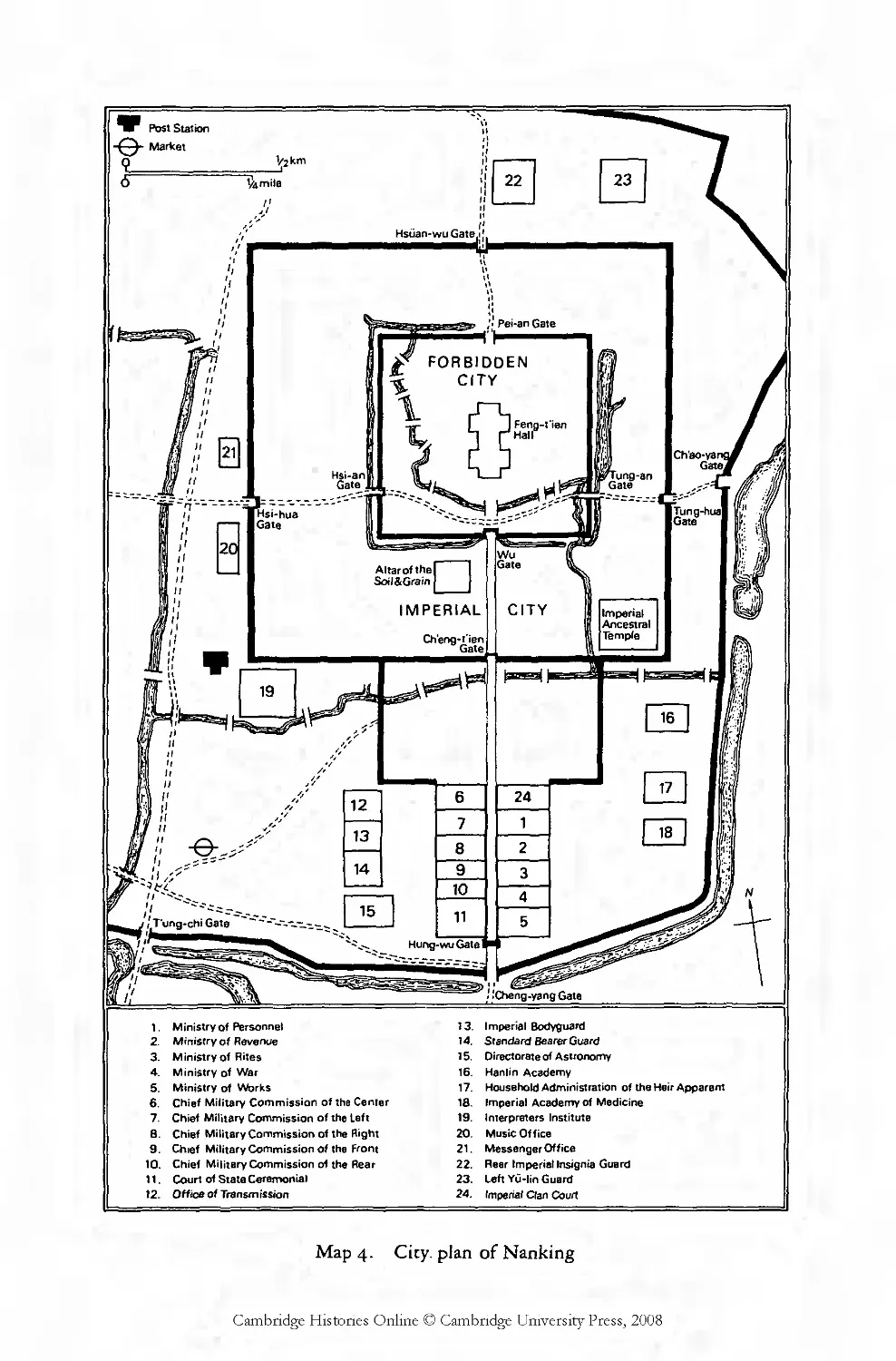
City plan of Nanking
110
5
Estates of the Ming princes
121
6
The Szechwan campaign, 1371
126
7
The Yunnan campaign, 1381 — 1382
45
8
The Nanking campaign, 1402
197
9
China and Inner Asia at the beginning of the Ming
224
IO
The Yung-lo emperor’s Mongolian campaigns
225
11
Cheng Ho’s maritime expeditions
234
12
City plan of Peking
240
13
Principal offices of the imperial government
243
14
The Grand Canal
253
15
Areas affected by calamities and epidemics, 1430-1450
311
16
The T’u-mu campaign, 1449
323
17
The Ta-t’eng hsia campaign, 1465-1466
378
l8
The Ching-Hsiang rebellions, 1465-1476
385
19
Northern border garrisons and the Great Wall
390
20
The Cheng-te emperor’s travels in the northwest
419
21
The Prince of Ning’s rebellion
429
22
The Cheng-te emperor’s southern tour
431
23
Sixteenth-century Japanese pirate raids
497
24
The Korean campaigns, 1592—1598
569
25
Yang Hao’s offensive against Nurhaci, 1619
578
26
The spread of peasant uprisings, 1630—1638
624
27
The campaigns of Li Tzu-ch’eng, 1641 —1644
633
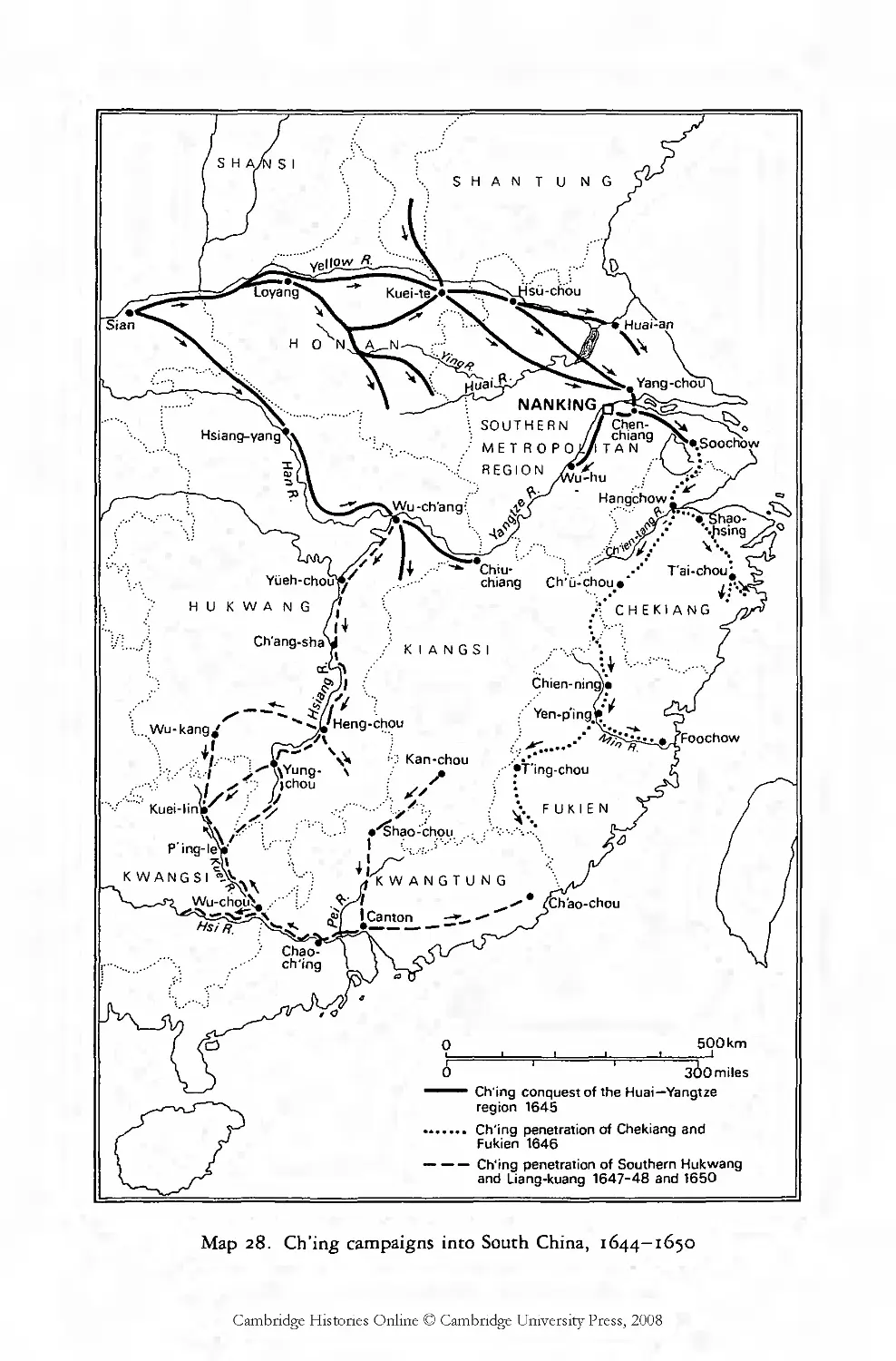
28
Ch’ing campaigns into South China, 1644-1650
659
29
Principal locations of the Southern Ming courts
664
Cambridge Histories Online © Cambridge University Press, 2008

XIV
MAPS AND TABLE
30
The end of the Southern Ming
696
31
The movements of Cheng Ch’eng-kung
713
Table
I
Ming princes in the Hung-wu period who went to fiefs
171
Cambridge Histories Online © Cambridge University Press, 2008

PREFACE TO VOLUME 7
The Chinese is romanized according to the Wade-Giles system, which for
all its imperfections is employed almost universally in the serious literature
on China written in English. There are a few exceptions, which are noted
below. For Japanese, the Hepburn system of romanization is followed.
Mongolian is transliterated following A. Mostaert, Dictionnaire Ordos (Pe¬
king, Catholic University, 1941), as modified by Francis W. Cleaves, and
further simplified as follows
c becomes ch
s becomes sh
7 becomes gh
q becomes kh
j becomes j
The transliteration of other foreign languages follows the usage in L. Car¬
rington Goodrich and Chaoying Fang, eds., Dictionary of Ming biography
(New York and London: Columbia University Press, 1976).
Chinese personal names are given following their native form —that is
with surname preceding the given name, romanized in the Wade-Giles
system. In the case of Chinese authors of Western-language works, the
names are given in the published form, in which the given name may
sometimes precede the surname (for example, Chaoying Fang). In the case
of some contemporary scholars from the People’s Republic of China, we
employ their preferred romanization in the Pinyin system (for example,
Wang Yuquan), and for some Hong Kong scholars, we follow the Canto¬
nese transcriptions of their names under which they publish in English (for
example, Hok-lam Chan, Chiu Ling-yeoung).
Chinese place names are romanized according to the Wade-Giles system
with the exception of those plages familiar in the English-language litera¬
ture in nonstandard postal spellings. For a list of these, see G. William
Skinner, Modern Chinese society: A critical bibliography (Stanford: Stanford
University Press, 1973), Vol. I, Introduction, p. iix. The two areas around
Peking and Nanking under the direct control of the court are referred to in
Cambridge Histories Online © Cambridge University Press, 2008

XVI
PREFACE TO VOLUME 7
Chinese as Pei Chih-li and Nan Chih-li respectively, and in English as the
Northern and Southern Metropolitan Regions. And finally, although Pe¬
king should properly be referred to as Pei-p’ing (The North is Pacified)
from 1368 to 1420, in the interest of clarity it is anachronistically referred
to as Peking throughout the text, except in those places where the history
of the city's name is under discussion.
Ming official titles generally follow those given in Charles O. Hucker, A
dictionary of official titles in imperial China (Stanford: Stanford University
Press, 1985), with the following modifications regarding the terms Secretar¬
iat and grand secretariat. For the period until 1380, the term “Secretariat” is
employed. After that date, we employ consistently the form “grand secre¬
tariat” to translate nei-ko, to underline the unofficial character of that
institution. Its members are referred to with the title “grand secretary.”
Charles O. Hucker’s earlier translation of “National University” for Kuo-tzu
chien has been preferred over “Directorate of Education,” and the translation
“Protector of the State’1 has been preferred over “Regent” for the term
chien-kuo, since the Ming dynasty did not strictly speaking institute any
provisions for a regency. An exception is made in the case of the short-lived
provisional regimes of the Southern Ming (see Chapter 11), when normal
government was no longer feasible.
Emperors are referred to by their temple names during their reign and
by their personal names prior to their accession. The reign title of
“Ch’eng-tsu” is romanized in the form “Yung-lo,” which has become con¬
ventional in English-language literature, rather than in the form “Yung-
le.” The dates for an emperor’s reign refer to the years when the regnal title
was formally instituted. Because the regnal title remained in use after an
emperor’s death until the end of the lunar year in which he died, in most
cases, emperors ascended the throne during the year prior to the institution
of their regnal titles. For example, the Ch’eng-hua emperor ascended the
throne in February 1464, but his regnal title was not used until the
beginning of the next lunar year, and hence the first year of his reign is
traditionally given as 1465.
Dates have been converted to their Western equivalents in the Julian
calendar until 1582 and the Gregorian calendar thereafter, following Keith
Hazelton, A synchronic Chinese-Western daily calendar 1341 —1661 A.D.,
Ming Studies Research Series, No. 1 (Minneapolis: University of Minnesota
Press, 1984). The reader should remember that when Chinese sources refer
to a year alone, this year does not correspond exactly to its Western
equivalent.
The ages of individuals are sometimes cited in the Chinese form of sui.
Conventionally a person was one sui at birth and became two sui on the
Cambridge Histories Online © Cambridge University Press, 2008

PREFACE TO VOLUME 7	xvii
New Year following. Thus in Western terms a person was always at least
one year younger than his Chinese age in sui and might be almost two years
younger if he were born at the end of the Chinese year. In attempting to
give dates for individuals where birth or death dates are not available, the
form cs. (chin shih) is used to indicate the year in which the individual
passed the highest civil service examination.
The maps are based on the recent historical atlas of Yiian and Ming
China, which appears as Vol. 7 of the series Chung-kuo li-shih ti-t’u chi
(Shanghai: Chung-hua ti-t’u hsiieh-she, 1975).
Cambridge Histories Online © Cambridge University Press, 2008

ACKNOWLEDGMENTS
The editors of this volume owe thanks first of all to the worldwide commu¬
nity of Ming scholars, a large percentage of whom attended the Ming
History Workshops held at Princeton through the summers of 1979 and
1980, where planning and writing for this volume and Volume 8 were
begun. All of us who have written chapters here have benefited from all
those other colleagues not present as authors in ways that go well beyond
the debts acknowledged in the footnotes. The National Endowment for the
Humanities generously supported those workshops and subsequent coordi¬
nation of the work on this volume and the forthcoming Volume 8. The
Mellon Foundation through the Committee on Studies of Chinese Civiliza¬
tion of the American Council of Learned Societies provided grants to stu¬
dents attending the two summer workshops; their presence added much to
the quality of those exploratory activities. We are grateful for those kinds
of support, as for that generously provided by the Program in East Asian
Studies of Princeton University.
Foremost among individuals who must be accorded special words of
gratitude here is Dr. James Geiss, who has coordinated the Ming History
Project through the years. In addition to writing two chapters in the
present volume, his scholarly editing has contributed substantially to the
continuity and quality of the volume as a whole. Others whose help has
proved invaluable are Professors Wang Yuquan (Peking) and Hsii Hong
(Taipei), who during periods of residence at Princeton and since have
given generously of their extensive knowledge and their critical advice;
Professor Ray Huang, who throughout all stages of the work has contri¬
buted stimulus and wise counsel, drawing on his penetrating analyses of
Chinese civilization; Dr. Philip de Heer, who offered invaluable advice on
mid-fifteenth-century political history; Dr. Keith Hazelton, who devised
the computer supports and ensured that they worked; Nancy Norton
Tomasko, whose considerable command of Chinese language and scholar¬
ship has contributed to her meticulous editing and skillful indexing; and
Dr. Howard Goodman, who prepared the drafts for all the maps and
Cambridge Histories Online © Cambridge University Press, 2008

ACKNOWLEDGMENTS
XIX
tables in this volume. Cooperative scholarship has never been better
served. For all the delays in completing this volume and for its shortcom¬
ings, we of course are alone responsible.
F.W.M.
D.C.T.
Cambridge Histories Online © Cambridge University Press, 2008

ABBREVIATIONS
BIHP
BSOAS
CKL
CNW
CSL
DMB
ECCP
HJAS
JAOS
JAS
КС
MC
MCSYC
MHY
MS
MSCSPM
MSL
MTC
MTCTS
MTSHCCS
TMHT
TW
YS
Chung yang yen chiu yuan li shih yii yen yen chiu so (Bulletin of
the Institute of History and Philology, Academia Sinica)
Bulletin of the School of Oriental and African Studies
Cho keng lu
Chung-kuo nei luan wai huo li shih ts’ung shu (alternately
Chung-kuo chin tai nei luan wai huo li shih ku shih ts’ung shu)
Та Ch’ing li ch’ao shih lu
Dictionary of Ming Biography
Eminent Chinese of the Ch’ing Period
Harvard Journal of Asiatic Studies
Journal of the American Oriental Society
Journal of Asian Studies
Kuo ch’iieh
Ming chi
Ming Ch’ing shih yen chiu ts’ung kao
Та Ming hui yao
Ming shih
Ming shih chi shih pen mo
Ming shih lu
Ming t’ung chien
Ming tai chih tu shih lun t’sung
Ming tai she hui ching chi shih lun ts’ung
Та Ming hui tien
T’ai-wan wen hsien ts’ung k’an
Yuan shih
Cambridge Histories Online © Cambridge University Press, 2008

MING WEIGHTS AND MEASURES
I.	Length
II.	Weight
III.	Capacity
IV.	Area
1 ch’ih
=
10
ts’un
=
12.3
inches (approx.)
1 pu (double pace)
=
5
ch’ih
1 chang
—
10
ch’ih
1 li
=
1/3
mile
1 Hang (tael)
—
1.3
ounces
1 chin (catty)
=
16
Hang
=
1.3
pounds (approx.)
1 sheng
=
0.99
quart (approx.)
1 tou
=
10
sheng
1 shihltan (picul)*
10
tou
=
99
quarts
=
3.1
bushels
1 той (mu)
=
0.14
acre
1 ch’ing
=
100
той
Note: The Chinese measurements sometimes mentioned in these chapters derive from a bewildering
variety of sources and from regions where standard units varied. They do not imply a dynasty-long or
empirewide standard and are to be treated only as approximations.
*The shihltan was properly a measure of capacity. It is, however, frequently used also as a measure of
weight equivalent to ioo chin.
Cambridge Histories Online © Cambridge University Press, 2008

GENEALOGY OF THE MING IMPERIAL FAMILY
\ sons	7 sons
	1	1 isr|	1	1 1 I I I I
*	* Chu T'zu-lang (1629—45)
HA ?-?
*	= Sons who died before maturity (selected). r. = Reign period as emperor.
HA = Male heir apparent. reb. = Rebelled. Dashed box = Southern Ming emperors
Note: Table shows only male members of the Chu imperial family who were significant in the line of
imperial succession, who were important rebels, or who were forebears of such men. The numbers of
sons and generational placement of certain individuals follow data in the “Pen chi” and “Chu wang hsi
piao” sections of the Ming shih, corroborated closely in DMB and ECCP. Other sources may vary on
account of criteria for establishing “legitimate” sons, etc.
Cambridge Histories Online © Cambridge University Press, 2008

MING DYNASTY EMPERORS
Given name
Reign name
Chu Yiian-chang
Hung-wu
(1368-98)
Chu Yiin-wen
Chien-wen
(1399-1402)
Chu Ti
Yung-lo i
(1403-24)
Chu Kao-chih
Hung-hsi
(1425)
Chu Chan-chi
Hsiian-te
(1426-35)
Chu Ch’i-chen
Cheng-t’ung (1436—49)
Chu Ch’i-yii
Ching-t'ai
(1450-56)
Chu Ch’i-chen
T’ien-shun
(1457-64)
Chu Chien-shen
Ch’eng-hua
(1465-87)
Chu Yu-t’ang
Hung-chih
(1488-1505)
Chu Hou-chao
Cheng-te
(1506-21)
Chu Hou-ts’ung
Chia-ching
(1522-66)
Chu Tsai-hou
Lung-ch’ing (1567-72)
Chu I-chiin
Wan-li (1573-1620)
Chu Ch’ang-lo
T’ai-ch’ang
(1620)
Chu Yu-chiao
T’ien-ch’i
(1621-27)
Chu Yu-chien
Ch’ung-chen (1628—44)
Southern Ming
Chu Yu-sung
Hung-kuang (6.1644—6.1645)
Chu Yii-chien
Lung-wu
(8.1645-10.1646)
Chu Ch’ang-fang
regent Luh (6.1645)
Chu Yu-lang
Yung-li
(12.1646-1.1662)
Chu Yii-yueh
Shao-wu
(12.1646)
Chu I-hai
regent Lu
(8.1645-1653)
Temple name
T’ai-tsu
Hui-ti, Hui-tsung
T’ai-tsung, Ch’eng-tsu
Jen-tsung
Hsiian-tsung
Ying-tsung
Tai-tsung, Ching-ti
Ying-tsung
Hsien-tsung
Hsiao-tsung
Wu-tsung
Shih-tsung
Mu-tsung
Shen-tsung
Kuang-tsung
Hsi-tsung
I-tsung, Ssu-tsung,
Huai-tsung,
Chuang-lieh-ti
An-tsung
Shao-tsung
Cambridge Histories Online © Cambridge University Press, 2008

Cambridge Histories Online © Cambridge University Press, 2008

Map i. Political divisions of Ming China
Cambridge Histories Online © Cambridge University Press, 2008

Cambridge Histories Online © Cambridge University Press, 2008

INTRODUCTION
This volume and the following volume are devoted to the history of the
Ming dynasty. The present volume offers a narrative account of political
developments from the rebellions of the mid-fourteenth century that ended
the Mongol Yiian dynasty’s control over China —and from one of which the
new Ming dynasty was formed in 1368 —until the last Ming remnant,
called the Southern Ming, was extinguished in Burma in 1662. That was
almost twenty years after the new Manchu Ch’ing dynasty had proclaimed
the success of its conquest of the Mandate of Heaven, and of China, in
Peking in the spring of 1644.
That period of roughly three centuries from the 1340s until the 1660s,
or more closely defined, the 277 years from 1368 until 1644 during which
Ming rule formally prevailed, is the only segment of later imperial history
from the fall of the Northern Sung capital to the Jurchen invaders in 1126
until the Revolution of 19 n ended the imperial era during which all of
China proper was ruled by a native or Han Chinese dynasty. The actual
impact of that alternation of native and conquest dynasties on Chinese life
was, to be sure, of varying significance, and at its most destructive it
probably never threatened to interrupt the cultural continuity of Chinese
development. Nonetheless, the success of the Chinese in regaining control
over their own government is an important event in history.
In Ming times and even more so in the recent nationalistic-minded
century, the Ming dynasty has been seen as an important era of Chinese
resurgence. The life of that resurgent society in social, intellectual, eco¬
nomic and other dimensions is surveyed in Volume 8. There we see much
evidence that the Ming period witnessed the growth of Chinese civilization,
the filling out of the realm, and, if one may indulge in biological meta¬
phor, the maturing of the traditional Chinese civilization in that last phase
of its relatively secure intramural isolation and splendor. We can see steady
if undermeasured population increase, a significant increase in literacy, and
the growth of learning throughout sub-elite levels of society, accompanied
by a flourishing of sub-elite as well as elite cultural forms. We observe the
filling out of the system of urban networks, reflecting the expansion of
Cambridge Histories Online © Cambridge University Press, 2008

2
THE MING DYNASTY, 1368-1644, PART I
productivity and of exchange. The growing importance of the maritime
southeast provinces and the centrifugal forces that propelled many of the
region’s hardy residents into lives abroad preceded Europe’s era of mercan¬
tile expansion and might have rivaled it. The absorption of China’s inland
southern and southwestern provinces during the Ming also is evidence of
the age’s expansiveness. The boundless energies of Ming society must be
kept in mind as the political history of the age is recounted.
What should be the final assessment of Ming government? Was the Ming
an era of strong government, or merely one in which the throne and its
accessories could intimidate the civil government in awesome displays of
willful violence? Was it an era of effective administration, or one in which
the practical limitations imposed by the milieu seriously limited political
accomplishment? Was domestic administration the tool through which the
imperial institution in this period of its long history more perfectly than
before realized its potential to govern, or was it in fact the vehicle by which
class interests and local interests in society achieved their counter purposes?
Such questions, perhaps themselves framed in misleading terms, have long
been asked. The reader here will want to ask his own questions of this
material. It may help to identify some of the components of Ming political
history that have led to so broad and contradictory a set of questions about it.
Outwardly at least, the Ming dynasty appears to be a period of very
powerful government. Its founder made it a strong, assertive, highly cen¬
tralized regime. But are those appearances misleading? It can be argued
that the early emperors’ will to centralize and to assert the supremacy of
their will over all acts of governance was never in fact as effectively institu¬
tionalized as those rulers intended and perhaps deceived themselves into
believing it was. Professor Ray Huang, here and elsewhere, argues that the
Chinese preference for ethical over technical solutions to all social problems
created limitations in the working style of government that deflected the
exercise of power. His arguments have compelling force —but the aura of
great power cannot be dispelled. For evidence, one need only look at
China’s enhanced position in East Asia in Ming times.
Several military-minded early emperors reestablished China’s dominance
not only in Inner Asia, whence China’s conquerors traditionally had come,
but also throughout the sea lanes of Asia. A previous era of diplomatic
reciprocity between China and the other Asian land powers was succeeded
by an era of a sinocentric world order based on the Chinese presumption of
Chinese centrality and superiority and at least nominally acknowledged by
many other states, great and small, through the vehicle of the tribute
system. Domestically also there was again a structure of centralized control
and supervision—the thousands of local and regional administrators, as well
Cambridge Histories Online © Cambridge University Press, 2008

INTRODUCTION
3
as the central government’s officials, were recruited by merit and appointed
directly through agencies of the central government. Even more than in
model early dynasties, the Ming attempted to regularize the exercise of
political power and to make uniform the patterns of bureaucratic behavior
so as to correct what early Ming rulers saw as the lenient, slipshod, and
corrupt mismanagement that had been imposed by a succession of alien
dynasties. Above all the early Ming state, for better or for worse, sought to
consolidate its power by stimulating a uniform ideological basis for private
and for bureaucratic behavior. The resulting “revised” neo-Confucian ethos
was in many ways a new Ming achievement, and it had profound conse¬
quences for political life.
Despite those strong beginnings, the political history of the Ming is not
one of consistent achievement. The chapters that comprise this volume
often focus on political weakness. Ming government has been described by
some modern scholars as the great achievement of Chinese civilization. It
also has been seen as proof of ineradicable anomalies of forms versus actuali¬
ties, as a working system ever in need of patching up but never susceptible
to thoroughgoing rational correction. Reflections of both points of view
will be encountered here. Yet whatever criteria assume the greater signifi¬
cance for these authors, one must conclude that the governing of Ming
China was a vast undertaking, grand in its assumptions, lofty in its profes¬
sional ideals, and exhaustingly intricate in the interplay of ideal and actual
patterns that marked its daily existence.
If those fundamental characterizations of the quality of Ming govern¬
ment remain inconclusive, some long-range trends in the development of
governing modes seem clear enough. Despite the rigidly prescribed norms
and procedures made binding on all his heirs by the autocratic dynastic
founder, Ming government was not unchanging. Trends become discern¬
ible over the course of these three centuries. It may serve a useful purpose
here to point out some of those trends.
A most intriguing feature of Ming political history is the trend from
direct rule by a highly competent (in his own eyes, omnicompetent) found¬
ing emperor toward the evolving system of shared authority, whether prop¬
erly delegated or usurped. Ming emperors were the capstone in an authority
structure that could not function without them. They were the ritual heads
of state and society within a civilization in which ritual possessed a scope of
functional significance scarcely comprehensible to us today. Ming emperors
also, however, were the executive officers of a system that required their
daily participation in deciding and validating routine acts of governing. In
the absence of that, some not-strictly-acceptable substitute for the em¬
peror’s own ruling actions was required.
Cambridge Histories Online © Cambridge University Press, 2008

4
THE MING DYNASTY, 1368-1644, PART I
Implicit in that system is the impractical notion that emperors could and
would make informed decisions on a very broad range of matters of state
from routine appointments for all the thousands of offices to be filled by
ranked civil and military officials to vast or trivial modifications of policy.
True, that would in most cases mean merely reviewing and approving
prescreened lists of candidates for most offices, as worked up by the Minis¬
try of Personnel, or making no more than minor alterations in the course of
approving action proposals submitted for his notation of “accepted” and his
seal. Yet no actions or appointments were possible without at least the seal,
and in all matters of higher import the emperor was expected to have
digested analyses and arrived at his own judgments. Although that scope of
competence and function was inherent in the Chinese conception of monar¬
chy, it was operationally institutionalized in Ming times to a degree hith¬
erto unknown. From the fall of the dynasty in the seventeenth century
onward, historians have judged that to have been the crucial weakness of
Ming government and have blamed the founding emperor for abolishing
the offices of chief ministers of state and their supporting secretarial and
advisory staffs in 1380.
The reorganization of government stemming from that “abolition of the
prime ministership,” removal of the top level of authority in the outer
court, and the resulting assumption of those support functions by the ruler
and his inner court, gave a new shape to the structure of Chinese central
government that would last through all of Ming and Ch’ing times until the
revolution of 1911. In reality, the intention of the Ming founder was
modified already in his own reign and was reshaped by cumulative accre¬
tions and conventional adaptations in every reign thereafter according to
the current conditions and the age, competence, and commitment of the
successive rulers. The suspicious-minded founder’s fear, of course, had been
that his professional bureaucrats in senior roles as advisors and administra¬
tors would bend the acts of governing to serve their own interests or might
even attempt outright usurpation. He also feared that the same breed of
scholar-officials in lower-ranking roles as local magistrates would misuse
their authority.
Some scholars have seen genuine benefit to the farming masses from the
founder’s emphasis on improving the conditions of rural society and tight¬
ening up the norms of local government, whether he did that out of simple
altruism or was shrewdly cognizant of the state’s interests, or both. If his
suspicion of bureaucrats was in that matter constructive, at the higher
levels of the complex political machinery, corrosive suspicion backed up by
unfathomable terror was profoundly destructive, the more so because once
institutionalized, it continued to influence the long range of history. One
Cambridge Histories Online © Cambridge University Press, 2008

INTRODUCTION
5
can argue that as a political leader of China’s fourteenth century he had no
choice but to build a government reliant on the services of cultivated men
who would proclaim their neo-Confucian commitment. The contradiction
lies in his acknowledging that necessary condition of governing Chinese
society, while remaining deeply suspicious of its consequences; he institu¬
tionalized his officialdom’s constant intimidation and distanced the throne
from the kinds of rational administrative supports that the bureaucracy
itself should have best provided. That was to build a regime with serious
weaknesses.
It is fascinating, then, to observe reign by reign through the chapters
comprising this volume the range and cumulative effect of the institutional
adaptations that were made in the effort to overcome that basic administra¬
tive flaw. We do not know much about the second emperor (1398-1402),
but it seems clear that he greatly upgraded the advisory functions of his
principal scholar-mentors, because the impropriety of having done just that
was one of the excuses given for the usurpation. The usurper who held the
throne from 1402 until 1424 in a reign of great vigor and high competence
was not bound by the principles he claimed to defend. Because his interests
lay in solving border problems away from the court, he began to create the
inner court institutions that would free him from the drudgery of governing.
Most pertinent was his plan to select top examination graduates tor
elite careers in the Hanlin Academy, leading to the posts that in time
came to constitute the nei-ko, or grand secretariat. At the same time he
assigned larger roles to eunuchs, even insisting that numbers of them be
formally educated in government practices and precedents. That, of neces¬
sity, led to intricate forms of cooperation between civil bureaucrats and
their eunuch counterparts, even as each group contested for emperors’
support and the increase of its own powers at the expense of the other.
Mostly, it must be noted, that practice worked smoothly enough, but the
recurrent failures were spectacular, as when eunuchs managed to become
all-powerful dictators who manipulated emperors and defied the norms of
bureaucratic government.
The first such case came in the 1440s in the reign of the boy emperor
Ying-tsung. The flamboyant abuses in half a dozen such cases to the end of
the dynasty are what come to mind immediately in relation to eunuchs in
Ming government. If most of the tens of thousands of eunuchs who were in
civil or military service at any one time from the late fifteenth century
onward were more or less routine performers and not flamboyant abusers of
power, nonetheless it is likely that in some of their regular functions —
notably as managers of international trade along the inland frontiers and at
the maritime entrepots, and as procurers of supplies and special revenues
Cambridge Histories Online © Cambridge University Press, 2008

6	THE MING DYNASTY, 1368-1644, PART I
for the imperial city-they probably performed very badly most of the
time.
The loss in 1380 of the chief ministerships and the isolation of the
emperor from responsible senior advisors having their proper place at the
head of the outer court thus can be seen as the starting point for the
development of both the grand secretariat and the regular bureaucracy’s
counterpart eunuch bureaucracy, both elements of the Ming inner court.
The interplay between these irregular, though eventually highly regular¬
ized, elements of Ming government is the major focus of political history
throughout the dynasty. Some emperors worked well within the system,
sometimes adding to it significantly. Others, as these chapters show, seri¬
ously defaulted or resisted the norms, with varying consequences. From our
modern point of view, it is all too understandable when the reader of
history feels oppressed with frustration that the system’s obvious irrationali¬
ties could not be overcome by generation after generation of acute-minded
and devoted statesmen-bureaucrats.
The dismal account of political failures can perhaps assume too large a
place in our consciousness as we read this volume. There is another side to
the story that must not be lost sight of. The world’s largest society, spread
across an area as large as Western Europe, truly flourished under this
fallible system of governing, and the flow of well-prepared, committed
officials-expectant never diminished. In each decade there was a new group
of able persons eager to make careers in government service. Whenever one
group’s energies and enthusiasms were dissipated by the frustrations of
service, eager replacements were at hand to carry on. There was a freshness
and energy in the civil service under this dynasty that is not matched in
later times, even though governing often faltered.
Was Ming China, then, poorly governed? The Ming government’s
strengths were simultaneously its weaknesses; for example, its heavy emphasis
on cultivation, on learning, and on ethical obligations bound it to limited
responses that accepted the primacy of precedent, of compromise, and of face
saving. It had the weaknesses and the strengths of a massive stability. We
might better ask whether any of the Ming state’s contemporaries throughout
the world (and none faced problems of Chinese scale) was better governed. In
most historians’ minds, such a question probably does not embarrass China
until well into post-Ming times. Given the scope of the Ming government’s
tasks in maintaining the unity and sense of shared destiny throughout so large
a territory and in providing enough self-renovating features to keep the society
flexibly if slowing changing, usually at peace and in order, its achievements
are impressive. Moreover, Ming government allowed those Chinese people
who could attain more than mere subsistence to employ their resources mostly
Cambridge Histories Online © Cambridge University Press, 2008

INTRODUCTION
7
for the uses freely chosen by them, for it was a government that, by comparison
with others throughout the world then and later, taxed the people at very low
levels and left most of the wealth generated by its productive people in the
regions where that wealth was produced. Inequities abounded. But the society
remained open, and it offered people at all levels a wider spectrum of choices
than they have known more recently. The government of Ming China is not to
be dismissed out of hand.
Other trends encompassing change from the fourteenth century to the
seventeenth can be followed through successive reigns of Ming history. One
is apparent in the defense posture of the Ming state. The stable element in
that is the obsession with the threat posed by the neighboring Mongol
nation to the north, understandably so, since the dynasty came into being
by resisting and then expelling China’s Mongol conquerors; it had to guard
against their resurgence until another northern neighbor, the Manchu,
superseded the Mongols early in the seventeenth century as the enemy to
the north. If that focus on the Mongol enemy was the enduring part of the
situation, what long-range trend of change emerges? It is one of retrench¬
ment. At first the new Ming state met the Mongols in their kind of warfare
on their home ground; before the middle of the fifteenth century, that had
changed to a defense policy of withdrawal behind fixed barriers along the
line marking the northern extent of Chinese-style sedentary life. The
founding emperor planned to maintain garrisons far out into the steppe.
The usurper, the Yung-lo emperor in the first quarter of the fifteenth
century, repeatedly campaigned in the steppe, but failed to make the
forward garrisons viable parts of an active defense by offense. He withdrew
the garrisons to more readily defended, fortified strategic passage points.
Despite that consolidated defense line, the Mongols invaded, disastrously
for China, in 1449 and again in 1550, and raided constantly. By the 1470s
China had begun to connect the fortified barriers wirh long walls supported
by towers and bastions. The fabled Great Wall, more accurately a series of
long walls, came into being. For the rest of the dynasty, wall building and
the garrisoning of the wall defense zone became the preoccupation of the
Ming state. The Inner Asian frontier became a stifling burden.
Frontier problems can be the source of great stimulus to a nation. The
Inner Asian frontier had been that for China in earlier dynasties such as the
Han and the T’ang, but in Ming times the consequences seem to have been
wholly negative. Far greater opportunities for Ming China’s involvement
with the rest of the world — whether with Japan and Korea, or with the
maritime states to the south and beyond, or with the European powers
whose first ships to reach China were those of the Portuguese who sailed
from Goa and Malacca into the estuary of the Pearl River below Canton in
Cambridge Histories Online © Cambridge University Press, 2008

8
THE MING DYNASTY, 1368-1644, PART I
1517—were neglected. Early fifteenth-century Ming China had sent out
the largest and farthest-ranging flotillas in world history up to that time;
they had gone as far as the Persian Gulf and the coast of Africa. Whatever
promise that might have held, it all passed from the scene, in part surely
because the obsession with the Great Wall left no time for the Ming state
to look elsewhere and assess other opportunities in positive terms.
The revealing counterpart to that trend of retrenchment and passivity
in the north and the consequent failure of the Ming state to expand in
other directions is the trend of increasingly imaginative and bold partici¬
pation in maritime commerce by private interests—in defiance of govern¬
ment sanctions —all along China’s eastern seaboard, particularly from the
Yangtze Delta south to Canton. What might that have accomplished if,
like its counterparts in Europe in the fifteenth and sixteenth centuries, it
had gained state sponsorship and support? Even without state sponsor¬
ship, Chinese merchant and craftsmen colonies, and eventually agricul¬
tural settlements as well, came into existence from the Philippines
through Southeast Asia, and mostly date from Ming times. The boundless
energies, ingenious entrepreneurship, aggressive risk-taking, and creative
leadership within the society seen within this Ming maritime expansion is
at curious variance with the retrenchment and managerial failures of the
state in its northern defense posture.
Less striking perhaps, but another trend of great significance, is the
expansion of the Chinese population throughout the border provinces of the
south and southwest, the displacement or absorption of non-Han minori¬
ties, and the extension of Chinese administration to the borders of modern
Burma, Laos, and Vietnam. The earliest of the Ming emperors lent the full
force of the state’s military resources to that; Yunnan was conquered and
absorbed for the first time under Chinese rule (although Khubilai had
conquered the region in the 1250s and had set up a somewhat attenuated
Mongol administration there); Kweichow was organized as a province;
Annam was warred upon and unsuccessfully absorbed in the 1420s. The
“pacification” of tribal peoples throughout the southwest is also a recurrent
theme throughout the chapters of this volume. Eventually, however, the
state’s role became less aggressive. Cultural assimilation continued, but
now the impulse for further assimilation came from trade and mining and
Chinese population growth pressing into the richer valleys of the region.
The interesting counterpart to that growth in the south and southeast is
the striking trend of shrinkage and decline in the northern defense zone and
particularly in the far northwest. Climatic change may have lowered the
margin in agriculture throughout that marginal zone, but social factors also
contributed. The siege mentality that descended on the region as the
Cambridge Histories Online © Cambridge University Press, 2008

INTRODUCTION
9
defense zone buildup developed through the second half of the dynasty was
crippling enough. Trade diminished. The movement of goods and of
people was decreased as much by economic decline of the region as by the
restrictive military conditions. The normal concerns of civil government
were secondary to the military administration. Finally, the state’s policy of
underpaying or abandoning its defense garrison soldiers, especially the
undertrained and overaged, drove them into banditry. All these forces
working together induced increasingly unstable conditions within this nar¬
row band of the northern and northwestern frontier. It is not surprising
that the region’s endemic disorder, although quite atypical of late Ming
society in general, should spawn the two large movements of roaming
banditry that became a peril to the rest of China in the 1630s. One of
these, dignified as the "rebellion” of Li Tzu-ch’eng, plundered at will
through North China and, quite fortuitously, found an unguarded moment
when it could breach the gates of Peking. That formally terminated the
dynasty in 1644.
These are some of the trends obvious to the reader of Ming history. Also
apparent throughout this volume is the richness of detail that can be
reconstituted in many aspects of this history.
The procession of the sixteen incumbents of the throne between 1368
and 1644 and the several would-be successors who fought on against the
Manchus from the far south until 1662 are a gallery of diverse types whose
lives beg for fuller reconstruction. There is no full political biography of
any of them in a Western language. Even though Chinese emperors are
among the most elusive of subjects in Chinese historiography, much could
be done to remedy that lack. But beyond those imperial figures (and
countless others of the imperial clan), there is a wealth of documentary
evidence for lives, for places, and for actions of all kinds. There are count¬
less volumes of Ming writings — poetry and belles lettres, serious scholar¬
ship in many fields, religious and philosophical studies, plays and stories
and other entertainment writings, reports written by officials on all govern¬
mental subjects, and the writings of Ming historians beginning the task of
putting their history in order. No scholar can know more than a fraction of
all this vast sea of words, comprising more printed books in existence at
any time during this dynasty than in all the rest of the world together.
Many large aspects of the field have been virtually unstudied in the present
century, during which the total volume of relevant materials has been
greatly augmented by facsimile printing, archeology, and archival labors.
During most of the present century Ming history has not been a widely
studied subject in China, in Japan, or in the West. The vast array of
traditional historical materials, ably described by Wolfgang Franke in
Cambridge Histories Online © Cambridge University Press, 2008

IO	THE MING DYNASTY, 1368-1644, PART I
Chapter 12 of this volume, now attracts the attention of a generation of
new scholars, and the world of scholarship begins to appreciate how impor¬
tant the history of these centuries must be in the larger frameworks of
Chinese and of world history. The authors and editors have undertaken the
effort of compiling this volume with a certain confidence that it carries
scholarship some modest steps forward, but in greater confidence that the
field will quickly move beyond it in larger steps. I am confident that a
number of these authors will be present to contribute to the early retire¬
ment of this work, as they move forward to supersede it. I hail their
present achievement and look forward to their early success in surpassing it.
Cambridge Histories Online © Cambridge University Press, 2008

CHAPTER 1
THE RISE OF THE MING DYNASTY,
1330-1367
INTRODUCTION
The character of the Yuan dynasty, through which the Mongol conquerors
from Khubilai Khan onward ruled China, has been interpreted in many
ways and at present is still much at issue among scholars.1 Nonetheless,
one fact about it is unambiguous. Its ability to govern —to maintain order
in society, to administer provincial and local government, and to collect
taxes —was eroding well before the middle of the fourteenth century. Chu
Yuan-chang (1328—1398), the founder of the Ming dynasty, was born into
a family of desperately poor tenant farmers in the Huai River plain of
modern Anhwei province on 21 October 1328. He never experienced the
normal conditions of China’s stable agrarian society until, as emperor forty
years later, it fell to him to rule over the empire and to guide its rehabilita¬
tion. The Ming dynasty was spawned during a half-century of intensifying
chaos, an age of breakdown in which throughout most of the country the
conduct of daily life increasingly depended on direct recourse ro violence. It
provides a classic example of the gradual militarization of Chinese society
and, because of that, of the struggle among potent rivals to succeed the
Mongol regime by imposing, through military force, a successor regime
that could claim the Mandate of Heaven. Despite the traditional Chinese
penchant for subsuming this into the stylized pattern of breakdown and
regeneration provided by their dynastic cycle theory, the way the Yuan
dynasty disintegrated and the Ming dynasty emerged is by no means typi¬
cal of the dynastic changes that punctuate imperial Chinese history. The
middle half of the fourteenth century is an extraordinary age. Chinese
society in chaos reveals much about its latent potentialities and its normally
less-exposed structural framework. This period thus displays aspects of the
character of Chinese civilization that are not so readily discernible in times
of peaceful, orderly civil government. And the violence of this period left
its enduring mark on the Ming dynasty. It richly merits the historian’s
thoughtful attention.
i	The history of the Yiian dynasty forms part of Volume VI.
11
Cambridge Histories Online © Cambridge University Press, 2008

12
THE MING DYNASTY, 1368-1644, PART I
DETERIORATING CONDITIONS IN CHINA, 133O-135O
The Yuan court
Factionalism is endemic to politics and was present throughout the Yiian
dynasty; it became a crippling factor in government early in the four¬
teenth century. After Khubilai’s long reign (1260-94), cliques of cour¬
tiers representing conflicting interests of his grandsons and their heirs
often engaged in murderous intrigues to control the throne. Some scholars
see two competing policies at the crux of the continuing struggle among
factions. The one was a Mongolia-based policy (and faction) with an
orientation toward Mongol interests in the Inner Asian steppe, repre¬
sented by the traditions of the Chagatai Khanate. The roots of this policy
are traced all the way back to the rivals of Khubilai, especially Khaidu of
the line of Ogodei, who had warred against Khubilai throughout his
reign. The other faction is identified with what have been called the
“Confucian” concerns of governing from a China-based throne using bu¬
reaucratic means to achieve its statist ends. This provided a fundamental
and irreconcilable split within the Mongol political leadership over the
means and goals of governing China.2 The latter group engineered a coup
in 1328 that “restored” the line of Khaishan, who had reigned 1308-12,
and is known by his posthumous title as the emperor Wu-tsung. His two
sons, Khoshila and then Tugh Temur, were placed on the throne in
1328. The former was assassinated by partisans of the latter, who is
known as Wen-tsung and who reigned until 1332. He was succeeded by
his two young sons. First was the younger, Irinjinbal, who died as a child
of six after a reign of two months. Upon his death, in perhaps suspicious
circumstances, his older brother Toghon Temur came to the throne in
1333 at the age of thirteen. The last Mongol ruler over China, he was
driven from his capital at Ta-tu (Peking) by Ming armies in 1368 and
died in the steppe in 1370. Toghon Temur is known in Chinese history
by his posthumous titles Shun-ti, granted him by the Ming founder, or
Hui-ti, the title bestowed by his refugee court in Mongolia. His reign of
thirty-five years to 1368 contrasts with the average of about five and
one-half years for the seven reigns from the death of Khubilai to 1333, a
period marked by plots, coups, and regicide. The length of his reign does
not signify, however, that a new stability in Yuan rule had been
achieved. Instead, the factional infighting had shifted from coups aiming
2	This interpretation of the late Yuan politics has been most forcefully stated by John W. Dardess in
Conquerors and Confucians: Aspects of political change in late Yiian China (New York, 1973).
Cambridge Histories Online © Cambridge University Press, 2008

RISE OF THE MING DYNASTY
r3
at control over puppet emperors to struggles among Mongol holders of
regional military power for control of the court through its chief offices,
the posts of chancellor of the right and of the left. That in itself signified
no improvement in the quality of government.
The reign of Shun-ti corresponds roughly with the period of the Ming
dynasty’s emergence. The last Mongol emperor is described in many con¬
temporary Chinese sources and by early Ming historians as having been a
monster of debauchery, surely an exaggerated depiction, but it is difficult
to determine to what extent it is exaggerated. Some contemporary writers
praised him. In either case, he mattered very little in the events that saw
the dynasty’s once vaunted power crumble and disappear. Chinggis Khan,
military genius, leader of vast purpose and of superhuman energies, had in
this seventh-generation descendant yet another successor of at best mediocre
qualities. It is comment enough to note that the history of his reign turns
on larger personalities and on problems largely made and met by others.
The decline of Yuan military power
The Yuan government’s military forces had been in decline since the end of
the thirteenth century. Following the conquest of the Southern Sung in the
1270s, the main body of Mongol and Inner Asian troops within China had
been deployed at garrisons on the Yellow River plain to shield the capital
at Ta-tu (Peking). Special units of Mongol forces were dispatched to points
of strategic importance as needed, but they were not distributed through¬
out the provinces to police the empire on a regular basis. Armies of Chinese
professional soldiers, both those who had been subject to the Jurchen Chin
dynasty before its fall to the Mongols in the 1230s, and those who had
surrendered during the conquest of the Southern Sung in the 1270s, com¬
prised the principal elements in the garrisons stationed elsewhere.
This pattern persisted until the end of the dynasty; that is, the main
Mongol garrisons and the imperial guard forces were stationed in the north,
close to the capital, while Chinese units, sometimes under Mongol or West¬
ern Asian commanders, guarded the central regions, the south, and the
southwest. These provincial garrisons were not evenly distributed, but were
concentrated in the lower Yangtze region. Yang-chou, Chien-k’ang (Nank¬
ing), and Hangchow were the most strongly garrisoned bastions of Yuan
power outside the capital region. This was to protect the rich region at the
southern end of the Grand Canal that supplied the capital with revenues,
especially with the tax grains. Elsewhere smaller concentrations of troops
were placed at regionally important locations in Szechwan, in Yunnan, the
central Yangtze, and the southeast coast.
Cambridge Histories Online © Cambridge University Press, 2008

14
THE MING DYNASTY, 1368-1644, PART I
The Yiian military garrisons were poorly administered. One scholar has
written that even by the end of the thirteenth century, mismanagement
was causing breakdowns of the military system, and by the 1340s it had
been repeatedly demonstrated to be incapable of repressing local rebellions
and banditry. Even the imperial guards based at the capital, who were
occasionally sent into the field in major campaigns, were by that time no
longer held to be invincible.3 From the early fourteenth century onward, a
geographic correlation between the regional distribution of the main Yiian
military might and relative freedom from rebellious activity is obvious;
even more obvious is the correlation in time between the sharp decline of
Yuan military effectiveness everywhere by midcentury and the progressive
increase in rebel activity. The Yiian dynasty’s capacity to coerce the Chi¬
nese, whether by relying on Inner Asian military units (including the
Mongol forces based within China proper) or by using the Chinese profes¬
sional soldiers and conscripts from the civilian population, rapidly dimin¬
ished through these decades. More important, that fact was becoming
widely recognized throughout the Chinese population.
As society became disorderly and unsafe, on the one hand local leaders
in government or in private life assumed initiatives in organizing local
defense forces and building defense installations. On the other hand,
bandits took advantage of disorder to form ever larger and bolder organi¬
zations. Both local self-defense leaders and local bandits could assume
illicit political roles by declaring themselves independent of the legitimate
arms of government in order to maximize their freedom of movement and
their claims on support. Those genuinely interested in local defense, often
representing or linked to the local elite but not necessarily stemming
from elite backgrounds, tended to remain susceptible to reimposition of
government controls, although often negotiating continuations of their
freedoms of initiative and enhancement of their leaders’ status. Other
autonomous movements representing some stage of banditry expanding
into open rebellion also could use their military power as a negotiating
point in securing legitimation with ranks and titles in exchange for coop¬
eration with a desperate government. Still other groups using folk reli¬
gion and secret doctrine as their cohering element and their justification
for rebellion were mostly, in their eyes and in those of the government,
beyond such compromises.4
3	Hsiao, Ch’i-ch'ing, The military establishment of the Yiian dynasty (Cambridge, Mass., 1978), pp. 62 —
63,46-47¬
4 Examples of all these patterns are the subject of the next section, “The disintegration of central
authority.”
Cambridge Histories Online © Cambridge University Press, 2008

RISE OF THE MING DYNASTY
J5
The degenerative process, starting from the administrators’ failure to
maintain law and order and leading to the various kinds of organized
dissidence, has special relevance for the subject of military power in the late
Yuan. That process led to the weakening of the normative controls
throughout society on which social order fundamentally depended and to
their replacement by direct recourse to force. It induced a comprehensive
change from a pacific society to a militarized one. Arms, usually not
present in village households, came to be universally present. As many
males came to possess and to understand arms, those most successful in
their use became military leaders. Each village might produce several, from
corporals to captains, all striving to become generals. In the competition
for military supremacy that ensued from the 1330s onward, a very large
number of competent and a few brilliant military leaders were produced
from the most humble backgrounds. Most of those remained outside the
government’s military establishment in the service of one or another of the
rebellions.
A society once so militarized could only be demilitarized and restored to
unified, civilian management by a long process in which all the competi¬
tors for national leadership but one were eliminated. In military terms, that
is the process that dominated the life of China from about 1330 until the
completion of Chu Yiian-chang’s reunification in the 1380s. As military
history, it is described by Edward L. Dreyer in Chapter 2 of this volume.
Elite and government
The middle decades of the fourteenth century provide a curious spectacle in
the history of later imperial China’s scholarly and social elite. To some it was
a period of hope, largely unfulfilled, that time-honored Chinese ways might
at last prevail over the alien conquerors’ disruptive impact. After completing
his conquest of central and south China in the 1270s, Khubilai Khan had
taken some essential steps toward acknowledging the superiority of Chinese
political institutions for governing the Chinese, and transforming the one¬
sided reliance on the Mongol military machine into a full partnership with
civilian, bureaucratic government. He had patronized Chinese (and sinified
Inner Asian) scholar-officials and had heeded their counsel. In 1271 he
ordered eminent scholar-officials to design a full complement of Chinese
ritual forms for the conduct of his court, while retaining, as the Official
history of the Yuan says, Mongol customs and rituals for affairs involving the
imperial clan and the Mongol nobility.5 He had spurred the recruitment of
5	Sung Lien et al., eds., Yuan shih (1369—70; rpt. Peking, 1976), 67.
Cambridge Histories Online © Cambridge University Press, 2008

l6	THE MING DYNASTY, 1368-1644, PART I
Chinese scholars for official appointment by recommendation. But, point¬
edly refusing the most important request of his Chinese advisers, he had not
instituted civil service examinations to recruit officials.
In 1313 his great-grandson Ayurbarwada, known to history as the em¬
peror Jen-tsung (1312-20), announced that commencing in 1315 the ex¬
aminations would be reinstated on the Sung model, and would designate as
orthodox the classical exegeses of the Chu Hsi (1130—1200) school. This
aroused a great surge of hope and satisfaction throughout the Chinese
population. When Tugh Temur, Jen-tsung’s nephew, came to the throne
in 1328, that aroused further hope. In his years as Prince of Huai, residing
at Chien-k’ang (Nanking), he had associated with eminent literati and men
of arts. Given the posthumous title Wen-tsung (the cultivated), he appears
to be the Mongol emperor with soundest claims to having been fully
literate in Chinese. In addition, he attempted to write classical Chinese
poetry (two examples survive), to paint, and to produce reasonably satisfac¬
tory Chinese calligraphy.6 The command of Chinese civilization that Khu-
bilai’s son and heir, Prince Chen-chin, might have brought to the throne
had he not predeceased his father in 1285, now after six mostly disappoint¬
ing reigns had found a second imperial incarnation. Moreover, as noted
above, the coup that placed Wen-tsung on the throne represented the
success of the “Confucian” faction in Mongol politics, the one that stressed
the rulers’ interests in a well-run Chinese state.
One of Wen-tsung’s first acts as emperor was to establish in the capital a
new academy of Chinese learning and art as an office of the inner court,
called the K’uei-chang ко.7 At the same time, there were at court several
highly placed nobles like Majartai. His son, Toghto, was to become the
leading advocate of Chinese ways of governing during the final reign of the
dynasty. Majartai was avidly developing contacts with leading Chinese
scholars, hiring them to tutor his sons, and sponsoring Chinese learning at
the court.8 By the fourteenth century many of the privileged Central and
Western Asians (se-mu jen) had become learned, cultivated members of the
Chinese cultural elite, demonstrating the power of Chinese values to as¬
similate aliens. At this time, during the decades from the 1320s to the
1340s, a number of leading classical scholars and literary figures from the
central Chinese heartland of high cultural development served at the Yuan
court, mostly by recommendation and direct appointment, but also by the
6	Herbert Franke, “Could the Mongol emperors read and write and write Chinese?" Asia major, NS 3
(1952), pp. 28-41.
7	Chiang I-han, Yuan tat k'uei chang ko chi k’uei chang ko jen wu (Taipei, 1981).
8	John D. Langlois, Jr., “Political thought in Chin-hua under Mongol rule,” in China under Mongol
rule (Princeton, 1981), esp. pp. 169 ff. See also Langlois, “Yu Chi and his Mongol sovereign,"
Journal of Asian studies 38, No. 1 (November, 1978), pp. 99—116.
Cambridge Histories Online © Cambridge University Press, 2008

RISE OF THE MING DYNASTY
П
newly opened examination route. Throughout, young men had continued
to train in classical learning in preparation for scholar-official careers,
unable to believe that the great norms of their civilization would not again
prevail. During the first half of the fourteenth century private academies,
through which the elite assumed enlarged responsibilities for maintaining
such education, flourished. A number of important regional and local
centers of learning emerged: Chin-hua in northern Chekiang emphasized
classical learning in the support of statecraft and produced scholars eager to
find activist, positive roles in government. Many figures prominent in that
school during the final decades of the Yuan went on to serve prominently at
the early Ming court and to dominate early Ming learning and statecraft.9
The significance of this discussion of elite attitudes and activities is
that the Chinese elite in general accepted the legitimacy of Mongol rule
and strove to maintain traditional patterns of government participation.
They never achieved full acceptance from their Mongol overlords. Even
Wen-tsung had reigned only four years, and ineffectually. Many discour¬
aging signs of failure in government were all too obvious and were
blamed on incomplete adoption of traditional methods and values. Yet
the Confucian urge to make that more complete, to assume public respon¬
sibility and to serve constructively, remained strong in many of the elite,
though many also suffered frustrating rebuffs and characteristically then
withdrew into seclusion to devote their energies to family and locality in
a wide spectrum of private pursuits. They were increasingly passive in the
final years of the dynasty. Failure to make the honored and highly re¬
warded link to public service also impoverished many of the elite, forcing
them into alternate careers as clerks, teachers, professional writers,
monks, businessmen, and the like. This gave the learned sector an atypi¬
cal relationship to society at large.
The elite, thus, by and large were not subverted, dissident, or eager to
defy the ailing regime by joining the rebellions. They accepted the legiti¬
macy of the Yuan, ever hopeful of reform, and when faced with the ines¬
capable failings of government still were anxious to preserve an orderly
status quo in their localities. If the Yuan gained less and less from them as
the natural leaders of society, neither did the many rebels against Yuan
rule, especially those with no pretense of maintaining traditional social
norms, gain their large-scale spontaneous cooperation. Some modern histo¬
rians charge the mid-fourteenth-century elite with a shameful lack of na¬
tionalist spirit. Given the opportunity to assist in throwing off the alien
yoke and to rebuild native rule, they were hesitant and passive, quite
lacking in patriotic fervor. Even more shamefully, once the Mongols had
9	See Langlois, “Political thought in Chin-hua under Mongol rule,” and Chapter 3 of this volume.
Cambridge Histories Online © Cambridge University Press, 2008

l8	THE MING DYNASTY, 1368-1644, PART I
been expelled, some of the elite continued to write favorably about their
earlier years as associates or subjects of the Yuan. That of course is to judge
the late Yuan—early Ming elite anachronistically by issues that were not
part of elite, or indeed of plebeian, consciousness in that era. It serves us
better to delineate the issues and the forces that did have meaning for
people in that age.
THE DISINTEGRATION OF CENTRAL AUTHORITY
A simple typology of political defiance and rebellion in the mid-fourteenth-
century period of Yuan decline provides the following distinct forms that
political dissidence assumed:
1.	Yuan regional leaders as de facto warlords. Such leaders often alternated
between genuine allegiance to the throne and a nominal allegiance or
even declared autonomy when repudiation of the central authority bet¬
ter served their self-interest.
2.	Local leaders in government or in private life who assembled limited
local resources in order to maintain relatively small, unauthorized
defenses.
3.	Bandits, most notably smugglers utilizing well-established organiza¬
tional bases; as the government was increasingly unable to keep their
depredations in check, some expanded their operations to become re¬
gional military powers aspiring to political legitimacy. Some arrogated
to themselves titles and claims or had such bestowed on them by the
Yuan government in a desperate attempt to earn their cooperation.
4.	Sectarian movements having popular participation. These were loosely
Manichean within folk Buddhist religion and were millenarian in their
impulses. They defied the normal sources of authority and displayed
capacities for conspiratorial cohesiveness and for uncompromising rela¬
tions with the government, thus making their behavior more extreme
than that of conventional rebels. All the important movements of this
kind in this period have been loosely grouped under the designation of
the Red Turban (Hung-chin) rebellions.
These defining criteria are not to be taken as static descriptions of rebel
movements. All had the capacity to evolve, as the rebellion that formed the
Ming dynasty most clearly illustrates. That rebellion first emerged as a
sectarian movement, but during a period of about fifteen years was trans¬
formed into a “Confucian” dynasty, eager for legitimacy and restoration of
tradition. Nonetheless, in recounting the events of the 1350s and 1360s,
this classification of types serves as a useful starting point.
Cambridge Histories Online © Cambridge University Press, 2008

RISE OF THE MING DYNASTY
19
Map 2. Regional powers, ca. 1350-1360
Yuan regional leaders
The most interesting, and in the history of the Ming dynasty’s emergence
certainly the most important, of the regional leaders serving the Yiian was
Koko Temur (ca. !ззо?-75). His story begins with the career of his
Cambridge Histories Online © Cambridge University Press, 2008

20	THE MING DYNASTY, 1368-1644, PART I
stepfather, Chaghan Temur (d. 1362). Chaghan was the fourth-generation
head of a leading Naiman Turkic clan that had settled in Shen-ch’iu district
on the eastern border of Honan. Their status had been secured ever since
Chaghan Temur’s great-grandfather assisted in the Mongol conquest of
Honan in the early thirteenth century. Although officially classified as
Central Asians (se-mu jen) in the Yuan dynasty’s system of managing its
population in China, the Naiman were highly Mongolized; by the fourth
generation, the family appears to have been assimilated into both Mongol
and Han Chinese culture. Chaghan Temur had sat for the Chinese civil
service examinations but did not earn the chin-shih, or highest degree. He
sometimes used the Chinese surname Li. As Li Ch’an-han he probably sat
for the examinations in the special quota favoring Mongols and Central
Asians.
In any event, his abilities and ambitions were more military than civil¬
ian. In the disorders that ravaged the North China plain, spreading from
modern Anhwei into adjoining Honan from the late 1340s onward, he
began to build a military force to protect his locality. He went on to
suppress the Red Turban movement, then trying to establish a regional
base in Honan, with its capital located variously along the Anhwei-Honan
border, and for a time in 1358 and 1359 in K’ai-feng itself. Taking his
private army of several hundred personal followers into the field first in
1352, he won a string of victories at a time when the Red Turbans were
overrunning the prefectures of western Anhwei and central Honan virtually
without opposition from the government’s regular forces. The court accord¬
ingly gave Chaghan Temur rank and titles, encouraging him to expand his
military command and permitting him to dominate the entire province.
His early successes were achieved in conjunction with Li Ssu-ch’i, a like-
minded local bravo of Lo-shan district in southern Honan. The two typify
the new phenomenon of the regional warlord, nominally upholding the
dynasty’s authority while building bases of power not dependent on the
court.
By the end of the 1350s Chaghan Temur was the most powerful
regional leader in the Mongols’ service and head of the Honan provincial
government with influence spreading into Shansi, Shantung, the metro¬
politan province, and even to Shensi. His protege, Li Ssu-ch’i, had
achieved a dominant position in the northwest, based in Shensi. After
intrigue and factional conflict led to the dismissal in January 1355 of
chancellor Toghto, then campaigning successfully against the rebel Chang
Shih-ch’eng (1321—67) at Kao-yu (in modern north Kiangsu), the court
had deprived itself of its last competent civil and military leadership. It
foundered in vicious struggles to exercise the diminished remnants of
Cambridge Histories Online © Cambridge University Press, 2008

RISE OF THE MING DYNASTY
21
imperial power. Chaghan Temiir had rivals in the provinces who took
their causes to the court; in this situation his regional leadership might
have led to control over the dynasty’s fortunes had he possessed that
ambition. But he detested court politics and probably felt more secure in
possession of the rapidly expanding civil and military government he was
building on the North China plain. Nonetheless, both the other regional
military leaders throughout North China and certain elements at the court
were jealous of his growing power. Most important of his enemies was the
Mongol Bolod Temiir, (d. 1365), father of the empress and the regional
commander in Shansi, who sought to deny that region’s important grain
surplus to Chaghan Temiir. His struggles first to overthrow Chaghan
Temiir and subsequently to destroy Koko Temiir dominated the court and
paralyzed the government until Bolod’s death in 1365.
Chaghan Temiir clearly usurped imperial authority in order to protect
his own interests, ignored directives from the court, made appointments
and moved troops at will —all this to outmaneuver Bolod Temiir and ex¬
pand his powerful military machine. Yet we must conclude that he did not
harbor any intent either to control the court or to displace the dynasty,
even though his actions were at times ambiguous enough to arouse genuine
suspicion about his- aims. T’ien Feng and Wang Shih-ch’eng, two Yuan
generals based at Chi-ning in southwest Shantung and on whom the de¬
fense of the province then rested, surrendered to the Shantung rebels early
in 1361. Later that same year they accepted Chaghan’s offer of amnesty. He
invited them to return their allegiance to the dynasty and come under his
command as he spread his power eastward, and he awarded them positions
of trust. Late in the summer of 1362 they again conspired with the rebels
still holding out against Chaghan at I-tu, an important prefectural city east
of Chi-nan, the provincial capital. After he had captured Chi-nan and was
pressing on toward I-tu, they assassinated Chaghan, claiming somewhat
plausibly that they had become disillusioned about the depth of his com¬
mitment to the dynasty’s interests. Then they fled-not to serve the court
in whose name they had committed his murder, but to join the rebels at
I-tu!
If emperor and court were secretly relieved that this powerful figure had
been eliminated, Chaghan nonetheless was granted the highest posthumous
honors, and the emperor quickly acceded to the wishes of the slain man’s
staff associates in naming his adopted son as his successor in all his civil and
military posts. Thus Koko Temiir came on the scene, heir to Chaghan’s
powers, interests, and enmities.
Koko was the son of Chaghan’s sister and a Chinese of the surname
Wang. His childhood name, Wang Pao-pao, is about all we know of his
Cambridge Histories Online © Cambridge University Press, 2008

22
THE MING DYNASTY, 1368-1644, PART I
identity as a Chinese. Chaghan, who had no heirs, had adopted him as a
young child and reared him as his own son, equipping him as he himself
was equipped with both Chinese education and Mongol military training.
Like his stepfather, Koko was of heroic build and temperament, drawn
more to the steppe warrior ideal of his dual cultural heritage than to that of
the Chinese statesman. In 1361 Chaghan had dispatched him to conduct a
shipment of much needed grain to the capital. He was received by Toghon
Temiir, the reigning emperor, who bestowed the Mongol name Koko
Temiir upon him. That meeting is said to have “erased all doubts” about
him; in other words, he was accepted as a Mongol despite his Chinese
father, thus challenging him to be a loyal servant of the dynasty. Through¬
out his life he was under heavy pressure to measure up to the steppe ideal
and to deny a Chinese identity that drew taunts from his enemies. This
adds great interest to the understanding of his personality and of his career.
Upon the death of Chaghan Temiir, his staff officers in the field, reeling
from the sudden loss of their leader, sought to maintain their cohesiveness
and momentum by turning to Koko. That influenced the court to invest
him with impressive titles and duties. Koko saw as his first obligation the
successful completion of the military sweep of Shantung. He turned imme¬
diately to the task of capturing the now isolated rebel base at I-tu, a task
his stepfather had seemed in no hurry to accomplish. After besieging the
city for some months, he brought it down by tunneling under its walls.
Two hundred of the rebel leaders were sent off to the capital to be exe¬
cuted, but the two turncoat generals, who had assassinated Chaghan, T’ien
Feng and Wang Shih-ch’eng, were retained for Koko’s own purposes. He
cut out their hearts and sacrificed them to his stepfather’s spirit. North
China, from the Shantung peninsula all the way to Shensi in the far
northwest, was now secure and more or less under his control.
Bolod Temiir, however, continued to plot at the court with a faction
that sought to remove the heir apparent, Prince Ayushiridara, a son not of
Bolod’s daughter, the empress, but of the emperor’s favorite concubine.
Bolod also continued to denounce Koko, the heir of his old enemy Cha¬
ghan. This made it impossible for Koko to remain aloof from court faction¬
alism. Warfare between Bolod’s forces and Koko’s, centering on the control
of Shansi, turned to Koko’s favor in 1363 and drove Bolod to flee to the
capital and to seize control of it himself in 1364. Fearing assassination at
the hands of Bolod, Prince Ayushiridara fled and put himself under Koko’s
protection. Bolod’s oppressive control of the court at last moved the passive
emperor to order his assassination. An axe was planted in Bolod’s skull as
he was on his way to the court in August 1365, and his head was then sent
in a box to Ayushiridara to convince him that it would be safe to return to
Cambridge Histories Online © Cambridge University Press, 2008

RISE OF THE MING DYNASTY
23
the capital. Koko escorted him back and remained at the capital for a short
time. He received the title of Prince of Honan and was then given the
charge to clear the Yangtze region of rebellion. Koko might well have
remained at the court and dominated the government, but like Chaghan
some years earlier, he expressed his distaste for court politics by returning
to Honan, and to the enlargement of his civil and military powers as the
master of North China.
Koko was given command over some of the warloads of the northwest;
others, notably Li Ssu-ch’i, resented the stepson of Chaghan as a junior
upstart to whom no allegiance was owed. This led to civil war again, this
time between Koko and the four Shensi warlords (in addition to Li-Ssu-
ch’i, these were Chang Liang-pi, Torebeg, and K’ung Hsing, the latter
three all former associates of Bolod). This effectively prevented Koko from
carrying out the command to clear the Yangtze of rebellion, a task that in
any event he may not have wished to undertake. To have led his troops
south at this point would have exposed his Honan base to the incursions of
the northwest warlords, who rightfully should have been his colleagues in
bandit and rebel suppression.
Again, we see here the great weakness of the late Yuan: the court could
not impose discipline and obedience on those who should have been its
principal servants. From the early 1360s until his death at Ayushiridara’s
court in Outer Mongolia in 1375, Koko Temur was the most powerful, the
most successful, and ultimately the most loyal of the fading dynasty’s
military leaders. However, his own self-interest forced him to devote as
much energy to fighting internal plots and enemies as external ones. His
career amply illustrates the complexities of service to the Yuan cause by its
regional leaders during the final two decades of the dynasty.10
Other Yuan regional leaders who were cut off from the North China
plain by the rebellions that had spread across central China were less readily
involved in court politics. Two such careers illustrate variant patterns.
Ch’en Yu-ting (ca. гззо?-б8) was an orphaned, physically stalwart,
illiterate farmer’s son in Foochow prefecture of Fukien who, in the unset¬
tled conditions of the early 1350s, was drawn to the military life. Re¬
cruited by a local official, he was first given charge of a police detachment,
and in ordinary times that might well have established the boundaries of
his entire career. Drawn into military operations against the southern Red
Turbans invading the province from Kiangsi, however, he repeatedly dem¬
10	Koko Temur’s career is recounted in useful detail by Dardess, Conquerors and Confucians, in Chapter
6 and the Epilogue.
Cambridge Histories Online © Cambridge University Press, 2008

24
THE MING DYNASTY, 1368-1644, PART I
onstrated superior military qualities and was promoted with the extraordi¬
nary rapidity that disorderly times made the norm. From a minor district
official he became chief of the provincial government within little over ten
years. During the course of those years he cultivated scholars and attempted
to acquire the rudiments of learning, but he was not transformed into a
Confucian gentleman.
His temperament was that of a dictator; he was given to draconian
measures and met such leadership problems as honest differences of opinion
among his underlings with violence. His two outstanding virtues were a
genuine ability in military matters and a fierce and unswerving loyalty to
the Yuan regime. His harshness drove many of his associates to defect.
When captured by the Ming armies in 1368 and sent to Nanking, Chu
Yiian-chang, the new Ming emperor, charged him with such crimes as
executing Ming emissaries sent to offer him surrender terms, but Chu
nonetheless appeared ready to pardon Ch’en and offer him some honorary
title; the Ming founder admired brave adversaries. Ch’en, however, his
loyalty to the fallen Yuan unshaken, bellowed at the Ming emperor: "The
state is demolished and my family is gone. I shall die; what more is there
to talk about?” Infuriated, the emperor immediately ordered the execution
of Ch’en and his one surviving son, who had volunteered to accompany his
father on this last journey.
In neighboring Kwangtung, the career of Ho Chen (1322-88) was
somewhat different. He too was orphaned when young, but was from a
family that could provide him an education. As a swashbuckling young
man who in the tradition of the cultivated bravo could wield both a sword
and a calligraphy brush with flair, he had the self-confidence and the
ambition to seek service in disorderly times. He held office briefly in local
government and was cashiered. Then, as a private citizen, he like many
others received permission to organize and lead a local self-defense corps.
As leader of that private force he succeeded in recapturing the prefectural
city from bandits. Now having become indispensable, he was rewarded
with office in the prefectural government. Continuing success in building
the prefectural defense forces and leading them in battle led to higher
appointments in local government. In 1363, after leading the provincial
armies now under his overall command to recapture the city of Canton from
coastal pirates, he was promoted first to the auxiliary position and then in
1366 to the head of the provincial government, which his military power
had already put under his dominance. He was thus the only figure among
thousands of local private self-defense leaders throughout the nation to rise
all the way from that status to one of a Yuan regional leader.
In the summer of 1368 as the Ming armies approached, this heretofore
Cambridge Histories Online © Cambridge University Press, 2008

RISE OF THE MING DYNASTY
25
intrepid bandit queller and rebel fighter surrendered easily to the new
dynasty. He was sent to Nanking for an interview with Chu Yiian-chang;
the new emperor was so pleased with him that he awarded Ho Chen high
honors and posts in provincial government. On his retirement at the age of
sixty-five in 1387, he was made hereditary earl in the nobility of military
merit, with a title bearing the name of his home region in Kwangtung.
His biographers comment on his scholarly interests and refined tempera¬
ment; he was in several ways the opposite of the crude but fiercely loyal
Ch’en Yu-ting.
The careers of other Yuan regional leaders bore less directly on the emer¬
gence of the Ming dynasty. The Mongol Prince of Liang, Basalawarmi, who
headed the government in remote Yunnan, committed suicide when the
region fell to the Ming armies in 1382, but Yunnan played no part in the
maneuverings of the 1350s and 1360s. Another Mongol leader, Naghachu
(d. 1388), was among the defenders of T’ai-p’ing, the Yangtze crossing point
captured by Chu Yiian-chang in 1355. He was released in the vain hope of
earning Mongol goodwill at a time when Chu Yiian-chang was adapting his
policies to new perceptions and needs. Thereafter Naghachu served in the
Mongol military establishment in Liao-tung, eventually becoming an impor¬
tant independent regional leader on the Manchurian-Korean border in the
years after 1368.
Other Yuan regional leaders were eliminated by Chu Yiian-chang’s rivals
before his forces came into conflict with them. Several are important in late
Yiian history, if not here. The leaders discussed here establish the range
and characteristics of the Yiian regional leadership phenomenon as an ele¬
ment in the rise of the Ming.
Local leaders
Accompanying the weakening of the Yiian government throughout the
early fourteenth century, and stemming from problems lying deep in the
Yiian pattern of rule, one can observe a gradual loss of normative controls
and consequently a drift to more direct reliance on force. As the govern¬
ment’s ability to apply coercive sanctions waned, it lost its monopoly on
the means and on the use of force. At all levels of society, people took to
arming themselves in order to maintain the minimum security necessary for
daily life, usually without repudiating the Yiian government. These ab¬
stract statements can be vividly brought to life by quoting from fourteenth-
century materials that illustrate the dilemmas faced by the leaders of local
society in an age of growing disorder.
Banditry grew from the level of the occasional local nuisance to that of a
Cambridge Histories Online © Cambridge University Press, 2008

26
THE MING DYNASTY, 1368-1644, PART I
general threat; this had already happened before the major rebellions broke
out in the 1340s. A brief notice in T’ao Tsung-i’s Cb’o keng lu (pref. 1366),
carries a weighty message:
Even before the Red Turbans arose in the Central Plain there was the bandit gang
of Hua-shan led by one Pi Ssu, a mere thirty-six persons in all. Among them was a
woman of exceptional bravery and cunning. They took over a Taoist temple at
Mount Mao [near Hua-shan, also in Chii-jung district east of Nanking] and made
it their base, from which they sallied forth on all sides unopposed, without the
slightest restraint or fear. For a period of more than three months government
forces from three provinces were sent out against them but were unable to take
them captive. Then the court issued a command to salt-field workers Ch’en and
Chu [or Ch'en Chu?] to bring in their following who, in one fell swoop, captured
the bandits. From that time on all the people of the realm came to look upon the
government forces as being useless. Within a mere three to five years the entire
region south of the Yangtze was filled with bandit uprisings; it was as if
predestined."
Salt-field workers were noted for their fierceness and their independence;
they emerge again as the saviors of Hangchow, in an account quoted below,
and they were as often on the other side, as the career of the bandit Chang
Shih-ch’eng shows. Here the government called upon a private and proba¬
bly illicit organization among them to do what its armies could not accom¬
plish. In most cases, however, the threatened community could not wait
for help from an ineffectual government. Spontaneous defense stratagems
emerged, often under the leadership of the local elite, the natural leaders of
society.
Hsiao Ching-mao was a man of Ko-chou village in Lung-hsi district of Chang-chou
prefecture in [in coastal southern Fukien]. He was learned and deeply cultivated,
much trusted in his locality for his prudent and generous spirit. During the Chang-
chou uprising of the later Chih-yuan reign period [1355—40], Hsiao led the people
in his locality to construct fences and barriers for their protection. Those were so
stout they could not be breached. Yet it happened that someone from a neighboring
village guided the bandits through by a devious route. Hsiao Ching-mao was taken
captive. The bandits ordered him to bow to them. He responded: "You are bandits.
How could I bow to you?” The bandits’ intent was to force him to surrender in order
to impress the people. Hsiao cursed them: “Traitorous bandits, what wrong of the
state could justify your treachery? Your clans, your villages, what have they done to
deserve the evil consequences of your acts?” The bandits said to each other, “We
have killed many of the government's army officers and civil officials. Brought to our
strongholds, they have all cowered in fear and begged for their lives. Never have we
seen anyone as stubborn and unbending as this tough old devil.”11 12
11 T'ao Tsung’i, “Hua-shan tsei," Ch’o keng lu (Preface 1366; rpt. Peking, 1959), p. 28.
12 “Chung lieh," CKL, 14; YS, 193, p. 4388, in a less colorful account, dates the event in 1338.
Cambridge Histories Online © Cambridge University Press, 2008

RISE OF THE MING DYNASTY
27
They murdered him, brutally.
The four chapters in the Official history of the Yuan of brief biographies of
persons who exemplified “righteous loyalty" are made up almost entirely of
accounts of those who suffered similar deaths in the period from 1330 to
the end of the dynasty.'3 Thousands of others who responded similarly to
the need to organize defenses at the village level did not die, or were not
recorded, and many of those did not come from the elite stratum of society.
An example is Ming Yii-chen (1331—66).
After Hsu Shou-hui (d. 1360) rose in rebellion at Ch’i-shui [southern Hupeh],
Ming Yii-chen and the village elders talked over ways to escape the hazards of that
warfare. The elders said to him: “You have always been resolute and just, and you
can assemble the strong and the brave; to secure the safety of our locality and our
villages is what we all hope for. ” Thereupon [Ming] Yii-chen called up the men of
the locality, assembling a force of over one thousand. They set up camp at Green
Mountain and built a stockade to fortify it. They made [Ming] Yii-chen their
leader by acclamation.
When Hsii Shou-hui sent him a sternly worded summons to join his Red
Turban rebellion, this account states that Ming Yii-chen had no desire to
rebel: “[Ming] Yii-chen was fearful, but at the same time he was commit¬
ted to protection of his home locality; having no choice therefore, he joined
Hsii Shou-hui’s uprising.’”4
The Chang-chou bandits who captured the learned Hsiao Ching-mao
failed to make him acknowledge them, so they killed him. This event
typifies the way bandit-rebels of this era learned and applied techniques of
domination. Even the lowest of them are often seen trying to make persons
of high standing in society grovel before them, either to gain psychological
gratification or, more practically, to demonstrate their intimidating power
to the community. Spontaneous self-defense organizations became the low¬
est units of the society’s new structure; and a leader of vision, no matter
what cause he was serving, sought to incorporate them. Hsii Shou-hui, in a
different kind of situation, intimidated Ming Yii-chen, a humble person
whose prestige would not count for much, but who commanded a thousand
fighting men.
Rebels of all kinds, from ambitious bandits to Red Turban leaders, as
they aspired to larger political goals, learned to spare the likes of Hsiao
Ching-mao and, if possible, to enlist men of learning and prestige by
dignified inducements. Winning over the local society by coopting its 13 1413	The four chapters in the Yuan shih are those entitled "Chung i lieh chuan," ch. 193-196.
14	Ming shih lu, T'ai-tsu shih lu (1418; rpt. Taipei, 1961), 19 pp. 265-70, biography of Ming
Yii-chen; quoted in Ch’ien Ch’ien-i, Kuo ch’u ch'iin hsiung shih liieh (ca. 1630; rpt. Peking, 1982), 5,
pp. ia— b. Ch’ien dates this event in 1352 or 1353.
Cambridge Histories Online © Cambridge University Press, 2008

28
THE MING DYNASTY, 1368-1644, PART I
natural leaders came to be seen as the most effective means of realizing
quickly the benefits of rapid territorial expansion. Local leaders had to be
very cautious, however. There are many recorded instances of rebel leaders
having behaved with decorum, offering dignities to persons in office or in
private life, only to have the region again change hands, leaving those who
had become tainted by collaboration with them to suffer severe conse¬
quences. T’ao Tsung-i records a most revealing instance of this under the
heading “Punishments and rewards wrongly dispensed”:
In the autumn of jen-ch’en, the twelfth year of the Chih-cheng reign period [1352],
bandit followers of Hsu Shou-hui from Ch’i-shui and Huang-p’i [in Hupeh] fought
their way through the Yii-ling Pass into Yii-hang district and then, on the tenth of
the eighth month, entered the city walls of Hangchow. The rebel commanders,
Hsiang Ts’ai and Yang Su, made their headquarters the one at the Ming-ch’ing
Temple and the other at the Miao-hsing Temple by the north gate of the city wall.
Proclaiming that the Maitreya would appear in the world of men, they deluded the
common people. . . . These bandits neither killed nor raped. They appealed to the
people to come over to them, entering their names and identifications in a register.
They carted away all the gold and valuables in the prefectural treasury. On the
twenty-sixth the Western Chekiang regional investigation commissioner led salt-
field workers across the river from Shao-hsing and, in conjunction with govern¬
ment forces from the Lo-mu garrison, retook the city; the bandit forces broke up
and fled in disorder. . . . [Government troops and officials who had ignominiously
fled without attempting to defend the city now returned and took over. As one
Mongol officer led his army back into the city from Hu-chou, where he had been
hiding from the bandits] he set fire to the city, leaving utter desolation in his
wake. Those who had submitted to the bandits to assume bogus official appoint¬
ments from them, such as district magistrate Fan, and others, were immediately
and summarily executed. Such local magnates as Shih Tsun-li and Ku Pa, both
members of the government army who had welcomed the bandits, were dismem¬
bered in the market place, their property confiscated by the district. The Ming-
ch’ing and Miao-hsing temples were similarly treated. All provincial and munici¬
pal civil and military officials [who had remained in the city] were charged with
responsibility for its loss and were cashiered and denied future appointment, while
the provincial officials [who had fled without resisting] resumed their former
offices [without prejudice]. The standards of the court having been so debased and
its punishment and rewards so wrongly dispensed, any hope that the realm might
enjoy peace was no longer to be regained.15
Local leaders of the types discussed throughout this section, responding
to the need for safety that the government could no longer provide, mostly
did not have political ambitions. But they often took authority into their
own hands and sometimes misused it, combining laudable self-defense
efforts with plunder, private vengeance, or other unworthy acts. The Offi¬
15	"Hsing shang shih i,” CKL, 28, p. 355.
Cambridge Histories Online © Cambridge University Press, 2008

RISE OF THE MING DYNASTY
29
cial history of the Ming, completed in 1735, comments perceptively on the
quite unusual career of Ch’en Yu-ting:
At the end of the Yuan, bandits arose in all places. Among the common people
volunteer forces were formed to protect village and locality. Those who called
themselves commanders of such forces were too numerous to count. The Yiian
government granted them official ranks and titles at the drop of a hat. Thereafter
some would go off to become bandits; others served the Yiian cause but without
resolve. Ch’en Yu-ting and his son, however, died for righteousness. People of the
time praised them for that consummation of their principles.16
If he had not gotten such unusual opportunities because of increasingly
important responsibilities thrust his way, Ch’en Yu-ting would have sunk
below the view of history, as did thousands of other local leaders. Their
kind seldom achieved enough prominence to earn even the passing com¬
ments of historians. But in the attempt now, six hundred years later, to
understand the range of responses to the abnormal circumstances induced
by social breakdown, one must grant fundamental importance to the innu¬
merable nameless leaders who appeared in all places and at all levels of
society. They created potentialities for social action that normally did not
exist.
Bandits
In traditional Chinese historical materials, the words translated bandit (tsei,
fei, k’ou, and so on) were applied to any person who defied legitimate
authority, from petty thieves and robbers to leaders and followers of mas¬
sive rebellions, even to future founders of dynasties before they succeeded.
Here, however, “bandit” is used in the more conventional Western sense to
mean lawbreakers who organized gangs for plunder, smuggling, and pi¬
racy. As stressed earlier, such bandits appeared everywhere throughout
society; some were able to seize provincial capitals or dominate districts for
long periods. Yet only two leaders who started out in banditry achieved the
stature of competitors for state power in the era of the ch’iin hsiung, the
group of competing leaders who had divided China among themselves for a
dozen years before one of their number, Chu Yiian-chang, pressed his claim
for supremacy to ultimate success in 1368.
These two outstanding bandit leaders from the ch’iin hsiung era were
Chang Shih-ch’eng and Fang Kuo-chen (1319—74). Chang is by far the
more important of the two. His remarkable career fully merits the full-
length study modern historians have not yet produced.
16	Chang Ting-yu ec al., Ming shib (1736; rpt. Peking, 1974), p. 3717.
Cambridge Histories Online © Cambridge University Press, 2008

30
THE MING DYNASTY, 1368-1644, PART I
Chang Shih-ch’eng
Chang Shih-ch’eng was a boatman from the market town of Po-chii ch’ang
(Ch’ien Ch’ien-i and others say “in T’ai-chou prefecture’’) in the coastal
region of northern Kiangsu, where government monopoly salterns produced
sea salt. This salt was moved on inland waterways to Yang-chou,
T’ai-chou, and other cities of the region where franchise holders took
delivery, paid the government tax, and redistributed it to assigned market
areas and where unregistered salt was sold by smugglers to merchants who
bought it without tax and sold it illegally. In 1329, a year for which we
have comprehensive figures, the twenty-six salt fields of northern Kiangsu
(the Liang-Huai fields) produced over 40 percent of the nation’s salt, which
in turn earned about one-third of the empire’s tax revenues. The govern¬
ment’s stake in this region thus was very great, which accounts for the
concentration of army garrisons there. But as government control deterio¬
rated in the late Yuan, salt profits became the object of intense competition
among corrupt officials, thieving merchants, embezzlers, smugglers among
the transport workers, and ordinary bandits. Salt transport was a highly
organized activity in which clandestine gangs had long played a large part;
smuggled salt was often carried on the same boats with the taxed and
controlled product. Chang Shih-ch’eng came out of that background, one
of profitable lawbreaking and gang loyalties.
As a youth Chang was known as a ruffian of powerful build, strong
temper, martial skills, and a generous-spirited gregariousness that served
him well in a setting where strong personal relationships functioned beyond
the law. He and his three younger brothers were often cheated by the rich
merchants to whom they delivered illegal salt and insulted by their soldier
guards. In 1353, when he was thirty-two, Chang took sudden and violent
revenge on a chief tormentor, killing a guard and setting a fire that burned
through an entire community. Then, with his brothers and a group of only
eighteen young bravos, he fled to a hideout in an adjoining district to
recruit a following and turn his leadership capacities to organized banditry.
Within a few weeks, Chang had recruited “more than ten thousand
followers,” according to his early biographers; he led them to plunder
T’ai-chou and other cities of the region. After feeble efforts to oppose him,
the Yuan government offered him amnesty and official appointment, their
standard response in these decades to such crises. Chang established a
pattern that was to continue to the end of his career. He dallied with the
offers and in this, and many cases, appeared to be about to accept, then
murdered the envoys bearing the appointment before going his own way.
By the end of 1353 he was in possession of the important prefectural city of
Cambridge Histories Online © Cambridge University Press, 2008

RISE OF THE MING DYNASTY
31
Kao-yu, twenty-five miles north of Yang-chou, and was thus astride the
Grand Canal, where he could intercept grain and other supplies.
This is a simplified account of a story that otherwise reveals links to
various smuggling groups, to bands of salt workers who resented govern¬
ment exploitation and who were eager for revenge, to former bandits who
had accepted official appointments, and to rich clans on the fringes of the
corrupt salt monopoly system. All those interactions are normal for the
place and the time. The extraordinary element in Chang Shih-ch’eng’s story
is his grandiose pretensions. Once in secure possession of Kao-yu, he pro¬
claimed himself King Ch’eng of the Great Chou dynasty and announced a
reign period, T’ien-yu (Sustained by Heaven), to begin with the new year
of 1354. He began to appoint a complement of civil and military officials
and played the role of frog-pond emperor with great relish. The southern
Red Turban leader Hsu Shou-hui in Hupeh had been proclaimed emperor
of a T’ien-wan (Heaven Consummated) dynasty in 1351. Moreover, as early
as 1341 the northern Red Turban leaders claimed that their figurehead,
Han Lin-erh, was a descendant of the Sung rulers but did not announce a
restoration of that dynasty until 1355. Both were supported by large move¬
ments. Chang’s dynastic pretensions were supported by a very small terri¬
tory and a limited population. Thus, he was unique among contemporary
rebels.
In the summer of 1354 Mongol forces set out from Yang-chou, the
major garrison in the region, and attempted to dislodge him. Failing that,
the court quickly offered better terms of amnesty and higher ranks and
titles. Again Chang played his game: receiving the distinguished envoys,
retaining them as if hesitating in his decision, and in the end murdering
them cruelly.
The Yuan court responded with force. Its most powerful and capable
figure, Toghto, chancellor of the right, resolved to eradicate Chang and
other rebels. Late in 1354 he took to the field with an immense army-the
last great military effort launched by the Mongol regime in China —and
laid siege to Kao-yu on 24 November. Between 28 November and 12
December he defeated Chang’s forces repeatedly in battles under the walls
of Kao-yu. In each instance Chang was forced to withdraw into the fortified
city. Meanwhile, detachments of Toghto’s army were defeating Chang’s
adherents in nearby district cities and were clearing the region of other
dissidents. On 7 January 1355 an imperial edict that had been issued at the
court in Ta-tu (Peking) on 24 December reached Toghto’s camp. To his
shock and surprise, this edict ordered him to turn his military command
over to others, to surrender all his civil and military posts, and to go into
exile. His army disintegrated, many of its units taking up banditry. One
Cambridge Histories Online © Cambridge University Press, 2008

32
THE MING DYNASTY, 1368-1644, PART I
year later, in exile on the Yunnan frontier, he was poisoned by agents of his
enemies who, in his absence, now dominated the court. By engineering
Toghto’s dismissal, they had at once destroyed the government’s last credi¬
ble leader, saved Chang Shih-ch’eng (and other rebels), and guaranteed the
collapse of the dynasty.
The court again offered Chang amnesty and a high appointment. This
time he was convinced, by his miraculous escape from destruction at
Toghto’s hands, that fortune favored his cause. In the summer of 1355 he
dallied with the appointment envoys, then murdered them. He immedi¬
ately went on the offensive to regain his lost holdings in northern
Kiangsu, which was seriously affected by famine and epidemic. In the fall
a rebel leader from Chiang-yin, on the south bank of the Yangtze, fleeing
a quarrel and rivals there, sought Chang’s protection at Kao-yu. He
persuaded Chang to turn his attention to the vastly richer and more
populous, and up to that time relatively peaceful, region of the delta
stretching from Soochow to Hangchow. Chang was suspicious. Northern
Kiangsu had been distinct in language and history, and he felt no affinity
for Wu, as the region to the south was called. Nonetheless, at the end of
135 5 he sent his most capable younger brother, Chang Shih-te, to cross
the Yangtze with an army and to explore the possibilities on the south
bank. On 11 July Chu Yiian-chang had meanwhile crossed the Yangtze at
T’ai-p’ing, one hundred miles to the west, and later attempted to seize
Nanking. Chang Shih-te captured his first major city, Ch’ang-shu, in
February 1356 and in March took Soochow. On 13 April Chang Shih-
ch’eng arrived in Soochow from Kao-yu and moved into a large Buddhist
temple that had been hastily converted into a temporary royal palace.
Soochow was to be his home for the next eleven years.
During the following months most of his fighting forces were transferred
to the south bank. Under Chang Shih-te’s vigorous and skilled leadership,
they began to take over prefectures east of Ch’ang-chou and south into
northern Chekiang. Chang Shih-te even entered Hangchow late in the sum¬
mer of 1356 but was soon forced to withdraw. Chang’s kingdom of Great
Chou was becoming a significant regional power. His important enemies
were Chu Yiian-chang’s new and potent rebel base, the southernmost exten¬
sion of the northern Red Turbans at Nanking, which Chu had at last cap¬
tured in mid-April 1356 and the most important base of Yuan power left in
east-central China, the provincial capital at Hangchow. To the north of the
Yangtze, Chang also had a common boundary with Chaghan Temiir’s terri¬
tories, but their interests did not conflict. Chu Yiian-chang was by far the
most dangerous of the threats to Chang.
In the summer of 1357, as Chang’s and Chu’s forces fought over a
Cambridge Histories Online © Cambridge University Press, 2008

RISE OF THE MING DYNASTY
33
strategic river defense point (Fu-shan harbor in Ch’ang-shu district, north
of Soochow), Chang Shih-te was captured and taken to Nanking.17 Chu
tried to use his captive to bargain for Chang Shih-ch’eng’s surrender or
cooperation. Chang Shih-te sent a letter secretly to his older brother telling
him never to cooperate with or submit to Chu Yiian-chang, but if circum¬
stances so directed, to surrender to the Yuan instead. Then he starved
himself to death in prison, stubbornly defying his captors.
Chang Shih-te’s death was a great blow. He was the most aggressive and
competent of Chang Shih-ch’eng’s field commanders and the most disciplined
and vigorous of his political aides. Without him, Chang’s organization began
to change character. Moreover, the pressure grew on both fronts, from Chu in
Nanking and from new elements strengthening the Yuan provincial govern¬
ment’s forces in Hangchow. Chang sent word to Yuan officials in Hangchow
that he would surrender under conditions that the provincial authorities found
almost too arrogant. Dash Temur, the senior official there, had previously
been stationed at Yang-chou when Chang was based at Kao-yu; he considered
Chang too devious to be trusted. Nevertheless the need was great, and late in
1357, the terms having been slightly modified and agreed upon (in place of
Chang's request to retain his princely title he settled for that of grand marshal),
the Yuan government in Hangchow sent high officials with patents of ap¬
pointment. This time they survived the ordeal. Chang’s brothers and all his
court, staff, and other officials were given offices and titles at provincial and
local levels, but Chang was allowed to retain the actual structure of his
government and all his authority over it. Thus his territory, his armed forces,
and his accumulated wealth were undisturbed. Other than playing the role of a
loyal servitor of the Yuan dynasty, his only real obligation was to ship a million
or more piculs of rice each year to Ta-tu by the sea route, but the capital never
received more than 15 percent of that amount.
Chang Shih-ch’eng gained a great deal from the arrangement offered to
him by the weakened Yuan government. His most important gain was the
legitimacy his new status gave him in the eyes of Chinese society, especially
in the eyes of the elite. They were not deceived by his turncoat loyalty, yet
there was now less danger in taking office under him and in associating
with his officials. And there was also the hope that he would be susceptible
to elite guidance, would govern according to their standards, and uphold
Confucian and literati ideals. This in fact he did to a greater extent than
any other regional political leader in China at that moment, loyalist or
rebel. The rich southeast had been relatively untroubled and had drawn
17	See P’an Ch’eng-chang, Kuo shib k'ao i, (ca. 1660; rpt. Taipei, 1967), i, p. 6, citing Ch'ien
Ch’ien-i’s arguments on date and place.
Cambridge Histories Online © Cambridge University Press, 2008

34
THE MING DYNASTY, 1368-1644, PART I
scholar-elite types from all over China. Soochow and Hangchow and the
other rich delta cities shared a comfortable, refined, even extravagant life,
while most of the rest of China suffered hardship.
Chang now had a great opportunity. With potential revenues from the
salt fields in northern Kiangsu plus the grain surplus of his rich agricul¬
tural domain south of the Yangtze, Chang was by far the best supplied of
the regional leaders. The population under his effective control probably
matched or exceeded that of his largest rivals, for his area was more com¬
pact and under closer control. Moreover, he was not handicapped by identi¬
fication with repellent sectarian movements, as were the powerful leaders of
the Red Turbans. Such assets would seem to have made him a likely
candidate for the kinds of support that might have projected him into
legitimate possession of the mandate to rule. That it was not he, but one of
the least likely of his rivals who claimed that mandate makes his case of
particular interest. A definitive analysis of his failure is not possible at this
time; historians today must still rely on the excellent materials and critical
studies put together by seventeenth-century historians.18
To conclude Chang’s story, he again repudiated the Yuan government in
the autumn of 1363, as had long been expected. This time he declared
himself Prince of Wu and took control of Hangchow and much of northern
Chekiang, which he had in any event dominated since 1358. Earlier in that
year he had launched initiatives to enlarge his territories north of the
Yangtze, attacking Chu Yiian-chang’s flank in Anhwei, while Chu was
caught in war against the central Yangtze Red Turban kingdom of Ch’en
Yu-liang (1320-63).
By the end of 1363, however, Chu had triumphed over Ch’en and was
free to turn his attention to the east. Throwing down the gauntlet, he
announced that as of the new year of 1364 he too would bear the title
Prince of Wu.19 He sparred with Chang for almost two years, but neither
undertook a major campaign. Then, late in the autumn of 1365, Chu took
up the offensive in a final effort against Chang. Prefecture by prefecture,
Chang’s domains fell to Chu’s aggressive armies. Soochow itself was sur¬
rounded and placed under a tight siege on 27 December 1366. Its defenses
finally collapsed on 1 October 1367, providing a classic example of the
horrors experienced by a starving and helpless population locked into re¬
cently rebuilt and very stout city walls that now became a death trap. At
the very end, Chang’s wives and concubines loyally climbed into a tower
18	Particularly Ch'ien Ch’ien-i and P’an Ch'eng-chang; see bibliographic note for Chapter i.
19	Chu, however, did not change his calendar to "the first year of Wu" until 1367; cf. Wang
Ch'ung-wu, Ming pen chi chiao chu, (Shanghai, 1948; rpt. Hong Kong, 1967), p. 91.
Cambridge Histories Online © Cambridge University Press, 2008

RISE OF THE MING DYNASTY
35
filled with fuel, which his principal wife ignited before slashing her own
throat. Chang hanged himself in the main hall of his court but was cut
down and resuscitated by the conquering armies. He was promptly carted
off in a cage to Nanking, where a few days later, at the age of forty-six, he
hanged himself in his prison cell.
Why did Chang fail? After Chang Shih-te’s death, his generals with one
or two exceptions became less aggressive, and discipline in his army became
as loose as that of the Yuan. It was said at the time that when Chang’s
captains were ordered into the field, they would claim to be sick, and then
demand gifts of money and property before accepting orders to fight. They
would abandon their positions whenever a battle turned against them,
knowing they would not be punished for failure. His administration, rigor¬
ous and legalistic at the beginning, grew lax. It was dominated by his
youngest brother, Chang Shih-hsin, and his son-in-law, P’an Yiian-shao,
whose irresponsibility, avarice, and ostentatious ways damaged the morale
of army and government.
They surrounded themselves with literary figures, artists, and musi¬
cians, patronizing them generously, but failed to earn the respect of the
more serious scholar-officials who by and large would not serve Chang’s
regime. He had no corps of advisors truly committed to the cause of
helping him become the emperor of China, no inner cabinet of plotters
and planners driving the machinery of his government. Most important,
Chang himself lacked the ambition. He changed from an intense, active,
angry young man to one who at forty took his pleasures at a leisurely
pace, expecting others to maintain daily government routines. He might
have outwaited certain of his rivals, including the self-destructive Yuan
regime, and this patience might have allowed him to seek the emperor¬
ship. His principal rival, however, did not allow him that luxury. Chu
Yiian-chang was an obsessive perfectionist, a driving manager, ever intent
on the large prize, and he eventually shed his Red Turban identity and
acquired a brain trust of Confucian intellectuals equally intent on steering
him to his ultimate goal. This is a highly plausible explanation. Until we
know more, we may credit it with a fair measure of accuracy. In any
event, it sums up the Ming historians’ by no means impartial assessment
of the contest between Chu and Chang, and it is also the common view
among modern historians.20
20	The most perceptive modern analysis of this is Wang Ch'ung-wu’s short essay, "Tu Kao
Ch’ing-ch’iu 'Wei-ai lun’,” BIHP, 12 (1947), pp. 273—82. For a very useful, sympathetic history
of Chang’s career, see Chih Wei-ch’eng et al., Wu-wang Chang Shih-ch'eng tsai chi, 5 vols. (Shanghai,
1932).
Cambridge Histories Online © Cambridge University Press, 2008

36	THE MING DYNASTY, 1368-1644, PART I
Fang Kuo-chen
Fang Kuo-chen (1319—74) was a native of Huang-yen district on the coast
of central Chekiang. His family were local shipowners and sea traffickers of
some means, though Fang remained illiterate; he was tall and of imposing
demeanor, a natural leader of fighting men. He and his family undoubtedly
were deeply involved in illicit coastal trade, perhaps in piracy. He was
catapulted into rebellion when he killed a prominent man who had accused
him, perhaps falsely, of being in collusion with a notorious pirate. Having
committed the crime of murder, in 1348 he, with one older and two
younger brothers and some cohorts from a neighboring village, took to the
sea in their own ships, hiding out among the offshore islands long a
favorite haunt of pirates. Fang proceeded to build a pirate band that lived
by plundering coastal cities and towns.
Succeeding as a pirate, Fang was alternately pressed by Yuan military
forces or else offered generous terms for surrendering, which he did repeat¬
edly in 1349, in 1353, and again in 1356. The Yuan court was particularly
eager to enlist his aid in transporting grain by the sea route to Ta-tu.
When he surrendered for the last time in 1356, he was offered command of
a sea transport myriarchy, and his brothers some lesser titles and military
offices. His fleet at that time is said to have numbered over a thousand
vessels of all kinds; with it he crushed the government’s naval forces and
made himself the master of the sea lanes. Ashore he controlled the three
coastal prefectures of Ch’ing-yiian (in modern Ch’u-chou, Chekiang),
T’ai-chou, and Wen-chou, and almost the entire coast of modern Chekiang
from Ningpo south into northern Fukien. In addition, he held de facto
control over much of Ningpo and Shao-hsing on the shores of Hangchow
Bay. High if nominal posts in the provincial government did not prevent
him from encroaching further on areas under its administration. By the late
1350s he was the regional leader of coastal Chekiang and the adjoining
seas. His naval forces entered the mouth of the Yangtze to fight Chang
Shih-ch’eng. His pressure contributed to Chang’s decision to surrender to
the Yuan late in 1357, and thereafter for several years, despite their en¬
mity, his ships transported Chang’s grain to Ta-tu.
So far, this account of Fang Kuo-chen’s career appears to be analogous to
the account of Chang’s career. Yet he was quite a different sort of man. He
lacked the self-importance that led Chang to award himself royal titles and
to compete for the emperorship. On the other hand, he was more attentive
to his own interests. His base ashore was not an incipient state in his eyes;
he came to dominate and even to govern the three prefectures because they
were essential to his maritime activities. He utilized the instruments of
Cambridge Histories Online © Cambridge University Press, 2008

RISE OF THE MING DYNASTY
37
diplomacy more seriously, and more skillfully, than did Chang. His envoys
were constantly going back and forth to Ta-tu, Nanking, and Hangchow
bearing lavish gifts and presenting ingeniously contrived diplomatic com¬
munications composed for him by literary assistants. He even sent a son as
hostage to Chu Yiian-chang as early as 1359, his prescience winning Chu’s
approval. Yet in the following exchanges he deviously avoided the matter
of acknowledging Chu’s overlordship and to Chu’s chagrin continued to use
the Yuan calendar. When Chu’s envoy returned to Nanking in 1360 with
reports on Fang’s evasiveness, Chu responded: “We shall leave him alone
for the time. After I have conquered Soochow, even though he then wants
to acknowledge us, it will be too late.”
At the end of 1367 Chu’s forces, recently victorious over Chang Shih-
ch’eng, pressed near Fang’s domain. Fang was able to manage a surrender
on favorable terms, in part because his large navy and his small but crack
army were immediately needed for Chu’s lightning campaign to conquer
the southeast coast. Fang was taken to Nanking in 1368. He was well
treated by Chu, who was perhaps feeling unusually magnanimous in the
first year of his reign as the founder of the new dynasty. Moreover, Fang
had been among the earliest to acknowledge Chu as a rising star in the
late 1350s; he had never attacked him, nor had he ever firmly defied
him. Offices, military titles, and incomes were given to him and his
family members. He was retained in Nanking, where he died of natural
causes in 1374.
Fang Kuo-chen thus parlayed his particular assets —his seafaring and
organizational skills —into status that transcended his bandit-pirate origins.
He became a regional leader and an independent factor in the wars and
rivalries out of which the new dynasty emerged. While Chang Shih-ch’eng
squandered his large assets, Fang Kuo-chen may be said to have realized
full return on his markedly smaller ones.
Sectarian movements
The vast Red Turban rebellion that, so far as we know, first appeared in
Kiangsi and Hunan in the 1330s spread within a dozen years throughout
half of China. It was not like the equally vast T’ai-p’ing rebellion of the
nineteenth century; the T’ai-p’ing movement was created in one place,
produced one unified corps of leaders, and spread from its point of origin
by force of arms across many provinces, like a fierce storm cutting a great
swath as it moved. In contrast, promoters of Red Turban doctrine moved
clandestinely into several provinces, especially those that were then suffer¬
ing from famine and epidemics. Their religious teachings spontaneously
Cambridge Histories Online © Cambridge University Press, 2008

38
THE MING DYNASTY, 1368-1644, PART I
generated the formation of local sects with broad popular followings. The
practices of those sects, especially their suspicious-looking (but probably
not orgiastic) nocturnal gatherings of men and women to burn incense and
worship the messianic figure of the Buddha Maitreya, were looked upon by
government and elite society as heterodox and socially dangerous. That
forced them to adopt forms of conspiratorial, underground organization.
Various politically motivated leaders may have been waiting for this devel¬
opment. They were now able to take over, making these forms the vehicle
for achieving their goals. Thus, the Red Turbans were from the start a
many-headed movement, and in each place they developed strong local
color.
Eventually there resulted two large, broadly organized wings of rebel¬
lion. There were what we may call the southern (or western) Red Turbans,
centered originally in southern Hupeh. Expanding from this base, they
came to dominate the central and upper Yangtze regions. The other wing
was the northern (or eastern) Red Turban rebellion, centered in the Huai
River drainage of modern Anhwei province. This movement spread east¬
ward into southern Hopei, Shantung, and northern Kiangsu, and westward
into Honan. These two main arms of the rebellion shared a doctrinal
identity but lacked organizational integration; eventually they warred
against each other as Chu Yiian-chang, an offshoot of the northern wing,
came into conflict with Ch’en Yu-liang of the southern branch.
Furthermore, within each wing there were separate groupings, retaining
features of their distinctive local origins and often hostile to each other.
The Red Turban phenomenon was thus complex and varied, some of its
branches eventually different enough to stand as independent sectarian
movements, like that of Ming Yii-chen in Szechwan. But there were other
doctrine-inspired rebellions or local uprisings that appear to have had dis¬
tinct characteristics and different origins. Those have largely sunk from
view, in part because traditional historians, generally sympathetic neither
to folk religions nor to rebellions, have tended to apply the Red Turban
label to all of them indiscriminately (and have even extended it to nonsec¬
tarian rebels in some instances).
Here our concern is with those large and important movements that
truly belong to authentic Red Turban history. The broader title "sectarian
movements” is used for this section as a reminder that the Red Turbans
were not the only sectarian rebels on the scene in fourteenth-century China.
In recent years historians of China, seeking a folk hero in the great popular
rebellions of the fourteenth century, have resurrected a shadowy figure from
the margins of history and have credited him with having founded the Red
Turban movement and led its armies. He is P’eng Ying-yii, a Buddhist
Cambridge Histories Online © Cambridge University Press, 2008

RISE OF THE MING DYNASTY
39
monk from Yiian-chou prefecture (in modern Kiangsi, on the Hunan
border), who is credited with having turned the centuries-old Maitreya cult
of the White Lotus sect into a potent movement of social action.21 However
far-fetched that may be as social history, this strained search for the roots of
abortive class warfare in the late Yuan period has turned up valuable new
information on the Red Turban rebellion. Whether P’eng himself was the
individual responsible for welding together elements of folk religion and for
disseminating a uniform doctrine throughout several provinces from the
central Yangtze to Anhwei remains unclear, yet something like that in fact
happened.
P’eng first appears in 1338 as the doctrinal leader of an uprising in
Yiian-chou. At this time a rebel leader, Chou Tzu-wang, was proclaimed
emperor; he was quickly apprehended by the regional authorities and
executed. P’eng fled northward to the region along the Huai and the
lower Yellow rivers, where he is said to have been concealed in the homes
of humble people for several years, and where he spread the teaching of
the forthcoming descent to earth of Maitreya, the Buddha of wealth and
the great king of radiance, who would bring the millennium to the
suffering earth.22 Red Turban doctrines appeared in many places in the
Huai region from 1340 onward. In 1341 alone, “bandit uprisings by poor
farmers” were reported in more than three hundred places in Hunan and
Hupeh, Shantung, and southern Hopei.23 The following decade was tur¬
bulent, particularly in the two regions of the central Yangtze and the
Huai where the Red Turbans were on the rise.
In 1351, 150,000 workers were mobilized from among the poor farming
population to perform labor on a vast project to rechannel the Yellow River
and to reopen the Grand Canal where the two intersected in western
Shantung. (That was the great engineering triumph of Chia Lu, hydraulics
expert, general, and governor.) Han Shan-t’ung was a long-time sectarian
leader of Luan-ch’eng (in modern northeast Hopei). His grandfather is
identified as a White Lotus sect leader who had “burned incense and
deluded the masses,” for which crimes he was exiled to the southern tip of
Hopei. There, two generations later, we find his grandson a prominent Red
Turban leader, the presumption being that the White Lotus family heritage
had merged with the similar, but politically more focused, doctrines of
21	For a representative item see: Ch’iu Shu-sen, "Yuan mo Hung-chin chun ling hsiu Peng Ying-yii
hsi sheng ti shih chien ho ti tien wen t’i” Yuan shih chi pet fang min tsu shih yen chiu chi k'an, i (July
1977). PP- 25-28.
22	For the content of these teachings see Hok-lam Chan, “The White Lotus—Maitreya doctrine and
popular uprisings in Ming and Ch'ing China," Sinologica, io, No. 4 (1969), pp. 211—33.
23	Wu Han, Chu Yiian-chang chuan (1949; rev. 1965; rpt. Peking, 1979), pp. 8, 86ff.
Cambridge Histories Online © Cambridge University Press, 2008

40
THE MING DYNASTY, 1368-1644, PART I
P’eng Ying-yii. Han Shang-t’ung had acquired a political advisor, Liu
Fu-t’ung, who was to become the driving force in the northern Red Turban
insurrection. Liu plotted to recruit followers from among the large assem¬
blage of disgruntled, disaster-afflicted workers on the Yellow River project.
He was very successful. An explosive spread of Red Turban activity is observ¬
able from 1351. Han Shan-t’ung was captured and executed, but his wife
and young son, Han Lin-erh, dubbed the “Young Prince of Radiance” but
also held to be a descendant of the Sung emperors, escaped in Liu Fu-t’ung’s
custody. As the protector of the figurehead leader of the revolt, Liu estab¬
lished a “capital” at Ying-chou, in modern western Anhwei at the Hunan
border, proclaiming it the center of the Red Turban rebel government.
The southern Red Turbans, 1331 —1363
During that same summer of 1351, P eng Ying-yii or his principal military
follower, Tsou P’u-sheng, found the figurehead leader for a new Red Tur¬
ban uprising in the person of a complacent cloth peddler of heroic stature
and mien and safely lacking in other leadership qualities; his name was Hsii
Shou-hui. Several reports of P’eng Ying-yii’s capture and death date from
the end of 1348 to late in 1352, and one says he was killed by Ch’en
Yu-liang (see below) in 135 8.24 All the accounts are impossible to verify on
the basis of information currently available. It is difficult to believe that he
was not the authority figure who anointed Hsii Shou-hui for the role of
T’ien-wan emperor, but the facts are obscure.
In September the insurgents, led by Tsou P’u-sheng, captured the south¬
ern Hupeh district city of Ch’i-shui and proclaimed it the capital of a Red
Turban dynasty called T'ien-wan (Heaven Consummated), with the impos¬
ing peddler as its emperor. A new calendar was devised, using the reign
name Chih-p’ing (Equable Governing). The new rebellion expanded to the
south and briefly held Han-yang and the neighboring cities of Han-k’ou
and Wu-ch’ang in 1352, and then was driven off. Tsou P’u-sheng was
succeeded as the rebels’ military leader in 1355 by a considerably more
aggressive generalissimo, Ni Wen-chtin, who retook Han-yang early in
1356 and moved the seat of the rebel government there. From its base at
this strategically important city at the confluence of the Yangtze and the
Han rivers, the T’ien-wan dynasty’s territories now expanded rapidly. Late
in 1357 Ni Wen-chiin plotted unsuccessfully to assassinate Hsii Shou-hui
and take his place; as a consequence he was murdered and succeeded by a
new military leader for the entire southern Red Turban rebellion, Ch’en
24	Sun Cheng-jung, Chu Yuan-cbang hsi men yao lu, (Hangchow, 1983), p. 28.
Cambridge Histories Online © Cambridge University Press, 2008

RISE OF THE MING DYNASTY
41
Yu-liang. Under Ch’en’s vigorous leadership, the territories were expanded
eastward into Anhwei and Kiangsi and northwest up the Han valley.
Another commander, Ming Yii-chen, led the rebel armies into Szechwan,
campaigning through the Yangtze gorges upriver to capture Chungking.
Within less than two years Ming Yii-chen held all of Szechwan.
Ch’en Yu-liang, like Ni Wen-chiin, was unwilling to remain the actual
power under a useless figurehead like Hsu Shou-hui. In 1360 he suc¬
ceeded in assassinating Hsu and seizing his throne. He renamed the
southern Red Turban dynasty the Han and changed the reign name to
Ta-i (Great Righteousness). He then immediately launched an attack on
Nanking, but was repulsed and returned to his capital at Wu-ch’ang
across the Yangtze from Hsii’s former capital at Han-yang. (Today the
three cities of Han-yang, Han-k’ou, and Wu-ch’ang form the municipal¬
ity of Wu-han.)
Under Ch’en Yu-liang, a ruthless and restlessly brilliant leader, the
southern Red Turban state grew rapidly and gained great military power.
Expanding relentlessly downriver toward Chu Yiian-chang’s growing but
smaller base at Nanking, Ch’en finally challenged him in 1360. Defeated
then and ejected from his Kiangsi base the following year, he made his
ultimate effort in 1363. Ch’en moved an immense armada of fighting ships
and large armies down the Yangtze and into Lake P’o-yang at Nan-ch’ang,
just west of the lake’s southern tip. There, after a long summer’s battle to
which Chu brought most of his water and landborne forces from Nanking,
Ch’en was defeated, somewhat by chance, and was killed during the battle,
leaving a child as heir and a leaderless state. Chu Yiian-chang still adhered
to the northern Red Turban leadership of the Sung dynasty of Han Lin-erh,
the “Young Prince of Radiance,” who had been Chu’s ward since the
capture and death of Liu Fu-t’ung. Chu controlled the entire Yangtze
drainage from the gorges west of I-ch’ang in Hupeh all the way to
Ch’ang-chou, halfway between Nanking and Soochow. The southern arm of
the Red Turbans had been eliminated.25
The Hsia state of Ming Yii-chen in Szechwan, 1357—1371
Ming Yii-chen had taken the southern Red Turban banner into Szechwan
in 1357 and conquered that rich, semi-isolated region from incompetent
Mongol defenders and bandit remnants of the northern Red Turban armies.
25	See Edward Dreyer, “The Poyang campaign, 1363: Inland naval warfare in the founding of the
Ming dynasty," in Chinese ways in warfare, ed. Frank A. Kierman, Jr., and John K. Fairbank,
(Cambridge, Mass., 1974), pp. 202-42; and Chapter 2 of this volume.
Cambridge Histories Online © Cambridge University Press, 2008

42
THE MING DYNASTY, 1368-1644, PART I
He remained loyal to Hsu Shou-hui and did not acknowledge the usurper,
Chen Yu-liang. He declared Szechwan the independent Red Turban king¬
dom of Hsia but came under the strong influence of a learned Confucian
scholar-official named Liu Chen, who for some years dominated his political
establishment, guiding it into curiously antique institutional adaptations.
The history of the Hsia state has been little studied; its guiding spirit
seems to have remained essentially Buddhist. Ming Yii-chen reigned until
1366, when he died of an illness at the age of thirty-five. He had governed
prudently, had recruited learned scholars to serve him, and had won the
confidence of the people. But he failed to set into motion any long-range
plans for the expansion of his state. An attempt to conquer Yunnan from
the Mongol overlords there failed because it was undermanned and poorly
planned. After his death he was succeeded by a nine-year-old son, Ming
Sheng. His regime then lost all semblance of forceful, unified leadership,
and existed passively until it readily surrendered to invading Ming armies
in 1371.
The northern Red Turban rebellion, 1351—1367
The narrative of Red Turban activity must now return to Han Lin-erh
and Liu Fu-t’ung at Ying-chou in 1351. In comparison to the southern
arm, the northern Red Turban movement retained a stronger ideological
content and a larger measure of nominal adherence to its figurehead
emperor. Han Lin-erh was declared the emperor of a restored Sung dy¬
nasty at Po-chou (modern Po-hsien in western Anhwei) on 16 March
1355, adopting the reign title Lung-feng (Dragon Phoenix). His northern
rebellion was also able to retain a more secure hold over its followers than
did the southern branch. One plausible reason is that Liu Fu-t’ung, the
mastermind of the movement, retained ideological control for eight years,
whereas P’eng Ying-yii had disappeared from the scene in the south.
Another is that the ideologically symbolic child-emperor survived until
1367; its claim to be a Sung restoration lent a kind of legitimacy and
credibility in the common mind as well as a deeply felt anti-Mongol focus
to the movement. The southern Red Turbans projected vaguer ideological
and political claims, and the cynicism induced by the successively at¬
tempted and ultimately successful assassination of Hsii Shou-hui, causing
defections and factional struggles, further weakened its psychological
coherence.
On the other hand, Liu Fu-t’ung was not successful as a dictator; he could
Cambridge Histories Online © Cambridge University Press, 2008

RISE OF THE MING DYNASTY
43
not impose a tight organizational integration on the northern Red Turbans.
He clung instead to the ideological unity deriving from Han Lin-erh’s
multiple claims as the Sung successor, fourth-generation White Lotus
leader, Red Turban emperor, and “Young Prince of Radiance,” the fore¬
runner of the soon to be incarnated Maitreya Buddha who represented
powerful Buddhist and Manichean folk religious elements. Liu Fu-t’ung did
not wield strong military control and was only briefly successful militarily.
On ii June 1358 he led his army in capturing K’ai-feng. From 960 until it
fell to the Jurchen in 1126, this city had been the capital of the Northern
Sung dynasty, from whose penultimate emperor Han Lin-erh claimed to be
the tenth-generation descendant. In a surge of support following the victory,
he was able to order commanders loyal to him to take important targets in
Anhwei and Shantung and to launch an offensive under Mao Kuei against
Ta-tu. But on 10 September 1359 Chaghan Temur’s counteroffensive in
Honan recaptured K’ai-feng. Liu and his Sung court were driven back first to
their previous capital, the peripheral and strategically unimportant district
town of Po-chou, and later to An-feng (both in modern western Anhwei).
They remained there until Chang Shih-ch’eng sent an army against An-feng
in 1363.
The expansive phase of military activity directed by Liu Fu-t’ung from a
central capital of the northern Red Turbans thus had more or less come to
an end by 1359. After that, despite the widely acknowledged sovereignty
of Han Lin-erh among the rebels, military and political leadership was
fractured and never again effectively integrated. Important leaders and
bases claiming to share the Red Turban banner, constantly warring among
themselves, existed in many locales throughout the Huai region until the
late 1350s: at Hsii-chou in northern Kiangsu, under Sesame Seed Li, until
1352; in northwest Honan and Shensi from 1356 to 1359 until Chaghan
Temur pushed them on into Szechwan; at I-tu in Shantung from 1357 to
1362; and in Chahar and Manchuria from 1358 to 1362 in the aftermath of
Mao Kuei’s unsuccessful campaign against Ta-tu. In short, in the early
1350s they created a line from Shantung southwest to the Anhwei-Honan
border cutting North China off from the Yangtze. At times they expanded
north from that line until Chaghan Temur checked them between 1358
and 1362. After that, the important development for history, and particu¬
larly for the emergence of the Ming dynasty, is the collapse of Red Turban
power along that geographic zone, and the rise of the semi-autonomous
southward extension of its power into the lower Yangtze region, centered at
Nanking from 1356 onward. For that story, we must turn to the career of
Chu Yiian-chang.
Cambridge Histories Online © Cambridge University Press, 2008

44
THE MING DYNASTY, 1368-1644, PART I
THE CAREER OF CHU YUAN-CHANG, 1328-1367
His rise to power
That Chu Yiian-chang is the only founder of an imperial Chinese dynasty
born into a household of destitute farmers, thus coming from the bottom
layer of Chinese society, is one of the best known facts of Chinese history.
Born on 21 October 1328 at Chung-li village in Hao-chou district (modern
Feng-yang district of central Anhwei, just southeast of the important rail¬
road intersection and industrial city of Peng-pu), his earliest years were ones
of great hardship. His parents and grandparents were tax defaulters who had
fled from place to place in the Huai region, seeking a place to scratch a
meager livelihood from the drought- and epidemic-ridden land as tenant
farmers. He was the youngest surviving child among four sons and two
daughters. All but the eldest son had been adopted out or married off because
the family could not feed them. By the 1330s the Huai region had become
the cradle of the Red Turban rebellion, its messianic doctrines drawing
support from the increasing misery experienced by hard-pressed people. It
was believed that at the moment of greatest darkness and desolation, the
light of Manichean reversal would reappear, and the Maitreya Buddha would
come from the Western Paradise to rule in the world, bringing a dramati¬
cally utopian reversal of men’s fortunes. The young Chu Yiian-chang’s ma¬
ternal grandfather, a fortuneteller and veteran of the Chinese army that had
resisted the final phase of the Mongol conquest in the 1270s, had filled the
boy’s ears with wonderful stories about magical happenings and high adven¬
ture. Such was the environment of his earliest years.
In 1344, when Chu was sixteen, an epidemic accompanying a summer of
locusts and drought carried off most of his family —his father, mother, and
married oldest brother still living at home —within the space of three weeks
in May and June. His sister-in-law and her young son and one married
brother away from home were the only other survivors. The survivors were
too poor to bury the dead properly, let alone to provide for Chu
Yiian-chang. Late in October, therefore, he was offered to a nearby Bud¬
dhist monastery as a novice to do menial work in fulfillment of a vow made
by his father when he had been a sickly infant. In the meantime he had
become a tall, sturdy youth, notable for a rugged pockmarked face domi¬
nated by a jutting jaw, features so strange that they aroused awe and were
seen to portend unusual qualities. Those he undoubtedly had, yet his rise
from destitute, illiterate farmer’s son to occupant of the imperial throne as
the founder of a great new dynasty is a story that would seem unreal as
fiction.
Cambridge Histories Online © Cambridge University Press, 2008

RISE OF THE MING DYNASTY
45
Within a few weeks, in December of 1344, the monks at the Huang-
chiieh Temple (or Yii-chiieh Temple, as it possibly was then known)26
were forced to send all the novices out to beg for their food. Chu, so far
as we know, wandered through the Huai region as a mendicant monk for
three years from 1345 to 1347, but it is also probable that he became
familiar with aspects of military life and may have served for some time
in an army, possibly a Mongol army. Moreover, it is certain that he came
to know intimately the circumstances of rebellion and of its suppression.
In 1347 or 1348 he returned to the temple, remaining there from about
age twenty to twenty-four. At this time he seems to have been introduced
to literacy and to the simple study of Buddhist scriptures. He had a good
mind and a powerful memory.
By 1352 rebellion was everywhere in the central Huai, taking many
forms, albeit mostly Red Turban. The district city of Hao-chou, the next
town west of Chung-li village, was captured and held by a group of Red
Turban adherents on 16 February 1352. Kuo Tzu-hsing (d. 1355), a
leader of the insurgents, was the son of a fortuneteller and the blind
daughter of a rich man; the family is described as having been skillful
money-makers. Kuo was considered a courageous and able fighter, but a
man of rash temper who did not get along well with others. Believing the
Maitreya doctrine, he was convinced that the troubled times portended
great change. He had prepared for that by spending liberally in order to
gather a following of like-minded spirits and loyal fighters. Proclaiming
themselves commanders-in-chief, Kuo and four companions led their fol¬
lowers against Hao-chou. Kuo may have been the nominal leader, but the
others soon became defiant. The relations among them were unstable from
the beginning.
The Yuan authorities did not immediately attempt to retake Hao-chou.
Instead, they sent out undisciplined army units to raid innocent villages,
burn Buddhist temples, and capture ordinary people whom they branded as
Red Turbans in order to gain credit for their operations. Chu’s rural temple
lay in the fighting zone; it was burned and plundered by one side or the
other in February 1352. Chu and the other monks and novices fled, but
then returned to the damaged buildings, having nowhere else to go. He
later wrote about the experience, saying that he received repeated messages
from friends within the rebel forces warning him of danger and urging him
to join them. On 15 April the young monk, still six months from his
twenty-fourth birthday, presented himself at the gates of nearby Hao-chou
and asked to join Kuo Tzu-hsing’s command. That was a fortuitous turning
26	Sun Cheng-jung, Chu Yuan-cbang hsi men yao /и, p. 26.
Cambridge Histories Online © Cambridge University Press, 2008

46
THE MING DYNASTY, 1368-1644, PART I
point in his life. He quickly became a favored follower, trusted aide,
corporal of a guard squad, and member of Kuo’s household. Kuo had two
wives, the older the mother of two sons about Chu’s age. The younger wife
persuaded Kuo to attach this able young man more securely to their family
fortunes by marrying him to an adopted daughter. That young woman,
then nineteen, was the daughter of a close friend named Ma who shortly
before his death had entrusted his only child to Kuo. She was to become
the future empress Ma. Chu’s relationship with the younger wife of Kuo
Tzu-hsing was to become very important; eventually she sided with him in
disputes with Kuo’s sons, and he took her daughter as his concubine.
Yuan forces sent by the court attempted to clear the central and eastern
Huai River region of rebels in 1352 and 1353. Toward the end of 1352
they drove Sesame Seed Li from his base at Hsii-chou in northern Kiangsu,
and early in 1353 two of his generals took refuge at Hao-chou, crowding
the already strained resources of that small city. They used the title of
prince (wang) and arrogated to themselves seniority over Kuo and his fellow
commanders-in-chief. Factions developed. Kuo sided with one and was
taken captive by the other. Chu Yuan-chang, returning from an expedition
in the field, discovered the situation. Taking Kuo’s younger wife and her
children, he went to the camp of the other faction’s leader and was able to
bring help that saved Kuo’s life.
From late in the winter of 1352 until June 1353, Hao-chou was sur¬
rounded by Yuan forces sent from Hsii-chou. The death of the Yuan field
commander, the famed hydraulic engineer Chia Lu (who in 1351 had
directed the Yellow River project) caused the siege to be lifted and saved
the Hao-chou base. Subsequently Chu left to return to his village, where he
recruited a force of over 700 men led by twenty-four former friends and
childhood companions, including his future chief of staff, Hsu Та. This
military leadership group formed the core of his personal following for the
next twenty years. Throughout the following months he continued to
participate in wide-ranging sorties and field commands, practicing general¬
ship and forming his own tactical sense. In the fall of 1353 Kuo Tzu-hsing
gave him an independent commission, allowing him to escape the oppres¬
sive factional struggles at Hao-chou. This was the beginning of his inde¬
pendent career; he bore the title of guard commander.
During the campaigns that followed, he first captured the district town
of Ting-yuan to the south. Proceeding even farther south, he gained along
the way large numbers of conquered or defecting soldiers and won several
important victories. By the end of the year he was in possession of
Ch’u-chou (near the Anhwei-Kiangsu border) and neighboring districts on
the north bank of the Yangtze. He remained there through 1354 and into
Cambridge Histories Online © Cambridge University Press, 2008

RISE OF THE MING DYNASTY
47
the first half of 1355. It became his base camp, where he built his own
loyal army, said now to number 30,000, and began to assemble a local
governing staff. Li Shan-ch’ang (1314-90), the first of his advisors with a
rural elite and Confucian background, joined Chu in 1354 and began to
impress the lessons of history on the eager young learner. He served as the
head of Chu’s secretariat.
After successfully defending Но-yang (or Ho-chou, on the north bank of
the Yangtze in modern Ho-hsien) against besieging Yuan forces through
the first months of 1355, Chu began to look to the richer south bank. Most
important was the great city of Nanking, then called Chi-ch’ing, which
dominated that portion of the lower Yangtze region. Kuo Tzu-hsing had
died at Но-yang early in 1355. Kuo’s sons considered themselves their
father’s heirs and successors; Han Lin-erh, the Red Turban Sung emperor,
confirmed Kuo’s elder son and one of Kuo’s former officers, his brother-in¬
law Chang T’ien-yu, in those superior positions, and named Chu their
second in command. But Chu in turn was surrounded by his twenty-four
companions, to whom were added several important military leaders who
had defected from other rebellions; it was Chu’s personal reputation, not
the Red Turban banner, which drew them to him. Among these was
Ch’ang Yii-ch’un, his most aggressive general in the years that followed
and second only to Hsii Та in his trust. Also volunteering to join him were
commanders of the important forces along the Anhwei inland waterways,
namely Liao Yung-an and Yii T’ung-hai. Their fleets of small boats and
barges gave Chu the means to cross the river and to fight on broader fronts
with both land and water forces.
The long-anticipated crossing of the Yangtze was carried out on 10 July
1355. A first attack on Nanking then followed in mid-August. It was not
successful, but Chu’s armies remained, vanquishing the surrounding
smaller towns. Late in October, in a second attack on Nanking, Kuo
Tzu-hsing’s elder surviving son and Chang T’ien-yu were killed, removing
Chu’s court-appointed seniors. The entire command now came under his
sole control.
The founding of the dynasty
On 10 April 1356, after repeated engagements, Chu Yiian-chang at last
overcame Nanking and immediately made it his new capital, quickly
renamed Ying-t’ien (In Response to Heaven). In that same week Chang
Shih-ch’eng moved across the Yangtze to proclaim Soochow his capital.
Earlier that year Ni Wen-chiin established Hsii Shou-hui as emperor of
the southern Red Turban state of T’ien-wan in a new capital at Han-yang
Cambridge Histories Online © Cambridge University Press, 2008

48
THE MING DYNASTY, 1368-1644, PART I
on the Yangtze. The following month Han Lin-erh named Chu head of
the new province of Kiangsi, and Kuo Tzu-hsing’s remaining son became
his second in command. This son plotted insurrection, was found out,
and was executed; Chu now was the unchallenged leader of the northern
Red Turban base on the Yangtze and the defender of the figurehead
emperor of the entire northern arm of the rebellion. He had emerged as
one of the ch’iin hsiung, the group of leaders competing for the mastery of
the realm.
At this point in his career, it is possible to observe a transformation of Chu
Yiian-chang from leader of a populist sectarian revolt to leader of a political
movement aspiring to traditional legitimacy. This has been fully discussed
by modern historians and need not be argued at length here.27 It may be
useful, however, to review briefly some aspects of that transformation.
It has been noted that Chu acquired Li Shan-ch'ang, his first literary
assistant, during the year 1354. At that time he was on his way to the
capture of Ch’u-chou and was breaking free from the oppressive bickering
among ineffectual Red Turban leaders at Hao-chou. In other words, Chu
was setting out to establish himself. Li Shan-ch’ang was from a landlord
household of Ting-yuan, the first district city captured by Chu on that
southward campaign. Li was at best only marginally to be identified with
the traditional scholar-elite. He was a person of no attainment in learning,
but he was clearly quite different from Chu’s other associates up to that
time. He could converse with Chu about history and ritual, the twin pillars
of Chinese statecraft, and he was qualified to head a secretariat, needed by
any leader who sought both to conquer and to govern. He remained Chu’s
chief civil official, and was eventually named the first prime minister of the
new dynasty in 1368.
Li was the first of a growing circle of civil officials who were eagerly
recruited thereafter. At the capture of each administrative town, local
literati, either officials in the service of the enemy or in private life, were
interviewed and often appointed to office. This practice was undertaken, for
example, at T’ai-p’ing in 1355, when Chu first crossed the Yangtze and
gained the services of the eminent T’ao An. With the capture of Nanking
he enlisted a dozen more scholar-officials and placed them in his new civil
administration for the city and the newly conquered districts close by. Chu
27	Wang Ch'ung-wu, ‘Tun Ming T’ai-tsu ch'i ping chi ch’i cheng ts’e chih chuan pien,” BIHP, io
(1948), pp. 57—71; Wu Han, Chu Yiian-chang chuan, chapters 4 and 5; Romeyn Taylor, “Social
origins of the Ming dynasty,” Monumenta serica, 22, No. 1 (1963), pp. 1—78; John Dardess, “The
transformation of messianic revolt and the founding of the Ming dynasty," JAS, 29, No. 3 (1970),
pp. 539—58; Dardess, Confucianism and autocracy: Professional elites in the founding of the Ming dynasty
(Berkeley, Los Angeles, and London, 1983); Edward L. Dreyer and John D. Langlois, Chapters 2
and 3, respectively, of this volume.
Cambridge Histories Online © Cambridge University Press, 2008

RISE OF THE MING DYNASTY
49
was remarkably free of bias against those who served the Yuan, as well as
against his “class enemies” in the elite. For these reasons, he has been a
difficult subject for Marxist historians.
His background was genuinely that of the poorest level of the “oppressed
masses.” His education was rudimentary, and he shared no common
ground with the traditional governing stratum. But he was convinced by
his early literati assistants that he too, on the model of the founder of the
Han dynasty at the end of the third century B.C. (whose origins, although
not as humble as Chu’s, made him a close model), could become a sage
emperor. That Chu strove earnestly in these years to acquire such qualifica¬
tions displays his remarkable educability; that his elite advisors sincerely
guided him toward that development displays their commitment to the
ideals of the open society.
Some recent historians, however, charge him with having “sold out”
his humble class background, because he turned his back on the popular
sectarian doctrines that launched his career. Yet not to have done so
would have prevented the integration of the social forces needed to turn
rebellion into government. The doctrinal shift was taken cautiously, since
he recognized the force of sectarian ideas in the minds of his military
followers and among the people in some of his conquered regions. Nev¬
ertheless, he was gradually able to effect compromises. By the time he
actually proclaimed a new dynasty, he could openly denounce Red Turban
ideology as foolish heresy that deluded the minds of simple people. Yet to
the end of his life he spoke and wrote proudly of his humble beginnings
as a poor farmer’s son from the disaster-ravaged Huai region, and eventu¬
ally he grew scornful, even bitterly resentful, of those who had known
only the refined, comfortable life of the elite. In these years from the
Yangtze crossing in 1355 until the proclamation of the new dynasty late
in 1367, however, he appears as the ever-eager open-minded learner,
constantly broadening his horizons.
The military history of that period is recounted in the chapter that
follows. Military tasks ensuring the survival and growth of his incipient
state dominated those years. At the same time, Chu was creating the full
range of governmental institutions needed to launch a new dynasty. A brief
discussion of those steps concludes this chapter.
Chu is depicted as having observed with revulsion the senseless destruc¬
tion of warfare and as having attempted strenuously to impose troop disci¬
pline in order to win the goodwill of conquered populations. From as early
as 1354 and the years thereafter come many anecdotes revealing his com¬
passion for the suffering people and his insistence on rigorous military
discipline, a theme running counter to the general conduct of war in that
Cambridge Histories Online © Cambridge University Press, 2008

5°
THE MING DYNASTY, 1368-1644, PART I
time. These anecdotes have been challenged.28 It has been shown that they
are in some measure later interpolations designed to buttress one of the
claims put forth by the dynasty’s historians to demonstrate the proper
working of the mandate: “Heaven sees as the people see; Heaven hears as
the people hear.” In principle the Mandate was to be granted to the
claimant who best embodied the ideals of compassionate governance. Chu’s
benevolence undoubtedly was exaggerated in later tellings. Nonetheless,
his earliest literati advisors, from Li Shan-ch’ang in 1354 and T’ao An in
1355 onward, constantly lectured him on that theme. That probably bore
some fruit in the attention he gave to rehabilitating the lives of ordinary
people in the farming villages. Especially in these early years, he strove to
create the image of a wise future ruler, granting tax remissions to war-
ravaged regions, punishing looters among his own troops, and rewarding
loyal, altruistic service to the Yuan as well as among his own followers.
He was able to contrast this image, accurate or not, with the unrestrained
or at best unconcerned behavior of the Mongol authorities and of most of
his rivals.
Chu greatly honored the virtue of loyalty in those who served his en¬
emies. He never challenged the legitimacy once possessed by the Mongol
Yuan dynasty, noting only that by his time the Mongols deserved to lose
it. Nonetheless, when enemy military leaders died resisting his forces or
when civilians compromised by capture committed suicide rather than
submit to him, he granted them honorable burials and frequently estab¬
lished shrines to venerate their memories. This undoubtedly was effective as
propaganda and in bridging the gulf between himself and the local elite
throughout society. It was a policy surely urged upon him by his literati
advisors and adopted by him in a cynical combination of pragmatism and
idealism.
It has been forcefully argued that Chu did not acutally believe in the
doctrines of folk religious leaders —that is, at least at the level of what we
might today label as gross superstition.29 Nonetheless, he did not dissociate
himself from a large number of hangers-on who had assumed the guise of
venerated prophets, successful magicians, mad monks, or other more con¬
ventional religious leaders. Such men lent his cause an aura of divine
assistance in the minds of ordinary people. This created problems within
his circle of literati-advisors and scholar-officials, who would have preferred
28	Wang Ch'ung-wu, Ming pen chi cbiao chu, especially Wang’s critical notes on pp. 30—31, 38, 44—
45. 53-54¬
29 See Hok-lam Chan, “Chung Chung and his prophecy: The transmission of the legend of an early
Ming Taoist,” Oriens Extremus, 20, No. 1 (1973), pp. 65—102; and “The rise of Ming T’ai-tsu:
Facts and fictions in early Ming official historiography," JAOS, 95, No. 4 (1975), pp. 679-715.
Cambridge Histories Online © Cambridge University Press, 2008

RISE OF THE MING DYNASTY
5 1
a cleaner break with all heterodoxy. That he followed his own instincts in
handling such matters is evidence of his independence, his strength of will,
and perhaps that his understanding of popular psychology was sounder than
theirs.
Chu’s final break with the Red Turban Sung dynasty was delayed much
longer than his scholar-advisers would have preferred. In 1363 Chu was
deeply involved in the upcoming final campaign against his strongest rival,
Ch’en Yu-liang. In February his enemy from the other direction, Chang
Shih-ch’eng, sent an expeditionary force to attack An-feng in western An¬
hwei. This place was headquarters for Han Lin-erh and the Sung regime’s
mastermind, Liu Fu-t’ung. It was a double embarrassment to Chu, the loyal
protector of that last remnant of northern Red Turban authority, because
that moment he was also seriously overextended. Against the stern advice of
Liu Chi (1311—75), his principal scholar-adviser on strategy and statecraft,
he nonetheless detached a portion of his field command and led it in person
(with Hsu Та being sent ahead to conduct the actual battles) to rescue Han
Lin-erh. According to most accounts, Liu Fu-t’ung was captured by Chang’s
army and killed. Chu then had to move the Sung court of the Young Prince
of Radiance to Ch’u-chou, across the Yangtze west of Nanking, where the by
now militarily insignificant Red Turban court could continue to exist in
safety.
The risks of this diversion were very great; it was an error of his enemies
not to have taken greater advantage of it. Nonetheless, the move probably
was necessary to ensure the commitment of Chu’s military leaders while he
was under challenge from the southern Red Turbans. Even his most inti¬
mate companions from his youthful days appear to have felt the necessity of
defending their source of legitimacy. Chu continued to use the Sung state’s
Dragon Phoenix reign period as his official calendar until Han Lin-erh was
drowned in a crossing of the Yangtze in January 1367, the last lunar
month of the previous year by the Chinese calendar. But despite his conve¬
nient release from older forms long associated with the Young Prince and
his now terminated claims, one year later Chu chose to name his dynasty
the Ming (Radiant). The word had Manichean denotations suggesting that
not all the links to sectarian doctrines had been broken.
Throughout, we observe the many-sided difficulties of this transition
from popular cultural affinities to those of the great tradition and also the
skill with which Chu traversed the somewhat devious path from one to the
other. None of his rebel rivals displayed similar sensitivity to this complex
of problems.
The first chapter of the Basic annals of the Ming founder’s reign in the
Official history of the Ming covers these years before 1368, providing an
Cambridge Histories Online © Cambridge University Press, 2008

52
THE MING DYNASTY, 1368-1644, PART I
outline of the steps taken in the late 1350s and 1360s in creating a
government at Nanking (in 1356 renamed Ying-t’ien [In Response to
Heaven}). At that time he was beginning to claim that the Mandate of
Heaven was shifting, perhaps even to himself. One entry for 1356 states:
On the twentieth of July, T’ai-tsu was acclaimed Duke of Wu by his generals and
he established the Kiangnan Branch Secretariat. He assumed personal charge of its
affairs and appointed officials to assist him and handle documents.3"
Here Chu, while still alive, is referred to by his posthumous temple
name, T’ai-tsu, sometimes translated Grand Progenitor; that is conven¬
tional Chinese historiographical usage. The rest is seriously faulty. “Branch
secretariat” is the name used in Yuan times for the provincial-level admin¬
istrative organs of civil governing. This branch secretariat, or province, was
a new creation of the moment: “Kiangnan” meaning loosely the lower
Yangtze region was not the name of a Yuan province. Chu’s base at
Nanking controlled small territories north of the Yangtze that then were
part of the Yuan province of Но-nan (“south of the Yellow River”) and
several districts in Yuan Chiang-Che (comprising modern Kiangsu south of
the Yangtze plus modern Chekiang and Fukien). This new rebel province
ambitiously called Kiangnan was one of five founded between 1356 and
Г359 by the northern Red Turban rebellion to control the outward expan¬
sion of its territories from its capital, in those years either at An-feng (in
modern Anhwei) or at K’ai-feng. From the point of view of that rebel Sung
government, Chu Yiian-chang was but one of the senior leaders on the
scene in their newly formed province at Nanking; he was first named
co-commissioner of the province’s regional military commission and later
was promoted to the second-ranked post in the provincial administration.
Had he been named Duke of Wu, it would not have been by acclamation of
his generals, but by appointment from the Sung rebel capital, as actually
happened five years later, in i36i.3‘
In short, the new province was not yet an independent rebel base com¬
manded by a future emperor already clearly anticipating the bestowal of the
Mandate of Heaven. It still was part of the later-discredited sectarian rebel
movement from which Chu received his status and authority. Nonetheless,
Chu clearly was the rising personality there, and as soon as he could
eliminate his nominal superiors - his old mentor Kuo Tzu-hsing’s sons and
son-in-law-as he did by the middle of 1358, the Sung rebel regime 30 3130	Romeyn Taylor, trans., The bask annals of Ming T’ai-tsu (San Francisco, 1975), p- 38.
31	Although scholars continue to debate this point, 1361 clearly is the correct date, as demonstrated
by P'an Ch'eng-chang in his Kuo shih k'ao i, 1, no. 5, which has not been superseded. Cf. also Sun
Cheng-jung, Chu Yiian-chang hsi nien yao lu, p. 46.
Cambridge Histories Online © Cambridge University Press, 2008

RISE OF THE MING DYNASTY
53
gradually acknowledged his regional leadership and acquiesced in his initia¬
tives. When the Young Prince of Radiance, the rebel Sung regime’s figure¬
head emperor along with the northern Red Turbans' organizing figure, Liu
Fu-t’ung, were driven out of K’ai-feng and forced to flee back to An-feng
late in the summer of 1359 by Chaghan Temur, the power of the northern
Red Turban rebellion quickly waned and all of its provinces were thrown
on their own resources. Except for Chu Yiian-chang’s Kiangnan, none
survived beyond 1362. Gradually, Chu in fact achieved the independence
and stature prematurely attributed to him in most of the traditional
sources.
As Chu Yuan-chang gradually became his own master on the scene in
Nanking in the late 1350s, he was, we must conclude despite all suspicions
about the record, unusual among regional rebel leaders in the seriousness
with which he sought to implement an increasingly full-scale government.
Visiting places newly conquered by his rapidly advancing armies, he often
spoke to community leaders and village elders to reassure them, sent his
representatives to urge them to resume their peaceful, productive ways, and
promised, as a poor farmer’s son who understood their needs, to implement
a benevolent government. In March 1358 he appointed K’ang Mao-ts’ai,
one of the ablest of the former Yiian officials who had surrendered to him
after the capture of Nanking, to an office in his Kiangnan provincial
secretariat that he thought needed upgrading; that was the Superintendency
of the Office for Hydraulic Works and agricultural matters (Tu-shui ying-
t’ien ssu). In his charge to K’ang, Chu said:
During the recent disturbances of warfare, dikes and embankments have fallen into
disrepair, so that the people have had to give up their agricultural labors. For this
reason I am establishing this superintendency of [hydraulic works and] agriculture,
so that dikes and embankments will be built and repaired and to hold particular
oversight over water-control works (shui-lt). Just now military concerns are press¬
ing, and supply needs are urgent; in the ordering of fiscal affairs agriculture
commands the highest priority. As the spring plowing now gets under way, there
are worries that untimely droughts and floods will harm the farmer’s work. For
this reason I am appointing you to this office to travel and inspect in all places and
to ensure that uplands will not suffer drought nor lowlands be harmed by floods.
That all depends on keeping water storage and run-off in proper balance. Above all
this office is established for the good of the people; it is not to be a burden on the
people. Should it ensue that officials were engaged in enlarging and adorning their
quarters and in rushing to and fro to welcome and send each other off, causing
disturbance and trouble wherever they go, they would be of no benefit to the
people but on the contrary would be of harm. My intent in delegating you to
assume these duties is that such consequences should not ensue.32
32	As quoted in Sun Cheng-jung, Chu Yuan-chang hsi nien yao lu, p.54.
Cambridge Histories Online © Cambridge University Press, 2008

54
THE MING DYNASTY, 1368-1644, PART I
It is obvious that Chu Yiian-chang was quite pragmatic in observing
that “benevolent" attention to the farming population’s well-being helped
resettle displaced and ungovernable people, allowed them to be productive,
and assured his government the grain and taxes needed to support armies.
This altruism was not cynical; it corresponded to the facts of life. Whether
this shrewd, poor commoner’s understanding of base-level society guided
him or whether these pronouncements and actions showed that the conven¬
tional ethics and statecraft of his new-found Confucian advisors had pre¬
vailed is really a moot point: in such matters as these there was no basic
conflict there. In any event, his political consolidation through the late
1350s and the 1360s shows him to have been more successful than his
rivals in making civil government function broadly for his cause. A few
further examples will serve to illustrate this. In 1360 he established new
bureaus to levy taxes on wine and vinegar and to improve the management
of the salt monopoly, even though he still did not control the important
salt-producing regions lying farther to the east. In 1361 he began minting
copper coins, and by 1363 his mints are said to have turned out 38 million
coins in one year. A new tea distribution monopoly soon followed. In 1362
customs offices were set up to collect the traditional taxes on commercial
goods in transit.
The scope of his Kiangnan provincial administration, in fact his entire
government in the late 1350s, expanded as territories adjacent to Nanking
on the east, south, and southwest were conquered by his remarkable team
of generals. When large blocks of northern Chekiang fell to his forces in
1358	and 1359, he set up a “subprovincial” government and military
headquarters at Wu-chou (modern Chin-hua), over two hundred miles
southeast of Nanking and less than a hundred miles southwest of the great
Yuan bastion of Hangchow that recently had come under the domination of
Chang Shih-ch’eng. Chu traveled to the region and spent the first half of
1359	surveying its problems and directing, but not leading, further cam¬
paigns to extend his holdings. He actively recruited, one might almost say
courted, many of the eminent scholars for which the region was at that
time particularly famous. He courteously invited them to dine in his head¬
quarters, asked them grave questions about how to obtain guidance from
the Confucian writings, and sternly (and publicly) warned his generals to
avoid unnecessary bloodshed and plunder. He returned to Nanking in June
1359; the following April a group of the most eminent scholars, headed by
Sung Lien and Liu Chi, finally responded to his heavily pressured invita¬
tions to accept appointments, and reported to Nanking for assignment. We
read in the Basic annals:
Cambridge Histories Online © Cambridge University Press, 2008

RISE OF THE MING DYNASTY
55
On the twenty-fifth of June, T’ai-tsu founded the office of Confucian Academies
and appointed Sung Lien as education intendant. He then sent his eldest son, Chu
Piao, to receive instruction from Sung in classical studies.33
Chu Piao, the future heir to Chu’s future throne, was then eight years
old. Although he did not live to occupy the throne, this event foretells the
important relationship that was to develop between the Chin-hua scholars,
with their particular tradition of Confucian statecraft, and the Ming state.34
Following his decisive defeat of Ch’en Yu-liang during the summer and
autumn of 1363 in the four months’ campaign at Lake P’o-yang in
Kiangsi,35 Chu Yiian-chang declared a new title for himself and his
government to begin with the new year of 1364. He proclaimed himself
the Prince of Wu (Wu wang), the same title that his remaining strong
rival in the lower Yangtze region, Chang Shih-ch’eng at Soochow, had
taken for himself the previous October. Chu, however, continued to use
the Lung-feng calendar of his nominal overlord Han Lin-erh, even though
this pitiful figure was now his ward, under his protection at Ch’u-chou
just across the Yangtze from Nanking. As the head of a princely state,
despite continuing but quite nominal subservience to the northern Red
Turban movement, he established a fuller structure of offices to which he
could appoint his own chief counsellors, chief administrators, directors of
bureaus that functioned like a central government’s executive ministries,
and regional military commissioners.
Titles and ranks all were adopted from the current forms of Yuan admin¬
istration and gave precedence to the right (chief minister of the right, the
civilian Li Shan-ch’ang, outranked chief minister of the left, the great
general Hsii Та), in the Mongol fashion. Chu’s ever more imperial sound¬
ing pronouncements to his newly appointed officials warned against bu¬
reaucratism and the administrative laxness that he saw as the cause of Yuan
failure. He made such statements as: “Rites and laws (// fa) are the network
(chi-kang) sustaining the state. . . . When a state is being newly estab¬
lished, they constitute the first order of priority.”36 Thus the establishment
of a state and, implicitly, a state of larger claims and pretensions than the
provincial princely state of Wu he had just proclaimed, clearly was in Chu’s
mind by this time. Moreover, it has been remarked by historians, the
formal establishment of his own princely state was an important step in
33	Taylor, The basic annals of Ming T'ai-tsu, p. 42.	34 See Chapter 3, pp. 111, 116, 164.
35	For details see Chapter 2, pp. 82—88.
36	See the discussion of these and Chu’s other statecraft concepts in Dardess, Confucianism and autocracy,
especially pages 196 ff.
Cambridge Histories Online © Cambridge University Press, 2008

56	THE MING DYNASTY, 1368-1644, PART I
formalizing a new pattern of depersonalized, regularized relations with his
old comrades-in-arms, as well as with new military and civil leaders still
coming over to his side. They now were all fitted into better-defined
positions, with regulated duties, obligations, and privileges. They were no
longer just his personal associates. This was an important step in achieving
a more systematic and readily expandable structure of government.
Eventually Chu’s Wu princedom included provincial governments (that
is, in Yuan usage, bsing cbung-shu sheng or branch secretariats) for the
following areas: Chiang-Che, reorganized in 1366 to supersede his previous
Kiangnan branch secretariat, absorbed the subprovincial headquarters es¬
tablished at Wu-chou in 1358; Kiangsi, more or less modern Kiangsi,
established in 1362; Hu-kuang, more or less modern Hupeh and Hunan,
set up in 1364 to absorb Ch’en Yu-liang’s central Yangtze Han state; and
temporarily, one for Chiang-huai with its administrative center at Lu-chou
(modern Ho-fei in Anhwei) to back up the military campaigns between the
Yangtze and the Huai in 1364 and 1365, leading to the recapture of
An-feng, the old Red Turban capital, in May 1366. That permitted Chu
Yiian-chang to make a sentimental journey back to his home village to have
dinner with remaining distant kin and former neighbors and to visit his
family graves. Shortly thereafter, the final campaign to exterminate the
downriver state of Chang Shih-ch’eng was launched, and as the future
problems of administering the whole nation appeared somewhat closer, the
Chiang-huai provincial government was abandoned.
In 1358, while traveling behind his advancing armies in northern Cheki¬
ang, Chu Yiian-chang had sought out the noted Confucian scholar Chu
Sheng and gone through the formality of seeking his counsel. The old scholar
could see that Chu Yiian-chang had long-range considerations in mind and
so gave him three terse sentences of advice: “Build the walls high [around
Nanking]; store up grain bountifully; proclaim yourself the ruler slowly.’’37
Chu Yiian-chang appears to have followed that advice. He methodically
consolidated his base region for a full decade, accumulated means to ensure
his final victory, and was in no haste to proclaim his own new' dynasty. At
the end of the lunar year corresponding with 1366—67 (actually in January
1367), as has been noted above, one of Chu’s trusted military aides w'as sent
to bring Han Lin-erh to Nanking, and in crossing the Yangtze a mishap
occurred that caused the boat to overturn and the Young Prince of Radiance
to be drowmed. Historians have mostly assumed that the accident w'as
planned; its consequences could not have been more convenient for Chu.
With the long-defunct rebel Sung dynasty out of the w'ay and w'ith
37	MS. p. 3692.
Cambridge Histories Online © Cambridge University Press, 2008

RISE OF THE MING DYNASTY	57
conflicting loyalties dissolved, Chu could now proclaim his own Wu
calendar for the new year that began on 31 January. Yet curiously he still
did not proclaim his new imperial dynasty, waiting until the siege of
Chang Shih-ch’eng’s last bastion, Soochow, succeeded on 1 October 1367,
and the campaign against the Mongols in the north was announced. He
had not begun the reconstruction of Nanking in the form of an imperial
capital until 1366 and only in 1367 announced the establishment of civil
service examinations to recruit officials and a Hanlin Academy to regular¬
ize the roles of scholar-advisors in his inner court. A shrine to his ances¬
tors was built in the capital in the proper relationship to the front gates
of his new palace city. Such imperial gestures as granting amnesties based
on signs and portents from nature and building the Round (Heaven) and
Square (Earth) Altars of State also were undertaken. His first law code,
prepared by a commission of learned experts, was promulgated in Decem¬
ber 1367, and a second new calendar, this time called that of the Great
Ming dynasty, was promulgated for the near year that began on 20
January 1368. On the twelfth of January, after three ritual rejections, he
announced that he had accepted the demand of his court that he ascend
the throne of his own new Ming dynasty. These were all carefully pre¬
pared steps, undertaken in full consideration of traditional forms to meet
time-honored criteria of legitimacy.
This remarkable dynastic founder’s path from the plague-ridden, starv¬
ing hamlet of Chung-li in the 1340s to the imperial throne in Nanking in
1368 had been powerfully forced —by his own driving ambition and ex¬
panding awareness —into a reasonable semblance of those traditional forms.
He had mastered the means of achieving imperial rule. As emperor there¬
after he was to adapt those means to suit his obsessed vision of the imperial
enterprise. The political peculiarities that followed during 270 years of
Ming rule will be seen in the chapters that follow to have stemmed in large
part from the personal characteristics of this strange and powerful man.
Cambridge Histories Online © Cambridge University Press, 2008

CHAPTER 2
MILITARY ORIGINS OF MING CHINA
INTRODUCTION
The founding of the Ming dynasty was the end product of the anti-Yiian
peasant rebellions of the 1350s. The rebellions themselves were the final
stage of a long history of Chinese resentment against Mongol rule, ex¬
pressed at the elite level by reluctance to serve in the government and at
the popular level by clandestine sectarian activity. The occasion for the
rebellions was the failure of the Yuan regime to cope with widespread
famine in the 1340s. By the time those occurred, paradoxically the Yuan
ruling elite had largely come to an accommodation with the native Chinese
political tradition.
The rebellions inaugurated a period of political flux whose ultimate
outcome might have been a divided China rather than a reunified state.
The original rebel movement destroyed the foundations of Yuan authority
without being able to erect a stable successor regime. The improvised
militia armies which then destroyed the main body of the original rebel
movement in the North China plain and in the central Yangtze, together
with the principal rebel survivors of this destruction, mostly became the
nuclei of regional warlord regimes after 1353. Chu Yiian-chang, the future
Ming founder, gained a decisive victory in 1363; he exploited his victory
by conquering and consolidating his control over the middle and lower
Yangtze regions, a process completed by the capture of Soochow in 1367.
Afterward Ming military expeditions rapidly conquered the rest of China
proper. Szechwan was annexed in 1371. In 1372 a serious Ming defeat at
the hands of the Mongols marked the end of the rapid phase of Ming
expansion north of the Great Wall. The conquest of the southwest in 1382
marked the end of the military consolidation of the Ming state.
THE REBELLIONS OF THE REIGN OF TOGHON TEMUR
The breakdown of centralized Yuan authority, with the consequent milita¬
rization of Chinese society, the fragmentation of regionalized political
58
Cambridge Histories Online © Cambridge University Press, 2008

MILITARY ORIGINS OF MING CHINA
59
power, and the widespread emergence of rebellious movements have been
described in Chapter i. Against that rapidly changing background, the
Yuan government’s attempts to recover its authority and to restore order
throughout Chinese society led to military policies largely ad hoc in nature
and dependent on the shifting personalities dominating its government at
Ta-tu (on the site of present-day Peking).
Since 1340, the chancellor dominating the Yuan central government had
been Toghto of the Merkid tribe of the Mongol nation; he had come to
power in a coup supported by the emperor Toghon Temiir (r. 1333—70).
Intellectually, Toghto supported Confucian concepts of the state in the
contest between them and traditional Mongolian values. In the context of
the “Confucian” statecraft of that time, Toghto stood for vigorous govern¬
ment action “to benefit the people and profit the state.” As chancellor, he
attempted to carry out a program of repairing and extending the Grand
Canal, which would have permitted the capital, Ta-tu, to be securely
supplied with the surplus grain grown in the Yangtze delta and shipped by
either the canal or the coastal sea route. The failure of the project as first
initiated and the disorders and natural disasters accompanying it allowed
Toghto’s regime to be severely criticized by those who adopted the alterna¬
tive Confucian perspective of opposition to such programs. Faced with this
opposition, Toghto resigned in June 1344.
In the summer of 1344 the Yellow River began to shift its course,
breaking through the dikes into the areas of west and northwest Shantung
and eventually establishing a new course flowing into the sea north of the
peninsula. Previously the Yellow River had joined its waters with the
Huai. After the change of course in 1344 repeated droughts afflicted the
Huai River valley in northern Honan, northern Anhwei, and Kiangsu,
while to the north of the afflicted region flooding made the Grand Canal
impassable.
The area affected by drought was a center of popular resistance to Yuan
rule. This region had been devastated by the Chin invasions of the 1120s.
A century later it was exposed to the full force of the Mongol conquest,
thus deriving little benefit from the more moderate course introduced
between the 1260s and the 1290s by Khubilai Khan as he completed the
Mongol conquest of China. It was again subjected to destructive warfare in
Khubilai’s suppression of Li T’an’s revolt in the 1260s. While the Chinese
literary elite sulked and the clerks and soldiers collaborated, the farming
masses could express their resentment of Mongol rule only through the
traditional routes of banditry and secret society activity, organized around
heterodox religious expression mixed, in this case, with subversive advocacy
of the restoration of the Sung dynasty.
Cambridge Histories Online © Cambridge University Press, 2008

6о
THE MING DYNASTY, 1368-1644, PART I
Toghto’s resignation in 1344 had been prompted by popular resistance
to his Grand Canal project, but the succeeding conservative regime domi¬
nated by Berke Bukha had no program for dealing with the drought, flood,
and famine of the following years. In 1348 a more immediate crisis claimed
the court’s attention. With the Grand Canal abandoned and unusable, the
capital depended on grain transported by the sea route from the Yangtze
delta. These shipments had reached a high of 3.3. million tan (piculs) in
1329, only to drop to 2.6 million in 1342 and still less in following years.
The Mongols had always been dependent on conquered and allied peoples
for their naval operations. In 1348 Fang Kuo-chen rebelled in Chekiang
(see Chapter 1). Fang interdicted most of the grain shipments with his
pirate fleet and defeated all the government expeditions sent against him.
The Berke Bukha regime tried to influence him by allowing him to “sur¬
render” nominally, with high official titles, but Fang retained control of
his fleet, his offshore island bases in the Chou-shan archipelago, and his
stranglehold over the grain shipments.
After a year-long campaign denouncing the Berke Bukha leadership, in
August 1349 Toghto returned to power, once again with the active support
of the emperor Toghon Temiir. For a time there was no change in the
government’s treatment of Fang Kuo-chen, despite the use Toghto had
made of that issue in bringing down Berke Bukha. Toghto’s basic policy,
however, was to outflank Fang Kuo-chen by reviving and finishing the
Grand Canal project. The times were now less propitious, in view of what
the Huai region had suffered since 1344, but something clearly had to be
done; and even the conservative opposition now favored rebuilding the
Grand Canal.
In April 1351, Toghto finally felt strong enough to announce his own,
more comprehensive plan for accomplishing this. From then until Decem¬
ber, 20,000 troops and 150,000 commoners from the Huai area worked on
the diking and dredging under the direction of the brilliant water conser¬
vancy expert Chia Lu. This time their efforts were successful, confining the
Yellow River in its new course north of the Shantung peninsula and dredg¬
ing out or bypassing the Grand Canal sections that had become filled with
silt. Toghto’s conservative critics had pointed out the danger of popular
rebellion if so many peasants were assembled for public works, especially in
an area already known as a center of antidynastic agitation. They were
correct. Rebel armies seized the opportunity to rouse large popular follow¬
ings in the Huai region. They put on the symbolic red turbans and came to
be known as the Red Armies or as the Incense Armies, from their Bud¬
dhist-derived folk rituals.
Initially, the Yuan regular forces were outnumbered and their com¬
Cambridge Histories Online © Cambridge University Press, 2008

MILITARY ORIGINS OF MING CHINA	6l
manders were surprised by the scale and ferocity of the Red Turban out¬
break. Even so, they might have been able to cope with the rebellion had
they been able to hold the prefectural cities. Here the consistent Yuan
policy of allowing city walls to deteriorate and not repairing breaches in the
walls of cities originally taken by assault played them false. Temporarily
invincible, the rebel armies overran city after city. In 1352 one column
from the southern T’ien-wan Red Turban revolt in Hu-kuang marched
west, taking Wu-ch’ang, Han-yang, and other cities farther upstream;
another force conquered most of central Kiangsi, starting from Chiu-
chiang, leaving only the provincial capital of Lung-hsing (Nan-ch’ang) in
Yuan hands. Liu Fu-t’ung’s armies overran southern Honan. P’eng Та and
Chao Chiin-yung rebelled at P’ei in north Kiangsu and captured Hsii-chou,
thus cutting the Grand Canal. By the end of 1352 the area originally
influenced by the White Lotus underground movement was in rebellion
and out of central government control. Even though the White Lotus
movement was unable to convert its temporary success into a firm territo¬
rial base for a unified alternative to the Yuan, in the end the reestablish¬
ment of local control based on refortified prefectural cities did not benefit
the Yuan, but instead provided the basis for the various regionalist re¬
gimes, all of which were either avowedly rebellious or only nominally loyal.
In addition to the White Lotus rebel movement itself, two other types of
militarization arose out of the disorder in South China in the early 1350s.
Locally disaffected elements not previously connected with the White Lotus
found this a convenient time to rebel, while locally dominant forces, in¬
cluding the Chinese literati elite, raised militia units to defend their imme¬
diate areas against rebels. In practice this secondary militarization tended to
be swept up into the main rebellion, and it added to the fragmentation of
the Yuan empire.
After the initial rebel victories, newly raised Yuan armies were able to
defeat the rebel movements and suppress most of them. In 1353 Yuan
troops recovered Hangchow and the lesser prefectural cities of Chekiang
and Kiangsi. Other Yuan armies recaptured Ch’i-shui, Wu-ch’ang and
Han-yang, thus turning Hsii Shou-hui and the T’ien-wan leadership into
fugitives in rural Hupeh. The original Red Turban movement on the
North China plain also suffered setbacks, eventually losing everything but
its capital, which had come to be located at the city of Po-chou in extreme
northwestern Anhwei.
The new Yuan armies that accomplished these feats were composed
chiefly of Chinese, recruited and led at first mainly by Mongols and Central
Asians (se-mu jen) long settled in rural China, together with their Chinese
collaborators. The Chinese literati elite felt bound to support the dynasty
Cambridge Histories Online © Cambridge University Press, 2008

62
THE MING DYNASTY, 1368-1644, PART I
against a movement like the Red Turbans, but their support was passive
and lukewarm. The commanders of the new irregular armies were rewarded
when they succeeded and not punished when they failed, in contrast to the
dynasty’s regular military officers, who could expect punishment if they
were defeated. The danger of regional fragmentation among the pro-Yuan
forces was offset, for the time being, by Toghto’s own success in dominat¬
ing the new armies, many of which were led by his relatives and proteges.
Toghto himself led the army directed against the main objective, the
recovery of the Grand Canal. In October 1352 he recaptured Hsu-chou;
P’eng Та and Chao Chiin-yung escaped and fled south to Hao-chou,
where their careers eventually intersected with the early phase of Chu
Yiian-chang’s rise to power. Toghto spent all of 1353 increasing and
reorganizing his army and restoring routine administration. Late in 1354
he moved against Chang Shih-ch’eng; within weeks Toghto had Chang
penned within the walls of Kao-yu, which he waited to starve out. The
forces of the dynasty were poised to deliver the death blow to the rebel
movement.1
Spontaneous local militarization, directed at maintaining order and secu¬
rity, had been a widespread response to the outbreak of the Red Turban
rebellion. In one city, Hao-chou (Feng-yang) in central Anhwei, this re¬
sponse had more than a local significance because of the role played in it by
the Ming dynastic founder. In the spring of 1352 Kuo Tzu-hsing, Sun
Te-yai, and three others, with some support from the local elite, raised
militia forces and took control of the city. The arrival of the Hsii-chou
White Lotus rebel leaders P’eng Та and Chao Chiin-yung, in flight from
Toghto’s offensive and quarrelling with each other, associated Hao-chou
still more clearly in Yuan eyes with the general Red Turban movement.
Kuo attached himself to P’eng, while his four colleagues looked to Chao for
leadership. Cities ruled by such unstable military coalitions would be com¬
mon in China until 1368.
On 15 April 1352, as described in Chapter x, Chu Yiian-chang came to
Hao-chou. Chu soon recruited a force of twenty-four childhood compan¬
ions, all of whom were to become important Ming commanders. By early
1353 Chu had expanded this force to 700 men and had become Kuo’s most
trusted subordinate.
Chu’s early career offers a glimpse of the lower end of the process of army
formation then going on throughout China; he was exceptional only in
having few relatives. Armies were held together at the lower levels by
i	John W. Dardess, Conquerors and Confucians: Aspects of political change in late Yuan China (New York,
1973)» «p. pp. 95-109. 119-122.
Cambridge Histories Online © Cambridge University Press, 2008

MILITARY ORIGINS OF MING CHINA
63
family relationships and at the intermediate and higher levels by bonds of
personal loyalty and trust between commanders and their immediate supe¬
riors and subordinates. If these personal ties were strained or broken,
subordinates might defect with their units. Military planning thus had to
deal with essentially political relationships in both one’s own and the
enemy armies, as well as with more narrowly military considerations. Mili¬
tary command in the basic units tended to become hereditary, while the
more important warlords tried to integrate their armies by promoting their
own relatives and most trusted original followers to higher positions as
larger numbers of troops joined them.
The rivalry between P’eng and Chao led to open fighting among the
Hao-chou leadership. Kuo Tzu-hsing was kidnapped by Chao Chiin-yung
and Sun Te-yai, who held him prisoner. When Chu Yiian-chang returned
to the city, he and Kuo’s sons raided Sun’s house and released Kuo. Kuo
became more dependent on Chu as a result. Yuan troops blockaded the city
for several months in 1352—53, during which time the Hao-chou leaders
had to suspend their quarrelling.
On the broader canvas of Yuan activities against the rebels, Toghto’s
counteroffensive gathered momentum, and by December 1354 Kao-yu was
on the point of falling. By permitting the city to starve rather than taking
it by assault, Toghto gave his enemies at court an opportunity to impeach
him for dilatoriness. In January 1355 an imperial decree reached Toghto’s
headquarters. It dismissed him from all his offices and assigned his troops
to other generals. His subordinates urged him to rebel, but Toghto obeyed
the emperor. The army besieging Kao-yu promptly fell apart, as did the
whole Toghto edifice of newly recruited armies.
Why the emperor dismissed Toghto can only be conjectured. The initia¬
tive in Yuan politics since 1328 had rested with the chancellors, and
Toghon Temur had seemed to accept this fact since coming to the throne.
Toghto had been granted nearly every title and honor the emperor could
give. Already dangerously powerful, Toghto would have also become super¬
fluous with the suppression of the rebellions. The court, however, was
wrong to believe that these had in fact been suppressed. After the dismissal
of Toghto the Yuan could no longer control even their own military forces,
let alone the revived rebel movement. By the end of 1355 regionalism
based on autonomous military power was the order of the day everywhere in
China.
His surrender to the Yiian late in 1357 (see Chapter 1) and its imme¬
diate consequences stabilized Chang Shih-ch’eng’s position. He controlled
Soochow, Hangchow, and six other densely populated prefectures south of
the Yangtze, and his authority extended north of the river as far as
Cambridge Histories Online © Cambridge University Press, 2008

64
THE MING DYNASTY, 1368-1644, PART I
Shantung, In the 1393 census his former domains had a total registered
population of about 10,300,000. He received a high honorific title from
the Yuan and agreed to send to the capital an annual grain tribute of
110,000 tan. This was transported north in ships of Fang Kuo-chen’s fleet
until 1363, when Chang severed his connection with the Yuan and pro¬
claimed himself Prince of Wu. (Wu will be used here as a designation of
convenience for his regime, which after 1357 acted as a satiated regional
power.) Chang Shih-te had been the source of such vision as the Chang
family had possessed, and after his death Chang Shih-ch’eng was happy to
live as a prince in Soochow, making no serious effort to seize supreme
power. There was, after all, little reason to believe that China could soon
be reunified. Another brother, Chang Shih-hsin, became generalissimo of
the Wu armies; three other generals —Li Po-sheng, Lii Chen, and Hsu I —
held the major field commands and are described as the "claws and teeth”
of Wu. Despite Chang Shih-ch’eng’s passivity, the population under the
control of the Wu regime gave it great potential military power. Wu was
politically strong as well. Chang’s clear lack of White Lotus connections
and his surrender to the Yiian, coupled with the promotion of Confucian¬
ism by the Yiian dynasty in its last phase, made Wu the preferred choice
of the scholar-gentry of south China.
With most of the empire either in outright rebellion or under the
control of regionalists like Chang who retained locally generated tax reve¬
nues to support their own armies, the Yiian capital became dependent on
the grain shipped from the south. Small compared to the amounts shipped
from the south during the peak years of the Yiian system, this grain
acquired great marginal importance because of the political, and therefore
also fiscal, disintegration of the 1350s. The Yiian court’s dependence on
the grain shipments added to the importance of Fang Kuo-chen. Fang in
1356 established permanent control of three coastal prefectures of Chekiang
with a total population of about 2,500,000 in 1393. Each prefectural city
was ruled by a brother or a nephew, and the coastal territories provided
bases and recruits for the Fang fleet, which continued to be supreme at sea.
Fang’s Yuan-derived titles eventually rose to Duke of Ch’ii and provincial
chancellor of the left. However, Fang’s long tenure (1348-68) in his posi¬
tion of coastal and naval influence really rested on the regional power
balance in China and on the condition of the Grand Canal, rather than on
Fang’s own strength. This was evident to the scholar-gentry of Chekiang,
who came to regard the court’s willingness to promote Fang after repeated
rebellions as clear evidence of lack of principle.
The dismissal of Toghto also permitted the T’ien-wan leadership to come
out in the open in the central Yangtze region. By this time the principal
Cambridge Histories Online © Cambridge University Press, 2008

MILITARY ORIGINS OF MING CHINA
65
leader was a certain Ni Wen-chiin, who continued to recognize Hsu Shou-
hui as figurehead emperor. Much of Hupeh was reconquered from the Yuan
in 1355. Hanyang became the T’ien-wan capital. By 1357 all ofHunanand
Hupeh were under T’ien-wan control. In that year a leader named Ming
Yii-chen led a T’ien-wan fleet through the Yangtze gorges and conquered
Szechwan. Ming Yii-chen remained nominally loyal to Hsu Shou-hui until
Hsu’s death in 1360, but in fact this was the beginning of the independent
Hsia regime that ruled Szechwan until the Ming conquest in 1371. The
growth of the T’ien-wan territories made the original group of T’ien-wan
leaders headed by Tsou P’u-sheng resentful of Ni Wen-chiin’s dominance.
To secure his own position, Ni attempted a coup to seize Hsii. Ni failed and
had to flee from Hanyang. In Huang-chou he was surprised and murdered by
a trusted subordinate, Ch’en Yu-liang.
Ch’en came from a fishing family in Mien-yang and was one of five
surviving brothers. He was literate enough to become a cleric to Ni
Wen-chiin when he joined the rebels; this was a steppingstone to the
command of troops after he gained Ni’s confidence. As a commander he
proved to be brave but also impulsive, headstrong, and brutal. He now
took over what was left of Ni’s forces, ultimately gained recognition from
Hsii Shou-hui, and made his base at Chiu-chiang in Kiangsi. From 1357
to 1359 Ch’en concentrated on conquering Kiangsi, remaining autono¬
mous in the manner of Ming Yii-chen. Meanwhile Hsii Shou-hui reigned
under Tsou P’u-sheng’s tutelage at Hanyang.
Chen’s troops took both An-ch’ing and Nan-ch’ang in 1358, after which
the remaining prefectural cities of northern and central Kiangsi either fell
or recognized his rule. A force sent to invade Fukien was defeated by Ch’en
Yu-ting, who went on to seize supreme power in Fukien for himself. An
attempted invasion of Chekiang also failed. By mid-1359 Ch’en Yu-liang
ruled all but the extreme south of Kiangsi as well as eastern Hupeh and the
An-ch’ing region of Anhwei. The territories of Chu Yiian-chang and Ch’en
Yu-ting blocked his expansion eastward, while marching west would have
led to outright civil war within the T’ien-wan “empire.” As it turned out,
however, the seeds of the great Yangtze River conflict of 1360 through
1365 were sown in An-ch’ing.
The fishing villages of Lake Ch’ao, just north of the Yangtze in central
Anhwei, had fought in the earlier phase of the rebellion. Their leader
Chao P’u-sheng, commonly called Two-sword Chao, had been a secret
society leader even before these uprisings and had known P’eng Ying-yii
(see Chapter 1). However, as the Yuan empire began to break up, a local
militarist named Tso Chiin-pi took control of Lu-chou and put pressure
on the Lake Ch’ao fishermen, inducing them to migrate. Some of them
Cambridge Histories Online © Cambridge University Press, 2008

66
THE MING DYNASTY, 1368-1644, PART I
had joined Chu Yiian-chang, and their boats made possible his crossing of
the Yangtze in 1355. However, the majority followed Chao P’u-sheng
and sailed upstream to join Ch’en Yu-liang and the southern Red Turban
rebellion. After capturing An-ch’ing, Ch’en put Chao in command there.
Later in 1358 Chao captured Ch’ih-chou on the south bank of the
Yangtze in southwest Anhwei and from there attempted to overrun south¬
ern Anhwei. This conflicted with Chu Yiian-chang’s plans for expansion,
and Chu sent his strongest commander, Hsii Та, against Chao. Hsu
recaptured Ch’ih-chou in 1359.
The no man’s land between Ch’en and Chu was fully divided between
the two warlords, who now had a common frontier. Chu was still looking
downstream; his initial successes against Chang Shih-ch’eng had been so
considerable that he still hoped to conquer all of the densely populated
delta region. Ch’en was also looking downstream toward Anhwei. He
intended to expand in this direction, but he no longer trusted Chao
P’u-sheng. In September 1359 Ch’en took his own fleet down to An-ch’ing
and had his men cut down Two-sword Chao as the latter boarded the
flagship for a conference. The Lake Ch’ao men sullenly accepted the loss of
their leader and were amalgamated into Ch’en Yu-liang’s forces.
Meanwhile, other complicated evolutions ended by placing most of the
T’ien-wan territories under Ch’en's control. Hsii Shou-hui had wished to
transfer his capital to Nan-ch’ang after that city fell. Ch’en put him off.
The motives of Ch’en and Hsii do not survive in the sources; one presumes
that Ch’en wished to preserve his freedom of action and that Hsii had some
grievance against Tsou P’u-sheng and his supporters in southern Hupeh. In
any event, late in 1359 Hsii abruptly left Han-yang with his guards and
retinue and sailed downstream. Ch’en received him at Chiu-chiang, but
locked his guards outside after Hsii had entered the city gate. Hsii was
placed in confinement; Ch’en proclaimed himself Prince of Han and intimi¬
dated the other T’ien-wan leaders in Hunan and Hupeh into recognizing
his authority, though Ming Yii-chen in Szechwan still held aloof. By 1359
Ch’en controlled or was acquiring control of areas whose 1393 population
was over 14,000,000; his regime (Han) was thus potentially stronger than
either Chu Yuan-chang’s (Ming) or Chang Shih-ch’eng’s (Wu). However,
Ch’en was a year or two behind the others in the race to consolidate
regional power, and his authority was grudgingly conceded by many local
commanders out of fear alone. Ch’en needed further victories to keep this
fear fresh, but this in turn made it difficult for him to integrate his
widespread domains.2
2	Edward L. Dreyer, Early Ming China: A political history 1355—1435 (Stanford, 1982), pp. 25-31.
Cambridge Histories Online © Cambridge University Press, 2008

MILITARY ORIGINS OF MING CHINA
67
The Red Turbans in North China, 1355-1359
The breakup of the Yuan armies after the dismissal of Toghto permitted
the Red Turban movement to revive on the North China plain. At Po-chou
in 1355 Liu Fu-t’ung proclaimed Han Lin-erh emperor of a restored Sung
dynasty. For almost two years the rebel movement was buffeted by the
still-powerful fragments of the disintegrating Yuan military system. Liu
Fu-t’ung remained the principal Red Turban leader in terms of actual
power; in January 1356, under pressure from Yuan forces, he was forced to
move the Sung capital 100 miles to the southwest, to An-feng (near mod¬
ern Shou-hsien). By 1357 the Yuan were without strong defenders, since
Toghto’s organization had collapsed and the subsequently powerful north¬
ern regionalists of the 1360s had yet to consolidate their positions. In the
interlude, the Red Turbans overran North China. Liu Fu-t’ung with the
main army laid siege to K’ai-feng, while other Red Turban armies con¬
quered Shantung and invaded Shensi and Shansi. One force went north of
the Yuan capital, burned the summer palaces at Shang-tu, and then in¬
vaded Manchuria. K’ai-feng itself fell in mid-1358, and the Red Turbans
indulged their Sung fantasies for a year within its walls.
These spectacular Red Turban success had been based on a temporary
military vacuum and on the deliberate Yuan policy of not repairing city
walls. The Red Turbans proved incapable of establishing viable local or
regional regimes based on the defensive strength of the refurbished walls of
their North China plain cities, as was happening in South China. The
northern Red Turbans retained the roving bandit mentality for too long
and made little attempt to maintain discipline or to establish security and a
stable administration. Their specifically anti-Confucian religious origins
were a hindrance that might have been overcome by a manifest commit¬
ment to maintaining order; Chu Ytian-chang’s own career illustrates this
possibility, despite the fact that the literati class accepted him only belat¬
edly and reluctantly.
In 1359 the Red Turban position on the North China plain collapsed
abruptly as a result of defeats inflicted by the rising militia army of
Chaghan Temur. Chaghan and his boyhood friend Li Ssu-ch’i had begun
to raise militia armies in Honan after the original Red Turban rebellions.
In the wake of the main Red Turban onslaught of 1357, they drove the
Red Turbans out of Shensi and consolidated their power there. In 1359
Chaghan marched east through the T’ung Pass back into the North China
plain. In the summer he defeated Liu Fu-t’ung in the field, driving him
to take shelter within the walls of K’ai-feng. There Liu held out for three
months before breaking out in September and escaping to An-feng with
Cambridge Histories Online © Cambridge University Press, 2008

68
THE MING DYNASTY, 1368-1644, PART I
Han Lin-erh and a few hundred soldiers. K’ai-feng then became Chaghan
Temur’s headquarters for future expansion. Since Chaghan’s next goal was
Shantung, the Sung court was permitted to linger on at An-feng, a small
prefectural city in western Anhwei, until 1363. Nonetheless, after 1359
the Red Turban empire retained a certain importance only because the
expanding regional regime of Chu Yiian-chang still adhered nominally to
it. The Red Turbans had already fulfilled their historical mission of
dominating the North China plain and commanding the attention of the
Yuan government for the crucial years from 1355 to 1359, during which
the Yangtze regional powers grew to maturity.3
The emergence of Chu Yiian-chang
From 1353 on, Chu Yiian-chang rose to a position of leadership in the
Hao-chou regime which came to eclipse that of his former patron Kuo
Tzu-hsing. In 1355, the year of Kuo’s death, Chu crossed the Yangtze and
began to conquer a regional power base in the lands on the south bank. The
growth of this proto-Ming regime occurred simultaneously with the rise of
Chu’s two principal rivals, Ch’en Yu-liang and Chang Shih-ch’eng. Though
preserved in greater detail in the sources, the story of Chu’s rise to power is
typical of the career patterns of the warlord figures of the Yuan—Ming
transition period.
Once the Yuan siege of Hao-chou in the winter of 1352—53 was lifted,
the Hao-chou leadership resumed their internal quarrels. The death of
P’eng Та left Chao Chiin-yung as the strongest leader; Kuo Tzu-hsing and
Chu Yiian-chang were henceforth much out of favor with the rest of the
leadership. Chao took Kuo and his men with him and marched east down
the Huai to attack Hsii-i, hoping ultimately to recover his former base at
Hsii-chou in north Kiangsu. Meanwhile, Chao had sent Chu Yiian-chang
south, hoping that he would destroy himself and so permit Chao to murder
Kuo. Instead Chu captured Ting-yuan, enlisted the men who surrendered
there, and went on to take Ch’u-chou on the near north bank of the
Yangtze. He now commanded over 20,000 men. He somehow got word to
Kuo Tzu-hsing, who extricated his 10,000 men from Chao’s army and
came to join Chu at Ch’u-chou. Kuo was Chu’s father-in-law and former
patron and outranked Chu in the system of the Red Turban regime, but
Chu commanded more men.
Relations became strained. Chu wished to move farther south and take
Ho-chou on the Yangtze; like Chang Shih-ch’eng at the same time, he was
3	Dreyer, Early Ming China, pp. 31 — 33.
Cambridge Histories Online © Cambridge University Press, 2008

MILITARY ORIGINS OF MING CHINA
69
hoping to leave the ravaged lands of the Huai region to seek both security
and opportunity south of the river. Kuo agreed to this strategy early in
1355, but sent his own men to take Ho-chou. Chu then sent reinforce¬
ments under his boyhood friend T’ang Ho, who took control of Ho-chou in
a bloodless coup. Yiian forces counterattacked and blockaded Ho-chou for
three months. After they withdrew, Chu admitted Sun Te-yai, then in
flight from the fighting in the north, to the city. Sun had been a consistent
enemy of Kuo in the Hao-chou days, so this act added to Kuo’s resent¬
ment. Kuo Tzu-hsing’s death at this point probably prevented an overt
clash between the two. Following the herditary and family-centered nature
of military organization in this period, the Sung court at Po-chou, in
response to a visit from Kuo’s brother-in-law Chang T’ien-yu, duly con¬
firmed Kuo’s older son as his successor, with Chang his senior and Chu his
junior deputies. The sources for the next year, although probably altered in
Chu’s favor, represent Chu as being in overall command immediately upon
Kuo’s death. Most of the army had in fact been recruited by Chu and took
orders from him, regardless of the technicalities of the chaotic Red Turban
regime. It is likely that Chu was responsible, as alleged, for the crucial
decisions to cross the Yangtze and take Nanking.
Chu’s intent was to take an army across the Yangtze to build a regional
base on the south bank, which was still, in 1355, untouched by serious
warfare. To do that he needed a fleet. The fleet of the Lake Ch’ao rebels was
now under pressure from Tso Chiin-pi, who was associated with the
T’ien-wan rebels in Hupeh and now controlled the Lu-chou region of
central Anhwei. Yii T’ung-hai from the Lake Ch’ao fleet visited Chu at
Ho-chou in early July 1355, and at some personal risk Chu paid a return
visit. When the fleet left Lake Ch’ao, most of it followed Chao P’u-sheng
(Two-sword Chao), who ultimately joined Ch’en Yu-liang and met his fate
at An-ch’ing in 1359. But considerable elements of the fleet led by the Yii
and Liao families came to join Chu at Ho-chou.
Late in July these combined land and naval forces left Ho-chou, crossed
the Yangtze, and landed at Ts’ai-shih. Marching south, they captured the
prefectural city of T’ai-p’ing (modern Tang-t’u). When the local Yiian
commander, Ch’en Esen, attempted to retake T’ai-p’ing, he was himself
captured and submitted to Chu Yiian-chang. Two months later, Kuo Tzu-
hsing’s elder son and others loyal to him went off with Ch’en Esen’s army
to attack Nanking. Ch’en betrayed them at a critical point, Kuo’s son and
brother-in-law were killed, and Ch’en Esen himself was mysteriously
murdered soon afterward. Chu Yiian-chang’s role in this is not clear, but
the outcome strengthened his authority.
Kuo’s elder son and successor and Kuo’s brother-in-law Chang T’ien-yu,
Cambridge Histories Online © Cambridge University Press, 2008

70
THE MING DYNASTY, 1368-1644, PART I
deputy commander in the hierarchy established by the Sung court at
Po-chou, now were both dead. Soon thereafter Chu had Kuo’s younger son
executed on a charge of violating military discipline. These developments
enhanced Chu’s authority over his army, but he could not feel secure
against challenges from his generals until after the great 1363 victory. And
most of his generals still were devoted to Han Lin-erh and the religious
promises of the Red Turban movement even after 1363. Chu Yiian-chang
had to tread carefully.
Meanwhile he expanded the area he controlled from T’ai-p’ing. In March
1356 his ’ forces defeated the Yuan river flotilla of Manzi Khaya at
Ts’ai-shih. Chu now felt strong enough for another attempt on Nanking.
When his army arrived in the vicinity of Nanking, Ch’en Chao-hsien, the
Mongol commander who had inherited the military authority of his de¬
ceased uncle Ch’en Esen, surrendered with his 36,000 men. Nanking,
inadequately garrisoned for its size, was now vulnerable, and after a day of
fighting, Chu’s soldiers broke into the city on 10 April. Most of the
defenders surrendered. Chu Yiian-chang changed the city’s prefectural
name from Chi-ch’ing to Ying-t’ien, the name it retained throughout the
Ming and Ch’ing. (From this point onward, Chu’s regime will be called the
Ming, although it was not given that dynastic title until 1368.)
Nanking had been the repository of the dying imperial hopes of the Six
Dynasties which had ruled south China from 220 to 589 and of the Southern
T’ang in the Ten Kingdoms period. The area it dominated was not as populous
as that around Soochow and Hangchow, and strategically it was not as well
situated as nearby Yang-chou. Squeezed between the Yangtze River to the
north and west and the Purple Mountain overlooking the city from the east,
Nanking nonetheless deserved its reputation as a mighty fortress in times of
adversity. Ts’ao Ts’ao and other northern rulers in the early third century had
often pitched their tents on the north bank of the Yangtze, but Nanking itself
had usually eluded their grasp. With its half-million people in the fourteenth
century it was a major acquisition, making Chu Yiian-chang an important
figure in the then impressive-seeming Red Turban Empire.4
China had never been conquered by a power based on the Nanking area,
but Chu Yiian-chang in 1356 had little reason to look so far ahead. The
buildings of the Yiian dynasty’s former Kiangnan Branch Censorate became
his official residence as head of a provincial government. He began to
appoint and promote officials and military commanders on his own author¬
ity and gave them titles and seals, but he continued until 1367 to use the
4	The special place of Nanking under the Ming is discussed in Edward L. Farmer, Early Ming
government: The evolution of dual capitals (Cambridge, Mass., 1976), esp. pp. 51—55.
Cambridge Histories Online © Cambridge University Press, 2008

MILITARY ORIGINS OF MING CHINA
71
Red Turban calendar. Also on 28 July Chu created a branch secretariat-
chancellery (hsing chung-shu sbeng) and a branch bureau of military affairs
(hsing sbu-mi yuan), both of which he headed personally as the highest civil
and military agencies of his province-size regime. For the most part, how¬
ever, the Ming administrative apparatus at this time was military. Chu’s
army was now approaching the 100,000 mark; his two dozen original
companions, as well as a smaller number of Lake Ch’ao leaders, had risen to
become the divisional generals of this army. The divisions themselves were
called wings (i) after the standard practice of Yuan irregular forces. The
army at Nanking itself consisted of eight wings, and there was usually
another in each conquered prefectural city, whose commander (yuan-shuai)
wielded both civil and military authority at this time.5
Throughout the remainder of 1356 and much of 1357 the Ming regime
expanded toward Soochow at the expense of Chang Shih-ch’eng’s territorial
ambitions. Ming armies captured Chen-chiang, Ch’ang-chou, Ch’ang-hsing,
Chiang-yin, Ch’ang-shu, and finally Yang-chou. Hsu Та commanded in
most of these operations. Ming expansion in the delta area ended with the
capture of Yang-chou. From then until the Ming general offensive of 1366,
the Ming—Wu frontier in Kiangsu remained relatively stable, defined on
both sides by well-fortified and strongly garrisoned walled cities that were
consistently able to resist enemy siege operations.
Southern Anhwei and Chekiang were still open to conquest. Chu
Yiian-chang at the head of his army captured Ning-kuo on 12 May 1357.
Allegedly 100,000 troops surrendered and joined the Ming on this occa¬
sion. Three months later, Ming forces under Hu Ta-hai took Hui-chou,
and on 13 November Ch’ang Yii-ch’un captured Ch’ih-chou. The capture
of Ch’ih-chou began the sequence of events leading to the great war be¬
tween Chu Yiian-chang and Ch’en Yu-liang, but for the time being the
Ming had already won the contest for the control of southern Anhwei.
In 1358 an expeditionary force was formed under Hu Ta-hai’s overall
command to invade Chekiang. Teng Yii captured Yen-chou. The main
body under Hu blockaded Chin-hua, the principal inland city, in Novem¬
ber; Chin-hua held out until January 1359. Chu Yiian-chang took personal
command at Chin-hua in November 1359 and established the Che-tung
Branch Secretariat there in December. Hu Ta-hai had captured Ch’u-chou
from the Yuan general Shih-mo I-sun on 3 December 1359. This com¬
pleted the partition of Chekiang among the Yuan empire’s successor states.
The Ming had to content itself with the four relatively poor inland prefec¬
5	Romeyn Taylor, "Social origins of the Ming dynasty,” Monumenta Serica, 22, No. 1 (1963), pp. 1 —
78; and Dreyer, Early Ming China, pp. 33—39, discuss the organization of the proto-Ming state at
this time.
Cambridge Histories Online © Cambridge University Press, 2008

72
THE MING DYNASTY, 1368-1644, PART I
tures, while the four rich northern coastal prefectures remained tightly
under Chang Shih-ch’eng’s control, despite the Ming general Ch’ang
Yii-ch’un’s unsuccessful attempt to storm Hangchow. Fang Kuo-chen and
his fleet continued to dominate the east coast of Chekiang.
As 1360 opened, Chu Yiian-chang’s Ming regime controlled part of
Kiangsu and all of Anhwei south of the Yangtze, plus inland Chekiang.
These territories had a population of about 7,800,000 in 1393; both Chang
Shih-ch’eng’s Wu and Ch’en Yu-liang’s Han were potentially stronger.
Before 1360 the major Yangtze regimes had expanded at the expense of
Yuan irregular forces and one-city local powers similar to the Hao-chou
regime at its start. In general these local forces did not cooperate with one
another and so failed to prevent the snowballing expansion of the three
major warlord powers. After 1360, however, no regime in South China
could expand further in this manner. Han, Ming, and Wu between them
divided up the Yangtze drainage basin from the gorges down. Most of the
rest of South China was under the control of lesser regionalists, including
the already mentioned Fang Kuo-chen and Ming Yii-chen (Szechwan), as
well as Ch’en Yu-ting (Fukien), Ho Chen in the Canton area, and the
Mongol prince Basalawarmi in Yunnan, the latter three of whom were
Yuan loyalists. These five had established essentially one-province regimes
that were not strong enough to challenge the major powers but could put
up a good fight in defense of their own territories. Each of the smaller
regimes was too strong to be destroyed except by a major effort by one of
the great powers, which the other two great powers could not be expected
to permit. The population balance among the great powers made it even
more unlikely that any one of them could destroy the other two. China
seemed headed for a situation reminiscent of the tenth century, of a re¬
gional balance of power in the south while northern warlords fought for
control of the imperial dignity.
THE MING-HAN WAR, 1360-1363
The Ming—Han war, whose critical phase lasted from 1360 to 1363, de¬
stroyed the balance of power in the Yangtze basin. Chu Yiian-chang’s upset
victory led to the annexation of Ch’en Yu-liang’s territories and the incor¬
poration of the survivors of his armies. This gave Ming the numerical
preponderance needed to overcome Wu, and the conquest of Wu in turn
permitted Ming to expand rapidly in all directions in 1368. Beyond that,
his conclusive victory in the P’o-yang campaign of 1363 gave Chu
Yiian-chang the prestige and stature he needed to overcome the remaining
centrifugal tendencies in his own regime, which were a feature of the
Cambridge Histories Online © Cambridge University Press, 2008

MILITARY ORIGINS OF MING CHINA
73
personal character of military authority throughout China during this pe¬
riod. Chu Yiian-chang thus had to lead his troops to victory in a struggle
in which purely military considerations were paramount (but it also settled
the rivalry between two heirs of the Red Turbans) before a Ming empire
with distinctive institutions and policies could come into existence. Similar
constraints affected his arch-rival Ch’en Yu-liang.
The terms of the military contest had changed considerably since the
outbreak of the rebellions in 1351. Socially and organizationally, the
armies of 1360 and after were still the displaced peasants of the earlier
period, but operationally they had advanced to a much higher level. By
1360 city walls had generally been repaired, and cities could be conquered
only by long blockades or costly assaults. The cities, especially those of
prefectural or higher status, were nevertheless the principal military objec¬
tives. Each city dominated its surrounding rural hinterland; in this period,
forces dependent solely on the countryside were certain to be chased from
one area to another, worn down, and destroyed unless they could capture a
city as a base. Yet both sieges and field operations were being carried out
by larger armies whose transport and supply were most conveniently pro¬
vided by boat throughout the interconnected watershed of the Yangtze.
Fishing and other communities dependent on the waterways had played
important roles in the original rebellions. By 1360, true fighting fleets had
developed. They not only transported armies to sieges, but also battled
each other on the water to deny the water lanes to the enemy.6
Ch’en Yu-liang attacks Nanking, 1360
In 1360 Ch’en Yu-liang risked his personal army and fleet, on which his
authority ultimately depended, in an attempt to destroy Chu Yiian-chang
at one blow by capturing Nanking. While the sources imply that Ch’en’s
attack was carried out in a rash and impulsive manner, it should be noted
that Ch’en had a better appreciation of the potential of inland naval power
than his contemporaries; swift moves aiming at strategic surprise were the
best way to employ his much stronger river fleet. Unfortunately for Ch’en,
he fell into a trap at Nanking, losing a large number of men and the
majority of his ships. Chu’s enlargement of his navy through the capture of
an intact fleet from Ch’en allowed him to dominate the central Yangtze
6	For further discussions of these background factors, see Edward L. Dreyer, “The Poyang campaign,
1363: Inland naval warfare in the founding of the Ming dynasty,” in Chinese ways in warfare, ed. John
K. Fairbank and Frank A. Kierman, Jr. (Cambridge, Mass., 1974), pp. 202-42; Dreyer, Early Ming
China, pp. 39-52; and Romeyn Taylor, “The Yuan origins of the wei-so system,” in Chinese
government in Ming times: Seven studies, ed. Charles O. Hucker (New York, 1969), pp. 23-40.
Cambridge Histories Online © Cambridge University Press, 2008

74	THE MING DYNASTY, 1368-1644, PART I
waterways during the following two years. How this happened is an inter¬
esting story.
After murdering Chao P’u-sheng, Ch’en Yu-liang was poised for immedi¬
ate expansion eastward into the Ming territory of southern Anhwei. Ming
spies were keeping Nanking informed of Ch’en’s movements. Presumably
these informants came from those among the Lake Ch’ao contingent discon¬
tented by the murder of Chao P’u-sheng; otherwise it is difficult to explain
how Ming intelligence was so comprehensive in 1360 and so poor afterward.
When the Ming army under Ch’ang Yu-ch’un captured Ch’ih-chou (Novem¬
ber 1359), Ch’en Yu-liang planned a surprise attack to retake it. Chu
Yiian-chang found out about this, sent Hsu Та to Ch’ih-chou, and ordered
Ch’ang Yii-ch’un to abandon his demonstration in front of Hangchow, which
had lasted three months with no result, and join Hsu. The two Ming
generals ambushed the invaders and took 3,000 prisoners; Ch’ang Yii-ch’un
killed most of them, sending a few back to Ch’en to tell the tale.
This episode provoked Ch’en Yu-liang to attack the Ming with the forces
he had at hand. These amounted to about 100,000 men, a large force, but
not larger than the Ming Nanking army and representing only part of the
total military potential of Ch’en’s territories. Ch’en’s fleet sailed downstream
and reached T’ai-p’ing on 11 June 1360. The Ming commandant Hua Yiin,
with a garrison of 3,000 men, refused to surrender. For three days Ch’en’s
men tried to storm the landward walls of the city without success. Ch’en
then thought to bring the bigger ships of his fleet flush against the riverside
wall, which his soldiers then mounted from the ships’ high sterns. Once on
the wall, they easily overcame the weak Ming garrison. Hua Yiin, captured,
refused to submit and earned a martyr’s death. Ch’en was elated with his
victory; the technique could be applied throughout the Yangtze watershed.
Sailing farther downstream, on 16 June he moored his fleet by the jetty at
Ts’ai-shih, site of the Ming river crossing in 1355. There he had the puppet
T’ien-wan emperor Hsu Shou-hui beaten to death and proclaimed himself
emperor of the Han dynasty. The ceremonies, conducted in the courtyard of
a temple commandeered for the purpose, were interrupted by a summer
rainstorm. The new emperor then sent an envoy to Chang Shih-ch’eng,
urging him to attack Nanking from the rear, and prepared to take his fleet
there himself.
The Ming leadership learned of the fall of T’ai-p’ing on 18 June. Even
though they had about as many men as the Han, their fleet still was only
about one-tenth as large, most of their expansion since 1355 having been
overland. The Han could sail at will on the river, striking vulnerable
riverbank cities similar to T’ai-p’ing, including Yang-chou (north of the
river on the Grand Canal), Chen-chiang, and Chiang-yin by the Wu fron-
Cambridge Histories Online © Cambridge University Press, 2008

MILITARY ORIGINS OF MING CHINA
75
Map 3. Nanking and its environs
tier. If the Ming army pursued them on land, they risked exhausting
themselves and leaving themselves open to a Han attack. Chu Yiian-chang’s
generals offered essentially desperate counsel, some advising an overland
march to T’ai-p’ing while the rest proposed abandoning Nanking and
holding out on the Purple Mountain east of the city.
Chu disregarded these proposals and instead put into effect a scheme
concocted by Li Shan-ch’ang and K’ang Mao-ts’ai, which involved luring
Ch’en Yu-liang to land at a predetermined point where he could be
ambushed. K’ang had served with Ch’en before surrendering to Chu in
1356; he had a servant who was a double agent, reporting to Ch’en but
coming back to the Ming with intelligence on Han affairs. Evidently his
Cambridge Histories Online © Cambridge University Press, 2008

THE MING DYNASTY, 1368-1644, PART I
76
loyalties were to K’ang. K’ang used him to carry a letter to Ch’en in
which K’ang offered to defect and admit Ch’en’s fleet up to the walls of
Nanking via the Ch’in-huai River by removing the wooden Chiang-tung
Bridge on the San-ch’a River leading from the Yangtze to the west wall
of Nanking. The servant returned with word of Ch’en’s agreement, at
which Chu Yiian-chang, according to the sources, ordered Li Shan-ch’ang
to rebuild the bridge overnight in stone. Chu thus deliberately wrecked
his own plot, but he had already figured out Ch’en’s contingency plan in
the event that K’ang did not defect, and this opened up the possibility of
a more decisive ambush.
Chu had previously stationed Yang Ching at Ta-sheng Pass, K’ang
Mao-ts’ai at the Chiang-tung Bridge, and Chao Te-sheng at the mouth of
the Hsin-ho; these three forces were to guard against the Han fleet gaining
access to the walls of Nanking via the network of narrow streams and canals
leading out to the Yangtze along its western walls. Sharpened stakes called
“lotus flowers” had been driven into the banks to prevent ships from
landing troops. While the ambush by the Chiang-tung Bridge was being
set up, Ch’en’s younger brother Ch’en Yu-jen had sailed downstream with
10,000 men. He landed at Lung-wan (Dragon Bay), north of the mouth of
the Hsin-ho, surprising and capturing the Ming force under Shao Jung
stationed there just north of the city. He then built a stockade and waited.
Lung-wan was a much better site for an ambush than the Chiang-tung
Bridge, since the open plain between Lung-wan and the Hsin-ho would
permit most of the Han army to debark, while the Ming ambush force
remained covered by the Shih-hui Hills north of the plain, ready to strike
the Han army in the rear and cut it off from the river if things went well.
Chu Yiian-chang gambled that Ch’en Yu-liang would debark at Lung-wan
if K’ang’s defection did not take place. He sent 30,000 men under Ch’ang
Yii-ch’un to wait in ambush in the Shih-hui Hills, put Hsii Ta’s corps
outside the south wall of Nanking, where he could march to the aid of
Yang Ching and K’ang Mao-ts’ai if necessary, and placed the reserve under
his own command at what was then called Lu-lung Hill (better known as
Lion’s Hill, Shih-tzu Hill) northwest of the city walls, from which he had
an overview of the river and the entire battle area. Chu ordered that red
flags would signal the arrival of the enemy, while a yellow flag from his
command post on Lu-lung Hill would order the Shih-hui Hills force to
attack. The Ming naval force was sent downstream, while the land forces
reached their assigned positions and waited for dawn.
On the morning of 23 June Ch’en Yu-liang sailed downstream with his
fleet and attacked Ta-sheng Pass. The channel there was too narrow to be
useful, especially against Yang Ching’s stiff resistance. Ch’en broke off the
Cambridge Histories Online © Cambridge University Press, 2008

MILITARY ORIGINS OF MING CHINA
77
action and sailed to the Chiang-tung Bridge. He saw that the bridge was
made of stone and that K’ang Mao-ts’ai failed to appear in response to his
call. Fearing a trap at the bridge, he sailed back into the Yangtze and on to
Lung-wan. There the Han soldiers left their ships and drew up on the
plain. Chu Yiian-chang watched them from atop Lu-lung Hill. He ordered
his own men to eat and drink and rest in preparation for battle.
The afternoon weather was hot and humid; when a thunder shower
occurred, Chu had the red flag raised and sent his own force north across
the plain in the direction of the Han stockade. In response, the Han army
moved toward them and away from the Yangtze; Ch’en was seizing what
appeared to be another isolated division of the Ming army. When the rain
stopped, Chu ordered the drums beaten to sound the attack and had the
yellow flag raised. The troops of Ch’ang Yii-ch’un and Feng Sheng fell on
the rear of the Han deployment and won the battle quickly; the Han line
fell apart and groups of Han soldiers struggled to escape. Those who
reached the river found that the tide had gone out and that many of their
ships were stuck in the mud.
The Ming thus captured over ioo large ships and several hundred
smaller craft, possibly over half of the Han fleet. These ships provided the
Ming with the margin of superiority in the river wars of 1361 and 1362.
Ch’en Yu-liang and the majority of his men escaped by crowding onto
those craft that could be launched; most of them reached Chiu-chiang
despite Ming pursuit. The Han left 20,000 dead on the battlefield and
there were 7,000 prisoners, most of whom were Chao P’u-sheng’s fol¬
lowers, men glad to rejoin their comrades under Chu Yiian-chang’s com¬
mand. Ch’en Yu-liang’s position in Kiangsi had been shaken by his defeat
and the loss to his personal forces. The initiative had passed to the Ming.
While the Lung-wan campaign was in progress, Hu Ta-hai had invaded
Kiangsi from Chekiang, seizing and holding the prefectural city of
Kuang-hsin. This move opened up the prospect of further Ming overland
conquests in Kiangsi.7
Chu Yiian-chang attempts to conquer Kiangsi, 1361 —1362
Still preoccupied with his long-standing conflict with Chang Shih-ch’eng,
Chu Yiian-chang waited until mid-1361 before attempting to exploit his
1360 victory over Ch’en Yu-liang. Chu’s upstream expedition in 1361
7	See Edward L. Dreyer, “The Chi-shih lu of Yu Pen: A note on the sources for the founding of the
Ming dynasty,” JAS, 31 (1972), pp. 901—04, for an analysis of the source problems affecting the
1360 campaign.
Cambridge Histories Online © Cambridge University Press, 2008

78	THE MING DYNASTY, 1368-1644, PART I
succeeded in evicting Ch’en from Chiu-chiang and blockading the remnants
of his forces in Wu-ch’ang. Chu Yiian-chang then spent the winter of
1361—62 securing the surrenders of the Kiangsi cities. Full integration of
Kiangsi into his territories would have decisively altered the balance of
power in Chu’s favor. However, Chu miscalculated badly. He left Nan-
ch’ang before Kiangsi was completely secured and could only suppress the
ensuing rebellion by withdrawing his forces from the Wu-ch’ang area.
While he was away from Nanking, rebellion broke out in Chekiang, fol¬
lowed by treason among his highest commanders. As a result, Ch’en Yu-
liang was free to rearm and attack a badly shaken Ming regime.
Ch’en successfully reasserted his authority after his return to Chiu-
chiang, but his defeat had badly diminished his prestige. Chu Yiian-chang
meanwhile returned to his preoccupation with Wu. The forces he was
willing to spare for Kiangsi were not sufficient to disrupt the Han regime.
Hu Ta-hai appointed his adopted son Hu Те-chi as garrison commandant at
Kuang-hsin, and together they repelled a Han attempt to retake the city.
Teng Yii caused the district town of Fou-liang in central Kiangsi to defect
to the Ming, but the prefectural cities would not follow suit; their leaders
remained nominally loyal to Ch’en Yu-liang, even though they gave him
no support in either 1360 or 1361. By mid-1361 it had become clear that
these cities would never surrender unless the Ming main army appeared
among them in force. Then, on 24 August 1361, the Han general Chang
Ting-pien recaptured An-ch’ing in a surprise attack. The Ming comman¬
dant Chao Chung-chung escaped and fled to Nanking; Chu Yiian-chang
executed him and transferred his position and his Lake Ch’ao followers to
his younger brother Chao Yung. An-ch’ing had fallen to the Ming as a
result of the Lung-wan battle. Its recapture was a major setback, which
finally persuaded Chu Yiian-chang that a full-scale expedition against Han
was necessary, despite the danger of Wu attacks while the main Ming army
was engaged away from Nanking.
On 11 September 1361 Chu Yiian-chang took his fleet upstream from
Nanking. They reached An-ch’ing on the nineteenth and destroyed or cap¬
tured the Han ships anchored there. They failed to take the city itself, but
bypassed it and continued upstream, reaching Hu-k’ou, the entrance to Lake
P’o-yang, on the twenty-third. Word of the Ming fleet’s arrival caused
further tremors in the already shaky Han power structure. In mid-voyage
two Han commanders, Ting P’u-lang and Fu Yu-te, defected with their
squadrons to the Ming. Han patrol ships spotted the Ming fleet off Hu-k’ou
and reached Chiu-chiang with the news in time for Ch’en Yu-liang to deploy
his fleet into the river and offer battle. The superior Ming fleet outflanked
the Han line at both extremes; after losing over a hundred ships and craft,
Cambridge Histories Online © Cambridge University Press, 2008

MILITARY ORIGINS OF MING CHINA
79
Ch’en withdrew the remainder of his fleet into the natural haven formed by
the lakes south of Chiu-chiang. During the night he embarked most of his
men and came out again, eluding the Ming fleet. He went upstream to
Wu-ch’ang, where his authority was still unchallenged.
The next day Ming troops stormed the walls of Chiu-chiang from the
river, using assault ramps mounted on the ships’ sterns. Probably the ships
so equipped were originally Ch’en’s and had been outfitted in the previous
year to assault T’ai-p’ing. Chu Yiian-chang then detached a fleet under Hsu
Та to pursue Ch’en Yu-liang. Hsii failed to prevent Ch’en from reaching
Wu-ch’ang and so anchored off Han-yang, which he assaulted but failed to
capture. However, from this position he kept Ch’en blockaded until April
1362.
Chu Yiian-chang kept the main Ming body with him at Chiu-chiang
while he conducted an essentially political campaign to force the defection
of the Kiangsi prefectural cities. By 2 October Nan-k’ang, Jao-chou, and
Chien-ch’ang had sent envoys recognizing Ming authority, as had three
cities in eastern Hupeh. Chu did not attempt to place his own troops in
these cities at this time, since that would have discouraged further sur¬
renders. He continued to negotiate for the surrender of Nan-ch’ang, the
provincial capital and major city. Waiting was becoming dangerous; Chang
Shih-ch’eng was finally showing signs of activity, sending an army to
besiege Ch’ang-hsing on the southeast edge of Lake T’ai, and in December
Ch’ang Yii-ch’un had to be sent to the rescue. By trying simultaneously to
hold off Chang Shih-ch’eng, hold down Ch’en Yu-liang, and seize Kiangsi,
the Ming armies had become dangerously overextended.
When Teng Yu captured Fu-chou (modern Lin-ch’uan, only 60 miles
southeast from Nan-ch’ang in Kiangsi) on 9 December, the Han com¬
mander-in-chief at Nan-ch’ang, chancellor Hu Mei, finally asked for terms.
His principal demand was that his forces, on joining the Ming army, be kept
together as a unit under his own command. Chu Yiian-chang allowed him to
keep most of his troops, on the condition that he give up Nan-ch’ang and
serve in the Ming main body. Hu Mei agreed and later received a title of
nobility under the Ming, but he was not able to persuade all his subordi¬
nates. Chu Yiian-chang entered Nan-ch’ang with the main body of the Ming
army on 10 February 1362. During the following month Yiian-chou, Chi¬
an, and several smaller cities in Kiangsi also recognized Ming authority.
By occupying Chiu-chiang and Nan-ch’ang, Chu Yiian-chang had in
effect seized Ch’en Yu-liang’s former leading position in Kiangsi, with all
its drawbacks. The commandants of the other prefectural cities were prod¬
ucts of the process of local militarization during and after the T’ien-wan
rebellion. Each had to be left in control of his city and dependent districts
Cambridge Histories Online © Cambridge University Press, 2008

8о
THE MING DYNASTY, 1368-1644, PART I
when he “surrendered,” or else there would be no further surrenders. Such
treatment really guaranteed that they would wait out any crisis, as they did
in both 1361 and 1363. Chu Yiian-chang was not yet powerful enough,
nor did he have the time, for the sort of enforced reshuffling of troops
between his main army and the garrisons of individual cities that was
necessary to integrate the Ming army and bring the prefectural cities under
central control. He had been away from Nanking too long already, and set
sail to return on 11 March 1362. While he was on the river, his authority
nearly collapsed.
On 24 December 1361 Ch’ang Yii-ch’un had broken up the siege of
Ch’ang-hsing under the Wu general Li Po-sheng and had then returned to
Nanking. Wu was dormant once again, and inland Chekiang seemed se¬
curely held by the army of its Ming conqueror Hu Ta-hai. However, the
Miao irregular soldiery under Yang Oljei had grown extremely restive for
reasons that do not survive at all in the sources but that seem to have
affected all the Miao troops as an ethnic group. These troops, in Yuan
service prior to the Ming conquest of Chekiang, were mostly in the garri¬
sons of Chin-hua and Ch’u-chou. While Chu Yiian-chang was away up¬
stream, the Miao troops exchanged messengers and planned a concerted
rebellion. On 3 March 1362 the Miao troops at Chin-hua rebelled and
killed Hu Ta-hai, and four days later those at Ch’u-chou rebelled and killed
the city commander, Keng Tsai-ch’eng. With two out of four of the
prefectural cities in the hands of rebels who might have been incited by
Wu, the whole Ming position in Chekiang was endangered.
Once back in Nanking, on 16 March Chu Yiian-chang appointed his
nephew Li Wen-chung, then commanding the Chekiang prefectural city of
Yen-chou, to be Ming commander-in-chief in Chekiang. Li quickly recap¬
tured Chin-hua, but the Miao troops there escaped and went to join Chang
Shih-ch’eng. The latter sent his brother Chang Shih-hsin with a large army
to attack the outlying Ming fortress of Chu-ch’iian. Li resorted to consid¬
erable subtlety to counter both invasion and rebellion. Chu Yiian-chang
had sent an army under Shao Jung to recapture Ch’u-chou; Li could expect
no further reinforcements from Nanking. Despite his reverse in the Lung-
wan campaign, Shao Jung was the highest-ranking Ming general, above
even Hsii Та and Ch’ang Yii-ch’un. Li then spread the rumor that the
allegedly formidable Shao Jung was marching to relieve Chu-ch’iian, while
actually sending Hu Те-chi there with his Kuang-hsin troops. By the time
the latter arrived at Chu-ch’iian, Chang Shih-hsin and his men were so
rattled by the propaganda that they were easily scattered by a combined
attack of the garrison and the relief force. Meanwhile, Shao Jung recovered
Ch’u-chou.
Cambridge Histories Online © Cambridge University Press, 2008

MILITARY ORIGINS OF MING CHINA
8l
While Chekiang was being pacified, Kiangsi went up in flames. Chu
Yiian-chang had left Teng Yu with an inadequate garrison at Nan-ch’ang,
taking most of the surrendered army back to Nanking. He had ordered
Chu Tsung and K’ang T’ai, two of Hu Mei’s subordinate commanders, to
take their squadrons upstream to reinforce Hsu Та off Han-yang. Only after
the Ming main body had left Nan-ch’ang, did Chu Yiian-chang discover
that Chu Tsung and K’ang T’ai had opposed Hu Mei’s surrender to the
very end and planned to rebel. The two commanders turned around on
the river and appeared before the walls of Nan-ch’ang with their fleet on
the evening of 12 April. Taking the defenders by surprise, they destroyed
the Hsin-ch’eng Gate with cannon fire and overran the city. Teng Yii
escaped and rode alone to Nanking. Chu Yiian-chang now had to permit
Ch’en Yu-liang to rebuild his power in Hupeh and Hunan in order to
recover the Ming position in Kiangsi. He ordered Hsii Та to abandon the
blockade of Wu-ch’ang and come downstream. Hsii reconquered Nan-
ch’ang on 13 May. Meanwhile, Ch’ang Yii-ch’un repaired the walls of
An-ch’ing, now once again under Ming control. An-ch’ing might shield
the Ming heartland against another Han attack, but it was necessary for the
Ming forces to strengthen their hold on Nan-ch’ang if they wished ulti¬
mately to win real control of the resources of Kiangsi. Chu Yiian-chang
appointed his other surviving nephew, Chu Wen-cheng, to command Nan-
ch’ang, with Teng Yii as his deputy. The garrison was increased, and the
walls were strengthened and moved back from the river so that they could
not be scaled from ships.
Chu Yiian-chang might have risked another campaign against Han as
early as 1362 had it not been for Shao Jung’s treason in midsummer.
Although Shao Jung was among Chu’s original companions and held high
rank as a senior Ming general, he is not prominently mentioned in the
recorded campaigns. His reconquest of Ch’u-chou from the Miao was his
first independent campaign in several years. When he received no recogni¬
tion for his victory, he grew resentful and plotted a coup along with Chao
Chi-tsu, another discontented general. The conspirators arranged to have
their own contingents at the head of the column when the Ming army
marched back into Nanking on 3 August after a military review. They
planned to shut and hold the gates after their own units had followed Chu
inside and kill him during the confusion. The plot miscarried. The wind
blew a banner around Chu’s body, and this omen caused him to enter the
city by a different gate. Informants later revealed the conspiracy, and Shao
and Chao were arrested and sentenced to death. Then Chu Yiian-chang
hesitated and asked advice from his other generals. Ch’ang Yii-ch’un spoke
up and insisted that Shao and Chao be killed, which was done. However,
Cambridge Histories Online © Cambridge University Press, 2008

82
THE MING DYNASTY, 1368-1644, PART I
the result of this episode was to leave Chu Yiian-chang dependent on the
free consent of his senior generals for more than a year afterward.
The P’o-yang Campaign, 1363
Having assembled a new fleet, Ch’en Yu-liang resumed the offensive in
1363, attempting as in 1360 to conquer the Ming territories from the
rivers. Instead, after becoming bogged down in a three-month siege of
Nan-ch’ang, Ch’en was engaged and destroyed in a naval battle fought
mainly on Lake P’o-yang in Kiangsi. Chu Yiian-chang’s victory here was
the critical turning point in his rise to power; never again would he face
an equal or superior adversary. Chu’s conquest of Kiangsi and Hu-kuang
after the P’o-yang victory gave him the numbers needed to defeat Chang
Shih-ch’eng, and annexation of Chang’s territories in turn permitted the
rapid Ming expansion in and after 1367.
As we have seen, by the end of 1362 treason and rebellion had deprived
the Ming of the initiative gained by the 1360 victory and had threatened
the conquests of 1361. Unknown to the Ming, Ch’en Yu-liang was assem¬
bling his great armada in Wu-ch’ang, while Chang Shih-ch’eng was behav¬
ing in an increasingly threatening manner. The only bright place on Chu’s
horizon was North China, which had lapsed into turmoil once again follow¬
ing the murder of Chaghan Temiir on 6 July 1362. Chaghan’s murder
meant that there was to be no combination among the Yuan loyalists of
force sufficient to destroy the Ming as late as 1363.
That year opened with a surprise thrust by Wu against the emotional
center of the Red Turban movement. On 16 February 1363 Lii Chen, one
of the three principal Wu field commanders, broke into An-feng, killing
its effective ruler Liu Fu-t’ung and capturing the figurehead “Sung” em¬
peror Han Lin-erh. The entire Sung empire had by now been reduced to
the Ming regime plus this one insignificant city in the midst of a largely
depopulated area of the Anhwei—Honan border. Chu Yiian-chang’s fol¬
lowers now included influential persons who wished to put some distance
between the Ming and the Red Turbans, notably Liu Chi and his fellow
Chekiang literati. These now voiced strident and well-reasoned objections,
on military rather than intellectual grounds, to dividing the Ming forces
for a campaign to recapture An-feng. But the veneration still felt for Han
Lin-erh by much of the Ming army made a relief mission unavoidable.
In March Chu Yiian-chang led the Ming main body north to An-feng.
Hsii Та and Ch’ang Yii-ch’un attacked the city and expelled Lii Chen,
somehow recovering Han Lin-erh alive in the process. Chu and his troops
thereupon returned to Nanking, while An-feng, abandoned by all, was
Cambridge Histories Online © Cambridge University Press, 2008

MILITARY ORIGINS OF MING CHINA	83
occupied by Yuan troops. Unfortunately this did not end the campaign.
Tso Chiin-pi, the warlord of Lu-chou who in 1355 had driven the Lake
Ch’ao contingent away from their home area, had sent a force to aid Lii
Chen’s invasion. The Ming generals insisted that he be punished, and Chu
Yiian-chang was unable to override them despite Liu Chi’s trenchant coun¬
terarguments. The result was that Hsii Та and Ch’ang Yii-ch’un spent
April to August 1363 fruitlessly besieging this prefectural city, while
Ch’en Yu-liang carried out his invasion of Kiangsi undisturbed.
Ch’en Yu-liang had mobilized all the able-bodied men of Hupeh and
Hunan and built a new fleet. The sources are silent as to how he accom¬
plished this, but clearly the withdrawal of Hsu Ta’s blockading squadrons
aided Ch’en, and he was able to keep his preparations secret from the
Ming. The main body of his new fleet consisted of very large red-painted,
three-decked galleasses with iron-sheathed turrets for archers and sterns
high enough to overtower any city’s walls. One source claimed that each of
these ships could carry two to three thousand men. Accompanying the
great ships were boats and craft of every kind. Ch’en’s operating style had
always stressed personal leadership of his main forces; he was now staking
everything on the creation of an army-fleet large enough to overcome any
possible opposition, but whose defeat would mean the inevitable loss of his
territorial base.
Putting his troops and their families, horses, and supplies aboard his
ships, Ch’en came downstream in the spring when the rivers were in flood.
The sources credit him with 600,000 men; about half that number would
be credible. The Han armada was again much larger in size and number of
ships and men than the Ming main body. Ch’en’s plan called for multiple
repetitions of his capture of T’ai-p’ing in 1360; he would take the major
riverine prefectural cities by assault from the sterns of his ships. On 5 June
1363 the Han fleet appeared at Nan-ch’ang. If Nan-ch’ang fell, Ch’en
could reasonably hope that the city commanders elsewhere in Kiangsi, most
of whom had once acknowledged his authority, would defect back to him.
Such a development would have reestablished the territorial situation of late
1359; this time, judging from his measures in Hu-kuang, he would have
taken pains to extract all the military potential from Kiangsi before again
moving in force against the Ming.
The rebuilding of Nan-ch’ang’s river walls in 1362 made it impossible
to take the city by assault from his ships, and this upset Ch’en Yu-liang’s
timetable. He was forced to blockade Nan-ch’ang and subject it to more
conventional assaults. The Ming garrison repelled all the Han attacks,
apparently at great loss to the attackers, and inflicted further losses through
sorties. On 9 June the Han troops demolished a section of wall over 300
Cambridge Histories Online © Cambridge University Press, 2008

84
THE MING DYNASTY, 1368-1644, PART I
feet long, but Teng Yii’s men held them off with firearms while a crescent
was built behind the collapsed section. On 19 June an attack on the
Hsin-ch’eng Gate was disrupted by a Ming sortie. On 24 July assaults on
the water gates failed. As the siege continued, the seasonal low-water level
of rivers and lakes was approaching, and the strategic initiative was slip¬
ping from Ch’en Yu-liang’s hands. Nonetheless, attrition and hunger were
weakening Nan-ch’ang’s defenders. Even if he did no more in 1363, the
reconquest of Nan-ch’ang would have permitted Ch’en to resume the war
on very favorable terms in the following year.
After 24 July the Ming commanders at Nan-ch’ang obtained a truce by
agreeing to surrender at an unspecified later date. They also sent a mes¬
senger who slipped through the Han blockade and reached Nanking. His
arrival in Nanking on 4 August is the first intimation in the sources that
Chu Yiian-chang was even aware of the situation in Kiangsi, even though
Nan-ch’ang had been besieged for two months and the interruption of
communication should have told Chu something. In striking contrast to
1360, Ming intelligence failed badly in 1363. As of June—July 1363, Chu
Yiian-chang’s hands were still tied by the siege of Lu-chou, which refused
to surrender, and by the rebellion on 8 June of Hsieh Tsai-hsing, Ming
commandant of the fortress of Chu-ch’iian in Chekiang near the Wu
border, whose clandestine dealings with Wu had come to light. Once again
Hu Те-chi led his army on the long march from Kuang-hsin to Chu-
ch’iian, which Hu besieged but failed to retake for the Ming. By 6 August
Hu had broken off the siege and returned to Kuang-hsin. On that date,
possibly because of the urging of the Liu Chi, who had strongly opposed
the Lu-chou operation, Chu Yiian-chang finally asserted himself against his
senior generals. He ordered Hsii Та and Ch’ang Yu-ch’un to break off the
siege of Lu-chou and reassemble their troops at Nanking and sent Hu
Те-chi overland from Kuang-hsin to relieve Nan-ch’ang.
The Ming fleet carrying the reassembled main army left Nanking on 15
August. If it was approximately the “thousand ships and 100,000 men”
stated in one source (indeed, most say 200,000),8 then it was about the
same in manpower (though much more numerous in ships) as the Ming
main body in 1360. Presumably the accretions to the Ming armies since
1360 had gone into the Chekiang army, the Nan-ch’ang garrison, and
reinforcements for the permanent garrison at Nanking. Here again Ming
intelligence and planning were questionable. Even after his losses in the
siege and his detachments for operations in central Kiangsi, Ch’en Yu-liang
still had a large numerical advantage over the Ming expeditionary force.
8 See Dreyer, “The Poyang campaign,” p. 217, and note 30, p. 358.
Cambridge Histories Online © Cambridge University Press, 2008

MILITARY ORIGINS OF MING CHINA
85
Also, the Ming could not match the huge Han warships, whose height,
although designed for assaulting cities, was a considerable advantage in a
battle fought largely by closing and boarding. At least the water level had
dropped, and the Ming naval leaders believed that would help them. Even
so, they were still engaged in a two-front war, and by sailing upstream
against a superior enemy (in contrast to 1361), the Ming had undertaken a
desperate gamble.
The fleet reached Hu-k’ou on 24 August. The Ming troops built forti¬
fied positions at Ching-chiang k’ou on the north bank of the Yangtze
opposite the mouth of Lake P’o-yang and at Nan-hu tsui along the narrow
stretch of water leading from Lake P’o-yang proper to Hu-k’ou on the
Yangtze. It was hoped that these would inhibit the departure of Han ships
from the lake. If Ch’en Yu-liang had posted any patrol ships downstream
from Hu-k’ou, they had failed to warn him of the Ming approach, and he
was now trapped within the lake. However, the main Ming objective at
this point was the relief of Nan-ch’ang, so instead of merely waiting at
Hu-k’ou, the Ming fleet sailed south and entered the lake on the twenty-
eighth. On the same day Ch’en Yu-liang lifted the siege of Nan-ch’ang,
embarked his troops, and sailed north into the lake. Late on 29 August the
two fleets met off the island of K’ang-lang shan. They waited for sunrise to
open the battle.
In the four-day naval battle that followed the Ming inflicted grievous
losses but failed to destroy the Han fleet or gain numerical superiority over
it; in the end the Ming had to abandon the lake. On the morning of 30
August Chu Yiian-chang deployed the Ming fleet in eleven squadrons. The
heavier ships were in the center under the command of Hsu Та, Ch’ang
Yii-ch’un, and Chu himself, while the lighter ships on the two wings were
under Yii T’ung-hai and Liao Yung-chung, experienced naval commanders
from the Lake Ch’ao component of the Ming leadership group. The Ming
line advanced and attacked; Yii T’ung-hai’s squadrons gained the windward
and fired flaming projectiles from catapults which destroyed “over a score”
of Han warships. In the center, however, the towering Han warships drove
the Ming line back. Chu Yiian-chang’s flagship was attacked several times,
and Hsii Ta’s was badly damaged. The Ming fleet fell back into a shallow
area where the Han ships could not follow and thus was able to disengage,
though some of the ships ran aground. The men of the Ming fleet were
disheartened with the results of this first day’s battle. During the night,
Chu sent Hsii Та back to Nanking with the damaged warships.
The following morning the Ming commanders were very reluctant to
engage the Han battleships, which "seemed like mountains.” After sum¬
marily executing several subordinates, Chu Yiian-chang got his line to
Cambridge Histories Online © Cambridge University Press, 2008

86
THE MING DYNASTY, 1368-1644, PART I
advance, but the Ming fleet was driven back once again, with the loss of
several prominent men. The Ming could not win the kind of ship-to-ship
battle they had been fighting until now. Prompted by the success of Yii
T’ung-hai’s fire attack the previous day and by observation of the extreme
closeness of the Han battle array, Chu ordered Ch’ang Yii-ch’un to prepare
boats for deliberate use as fireships. Ch’ang took seven fishing boats and
filled them with bundles of reeds stuffed with gunpowder. When during
the afternoon the wind shifted and blew the Ming toward the Han, these
boats, manned by specially chosen “dare to die” crews, were sailed into the
closely massed Han fleet and ignited. The tight Han array had maximized
the effectiveness of the large Han warships in the close-and-board battles,
but left them correspondingly vulnerable to fireship attack. In the resulting
conflagration several hundred Han ships and craft were destroyed and some
60,000 Han soldiers were killed, against reported Ming losses of 7,000.
Two of Ch’en Yu-liang’s brothers were killed, along with several squadron
commanders, which confirms the extent of Han losses. But the Ming had
also suffered damage, and both fleets spent the following day resting and
making repairs.
Fighting resumed on the morning of 2 September. The Han fleet was
still stronger despite its losses, though its relative superiority was much
diminished. This time the Han deployment was open, which prevented a
repetition of the fireship attack, but also permitted groups of smaller Ming
craft to surround and destroy isolated ships. At one point in the battle a
squadron of six Ming ships penetrated the Han line and sailed around one
end of it to rejoin the Ming fleet. Nevertheless, this action was not obvi¬
ously tending to any decisive result, and so around noon Chu Yiian-chang
yielded to the pressure of his commanders and ordered disengagement and
withdrawal from the lake. Yii T’ung-hai, the chief proponent of with¬
drawal, had argued that the shallow water of the lake hindered the move¬
ments of the Ming ships. A prolonged battle of attrition against a still-
stronger Han fleet offered little prospect of a decisive Ming victory and
much danger of defeat; obviously, the Ming could not hope to repeat the
tactical surprise of their fireship attack. The Ming had originally sailed into
the lake with the objective of relieving Nan-ch’ang. By now Chu had
probably heard that Hu Te-chi’s army had relieved Nan-ch’ang by march¬
ing overland from Kuang-hsin. This development permitted the Ming to
abandon the battle and shift to a strategy of blockading the Han fleet in the
lake.
On the night of 2 September, with a lantern mounted at the stern of
each ship, the Ming fleet sailed in single file toward the mouth of the lake.
The Han fleet followed after daybreak. Having failed to destroy the Ming
Cambridge Histories Online © Cambridge University Press, 2008

MILITARY ORIGINS OF MING CHINA
87
fleet in the lake battles, Ch’en Yu-liang was now trapped by the conse¬
quences of his earlier failure to hold the mouth of the lake. The Han leaders
wrangled over whether to try to force the mouth of the lake with their
ships or to abandon the ships and march overland to Wu-ch’ang. Two
divisional generals defected to Chu Yiian-chang, who sent insulting letters
to provoke the notoriously intemperate Ch’en into attacking, meanwhile
waiting for Ch’en’s provisions to run out. Even at this point some Ming
commanders lost their nerve and wanted to return to Nanking, but Ch’ang
Yii-ch’un once again was instrumental in upholding Chu Yiian-chang’s
authority. The Ming fleet remained together, and there was no repetition
of the events of 1362, when the Ming had been forced to release their grip
on Ch’en at the eleventh hour.
Ch’en Yu-liang waited about a month before breaking out. His fleet
stormed by the Nan-hu tsui position easily, appeared off Hu-k’ou on 30
October, and then turned upstream into the Yangtze in an attempt to reach
Wu-ch’ang. Chu Yiian-chang had positioned the Ming fleet upstream from
Hu-k’ou against this very contingency and had fireships ready. When the
fireships were set adrift, the Han fleet promptly scattered downstream, and
the Ming ships pursued. By late afternoon clusters of ships locked in
combat had drifted down as far as Chin-chiang k’ou, where the Ming force
stationed there joined the fight. At this stage in the battle Ch’en Yu-liang
was killed, struck in the eye by an arrow while crossing from ship to ship
in a small boat. News of his death swept among the fighting fleets,
encouraging the Ming and destroying what was left of Han morale. During
the night, the Han fleet fell apart. Chang Ting-pien escaped with his
squadron, carrying a young son of Ch’en Yu-liang, Ch’en Li, whom he
acclaimed as Han emperor on his return to Wu-ch’ang. The rest of the Han
fleet, 50,000 men in all, surrendered the following morning. On 8 Oc¬
tober Chu Yiian-chang took his fleet and his prisoners back to Nanking.
This concluded the decisive phase of the Ming—Han war, which itself
was the crucial link in the chain of events leading to the foundation of the
Ming dynasty. The death of Ch’en Yu-liang and the destruction or capture
of most of his fleet gave Chu Yiian-chang the total victory which had
slipped from his hands in the 1362 setbacks. Heretofore, Ming forces had
been waging war with Han forces which were either actually or potentially
superior, while simultaneously facing the danger of a Wu attack from the
east. Now, with Ch’en Yu-liang eliminated, the Ming could proceed with
the immediate incorporation of Kiangsi and the eventual conquest of
Hunan and Hupeh. With the Ming population thus tripled, the prospect
of an enduring balance of power in the Yangtze region, which had seemed
so likely in 1360, was precluded.
Cambridge Histories Online © Cambridge University Press, 2008

88
THE MING DYNASTY, 1368-1644, PART I
The number of people under Ming control from 1364 on permitted the
Ming to raise armies twice as large as the armies of Wu, and the conquest
of Wu became the next Ming objective. The Ming had in fact become the
strongest regional power in China, with troops to spare for multifront wars
whose outcome swelled its power even more. Also, the P’o-yang campaign
gave Chu Ytian-chang enhanced authority within his own regime. Some
among the literati were still reluctant to serve him, and the soldiers still
clung to their warm regard for Han Lin-erh, but both groups could now see
Chu Yiian-chang as a likely future emperor. September 1363 was the last
time Ming officers attempted to defy Chu Yiian-chang’s wishes; afterward,
his enhanced prestige and his power to distribute captured troops and to
assign commands in conquered territories, among other factors, allowed
him to bend his generals to his will. By 1364 the Ming regime had
emerged as the obvious heir to the Yuan empire, though several years of
fighting were needed to confirm the inheritance.9
THE MING CONQUEST OF CHINA, I 364-1368
While the critical phase of the Ming—Han war was being fought out,
Chang Shih-ch’eng remained avowedly hostile to the Ming but failed to
exploit the repeated opportunities presented to him while the Ming main
body was engaged elsewhere. The half-hearted Wu offensives of 1362 and
1363 both failed to do serious damage. It is not clear when Chang Shih-
ch’eng became aware of the extent of the Ming victory in the P’o-yang
campaign, but it is clear from his subsequent actions that he saw the
downfall of Ch’en Yu-liang as the overture to a showdown between himself
and Chu Yiian-chang. Now, in contrast to 1356, Chang made no attempt
at accommodation with Chu. Chang suspended his grain shipments to the
Yuan capital, claiming he would need the grain himself, and on 5 Novem¬
ber proclaimed himself the Prince of Wu, a direct challenge to Chu
Yiian-chang, who responded at the New Year (4 February 1364) by pro¬
claiming himself Prince of Wu.
The lesser regionalists reacted to the Ming victory in various ways. Ch’en
Yu-ting became actively hostile and invaded Chekiang from Fukien, while
Ming Yii-chen wrote from Szechwan offering an alliance. Fang Kuo-chen
spotted a winner and offered tribute, which the Ming accepted on the
condition that he surrender a fixed number of days after the Ming capture
of Hangchow.
9 Dreyer, “The Poyang campaign," esp. pp. 202, 239—40.
Cambridge Histories Online © Cambridge University Press, 2008

MILITARY ORIGINS OF MING CHINA
89
Ming absorbs Han, 1364—1365
During 1364 and 1365 Chu Yiian-chang devoted his primary effort to the
absorption of Chen Yu-liang’s former territories in Kiangsi and Hu-kuang.
He attained this objective largely because of the inability of Koko Temur
and Chang Shih-ch’eng, the strongest remaining regionalists, to unite ef¬
fectively against him. Integration of the new territories into his power base
gave Chu Yiian-chang control of a population perhaps twice as large as that
controlled by any other rival. Sheer numerical preponderance, rather than
qualitative superiority, was to be the major factor in the subsequent Ming
victories, which had a snowball effect culminating in the conquest of all
China.
Two weeks after the successful conclusion of the P’o-yang campaign, on
23 October 1363, Chu Yiian-chang again took his fleet upstream, this time
to Wu-ch’ang. He besieged Wu-ch’ang for two months without result and
then returned to Nanking, leaving Ch’ang Yii-ch’un in command. This was
the beginning of the systematic conquest of the former Han territories. He
returned to Wu-ch’ang two days before Chang Ting-p’ien surrendered on
22 March 1364. This brought formal declarations of surrender from the
remaining prefectural cities of Hunan and Hupeh. Chu did not occupy
them at this time, but left a garrison at Wu-ch’ang under Yang Ching and
brought the rest of the army downstream. On 15 May Hsu Та and Ch’ang
Yu-ch’un resumed the siege of Lu-chou; Tso Chiin-pi fled to An-feng and
joined Koko Temur, but Lu-chou held out under Tso’s subordinates until
15 August. Both Lu-chou and Wu-ch’ang had been centers of outright
defiance to the Ming, and their capture was an essential preliminary to the
next stage, that of actual military occupation of already surrendered or
wavering cities in Kiangsi and Hu-kuang.
Hsii Ta’s army went to Hu-kuang. Hsu’s reputation for maintaining
strict military discipline was intended to persuade the commandants of
former Han cities to admit Ming troops within their walls peacefully.
Obviously, a single reported instance of Ming troops getting out of control
on such an occasion would cause the remaining cities to resist. In late
October 1364 Hsii’s army was admitted to Chiang-ling, I-ling, and
Ch’ang-sha without incident. Most of the Han commanders and aboriginal
chieftains opened their gates without resistance after that, and Hsii Та was
able, on his return to Nanking in April 1365, to report Hu-kuang as
pacified.
Ch’ang Yii-ch’un’s army went first to Nan-ch’ang, where they were
joined by Teng Yu and part of the garrison. Ch’ang’s assignment was to
conquer central and southern Kiangsi. The city commanders in the extreme
Cambridge Histories Online © Cambridge University Press, 2008

90
THE MING DYNASTY, 1368-1644, PART I
south had never surrendered; those elsewhere had submitted in 1361 but
had done nothing to help the Ming in 1363. Ch’ang and Teng took Chi-an
on 3 September 1364 and then pushed farther up the Kan River to lay
siege to Kan-chou, under the control of Hsiung T’ien-jui. Hsiung had
never really been under Han control, but he had been using his continued
attachment to Han as a pretext for attacking other city commanders who
had submitted to the Ming in 1361. While the main Ming—Han war
played itself out, he had extended his control from southern Kiangsi into
northern Kwangtung. He now resisted the Ming stoutly, and Kan-chou
did not fall until February 1365. Ch’ang Yii-ch’un occupied the city with¬
out bloodshed and disorder, much to Chu Yiian-chang’s amazement.
Meanwhile a minor pro-Han rebellion had broken out in central
Kiangsi, and Chu Wen-cheng had sent troops from Nan-ch’ang to suppress
it. The incident provided the occasion for a major shakeup in the Ming
army. Chu Yiian-chang ordered the trusted T’ang Ho, who had been
commanding Ch’ang-chou since 1357, to take some of his own troops to
Kiangsi to help in suppressing the rebellion. On 16 February 1365, as
T’ang’s army approached Nan-ch’ang, Chu Yiian-chang suddenly appeared
there and summarily dismissed his nephew Chu Wen-cheng from all his
military positions. Chu Wen-cheng was accused of kidnapping and raping
women, ornamenting his bedchamber with dragons and phoenixes, and
plotting to surrender to Chang Shih-ch’eng. The charges ranged from
venial to improbable. Chu Wen-cheng was popular in the army; other
generals interceded, and he was finally punished with supervised exile. Chu
Yiian-chang obviously feared something from his nephew, as is shown by
the elaborate preparation of his coup, but his actual concerns cannot be
discovered from the surviving sources. Teng Yu succeeded to the command
at Nan-ch’ang.
Back in Nanking by 23 April, Chu Yiian-chang, along with Hsii Та and
Ch’ang Yii-ch’un, planned the next stage of the war. Ch’ang captured
An-lu and Hsiang-yang in the Han River valley in mid-June. Since the
Han River flows out of southern Shensi, the Ming wefe now in a position
to cooperate with Koko Temiir’s enemies in that province. Koko, frustrated
in his attempts to reassemble all of Chaghan Temur’s power structure,
could do nothing to prevent further Ming expansion, this time at the
expense of Chang Shih-ch’eng.
By the late summer of 1365 all the former Han territories were inte¬
grated under Ming control, and the surviving Han soldiers had been
amalgamated into the Ming armies. City garrisons had been relieved by
reliable Ming troops, with the surrendered Han soldiers going into the
reserves from which future expeditionary armies would be formed. This
Cambridge Histories Online © Cambridge University Press, 2008

MILITARY ORIGINS OF MING CHINA
91
reshuffling required a reorganization of the Ming military system, accom¬
panied by an enumeration of the troops in each unit, a process that
further centralized the administration of the Ming army and increased
Chu Yiian-chang’s authority within it. Late in 1363 Chu had become
angry with one of his generals upon discovering at a parade that that
general did not know how many men he had under his command. That
was natural under the circumstances: military units were composed of
subunits loyal to their immediate leaders, unit sizes and nomenclatures
were not standardized, and higher commanders could not easily interfere
in the administration of their subunits.
In 1364, soon after he became Prince of Wu, Chu imposed a standard
table of organization on his armies. The various wing commander head¬
quarters (i yiian-shuai fu), heretofore the principal field units, were redesig¬
nated guards (wet) and given a uniform troop strength of (at first) 5,000
men. Each was divided into five battalions of 1,000 men (ch’ien-hu so), in
turn divided into ten companies of 100 men each (po-hu so). Smaller field
headquarters (tsung-kuan fu) became independent battalions (shou-yu), also of
1,000 men in ten companies. A new series of rank designations for officers
was introduced, keyed to the new organization; unit commanders then had
to submit to having their men counted, giving up their old ranks and titles
and receiving new ranks according to the number of men they commanded.
Having thereby attained a much greater degree of control over the internal
administration of the various units, Chu Yiian-chang was in turn willing to
confirm the officers in their positions hereditarily. Posts from guard com¬
mander on down were made explicitly hereditary, with succession subject
to the approval of the prince, thereby regularizing a long-standing practice
that, like the decimal units of the guards, had been the norm of the Yiian
military organization.
This reorganization was the occasion for a redistribution of troops, which
was designed both to reward Ming commanders by giving them larger
forces and to separate newly surrendered soldiers from their native areas and
original units. The soldiers longest in Ming service, the main body Chu
Yiian-chang had led in person in the 1360 to 1363 period, was divided
into 17 guards. Older men in this group were allowed to retire completely,
while the rest went into garrison duty, cultivating military farmlands in
the Nanking area. Chu himself retired from active military command and
remained at Nanking, cultivating a traditional imperial posture. The un¬
stated but primary purpose of the Nanking garrison was to provide a
military ultima ratio against any possible opposition from within the field
armies to Chu’s eventual rise to imperial status. Other soldiers, considered
reliable but with shorter Ming service records (such as those who had joined
Cambridge Histories Online © Cambridge University Press, 2008

92
THE MING DYNASTY, 1368-1644, PART I
during the Ming conquest of southern Anhwei and central Chekiang), were
sent west to garrison the cities of Hunan, Hupeh, and Kiangsi or to serve
in the regional field armies based at Nan-ch’ang and Wu-ch’ang. The
ex-Han soldiers and newly recruited troops from the former Han territories
were brought to Nanking and brigaded with the remaining Ming veterans
to form the expeditionary armies which Hsii Та and Ch’ang Yii-ch’un later
led against Wu. Before 1363 commanders who surrendered to the Ming
were able to insist that their troops be kept together under their own
command; afterward, troops that surrendered had to be content with their
lives and whatever favorable treatment they received.10
Ming conquers Wu, 1365-1367
Between 1365 and 1367 Chu Yiian-chang’s troops conquered Chang Shih-
ch’eng’s territories in a straightforward sequence of operations, beginning
in the outlying regions of Wu and culminating in the successful siege of
Soochow. The fall of Soochow in 1367 did not interrupt the momentum of
Ming expansion; Chu launched expeditionary forces to the north and to the
south before the end of the year.
Chang Shih-ch’eng’s only hope after 1367 was an all-out offensive before
the Ming regime could fully develop the military potential of the new
conquests. Chang made the attempt, but the Wu armies were not equal to
the task. In November 1364 Chang Shih-hsin tried to capture Ch’ang-hsing,
but the following month was driven away with heavy losses by T’ang Ho’s
army from Ch’ang-chou. In March 1365 Li Po-sheng, the Wu general who
had previously failed to take Ch’ang-hsing, led 200,000 troops to Chu-
ch’iian in Chekiang, whence he proceeded to besiege Hsin-ch’eng, the for¬
tress the Ming had built to mask Chu-ch’iian after Hsieh Tsai-hsing’s defec¬
tion to Wu in 1363. Li Wen-chung went with the Ming Chekiang army to
break the siege. On the morning of 12 March 1365, he defeated the Wu
army in the field with a cavalry charge which he led in person. As the Wu
army retreated past the gates of Hsin-ch’eng, a sortie from the garrison
routed them. This fiasco marked the end of Wu offensive attempts. In
addition to Chang Shih-hsin, Chang Shih-ch’eng’s one remaining brother,
the Ming had defeated Li Po-sheng and Hi Chen, while Hsii I, the third of
the Wu “claws and teeth,’’ later on refused to fight at all.
The Ming leadership committed itself to an offensive strategy of “clip¬
ping the wings” of Wu, which meant first conquering the Wu territories
10 Taylor, “Yuan origins;” Dreyer, “The Chi-shih lu of Yu Pen,” and his Early Ming China, pp. 76¬
80, all accempr to place the reorganization of 1364 in context.
Cambridge Histories Online © Cambridge University Press, 2008

MILITARY ORIGINS OF MING CHINA
93
north of the Yangtze and then the Wu portion of Chekiang, before striking
at the Wu heartland in the Soochow area. In December 1365 Hsu Ta’s
army took T’ai-chou (in Yang-chou prefecture, Kiangsu) and then went on
up the Grand Canal, capturing Kao-yu on 24 April 1366. Hsu then moved
north swiftly along the canal and surprised and destroyed Hsii I’s fleet.
This led the Wu commandant at Huai-an, Mei Ssu-tsu, to surrender,
followed soon after by the north Kiangsu commandants at Hao-chou, Su-
chou, and Hsii-chou. Hsii Та himself went west and captured An-feng on
29 May. Koko Temiir was ordered to intervene, but once again opposition
from Chaghan Temur’s erstwhile subordinates prevented him from doing
so. The postrebellion class of Yiian “loyalists” all remained blind to the
growth of the Ming power that would soon destroy them and so failed to
cooperate in their own defense. The surrendered Wu troops were, as usual,
absorbed into the Ming armies, which remained inactive during the sum¬
mer farming season.
When the fighting resumed, Chu Yiian-chang insisted on continuing
the strategy of “clipping the wings,” which meant striking next at Hu-
chou and Hangchow in northern Chekiang. The main army of 200,000
under Hsii Та and Ch’ang Yii-ch.’un laid siege to Hu-chou, while Li
Wen-chung’s Chekiang army blockaded Hangchow. When Hu-chou sur¬
rendered on 8 December 1366, the Wu commandant at Hangchow, P’an
Yiian-ming, saw the light and followed suit a week later. The Ming
armies then proceeded directly to Soochow, which was completely in¬
vested by 27 December.
The siege of Soochow lasted for ten months. Soochow was not famous as
a great fortress, but its walls had been stoutly rebuilt. Further, Chang
Shih-ch’eng was fighting for the life of his regime after a decade of torpor,
and the gentry who had rallied to his support saw the war as one fought for
the defense of social and cultural legitimacy. Chang refused all exhortations
to surrender, even though the Ming leaders had by now given enough
proofs that they would keep any promises they made. Chang led his troops
in person and tried to break up the siege by leading sorties from the walls.
On the Ming side Hsii Та was in overall command, while Ch’ang Yii-ch’un
and eight other generals who later became either dukes or marquises each
blockaded a specific section of the wall. Soochow was surrounded by an
unbroken wall of earthenworks built by the Ming army in the course of the
siege. From specially constructed platforms severed heads, rotting corpses,
and other items were catapulted into the city. Flaming arrows and rockets
were used for incendiary purposes, while cannon of a more standard cast
battered the walls.
On 1 October 1367 the walls were breached, and the Ming armies
Cambridge Histories Online © Cambridge University Press, 2008

94
THE MING DYNASTY, 1368-1644, PART I
poured into Soochow. Chang Shih-ch’eng fell back into the interior of the
city. In his palace he tried to hang himself, but the Ming soldiers cut him
down. He refused food, refused to submit, and in the end apparently
succeeded in killing himself after being taken to Nanking. As of 1393
Soochow was the most populous prefecture in the Ming empire, and its
wealth was taxed at a special high rate that reflected Chu Ytian-chang’s
lasting hatred for the gentry of the region. Soochow’s fall in 1367 ended
Wu resistance and added 250,000 experienced soldiers to the Ming armies,
which now stood poised for further conquests in both north and south.
North China on the eve of the Ming conquest
While the Yangtze powers were fighting for supremacy in the south, North
China had witnessed the rise of Chaghan Temur, his murder, and the
attempts of his successor Koko Temur to put his machine back together.
As related before, Chaghan had raised militia as a response to the sudden
reemergence of the Red Turban “Sung” empire after the dismissal of
Toghto. Until mid 1357, Chaghan and Li Ssu-ch’i operated their local
militia units under the direction of Dash Badalugh, the principal Yuan
militia organizer in Honan.
When the Red Turbans invaded Honan in 1357 and captured K’ai-feng,
Dash Badalugh’s organization fell apart. It became difficult for Chaghan
and Li to remain in Honan, so when the rebels next invaded Shensi,
Chaghan and Li accepted the invitation of the Yuan government and trans¬
ferred their operations there. They drove the rebels out of the Wei Valley
and were rewarded with suitably high titles by the Yuan court. They then
used this court recognition as a lever to usurp control of the administration
and the regular military forces stationed in Shensi. By the end of 1358,
Chaghan had gained a similar position in south and central Shansi after
defeating the rebels in the valley of the Fen River.
Chaghan, like the other post-Toghto militia commanders, was essen¬
tially a warlord regionalist, despite his consistent posture of loyalty to the
Yuan. The Yuan court grudgingly acquiesced to his territorial expansion by
granting him titles and formal authority in Shansi and Honan, hoping that
Chaghan’s desire for still more promotions would leave them some leverage
over him. Li Ssu-ch’i remained in Shensi. Chaghan meanwhile held civil
service examinations on his own authority in Honan, and in the summer of
1359 he gave the main body of the northern Red Turban empire the coup
de grace by capturing K’ai-feng.
Confronted once again by a great minister who had become too powerful
through fighting against avowed rebels, the Yuan court attempted to main¬
Cambridge Histories Online © Cambridge University Press, 2008

MILITARY ORIGINS OF MING CHINA
95
tain its own authority by curtailing Chaghan’s. It could do this only by
using another regionalist, Dash Badalugh’s son Bolod Temur, whose terri¬
torial base was in Hopei and northern Shansi. Chaghan was ordered to
transfer central Shansi, then vital as a source of provisions for his armies, to
Bolod. Chaghan flatly refused and resisted by force, until both Bolod and
the court backed down. This very public dispute revealed Chaghan as a
regionalist rather than a true loyalist, but the same was true of all the other
pro-Yiian commanders. The court, which only a few years before had been
able to destroy Toghto with a decree, was now condemned to watch help¬
lessly while North China underwent the same process of disintegration
followed by regional empire-building that had already been completed in
the south.
Chaghan now turned against Shantung, whose cities were the last re¬
maining Red Turban holdouts in North China. The Shantung campaign
developed into a sequence of sieges and was consequently prolonged. Then,
while besieging I-tu on 7 July 1362, Chaghan was murdered by two
recently surrendered subordinates, one of whom was an ex-Red Turban
leader, the other a former Yuan general. The murderers cited Chaghan’s
hypocrisy, in that he was actually concerned only with his own regional
power despite his pretended devotion to the Yuan, as justification for their
act. Whatever their motives, Chaghan’s death set back the trend toward
the unification of North China.
The Yuan court now ordered Chaghan’s nephew, Koko Temur, to suc¬
ceed to his dead uncle’s titles and offices. But Chaghan’s henchmen in other
areas, notably Li Ssu-ch’i, and the autonomous Yuan regionalists elsewhere,
notably Bolod Temur, refused to acknowledge that Koko had any overrid¬
ing authority over them, so that Koko was still fighting to gain supremacy
when the Ming invaded the north in 1367. In general, contemporaries
throughout China had failed to grasp the significance of the rise in Ming
power since 1363. In all of China’s imperial and pre-imperial history the
south had never conquered, and rarely invaded, the north, and one is left
with the strong impression that after the collapse of the Red Turban
movement, a certain complacency had come over the northern warlords.
In May 1364 Bolod Temiir siezed control of Peking, partly in response
to the attempt of the Yuan crown prince Ayushiridara to take control of
Bolod’s army. Ayushiridara then fled to Koko Temur’s camp. In August
1365 emperor Toghon Temiir contrived the assassination of Bolod Temiir
and then granted Koko command over all the North China armies, with
orders to suppress the rebels in the south. This attempt to impose unity by
imperial decree naturally backfired. Bolod’s former supporters in Shansi and
Shensi joined forces with Li Ssu-ch’i and others of Chaghan’s old compan¬
Cambridge Histories Online © Cambridge University Press, 2008

9 б
THE MING DYNASTY, 1368-1644, PART I
ions, and all of them forcibly resisted Koko’s pretensions. The emperor
perhaps had a better grasp of the danger posed by the Ming, who had after
all been responsible, directly or indirectly, for the suspension of all grain
shipments from the south. He therefore ordered Koko to put aside the war
in the north and attack the Ming. Koko, of course, placed his own regional
interests first and ignored the imperial order. By February 1368 Toghon
Temiir was provoked enough to dismiss Koko from all his offices and cities
and to order the other northern warlords to crush him. However, Koko
won the subsequent battles and remained the strongest power in a divided
north.
The formation of the Ming empire, 136J—1368
In November 1367 Chu Yiian-chang sent an army to invade the North
China plain. By mid 1368 this army had captured Peking and expelled the
Yuan imperial court to Inner Mongolia. Meanwhile a naval expedition,
combined with overland invasions, subdued Kwangtung, Fukien, and the
Chekiang coast. While these campaigns were in progress, Chu announced
the creation of the new dynasty with the beginning of the New Year in
1368.
The planning of the northern expedition revealed some disagreements
between Chu Yiian-chang and his generals. Ch’ang Yii-ch’un, always some¬
what stereotyped in his impulsiveness and overconfidence, proposed march¬
ing directly to Peking; the Ming armies could destroy any opposition as
easily as “splitting bamboo.” Chu did not approve, imposing instead a
four-stage plan of operations under which each conquered territory would
be fully secured before the Ming armies moved on to the next. The con¬
quest of Shantung was the first stage, to be followed by Honan, including
the vital T’ung Pass into Shensi, then the Peking area, and finally Shansi
and Shensi. Militarily it would have made more sense to strike for the
major enemy army, but for Chu and his contemporaries securing territory
came first, and Chu had followed a similar strategy in conquering Wu.
This time, however, the result was that the Ming armies destroyed Koko
Temur’s rivals and drove the Yuan emperor into Koko’s hands; Koko
survived and took his essentially intact army into Mongolia, whence he
posed a severe threat to the Ming empire in the 1370s.
Before launching their major military operations, however, the Ming
first moved against Fang Kuo-chen, who had failed to honor his promise to
surrender after the fall of Hangchow. An army under Chu Liang-tsu
marched overland and took T’ai-chou in Chekiang in October and Wen-
chou the following month. Meanwhile, the approach of a powerful fleet
Cambridge Histories Online © Cambridge University Press, 2008

MILITARY ORIGINS OF MING CHINA
97
under T’ang Ho drove Fang himself to leave Ning-po and go to sea, after
ordering his underlings to surrender. Fang himself also surrendered in
December.
On 13 November 1367 Chu Yiian-chang issued formal orders for the
Ming northern expedition and the conquest of the south. Hsii Та and
Ch’ang Yii-ch’un as usual commanded the 250,000-strong main army that
was to conquer the north, while simultaneously Hu Mei invaded Fukien
overland and the fleet under T’ang Ho and Liao Yung-chung sailed down
the China coast, attacking Fukien and Kwangtung from the sea.
It was “as easy as splitting bamboo.” Hu Mei’s army captured Shao-wu
(28 December). The fleet arrived at Foochow (18 January 1368), captured
it, and then sailed up the Min River to receive Ch’en Yu-ting’s surrender
(17 February), which completed the conquest of Fukien. Liao Yung-chung
and Chu Liang-tsu then took most of the fleet farther south. They reached
Canton on 18 April and Ho Chen, who had held Kwangtung for the Yiian
for over a decade, promptly surrendered. Sailing up the Hsi River, the
Ming force took Wu-chou on 26 May. The issue in Kwangsi was never in
doubt after this, though another two months of campaigning, including an
overland expedition from Hu-kuang under Yang Ching, was necessary
before the province was finally secured.
In the north Hsii Та and Ch’ang Yii-ch’un took Chi-nan on 28 Decem¬
ber 1367 and spent the next two months methodically reducing resistance
in Shantung, a process completed by the fall of Tung-ch’ang on 1 March
1368. Then, while Teng Yii invaded Honan from the south, taking Nan-
yang, Hsii and Ch’ang marched in from the east. They surrounded
K’ai-feng, which surrendered on 16 April. After being defeated in the field
near Lo-yang on the twenty-fifth, Koko withdrew and Lo-yang also fell.
Yiian resistance, often fierce, was ineffective because it was uncoordinated.
Feng Sheng’s capture of T’ung Pass on 13 May concluded the second phase
of the northern expedition according to schedule.
The Ming armies rested or worked during the spring planting season.
Chu Yiian-chang, who had by now proclaimed himself emperor, came
north to K’ai-feng to confer with his generals regarding the next phase of
the northern expedition. However, he made no changes of plan, and the
Yiian attempted no counteroffensive during the pause in operations. In
August, after the harvest was in, the Ming armies crossed the Yellow
River. Hsii Та entered Peking on 20 September, as usual earning Chu
Yiian-chang’s praise for maintaining discipline and preserving the city in¬
tact. Toghon Temiir, Ayushiridara, and some of the court escaped barely in
time and fled into Inner Mongolia. Chu Yiian-chang changed the name of
the city from Ta-tu (Great Capital) to Pei-p’ing (The North is Pacified) to
Cambridge Histories Online © Cambridge University Press, 2008

98
THE MING DYNASTY, 1368-1644, PART I
symbolize permanently the triumph of the southern-based Ming regime.
Two weeks later, the Ming armies marched into Shansi.
Meanwhile Chu Yiian-chang had been formally acclaimed emperor of the
Ming dynasty on the fourth day of the lunar new year (23 January 1368).
In a bizarre deviation from a calendrical usage over fifteen centuries old,
1367 had been designated the “first year of Wu.” Since the adoption of a
calendar was the clearest sign of political allegiance in the Chinese world
order, the effect of this step was to signal to Chu’s contemporaries the need
for an emperor to emerge. Obviously there was no alternative to Chu at this
point, and at the prompting of his civil officials he went through the
formal rites of accession. Most of his soldiers were away from Nanking. He
designated 1368 as the first year of Hung-wu (Overflowing Martial Accom¬
plishment), a name that alludes to the feats of arms leading up to the
founding of the dynasty.
By mid-1368 the Ming empire had become a credible claimant to the
succession to the long Chinese imperial heritage. The Mongols were yet to
be expelled from Shensi and Kansu, Szechwan was not conquered until
1371, and —of the non-Chinese components of the former Yuan empire-
Yunnan was not conquered until 1382. The extension of Ming influence
came much later to Manchuria and never, despite Ming attempts, to Mon¬
golia proper. Nevertheless, most of China proper acknowledged Ming rule,
expressed throughout Ming territory by provincial military governors and
by city commandants who were also military men. Despite the wars still to
be fought, the main phase of the military unification was over, and the
Ming was in the anomalous position of having conquered China without
having established a clear identity. It had emerged out of a rebel movement
based on the Chinese secret society tradition and alien religious forms. In
rebelling against the Yuan empire, it had to some extent adopted the world
view of its hereditary and militaristic Mongol and se-mu ruling class. Only
later had it attempted to win over the literati and come to terms with the
Confucian tradition. The tension between these three traditions would take
time to resolve."
THE ARMY AND THE FRONTIERS, 1368-1372
The capture of the Yuan capital and the proclamation of the Ming empire
in 1368 symbolized another major change in the wars Chu Yiian-chang had
been waging since 1352. He was no longer fighting for political and
personal survival (as before 1363) or waging an all-out effort to conquer iiii Dreyer, Early Ming China, pp. 52—64.
Cambridge Histories Online © Cambridge University Press, 2008

MILITARY ORIGINS OF MING CHINA
99
China proper. Warfare, while still important, was increasingly confined to
the frontiers, and other military-related problems were coming to the fore.
These included gaining full acceptance for Chu’s imperial status from his
army and creating a peacetime military system that permitted economies
but avoided the social strains of large-scale demobilization. And, of course,
the new emperor was most concerned during this period with the many and
complicated problems of organizing an effective civil government (as dis¬
cussed in Chapter 3).
Despite these other concerns, the years 1368 to 1372 nonetheless saw
military action that significantly influenced the future course of Ming
history. Three provinces were conquered: Shansi, Shensi (including the
Kansu corridor), and Szechwan. Against the Mongols the Ming were forced
by defeat to accept a military stalemate and the need for a permanent
frontier garrison system. A peacetime posture for the military did emerge,
and the military nobility and officer class began to shed their civil functions
to the growing body of civil officials.
The conquest of Shansi and Shensi, 1368—1370
The elimination of the Yuan presence in Shansi, Shensi, and the contiguous
areas was the first Ming military objective after the fall of Peking. The new
Ming emperor ordered his armies to invade Shansi in September 1368. To
secure the Ming rear, Ch’ang Yii-ch’un first took Pao-ting and Chen-ting
(modern Hopei, southwest of Peking), while Feng Sheng and T’ang Ho
captured Huai-ch’ing (west of K’ai-feng) and invaded Shansi from the
south. In January 1369 Hsii Та invaded Shansi from the east and took
T’ai-yiian in March. In April the Ming generals overran the Wei Valley in
Shensi. Koko Temur had failed to resist the Ming invasion of Shansi
effectively, and he now retired with his army to northern Kansu. To the
end the Shensi warlords refused to cooperate with Koko, and now they were
destroyed in succession by Hsii Та, who overran most of Shensi’s prefectural
cities before the end of the year.
Once again Ming operations had been aided by the failure of nominally
Yuan forces to cooperate. Koko Temur raided the Ming frontiers energeti¬
cally during the autumn and winter, but despite his efforts, the Ming
conquest of Shansi and Shensi made the position of the refugee Yuan court
at Ying-ch’ang in Inner Mongolia (on the Dalai Nur, 230 miles directly
north of Peking) more vulnerable. It had also become more difficult for the
Yuan remnants to come to the aid of the independent regimes in Szechwan
and Yunnan in the event that the Ming should attempt to conquer them.
In 1370 the Ming launched a major offensive against the Yuan from two
Cambridge Histories Online © Cambridge University Press, 2008

IOO	THE MING DYNASTY, Г368-1644, PART I
directions. From Peking Li Wen-chung (who had taken command of
Ch’ang Yii-ch’un’s troops after Chang’s death in August 1369) and Feng
Sheng led an army north through Chii-yung Pass on the Great Wall to
attack the Yuan emperor, while Hsii Та, Teng Yu, and T’ang Ho led an
army from Sian against Koko Temur.
Li Wen-chung’s army captured Hsing-ho and went from there to Cha-
ghan Nor, where they defeated and captured a large Mongol force. The
Yuan emperor Toghon Temiir died at Ying-ch’ang on 23 May 1370, and
his son Ayushiridara succeeded him. Meanwhile Li Wen-chung was leading
his army with his usual speed and skill to Ying-ch’ang, which he surprised
and stormed on 10 June. Ayushiridara escaped and fled across the Gobi to
Outer Mongolia, accompanied by only a small retinue. His son Maidiribala
and over 50,000 Mongol warriors were captured. The arrogant language of
Li Wen-chung’s victory memorial annoyed his uncle the emperor, but Li
was right to value his victory highly, as it led to over three decades of Ming
military dominance in eastern Inner Mongolia.
Hsii Ta’s army groped for Koko Temiir and on 3 May found him at
Ting-hsi near Kung-ch’ang in what is now eastern Kansu. The Mongol army
was more numerous than expected, and the Ming troops took up a defensive
position in which part of their front was covered by a stream and the rest by
field works put up by the soldiers. The Mongols attacked strongly and
outflanked the southwest wing of the Ming line. The Ming commander
there, Hu Те-chi, lost control of his men. Panic and rout were averted only
by the personal intervention of Hsii Та, who removed Hu Те-chi from
command and put him in chains. The following day the Ming counterat¬
tacked successfully and won a great victory. Koko Temiir escaped, but
allegedly lost 86,000 of his troops. Koko survived as a formidable desert
power, as Hsii Та learned to his sorrow in 1372, but the Ting-hsi battle
confirmed Ming rule over the agricultural sectors of Shensi and the Kansu
corridor. Hsii Та spent the rest of the season in mopping-up operations.
The conquest of Szechwan, 13JO—1371
The victories of 1370 permitted the Ming to carry out the conquest of
Szechwan in the following year without fear of interference from the Mon¬
gols. After taking power in Szechwan, Ming Yii-chen had failed in his
attempts to conquer new territory, notably in Yunnan, and had become
reconciled to simply holding on to Szechwan. He had refused to recognize
Ch’en Yu-liang as emperor in 1360, instead defending the Yangtze gorges
against Ch’en’s local forces and later proclaiming himself emperor of the
Hsia dynasty. Following Chu Yiian-chang’s P’o-yang victory in 1363, the
Cambridge Histories Online © Cambridge University Press, 2008

MILITARY ORIGINS OF MING CHINA
IOI
two regimes had exchanged embassies and in their letters had made the
inevitable comparisons of themselves to Liu Pei and Sun Ch’iian of the third
century. The Szechwan leader’s use of this metaphor was another instance of
failure to see just how decisive the Ming victory had been.
Ming Yii-chen died, perhaps assassinated, in 1366, and his young son
Ming Sheng succeeded him as figurehead Hsia emperor under the regency
of the empress-dowager. The ramshackle Hsia state started to fall apart as
local military commanders tried to establish their autonomy. Concurrently
the Ming forces were expelling the Mongols from North China, and from
1370 on were poised to invade Szechwan from the north as well as by the
more difficult eastern route through the Yangtze gorges. The Ming em¬
peror sent Yang Ching, since 1365 his governor of Hu-kuang, to Szechwan
with the usual decree offering favorable terms in return for surrender, but
the Hsia government made no reply.
Making his arrangements for the 1371 campaign, Chu Yiian-chang
ordered Hsii Та to station himself at Peking in command of the army left
behind to guard the northern frontier. Teng Yii was sent to Hsiang-yang to
manage the transport of military supplies up the Han River into Shensi,
where a field army under Fu Yu-te was assembling to invade Szechwan
from the north. T’ang Ho and Liao Yung-chung commanded the Ming
river fleet, which was to invade through the Yangtze gorges.
The actual invasion went fairly easily in the north, but suffered set¬
backs in the Yangtze area. Early in the summer Fu Yu-te moved rapidly;
he took Chieh-chou (modern southeast Kansu) and several lesser places
and then proceeded down the Chia-ling River valley. The Hsia had con¬
centrated most of their forces on the Yangtze front, where they expected
the major attack. Despite their last-minute attempts to redeploy, Fu’s
army took Han-chou (25 miles north of Chengtu) on 13 July. On the
Yangtze front, the Hsia had erected suspension bridges across Ch’ii-t’ang
Gorge, on the eastern boundary of Szechwan, on which they had placed
catapults to fire at ships (and their towpath crews) attempting to break
through. The intensity of the resistance was such that T’ang Ho, after one
unsuccessful assault, refused to attack again. Liao Yung-chung was even¬
tually able to destroy the suspension bridges with cannon fire, after which
he forced the Ch’ii-t’ang position and went on west to take nearby
K’uei-chou. Ming Sheng’s government surrendered when the combined
Ming fleets reached Chungking on 3 August. A month later, Fu Yu-te
completed operations on the northern route by capturing Chengtu.
Szechwan became a Ming province, and Ming Sheng was sent to Nanking
to join Ch’en Li, Ch’en Yu-liang’s young son, in comfortable confine¬
ment. Both were later exiled to Korea.
Cambridge Histories Online © Cambridge University Press, 2008

102
THE MING DYNASTY, 1368-1644, PART I
War with the Mongols, 2370-1372
The completion of the conquest of Szechwan allowed the Ming to turn their
forces once again to the Mongols. The Ming victories over the Mongols in
1370 had been exceptionally decisive, restoring Chinese rule up to the
Great Wall line for the first time since the early tenth century. Afterward
the Ming government had waged a diplomatic offensive against the Yuan
remnants in Mongolia. The goal was to get the Mongols to acknowledge
the Ming succession to the Mandate of Heaven which, by implication, had
previously been held legitimately by the Yuan. An early step in this
direction had been the swift preparation of the Official history of the Yuan
(1369), whose flattering account of Chaghan Temiir was evidently designed
to appeal to the still powerful Koko. The capture of prince Maidiribala,
Ayushiridara’s heir, gave the Ming a potentially useful lever against the
new Yuan emperor. On two occasions in 1370 the Ming court sent letters
to Ayushiridara exhorting him to submit to the new imperial dynasty and
threatening invasion if he did not comply. None of this diplomacy had any
effect. Koko had defied Ayushiridara in the past, but was not willing to
abandon his loyalty to the Yuan dynasty as such, and Ayushiridara did not
even reply. With Szechwan conquered, in 1372 the Ming emperor set in
motion a major sequence of military operations designed to crush the
Mongols.
This time Koko Temur’s army, reputedly 100,000 strong, was the main
objective. The formidable and heretofore undefeated Hsii Та assembled a
cavalry force of 150,000 and received orders from the emperor to exit via
Yen-men Pass in Shansi and march 750 miles northwest across the Gobi
Desert to Khara Khorum. Smaller armies were placed under Feng Sheng
and Li Wen-chung. Feng’s assignment was to conquer the still-unsubdued
western prefectures of the Kansu corridor. Li was to march from Ying-
ch’ang to subdue still more of the Mongols of Inner Mongolia and Manchu¬
ria. To support Li’s operation, Wu Chen supervised the transport of provi¬
sions by sea to the Liao-tung Peninsula.
The army under Hsii Та traversed the Gobi in the early spring and
groped for Koko Temur’s force in Outer Mongolia. On 23 April a Ming
division under the brilliant young general Lan Yu caught part of the
Mongol army by the Tula River and defeated it. Koko then avoided action
for over a month. When the two armies met for the decisive battle on 7
June, Hsii Та suffered a disastrous defeat, losing “several myriads” of
troops. The sources provide no details of either the battle or the maneuvers
leading up to it, but the circumstances suggest that the Mongols were
successfully following their traditional strategy of first exhausting their
Cambridge Histories Online © Cambridge University Press, 2008

MILITARY ORIGINS OF MING CHINA
103
enemy by provoking him into fruitless marches and then giving battle at a
time and place of their own choosing. Hsii Та evacuated the survivors of his
army in haste from Outer Mongolia.
Li Wen-chung’s expedition was also unsuccessful, though less spectacu¬
larly so. Li had reached Outer Mongolia by early July. By the Tula River
the Chinese army encountered a Mongol force under Manzi Kharajang and
pursued it to the Orkhon River, where the Mongols surprised them by
turning and counterattacking in unexpected force. The Ming soldiers
slaughtered the livestock they had brought along for provisions and de¬
fended themselves for three days behind these improvised ramparts. Then
the Mongols withdrew, and Li Wen-chung was able to bring his army back
to China. With his usual arrogance Li claimed a victory, but his uncle was
even less impressed than he had been in 1370. In August T’ang Ho, one of
Li’s subordinates on this occasion, was defeated.
In Kansu Feng Sheng marched as far west as Tun-huang, winning many
victories and capturing much livestock. The corridor remained under Ming
rule for the rest of the dynasty.
Even though in the Yung-lo period the Ming emperor led much larger
expeditionary armies into Outer Mongolia, the failed campaign of 1372
was really the most significant Ming effort in that direction. Seen against
its diplomatic background, it is evident that in 1372 Chu Yiian-chang
was attempting to establish himself as the heir to the whole Yuan politi¬
cal tradition, in the nomadic areas as well as in the areas of Chinese
habitation. It could be argued that this was the only way to protect China
proper against attack from the steppe, and the Ch’ing dynasty emperors
would later pursue the same goal successfully. The defeats of 1372 led
Chu Yiian-chang to moderate his ambitions and to give up the goal of
annexing Outer Mongolia. For the next fifteen years Ming policy on the
northern border was one of local defense and sporadic retaliation in the
vicinity of the Great Wall. Even with the resumption of large-scale cam¬
paigning in 1387, there is no evidence of a renewal of the desire to gain
permanent control over Outer Mongolia. In 1374 Chu Yiian-chang sent
prince Maidiribala back to his father from Nanking, where he had been
held as a favored guest of the state. When Ayushiridara died in 1378,
however, he was succeeded by his brother, Toghus Temur, rather than
the young prince, who was favorably disposed toward the Ming. The
Yuan rulers kept up the claim to be emperors-in-exile of China, but
during this time their actual control over the tribal society of Outer
Mongolia was weakening steadily.12
12 Dreyer, Early Ming China, pp. 71—76.
Cambridge Histories Online © Cambridge University Press, 2008

104	THE MING DYNASTY, 1368-1644, PART I
Stabilization of the military system
Despite the persistence of large-scale military operations in the 1370s, the
decade witnessed the emergence of a distinct “post-founding” posture for
the Ming military system, in which the army ceased to be virtually coter¬
minous with the Ming regime and instead became one component of it,
though still a very important one. Analytically this process had three
salient aspects. At the level of the basic wei-so units, the army became
increasingly self-sufficient due to the elaboration of the military farm sys¬
tem. At the level of provincial and local government, the period of military
domination came to an end as the civil service grew. And at the highest
level, the position of the military command elite was formalized by the
creation of a hereditary nobility.
During the wars of the dynastic founding, the Ming armies had ex¬
panded by enrolling troops of defeated enemies. The 1364 reorganization
that created the wei-so system arose from the need to establish regular
procedures for processing the large numbers of troops gained this way. New
units were created for garrison purposes as the Ming annexed more and
more territory, so that the number of wei-so units reached a stated total of
326 guards and 65 independent battalions in the general enumeration of
1393. After 1368 the empire probably had more soldiers than it needed,
but the demobilization of significant numbers of men whose original liveli¬
hood had been uprooted was not socially desirable. Throughout the critical
phase of the civil war, Chu Yiian-chang had experimented with using
military farms (t’un-t’ien) to supplement the provisioning of his troops. City
garrison commands were able to use their soldiers to operate military farms
on a part-time basis even while the war was on, and some units were able
both to provide for their own needs and to produce a surplus.
After the reorganization of 1364, each new wei-so unit was assigned
military farmlands at the time of its establishment. Under normal circum¬
stances, about 70 percent of the troops in each unit were expected to be
farming while the remaining 30 percent performed duties of a military
nature. Under the Han and the T’ang, military colonies farmed by soldiers
had been an important element in frontier defense, while under the Liao,
Chin, and Yuan, state farms operated by civilian peasants had provided for
the upkeep of military units whose personnel were usually non-Chinese.
The Ming military system borrowed from both traditions but was a radical
departure from either. Armies in the 1370s and afterward were formed
from detachments from the active-duty components of many different wei-so
units, leaving the rest of the troops free to farm. Soldiers were under a
hereditary obligation to serve. They were placed on a separate service
register for the military population (chun-chi), with each family having the
Cambridge Histories Online © Cambridge University Press, 2008

MILITARY ORIGINS OF MING CHINA
105
obligation to provide an able-bodied male for military service in each
generation. The combination of hereditary officers, hereditary soldiers, and
farmlands under the control of the military was unsuited to the nature of
Chinese society and inefficient in military terms. In the end it destroyed
the specifically military nature of the whole system, but it functioned with
reasonable effectiveness until the 1430s.
The present-day provincial map of China proper preserves the pattern of
the Ming founding of the 1360s. On the Yuan model, each major conquest
was organized as a province (hsing-shmg) under the control of a high-ranking
general. Theoretically, each province had a provincewide military command
agency in its Branch Bureau of Military Affairs {Hsing shu-mi yuan), renamed
Chief Guard (Tu-wei) in 1369. However, in practice military men held the
highest, nominally civil, positions in the provincial governments throughout
the period of the Ming founding. This situation changed during the 1370s,
when it became the normal practice to promote ministers (shang-shu) of the
six ministries in Nanking to leading posts in provincial governments. This
left the commanders of the chief guards (,tu-wei chih-hui shih) as the leading
military authorities in each province, and their time came to be taken up
more and more with administration of the wei-so system rather than with
actual field command. The chief guards were redesignated Regional Military
Commissions (tu chih-hui shih ssu) in 1380, with no change in function.
In 1370 the thirty-four principal generals of the regime were given
hereditary noble titles as dukes or marquises, and these titles were placed
above the regular nine-rank system, with the men holding them given the
special function of commanding the armies in times of war. The men so
honored had been the principal associates of Chu Yiian-chang in the civil
war years. The six dukes and the fourteen marquises highest on the list
were survivors of Chu’s twenty-four original soldiers or had joined him very
soon after this first group. The next five marquises were leaders of the Lake
Ch’ao pirate group whose adherence in 1355 had made the Ming river
crossing possible. The remaining nine marquises were former enemy gener¬
als who had surrendered at critical moments, thereby aiding the Ming
cause. Before 1380 a total of fourteen more marquises had been created, all
from the same origins. The dukes and marquises received lands (over which
they exercised no control) and salaries appropriate to their rank, but no
territorial fiefs as such, in contrast to the early Han. When an expedition
was planned, one noble would be placed in overall command, with others
assisting him and usually one more placed in charge of transporting sup¬
plies. Successful generals came to expect elevation to the nobility as a
reward for military achievement.13
13 Dreyer, Early Ming China, pp. 76—87.
Cambridge Histories Online © Cambridge University Press, 2008

IO6	THE MING DYNASTY, 1368-1644, PART I
While not the most dramatic turning point in Ming history, 1372
nevertheless marks the end of the military phase of the dynastic founding in
the strict sense. This was most evident on the northern frontier. There,
prior to the 1372 defeats, Chu Yiian-chang seemed to be heading toward
the conquest of the entire Yuan empire, including the steppe and desert
territories north of the Great Wall. After 1372 the Ming defended an
essentially static frontier in Inner Mongolia, backed up by a refurbished
wall. Superior Chinese firearms technology gave the Ming a permanent
edge, defensively at least, over Mongol armies still wedded to the cavalry
tactics of the thirteenth century. To the north of the wall the border
defense system was supplemented by external garrisons and diplomatic
activity, both designed to inhibit the formation of hostile coalitions among
the Mongols. The resumption of active campaigns against the Mongols in
1387 did not mean a revival of the goal of bringing Mongolia under Ming
rule, and the withdrawal of the extramural commands early in the Yung-lo
period resulted in a severe diminution of the Chinese presence there.
In southern and western China, the conquest of Szechwan was the last
Ming territorial gain that could properly be construed as the recovery of a
part of the Chinese cultural area. The conquest of Szechwan did not inau¬
gurate an era of peace in the south and west; on the contrary, the Ming
immediately commenced a series of pacification campaigns against the non¬
Chinese nationalities of the region. Yunnan, when it fell to the Ming in
1381—82, was essentially non-Chinese in population, and its extensive
Chinese settlement under the Ming was a major factor in incorporating
Yunnan permanently into China. In contrast, the Ming ultimately aban¬
doned Vietnam in 1427 after conquering it in the Yung-lo period. Both
episodes, along with the endemic small-scale warfare in the south and west,
should be seen as part of the process of defining China’s frontier vis-a-vis
the non-Chinese nationalities of Southeast Asia, a long-term historical pro¬
cess analytically distinct from the Ming founding.
After 1372 military affairs ceased to be the primary concern of Chu
Yiian-chang, and the recruitment and growth of the civil service created a
new major institution for the generation of policy initiatives. The military
leaders who had run the Ming regime during the founding phase were
relegated to a diminished, if still important, role. Much later, the Ming
would become one of the most civil-dominated regimes in Chinese history.
This and other developments were made possible by the remarkable success
of Chu Yiian-chang and his generals in conquering their rivals and estab¬
lishing secure frontiers in the period from 1355 to 1372.
Cambridge Histories Online © Cambridge University Press, 2008

CHAPTER 3
THE HUNG-WU REIGN, 1368-1398
INTRODUCTION
When Chu Yiian-chang1 proclaimed himself emperor of the Middle King¬
dom in January 1368, his main advisers and supporters at court included
three men whom he had named dukes during the previous year: the generals
Hsu Та and Ch’ang Yu-ch’un, and the civil official Li Shan-ch’ang.2 Hsii,
from Hao-chou, Anhwei, had joined Chu’s military camp in 1353. Along
with thousands of other displaced persons who faced famine and disease, he
began to turn against the established authority of the Yuan regime. Ch’ang
Yii-ch’un was another Hao-chou native who became a warrior, and he joined
Chu’s camp in 1355. Li Shan-ch’ang, a native of Ting-yuan, Anhwei,
stemmed from landlord stock and joined Chu in 1354. These three men were
Chu’s most trusted assistants in the years immediately following the estab¬
lishment of the new regime. They constituted the core of the Anhwei-based
group that put together the new dynasty.
During the years following the formation of this group, Chu Yiian-chang
drew under his wing many other individuals, including men of arms and of
learning. Among the men of learning, none ever received the recognition,
status, and emoluments that Chu accorded to his military men. Although he
made an effort to establish a credible civil regime based on traditional rituals
and the Mandate of Heaven, during these early years the military retained the
greater importance. This came about because the dynasty was the product of
military campaigns to drive out the Mongol rulers, to establish a new power
structure within China proper, and to unify Han Chinese rule over vast territo¬
ries inhabited by hostile non-Han peoples in the west, the southwest, and the
south.
In 1368 China was disputed by a number of competing claimants to
1	For biographies of Chu Yiian-chang, see Wu Han, Chu Yiian-chang chuan (1949; rev. ed., 1965; rpt.
Peking, 1979); L. Carrington Goodrich and Chaoying Fang, eds., Dictionary of Ming biography (New
York and London, 1976), pp. 381-92.
2 See their biographies in DMB, pp. 602—08; Chang T’ing-yu ec al., eds., Ming shih (1736; rpt.
Peking, 1974), 125, pp. 3723—32; DMB, pp. 115-20; MS, 125, pp. 3732—38; and DMB, pp.
850-54 and /45“, 127, pp. 3769-73, respectively.
107
Cambridge Histories Online © Cambridge University Press, 2008

ю8	THE MING DYNASTY, 1368-1644, PART I
supreme authority. The Yuan emperor Toghon Temur still sat on the throne
of the Son of Heaven as kbaghan at Ta-tu (modern Peking). In Szechwan the
Hsia dynasty, under the Manichean prince Ming Sheng, was still undefeated,
while several lesser claimants to regional autonomy were ready to resist
unification with armed force. Despite the continued existence of these rival
regional powers, Chu Yiian-chang began to build the foundations of a uni¬
versal empire during 1367, the First Year of Wu. This new reign year was
clearly chosen to proclaim independence from his Red Turban rebel back¬
ground and to serve as a preparatory stage for the establishment of universal
sovereignty over the whole Middle Kingdom. During 1367 the regulations
that were to govern the ceremonial activities of the court were carefully
drawn up by leading scholars. Palace buildings were planned, and some were
constructed; statutes and ordinances were written down and printed; a sys¬
tem for recruitment by examination was instituted; and a Hanlin Academy
and a National University were established. Altars to Heaven and Earth, the
main religious centers associated with the dynastic destiny, were constructed
outside the city; a shrine for the emperor’s ancestors of the four previous
generations was built, while military campaigns were launched into the
North China plain, Shantung, and Hu-kuang. A calendar, called the Calen¬
dar of the Great Unification {Та t’ung li), was prepared, and a vernacular
explanation of the law code was promulgated.
Chu Yiian-chang, who had taken the title Prince of Wu, offered sacri¬
fices to the spirits of rivers and streams on one occasion and on another to
Shang-ti, the Lord-on-high. In the sacrifice to Shang-ti, which was offered
in the last lunar month of the First Year of Wu (1367), Chu beseeched the
deity to make known whether he, Chu, could serve as the ruler of the
empire by making the weather clear or stormy on the day of the offering.
He stated that his ministers had pressed him to ascend the throne of the
Son of Heaven and that he had reluctantly agreed to do so. The date for
this occasion was set for the fourth day of the new year.
The enthronement of Chu Yiian-chang, who would now become the
Hung-wu emperor, involved ceremonies that were detailed in advance and
recorded in the veritable record of the reign. They included several stages of
activities and were designed to establish a level of awe and majesty appro¬
priate for the ruler. The emperor allegedly took the position that the
scholars should not cling rigidly to ancient models, but adopt only mea¬
sures suited to the times. The scholars who planned the accession ceremo¬
nies, however, desired elaborate and complex rites.
The accession took place on 23 January 1368.3 * It commenced with the
3	For the details of the accession ceremonies, see Ming shih lu, T’ai-tsu sbih lu (1418; rpt. Taipei,
1961), 28A, pp. 433-38; 29t PP- 477-82.
Cambridge Histories Online © Cambridge University Press, 2008

HUNG-WU REIGN
109
emperor’s offering of sacrifices to Heaven and Earth at the separate subur¬
ban altars. The proclamation of the accession was then delivered to the
spirits, and an announcement of the dynastic title Ming (Bright) was made.
The emperor then ascended the throne. Li Shan-ch'ang led the officials and
state guests in offering formal congratulations, following which the em¬
peror proceeded at the head of his entourage to the ancestral shrine, where
he proffered the patents and seals conferring posthumous temple names on
four generations of his ancestors.4
Donning the imperial robe and cap, the emperor now went to the
Feng-t’ien Hall in his new palace city, where he received a congratulatory
memorial from the civil and military officials in an elaborately orchestrated
ceremony.
The accession ceremony blended the emperor’s two roles in a formal
ritual. The emperor was head of the imperial lineage, which he ruled by
birthright in perpetuity. He thus performed sacrifices and acts of filial
submission to his ancestors in a shrine constructed expressly for this pur¬
pose. He was also head of the bureaucracy and the representative of all the
empire vis-a-vis the powers of Heaven and Earth. The ceremonies allowed
the officials and the emperor to act out symbolically their respective rela¬
tionships. These dimensions of imperial legitimacy were carefully recorded
for all time in the Proclamation of the Accession, an edict that was dis¬
patched to the neighboring East Asian states soon after the enthronement:
We are the ruler of the Middle Kingdom. When the dynastic fortune of the Sung
had reached an end, Heaven commanded the immortal \chen-jen, referring to
Khubilai Khaghan] in the desert to enter the Middle Kingdom and become the
lord of the empire. (The throne] was passed from son to grandson for more than a
hundred years; but now their dynastic fortune also has ended. Local strongmen in
the land vied with local magnates. We stem from common stock of Huai-yu [i.e.,
Anhwei], Bearing the favor of Heaven above and the spirits of the ancestors, [we]
availed ourselves of “the autumn of chasing the deer" (i.e., a time when there were
many contenders for power] to obtain valorous worthies on either side [as helpers
in our task]. As for the bandits and raiders in Liang-Huai, Liang-Che, Chiang-
tung, Chiang-hsi, Hu, Hsiang, Han, Mien, Min, Kuang, Shan-tung, and the
southwestern commanderies of the Man barbarians, [we] repeatedly commanded
our military officers to make a rigorous show of our military might. The four
quarters were suppressed and settled, and the people have come to rest secure in
their fields and villages.
Today the great civil and military officers, the numerous officials, and the
masses join in urging us to ascend [the throne], revering us as August Ruler
(Huang-ti), thereby making us the lord of the black-haired people.
Reluctantly acceding to the requests of the multitude, on the fourth day of the
4	Their actual names were not known to him, since he came from a family of poor illiterate farmers.
He went next to the altars of soil and grain and offered sacrifices there.
Cambridge Histories Online © Cambridge University Press, 2008

1.
Ministry of Personnel
13.
Imperial Bodyguard
2
Ministry of Revenue
14.
Standard Bearer Guard
3.
Ministry of Rites
15.
Directorate of Astronomy
4.
Ministry of War
16.
Hanlin Academy
5.
Ministry of Works
17.
Household Administration of the Heir Apparent
6.
Chief Military Commission of the Center
18.
Imperial Academy of Medicine
7.
Chief Military Commission of the left
19.
Interpreters Institute
8.
Chief Military Commission of the Right
20.
Music Office
9.
Chief Military Commission of the Front
21.
Messenger Of fice
10.
Chief Military Commission of the Rear
22.
Rear Imperial Insignia Guard
11.
Court of State Ceremonial
23.
Left Yu-lin Guard
12.
Office of Transmission
24.
Imperial Clan Court
Map 4. Cicy. plan of Nanking
Cambridge Histories Online © Cambridge University Press, 2008

HUNG-WU REIGN
III
first moon of the second year of Wu [23 January 1368] we offered sacrifices to
Heaven and Earth on the south side of Chung Mountain and ascended the throne of
the emperor at the southern suburban altar (nan-chiao). The title of the empire has
been set as Great Ming. The present year has been made the first year of Hung-wu
(Great martial power). Respectfully entering the Ancestral Temple (T’ai-miao), we
have conferred posthumous titles of emperor and empress upon four generations of
our ancestors. [We] have erected in the capital a great altar to the spirit of the soil
and a great altar to the spirit of the grain. The consort, nee Ma, has been made
empress, and the eldest son has been made heir apparent.
This shall be promulgated throughout the empire, and all shall be made to
know of it.5
In this document the emperor is portrayed first as the high priest of all
humanity who performs sacrifices to Heaven and Earth, the creative forces
of all life. Second, he is crowned the secular king of the earth. Third, he is
the filial son who honors his ancestors in the manner befitting only the
noblest man of all. And fourth, he is protector of the sources of human
sustenance as he offers sacrifices to the spirits of agriculture.
In this document and its accompanying ceremonies we see evidence of
the self-conscious manipulation of legitimizing symbols to enhance the new
ruler’s position. The grandeur of the events was in part an effort to counter
the doubts of those whose loyalties were still tied to the Yuan Mongol
regime in Ta-tu. Their effect was far from immediate. The Koreans, for
example, continued to view the Yuan as the legitimate rulers of the Middle
Kingdom for more than a decade.
When the emperor ascended the throne, he proclaimed his wife the
empress and his eldest son, Chu Piao (1355-92), the heir apparent.6 As a
young boy, Chu Piao had been assigned some of the best Confucian scholars
as his teachers and advisors. The most prominent of these was Sung Lien
(1310—81), a learned Confucian scholar from Chin-hua, Chekiang, who
had joined Chu Yiian-chang in 1360.7 The emperor placed a high premium
on the education and preparation of the heir apparent for his role as sover¬
eign, and thus shortly after the accession he assigned his most important
associates to the supervision of the heir apparent’s household, known as the
Eastern Palace (Tung-kung). Hsu Та, Li Shan-ch’ang, and Ch’ang
Yii-ch’un were appointed as his teachers. These were nominal appointments
in that Hsii and Ch’ang were then engaged in military actions in the north,
5	Wang Ch'ung-wu, Ming pen chi chiao chu (Shanghai, 1948; facsimile rpt. Hong Kong, 1967), pp.
107—08. This earlier text should be compared with the text in MSL, T’ai-tsu shih lu, 29, pp. 482—
83¬
6 For biographies, see DMB, pp. 1023-26, and MS', 113, pp. 3505—08; and DMB, pp. 346—48,
respectively.
7 Biographies in DMB, pp. 1225—31; MS, 128, pp. 3784-88.
Cambridge Histories Online © Cambridge University Press, 2008

I 12
THE MING DYNASTY, 1368-1644, PART I
preparatory to the attack on the Mongol capital at Ta-tu. But they signified
the importance the emperor placed on the guidance available to the heir
apparent, at least symbolically.
Early in the spring of 1368, Ch’ang Yii-ch’un and Hsu Та led military
forces into Shantung to consolidate the territory in the north. The em¬
peror’s boyhood friend T’ang Ho (1326—95),8 who with Liao Yung-chung
(1323—75),9 also an Anhwei native, had led a fleet from Ning-po to
Fukien earlier in the year, was ordered back to Ning-po to oversee naval
supply lines for this northern expedition. On 1 March 1368, Ch’ang
Yii-ch’un took Tung-ch’ang (modern Liao-ch’eng) in northwest Shantung
on the Grand Canal, and Hsu took Lo-an (modern Kuang-jao) in central
Shantung two weeks later. All of Shantung came under Ming control
during the next two months, and a branch secretariat (hsing chung-shu sheng)
was established for Shantung on 10 May. Wang Kuang-yang (d. 1380), a
northern Kiangsu scholar who had passed the Yuan civil service examina¬
tion but had joined Chu Yiian-chang in 1355, was brought in from Ki-
angsi to serve briefly as Shantung’s civil governor.10 Meanwhile Ch’ang and
Hsti moved their forces into Honan and took Pien-liang (modern K’ai-feng)
on 16 April. By 8 May Honan was declared pacified, and the emperor
prepared to travel to K’ai-feng to make final plans for the subjugation of
the north.
The emperor set forth from Ying-t’ien (Nanking) on 11 April, leaving Li
Shan-ch’ang and the scholar Liu Chi (1311—75) in charge of the capital.
Liu Chi was one of the emperor’s first scholar-advisors, having joined his
camp in 1360 with Sung Lien and other important literati.11 At this time
he held the post of vice-censor-in-chief and served concurrently as counselor
to the heir apparent. A Chekiang native, Liu had held ofce under the
Mongols until he recognized that Mongol rule in China was doomed. From
the time of his entrance into Chu Yiian-chang’s camp in 1360, he had
served with great distinction as scholar-advisor, diviner, and tactician. His
career has been extravagantly mythologized in popular writings from that
time into the present century.
The emperor reached Pien-liang on 6 June after a journey of twenty-six
days. Changing the name of the city to K’ai-feng, he summoned his
generals Hsu Та, Ch’ang Yii-ch’un, and Feng Tsung-i (ca. 1300—95) for
conferences on strategy. Feng, who is usually referred to by his later name
8	Biographies in DMB, pp. 1248-51; MS, 126, pp. 3751—56.
9	Biographies in DMB, pp. 909-10; MS, 129, pp. 3804—08.
10	Biographies in DMB, pp. 1389-92; MS, 127, pp. 3773—74.
11	Biographies in DMB, pp. 932-38; MS, 128, pp. 3777—83.
Cambridge Histories Online © Cambridge University Press, 2008

HUNG-WU REIGN
113
Feng Sheng, was a native of Ting-yiian, Anhwei, who had joined Chu
Yiian-chang in 1355.12 He served as assistant to Hsu Та and Ch’ang
Yii-ch’un in the battles leading to the pacification of Honan and the
capture of T’ung Pass on 13 May. On 9 June the emperor established a
branch of the Secretariat at K’ai-feng and placed Yang Hsien, a native of
T’ai-yiian, Shansi, who was executed in 1370, in charge. Hsii Та spent
three days with the emperor going over the plans for the expedition. The
design of the expedition was formulated entirely by the emperor, who
remained in K’ai-feng until 11 August. Meanwhile he ordered cities in
Chekiang, Kiangsi, and Kiangnan to prepare 3 million piculs of grain for
shipment north to finance this expedition against the Mongols. On 6
August, when the the emperor was preparing to return south to Nanking,
Hsii Та paid him a final visit in K’ai-feng. The emperor instructed him on
how to deal with the people of Ta-tu after the city fell. Hsii himself left
K’ai-feng on 15 August and led his army north.
The city of Chang-te (modern An-yang, in northern Honan) surrendered
to Hsu s forces on 18 August; this was the first major victory on the march
north to Ta-tu. Hsii made steady progress along this route: he took Han-
tan in southern Hopei on 21 August and joined with other forces three days
later in Lin-ch’ing on the Grand Canal in northwest Shantung. Ch’ang
Yii-ch’un had gone ahead to Te-chou, farther north on the Grand Canal,
and took it on 27 August. Hsii Та had begun to move supplies and men
along the canal route, and he reached Te-chou the next day. The major
intermediate goal before Ta-tu was the city of T’ung-chou, due east of
Ta-tu on the canal approach to the Yiian capital. With hundreds of vessels
bearing supplies, Hsii Та approached the city on 7 September, provoking
the Yiian commander of Ta-tu to come forth to defend the city. The
defending army was defeated, and the Yiian ruler Toghon Temur fled Ta-tu
on the same day, hoping to find refuge in his summer capital at Shang-tu
(K’ai-p’ing, or Dolon, in the Mongolian Autonomous Region). T’ung-chou
fell on 10 September, and Hsii Ta’s forces moved to attack the Mongol
capital. They reached Ta-tu on 14 September, whereupon they proceeded
to fill in the moat outside the Ch’i-hua Gate and to scale the wall. The city
fell quickly and was renamed Pei-p’ing or The North is Pacified, the name
it retained until the Yung-lo emperor made it the official capital of the
empire five decades later.
As the northern expedition was under way, military activities conducted
in the south extended Ming power into Kwangsi. Fukien was pacified at
12	Biographies in DMB, pp. 453—55; MS, 129, pp. 3795-99.
Cambridge Histories Online © Cambridge University Press, 2008

ri4
THE MING DYNASTY, 1368-1644, PART I
this time by Li Wen-chung (1339—84), Chu Yiian-chang’s nephew and
adopted son,13 the groundwork having been laid by T’ang Ho in earlier
engagements.
In Ying-t’ien, which the emperor renamed Nan-ching (Nanking, or the
Southern Capital), and K’ai-feng (now known also as Pei-ching, or the
Northern Capital), the emperor took steps to regularize Taoist and Bud¬
dhist religious establishments. During his first month on the throne, he
had created two agencies to control the religious orders. These were known
as the Buddhist Affairs Academy (Shan-shih yuan) and the Taoist Affairs
Academy (.Hsiian-chiao yuan), each headed by a learned cleric. On 18 Sep¬
tember he invested the Taoist adept Chang Cheng-ch’ang (1335-78), the
reigning celestial master (t’ien-shih), with a new title: Great perfected one
(ta chen-jen).14 The emperor evidently disliked the notion that a religious
leader might enjoy a status superior to that of the Son of Heaven, and this
was in effect a demotion. He insisted that the name t’ien-shih meant
“Heaven’s teacher” and that such a title was presumptuous.
It was actually thought for a time that K’ai-feng might serve as the northern
capital, and the issue of where the Ming capital should be located remained a
matter of debate for two decades.15 On his second journey there in 1368, the
emperor set forth from Nanking on 26 September and reached K’ai-feng on 7
October. He remained there until 11 November, when he returned south. He
never again traveled as far north as K’ai-feng, and never in his life did he set
foot in North China. This trip to K’ai-feng was undertaken to .coordinate the
military expeditions of his chief generals into Shansi, Shensi, and Mongolia.
The immediate military goals were T’ai-yiian and Ta-t’ung in Shansi, a region
largely dominated by the Yuan loyalist Koko Temur.16 Koko Temur, actually
a Han Chinese named Wang Pao-pao (d. 1375) who had been reared as a
Mongol in the household of an eminent Naiman family, ruled over a large
military force that could easily threaten the security of Peking.17 As the most
able military figure among the Yuan loyalists, he had to be eliminated by the
Ming at the earliest possible moment. This was the principal objective of the
emperer’s trip to K’ai-feng in 1368.
During the emperor’s absence from Nanking, Buddhist rites were held
at the great Ch’an Buddhist monastery on Chung Mountain outside the
city. The learned monk Fan-ch’i (1296—1370) participated in the ceremo¬
13	Biographies in DMB, pp. 881-87; MS, 126, pp. 3741—46.
14	Biographies in DMB, pp. 44-45; MS, 299, pp. 7654—56.
15	See Edward L. Farmer, Early Ming government: The evolution of dual capitals (Cambridge, Mass.,
1976)» PP- 40-42 ff.
16	Biography in DMB, pp. 724-28.
17	See also Chapter 1, pp. 19—23.
Cambridge Histories Online © Cambridge University Press, 2008

HUNG-WU REIGN
rl5
nies, which were held principally in memory of the spirits of people who
had died in the wars of conquest. Monetary idemnities to survivors were
also distributed at this time. The emperor was sensitive to the impact the
strains of war had placed on the loyalty of military men and the general
population. This was the first of several large-scale Buddhist ceremonies
conducted under the sponsorship of the Hung-wu emperor, who was him¬
self a former Buddhist novice.'8
Hsu Та and Ch’ang Yii-ch’un took to the field aggressively late in 1368.
In November Ch’ang took Pao-ting (modern Hsin-chen in central Hopei)
and Chen-ting (modern Cheng-ting in western Hopei), while in December
general Fu Yu-te (d. 1394), another of the formidable Anhwei leaders,
acting under the command of Hsii and Ch’ang, led a force to take
P’ing-ting, which lay just inside the Shansi border on the main route to
T’ai-yiian. Although a native of Anhwei, Fu Yu-te was never a real insider,
because he had previously served under Chu Yiian-chang’s rivals, Ming
Yti-chen and Ch’en Yu-liang.'9 But he did perform valuable military ser¬
vices on the emperor’s behalf. This maneuver set the stage for the conquest
of T’ai-yiian, where Koko Temur’s forces were then based. Hsii Та himself
left Peiping on 13 December and moved to Pao-ting to supervise the
invasion of Shansi. By 26 December he had passed through Chen-ting and
taken Chao-chou (modern Chao-hsien, southeast of Shih-chia chuang). Two
days later he sent Fu Yu-te with his army to P’ing-ting. T’ai-yiian fell on 9
January 1369, and Koko Temiir fled to Kansu. Shansi was considered
pacified soon thereafter, for Fu Yu-te had moved a force into Shih-chou
(modern Li-shih in western Shansi), while Feng Sheng moved south into
P’ing-yang. However, Ta-t’ung, the major city in northern Shansi, was not
taken by Ch’ang Yii-ch’un until 3 March 1369.
Early in 1369 the emperor took steps to extend imperial power into the
supernatural realm. On 7 February he invested all the spirits of walls and
moats in the entire empire.18 19 20 These spirits, commonly known as the “city
gods,” were granted titles by the throne, along with formal court ranks.
Magistrates everywhere were expected to offer regular sacrifices to these
spirits in an effort to obtain the spirits’ help in achieving prosperity.
The emperor personally received former Yuan officials who, having been
captured by the Ming forces when the Mongol capital Ta-tu fell, were
brought to Nanking for an audience with their new master. Among these
officials were the scholars Wei Su (1303-72), a native of Kiangsi who had
18	Biography in DMB, pp. 423-25.
19	Biographies in DMB, pp. 466-71; MS, 129, pp. 3799-803.
20	Romeyn Taylor, “Ming T’ai-tsu and the gods of the walls and moats," Ming Studies, 4 (1977), pp.
31-49.
Cambridge Histories Online © Cambridge University Press, 2008

Il6	THE MING DYNASTY, 1368-1644, PART I
become a Hanlin Academy bachelor in 1364,21 and Chang I-ning (1301¬
70), also a Hanlin bachelor and a native of Fukien.22 Both men were installed
in the Ming Hanlin Academy in Nanking. Wei Su was influential in rescu¬
ing from oblivion such important Yuan historical documents as the official
records of the court (sbih-lu) and in preserving them for use by the compilers
of the Yuan shih (Official history of the Yuan). He was highly regarded as a
literary figure by the Hung-wu emperor, who invited him to compose the
formal tomb stele inscription for the imperial mausoleum at Feng-yang.23 At
the same time he was scorned as a Yuan turncoat, and in 1370 he was
dismissed under humiliating circumstances. His case illustrates the Ming
founder’s sometimes difficult relations with men of learning.
Late in 1368 the emperor ordered officials under Sung Lien and Wang
Wei (1323—74), another literatus from Chin-hua, Chekiang, to compile
the official history of the Yiian; they began the project in March 1369.24
Wei Su also joined the staff. The work was hastily completed in 1370 after
a brief interruption while the compilers waited for the arrival of complete
records for the reign of the last Mongol ruler, Toghon Temur.
As a demonstration of his sincerity, on 25 March 1369 the emperor
personally performed the sacred rite of plowing a furrow of soil at the altar
to Hsien Nung, a legendary emperor of antiquity who was regarded as the
spirit of agriculture. The procedures and rationale for this ceremony had
been formulated by officials after a detailed debate. The plowing was
performed with two plows covered in azure raw silk fabric and four oxen
draped in azure cloth. Not until his twentieth year on the throne did the
emperor again perform this rite. The ceremony was carried out with such
attention to detail in 1369 partly because the rite had been abandoned
during the period of Mongol rule.25
In the spring of 1369, Hsii Та remained in the north in command of the
forces poised to march into Shensi, a province which in Ming times in¬
cluded modern Kansu. The area around P’ing-liang, Ch’ing-yang, and
Ning-chou in what is now eastern Kansu, and the area of Shensi north of
modern Sian were hotly contested during the Hung-wu period and never
completely pacified. To get there, Hsii Та took his army across the Yellow
River into Shensi at P’u-chou (near modern Yung-chi) early in April. He
sent Ch’ang Yu-ch’un and Feng Sheng ahead into Sian, arriving there
21	Biographies in DMB, pp. 1464-67; MS, 285, pp. 7314-15.
22	Biography in MS, 285, pp. 7315-16.
23	The text of Wei Su’s "Huang ling pei" appears in Lang Ying (b. 1487), Ch'i hsiu lei kao (after 1566;
rpt. Peking, 1961), pp. 114—16. The text was later disliked by the emperor, who had it rewritten.
The later version appears in Ch’i hsiu lei kao, pp. 117—19.
24	For biographies of Wang Wei, see DMB, pp. 1444—47; MS, 129, pp. 7414-15.
25	Lung Wen-pin, Ming hui yao (1887; rpt. Peking, 1956), I, pp. 122-23.
Cambridge Histories Online © Cambridge University Press, 2008

HUNG-WU REIGN
117
himself on 12 April. Despite the stout resistance of Yuan loyalists when
that city fell, Shensi was considered pacified in a technical sense. The chief
Yuan military leader in Shensi was Li Ssu-ch’i (1323—74), a native of
Honan who ultimately surrendered to the Ming cause. The emperor wrote
Li a letter in which he urged him not to defend the alien Mongols; but at
first Li chose to ignore it and remained loyal to the Yuan. He fled from
Sian to Feng-hsiang, due west of the Shensi capital, where he was pursued
by Ch’ang Yii-ch’un and Feng Sheng. On 18 April he was driven from
Feng-hsiang and withdrew his forces to Lin-t’ao (modern Kansu, south of
Kan-chou).
Hsu Та at this point left Sian for Feng-hsiang, putting in command
Keng Ping-wen (ca. 1335—1404), a Hao-chou native who had long been a
member of Chu Yiian-chang’s Anhwei group.26 Keng remained the mili¬
tary governor of Shensi until 1390. Hsu Та moved his forces along the Wei
River to Kung-ch’ang (modern Lung-hsi), depending on provisions sent out
from Sian by Keng Ping-wen. Kung-ch’ang was just southeast of Lin-t’ao,
where Li Ssu-ch’i had concentrated his forces. Meanwhile Feng Sheng laid
siege to Lin-t’ao, obtaining the surrender of Li Ssu-ch’i on 21 May. Lan-
chou fell to one of Hsu Ta’s subordinate generals on 23 May, leaving the
way free for Hsu Та to change his course for Ching-ning chou (modern
P’ing-liang). Ching-ning fell to Hsu on 8 June. Over the next three
months Hsu Та fought battles in key cities in the vicinity of modern
P’ing-liang, including Ch’ing-yang on the Huan River in the north. Sev¬
eral cities were taken, only later to become the sites of revolts by the former
Yuan authorities who had “surrendered” to the Ming. Thus they had to be
retaken. But by 22 September, when Hsii Та subdued Ch’ing-yang, most
of Shensi (including modern Kansu) had come under some form of Ming
rule.
Prior to Hsii Ta’s victories in Shensi, general Ch’ang Yii-ch’un had been
ordered by the emperor to march north to participate in the military
expedition against K’ai-p’ing, the site of the Yuan summer capital Shang-tu,
in Mongolia. Shang-tu was taken by Ch’ang on 20 July 1369, but he died
soon thereafter on 9 August, to the great sorrow of the emperor. Ch’ang
had not captured the Yuan ruler, who fled farther north toward the old
Mongol capital at Khara Khorum. But Ch’ang had pushed deep into Mon¬
golia and subsequently led forces eastward into what became known in later
times as Manchuria. His death was mourned by the emperor, who went
into seclusion upon hearing about it on 25 August. When Ch’ang’s re¬
26	Biographies in DMB, pp. 713—18;.MS, 130, pp. 3818-20.
Cambridge Histories Online © Cambridge University Press, 2008

Il8	THE MING DYNASTY, 1368-1644, PART I
mains were brought to Nanking for a state funeral, the emperor came out
of the city to Lung-chiang, the Yangtze River shipyards and military port
of the capital, to meet the cortege. On io October, the emperor summoned
generals Hsu Та and T’ang Ho to Nanking to attend the funeral rites for
Ch’ang, who was buried with great honors.
Koko Temiir remained a cause of grave concern in Shensi and Shansi,
and when Hsu Та and other chief generals were summoned to Nanking for
Ch’ang’s funeral, Koko Temiir took advantage of the opportunity to harass
P’ing-liang and Lan-chou. Lan-chou held out against a siege laid late in
January 1370, and thus Koko Temiir was never able to regain any territory.
But the area remained extremely unstable. The emperor consequently de¬
voted considerable resources to the destruction of Koko Temiir and other
partisans of the Yuan in the northwest during 1370.
In the emperor’s vision of imperial power, the princes of the blood were
to play key roles. As early as 1369 he had ordered the compilation of a set
of rules governing the powers of the princes and assigning to them key
military positions on the perimeters of the empire. These rules, known as
the Tsu bstin lu (Ancestral injunctions),27 were compiled at the emperor’s
behest in May 1369. This was done in preparation for the investiture of the
princes in 1370, although the text of the Ancestral injunctions was not ready
for promulgation until 1373.
In 1369 there was considerable debate about the location of the Ming
capitals. In mid-October it was decided that Lin-hao (modern Feng-yang in
northern Anhwei), the emperor’s native district, should become the em¬
pire’s central capital. Located on the southern side of the Huai River, it was
believed that it would be an important bastion of the Ming empire, which
drew its fiscal resources primarily from the lower Yangtze region. Nanking
lay approximately 100 miles to the south. Large-scale construction projects
were undertaken at Lin-hao to make the city into a fitting capital, but in
1375 in was abandoned as a capital and the construction projects were
halted. From then until the Yung-lo emperor moved the capital north,
Nanking remained the only real capital city of Ming China.
In the fall of 1369 the emperor attempted to persuade the Yuan ruler of
Yunnan and the ruler of the Hsia state in Szechwan to surrender to him. He
did this by means of missives which he dispatched to the respective leaders
by envoys specially chosen for the task.28 These efforts proved unsuccessful,
and military operations against both powers became necessary.
The emperor revealed his innovative and flexible approach to imperial
27	Literally, The record of the founder's instructions.
28	T’an Ch'ien, comp., Kuo ch’ueh (about 1653; rpt. Peking, 1958), I, 3, pp. 399-40, 401.
Cambridge Histories Online © Cambridge University Press, 2008

HUNG-WU REIGN
119
sacrifices in December of 1369 when he urged his scholar experts to revise
the rites for imperial sacrifices to Heaven and Earth. He performed rites to
Heaven on the fourteenth day of the eleventh lunar month of that year, the
eve of the full moon, a day corresponding to 13 December. At this cere¬
mony the emperor’s father, whose posthumous title was Jen-tsu (benevolent
ancestor), was honored as the co-recipient of the sacrificial offerings. This
was the first time an imperial father was so honored, and this rite in effect
elevated the status of the emperor’s lineage to an unprecedented degree. A
further addition to these traditionally important rites was the construction
of a special hall just south of the altar to provide shelter for the emperor in
the event of inclement weather. Precedents from Sung and Yiian times were
duly if unconvincingly cited by the minister of rites Ts’ui Liang, a native of
central Hopei and a former Yiian official who had surrendered to the Ming
in about 1360.29
Early in 1370 the emperor drew up plans for the final northern expedi¬
tion designed to liquidate Mongol power. On 30 January 1370 he ap¬
pointed Hsii Та barbarian-quelling generalissimo (cheng-lu ta cbiang-chiiri),
a title that made him the supreme commander of the expeditionary forces.
Generals T’ang Ho, Li Wen-chung, Feng Sheng, and Teng Yii (1337—
77), the last another of the Anhwei group of military leaders,30 were
assigned as Hsii Ta’s subordinates. The principal objectives of the expedi¬
tion were to eliminate Koko Temur as a military threat in Shensi and to
destroy the Yiian emperor in the steppe.
The emperor’s strategy was to divide his force into two major armies.
One, led by Hsii Ta and Teng Yii, was to march directly toward Koko
Temiir’s force in Shensi by starting out from Sian and passing through
Ting-hsi, north of Kung-ch’ang in modern Kansu. The other army, led by
Li Wen-chung, was to go north through the Great Wall at Chii-yung Pass
near Peking and to pursue the Yiian ruler across the Gobi Desert. In this
way the Yiian ruler and Koko Temiir would be unable to assist one
another. Teng Yii accordingly drove directly toward Koko Temiir’s forces,
which were camped near Kung-ch’ang, and routed them. Koko Temiir was
not captured —he fled across the desert —but some 84,000 prisoners were
reportedly taken by Teng’s troops; this victory greatly reduced the potential
threat posed by the pro-Yiian forces in the northwest. Teng Yii then
pushed farther west to display Ming military might along the upper reaches
of the Yellow River.
Meanwhile, Li Wen-chung went north toward Hsing-ho in Mongolia,
29	Lung Wen-pin, Ming hui yao, I, pp. 90—91.
30	For biographies of Teng Yii, see DMB, pp. 1277—80; MS, 126, pp. 3748-51.
Cambridge Histories Online © Cambridge University Press, 2008

120	THE MING DYNASTY, 1368-1644, PART I
north of Shansi. He then marched as far north as K’ai-p’ing, the site of the
former Yiian northern capital, Shang-tu; but the Yuan ruler had gone
farther north to Ying-ch’ang. He died there on 23 May 1370 and was
immediately succeeded by his thirty-two-year-old son, Ayushiridara.3' Li
Wen-chung eventually caught up with the Yiian court and took the city of
Ying-ch’ang on 10 June. Ayushiridara managed to escape, but Li captured
his empress, his son Maidiribala, many members of the Mongol nobility,
and the Yiian imperial seals. Ayushiridara fled across the desert, pursued by
Li’s forces. He managed to elude his pursuers and to reach comparative
safety at Khara Khorum, where he was joined by the remnant of Koko
Temur’s forces.
The emperor’s Taoist beliefs were very strong. In 1370 he summoned
the Taoist patriarch Chang Cheng-ch’ang from Lung-hu Mountain in
Kiangsi and the Taoist sorcerer Chou Yiian-chen to his capital at Nanking
to inquire about the nature of the spirits and ghosts. Chang and Chou were
entertained at a banquet in the Court of Imperial Entertainments. Another
Taoist of importance to the emperor was Chang Chung, a sorcerer and seer
who had helped Chu Yiian-chang in the crucial battle against Ch’en Yu-
liang on Lake P’o-yang in 1363. The emperor’s scholar-advisor, Sung Lien,
then serving in the Hanlin Academy, wrote a biography of Chang Chung
in 1370 at the emperor’s request, using notes that the emperor had kept
since 1364.31 32 Our knowledge of the emperor’s high regard for Chou
Yiian-chen also stems from a biography of this Taoist written by Sung
Lien.33
In May 1370 the emperor invested nine of his ten sons —the heir appar¬
ent excepted — with princely titles and estates. Although the princes were
not to take up residence on their estates for several years, the emperor’s
plan to assign them major defense responsibilities was becoming clear. The
principal sons were the second, third, and fourth: Chu Shuang (Prince of
Ch’in, 1356-95), Chu Kang (Prince of Chin, 1358-98), and Chu Ti
(Prince of Yen, 1360—1424), who were invested at Sian, T’ai-yiian, and
Peking, respectively.34 When these princes reached their maturity a decade
later, they were ordered by their father to engage in military confrontations
with the Mongols on the frontier. They were all men of great ability.
31	For biographies of Toghon Temur and Ayushiridara, see DMB, pp. 1290—93, and DMB, pp. 15 —
17, respectively.
32	Sung Lien, Sung Wen-hsien kung ch'iian chi (early Ming; rpt. in Ssu pu pei yao, Taipei, 1970) 3, pp.
i6b-i7b. See Hok-lam Chan, “Chang Chung and his prophecy: The transmission of the legend of
an early Ming Taoist,” Oriens Extrmus, 20, No. 1 (July 1973), pp. 65—102.
33	Sung Lien, Sung Wen-bsien kung ch’iian chi, 9, pp. I4b-i5b.
34	MS, 116, pp. 3560—65, on Chu Shuang and Chu Kang. On Chu Ti, see DMB, pp. 355-65. For
the princes invested during the Hung-wu period, see Table 1 below, p. 171.
Cambridge Histories Online © Cambridge University Press, 2008

HUNG-WU REIGN
12 I
Map 5. Estates of the Ming princes
The emperor ordered the reinstitution of the civil service recruitment
examinations in June 1370. Until this year, the primary avenue of recruit¬
ment had been recommendation by individuals already in government. But
this system apparently produced too few qualified individuals for govern¬
ment service, and the emperor therefore reinstated the traditional examina¬
Cambridge Histories Online © Cambridge University Press, 2008

122	THE MING DYNASTY, 1368-1644, PART I
tion system to supply talented men for office. An edict issued on 5 June
1370 declared that examinations would be held in the eighth lunar month
of that year.35 The emperor directed that the examinations should consist of
an initial three parts: (1) the meaning of the classics (ching-i) and the Four
Books (the Analects of Confucius, the Mencius, the Doctrine of the mean, and
the Great learning)-, (2) discourses (/«»); and (3) political analysis (ts’e). On
the fifth day after these examinations, successful candidates were to un¬
dergo tests of their skill in archery, horsemanship, calligraphy, and arith¬
metic, and of their knowledge of the law code {lu). The emperor was
evidently quite adamant about the importance of archery, for a few days
after the issuance of this edict he commanded the students at the National
University and local county-level schools to practice it diligently.36
The emperor took the spiritual obligations of his role as Son of Heaven
very seriously. A severe drought during the summer of 1370 provoked him
to take the extraordinary step of fasting and exposing himself to the ele¬
ments for three days in the hope of inducing the spirits to bring rain. On
24 June 1370 he ordered the heir apparent Chu Piao and the princes of the
blood to fast. At the fourth watch, well before dawn, the emperor donned a
plain gown and straw sandals and went on foot to the Altar to Mountains
and Rivers outside the palace. There he spread a mat and sat down,
exposing himself to the heat of the sun for a full day. Crude farmers’ food
was prepared for the occasion by the empress and consorts, who personally
entered the kitchens for this purpose. The emperor devoted three days to
this exposure ritual, after which he returned to the palace to continue his
fast. The records say that clouds began to gather five days later on 29 June
and that rain fell in torrents on the following day.37
While the emperor played the role of rainmaker, he also took steps to
restrict popular religious practices. Late in June 1370 he banned all unor¬
thodox religious sects, particularly the White Lotus and Ming-chiao (Man-
ichean) sects. He even forbade all people in the empire from offering
sacrifices to Heaven and Earth, declaring such actions by the people “illicit
sacrifices”; he said that only the Son of Heaven himself could perform such
rites. The common people were permitted to sacrifice only to their ances¬
tors and to the spirits of the stove at year’s end; and in the villages farmers
were permitted to offer sacrifices only to the spirit of the soil in the spring
and autumn.38
35	КС, 4, pp. 415-16
36	Hsia Hsieh, comp., Ming t’ung chiert (ca. 1870; rpt. Peking, 1959), I, p. 247.
37	MSL, T’ai-tsu shih lu, 53, p. 1033.
38	MSL, T’ai-tsu shih lu, 53, p. 1037; Tsukamoto Shunko, "Kobutei to Butsu Do ni куб,” Gifu
Daigaku kenkyu hokoku (Jimbun kagaku), 14 (March 1966), p. 36.
Cambridge Histories Online © Cambridge University Press, 2008

HUNG-WU REIGN
123
When Maidiribala, grandson of the former Yuan ruler, reached Nanking
in July 1370, the emperor conferred a posthumous title on his grandfather:
Shun-ti, "the obedient ruler,” referring to the fact that the late Mongol
ruler of China had obeyed Heaven’s mandate to leave China. During a
formal audience with the emperor in the palace, Maidiribala was also
granted a title and a mansion in Nanking. On 12 July 1370 the emperor
reported his victory over the Yuan at the southern suburban altar to
Heaven; and on the following day, he made the same report to his ancestors
in the imperial ancestral shrine.
During the summer of 1370 policies designed to rebuild the economy in
areas that had been hard hit by war were implemented. The middleman
(k’ai-chung) system was initiated at this time to distribute grain in the
depressed and impoverished region of Shansi. This was a voucher system
that provided profit incentives to merchants; it induced them to spend
their own resources to transport grain to the northwest. In return for their
shipments of grain, the merchants were granted salt vouchers (yin), which
could be redeemed from the government for salt that the merchants could
in turn sell for a profit in the retail market. Enterprising merchants dis¬
covered thay they could hire farmers to plant grain crops in the border
regions and thus save the cost of transporting grain from the interior. They
still received their salt vouchers, which were calculated on the basis of the
distance to the border and the quality of the grain delivered. The system
spurred agricultural growth on the frontiers and contributed to relatively
stable rice prices during the Hung-wu period.39
Another important measure to consolidate the empire’s resources was
undertaken in 1370. The emperor ordered the Ministry of Revenue to
require all households in the realm to register themselves with the local
government and to receive an official household certificate (hu-t’ieh) listing
the adult males’ names and ages and the properties of the household. An
extant certificate from Ch’i-men county in Hui-chou prefecture, Anhwei,
dated 1371, indicates that the householder held 0.854 той of tilled land,
one thatched cottage (ts’ao-wu), and one ox (huang-niu). The hu-t’ieh system
thus required the submission and recording of detailed information of
interest to the state for fiscal planning.40
In an attempt to reinvigorate the economy in his native town of Feng-
yang, Anhwei, in July 1370 the emperor ordered some 4,000 households
in the lower Yangtze districts of Soochow, Sung-chiang, Hangchow, Hu-
39	See Wang Ch'ung-wu, “Ming tai ri shang c’un chih tu,” Yu kung, 5, No. 12 (August 1936), pp.
1-15.
40	Wei Ch’ing-yiian, Ming tai huang ts’e chih tu (Peking, 1961), p. 19.
Cambridge Histories Online © Cambridge University Press, 2008

124
THE MING DYNASTY, 1368-1644, PART I
chou, and Chia-hsing to move into that area. These were households that
owned no land in their native areas, and they were now assigned farmland
in Feng-yang. Feng-yang had become depopulated after a series of epidem¬
ics struck the region in the 1340s, and the population continued to
decline during the Red Turban wars of the 1350s and 1360s.
In the autumn of 1370 the generals of the victorious northern expedition
army returned to Nanking to receive honors. Hsu Та and Li Wen-chung
arrived in Nanking on 25 November, and the emperor personally greeted
them outside the city at Lung-chiang with a great show of respect. After
the obligatory reporting of the victory at the southern altar, the emperor
ordered Sung Lien and other literati to discuss in detail the arrangements
for a new nobility of merit which the emperor wished to establish. Sung
Lien and the emperor spent an entire evening in the Та-pen Hall, a ceremo¬
nial and instruction hall that had been built for the education of the heir
apparent, discussing this new system.41 On 29 November the emperor
conferred carefully ranked noble titles on Hsu Та, Li Shan-ch’ang, Li
Wen-chung, Feng Sheng, Teng Yii, and many other leaders.42 Li Wen-
chung, the third in the hierarchy, was placed in charge of the Chief
Military Commission (Та tu-tu fu) a position of great influence in Nanking.
Perhaps the emperor’s most significant innovation in 1370 was the
building of the Palace of Honoring the Ancestors (Feng-hsien tien) inside the
palace gate on the east side of the imperial city. The emperor had asked his
scholar-advisors about sacrifices to the imperial lineage, noting that the
Ancestral Temple (T'ai miao) had been built for this purpose. But the
sacrifices offered there, he felt, were made in accordance with rigid prece¬
dents that did not permit the exercise of daily household observances. He
asked what should be done about the dawn and dusk sacrifices that should
be made each new and full moon of the lunar months. He told the scholar
T'ao K’ai, a Lin-hai (Chekiang) native who was serving as minister of rites,
to find an ancient precedent for such observances by an emperor. T’ao could
find only a precedent from Sung times, when a Temple of Imperial Filial
Piety (Ch’in-hsien hsiao-ssu tien) had been constructed. On the basis of that
slight authority the emperor ordered the construction of this palace. In this
new hall were placed the shrines of his four paternal ancestors. Each day
incense was burned, while offerings to the ancestors’ spirits were renewed
on every full and new moon. Sacrifices were made on the birth and death
anniversaries of the ancestors, all in accordance with household rituals
41	Chen Ho, Ming chi (1871; rpt. in Ssu pu pei yao, Taipei, 1965), 3, p. 13a.
42	DMB, p. 885; КС, 4, pp. 428—31; Romeyn Taylor, “Ming T’ai-tsu and the nobility of merit,'’
Ming Studies. 2 (1976), pp. 57-69.
Cambridge Histories Online © Cambridge University Press, 2008

HUNG-WU REIGN
125
(ju chia jen li). Some rites were transferred to the Feng-hsien Palace from
the Ancestral Temple.43
The emperor was quite determined to practice fasting on sacrificial occa¬
sions in order to set a good example. As an aid in this effort, he ordered
T’ao K’ai to cast a copper statue holding a bamboo tablet on which the
words observe fast (chai-chieh) were inscribed. The emperor decreed that this
statue was to be displayed before him on fast days as a reminder.44
FROM 1371 TO 1380: CONSOLIDATION AND STABILITY
In 1371 Szechwan was incorporated into the Ming empire. On 19 January
the emperor appointed T’ang Ho to head an expedition against the Hsia
state, which had been ruled until 1366 by the Manichean leader Ming
Yii-chen and was now in the hands of the political schemers who domi¬
nated his son’s court.45 Szechwan suddenly received high priority on the
Ming military agenda, for the Hsia state had refused to grant the em¬
peror’s expeditions into Yunnan permission to cross Hsia territory. Yun¬
nan was still under Mongol rule at this time, and the Hsia had their own
plans for its conquest. Teng Yu was therefore dispatched on 20 January
1371 to lead his army to Hsiang-yang on the upper reaches of the Han
River in modern Hupeh and to gather provisions there for a campaign
into Szechwan.
Preparations for the campaign were completed in May, and Fu Yu-te led a
force from Shensi to attack the Hsia defenders from the north. Fu’s forces
took Wen-chou (modern Wen-hsien in southern Kansu close to the Sze¬
chwan border) on 18 May and continued south to take Lung-chou (modern
Lung-an on the Fu River, Szechwan). From there Fu continued on southward
into Szechwan, eventually reaching Mien-chou, 80 miles northeast of
Chengtu. His general Lan Yu (d. 1393) engaged the city’s defenders in a
night battle and forced them to flee across the Lo River.46 The Lo River was
considered one of the Hsia’s major defensive barriers, and the threat posed by
Fu Yu-te gave cause for grave concern in the Hsia capital at Chengtu. Fu
made preparations to cross the swollen river by ordering the construction of
hundreds of rafts. These were ready within several weeks, and a safe crossing
was made. Meanwhile the Hsia began to draw in their defensive forces from
Ch’ii-t’ang, 200 miles to the southeast, at the gorges near modern Feng-chieh
43	MHY, I, pp. 152—53. For T’ao K’ai’s biography, see MS, 136, pp. 3934—35.
44	КС, 4, p. 436.
45	See Chapter 1, p. 41—42, and Chapter 2, pp. 100—101.
46	Biographies in DMB, pp. 788-91; MS, 132, pp. 3863-66.
Cambridge Histories Online © Cambridge University Press, 2008

126
THE MING DYNASTY, 1368-1644, PART I
100 km
	I
100 miles
* Route of FuYu-te's army
	+ Route of Tang Ho and Liao
Yung-Chung's armies
•• “ ♦ Route of Hsia forces to meet
Fu Yu-te's advance
X Battles
	 Provincial boundaries
l I Land over 2000 metres
Map 6. The Szechwan campaign, 1371
on the Yangtze. This was done to protect Chengtu from the anticipated
attack by Fu Yu-te, whose forces now were gathering at Han-chou (modern
Kuang-han hsien), a major defensive position 30 miles northeast of Chengtu.
Han-chou fell to Fu’s army in July 1371, after a battle with the naval forces
brought up from Ch’ii-tang. Even after these forces had been withdrawn
from Ch’ii-t’ang, T’ang Ho’s army could not advance beyond Ta-hsi k’ou on
Cambridge Histories Online © Cambridge University Press, 2008

HUNG-WU REIGN
127
the Yangtze, east of the barrier gorges. Only when Liao Yung-chung’s navy
arrived did the Ming forces succeed in breaking through into Szechwan by
this route. Having accomplished this, the two commanders hastened toward
Chungking, Liao advancing by the water route and T’ang overland.
Liao and T’ang reached the Hsia capital, Chungking, on 3 August 1371.
The fifteen-year-old Hsia ruler, Ming Sheng, and his mother, nee Peng,
surrendered. Liao then ordered several sons of the defeated generals to deliver a
message to Chengtu, where some leaders of the Hsia government were still
holding out. They were ordered to surrender the city to Fu Yu-te. Before the
message was delivered, the Chengtu defenders, hoping to rout the Ming army,
had decided to send out their trained war elephants. The animals panicked,
however, and trampled many of the Hsia soldiers. Once the Chengtu defenders
heard of Ming Sheng’s surrender at Chungking, they opened the city gates and
surrendered to the Ming forces. Meanwhile Ming Sheng was transported to
Nanking under guard and reached the capital on 25 August.
That autumn a branch secretariat (hsing chung-shu sheng) was established
in Szechwan at Chengtu. The emperor publicly executed a Hsia general
named Wu Yu-jen in Nanking; the other Hsia generals had chosen to
drown themselves at Chengtu rather than be captured alive. Li Wen-
chung, the emperor’s nephew, was ordered to supervise the construction of
a new wall around Chengtu. When that project was completed, Li returned
to Nanking, leaving the garrison there under the command of Ho Wen-
hui, an adopted son of the emperor.47
Important progress in regularizing political institutions was made in
1371. In February the emperor had ordered that district and provincial
examinations be held every three years. Provincial examinations were held in
March, shortly before the emperor made a progress to the central capital at
Feng-yang, near his birthplace in the Huai River region. He remained there
only a few days, returning almost immediately to Nanking. Feng-yang
evidently did not have the qualities needed to serve as a satisfactory adminis¬
trative center.
Later in the year, the emperor summoned the Taoist adept Chou
Yiian-chen to the palace for instruction on the meaning of thunder. Like
the Mongols, the emperor was apparently frightened of thunder, and the
Taoist master was able to explain the nature of thunder as an expression of
the relations prevailing between Heaven and human beings. Sung Lien
recorded these discussions in some detail, for he himself was deeply inter¬
ested in Taoist thought and lore.48
47	Biography in MS, 134, pp. 3897-98.
48	Sung Lien, Sung Wen-hsien kung ch'iian chi, 9, p. 15a.
Cambridge Histories Online © Cambridge University Press, 2008

128
THE MING DYNASTY, 1368-1644, PART I
Relations with the Japanese took an interesting turn in 1371. In 1370
the emperor had sent an envoy named Chao Chih to the Japanese, who
appear in Chinese texts as the Wo. The Japanese prince Kanenaga, head
of the Southern Court in northern Kyushu, nearly had him killed. But
eventually Kanenaga agreed to call himself a vassal of the Ming ruler and
sent his envoy Sorai, a monk, to accompany Chao Chih and other Chinese
prisoners back to Nanking. In response to Sorai’s mission, the emperor
sent the Buddhist monk Tsu-shan (fl. 1360—73) to lead a mission to
Japan in 1372.49 Preparations for this were made in 1371, and in the
spring of 1372 an elaborate Buddhist ceremony for all souls (p’u-tu hut)
was held at the T’ien-chieh Monastery in Nanking. The emperor person¬
ally took part in the ceremonies, which lasted three days and involved a
thousand monks.50 51The Buddhist ceremonies conducted that March were not the only Bud¬
dhist rites carried out by the Hung-wu emperor in 1372. From the thir¬
teenth to the fifteenth day of the first month of the lunar New Year (17-19
February 1372), the emperor was at the T’ai-p’ing hsing-kuo Monastery at
Chiang Mountain just outside Nanking to participate in a large-scale Bud¬
dhist worship ceremony during which he personally performed obeisance
before Buddha’s image, listened to sermons by the monk Tsung-lo (1318—
91), and received instruction in the Buddhist discipline (vinaya) from the
T’ien-t’ai monk Hui-jih.5'
Military actions involving the Mongols continued throughout the 1370s.
As one leader was neutralized, another took his place, so that the Ming
forces in Peking and Shansi were constantly on the move. In March 1372
Hsu Та was appointed field commander of an expedition against Koko
Temur (Wang Pao-pao), which was to strike deep into Mongolia and attack
the Mongol capital at Khara Khorum. Although his younger sister had
married the emperor’s second son, Chu Shuang, in October 1371, Koko
Temur remained a threat to the Ming until his death in 1375. In April
1372, general Lan Yu, acting as the vanguard of Hsu Ta’s 400,000-man
expedition, defeated Koko Temur near the Tula River in Mongolia. But a
subsequent attack on Khara Khorum by Hsu Та and Li Wen-chung was
completely routed by the Mongols, who had regrouped their forces at the
ancient Mongol capital. Li Wen-chung’s column suffered severely from the
49	Biography in DMB, pp. 1314-18.
50	Among them was probably the Indian monk Pandita (d. 1381), who had also arrived in Nanking in
1371 as head of a group of twelve Indian monks. They had been in China at the Mongol court since
1364. MSL. T'ai-tsu shih lu. (58, p. 1282; Ch’en Ho, Ming chi, 3, pp. i8b-i9a.
51	КС, $, p. 460; Sung Lien, Sung Wen-hsien kung ch'iian chi, 7, p. гЬ-зЬ. For Tsung-lo’s biography,
see DMB, pp. 1319-21.
Cambridge Histories Online © Cambridge University Press, 2008

HUNG-WU REIGN
129
attacks of Mongol cavalry and from the physical hardships of the Gobi
Desert. The Ming court never again sent armies so deep into the steppe.
At the same time, forces led by Fu Yu-te and Feng Sheng in Kansu
had greater success against the. Mongols. Lan-chou and Hsi-liang (near
modern Wu-wei, Kansu) were freed of рго-Yiian troops by Fu and Feng,
who then moved in July into Yung-ch’ang, in northwestern Kansu, and
Etsina (I-chi-nai; also known as Chii-yen), on the edge of the Gobi
Desert.
Feng Sheng’s army was the only one of the three main forces to
penetrate the Mongol’s homeland and to achieve military successes there.
He captured dozens of Mongol military officers and over 10,000 animals
(horses, camels, and goats), and his entire force returned without any
serious losses.
Feng, Hsii, and Li were all summoned to Nanking late in 1372, and
early in 1373 the emperor decided to send Maidiribala, son of the reigning
Yuan ruler, back to his father at Khara Khorum. A letter announcing this
plan was sent on 23 January 1373. In the spring of 1373 Hsii Та, Li
Wen-chung, and Feng Sheng were reassigned to head the military garrisons
at Peking. From this time on, however, these garrisons no longer had an
active offensive role, but functioned primarily as defensive barriers against
Yuan efforts to recapture the throne of China. Hsii Та returned to the north
in the autumn, and in September went to Ta-t’ung to forcibly resettle
people from the border areas in the vicinity of Peking. In November, Koko
Temur attacked Ta-t’ung, by which time Hsii Та had moved south to
T’ai-yiian. On 29 November, Hsii Та executed a brilliant attack in the
middle of a snowstorm to defeat Koko Temiir’s army near Huai-jou (40
miles northeast of Peking).
Maidiribala was not sent to Mongolia until October 1374. Earlier in
1374 Lan Yii had coordinated a series of successful engagements with
Mongol forces at Hsing-ho and elsewhere, while Li Wen-chung scored
victories at Ta-ning and Kao-chou (in the region of modern Ch’eng-te),
capturing various Yuan officers and imperial consorts, as well as many
camels and horses. Finally, on 20 October the emperor sent Maidiribala
back to the steppe, escorted by two former Yiian imperial eunuchs. He
carried a letter to his father in which the emperor urged the father to accede
to Ming authority. This letter was ignored, and Mongol policy remained
unchanged: Ming power in the steppe continued to be tested by a succes¬
sion of Mongol leaders.
Yiian military power in the west was weakened when Koko Temur died
in September 1375 at Khara Nokhai, northwest of Khara Khorum in
Mongolia. But just as the Western Mongols declined in power, the Eastern
Cambridge Histories Online © Cambridge University Press, 2008

130
THE MING DYNASTY, 1368-1644, PART I
Mongols, led by Naghachu (d. 1388), a former Yuan official, continued to
increase their power in the northeast.52 Naghachu’s base lay in the Sungari
River valley: in the 1370s he began to expand southward into Liao-tung,
where he remained a source of constant trouble until 1387. Meanwhile, in
the area north of Shensi another western Mongol leader, Bayan Temur,
renewed the Mongol threat, which had slackened since the death of Koko
Temiir. In February 1376 T’ang Ho, who had established an outpost at
Yen-an, was assigned by the emperor to deal with Bayan Temiir. T’ang
obtained the surrender of the Mongol leader in March; but Bayan Temiir
was not taken captive, and he revolted again in July. The Ming general Fu
Yu-te, who had been left at Yen-an to garrison the region, managed to
ambush Bayan Temiir and to bring about his involuntary surrender through
two of his subordinates.
Although there was no longer any unified, concerted Mongol power
threatening the new dynasty, the Mongols were still able to harass the
frontier at many points. Thus the Ming military was engaged in defensive
maneuvers; no major military excursions into the steppe were mounted by
the Ming during the rest of the 1370s. Instead, military problems stem¬
ming from Tibet and Yunnan occupied the attention of the administration
in Nanking.
In May 1377 Teng Yii and Mu Ying (1345—92), one of the emperor’s
adopted sons,53 were put in charge of a punitive expedition to chastise a
Tibetan chieftain who had refused to acknowledge Ming rule. This expedi¬
tion went deep into the region of Kokonor in modern Tsinghai, marching
as far west as the K’un-lun Mountains. Teng Yu’s army pursued the chief¬
tain and his followers relentlessly, killing thousands of them and capturing
over a hundred thousand animals. The emperor then ordered Teng Yii to
recall his army from this remote region and summoned him back to Nan¬
king. However, Teng died in December on the way back at the age of
forty. Mu Ying, having distinguished himself during this campaign, was
rewarded with the title of marquis and a generous stipend of 2,500 piculs
of rice. He was soon to play an important role in establishing Ming
authority in Yunnan.
During the 1370s, the emperor regularly performed the rites to Heaven
and Earth on separate occasions each year at separate altars. But at court,
preoccupation with ritual gave way to the rearrangement of civil institu¬
tions. The Ming founder experimented with and revised the institutions of
his dynasty throughout his reign. He attempted to formalize the relation¬
52	Biography in DMB, pp. 1083-85.
53	Biographies in DMB, pp. 1079-83; MS’, 126, pp. 3756-59.
Cambridge Histories Online © Cambridge University Press, 2008

HUNG-WU REIGN
131
ships between the various positions in government; to this end he ordered
the compilation of regulations designed to instruct officials, members of
the imperial household, and generals how to behave. As part of his plan to
secure the dynasty from domestic problems caused by untoward female
involvement in political affairs, in July 1372 he formulated a set of offices
to control the palace women.54 The emperor laid down taboos and sumptu¬
ary codes that restricted the roles which the empress and other palace
women could play. Later in the month he promulgated the Liu pu chih
chang (Rules for six ministries), which was subsequently incorporated into
the Cbu ssu chih chang (Rules for administrators), which set strict standards
for the annual merit ratings of officials.55
The emperor felt that the heir apparent needed to learn something about
actual governance, so in January 1373 he ordered all his officials to address
their remarks to the heir apparent when they sent in memorials with
suggestions for official policy. In October 1373 the emperor went a step
further. He required officials to present their memorials to the heir appar¬
ent for a final decision. He noted that the heir apparent, who was a product
of sheltered palace life, would otherwise be ill-prepared to rule in the event
of his death. This policy, however, was short-lived, for the emperor soon
became displeased with his son’s decisions and revoked this regulation.56
While the emperor was grappling with the problem of training his
successor, he was also trying to recruit capable men into the government.
But he was not happy with the results of the examination system. The
triennial examinations did not yield a sufficient number of capable men; he
felt that they produced bookish men unsuited for administrative work.
Therefore, in March 1373 he abolished the examination system and ordered
a return to the system of recruitment by recommendation. No examinations
were held during the next decade.57 But the immense talent pool that had
built up in the National University (Kuo-tzu chien), which comprised several
thousand students in the 1370s, provided capable men for many adminis¬
trative posts.
The emperor also devoted considerable attention to the problem of dis¬
ciplining the princes of the blood. He envisioned a system in which the
ancient model of enfeoffed princes commanding their own military forces
54	MC, 3, p. 22a.
55	MC, 3, p. 22b. The Liu pu chih chang, under chat title, is no longer extant. For the earliest extant
version see Chai Shan, comp., Chu ssu chih chang (1380; rpt. in vols. 43-50 of Hsiian-lan t'ang ts'ung
shu, 1940—41; rpt. Taipei, 1981); Wolfgang Franke, An introduction to the sources of Ming history,
(Kuala Lumpur and Singapore, 1968), p. 178.
56	MC, 3, p. 23b; МТС, I, p. 296.
57	МТС, I. p. 303.
Cambridge Histories Online © Cambridge University Press, 2008

132
THE MING DYNASTY, 1368-1644, PART I
was combined with the imperial bureaucratic administrative system in use
since Han times. Since the princes were to occupy such an important
position in the new order, he took pains to ensure that each was provided
with Confucian scholars to teach him loyalty, obedience, and statist values.
But he soon learned that the princes were arrogant and ill-disciplined. Chu
Shou-ch’ien, the son of Chu Wen-cheng, the emperor’s nephew, had been
raised to princely status in 1370. Like his father, Chu Shou-ch’ien was
arrogant and unruly, and in 1373 the emperor reduced him to commoner
status. Although he was later restored to his princedom, he was twice
subsequently placed under house arrest and detained in Feng-yang.58
Responding to such evidence of princely misbehavior, in 1373 the em¬
peror ordered Sung Lien and his minister of rites T’ao K’ai independently to
compile records of historical lessons concerning princes of former times.
Sung Lien spent twenty-two days on the project, working with Confucian
instructors from half a dozen princely households. Then T’ao K’ai’s text and
that of Sung Lien and his associates were consolidated into the Tsung fan chao
chien lu (Bright mirror for the feudatories of the imperial clan); this was
promulgated to the princes. As Sung Lien explained: “The Son of Heaven is
the head, the princes are the hands and feet; they may be called one body.”59
A more important document known as the Ancestral injunctions was
promulgated in 1373 after the emperor had worked on it for six years.60
The instructions outlined the princes’ powers and responsibilities. The
emperor constantly revised and refined the Ancestral injunctions, and its rules
were changed from time to time. The earliest extant version is a manuscript
copy that apparently dates from 1381, and consequently we cannot ascer¬
tain what rules existed in 1373. In any case, in 1373 the rules had little
bearing on the administration of the princely households; the households
had not yet been set up as separate estates, and the princes themselves had
not left the capital. However, in the early 1381 version of the Ancestral
injunctions the princes were given virtual sovereignty over their estates.
They had a great deal of military authority, and they had the power to try
and sentence common people residing in the market towns and villages
within their fiefs for crimes involving simple penal matters and lese
majeste. However, suits involving such essential civil matters as money and
grain disputes were to be tried by the dynasty’s formal judicial apparatus.
The princes also enjoyed the power to recruit military and civil officials
for their own staffs, and they could exercise complete judicial authority
over their behavior. The princes were encouraged in the instructions to
58	For their biography, see MS, 118, p. 3612—13.
59	Sung Lien, Sung tuen-hsim kungch’uan chi, 8, pp. ib—2a; МТС, I, p. 305; КС, 5, p. 482.
60	As noted below, the earliest extant version is the revision promulgated in 1381.
Cambridge Histories Online © Cambridge University Press, 2008

HUNG-WU REIGN
133
employ harsh punishments and to force the people to carry out their com¬
mands. Princes were permitted to seat themselves in the palace on the
occasion of a visit to the emperor; and they could participate in court
banquets. The princes were also permitted to pay visits to one another from
time to time. When seen in the light of traditional imperial institutions,
most of these privileges were dangerous and excessive. Nothing like them
had prevailed for a thousand years or more. Before they were ever fully
implemented, however, they were substantially curtailed in later versions of
the Ancestral injunctions.6l
The princes were not the only disciplinary problem facing the emperor at
this time, for the new nobility of merit (kung-ch’en) also included undiscip¬
lined, arrogant men. In 1373 the emperor ordered the Ministry of Works to
promulgate rules against malfeasance by members of this nobility. The rules
were posted in the form of iron placards. They specified punishments that were
to be imposed on the nobles, on members of their households, and on their
estate managers for violations that threatened or harmed the livelihood of the
people under their jurisdiction or damaged the authority of the imperial
government in fiscal and corvee matters. For example, managers of noblemen’s
estates who used their special standing and power to take advantage of the local
people were tattooed, their noses cut off, and their property confiscated, while
their wives and sons were banished to penal servitude in Nan-ning (modern
Nan-ning in the Kwangsi-Chuang Autonomous Region).
According to the rules, any noble household that unfairly acquired land,
buildings, or livestock from the common people through dishonest or
unfulfilled contracts would on the second violation (there was no punish¬
ment for the first violation) be deprived of half the noble’s stipend. Upon a
third violation the entire stipend would be halted, and in the event of a
fourth violation the noble would be reduced to commoner status. Any
noble household that forcibly took over hillside plantations, ponds, tea
groves, reed flats, gold, silver, or copper mines, or iron foundries belong¬
ing to the emperor or to private people would be forgiven in the event of
two violations. Upon a third violation, the sentence of death would be
handed down and suspended. But in the event of a fourth violation, the
death penalty would actually be imposed.62
These rules in fact allowed the nobility to commit a limited number of
heinous crimes without any penalty. Yet they did limit the lawless behav¬
ior of the “nobility of merit.” These nobles were men who had helped the
61	МТС, I, p. 306; КС, 5, p. 485; Huang Chang-chien, “Lun ‘Ming tsu hsiin’ pan hsing nien tai ping
lun Ming ch’u feng chien chu wang chih eu,” BIHP, 32 (1961) pp. 119—37; rpt. in his Ming Ch'ing
shih yen chiu ts'ung kao (Taipei, 1977), pp. 31—56.
62	Wu Han, Chu Yuan-ehang chuan, pp. 246—47; MSL, T’ai-tsu shih lu, 74, pp. 1379—80; Taylor,
“Ming T'ai-tsu and the nobility of merit," pp. 62—63.
Cambridge Histories Online © Cambridge University Press, 2008

i34
THE MING DYNASTY, 1368-1644, PART I
emperor found the dynasty, and the emperor could ill afford to dispense
with them at this time. Later in the Hung-wu reign many such nobles were
violently eliminated, but in 1373 that was not yet common.
One of the Ming ruler’s first official promulgations was the law code, Та
Ming lii ling, published in 1368. This code contained 285 articles of
statutes (lii) and 145 articles of commands (ling), arranged under the six
ministries of the government.63 But the emperor soon became dissatisfied
with the text of the statutory code and spent several years revising it article
by article.64 He also ordered the compilation of a simple commentary
which was published in 1368 as the Lii ling chih chieb (Straightforward
commentary on the statutes and commands).65 By 1373 the emperor had
completely revised the code, and this revised version appeared in 1374. It
was arranged quite differently from the first version, for it followed the
twelve-part arrangement of the T’ang lii shu i (T’ang code with commen¬
tary). The 1374 code contained 606 articles, 288 of which were carried
over from the first version; 128 were “continuations,” presumably expan¬
sions, of earlier articles; 36 were commands (ling) which had been incorpo¬
rated in the statutory code; and 31 articles were new additions. Another
revision was made in 1376, in which the total number of articles was
reduced to 446. After further revisions in 1383 and 1389, the final version
of the code, in 460 articles, was promulgated in 1397.66
One of the emperor’s most impressive intellectual accomplishments was
his commentary to the Tao te ching, which he wrote in ten days between 5
and 15 January 1375.67 As he noted in the preface to this work, he had
studied the text of the Tao te ching before but had had great difficulty
comprehending its full meaning. He sought out commentaries and experts
on the subject, but none of these satisfied him. Finally, at this time he
63	Naito Kenkichi, “Dai Min губ kaisecsu," rpt. in his Cbugoku hoseishi kosho (Tokyo, 1963), p. 91;
MS, 93, pp. 2280-81.
64	MSL, T’ai-tsu ihih lu, pp. 1534-35.
65	Naito, “Dai Min губ kaisetsu,” p. 98; MSL, T’ai-tsu shih lu, pp. 431-32.
66	The 1389 edition is said to be preserved in a Korean edition of 1395 entitled Tae-Myongnyul chikhae,
comp. Ко Sa-kyong, and Kim Chi (1395; rpt. Seoul, 1936 and 1964). Actually this text contains
442 articles, whereas the 1389 edition is supposed to have had 460, the same number as in the
1397 version. The commentary in the Korean text is written in Sino-Korean bureaucratic script,
called itu. The text was reprinted in Seoul in 1936 by the Chosen sotokufu chusuin. A modern
edition was published in Seoul in 1964 by the Popchech 0. In this edition, the itu commentary has
been translated into modern Korean.
67	КС, 5, p. 513; Ming T'ai-tsu, Kao huang t't yu chib wen chi, ed. Hsu Chiu-kao (n.p., 1535; rpt.
Taipei, 1965; rpt. Kyoto, 1973), 15, pp. ia—2b. For a detailed study of the emperor’s commen¬
tary, see Liu Ts’un-jen, “Tao tsang pen san sheng chu Tao te ching hui chien,” Ho feng t’ang tu shu
chi (Hong Kong, 1977), I, pp. 59-224. See also John D. Langlois, Jr., “Three teachings syncretism
and the thought of Ming T’ai-tsu,” HJAS, 43, No. 1 (June 1983), pp. 97-139.
Cambridge Histories Online © Cambridge University Press, 2008

HUNG-WU REIGN
135
devoted a period to the intensive study of this text to formulate his own
conclusions about its meaning. As he noted, he was concerned about the
efficacy of harsh punishments. Did they deter people from committing
crime or not? His own eyes had provided abundant evidence that they did
not, for harsh punishments had not given him the degree of unquestioned
authority he had hoped to achieve. The Tao te ching stated: “The people are
not afraid of death. Why, then, threaten them with death?”68 This state¬
ment moved the emperor deeply, for it struck directly at the root of his
method of rule. During the first years of his reign he had had many people
executed. As he noted: “At that time, the empire had just been pacified,
and the people were wicked, the officials corrupt. Even though ten were
executed in public in the morning, a hundred would be at it again that
night.”69
It may be true that the emperor was appalled that mass executions failed
to deter what he considered misconduct. In 1376 he had sent to execution
hundreds of individuals who had been guilty of the practice of prestamping
fiscal documents to simplify reporting procedures. This case became known
as the prestamped documents case (k’ung-yin an). Local officials had adopted
an old procedure of convenience whereby prestamped but uncompleted
report forms, used in reporting tax revenue shipments to Nanking, were
sent to Nanking, where the actual amounts were entered after deducting
the losses incurred in transit. This eliminated a source of discrepancy in
fiscal reporting, since the local officials could not have known in advance
what the transit losses would be. But the emperor took an extremely hostile
view of the practice. This was in part because of his intense dislike of the
bureaucratic abuses that had emerged under the Mongol Yiian regime. He
dealt severely with anything that smacked of such abuse. The use of pre¬
stamped documents left open a great opportunity for corruption. Not only
did he strictly forbid it, he even ordered the execution of all the officials
whose names appeared on the prestamped forms. Some sources report that
hundreds of officials were put to death in this case.70
The emperor himself solicited criticism of his harsh treatment of the
officials in the prestamped documents case. Responding to unusual and
68	Wing-tsit Chan, trans., Tao te ching [attr. Lao-сги], ch. 74, in A source book in Chinese philosophy
(Princeton, 1963), p. 173.
69	Ming T’ai-tsu, Kao huang-ti yii chih wen chi, 15, p. ib.
70	DMB, p. 1575; Danjo Hiroshi, “Min ocho seiritsu ki no kiseki - Kobu-cho no gigoku jiken to
keishi mondai о megutte,” Tdydshi kenkyu, 37, No. 3 (December 1978), pp. 12—13; КС, 6, p.
542. In his Chu Yuan-chang chuan, pp. 256—57, Wu Han mistakenly dates the prestamped docu¬
ments case to 1382.
Cambridge Histories Online © Cambridge University Press, 2008

136
THE MING DYNASTY, 1368-1644, PART I
inauspicious activity by the stars and planets, in a conventional gesture, he
announced on 22 October 1376 that he would accept straightforward criti¬
cism of his rule from officials. Yeh Po-chii’s response was the most detailed
and the most devastating.71 Yeh was then serving in P’ing-yao, southwest
of T’ai-yiian in Shansi. When the emperor read Yeh’s criticisms, he became
furious and ordered him brought in chains to Nanking. Yeh died of starva¬
tion in prison not long afterward. His criticisms dealt with three major
problems in Ming rule: the enfeoffment of the princes of the blood and
their command of military forces; the emperor’s reliance on extremely harsh
punishments; and the excessive haste with which the emperor moved to
establish the institutions of his rule.
Yeh said that the overzealous enfeoffment of the princes could set the
stage for a usurpation by one of them. He effectively predicted the eventual
usurpation by the Prince of Yen (see Chapter 4). In his second point, Yeh
noted that literati of the day considered it their great good fortune not to
be summoned into the emperor’s service. They felt that way, he asserted,
because they were sure to be sentenced to heavy labor or to be whipped for
their efforts. Alluding to the prestamped documents case, Yeh criticized
the emperor for placing excessive and inhumane stress on simple bureacratic
honesty at the expense of efficiency, and he blamed the emperor for failing
to exhort his officials to exert greater efforts in improving public morals
and mores.
The most detailed criticisms of the prestamped documents case came
from another scholar, Cheng Shih-li, who also wrote in response to the
emperor’s call for frank criticism.72 He too incurred the wrath of the
emperor and was sentenced to hard labor. Cheng argued that the emperor’s
anger over the use of the prestamped forms was not rational. The forms
were used in this way because otherwise the reporting of accurate figures
would, for remote counties, take as long as a year. He also noted that there
had been no law against the established practice and that it was unfair for
the emperor to punish people under laws imposed retroactively. But none
of his arguments carried any weight with the emperor —who was, after all,
extremely sensitive to any semblance of disloyalty.
A number of key improvements in administrative and ritual arrange¬
ments were made in 1376 and 1377. The most important of these changes
was the establishment of twelve provincial governments, which replaced
the Mongol Yuan branch (or mobile) secretariats. The new provincial ad¬
ministration was called the Office for Transmitting Policy (Ch'eng-hstian
71	Biographies in DMB, pp. 1572-76; MS, 139, pp. 3990-96.
72	See DMB, pp. 1575—76, and the biography in M5, 139, pp. 3996—97.
Cambridge Histories Online © Cambridge University Press, 2008

HUNG-WU REIGN
137
pu-cheng ssu)\ it paralleled the Regional Military Commissions that had been
created in 1375.73
In 1376, after nine years of separate biennial suburban sacrifices (chiao-
ssu) to Heaven and Earth, the emperor decided to simplify these rituals. He
argued that it was unnatural to offer separate sacrifices to Heaven and
Earth, just as it would be unnatural to do the same to one’s grandmother
and grandfather. So he ordered his officials to find precedents for joint
ceremonies, and he demanded that a special ceremonial building be con¬
structed for new “great sacrifices.” The first such ceremony was held in the
eleventh lunar month of 1377, after which the ceremony was held annually
during the first lunar month. In 1377 and 1378 the ceremony had to be
held in the Feng-t’ien Hall, because the Hall for the Great Sacrifice (Та ssu
tien) had not been completed.74
The emperor also changed many details in the rituals to the spirits of the
soil and grain. He had a simple man’s desire to stay out of the rain; in
1368 he asked his officials about the desirability and correctness of building
a structure to protect him during outdoor rites in the event of inclement
weather. In 1369 he built a Hall for Watching the Sacrifice (Wang-chi tien),
where he took shelter when he presided over the ceremonies at the altars to
the spirits of grain and of the soil. But he went beyond these changes in
1377: he concluded that separate sacrifices to the spirits of grain and the
soil (the she and chi rites) were, like separate sacrifices to Heaven and Earth,
entirely unnatural. A scholar quickly proposed the construction of a joint
altar outside the Meridian Gate of the imperial palace. This scholar also
proposed that these rites, originally of secondary importance in the ritual
hierarchy, be elevated to the status of major sacrifices (ta ssu). He further
suggested that the spirits who served as co-recipients of the sacrifices (in
this case Kou-lung and Ch’i of Chou) should be replaced by the spirit of the
emperor’s late father.75
In this way the emperor’s ancestors were brought into prominent roles in
imperial rituals. The emperor’s father had already been given a role in the
ritual sacrifices to Heaven and Earth. In 1369 the emperor’s father became
the co-recipient with Heaven in the rites at the Square Mound; and in 1370
he became the со-recipient at the Round Mound. These moves elevated the
imperial lineage to unprecedented heights.
Hu Wei-yung’s power began to grow in 1376 and 1377. Hu was a
73	See Lien-sheng Yang, “Ming local administration,” in Chinese government in Ming times: Seven studies,
ed. Charles O. Hucker (New York and London, 1969), pp. 1—21; Charles O. Hucker, The Ming
dynasty: Its origins and evolving institutions, Michigan papers in Chinese studies, No. 34 (Ann Arbor,
1978), pp. 38-39¬
74 MHY, I, p. 87; МТС, I, p. 180.	75 MHY, I, pp. 87~93ff; МТС, I, p. 179.
Cambridge Histories Online © Cambridge University Press, 2008

138
THE MING DYNASTY, 1368-1644, PART I
native of Ting-yuan in Anhwei who had joined Chu Yiian-chang’s camp in
1355 and who had since 1357 commanded the respect of his leader.76
Between 1373 and 1377 he served as junior chief counsellor of the Secretar¬
iat, while Li Shan-ch’ang and Li Wen-chung occupied more influential
positions. But in 1377 Hu Wei-yung began to win greater and greater
favor from the emperor. Li Shan-ch’ang suffered a small setback in his
climb to power in 1376, when, as senior chief counsellor, he had been
impeached by Wang Kuang-yang for arrogance and disloyalty. Wang
Kuang-yang was a Kao-yu native who had served Chu Yuan-chang since
1355; he may have been an alcoholic, and he was certainly jealous of his
rival Li Shan-ch’ang. In any event, when Hu Wei-yung, one of Li Shan-
ch’ang’s followers, was promoted to senior counsellor, Wang Kuang-yang
became Hu’s junior associate. Factionalism and bureaucratic tensions were
thus beginning to influence the conduct of government.
Faced with factional disputes and cut off from his sources of information,
the emperor began to extend his control over information gathering and
transmission procedures. At about this time he established an office to
handle all important administrative communications; this was the Office of
Transmission (T’ung-cheng ssu), which was supposed to review all commands
and to allow “communications into the dark recesses [of the palace]. ”77 For
the first time, he ordered censors to begin circuit inspections in the local
governments throughout the entire empire; this was done to improve his
access to information at the local level.78
The first known attack on Hu Wei-yung was launched in August 1377.
Hu Wei-yung had moved close allies into positions at high levels and had
begun to oust those he felt were not likely to support him. This prompted
a censor named Han I-k’o, a native of Chekiang, to attack Hu and two of
his allies in their presence before the throne. He charged Hu and the others
with disloyalty and with having arrogated to themselves imperial powers;
he begged the emperor to have them beheaded. The emperor was angry at
this and had Han tried and imprisoned. But the censor was not executed.
Despite his rash behavior, he lived to serve the emperor’s successor.79 The
incident is instructive, since only three years later, the emperor became
aware of Hu Wei-yung’s disloyalty and reacted violently to the allegations
that Hu was plotting to seize power.
In 1378 the emperor’s second and third sons, Chu Shuang and Chu
Kang, were ordered to take up residence on their princely estates at Sian
and at T’ai-yiian, respectively. Meanwhile, four other princes, including
76	Biographies in DMB, pp. 638-41; MS, 308, pp. 7906—08.
77	MC, 4, p. 9a; КС, 6, p. 552; МТС, I, p. 354.
78	МТС, I, p. 354.
79	МТС, I, p. 354. Biography of Han I-k'o in MS, 139, pp. 3982—83.
Cambridge Histories Online © Cambridge University Press, 2008

HUNG-WU REIGN
139
Chu Ti, the Prince of Yen, were ordered to take up residence in the middle
capital at Feng-yang. Feng-yang, in the home region of the imperial clan,
was used in these years as a place where princes received the military
training that would prepare them to defend the empire’s strategic points.
Military campaigns resumed in 1378. When Ayushiridara, the Yuan
ruler, died in 1378, he was succeeded not by his son Maidiribala, who
had been sent back in 1374 after long years at the Ming court, but by
Ayushiridara’s own younger brother, Toghus Temur.80 Although the
Ming emperor sent an envoy bearing a formal message and a posthumous
title, the Mongol threat was of course still very real. Yet the Mongols
were not the object of the large-scale expedition of 1378; that campaign
was directed against Tibet.
In November 1378 Mu Ying, now a marquis with a very large annual
stipend, was appointed to lead an expedition to pacify Tibet and western
Szechwan. The religious orders in Tibet were in contact with the Ming
court, for in December the emperor sent the monk Tsung-lo on a mission
to obtain the texts of sutras that had been lost in China. But various hostile
groups in the far west had begun to provoke disturbances there, and for
this reason the emperor decided to move against them. Mu Ying achieved
his first major victory in February 1379 near T’ao-chou in modern Kansu.
A T’ao-chou garrison {wet) was established by Mu Ying at this time;
although T’ao-chou had been taken by Ming forces earlier, the area did not
come fully under Ming control until Mu Ying’s success there in 1379. Li
Wen-chung, who was trusted by the emperor, was assigned to administer
the T’ao-chou garrison; he remained there for most of 1379. He distin¬
guished himself in battles against the "eighteen Tibetan tribes,” but these
were the last military campaigns of his career. Upon the conclusion of his
tour in the west he returned to Nanking, where he assumed the duties of
the head of the Chief Military Commission {Та tu-tu fu) and of the National
University {Kuo-tzu chien). By October 1379, Mu Ying had scored major
victories against the Tibetans, capturing 30,000 prisoners and 200,000
domestic animals.
1380: YEAR OF TRANSITION AND REORGANIZATION
In 1380, the thirteenth year of the reign, counsellor Hu Wei-yung, his
associates Ch’en Ning and T’u Chieh, and thousands of their alleged fol¬
lowers were executed.81 The Secretariat was abolished along with the
80	Biography in DMB, pp. 1293—94.
81	For a study of the documents see Wu Han, “Hu Wei-yung tang an k’ao," Yen-ching hsueb pao, 15
(June 1934). PP- 163-205.
Cambridge Histories Online © Cambridge University Press, 2008

140	THE MING DYNASTY, 1368-1644, PART I
Tribunal of Censors (Yii-shih t’ai) and the Chief Military Commission.
Power and responsibility were concentrated in the hands of the emperor,
who now served as his own prime minister and chief military officer. The
details of Hu Wei-yung’s alleged coup d etat attempt remain unclear, for
the stories and mysteries surrounding the event are unbelievable and con¬
tradictory. The emperor himself admitted that some 15,000 people were
eventually put to death in the terrible purge that followed Hu’s execution.
Aside from the alleged attempt at a coup, various reasons have been put
forward to explain these purges. One is economic. During the fourteen
years of purges after 1380, more than 40,000 people may have lost their
lives. Most were persons of property whose lands were liable to be confis¬
cated by the state. The purges also allowed the emperor to weaken the
influence that southerners had come to exert in the government.82 But the
main reason for the purges appears to have been the emperor’s disposition.
The case of the prestamped documents revealed in him a deep loathing for
even the appearance of disloyalty or corruption; the Hu Wei-yung case
reveals this even more clearly.
The “official” version in the dynastic history, which was compiled in the
seventeenth century, sums up views of the early Ming in stating that Hu
Wei-yung and others had conspired to assassinate the emperor. To this end
they had dispatched the commander of the Ming-chou (modern Ning-po)
garrison to conspire with the Japanese. At the same time, a certain Feng
Chi, whose existence some scholars strongly doubt, is alleged to have been
sent with a message to the Yuan ruler, Toghus Temiir, requesting military
support for the coup. The plot was exposed, however, as a direct conse¬
quence of Hu Wei-yung’s own arrogance. One day Hu’s son fell from his
horse in Nanking and was killed beneath the wheels of a passing cart. Hu
killed the cart driver in revenge. When the emperor heard about it, he
grew angry and ordered Hu Wei-yung to compensate the driver’s family.
Yet when Hu requested permission to give gold and silk to the driver’s
surviving relatives, the emperor forbade him from doing so. This made Hu
afraid, and so with the censor Ch’en Ning and the vice censor-in-chief T’u
Chieh, he plotted the mutiny.
Late in 1379 the state of Champa sent tributary envoys to Nanking. But
Hu failed to report their arrival, violating one of the terms of his office as
chief counsellor. When their presence in Nanking was finally made known
to the emperor, he grew enraged and berated Hu Wei-yung and his col¬
league, Wang Kuang-yang, the senior censor-in-chief. Hu and Wang
82	Danjo Hiroshi, "Min ocho seiritsu ki no kiseki," p. 6.
Cambridge Histories Online © Cambridge University Press, 2008

HUNG-WU REIGN
141
blamed the Secretariat. The emperor, now furious, ordered the execution of
Wang Kuang-yang and imprisoned the other responsible officials. Early in
1380 T’u Chieh reported Hu Wei-yung’s conspiracy to the emperor. After
an investigation, the emperor ordered the executions of Hu, Ch’en Ning,
and T’u Chieh, even though T’u had informed him of the plot. The
investigation continued sporadically for over a decade; eventually even Li
Shan-ch’ang, one of the emperor’s most trusted Anhwei advisors, was
incriminated.
Another account holds that Hu Wei-yung had invited the emperor to his
residence on the pretext of showing him a spring that had suddenly begun
flowing on the premises. Hu planned to assassinate the ruler, but his plans
were frustrated when the eunuch Yiin-ch’i rushed up to stop the emperor
from proceeding to Hu’s residence, which was adjacent to the palace. The
eunuch had somehow got wind of the plot, but was so agitated he was
unable to speak. The emperor became angry and had the eunuch beaten on
the spot, but even though Yiin-ch’i’s arm was on the verge of being
broken, he kept pointing desperately toward Hu’s residence. This alerted
the emperor, who ascended the palace wall to peer down on Hu’s grounds.
He spied the troops Hu had concealed in preparation for the assassination
and realized that he had almost walked into a trap. Shortly thereafter, Hu
was executed in public.
Despite the wild contradictions in the stories, what seems probable is
that Hu Wei-yung had used his power to pack the bureaucracy with his
followers and had virtually taken over the administration from within.83
Whether Hu had exceeded his legitimate authority to create a responsive
and cohesive civil bureaucracy and actually intended treachery, as the in¬
creasingly suspicious emperor claimed, is not clear. The emperor responded
to this perceived threat by abolishing the Secretariat, which had served as
Hu Wei-yung’s base of power, as well as the other top-level administrative
agencies. These agencies included the Chief Military Commission and the
Tribunal of Censors. What remained were the fragmented administrative
hierarchies beneath them. The military was now headed by five lower-
ranked chief military commissioners, all answering directly to the throne.
The censorial system lacked a unified head until 1382, when the Chief
Surveillance Office (Tu-ctia yuan) was established. In addition, in 1380 the
emperor abolished for a short time the Provincial Surveillance Offices (An
ch’a ssu). Some of the slack in censorial work created by these changes was
83	Ming T’ai-tsu, Yu chih wen chi (undated Ming edition; rpt. in No. 22 of Chung-kuo shih hsiieh ts’ung
shu, Taipei, 1965), 2, p. 13a; Yamane Yukio, “ ‘Genmatsu no hanran to Mincho shihai no
kakuritsu,” in Iwanami koza sekai rekishi, 12 (Tokyo, 1971), p. 50.
Cambridge Histories Online © Cambridge University Press, 2008

142
THE MING DYNASTY, 1368-1644, PART I
taken up by a new Bureau of Remonstrance (Chien yuan), but little is
known about this agency, which was abolished in 1382.84
After the abolition of the Secretariat, the emperor became his own prime
minister. This greatly increased the amount of work that fell to him, a
condition which was perhaps appealing to the energetic Hung-wu emperor,
but not to later, more phlegmatic emperors. Shaken by the alleged plot,
the emperor ordered his son Chu Ti, Prince of Yen, to reside in the former
Yuan capital (modern Peking). Chu Ti was a capable man, and the emperor
hoped thus to secure the northern borders of the empire. To reduce the
potential for connivance between bureaucrats and landlords, he adopted a
policy whereby southerners served as officials in posts in the north and
northerners served in the south.85
Then, apparently feeling guilty for previous purges, he issued a general
amnesty, taking responsibility in the accompanying edict for having em¬
ployed evil men whom he ultimately had no choice but to execute.86 Yet
soon after he began a series of imperial compilations designed to instill in
his officials the fear of his wrath. These included the Ch’en chieh lu (Instruc¬
tions to ministers), records of some 212 princes, high officials, imperial
relatives, and eunuchs who had disobeyed their rulers,87 and Hsiang chien
(The prime minister’s mirror), containing records of eighty-two historical
“good” prime ministers and twenty-six “bad” ones.88 Both works were
printed and distributed throughout the empire in 1380. In the following
years the emperor also went to great pains to publish his version of the
events in 1380. The Chao shih chien tang lu (Revelation of the evil faction)
appeared in 1388 and presented the emperor’s case against officials who had
allegedly connived with Hu Wei-yung. The Ch’ing chiao lu (Purification of
the {Buddha’s} teachings) presented his case against sixty-four monks who
had been implicated in the same plot.89
To replace the men he had purged from office, in 1380 the emperor
ordered his local officials to recommend worthy men for service. By the
84	For discussions of these changes, see Hucker, The Ming dynasty: Its origins and evolving institutions, pp.
42-43; Charles O. Hucker, "Governmental organization of the Ming dynasty,” HJAS, 21 (1958)
pp. 27—29, 48—49, 57-58; and his chapter in The Cambridge history of China, vol. 8, forthcoming.
85	МТС, I, p. 373.	86 КС, 7, p. 588.
87	КС, 7, p. 591; МТС, I, p. 378. See Li Chin-Hua, Ming tai ch’ih chuan shu k'ao, Harvard-Yenching
sinological index series, supplement No. 3 (Peiping, 1932), p. 12. Ch’en chieh lu was originally 10
chuan. A photolithographic reprint of an incomplete copy in 5 chiian appears in Ming T'ai-tsu, Ming
ch’ao k'ai kuo wen hsien (early Ming; rpt. in No. 34 of Chung-kuo shih hsiieh ts’ung shu, ed. Wu
Hsiang-hsiang, Taipei, 1966), I, pp. 415—524.
88	See Li Chin-hua, Ming tai ch'ih chuan shu k'ao, p. 12; Ming T’ai-tsu, Kao huang ti yii chih wen chi
(1535 edn.), 15, pp. 13b—15b, for associated prefaces; and Ming T'ai-tsu, Ming ch’ao k'ai kuo wen
hsien, II, pp. 585-1218 and III, pp. 1219-78, for a reprint of the Hung-wu edition.
89	DMB, p. 640; Li Chin-hua, Ming tai ch'ih chuan shu k'ao, p. 12.
Cambridge Histories Online © Cambridge University Press, 2008

HUNG-WU REIGN
143
year’s end over 860 people had been recommended and given posts.
Meanwhile, at the top of the hierarchy, the emperor appointed several
officials to an ad hoc organization he called for the Four Assisting Offices
{Ssu-fu kuan).9°
The “four” referred to the four seasons, the organizing rubric in the
ancient Chou li (Institutions of Chou) in which three officers were desig¬
nated for each season. But only the six officers for spring and summer were
ever appointed; they were charged with bearing concurrently the duties of
the six vacant offices for autumn and winter. As the emperor described
their role, it was “to regulate evenly {the tasks appropriate to] the four
seasons.” But they also assisted him in his judicial tasks as head of state and
in handling the paperwork of general administration. Of the nine officers
appointed during the two years when the posts existed, all but one were
elder scholars without significant political or administrative experience.
Several were men from humble farming backgrounds, which may have
made them appear unthreatening to the increasingly insecure emperor.
Furthermore, in juridical matters memorials passed directly to the throne
without going through the hands of the six officers. In this important
respect, therefore, the ad hoc “cabinet” had very little power; it in no sense
resembled the Secretariat.
In sum, the six officers were restricted to recommending reversals of
criminal verdicts, to advising the throne in matters of Confucian gover¬
nance, and to evaluating the promise of men who had been recommended
for office by various constituencies in the government. In one case, when
the officers actually reversed the verdict of a legal case, four of them were
quickly forced to resign, and one of the four was eventually executed.90 91 The
vast reorganization following the abolition of the Secretariat in 1380 had all
the marks of a hasty job carried out piecemeal through imperial decrees
that were issued without concern for the details of government. Only
gradually were alternative means found for meeting the daily needs of the
government, and those were never fully and rationally achieved.
Despite such real administrative problems at the center of Ming govern¬
ment, in the early 1380s the emperor was able to push his military cam¬
paigns in the southwest to a successful conclusion. In 1372 the emperor had
sent the scholar Wang Wei (1323—74)92 to Yunnan as an envoy to offer
terms of surrender to Basalawarmi (d. 1382), the Mongol Prince of Liang
who ruled Yunnan. This region was inhabited chiefly by indigenous
90	On the Ssu-fu kuan, see MC, 4, p. 18b; Huang Chang-chien, “Lun Ming ch'u ti ssu fukuan,” rpt.
in his Ming Ctiing shih yen chiu ts'ung kao (Taipei, 1977), pp. 57—119.
91	The Ssu-fu kuan was abolished in August 1382. See MC, 4, p. 22b.
92	Biographies in DMB, pp. 1444—47; MS, 289, pp. 7414-15.
Cambridge Histories Online © Cambridge University Press, 2008

144
THE MING DYNASTY, 1368-1644, PART I
non-Han, Tibeto-Burman-speaking peoples and still functioned as a loyal
province of the Yiian empire. Wang Wei was murdered there in 1374, and
this diplomatic effort to annex the region peaceably was followed by
another, equally unsuccessful attempt in 1375. Thus in 1381, following
the reorganization of his government, the emperor resorted to military force
to bring about the submission of the Yunnan peoples and to deny the
Mongols control of their southwest base area. At that time the chief cities
in Yunnan were K’un-ming, where the court of the Prince of Liang was
situated, and Ta-li, the site of the ancient capital of the Ta-li kingdom.
Although nominally a province and the seat of a Mongol prince of the
blood, the region was ruled not through integrated civil and military
administrations, as were other Yiian provinces, but rather through a host of
tribal organizations loosely united by the Prince of Liang. Aside from the
prince’s own ruling apparatus, there was an indigenous one headed by the
Tuan family at Ta-li. Both organizations had to be overcome before Yun¬
nan could be incorporated into the Ming empire.
In September 1381 Fu Yu-te was made commander of the Yunnan expedi¬
tionary forces, with generals Lan Yii and Mu Ying acting as his assistants. As
he had during the northern expeditions, the emperor in this case formulated
the basic design of the campaign, leaving the details to his generals in the
field. The campaign army comprised 300,000 troops. The emperor ordered
the main force to approach the region through Ch’en-chou and Yiian-chou
prefectures (respectively, modern Yuan-ling and Chih-chiang, Hunan) in
Hu-kuang province and to advance to P’u-ting (near An-shun in Kweichow
province). From P’u-ting they were to proceed down “the throat ofYunnan”
to Ch’ii-ching, about 125 kilometers northeast of K’un-ming in Yunnan
province. A smaller force was to march from Yung-ning (near modern
Hsii-yung hsien in Szechwan) to Wu-sa (modern Wei-ning, western Kwei¬
chow). The emperor calculated that the main army would take K’un-ming
easily while the smaller force to the north would draw off defending forces.
After the fall of K’un-ming, the main army was to send relief immediately to
the small army at Wu-sa, while the bulk of the main army marched directly
to Ta-li, 150 miles to the northwest.93
The plans were realized. The emperor saw off the generals in person at
Lung-chiang outside the capital. Fu Yu-te’s army reached Hu-kuang in
October. In December he sent the smaller force to Yung-ning and Wu-sa,
while he led the larger force as planned into Yunnan. Basalawarmi sent
100,000 troops to guard Ch’ii-ching, but Fu Yu-te and Mu Ying captured
the enemy general and 20,000 of his troops. Fu Yu-te then quickly led a
93	See МТС, I, p. 396.
Cambridge Histories Online © Cambridge University Press, 2008

Cambridge Histories Online © Cambridge University Press, 2008
Yungning
KWANGSI
A N NAM
300 km
6	'	2<b0miles
Areas of Shan rebellions, 1386-89
General routes of Ming armies, winter 1381-82
Provincial administrative boundaries
Land over 2000 metres
о
KWEICHOW
Map 7. The Yunnan campaign, 1381-1382

146	THE MING DYNASTY, 1368-1644, PART I
smaller force to aid the army at Wu-sa, while Lan Yu and Mu Ying hastened
toward K’un-ming. On 6 January 1382, Basalawarmi, who had fled his city,
burned his princely robes, drove his wife to her death in a lake, and then
committed suicide together with his chief ministers. Lan Yii and Mu Ying
moved their forces to Ta-li, which capitulated in April 1382. The head of the
Tuan dynasty and his relatives were transported to Nanking.
Meanwhile the Shan chieftain Ssu Lun-fa (d. 1399 or 1400), head of the
native Shan state at Lu-ch’uan (near modern T’eng-ch’ung in southwestern
Yunnan), was established as the native chieftain (t’u-ssu) for the P’ing-mien
Pacification Office.94 “Native chieftains” were appointed in south and west
China in Yuan and Ming times to exercise indigenous administrative power
in those areas where the Chinese farming population was too small to
provide the tax base for regular local government. Ssu Lun-fa rebelled in
1386 and had to be put down with force. Yunnan remained a difficult
military problem throughout the Hung-wu reign. In fact, Mu Ying spent
the rest of his life engaged in frequent military actions against the Shan and
other minority peoples there, in particular against such Sino-Tibetan ethnic
groups as the Lolos. In April 1383 Fu Yu-te and Lan Yii were recalled from
Yunnan, but Mu Ying was left in command there as the hereditary military
governor to oversee a civil administrative structure that paralleled provin¬
cial governments elsewhere.
In 1382 the emperor’s apparent favoritism toward Buddhism was at¬
tacked by Li Shih-lu, a high official.95 Li, a native of Shantung, was a
scholar of the Chu Hsi (1130—1200) school. In 1382 he was appointed to
head of the Grand Court of Revision {Ta-li ssu) which had begun to
function again for the first time since 1368. Li Shih-lu felt strongly that
the emperor was according undue honors to Buddhist monks. A number of
monks had been awarded important positions in the government, and
others had been accorded special privileges in the palace. In 1382 the
emperor reorganized the imperial agencies that oversaw Buddhist and Tao¬
ist activities in the realm and assigned to them the less grandiose new
titles, Central Buddhist Registry {Seng-lu ssu) and Central Taoist Registry
(Tao-lu ssu).
In 1382 the emperor ordered that sacrifices be conducted for Confucius
throughout the empire — perhaps as a sop to his Confucian critics. Revers¬
ing a policy set in 1369, according to which such rites could be held only
by the Confucian family head at Ch’ii-fu, Shantung, the emperor now
ordered all Confucian temples throughout the empire to offer sacrifices to
94	For Ssu Lun-fa, see the biography of his son Ssu Jen-fa (fl. 1400-45) in DMB, pp. 1208-14.
95	Biography in MS, 139, p. 3988-89.
Cambridge Histories Online © Cambridge University Press, 2008

HUNG-WU REIGN
47
the sage in the autumn and spring of each year.96 And in June 1382 he
allegedly went in person to the National University to deliver talks on
three chapters of the Book of documents after he had paid his formal respects
to Confucius.97 Furthermore, in September he reopened the civil service
examination system,98 which had been suspended during the preceding
decade.
Li Shih-lu was not alone in attacking the emperor’s favor toward Bud¬
dhism. His subordinate in the Grand Court of Revision, the scholar Ch’en
Wen-hui, submitted a formal remonstrance reproving the emperor for pro¬
moting Buddhists into key positions. The emperor did not heed his criti¬
cism, and Ch’en for his part was so frightened of the emperor’s wrath that
he jumped from a bridge in Nanking and drowned himself.99 Li Shih-lu
attacked the emperor for abandoning “the learning of the sages and giving
honors to alien teachings.” In the presence of the emperor he upbraided the
ruler for his indulgence toward Buddhism and Taoism; haughtily dashing
his court audience tablet to the floor of the palace, he begged permission to
retire from imperial service. In a fury, the emperor immediately ordered his
military officials to beat Li to death with their bare hands. He died on the
steps of the palace.
Li and Ch’en were correct in their view that the emperor favored Bud¬
dhists. But he did so primarily out of a syncretic vision that the Three
Teachings (Buddhism, Taoism, and Confucianism) were reducible to one
ethical doctrine. In 1382 the scholar Shen Shih-jung, a native of Fukien,
was summoned to Nanking. He taught the emperor much about the syn¬
cretic way.100 In 1375 Shen had advised the emperor in the writing of his
commentary to the Tao te doing, and now he became an advisor in the
Hanlin Academy, which had been restaffed to provide the emperor with the
literate expertise he so sorely needed in the wake of the abolition of the
Secretariat.
The emperor’s principal wife, nee Ma, died on 17 September 1382. After
her death the emperor and the princes became more dependent on the advice
of Buddhist monks. The princes of the blood were ordered to Nanking to
join the emperor in mourning. The funeral was held on 31 October, when
her remains were buried at Filial Piety Mausoleum (Hsiao-ling), a mausoleum
the emperor had ordered constructed in the eastern suburb of the capital. The
emperor directed each of his princes to select a Buddhist monk as advisor in
96 МТС, I, p. 396.	97 КС, 7, p. 620.	98 МТС, I, p. 402.	99 МТС, I, p. 398.
100	МТС, I, pp. 405-406. On Shen, see Ming T’ai-tsu,” Yu Han-lin tai chao Shen Shih-jung," Yu
chih wen chi (rpt. Taipei, 1965), 8, pp. I7b-i8a. Shen was the author of Hsu yuan chiao lun,
preface dated 1385 (n.p., 1875 woodblock edn.).
Cambridge Histories Online © Cambridge University Press, 2008

148
THE MING DYNASTY, 1368-1644, PART I
religious matters and to take that monk with him upon returning to his
princely estate. The monk Tsung-lo, recently returned from Tibet, advised
the emperor on the details of the empress’s funeral and recommended
learned monks to assist in the recitations of Buddhist scriptures. Among
them was Tao-yen, who accompanied the Prince of Yen, Chu Ti, in the
ceremonies.101 When the Prince of Yen returned to Peking after the fu¬
neral, Tao-yen accompanied him as a clerical advisor. He took up residence
in a monastery and advised the prince in various matters both before and
after his usurpation in 1402.102 Chu Ti later bestowed on him the name
Kuang-hsiao or “broadened filiality,” when he ordered the monk to resume
secular life and to serve in the government.
The emperor’s first experiment in cabinet rule came to an end in August
1382, when he abolished the Four Assisting Offices. But he soon set up
other organizations that performed cabinet duties more professionally. In
November he abolished the Bureau of Remonstrance (Chien yuan) that he
had instituted in July 1380, immediately following the abolition of the
unified Censorate. He then created the Chief Surveillance Office (Tu ch’a
yuan), which had eight senior censors who were responsible for twelve
censorial circuits. One of the first senior censors was the scholar Chan Hui
(d. 1393), a native of Wu-yiian in Anhwei and the son of the prominent
Anhwei literatus Chan T’ung.103 Chan Hui had been recommended for a
special examination, administered in Nanking by the Ministry of Personnel
several months earlier in October 1382. Some 3,700 “budding talents”
Cbsiu-ts’ai) had been brought into government service through this process.
Many were assigned to extremely important posts in the administration,
including the post of minister. The special examination produced men
whose talents fell into the six areas: (1) learned in the classics and cultivated
in behavior, (2) expert in written style, (3) penetrating in comprehension of
the meaning of the classical books, (4) outstanding in moral qualities, (5)
master of the principles of statecraft, and (6) methodical in speech.104
But for day-to-day administrative advice, the emperor could find no work¬
able alternative to falling back upon an ad hoc group of scholar-advisors who
eventually formed an informal cabinet. In December 1382 he established the
position of grand secretary (ta hsueh-shih) to offer advice and to review state
documents. Grand secretaries were appointed as officials on call at various
palaces in the Forbidden City: a typical title would be grand secretary of the
101	Tao-yen’s biographies may be found under Yao Kuang-hsiao in DMB, pp. 1561—65; MS, 145, p.
4079-82.
102	MC, 4, p. 23a; МТС, I, p. 405.
103	For biographies of Chan T’ung, see DMB, pp. 43—44, and MS, 136, pp. 3927—29; and of Chan
Hui, see DMB, pp. 35—36, and MS, 136, p. 3929.
104	MC, 4, p. 23a; МТС, I, p. 404.
Cambridge Histories Online © Cambridge University Press, 2008

HUNG-WU REIGN
149
Palace of Literary Splendor. In 1382 the emperor appointed four grand
secretaries from the ranks of the Hanlin academicians. Since the grand secre¬
taries, assigned to different halls and palaces, were not clustered in one
office, they could offer no unified challenge to the emperor’s will.105
1383 TO 1392: YEARS OF INTENSIFYING SURVEILLANCE
AND TERROR
The emperor apparently faced increasingly troublesome disciplinary prob¬
lems from his high-ranked followers in the 1380s, and as the decade wore
on he brutally eliminated them. His nephew Li Wen-chung (1339-84),
ennobled as a duke in 1370 with an unusually large annual stipend of
3,000	piculs of grain, was appointed in 1383 to head the National Univer¬
sity. His particular assignment was to restore the discipline in the school,
for the emperor had concluded that discipline was extremely lax. Li was the
emperor’s only close relative with any learning, having studied with the
Chin-hua (Chekiang) scholars Hu Han (1307—81) and Fan Tsu-kan from
1358 to 1362. But from early times his loyalty to his uncle had been
uncertain. Nevertheless, the emperor placed him in extremely important
positions. In 1383, when he was asked to serve concurrently as head of the
National University, he was already serving as the chief military commi-
sioner. But toward the end of the year he began to grow rather critical of
the emperor and to build up a following of individuals who perhaps saw
him as a possible claimant to the throne.106
It was perhaps a warning to Li Wen-chung when the minister of justice
K’ai Chi, a native of Lo-yang, was imprisoned and his vice-minister and
secretary were executed in January 1384. K’ai Chi had entered the em¬
peror’s service after having been examined successfully in the classics in
1381.107 He was an extremely capable administrator. The records suggest
that he was gifted in administering fiscal and penal matters, as well as in
managing large public works projects. But in the fall of 1384, K’ai Chi
was impeached by an investigating censor for his allegedly malicious and
brutal use of the penal system to harm his enemies.108 He had been trusted
by the emperor; in 1382 it was he who had formulated the categories to be
tested in the special examination held in Nanking.109 But in 1384 a censor
charged him with misleading the emperor by manipulating memorials sent
to the throne. These accusations quickly brought about his downfall.
105	КС, 7, p. 630.	106 DMB, p. 886; МТС, I, p. 424.
107	Biography in MS, 138, pp. 3977—78- See also MC, 4, p. 22b.
108	МТС, I, p. 421; КС, p. 638.	109 МТС, I, p. 403.
Cambridge Histories Online © Cambridge University Press, 2008

15О	THE MING DYNASTY, 1368-1644, PART I
Li Wen-chung also fell under a cloud and died under suspicious circum¬
stances in 1384. Li’s biographers in the official history say that he had
criticized the emperor for relying unduly on palace eunuchs for important
political functions, for killing officials, and other matters. Perhaps it was
such criticism that provoked the incident, although his criticism seems
milder than that offered by other scholars on previous occasions. It is also
suggested that the emperor may have ordered the deaths of Li Wen-chung’s
numerous followers, for apparently he had gathered a large following at his
mansion in the capital.110
Li’s accusation may have been well-founded, for the emperor himself
concluded that the eunuchs had acquired too much influence. In July 1384
he forbade eunuch participation in political affairs.111 Nevertheless, as func¬
tionaries assisting the emperor in handling the paperwork of government,
they were indispensable and growing in importance.
Despite the emperor’s claims to orthodoxy and fairness, there were criti¬
cisms of his harsh methods. In 1384 the scholar Hsiao Ch’i (1325—96), a
native of T’ai-ho, Kiangsi, submitted a lengthy memorial dealing with ten
points of governance in which he charged that the emperor had been apply¬
ing unduly severe punishments.112 He wanted to discontinue the practice of
arbitrary and irregular punishments, and he urged that the law code be
applied in setting punishments. In 1385 another scholar, Lien Tzu-ning (d.
1402), from Hsin-kan in Kiangsi, offered frank criticism that was equally
damning.1'3 Lien had passed the metropolitan examination in 1385 and then
sat for the palace examination. In his palace examination paper he argued
that the human resources of the empire were limited and therefore the
emperor should not execute large numbers of people for trivial reasons. He
clearly implied that this was in fact what the emperor was then doing.
Neither man was punished for his open criticism of the emperor’s harsh rule.
Shortly after these remonstrations the emperor severely punished Kuo
Huan, the vice-minister of revenue. He was put to death in May 1385,
having been charged with embezzling 7 million piculs of grain. Hundreds of
people were implicated in his crime and put to death.114 These included such
high officials as the ministers of rites and justice and the vice-ministers of
war and works. In November 1385 the emperor disclosed far higher figures
110 МТС, I, p. 424.
hi MC, 5, p. 2a. Eunuchs were actually employed on important tasks during this reign. See Huang
Chang-chien, “Lun [Huang Ming] ‘Tsu hsiin lu’ so chi Ming ch’u huan kuan chih tu,” BIHP, 32
(1961) pp. 77—98, rpt. in his Ming Ch'ing shih yen ch'tu ts'ung kao (Taipei, 1977), pp. 1-30.
112	MS, 139, p. 3874; MTC, 1, p. 431.
113	Biographies in DMB, pp. 911-12; MS, 141, p. 4022-23.
114	КС, 8, p. 653. T’an Ch’ien ascribes this harshness to the emperor’s lingering hatred for the lax
laws and governing procedures of the Yuan period.
Cambridge Histories Online © Cambridge University Press, 2008

HUNG-WU REIGN
for Kuo Huan’s embezzlement. The emperor’s Та kao (Grand pronounce¬
ment) proclaimed that Kuo Huan had actually embezzled 24 million piculs
of grain and that the lower figure of 7 million had been announced because
the people would never have believed the actual figure. The emperor noted
that the corrupt granary clerks who had made this embezzlement possible
had been subjected to brutal tortures.115 Still later, in the Та kao san pien
(Third installment of the grand pronouncements), published in 1387, the
emperor acknowledged that he had used such punishments as severing
fingers, cutting off feet, shaving the head, and tattooing. He also admitted
that “countless numbers of people” had been killed.”6
During the 1380s the emperor repudiated the judicial administration of
his early reign. In April 1384 he ordered that all government agencies that
administered punishments be removed from the palace and rebuilt outside
the city walls to the north of Nanking, in the direction identified with
harsh winter, death, and punishment. He relocated the Ministry of Justice,
the Censorate, and the Grand Court of Revision in a new compound called
Kuan-ch’eng, outside the T’ai-p’ing Gate of the palace city. This took its
name from the nine-star constellation (kuan-so) traditionally viewed as a
celestial prison. The three legal offices were moved to Kuan-ch’eng in
December, a move accompanied by a comprehensive winter review of all
criminal cases in which the death penalty had been awarded.”7
If the relocation of these judicial agencies was meant to signify stricter
control of the judicial apparatus, the executions of several high-ranked offi¬
cials in the spring of 1385 may have reinforced that impression. In May the
emperor executed his minister of personnel, Yu Ch’i, and a National Univer¬
sity instructor named Chin Wen-cheng for having allegedly slandered the
reputation of Sung Na, the head of the National University.”8 Wu Yung,
the head of the Academy of Judicial Review (Shen-bsing yuan), was also
executed, accused of accepting false confessions obtained by torture during
the Kuo Huan embezzlement case. He was thus held responsible for the
wrongful death of many innocent people.”9
A metropolitan examination was held in the spring of 1385 and was
followed by a palace examination on 10 April. The emperor awarded the
metropolitan degree to 472 scholars; among them was Lien Tzu-ning, his
outspoken critic.120 The emperor wanted to employ these scholars in posi¬
tions of authority where they would remain personally loyal to him and
115	Ming T’ai-tsu, Та kao, (1385); rpt. in Ming ch'ao k'ai kuo wen hsten, I, pp. 55—56, 77.
116 Ming T’ai-tsu, Та kao san pien (1387); rpt. in Ming ch'ao k'ai kuo wen hsien, I, p. 347.
117 See Ming T’ai-tsu, “Yu hsing kuan,” Yu chih wen chi (1965 ed.), 8, p. 14b; КС, 8, p. 641.
118	MTC, 1, p. 436; biography of Sung Na in MS, 137, pp. 3952-53.
119	МТС, I, p. 436.
120	MTC, p. 432; L. C. Goodrich, “Who was T’an-hua in 1385?” Ming Studies, 3 (1976) pp. 9-10.
Cambridge Histories Online © Cambridge University Press, 2008

152
THE MING DYNASTY, 1368-1644, PART I
fight the corruption of vested interests on his behalf. For the first time, the
most successful graduates of the palace examination were given appoint¬
ments in the Hanlin Academy. Aside from the appointments of compiler
and examiner (chien-t’ao), a few other specially promising and highly ranked
graduates called shu-chi shih were also given Hanlin assignments. This
began a practice that remained important throughout Ming and Ch’ing
times.121 Still other graduates were assigned to observe government (kuan
cheng) in various agencies in Nanking. In September over 67 metropolitan
degree holders were assigned as supervising secretaries (cbi-shih chung) in the
six offices of scrutiny and in the six ministries. They were to serve on
probation as bureau secretaries in these offices.
Early in 1387 the emperor again publicly displayed his change of heart
and renewed concern for justice. The Imperial Bodyguard (Chin-i wet), a
special bodyguard in the palace that had been given extraordinary powers,
was ordered to burn its instruments of torture.122 Its brutal interrogations
of political prisoners had been notorious and had caused resentment among
officials.
The emperor continued this public campaign to restore his prestige and
authority by promulgating three of his famous Grand pronouncements. In
these the emperor made it clear that while he cared deeply for his people
and wanted to rule with benevolence, he would resort to the most brutal
tactics to bring to an end practices detrimental to the welfare and security
of his empire.
The term ta kao is an allusion to the various pronouncements made by
sage kings which have been preserved in the Book of documents. By using this
term to describe his own proclamations, the emperor ranked himself with
the great rulers of antiquity. The first of these pronouncements was prom¬
ulgated on 3 November 1385. All schools in the empire were required to
test students on its contents. It outlined ten categories of criminal misbehav¬
ior and specified that defendants in criminal proceedings who could recite
the text would receive automatic reductions of their punishments. The
second was issued on 16 December 1386, together with a reprint of the
first pronouncement. The third appeared early in 1387.123
121	See Lienche Tu Fang, “Ming ch’ao kuan hsiian lu," preface, in Ch'ing-hua hsueb pao, NS 5, No. 2
(December 1966), pp. 30-119.
122	MC, 5, pp. 7a—b.
123	The prefaces to the three pronouncements are dated 3 November 1385, 14 April 1386, and 5
January 1387. The second pronouncement has an appended colophon dated 16 December 1386, in
which the emperor notes that the first and second pronouncements were promulgated together on
that date. The third pronouncement, the preface of which is dated 22 December 1386, contains an
internal reference to the date 17 February 1387 (see Ta kao san pien, in Ming T’ai-tsu, K’ai kuo wen
hsien, p. 400), so it could not have been published before then. See Ch’ang Pi-te, "Yu chih Ta kao
ch’ien, hsii, san pien hsii lu,” in his T’an an ch’un shu t’i shih (Taipei, 1972), pp. 45—48.
Cambridge Histories Online © Cambridge University Press, 2008

HUNG-WU REIGN
153
These texts were prepared either by the emperor himself or by officials
under his supervision. They present the emperor’s concern about corruption
in the empire and recount the methods that were to be used to root it out.
The emphasis is on crimes committed by officials and clerks in local gov¬
ernment offices, including such bureaucratic crimes as skimming tax re¬
ceipts, extortion by yamen runners, inefficiency, and simple incompetence.
Bribery was possibly the most common crime, and the emperor outlined
four ways to deal with it: (1) by imposing collective liability on parties to
bribes, (2) by forbidding contacts between private citizens and local offi¬
cials and exchanges of stolen goods between them, (3) by punishing both
parties to a bribe with equal severity, and (4) by establishing procedures
that would allow private citizens to take corrupt officials directly to the
capital for trial without following routine judicial procedures.124
The first proclamation gave village elders the right to petition the throne
directly when local officials were corrupt or incompetent.125 In it, the
emperor noted that local officials frequently harmed the people by using
the community schools (she-hsiieh) to fatten themselves. Only the rich, he
charged, could afford to get their sons admitted. Officials also extorted
money from families with three or four taxable males by forcing them to
buy releases from labor service for their sons.126 The emperor also detailed
numerous abuses by the tax captains (liang-chang), wealthy households as¬
signed to collect and remit the grain levies from farming households.127 He
further attacked by name individual officials like Ju T’ai-su, the minister of
finance. He criticized Ju for deliberately exaggerating the amount of his
paperwork. Ju T’ai-su, a native of Tse-chou (Shansi), had entered govern¬
ment service in 1371. In 1375 he had submitted a lengthy memorial
containing severe criticisms of the emperor’s administration. He charged
that only one or two percent of the talented men in government were still
alive, the rest having lost their lives in various purges. Ju charged that
those remaining in government were worthless incompetents. In 1385 the
emperor charged Ju T’ai-su with the same incompetence.128
In the second pronouncement the emperor dealt with corruption among
security forces and yamen officials, and displayed a detailed knowledge of
events in the counties of the realm. He praised a certain Ch’en Shou-liu,
who with three other local men had arrested a yamen clerk and taken him to
Nanking for trial. They took along a copy of the first proclamation as their
124	See Teng Ssu-yii, “Ming Та kao yii Ming ch’u chih cheng chih she hui,” Yen-chtng hsiieh poo, 20
(1936); rpt. in Ming T’ai-csu, Ming ch'ao k’ai kuo wen hsten, I, frontmatter, pp. 1-26, esp. pp.
11-12.
125 Та kao, pp. 42, 49—50.	126 Та kao, p. 48.	127 Та kao, p. 63.
128 Та kao, pp. 73-74. For Ju T’ai-su's biography, see MS, 139, pp. 3986-87.
Cambridge Histories Online © Cambridge University Press, 2008

i54
THE MING DYNASTY, 1368-1644, PART I
authority. The emperor rewarded them with three years’ exemption from
labor service and threatened to execute the entire clan of anyone who in the
future harassed Ch’en and his associates.129 The emperor criticized tax
captains in Chia-ting county (modern Kiangsu) for inventing eighteen
types of irregular exactions.130 * * * He noted that countless local policemen had
refused to permit village elders to take guilty clerks to the capital for trials.
He ordered one such policeman beheaded and had his head exposed in the
marketplace, while the clerk in question had a foot amputated.’31 In gen¬
eral, the emperor paid much attention to the operation of prisons and the
proper examination of corpses in capital crimes.’32
The second proclamation also reveals that he felt some remorse about his
severe justice. Harsh punishments did not completely deter people from
doing wrong. The emperor repeated what he had pointed out in his com¬
mentary to the Tao te ching: “The more severe my government, the more
numerous the violations.” And he noted that "if I am lenient, people say I
am muddle-headed, the law ruined and discipline lax; if I am harsh, people
call me a tyrant.’”33 Thus, by this time he had become acutely aware of the
limits of his great power.
The third proclamation contains a list of “bad” metropolitan degree
holders and National University students (chien-sheng).’34 He prescribed the
death penalty for sixty-eight metropolitan degree holders and fifty-three
students; exile for five degree holders and two students; penal servitude for
seventy degree holders and twelve students. After these lists, which must
have discouraged men of learning, the emperor appended an edict. He
would put to death any man of talent who refused to serve the government
when summoned. As he put it: “To the edges of the land, all are the king’s
subjects. . . . Literati in the realm who do not serve the ruler are estranged
from teachings [of Confucius}. To execute them and confiscate the property
of their families is not excessive.’”35 He also noted that in order to deal
with the Kuo Huan corruption case, he had had to employ brutal punish¬
ments that were not authorized by the legal code.'36
These strictures must have dismayed literati who faced the possibility of
having to serve the emperor. The detailed cases of four censors who had
been sentenced to death by slicing and fourteen who had been placed in
chains (including the hapless Ju T’ai-su, who was mentioned in the first
pronouncement), must have strengthened their resolve to avoid government
129	Ming T'ai-tsu, Та kao hsu pirn, 1386, rpt. in Ming cb’ao k'ai kuo шп hsien, I, pp. 112-13.
130 Та kao hsu pirn, pp. 123—24.	131 Та kao hsu pien, pp. 163—64.
132 Та kao hsii pien, pp. 153—54, 161—62.	133 Та kao hsu pien, p. 219.
134 Та kao san pien, pp. 276—314.	135 Та kao san pien, pp. 343—44.
136 Та kao san pien, p. 347.
Cambridge Histories Online © Cambridge University Press, 2008

HUNG-WU REIGN
155
service.’37 One particularly gruesome story, told by the emperor in vivid
detail, concerns a seller of poison who had been brought in by the Imperial
Bodyguard. The emperor ordered him to take the poison he had been
selling and interrogated him about its composition while it took effect. The
emperor inquired about an antidote and after hearing details of its prepara¬
tion, duly had it prepared. He waited until the seller was in deep agony
before administering the antidote. On the next day, when the seller had
recovered from the poison’s effects, the emperor had him beheaded and his
head mounted on a pole in a public place.'38
The emperor used the third proclamation to continue his purge of Hu
Wei-yung’s supporters. The text presents charges against several individu¬
als whose real or imagined factional ties with Hu had recently been brought
to light. Charges against Lin Hsien, a former commander of the guard at
Ming-chou (Ning-po), included the allegation that he had acted as Hu’s
agent and made contact with Japanese military men. Lin Hsien had alleg¬
edly exceeded his authority by taking over boats sent by a Japanese lord
offering tribute to the Ming ruler. Hu Wei-yung charged him with derelic¬
tion of duty in a memorial to the throne, whereupon Lin Hsien was
banished by the emperor to Japan. He remained there for three years until
Hu Wei-yung secretly sent someone to Japan to fetch him back. Upon his
return, he set out to present tribute to the Ming court; but he intended to
use his escort of 400 armed Japanese warriors to create a riot in the capital.
Before he reached Nanking, Hu Wei-yung had been executed, so the
Japanese troops were sent off to Yunnan to bolster Ming defenses there.
The emperor noted that he had learned about Lin Hsien’s activities in
1386, when Lin confessed the particulars in the course of a trial. The
emperor ordered that Lin and his clan be executed. He later noted that on
17 November 1386 Lin Hsien and his son had indeed been taken to
Ta-chung Bridge in Nanking and executed, while his wife and concubine
were sentenced to slavery.'39
We cannot be certain how widely the emperor’s proclamations circu¬
lated, but a poem from the period suggests that they were well known.
Hsieh Ying-fang (1296—1392), a native of Wu-chin county (modern
Kiangsu) who remained a recluse scholar in the Hung-wu period,'40 wrote
a poem entitled “Tu Та kao hsiang ко” (Village song about reading the
Grand Pronouncements). The poem suggests that even farmers were famil¬
iar with the texts: 137 * *137 Та kao san piert, pp. 403—07.	138 Та kao san pien, pp. 360—63.
139	Та kao san pien, pp. 327—30.
140	Biography in MS, 282, pp. 7224—25.
Cambridge Histories Online © Cambridge University Press, 2008

156
THE MING DYNASTY, 1368-1644, PART I
Heaven’s [i.e., the emperor’s] words are earnest, sure in
guiding men’s fortunes.
Wind swirls, thunder is frightening, the spirits are
startled to listen.
Hanging the text on the ox’s horns, reading it at the
field’s edge,
How delightful that the farmer can also read simple
writing.141
Despite the emperor’s brutal tactics in dealing with those he considered
disloyal, critics still came forth. In 1388 the most eloquent of all appeared,
a young man of twenty named Hsieh Chin (1369—1415). This brilliant and
courageous man had received his metropolitan degree in 1388.142 The
emperor, curious about this precocious young man, invited him to present
his views to the throne. Hsieh took the opportunity to deliver a cutting
attack on the emperor’s style of ruling.
While acknowledging the emperor’s obvious achievements in unifying
the land, restoring the economy, and eliminating wasteful and decadent
practices, Hsieh Chin criticized the judicial system. In particular, Hsieh
attacked the emperor’s habit of incessantly and unpredictably rewriting the
law codes:
When commands are frequently changed, the people harbor doubts. Doubting,
they lose trust [in the ruler]. When punishments are too numerous, the people
grow cynical [about the laws]. Cynical, they are no longer incorrupt. From the
beginning of the dynasty until now, some twenty years have elapsed. Never has
there been a moment when the laws were not in flux, and never has there been a
day on which the people did not make errors. ... I have heard that your majesty
has grown angry and pulled out roots, cut tendrils, and executed evil traitors. I
have never heard of an edict praising a single great person. . . . Some people in the
morning are esteemed [by the throne], and in the evening they are executed. One
moment some people are sentenced, and in the next forgiven.
Hsieh added that no one dared to criticize the throne for these forms of
misrule, because all feared the brutal wrath of the emperor: “Everyone
wants peace and honor for his parents.”
He elaborated on this point:
Remonstrating [the throne] is hard, however, and brings unfathomable calamities
to one. If an [official] increases the sentence [of a criminal], some may say he is
being impartial, but if a sentence is reduced, they inevitably suspect bribery.
Praising one’s superiors is easy and brings one honors, but reversing their errors is
141 Hsieh Ying-lang, Kuei ch’ao kao (ca. late Yuan; rpt. Vol. 37 of Ssu pu ts'ung k’an, 3rd series,
Shanghai, 1936), 8, p. 13a; see Lo Ping-mien, “Ming T'ai-tsu ti wen hsiieh rung chih shu,"
Chung-kuo hsiieh jen, 3 (1971), p. 40.
142	Biographies in DMB, pp. 554-58; MS, 147, pp. 4115—22.
Cambridge Histories Online © Cambridge University Press, 2008

HUNG-WU REIGN
157 .
often difficult and brings disaster. And the disasters reach not merely to oneself,
for punishment always extends to one’s relatives and friends. Who is willing to
abandon his parents, throw away his children, in order to pick at the dragon’s
scales and incur the wrath of heaven?
Hsieh called on the emperor to reform his rule on many points and to halt
the use of “intimidating, extralegal punishments.” He insisted that the
emperor abolish collective responsibility (lien-tso) for criminal acts.143
Hsieh Chin may have escaped execution because of his youth. The em¬
peror ignored his complaints, and Hsieh eventually became an important
scholar-official under the Yung-lo emperor. But Hsieh’s criticism summed
up the contemporary view of the Hung-wu emperor’s rule. A modern
historian has noted that it was between 1385 and 1387, when the emperor
was rethinking institutional forms and stressing the supremacy of the law,
that he used his harshest extralegal penal measures.144
Preparations for a final assault on the Mongol leader Naghachu began in
September 1385, when the senior generals Feng Sheng, Fu Yu-te, and Lan
Yii were ordered to head the military garrison at Peking. But other mili¬
tary priorities intervened, delaying for a year and a half the decisive actions
against Naghachu. Ssu Lun-fa, the “native chieftain” of the Shan nation in
western Yunnan and Burmese state of Ava, revolted in January 1386, and
Feng Sheng was dispatched with an army of 100,000 to suppress this
insurrection. The Lolo people in the region of Yiieh-chou in Yunnan re¬
belled in March, and Fu Yu-te had to be sent to quell the uprising there.
In the summer of 1386, Fu Yu-te went into western Yunnan to help Mu
Ying put down an uprising in Tung-ch’uan. Thus it was only in December
1386	that the emperor actually ordered Feng Sheng to lead an army of
200,000	against the Mongols. Feng Sheng’s force went forth in January
1387	with Fu Yu-te and Lan Yii as assisting generals and stopped first just
to the east of Peking at T’ung-chou. Their ultimate objective was Nagha-
chu’s headquarters at Chin-shan, some 70 miles north of modern Shen¬
yang. The plan for this expedition was drawn up by the emperor.
With the main army halted at T’ung-chou, Feng sent Lan Yii and a
cavalry unit to launch a surprise attack on a Mongol force camped at
Ch’ing-chou (near Lin-hsi in modern Liaoning). Lan Yii executed this maneu¬
ver in the snow, capturing the Mongol governor and many horses and
prisoners. Toward the end of March, Feng Sheng led his troops north of the
border walls and fortified Ta-ning (northwest of Ling-yiian in modern
143	КС, 9, pp. 684-86.
144	Huang Chang-chien, “ ‘Та Ming lii kao’ k’ao” BIHP, 24 (June 1953), pp. 77—101; rpt. in his
Ming Ch’ing shih yen chiu ts’ung kao, (Taipei, 1977), pp. 155-207.
Cambridge Histories Online © Cambridge University Press, 2008

158
THE MING DYNASTY, 1368-1644, PART I
Liaoning) and other outposts in the region. A garrison of 50,000 troops
was left at Ta-ning while the main force continued northeast. In July Feng
Sheng camped to the west of Chin-shan. He then returned to Naghachu his
former lieutenant Nayira’u, who had been captured by the Ming forces in
1376. Following his capture, he had been made a minor officer in the Ming
army and given a wife, a concubine, fields and a residence. In 1387 Feng
Sheng sent him to Naghachu with a letter in which he urged the Mongol
chieftain to surrender to the Ming forces and to accept the suzerainty of the
new regime in China. Nayira’u’s diplomacy led Naghachu to surrender to
general Lan Yu in October. Naghachu and over 6,500 of his officers and
relatives were sent to Nanking; Naghachu himself was granted a marqui-
sate with a stipend of 2,000 piculs of grain, an estate of public fields in
Kiangsi, and a mansion in Nanking. He died near Wu-ch’ang on 31
August 1388, probably from overindulgence in alcohol, and was buried
outside Nanking.145	'
Feng Sheng, who appeared to be at the height of his glory after this
successful campaign, was soon cashiered by the emperor. Perhaps the
emperor saw Feng Sheng as a rival to his power and prestige, but it may
also have been that the emperor was genuinely displeased with Feng’s
alleged arrogance and misbehavior. Reports of Feng’s disorderly behavior
reached the emperor in October. The emperor summoned him to Nank¬
ing and withdrew his seals of authority.146 Feng arrived in Nanking
escorting Naghachu and the party of surrendered Mongols, and in No¬
vember the emperor ordered him to take up residence at the middle
capital, Feng-yang. He was dismissed from his military command and
deprived of his estate in Honan. This transfer effectively removed him
from close contact with the Prince of Chou, Chu Su (1361 —1425), who
resided at K’ai-feng (Honan).147 The prince’s wife was one of Feng
Sheng’s daughters; they had been married in 1378 when Feng was sta¬
tioned there as chief commander of the garrison force. That Chu Su and
Feng Sheng were unusually close is suggested by the fact that in 1389 the
emperor severely disciplined the prince for making a secret visit to Feng
Sheng at Feng-yang. Thus the real reason for cashiering Feng Sheng may
have been the emperor’s suspicions of a dangerous military alliance be¬
tween the prince and the general.
Feng Sheng was not the only general to take up residence out of harm’s
way in Feng-yang in 1387. Even T’ang Ho, the emperor’s boyhood com¬
145	МТС I, p. 451; Henry Serruys, (Sino-Mongol relations during the Ming. I) The Mongols in China
during the Hung-wu period (1368—1398), in Melanges chinois et bouddhiques, Vol. 11 (Bruxelles,
1956-59), pp. 77, 115; KC, 9, p. 673.
146	KC, 9, p. 673.	147 Biography in DMB, pp. 350-54.
Cambridge Histories Online © Cambridge University Press, 2008

HUNG-WU REIGN
159
panion, who returned in December from work on the Chekiang coast where
he had fortified and garrisoned the coastal defenses against pirates, went
back to Feng-yang at this time to live in voluntary retirement.148 It is clear
that he had wished to retire from active duty. He had a stroke in 1390 and
stayed out of state affairs thereafter until his death in 1395.
Lan Yu remained on active duty. In December 1387 he was ordered to
pursue the Mongol ruler Toghus Temur and his generals.149 Lan Yu was
now the ranking Ming general in the north. In May 1388 he led an army of
150,000	across the Gobi Desert to Lake Buyur, some 500 miles north of
Peking, and routed the Mongol forces. Toghus Temur and his elder son
T’ien-pao-nu fled, but Lan Yii managed to capture a younger son, Ti-pao-nu.
Toghus Temur was later murdered by a kinsman. With this victory, Lan
Yii captured one hundred members of the ruler’s family and entourage,
some 3,000 princes and their subordinates, 77,000 men and women from
the Mongol camp, various imperial seals of office, and 150,000 head of
stock.
Following his exploits in Mongolia, Lan Yii was recalled to Nanking.
He arrived in the capital on 25 September 1388 and presented himself at
court the next day to receive his honors from the emperor; but the praise he
received was tempered by a reprimand. The emperor had heard that Lan Yii
had taken some former Yiian princesses and palace women for his own
concubines; Toghus Temiir’s son Ti-pao-nu had in fact registered a com¬
plaint to this effect. One such woman later hanged herself, presumably in
observance of the Mongol custom whereby a ruler’s wife would commit
suicide upon the death of the ruler. The emperor was very unhappy about
these reports and delayed promoting Lan Yii to the rank of duke for several
months, until January 1389. Despite the emperor’s displeasure at Lan’s
personal behavior, he was most pleased with his military successes. He
heaped lavish gifts on Lan and certain of his subordinates, and honored
them with a formal banquet in the Feng-t’ien Hall.150
Just at this time the emperor promulgated his Wu ch’en ta kao (Grand
pronouncement to the military officers). Like his other “pronouncements,”
this work recounts the crimes of corrupt individuals who had been tried
and sentenced by the emperor. It differs from the earlier pronouncements
in that it is written in vernacular Chinese. The emperor did this, he
explained, to ensure that all the military men would understand the text.
He deliberately avoided using “the language of the ‘budding talents’ ”
148	КС, 9, p. 688
149	КС, 8, 676. Serruys, The Mongols in China during the Hung-wu period, p. 81.
150	КС, 9, p. 690.
Cambridge Histories Online © Cambridge University Press, 2008

160	THE MING DYNASTY, 1368-1644, PART I
Cbsiu-ts’ai chih wen), the classical prose of the literati. The targets of the
emperor’s trials, as recorded here, were middle- and low-level military
officers in the various garrisons {wet) who were using their positions to
exploit local people and soldiers.151
To deal with the rebellions in the southwest, Fu Yu-te had been trans¬
ferred to Tung-ch’uan in the summer of 1386. But early in 1388 the
border war against the Shan nation took a turn for the worse at Lu-ch’uan
in Yunnan. Ssu Lun-fa attacked in February, but was turned back by forces
under Mu Ying. He attacked again with greater numbers in April, this
time with 300,000 troops and 100 war elephants. Mu Ying responded
with cannons and powerful crossbows, attacking with his troops organized
in three columns. The Shan rebels were repulsed after a big battle in May.
Ssu Lun-fa lost over 40,000 men and 37 elephants, but the Shan leader
himself was not captured.1’2 Towards the end of July, Fu Yu-te led an
army against the Lolo rebels at Tung-ch’uan. The encounter was indecisive,
and Mu Ying had to send additional forces in September. In October Mu
Ying joined forces with Fu Yu-te to fight A-tzu, the son of a recently
deceased “native chieftain” of Yiieh-chou. In January 1389, A-tzu took
P’u-an and held it successfully against a recovery attempt led by Fu Yu-te.
After regrouping, Fu Yu-te managed to rout A-tzu from P’u-an, capturing
some 1,300 of the rebels. A-tzu fled back to Yiieh-chou, where he eventu¬
ally surrendered during the following month.
Mu Ying petitioned the court to establish a garrison unit {wet) at
Yiieh-chou to serve as a Ming defense bastion for that part of Yunnan.
During August, Fu Yu-te recalled his army from Yunnan, leaving the field
there under the command of Mu Ying. Mu Ying himself came to Nanking
at the emperor’s command in November. The emperor honored him with a
banquet in the palace and with gifts of gold, paper currency, and silk. He
reputedly said to him, “You allow me to rest without fears for the
south.”153 154The Shan chieftain Ssu Lun-fa surrendered early in December 1389, and
Lu-ch’uan was pacified. In January 1390 the emperor bestowed honors on
fifty-seven meritorious generals and officials, Fu Yu-te among them.'54
151	The preface is dated the twelfth month of the twentieth year of Hung-wu (io January-7 February
1388); the text of the Wu ch'tn ta kao reproduced in Ming ch'ao k’ai kuo wen hsien, I, appendix, pp.
1-44, is apparently an early twentieth-century manuscript copy of a printed edition held by the
Peking Library. See Chang Wei-jen, comp., Cbung-kuo fa chih shih shu mu (Taipei, 1976), I, p.
134. The editor of Ming ch'ao k’ai kuo wen hsien provided no information on the text’s provenance.
T’an Ch’ien dates promulgation of the text to 16 August 1388. See КС, 9, p. 689.
152	MC, 5, pp. ioa-b.
153	МТС, I, p. 467; MC, 5, p. 16b; MTC, I, p. 474; DMB, p. 1081.
154	КС, 9, p. 700.
Cambridge Histories Online © Cambridge University Press, 2008

HUNG-WU REIGN
l6l
Shortly afterward, Fu was sent to Peking to assist the Prince of Yen in
forthcoming military expeditions into Mongolia.
Chu Ti, the Prince of Yen, and Chu Kang, the Prince of Chin, had not
yet tested their military skills in actual battles on the frontier. Early in
1390 the emperor ordered them to join forces in an attempt to eliminate
the former Yuan chancellor Yao-chu and his officer, Nayir Bukha. Fu
Yu-te was directed to accompany Chu Ti at the head of the Peking army,
while general Wang Pi was sent to accompany Chu Kang and the Shansi
army.155 Wang Pi was a Lin-huai (Anhwei) native who had accompanied Fu
Yu-te and Mu Ying in the expeditions into Yunnan in 1381 and Feng
Sheng in the 1387 campaign that had led to Naghachu’s surrender.156 In
1388, when Lan Yii made his brilliant drive to Lake Buyur, Wang Pi had
served as the leader of his vanguard. His daughter was married to Chu
Chen (1364—1424), Prince of Ch’u, who had taken up residence at his fief
at Wu-ch’ang in 1381.157 Fu and Wang, two experienced generals with
many years of military service, were ordered to obey the commands of the
two princes. In February another prince, the emperor’s seventh son, Chu Fu
(1364—1428), the Prince of Ch’i, who had taken up residence at his fief at
Ch’ing-chou (Shantung) in 1382, was also ordered to lead his personal
guard north to assist Chu Ti.158
While these three princes were engaged in military duties on the north¬
ern frontier, a fourth prince, Chu Ch’un (1371 —1423), began to involve
himself in the affairs of his fief. Chu Ch’un, the Prince of Shu, was at
Chengtu. He was a man with strong literary talents and intellectual inter¬
ests. He resided in Feng-yang from 1385 until 1390, when he was ordered
to Chengtu by the emperor. When the Tibetans launched an incursion into
Szechwan in 1390, the prince asked the emperor to dispatch the Szechwan
regional military commissioner Ch’u Neng, a native of Ho-fei (Anhwei), to
put it down. Ch’ii was duly dispatched, and he went into action in the
spring under the command of Lan Yii.159 Thus, although the prince had
not yet personally involved himself in military endeavors (and in fact re¬
mained primarily a scholar prince), he too was acquiring a knowledge of
command responsibilities. The first generation of Ming imperial princes
was reaching maturity, and members of that generation were beginning to
assume individual importance in the life of the empire.
155	MC, 5, p. 18b; МТС, I, p. 476.	156 Biography in МУ, 132, pp. 3862—63.
157 MS', 116, p. 3570.	158 MC, 5, p. 18b; MS, 116, p. 3573.
159	MS, 117, p. 3579. While in Feng-yang between 1385 and 1390, he employed Su Po-heng (1329—
92?), a Chin-hua scholar, as an advisor; and after he moved to Chengtu, he associated with Fang
Hsiao-ju (1357—1402), Su’s friend and a fellow disciple of Sung Lien. For Su, see DMB, pp. 1214—
16; MS, 285, pp. 7310—11; for Fang, see DMB, pp. 426—33; and MS, 141, pp. 4017-20.
Cambridge Histories Online © Cambridge University Press, 2008

162
THE MING DYNASTY, 1368-1644, PART I
In April 1390 Chu Ti and Chu Kang crossed the border and marched
into Mongolia, searching for Nayir Bukha. Hearing that he was camped at
I-tu Mountain, Chu Ti marched quickly through a snowstorm and obtained
the surrender of both Nayir Bukha and Yao-chu. Nayir Bukha later re¬
belled against Ming rule, but Chu Ti’s performance on this campaign
evidently impressed the emperor deeply. The emperor credited him for the
victory and for securing the Gobi Desert. He permitted Chu Ti to retain
the surrendered Mongol troops in his own garrison, which greatly increased
the prince’s military power and gave him a strategic edge in the civil wars
of 1399-1402. The sources state that Nayir Bukha and Yao-chu sur¬
rendered with 10,000 subjects.160
However, not all was well with the princes. In April 1390 Chu Tzu (b.
1369), the emperor’s eighth son, and his wife, nee Yti, took their own
lives. The prince’s wife was the daughter of a military officer who had been
implicated in Hu Wei-yung’s plot. The purge of the Hu faction was
revived in 1390; many people were tried and executed. The emperor sum¬
moned his son Chu Tzu and his wife to report to Nanking from the prince’s
estate at Ch’ang-sha, where the prince had taken up residence in 1385.
Fearing the emperor’s wrath, they took their own lives in Ch’ang-sha, and
the emperor thereupon abolished this princedom.161
The second purge of the Hu Wei-yung faction involved even Li Shan-
ch’ang, who had long served as a civil official under the emperor.162 Li’s
nephew was married to Hu Wei-yung’s elder sister, and when Hu’s
treason plot was uncovered in 1380, there were charges that Li Shan-
ch’ang was involved. The emperor did not act on those charges at the
time, for he apparently felt that they were unfounded. Charges against Li
were renewed in 1385, but as before, the emperor was not inclined to act
on them. Nevertheless, in June 1390 a censor impeached Li, alleging that
in 1379 he had sent a letter by messenger to the Mongols on behalf of
Hu Wei-yung. According to the impeachment, Lan Yu had captured that
messenger in 1385 when campaigning against the Mongols in the north.
But the censor alleged that Lan Yu’s report of the matter to the emperor
had been concealed by Li Shan-ch’ang. Charges were also leveled against
Li’s younger brother and his two sons. The presiding judge at the trial
was Chan Hui, an enemy of Li’s who soon became minister of justice and
concurrently censor-in-chief, a combination of positions that gave him
great power at court.
160	МТС, I, p. 479; MC, 5, pp. i9a-b; Serruys, The Mongols in China during the Hung-wu period, p.
116.
161 КС, 9, p. 705; MC, 5, p. 19b; MS, 116, pp. 3574—75.
162 КС, 9, p. 707; MC, 5, p. 20a.
Cambridge Histories Online © Cambridge University Press, 2008

HUNG-WU REIGN
163
Li Shan-ch’ang was forced to commit suicide in July 1390. His wife,
relatives, and over seventy members of his household were executed. Li had
“confessed” to his crimes after many unfavorable revelations had been
brought to light and many witnesses had testified against him. Among
those who lost their lives with Li Shan-ch’ang in this extension of the Hu
Wei-yung purge were a number of marquises. To conclude the case, the
emperor wrote in his own hand a third version of the Revelation of the evil
faction.163
The Li Shan-ch’ang trial did not pass without criticism from certain
members of the literati class. Hsieh Chin, who had earlier submitted a
memorial highly critical of the emperor’s management of the state, wrote
another memorial severely condemning the injustice done to Li Shan-
ch’ang. The memorial was drafted on behalf of a bureau director in the
Ministry of Works and submitted under the minister’s name. But the fact
that it had actually been written by Hsieh Chin was not concealed. The
emperor did not take offense at Hsieh’s argument, which claimed in
essence that the case against Li was completely implausible. Hsieh
charged that Li had no motive to commit the crimes of which he stood
accused; he would not have benefited by them, and therefore the case
against him made no sense. But as the Ming historian Chu Kuo-chen
(1557—1632?) has pointed out, Hu Wei-yung’s crime was treason: he
aimed to carry out a coup d’etat. Chu argues further that Li Shan-ch’ang
was probably just trying to keep his options open, which was a crime in
and of itself.164
Persecution of Hu Wei-yung’s followers continued over the next few
years. In 1392 Chou Te-hsing, a military leader from Anhwei, was exe¬
cuted on account of his son’s misbehavior; his son may have been involved
in the Hu Wei-yung affair.165 Yeh Sheng, from Ho-fei (Anhwei), a man of
great military achievements, was also put to death.’66 In 1392 the minister
of works, Ch’in K’uei, was incriminated in the Hu Wei-yung case and
committed suicide.167 Aside from executions of persons involved in the Hu
affair, many others of high rank and distinction were killed in the early
1390s.
These brutal aspects of political life were criticized in 1392 by a student
in the National University. Chou Ching-hsin, from Shantung, submitted a
memorial that criticized the emperor’s harsh conduct of government. He
claimed that the dynasty would not endure long unless the emperor
changed his practices. He noted the years of greatest repressions: 1371,
163	КС, 9, p. 708.	164 КС, 9, p. 716.	165 Biography in MS, 132, pp. 3861-62.
166 Biography in M5, 131, pp. 3855-56.	167 Biography in MS, 138, p. 3974.
Cambridge Histories Online © Cambridge University Press, 2008

164
THE MING DYNASTY, 1368-1644, PART I
when all officials and clerks in the empire were examined; 1380, when the
Hu Wei-yung faction was condemned; 1386, when officials who were held
to have been sources of chronic injury to the people were arrested; and
1390, a year of mass slaughter of officials and commoners on the basis of
trumped-up charges.'68 It is said the emperor agreed with Chou’s observa¬
tions, once again displaying his unpredictable temperament.
Chu Piao, the heir apparent, died unexpectedly on 17 May 1392 after a
short illness. He had been sent to Shensi in September 1391 on a mission
to “tour and soothe” the people there and to determine whether Sian was a
suitable location for the Ming capital. The emperor had felt that Shensi was
the most secure region in the empire and thus far more suitable than
Nanking as the empire’s capital. Arguments to this effect had also been
advanced by at least one censor in the government. The heir apparent
returned to Nanking in December and presented maps of Shensi and a
memorial containing his report on Sian and other cities that were being
considered; his recommendations, if any, are not known. He fell ill in
January and died that spring. The emperor went into mourning for twelve
days, during which time he discussed the succession with his chief
advisors.'69
A natural contender for the succession would have been the next son of
empress Ma, Chu Shuang. But Liu San-wu (1312—99), a native of Hu-kuang
who had joined the emperor’s government in 1384 as a member of the
Hanlin Academy, recommended that Chu Piao’s son be named successor,’70
for this would keep the succession in Chu Piao’s line. At issue was the nature
of the monarchy. Chu Piao had been groomed as a literate and “civil” ruler,
whereas Chu Shuang, like his brother Chu Ti, was a man of arms. Chu
Shuang and Chu Ti were by now men of the northern frontier, with many
Mongols in their employ; Chu Ti himself may have been the son of a Mongol
consort of the emperor. Chu Piao, on the other hand, had been educated by
leading literati, including Sung Lien, the leading intellectual of early Ming
times. Chu Piao’s son, Chu Yiin-wen (1377—1402), was much like his
father—clearly a man of letters, someone who would prefer to rule by “civil”
techniques of moral suasion and indoctrination than by harsh, repressive
techniques characteristic of “martial” rule.'7' Chu Yiin-wen was designated
heir apparent on 28 September 1392, five months after the death of his
father.
In February 1391 General Fu Yu-te had been ordered to Peking to 168 169 170168	MC, 6, p. 7b; КС, 9, pp. 734-35; biography in MS, 139, pp. 3998—99.
169	MC, 6, pp. 2a, 3b; Farmer, Early Ming government, pp. 93—94.
170	MC, 6, p. 5a.	171 Biography in DMB, pp. 397-404.
Cambridge Histories Online © Cambridge University Press, 2008

HUNG-WU REIGN
165
reinforce the garrisons under the command of the Prince of Yen. Soon after
his arrival there Ajashiri, the former Yuan Prince of Liao, revolted. Ajashiri
had surrendered to the Ming in October 1388 and had been transported to
Nanking along with a number of other surrendered Mongol officers. In the
summer of 1389 he had been installed as the head of T’ai-ning com-
mandery in the territory of the Uriyangkhad (probably near modern
T’ao-nan on the Manchurian Plain in Kirin). At T’ai-ning, Ajashiri re¬
sumed authority over his own people, although now in the name of the
Ming. However, he rebelled against the Ming in May 1391, whereupon
Chu Ti and Fu Yu-te were compelled to march against him. They evidently
scored a victory over Ajashiri, for he once again acknowledged Ming
authority.112
When the Hung-wu emperor proclaimed his various great pronounce¬
ments between 1385 and 1387, he regarded them as equally binding as the
laws embodied in the Та Ming lu (Great Ming code). The code had been
revised extensively in 1389, but the final version was not compiled until
1397. In the meantime, the Grand pronouncements served an important
judicial function. Thus from time to time the emperor took steps to see
that his Grand pronouncements were widely circulated and made known to the
populace. In November 1391, he reiterated his command that the entire
empire study the pronouncements and the law code which were then circu¬
lating. At the same time, some 193,400 common people were honored in
Nanking for their ability to recite the entire text of the pronouncements.’73
In 1392 political events in Korea, where trouble had been brewing for
several years, came to a head. Yi S5ng-gye unseated the Kory6 ruler, Wang
Yao, and established the Yi dynasty, which ruled Korea until 1910. With
the founding of the Yi, Korean—Chinese relations entered a period of
relative stability.172 173 174 175In 1372 the emperor had issued an edict to the Koryo king in which he
praised the Koreans for their knowledge of the Chinese histories and classics
and for their cultural affinity to China. He commanded the Korean king to
follow the ancient Chinese custom of visiting the court of the Son of
Heaven once every three years, bearing tributary gifts.'75 At the same time,
172 МТС, I, p. 486; Serruys, The Mongols in China during the Hung-wu period, p. 285.
173 КС, 9, p. 724. On the question of the Та Ming lii kao as a joint compilation, see Huang
Chang-chien, “ ‘Та Ming lii kao’ k’ao," pp. 77—101; Yang I-fan, “Hung-wu san shih nien Та
Ming lii k'ao,” Hsiieh hsi yii ssu k’ao, 5 (1981), pp. 50—54.
174	For a thorough discussion, see Donald Neil Clark, “Autonomy, legitimacy, and tributary politics:
Sino-Korean relations in the fall of Koryd and the founding of the Yi,” Diss. Harvard University,
1978. See also the biography of Yi S6ng-gye in DMB, pp. 1598-603.
175	MSL, T'ai-tsu shih lu, 76, p. 1401; Wu Chi-hua, “Ming tai chien kuo tui wai ti chi pen t'ai tu chi
chtieh ts’e,” Tung fang wen hua, 16, No. 1—2 (1978), pp. 184—93, CSP- P- 187.
Cambridge Histories Online © Cambridge University Press, 2008

l66	THE MING DYNASTY, 1368-1644, PART I
he ordered the Secretariat to explain the rules of tributary relations to the
ambassadors from Champa, Annam, Java, Brunei, Srivijaya, Siam, and
Cambodia.
Early in his reign, the Ming emperor had proclaimed a nonintervention¬
ist policy toward the states to the east and south. All foreign states, he
held, were equal to one another but less than equal to the Middle King¬
dom. Therefore the Ming court would not attack them unless compelled to
do so for defense. At the same time, the court had clear interests in the
stability of bordering states in Korea and Annam. The basic foreign policy
of the reign was summed up by the emperor as follows: “Those [foreign
states] that do China no harm must not be hastily invaded.” The Mongols
posed the only substantial threat from abroad that he recognized.176
In the early 1370s Koryo tribute missions to Nanking had been fre¬
quent, far outnumbering missions from the Ming court to P’yong-yang,
the capital of Koryo.177 In 1373 the emperor took steps to reduce the
frequency of these missions, perhaps in an attempt to obtain from the
Koryo rulers concessions that would enhance Ming military security in the
northeast. The emperor limited the missions to one every three years and in
doing so provoked a mild rupture in relations between the two states.
The Mongols continued to present a serious threat in the northeast.
Centered at Shen-yang, the Eastern Mongol power base lay astride the land
route to the Koryo capital. After the assassination of the Koryo king in
1374, the Koreans maintained diplomatic relations with both Nanking and
the Mongol Yuan rulers at Khara Khorum. This was unacceptable to the
Chinese, who imprisoned all the Koryo envoys sent to Nanking between
1375 and 1377. The Koreans had adopted the Yuan reign title for their
calendar to signify their loyalty to the Yuan ruler, whom they still regarded
as the Son of Heaven. But in 1377 the Koryo ruler replaced the Yuan reign
title with that of the Ming and used this in his formal communications.
This important symbolic gesture placated the Hung-wu emperor some¬
what, although he remained uncertain of the Korean ruler’s loyalty.
Between 1379 and 1385 the Koreans sent eighteen costly embassies to
Nanking; they persistently sought good relations with the Chinese and
requested a formal patent of investiture for their king. Such a formal
investiture by the Ming court would have bolstered the weak legitimacy of
176	Ming T’ai-tsu, Huang Ming tsu hsiin lu (1373); rpt. in Ming cb’ao k'ai kuo wen hsien, III, p. 1686;
MSL, T'ai-tsu shih lu, 68, p. 1278; Wang Gungwu, "Early Ming relations with Southeast Asia: A
background essay,” in The Chinese world order: Traditional China’s foreign relations, ed. John K.
Fairbank (Cambridge, Mass., 1968), pp. 34-62, esp. pp. 52—53, translating the MSL, T’ai-tsu
shih lu.
177	The discussion here follows Clark, "Autonomy, legitimacy, and tributary politics.”
Cambridge Histories Online © Cambridge University Press, 2008

HUNG-WU REIGN
167
the Koryo rulers. Ming tributary demands were very costly, however, and a
number of missions were flatly rejected by the Chinese because the kinds
and amounts of tribute offered were deemed inadequate. Only in 1385 did
the Hung-wu emperor deign to invest the Koryo king and award a posthu¬
mous title to his predecessor, even though the king was merely a puppet of
local warlords.
Following the surrender of the Eastern Mongol leader Naghachu in
1387, the Mongol threat in the northeast became less serious. The emperor
began to take steps to stabilize the Ming—Koryo border region in the
vicinity of the Yalu River. In 1388 the Koreans asserted claims to territory
north of the river in Liao-tung, misreading Chinese intentions there. Ko¬
rean mismanagement and a mutiny by the Korean warlord Yi Song-gye
doomed the effort. Yi marched on the Koryo capital at Kaegyong (modern
Kaesong), took over the city, and claimed the position of right chancellor
of the state. Meanwhile, Ming control over the disputed territory in the
Yalu region was assured.
Four years later, in 1392, Yi Song-gye usurped the Korean throne, ending
the Koryo dynasty. During the years just prior to this move, Yi had instituted
a program of land reform and moved to establish a state-sponsored Confucian
ideology that encroached on the interests of the Korean Buddhist establish¬
ment. Both moves were made with an eye on ultimate approval from the Ming
ruler. The day after his usurpation, Yi Song-gye sent an envoy to Nanking to
request investiture. Shortly afterward he requested the Ming emperor to de¬
cide between two suggested names for the new state in Korea, one of which was
the old Chinese term Ch’ao-hsien (Chosdn in Korean). The Hung-wu emperor
chose this title, and it was formally adopted in March 1393.
Between 1392 and 1394 the Koreans repeatedly sought to establish
regular tributary relations with the Hung-wu court. But the Ming emperor
took a high-handed attitude towards these requests. Envoys were repulsed;
one was even beaten at court for failure to perform the kowtow properly.
The Chinese in general made few efforts to inform themselves about politi¬
cal conditions at the Choson capital city, Seoul. Only after a highly flatter¬
ing, obsequious Korean mission to Nanking in 1394, in which the Ming
court was formally informed that the Choson state had established a new
moral order in Korea, did the Ming emperor permit regular tributary
relations. Even then the Koreans angered their Chinese counterparts on
several occasions by insufficient flattery in their formal communications to
the Chinese throne and by alleged faults in the literary style of the docu¬
ments. The Chinese position was that the Chinese would not intervene in
Korean politics or society and that relations would have to be conducted
entirely on Chinese terms or not at all.
Cambridge Histories Online © Cambridge University Press, 2008

l68	THE MING DYNASTY, 1368-1644, PART I
Ming foreign policy was formally enunciated by the emperor in 1395
when he issued the Tsu hsun (Ancestral injunctions), which included a list
of countries “not to be invaded” by the Ming.178 The Ancestral injunctions
also restricted tributary relations to three of the states named on the list:
Greater Liu-ch’iu (Ryukyu), Cambodia, and Siam. This reflects the Hung-
wu emperor’s growing desire to constrain foreign relations, a desire that
intensified after his discovery that Hu Wei-yung had intended to employ
Japanese military power in his plan for a coup. It also reflects the emperor’s
general disinclination to develop overseas contacts.
Naval fleets led by Wu Chen (1328-79)179 and Liao Yung-chung (1323—
75)180 had played important roles in the battles leading toward the establish¬
ment of Ming power on land.181 But they were never directed toward the
establishment of seapower in its own right. This is not to say that naval
forces were ignored. Between 1370 and 1394 the emperor issued numerous
commands to the naval garrisons to increase their tonnage. In 1370, for
example, he created twenty-four naval garrisons {wet) along the coast, each
supposedly maintaining 50 vessels and 350 sailors. In 1372 he commanded
nine naval garrisons in Chekiang and Fukien to construct 660 oceangoing
vessels in order to strengthen defenses against pirate attacks along the coast.
But these moves were elements in a defensive policy that placed the priority
on constructing dry-land fortifications against the pirates. The court also
offered bounties for pirates captured dead or alive, and a few expeditions were
launched to capture pirates. In 1373 Liao Yung-chung was sent on one such
expedition, and in 1374 Wu Chen led a fleet from four lower Yangtze
garrisons to the Ryukyu Islands.
The cornerstone of Ming maritime policy was the ban on maritime
traffic issued on 2 February 1372 and probably experimented with earlier.
But the policy of control, typified by the restrictions on Korean tributary
relations, was not readily applied to maritime matters. Thus the edict of
1394 that barred Chinese from using “foreign spices and foreign goods"
178	These counties are arranged in the text by region: Northeast: Ch’ao-hsien (i.e., Chos6n, Korea).
East and slightly north: Japan. South and slightly east: Greater Liu-ch'iu (Ryukyu); Lesser Liu-ch'iu.
Southwest: Annam; Cambodia (Chen-la kuo); Siam (Hsien-luo kuo); Champa (Chan-ch’eng kuo);
Samudra (Su-men-ta-la kuo, i.e. Sumatra); West Ocean (Hsi-yang kuo, Indian East Coast and
Hormuz); Java (Chua-wa kuo); Pahang (P’en-heng kuo, on the Malay peninsula); Battak (Pai-hua
kuo, identification uncertain); Srivijaya (San-fo-ch'i kuo, Palembang); Brunei (Po-ni kuo, Borneo).
See Ming T’ai-tsu, Tsu hsiin (1395); rpt. in Ming ch'ao k’ai kuo wen hsien, III, pp. 1588—91. See
also Lo Hsiang-lin, “Ming tai tui Tung-nan Ya ко kuo kuan hsi chih yen pien,” Nan-yang ta hstieh
hsueh pao, 1 (1967), pp. 119—25. On Srivijaya, see O. W. Wolters, The fall of Srivijaya in Malay
history (Ithaca, 1970).
179	Biography in MS, 131, pp. 3840—42.
180	Biographies in DMB, pp. 909-10; MS, 129, pp. 3804—08.
181	For a survey, see Ch'en Wen-shih, Ming Hung-wu Chia-ching chien ti hai chin cheng ts’e (Taipei,
1966), pp. 27-34 ff.
Cambridge Histories Online © Cambridge University Press, 2008

HUNG-WU REIGN
169
was largely unenforceable.182 The emperor appears to have been driven in
these moves by a fear that his subjects might ally with people outside
China in order to challenge his rule. He believed that Srivijaya had sent
spies to China, and so it was excluded from tributary relations. Such bans
were supported by the control exerted by the Maritime Trade Intendancies
(Shih-po ssu).183
Maritime Trade Intendancies had been established by the emperor in
accordance with practices initiated during the Sung and Yuan dynasties. In
1367 he established offices at T’ai-ts’ang and Huang-tu (in modern
Kiangsu). These were closed in 1370 and replaced by offices at Ning-po
(Chekiang), Ch’iian-chou (Fukien), and Canton (Kwangtung); but even
these were apparently abolished in 1374. At the ports the trade officials, in
conjunction with local officials, would verify the formal tallies designating
authorized tributary missions. Then the cargoes would be examined. Offi¬
cial "tributary articles” would be cleared for transshipment, while addi¬
tional private commodities for trade and sale would be taxed. Officials had
first choice of the goods. Nonofficial persons could make purchases only
under the watchful eyes of designated inspectors; wholly private and unsu¬
pervised sales were considered illicit smuggling.
During the Yuan dynasty the trade intendancies in the ports had not been
responsible for channeling the tributary gifts from foreign states. It was the
Hung-wu emperor who for the first time merged the trading system with the
tributary system. The heart of the new system was negative, for it rested on a
ban on all trade except that which was conducted expressly under the auspices
of the tributary framework. This policy was not easily enforced, and there is
reason to suspect that it drove many merchants into covert activity. Driven by
real economic pressures, traders in some hard-pressed coastal regions were
eventually forced into smuggling. The spread of piracy in the fifteenth century
can be explained in part by the emperor’s negative policies toward maritime
trade and interstate relations.184
The Lan Yii case
During 1393 and 1394, the balance of power shifted again. The precipitat¬
ing event, or perhaps simply the most obvious symptom of the shift, was
the execution of Lan Yii on 22 March 1393. It was accompanied by the
182	Chang Wei-hua, Ming tai hai wai mao i chien lun (1955; rpt. Shanghai, 1956), p. 17.
183	The following discussion follows Chang Wei-hua, Ming tai hai wai mao i chien lun; and MS, 75, p.
1848.
184	See Kwan-wai So, Japanese piracy in Ming China during the sixteenth century (East Lansing, Mich.,
1975)*
Cambridge Histories Online © Cambridge University Press, 2008

170	THE MING DYNASTY, 1368-1644, PART I
appointment of several princes to key defensive positions on the northern
borders and by the cashiering of other generals who had participated in the
building of the dynasty since the 1360s.
The details of the Lan Yu case are not clear, for the extant records are
not complete.185 In December 1392 Lan Yu scored an important military
victory over Orlug Temur, the Mongol leader of a group of rebels in
Chien-ch’ang and Kansu in the west. Lan captured the leader and sent him
to Nanking, where the emperor ordered him executed. At that point he
pressed the emperor for authorization to establish military garrisons in the
Szechwan border region and to inaugurate military farming. That was
approved, and Lan further asked for permission to recruit local farmers in
preparation for a military incursion farther west. But the emperor rejected
this proposal for reasons that are not clear, perhaps believing that the
expedition would have required a very large force. This was something he
was unwilling to permit. The emperor instead ordered Lan Yu to call in his
army from the field and dismissed him from his command.186
Early in January 1393 the emperor assigned Lan Yii, Feng Sheng, Fu
Yu-te, and other important men to formal positions on the staff of the new
heir apparent, Chu Yiin-wen. The reasons for this are not stated in the
sources; perhaps the emperor was attempting to give dignified positions to
the generals and to keep them out of harm’s way, under the watchful eyes
of the heir apparent’s staff. Or perhaps he was trying to build up the heir
apparent’s military position vis-a-vis the other princes. Huang Tzu-ch’eng
and other prominent literati were appointed as lecturers to the future
emperor at this time.187
Shortly afterward, on 28 February 1393, the emperor ordered four more
of his sons to take up residence in their fiefs in the north. The first to be
assigned had been sent out in 1378 and 1380 (see Table 1). In this case the
princes were dispatched to supervise military commands left vacant by the
sacking of the generals. Three of the princes had to use temporary quarters
until their mansions were completed, but they all went forth in one way or
another to their princely estates.'88 The fact that three of them departed for
their estates prior to the completion of their mansions reflects the haste
with which their departures were arranged. The four were: Chu Ying (d.
1419), Prince of Su, whose capital was at Kan-chou but who took up
temporary residence at P’ing-liang;'89 Chu Chih (d. 1424), Prince of Liao,
whose capital was at Kuang-ning (in modern Pei-chen county, Liaoning),
185 See DMB, pp. 790—91.	186 КС, 9, p. 735.
187 МТС, I, p. 502; КС, 9, p. 736. For Huang Tzu-ch’eng’s biography, see MS, 141, pp. 4015-17.
188 КС, io, p. 738.	189 MS, 117, p. 3585.
Cambridge Histories Online © Cambridge University Press, 2008

HUNG-WU REIGN
171
TABLE I
Ming princes in the Hung-wu period who went to fiefs
Went To Fief (Place)
Son No. Prince’s Name	Fief Title In (Year of Hung-wu)
2
Shuang
(1356-1395)
Ch'in
Sian
11 (1378)
3
Kang
(1358-1398)
Chin
T’ai-yiian
11 (1378)
4
Ti
(1360-1424)
Yen
Peking
13 (1380)
5
Su
(1361-1425)
Chou
K’ai-feng
14 (1380
6
Chen
(1364-1424)
Ch'u
Wu-ch’ang
14 (1381)
7
Fu
(1364-1428)
Ch'i
Ch’ing-chou,
Shantung
15 (1382)
8
Tzu
(1369-1390)
T'an
Ch'ang-sha
18 (1385)
IO
T’an
gj
-j
0
1
GJ
NO
О
Lu
Yen-chou,
Shantung
18 G385)
I I
Ch'un
(1371-1423)
Shu
Chengtu
23 (1390)
12
Po
(1371-1399)
Hsiang
Ching-chou
18 (1385)
13
Kuei
(1374-1446)
Tai
Ta-t’ung
25 (1392)
14
Ying
(d. 1419)
Su
Kan-chou
26 (1393)
(went first to P’
ing-liang)
15
Chih
(d. 1424)
Liao
Kuang-ning
26 (1393)
chou
(went first to Та-ling River)
16
Chan
(1378-1438)
Ch’ing
Ningsia
26 (1393)
(went first to Wei-chou)
17
Ch’iian
(1378-1448)
Ning
Ta-ning
26 (1393)
18
P’ien
(1379-1450)
Min
Yunnan
28 (1395)
(went first to Min-chon)
19
Hui
(1379-1417)
Ku
Hsiian-fu
28 (1395)
(modern Hsiian-hua, Hopei)
but who took up temporary residence just north of the Та-ling River;190
Chu Chan (1378—1438), Prince of Ch’ing, whose capital was at Ningsia
but who took up temporary residence nearby at Wei-chou;19' and Chu
Ch’iian (1378—1448), Prince of Ning, whose capital was at Ta-ning.192
On 14 March the emperor ordered Chu Kang, Prince of Chin, who was
based at T’ai-yiian, to lead Shansi and Honan troops through the Great Wall
to strengthen fortifications and to build up military colonies (t'un-t’ien) in
modern Inner Mongolia.193 On 17 April, shortly after Lan Yii’s death, Chu
Kuei (1374—1446), Prince of Tai, whose capital was at Ta-t’ung, was
ordered to lead his guard through the Great Wall to join the Prince of Chin
and to follow the latter’s command.194 Thus the deployment of imperial
190 MS, 117, pp. 3586-87.	191 MS, 117, pp. 3588-89.
192	MS, 117, pp. 3591—92; biography in DMB, pp. 305-07.
193	МТС, I, p. 506.
194	Chu Kuei, Chu Ying, and Chu Chih had all been reinstated in new fiefs on 1 April 1392. Their
earlier appointments had not been at these important border areas. MS, 3, p. 49. For Chu Kuei’s
move through the Great Wall, see КС, io, p. 741.
Cambridge Histories Online © Cambridge University Press, 2008

172
THE MING DYNASTY, 1368-1644, PART I
princes at critical frontier defense points and the recall of several of the most
successful generals all occurred as the Lan Yii trial was taking place.
Lan Yii’s trial was brought about by a commander in the Imperial
Bodyguard named Chiang Huan, who reported that Lan Yii had been
plotting a mutiny. Other grievances were lodged as well. These included
the abuse of his official privileges as a military officer; illegal disciplinary
sanctions imposed on his officers and troops; and the maintenance of exces¬
sive numbers of household servants, slaves, and retainers. Sources suggest
that Lan Yii had been angered by what he considered a lowly appointment
in the heir apparent’s staff and that he had decided on account of this to
strike at the emperor’s power.
At his trial Lan Yii allegedly confessed to treason, and in the course of
his confession he implicated a number of marquises, as well as minister of
personnel Chan Hui. Chan Hui, who had presided over Li Shan-ch’ang’s
trial in 1390, was ordered by the emperor to preside over this trial as well.
But Lan Yu’s testimony implicated Chan in the conspiracy. In the end,
both men lost their lives. Lan Yii was publicly dismembered on 22 March
1:393, while many others-perhaps as many as 20,000 —were executed that
spring. Generals Feng Sheng and Fu Yu-te, who had been assigned to the
heir apparent’s staff and who were in Nanking at the time, may have been
there to observe the execution.195 They were sent out of Nanking a month
later on 22 April to serve under the command of Chu Ti in Peking.'96
Many members of the nobility of merit (kung-cb’en) lost their lives in the
Lan Yii purge; this gave rise to speculation that the purge was carried out
to eliminate powerful and prestigious persons who might have posed
threats to the succession. To justify his actions and present his own side of
the story, the emperor promulgated the Ni ch’en lu (Record of the treason¬
ous ministers), a record of the cases against sixteen noblemen implicated in
the Lan Yii case. These included one duke, thirteen marquises, and two
earls.197 198 Intent on concluding the Lan Yii and Hu Wei-yung purges, on 7
September 1393 the emperor issued an amnesty to all surviving members of
the Hu and Lan factions.'98 This was reiterated on 15 October when he
issued an edict to this effect, acknowledging that some 15,000 persons had
lost their lives in the Lan Yii purge alone.'99
The ten most important princes went to the capital in the autumn of
1393, perhaps to consult with the throne about the political situation in
Nanking. They went in groups of five: the princes of Ch’in (Chu Shuang),
Chin (Chu Kang), Yen (Chu Ti), Chou (Chu Su), and Ch’i (Chu Fu)
195	DMB, p. 454; КС, io, p. 739.	196 КС, 19, p. 741.
197	MC, 6, p. 9b; MS, 3, p. 51. The date was 26 March 1393, only four days later. For a
bibliographic note on Ni ch'en lu, see Li Chin-hua, Ming tai ch 'ih chuan shu k’ao, p. 18.
198	КС, io, p. 744.	199 КС, io, p. 757; DMB, p. 791.
Cambridge Histories Online © Cambridge University Press, 2008

HUNG-WU REIGN
173
reported to Nanking in September; and the princes of Tai (Chu Kuei), Su
(Chu Ying), Liao (Chu Chih), Ch’ing (Chu Chan), and Ning (Chu Ch’iian)
reported in October.200 Obviously concerned about a possible coup d’etat
by a prince, early in January 1394 the emperor promulgated to the princes
a work entitled the Yung chien lu (Record of the eternal mirror), which
recorded the histories of princes who had rebelled against their rulers and
had as a result brought ruin to their kingdoms.201
In addition to the two works just mentioned,202 the emperor had other
works compiled, works in one way or another directly inspired by the Lan
Yii purge. The Chi chih lu (Study of institutions), compiled in 1393 and
promulgated three years later, was prompted by the emperor’s discovery
that Lan Yii had not observed the sumptuary regulations for the nobility of
merit. This work set forth detailed regulations on dimensions of nobles’
dwellings, the decoration of their sedan chairs, and the like.203 The Shih
ch’en tsung lu (Comprehensive record of the ministers of the ages), compiled
and distributed to officials in 1393, was a didactic collection of the records
of evil and good ministers.204 Finally, in 1394 the emperor ordered Liu
San-wu to supervise the compilation of an expurgated edition of the works
of Mencius. Passages conveying what some have called “the right of rebel¬
lion” were deleted from the text. In all, some eighty-five passages were
expurgated, leaving about 170 entries in the text. The emperor forbade
schools and examination halls from testing candidates on the expurgated
passages. But complete editions of the works of Mencius were not prohib¬
ited from circulation.205
Three of the most important generals in the empire were eliminated in
1394 and 1395. The first was Fu Yu-te, the general from northern Anhwei
who had served the emperor since 1361. He died on 20 December 1394,
either by execution or by his own hand at the emperor’s command; the
sources conflict. His son had married a princess, and his daughter had
become the consort of the heir to the princedom of Chin.206
The second was Wang Pi, who died on 1 January 1395. He was a
Lin-huai, Anhwei, man who had served the emperor since the 1350s. In
1388 he had accompanied Lan Yii on the expedition to Lake Buyur, perform¬
ing with valor and brilliance. In 1392 he had joined Fu Yu-te and Feng
200	MC, 6, p. 10b.
201	MTC, p. 512. For a bibliographic note on Yung chien lu, see Li Chin-hua, ed., Ming tai ch’ih chuan
shu k'ao, p. 18.
202	Ni ch’en lu and Yung chien lu.
203	КС, io, p. 742. For a bibliographic note on Chi chih lu, see Li Chin-hua, Ming tai ch’ih chuan shu
k’ao, p. 18.
204	КС, io, p. 747. For a bibliographic note on Shih ch’en tsung lu, see Li Chin-hua, Ming tai ch'ih
chuan shu k'ao, p. 18.
205	Li Chin-hua, Ming tai ch’ih chuan shu k’ao, pp. 19—20.
206	MC, 6, p. 12a; КС, io, p. 752; DMB, p. 470.
Cambridge Histories Online © Cambridge University Press, 2008

174
THE MING DYNASTY, 1368-1644, PART I
Sheng in training troops in Shansi and Honan, and in the following year he
had been summoned back to Nanking with those two generals. Wang was a
marquis when he was either executed or ordered to commit suicide.207 No
records attest to the cause of the emperor’s unhappiness with him.
The third was Feng Sheng, who died on 22 February 1395.208 The
actual circumstances of his death are not clear: some sources say that he
committed suicide, while others say that he was executed. All observers
agreed on one point: the emperor probably eliminated these men in order
to secure his control —and that of his heir —over the military. One general
he did not have to worry about was T’ang Ho, who had retired in 1388 and
had suffered a debilitating stroke in 1390. He died of natural causes in
Feng-yang on 22 August 1395.209
While the emperor could simply eliminate the generals, control of the
princes was a far more delicate matter. He had begun to think about this
problem as early as 1369 in conjunction with his plan to make the princes
serve as custodians of reserve military power for the throne and as defensive
feudatories on the frontiers. On 3 October 1395 he distributed a revised
version of the Ancestral injunctions to his officials, and on 12 November he
issued copies of the final text to the princes. At the same time, he announced
reductions in the annual stipends paid to princes.210 The maximum stipend
was reduced from 50,000 tan of rice to 10,000 (disregarding supplemental
allowances). The Ancestral injunctions contained important changes in the
regulations governing the princes. Of the emperor’s 26 sons, 17 took up
residence in their fiefs during the emperor’s lifetime, while two of them died
in 1390 —one by suicide, the other from Taoist elixirs (see Table i).211
207	КС, io, p. 754; MS, 132, p. 3862.
208	DMB, p.454; КС, io, p. 755.	209 КС, io, p. 759.
210	КС, io, pp. 760, 761; Li Chin-hua, Ming tat ch’ih chuan shu k’ao, p. 5.
211	For biographical information about the Ming princes in the Hung-wu period who went to fiefs, see
the following sources: (The number before the name of the son corresponds to his rank in the order
of births of the emperor’s sons.)
2	Chu Shuang: MS, 100, pp. 2502—06; 116, p. 3560.
3	Chu Kang: MS, 100, pp. 2521; 116, p. 3562.
4	Chu Ti: MS, 5, p. 69—70, p. 105; DMB, pp. 355-65.
5	Chu Su: MS, 100, pp. 2546-47; 116, pp. 3565-66; DMB, pp. 350-54.
6	Chu Chen: MS, 101, pp. 2607—08; 116, p. 3570.
7	Chu Fu: MS, 101, p. 2620; 116, pp. 3573—74.
8	Chu Tzu: MS, 101, pp. 2622—23; 116, pp. 3574—75.
10	Chu T'an: MS, ioi, pp. 2623—24; 116, p. 3575.
11	Chu Chun: MS, 101, pp. 2643—44; 117» PP- 3579”80.
12	Chu Po: MS, 101, pp. 2659—60; 117, p. 3581.
13	Chu	Kuei:	MS,	101, pp.	2660—61;	117,	pp. 3581—82.
14	Chu	Ying:	MS,	101, pp.	2685—86;	117,	p. 3585.
15	Chu	Chib:	MS,	ioi, pp.	2694-95;	XI7>	PP- 3586-87.
16	Chu	Chan:	MS,	102, pp.	2715—16;	117,	p. 3588.
17	Chu Ch’iian: MS, 102, pp. 2727—28; 117, pp. 3591—92; DMB, pp. 305—07.
18	Chu P'ien: MS, 102, pp. 2737—38; 118, p. 3602.
19	Chu Hui: MS, 102, pp. 2755—56; 118, pp. 3603-04.
Cambridge Histories Online © Cambridge University Press, 2008

HUNG-WU REIGN
*75
In the preface to the Ancestral injunctions, the emperor specified that the
laws contained therein were to serve as the unchanging constitution of the
state and were to be upheld as such by his descendants. As the emperor
observed, with the benefit of twenty years of experience in an age of chaos
(.luan), he and his officials had come to understand the necessity of enacting
"the laws of the state” (kuo-fa), meaning principally the law code (lit).
With the Ancestral injunctions, however, he was issuing what would serve as
“the laws of the house” (chia-fa), or the laws of the imperial family. This
body of laws, he noted, had to be observed by his descendants; they could
not “try to be smart and throw my established laws into chaos.” “Not one
law may be changed,” he wrote. Heaven, earth, and the ancestors would
ensure blessings for those who upheld the founder’s instructions, he
claimed.212 213 There was no close precedent for an elaborate “house law” of
this kind in earlier imperial dynasties.
Initially the princes had been granted virtual sovereignty in their territo¬
ries. But their independence was much curtailed in the later version of the
Ancestral injunctions. The emperor had recognized that the princes might
become too powerful and unruly and that they might on occasion be able to
challenge imperial authority. The scholar Yeh Po-chii had warned against
this possibility in 1376. In his criticisms of the policy to establish armed
princedoms, Yeh argued that the emperor had gone too far and had created
a situation that would have “a great tail that cannot be moved about” (wei
ta pu tiao).2li
In the 1381 version of the Ancestral injunctions, the princes had the power
both to try and to sentence common people residing in their market towns
and villages in cases of ordinary penal violations or lese majeste,214 while
suits over money and grain matters were to be handled by imperial judicial
agencies. But princes enjoyed the power to recruit military and civilian
officials and clerks for their staffs, and they could exercise complete judicial
authority over their household staffs.
These powers were sharply curtailed during the following years, and the
1:395 version of the Ancestral injunctions reflects this. By 1395 the princes
had been deprived of the power to recruit whoever they pleased for their
staffs. Instead, all appointments had to be approved by the throne. The
princes still retained judicial authority over their civil and military staffs,
but all sentences had to be arrived at and carried out in strict compliance
212 Tsu-bsun, preface, in Ming T’ai-tsu, Ming ch'ao k'a't kuo wen hsien, III, pp. 1579—81.
213 КС, 6, pp. 540—42; DMB, pp. 1573-75; MS, 139, p. 3990. For the expression wei tapu tiao, see
Tso chuan, 1 ich year of Duke Chao, crans. James Legge, in The Chinese classics (1870; rpt. Hong
Kong, i960; rpt. Taipei, 1969), V, p. 635.
214	For the dating and analysis, see Huang Chang-chien, “Lun [Huang Ming] ‘Tsu hsiin lu’ pan hsing
nien tai,” in his Ming Cb’ing shih yen chiu ts’ung kao, pp. 31—56.
Cambridge Histories Online © Cambridge University Press, 2008

176	THE MING DYNASTY, 1368-1644, PART I
with the Та Ming lii (Great Ming code).215 Such brutal punishments as
tattooing, amputation of limbs, cutting off the nose, and castration were
banned in the 1395 text.216 That text also stipulated that whenever an
official or a common person has committed a crime, it is necessary to set
the punishment openly and justly, and it is not permitted to poison
them.217 This provision did not appear in the 1381 text. By contrast, the
earlier text encouraged the princes to apply severe forms of punishment in
order to enforce compliance with their commands.2'8 In addition, in the
1395 text the princes were not granted the authority to sentence on their
own any individual accused of lese majeste. Such cases had to be transmit¬
ted to the imperial court for interrogation and if the facts warranted it,
punishment.219
Other minor changes reduced the power and prestige of princes of the
blood. In 1381 a prince was allowed to seat himself in the palace on the
occasion of a visit to the emperor; and if his visit coincided with an
imperial banquet, he was permitted to join it. The 1395 revision of the
Ancestral injunctions forbade these practices.220 In 1381 a prince could sum¬
mon a physician into his palace to attend the ill; this was forbidden in
221
I395-
Despite these changes in the princes’ powers, from 1381 to 1395 they
remained the only centers of military power that were not completely under
court control. An ingenious institutional arrangement provided two mili¬
tary forces for each princedom: a garrison army (shou-chen ping) and an escort
guard (hu-wei ping).222 The prince commanded the escort guard himself,
but the garrison army had its own regular staff commander sent from the
capital. The prince had no direct authority over the garrison army. In fact,
its commander was required to report any secret commands issued to him
by the prince. The emperor devised this system to prevent a takeover by
military officials or other persons at court. Through this system he could
also rally support in the event of a takeover attempt. As he described it,
“In the event that at court there are not correct [i.e., loyal] ministers, and
within the palace there are evil ones [i.e., eunuchs] . . . , the Son of
Heaven shall secretly command the princes of the blood to lead their
garrison armies and chastise them.”223
According to the Ancestral injunctions of 1395, if the court wanted to
deploy troops from the prince’s garrison army, it had to dispatch one letter
215	Huang, “Lun [Huang Ming] ‘Tsu hsiin	lu’ pan	hsing	nien tai,” pp. 34—35;	Tsu hsiin, p. 1628.
216	Tsu hsiin, p. 1585.	217 Tsuhsiin, p.	1631.	218	Tsu hsiin lu, p. 1680.
219 Tsu hsiin, p. 1629.	220 Tsu hsiin, p.	1617.	221	Tsu hsiin, p. 1636.
222 Tsu hsiin lu, p. 157; Tsu hsiin, p. 1658.	223 Tsu hsiin lu, p. 1718; Tsu hsiin, p. 1633.
Cambridge Histories Online © Cambridge University Press, 2008

HUNG-WU REIGN
177
fixed with the imperial seal to the prince and an identical letter to the
garrison commander. Only when the commander had received both the
emperor’s letter and a command from the prince was he permitted to
dispatch the troops. Without the prince’s command, the emperor’s letter
by itself was insufficient authority for dispatching troops.
The emperor was even more explicit about his checks on the princes’
power in an edict recorded in the Veritable record under 16 October 1392.224
Directed to the Chief Military Commission of the Right Army (Yu-chiin
tu-tu fu), the edict included the following statement:
The princely establishments (wang-fu) maintain escort guards (hu-we't) as well as
Regional Military Commissions (tu-ssu) precisely for the purpose of guarding each
other. The regional military commissions are the local agents of the court; but if
they receive an imperial command to deploy troops, they may do so only if they
inform the prince and obtain his permission. If the prince issues a command that is
not supported by a command from the court, he may not deploy troops on his own
authority. If a secret imperial command [is issued to the regional military commis¬
sion] and the prince is not informed, action may be taken only after a memorial has
been presented [requesting confirmation]. The structure of the state is such as this.
Many princes used their escort guards as attack forces and built up these
units without authorization from the emperor. In 1392 the prince of Ch’in
had a personal bodyguard of 500 men and had not been awarded an actual
escort guard. But he had in fact augmented his bodyguard from the re¬
gional military commission, the very body intended to check the power of a
prince’s escort units.225
On many occasions the princes of Ch’in, Chin, and Yen employed their
escort guards in maneuvers on the frontiers, leaving their garrison armies to
defend their princedoms in their absence. As a result, the princes-especially
Chu Ti, prince of Yen —were able to build up the strength of their guards
and garrisons.
The princes’ positions were hereditary; succession followed the principle
of primogeniture and was restricted to the sons of the principal consort.
This rule, one of the “house laws” governing the imperial clan, naturally
applied as well to imperial succession. The Ancestral injunctions specifically
stated that no son of a secondary wife was eligible to succeed.226 These
“house laws” discriminated against sons of secondary wives in other ways
too —for example, in the rules governing the princes’ annual attendance at
224	Huang Chang-chien, “Lun [Huang Ming) ‘Tsu hsiin lu' pan hsing nien tai," p. 43, gives the date
as 14 October, but in MSL, T’ai-tsu shih lu, p. 3236, the date is as given here.
225	From the edict of 16 October 1392, cited above; not quoted by Huang Chang-chien.
226	Tsu bstin, pp. 1633-34.
Cambridge Histories Online © Cambridge University Press, 2008

178
THE MING DYNASTY, 1368-1644, PART I
court in Nanking. 227 The Ancestral injunctions thus ruled out the Prince of
Yen as a candidate for the succession when the first heir died in 1392, for
the prince was the son of a secondary consort. After Chu Ti usurped the
throne, he destroyed the records of his birth and fabricated new ones that
made him a son of the empress Ma, the emperor’s principal consort.228
From 1396 to 1398 Chu Ti engaged in a number of military maneuvers
north of the border wall and became, with his brother Chu Kang, a leading
power in the north. In April 1396 he was ordered to patrol the Ta-ning
area, and in the process he engaged a Yuan loyalist army led by Bolin
Temiir. He captured Bolin and pressed far north into the Uriyanghad
territories before turning back.229
Chu Shuang, the Prince of Ch’in, died in 1395. Although he was
succeeded by his heir, the heir did not have his predecessor’s experience and
ability. The princes of Liao and Ning, both very young men, also held
important positions in the border defense command. In February 1397
both princes were ordered to graze horses and practice maneuvers in the
steppe north of the Great Wall and in so doing “demonstrate the power of
the Ming” to the nomads.230 But neither prince could challenge Chu Ti’s
dominant position in the north.
To remind the princes of their subordinate status with respect to the
future heir apparent, in September 1396 the emperor issued strict regula¬
tions governing the conduct of princes when visiting the heir’s palace in
Nanking. Formal rules proposed by the emperor’s officials and approved by
the emperor required the princes to observe strict etiquette when calling on
the future heir. Since many of the princes were older than the heir, who
had been born in 1377, the new rules provoked some resentment.23'
The emperor’s attention to the details of government was manifested
again in 1397, when he promulgated the final version of the Great Ming
code. The text is said to have incorporated revisions demanded by his
successor, Chu Yiin-wen. Some seventy-three articles were revised in re¬
sponse to the heir apparent’s complaints that they were excessively harsh.232
The Great Ming code of 1397 was published together with selected articles
from the Grand pronouncements, for the emperor believed that the Great Ming
code and the Grand pronouncements should form the principal bodies of law for
the realm.233
In the summer of 1397 a dispute arose over the issue of the civil service
recruitment examinations. Liu San-wu had presided over the Nanking me¬
227	Tsu bsiin, p. 1615.	228 DMB, p. 356, and sources cited on p. 364.
229 КС, 10, p. 765.	230 MC, 6, pp. ija-b.
231 КС, io, p. 767.	232 MS, 93, pp. 2283-84.
233	КС, io, p. 773; see the discussion of this in Huang Chang-chien, “ 'Та Ming lu kao’ k’ao.”
Cambridge Histories Online © Cambridge University Press, 2008

HUNG-WU REIGN
179
tropolitan examination and was blamed for the fact that not a single suc¬
cessful candidate came from the north. The emperor grew furious when he
heard about this; he ordered an official to re-read the papers. When the
official did not find any grounds on which to impeach Liu, the emperor
charged the official with deliberate falsification. He read the examination
papers himself and awarded metropolitan degrees to sixty-one candidates,
all of whom were northerners. He then punished the officials he held
responsible for the original abuse. Liu San-wu was not executed; he was
sentenced instead to ordinary exile. But the others were dismembered in
public. Liu and those accused of being his associates were charged with ties
to the Lan Yu faction, in part to justify the harsh actions taken against
them.234
Other killings were ordered by the emperor at this time, and they reflect
the mind of a man who had perhaps long since become paranoid. His
son-in-law, Ou-yang Lun, was ordered to commit suicide for relatively
minor infractions, including selling tea illegally.235 In July the left censor-
in-chief Yang Ching (cs. 1385) was ordered to commit suicide. Yang was
only in his late thirties and had a reputation for excellence and fairness as a
judge. But he was slandered by someone who thought he had been unjustly
treated, and so a censor impeached him. The emperor was enraged by the
accusations against Yang and ordered his death.236
It is difficult to know in any detail the emperor’s state of mind at this
time. He unveiled an innovative “placard” announcement early in 1398,
which reveals that in some respects he was in full possession of his faculties.
This Chiao min pang wen (Placard of instructions to the people) outlined a
rather idealistic vision of village life under his enlightened rule.237
The emperor had earlier established systems for resolving rural disputes
through village elders.238 In the Placard of instructions to the people this
system was formally sanctioned by the emperor’s writ. The system
amounted to a restructuring of rural power relations. The placard also
contained the emperor’s “six instructions” (liu yii) and required that each
local district (//’) prepare special bells to be used by village elders or other
select persons as they made their rounds through the village byways shout¬
ing the “six instructions.”
In the placard, the emperor deplored the breakdown of formal judicial
234	КС, io, p. 774; MC, 6, p. 16a.
235	КС, io, p. 776; MS, 121, pp. 3664—65.
236	КС, io, p. 777; MC, 6, p. 16b; biography in MS, 138, pp. 3969-70.
237	Text in Ming T’ai-tsu, "Chiao min pang wen" (1398); rpt. in Huang Ming ch’ih shu, ed. Chang Lu
(1523—98) (1579; rpt. Tokyo, 1966—1967). For a translation, see George Jer-lang Chang, in
“The village elder system of the early Ming dynasty," Ming Studies, 7 (1978) pp. 63-72.
238	See George Jer-lang Chang, “The village elder system,” pp. 63—72, and the sources cited therein.
Cambridge Histories Online © Cambridge University Press, 2008

180	THE MING DYNASTY, 1368-1644, PART I
institutions that had been brought about by the practices of corrupt clerks
and dishonest scholar-officials. The people had at times responded to such
corruption by bringing their legal complaints to the throne. To remedy
this situation, substatutes had been issued as interim measures. These ruled
that such minor judicial matters as suits over household and marital mat¬
ters, land, assaults, and fights should be adjudicated by the local elders
([lao-jen) and village communal groups (li-chia). Serious matters, however,
such as adultery, robbery, fraud, counterfeit, and loss of life were to be
reported to the authorities for trials. The emperor prescribed severe punish¬
ments for anyone who disrupted this vision of social order. Any official or
clerk who disrupted it would be executed, and any common person who
did so would be exiled with his or her family to a region outside China.
The emperor believed that this system for the resolution of local disputes
was practical and that it would remain relatively free of abuses. This was
because the dwellings of the elders and of the li-chia administrators were
side by side with those of the common villagers, and their fields were
contiguous: “They had complete knowledge of their {i.e., the villagers’]
everyday disputes and good and bad deeds,” he wrote, and their adjudica¬
tions would therefore be just. Trials would be heard by the elders and
district heads in conference. Light instruments of torture were permitted in
interrogations; these included the bamboo and the light stick. If an elder
committed a crime, he would be tried by the other elders and the district
head. If the crime was relatively minor, they could sentence the criminal
themselves. If it was serious, they would be required to report the facts to
the local officials and deliver the elder under custody to the capital. The
officials were not permitted to intervene or take over the adjudication
process. If the local authorities intervened in such a case involving an elder,
the other elders could report them in a memorial to the throne, and the
officials would automatically be implicated in the crime committed by the
elder under question.
The placard required local elders to memorialize the throne at regular
intervals with the names of moral persons in their locales and their deeds
and to report the same information to the local government officials. In
turn, the local government officials were also supposed to transmit that
information to the court. Thus a double track of reporting was established.
Under the rules outlined in the placard, if the local government failed to
report the information and the elders themselves memorialized it, the
officials were liable for punishment.
The placard also required each village and li to assign to an elder the
task of chanting the “six instructions” in the streets. This person could be a
disabled person, someone of advanced age, or a blind person, or someone
Cambridge Histories Online © Cambridge University Press, 2008

HUNG-WU REIGN
181
with a handicap. He would be led along his routes by a young boy. He
would ring a copper bell with a wooden clapper and cry out the "six
instructions”: perform filial duties to your parents; honor and respect your
elders and superiors; maintain harmonious relationships with your neigh¬
bors; instruct and discipline your sons and grandsons; let each work peace¬
fully for his own livelihood; and do not commit wrongful deeds.239
The Prince of Chin, Chu Kang, died of illness on 30 March 1398, leaving
Chu Ti as the senior prince in the north. The emperor, who became seriously
ill for the first time in December 1397, sent an edict to the prince on 20
April 1398, detailing his border defense strategies. He warned Chu Ti not to
be deceived by Mongolian war bonfires and urged him to coordinate the
forces of the princes Liao, Tai, Ning, and Ku (based respectively at Kuang-
ning, Ta-t’ung, Ta-ning, and Hsiian-fu) in an overall defensive perimeter.240
Another edict to the Prince of Yen, dated 29 April, pointed out the obvious
fact that in the wake of the deaths of his brothers Chu Shuang and Chu
Kang, he remained the oldest and wisest of the surviving princes. In this
edict the emperor called on Chu Ti to assume command of the forces in the
north and to defend the empire. He wrote: “For repelling the foreign
[threats] and keeping secure the interior, who is there but you?”241
The emperor fell ill again on 24 May and became seriously ill on 22
June. He died in the western palace on 24 June 1398. In his last edict,
promulgated posthumously, he ordered that the princes remain in their
fiefs and not come to the capital to mourn. And he directed that the entire
empire should acknowledge Chu Yiin-wen as his legitimate successor. He
also ordered all of the escort guard units to obey strictly the princes’
commands.242
In view of the emperor’s hatred of Mongol corruptions of Chinese norms,
it is curious that thirty-eight of the emperor’s forty concubines gave up
their lives, apparently following the Mongol practice whereby a ruler’s
wives took their lives upon his death.
Chu Yiin-wen ascended the throne on 30 June 1398 and proclaimed a
general amnesty throughout the realm. He also announced that commenc¬
ing with the lunar new year (6 February 1399), the reign title would be
Chien-wen (The establishment of civil virtue).
239 Identical to the six maxims of the Ch'ing emperor Shun-chih, which are translated by Hsiao
Kung-ch'iian in Rural China: Imperial control in the nineteenth century (Seattle, i960), p. 186; this
translation is copied by George Chang without acknowledgment in “The village elder system,” p.
66.
240	КС, io, p. 782.	241 КС, io, p. 782.
242 The complete text is found in a manuscript collection of the emperor's edicts: Ming T'ai-tsu, Hsiao
ling chao ch’ih, (after 1398); rpt. in Ming ch'ao k'ai kuo wen hsien, IV, pp. 1939—41. Cf. КС, io,
PP- 783-84.
Cambridge Histories Online © Cambridge University Press, 2008

CHAPTER 4
THE CHIEN-WEN, YUNG-LO,
HUNG-HSI, AND HSUAN-TE REIGNS,
1399-1435
INTRODUCTION
The period from 1399 to 1436 spans the reigns of four descendants of the
founding emperor. The short Chien-wen reign (1399-1402) which was
ended precipitously by usurpation, preceded the Yung-lo reign (1403-25),
an era of imperial consolidation and expansion; the Hung-hsi reign (1425¬
26), which lasted only nine months, was followed by a period of stability
and retrenchment during the Hsiian-te reign (1426—36). There were, then,
two short interludes separating the three major reigns of the early Ming.
Despite the disorder brought about by the civil war of 1399—1402,
there are more continuities with the past than discontinuities in the politi¬
cal, social, economic, intellectual, and cultural developments that occurred
during these thirty-seven years. That is to say, institutional arrangements
and policies under these four Ming emperors were largely shaped by the
vision of the dynastic founder and by the policies he set in motion to realize
it. Changes in earlier policies and systems did occur, particularly during
the reign of the Yung-lo emperor; but under his successors certain of these
were curtailed or abandoned, and what further changes did occur were for
the most part moderate adjustments carried out within the framework of
established institutions and traditions. This style of government established
a tradition of conservatism at court early in the dynasty; at the same time it
fostered dynastic stability and preserved intact both the lands and the spirit
bequeathed by the founder of the dynasty.
The transfer of the imperial capital from Nanking to Peking under the
Yung-lo emperor remains the most significant institutional change of this
period. Although the Hung-hsi emperor attempted to return the court to
Nanking, Peking became the imperial capital once again in the following
reign, and it remained thereafter the capital of the Ming empire. Another
major change occurred in the office of the grand secretaries: to fill the gap
that existed between the throne and the imperial bureaucracy — a gap
l82
Cambridge Histories Online © Cambridge University Press, 2008

CHIEN-WEN, YUNG-LO, HUNG-HSI, HSUAN-TE REIGNS 183
created when the founding emperor did away with the secretariat in 1380 —
the grand secretaries began to advise the throne on matters of policy. These
measures did not repudiate any of the founding emperor’s basic institu¬
tional designs; rather, they served to remedy shortcomings in existing
institutions and to accommodate new political realities. Yet they became
regularized in the functioning of an emergent grand secretariat (nei-ko) of
imperial, inner court assistants. This became an important new institution
of later imperial government.
Under the Yung-lo emperor the forceful manner of the founding em¬
peror continued to be evident in the measures taken to secure the empire’s
northern frontiers and to extend its political hegemony. This was displayed
in the several major campaigns against the Mongol hordes, in the restruc¬
turing of the Great Wall line of defense, in the restoration of tributary
relations with Japan and Korea, in the annexation of Annam, and in the
eunuch Cheng Ho’s expeditions through the South Seas and the Indian
Ocean to Africa and the Persian Gulf. Some of these activities initiated by
the Yung-lo emperor in fact represent departures from attitudes and poli¬
cies set down by the founder. Moreover, the scale of these activities placed
a great burden on the empire’s fiscal resources; hence his more expansive
undertakings were much diminished under his immediate successors, and
still more so by later Ming rulers. Yet the policies aimed at containing the
nomadic tribes to the north and at maintaining imperial influence overseas
through the tributary system continued to be carried out.
These early successors of the Ming founder also continued to implement
the social and economic policies of the first emperor, policies designed to
establish peace and stability in a vast agrarian economy. Under the two
broad divisions of civil and military, the entire population was categorized
by occupation. Specific obligations allotted to great civilian households, to
farmers, to artisans, and to merchants were then duly exacted as taxes and
services, while nominally at least, military obligations remained the fixed,
hereditary duty of select households. The system of land and population
registration, of tax and labor service requisition, the commitment to a
self-sufficient army fed by military farming colonies, government monopo¬
lies over trade in certain commodities, and the prohibition against private
overseas trade, all remained imperial policy.
Some measures were enacted to ease the fiscal burden occasioned by the
aggressive policies of early Ming rulers, for these had led to rising prices
and rising administrative and military expenditures. The measures included
an expansion of the total taxed acreage in the empire, tax reductions and
remissions for distressed populations, and the introduction of various relief
Cambridge Histories Online © Cambridge University Press, 2008

184	THE MING DYNASTY, 1368-1644, PART I
measures and welfare programs in times of crop failure and natural calam¬
ity. Such new measures were only adjustments, and sometimes improve¬
ments, in the existing fiscal structure; all were in accord with established
practice and past policy.
While these emperors devoted much time and attention to Buddhism
and Taoism in their private lives, in public they consciously promoted the
neo-Confucian tradition of orthodoxy. This is seen, for example, in the
compilation and publication of neo-Confucian syntheses (the several Та
ch’iian) and anthologies under the auspices of the Yung-lo emperor, in the
prescription of the normative classical commentaries by Ch’eng I and Chu
Hsi for the civil service examinations, and in the general advancement of
these teachings as the basis for moral values and ethical behavior. They saw
some advantage in promoting neo-Confucian doctrine, because it stressed
social harmony over discord and reverence for the authority of the emperor
over all other authorities.
This imperial patronage of a narrowly focused neo-Confucian learning
not only shaped the political ideology of the dynasty, but also affected the
intellectual and cultural milieu of all those who attained high literacy
through its impact on education and on the examination system, and
spawned a measure of latent criticism among some Ming intellectuals. No
new schools of thought emerged to challenge this orthodoxy until the end
of the fifteenth century. Conformity to orthodox interpretations in scholar¬
ship and to classical models in poetry and prose persisted; and while inno¬
vation and originality were not altogether absent, writers and teachers did
not exhibit any remarkable unorthodox or individualistic tendencies in
their thought or in their writings.
THE CHIEN-WEN REIGN
The Chien-wen emperor’s accession
Chu Yiin-wen, the second emperor of the Ming dynasty, was born on 5
December 1377, the tenth year of his grandfather’s Hung-wu reign era.
The young prince was described as precocious, filial, and upright, and his
grandfather was said to have been quite fond of him. He would have
remained in obscurity but for an unexpected turn of events. In February
1368, the Hung-wu emperor began a dynastic tradition by installing as the
heir apparent Chu Yiin-wen’s father, Chu Piao, nominally and perhaps
actually born to his principal consort, the empress Ma. His purpose was to
establish a regular principle of legitimate succession to the throne in the
hope of avoiding future succession disputes. Chu Piao was unlike his father
Cambridge Histories Online © Cambridge University Press, 2008

CHIEN-WEN, YUNG-LO, HUNG-HSI, HSUAN-TE REIGNS 185
in most respects: he was a temperate and cultivated man with little physical
prowess. Even though greatly impressed by the military abilities of his
fourth son Chu Ti, the first emperor considered Chu Piao, for dynastic
interests, to be his proper successor.'
Much to the emperor’s dismay, Chu Piao died prematurely on 17 May
1392 at the age of thirty-seven. However, the order of succession was clear:
Chu Piao’s eldest son, born to his principal consort, had died ten years
earlier. The emperor therefore designated the next grandson in line, Chu
Yiin-wen, Chu Piao’s eldest surviving legitimate son, as heir apparent. The
appointment of an untried boy not yet quite fifteen, who was in no way
comparable to his grandfather or his uncles, was an affirmation of the
principle of primogeniture. Although Chu Ti later claimed that he himself
would have been chosen but for the meddling intervention of Confucian
advisors, the first emperor had in fact never considered appointing another
of his own sons.
Chu Yiin-wen ascended the throne in Nanking on 30 June 1398, at the
age of twenty-one, a few days after his grandfather’s death. He designated
the following year as the first year of the Chien-wen (The Establishment of
Civil Virtue) reign and elevated his mother, a secondary consort nee Lii
(died 1402), to the rank of dowager empress.1 2 Few verifiable facts about his
real character or about domestic developments during his reign still exist,
because after his death the record of his reign was tampered with or
destroyed. Documents and court diaries from the reign suffered wholesale
destruction, and surviving private accounts were proscribed.
During his successor’s reign, court historiographers wrote distorted,
highly critical accounts of the Chien-wen emperor’s conduct to justify the
Yung-lo emperor’s seizure of power. They accused the Chien-wen emperor
and his advisors of profligacy and immorality, depicted the emperor as
unfilial, evil, and lascivious, and charged him with neglecting his duties
and with committing acts of treason. Later scholars sympathetic to the
deposed emperor produced contradictory, laudatory accounts of the reign,
presenting the emperor as a filial son and a benevolent ruler, a paragon who
followed the advice of Confucian scholars and ameliorated the harsh admin¬
istration of the dynastic founder. They condemned the Prince of Yen for his
1 Meng Sen, Ming tai shih (1957; rpt. Taipei, 1967), pp. 89-90; Wu Han, Chu Yiian-chang chuan
(1948; revised 1965; rpt. Peking, 1979), pp. 297-98; L. Carrington Goodrich and Chaoying Fang,
ed., Dictionary of Ming biography (New York and London, 1976), pp. 346, 397; David B. Chan, The
usurpation of the Prince of Yen, 1398—1402 (San Francisco, 1976), pp. 1—2.
2	Wang Ch'ung-wu, ed., Feng t’ien ching nan chi chu (Shanghai, 1948), pp. 11 —16; Wang Ch’ung-wu,
Ming ching nan shih shih k'ao cheng kao (Shanghai, 1945), pp. 46-48; Chan, The usurpation, pp. 6-8,
14-21; DMB, pp. 347, 397-98.
Cambridge Histories Online © Cambridge University Press, 2008

l86	THE MING DYNASTY, 1368-1644, PART I
treasonable and violent usurpation.3 These defective, conflicting sources
require the most careful scrutiny. The truth about many aspects of the
Chien-wen reign will always remain obscure.
Bookish and gentle, the young Chien-wen emperor had inherited his
father’s moderate, reflective temperament. He appeared meek and inexperi¬
enced in state affairs and possessed none of the assurance, the forceful
character, or the ability of his ambitious uncles, let alone of the former
emperor. His moderate character and Confucian education led the young
emperor to feel real concern about the effect his grandfather’s repressive
administration had had on the common people, and he was attracted to an
ideal pattern of benevolent rule. Thus, he strove to bring about major
changes in the tone and conduct of government, and these changes brought
disastrous consequences.
The Chien-wen emperor took into his confidence three Confucian tutors:
Huang Tzu-ch’eng, Ch’i T’ai, and Fang Hsiao-ju. These older men exerted
a powerful influence on his concept of the emperor’s role. Huang Tzu-
ch’eng (d. 1402) was a respected Confucian scholar who had been ranked
first in the metropolitan examinations of 1385. He had served under the
first emperor in several capacities and was appointed a Hanlin academician
and counsellor on state affairs by the Chien-wen emperor. Ch’i T’ai (d.
1402), who also received his metropolitan degree in 1385, was an accom¬
plished classical scholar who specialized in ritual and military affairs.
Charged by the Hung-wu emperor on his deathbed to guard his grandson
and heir, he became minister of war and counsellor on state affairs under
the new emperor. Fang Hsiao-ju (1357—1402), already a prominent scholar
though only in his early forties, well known as a writer and political
thinker, had never received an examination degree and began his official
career late in life. He became an expositor-in-waiting in the Hanlin Acad¬
emy after the accession of the Chien-wen emperor.4
These three Confucian scholars influenced the emperor in various ways.
Huang Tzu-ch’eng and Ch’i T’ai, who became the emperor’s confidants,
tutored him in Confucian theories of statecraft. They were responsible for
developing and putting into practice new policies designed to reorganize
the imperial administration and to consolidate imperial authority. Fang
3	For a thorough discussion of these historiographical revisions, see Wang Ch’ung-wu, Feng t'ien ching
nan chi chu, intro, and pp. 16—22; Wang Ch’ung-wu, Ming ching nan shih shih k'ao cheng kao, pp. 28—
42. See also Hok-lam Chan, “The Legitimation of usurpation: Historiographical revisions under
Emperor Yung-lo,” paper presented to the Conference on the Legitimation of the Chinese Imperial
Regimes, Asilomar, Monterey, Calif., June 1975, sec. 3.
4	For a biographical note on these prominent Confucian advisors, see Wu Chi-hua, "Lun Chien-wen
shih ti tsai fu chi ch'i tui Ming tai cheng chu ti ying hsiang,” in his Ming tai chih tu shih lun ts!ung
(Taipei, 1971), Vol. I, pp. 159-66; DMB, pp. 224, 426, 911.
Cambridge Histories Online © Cambridge University Press, 2008

CHIEN-WEN, YUNG-LO, HUNG-HS1, HSOAN-TE REIGNS 187
Hsiao-ju, a specialist in the Chou li (Institutions of Chou), the canonical
description of a utopian government, perceived what he saw as the short¬
comings of autocratic rule and advised the emperor to put into effect a
benevolent administration based on ideas and forms derived from the an¬
cient classics. All three were men of courage, integrity, and idealism. But
they were bookish men who lacked practical sense, experience of public
affairs, and the ability to lead; their analysis of problems was often theoreti¬
cal rather than realistic.5
Political developments and institutional innovations
After his accession, the Chien-wen emperor, following the advice of these
Confucian tutors, initiated political and institutional changes that appear to
have been intended to depart significantly from the arrangements made by
the dynastic founder. The central administrative organs that had been
eliminated with the abolition of the Secretariat in 1380 were partially
restored, and institutions were modified to strengthen the civil administra¬
tion and to foster a less despotic style of government.
To effect these changes, the emperor elevated Huang Tzu-ch’eng, Ch’i
T’ai, and Fang Hsiao-ju to positions of executive authority. After the
Secretariat was abolished in 1380, the first emperor had decided all matters
of state and had himself acted as the chief executive. Hanlin academicians
and ministers thus had only advisory or administrative roles in government.
This situation came to an end when the new emperor summoned these
three scholar-officials to make state policy (ts’an kuo-cheng). If reconstruc¬
tions of the events are more or less accurate, these advisors did not simply
hold sinecures, but actually managed the government. This would have
marked a radical departure from the system established by the first em¬
peror, for now imperial advisors were put in an executive position over the
six ministries. They formulated and executed policies in much the same
way that a chancellor (ch’eng-hsiang) would have done in earlier dynasties;
they lacked only the chancellor’s title. Withholding that was but a formal
gesture toward the first emperor’s Ancestral injunctions, which strictly for¬
bade the appointment of chancellors.
The emperor also introduced a series of changes that shifted the seat of
power within the imperial government and allowed him to carry out his
new policies. The exact nature of these developments is difficult to define
because most records of the changes were destroyed. A compendium of
5	On Fang Hsiao-ju’s political thought, see Robert B. Crawford et a!., “Fang Hsiao-ju in the light of
early Ming society,” Monumenta Serica, 15 (1956), pp. 308-18; Shen Kang-po, “Fang Hsiao-ju ti
cheng chih hsiieh shuo," Та lu tsa chih, 22, No. 5 (March 1961), pp. 1—6.
Cambridge Histories Online © Cambridge University Press, 2008

i88
THE MING DYNASTY, 1368-1644, PART I
institutes and statutes from this reign, the Huang Ming tien It (1400), and
several later compilations still survive, however, and these enable us to gain
some general idea of the innovations in government made or planned
during this period and to assess their significance.6
Late in 1398 the new emperor, following Fang Hsiao-ju’s advice, raised
the ranks of the six chief ministers from the second to the first civil service
rank and created the new office of palace attendants (shih-chung) between
the ministers and assistant ministers. These institutional changes raised the
six ministers to the same tank as the military commissioners, who since the
abolition of the office of chancellor had held higher rank than any civil
official. Thus, in a conscious attempt to place the government firmly under
civil dominance, the status and authority of the six ministries was
increased.
There were also changes in the size and number of administrative offices
and in the set establishment of officials. The bureaus in the Ministries of
Revenue and Justice were reduced from twelve to four; the two chief
censors of the Censorate were combined into one position; and the offices
and personnel of the National University and the Hanlin Academy were
substantially upgraded and expanded. These last changes show the empha¬
sis placed on Confucian education and on the advisory role of the Hanlin
scholars in government. New positions were also created in the Household
Administration of the Heir Apparent in order to give Hanlin scholars a
greater role in the education and training of the heir apparent and of the
young princes.7
Various modifications in the organization of ministries and bureaus,
alterations in the titles of officials and imperial servants, and changes in the
names of official buildings in Nanking were made to conform to the archaic
models found in the Institutions of Chou. These changes were not simply
symbolic restorations of archaic models, or as Chu Ti and his historians
would have had it, willful violations of the dynastic tradition. They were
purposeful reforms designed to establish a new institutional setting in
which power would be delegated to the emperor’s trusted advisors and civil
authority strengthened at the expense of the generals and the imperial
princes.
To implement the policies which they designed, Huang Tzu-ch’eng,
Ch’i T’ai, and Fang Hsiao-ju were raised to positions of unprecedented
6	Huang Chang-chien, “Tu Huang Ming tien li," in his Ming Ch'ing shih yen chin ts'ung kao (Taipei,
1977), PP- 120-41.
7	Sakakura Atsuhide, “Kenbuntei no seiszku," Jitnbun ronkytl. 27, Nos. 3-4 (1978), pp. 10-14; Mao
P’ei-ch'i, "Chien-wen hsin cheng ho Yung-lo 'chi t’ung,’ ” Chung-kuo shih yen chiu. 2 (April 1982),
pp. 41-42.
Cambridge Histories Online © Cambridge University Press, 2008

CHIEN-WEN, YUNG-LO, HUNG-HSI, HSUAN-TE REIGNS 189
authority, in a sharp departure from the institutional pattern laid down by
the dynastic founder. They played an extraordinary role in state affairs,
standing as they did in the place of the emperor. They were immediately
responsible, if not essentially so, for the civil war, because their dominance
of the court and the changes they were effecting gave the Prince of Yen a
pretext for his rebellion. He claimed it was a punitive campaign against
those advisors, carried out in loyalty to the dynasty.8 With the demise of
the Chien-wen court, all these political changes and institutional innova¬
tions were done away with. They were remembered only as abortive at¬
tempts at archaic restoration and reactionary departures from ancestral cus¬
toms—the silly pastimes of a bookish emperor and his unworldly and
idealistic, or ambitious and seditious, advisors.
Domestic policies and internal crises
The Chien-wen court was notable for other domestic policies and measures
that deviated from the established arrangements of Hung-wu times. The
first measure was an amelioration of the harsh system of laws enacted by the
dynastic founder. The Hung-wu emperor had promulgated a set of codified
laws to provide legal norms for the whole empire. He occasionally supple¬
mented this code with pronouncements (kao) and sometimes published
model cases in the form of notices (pang-wen). The notices first appeared in
the Grand pronouncements which were compiled, revised, and expanded be¬
tween 1385 and 1387. These appeared in the 1397 edition of the Та Ming
lit (Great Ming code), which incorporated the pronouncements and notices
in an appendix. The Chien-wen emperor considered parts of his grand¬
father’s statutory codes too harsh, in particular those punitive provisions set
forth in the pronouncements and notices. He had reportedly encouraged the
Hung-wu emperor to eliminate seventy-three such clauses from his codes
during his lifetime. Upon his own accession, he forbade trial verdicts based
on the pronouncements and suspended posting of the notices, skillfully
concealing what was in fact a repudiation of his grandfather’s injunctions
by formally observing the statutory code. These changes were later re¬
scinded by the Yung-lo emperor, who reinstated the legal force of all the
founder’s harsh pronouncements and notices.9
In the fiscal field too, the Chien-wen court devised new measures to
mitigate certain excesses of the previous reign. The most significant of
8	Wang Ch’ung-wu, Ming ching nan shih shih k'ao cheng kao, pp. 8—27.
9	Huang Chang-chien, “ Та Ming lii kao’ k’ao,” and “Ming Hung-wu Yung-lo ch’ao ti pang wen
chun ling,” in his Ming Ch'tng shih yen chiu ts'ung kao, pp. 187—90, 258-59, respectively; Mao
P'ei-ch’i, “Chien-wen hsin cheng,” pp. 38—41.
Cambridge Histories Online © Cambridge University Press, 2008

190	THE MING DYNASTY, 1368-1644, PART I
these were the reduction of the inordinate land tax in Kiangnan and in
particular in the rich prefectures of Soochow and Sung-chiang. These tax
reductions continued a policy of relief begun in the Hung-wu reign, but
went far beyond any previous measures. The Kiangnan region, rich and
densely peopled, had been heavily taxed since the dynastic founding and
provided a major source of revenue. The original tax levies were intention¬
ally punitive. In April 1380 the Hung-wu emperor had decreed a 20
percent reduction of taxes, but even after this the land tax remained exorbi¬
tant. For example, in 1393 Soochow alone was taxed 2.81 million piculs of
grain per year, or 9.5 percent of the empire’s total land tax of 29.4 million
piculs. The inequity was extreme: Soochow accounted for only one-eighty-
eighth of the registered cultivated land in the empire. Because of these
excessive demands, local people often failed to meet the tax quota, particu¬
larly during bad harvests; they deserted their lands and became vagrants,
further burdening the taxpaying residents and reducing annual revenues.10
Early in 1400 the Chien-wen emperor acted on a complaint about the
tax inequities of the Nan Chihli and Chekiang regions and ordered a
reduction of the land tax in these prefectures to the uniform rate of one
picul per той. He also lifted the Hung-wu emperor’s prohibition of the
appointment of Soochow or Sung-chiang natives to the post of minister of
revenue, a measure designed to prevent natives of these wealthy prefectures
from gaining control of the fiscal administration and granting special favors
to their native place at the expense of the state treasury. It is very doubtful
whether these new measures were ever implemented; by 1400 the Chien-
wen court was already deeply embroiled in military campaigns against the
Prince of Yen.
Another fiscal reform restricted the amount of tax-exempt land that
could be held by Buddhist and Taoist establishments. The policy was
directed specifically against the Buddhist and Taoist clergy in those
Kiangnan prefectures where, under the Hung-wu emperor’s patronage,
they had seized large amounts of rich, productive land and become power¬
ful landowners. Their wealth aroused resentment because the religious
orders not only enjoyed exemption from land tax and corvee labor, but
also imposed illegal obligations on the local people by appropriating their
lands and their labor services. Two memorials submitted by court officials
proposed a restriction on the size of Buddhist and Taoist landholdings,
and the Chien-wen emperor issued a decree in August 1401 endorsing
10	Wu Chi-hua, “Lun Ming tai ch'ien ch'i shui liang chung hsin chih chien shui pei ching chi ying
hsiang," in his Ming tai she hui ching chi shih lun ts'ung, Vol. I (Taipei, 1970), pp. 76-81; Chou
Liang-hsiao, “Ming tai Su Sung ti ch'ii ti kuan t’ien yu chung fu wen t’i,” Li shih yen chiu, 10
(October 1957), pp. 63-64.
Cambridge Histories Online © Cambridge University Press, 2008

CHIEN-WEN, YUNG-LO, HUNG-HSI, HSUAN-TE REIGNS 191
their recommendations. The new order permitted each member of the
Buddhist or Taoist clergy to- possess no more than five той of tax-exempt
land; the remainder was to be distributed among needy people. This
policy also provided the prince with another example of how his nephew
had violated the Ancestral injunctions; it further justified his “punitive
actions” against the emperor.11
It is unlikely that these orders were put into effect, since the Chien-wen
court fell shortly afterward. But inasmuch as they attacked the vested
interests of the Buddhist and Taoist clergies, these policies doubtless alien¬
ated the religious orders, particularly the Buddhists. It is no accident that
many Buddhist clerics, led by the usurper’s advisor, the monk Tao-yen,
who had been in the prince’s service since 1382 (later known as Yao
Kuang-hsiao, 1335 — 1418), rallied to the cause of the rebel Prince of
Yen.12
Reduction of the princes’ power
Some changes were also made in the administration of the princedoms: the
posts of guest guardians (pin-fu) and readers-in-attendance (pan-tu) were
created to allow Hanlin scholars to counsel and instruct young princes in
the Confucian tradition of government. Princes were further ordered to stay
out of civil and military matters, an order that clearly contradicted provi¬
sions in the Ancestral injunctions. These new rules, which tightened imperial
control over the princes, were part of a general strategy designed to liqui¬
date the semi-autonomous feudatories.'3
The policy of reducing hereditary princedoms grew from a concern about
potential treats from the emperor’s ambitious uncles, particularly from Chu
Ti, the Prince of Yen. After 1370 the founding emperor had enfeoffed in
succession nine of his older sons, including Chu Ti, as hereditary princes on
the northwestern frontiers and in the central Yangtze region; these prince¬
doms were to serve as strongholds against Mongol invasions and rebel
uprisings. The princes received substantial annual stipends and extensive
privileges; and although legally they possessed no direct administrative
authority over the common people in their areas, they each commanded
three auxiliary army units of between 3,000 and 15,000 men.'4
и Wang Ch'ung-wu, Feng t'ien ching nan chi chu, pp. 22-23.
12	This point is suggested by D. Chan in The usurpation of the Prince of Yen, /396-/402. pp. 36—38.
For Yao Kuang-hsiao’s biography, see DMB, p. 1561.
13	Huang Chang-chien, “Tu Huang Ming tien Ii," in MCSYC, pp. 122—27.
14	Wu Han, Chu Yiian-chang chuan, pp. 160—62. D. Chan, The usurpation, pp. 9—11; Edward Dreyer,
Early Ming China: A political history 1355 — 1435 (Stanford, 1982), pp. 148-52; see also Chang
I-shan, “To kuo hou ti Ming Ch’eng-tsu yii chu fan wang kuan hsi k’ao," Wen shih che hsiieh pao. 31
(December 1982), pp. 44-51.
Cambridge Histories Online © Cambridge University Press, 2008

192
THE MING DYNASTY, 1368-1644, PART I
To ensure his control over these princedoms, the founding emperor laid
down a series of rules and regulations governing the conduct of the princes
in his Ancestral injunctions, promulgated first in 1381 and later revised in
1395. One of these rules stipulated that princes should not come to court
within a three-year period following the accession of a new emperor, but
should remain in their fiefs. If, however, “wicked officials” held sway at
court, the princes were to prepare their military forces, wait for the new
emperor to summon them to “rectify disorder,” and having accomplished
their duty and driven out the evildoers, return to their fiefs.
An important rule laid down the principles of legitimate succession,
applicable equally to the succession of princes and of emperors. The major
principle was the succession by the eldest son born to the principal consort.
Where this was not possible, the next youngest brother born to the same
consort was to become the legitimate successor.'5 To maintain these family
rules in perpetuity, the first emperor issued stern warnings to his descen¬
dants forbidding the slightest change in his instructions, and he exhorted
the princes to undertake punitive action against any violators, even against
the person of the emperor himself. ‘6 The founder’s conception was quite
unrealistic; institutional adjustment was inevitable. The new emperor’s
attempt to scale down the power of the princes brought him into open
conflict with his uncles, in particular with Chu Ti, the Prince of Yen.
Understandably, however, in their eyes his attempt to strip the feudal
princes of their customary rights and privileges was a grave transgression
against the Ancestral injunctions.
The policy of reducing the feudatories (hsiao fan) has traditionally been
attributed to Huang Tzu-ch’eng, and Ch’i T’ai, but it may have been the
emperor’s own idea. Huang Tzu-ch’eng, this policy’s most ardent advocate,
reportedly impressed the importance of this measure on the emperor by
reminding him of the rebellion of the seven feudatories against the Han
emperor Ching (r. 157—141 B.C.) in 154 B.C. and by alluding in general
to the potential danger of powerful, semi-autonomous princedoms.17 Two
courses of action were considered: the outright abolition of the princedoms
or their reduction to political and military impotence. The main target of
these moves was the Prince of Yen; by this time, the Hung-wu emperor’s
second and third sons had already died, leaving the Prince of Yen as the
i 5 On the rules and regulations in the Ancestral injunctions governing the conduct of the princes, see the
articles cited in Wang Ch’ung-wu, /Ming ching nan shih shih k'ao cheng kao. pp. 105—07, 110— 1 x.
For a detailed study of the Injunctions in reference to the enfeoffment of the princes, see Huang
Chang-chien, “Lun ‘{Huang Ming] Tsu hsiin lu’ pan hsing nien tai ping lun Ming ch’u feng chien
chu wang chih tu,” in Ming Ch'ing shih yen chiu ts'ung kao. pp. 31-56.
16	On this point, see also pp. 441-42.
17	Wang Ch’ung-wu, Feng t'ien ching nan chi chu. pp. 26-28; and /Ming ching nan shih shih k'ao cheng
kao. pp. 100—102.
Cambridge Histories Online © Cambridge University Press, 2008

CHIEN-WEN, YUNG-LO, HUNG-HSI, HSUAN-TE REIGNS 193
oldest and most powerful surviving prince and the ritual head of the
imperial clan. After much deliberation, the Chien-wen emperor decided
upon outright abolition. This spurred the Prince of Yen to launch his
campaign against the throne, ostensibly to restore the institutions of the
dynasty and in fact to preserve his own power and influence.18
The rebellion of the Prince of Yen
The formidable Prince of Yen, Chu Ti, was born on 2 May 1360, probably
to one of the Hung-wu emperor’s lesser consorts (kung-fei), who was alleg¬
edly either Mongolian or Korean. He was not born to empress Ma, as he
himself later claimed; that claim was an attempt to legitimize his accession
on the basis of primogeniture after he had usurped the throne from his
nephew. He grew up strong, vigorous, skillful in the martial arts, and is
said to have excelled also in the study of the Confucian classics and litera¬
ture. His literary abilities received mention in the official histories, because
such accomplishments suited the public image of a Confucian ruler.'9 In
May 1370 the Hung-wu emperor enfeoffed Chu Ti as the Prince of Yen,
establishing his fief in Pei-p’ing (modern Peking) to provide internal secu¬
rity for the northern frontier and to guard against Mongol invasions.
The prince, then only ten years old, did not take up residence in Peking
until April 1380, after he had reached adulthood. By this time he had
received an excellent general education at the hands of eminent scholars and
Buddhist monks at court. He had also begun to display military leadership
under the tutelage of the dynasty’s leading generals, especially Hsu Та
(1332-85), whose eldest daughter he married in 1376 at the emperor’s
wish.20 While guarding his fief during the next decades, the prince fre¬
quently took command of campaigns against the Mongols, ably directing
operations under the aegis of the senior generals. He earned the good
opinion of his father by his achievements, but also gave cause for worry as
18	Wu Chi-hua, ”Lun Chien-wen shih ti tsai fu," in MTCTS, Vol I, pp. 166-69; Wu Chi-hua,
"Ming tai huang shih chung ti ch’ia ho yii tui li,” in MTCTS, Vol. II, pp. 281-83; D. Chan, The
usurpation, pp. 16—19; Sakakura, “Kenbuntei no seisaku,” pp. 6—10.
19	For a thorough discussion of the maternity of the Yung-lo emperor, see the following works: Fu
Ssu-nien, “Ming Ch’eng-tsu sheng mu chi i," BIHP, 2, No. 3 (April 1931), pp. 406—14; Li
Chin-hua, “Ming Ch’eng-tsu sheng mu wen t'i hui cheng," BIHP, 6, No. 1 (March 1936), pp.
55-77; Wu Han, “Ming Ch’eng-tsu sheng mu k’ao,” Ching hua hsiieh pao, 10, No. 3 (July 1935),
pp. 631-46; S. J. Shaw, “Historical significance of the curious theory of the Mongol blood in the
veins of the Ming emperors,” The Chinese Social and Political Science Review, 20 (1937), pp. 492—98;
and Henry Serruys, “A manuscript version of the legend of the Mongol ancestry of the Yung-lo
emperor,’’ The Mongolia Society Occasional Papers, No. 8: Analecta Mongoiica dedicated to the
seventieth birthday of Professor Owen Lattimore (Bloomington, Ind. 1972), pp. 19—61.
20	Wang Ch’ung-wu, Peng t'ien ching nan chi chu, pp. 1—4 Terada Takanobu, Eiraku tei (Tokyo, 1966),
pp. 34—36; DMB, p. 356; for Hsu Ta's biography, see DMB, p. 602.
Cambridge Histories Online © Cambridge University Press, 2008

194
THE MING DYNASTY, 1368-1644, PART I
he became more ambitious, arrogant, and independent. It is obvious that
the prince was bitterly disappointed when in 1392 the Hung-wu emperor
designated his eldest brother’s son, Chu Yiin-wen, rather than himself heir
apparent.21
Late in 1398, in the first months of his reign, the Chien-wen emperor
began a deliberate attempt to consolidate his authority at the expense of the
feudal princedoms and took drastic action against the lesser and weaker of
the princes on real or imagined charges. Chu Su (1361-1425), Prince of
Chou, was the first to fall, and he was followed by four other princes: Chu
Kuei (1374—1446), Prince of Tai; Chu Po (1371-99), Prince of Hsiang;
Chu Fu (1364—1428), Prince of Ch’i, and Chu P’ien (1379—1400), Prince
of Min. Within a year, five strategic princedoms had been eliminated, and
the Prince of Yen became the next target. The court realized that he was an
altogether more formidable enemy and moved cautiously; that, however,
gave the prince time to gather his forces and to make preparations.22
It is not certain when the Prince of Yen first decided to confront the
court. Some sources suggest that he had considered a confrontation much
earlier under the influence of the Buddhist monk Tao-yen (later known as
Yao Kuang-hsiao, who had been assigned by the first emperor to his
household and had won his confidence. Tao-yen is alleged to have predicted
that the prince was destined for the throne after Chu Yiin-wen had been
designated the heir apparent and to have encouraged him to make plans to
further his ambition. When the Chien-wen court began to purge his
brothers, the Prince of Yen quickly discerned his own precarious situation
and in consultation with Tao-yen, who was now his principal advisor and
strategist, took steps to meet the threat.23 The prince had already in¬
creased his forces by incorporating surrendered Mongol soldiers into his
army and had allied himself with those eunuchs who were disenchanted
with the new emperor. However, he still contemplated no immediate
action, since his three sons were being held as hostages in Nanking to
ensure his good behavior. Meanwhile, both sides had spies and agents
reporting back and forth. The prince resorted to a number of ruses during
1398 and 1399, feigning illness, then madness, while pleading for the
return of his sons. It was not until the Chien-wen emperor granted permis¬
sion for his sons’ return in June 1399-a decision historians regarded
21	On the Hung-wu emperor’s designation of Chu Yiin-wen as heir apparent in 1392, see note 15
above. See also Terada, Eiraku tei, pp. 44—46.
22	Wang Ch’ung-wu, Feng t'ieti ching nan chi chu, pp. 17-20; D. Chan, The usurpation, pp. 19—21. For
more on the fate of these princes, see Chang I-shan, “To kuo hou ti Ming Ch’eng-tsu,” pp. 51-55.
23	Heinz Friese, “Der Monch Yao Kuang-hsiao (1335-1418) und seine Zeit,” Oriens Extremus, 7, No.
1 (i960), pp. 158—84; D. Chan, The usurpation, pp. 25—39.
Cambridge Histories Online © Cambridge University Press, 2008

CHIEN-WEN, YUNG-LO, HUNG-HSI, HSUAN-TE REIGNS 195
as a serious blunder —that the Prince of Yen committed himself to offensive
military action.
The outbreak of hostilities occurred late in July 1399, when a military
official loyal to the Chien-wen court seized two junior officials attached to
the Prince of Yen’s fief and carried them to Nanking for execution on the
charge of sedition. The prince, taking this as an excuse, grasped the initia¬
tive by launching military offensives against several neighboring counties
and prefectures on 5 August under the pretext of chastising treacherous
court officials. This marked the beginning of a bloody, three-year military
struggle between the court and the prince, which later was camouflaged
under the name of a campaign to clear away disorders {ching-nan),24
In order to justify his rebellion, the Prince of Yen issued several carefully
contrived public documents in the following months, including two letters
submitted to the court in August and December 1399 and a subsequent
manifesto promulgated to the officials and the people. The prince insisted
that he was taking righteous action to put an end to internal disorders,
actions justified both by the Confucian principle of filial piety and by the
articles in the Ancestral injunctions governing the duties of the princes.25 He
accused the emperor, inter alia, of failure to inform him of his father’s
illness, of preventing him from attending the mourning, and of repudiat¬
ing the Hung-wu emperor’s injunctions by demolishing the palace in
which the late emperor had resided.
He also charged that the emperor, acting under advice from his syco¬
phantic advisors, Ch’i T’ai, Huang Tzu-ch’eng, and others, had persecuted
the imperial princes and had falsely accused him of making military prep¬
arations against the throne. He argued that his actions were taken in
righteous self-defense; and he pleaded with the emperor to banish his
treacherous and wicked advisors and to restore the laws and institutions
established by the first emperor. Furthermore, he declared that he was
obliged to undertake this punitive mission because it fell to him as the
eldest surviving son born of the empress Ma; he disavowed any interest in
the throne, stating only that he set out to eliminate the treacherous court
officials according to the provisions set out in the Ancestral injunctions.
24	Wang Ch’ung-wu, Feng t'ien ching nan chi chu, pp. 2809, 33-48; Wang Ch’ung-wu, Ming ching nan
shih shih k'ao cheng kao, pp. 53—58; the name ching-nan came from the title of a post facto official
paper on the civil war, Feng t’ien ching nan chi (An account of the campaign “to clear away the
disorders in response to Heaven’s will”), compiled shortly after the enthronement of the Prince of
Yen, written to legitimize his action against the court as well as his accession. For a succinct
evaluation of this work, see Wang Ch’ung-wu, Feng t'ien ching nan chi chu, Introduction, and Wang
Ch’ung-wu, Ming ching nan shih shih k’ao cheng kao, pp. 6—18.
25	These documents are included in Wang Ch'ung-wu, Feng t’ien ching nan chi chu, pp. 41—48, 74—78,
and 86—92. For a detailed analysis, see Wang Ch’ung-wu, Ming ching nan shih shih k'ao cheng kao,
pp. 8—22.
Cambridge Histories Online © Cambridge University Press, 2008

196	THE MING DYNASTY, 1368-1644, PART I
It is doubtful, in the light of evidence provided by modern historians,
that any of his charges could be fully substantiated, or indeed, that he
could have publicly proclaimed these points until later. Nevertheless, these
accusations were vital to the Prince of Yen; eventually they gave justifica¬
tion for his actions against the court and rallied support for his cause. This
was also why, in the aftermath of his usurpation, the prince had to tamper
with historical records to weed out evidence that contradicted his state¬
ments and to substitute versions of history that bolstered his claim to
legitimate succession.26
The civil war, August 1399—July 1402
At the start of the rebellion, the Prince of Yen had no advantage in troops.
His forces numbered only about 100,000 men; nor did he control any
territory beyond his fief in Peking. The Chien-wen court at Nanking
maintained a standing army three times the size of the prince’s army,
possessed abundant resources, and had already eliminated several of the
princedoms. But this simple comparison is misleading. The prince’s
strength lay in his own powers of leadership, in the superior quality of his
army — including a large contingent of Mongol cavalry from the Uriyang-
khad commanderies, in superior strategy, and in his own unwavering deter¬
mination to win. By contrast, the imperial forces were handicapped by
indecisive and ill-coordinated leadership, and by the court’s preoccupation
with the much less urgent tasks of government reorganization.27
The initial phase of the war, from late in 1399 to mid-1401, was largely
confined to the immediate vicinity of the Peking prefecture and to strong¬
holds in the vicinity of Chi-nan in Shantung. The war formally began late
in August when the Chien-wen emperor appointed Keng Ping-wen (ca.
1339—1404), a retired senior military officer, commanding general for the
pacification of the rebellion. On 11 September, in an attempt to contain
the rebel forces near Peking, Keng deployed an army of 130,000 around
Chen-ting, southwest of Peking, but was defeated two weeks later with
heavy losses.28 Then Li Ching-lung, eldest son of the late general Li Wen-
chung (1339—84), took over the command; but he was equally ineffective.
In mid-October, the Prince of Yen left his fief to search for new recruits; Li
took advantage of his absence to lead an expeditionary army of troops from
26	This has been discussed in full in Hok-Iam Chan, "The legitimation of usurpation," sec. 3.
27	This account of the civil war synthesizes the more critical records of this period based on Wang
Ch’ung-wu’s evaluation in Wang Ch’ung-wu, Feng Fieri ching nan chi chu; Wang Ch’ung-wu, Ming
ching nan shib shih k’ao cheng kao, esp. pp. 53—102; Terada, Eiraku tei, pp. 71 — 127; D. Chan, The
usurpation, ch. 5—8; and Dreyer, Early Ming China, ch. 5.
28	For Keng Ping-wen’s biography, see DMB, p. 718.
Cambridge Histories Online © Cambridge University Press, 2008

Map 8. The Nanking campaign, 1402
Cambridge Histories Online © Cambridge University Press, 2008

198	THE MING DYNASTY, 1368-1644, PART I
the Nanking area against Peking. He laid siege to Peking on 12 Novem¬
ber, but the prince soon returned and defeated Li, whose soldiers, mostly
southerners, were unaccustomed to the cold weather, and forced him to
withdraw to Te-chou in northwestern Shantung three weeks later.29
On 6 December the prince sent another letter to court denouncing Ch’i
T’ai and Huang Tzu-ch’eng. As a strategic gesture, the emperor formally
dismissed both from their official positions and replaced Ch’i T’ai with Ju
Ch’ang (d. 1409). In fact, however, he continued to rely on their advice. In
mid-January 1400, the prince launched a new offensive northwest into
Shansi where, after capturing a key prefectural city, he proceeded to Ta-
t’ung, the provincial capital. Li Ching-lung procrastinated. When his relief
force arrived in Ta-t’ung in March, the prince had already returned to
Peking, and Li led his weary and frostbitten troops back to Te-chou.30
In May 1400, the two sides met in a major battle on the banks of the
Pai-kou River near Pao-ting in central Pei Chihli. This time Li Ching-lung
attempted to crush the prince’s army in a pincer attack, but he was frustrated
on 14 May by cloudbursts and heavy flooding. Four days later the two
armies, comprising some 600,000 men, engaged in a pitched battle. Li’s
army was equipped with explosive weapons; but again he suffered heavy
casualties and retreated in disorder first to Te-chou on 30 May, and then to
Chi-nan. The prince was now threatened in his turn by a column of the
imperial cavalry under general P’ing An (d. 1409); he was saved only by the
arrival from Peking of reinforcements led by his second son, Chu Kao-hsii.
On 1 June the prince returned to the offensive, advancing first on
Te-chou. He defeated Li Ching-lung’s exhausted army en route to the city,
to which he laid seige on 8 June. Te-chou was defended by P’ing An and
Sheng Yung (d. 1403), one of the most able of the imperial commanders.
The prince made little headway against the defenders and suffered several
setbacks at the hands of the imperial army, which occasionally sortied out
from the city walls to attack his rear. On 4 September, when news reached
him that a relief force was on its way from Nanking, the prince lifted the
siege and returned to Peking. The imperial army again took control of
Te-chou. Dismayed by his performance, the court recalled Li Ching-lung
late in June and appointed Sheng Yung as commander-in-chief for the
pacification of the rebel forces.31 Between the autumn of 1400 and the
spring of 1401, the Prince of Yen, taking advantage of information
conveyed to him by eunuchs and generals who had fled the court in
Nanking, decided to fight a war of attrition. He employed guerrilla tactics,
29	For Li Ching-lung’s biography, see DMB, p. 886.
30	Forju Chang’s biography, see DMB, p. 686.
31	For Sheng Yung’s biography, see DMB, p. 1196.
Cambridge Histories Online © Cambridge University Press, 2008

CHIEN-WEN, YUNG-LO, HUNG-HSI, HSUAN-TE REIGNS I99
launching diversionary attacks and feints in the southern part of Pei Chihli
and in western Shantung, while he sought routes to the south that would
avoid the fortified strongholds. This began a new phase of the civil war.
On 9 and 10 January 1401, the prince suffered a serious defeat during an
attack on Tung-ch'ang, west of the Grand Canal in Shantung. Sheng
Yung, the imperial commander, again employed explosive weapons, which
took the lives of some commanders as well as tens of thousands of the
Prince of Yen’s troops. During his retreat to Peking, the prince narrowly
escaped capture by P’ing An’s cavalry. Elated by news of this victory, the
emperor reinstated Ch’i T’ai and Huang Tzu-ch’eng on 31 January. Deter¬
mined to gain control of southern Pei Chihli, the prince resumed his
offensive on 28 February. His army inflicted a severe defeat on Sheng
Yung’s forces at Chia-ho, north of the Hu-t’o River near Te-chou on 5 and
6 April. Later in the month, the prince routed P’ing An’s reinforcements.
In despair, the emperor again dismissed Ch’i T’ai and Huang Tzu-ch’eng
on 17 April, replacing the former with Ju Ch’ang, who together with the
disgraced Li Ching-lung emerged as leaders of the peace faction at court.
This reshuffling fell into a familiar pattern. When victory seemed at
hand, Ch’i and Huang were reinstated; when the war went poorly, they
were dismissed. This was not simply a symbolic change designed to placate
the Prince of Yen; it revealed a serious factional struggle within the impe¬
rial circle. Under the new leadership the emperor made some abortive peace
overtures to the prince. But he continued to support his two principal
advisors, and entrusted them with the organization of militia in the central
Yangtze region to aid the imperial cause.
Throughout the summer, the prince continued his surprise raids on the
Grand Canal supply routes to Chen-ting and Te-chou, destroying warehouses
and transport facilities from southern Pei Chihli to southern Shantung. Early
in July 1401, Sheng Yung failed to cut off the prince’s supply lines along the
canal, which exposed the imperial forces in northern Shantung to great
danger. Late in August, P’ing An launched a successful counterattack against
Peking from Chen-ting, forcing the prince once again to turn north. But
P’ing An and his colleagues were again repulsed late in October, and the
prince returned to Peking at the end of November. Meanwhile, the Chien-
wen court tried to bolster its strength by importing war horses from Korea,
whose king, Yi Pang-won (r. 1400-18), had expressed open support for the
emperor’s campaign against the prince. But these had no effect on the
outcome of the war owing to inept military leadership.32
32 Wu Han, Ch’ao-hsien Li ch'ao shih lu chung ti Chung-kuo shih I'tao (Peking, 1980), pp. 161—69. See
also Wang Ch’ung-wu, “Tu Ming shih Ch'ao-hsien chuan,” BIHP, 12 (1947), pp. 6-10; Wang
Ch’ung-wu, Ming ching nan shih shih k’ao cheng kao, pp. 130-32.
Cambridge Histories Online © Cambridge University Press, 2008

200	THE MING DYNASTY, 1368-1644, PART I
In January 1402 the prince left his fief to launch a new offensive against
Nanking. Heeding the advice of the palace eunuchs who had been spying
for him, he skirted the fortified strongholds along the Grand Canal and the
Huai River in Anhwei and Nan Chihli, concentrating his assaults on poorly
defended cities and counties. His forces bypassed Te-chou, crossed the
Yellow River, and within a month captured several key points in north¬
western Shantung, totally disrupting imperial supply lines to the north.
The court at once sent Hsu Hui-tsu, the eldest son of the late general Hsu
Та and brother of the Prince of Yen’s consort, to lead reinforcements to
Shantung; but he failed to halt the prince’s army. The prince pushed
farther south, capturing Hsii-chou in northwestern Nan Chihli on 3 March.
At this point the imperial armies were withdrawn from the Peking area and
Te-chou to defend the Southern Metropolitan Region.
Early in April 1402, the prince marched into Su-chou in northern
Anhwei and defeated P’ing An’s cavalry troops, which had been sent to
intercept him. But he suffered a severe setback on 23 May at Mount
Ch’i-men, south of Ling-pi in Anhwei, at the hands of a superior imperial
army led by Hsu Hui-tsu. The prince survived this loss, and five days later,
taking advantage of Hsu’s sudden recall and the arrival of reinforcements,
he surprised P’ing An at Ling-pi, capturing him and several other impor¬
tant commanders. His forces than overcame Sheng Yung’s defense on the
Huai River on 7 June and after skirting the strongly fortified cities of
Feng-yang near the Huai River and Huai-an on the Grand Canal (near Lake
Hung-tse), moved down the Huai River with lightning speed, capturing
Yang-chou on 17 June. On 1 July the prince’s army was stopped by Sheng
Yung’s navy at P’u-tzu k’ou across the Yangtze River from Nanking. Two
days later, the assistant chief commissioner Ch’en Hsiian (1365-1433),
who was in command of the river fleet, defected to the prince, whereupon
his troops gained the means to cross the Yangtze. They quickly did so, and
reached the outskirts of Nanking unopposed.33
Before this, the Chien-wen emperor had recalled his armies from the
north and had mustered new recruits near Nanking to defend the capital,
but court policy remained unsettled even in the last hours. Ch’i T’ai and
Huang Tzu-ch’eng, who had been summoned to return on 20 June, advo¬
cated defending the capital at all costs; Li Ching-lung and Ju Ch’ang
favored a negotiated settlement. On 9 July the emperor sent Li and Chu
Hui (1379—14x7), the nineteenth son of the Hung-wu emperor, to Lung-
t’an outside Nanking to make an offer of peace to the prince. They returned
to report that the negotiations had failed, but apparently they had taken
33 For Chen Hsiian's biography, see DMB, p. 157.
Cambridge Histories Online © Cambridge University Press, 2008

CHIEN-WEN, YUNG-LO, HUNG-HSI, HSUAN-TE REIGNS 201
advantage of their mission to end the war by other means. Five days later,
on 13 July, Li conspired with Chu Hui, who was then commanding the
defense of the Chin-ch’uan Gate; they opened the city gates without a fight
and welcomed the prince.
During the melee that followed the arrival of the prince’s armies, the
imperial palace compound inside the Nanking city walls was set ablaze.
When the fire subsided, several badly burned bodies were produced and
declared to be those of the emperor, his wife empress Ma (married in
1395), and his eldest son Chu Wen-k'uei (b. 1396). The true fate of the
emperor remains a mystery. It is not certain that he actually burned to
death; he may have fled the capital disguised as a Buddhist monk, as later
historians sympathetic to his cause have alleged. The official histories had
to proclaim that the emperor and his eldest son had perished; otherwise,
the Prince of Yen could not possibly have claimed the throne. The em¬
peror’s second son, Chu Wen-kuei, then only two years old, was captured
along with other surviving members of the imperial family. He was spared
and incarcerated with the rest of his kinsmen and did not regain freedom
until 1457, when he was fifty-six years of age.34
After ritually declining his supporters’ repeated petitions for several
days, on 17 July 1402 the prince ascended the throne as the successor not
of the Chien-wen emperor, but of the dynastic founder. The following day
he ordered a ritually appropriate burial for the charred remains purported to
be the bodies of the Chien-wen emperor and his family, but he did not
confer a posthumous imperial title on the deceased emperor. He then issued
several proclamations to the empire and to foreign states announcing his
accession. The remaining months of 1402 were designated the thirty-fifth
year of the Hung-wu reign. In this way the new emperor explicitly denied
the Chien-wen emperor’s legitimacy; he proclaimed the following year the
first in the reign of Yung-lo (Lasting joy). All the founder’s laws and
institutions were restored. In addition, the new emperor ordered the de¬
struction of the Chien-wen archives, save those dealing with fiscal and
military matters, and proscribed all writings and discussions on the events
of this period.35
The new emperor’s most violent measures were reserved for loyal Chien-
wen officials like Ch’i T’ai, Huang Tzu-ch’eng, and Fang Hsiao-ju. He had
hoped that the incorruptible Fang would now acknowledge the success of
his cause and serve him, thereby swinging scholar-official support to his
34	On the fate of Chu Wen-kuei, see DMB, p. 403.
35	On the abrogation of the Chien-wen emperor’s reign title, see Wu Chi-hua, “Ming tai Chien-wen ti
tsai ch'uan t'ung huang wei shang ti wen t’i,” and “Ming tai chi nien wen r’i,” in his MTCTS, Vol.
II, pp. 350-55, 366-71, respectively.
Cambridge Histories Online © Cambridge University Press, 2008

202
THE MING DYNASTY, 1368-1644, PART I
cause. Fang indignantly denounced him and along with many others was
cruelly executed as a wicked minister who had misguided the emperor. It
was a bloody effort to intimidate China’s independent-minded intellectuals.
In due course, tens of thousands of innocent people related to these former
Chien-wen officials were either executed, incarcerated, or banished; the
violence of these bloody purges was equaled in its ferocity only by those
carried out by the dynastic founder.
The Chien-wen emperor’s legacy
Whether he was burned to death or eluded capture disguised as a monk,
the Chien-wen emperor met a sad end and lost his imperial status. Vindic¬
tively, official histories of the Yung-lo reign covered this period by artifi¬
cially extending the first emperor’s reign for four additional years, from
Hung-wu 32 to 35 (1399-1402): this period has since been referred to by
historians as the expunged (ko-cb’u) period.36 The Chien-wen reign name
was belatedly restored by the Wan-li emperor in October 1595 as part of an
abortive project to compile a history of the Ming dynasty. However, it was
not until July 1644, 242 years later, that the Southern Ming ruler the
Prince of Fu (Chu Yu-sung, d. 1646) assigned to the emperor the temple
name Hui-tsung (Magnanimous Ancestor) and the posthumous name Jang
Huang-ti (Abdicated Emperor). The latter honorific was chosen in response
to the popular belief that the emperor did not die in the palace fire, but
willingly abdicated the throne in favor of his uncle in order to mitigate the
general disaster of the civil war.
The Prince of Fu’s one-year reign and its imperial acts were not recognized
by the Ch’ing regime. Only in September 1736, when the Ch’ien-lung
emperor (r. 1736—96) conferred on him the title Kung-min Hui ti (Rever¬
ent, Piteous, and Magnanimous Emperor) was the Chien-wen emperor’s
imperial status fully restored. Therefore, he is referred to as Kung-min Hui
ti in the official history of the dynasty (Ming shih, 1736), but simply as the
Chien-wen emperor (Chien-wen ti) in the earlier draft Ming history (Ming shih
kao) completed by Wang Hung-hsii (1645-1723) in 1723.37
The emperor and his advisors left an important legacy in their sincere
and courageous efforts to promote benevolent civil rule and to advance the
welfare of the populace. They abandoned the first emperor’s policies and
came into conflict with the Prince of Yen because they had come to power
36	See Wu Chi-hua’s studies cited in note 35.
37 On these historiographical problems, see Li Chin-hua, Ming shih tsuan hsiu k'ao (Peking, 1933), pp.
68, 95, 101. See also Harold L. Kahn, Monarchy in the emperor's eyes: Image and reality in the
Ch’ien-lung reign (Cambridge, Mass., 1971), pp. 44-46.
Cambridge Histories Online © Cambridge University Press, 2008

CHIEN-WEN, YUNG-LO, HUNG-HSI, HSUAN-TE REIGNS 203
under different circumstances and professed a different conception of ruler-
ship. Unlike the prince, who built his power on the northern frontier and
depended on the support of army officers, the Chien-wen leaders had their
base in Nanking and relied on the support of the Confucian elite from the
lower Yangtze region. They regarded the drift to authoritarian and milita¬
ristic rule under the Hung-wu emperor as a great threat to the dynasty and
believed it could be corrected only by promoting Confucian values and civil
authority at the expense of the powerful, semi-autonomous imperial
princes. They failed not because they were inferior to the Prince of Yen in
military strength, but because they had little practical experience and
lacked resolute leadership, careful planning, and coherent strategy on the
battlefield.38
The civil war had ramifications for the dynasty that went beyond this
internecine struggle for the throne. The Hung-wu emperor had created a
serious threat to dynastic stability by establishing the semi-autonomous
princedoms; and the preponderance of military over civil institutions, while
serving to bolster authoritarian rule, had inadvertently undermined imperial
authority. The Prince of Yen’s triumph was not just the victory of a prince¬
dom over the imperial court; it was also the triumph of military authority
over the civil government. The prince, as the Yung-lo emperor, perpetuated
the military legacy of the dynastic founder, a legacy that overshadowed the
civil government and brought the empire to the zenith of its power and
influence. However, the Chien-wen ideal of civil rule was not totally lost. It
was cherished by many former Hung-wu and Chien-wen officials who con¬
tinued to serve under the Yung-lo emperor; and when the emperor died,
they promoted once again the Confucian principles of civil government that
saw practical results under the Hung-hsi and Hsiian-te emperors.
In popular history, the Chien-wen reign is remembered through a profu¬
sion of legends about the ill-fated emperor—legends generated by popular
sympathy for his suffering and by fascination about his mysterious fate.
This tradition first took shape as the simple belief that the emperor did not
die in the palace fire when Nanking fell, but managed to flee the capital
disguised as a Buddhist monk; later it became increasingly complex.39 A
38	For appraisals of the Chien-wen emperor, seee Meng Sen, Ming tai shih, pp. 83—88; DMB, pp.
398—401; Dreyer, Early Ming China, pp. 170—72; Mao P’ei-ch’i, “Chien-wen hsing cheng,” pp.
42-45.
39	For accounts of the various versions of these legends that were transmitted in late Ming private
literature and miscellaneous writings, see, among others, Chao Shih-che, Chien-wen nien p'u, part 2
(preface, 1636; rpt., Shanghai, 1935); Lun Ming, “Chien-wen hsiin kuo k’ao i,” Fu-jen hsiieh chih,
73, No. 2 (July 1932), pp. 1—62; Wang Ch’ung-wu, Ming thing nan shih shih k’ao cheng kao, pp.
31-42; and Suzuki Tadashi, “Kenbuntei shatsubo-setsu kosho,” Shikan, 65, Nos. 6—7 (October
1962), pp. 160-85, and 68 (May 1963), pp. 50-69.
Cambridge Histories Online © Cambridge University Press, 2008

204
THE MING DYNASTY, 1368-1644, PART I
bizarre incident late in 1440 suggests how widely credited this tradition
had become. A ninety-year-old monk, exploiting the legend, appeared
before the Cheng-t’ung emperor’s court, declaring himself to be the former
emperor. The imposter was subsequently exposed and executed, but the
incident kindled popular fantasy and spurred on the cycle of legends.
The emperor and his martyred followers gradually emerged as tragic
heroes in pseudohistorical fiction written on this theme after the sixteenth
century.40 These works portrayed the emperor as a diligent, benevolent
ruler, generous to his uncle, proposing to offer him the throne. They
expanded on the story that he had eluded the mutineers when the capital
fell to live a long life as a monk and was survived by descendants. They also
gave sympathetic accounts of such Chien-wen martyrs as Ch’i T’ai, Huang
Tzu-ch’eng, and Fang Hsiao-ju, depicting them as loyal and dedicated
officials, and claiming they too were survived by many descendants, despite
their persecution. These bizarre legends not only reflected popular sym¬
pathy for the Chien-wen emperor and the ideas he espoused; they also
reveal suppressed outrage against the injustices of the Yung-lo emperor,
resentment of his harsh policies, and rejection of his pretensions to legiti¬
mate succession.
The story that the Chien-wen emperor voluntarily abdicated the throne
to the Prince of Yen gained increasing popularity; it was even given histori¬
cal credibility by Cheng Hsiao (1499-1566), who included it in his Chien-
wen hsiin kuo chi (Account of the abdication of the Chien-wen emperor, ca.
1566). It thus bolstered popular sentiment for the rehabilitation of the
emperor and led to the formal restoration of his reign title in 1595.41 In
the following century, imaginative stories and fanciful anecdotes about the
Chien-wen reign continued to appear. These legends became an outlet for
popular frustration, a plea for benevolence and justice under authoritarian
rule. They not only dramatized heroic deeds and made the emperor a tragic
figure; in a further attempt to redress injustice, they condemned the Yung-
lo emperor and his supporters as traitors and villains. This popular sym¬
pathy for the ex-emperor became widespread, and it was drawn on by late
Ming and early Ch’ing rebel leaders who posed as his rightful descendants.
It had its counterpart in the scholar-elite’s growing tendency from mid-
and late Ming times onward to blame the Yung-lo emperor, if only in
40	Chao Shih-che, Chien-wen nien p'u, pp. 139—43. For details, see Suzuki, "Kenbuntei,” pp. 169—79;
Chen Wan-nai, Ming Hui-ti ch'u wang k’ao cheng (Kao-hsiung, i960), pp. 59-71.
41 Wang Ch'ung-wu, Ming ching nan shih shih k'ao cheng kao, pp. 31-34; Wu Chi-hua, “Ming tai
Chien-wen ti,” in MTCTS, II, pp. 357—59. For Cheng Hsiao’s Chien-wen hsiin kuo chi, see Wolf¬
gang Franke, An Introduction to the sources of Ming history (Kuala Lumpur and Singapore, 1968),
2.1.1.
Cambridge Histories Online © Cambridge University Press, 2008

CHIEN-WEN, YUNG-LO, HUNG-HSI, HSUAN-TE REIGNS 205
veiled terms, for social problems seen by them as the consequences of his
authoritarian policies. The imperial decision in 1736 to restore the Chien-
wen emperor’s legitimate status also resulted in part from such popular and
elite sentiment.
THE YUNG-LO REIGN
The Yung-lo emperor has often been called the second founder of the Ming
dynasty. This epithet alludes to his restoration of the ancestral institutions
and to his repudiation of the preceding reign; it suggests as well that the
emperor undertook new initiatives in expanding his empire. Old institu¬
tions and statutes were modified to meet the needs of the time, and the
dynasty’s military power was directed beyond China proper in a series of
unprecedented imperial campaigns.
The character of the Yung-lo era reflected the new emperor’s political
and military background and his personal perception of the imperial insti¬
tution. Having come to power as a professional soldier, he had great
interest in military campaigns and had unquestioned personal support from
his followers. Military glory, the security of the northern frontier, and
political hegemony shaped his vision of rulership. But he had also received
a thorough classical education and had inherited a civil administration able
to govern the country well and to sustain his wide-ranging military activi¬
ties. For practical as well as ideological reasons, he promoted strong civil
government and an effective and stable bureaucracy. Otherwise he would
not have been able to carry out his grandiose military adventures. During
his reign, reforms and changes took place in almost every branch of the
civil and military administration. Even the site of the imperial capital was
changed.
These developments in civil government were paralleled, and at times
overshadowed, by the emperor’s preoccupation with military operations and
with establishing a firm political hegemony. His expeditions against the
Mongols, the annexation of Annam, the establishment of diplomatic rela¬
tions with some Central Asian states, regularization of trade relations with
Japan and other maritime neighbors, and the great expeditions into the
southern and western oceans all greatly extended the influence of the Ming
state.
It was inevitable that the emperor’s twin visions of ideal imperial gov¬
ernment and military expansion would come into conflict. The Yung-lo
reign was thus riddled with contradictory developments. And although in
his own time the emperor was fairly successful in accommodating opposing
ideals and programs, his accommodations posed serious problems for his
Cambridge Histories Online © Cambridge University Press, 2008

2о6
THE MING DYNASTY, 1368-1644, PART I
successors. These conflicting visions of the Ming state’s interests provide a
key to understanding the Yung-lo emperor’s reign and to appraising its
place in Ming history.42
Political structure and government administration
The military nobility
After his accession, the Yung-lo emperor needed to consolidate his power
quickly. He first reorganized the military leadership to bolster the loyalty
of those who had fought with him against the Chien-wen court by creating
a new military nobility and showering it with honors and rewards. Similar
privileges were later extended to important commanders who earned dis¬
tinction in the various expeditions against the Mongols and the Annamese.
In October 1402, after awarding posthumous honors to several of his
generals who had perished during the civil war, the emperor began to
create this new military nobility. He invested generals Ch’iu Fu (d. 1409)
and Chu Neng (d. 1406) as dukes; Chang Wu (d. 1403), Ch’en Kuei (d.
1420), and eleven others as marquises, and Hsii Hsiang (d. 1404), Hsii Li
(d. 1408), and seven others as earls. Huo-chen (Khorghocin, 1349—1409),
one of the many surrendered Mongol commanders who had joined the
Ming military, was also made a marquis. In addition, one dukedom and
three earldoms were awarded to officials who had defected to the Yung-lo
emperor at or shortly after the fall of Nanking: Li Ching-lung, Ju Ch’ang,
Wang Tso (d. 1405), and Ch’en Hsiian. In June 1403, marquisates and
earldoms were created for nine other generals of lesser rank in return for
their services during the civil war.43
The emperor continued to award similar noble titles to officers who
distinguished themselves in the military campaigns during his reign. In
August 1408, he awarded general Chang Fu (1375—1449) a dukedom and
Liu Sheng (d. 1437) a marquisate for their parts in the pacification of
Annam, and created further marquisates and earldoms in 1409, 1412,
1419, 1421, and 1422 for various generals who had distinguished them¬
selves in the Mongolian campaigns. The latter included the Mongol gener¬
als Wu Yiin-ch’eng (Batu Temiir, d. 1417), ennobled as a marquis in
1412; Hsiieh Pin (Toghontai, d. 1421), ennobled as an earl in 1412; and
Hsiieh Kuei (Toghoci, d. 1440), given an earldom in 1422. These awards
suggest that the emperor did not discriminate against his Mongol com¬
42	For a succinct account, see Terada, Eiraku tei, passim; Dreyer, Early Ming China, ch. 6.
43	For the biographies of some of these individuals, see DMB, pp. 686, 886, 1127, and 1436.
Cambridge Histories Online © Cambridge University Press, 2008

CHIEN-WEN, YUNG-LO, HUNG-HSI, HSUAN-TE REIGNS 207
manders and considered them equally worthy of recognition on the basis of
merit.44
The emperor thus established a hereditary military nobility which be¬
came the foundation of his military establishment and provided the princi¬
pal leaders for his campaigns. These nobles did not receive particularly high
stipends: 2,500 to 2,200 shih (piculs) of grain for a duke, 1,500 to 800
shih for a marquis, and 1,000 shih for an earl; but they held prestigious
ranks, which conferred a status probably far outweighing their material
benefits. They had the emperor’s confidence; they commanded the most
important army units as the emperor’s deputies; they had no competition
from the imperial princes, who had already been conveniently removed
under the Chien-wen emperor from their roles in military and civil admin¬
istration; and they were not subject to any restraint from the civil
bureaucracy.45
It might appear that this investiture of a military nobility closely paral¬
leled the Hung-wu emperor’s policy, but there were major differences.
Most of the nobles created by the Hung-wu emperor had been his former
comrades-in-arms; they enjoyed high social prestige, had their own follow¬
ings, and hence had great autonomous power. Eventually they were viewed
by the founder as a serious threat to dynastic stability and were ruthlessly
purged. The generals ennobled by the Yung-lo emperor had been social
inferiors in 1399, and they had gained their new positions as a result of
services rendered to the Prince of Yen during the civil war. As a safeguard
against insubordination, the emperor did not assign regular army units to
their command, but placed these new nobles in command of groups for¬
merly led by generals in the service of the Chien-wen court, or for special
missions gave them command of armies assembled from different guard and
battalion units (wei-so) organized under the military colony system
{t'un-t’ien). The generals thus could not easily develop strong personal ties
with the troops under their command and were prevented from establishing
themselves as independent powers who could challenge or undermine impe¬
rial authority. They took no part in regional or civil government
administration.46
Furthermore, the emperor frequently led military expeditions in person,
fighting alongside his subordinate officers; this strengthened his relation¬
44	For Chang Fu's biography, see DMB, p. 64. On these Mongol commanders, see Henry Serruys,
"Mongols ennobled during the early Ming,” HJAS, 22 (December 1959), pp. 215, 224.
45	On the status of the imperial princes under the Yung«lo emperor, see Wu Chi-hua, “Ming tai
huang shih chung," in MTCTS, II, pp. 282—85; Chang I-shan, “To kuo hou ti Ming Cheng-tsu,”
pp. 60—126.
46	Wu Han, “Ming tai ti chiin ping,” in Tu shih cha chi (Peking, 1956; rpt., 1961), pp. 90—100;
Dreyer, Early Ming China, pp. 174-75.
Cambridge Histories Online © Cambridge University Press, 2008

208
THE MING DYNASTY, 1368-1644, PART I
ship with his military nobility, enhanced their morale, and cemented their
personal allegiance to him. In the first two Mongolian campaigns of 1410
and 1414 he employed several generals ennobled in 1402 as his personal
deputies, and he constantly honored those who served with merit in similar
campaigns until the end of his reign. Thus, these military nobles became
closely identified with the emperor, and since they depended on their
ruler’s favor, they displayed intense loyalty to him and fought bravely in
battle, several of them perishing in the Mongolian expeditions. There were
only one or two cases of impeachment against military nobles, but these
resulted from failures of behavior other than insubordination, and none of
these cases led to extended purges like those carried out under the first
emperor. In sum, the military nobility significantly bolstered the emperor’s
authority and power; it also greatly enhanced the prestige of the military
and contributed significantly to whatever successes were achieved by the
campaigns launched against foreign peoples during his reign.
The civil bureaucracy
In reorganizing the civil administration, the emperor first rebuilt the impe¬
rial bureaucracy, which had been thrown into disorder during the chaotic
civil war. By reconstituting the imperial bureaucracy, he gained support
among scholar-officials, some of whom had served during the previous
reign and many of whom may still have resented him as a usurper. These
endeavors, which were carried out during his various campaigns, greatly
taxed the emperor’s attention and energy. But they laid a solid foundation
for the civil and military achievements of his reign.
The Yung-lo emperor saw as his primary task the restoration of his
father’s institutional practices, which had been repudiated under the Chien-
wen emperor. While preserving the basic administrative structure inherited
from the Hung-wu emperor, this reorganization introduced innovations
that redressed shortcomings in earlier arrangements and accommodated
changing needs. The first was the formation of a new grand secretariat,
which functioned within the inner court as a liaison between the throne and
the bureaucracy; this remedied a structural deficiency resulting from the
abolition of the outer court’s Secretariat in 1380. The grand secretariat soon
came to dominate the bureaucracy and to function as the main executive
organ of the civil government.
The newly organized grand secretariat emerged shortly after the Yung-lo
emperor’s accession when he appointed a group of seven scholars to senior
positions in the Hanlin Academy, and then employed them as his principal
advisors on state affairs. This began with the appointment of Hsieh Chin
(1369—1415) and Huang Huai (1367—1449) in August and September
Cambridge Histories Online © Cambridge University Press, 2008

CHIEN-WEN, YUNG-LO, HUNG-HSI, HSUAN-TE REIGNS 209
1402. The appointment of Hu Yen (1361-1431), Hu Kuang (1370¬
1481), Yang Jung (1371-1440), Yang Shih-ch’i (1365-1444), and Chin
Yu-tzu (1368—1431) shortly followed. These individuals, all young and all
from the south and southeast, were chosen for their literary excellence and
administrative experience, even though almost all of them had served at the
Chien-wen court. With the exception of Hu Yen, Hsieh Chin, and Yang
Shih-ch’i, they had all received their metropolitan degrees during the
Chien-wen reign.47 During the Hung-wu reign, such Hanlin scholars had
immediately been given the title of grand secretary (ta hsiieh-shih)\ under
the new emperor, this title was conferred later. And although they enjoyed
considerable power and influence, their rank was comparatively low, no
higher than 5A. They were assigned exclusively to offices in the Wen-yuan
Hall inside the palace compound (at Nanking until 1421 and at Peking
thereafter), so that they could be readily available to the emperor. This too
represented a departure from the Hung-wu practice, when the grand secre¬
taries were assigned for duty at four pavilions and two halls inside the
imperial palace.48
These steps led to the evolution of a larger role for the grand secretariat;
these highest-ranking Hanlin scholars began to work as the emperor’s
principal advisors and as the liaison between the throne and the bureau¬
cracy. During the Hung-wu reign, grand secretaries had mainly been as¬
signed to clerical duties in the inner court; these new Hanlin scholars
enjoyed personal contact with the emperor, made decisions on matters of
state, and took part in the formulation of policy. They often had joint
meetings with the heads of the six ministries for deliberation on state
affairs, but they gradually came to dominate the ministries of the outer
court by virtue of their easy access to the emperor. The emperor generally
kept his grand secretaries close at hand wherever he maintained his resi¬
dence: at Nanking from 1402 to 1409; between Nanking and Peking from
1409 to 1417; and at Peking thereafter.
The emperor even took some of his grand secretaries along on such
military expeditions as the Mongolian campaigns of 1410, 1414, 1422,
1423, and 1424. In these cases, the emperor left Chu Kao-chih (1378¬
1425), the heir apparent and later the Hung-hsi emperor, in control of the
government at Nanking and later at Peking, and designated members of
47	For the biographies of some of these individuals, see DMB. pp. 554, 627, 641, 665, 1535.
48 For details, see Tu Nai-chi, Ming tai net ko chib tu (Taipei, 1967), pp. 20, 24, 44, 49, 54, 64; Wu
Chi-hua, "Ming Jen-Hsiian shih nei ko chih tu chih pien yii huan kuan chien yiieh hsiang ch'uan
chih huo," in MTCTS, I, pp. 181—88. See also Tilemann Grimm, “Das Neiko der Ming-Zeit, von
den Anfangen bis 1506,” Oriens Extremus, 1 (1954), pp. 139—77, and Charles O. Hucker, "Govern¬
mental organization of the Ming dynasty,” HJAS, 21 (1958), pp. 8—10.
Cambridge Histories Online © Cambridge University Press, 2008

2 IO
THE MING DYNASTY, 1368-1644, PART I
his secretariat to act as his advisors. This arrangement became common
practice in later years of the reign, when the emperor was frequently absent
from the capital and the grand secretariat (nei-ko) became a sort of govern¬
ing cabinet. This practice also enabled the heir apparent to develop a close
relationship with the grand secretaries, which contributed to the stability
of civil government after the Yung-lo emperor’s death, for these men
continued to serve the throne just as they had before.
The emperor appointed no new grand secretaries after he had chosen
these seven Hanlin scholars in 1402. With the exception of Hu Yen, who
left office in 1404 to head the National University, they all served for many
years, four of them until their deaths. During the first years of the Yung-lo
reign, Hsieh Chin was the leading personality among them; but he was
imprisoned in 1411 and died in prison four years later as a result of the
enmity of Chu Kao-hsii, the emperor’s second son, who was manuevering
to have himself appointed heir apparent in place of Chu Kao-chih. Hsieh
Chin had backed Chu Kao-chih’s appointment and vigorously opposed such
a change.49
Involvement in the rivalry among the imperial princes also led to the
disgrace of Huang Huai and Yang Shih-ch’i, who were imprisoned in 1414
because they defended the heir apparent, Chu Kao-chih, against Chu Kao-
hsii’s accusation that he had failed to fulfill his duties in conducting state
affairs at Nanking during the emperor’s absence on campaign in Mongolia.
Yang was immediately released, but Huang languished in prison until
1424, being immediately reinstated after the Yung-lo emperor’s death.50
Hu Kuang became the senior grand secretary (shau-fu), after Hsieh Chin’s
downfall in 1411, and when Hu died in 1418, Yang Jung succeeded to the
position. Hu and Yang, together with Chin Yu-tzu, accompanied the
emperor on one or more of his punitive expeditions against the Mongol
tribes. Yang Shih-ch’i remained with the heir apparent and eventually rose
in 1424 to be the senior grand secretary, a position he continued to hold
until his death in 1444.51 This group of grand secretaries remained in office
throughout the reign and remained dedicated to the emperor’s policies:
they were the cornerstone in his reorganization of the civil administration.
The emperor carefully chose the heads of the six ministries for their
expertise; and as in the case of the grand secretaries, he gave them long
tenures and left the details of administration in his civil administrators’
hands to a much fuller extent than had the founder. This practice also
49	See his biography in DMB. pp. 556-57.
50	DMB. pp. 666, 1536.
51	Tu Nai-chi, Ming tai net ko chib tu. pp. 207—18; DMB. pp. 627—28, 1537.
Cambridge Histories Online © Cambridge University Press, 2008

CHIEN-WEN, YUNG-LO, HUNG-HSI, HSDAN-TE REIGNS 211
assured continuity and stability in the civil administration. These long-
serving ministers included Chien I (1363-1435), minister of personnel
from 1402 to 1424; Hsia Yuan-chi (1366—1430), minister of revenue from
1402 to 1421; Lii Chen (1365—1426), minister of rites from 1409 to 1424;
Chin Chung (1335-1415) and Fang Pin (d. 1421), ministers of war from
1404 to 1415, and from 1409 to 1421, respectively; Sung Li (d. 1422) and
Wu Chung (1372—1442), ministers of works from 1405 to 1422, and from
1407 to 1416, respectively.52
Like the new grand secretaries, these key ministers were all young men
in their forties. All proved excellent ministers: Chien I, minister of person¬
nel throughout the reign, was the architect of the civil service; Hsia
Yuan-chi, who likewise served as minister of finance until he was impris¬
oned in 1421, proved a genius with financial administration; Sung Li,
minister of works until his death in 1422, oversaw the transfer of the
capital to Peking. The only major break in this political continuity came in
1421 when Hsia Yuan-chi, Wu Chung, and Fang Pin jeopardized their
careers by protesting against the proposal for a third Mongolian campaign,
arguing that it was more important to alleviate the financial burden on the
people, and so incurred the emperor’s wrath. Fang Pin committed suicide;
Hsia Yuan-chi and Wu Chung were imprisoned until after the emperor’s
death, when they were reinstated.
The only unfortunate appointments were made in the Ministry of Justice
and in the Censorate. Lii Chen, the original minister of justice (1405—08),
was transferred to the Ministry of Rites in 1409 and was succeeded by Liu
Kuan (cs. 1385), who served until 1415. Ch’en Ying, appointed chief
censor in 1403, was executed in 1411 for abuse of power. Liu Kuan
succeeded Ch’en as chief censor in 1415 and served to the end of the
Yung-lo reign; he too was eventually accused of corruption, although he
did not fall from power until 1428. Liu’s successor at the Ministry of
Justice, Wu Chung, proved a good minister but was imprisoned in 1421
for protesting against the emperor’s third Mongolian campaign, after which
the Ministry of Justice remained without a head until the emperor’s
death.53 Thus, four of the six ministries (personnel, revenue, rites, and
works) were controlled for most or all of the reign by a single minister, and
some of these ministers continued to serve in the same capacity under the
succeeding rulers. This remarkable stability among the principal ministers
throughout the fifteenth century reversed the pattern of fragmented author¬
52 For the biographies of some of these individuals, see DMB, pp. 234, 531, 1224, 1483.
53 See Charles O. Hucker, The censorial system of Ming China (Stanford, 1966), pp. 260—62; DMB, p.
1484.
Cambridge Histories Online © Cambridge University Press, 2008

212
THE MING DYNASTY, 1368-1644, PART I
ity and short tenures in office that had characterized the Hung-wu reign. It
assured the administrative continuity of civil government through and
beyond the Yung-lo reign.
The stability of the civil administration at the lower levels depended to a
large extent on a pool of talented, literate men, selected for office through
civil service examinations, who staffed the bureacracy at various levels. The
empirewide examinations were revived in 1404 and 1406, but the palace
examination was postponed for five years until 1411 owing to the emperor’s
prolonged absence during the Mongolian campaigns. After 1412 the ex¬
aminations were held at regular intervals, and a total of 1,833 metropolitan
degrees were conferred during the Yung-lo reign; more of these graduates
than in former times were immediately given substantive offices. By 1424
there were enough metropolitan graduates to fill most of the responsible
posts in the civil administration down to the level of county magistrate.
During these years, the examinations became almost the sole means of
attaining high office, and gradually the regulations on appointments, pro¬
motions, demotions, and assessment of performance in office were tight¬
ened. Many of the graduates turned out to be talented administrators, and
they played a major part in the overall quality and stability of the civil
administration during the Yung-lo and later reigns.54
The eunuchs and the Imperial Bodyguard
After having demonstrated how treachery could topple the throne, the
emperor reorganized his surveillance network to safeguard his own position
and also to investigate maladministration. For information he relied not
only upon the civil bureaucracies’ censorial and judicial officials, but also
on his own eunuchs and the Imperial Bodyguard.
As the emperor’s personal servants, directly under his own command,
the eunuchs professed absolute loyalty to the emperor and were ready to
carry out any services requested of them. That the emperor placed greater
trust in eunuchs and employed them extensively for surveillance tasks is not
surprising. Eunuchs had already demonstrated their worth during the pre¬
ceding reign by faithfully discharging various special services, and it was
the eunuchs at Nanking who had leaked secret information that helped
turn the campaign against the Chien-wen court. As a result, the emperor
took many of the eunuchs who had served the Chien-wen emperor into his
confidence, including several of Mongol, Central Asian, Jurchen, or Korean
origin, and made constant use of them. The most prominent eunuchs
54	See Yang Ch'i-ch’iao, “Ming ch’u jen ts’ai p'ei yang yii teng chin chih tu chi ch'i yen pien,” Hsin ya
hsueh pao, 6, No. 2 (August 1964), pp. 365-72, 384—90.
Cambridge Histories Online © Cambridge University Press, 2008

CHIEN-WEN, YUNG-LO, HUNG-HSI, HSUAN-TE REIGNS 213
included Cheng Ho (1371 —1433?), who led the maritime expeditions to
Southeast Asia and the Indian Ocean, and Li Та, Hou Hsien (fl. 1403—27),
and Isiha (1409—51), who served as imperial envoys to various foreign
countries.
There were also many less well-known eunuchs who discharged extraor¬
dinary services for the emperor.55 These eunuchs were sent to spy on
various individuals, including officials, members of the imperial clan, and
common people; as the officials in charge of all procurement for the vast
imperial household in its Forbidden City, they were dispatched as special
agents to acquire rare treasures and materials for imperial construction
projects; and they went on military campaigns and on foreign diplomatic
missions. They became most notorious and unpopular, however, for their
role in spying on civil and military officials. The eunuchs were given
absolute authority both to investigate and to carry out sentences; and while
they certainly exposed some corrupt and treacherous individuals, they also
frequently trumped up accusations and exceeded their authority, often with
tragic consequences. In 1420 a special agency for investigation called the
Eastern Depot (Tung-cb’ang) was established in Peking; this agency, admin¬
istered by eunuchs, remained beyond the control of the regular judicial
authorities. It became infamous as a security prison, and tales of unjust
incarceration, torture, and unexplained deaths in this depot circulated
among the public until the end of the dynasty.56
To strengthen the security of the throne, the emperor also reinstituted
the Imperial Bodyguard (Chin-i wet) to aid in the investigative work of the
eunuchs. The Imperial Bodyguard had first been established by the Hung-
wu emperor in 1382 by reconstituting his personal bodyguard, but its
police functions were abolished in 1387, when some of its officers were
found to have exceeded and abused their authority. In restoring those
functions to his Imperial Bodyguard at the beginning of his reign, the
Yung-lo emperor recruited many of his trusted military officers as its
commandants; these included non-Han commandants — in particular, Mon¬
gols and Jurchens who had won his confidence. He entrusted these com¬
mandants with various secret investigations, as well as with the arrest and
punishment of all individuals who were suspected of challenging his
authority.57
55	Ting I, Ming tat t'e wu cheng chih (Peking, 1950), pp. 338—45; Robert B. Crawford, "Eunuch power
in the Ming dynasty," T’oung Pao, 49, No. 3 (1961), pp. 126—31. For the biographies of these
eunuchs, see DMB, pp. 194, 522, 685.
56	On the Eastern Depot, see Wu Han, "Ming tai ci chin i wei ho tung-hsi ch’ang,” in Tmg hsia chi
(Peking, 1961), pp. 83-86.
57	See also Henry Serruys, “Foreigners in the metropolitan police during the fifteenth century," Orient
Extremus, 8, No. 1 (August 1961), pp. 59—62; Peter Greiner, Die Вrokatuniform-Brigade (Chin-i wet)
der Ming-Zeit von den Anfangen bis zum Ende der T'ien-shun-Pcriode (/368-/464) (Wiesbaden, 1975),
PP- 25-34-
Cambridge Histories Online © Cambridge University Press, 2008

214
THE MING DYNASTY, 1368-1644, PART I
The commandants of the Imperial Bodyguard investigated not only the
civil and military officials and commoners, but also members of the inner
court and the imperial family. For instance, the emperor used the Imperial
Bodyguard to spy on his half-brother Chu Ch’iian (1378—1448), the Prince
of Ning, and he even spied on his own eldest son, Chu Kao-chih, who later
became the Hung-hsi emperor. The members of the Imperial Bodyguard,
moreover, often abused their authority and flouted the law, accepted
bribes, and persecuted innocent people. The most notorious offender was
the commandant Chi Kang (d. 1416), who had won the emperor’s favor for
his services during the civil war. He was charged with the most secret
security work, but he abused this trust and became notorious for corruption
and oppression. It was even alleged that he was plotting against the throne,
and he was eventually arrested and executed. As a result, the emperor
became wary of the extensive powers he had given the Imperial Bodyguard
and realized the danger of relying on it exclusively for investigative work.
He turned more toward the eunuchs who, having been placed in charge of
the Eastern Depot, came to overshadow the Imperial Bodyguard in covert
work, sometimes even directing investigations into the Imperial Bodyguard
itself.
During the Yung-lo reign, eunuchs and the Imperial Bodyguard were
indispensable to the security of the throne. But they worked for a ruler only if
they were kept under tight control, as was the case under such strong monarchs
as the Yung-lo emperor and his father. Without such checks, their wide and
undefined powers made it easy for them in later reigns to abuse their authority
at the throne’s expense, causing harm to many officials and undermining their
morale. In these instruments of power the Yung-lo emperor created one of the
most despicable aspects of Ming despotism.
Imperial legitimacy and orthodox ideology
The legitimation of the imperial mandate
Ever concerned with consolidating his power, the emperor was no less
preoccupied with legitimating his mandate to rule. He had come to the
throne following a violent rebellion against the Chien-wen emperor. Dur¬
ing that campaign, the future emperor had justified his action by a series
of accusations against his nephew. Following his accession, he fulfilled his
pledge to “clear away disorders” by executing many “wicked officials" and
by restoring the ancestral laws and institutions that had been repudiated
by the former emperor.58 These actions undoubtedly bolstered the em¬
58	Wang Ch’ung-wu, Feng t’ien ching nan chi chu, pp. 214 ff., 226 ff. Wang Ch’ung-wu, Ming ching
nan shih shih k'ao cheng kao, pp. 8 ff., 18 ff.
Cambridge Histories Online © Cambridge University Press, 2008

CHIEN-WEN, YUNG-LO, HUNG-HSI, HSUAN-TE REIGNS 215
peror’s claims to legitimacy, but many of the allegations against the
Chien-wen court ran counter to information in historical records. These
records would so expose the falsehood of his charges that they could
seriously undermine his legitimate status, unless they could be reconciled
with his earlier allegations.
During the first decade of his reign, the emperor and his advisors
engaged in a series of historiographical revisions to edit the court records
to secure legitimacy for his mandate. These efforts resulted not only in a
biased counterversion of the coup that showed the emperor in a favorable
light; they also led to expurgations and revisions in the records from the
time of the Hung-wu emperor which eradicated all material that con¬
flicted with the emperor’s claims.59 The Feng t’ien cbing nan chi (ca. 1403),
the full official account of the campaign against the Chien-wen court, the
T’ien huang yii tieh (ca. 1403), the genealogy of the imperial family, and
the T’ai-tsu shih lu, the veritable record of the first emperor's reign, which
was first revised in 1402 and again in the version completed in 1418 (the
only extant version), were all commissioned as part of this effort to
rewrite the history of the preceding reign. It appears that Yao Kuang-
hsiao, the emperor’s principal advisor, and Hsieh Chin, his favorite Han-
lin academician, played a major role in the writing and completion of the
first two works, as well as in the revisions of the shih-lu, the veritable
record of the founder’s reign.60
The first of these works compiled to bolster the emperor’s claim to
legitimacy was the Feng t’ien ching nan chi, the official account of the
campaign against the Chien-wen court. The court historians who wrote it
introduced into their account of events allegations and falsehoods designed
to defame the Chien-wen emperor. These included accusations that he had
been a depraved and immoral ruler; that he had employed “wicked minis¬
ters”; that he had committed treason by repealing his grandfather’s laws
and institutions; and that he had persecuted the feudal princes by abolish¬
ing their fiefs. It falsely claimed that the Yung-lo emperor was born to
empress Ma and that as her eldest surviving son he would have been
designated the heir apparent in 1392 but for the intervention of certain
Confucian advisors. It also claimed that he had reluctantly taken punitive
59	Wang Ch’ung-wu, Feng t’ien ching nan chi chu, Introduction; Hok-lam Chan, "The rise of Ming
T’ai-tsu (1368—98): Facts and fictions in early Ming official historiography,” JAOS, 95, No. 4
(October-December 1975), pp. 686—91.
60	On the revision of the MSL, T’ai-tsu shih lu, and the role of Yao Kuang-hsiao and Hsieh Chin, see
Li Chin-hua, Ming tai ch'ih chuan shu k’ao (Peking, 1932), pp. 26 ff.; Wu Han, "Chi Ming shih
lu,” in Tu shih cha chi, pp. 180 ff.; and Mano Senryu, "Min jitsuroku no kenkyu,” in Mindai
Man-Mo shi kenkyu, ed. Tamura Jitsuzd (Kyoto, 1963), pp. 11— 21. See also chapter 12 in the
present volume.
Cambridge Histories Online © Cambridge University Press, 2008

21 6
THE MING DYNASTY, 1368-1644, PART I
action against the Chien-wen court not to seize the throne, but to carry out
the duty enjoined upon him in the Ancestral injunctions.6l
Finally, the historians claimed that he had never intended to harm the
Chien-wen emperor and alleged that his nephew had been accidentally
burned to death in the palace during the fall of Nanking. It was not
claimed that the emperor was the legitimate successor to his deceased
nephew; rather, the historians held that he directly succeeded the Hung-wu
emperor according to the principle of primogeniture, the Chien-wen reign
being an illegitimate interregnum. This argument was important, for al¬
though the Chien-wen emperor was dead, his heirs survived and the eldest
survivor among his sons should by right have become the next emperor.
These falsehoods and fabrications were indispensable to the emperor’s claim
to legitimacy. Since sources contradicting them were systematically de¬
stroyed, they have stood as the indisputable record of events.62
False claims and episodes were also interpolated into the records of the
founder’s reign. The imperial genealogy (T’ien huangyu tieh), edited by Hsieh
Chin about 1402, depicted the Hung-wu emperor as the progenitor of the
imperial clan and as a sage ruler in the Confucian tradition.63 However, the
official historians had to interpolate the false claim that the Yung-lo emperor
was born to the founder’s principal consort, the empress Ma, a statement
necessary to establishing his claim to the succession. Two different surviving
versions of the genealogy give divergent accounts of his parentage.
The earlier version states that empress Ma bore only two sons: Chu Ti
and Chu Su; the other says that she gave birth to five sons —Chu Piao, Chu
Shuang, Chu Kang, Chu Ti, and Chu Su. In either form, this provided
evidence supporting the emperor’s claim to have been born to his father’s
principal consort. The first version seems to have been later revised, be¬
cause the claim that empress Ma produced only two sons, neither of whom
had been designated the first heir apparent in the founder’s lifetime, was
patently absurd.64 The revised version of the genealogy was subsequently
61	Wang Ch’ung-wu, Feng t’ien ching nan chi chu, pp. 1 — 5; Wang Ch’ung-wu, Ming ching nan shih shih
k’ao cheng kao, pp. 6—27.
62	Wang Ch’ung-wu, Ming ching nan shih shih k’ao cheng kao, pp. 103—116. For details see Hok-lam
Chan, "The legitimation of usurpation," sec. 3.
63	For a bibliographic note of the T'ien huangyu tieh (2.3.7), see Li Chin-hua, Ming shih tsuan hsiu k’ao,
p. 37, and Wang Ch’ung-wu, Ming pen chi chiao chu (Shanghai, 1948; rpt. Hong Kong, 1967),
Preface, pp. 1 —10.
64	The “two-son” version of T'ien huang yii tieh is preserved in the following two sources: Chin sheng yu
chen chi, ed. Yuan Ch’iung (1550—1561; photographic rpt. Peking, 1959) [see Franke, Introduction,
9.4.1] and Kuo ch’ao tien ku editions. The “five-son" version is transmitted in the following two
sources: Vol. 12 of Chi lu hui pien, ed. Shen Chieh-fu (1617; rpt. Shanghai: Shang-wu yin-shu
kuan, 1938) [see Franke, Introduction (9.4.3)} and Sheng ch’ao i shih, ed. Wu Mi-kuang (1883) [see
Franke, Introduction, (9.4.11)]. See also Li Chin-hua, "Ming Ch’eng-tsu sheng mu wen t'i hui
cheng,” pp. 55—77, and Ming ching nan shih shih k'ao cheng kao, pp. 103—04.
Cambridge Histories Online © Cambridge University Press, 2008

CHIEN-WEN, YUNG-LO, HUNG-HSI, HSUAN-TE REIGNS 217
distributed among members of the imperial clan. The emperor’s claim may
have been viewed with skepticism at first, but to have expressed such
doubts would have been fatal. As memories faded, these falsifications came
to be accepted as evidence in support of his legitimacy.
Concerted efforts to tamper with and falsify the historical record cli¬
maxed in the double revision of the veritable record of T’ai-tsu’s reign. The
veritable record was the authoritative source on imperial activities, in¬
tended for transmission to posterity and for use as a major source for the
dynasty’s history; it therefore had to bear out all the claims subsequently
made to justify the Yung-lo emperor’s succession. The existing veritable
record had been compiled early in 1402 under the Chien-wen emperor and
of course presented evidence that contradicted the emperor’s claims: it had
to be expurgated. The first revision was begun late in 1402, immediately
after the emperor’s accession, and was finished in July 1403. Completed in
haste by compilers who had served during the preceding reign, this version
failed to satisfy the emperor and was subsequently destroyed. Late in 1411,
the emperor ordered another revision. This was completed in June 1418
and is the surviving text of the veritable record for the founder’s reign.
These revisions expunged, distorted, and falsified records to present the
Yung-lo emperor both as the favorite son of the dynastic founder and as a
legitimate claimant to the throne. The first revision probably aimed at
eradicating evidence contradicting these claims and gave a version of his¬
tory favoring the Yung-lo emperor. The final revision refined this cruder
version and presented a more coherent account of events for transmission to
posterity. Several modern historians have shown in detail how the court
historians altered significant facts and interpolated misinformation in this
revision. These distortions included statements that the emperor was born
to empress Ma; that the Hung-wu emperor had originally intended to
designate the Prince of Yen as heir apparent; that the dynastic founder had
exhorted the prince in 1398 to act as regent for the Chien-wen emperor,
just as in antiquity the Duke of Chou had assisted the young Chou king;
and that on his deathbed the Hung-wu emperor had intended to pass over
his grandson in favor of the Prince of Yen.65 The dynastic founder was also
depicted as a charismatic leader, endowed with supernatural powers and
destined by fate to rule; the Prince of Yen was given similar attributes,
which when linked with his extraordinary powers of military leadership
showed that he was the right person to succeed his father. On the other
hand, episodes were concocted showing the deposed Chien-wen emperor
65	Wang Ch’ung-wu, Feng t'ien ching nan chi chu, pp. 1—5, 11-15; Wang Ch'ung-wu, Ming ching nan
shih shih k'ao cheng kao, pp. 46—48, 96—99.
Cambridge Histories Online © Cambridge University Press, 2008

2 l8
THE MING DYNASTY, Г368-1644, PART I
and his heirs as the least-favored members of the imperial family, suggest¬
ing that they did not enjoy the Hung-wu emperor’s confidence. This
version thus drew a sharp contrast between the winner and loser in the
struggle for the throne.66
Formation of orthodox ideology
The emperor was as concerned with his image as a Confucian ruler as he
was with his legitimacy. His early classical education under Hanlin advisors
made him sensitive to this role. He prescribed the Ch’eng-Chu tradition of
classical exegesis as the orthodox standard for the civil service examinations
in 1404, as had the Yuan dynasty, acknowledging the primacy scholars had
long granted to this school of learning.
The strengthening of this orthodoxy remained a preoccupation with
him. To secure his reputation as a sage ruler, in 1409 the emperor pub¬
lished a didactic tract called Sheng hsiieh hsin fa (The system of the mind-
and-heart in the sages’ learning). Written by the emperor himself with
some assistance from his Hanlin advisors, this work defines the orthodox
tradition in the “learning of the mind-and-heart” (hsin-hsiieb) first articu¬
lated by the “orthodox” Sung scholars, and sets a standard for the ethical
conduct of the emperor’s subjects and descendants.67 In its format and style
it drew on two similar works written in Sung times: the Ti hsiieh (Learning
of the emperors) by Fan Tsu-yii (1041—98), and the Та hsiieh yen i (Ex¬
tended meanings of the Great Learning) by Chen Te-hsiu (1178-1235).
Drawing on material prepared for imperial lectures, these two works pro¬
vided guidance to emperors who would be sage rulers. The latter in par¬
ticular was widely considered an outstanding exposition of the “learning of
the mind-and-heart” as the basis for ideal government; the Ming founder
had greatly valued it.
These works articulated the orthodoxy set forth by Chu Hsi and had
been accepted as guides to rulership in Yuan times; they were useful now in
the effort to establish this ideology as the orthodox basis of imperial author¬
ity and civil government.
In compiling his work, the emperor quoted extensively from early classi¬
cal texts and Sung philosophical writings, some of which he copied directly
from Fan and Chen. Following a Sung practice, he also appended his own
comments to many sections to further explicate the “learning of the mind-
and-heart.” Although the main stress is on the Way of the Ruler, his
precepts were intended for the guidance of all his subjects. The first section
66	Hok-lam Chan, “The rise of Ming T’ai-csu,” pp. 689-707.
67	Li Chin-hua, Ming tai ch'ih chuan shu k'ao, pp. 32—35; Wm. Theodore de Вагу, Neo-Confucian
orthodoxy and the learning of the mind-and-heart (New York, 1981), pp. 91, 106 ff., 158—68, and
passim.
Cambridge Histories Online © Cambridge University Press, 2008

CHIEN-WEN, YUNG-LO, HUNG-HSI, HSUAN-TE REIGNS 219
treats of those moral virtues and principles that a ruler should exemplify,
such as conformity to principle, the restraint of selfish desires, the practice
of reverence, and the rectification of the mind. The second section deals
with the education of an emperor and emphasizes the same virtues and the
obligation to cultivate them by study, practice, and self-discipline. The
emperor enjoined his subjects to reverence and obey Heaven, but also
stressed the role of the individual’s own conscience, which suggests that
although he professed to restore the ancestral tradition, he never felt him¬
self bound by such limitations.
In the third section the emperor stressed the vital need for wise counsel,
sound teaching, and impartial advice. Although the emperor placed great
value on disinterested and honest remonstrance and stressed the need for
upright character in his ministers, he made absolutely clear the sovereign’s
unquestioned authority and the importance of cultivating his own mind to
this end. Finally, in the section on the Way of the Minister, he emphasized
loyalty and stressed that a minister cannot serve unless his heart is one with
his prince’s —unless he is singlemindedly committed to the prince and is
completely open with him. The emperor did not insist on blind loyalty,
but emphasized the mutual exchange of views between a prince and his
ministers, so that every matter could be freely discussed.
This work vividly reveals the emperor’s image of himself as a sage ruler
and his ideal vision of the intimacy possible between a ruler and his
ministers, an intimacy based on shared ethics and a common purpose and
fostered through cultivation of the “learning of the mind-and-heart.” It not
only makes clear the emperor’s perception of rulership, but also lays down
guiding principles for the conduct of his ministers and his descendants.
The work greatly enhanced the emperor’s image as a sage ruler, while
setting forth an imperial ideology derived from the major tradition of Sung
Confucian learning that had been declared the orthodoxy of the Ming state.
Late in 1414 the emperor ordered a number of Hanlin scholars to compile
all the commentaries on the Five Classics and the Four Books written by
Chu Hsi and other Sung masters of his school, and to make selections from
their philosophical writings on the subject of human nature. These compi¬
lations were completed and presented to court in October 1415 and were
officially published as the Wu ching ssu shu ta ch’iian (Great compendium of
the five classics and the four books) and the Hsing li ta ch’iian (Great
compendium of the philosophy of human nature) in April 1417. This
authorized them as official shortcuts to proficiency in Confucian learning.
Several reasons lay behind the compilation of these works. Foremost was
the need for standard commentaries on the Five Classics and the Four Books
for use in the schools and in the civil service examinations. Although Chu
Hsi’s interpretation of classical texts had long been treated as the final word
Cambridge Histories Online © Cambridge University Press, 2008

220
THE MING DYNASTY, 1368-1644, PART I
on the subject, there were different editions of his commentaries, and
students needed to know which edition was prescribed for official use. In
the case of the Four Books, Chu Hsi had treated the Та hsiieh (Great
Learning) as the fundamental synthesis of Confucian learning; it became the
first text used in the imperial school curriculum.
There were, however, other equally important reasons for the compiling of
these works, and in particular for compiling the Great compendium of the
philosophy of human nature. The emperor believed that the Sung philosophers
had made new contributions, and he was disposed to regard their writings as
classics in their own right. Thus in his instructions to the compilers he
stressed the "discoveries” of the Sung masters and demanded that their views
be incorporated into the classics and commentaries. In this way, the emperor
implicitly acknowledged that the orthodox tradition had not been fixed in
the remote past, but was open to later expansion and even innovation.
He took strong personal interest in this project because he genuinely
believed that the Great compendium summed up all true learning and that it
was incumbent upon him to make this true learning known to the common
people, just as the ancient sage rulers had done in the past. It can also be
said that in directing all the students of the realm to prepare for the civil
service examinations by concentrating on an approved selection from classi¬
cal texts and neo-Confucian learning, he was able to exercise a subtle form
of ideological control, assuring conformity to his standards. This had the
effect of curtailing free inquiry and limiting original and broad scholarship,
inasmuch as they became unnecessary for success in the examinations.68
The emperor also sponsored several enormous classical and literary com¬
pilations, which served both to secure his reputation as a patron of the
classical heritage and of the scholarly elite and to provide guidance and
ethical standards for the civil servants and for the imperial clan. The most
formidable of his literary projects was a compilation bringing together the
whole corpus of extant classical literature. In September 1402 the emperor
appointed Hsieh Chin, a Hanlin academician, and others to perform this
task, which was completed in December 1403. The emperor named the
resulting compilation the Wen hsien ta ch’eng (Complete collection of litera¬
ture), but he was dissatisfied with its coverage and ordered a revision on a
huge scale. The project was then taken up by Yao Kuang-hsiao and Hsieh
Chin: 2,169 scholars from the Hanlin Academy and the National Univer¬
sity were appointed as compilers.
68	De Вагу, Neo-Confucian orthodoxy, passim; Wing-tsit Chan, "The Hsing-li ching-i and the
Ch’eng-chu School,” in The unfolding of Neo-Confucianism, ed. Wm. Theodore de Вагу (New York,
1975). pp- 543 ff-. 566 ff.
Cambridge Histories Online © Cambridge University Press, 2008

CHIEN-WEN, YUNG-LO, HUNG-HSI, HSUAN-TE REIGNS 221
The entire work, completed in December 1407, was called the Yung-lo
ta tien (Great literary repository of the Yung-lo reign). It contained 22,277
chiian, and its table of contents alone ran to 60 chiianf9 Never published
and preserved only in several manuscript sets in imperial libraries, only 700
chiian of the Great literary repository have survived. But these give some sense
of the scope of coverage, the richness of sources, and the time and effort
that went into its collection and preparation. Entries included material on
classical texts, history, institutions, ritual, codes of law, military affairs,
philosophy, Buddhism, Taoism, astronomy, mathematics, geography,
medicine, animals, plants, belles lettres, novels, fiction, and drama; the
work also incorporated an entire Yuan dynasty encyclopedia, the Ching shih
ta tien (Great canon for governing the world). This vast undertaking was
not without its political benefits; but the importance of this encyclopaedic
collection for Chinese literary culture was immeasurable. The rich records
of a long classical heritage were brought together in convenient categories
and preserved for posterity; this alone enabled seventeenth-century com¬
pilers of the still more formidable Ssu k’u ch’iian shu catalogue to reconsti¬
tute several hundred lost works by culling extensive quotations scattered in
the Yung-lo ta tien, then still largely extant; the vicissitudes of the nine¬
teenth century are responsible for its ultimate disappearance.69 70
The ideological conformity fostered by these scholarly works made the
emperor appear as a sage ruler, a teacher of his people, and a patron of
learning. They also made widely available a classical and literary collection
useful for the pursuit of scholarship, for the exposition of orthodoxy in
matters of ethics and authority, for the civil service examinations, and for
the official codification of public conduct. With the exception of the Great
literary repository of the Yung-lo reign, these other, smaller compendia were
distributed in official circles, in imperial schools, and among candidates for
the civil service; some were even sent to such vassal states as Japan and
Korea to promote orthodox Confucian ideology in foreign lands. In sum,
they shaped the intellectual and cultural outlook of the literati class, while
laying down the ideological principles for imperial government.
External expansion and military campaigns
The Yung-lo emperor wanted to claim a place in history as a great ruler,
and he was attracted to military conquest as one means to this end. He
struck out in every direction: to the border regions in the north, northwest,
69	Kuo Po-kung, Yung-lo ta tien k'ao (Changsha, 1938; rpt. Taipei, 1962), ch. 1-3.
70	Kuo Po-kung, Yung-lo ta tien k’ao, ch. 6—9; L. Carrington Goodrich, “More on the Yung-lo ta
tien,” Journal of the Royal Asiatic Society of Great Britain and Ireland, Hong Kong Branch, 10 (1970),
PP* 17-23.
Cambridge Histories Online © Cambridge University Press, 2008

222
THE MING DYNASTY, 1368-1644, PART I
and northeast; deep into Inner Asia; and through maritime Asia to the
lands beyond the Persian Gulf. Everywhere he sought to extend his em¬
pire’s political, cultural, and economic influence. Not all of these undertak¬
ings entailed military confrontation or overt aggression. The emperor also
sought to achieve his objectives through diplomatic embassies and by
granting trading privileges, which were afforded to foreign states under a
tributary system set up by the Hung-wu emperor. Yet when circumstances
warranted it, the emperor did not hesitate to use force.71
The situation on the northern borders during the first years of the reign
was relatively stable. On the steppe to the north and west of China,
Chinggisid pretenders to the Mongol imperial overlordship had largely
been displaced by tribal leaders who were not descended from Chinggis
Khan. Several Mongol tribes in northwestern Manchuria that had sur¬
rendered to the Ming were incorporated into the military structure of the
empire as the Uriyangkhad Commanderies, also called the Three Com-
manderies (san wei)\ some had fought with the emperor during the civil war
and had won his trust. They remained friendly and continued their tribu¬
tary relations without incident. Other Mongols had submitted to Chinese
rule and migrated to North China; many had joined the military and
various other imperial services and continued to give their allegiance to the
new ruler.72
These developments encouraged the emperor to take account of these
loyal Mongol tribes in a new defense strategy for the northern borders
which he put into effect in April 1403. He resettled the loyal Uriyangkhad
Mongols farther south near Ta-ning in modern Jehol, the former fief of the
Prince of Ning, in the hope that their presence would reinforce the frontier
defense. To reduce military expenses, he transferred the guard units from
the defensive outposts that had been established by the Hung-wu emperor
beyond the Great Wall line farther south to the area just north of Peking.
At the same time, the emperor also withdrew the Peking Regional Military
Commission from Ta-ning in Inner Mongolia to Pao-ting, southwest of
Peking. With the exception of the guard units set up in Jurchen settle¬
ments in Manchuria, no regular Chinese garrisons (wei) were ever again
71	On the Mongolian campaigns, see: Terada, EiraJku tei, ch. 5—8, 11; Henry Serruys, (Sino-Mongol
relations during the Ming. II) The tribute system and diplomatic missions, 1400-1600 (Bruxelles, 1967),
ch. 1; Wang Gungwu, “Early Ming relations with Southeast Asia: A background essay,” in
Community and nation: Essays on Southeast Asia and the Chinese, sel. Anthony Reid (Singapore, 1981),
pp. 47—55; Morris Rossabi, China and Inner Asia from 1368 to the present day (New York, 1975), pp.
28—44; Dreyer, Early Ming China, ch. 6, passim; and Wolfgang Franke, "Chinesische Feldziige
durch die Mongoiei in friihen 15. Jahrhundert,” Sinologica, 3 (1951-53), pp- 81-88.
72	On the official records of relations with the Mongol tribes during the Yung-lo reign from the
T’ai-tsung shih lu, see Haneda Torn and Tamura Jitsuzo, ed., Min jitsuroku-sho: Mokohen, Vol. 1, in
Mindat Man-Mo shiryo (Kyoto, 1943—59), pp. 261—557.
Cambridge Histories Online © Cambridge University Press, 2008

CHIEN-WEN, YUNG-LO, HUNG-HSI, HSUAN-TE REIGNS 223
stationed beyond the Great Wall line. These new measures, while not
without merit at the time, were based on the short-sighted assumption that
these Mongol tribes would remain forever loyal. But the changes in defense
strategy had a deleterious effect on the defense of the northern frontiers in
later times.73
In the west the emperor cultivated the friendship of the Muslim oasis
states and towns from Hami and Turfan in Chinese Turkestan along the
caravan routes as far west as Samarkand and Herat, which were under the
control of the Timurid empire. Diplomatic embassies from the Ming court
offered the rulers of these states and cities gifts and titles and invited them
to trade with China as tributaries. Many of the states responded. In July
1404, Engke Temiir, the ruler of Hami, accepted the title of prince (wang)
from the Ming court; and in June 1409 three chieftains of the Oirat, the
principal group of the Western Mongols far out in Dzungaria, followed
suit. Timur (or Tamerlane), the powerful ruler of the Timurid empire,
remained the emperor’s only adversary in the far west. Timur, who had
never liked the Chinese, had executed the Ming envoys sent by both the
Hung-wu and Yung-lo emperors. In December 1404 he launched a full-
scale invasion against China. But fortunately for China, he died en route in
February 1405, hundreds of miles from the nearest Ming outpost, thus
obviating a bloody military confrontation.74
The Mongols remained the foremost threat to the Ming empire. To the
west and north of the Uriyangkhad commanderies, the Mongols of Outer
Mongolia consistently refused to acknowledge Ming authority. To the
west, the Oirat tribes, whose leaders had accepted Chinese titles, neverthe¬
less frequently fought both with the Ming and the Eastern Mongols. The
Eastern Mongols remained generally hostile to Ming rule; they often raided
the Ming border and pillaged the frontier areas for grain and livestock. The
Oirat Mongols, led by their ambitious chieftain Mahmud (d. 1416), also
suffered from similar political and economic instability; they not only
feuded with the Eastern Mongols, but also constantly raided the Ming
frontier for grain and other commodities.75 It was under these difficult and
complex circumstances that the emperor launched five campaigns between
1410 and 1424 to chastise both the Eastern and the Oirat Mongol tribes,
73	See Tamura Jitsuzo, "Mindai no hokuhen boei taisei,” in his Mindai Man-Mo shi kenkyii, pp. 82¬
84.
74	See Joseph F. Fletcher, “China and Central Asia, 1368-1884,” in The Chinese world order: Tradi¬
tional China's foreign relations, ed. John K. Fairbank (Cambridge, Mass., 1968), pp. 209-10.
75	See D. Pokotilov, History of the Eastern Mongols during the Ming dynasty, trans. Rudolf Loewenthal, in
Studia Serica, Ser. A, No. 1 (Chengtu, 1947), pp. 23-29. For the official records on relations with
the Oirat Mongols during this time, see also Pai Ts’ui-ch’in, Ming shih lu Wa-la tzu liao chai pien
(Urumchi, 1982), pp. 17-42.
Cambridge Histories Online © Cambridge University Press, 2008

Map 9. China and Inner Asia at the beginning of the Ming
Cambridge Histories Online © Cambridge University Press, 2008

* 1409 Campaign led byCh'iu Fu
■ 1410 Campaign led by Yung*lo Emp.
" 1414 Campaign led by Yung-lo Emp.
1423 Campaign led by Yung-lo Emp.
*■ 1424 Campaign led by Yung-lo Emp.
к
Battles
?
t , 390km
i
* 260 miles
^fmbr?dge'^ftoT1e/ionlPnee©eaemb^?dg¥8niV?rS;ltynpcres,S!?008ns

226
THE MING DYNASTY, 1368-1644, PART I
to stabilize the Chinese relationship with the Uriyangkhad in the Three
Commanderies, and to forestall a new domination over the whole Mongol
nation by any ambitious emergent Mongol leader.
The Mongolian campaigns
The first Mongolian campaign was launched in retaliation for the execution
of a Chinese envoy sent to the Eastern Mongol khan Bunyashiri in 1409
and for the subsequent defeat of a large-scale punitive expedition led by
General Ch’iu Fu. Ch’iu and several other senior commanders lost their
lives at the hands of Arughtai, the Mongol chief minister, in a battle by
the Keriilen River in September 1409. After careful planning, in March
1410 the emperor led a large campaign army in excess of 300,000 men
from Peking, marching through Hsiian-fu north to Hsing-ho and up to the
Keriilen River. He caught up with Prince Bunyashiri’s horde on the banks
of the Onon River and, according to Chinese records, on 15 June he
decimated it. But the prince survived this defeat and fled west. In July the
Ming army pursued Arughtai, Bunyashiri’s chancellor, east to the Khingan
mountains, which separate Mongolia from Manchuria, and defeated him in
a major battle. But once again the imperial armies failed to subdue him
completely. At this point, the emperor withdrew from the steppe, returned
to Nanking in mid-August, and proclaimed a victory.76
The 1410 campaign failed to bring security to the northern borders. The
Oirat Mongols in the northwest now posed a new threat. Mahmud, a
powerful chief who had been invested as a Ming prince in 1409, killed
Bunyashiri in the spring of 1412 during his flight from the Chinese army.
He then set up a puppet ruler in the old Mongol capital at Khara Khorum
and began to move east against Arughtai, with the obvious intent of
uniting the entire Mongol nation. The Ming court tried to play these two
contenders off against each other. Arughtai was given the title of Prince of
Ho-ning in July 1413 and was granted trading privileges under the tribu¬
tary system. Late in 1413 Arughtai informed the Ming court that
Mahmud’s forces had crossed the Keriilen River, and this led to the em¬
peror’s second Mongolian campaign.77
The second campaign began in April 1414, after several months of
76	Wolfgang Franke, “Chinesische Feidzuge,” pp. 83—85. For Arughtai's biography, see DMB. p. 12.
For a summary of the contemporary Ming account of this first Mongolian campaign a5 well as the
second, see Li Su-ying, “Ming Ch’eng-tsu pei cheng chi hsing ch’u pien,” Yu kung, 3, No. 8 (June
1935), pp. 14—22, and "... erh pien,” Yu kung. 3, No. 9 (July 1935), pp. 36—42.
77	Henry Serruys, The tribute system and diplomatic missions. 1400—1600, pp. 126-27, 163—65. For
Mahmud’s biography, see DMB. p. 1035.
Cambridge Histories Online © Cambridge University Press, 2008

CHIEN-WEN, YUNG-LO, HUNG-HSI, HSUAN-TE REIGNS 227
preparation. The emperor again led a large expeditionary army in a concen¬
trated effort to crush the Western Mongols in their move into eastern
Mongolia. Driving deep into Mongolia, the Ming force engaged Mahmud’s
horde near the upper reaches of the Tula River. In the ensuing battle, the
Ming troops used cannon against the Oirat. Although they suffered heavy
losses, the imperial armies forced the Oirat to retreat, and Mahmud fled
with his ranks greatly reduced. The campaign ended in less than five
months, and the emperor triumphantly returned to Peking in August. On
his return, he tried to meet with Arughtai of the Eastern Mongols, but
Arughtai feigned illness and avoided a meeting. However, he continued to
send tribute missions for several years.
Mahmud died in 1416, and the consequent dispersal of his hordes tem¬
porarily ended the threat from the much less well-controlled Oirat Mongols
in the west. This allowed the emperor to turn his attention to the construc¬
tion of his new capital at Peking. It also encouraged Arughtai to extend his
influence westward to the Oirat tribes, and he began to dispute with the
Ming court about the reception of his envoys and the amount of his
subsidy. By 1421 Arughtai had stopped sending tribute, and his followers
launched sporadic raids across the border. The emperor responded by pre¬
paring for yet another campaign; but this time he met stiff opposition at
court from Hsia Yuan-chi, the minister of revenue, and other senior offi¬
cials on the grounds of cost. The emperor prevailed: Hsia was imprisoned,
and his deputy Fang Pin committed suicide.
In April 1422 the emperor departed from Peking at the head of an army
to chastise Arughtai. Arughtai had already captured the fortress of Hsing-
ho north of Kalgan and had subdued the Uriyangkhad of the Three Com-
manderies that protected the Ming northeastern frontier; he planned to
keep the Chinese army near the Great Wall line and away from his base.
The emperor instead advanced toward Arughtai’s encampment near Dolon
(To-lun, in K’ai-p’ing wei), while detaching 20,000 men to attack the
Uriyangkhad commanderies, which finally surrendered in July. By the time
the Ming force reached Dolon, Arughtai had fled with his horde far into
Outer Mongolia. The emperor declined to take up an extended pursuit and
returned to Peking late in September.78
In 1423 the emperor launched his fourth Mongolian campaign against
Arughtai to stave off an impending attack on the northern frontier. This
was a small-scale expedition, and the emperor did not leave Peking until
late in August. After marching through Hsing-ho and Wan-ch’iian, the
Ming army failed to make contact with Arughtai’s horde. The emperor
78	For Hsia Yuan-chi’s opposition and banishment, see DMB, p. 532.
Cambridge Histories Online © Cambridge University Press, 2008

228
THE MING DYNASTY, 1368-1644, PART I
learned in October that Arughtai had been defeated by the Oirats and that
his forces had been dispersed. So he returned to Peking in December with
nothing to show for his efforts.
In 1424 he launched his fifth and final Mongolian campaign. Respond¬
ing to reports that Arughtai’s followers had intruded into K’ai-p’ing and
were pressing south toward Ta-t’ung, the emperor massed a large contin¬
gent of troops at Peking and Hsiian-fu. Early in April, after inspecting his
army, he left the capital at the head of an expeditionary force for the last
time. During the next two months, the Ming army marched through
T’u-mu and north to K’ai-p’ing, but again failed to meet Arughtai’s horde.
Some of the commanders wanted a month’s provisions for a strike deep into
enemy territory, but the emperor, worried that he had already overextended
himself, refused and pulled back his armies. He died of illness on 12
August 1424 at Yii-mu ch’uan north of Dolon, leaving the Mongol prob¬
lem as unsettled as it had been at the beginning of his reign.79
During these campaigns, the emperor had neither destroyed the Mongol
hordes nor restrained their incursions over the northern borders. This
created a major policy dilemma. Abandoning the founder’s strategy, the
Yung-lo emperor would no longer deploy troops in fortified garrisons be¬
yond the Great Wall line; such deployment would have incurred huge
expenses for supplies while tying down the garrisons in permanent defense
positions. Consequently, he withdrew several key forward garrisons south
of the Great Wall line and redeployed them to strengthen the security of
his new capital. One of the withdrawn garrisons, that at Tung-sheng,
northwest of Ta-t’ung, became the symbol of Ming retrenchment. Yet
when the emperor took the initiative and searched out the enemy wherever
he could find him, leading the punitive expeditions in person, and when he
pursued a policy of divide and conquer, pitting one rival Mongol leader
against another, his plans also came to nought. It was difficult to track
down and engage the mobile Mongol hordes, and the policy of divide and
rule in the end alienated all parties among the Mongols. These indecisive
campaigns also severely strained the economy of the empire and damaged
the morale of the army.
His policies inadvertently weakened security along the northern borders.
After the Yung-lo emperor died, except for the disastrous campaign of
1449, no more punitive expeditions were organized. The Chinese had lost
control over the outlying areas and had to organize their defenses from
within the Great Wall line. This was certainly the most negative conse¬
quence of the emperor’s aggressive frontier policies. The energy and re¬
79	On the circumstances of the emperor's death, see note 148 below.
Cambridge Histories Online © Cambridge University Press, 2008

CHIEN-WEN, YUNG-LO, HUNG-HSI, HSUAN-TE REIGNS 229
sources squandered on these punitive expeditions led to no long-term
advantages.80 81Intervention in Annam
However ill-conceived the Yung-lo emperor’s strategy in Mongolia may
have been, the northern frontier was a cause for real concern. The same
could not be said of the far south. Annam, the northern portion of modern
Vietnam, was a vassal state open to strong cultural influences from China;
but it had been politically independent since the tenth century and
staunchly opposed to Chinese political interference. Earlier Chinese rulers,
well aware of Annam’s strategic importance, had attempted to dominate it
indirectly through diplomatic and cultural pressures. The first Ming em¬
peror had, in his Ancestral injunctions of 1395, included Annam, together
with Champa and Cambodia, among the foreign states China was forbidden
to invade. The Yung-lo emperor disregarded this injunction in the mis¬
guided belief that internal events in Annam threatened the Ming empire’s
security, and he attempted to incorporate Annam into the empire. This
decision led to the worst political and military disaster of the early Ming
period.8'
In the 1390s the Tran dynasty lost control of Annam, and Le Qui-ly (ca.
1335—1407), an ambitious court minister, gradually acquired power. He
had already disturbed the status quo by seizing the Ssu-ming district on the
Kwangsi border and by invading the frontier of Champa to the south.
Taking advantage of the civil war in China, Le Qui-ly deposed the Tran
ruler in 1400, killed off most of his family, proclaimed himself king, and
changed his surname to Ho. In 1402 he abdicated in favor of his son Le
Han-thu’o’ng (Ho De), although he himself continued to rule. In May
1403 he sent envoys to the Ming court to request Ho (Le) Han-thu’o’ng’s
investiture, on the grounds that the Tran family line had died out and that
his son was a royal nephew. Unaware of the events that had taken place,
the emperor duly granted his request.
80	For useful accounts of the emperor's northern policy, see Wu Han, "Ming tai ching nan chih i yii
kuo tu pei ch'ien,” Ch’ing-hua hsiieh pao, io, No. 4 (October 1935), pp. 937-39; Wolfgang
Franke, “Yunglo's Mongolei-Feldzuge,” Sinologische Arbeiten. 3 (1945), pp. 50-54; Tamura, “Min-
dai no hokuhen boei taisei," pp. 82—84; Wu Chi-hua, “Ming tai Tung-sheng ti she fang yii ch’i
fang,” in MTCTS, II, pp. 339-42.
81	For details, see Yamamoto Tatsuro, Annanshi kenkyu (Tokyo, 1950), I, passim; and Jung-pang Lo,
“Intervention in Annam: A case study of the foreign policy of the early Ming government,"
Tsinghua Journal of Chinese Studies, 8, Nos. 1—2 (August 1970), pp. 154—182; briefly, see Terada,
Eiraku tei, pp. 162—70; Dreyer, Early Ming China, pp. 206—12. For Le Qui-ly’s biography, see
DMB, p. 797, and Emile Gaspardone, “Deux essais de biographie annamite," Simlogica. 11, Nos.
3-4 (1970), pp- 101-13.
Cambridge Histories Online © Cambridge University Press, 2008

230
THE MING DYNASTY, 1368-1644, PART I
Then, in October 1404, an Annamite refugee named Tran Thien-binh
arrived at Nanking and claimed to be a prince of the Tran house. He
recounted Le Qui-ly’s treachery and atrocities and pleaded with the court to
restore him to the throne. The emperor took no action until the Annamese
envoy arrived early in 1405 and confirmed the prince’s charges. He then
issued an edict condemning the usurper and demanding the restoration of
the Tran pretender. Le Qui-ly doubted the pretender’s claim; but he chose
not to contest it and sent a mission to Nanking confessing his crimes and
agreeing to receive the new king. Early in 1406, the emperor sent an envoy
with an army escort to return Tran Thien-binh to Annam. On 4 April, just
as the party crossed the border into Annam at Lang-s’on, they were am¬
bushed by the Annamese, and the pretender and most of his Chinese escort
were slaughtered. When news of this reached Nanking, the emperor, al¬
ready angered by the Annamese incursions into Champa, Kwangsi, and
Yunnan, became infuriated; he immediately made plans to chastise Annam
and to avenge this humiliation.
On ri May 1406, the emperor appointed Chu Neng, the duke of
Ch’eng-kuo, to lead a punitive expedition, with the veteran generals Chang
Fu and Mu Sheng (1368-1439), the principal commander of Yunnan, as
his deputy commanders. Chu died suddenly in November before reaching
Annam, so Chang Fu shared the command of the expeditionary force with
Mu Sheng. At the head of an army of 215,000 men, they launched a pincer
attack from Kwangsi and Yunnan. The operation was swift and successful.
On 19 November the Chinese forces captured two Annamese capitals and
several other major towns in the Red River delta. But the Le leaders
escaped by sea and raised new armies in the southern provinces. The war
dragged on for six more months until Le Qui-ly and his son were taken
prisoner on 16 June 1407 and sent to Nanking.
The Yung-lo emperor, flushed with his easy victory, now made a disas¬
trous decision. Following a recommendation from Chang Fu, on 5 July
Annam was incorporated into the Ming empire as the province of Chiao-
chih, the name the area had borne under the T’ang dynasty. Military
commissioners were appointed for the new province, while Chang Fu re¬
mained to oversee its pacification for another year.
The pacification of Annam presented major and intractable problems.
The imposition of a Chinese administrative structure immediately alienated
the Annamese, who began to resist the Ming forces everywhere. Chang Fu’s
army crushed this local resistance, and in 1408 he and his main forces
returned to China. In September 1408, Tran Nguy (d. 1420), a former
Tran official, first raised the flag of organized rebellion. He established the
kingdom of Dai Viet (Great Vietnam) and captured the prefectural city of
Cambridge Histories Online © Cambridge University Press, 2008

CHIEN-WEN, YUNG-LO, HUNG-HSI, HSUAN-TE REIGNS 231
Nghe-an and several other towns. Mu Sheng, who had played an important
role in the conquest of Annam, was ordered to lead his troops from Yunnan
to quell this uprising. However, Tran Nguy’s forces were familiar with the
local terrain and enjoyed popular support; thus they repeatedly defeated Mu
Sheng’s army. Early in 1409 Chang Fu was sent back to Annam to save the
situation. After a well-planned offensive, in December 1409 Chang Fu
defeated and captured Tran Nguy. Chang Fu was recalled early in 1410 to
accompany the emperor on his campaign against Arughtai on the northern
frontier, leaving Mu Sheng once again in charge in Chiao-chih.
Tran Qui-khoang, a nephew of Tran Nguy who now claimed the Tran
throne, remained at large and became the leader of Vietnamese resistance.
Mu Sheng made little headway against him. The Ming court tried to
appease Tran Qui-khoang and his supporters by offering him the title of
administrative commissioner for Chiao-chih; he refused it, and the war
continued. Early in 1411, Chang Fu was again sent to Annam with 24,000
men. He won two victories and recaptured Nghe-an, the provincial capital
that had been lost in 1408. But the rebels avoided pitched battles, and the
rebellion continued for three years until Tran Qui-khoang was finally taken
prisoner on 30 March 1414. Chang Fu was briefly recalled to Nanking in
1415, but again had to return to Chiao-chih to put down other insurrec¬
tions. This time, however, the resistance was slight, and by the end of
1416 both he and most of the Chinese troops had been recalled.
The peace in Annam was short-lived. When Li Pin arrived to replace
Chang Fu in February 1417, the situation had already deteriorated.
Annamese resentment was aggravated by increased demands for revenue
and timber from the notorious eunuch Ma Ch’i, who was sent to Annam
to gather materials for the construction of the new capital at Peking.
Several uprisings occurred late in 1417 and early in 1418. The insur¬
gents rallied under Le Lo’i (c. 1385 — 1433), a formidable warrior from
Thanh-hoa who had been a follower of Tran Qui-khoang and who now
proclaimed himself king. He fought battles with Ming forces in 1419
and 1420 and lost both times. He then continued to resist by guerrilla
tactics and won the loyalty of the countryside, where he became a
symbol of resistance. Despite a massive commitment of combat troops
and administrative resources, the Chinese found it impossible to suppress
the rebel movement, and the Annamese war remained a constant drain
on the court’s resources. At the end of the Yung-lo reign the Chinese
had still not suppressed the rebellion. This failure posed serious prob¬
lems for the emperor’s successors. In 1427 the court acknowledged the
failure of the Annam policy and withdrew, abandoning the twenty-year
effort to create there a province of Chiao-chih.
Cambridge Histories Online © Cambridge University Press, 2008

232
THE MING DYNASTY, 1368-1644, PART I
The maritime expeditions
The emperor also sought to extend his influence over the states and king¬
doms of the South Seas, in the Indian Ocean, and in lands farther east. He
did this by launching six spectacular maritime expeditions to what was
then known as the Western Oceans in 1405, 1407, 1409, 1413, 1417, and
1421. All these expeditions were commanded by the eunuch Cheng Ho and
his deputies Wang Ching-hung, later officially known as Wang Kuei-t’ung
(d. ca. 1434), and Hou Hsien. These expeditions were organized by eu¬
nuchs who conducted foreign affairs and sought out imperial treasure for
the emperor. The expense was borne not only by the emperor’s privy purse
and imperial agencies, but also by the coastal provinces.82 The oceangoing
vessels were constructed at the Lung-chiang shipyard in Nanking, and the
seamen were recruited from Fukien, from whose ports the expeditions set
sail. The fleet consisted of vessels ranging in size from nine-masted junks,
444 feet long and 186 feet wide, to smaller five-masted junks, 180 feet
long and 68 feet wide. It was manned by a crew of about 27,000, and the
cargoes included fine silks, embroideries, and other luxury items for pre¬
sentation to local rulers during the course of the voyage.83
It is not clear why the emperor carried out these costly expeditions. They
were probably not organized to search for the dethroned, perhaps fugitive
Chien-wen emperor, as some have suggested; the emperor was more likely
looking for allies and perhaps probing new horizons for conquest, although
these expeditions had no military objectives. He undertook the expeditions
for a number of reasons: to search for treasure —Cheng Ho’s vessels were
called treasure ships (pao-ch’nan), to display his power and wealth, to learn
about the plans of Timur and other Mongols in western Asia, to extend the
tributary system, to satisfy his vanity and his greed for glory, and to make
use of his eunuch staff. In any event, these activities reflected this restless
emperor’s concept of imperial world order and of foreign relations as ap¬
plied to the South Seas.84
82	For a succinct account, see Dreyer, Early Ming China, pp. 194—203. There is a substantial literature
on Cheng Ho’s expeditions. For some recent items, see Cheng Ho’s entry in DAiB. p. 200. The
following works are the latest additions: Cheng Ho-sheng and Cheng I-chiin, Cheng Ho hsia
Hsi-yang tzu liao hui pien (Chi-nan, Shantung, 1980), and Hsu Yii-hu, Ming Cheng Ho chih yen chiu
(Kao-hsiung, Taiwan, 1980).
83	See Pao Tsun-p'eng, Cheng Ho hsia Hsi-yang chihpao ch'uan k'ao (Taipei, 1961), pp. 11—63; J. V. G.
Mills, trans., Ma Huan. Ying-yai sheng-lan: The overall survey of the ocean's shorts {1433} (Cambridge,
England, 1970), pp. 27-32.
84	For these arguments, see Chang Wei-hua, Ming tai hai wai mao i chien lun (1955; rPc-« Shanghai,
1956), pp. 32-34; Chu Hsieh, Cheng Ho (Peking, 1956), pp. 28-34; Hsu Yii-hu, Cheng Ho p'ing
chuan (Taipei, 1958), pp. 16—17; J- V. G. Mills, Ma Huan, pp. 1-5; Wang Gungwu, “China and
Southeast Asia, 1402—1424,” rpt. in Community and nation: Essays on Southeast Asia and the Chinese,
sel. Anthony Reid (Singapore, 1981), pp. 59-61; Morris Rossabi, “Cheng Ho and Timur: Any
relations?” Qriens Extremus. 20, No. 2 (December 1973), pp. 129—36.
Cambridge Histories Online © Cambridge University Press, 2008

CHIEN-WEN, YUNG-LO, HUNG-HSI, HSUAN-TE REIGNS 233
The first expedition, sent out in July 1405 under Cheng Ho’s command,
comprised 62 large vessels and 255 smaller ones of different types manned
by 27,870 men. The fleet assembled at Liu-chia kang, near Soochow, went
south along the Fukien coast, and then crossed the China Sea to Champa,
Java, Malacca, Semudera, and Lambri in northern Sumatra, and thence to
Ceylon, Quilon, and Calicut, the major trading ports on the southwest
coast of India. Ambassadors from Calicut, Semudera, Quilon, Malacca, and
other states accompanied the returning fleet bringing tribute to Nanking.
On the return voyage in 1407, as the fleet approached the coast of Sumatra,
it was confronted by the powerful Chinese pirate Ch’en Tsu-i (d. 1407),
who had recently seized Palembang and dominated the Malacca Strait.
Cheng Ho’s fleet easily defeated Ch’en, killed five thousand of his men,
destroyed many of his vessels, captured him, and took him back to Nan¬
king, where he was executed in October 1407. This victory secured a safe
passage through the straits for the Chinese fleets and impressed heads of
state in the region.85
The second expedition, on a much lesser scale, was ordered in October
1407; at the beginning of 1408 the fleet set sail and visited Siam, Java,
and northern Sumatra and then once again headed into the Indian Ocean,
destined for Cochin and Calicut. The envoys carried out the formal investi¬
ture of the king of Calicut, where a memorial inscription was erected to
commemorate the event. The Chinese titles and gifts given to the king of
Calicut and his retinue by the Chinese envoys set a precedent for dealings
with many other states during later voyages. On the return voyage, parts of
the fleet visited Siam and Java, where Cheng Ho became embroiled in a
power struggle between two rival native rulers.86 The fleet returned to
Nanking late in the summer of 1409.
The third voyage under Cheng Ho’s command lasted from October 1409
to July 1411; the fleet is said to have comprised 48 vessels with 30,000
men. It sailed from the coast of Fukien at the beginning of 1410, and
following the route of the previous expedition, called at Champa, Java,
Malacca, and Semudera, and then sailed west to Ceylon, Quilon, Cochin,
and Calicut on the Malabar coast of India. But several detours were made
en route. Wang Ching-hung and Hou Hsien briefly visited Siam, Malacca,
Semudera, and Ceylon. In Ceylon, Cheng Ho presented gifts to a Buddhist
temple, an event commemorated in an inscription in Chinese, Persian, and
Tamil dated 15 February 1409. However, on the return from Calicut in
1411, the king of Ceylon, Alagakkonara, tried to plunder the fleet. After
85	Mills, /4a Huan, pp. io— n; Hsii Yii-hu, Cheng Ho, pp. 28—39.
86	Mills, Ma Huan, p. 11. On the episode in Java, see Chiu Ling-yeong, “Sino-Javanese relations in
the early Ming period," in Symposium on historical, archaeological and linguistic studies on South China,
Southeast Asia and the Hong Kong region (Hong Kong, 1967), pp. 215—19.
Cambridge Histories Online © Cambridge University Press, 2008

Cambridge Histories Online © Cambridge University Press, 2008

CHIEN-WEN, YUNG-LO, HUNG-HSI, HSUAN-TE REIGNS 235
considerable fighting, Cheng Ho’s troops won a victory over the Sinhalese
forces. The king was taken prisoner and sent with his family to Nanking in
July 1411. The emperor released them and allowed them to return to
Ceylon.®7
The fourth expedition lasted from the autumn of 1413 until August
1415. This time a fleet of 63 great ships with 27,670 men sailed far
beyond earlier destinations. After visiting Champa, Kelantan, Pahang,
Java, Palembang, Malacca, Semudera, and Lambri, it sailed across the
Indian Ocean to Ceylon, Cochin, and Calicut, and then continued to
Hormuz on the Persian Gulf and to a number of other new places, includ¬
ing the Maldives. A part of his fleet may have sailed on to the Hadramaut
coast and Aden. A part of the fleet also sailed to Bengal. At Semudera on
the way home, Cheng Ho was once again embroiled in a local power
struggle. His orders included a punitive expedition against a local usurper
who had murdered the rightful king; the usurper was defeated, captured,
and was taken back to Nanking for execution. After this expedition had
returned, eighteen states from Champa to Mogadishu and Malindi on the
east coast of Africa sent envoys and tribute to the Ming court, an event that
marked the zenith of the emperor’s influence abroad.87 88
The fifth expedition set out in the autumn of 1417; Cheng Ho was
ordered to escort home the envoys sent from these eighteen states, and he
returned from his voyage in August 1419. This expedition went even
farther afield. For the first time, the Chinese fleet visited various ports on
the East African coast. Again Cheng brought back ambassadors who were
received by the emperor in August 1419. He also brought back a spectacu¬
lar cargo of tribute presented to the Ming emperor by the rulers of the
various countries the Chinese fleet had visited. These items included lions,
leopards, dromedary camels, ostriches, zebras, rhinoceroses, antelopes, gi¬
raffes, and other exotic animals. It seems that the returning envoys, who
had witnessed the emperor’s delight at the first sight of a giraffe, had
spread the word of his taste for the exotic.89
The sixth voyage was ordered in March 1421, to return ambassadors who
had been in China for many years. The fleet comprised 41 vessels. The
expedition, like some of the earlier ones, seems to have split up after
87	William Willetts, “The maritime adventures of Grand Eunuch Ho,” Journal of Southeast Asian
History, 5, No. 2 (September 1964), pp. 31—35; Chung-jen Su, “The battle of Ceylon, 1411,” in
Essays in Chinese studies presented to Professor Lo Hsiang-lin on his retirement, ed. Department of Chinese,
University of Hong Kong (Hong Kong, 1970), pp. 291-96. Willetts’ account is less informative
than Su’s, but the latter is marred by errors.
88	Mills, Ma Huan, pp. 12-13; Hsu Yii-hu, Cheng Ho, pp. 44-53.
89	See Chu Hsieh, Cheng Ho, pp. 59—62; Hsu Yii-hu, Cheng Ho, pp. 53-60; Mills, Ma Huan, pp.
13-14.
Cambridge Histories Online © Cambridge University Press, 2008

236
THE MING DYNASTY, 1368-1644, PART I
reaching Sumatra. Cheng Ho was back in Nanking by September 1422. Parts
of the fleet visited Hormuz, Dhufar, Aden, Mogadishu and Brava on the
Somali coast, and the Maldives, as well as Ceylon, Calicut, and Cochin. Once
again many envoys accompanied the fleet back to China. Early in 1424 the
emperor ordered Cheng Ho to sea again, this time to Palembang, to install a
Chinese commissioner. But the emperor died, and the mission was entrusted
to another man. For the next seven years China’s greatest admiral was a
garrison commander in Nanking, and the naval policies were set aside.
To what extent were the objectives behind these expeditions achieved? If
they had sought the Chien-wen emperor, they were probably chasing an
illusion and failed. If they were launched to extend the emperor’s influence
to these far-off lands, to demonstrate Chinese military power, to expand
Chinese knowledge of the world, to protect the interests of the Chinese,
and to bring new people into the tribute system, their objectives were
certainly realized, even though the Ming state thereafter failed to follow
them up and exploit them. Throughout Southeast Asia and the Indian
Ocean they “showed the flag” and clearly demonstrated the Ming empire’s
political and military supremacy. The opportunity for lucrative trade under
the tributary system drew foreign envoys bearing tribute from every quarter
on an unprecedented scale.
The voyages brought back to China not only all sorts of exotics, but
huge quantities of more mundane products, above all spices. The economic
impact of these expeditions is difficult to assess, largely because they were
organized and paid for by eunuch agencies, which left no accounts of the
total costs, despite objections from conscientious scholar-officials.90 And
while the Ming court had acquired great quantities of treasure and exotic
luxuries from these expeditions, they were seen only by the emperor and his
court; they rarely entered the marketplace. Those foreign states that sent
tribute missions were not only paid handsomely for their tribute, but also
given an opportunity to sell private goods in the capital for a handsome
profit. But so far as the court was concerned, the political benefits out¬
weighed the economic in these encounters. In less than two decades, Cheng
Ho had crossed half the earth and spread the Ming empire’s influence to its
greatest extent. In the process he carried out the greatest series of maritime
explorations in world history prior to the European voyages of discovery at
the end of the fifteenth century.91
90	See Chu Hsieh, Cheng Ho, pp. 98-103; Hsu Yii-hu, Cheng Ho, pp. 110-14, and the same author’s
Ming Cheng Ho chih yen chiu, pp. 525 ff., 549; Jung-pang Lo, “The decline of the Ming navy,”
Oriens Extremus, 5 (1958), pp. 152-55.
91	See Chang Wei-hua, Ming tai hat wai mao i, pp. 32-34; Chu Hsieh, Cheng Ho, pp. 98—111; Mills,
Ma Huan, pp. 33—34; Wang Gungwu, “China and Southeast Asia,” pp. 66-67; and Hsii Yii-hu,
Ming Cheng Ho chih yen chiu, pp. 525 ff., 549 ff.
Cambridge Histories Online © Cambridge University Press, 2008

CH1EN-WEN, YUNG-LO, HUNG-HSI, HSDAN-TE REIGNS 237
The new capital and its administration
The strategic considerations that underlay these wars and diplomatic mis¬
sions also led the emperor to undertake another prodigious task: the trans¬
formation by degrees of Peking, his former princely fief, which had once
been the Great Capital (Ta-tu) of the Yuan dynasty, into a new capital for
the Ming empire. This transformation involved massive replanning and
construction in Peking and sweeping institutional adjustments affecting the
entire central administration.92
The emperor’s motives for establishing a new capital at Peking are only
vaguely alluded to in imperial pronouncements and in the remarks and
memoranda of court officials. They were certainly linked to the political
and military situation at the time of his enthronement. The Hung-wu
emperor had been dissatisfied with his capital at Nanking; it was too far
from the frontiers of the empire, and toward the end of his reign he had
considered moving it to the north. In this respect, the Yung-lo emperor’s
decision to locate his capital at Peking may be seen as a solution to his
father’s dilemma. But the decision also reflected the emperor’s perception
that the north was the seat of his own personal power, where he had spent
long years before his rebellion and accession to the throne defending the
northeastern border or campaigning against the Mongols.93
His base of power and support lay in the north, not in Nanking, where
he was a stranger. And he naturally wanted to select a capital that would
facilitate the consolidation of the empire. Nanking, situated in the lower
Yangtze Valley, enjoyed overwhelming advantages as an economic center.
But it was far from the northern and western frontiers of the empire, which
the emperor felt were most vulnerable to attack. It was such considerations
that had led his father to think about removing his capital to the north,
and the same considerations provided a justification for the emperor’s own
decision.
Finally, for political and military reasons, Peking surpassed all other
sites: it served at once as a bastion against invasions from the north and as a
center for all the activities that supported the emperor’s expansive policies
in the north. Also, at this point in history, it appeared to be the only major
92	See Hua Hui, “Ming tai ting tu Nan-Pei-ching ti ching kuo,” Yu kung, 2, No. n (February
1935), pp. 37—41; Wu Chi-hua, “Ming Ch’eng-tsu hsiang pei fang ci fa chan yii nan pei chuan yiin
ti chien li,” in his MTSHCCS, I, pp. 152—62; Edward L. Farmer, Early Ming government: The
evolution of dual capitals (Cambridge, Mass., 1976), pp. 114—17. For details of the construction of
Peking as the principal capital, see Hou Jen-chih, Pei-cbing shih hua (Peking, 1980), ch. 6; Hsieh
Min-ts’ung, Ming Ch'ing Pei-ching ti ck'eng yuan yii kung cb’iieb chih yen chiu (Taipei, 1980), ch. 3.
93	Wu Han, “Ming tai ching nan chih i," pp. 919—23; 933—36; Farmer, Early Ming government, pp.
134-40.
Cambridge Histories Online © Cambridge University Press, 2008

238
THE MING DYNASTY, 1368-1644, PART I
city on the northern frontier that could be supplied adequately to support a
large garrison and a large civilian population. By making Peking his pri¬
mary capital, the emperor also realized in part his vision of an expansive
and outward-looking empire, an empire that embraced the frontier and the
interior, the non-Han as well as the Han populations. Thus Peking, which
enjoyed a strategic location and had been the capital of two non-Han
empires, seemed a practical and logical choice for the new Ming capital.94
The transformation of Peking was a formidable task for the emperor and
his advisors, and it imposed heavy burdens on the people. Although some
of the Yuan city walls and palaces remained intact, the general plan of the
city had to be altered and much new construction undertaken to meet the
emperor’s specifications. Because the region lacked an adequate economic
base, the city depended on massive shipments of grain and provisions from
the southeastern provinces. The military organization had to be restruc¬
tured to handle this overall reallocation of economic resources. Above all,
institutional arrangements had to be changed; this affected imperial
agencies in Nanking and in other parts of the empire. The transfer of the
capital to Peking was certainly the most complex and far-reaching imperial
project undertaken during the Ming dynasty.
Between 1403 and 1416 some modest institutional rearrangements were
initiated and preliminary plans for major construction were drawn up. In
February 1403 the emperor formally gave the city the status of Northern
Capital (Pei-ching). He sent his eldest son Chu Kao-chih, who later became
the Hung-hsi emperor, to administer the new capital. He also established
in Peking a branch ministry (hsing-pu) to oversee new branch offices of the
six ministries, a national university, and a branch chief military commis¬
sion. He renamed the metropolitan prefecture of the northern capital Shun-
t’ien (Obedient to Heaven) prefecture. This change was charged with great
symbolic significance, for it linked the emperor to his father, who early in
his rise had named the metropolitan prefecture of Nanking Ying-t’ien
(Responsive to Heaven); thus the usurper echoed his claim to legitimate
succession.95
In 1404 the emperor moved 10,000 households from nine prefectures in
Shansi to Peking to increase the metropolitan population. In 1405 he sent
his younger son Chu Kao-sui to assume the military command of Peking
and decreed a two-year land tax remission for Shun-t’ien and the two
prefectures adjacent to it. Meanwhile, the construction of new palace build¬
ings got under way. Between 1408 and 1409 a warden’s office, a hostel for
94	Dreyer, Early Ming China, pp. 182—86.
95	Farmer, Early Ming government, pp. 115—31.
Cambridge Histories Online © Cambridge University Press, 2008

CHIEN-WEN, YUNG-LO, HUNG-HSI, HSUAN-TE REIGNS 239
foreign envoys, and a mint were built in the future capital. The emperor
still resided in Nanking and issued his orders in the new capital through
the heir apparent. He did not himself visit Peking until April 1409, and
he stayed there only until the first Mongolian campaign had ended in
1410. Nonetheless, these costly works show that the emperor intended
from the first to transfer the imperial capital to Peking, despite objections
raised by his court officials.
During this period the physical and economic foundations of the new
capital were laid down. Although no really massive construction was under¬
taken in Peking until 1416, preparations for new palace buildings and for
repairs to the city walls began in 1406. In August the emperor ordered Earl
Ch’en Kuei, minister of works Sung Li, assistant censor-in-chief Liu Kuan,
and others to assemble men and materials at Peking; ostensibly he was
responding to a request by senior officials, who thought that a palace
should be built for his forthcoming visit. Officials were sent to cut timber
in the forests of Kiangsi, Hu-kuang, Chekiang, Shansi, and Szechwan.
Others organized the manufacture of bricks in the Northern Metropolitan
Region. In 1407 a great work force of artisans, soldiers, and common
laborers was recruited from all over the empire; these included over seven
thousand Annamese artisans, who had been captured and sent to Peking by
Chang Fu. But construction was hampered by an inadequate supply system
and a lack of close supervision. Work proceeded slowly, and no major
buildings were completed during these years.
To remedy the area’s dependence on grain shipments from the south and
to strengthen the local economy, between 1412 and 1416 the heir appar¬
ent, Chu Kao-chih, granted land tax remissions or relief grain to the
inhabitants of the Peking prefectures and to those parts of Shantung and
Honan struck by natural calamities. Grain shipments from the rich rice¬
growing lower Yangtze, the Kiangnan provinces, moved to the north more
quickly after the completion of work on the Grand Canal in June 1415,
after which _grain could be shipped directly from them to Peking. The
economic situation of the new capital was now less vulnerable.96
After the 1414 Mongolian campaign, the emperor spent over three years
in Peking, leaving only once late in 1416 to visit Nanking. Since the
Grand Canal had been reconstructed, men and materials had been moved to
the north, and the emperor clearly had decided to reside regularly in
Peking. In 1417 and 1418 improvements were made on the moats, walls,
and bridges of Peking; and the emperor’s residence, the Western Palace,
96	See Wu Chi-hua, Ming tai bai yiin chi yun ho ti yen cbiu (Taipei, 1961), pp. 40-42, 76-82; Hoshi
Ayao, Mindat soun no kenkyu (Tokyo, 1963), pp. 26—31.
Cambridge Histories Online © Cambridge University Press, 2008

240
THE MING DYNASTY, 1368-1644, PART I
was under construction. In March 14x7, shortly before he left Nanking for
the last time, the emperor again put Ch’en Kuei in charge of all the
imperial construction projects at Peking; Ch’en also took control of the
military administration there.
Prior to this, the emperor had requested a court discussion on the
construction of his new capital and had received the support of his senior
officials. There were some voices of dissent, but they carried no weight.
The construction of Peking required massive mobilization of artisans and
laborers, often drawn from the ranks of military units or from criminals
Cambridge Histories Online © Cambridge University Press, 2008

CHIEN-WEN, YUNG-LO, HUNG-HSI, HSUAN-TE REIGNS 241
sentenced to hard labor, as well as the requisitioning of building materials
from all over the empire, even from as far away as Annam, which had
recently been annexed. The size of the work force is not known, but it
must have numbered hundreds of thousands. The chief architect was an
Annamese eunuch named Juan An (d. 1453), who also played a major role
in the rebuilding of Peking during the Cheng-t’ung reign.97
By late 1417, most of the palace buildings had been completed. Sections
of the southern city wall, which had been built under the Yiian, had fallen
into disrepair. These were restored in 1420, when the bell tower and the
Altar of Heaven were also completed. By 1420, enough of the principal
construction projects at Peking were completed to permit transfer of the
court. The new city was slightly smaller than it had been under the
Mongol rulers. It was smaller from north to south, and the number of city
gates was reduced from eleven to nine. The emperor was pleased with the
result and lavishly rewarded the officials in charge of the construction. In
January 1421 Ts’ai Hsin, director of the Construction Bureau, was pro¬
moted to vice-minister of works, and appropriate promotions and rewards
were also given to lesser officials and to all categories of construction
workers.98
On 28 October 1420 Peking was formally designated the principal
capital of the empire. From February 1421, all documents were to refer to
Peking rather than Nanking as the imperial capital. During the interven¬
ing three months, the central government was thoroughly reorganized.
However, in 1421 a fire destroyed the three major audience halls in the
Forbidden City, and the emperor, observing ancient precedent, had to call
for frank criticism of his rule. Some of the censors and Hanlin scholars,
notably Li Shih-mien (1374—1450) and Tsou Chi (d. 1422), denounced the
economic hardship, abuses, and great inconvenience incurred in moving the
capital to Peking. The most vocal critic was a junior secretary named Hsiao
I; his remarks were found so abusive that the emperor had him executed.99
This alarmed all the critics, and they fell silent. Of course, the emperor had
long before made up his mind on this point. The major construction
projects had been completed, and all the institutional readjustments had
been worked out; everything was ready to be carried forward, and by this
time no protest could have altered his decision.
97	For Juan An's role in the capital construction, see Chang Hsiu-min, “Ming tai Chiao-chih jen tsai
Chung-kuo chih kung hsien," Hsiieh yiian, 3, No. 1 (1950), pp. 53—57; rpt. in Ming tai kuo chi
kuan hit, Vol. VII of Ming shih lun ts'ung, ed. Pao Tsun-p'eng (Taipei, 1968), pp. 63—69; and
DMB, p. 687.
98	Farmer, Early Ming government, pp. 22—23.
99	Li Shih-mien was imprisoned as a result, but he was released in 1423. See DMB, p. 865.
Cambridge Histories Online © Cambridge University Press, 2008

242
THE MING DYNASTY, 1368-1644, PART I
The reorganization of the central government affected the civil and mili¬
tary establishments in Peking and Nanking. First, the seals of government
were recast. Prior to 1421, the seals of offices at Peking had borne the
characters hsing-tsai or residence pro tempore; but when Peking was for¬
mally designated as the imperial capital, this prefix was dropped. All the
offices and agencies in Nanking were given new seals inscribed with the
prefix Nan-ching or Southern Capital to indicate their now subordinate
status.100 These changes in terminology were intended to reflect political
reality. However, all the new designations were reversed when the Yung-lo
emperor’s successor decided in 1425 to return the capital to Nanking; he
reinstituted the previous titles. But on his death late in 1425 the return to
Nanking was halted. Matters remained unsettled. When the Hsiian-te
emperor again designated Peking as the main capital, he continued to use
the term hsing-tsai for its offices, perhaps because he anticipated that the
court might eventually return to Nanking. It was not until 1441 that this
prefix was finally removed from the titles of all government agencies in
Peking.
Nanking agencies became auxiliary branches of their counterparts in
Peking. For example, the Peking branch of the rear military commission in
Nanking transferred its files to the Chief Military Commission of the Rear
in Peking and sent its seal back to the Ministry of Rites to be destroyed.
Activities that concerned the security of the new capital itself were reas¬
signed to the Chief Military Commission of the Center. In the case of
military units, the uniform command structure was evenly divided: thir¬
teen guard units were assigned to Nanking and thirteen to Peking. The
five guard units assigned to the five military commissions were likewise
divided to form five new guards in each capital.
The civil administration also underwent a similar but more complex
reorganization. Ministries that handled the affairs of Peking were elimi¬
nated and their personnel reassigned. The two Peking auxiliary Ministries
of Revenue and Justice were integrated into the main ministries. Similarly,
the auxiliary censorate was incorporated into the Peking circuit of the main
Censorate. The Ministries of War and Works, on the other hand, moved
north and took over offices in the new capital, while the National Univer¬
sity simply dropped its northern capital designation. At the same time, the
prefectures and subprefectures of the Northern Metropolitan Region (Pei
Chihli), formerly under the jurisdiction of a branch ministry, were placed
under the direct supervision of the capital ministries. In 1425 the new
100	See Hucker, "Governmental organization of the Ming dynasty,” p. 6; Farmer, Early Ming govern¬
ment, pp. 123—24.	.
Cambridge Histories Online © Cambridge University Press, 2008

Ti-anGate
0		Jj2	1 km
0	Yi mile
1	Chief Military Commission of the Rear
2	Court of Imperial Sacrifices
3	Office of Transmission
4	Offices and Prison of the Imperial Bodyguard
5	Chief Military Commission ol the Center
6	Chief Military Commission of the Left
7	Chief Military Commission of the Right
8	Chief Military Commission of the Front
9	Imperial Clan Court
10 Ministry of Personnel
11	Ministry of Revenue
12	Ministry of Rites
13	Ministry of War
14	Ministry of Works
15	Court of State Ceremonial
16	Directorate of Astronomy
17	Imperial Academy of Medicine
18	Storehouse for imperial carriages and regalia
19	Hanlin Academy
20	Interpreters Institute (southern branch)
21	Household Administration on the Heir Apparent
Map 13. Principal offices of the imperial government
Cambridge Histories Online © Cambridge University Press, 2008

244	THE MING DYNASTY, 1368-1644, PART I
emperor reconstituted the Peking branch ministries and the Peking branch
of the Chief Military Commission of the Rear. Local authorities in the
Northern Metropolitan Region were then required to go through these
channels to deal with central ministries or military commissions. However,
the procedure turned out to be too cumbersome, and these branch minis¬
tries were dissolved in 1428, when jurisdiction was again returned to the
regular ministries and commissions.
The emperor had founded a majestic capital in Peking, one far more
grand than the capital of the Yuan dynasty and one that rivaled even
Nanking in splendor. The period of “dual capitals,” during which both
Peking and Nanking functioned as complementary administrative centers,
ended in 1441, when the administration of the northern and southern
metropolitan provinces was integrated under a single central government.
Thereafter Nanking, the residual capital (liu-tu), lost much of its political
importance; it was no longer under control of the imperial family, and its
palaces and altars fell into disuse. Its skeleton administration remained
intact, but for the rest of the dynasty, except for a brief, abortive restora¬
tion under the Hung-hsi emperor, its ministries usually were staffed by
vice-ministers with only nominal authority.
Moving the capital to Peking brought about far-reaching changes in
military and economic organization, changes tied to the requirements of
the new administration and to the defense of the border regions. The
human and material costs of the move and of maintaining a vast metropoli¬
tan center so far from the sources of its economic supply remained a
constant drain on government revenues and on the population until the end
of the Ming dynasty, and until the end of the imperial era.
Military and economic reorganizations
Military transfer and new organizations
Military organization under the Yung-lo emperor involved four major
changes in the structure of the armed forces. The first was the elimination
of the princely guards (hu-wei). The second was the transfer of most of the
capital guards (ching-wei) at Nanking to the north and the promotion of
certain northern units to the status of imperial guards (ch’in-chiin), which
made the capital guards at Peking the largest body of troops in the empire.
The third was the creation of the capital training camps (ying), in which
soldiers regularly rotated from provincial military units to active duty in
border defense or expeditionary campaigns, and were drilled and trained.
The fourth major change involved the organization of border defense com¬
Cambridge Histories Online © Cambridge University Press, 2008

CHIEN-WEN, YUNG-LO, HUNG-HSI, HSUAN-TE REIGNS 245
mands along the Great Wall line; this was part of the emperor’s new
strategy against the nomadic raiders to the north of that boundary.101
The emperor’s desire to eliminate the princely guards is readily under¬
standable: under the enfeoffment system set up during the Hung-wu reign,
the imperial princes had had far-reaching power. The Yung-lo emperor had
used this power to build up his own armies, and that experience led him to
disband the princely guards and to remove his own sons from military
commands. Both his eldest son and his second son had taken part in
campaigns during the civil war. However, after he ascended the throne, he
made his eldest son regent while he was away on military campaigns; his
second son was arrested in 1417 for scheming against his elder brother.102
At the same time, just as the Chien-wen emperor had done, the Yung-lo
emperor also felt compelled to cut back the power of the remaining impe¬
rial princes, who were his own brothers; many were purged on criminal
charges and their guard units disbanded.
Therefore, by the end of his reign, only four of the original thirty
princely guard units created by the Hung-wu emperor survived intact.103
The three guard units that had originally belonged to the emperor when he
was still the Prince of Yen, the Yen-shan guards, were incorporated into
the guard units that constituted the emperor’s personal army in Peking.
Some of the remaining twenty-three guards were assigned to different
locations. The rest were disbanded and their troops reassembled to form
new guard units in the capital. Thereafter, few of the fiefs created for new
imperial princes included guards, and fewer than a dozen princely guard
units remained in the military establishment until the end of the
dynasty.104
The transfer of military guards to the Northern Metropolitan Region was
the most far-reaching of the military reorganizations undertaken during the
Yung-lo reign. Under the Hung-wu emperor the forty-one guard units at
Nanking were collectively known as the capital guards; these comprised
twelve guard units of the emperor’s personal bodyguard and twenty-nine
other guard units subordinate to the five Chief Military Commissions.105
When the Yung-lo emperor established Peking as his main capital, he
transferred many of these guards at Nanking to the north. By 1420 or
101	For a succinct account, see Dreyer, Early Ming China, pp. 182—94. On the military organizations,
see Wu Han, “Ming tai ti chun ping,” pp. 94—111; Wang Yii-ch’uan, Ming tai ti chiin t'un
(Peking, 1965), pp. 42—44. See also, Hucker, “Governmental organization of the Ming dynasty,”
pp- 57-63.
102	DMB, pp. 338, 341.
103	See Wu Chi-hua, "Ming tai huang shih chung,” in MTCTS, II, pp. 283—86, 321—22.
104	Wang Yu-ch'iian, Ming tai ti chiin t’un, pp. 33, 50.
105	See Wu Han, Chu Yiian-chang chuan, pp. 198—200.
Cambridge Histories Online © Cambridge University Press, 2008

246	THE MING DYNASTY, 1368-1644, PART I
1421, the guards in Peking were comprised of three elements: guards
formerly under the Peking Regional Military Commission; former Nanking
capital guards; and troops from former princely guards. A few other dis¬
banded units were also moved to Peking from other provinces.
The core of the capital garrisons was formed from the twenty-two guard
units that made up the emperor’s imperial guards (ch’in-chun). They in¬
cluded the three Yen-shan guards, seven of the sixteen guard units formerly
under the Peking Regional Military Commission, and the twelve guard
units that had been attached to the emperor’s bodyguard in Nanking. The
twenty-two guard units comprised 159 battalions; these troops nominally
totaled 190,800 men (one guard consisted of 1,200 men), but the actual
figure could have been substantially lower, since by the end of the Hung-
wu reign the regional garrison units stood at roughly only five-eighths of
their full strength.106 Six other units that were incorporated into the em¬
peror’s imperial guards remained under his direct Command: three be¬
longed to the former Peking Regional Military Commission, and three
were formed from the troops of various disbanded units. These units sup¬
plied most of the soldiers engaged in construction projects.
The Nanking military establishment contained twenty-nine other guard
units, each under the command of one of the former Chief Military Com¬
missions in the capital. By 1420 about nineteen of these units had been
transferred to Peking, and the remaining units were those that specialized
in naval affairs. After 1420 the Nanking military establishment was com¬
prised of seventeen guard units attached to the emperor’s personal army and
thirty-two units under the joint command of the five Nanking Chief Mili¬
tary Commissions. At the same time, the units in the outlying cities of
Nan Chihli, which had formerly been under the jurisdiction of the Nan¬
king Chief Military Commission of the Center, were placed under the juris¬
diction of the corresponding commission at Peking: this further reduced
the authority of the Nanking administration. As the region around Peking
became the Northern Metropolitan Region in 1421, the Peking Chief
Military Commission of the Rear took command of the area. Henceforth,
the Peking chief military commission of the rear commanded sixteen guard
units, eleven of which were subsequently assigned to the imperial tombs.
106	See Dreyer, Early Ming China, pp. 187—88. Dreyer’s estimation of the actual numerical strength of
the early Ming military units is based on the figures of the total strength of the army in 1392 and
1393 recorded respectively in MSL, T'ai-tsu shih lu (1418; rpt. Taipei, 1961 —1966), 223, p.
3270, and Chang T’ing-yii et al., Ming shih (1736; rpt. Peking, 1972), 90, p. 2193. See Wu
Han, Chu Yuan-chang chuan, pp. 79, 81. Wu Han in “Ming tai ti chun ping," p. 101, estimates
the total numerical strength of the army at about 1.2 million after 1393 and around 2.8 million
under the Yung-lo reign. However, Wang Yu-ch’iian, in Ming tai ti chun t'un. p. 31, says that
such a figure for the Hung-wu reign is a bit too modest.
Cambridge Histories Online © Cambridge University Press, 2008

CHIEN-WEN, YUNG-LO, HUNG-HSI, HSUAN-TE REIGNS 247
By the end of the Hsiian-te reign, the capital guards at Peking com¬
prised 74 units. Twenty-two were under the emperor’s personal command;
four units were engaged in raising horses; six units were regularly employed
as construction workers; and two units were assigned to guard the tombs of
the Yung-lo and Hung-hsi emperors. Nineteen units had been transferred
to Peking from Nanking, six units were transferred to Peking from other
northern areas, chiefly Ta-ning, and fifteen new units had been formed
from the troops of various disbanded units. It appears that the total nu¬
merical strength of the army in the empire during the Yung-lo reign well
exceeded 2 million.
In the course of this reorganization, a large number of people were
moved to Peking and to the area surrounding it. At least 435 battalions,
about 25 to 30 percent of the total units in the empire, were stationed in
the Peking area, and about 335 of these had been moved there from other
parts of the country. If we use the previous estimate the actual strength of
these units would total about 251,000 men, but the real figure could have
been somewhat higher. In addition, many of the soldiers had families. The
census figures for 1393 show that the province had a settled population of
1,926,595. There is reason to believe, therefore, that during the early
fifteenth century the population in the Peking province (so called after
1403) may well have been well in excess of 2 million. In any case, after
1422 the troops stationed permanently in Peking formed a substantial
portion of the inhabitants of the capital, and this greatly aggravated the
problem of supporting a largely dependent population.107
The structure of the military command and the training procedures in
these garrisons were also redesigned. Capital training camps (ching-ying)
were set up to improve the combat readiness of troops that had by this time
come to divide their time between farming and guard duty. The organiza¬
tion of the training camps (known as the three great camps, or san ta-ying)
began after the second Mongolian compaign, when the emperor decided to
expand the scale of these campaigns and to enhance their effectiveness. In
1415 he ordered each of the guards in the northern provinces and in the
Southern Metropolitan Region to send a contingent to Peking for combat
training. The garrisons at Peking were then divided into three training
camps for infantry, cavalry, and artillery. Each of these camps was jointly
supervised by a eunuch and two nobles or high-ranking generals, who were
assisted by other military officers.
107	See Dreyer, Early Ming China, p. 191. For che population figure of Pei-p'ing province, see MS’ 40,
pp. 884—85. On the movement of population to Peking, see Farmer, Early Ming government, pp.
148-52.
Cambridge Histories Online © Cambridge University Press, 2008

248
THE MING DYNASTY, 1368-1644, PART I
The three camps were organized alike, but they were charged with
different duties. The Camp of the Five Armies (Wu-chiin ying), which
derived its name from the five chief military commissions or the five
divisions of the imperial expeditionary armies, drilled inexperienced re¬
cruits who came from the provincial guard units. This camp took over the
organization and training of combat troops, a task originally performed by
the wei-so units. Consequently, the quality and morale of the garrisons in
the provinces all throughout the empire, which no longer had any real
military duties, deteriorated. The Camp of Three Thousand (San-ch'ien ying)
was formed around a core of three thousand Mongol cavalrymen who had
joined forces with the emperor during the civil war. They specialized in
cavalry training, scouting, and patrolling and made up the signal corps of
the army as well. The Artillery Camp (Shen-chi ying) trained troops in the
use of firearms. Chinese armies had employed firearms before the fifteenth
century, but they came to possess superior weapons from Annam during
the Annamese campaigns of the early fifteenth centry. They also captured
one of the leading Annamese firearms experts, Le Tru’ng (1374—1446), the
eldest son of Le Qui-ly, who was charged with manufacturing their superior
muskets and explosive weapons. The Artillery Camp was thus built around
these Annamese firearm specialists, who instructed Ming soldiers under the
supervision of palace eunuchs.108
Since all the imperial expeditionary armies included mounted troops as
well as soldiers equipped with firearms, the internal organization of all
three camps was roughly the same. There was also one other capital train¬
ing camp that deserves mention. This was the Camp of the Four Guards
(Ssu-wei ying), so called because it was staffed by soldiers drawn from the
four guard units that specialized in raising horses. Its main task was to
train horses for the cavalry, and its trainers included many surrendered
Mongol horsemen.
Finally, a line of border defense commands (pien-cben) was set up along
the Great Wall line from Manchuria to Kansu. This new strategy departed
markedly from that which had been devised by the Hung-wu emperor. The
first emperor had established guards in strategic sites well beyond the Great
Wall, so that the Chinese garrisons would be able to counter Mongol
raiders before they reached the wall itself. The Yung-lo emperor pulled
back most of these garrisons upon his accession, both to shorten the defense
line and to reduce military expenses. He then established a number of
border commands near or to the south of the Great Wall line at strategic
108	For 1Л Tru’ng’s role in the manufacturing of firearms, see Chang Hsiu-min, “Ming tai Chiao-chih
jen,” pp. 70—75; Emile Gaspardone, “Deux essais," pp. 111—13.
Cambridge Histories Online © Cambridge University Press, 2008

CHIEN-WEN, YUNG-LO, HUNG-HSI, HSUAN-TE REIGNS 249
sites in Liao-tung, Chi-chou (east of Peking), Hsiian-fu, Ta-t’ung, Shansi,
Yen-Sui, Ku-yiian (Shensi), Ningsia, and Kansu. These commands were
placed under the jurisdiction of the regional military commissions in these
areas.109 During the Hung-wu reign, troops in the garrisons beyond the
Great Wall were drawn exclusively from nearby we't-so units; during the
Yung-lo reign, troops that had already been trained in the capital training
camps completed their tours of duty in these garrisons. These soldiers
served longer terms than expected, and they eventually became the core of a
permanent professional army.
The officers who commanded the border garrisons were also selected
from among the regular military officer corps. These commanders were
given a general’s commission, which was usually restricted to the com¬
manders of offensive forces, though their duties were limited to defending
the areas under their jurisdiction. They came to be known by their territo¬
rial designations —as the regional commanders (tsung ping kuan) of certain
areas. Each was assisted by one or more deputies and by lesser officers with
such titles as local commander (ts’an-chiang) or cavalry general (yu-chi
chiang-chiin).'10 Such commissions were usually conferred only for the dura¬
tion of a single campaign; ranks and stipends were still determined accord¬
ing to an officer’s place in the hierarchy of his guard or in the regional or
chief military commissions. In the course of time, however, such commis¬
sions became fixed; they constituted a hierarchy of tactical commands. By
the end of the Hsuan-te reign, these border commands had been formalized
into nine permanent defense establishments (cbiu-pien) on the northern fron¬
tier. Those at Chi-chou, Yen-Sui, and Ningsia were created to oversee
specified sections of the Great Wall, whereas the other six took on the
functions of the regional military commission in their areas. Little changed
in either the command hierarchy or in the structure of the border garrison
forces after this.111
Grain supply and transport systems
Expeditionary campaigns, construction projects, and governmental changes
were very costly. Moreover, transferring the seat of government to Peking
created a major problem, for the capital, its bureaucracy, and its garrisons
109	On northern border defense in the Yung-lo reign, see Tamura, "Mindai no hokuhen boei taisei,"
pp. 78—85; Wu Chi-hua, “Ming Ch’eng-tsu hsiang pei fang,” in MTSHCCS. I, pp. 162—66.
110	For a list of these officers, see Hucker, “Governmental organization of the Ming dynasty,” pp. 62 —
63.
mi The Great Wall was [reconstructed in subsequent Ming reigns in the form known today, but in
early Ming times may have been more of a defended line demarcating China proper and the Inner
Asian steppe than a permanent physical barrier. See Arthur Waldron, "The problem of the Great
Wall," HJAS, 43, No. 2 (December 1983), pp. 660-61.
Cambridge Histories Online © Cambridge University Press, 2008

250
THE MING DYNASTY, 1368-1644, PART I
were in a poor and unproductive region and needed to be supplied from
elsewhere. The northern provinces generated little revenue; and although in
theory the military should have been able to support itself with the produce
from military farms, in practice this never happened. Already during the
Hung-wu reign grain was regularly shipped north by sea from the rich
rice-growing prefectures of the Yangtze delta to supply the Peking admin¬
istration and the guard units in Liao-tung and along the northern border.
To meet the ever-increasing demand for grain in the north, the Yung-lo
court devised three programs that involved massive reallocations of men
and materials.
The first attempted to reduce the official demand for grain by converting
salaries from payment in kind to payment in currency and silver and by
enlarging the military colony farms set up during the preceding reign. In
1402, the highest officials received 60 percent of their salaries in grain,
while the lowest officials received only 20 percent. Later officials in the
military commissions, in the provinces, and in the princedoms who had
received their stipends entirely in rice were paid partially in currency and
coin. This scheme worked well when the value of currency was stable; but
when inflation set in, the whole salary system degenerated, and officials
turned to extralegal sources of income.112 113Military farms (chiin-t'un) were designed to make the military self-suffi¬
cient and to reduce the need for grain shipments to the north. After 1404 a
production quota for each military farm was set. The commanders were rated
on the basis of their output, and censors were appointed to verify the produc¬
tion figures. In order to determine the median yields, test plots were estab¬
lished and their production was reported annually. However, production was
constantly disrupted because soldiers were diverted from farming duties. In
1413, the emperor introduced measures to stop such diversions of manpower
and to restore the original quotas for all military farms except those affected
by natural calamities; but the yields continued to lag behind the quotas."3
A second program increased the grain supply to the north through the
sale of salt certificates to merchants. Merchants bought the right to sell a
certain amount of salt by delivering a fixed amount of grain to the border
garrisons. The system, known as the middleman method (k’ai-chung fa),
had been introduced early in the Hung-wu period, and it was amplified
during the Yung-lo reign. In 1403, the emperor ordered that all the rice
112	See Farmer, Early Ming government, pp. 53—54. On early Ming official salaries, see Peng Hsin-wei,
Chung-kuo huo pi shih (1954; 2nd. ed. Shanghai, 1958), pp. 463, 466.
113	See Sun Yuan-chen, “Ming tai t'un t’ien chih yen chiu,” rpt. in Ming shih lun ts'ung, ed. Pao
Tsun-p'eng, Vol. 8 (Taipei, 1968), pp. 15—20; Wang Yii-ch’iian, Ming tai ti chtin t'un, pp. 39—
44.
Cambridge Histories Online © Cambridge University Press, 2008

CHIEN-WEN, YUNG-LO, HUNG-HSI, HSIIAN-ТЕ REIGNS 251
delivered for salt certificates (with a few exceptions) should be delivered to
the Peking area. The ratio of grain-salt exchange was not constant; it
depended on supply and demand. In 1412, for instance, few salt certificates
were issued at Peking because there was a surplus of rice and a shortage of
salt. But in general salt merchants continued to deliver grain both to the
northern prefectures and also to the southwest, where they supplied the
armies sent to suppress tribal uprisings and to pacify Annam.114
After Peking became the primary capital, taxpayers in the rice-producing
provinces of South China were required to send their grain to the north and
to bear the additional transportation expenses, which were levied as a vari¬
able surcharge. Large extra levies were imposed when grain was scarce. In
1412, for instance, the provincial administrations and Regional Military
Commissions of Hu-kuang, Chekiang, and Kiangsi had to ship nearly 3
million piculs of rice to Peking. Several methods were introduced to ease this
huge burden. Southern tax payments were permitted to be converted to cash,
with which grain could be bought in the north; the quota to be delivered
could be shifted to districts closer to the delivery point; and the receiving
unit had to defray the transportation costs. These new measures were eventu¬
ally formalized as the grain transport system.”5
This system, which provided the bulk of the grain required in the north,
was set up during the Hung-wu reign. At first grain was shipped north
both by sea and by overland routes; this system was called joint sea and
land transport (hai-lu chien у tin).
Sea transport followed the pattern established during the Yuan dynasty.
From 1403 to 1415, grain was shipped to the northern provinces from the
lower Yangtze prefectures by government troops under two senior military
officers, Ch’en Hsiian, commander-in-chief of transport, and Hsiian Hsin,
the deputy commander-in-chief. Several hundred huge transport vessels
were ordered from Hu-kuang, Chekiang, Kiangsi, and Nan Chihli; local
authorities and guard units were called upon to contribute to their
construction.116 The grain ships started from granaries at T’ai-ts’ang near
the mouth of the Yangtze and sailed north around the Shantung peninsula
to the main debarkation point for Peking at Chih-ku on the Pai River.
Here the rice was reloaded onto smaller vessels, which sailed upstream to
Tientsin and T’ung-chou. In Chih-ku, Tientsin, and T’ung-chou granaries
were built for storage and guard units were assigned to them. Some grain
was shipped on to Liao-tung. During the first year of operation, when two
114	See Li Lung-hua, “Ming tai ti k'ai chung fa "Journal of the Institute of Chinese Studies of the Chinese
University of Hong Kong, 4, No. 2 (1971), pp. 373-75» 384-86.
115	C(. Wu Chi-hua, Ming tai hai уtin, ch. 3.
116	Hoshi, Mindai soun, pp. 15—34.
Cambridge Histories Online © Cambridge University Press, 2008

252
THE MING DYNASTY, 1368-1644, PART I
shipments were made, the grain fleet transported a million piculs; there¬
after the annual volume fluctuated between 480,000 and 800,000 piculs,
with no fixed annual quota.
At the same time, under a plan submitted in 1403 by the minister of
revenue Yu Hsin (d. 1405), grain was also transported overland by a
combination of land and water routes. A circuitous route to the west
bypassed the difficult waterways between the Huai River and the Yellow
River. Large vessels that could carry 300 piculs of rice went up the Huai
into the Sha River and then to Ch’en-chou; there the grain was reloaded
onto slightly smaller vessels for the passage north into the Yellow River
basin. The grain was again transferred to larger vessels that sailed along the
Yellow River to various ports in Honan. Local troops then hauled it over¬
land to the Wei River, and from there the grain was shipped to Peking. In
1403, 1,500,000 piculs of grain were delivered to the north under Ch’en’s
supervision. A series of transport offices and granaries was established along
the Wei River and around the capital to manage the transport. In 1409 the
total grain shipments under the joint sea and land transport system reached
1.8 million piculs and rose to between 2 and 2.4 million between 1410
and 1414. In 1415, the last year of operation, one source says that total
shipments reached 6.4 million piculs, although elsewhere the figure is 3
million.
The joint sea and land transport system was far from satisfactory. The
coastal route was dangerous and the losses high, the river and land route
long and burdensome. The system gradually changed with the opening of
the Grand Canal. The Yuan had completed a system of canals linking
Peking with the lower Yangtze in 1289, although constant silting of the
channels and the difficulty of maintaining a head of water delayed comple¬
tion until 1325. The canal system had never functioned efficiently under
the Yuan, and coastal transport gradually replaced it as the main form of
grain transport. In the early fifteenth century large sections of the Yuan
Grand Canal were dilapidated, silted up, and inoperable.
The Yung-lo emperor decided to repair and renovate the Grand Canal
and to reopen canal transport as an alternative route for southern grain
supplies to Peking, since the need for grain had greatly increased after the
capital was moved to the north. The Grand Canal was repaired in two
stages. The dredging and reconstruction of the northern section began in
July 1411 under the supervision of Sung Li; the project involved clearing
130 miles of channel and the construction of 38 locks. It employed about
300,000	corvee laborers for 100 days. The southern section from the Yel¬
low River to the Yangtze was opened in July 1415. Ch’en Hsiian had four
locks built west of Huai-an to provide access to the Huai River. The canal
Cambridge Histories Online © Cambridge University Press, 2008

Map 14. The Grand Canal
Cambridge Histories Online © Cambridge University Press, 2008

254
THE MING DYNASTY, 1368-1644, PART I
system was now navigable all the way from the lower Yangtze drainage area
to Peking; it became the main artery of commerce between the north and
the south.1'7
In 1415, when the canal system had been completed to Peking, the
joint land and sea transport system was abandoned. Over three thousand
flat-bottomed barges were built to transport tax grain north along the
canal to Peking, and the amount of grain reaching the north increased
markedly. It rose from 2.8 million piculs in 1416 to 5 million in 1417
and 4.6 million in 1418. It then fell to about 3 million in 1421 and
1422, and to 2.5 million in 1423. The high figures for 1417 and 1418
reveal the great amount of grain required by the emperor’s grandiose
military ventures and construction projects.
The operation of the new transport system made heavy demands on
civilian and military manpower, thus incurring additional expenses. The
system established in 1415 was called the relay transport (chih-yiin) system,
and it required taxpayers to handle the first stage of transport. For ex¬
ample, people in areas south of the Yangtze had to deliver their tax grain to
the Huai-an granary; people living between Huai-an and the Yangtze de¬
livered their tax grain to various granaries set up along the canal. Four
times a year, the grain was shipped from these granaries to Peking by
government troops. After 1415 the system was adjusted to reduce the
number of soldiers involved, because troops were urgently needed for con¬
struction projects and military campaigns.
In 1418, the civilian transport (min-yun) system was introduced. Now
taxpayers had to ship the grain all the way to Peking at their own expense.
In 1423 Ch’en Hsiian suggested that the annual shipment for Peking be
reduced; eight years later, after the Yung-lo emperor’s death, he put into
effect the transfer transport (tui-yiin) system. Taxpayers delivered grain to
various granaries on the canal and paid a transport fee; from these granaries,
the army moved the grain to the capital. This system was formally adopted
in the Hsiian-te reign, to the great relief of taxpayers.1,8
These sustained demands for grain to support the court in the north cer¬
tainly placed a heavy burden on the people. The land tax was the largest single
source of state revenue. During the Hung-wu reign, tax quotas were set for the
entire empire. The quotas for 1393 totaled 29.4 million piculs. The distribu¬
tion of the land tax was uneven; the quotas for several large provinces were
between 2 and 3 million piculs, while the quota for just ten wealthy prefec- 117 118117	For a succinct account, see Chu Hsieh, Chung-kuo yiin ho shih liao hsiian chi (Peking, 1962), pp.
71-77¬
118 Wu Chi-hua, Ming tat hat yiin, ch. 4, sec. 1.
Cambridge Histories Online © Cambridge University Press, 2008

CHIEN-WEN, YUNG-LO, HUNG-HSI, HSDAN-TE REIGNS 255
tures south of the Yangtze River was almost 6 million piculs, about 20 percent
of the quota for the whole empire. After retaining a set portion of the tax
revenues to defray local administrative expenses and to supply the imperial
household at Nanking, each district sent the rest to the north by various
transport systems. Under this arrangement, the taxpayers had to fill their tax
quotas and bear the additional cost and labor of transportation.
During the entire Yung-lo reign, the annual land tax in grain received
by the state fluctuated between 31 and 34 million piculs; the quota, at an
annual average of more than 32 million piculs, was thus at least 10 percent
higher than in the previous reign. This placed a heavy burden on the
populace, in particular on taxpayers in those ten prefectures south of the
Yangtze that had paid such a disproportionate amount of the annual land
tax during the Hung-wu period. The drain was greatest in Soochow and
Sung-chiang, which together paid almost 14 percent of the total land tax.
According to Ray Huang, a land tax quota in units of piculs of grain was
in fact only a relative index. This is because the Ming system demanded
that taxpayers deliver their grain to the designated state granaries; but since
that was not always feasible in practice, the government imposed a series of
surcharges and additional taxes to cover handling and transportation costs.
The situation was further complicated as a result of commutation, when
grain payments were converted to silver, cotton cloth, and other commodi¬
ties. The state rarely took into consideration the prices of commodities
when deciding the conversion rates; as a consequence, there were arbitrary
fluctuations. This is shown in Huang’s estimates of the varying land tax
payments of the Soochow and Sung-chiang prefectures during the later
sixteenth century. According to these estimates, the same picul of grain in
the original assessment could be split into so many classes of payments that
the net costs to the taxpayer differed from the highest to the lowest by 7.3
times!119
In the wake of poor harvests and natural calamities, this burden became
unbearable. To ensure future productivity, the emperor was frequently
forced to remit taxes and disburse relief grain to people in areas afflicted by
flood and drought. For instance, Kuo Tzu (1361-1433), who was the
minister of revenue in 1422, reported that of the land taxes due in the
fiscal years from 1419 to 1421, less than 23 million piculs of tax grain (out
of an average annual quota of more than 32 million piculs) had been
119	For details, see Wu Chi-hua, “Lun Ming tai shui liang chung hsin ti ti yu chi ch’i chung shui chih
yu lai MTSHCCS, I, pp. 37-45; and Ray Huang, “Administrative statistics in Ming T'ai-tsung
shih lu: An illustration of Chinese bureaucratism as criticized by Dr. Needham,” Ming Studies, 16
(Spring 1983), pp. 51—54. See also Huang’s Taxation and governmental finance in sixteenth-century
Ming China (Cambridge, England, 1974), p. 101.
Cambridge Histories Online © Cambridge University Press, 2008

256
THE MING DYNASTY, 1368-1644, PART I
delivered to the imperial granaries. In Sung-chiang the tax arrears between
1422 and 1428 reached several million piculs. There is no comparable
figure for Soochow during the Yung-lo reign, but between 1431 and 1433,
its tax arrears reached almost 8 million piculs. This situation caused such
concern among the fiscal administrators that it led to a reduction of the
excessive tax quotas for these prefectures under the Hsiian-te emperor.120
Foreign relations
The Yung-lo emperor has already been revealed, in his personally con¬
ducted military expeditions into Mongolia and in his quick-tempered
responses to the Annamese crisis, as an active ruler inclined toward expan¬
sive involvement in foreign affairs. In the less warlike sphere of diplomacy
and international trade, as the grandiose maritime expeditions of Cheng
Ho show, he was equally expansive, equally undeterred by lack of prece¬
dent or specific authorization in previous Ming practice. Indeed, his ac¬
tivities in these spheres are virtually unique in all of later imperial his¬
tory. Subsequent Ming rulers were much more passive and conventional,
allowing his initiatives to lapse and permitting the foreign affairs of the
Ming state to stagnate and shrink. Private and often illicit maritime trade
and overseas commercial settlement in Southeast Asia did begin to grow
rapidly, albeit without government approval or protection, in the latter
half of the dynasty.
Intriguing questions arise about the significance of the Yung-lo era in
opening the way for much of the later private development and about what
might have happened had later emperors continued the expansive policies.
The Ming state’s foreign relations are the subject of chapters in Volume
VIII; here it must suffice to review the particular forms of this emperor’s
personal contribution to the Ming empire’s management of its external
affairs and to reveal his sense of rulership and his concept of the Ming
state’s potential for a broadened influence among its neighbors in Inner,
East, and Southeast Asia.
Inner and Central Asia
The early Ming state was conscious of the implications of the trade and
diplomacy extending as far as Central Asia (Transoxania and beyond, then
under the Timurid empire) because it was part of the hostile Mongol
120	See Wu Chi-hua, “Lun Ming tai ch'ien ch’i shui Hang chung hsin chih chien shui pei ching chi
ying hsiang,” in MTSHCCS, pp. 83-85. For Kuo Tzu’s report and analysis, see Ray Huang,
Taxation and governmental finance, p. 50.
Cambridge Histories Online © Cambridge University Press, 2008

CHIEN-WEN, YUNG-LO, HUNG-HSI, HSUAN-TE REIGNS 257
world. But divisions within the Mongol empire had rendered that world
distant and relatively unimportant. The Ming court had little understand¬
ing of Timur's rise and vast ambitions.
Relations with Inner Asia, particularly with the oases of the Tarim Basin
in what would be modern Sinkiang, were of greater importance. The nearer,
predominantly Uighur oasis states such as Hami, Turfan, and Bishbalik
(Beshbalig) were eager to reassert their independence in the wake of Mongol
breakup, and the Yung-lo emperor encouraged them to do so, partly because
they could help to secure China’s northwest frontier against the Oirat Mon¬
gols farther north in Dzungaria and partly because they controlled the trade
routes to the west. Despite military probes in the Hung-wu reign and the
sack of Hami by the Chinese in 1393, the Ming did not attempt a permanent
conquest so far from sources of supply or to reestablish a Chinese military
presence, as had the Han and the T’ang dynasties, in the Tarim and Dzun-
garian basins. At most, it attempted to organize some of the non-Chinese
peoples of the region into nominal wet garrison units, over which it had no
effective control.121
The Yung-lo emperor opted for actively interventionist diplomacy. In
1403 he sent an embassy to Hami to announce his accession, and the ruler
reciprocated with a mission presenting horses to the Chinese court in
December 1404. The emperor rewarded him and his envoys with fine silk
robes, silk, silver, and paper money, and established a guard on Hami’s
border to ensure stable relations. From this time onward Hami sent tribute
missions to the Chinese court almost every year, sometimes several times a
year, for the rest of the reign. The missions brought much-needed horses
and sometimes also camels and sheep, and such minerals as sal ammoniac,
jade, and sulfur; the envoys received in return silk and paper money that
could be used to purchase Chinese goods. The close relations with Hami
opened up a mutually profitable trade and also secured for the Chinese the
eastern terminus of the northern caravan trade across the Tarim Basin to
Central Asia. The Chinese government attempted to keep this trade firmly
in official hands, and in 1408 prohibitions against private persons dealing
with foreign merchants were twice issued in Kansu. Nevertheless illicit
Chinese trade went on, and there are reports of Chinese merchants as far
west as Aksu, beyond Bishbalik.
Once good relations with Hami were established, the Yung-lo emperor
also sent a mission with gifts of silk to the ruler of Turfan, an oasis state on
the northern Tarim trade route that controlled an important pass leading
121	See Morris Rossabi, “Ming China and Turfan, 1406—1517," Central Asiatic Review, 16, No. 3
(1972), pp. 206—22; Rossabi, China and Inner Asia, pp. 23-31.
Cambridge Histories Online © Cambridge University Press, 2008

258	THE MING DYNASTY, 1368-1644, PART I
north (to modern Urumchi) into Dzungaria and the Oirat Mongol state.
The latter sent a return embassy with jade as tribute gifts, and once again
regular tribute relations continued until the end of the Yung-lo reign,
though not with the frequency of the missions from Hami. Bishbalik,
another very important trading city farther along on the northern Tarim
route to Central Asia, had had trouble with China during the Hung-wu
reign which had ended by its leaders seizing a Chinese envoy, K’uan Ch’e
and throwing in their lot with Timur. The Yung-lo emperor sent presents
to Bishbalik’s king soon after his accession, and the latter, hoping that
with Chinese backing he might be able to profit from the troubles in the
Timurid empire following Timur’s death, willingly accepted a tribute rela¬
tionship. The Yung-lo emperor had sufficient influence in Bishbalik to
prevent its ruler from invading Oirat territories in 1411 and 1412. How¬
ever, in 1418 a cousin of the king usurped the throne. The emperor
acquiesced in the change of regime and did not attempt to restore the ruler
he had recognized. Once again, however, the Ming was able to prevent an
attack by the new king on Turfan.122
In each of these cases, the rulers accepted the symbolic status of Ming
vassal in order to profit from close commercial ties with China. For this
privilege they were willing to accept inferior status. They knew that the
Ming court could not effectively interfere in their internal affairs, because
they were too far away for a large-scale military invasion.
The Timurid empire
When the Yung-lo emperor ascended the throne, China faced a new foreign
peril from Central Asia that, but for a stroke of good fortune, might well
have plunged it into a major confrontation with the non-Chinese world.
The new threat came from the rise of Timur (Tamerlane 1336—1405), who
from his base at Samarkand had since the 1360s established an empire
embracing Transoxania, Khorassan, Iran, Iraq, Afghanistan, Kwarazm,
Azerbaijan, Georgia, and Armenia. In addition to these conquests, he had
launched devastating invasions into Syria, Ottoman Turkey, India, and
southern Russia. To the peoples of the Middle East and Central Asia, he
must have seemed like a new Chinggis.
"Tribute missions” from Timur’s capital at Samarkand arrived at Nan¬
king in 1389 and in 1394, the latter bearing a letter, purporting to be
from Timur but almost certainly a fabrication, which acknowledged the
preeminence of the Ming emperor. The emperor, who had previously re¬
turned to Samarkand some hundreds of merchants captured during his
122	See Morris Rossabi, “Two Ming envoys to Inner Asia,” T’oung Pao, 62, No. 3 (1976), pp. 15—31.
Cambridge Histories Online © Cambridge University Press, 2008

CHIEN-WEN, YUNG-LO, HUNG-HSI, HSOAN-TE REIGNS 259
battles with the Mongols, now sent an embassy comprising 1,500 men,
headed by Fu An and the eunuch Liu Wei, to express gratitude to Timur
for his “loyalty.” The embassy arrived in Samarkand in 1397. Timur,
enraged by the letter carried by Fu An, which addressed him as a Chinese
vassal, detained the Chinese envoys.123
Following the Hung-wu emperor’s death and during the civil war of
1399—1402, the attention of the Chinese court was focused elsewhere. But
Timur began to plan an invasion of China and its conversion to Islam. In
1404 an army of 200,000 was assembled at Ortrar in readiness to advance
on China through Bishbalik. News of this did not reach Nanking until
March 1405, and orders were then issued to prepare the frontier defenses as
though this were some tribal foray. Luckily for the Chinese, their outposts
in the northwest were never put to the test, for Timur had already died at
Ortrar on 18 February, and the invasion had been canceled. Timur’s death
led to a struggle for succession. At first his young grandson Khalil Sultan
seized the throne at Samarkand on 18 March 1405. He released Fu An and
the survivors of his embassy, who were escorted back to China and reached
Nanking on 25 July 1407. Another detained envoy had been returned to
China some time previously.
The Yung-lo emperor sent an envoy back to Samarkand with Khalil’s
ambassadors to offer condolences on the death of Timur, but by the time
the embassy arrived in Samarkand, Khalil had been dethroned by rival
princes and replaced by Shahrukh, Timur’s fourth son. He was to rule from
1407 until 1447, and proved to be quite a different ruler from Timur. He
was an enlightened monarch and noble patron of culture. During most of
his reign, he was embroiled in the constant internecine disputes between
the Timurid princes who ruled the western parts of Timur’s empire. As a
result he moved his capital to Herat, leaving his son Ulugh Beg as his
viceroy in Samarkand. All threat of an eastward expansion of the Timurid
empire had passed.
In 1408 and 1409 Shahrukh sent envoys to Nanking, and in 1409 and
1410 Fu An and others returned to Herat with presents from the Chinese
court. In March 1410 yet another embassy from Herat arrived, and the
Chinese ambassadors who traveled to Herat in return took with them a
letter from the emperor in which he claimed a lord-vassal relationship with
Shahrukh. Shahrukh replied in equally haughty terms, counseled him to
embrace Islam, and refused to acknowledge Chinese suzerainty. This con¬
tretemps, however, did not interrupt the flow of embassies, and it is
interesting to see that both rulers’ letters, for all their differences, stress the
123	See J. Fletcher, “China and Central Asia," pp. 209-15.
Cambridge Histories Online © Cambridge University Press, 2008

260	THE MING DYNASTY, 1368-1644, PART I
need for commerce, as did a further letter from the Ming ruler sent in July
1416.
The ambassadors who had brought back Shahrukh’s sharp reply were
escorted home by the emperor’s chief experts on foreign affairs, Ch’en
Ch’eng (d. 1457), Li Hsien, and the eunuch Li Та, who also escorted other
Central Asian envoys who had arrived in China earlier in the year to their
respective countries. This mission was of great importance. It left China on
3 February 1414 bearing lavish gifts of fine textiles for various local rulers,
and arrived in Herat late in October. Altogether the mission visited seven¬
teen states, from Hami and Turfan to Samarkand and Herat. On their
return, Ch’en Ch’eng and Li Hsien submitted two accounts of their travels
with details about the topography, products, and customs of the places
they had visited. These documents provide the most detailed information
available about conditions in Central and Inner Asia during the fifteenth
century, and gave the Ming court a new source of information about the
western regions.124
In July 1416 Ch’en Ch’eng was again sent with another eunuch to escort
home envoys from Shiraz, Samarkand, and Herat and to take lavish gifts to
Shahrukh and his son Ulugh Beg. This embassy returned to Peking in
January 1418. In October of that year, the emperor sent the eunuch Li Та
on another embassy to Herat. Li carried a personal letter from the emperor,
as well as the usual sumptuous gifts. This letter, the Persian text of which
survives, treated Shahrukh as a political equal, calling him an enlightened
and perceptive ruler, and abandoned the pretense that the Ming emperor
was Shahrukh’s suzerain. A pleased Shahrukh in turn dispatched the most
elaborate embassy ever sent from Central Asia, which arrived in Peking on
14 December 1420.125
The embassy was lavishly received, although at the Chinese capital it
followed all the normal ceremonials of deference to the Chinese throne
expected under the tributary system. Whatever concessions the emperor
was willing to make in correspondence with the Timurid ruler, at the
Chinese court there was no compromise with the pretense of the ruler-vassal
relationship. The embassy remained in Peking for almost six months. It
was received by the emperor several times and participated in the ceremo¬
124 For details of Ch'en Ch’eng's missions, see Rossabi, “Two Ming envoys,” pp. 17—25. Ch’en’s two
travel accounts are entitled Hsi yu hsing ch’eng chi and Hsi yii fan kuo chih, both early fifteenth
century; in Hsueh hai lei pien, ed. Ts’ao Jung, 1831; photographic rpt. No 33 of Ssu pu ts'ung k'an
san pien, Taipei, 1975 (see W. Franke, 7.4.1). The latter has been translated by Rossabi in "A
translation of Ch’en Ch’eng’s Hsi-yii fan~kuo chih," Ming Studies, 17 (Fall 1983), pp. 49—59.
125	For a Persian account of this embassy written by Shahrukh’s court historian, see the translation by
К. M. Maitra, A Persian embassy to China, being an extract from Zubdatut Tawarikh of Hefiz Abru
(New York, 1934; rpt. New York, 1970).
Cambridge Histories Online © Cambridge University Press, 2008

CHIEN-WEN, YUNG-LO, HUNG-HSI, HSUAN-TE REIGNS 261
nies inaugurating Peking as the new Ming capital. One of the Persian
envoys, Ghiyath al-DTn Naqqash, kept a very detailed, if occasionally
faulty, account of the embassy, which survives.
Ch’en Ch’eng was not on hand to witness this occasion, for in July 1420
he had been sent off at the head of yet another embassy to Central Asia.
Little is known, however, about this last embassy to the western regions.
Thus we see that the Yung-lo emperor made a great effort to cultivate
relations and perhaps even more to promote trade with the states of Central
Asia. During his reign the court received 20 missions from Samarkand and
Herat, 32 from the various oasis states of Central Asia, 13 from Turfan,
and 44 from Hami. These missions were all occasions for lavish gifts and
trade. They brought and presented at court such commodities as precious
metals, jade, horses, camels, sheep, lions, and leopards; they were rewarded
with fine silks and other textiles, silver, paper money (with which they
bought Chinese goods), and other luxury items.126 It is clear from the
correspondence on both sides that the maintenance of commerce was the
paramount motive behind these exchanges. In their eagerness to promote
trade, the Chinese authorities and the emperor were willing to turn a blind
eye to sham “tribute missions” and even to discard the pretense of universal
suzerainty. The Central Asian states, for their part, were equally anxious to
maintain trade and were willing to go through the forms of the tribute
system at Peking in order to preserve their trading privileges.
Tibet
As early as 1207, envoys from Chinggis Khan had arrived in Tibet, and the
Mongols developed a relationship with Tibet by which the Tibetans ac¬
cepted Mongol protection and suzerainty and provided the Mongol rulers
with spiritual guidance. Tibetan lamas remained very influential at the
Yuan court. Under Khubilai, the Mongols treated with the heads of the
Sa-skya-pa order, whom they recognized as viceroys (ti-shih) over the thir¬
teen provinces of Tibet. Their position was challenged by a rival religious
order, the ‘Bri-khung, who had the backing of the Ilkhan Mongols in Iran.
The ’Bri-khung were completely defeated only in 1290. Meanwhile another
Tibetan religious order, the Karma-pa, continued to have strong religious
influence at the Yuan court. The Yuan emperors tried to bring Tibet under
a centralized administration, but real power remained with the monasteries
and the noble families that provided their hereditary lines of patriarchs.
The internal power struggle continued. As Mongol power began to
126	For a list of these tributary missions, see Rossabi, “Ming China and Turfan,” pp. 221-22, and
Rossabi, “Two Ming envoys," appendix, pp. 29—34.
Cambridge Histories Online © Cambridge University Press, 2008

262
THE MING DYNASTY, 1368-1644, PART I
decline, so too did the influence of the Sa-skya-pa. The main opposition
came from Byang-chub rGyal-mtshan, a former Sa-skya monk, and a local
lord from Yarlung. After a long series of campaigns from 1332 onward,
this monk gradually gained control of Tibet. In 1351 he was acknowledged
by the Yuan as viceroy in place of the Sa-skya hierarch. Byang-chub rGyal-
mtshan was not simply another religious hierarch; his aim was to re-create
the old Tibetan kingdom of T’ang times, to rebuild Tibetan nationalist
sentiment, and to remove all traces of Mongol suzerainty. He and his
successors, the Phag-mo-gru-pa kings, attempted to maintain the idea of a
universal king of all Tibet and remained the chief temporal power of Tibet
until the 1480s.127
At the time the Ming came to power, religious rivalries between the
monastic orders in Tibet frequently led to open warfare; there was a deep
split between religious and political authority. It is by no means clear how
much of this was understood in Nanking. The first emperor is said to have
been anxious to prevent a recurrence of the sort of trouble with the Tibe¬
tans that had happened in T’ang times. He did not, however, establish
contacts with the Phag-mo-gru-pa kings, but with the Karma-pa abbots
who controlled much of the nearer Kham region and southeastern Tibet.
The emperor sent an envoy asking the former holders of office under the
Yuan to come to Nanking for reinvestiture, and the first mission arrived in
the winter of 1372—73. The head of the order at that time was the fourth
Black Hat reincarnation of Rol-pa’i-rdo-rje (1340-83), who had been at
the Yuan court from 1359 to 1363. He himself never accepted the em¬
peror’s invitation to Nanking, but he sent envoys until shortly before his
death.128
His successor De-bzin-gsegs-pa (known to the Chinese as Halima,
1384—1415) was famous as a miracle worker, and his reputation had
reached the Yung-lo emperor while he was still Prince of Yen. After his
accession to the throne in 1403, the new emperor sent a mission to Tibet
led by the eunuch Hou Hsien, later to be much employed as a diplomat,
and the monk Chih-kuang, a disciple of the famous Indian monk Pandita,
who had been greatly honored at Nanking by the first emperor. The
mission invited De-bzin-gsegs pa to Nanking. After first sending a tribute
mission, De-bzin-gsegs pa came in person to the Ming court in April 1407
and was lavishly received. Asked to perform religious ceremonies on behalf
of the emperor’s deceased parents, it is recorded that he performed many
127	Briefly see Hugh Richardson, A short history of Tibet (New York, 1962), pp. 33—41; Josef Kolmas,
Tibet and imperial China: A survey of Sino-Tibetan relations up to the end of the Manchu dynasty in 1912
(Canberra, 1967), pp. 18—30; Rolf Stein, Tibetan civilization (Stanford, 1972), pp. 77—79.
128	For the Chinese official accounts of such contacts, see Lo Hsiang-lin, ed., Ming Ch’ing shih lu chung
chih Hsi-tsang shih liao (Hong Kong, 1981), esp. pp. 5—8, 19-22, 23-43.
Cambridge Histories Online © Cambridge University Press, 2008

CHIEN-WEN, YUNG-LO, HUNG-HSI, HSUAN-TE REIGNS 263
miraculous feats, producing visions of various deities, apparitions of cranes
and lions, flowers falling from the sky, sweet dew, and so forth for twenty-
two days. Richly rewarded, he and members of his retinue were granted
resounding official titles and proceeded to Mount Wu-t’ai, the important
Chinese Buddhist center in Shansi province, where he performed further
ceremonies before returning to Tibet. He exchanged gifts with the Ming
court on at least three subsequent occasions.129
Missions arrived from his successor Mthong-ba-ldon-ldan (1416—53)
down to the end of the 1440s. The Ming court apparently was not aware of
De-bzin-gsegs pa’s death and believed that these missions still came from
him. After 1446, relations with the Karma-pa hierarchs were broken off.
According to the Tibetan sources, during his stay in Nanking, De-bzin-
gsegs pa persuaded the Yung-lo emperor not to attempt to reestablish
Chinese control over Tibet. There is little evidence that this was ever the
emperor’s intention; every indication is that De-bzin-gsegs pa was invited
to the Ming court in his role as a religious figure with spectacular powers.
But his visit prompted the Yung-lo emperor to establish relations with
various other religious leaders in Tibet. In 1413 the hierarch of the Sa-
skya-pa, about whose magical prowess the emperor had also heard reports,
arrived in Nanking in response to his invitation. He too was treated lav¬
ishly and sent home in 1414 escorted by eunuchs. After this the Sa-skya-pa
abbots continued to send missions to China until the 1430s.
The emperor also tried to bring to the Ming court the greatest religious
figure in Tibet at this time, Tsong-kha-pa (1357—1419), founder of the
dGe-lugs-pa, the Yellow Hat sect of Lamaistic Buddhism. By the begin¬
ning of the fifteenth century, Tsong-kha-pa’s advocacy of a new and stricter
monasticism was attracting much attention, and in 1407 the Yung-lo
emperor invited him to court. He refused. In 1413 the invitation was
repeated, and Tsong-kha-pa sent one of his chief disciples, Sha-kya Ye-
shes, to Nanking in his place. He remained in Nanking from 14x4 to
1416, when he was allowed to return to Tibet with lavish gifts. The
dGe-lugs-pa too continued to exchange gifts and send missions to the Ming
court until the 1430s.130
Other Tibetan religious leaders were also brought into contact with the
imperial court. It seems that the Yung-lo emperor, while no doubt partly
motivated by curiosity about these impressive religious leaders, also delib¬
erately refused to give exclusive Chinese patronage to any one Tibetan
leader who might use it to establish political hegemony. Thus, as elsewhere
on China’s borders, he encouraged political fragmentation. In this context,
129	See Halima’s biography in DMB, pp. 481-82.
130	See Tsong-kha-pa’s biography in DMB, pp. 1308—09.
Cambridge Histories Online © Cambridge University Press, 2008

264	THE MING DYNASTY, 1368-1644, PART I
the failure to recognize or open relations with the nominal temporal ruler of
the country, the Phag-mo-gru-pa king, was probably part of a calculated
policy to keep Tibet divided.
Mongolia
The emperor sought to achieve peace on the northern borders by dividing,
rewarding, and pacifying recalcitrant Eastern and Oirat (Western) Mongols
in Outer Mongolia and the Uriyangkhad tribes to their south, in eastern
Inner Mongolia. While he was campaigning against the rebellious chief¬
tains Arughtai and Mahmud (see above), he also sent embassies with gifts
inviting all to trade under the tributary system. The Ming court used this
system for several purposes. It enhanced the court’s prestige; it kept the
nomads quiet without recourse to arms; and it provided a supply of horses
for the Ming cavalry. The Mongol tribes accepted such arrangements be¬
cause they wanted to obtain Chinese goods, although they often raided the
frontiers when their needs were not met through trade.
The Ming court established elaborate regulations governing the fre¬
quency and size of Mongol tribute missions, the routes and points of entry,
the protocol for their presentation at court, the prices to be paid for tribute
products, and the gifts for chieftains and their envoys. For instance, the
Uriyangkhad commandries were allowed to send two missions every year,
each comprising 300 men, on the occasion of the emperor’s birthday and
the Chinese New Year. But such regulations were never strictly enforced,
nor did they apply to the more distant Eastern and Oirat Mongols.'31 The
Mongol missions usually presented horses and domestic animals as tribute
products and requested payments, gifts, investitures, and trading privileges
in return. The court rewarded chieftains and their envoys with paper
money, silver, silk, textiles, and official ranks and titles, paid handsomely
for the tribute products, and allowed the Mongols to trade in designated
localities. For example, two horse markets were established at K’ai-p’ing
and Kuang-ning in 1404 and 1406 for the Jurchen and for the Uriyangkhad
tribes. However, officials sent by the court, usually eunuchs, frequently
altered the scale of gifts given to the Mongols and the amount to be paid 131131	The standard work on this subject is Henry Serruys, {Sino-Mongol relations during the Ming. 1) The
Mongols in China during the Hung-wu period (/368—7398) (Bruxelles, 1959); {Sino-Mongol relations
during the Ming. II) The tribute system and diplomatic missions, 1400—1600 (Bruxelles, 1967); (Sino-
Mongol relations during the Ming. Ill) Trade relations: the horse fairs, 1400—1600 (Bruxelles, 1975).
For briefer accounts, see the same author’s “Mongol tribute missions of the Ming period,” Central
Asiatic Review, 11, No. 1 (March 1966), pp. 1-83, and "Sino-Mongol trade during the Ming,”
Journal of Asian History, 9, No. 1 (1975), pp. 34-56. They draw extensively on extracts of the
T'ai-tsung shih lu collected in Haneda et al., eds., Minjitsuroku-sho: Mokohen, Vol. 1 in Mindai
Man-Mo shiryo, pp. 261—557.
Cambridge Histories Online © Cambridge University Press, 2008

CHIEN-WEN, YUNG-LO, HUNG-HSI, HSUAN-TE REIGNS 265
for their tribute products out of expediency. This often led to disputes and
raids on the border.132
Mongols from the three Uriyangkhad commandries of T’ai-ning, Do-en,
and Fu-yii, who had been resettled in the Liao-tung peninsula, sent the
most regular tribute missions during the Yung-lo reign. This was because
they depended on Chinese gifts, subsidies, and regular trade as a means of
livelihood, while the court wanted to maintain good relations with them to
ensure the security of the northern border. According to the Veritable record,
the Uriyangkhad came to court as a formal group in certain years (such as
1403, 1406, 1413, and 1414), but usually the envoys were identified as
individuals and presented tribute more often than was allowed. Their trib¬
ute goods consisted mainly of horses; on one occasion, in 1414, they
brought about 3,000. Their tribute missions were interrupted in 1410,
1411, 1418, and from 1422 to 1424. The interruptions came about when
they joined in the rebellions of Arughtai or the Oirat, as they did in 1422;
in that instance they were subdued by Arughtai and forced to join his
cause. However, when peace was restored, the Ming court continued to
accept the Uriyangkhad missions and even tolerated occasional border raids
in order to maintain peace.133
Under Arughtai, the Eastern Mongols continued tributary relations with
the Yung-lo court. Frequent minor outbreaks of hostility were tolerated by
the Ming ruler because he sought to maintain peace on the borders. Arughtai
is known to have sent a mission to court as early as 1408, but only after his
defeat in the 1410 Mongolian campaign did he begin to send regular
tribute missions. Between 1410 and 1424, Arughtai sent twenty-seven
missions to the Ming court, more than the regulations allowed, and in two
consecutive years (1413 and 1414), he sent a total of eleven missions. The
tribute consisted mostly of horses. In return, the Ming court rewarded him
and his envoys with paper money, silver, silk textiles, and supplies, gave
them official titles, and paid handsomely for the tribute products as well.
No tribute missions came in 1421, 1422, 1423, or 1424, during the
emperor’s campaigns against Arughtai. But once the war was over, the
court again accepted his missions without recrimination, and two of them
arrived shortly after the emperor’s death in August 1424.134
The Oirat Mongols also maintained tribute relations with the Yung-lo
132	Sec Serruys, The tribute system and diplomatic missions, 1400-1600, pp. 119-20, 152—53; and
Serruys, “Mongol tribute missions,” pp. 16—22.
133	Serruys, The tribute system and diplomatic missions. 1400—1600, ch. 9 and 10 passim: Serruys,
“Sino-Mongol trade,” pp. 38-43. On the establishment of the horse markets, see Serruys, Trade
relations: The horse fairs, 1400-1600, pp. 92-93.
134	See the summary in Serruys, “Mongol tribute missions,” pp. 16—22.
Cambridge Histories Online © Cambridge University Press, 2008

266
THE MING DYNASTY, 1368-1644, PART I
court, while on several occasions raiding the borderlands for loot. In Oc¬
tober 1408 Mahmud sent his first tribute mission with horses for the Ming
court; he was enfeoffed and awarded a royal seal. Similar rewards were
given to two other Oirat chieftains in 1409. The Oirats sent regular tribute
missions to China every year except 1414, 1416, 1420, and 1422. These
missions usually came from Mahmud, but a few were also sent by other
chieftains. The tribute goods were mainly horses. The Oirat missions were
discontinued in 1414, when Mahmud rebelled, but they resumed in 1415.
In April 1418, two years after Mahmud’s death, his son Toghon arrived at
court with two other chieftains asking to inherit his father’s rank. The
request was granted, and Toghon sent tribute missions nearly every year
until the end of the Yung-lo reign.135
This tributary system was designed to solve the Mongol problem-but
did it? If the tribute system was designed to placate the Mongols and to
prevent border disturbances, then the Ming court achieved only limited
success. Despite the costly gifts and payments made by the Chinese court,
tribute trade also failed to meet the Mongols’ broader needs. The system
thus did not deter Mongol raids, but to the Ming court it seemed the only
alternative to even more costly continuous warfare. It displays a fundamen¬
tal incapacity of the Chinese state to deal rationally with this enduring
issue. Neither through war nor with the instruments of trade and diplo¬
macy was the Yung-lo emperor successful in meeting early Ming China’s
principal national defense problem, though it had absorbed his most vigor¬
ous efforts. Despite its shortcomings, the system did bring some years of
peace to the northern borders; but it was effective only when strong mili¬
tary defense existed to detet raiding and warfare.
The Jurchen
The emperor also sought to draw the Jurchen tribes in Manchuria into the
tributary system. The Jurchen tribes comprised the sedentary Chien-chou
and Mao-lien tribes, who lived northwest of the Yalu River and south of
the Ch’ang-pai mountains; the semi-agricultural Hai-hsi Jurchen, who re¬
sided near the Sungari and A-shih Rivers; and the warlike Wild Jurchen,
who hunted and fished along the Amur and Ussuri Rivers. The emperor
had four main objectives: to maintain peace in Manchuria so that he could
concentrate his attention on the Mongol threat; to eclipse Korea as the
135	See David M. Farquhar, “Oirat-Chinese tribute relations, 1408-1446,” in Studia Altaica, Fest¬
schrift fur Nikolaus Poppe, ed. Julius von Farkas and Omeljan Pritsak (Wiesbaden, 1957), pp. 60¬
62; Rossabi, China and Inner Asia, pp. 50—55. For the official records, see Pai Ts’ui-ch’in, ed.,
Ming shih lu Wa-la tzu liao chai pien, pp. 19—42.
Cambridge Histories Online © Cambridge University Press, 2008

CHIEN-WEN, YUNG-LO, HUNG-HSI, HSOAN-TE REIGNS 267
dominant influence in Manchuria; to promote trade in such products as
horses and furs; and to spread Chinese culture and values among the more
developed Jurchen tribesmen.136
The court took the initiative in relations with the Jurchen tribes by
sending diplomatic embassies, presenting gifts to their chieftains, and in¬
viting them to trade under the tributary system. As early as 1403 the
emperor began to court the Chien-chou Jurchen by dispatching to their
ruler A-ha-ch’u an embassy that was well received. In December the em¬
peror created a Jurchen guard {wet) in Chien-chou and presented a seal and
gifts of paper money, silk, garments, and supplies to the Chien-chou
envoys. In less than a year five other guards were created in Jurchen
territory. During the remaining years of Yung-lo’s reign, 179 guards and
20 battalions were established in Manchuria to ensure Jurchen submission
and to facilitate tribute trade. In due course many of the Jurchen chieftains,
given titles and ranks and trade privileges, abandoned their links with
Korea and declared their allegiance to the Ming court.'37
The Wild Jurchen had responded to a Chinese embassy of 1403 with a
return mission, but they remained unreliable. Early in 1409 the emperor
sent the eunuch Isiha, a Hai-hsi Jurchen captive who had joined the Ming
service, to lead a special mission to the Wild Jurchen territories. In 1411
he left with twenty-five ships and over a thousand men for Nu-erh-kan, a
remote part of northern Manchuria, where he met with little opposition.
He generously rewarded the local chieftains, established a regional military
commission, and persuaded the chiefs to send a tribute mission to accom¬
pany him on his return. Thereafter, Isiha led three more missions to
Nu-erh-kan, the last in 1432, and the Ming court established a line of
postal stations to facilitate communications with the Jurchen in the far
north. Border markets were set up for the Jurchen, and a few groups were
allowed to settle within or adjacent to the Chinese frontiers in Liao-tung
and to the north of Peking. The settlers were provided with gifts and
provisions, and some of the chieftains also received minor military ranks
and titles. They in turn regularly presented local tribute to the Ming
court.'38
The emperor was thus able to achieve satisfactory relations with the
Jurchen tribes without recourse to arms. After establishing good relations
with the major Jurchen groups, he was able to concentrate his armies on
the Mongol campaigns. At the same time, by the creation of defense guards
136	See Serruys, Sino-Juried relations during the Yung-lo period, 1403—1424 (Wiesbaden, 1955). ch. 3;
see also Rossabi, The Jurchens in the Yuan and Ming (Ithaca, N.Y., 1982), pp. 16—36.
137	Serruys, Sino-Juried relations, pp. 25—28, 42—71.
138	For a succinct account of Isiha’s missions, see Rossabi, “Two Ming envoys,” pp. 6—12. For his
biography, see DMB, p. 685.
Cambridge Histories Online © Cambridge University Press, 2008

268
THE MING DYNASTY, 1368-1644, PART I
and the use of the tributary system, he satisfied certain economic and status
needs of the Jurchen chieftains, who sent tribute missions to China to get
gifts of gold, silver, silk, grain, and other supplies and enjoyed the oppor¬
tunity to trade there. The Ming court, for its part, gained access to such
valuable commodities as horses, fine furs, and to such drugs as ginseng,
which could not be obtained within the empire.
Korea
The Choson kings of the new Yi dynasty, founded in 1392, which dis¬
placed the long-waning Koryo kingdom, proved receptive and compliant.
Ming policy toward Korea served several ends. The court sought to under¬
mine Korea’s influence among the Jurchen and to secure China’s borders
against Mongol invasion. The Korean rulers valued not only the protection
against the northern tribes, but also their political and cultural ties to the
Ming empire, for in their eyes such ties bestowed authority and legitimacy
on the ruling house.
In September 1402 the Yung-lo emperor dispatched Yii Shih-ch’i (d.
1435) to inform the king of Korea, Yi Pang-won (r. 1400-22), of his
enthronement. In November the king sent an embassy to request a new seal
and investiture; he sent another mission in 1403 to ask for medicine to cure
his father’s illness. Both requests were granted and they marked the begin¬
ning of a regular exchange of embassies, sometimes two or three a year.
The Koreans sent such local tribute products as ginseng, lacquerware,
leopards, and seal skins; but until 1429, the heaviest burden was the
annual tribute of 150 ounces of gold and 700 ounces of silver. In return,
the emperor bestowed lavish gifts on the Korean king and his envoys —
silks, fine clothes, medicine, books, and musical instruments; he also
granted honorific titles to the Korean king and to his heir apparent.139
However, the Ming court frequently made exhorbitant demands on the
Koreans; these are only briefly mentioned in Chinese sources, but they are
discussed at length in the Korean records. For instance, the emperor con¬
stantly wanted horses and oxen for military use, and the Korean king
responded by sending over 1,000 horses in 1403, 10,000 oxen in 1404,
3,000	horses in 1407, and another large supply of horses in 1410 to
support the first Mongolian campaign. There were also special demands. In
1403, 1406, 1407, and 1411, the emperor sent his senior eunuch Huang
Yen to Korea to obtain bronze Buddhist images, relics (sartra), and paper
for printing the Buddhist scriptures.140 The most notorious demand was for
139	See Wu Han, Cb'ao-hsien Li ch’ao shih lu, pp. 176 ff., 187 ff., 237 ff.; DMB, pp. 1595-97.
140	Wu Han, Cb’ao-bsien Li ch’ao shih lu, pp. 185, 187, 199, 218, 224, 227, 242, 251.
Cambridge Histories Online © Cambridge University Press, 2008

CHIEN-WEN, YUNG-LO, HUNG-HSI, HSUAN-TE REIGNS 269
Korean beauties to fill the emperor’s harem. In 1408 Huang Yen was sent
to procure virgins for the harem, and the king reluctantly complied. Five
virgins were chosen from among the 300 sent to Peking; one was a beauty
named Kwon (d. 1410). She became Yung-lo’s favorite consort, and mem¬
bers of her family received lavish gifts and honors. The request for virgins
was repeated in 1409. The Koreans bore a heavy financial burden and
suffered some humiliation to meet these persistent demands; but for what
he regarded as pressing political reasons, the king of Korea had to oblige
the Ming emperor.141
Japan
Diplomatic relations with Japan had been severed in 1380 because the
Hung-wu emperor suspected that the Japanese had colluded with his dis¬
graced minister Hu Wei-yung in an attempt to usurp the throne. Relations
were first restored in 1399 by the third Ashikaga shogun, Yoshimitsu
(1358-1408), who had just established his authority over western Japan.
This spendthrift shogun, whose admiration for Chinese culture was fostered
by the Zen monks around him, was eager to restore diplomatic relations
with China, in part to profit from the immensely lucrative China trade. In
1399 he sent an embassy to the Chien-wen court with a laudatory letter
and tribute products; the embassy was well received. Yoshimitsu’s second
mission arrived in Nanking late in 1403 with a letter in which the shogun
called himself "your subject, the King of Japan,” an extraordinary and
controversial event in Japanese history. This was the first foreign embassy
to appear before the new emperor.142
The Yung-lo emperor perceived a rare opportunity and responded favor¬
ably. He was delighted that the Japanese shogun appeared to recognize his
suzerainty and had agreed to regulate mutual trade and to cooperate in
ending Japanese piracy on the Chinese coast. In September 1403 the court
reopened the Maritime Trading Intendancies at Ning-po, Ch’iian-chou, and
Canton to Japanese traders and sent a minister, Chao Chii-jen (d. 1409),
to Japan to conclude a commercial agreement. Under this agreement,
establishing forms of recognized and controlled trade under what became
known as the tally system, the shogun’s representatives were permitted to
trade at Ning-po when they presented special tallies (k’an-ho or kango),
which matched those kept by Chinese officials in the Maritime Trading
141	Wu Han, Ch'ao-hsien Li ch'ao shih lu, pp. 232-34, 237-41; see also Wang Ch’ung-wu, "Ming
Cheng-tsu Ch’ao-hsien hsiian fei k'ao," BIHP. 17 (1948) pp. 165-76.
142	See Kimiya Yasuhiko, Nisshi kotsu shi (Tokyo, 1926—27), II, pp. 287—96; Wang I-t'ung, Official
relations between China and Japan. 1368—1549 (Cambridge, Mass., 1953), pp. 21—24, 34“53i
Cheng Liang-sheng, Ming shih Jih-pen chuan cheng pu (Taipei, 1981), pp. 228—66.
Cambridge Histories Online © Cambridge University Press, 2008

270	THE MING DYNASTY, 1368-1644, PART I
Intendancies. The trade missions were to consist of not more than two ships
and 200 persons, were not to carry weapons, and were to be sent only every
ten years, although this last provision was ignored during the following
decade of heavy, regular trading.	.
Between 1404 and 1410, China and Japan exchanged frequent trade
and diplomatic missions. This cordial relationship was facilitated by
Yoshimitsu’s goodwill; he fulfilled his promise to arrest Japanese pirates
and to present them to the Ming court. When Yoshimitsu died in 1408,
the emperor exhorted his successor, Yoshimochi, to continue suppressing
the pirates. But in 1411 Yoshimochi refused to accept the Chinese mis¬
sion and for the next six years severed relations with the Ming court. The
new shogun had dissociated himself from the Zen monks who had sur¬
rounded his father and pursued an isolationist policy. In November 1417,
after capturing some Japanese pirates on the China coast, the Chinese
emperor again tried to establish diplomatic relations with Yoshimochi.
However, the shogun declared that the gods of Japan forbade dealings
with foreign countries and that his father had been misguided by his
advisors. Thus the official door was again closed to China, although
private trade through southern Japanese ports continued.
Southeast Asia
Ming China’s influence in Southeast Asia reached its apex during the
Yung-lo reign; the region was one of the emperor’s primary concerns.
Cheng Ho’s exploratory voyages brought most important Southeast Asian
states into the Ming political sphere. These voyages were undertaken to
promote the Ming empire’s influence through peaceful means, to enhance
the security of its southern borders, and to monopolize the overseas trade
by preventing private individuals from taking control of seafaring activi¬
ties. Foreign states responded to these overtures not only because they
feared military reprisals if they refused, but also because they saw great
commercial benefits in relations with China.143
Between 1402 and 1424 the Ming court sent 62 missions to various
Southeast Asian states and received 95 missions in return, excluding those
to and from Annam, which came under Ming rule between 1406 and
1427. The missions established contacts with most of the important coun¬
tries from the Philippines to the Indian Ocean, the Persian Gulf, and the
143	On the Yung-lo emperor's official monopoly of maritime trade and prohibition against private
seafaring activities, see Chang Wei-hua, Ming tai hai wai mao i chien lun. pp. 22-24, and Ch’en
Wen-shih, Ming Hung-wu Chia-ching chien ti hai chin cheng ts'e (Taipei 1966), pp. 93-95. For the
official records on relations with Southeast Asia from the Tai-tsu shih lu. see Chao Ling-yang et al.,
ed., Ming shih lu chung chih Tung-nan Ya shih liao. 1 (Hong Kong, 1968), pp. 67-249.
Cambridge Histories Online © Cambridge University Press, 2008

CHIEN-WEN, YUNG-LO, HUNG-HSI, HSUAN-TE REIGNS 271
east coast of Africa.144 The emperor began relations with Southeast Asian
states by sending envoys bearing rescripts announcing his accession; when
these states responded, he sent frequent missions with gifts for their rulers,
which included calendars, silk and brocade textiles, porcelain wares, and
copper coins. The emperor also wrote inscriptions and poems for the rulers
of two Southeast Asian states, for the king of Malacca in 1405 and for the
king of Brunei in 1408. These were inscribed on stelae, to bear witness to
the emperor’s influence in those states and to his special relationship with
their rulers.145 In return, foreign rulers sent regular tribute missions to
China bearing such native products as precious metals, spices, and exotic
animals; and for all these items they received handsome repayment.146
The range of patterns within the more important and enduring relation¬
ships can be seen in the cases of Champa, Siam, Malacca, Java, and Brunei.
China professed a special relationship with Champa during this period
because of their mutual involvement in Annam. After 1414, however,
when the Chinese refused to return the land taken from Champa by the
Annamese, relations were strained. Chams frequently attacked diplomatic
missions to their country and harrassed Chinese in Annam, yet never de¬
parted from regular participation in the tribute system. Siam was both the
most powerful state in the Southeast Asian peninsula and one of China’s
oldest tribute states. Chinese interest lay in restraining the Siamese from
encroachment in Malacca, and the Siamese court heeded Chinese pressures
because it profited from its almost annual tribute missions to China.
Malacca was important because of its location astride the spice trade
routes. The Yung-lo emperor sent an embassy there in October 1403 to
open relations and accorded it special status. Three of the Malaccan kings
led their state’s delegations to China, greatly flattering the Yung-lo em¬
peror. In his relations with Java, the emperor sought to prevent its expan¬
sion into Malacca and to keep the straits open to trade between the South
Seas and the Indian Ocean. Yet the Chinese inevitably became involved in
the wars between the kings of East and West Java. During Cheng Ho’s
second expedition in 1408—09, 170 of his men were killed by the king of
144	The missions from and to China included: 14 missions to Champa and 18 in return; 3 missions to
Cambodia and 7 in return; 11 missions to Siam and 21 in return; 9 missions to Java and 7 in
return; 3 missions to Brunei and 9 in return; 11 missions to Malacca and 12 in return; 9 missions
to Samudra and 11 in return; for useful background, see Wang Gungwu, “Early Ming relations
with Southeast Asia: A background essay,” pp. 48-55, and Wang Gungwu, “China and Southeast
Asia," rpt. in Community and nation: Essays on Southeast Asia and the Chinese, pp. 70, 74.
145	On these inscriptions, see Chao Ling-yang et al., ed., Ming shih lu chung chih Tung-nan Ya shih
liao, I, pp. 67-249. For a discussion of their significance, see Wang Gungwu, “China and
Southeast Asia," pp. 67—69.
146	See Wang Gungwu, “China and Southeast Asia,” pp. 76-78; Liu Tzu-cheng, “Ming tai Chung-
kuo yii Wen-lai chiao wang k'ao,” Ming shih yen chiu chuan k'an, 5 (December 1982), pp. 7—9.
Cambridge Histories Online © Cambridge University Press, 2008

272
THE MING DYNASTY, 1368-1644, PART I
West Java when they landed on shores claimed by his rival, forcing Cheng
to invervene militarily. The Chinese accepted payment and apology and
restored diplomatic relations, but used succeeding voyages to keep Java
under surveillance. Brunei was at that time relatively insignificant, but its
king was the first foreign ruler to visit the Yung-lo court, thus making a
strong impression on the emperor. It was granted more generous treatment
than its size and power might have justified.147 148The emperor showed flexibility in his diplomatic relations with South¬
east Asian states; he was willing to use various means to achieve his
political, military, cultural, and commercial objectives. The response of
foreign states was contingent on the nature of Ming diplomatic initiatives,
on their distance from the center of Ming power, and on their concern for
security and trading opportunities. The imposing appearance of Cheng
Ho’s vast fleets throughout the decades from 1405 to 1421 expanded the
image of Chinese power throughout the region, with lasting impact on
trade and diplomacy. It is also apparent, however, that as Chinese diplo¬
matic activity in this region slackened after 1413, when the court became
preoccupied with affairs in the north, these states were able to improvise
within the prescribed sovereign-vassal relationship set out in the tributary
system.
The Yung-lo emperor’s legacy
The emperor died at Yii-mu ch’uan, north of Dolon, on 12 August 1424 at
the age of sixty-four, while returning from his last Mongolian campaign.
The exact circumstances of his death are not recorded in the official histo¬
ries, which simply state that he succumbed to illness. Private records and
foreign accounts indicate that the emperor had suffered several strokes
during his last years and that he died as a result of these. One scholar has
suggested that the emperor had suffered from partial paralysis since 1417
and that he occasionally failed to attend court, at times for more than a
month. The nature of his paralysis is not known, but to alleviate it the
emperor habitually took a stimulant drug made of musk or barus camphor,
as well as Taoist elixirs prescribed by some members of his entourage. This
elixir relieved his paralysis temporarily, but it proved harmful and addic¬
tive, and it led to sporadic outbursts of violent temper.'48
147	See Wang Gungwu, "China and Southeast Asia," passim; Hsu Yu-hu, Ming Cheng Ho chih yen chiu,
PP* 525-44*
148	On the circumstances of the Yung-lo emperor’s death, see Wu Han, "Ming Ch’eng-tsu Jen-tsung
Ching-ti chih ssu chi ch’i t’a,” Wen shih tsachih, 2, N0.2 (March 1942), p. 76; Wang Ch’ung-wu,
“Ming Ch'eng-tsu yu fang shih," Chung-kuo she hui ching chi shih chi k'an, 8, No. 1 (1949), pp.
12—16; Terada, Eiraku tei, pp. 152—54; DMB, p. 360.
Cambridge Histories Online © Cambridge University Press, 2008

CHIEN-WEN, YUNG-LO, HUNG-HSI, HSlJAN-TE REIGNS 273
The emperor may have been suffering from the effects of this elixir when
he punished several officials who remonstrated against his Mongolian cam¬
paigns and against the transfer of the capital to Peking. The effects of the
elixir were cumulative; the emperor may have been slowly succumbing to
chemical poisoning for some years, for the elixir also contained arsenic,
lead, and other metals. Thus, when he suffered another stroke while march¬
ing in a state of exhaustion through the harsh Mongolian plain, he was
already in very poor health, and his death is not surprising.
The emperor’s body was immediately encased in a coffin and brought
back to Peking for burial. His eldest son, Chu Kao-chih, was subsequently
enthroned as the Hung-hsi emperor. The Yung-lo emperor was posthu¬
mously canonized as Wen huang-ti (Cultured Emperor), with the temple
name T’ai-tsung (Grand Ancestor). His mausoleum, called Ch’ang-ling
(Longevity Tumulus), was built in the most lavish and grandiose style to
bear witness to his majestic achievements.'49 The emperor’s temple name
was changed to the more elevated title of Ch’eng-tsu (Accomplished Pro¬
genitor) in October 1538 by the Chia-ching emperor.
The Chia-ching emperor wished to elevate his own father, Chu Yu-yiian
(1476-1519), who had never reigned, to a posthumous imperial rank so as
to establish him as the progenitor of a new line of imperial successors.150
Thus the change of the Yung-lo emperor’s temple name from ancestor
(tsung) to progenitor (tsu), which implied that the emperor also inaugurated
a new line of succession when he unseated his nephew, was apparently
designed to bolster the legitimacy of the Chia-ching emperor’s own father.
The choice of the character ch’eng, which means perfection, completion, or
accomplishment, suggests that in the eyes of his successors, the Yung-lo
emperor was regarded as the consolidator of Ming rule and that he merited
recognition as the second founder of the dynasty who brought to comple¬
tion the work of the Hung-wu emperor.
The emperor first married general Hsii Ta’s eldest daughter, who
became the empress Hsii (1362—1407) and who is best remembered for
her Confucian virtue and her moral precepts for women. The emperor
had invested two of his palace ladies as senior consorts (kuei-fei): a
Korean beauty nee Kwon and a lady named Wang (d. 1420) from
Soochow. After consort Kwon’s death, Lady Wang alone enjoyed the
emperor’s favor. She also became the guardian of the imperial family,
but she did not survive the emperor.151 The emperor had four sons and
five daughters. The eldest son, Chu Kao-chih, who became the Hung-
149	Terada, Eiraku tei, p. 271; DMB, p. 355.
150	On this episode, known as the Ta-li i or “Great rites controversy,” see below, Chapter 8, pp.
443-50,457—61.
151	See Empress Hsii’s biography in DMB, p. 566; Wang Ch'ung-wu, “Ming Ch’eng-tsu Ch’ao-hsien
hsuan fei k’ao,” p. 166.
Cambridge Histories Online © Cambridge University Press, 2008

274
THE MING DYNASTY, 1368-1644, PART I
hsi emperor; the second, Chu Kao-hsii (Prince of Han), and the third,
Chu Kao-sui (Prince of Chao), were all born to empress Hsu. The young¬
est son, Chu Kao-hsi, who did not live to maturity, was born to an
anonymous consort. The empress is also known to have raised four of the
five princesses; they were all married to ennobled generals or their sons.
Some of these imperial sons-in-law suffered impeachment for unsavory
conduct, and some lost their lives in military campaigns.152 153In retrospect, the emperor’s ultimate temple name awarded in 1538,
Ch’eng-tsu, seems a fitting tribute. It epitomizes the civil and military virtues
ideally associated with a good emperor in traditional theories of statecraft. The
Yung-lo emperor has been hailed as an ingenious, vigorous campaigner who
enhanced the achievements of the dynastic founder through his punitive cam¬
paigns and foreign expeditions and brought Ming China’s power and influence
to its zenith. He has also been acclaimed as an energetic, dedicated ruler who
restored Confucian statecraft in government and revived ancient institutions;
and as the person who integrated the northern and southern spheres of the
empire and thus laid a new foundation for the dynasty.
However, his policies were also criticized. His abrogation of the Chien-
wen emperor’s reign name and his violent purges against Chien-wen officials
were decried by intellectuals, while broad resentment among the common
people took form in legends about the deposed emperor, in which he sur¬
vived and his descendants eventually worked revenge on the usurper by
bringing the dynasty to an inglorious end. The great expense incurred by his
domestic programs and foreign adventures drew sharp disapproval in official
circles. Contemporary critics shied away from explicit condemnation of his
usurpation; it was convenient to hold that the event was not exclusively the
fault of the emperor. The criticism of his domestic policy was more vocal.
His Mongolian campaigns and the transfer of the capital of Peking were
repeatedly attacked. But later Ming historians generally condoned these
excesses as necessary stages in the founding of a vast empire. Contemporary
opinion thus stressed the emperor’s positive achievements and played down
their negative consequences. But a strong undercurrent of criticism was
expressed by later Ming scholars, especially by those who blamed his tamper¬
ing with classical education for the decline of scholarship and intellectual
vigor. Altogether it is a mixed evaluation in which the official praise for a
vigorous ruler dominated Ming and Ch’ing historiography.'53
152	DMB, pp. 338-41, 332, 568.
153	For appraisals of the Yung-lo emperor and his reign, see Meng Sen, Ming tai shih, pp. 105—14;
Terada, Eiraku tei, pp. 9—12; Farmer, Early Ming government, pp. 128-33; Dreyer, Early Ming
China, pp. 173, 180, 200, 211, 220; Lin Jen-ch’uan, “Lun Yung-lo ti,” Pei fang lun ts'ung, 4
(December 1982), pp. 96—100.
Cambridge Histories Online © Cambridge University Press, 2008

CHIEN-WEN, YUNG-LO, HUNG-HSI, HSUAN-TE REIGNS 275
This conventional appraisal is not germane to an impartial assessment of
the period. It is more useful to ask how and why events in the Yung-lo
reign unfolded as they did; how expensive it was to carry out the emperor’s
grandiose enterprises; and finally what effects the policies laid down during
this reign had on the subsequent course of Ming history.
Above all, it was the emperor’s own perception of empire that molded the
character of his reign. Having risen to power as a military commander and
having taken the throne by force, the emperor did not consider himself subject
to any restraints, not even to the Ancestral injunctions laid down by his father.
He exercised imperial power without constraint to further his ends. His
experience with the Mongol tribes on the northern border had instilled in him
a new vision of empire that far surpassed the perceptions of his father, yet led to
strategic decisions that did not prove successful in the long run. He not only
integrated the border territories with the heartland by attempting to extend
uniform control from the north to the south, he also looked beyond his proper
borders to extend his hegemony in every direction — to overwhelm the world
from its true center. This new vision of empire directed the emperor’s foreign
and domestic policy. Once he had set these policies in motion, there was no
turning back. The emperor was determined to achieve his goals despite the
contradictions in his domestic and foreign policies, and he left unresolved
dilemmas to his less vigorous successors.
The emperor’s domestic programs and foreign campaigns were expensive
and wasteful; they imposed an extraordinary financial burden on the state
and on the people. It was the cost of these programs that drew criticism
from such court officials as Hsia Yuan-chi, who opposed the third Mongo¬
lian campaign and the Cheng Ho voyages, and from Li Shih-mien, who
opposed the construction of an imperial capital in Peking. Voices of dissent
were also raised against the strain on human and fiscal resources brought by
the pacification campaigns against Annam, the management of the grain
transport system, and other domestic programs and foreign adventures.
It is not possible to ascertain the amount of money spent on these under¬
takings, because the records do not contain accurate or complete figures. The
Ming government did not develop a consolidated budget; it took a piecemeal
approach to state finance and fiscal management. A certain item of income
was designated to cover a certain item of expenditure. Moreover, the figures
of the various tax quotas were only relative indexes, because on top of these
the state received unpaid services in the form of conscripted labor and mili¬
tary farming, and also made irregular demands for grain and construction
materials from the common people. In various ways, the common people
made up any operational deficits in ongoing projects.
Therefore, though the court appeared to have taken in more revenue
Cambridge Histories Online © Cambridge University Press, 2008

276	THE MING DYNASTY, 1368-1644, PART I
than it expended, this is an illusion. In effect, as Ray Huang has specu¬
lated, the actual costs of all the Yung-lo emperor’s undertakings, which
were only sparingly revealed in the records, may have exceeded the state’s
normal income by two or three times. These fiscal demands undoubtedly
did deplete the treasury, which usually held only one additional year of
reserves, and did weaken the state’s fiscal administration. They also im¬
posed a burden on the people, who fell heavily into debt to make up tax
arrears. In the long term, these policies diminished the state’s revenues by
impoverishing more and more taxpayers. It was indeed a high price to pay
for empire building and hegemony.'54
The Yung-lo emperor bequeathed a mixed legacy to later Ming rulers.
They inherited an empire with commitments in distant lands, an extended
line of defense along the northern borders, a complex civil bureaucracy and
military organization that embodied many anomalies, and a majestic north¬
ern capital that required an extensive grain transport system for its survival.
These could be maintained only under a vigorous leader driven by the
vision of building an empire, who could ignore the cost, and who was
willing to delegate power to civil servants to maintain routine functions of
government. None of the Yung-lo emperor’s immediate successors pos¬
sessed such heroic qualities, but they remained committed to his vision of
empire and to the institutional foundations that he laid down.
Subsequent emperors, who did not share his perception of empire and
who recognized the cost of maintaining his policies, began to retrench and
to reconsolidate the imperial administration. Nevertheless, they could not
resolve the inherent contradictions between the state policies they accepted
and the institutions through which they had to rule. While the civil
administration was strengthened and government expenses were reduced, a
costly military organization, the northern capital, and the grain transport
system still had to be maintained. Military retrenchment inadvertently
weakened the border defense and thus created many problems for later
rulers. In all these respects, the Yung-lo emperor had a larger impact on
the subsequent course of Ming history than did the founder of the dynasty.
THE HUNG-HSI REIGN
The death of the Yung-lo emperor, who was returning in August 1424
from his last Mongolian campaign, marked the end of vigorous military 154154	For further discussions of these aspects of the Ming fiscal administration, see Ray Huang, "Fiscal
administration during the Ming dynasty," in Volume 8; and a more thorough treatment in the
same author’s Taxation and governmental finance, ch. i, 2.
Cambridge Histories Online © Cambridge University Press, 2008

CHIEN-WEN, YUNG-LO, HUNG-HSI, HSDaN-TE REIGNS 277
expansion and the beginning of an era of internal reform. These new
governmental attitudes were institutionalized in the succeeding reign by
the Hung-hsi emperor. Though on the throne for less than a year, the
effects of his Confucian idealism would nevertheless be felt throughout the
following century.
The Hung-hsi emperor (Chu Kao-chih) was the eldest son of the Yung-
lo emperor by his principal consort, nee Hsu. He was born on 16 August
1378, when his father, then Prince of Yen, was only eighteen. During his
boyhood he received a standard education in the martial arts and in Confu¬
cian studies. But although he developed some skill in archery, he generally
showed little flair for the military. Instead, to the great delight of his
tutors, he occupied himself with the classics and literature —so much so, in
fact, that it may have contributed to his poor physique and bad health.155
Chu Kao-chih’s grandfather, the Hung-wu emperor, paid personal at¬
tention to several of the prince’s sons and was pleased by the future
emperor’s modest character and keen interest in government. When on
one occasion he sent the lad to review troops at dawn, there came a
surprisingly quick report back with the explanation that the early morn¬
ing was too cold and the review should wait until the soldiers had had
their breakfast. On another occasion, the Hung-wu emperor asked him to
examine some official memorials. He meticulously separated the military
ones from the civilian and reported accordingly. His grandfather was
repeatedly impressed by his literary and administrative ability.
His father, however, treated him differently. Being himself a seasoned
commander, the Yung-lo emperor preferred his two younger, more military
sons, Chu Kao-sui and Chu Kao-hsti, and often took them along on
campaigns,'56 enabling the eldest to pursue a different type of education.
Thus in these early years Chu Kao-chih spent much time on Confucian
studies, guided by scholars of his father’s choosing. They included, among
others, Yang Shih-ch’i, Yang Jung, Yang P’u, and Huang Huai, all of
whom cultivated his friendship and assumed important administrative roles
after his accession.157
From 1399 to 1402, Chu Kao-chih became directly involved in regional
government and demonstrated that when necessary he could be more than
bookish. While his father was leading troops in the rebellion against the
155	See Meng Sen, Ming tat shih, pp. 119 ff.; DMB, p. 338; Dreyer, Early Ming China, pp. 221 ff.
156	For an account of Chu Kao-hsii and Chu Kao-sui, see Meng Sen, Ming tai shih, pp. 121-24;
DMB, pp. 340-43.
157	For their biographies, see DMB, pp. 1535, 1519, 234, 665, respectively. See also Charles O.
Hucker, The censorial system of Ming China, pp. 115—17. The first three in this group comprise the
Three Yangs, referred to below.
Cambridge Histories Online © Cambridge University Press, 2008

278	THE MING DYNASTY, 1368-1644, PART I
Chien-wen emperor, Chu Kao-chih and his advisors took charge of the
Prince of Yen’s fief in Peking. In November 1399, with only 10,000
soldiers, he skillfully organized the defense of the city and rebuffed an
assault by the imperial general Li Ching-lung. This display of responsibil¬
ity and sound judgment helped modify opinions about him,’58 and in May
1404 his father, now the Yung-lo emperor, at the urging of grand secretar¬
ies Hsieh Chin and Huang Huai and obviously to the displeasure of his
younger brothers, installed him as heir apparent. Thereafter, Chu Kao-chih
lived either in Nanking or Peking, acting as regent during the emperor’s
absences. His performance in this role won him the respect of his tutors,
most of whom were Hanlin scholars, and he gained invaluable practical
experience of administration.
Yet during the following years Chu Kao-chih became the victim of plots
aimed against him by his brothers’ supporters. In September 1414, upon
the Yung-lo emperor’s return to Peking from the Mongolian campaign,
Chu Kao-hsii slandered his elder brother for failing to carry out certain
duties on behalf of the emperor. The emperor reprimanded Chu Kao-chih
and imprisoned two of his closest advisors, the grand secretaries Yang P’u
and Huang Huai. Chu Kao-hsii was eventually eliminated as a direct threat
after his exile in 1417. In the end Chu Kao-chih bore him no grudge; on
his accession, he actually increased the prince’s stipend and bestowed noble
titles on his sons. Unfortunately, Chu Kao-hsii never recanted.
Chu Kao-chih did not get word of the Yung-lo emperor’s death until 25
August 1424, when imperial representatives arrived in Peking with the
succession documents. He immediately consulted with minister of person¬
nel Chien I and grand secretaries Yang Shih-ch’i and Yang Jung. He
ordered tight security in the capital and sent the senior eunuch Wang
Kuei-t’ung (known earlier as Wang Ching-hung) to Nanking as grand
defender (chen-shou). The next day he released the former minister of reve¬
nue Hsia Yiian-chi, who had been imprisoned by the Yung-lo emperor in
April 1422 for raising objections to the third Mongolian campaign. On 7
September he formally ascended the throne and issued a general amnesty,
designating the following year as the first year of Hung-hsi (Vast Splen¬
dor). The same day, following Hsia Yiian-chi’s advice, he canceled Cheng
Ho’s scheduled maritime expedition, abolished the tea and horse trade on
the frontiers, and the gold and pearl missions to Yunnan and Chiao-chih
(Annam). He restored Hsia Yiian-chi and Wu Chung, another disgraced
official, to their respective ranks as minister of revenue and minister of 158158	Wang Ch’ung-wu, Feng t’ien ching nan chi chu, p. 67; DMB, pp. 338-41; Dreyer, Early Ming
China, pp. 221—26.
Cambridge Histories Online © Cambridge University Press, 2008

CHIEN-WEN, YUNG-LO, HUNG-HSI, HSDAN-TE REIGNS 279
works. With these actions, the emperor began to dismantle and reorient his
predecessor’s administrative policy.'59
The emperor started organizing his new government by restructuring the
grand secretariat, by conferring high honorific ranks on certain of his close
advisors, and by staffing the executive offices with prominent Hanlin schol¬
ars and capable officials. Many of the new appointees had served him when
he was regent at Nanking or Peking, and some had taken his side during
disagreements with the Yung-lo emperor, resulting in their punishment.
Thus, Huang Huai, cashiered in the 1414 affair, and Yang P’u, incarcer¬
ated at the same time, were appointed Hanlin academicians and concur¬
rently grand secretaries. Yang Shih-ch’i, his former tutor and his closest
adviser, became senior grand secretary and junior tutor; Yang Jung and
Chin Yu-tzu were also retained as grand secretaries.
To counterbalance their previous dishonors, each was awarded the ex¬
alted first-grade rank and received a concurrent second-grade post. For
instance, Yang Shih-ch’i held a supernumerary title as minister of war,
Yang Jung as minister of works, and Huang Huai as minister of revenue.
Thus they could intervene directly in the administrative business of the
regular ministers and wield political influence.159 160 Because of his back¬
ground, the emperor had a close relationship with these senior court offi¬
cials; unlike his successors, he frequently summoned them to regular meet¬
ings and asked them to submit their opinions or recommendations in sealed
memorials before he made decisions on important matters. In this way, the
grand secretariat ceased to be a perfunctory advisory body, as it had been
under the earlier Ming rulers, and the grand secretaries became intimately
involved in decision-making. This collective leadership was vital to the
emperor’s efforts to dismantle his father’s unpopular programs and to estab¬
lish a regular civil government throughout the empire.
During the remaining months of 1424 the Hung-hsi emperor devoted
much of his time to reforming the administration. Nonessential officials
were dismissed and others were ordered to retire at the age of seventy;
officials failing in their duties were demoted and those with demonstrated
abilities were promoted to more important positions. To secure frank eval¬
uations and uncover corruption, on 18 October the emperor gave grand
secretaries Yang Shih-ch’i, Yang Jung, Chin Yu-tzu, and at a later date
Hsia Yiian-chi each a silver seal inscribed with the motto: "rectify faults
159	DMB, pp. 197, 338-40, 533, 1365, 1483.
160	See Wu Chi-hua, “Ming Jen-hsiian shih nei ко,” in MTCTS, I, pp. 184—85, 187; Tu Nai-chi,
Ming tai nei ko chib tu, pp. 22, 218—19; Charles O. Hucker, The Ming dynasty: Its origins and
evolving institutions (Ann Arbor, Mich., 1978), pp. 89—90; Hucker, Censorial system, pp. 148—49.
Cambridge Histories Online © Cambridge University Press, 2008

28о
THE MING DYNASTY, 1368-1644, PART I
and shortcomings” (sheng yen chiu miu). He instructed them to use the seal
for submitting secret memorials regarding cases of peer, or even imperial,
malfeasance. Censors were sent all over the empire to investigate official
performance and to search out people of suitable caliber for bureaucratic
appointment. The emperor frequently exhorted his ministers to speak up
without fear of reprisal; and though he sometimes would rebuke or punish
a few tempestuously, he often relented and asked forgiveness.
In making official appointments, the emperor placed special emphasis on
Confucian mores and personal behavior. An example was Ch’iian Ch’in, a
minor official admitted in 1425 to the grand secretariat solely because of
his extreme filial piety. Similarly, the emperor appointed many talented
and disciplined individuals to local administrative and judicial positions.161
However, pragmatists were not ignored. In February 1425 the eunuch-
admiral Cheng Ho, recently deprived of his latest command, was appointed
grand defender of Nanking. Historians have pinpointed this act as marking
the rise of eunuch influence, but throughout the Hung-hsi reign eunuchs
were actually kept under close scrutiny.162 In order to make the bureau¬
cracy more efficient, the emperor made changes in the civil service exami¬
nation system. Believing that the system was biased in favor of southerners,
he instituted a quota guaranteeing northerners 40 percent of all metropoli¬
tan degrees; this policy, with only slight modifications, endured through¬
out the Ming and Ch’ing dynasties.
As part of this same reform, the Hung-hsi emperor attempted to correct
the judicial abuses of the previous reign. He was concerned that many of
those condemned to capital punishment might have been victims of
trumped-up accusations. In November 1424 he ordered the grand secretar¬
ies to join the judicial officials in their case reviews. Later he proclaimed
that in some criminal cases even his own judgments could be ignored and
reversed, if they were believed to have been made in anger or in ignorance
of the facts.163 Furthermore, twice during his reign he pardoned the fami¬
lies of such officials as Ch’i T’ai, Huang Tzu-ch’eng, and others, who had
been executed in 1402 for their loyalty to the Chien-wen emperor. The
pardons freed them from slavery and returned their confiscated property.164
In April 1425, shortly before his death, the emperor issued a decree further
exhorting the judicial authorities to impose sentences according to the law
and to review the charges carefully before pronouncing a verdict, especially
in capital offenses. In addition, he forbade arbitrary corporal punishment of
161	On Ch’iian Ch’in, see briefly Tu Nai-chi, Ming tai nei ko chih tu, pp. 69, 218.
162	DMB, pp. 197, 340; Tu Nai-chi, Ming tai nei ko chih tu, p. 161 ff.
163	Tu Nai-chi, Ming tai nei ko chih tu, pp. 106.
164	See Meng Sen, Ming tai shih, p. 104.
Cambridge Histories Online © Cambridge University Press, 2008

CHIEN-WEN, YUNG-LO, HUNG-HSI, HSUAN-TE REIGNS 281
convicts and the inclusion of criminals’ relatives in their punishment, ex¬
cept in the case of high treason. These practices, he asserted, were in gross
violation of the Confucian principle of benevolence and the ethics of filial
piety.
Of greatest concern to the Hung-hsi emperor was the financial plight
of the people, caused by his father’s expensive programs. During his short
reign he issued several decrees annulling imperial requisitions for such
commodities as lumber, gold, and silver; instead he employed a fair-pur¬
chasing system. He also exempted populations afflicted by natural calami¬
ties from land tax payment and offered them free grain and other relief
provisions.165 In particular he was distressed by the high incidence of
vagrancy, brought on by the inability of farmers to pay taxes and meet
requisitions - a serious problem in the last years of the Yung-lo reign.
Vagrancy resulted in significant revenue losses in the late Yung-lo years.
In February 1425 the emperor issued a special decree summoning the
runaways to return home, granting them remission of the taxes owed, and
also exempting them from similar taxes and labor services for two addi¬
tional years after reregistration in their locales.'66
Furthermore, the Hung-hsi emperor dispatched a special commission
headed by Chou Kan, the provincial administrative commissioner of
Kwangsi, to investigate tax burdens in various prefectures. These included
Ying-t’ien, Soochow, Sung-chiang, Chia-hsing, and four other prefectures
in Nan Chihli and Chekiang. The emperor did not live to see their report,
but it became the basis of the tax remission program implemented by the
Hsiian-te emperor.167 The emperor also was greatly concerned with supply¬
ing immediate relief; on several occasions he burst out in anger over the
tardy response of his ministers. In one case of local famine, he rebuked the
Ministry of Revenue officials for proposing to give the people only loans of
grain instead of free distribution. At another time, he angrily overruled the
grand secretaries’ request for prior consultation with the Ministries of Reve¬
nue and Works and ordered immediate distribution of relief grain and tax
remissions in certain disaster areas.
These incidents attest to the strenuous burden placed on the populace
during this time, a burden made necessary in great part by the previous
costly foreign policy. The Hung-hsi emperor took steps to curb Ming
expansionism. He had already shown his tendency toward retrenchment
and consolidation in foreign affairs when, upon enthronement, he canceled
165	See Wu Chi-hua, “Lun Ming cai ch’ien ch’i shui liang chung hsin chih chien shui pei ching chi
ying hsiang,” in MTSHCCS I, pp. 87-88; Hucker, Censorial system, pp. 112-13.
166	These tax arrears came from the report of minister of revenue Kuo Tzu; see note 120 above.
167	See pp. 294—98 below.
Cambridge Histories Online © Cambridge University Press, 2008

282
THE MING DYNASTY, 1368-1644, PART I
Cheng Ho’s voyage. During his reign he was content to have capable
military officers guard the northern outposts against the Eastern Mongols
and to continue tributary relations with states in Central Asia and in the
South Seas. His major concern, however, was Annam, which though an¬
nexed for several years, had not yet been pacified. He yearned for peace,
suggesting the possible recognition of Le Lo’i’s regime; but because the
time was not right for this, he followed his father’s policy of inducing Le
Lo’i to surrender. He decided Huang Fu was too weary to continue in
Annam as administration and surveillance commissioner and replaced him
with Ch’en Chih, the second Earl of Jung-ch’ang. Ming troop strength,
however, was not reinforced,'68 and at the end of this short reign the
situation remained unchanged. Historians have faulted the emperor’s recall
of Huang Fu, who had great experience in local administration and who
had won the respect of the natives, as the main source of the Chinese failure
in Annam.
Finally, a month before his death, the Hung-hsi emperor took the most
drastic step in the reversal of his father’s policies by transferring the pri¬
mary capital back to Nanking. This was said to have been strongly urged
upon him by Hsia Yuan-chi and other senior court officials as part of the
strategy to divert resources away from the northern frontiers. It is clear that
the emperor had contemplated this step since his enthronement; at that
time, he had created the post of grand defender of Nanking and sent his
trusted general and eunuch to take command. The Hung-hsi emperor had
not been impressed by his predecessor’s aggressive northern campaigns, nor
did he enjoy Peking; furthermore, having served as regent at Nanking, he
was knowledgeable about the southern capital and felt more comfortable
there. In addition, he was concerned with the expenses of supporting a
northern capital, which gravely taxed not only the southeast, but also
various government agencies.
On 16 April 1425 he designated all government offices in Peking as
temporary (hsing-tsai), as in the period from 1403 to 1420. Two weeks later,
he sent his heir apparent Chu Chan-chi to Nanking to visit the tomb of the
first emperor and to remain in charge. Despite reports of an earthquake in
the Nanking area, the return of the emperor and his court to the south was
imminent. The emperor, however, died before realizing this move. Further¬
more, the plan was not shared by his heir, the Hsiian-te emperor, who had
been close to the Yung-lo emperor and less antagonistic to pro-northern 168168	See Yamamoto, Annansbi kenkyii, pp. 678—86; Jung-pang Lo, “Policy formulation and decision¬
making on issues respecting peace and war,” in Chinese government in Ming times: Seven studies, ed.
Charles O. Hucker (New York, 1969), p. 57.
Cambridge Histories Online © Cambridge University Press, 2008

CHIEN-WEN, YUNG-LO, HUNG-HSI, HSUAN-TE REIGNS 283
policies. Peking remained the primary capital, and Nanking was again made
subsidiary.169
The Hung-hsi emperor passed away unexpectedly in his palace in Peking
on 29 May 1425, at the age of forty-seven. There were various speculations
on the cause of his sudden death: lightning, poisoning, and even excessive
sexual activities. The basis for the latter may have been that a few days
before his death, the emperor severely punished the Hanlin academician Li
Shih-mien, whose memorial criticized, among other things, the emperor's
intimacy with his concubines during the mourning period for the Yung-lo
emperor. However, a chief eunuch reported that his death was due to a
heart seizure. The latter is more credible, considering the emperor’s obesity
and foot troubles.170
The Hung-hsi emperor was canonized as Chao Huang-ti (Luminous Em¬
peror) and given the temple name Jen-tsung (Benevolent Ancestor). His
tomb, called Hsien-ling (Exemplary Tumulus), was built in an austere,
simple fashion to match his style of rule. The emperor had ten sons and
seven daughters; nine of the sons and four of the daughters reached matu¬
rity. The eldest, Chu Chan-chi, was born to his principal consort, empress
Chang. Chu Chan-chi had been designated heir apparent in November
1424 and eventually succeeded his father as the Hsiian-te emperor.
The empress Chang was a key figure in the imperial family and in the
political fabric of the court during this entire period. She lived until 1442,
surviving both her husband and son, in whose reign she assumed the
position of empress dowager. Later she was to become regent to her grand¬
son, the Cheng-t’ung emperor, and in the boy ruler’s first decade on the
throne she played her most important role in government. The empress’s
brothers, Chang Ch’ang (1374—1428) and Chang Sheng (1379—1444),
were awarded the hereditary title of earl. The former was a distinguished
general in his own right, and the latter rose in the ranks to become a
general officer.
History lauds the Hung-hsi emperor as an enlightened Confucian mon¬
arch who, like certain of his ancient models, adhered to ideals of simplic¬
ity, kindness, and earnestness. He has invariably been hailed for his efforts
in consolidating the empire and ameliorating the harsh and unpopular
economic programs of the Yung-lo period. Many of his policies and mea¬
sures reflected an idealistic, Confucian perception of rulership, but they
169	See Farmer, Early Ming government, pp. 123, 130—31, 175.
170	Wu Han, “Ming Ch’eng-csu Jen-tsung Ching-ti chih ssu chi ch’i t’a," p. 76; Wang Ch’ung-wu,
“Ming Jen-tsung Hsiian-tsung shih chi,” p. 194. On Li Shih-mien's case, see DMB, pp. 340,
866. Censorial system, pp. 148—49.
Cambridge Histories Online © Cambridge University Press, 2008

284
THE MING DYNASTY, 1368-1644, PART I
were also a personal reaction against the trends of the previous reigns.171
The emperor was sometimes criticized for his irascibility and impulsive¬
ness, as when occasionally he reprimanded and punished officials who
showed indecisiveness or spoke out too provocatively. Nevertheless, he had
grace enough to recognize his own faults and apologize. Whatever his
mistakes, they were counterbalanced by his benevolence and his sincere
eagerness to serve the public interest.172
Untimely death intervened before the Hung-hsi emperor had realized all
his goals, but in spite of that his legacy remains apparent. Aside from
humanitarian social acts, he contributed to the Confucian political ideal of
a morally erect emperor ruling with the counsel of learned ministers.
During his reign much trust was accorded the Hanlin academicians, who
were elevated to positions of great responsibility and authority. This evoked
the memory of his cousin, the ill-fated Chien-wen emperor, but the prece¬
dent was not sustained in later reigns. Nevertheless, the Three Yangs
leadership of the grand secretaries continued to provide stability during the
years following his death; and the grand secretariat, despite certain weak¬
nesses, retained a paramount role in perpetuating civil government. The
Hung-hsi reign therefore saw the beginnings of an important change of
emphasis in Ming government.
the hsDan-te reign
The accession of the Hung-hsi emperor’s eldest son did not bring about any
strong political or governmental reactions: the new emperor resembled his
father in character and shared his idealistic, yet conservative vision of the
emperor’s role. The Hsiian-te emperor was a man of letters and a patron of
the arts, and his reign was distinguished for its political and cultural
achievements.
During the first two years, the emperor was faced with the rebellion of
his uncle, Chu Kao-hsii, and hard pressed by the continued Annamese
resistance to Chinese occupation. These problems were swiftly resolved —
the former by military suppression and the latter by diplomatic means. For
the rest of his reign the northern frontiers remained unusually peaceful,
since the Mongols and their allies had been fragmented, while good rela¬
tions with the states in Central, East, and Southeast Asia continued. The
relative absence of internal disorder and external threats thus spared the
171	See Meng Sen, Ming tat shih, pp. 127—28; Wang Ch’ung-wu, “Ming Jen-tsung Hsiian-tsung shih
chi p’ang cheng,” Chen li tsa chih, 1, No. 2 (March—April 1944), p. 194. DMB, p. 340.
172	Hucker, Censorial system, pp. 113, 148.
Cambridge Histories Online © Cambridge University Press, 2008

CHIEN-WEN, YUNG-LO, HUNG-HSI, HSUAN-TE REIGNS 285
empire unnecessary financial burdens and enabled the court to recover fully
from the expense incurred during the Yung-lo period and to implement
policy reforms of its own. These included various changes in political and
military institutions, fiscal reorganization, and the development of social
relief programs.
The accession of the Hsiian-te emperor
The Hsiian-te emperor, or Chu Chan-chi, was born on 16 March 1399, the
eldest son of Chu Kao-chih (then the heir to the Yen princedom) and his
principal consort, nee Chang. Chu Chan-chi practiced the martial arts and
also studied Confucian letters under the guidance of Hanlin academicians.
Although he shared with his father a talent for classical learning and
literature, as a young man he excelled most of all as a warrior. His precoc¬
ity attracted the Yung-lo emperor’s notice. The emperor favored military
virtues and often took Chu Chan-chi on hunting trips and military inspec¬
tion tours away from Peking and his family.*73
Once his father had been designated heir apparent late in 1411, Chu
Chan-chi was formally installed by the emperor as imperial grandson. He
was given further instruction in the Confucian classics and the principles of
government, this time mostly under the direction of Hu Kuang. These
lessons were considered so important that they were continued even while
he was on missions with his grandfather. Whereas his father had suffered
from weak health, Chu Chan-chi grew up robust and vigorous. When he
was only fifteen years old, he was taken by the Yung-lo emperor on the
second Mongolian campaign. In addition to the close bond with his grand¬
father, he was deeply attached to his father, often defending him against
the attacks of his father’s brothers Chu Kao-hsii and Chu Kao-sui. All this
served to alert his other uncles, who were impressed by his strong character
and by the favor he enjoyed with the emperor.
On 1 November 1424, shortly after his accession, the Hung-hsi emperor
installed Chu Chan-chi as the heir apparent. During the next months Chu
Chan-chi spent most of his time in Peking, but the following April his
father sent him to Nanking to help prepare for the transfer of the capital.
When the Hung-hsi emperor fell ill on 28 May the heir apparent was
summoned back to Peking, but by the time of his arrival the emperor had
already died. Thereupon, at the age of twenty-six, he became the new
emperor. He formally ascended the throne on 27 June 1425, inaugurating 173173	See Meng Sen, Ming tai shih, p. 120; DMB, pp. 279—80; Dreyer, Early Ming China, pp. 178,
223, 226.
Cambridge Histories Online © Cambridge University Press, 2008

286
THE MING DYNASTY, 1368-1644, PART I
the reign of Hsuan-te (Propagating Virtue). He abandoned his father’s plan
to return the court to Nanking and retained Peking as the imperial capital,
probably because he had grown up there and shared the Yung-lo emperor’s
deep concern for the northern frontiers.
Government structure and personnel
The Hsuan-te emperor retained the existing structure of government and
kept the services of many distinguished officials. However, he did intro¬
duce certain modifications in political institutions and administrative prac¬
tices. This is evident both in the changed role of the grand secretariat and
in the participation of eunuchs in the exercise of executive power.
As a result of the Hung-hsi emperor’s reorganization, the Hanlin-staffed
grand secretariat now came to enjoy immense prestige. Originally an advi¬
sory council, known since the Yung-lo reign as the nei-ko, it now began
exercising more real executive and deliberative power. The Three Yangs,
Chin Yu-tzu, and Huang Huai were all reappointed to their respective
positions in it. They not only received first-grade rank with a special palace
title, but concurrently held ministerial ranks in the outer court.174 For
instance, Yang Shih-ch’i retained the title minister of war, Huang Huai the
title of minister of revenue, and Chin Yu-tzu the title of minister of rites.
All enjoyed the respect and trust of the new emperor not only because they
had been his tutors, but also because of their meritorious service under the
previous emperor. They were assisted by such senior officials as minister of
personnel Chien I and minister of revenue Hsia Yiian-chi, who, though not
a member of the grand secretariat, participated in the decision-making
process. However, other than these men, few additions to the grand secre¬
tariat were made during the Hsuan-te reign.175 The founding emperor’s
prohibition against bestowing the title of chancellor upon this kind of
advisor did not prevent their steady growth in influence, especially since
they enjoyed the unwavering support of the throne.
The grand secretaries’ prominence was also enhanced by a new executive
procedure: regular meetings with the emperor to discuss the more pressing
government affairs. Following the Hung-hsi emperor’s precedent, they
were asked to submit sealed memorials directly to the throne for appropri¬
ate action. Furthermore, the emperor introduced a regular procedure
174	See Wu Chi-hua, "Ming Jen-Hsiian shih nei ко,” in MTCTS, I, pp. 186—97; Tu Nai-chih, Ming
tai nei ko cbih tu, pp. 22—24, 86—87, 219-23. See also briefly, Grimm, “Das Neiko der Ming-
Zeit,” pp. 139—77; Hucker, “Governmental organization of the Ming dynasty,” pp. 28-30.
175	See DMB, pp. 235, 533, 666, 1537; Hucker, The Ming dynasty, pp. 89—90; Dreyer, Early Ming
China, pp. 234—35.
Cambridge Histories Online © Cambridge University Press, 2008

CHIEN-WEN, YUNG-LO, HUNG-HSI, HSUAN-TE REIGNS 287
known as t’iao-chih, or p’iao-i, in which the grand secretaries reviewed
memorials submitted by officials and suggested appropriate responses by
pasting on each a draft rescript for imperial approval. The emperor usually
adopted their recommendations and sent the rescript to the respective
ministry for implementation; he did not convene his counsellors for further
deliberations unless the topic appeared controversial.176 Thus the grand
secretariat came to be a buffer between the emperor and the six ministries
and more of a decision-making force than previously. Its leaders were now
able to make recommendations without counsulting the respective minis¬
tries, and their own decisions would automatically be enforced whenever
the emperor chose to acquiesce in them.
While this to some extent made executive action swifter and more
efficient, it also facilitated the rise in power of the eunuchs. Since the
dynasty’s founding, they had been performing crucial assignments as the
emperor’s personal representatives. In the reign of the Hung-wu emperor
the eunuchs in the Directorate of Ceremonial (Ssu-li chien), who had been
in charge of imperial documents, were forbidden to communicate with
agencies in the outer court to prevent eunuchs from meddling in govern¬
ment business. Both the Chien-wen and Yung-lo emperors, aware of the
possible abuses, followed this practice and kept a close watch on eunuch
activities.177
The Hsiian-te emperor’s attitude was the same, but he departed from the
earlier pattern by providing the eunuchs with a formal literary education in
the imperial palace. In 1426 and again in 1428, the emperor appointed
Hanlin scholars to teach in a palace school for eunuchs {mi shu-t’ang) so that
they could handle documents and communicate formally with court offi¬
cials. Although the formal education of the eunuchs had never been actu¬
ally prohibited, as alleged in some unofficial sources, this was nonetheless a
reversal of custom. The main reason was the emperor’s need for trusted
servants to handle his personal paperwork. No other group could provide
such loyalty and confidentiality.178 Their critical function was emphasized
whenever the emperor did not simply accept the decisions suggested by the
grand secretaries; then the eunuchs at the Directorate of Ceremonial were
expected to take appropriate action on his behalf. Furthermore, because the
ministries did usually not meet with the emperor to discuss and review the
eunuchs’ recommendations, the eunuchs who handled the transmission
176	See Meng Sen, Ming tai sbib, pp. 127—28; Hucker, “Governmental organization," pp. 64—65; and
Hucker,“The Ming dynasty,” pp. 89—90.
177	See Ting I, Ming tai t'e urn cheng chib, pp. 334—36, 338-41; Crawford, “Eunuch power in the
Ming dynasty,” pp. 119—20, 130—32.
178	Ting I, Ming tai t'e urn cbeng cbih, pp. 6-11; Hucker, Censorial system, pp. 111 — 12, 115 — 17.
Cambridge Histories Online © Cambridge University Press, 2008

288
THE MING DYNASTY, 1368-1644, PART I
of documents were able to prevail in matters without the emperor’s
knowledge. Ultimately they gained an unprecedented opportunity to abuse
imperial prerogatives.
The rise of the eunuchs during the Hsiian-te reign was the culmination
of earlier administrative developments. The Three Yangs have been criti¬
cized by modern historians for failing to warn the emperor against employ¬
ing eunuchs in the way he did, but the eunuchs’ ability to usurp imperial
authority depended ultimately on the disposition of the emperor himself.
In the case of the Hsiian-te emperor, the sovereign seems to have been able
to control them. Not only did he issue repeated notices to curtail eunuch
procurement and such eunuch-directed activities as logging, shipbuilding,
and so forth, but he executed and inflicted severe punishment on those who
committed grave offenses. However, by providing formal education and
employing them in handling official documents, he had inadvertently
opened the way to abuses of power. These became most serious when an
emperor chose to neglect or to withdraw from his official duties. In such
circumstances, the eunuch staff ended up at the pinnacle of a bureaucratic
system without an effective head and in which the lines of authority were
confused. Consequently, they have borne a large part of the blame for the
deterioration of later Ming government.179 180Internal rebellion and external crisis
Shortly after his enthronement, the Hsiian-te emperor was confronted with
a serious threat to his authority. His uncle Chu Kao-hsii, then Prince of
Han, sought to topple him by armed rebellion. This uprising was in many
ways similar to that of the Prince of Yen against the Chien-wen emperor,
except that it was quickly suppressed. Chu Kao-hsii enjoyed the Yung-lo
emperor’s favor because of his military successes. Bitter disappointment
followed, however, when in 1404 his elder brother, the future Hung-hsi
emperor, was designated heir apparent. Chu Kao-hsii repeatedly disobeyed
imperial instructions and in 1417 finally incurred the wrath of his father
and was banished to the small fief of Lo-an in Shantung. Though treated
cordially when his brother finally ascended the throne, his resentment
eventually boiled over with the accession of his nephew.'80
On 2 September 1425 Chu Kao-hsii formally initiated his campaign,
establishing imperial-style army designations and official titles. Five days
later, he dispatched a subordinate to court with a list of complaints to
179	Tu Nai-chih, Ming tai пег ko chih tu, pp. 60—61.
180	See Meng Sen, Ming tai shib, pp. 121-24; OMB, pp. 341—42; Dreyer, Early Ming China, p.232.
Cambridge Histories Online © Cambridge University Press, 2008

CHIEN-WEN, YUNG-LO, HUNG-HSI, HSOAN-TE REIGNS 289
justify his action. He charged the emperor with violating the rules of the
Yung-lo and Hung-hsi emperors by investing civil officials with titles of
nobility. He also blamed the emperor for poor judgment in the selection of
officials. These accusations seem largely to have been a repetition of those
earlier made by the Prince of Yen against the Chien-wen emperor. But in
the present case, they drew no response.181
Upon hearing of the uprising, the new emperor at first hesitated. But on
9 September, at the urging of grand secretary Yang Jung and others, the
Hsiian-te emperor took personal command of a punitive expedition. Led by
the veteran general Hsiieh Lu (1358-1430), an imperial vanguard of
20,000	soldiers besieged Lo-an on 21 September. After failing to induce
the rebel prince to surrender, they stormed the city on the following day.
Chu Kao-hsii surrendered to the emperor and was taken to Peking with his
retinue. He was reduced to commoner status and died after gruesome
torture, either at the end of this same year or some time later —the sources
do not clearly fix the date. More than six hundred civil and military
officials who had collaborated with the rebel prince were put to death, and
another twenty-two hundred were banished to the frontier. Subsequent
investigation revealed that Chu Kao-hsii’s brother Chu Kao-sui, the Prince
of Chao, and another prince were also involved in the plot. But the em¬
peror, being concerned with dynastic stability, ordered no further prosecu¬
tions. The dismal failure of the rebellion shows the level to which the
power of the imperial princes had sunk.
The Hsiian-te emperor faced another serious problem, one held over
from previous reigns: the continued Annamese resistance to Chinese at¬
tempts at annexation. In the beginning, the emperor vacillated between
retreat and continued attempts at pacification, but finally, after serious
deliberation, he ordered a complete withdrawal of the Chinese occupying
armies. This ended the Chinese occupation of Annam and restored its
independence after twenty-seven years of Chinese intervention.
The Chinese position in Annam had deteriorated since the eve of the
emperor’s accession, when Ch’en Chih’s forces were defeated because of lack
of supplies and unfamiliarity with the region. On 8 May 1426 the
Hsiian-te emperor reshuffled the command, appointing general Wang
T’ung as commander-in-chief, but could not yet decide on a course of
action. Consequently, on the following day he summoned his close advisors
and expressed his desire to end the war and grant autonomy to Annam. The
emperor referred to the admonishments in the Ancestral injunctions against
181 On Chu Kao-hsii’s false accusations, see Wang Ch’ung-wu, Ming ching nan shih shih k'ao cheng kao,
pp. 135-40.
Cambridge Histories Online © Cambridge University Press, 2008

290	THE MING DYNASTY, 1368-1644, PART I
offensive wars and to the Yung-lo emperor’s ostensible original intentions
in Annam: not annexation, but the restoration of the legitimate Tran
rulers. He received divergent responses. Ministers Chien I and Hsia
Yuan-chi pleaded for further military action, whereas Yang Shih-ch’i and
Yang Jung favored withdrawal. The emperor had at least partial support for
his own wishes, but the time was still not right for a final decision.’82
In the winter of 1425, Le Lo’i launched a series of large-scale assaults on
the Chinese garrisons, inflicting 20,000 or 30,000 casualties on Wang
T’ung’s forces. On 23 January 1427 the emperor appointed Liu Sheng to
head an expeditionary army to go to his relief. At the same time, after
further consultation with the grand secretaries, the emperor recalled the
retired commissioner Huang Fu to his former position in Annam to explore
the possibility of a truce. On 30 September 1427, when Liu Sheng’s army
reached the border, Le Lo’i unexpectedly gave him a letter for transmission
to court. It said that he had located a descendant of the Tran line, a certain
Tran Cao, and that he would acknowledge him as king if the Chinese
would grant Annam autonomy. A few days later Liu Sheng suffered a
crushing defeat, losing 70,000 men in the vicinity of Lang-s’on. When
told of this disaster, Wang T’ung unilaterally agreed to Le Lo’i’s terms, and
on 12 November, without awaiting instructions from Peking, he pulled
out his troops. Although his action did not have official sanction, it proved
the final turning point in the Chinese occupation of Annam.’83
The Ming court did not receive Le Lo’i’s letter until 16 November, more
than a month after Liu Sheng’s disastrous defeat. The following day the
emperor met with his ministers, and the division of feeling remained the
same. Three days later the emperor announced that he would accept Le
Lo’i’s proposal and appointed a commission to negotiate a truce. Upon
reaching Annam, however, the commissioners were rebuffed by Le Lo’i,
who was fresh from his victories and now refused to step down, claiming
that Tran Cao had died. He also turned down the proposed repatriation of
the Chinese administrators and troops. The emperor tried to stick to his
original terms; in 1428 and again in 1429 he sent envoys to demand the
restoration of the Tran line. This was to no avail, but after receiving a
conspicuously humble letter on 15 July 1431, the emperor reluctantly
granted Le Lo’i a commission and seal, allowing him to “administer the
affairs of the state of Annam,” but did not confer on him the status of
king. It was only in November 1436, two years after Le Lo’i’s death, that 182 183182	See Yamamoto, Annanshi kenkyU, pp. 721-58; Jung-pang Lo, “Policy formulation and decision¬
making,” pp. 57—60; Dreyer, Early Ming China, pp. 226—29.
183	DMB, pp. 794—95.
Cambridge Histories Online © Cambridge University Press, 2008

CHIEN-WEN, YUNG-LO, HUNG-HSI, HSUAN-TE REIGNS 291
the Cheng-t’ung emperor would grant his son the title king of Annam,
recognizing him as its legitimate ruler.
The withdrawal from Annam grew out of a realistic assessment of the
national interest in the face of a policy that had proved disastrous. The
Ming government had suffered both military and diplomatic humiliation at
the hands of a much smaller neighbor. To the Chinese, wounded national
pride was offset by the removal of the serious financial and military burden
these futile operations had imposed on the empire. But to the Annamese,
the two decades of Ming occupation left a permanent scar on their relations
with the Chinese rulers and on their attitude toward Chinese civilization.184
Administrative changes and institutional development
As a part of his program of internal political and social reform, the
Hsiian-te emperor attempted changes in three major areas of government:
the Censorate, local administration, and the military. The emperor inher¬
ited a corruption-plagued Censorate; consequently, he instituted several
reforms and created for it new tasks. In August 1428, the honest and
incorruptible Ku Tso (d. 1446) was appointed censor-in-chief to replace the
notorious Liu Kuan, who was sentenced to penal servitude for numerous
crimes committed during his tenure of office (1415—28). During the fol¬
lowing months, forty-three members of the Peking and Nanking Censor-
ates were dismissed for incompetence and their replacements appointed on
strict probation. General procedures and organization were regularized, and
the responsibilities of the censorate were expanded.185 The two major addi¬
tional duties of the censorate were the renewal of the military rosters and
the inspection of the frontier provinces. Between 1424 and 1434 a number
of censorial surveillance commissions were set up ad hoc, to be institution¬
alized later. They included the inspection of military farms, construction
projects, and the training divisions at the capital and also the supervision of
tax collection in Nan Chihli and of tax grain transport to Peking via the
Grand Canal.
The censorate penetrated all areas of Ming administration at the central
and local levels and both the outer and inner courts; its activities encom¬
passed the civil, military, fiscal, and judicial spheres. It played a most
important role in supervising the working of the administration and also in
remonstrating to the throne on policy. Between 1424 and 1434, the cen¬
184	See briefly, John K. Whitmore, “Chiao-chih and Neo-Confucianism: The Ming attempt to trans¬
form Vietnam," Ming Studies, 4 (Spring 1977), pp. 71-72.
185	See Hucker, Censorial system, pp. 113—19, 147—51. For Ku Tso’s biography, see DMB, p. 747
On Liu Kuan’s crimes and punishment, see Hucker, Censorial system, pp. 63, 117, 118.
Cambridge Histories Online © Cambridge University Press, 2008

292
THE MING DYNASTY, 1368-1644, PART I
sors were responsible for the demotion of more than 240 officials and for
the appointment, recall, or promotion of others. They also submitted 247
memorials of impeachment denouncing at least 659 officials and 17 other
persons, as well as presenting 251 other memorials offering counsel and
remonstrance to the emperor.
In general, after the purge of 1428 the censprs became both more
competent and more outspoken in their criticisms. They also provided
forthright counsel, although hesitatingly, for fear of condign punishment,
in those cases touching the personal conduct of the emperor. Although the
emperor displayed respect toward them, he could be harsh to censors who
ignored their duties or abused their office. Such men were demoted, im¬
prisoned, or banished; the death sentence was not imposed.
In local administration, the most important institutional development
under the Hsiian-te emperor was the inception of a quasi-formal system of
provincial governorship. Under this system, officials were appointed to
local provinces to serve as hsun-fu, literally meaning “touring pacifier”; the
title has been more conventionally rendered as “grand coordinator” because
the duties of such an official were to coordinate the functions of the three
provincial offices (san-ssu) - the Provincial Surveillance Office, the Provin¬
cial Administration Office, and the Regional Military Commission. The
institution of this system of provincial governing represented a transforma¬
tion of the ad hoc “touring pacifiers” appointed by the central government
for temporary duties in local provinces in earlier reigns. The term bsiin-fu
had already been used in a more generic sense by the Hung-wu emperor
when in 1391 he sent the heir apparent Chu Piao to Shensi on similar
assignments. The Yung-lo emperor in 1421 similarly sent twenty-six high-
ranking court officials on pacifying and soothing (an-fu) missions concern¬
ing both troops and civilians. Not only had eminent officials been commis¬
sioned ad hoc with either of the terms as title, but also imperial princes,
including the Hung-hsi and Hsiian-te emperors before their accessions.186
Following these precedents, the Hsiian-te emperor, concerned with
popular welfare and the workings of local administration, in September
1425 ordered two high-ranking officials to “tour and pacify” the Southern
Metropolitan Region and the province of Chekiang. The formalization
process continued when, in 1430, senior officials with indefinite tenure
were commissioned to “tour and pacify” the civil, judicial, and military
administrations in Honan, Shensi, and Szechwan; five years later, such
commissions were extended to include vital areas of defense on the northern
186	See Hucker, "Governmental organization of the Ming dynasty," pp. 39—41.
Cambridge Histories Online © Cambridge University Press, 2008

CHIEN-WEN, YUNG-LO, HUNG-HSI, HSUAN-TE REIGNS 293
frontiers from Kansu to Liao-tung. In assuming such large areas of endur¬
ing jurisdiction, the commissioners had in effect institutionalized what was
only later to be known as the post of grand coordinator.187
Grand coordinator, however, was never recognized as a substantive ap¬
pointment, but was a special deputation of authority and responsibility to
officials concurrently holding a regular appointment in the central govern¬
ment. Such officials were usually vice-ministers in the six ministries, par¬
ticularly the Ministry of War. Later they were given nominal titles as
senior censorial officials. In addition, the grand coordinator was designated
concurrent superintendant of military affairs or concurrent associate in mili¬
tary affairs (cbien t’i-tu chiin-wu or tsan-li chiin-wu). This became more com¬
mon when military affairs grew increasingly important for the administra¬
tion and marked the growth of civilian control over military affairs as the
military organization itself deteriorated. The grand coordinator system
evolved into a type of governorship known in later times as tsung-tu or
supreme commander, which denoted a civil service coordinator delegated to
deal with military problems affecting more than one jurisdiction.
The official term tsung-tu itself was first used in the sense of “supervis¬
ing” when Chou Ch’en (1381 — 1452), an assistant secretary in the Ministry
of Works, was appointed in October 1430 to oversee the collection and
transport of tribute grain from the Yangtze Valley to Peking. This prece¬
dent became institutionalized during the next reign when one of these
commissioners assumed the role of grand coordinator and supreme com¬
mander with clear military responsibilities.188 Both the grand coordinator
and the supreme commander systems matured in the time of the Cheng-
t’ung emperor; they became important components of Ming administrative
hierarchy and were in turn adopted by the Manchu rulers in their effort to
strengthen control in China.
The Hsiian-te emperor tried to root out military corruption in his en¬
deavor to establish civilian rule. During campaigns, corrupt officers had
mobilized the poor and sold exemptions to the rich, and when requisitions
were levied, imposed excessive demands upon the people. They illegally
employed soldiers as their own private servants, robbed them of their
monthly wages and rations, and withheld the issue of their winter uni¬
forms. Such unlawful exactions and poor treatment demoralized the sol¬
diery and encouraged desertion, thus undermining the entire military orga¬
nization and seriously reducing the effectiveness of the troops.189
187	Dreyer, Early M.ing China, pp. 230—31.
188	On Chou Chen’s mission, see Wu Chi-hua, “Lun Ming cai ch’ien ch’i shui liang," in MTSHCCS,
I, p- 91¬
189 See Hucker, Censorial system, pp. 126—28; DMB, p. 284.
Cambridge Histories Online © Cambridge University Press, 2008

294
THE MING DYNASTY, 1368-1644, PART I
In order to eliminate these abuses and restore discipline to the military
establishment, in 1426 and 1428 the emperor dispatched censorial teams to
inspect and reform military conditions in the provinces. One aim of these
investigations was to investigate the military rosters in order to ascertain
the real number of soldiers in each military unit and the salaries and rations
required, and thus to eliminate a major source of corruption. Such mis¬
sions, known as troop purification (ch’ing-chiin), henceforth became regular
assignments for the censors.190 In addition, in March 1428 the emperor
issued new rules governing the conscription of soldiers and the apprehen¬
sion of deserters, increasing the number of articles from eight to nineteen;
in October 1429, he added twenty-two more articles designed to eliminate
further malpractices. Late in 1429, to demonstrate his concern for the
military and to boost the army’s morale, he conducted one of the dynasty’s
most impressive public military reviews on the outskirts of Peking. Train¬
ing units at the capital regularly accompanied the emperor on tours of the
northern frontiers and on great hunting expeditions.191
Yet despite all this attention, the military establishment continued to
suffer maladministration, declining morale, and ineffectiveness. The under¬
lying causes, it seems, lay in the failure of the military farming colonies to
provision the armed forces and the anomalies (for Chinese society) inherent
in a hereditary military system. The armies were no longer constantly on
campaign as they had been under the Yung-lo emperor and had little
experience in the field. A contributing factor to the general malaise was the
emperor’s persistent leniency toward military officers who committed of¬
fenses. He asserted that they lacked education and hence should not be
evaluated by normal standards.192 The incompetence of the Ming armies
grew ever greater; that would be fully exposed in the disastrous defeat
suffered at the hands of the numerically inferior Oirat Mongols at T’u-mu
in 1449. Despite subsequent reforms, the basic weakness in the Ming
military system remained uncorrected to the end of the dynasty.
Fiscal reforms
The third important internal development during the Hsiian-te era was
fiscal reorganization and the introduction of relief measures, particularly in
such lower Yangtze prefectures as Soochow and Sung-chiang. As noted
above, these prefectures had borne a grossly inequitable tax burden. The
190	Hucker, Censorial system, pp. 75-77, in, 253.
191	Hucker, Censorial system, pp. 140—43.
192	Wu Han, “Ming tai ci chiin ping,” pp. 112, 114, 119, 134; Wang Yu-ch’iian, Ming tai ti chun
t'un, pp. 217, 231, 235, 238.
Cambridge Histories Online © Cambridge University Press, 2008

CHIEN-WEN, YUNG-LO, HUNG-HSI, HSIIAN-TE REIGNS 295
Hung-wu emperor, who had deliberately imposed punitive tax levels in
this area, had subsequently ordered a tax reduction and remission; but even
as late as 1393 the quota for Soochow alone remained at 2.81 million
piculs, almost a tenth of the estimated total land tax for the whole empire.
Sung-chiang, with but a quarter of Soochow’s land, was levied almost half
as much land tax, amounting to 4.14 percent of the empire’s land tax
receipts.193 194 During the Yung-lo reign, the average annual land tax receipt
was increased about 10 percent to meet the enormous expenses of moving
the capital to Peking and the various foreign campaigns and overseas expe¬
ditions. The new quotas of land tax for Soochow and Sung-chiang are not
recorded, but it is reasonable to assume that they were increased propor¬
tionately. These heavy tax demands caused a huge accumulation of arrears
and debts, which in turn resulted in mass exodus and impoverished
farmers, especially when natural calamities struck the region, as had hap¬
pened in the later years of the Yung-lo reign.
Between 1422 and 1428 the tax arrears in Sung-chiang totaled several
million piculs annually. The Hsiian-te emperor’s court at the northern
capital was dependent both on the land tax as revenue and on the grain
shipped from the Yangtze Valley to feed Peking. These shipments were
estimated at 2.39 million piculs in 1426. Just two years later they had
more than doubled, to 5.48 million piculs.'94 Thus the tax arrears and the
flight of farming families, which had reduced production in this crucial
region, became a matter of still more vital concern. The introduction of
various tax reduction and remission schemes in these prefectures had a dual
purpose: to maintain the flow of revenue to the state and of grain to the
capital. They were also rooted in the belief that the strength and wealth of
the empire depended on the well-being of its farming population.
The severity of the tax burden in the Yangtze delta region was made
vivid to the emperor in the report of imperial commissioner Chou Kan,
who had been sent there to investigate the fiscal situation. His memorial,
dated August 1426, drew a gloomy picture of desertion, excessive tax
arrears, and the resulting serious effect this had on the local residents and
on the collection of revenues. He proposed reducing the tax quota on
government land, eliminating corruption on the part of the tax collectors,
and ending maladministration by local officials. He implored the court to
appoint capable officials to manage fiscal matters in these prefectures and to
dispatch special commissioners to oversee their operation.
193	See Chou Liang-hsiao, “Ming tai Su Sung ti ch’ii ti kuan t’ien,” pp. 64—65; Wu Chi-hua, “Lun
Ming tai shui liang," in MTSHCCS, I, pp. 41-45.
194	For these figures and their significance, see Wu Chi-hua, Ming tai hat yiin chi yiin ho ti yen chui, pp.
102-04.
Cambridge Histories Online © Cambridge University Press, 2008

296	THE MING DYNASTY, 1368-1644, PART I
The emperor’s attention was captured by this situation. Discussions took
place at court over the next four years; the grand secretaries supported tax
reduction, while the Ministry of Revenue officials opposed it for fear of its
impact. In May 1430 the emperor ordered tax reductions on all imperial
lands. Then in October the emperor sent several fiscal administrators as
grand coordinators into the area to supervise (tsung-tu) the grain tax collec¬
tion. Chou Ch’en, then assistant secretary in the Ministry of Works, was
given charge of the administration of Nan Chihli, including Soochow and
Sung-chiang prefectures. During the next several years, he and K’uang
Chung (1383—1443), an equally capable administrator and fiscal expert
who was made prefect of Soochow in June 1430, played important roles in
the reforms of this reign.195 196Chou Ch’en and K’ung Chung faced formidable tasks in their new
duties. Particularly in Soochow and Sung-chiang, they found not only huge
tax arrears and discrepancies between the tax quotas on government and
private lands, but also large-scale flight of farming families escaping the
heavy tax burdens. Chou Ch’en noted, for instance, that in T’ai-ts’ang
county of Soochow, in the forty years between 1391 and 1432, the taxpay¬
ing households had dwindled by 90 percent to a mere 738 units, while the
tax quota for the county remained unchanged. But K’uang Chung and
Chou Ch’en did not simply implement the reductions ordered by the
emperor in spite of the Ministry of Revenue’s continued obstruction. They
also initiated a series of measures eliminating tax irregularities and corrup¬
tion by the revenue collectors.
Chou Ch’en was credited with at least five important fiscal reform mea¬
sures in the region under his jurisdiction:'96
1.	The standardization of the unit of measure for the collection of grain.
This would prevent the collector from cheating and keeping the excess
grain.
2.	The establishment of warehouses in each county to store the tax grain
collected under the supervision of local administrators. This would
prevent the tax captains from hoarding the grain in their private
quarters.
195	See Wu Chi-hua, “Lun Ming tai ch’ien ch'i shui liang,” in MTSHCC, I, pp. 88—92; Wu Tan-ko,
“Ming tai chung yeh ti fu shui kai ко ho she hui mao tun,” She hui k’o hsueh chan hsien, 4
(November 1979), pp. 168—71. For details of the career of Chou Ch’en and K’uang Chung, see
Chiang Hsing-yii, K’uang Chung (Shanghai, 1981), pp. 34-42, 72—76, and passim; for K’uang,
see also briefly his biography in DMB, p. 751.
196	For a succinct account of Chou Ch’en's and K’ung Chung’s fiscal reforms in Soochow and Sung-
chiang, see Chou Liang-hsiao, “Ming tai Su Sung ti ch’ii ti kuan t’ien,’’ pp. 69—71; Wu Chi-hua,
“Lun Ming tai ch’ien ch’i shui liang,” in MTSHCCS, I, pp. 98—105.
Cambridge Histories Online © Cambridge University Press, 2008

CHIEN-WEN, YUNG-LO, HUNG-HSI, HSlJAN-TE REIGNS 297
3.	The introduction of a surcharge called leveling grain (p’ing-mi fa) on the
grain tax payable on both government and private lands. This was to
be used to pay for transporting the grain up the Grand Canal to the
capital, and any surplus was to be put in storage as an emergency
reserve. The people were to deliver their tax grain to a convenient
locality on the canal, and in return for a special surcharge, soldiers
would then ship the grain to its destination. This would bring relief to
those who had been required to undertake shipment themselves.
4.	The establishment of a relief granary (chi-nung ts’ang) in each county of
those prefectures. It would store spare grain collected during abundant
years by local authorities through the “normal purchasing system”
which could be distributed in times of natural disaster or poor harvest.
5.	The institution of a system of paying the grain tax at a periodically
adjusted special conversion rate either in “gold flower silver” or cotton
cloth. This system, of great convenience to the people and the govern¬
ment alike, would also directly stimulate the money economy and the
textile industry in the southern prefectures.
The court approved most of these recommendations, but their implemen¬
tation was often obstructed by the Ministry of Revenue and by local adminis¬
trators. Not until 1433 did Chou Ch’en and K’uang Chung obtain imperial
approval to grant the full tax reduction they had requested for Soochow,
amounting to more than a quarter of the former quota. Proportionate reduc¬
tions were enforced in other prefectures, but most of Chou Ch’en’s other
proposals were successfully opposed by the Ministry of Revenue.197
Nevertheless, Chou’s reforms survived his own lifetime. Other schemes
of his were adopted after the accession of the Cheng-t’ung emperor early in
1436. Still others later provided the model for Chang Chii-cheng’s (1525 —
82) fiscal reforms in the lower Yangtze provinces.198 The records show that
the average annual land tax revenues during the Hsiian-te reign had fallen
to 30,182,233 piculs, 8 percent less than that of the Hung-hsi reign and 5
percent less than the Yung-lo reign. This amount was cut by a further 10
to 15 percent during the Cheng-t’ung period, and the average revenues in
tax grain collected during all subsequent Ming reigns remained around 25
to 28 million piculs per year.199
197	See Wu Chi-hua, “Lun Ming tai ch'ien ch’i shui liang,” in MTSHCCS, I, pp. 100-01, 106— u.
198	Wu Chi-hua, “Lun Ming tai ch'ien ch’i shui liang,” in MTSHCCS, I, pp. 94-95; on the impact of
Chou Ch’en’s fiscal measures on the Single Whip reform in the Wan-li reign, see Ray Huang,
Taxation and governmental finance in sixteenth-century Ming China, pp. 101-04.
199	Wu Chi-hua, “Lun Ming tai ch’ien ch’i shui liang,” in MTSHCCS, I, p. 113. For an understand¬
ing of the implication of such land tax cuts to the fiscal structure, see Ray Huang's comments
cited on pages 255—56 and in note 119.
Cambridge Histories Online © Cambridge University Press, 2008

298
THE MING DYNASTY, 1368-1644, PART I
Interpretation of these figures is no simple matter, because we have no
reliable data on the acreage cultivated or on the real numbers of taxpaying
households; further, no itemized lists of state income and expenditure exist.
Indeed no state “budget” ever existed during the Ming. Generally, how¬
ever, it seems that during the Hsiian-te reign the farmers benefited from an
overall reduction of taxation, while the state was also able to withstand the
reduction of revenues thanks to greatly reduced expenditures. In later
reigns, however, the situation changed. Because of soaring administrative
and military expenses, the government was forced to impose surcharges to
supplement insufficient tax receipts. These in turn created serious new
fiscal problems that eventually necessitated the Single Whip tax reforms
under Chang Chii-cheng in the late sixteenth century.200
Relief measures
The Hsiian-te emperor responded promptly to the reports of droughts,
floods, and locust plagues that affected large parts of China. Working
within the normal institutional network, he introduced various remedial
measures to the stricken areas, granting tax remissions of one to two years,
reducing land taxes by 20 to 40 percent, and distributing free grain and
other provisions to induce refugees to return. To ensure the desired results,
the emperor encouraged local officials to fulfill their duties and often dis¬
patched imperial commissioners to the disaster areas in order to oversee
operations. Historians generally praised the emperor for his devotion to the
well-being of his people.201
Foreign relations and the tributary system
The Mongols
While in earlier decades Ming China had been constantly harassed by the
Mongol tribes, during the Hsiian-te reign it enjoyed relative peace on its
northern borders. This lull occurred because the uncontested leadership of
Arughtai over the Eastern Mongols had been shattered by the Yung-lo
200	For a brief background to Chang Chu-cheng’s Single Whip tax reform, see Ray Huang, Taxation
and governmental finance in sixteenth-century M.ing China, pp. 294—305.
201	According to the MSL, Hsiian-tsung shih lu, these measures were implemented in one form or
another in calamity-stricken areas like the Northern Metropolitan Region in 1427, 1428, 1432,
1433 ,and 1434; Southern Metropolitan Region in 1427, 1432, 1433, and 1434; Shantung in
1426, 1433, and 1434; Shansi in 1427, 1428, 1430, 1432, and 1434; Honan in 1427, 1433, and
1434; Shensi in 1427 and 1433; Hu-kuang in 1433 and 1434; Chekiang in 1432 and 1434; and
Kiangsi in 1433 and 1434. See DMB, pp. 282—83.
Cambridge Histories Online © Cambridge University Press, 2008

CHIEN-WEN, YUNG-LO, HUNG-HSI, HSUAN-TE REIGNS 299
emperor’s relentless campaigns. As a consequence, bitter rivalry existed
among the chieftains. By the time of the Yung-lo emperor’s death, Arughtai
was already in a bad position as the rejuvenated Oirat, under the leadership
of Toghon (d. 1439 or 1440), repeatedly penetrated his territory, forcing
him to move east. Thus the Mongol federation was split in two: Arughtai led
the Eastern Mongols and Toghon the Oirat tribes of the west. The two were
engaged in continuous warfare.202
Arughtai’s leadership was also challenged by the Mongols of the
Uriyangkhad commanderies under his control. During the Hung-hsi reign,
they had fruitlessly sought Chinese assistance against him. Faced with these
threats, Arughtai again sought harmonious relations with the Ming court,
and his offers were warmly reciprocated. Shortly after the Hsiian-te emperor’s
enthronement, Arughtai began sending annual tribute missions with horses
and other gifts to Peking, and the Chinese responded with precious silks,
satins, and other presents. The Ming court hoped that he would assist them
in case of an Oirat attack, but Arughtai remained too weak to be an effective
ally. Encouraged by his impotence, the Uriyangkhad Mongols sporadically
threatened the Chinese border. In October 1428, just as such a band
launched a raid on Chinese territory, the emperor, commanding 3,000 ca¬
valry, happened to be inspecting the frontier in the area and personally
repelled the intruders.
Some changes were subsequently made in the frontier defenses. South of
the strategically important K’ai-p’ing guard, Chinese troops under general
Hsiieh Lu constructed defenses at a number of cities. After their completion
in May 1430, Hsiieh recommended the concentration of the border defense
there and the abandonment of the forward garrison at K’ai-p’ing in order to
shorten supply lines. This decision was later regarded as a serious strategic
mistake, because it exposed several hundred square miles to the Mongols
while confining the Chinese armies to an increasingly defensive posture.203
Meanwhile to the west the Oirat had grown strong and defeated Arughtai
early in 1431. This encouraged the Uriyangkhad to rebel again, unsuccess¬
fully. Finally, in September 1434, at the battle of Mount Mu-na, the Oirat
under Toghon overwhelmed Arughtai and killed him. The Oirat were now
unquestionably the dominant force in Mongolia. After this victory, Toghon
maintained friendly relations with the Ming court. The situation changed
202	For official accounts in MSL, Hsuan-tsung shih lu on Sino-Mongol relations during this period, see
Handea et al., ed., Mindai Мал-Mo shiryo: Mokohen, II, pp. 41-336. Briefly, see D. Pokolitov,
Eastern Mongols, pp. 35—39.
203	The defenses constructed under Hsiieh Lu’s direction were at Ch’ih-ch’eng, Tiao-hsiao, Vun-chou,
Tu-shih k’ou, and T’uan-shan. See D. Pokolitov, Eastern Mongols, pp. 36—37. The K'ai-p’ing
location was that of the former Mongol capital, Shang-tu. On the significance of the abandonment
of the K’ai-p’ing guard, see Tamura, "Mindai no hokuhen boei taisei,” pp. 82—85.
Cambridge Histories Online © Cambridge University Press, 2008

Зоо
THE MING DYNASTY, 1368-1644, PART I
completely when his ambitious son Esen (d. 1455), upon succeeding to
leadership of the Oirat in 1440, tried to establish their hegemony in the
Mongol heartland.204
Japan and Korea
During the Hsiian-te reign the Ming court actively sought to promote
relations with Japan and Korea. The emperor restored formal relations with
Japan which, because of the hostility of the Japanese shogun Yoshimochi,
had withered in the Yung-lo period. In 1426 and 1427 the emperor took
steps to encourage relations by unilaterally reversing the Sino-Japanese
agreement of 1404 on tribute missions. He increased both the number of
ships and the number of persons permitted to come to China every ten
years to trade. But Yoshimochi continued to stand in the way of any
agreement.
His successor Yoshinori (r. 1429—32), on the other hand, expressed
great interest in the resumption of relations; in February 1432, the
Hsiian-te emperor sent the eunuch Ch’ai Shan to Ryukyu with an imperial
rescript addressed to Yoshinori proposing the restoration of relations and an
increase in the amount of trade permitted. This rescript was transmitted to
Japan through the good offices of the Ryiikyiian king. Yoshinori was
pleased with the terms, and in September he appointed a monk of Chinese
origin, Ryushitsu Doen, to head an embassy that arrived in Peking in June
1433 bearing tribute presents of horses, armor, swords, and other local
products. In July the Chinese emperor responded by dispatching an emis¬
sary to escort the Japanese mission back home; the Ming embassy was
warmly received in Japan.205
These reciprocal actions restored official relations between China and
Japan, which, despite occasional ruptures, lasted until 1549. The reason for
this was self-interest on both sides. The shogun and his successors cooper¬
ated because the Japanese were eager for trade under the new and more
favorable system and profited greatly, despite sporadic disputes. The Ming
court hoped to solicit the shogun’s help in suppressing Japanese pirates
(wo-k’ou, Japanese wako) along the Chinese coast. Their failure to do so was
seen by the Chinese as a halfhearted response to their own generosity. But
in actuality the shogun had little control over the pirates.
204	For the Chinese official accounts on relations with the Oirat Mongols up to 1440, see Pai
Ts’ui-ch'in, Ming shih lu "Wa-la tzu liao, pp. 46—77. On Esen’s career, see his biography in DMB,
p. 416.
205	See Kimiya, Nisshi kotsu shi, II, pp. 319—27 and ch. 9 and 11; Wang Yi-t’ung, Official relations
between China and Japan, pp. 60—64 and ch. 4 and 5, passim; Cheng Liang-sheng, Ming shih
Jih-pen chuan cheng pu, pp. 367-81.
Cambridge Histories Online © Cambridge University Press, 2008

CHIEN-WEN, YUNG-LO, HUNG-HSI, HSUAN-TE REIGNS 3OI
China’s relations with Korea remained cordial while the Hsiian-te em¬
peror and King Yi To (r. 1418—50) both reigned, with regular exchanges
of embassies and gifts. In February 1426 the emperor ordered a eunuch to
head the first mission to Korea. He presented the king with silks and satins
to reciprocate the tribute-bearing embassies sent to China earlier that year.
In the following year another embassy with gifts was sent to Korea; this
time the emperor requested 5,000 horses for military purposes. The de¬
mand was quickly met. Late in 1429 the Ming throne twice sent notes to
the Korean king, urging him not to send as tribute gifts of vessels of gold
and silver which his country did not itself produce, nor any unusual ani¬
mals other than those requested —an admonition repeated in 1432. At the
end of 1433 the emperor, after declining the Korean king’s request to send
students to attend the imperial university, bestowed upon him sets of
Confucian classics and historical works. This was the last official embassy to
Korea during the Hsiian-te reign.206
From Ming sources it appears that the Hsiian-te emperor’s desire to pro¬
mote relations with Korea was for the express purpose of extending Chinese
influence and securing war horses. But the Korean records, Yijosillok, reveal
that the emperor, like this grandfather the Yung-lo emperor, frequently had
more personal motives. In 1426 virgins and eunuchs were requested for the
imperial harem, as well as female cooks to satisfy the emperor’s appetite for
Korean delicacies. Later the Chinese demanded falcons, hunting dogs, and
leopards for the emperor. King Yi To personally chose seven virgins who, with
ten cooks, sixteen maids, and ten youthful eunuchs, left Seoul in August 1427
and arrived in Peking two weeks later. In November another girl renowned for
her beauty was also sent upon demand to the Ming court. In 1429, the
emperor asked for and received eleven more cooks, as well as large amounts of
fish and pickles; similar requests continued as late as 1434. Not until April
1435, two months after the Hsiian-te emperor’s death, were fifty-three Korean
women, who had been in China for a decade and wished to leave, sent back
home. The incidents reveal another side to Ming foreign relations, one that
aroused deep Korean resentment.207
Southeast Asia
In continuing his father’s policies of retrenchment, the Hsiian-te emperor
maintained only routine contact with South and Southeast Asian countries
that had regularly sent tribute during the Yung-lo reign. They included, in
206	See Wu Han, Cb'ao-hsien Li-ch’ao shib lu, pp. 330, 334, 348, 365; see also Wang Ch'ung-wu,
“Ming Jen-tsung Hsiian-tsung shih chi pang cheng," passim.
207	Wu Han, Cb’ao-hsien Li-cb’ao shib lu, pp. 329, 331, 335, 348, 383, 386; see also Wang
Ch’ung-wu, “Ming Ch’eng-csu Ch’ao-hsien hstian fei k’ao,” pp. 171—76; DMB, p. 288.
Cambridge Histories Online © Cambridge University Press, 2008

302
THE MING DYNASTY, 1368-1644, PART I
order of frequency, Champa (8), Java (6), Siam (6), Sumatra (4), and, one
time each: Brunei, Bengal, Lambri, Cochin, Ceylon, Calicut, Aden, Ara¬
bia, and others.208 While maintaining these relations, the emperor also
continued the earlier prohibition against overseas voyages by Chinese,
either for settlement abroad or to engage in commerce. The objectives were
to strengthen coastal security against pirate harassment and to retain the
official monopoly on all foreign trade. These unrealistic prohibitions failed
because of the insuperable difficulties of enforcing them.209
Amid these low-key relations, there was a brief revival of imperially
sponsored maritime voyages. In June 1430 the Hsiian-te emperor ordered
Cheng Ho to take command of the seventh and, as it happened, last voyage
to the South Seas. The reassembled fleet did not leave Fukien until a year
and a half later. Their mission, as the emperor conceived it, was to rein¬
vigorate the tributary relationships promoted by the Yung-lo emperor. The
fleet revisited a score of states on the familiar routes and proceeded as far as
the coast of the Arabian peninsula and northeastern Africa. As before, they
brought back foreign embassies bearing such gifts as precious stones and
exotic animals. Cheng Ho, now in his sixties, returned in June 1433 and
did not visit every state in person. Some of the subsidiary missions were
delegated to his aides. The eunuch Hung Pao went from Calicut to Mecca,
and Wang Ching-hung, with part of the fleet, sailed to Sumatra and Java
in 1434, after Cheng Ho himself had returned with the main fleet. The
year 1433 saw another high tide of seaborne embassies to Peking, including
fifteen from the South Seas, the Persian Gulf, and northeastern Africa.210
Why the emperor reactivated and then discontinued Cheng Ho’s voyages
remains obscure. Various explanations have been offered: the huge drain on
national resources, ministerial opposition by Yang Shih-ch’i and Hsia
Yiian-chi, the increased concern for defense on the northern frontiers, and
the decline of the Ming naval establishment after the Yung-lo emperor’s
death. Certainly a combination of these factors contributed to the outcome.
It was obvious that the Hsiian-te emperor disregarded court opinion when
he ordered a resumption of the voyages. His decision, which followed
shortly after the death of Hsia Yiian-chi, their loudest opponent, may have
been made with the aim of counterbalancing the Chinese fiasco in Annam
and restoring Chinese prestige among tributary vassals. But the opposition
208	This estimate is based on the entries in the MSL, Hsiian-tsung shih lu dealing with relations with
the Southeast Asian states collected in Chao Ling-yang et al., eds., Ming shih lu chung chih
Tung-nan Ya shih liao, II, pp. 263—340.
209	See Chang Wei-hua, Ming tai hai war mao i chien lun, pp. 23—24; Chen Wen-shih, Ming Hung-wu
Chia-ching chien ti hai chin cheng ts’e, pp. 94—95.
210	See Chu Hsieh, Cheng Ho, pp. 62—66; Hsu Yii-hu, Cheng Ho, pp. 63—74; J. V. G. Mills, Ma
Huan, pp. 14—19.
Cambridge Histories Online © Cambridge University Press, 2008

CHIEN-WEN, YUNG-LO, HUNG-HSI, HSUAN-TE REIGNS 303
aroused by these ventures remained, and no further expeditions were seri¬
ously considered by his successors.211
Though the Ming court had its own good reasons for discontinuing
overseas expansion, the repercussions were far-reaching. The decision seri¬
ously affected the strength and morale of the naval establishment and
reduced its coastal defense capacity. This in turn precipitated further depre¬
dations by Japanese pirates in the ensuing century. Ultimately, the Ming
withdrawal from the Indian Ocean and the South Seas cut China off from
the rest of the world at the very time the European powers were first
entering the Indian Ocean. This reign marks not only the end of Chinese
dominance in Asiatic waters, but also the beginning of the Ming empire’s
isolation from international affairs.
The Hsuan-te emperor’s legacy
The Hsuan-te emperor died unexpectedly on 31 January 1435 at the age of
thirty-six, following a short illness. He had reigned only ten years. He was
canonized as Chang Huang-ti (Distinguished Emperor), with the temple
name Hsiian-tsung (Penetrating Ancestor). He was survived by two sons
and two daughters, and by his original principal consort, nee Hu (d.
1443), a secondary consort, Madame Sun (d. 1462), and his mother, em¬
press dowager Chang (d. 1442). On his deathbed, the emperor designated
the eight-year-old Chu Ch’i-chen, who had been appointed heir apparent in
May 1428, as his successor: the boy reigned as the emperor Ying-tsung.
The grand empress dowager Chang headed the regency which ruled the
empire until her death in 1442.212
The official records of the reign, written under the supervision of the
Three Yangs, portrayed the Hsiian-te emperor rather idealistically as a
Confucian monarch excelling in the arts and literature and dedicated to
benevolent government. This seems to have been justified. Not only had he
tried to live up to his Confucian principles, he handed them down to
posterity by composing a guide to emperorship, Ti hsiirt (Imperial injunc¬
tions, 1428), and a similar manual of instructions for officials, Kuan chen
(Admonitions to bureaucrats, 1432).213
In conducting government, the emperor knew both how to delegate
authority and how to exercise leadership. He often deferred to the Three
211	For details, see Hsu Yu-hu, Cheng Ho, pp. 118—119; Ch’en Wen-shih, Ming Hung-wu Chia-ching
chien ti hai-chin cheng ts’e, pp. 85-86; Jung-pang Lo, “The decline of the Ming navy," pp. 151—54;
Dreyer, Early Ming China, pp. 232-33.
212	DMB, pp. 279, 287; Dreyer, Early Ming China, p. 236.
213	These two works were incorporated in full in the MSL, Hsiian-tsung shih lu. For a bibliographic
note, see Li Chin-hua, Ming tai ch’ih chuan shu k'ao, pp. 41-42.
Cambridge Histories Online © Cambridge University Press, 2008

304	THE MING DYNASTY, 1368-1644, PART I
Yangs before making a decision and tended to accept and endorse the
recommendations of his grand secretaries and ministers. Nonetheless, he
displayed vigorous leadership in the strengthening of administrative insti¬
tutions and the imperial authority. The Hsiian-te emperor acted decisively
and responsibly when crises arose, such as in the uprising of Chu Kao-hsii
and the need for a final decision to withdraw from Annam. Furthermore,
he was deeply concerned with the administration of justice. Though usually
harsh toward delinquent civil officials, he rarely imposed the death sen¬
tence, except in punishing eunuchs. He frequently presided over important
trials. He consistently ordered reviews of serious criminal cases, and such
retrials resulted in the acquittal of thousands of innocent individuals during
his reign.2'4
In sum, the reign was a remarkable period in Ming history, with no
overwhelming external or internal crises, no partisan controversies, and no
major debates over state policy. The government operated effectively de¬
spite the eunuchs’ increasing involvement in the decision-making process.
Timely institutional reforms improved the functioning of the state and
nourished the welfare of the people, basic requirements of good govern¬
ment. Not surprisingly, in later times the Hsiian-te reign was remembered
as the Ming dynasty’s golden era.2'5
214	On the Hsiian-te emperor’s concern for administration of justice, see Hucker, Censorial system, pp.
114—15, 132—34, 260—61. See also the official records cited in Huang Chang-chien, "Та Ming
lii kao’ k’ao,’’ in MCSYC, pp. 195—98.
215	For modern historians’ appraisals of the Hsiian-te emperor, see Meng Sen, Ming tai shih, pp. 125¬
57; Wang Ch’ung-wu, “Ming Jen-tsung Hsiian-tsung shih chi," pp. 201-03; Wu Chi-hua,
"Ming Jen-Hsiian shih nei ко,” in MTCTS, I, pp. 193-97; DMB, pp. 279-88; and Dreyer, Early
Ming China, pp. 226—36.
Cambridge Histories Online © Cambridge University Press, 2008

CHAPTER 5
THE CHENG-T’UNG, CHING-T’AI, AND
TTEN-SHUN REIGNS, 1436-1464
THE FIRST REIGN OF YING-TSUNG, 1435-1449
The centers of power
The death of the Hsiian-te emperor at the early age of thirty-seven sui in
January 1435 and his succession by a boy emperor Chu Ch’i-chen (posthu¬
mous title Ying-tsung, 1427-64) only eight years old brought into the
open many problems implicit in the political institutions established in
early Ming. Although the succession was a perfectly regular one and Chu
Ch’i-chen, the elder of the Hsiian-te emperor’s two sons, had been desig¬
nated heir apparent, the succession to the Ming throne had already caused
problems. There had been one successful usurpation by Chu Ti, and
another attempt at a usurpation by Chu Kao-hsii, the uncle of the Hsiian-te
emperor, had failed in 1426.
The accession to the throne of a child emperor produced new problems
and stresses, for under the system established by the Ming founder, all
authority was vested in the emperor, who had himself to decide state affairs
with the aid of secretaries and ministers. No formal provisions had been
made for the succession of a minor. A child emperor left the absolute
monarchy without a head, and although nobody could formally become
regent, a de facto regency had to be set up to conduct state affairs. Such a
situation, and it was to recur later in the dynasty, could easily lead to the
establishment of illegitimate dictatorial powers and inevitably undermined
the stability of the central leadership.
The Hsiian-te emperor had died unexpectedly after a short illness, and
the de facto regency was led by Lady Chang, the grand empress dowager
(t’ai huang t’ai-hou). She occupied, both ceremonially and in reality, the
most respected position at court. She had, moreover, already taken some
share in political decision-making during the previous reign, as empress
dowager. Originally a commoner, as the daughter-in-law of the Yung-lo
emperor, the wife of the Hung-hsi emperor, and the mother of the
Hsiian-te emperor, she represented the maintenance of some semblance of
3°5
Cambridge Histories Online © Cambridge University Press, 2008

THE MING DYNASTY, 1368-1644, PART I
306
dynastic continuity and legitimacy. One source maintains that she first
advised the enthronement of the late emperor’s brother, her own son Chu
Chan-shan, Prince of Hsiang (1406—78), as a mature member of the impe¬
rial clan, rather than her grandson, the child Chu Ch’i-chen. But the
standard account says that she was instrumental in the latter’s enthrone¬
ment. In either case she would have been assured a powerful position, and
she remained very influential until her death in 1442, when she was
approaching sixty.
The grand empress dowager was joined in the regency by the three grand
secretaries and three eunuchs. The grand secretaries, like Lady Chang,
represented continuity with the early Ming regime. They were the Three
Yangs, Yang Shih-ch’i (1365-1444), Yang Jung (1371-1440), and Yang
P’u (1372—1446), who were not related to one other, although all three
came from the South. They had served together since the accession of the
Hsiian-te emperor in 1426, and Yang Shih-ch’i and Yang Jung had served
successive emperors since the beginning of the Yung-lo emperor’s reign.
They were experienced, highly competent, and extremely powerful.
The eunuch members of the regency were the chief officials of the
Directorate of Ceremonial, the office with the highest prestige within the
palace eunuch hierarchy. They were Wang Chin (to 1451) and Fan Hung
(to 1449), already well entrenched in power under the previous emperor, as
was Chin Ying (to ca. 1450). But the dominant voice soon came to be that
of Wang Chen (?—1449), one of the earliest chief eunuchs to have had a
thorough literary education and administrative training in the palace school
for eunuchs (nei shu-t’ang) that had been established in 1426 in direct
contravention of the founder’s policy of preventing both the education of
eunuchs and their participation in politics.
According to one late Ming source, Wang Chen was one of a group of
Confucian teachers whom the Yung-lo emperor had persuaded to volunteer
for castration in order to instruct the palace ladies, in which case he would
have entered the palace school with great advantages; that could explain his
rapid rise in influence. Wang Chen was a northerner (from Shansi), as was
the grand empress dowager. He was also a young man, probably in his
mid-thirties, when he was appointed to the Directorate of Ceremonial in
the autumn of 1435, very much younger than the other members of the
regency. He also had been the child emperor’s first teacher and had estab¬
lished a powerful personal dominance over him.
Such then was the regency, a three-to-three council of grand secretaries
and eunuch directors of ceremonial, with the grand empress dowager
Chang as arbiter. From the beginning of the new reign the veritable record
(Ying-tsung shih lu) constantly refers to statements on political issues from
Cambridge Histories Online © Cambridge University Press, 2008

cheng-t’ung, ching-t’ai, t’ien-shun reigns 307
“the junior guardian, honorary minister of war and grand secretary Yang
Shih-ch’i and others” laying down policy as though a fully active emperor
were in command of the court and government.
Another influential figure representing dynastic continuity was Chang
Fu, the Duke of Ying (1375—1449), the senior military figure of the time.
The brother of one of the Yung-lo emperor’s concubines (not related to the
grand empress dowager) and son of one of Yung-lo’s supporters in his
usurpation of the throne, he came of a distinguished family-of soldiers. He
had led invasions of Annam in 1406—08, where he served until 1416, and
accompanied the Yung-lo emperor on his last three campaigns in Mongo¬
lia. He was entrusted by the Yung-lo emperor with his dying testament to
ensure the succession of the heir apparent and in 1426 was a key figure in
suppressing Chu Kao-hsii’s attempted rebellion. At the court in the late
1430s and 1440s, although little more than a figurehead, he was a trusted
and respected elder statesman, a living witness of the great days of the
child emperor’s great-grandfather, when China had dispersed the Mongols
and captured Annam.
The political situation changed radically with the grand empress dow¬
ager’s death on 20 November 1442. The emperor was now sixteen sui, had
been married on 8 June to Lady Ch’ien, and had for the first time attended to
court business in his own right only two days previously on 18 November.
Yang Jung had died in 1440, leaving only two grand secretaries: Yang
Shih-ch’i was now seventy-five and Yang P’u nearly seventy. The stage was
set for a significant change in politics, the beginning of the total political
dominance of Wang Chen, who at forty was now in his prime. The old grand
empress dowager had anticipated the danger of Wang’s achieving political
power and late in 1437 had considered ordering him to commit suicide. But
her youthful grandson the emperor and some of the court officials had
interceded to spare his life. It is significant for later Ming history to see the
steps by which Wang Chen built up a new type of power structure.
First of all, he established a personal dominance over the emperor. The
eunuch had been the boy’s first teacher before he ascended the throne.
Later, when the imposing septuagenarian Yang Shih-ch’i took over the new
emperor’s studies of the classics and surely represented the weighty affairs
of state and empire during his hours of teaching, the quick-witted eunuch
still continued to be the dominant personal influence as his first teacher,
leading the boy to see the more interesting training grounds of the Peking
garrisons. For the child emperor, the eunuch remained simply the master
(hsien-sheng).
Secondly, he needed allies. Among the political adherents the eunuch
director was able to win over were Hsu Hsi, minister of war; Ma Shun and
Cambridge Histories Online © Cambridge University Press, 2008

308	THE MING DYNASTY, 1368-1644, PART I
his nephew Wang Shan, commander and deputy commander of the Impe¬
rial Bodyguard; and Wang Yu, a vice-minister of works. Later on he was
able to add the powerful minister of war, Wang Chi (1378—1460), who
had also been associated with the young emperor before he came to the
throne, when at the behest of the Hsiian-te emperor he had organized an
“army” of boys placed under the young heir apparent’s command. Since the
military played such an important role in the Ming state, while the Impe¬
rial Bodyguard was perhaps one of the most efficient and effective instru¬
ments of imperial power, engaging in military as well as intelligence and
judicial work, it is not difficult to see how Wang Chen, controlling a
classic combination of political and executive power, came to exercise such
easy dominance.
While the grand empress dowager was alive and still in a position to
ruin him, Wang Chen had been circumspect and deferred to the senior
grand secretaries. But after her death he persuaded the old grand secretaries
to withdraw from active participation in politics and to leave the burden¬
some duties of drafting edicts to others, in an attempt to gather the
responsibilities of the grand secretariat into his own hands. During the
early forties the only active secretary was a young man, Ts’ao Nai (1402—
49), who had a reputation for his strong character. His colleague Ma Yii
(I395—z447)> although also a distinguished graduate, remained a routine
bureaucrat. Three other grand secretaries participated in the drafting of
edicts in the late forties, after the deaths of Yang Shih-ch’i in 1444 and
Yang P’u in 1446: Kao Ku (1391 —1460), Ch’en Hsiin (1385—1462), and
Miao Chung (1370—1450?). All were hand-picked proteges of Yang Shih-
ch’i, but all were also mediocrities who staffed the grand secretariat ineffec¬
tually while the problems of the empire grew apace. None was capable of
standing up to the skillful manipulation of power by the eunuch director,
who was soon an effective dictator.
The court paid him homage, obeisance, and flattery largely because the
young emperor continued to admire and defer to his erstwhile teacher. But
the older court officials also must have respected him as a competent
official, if lacking in experience. He is said to have been clever, alert, and a
man of considerable personal charm. They also must have feared him as a
political manipulator. After a time, certainly by the mid-i440s, he clearly
began to develop a certain megalomania (hardly avoidable in the circum¬
stances), thinking himself to be a second Duke of Chou, arbitrarily decid¬
ing great issues of state, overriding criticism, and even wantonly killing his
adversaries.
As so often happened in court politics during the Ming, a eunuch
upstart would sooner or later begin to use the emperor’s power as his own,
Cambridge Histories Online © Cambridge University Press, 2008

cheng-t’ung, ching-t’ai, t’ien-shun reigns 309
even while he remained totally dependent on the emperor’s will and whim.
Wang Chen was the first example of such a man: intimidating even the
highest officials, jailing those who obstructed him, and in some cases
bringing about their deaths. This alliance between the Son of Heaven
himself, his eunuch assistants and counsellors, and the Imperial Body¬
guard, which was to become a typical alignment of power during the
Ming, was now brought into existence for the first time.
Popular unrest
The regency thus seems to have established a viable system of government
that kept the central authority functioning smoothly, in spite of the lack of
a mature emperor, at least until the 1440s. In the country at large, how¬
ever, there were many signs that things were not so well. The Hsiian-te
emperor had had a reputation for his “conscientious concern for the welfare
of his people and for effective administration.” But his solicitude had not
been able to prevent social unrest arising from natural causes, nor to
eliminate arbitrary government policies that contributed greatly to provok¬
ing unrest. The memory of the revolt in Shantung during the 1420s, when
thousands of armed rebels had confronted the government, was still vivid
in the minds of the court.
One of the major causes of unrest was the way in which the system of
corvee labor was implemented. Corvee labor was primarily needed on a
large scale in Nanking, where much construction continued, but especially
in Peking, where building on a massive scale continued as the city was
transformed into the “center of the world.” Moreover, corvee labor pro¬
vided a wide range of goods and objects needed by government and the
palace and the manpower for many essential services. The implementation
of such services was not simply burdensome; they were often applied so
harshly as to provoke resentment that could easily have been avoided by an
administration more effective and more sensitive to popular feeling.
The result of overburdensome demands was widespread evasion. In
1438, for example, several thousand artisan-craftsmen either evaded service
or had to be forcibly rounded up to perform their duties. In some areas
great numbers of people simply fled their land, becoming fugitives. In
1438 more than half the registered population of Fan-chih in Shansi prov¬
ince had simply disappeared, while in I-ch’eng in the same province it was
reported that more than a thousand had absconded, leaving their lands to
grow wild. In 1440 it was reported that bands of vagrant squatters num¬
bered in the hundreds were to be seen camping along the roads, trying to
sustain themselves on wild plants and the bark of trees. In 1445, in
Cambridge Histories Online © Cambridge University Press, 2008

310	THE MING DYNASTY, 1368-1644, PART I
famine-stricken districts of Wei-nan and Fu-p’ing in Shensi, we are told
that “doors were closed and houses shut up, while the people had disap¬
peared in the search for food.” Such wholesale desertion did not occur only
in the poverty-stricken northwest. In 1441 it is said that Chin-hua in
Chekiang had lost 40 percent of its registered households, while in parts of
neighboring T’ai-chou only a third of the households remained. Similar
conditions affected Fukien, where in 1449 in Yen-p’ing and other inland
prefectures for a thousand li along the roads all was deserted, the people
hiding, fields abandoned, taxes unlevied.
Such local dislocation, the result of a bare subsistence standard of living
leaving no margins to meet hard times and shortages aggravated by the
demands of the landlord or the tax collector and the corvee system, was a
constant and recurring threat to the stability of the rural order.
It would, however, be quite unfair to attribute all this suffering to
oppressive government policies. The early reign of Ying-tsung was a period
of repeated natural calamities. The northwestern provinces of Shansi and
Shensi suffered a terrible series of droughts after 1437, culminating in
1444 and 1445 in massive famine. Huge amounts of grain had to be
diverted from granaries in Honan to relieve the suffering. Yet another
drought and locust plague struck the northwest in 1448. Another area
constantly susceptible to famine was Chiang-pei, from Hsii-chou south to
the Huai Valley and the Yangtze. Here famine struck in 1434. There was
serious flooding in 1436, 1437, and 1444, and in 1447 there was again
widespread famine.
The North China Plain and Shantung suffered drought and locust
plagues in 1435, and floods in 1436 and 1439, when both the Yellow
River and Grand Canal burst their dikes, causing severe flooding and much
loss of life, in 1440 when the Yellow River again flooded, and in 1441. In
1442 droughts and locusts hit Shantung and Honan, causing many people
in Shantung to abandon their lands. Another severe outbreak of flooding
which began in 1448 is dealt with below. The central Yangtze province of
Hu-kuang, a major grain-producing region, suffered local famines in 1434,
1436, 1441, 1444, 1446, and 1448. Even the fertile and productive
Kiangnan region and Chekiang were affected: serious floods struck Soochow
and neighboring cities in Kiangnan in 1440, and there was famine in
Chekiang in 1440 and 1441. In 1445 in Chekiang there was a severe
drought and what was probably an epidemic of plague, bringing a high
mortality. Floods affected Kiangnan in 1446—47 and were followed by
drought in 1448.
The government did not simply stand by passively; tax remissions on a
huge scale were authorized—in the famine of 1447 1.5 million tan of tax
Cambridge Histories Online © Cambridge University Press, 2008

cheng-t’ung, ching-t’ai, t’ien-shun reigns
311
Map 15. Areas affected by calamities and epidemics, 1430—1450
grain were remitted from Kiangnan alone. Moreover, the government,
especially in the period before the death of the grand empress dowager,
who took a personal interest in these matters, was quick to give relief to
the victims of disaster, often at great cost.
Cambridge Histories Online © Cambridge University Press, 2008

312
THE MING DYNASTY, 1368-1644, PART I
In 1448 the government was faced with a natural disaster on a grand
scale. The Yellow River burst its dikes to the northeast of K’ai-feng, its
waters taking an easterly course to flow into the Yellow Sea not far from
modern Tung-hai. Another breach of the dikes in 1449 led part of the
Yellow River’s waters to flow into the Kuo River and then into the Huai
River and thus to the sea somewhat farther south. Apart from the inunda¬
tion of great areas, widespread destruction, heavy mortality, and displace¬
ment of population, this flood also seriously affected the Shantung section
of the Grand Canal. There were successive breaches of the Sha-wan Dikes,
where the Yellow River and the canal met in western Shantung, and the
canal lost much of its water supply.
Since Peking depended heavily on goods and grain transported by the
canal, the capital was in danger of being cut off from its southern source of
supplies. These floods and inundations continued in the 1450s and required
an energetic program of conservation work that would last for years. These
are described below. Although thereafter there are no reports of further
major calamities for many years, the flooding of the Yellow River, and the
constant conservancy work required to contain it, would continue to be a
major concern until the end of the Ming.
A major uprising in Southeast China
Different strands of popular discontent, impoverishment, overtaxation, oner¬
ous corvee demands, and the excessive exploitation of tenant farmers com¬
bined to produce two separate but interrelated uprisings in the mountain¬
ous regions of northern Fukien and neighboring areas of Chekiang and
Kiangsi in the late 1440s.
One of these related rebellions was originally a revolt of silver miners
working in the Chekiang-Fukien border mountains. Silver was, of course,
crucial to the Ming government, and silver mining was under government
control. This was normally exercised by local officials, who demanded
excessively high production quotas and imposed the death penalty for thefts
from the mines. In about 1444 Yeh Tsung-liu, a former subaltern official
in local government from Ch’u-chou in southern Chekiang, who had turned
to stealing from government-controlled silver mines, began to lead a grow¬
ing band of discontented miners and to “work” mines on the Fukien—
Chekiang border illegally. Three years later, in 1447, Yeh openly rebelled,
attracted a considerable following from among the miners and villagers of
the surrounding district, and began to organize and train them militarily.
Somewhat later, in March 1448, a group of tenant farmers from the
northwest of Fukien and the Kiangsi border, who had belonged to newly
Cambridge Histories Online © Cambridge University Press, 2008

cheng-t’ung, ching-t’ai, t’ien-shun reigns
313
established local security forces, also rebelled. The basic reason for the
rising was the excessive exploitation of tenant farmers by local landowners,
who obliged them to make seasonal gifts to their landlords in addition to
their regular rents. Two brothers, Teng Mao-ch’i and Teng Mao-pa, re¬
fused to comply and encouraged their fellow villagers to refuse these extra
payments. Clashes with the local militia resulted in easy successes for the
rebels, who had already received military training and who had access to
local arsenals in addition to their intimate knowledge of local terrain and
conditions.
In the second half of 1448 and early 1449 both risings grew in numbers
and affected ever larger areas. Yeh claimed for himself the title of king of
his insurgent followers, while Teng Mao-ch’i announced himself King of
Fukien (Min wang). Heretical scriptural texts are said to have been circu¬
lated and blood oaths taken to swear in the rebels of both groups - moves
typical of the first stages of a serious major uprising. Although the two
movements were never combined, they were in communication and some¬
times acted in concert.
The fighting and pillaging were concentrated in northern inland Fukien.
Teng Mao-ch’i’s uprising began in the neighborhood of Sha-hsien and then
spread northeast to Yen-p’ing. The provincial forces had some difficulty in
locating the rebels and striking at them. The insurgents operated in difficult
terrain, and their leaders had considerable tactical skill and won a number of
early successes. When in September 1448, after six months, the court
ordered a punitive expedition, it appointed as commander the associate
censor-in-chief Chang K’ai (1398—1460), a timid and ineffectual man who
proved to be a most inept general. At first his army, collected in northeastern
Kiangsi, was prevented from striking at Teng Mao-ch’i’s forces by the rebel
bands of Yeh Tsung-liu, who had occupied the border region between
Kiangsi and Fukien south of the mining town of Ch’ien-shan. After long
hestitation the government troops defeated Yeh’s forces, killing Yeh in
December 1448 (one source says he died in an internal brawl among the
rebels). But under new leaders his rebels retreated into the mountains,
defeated their pursuers, and moved back into their old territory in southern
Chekiang, where they besieged Ch’u-chou before finally being crushed in
August 1449.
Meanwhile Teng’s rebels found the tide turning against them. In Janu¬
ary 1449 they were heavily defeated at Chien-yang. In February the Teng
brothers were betrayed by a defecting rebel headman, ambushed, and cap¬
tured. They were sent to Peking and publicly executed. But new leaders,
the most important of them Teng Po-sun, took over the remaining bands
of insurgents, who continued to roam the northwest of Fukien. In May
Cambridge Histories Online © Cambridge University Press, 2008

314	THE MING DYNASTY, 1368-1644, PART I
1449 government forces captured the new leaders near Sha-hsien, but bands
of rebels continued sporadic pillaging in these difficult border areas until
1452. Remnants of Yeh Tsung-liu’s rebels also remained active for some
years.
In spite of their initial successes in attracting followers among disgrun¬
tled miners and impoverished tenant farmers, neither rebellion ever suc¬
ceeded in gathering a mass following. The insurgents never reached the
stage of controlling territory or capturing county towns, and in spite of the
grandiose titles claimed by their leaders, they remained bands of roaming
bandits. One basic reason for their lack of success was the promise of local ■
officials in the region to grant the rural population exemption from corvee
labor for three years. The disaffection of the miners was also quelled by a
reform of the regulations for mining, the lowering of excessive output
quotas, and the abolition of the death penalty for theft. This showed how
simple the pacification of such rural unrest could be, if only official corrup¬
tion and mismanagement were eliminated and harsh government policies
ameliorated, notwithstanding the abuses and pressures generated in the
rural areas by the age-old problems arising from inequalities in land distri¬
bution and the harsh relations between landowners and cultivators.
The southwestern border: The Lu-ch’uan campaigns
During the 1440s the Ming armies were continually involved in a series of
remarkable and somewhat mysterious campaigns in the far southwest,
along the ancient Burma Road that ran from Ta-li through Yung-ch’ang to
present-day Bhamo and then either down the Irrawaddy into Burma or west
via the Chindwin River valley into northeastern India. The Mongols had
conquered the Yunnan plateau in 1253 and some thirty years later invaded
the Burmese basin. But here their conquests were limited and short-lived.
At the end of the Yuan period the Shan peoples, who inhabited both
western Szechwan and upper Burma, became the dominant force in the
area. The Shan ruled the major Burmese state of Ava; other independent
states in northern Burma included Meng-yang (Mohnyin) and Lu-ch’uan,
an area roughly corresponding with present day Те-hung Autonomous
Chou and its neighboring areas in southwest Yunnan. During the last years
of the Yuan and the early Ming, Lu-ch'uan consolidated its territories in
upper Burma and in 1385-87 unsuccessfully invaded Yunnan. Eventually a
settlement was reached by which its ruler accepted Chinese protection.
In 1413 the Lu-ch’uan state came under the rule of an ambitious and
aggressive ruler, Ssu Jen-fa (Thonganbwa), who gradually increased his
territories and raided Chinese territory. In spite of requests from Yunnan
Cambridge Histories Online © Cambridge University Press, 2008

cheng-t’ung, ching-t’ai, t’ien-shun reigns 315
for a campaign to suppress him, the Chinese court, not believing the
expense would be justified, refused to act until 1436, when he threatened
Chin-ch’ih (Yung-ch’ang). In 1439 Mu Sheng, governor of Yunnan, was
ordered to attack him with troops drafted from Kweichow and Hu-kuang.
After a fierce and inconclusive campaign, Ssu Jen-fa sent a tribute mission
to court in 1440. But fighting continued, and in 1440 Chinese forces
suffered a heavy defeat.
The court was now forced to take more drastic measures. The Yunnanese
armies were built up and reinforced with troops from Szechwan, Kweichow,
and Hu-kuang. Early in 1441 they were placed under the command of Wang
Chi, a close associate of the eunuch director Wang Chen. In 1441-42 Wang
Chi’s army heavily defeated the Shan tribesmen and took Ssu Jen-fa’s head¬
quarters, though suffering severe losses. Ssu Jen-fa took refuge in Ava. Late in
1442 Wang Chi returned to Yunnan and attempted to negotiate a settlement
with Ava and with other Shan kingdoms, especially Mu-pang (Hsenwi),
which claimed the Lu-ch’uan area. His attempts proved futile, and in 1443—
44 Wang Chi attacked Ava’s territory, without any conclusive result. In 1444
the court threatened to destroy Ava if it did not surrender Ssu Jen-fa. In 1445
Ava gave in to Wang Chi’s forces: Ssu Jen-fa had already committed suicide.
Ssu Jen-fa’s son, Ssu Chi-fa, had meanwhile gained control of Mohnyin
and had sent tribute missions to court. He refused, however, to come to
Peking himself. The king of Ava asked the Chinese to conduct a joint
expedition against Mohnyin. Wang Chi mounted this new campaign in
1448—49 with a large army. Together with forces from Ava and Hsenwi,
he crossed the Irrawaddy, and Ssu Chi-fa was routed. Wang Chi is said by
some sources to have occupied Mohnyin. But in the end Ssu Pu-fa, Ssu
Chi-fa’s younger brother, was allowed to retain control of Mohnyin, and
Wang Chi made a compact with him by which the Shan were never to cross
the Irrawaddy. Ssu Pu-fa and his successors remained in control of the
territory west of the Irrawaddy and continued to send tribute to Peking
until the sixteenth century. In 1454, as part of a general territorial settle¬
ment between themselves, Hsenwi, and the Chinese, Ava finally handed
over Ssu Chi-fa, who was executed in Peking.
These lengthy and expensive campaigns may have impressed the local
peoples in upper Burma, as the sources claim. But the area was not pacified
permanently. Tribal wars broke out once more among the Shan peoples in
1474, and troubles continued in northern Burma until the mid-sixteenth
century. The expensive campaigns of Wang Chi did, however, achieve one
end. They finally consolidated the Chinese possession of Yunnan for the
remainder of the Ming and indeed to the present.
The man behind this “march toward the tropics” was undoubtedly
Cambridge Histories Online © Cambridge University Press, 2008

316	THE MING DYNASTY, 1368-1644, PART I
Wang Chen, who has rightly been accused of instigating and continuing
the southwestern campaigns for his own personal aggrandizement. Great
numbers of troops were involved. However, they were local armies from the
southwest, which were of little significance in the paramount defensive
strategy of the era, the defense of northern China against the Mongols.
True the campaigns must have wasted considerable funds, and experienced
generals like the eunuch Ts’ao Chi-hsiang and Chiang Kuei would have
been better employed in the north. But for the moment, the northern
border defenses remained intact and capable of repelling any threat from
the steppe. For Wang Chen, as the central figure at court, reports of
victories in the far southwest helped to bolster his reputation as a states¬
man, and the victories could be had with little real cost to the defense of
the empire. Contemporaries and later historians alike have used the story of
his blunders in becoming embroiled in these campaigns in the southwest to
help explain the later and infinitely more serious blunder he made on the
northern border, which led to vast losses and the capture of the emperor.
The cases were, however, quite different, as we shall see below.
The perennial problem of the "Mongol menace"
Throughout the Ming, the Chinese and the court retained a fundamental
apprehension of the Mongol “threat,” which was a heritage of Chinese
experiences during the Mongol conquest and the Yuan dynasty. The men¬
ace of the Mongols remained the dominant problem in the foreign relations
of this period and continued to overshadow defense thinking until the latter
half of the sixteenth century. The Mongol tribes that had returned to their
steppe pastures had left behind in China great numbers of their country¬
men, thousands of them as officers in the new Ming army. They themselves
retained the memories of past glories and vague hopes that somehow the
great khanate of the Mongols might be reestablished. But after the Yung-lo
emperor had several times routed or at least dispersed the Mongol forces in
their own home territories, three separate Mongol groups came to settle
along the Chinese borders: the Uriyangkhad in the northeast, the Tartars or
Eastern Mongols who later formed the Khanate of Chahar in the center,
and the Oirats, who lived far to the northwest of Mongolia.
Among these groups there was constant rivalry and an ever-shifting bal¬
ance of power. As long as Arughtai (A-lu-t’ai), the Mongol chief minister
whom the Yung-lo emperor had failed to subjugate, was active, he could
hope to subdue and reunite the various Mongol tribes, although he was
Cambridge Histories Online © Cambridge University Press, 2008

cheng-t’ung, ching-t’ai, t’ien-shun reigns 317
involved in constant warfare with various groups. However, in 1434 he was
killed in battle during one of the internecine campaigns against the Oirats.
His son surrendered to the Ming, and the Oirats rapidly became the most
powerful group among the tribes and began to reunite the Mongols under
their own leadership. Their leader Toghon, who had defeated Arughtai, had
already united the Oirat tribes and married his daughter to the young khan
of the Eastern Mongols. After his death his son Esen (Yeh-hsien) began
encroaching on Ming territory. In 1443 and 1445 he attacked Hami and by
1448 was in effective control there. He also repeatedly attempted to subvert
the Mongol guards defending Sha-chou and Ch’ih-chin in western Kansu. In
the northeast he extended his power over the Uriyangkhad guards in Man¬
churia, so that his authority extended from modern Sinkiang to the borders
of Korea.
The socioeconomic factors in Sino—Mongol relations
In the constant rivalry and internal unrest both between the various tribes
themselves and between the Chinese and Mongols there were obvious
economic factors —namely, the constant search for and maintenance of
waters and pastures and the desire for patronage of trade. The impetus to
establish smoothly functioning relations with the Ming empire was also
economically conditioned —the tea—horse markets of various places along
the northern border, and especially that at Ta-t’ung in Shansi, existed to
fulfil this function. It was not simply tea that attracted the Mongol
envoys, but also silk of various kinds, luxury wares, and a wide variety of
goods, especially iron goods. The Mongols sent more and more envoys to
these border markets: by the late 1440s over two thousand were sent in a
single year. Since the Chinese hosts were compelled to feed and quarter
this large group of armed horsemen in addition to paying for the purchase
of the horses they brought to trade, such “tribute missions” came to be a
form of barely concealed coercion and placed a considerable burden on the
treasury, besides offering a lingering menace to China’s border security.
Relations between Chinese and Mongols were close. After the Hung-wu
and Yung-lo emperors had more or less subdued the restive Mongol tribes,
relations were at first normalized on the basis of neighborly intercourse.
Huge numbers of Mongols lived on Chinese soil, were an important part of
the Chinese army, intermarried with Chinese families, and took Chinese
names. Chinese merchants, on the other hand, penetrated the steppe re¬
gions to trade with Mongol chieftains, whom they found receptive and
anxious for gain and personal comfort.
Cambridge Histories Online © Cambridge University Press, 2008

3i8
THE MING DYNASTY, 1368-1644, PART I
Mongols living close to the borders of Chinese settled society became
increasingly dependent on the availability of agrarian produce from China.
They even started to cultivate buckwheat and barley to improve an other¬
wise precarious livelihood largely derived from flocks of sheep. Now and
again a Mongol chieftain would petition the Chinese government to grant
him lands that would provide his people livelihood more secure than no¬
madic existence in the wide but precarious steppe. The Mongols, with their
highly mobile warrior tribes, attempted constantly to gain access to the
wealth generated by China’s stable society, either by more or less lucrative
forms of submission or vassalage or by brute force. The principal aim of
Mongol relations with the Ming was no longer world conquest, it was sheer
survival and consolidation for the vulnerable steppe economy.
The tea—horse markets
The most vital strategic need of the Chinese was for a sufficient supply of
horses for the huge standing armies. China produced few horses itself, and
those were of poor quality. After the expulsion of the Yuan—Mongol armies
from China in the late 1360s, the urgent and constant need of the Ming
armies for horses was met at first by bartering various monopolized com¬
modities like tea, salt, and textiles for horses in China’s southwest, in
Szechwan, Yunnan, and Kweichow. This dependence on the southwest
was, however, shortlived, lasting only until about 1387, when the northern
provinces, especially Shansi, became the more important source for the
procurement of horses. The change in policy was partly the result of the
resumption of trade between China and the steppe peoples, but was acceler¬
ated by the move of the imperial capital from the south to Peking in the
1420s. Moreover, during the various Mongolian campaigns of the Yung-lo
period, the Chinese forces were able to augment their stocks of horses after
victorious battles and as a result of the capture of frontier grazing lands.
However, these were accidental gains. The steady, regular procurement
of horses on the northern frontier was largely conducted by bartering mo¬
nopolized tea for horses, and it was explicit policy to keep this tea—horse
trade under strict government control. This barter trade was conducted not
on the Mongol frontier, but in the northwest of Shensi (modern Kansu) at
three places, Hsi-ning, Ho-chou, and T’ao-chou, where there were special
tea—horse trade offices. Barter was conducted once every three years, and it
was done on a considerable scale. The official trade quota laid down that at
every such market a million chin (1.5 million pounds) of tea would be
exchanged for 14,000 horses. The horses were mostly raised by the no¬
madic tribes of the Tsinghai region, whose chieftains were given insignia in
Cambridge Histories Online © Cambridge University Press, 2008

cheng-t’ung, ching-t’ai, t’ien-shun reigns 319
the form of gold tablets. Half of these were kept by the court and the
matching half by the tribal chieftains, qualifying them to trade.
In 1449 the T’u-mu incident (see below) stopped this official border
trade for some time. It was resumed after the T’ien-shun reign (1457-64).
During the interval, horses were procured by barter trade with other coun¬
tries—with Korea, Japan, and even the Ryukyu Islands. A comparatively
small-scale official horse trade with Korea had already been carried on in
the early years of the century, and during the twenty years from 1407 to
1427 Korea had been able to deliver some 18,000 horses. After 1450 this
trade was resumed; more than 2,000 horses were delivered, the Korean
tribute envoys receiving five rolls of silk per horse, together with unspeci¬
fied quantities of silver and gauze. The Ryukyuan government also occa¬
sionally bartered horses for silk, porcelain, or iron goods.
After 1470 the frontier horse trade was resumed, but it was now more
and more in the hands of private merchants. New tea districts had grown
up in Han-chung (southern Shensi), and this area’s production was offered
by private merchants in direct trade. By 1500 about 60 percent of the
tea—horse barter trade was conducted by private merchants. That this
situation was allowed to continue throughout the sixteenth century shows
the importance of the horse trade in maintaining the Chinese army’s
capacity as a striking force. A long-term solution to the shortage was
eventually seen in developing a new horse-breeding system within the
Chinese agrarian economy.
The military situation
In the light of the general pattern of Chinese foreign relations in the early
fifteenth century and of the strategic problems that arose from them, it is
clear that during the 1430s and 1440s defense policy, particularly in the
crucial northern frontier zone, was seriously deficient. The very considera¬
ble victories achieved during the Hung-wu and Yung-lo campaigns against
the Mongols had led to a certain degree of exhuastion and a reluctance to
undertake interventionist action beyond the border, and perhaps most dan¬
gerously, to a quite unrealistic complacency over what had actually been
accomplished. Already before the death of the Yung-lo emperor the govern¬
ment began to concentrate border garrisons around the new northern capi¬
tal of Peking, as if the military leadership had some forebodings of future
danger. After the Yung-lo emperor’s death, both the frontier generals and
members of the grand secretariat warned of the shortcomings of the frontier
defenses, but their protests went unregarded. Minor changes to the frontier
defenses —the blocking of one strategic pass and the strengthening of
Cambridge Histories Online © Cambridge University Press, 2008

320
THE MING DYNASTY, 1368-1644, PART I
guardposts — were made in 1435 and 1438. But otherwise things were
allowed to continue unchanged until 1449.
Not only was there a lack of any new strategic thinking, the whole
military establishment set up in the early Ming had become seriously run
down since the Yung-lo reign. The wei-so garrison system of territorial
armies had by 1438 lost half of its original manpower of about 2,500,000
men: a million and a quarter soldiers had fled the hereditary ranks and had
not been replaced. At the same time, the whole system of military colonies
(t’un-t’ien) along the frontiers, designed to support the armies, had been
allowed to deteriorate. The grain was sold off privately, and the lands them¬
selves misappropriated or sold off. The officers tended to become land¬
owners, and their soldiers became farm laborers. This threw the whole
system of a locally sustained army establishment into confusion and necessi¬
tated the transportation of great quantities of grain to the frontiers from the
inner provinces, with serious repercussions on the economy. By the mid¬
fifteenth century the system provided adequately for neither the manpower
needed for the army, nor the logistic support of the armies, nor the training
and military prowess of the troops.
This overall deterioration after the Yung-lo emperor’s reign should not,
however, be seen as a sign of the beginnings of a general dynastic decline.
It was the result rather of an age-old Chinese tradition, rooted in the
agrarian structure of the state, of a peculiar style of army, a peasant army
whose troops were treated more as corvee laborers than as professional
soldiers, as conscripts rather than volunteers, and which included even
criminals sentenced to military service as a punishment. Such troops were
brought in rotation to the northern frontiers from all over China and lived
unwillingly under such poor conditions that they had no will to fight.
Given the opportunity, they would rather desert the ranks to return to
their homes, flee to seek a new life in the southern provinces, or even take
refuge in Mongol settlements safe from the Chinese authorities. Their
officers were little better; they were quite happy to draw the pay and
provisions due to soldiers who had deserted or absconded and to make a
handsome personal profit from the situation. The whole military setup
derived from a fundamentally bureaucratic attitude to the army. So the
situation in the mid-fifteenth century arose not from dynastic decline, but
from deep-rooted ideas and practices in the framework of Chinese social
organization and economic conditions.
The actual defenses of northern China at this time had taken shape
toward the end of the Yung-lo reign. The repeated campaigns into Mongo¬
lia, although victorious, had in fact been inconclusive, and the Mongol
forces had not been obliterated. The withdrawal of Chinese garrisons north
Cambridge Histories Online © Cambridge University Press, 2008

cheng-t'ung, ching-t’ai, t’ien-shun reigns
321
of the line of the Great Wall and the concentration of the defensive system
around Peking had therefore some sound reasons. It must be remembered
that at this time the border itself was marked only by a line of beacon fires
which had been extinguished since Yung-lo times and was simply patrolled
by Chinese cavalry. There was no Great Wall until the 1470s; the only
solidly built wall protecting Peking was the brick-faced city wall itself
which, with its nine fortified gates, had been completed only in 1445.
The defense system north of Peking was based on two great garrison
cities, Hsiian-fu and Ta-t’ung in northern Shansi. Hsiian-fu was the main
garrison center, with some 90,000 troops. About 35,000 of those were on
actual defense duty, and 55,000 were in training. Of these troops, 25,000
were cavalry, and Hsiian-fu’s garrison was well supplied with firearms:
3.000	each of heavy mortars, light hand guns, and the signal guns in
addition to some 90,000 light hand rockets. Hsiian-fu was essentially a
fixed garrison blocking the approaches to Peking from the northwest.
Ta-t’ung’s natural defenses were far less secure than those of Hsiian-fu. Its
armies were stronger in cavalry. Its command group included two generals
in control of mobile strikes (yu-chi chiang-cbun), and its forces included
35.000	horses, 10,000 of them kept within the walls. Ta-t’ung had always
been a danger spot on the Shansi border, and the logistical costs of main¬
taining such an army in an unproductive region were very great. Sufficient
grain supplies for the garrison and fodder for such numbers of horses meant
a constant stream of supply wagons coming into this sparsely peopled
region. The third leg of the defensive triangle was Peking itself, in the
vicinity of which some 160,000 troops were garrisoned. Farther back still,
the garrisons in the rest of northeastern China (Shantung, the Northern
Metropolitan Region, Honan) were kept in reserve.
The first line of defense was a chain of frontier guard battalions, which it
was assumed would have to hold and delay the enemy until a striking force
could be sent out from one of the major garrison headquarters. In Hung-wu
times the outer line of garrisons, which had been quartered beyond the line
of the Great Wall at Tung-sheng, Wan-ch’iian, Kuang-ning, and Ta-ning,
had been invaluable both as an outer line of defense and for intelligence
gathering. But these frontier posts had been drawn back. The frontier
headquarters in Dolon, for example, had by the 1440s been drawn back to
Tu-shih k’ou, near modern Kalgan. The frontier buffer zone was aban¬
doned. Hsiian-fu, the general headquarters of the east-central section of the
perimeter, was only 100 miles from the capital. The whole defensive sys¬
tem was lacking in depth, and the actual border garrison posts were in fact
(for reasons already explained) far below strength and much weaker than the
headquarters in Hsiian-fu or Peking believed. The whole strategy depended
Cambridge Histories Online © Cambridge University Press, 2008

322
THE MING DYNASTY, 1368-1644, PART I
upon quick and efficient counterstrikes in case of an enemy attack, a
feasible scheme perhaps under an efficient command structure and compe¬
tent leadership, but fraught with danger without it.
In 1449, when an attack actually came, neither of these requirements
was met.
The T’u-mu debacle
We have already seen how Esen had reunified the Mongol banners and estab¬
lished his authority along the whole northern Chinese frontier zone from
Manchuria to Hami. The Ming court had taken no effective measures against
him and certainly underestimated both his authority among the Mongols and
his military power, still treating the Eastern Mongol khan Toghto Bukha as
the real ruler. In 1448 the Ming court received an Oirat tribute embassy,
which was rebuffed by Wang Chen when it tried to obtain inflated payment for
the horses it had brought. To underline this insult, according to some ac¬
counts, some interpreters had suggested without any official authorization
that Esen might marry his son into the Ming imperial family. When Esen tried
to open negotiations for a dynastic marriage, the court, which knew nothing of
these unofficial suggestions, flatly refused him.
Whatever the truth of these reports, in July 1449 Esen launched a
large-scale invasion of China. He mounted a three-pronged attack: Toghto
Bukha was to lead the Uriyangkhad banners in a raid into Liao-tung; his
own subordinate, the chib-yuan A-la, was to besiege Hstian-fu; and he
himself advanced against Ta-t’ung. His army crushed a badly supplied and
led Chinese army at Yang-ho northeast of Ta-t’ung and advanced toward
Ta-t’ung itself.'The court now took an extraordinary and totally irrational
decision. The emperor, only twenty-two years old, was encouraged by
Wang Chen to lead his own armies into battle against Esen’s forces. Per¬
haps, in the aftermath of reports of victory from the southwest and of the
successful suppression of the rebels in Fukien, the emperor and his advisors
alike overestimated the strength of the armies. Perhaps the emperor him¬
self, who had been encouraged to play at military exercises with his own
guards as a child, believed himself capable of commanding an army in the
field. Perhaps Wang Chen, whose reputation had been enhanced by the
southern campaigns, believed the Ming armies would be invincible.
The court was astonished at this decision and protested that the emperor
should not endanger himself. But these protests went unregarded in the
face of Wang Chen’s encouragement. On 3 August the emperor appointed
his half-brother Chu Ch’i-yu as regent for the duration of the campaign,
and a huge army (sometimes said to contain half a million men) was hastily
Cambridge Histories Online © Cambridge University Press, 2008

cheng-t’ung, ching-t’ai, t’ien-shun reigns
323
Map 16. The T’u-mu campaign, 1449
put together. Its command, under the emperor, comprised twenty experi¬
enced generals and a large entourage of high-ranking civil officials, with
Wang Chen acting as field marshal. The massive army was ill-prepared,
ill-provisioned, and incompetently led. The expedition was to develop into
the greatest military fiasco of Ming times.
The emperor left Peking on 4 August. The objective was to march west
to Ta-t’ung, passing through the line of the inner wall at the Chii-yung
Pass toward Hsiian-fu. It was then planned to lead a campaign into the
steppe from Ta-t’ung and to return to Peking by a less exposed southerly
route through Yti-chou and the Tzu-ching Pass (see map). This return
route was planned partly to avoid ravaging the countryside through which
the huge army was to march twice in a single season and partly because the
eunuch commander Wang Chen’s home and estates were near Yii-chou.
The army is said to have had rations for a month’s campaign; the strike into
the steppe would have to be short and sharp.
Everything went wrong from the start. The march was mired down by
constant heavy rain. Dissident opinions were constantly raised among the
Cambridge Histories Online © Cambridge University Press, 2008

324	THE MING DYNASTY, 1368-1644, PART I
civil officials and generals who wished to halt, first at Chii-yung Pass and
then at Hsiian-fu, and to send the emperor back to Peking. Wang Chen
responded by ever more dictatorial displays of arrogance and rage. On 12
August some of the courtiers seriously discussed assassinating Wang, with¬
drawing the imperial entourage to Peking, and leaving the generals to lead
the troops on to Ta-t’ung; but the conspirators lacked the courage to carry
out their plan. On 16 August the army came upon the corpse-strewn
battlefield of Yang-ho, where the Mongols under Esen had decimated a
force from Ta-t’ung led by one of Wang Chen’s eunuch proteges on 3
August. When the emperor reached Ta-t’ung on 18 August, reports from
this eunuch and other garrison commanders persuaded Wang Chen that a
campaign into the steppe would be too dangerous. It was therefore decided
to return to the capital, the “expedition" having been declared to have
reached a victorious conclusion.
On 20 August the army set out toward Yii-chou, but by then the troops
were becoming more and more restless and undisciplined. Wang Chen,
fearing that if they passed through his home district they would do irrep¬
arable damage to his estates, now took yet another disastrous decision: to
strike northeast and return by the same route, which was of course exposed
to Mongol attacks. By 27 August the totally disordered army reached
Hsiian-fu. On 30 August the Mongols attacked the rear guard east of
Hsiian-fu and wiped it out. A powerful new rear guard of cavalry was sent
to guard the imperial entourage. Its commander, an elderly and incompe¬
tent general, Chu Yung, led it straight into a Mongol ambush at Yao-erh-
ling: this force too was annihilated. The Mongols were now only 15 miles
behind the main army. On 31 August the army camped at T’u-mu post
station. The walled county town of Huai-lai was only eight miles farther
on, within easy reach, and the officials urged the emperor to take refuge in
the city. But Wang Chen again refused, since this would have meant
abandoning his own huge baggage train, and overruled the ministers.
The soldiers set up camp at T’u-mu on a site without water for men or
horses. Esen sent a party to prevent their getting access to a river south of
the camp and gradually surrounded the Chinese army. On the morning of 1
September the Mongols first prevented the army from breaking camp and
proceeding to Huai-lai and then offered to negotiate. Wang Chen ignored
their overtures and ordered the army to move toward the river. At this
point the Chinese army was in utter confusion. The Mongols now attacked
in force, and the Chinese troops panicked. The army was destroyed: in all
about half of the original force were lost, and enormous amounts of arms,
armor, and war materiel were abandoned on the battlefield. All the high-
ranking Chinese generals and court officials (including the veteran marshal
Cambridge Histories Online © Cambridge University Press, 2008

cheng-t’ung, ching-t’ai, t’ien-shun reigns 325
Chang Fu and two grand secretaries, Ts’ao Nai and Chang I) were killed.
Wang Cheri, according to some accounts, was killed by his own officers.
The emperor was captured and on 3 September was sent to Esen’s main
camp near Hsiian-fu.
Thus ended Wang Chen’s, and the emperor’s, dream of glory. The
whole expedition had been unnecessary, ill-conceived, and ill-prepared, and
Wang Chen’s irresponsible decisions had led it into total disaster. Esen for
his part was quite unprepared either for the scale of his victory (according
to some sources the battle of T’u-mu was won by an advance guard of only
20,000	Mongol cavalry) or for the quite fortuitous capture of the emperor.
Peking now lay before him, open and undefended. What he might have
done had he pressed home his advantage is incalcuable. As it was, he
decided to keep the emperor hostage as a bargaining counter and to turn
back with all the booty his men could carry to regroup his own forces.1
THE DEFENSE OF PEKING AND THE ENTHRONEMENT OF A
NEW EMPEROR
Esen at first attempted to use the captured emperor to raise a ransom from
the Ming court or from the frontier garrisons and to gain possession either
of Hsiian-fu or Ta-t’ung and thus of the strong points controlling the
frontier. Though ransom was raised from the court and from Ta-t’ung,
Esen was determined to hold on to his captive, even though the frontier
fortresses steadfastly refused to open their gates to him.
There seems little doubt that the emperor, for his part, was willing to
enter into discussions of a dynastic marriage with Esen —though he wisely
postponed the wedding until he should be restored to Peking. His eunuch
aide Hsi Ning, who had been captured with him, apparently went over
completely to Esen’s cause, giving him political and strategic advice and
helping formulate his objectives.	.
In Peking, the news of the disaster at T’u-mu and of the emperor’s
capture threw the court into confusion. The emperor’s mother, empress
dowager Sun, and his empress Ch’ien immediately raised a ransom in jewels
and sent it off to secure the emperor’s release. The court was at first
inclined to follow the counsel of Hsu Yu-chen (1407—72), a man with a
reputation for his knowledge of strategy, who strongly urged that since the
garrison forces around Peking were now reduced to less than 100,000, and
while the fate of Ta-t’ung and Hsiian-fu were still in the balance, the court
i For a fuller account, see F. W. Mote, “The T’u-mu incident of 1449," in Chinese ways in warfare, ed.
Frank A. Kierman, Jr., and John K. Fairbank (Cambridge, Mass., 1974), pp. 243-72.
Cambridge Histories Online © Cambridge University Press, 2008

326	THE MING DYNASTY, 1368-1644, PART I
should retreat to the south. This was what the Sung had done in 1127,
when the Jurchen took their capital at Pien-liang (K’ai-feng). He backed
up his arguments with powerful astrological reasons for retreat. Some offi¬
cials had already begun to evacuate their families and belongings to the
south.
But his arguments were countered by the vice-minister of war, Yii
Ch'ien, who answered that those who advocated retreat should be executed.
Since Yii Ch’ien was the senior military figure in Peking (his minister had
perished at T’u-mu), his voice carried weight, and he was supported by the
court eunuchs Chin Ying, Hsing An, and Li Yung-ch’ang, by the grand
secretary Ch’en Hsiin, the minister of personnel Wang Chih, and the
minister of rites Han Yung. Li Yung-ch’ang won over the empress dowager
Sun, and Yii Ch’ien’s party won the day.
The decision to remain in Peking and resist having been made, the
problem of the dynastic succession became pressing. A new emperor had to
be enthroned as an embodiment of the Ming dynasty’s heavenly mandate to
provide stability and give courage to army and population alike. Because
the emperor’s eldest son was an infant, the obvious choice had to be Chu
Ch’i-yii, Prince of Ch’eng (1428-57), the august younger brother (huang-
ti), the half-brother of the emperor who had been appointed Protector of
the State when the emperor left to lead his troops to war. As soon as Yii
Ch’ien’s party had clearly established its ascendancy, the empress dowager
Sun instructed the Prince of Ch’eng to take charge of government affairs as
regent, while the emperor’s one-year old son was made heir apparent.
Immediately upon his assuming the regency, it became clear that the
court would need more stable control. The chief censor presented a lengthy
and damning denunciation of Wang Chen and his followers. When the
regent showed himself indecisive the officials rioted, turned on some of
Wang’s eunuch associates, and beat them to death. The frontier officials,
who were now being approached by the Mongols in the name of the captive
emperor, were instructed that in future negotiations “only the nation was
to be considered important,” and that “orders” issued in the name of the
emperor were to be rejected. One of the frontier commanders now reported
that Esen planned to marry the emperor to his sister and escort him back to
his throne in Peking.
On 15 September, with the empress dowager’s assent, the Prince of
Ch’eng was urged to ascend the throne in person, since the emperor was a
captive and his infant son incapable of ruling. He at first refused, since he
felt this would confuse the dynastic succession. Only the empress dowager’s
approval and Yii Ch’ien’s advocacy of the urgent national need for leader¬
ship eventually persuaded him. A day before he took the throne, a Nanking
Cambridge Histories Online © Cambridge University Press, 2008

cheng-t’ung, ching-t’ai, t’ien-shun reigns 327
Hanlin scholar memorialized that he remain Protector of the State (chien-
kuo) — an attempt at a compromise that would have preserved the regular
imperial succession. But the enthronement of a new emperor was now an
inescapable step, since it would immediately reduce the value of Esen’s
imperial hostage. The Prince of Ch’eng had to give in. On 23 September,
only three weeks after the emperor’s capture, he was enthroned with a
minimum of ceremony, and a new reign title, Ching-t’ai (Bright Exhala¬
tion), was proclaimed as beginning from the next year (1450). The captive
emperor was given the title of retired emperor (t’ai-shang huang-ti). A short
explanation of the constitutionally improper move was promulgated which
claimed that the captive emperor had himself encouraged the change.
Only one courtier dared protest, and he was summarily killed. Orders
were issued to the garrisons that any attempts by the Mongols to issue
“orders” through the deposed emperor were to be ignored. Envoys were
sent to the former emperor informing him of what had been done. He
assented and warned the envoys of Esen’s intention to attack again.
This change of ruler immediately reduced the value of the former em¬
peror to his Mongol captors and gave the government in Peking a freer
hand and some breathing space. But it nevertheless left a legacy of prob¬
lems. That, in a crisis, political and strategic national needs had been
allowed to override ritual order and propriety in a succession case to some
degree upset the dynasty’s stability and claim to a legitimate line of succes¬
sion. This was exacerbated by the fact that the former emperor survived.
The lingering throne crisis between the two imperial brothers that poisoned
the court in the mid-1450s had its source in this very necessary decision.
Since these events were all set in motion by military developments and
the pressing needs of defense, it was inevitable that the new regime would
be a militarized one. The erstwhile vice-minister of war Yii Ch’ien (1398—
1457) was promoted to minister and with the full backing of the young
emperor assumed authority over all civil and military officers. The most
pressing need was to reinforce the defenses of Peking. Some 80,000 troops
from Hsiian-fu led by Yang Hung were withdrawn to the capital, and other
forces were brought back from Liao-tung. To bring the Peking armies up
to strength, soldiers from the training corps, coastal guards, and transport
units were sent to Peking and rigorously trained. Reserves were mobilized
from Pei Chihli, Shansi, Shantung, and Honan. By the time the enemy
eventually approached Peking in October, the losses suffered at T’u-mu had
largely been made good, and the garrisons again numbered some 220,000
men. At the same time manufacture of weapons was stepped up, grain
stocks in the city were built up, and measures were taken to defend the
huge granaries at T’ung-chou on which Peking relied.
Cambridge Histories Online © Cambridge University Press, 2008

328
THE MING DYNASTY, 1368-1644, PART I
The command structure within Peking was reorganized on the basis of
the various city gates, with Shih Heng (d. 1460), commander of the
northwestern Te-sheng Gate, as supreme commander. Both he and Yu
Ch’ien as minister of war commanded shock troops under seasoned generals
who confronted the approaching enemy outside the walls. A cavalry colonel
was placed in command of the imperial palace, and a censor-in-chief was
given administrative powers over the whole city population, civilian and
military. In general the military officials took charge of troops outside the
walls, while the civil officials commanded forces manning the wall itself.
A multitude of memorials proposing sound reform policies were submit¬
ted. The minister of revenue Chin Lien and the Honan tax commissioner
Nien Fu worked together to provide adequate finance for Peking’s defense.
There was a high level of common concern, confidence, and excellent
morale throughout the city. It was, perhaps, Peking’s finest hour.
Meanwhile Esen had been massing forces, and his assembled chieftains
pledged themselves to restore Ying-tsung to the throne. Their first assault
was on Ta-t’ung. Once again the emperor was brought before its gates, and
the Mongols explained their aim of restoring him to the throne. The
defenders refused, however, and Ying-tsung himself told a secret envoy
from the garrison not to give in. After meeting another rebuff from the
garrison at Yang-ho, Esen abandoned the plan of striking at Peking
through the Chii-yung Pass and struck southeast to take the alternative
route through the Tzu-ching Pass, southwest of the capital. Here the
defenders were able to hold up the Mongol advance for several days, but
were eventually overwhelmed. Two days later, on 27 October, the Mongol
forces were outside Peking. At first Esen repeated his “diplomatic” ap¬
proach, but the envoys he sent were attacked by the Chinese. Military
operations began. The Mongols were rebuffed, and Esen, urged on by the
renegade eunuch Hsi Ning who had been captured at T’u-mu, invited the
Chinese to send leading officials to escort Ying-tsung back to the capital,
hoping to take more high-ranking hostages. But the Chinese sent only two
low-ranking officials, who immediately confirmed that it was a trap.
A series of battles, some on quite a large scale and involving artillery,
followed. After having surrounded Peking for only five days Esen, whose
army of 70,000 was outnumbered three to one by the defenders and whose
eastern column had been successfully prevented from coming to his aid via
the Chii-yung Pass by its defender Lo T’ung, realized that he had no chance
of success and withdrew his troops, pillaging and looting the countryside
but taking no walled cities. The Ming armies rapidly mopped up the
remaining groups of Mongols in North China.
The crisis for the Chinese was past, but for Esen it marked the begin¬
Cambridge Histories Online © Cambridge University Press, 2008

cheng-t’ung, ching-t’ai, t’ien-shun reigns 329
ning of the end. He had been egged on by Hsi Ning to such grandiose
aims as conquering at least part of North China and installing a puppet
emperor in Peking; however, as soon as his failure was apparent, his control
over the always restive Mongol tribes gradually began to slip away. Within
days of his retreat from Peking, his overlord the Mongol khan Toghto
Bukha was sending a tribute mission to the Ming court. Nonetheless Esen’s
forces were still powerful and intact, and Hsi Ning continued to put forth
one after another new grandiose schemes for conquest before Esen. He
suggested attacking through the northwest to take Nanking, setting up
Ying-tsung as a rival emperor, and other equally impractical schemes.
Esen’s forces continued to make raids, sometimes in considerable strength
along the frontier north and northwest of the capital. Against such raids
the Chinese steadily strengthened the strategic passes, while Chinese cav¬
alry again began regular sweeps of the inner steppe from Ta-t’ung and
Hsuan-fu, although this active policy produced few results and placed a
great strain on the logistic services, since the area had been devastated by
the Mongol invasion of the preceding autumn. These measures were per¬
sonally planned by Yu Ch’ien, who effectively silenced all protest.
Early in 1450 Hsi Ning was sent by Esen as an envoy to the Chinese. He
was promptly captured, tried, and executed. Esen, now deprived of his
expert on Chinese affairs and the architect of his great invasion plans,
retired into the steppe. Sporadic warfare continued along the frontier.
The court, which had been preoccupied with survival and the urgent
tasks of defense, now began to give serious thought to the future of Ying-
tsung, who was by now living in considerable hardship, his remaining
entourage having mostly deserted him during the attack on Peking. The
Mongols repeatedly tried to open negotiations, but the Chinese probably
rightly suspected that Esen would use the issue of Ying-tsung’s return as a
pretext for a fresh attack. Some courtiers protested that steps should be
taken to ensure his return, but the court refused to open the issue. The new
emperor too was gradually consolidating his position at court. Ying-tsung’s
mother was promoted to the exalted but powerless rank of supreme vener¬
able empress dowager and his empress removed to a separate palace, while
Ching-ti’s mother and wife became empress dowager and empress. It was
becoming obvious that Chu Ch’i-yii, now the emperor Ching-ti, who had
so reluctantly accepted the throne and proved so indecisive in his first days,
was now determined to retain his power, and the return of his predecessor
loomed more and more as a potential embarrassment.
When eventually in August 1450 a mission was finally sent to the
Mongol camp, the ambassador, vice-minister of rites Li Shih (1413—85),
was amazed to find that the letters with which he was entrusted made no
Cambridge Histories Online © Cambridge University Press, 2008

330	THE MING DYNASTY, 1368-1644, PART I
mention of Ying-tsung. Ching-ti was clearly not in any hurry to have his
half-brother back in Peking. Li Shih, finding the former emperor living in
very poor conditions and wishing to return to China even as a commoner or
as a keeper of the imperial tombs, advised him to send a letter expressing
his repentance for his former policies and guaranteeing that he would not
lay any claim to the throne. When shortly after another embassy was sent,
led this time by Yang Shan (1384-1458), the censor-in-chief who had
formerly served under Ying-tsung and had escaped from T’u-mu, the in¬
structions once again included no order to negotiate the former emperor’s
return. Esen, however, apparently saw no advantage in keeping his captive
any longer: Yang Shan had to take responsibility himself for ransoming
Ying-tsung. Esen agreed to release his captive so long as tribute relations
were reinstated as soon as possible, even though the gifts offered him
(which Yang Shan had had to purchase out of his own pocket) were insult¬
ingly meager.
Esen arranged a splendid farewell for his hostage, and Yang Shan took him
back, still closely guarded by an Oirat escort, to Chinese territory. Ching-ti
continued his churlish and suspicious treatment of the deposed emperor.
After delays on the road caused by the emperor’s orders and wrangling over
the ritual details of his reception, Ying-tsung finally arrived back in Peking
on 19 September, having renounced all claims to the throne. Welcomed by
the emperor, he was quickly escorted to his new home in the Southern Palace
precincts. Three days later his happy return was announced in the imperial
Ancestral Temple (T’ai-miao), and an imperial mandate was promulgated
confirming the incumbent emperor on the throne. Outwardly, at least, the
T’u-mu disaster had come to a happy ending.
The consequences of the T’u-mu crisis
The consequences of the T’u-mu incident are often referred to in Chinese as
the T’u-mu chih pien. The term pien, “to turn,” designates some important
turn of events in China’s history, be it a coup d’etat in the central sphere, a
dramatic outburst of peasant unrest with national consequences, or a major
foreign invasion. The first and third of these categories certainly do refer to
the events at T’u-mu. The Mongol leader Esen’s strike on Peking had led
to the capture of the Cheng-t’ung emperor and thus initiated a general
shakeup of the Chinese government and the military organization. So far at
least, the traditional term T’u-mu chih pien is apt. But although the border
defense system was badly shaken and the combat forces sent from Peking
had been defeated with enormous losses, many units having been annihi¬
lated, the strongly fortified city of Peking stood fast.
Cambridge Histories Online © Cambridge University Press, 2008

CHENG-T’UNG, CHING-T’AI, T’lEN-SHUN REIGNS	331
The Ming were not driven from their new capital and showed their
determination to maintain their position in northern China. This response
appears all the more firm and determined in the light of other earlier
events. The Ming had just concluded the long-drawn-out campaigns in
Lu-ch’uan, extensive rural uprisings in the Fukien-Kiangsi-Chekiang
border area had only just been suppressed, and the rupture of the Yellow
River’s dikes near K’ai-feng had caused massive inundations and disrupted
the Grand Canal. The Oirat invasions and the crisis around the throne
which the emperor’s capture caused came on top of these other troubles.
But the multiple crisis seems to have worked as a stimulant on Ming
China’s institutions and on political morale. Firm, determined political and
military leadership emerged. There is ample evidence of continuing bureau¬
cratic stability and a determination to undertake necessary reforms in the
military and civil spheres, even in the capital, the scene of the main events.
The provinces themselves were hardly involved. The relative stability of
Ming China during the rest of the fifteenth century resulted to a large
extent from the shock of T’u-mu and the bold and competent measures
taken to meet the crisis by Peking’s new leadership.
It should also be remembered that the T’u-mu crisis must be assessed in
terms of the weakness of the enemy. Esen was no Chinggis Khaghan, and
the Oirat did not represent a threat in any way comparable to that of the
Mongols in the early thirteenth century. The real interest of the Mongols in
Esen’s time was not territorial conquest, but the maintenance of close and
economically favorable relations with the Chinese empire, and their leaders
were well aware of the fact. Esen’s failure to follow up his victory and his
generally friendly relations with the Ming court after his release of the
former emperor arose partly from such considerations and partly from his
own weakness and his insecure position among the Mongols. When in
1453 he finally proclaimed himself khan, internal conflict soon broke out
and led to his death in 1455.
But Mongol weakness and internal division is not the whole explanation.
China remained comparatively well governed during the fifteenth century,
with good political and economic institutions that were easily able to
confront its varied internal and external problems.
The Ching-t'ai political regime
The Ching-t’ai period, the reign of Ching-ti (1450—57), is generally judged
to have been one of renewed stability, effective government by competent
ministers, reasonable reforms, and adequate defense policies for Peking and
Cambridge Histories Online © Cambridge University Press, 2008

332
THE MING DYNASTY, 1368-1644, PART I
the northern frontiers. For traditional historians too, its government has
been praised by comparison with the sorry mismanagement of affairs by evil
and incompetent eunuchs in the preceding decade. But the new regime was
not simply a transition from eunuch rule to a restoration of the powers of
officialdom. During the first years of Ching-ti’s reign at least, the new
reforms were supported as enthusiastically by the high-ranking eunuchs led
by Hsing An as they were by any bureaucrat or general. The strength of the
new regime must be seen rather as a consequence of the "national awaken¬
ing,” the general consciousness of a need for thorough renewal, that followed
the T’u-mu disaster.
The new regime had something in common with the former regime of
the three grand secretaries in the 1430s before Wang Chen had risen to
power, and this continuity was personified above all in the elderly Wang
Chih (1379—1462), the minister of personnel. Since 1443, when he had
been appointed by Yang Shih-ch’i, Wang Chih had been one of the chief
counterweights to Wang Chen, one of the chief opponents of the emperor’s
expedition against Esen, and one of Yii Ch’ien’s major collaborators in
handling the crisis in Peking after the T’u-mu disaster. When the question
of Ying-tsung’s return came under discussion in 1450, Wang Chih was one
of the main advocates of sending a mission to the Mongols. In 1451, when
he was already seventy-two and wished to retire, he was retained at court as
an elder statesman, still minister of personnel, but with a co-minister.
From 1451 to 1453 Ho Wen-yuan (1418—57) also served as minister of
personnel, followed in 1453 by Wang Ao (1384-1467), a censor-in-chief
who had been a highly successful defense commissioner, first of Liao-tung
and later of Kwangtung and Kwangsi, and who was supported by Yii
Ch’ien.
Both Wang Chih and Wang Ao remained in office at the crucial Minis¬
try of Personnel for very long periods (1443 to 1457 and 1453 to 1467,
respectively), and their excellent judgment of men and choice of officials
were reflected in the general quality of administration in the third quarter
of the fifteenth century. Stability among the holders of high office marked
the Ching-t’ai administration. The ministers of revenue Chin Lien, of rites
Hu Ying (1375 — 1463), of justice Yii Shih-yiieh, of works Shih P’u, and of
war Yii Ch’ien himself (with co-minister Shih P’u from 1455) all remained
in office throughout the reign. The chief personnel of the Censorate - Ch’en
I (appointed 1445, retired 1454), Yang Shan, Wang Wen, Hsiao Wei-
chen, and Li Shih —also remained unchanged, as did the top command of
the army, which comprised men of such high quality as Shih Heng and the
eunuch generals Ts’ao Chi-hsiang (d. 1461) and Liu Yung-ch’eng (1391 —
1472).
Cambridge Histories Online © Cambridge University Press, 2008

cheng-t’ung, ching-t’ai, t'ien-shun reigns 333
Although Wang Chen had been killed at T’u-mu, and in spite of the
torrent of criticism unleashed against his memory in 1449—50, the new
regime did not mean an eclipse of eunuch power. Among Yii Ch’ien’s most
important supporters in rallying the court to defend Peking after T’u-mu
were the chief eunuchs Chin Ying and Hsing An. Chin Ying had been very
powerful in the 1430s but had lost his former dominance of the eunuch
establishment to Wang Chen. He now again became director of ceremo¬
nial. However, his constant support of the captive Ying-tsung brought his
trial and imprisonment late in 1450. He was succeeded by Hsing An, who
had been a comparatively minor figure before 1449 but now became the
undisputed head of the eunuch establishment, playing a major role in the
negotiations for Ying-tsung’s release and in the appointment of a new heir
apparent in May 1452. He was also renowned for his lavish patronage of
Buddhism. His dominance at court lasted throughout the Ching-t’ai reign.
Eunuch power also remained strong among the military, the main figures
being Ts’ao Chi-hsiang, a general who had fought in the Lu-ch’uan cam¬
paigns and against the Fukien rebels, and Liu Yung-ch’eng, who had long
service on the northern frontiers. Both were instrumental in the reform of
the military organization in 1453.
This stable ruling group is comparable to later groups of great ministers
and generals like those that dominated government in the early Chia-ching
or early Wan-li periods, but continuities both of personnel and policies
with the earlier regime of the Three Yangs are equally striking. In one
important respect, however, the Ching-t’ai regime was very different. The
grand secretaries Ch’en Hsiin and Kao Ku were ineffectual, and although
the membership of the grand secretariat remained almost unchanged until
1457, it played no major role in policy making.
Unfortunately the new regime did not remain truly unified for long. It
was constantly shadowed by the presence of Ying-tsung in the Southern
Palace. In 1451—52 Yii Ch’ien, the undoubted leader of the regime, began
a series of quarrels with the ambitious Shih Heng, originally his closest and
most important collaborator, over the corrupt misuse of power by Shih and
his family. The emperor missed the opportunity to solve this quarrel by
returning the resignations offered by both Shih and Yii. In 1454-55 Yii
Ch’ien fell seriously ill and never fully recovered his personal drive. This
tension continued to grow and perceptibly affected the atmosphere in court
and government. Another factor in the growing unease among the officials
was the way in which Hsing An, the eunuch director of ceremonial, began
to overstep his powers. Moreover, as we shall see below, the continued
presence of the former emperor and the lingering problem over the succes¬
sion also undermined the unity of the court on policy questions.
Cambridge Histories Online © Cambridge University Press, 2008

334
THE MING DYNASTY, 1368-1644, PART I
Reforms in defense
Obviously, in the aftermath of T’u-mu the overriding need was for a total
reorganization of the Ming army. When he had established the imperial
capital at Peking, the Yung-lo emperor gathered combat troops from impe¬
rial garrisons throughout the empire in the Peking area, forming three army
camps for infantry, cavalry, and artillery; from these camps he drew the core
of his campaign armies. Armies subsequently raised to support an emperor’s
personal campaigns were always drawn from among these troops. Thus, the
army that Ying-tsung led against Esen, the army that was utterly destroyed
at T’u-mu in 1449, was comprised of combat troops drawn from these
camps. In 1451 Yu Ch’ien, then minister of war, began to reconstitute a new
garrison, first selecting from the remaining troops 100,000 combat soldiers,
whom he organized into five drill units (t’uan-ying)\ in 1452 the strength of
the garrison was raised by 50,000 men and reorganized into ten drill units.
In the process of recruiting the garrison, Yu Ch’ien also completely reorga¬
nized the command structure of the capital garrisons.2
Control of the garrisons had formerly been divided between members of
the nobility and the palace eunuchs; each camp in the garrison was com¬
pletely autonomous, separately trained, and under the command of its own
field marshal. This led to great confusion on the battlefield when troops
from all the camps had to fight together. Under Yii Ch’ien’s plan, each
drill unit was placed under a field commander, and the entire garrison was
then placed under the control of a field marshal selected from among the
commanders. Supervision of the garrisons, which had hitherto been the
exclusive responsibility of eunuchs, was extended to the capital bureau¬
cracy. In sum, he created a unified command and increased the role of the
capital officers in the oversight of the garrisons.3
Water conservancy and the control of the Yellow River
Another notable achievement of the Ching-t’ai reign was the efficient man¬
agement of repairs to the breaches in the Yellow River dikes that had been
made during the autumn of 1448. The control of the Yellow River had
repeatedly caused problems since the end of the previous century, and the
2	Chang T’ing-yu ec al., ed., Ming shih {1736; rpt. Peking, 1974), 170, p. 4545; Hsia Hsieh, comp.,
Ming t’ung chien (ca. 1870; rpt. Peking, 1959), 26, pp. 1049-50. The figures given in the treatise
on military affairs in the Ming sbib are wrong; cf. MS, 89, p. 2177. See also L. Carrington Goodrich
and Chaoying Fang, eds., Dictionary of Ming biography (New York and London, 1976), p. 1609.
3	Wu Han, “Ming tai d chiin ping,” Tu shih cba chi (1956; rpt. Peking, 1961), pp. 106—07; MS, 89,
p. 2178.
Cambridge Histories Online © Cambridge University Press, 2008

CHENG-T’UNG, CHING-T’AI, T’lEN-SHUN REIGNS	335
course of the river was clearly unstable.4 The floods of 1448 had caused the
lower course of the river to divide into two, the main southern course
discharging through the Ying River and the Huai to reach the sea south of
the Shantung peninsula. The northern branch of the river burst its banks
and inundated an area in western Shantung, where it joined the Grand
Canal. The inundation of 1448 not only flooded vast tracts of farmland as
innumerable floods had done before; this time the damage was more serious
because it had deprived a crucial section of the Grand Canal of its water
supply, causing frequent holdups and stoppages. In 1449 the vice-minister
of works who was sent to effect repairs found himself unable to do so and
diverted some of the water into the sea north of Shantung. Renewed floods
occurred each year; in 1452 Shih P’u, minister of works, rebuilt the dikes,
but these again collapsed as soon as the autumn floods began.
In 1453 Hsu Yu-chen, who had been out of favor since advocating the
withdrawal of the court from Peking in 1449, after which he had been
assigned to minor posts, presented a detailed plan for water control. He
was appointed assistant censor-in-chief and dispatched to undertake repairs.
He proved to have great administrative talent in dealing with a vastly
complex problem affecting a wide area.
After making extensive reconnaissance trips in a small boat to identify
the major trouble spots, he organized a complex program with many sepa¬
rate labor gangs working at different places and on different time sched¬
ules, eventually employing 58,000 laborers working for more than 500
days. His scheme did not simply repair the damaged dikes; a canal almost a
hundred miles long was dug leading the waters of the Yellow River into
the Ta-ch’ing River and thus past Chi-nan fu into the sea. To preserve the
Grand Canal, he had several collecting ponds and reservoirs built along the
canal, with modern locks to maintain a regular supply of water. In addi¬
tion, he organized an irrigation system for watering some two million acres
in northern Shantung. The whole scheme was finished in 1455 and was
completely successful. It withstood a disastrous flood in 1456 and lasted for
thirty-four years. Hsii Yu-chen was richly rewarded and made vice censor-
in-chief early in 1457.
Popular unrest and natural disasters
Although traditional historians have tended to see the Ching-t’ai period
essentially as one of political tension based on the lingering conflict between
the two emperors, Marxist historians have been quick to stress the underly¬
4	On this and the following see Ts'en Chung-mien, Huang-ho pirn ch'ten shih (Peking, 1957), pp. 468 ff.
Cambridge Histories Online © Cambridge University Press, 2008

336	THE MING DYNASTY, 1368-1644, PART I
ing class tensions of the middle and late fifteenth century as more fundamen¬
tal issues. The official records of the period are full of evidence on the growth
of landlordism, problems over corvee labor, peasant riots and uprisings, and
eunuch arbitrariness, and some scholars have claimed that such tensions
presented an imminent peril to the Ming autocracy.
However, during the Ching-t’ai period, at least as seen from Peking,
the fundamental problem was one of restabilization. We have already seen
how the army reforms had restored stability on the frontier. The borders,
however, were only one threat to China’s integrity. The 1450s saw a
constant chain of military operations in the interior provinces. In
Kwangtung and Kwangsi, long troubled by banditry and local unrest
among the non-Chinese population, a centralized command was first set
up under Wang Ao, who had earlier consolidated the northeastern frontier
defenses and later had become minister of personnel. In 1449 and 1450
there had been the large-scale uprisings in Fukien and problems in
Kweichow. From 1450 to 1452 the Yao and Miao minority peoples in
Kweichow and Hu-kuang provinces had to be suppressed, there was a
serious disturbance in Kwangtung, and peasant unrest continued in the
Fukien-Chekiang border region. In 1453 there were further uprisings in
Fukien and Hu-kuang, in 1454 uprisings in southern Szechwan, and in
1455 uprisings in Kwangtung and Chekiang. In 1456 the Miao peoples
in Hu-kuang were the object of a punitive expedition.
This unrest was mostly confined to the aboriginal areas of the south. It
was clearly divided between the uprisings of deprived Chinese peasants and
miners on the one hand and uprisings of minority peoples on the other.
The “pacification" of these restless minorities and dissident groups which
twentieth-century historians might represent as “ruthless suppression" was,
from the central government’s'point of view, a necessary aspect of imperial
consolidation and the establishment of orderly government and Han Chi¬
nese dominance. As a counterargument to those who see the rebellions of
the 1450s as part of a groundswell of rural unrest, it is worth noting that
there is very little evidence of widespread dissidence in the heavily popu¬
lated areas of northern and central China, in spite of the fact that the
Ching-t’ai period was one of serious natural disasters.
In 1450 there was famine in Shantung. In 1452 heavy rain and serious
flooding affected the Yellow River and Huai River valleys in Honan, the
Northern and Southern Metropolitan regions, and Shantung, and special
measures had to be taken to give relief in Chiang-pei. The wet weather
continued into 1453 and 1454 and was made worse by an exceptionally
cold winter in 1453—54, with very heavy snow in Shantung, Honan, the
Southern Metropolitan Region, and Chekiang. The sea off the mouth of
Cambridge Histories Online © Cambridge University Press, 2008

cheng-t'ung, ching-t’ai, t’ien-shun reigns 337
the Huai was icebound, and the Huai Valley was particularly badly af¬
fected, tens of thousands dying of cold in the area. In Kiangnan at the
beginning of 1454 a heavy snowfall lay for more than forty days, and
countless people died of cold and starvation in Soochow and Hangchow.
Even as far south as Heng-chou in southern Hunan there was continuous
snow, which killed off many draft cattle. In 1455 there was widespread
drought affecting the Southern Metropolitan Region, Hu-kuang, Kiangsi,
Honan, Shantung, Shansi, and Shensi. The next year, 1456, was another
abnormally wet year, with continual rain through summer and autumn,
which caused loss of crops and immense damage in the Northern Metro¬
politan Region, Shantung, Honan, and the Southern Metropolitan Re¬
gion, while the Yangtze Valley, Chekiang, and Kiangsi suffered serious
droughts. All these disasters were not only destructive and costly in
human lives and suffering, but seriously affected the state through dimin¬
ished revenues and vast sums paid out in relief.
The succession problem and “forcing the gate”
There can be little doubt that the problems arising from the succession
continued to overshadow the court. The situation, difficult enough in
itself, had been made far worse by Ching-ti’s reluctance to negotiate with
the Mongols over the former emperor and his grudging acceptance of his
brother’s return —as well as by the series of petty actions he took against
him after his return, such as refusing him permission to celebrate his
birthday, to receive envoys from the Oirat, or to participate in the New
Year celebrations. Although the emperor succeeded in excluding the former
Ying-tsung from all public affairs and in gradually isolating him, some
prominent officials, chief among them Hu Ying, the long-serving minister
of rites, had spoken out openly on behalf of the former emperor both before
and after his return. At the same time, the terms on which Ching-ti had
accepted the throne had implicitly provided that his accession was provi¬
sional, for Ying-tsung’s eldest son (Chu Chien-shen, the future Hsien-
tsung, 1447-87) had been proclaimed heir apparent at the same time as
Ching-ti became regent, and continued to be heir apparent after Ching-ti
ascended the throne. It was thus assured that the succession would eventu¬
ally revert to the legitimate line of Ying-tsung.
Ching-ti, however, was determined not only to hold on to the throne,
but to maintain the succession in his own line. On 20 May 1452 the
emperor accepted a memorial suggesting the appointment of a new heir
apparent, in spite of the opposition of his grand secretaries (who were
promoted to ensure their compliance) and many prominent officials. Ying-
Cambridge Histories Online © Cambridge University Press, 2008

THE MING DYNASTY, 1368-1644, PART I
338
tsung’s son was demoted to be Prince of I, and Ching-ti’s only son, Chu
Chien-chi (1440?—53), was appointed heir apparent in his place. At the
same time the new heir’s mother, Lady Hang, was installed as empress in
place of Ching-ti’s principal consort, the empress Wang, who had been
named empress in 1450.
This move, blatant in its self-interest, did nothing to improve Ching-ti’s
popularity or prestige; and whatever advantage he may have gained was lost
when, after little over a year, the new heir apparent died. The new empress
also died in 1456. There were no other imperial sons to serve as heir, and
Ching-ti named no successor. When some officials suggested the reinstalla¬
tion of the former heir apparent, Chu Chien-shen, they were imprisoned
and brutally treated, several being flogged to death.
These events seem to have turned dissatisfaction with the emperor into
positive opposition. In the absence of strong leadership the court split into
factions, and a conspiracy to replace him came into being. Needless to say
the conspirators were not motivated solely by high ideals or by moral
scruples about the emperor’s conduct. The general Shih Heng, whose rela¬
tions with Yu Ch’ien had steadily deteriorated since 1452, was not only
ambitious, but grasping and avaricious. His troubles with Yu had first arisen
both over his own corrupt practices and, more especially, over those of his
relatives and hangers-on. Chang Ytieh, commander of the capital garrison,
was his close associate. Similar ambitions held true for the eunuch general
Ts’ao Chi-hsiang, who saw himself as a new Wang Chen and who was to
prove extremely corrupt and untrustworthy in the years to come. He too was
surrounded by corrupt relatives and associates. Hsii Yu-chen had never for¬
gotten that he was snubbed after T’u-mu; and he was sufficiently ambitious
to take advantage of the restive mood of the court to try to gain supreme
power. There was also Yang Shan, the censor-in-chief who had brought
Ying-tsung back from captivity and had never received his due reward.
Their opportunity came early in 1457, when the emperor fell severely
ill. He was unable to hold audience, and the New Year celebrations were
canceled. The eunuchs, led by Hsing An, tried to conceal the seriousness of
the emperor’s condition, but the news leaked out and reached the conspira¬
tors. With the military machine under Shih Heng, Chang Yiieh, and Ts’ao
Chi-hsiang in their hands and the Censorate under Hsii Yu-chen and Yang
Shan on their side, the conspirators collected some 400 Imperial Body¬
guards and hurried them to the ex-emperor’s residence in the south of
Peking, put the astonished Ying-tsung into a sedan chair, and brought him
into the palace. Here they “forced the palace gate,” sat him on the throne,
and summoned the high officials. After their astonishment had cooled
down, the newly enthroned emperor held audience.
Cambridge Histories Online © Cambridge University Press, 2008

cheng-t’ung, ching-t’ai, t’ien-shun reigns 339
This act, the “forcing of the palace gate” (to-men), was to become the
coup d’etat par excellence of Ming history and would be considered yet
another grave violation of ritual propriety. It was, of course, a far worse
violation than the enthronement of Ching-ti in 1449. That had been a
move dictated by the desperate military crisis following T’u-mu. The
change of ruler in 1457 was a simple coup d etat. While the installation of
Ching-ti had led to the stabilization of the state in a moment of confusion
and supreme danger, the coup of 1457 was an act of political opportunism
that unleashed a flood of profiteering and office seeking. Thousands of civil
and military officials benefited by promotion, and the chief among them
would provide the ruling clique of the next reign.
Meanwhile the former emperor Ching-ti, downgraded to Prince of
Ch’eng, died on 14 March 1457, according to some accounts strangled by
one of the palace eunuchs. The takeover of power, at first proudly called
“forcing the palace gate,” was within a few years renamed the “restoration
of the throne” (fu-pi), the returning of the throne and the succession to the
correct legitimate line.	.
YING-TSUNG’S SECOND REIGN: THE T’lEN-SHUN PERIOD,
1457-1464
The events of few reign periods can have so utterly belied their name as
those of the T’ien-shun (literally Obedient to Heaven) era. Having begun
with a well-planned and expeditious coup d’etat, the first order of business
was a settling of old scores. Revenge and hatred seem to have been the
dominant motives of the new regime. The well-entrenched leadership of
the preceding reign was thoroughly and brutally purged. Yii Ch’ien, whom
Chinese historians with good reason laud as the savior of the Ming, was
indicted for high treason, an unjust accusation embodying the hatred and
fear of his enemies, who even wanted him to suffer the death by slicing. In
the end, however, the emperor reduced his sentence; he was publicly be¬
headed on 16 February, together with the grand secretary and minister of
personnel Wang Wen and four chief eunuchs (Wang Ch’eng, Wang Chin,
Chang Yung, and Shu Liang). The senior grand secretary Ch'en Hsiin, the
minister of justice Yii Shih-yiieh, the minister of works Chiang Yuan, the
grand secretaries Hsiao Tzu and Shang Lu, and others were stripped of
office, some sentenced to military service on the frontier. Chang Feng,
minister of revenue, and other ministers were transferred to powerless posts
or, like Hu Ying, minister of rites, Shih P’u, minister of war, Kao Ku, the
last remaining grand secretary, and the chief eunuch Hsing An, forced into
retirement shortly afterward. The aged Wang Chih, who had opposed the
Cambridge Histories Online © Cambridge University Press, 2008

340
THE MING DYNASTY, 1368-1644, PART I
change of heir apparent and remained an elder statesman at Ching-ti’s
court, was at last permitted to retire. The only minister to retain his post
was Wang Ao, the minister of personnel.
Even at the time there was widespread consternation at the flagrant injus¬
tice of the deaths of Yu Ch’ien and Wang Wen: China too recognizes its
martyrs. It took only nine years for Yu Ch’ien to be posthumously restored to
his former titles and his name cleared of all reproaches. Centuries later,
students entered for the metropolitan examinations would go to the shrine
built in the eastern part of Peking in his honor to invoke Yii Ch’ien’s spirit to
give them some indication of whether they would succeed.
Rebuilding another “new regime"
After such a far-reaching purge of the holders of high office, the coup d’etat
led to a great number of promotions and changes of post. Hsii Yu-chen,
the chief strategist of the coup, was appointed head of the grand secretariat
and also concurrently minister of war and ennobled as the earl of Wu-kung;
the leading general Shih Heng got a dukedom entitled Chung-kuo (Loyal
to the State). His notoriously corrupt nephew, the general Shih Piao, was
made a marquis; Ts’ao Chi-hsiang, the eunuch general, was made director
of ceremonial and thus became chief of the eunuch establishment as well as
commander-in-chief of Peking’s capital garrisons. His adopted son, Ts’ao
Ch’in, was made an earl, and several nephews were given high military
commands. Other participants in the coup also received their expected
rewards. The censor Yang Shan was appointed minister of rites; Wang Chi
was enfeoffed as a hereditary earl and served briefly as minister of war
before he retired; Chang Yiieh was enfeoffed. In addition to these promi¬
nent figures, a host of minor collaborators and followers demanded and
received honors or positions on a scale that roused widespread indignation
at court and throughout the bureaucracy.
The reaction came quickly. Hsii Yu-chen soon overreached himself.
Only four months after the coup, on 28 June 1457, he was arrested,
charged with “improper assumption of authority,” demoted, and eventually
banished thanks to the machinations of his co-conspirators, notably Ts’ao
Chi-hsiang. Three years later, in November 1459, Shih Heng, whose per¬
sonal extravagance had become a public scandal and whose arrogance had
finally lost him the emperor’s support, was ordered to retire because of his
implication with Shih Piao in a case of corruption. But as more offenses
came to light, he was committed for trial and died in prison on 8 March
1460. His nephew Shih Piao and other relatives were executed. Ts’ao
Chi-hsiang, who had been implicated with Shih Heng in a notorious case of
Cambridge Histories Online © Cambridge University Press, 2008

cheng-t’ung, ching-t’ai, t’ien-shun reigns 341
misappropriation of lands in 1457 but had turned the case to his own
advantage, now began to feel his position threatened — particularly since the
commander of the Imperial Bodyguard, Lu Kao, in charge of criminal
investigations, belonged to a rival group. In 1461 he and his nephews and
adopted son Ts’ao Ch’in, who between them controlled the entire garrison
system of Peking, planned a rebellion.
The uprising was to take place on 7 August and to be led by Ts’ao Ch’in,
but the plot was leaked to two loyal generals, Sun T’ang and Wu Chin, who
informed the emperor. Ts’ao Chi-hsiang was arrested. Ts’ao Ch’in killed Lu
Kao and tried to storm the Imperial City; but although his troops killed Wu
Chin and destroyed one of the gates, they failed. By daybreak, loyal troops
had defeated the rebels, and the rebellion was over. Ts’ao Ch’in committed
suicide. Ts’ao Chi-hsiang was executed with his nephews and supporters, and
his immense properties were confiscated. With the death of Ts’ao Chi-hsiang
on 10 August 1461, the leading group in the coup d’etat of 1457 had
themselves all been neatly extinguished.
The emperor’s ruthless reaction to his restoration and its aftermath is to
some extent a manifestation of that strong streak of egocentric willfulness
that appeared so often in the rulers of the Ming. But Ying-tsung, who was
still only thirty when the coup unexpectedly restored him to the throne,
had had experiences ample to explain his autocratic actions. He had, after
all, come to the throne as a child and lived through captivity, dethrone¬
ment, and the death and subsequent denigration of his mentor Wang Chen
and his supporters. He had then suffered the shame of exclusion from
public life under his brother. It is not surprising he took strong measures
to ensure stability and his own authority. Once his brother’s supporters had
been rooted out as enemies of the state, Ying-tsung seems to have taken
steps to appoint to key positions in the administration a group of compe¬
tent officials who would restabilize the court and government, while those
who had engineered the 1457 coup on his own account had been disposed
of as soon as they showed signs of exceeding their authority.
After the first few months of his restoration, there was remarkably little
change among the ministers and chief court officials. After 1458, no major
minister was dismissed from office during the reign, and all changes in the
main ministries resulted from retirement or death. The same was true of
the grand secretariat where a gifted trio, Li Hsien (1408-67), P’eng Shih
(1416—75), and Lii Yiian (1418—62) remained in office throughout the
reign (or in Lii Yuan’s case until he died in 1462). Ying-tsung came to
depend on three men for the guidance of the administration: Li Hsien, the
chief grand secretary; Wang Ao, the elderly minister of personnel, for
whom Ying-tsung had particular respect and affection; and Ma Ang
Cambridge Histories Online © Cambridge University Press, 2008

342
THE MING DYNASTY, 1368-1644, PART I
(1300—1476), the minister of war who was appointed in 1460. In addi¬
tion, the ministers of revenue, especially Nien Fu who was appointed in
1460, were very successful.
The fall of Shih Heng and Ts’ao Chi-hsiang’s abortive rebellion did little
to disturb the regular functioning of government. It affected mostly their
relatives and the many adherents of the two generals among the military.
Cambridge Histories Online © Cambridge University Press, 2008

CHAPTER 6
THE CH’ENG-HUA AND HUNG-CHIH
REIGNS, 1465-1505
THE EMPERORS
Chu Chien-shen, posthumously known as the emperor Hsien-tsung, was
born on 9 December 1447 and came to the throne on the death of his
father, the restored emperor Ying-tsung, on 23 February 1464; he pro¬
claimed the reign title Ch’eng-hua to begin on the next New Year, almost
a full year later. He died on 9 September 1487, three months before his
fortieth birthday, having reigned for twenty-three years. His eldest surviv¬
ing son, Chu Yu-t’ang, then came to the throne at the age of seventeen,
having been born 30 July 1470, and under the reign title Hung-chih
reigned for eighteen years, dying just a month short of his thirty-fifth
birthday, in June 1505. He is known to history by his posthumous temple
name of Hsiao-tsung.
Of the sixteen Ming emperors who reigned between 1368 and 1644,
only five passed their fortieth birthdays, and none of those occupied the
throne in the century from 1425 to 1521. Yet those short-lived rulers did
not die in battle or from accidental causes — unless we accept the quite
plausible speculation that several Ming emperors accidentally shortened
their lives by taking longevity drugs containing such toxic elements as
mercury compounds. Whether that can ever be fully proved, an unhealthy
atmosphere enveloped the Ming imperial institution through much of the
fifteenth and sixteenth centuries. Throughout the middle years of the dy¬
nasty China was ruled by feckless young men whose brief lives tended to be
dominated by their consorts, their mothers and grandmothers, and their
eunuch servants. The most notorious of the latter were more or less the age
of the emperors they served. The scholar-officials who staffed the court and
central government, in contrast, were mostly graybeards. Those eminent
enough to be in regular contact with the ruler, from the time he began to
be tutored by them until he died on the throne some years later, were
almost always men of the emperor’s father’s and grandfather’s generations.
Distance and mistrust increasingly characterized the relations between
throne and officialdom in mid-Ming times.
343
Cambridge Histories Online © Cambridge University Press, 2008

344
THE MING DYNASTY, 1368-1644, PART I
The two reigns under discussion here illustrate aspects of those general¬
izations. Generally speaking, they represent a calm interlude during which
no great national crises occurred. Indeed, the second of these two reigns
traditionally has been known as an era of good feeling and harmonious
relations between ruler and courtiers. Closer observation reveals many flaws
in that idealized situation and the beginnings of trends in both reigns that
intensified subsequently to produce the characteristic political ills of the
later Ming.
Reigns mark the formal milestones in Ming political history. Ming
emperors were functionally central to the operation of government, and
although not public figures like their counterparts in Europe in the fif¬
teenth and sixteenth centuries, within the limitations peculiar to the Chi¬
nese scene their personalities and individual qualities were the ultimate
reason for the particular tone of government in each reign and for the
specific content of many acts of governing. These two imperial personalities
thus are a valid focus of attention. But they are no more than the central
feature of China’s political history. The political arena throughout the
mid-Ming displays much intellectual vigor and earnest commitment to
public life.
For all the faults and abuses of the political system as such, the vigorous
pursuit of political careers by the scholar-official elite of talent and personal
achievement reflects a society that was growing richer in variety, in mate¬
rial means, and in promise as the fifteenth century led on to the still more
burgeoning sixteenth (to adopt the milestones of our era instead of those by
which the Chinese marked historic time). By the turn of the sixteenth
century we find many Chinese writers commenting on the vigorous expan¬
siveness of the society and the not always approved of consequences for
social change. Here we look at the two late fifteenth-century rulers, at their
court and government, and at the larger world of Ming society in its East
Asian setting between 1465 and 1505.
Chu Chien-shen, the emperor Hsien-tsung
In his earliest childhood, this eighth emperor of the Ming dynasty suffered
painful experiences that left their mark on his temperament. He was less
than two years old when his father, the emperor Ying-tsung, was captured
by the Oirat Mongols at T’u-mu in 1449. In the ensuing grave crisis of the
state, Ying-tsung was succeeded by his half-brother, the Ching-t’ai emperor.
A year later Ying-tsung was returned to Peking but was confined for seven
years in a detached, carefully guarded section of the Imperial City, denied all
honors and comforts. His son was deposed as the heir apparent in 1452 in
Cambridge Histories Online © Cambridge University Press, 2008

ch’eng-hua and hung-chih reigns
345
favor of the Ching-t’ai emperor’s son; he then lived with the deposed em¬
press, not his actual mother, under conditions of physical hardship and
bitterness in another part of the Imperial City. The boy was nine when a
coup restored his father to the throne in 1457 and eliminated his uncle. He
again became the heir apparent, to grow up during the next seven years in a
court where lingering jealousy and feelings of revenge had been engendered
by the conflicts between his father’s supporters and those who had saved the
dynasty in the crisis of 1449 by supporting his uncle as emperor.
As a teenager he appears to have been of stocky build, broad of face,
stolid and slow to respond, with a serious stutter. His father is said to have
questioned his intelligence and capacity to rule, but was convinced by his
grand secretaries that dynastic stability would suffer if the legitimate suc¬
cession were interfered with. When he came to the throne in 1464, he had
already taken as his favorite consort the Lady Wan, a palace woman origi¬
nally in the service of his grandmother. Then thirty-five,, she was twice his
age. She dominated him, manipulated members of his household and inner
court, and exercised a willful and unprincipled influence on government.
He, however, turned out to be a generous-minded man who did not
prolong the old factional resentments or seek vengeance. To a certain extent
he valued the forthright and able statesmen of his court, yet he also
employed unworthy servitors almost indiscriminately and was often indeci¬
sive about policy judgments and capricious in favoring and abandoning
both good and bad courtiers. Above all he was unwilling to impose a
strong hand on the affairs of his consorts, their families, and the baser
eunuchs, sycophants, and adventurers who grasped power through them.
One cannot say they ever gained control over him, yet neither did he exert
himself to hold a tight rein on them.
Somewhat anomalously, we might think, this emperor shared their ava¬
rice; thus he left them a free hand in their corrupt practices, ever more
flagrant, in the petty interest of enhancing his own income. The sound
fiscal basis of the early Ming state had been weakened by the emperor
Ying-tsung’s foolish military escapades and building projects. By his son’s
reign the emperor and his household wanted more money. Starting with
large holdings taken back from a eunuch who had plotted against his
father, he confiscated lands to establish vast imperial estates (huang-chuang)
from which heavy rents were collected directly for his privy purse. A censor
chided him: “All within the four seas is already your majesty’s domain;
why should you compete for profits with your common people?” He ig¬
nored the rebuke, and the practice grew. Hangers-on at the court took
their cues from the avarice of the ruler and wheedled grants of tax-exempt
imperial (or imperially conferred) estates.
Cambridge Histories Online © Cambridge University Press, 2008

346
THE MING DYNASTY, 1368-1644, PART I
One of the festering problems of Ming government was launched by this
mediocre imperial talent without consulting his government’s experts on
fiscal management or involving the relevant ministries and bureaus. Bypass¬
ing the normal channels of administrative action in awarding offices, pat¬
ents, and imperial favors was a device Lady Wan’s cohorts in corruption
found for her, and the emperor refused to intervene, no matter how vigor¬
ously the statesmen of his court reprimanded. That the all-powerful celestial
ruler encouraged the degradation of his own officialdom in order to share in
improper profits is one of the revealing anomalies of Ming government.
A Ming emperor’s personal life of course could bear directly on the
conduct of government; in the case of Hsien-tsung that is seen most clearly
in his relationships with the women of his household. His mother, Lady
Chou, was a pugnacious shrew. She had been only the emperor Ying-
tsung’s secondary consort, in status junior to empress Ch’ien, but she had
borne the future emperor. When he came to the throne she vociferously
demanded empress dowager rank equal to that of empress Ch’ien. Hsien-
tsung was caught in the middle between these two widows contesting for
status, and he left it to his senior grand secretary, Li Hsien, to devise a
compromise that would be ritually correct, yet responsive to both. Both
were granted empress dowager rank, with empress Ch’ien’s formal title
indicative of her seniority and precedence in court rankings, but Lady Chou
ignored details of the solution and constantly pressed for further advantage.
The young emperor sought refuge from these fiercely squabbling women
in the company of his former nursemaid, Lady Wan, given to him by his
grandmother the dowager empress Sun (died 1462) when he was a young
child. If not the virago suggested by her delight in wearing men’s military
garb and leading martial processions within the palace courtyards to enter¬
tain him, she was at least an intelligent and strong-willed woman seventeen
years his senior who knew how to please him, whether as his boyhood
nursemaid or, soon thereafter, as his consort. She bore him a son in 1466
when she was thirty-six for which she was elevated to the status of kuei-fei
(senior consort, but not empress). That child died within the year and she
never became pregnant again, but she kept close watch over other palace
women, endeavoring with almost complete success for a decade to ensure
that all other pregnancies would terminate in abortions forced by her
eunuch agents, or failing that, that neither male offspring nor their
mothers would survive.
Upon his accession in 1464 the young emperor took a proper empress,
Lady Wu, a girl in her late teens who promptly revealed her resentment of
Lady Wan by having her flogged for a display of discourtesy. Within the
Cambridge Histories Online © Cambridge University Press, 2008

ch’eng-hua and hung-chih reigns
347
month the emperor found a reason for deposing empress Wu, demonstrat¬
ing to all throughout court and government the fact of Lady Wan’s control
over him. Empress Wu lived in a remote back courtyard of the Imperial
City until her death there forty-five years later; she must have gained a
small measure of satisfaction from her part in thwarting Lady Wan by
helping to save the life of the first of the emperor’s sons to survive, the
future emperor Hsiao-tsung. Empress Wang, who was installed as empress
Wu’s successor later in 1464, was properly intimidated; she had no chil¬
dren, and she survived by deferring to Lady Wan in all things until the
lady’s death a few months before the death of the emperor in 1487.
The court was deeply concerned about the emperor’s failure to produce
an heir; statesmen in the capital and in the provinces memorialized urging
him to distance himself from Lady Wan in order to have children by other
palace women. To such appeals he would answer. "Leave personal matters
to me,” and Lady Wan would make new displays of her truculence. But the
problem also bore on his mind. One day in 1475 while eunuch attendants
were combing his hair, the emperor, then approaching twenty-eight,
looked into his mirror and sighed sadly that he was growing old and still
had no son. One eunuch attendant knelt and said impulsively: “But your
majesty does have a son.” Startled, the emperor asked where there was a
son of his, leading to the disclosure that the Lady Chi had borne a son in
I47°-
Lady Chi was a young aborigine, presumably of the Yao nation, who had
been submitted to the palace by a eunuch with the forces that campaigned
in Kwangsi against the Yao in 1467. Assigned to the palace storehouses,
she was encountered by the emperor there one day 1469; he had asked her a
question and had been charmed by her manner of answering. He then
“favored her,” as the euphemism states it, and she became pregnant with¬
out his ever knowing it, but not without Lady Wan discovering the mat¬
ter. The eunuch revealing the existence of the child to the emperor claimed
that he had been sent by the Lady Wan to administer the potion that
would induce abortion, but knowing the emperor’s desire for an heir had
instead concealed the lady until she could safely have her child. After the
boy was born, the deposed empress Wu learned of his existence and offered
to conceal him and his mother in her remote quarters. Thus he had sur¬
vived to the age of five.
In great excitement the emperor now went to see his son, held him on
his kneee, and in an emotional scene acknowledged him his son and heir.
The court was formally notified at once, and joy prevailed throughout the
Imperial City, except in the quarters of Lady Wan. She became ill with
Cambridge Histories Online © Cambridge University Press, 2008

348
THE MING DYNASTY, 1368-1644, PART I
anger and vowed to do something. The emperor had the young boy placed
in the safety of the dowager empress Chou’s palace. But his mother, the
Lady Chi, died within the month, poisoned by an agent of Lady Wan.
The emperor’s role throughout these events, and in the years thereafter,
is most curious. To be sure, he distanced himself from Lady Wan, no
longer regularly residing in her palace, and he succeeded in having seven¬
teen other children in the decade that followed, by a number of palace
women. Courtiers in league with Lady Wan supplied him with sex manuals
and works of pornography; there are hints that his private life became
somewhat debauched. He recognized the need to guard his progeny against
her. His mother went so far as to warn her grandson, the young heir
apparent in her charge, that when visiting the Lady Wan’s quarters he
should refuse all food and drink.
Despite this open recognition of Lady Wan’s character, the emperor
remained devoted to her. He did not attempt to punish or restrain her. On
the contrary, he often punished officials who complained about her im¬
proper dealings, influence peddling, embezzlement, and extravagant expen¬
ditures, giving her clear signals to continue those activities. Thus, if she no
longer controlled all aspects of his private life, she came to exert still
greater influence on the conduct of government during the eleven years that
remained to both of them before their deaths in 1487.
Almost all the degenerative trends in later Ming government that can be
traced to Ch’eng-hua period origins must be credited to Lady Wan’s influ¬
ence. Two have been mentioned above: (i) the creation of imperial estates
by confiscating lands being worked by common farmer cultivators, making
tenants of them and removing the lands from the tax registers; (2) the
direct appointment of persons to office by imperial edict issued from within
the palace (called ch'uan-feng kuan), rather than by the usual procedures of
nomination and approval through the Ministry of Personnel. The latter
merits further comment. The young emperor himself initiated the practice
within a few weeks after his accession when he ordered a eunuch to draw up
an edict of direct appointment of an artisan to be associate commissioner of
the Crafts Institute (Wen-ssu yuan), an office within the Ministry of Works
in charge of manufacturing gold and silver plate for palace use.
The post, while minor, should have required the usual qualifications for
civil rank and title, and the ministries of the outer court would not have
approved an artisan from the eunuch-managed palace staff for a ranked civil
service appointment. Clearly this was done in violation of standard proce¬
dures to satisfy a whim of Lady Wan or someone in her retinue. Although
an insignificant matter in itself, it is noted in all the traditional histories as
the precedent for thousands of appointments eventually made in the same
Cambridge Histories Online © Cambridge University Press, 2008

ch'eng-hua and hung-chih reigns
349
way, mostly to artisans, military men, Buddhist and Taoist clergy, and
assorted hangers-on who performed services for the imperial household. It
became a pernicious abuse of appointment power in this and several subse¬
quent reigns. Trusted but often untrustworthy eunuchs with access to the
imperial seals could draft edicts of appointment in the emperor’s name,
quite without his knowledge. They also could accept bribes for including a
person’s name in such an edict, in what amounted to the virtual sale of
offices, ranks, and privileges.
The Ch’eng-hua reign period witnessed much abuse of eunuch power at
the court and throughout the administration, and in Wang Chih the period
had one of the four traditionally labeled the “four evil eunuchs of the dy¬
nasty.” Yet he never was in as total control of the government as were the
others, such as Wang Chen in the 1440s and Liu Chin in the years 1506 to
1510. On the one hand this emperor’s cautious and stolid temperament
shielded him from being totally manipulated. The sixteenth-century histo¬
rian Cheng Hsiao wrote of him that he was characteristically magnanimous
and reasonable, perceptive and understanding, and that:
in supervising the government as in relations with people he was neither hard nor
yielding; he could be now tense, now relaxed. He was not precipitate in advancing
the worthy, but he gave them his full confidence; he was not fervent about
distancing himself from evil, but he had his own means for exercising control.1
Written by a historian servitor of the dynasty, this statement is con¬
strained by the necessity to praise whatever virtues can be identified and to
veil all criticism. The praise probably seemed justified by the reign’s stability
and solid achievement in some quarters, but it also exposes Hsien-tsung’s
ambivalence about the malpractices of those evil persons from whom he was
in no great rush to distance himself. Several of his high-ranking eunuchs and
some of their worst accomplices were quite notorious in their abuses.
Wang Chih, the most notorious of his eunuchs, was a Yao tribesman
castrated as a youth and sent for service in the palace during the campaigns
against the Yao in Kwangsi in the 1460s. Attached to Lady Wan’s staff,
his career prospered under her patronage. But he was an outsider to the
established eunuch hierarchy and never commanded the power that went
with the eunuch Directorate of Ceremonial. Instead, in 1477 when the
emperor authorized the creation of a new police organization called the
Western Depot (Hsi-ch’ang), modeled on the existing Eastern Depot (Tung-
cb'ang), Wang Chih was made its director. He quickly made it more feared
than the Eastern Depot.
i	As quoted by T’an Ch’ien in his Kuo ctiiieb (ca. 1653; rpt. Peking, 1958), 40, p. 2544.
Cambridge Histories Online © Cambridge University Press, 2008

350	THE MING DYNASTY, 1368-1644, PART I
A eunuch actor who was a talented comedian and a favorite entertainer at
the court performed a skit before the emperor humorously pointing out
that Wang Chih’s passage through the streets of the capital aroused more
awe than that of the Son of Heaven himself. The emperor seemed a bit slow
to take the point, but finally passed it off in mild laughter, allowing all
present to breathe deeply. That event late in 1481 shows that within the
eunuch bureaucracy there was effective opposition to Wang Chih. Nonethe¬
less, Wang had terrorized the officialdom and the elite of the capital and in
the provinces as had no previous Ming figure, wielding awesome power for
half a dozen years. He was finally demoted to a menial position in the
eunuch guard unit at the tomb of the founder in Nanking in 1483. The
slow-moving emperor had kept Wang away from the court for most of
1482 before he finally withdrew his favor and support and then only after a
rival eunuch in the Eastern Depot pressed charges against him and offered
to be more useful.
Another notorious eunuch of the Hung-chih reign, Liang Fang, had a
more normal career in the eunuch bureaucracy, advancing in the 1470s to
the directorship of a division responsible for manufacturing furniture and
other wooden items for the palaces and incidentally also for book manufac¬
ture. Under Lady Wan’s patronage he assembled experts on aphrodisiacs
and amusing lore that was then put into books submitted for the young
emperor’s titillation. Liang expanded those services into control over the
procurement of precious materials, and hence over a measure of foreign
trade, as well as monopolizing the issuance of certificates to Tibetan and
other alien monks and foreign experts on medicines and exotic techniques.
His opportunities for profitable speculation, in Lady Wan’s and the em¬
peror’s interests, were enormous, but he seems not to have amassed great
wealth himself. His career was not ended until after the emperor’s death,
and then he was merely punished by demotion.
Other eunuchs obtained appointments to supervise the collection of spe¬
cial taxes, using their powers to plunder the rich prefectures of central and
south China. Still others sponsored the building of temples and shrines at
the capital and throughout the provinces. These abuses of eunuch power
tended to create models and establish patterns that eunuchs and their
unworthy collaborators could revert to in subsequent reigns. Thus the
Ch’eng-hua emperor, by his unconcern for such irregularities, allowed the
emergence of evil ways that were cumulatively threatening to the dynasty’s
interests. The abuses drove some able statesmen from the government and
forced a measure of passivity on the administration in certain circum¬
stances, but they did not undermine the state and the government. That
ponderous machinery could absorb heavy shocks.
Cambridge Histories Online © Cambridge University Press, 2008

ch’eng-hua and hung-chih reigns	351
Chu Yu-t’ang, the emperor Hsiao-tsung
Lady Wan died in a sudden seizure on 3 February 1487, at the age of
fifty-seven. The emperor canceled all meetings of the court for seven full
days of mourning, an extraordinary gesture. On 1 September the emperor
himself fell ill. On the fourth he ordered his seventeen-year-old heir, Chu
Yu-t’ang, to supervise the deliberations of government in the Wen-hua
Palace, where the grand secretaries gathered. On the ninth Chu Chien-shen
was dead. Chu Yu-t’ang formally ascended the throne on 17 September and
proclaimed a new reign title, Hung-chih, to be used commencing with the
next New Year in 1488.
A number of the young Hung-chih emperor’s first acts reflect both the
urgent sense of a need to clean out the defiled court and to repudiate the
personal characteristics of his father, who had tolerated, even contributed
to, that defilement. The disreputable Taoist sorcerer and expert on aphro¬
disiacs, Li Tzu-hsing, was denounced and banished and then imprisoned,
where he died. The equally rapacious Buddhist monk Chi-hsiao and a few
others were executed. Members of Lady Wan’s family and her principal
eunuch collaborators also were expelled from office, but very few among the
prominent scoundrels were executed, despite serious charges that now
poured in from a resentful officialdom. The court was forbidden to air the
record of Lady Wan herself. Two thousand irregularly appointed officials
were summarily dismissed, as well as almost a thousand Buddhist and
Taoist clerics who had been patronized by the court.
The young emperor found in his father’s quarters a to him particularly
shocking sex manual bearing the inscription: “Presented by the servitor
Wan An.” Wan An was a sycophantic official who had claimed a spurious
family relationship with Lady Wan and had used her favor to build a
position of power at the court. Eventually he had become the senior grand
secretary and as such had drafted the accession edict of the new emperor.
Within the first month of his reign, the young emperor went to the
unusual lengths of having a chief eunuch of great probity take the book
to the hall where the grand secretaries gathered to confront Wan An with
it; humiliated, the old man grovelled, speechless, and finally had to be
ordered to withdraw. He was never called back to the court and died
within the year. Chu Yu-t’ang was signaling that things were to be
different.
Father and son were strikingly different physically, psychologically, and
intellectually. Chu Yu-t’ang was a small, bright-eyed mouse of a man with
a drooping moustache and a wispy beard. The imperial portraits show a
different, more southern-appearing succession of emperors from Chu Yu-
Cambridge Histories Online © Cambridge University Press, 2008

352
THE MING DYNASTY, 1368-1644, PART I
t’ang onward; he and his son, the emperor Wu-tsung (r. 1505—21) were
descended from the aboriginal Lady Chi. That may show up in their
physical appearance, though it would have no bearing on the line after
Wu-tsung.
Psychologically, Hsiao-tsung appears to have been everything his father
was not. He had married a Lady Chang a few months before his accession;
he now proclaimed her his empress. He was completely devoted to her. She
bore him his two sons and three daughters, and despite slanderous rumors
about Wu-tsung’s mother having been a serving maid, he apparently had
relations with no other women. Chaoying Fang has speculated that he may
have been the only monogamist emperor in all of imperial Chinese history.2
He had been reared by his pugnacious grandmother, the empress dowager
Chou, in the threatening atmosphere of Lady Wan’s domination of his
father and of the imperial household; his own mother had been her victim.
He must have felt her loss deeply. After coming to the throne, he pro¬
claimed his long-dead mother the empress dowager and sent officials to
Kwangsi to seek out her family. Imposters appeared and were exposed, and
no kin were ever located. He had memorial shrines constructed both in
Kwangsi and in the palace at Peking, and tended the latter with intense
devotion.
Intellectually this earnest young man was completely devoted to Confu-
cian teachings and ethical values. No other emperor of the Ming, and
perhaps no other emperor in history, accepted that tradition’s teachings
about the heavy responsibilities of emperorship as sincerely as he did. None
strove so hard to live up to those demanding obligations. He was punctil¬
ious about meeting his court, about performing all the prescribed ritual
acts, about having the classics mat lectures (ching-yen) reinstated and faith¬
fully conducted, and especially about appointing worthy exemplars of Con-
fucian conduct to his court and heeding their advice. He was deeply con¬
cerned about the welfare of the people. He probed the adminstration of
justice, instituting a study of the penal code and its faltering implementa¬
tion. This led to an important imperially sponsored work on the code and
the precedents called the Wen hsing t’iao li.
Although the infamous Western Depot was reopened, he strictly limited
its work and that of the parallel Eastern Depot to proper investigative
activities. His appointees to direct these two agencies mostly were honest
officials, rare indeed for these offices, who came to be admired throughout
the government. The same was true of the Imperial Bodyguard, also in the
2	L. Carrington Goodrich and Chaoying Fang, ed., Dictionary of Ming biography (New York and
London, 1976), p. 376.
Cambridge Histories Online © Cambridge University Press, 2008

ch’eng-hua and hung-chih reigns
353
past an arm of terror in government. He reduced the court’s consumption of
luxuries and eliminated many of the eunuch-run procurement agencies. Con-
fucian-minded statesmen, never having experienced so tractable a ruler,
rewarded him by describing him in their histories as a paragon. He brought a
spirit of great hopefulness to the bureaucracy, and some of the vigor and
commitment of the early Ming was regained.
He was in fact, however, less than a paragon. He displayed great
attentiveness to the empire’s problems, but he contributed neither an
enlarged vision nor grand leadership to the state. Moreover, his grateful
Confucian bureaucrats, understandably enough, concealed his lapses, in¬
cluding his excessive devotion to and dependence upon his empress
Chang. She was a foolish and demanding woman, capable of no more
than petty faults, but those included a constant desire for expensive
objects, credulity about the teaching of the most specious Buddhist and
Taoist clerics, and limitless favor for her family, especially her two unre¬
strainedly venal brothers.
This pair, Chang Но-ling and Chang Yen-ling, with the unflagging
support of their sister the empress and her mother, Lady Chin, made
careers of outrageously misusing their fortuitously achieved high position.
Their father, Chang Luan, who had been a mere National University stu¬
dent when his daughter was selected for the palace, had been named earl of
Shou-ning in 1490. The next autumn his daughter gave birth to a son who
was proclaimed the heir apparent in the spring of 1492, securing the
Chang family in their privileged position. Shortly after, in the spring of
1492, the empress’s father submitted an unseemly memorial requesting
elevation to the rank of marquis, and although many high court officials
opposed this as without precedent and inappropriate, the emperor granted
the higher title. When he died later that year, Chang Luan, then the
marquis of Shou-ning, was succeeded by his elder son, Chang Но-ling. He
himself was posthumously elevated still further to the dukedom of
Ch’ang-kuo; despite official censure an elaborate tomb, violating the ritual
regulations for a man of his rank, was built at public expense. The younger
son, Chang Yen-ling, still a teenager, was sometime thereafter given the
title earl, and eventually marquis of Chien-ch’ang.
Many other Chang family cousins, uncles, adopted sons, and sworn
brothers and all manner of opportunist hangers-on received titles, offices,
eventually lands, and opportunities to participate in embezzlement and
corruption. No consort clan in all of Ming times received such treatment; it
is evidence both of this emperor’s dependence on his wife and of his
inability to take a firm stand against those closest to him. His distaff
relatives were repeatedly charged with specific and serious wrongdoing, but
Cambridge Histories Online © Cambridge University Press, 2008

354
THE MING DYNASTY, 1368-1644, PART I
they were always defended by the empress and her mother, as well as by a
eunuch faction and other close courtiers who stood to benefit from affilia¬
tion with the Changs. Although they could not manipulate this emperor to
intimidate their opponents, they could always make appeals to him that
would lead to his simply dropping the charges. Two incidents from the
later years of his reign illustrate his sense of dilemma.
The Official history of the Ming in its biography of the two Chang brothers
and their father tells that on hearing reports of the Chang brothers’ seizure
of lands from neighboring farming families at their native district south of
Peking, the emperor in 14973 sent a fearless investigator of wrongdoing
among the highly placed, vice-minister of justice T’u Hsiin, and an equally
courageous and upright eunuch, Hsiao Ching, to investigate. They re¬
turned with a scathing report that included a daring comment on the
damage to the throne stemming from popular resentment in the empress’
own home district against her family’s behavior. They uncompromisingly
demanded restitution to all who had suffered and restrictions against such
behavior in the future. The empress was furious, and the emperor, accord¬
ing to the Official history of the Ming “also feigned anger. ” But he accepted
the essentials of the report. Later he said in private to Hsiao Ching: “Your
words were correct,” and presented him with a gift of gold.4
Two months before the emperor’s death in 1505, the eminent scholar
and literary figure Li Meng-yang, then a young secretary in the Ministry of
Revenue, submitted a long memorial criticizing many aspects of the court
and the government; in particular he pointed out the long-range damage to
the dynasty that would come from tolerating Chang Ho-ling’s flagrant
abuses. Chang himself, his sister the empress, and her mother all submit¬
ted furious demands for Li Meng-yang’s head. The emperor was truly
distraught. As a first step, to conciliate his wife and mother-in-law he
ordered Li sent to prison, and then he consulted earnestly and privately
with several of his grand secretaries. One suggested that Li’s words were
“unreasonable," but another said Li had written “courageously and honestly
for the good of the state.”5
The emperor inclined to the latter view and after some hesitation refused
even to have Li flogged to please his womenfolk; instead he fined Li three
months’ salary and had him released from prison, a hero in the eyes of the
3	This date and some details are based on T’u Hsiin’s necrology; see Chiao Hung, Kuo ctiao hsien cheng
lu (ca. 1594-1616); facsimile rpt. No. 6 of Chung-kuo shih hsiieh ts'ung shu (Taipei, 1965), 44, p.
71b. For Hsiao Ching, see Chang T’ing-yu et al., ed., Ming shih (1736; rpt. Peking, 1974), 304, p.
7784.
4	MS, 300, p. 7676.
5	Hsia Hsieh, comp. Ming t'ung chien (ca. 1870, rpt. Peking, 1959), 40, p. 1530.
Cambridge Histories Online © Cambridge University Press, 2008

ch’eng-hua and hung-chih reigns
355
court and the capital. Later the emperor asked still another senior official
what people were saying about the matter. The reply was that people were
greatly pleased and encouraged by the ruler’s magnanimity. The emperor
said: “I know, but when I asked my eunuchs the same question I got the
opposite answer. I am sure they wanted to see Li Meng-yang flogged to
death. But would I execute a straightforward servitor just to please my
attendants?”6
In short, officialdom could trust this emperor as no other in the dynasty
to hold the correct attitudes, to restrain his anger, and to be sincere in his
commitment to the larger responsibilities of emperorship. They could not,
however, always rely on him to take the action those attitudes implied. No
matter how severely they criticized current affairs, and by clear implication
him, he would patiently hear them out and respond, at the very least, with
a grateful commendation for their concern. In some instances he would
order the requested corrective actions; often, however, he would table the
matter with the comment that their brilliant ideas, so nobly expressed,
could not be adopted just at that time. Reading the month-by-month
veritable record of his reign one gains the impression that all the ambitious
officials, sincerely or merely to attract attention, subjected him to endless
reviews of Confucian ethics, of classical and historical precedents, and to
their own elaborate exposition of their notions about policy. His govern¬
ment personnel badgered him incessantly. In this reign the risks were
small, and such opportunities were not to be missed. In all reigns of the
Ming dynasty courageous and occasionally perceptive officials assumed the
responsibility to admonish the throne, often suicidally. Under the benign
emperor Hsiao-tsung the conditions were quite special; his personal quali¬
ties called forth a flood of critical advice.
He was not strong. Frequently during the later years of his reign he had
to plead illness and absent himself from court. Even then he was not
spared, as in the twelfth month of 1502 (actually in January 1503) when
his grand secretaries reproved him for allowing a critical decision on relief
measures for flood-stricken Nanking to be delayed. They advised that he be
sedulously attentive in formulating decisions in order to stimulate a higher
morale in government. The ever-courteous, if exhausted, young emperor
thanked them for that good advice.
Yet he had a mind of his own. Along with his wife, he too appears to
have been sincerely devoted to Taoist religious beliefs; adepts regularly
performed intercessory prayer ceremonies (chai chiao) at the court under
imperial patronage. Those activities may have been as legitimate a form of
6	MS, 286, pp. 7346—47.
Cambridge Histories Online © Cambridge University Press, 2008

356	THE MING DYNASTY, 1368-1644, PART I
medical practice as then existed, and they did not alienate the emperor
from his commitment to Confucian values. Yet his scholar-officials could
not conceal their scorn and resentment and often threatened, when report¬
ing on natural disasters, that such deviations from ideal imperial norms
could be responsibile for the cosmic imbalances reflected in the droughts,
floods, plagues, and famines that beset his reign. When in 1504 he granted
to a Taoist adept Ts’ui Chih-tuan, chief minister of the Court of Imperial
Sacrifices, the honorary title of concurrent (i.e., nonsubstantive) minister of
rites, that aroused great clamor. The Ministry of Rites, the very stronghold
of Confucian correctness, in the eyes of the court was defiled by this
appointment. But the emperor firmly ignored all protests. Ts’ui had been
one of the irregularly appointed clerics in Lady Wan’s coterie during the
previous reign and in the present reign had been patronized by Li Kuang, a
“bad” eunuch who strongly favored Taoists and who had been driven to
commit suicide in disgrace. We must assume that Ts’ui, about whom there
is very little information, was like Li Kuang a favorite of the empress
Chang.
During the eighteen-year reign of this unfortunate emperor, natural
disasters appear to have been unusually frequent and severe, particularly
from the late 1490s until his death in 1505. He approved frequent tax
remissions and relief measures for the stricken areas and gives evidence of
having been deeply troubled by his people’s sufferings. Yet here again we
must be on our guard in interpreting the record, because officials through¬
out the empire unfailingly used their own reports on the disasters and those
of others as excuses for charging this most receptive and conscientious of
rulers with responsibility to reform some aspect of his governing in order to
restore the cosmic harmony. The more he shouldered his Confucian respon¬
sibility, the more they heaped problems upon him.
One recurring disaster was real enough. It was the floods caused from
the late 1480s onward by annual breaks in the dikes of the Yellow River in
Shantung, where the river and the Grand Canal intersected. One of the
several branches of the river that had formed as the dikes deteriorated
crossed the canal at Chang-ch’iu (about 80 miles southwest of Chi-nan),
endangering many lives and interrupting transport on the canal. This was
adjacent to Sha-wan, where Hsu Yu-chen had carried out extensive repair
projects in 1453—55. A more fundamental attack on the problem seemed
called for this time. In 1493 Liu Ta-hsia, a senior official then serving in
the provinces, was recommended by the minister of personnel, Wang Shu,
to take charge.
Liu was by no means a man of specialized competence in hydraulic
engineering; he was a proven administrator who approached the immense
Cambridge Histories Online © Cambridge University Press, 2008

ch’eng-hua and hung-chih reigns
357
task as a literatus and generalist. He studied the history of river conser¬
vancy projects, recruited the best local experience and skill to be found,
and adopted the techniques that had been used by his notable predecessors,
especially those of the great hydraulic engineer of the mid-fourteenth cen¬
tury, Chia Lu. Starting well upstream from the breaks, almost as far back
as K’ai-feng in Honan, Liu blocked those branches of the river that flowed
to the northeast through what would be modern southern Hopei and west¬
ern Shantung. That turned the main channel to the southeast, to flow
toward Hsu-chou in northern Kiangsu and on to the sea in the channel of
the Huai River. This changed the main course of the Yellow River to flow
south of the Shantung peninsula, a change that endured until the mid¬
nineteenth century. As many as a hundred and twenty thousand men at a
time labored for over two years on the stupendous tasks of blocking,
channeling, and diking. Liu Ta-hsia’s success in planning and managing
the project gained him fame in history and the high favor of the emperor.
He served in high positions, eventually as minister of war from late in
1501 to the middle of 1506, when he retired. He became the emperor’s
closest confidant in those last years, when the young ruler’s energies and
attentiveness to governing declined.
Some of the previous reign’s innovations in bad governing were allowed
to reappear during his later years: the creation of imperial estates, direct
appointments to office bypassing the responsible ministries, embezzlement
in the salt monoploy, and bribery of court officials. None of that ap¬
proached the scale of corruption in the previous reign. These lapses, of
which he was not unaware, detract in some measure from this good,
conscientious, hard-working yet somehow ineffectual young ruler’s record.
His worst legacy to the dynasty was his heir. As Chu Yu-t’ang lay dying in
the summer of 1505, not yet quite thirty-five years old, he called his most
honored grand secretaries to his bedside and entrusted to them the care of
his son, then only thirteen, saying: “He is intelligent, but he is still so
young and is too fond of ease and pleasure. . . . ”7 As the briefly reigning
Cheng-te emperor, that son flamboyantly and cynically flaunted all his
father’s earnest Confucian idealism, repudiating that paternal model more
explicitly than had Chu Yu-t’ang in his troubled turning away from his
own father’s example eighteen years earlier. The second half of the Ming
dynasty did not begin auspiciously. As judged by all the traditional histori¬
ans, however, in retrospect the Hung-chih reign period was an era to be
cherished.
7	MS, 181, p. 4813.
Cambridge Histories Online © Cambridge University Press, 2008

35«
THE MING DYNASTY, 1368-1644, PART I
ISSUES IN CIVIL GOVERNMENT IN THE CH’ENG-HUA AND
HUNG-CHIH ERAS
The place of the grand secretariat
It has often been noted that the Ming founder did not trust any of his officials
enough to allow a responsible grand secretariat system to function. So when
he abolished the office of prime minister in 1380, he was in fact merely
bringing the institutional realities into line with his ideal conception and
with his practice as emperor. During the century that followed his reign, his
successors were more willing to delegate authority, but no structural changes
could be formalized that would give a constitutional basis for the delegation
of responsible executive authority to any chief minister or to any group of
high-level advisors. The founder’s Huang Ming tsu hstin (Ancestral injunc¬
tions) to his successors specifically forbade that. As a result, each reigning
emperor had to act in innumerable regular acts of governing, and his acts
required that he command details of information, and then exercise his
judgment accordingly. It was, of course, an unrealistic situation.
The Yung-lo emperor, vigorous, highly rational, and interested only in
certain aspects of governing (particularly in the military problems of the
northern frontier), had initiated the process of regularly delegating adminis¬
trative authority to trusted civil officials, including the heads of the senior
ministries (Ministry of Personnel and Ministry of Revenue), and particularly
to a group of seven young scholars in the Hanlin Academy whom he chose for
their learning and intelligence. He also acknowledged his dependence on
eunuchs, his household menials, some of whom were literate and technically
trained in the paperwork of government. Through what became the Golden
Age of early Ming government, his son and grandson in the decade 1425—35
continued to foster that select group of inner court advisors. A pattern of
reliance on them, now senior Hanlin officials, emerged quite clearly; all of
them eventually held the title grand secretary in the inner court, but also
came to hold formally higher concurrent rank in the ministries of the outer
court. The three Yangs (died 1440, 1444, 1446), whose tenure in high office
stretched from the second decade of the century into the fifth, epitomize that
development and symbolized for subsequent Ming government the emer¬
gence of an informal grand secretariat (nei-ko) system.
It was during their period that the high advisory officials - grand secre¬
taries and their assistants in the Hanlin Academy - began the practice of
pasting onto the cover of each memorial under consideration by the em¬
peror a slip of paper on which they summarized its content and proposed
the form which the imperial edict responding to it should take. The
Cambridge Histories Online © Cambridge University Press, 2008

ch’eng-hua and hung-chih reigns
359
emperor Ying-tsung, who came to the throne as a boy of eight in 1435,
inherited the aging group of his father’s and grandfather’s respected advi¬
sors. During his minority —a circumstance not provided for by the
founder’s Ancestral injunctions — the system of formulating responses to me¬
morials was carried to further lengths by the grand secretariat, and it
became the established practice that memorials would not be forwarded on
for administrative action until the advisory officials had discussed them and
decided upon a draft rescript.
The real crux of the problem was whether the officials’ proposed re¬
sponses to memorials — that is, the edicts issuing from the throne which
constituted the authorization for all administrative action — would prevail or
whether lazy, perverse, or otherwise independent-minded emperors would
permit other formulations, perhaps orally transmitted by them to their
eunuch secretarial assistants or perhaps prepared on the latter’s initiative, to
supersede them. Or, as eventually came to happen, there might simply be
no action, no response at all. A consequence of the system of preparing
draft rescripts to be pasted on the cover of those documents demanding
imperial action was that emperors no longer had to confer directly with
their ministers. Government by court conference, the rule through the first
several reigns of the dynasty, was interrupted decisively during the minor¬
ity of Ying-tsung after 1435.
The piece of paper advising the emperor how to respond was an increas¬
ingly acceptable alternative to face-to-face consultations; he and his eunuchs
preferred that to decisions reached through the shared understanding of
issues worked out by the ruler and his highest policy aides. It thus facili¬
tated the estrangement of the ruler from his court. Eventually the system
deteriorated to the point where memorials demanding action by the throne
might never leave the imperial study. The emperor or his secretarial eu¬
nuchs could simply bury them in the mountains of documents accumulat¬
ing from the vast paper flow on which Chinese government depended, and
no response to them would ever be made, even though the Office of
Transmission would have preserved and distributed record copies as incom¬
ing memorials were received. Or the throne could respond without giving
the grand secretariat and the executive ministries an opportunity to study
the matter and recommend a response.
All this potential for the breakdown of orderly procedures resulted from
the Ming founder's insistence that each of his successors must function as
his own prime minister. Those who could not or would not might simply
abandon the great power of the state to the winds of chance, and more
often than not the eunuchs at the emperor’s side were in the better position
to grasp at that.
Cambridge Histories Online © Cambridge University Press, 2008

Збо	THE MING DYNASTY, 1368-1644, PART I
To go back to the crucial turning point in 1435, even before assuming
his direct rule in his mid-teens, the youthful Ying-tsung had come under
the influence of Wang Chen, the first of the dynasty’s notorious eunuch
dictators. Wang was all too happy to see the passing of the respected senior
advisors, allowing him to shift the advisory power away from the grand
secretariat to the eunuchs closest to the impressionable young emperor.
Wang Chen was killed in the debacle of T’u-mu, in 1449. Strong outer
court officials led by the vice-minister of war, Yii Ch’ien, then took over
and governed forcefully through the crisis, making all the important deci¬
sions which the substitute emperor, their creature, duly validated. But
with the return of the captured Ying-tsung in 1450 and his eventual
restoration to the throne in 1457, Yii Ch’ien’s assumption of strong execu¬
tive authority made him vulnerable to charges of malfeasance. Other ha¬
treds, especially those that had been built up against Wang Chen and his
collaborators, also were explosively expressed. A deeply divisive factional¬
ism prevailed.
The aftermath of the T’u-mu incident was more than military crisis; it
introduced a time of trial for the imperial government. By then the previ¬
ously well-evolved system of responsible advising by senior scholar-officials
based in the Hanlin Academy had been thrown into flux by Wang Chen’s
dominance. The restoration of 1457 of the emperor whose youthful folly
had caused the crisis of 1449, the emperor’s distrust of courtiers, and the
factional animosities all threatened to prolong the instability of the grand
secretariat system. Senior inner court figures strove to induce the ruler to
utilize systematic advice in the last years before Ying-tsung died in 1464,
and did so with some success. But a second phase in the development of the
Ming grand secretariat system had to await the interactions between court
and ruler that emerged under the emperors Hsien-tsung and Hsiao-tsung.
By 1505, when Hsiao-tsung died, the system can be said to have reached a
new high peak of development.
Hsien-tsung, it has been noted, for all his faults was magnanimous by
nature; he quickly succeeded in dissipating lingering resentments, or at
least in making it known that opportunistic courtiers could no longer play
on those old issues. He worked well with officials of his court in the first
years of his reign. Only one basis of factionalism seemed ineradicable at
that time, the latent factionalism of northerners versus southerners, and
although he preferred northerners, he did not become partisan to the exclu¬
sion of southerners. In fact, the influence of southerners increased during
his reign. There were three grand secretaries when he ascended the throne:
Li Hsien (d. 1467), Ch’en Wen (d. 1468), and P’eng Shih (d. 1475). Li
was a northerner; Ch’en and P’eng both came from Kiangsi. Of all the
Cambridge Histories Online © Cambridge University Press, 2008

ch’eng-hua and hung-chih reigns	361
figures charged with assisting the young emperor to maintain his throne, Li
Hsien was undoubtedly the most influential. He had truly dominated the
government during Ying-tsung’s last years, and he was the overwhelming
personality at court during the first three years of the Ch’eng-hua reign.
Li Hsien had filled important offices throughout the government with
his nominees, men of ability and good reputation. Although the two
emperors, father and son, favored him beyond all other scholar-officials, Li
Hsien always urged collegial discussion, in particular insisting that all
pending appointments, civil and military, be discussed with the minister of
personnel and the minister of war. Thus Li was not resented for his power.
But he did not always gain his way with the young Hsien-tsung. He was
unsuccessful, for example, in undermining the emperor's confidence in Men
Та, an unscrupulous colonel of the Imperial Bodyguard and Li’s implacable
enemy at court. Li several times asked to be allowed to retire but the
emperor would not allow it, and in fact would not even allow Li to observe
proper mourning when his father died in 1466. The emperor’s confidence
in Li probably stemmed in part from the fact that Li had convinced the
dying Ying-tsung that the future Hsien-tsung, his proper heir, must be
allowed to succeed and had brought father and son together for an emo¬
tional reconciliation at the emperor’s deathbed.
For many reasons, then, Li Hsien and the high officials around him were
in a strong position to influence the new reign. Li in particular determined
to exercise the strongest possible guiding influence. Once in the summer of
1464, shortly after the not yet seventeen-year-old emperor had come to the
throne, the fifty-five-year-old Li Hsien —a grandfatherly figure-had a seri¬
ous talk with him about the meaning to be attached to a storm that had
pounded the capital with hail and had uprooted trees at the Temple of
Heaven. Li told the youth: “Heaven’s majesty is much to be feared. You,
Sire, must in profound seriousness intensify your self-examination and de¬
termine not to tolerate unworthy persons among your close associates.
Trust older and wiser heads and with their help plan what is best for the
state.”8 Historians have commented that this kind of frank and personal
advice, given in all solemnity on all possible occasions, had a restraining
influence on the young emperor through the early years of his reign and
brought the grand secretariat into greater prominence.
Perhaps. But Hsien-tsung also displayed the quality of aloof detachment;
he seems never to have committed himself to any group of officials or to
any overriding policy. As the three senior grand secretaries of his early
reign were replaced and others were added, he brought into his grand
8	MS, 176, p. 4676.
Cambridge Histories Online © Cambridge University Press, 2008

362
THE MING DYNASTY, 1368-1644, PART I
secretariat such brilliant scholar-officials as Liu Ting-chih (d. 1469) and
Shang Lu (retired 1477). But he also appointed the unprincipled Wan An
(d. 1489) and Liu Chi (d. 1493) and others of unsavory reputation. From
the late 1470s onward his reliance on the infamous eunuchs Wang Chih (in
power from 1476 to 1482) and Liang Fang (in power from 1476 to 1487)
and on the crowd of disreputable persons patronized by Lady Wan chal¬
lenged the influence of upright officials and weakened the deliberative
functions of his grand secretariat. Worse, he developed the habit of ignor¬
ing his court. He did not have to confer directly with them, so he went for
years without ever granting their requests for private consultation.
In contrast, the emperor Hsiao-tsung deferred to the judgment of his
grand secretaries in virtually all matters, reserving to his personal discretion
only a small range of matters of personal importance to himself. He stub¬
bornly clung to that narrow area of independence and, under the influence
of his empress and her family, somewhat enlarged it in his later years. That
involved patronage of religion, appointment of favorites, grants of wealth
and status, and relatively petty affairs of a few persons. It did not signifi¬
cantly weaken the influence of his grand secretariat, nor did it undermine
the high morale of his government.
To summarize the place of the grand secretariat (nei-ko) as it developed
under these two emperors, one must first define the political problem on
which it bears. The basic struggle to control the decisions of government
throughout most of Ming times was a struggle between two sets of imperial
advisors. The one set was drawn from the scholar-officialdom. Their insti¬
tutional base was the Hanlin Academy, with its monopoly on appointments
to the office of grand secretary. That group was subject to factionalism and
to honest differences on policy, but in the minds of most scholar-officials
such differences were subsumed in an overarching unity of ethical and
intellectual values. The competing group was the emperor’s private bureauc¬
racy, the eunuchs, with their institutional base in the twenty-four eunuch
offices of palace management headed by the Directorate of Ceremonial
(Ssu-li chien).
Under the Ming system, after the abolition of the prime ministership in
1380, neither of these groups had a clear, constitutional basis for exercising
advisory functions. Both were of the inner court, both were close personal
attendants of the emperor, and both gained their authority from their
relationship to him. Both groups developed precedents to regularize their
functions and to enlarge the bases of their authority. The Hanlin scholars
would seem to have possessed overwhelming advantages: they were the
recipients of the highest prestige the society could award. They were ex¬
perts on ritual correctness and on the scholarly foundations of precedent and
Cambridge Histories Online © Cambridge University Press, 2008

ch'eng-hua and hung-chih reigns	363
tradition. Those were the highest sources of abstract authority in that
civilization. Thus they quite naturally reinforced the outer court’s scholars
and upheld the values of the social elite throughout the whole society.
Their social roots, their intellectual outlook, and their ethical commitment
all combined to make them the accepted representatives of society at large.
It seems probable that a majority of the 10,000 or more eunuchs in
service in the late fifteenth century shared their values and cooperated with
the scholar-officials. Those who did not, however, the so-called bad eu¬
nuchs, are the ones we are more apt to read about in history. Benefiting
from proximity and intimate knowledge, utilizing aspects of the mutual
dependence that marked their relationship to members of the imperial
household, they knew who was vulnerable to their persuasions and entice¬
ments. They could manipulate emperors and empresses, concubines and
consort clan relatives to support them against the high officials, for in
return they could .offer those members of the imperial family crucial per¬
sonal favors, flattery, procurement of objects, support against the oppres¬
sive and restrictive domination of scholar-official norms, and many forms of
what must have seemed "freedoms” to the trapped members of a tightly
locked-in imperial household group —in short, all forms of personal gratifi¬
cation. That, of course, could affect the emperor’s and his government’s
implementation of policy, but the issues at stake when leaders of the
eunuch group strove to extend their control over an emperor were seldom
matters of state policy per se. If genuine policy differences often disturbed
the harmony of the official group, ambitious eunuchs were more sensitive
to the ruler’s or his family members’ shifts of mood.
There are vague hints that some of the notorious eunuch dictators had
novel ideas about statecraft or that emperors who gave preference to their
eunuch assistants over their grand secretaries did so to exercise policy
options that officialdom opposed, but such issues seem never to have been
central to the conflict between the grand secretariat and the eunuchs for the
ear of the emperor. Emperors could give themselves to one kind of advisor
or to the other, in varying degree, or could coolly cultivate both and play
them off against each other. The dull Hsien-tsung appears to have been the
latter type of ruler, although by default more than by design. It is not clear
how calculating and purposively manipulative he was; he may merely have
lacked a clear sense of how to rule. His son the emperor Hsiao-tsung,
however, is the supreme example in Ming times of the ruler who sincerely
gave himself to his Confucian advisors and who saw their grand secretariat
and court institutions as the responsible counterparts to his own imperial
dignity. That is the fundamental reason for the great growth in the author¬
ity of the grand secretariat at the end of the fifteenth century. It contrib¬
Cambridge Histories Online © Cambridge University Press, 2008

3<Н
THE MING DYNASTY, 1368-1644, PART I
uted a valuable precedent, but it did not create a constitutional basis for
the perpetuation of the phenomenon.
The growth of the eunuch bureaucracy
Hsiao-tsung fully and sincerely accepted the advisory role of the scholar-offi¬
cialdom and in particular the deliberative functions of his grand secretariat,
composed of three to five grand secretaries. They, in turn, were reinforced by
the best of the scholars selected at each of the triennial examinations for
direct appointment to the Hanlin Academy. Once within that select circle,
these men made their careers starting as staff assistants; from among them all
future grand secretaries would be appointed. Wholeheartedly drawn to the
values they represented, even Hsiao-tsung, like his immediate predecessors
and all of his successors to the end of the dynasty, nonetheless also fully
accepted the idea of a eunuch bureaucracy that already functioned not only
within the palace, but in a wide range of civil and military administrative
posts throughout the empire.
The Ch’eng-hua and Hung-chih reigns witnessed the further growth of
the eunuch bureaucracy. This was without parallel in the preceding Sung
and Yuan dynasties and, although agitated officials in the late fifteenth
century liked to cite the examples of eunuch abuse of power in Han and
T’ang times, the Ming regularization of a vast eunuch administrative estab¬
lishment is really without parallel even in those eunuch-plagued earlier
dynasties. The Official history of the Ming states, too piously, that the
founder had intended his imperial household to employ only about a hun¬
dred eunuchs and that he had forbidden that they be literate, that they
have any manner of personal dealings with scholar-officials, and on pain of
death that they involve themselves in any way with acts of governing. An
iron plaque stating the last of those prohibitions was supposed to have been
erected within the palace, only to have been treacherously removed in the
1440s by Wang Chen, the first of the infamous eunuch dictators.
The Official history of the Ming blames the Yung-lo emperor for having
abandoned the founder’s intention during the first quarter of the fifteenth
century by assigning eunuchs to a greatly expanded range of duties both
within and outside the palaces. A modern scholar has demonstrated that
the Official history of the Ming has simply repeated what were current fictions
about the subject of eunuchs, a subject that Ming historians mostly ignored
and about which systematic information is now difficult to assemble.9 He
9	Huang Chang-chieng. "Lun ‘Huang Ming Tsu hsiin lu' so chi Ming ch’u huan kuan chih tu,” BIHP
32 (1961), pp. 77-98.
Cambridge Histories Online © Cambridge University Press, 2008

ch’eng-hua and hung-chih reigns
365
shows quite clearly that the Ming founder employed literate eunuchs to
whom he gave important assignments in the government outside the palace
and that the iron plaque, one of the most tediously repeated of all the
myths in early Ming history, never existed. The Yung-lo emperor, indeed,
greatly expanded the use of eunuchs. He was not only building on a pattern
the founder had initiated, but also, in turning to eunuch assistants to
manage the flow of documents demanding imperial attention, he was bow¬
ing to a reality over which he had no control. That is, the founder’s
abolition of the prime ministership left a seriously impaired administrative
structure. Eunuch assistance to the throne was one inevitable makeshift
response to the destruction of the leadership in the outer court that had
provided rulers in earlier dynasties with responsible executive assistance.
Many historians see that as the Ming founder’s most serious error of
judgment. It affected many aspects of government, and especially it led to
the awkward relationship between the grand secretariat and the chief eu¬
nuchs as both were called upon to fill the void. The ease with which
eunuchs could bend that situation to suit their improper purposes is all too
evident throughout most of the reigns of the dynasty. The attention of
historians has mostly turned to those spectacular misuses of power at the
highest levels; an equally important but unstudied problem is the expan¬
sion of the eunuch establishment outside the palaces, in both civil and
military postings.
An official of the Censorate in 1485 complained that the number of
eunuchs had passed the 10,000 mark and had become a fiscal burden.
There were perhaps as many as 70,000 eunuchs in the capital when Li
Tzu-ch’eng’s bandit armies in 1644 ended the dynasty, and there were
many others posted throughout the realm. Whether those figures are pre¬
cisely accurate, they correctly indicate the trend. They reveal that the
eunuch establishment by the Ch’eng-hua and Hung-chih reigns had grown
to roughly the number of all the ranked civil service posts in the govern¬
ment of the empire, and soon would pass that number.
The civil service bureaucracy and the eunuch bureaucracy functioned in
tandem in governing the empire. The leaders at the top of the two hierar¬
chies could become fiercely inimical to each other when competing to
control the emperor and aspects of the power that flowed from him, but
much of the time, in most situations, they had to cooperate. Both bureau¬
cracies were highly organized, with specific and objectively judged entrance
requirements. Both had their management systems, with established proce¬
dures, career ladders recognizing the merit principle, and elaborate hierar¬
chical differentiation into ranks with fixed incomes and statuses, rules, and
precedents. The eunuch bureaucracy was considerably the less stable of the
Cambridge Histories Online © Cambridge University Press, 2008

збб	THE MING DYNASTY, 1368-1644, PART I
two because any emperor could greatly curb its functions and reduce its
size, and gain praise for so doing; that in fact happened under the Chia-
ching emperor in the second quarter of the sixteenth century. Yet overall
the cumulative growth of the eunuch bureaucracy was far greater than that
of the civil service.
Eunuchs had an institutional interest in enlarging the bureaucracy over
which they presided and in drawing to it an ever-larger sphere of essential
activities that increased the ruler’s and the government’s dependence on
them. Emperors also, in the tradition of the pathologically suspicious
founder, had an interest in having their eunuchs function as a surveillance
check on officials and as a counterpoise to them. Only a strong outer court
headed by prime ministers with clearly delegated responsibilities could
have stopped the growth of eunuch power. Seventeenth-century historians,
Ming sympathizers reflecting on what had gone wrong in Ming history,
produced the view that the grand secretaries had to function as de facto
chief ministers who were unable to bear that title, and therefore were
unable to perform the necessary functions fully. They also produced the
observation that the chief ministerial powers so exercised were divided; the
grand secretariat base of that makeshift authority could all too easily be
eclipsed by the competing base held by the eunuchs in the Directorate of
Ceremonial. The expansion of their institutional base made the leaders of
the eunuch bureaucracy ever more formidable competitors.
Wang Chih, the eunuch in the service of the Lady Wan to whom
Hsien-tsung in 1477 gave the directorship of the newly created Western
Depot, has been called one of the four infamous eunuch dictators of the
dynasty. Nonetheless, under the emperors Hsien-tsung and Hsiao-tsung of
still more importance than the abuse of eunuch power at highest levels was
no doubt the regularization of the eunuch bureaucracy’s expanded func¬
tions. It was during the second half of the fifteenth century that eunuchs
came to have an increasingly large responsibility in military matters, super¬
vision of the purchase of horses at the borders and production of weapons
and other military essentials; control over most of foreign trade under the
tribute system; the management of the great imperial factories for silks,
brocades, and porcelain; procurement and transport of domestic products
used by the court; and the management of most palace, tomb, and temple
building projects; as well as the nationwide secret police investigation,
interrogation, and punishment functions for which they are best known.
Although eunuchs could not hold ranks higher than grade 4A, the chief
eunuchs came to be accepted as the counterparts of the heads of the civil
and military services with whom they served on special assignments and on
regular commissions.
Cambridge Histories Online © Cambridge University Press, 2008

ch’eng-hua and hung-chih reigns
367
For example, the grand secretary P’eng Shih (1416—75) has recorded in
his well-known memoir that a special council of twelve high-ranking mili¬
tary lords, civil officials, and eunuchs —the latter numbering four of the
twelve —was appointed on 24 February 1464, the day following Ying-
tsung’s death, to deliberate on policy and advise the new emperor.10 Al¬
though none of the official sources records this matter, P’eng himself was
one of the twelve, and there seems to be no reason to doubt that such a
group was formed. He says this group of advisors was formed on the
precedent provided in the case of the emperor Hsiian-tsung’s death in
1435, when for the first time in the Ming dynasty a minor succeeded to the
throne. That had created a problem because the Ming founder’s Ancestral
injunctions to his heirs, binding them to specific institutional arrangements,
had not provided for any form of regency for minor or disabled rulers. An
arrangement for having senior officials, principally the Three Yangs, delib¬
erate and advise was therefore worked out with the approval of the em¬
presses dowager. There is, however, no record of eunuchs having been
formally appointed to that group of senior counsellors in 1435, even
though their de facto control over the seven-year-old Ying-tsung’s daily life
gave them opportunities to influence events and by the 1440s had given
Wang Chen complete domination of the government. By the time of
Ying-tsung’s death thirty years later, when another such council was
needed, four leading eunuchs of the Directorate of Ceremonial were for¬
mally appointed to it.
Another example is to be seen in the administration of justice. The
Censorate, the Ministry of Justice, and an independent judicial review
agency in two capitals called the Grand Court of Revision (Ta-li ssu)
together were known as the three judicial agencies {san fa-ssu). They con¬
ducted a review of sentences every autumn, deciding which were doubtful,
which could be reduced or excused, and which were serious enough to
demand imperial approval of the harshest sentences (corporal punishment or
banishment). Since the 1440s eunuchs had on occasion represented the
emperor at those reviews. They were conducted in high solemnity, with
grand secretaries and the heads of the three judicial agencies displaying
their judicial learning. After 1459 these officials were joined by the nobil¬
ity of merit in the final court review {ch’ao sheri).
In 1481 the Ch’eng-hua emperor changed that. A routine annual review
(lu-ch’iu) was continued. But in place of the annual court review he estab¬
10	See P'eng Shih, P’eng Wen-hsien kungpi chi (late fifteenth century; rpt. in No. 126 of Chi lu hui pien,
1617; rpt. No. 2796 of Ts’ung shu chi ch'eng, Shanghai, 1936), p. 14b. DMB, p. 299, refers to this
as a “council of regents;” that overstates its legal status.
Cambridge Histories Online © Cambridge University Press, 2008

368
THE MING DYNASTY, 1368-1644, PART I
lished a great review (ta shen) to take place every five years. This great
review was now formally convened by the eunuch head of the Directorate of
Ceremonial at the capital (or the eunuch grand defender at Nanking),
joined by the heads of the three judicial agencies." During his reign his
eunuch representatives had been taking an increasingly active role in the
annual review, often disagreeing with the decisions of the grand secretaries
and forcing their own opinions on the learned experts of the grand secretar¬
iat and court. The group now significantly excluded from the review activ¬
ity comprised precisely those grand secretariat officials, and the judicial
review activity became another arena for the exercise of eunuch authority.
It is precisely the shift from increasing actual power to formal recogni¬
tion and institutionalization of their roles, mirrored in these two cases, that
characterizes the changes in the eunuch bureaucracy during the latter half
of the fifteenth century. It may be argued that eunuchs performed their
administrative and supervisory functions as well as ordinary scholar-officials
might have done and perhaps at no greater expense to the society. As for
the expense, however, it certainly was no less than the cost of maintaining
ordinary civil servants. The higher rank they achieved, the more eunuchs
lived in the manner of great officials. They built handsome residences,
patronized temples, acquired lands, had personal servants and retainers,
and in the manner expected in that society, tried to provide for their
families. Many adopted sons, usually nephews, and strove to gain prefer¬
ence for them in the kinds of appointments at court most subject to their
influence —the posts of centurion or chiliarch in the Imperial Bodyguard or
other capital military units.
The scholar-officials, their competitors as well as the society’s upholders
of morality, however, did not believe that eunuchs were appropriate holders
of power and status. Their prejudice is in some measure well founded.
True, the historians among them record warmly the outstanding good
eunuchs, meaning those who lived simply, were loyal to the throne, op¬
posed bad eunuchs in the incessant eunuch factionalism, and cooperated
with good officials. The Official history of the Ming notes that such worthy
eunuchs were unusually numerous during Hsiao-tsung’s reign. Beyond the
occasional noteworthy examples of that kind, scholar-officials denigrated
eunuchs categorically and denounced them incessantly. They endlessly sub¬
mitted memorials calling for punishment of persons who abetted the self-
imposed (usually parent-imposed) castration of young males, hoping for 1111	This does not emerge clearly from the shih lu entry. See Ming sbih lu, Hsien-tsung shih lu (1491; rpt.
Taipei, 1961—66), ch. 214, or Shen Shih-hsing, comp., Ta Ming hui tien (1587; rpt. Shanghai,
1936; photographic rpt. Taipei, 1964), ch. 177, 211, and 214; this interpretation follows that in
MS 94, p. 2307, and Ming Tung chien 34, p. 1307.
Cambridge Histories Online © Cambridge University Press, 2008

ch’eng-hua and hung-chih reigns
369
tax exemptions and riches should those be accepted into the palace. They
asked for reductions in the numbers of eunuchs recruited. They exposed
flagrant examples of their misconduct. And they demanded reductions of
their roles in the governing of the realm.
Among the most strongly argued of the analyses of eunuch abuses through¬
out Chinese history, but with particular focus on the Ming experience, is the
pair of essays in the critical studies by the seventeenth-century savant Ku
Yen-wu.12 13 In the first he reinforces his argument by quoting at some length
from a memorial submitted in 1464 to the newly enthroned emperor, Hsien-
tsung. It came from a group of Censorate officials in Nanking headed by Wang
Hui (ca. 1407—ca. 1489) and was one of two they submitted calling for better
treatment of eunuchs, but in the context of limiting them severely to inconse¬
quential tasks within the palaces. The concluding lines from the first memo¬
rial, submitted early in the summer of 1464, defines the problem succinctly
and with force:
Since antiquity good and worthy eunuchs have been few, while treacherous, de¬
praved ones have been the majority. If great power is bestowed upon them it leads
to failure and ruin. When then they are punished, it becomes a case of favoring
them at the beginning and ending up by executing them. That is not the way to
protect and care for them. We hope that the old regulations established by the
Emperor Kao [i.e. the Ming founder] will be taken as the norm; that they will not
be allowed to participate in administration, to command troops, or to acquire land
and establish family properties. Their household members and adopted sons all
should be sent back to their native places and registered as commoners, [i.e., they
should not be allowed to hold office.] Officials of all ranks must be strictly
forbidden to carry on contacts and relations with them. They should be generously
paid, however, so that they can live in ease and plenty and develop no further
ambitions. This would be a blessing to the state, and it also would be a blessing to
the eunuchs.'3
That memorial was not immediately responded to, but after the emperor
later that year demoted and punished the chief eunuch, Niu Yu, who was
blamed for the unhappy choice of his first and quickly deposed empress,
Wang Hui and his associates were seized and thrown into prison. From
prison they then submitted a second memorial saying, in effect, “We told
you so,” using the fall from grace of Niu Yii as the occasion for repeating
their arguments, this time setting those forth in still more telling detail.
One passage in particular bears on the awkward relationship between court
officials and court eunuchs:
12	Ku Yen-wu, “Huan kuan,” and “Chin Tzu-kun g" Jih chih lu chi shih, ed. Huang Ju-ch eng (1872;
rpt. Vols. 17—18 of Kuo hsiieh chi pen ts’ung shu, Shanghai, 1935), ch. 9.
13	Both memorials are also quoted in part in Wang Hui’s biography in the MS, 180, p. 4767—68, and
in MTC, 29, pp. 1160 and 1163. These translations are based on the former.
Cambridge Histories Online © Cambridge University Press, 2008

370
THE MING DYNASTY, 1368-1644, PART I
Eunuchs are constantly at the side of the emperor. High officials who have no sense
of integrity and shame busily engage them in personal relationships, offer them
valuable gifts, and obsequiously flatter to curry favor with them. Those [officials]
are then accepted [by the eunuchs] as worthies and are praised day and night. But
officials who are firm and upright and refuse to pander to them come to be
regarded as good-for-nothings; they are slandered and defamed day and night,
constantly subjected to criticisms that can scarcely fail to arouse doubts about
them. In this way those they praise obtain high positions, while those they slander
are rejected and driven away. Gratitude then redounds to the credit of the eunuch
imperial attendants, while resentments are turned against the court. This is why
the formation of such relationships cannot be permitted.
The emperor was angered. He said the authors were just fishing for
fame, and even against the firm support courageously extended to them by
many members of the government, he had them all banished to very
humble hardship posts in remote places. Eunuchs dogged them for the
remainder of Hsien-tsung’s reign, preventing pardons and blocking their
appointments to better positions. Wang Hui survived until the accession of
Hsiao-tsung when, in 1488, he was recommended for appointment to a
high court position by the outstanding minister of personnel, Wang Shu;
he died shortly thereafter, vindicated if not compensated at the age of
eighty-two.
These protestors were but one small group among hundreds whose ca¬
reers were ruined by their opposition to eunuchs. They remind us that as
one other consequence of the growth of the eunuch bureaucracy, we must
count its unfortunate impact on the morale of officialdom, especially that of
the officials at the two capitals whose careers inevitably were intertwined
with the activities of eunuchs. The situations they created often pitted
“debased” opportunistic officials who collaborated with them against “up¬
right” incorruptible officials. Yet no high official could be effective unless
he achieved a good working relationship with the eunuch leadership.
Hsiao-tsung, susceptible to scholar-official guidance, greatly ameliorated
that debilitating atmosphere, but he made no structural changes and left
the potential for a rapid return to the worst of eunuch abuses under his
extraordinary son and successor.
MILITARY PROBLEMS
The military arm of government
The twenty-three years of the Ch’eng-hua reign and the eighteen of the
Hung-chih differed from each other both in the kinds of military problems
they faced, domestically and on the frontiers, and in their responses. In
Cambridge Histories Online © Cambridge University Press, 2008

ch'eng-hua and hung-chih reigns
371
brief, Chu Chien-shen identified with his military-minded grandfather and
father [the emperors Hsiian-tsung (r. 1425—35) and Ying-tsung (r. 1435—
49 and 1457-64)], aspired to their vigorous, even aggressive military
postures, and rewarded successful military leaders generously. Chu Yu-
t’ang, in contrast, venerated the Confucian pacifist ideal and did not en¬
courage proponents of aggressive policies. During the former’s years on the
throne, nine earldoms and one marquisate were created as rewards for
military achievements; during the latter’s reign, only one title in the nobil¬
ity of merit was awarded, and that posthumously to a heroically stubborn
old campaigner on the northern frontier who was killed there in 1504.
Although throughout both reigns the northern border was the principal
and continuing military concern of the Ming state, underlain by a nagging
consistency of the basic causes, it presented an ever-shifting assortment of
enemy leaders and hostile confederations. (That situation will be discussed
under "The northern border wars” below.)
The more aggressive military stance of the Cheng-hua reign reflects three
factors: (1) The military threats came from more potent enemies; (2) the
emperor’s attitude assured an active response from the Chinese; and (3)
manipulative officials like the eunuch Wang Chili, recognizing the oppor¬
tunities for personal gain to be realized from winning, or claiming to have
won, victories in warfare, devised more opportunities during that reign for
doing so. Unlike most of their predecessors, neither emperor ever cam¬
paigned in person, nor did subsequent Ming emperors, except for the
mock-heroic displays of the Cheng-te emperor (1506—21).
Hsien-tsung, though favorable to the military, was not personally vigor¬
ous; the mild, pacifistic Hsiao-tsung was the most unlikely field com¬
mander in the entire Ming dynastic line. Yet he once rather tentatively
proposed that perhaps it was his inescapable duty to lead a punitive expedi¬
tion against the northern enemy. It was near the end of his reign in the
summer of 1504 when the border defense zone at Ta-t’ung was again
undergoing the almost annual raids. Summoning his grand secretaries in
private to discuss this unending problem that probably seemed to him to
impugn the moral rightness of his rule, and perhaps thinking of the admi¬
rably righteous anger with which King Wu in the twelfth century B.C.
smote the evil king of the Shang, he pondered ways of prevailing over the
unruly Mongols. In all earnestness, his Confucian sense of responsibility
clearly overcoming his distaste for war and stirred by the report of the
heroic death of a hopelessly outnumbered valiant regional military commis¬
sioner and his battalion, the ever-conscientious Hsiao-tsung paused long,
then offered: “Our dynasty’s emperor T’ai-tsung [i.e. Yung-lo emperor,
Chu Ti} often led campaigns beyond the Great Wall; is there any reason
Cambridge Histories Online © Cambridge University Press, 2008

372
THE MING DYNASTY, 1368-1644, PART I
why We cannot now do the same?” Swallowing the amazement this incon¬
gruous suggestion must have aroused, his trustworthy secretary of war, Liu
Ta-hsia, with perfect courtier quick thinking replied: "Your Majesty’s god¬
like military qualities certainly are in no way inferior to those of emperor
T’ai-tsung, but now our generals and their foot and mounted forces are far
inferior.” He cited an incident from the Yung-lo reign to prove his point
and concluded: “In my judgment the best policy for now would be to
maintain a defensive stance.”
Liu Ta-hsia’s comparison of the early Ming empire’s military circum¬
stances with those of a century later could have gone much further; those
circumstances had changed profoundly. Historians have noted the gradual
decline of the military nobility of merit created under the early emperors
and the waning of the close links between the military professionals and the
throne. By the mid-fifteenth century control over the military and the
monopoly on its rewards was shifting away from the not often competent
second- and third-generation titled descendants of the earlier heroic figures
to the civilian bureaucracy and to eunuchs in military careers. Increasingly,
military policies were determined by civilian bureaucrats. Some of the most
effective military leaders late in the fifteenth century, like the more famous
Wang Shou-jen (the philosopher Wang Yang-ming) in the early sixteenth,
were men from the civil service examination career background who had
moved into military leadership from other kinds of administrative posts;
prominent examples are Han Yung (1422—78), Wang Yiieh (1426-99),
Hsiang Chung (1421 —1502), and Ma Wen-sheng (1426—1510).14 By com¬
parison with them, the hereditary military commanders of highest rank in
their times were often bumbling incompetents. Moreover, the throne was
no longer occupied by men of military competence who could themselves
supervise closely the performance of the entire Chinese military system; the
emergence and utilization of superior leaders was haphazard, and the sup¬
porting structure was no longer rigorously maintained. Such changes were
gradual and in some measure reversible under temporarily more favorable
conditions. In general, however, Liu Ta-hsia’s judgment that the military
means available to mid-Ming emperors were “far inferior” to those of earlier
reigns was profoundly accurate.
The military problems that faced the Ming state during the reigns of
Hsien-tsung and Hsiao-tsung were those of organization —the recruitment,
training, deployment, logistical support, and leadership of the armed
forces —and those of urgencies, domestic and international, in which mili¬
14	There are biographies of all the persons named in this paragraph, and of most of the others named
throughout this chapter, in DMB.
Cambridge Histories Online © Cambridge University Press, 2008

ch’eng-hua and hung-chih reigns
373
tary force had to be employed. Those will be reviewed here briefly, in that
order: organizational problems, domestic urgencies stemming from ban¬
ditry and rebellion, and wars on the borders with other —here Inner Asian —
nations.
The organizational structure of the Chinese military system was not
substantially altered during these reigns. Its basic element was the more or
less five hundred guards {wet) and their constituent battalions (so) located
throughout the empire, each guard nominally numbering 5,600 soldiers
and officers, all in theory supplied by hereditary military households, and
in fact often by hired replacements. The nominal strength of the empire’s
guards should have been close to 3 million officers and soldiers, but probab¬
ly numbered somewhat less than half that by mid-Ming times. They were
under the direction of the five Chief Military Commissions, not under a
unified central command. In addition there were special imperial guards,
similarly organized, numbering over seventy based in and near Peking.
Nominally these could have provided close to another million troops, but
they too were gravely undermanned, and most of their soldiers did not in
fact bear arms but worked as laborers. They had thousands and tens of
thousands of supernumerary officers, posts indiscriminately granted to rela¬
tives of those with connections at the court.
The Capital Guards were independent of the authority of the five com¬
missions. A special command structure also existed for the Nine Defense
Areas (chiu-pien) of the northern frontier, segments of the Great Wall line
defending China against intrusions from Inner Asia. This arm of the mili¬
tary was somewhat more properly maintained; its actual troop strength at
this time was about 300,000, and it was better supplied and trained than
the guards throughout the provinces, though subject to the same problems
of inadequate leadership. It was the practice to create special military
commands for large-scale campaigns, whether to suppress domestic dis¬
orders or to defend the border. By the Ch’eng-hua and Hung-chih reigns
such emergencies normally required specially recruited militia or specially
assembled professional fighting units, for the old guards installations were
no longer of prime military significance. Saddled with a system long in
decline, these two emperors and their military advisors could only attempt
reforms and patchwork improvements.
One such organizational reform, intended to improve the defenses of the
capital, was the restoration in 1464 of the integrated training that had been
devised by the energetic minister of war Yu Ch’ien in the crisis of 1449 and
later abandoned. One of Hsien-tsung’s first acts after coming to the throne
was to order this system’s revival. Twelve “integrated divisions” of 10,000
men each were selected for fitness among the more than 300,000 troops
Cambridge Histories Online © Cambridge University Press, 2008

374
THE MING DYNASTY, 1368-1644, PART I
then comprising the three capital rotation training divisions, one each for
infantry, cavalry (essentially manned by Mongols), and artillery. Most of
the troops in these three divisions, sent up to the capital nominally on
rotation from guards in the provinces close to Peking, were overage and
were retained for work as servants or laborers, legally or illegally. Under
the newly restored system, the 120,000 best were culled out; the unfit
were reassigned or retired. The twelve training divisions so formed are here
called “integrated divisions” because their training integrated the functions
of infantry, cavalry, and artillery units and unified the command over the
three constituents for greater fighting effectiveness.
Sun Chi-tsung, the brother of the emperor Hsiian-tsung’s empress,
named marquis of Hui-ch’ang for his part in the emperor Ying-tsung’s
restoration in 1457, was appointed commander of the twelve training
divisions, showing the importance the court attached to the reform. The
most important military figure involved in it, however, was the remarkable
eunuch military commander Liu Yung-ch’eng, then already seventy-three
years old and the veteran of many campaigns dating from the Yung-lo
reign onward, who bore the actual responsibilities of directing the new
training activity. Each of the twelve divisions also had a eunuch military
supervisor (chien-chiin) as its second in command.
The restored system went through a number of subsequent modifications
and appears to have been effective for a time. After Wang Chih’s rise to power
in the middle 1470s, the integrated divisions became wholly a eunuch-
directed and eunuch-led operation. At times more than half its assigned troop
strength was missing, illicitly serving highly placed military leaders and
eunuchs as laborers. In 1487, upon coming to the throne, the emperor Hsiao-
tsung restored the leadership of the twelve integrated divisions to civilian
officials; his choice for the post of commander was the newly named director
for the Censorate (later minister of works, then of war), Ma Wen-sheng, whose
outstanding abilities as a military administrator had been proved through long
and distinguished service on the northern frontier. The system thereafter had a
varied history until it was abolished in 1550, when the crisis of renewed
Mongol invasions again demanded organizational reforms.
In 1494 an edict established national norms for the recruitment and
utilization of militia, nominally volunteers from among the people who
were willing to take up military service. On the borders these were called
local troops (t’u-ping), in the provinces they were designated people’s stal¬
warts (min-chuang). The practice of recruiting volunteer militia from among
the people in times of emergency had grown up irregularly since the crisis
of 1449; in now regularizing this practice, the inadequacies of the wei-so or
guards system was further acknowledged. In 1502 it was stated that over
Cambridge Histories Online © Cambridge University Press, 2008

ch’eng-hua and hung-chih reigns
375
300,000	of the min-chuang had been taken into the wei-so to help fill out
their depleted rosters. With the passage of another fifty years the specially
recruited forces tended totally to supersede the wei-so garrisons in many
parts of the country when emergencies arose.
In the summer of 1496, minister of war Ma Wen-sheng submitted a
long memorial detailing aspects of the decline of the Chinese military
establishment since the reigns of the founder and the Yung-lo emperor.
Responding to that in an edict undoubtedly drafted in consultation with
Ma, the emperor accepted a number of reforms, of which the most interest¬
ing is an effort to recruit men with “talent for generalship.” He mentions
that since Hsien-tsung established the military examinations (wu-chu), the
counterpart to the civil service examinations (announced late in 1464 and
expanded in the 1470s), men capable of filling the growing number of
military officer posts had been produced, but that the exceptional talents
needed for generalship were not being recruited. He urged local officials to
identify persons who had mastered tactics and strategy and who had leader¬
ship qualities and to recruit them according to the procedures of the
military examinations. Soon thereafter he authorized that such exceptional
persons be summoned through more dignified direct appointments where
their talents truly justified it.15 But, the historian remarks sadly, no indi¬
viduals ever responded to the imperial summons.
Rewards and advancements in the Chinese army, for all but the higher¬
ranking officers, were based on the individual fighting man’s record of
enemies captured or killed, verified by turning in either the captive or his
head. The latter verification was far more convenient and more commonly
used. The size of the reward depended on the war zone in which the act
occurred. That is, the reward was graded according to the dangers accom¬
panying the action and the fierceness of the enemy. Capture in battle of an
enemy general or other commander brought special rewards. Otherwise
enemy heads taken on the northern and northeastern frontiers brought the
highest rewards, those taken on the western (Tibetan) frontier and in
fighting against the southwestern aborigines ranked second, and heads
taken from fellow Chinese while fighting bandits or rebels ranked last. In
times of special crisis the system was altered to give higher rewards for
heads of the most dangerous new enemies of the moment. That system had
many critics, especially Confucian, pacifist-minded statesmen who recog¬
nized it as an encouragement to victimize the innocent — ruthless com¬
manders were often accused of beheading unfortunate noncombatants in the
war zone or even far behind the lines in order to magnify their records.
15	MSL, Hsiao-tsung shih lu (1509; rpt. Taipei, 1964), 114, p. 7a; MTC, 38, p. 1450.
Cambridge Histories Online © Cambridge University Press, 2008

376
THE MING DYNASTY, 1368-1644, PART I
Antimilitarist censors also often uncovered false claims from commanders
who, unlike individual fighting men, benefited from the total number of
heads taken by their units when they announced “victories” and claimed
rewards. But though often criticized, the system was not changed.
In short, the Chinese military system underwent no substantial structural
changes during the Ch’eng-hua and Hung-chih reigns despite a growing
awareness of its failings. A noteworthy cumulative change is the growing
prominence of eunuchs; they regularly functioned as “military supervisors,”
second in command if not in nominal command of strategic garrisons and of
field armies. Their authority hierarchy culminated in the leadership of the
entire eunuch bureaucracy (Directorate of Ceremonial) and not in the Minis¬
try of War or the five Chief Military Commissions. That did not enhance the
prestige of the military profession. The most ambitious attempt to bring
about change during these reigns was the revival of the training activity at
the capital in the twelve integrated divisions, a rationalization that brought
short-term improvement to the fighting capacities of the capital defense
region’s troops, strengthened its support systems, and improved morale.
Such patchwork improvements, however, could not substantially change the
larger realities.
War in mid-Ming times was a blunt instrument of national policies that
did not in themselves, in this period, have a crucial bearing on the exis¬
tence of the state. The military establishment, though the largest and most
expensive component of the Ming government, was built on sand. It did
not have a sound place in Ming society (as a nominally hereditary system in
a merit-oriented milieu) or an honored position in the public mind. Most
of the civil service bureaucrats did not believe in the military except as an
extreme sanction of their preferred normative ethical instruments of social
control. The army’s professional leaders, whether in the hereditary and at
highest levels ennobled military careers or in eunuch military service, usu¬
ally deserved little and enjoyed still less prestige. The army was the mili¬
tary arm of an increasingly pacifist-oriented government having no military
goals beyond defense of the borders and maintenance of domestic tranquil¬
ity. Thus, during mid-Ming times the military’s fundamental organiza¬
tional weaknesses were perceived by many but given serious attention by
only a few unusual statesmen.
Bandits and rebels
The distinction between banditry and rebellion in the Chinese taxonomy of
social disorders is somewhat like that between mice and rats in traditional
Chinese zoological taxonomy-they are the same species, but the latter have
Cambridge Histories Online © Cambridge University Press, 2008

ch’eng-hua and hung-chih reigns
377
grown larger than the former. Terminology overlaps. The critical difference
administrators had to discern was that while banditry constituted a hazard
to local order and safety, rebellion challenged the state and might threaten
it. The early Ch’eng-hua years were plagued by simultaneous outbreaks of
the larger and more threatening species, as well as wars on the borders.
Those years also had more than their share of localized banditry. When the
outbreaks that deserved the designation of rebellion were those of the
non-Han aborigines, the tribal peoples who then still dominated much of
the territory of the southern and southwestern provinces, that added a level
of significance to the issue. As with the problem of the northern frontier
and China’s relations with the Inner Asian nations, there was much debate
within Chinese officialdom about the proper resolution of these problems.
The responses alternated between stern military suppression and various
forms of political and cultural tutelage. This period allows us valuable
glimpses of an enduring historical problem.
The Ta-t’eng hsia campaign (1465-1466) and other domestic wars
against non-Chinese peoples
The rebellion of the Yao people in Kwangsi led by an able chief, Hou
Ta-kou, head of one of that people’s four “great clans,” had been festering
since the 1450s. It broke out in full force in 1464, just as Hsien-tsung
came to the throne. The crisis was heightened for the Chinese governors in
the region by simultaneous uprisings of the adjacent Miao and Chuang
peoples. The core of the affected region was the drainage of the Hsiin River
(the Ch’ien River) for seventy-five or a hundred miles northwest of
Hsiin-chou prefectural city (the modern Kuei-p’ing) in central Kwangsi
(now the Kwangsi-Chuang Autonomous Region). This section of the river
twists and turns through steep jungle-clad mountains, its gorge so deep
and narrow that the natives crossed it on giant rattan vines growing there,
hanging like suspension bridges, giving it the name Big Rattan Gorge
(Ta-t’eng hsia). That has given the event its name in history.
The rebellion and its suppression efforts spread into the region compris¬
ing the four adjoining modern provinces —Hunan, Kweichow, Kiangsi, and
Kwangtung-in Kwangtung reaching all the way to the city of Hsin-hui
in the Pearl River estuary, at the doors of the provincial capital of Canton.
A great shock ran through all of South China when this aboriginal revolt
came out from remote border areas to invade the heavily populated coastal
zone with its great cities and centers of economic and political power. Hou
Ta-kou was captured early in 1466 after less than half a year of campaign¬
ing by the expeditionary force, but the pacification of the region required
Cambridge Histories Online © Cambridge University Press, 2008

378
THE MING DYNASTY, 1368-1644, PART I
Map 17. The Ta-t’eng hsia campaign, 1465-1466
several more years, and further rebellions broke out there on into the
following century. In fact, the Kwangsi tribal people have been sporadi¬
cally rebellious up to recent times. Thus the so-called pacification of the
1460s must be placed in a long historical context, but at least it resolved
an immediate crisis.
Local forces responded unsuccessfully to the initial revolt in 1464. Early
in 1465 the minister of war, Wang Hung, analyzed the situation as one
requiring prompt and decisive military action. He felt that provincial
Cambridge Histories Online © Cambridge University Press, 2008

ch’eng-hua and hung-chih reigns
379
officials had exacerbated the problem by seeking to win over the Yao rebel
leaders with offers of amnesty and rewards. This was treating them like
spoiled children, Wang felt, and had given them the impression that the
state was not prepared to invoke definitive measures. He proposed Han
Yung, newly appointed governor of Kwangtung, as the man who combined
the civil and military skills needed for the task. A field command was set
up under the chief military commissioner Chao Fu, a not very competent
but high-ranking officer from the hereditary military officer group. Chao
was named regional commander for this campaign with Han Yung as its
second in command, with two senior eunuchs as military supervisors (chien-
chtiri), censors to check on the claims that would be submitted for rewards,
and other civil and military officers. The conduct of the operation was
entirely in Han Yung’s hands, however; he made all the decisions. Chao Fu
and the two senior eunuchs fortunately accepted him as the leader and
cooperated with him. That did not always happen in mid-Ming military
operations.
Appointed in February, Han Yung by early July had hastened to Nanking
to complete the assembling of the field force he would lead on south into the
province and to discuss strategy with the staff officers. The scholarly states¬
man Ch’iu Chun, a native of Kwangtung, had submitted a plan for the
campaign in a letter to the chief grand secretary Li Hsien, who passed it on
with favorable comment to the emperor. At Nanking Han Yung received an
order to adopt Ch’iu Chun’s stratagem, which was to divide the armies into
two columns, one to enter Kwangtung and clear out all the rebellion that
had spread there, and the other to enter the gorge area in Kwangsi, to pin
down the Yao in their base, and then to wait out their surrender. Accounts
differ on whether Han Yung accepted that plan at that time or rejected it as
being too timid. There is no doubt, however, that he made all the decisions
in the field.
Thirty thousand soldiers, including one thousand Mongol cavalry
archers, much feared for their prowess and their ferocity, made their way to
Kwangsi by late summer, joined there by a reported 160,000 local troops.
Han quickly attacked the Yao at the edges of the gorge region and earned
initial successes that netted six or seven thousand heads and induced some
of the Yao to surrender and join the government forces. Against all local
advice, Han Yung decided to proceed directly to attack the Yao stockades
in the center of the gorge area. In a series of pitched battles in December
1465 and January 1466, two main columns closed on the gorge, entered it,
set fire to portions of it, and routed the enemy. Hou Ta-kou and almost
800 of his followers were captured alive and sent to the capital for behead¬
ing. Many stockades were destroyed, and more than 3,200 heads were
Cambridge Histories Online © Cambridge University Press, 2008

380	THE MING DYNASTY, 1368-1644, PART I
taken. Never before had Chinese armies been able to penetrate the Yao
inner stronghold.
The great rattan vines, several feet thick, were chopped away and, for
effect, the name was changed to Severed Rattan Gorge. The follow-up
operations were carried out with grim savagery and with intent to intimi¬
date the Yao people. Armies were now dispatched to neighboring provinces
to put down the outer fringes of the rebellion. Military and political
adjustments designed by Han Yung to better control the region were
submitted to the court and accepted. These included the creation of a new
subprefecture at the entrance to the gorge, strengthened policing, enhanced
coordination of civil and military affairs in Kwangtung and Kwangsi, the
two provinces most directly concerned, and the appointment of a number
of Yao chieftains as responsible officials in the area. Han Yung himself was
required to stay on until late in 1468 to supervise.
The Chuang tribal people, who eventually would become the dominant
tribal people in Kwangsi, were singled out for special attention. They were
fierce fighters much feared for their poisoned arrows, which “would kill a
person instantly." The Chinese set them against the Yao, recruited over a
thousand of their best warriors to man a battalion established at the center
of the gorge area, and headed-“according to custom” —by the Chinese
officer who had induced them to surrender. Twice before the end of the
century, these Chuang tribes also would rebel.
The Ta-t’eng hsia uprising of the Yao nation was the most earth-shaking
of the late fifteenth-century tribal uprisings, but only one of many in that
period. In its aftermath there were large-scale disturbances caused by the
Miao people, who had rebelled with the Yao in 1464 and were suppressed
with them the following year. But the Miao nation, spread throughout
southwest China, maintained some liaison among their various centers. One
such was at Ching-chou in southwest Hunan, on the Kweichow border, to
which the Kwangsi disturbances seem to have spread. An uprising there late
in 1466 had to be suppressed early in 1467 by a large army led by Li Chen.
Li was of the hereditary military officer class and had inherited guard com¬
mander rank. He had been fighting the aborigines in the southwest since the
1440s and his name was said to strike terror in their hearts. He had now
become grand defender in Kweichow and a principal figure in the southwest
defense structure. He represented one end of the spectrum of Ming means in
controlling the tribal peoples, the pole of sheer force. He usually achieved
rapid and ferocious results, but those seldom were enduring. He announced
the pacification of the Miao at Ching-chou in 1467, killing thousands. They
rebelled again in 1475, and he again announced their pacification early in
1476, again killing thousands.
Cambridge Histories Online © Cambridge University Press, 2008

ch’eng-hua and hung-chih reigns
381
A serious rebellion of the Shan-tu-chang tribal people, presumably also
Miao, occurred simultaneously on the Szechwan-Kweichow border in the
prefectures of Po-chou, Lu-chou, and Hsii-chou. Although at the opposite
side of Kweichow, it may have been connected with the rebellions against
which Li Chen campaigned. An expedition joined by the newly appointed
minister of war, Ch’eng Hsin, campaigned there through much of 1466
and 1467; they reported the rebellion decisively suppressed in midsummer
of 1468, when Ch’eng Hsin was recalled to the capital. But there too the
Miao and others rebelled again in the late 1470s, requiring three years of
warfare that did not end until 1480.
Genuine hardships forced on the aborigines by the Chinese, though not
by the intent of the central government, appear to have incited many of the
disturbances. Some, however, were simply the product of the aborigines’
more violent way of life. A most interesting example of the latter occurred
in southwest Kweichow, on the Yunnan border, near the end of the Hung-
chih reign. Many of the southwest tribal peoples had female leaders; the
Ming court fully recognized the legitimacy of that idea for those societies
and confirmed a number of them in their hereditary leadership rights. One
of those, a woman named Mi-lu of P’u-an prefecture in Kweichow, led a
notorious rebellion in the years 1499—1502. It spread over into Yunnan’s
Ch’u-ching prefecture, a stronghold of the Lolo nation, to which she may
have belonged. She murdered a number of her husband’s family members
who might have competed with her for leadership and then took up with
one of her husband’s subordinates, leading him into both matrimony and
open rebellion.
Her following grew and threatened important prefectural cities in the
two provinces, and at last a large government force was formed to put
down her rebellion. It required government forces from four provinces plus
80,000	local troops, probably mostly tribal soldiers, one of whom after five
months of pursuing her finally captured and beheaded her. This fighting
caused the destruction of hundreds of the tribal stockades and thousands of
deaths. Unlike many tribal rebellions, there seems in this case to have been
very little of political-minded rebellion for a cause and nothing more than
extraordinary lawlessness in her career.
Throughout the later fifteenth century, as throughout much of the entire
Ming dynasty, officials debated the policy issues the court faced in dealing
with its often turbulent non-Han population. Scholar-officials from regions
with large elements of non-Han tribal people often argued for native chief¬
tainships instead of imposing Chinese forms of organization on them,
whether or not staffed by tribal people. Two cases arousing the expression
of such ideas merit further discussion.
Cambridge Histories Online © Cambridge University Press, 2008

382
THE MING DYNASTY, 1368-1644, PART I
A quite serious but geographically confined tribal rebellion occurred on
Hai-nan Island in Kwangtung between 1500 and 1503, an uprising of its
Li people. Resentful of their mistreatment at the hands of a succession of
avaricious and ruthless prefectural magistrates, they organized a resistance
movement based in the mountain fastnesses of the island’s interior. They
were led by a respected and able tribal chieftain who assembled fighting
bands to strike back at the coastal Chinese communities. At the height of
the crisis the court received a memorial from a secretary in the Ministry of
Revenue, Feng Yii, himself a Han Chinese native of Hai-nan. The views he
set forth gained the court’s approbation.
His plan was to recruit sons and grandsons of the Li tribal leaders who
had in the past held hereditary office to serve in responsible tribal chieftain¬
ships, confirmed by the court and bearing its delegated authority over the
Li tribes. These posts had been abolished and replaced by regular Chinese
offices. Feng argued that these natural leaders of the Li people should now
be allowed to form military units charged with keeping the peace and,
where successful, to be confirmed in hereditary possession of the ancestral
chieftainships as before the Ch’eng-hua period. That represented a step
backward in the assimilation of aborigines into Han-governed Chinese soci¬
ety. But in Feng’s view it would give the onus of warring on tribal peoples
to tribal peoples, saving the Chinese rulers that difficult task. And, perhaps
of more importance in his own mind, he argued that it would protect the
Li people from exploitation and would eliminate the source of conflict
between the two communities. Although Feng’s analysis was approved and
ordered adopted, the emergency in Hai-nan was immediate; stronger mea¬
sures were also employed, and they won quick victories. The Li uprising
was suppressed in 1503 with heavy loss of life by Han and Mongol troops
brought over from the mainland.'6 The Li in Hai-nan continued to rebel
periodically into the present century.
Where turbulent tribal peoples occupied an area of strategic importance
to communications and transport between provinces or otherwise directly
threatened Chinese governing interests, their uprisings drew immediate
attention from the authorities and usually were met with force. An example
is seen in the series of uprisings in the 1460s and 1470s in southern
Szechwan, referred to above as the rebellions of Hsii-chou, Lu-chou, and
Po-chou. That region southwest of Chungking lay athwart the Yangtze at
the borders of Kweichow, Yunnan, and Szechwan. While Li Chen was
suppressing the Miao in adjoining Kweichow in the late 1470s, the gover¬
nor of Szechwan, Chang Tsan, was doing the same in this region. His 1616 MSL, Hsiao-tsung shih lu, ch. 193 and 201.
Cambridge Histories Online © Cambridge University Press, 2008

ch’eng-hua and hung-chih reigns	383
reports to the throne referred to the principal rebel group as the “wild”
(sheng) Miao, and after announcing that they were “pacified” in 1476, he
was ordered off to the northwestern corner of his province to suppress a
Tibetan uprising, which kept him busy there until 1478. In 1479 the Miao
again took up arms, now in opposition to new offices of local administra¬
tion that had been imposed upon them. Governor Chang hurried back to
this old battleground and reported to the court that he must again make
war upon them.
In the midst of that crisis, at the end of 1479 the junior vice-minister of
rites, Chou Hung-mo, submitted a memorial discussing in interesting and
perceptive detail the aborigines of Szechwan.17 It said, in part:
I am native of Hsii-chou prefecture. I am quite familiar with the tribal people’s
circumstances in Hsii-chou. In its four counties of Jung, Hung, Yiin, and Kao,
native chieftainships (t’u-ssu) existed as long ago as in the Sung and Yuan dynas¬
ties. Tribal peoples governed tribal peoples; they were kept on a loose reign and
that was all. The present dynasty replaced that system with regularly appointed
civil service officials (liu kuan) who could not speak the tribal languages and were
uninformed about tribal matters. Their underlings, therefore, were free to engage
in unrestrained oppression, inciting uprisings among them. During the Hung-wu,
Yung-lo, Hsiian-te, and Cheng-t’ung reign periods (1368-1449) generalissimos
were four times dispatched to campaign there; consequently, the tribal peoples
were at times in submission, at times in rebellion. At the beginning of the
Ching-t’ai reign (1450) they had grown more powerful. When they captured a
Chinese, they would bind him to a tree and shoot arrows at him, saying: “You
have been a plague on us all too long.” During the T’ien-shun and Ch’eng-hua
reigns they repeatedly committed detestable acts. At that time I made the state¬
ment that we were incapable of suppressing them by force and unsuccessful in
making them tractable through kindness, so the only way to attain favorable
long-range results is to establish native chieftainships (t’u-ssu) through which to
govern them. Then the various tribal peoples will all happily submit. The censor-
in-chief Wang Hao [who had served in Szechwan before his death, in disgrace, in
1473] falsely claimed rewards for his border region exploits, but he in fact unjustly
killed more than two hundred and seventy native chieftains and stockade leaders
who were under his protection. The tribal people hated them with all their being,
feeling that the government forces had enticed them into their hands only to
execute them. Their response was then to pillage and plunder. Thereupon the
minister of war Ch’eng Hsin in command of a large army was barely able to
overcome them. [See above.] I, therefore, would say that even though we cannot
again set up the General Administrators and Pacification Offices of those earlier
(Sung and Yuan) times, we should now establish imperial agencies in all the
various places that would care for the tribal stockades by having all their people
themselves nominate one fair-minded and generous-spirited man in each to be their
17 Actually on January 29, 1480; see MSL, Hsien-tsung shih lu, 198, p. 2b ff. for the memorial
translated in part below.
Cambridge Histories Online © Cambridge University Press, 2008

384	THE MING DYNASTY, 1368-1644, PART I
leader, which post was to be hereditary. When one fails to perform properly, then
another should be selected to replace him. In this way the Han Chinese will not
harass the tribal people, and the tribal people will not look with enmity upon the
Han. They shall then coexist in peace ever after.
That advice was approved at highest levels, but not implemented. Peace
was restored by military means, to last for a decade or so. But the general
restiveness of the Miao people in the southwest provinces, like that of most
of the subject peoples, was cause for unending concern. In many places, to
be sure, the native chieftainships persisted through the dynasty and into
the next, but those were mostly in the most peripheral regions. Where
strategic concerns of the Ming state were perceived to be at stake, the
relative autonomy of the non-Han minorities, then as later, was made to
give way. During the mid-Ming there was still room for aboriginal tribes
and nations to cede their ground and move farther on into more remote
border regions. Unfortunately the Chinese records tend to identify them,
understandably enough, by geographic instead of by precise ethnic designa¬
tions. Thus the voluminous record of military and political measures to
control them leaves the ethnography of south China still difficult to recon¬
struct. Its complexity and fluidity provide many challenges to the Ming
historian.
The Ching-Hsiang rebellion, 1465-1476
The largest rebellion of Chinese people against the Ming dynasty in the
fifteenth century and in some ways the most serious social disturbance be¬
tween the civil war of 1399 to 1402 and the final disorders of the early
seventeenth century was the rebellion that takes its name from the two
prefectures of northwest Hu-kuang (modern Hupeh), Ching-chou and
Hsiang-yang. It is also known as the Yiin-yang rebellion from the name of a
new prefecture set up there at the end of 1476 to improve the governing of
the troubled area. That was one among the political responses to a social
problem that lingered for decades; 1476 is arbitrarily taken here to mark the
end of the rebellion. The Ching-Hsiang rebellion is best understood, how¬
ever, when observed in the largest historical framework.
The Ching-Hsiang region is roughly 200 miles square; the new prefec¬
ture of Yiin-yang at its center measured 150 miles north to south and over
100 miles east to west. The latter thus was about the size of Vermont and
New Hampshire together; the former had an area equivalent to that of
Scotland. Although mountainous, the area was drained by several large
rivers and was fertile. It had been populous and orderly in T’ang and Sung
times, when it lay closer to the political center of empire. It is a measure of
Cambridge Histories Online © Cambridge University Press, 2008

ch’eng-hua and hung-chih reigns
385
Map 18. The Ching-Hsiang rebellions, 1465-1476
the destruction caused by alien invasions from the tenth century onward,
and especially during the Yuan dynasty, that by the fourteenth century this
region had become a virtually uninhabited wasteland into which refugees
from warfare and famine elsewhere fled beyond the reach of regular govern¬
ment. Its dislocated squatter population was ungoverned and easily subject
to bandit leadership.
At the founding of the Ming dynasty one of the great generals of the
time, Teng Yii, was ordered to clear out the disorderly population in 1369
and 1370 and, inexplicably, to seal it off from further penetration by
dislocated people. Perhaps with the general restoration of order throughout
Cambridge Histories Online © Cambridge University Press, 2008

386
THE MING DYNASTY, 1368-1644, PART I
the country the early Ming government was unable to forsee future pressure
on desperate people to flee their North China homes, but by the late 1430s
it was noted that famine victims from Honan were again moving westward
into Ching-chou and Hsiang-yang. A military commander at Han-chung,
just west of the region in southern Shensi, warned at that time that serious
disorder was sure to break out there again, for illicit authority networks
were being created among the growing population to exploit their man¬
power and productivity, since the government did not formally do so. The
court, however, decided to apply gentle persuasion on dislocated people
meriting compassion and so did not take firm measures.
By the 1450s and 1460s the unregistered, displaced population that had
taken up residence in the region numbered in the hundreds of thousands. A
leader, Liu T’ung, emerged in the 1460s; he was aided by the combination
of religious and civil advisors typical of a coherent rebellious movement.
Liu was famed for having lifted a stone lion said to weigh a thousand catties
that rested by the entrance to the district government yamen in his native
place, Hsi-hua district in central Honan. For this defiant demonstration of
his strength he became known as “Thousand-catty Liu” and was granted
the extra quotient of charisma useful to rebel leadership.
Petty bandit leaders in the region were becoming active, vying in their
ability to defy the law and lead bands in raiding and plundering. Liu
proposed to a number of them that they all become his military lieutenants
and that they all work together in a larger cause. They seized a small city,
hoisted a yellow flag of imperial pretensions, acclaimed Liu the Prince of
Han, and announced the reign title Te-sheng (Virtue Victorious). Official
posts, mostly military, were created and filled by the various cooperating
bandits. Liu’s sons headed the main armies of the right and the left, said to
have numbered in the tens of thousands. Wang Shu, a native of Shensi and
subsequently to become a renowned minister of personnel under emperor
Hsiao-tsung, was then serving as vice censor-in-chief and concurrently
governor of northwest Hu-kuang, with special responsibility for the va¬
grant population of the region. He reported on the uprising to the throne
and commented that while ordinary distressed people could be handled
with concerned supervision, treacherous individuals and inciters of dis¬
order, unless dealt with by military force, would have no fear. The debate
about the appropriate means paralleled that which the aboriginal uprisings
aroused.
After some months’ delay, the court responded with force. As in the
concurrent case of Ta-t’eng hsia and other uprisings, a field force was made
up headed by a senior career military officer of high rank, in this case the
earl of Fu-ning, Chu Yung, who was later to distinguish himself on the
Cambridge Histories Online © Cambridge University Press, 2008

ch’eng-hua and hung-chih reigns	387
northern borders. Pai Kuei, minister of works and later to be minister of
war (1467—74), went along as military superintendent, actually the second
in command, with the usual complement of eunuch military supervisors,
claims-verifying censors, and others. Military leaders in neighboring prov¬
inces, particularly Li Chen, then military commander in Hu-kuang and
fresh from recent victories over the Miao aborigines, brought units of
provincial military garrisons to make up the large field force. It set out late
in 1465 and smashed through to the rebellion’s center, capturing Liu
T’ung and forty of his principal associates in the midsummer of 1466; they
were sent to the capital for beheading. Other leaders and remnants of the
rebel army were pursued into Szechwan through the rest of that year.
The essential problem of the region was not altered by the successful
military operation. Tens of thousands of unsettled people continued to
reside there. The court dispatched officals to provide limited and superficial
relief and supervision, but once the rebellion was crushed, it did not appear
to recognize a need to do more. It was reminded that the real problem
persisted when some former associates of Liu T’ung came forth from hiding
to lead a new insurrection in 1470. That was a year of natural disasters
throughout North China; reports said that as many as 900,000 new refu¬
gees had fled famine in adjoining regions to flock into Ching-Hsiang. The
leader of the new insurrection called himself T’ai-p’ing wang or Prince of
the Era of Great Peace, an appealing response to the calamitous conditions.
At the end of 1470 Hsiang Chung, then right censor-in-chief at the
capital and one of the most remarkable of the period’s military leaders of
scholarly-official background, was assigned to suppress the new rebellion.
He arrived in the province early in 1471 and again, with the help of Li
Chen from Hu-kuang, completed the military action by the end of that
year. Their combined armies are reported to have numbered 250,000.
Their official account claimed that they had forcibly sent back to their
places of origin almost a million and a half people and had exiled to the
borders thousands considered to have been implicated in the rebellion, in
addition to executing hundreds of leaders. Hsiang was quickly sent on to
more important northern border assignments before becoming minister of
justice and then minister of war in 1474.
For the second time in seven years, the Ching-Hsiang rebellion had been
suppressed, the region "pacified.” Immediately following the conclusion of
the campaign, Hsiang Chung’s victory claims were subjected to question,
and he was charged with indiscriminate killing of the innocent. True or
not, the charges reflected current court politics. He and Li Chen probably
were no more wanton in their wasting of human life than were other
commanders, and their harsh treatment of the refugees was not contrary to
Cambridge Histories Online © Cambridge University Press, 2008

388
THE MING DYNASTY, 1368-1644, PART I
established policies. He submitted an ably argued defense of his actions,
and the emperor, ignoring the impeachment charges against him, pro¬
moted him.
The Ching-Hsiang problem had been somewhat changed by Hsiang
Chung’s forced dispersal of the region’s illegal residents. Beyond that ac¬
tion, his proposals for stabilizing the region submitted as a final report and
adopted by the government did not go beyond elements of military reor¬
ganization and police activities. Even dispersing the people was only a
temporary change. In June 1476 the vagrant population that had drifted
back again revolted. This time a civilian official of the Censorate, Yiian
Chieh, was sent to investigate and to propose political and social means of
overcoming the problem. A debate had developed at the court when the
new social turbulence was reported; scholar-officials submitted proposals
and arguments in memorials and wrote topical essays for circulation in the
capital.
Chou Hung-mo, whose memorial, written as a knowledgeable Szechwan-
ese on the aborigine problem in that province in 1480, is translated in part
in the preceding section, was also among those who had expressed views on
this occasion. He wrote a “Discussion on refugees” (Liu min shuo) which
forcefully urged social alternatives to the military solutions that had been
tried up to this point. He proposed giving the refugees land in the Ching-
Hsiang region and settling them in place under a more complete and more
sympathetically conducted local government. Other officials wrote in a
similar vein. The court was swayed. And, in any event, the new rebellion
did not appear to be large. Yuan Chieh’s mission was to find the means to
implement such a policy, giving Confucian-minded statesmen the opportu¬
nity to demonstrate the truth of their basic tenet - that what is good for the
common people is good for the state.
Some historians regard Yiian Chieh as the real hero of the entire Ching-
Hsiang episode. After arriving in the region, he first traveled through it,
thoroughly investigating conditions and explaining the court’s benevolent
intentions to the people. He told them that they could claim vacant lands
which they in some cases had cultivated for years, could and should now
register as legal residents of the region, would receive tax reductions until
their new fields had been made productive, and might have a voice in the
selection of their village heads. More than 113,000 households with a
registered population of 438,000 individuals were immediately affected.
On his suggestion, a number of districts were detached from their distant
prefectural administrative centers and formed into a new prefecture,
Yiin-yang, late in 1476, planting an important level of administration in
the center of the area. Also, a new defense command based in the prefec-
Cambridge Histories Online © Cambridge University Press, 2008

ch’eng-hua and hung-chih reigns
389
tural city was formed; it was given control over Yun-yang prefecture and
adjacent districts, some of which were in other provinces. A substantial
measure of stability, with guarantees of social order, was thus quickly
brought to the region for the first time in centuries.
After a little more than a year in Yun-yang, Yiian Chieh, exhausted
from his labors, was transferred. Later in 1477, en route to his new posi¬
tion, he died at a wayside post station. “When the ordinary people of
Ching-Hsiang heard that news, there were none who did not weep,” the
old historians tell us.18
Other instances of local disorders and banditry threatening to assume the
proportions of genuine rebellion were relatively few in these two reigns.
The enduring military problem was the unending warfare along the north¬
ern frontier.
Inner Asian relations
During the Ch’eng-hua reign and to a somewhat lesser extent during the
Hung-chih reign, the Ming state attempted to implement a forceful de¬
fense stance along its northern borders. It warred successfully against
groupings of Mongols, winning substantial victories in the decade from
1470 to 1480, China’s first successes against them since its disastrous
defeat at T’u-mu in 1449. The Ming state also extensively built or rebuilt
the defensive "long walls” (cb'ang-ch’eng), what we know as the Great Wall,
especially the sections crossing Shensi and on the Shansi border, while
enlarging an integrated defense system built on those walls. Ming China
also joined with Korea in making war on the three principal Jurchen tribal
confederations in Chien-chou, in what would today be eastern Manchuria.
They were at least temporarily successful there in limiting the spread of
Jurchen influence. That is of historical interest because those Chien-chou
Jurchens would supplant the Mongols a century or more later as China’s
most threatening enemy to the north. In 1644, as the Manchu Ch’ing
dynasty, they would invade China to end the Ming era. The Mongol wars
of the late fifteenth century will be discussed in the following section; here
the focus is broader, to include the larger dimensions of Ming China’s
relations with Inner Asia.
Through this period the Mongol nation was fragmented into states and
tribes distributed from Sinkiang in the west to Manchuria in the east.
Those many units, as well as others of the Jurchens, Uighurs, Tibetans,
18	E.g., Ku Ying-t’ai, Ming shih chi shih pen mo (1658; rpt. in Kuo hsiieh chi pen ts'ung shu chien pien,
Shanghai, 1936; photographic rpt. Taipei, 1956), p. 38.
Cambridge Histories Online © Cambridge University Press, 2008

Map 19. Northern border garrisons and the Great Wall
Cambridge Histories Online © Cambridge University Press, 2008

ch’eng-hua and hung-chih reigns
391
and other peoples, carried on regular intercourse with the Chinese through
the tribute system. Tribute permitted each of the recognized units —na¬
tions, states, tribes, and still smaller entities—to bring delegations made
up mostly of traders and their military escorts, sometimes numbering in
the thousands, to the border crossing points, a few designated passes at
defensible points on the Great Wall line. In most instances somewhat
smaller delegations, but still made up mostly of merchants, were then
permitted to travel on to Peking, to be housed in hostelries for weeks and
months as guests of the Chinese emperor.
The tribute bearers from Inner Asia in this period, as was the norm,
tried to enlarge the size and increase the frequency of their voluntary
missions. Their pressing concern was to obtain trade items from China not
available in Inner Asia that were necessary if not to their subsistence, at
least to their preferred way of life. Throughout this period the Mongols in
particular were often driven to raiding the frontier outposts, strenuously
demanding more trading privileges in order to acquire iron, grain, and
craft products, as well as luxury goods, intimidating the Chinese, and
sometimes forcing them to undertake military responses. It was not at all
infrequent for emissaries of groups against whom the Chinese were at war
on the borders to appear at Peking as tribute bearers or for leaders to
conduct border raids in one month of the year and to come to Peking with
tribute in another month of the same year.
From the modern point of view there is an unreal quality to these border
relations, and Chinese officials of the time also found the Mongols enig¬
matic and unpredictable. Commenting on Chinese knowledge about Inner
Asian developments in this period, Henry Serruys, who knew Inner Mon¬
golia both on the ground and from the study of its history, has written:
Yet no matter how keenly the Ming government felt the need for information
about developments in Mongolia, at times they seem to have been very poorly
informed. During the second half of the fifteenth century they had only the
vaguest idea of who succeeded whom, and who wielded the most influence in
Mongolia. This is the period when the Ming very often did not even know the
names of the "Little Kings.” This was a very troubled period, and even the Mongol
chroniclers are very imprecise and even inaccurate, but these chronicles were not
compiled until much later. The point here is that the Ming could be so poorly
informed about contemporary events. Generally speaking, we gain the impression
that Ch’iu Luan’s assertion in 1550 that the Mongols were far better informed
about China than the Chinese about Mongolia is valid for most of the Ming
period.19
19	Henry Serruys, (Sino-Mongol relations during the Ming, II) The tribute system and diplomatic missions,
1400—1600 (Bruxelles, 1967), p. 526. The Little Kings (hsiao wang-tzu) were a succession of
descendants of Chinggis Khaghan who claimed to rule over the Mongol nation.
Cambridge Histories Online © Cambridge University Press, 2008

392	THE MING DYNASTY, 1368-1644, PART I
With incomplete and inaccurate information, then as now, enigmas of
Ming—Mongol relations are by no means easy for modern historians to
penetrate. They face an incomplete record. They also must deal with myths
on both sides. One of the most persistent is a vast misrepresentation,
politically useful both then and now, about the scope and significance of
the Chinese imperial presence in Inner Asia in Ming times. The truth is
that, by and large, Chinese administration stopped at the line of the Great
Wall; beyond that line Chinese offices and titles and the administrative
structures they imply were more an openly shared myth than they were
substance, and the more so the farther one was from Peking.
An exception was the coastal region of southwestern Liaoning. That
constituted an administrative zone known in Ming times as Shantung
North, or as the Liao-tung Regional Military Commission (Liao-tung
tu-ssu). It was not contiguous with Shantung (modern Shantung province),
under which it was administered. It extended eastward from the capital
region, modern Hopei province, beyond the eastern terminus of the Great
Wall at Shan-hai Pass. Its easy acccess from Shantung by sea across a
narrow passage in the Gulf of Pohai justified its administrative subordina¬
tion to Shantung. This narrow coastal strip had been Chinese in population
from early imperial times, and through many centuries before the waning
of China’s power in the tenth century had been administered from China.
The Liao-tung Regional Military Commission represented a restoration of
Chinese rule over that coastal Chinese population beyond the Great Wall,
but its boundaries were greatly extended to the north beyond the old
Chinese zone, so that as a directly administered division of China it was
part fact and part fiction.
Chinese maps, reflecting lists of offices and titles recorded in Ming
sources, do not discriminate between myth and reality. The best Chinese
historical atlas for this period clearly gives the false impression that the
Ming state’s northern and western boundaries were even more extensive
than the same atlas claims for the empire at its greatest extent in Ch’ing
times and far broader than the boundaries of China today.20 For whatever
reasons, it does that by blurring the distinction between those regions of
China proper, directly administered by Chinese local and provincial civil
and military offices of government, and those still larger territories, mainly
on the north and west, in Inner Asia and Manchuria, in which there existed
20	Chung-kuo li-shih ti-t'u chi pien-chi tsu, ed., Yuan Ming shih ch’i, Vol. VII of Chung-kuo li shih t't
t'u chi (Shanghai, 1975), pp. 38-39. This work is in general an excellent achievement in historical
and cartographical scholarship. Earlier atlases such as Albert Herrmann’s Historical and commercial
atlas of China (Cambridge, Mass., 1935; new edn., ed. Norton Ginsburg, Chicago, 1966), offer
similar, if less exaggerated, failures to discriminate between real and nominal boundaries.
Cambridge Histories Online © Cambridge University Press, 2008

ch’eng-hua and hung-chih reigns
393
a superficial link between the Chinese government and local power
holders —a matter of names, essentially. That is, the hopeful Chinese court
had granted titles such as wang (king or prince) and tu-ssu (military com¬
missioner) on down to wei chih-hui (guard commander) for smaller tribal
chieftains, literally by the hundreds. The practice was ancient, but the
scope of its use in Ming times was new.
The holders of those court-bestowed Chinese titles added those to the
substantial titles in their own languages that they would have held anyway.
The Chinese titles were not, however, meaningless. In some cases posses¬
sion of the Chinese title helped to bolster the legitimacy of one among
several rival claimants to power, and the Chinese might feel obligated to
assist bearers of its titles by diplomatic or military means. In other cases
Chinese titles were quite irrelevant to the exercise of power except that they
might guarantee to their holders an important economic privilege — the
right to participate in the tribute trade. In no cases, however, did such
titles beyond the zone of Chinese population have the same significance
they possessed within China, where they designated offices within a bu¬
reaucratic structure wholly controlled by the central government.
When non-Chinese leaders of independent states and tribes sought Chi¬
nese patents confirming them in offices they already held, it was to facili¬
tate their participation in trade and the outpouring of the court’s generous
ritual gifts. The Chinese court was under great pressure to bestow those
(from their point of view) peripheral benefits. It did not have the illusion
that it was actually governing distant regions by these means, but hoped it
could thereby exercise a measure of restraining influence by flying the
Chinese flag, as it were, throughout that far-flung territory.
Some of the westernmost divisions of the Mongol nation had converted to
Islam and were deeply involved in the politics of Central and Western Asia.
The Oirat (Dzungarian, Kalmuck) Mongol conqueror Esen’s efforts to unite
all the non-Islamized Mongol people from the far northwest of Inner Asia to
Manchuria in the east disintegrated with his death in 1455. A century was to
pass before another Mongol leader, Prince Altan (1507—82) from the Ordos,
was again to appear who could match or even surpass Esen’s brief achieve¬
ment. In the Ch’eng-hua and Hung-chih periods, the once-feared Oirat
scarcely impinged on China, so far had they withdrawn to the west, except
that their wars with the Chagatai Mongol state of Moghulistan based in
Transoxiana, but extending all the way to Turfan in the direction of China,
bore distantly on Chinese efforts to retain some influence in central Turkes¬
tan (modern Sinkiang). In the Ch’eng-hua reign China’s interests in central
Turkestan turned on control over the old Uighur state of Hami with its
Cambridge Histories Online © Cambridge University Press, 2008

394
THE MING DYNASTY, 1368-1644, PART I
capital at the modern city of the same name, some 500 miles northwest of
the last Chinese garrison in western Kansu.21
Hami (Khamil, Camul) was ruled by a succession of Islamized Uighur
princes to whom the Chinese had given the title wang and a gold seal of
office; it participated regularly in tribute and trade with China. The
Uighur princes and elite probably used Mongolian, a related language
written in their Uighur script, as an important secondary language of
politics. Their ruling prince fell under the influence of and finally was
murdered by the Moghulistan Mongol prince who called himself the sultan
of Turfan and whose territories bordered Hami on the west. This Mongol
prince also warred against the still “pagan" Oirat Mongols to his northwest
in the Ili Valley. This produced a succession of disorders in the early 1470s
and again in the years 1489 through the 1490s in which the Chinese
attempted to intervene militarily.
In both instances, a debate at court, predictably, turned on whether
China should invoke military force or handle the problem with civilian
measures, meaning in this case cutting off all trade. In 1473 force was first
tried. A Chinese general and his campaign staff, with a small contingent of
soldiers, was sent to the two largest Mongol military administrations lying
between Hami and the Chinese border in western Kansu. The Chinese had
given those the names Ch’ih-chin wei (guard) and Han-tung wei, and their
guard commanders, actually their tribal princes, held patents of office from
the Chinese court. These two Mongol leaders, close to the Chinese frontier
and subject to Chinese influence, were willing to help China keep the trade
routes through their territories open to Hami and beyond. They placed
their troops, said to have numbered 30,000, under the Chinese banner, and
all marched off together to Hami. This Chinese-led Mongol army was at
the point of taking the city and accomplishing the Chinese purpose of
restoring the Uighur princely line when it was learned that the powerful
Mongol forces from Turfan were planning not to attack frontally at Hami,
but to go directly into the now unguarded base regions of Ch’ih-chin and
Han-tung. The Mongol commanders abandoned their commitment to the
Chinese general and rushed home to protect their own states. The small
Chinese force, stripped of its main fighting elements, now had to withdraw
in humiliation; Hami was occupied by hostile Turfanese Mongols until the
early 1490s.
The shifting power struggles in Turkestan then seemed again to offer the
Chinese opportunities to intervene, diplomatically from 1489 and again
21	MS', 329, p. 8511, says Hami was i,6oo li from Chia-yii Pass, the barrier marking the western
terminus of the Great Wall defense system.
Cambridge Histories Online © Cambridge University Press, 2008

ch’eng-hua and hung-chih reigns
395
militarily in 1495. A Chinese force again made up mostly of cooperating
Mongols marched northwest from Kansu. This time the Turfanese re¬
treated, taking the Uighur prince and his golden seal of office with them.
Hami was occupied by the Chinese, but briefly and meaninglessly; Turfan’s
forces reentered it before the end of the year. The Chinese now invoked
their other and more powerful weapon. This was midway in the reign of
emperor Hsiao-tsung, when the very able Ma Wen-sheng was minister of
war. National policy was in the hands of experienced and thoughtful minis¬
ters. The Chinese placed an embargo on all trade through the northern Silk
Road. By 1497 the difficulties that embargo had created among all the
Inner Asian entities normally participating in that crucial trade induced the
Turfanese to compromise. They released the Uighur prince and his seals of
office, and the Chinese escorted him back to his throne in Hami in 1499.
This prince, unfortunately, was incompetent and was hated by his own
people, so the political situation there remained very unstable.
The struggle between China and Turfan for control over Hami seesawed
through the first decades of the sixteenth century, but China’s position
steadily weakened thereafter.22 Ma Wen-sheng had served on the northwest
frontier for a number of years early in his career; perhaps from that experi¬
ence he had gained more insight into Mongol politics than other Chinese
statesmen usually possessed. He predicted in the 1490s that the Mongols
eventually would prevail in Turkestan, where the various inhabitants, he
said, had long been conditioned to Mongol overlordship and would not
resist it, especially if a genuine descendant of Chinggis Khaghan should
emerge to take over. In short, in that setting Mongol imperial symbols
were more potent than the competing Chinese ones.
The example of Hami is instructive. Chinese emissaries and armies going
there always are described as going out beyond the frontiers (ch’u-sai) when
they left the last outpost within Chinese-administered territory, Chia-yii
Pass at the western tip of the Great Wall line, showing that the line of
demarcation between China and Inner Asia was not the one shown on
modern maps. To cross the Great Wall line was to leave China. Chinese
influence beyond that line, however, was not insignificant. The Chinese
relationship mattered to the princes of Hami and to the Mongol leaders
between Hami and the Kansu border; that fact was a force in the relation¬
ships among states further out. China might form alliances, sometimes
successfully, getting states in Inner Asia to fight China’s battles and to
keep leaders in power who were favorable to China. Also, on rare occasions
22	See Morris Rossabi’s biographies of Ahmad, HajjT ’AIT, and Mansur in DMB, pp. 1—2, 479—81,
and 1037-38, respectively, and the bibliography cited there.
Cambridge Histories Online © Cambridge University Press, 2008

39<S	THE MING DYNASTY, 1368-1644, PART I
China might use its still stronger weapon, trade, in the effort to coerce
distant leaders, just as it normally used trade to entice states on all sides to
tolerate the strictures of China’s tribute system.
It strikes the modern reader as curious that China did not use its consid¬
erable economic power consistently and rationally to support its diplomatic
goals. If it had, Serruys and others have argued, it might have eliminated
the principal sources of conflict and tension on its northern borders. That
China in this period was unable to do that more fully (and this explanation
applies to the entire Ming period, but not to its predecessors) may be
explained by the fact that Ming trade was managed as an aspect of the
tribute system, and not as an independent activity in which the state had
an interest. Therefore, it was not subject to fiscal thinking and economic
management; its forms were established by the Ministry of Rites as an
aspect of the universal ruler’s ritual relations with the cosmos.
The trade permitted in conjunction with the tribute —that is, all over¬
land foreign trade legally conducted and managed by the state —was con¬
ducted as a prerogative of the imperial household. (By no means all the
legal trade existed on the land frontiers only; on the coastal frontiers
policies were similarly restrictive and notoriously unenforceable until the
maritime trade embargo was lifted in 1567.) Every aspect of trade and
exchange beyond ritual gift exchanges was undertaken, in name at least, to
procure items for imperial use and enjoyment, except for military horses
and weapons, whose procurement was managed by the Ministry of War.
Thus all foreign trade was in eunuch hands, managed in the name of the
emperor’s private concerns, and normally not subject to policy planning by
the court. The Mongols thought of Ming China as a nation dominated by
corrupt and power-hungry eunuchs; the experience they accumulated from
their incessant haggling, scrapping, and warring with China over the very
unsatisfactory trade concomitant of their tribute readily explains their dis¬
torted view.
In short, China tried to maintain its interests throughout Inner Asia by
diplomacy. Yet, as Serruys has noted, Chinese embassies to all the various
Mongol states appear to have ceased during the Ch’eng-hua reign period
and were not resumed thereafter. China’s diplomacy thus became depen¬
dent on the one-sided movement of embassies and envoys to Peking which,
in Mongol eyes, were occasions principally for demanding rewards and
profiting from trade. The sanctions with which China could back up its
diplomacy were two: military punishment, largely dependent on Mongols
to fight other Mongols, and the manipulation of trade. But the Chinese
could not fully utilize the latter, either as a resource or as a weapon,
because its erratic and unbusinesslike conduct was in the hands of eunuchs
Cambridge Histories Online © Cambridge University Press, 2008

ch’eng-hua and hung-chih reigns
397
serving themselves and the inner court. The Ming state’s position vis-a-vis
Inner Asia was neither as strong as its many advantages should have made
it, nor highly rational, nor flexibly adjusted under ever-shifting conditions
to serve China's enduring interests.
The northern border wars
Through mid-Ming times, the Mongols were China’s national enemy. The
Mongol wars on the northern border were the most persistent, the most
costly, and the most dangerous. An important development in the northern
border warfare can be dated to the Ch’eng-hua reign; it is the new building
of the long walls and the reorganization of the defense system to utilize
them.
The Mongol groups identifiable from the later fifteenth-century Chinese
sources were, from east to west, the following: the so-called Three Com-
manderies (san wei) of the Uriyangkhad; the Turned Mongol tribes north of
Shansi; the Ordos Mongols in the Ordos and north of Shensi; the large, if
not always cohesive, groups of Mongol tribes in the old Mongol homeland
(modern Outer Mongolia) and extending southward into the Chinese north¬
ern defense zone from modern Jehol west to Shensi and Kansu, called by
Ming Chinese the Ta-ta (Tartar) Kingdom; various Mongol principalities
within and beyond the Great Wall line in the northwest, of which the
above-named Ch’ih-chin and Han-tung commanderies are representative.
Uriyangkhad is a Mongol tribal name loosely used; the people governed
under the Three Commanderies of the Uriyangkhad were not all Mongols
of that tribal background, nor perhaps even all Mongols. The Three Com¬
manderies had been set up during the Hung-wu reign to provide a measure
of security and stability for Mongols attempting to withdraw from the civil
strife then general throughout Mongolia and under patronage of the power¬
ful new Ming state to retain their autonomy. Their base was on the eastern
slopes of the Greater Khingan Mountains in western Manchuria, along the
Shira Muren or Hsi-liao River, precisely the original homeland of the
Khitan people who created the Liao empire in the tenth century.
What had happened to the Khitans? They probably had been absorbed
into the Mongol nation. Their rich grazing lands had been granted to the
Do-en, T’ai-ning, and Fu-yii princes who held hereditary titles of guard
commanders. In the Chinese sources these Three Commanderies are re¬
garded as the solid pillar of China’s defensive alliances in the northeast;
they granted the Three Commanderies the status of protectorates with
tribute state privileges, hoping to increase their separation from all the
Mongols to their west as well as to serve as a screen against the turbulent
Cambridge Histories Online © Cambridge University Press, 2008

398
THE MING DYNASTY, 1368-1644, PART I
Jurchen people to their east. Esen, however, had succeeded in coercing
them into at least half-hearted cooperation with his Mongol reunification
movement in the 1440s, and the Chinese would always fear that new
pan-Mongol movements would undermine their relationship with China.
Nonetheless, they were the most stable part of the Mongol world through
most of the Ming period, China’s Mongol policy working better there than
anywhere else.
Administratively, all of the northeast, from the west slopes of the
Greater Khingans eastward across Manchuria to the sea and from Liao-tung
north to a hazy line in the Arctic, was called the Nu-erh-kan Regional
Military Commission. According to the Official History of the Ming, Nu-erh-
kan included, along with the Three Commanderies, an incredible 384
guards (wei, or commanderies), the vast majority being empty titles
granted to minor Jurchen tribal chieftains.23 In the strategic thinking of
the time, the Mongols of the Three Commanderies had to be maintained as
the reliable core of the region’s stability. To the west of Nu-erh-kan,
however, shifting circumstances kept the rest of the Mongol world in flux
throughout the later fifteenth century. Within its core, called by the
Chinese the Ta-ta Kingdom, the fortunes of its so-called Little Kings (who,
as lineal descendants of Chingghis Khaghan could claim leadership over all
Mongols and about whom the Chinese were quite uninformed) were rising.
This period saw the emergence of the remarkable Batii Mongke (ca.
1464—ca. 1532), who defiantly addressed himself to the Ming throne as
Ta-Yiian k’o-han (Dayan-khan, meaning Great Khan of the Great Yiian
Dynasty). His eleven sons were to be the progenitors of the important
Mongol leaders for generations thereafter, and he was bringing about a
resurgence of unified Mongol power. Under his grandson Altan, that move¬
ment would reach its peak in the middle of the next century. From 1483
onward, when Batii Mongke became the Little King of the Chinese sources,
the Mongols were pressing south against the Great Wall defense line and
raided it at will. Sons of Batii Mongke became the khans, or princes, of
both the Turned and the Ordos Mongols, and a strong confederation of all
the Eastern Mongols was in the making.
With that as background, it is easier, perhaps, for us than it was for
Chinese statesmen and generals of the time to understand how China could
win a series of significant victories over large Mongol forces throughout the
decade of the 1470s, yet make no progress in quelling the incessant border
raids. A related and at times legitimate concern was that those raids by ever
more insistently southward-pressing Mongol groups to the north of Shansi,
23	MS, 90, pp. 2222 ff.
Cambridge Histories Online © Cambridge University Press, 2008

ch’eng-hua and hung-chih reigns
399
Shensi, and Kansu would link up with Mongols settled south of the Great
Wall line to threaten the northern border defenses from within. That
concern intensified the court’s responses to the uprising at Ku-yiian in
1468 and 1469 and no doubt contributed to the adoption of the aggressive
anti-Mongol stance evident throughout the following decade.
Ku-yiian was one of the nine sectors of the northern defense zone
(1cbiu-pien); it was then administered as part of western Shensi, but subse¬
quently was included in the southeastern bulge of Kansu province. It is
approximately halfway between Lan-chou and Sian and almost 200 airline
miles to the south of Ningsia on the Yellow River, another of the nine
sectors. The Mongols of Ku-yiian are called in Ming sources t’u-Ta or
“native Tartars,” a term used for Mongols in several northern provinces
who had been settled well within China proper after the fall of the Yiian
dynasty and who retained some self-governing rights. The Mongol leader
of the Ku-yiian uprising is known in Chinese sources by the transliterated
name of Man-ssu (sometimes Man-chiin). The hereditary chieftain, he was
the grandson or great-grandson of Badan, a prominent Mongol leader who
had surrendered to the Ming founder in 1378 and had been allowed to
settle with his tribe at Ku-yiian, a region then of very sparse Chinese
population.
The Ming hope was that these Mongols would take up peaceful, seden¬
tary ways. In possession of rich grazing lands, however, they had retained
their martial skills by raising horses and practicing archery and hunting;
much too well off to have been forced to become farmers, they had re¬
mained culturally Mongol. It is difficult to determine why Man-ssu re¬
belled. There are hints that Bolai, the vigorous chief of staff (taiyisi) to the
Little King of the Tartars, had stirred up “native Tartars” to rejoin their
Mongol brethren north of the border. There is also some evidence that
reprobate local Chinese military officials were carrying on banditry and
blaming the local Mongols to cover their misdeeds. Whatever the pressures
that drove him to rebel in May 1468, Man-ssu took a large following into
the rugged mountains north of Ku-yiian to a well-fortified stronghold. The
local officials rashly attacked, botched their campaign throughout the sum¬
mer, and were defeated with heavy losses. When this was reported to the
court, a field command was constituted, headed by Hsiang Chung (who we
encountered above as the victor over the Ching-Hsiang rebels in the early
1470s) and aided by Ma Wen-sheng, then a censor-in-chief serving as
provincial governor in Shensi. This army entered Ku-yiian late in 1468,
surrounded Man-ssu’s mountain stronghold, and starved it out, capturing
it early in 1469.
Militarily it was a relatively simple affair, but its political impact was
Cambridge Histories Online © Cambridge University Press, 2008

400	THE MING DYNASTY, 1368-1644, PART I
profound. Alarmist views not only about the possible links to the Mongol
nation, but also to the Tibetans to the west caused unease among serious
statesmen at the court. That also encouraged an opportunistic war faction
seeking opportunities to lead the new integrated capital training garrisons
to war in pursuit of promotions, booty, and plunder. On this occasion,
grand secretaries P’eng Shih and Shang Lu had to combat the rumor¬
mongering about crisis in the northwest. They argued that the defeat of the
Ku-yiian rebels was well within the capacities of Hsiang Chung and the
forces already on the scene. P’eng and Shang placed their careers in jeop¬
ardy by betting on Hsiang’s success in order to prevent unnecessary en¬
largement of the military response. More often than not, however, the
emperor gave his support to the military faction in the border crises of the
next decade. The Ku-yiian affair thus may be seen as a prelude to the wars
in the Ordos in the 1470s.
The Ordos, in Chinese the Ho-t’ao or the region within and adjoining
the northern loop of the Yellow River where it forms the western, north¬
ern, and eastern boundaries of Shensi, had long been an area of Chinese—
steppe interaction. Since the beginning of the Ming dynasty the northern
half of Shensi, a vacant region of arid rocky hills and desert plains, had
been cut off from the more fertile southern half of the province by a line of
militarily strategic passes. These were heavily defended garrison points
intended to protect the Chinese inhabitants of the southern region from
marauders — that is, Mongols — entering via the barren Ordos from farther
north. Constituting one of the nine sectors of the northern frontier, that
line of defended points dividing the province took its name from the pass at
the northeastern edge of Shensi and was known as the Yii-lin sector, or as
the Yen-an and Sui-te sector (Yen-Sui) from the names of the two most
important prefectures there. The Shansi and Ta-t’ung sectors lay to the
east, Ningsia and Ku-yiian to the west.
The Mongols, under their own internal pressures, were steadily moving
south into the Great Wall border zone in these decades. The Little King
Маг-Korgis and Bolai, his taiyisi, raided from Liao-tung in Manchuria to
Yii-lin in 1468 and again the following year, when Wang Yiieh, the
governor of Ta-t’ung, was sent to Yii-lin at the end of 1469 to repel them.
Wang, a man of civilian examination career background, was the most able
of the militarist group, and despite his association with eunuchs and dis¬
credited courtiers, he was an outstanding field commander and military
administrator. He announced a victory early in 1470, the first of a series
claimed by himself and other generals during the following summer. Al¬
though these, in sum, did not claim large numbers of enemy killed, they
were decisive routs of large-scale, stubborn Mongol attacks. They are said
Cambridge Histories Online © Cambridge University Press, 2008

ch’eng-hua and hung-chih reigns	401
to have greatly raised the morale of the people living within the border
region.
Nonetheless, an air of crisis pervaded the court as the enemy’s intentions
to take up permanent residence in the previously vacant Ordos became
evident. Minister of war Pai Kuei, who was an opponent of the war faction
and critical of the commanders on the scene, sent Yu Tzu-chiin (1429-89)
there as vice censor-in-chief and governor. Yii was an able administrator
with a remarkable record for supervising large works projects. The stabil¬
ization of the Ordos that was accomplished during the following decade
was largely the work of two relatively young civil officials who, although
representing opposing factions at the court, brilliantly performed tasks of
complementary character. Wang Yiieh (1426-99) was one of only four
Ming civilian officials to be granted earldoms for military merit. Yii Tzu-
chiin, a precocious chin-shih at age twenty-one, prior to his assignment in
the Ordos at the age of forty-one, had already earned fame for planning and
supervising a large hydraulic engineering project in Fukien. Wang cam¬
paigned brilliantly if ruthlessly; Yii planned and executed the building of
600 miles of walls sealing off the Ordos from the south. Then he served as
governor of the province until 1477, consolidating a new defense system
based on the walls.
Wang Yiieh, who directed military operations there until 1475, an¬
nounced substantial further victories in 1471 and 1473, but the Mongols
continued to return for new attacks. It was in 1472 that Yii Tzu-chiin
again submitted a memorial, a previous one having been rejected in 1471,
outlining comprehensive plans for his system of walls. The court at first
balked at the expense, but finally early in 1474 gave its approval. A work
force of 40,000 troops is said to have built in a few months, 1,777 li, or
about 600 miles, of wall averaging 30 feet in height, along with hundreds
of larger and smaller supporting fortifications, signal towers, and stock¬
ades. It rested on the crests of the last range of hills before the mountains
leveled off into the desert on their north. The walls transformed the char¬
acter of defensive warfare and led to more extensive wall building there¬
after. The ultimate result is the so-called Great Wall as we know it today,
mostly built in the sixteenth century.
After a large-scale attack that fiercely tested the wall defense system in
the summer of 1482, the defense of the Ordos was considered to have been
stabilized. A later historian has written:
At the time Yii Tzu-chiin was building his border walls there were some who had
doubts, fearing that the walls made of (built on?) sandy earth would easily collapse
and could not be relied upon when the raiders would come. Now, on this occasion,
when the raiders made their incursion, they were trapped by walls and trenches
Cambridge Histories Online © Cambridge University Press, 2008

402	THE MING DYNASTY, 1368-1644, PART I
and could not escape. Consequently, the raiders were decimated. At that, the
people of the border region were made all the more aware of Yii’s great
achievement.24
Yii’s walls in the Yii-lin sector were far from solving the entire northern
border defense problems of the Ch’eng-hua and Hung-chih periods. The
Mongols continued to test the wall defense system and to press south in the
other eight sectors of the defense zone. Neither side won extensive victories
after 1475, but raids and suppression campaigns continued throughout the
period. If the northern border wars did not truly threaten China’s existence,
they nonetheless absorbed ever-larger defense budgets and remained a con¬
stant problem for emperors, statesmen, generals, and the long-suffering
populations on both sides of the northern border.
24	MTC, 34, p. 1316.
Cambridge Histories Online © Cambridge University Press, 2008

CHAPTER 7
THE CHENG-TE REIGN, 1506-1521
THE emperor’s first years
On 19 June 1505, eleven days after the Hung-chih emperor’s death, his
thirteen-year-old son Chu Hou-chao (1491 —1521) ascended the throne as
the tenth emperor of the Ming dynasty. For the first time in three genera¬
tions, the legitimate son (and indeed the only son) of the reigning empress
succeeded to the throne. Although it was rumored that the boy had been
born to a lady in the empress’ entourage, this was never proved and was
probably untrue. His father was very fond of him and installed him as heir
apparent in 1492. He was reported to have been an excellent student,
attentive, diligent, and courteous to his tutors. He behaved well in front of
his father and was careful to carry out his prescribed duties in person. His
favorite pastimes were horseback riding and archery.1
Immediately upon his accession, the young emperor had to deal with
three problems, all part of his father’s legacy. First, there was not enough
revenue; second, the military garrisons in the northwest could not repulse
the Mongols; and third, eunuch and civil officials generally disagreed on
how these issues should be resolved. The emperor, who had been raised by
eunuchs, was partial to them. It was difficult for his grand secretaries to
explain to him their misgivings about eunuch management.
The emperor inherited from his father three grand secretaries, the
youngest of whom was fifty-six. He did not particularly like them or the
role they envisioned for him. From the first days of the reign, he ignored
i	Chu Hou-chao is referred to either by his reign title, as the Cheng-te emperor, or by his posthumous
honorific temple name, Wu-tsung, which literally means "the martial ancestor.” The reign title
alludes to a passage from the Book of documents which appears in “The counsels of the Great Yu," a
collection of maxims about good government attributed ro the legendary sage king Yu (r. 2205¬
2197 B.c.): “Yii said, ‘Oh! think of these things, О emperor. Virtue is seen in the goodness of the
government, and the government is tested by its nourishing of the people. There are water, fire,
metal, wood, earth, and grain, — these must be duly regulated; there are the rectification of the people's
virtue, the conveniences of life, and the securing of abundant means of sustentation, - these must be
harmoniously attended to.' ” The reign title comes from the line “the rectification (cheng) of the
people's virtue (te).n See James Legge, trans., The Chinese classics (1870; 2nd ed., Oxford, 1893; rpt.
Hong Kong, i960; rpt. Taipei, 1969), III, pp. 55—56.
403
Cambridge Histories Online © Cambridge University Press, 2008

404	THE MING DYNASTY, 1368-1644, PART I
their advice. Late in 1505 he began to dispatch eunuchs as military and
fiscal intendants, even though such positions had been abolished in the
edict of succession that the grand secretaries promulgated in his name.
He stopped living with his consort shortly after she was installed as
empress in August 1506. He preferred instead to go about with his eunuch
companions, who at first kept him amused with riding, archery, wrestling
matches, and music. During the summer of 1506 he also began to leave the
Imperial City in disguise and to roam the streets of Peking. He routinely
canceled his daily study sessions on the pretext that his mother or his
grandmother was visiting him. He was often drunk.
It soon became clear that he did not want to deal with affairs of state
himself and that he was inclined to entrust these matters to eunuchs rather
than to civil officials. In October 1506 he got into an argument with his
grand secretaries because he had agreed to let a eunuch use salt vouchers for
a purchase of textiles. Salt vouchers allowed the bearer to claim salt from a
specified imperial salt monopoly. Possession of salt in excess of the amount
stipulated on the vouchers was a serious offense.2 Grand secretary Li Tung-
yang (1447—1516) tried to explain the problem. He said that the eunuch
would doubtless take extra salt to sell for his own profit. If he were sailing
on the canals in a barge flying a yellow banner emblazoned with the
characters for “imperial salt,” no official or merchant would dare to inter¬
fere with him. The emperor was not convinced. Instead he retorted: “Are
all of the affairs of the empire put wrong by eunuchs {alone}? Among ten
civil officials there are no more than three or four good men, and [the
other} seven or eight are inept. You, sirs, also know this.”3 Although in
this instance he finally agreed to give the eunuch some silver bullion for the
purchase, he never changed his mind about civil officials.
The most pressing matter that confronted him during the first years of
his reign was a lack of revenue. In May 1506 he ordered the Ministry of
Revenue to investigate the state of the imperial treasuries. The minister of
revenue reported that the quota for revenues in silver was set at 1.5 million
ounces per annum, while the quota for disbursements in silver was set at
about 1 million ounces. When these quotas were actually met, the
T’ai-ts’ang treasury, which held silver bullion, was supposed to contain a
surplus of between 2 and 4 million ounces. However, owing to defaults and
tax remissions, the anticipated revenues could rarely be collected in full;
2	On the salt administration, see Ray Huang, Taxation and governmental finance in sixteenth-century Ming
China (Cambridge, England, 1974), pp. 189—224.
3	Wang Shih-chen, Chung kuan k’ao, Ch. 90—100 of Yen-shan Yang pieh chi (1590; rpt. No. 16 of
Chung-kuo shih hsiieh ts’ ung shu, Taipei, 1965) 94, pp. 4153-54. Cf. Ming shih lu, Wu-tsung shih lu
(1525; rpt. Taipei, 1961—66), p. 515.
Cambridge Histories Online © Cambridge University Press, 2008

CHENG-TE REIGN
405
and by the early sixteenth century annual disbursements in silver had
reached 5 million ounces per annum.
This situation grew worse when the emperor refused to use any of his
personal income to pay for anything. It was customary for Ming emperors
to pay for gifts and awards with their own funds. In July 1506 Han Wen
(1441 —1526), the minister of revenue, complained that the emperor’s
father had only used 300,000 ounces of silver from ministerial treasuries for
gifts awarded on the occasion of his accession, whereas the young emperor
had already disbursed over 1.4 million ounces for this purpose alone —all
from ministerial treasuries.
Aside from suggesting measures of economy, court officials offered no
other proposals for raising revenues. Eunuchs, on the other hand, came up
with a number of unusual schemes for raising money. And because he
wanted more money, the emperor was willing to implement them, despite
objections from his grand secretaries and ministers. For the most part these
schemes involved new taxes, usually transit taxes, taxes on pasture and
wasteland, and surcharges on imperial estate lands. He routinely approved
such measures, but found himself still short of funds.
THE COURT UNDER LIU CHIN
Early in 1506 the eunuch Liu Chin (ca. 1452—1510) began to suggest a
number of ways to raise revenues, and the emperor gave him free rein to
implement them. Liu Chin held that the decline in revenues resulted from
the gross mismanagement and corruption of civil officials. He suggested a
general investigation of officials who had been responsible for fiscal mat¬
ters, with punitive fines to be assessed on those found to have been derelict
in their duties.
Liu Chin and seven other eunuchs who had served the emperor when he
was still heir apparent were transferred to his personal staff shortly after his
accession. Liu Chin was put in charge of palace music, which meant that he
was generally responsible for the emperor’s entertainments. He excelled at
this, providing dancing, wrestling matches, a menagerie of exotic animals,
and of course music. It was he who first suggested to the emperor that he
might like to roam the streets of Peking in disguise, and the emperor did
indeed enjoy this. All these distractions kept the young emperor uninter¬
ested in affairs of state, the disposition of which he gradually entrusted to
Liu Chin.
In June 1506 Liu Chin was put in charge of the imperial household and
given a commission to inspect and supervise the capital garrisons. The
grand secretaries were alarmed about Liu’s sudden promotion, questioned
Cambridge Histories Online © Cambridge University Press, 2008

406	THE MING DYNASTY, 1368-1644, PART I
the order, and were ignored. The first practical plan to remove Liu Chin
was put forward by senior eunuchs who felt directly threatened by Liu’s
growing power and influence over the emperor. They wanted to have him
banished to Nanking. However, the grand secretaries insisted that he be
executed, even though it was clear that the emperor was more likely to
banish him than to execute him. A plan was finally agreed upon. The
grand secretaries and the senior officials in the ministries would jointly
petition for Liu Chin’s execution, while the senior eunuchs would deliver
the petition and urge the emperor to act on it.
On 27 October 1506 minister of revenue Han Wen submitted a petition
requesting that the emperor execute all eight of the eunuchs on his personal
staff. This was not what had been agreed to; only Liu Chin was to be
executed, not all eight of the emperor’s favorites. The emperor was willing
to consider banishing them, but not executing them. The grand secretaries
remained intransigent; they demanded a death penalty, even though minis¬
ter of personnel Hsu Chin (1437—1510) had warned that this course of
action was rash and unlikely to succeed. The senior eunuchs reluctantly
agreed to press the emperor to approve the petition. All the court officials
were then to ask the emperor to carry out the sentence at the morning
audience on 28 October.
However, one of Liu Chin’s agents in the court got news of the plot and
informed him of it. On the night of 27 October Liu led the seven other
eunuchs before the emperor. They knelt and cried and begged for mercy.
Liu Chin then told the boy that the entire affair was a conspiracy designed
to curtail his movements and that the senior eunuch, the director of the
Directorate of Ceremonial, was cooperating with the grand secretaries in
this scheme. The emperor believed this and was furious. He immediately
put Liu Chin in charge of the Directorate of Ceremonial. The seven other
eunuchs replaced Liu Chin’s enemies in various important eunuch agencies
and military posts. The senior eunuchs who had opposed Liu Chin were
dismissed, banished, and later assassinated en route to Nanking.
On the morning of 28 October 1506, when the officials were assembling
for the audience, it became clear that something had gone amiss. The
capital officials had been especially summoned for some reason. Soon a
senior eunuch appeared. He informed the grand secretaries and court offi¬
cials that the emperor would decide on the fate of the eight eunuchs
himself, at his leisure. The matter was closed. All of the grand secretaries
but Li Tung-yang resigned at once, and Liu Chin accepted their resigna¬
tions. Chiao Fang (1436-1517), who had informed Liu Chin of the plot
against him, was made a grand secretary four days later.
Liu Chin immediately struck out at the officials who had opposed him.
Cambridge Histories Online © Cambridge University Press, 2008

CHENG-TE REIGN
407
On 13 December 1506 Han Wen was dismissed from office for malfeasance;
Liu Chin had him falsely implicated in a case of fraud. In February 1507
twenty-one officials who had protested the dismissal of the senior grand
secretaries were beaten and reduced to the status of commoners. Officials
who spoke out against Liu Chin were now routinely beaten, tortured, and
dismissed. In March 1507 he began to put high officials who did not defer
to him in heavy cangues for the most trivial offenses-for riding in a sedan
chair without permission, for example. The cangue previously had been
reserved for serious offenses and was by custom never used on officials.
However, Liu Chin now used it whenever he wished, for any offense.
By the summer of 1507 Liu Chin had gained control of the imperial
administration in the capital and in the provinces. In March 1507 he issued
an edict that in effect made eunuch intendants equal in rank and authority
to the highest civil officials in the provinces and gave these intendants the
right to investigate any administrative or judicial matter. By this time all
important official documents were sent first to him and forwarded to the
ministries and the grand secretariat only on his approval.
Liu Chin’s principal task was still to raise revenues for the emperor, who
was spending without restraint. In September 1507 he withdrew the im¬
mense sum of 350,000 ounces of silver from the T’ai-ts’ang treasury to
purchase lanterns for the lantern festival. Other funds were taken to pay for
the restoration of buildings in the imperial park south of Peking. At the
same time, the emperor began to build a private palace outside the Forbid¬
den City.4 Construction on this and other nearby palaces and temples
continued for years. All of this had to be paid for, and Liu Chin was to see
that the necessary money was raised, by whatever means.
In January 1508 a quota of 20,000 ounces of silver per annum was
assessed on the silver mines in Fukien and Szechwan, even though local
officials had reported that the lodes were exhausted. This was in effect a
surtax on the provinces. Liu Chin’s agents also interfered in the salt monop¬
oly by selling over the established quotas to raise money. When an official
arrested them in April 1508, he was imprisoned. In June Liu authorized
the sale of military commissions to anyone who delivered a specified
amount of grain to certain garrisons in the northwest.
In the summer of 1508 he began to impose heavy fines on officials who
had in any way displeased him. Han Wen, who was not wealthy, was
ordered to deliver 1,000 tan of grain to the garrison at Ta-t’ung. This
4	The emperor referred со chis palace, which was located to the northwest of the Forbidden City, as his
new residence 0bsin chat). It was also known as the Leopard Quarter (pao fang). See Mao Ch’bling,
comp., Wu-tsung wai chi (early Ch’ing; rpt. in I hai chu ch’en, Chia-ch’ing period (1796-1820); rpt.
No. 38 of Pat pu ts’ung shu chi ch'eng, Taipei, 1968), pp. 3b—4a.
Cambridge Histories Online © Cambridge University Press, 2008

408	THE MING DYNASTY, 1368-1644, PART I
impoverished his family. Similar fines were imposed on other officials in
order to supply grain to these garrisons. Court officials were by now terri¬
fied of Liu Chin. Even those generally regarded as highly principled began
to bribe him in order to avoid such fines.
Although he dominated the court between 1507 and 1510, Liu Chin did
not go unopposed or unchallenged. The eunuch Chang Yung (1465—
1529), who had also served the emperor when he was heir apparent, was
not on good terms with Liu Chin. The two of them had on at least one
occasion come to blows in the presence of the emperor. Chang’s skill in
military matters kept him in the emperor’s good graces, and Liu Chin was
unable to remove him from his military commands. When Liu Chin began
to expect deference from Chang and the other six eunuchs, they began to
resent him.
During the morning audience on 23 July 1508, an anonymous memo¬
randum drafted by eunuchs opposed to Liu Chin was dropped on the
imperial causeway. The memorandum detailed Liu Chin’s misdeeds. It was
picked up by a censor and presented to the emperor. Upon learning of its
contents, Liu Chin ordered all the court officials to kneel in front of the
audience hall in the main courtyard of the Forbidden City. Liu assumed
that some official had done this, and all of them were going to suffer until
he found out who it was. After several hours had passed, he let the
highest-ranked ministers withdraw. He appeared late in the morning. The
Hanlin officials immediately protested their treatment, noting that they
were not usually so abused by eunuchs. Liu let them withdraw. Then a
censor complained that this sort of treatment contravened the established
law of the dynasty. Liu Chin retorted that it was he and his kind who had
mismanaged the affairs of the empire and that he had no idea what the laws
of the dynastic founder in fact were. The remaining officials were ordered
to stand in the positions they had occupied during the audience so that Liu
could see who was near to where the document was found.
At this point a eunuch director objected that officials below the fourth
degree of rank did not stand in order during the audience. Who would be
foolish enough to go back to that spot? Liu ordered them to kneel again.
Guards were sent to search their residences for the draft. The same director
again objected. He asked whether such an official would have been so inept
as to leave a draft at home.
It was now almost noon. The day was hot, cloudless, and still. Several
officials had already dropped in their places and been dragged away.
Another eunuch in the Directorate of Ceremonial had iced melon passed
out to the officials. Liu Chin immediately forged an edict forcing both
directors into retirement. In the middle of the afternoon, all the officials
Cambridge Histories Online © Cambridge University Press, 2008

CHENG-TE REIGN
409
were arrested and taken to the prisons of the Imperial Bodyguard. The next
day, when he discovered that the memorandum was the work of a eunuch,
he ordered the officials released.
This reign of terror continued. In September 1508 Liu Chin established
a new security agency in the palace to investigate eunuchs, scores of whom
were subsequently banished to Nanking. During these months he contin¬
ued to order audits of granaries and treasuries. The high officials who had
been responsible for them were fined if even the slightest amount of spoil¬
age was discovered or if the count was short by even a fraction. Liu Chin
argued that it was neither fitting nor practical to punish the commoners
and lowly officials in charge. First, they had no money to pay the fines; and
second, the responsible officials should be called to account. In 1509 hun¬
dreds of officials in the western border commands were fined between 300
and 500 tan of grain for failing to reach their assigned quotas.
In the summer of 1509 Liu Chin began to investigate the salt adminis¬
tration in the southeast. Again, scores of officials were fined and ordered to
deliver their payments to the emperor’s private treasury in Peking. In
August 1509 he raised the tax quota on land in the western border com¬
mands registered as military fields in order to supplement existing reve¬
nues. In 1508 he had done away with the custom of supplementing the
revenues for these garrisons with annual subsidies from the emperor’s per¬
sonal income. This loss of revenue had to be made up, but the new tax
quotas caused great discontent.
During 1509 Liu Chin’s agents were dispatched to Shensi, Hu-kuang,
Liao-tung, and Ningsia to raise more local revenues for the maintenance of
garrisons in these regions. His agents first raised tax quotas and then used
other irregular methods of exaction to generate the needed revenues, but
not without antagonizing the local military households. Disturbances broke
out. In August 1509 two garrisons in Liao-tung revolted in protest, and
this rising was quelled only after 2,500 ounces of silver had been distrib¬
uted to the disgruntled troops. Imperial control over the far west and the
northern perimeter of the empire was tenuous. Any attempt to interfere
with the status quo led to unrest, and unrest often led to sedition. It was
this general dissatisfaction with the imperial administration under Liu Chin
that Chu Chih-fan (d. 1510), the Prince of An-hua, used as a pretext for his
uprising in May 1510.
THE PRINCE OF AN-HUA’S UPRISING
Chu Chih-fan succeeded to the fief of An-hua (modern Ch’ing-yang hsien)
in central Shensi in 1492. He had long thought himself a suitable candi¬
Cambridge Histories Online © Cambridge University Press, 2008

410	THE MING DYNASTY, 1368-1644, PART I
date for the imperial throne and had assembled a motley circle of confidants
who shared this view: several military commanders, a student, a shamaness,
and a handful of soldiers. Nothing came of his aspirations until 1510,
when the court official Liu Chin had dispatched to Shensi began to imple¬
ment the new rate of taxation on military fields and ordered that tax
delinquents be arrested and beaten. The tax delinquents were of course also
the soldiers attached to the garrisons. They were angry and ready to be
stirred up. Conditions were right for trouble, and the prince decided to act.
All the high officials in the region were invited to a banquet at the
prince's residence on the night of 12 May 1510. During the banquet, rebel
soldiers were ushered in; they slaughtered several officers, officials, and
eunuch intendants in their seats. Other soldiers were dispatched to kill the
officials who had declined to attend the banquet. Their offices were then
looted and burned.
At this point the prince issued a proclamation. He said that he was
raising an army to rid the court of the eunuch Liu Chin, whose misdeeds he
then detailed. This was sent to various regional commanders from whom
the prince hoped to receive reinforcements. The regional commanders,
fearful of Liu Chin’s power, declined to respond. One of them submitted
the prince’s proclamation to the court. Although Liu Chin suppressed the
document, he could not cover up the incident.
An army had to be raised to punish the prince. Yang I-ch’ing (whom Liu
Chin had forced out of office in April 1507) was made supreme commander
and the eunuch Chang Yung was appointed inspector of the army. However,
before they reached Shensi the uprising had been put down. The prince was
captured on 30 May 1510. A cavalry commander who had feigned allegiance
to his cause took the rebel leaders by a ruse and then seized the prince
himself. The abortive uprising lasted only nineteen days, and Chang Yung
had only to escort the prince back to Peking for execution.
During this trip, Chang Yung discussed Liu Chin with Yang I-ch’ing.
Chang did not feel threatened by Liu. The emperor had seen Chang off on
this trip and given him many tokens of esteem. He said that he had
nothing to fear. However, Yang convinced Chang that Liu Chin was going
to rebel soon and that Chang himself was in mortal danger. He urged him
to blame Liu Chin for the uprising and to request his execution. Chang was
reluctant. What if the plan did not work? Yang reassured him and added
that once the request to execute Liu had been approved, he should be sure
to carry out the sentence immediately. Yang also pointed out that Chang
had much to gain by Liu Chin’s death. Chang agreed to the plan and set
out immediately for Peking.
Liu Chin apparently intended to assassinate the emperor and to install
Cambridge Histories Online © Cambridge University Press, 2008

CHENG-TE REIGN
411
his own great-nephew on the throne. The alleged uprising was to take place
on 17 September 1510. Liu Chin’s older brother had just died, and his
funeral was set for that day. Liu apparently planned to strike when all the
officials were paying their last respects. Chang Yung had petitioned to
present the prince to the emperor at the audience on the same day, and
when Liu Chin pushed back the date of the presentation, Chang suspected
that the uprising was imminent. He disregarded Liu’s instructions and
rushed into Peking.
On 13 September 1510 Chang Yung presented the prince and the other
prisoners at the morning audience. That evening he and the seven other
eunuchs were invited to a banquet with the emperor. After Liu Chin had
withdrawn, Chang informed the emperor of the plot against his life and
told him that Liu had to be seized at once. The emperor, already very
drunk, was at first not convinced that his favorite had betrayed him. But
Chang and the other eunuchs pressed him to act, and he finally acquiesced.
Four guards were sent to detain Liu in his palace quarters, and his property
was confiscated.
The next day the emperor showed Chang’s indictment of Liu Chin to the
grand secretaries. He ordered them to draft an edict. Liu Chin was to be
banished to Nanking. His inspectors were to be recalled, his new quotas
abolished, and his other administrative changes rescinded. The emperor
decided to execute him only after he had inspected Liu’s property and had
seen with his own eyes the hoard of gold, silver, and valuables; the armor,
weapons, and passes to the palace; and the daggers concealed in Liu Chin’s
fans —daggers purportedly intended for him.
Liu Chin was arrested on 16 September. The emperor ordered that he be
publicly questioned before the Wu Gate, the main gate to the Forbidden
City. When Liu appeared, the court officials remained silent. Liu asked
who among them did not owe him something, who would dare to question
him. They drew back. Finally an imperial consort began to castigate him.
Why did he have so much armor; why was it hidden in his residence if it
was for the emperor’s protection? Liu Chin fell silent. The emperor was
satisfied that he was guilty, and the case was closed.
His death by slicing began on 27 September and lasted for three days. An
illustrated account of the event with a list of his misdeeds was circulated
throughout the empire. His reforms were all undone within a month of his
death, and most of his partisans were either executed or dismissed from office
in October. His confiscated property, which was delivered to the emperor’s
personal treasury, temporarily eased the monarch’s need for revenue.
Whether Liu Chin actually intended to assassinate the emperor remains
unclear. The records, which were compiled by the victors in this struggle,
Cambridge Histories Online © Cambridge University Press, 2008

412
THE MING DYNASTY, 1368-1644, PART I
state in certain terms that Liu planned to usurp the throne, but aside from the
brief interrogation before the Wu Gate, there was no formal inquisition and
the extant documents from the Ministry ofjustice contain only circumstantial
evidence. Liu Chin never admitted his guilt, even though such an admission
was commonly demanded in cases of treason. His death sentence was also
carried out with unusual dispatch, so there was no chance for an appeal or
review of the charges. What is clear is that Liu Chin’s death brought to an end
any attempts to reorganize the imperial administration.
Liu Chin had in effect tried to reorganize the administration of the
empire so that civil and military officials would be subordinate or equal to
eunuch officials everywhere and would be accountable to eunuchs for all
fiscal affairs. This was an arrangement unprecedented in the history of
imperial China, and because Liu Chin’s radical reforms were successfully
opposed by the majority of civil officials, the details of his administrative
changes can never be fully known. Within days of his death, all traces of
his administrative decrees were expunged from the records. The only sub¬
stantial attempt to change the institutions of the dynasty and to expand the
emperor’s direct control through eunuch agents was completely frustrated.
THE IMPERIAL ADMINISTRATION AFTER 15 IO
Liu Chin’s attempts to raise money had failed, but other means had to be
found. The emperor still wanted more money, and he continued to rely on
eunuchs to get it for him. Since civil officials would not cooperate in any
administrative reforms, the emperor resorted to outright requisitions. Eu¬
nuchs were now given the authority to take what supplies and labor they
needed, and civil authorities who refused to cooperate with them were
brutally punished.
After Liu Chin’s death Wei Pin, another eunuch who had served the
emperor when he was heir apparent, was put in charge of the Directorate of
Ceremonial. Other eunuchs and favorites on the emperor’s personal staff
remained in charge of the surveillance agencies and the capital garrisons, and
they all continued to wait on him in his palace outside the Forbidden City. It
was through one of these attendants that the emperor met his new set of boon
companions, a group of military officers from garrisons in the northwest who
were involved in the suppression of banditry south of Peking.
Late in 1509 a number of disturbances had broken out in the region
south of Peking. Liu Chin’s attempt to raise the quotas assessed on military
households had caused soldiers to desert their garrisons. These deserters
soon banded together with brigands and began to pillage at will in the
countryside. By 1510 a large number of them had been organized under a
Cambridge Histories Online © Cambridge University Press, 2008

CHENG-TE REIGN
413
bandit chief in Wen-an (a city about 80 miles south of Peking) who was
planning an uprising. This bandit chief was captured late in 1510, but his
subordinates escaped, regrouped, and mounted a revolt. By February 1511
they had gathered a force of several thousand cavalry and were attacking
administrative cities. In March a commander was appointed to eradicate
these bandit armies, while a contingent from the capital garrisons was sent
to patrol the region around the Imperial City.
These forces proved ineffectual. Military discipline and security were lax.
The imperial troops preferred to avoid combat, and the civil official in
charge of the campaign wanted to negotiate a surrender. In August 1511
several bandit armies laid siege to Wen-an. The capital garrisons were put
on alert, and the minister of war requested that 2,500 cavalry troops from
border garrisons in the far west be transferred to the interior for the
duration of the campaign. This set the precedent for a number of subse¬
quent transfers. At the same time, the official in charge of the operation
was recalled for malfeasance. The bandits had surrendered, only to revolt
again. The emperor, who was now interested in the campaign, wanted the
imperial armies to fight. No victories were forthcoming, and in October
1511 bandit armies burned over a thousand imperial grain barges in transit
to Peking. The situation was very serious.
New commanders were appointed in November 1511, but their forces
met with little success. In January 1512 bandit armies attacked Pa-chou,
an administrative city just 60 miles south of Peking. Officials feared that
these armies might even attempt to attack the emperor himself during the
sacrifice to Heaven, which had to be conducted outside the city walls of
Peking. Security in the metropolitan region was increased. The campaign
continued through the spring, without a decisive victory for the imperial
forces. In the summer of 1512 the bandit armies in Honan split up, some
groups moving south across the Yangtze into Kiangsi, others east into
Shantung, and the largest contingent southwest to Wu-ch’ang on the
Yangtze river.
From Wu-ch’ang the largest bandit force (which comprised only about
800 men) sailed east on the Yangtze without serious opposition, pillaging
along the route. On 28 August the fleet anchored at T’ung-chou, a large
administrative city near the mouth of the river, but local forces kept them
from coming ashore. That night most of their ships, supplies, and booty
were lost during a typhoon. Those who survived the night fled southeast to
Lang-shan, a commanding height where they hoped to defend themselves.
On 7 September 1512 imperial armies surrounded them and drove them up
the hill, where they were finally slaughtered. This ended the campaign. A
victory was reported, and the imperial armies were ordered back to Peking.
Cambridge Histories Online © Cambridge University Press, 2008

414	THE MING DYNASTY, 1368-1644, PART I
Large bandit armies comprised of groups that had fled south into
Kiangsi remained a problem into the next decade. Banditry was still wide¬
spread in Honan, though on a much reduced scale, and also remained a
serious problem in central Szechwan. However, the threat to Peking and
the canal transport system had been eliminated. Banditry in other regions
of the empire could now be dealt with in turn.
When the victorious imperial army returned to Peking in the autumn of
1512, Chiang Pin (d. 1521), a cavalry officer from a military household
attached to the Hsiian-fu garrison, managed to obtain an audience with the
emperor. He had bribed the emperor’s current favorite, Ch’ien Ning (d.
1521), the commander of the Imperial Bodyguard, for this favor. Ch’ien
Ning had curried favor with Liu Chin, and came to the emperor’s attention
through this connection. Skilled at archery (he could shoot with both
hands), he soon found favor for his military prowess. He was invited to live
in the emperor’s quarters and often got drunk with him. Eventually he was
put in charge of all imperial inquisitions and became a very powerful
person. He retained this favor by pandering to the emperor. He procured
his favorite musicians, Muslim women for his harem, and Tibetan monks
skilled in the esoteric magic of Tantric Buddhism. Always looking for new
entertainments, he agreed to introduce Chiang Pin because he knew that
the emperor wanted to meet him.
The emperor had first heard of Chiang Pin in 1511. During a battle
against brigands in the Huai Valley, Chiang took three arrows, one of
which struck him in the face and came out through his ear. He pulled it
out and continued to fight. Upon hearing of this, the emperor was im¬
pressed. At the audience he saw the scars on Chiang’s face and knew that
the story was true. Chiang was a strong, imposing soldier, skilled in
martial arts and fond of recounting battle tales. The emperor enjoyed
listening to him and so invited Chiang to live in his private quarters.
Ch’ien Ning soon found himself competing with Chiang Pin for the em¬
peror’s attention. Ch’ien tried to slander him, but was too late. Chiang had
already replaced him as the twenty-year-old emperor’s favorite companion.
Chiang Pin now wanted to secure his position. Taking advantage of the
emperor’s fascination with warfare, he suggested that troops from four
northern garrisons be rotated to Peking and put under his command.
Chiang argued that the capital garrisons had no combat experience and had
already proved useless against bandits in the metropolitan region. Border
troops, hardened by combat and a spartan life, were better fighters, they
could defend the capital. The capital garrisons, on the other hand, needed
some real military experience, which they would certainly get on the fron¬
tiers. The emperor found the argument persuasive and issued an order to
this effect in December 1512.
Cambridge Histories Online © Cambridge University Press, 2008

CHENG-TE REIGN
415
The order to transfer 3,000 troops from the border to Peking met with
immediate opposition. Grand secretary Li Tung-yang raised ten objections.
However, even he had to admit that he opposed this primarily because the
capital garrisons lacked military experience and were unfit for border duty.
They would not be able to withstand the Mongols. He further objected
that border troops would be difficult to control and would interfere with
the order of the Imperial City. He adamantly opposed the idea and refused
to draft the requisite edict. The emperor’s mind was set; he issued his own
edict. In February 1513 Li Tung-yang, the last of the grand secretaries who
had served the emperor’s father, resigned in protest.
The border troops arrived in Peking in February 1513. Chiang Pin and
Hsu T’ai were given charge of both the capital garrisons and the border
troops. Hsu T’ai, the commander of the Hsiian-fu garrisons, was Chiang
Pin’s principal ally and advisor, and many of Chiang’s subsequent schemes
were in fact thought up by Hsu T’ai. The border troops were organized
into four camps and administered by two new offices created for Chiang
and Hsu. Buildings in the wards adjacent to the western wall of the
Imperial City were torn down to make space for drill fields and barracks.
The garrison troops were then quartered inside the city of Peking and
trained in the Imperial City. In March 1513 a storage area and stables near
the Imperial City were taken over to house the troops from Hsiian-fu,
which the emperor began to regard as his personal army.
He now fancied himself a great imperial general like the second founder
of the dynasty, the Yung-lo emperor (r. 1403-24), and he wanted to act
out the role. His behavior was not just foolishness; he had a different
attitude toward the Mongols. During his father’s reign the grand secretaries
had argued that Ming armies were no longer able to match Mongol
cavalry. The only practical policy was retreat and isolation; the Mongols
were to be held off and as far as possible ignored. The emperor wanted
instead to demonstrate his own military prowess as a warning and a show
of strength. He wanted to let the hordes see that the Ming emperor was
as great a war leader as Batii Mongke, who had by this time secured the
allegiance of most of the Mongols and had occupied the Ordos, the arid
grassland in the bend of the Yellow River. This was at least one of the
motives behind both his continued interest in military affairs and his
tours of inspection through the northwest. Most of his senior officials
disliked this idea and would not cooperate with him, bur in Chiang Pin
he found a willing partner.
At first the emperor’s military adventures were limited to mock hunts
and battles staged in the Imperial City. He and Chiang Pin wore identical
suits of armor, rode together, and were virtually indistinguishable in the
field. In September 1514 the emperor was badly mauled by a tiger during
Cambridge Histories Online © Cambridge University Press, 2008

416	THE MING DYNASTY, 1368-1644, PART I
one of these hunts and was unable to meet the court for over a month while
he was recuperating. An official who advised him to take better care of
himself was immediately demoted to a minor post far from Peking. The
emperor clearly intended to continue hunting, the danger notwithstanding.
His military games caused another accident that resulted in the destruction
of the main residential palaces in the Forbidden City. The emperor had been
fond of lanterns since his childhood. He often expended great sums to procure
novel and elaborately decorated items to hang in the palace courtyards for the
lantern festival, which formed parr of the New Year’s celebrations. Chu
Ch’en-hao (1478—1521), the Prince of Ning, knew about his passion for
lanterns and sent a great number of exquisite and new shapes for the celebra¬
tions of 15x4. The prince’s servants were dispatched to install the lanterns,
which were novel in part because they were affixed to the columns of the
buildings and verandas, rather than suspended. The effect was spectacular.
The courtyard before the main residential palace was as bright as day.
The emperor had by this time erected yurts at the edges of the palace
courtyard, some of which were used to store gunpowder for the mock
battles staged in the Forbidden City. On the evening of 10 February 1514,
during the lantern festival, there was an accident. The gunpowder exploded
and set all the palaces and audience halls in the residential compound on
fire. The conflagration lasted through the night, and the residential palaces
were completely destroyed. Not long after the fire had broken out, the
emperor withdrew to his new residence. On the way he turned to look back
at the blaze, which lit the whole sky, and merely remarked in jest that it
was “one damn big fire.”5
About eight months after this fire he ordered the eunuch intendant of
Shensi to procure a tent palace of 162 yurts built to his specifications.
These were delivered to Peking late in 1515. The yurts, which formed a
palace compound complete with gates, residential quarters, courtyards,
kitchens, stables, and lavatories, were first set up in the Forbidden City,
and the emperor then began to use them whenever he traveled. Even
though he now preferred to live in tents, the residential palaces still had to
be rebuilt. In January 1515 the Ministry of Works reported that it would
cost over 1 million ounces of silver to rebuild the palaces. This was to be
exacted at the rate of 20 percent a year for five years in the form of a
general surtax. When the ministry asked the emperor to lend half this
amount from his personal funds, he refused. In the summer of 1515,
30,000	troops from the capital garrisons and the Imperial Bodyguard were
dispatched to work on the project, which was finally completed in 1521,
seven years after the fire.
5 Ming shih lu, Wu-tsung shih lu, p. 2204.
Cambridge Histories Online © Cambridge University Press, 2008

CHENG-TE REIGN
417
The emperor now simply ignored the protocols of the court; everything
was done at his convenience. In January 1515 a court secretary complained
that the New Year’s sacrifice at the Ancestral Temple was performed late in
the afternoon, and the sacrifice to Heaven began so late that the imperial
entourage returned to Peking in the middle of the night. Both ceremonies
should have begun at dawn. In February grand secretary Yang I-ch’ing
complained that the emperor rarely held audiences, and when he did, they
began late in the afternoon rather than at dawn, as was customary and
proper. The entire court was kept waiting outside the Wu Gate from early
morning until late afternoon; the approach to the Forbidden City looked
like a marketplace; and when the officials dispersed in the dark, there was
chaos.
In July 1515 grand secretary Liang Ch’u (1451 — 1527) reported that he
and the other grand secretaries had heard in the streets that the emperor
often slipped out of the Imperial City and spent the night somewhere in
Peking. He wanted to know if this could be true. In January 1516 another
court secretary congratulated the emperor because he had arrived on time
for the sacrifice to Heaven, but at the same time this official noted that
court audiences were held in the early evening and were often held during
an imperial banquet. And there was no discipline at court; when the
officials dispersed after the New Year’s audience, a general was actually
trampled to death in the melee while foreign ambassadors looked on.
For his part, the emperor wanted to have as little as possible to do with
his officials. Complaints about his behavior fell on deaf ears. Almost all
imperial business was now entrusted to eunuchs. Whatever their shortcom¬
ings, and there were many, the eunuchs never questioned his orders or
criticized his behavior. They obeyed.
The case of the lamas was typical. The emperor had been introduced to
these magician-monks from Tibet through Ch’ien Ning and found them
fascinating. In 1514 a censor criticized him for consorting with lamas,
whose company the censor said even other Buddhists eschewed. He recom¬
mended that these “ochre-robed ones with bronze rings in their ears” be
sent to scare gremlins away from the extreme western frontiers. The em¬
peror was not amused; the lamas stayed.
Late in 1515 he decided to dispatch a eunuch to Tibet to bring back a
“living Buddha” whom these lamas had spoken of. The man was in fact a
leader of the Karma-pa sect, whose protector, the Prince of Rin-spungs,
had occupied Lhasa (the principal religious center of Tibet) in 1498, and he
had been acclaimed since childhood as a miracle worker. The Karma-pa
monks and their allies were at this time attempting to suppress their main
rivals, and the political situation was not stable. It was not very likely that
this “living Buddha” would leave Tibet under these circumstances.
Cambridge Histories Online © Cambridge University Press, 2008

418	THE MING DYNASTY, 1368-1644, PART I
The emperor wanted to see him nonetheless. He noted that eunuchs had
been sent to Tibet in earlier reigns; he said that there were precedents. Liu
Yiin, a eunuch in the palace chancellery, was put in charge of the mission
and given the authority to requisition whatever supplies and services he
needed en route. Grand secretary Liang Ch’u protested at once. There was
no precedent for sending a mission to a foreign religious leader. Szechwan,
through which the party had to pass, had been subject to banditry for years
and had only recently been pacified. He feared that irregular and uncon¬
trolled requisitions would give rise to local unrest and possibly widespread
uprisings. He refused to draft the requisite order. The emperor issued his
own order, and the eunuch left.
Liang Ch’u was right. The eunuch requisitioned hundreds of ships all
along the Yangtze River and conscripted thousands of people to pull his
fleet through the rapids of the upriver gorges. By the time he reached
Chengtu, the capital of Szechwan province, his entourage required 100 tan
of rice and 100 ounces of silver per day just for food. He remained in
Szechwan for a year while he procured gifts for the mission and finally left
with an escort of a thousand cavalry. The mission ended in disaster. When
the “living Buddha” refused to leave Tibet, the Ming escort tried to coerce
him. The lama’s protector launched a surprise raid on the Ming camp,
seized all the gifts and valuables, and in the process killed or wounded over
half the escort. The eunuch fled for his life. When he finally reached
Chengtu several years later, the emperor had already died.
By 1515 the emperor, now in his mid-twenties, was bored with life in
Peking and irritated by the constant stream of criticism from court offi¬
cials. Early in 1516 he began to think about leaving Peking and taking up
residence in the garrison at Hsiian-fu, about 90 miles to the northwest.
The idea had first been broached by Chiang Pin, who wanted to distance
the emperor from his principal rival, Ch’ien Ning. Chiang Pin told the
emperor that there were many more musicians and pretty women there
than in Peking. Furthermore, there he could see real border skirmishes,
which were far more exciting than mock battles in the Imperial City. In
April 1516 the censor in charge of the metropolitan region reported that he
had heard rumors about a temporary imperial residence in Hsiian-fu. The
emperor made his first trip there just over a year later.
the emperor’s travels
He began his travels with short excursions. In January 1517 he informed
the court that he intended to hunt in the imperial park at Nan-hai-tzu
south of Peking after the sacrifice to Heaven. The grand secretaries ob-
Cambridge Histories Online © Cambridge University Press, 2008

CHENG-TE REIGN
419
Map 20. The Cheng-te emperor’s travels in the northwest
jected. Such a thing had never been done before. What if something
untoward were to happen to him? On 3 February, immediately after the
sacrifice, he made the court officials accompany him to the imperial park
south of Peking, where they were kept waiting until late in the afternoon.
They were then dismissed and told to await the imperial entourage at the
gates of Peking. The emperor arrived about midnight and held an audi¬
ence. The next day he distributed the spoils of the hunt to select court
officials. He hunted again in the imperial park several days later. When no
objections were raised, he began to plan a longer trip.
In the summer of 1517 he made his first attempt to reach the garrison
city of Hsiian-fu (modern Hsiian-hua). On 17 August 1517 he left Peking
in disguise for Ch’ang-p’ing, a city about 20 miles to the north. The next
day the grand secretaries (who had heard about his departure in the streets
of Peking, where such news traveled fast) caught up with him on the road
and begged him to return. He refused. Five days later he reached Chii-yung
Pass, about 30 miles northwest of Peking. The censor in charge of the pass
ordered the southern gate locked and then took the key.
The censor refused to open the pass. When the emperor ordered the
eunuch responsible for the pass to open it, the censor threatened to behead
Cambridge Histories Online © Cambridge University Press, 2008

420	THE MING DYNASTY, 1368-1644, PART I
the eunuch on the spot if he tried to open the gate. The censor then
submitted a report in which he said that someone must have forged an
edict and that he would open the gate only if he received an order bearing
the seals of the empress and the empress dowager as well. Meanwhile, he
had threatened to kill one of the emperor’s messengers. Unable to get
beyond the pass, the emperor decided to return to Peking.
On 8 September 1517 he left Peking again in disguise and rushed to the
pass. This time he was successful. He arrived in four days, spent the night
in a farmer’s house, and hurried through on 13 September while the censor
in charge was absent. He left one of his favorites, the eunuch Ku Ta-yung,
in charge with explicit orders not to allow court officials beyond the pass.
On 16 September he reached Hsiian-fu and moved into his new palace. He
was completely unrestrained in his behavior. To amuse himself in the
evenings, he would burst into wealthy households and seize women for his
harem. In October 1517'he began to refer to himself as a military com¬
mander and general and to his Hsiian-fu residence as a military head¬
quarters. His orders and requisitions all carried a general’s seal, and he
would not use his imperial seal and title.
The grand secretaries protested. How could they know that such orders
really issued from the emperor? They asked him to use the imperial seal.
He ignored these requests and instead ordered the Ministry of Revenue to
transfer 1 million ounces of silver from its treasuries to his palace in
Hsiian-fu. Grand secretary Liang Ch’u objected. He did not know where
the money was supposed to come from. The Ministry of Revenue had only
200.000	ounces of silver on hand, while the T’ai-ts’ang treasury held only
150.000	ounces in reserve. After much protest, the minister of revenue
finally agreed to send half the amount requested. The emperor found this
behavior on the part of his officials intolerable. Who were they to question
his orders? In January 1518 he virtually imprisoned the court in Peking.
The officers in charge of the gates were told that court officials could not
leave the city.
Meanwhile, in October 1517 he saw what he had come to the frontier to
see. On 15 October he was in a small fort about 40 miles southwest of
Hsiian-fu. Several days earlier, a large Mongol raiding party under Batii
Mongke had crossed the frontier. When he first heard about this raid, he
saw it as an opportunity to exercise his military skills and began to prepare
for a major engagement. Troop strength was increased at every garrison,
and commanders were appointed for a campaign.
The raid began on 16 October. There were several small skirmishes the
next day, but the Mongols retreated each time after taking casualties. On
18 October a major battle began near Ying-chou, a garrison city about 40
Cambridge Histories Online © Cambridge University Press, 2008

CHENG-TE REIGN
421
miles south of Ta-t’ung. On 19 October the emperor arrived with rein¬
forcements. On 20 October he directed the fighting, which lasted the
whole day. At dusk, the Mongols withdrew. The emperor ordered his
forces to pursue them to the frontier and ended the campaign only because
a severe duststorm made further pursuit impossible. Although he was
nearly captured during this engagement, he considered it a victory. It was
in fact the only time during the sixteenth century that Ming armies turned
back a large Mongol raiding party, and the emperor’s presence on the field
of battle certainly influenced the outcome.
In November 1517 he returned to his palace in Hsiian-fu. He sent a
eunuch to inform the court that owing to unsettled conditions on the
border, he would not be able to return to Peking in time to perform the
sacrifice to Heaven. The grand secretaries objected on the grounds that this
had never been done before. They tried to reach him for an audience, but
were turned back at Chii-yung Pass. In the end he decided to return for his
own reasons. He reached Peking on 15 February 1518, just over five
months after he had left.
Court officials were ordered to wait for him outside the northwestern
gate of Peking. They waited all day in a sleet storm. He appeared late in
the evening, armed and on horseback, accompanied by a cavalry escort.
After receiving the obeisance of his officials (who were under the circum¬
stances forced to kneel in the mild), he dismounted and repaired to a tent,
where the grand secretaries served him wine and fruit. He told them that
he had actually killed a Mongol himself and then left for his private palace.
It was well after midnight before the court officials got back to Peking.
Three days later he conducted the sacrifice to Heaven, after which he
went hunting in the imperial park. In March 1518 he left Peking again for
his palace in Hsiian-fu, having been in the imperial capital less than twenty
days. He returned on 22 March only because his grandmother, the empress
Wang, had died three days earlier, and he intended to see to the arrange¬
ments for her burial. He left again in May to inspect the imperial tombs
and then proceeded east to visit the garrison at Mi-yiin (about 40 miles
northeast of Peking) and Hsi-feng Pass, where he held an audience with
several leaders of the Eastern Mongols. He returned to the capital for the
empress’s funeral. Her catafalque left Peking on 22 July. He followed on
horseback and spent the night before the interment drinking in a tent near
the tomb.
On 7 August 1518 he ordered the grand secretaries to draft an unusual
edict. He told them that military discipline on the frontiers was lax. A
campaign army under a certain general Chu Shou was to be sent to inspect
the frontiers, and they were to draft the requisite edict. This general was
Cambridge Histories Online © Cambridge University Press, 2008

422	THE MING DYNASTY, 1368-1644, PART I
none other than the emperor. He had made up a new name for himself.
Chu was the imperial surname and the character shou means long-lived; hence
Chu the long-lived. He kept up the pretense that this general was someone
other than the emperor for the rest of his reign. As emperor he also ordered
the Ministry of War to award this general a noble rank for his exploits in the
campaign against Batii Mongke. The grand secretaries were exasperated, but
unable to deter him. In October 1518 Chu Shou was formally awarded the
rank of duke and a stipend of 5,000 tan of grain per year.
In September he returned to his palace in Hsiian-fu, which he started to
refer to as his “home,” to prepare for a tour of inspection along the
northwestern frontier. Late in September he set out for the garrison at
Ta-t’ung and then proceeded southwest through P’ien-t’ou Pass to the
garrison at Yii-lin, which abutted Mongol territory. He was now almost
400 miles from Peking. The grand secretaries no longer knew whether he
even saw the court documents sent to his headquarters, or who issued
general Chu Shou’s orders. Was it the emperor or Chiang Pin, his second
in command?
He remained in Yii-lin from November 1518 until January 1519, refus¬
ing to return to Peking for the winter solstice or to select animals for the
sacrifice to Heaven. Orders were issued from his headquarters in the form
of military commands. He refused to use the grand secretariat or the palace
chancellery. On 13 January 1519 he left Yii-lin for T’ai-yiian, the capital of
Shansi province, to visit the Prince of Chin. He had a particular reason for
this visit. In October 1518, when he stopped at P’ien-t’ou Pass, he had
seen a singing girl whom he fancied. She was brought to drink with him
and to sing, and he found himself taken by her. He ascertained that she
belonged to an entertainer household attached to the Prince of Chin’s court.
When he passed through T’ai-yiian on his way back to Peking, he sum¬
moned her and then kept her with him. She became his favorite compan¬
ion, and he subsequently spent most of his time with her. Chiang Pin and
the emperor’s other favorites treated her with great deference, referring to
her as “her ladyship Liu,” a form of address usually reserved for empresses,
because they knew that she now had the emperor’s ear.
The sacrifice to Heaven, which was to have been conducted on 11
February 1519, had to be postponed for over a month while the emperor
made his way back to Peking. This time he rode up to the altar with a
cavalry escort, performed the ritual in military attire, and then went on a
hunt in the imperial park at Nan-hai-tzu, south of the capital. Less than
twenty days after he had returned, he ordered court officials to begin
preparations for a tour of inspection through the Southern Metropolitan
Region and Shantung. He wanted to see Nanking, the southern capital of
Cambridge Histories Online © Cambridge University Press, 2008

CHENG-TE REIGN
423
the empire. The grand secretaries objected; the minister of rites protested;
court secretaries and censors petitioned him to abandon the idea. He ig¬
nored all of this and still planned to leave on 18 April.
On 13 April officials began to submit memorials objecting to his trip on
various grounds. This continued for several days, by which time over a
hundred officials had petitioned him to abandon the idea. But he was not
going to be stopped. On 18 April he had the leaders of the protest arrested
by the Imperial Bodyguard and ordered the other hundred-odd officials
involved to kneel before the Wu Gate from dawn until dusk for five days.
Two days later, other officials continued to protest. They were arrested at
once and forced to join the rest before the Wu Gate. On 23 April he
ordered all the officials who had opposed him publicly beaten.
The protest continued nonetheless. More officials were arrested and
beaten; by June 1519 at least twelve had died from their wounds. One
official was beaten to death in front of his young son. Even the emperor was
moved. For whatever reason, he decided to postpone his trip.
This time court officials were objecting to the trip not on principle, but
because they feared that this tour was part of a conspiracy to detain the
emperor at the Prince of Ning’s residence in Kiangsi or to assassinate him
en route. For years officials had tried to report on the prince’s treasonable
activities, but their reports somehow never reached the emperor, or at least
never convinced him. But their fears were well-founded; in July 1519 the
Prince of Ning rebelled.
THE PRINCE OF NING’S TREASON
Chu Ch’en-hao, the Prince of Ning, had had designs on the imperial throne
since the first years of the reign, although at first he thought to secure it by
cunning rather than by force. The prince was a distant descendant of the
seventeenth son of the founder of the dynasty. Because he was known to be
a good field commander, the first prince of Ning received the fief of
Та-ning, a strategic military outpost on the steppe north of Peking. How¬
ever, during the civil war of 1399—1402 the prince was moved to Peking
by the victor in the conflict, the Yung-lo emperor, who doubted the
prince’s loyalty to his cause. His original fief was given to three Mongol
princes (the leaders of the Uriyangkhad tribes), and he was later relocated
in Kiangsi province. During the T’ien-shun reign (1457—64) the right to
maintain a bodyguard was withdrawn after the reigning prince had been
implicated in a case of treason, and it was never subsequently restored.
Chu Ch’en-hao was not a military man. He was reported to have had
some literary ability and was otherwise known as a dilettante and pleasure-
Cambridge Histories Online © Cambridge University Press, 2008

424	THE MING DYNASTY, 1368-1644, PART I
seeker. However, he was cunning and ambitious. His plans matured
slowly, and until the end he relied on deceit and conspiracy rather than on
military force. He did nonetheless need some military support, so he first
tried to arrange for the restoration of his princely bodyguard. In the sum¬
mer of 1507 he sent a eunuch from his household to Peking with an
enormous bribe for Liu Chin. The eunuch delivered this with the prince’s
request. The prince wanted to have his bodyguard and the revenues to
support it restored to him. Liu Chin agreed. Although the Ministry of War
objected, the prince’s bodyguard was restored. It was withdrawn again the
day before Liu Chin’s execution in September 1310.
The prince was undaunted. In 1514 he tried again. This time he went
through Lu Wan (1458—1526), who had become the minister of war in
December 1513. The prince had first met Lu Wan several years earlier,
when Lu was the judicial intendant of Kiangsi, and had become his patron
and supporter. Now he wanted a favor. He approached Lu Wan with the
same request. Lu agreed to do it, but this was easier said than done. Grand
secretary Fei Hung (1468-1535) refused to draft or to approve the order.
He knew what the prince was trying to do. However, by this time the
prince had secured the cooperation of a number of imperial favorites: Ch’ien
Ning (who had recently lost his position as the emperor’s companion to
Chiang Pin); Tsang Hsien, the emperor’s favorite musician; and several
eunuchs on the emperor’s personal staff. Together they devised a plan to
circumvent Fei Hung.
They knew that on 9 April 1514 Fei Hung would have to be absent
from the grand secretariat in order to grade papers from the palace exami¬
nation and to prepare the final list of successful candidates. It had been
arranged that the prince’s request for the restoration of his bodyguard
would be presented that day and forwarded directly to the Directorate of
Ceremonial. In this way the grand secretaries would not even see the
document until after the edict had been issued. Ch’ien Ning had bribed
eunuchs in the chancellery to prepare the requisite edict, which was then
issued as a direct order. On 28 April the prince’s bodyguard and the
revenues to support it were restored by imperial decree. Objections were
raised, but the emperor paid no heed and dismissed accusations against the
prince as idle rumor.
By this time local officials in Kiangsi and censors in Nanking were
regularly bringing charges against the Prince of Ning. In January 1514 the
Nanking censors reported that the prince had seized fertile lands for him¬
self, taxed wealthy households, and cowed local authorities, who dared not
complain about the behavior of an imperial prince. The censors wanted to
issue a proclamation to the people of Kiangsi. All property seized by the
Cambridge Histories Online © Cambridge University Press, 2008

CHENG-TE REIGN
425
prince was to be returned; any disturbances caused by his agents were
punishable by the civil authorities; local officials were not to consort with
the prince. There was no response to this request.
In April 1514 an official charged with the suppression of banditry in
Kiangsi reported that brigands remained a problem largely because of the
Prince of Ning. He both protected existing groups of brigands, whom he
sometimes employed as his agents, and drove many people into outlawry by
expropriating property and otherwise interfering in the trade and commerce
of the region. The minister of war dismissed these charges as false allega¬
tions.
Having finally secured his bodyguard, in June 1514 the prince requested
seals of office not only for his bodyguard, but also seals giving him author¬
ity over local military inrendants and officers of the guard units in his
region. This was approved. At the same time he recruited a private guard
of about a hundred brigands who acted as his personal henchmen.
In August 1514 he asked for permission to try and punish the imperial
clansmen under his jurisdiction. This too was granted on minister of war
Lu Wan’s recommendation. The emperor was pleased by what he perceived
as the prince’s diligent attention to the details of his duties and still
dismissed allegations against him as slanders. Yet by this time the prince
had already begun to refer to himself as a ruler, to his bodyguard as
imperial attendants, and to his orders as imperial edicts. On one occasion
he actually tried to make the civil officials in the area attend him in their
formal court robes, as if he were indeed an emperor. The governor, speak¬
ing for his subordinates, said that it would be improper and refused to do
it. Not even this outrageous behavior merited a censure from the court in
Peking.
For some reason the Prince of Ning remained above suspicion; what was
deemed treasonable behavior in other princes was overlooked in him. Late
in 1514 the grandson of the Prince of Lu, who was an accomplished archer,
was falsely implicated in a case of treason, convicted, and made a com¬
moner. His crime was skill in archery and talent as a field commander. Yet
the Prince of Ning, who was issuing his orders as imperial edicts, remained
untouched.
Early in 1515 the prince began to recruit strategists and advisors to his
cause. His principal advisor was a provincial examination graduate versed
in military strategy. Bandit chiefs continued to seek his protection, and he
used them to terrorize his enemies. Officials who openly opposed him put
their lives at risk. He had almost managed to kill grand secretary Fei Hung
on his way home to Kiangsi in 1514. When the judicial intendant for
Kiangsi reported on the prince’s treason in 1515, he too almost lost his
Cambridge Histories Online © Cambridge University Press, 2008

426	THE MING DYNASTY, 1368-1644, PART I
life. The prince tried to poison him. He then had him arrested and nearly
tortured to death. Under the circumstances most local authorities either
cooperated with the prince or said nothing.
Although he was preparing for the eventuality of a military campaign,
the prince still hoped to secure the throne by other means. In the spring of
1516 he bribed Ch’ien Ning and several other favorites and asked them to
suggest that his eldest son be sent to Peking. He wanted his son to fill the
role of the heir apparent in the rituals conducted at the Ancestral Temple.
In June 1516 he proposed to move into the Forbidden City, but provincial
officials stopped him. In May 1517 several senior eunuchs in his household
went to Peking in secret to report on his unlawful activities. The prince
was furious. He had his ally Ch’ien Ning, the commander of the Imperial
Bodyguard, forge an edict ordering that the eunuchs be taken to the prison
of the Imperial Bodyguard, beaten, and exiled. He could not cover up his
plans much longer. He began to organize his forces, to recruit more troops
from among the aboriginal peoples to the southwest, and to prepare a store
of armor and weapons, including firearms.
In the fall of 1517 he sent spies to Peking to report to him on conditions
there. At the same time he set up a network of relay riders to bring him
news. His advisors cautioned against the appearance of rebellion. He was to
wait until the emperor had died, and then in the ensuing confusion rise and
declare himself emperor. The emperor had almost been captured by the
Mongols in October 1317; he was rarely in the Forbidden City and con¬
stantly exposed to danger. Yet the prince could not wait indefinitely for his
demise, and he may have first considered assassinating the emperor at this
time.
Meanwhile, bandit troops under his protection were literally waging war
against provincial and local authorities, looting granaries and treasuries to
fill his coffers. They also carried out his revenge. In October 1518 he again
attacked Fei Hung, who was living in retirement in eastern Kiangsi. The
members of the Fei clan took refuge from one of his bandit armies in the
district seat, but the bandits broke down the city gates, looted the city,
and dismembered many of Fei Hung’s relatives. Fei Hung barely escaped.
No official inquiry was made into the incident. A high official was dis¬
patched from Peking to investigate it only after Fei Hung had directly
petitioned the court for aid.
Sun Sui (cs. 1493), the new governor of Kiangsi, was sent in response to
Fei Hung’s plea. He was charged with the suppression of banditry, but was
also to prepare for the eventuality of an uprising. Late in 1518 he captured
several bandit leaders under the prince’s protection and imprisoned them in
the prefectural city of Nan-k’ang. Fearing that they might leak his plans
.Cambridge Histories Online © Cambridge University Press, 2008

CHENG-TE REIGN
427
under torture, the prince had his forces storm the city to rescue them. In
the wake of serious flooding banditry became more widespread, and local
authorities had almost no control over large parts of the countryside.
By the spring of 1519 Sun Sui had sent in seven reports on the prince’s
treason, repeating over and over that the prince was certainly going to
rebel. But to no avail. Yet the prince was growing anxious. How much
longer could the emperor be duped? The emperor had originally intended
to travel south of the Yangtze River during the spring and summer of
1519, and the prince may have hoped either to assassinate or to detain him
somewhere en route. But this trip was put off after court officials objected
to it, for even though the emperor remained blind to the prince’s intent,
his officials saw it clearly. There was only one reason why the prince had
not already revolted. The emperor ignored his consorts and it was widely
believed that he would not produce an heir, so the prince still hoped to
secure the throne by having his son named the heir apparent. In that way
he could avoid being branded as a rebel and a usurper and make at least a
pretense of legitimate succession.
It seems that the emperor finally became aware of this state of affairs in
the summer of 1519, after the court protest, only because Chiang Pin saw
this as a way to topple his rival Ch’ien Ning forever. Ch’ien Ning had been
in league with the prince since at least 1513. After the emperor began to
travel in 1517, it was very easy for Ch’ien (who had remained behind in
Peking) to intercept and destroy reports hostile to the prince.
After the imperial entourage returned to Peking in February 1519,
Chiang Pin and his allies saw how precarious the situation had become. In
the spring of 1519 the prince received what he had been waiting for —a
response to his petition. Ch’ien Ning had tricked the emperor. He told
him to approve the prince’s request that his eldest son be allowed to take
part in the sacrifices at the Ancestral Temple and to have the order written
on a special sort of paper. This “special-colored dragon paper” was custom¬
arily reserved for communications with the Protector of the State (chien-
kuo). The Protector of the State acted in the emperor’s stead when there was
no heir apparent. Now, if the emperor were to die, the Prince of Ning
would have to be called to Peking to take control of the imperial adminis¬
tration. This would not be in Chiang Pin’s interest.
In league with the eunuch Chang Yung, he decided to make the first
move and to force the prince’s hand. First they raised doubts in the em¬
peror’s mind about Ch’ien Ning’s motives. Why was he always praising the
prince’s filiality and diligence? Was it not to mock the emperor? And why
would he dare to do that? The emperor quickly changed his mind about the
prince, and Ch’ien Ning’s principal ally at court, the eunuch Chang Jui
Cambridge Histories Online © Cambridge University Press, 2008

428
THE MING DYNASTY, 1368-1644, PART I
(who controlled the surveillance and security network in Peking) turned on
Ch’ien as soon as he realized that the plot was known. He made certain that
details of the prince’s crimes found their way to a certain censor, who
submitted a report on the prince’s treason.
This time Ch’ien Ning could not suppress the document. When con¬
fronted by the emperor, he accused the censor of sowing discord in the
imperial family. But the emperor’s suspicions had been aroused; he said
that the truth should be found out. The censor had no place to go. If he
had falsely accused the prince of treason, he would pay the penalty instead.
He sent the report to the grand secretaries and asked for a recommenda¬
tion. Grand secretary Yang T’ing-ho (1459—1529) advised him to follow a
precedent set by the Hsiian-te emperor. In 1426, when the Hsiian-te
emperor’s uncle, Chu Kao-hsii (ca. 1380—1429?) openly rebelled, the em¬
peror led an army to put down his uprising. Chu Kao-hsii surrendered
without a struggle, and the emperor spared his life. Chu Kao-sui (d.
1431), another uncle, had admitted his complicity in the plot, but no
action was taken against him. Copies of allegations made against him were
delivered as a warning against future misdeeds; that was all. Yang sug¬
gested that the Prince of Ning be treated like Chu Kao-sui. Several high
officials and imperial relatives were to be sent to admonish him and to
deprive him of his bodyguard. This was a very mild rebuke, considering
that the prince had all but risen in open rebellion. Even he mistook the
intent of the imperial emissaries.
On 9 July 1519, while the prince was attending a banquet in honor of
his birthday, a spy arrived from Peking with the news that high officials
had been sent to arrest him, for that was what had been rumored in
Peking. The prince left the banquet abruptly and called an urgent meeting
of his advisors. They all agreed that his plot was known and that he could
delay no longer. A plan was agreed upon. On the following day, when all
the civil officials came to thank him for the banquet, he could announce his
intentions and kill anyone who refused to support his cause.
On 10 July he appeared before the assembled officials, who were sur¬
rounded by several hundred of his guard. He made an incredible announce¬
ment. He claimed that the eunuch Li Kuang had deluded the Hung-chih
emperor into thinking that the Cheng-te emperor was his son. According
to him, the person on the throne was the child of a commoner. He then
asked whether the officials knew of the empress’ edict which he had re¬
ceived and told them that he had been ordered to punish this bandit —
presumably the emperor. Sun Sui, the governor of Kiangsi, asked to see the
empress’s edict. When he was refused, he accused the prince of treason. He
and several other high officials who would not cooperate were summarily
Cambridge Histories Online © Cambridge University Press, 2008

CHENG-TE REIGN
429
Map 21. The Prince of Ning’s rebellion
executed. Many others were arrested and subsequently coerced into follow¬
ing the prince.
Forces set out at once from his headquarters at Nan-ch’ang in order to
secure the route to the Yangtze River. Chiu-chiang fell on 13 July, and the
prefectural city of An-ch’ing (which was over 150 miles from Nanking) was
beseiged on 23 July. However, the prince and the main body of the army
did not set out for Nanking until 26 July. Wang Shou-jen (1472—1529),
then the governor of southern Kiangsi, tricked the prince into delaying his
Cambridge Histories Online © Cambridge University Press, 2008

430
THE MING DYNASTY, 1368-1644, PART I
departure. When Wang heard about the uprising on 14 July, he began to
assemble an army. At the same time he circulated false reports that a huge
imperial army from Peking was marching on Nan-ch’ang. Only after the
prince had ascertained that these reports were false did he dare to leave his
headquarters.
The campaign was ill-fated from the outset. On the first day, while the
prince was sacrificing for the success of his undertaking, the altar table
broke and the sacrificial offering fell on the ground. Some of the first ships
to set sail were destroyed in a storm. On 9 August 1519 the main army
reached An-ch’ing, which had been under siege for over ten days. The
prince’s army had taken many casualties during assaults on the city. After a
final attempt to take it had failed, he ordered the siege lifted. He was
worried. If his forces could not take this prefectural city, how could he
hope to take Nanking, the southern capital?
Meanwhile, Wang Shou-jen had assembled an imperial army and had
decided on a strategy against the prince. The headquarters at Nan-ch’ang
was not well garrisoned; most of the prince’s forces were with him. Wang
planned first to take Nan-ch’ang and then to engage the prince’s main force
on the Yangtze River. He reasoned that the prince would turn back to
protect his headquarters, but by then his forces would be weak and tired.
In a pitched battle, he would be at a disadvantage.
The forward column of Wang’s army reached Nan-ch’ang on the night of
13 August 1519 and stormed the city the next day. Two days later,
advance columns ambushed the prince’s army, which had as anticipated
turned back to protect Nan-ch’ang. The main force of the imperial army
reached the prince’s fleet on the morning of 20 August, just as he was
holding audience. Small boats were set afire and left to drift into the
prince’s fleet. When his own ship caught fire, the prince was forced to flee
and was subsequently captured. His army was utterly defeated. The upris¬
ing lasted only forty-three days.
THE TOUR OF THE SOUTH
News of the uprising reached Peking on 7 August 1519. The emperor
wanted to lead an army south, for this would provide him with a perfect
opportunity to tour the Yangtze delta. He issued an edict ordering his
alias, Chu Shou, the duke of Chen-kuo, to bring together the border armies
and to suppress the Prince of Ning. The grand secretaries, the minister of
war, and other high officials objected, but the emperor threatened anyone
who dared to object again with certain death.
He left Peking at the head of his army on 15 September 1519. The next
Cambridge Histories Online © Cambridge University Press, 2008

CHENG-TE REIGN
431
Map 22. The Cheng-te emperor’s southern tour
day he received a report from Wang Shou-jen in which Wang informed
him that the Prince of Ning had been captured. Wang beseeched him to
return to Peking. According to Wang, the prince had hoped all along that
the emperor would lead an army in person. Assassins had been placed along
Cambridge Histories Online © Cambridge University Press, 2008

432	THE MING DYNASTY, 1368-1644, PART I
the route south. Even though the prince had been captured, the emperor
still was not safe. He kept this report secret and continued south, already
aware that he was in danger. In August 1519, before he left Peking, he had
arranged for Chiang Pin to oversee the activities of Ch’ien Ning and the
eunuch Chang Jui, both of whom he now suspected of complicity in the
prince’s treason. Under the circumstances he was in fact no safer in Peking
than he was anywhere else.
Late in September 1519 the imperial entourage reached the prefectural
city of Lin-ch’ing, an important city on the Grand Canal about 175 miles
south of Peking. When the emperor left Peking, his favorite concubine,
her ladyship Liu, was ill and unable to accompany him. It was agreed that
he would send for her later. She gave him one of her hairpins as a sign by
which to know the messengers sent for her were indeed from him. He lost
the hairpin just south of Peking, and it could not be found again. Upon
reaching Lin-ch'ing, he dispatched messengers to bring her ladyship south;
but when they arrived without the hairpin, she refused to accompany them.
On being informed of this, the emperor set out in secret with a small
cavalry escort to fetch her himself. Several days passed before court officials
discovered his absence, and by then it was too late to stop him. He was
gone for almost a month.
He returned to Lin-ch’ing without incident and continued southeast
toward Yang-chou. From Hsii-chou he traveled by water at a leisurely pace,
stopping on the way to hunt, fish, and visit with retired officials and
eunuchs. He was in the habit of giving the spoils of the hunt to various
officials and followers; but for even a feather or a piece of meat, he expected
a handsome gift of silver or silk in return. He met the court when and
where it suited him. The audience for the winter solstice was held in the
residence of a retired eunuch, and shortly before that he had accepted
congratulations for his birthday on board the imperial barge.
He arrived in Nanking in January 1520 and remained there for the next
eight months. For the most part he enjoyed himself. He had been drinking
since the first days of the reign, and he never gave up the habit. He had by
now become addicted. One of his attendants was charged with the sole
duty of following him about with a jug of hot wine and a ladle so that
wherever he was, he could have a drink. Drinking was one of his relatively
harmless pastimes. At most, he made officials get drunk in his presence for
his amusement. His ridiculous orders and outrageous extortion schemes had
more serious consequences.
Shortly before he reached Nanking, he issued a very curious edict. He
forbade the raising and killing of pigs. Ostensibly he did this because in his
view pigs were unclean and were a source of disease. This belief was widely
Cambridge Histories Online © Cambridge University Press, 2008

CHENG-TE REIGN
433
held by Muslims in northwest China, where the emperor had been travel¬
ing. However, it seems that he also issued the order because the phrase
“kill pigs” (sha chu) sounded like “kill {the one surnamed] Chu.” It was a
very unpopular edict. In the Yangtze delta meat was pork; everyone raised
pigs. Pork was the principal offering in most imperial sacrifices, as well as
the principal ingredient in most meat dishes. Yet in the face of perpetual
banishment to the remotest frontier of the empire, many people complied
with the order.
His most outrageous extortion scheme involved taking women for his
harem from private households. This practice had been going on since 1517
and may have been one of Chiang Pin’s ideas. During his tour of the south,
he tried to carry it out on a grander scale. Seizing women had two pur¬
poses. First, they might in fact be taken into the harem; and second, if
they were not, their families could try to redeem them for a price. Many
wealthy households began to bribe his companions in order to avoid this
special mark of imperial favor. Those without money suffered a sad fate.
Hundreds of young women were sent to the imperial laundry in Peking (a
compound outside the Imperial City where palace women retired in their
old age or were sent to be disciplined) to await the emperor’s return. Early
in 1520 court officials complained that there was no more room for them,
that supplies were insufficient, and that some of the women had already
died of starvation.
His hunting excursions through the intensively cultivated regions
around Nanking also caused great unrest because the imperial entourage
virtually laid waste the areas through which it passed. He finally curtailed
these activities in order to placate her ladyship Liu, but much damage had
already been done.
It was under these circumstances that the first embassy from a European
kingdom arrived at the imperial court. Tome Pires (ca. 1468-1524), the
son of a Lisbon apothecary, had been appointed the Portuguese ambassador
to China in 1516 and had arrived in Canton with a letter from King
Manuel I (r. 1495 —1521) late in 1517. Civil officials in Canton considered
the Portuguese pirates, and the governor requested permission to assemble
a fleet and drive them off.
This reaction was hardly surprising; the Portuguese had a bad reputation
in China. In 1511 a Portuguese fleet had overrun the Malay sultanate of
Malacca, a kingdom nominally under the protection of the Ming court, and
had forced the sultan to flee. He immediately sent emissaries to inform the
Chinese of this invasion, and it was thus that the Portuguese first came to
the attention of court officials. They were thought to have come from
somewhere south of Malaya and were not identified as Europeans. Further¬
Cambridge Histories Online © Cambridge University Press, 2008

434	THE MING DYNASTY, 1368-1644, PART I
more, since there was no record of such a people ever having offered
tribute, the Ministry of Rites in Peking refused to receive the embassy of
1517. In February 1518 the ministry recommended that Pires be ordered
to leave Canton.
In the interim someone had bribed the eunuch in charge of Canton’s
maritime affairs and secured permission for the embassy to proceed north.
The party reached Nanking in May 1520 and managed to gain the em¬
peror’s permission to proceed to Peking for an audience. Hoja Asan, a
Muslim merchant in Pires’s party, may have arranged this by bribing
Chiang Pin to introduce him at court. Having gotten this far, Pires’s luck
ran out. Although he reached Peking, he never had an audience. When the
emperor returned to Peking in January 1521, he was very ill. He died three
months later, and the next day Pires and his party were expelled from
Peking.6
The emperor remained in Nanking during the spring and summer of
1520 in part because he was waiting for the border armies under Chiang
Pin and the eunuch Chang Chung to return from Kiangsi. After he had
captured the Prince of Ning, Wang Shou-jen requested permission to
present him to the emperor in Peking, but the emperor and his favorites
would not be denied their campaign. Wang was ordered to remain in
Kiangsi with the prince. Chiang Pin wanted to let the emperor capture
him in a mock battle on Lake P’o-yang, after which he and other favorites
expected to receive substantial rewards for their part in the campaign.
Wang Shou-jen refused to cooperate with them. He left Kiangsi with the
prince and headed toward Nanking, where he intended to hand the prince
over to the emperor in person. He trusted neither the provincial officials
nor the emperor’s favorites, and suspected there was still a plot to free the
prince and kill the emperor.
When he reached Hangchow he met with the eunuch Chang Yung, who
was in charge of military affairs for the region. One the advice of retired
grand secretary Yang I-ch’ing, he agreed to turn the prince over to Chang
Yung, whom Yang I-ch’ing felt could be trusted. Wang also informed
Chang Yung that the situation in Kiangsi was unstable. If border troops
were allowed into Kiangsi, he feared that their requisitions would lead to
an uprising far worse than the prince’s.
Meanwhile, his plans having been frustrated, Chiang Pin began to
slander Wang before the emperor. He suggested that Wang was in fact in
league with the prince. Chang Yung managed to intercede on Wang’s
6	For more information on the arrival of the Portuguese in China see Paul Pelliot, “Le Hoja et le Sayyid
Husain de l'histoire des Ming,” T'oung Pao, Series 2, 38 (1948), pp. 81—292.
Cambridge Histories Online © Cambridge University Press, 2008

CHENG-TE REIGN
435
behalf, and the accusations were dismissed. But Chiang and his cronies
would not be denied their reward. Late in 1519 the border armies were
ordered to Kiangsi to wipe out the remnants of the prince’s followers. At
the same time, Wang Shou-jen was ordered to return to Kiangsi as the
governor of the region. During the summer of 1520 he tried in every way
possible to contain the damage done by the border armies, and eventually
he managed to win their respect and obedience. Seeing that his own posi¬
tion as their commander was being undermined, Chiang Pin decided to end
the campaign and return to Nanking.
In September 1520 the emperor ordered Wang Shou-jen to submit
another report on the campaign against the prince in which Chiang and
other imperial favorites were given credit for the prince’s capture. Chang
Yung had returned to Nanking with the prince early in 1520. All the
prisoners from the campaign were kept on ships moored in the Yangtze
River through the summer, despite protests from the grand secretaries,
who still feared that some incident might occur. However, the emperor
wanted his favorites credited with the success of the campaign, and until
that issue was settled, he refused to acknowledge that the prince had been
taken prisoner. After Wang Shou-jen submitted his revised report, the
emperor formally received the prisoners from the campaign and began to
prepare for his return to Peking.
He set out from Nanking on 23 September 1520 with the Prince of
Ning in tow and proceeded north by boat along the Grand Canal, again
stopping along the way to fish and to visit with retired officials and
eunuchs. He continued to enjoy himself and was almost always drunk. This
carefree journey came to an abrupt end on 25 October. He was fishing by
himself in a small boat (and probably drunk) when his boat overturned. He
very nearly drowned before his panic-stricken favorites were able to drag
him out of the water. He was already in poor health owing to his chronic
drinking, and he became seriously ill as a result of this accident. As soon as
he felt well enough to travel again, he proceeded north without stopping
and reached T’ung-chou just to the east of Peking, in December 1520.
He decided to try the Prince of Ning himself and to do it in T’ung-chou
rather than in Peking. On Chiang Pin’s advice he began an inquisition
aimed at punishing anyone who had trafficked with the prince. Wang
Shou-jen had anticipated just such a purge and so had destroyed most of
the evidence (lists of the prince’s gifts to various local, provincial, and court
officials) when he took Nan-ch’ang in 15x9. The eunuch Chang Yung, who
had been sent to gather evidence, obtained only a fraction of the prince’s
original archives. The principal conspirators were all implicated by what
evidence remained. Ch’ien Ning had already been arrested in December
Cambridge Histories Online © Cambridge University Press, 2008

43<S
THE MING DYNASTY, 1368-1644, PART I
1519. Minister of personnel Lu Wan was arrested on 15 December 1520
and was brought to T’ung-chou along with a number of eunuchs and
officers of the Imperial Bodyguard.
At this point the emperor was bent on revenge. He particularly hated
Ch’ien Ning and Lu Wan for betraying his trust and for repaying his
beneficence with treason. He ordered them both stripped, bound back-to-
back, and put in front of the prisoners that were to be marched to Peking
for his triumphal entry into the city. They and the rest of the conspirators
were to suffer the penalty for treason — death by slicing. On 13 January
1521 the Prince of Ning was allowed to take his own life, after which the
emperor ordered his corpse burned. The case of the Prince of Ning’s treason
was closed, and at Chiang Pin’s urging the emperor made plans to return
not to Peking, but to his palace at Hsiian-fu.
It was dear both to Chiang Pin and to court officials that the emperor
was seriously ill, that he might die soon, and that no provision had been
made for the succession. Whoever was at his side when he died could name
his successor, and for this reason Chiang Pin wanted to get him away from
the imperial court. But the emperor felt weak, and his physician was finally
able to persuade him to return to Peking for a while to recuperate before he
traveled again.
He entered Peking on 18 January 1521. Thousands of bound captives
lined both sides of the approach to the main gate of the Imperial City, each
identified by a banner. Dressed as a general, he rode in triumph through
the avenue of captives into the Imperial City. This was his last spectacle.
Three days later he collapsed while sacrificing at the Altar to Heaven just
south of Peking and had to be carried back to the city.
THE INTERREGNUM
He remained seriously ill through the spring of 1521, unable to meet the
court or to officiate at the imperial sacrifices; and still he made no provision
for the succession. Chiang Pin had his own plan. He was going to seize the
Imperial City and install the Prince of Tai, who resided in the garrison city
of Ta-t’ung. Chiang needed only to be at the emperor’s side when he died.
Who could dispute his version of the emperor’s last instructions? To ensure
that he would be able to put force behind his words, on 15 April 1521 he
forged a decree that gave him control over the border troops in Peking.
This plan almost succeeded, but Chiang was not at the emperor’s side when
he died in his private palace on the night of 19 April 1521, at the age of
twenty-nine. Only two eunuchs from the Directorate of Ceremonial were
present, and they wrote down his last words:
Cambridge Histories Online © Cambridge University Press, 2008

CHENG-TE REIGN
437
I’m afraid I won’t get over this sickness. You two and Chang Jui tell the directors
of the Directorate of Ceremonial to come and see me. Whatever happens, report to
her ladyship [empress dowager Chang] that she should work out pressing matters
of state with the grand secretaries. This is important. None of you [eunuchs] is at
fault. I am the one who ruined the affairs of the empire.7
When the directors arrived, he was already dead.
Chief grand secretary Yang T’ing-ho was among the first to learn of the
emperor’s death. He too had made plans for this eventuality. On the
morning of 20 April, when officials from the Directorate of Ceremonial
brought him the emperor’s final instructions, he was ready to act. On his
deathbed the emperor had entrused everything to the grand secretaries, but
had not actually named a successor. Yang had had a candidate in mind for
some time: the emperor’s younger cousin, the thirteen-year-old son of the
Prince of Hsing. He drafted a posthumous edict in which he named this
boy the legitimate successor and told the eunuchs from the Directorate of
Ceremonial to give it to the empress dowager for her approval. By midday
the matter had been settled, although not to everyone’s liking. Wang
Ch’iung (1459—1532), the minister of personnel, objected to Yang’s high¬
handed decision. He wanted the matter put to the full court, but he was
too late. Early on the morning of 21 April a party set out to escort the
prince to Peking. Only one serious threat remained —Chiang Pin.
Chiang entered the Forbidden City on 22 April to hear the reading of
the emperor’s posthumous edict. In that edict Yang T’ing-ho had ordered
the border troops to return to their respective garrisons, which in effect
deprived Chiang Pin of his command. Chiang’s accomplices urged him to
act, but he hesitated. He sent Hsu T’ai, his principal advisor, to spy on the
grand secretaries. Yang managed to convince Hsu that he did not intend to
do anything about Chiang Pin and that it was a matter for the succeeding
emperor to decide. After hearing this, Chiang decided to remain se¬
questered in his residence. Although many court officials wanted to arrest
7	Yang T’ing-ho, Shih ts'ao yu lu, in Yang Wen-cbung san lu (1607: rpt. Kyoto, 1972), p. xb. For the
entry on the Cheng-te emperor's death, the editors of the Yu p'i li tai t'ung chien chi Ian (1767)
include the Ch’ien-lung emperor's (r. 1736—95) opinion that this document was a forgery: ". . . At
that time [the emperor] was sick in bed in the Leopard Quarter with no one at his side; his words
come [to us] only through the mouths of eunuchs. How does one know that those [eunuchs], fearful
that court officials would discuss their previous transgressions, did not purposely forge and transmit
this order as a means of escaping from their predicament. For this reason it is not completely
reliable.” It is possible that the last two sentences were added for this reason, but the eunuchs gained
no advantage from entrusting the matter of the succession to the grand secretaries, and at least that
part of the document is probably authentic. The language is very colloquial and may reflect the way
that the emperor actually spoke. See Ch’ing Kao-ts’ung, Yu p'i li tai t'ung chien lan, ed. Yang
Shu-tseng (1767; rpt. Shanghai, 1883; facsimile rpt. Taipei, 1959), 108, p. 3b (p. 3524).
Cambridge Histories Online © Cambridge University Press, 2008

438	THE MING DYNASTY, 1368-1644, PART I
him at once, Yang T’ing-ho objected. He feared that a bloody battle might
ensue if this matter were not handled carefully.
On 24 April Yang persuaded the directors of the Directorate of Ceremo¬
nial to request from the empress dowager an order for Chiang Pin’s arrest.
He found it difficult to gain their cooperation. Wei Pin, the principal
director, was related to Chiang Pin by marriage; Chang Jui (who had
managed to cover up his complicity in the Prince of Ning’s treason with
Chiang Pin’s help) also tried to protect him. Yang finally threatened them
both. He said that if anything did happen, he would implicate them on the
grounds that they had refused to request Chiang Pin’s arrest. Wei Pin
agreed to detain Chiang, but not to charge him with any particular crime.
Yang in turn agreed not to implicate any eunuchs in the case; only Chi-
ang’s military associates were to be arrested with him.
Chiang Pin entered the Forbidden City again on 24 April 1521 to attend
ceremonies to celebrate the completion of the K’un-ning Palace, one of the
residential palaces that had burned in the great fire of 1514. Having
secured the order for his arrest, Yang T’ing-ho instructed the guards at the
gates to the Imperial City to detain Chiang when he tried to leave. Yang
feared only that Chang Jui might inform Chiang Pin of this plan before the
guards had received their instructions. During the ceremonies a eunuch
approached Chiang Pin and whispered something to him, whereupon he
fled toward the north gate. He tried to bluff his way out by asking how a
dead emperor could issue an order, but the guards arrested him and his
escort. His principal accomplices were arrested a short while later and sent
with Chiang to the prison of the Imperial Bodyguard. The succession was
no longer in jeopardy.
During the thirty-five days between the Cheng-te emperor’s death and
the arrival of his successor, Yang T’ing-ho virtually ruled the Ming empire.
He began at once to dismantle the deceased emperor’s court. Eunuch
military intendants were recalled from the border garrisons; the capital
troops were returned to their original commanders, and the border armies
to their original garrisons. Foreign embassies were sent home, and monks
in the emperor’s private palace were returned to their temples. The arti¬
sans, entertainers, and boat handlers on call in Peking were allowed to
return to their homes, and the women in the imperial laundry were sent
back to their families. All these measures were carried out as provisions of
the Cheng-te emperor’s final testament, which had in fact been written by
Yang T’ing-ho.
Meanwhile court officials and eunuchs were bickering incessantly about
who should meet the new emperor and where, when, and in what order.
They were all anxious about what the future might bring and wanted to be
Cambridge Histories Online © Cambridge University Press, 2008

CHENG-TE REIGN
439
among the first to win the new emperor’s favor. No one, not even Yang
T’ing-ho, who had arranged the succession, could be certain of what lay
ahead.
ASSESSMENTS OF THE REIGN
Ming historians writing in the sixteenth and early seventeenth centuries
generally characterized the Cheng-te emperor as a sharp-witted, intelligent
man who was very accomplished in poetry, music, and the martial arts.
Such remarks may reveal that the historians, who had to find something to
praise, could find nothing else to say; but their remarks may also contain
some truth. He was if not intelligent at least cunning and brutal enough to
preserve himself and his personal power for sixteen years.
The editors of the eighteenth-century Official history of the Ming com¬
mended him for his martial spirit and for his efforts to stop the decline of
Ming military power, which had in their opinion been deteriorating since
the middle of the fifteenth century. They characterized his reign as gener¬
ally tranquil, credited him with employing talented civil officials in high
office, and concluded that if he had not drunk so much, he might have
become a mediocre ruler.
He was uniformly criticized for his attitude toward his position, for he
refused to act as though the power of the ruler placed him above all else.
The Cheng-te emperor’s vision of himself as a warrior-ruler was not com¬
patible with the ritual and bureaucratic norms by which his officials ex¬
pected him to live. His personal behavior, his choice of companions, his
disrespect toward civil officials, and his drinking were deemed reprehensi¬
ble and unseemly in an emperor. Even though emperors during the T’ang
and later northern dynasties (as well as early Ming emperors) commonly
rode, hunted, and went on campaign, by the sixteenth century most civil
officials found such pursuits unacceptable in an emperor. Tales of the
Cheng-te emperor’s free-living style and disregard for ritual, custom, and
propriety remained nonetheless very popular and have appeared under vari¬
ous titles into the twentieth century.8
8	See, for example, Cheng-te yu Chiang-nan (n.d.; rpt. in Chung-kuo li shih t'ung su hsiao shuo—san chung,
Taipei, 1976) and Pat mu tan (n.d.; rpt. in Vol. 9 of Chung-kuo t'ung su chang hut hsiao ts'ung k’an,
Taipei, 1971).
Cambridge Histories Online © Cambridge University Press, 2008

CHAPTER 8
THE CHIA-CHING REIGN, 1522-1566
THE emperor’s selection and accession
Chu Hou-ts’ung, the eleventh emperor of the Ming dynasty, was bom on
16 September 1507 on his father’s estate in An-lu, Hu-kuang province
(modern Chung-hsiang hsien in Hupeh). His father, Chu Yu-yuan (1476—
1519), the Prince of Hsing, was the fourth son of the Ch’eng-hua emperor
(r. 1465 — 1487) and the eldest of three sons born to the emperor’s concu¬
bine, Lady Shao. Fond of poetry and calligraphy, he refused to engage in
many of the other leisure pursuits of his peers and indulged himself instead
in artistic and literary pastimes. Lady Shao, the future emperor’s grand¬
mother, had been sold by her father to the eunuch intendant of Hangchow,
who trained her to write and recite T’ang dynasty poetry and then pre¬
sented her as a gift to the Ch’eng-hua emperor. At the time of her grand¬
son’s accession in 1521, she was a blind old woman living in retirement in
the imperial laundry, a compound outside the Imperial City set aside for
retired or disgraced palace women. The future emperor’s mother, nee Chi-
ang (1477-1538), was the daughter of an officer in the Peking guard. Wed
to the prince in 1492, she accompanied him to his estate in An-lu in
1494.'
Historians of the reign had to note that the future emperor’s birth was
attended by the extraordinary and auspicious signs that marked such im¬
portant people. They wrote, for example, that in the year of his birth the
i	Chu Hou-ts'ung is generally referred to either by his reign title, as the Chia-ching emperor, or by his
posthumous honorific temple name, Shih-tsung. The reign title alludes to a passage in the Book of
documents. The Duke of Chou (the younger brother of King Wu [r. 1027—1025 B.C.], the founder of
the Chou dynasty), in his “Admonition against luxurious ease,” cited the example of the Shang-Yin
ruler Wu Ting (r. 1324—1266 B.C.): “He did not dare to indulge in useless and easy ways, but
admirably and tranquilly presided over the empire of Yin, till in all its states, great and small, there
was not a single murmur.” The reign title comes from the line “but admirably (chid) and tranquilly
(ching) presided over the empire of Yin,” which might also be rendered, “He made the empire of Yin
admirable and tranquil." The phrase was chosen both to criticize the conditions that had prevailed
during the preceding reign and to characterize the expectations of the new emperor and his court. See
James Legge, trans., The Chinese classics (1870; 2nd ed., Oxford, 1893; rPc- Hong Kong, i960; rpt.
Taipei, 1969), III, pp. 466—67.
440
Cambridge Histories Online © Cambridge University Press, 2008

CHIA-CHING REIGN
441
Yellow River remained clear for five days and that roseate clouds filled the
skies, because such portents marked the birth of a legitimate emperor.
The boy was considered remarkable. When he was very young, his father
taught him to recite T’ang dynasty poetry, and he could often repeat the
poems accurately after several attempts. When he was slightly older, he
began a classical education under his father’s direct supervision. Keen to
learn, he proved himself an apt and diligent pupil.2
The boy and his father seem to have been close. Aside from personally
tutoring his only son, the prince let him take part in all the customary
rituals and ceremonials at his own princely court and took him to the
imperial court in Peking when he went there to pay his respects to the
throne. Thus the future emperor became familiar with ritual and ceremo¬
nial behavior as a boy, and this knowledge served him well during the first
years of his reign.
When the prince fell ill and died in July 1519, his son took over the
administration of the household. The palace chamberlain, Yuan Tsung-kao
(1453—1521), assisted him in this task and later accompanied him to
Peking. Yuan had served the prince’s family with distinction since 1491
and had proved himself a just and competent administrator. During the
first months of the reign, he became the new emperor’s most trusted
advisor and confidant.
In October 1520, on his return from Nanking to Peking, the Cheng-te
emperor almost drowned in a boating accident; his health steadily worsened
thereafter. By the spring of 1521 he was no longer able to attend court
audiences, and his physicians reported that he was incurable. He had
neither produced an heir nor had he adopted one; when he died on 19 April
1521, he left no explicit instructions about the succession. Everything was
put into the hands of his grand secretaries.
Yang T’ing-ho, the chief grand secretary, had anticipated the difficulties
that would follow on the emperor’s death and had made plans to meet
them. Five days before the emperor died, a special edict was issued in the
emperor’s name that ordered the emperor’s young cousin, Chu Hou-ts’ung,
to cut short the mourning period for his father and to assume his title, Prince
Hsien of Hsing. On the day of the emperor’s death, Yang instructed the
eunuch directors who ran the Directorate of Ceremonial to request an edict
from the empress-dowager naming this thirteen-year-old boy the legitimate
successor to the deceased emperor. He told the directors that according to a
provision in the Ancestral injunctions, which stated “when the elder brother
2	For a specimen of the emperor's calligraphy written in 1524, when he was sixteen years old, see Ming
Tai-tsu Shih-tsung у и pi (Shanghai, n.d.).
Cambridge Histories Online © Cambridge University Press, 2008

442
THE MING DYNASTY, 1368-1644, PART I
dies, the younger brother shall succeed him,” the succession should properly
pass to this prince, who was the only son of the Hung-chih emperor’s (r.
1488—1505) younger brother and the deceased emperor’s cousin. He did not
point out that the provision applied only to the sons of a principal consort, or
that any contrary interpretation was punishable by beheading. He wanted to
put this young boy on the throne, and he found a way to do it.3
Grand secretary Yang was under great pressure at this time. An uncer¬
tain succession was one of the greatest threats to dynastic stability, and no
heir apparent or successor had been designated by the deceased emperor. In
addition, General Chiang Pin (d. 1521), one of the deceased emperor's
favorites, was stationed in the capital with troops from the border garrisons
under his command, and Yang feared that he might try to stage a coup at
any time. The court itself was packed with self-serving favorites of the
deceased emperor, nervous men anxious to preserve their positions. In the
streets of Peking people passed along rumors of an imminent uprising.
Under these circumstances, the drafting of a succession edict seemed a
minor affair, and Yang did not devote much time or thought to it. Chu
Hou-ts’ung’s succession was only one maneuver in his larger effort to
undercut the power of the deceased emperor’s favorites.4
The succession edict simply said that the eldest son of Prince Hsien of
Hsing was “. . .to come to the capital and succeed to the imperial
throne.”5 No details of the arrangement were put forth, for in Yang’s mind
only one. arrangement was possible. Neither the boy nor his family had any
legitimate claim on the throne. His father had been the son of a concubine
who had never been elevated to the rank of imperial consort, and sons of
such concubines and their descendants could not carry on the imperial line
in their own right. Consequently, Yang assumed that as emperor the boy
would continue the line in the role of the deceased emperor’s adoptive
younger brother; that he would thus for ceremonial and ritual purposes
treat his deceased uncle, the Hung-chih emperor, and his aunt, the empress
dowager Chang, as his father and mother; and that he would likewise treat
3	The passage in the Ancestral injunctions, which appears in a section prescribing the proper behavior of
imperial princes, reads: “Whenever there is no heir apparent at court, then the younger brother must
succeed the elder brother. One born of a legitimate mother [a principal consort or empress] must be
installed; one born of a mother other than the legitimate one [a secondary consort], even though he
be the eldest, cannot be installed. Should a treacherous minister reject the legitimate one to install
one who is not legitimate, the one who is not the legitimate [son] must keep his place and not
respond. He must send a message saying that the legitimate one should be installed and work to
bring the legitimate ruler to the throne. The court shall behead the treacherous minister at once.
(The princes] shall {then] visit the court every third year as prescribed above.” This passage clearly
refers to brothers born of the same mother, not to half-brothers or to cousins. See Ming T’ai-tsu,
Huang Ming tsu hsiin (1395; rpt. in Ming ch'ao k’ai kuo wen hsien, Taipei, 1966), III, pp. 1633-34.
4	See “The Cheng-te reign,” chapter 7 of this volume, pp. 436-39.
5	Ming shih lu, Wu-tsung shih lu (1525; rpt. Taipei, 1961-66), p. 3681. The wording in the empress
dowager’s edict was the same.
Cambridge Histories Online © Cambridge University Press, 2008

CHIA-CHING REIGN
443
his natural father and mother as his aunt and uncle. Although this arrange¬
ment was common in ordinary and imperial families, the new emperor and
his family assumed no such thing, for the edict said nothing about such
arrangements. They argued that the boy had never been invested as an heir
apparent and that he had no ritual obligations of that sort to the deceased
monarch or his line. He had been ordered to ascend the throne and to
continue the succession, and nothing more. In sum, they construed the
succession edict in a manner altogether contrary to the grand secretary’s
intent, and this clash of interests became evident on the day the new
sovereign arrived outside the gates of Peking.
On 21 April 1521, two days after the Cheng-te emperor’s death, a
delegation comprised of representatives from the Directorate of Ceremonial,
the nobility, the imperial family, the grand secretariat, and the imperial
court departed for An-lu in Hu-kuang province. The young prince met
them on their arrival, accepted the empress dowager’s edict, ascended the
throne of his audience palace, and received the homage of these officials as
their new emperor. On 7 May 1521 a party of about forty people set out
from An-lu with the emperor and traveled without interruption for twenty
days. During the progress to Peking, the young emperor behaved admira¬
bly, refusing the gifts of officials and nobles, living and eating frugally,
and overlooking the discomforts of his journey.
Grand secretary Yang had instructed the officials in charge of ritual to
receive the boy with the rituals proper for an heir apparent, rather than
those proper for an emperor. When the emperor was informed of these
arrangements at Liang-hsiang, just southwest of Peking, his chamberlain
advised him to disregard the grand secretary, to enter the imperial capital
through its main ceremonial gates as an emperor would, to ascend the throne
in the central audience palace, and to receive the respects of his court there.
On the evening of 26 May 1521 the emperor reached his temporary quarters
just outside the gates to Peking, and that night he issued his own protocols
for the enthronement. He entered the palace early in the morning of 27 May
and accepted the congratulations of his court at a predawn audience. The new
emperor had won his contest with the grand secretaries, the first in a long
struggle for power, authority, and legitimacy.
THE STRUGGLE FOR POWER
The debate on imperial rituals
On 1 June 1521, the fifth day after his accession, the emperor ordered the
responsible officials in the Ministry of Rites to recommend the imperial
rituals and titles proper for his father. Grand secretary Yang instructed the
Cambridge Histories Online © Cambridge University Press, 2008

444
THE MING DYNASTY, 1368-1644, PART I
minister of rites to base his response on two precedents: the succession of
the Han Prince of Ting-t’ao and the Sung Prince of P’u. He added that
anyone who disagreed with him was a traitor and should be executed.
Yang T’ing-ho had selected two curious and controversial cases. Two
years before the Han emperor Ch’eng-ti (r. 32—7 B.C.) died in 7 B.C., he
arranged to have his nephew, the Prince of Ting-t’ao, succeed him and
carry on his line. However, as soon as this boy came to power, he began to
confer titles, stipends, and other favors on his family members, over the
objections of the deceased emperor’s relatives. In 4 B.C., at the request of
two courtiers, the emperor elevated his forebears to an even higher status
and proposed to erect a family ancestral temple, a suggestion that met with
overwhelming approval. This was in some respects an unlikely precedent to
set before a ruler bent on honoring his natural parents, for it only demon¬
strated that in the end the emperor could have his way.
Chao Shu, who reigned as the emperor Ying-tsung (r. 1064-67), was
the thirteenth son of the Prince of P’u and a distant descendant of the first
Sung emperor. In 1036 the emperor Jen-tsung (r. 1023—63), who had no
male offspring, adopted this boy and subsequently installed him as the heir
apparent. As soon as he came to the throne in 1064, court discussion about
his parents’ titles began. For two years high officials at court engaged in
bitter debates on this issue. One group held that the emperor ought to
honor his parents with titles and continue to refer to them as his parents;
the other that he should acknowledge only his predecessor’s line. This
debate soon degenerated into a vituperative factional dispute, which largely
centered on the proper limits of imperial authority. In the end the emperor
and his counsellors had their way; the emperor acknowledged his natural
parents and instituted sacrifices for them. However, later Sung thinkers
strongly objected to this arrangement and wrote contrary opinions. The
philosopher Ch’eng I (1033—1107) drafted the most influential contrary
opinion, and grand secretary Yang appended Ch’eng’s discussion of the case
when he forwarded this precedent to the emperor for his consideration.6
The debate at the Ming court focused on the distinction between t’ung,
legitimate succession in the dynastic line, and ssu, blood line succession (or
6	Cheng I wrote: “One who becomes an heir [should] call those whose heir he is father and mother;
and he [should] call chose who gave him life uncle-father and aunt-mother. This is the proper order
[of relations] among the living. However, the attitude towards those who gave life [should be]
most respectful and magnanimous. It is fitting to establish for them separate titles like ‘Imperial
Uncle-father, Prince of X'. Then the legitimate line of succession is clear, and those who gave life
are honored in the highest degree.” Ming sbih lu, Sbib-tsung sbib lu (1577; rpt. Taipei, 1961-66),
pp. 80—81. For a discussion of Cheng I’s argument in the context of Sung history, see Liu
Tzu-chien (James T. C. Liu), Ou-yang Hsiu ti chib hsueh yu ts'ung cbeng (Kowloon, Hong Kong,
1963), pp. 235 ff.
Cambridge Histories Online © Cambridge University Press, 2008

CHIA-CHING REIGN
445
succession by adoption) in clan law. The position advocated by the grand
secretaries held that he who succeeds a man should be a son to him, a
fundamental tenet of clan law. Thus, the young Chia-ching emperor was
urged to treat his aunt and uncle as his father and mother, and vice versa.
However, the opposition pointed out that in this case the emperor had
never been adopted or installed as heir apparent by his predecessor, and
that there was a clear distinction between legitimate succession in a ruling
dynasty and the conventional practices of clan law, which had never in the
past regulated the order and terms of imperial succession.
The history of Ming dynastic succession had already been marred by
usurpations and a series of revolts, the last of which took place in 1519,
when the Prince of Ning tried to depose the Cheng-te emperor. The debate
on proper imperial rituals revolved around an unvoiced anxiety: that the
Chia-ching emperor sought to establish ritual norms which set dangerous
precedents. Those norms sanctioned the establishment of a collateral branch
of the imperial family, a branch that was otherwise ineligible, in the
legitimate order of succession. They thereby raised an aura of legitimacy
where none had been before. For the grand secretaries, the Prince of Ning’s
revolt in 1519 remained a disquieting memory. Filiality and the preroga¬
tive of the throne were not at issue; the issue was the stability of the
imperial line.
Yet after the emperor had ascended the throne, this weighty matter of
state became moot. The majority of the officials had accepted the emperor
and wished neither to depose him nor to accept his abdication; and the
grand secretaries could never raise doubts about his suitability or legitimacy
after the fact, for they had selected him. Since he could not be forced to
accept the position of the grand secretaries, and since he could not be
removed from his position, the grand secretaries could only pressure and
persuade him to accept their point of view. Until he was forced out of office
in 1524, grand secretary Yang used every means at his disposal to press his
views on both the court and the emperor. But in this boy and his mother,
the grand secretary met his match.
Yang T’ing-ho used this issue to consolidate his own power at court, to
extend the authority of the grand secretaries, and to enhance the prestige of
the Hanlin Academy and its members. He demanded the support of his
clients, and he ruthlessly eliminated those in high office who opposed him.
In May 1521 he had his most powerful enemy, Wang Ch’iung (1459—
1532), the minister of personnel, cashiered, imprisoned, and banished to
the remote western frontier of the empire. The same policy was applied to
hundreds of other officials and functionaries in lesser degree. In particular,
he eliminated anyone who opposed his position on imperial ritual.
Cambridge Histories Online © Cambridge University Press, 2008

446	THE MING DYNASTY, 1368-1644, PART I
The emperor was vexed by Yang’s presumption, but his hands were tied.
He raised the issue again in June 1521, during the palace examination,
when he set an essay topic to elicit some support for his position: “What
posthumous honors are proper for one’s natural parents?’’7 However, none
of the essayists dared to contradict the grand secretaries’ position. In the
course of the next several months, the Ministry of Rites on three occasions
submitted its recommendations on imperial rituals, and on each occasion
the emperor objected to them.
Finally, after three months of stalemate, the emperor received a proposal
that appealed to him. The author, Chang Ts’ung (later known as Chang
Fu-ching, 1475 — 1539), had come to Peking to sit for the metropolitan
examination, which he passed at forty-six after seven failures. Shortly after
the grand secretaries had announced their position, Chang told a friend of
his in the Ministry of Rites that the precedents chosen did not apply to the
emperor’s case, and he suggested that his friend circulate this position
among his colleagues. Chang’s friend was immediately transferred to a post
in Nanking, and Chang decided to keep quiet. However, he gradually
changed his mind when he saw that the emperor continued to reject the
grand secretaries’ position.
In August 1521 Chang made his opinions known to the emperor. He
argued that the text of the posthumous edict referred only to the eldest son
of Prince Hsien of Hsing, and not to any of the arrangements proposed by
Yang T’ing-ho. The Han and Sung successions offered no historical analo¬
gies on which to base precedents, for in both cases the successor had been
raised in the imperial palace and only then installed as heir apparent. The
emperor forwarded Chang’s memorandum to grand secretary Yang, who
returned it with the remark: “What would a student know about affairs of
state?”8 The emperor, however, saw in this argument the means to his
ends. He continued to press the grand secretaries, and they continued to
return his order on this matter unopened. By this time the issue had
become a topic of debate at court. Several other officials voiced support for
Chang’s position, and by October circumstances forced the grand secretaries
to relent.
On 30 April 1521, the third day after his accession, the emperor had
sent a party to escort his mother from An-lu to Peking. When she arrived
at T’ung-chou, just to the east of Peking, on 4 October 1521, a crisis
developed. Having heard that she was to be received as a princess rather
7	Fan Shou-chi, Huang Ming Su huang wai shih (unpaginated manuscript: Gest Oriental Library,
Princeton University), ch. i.
8	Chang T’ing-yii, et al., ed., Mingshib (1736; rpt. Peking, 1974), p. 5037.
Cambridge Histories Online © Cambridge University Press, 2008

CHIA-CHING REIGN
447
than as an empress, and that her son was being pressured to refer to her as
his aunt, she refused to enter the capital and threatened to return to An-lu
at once. When the emperor heard of this, he informed empress dowager
Chang that he intended to abdicate and return to An-lu with his mother.
This threat forced the grand secretaries to adopt a compromise position that
had been put forth by Mao Ch’eng (1461-1523), the minister of rites. An
edict was issued under the empress dowager’s seal giving imperial titles to
the emperor’s father, mother, and grandmother. Moreover, the court was
forced to accept the emperor’s protocols for his mother’s reception, proto¬
cols that bestowed on her the highest marks of honor and deference. Only
then did she agree to enter the capital.
Empress dowager Chang, however, continued to regard the emperor’s
mother as an unimportant princess, receiving her with the courtesies proper
for an imperial princess, her title of empress notwithstanding. Her behavior
infuriated the emperor no less than it did his mother; henceforth he used
every means at his disposal to humiliate and intimidate the dowager and
her family.
In February 1522, on the day of the imperial sacrifice to Heaven, a fire
of uncertain origin broke out in the palace compound where the emperor’s
mother had taken up residence. Grand secretary Yang interpreted this
event as a clear sign that the imperial ancestors were displeased with the
sacrificial arrangements and in particular with the new titles-fire being the
element that governed all ritual matters. He forced the emperor to rescind
his parents’ imperial patents, at least for a time.
For Yang, the question of imperial rituals remained a minor matter.
During the first years of the reign he ran the imperial administration,
directing his energies to institutional and personnel reforms. Among other
things, he attempted to return to the tax registers those properties seized as
imperial estates during the preceding reign; to dismiss thousands of super¬
numerary members of the Imperial Bodyguard; to suppress heterodox
teaching in imperial educational institutions; and to curb the power and
influence of the eunuchs, who had arrogated to themselves many functions
of the civil administration.
However, the issue of imperial rituals remained a sore point, and it only
exacerbated the emperor’s ill-will toward Yang and his group. When the
emperor’s grandmother died in December 1522, Yang proposed that only
one day be set aside for her mourning period, argued about the details of
her interment, and in the process further alienated himself from the em¬
peror. All the criticism about Yang’s high-handed and arrogant manner
was thus borne out by the emperor’s own experience.
On 30 June 1523 the emperor ordered the grand secretaries to appear
Cambridge Histories Online © Cambridge University Press, 2008

448	THE MING DYNASTY, 1368-1644, PART I
before him at a private audience. He personally instructed them to add the
honorific '‘imperial" to the titles of his family members, and the grand
secretaries could not refuse him in his presence. They protested the order as
soon as they withdrew, declined to follow it, and asked in closing: “How
can you continue to avoid what is right and proper [just] to indulge your
own feelings?”9 Under Yang’s direction, the grand secretaries were in fact
acting like prime ministers, dictating policy to the throne.
In January 1524 the emperor began to receive broader support for his
position. Kuei О (d. 1530), a minor official in Nanking, collected several
memorials written in support of the emperor’s position and submitted them
to the throne. Among these was a memorial that had been drafted in 1522
by Hsi Shu (1461 — 1527), then the governor of Hu-kuang province, which
he had been afraid to submit at the time. In it he attacked the grand
secretaries, criticized the court for so readily accepting their directives, and
fully supported the emperor’s position on imperial ritual. Hsi Shu had long
been a patron of the great thinker and statesman Wang Shou-jen (1472¬
1529), and his opinion drew heavily on Wang’s teachings. Hsi’s patron,
Yang I-ch’ing (1454—1530), the senior statesman of his day, had already
taken a private stand against the grand secretaries in 1521; with this
memorandum, opposition to Yang T’ing-ho became public and formal.
Unable to carry out his policies or to influence the emperor, grand secretary
Yang retired from office in March 1524.
During the next five months debate on this issue became very bitter.
Accusations of factionalism were hurled by both sides, and plots were laid
to bring an untimely death to the emperor’s supporters or to remove his
opposition from office. By August 1524 the most outspoken of the em¬
peror’s opponents had been forced out of office and replaced by men who
were expected to support the emperor and his policies. These appointments
were vigorously protested on various grounds, but to no avail.
On x 1 August 1524 the emperor ordered the Ministry of Rites to restore
his mother’s original imperial patent. This order met with immediate
protest from Hanlin scholars, capital censors, and court secretaries in the
opposition. The emperor ordered the Imperial Bodyguard to arrest and
imprison the leaders of the protest. Furious, he berated the three remaining
grand secretaries for obstructing his wishes. Mao Chi (1463—1545) there¬
upon announced to the court that the imperial patents would be conferred
in four days.
Three days later, on 14 August, a group of over two hundred court
officials refused to disperse after the morning audience and remained pros-
9	Fan Shou-chi, Huang Ming Su huang wai shih, ch. 3.
Cambridge Histories Online © Cambridge University Press, 2008

CHIA-CHING REIGN
449
trace before the audience hall to protest the emperor’s order. After the
audience the emperor began to fast at the Wen-hua Palace, which was near
the audience hall, and he became aware of the commotion. He sent eunuchs
to disperse these officials, but they refused to leave without a written
command. When that was forthcoming, they still refused to move. Just
before noon the emperor demanded a list of the protesters and had the
leaders thrown into the prison of the Imperial Bodyguard. At this point, a
group of them began to shout and beat on the doors of the audience hall.
The emperor responded with dispatch. All the low-ranked officials were
thrown into prison, and the rest were told to await sentencing. Five days
later, over 180 officials were beaten at court; 17 died of their injuries, and
the rest were banished. The next day the emperor set up his father’s spirit
tablet and conferred on him an imperial title.10
What had begun as a misunderstanding became in the course of three
years a struggle for power that affected the careers of hundreds of officials
and the conduct of the entire government. The conflict between Yang
T’ing-ho and the emperor became a contest between two hostile camps in
the bureaucracy as well. The attack against the grand secretaries was led by
Yang I-ch’ing and Hsi Shu, two influential officials who had risen to power
in the provinces. They sought to undermine the inordinate power that
Yang T’ing-ho and his Hanlin associates had come to hold. For them, the
debate on imperial rituals served another cause.
This controversy also had ramifications that went beyond court politics.
As the debate developed, arguments from both sides became more sophisti¬
cated, more articulate, and more complex. The history of court practice as
recorded in official documents became one focus of attention. This in time
fostered an interest in the study of historical precedents (chang kii) and in
the history of the dynasty generally.
The debates also aroused interest in philology and textual analysis that
foreshadowed the rigorous, critical scholarship of late Ming and Ch’ing
times, for at many points contention centered on the history of the ritual
use of words and on the meaning of archaic ceremonies and traditions
described in the classical literature. The interpretation of these texts came
to rest on two contending sets of philosophical assumptions, one set asso¬
ciated with the Confucian tradition of interpretation fostered by Ch’eng 1
and Chu Hsi in the twelfth century (which the Ming court had accepted as
the orthodox tradition of interpretation), the other with the contemporary
10	For a fuller account of these events see Carney T. Fisher, The great ritual controversy in Ming China
(Ann Arbor, 1978), and Nakayama Hachiro, “Futatabi Kasei-cho no tairei mondai no hattan ni
tsuite," in Shimizu hakushi tsuito kinan Mindaishi ronso (Tokyo, 1962), pp. 37—84.
Cambridge Histories Online © Cambridge University Press, 2008

450	THE MING DYNASTY, 1368-1644, PART I
school of interpretation led by Wang Shou-jen (1472-1529). Because tex¬
tual interpretation and philosophy were so intimately bound up, this ex¬
change became at one level a critique of the conservative tradition of the
Hanlin Academy —the Ch’eng-Chu tradition —a critique drawn from the
teaching of Wang Shou-jen and articulated by his many disciples. The
debate at court was followed in all its detail by officials everywhere. Thus
Wang’s teachings became known throughout the empire in a very short
time and remained a subject of great interest and contention into the
seventeenth century.
Finally, the resolution of the debate marked a resurgence of despotic
imperial authority. It had become customary for Ming emperors to discuss
policy with the grand secretaries and only then to implement it. When
grand secretary Mao Chi submitted his resignation in August 1524, he
criticized the emperor’s style of ruling:
Recently, during the debates on imperial ritual, we have been summoned to private
audiences and given orders from the Directorate of Ceremonial. None of this bears
any semblance of consultation. Everything is by imperial decree, without any advice
requested. Who can approve or disapprove? As for flogging court officials by the
hundreds, such a thing has never occurred in the history of the dynasty; and all this
takes place by your direct command. Your officials play no part in it."
He was not being completely candid. In 1519 the Cheng-te emperor had
over a hundred officials beaten because they opposed his plans to travel in
the south, and he had rarely discussed anything with his grand secretaries.
Mao Chi’s remarks referred to conditions that had prevailed during the
reign of the Chia-ching emperor’s uncle, the Hung-chih emperor (r. 1488—
1505), and to a lesser degree during the reigns of earlier emperors, most of
whom had treated high civil officials with some regard.
The Chia-ching emperor continued to rule in the brutal and despotic
style of his cousin. He overrode all counsel and precedent to get what he
wanted; he tolerated no interference, no criticism of his person or his
policies. His officials retained their positions so long as they carried out his
will without question and quickly lost them when they did not or could
not.
The Ta-t’ung revolt of 1524
Control over the border garrisons had been deteriorating since the early
sixteenth century. When disorders broke out, the court pursued a policy of
appeasement that mollified the soldiers for a time, but discipline grew lax iiii	MS', p. 5046.
Cambridge Histories Online © Cambridge University Press, 2008

CHIA-CHING REIGN
451
and the troops more contumacious. In 1510 the new governor ofNingsia
was murdered by disgruntled troops, and the governor of Kansu province
met the same fate in 1521. When no serious retribution was forthcoming,
it became evident that the court could not or would not interfere in these
matters, and that knowledge gave rise to a dangerous notion among the
troops —that they had license to kill.12
In August 1524 soldiers in the Ta-t’ung garrison murdered the governor
of Ta-t’ung and the deputy commander of the garrison, set fire to a number
of official buildings, and then fled the city. All this came about because the
governor had tried to transfer 2,500 troops to five new outposts located
about 30 miles north of the city. The troops refused to move, whereupon
the governor ordered his bodyguard to man the outposts. Officers in the
bodyguard were particularly indolent and very comfortably settled in the
city. When they refused to follow orders, the deputy commander had them
whipped. Incited to riot by their officers, the garrison troops rushed the
commandant’s headquarters, murdered him, and dismembered his body;
they then went after the governor in the same fashion. The incident was
reported at court, a perfunctory investigation was ordered, and new officials
were appointed to the vacant posts. But the trouble did not end there.
The court had been divided for some time on the issue of border policy.
One position held that the administration of the borders should be lenient
and passive, the other that the court should take an active and authoritarian
interest in the disposition of all border affairs. The first group argued that
campaigns were costly and all too often ineffectual. Military force at best
intimidated the troublesome elements in the army, and then only for a
time, while the civilian population suffered endless requisitions. When the
security of the metropolitan area was not directly threatened, this group
advocated pacification through gifts and pardons. The other group held
that such actions tarnished the authority and prestige of the court and
ultimately led to the deterioration of the entire defense system. Military
men and their patrons also promoted aggressive policies and punitive expe¬
ditions in part because such policies afforded them a chance for promotion
and reward.
The official in charge of this investigation favored leniency. The two
senior grand secretaries took contrary positions. The emperor himself held
that the governor had been responsible for the disturbance; he wished only
to arrest the ringleaders and to pardon the soldiers who had taken part in
12	The 1510 uprising came about as a result of the eunuch Liu Chin's attempts to draw more revenue
from the military fields controlled by these garrisons. See “The Cheng-te reign,” chapter 7 of this
volume, pp. 409—12.
Cambridge Histories Online © Cambridge University Press, 2008

452
THE MING DYNASTY, 1368-1644, PART I
the insurrection. It happened that a large campaign army en route from
Peking to Kan-chou was approaching Ta-t’ung, and this was mistaken for a
punitive expedition. Rebellious soldiers again took over the city and shut
its gates. Such behavior, which so clearly challenged the authority of the
court, could not go unchecked, so a detachment of 3,000 cavalry from the
Imperial Bodyguard was dispatched to settle matters at Ta-t’ung. Before
these troops arrived, the soldiers had killed the local magistrate, and
shortly after they surrounded the residence of the Prince of Tai, who was
forced to flee to the neighboring garrison at Hsiian-fu for protection.
When he neared Ta-t’ung, the cavalry commander made covert plans to
capture the ringleaders in the insurrection, but he met with limited success. A
number of the rebel leaders escaped and later returned to retaliate for the arrest
of their comrades by burning and looting official buildings. The cavalry
commander then petitioned for the execution of all who had aided and abetted
the ringleaders. Faced with impending disgrace, the official in charge of the
investigation finally trapped and executed the remaining rebel leaders in April
1525, and the matter was considered settled.13
The garrison at Ta-t’ung remained troublesome. In 1533 another major
uprising took place, during which the commandant of the garrison was
killed, and in 1545 an unsuccessful coup involving members of the impe¬
rial family was fomented there. The Mongols were involved in both cases,
either as potential allies or as instigators, and they often used defectors
from the garrison as spies or guides behind the Ming line of defense.
Irregular trade between the officers and soldiers from the garrison and
various Mongol chiefs made control even more difficult, since people were
constantly passing back and forth through the defense lines, exchanging
information as well as goods. But more serious trouble in the far west
precluded any further attention to the problems at Ta-t’ung.14
In 15x3 Mansur (1484/5—1545/6), the sultan of Turfan, had occupied
Hami, a strategic oasis city at the eastern terminus of the Silk Road. The
Chinese had controlled this city since the late fourteenth century and had
sent armies to protect it in the late fifteenth century, but on this occasion the
court merely sent a civil official to negotiate the return of the imperial seals
of the city. The negotiations met with no success. Mansur continued to raid
and plunder Chinese territory farther to the east. Sayyid Husain, Mansur’s
agent at the imperial court, finally arranged a settlement that left Mansur in
control of Hami and allowed him to trade at the Ming court as well.
13	The five outposts were finally built and garrisoned in 1539, but abandoned again shortly thereafter
in 1540. See L. Carrington Goodrich and Chaoying Fang, ed., Dictionary of Ming biography (New
York and London, 1976), sv. Liang Chen.
14	See Henry Serruys, “Chinese in Southern Mongolia during the sixteenth century,” Monumenta Serica,
18 (1959). PP- 1-95-
Cambridge Histories Online © Cambridge University Press, 2008

CHIA-CHING REIGN
453
In 1521 Sayyid Husain was executed for treason, and Mansur’s envoys
were detained in Peking. At Yang T’ing-ho’s request, the emperor had
approved a hostile policy toward Turfan. This led in turn to further raids,
which culminated in an attack on Kan-chou in 1524. Ming armies com¬
prised largely of Mongol levies were sent to counter this, and they met
with some success. But sporadic fighting continued until 1528, when
Mansur abandoned his large-scale campaigns and contented himself with
raiding. He had secured control of Hami, and the Ming court ac¬
knowledged his power in the region. By that time the political climate at
court had changed, and the policies Yang T’ing-ho had advocated six years
earlier came under attack.'5
The case of Li Fu-ta
Chang Ts’ung and Kuei O, who had now become the emperor’s closest
advisors, had been trying for years to eliminate Yang T’ing-ho’s partisans
in the bureaucracy. In 1527 the struggle came to a head during a series of
attacks and purges. The confrontation began in the summer of 1526 over a
case of treason.
In 1526 Kuei’s patron, the marquis Kuo Hsian (1475-1542), was impli¬
cated in a case of treason by certain officials who opposed the emperor’s
policies and appointees. This was a curious case; even the name of the man
accused was not certain. He was said to be a man named Li Fu-ta, or Li
Wu, or Chang Yin. According to testimony taken over forty years later in
1569, a certain Li had rebelled, been exiled, escaped, and rebelled again in
1512. This man was then said to have surfaced in 1526 under another alias
as an officer in the T’ai-yiian guard. He had been noticed by Kuo Hsian
because one of his sons had been taken by the marquis as a catamite. But
his version of the case, reconstructed years after the fact on the basis of new
testimony, is questionable. The court inquisition focused on whether the
man in Kuo Hsiin’s household was in fact the rebel who had most recently
been defeated in 1512.
The case first came to the emperor’s attention in August 1526. It seems
that the man accused had at one point been taken into the household of the
marquis, who prized his skill in concocting aphrodisiacs. Later, when he
returned to his home, he was identified by an enemy as a rebel who had led
an uprising in Shansi and as a notorious sorcerer. When this man appeared
before the local authorities, he was cleared of these charges and his accuser 1515	For information on Ming relations with the kingdoms of Central Asia during this period, see Paul
Pellior, “Le Hoja et le Sayyid Husain de 1’histoire des Ming,” T'oung Pao, Series 2, 38 (1948), pp.
81-292.
Cambridge Histories Online © Cambridge University Press, 2008

454
THE MING DYNASTY, 1368-1644, PART I
was exiled. But his son, who was then in Peking, had meanwhile begged
the marquis to petition the censor in charge of the case to drop it. The
censor refused and instead added Kuo’s name to the indictment.
After his sons had been arrested, the man gave himself up to the authori¬
ties. He was charged with treason, and the same charge was later leveled
against Kuo Hsiin. In September 1526 Kuo was further accused of misap¬
propriating large amounts of silver and grain destined for the capital garri¬
sons. The emperor only ordered him to address the charge of treason,
whereupon Kuo noted that he had been repeatedly accused of complicity in
various cases by the judicial authorities because he had supported the
emperor during the first years of the reign.
When the case was moved to Peking for review in April 1527, the
Ministry of Justice changed the indictment to practicing sorcery, which
still carried a mandatory penalty of beheading for all co-conspirators. But
the emperor grew suspicious after the indictment had been changed, and he
finally took Kuo’s side. In October 1527 he had all the officials involved
with the case arrested, and he ordered his advisors to review it again. At his
behest, they dismissed the charges against the accused and initiated an
investigation of those officials at court who had supported the indictment.
Ten officials were beaten to death and over forty were banished to frontier
posts. When it was over, the Censorate and the ministries had been purged
of officials who had associated with Yang T’ing-ho and the Hanlin clique.
The facts of the case were never clear. The final verdict held that the
man who had been accused was in fact one Chang Yin and that the original
testimony against him had been contradictory, claiming that he was both a
sorcerer named Li Wu and a rebel named Li Fu-ta, when he was actually
just an unregistered artisan who had fled from his native district. And there
were other discrepancies in the details about ages and dates. The emperor
was convinced that court officials had colluded to attack Kuo Hsiin, and
there was evidence to bear out his conviction. He was also concerned that
there was a faction in the bureaucracy opposed to him and his partisans,
and he was intent on destroying it. In the end this case had little to do
with a man accused of treason; it was an attack on the emperor’s partisans
by the Hanlin clique in the government, and it ended in disaster for
them.16	‘
16	The case was reviewed again in 1569, when new testimony was presented, and the verdict was
overturned. This was done primarily to allow the officials who had been disgraced in 1527 to regain
their offices, stipends, and privileges, posthumously or otherwise. Historians writing in the six¬
teenth century disagreed about the significance of this new testimony, some holding that it cleared
up the matter once and for all, others that it was not reliable, and others that the details of the case
could never be fully known. Cf. DMB, p. 68.
Cambridge Histories Online © Cambridge University Press, 2008

CHIA-CHING REIGN
455
The emperor then turned to the Hanlin Academy itself. Chang Ts’ung
carried out this purge with a vengeance. He had suffered insults and
humiliations at the hands of the Hanlin scholars since 1524, when he was
made chancellor of the academy. Even the most lowly members of the
academy declined to address him; he was treated like an outcast.
In November 1527 he struck back. He suggested a review of Hanlin
officials; those who were deemed unsatisfactory received provincial assign¬
ments. Over twenty officials were demoted, and all the Hanlin bachelors,
the most junior members of the academy, received appointments as magis¬
trates or clerks in the ministries. The Hanlin Academy was restaffed with
capital officials who had no previous connection to it, while the selection of
scholars was broadened to include high officials outside the academy. These
arrangements were effected to preclude the rise of another Hanlin faction.
Appointments to the academy were no longer to be confined to its person¬
nel or controlled by its officials.17
Meanwhile Chang and Kuei О schemed to gain control of the grand
secretariat. They particularly disliked Fei Hung (1468—1535), the chief
grand secretary, who disdained them and kept them from taking part in
the affairs of the inner court. To counterbalance Fei’s influence, they engi¬
neered Yang I-ch’ing’s return. Since Yang had seniority, he replaced Fei as
chief grand secretary. At first Yang was willing to defer to them, and
through him they gained more influence among the grand secretaries. In
December 1526 they began to slander Fei before the emperor, but the
emperor liked Fei and paid no attention to their remarks. However, they
continued to attack him, and Fei Hung finally left office in March 1527.
Six months later, Chang Ts’ung became a grand secretary, and in March
1529 Kuei О received the same appointment.
Soon after Chang got into the grand secretariat, he set in motion the
final purge against Yang T’ing-ho and his partisans. This purge began late
in 1527 with the arrest of Chen Chiu-ch’ou, whom Yang had appointed to
oversee western border affairs. Over forty officials were implicated in the
case. Ch’en had reported that Mansur died in battle in 1523. When it
became clear that he was still alive, Kuei О accused Ch'en of falsely
claiming credit for Mansur’s death. This led the emperor to suspect collu¬
sion among all high officials with jurisdiction over border affairs. Ch’en was
banished to a frontier outpost; the rest of the officials involved were dis¬
missed from office. Only Yang T’ing-ho still remained untouched.
17	In 1529 some Hanlin bachelors (sbu cb't sbib) were selected for training in the academy because grand
secretary Yang I-ch'ing had complained that there were not enough amanuenses in the drafting
offices of the grand secretariat, and after 1532 they were once more regularly assigned to duties in
the grand secretariat.
Cambridge Histories Online © Cambridge University Press, 2008

45<S	THE MING DYNASTY, 1368-1644, PART I
In June 1528 the emperor punished all the officials who had opposed
him in the court debates on imperial rituals. Yang T’ing-ho was formally
condemned to death, but the emperor commuted his sentence; he was
stripped of his rank and privileges and reduced to the status of a com¬
moner. His eldest son, Yang Shen (1488-1559), had already been banished
to a remote frontier outpost in Yunnan, where he remained for the rest of
his life. All the senior court officials involved lost their positions, and all
the junior officials were stripped of their rank and reduced to the status of
commoners. Their sentences were never commuted. In every subsequent
general amnesty the emperor particularly excepted these officials, and any¬
one who spoke on their behalf was summarily punished.18
Following this final phase of the purge, the debate on imperial policy
toward Turfan began anew. Late in 1528 Ilan, one of Mansur’s generals,
requested asylum in Ming territory, and his request was granted. Mansur
offered to return the city of Hami if the court would agree to return Ilan to
him for punishment. At the same time he asked to resume trade, which
had stopped in 1524 when he invaded Kan-chou. Wang Ch’iung, once
again the minister of war in charge of the western borders, sought to
restore trade, and he was supported by the emperor’s favorites, Chang
Ts’ung and Kuei O. His opposition argued that leniency and forgiveness
without a formal apology could only increase the arrogance of these western
peoples and lead to further trouble. Wang countered that the Mongol
hordes had massed- to attack the northern frontiers. Under the circum¬
stances, he felt that it would be wise to settle matters on the western
borders at once. Although the emperor suspected Mansur’s intentions, he
was finally persuaded to restore his trading privileges. As a result warfare
on the western frontier subsided somewhat and the court was free to deal
with the Mongols, who began to raid along the northern frontiers more
often after 1528.
During 1528 and 1529, the grand secretaries continued to struggle for
power. Yang I-ch’ing, the chief grand secretary, refused to follow Chang
Ts’ung’s directions on every issue, and a rift developed between them.
Chang and Kuei were accused of abusing their authority. In September
1529 both men were dismissed from office, but their partisans at court
continued to attack Yang. Huo T’ao (1487-1540) accused Yang of accept¬
ing bribes from eunuchs he had recommended for appointments in the
imperial household and said that he had colluded with court officials to
18	For example, officials who had opposed the emperor in the ritual controversy were specifically
excluded from the general amnesty proclaimed on 13 September 1533 in honor of the birth of the
emperor’s first son.
Cambridge Histories Online © Cambridge University Press, 2008

CHIA-CHING REIGN
457
lodge false charges against Kuei O. When these allegations were borne out
Chang and Kuei were reinstated, and Yang was allowed to retire.
For a few months in 1530 Chang and Kuei controlled the grand secretar¬
iat, but their triumph was short-lived. During the bitter struggles for
power, Kuei О had alienated his colleagues and had lost both the emperor’s
trust and his own taste for politics. In February 1531 he retired from office
and died in the following year. When Chang Ts’ung declined to carry out
various reforms in court ceremony for the emperor, the emperor quickly
found someone who would. After 1531 he lost the emperor’s favor to Hsia
Yen (1482—1548). However, he remained in office intermittently until
1535, when he retired on the grounds of poor health, and was still able to
influence court policy.
Changes in imperial ritual
Although the emperor put an end to all discussion about his parents’ titles
in 1524, discussion about rituals for them continued. The emperor, now in
his late teens, sought by various schemes to enhance his father’s status. In
the spring of 1524 he proposed to construct a temple for his father’s spirit
tablet. This idea had first been put forward in 1522, when a student in the
National University suggested that such a temple should be built in Pe¬
king. In 1525, responding to the emperor’s proposal, the same man sug¬
gested that a temple for the emperor’s father should be built in the Ances¬
tral Temple compound. On both occasions the emperor found no support at
all for the proposals. When he pressed the issue in 1525, the Ministry of
Rites suggested as a compromise that a separate temple for his father
should be built adjacent to the Ancestral Temple, and this suggestion met
with his approval. By the summer of 1525 the temple was under construc¬
tion. The Ministry of Rites did not even try to find a legitimate precedent
to support this proposal; the one selected did not pertain and was for
appearance’s sake only.
In May 1525 the emperor threatened to decide himself on a petition to
place his father’s spirit tablet in the Ancestral Temple, even though the
whole court objected to this. Finding no support at all, he turned to
another scheme. In October he insisted on changing the entrance to his
father’s temple, which had just been completed. He wanted to enter and
exit through the main gate of the Ancestral Temple compound rather than
through a side entrance. In November 1526 he ordered that the sacrifices at
his father’s temple be conducted on the same day as the sacrifices in the
Ancestral Temple. Each time he had his way. In minor matters the court
appeased him, but on the issue of placing his father’s spirit tablet in the
Cambridge Histories Online © Cambridge University Press, 2008

458	THE MING DYNASTY, 1368-1644, PART I
Ancestral Temple opinion was firmly against him. He let the matter rest
and turned his attention instead to other court ceremonies and rituals.
Between 1527 and 1531 he carried out every imperial ritual in person,
often accompanied by the empress. At first grand secretary Chang Ts’ung
kept him interested in harmless details of court ceremony. In 1528 the
emperor republished and distributed an illustrated handbook on proper
official attire, and in 1529 he changed the formal attire of the court.
However, in 1530 he suggested restructuring the major imperial rituals.
Grand secretary Chang and other officials who had earlier supported him
were reluctant to carry out his proposals and recommended against them.
The emperor insisted on further discussion and found a spokesman at
court in Hsia Yen. Hsia rationalized the emperor’s grand scheme as part
of a dynastic restoration and endorsed it. Huo T’ao, who had earlier
supported the emperor, continued to object, criticizing Hsia on several
points. Hsia refuted these objections and again endorsed the emperor’s
proposal.
On 6 April 1530 the emperor praised Hsia’s opinions and ordered him
to report directly to the throne on court affairs. On 7 April he had Huo
T’ao arrested. On 8 April the Ministry of Rites reported on the consensus
of court opinion: 192 officials favored some form of separate sacrifices; 206
opposed them; and 198 had no opinion at all. The emperor forthwith
approved Hsia’s proposal for four separate sacrifices to Heaven, Earth, the
sun, and the moon, and ordered the ministers involved to consult with
Hsia about the details.
In December 1530 the emperor conducted the first sacrifice to Heaven at
the new round altar in the southern suburbs, and in June 1531 the first
sacrifice to Earth at the new square altar in the northern suburbs. In
August 1531 Chang Ts’ung was dismissed from office. He had lost the
emperor’s favor by refusing to cooperate in this scheme.
In November 1530 the sacrifices and titles for Confucius (who had
received the rank of prince in 738) were changed. The emperor wanted to
stop using the rituals for the imperial sacrifice to Heaven in the sacrifice to
Confucius, and he wanted to do away with all the marks and titles of
nobility that had been conferred on Confucius and his followers. He dis¬
liked the fact that he had to bow to the image of Confucius when he
conducted ceremonies at the Confucian Temple; he thought it unseemly for
an emperor to kneel before a prince. Again he had his way. The sacrifices to
Confucius were simplified and completely dissociated from the imperial
sacrifices, and Confucius’ title was rescinded. Late in 1530 he separated the
sacrifice to former kings and emperors from the imperial sacrifice to Heaven
and had a special temple built for this ritual. These and other changes all
Cambridge Histories Online © Cambridge University Press, 2008

CHJA-CHING REIGN
459
raised the status of the emperor by making the imperial sacrifices different
in kind from all other rituals.
The emperor stopped officiating at the sacrifice to Earth in 1532 and at
the sacrifice to Heaven in 1533. During the subsequent thirty-three years
of his reign, he never again took part in them. His interest in court ritual
had all along been tied to schemes to make his father a legitimate emperor
posthumously. In redesigning the imperial rituals he had failed to secure a
place in them for his father, so he lost interest.
In September 1534 he again raised the issue of rearranging the Ancestral
Temple in Peking. The Ancestral Temple in Nanking had burned down in
August, and the court was subsequently ordered to discuss what should be
done. Hsia Yen knew what the emperor had in mind. He proposed to reorder
all the arrangements connected with the Ancestral Temple, to forego re¬
building the temple in Nanking, and to carry out all the major ancestral
sacrifices in Peking.19 In the new design, each emperor was to have an
individual temple. Work on the new complex began in the spring of 1535,
and the nine new temples were completed in December 1536. The spirit
tablet of the founding emperor and his ancestors remained in the central
temple, which faced south, while the tablets of the other emperors were
placed in smaller temples ranged before it, which faced east and west. In
October he had changed the name of his father’s temple, which still stood
apart from these temples, to accord with the style used in the new Ancestral
Temple complex. He now had only to get his father’s tablet into the Ances¬
tral Temple.
In July 1538, at the suggestion of a minor retired official, he revived an
old ritual so that his father could officiate in a sacrifice to the Lord-on-high
(Shang-ti), just as the first two emperors of the dynasty had officiated in
the imperial sacrifices to Heaven and Earth. The author of this proposal was
Feng Fang (cs. 1523), the son of Feng Hsi (1468—1537), who had led the
court protest in August 1524 and had died in exile the previous year. Only
members of the imperial lineage could officiate in such ritual offerings to
Heaven. Since ancient times deceased emperors had been included in the
most important sacrificial rituals as coadjutors (p’ei) to urge the recipient of
the sacrifice to partake of the offering. This new ritual was to be carried out
each autumn in every administrative district of the empire as well, where
the emperor’s subjects were to sacrifice to him just as he sacrificed to the
supreme emperor.
In 1542 he simply replaced the imperial sacrifice at the southern altar
19	The emperor had already approved a proposal to discontinue the imperial sacrifices in Nanking in
1531, thus ensuring that henceforth imperial rituals could only be conducted in Peking under his
supervision.
Cambridge Histories Online © Cambridge University Press, 2008

460	THE MING DYNASTY, I 368-1644, PART I
with this new ritual and instituted another sacrifice to the spirit of Heaven
(t’ien-shen) which replaced the sacrifice at the northern altar. Two new
palaces were built in the western park of the Imperial City for these new
rituals, and henceforth he sacrificed at these palaces with his deceased father
as coadjutor. By reviving such rituals, the emperor realized two of his
ambitions. First, he gave his father a ritual role accorded only to deceased
emperors, thereby establishing a pretext for including him in the imperial
lineage; and second, he established a cult to the emperor that served to
enhance his own prestige and authority throughout the empire.
Having thus insinuated his father into the imperial lineage, in October
1538 the emperor awarded him a posthumous title customarily reserved for
the second or co-founding emperor of a dynasty. In order to do this, he first
had to give the Yung-lo emperor a new posthumous title. By changing the
Yung-lo emperor’s posthumous title from T’ai-tsung to Ch’eng-tsu, he
gave him the same ritual status accorded to the founding emperor of the
dynasty, who also bore the posthumous title of progenitor (tsu). In so
doing, he implicitly acknowledged that another emperor in the dynasty had
ostensibly succeeded to the throne on the same basis that he had (as a
younger brother replacing an older brother) and had established a collateral
branch of the imperial family on the throne. By comparing himself with
the Yung-lo emperor in this way he obviated all criticism of his behavior,
for no one could question the Yung-lo emperor’s legitimacy at that point.20
As a member of the imperial lineage, his father’s spirit tablet now
belonged in the Ancestral Temple. The emperor had it placed in the
temple of his uncle, the Hung-chih emperor, and ranked above the tablet
of his cousin, the Cheng-te emperor, even though his father had in fact
been the Cheng-te emperor’s subject. After seventeen years he had finally
made his father an emperor like all the others in the Ancestral Temple, but
for one detail —his father’s temple remained apart from the others.
On 30 April 1541, during a severe storm, a fire broke out in the Ancestral
Temple compound, and all nine of the new Ancestral Temples were destroyed.
Only the temple for the emperor’s father, which stood apart, remained un¬
touched. The stage was set for his next stratagem. In December 1543 he
ordered the Ancestral Temple compound rebuilt according to the original
design (which he had changed in 1533) so that all the spirit tablets, including
his father’s, would stand together in one temple. The new complex was
finished in July 1545, and on 7 August he prescribed the arrangement of the
spirit tablets. The first emperor’s tablet was to be placed at the center of the
temple, facing south, with the others ranked on the left and right before it,
20	Cf. “The Yung-lo reign," chapter 4 of this volume, p. 273.
Cambridge Histories Online © Cambridge University Press, 2008

CHIA-CHING REIGN
461
facing east and west. Again he ranked his father’s tablet above the Cheng-te
emperor’s, as if his father had actually ruled the empire before him. Now,
twenty-four years after he had first raised the issue of imperial rituals, he was
finally satisfied with the arrangements.
The imperial family
The emperor had three principal consorts. His first consort, nee Ch’en, was
selected for him by his aunt and installed as empress in 1522. The emperor
treated her father, Ch’en Wan-yen (d. 1535), very well, and several court
officials criticized his magnanimity. But in 1528, during a lecture on the
Book of poetry, the empress threw a tantrum because she was jealous of two
other consorts. The emperor became enraged, and the empress (who was
with child) became so agitated that she aborted and died shortly afterward
on 21 October.
His second consort, nee Chang, the daughter of an officer in the Imperial
Bodyguard, entered the palace in 1526. She indulged the emperor’s fancy for
elaborate court ceremonials, accompanying him everywhere. When the two
empresses dowager instructed the emperor to select a new consort from
among the palace ladies, he chose her. She was installed on 8 January 1529
and remained empress until she was deposed in 1534. During that time she
took part in all the major court ceremonies and in January 1530 played the
main role in a new ritual in honor of sericulture. A sacrificial terrace was
built in the northern suburbs of Peking, and on 24 April 1530 an elaborate
ritual was staged there for the first and only time. Five thousand eunuch
guards lined the procession route, and five thousand more surrounded the
terrace. All the imperial princesses and court ladies accompanied the em¬
press, and a great banquet followed the ceremonies. The emperor found her
deportment in this and other ceremonies very appealing.
However, the empress failed to produce an heir. In 1531, at the suggestion
of grand secretary Chang Ts’ung, he chose nine special consorts, hoping
thereby to increase the likelihood of offspring. Empress Chang was deposed
quite suddenly in 1534, perhaps because she had tried to intercede on behalf of
the emperor’s aunt. She died in 1536 and was buried without ceremony.
Whereas the first two consorts were northerners from the region around
Peking, the third principal consort, nee Fang, was a southerner from the
vicinity of Nanking. She entered the palace in 1530 and was selected as a
special consort in 1531 at the suggestion of the emperor’s mother. On 28
January 1534, nine days after empress Chang was deposed, she was in¬
stalled as empress. She was reportedly chosen because she carried herself
well, and she too catered to the emperor’s delight in court ceremonial.
Cambridge Histories Online © Cambridge University Press, 2008

462	THE MING DYNASTY, 1368-1644, PART I
In 1542 she thwarted an attempt to assassinate the emperor, but in the
process had his favorite concubine executed. The emperor subsequently
held her responsible for his favorite’s death. When her palace caught fire in
1547, he refused to permit her rescue, and she perished in the conflagra¬
tion. However, in recognition of his great debt to her, he ordered elaborate
rites for her burial.
Of the emperor’s eight sons, only two reached maturity. His first son was
born on 7 September 1533, a week before his twenty-sixth birthday, and died
two months later on 27 October. His second son, Chu Tsai-huo (1536—49),
was named heir apparent in 1539 at the age of three and died two days after his
capping ceremony at the age of twelve. His third son, Chu Tsai-hou (1537—
72), succeeded to the throne. In 1539, when the second son was installed as
heir apparent, the third son become the Prince of Yu and the fourth son, Chu
Tsai-tsun, became the Prince of Ching. Upon the heir's death in 1549, the
Prince of Yu should have been installed as heir apparent, but the emperor put
the matter off because he felt it was inauspicious. A rivalry developed between
the two princes, but neither was capable of removing the other, so nothing
came of it. In 1561 the Prince of Ching left Peking for his fief, where he died in
1565. However, during the 1550s the succession was openly contested in the
palace, where it was common knowledge that the Prince of Ching was plan¬
ning to replace his elder brother.
Relations between the emperor and the imperial relatives in Peking were
strained. In particular he disliked his aunt, empress dowager Chang, who
he felt had treated his mother badly in 1521 when she first arrived in
Peking. In the spring of 1524 he refused her a formal audience on the
occasion of her birthday, whereas several weeks earlier he had arranged
elaborate ceremonies in honor of his mother’s birthday. The officials who
protested were arrested, and the emperor let it be known that he would not
tolerate further criticism of his private life. He clearly intended to honor
his mother at his aunt’s expense in this and other court ceremonies.
On 15 April 1525 a fire destroyed his aunt’s residential palace. She and
her entourage had to move to a smaller palace while the old palace was
being rebuilt. At first the emperor approved a suggestion to rebuild the
palace on a smaller scale, since materials were needed for his father’s
temple, which was then under construction. But late in August he sug¬
gested that work on the palace be stopped, ostensibly to ease the burden on
his subjects. Grand secretary Fei Hung noted that the dowager was not at
ease in her quarters, but the emperor was unmoved. In October, when the
minister of works suggested that several of the emperor’s building projects
be halted, he agreed on one condition: that work on the dowager’s palace
be halted as well.
Cambridge Histories Online © Cambridge University Press, 2008

CHIA-CHING REIGN
463
In October 1533 he had her younger brother, Chang Yen-ling, put in
prison. Chang had murdered a man in 1515, but had managed to have the
case against him dropped through the intercession of an influential eunuch.
When a guard commander who hoped to extort some money from him
threatened to reopen the case, Chang had him murdered too. However, the
commander’s son pressed to have his father’s petition submitted to the
throne. The emperor saw the accusation as a means of taking revenge on his
aunt. At first he wanted to have Chang charged with treason, which carried
a mandatory death penalty for the entire clan. When his aunt requested an
audience to beg mercy for her brother, he refused her. The charge of
treason was dropped only after grand secretary Chang Ts’ung pointed out
that empress dowager Chang was a member of the Chang clan and would
also have to be executed. Instead, the emperor stripped Chang Yen-ling of
his noble rank, sentenced him to death, and ordered that he be held in
prison to await his execution.
In 1534, when an official pleaded for leniency in this case, he was
arrested, tortured, beaten, stripped of his rank, and reduced to the status of
a commoner. In 1536 a prisoner in the jail submitted documents in
Chang’s own handwriting that ridiculed the emperor, for which service his
sentence was reduced. This and other accusations, all of which the emperor
was inclined to believe, sealed Chang’s death sentence, which was finally
carried out in 1546.
In December 1537 he imprisoned her other brother, Chang Ho-ling.
Chang had previously been stripped of his noble rank and made a com¬
mander in the Nanking guard. He was later falsely accused of using sorcery
against the emperor, and even empress Chang was implicated in the
charges. The emperor nonetheless had Chang Ho-ling arrested. He was
starved to death in prison and died at the end of the month. His accusers
were meanwhile banished for life to a remote frontier garrison.
In general the emperor took every chance, no matter how petty, to
harass the imperial relatives. In November 1529, when the son of an
imperial relative petitioned to inherit his father’s rank, he responded with
an edict declaring that henceforth all ranks of nobility held by imperial
relatives would not be hereditary. In November he also personally inter¬
vened in a murder case in Peking and overturned the verdict so that the
accused, a retainer in the household of his cousin’s widow, empress Hsia,
would be put to death. When empress Hsia died in February 1535, he
refused to wear mourning clothes, claiming that she was not a member of
his family. And when his aunt, empress dowager Chang, finally died in
1541, he buried her with the least possible ceremony.
It seems that after her brother’s death in 1537 empress dowager Chang
Cambridge Histories Online © Cambridge University Press, 2008

464
THE MING DYNASTY, 1368-1644, PART I
sought to revenge herself on the emperor. When his mother died in No¬
vember 1538 after taking some medicine, he believed she had been poi¬
soned by his aunt. In 1539 he made an imperial progress to his former
princedom in Hu-kuang to decide whether his mother should be buried
there. On 18 March 1539, twelve days after the party had set out, a fire
broke out in his temporary quarters and he almost died. None of his staff
survived. He was saved by Lu Ping (1510—60), the son of a commander in'
his bodyguard who had come to Peking with the imperial entourage in
1522. Fires had already broken out twice before in the emperor’s temporary
quarters after the entourage had departed, and another fire broke out in his
quarters the next day. This was no accident. Even after his aunt died in
1541, he was not safe in the Forbidden City. His short temper and harsh
manner had antagonized many people, and even his concubines came to
dread his visits. Many people would gladly have been rid of him, and more
than one attempt may have been made on his life. In 1542 one group of
palace ladies almost succeeded.
On the night of 27 November 1542, the emperor retired to the quarters
of his favorite concubine to drink and rest. When he had fallen asleep the
concubine and her attendants withdrew, leaving him alone in a stupor. Not
long afterward a serving girl in the concubine’s entourage led several palace
ladies into his chambers. They took one of the silk cords holding the bed
curtains, knotted it, and slipped it around his neck while stabbing at his
groin with their pronged hairpins.
Then one of the ladies, seeing that he was not dead, took fright and
raised an alarm. A eunuch watchman noted what was happening and
rushed to empress Fang’s quarters to report. She ran to the concubine’s
quarters and loosened the noose around her husband’s neck. In their frenzy,
the ladies had tied a dead knot. They were never able to pull the noose
tight, and the emperor remained unconscious but alive. His physician, who
had been summoned immediately, administered a strong prescription. The
emperor remained unconscious for about eight hours, until midafternoon,
when he finally sat up and began to spit out coagulated blood.
He still could not speak. Empress Fang issued an edict in his name
ordering an immediate and gruesome death for all the women implicated in
the plot, including the emperor’s favorite concubine. She had been impli¬
cated by another lady who had attended the emperor on the preceding day;
this lady said that his favorite must have known about the plot. By the end
of the day, her testimony had become irrefutable; all the witnesses were
dead.
After this assassination attempt, the emperor (now in his early thirties)
withdrew completely from the formal life of the court and the Forbidden
Cambridge Histories Online © Cambridge University Press, 2008

CHIA-CHING REIGN
465
City. He took up residence with his consorts and concubines in the Yung -
shou Palace (The Palace of Everlasting Longevity) in the western park of the
Imperial City and never again lived in his residential palace in the Forbid¬
den City. He had already stopped attending routine court audiences in
1534. Outside of a small group of trusted advisors, he had no direct
contact with the imperial bureaucracy. Yet he refused to relinquish any of
his authority and continued to rule through this small inner circle, which
came to comprise a court within the court. For the next three decades he
remained obsessed with the pursuit of physical immortality through drugs,
rituals, and esoteric physical regimens.
The eunuch administration
When he first arrived in Peking in 1521, the emperor filled key positions in
the Imperial City with eunuchs who had served in his princedom, and he
approved Yang T’ing-ho’s plans to dismantle the eunuch administration of
the preceding reign. Half of the eunuch treasury intendants in the capital
and in the provinces were recalled in 1522, and the remainder were elimi¬
nated in 1535. In 1527 the eunuch in charge of maritime trade in Chekiang
was dismissed, and in 1529 the post was abolished. In September 1530 the
eunuch military intendant in Yunnan was recalled; in April 1531 the mili¬
tary intendant of Szechwan was dismissed for malfeasance and corruption,
and seven more eunuch intendants were dismissed in July 1531. But these
actions did not lessen the power of the eunuch administration. The emperor
was simply removing agents of the throne who had been appointed before his
accession and who were not loyal to him.
Powerful eunuchs still retained their influence and managed to secure
imperial commissions. In 1526 a eunuch commissioner was dispatched to
Shensi to oversee textile requisitions, and another was dispatched to Nan¬
king in 1527, despite strong objections from the court. In January 1533 a
eunuch was dispatched to Chen-ting to collect a transit tax on wood, and in
1538 all of the eunuch military intendants who had been dismissed or
recalled in the early 1530s were replaced on the recommendation of Kuo
Hsiin, who had been bribed to bring the matter before the emperor.
However, early in 1539 they were all dismissed again because high civil
officials continued to object to the appointments. No other eunuch inten¬
dants were subsequently dispatched, and in this respect eunuch power in
the provinces decreased.
Important eunuchs in the palace continued to increase their power
throughout the reign, and gradually they came to overshadow even the
grand secretaries. In 1548 or 1549 an important change took place in the
Cambridge Histories Online © Cambridge University Press, 2008

466
THE MING DYNASTY, 1368-1644, PART I
eunuch administration: the director of the Directorate of Ceremonial was
put in charge of the Eastern Depot, the imperial security and surveillance
agency. Prior to this the eunuch in charge of the Eastern Depot had been
equal to the director of the Directorate of Cermonial; both could submit
private reports directly to the emperor, and each had to withdraw when the
other reported or was questioned. Under this arrangement, the two most
powerful officials in the eunuch bureaucracy kept watch on each other.
After 1549 the director of the Directorate of Ceremonial held absolute
power inside the eunuch bureaucracy. The Palace Army, which was estab¬
lished in 1552, also came under his jurisdiction.21
This change can also be seen in the increasing deference grand secretaries
accorded to eunuchs in the Directorate of Ceremonial. In the 1520s, when
Chang Ts’ung was in power, he was treated with deference by the eunuchs
from the Directorate of Ceremonial. In the 1530s, when Hsia Yen was in
power, these eunuchs treated him as an equal. His successor, Yen Sung
(1480—1565), who remained in power during the 1540s and 1550s,
actually deferred to them.
FOREIGN POLICY AND DEFENSE
Political conditions in Mongolia
For the first half of the fifteenth century, the Oirat tribes in western
Mongolia controlled the steppe and imposed their policies on the Mongo¬
lian hordes, the descendants of the house of Chinggis Khagan, who lived to
their south and southeast. Toward the end of the fifteenth century, after
decades of internecine strife, the Mongolian hordes began to group around
a new war leader, Batii Mongke (1464—1524).
Under Batii Mongke’s leadership, the Mongols began to challenge the
hegemony of the Oirats. The Oirat tribes had gradually extended their
control over the Mongolian hordes early in the fifteenth century and
reached the peak of their power and influence under Esen (d. 1455), who
took for himself the title Prince of the Mongols in 1453, even though he
was in no way related to the house of Chinggis. Two years earlier, in
1451, he had had the Mongolian prince Toghto Bukha driven into exile
and killed for failing to name his grandson the heir apparent. During this
conflict Batii Mongke’s father, then an orphaned child, was taken with
21	See below, p. 477.
Cambridge Histories Online © Cambridge University Press, 2008

CHIA-CH1NG REIGN	467
his mother to eastern Mongolia and placed under the protection of an
Uriyangkhad commander.
Esen’s plan to become prince of the Mongols failed; in 1454 he was
overthrown by one of his vassals for usurping the title of prince and killed.
The Mongolian succession was subsequently contested and remained unset¬
tled until i486 when, most other candidates having been murdered, Batii
Mongke’s father became a likely choice and was installed. He was murdered
in 1487 and succeeded by his son, who then remained in power for the next
thirty-eight years.
Between 1508 and 1510 Batii Mongke conquered the Ordos region to
the west of Shansi, in the bend of the Yellow River, and in 1512 appointed
his second son, Bars-bolod, jinong or viceroy over the peoples of that
region. Two of Bars-bolod’s sons, Giin-bilig (1505—42/3), who inherited
the Ordos and the title of viceroy, and Altan (1507—82), who inherited the
lands north of Shansi, were responsible for most of the raiding into Ming
territory during the Chia-ching reign.
When Batii Mongke died in 1524, he held the allegiance of all the
Mongols from the Pamirs east. His title was to pass to his grandson, who
was then only twenty-one. However, Bars-bolod, the boy’s uncle, at¬
tempted to usurp the throne. Another internecine conflict ensued, which
resulted in the dissolution of the Mongolian confederation Batii Mongke
had created. Batii Mongke’s grandson continued to rule over the Eastern
Mongols, and until his death in 1531, Bars-bolod exercised de facto control
over the Ordos and the Western Mongols. When Batii Mongke grandson
died in 1547, his successor was forced to move to eastern Mongolia by
Altan, who then came to control all of southern Mongolia and the Ordos.22
When Batii Mongke conquered the Ordos in 1510, he drove Ibrahim,
the principal leader of the Western Mongols, into exile in the southwest,
near the border of Shensi. Ibrahim then allied himself with Mansur, sultan
of Turfan (the eastern capital of the Mongol-Turkic kingdom ofMoghulis-
tan), and began to plunder and raid the western part of Shensi in league
with him during the 1510s and 1520s. He remained a threat to Batii
Mongke, who led several unsuccessful campaigns against him. He was
finally crushed by Giin-bilig in 1533.
Because the Mongols were preoccupied with internal conflicts during the
first decade of the reign, their raiding was sporadic, limited for the most part
to securing supplies for military campaigns. After Batii Mongke’s heirs had
secured the Ordos and the region north of Shansi, they began to raid into
Ming territory every year, usually in the spring and early autumn. Military
22	See Hidehiro Okada, “Life of Dayan Qaghan,” Acta Asiatica, и (1966), pp. 46-55.
Cambridge Histories Online © Cambridge University Press, 2008

468
THE MING DYNASTY, 1368-1644, PART I
discipline in the frontier garrisons was so lax that the commanders often
could not raise an effective force to oppose the raiding parties. Raiding thus
became an attractive alternative to trade, since success was virtually assured
and losses were usually slight.
The border garrisons
It was under these conditions that the garrison at Ta-t’ung revolted again
in October 1533. The region had last been raided only two years earlier in
1531 by a force of 60,000 Mongol cavalry, and the new garrison com¬
mander set about constructing earthworks and other fortifications to rein¬
force the northern perimeter of the defense area. The time limit he set for
the completion of the work taxed his officers and men, who were used to
doing nothing. The immediate cause of the insurrection was a trifling
matter. The officers supervising the work requested a day of rest in the
garrison city, and this was denied. On 24 October these officers incited
their soldiers to loot the city, while they themselves killed the comman¬
dant. The rioting soldiers dispersed at dawn.
The newly appointed governor of the region was taken by surprise at this
turn of events, and for lack of a better alternative he reported that the
commandant had incited the troops to riot. When his report reached the
court, the governor was accused of collusion with the rebel soldiers, and a
debate on court policy toward the garrison began. In this case the debate
was complicated by the fact that the garrison had revolted a decade earlier
in 1523, and on that occasion the court had placated each soldier with
three ounces of silver and a general pardon. Critics of that policy took this
occasion to press a militaristic approach, and at first a military solution was
approved.
The two most influential grand secretaries at court took opposing posi¬
tions, largely for political rather than strategic reasons. Chang Ts’ung (who
had fallen from the emperor’s favor in 1532) hoped to regain his influence
by proposing a successful solution to this problem. He wanted to send a
viceroy at the head of an army to crush the rebels. His chief adversary, Hsia
Yen, suspected that the emperor did not really favor a military solution, so
he tacitly supported a vice-minister in the Ministry of Rites, who suggested
a lenient approach.
The viceroy’s commission enjoined him to execute the main conspirators
and to pardon those who had been pressured into following them. He
disregarded the intent of his commission and approached the city with the
imperial forces, which began to loot and pillage in the suburbs. At this
point the soldiers in the city, certain that they were marked for death, shut
Cambridge Histories Online © Cambridge University Press, 2008

CHIA-CHING REIGN
469
the gates. The viceroy then laid siege to the city and tried without success
to flood it, to storm it, to tunnel into it, to smoke out its defenders, and to
trick them into surrender. The siege dragged through the winter, and by
February 1534 the viceroy had no support at court. He was relieved of his
command, and other officials were sent to investigate the matter, which
was quickly settled. In his final edict, the emperor concluded: “Is this not
an instance where an official, by being a busybody, has stirred up trouble
from nothing?”23
In 1535 several uprisings took place at garrisons in the northeast for
similar reasons. In each instance, an imperial official was blamed for stir¬
ring up trouble. The garrison at Liao-tung revolted when the new governor
attempted to reorganize the local defense establishment. Under the existing
system, each soldier was given the labor service of three unregistered male
adults and 50 mu of pastureland for each of his horses. The governor
returned one male in three to the regular labor service registers and confis¬
cated all the pastureland; at the same time, he ordered fortifications built
against a harsh deadline. When the garrison officers came to complain
about this, the governor prepared to have them arrested and beaten. They
began to attack him, and he was forced to flee the yamen by climbing over
the wall.
Within a month, the governor was recalled. All his innovations were
done away with. The investigating official reported that the incident had
been fomented at the governor’s direction and requested a pardon for the
troops. The Censorate opposed any pardon, but this time the emperor
refused to support a military campaign and the pardon was granted.
As the disgraced governor was returning to Peking, he stopped at the
Kuang-ning garrison to gather his belongings. The garrison commander
gave him a departing gift, which he had taken from funds set aside for the
soldiers’ fodder allowance. When this was discovered, disgruntled soldiers
attacked the governor and the commander. Both were stripped, beaten,
tied naked back-to-back, paraded through the city, and finally thrown into
prison. The soldiers forced the official in charge of rations to disburse cash
to them and pressured the eunuch military intendant and the commander
to impeach the two officials they had thrown into prison.
Once again the emperor refused to approve a military campaign. One
official who spoke out in favor of a more authoritarian approach was imme¬
diately arrested by the Imperial Bodyguard. The subsequent court consen¬
sus held that recent uprisings in Liao-tung had come about from a combi¬
23	MSL, Shih-tsung shih lu, pp. 3560—61. For a fuller account of this uprising, see James Geiss,
Peking under the Ming, 1368-1644 (Ann Arbor, 1979), pp. 120—37.
Cambridge Histories Online © Cambridge University Press, 2008

470
THE MING DYNASTY, 1368-1644, PART I
nation of harsh policies, truculence in the ranks, and lack of warfare to
occupy the troops. The ringleaders in the uprisings had to be executed as
examples; the rest could be pardoned. This was what the emperor wished to
hear, and the policy was carried out quickly. Within a month the severed
heads of the ringleaders were staked on poles outside the gates to the garrison
cities where they had revolted. The policy was cheap and effective. There
were no further incidents until 1539, and that uprising comprised only
about forty soldiers, all of whom were immediately beheaded. There was
subsequently very little trouble in the region.
The A.nnam campaign
Having been thwarted in their attempts to launch campaigns in the north¬
east, in 1537 the militarist faction at court, led by Kuo Hsiin, the marquis
of Wu-ting, and several influential eunuchs, tried to win approval for a
very costly campaign against Annam. The matter arose in connection with
the announcement of the birth of an imperial son in November 1536.
Grand secretary Hsia Yen opposed sending an embassy to announce the
birth to the Annamese court on the grounds that Annam had not presented
tribute for twenty years and that the present rulers were in fact illegiti¬
mate. The minister of war proposed sending a punitive expedition to
chastise the Annamese for failing to submit tribute, and Kuo Hsiin sup¬
ported him. The proposal was immediately criticized as an extravagant and
needless expense, which would have to draw men and supplies from south¬
ern provinces that were already overburdened.
In March 1537 an emissary from Annam fortuitously arrived at court to
request support for the legitimate ruler, whom the emissary claimed had
been deposed by his chief minister. The emissary was detained and officials
were dispatched to investigate his claim. Several officers of the Imperial
Bodyguard were also sent ahead to make preparations for a campaign. The
emperor at first favored military action because he perceived the suspension
of tribute as an affront to his majesty. But some local officials in Kwangtung
argued that since Annam had not tried to encroach on imperial territory, and
since the civil war in the country had not been decided, it would be prudent
to await its outcome and then to press for tribute. In May the full court
petitioned for a campaign, and the emperor agreed to it. However, when
other local and regional officials began to voice opposition, the emperor sud¬
denly changed his mind and called off the campaign in June. In September,
when still other local officials presented a new strategy for the campaign, he
ordered preparations to begin again.
In April 1538 commanders were finally appointed. Yet the emperor
Cambridge Histories Online © Cambridge University Press, 2008

CHIA-CHING REIGN
471
found the conflicting recommendations disturbing. When the governor of
the region bordering Annam advised in May that the campaign would cost
in excess of 2 million ounces of silver and have to be waged under difficult
conditions in unfamiliar terrain, he ordered the Ministry of War to decide
again whether to proceed. The Ministry of War again suggested that the
matter be put to the full court. Although aware that most civil officials
privately opposed the campaign, the emperor nonetheless countered that
the matter was for the Ministry of War to decide, but it clearly could not
do so. He terminated the campaign in disgust. He had never really favored
a military solution. When the Annamese pretender surrendered his territo¬
ries to Ming officials in 1540, he concluded that he had been right to resist
the advice in favor of a campaign.
He had first become dissatisfied with the conduct of court officials
during the debates on imperial ritual, which left him with the impression
that they were a conniving and self-serving lot who did not have his
interests at heart. Failure to recommend suitable policies on such matters
as this campaign confirmed his impression. By September 1540 he had
become so alienated from his court that he fully endorsed a statement
which blamed the venality of his bureaucrats for the sorry state of impe¬
rial governance.
Policy toward the Mongols
There was only one area in which the emperor consistently pressed for
military solutions. He loathed the Mongols and felt that they were an
insufferable affront to his dignity and majesty. They had to be punished.
He refused to consider petitions for trade, even though his most able
commanders repeatedly advised him to do so. In order to display his
disdain, in his later years he even demanded that the characters for “north¬
ern barbarians” (by which he meant the Mongols) be written exceedingly
small in all edicts and memorials. This intransigent posture led only to
disaster. When his petitions for trade were rebuffed, Altan raided.
Prince Altan wished to secure a trade agreement with the Ming court in
order to further his own political objectives. Such goods as tea, metalwares,
fine fabrics, and herbal medicines were prized in the steppe and could be
useful in arranging alliances and marriages. Altan’s pasturelands were poorer
than those in the Ordos and more subject to the vagaries of the weather.
Without access to Ming goods, he was unable to secure his larger political
objectives or to ensure the livelihood of his subjects in difficult times.
During the 1540s he secured his position as the principal leader of the
Mongols to the west and south of the Gobi Desert. In 1551 he came to
Cambridge Histories Online © Cambridge University Press, 2008

472	THE MING DYNASTY, 1368-1644, PART I
terms with Darayisun (1520—1557), the leader of the Eastern Mongols,
whom he had driven into exile in 1547. Having secured this alliance, in
1552 he launched a successful campaign against the Oirats in the north¬
west, which brought Dzungaria (the area to the north of the T’ien-shan
Mountains) under Mongol control. Sporadic warfare against the Oirats con¬
tinued into the 1560s, and their subjugation remained Allan's principal
military objective. Major raids into Ming territory were carried out to
secure supplies for these various campaigns or to provide relief for his
subjects during periods of drought and famine, which were prolonged and
widespread during the 1540s and 1550s.24
Under good commanders, the Ming armies did repel raids and inflict
casualties on the Mongols. During a raid on Shensi in 1536, the Mongol
commander’s standard was taken. But if defense in a certain region was
strong, the Mongol cavalry struck somewhere else. When a large raiding
party reported at 40,000 attacked the Ta-t’ung command in 1537, the
entire command with all its garrisons and outposts could muster only
14,000	soldiers. By the time reinforcements had arrived, the raiding party
was gone. This was a perennial problem. No garrison was strong enough to
repulse a large raiding party, yet the logistics of troop movement precluded
rapid reinforcement. Furthermore, commanders customarily patrolled only
the regions directly under their command and refused to engage in battles
elsewhere.
Some officials like Weng Wan-ta (1498—1552), who was in charge of
the strategic area around Ta-t’ung and Hsiian-fu from 1542 to 1550,
pursued sensible defense policies, particularly the building of walls, the
enforcement of military discipline, and the use of spying to ascertain condi¬
tions among the hordes. The emperor generally approved of building walls
and fortifications and was willing to allocate large sums to such projects.
At best these measures made raiding more difficult and costly for the
Mongols; but they did not remove the cause of the raiding.
By August 1541 little rain had fallen in North China and southern
Mongolia for almost a year. Grain had to be disbursed from the imperial
granaries to feed the populace of Peking, and famine was widespread in the
northern provinces. It was under these conditions that Prince Altan dis¬
patched an emissary to the border of the Ta-t’ung command to request
trading privileges. The Ministry of War refused the request for three rea¬
sons. The Mongols had not submitted tribute for forty years; they raided
every year and could not be trusted; and their motives were suspect. In¬
24	See Hidehiro Okada, "Outer Mongolia in the sixteenth and seventeenth centuries,” Ajia Afurika
gengo bunko kenkyu, 5 (1972), pp. 69—85.
Cambridge Histories Online © Cambridge University Press, 2008

CHIA-CHING REIGN
473
stead, a reward was offered for Altan’s head. In October raiding parties
pillaged without opposition in northern and western Shansi, taking by
force what supplies they needed.
In January 1542 the court had to transport 25,000 tan of grain to the
garrisons at Hsiian-fu and Ta-t’ung to stave off starvation. More funds were
requested; supplies were still insufficient. The drought continued. In July
Altan again sent an emissary to request trading privileges. The emissary
turned out to be a Ming subject who had been taken captive by the
Mongols. The governor of Ta-t’ung reported that he had captured him by a
ruse and sent him to Peking, where he was executed as a traitor. Altan was
furious and retaliated by conducting a punitive strike deep into Shansi.
On 24 July over 30,000 cavalry encamped inside the northwest border of
Shansi. On 4 August the imperial army was routed at Kuang-wu, the
headquarters of the Shansi command. On 8 August the suburbs of the
provincial capital at T’ai-ytian were burned and pillaged. The Mongols
proceeded south unopposed. Late in August the governor of Yen-Sui re¬
ported that Mongol raiding parties planned to move east to the outskirts of
Peking. The emperor was alarmed. He ordered the various ministries to
make decisions without first reporting them and appointed a supreme
commander to coordinate all troop movements in the region under attack.
By this time the Mongols had pillaged the southernmost prefectures of
Shansi and were retreating without harassment. Shansi had been devas¬
tated. Taxes were remitted for two years, and 100,000 ounces of silver had
to be disbursed for relief measures. The Ming forces had not won a single
engagement.
Mongol cavalry raided in Shansi throughout the summer of 1543 and
encamped just to the west of the Yellow River so that raids could be
conducted through the winter as well. By this time Altan’s older brother,
Giin-bilig, had died and his lands had been divided among his sons. This
left Altan the senior and most powerful prince in southern Mongolia, since
he now controlled the Ordos as well as the lands north of Shansi.
The drought continued into 1545. In January outbreaks of pestilence
were reported in the border regions as well as in Peking. Starvation was
widespread in North China. In April dust storms destroyed most of the
winter wheat and barley crops. In June Altan dispatched another mission to
the border north of Ta-t’ung to request trading privileges. He had been
urged to sue for peace by a Chinese officer he had taken prisoner. Upon
reaching the border, his emissaries were detained and murdered by the
regional commandant’s servant, who thought that he would be as richly
rewarded for this as others had been in 1542.
When Weng Wan-ta, then the highest official in the region, reported
Cambridge Histories Online © Cambridge University Press, 2008

474
THE MING DYNASTY, 1368-1644, PART I
the incident, he recommended that the servant be executed immediately
and that his head be displayed outside the frontier as a mark of good faith.
He urged the emperor not to let this opportunity slip by. His advice was
ignored. The emperor wanted to punish the Mongols; he wanted an offen¬
sive stratagem.
The Ordos campaign
Grand secretary Hsia Yen had been losing his influence with the emperor
since 1539, when he was first dismissed from office. He was recalled in
1345 and made chief grand secretary again in January 1546, but his
position was not secure. His former protege Yen Sung (1480-1562) was
vying with him for control of the grand secretariat. Seeing that the emperor
now favored a campaign, Hsia supported a campaign to recover the Ordos.
This idea had first been proposed by the minister of war Pai Kuei (1419—
75) in 1472 but abandoned owing to the great cost, which was put in
excess of 9 million ounces of silver per year by one estimate.
This time a plan was presented by Tseng Hsien (1498-1548), an able
commander who had put down the insurrections in Liao-tung in 1535. He
had been appointed governor of Shansi in 1544 and was made responsible
for all border affairs in the northwest in 1546. In January 1547 he proposed
two stratagems for deterring Mongol raids into eastern Shensi and Shansi:
building a line of fortifications in Shensi from Ningsia east to the border of
Shansi; and launching campaigns into the Ordos late in the spring for three
consecutive years. The emperor immediately disbursed 200,000 ounces of
silver for preparations and ordered Tseng to solicit the opinion of officials
in the border regions regarding the campaigns.
The various governors refused to respond. When pressed, one requested
permission to retire on the grounds of illness. The emperor accused him of
incompetence and reduced him to the status of a commoner. He insisted on
a campaign. When Tseng reported in June 1547 that he had driven the
Mongols away from the frontier, the emperor felt that this strategy was
working. He again refused to consider Altan’s request to trade. Later in the
summer, when Altan proposed to ally with the Ming against Darayisun and
the Eastern Mongols, no one dared to report it.
In February 1548, however, the emperor suddenly withdrew his support
for the campaign. Requisitions were creating unrest in Shansi and Shensi,
where famine had been reported. It also was rumored that Tseng had
misappropriated military funds. Yen Sung made certain that the emperor
knew of this. When the emperor ordered divinations made to ascertain the
outcome of the campaign and a disastrous result was predicted, he began to
Cambridge Histories Online © Cambridge University Press, 2008

CHIA-CHING REIGN
475
criticize the whole idea as impractical. Yen Sung denied any knowledge of
the campaigns, saying that the matter had been handled by the chief grand
secretary. The court reversed its prior consensus, which had supported an
offensive strategy. Tseng was executed in April, and Hsia Yen in October.
The idea of campaigning against the Mongols was abandoned until 1551.25
The 1550 raid on Peking
In June 1548 the Mongols attacked Hsiian-fu and defeated the imperial
army. In October they raided again, pillaging and slaughtering as far south
as Huai-lai, which lay only a day’s ride from Peking. Yen Sung blamed the
raids on the aggressive policies of his adversary Hsia Yen, but he himself
offered no strategy to counter them. In November raiding parties pene¬
trated the inner line of defenses that protected Peking and approached the
imperial tombs.
In March 1549, when he again attacked Hsiian-fu, Altan routed the
imperial army, but Ming forces managed to block his retreat and won
several encounters. During this raid, several Ming commanders were
warned that if trade were not allowed, Peking would be attacked in the
fall. Upon being informed of this, the emperor ordered that measures be
taken to thwart the plan.
By March 1550, no rain or snow had fallen for over 150 days. Spies
reported that the hordes were assembling for a major attack. After several
skirmishes near Ta-t’ung in July the Mongols rode east, having been bribed
by the commandant of the region to go elsewhere. On 26 September the
entire raiding party breached the defenses at Ku-pei Pass, just 40 miles
northeast of Peking, and went south to T’ung-chou (the northern terminus of
the Grand Canal, about 15 miles east of Peking), where a camp was estab¬
lished. On 30 September an advance party reached the gates of Peking. On 1
October the city was besieged, and the suburbs were looted.
In 1550 the military registers for the capital garrisons carried about
140,000	names, but only fifty or sixty thousand were assigned to military
duties; the rest worked on construction projects. When the soldiers that
could be found were assembled and pressed to go outside the city walls and
fight, they refused to budge. The reinforcements arriving to defend the city
had no provisions, and none could be found for them. They were starving,
unfit for combat, but able to loot. The minister of war was nonplussed. He
could only wait for the Mongols to withdraw. On Yen Sung’s advice, he
25	For a fuller account of the Ordos campaign, see Arthur N. Waldron, “The recovery of the Ordos: A
Ming strategic debate,” Diss. Harvard, 1981.
Cambridge Histories Online © Cambridge University Press, 2008

THE MING DYNASTY, 1368-1644, PART I
476
ordered the various regional commanders not to pursue, so the raiding
parties were able to retreat several days later with their spoils intact.
The situation after 1550
On 6 October 1550 the minister of war was executed for having failed to
defend Peking. Eunuchs whose properties to the northeast of the city were
being looted had complained that the civil officials were holding back the
armies and that consequently the Mongols were pillaging everywhere. The
emperor was furious. On 2 October he held an audience for the first time
since 1539, but refused to address the court. His message was read from
the Wu Gate. All of the civil and military officials were irresponsible and
derelict in their duties; that was all. Yen Sung had advised the minister of
war not to send out the armies on the grounds that a defeat in the vicinity
of the capital could not be covered up. But when the emperor demanded
the minister’s life, Yen was not willing to intercede on his behalf.
The emperor then entrusted the military affairs of Peking to Ch’iu Luan
(1505—52), the commandant who in July had bribed the Mongols to pass
by Ta-t’ung. Ch’iu’s forces were camped near Peking at Chii-yung Pass,
and they arrived to defend the capital on 2 October, for which the emperor
was duly grateful. Yet when Ch’iu Luan engaged the Mongols on 6 Oc¬
tober, thousands of men were lost, and he barely escaped with his life. A
victory was reported nonetheless, and he was rewarded with the command
of all garrisons and training camps around Peking. Yen Sung, who was also
grateful to him for testimony that had led to Hsia Yen’s execution in 1548,
arranged the appointment.
In January 1551 Ch’iu moved 60,000 troops from the border garrisons
to Peking for training. The Ministry of War opposed this on the grounds
that it left the frontier regions vulnerable. But Ch’iu was planning to
campaign against the Mongols, his disastrous experience in the field not¬
withstanding, and he needed an army that would go beyond the gates of
Peking.
In April 1551 Altan sent his adopted son Toghto (d. 1591) to request
trading privileges, in particular the establishment of horse fairs. Both Ch’iu
and Yen Sung urged the emperor to allow this in order to gain time for
further preparations. It was agreed that the Mongols under Altan would
cease raiding the frontier in return for two annual horse fairs. In fact Ch’iu
Luan was terrified of the Mongols and did not want to confront them.
The Mongols ceased raiding for six months. They later wanted to trade
cattle and sheep for beans and grain. This was refused them, and they
began to raid again during the winter of 1551-52. When pressed on this,
Cambridge Histories Online © Cambridge University Press, 2008

CHIA-CHING REIGN
477
Altan answered that his poorer subjects had nothing else to exchange and
were starving; if this trade were denied, he could not be held responsible
for the consequences. When Altan next sought to trade at his own conve¬
nience, he was refused and his messengers were arrested. This ended the
horse fairs, although they were not formally discontinued until October
1552.
Ch’iu Luan now had to engage the Mongols. In April 1552 his forces
were ambushed and badly defeated on the steppe north of Ta-t’ung. Ch’iu
again reported a victory, but the emperor was skeptical. When raiding
along the frontier continued unabated, Ch’iu’s fate was sealed. His policies
were attacked, and he died of aggravated ulcers on 31 August. After having
been posthumously convicted of plotting treason, his corpse was exhumed
and dismembered on 13 September, and his head was displayed beyond the
border. None of this stopped the raiding, which continued into the winter.
The nature of the raids changed after 1550. Earlier raids had been
limited to Shensi and Shansi, had been organized by Altan, and had in¬
cluded only his own subjects and the Ordos hordes. The Eastern Mongols
had taken part in the 1550 raid, and it had proved so successful that
thereafter they began to raid in Liao-tung and along the northeastern
border. During the next two decades raiding took place along the entire
northern border, and some major raids were coordinated. This placed a
much greater strain on the border garrisons. Troops could no longer be
transferred to fend off attacks in one region, and the strength of every
garrison had to be increased because the size of the raiding parties had
increased. It became clear that the Mongols could not be driven away from
the frontier.
In April 1553 construction began on an earthen wall to protect the
southern suburbs of Peking from further looting. A similar proposal had
been made in 1541, but nothing came of it. After the extensive pillaging
of 1550 the need for such a wall was obvious, and a proposal to build one
won immediate approval. The wall was completed in seven months, in part
because many people had fled to Peking to escape starvation and so there
was a large labor force available to carry out the work.
The events of 1550 convinced the emperor that he could not rely on the
Peking garrisons to defend the Forbidden City. In 1552 he established a
Palace Army (Net wu fu) comprised of eunuchs who trained in the Imperial
City. No one dared to object. The emperor was right; he could not rely on
the capital garrisons. This Palace Army became a powerful organization, a
military bureaucracy staffed entirely by eunuchs and beyond the control of
court officials.
The Mongols raided every year from 1550 to 1566. During the winter of
Cambridge Histories Online © Cambridge University Press, 2008

478
THE MING DYNASTY, 1368-1644, PART I
1557—58 a garrison near Ta-t’ung remained under siege for six months, at
which point it was almost abandoned. This came about because a concubine
belonging to Allan’s eldest son, Sengge (d. 1586), had fled to the border at
Ta-t’ung with her lover, a Chinese prisoner, where they were taken into
custody. Sengge wanted the concubine back and promptly mounted a raid.
The terrified regional commander returned the concubine, who was exe¬
cuted shortly thereafter. Sengge had meanwhile ascertained that the Chi¬
nese would not fight and continued the siege while pillaging in Shansi. By
April 1558 the garrison had been reduced to starvation, and Yen Sung
suggested that it be abandoned. The emperor refused. Instead, he ordered
that the garrison be supplied and defended. No supplies were forthcoming;
but when reinforcements arrived, the Mongols withdrew.
By 1558 the expense of defending the northern borders could not always
be met. Early in 1552 the Ministries of Revenue and Works reported that
the total revenues marked for border defense since October 1550 amounted
to roughly 10 million ounces of silver, while the total disbursements ex¬
ceeded 13 million ounces. When the emperor ordered the production of 19
million silver coins in 1553, he was informed that the issue would cost 32
million ounces and that the imperial treasuries held less than 2 million
ounces, which was not sufficient to defray border expenses. In January
1556 a major earthquake leveled large parts of Shansi and eastern Shensi.
Over 800,000 were reported dead in the Wei River valley alone. No
revenues could be collected for years thereafter. In 1557 the three main
audience palaces in the Forbidden City and the southern ceremonial gates
all burned down; funds had to be disbursed at once for construction ex¬
penses. When the emperor ordered supplies sent to the besieged garrison
near Ta-t’ung in 1558, the minister of revenue reported that the imperial
treasuries held less than 200,000 ounces of silver and that the garrison
could not be supplied.
The situation never improved. Between 1550 and 1560 the rations and
payments for many garrisons doubled, while the revenues available re¬
mained constant. The difference had to be disbursed from the imperial
treasuries in Peking, which were often depleted.
Ming armies won only one major victory during this decade. In 1560
the commandant of Ta-t’ung led a raid on the Mongol stronghold at
Kuei-hua (modern Huhehot), 80 miles northwest of Ta-t’ung, and set fire
to it. This proved only a minor setback. Raiding continued, and the
Mongols did not withdraw from the frontier regions. The garrisons were
now expected only to turn back raiding parties at strategic passes that
opened onto the North China plain and the imperial capital. No further
offensive strategies were proposed or implemented. After 1550 the emperor
Cambridge Histories Online © Cambridge University Press, 2008

CHIA-CHING REIGN
479
himself took little interest in the disposition of military affairs; he was
preoccupied with the pursuit of immortality.
TAOISM AND COURT POLITICS
The emperor’s interest in Taoism first centered on rituals and practices that
were said to induce or to increase fertility. As early as 1523 court officials
complained that he was missing his lessons because he never left his concu¬
bines and that he was spending too much on offerings for Taoist ceremo¬
nies. These prayer ceremonies for fertility had been conducted during the
preceding reign and were continued on the recommendation of a eunuch in
the imperial household, who may have introduced the emperor to Taoist
aphrodisiacs (which were called “elixirs of immortality”) as well. No chil¬
dren were born during the first decade of the reign. The emperor’s interest
in fertility therefore increased, his own position being tenuous until he
could establish an heir.
In 1524 he invited a Taoist adept from Kiangsi named Shao Yiian-chieh
(1459-1539) to court on the recommendation of his teacher, an influential
Taoist master. By 1526 Shao had won the emperor’s favor with his prayers
for rain and for an end to calamities. An extraordinary number of floods,
droughts, and earthquakes had been reported throughout the empire since
1521, 1525 having been a particularly bad year. In March 1526, when
Shao was raised in rank and put in charge of all Taoist affairs, Peking was
still in the grip of a severe famine. His prayers for an end to calamities
seem to have been ineffectual. In 1527 floods swept through the emperor’s
former princedom in Hu-kuang, and no rain fell in or near Peking. Com¬
ets, which were considered inauspicious omens, appeared in 1529, 1531,
and 1532, in the last instance for 115 days. During these years the em¬
peror’s policies were still being questioned, and such signs were taken to
mean that Heaven was displeased with him.
The emperor refused to accept this interpretation. In November 1532,
when a censor argued that the most recent comet was a warning to curtail
construction projects, he was ignored. Instead, the emperor sought out
auspicious omens. He wanted some confirmation of his mandate to rule,
not endless criticism of his every move and decision. Henceforth, when
such auspicious things as white rabbits and deer were presented as signs of
good government, he drew attention to them by reporting them to the
imperial ancestors and ordering the court to congratulate him.
In any event, he seems to have been more interested in the efficacy of
Shao’s prayers for fertility, which were credited for the births of several sons
after 1533. In October 1536 his second son was born, and Shao was
Cambridge Histories Online © Cambridge University Press, 2008

480
THE MING DYNASTY, 1368-1644, PART I
honored again several months later. After his first son died in infancy in
1533, the emperor became obsessed with establishing an heir and protect¬
ing him. On this occasion he even refused to entrust the child to the palace
ladies and instead recruited a staff of nurses from among the common
people.
Shao was by now in his seventies and in poor health. When the emperor
visited his former princedom in March 1539, Shao was too ill to accompany
him and died within a month. Shao’s protege T’ao Chung-wen (c. 1481 —
1560) replaced him.
T’ao Chung-wen began his career as a minor official. Before he arrived in
Peking in the late 1530s, he had been in charge of storehouses in Liao¬
tung. He had met Shao Yiian-chieh in Kiangsi when he was young and
sought him out when he went to Peking to report for an evaluation of
officials. Shao, who was ill at the time, told the emperor that his protege
could rid the palace compound of a “weird black demon” that had been
seen there. T’ao was apparently successful. During the imperial progress to
Hu-kuang in 1539, T’ao accurately predicted an attempt to assassinate the
emperor in a conflagration. This greatly impressed the emperor, who soon
took T’ao into his confidence and put him in charge of all Taoist affairs.
T’ao Chung-wen was skilled at compounding aphrodisiacs and at divina¬
tion. Under his guidance, the emperor began to explore these facets of
Taoism in some detail. The aphrodisiacs were generally made of red lead
(lead tetroxide) and white arsenic (naturally occurring arsenic trioxide),
compounded with other substances and formed into pills or granules. These
"elixirs of immortality” were said to make one feel light and strong, to
increase all the appetites, and to lead to intense sexual arousal. In Septem¬
ber 1540 the emperor informed the court that he intended to seclude
himself for several years to pursue immortality. When a court official
protested that this was nonsense and that aphrodisiacs were dangerous, he
was arrested and tortured to death.
The emperor should have heeded this warning. Instead, he became ad¬
dicted to these stimulants and sought them throughout the empire. Over
the course of two decades, he gradually poisoned himself to death. The
toxic effects of lead and arsenic in small doses appeared slowly. Symptoms
of elixir poisoning included skin and stomach disorders, irrational rages,
and dementia, all of which the emperor manifested in his late fifties.
By 1540 he firmly believed in Taoist lore and even charlatans could not
shake his conviction. He had decided to seclude himself in part because an
adept who claimed that he could transmute base substances into silver had
promised him that if he secluded himself and ate from vessels of such
silver, he would be transformed into an immortal. In 1543 this adept was
Cambridge Histories Online © Cambridge University Press, 2008

CHIA-CHING REIGN
481
unmasked as a fraud and executed. Because he had recommended him in
the first place, T’ao was worried that he too would be implicated in the
fraud. When he offered his apologies, the emperor just said that the art of
transmutation had long been practiced, but only true adepts could master
it. He too had been fooled at first.
By 1545 he had begun to rely on divinations to decide matters of state.
The instrument used for divining was a T-shaped object suspended above a
platter of sand. An awl hung from the long arm of the T, and two
mediums held the ends of the short arm. The awl wrote answers in the sand
to prayers and petitions that had been carefully written on dark blue paper
in gold ink, addressed to a certain Taoist deity, and burned, the smoke
presumably wafting the message to the deity. Since T’ao Chung-wen super¬
vised the divination ceremonies, controlled the mediums, and interpreted
the responses, he was able to influence decisions about policy and person¬
nel. In February 1548 the emperor abruptly changed his mind about cam¬
paigning in the Ordos after such a divination. Yen Sung had seen what
advantages this sort of policy making afforded him early on. He willingly
participated in Taoist ceremonials and took pains to ingratiate himself with
T’ao Chung-wen.	•
During the 1550s T’ao continued to suggest new techniques for attain¬
ing longevity and immortality to the emperor, who responded with enthu¬
siasm. Taoists had the notion that physical immortality could be attained
by preparing oneself for such a transformation. This preparation entailed
refining the inner and outer elixirs. The outer elixirs comprised the plant
and mineral compounds loosely known as “elixirs of immortality.” The
inner elixir was refined by strengthening the yang or life element. It was
held that this could be done by having intercourse with virgin girls at the
first instance of menses after the age of fourteen, this being the point at
which the yang or life force in the yin or dark force was said to be most
intense and when it could be absorbed during intercourse.
T’ao Chung-wen advised the emperor to gather young girls for this
purpose. In 1552 he selected 800 girls between the ages of eight and
fourteen for palace service, and in 1555 he selected 180 more, all under the
age of ten, for use in refining the elixir. Although this practice was criti¬
cized by some officials, it was in fact not uncommon on a lesser scale
among the wealthy and the educated, particularly in the south.
In 1556 the emperor asked the Ministry of Rites to ascertain where the
magical plants (ling chih) used in ancient times grew at present and how
they were to be prepared, for Taoist texts mentioned plants that could
prolong life and transform one into an immortal. The minister responded
that he did not know whether such plants existed or where they could be
Cambridge Histories Online © Cambridge University Press, 2008

482	THE MING DYNASTY, 1368-1644, PART I
found. He merely presented a selection of quotations from classical texts
that referred to magical plants. The emperor was not satisfied and ordered
all local officials to look for such plants in remote and mountainous areas
and to inquire about them among the common people. Apparently such
plants did exist. In 1558 the Ministry of Rites presented 1,860 fresh
specimens from throughout the empire, and they were thereafter presented
by the hundreds. What exactly comprised the class of magical plants is not
clear, but the emperor did ingest them and continue to seek them out,
their preparation being a privilege entrusted to the grand secretaries alone.
After T’ao Chung-wen died in November 1560, the emperor began to
search for a replacement, but he never found any other Taoist adept to his
liking.
YEN SUNG’S RISE TO POWER
Shortly before he first dismissed Hsia Yen in June 1539, the emperor
began to criticize his lack of deference, pointing out that Hsia had origi¬
nally been recommended for promotion from a minor post and that he
enjoyed his high status at the emperor’s pleasure. To make this clear, Hsia
was summarily dismissed. Although he was soon in favor again, he was also
repeatedly criticized for failing to be punctilious in the execution of his
duties.
Yen Sung took advantage of a long-standing animosity between Hsia
Yen and Kuo Hsiin, the marquis of Wu-ting, to secure his first appoint¬
ment in the grand secretariat. In August 1541 Kuo Hsiin refused to accept
an imperial edict. His arrogance infuriated the emperor, who was from that
point disposed to reduce his power. Kuo had been impeached for malfea¬
sance and corruption before, but the emperor had always excused him. This
time he did not. In October Kuo was impeached and arrested. Because Kuo
had been one of his few allies during the first years of the reign, the
emperor refused to order his execution. Kuo remained in prison until he
died in November 1542. Hsia Yen had directed the impeachment proceed¬
ings from his sickbed.
Although Hsia Yen had taken part in various Taoist ceremonies during
the 1530s, he began to disapprove of such practices after 1540. In July
1542 he simply refused to wear a Taoist cap and gown when he was
attending the emperor because it was not official attire. The emperor saw
Hsia’s attitude as an affront to his authority and a sign of disrespect toward
his person. Yen Sung played on the emperor’s preoccupation with his
authority and the dignity of his person to force Hsia into retirement.
Yen Sung had risen under Hsia Yen’s patronage to the high rank of
Cambridge Histories Online © Cambridge University Press, 2008

CHIA-CHING REIGN
483
minister of rites, a post he held from 1537 to 1542. Hsia nonetheless
treated him rudely and did not consider him particularly competent or
gifted. In this he was wrong, for Yen Sung was both resourceful and astute.
Yen wore the Taoist cap and gown that the emperor had presented to him
and carried out his orders punctiliously. When he was eventually ques¬
tioned about Hsia’s shortcomings, he dwelt on one point. Hsia Yen con¬
trolled the remonstrating officials. Kuo Hsiin was impeached at his direc¬
tion, while nothing was ever said about Hsia himself. He had usurped the
emperor’s prerogatives. The emperor dwelt on this point when he dismissed
Hsia in August 1542. Hsia remained out of office until October 1545,
during which time Yen Sung gained control of the grand secretariat.
When he became a grand secretary in September 1542, Yen Sung was
already in his sixties. Aware that he served solely at the emperor’s grace, he
was at first very careful both to oblige him in all things and to refer all
matters to him for decision. At the same time, he took advantage of his
new position to remove his enemies from office.
In 1543 he first used a trick that later earned him a bad reputation. He
had the emperor unwittingly carry out his revenge for him. Yen had earlier
been impeached by a censor for taking bribes from two princes who wanted
to have their stipends increased. He barely managed to escape the charges
and came to hate the censor. In October he informed the emperor that a
satirical question about border policy in the 1543 Shantung provincial
examination had in fact been drafted by this censor. The emperor found
such behavior insufferably arrogant. He had the censor arrested and ordered
that he be beaten and exiled to a frontier garrison. The censor was never
exiled; he died from the beating, which was carried out with unusual
severity. More routine demotions occurred at Yen’s direction during evalua¬
tions of capital officials.
To counterbalance Yen Sung’s growing influence, in October 1545 the
emperor recalled Hsia Yen to the grand secretariat. Upon his return Hsia
ignored Yen Sung, refused to consult with him, dismissed Yen’s appoin¬
tees, and replaced them with his own partisans. Hsia also attacked such
powerful imperial favorites as Lu Ping, who had saved the emperor’s life in
1539. Lu Ping was charged with corruption, and Hsia withdrew the charge
only after Lu had bribed him, prostrated himself, and begged to be spared.
Yen Sung, who had been similarly humiliated, eventually conspired with
such people to destroy Hsia Yen.
The final confrontation came in February 1548, ostensibly over a pro¬
posal to campaign against the Mongols in the Ordos region. Hsia Yen had
supported the proposal and directed the operation without consulting Yen
Sung. He alone was responsible for what happened. The emperor had heard
Cambridge Histories Online © Cambridge University Press, 2008

484
THE MING DYNASTY, 1368-1644, PART I
rumors about unrest in Shensi; divinations forecast an inauspicious out¬
come. He changed his mind and withdrew his support for the proposal, but
he had no intention of executing Hsia Yen. However, when Lu Ping
produced documents that implicated Hsia in a conspiracy to cover up
defeats and otherwise protect his subordinates and Yen Sung produced an
accusation that Hsia had taken bribes, the emperor suspected that he had
been duped into approving the campaign. These charges were never sub¬
stantiated. What in fact disturbed the emperor was Hsia Yen’s arrogance.
Although Hsia was formally charged with collusion, he was put to death
for insubordination. The emperor once again unwittingly executed one of
Yen Sung’s enemies.
The court under Yen Sung
From 1549 until his demise in 1562, Yen Sung controlled the grand secre¬
tariat. He made certain that his colleagues lacked influence, and he deferred
to the emperor’s wishes in even the most trivial matters. In March 1549, for
example, he referred the selection of other grand secretaries to the emperor,
stating that he dared not propose a decision. The emperor appreciated these
gestures, and Yen tried to accommodate him whenever possible.
He managed to retain his position through a decade of crises by referring
decisions to other people, either to ministers or to the emperor himself.
When Altan beseiged Peking in 1550 and demanded trading privileges,
Yen referred the matter to the minister of rites, who was technically
responsible for tribute arrangements. After the Mongols had withdrawn, he
let the responsibility for the disaster fall on the minister of war, who had in
fact been acting at his direction.
While he made a show of returning executive authority to the minis¬
tries, he covertly worked to direct policy and personnel matters. In Novem¬
ber 1550, shortly after the Mongols had withdrawn, Yen was impeached
for taking bribes in return for securing promotions and appointments to
coveted posts, for suppressing reports and memorials, for allowing his son
Yen Shih-fan (1513—65) to abuse his position, and for so intimidating the
court that no one dared to speak against him. The emperor was at first
disturbed by the report, but T’ao Chung-wen secretly interceded on Yen’s
behalf. Appealing to the emperor’s distrust of his officials, T’ao said that
the attacks against Yen Sung were all motivated by partisan grudges.
Inclined to think the worst of his officials, the emperor accepted the
explanation. Yen Sung was impeached on various counts throughout the
1550s, but he avoided censure by using this tactic. He played on the
emperor’s distrust and suspicion, suggesting over and over that attacks
Cambridge Histories Online © Cambridge University Press, 2008

CHIA-CHING REIGN	485
against him were motivated either by partisan grudges or by a desire to
criticize the emperor through his chief minister.
During his tenure as grand secretary, he never involved himself in the
most pressing administrative issue of his time —fiscal management. Just as
he had left other difficult issues to the ministers of rites and war, he left the
intractable problems of fiscal management to the ministers of revenue and
works.
FISCAL CRISES
Despite the economies instituted between 1522 and 1524, when Yang
T’ing-ho was the chief grand secretary, in 1525 the minister of war re¬
ported that the main imperial granaries only held a surplus equivalent to
three years of disbursements, while the demand for grain was increasing.
He noted, for example, that the dyeing and weaving works in the Imperial
City, which was only one of many imperial manufacturies in Peking,
employed more than 11,000 people who consumed over 150,000 tan of
grain each year. Owing to the physical limitations of canal transport, only
4 million tan of grain could be shipped to Peking each year, and this had to
feed the imperial establishment, the court, the Peking garrisons, construc¬
tion brigades, and border garrisons.26
When Liang Ts’ai (1470-1540), who served as minister of revenue
during the 1530s, was dismissed from office in 1540 for refusing to
increase the number of people assigned to work on construction projects,
over 40,000 laborers were at work on various projects. The minister of
works reported that he had only 60,000 ounces of silver on hand and was
270,000	ounces in arrears on payments due for supplies and services. He
noted that the total cost for palace construction, ceremonial altars, and
temples since the beginning of the reign had already exceeded 6 million
ounces of silver. He concluded that the work could no longer be financed at
the present rate. The emperor agreed to stop all but his own building
projects in the western park of the Imperial City, which were the most
costly of all.
During the 1530s reserves of silver bullion in the imperial treasuries
were sometimes exhausted to pay for special construction projects. This
came about in part because the court had begun to rely more on silver to
buy goods and services than on the traditional labor service system, which
26	For a general discussion of problems in the fiscal administration during this period, see Ray Huang,
Taxation and governmental finance in sixteenth-century Ming China (Cambridge, England, 1974), pp.
44-81.
Cambridge Histories Online © Cambridge University Press, 2008

486	THE MING DYNASTY, 1368-1644, PART I
could not meet the emperor’s extraordinary demands. The demand for
silver bullion soon exceeded available supplies. To remedy this, in 1544 the
Ministry of Revenue proposed that 30 percent of the annual grain tribute
sent to Peking be commuted to payment in silver, and the proposal was
approved. After 1540 commutation of tax in kind and labor service to
silver payments became common, although the tax categories ostensibly
remained unchanged and the rates of commutation and percentages of tax
payable in cash and in kind varied from place to place.
Faced with constant deficits and shortages, in 1549 the emperor ordered
a general accounting of imperial finances since the beginning of the reign.
The Ministry of Revenue reported that from 1522 to 1532 the capital
granaries received on average 3.7 million tan of grain each year, of which
2.8 million was disbursed to the army and to laborers and artisans. The
granaries usually held a surplus equivalent to eight or nine years of dis¬
bursements. After 1532 the average annual disbursements rose to 5.3 mil¬
lion tan, and the surplus dropped by about half. The T’ai-ts’ang treasury,
which held silver bullion, received on average 2 million ounces of silver per
year, of which 1.3 million was allocated to border defense. In 1529 the
imperial treasuries in Peking held a surplus of 4 million ounces and provin¬
cial treasuries held altogether about 1 million ounces. However, during the
1540s regular annual disbursements rose to 3,470,000 ounces of silver,
leaving an annual deficit of over 1,400,000 ounces, and the surplus quickly
disappeared.
The Ministry of Revenue suggested that savings could be realized through
economies and fiscal reorganization. It proposed instituting a system of
consolidated accounts, divided into four categories: annual tax assessments,
annual receipts, annual disbursements, and annual reserves. Each ministry,
court, military command, and civil office was to submit such an accounting
at year's end. The minister of revenue hoped in this way to gain some
comprehensive picture of the uncoordinated system of receipts and disburse¬
ments in cash and in kind that then prevailed. The plan was approved and
implemented, but the fiscal situation continued to deteriorate.
In 1543 the emperor had agreed to give over a portion of his private
revenues to defray border defense expenses, and this arrangement, which
remained in effect until 1558, added about 1 million ounces of silver to the
annual receipts of the T’ai-ts’ang treasury. In 1551 the Liang-Huai salt
administration began to purchase surplus salt for resale at an annual profit
of 300,000 ounces of silver, and this arrangement remained in effect until
1565. These and other measures brought the anticipated annual silver
receipts of the treasury to about 5 million ounces per year, but this amount
could rarely be collected in full.
Cambridge Histories Online © Cambridge University Press, 2008

CHIA-CHING REIGN
487
In 1552 the Ministry of Revenue reported that the aggregate annual
disbursement of silver for imperial and border defense expenses had reached
5,950,000	ounces, while owing to tax remissions and defaults, the annual
recepts in silver amounted to less than half that amount. In order to raise
the balance, the minister of revenue suggested that a surtax of 2 million
ounces be levied on the wealthy prefectures in the Yangtze delta. The
emperor approved his proposal, and it subsequently became the standard
method of raising additional revenues in silver to meet extraordinary ex¬
penses. However, during the 1550s the wealthy prefectures of the southeast
suffered from widespread piracy and banditry, as well as from an unusual
number of natural disasters. In many areas even regular taxes could not be
collected; surtaxes were out of the question.
In 1553 officials in Nanking complained that the constant drain on
provincial treasuries left no funds available for disaster relief in the Huai
Valley; but the Ministry of Revenue had nothing to offer, and no relief was
forthcoming. In the wake of serious drought and flooding, thousands of
people had flocked to Peking in search of food. The price of rice had more
than doubled, starvation was common, and bodies piled up in the streets.
By the spring of 1554 serious epidemics had broken out in the city.
Whatever funds and supplies were on hand had to be distributed to feed
the populace of Peking.
During the 1550s annual silver disbursements fluctuated between 3 and
6 million ounces, and there was a deficit every year. These deficits had to
be made up through various special taxes and surcharges, through direct
requisitions of supplies, and through administrative economies. The mili¬
tary campaigns undertaken in the southeast during the 1550s were financed
by surtaxes and levies imposed by the governors of the regions under
attack. As the campaigns dragged on, taxes were collected in advance to
pay for military supplies, usually by assessing a surtax on all labor service
households. Furthermore, an endless series of ad hoc miscellaneous taxes
were imposed as the need for funds arose, and many of these were never
subsequently rescinded. Between 400,000 and 500,000 ounces of silver
were raised in this fashion until 1562, when some of the taxes were discon¬
tinued. However, while these costly campaigns were underway, the em¬
peror continued to allocate provincial funds for his own use, leaving local
administrators to figure out how to pay for everything.
The situation became more serious after the major audience halls and
southern ceremonial gates in the Forbidden City burned down in May
1557. They had to be rebuilt at once, and palace construction was very
costly. (The two main residential palaces rebuilc in the Forbidden City
between 1596 and 1598 cost over 730,000 ounces of silver.) In this in¬
Cambridge Histories Online © Cambridge University Press, 2008

488
THE MING DYNASTY, 1368-1644, PART I
stance the work went on for five years, the palaces and gates being finished
only in 1562. And in 1561, while this massive construction project was
underway, the emperor’s residential palace in the western park of the
Imperial City burned down.
On 31 December, after a night of drinking, the emperor retired with his
current favorite to a small, sable-lined tent that had been set up in the
palace. An oil lamp was carelessly overturned while they were dallying; the
fire spread immediately from the bedding to the tent and then through the
palace. Nothing could be saved. The emperor’s entire wardrobe and regalia,
as well as an irreplaceable collection of valuables, all perished in the blaze.
This palace too had to be rebuilt at once. It was finished in just four
months by using materials gathered for the construction of the imperial
audience halls. All these projects were carried out under the direction of the
architect Hsu Kao, who held the titular rank of minister of works.
The revolt of the Nanking garrison
These costly construction projects generated even greater demands for silver
bullion, and various schemes and economies were proposed to raise more
silver revenue, sometimes with calamitous results. Most of the proposals
involved taking advantage of the fluctuations in the silver price of grain so
that rates of commutation would be more closely tied to market prices. In
this way rates and terms of commutation could be manipulated to favor the
government, and small profits could be realized.
Many of these economies were carried out at the expense of the Nanking
garrison. This garrison had been recruited during the 1550s to defend
Nanking from marauding pirate armies. The garrison’s grain rations were
first cut back in 1558, and constant investigations were undertaken to
ensure that dead soldiers were dropped from the rolls. When these econo¬
mies proved insufficient, the Nanking minister of revenue suggested that
by dropping the rate of commutation for the two months of the year when
silver was disbursed from .50 ounces of silver per tan to .40, a substantial
savings could be realized. In 1560 the Nanking vice-minister of revenue in
charge of granaries suggested that the supplemental allowance of 12 tan per
year known as “wife grain” be discontinued for new recruits.27
This was an untimely and ill-considered move. A severe drought had
27	During the fifteenth century the average price of one tan of rice in silver varied between .40 and .50
ounces. This rose slightly to about .60 ounces per tan during the first half of the sixteenth century,
but fluctuations in the high and low prices of rice far exceeded the previous records. In general the
price was not very stable in many regions during this period. See P’eng Hsin-wei, Cbung-kuo buopi
sbih (1954; rpt. Shanghai, 1958), pp. 495—502.
Cambridge Histories Online © Cambridge University Press, 2008

CHIA-CHING REIGN
489
struck the Yangtze delta area in 1559, and by the spring of 156о the price
of rice in Nanking had risen to .80 ounces of silver per tan, twice the new
rate of commutation. In March 1560, when soldiers in the Nanking garri¬
son found out about the most recent cut in supplemental rations, they
feared that the measure would soon be applied to them, and they rioted.
The vice-minister of revenue was dragged from his office, killed, and hung
naked from a ceremonial archway, where soldiers shot arrows at his corpse.
All the high officials in Nanking met in the prefectural offices to decide
what to do; but when the rioting soldiers surrounded the compound, they
were forced to flee for their lives. The troops were finally quieted down
after the Ministry of Revenue disbursed 40,000 ounces of silver to them.
The situation was so unstable that the court refused even to investigate the
incident, and the garrison went unpunished.
These problems were compounded by another constant and ever-grow¬
ing demand on provincial treasuries —stipends for members of the imperial
clan. By 1562, when a censor raised the issue, over 8.5 million tan of
grain (or its value in silver) was to be retained by princely households to
pay stipends to imperial clansmen. This amount was not enough; the
demand for stipends increased with each generation. No sensible official
wanted to pursue such a delicate issue without support. However, the
emperor agreed only that the problem needed to be discussed. Nothing
happened until 1564, when over 140 imperial clansmen surrounded the
governor of Shensi’s residence to demand payment of their stipends,
which were at the time over 600,000 tan in arrears. Provincial officers
could only find 78,000 ounces of silver, which did not satisfy the clans¬
men. In the end the emperor simply reduced all of the imperial clansmen
to the status of commoners and warned their prince not to let such an
incident occur again. The matter was settled, and the problem of stipends
remained unresolved.
Imperial finances did not improve until the 1570s. No innovative poli¬
cies were put forth by court officials, and the Nanking revolt pointed up
just how few administrative economies could in fact be implemented with¬
out untoward consequences. The constant demand for silver revenue during
these years did engender long-lasting changes in the tax system that were
later codified as the single assessment tax (г t’iao pien fa). Under this
system, labor service obligations and other miscellaneous service obligations
formerly assessed on households were commuted to payments in silver and
in many instances gradually integrated into the land tax. This change
began first in the southeastern coastal provinces, where silver was plentiful
and where, owing to large-scale trade and commerce, silver had long been
preferred in commercial transactions.
Cambridge Histories Online © Cambridge University Press, 2008

490
THE MING DYNASTY, 1368-1644, PART I
TRADE AND PIRACY
During the 1320s and 1530s, small bands of pirates raided all along the
southeastern coast from Chekiang to Kwangtung. These raids were carried
out by groups under different leaders who fought among themselves as
much as they did against local militias. Pirate bands were often comprised
of common people who had been pressed into a life of outlawry for various
reasons and who had no plans or aspirations of their own. When they could
make a profit through trade, they engaged in trade or acted as brokers for
other merchants and pirates; when they could not trade, they pillaged; and
often they both traded and pillaged. To curtail this outlawry, the court
repeatedly promulgated bans against overseas trade. But such bans were not
easy to enforce, for local civil and military authorities were themselves
involved in the conduct of illicit trade.28
Discipline in the coastal garrisons had grown lax, and most officers (who
held their posts as hereditary sinecures) had no combat experience. Military
officials who were supposed to be suppressing overseas trade instead acted
as brokers between pirates, foreign traders, and local merchants. In 1529
several commanders at Wen-chou in Fukien were exiled for having done
this. The emperor subsequently ordered local authorities to seize and de¬
stroy all the large ships that influential families in the region used for
overseas trade. Local interests refused to cooperate. A large part of the local
society was connected in some way to this illicit trade. Wealthy families
provided capital for ships (which were often armed with cannon) and mer¬
chandise; military officers acted as brokers in the transactions; common
people worked in the merchant fleets and sold what goods they could
obtain inland. Overseas trade comprised an important part of many people’s
livelihood, and it was in no one’s interest to stop it.
Local authorities simply ignored imperial edicts. In 1532 the governor of
Kwangtung was recalled because he had failed to eradicate local pirates who
had been raiding the coast for almost a decade. In 1533 the Ministry of
War complained that the bans which had been promulgated were not being
enforced and that armed fleets were pillaging at will along the coast. One
pirate captured in 1534 had over fifty large ships under his command. He
had been raiding the coast of Chekiang for years and was finally taken in a
bloody battle during which many imperial troops died. When the local
judicial authorities handed down light sentences in this case, the emperor
ordered them to revise their decisions and sent a court official to guide
28	For general background on this problem and a discussion of the literature see Kwan-wai So, Japanese
piracy in Ming China during the sixteenth century (East Lansing, Mich., 1975).
Cambridge Histories Online © Cambridge University Press, 2008

CHIA-CHING REIGN
491
them in their review of the case. He wanted the death penalty for all
involved. The local powers had to be warned that this was no longer a
minor offense.
During the 1540s these disparate groups of pirates and traders became
more organized. They gathered on islands off the coasts of Chekiang and
Fukien, where they put together large fleets for the conduct of overseas
trade. Their principal strongholds in Chekiang were on various islands off
the coast of Ning-po prefecture. In safe harbors they could unload cargoes
and disperse them, meet foreign traders, store arms and supplies, and
arrange to buy and sell merchandise on shore. Such overseas trade was at
first conducted in the anchorage of Shuang-yii near Ning-po, which had
served as a trading enclave since at least 1525. In 1539 Portuguese mer¬
chants (who had been forbidden to trade at Canton in 1522) were led to
this island, and in 1545 trading fleets from Japan were led there for the
first time.
The arrival of the Japanese in 1545 changed everything. Prior to this
there had not been much private overseas trade with the Japanese. Al¬
though Fukienese merchants had established themselves at the port of
Hakata as early as 1537 and small bands of Japanese warriors had raided the
coasts of China intermittently since the early sixteenth century, most con¬
tacts took place within the framework of the tribute system. This arrage-
ment satisfied the Japanese until the end of the fifteenth century. But in
1496, after Japanese tribute envoys killed several people on their return
from Peking, the number of people allowed on each mission was reduced
from four hundred to fifty. By this time three powerful families (the Ise,
the Hosokawa, and the Ouchi) had begun to compete in earnest for control
of the trade with China. Since only one mission comprised of fifty envoys
was allowed to proceed to Peking, there was fierce competition among
these families for that permission. In 1510 and 1511 two tribute missions
arrived, and in each instance the representative of the Ouchi family threat¬
ened to resort to piracy if his party were denied permission to trade.
Court policy toward overseas trade
In 1523 two tribute missions again arrived at Ning-po, one representing
the Hosokawa and one representing the Ouchi. The Hosokawa mission
arrived first (but prior to the time stipulated). The Ouchi representative
bribed the eunuch in charge of Ning-po’s maritime affairs to give his
mission preferential treatment. When the Hosokawa party found out that
the Ouchi ships were going to be inspected first, they attacked the Ouchi
mission. The Chinese envoy who represented the Ouchi fled, whereupon
Cambridge Histories Online © Cambridge University Press, 2008

492
THE MING DYNASTY, 1368-1644, PART I
the Hosokawa party looted in Ning-po, seized a number of ships, and set
sail. The Ming commander sent to pursue them was killed in a sea battle.
In the wake of this incident, several court officials criticized the response
of the local authorities, whom they impeached for mismanagement and
dereliction of duty. The eunuch in charge of maritime affairs for Chekiang
was accused of taking bribes and of causing the trouble in the first place.
However, nothing was done. In 1525 the same eunuch was in fact given
broader authority over local officials in charge of maritime affairs and
coastal defense. This came about in part because a number of officials who
had attacked eunuchs in 1524 for mismanaging maritime affairs had also
opposed the emperor’s policies on imperial rituals.29 For this reason their
petitions and memorials were summarily rejected in favor of petitions from
officials who supported the emperor and favored trade. No further action
was taken in Chekiang until 1527, when the eunuch in charge of maritime
affairs was dismissed in a general purge of eunuch officials from the preced¬
ing reign. The Maritime Trading Intendancy was abolished in 1529 on the
grounds that only one eunuch official was needed in Chekiang. Responsi¬
bility for maritime affairs was given instead to the eunuch military inten-
dant, who was generally responsible for the security of the region. The
problem of coastal piracy and trade was still by and large ignored at court.
In 1527 Japanese tribute envoys were again permitted to trade once each
decade, provided that there were no warriors among them and that the
embassy did not exceed one hundred people and three ships. However, the
families that had formerly organized such official embassies were no longer
powerful enough to monopolize the trade with China. During the 1530s
and 1540s small trading fleets from Japan began to develop contacts along
the China coast, and Chinese merchants set up offshore trading centers to
accommodate them. Very little trade took place within the framework of
the tribute system after 1523; and after the Maritime Trading Inpendancy
for Chekiang was abolished in 1529, imperial authorities had even less
control over overseas trade than before.
Proposals to appoint a governor with jurisdiction over all matters con¬
cerning coastal defense first appeared in 1524 after the Ning-po affray.
Supporters of this policy argued that the Japanese were as much a threat as
the Mongols and that administrative arrangements in effect on the northern
borders should therefore be applied to the coast as well. A high official
with the authority to act on his own initiative had to be dispatched to
coordinate and investigate local officials. The eunuch in charge of maritime
affairs for Chekiang proposed in 1525 that he be appointed to a simi¬
29	See above, pp. 443-50.
Cambridge Histories Online © Cambridge University Press, 2008

CHIA-CHING REIGN
493
lar position. In 1526 court officials countered with other proposals critical
of eunuch management and again stressed the need to appoint a civil
official. Although the eunuch in charge of maritime affairs was finally
recalled in 1527, no civil official was appointed in his place, and the matter
was dropped.
In 1529, after a garrison on the coast had rioted and fled to join pirate
bands, Hsia Yen (who became chief grand secretary in 1537) raised the
issue again. A censor was sent to inspect coastal defenses, to coordinate the
suppression of piracy, and to punish the leaders of the riot. However,
neither of the officials sent to do this was able to stop overseas trade or to
suppress piracy. In 1531 the censor in charge of coastal defense was trans¬
ferred and not replaced. The situation remained as before. Grand secretary
Chang Ts’ung (who came from a coastal prefecture of Chekiang) opposed
any such intervention and was able to stall or to frustrate every attempt to
enforce the prohibition against overseas trade until he left office in 1535.
During the 1530s court inspectors repeatedly complained that local officials
permitted overseas trade, refused to enforce imperial edicts, and ignored
outbreaks of piracy. Nothing of consequence was done about this for six¬
teen years.
During this interim, the tribute system broke down altogether. In
1539, when the first Japanese mission since 1523 arrived in Ning-po, the
local authorities confiscated the emissaries’ weapons and kept them under
close supervision. They had no chance to trade with Chinese merchants and
hence made no profit from the mission. In 1544, when another mission
arrived to trade, officials refused to deal with the emissaries because the
next mission was not supposed to arrive until 1549. The Japanese who had
organized the mission then turned to Chinese merchants. One of them,
Wang Chih, returned to Japan with the mission. In 1545 he led a private
trading mission back to Shuang-yii anchorage. Thereafter such private mis¬
sions became common, while the size of the fleets sailing to and from Japan
grew each year.
As the volume of trade grew, so did the violence associated with it. In
many instances violent altercations came about because wealthy families
involved in illicit trade refused to pay their debts to overseas trading
groups. In some cases such families threatened to use their influence to
force local officials into action against their creditors. Traders retaliated by
looting and burning the properties of wealthy families who defaulted. One
of the Hsieh family’s estates in Shao-hsing prefecture was looted and
burned in the summer of 1547 for this reason. The property belonged to
the younger brother of Hsieh Ch’ien (1450—1531), who had served as a
grand secretary under three emperors.
Cambridge Histories Online © Cambridge University Press, 2008

494
THE MING DYNASTY, 1368-1644, PART I
Chu Wan
In 1547 a censor again reported that piracy was out of control all along the
southeastern coast. He recommended that a high official with authority to
act on his own initiative be sent to the region for several years to eradicate
the cause of piracy — overseas trade. In July 1547 Chu Wan (1494—1550),
who had been in charge of suppressing banditry in southern Kiangsi and
the Fukien border region since 1546, was put in charge of Chekiang and
Fukien coastal defense.
Chu took up office in November 1547 and made his headquarters at
Chang-chou, the principal center of overseas trade in Fukien. Local officials
refused to cooperate with him in his campaign to suppress overseas trade,
so he recruited his own staff. Late in 1547 he left Chang-chou to tour the
coastal defenses to the north. In February 1548 he again recommended that
the bans against overseas trade be strictly and vigorously enforced. Shortly
after he made this recommendation, a large body of pirates raided the
coastal prefectures of Ning-po and T’ai-chou in Chekiang, killing, burn¬
ing, and looting without encountering any effective opposition from impe¬
rial forces. This was the largest and most destructive raid to date. The need
to stamp out piracy seemed clear-cut. However, in February 1548 grand
secretary Hsia Yen, who had drafted Chu’s commission and had supported
his policy recommendations, was dismissed from office and condemned to
death for treason.30 When he arrived in Ning-po in April 1548, Chu Wan
no longer had a powerful ally at court.
Shortly thereafter, he made plans to attack the trading enclaves at
Shuang-yii and Chiu-shan, which were the principal centers of overseas
trade off the Chekiang coast. The attack on Shuang-yii took place at night
during a storm, and many of the ships in the harbor escaped and re¬
grouped off small islands farther south. In the subsequent regrouping of
these merchant fleets, a new leader emerged —Wang Chih. Wang had
joined the group on Shuang-yii in 1544 and was the same merchant who
had led the first trading fleet to Japan in 1545. He gradually took control
of the remnants of the fleet, killing his chief rival in a surprise attack.
Overseas trade continued. Wang organized fleets sailing to and from
Japan in 1549 and 1550. Shuang-yii was replaced by other safe harbors on
small islands off the coasts of Chekiang and Fukien.
Chu Wan’s strict interpretation of his commission led to his undoing. He
had executed everyone taken in the April 1548 raid, despite strong protest
from local officials. One of the people executed was the uncle of the Ning-po
30 See above, pp. 474—75, 482-84.
Cambridge Histories Online © Cambridge University Press, 2008

CHIA-CHING REIGN
495
prefectural judge; the judge was only one of many officials from Chekiang
and Fukien who wanted to stop Chu Wan. In August 1548 Chu’s authority
was reduced. A censor from Fukien argued that one official could not oversee
such a large jurisdiction by himself. Chu nonetheless continued to enforce
the ban on overseas trade, moving south along the coast with his troops and
warships. In March 1549 he attacked a large merchant fleet anchored off the
coast of southern Fukien. Many captives were taken, ninety-six of whom
were summarily executed on Chu’s authority.
Just as his campaign seemed assured of success, Chu was dismissed from
office. A censor accused him of killing people without proper authorization.
He had failed to wait for permission to carry out the sentences to arrive from
Peking. The impeachment proceedings against him were directed by the
censor-in-chief, who was also a native of Ning-po. Chu had been ill for a long
time. Faced with certain disgrace and perhaps execution, he committed sui¬
cide in January 1550. Most of his work was quickly undone. His coastal
defense fleet was dispersed, and early in 1550 local officials in Chekiang
requested that the bans against overseas trade be relaxed.3'
Trade and piracy during the 1550s
It was under these conditions that such Chinese merchants as Wang Chih
sought to influence court policy toward overseas trade. Wang Chih had by
this time organized a large trading consortium and commanded a well¬
armed fleet manned with sailors and soldiers who could protect it. When
the need arose, this trading fleet could be turned into a private navy. But
Wang and his colleagues were first of all merchants. It was in their interest
as well to reduce the incidence of piracy along the coast, either by forcing
pirate fleets to join the consortium or by destroying them.
Between 1549 and 1552 Wang cooperated with local military intendants
on several occasions and captured at least two pirate leaders whom he
turned over to the authorities. In return, he expected local officials to relax
the ban on overseas trade. But instead the ban was tightened. In 1551 even
fishing boats (which had been excluded from prior bans) were forbidden to
go out to sea. All overseas trade was outlawed. Having failed to obtain his
objectives by compromise and cooperation, Wang began to use force. Raids
after 1551 were large and well-organized attacks on official establishments,
granaries, prefectural and district treasuries, and incidentally on the sur¬
rounding countryside, which was thoroughly pillaged. 3131 For a fuller account, see Roland L. Higgins, Piracy and coastal defense in the Ming period, government
response to coastal disturbances, 1523 — 1549 (Ann Arbor, 1981).
Cambridge Histories Online © Cambridge University Press, 2008

496
THE MING DYNASTY, 1368-1644, PART I
The large-scale raids carried out between 1552 and 1556 followed several
years of natural calamities and general unrest. Famines were reported in
Chekiang during 1543 and 1544, and there were severe droughts in the
Yangtze basin during the summers of 1545 and 1546. The thousands of
people who had lost their livelihoods and who were roaming in search of
food made ideal recruits for raiding parties and bandit gangs. By 1550
brigandage along the coast of Chekiang was so widespread and common
that towns and villages had to erect palisades for security.
At first sea-based raiders made swift attacks and then retreated to their
ships. In the spring of 1552 raiding parties of several hundred people
attacked all along the coast of Chekiang. In the summer of 1553 Wang
Chih assembled a large fleet of hundreds of ships to raid the coast of
Chekiang from T’ai-chou north. Several garrisons were briefly taken, and
several district seats were beseiged. After this raid, it became clear that
land bases could be set up along the coast.
Early in 1554 fortified bases were established along the coast of Che¬
kiang. From these camps, larger raiding parties comprised of sailors, pirates,
Japanese warriors, foreign adventurers, Chinese bandits, and drifters set out
on long inland campaigns. By 1555 such raiding parties were approaching
the great cities of Hangchow, Soochow, and Nanking, and by 1556 the
entire region from Nanking south to Hangchow was out of control.
Attempts to suppress piracy and brigandage
In 1552 Wang Yii (1507-60), the governor of Shantung, was put in
charge of military affairs for Chekiang and the coastal prefectures of Fukien
(a post that had remained vacant since Chu Wan’s dismissal in 1549).
Wang immediately released from prison the commanders who had served
under Chu Wan and organized an army. This imperial army suffered re¬
peated defeats in 1553 and 1554. Raiding parties took over twenty admin¬
istrative cities or garrisons. In March 1554 the city of Sung-chiang was
attacked and the magistrate put to death; in May Chia-hsing fell,
T’ung-chou was beseiged, and Ch’ung-ming Island was occupied; in June
cities near Soochow were under attack. Wang had only one useful sugges¬
tion. He recommended that walls be built around the various cities which
had been sacked.32
In November 1554 Chang Ching (d. 1555), the Nanking minister of
war, was put in charge of all armies in the southeast, given discretionary
32 For a detailed study of the local response to these attacks, see Merrilyn Fitzpatrick, "Local adminis¬
tration in northern Chekiang and the response to the pirate invasions of 1553—1556.” Diss.
Australian National University, 1976.
Cambridge Histories Online © Cambridge University Press, 2008

CHIA-CHING REIGN
497
Map 23. Sixteenth-century Japanese pirate raids
powers, and made solely responsible for the suppression of piracy. By this
time raiders had established fortified bases in various towns and forts on the
coast of Chekiang and garrisoned them with a combined force of 20,000
men. Chang set out first to destroy the raiders who held these fortified land
bases. For this he needed a much larger army, so he conscripted about
11,000	aboriginal troops from Kwangsi and Hu-kuang to supplement the
imperial forces already in Chekiang. However, these reinforcements did not
arrive until the spring of 1555, and meanwhile imperial armies held only
walled cities and grain depots, leaving everything else to be pillaged. Early
Cambridge Histories Online © Cambridge University Press, 2008

498	THE MING DYNASTY, 1368-1644, PART I
in 1555 Hangchow was attacked and thousands of people in the surrounding
countryside were massacred. The imperial armies remained in Hangchow
and Chia-hsing because Chang Ching refused to launch an offensive until all
the aboriginal troops that he needed had arrived.
In March 1555 one of Yen Sung’s agents, the censor Chao Wen-hua (d.
I557)> was sent t0 assess the military situation in Chekiang. Raiding parties
now posed a threat to the imperial tombs north of Nanking and to imperial
grain barges moving through the Yangtze delta. The matter could no longer
be ignored. Shortly after he arrived, Chao pressed Chang Ching to launch an
attack. Chang, who was superior to him in rank, would not do this and
declined to discuss his strategy. Chao then secretly reported that Chang
Ching had misappropriated funds and had failed to defend the region. After
Yen Sung confirmed this report, the emperor ordered Chang’s arrest.
Meanwhile, in May 1555 Chang’s combined forces surrounded a large
raiding party north of Chia-hsing and took over 1,900 heads. This was the
first time that imperial armies had been able to defeat a large force of
marauders. After he heard about his victory, the emperor began to question
Yen Sung. Yen informed him that Chang Ching advanced his troops only
after he had learned of Chao’s memorial and the credit for the victory
belonged to Chao Wen-hua and Hu Tsung-hsien (1511—65), adding that
Hu had actually gone on to the battlefield in his armor, when in fact he
was far to the south in Hangchow. Chang Ching’s plea for mercy was
ignored, and Yen Sung put his name on the list of people scheduled to be
executed in the fall. He was beheaded in November 1555, and it was
generally believed at court that Yen Sung had arranged Chang’s death to
protect his protege Chao Wen-hua.
Chao Wen-hua (who was also from Ning-po) had never favored the ban
on overseas trade. In 1549 he tried to bribe Chu Wan with a promotion in
order to get him out of Chekiang, but Chu refused the offer. Chang Ching
declined to discuss his strategy with Chao in 1555 in part because he feared
that Chao might let the battle plans become known. Although the emperor
had ruled out a strategy of pardon and pacification in 1554, Chao still
hoped to change his mind by arranging Wang Chih’s surrender and pre¬
senting it as a fait accompli. Hu Tsung-hsien, who came from Wang
Chih’s district in Anhwei, agreed to cooperate in this scheme.
Hu Tsung-bsien and Hsu Hai
In 1554, when he began his association with Chao Wen-hua, Hu Tsung-
hsien was a censor investigating military affairs in Chekiang. In 1556 he
was the most powerful civil and military official in the southeast. During
Cambridge Histories Online © Cambridge University Press, 2008

CHIA-CHING REIGN
499
these three years, he worked to implement Chao's plan and often faced
outspoken opposition from his immediate subordinates, who opposed par¬
dons and appeasements. In May 1555 Hu asked for permission to send
envoys to Japan, ostensibly to request the king of Japan’s assistance in
fighting piracy and in fact to solicit Wang Chih’s surrender. In July,
shortly after he had been made governor of Chekiang, he had Wang Chih’s
family released from prison and moved to his headquarters at Hangchow.
However, just prior to the envoys’ departure, the emperor again offered a
reward for Wang Chih’s capture, dead or alive. Hu was certainly aware that
he was carrying out a policy initiated by Chao Wen-hua, which contra¬
vened the emperor’s orders.
In the spring of 1556 Hu’s envoys returned with Wang Chih’s adopted
son, who reported that Wang would wipe out the pirate bands in Chekiang
in return for a pardon and permission to engage in overseas trade. Wang
Chih also sent a warning. Hsu Hai, a merchant in his consortium, was
planning to raid Chekiang, and it was too late to do anything about it.
This news complicated Chao’s plans, for he now faced a serious military
crisis.
In 1556 Hu Tsung-hsien was made supreme commander of the armies in
the Southern Metropolitan Region, Chekiang, and Fukien. Imperial armies
had been badly defeated during the last months of 1555. The aboriginal
troops that Chang Ching had brought in from the southwest were attacking
imperial troops and pillaging in the countryside; the military situation was
deteriorating, and raiding continued. In January 1556 Chao returned to
court to arrange Hu Tsung-hsien’s promotion. He realized that he could
not gain credit for suppressing piracy, and he did not want to bear the
consequences of failure. Yang I (who had been in office for just over six
months) was impeached for failing to launch an offensive against the
raiders, and in April 1556 Hu Tsung-hsien replaced him. Hu spent his
first six months as supreme commander trying to deal with Hsu Hai’s
attack on Chekiang, which began on 19 April.
Hsu Hai began his career as a Buddhist monk, but in 1551 he left his
temple in Hangchow and went to work for his uncle, a merchant in Wang
Chih’s consortium. Between 1551 and 1554 he sailed on every trip to
Japan and gradually acquired a small fortune. But in 1555, when his uncle
failed to return from a trip to Kwangtung, the lord of Osumi (who was his
uncle’s patron and creditor) ordered Hsii Hai to make good his father’s
debts by directing a large-scale raid on Chekiang. His fleet set sail early in
1556. The object of the campaign was to pillage the cities of Hangchow,
Soochow, and Nanking.
Aware that he could not win a pitched battle against Hsii Hai’s forces,
Cambridge Histories Online © Cambridge University Press, 2008

500	THE MING DYNASTY, 1368-1644, PART I
Hu Tsung-hsien tried to negotiate his surrender. For this reason, he refused
to engage him or to direct his subordinates to attack. All available forces
were used to garrison Hu’s headquarters at Hangchow. However, Juan О
(1509—67), the new governor of Chekiang, decided to attack on his own
initiative. He was badly defeated and forced to fight his way into the
beseiged city of T’ung-hsiang, where he and his forces were held at bay for
a month. During this time Hu Tsung-hsien (who was only 60 miles to the
south in Hangchow) refused to send reinforcements to lift the siege. He
held that the seige could be lifted only by negotiating some arrangement
with Hsu Hai and other leaders. Hu informed Hsii Hai that Wang Chih
had already accepted terms of surrender and urged him to do the same. Hsii
Hai agreed to surrender for a pardon and withdrew from T’ung-hsiang in
June 1556 as a show of good faith.
Meanwhile, Chao Wen-hua was in trouble at court. Early in 1556 he
had reported on his success in eradicating piracy; but in June, after reading
reports of Hsii Hai’s invasion and requests for reinforcements, the emperor
ordered Yen Sung to explain what was going on. Chao had to volunteer to
return to the southeast. He was ordered to pursue an aggressive strategy
and to extirpate the pirates. It was now clear that the emperor would never
pardon Hsii Hai.
During the six weeks between Hsii Hai’s withdrawal from T’ung-hsiang
in June and Chao Wen-hua’s arrival in Chekiang in August, Hsii Hai and
Hu Tsung-hsien were involved in negotiations for the surrender or with¬
drawal of the various groups in the raiding party. Hsii Hai was himself
only one of several leaders among the raiders, and the whole group was
loosely organized and coordinated. Although Hsii Hai directed the siege of
T’ung-hsiang, many raiding parties took part in it. When Hu Tsung-hsien
sent agents to offer the various pirate leaders besieging the city a pardon,
only Hsii Hai responded and withdrew. The other groups then left because
the siege had gone on too long and the countryside had already been
thoroughly pillaged. These groups continued to plunder and remained a
problem.
The leaders of the raiding parties were at odds over the issue of sur¬
render. Many did not trust imperial officials and refused to consider the
offer. Hu and Hsii Hai negotiated a deal. Those who wanted to return to
Japan would be given ships; those who wanted to remain would be given
military appointments. Meanwhile Hsii Hai’s forces took part in campaigns
to wipe out pirates along the Wu-sung River between Soochow and the sea,
and this campaign was coordinated with attacks on pirate strongholds along
the coast carried out by Wang Chih’s adopted son. Hu’s strategy seemed to
be working. The overseas merchants were doing what imperial troops could
Cambridge Histories Online © Cambridge University Press, 2008

CHIA-CHING REIGN
50I
not. Hsii Hai was willing to withdraw his forces if he could get enough
money to repay the lord of Osumi, and Hu indicated that he could arrange
this. But when Chao Wen-hua arrived in August 1556, everything
changed.
Shortly after he arrived in Chekiang, Chao Wen-hua publicly repudiated
Hu Tsung-hsien’s policy of appeasement. He declined to suggest how to
resolve the crisis if surrender were not an option; that was Hu Tsung-
hsien’s problem. Hu now knew that he had to use the offer of withdrawal
to contain the raiders until something else could be done. By this time the
various groups in the raiding party had begun to fight among themselves,
and Hu took advantage of this to eliminate some of the leaders through
various deceits and ruses. Hsii Hai continued to cooperate with Hu and
still expected to be permitted to withdraw. He formally surrendered to Hu
Tsung-hsien in September 1556, three weeks after Chao Wen-hua’s return.
Hsii Hai surrendered under duress. Chao Wen-hua had sent agents to
inform the raiders that they could withdraw, while he secretly ordered an
official who opposed appeasement to ambush them as they retreated to the
coast. Hsii Hai escaped and withdrew to a nearby estate. He no longer
trusted Chao, but he had no way to escape. He had to try to negotiate some
arrangement whereby he and his men could withdraw. Hu Tsung-hsien
still supported him, but Chao insisted on his death. Imperial forces began
to encircle his camp, and Hsii prepared for the attack by fortifying his
position. The final battle lasted for a week, the outcome by no means
certain until the last day. Hsii Hai was found drowned. Several leaders,
including his brother, were captured and subsequently executed, and his
forces were pursued and destroyed.33
Wang Chih’s surrender
Chao Wen-hua still thought that he could arrange Wang Chih’s pardon.
Chief grand secretary Yen Sung agreed with his analysis of the coastal
situation. By pardoning people engaged in trade, by enlisting them to
attack pirates, and by allowing them to pursue their livelihoods, the num¬
ber of people who were driven to piracy would decline and the number of
people willing to suppress it would grow. Wang Chih was to be recruited
into the local military establishment and ordered to suppress piracy.
However, in September 1557, several weeks before Wang Chih arrived in
33	For a detailed account of the tactics and maneuvers of both sides, see Charles O. Hucker, “Hu
Tsung-hsien’s campaign against Hsu Hai, 1556,” in Chinese ways in warfare, ed. Frank A. Kierman,
Jr., and John K. Fairbank (Cambridge, Mass., 1974), pp. 273-307.
Cambridge Histories Online © Cambridge University Press, 2008

502	THE MING DYNASTY, 1368-1644, PART I
Chekiang, Chao was dismissed from office. He had offended Yen Sung and
displeased the emperor. After the main ceremonial gates to the Forbidden
City burned down in May 1557, the emperor ordered that they be rebuilt
at once. As minister of works Chao was technically responsible for this,
even though he had been on tour in the south. When the emperor saw that
the work was still in progress four months later, he told Yen Sung to
inform Chao that he should ask to retire. He then reduced Chao to the
status of a commoner and exiled him along with his son, but Chao died
before the sentence could be imposed. No one had dared to impeach him.
The emperor himself had to have Chao demoted on a technicality, and he
upbraided Yen Sung for failing to report any of Chao’s wrongdoing. He
began to suspect that Yen Sung was not altogether trustworthy, his long
service notwithstanding. Under these circumstances, Yen Sung could not
press the emperor to reverse his policy of extirpation or dare to request that
Wang Chih be pardoned.
In October 1557, Wang Chih arrived at Chou-shan Island off the coast
of Chekiang with a large trading fleet. He immediately sent envoys to Hu’s
headquarters to announce his surrender and to request permission to trade.
Hu sent the envoys back; Wang was to await his orders. Hu Tsung-hsien
now faced a dilemma. He could not let Wang Chih go; but if he accepted
his surrender and guaranteed his safety, he might have to execute him. He
decided to accept Wang’s surrender. Wang presented himself in November
and was detained in prison while Hu tried to work something out. When
he first announced Wang’s capture, Hu added that Wang could be put to
death or exiled to an island garrison. His subordinates took violent excep¬
tion to this proposal. Fearing that his plan would be exposed, Hu recalled
his first report and simply concluded that Wang Chih’s fate was in the
emperor’s hands.
The emperor (who referred to Wang as a “bandit sorceror”) temporarily
left the matter to Hu’s discretion, and Wang was led to believe that some
sort of pardon might still be arranged. He languished in prison until Decem¬
ber 1559, when Hu finally carried out the emperor’s order to execute him.
Wang remained uncertain of his fate until the day of his execution.
After Wang Chih had been taken prisoner, his adopted son and his
followers retreated to their stronghold on Chou-shan Island, convinced that
they had been betrayed. They no longer intended to engage in trade. In
April 1558 they were joined by another large raiding party from Japan, and
this combined force began to attack cities in Chekiang and northern
Fukien. Late in July the emperor relieved Hu Tsung-hsien’s principal com¬
manders, Ch’i Chi-kuang (1528-88) and Yu Ta-yu (1503-79), of their
commands and ordered them to suppress piracy in Chekiang within a
Cambridge Histories Online © Cambridge University Press, 2008

CHIA-CHING REIGN
503
month. If they failed to do this, they and their superior, Hu Tsung-hsien,
were to be arrested and taken to Peking.
To counter growing criticism of his policies at court, Hu had earlier
reported that the situation in Chekiang could be brought under control
within the month. His enemies saw that he was held to this. However,
Chou-shan Island could not be taken, and imperial forces suffered heavy
losses during their several assaults on the main harbor. Hu presented, along
with his reports of the battles, a white deer that had been captured on the
island. Pleased by this auspicious sign, the emperor chose to overlook his
failure, attacked his critics, and ordered Hu to remain in office.
His commanders did not fare so well. In April 1559 Yii Ta-yu was
arrested on Hu Tsung-hsien’s orders for having failed to pursue the pirate
fleets that abandoned Chou-shan Island in December 1558. Although im¬
perial troops had not been able to retake the island, the pirates had been
besieged and harassed for almost a year. When it became clear that they
intended to withdraw, Yii and other commanders wanted to pursue them,
but Hu Tsung-hsien instead simply let them sail away. Early in 1559 a
censor from Fukien accused Hu of sending the pirates to Fukien so that he
would no longer have to deal with them. Hu suspected that Yii Ta-yu (who
was also from Fukien) had made this known to the censor, so he in turn
impeached Yii on the same count and saw that he was dismissed from
office.
Ch’i Chi-kuang was also dismissed in the summer of 1559, but he was
ordered to train an army and to redeem himself in combat. Ch’i recruited
3,000	men from the countryside south of Hangchow (a region noted for
troublesome farmers) and drilled them in special tactics designed to combat
Japanese warriors, whom Ch’i considered superior fighters. This army,
which later became known as the Ch’i army, proved very successful and was
used for the suppression of piracy and banditry until 1567.
Piracy after 1560
After the remnants of Wang Chih’s fleet abandoned Chou-shan Island in
1558, only small bands of pirates remained in the Yangtze delta region, for
the most part in Yangchow prefecture along the northern bank of the
Yangtze River. These bands were gradually wiped out during the summer
of 1559. During the 1560s most disturbances in the region south of
Nanking were caused by disbanded troops that had been recruited to sup¬
press piracy during the mid-i550s.
In 1559 a terrible drought destroyed the summer crops in the Yangtze
delta area. After years of brigandage, local farmers were hard pressed to
Cambridge Histories Online © Cambridge University Press, 2008

504
THE MING DYNASTY, 1368-1644, PART I
survive another season. Starvation was widespread, and no relief was avail¬
able. Soon reports of banditry began to reach the court. In December 1559
the governor of the Southern Metropolitan Region was forced to flee Soochow
after a gang of several hundred local toughs attacked him. This group had
been recruited during the height of the pirate invasions to protect the city
and subsequently refused to disband. After this incident, they fled the city
and escaped by taking to ships on Lake T’ai, where they remained a problem.
In January 1560 similar groups of disbanded soldiers attacked cities north of
the Yangtze. These groups presented no real difficulties for regional authori¬
ties. Without their overseas allies, they could be isolated and wiped out one
by one. After 1560 the region from Nanking south to the bay of Hangchow
remained quiet. Large-scale raiding and brigandage was now limited to
Fukien, Kwangtung, and southern Kiangsi.
Between 1560 and 1563 the remaining pirate bands gathered on islands
off the coast of Fukien. The remnants of Wang Chih’s forces took over
Chin-men Island (modern Quemoy) in 1559, and in alliance with pirate
fleets from Kwangtung, launched major raids into southern Fukien and
northern Kwangtung. In December 1562 a large raiding party captured the
prefectural city of Hsing-hua after a month-long siege, and most of the
surrounding administrative cities were taken as well. Court inspectors re¬
ported that the situation was out of control.
Early in 1563 Ch’i Chi-kuang and his army were ordered to Fukien. In
cooperation with local forces, he retook Hsing-hua and by May had de¬
stroyed the last major pirate base on the coast of Fukien. Those pirates who
had managed to escape and to sail farther south were gradually killed or
captured in a series of campaigns conducted in southern Kiangsi and
Kwangtung between 1564 and 1566. During these campaigns, much land
and many people who had formerly been in the hands of brigands returned
to imperial control. During one such campaign against a brigand in north¬
ern Kwangtung, over 80,000 people were recovered. The mountainous
region between Kwangtung, Fukien, and southern Kiangsi, which had
been a haven for bandits since the early years of the sixteenth century, was
brought under imperial control.
By 1567 piracy was no longer a serious problem along the southeastern
coast. The problem of policy toward overseas trade still remained an issue,
largely because the emperor refused to change his position. However, not
long after he died in January 1567, the governor of Fukien requested that
the ban on maritime trade be repealed and that a maritime customs office
be established. On the advice of Yen Sung’s successor, grand secretary Hsii
Chieh (1503—83), the request was approved. The debate on court policy
toward overseas trade, which had begun four decades earlier, finally ended.
Cambridge Histories Online © Cambridge University Press, 2008

CHIA-CHING REIGN
505
The southeast coast was fortuitously opened to maritime trade at the
same time that the Spanish (who had occupied the Philippines in 1565)
first realized that this otherwise poor possession might serve as the base for
a rich trade with China. The commander of the first fleet to the islands
wrote in 1569: “We shall gain the commerce with China, whence come
silks, porcelains, benzoin, musk, and other articles.” This trade began in
fact in 1573, when two galleons —the Manila galleons - returned to Aca¬
pulco laden with Chinese silk and porcelain. By 1576 trade between China
and the Americas was well established, and it continued without interrup¬
tion into the next century.34
YEN SUNG’S DEMISE
In 1560, Yen Sung was eighty years old. He was feeble both in mind and
in body and was no longer able to serve the emperor as diligently as he once
had. For some years most of the emperor’s orders had in fact been drafted
by his son, Yen Shih-fan, who accompanied him while he was on duty.
After his wife died in the summer of 1561 Yen’s son had to wait on him at
home, this being the only way Yen could keep his son from leaving Peking
to take care of his mother’s burial. His son, now in mourning, could no
longer go with him to the western park of the Imperial City to wait on the
emperor. At this point Yen could not even read the emperor’s handwriting;
he had to have the emperor’s instructions carried home to his son for a
response. His son was often drunk or otherwise debauched and thus unable
to prepare something in time. When the emperor sent eunuchs to press for
an answer, Yen had to draft something himself, and his drafts were now
found wanting. He was simply too old to continue the work; he was after
all not a Taoist immortal, but a sick old man. He was vulnerable, and soon
he was undone.
Grand secretary Hsu Chieh, Yen’s subordinate in the grand secretariat,
had originally been recommended at court by Hsia Yen, whom Yen Sung
put to death in 1548. Hsu had never been on good terms with Yen Sung,
and after he became a grand secretary in 1552, he worked to undermine
Yen’s position with the emperor by opposing his policies, giving contrary
advice, and covertly directing impeachment proceedings against Yen and
his agents. Yen suspected that Hsti Chieh was in some way behind various
attempts to impeach him, but he could prove nothing. He tried on several
occasions to have Hsii dismissed from office, but was foiled each time. Hsu
continued to advise the emperor on matters of policy, and eventually he
34	See William Lytle Schurz, The Manila galleon (New York, 1939), p. 27.
Cambridge Histories Online © Cambridge University Press, 2008

506	THE MING DYNASTY, 1368-1644, PART I
was allowed to prepare elixirs and plant drugs, a task that had previously
been entrusted to Yen Sung alone.
The emperor never fully trusted Yen Sung. He would sometimes ignore
or refuse Yen’s advice simply to exercise his absolute right to decide a
matter. When Yen could no longer serve him, he began to look for a
replacement. Hsii Chieh had waited eight years for this moment. He knew
that the emperor no longer found Yen Sung useful and that he despised
Yen’s son. He tried to exacerbate the emperor’s dissatisfaction whenever
possible. In 1562 he personally took charge of the reconstruction of the
emperor’s residential palace, which had burned down in December 1561.
Yen Sung opposed rebuilding the palace and suggested instead that the
emperor move to another palace where the deposed emperor Ying-tsung
had been kept as a virtual prisoner during the 1450s. The emperor refused
to consider this. His palace was rebuilt in just four months, and in June
1562, less than two months after he had taken up residence again, Yen
Sung was dismissed from office.
After his confidant and advisor T’ao Chung-wen became ill and retired
from court in 1559, the emperor had to select a new Taoist adept to
supervise divination ceremonies. At first his new diviner simply burned the
sealed questions that were submitted to him, and the emperor was rarely
able to get a satisfactory reply. This could not go on. The diviner and the
eunuch who delivered the envelopes started to read the questions before
they burned them. They were thus able to divine answers in accord with
the emperor’s wishes.
In league with this diviner, Hsii Chieh began to attack Yen Sung.
Shortly before he was dismissed, Yen was the subject of a series of re¬
sponses. When the emperor routinely inquired why the empire was not
well-governed, he was informed that it was because good men were not
used and unfilial men did not retire. Upon inquiring who was filial and
loyal and who was not, he was informed that Hsii Chieh was loyal and Yen
Sung was not. When this was subsequently confirmed in other divinations,
the emperor became very agitated. News of the incident was passed along
informally by a eunuch to a censor, who immediately impeached Yen
Sung's son. When Yen tried to intercede on behalf of his son, the emperor
rebuked him. Clearly no longer in favor, he was forced out of office in June
1562.
The emperor now took Hsii Chieh into his confidence. He had lost his
only close companions in 1560, when T’ao Chung-wen and Lu Ping both
died within weeks of one another. He had treated T’ao as an equal and Lu
Ping (who had saved his life in 1539) as a brother. Yen Sung was gone.
Only Hsii Chieh remained in favor. Hsii was careful not to attack Yen Sung
Cambridge Histories Online © Cambridge University Press, 2008

CHIA-CHING REIGN
5°7
and his partisans right away; instead he appeared conciliatory. When me¬
morials impeaching Hu Tsung-hsien were received late in 1562, the em¬
peror said that Hu was not a member of Yen’s faction, and Hsu did not
press the matter.
He could not risk criticizing the emperor. Every past attempt to undo
Yen Sung had failed because the memorialists could not limit their criti¬
cism to Yen Sung; they invariably attacked certain of the emperor’s policies
and decisions as well. The installation of an heir apparent had been put off
for over a decade and the emperor did not wish to discuss the matter. Yet
memorialists felt compelled to raise the issue in connection with Yen’s
crimes. The emperor would in the end be so annoyed at the memorialist
that he would overlook the subject of his memorial and punish him in¬
stead. Hsu Chieh kept this in mind.
In 1562, when his father was dismissed from office, Yen Shih-fan was
exiled to a garrison in a malarial region. Instead of proceeding to his place
of exile, he returned to his ancestral home in Kiangsi, where he began to
recruit a large bodyguard. In September 1564, on the occasion of the
emperor’s birthday, Yen Sung sent a book on how to summon cranes (the
messengers of the Taoist immortals) and asked that his son be allowed to
return from exile to care for him. This request was denied. In December
1564 a judicial intendant reported that Yen Shih-fan was indeed living in
Kiangsi and had recruited over four thousand men. Yen Shih-fan and his
associates were accused of treason, arrested, and taken to Peking for trial.
The first indictment against Yen Shih-fan accused him, among other
things, of complicity in the deaths of several officials who had been exe¬
cuted on the emperor’s orders. When he was shown the draft of the indict¬
ment, Hsii Chieh deleted everything but the material concerning treason¬
able offenses. The emperor immediately approved the sentences. He had
long despised Yen Sung’s son. In April 1565 Yen Shih-fan was put to
death, his father was reduced to the status of a commoner, and the Yen
family property was confiscated. Yen Sung died later in that year, an
outcast with no one at court to turn to for help.
the emperor’s last years
The emperor had been suffering from insomnia (a symptom of elixir poison¬
ing) since at least 1560. He often worked through the night, reading and
commenting on memorials and reports. Early in 1564 Hsii Chieh asked the
emperor to select more grand secretaries, in part because he could not
handle the work alone. The emperor was also now often subject to swings
of mood, becoming in turn depressed and enraged. His eunuch attendants
Cambridge Histories Online © Cambridge University Press, 2008

5о8
THE MING DYNASTY, 1368-1644, PART I
tried to humor him whenever possible. In the summer of 1564 they began
to drop peaches into his bed while he slept and later told him that they had
fallen from heaven, gifts of the immortals. He was delighted.
By 1565 his mental capacity was certainly diminished. In March 1566
he told Hsii Chieh that he had been seriously ill for fourteen months. He
wanted to return to the place of his birth to strengthen his life force.
Although he brought this up repeatedly, Hsii Chieh dissuaded him each
time by arguing that he could not withstand the hardships of the journey
in his present condition. No handwritten commands were issued after 11
November 1566. The emperor lingered for two months, and on 23 January
1567 his condition deteriorated. He was moved from his palace in the
western park back to his residential palace in the Forbidden City, where he
died around midday.
The editors of the eighteenth-century Official history of the Ming con¬
sidered the emperor “a mediocre ruler.” T’an Ch’ien (1594—1658), a Ming
historian, said that the Chia-ching emperor was somewhat better than the
various Han, T’ang, and Sung emperors who had sought immortality
through Taoist elixirs, but was on the whole undistinguished. His princi¬
pal fault as a ruler was a common one, which is aptly summed up in
Francis Bacon’s (1561 —1626) observation:
The difficulties in princes’ business are many and great; but the greatest difficulty is
often their own mind. For it is common with princes (saith Tacitus) to will contradic¬
tories, Sunt plerumque regum voluntates vehementes, et inter se contrariae [The
desires of kings are for the most part vehement and inconsistent}. For it is the solecism
of power to think to command the end, and yet not to endure the mean.35
THE MING EMPIRE IN THE EARLY SIXTEENTH CENTURY
The first half of the sixteenth century is generally regarded as a time of
great economic activity, of growth in agricultural technology and produc¬
tion, and of large-scale development in cloth and handicraft manufacture.
It is also regarded as a period during which the autocratic power of the
emperor grew and during which imperial control was strong. Yet these
views seem to contradict, for if imperial control were strong, then taxes, in
particular taxes from new land brought under cultivation and on commerce
and handicraft manufacture, should in theory have provided new sources of
revenue. In fact it was generally not possible to collect revenues at quotas
that had been set over a century earlier. By that measure at least, control
was not as strong as it once had been.
35	Francis Bacon, “Of empire," in The essays of Francis Bacon (New York, 1908), pp. 84—85.
Cambridge Histories Online © Cambridge University Press, 2008

CHIA-CHING REIGN
509
Although both the Cheng-te and Chia-ching emperors tried in different
ways to assert their prerogatives and to rule as autocrats, both were ulti¬
mately frustrated. Each was reduced to asserting his authority in negative
ways. Officials who shared special interests were able to direct imperial
policies to their own ends despite the wishes of the emperor.
The principal confrontations between officials and these two emperors
concerned the proper role of the ruler, and both emperors fell short of
officials’ expectations, albeit in very different ways. The vision of emper¬
orship that emerged in these confrontations drew on the teaching of
neo-Confucian statecraft, a body of thought that took shape in the South¬
ern Sung (1127—79) court. This vision of emperorship esteemed such sage
kings of antiquity as King Wu (r. 1027—1025 B.C.), the founder of the
Chou dynasty, who “had only to let his robes fall down, and fold his
hands, and the empire was orderly ruled.”36 The ideal emperor was to act
as an impartial adjudicator of bureaucratic disputes and a passionless
vessel for ritual use. Even the Chia-ching emperor, who sought in the
early years of his reign to uphold classical traditions of rulership, found
this vision too constricting. It served nontheless to constrain and hamper
emperors’ efforts to assert themselves. Although concerted and sometimes
brutal attempts to enforce an emperor’s will were carried out during this
period, they proved by and large ineffectual. This is nowhere better
evidenced than in the failure of repeated attempts to regain control of tax
revenues that had fallen into private hands.
By the early sixteenth century, much taxable land had disappeared from
tax registers by one trick or another, and much new land that had been
brought under cultivation was never registered. Liu Chin’s efforts to regain
control of the original revenue quotas assessed on military households and
their lands came to nothing. Attempts to regain control of estates and
wasteland in the early years of the Chia-ching reign were similarly frus¬
trated. Officials took their share of this new bounty. The tax-exempt status
of officials was substantially increased in 1512, 1531, and 1545.37
The ban on maritime trade was never effectively imposed, and the court
was also unable to gain any substantial revenue from commercial taxes. The
profit from advances in agricultural technology and production, from trade
and commerce, and from handicraft and cloth manufacture went into other
hands. Although the economy of the Ming empire flourished and some
subjects benefitted from it, the imperial fisc did not.
36	See Legge, The Chinese classics, III, p. 316.
37	For a fuller discussion of this topic, see Wang Yu-ch’iian (Wang Yuquan), Lai ivu chi (Peking,
1983), pp. 110-341.
Cambridge Histories Online © Cambridge University Press, 2008

5ю
THE MING DYNASTY, 1368-1644, PART I
All these problems remained unresolved into the next century. It appears
in retrospect that the imperial administration achieved a precarious stability
in the early sixteenth century, but was unable to reverse its loss of control
over lands and revenues, despite two very different attempts to do so. And
the antagonistic relation between the emperor and his officials which char¬
acterized both reigns continued during the long and eventful reign of the
Chia-ching emperor’s grandson, the Wan-li emperor.
Cambridge Histories Online © Cambridge University Press, 2008

CHAPTER 9
THE LUNG-CH’ING AND WAN-LI
REIGNS, 1567-1620
THE TWO EMPERORS AND THEIR PREDECESSORS
The character of the Ming monarchy had changed markedly over the two
centuries preceding the reigns considered here. Early emperors directed mili¬
tary campaigns, proclaimed laws, organized state institutions, and managed
the bureaucracy. After institutional arrangements had been settled and the
civil service fully developed, the sovereign no longer assumed an active role
in the management of imperial affairs. The bureaucrats simply wanted the
emperor to personify their ideals of virtue and wisdom, so that as the highest
authority on earth, his arbitration of issues in dispute would be seen as final
and incontrovertible. This method of decision-making seldom supplied ra¬
tional solutions to problems; but when backed by the absolute authority of
the emperor, the solutions that resulted were unchallengeable.
To retain his absolute authority, the emperor was to refrain from involv¬
ing himself in the issues brought to his attention. He gradually became
more secluded, and his power assumed a negative character. He could
readily dismiss or punish any official, order tax remissions, and grant
pardons. It was, however, extremely difficult for him to introduce propos¬
als on his own initiative. Earlier emperors had not given up any part of
their imperial prerogatives, but when it became clear that it was no longer
practical to direct state affairs from the throne, court officials began to
speak reverently of early administrative arrangements as “the ancestors’
systems,” implying thereby that it would be unfilial to tamper with the
existing order. In reality, by paying lip service to these original institu¬
tional arrangements, they were warning everyone — even the emperor—not
to make far-reaching changes.
The Hung-chih emperor (r. 1488-1505). lived up to the bureaucrats’
expectations. While making no decisions of great significance, he kept his
court in peace and harmony and led a personal life which, though colorless,
was impeccable by conventional standards. His son, the Cheng-te emperor
(r. 1506—21), on the other hand, resisted the strictures of court life in
every way possible. He assumed personal command of the army, toured the
511
Cambridge Histories Online © Cambridge University Press, 2008

512
THE MING DYNASTY, 1368-1644, PART I
provinces mixing business with pleasure, and allowed eunuchs and army
officers to take over duties that properly belonged to civil officials. This
hedonistic sovereign remained thoroughly scornful of ritual proceedings.
When cornered by his bureaucrats with “fundamental norms” that he could
not resist, he devised schemes to separate himself as an individual from the
monarchy as an institution.
The Chia-ching emperor (r. 1522—66) partially revived the early style of
monarchy, but his infatuation with Taoist practices and his neglect of state
affairs drew criticism from his officials. Yet his seclusion from the outer
court, his personal exercise of the imperial power of appointment, his
attention to ritualistic details, and even the cruel and arbitrary punish¬
ments that he meted out to his favorites and his critics were not incompat¬
ible with the standards of traditional statecraft.
The absolute power of the throne was tolerated because in theory it was
impersonal. In settling every case at the highest level with arbitrary deci¬
siveness, the emperor inevitably inflicted injuries on individuals unjustly.
His acts of injustice, however, were free from personal malice. When the
Chia-ching emperor developed close personal ties with his chief grand
secretary’s family, his ability to rule impersonally was impaired. This state
of affairs not only opened the door to endless intrigues and machinations;
grand secretary Yen Sung also cast a shadow of fear and suspicion over the
imperial court that lingered for decades. This situation did not improve
after Yen Sung’s demise: the counsellors of the Chia-ching emperor’s suc¬
cessors continued to imitate his style of government by betrayal and even
by treachery, although to a lesser degree.
Information on Chu Tsai-hou, the Lung-ch’ing emperor (r. 1567—72) is
vague and contradictory. He took no part in court politics, but his author¬
ity over the bureaucracy was still nominal. The imperial historians’ lauda¬
tory accounts of his frugality and kindness have been proved untrue or
without substance; more damaging reports on his character and personality
can actually be verified.1
i For refutation of the Lung-ch’ing emperor’s frugality and kindness, see Meng Sen, Ming tai shih
(1957; *pt. Taipei, 1967). The strongest evidence that the Lung-ch’ing emperor could not speak in
public comes from a memorial submitted by Kao Kung in 1572, not long after the Wan-li emperor’s
accession, in which it is said that even for perfunctory replies from the throne during the morning
audience, the Lung-ch’ing emperor let grand secretaries act on his behalf. Kao emphasized that the
practice impaired public confidence. This episode is referred to below. The memorial is found in
Ch’en Tzu-lung, et al., ed., Huang Ming ching shih wen pien (P’ing-lu t’ang, 1638; facsimile rpt.
Taipei, 1964), 301, p. 8b. This piece of information also lends credence to what is said about the
Lung-ch’ing emperor in Ping t’a i yen (second half of the sixteenth century; rpt. in Chi lu hui pien,
1617; photographic rpt. Shanghai, 1938), a work which is attributed to Kao Kung but which is of
questionable authenticity.
Cambridge Histories Online © Cambridge University Press, 2008

lung-ch’ing and wan-li reigns	513
Since he never made any important policy decisions, the Lung-ch’ing
emperor managed to avoid controversy. In his memoir, grand secretary Kao
Kung impresses upon the reader that the emperor had a very limited
mental capacity. He was inarticulate, self-pitying, and incapable of assert¬
ing himself as an individual, let alone as a sovereign. Although Kao’s book
is itself of doubtful authenticity and reliability, his portrait of an emperor
devoid of personal character and strength, who showed no interest or even
curiosity about state affairs, is not inconsistent with public records.
The Lung-ch’ing emperor had long been held back by his father. Even as
the emperor’s eldest surviving son, he was denied the title of heir apparent.
When he was at last installed, he was not accorded the honors and privi¬
leges appropriate to his position. The Chia-ching emperor insisted that he
and his younger half-brother, the Prince of Ching, be treated as equals. In
fact, when it was necessary to refer to the two princes in memorials,
courtiers were always careful to treat them as if they were identical twins.
In an age when such gestures carried profound significance, the arrange¬
ment contributed to speculation that the Lung-ch’ing emperor would be
eliminated and that his younger brother would be declared heir apparent.
This neglect and insecurity clouded the life of the future emperor until he
finally ascended the throne exactly one month before his twenty-ninth
birthday.
Although the Lung-ch’ing emperor had received a normal Confucian
education, he was not specially tutored in the statecraft of his day. There is
no evidence that he ever understood the true meaning of his surroundings
or of his own role as emperor. On the other hand, there is no conclusive
evidence that he was actually mentally disturbed or mentally retarded.
Curiously, his most notable involvement in public affairs was his participa¬
tion in state ceremonies, which exceeded in pomp and grandeur those of
previous reigns. Two of the most spectacular ceremonies were the grand
review of the capital garrison in 1569 and the celebration of the winter
solstice in 1570. There is reason to believe that such pageants were ar¬
ranged by his enterprising grand secretaries to impress the public with the
imperial presence. From the record, it appears that the emperor could not
even carry on the stylized dialogue of his morning audience; grand secretar¬
ies spoke on his behalf.
The emperor can only be faulted for his excessive indulgence in personal
pleasures. The five and a half years of relative tranquility and prosperity
that marked his reign proved that, for the short term, state affairs could
move on without the sovereign’s personal direction. His inability or disin¬
clination to intervene in affairs of state in fact enabled competent ministers
Cambridge Histories Online © Cambridge University Press, 2008

514	THE MING DYNASTY, 1368-1644, PART I
and grand secretaries to perform better. But the damage he did was institu¬
tional and long-term in effect, for he needed a chief executive whose
decisions were emphatically backed up by the throne. Some form of pre¬
tense was required, for the delegation of the imperial authority was against
the dynasty’s tradition. Since the emperor could not perform the essential
tasks of governing, the contest for power within the grand secretariat
intensified. Thereafter, it became even more difficult for the highest minis¬
ters to retain public confidence.
THE WAN-LI REIGN
The reign of the Lung-ch’ing emperor’s son, Chu I-chiin, the Wan-li
emperor (r. 1573—1620), should not be summarily dismissed as one of
indolence and irresponsibility. This oversimplification draws an incomplete
picture of a historical figure and obscures the institutional causes of his
failure, thus making subsequent events incomprehensible.
The Wan-li emperor was intelligent and perceptive; his own claim to
precociousness seems to be justified. He read widely; and even in his last
days, when he had been secluded in the palace for decades and had become
completely estranged from his bureaucrats, he remained well informed by
the standards of his day. Stories about his adolescent years depict a restless
youth whose creative energies were frustrated at every turn. He was forced
to fill the role of a cloistered sovereign. Aside from being disciplined by his
mother and grand secretary Chang Chii-cheng for getting drunk with eu¬
nuchs in the night, he was also criticized for practicing his calligraphy too
often, for going horseback riding, and for presiding over archery contests-
all pursuits deemed incompatible with his role as emperor. His interest in
the welfare of the populace during the early years of his reign, as well as his
concern about official corruption and the deterioration of the frontier de¬
fenses, are often passed over by his critics.
Owing to the influence of his mother, a devout Buddhist, he usually did
not mete out the death penalty. Lu Shan-chi, who had been demoted by
the emperor for siphoning funds from the privy purse for an unauthorized
emergency delivery to the army, commented after the emperor’s death that
his “major fault” was being “over lenient.” Even modern historians who are
quite critical of the Wan-li emperor note that he did not allow the secret
police to harass his bureaucrats and the populace. His eunuch secretary Liu
Jo-yii, however, observed that on occasions the emperor intended to have
remonstrating officials beaten to death, but that he was not consistently
cruel.
The emperor could, however, be vengeful. He was easily hurt, and when
Cambridge Histories Online © Cambridge University Press, 2008

lung-ch’ing and wan-li reigns	515
that happened his magnanimity was quickly overruled by his psychological
defenses. Chang Chii-cheng, grand secretary and imperial tutor, in his
effort to induce the child emperor to become a paragon of virtue, had with
his mother’s approval imposed on him a rigid standard of personal conduct,
including some measure of frugal living. The emperor never forgot the
humiliation of those days, when he was overawed by Chang. After the
grand secretary’s death, upon discovering that his tutor had himself lived in
lavish style, the emperor contemplated his revenge for some time before he
found the occasion to exact it. Two years after Chang’s death, an imperial
princess accused him of having illegally taken over her family estate; the
emperor seized the opportunity to order the confiscation of Chang’s prop¬
erties and to exile his sons to the frontier. He simultaneously issued an
edict in which he denounced Chang for his crimes. The posthumous expo¬
sure of Chang’s “crimes” had a profound effect on the youthful sovereign.
Perceiving the double standard of his high officials, he became cynical.
Also, he himself became a hoarder of worldly goods. The crass greed
displayed by this Son of Heaven remained an embarrassment until the end
of his reign.
When the emperor attempted to assume control of imperial affairs, the
result was disastrous. This happened not long after Chang Chii-cheng’s
death, when the emperor was about twenty years old. During the campaign
to rid the government of Chang’s cohorts, censorial officials found that they
could impeach highly ranked courtiers with impunity. Polemical argu¬
ments were tossed out in such volume that finally the emperor became
alarmed. He angrily asked the censors, if his own appointees were unac¬
ceptable to them, who else, in their opinion, would be better qualified to
fill the vacancies in the bureaucracy? The question exposed the helplessness
of the throne, and at the same time inadvertently acknowledged a funda¬
mental organizational deficiency within the government. There was no
orderly way to reach a consensus among the bureaucrats on any matter of
policy or appointment. Consequently, negative criticisms always had a
tendency to outweigh positive proposals. An official could at any time
criticize and censure a man of responsibility; but he would encounter great
difficulties if he nominated a competent person or initiated a constructive
measure.
After 1585 the emperor himself became the major target of criticism.
Remonstrating officials criticized his negligence and questioned the propri¬
ety of his private life. Enraged, the emperor retaliated by ordering that the
remonstrators and the palace personnel who gave out the information be
beaten. But this did not help matters. The mystique of the throne had to
remain impersonal. By becoming entangled in the machinations of his
Cambridge Histories Online © Cambridge University Press, 2008

516	THE MING DYNASTY, 1368-1644, PART I
bureaucrats the emperor not only damaged his personal reputation, but also
impaired the effectiveness of his office. The sovereign’s power to punish,
moreover, should have been reserved to settle important issues. The sever¬
ity of imperial justice and its unpredictableness had silenced opposition
during previous reigns. Yet when the Wan-li emperor exercised this pre¬
rogative routinely but indecisively, all was lost. His critics were far from
being discouraged. In the emperor’s own words, they braved the penalty to
attain instant fame. Only on grand secretary Shen Shih-hsing’s advice did
the emperor decide to leave annoying remonstrating papers unanswered.
But the damage was already done. And the practice of ignoring unpleasant
counsel set the emperor on a path of passive resistance — a campaign that he
carried on against his bureaucrats throughout the rest of his reign, with
grave consequences for the efficacy of imperial administration.
The issue of imperial succession was raised early in 1586. By conferring
the title of imperial consort on his favorite concubine, Lady Cheng, the
emperor elevated her above all his secondary wives, leaving her inferior in
rank only to the empress. It was not difficult for the courtiers to read his
intentions. He wished to raise his third son, Chu Ch’ang-hsiin, to a rank
above that held by his eldest son (his second son had died prematurely),
using the principle that sons derived their ranks from their mothers. This
move raised a divisive issue from which no courtier could stand apart. Some
bureaucrats defended primogeniture in principle; they regarded it as an
essential component of natural law. Others, however, became involved in
the dispute over “the foundation of the state” because they had to choose as
their future master one of the two princes; and they knew from past
experience that the wrong move, even silence at this point, could cost them
their own lives and bring misfortune and disgrace to their families when
the succession was finally settled.
Yet having created a controversy of such magnitude, the emperor lacked
the resolve to carry through his plan. He never revealed that he had
promoted his younger son in order to please the woman he loved. Instead,
he himself paid lip service to the inviolability of the principle of primo¬
geniture. He did not enlist the services of a confidant within the bureau¬
cracy to advance his causes. His procrastination in designating an heir
nonetheless led his most senior officials to distrust him, notably the senior
grand secretaries Shen Shih-hsing (1535-1614) and Wang Hsi-chueh
(1534—1611). In an era when factionalism already threatened to hamstring
the civil service, the emperor’s inaction supplied a focal point for partisan
polemics that continued long after his death.
This sequence of events reveals the emperor’s inability to fulfill the
requirements of the monarchy as it existed in the late Ming. Yet these
Cambridge Histories Online © Cambridge University Press, 2008

lung-ch’ing and wan-li reigns
5r7
events also reveal the impossible conditions imposed on the monarch, con¬
ditions which had grown haphazardly from circumstances rather than from
design. Although an autocrat, the emperor had no legislative powers.
Although the final arbiter, he had to operate in a legal haze. And when he
wanted the court to recognize his human needs, he discovered that he was
not to have any. In handling the succession issue, the Wan-li emperor
remained isolated. Only in 1601, under unbearable pressure from his advi¬
sors, did he consent to install his eldest son Chu Ch’ang-lo as heir appar¬
ent. Thirteen years passed before he sent his third son, the Prince ofFu, to
his provincial residence, as dynastic law required. During the intervening
years, he became thoroughly alienated from his officials.
This antagonistic relationship between the ruler and his courtiers had a
long history. As early as 1588, when the imperial succession had not yet
become an issue, the veritable record of the reign records that a remonstrat¬
ing memorial which accused him of accepting bribes from the eunuch
Chang Ching had already dampened the emperor’s enthusiasm for his offi¬
cial role. Henceforth, he reduced his public appearances and eventually
suspended his morning audience with the court indefinitely. Toward the
end of the sixteenth century, he appeared only at the victory celebrations
held after successful military campaigns. The business of the imperial court
was conducted exclusively on paper, which gave the sovereign the option to
leave some papers unread, and the Wan-li emperor often took advantage of
this.
By the end of his reign, he had failed to fill a number of important
positions in the capital and in the provinces; and resignations of high-
ranked officials were left unacknowledged. Some of those officials quit their
posts without authorization, and still the emperor failed to take action
against them. The deadlock was complete: the emperor sought to paralyze
the imperial bureaucracy, while it sought to constrain the emperor and to
dictate his behavior, even the details of his private life.
The emperor’s perspicuity contributed to his failure as a monarch. Al¬
though he never explicitly stated it, he seemed to realize that he could not
reform the imperial bureaucracy as an institution.2 His inability to do that
was as unfortunate for the dynasty as it was for the emperor. For forty-eight
years he had to reign without ruling, confined in his palace as a virtual
prisoner of his bureaucracy.
2 The strongest evidence of such an understanding is the emperor’s conversation with Shen Shih-hsing
on 25 August 1590. The minutes appear in Ming shih lu, Shen-tsung sbih lu (1630; rpt. Taipei,
1961—66), pp. 4186—91. For an English translation, see my 1587, A year of no significance: The Ming
dynasty in decline (New Haven, 1981), pp. 230-34.
Cambridge Histories Online © Cambridge University Press, 2008

5i8
THE MING DYNASTY, 1368-1644, PART I
THE DECADE OF CHANG CHtj-CHENG: A GLOWING
TWILIGHT
The power struggle
A power struggle began immediately after the death of the Chia-ching
emperor. Early in 1567, before the Lung-ch’ing emperor’s accession, senior
grand secretary Hsii Chieh had on his own initiative prepared a "last
testament” for the deceased sovereign and secretly submitted it to the then
heir apparent for his approval. The paper expressed the deceased emperor’s
regret over the harsh punishments meted out to remonstrating officials for
various reasons during his reign. He ordered his successor to make amends.
Once proclaimed, no one could question the authenticity of this document;
the reversal of previous decisions was also beyond challenge. But the inten¬
tion of the author of this testament was criticized. By taking the initiative,
Hsii not only dissociated himself from the unpopular policies of the previ¬
ous monarch, whom he had served as chief counsellor, but also posed as the
patron of the recalled officials. When some of the banished courtiers were
reappointed censors and supervising secretaries, grand secretary Hsii Chieh
secured a substantial power base in the bureaucracy and could henceforth
easily make his influence felt. His maneuver was criticized by Kao Kung,
one of his colleagues.
As a politician, Kao was of a different breed. Having spent many years in
the literary-educational branch of the government, he had gained an insight
into high-level management and was anxious to put his knowledge to work.
He too had gathered a following, a small party of officials who, because of
previous associations, honored and deferred to him as their mentor. Further¬
more, before being appointed grand secretary Kao Kung had served as tutor
to the heir apparent, now the emperor. This background enabled him to
contend with Hsii Chieh for control of the inner court.
Kao Kung was brash and aggressive. He had a clear perception of the
habitual practices of officialdom and never hid his contempt for its stylized
mannerisms. In carrying out a policy, when a method would work, Kao
Kung was willing to cut red tape; he was not even worried if, strictly
speaking, his methods contradicted the letter of law. For these reasons, he
was a natural enemy of the censorial-supervising personnel. He saw them as
petty and obstructive, each holding his position to protect the interests of
some group, often utilizing the impeachment proceedings to retaliate
against those who threatened their interests.
In the spring of 1567 Kao was impeached by several censors. He sus¬
pected, with good reason, that the proceedings had been instigated by Hsii
Cambridge Histories Online © Cambridge University Press, 2008

lung-ch’ing and wan-li reigns	519
Chieh, and urged one of his own followers to accuse Hsii of having ob¬
structed the designation of the Lung-ch’ing emperor as heir apparent when
he was serving as an advisor to the Chia-ching emperor, apparently in the
hope of fanning a grudge between the emperor and his chief grand secre¬
tary. Now both under criticism, Hsii and Kao simultaneously retired to
their homes on the pretext of poor health, as was customary in such cases.
In fact, they had put their dispute to the arbitration of the throne. Subse¬
quent imperial rescripts, however, did not show any partiality. Both grand
secretaries were urged to return to office.
Before the case was finally settled, a number of papers censuring Kao
Kung were submitted. The former tutor to the emperor was said to be
“crafty” and “treacherous.” The milder charges asked for his removal; the
more antagonistic demanded his execution. The petitioners included not
only the censorial-supervising officials, but also officials from the six minis¬
tries in Peking and some from service agencies and offices in Nanking. In
all twenty-eight memorials were submitted accusing him of various of¬
fenses. In June 1567 Kao Kung was forced to retire.
Kao took his revenge against Hsii Chieh a year later, and Chang
Chii-cheng played an important role in this plot. Chang, an associate grand
secretary, had been a close friend of Kao Kung’s for many years. Like Kao,
he also had had a long career in the literary-educational branch of the
government. Like Kao, he had also served as the Lung-ch’ing emperor’s
tutor. Moreover, he shared with Kao Kung certain ideas on how imperial
policy should be conducted. But while Kao was impatient and outspoken,
Chang was noted for his deliberation and prudence. He was willing to bide
his time.
Kao’s opportunity came in the summer of 1568. Hsii Chieh was cen¬
sured by a supervising secretary. The main charge dealt with frontier
defense, but the Chia-ching emperor’s testament was also brought up. Hsii
Chieh was accused of using the testament to expose the shortcomings of the
deceased emperor. Since the accuser had a personal grudge against Hsii and
was not acting on behalf of Kao Kung, the grand secretary was less vigi¬
lant. He naturally petitioned to the throne to clear himself; and at the same
time he offered his resignation, fully expecting that the emperor would ask
him to remain in his present position. But Chang Chii-cheng instructed the
official who was drafting the presentation copy of the Lung-ch’ing em¬
peror’s rescript to accept the resignation.
Once Hsii had retired, Li Ch’un-fang, a mild-mannered man, became
the senior grand secretary. Chang Chii-cheng waited for another year and a
half to make his next move. Early in 1570, a court controversy forced the
minister of personnel out of office. Chang conferred with the eunuchs close
Cambridge Histories Online © Cambridge University Press, 2008

520
THE MING DYNASTY, 1368-1644, PART I
to the emperor and arranged to recall Kao Kung as an associate grand
secretary concurrently holding the ministerial post that had just been va¬
cated, an extraordinary procedure. Chang’s close ties with the emperor’s
personal staff at this time aroused very little attention.
On his return, Kao did something that later tainted his reputation. He
lost no time in disciplining the censors and supervising secretaries who had
opposed him. Many of them left quietly, and with the power he wielded as
minister of personnel, Kao Kung had no difficulty in reshuffling the rest.
At this time the throne was represented by the eunuchs in the Directorate
of Ceremonial, with whom Chang Chii-cheng kept in close touch. The
partnership that Kao and Chang had formed integrated several branches of
the imperial administration at the highest levels: the grand secretariat and
the ministries, the censorial-supervising branch of the government, and the
literary-educational branch of the government all came under the control of
these two grand secretaries.
Li Ch’un-fang resigned in the summer of 1571, leaving Kao Kung as
senior grand secretary. But even before that, Kao had emerged as the
dominant personality in the Lung-ch’ing emperor’s court.
The court badly needed a leader. For several years, the two grand secre¬
taries had done their utmost to fill this void and to give the passive
bureaucracy a sense of direction. When Yang Po was appointed minister of
war, a general policy was declared. Thenceforth high posts in the Ministry
of War would be given only to officials with military experience; they were
closed to general office rotation. Moreover, the frontier districts were hence¬
forth to be regularly inspected by the central government. When the
Yellow River overflowed and disrupted traffic on the Grand Canal, a pro¬
posal was under study to construct a parallel channel to the east. At the
same time, test runs were conducted to divert the grain shipments from the
south to the sea route. In selecting capable men for regional posts, Kao
Kung and Chang Chii-cheng were at their best.
Ch’i Chi-kuang, already in command at Chi-chou, was encouraged to
provide the model for other defense posts. The appointment of Chang
Hsiieh-yen as governor of Liao-tung and Li Ch’eng-liang as the com¬
mander-in-chief under him provided an effective answer to the restless
Eastern Mongols. The transfer of the able general Wang Ch’ung-ku to
oversee the joint command of Hsiian-fu, Ta-t’ung, and Shansi proved an
even greater success. It was Wang who induced Altan to accept a peace
settlement. Meanwhile, as governor-general of Kwangtung, Yin Cheng -
mao repeatedly defeated the insurgents in his province, pirates and abori¬
gines alike. While not spectacular, such deeds afforded some measure of
satisfaction and promise after decades of failure and frustration. When he
Cambridge Histories Online © Cambridge University Press, 2008

lung-ch’ing and wan-li reigns
521
was running the government Kao Kung used ad hoc measures to reach his
ends; he never attempted to reorganize the bureaucracy systematically.
The official history of the dynasty quotes him as saying: “I gave Yin
Cheng-mao one million taels of silver; he might have pocketed a half of
it, but he got the job done.” A split between Kao Kung and Chang
Chii-cheng was inevitable. Both were brilliant men, and both were com¬
peting for personal influence in the same arena. Whether Chang had
planned to use Kao to clear the ground for himself remains uncertain. But
despite their common outlook, their differences in temperament were too
obvious to be dismissed. Also, Kao Kung was apt to let temporary
success occupy his attention, while Chang Chii-cheng’s vision was far-
reaching. Consequently, Chang prevailed in the end.
Contemporary sources cite the sequel to the case of Hsii Chieh as the major
cause that led to the break between the two. After Kao Kung’s recall, he
appointed a confidant as vice-defense circuit intendant of Soochow and Sung-
chiang prefectures, which jurisdiction included Hsu’s home, specifically to
prosecute the retired senior grand secretary and his family. Kao’s agent had
no difficulty in gathering evidence against Hsu s household for practicing
usury and for annexing small farmsteads through fraud and intimidation on a
grand scale. He arrested Hsii Chieh’s three sons and recommended that the
Hsii family estates (which were said to comprise 60,000 той of land) be
confiscated. Hsii Chieh had to expect that some sort of punishment would be
meted out to him as well, not inconceivably the death penalty. At this point
Chang Chii-cheng interceded, and as a result Kao Kung agreed to lessen the
penalty. But afterward he believed the rumor that Chang had appealed on
Hsu’s behalf only because he had received a bribe of 30,000 taels of silver.
This allegation emerged in their conversation, and the controversy over it set
them permanently apart.
It was at this point, in the summer of 1576, that the Lung-ch’ing
emperor died. The case of Hsii Chieh and his sons was put aside. The time
was ripe for a confrontation between Kao Kung and Chang Chii-cheng.
One account relates that when Kao, as senior grand secretary, was ap¬
proached by a eunuch with a message from the succeeding child emperor,
he reacted with the question: “How can a boy of ten sui manage all the
affairs under heaven?”3 The remark reflected skepticism about the authen¬
3 The episode, however, seems to have substance. For one thing, it is mentioned in Shen Shih-hsing’s
Tz’u-hsien t'ang chi (Preface 1616; Microfilm No. 865—866, Library of Congress), 40, p. 22a,
including the quoted remarks. Wang Shih-chen in Chia-ching i lai mi ko shou fu chuan (late sixteenth
century; rpt. Vol. I of Ming Ch’ing shih liao hui pien ch’u chi, Taipei, 1967), 6, p. 24a, indicates that
Feng Pao reported to the empresses dowager that Kao Kung intended to replace the Wan-li emperor
with the Prince of Chou.
Cambridge Histories Online © Cambridge University Press, 2008

522
THE MING DYNASTY, 1368-1644, PART I
ticity of the oral order he had received through the eunuch, but it could
also be interpreted as a slur against the emperor. The ambiguity of his
remarks played into the hands of Feng Pao, the eunuch director who was in
charge of the Directorate of Ceremonial, an enemy of Kao Kung but a close
friend of Chang Chii-cheng. After conferring with Chang, Feng exagger¬
ated the disrespectful tone of Kao’s remarks to seditious or even treasonable
proportions, and reported them to the young emperor’s principal mother
and to his natural mother, who soon after the incident were to become the
empresses dowager.
Capital officials were called to the palace gate on short notice. A decree
purportedly signed jointly by the Wan-li emperor and his two mothers was
read in front of them. Kao Kung was accused of obstructing the sovereign
from exercising his rights and of intimidating the imperial family. He was
stripped of his rank and position and ordered to return to his home district,
where he was placed under the surveillance of the local magistrate for life.
Thus, at the age of forty-seven, Chang Chii-cheng became senior grand
secretary. He was ready to start his decade of administration; it can be seen
as a last radiant glow in the twilight of the Ming dynasty.
The decade
The period of Chang Chii-cheng’s administration from 1572 to 1582 was
an exceptional phase in late Ming history; and Chang’s achievement is
evident in the treasury reserves he accumulated during that time. Shortly
before his death, the granaries in Peking had enough grain in stock to meet
the needs of the next nine years. The deposits in the old vault of the
T’ai-ts’ang treasury, which were not to be drawn on except in an emer¬
gency, rose to over 6 million taels of silver. The Court of the Imperial Stud
held another 4 million taels, and the vaults in Nanking likewise contained
reserves of 2.5 million taels. The provincial treasuries of Kwangsi, Che¬
kiang, and Szechwan on average held deposits of between 150,000 and
800,000	taels. This forms a paradoxical contrast to the normal state of
affairs of the sixteenth century, when there were no reserves at all.
Still more notable, this was done without any structural reform of existing
fiscal institutions. Chang's personal influence functioned in place of the
legislative process needed to effect institutional change. However, his success
earned him both the praise and blame of subsequent historians, who lauded
his achievements and criticized his methods. Reform as such was never
proclaimed; Chang merely declared that his purpose was to restore the insti¬
tutional arrangements of the dynastic founders. This gesture gave him an air
of legitimacy that enabled him to apply pressure on the bureaucracy, in the
Cambridge Histories Online © Cambridge University Press, 2008

lung-ch’ing and wan-li reigns
523
name of the Wan-li emperor,' in order to promote his measures. The actual
means at his disposal to accomplish these were, in the main, limited to
personnel management and control by documents. In addition, Chang had
access to the reports of the secret police; and when he needed to, he was ready
to utilize the power to punish that belonged to the throne alone.
With the eunuch director Feng Pao and the empress dowager Tz’u-sheng,
the Wan-li emperor’s natural mother, on his side, Chang Chii-cheng had no
difficulty in directing the young emperor, who promoted him from senior
grand secretary to chief grand secretary. The associate grand secretaries, all
nominated by the chief grand secretary, received imperial commissions that
explicitly subordinated them to Chang. And while it was never officially
acknowledged, Chang Chii-cheng also exercised control over the Ministry of
Personnel and the Censorate. Chang Han and Wang Kuo-kuang, the two
ministers of personnel who were in office during most of the decade, took
orders from him. Ch’en Chieh, the censor-in-chief, was even more servile.
During his entire tenure, which lasted almost six years, Ch’en impeached
only one provincial official, a man who had offended Chang by failing to
present himself when the grand secretary was on leave in his home district in
Hu-kuang province.
Chang could select his personal favorites as ministers and vice-ministers,
governors-general, and governors. In addition to the several officials already
mentioned, he sent Ling Yiin-i to Kwangtung, Chang Chia-yin to Che¬
kiang, and Liang Meng-lung to Liao-tung to replace Chang Hsiieh-yen,
who became the minister of revenue. Meanwhile P’an Chi-hsiin was en¬
trusted with the Yellow River conservancy. Military leaders of proven
ability —in particular Ch’i Chi-kuang and Li Ch’eng-liang —continued to
enjoy the grand secretary’s confidence. They remained in their posts well
over a decade, which was unusual in the late Ming. All these men were
enterprising, innovative, and conscious of their support in high places.
As grand secretary, Chang Chii-cheng had no power to initiate policy,
let alone to give orders. However, he circumvented this constraint through
private contacts. The grand secretary wrote long letters to his lieutenants,
who occupied key positions in the imperial administration, urging them to
put forth proposals that he favored. Then, as chief counsellor to the throne,
he drafted rescripts on the emperor’s behalf approving the very policies that
he had proposed. In his letters he used cajolery, exhortation, complaint,
and mild reprimands to effect his will. At times he gave advance notice of a
recipient’s next assignment or promotion, to make it clear that he was
responsible for the person’s advancement.
The matters under discussion in the correspondence covered a variety of
subjects. When dwelling on details, Chang discoursed on subjects as vari¬
Cambridge Histories Online © Cambridge University Press, 2008

524
THE MING DYNASTY, 1368-1644, PART I
ous as the personalities of troublesome tribal leaders, the sources of supply
for copper coinage, the advantage in sending imperial grain barges up the
Grand Canal earlier in the year, and the specifications for the watchtowers
to be built along the walls in the north. These detailed letters reveal that in
order to compensate for the imperial bureaucracy’s organizational defects,
he had to turn his attention to endless trivial details. There was no provi¬
sion in the bureaucratic system for independent initiatives at lower levels;
new problems had to be passed along to the top for a solution. Thus, the
brilliant man on the top had to handle all the petty details of administra¬
tion himself.
In this light, Chang’s prudence in state affairs should come as no sur¬
prise. As an early advocate of a peace settlement with Altan, he rejected the
proposal put forth by T’an Lun, the bellicose minister of war, to launch
preemptive strikes against the Mongol hordes in the steppes. He gave
explicit instructions to Ch’i Chi-kuang, who had the capability to launch
such an offensive, that his primary objective was to maintain an armed
peace, not to conduct offensive operations.
Beyond any doubt, concerns about public finance decisively influenced
Chang’s policies. In the last quarter of the sixteenth century the empire was
in a state of fiscal chaos, which had resulted from the uncoordinated and
irregular conversion of grain quotas to payments in silver, from commuta¬
tions of labor service to silver payments, and from the addition of miscella¬
neous surcharges to the basic tax assessments whenever funds for military
supplies were needed. Had these unstructured modifications gone on un¬
checked, they might have led to a state of anarchy. Since he was not able to
reconstitute the fiscal structure of the imperial administration or to inte¬
grate the division of fiscal resources, Chang proceeded to audit the ac¬
counts; at the same time, he carried out a stringent fiscal retrenchment that
affected all offices of the government.
Under the grand secretary’s direction, all unnecessary and unimportant
government operations were either suspended or postponed. The number of
students on government stipends was reduced, and procurement missions
by palace eunuchs were strictly supervised. Provincial officials were ordered
to cut down their labor service requirements, in general to one-third of the
existing level. The hostel service provided by the imperial postal system
was likewise cut to a minimum. These cutbacks were not accompanied by
corresponding reductions in taxes levied on the populace; the savings that
resulted were simply put into imperial treasuries. The proceeds from fines,
confiscations, and commutations of punishments were made subject to
auditing. Tax delinquents were prosecuted with vigor, and a real effort was
made to collect tax arrearages.
Cambridge Histories Online © Cambridge University Press, 2008

^.ung-ch’ing and wan-li reigns	525
This austerity program was also extended to the army. Since peace had
been made with the Mongols, the number of frontier guards and border
patrols could now be reduced. This permitted savings overall and also freed
more men for work on the military farms. Governors-general in charge of
frontier posts were requested to reduce their expenditures so as to save up to
one-fifth of their annual subsidies. Army stud horses maintained by civilian
households as part of their labor service obligations were sold, and the service
obligations of those households were commuted to silver payments.
The review of local districts’ accounts started in 1572; but after 1579,
all counties and prefectures had to submit their account books on labor
service levies to the Ministry of Revenue for scrutiny. The account books
from Shantung and Hu-kuang are known to have been examined by Chang
Chii-cheng himself. After revisions were demanded and made, the books
were returned and the local governments were instructed to publish them
as a semi-permanent budget. While still lacking in uniformity, these ac¬
counts nonetheless checked the autonomy of local officials in the fiscal
administration, which had grown in the wake of military emergencies in
the mid-sixteenth century. With the publication of these account books,
the single whip method of taxation (/' t’iao pien fa) finally was formally
established throughout the empire. Under this system, all the various labor
service levies, surcharges, and miscellaneous requisitions were combined
into a single payment of silver bullion. The original phrase describing this
system, “the reformed single entry system,” is homophonous with the
phrase "single whip,” and hence the system was referred to by taxpayers as
the single whip system.
Chang Chii-cheng used the censorial-supervising branch of the govern¬
ment to tighten administrative discipline. Instead of allowing those offi¬
cials to attack each other on petty and tangential issues, he demanded that
they use their powers of impeachment in support of his program. By
controlling the flow of documents, he ensured that any case once men¬
tioned in a report would have to be settled within a reasonable period. The
tireless grand secretary devised a scheme whereby supervising secretaries
tabulated the tax arrearages and cases of banditry in the various counties
and prefectures of the empire. All back taxes had to be collected in full and
all bandits caught. The central government summarized any unfinished
business monthly and semi-annually. Unless a magistrate was cleared by
the supervising secretaries’ offices, he could not be promoted or transferred.
In some outstanding cases, officials were even called back from retirement
to answer questions about undischarged responsibilities.
Clearly, from the middle of 1572 to the middle of 1582, the efficiency
of the imperial bureaucracy reached its zenith. This high point also marked
Cambridge Histories Online © Cambridge University Press, 2008

526
THE MING DYNASTY, 1368-1644, PART I
the limit of what it was humanly possible to achieve under the binding
political traditions of Chinese society at that time. Without resorting to
repression, Chang Chii-cheng’s administration was able to match the kind
of material splendor usually known only immediately after the establish¬
ment of a new dynasty.
The drawbacks of Chang's program and its failure
In the absence of structural changes and adjustments, the strain the grand
secretary put on the existing governmental machinery was also unprece¬
dented. On the whole, Chang Chii-cheng sought results. He was in no
position to alter the structure of the imperial bureaucracy. Without legisla¬
tive power, he could not create or abolish any office, reconstruct the chain
of command, or even revise the impractical official salary schedule. His
application of pressure horizontally on all units undoubtedly resulted in
hardship in many quarters. For instance, forced reductions in expenditures
created more inefficiency in some offices than in others. Tax quotas were far
more difficult to meet in some districts than in others. Neither could the
achievements of his entrusted lieutenants be critically analyzed, because
they too had to reach their assigned quotas by whatever means they could.
In the eyes of his antagonists, therefore, the grand secretary merely abused
his power to promote his own men; they charged that he established a false
semblance of administrative efficiency at the expense of men of genuine
virtue and integrity. By attacking vested interests with no more than a
spurious legitimacy on his own side, Chang Chii-cheng made himself vul¬
nerable to organized challenges.
Chang had previously been attacked in 1575 and 1576 by two individual
censors who had independently spoken their own minds. In 1577, his
father died. Dynastic laws and ritual norms required him to relinquish his
office and to observe a period of mourning at home for twenty-seven
months. It was suggested that Hsu Chieh be recalled to take charge of the
grand secretariat. At this point, either at Chang’s own suggestion or with
his connivance, his supporters in the palace prevailed on the Wan-li em¬
peror, then only fourteen years old, to respond to the grand secretary’s
request for mourning leave with an imperial rescript stating that his service
was indispensable, that in this particular case he was to be exempted from
the full requirement. While not without precedent, this imperial decision
nevertheless caused an uproar at court. Officials of ministerial rank de¬
manded Chang’s removal. Members of the literary-educational branch of
the government, as a group, called on Chang at his own residence to
confront him on this ethical-ritual issue.
Cambridge Histories Online © Cambridge University Press, 2008

lung-ch’ing and wan-li reigns	527
Even though several remonstrators were beaten on the emperor’s orders
and the opposition silenced, Chang Chii-cheng never recovered his prestige
among his peers. Moreover, in a desperate effort to regain control, Chang
organized an unscheduled personnel evaluation before the end of the year,
in which all capital officials above the fourth grade were required to submit
self-evaluations. A subtle scheme to get rid of political enemies, the ma¬
neuver also transformed personnel management into an instrument of parti¬
san politics —an innovative practice that would continue to plague the
Ming court for decades.
Yet Chang Chii-cheng’s greatest weakness lay in his inability to break
away from the dynasty’s pattern of governance, which in turn meant that
his attempts to reform the imperial bureaucracy could not be systematized.
He patronized Ch’i Chi-kuang to establish a new “model army”; he was
unable to devise a means of extending Ch’i’s methods of recruitment,
training, and tactics to other army commands. He accumulated great quan¬
tities of silver bullion in imperial treasuries; yet he found no way to invest
it, not even ways to utilize it as capital to create an imperial bank for
managing public finance. He placed-the different branches of the govern¬
ment under his personal control; yet his authority remained tied to personal
politics. Under the Ming system, he had no publicly acknowledged author¬
ity to make policy or to govern. At the same time, he extended the grand
secretariat’s influence over the Ministry of Personnel without the consent of
his fellow officials; and his informal ties with eunuch officials close to the
throne, the emperor’s personal secretaries, constituted nothing short of a
violation of the dynastic household law. With Chang’s strictly speaking
“illicit” improvisations, the Hung-wu emperor’s model of government,
which featured numerous, functionally isolated “administrative pockets,”
had once again been made workable. But the entire enterprise ceased to
exist as soon as its coordinator, the grand secretary, left office.
Toward the end of the decade, Chang did make a major attempt to
reform the empire’s tax administration. In the name of the Wan-li em¬
peror, he ordered a land survey. The imperial decree was promulgated in
December 1580. When the grand secretary died about a year and a half
later, the returns still had not been completed.
The survey cannot be considered a success. Honan province took a year
and a half to submit its returns, which were later discovered to have been
old data resubmitted. This was precisely the malpractice that Chang was
attempting to overcome. Reprimanded and instructed to carry out the
survey again, the provincial officials turned in another set of books, this
time within six months after the first report was rejected. Even though the
“long той" (240 5-foot paces by one pace) had been specified as the stan¬
Cambridge Histories Online © Cambridge University Press, 2008

528
THE MING DYNASTY, 1368-1644, PART I
dard unit of measurement for the entire empire, deviation from it was said
to have occurred in many districts. After Chang Chu-cheng’s death there
were widespead complaints that local officials undertaking the land survey
had been pressured to overreport the cultivated acreages in their districts in
order to claim merit. The situation was getting far out of hand. The
imperial court had to declare that the survey returns of 1581—82 had no
binding effect; each district had the option to accept them as the basis for
taxation or to use the data existing prior to the new survey. If Chang had
lived longer and had seen this matter through, it is arguable that an
institutional rationalization of the land tax might have ensued. Such a
possibility, however, is no more than suggested by what actually happened.
The aftermath
Chang Chu-cheng’s death on 9 July 1582 ended an era. In a matter of
months, the grand secretary himself was posthumously accused of accepting
bribes, living in luxury, placing unqualified partisans in key positions,
abusing power, managing to get his sons passed in the civil service exami¬
nations and entered into the Hanlin Academy, conspiring with the eunuch
Feng Pao, silencing public opinion, deceiving the emperor, and even at¬
tempting to take over the throne. While there was substance to some of the
charges, the accusations were for the most part brought by courtiers who
had suffered during Chang’s administration and who were all anxious to
vindicate themselves at his expense. In general, they tried to reverse his
policies, to discontinue his procedural changes, and whenever possible, to
stamp out his influence.
Chang Chii-cheng was publicly denounced, and his properties were con¬
fiscated. Thereafter the top echelon of the government remained without
direction. Power struggles within the grand secretariat had been effectively
checked; it was now no longer possible for any individual to gain control of
that agency. But on the other hand, never again in the Ming dynasty did
another statesman of Chang Chu-cheng’s caliber appear. None had the
capacity of Chang’s early rivals, Kao Kung and Hsii Chieh, or were even as
effective as Yen Sung had been in the 1540s and 1550s.
After Chang Chu-cheng’s death his protege, Chang Ssu-wei, filled the
post for about a year. He ascertained correctly both public opinion as well
as the Wan-li emperor’s mind. Consequently his major concern in office
was to dissociate himself from the stringent controls set up by his predeces¬
sor. He was willing to dismantle Chang Chu-cheng’s work. That is mani¬
fest in his advice to discontinue the land survey immediately. His succes¬
sor, Shen Shih-hsing, another man who had accepted Chang Chii-cheng’s
Cambridge Histories Online © Cambridge University Press, 2008

lung-ch’ing and wan-li reigns
529
patronage, went a step further. He persuaded the emperor to discontinue
Chang’s control of documents, offering the convincing argument that the
local offices of government were not staffed to operate as efficiently as
demanded. Shen was in office for more than eight years, yet his effort at
reconciliation and compromise got nowhere. Nor was the emperor’s at¬
tempt at personal rule successful. In 1591 Shen was forced to retire owing
to the lack of confidence in him expressed by the majority of the courtiers
when he represented them as a mediator on the succession issue. None of
the senior grand secretaries who served the Wan-li emperor after him fared
any better.
Deterioration of the central administration
However, the succession and Chang Chii-cheng’s policies were not the only
issues that divided the imperial court after 1590. Of the eight senior grand
secretaries holding office under the Wan-li emperor after Shen Shih-hsing,
none had associated with Chang Chii-cheng. In fact, the first three, Wang
Chia-p’ing, Wang Hsi-chiieh, and Chao Chih-kao, were known to have
opposed him. Chu Keng was recalled from retirement; it was thought that
his distance from court politics would be advantageous. Li T’ing-chi, Shen
I-kuan, and Yeh Hsiang-kao had been nominated by the senior courtiers.
Yet, along with Fang Ts’ung-che, the eighth, they all served unhappily.
Only Wang Chia-p’ing escaped censorial impeachment when he turned in
his resignation. He achieved that distinction because, having served for six
months only, he had simply avoided the partisan controversies engendered
by debating issues with the emperor. Both Chao Chih-kao and Chu Keng
died in office, and acrimonious charges followed them to the end. A story
about Li T’ing-chi is even more preposterous.
For almost the entire duration of his three years and nine months as the
nominal senior grand secretary, Li claimed sickness and refused to attend to
his official duties. Yet the emperor refused to discharge him, while censorial
officials refused to stop attacking him for his negligence. Thoroughly dis¬
gusted, he escaped to a desolate temple to avoid these attacks. Only after he
had turned in his resignation more than 120 times, and had moved out of the
city of Peking in 1613 to show his determination to separate himself from
court politics, did the Wan-li emperor finally authorize his retirement.
In retrospect, it appears that the stylized management of the Ming
bureaucracy, which relied primarily on ideological control and only tangen¬
tially on technical skills, was overwhelmed by changes in the social and
economic conditions for which it had originally been designed. Seen in this
light, Chang Chii-cheng’s attempt to substitute personal management for
Cambridge Histories Online © Cambridge University Press, 2008

53°	THE MING DYNASTY, 1368-1644, PART I
thorough institutional reorganization was the only practical solution to the
problem of imperial control short of a dynastic turnover. But while the
heroic grand secretary declared that his body was “no longer his own
possession,” the unbearable strain his program placed on the institutional
infrastructure was not welcomed by his fellow officials. They paid more
attention to the “illegitimate” and “immoral” aspects of the man’s personal
life than to acknowledging the rationale behind his policies. Once Chang
Chii-cheng’s work was undone, the court’s control over its far-flung bureau¬
cracy deteriorated further. Small parties of censorial-supervising officials,
literary-educational officials, and the functionaries within the Ministry of
Personnel were now free from the control of the grand secretaries and
conscious of their own influence at court. They busied themselves with
disputation and with efforts to purge Chang’s partisans, rather than with
attempts to heal and to reconstruct. The emperor’s lack of resolution cer¬
tainly did not help the situation. He had failed to live up to his bureau¬
crats’ image of a virtuous ruler, but he also lacked the personal capacity to
act as an effective tyrant or despot.
His clumsy handling of the long-drawn-out succession issue eliminated
the grand secretariat as a possible base for restructuring the imperial ad¬
ministration — a task that had already been begun by Kao Kung and Chang
Chii-cheng. To further his private wishes, the Wan-li emperor tried to
draw several grand secretaries into his confidence, but without success.
Worse yet, in doing so he tainted them in the eyes of the other bureau¬
crats, who suspected them of conniving with the emperor against their
wishes. When the grand secretaries failed as mediators between the civil
officials and the throne, there was no longer any way to use their office to
oversee the entire imperial administration.
Eunuch tax collectors and mining intendants
When the emperor dispatched eunuchs to the provinces as tax collectors
and mining intendants in 1596, he further alienated the bureaucrats. It was
customary by this time for emperors to appoint eunuchs to supervise vari¬
ous provincial administrative operations. It was also common for such
eunuch officials to take over the operations themselves, reducing the civil
officials who orginally administered them to the status of office subordi¬
nates. Furthermore, in the closing years of the sixteenth century, urban
manufacture, inland trade, and mining were clearly seen as potential
sources of revenue. Thus, this policy was both practical and precedented.
When the first eunuch commissioners were dispatched in 1596, they
worked in concert with civil officials, and their operations were limited to
Cambridge Histories Online © Cambridge University Press, 2008

lung-ch'ing and wan-li reigns	531
local areas. In 1599, the scale was widened. By then all major ports had
senior eunuchs in residence; they gradually extended their authority and
eventually began to interfere with the normal functions of the local civil
government. Without business laws and procedures for judicial review, the
civil officials themselves had in the past been notoriously lax and corrupt in
administering revenues from industrial and commercial sources.4 Local offi¬
cials were accustomed to handling income and expenditures in fixed quotas,
but were grossly incompetent and untrained in administering them in
variable volumes. Effective auditing was virtually impossible. Realizing the
technical limitations of their own administrations, the bureaucrats had
exercised restraint in fixing quotas for business taxes. Projected income had
to come from some form of quota assessment managed and collected by the
heads of commercial guilds. If local officials were unable to enforce pay¬
ment of commercial taxes set at high quotas, revenues would dwindle
rather than expand, and the entire operation, as well as their own careers,
would be placed in jeopardy. Their aversion to mining operations was even
more vociferous, because the failure of a mining enterprise with few excep¬
tions turned stranded mining workers into brigands.
What the bureaucrats did badly the eunuchs had no hope of doing
better. They could not fill the legal vacuum. They were held less account¬
able by their colleagues. And without precedents and procedures for build¬
ing a regular staff, they could only gather around themselves hordes of local
ruffians and adventurers. In many cases their operations were sabotaged by
rival civil officials, and they provoked many incidents of urban unrest.
Often the mining tax was in effect a form of extortion. Eunuch agents
threatened to mine the land beneath houses and ancestral tombs, and
relented only after they had exacted some payment from the owners.
In 1606 a group of army officers joined rioters to take the life of Yang
Jung, eunuch superintendent of mining in Yunnan. The news was disturb¬
ing enough to cause even the obese, self-indulgent Wan-li emperor to lose
his appetite. Yet, having gone this far, he was unable to rescind his policy
completely. When pressed, he made concessions on the issue. Nevertheless,
the tax and mining operations under eunuch direction went on throughout
the Wan-li reign, producing minimal revenues at great expense in good¬
will. The issue divided the bureaucracy. It produced a stereotyped hero in
Li San-ts’ai, who, as governor of Huai-an, arrested a number of eunuch
followers in his territory and put a few to death. It also increased the
opprobrium placed on grand secretary Shen I-kuan. That grand secretary
4 See Ray Huang, Taxation and governmental finance in sixteenth-century Ming China. (Cambridge, En¬
gland, 1974), PP- 226-44.
Cambridge Histories Online © Cambridge University Press, 2008

532	THE MING DYNASTY, 1368-1644, PART I
was thought by his colleagues to have had an opportunity to demand that
the emperor discontinue the operations, but had not pressed him hard
enough.
THE TUNG-LIN ACADEMY AND PARTISAN CONTROVERSIES
The Tung-lin party
The Tung-lin party was not a political party in the present-day sense of the
term. The word tang, which is translated as “party,” has a derogatory
denotation, and is closer in meaning to such terms as “clique,” “faction,”
or “gang.” There was no fixed criterion for membership: at the beginning,
“members” received the label from their enemies. The principal figures of
the Tung-lin Academy were always included in the group, but the party at
no time had an exclusive membership. As partisan controversies developed,
any public figure could earn membership, sometimes posthumously, sim¬
ply by virtue of his political sympathies or even his social contacts. Eventu¬
ally the label came to be regarded as a badge of honor.
As a group, the Tung-lin members were noted for their adherence to
Confucian orthodoxy and for their strict observance of proper ethical behav¬
ior. When Chang Chii-cheng sought an exception from the mandatory
mourning period, he was marked in their eyes as a man without principle.
The Wan-li emperor’s prejudice against his eldest son, which led him to
favor his third son for the succession, was also unethical and improper in
their eyes. Unable to persuade the emperor to their views, they championed
those who dared to speak up on the issue and regarded those who were
ambivalent with deep suspicion. Such behavior sometimes simply amounted
to vindictive fastidiousness.
Individuals who gave the Tung-lin movement its start were young offi¬
cials in low positions. As such, many of them earned a reputation for
righteousness by defying imperial authority and by eagerly suffering the
penalty for such defiance. Toward the end of the Ming dynasty there were
more Tung-lin sympathizers in jail or in exile than in office. Since they put
personal virtue above everything else, it was also easy for them to distin¬
guish themselves by individual acts. As a group, they came to one another’s
aid under attack and, when in office, took concerted action to purge the
bureaucracy of their enemies. For this reason, they appeared to some as
quarrelsome and destructive. In anticipation of their hostile activities, on
17 February 1579 Chang Chii-cheng had issued an order to close all private
academies. The Wan-li emperor himself intensely disliked the Tung-lin
partisans. He routinely changed light punishments meted out to Tung-lin
Cambridge Histories Online © Cambridge University Press, 2008

lung-ch’ing and wan-li reigns
533
sympathizers into heavier ones when their friends memorialized the throne
in their defense. Little did the sovereign realize that his own emotional
antipathy tended to fan the frenzy of the movement, rather than cool if off.
Members of the Tung-lin movement shared one intellectual assumption:
the proper life’s work of a scholar-official was to cultivate his moral char¬
acter. The teaching of the Ta-hsiieh (The great learning), which succinctly
articulates this point of view, makes no distinction between private and
public morality. Self-cultivation begins with one’s own heart, extends to
the household, then to social contacts, and ultimately to public service.
This life style was best exemplified by Kao P’an-lung (1562—1626). After
having found a kind of personal freedom in the Ch’an Buddhist type of
enlightenment (as had many prominent Ming neo-Confucians), Kao never
contemplated a life of tranquil seclusion. Both in and out of office he
remained deeply involved in the court politics of Peking for decades. When
banished, Tung-lin partisans never thought to form a “loyal opposition.”
The very fact that they had been forced out of office meant that evil forces
were in control; by maneuver and agitation they had to find ways to
“rectify” the situation and to return to office. This doctrinaire attitude
disqualified them as “liberals” (as they have sometimes been labeled), and
of course they were not revolutionaries.
Although the promotion of ethical behavior in office took the place of
any specific political philosophy as such, the Tung-lin movement was not
entirely without influence in more practical matters. Tung-lin spokesmen
voiced strong misgivings about the “concentration of power” in the office
of the grand secretariat. Undoubtedly the malfeasance of Hsu Chieh and
Kao Kung, as well as Chang Chii-cheng’s failure, strengthened this convic¬
tion. To counterbalance the power of the grand secretariat, they champi¬
oned the independence of the censorial-supervising personnel, who could
check the influence of literary-educational personnel in government and the
autonomy of the Ministry of Personnel, and see to the restriction of eunuch
activities to the palace precincts. From their point of view, realization of
these conditions would represent a “pure” form of administration, closer to
the model set up at the founding of the dynasty.
These programs for reform were not devised to improve the organization
of the imperial administration or to change its structure of authority; they
were based entirely on ethical considerations. Recent experience had con¬
vinced them that an administration based on direction from a centralized
agency, like the grand secretariat under Chang Chii-cheng, could not be
achieved without unworthy personal behavior that benefited unprincipled
opportunists at the expense of the upright.
Their yearning for a loosely structured government, with compartmen¬
Cambridge Histories Online © Cambridge University Press, 2008

534	THE MING DYNASTY, 1368-1644, PART I
talized agencies reporting directly to the emperor, and with independent
routes of reporting, was sometimes carried to an impractical extent. In
1583 Wei Yiin-chen and Li San-ts’ai, both later linked to the Tung-lin
group, risked the emperor’s displeasure to argue that sons of grand secretar¬
ies should be made ineligible to take civil service examinations. The au¬
thors of the proposal intended to reduce the influence of that office by
making it less attractive. Ten years later, Ku Hsien-ch’eng (1550-1612),
the foremost organizer of the Tung-lin movement, as a senior official
within the Ministry of Personnel, successfully blocked the appointment of a
Hanlin scholar to head his own ministry on the grounds that all grand
secretaries were already Hanlin members, and the dominance of key posi¬
tions in the outer court by such an exclusive group from the inner court
would be detrimental to the interests of sound government.
The determination of the Tung-lin partisans to retain a relatively un¬
structured hierarchy of the civil bureaucracy is not readily discernible to
modern readers. The key to understanding this rests in the fact that in the
late sixteenth century the imperial bureaucracy had already exhausted its
technical capacity to solve administrative problems through systematic,
methodical approaches. It was responsible for too much territory and too
many people; its operation was too stylized and too shallow. Moreover,
Tung-lin sympathizers rejected any notions of fundamental institutional or
fiscal reorganization: they felt that technical solutions had not worked and
could not work. Since they favored ideology over administrative reform,
their movement may be judged, in an organizational sense, as a long stride
backward, a significant retreat from the position taken by Kao Kung and
Chang Chii-cheng.
But in the late sixteenth century, orthodox Confucian values had far more
appeal than we can or are willing to appreciate. In a practical sense, they
compensated for organizational deficiencies. Confucius himself had ex¬
pounded the doctrine that in his love for humanity a cultured gentleman
should be ready to lay down his life, and Mencius had demanded that
individuals forgo their self-interest in deference to the public well-being.
The call for self-sacrifice and determination, relentlessly presented in the
classics and histories and incessantly repeated by village instructors as well as
by educational directors at higher levels, was thought by such orthodox
Confucians to provide a formidable reservoir of inner strength, superior to
any organizational or operational strength. Public spirit, when directed by a
core of scholar-officials who assumed leadership roles, could perform
wonders. It guaranteed that the broken dikes on the Yellow River would be
repaired and that nomadic invasions on the frontier would be checked, with
or without the needed manpower and financial resources. The death-defying
Cambridge Histories Online © Cambridge University Press, 2008

lung-ch’ing and wan-li reigns
535
rectitude of remonstrating officials in front of the emperor, endemic to the
Ming dynasty, manifested the same sublimated attitude toward the purpose
of life. Sung neo-Confucian scholars had already explained that all such
ethical precepts and practices were consistent with natural law as they saw it.
The implied appeal of martyrdom gratified those Tung-Iin followers who
relished the noble cause of the unjustly persecuted in an era of failures and
frustrations.
Moreover, Confucian reverence for family relationships and patriarchial
authority, already incorporated into the code of law, closely bound the state
with society in Ming times. The strict adherence to such principles by
Tung-lin sympathizers afforded hope that the practice and theory of gover¬
nance might come closer to each other—the kind of unity that was absent
from Chang Chii-cheng’s management. The local government, until then,
functioned as an agency of indirect and preventive governing. The effective¬
ness of the rural elite in leading the illiterate masses to pursue their lives
within the limits of social custom was essential to the success of this kind
of minimal governing. Under such a scheme, technical efficiency was irrele¬
vant; law and order had to be rooted in male supremacy, deference to the
aged, and strict observance of social distinctions. The entire civil service
had been founded on these premises. When the central government shifted
its emphasis to revenue collection and criminal prosecution, it created a
situation that could no longer be referred to as simply an academic dispute
between Confucianism and Legalism; rather, the superstructure reorientated
its operation in a way that the infrastructure could not follow. The rural
communities could never provide the needed personnel and technical sup¬
port to carry out reforms like those promulgated under Chang Chii-cheng.
The futility of Chang’s attempt to administer the empire with precision
had been foreseen by the Tung-lin leaders even before they turned their
attention to ethical and spiritual matters. In 1581, while still under
Chang’s administration, the minister of revenue Chang Hsiieh-yen had
submitted to the throne the Wan-li k’uai chi lu (Record of the accounting
procedures of the Wan-li reign), the most thorough fiscal compendium of
the empire’s resources to date, the compilation of which had occupied
fourteen staff members for over two years. Yet it shows the acceptance of
numerous modified fiscal units and peculiar fiscal procedures, exposing the
sorry reality that the diversity prevailing throughout the empire could
never be totally integrated into a uniform system of management. Among
the compilers of the work were Ku Hsien-ch’eng, Chao Nan-hsing, and Li
San-ts’ai, then all junior members of the Ministry of Revenue, but later
prominent Tung-lin partisans. Having been given such a rare opportunity
to observe high-level management at such an early stage of their careers, it
Cambridge Histories Online © Cambridge University Press, 2008

536
THE MING DYNASTY, 1368-1644, PART I
is hard to understand why they acted so differently in their later years. It
seems that they had been convinced that the empire’s interests could be
better served through abstract moral exhortations than by auditing accounts
at all levels.5
From the personnel evaluation of 1593 to the founding of the Tung-lin
Academy
Scholars working on this period face formidable difficulties because the
extent source materials are biased in favor of the Tung-lin group. Moral
issues so distorted the vision of contemporary writers that their narratives
became in fact tracts, apologies, and attacks that used facts and issues for
particular ends. Certain fallacies and contradictions can be detected in these
narratives. For instance, the Veritable record clearly establishes that until
about 1587, the Wan-li emperor had been attempting to affirm his per¬
sonal rule; important decisions taken by the court at the time were his
own, including the demotion of the future Tung-lin founder, Ku Hsien-
ch’eng. But the Official history of the Ming categorically accuses Shen Shih-
hsing of the act. The grand secretary is said to have let his personal likes
and dislikes overrule the preferences of the court.
The habit of equating personal virtue with administrative talent gained
currency because of undue emphasis on the moral character of bureaucrats.
Earlier historians who endorsed such a view tended to describe those who
were more concerned with the proper functioning of the government than
with ethical purity as being of inferior character, or even evil and unprinci¬
pled. Grand secretary Wang Hsi-chiieh undoubtedly damaged his moral
reputation when he declared that Tsou Yiian-piao, who later became one of
the most venerated leaders in the Tung-lin circle, “a plainly single-minded
scholar showing no unusual ingenuity in state planning.”6 Likewise Liu
Tao-lung (cs. 1586), a supervising secretary, could never live down his
image as a sycophant because he sardonically remarked that great fame and
reputation could be attained by acting counter to the senior grand secretary
(Chang Chii-cheng), and undying ignominy could be earned by taking
sides with him, even though his statement was nothing but the unvar¬
nished truth.7
When members of the Tung-lin movement chose to become entangled
5	The roster of the compilers appears in the preliminaries of Wang Kuo-kuang, comp., Wan-li k'uai chi
lu, ed. Chang Hsueh-yen (n.p., ca. 1582), microfilms of which are available at several libraries,
among them the University of Chicago and Princeton University libraries. Also see L. Carrington
Goodrich and Chaoying Fang, ed. Dictionary of Ming biography (New York and London, 1976), p. 82.
6	See MSL, Shen-tsung shih lu, p. 4806.
7	See MSL, Shen-tsung shih lu, pp. 4790, 4812. For Liu Tao-lung's remark, see p. 4812.
Cambridge Histories Online © Cambridge University Press, 2008

lung-ch’ing and wan-li reigns
537
in the personnel evaluation proceedings of the court, they clearly revealed
the narrow and limited nature of their movement. They simply wished to
eliminate officials whose moral character was deficient in their eyes. Chang
Chii-cheng had already utilized the evaluation proceedings to serve his
personal ends. In 1577, facing organized resistance in the court because he
had failed to mourn his parent’s death, Chang issued an order in the
emperor’s name calling for a special personnel evaluation in addition to the
regular six-year review. As a result, 51 officials were discharged from their
duties. The next scheduled evaluation, which took place in 1581, ended
with the demotion or discharge of 264 officials in the capital and 67
officials in Nanking. These two purges were said to have antagonized a
large number of courtiers.
In 1587, when senior grand secretary Shen Shih-hsing had to handle the
first evaluation after Chang Chii-cheng’s demise, he proceeded with cau¬
tion. Under his direction, only thirty-three metropolitan degree holders
(chin-shih) were demoted and discharged, and none were from the Ministry
of Personnel, the Hanlin Academy, or the censorial-supervising staff—the
three departments where partisan controversies usually originated. But after
the list was compiled, the censorial-supervising officials were also by tradi¬
tion entitled to submit additional cases of censure under the category
supplementary service reviews (k’ao-ch’a shib-i). At this point they seized
the opportunity to call for the dismissal of minister of works Ho
Ch’i-ming, who had maintained a close relationship with Chang Chii-
cheng. The censure was clearly partisan. The emperor was angered, because
he had appointed Ho to the position barely a month earlier. Consequently,
the censor-in-chief was also ordered to retire when Ho was discharged from
the civil service. Four censors responsible for the action were transferred to
provincial posts.
On the grounds that the immunity of the censorial office had been
violated, two supervising secretaries memorialized the emperor, ostensibly
speaking on behalf of the censors while actually launching separate protests.
Imperial rescripts in turn gave each of them a reprimand in addition to
suspension of salary for a short period. Ku Hsien-ch’eng, a secretary with
the Ministry of Personnel who was not involved in the evaluation proceed¬
ings, made his name known by further petitioning the throne in defense of
the censors and the censor-in-chief. The Wan-li emperor was disturbed
enough to call for a personal interview with the three grand secretaries.
After the conference, Ku was demoted by three grades before being trans¬
ferred to a provincial post. The incident actually marked a deadlock in the
struggle for supreme institutional power and authority. When both the
emperor and the bureaucrats asserted their respective powers —the imperial
Cambridge Histories Online © Cambridge University Press, 2008

538
THE MING DYNASTY, 1368-1644, PART I
prerogative to punish and the censorial function to impeach — there was no
institutionalized mechanism that could stop this destructive contest for
negative influence.
Six years later, during the evaluation of 1593, the conflict began again
with greater intensity. By then the grand secretariat was directly impli¬
cated; and when the dust settled, so were the fortunes of the Tung-lin
partisans, for the 1593 review process was used to eliminate the grand
secretariat’s influence on personnel management. The proceedings were
well planned. While minister of personnel Sun Lung was in charge, his
chief ally was none other than Ku Hsien-ch’eng, who had in the course of
six years worked his way back from banishment to the post of deputy
director of the Bureau of Evaluations within the Ministry of Personnel.
Moreover, the director of the bureau was Ku’s old and close friend, Chao
Nan-hsing. To emphasize the review’s impartiality, Sun Lung earmarked
his own nephew for dismissal. Director Chao also sacrificed a supervising
secretary connected to him by a marriage tie. But the list of officials
designated for dismissal from the civil service heavily represented those who
had maintained connections with the grand secretaries, including the
brother of Chao Chih-kao, an associate grand secretary.
The list had one further purpose. Early in 1593, Wang Hsi-chiieh had
just been recalled to become the senior grand secretary. Upon his arrival,
the emperor disclosed to him his plan to grant princely titles equally to his
three sons. Wang, in the belief that anything would be better than an
impasse on the succession issue, unwisely expressed his willingness to ac¬
cept this arrangement, even though he stressed that a formal announcement
must be added that the principle of primogeniture governing imperial
succession was not to be compromised by the procedure. This was rejected
by the sovereign and by Wang’s fellow bureaucrats. The imperial offer was
withdrawn. Meanwhile the court speculated that Wang must have accepted
the new appointment as a bribe; the simultaneous granting of princely
titles to the three imperial sons was seen as a subtle way to deny the
seniority of the first-born. Now, with public opinion against him, the
discharge of his followers from office at this point was meant to serve as a
warning to Wang Hsi-chiieh as well as a protest to the throne.
Wang was unable to reverse the evaluation proceedings, he himself
having returned to the court too late to manage or direct them. But
nothing could stop him from retaliation. He is said to have instigated an
inquiry into the supplementary service reviews. The Ministry of Personnel
indeed had put aside the proposed censure of three officials who were
close to the evaluators. When the case was brought up, the ministry’s
response only exacerbated the situation. When the censor-in-chief inter¬
Cambridge Histories Online © Cambridge University Press, 2008

lung-ch’ing and wan-li reigns
539
ceded on behalf of the evaluators, the emperor wrote on his memorial that
the three censured officials, along with Chao Nan-hsing, director of the
Bureau of Evaluations, should all be discharged. Remonstrations by sev¬
eral middle- and junior-grade courtiers against the emperor’s decision
brought disgrace to the remonstrators. Among them were a number from
the area around Lake T’ai in Kiangsu, including Ku Hsien-ch’eng’s
younger brother, Ku Yiin-ch’eng. All were later to become co-founders of
the Tung-lin Academy.
Ku Hsieng-ch’eng himself survived the controversy. He was dismissed
from the civil service in 1594 for another reason and never again took
office. Kao P’an-lung (a junior official, who later came to head the Tung-
lin Academy) was also demoted over this issue. Kao, who was close to both
Chao Nan-hsing and Ku Hsien-ch’eng and from Ku’s Wu-hsi district,
returned to the capital late in 1593. He lost no time in arguing his friends’
cause. Demoted to the post of docket officer in a county government, he
served in that capacity for three months before returning home to join the
Tung-lin group. Kao became the master of the Tung-lin Academy after Ku
Hsien-ch’eng’s death in 1612.
Thus, prior to the summer of 1594 all the elements that characterized
the movement were already visible: the potential membership, the leader¬
ship, the noble ideal of resisting persecution, and the capacity for ideologi¬
cal polemics. The rich Yangtze delta afforded an excellent environment for
scholarly gatherings. Several of the personalities mentioned above came
from well-to-do families. They certainly did not lack admirers and sup¬
porters. Aside from noting that Ku Hsien-ch’eng fell seriously ill in the
first years of his forced retirement, the source materials never clearly ex¬
plain why these men waited for ten years before they founded the academy.
But official records disclose that early in 1594 the emperor was alerted by a
report which stated: “Powerful but restless native sons from south of the
Yangtze are conspiring with treacherous designs.”8 It seems that this pub¬
lic attack intimidated Ku and his sympathizers enough to make them
postpone their larger plans.
At the same time, the leadership in Peking continued to deteriorate.
After 1593 assignments to middle- and junior-grade offices were deter¬
mined by drawing lots. The selection of candidates to fill high-level posts
(including the grand secretariat), customarily decided by open nominations
at court, was actually decided by asking each of those attending the Nine
Ministers’ Conference, the highest agency of the outer court, to submit a
name. The emperor would then select one name from their lists. With the
8	See MSL, Shen-tsung shih lu, p. 5017.
Cambridge Histories Online © Cambridge University Press, 2008

54°
THE MING DYNASTY, 1368-1644, PART I
most vociferous agitators for ministerial autonomy already removed from
the court, the personnel evaluation of 1599 passed without arousing any
serious partisan controversies. But with the succession unsettled and the
banished group of Tung-lin sympathizers irreconcilable, the conviction that
evil men were in control in Peking had not diminished. On the contrary, it
intensified when the Wan-li emperor dispatched eunuchs to the provinces
as tax intendants.
The founding of the Tung-lin Academy in 1604 marked another stage in
the prolonged struggle for power at court, which its organizers had never
abandoned. It also focused the disparate local study and lecture groups,
which had in the meantime already attracted Ku Hsien-ch’eng and others.
The opening of the Tung-lin Academy was marked by a three-day convoca¬
tion, to which all scholars in the lower Yangtze area were invited. A platform
sanctioning Confucian orthodoxy was adopted by the assembly. By a cove¬
nant, the assembled scholars pledged to uphold this platform through disci¬
pline, righteous living, and correct study. They made no pretense that the
issues they were addressing were apolitical; their ultimate purpose was to
save the world. Because a decade had elapsed since the academy’s organizers
had been expelled from the imperial court, the assembly was not considered
subversive at this point. In fact, the county magistrate and local prefect
contributed to the construction of academy buildings with public funds.
Later the provincial governor was also seen at one of the meetings.
The academy did in fact function as an institution of learning, but it also
served as a public forum. Monthly seminars conducted in three-day sessions
attracted interested scholars from the general area. In addition, Ku Hsien-
ch’eng gave regular lectures at affiliated schools. Annual meetings were
usually held in the autumn, and their proceedings were published. The
philosophical discourses seldom failed to touch upon current events. Ku, as
the principal speaker, was in the habit of assessing the moral character of
various officials. He was particularly influential among the young officials
in the court of Peking. In retrospect, the prosecution of the leading acad¬
emy figures twenty years later does not seem surprising. The free and open
criticism practiced by Ku Hsien-ch’eng and his friends simply became
intolerable to the emperor and his advisors.
The Tung-lin in politics
Until the end of the Wan-li reign, no major figure connected to the
Tung-lin Academy ever reentered government service. Ku Hsien-ch’eng
was offered an honorary post in Nanking in 1608 which he declined. But
after years of lecturing and writing, he had built up a group of supporters
Cambridge Histories Online © Cambridge University Press, 2008

lung-ch’ing and wan-li reigns
541
in the government. Together with other sympathizers, they were identified
as Tung-lin partisans, even though they had no direct connection with the
academy. Eventually they fought a series of intense political battles with
anti-Tung-lin forces.
The battle began in 1605 with a minor confrontation over the outcome
of the personnel evaluation. Senior grand secretary Shen I-kuan was inde¬
pendent, but not independent enough to defy the emperor to the degree
that Tung-lin partisans wished. Hence, he was considered an enemy. The
evaluation was in the hands of vice-minister of personnel Yang Shih-chiao
and censor-in-chief Wen Ch’un, both Tung-lin sympathizers. Wen in par¬
ticular was at odds with Shen I-kuan because of a previous quarrel.9 The
closed-door sessions of the evaluators produced one of the harshest series of
recommendations on record: 207 capital officials and 73 Nanking officials
dismissed and demoted. Moreover, the list included several censors and
supervising secretaries who had served Shen I-kuan well. Cognizant of the
evaluation’s implications, the emperor retained the report in the palace and
refused to issue it under his seal, thereby violating a dynastic tradition by
which such evaluations automatically received formal approval. To ease the
pressure on two of the censured officials, an imperial directive specifically
demanded their continued service.
Protests, accompanied by accusations and counteraccusations, some of
them against the evaluators, began to crowd the official channels. The
debate dragged on from late winter into summer. Coincidentally, in June a
thunderbolt knocked down the flagpole at the Altar of Heaven. That omen
compelled some officials to resign. Then throughout the capital officials
began to tender their resignations, paralyzing the imperial administration.
After much debate, it was decided that the censor-in-chief, who had been
accused of being partial, should retire. The two most outspoken officials in
the controversy were allowed to take “sick leaves" rather than be dismissed.
Others on the list were dealt with as the evaluation had recommended. In
the end, Shen I-kuan’s position was made so untenable that he was forced
to resign the following year.
This showed the Tung-lin partisans that they commanded considerable
negative influence at the court. But it was difficult for them to find a
leader to head the central administration. In 1610 they seemed to have
found such a person in Li San-ts’ai. Li, governor of Huai-an for over
thirteen years, was Ku Hsien-ch’eng’s close friend. His handling of the
eunuch commissioners had earned him a reputation for fearlessness. Spend¬
ing money freely, he made friends in many quarters. At first it was thought
9	See below, pp. 547-49.
Cambridge Histories Online © Cambridge University Press, 2008

542
THE MING DYNASTY, 1368-1644, PART I
that he might be nominated for a position in the grand secretariat. If
appointed, he would have been the first grand secretary in a long time who
had not been a Hanlin member. This prospect had a particular appeal to
the early Tung-lin organizers. Not having been Hanlin members them¬
selves, they would have delighted to see that monopoly broken. But when
Li’s candidacy had to be put aside, it was suggested that he be made a
censor-in-chief, or that he might be considered for the governor-generalship
of Liao-tung. Military success in Liao-tung would undoubtedly boost his
prestige and make him an attractive candidate for promotion.
The anti-Tung-lin groups did not fail to see the threat such a move
posed to them. They exposed Li’s connection with Ku Hsien-ch’eng to
stress the danger of having the imperial court controlled from a distance by
a disgraced official. For the first time, the Tung-lin party was referred to as
an evil influence in court politics. At the same time, Li San-ts’ai’s financial
integrity also became a subject of heated debate. All of a sudden, twelve
charges of treachery and corruption were brought against him, one of which
specified the valuable goods that he had received and named the donors.
Embarrassed, Li turned in his resignation, which the emperor (who was
disgusted by this political bickering) did not acknowledge. Li left office
without authorization.
Another potential candidate for grand secretary, Wang T’u, was courted
by both factions. In 1610 Wang’s position was of particular importance. As
vice-minister of personnel concurrently in charge of the Hanlin Academy,
he had the support of the anti-Tung-lin literary-educational branch of the
government, as well as the confidence of minister of personnel Sun
P’ei-yang. The latter connection was of particular importance at the time
when the sexennial personnel evaluation was once again due; minister Sun,
who was almost eighty, was not expected to attend to all the details.10
Circumstances suggest that Wang T’u made a double deal. His sympathy
was with the Tung-lin group, yet he had not rebuffed the overtures of the
anti-Tung-lin factions, then headed by T’ang Pin-yin of Hsiian-ch’eng and
Ku T’ien-chun of K’un-shan. T’ang had just been promoted to chancellor¬
ship of the National University at Nanking, and Ku had recently relin¬
quished his title as instructor to the heir apparent. Both therefore had
substantial support within the literary-educational branch of the govern¬
ment; they had also lined up censorial-supervising personnel in a grouping
10	Wang T'u's title as vice-minister, however, gave him no substantial power within the Ministry of
Personnel. During the evaluation of 1611 the vice-minister who actually took charge under Sun
P’ei-yang was Hsiao Yiin-chu. But Wang T’u was close to Sun P'ei-yang and was believed to have
wielded considerable influence over him because both came from Shensi province and were referred
to by their enemies as the "Ch’in (Shensi) party.”
Cambridge Histories Online © Cambridge University Press, 2008

lung-ch’ing and wan-li reigns
543
known as the Hsiian-K’un party, named after the native places of the two
leaders.
Whether it was due to Wang T’u’s maneuver or not, the evaluation of
1611 dealt fatal blows to these two anti-Tung-lin groups. The emperor,
again seeing the implications of the evaluations, refused to promulgate
their report, and once again held it in the palace to effect a kind of pocket
veto. But this 1611 evaluation had a peculiar feature: attached to the report
was an investigation brief (fang-tan) that specified the notorious personal
conduct of seven prominent figures under censure, headed by T’ang Pin-
yin. The emperor withheld the information, but its contents were leaked
out. Worse yet, bogus impeachment papers, which washed the dirty linen
of the censured with less inhibition, now appeared in the Peking Gazette.
Under the circumstances, the emperor was compelled to release the evalua¬
tion report. T’ang Pin-yin, who headed the list, was charged with “indis¬
creet behavior,” and Ku T’ien-chiin with “repeated indiscreet behavior.”
Both were put on the inactive list of the civil service.
Yet Wang T’u did not come out of the 1611 evaluation unscathed. He
was censured in the supplementary service review because his son, a county
magistrate, had engaged in illicit financial transactions. For this reason, it
was alleged that Wang was not suitable for appointment to a responsible
position. His own connection with the eminent Tung-lin partisan Li San-
ts’ai was also exposed. Wang’s subsequent resignation was, however, re¬
peatedly turned down by the throne. He never again assumed office and
only a year later was granted a “sick leave.” His departure from office
ended any chance Tung-lin partisans might have had to attain high offices
during the Wan-li reign. Moreover, while the evaluation in Peking under
Sun P’ei-yang was generally considered to be favorable to Tung-lin parti¬
sans, the parallel proceedings in Nanking, the southern capital, were not.
Officials removed from office in the Nanking evaluations were for the most
part Tung-lin partisans.
In reality all this made little difference, because after 1611 the court drifted
still further toward paralysis. Two years later, Fang Ts’ung-che assumed office
as senior grand secretary, which position he occupied (for most of the time
without an associate) until the death of the Wan-li emperor in 1620. He was
generally regarded as a spineless bureaucrat. The emperor was not inclined to
make any response to polemical memorials and was now in the habit of leaving
high offices unfilled when they became vacant. The attrition of the bureauc¬
racy was augmented by the work of the censorial-supervising staff. It became
common for people mentioned in a censor’s report to write out their resigna¬
tions, to bow to the document, and to leave office without authorization.
Conscious of their own power, the censors and supervising secretaries formed
Cambridge Histories Online © Cambridge University Press, 2008

544
THE MING DYNASTY, 1368-1644, PART I
into regional cliques referred to as the Ch’i (Shantung), Che (Chekiang), and
Ch'u (Hu-kuang) parties, all of which shared an anti-Tung-lin bias. In gen¬
eral, the personnel evaluation of 1617 reflected this bias, which in some cases
extended to officials on the inactive list.
PETTY ISSUES AND A FUNDAMENTAL CAUSE
The Tung-lin movement fulfilled only one political aim. It thoroughly
thwarted the Wan-li emperor’s attempt to change the order of succession.
It proved that without the approval of his bureaucrats, the sovereign could
never revise what they considered to be the fundamental law of the dynasty.
In service or in banishment, the leaders of the opposition were able to bring
pressure on the emperor, or, failing that, on his chief counsellor, the senior
grand secretary; and failing that, on the next rank of bureaucrats. The
censorial-supervising staff, the sounding board of the court, handled most
of the communications. A great number of censures and impeachments had
to do with this basic conflict, under which the search for individual satis¬
faction or revenge could also be subsumed. The misconduct of principal
figures brought out by the periodic personnel evaluations might never have
been exposed had not the Tung-lin group become actively involved in this
power struggle.
The structure of politics described above would appear to have had the
potential to transform the absolute monarchy into some form of govern¬
ment by participatory assembly. It is clear enough that in the late sixteenth
century the throne did not maintain an army of its own; nor did it have a
substantial land base from which it could derive economic strength. The
role of military conqueror, which belonged to the dynastic founders, had
faded into the background; the emperor now remained an emperor only
because all the civil officials recognized him as such. The civil bureaucracy
also experienced a metamorphosis. Outwardly it was recruited into the civil
service through open, competitive examinations. Yet in the end, as a group
it heavily represented the empire’s middle- and upper-stratum landowners.
These factors, along with the fact that the Tung-lin leaders, with the
support of local elites, had now established a base of communications in the
most economically developed area of the empire, have led some scholars to
equate that movement with the rise of democracy and representative gov¬
ernment in the Western world at about the same age.
But the parallels in form can never cover up the dissimilarities in sub¬
stance. The focus that engendered democracy in the West was never sepa¬
rate from the concept of property rights, which were negotiable, divisible,
transferable, and apt to be subjected to judiciary review. The Tung-lin
Cambridge Histories Online © Cambridge University Press, 2008

lung-ch’ing and wan-li reigns
545
partisans were agitating over what they considered to be a moral issue
which, given their neo-Confucian interpretation, was tantamount to a prin¬
ciple of natural law. They were deadlocked with the sovereign because the
Wan-li emperor was, by birth, Heaven’s (the cosmic order’s) agent. Yet his
attempt to change the order of the succession would have in their opinion
disturbed the fundamental natural order of things. From their point of view
this was an ethical, not an institutional or “constitutional” struggle.
The economy did come into the general struggle; but in the face of
moral absolutes, economic interests, diffuse and hardly definable, lacked
importance. That the Wan-li emperor was able to thwart public interests
and retain his tax supervisors and mining intendants, but was unable to
prevail in his attempt to modify the succession, demonstrates the relative
weight of the issues. Likewise, although he gained popularity by holding
those tax and mining agents at bay, Li San-ts’ai never commanded enough
partisan influence to match Ku Hsien-ch'eng, Chao Nan-hsing, and Tsou
Yiian-piao, who had built up their public images through moral disputa¬
tion. The moral tone of the struggle was further enhanced by the personnel
evaluation proceedings. All the principal figures discharged through the
process, Tung-lin and anti-Tung-lin, were in one way or another labeled
vicious and unscrupulous; none was cited for lacking resoluteness or exper¬
tise in the duties of office.
From a sociologist’s perspective, all these points of view could be re¬
garded as characteristic of an agrarian society. The proposition that all the
complexities of human behavior could be categorized into moral archetypes
of absolute good and complete evil reflected the lack of organizational
depth in the bureaucracy, which had been patterned on the norms of the
village communities that it governed. (Or, to put it differently, the super¬
structure followed the constitution of the infrastructure.) Unable to manage
its own members with more sophistication, this bureaucracy was never
known to have possessed anything resembling the legislative authority to
enact laws that would accommodate divergent economic interests, let alone
the right to engage in parliamentary debate over them. The Tung-lin
movement in no way altered this situation. Conversely, if the situation
could have been modified at this point, the movement might have taken a
completely different course. Any modification would have amounted to the
introduction of a new organizational logic. Instead, the movement simply
dredged up contradictory polemics drawn from the same rhetorical trough
of personal ethics.
The retention of this style of governance created particular social conse¬
quences, which in turn fed back to the official circles, affecting their modes
of behavior. The Tung-lin movement dramatized this feedback process.
Cambridge Histories Online © Cambridge University Press, 2008

546	THE MING DYNASTY, 1368-1644, PART I
The upper classes of the late Ming had few vocational outlets. There is no
evidence that the national economy had become diversified enough to en¬
tice the best talents to engage in trade and to make the accumulation of a
fortune by that means respectable. On the other hand, all the creative
distinctiveness exhibited by T’ang Hsien-tsu as a playwright, Feng Meng-
lung as a storyteller, Wu Ch’eng-en as a novelist, Wang Shih-chen as a
prose writer, Li Chih as an independent thinker, and Tung Ch’i-ch’ang as a
painter and calligrapher had developed as tangents of their “normal” careers
as professional bureaucrats. A public career still remained the only outlet
for the ambition of the educated elite. (It is also interesting to observe that
this group of creative spirits did not stay apart from the controversy: T’ang
Hsien-tsu was identified as a Tung-lin member, Tung Ch’i-ch’ang as a
Tung-lin affiliate, and Li Chih was denounced by the Tung-lin.)
The amount of unused energy within the civil bureaucracy, a huge pool
of literati-officials, must have been considerable in view of the numerous
references in their writings to their circumscribed leisure life; this is par¬
ticularly evident in the works of Yuan Hung-tao. After Chang Chii-cheng
the majority of the bureaucrats was again left with little to do. They had
little chance to achieve merit and reputation through a civil service career.
Thus, while some government functionaries took their careers seriously,
others, having passed the civil service examinations, carried on their careers
with indifference and a lack of concern. Yet social approval was still eagerly
sought. Under the circumstances, the recognition afforded to the perse¬
cuted had its unusual appeal.
Alongside this wasted talent lay uninvested wealth. The exorbitant prices
that curios like ivory and rhinoceros horns commanded, and the amount of
precious metal that was cast into utensils and buried underground (an occur¬
rence often reported by contemporaries), exemplify the unproductive ways
that capital could be tied up. All these elements combined to create a
precious, gilded age, which can be glimpsed from the way some scholars
lavished their wealth on themselves. In those days a rare ink slab could
exceed in value the annual income of a peasant family. The birthday celebra¬
tion of a well-to-do family could last for ten days, with guests coming from
remote provinces; simple congratulatory notes turned into lengthy and
elaborate eulogies. At the same time country gentlemen surrounded their
sedan chairs with retainers; and rank purchasers erected flagpoles in front of
their houses. In other words, when society failed to induce its members to be
goal-oriented, they turned to being status-oriented. And a righteous name in
history conferred status of the highest kind. Such fame, if sustained, not only
outlasted stone tablets erected in memory of virtuous men, but guaranteed
that honor would follow a family for generations.
Cambridge Histories Online © Cambridge University Press, 2008

lung-ch’ing and wan-li reigns
547
The tragedy of the emperor was that he supplied the institutional causes
for the Tung-lin movement. Had it not been for the succession issue and
the controversy over the tax and mining commissioners,11 the partisans
would have had difficulty sustaining their struggle through several decades.
As it happened, small issues and minor incidents were woven into the
wider framework of a general controversy over the succession that was
called in the rhetoric of imperial politics the contention over “the founda¬
tion of the state” because of suspected and implied connections with the
emperor’s policies. The following cases, seemingly petty yet essential to the
history of the Tung-lin movement, are illustrative.
In 1603, even before the founding of the Tung-lin Academy, the Prince
of Ch’u, the senior imperial clansman and a direct descendant of the dynas¬
tic founder’s sixth son enfeoffed at Ch’u, was challenged by thirty kinsmen
on his right to the succession. His legitimacy was questioned; it was even
said that the preceding prince, alleged to be the father, had long been
impotent. Although this happened thirty-two years after the death of the
father and twenty-five years after the confirmation of the prince’s title, the
acting minister of rites, Kuo Cheng-yu, nevertheless asked for an open
inquiry. Senior grand secretary Shen I-kuan, who wanted to minimize the
effects of the case, said that the investigation must be carried out in secret.
It so happened that Kuo, who had previously been the principal tutor of
the heir apparent, was recognized by his peers as a leading champion of
orderly imperial succession. He had also openly spoken against the dis¬
patching of eunuch commissioners as tax and mining intendants. On the
other hand, Shen I-kuan was regarded as a tool of the throne. In this way,
the case involving the Prince of Ch’u’s legitimacy inadvertently brought
into collision the so-called good elements and evil forces at court.
At Kuo’s insistence, an open inquiry was conducted by provincial offi¬
cials. The testimony on the whole favored the prince. But Kuo again
petitioned the emperor to have the evidence circulated among the highest-
ranked court officials so that they could be canvassed for their opinions.
This request was granted, and thirty-seven leading bureaucrats submitted
11 The economic implications of this issue must not be exaggerated. Many of those who disapproved of
the dispatching of the eunuch commissioners used the Mencian argument that the state should
never compete with the populace for profit, a consideration that was ethical rather than economic.
Also, they were opposed to mining on account of geomantic considerations. On the other hand,
modern scholars who stress that the Tung-lin partisans represented mercantile interests rely too
much on an anti-Tung-lin memorial submitted by Ch’i Shih-chiao in 1613, reproduced in MSL,
Shen-tsung shib lu, pp. 9691—93. The paper, while disclosing that “rich merchants” attended
Tung-lin meetings, in no way suggests that the partisans adopted a pro-mercantile platform. On
the contrary, the wealthy merchants are listed along with other undesirable elements of society. In
this way the memorialist, by adhering to orthodox Confucian attitudes, claimed credit for himself
in an area where the Tung-lin partisans were supposed to have excelled.
Cambridge Histories Online © Cambridge University Press, 2008

548
THE MING DYNASTY, 1368-1644, PART I
their separate opinions. These opinions not only contradicted one another,
but also in some cases contained self-contradictory and evasive statements,
revealing that partisan considerations had blighted their thinking on what
otherwise would have been a technical issue. At this point the Wan-li
emperor, acting on the advice of another vice-minister of rites who had
been instructed to take over Kuo Cheng-yii's duties during this interim,
upheld the Prince of Ch'u’s legitimacy and declared the case closed.
No sooner had this happened than the throne was inundated with im¬
peachments. The censorial-supervising officials who supported Shen I-kuan
lost no time. They alleged that Kuo Cheng-yu had colluded with a malcon¬
tent imperial clansman in order to satisfy a personal grudge. Kuo retaliated
by accusing the senior grand secretary of duplicity. Shen I-kuan and the
other vice-minister of rites were said to have suppressed the opinions of the
opposition. Kuo went further, disclosing that when the case was still
pending, he himself had been approached by one of the prince’s agents,
who had offered him 10,000 taels of silver in exchange for a favorable
decision, but that he had declined. He insinuated that the prince’s legiti¬
macy must have been purchased at a much higher price. Disgusted by such
arguments, the Wan-li emperor turned a deaf ear to them. While the
sovereign left these impeachment memorials unanswered, charges and
countercharges among the bureaucrats gradually came to embroil the entire
court in the case. Among others, the minister of revenue and the chancellor
of the National University were attacked for their opinions in favor of the
prince’s legitimacy. The censor-in-chief and an associate grand secretary,
however, supported Kuo Cheng-yii. Partisan lines were drawn.
Eventually the emperor accepted Kuo’s resignation, apparently in the
hope that this would end the case. But its implications for the imperial
succession issue were clear to all, and the episode did not end there. By the
time the former vice-minister of rites had packed to leave the capital,
copies of a mysterious pamphlet were found in the streets of Peking, some
tossed inside the doors of high-ranked officials. The publication announced
that a conspiracy to depose the present heir apparent and to replace him
with the emperor’s third son was in the making. If this conspiracy suc¬
ceeded, it went on, awards would be given to a dozen or so military and
civil officials, whose names were listed. Then the pamphlet prophesied that
the highest merit would undoubtedly belong to a senior grand secretary
Shen I-kuan.
Upon seeing the publication, the emperor was enraged. The secret police
arrested several suspects, but suspicion focused on Kuo Cheng-yii. A super¬
vising secretary memorialized the throne; he linked Kuo’s handling of the
case of the Prince of Ch’u to the seditious literature. Kuo’s friends, how¬
Cambridge Histories Online © Cambridge University Press, 2008

lung-ch'ing and wan-li reigns
549
ever, suspected that he had been framed by Shen I-kuan’s partisans. In the
end, both sides were cleared. A court hanger-on not connected with official
circles was condemned for printing the pamphlet and executed. But the
case dragged on for six months, reminding everyone that there was a party
supporting the emperor and the senior grand secretary, and a party sup¬
porting the heir apparent. Their mutual hatred and suspicion were intense.
The slightest incident, no matter how insignificant or irrelevant, could at
any time escalate into a major confrontation.
The events of 1603—04 involved the Tung-lin partisans only marginally.
During the search for the author of the mysterious pamphlet, a certain Yu
Yii-li was implicated in the case. His correspondence had been found in the
possession of one of the suspects. Yii, a vice-director with the Ministry of Jus¬
tice, was consequently discharged from the civil service. He later maintained
close contact with the organizers of the Tung-lin partisans in the capital.
No matter how trivial they might appear, such episodes had far-reaching
consequences because they influenced the outcome and conduct of subse¬
quent routine civil service evaluations. The personnel evaluation of 1605
came not long after the controversy over the prince’s legitimacy and the
disturbance caused by the pamphlet. The official in charge of the proceed¬
ings was none other than Wen Ch’un,12 the censor-in-chief who had stood
behind vice-minister Kuo Cheng-yii and had disagreed with grand secretary
Shen I-kuan. The principal figures designated by him for removal from
office during this evaluation were for the most part censorial-supervising
personnel who had, in both aforementioned cases, served Shen well.
Another person fell victim to this sequence of events in a different way. Li
T’ing-chi, the vice-minister of rites who had advised the Wan-li emperor to
accept the legitimacy of the Prince of Ch’u, had since been regarded by the
Tung-lin partisans as persona non grata. In the face of mounting opposition,
he eventually had to deny himself the senior grand secretaryship. His
anti-Tung-lin posture was evident, for he had taken sides with Shen
I-kuan.13
In handling these two incidents, the Wan-li emperor seemed to have
done well under the circumstances. With little power at his command, in
the matter involving the Prince of Ch’u he allowed the courtiers to express
themselves, but refused to reopen the case once the decision was made. In
dealing with the mysterious pamphlet, he repeatedly bade the high officials
involved to remain calm. While pressing the secret police to arrest the
conspirator, he refrained from prejudicing the case against the suspects.
Because the capital had been shaken by the allegations in the pamphlet, he
12 See above, p. 541,	13 See above, pp. 529, 547-48.
Cambridge Histories Online © Cambridge University Press, 2008

550
THE MING DYNASTY, 1368-1644, PART I
called the heir apparent in for an interview and their conversation, witnessed
by the palace eunuchs, was sent to the grand secretaries’ office for publication.
Yet despite all these disturbances, he did not resolve the succession issue by
designating his heir apparent and thereby did not remove the fundamental
cause of the suspicion that infested the outer court.
When the pamphlet was first found in the streets of Peking, his third
son, on whom he had conferred the title the Prince of Fu, was approaching
eighteen. A dynastic tradition that had endured for two centuries would
have required him to leave Peking and to take up residence in a distant
province. But the emperor persistently delayed his favorite son’s departure.
Since the emperor failed to enforce this tradition, which was essential in
guaranteeing an orderly succession, it was only natural for outsiders to
speculate that the issue of the imperial heir had not been finally settled. For
years to come, this suspicion was to generate many more unavoidable
controversies. Only in 1614, when the prince was twenty-eight years old,
did he at last leave the capital. But in the next year “the attack with the
club" took place, an incident which was seen as an unsuccessful attempt on
the life of the heir apparent by the Prince of Fu’s supporting party. In the
wake of this alleged assassination attempt, the Tung-lin partisans rallied
around the heir apparent, the future T’ai-ch’ang emperor, who was to
occupy the throne for only thirty days.
During the Wan-li reign the Tung-lin movement derived its ethical
superiority from a narrow interpretation of the moral law. This is evident
in the denunciation of Chang Chii-cheng for refusing to take mourning
leave and in the active participation of Tung-lin partisans in the dispute
over the Prince of Ch’u’s legitimacy. Having survived many rounds of
evaluation proceedings, Tung-lin partisans subsequently had to base their
power on the succession issue. They hoped to realize their policies under
the heir apparent when he succeeded to the throne. When “the foundation
of the state” (the order of succession) actually appeared to be threatened,
their concern was justified.14
AN IDEOLOGICAL STATE ON THE WANE
The deterioration of the quality of the government
Traditional Chinese historians have usually regarded the middle years of the
Wan-li reign as a turning point in the history of the Ming empire; there¬
after the dynasty’s position became untenable and its collapse inevitable. In
14	The role of the Tung-lin partisans in subsequent state affairs is discussed below. See pp. 554-69,
57°, 573. 575, 577, 5Sl-
Cambridge Histories Online © Cambridge University Press, 2008

lung-ch’ing and wan-li reigns	551
arriving at this conclusion they focus their attention on the emperor’s
character. The factional disputes among the courtiers are also condemned.
Such interpretations tend to obscure a less well-recognized, underlying fact.
A relatively unstructured government whose avowed purpose was to pre¬
serve the agrarian simplicity of the rural communities was unable to re¬
spond to the challenges of a new era.
Yet within the framework of the dynasty’s constitution, the arguments
of the aforementioned historians are not without substance. That is to say,
if governmental reorganization and fiscal and legal reforms were not possi¬
ble, these critics would be justified in regarding the prolonged deadlock
between the sovereign and his bureaucrats, and the disputes among the
latter themselves, as major causes, if not the exclusive cause, of the dynas¬
ty’s failure to maintain its power.
Before this impasse, thinking men of the age had already made at¬
tempts to lessen the ideological grip that the highly stylized state struc¬
ture maintained on government operations. While a complete transforma¬
tion would have been impossible, some freedom of action on the part of
the principal administrators was sought. Chang Chii-cheng, for example,
at one time contemplated taking up the type of Confucian utilitarianism
promoted by the iconoclast Wang Ken (1483—1541). Wang Ken held
that altruism was no more than an act of self-preservation, like trading
one’s own room for that of another. His “left-wing Wang Yang-ming
school” ideas seemed to have embodied a more materialistic, and hence
pragmatic, approach to public issues.'5 But somewhere along the line
Chang must have come to the conclusion that his own patronage of a
specific school of thought would inevitably establish a bad precedent. In
the end he became the man who ordered the closing of all the private
academies in the empire.'6
Li Chih, generally regarded as the greatest iconoclast of the era, put
forth a strange proposal. The restrictions on individual freedom implicit in
the prevailing social norms still should apply to the general public, but
men and women of unusual talent should be excepted from the conven¬
tional requirements when their achievements outweighed their transgres¬
sions. The exception was justified not on legal, but on philosophical
grounds. An adherent of Wang Yang-ming’s School of the Mind, Li Chih
argued that since ultimate reality exists only in the mind, a superior mind,
with its innate capacity for transcending evil, should be allowed greater 15 1615	See Huang Tsung-hsi, Ming ju hsueb an (1667; rpt. Vol. C79—82 of Ssu-pu pei-yao, Taipei, 1970),
32, p. 2a, 1 ib.
16	See above, p. 532.
Cambridge Histories Online © Cambridge University Press, 2008

552	THE MING DYNASTY, 1368-1644, PART I
freedom to act, even at the expense of public morality.'7 His limited goal
of giving more discretionary powers to outstanding ministers and generals
cannot be called “radicalism.” The radical aspect of his proposal, however,
lies in the means by which he sought to achieve this. In an age when
jurisprudence was underdeveloped and philosophical discourse supreme, Li
Chih went a step further by suggesting that the conventional norms of
behavior embodied in statutory law could be supplanted by intellectual
understanding. Because that point of view implicitly challenged the superi¬
ority of moral law, Li had to die in prison for espousing such nonconformist
ideas. His suicide in 1602 ended every effort to amend the highly stylized
constitution of the dynasty and its accompanying code of ethics, even by
oblique and well-intentioned means.
Yet the constitutional deadlock that involved the Wan-li emperor and
his bureaucrats did not develop into a crisis. True, the ceremonial proceed¬
ings requiring the emperor’s presence were abandoned. Along with disputes
over the responsibility of the throne, some proposals on practical issues
were held in the palace unrescripted, given a de facto imperial veto.
Nevertheless, other business went on, the documents apparently being
given personal attention by the emperor. (In 1620, about three months
before his death, he complained to grand secretary Fang Ts’ung-che about
the mass of official papers still requiring his attention.) When high govern¬
ment positions remained unfilled, deputies and junior bureaucrats carried
on as usual. Famine relief was handed out, internal rebellions were crushed,
and frontier incursions by nomadic tribes were dealt with, even though the
resolution of such matters often aroused criticism.
The most tangible accomplishment of the later Wan-li period was the
completion of the Chia Canal. After the Grand Canal had been repeatedly
silted up and inundated by the Yellow River, construction of an alternate
channel, paralleling it on the east to avoid altogether the rapids near
Hsii-chou, was contemplated. The proposal had at one time occupied the
attention of Chang Chii-cheng. However, construction only started in
1593, and the project soon ran into difficulties. More stone than had been
anticipated had to be removed; and work was suspended several times 1717	Li Chih appears in much present-day Chinese literature either as a champion of egalitarianism or a
man who indulged in wanton debauchery. Despite the great deal that has been written about him,
his motives are not much appreciated. This lack of understanding has been caused in part by Li's
own failure to produce a systematic treatise. His random notes and historical comments, appearing
in the form of marginalia, are not fortified by logic. Numerous semantic traps easily lead to
misinterpretation. However, his reasoning is not difficult to outline if the reader examines his
writings comprehensively and critically, including the Fen shu (1590; rpt. Peking, 1961), Hsu fen
shu (1611; rpt. Peking, 1959), and Ts'ang shu (1599; rpt. Peking, 1959). His biographical data will
also shed light on his individual outlook; see DMB, pp. 807—18.
Cambridge Histories Online © Cambridge University Press, 2008

lung-ch’ing and wan-li reigns
553
owing to a shortage of funds. Then in 1603 construction was resumed with
vigor. The new channel, no miles long, was finally opened for traffic in
1609.
The deterioration of the government continued, although in less con¬
spicuous ways: the decline was gradual, but constant. The bureaucracy had
to rely on the morale and faith of its members to function properly.18 The
moral fervor of the Tung-lin movement was but one expression of that
commitment, which was still a powerful force in the workings of society at
all levels. The Wan-li emperor contributed nothing to the maintenance of
that public morale. On the contrary, his personal affairs further dampened
the spirit of those who wished to rally behind the throne.
He responded to the factional conflicts in the central bureaucracy, which
often resulted from his perverse behavior and vengeful spirit, by obstruct¬
ing the bureaucratic channels through which government was normally
conducted. He simply ignored the day-to-day operations of both the inner
and the outer courts. Most notably, he refused to acknowledge or to make
the required administrative response to memorials requesting appointments
and resignations. In his analysis of the facts on the huge number of vacan¬
cies in the higher levels of the bureaucracy that resulted from the emperor’s
behavior in this respect, one modern historian concludes that this signifies
several things about the emperor’s changing role as the head of his govern¬
ment from about 1600 onward. First, having been repeatedly rebuffed by
his bureaucrats and subjected to their will, he spitefully refused to cooper¬
ate as a way of getting back at them. Second, while he was content to allow
many divisions of the administration to struggle on undermanned and
leaderless, he pointedly excepted from that treatment all those agencies of
the civil bureaucracy that were concerned with garnering wealth. Third, he
was content to see staffing reduced because salaries not paid to the con¬
temptible bureaucrats could be diverted to his privy purse.19
To illustrate the extent of the impasse, one may cite grand secretary
Shen I-kuan’s desperate memorial of early 1603, in which he reported to
the throne that of thirteen Regional Inspectorates of the Censorate, nine
had long remained vacant although candidates had been repeatedly nomi¬
nated to fill them. All these recommendations had been ignored. In 1604
the Ministry of Personnel urgently reported that almost half of the prefec-
tural magistracies in the realm were vacant, and that well over half of the
ministerial and vice-ministerial posts of right and left, in both Nanking
and Peking, remained unfilled, despite repeated efforts to fill them. The
18	See above, pp. 532-36, 554—55.
19	Meng Sen, Ming tat shib, pp. 282 ff.
Cambridge Histories Online © Cambridge University Press, 2008

554
THE MING DYNASTY, 1368-1644, PART I
throne had simply ignored the requests. On several occasions the officials
still on duty at the capital devised extraordinary means of approaching the
emperor (who now rarely if ever attended meetings of the court) when he
did not expect it, to beseech him to authorize routine administrative ap¬
pointments and to grant retirement to officials who had long since departed
without official sanction. On some occasions they knelt en masse in the
courtyards of the palace, chanting and wailing to gain his attention. But to
no avail; unanswered memorials were allowed to pile up year after year.
Many vacancies in the eunuch staff also went unfilled, especially such
leading positions as those in the Directorate of Ceremonial, which normally
required the concurrent approval of the outer court or the grand secretaries.
That displayed the emperor’s contempt for the leading division of the
eunuch bureaucracy which, in his view, had been a willing agent of the
capital bureaucracy in imposing constraints on him in the past. Only those
divisions of the eunuch and outer court administrative bureaucracy directly
engaged in tax collection and in new revenue initiatives (the eunuch tax
and mining intendants) received his close attention. These were maintained
in full or expanded and charged to operate effectively. Whether he deserved
it or not, this ruler earned a reputation as the most venal and avaricious
occupant of the imperial throne in history. He constantly devised ways of
denying revenues to the government and of enhancing his own private
treasury. The contempt felt by the bureaucracy for this emperor permeated
the government and had a profound impact on bureaucratic morale, which
still further reduced the capacities of an administration that was not only
understaffed, but also denied career mobility. The greatest damage was
done in 1615 in the aftermath of “the attack with a club,” which thor¬
oughly exposed the Wan-li emperor’s inadequacy not only as emperor, but
also as head of his own household.
The case of “the attack with the club"
In the evening of an early summer day, a husky young man wielding a
thick club was arrested inside the Imperial City at the heir apparent’s
residence. He had already wounded a eunuch attendant. The trial by the
officials of the Ministry of Justice established the intruder’s name as Chang
Ch’a. The court was about to conclude that the man, mentally unbalanced,
had intended to settle his grudge against two palace eunuchs whom he had
met outside the city. The case could have been closed at this point by
summarily sentencing the man to death, since the law required this ex¬
treme penalty for offenders who so much as even menaced the palace with
gestures. The verdict was, however, prevented from being finalized by a
Cambridge Histories Online © Cambridge University Press, 2008

lung-ch’ing and wan-li reigns
555
junior official in charge of prisons. The official, Wang Chih-ts’ai, contested
the claim of insanity. During a private interrogation inside the cell he had
established that the prisoner was sane and alert; he had been coached to
carry out a conspiracy. A review of the case, conducted publicly by mem¬
bers representing all the offices in the Ministry of Justice, confirmed the
finding by naming two palace eunuchs as instigators. Their closeness to
Lady Cheng and her brother seemed to substantiate the general suspicion
that the intruder had been sent to murder the heir apparent so that her son,
the Prince of Fu, might eventually ascend the throne. Chang Ch'a was said
to have been promised immunity and a reward.20
In the wake of protests and criticism, the Wan-li emperor made an
unprecedented move: he called all the officials into the palace. Normal
protocol was dispensed with. The sovereign spoke impromptu in front of
the kneeling courtiers with the heir apparent and his three sons and one
daughter standing on the stone staircase one step or two below him. At one
point he held the hand of the heir apparent to demonstrate his personal
affection toward his son and to assure the officials that the order of succes¬
sion was irrevocable. He then demanded that Chang Ch’a and the two
eunuchs implicated in the case be executed. At this point several high
officials from the Ministry of Justice challenged the emperor’s decision to
mete out the death penalty to all three of the suspects. Subsequently, the
grand secretaries interceded. Chang Ch'a was sentenced to die the next day.
But the two eunuchs, still under arrest inside the palace, were to be turned
over to the civil officials for trial. The emperor consented to this.21
Yet in the end the eunuchs were never handed over. After Chang Ch’a’s
execution they were brought to the Wen-hua Gate for questioning by civil
officials, but they remained in the custody of eunuch officials. They in¬
sisted on their innocence, so no verdict could be handed out. Now the heir
apparent came forward to speak on their behalf, claiming that they had in
fact been framed by the madman Chang. The ministerial officials then
petitioned the throne for permission to cross examine them again, but the
permission was never granted. On the fifth day after the emperor’s audi¬
ence, both eunuchs in question were reported to have died while confined
within the palace. Two years later, during the personnel evaluation of
20	For Lady Cheng, see above, p. 516.
21	The lack of a detailed narrative of this case in Western literature compels the author to devote some
space to it. The reader is reminded that most Chinese authors, disturbed by moral implications over
the case, tended to maintain a selective vision. The most viral primary source, the MSL, Shen-tsung
sbih lu, has been only selectively used. The entries on pp. 10014, 10016, 10020, 10026, 10029,
10031, 10032, 10041, 10043, IO°47» 10056, 10061, 10064, and 10067 differ considerably from
most secondary sources. The алп-Tung-lin version of the case in the Ku Ping-ch’ien et al., comps.,
San ch’ao yao tien (1626; photographic rpt. Taipei, 1976) should also be consulted.
Cambridge Histories Online © Cambridge University Press, 2008

55<S
THE MING DYNASTY, 1368-1644, PART I
1617, Wang Chih-ts’ai, the energetic official who had investigated this
case, was cashiered for corruption.22 Several officials who had previously
advocated a quick settlement of the case had by then been labeled as
members of the Chekiang faction. A partisan line decided the outcome of
the case.
Its confidence shaken and its sense of direction gone, the civil service
became an unmanageable body. Skepticism and disbelief spread slowly but
irreversibly to the lower echelons of administration. Under the Ming sys¬
tem, the quality of local administration depended to a great degree on the
character and integrity of individual magistrates. In preventing the exploi¬
tation of the populace by local gentry, they were very often forced to act
alone. Now their merit was hardly ever recognized, and their fortitude
went unsupported. The demoralizing effect of partisan politics conse¬
quently reached to every level of the imperial administration.
The lack of an alternative
One can garner from accounts by Europeans who visited China or who had
a glimpse of it from Macao in the late sixteenth and early seventeenth
centuries that the empire was conceived of as a rationally ordered entity
which, however, failed to prevent numerous irregularities and widespread
corruption in its administration. These writers were also impressed by the
numerous towns and cities and the great variety of goods produced in the
country. There arose a consensus that China was very rich but weak.
During the age of voyages and discoveries, these conditions provided an
irresistible temptation for military conquest. In fact, Philip II of Spain was
repeatedly urged to send an expedition to conquer China, with earnest
entreaties coming from lay and religious groups alike. This proposal to
open China by force, if it had been carried out, would have preceded the
Opium War by two and a half centuries. But in fact Philip remained
unmoved, and the proposal never came to anything. In view of what
happened to the Dutch colonists decades later, the decision taken by Ma¬
drid was not unwise. Western powers had not yet harvested the advantage
of their technologies. Only after they had done that could they sustain the
forces needed to bring China’s imperial order to an end.
The Ming dynasty in the late Wan-li period presents a paradox. Its
weaknesses lay exposed to European and indigenous observers alike, yet it
was able to fend off assaults both from within and without. The Ming case
demonstrates the enduring validity of the doctrine of the Mandate of
22	See p. 543-44-
Cambridge Histories Online © Cambridge University Press, 2008

lung-ch’ing and wan-li reigns
557
Heaven. It was not that the Chinese populace by nature had more tolerance
for misgovernment. But the peasantry, maneuverable only en masse, was at
the command of an evenly deployed bureaucracy.23 Unless the scholar-official
class agreed to or was compelled to change its allegiance, a dynastic turnover
would not occur. In other words, the dynasty endured not by virtue of its
intrinsic strength, but by virtue of its noncompetitive position. The lack of
an effective rival was sufficient to warrant its continued existence.
Before the sixteenth century came to a close, the Wan-li emperor had yet
to celebrate the successful conclusion of his three major campaigns (san
ta-cheng).24 Suffice it to say that during the last three decades of his long
reign, a year rarely went by without some sort of internal rebellion or
frontier crisis.
Social turbulence and border crises
During this period, domestic uprisings took place in several provinces.
Among the most serious were those supported by the White Lotus—
Maitreya sect in Shantung, which flared up in 1587 and again in 1616.
After Altan had been pacified in 1571, there were few raids along the
frontier to the north and west of Peking. The once-powerful Mongolian con¬
federation began to break apart; Altan’s successors, Ciiruke and Bushugtu,
were unable to control all the tribes. However, this did not stop the Ordos
Mongols from invading the Kansu—Kokonor border region. In subsequent
engagements against the Ordos hordes the Ming army was on the whole
successful, in part owing to assistance from Tibetan and Uighur tribes in the
area. But border clashes and minor campaigns went on incessantly throughout
the period. Meanwhile, the Eastern Mongols continued to migrate southward
into Liao-tung (in modern Manchuria), where they frequently raided Chinese
border outposts. In 1598 the tribesmen succeeded in ambushing and killing Li
Ju-sung, the Ming commander-in-chief. Until the Manchus appeared under
the Jurchen (Manchu) leader Nurhaci, the Mongols continued to occupy the
attention of the Ming forces in the northeast. They were able to bring between
30,000	and 50,000 cavalry into a battle.
Intermittent border wars were also fought in the southwest between
Ming forces and the Burmese. In 1582—83 a punitive expedition led by Liu
T’ing penetrated deep into Burma; in 1584 Liu again defeated the Bur¬
mese. Despite these victories, the frontier remained subject to attack. In
the last decade of the sixteenth century, the Burmese again invaded the
Yunnan border. During this period of confusion even the Vietnamese be¬
23	See pp. 534-35. 544-45. 556-	24 See below, pp. 563-74.
Cambridge Histories Online © Cambridge University Press, 2008

558	THE MING DYNASTY, 1368-1644, PART I
came restless; in 1607 they made raids along the borders of Yunnan and
Kwangsi.
None of these crises and uprisings could have toppled the Ming state,
although they caused enough problems and sometimes anxiety. They failed
to pose any serious threat to the imperial order: no group managed to build
a logistical base or to gain control of enough territory to sustain further
growth. To do this, they needed the support of the educated elite. Unless a
rebel could rally the local gentry behind his cause, his messianic message
offered deliverance only in the life hereafter. Unless a frontier chieftain
could recruit enough collaborators to organize a state on the Chinese model
(as Altan had once tried to do and as Nurhaci and his descendants later in
fact did), he could not hope to found a dynasty in China. These cases again
make clear the point that no alternative to the ideological state of the
Chinese tradition existed in China. The Ming empire’s failure could be
attributed to its success. Its conceptual constitution enabled it to cling
tenaciously to its mandate; and so long as that remained the case, its
misgovernment had to be tolerated.
Cultural insulation
The Ming state during the Wan-li period lacked its earlier vigor; the
tributary system had deteriorated since the founding of the dynasty.
Nevertheless, the system was far from abandoned; it continued to serve the
interest of the empire and served it well. But the terms were now open to
negotiation, whereas earlier they had been dictated by the Ming court.
Altan and his vassals had been accommodated with a modified form of
tributary relationship, the exchange of compliments and goods taking place
at a frontier post rather than at the capital. Toyotomi Hideyoshi was close
to being persuaded to present himself as the tribute-bearing "king” of
Japan. The withholding of the subsidies to Ciiriike, a privilege tied to the
tributary relationship, was regarded as instrumental in subduing the Mon¬
gols in 1590. In 1594, the governor of Yunnan was able to organize an
attack against Burma jointly with Siam, a tributary state. In 1615, a year
before his open break with the Ming court, Nurhaci dispatched his last
tributary emissary to Peking. However, policies that tied foreign aid to the
recipient’s voluntary subordination to the Celestial Empire had limitations.
Such arrangements might reinforce an armed peace, but they could not
substitute for armed force. This was amply demonstrated by Nurhaci, and
Annam (Vietnam) provides another case in point. When the Ming court
was unable to arbitrate the feud between the Le and Mac families, its
commanding position over Annam vanished.
Cambridge Histories Online © Cambridge University Press, 2008

lung-ch’ing and wan-li reigns
559
The arrival of Europeans created a new problem. The major concern of
the Ming empire was not to allow coastal trade to disturb the social life of
its agrarian society. The Portuguese were permitted to continue residing in
Macao; the legal status of the colony was never brought up, for no dispute
had arisen over the issue. In practice the Portuguese paid the magistrate of
Hsiang-shan county a nominal rent, and a Chinese customs house at Macao
collected import and export duty and tonnage fees, with preferential rates
for the Portuguese. In 1574 a barrier wall was erected to seal off the colony
and to keep the foreigners inside. Within the colony, however, the Portu¬
guese enjoyed self-government. After Philip II seized the throne of Portu¬
gal, the residents of Macao decided to form a senatorial administration
based on a municipal franchise granted by their mother country, the sanc¬
tion for which was eventually secured from the viceroy of India. Thus,
while paying lip service to Philip as their king, the colonists managed to
keep their port city free of Spanish intervention.
These details were of no concern to the Chinese. Although they admitted
that foreign trade could not be prohibited, officials were expected to pre¬
vent Chinese from going abroad, for they were unable to handle the prob¬
lems that would result from a mixed Chinese and foreign population. A
colony administered under foreign law therefore served their purpose. The
duties and tonnages of foreign trade did not appear as income for the state.
The proceeds, which were not carefully audited, were disbursed for local
use. Chinese sources bear witness that after collecting their own customary
fees, the mandarins allowed customs declarations to pass with few questions
asked.
In 1567 the Ming court lifted its ban on Chinese participation in foreign
trade and also designated Yiieh-kang near modern Amoy as the port
through which such maritime trade should pass. This was a special conces¬
sion to the population of Fukien, which had taken to piracy and armed
uprisings. Local people were now allowed to go to sea. The policy actually
encouraged emigration and accounts for the emergence of a number of
Fukienese communities in Southeast Asia at this time.
The shift of trading from Macao upriver to Canton seemed to have begun
in 1578. In that year the Macao Portuguese were permitted to travel to
Canton, the capital of Kwangtung province, to purchase Chinese goods.
Canton had been closed and opened for foreign trade intermittently
throughout the sixteenth century, the major consideration that determined
its status being law and order. Provincial officials in Kwangtung had
worked out a detailed set of procedures to regulate the foreign trade under
their jurisdiction. Foreigners had to reside in designated areas. They were
“secured” by wealthy Chinese merchants who were designated by a circuit
Cambridge Histories Online © Cambridge University Press, 2008

560	THE MING DYNASTY, 1368-1644, PART I
intendant. The trading period was limited to one session (and later two) a
year. The Chinese had also developed a technique for coercion. They with¬
held services and supplies from foreigners who would not adhere to these
procedures. When customs duty collection was shifted from Macao to
Canton, all the elements of the nineteenth-century Cohong trade system
(which was in reality a modification of the tributary system) were already in
place.
The Chinese in the Philippines
At the same time that the Macao Portuguese secured their colony, the
Spaniards tried to acquire a similar foothold in China through diplomatic
negotiations. For a while the prospects for the undertaking seemed good:
Chinese officials shared their interest in destroying the pirate leader Lin
Feng (known as Lin A-feng, Limahong, or Dim Mhon in Western sources).
In 1370 the Spaniards had arrived at Manila, where a handful of Chinese
had long been in residence, and established a colony. Late in 1574, his
offer to submit to Chinese authorities having been turned down, Lin en¬
tered the Bay of Manila with a fleet of sixty-two vessels, loaded with men
and women, arms, and farm implements, apparently with a view to colo¬
nizing. Lin’s men had no difficulty overpowering a Spanish vessel on their
way, but their engagement with the Spaniards on land was unsuccessful.
The pirate group then turned north and eventually constructed a strong¬
hold at Pangasinan in Lingayen Bay. In March 1575 the Spaniards orga¬
nized an expedition and took the Chinese by surprise. Having destroyed
most of the pirate ships, they laid siege to the fortress. The siege lasted for
four months. While the fighting was going on, Wang Wang-kao, a Chi¬
nese naval officer in command of two warships, who was searching for Lin
Feng, also arrived in Luzon. He was invited to Manila and given a warm
reception. Wang in turn agreed to take back to China with him a Spanish
embassy headed by the missionary empire builder Friar Martin de Rada.
Evidently, Chinese officials at this point wanted the Spaniards to fight
for them. And the Spaniards, in addition to securing the island of Luzon,
also sought to open China for trade and missionary work. When the Span¬
ish mission arrived at Foochow, its members were cordially received; the
Chinese governor promised to forward their requests to Peking. What was
unexpected was that while the embassy was still at the guesthouse in
Foochow, the pirates under Lin Feng (whom the Spaniards thought were
surrounded) had secretly constructed more than thirty ships and dug a canal
to escape to the sea. To make things even worse, once free on the high seas
they returned to the Formosa Strait and created problems for Fukien offi¬
Cambridge Histories Online © Cambridge University Press, 2008

lung-ch’ing and wan-li reigns
561
cials. Those officials now had less enthusiasm for advancing the Spaniards’
cause. De Rada's mission was turned back empty-handed; further wran¬
gling only intensified bad feeling on both sides. These circumstances
prompted the governor in Manila as well as Friar de Rada to recommend
the military conquest of China.25
The proposed expedition never materialized because Philip II rejected
the suggestion.26 But large-scale bloodshed was yet to occur, the victims
being the Chinese civilians on the Luzon shores. After the Spanish had
established themselves in Manila in 1571, Chinese immigrants thronged
there in large numbers, much to the dismay of the Spanish colonists. In
1602, on the recommendation of a certain Chang I, the eunuch intendant
in charge of business taxes and mining in Fukien obtained the Wan-li
emperor’s permission to mine for precious metals on Mount Chi-i on a
remote offshore island. There is no evidence that the emperor realized
where the island was, or that he was aware of the impending conflict with
the Spaniards. His permission was granted in the face of strong protests
from his censorial officials. Actually, “Chi-i” might well have been the city
of Cavite on the island of Luzon.
When a Chinese delegation (including Chang I) arrived to investigate
the possibilities, the Spanish authorities became enraged and the delegation
was turned back. But governor Don Pedro Bravo de Acuna suspected that
this was some Chinese plot. Just nine years earlier, the mutiny of Chinese
conscripts under Spanish command had already cost a governor’s life. It was
rumored that a Chinese invasion was imminent and that Chinese immi¬
grants were going to aid the invaders. When Spanish authorities took the
precaution of searching the Chinese population for weapons and even iron
objects, panic spread.
Soon the Chinese community began to plan for self-defense. The ensuing
massacre of October 1603 might have been sparked by minor clashes. But
as it gained momentum, it became a full-scale war between the Spanish
forces and the Chinese community. The chase started from Manila; the
defeated Chinese were driven to Batangas, where the native Filipinos also
fell on them. The total loss of life is said to have been over 20,000 by the
25 There is little doubt that the Fukien provincial officials in 1575 reported prematurely on the
impending capture of Lin Feng. Under the date of 1 November 1575, a Chinese source recorded the
following contradictory entries: “Lin Feng conquers Luzon,” and “Luzon delivers [to us] prisoners.”
Note that at the time many Chinese were confusing the newly arrived Spaniards with native
Filipinos. See T’an Ch’ien, comp., Kuo ch'ueh (ca. 1653; rpt. Peking, 1958), p. 4276. The entries
are nor found in MSL, Shen-tsung shih lu. Lach refers to a “Luzon tributary embassy” in 1576. See
Donald F. Lach, Asia in the making of Europe (Chicago, 1965), p. 789. This comes from Shen
Shih-hsing, Та ming hui tien (1587; rpt. Taipei, 1964), 106, p. 8a. The orginator of this distorted
report was Liu Yao-hui, the governor of Fukien. See MSL, Shen-tsung shih lu, p. 1264.
26	See above, p. 556.
Cambridge Histories Online © Cambridge University Press, 2008

562
THE MING DYNASTY, 1368-1644, PART I
Chinese count and 15,000 according to Spanish records. The incident was
not reported to the emperor until a year later. The Wan-li emperor put
Chang I, whose false report had provoked the Spanish atrocity, to death.
Beyond that little could be done. In 1605 the new governor of Fukien sent
a note to the Spaniards asking only that the widows and orphans be
repatriated. The proposal put forth by the Ministry of War “that the red
barbarians within the inner ocean be driven out”27 was in keeping with the
pretensions of the Celestial Empire, but altogether impractical.
The Jesuits in China
Bloodletting of such magnitude only strengthened the cultural barriers
between China and the West. The task of establishing communications had
to be achieved by some nonviolent means, and the Jesuits were moving in
this direction. For a quarter of a century, since the death of Francisco
Xavier on the island of Sancien in 1551, a growing number of Christians
had been agitating for the forceful opening of China to Christianity. In
1577, when Friar Alessandro Valignano arrived at Macao, the missionary
enterprise was given a new direction. As the new Visitor of the Jesuit
Mission in the East Indies, he established the policy of cultural accommo¬
dation; he demanded that missionaries to China first become sinicized.
Valignano himself never set foot in China; he remained in the Portuguese
colony on Macao. But his efforts bore fruit. His followers Michele Ruggieri
and Matteo Ricci did. From the small church of Chao-ch’ing (in modern
Kao-yao, 50 miles west of Canton), established in 1583, Ricci eventually
worked his way to metropolitan areas, arriving in Nanking in 1595 and
Peking in 1598. During his second trip to Peking in 1602, he established
himself there permanently. This enabled him to devote the last busy decade
of his life to preaching Christianity and to disseminating Western scientific
knowledge among members of the imperial court. His success in Peking
made missionary work in other cities possible.
Ricci’s ability to win confidence is well known. Endowed with inex¬
haustible patience and an aptitude for learning about things Chinese first¬
hand, he was an ideal ambassador. He not only became accepted by China’s
educated elite, he virtually charmed them. Despite his successes, he did not
raze the cultural barrier. He merely made an opening in it and squeezed
himself in through it. The Jesuit father’s own journal reveals that he did
not consider his work an astounding success, even though he made con¬
verts, among them a few Chinese dignitaries. The upper-class Chinese,
27 See MSL, Sben-tsung shih lu, p. 7536; КС, p. 4934.
Cambridge Histories Online © Cambridge University Press, 2008

lung-ch’ing and wan-li reigns
563
Ricci complained, were seeking personal enlightenment rather than affirm¬
ing their faith. The lower classes, on the other hand, indulged in idolatry
and superstition. This is not difficult to understand; the dichotomy he
sketches is in reality a reflection of China’s social structure, with a huge,
literate bureaucracy governing millions of peasants, neither group con¬
cerned deeply about the issues and dogmas of a foreign religion. At a time
when the role of arbiter with the transcendant had been assumed by the
head of the state, there was little room for Allah or Jehovah. In this way
China did not need to fight a religious war to settle the issue. All creeds
were appreciated for their relative value, but none of them had a claim on
absolute truth, which was reserved for the cult of the state alone. Under
these circumstances, the “rites controversy” that eventually set the Chinese
throne against the pope in the eighteenth century is not surprising.
The policy of cultural accommodation had already caused some strain
within the Church. Nicolo’ Longobardi, Ricci’s designated successor, did
not wait long after the master’s death in 1610 to register his dissension. In
1617, before the reign of the Wan-li emperor-not a man of religious
bigotry—had come to an end, the new Church in China suffered its first
persecution, albeit a mild one.
THE THREE MAJOR CAMPAIGNS OF THE LATER WAN-LI
REIGN
The term “three major campaigns” is a historiographical invention of late
Ming historians. There is little historical justification for grouping a cam¬
paign to eradicate an aboriginal chieftain in the southwest, a campaign to
put down a mutiny of Sino-Mongolian troops in the northwest, and a war
with Japan on the Korean peninsula as events of comparable significance.
The campaigns varied in scale and dimension, and they are not similar in
their historical origins. Nor did all the three campaigns end in clear-cut
victories, as Ming writers claimed. The Korean campaign was a curious
war, poorly managed by both sides, that developed into a stalemate. Only
Toyotomi Hideyoshi’s unexpected death brought about a settlement favor¬
able to the Ming state. A victory celebration took place; prisoners of war
were presented to the emperor and later executed.28
Despite all the differences among them, these three campaigns have
traditionally been treated as a related series of events. The Ming historian
28	See MSL, Sben-tsung sbth lu, p. 6168; Chu Kuo-chen, Yung cb'uang hsiao p'in (1621; photographic
rpt. Shanghai, 1953), pp. 18-19; Ku Ying-t’ai, Ming shih cbi shihpen mo (1658; rpt. Taipei, 1956),
ch. 62—64.
Cambridge Histories Online © Cambridge University Press, 2008

564
THE MING DYNASTY, 1368-1644, PART I
Ku Ying-t’ai devoted three successive chapters of his topical history of the
Ming dynasty to coverage of the three campaigns; and Feng Meng-lung, a
contemporary of the events, in a short story published within a decade after
the end of the Wan-li reign, also grouped the three campaigns together in
a prelude to one of his tales.29 One should be aware, however, of the
implications of this convention. Historians tried to exaggerate the military
prowess of the late Ming empire to eulogize a waning dynasty and, con¬
sciously or unconsciously, to sanction such an ideological state, even at the
expense of the truth.
The Po-chou campaign in the southwest
The campaign against Yang Ying-lung could be considered an aspect of the
sinification of the territory in the Southwest inhabited by minority groups,
which had been going on throughout the Ming period. Yang himself was
known to be of Chinese extraction, although in reality this means he was of
mixed ancestry. The territory held by him was an anachronism. His earliest
known ancestor, a T’ang general, having subdued the aboriginal peoples in
the area known as Po-chou in the ninth century, was able to hold it as an
autonomous state within the state and to pass it on to his descendants for
the next seven centuries. Dynasties rose and fell, and the Yangs received
various forms of enfeoffment and commission; but the family’s control over
the mountainous region bordering the three provincial administrations of
Hu-kuang, Szechwan, and Kweichow (an area that stretched from east to
west over about 200 miles and somewhat less from north to south) had
never been broken by an imperial administration until the demise of Yang
Ying-lung.
In a form of subinfeudation characteristic of that aboriginal society,
Yang’s overlordship was exercised through seven powerful households who
also constituted his council. Circumstances suggest that these vassal house¬
holds were divided in their loyalties to the Chinese and to the aboriginal
Miao people. Yang Ying-lung was known to have identified with the cause
of the Miao, and during his rebellion the aborigines eventually rallied
behind his cause.
The event leading to his rebellion, as described in the contemporary
29	Feng’s story, entitled “Tu Shih-niang nu ch’en pai pao hsiang" (The Tenth Lady Tu sinks her
treasure box in anger) appears in his Chingshih t’ungyen (Preface 1624; rpt. Peking, 1956; 2nd ed.,
Peking, 1981) as the 32nd tale. It has been translated as “The courtesan's jewel box,” in Yang
Xianyi (Yang Hsien-i) and Gladys Yang, trans., The courtesan’s jewel box: Chinese stories of the Xth—
XVlth centuries (Peking, 1981), pp. 246—71.
Cambridge Histories Online © Cambridge University Press, 2008

lung-ch’ing and wan-li reigns
565
records, does not seem plausible. It is said that in 1587 Yang divorced
his wife, nee Chang, and replaced her with a concubine from the T’ien
family. Subsequently he butchered his ex-wife, whose relatives then in¬
formed Chinese authorities of Yang’s impending uprising. It is more
likely that the family feud upset the balance of power within the tribal
structure and the Chinese decided to intervene, for the Changs and T’iens
numbered among Yang’s vassal households, and an internecine war might
result. Chinese taxation cannot be ruled out as a cause of the rebellion.
Ming officials had been extracting manpower and material, mainly lumber
for palace construction, from the Miao tribes through Yang Ying-lung.
Also, during the decade of Yang’s “rebellion,” he twice voluntarily sur¬
rendered to Ming authorities. Each time he was given a suspended death
sentence. The first time he appealed to redeem himself with 20,000 taels
of silver; the second time the sentence was commuted to a fine doubling
that amount, plus an unspecified quantity of lumber. On neither occasion
did he pay. The Korean war kept the government so occupied that
officials were unable to sustain their pressure on him. Once he was free to
act, Yang Ying-lung launched raids and surprise attacks on Ming forces.
Yet he never made a bold strike to occupy Szechwan province, as his
associates had advised.
The government took up his case in 1590. Except for a pause during the
negotiations of 1594, Yang’s rebellion lasted through the 1590s. The final
settlement came in 1600. Immediately after the Korean war had ended, the
court in Peking appointed Li Hua-lung supreme commander and commis¬
sioned him to suppress Yang Ying-lung. He arrived in Chungking late in
1599. The ensuing spring offensive was planned by him in every detail.
Against Yang Ying-lung’s forces of “some 40,000 to 50,000 men,” he
mobilized an army of 200,000. Contingents of troops came from as far as
away as Shensi and Chekiang. Veterans from the Korean campaign were
enlisted, as was a small party of Japanese from Korea. The bulk of the
troops were drawn from provincial auxiliaries and other aboriginal tribes¬
men. Firearms were deployed. Each advancing column was led by compa¬
nies of elite troops. The terrain was studied beforehand. The supreme
commander was himself an expert at psychological warfare, and he made
effective use of bulletins and handbills.
The actual fighting lasted 104 days. Li reported that 22,687 rebels
were killed and 1,124 captured. The proportion suggests atrocities. Yang
Ying-lung committed suicide, and his body was delivered to Peking for
desecration. With the Yang clan’s hereditary overlordship eliminated, the
Po-chou native chieftainship was reorganized into two directly adminis¬
tered prefectures.
Cambridge Histories Online © Cambridge University Press, 2008

THE MING DYNASTY, 1368-1644, PART I
566
The Ordos campaign
The campaign against Piibei had far less substance. The extant records do
not substantiate the claim that he had planned to rebel; he would have had
to come to a better understanding with the Ordos Mongols before raising
his standard. Some accounts suggest that he was a victim of circumstance
who was afterward singled out by Ming officials as the rebel leader.
Piibei was a Mongol whose family had long been employed in the
Chinese military service. In 1592 he had retired with the rank of a tu
chih-hui or regional military commissioner. His military rank was inherited
by his son, who used a Chinese name, P’u Ch’eng-en. As was customary,
the family retained more than a thousand “household men," or veteran
fighters who took personal orders from their lord commander and were
often on his payroll. Observers have commented that the retention of such a
private army, probably more than the mutiny in which the father and son
were involved, had necessitated their destruction. Because Piibei and his
son were stationed in the strategic city of Ningsia, their possible connec¬
tions with enemy Mongol leaders in the steppe had come to worry the
Chinese authorities.
In March 1592 a Chinese officer, Liu Tung-yang, rose in revolt. Angry
with pay arrearages, he murdered the governor of the region. In the
course of the uprising, Liu and his followers also forced the commander-
in-chief of the military district to commit suicide. He then proclaimed
himself commander-in-chief and made P’u Ch’eng-en and another Chinese
officer his left and right deputies. Piibei never assumed any title through¬
out the sequence of violent events, but he was recognized as the master¬
mind behind the mutiny. From the very beginning, the report to the
emperor by the supreme commander in charge of the northwest frontier
played up the roles of Piibei and his son and played down those of the
Chinese personnel. By exaggerating Piibei’s connection with the Mongols,
he hoped to make the incident take on the character of a frontier war,
instead of an internal uprising that had resulted from Chinese mismanage¬
ment of subordinate commanders.
The following months, which coincided with the Japanese invasion of
Korea, were a time of high anxiety at court. The contest between the rebels
and government forces at auxiliary frontier posts around Ningsia intensi¬
fied, the rebels at times being aided by bands of Mongol cavalry from the
steppe. Chinese commanders inside the line of defense were alerted and
ordered to prepare for a Mongol raid deep into Ming territory. Reinforce¬
ments were called in from adjacent districts. Mindful of the arrearages
problem, the treasury delivered silver from Shensi, Honan, and Szechwan
Cambridge Histories Online © Cambridge University Press, 2008

lung-ch’ing and wan-li reigns
567
to pay the fighting men. But reports of the presence of large Ordos forces
in the vicinity were untrue.30 Twice the emperor reprimanded officials for
furnishing him with false reports and contradictory proposals. It is doubtful
that the rebellion could have been suppressed if the Ordos Mongols had
been committed in force. As it was, by midsummer government forces had
already laid siege to the garrison at Ningsia.
On the last day of July 1592, Li Ju-sung arrived with reinforcements
from the eastern military districts. This marked a turning point in the
campaign, yet for another two months the besieging forces were unable to
take the city. Finally a solution was found. A dike was constructed parallel
to the city wall and the space in between was filled with lake water. The
dike, when completed, was three and a half miles long; inside the water
reached a height of 9 feet. Soon sections of the city wall began to crumble.
The rebels, running out of food, became thoroughly discouraged. On 20
October 1592 the city of Ningsia was taken. Before the city fell, P’u
Ch’eng-en killed Liu Tung-yang and hung Liu’s head from the city wall,
apparently hoping thereby to redeem himself. P’u was not pardoned. When
he visited the headquarters of the government forces, he was seized and
later executed in Sian. Piibei burned himself alive. Since in 1578 the entire
Ningsia command had an active roster of only 27,934 men, the number of
soldiers involved in the rebellion could not have exceeded 20,000. The
population of the city of Ningsia is given in contemporary documents as
300,000. The total number of troops on the government side is not
known, but it comprised contingents from all the military districts on the
northern frontier.
The Korean campaign
The Korean war differed from the two preceding campaigns in that it was
fought on foreign soil. In preparation for the invasion, Toyotomi Hideyoshi
was said to have mobilized some 300,000 men. About a half that number
saw action in Korea in 1592. The second invasion of 1597 involved about
the same number of men. These numbers made it impossible for the Ming
army to have the kind of numerical superiority it was used to.
Historians cannot discuss this international conflict with great certainty,
for Hideyoshi’s true motives remain unclear. Having announced as his
30	Some sources indicate that the Ordos Mongols provided 30,000 mounts in support of the rebels. See
Ku Ying-t'ai, Ming shih chi shih pen mo, ch. 63. What happened was that on 12 September 1592 a
letter between the Ordos Mongols and Piibei, which promised much support, was reported to have
been intercepted by the Chinese. The intelligence was belatedly relayed to Peking. See MSL,
Sben-tsung shih lu, pp. 4696, 4700.
Cambridge Histories Online © Cambridge University Press, 2008

568
THE MING DYNASTY, 1368-1644, PART I
avowed goal the conquest of China, he did not even set foot in Korea to
carry out his ambitious plan. His first swift attack in 1592 took the
Koreans by surprise. Japanese forces landed on the Korean peninsula late in
May 1592 and took both Seoul and P’ydng-yang within two months. By
the fall of 1592, two vanguard divisions had reached the Yalu and Tumen
rivers. No effort was made to advance beyond these rivers or even to raid
into Chinese territory. The failure to exploit this initial advantage can be
attributed to the Korean navy and Korean irregulars, who harassed the
Japanese and threatened their rear. But Hideyoshi might have had a less
ambitious war aim than he was willing to admit or than the sources reveal.
George Sansom doubts that he understood the problems of a continental
war or anticipated serious Chinese intervention.3’ As it happened, Konishi
Yukinaga, the “Christian daimyo” of the Japanese, who commanded a
vanguard division of 18,000 men and did most of the fighting against the
Chinese, also carried on most of the peace talks in the field. This double
role required him to alternate combat with friendly visits to Chinese gener¬
als. The truces probably worked more to the advantage of the Ming forces
than to the advantage of the Japanese.
Having seen the token forces they had sent to Korea wiped out by the
Japanese in 1592, the Chinese started their mobilization later in that year.
An expeditionary force of a prescribed strength of 42,000 men was assem¬
bled, with units contributed by five northern military districts. A contin¬
gent of 3,000 soldiers proficient in the use of firearms came from South
China. The entire empire was put on a wartime alert. Seaports were closed
all along the east coast for fear that the pirate invasions of the 1550s would
be repeated. Western visitors bore witness to the general suspicion against
foreigners. When the die was cast, the Wan-li emperor decreed that an
expeditionary army comprised of 100,000 men, with far more to come
from Siam and the Ryukyiis, be assembled to retake Korea and eventually
to invade Japan.31 32 In line with standard practice, a civil official, Sung
Ying-ch’ang, was made supreme commander, while Li Ju-sung was com¬
missioned as commander-in-chief.
This expeditionary force crossed the Yalu River in January 1593. Its first
battle, aimed at the recovery of P’yong-yang, was a clear Chinese victory.
But twenty days later, Li Ju-sung took personal command of 1,000 mounts
ahead of the main body of his army in a valiant pursuit and met with
31	See George Sansom, A history of Japan, 1334—1615 (Stanford, 1961), chap. 22; see also the
biography of Konishi Yukinaga in DMB, pp. 728—33.
32	This declaration probably had more effect on the Koreans than on the Japanese. For the text, see
Kuksa p’y6ch‘an wiwdn hoe, ed., Cbosdn wangjo sillok, Yijo sillok (1400-45; 2nd printing 1603—
1606; facsimile rpt. Seoul, 1968-70), 30, pp. ib—2a.
Cambridge Histories Online © Cambridge University Press, 2008

Map 24. The Korean campaigns, 1592-1598
Cambridge Histories Online © Cambridge University Press, 2008

57°
THE MING DYNASTY, 1368-1644, PART I
disaster. About 15 miles north of Seoul, he was checked by a Japanese
battle formation three times the strength of his own force. The Chinese
were routed; the commander-in-chief himself barely escaped capture. This
engagement ended the hostilities of the first phase of the war, and peace
negotiations followed.
The Chinese delegation to the negotiations was headed by Shen Wei-
ching. Curiously, he was neither a member of the civil service nor an army
officer. Recommended by the minister of war, he was hastily given a field
commission as yu-chi, somewhat comparable to colonel, to meet the Japanese
field commanders. His parley was credited with having cleared the way for
the Japanese evacuation of Seoul in May. The real problem behind the
withdrawal was that the invaders faced serious logistical problems, having
suffered the loss of a huge food depot, which had been burned by Chinese-
Korean agents. Hideyoshi had directed the Japanese to fortify their position
near Pusan. The Chinese lacked the strength necessary to destroy this bridge¬
head. A stalemate thus developed, and the ensuing truce was to last for close
to four years.
The protracted diplomatic effort to untie the knot and the slow pace
with which the negotiations and their accompanying etiquette were con¬
ducted can in part be said to have resulted from cultural factors. But a
curious reader must suspect Hideyoshi’s calculating mind at work. The new
overlord of Japan was aware of the grave consequences that might ensue if
he pressed this issue too hard (he was already having difficulty supplying
his army); he was willing to bide his time. Moreover, his grasp on power in
Japan would not remain secure if there were a setback in Korea.
In the summer of 1593 a Chinese delegation, in which Shen Wei-ching
served as an advisor, visited Japan. Hideyoshi received the delegation in
June, and it stayed at his court for more than a month. Nothing resulted
from this round of negotiations, but tensions lessened in Korea. The Chi¬
nese decided to keep 16,000 men on the peninsula to guard the armed
truce; the rest of the expeditionary force was withdrawn. Evidence suggests
that the Japanese, predisposed toward a peaceful settlement, could not
reach an agreement among themselves as to the terms. Hideyoshi’s envoy to
China, Konishi Joan (referred to by the Chinese as Hsiao-hsi Fei), first had
to debate in Pusan with the generals representing the invading army.33 His
discussions with the Chinese negotiators set off a similar round of disagree¬
ment in Peking. The majority opinion favored war. As a result, the envoy
was detained in Korea and Manchuria for more than a year. The minister of
war, however, argued strongly for a peaceful settlement, citing the finan¬
33	See DMB, p. 731.
Cambridge Histories Online © Cambridge University Press, 2008

lung-ch’ing and wan-li reigns
571
cial difficulties of continuing the war. It took the emperor’s personal inter¬
vention to make his argument prevail. A junior official who was identified
as the person responsible for obstructing the peaceful settlement most
vociferously was discharged from the civil service and arrested. Only then
was the envoy Konishi escorted to the capital, where he stayed for over a
month.
Satisfied with these Japanese overtures, the court in Peking dispatched
an embassy to invest Hideyoshi with the title of King of Japan. A precon¬
dition for the settlement was the complete withdrawal of the Japanese
forces in Korea, which met some resistance. Lengthy haggling ensued. The
Chinese embassy was held first in Seoul (which was under Chinese occupa¬
tion) and in Pusan (which was under Japanese occupation for over a year),
from May 1595 to July 1596. The imperial patent and silk robe which
were supposed to be delivered to the Japanese warlord had become so soiled
that they were no longer usable, and new ones had to be rushed from
Peking. During the negotiations, the chief Chinese emissary, afraid for his
life, abandoned the mission and fled. His place had to be filled by his
deputy, who crossed the Korean straits to Japan only after the main body of
Japanese forces had done so. A small garrison was nevertheless left by the
invaders in Pusan.
The audience granted by Hideyoshi to the Ming embassy in October
1596 was one of the greatest diplomatic blunders of all time. The Japanese
overlord, who considered himself the victor in the war, was enraged to find
out that he was to be installed as a tribute-bearing vassal to the Chinese
emperor and to pledge never again to make another incursion into Korea.
He had expected the partition of Korea, the delivery of a Korean prince as a
hostage, and the hand of a Ming princess. Suffice it to say that Japan had
outgrown the Chinese concept of world order, with its dominant cultural
influence radiating from the celestial capital to the peripheral areas. It is
not difficult to understand that no one dared to report this new develop¬
ment to the Wan-li emperor. Two hundred and twenty years later, even
under an alien Manchu ruler, when the Amherst mission from the English
throne was sent to China in 1816, the Chinese court still clung dearly to its
particular concept of a universal empire, a concept essential to its ideologi¬
cal foundations. The puzzling aspect of this case was that Hideyoshi, who
had seen Shen Wei-ching more than once and whose representatives had
been in touch with the Chinese for years, had remained ignorant of what
was at issue until the patent of investiture was actually laid before his eyes.
Whatever may have led to this misunderstanding, as a result of it peace
negotiations ceased and the war entered its second phase. Early in 1597
both sides resumed hostilities. Soon after the Chinese embassy was given
Cambridge Histories Online © Cambridge University Press, 2008

572	THE MING DYNASTY, 1368-1644, PART I
safe conduct home, it was reported that 200 Japanese ships carrying troops
had reached the shores of Korea. During the summer, another thousand
such troopships anchored at Pusan. The court in Peking appointed Yang
Hao supreme commander of a new army. The governor-general in control
of Manchuria and the territory around Peking functioned as the head¬
quarters of a rear echelon and logistical commander. Eventually that offi¬
cial, Hsing Chieh, as defense coordinator, exercised power superior to the
supreme commander. Meanwhile, those officials who previously had advo¬
cated a peaceful settlement were disgraced. Shen Wei-ching was set aside to
die. The minister of war who earlier had so much imperial confidence was
given the death penalty at the throne’s insistence. Before the penalty could
be carried out, he was reported dead in prison.
Chinese documents indicate that for this second campaign, 38,000
troops were mobilized initially. These were assisted by a naval force of
21.000	men. Hsing Chieh said that he planned a winter offensive using
100.000	men, but it appears that his army numbered about half that
amount. A modern Japanese scholar holds that Ming strength was on a par
with Hideyoshi’s invasion force of 140,000, but that too seems unlikely.34
The Chinese force was made up by transferring units in active service and
recruiting throughout the empire. All the frontier districts were involved,
and some of the soldiers came from as far away as Szechwan, Chekiang,
Hu-kuang, Fukien, and Kwangtung. A realistic estimate might put the
combined strength of Ming army and navy at the height of the campaign at
75.000	men.
The second campaign differed from the first one in several repects. This
time almost the entire campaign was carried on south of the thirty-sixth
parallel rather than along an extended north-south front. In August 1597
the Japanese pushed to within 50 miles of Seoul; but when the Ming
reinforcements arrived, the battlefront became stabilized. As winter set in,
the invaders had to retreat to the south. Thereafter they were on the
defensive. Naval operations, already deemed important in the first cam¬
paign, had a decisive influence on the outcome of the second campaign. At
first the Koreans sent admiral Yi Sun-sin to jail and put an incompetent
officer in command of his fleet; they quickly lost their base on Hansan
Island to the enemy. The mistake was corrected. Before the end of the year
34 See Yoshi S. Kuno, Japanese expansion on the Asiatic continent: A study of the history of Japan with
special reference to her international relations with China, Korea, and Russia (Berkeley, 1937—40), I, p.
171. This work, however, must be used with caution because it is heavily colored by the
nationalism of pre-World War II Japan. Sansom states that the total invasion force on Korean soil
reached numbers close to 150,000, all “first-class fighting men." See Sansom, A history of Japan,
p. 359, note 19.
Cambridge Histories Online © Cambridge University Press, 2008

lung-ch’ing and wan-li reigns
573
admiral Yi returned, and with his return the Koreans soon regained control
over the waters of the straits. His success forced the Japanese land forces to
take defensive positions along the coast from Ulsan in the east to Sunch’on
in the west.
Nor had the Chinese ignored the importance of seapower. At grand
secretary Shen I-kuan's suggestion, the Wan-li emperor ordered that a fleet
be organized and sent to Korean waters. Placed under the Chinese naval
commander and artillery expert Ch’en Lin, it arrived in Korean waters in
May 1598.35 The port of Tientsin and ports on the Shantung and Liao-tung
peninsulas were utilized to send in supplies. Eventually this naval force saw
action in joint maneuvers with the Koreans or in coordinated attacks with
the Chinese land forces.
Despite such strategic advantages, the land operations were by no means
easy or smooth. The large numbers of casualties attest to the intensity of
the struggle. Partisan controversies also entered into the Chinese side of the
campaign, especially when the combat troops faced adverse situations. The
siege of Ulsan in February 1598, for instance, was said to have come close
to a successful completion. But the appearance of a Japanese relief column
of 3,000 men at the last moment caused the attacking Chinese forces to
stampede. Supreme commander Yang Hao was censured for the failure. He
was criticized for having withheld the last assault and then for having fled
for his life. While he admitted that several hundred Chinese soldiers died
in action, his opponents insisted that the loss was well over 20,000 men.
His close contact with Shen I-kuan, a grand secretary having many en¬
emies, was linked to the censure. This led to Yang’s dismissal.
In the spring of 1598 Konishi warned that the Japanese position in
Korea was untenable. The Japanese in turn ordered the withdrawal of close
to half of the invading force, leaving in Korea mostly Satsuma warriors
under Shimazu clan member commanders. Those men fought fiercely. The
news of Hideyoshi’s death on 18 September 1598 did not reach the Japa¬
nese camp until late in October. By then they had turned back Chinese
attacks at Sunch on and Sach’on. In Chinese official circles it was admitted
that the battle of Sunch’on was a grave defeat, although the Japanese claim
that they took 38,700 heads seems to be grossly exaggerated.
The latest setbacks put the court in Peking (which was still unaware of
Hideyoshi’s death) in a dilemma. Suggestions were made to suspend the
attack and to take a defensive position. The emperor had already called a
conference of the principal ministers to deliberate the issue. It was at this
point that the governor of Fukien informed the court of the death of
35	See Ch’en Lin’s biography in DMB, pp. 167—74.
Cambridge Histories Online © Cambridge University Press, 2008

574
THE MING DYNASTY, 1368-1644, PART I
Hideyoshi. That news was welcomed as the de facto end to a seven-year war
(which the Japanese called ryuto-dabi, literally, a “dragon’s head followed
by a snake’s tail”) that nobody had the appetite to continue.	■
THE MANCHU CHALLENGE
Nurhaci the empire builder
Nurhaci was born in 1559, which made him the Wan-li emperor’s senior
by four years. His Chien-chou tribe of Tungusic people was of Jurchen
stock. Only after 1635 did his descendants begin to call themselves Man-
chus, a term of obscure origin. But the designation the “Chien-chou com-
mandery” was a Ming coinage, with which the Yung-lo emperor, recogniz¬
ing the fighting qualities of those tribes, instituted the tribal commandery
in 1412, thereby theoretically making the tribe an affiliated division of the
Chinese imperial army. Such recognition, however, had very little sub¬
stance. The Ming empire had never clearly defined the territorial bounda¬
ries of the commandery, and there is no evidence that the orderly succession
of the tribal chieftains was kept under close imperial supervision save
during perhaps the very early years.
Throughout the Ming dynasty, the Manchus migrated from their earlier
residence, near the area which is today the boundary between Korea and the
Soviet Union, into the Manchurian heartland some 300 miles to the west.
In the sixteenth century they traded with the Chinese along a line corres¬
ponding to the present north-south railroad corridor to the east of the Liao
River. Clashes with the Chinese population became frequent. Eventually
Nurhaci posed as the champion of honest Manchus who had suffered bad
treatment at the hands of corrupt and overbearing Chinese officials. In
reality, internal warfare among the Manchu tribes was frequent. The pat¬
tern usually started with marriage ties and alliances and ended with betray¬
als and annexations. This was a situation which the local Chinese com¬
manders had not hesitated to use to their advantage. Unable to fend off the
pressure of the growing Manchu population, they usually sought to give
aid to a weaker chieftain in his contest for power with a stronger one. In
this way they influenced the balance of power and kept some control over
the situation. Thus, by the first decades of the seventeenth century the
Ming state, its armies, and Chinese settlers all had long been engaged in
various relationships with the Manchus.
Nurhaci’s own family, whose claim to the chieftainship seems to have
been justified on both the paternal and the maternal side, fell victim to
unusual circumstances that launched his career as the Manchus’ leader. Late
Cambridge Histories Online © Cambridge University Press, 2008

lung-ch’ing and wan-li reigns
575
in 1582, the future Ch’ing dynastic founder’s father and grandfather were
inside the stronghold of Atai, a chieftain who was at war with the Ming
general Li Ch’eng-liang, when they were slain by the Chinese troops storm¬
ing that bastion. Only later was it discovered that they had been Li’s
undercover contacts. After the incident Nurhaci went to see Li, who gave
him comfort and treated him well. Some records go so far as to say that the
future Manchu leader became Li Ch’eng-liang’s adopted son.
In 1583, at the age of twenty-four, Nurhaci began to build his empire.
He later boasted that when he started, his troops had only thirteen sets of
armor. With Li Ch’eng-liang’s sympathy and on the pretext that he was
avenging the deaths of his forebears, he could act with impunity. But in
1587, when he began to fortify his residence, the governor of Liao-tung
decided that Nurhaci had been allowed to go too far. He organized a
preemptive war against the Chien-chou chieftain which, however, he later
had to abandon. As was typical of Chinese politics in those days, there was
disagreement about how to deal with the situation. A subordinate district
administrator, differing with the Liao-tung governor, insisted that Nurhaci
should be won over by inducements, or be “pacified.” To make things
more complicated, that subordinate had more support from the censorial
officials in Peking than the governor himself. The scheme to destroy Nu¬
rhaci before he might become too powerful was thus set aside.
Yet after this incident the Manchu leader proceeded toward his goal by
less warlike means. Already in control of the territory south of the Hetu
Ala (later Hsing-ching) River, he maintained cordial relationships with
four major tribal states of Jurchen descent, marrying the daughter of one of
the chieftains and the granddaughter of another. The lesser tribes were
induced to accept him as their leader. Still biding his time, he made peace
with the Ming empire as well. Consequently, a title and a rank were
granted to him by the Wan-li emperor in 1589. The next year he arrived in
Peking at the head of his own tributary mission. Later, in 1597, he visited
the Chinese capital again.
China’s war with Hideyoshi provided Nurhaci with an unusual opportu¬
nity. In 1593, having routed a joint attack organized by his brother-in-law
from the Yehe tribe, he extended his influence over the Mongols in Man¬
churia. His offer to lead his forces to join the Ming expedition in Korea was
declined with thanks. Nevertheless, the court of Peking had to treat him
with deference. He also profited from monopolizing trade with the Chinese
in pearls, sable, and ginseng; the financial resources so gained benefited his
plans for expansion. It is almost incredible that everybody saw at this point
that Nurhaci would sooner or later rise to challenge the Ming dynasty, yet
no plan to check him was put forth. In 1592, on the eve of the campaign
Cambridge Histories Online © Cambridge University Press, 2008

THE MING DYNASTY, 1368-1644, PART I
576
against Hideyoshi, a Chinese dispatch from Manchuria indicated that the
Manchu chieftain had somewhere between 30,000 and 40,000 cavalrymen,
plus some 40,000 to 50,000 infantrymen. The quality of Nurhaci’s elite
corps was even more impressive; it was generally regarded as superior even
to the Japanese.36
Near the turn of the century, Nurhaci took two steps to raise his
organization above the level of a tribal state. One was the development of a
distinctive Jurchen alphabetic script in 1599, which replaced the Mongo¬
lian script previously used. The other was the organization of the “banner
system” in 1601. Under each of four banners there were perhaps twenty-
five companies of 300 households each; in 1615 another four banners were
added. More than just fighting units, these banners and companies also
functioned as military administrative districts. The entire population was
registered under them, including all tribal men and women, and their
children and slaves. In peacetime, they were administrative and taxation
units. In time of war, the soldiers registered in the companies were rarely
called up all together; they were ordered to contribute a prescribed number
of men from each company, depending on the degree of mobilization.
In 1603 Nurhaci reached an agreement with the Ming generals in Liap-
tung to delineate a boundary between their territories. Thereafter the Man¬
chu lands were closed to Chinese immigration. That the Chinese did not
live up to this agreement was cited by Nurhaci as one of his grievances.
Nurhaci’s tactics centered around the mobility and striking power of
cavalry formations comprised of from 10,000 to 50,000 mounts. The ban¬
ners, commanded by his sons and nephews, were well coordinated. The
great speed with which these battle formations operated enabled them to
withstand Chinese and Korean firearms. In the campaign of 1619, Nurhaci
was able to force the Chinese to fight him in a series of direct engagements
in the open field (where the Manchus excelled), rather than in sieges and a
war of attrition (at which the Chinese excelled). Nurhaci sent his last
tributary mission to Peking in 1615, apparently to distract the court from
his true purposes and to conceal his imminent rebellion.
He had long perceived the weaknesses of the Ming empire. For example,
he told his subordinates that when a Ming general was sent to chastise him,
the general merely carried out pro forma maneuvers and then falsely reported
his exploits. He called Tu Sung, the Ming commander at Shan-hai Pass, who
had a reputation for rashness, Tu the Madman. In general, he regarded the
Chinese with hatred and contempt. But ironically, he never lacked Chinese
advisors. One of them is said to have served him for thirty years.
36	ChosSn wangjo sillok, Yijo sillok, 30, p. 16a (97); pp. 4b~5a, 55—63).
Cambridge Histories Online © Cambridge University Press, 2008

lung-ch’ing and wan-li reigns
577
The last showdown
By 1618, Nurhaci had annexed all the Manchu tribes except the Yehe and
Haihsi which, being under Chinese protection, could not be eliminated
without a full-scale war. In the spring of that year the time was ripe. On 8
May the Manchus let it be known that on the next day 3,000 Chien-chou
tribesmen would arrive at Fu-shun to barter their goods. At the specified
time, when the town’s population and soldiers from the garrison thronged
into the market outside the city gate eager for bargains, Nurhaci unleashed
his attack, killing a battalion commander and forcing a colonel to sur¬
render. The commander-in-chief of the Liao-tung military district rushed
to attack. The Manchus then evacuated Fu-shun and retreated toward their
own territory; but on their way, they turned back and surrounded the
Chinese, this time killing the commander-in-chief.
Still claiming to desire a peaceful settlement, Nurhaci now publicized
his Seven grievances, which in reality stressed three major issues: the killing
of his father and grandfather by the Ming army; the aid and encourage¬
ment given by Ming authorities to his tribal rivals; and the encroachment
on his territory by Chinese settlers. These grievances could be redressed
only by a cession of territory to him and by annuities in gold, silver, and
silk fabrics —in effect, a tribute from Peking. Those conditions were cal¬
culated to be unacceptable to Peking. In fact, the Ming court was so
plagued by partisan contention that it was compelled to act impetuously.
Unless Nurhaci were quickly annihilated, no responsible officials could
hope to escape censure and impeachment. Under this pressure, even the
Wan-li emperor decided to act. For several months official papers on
Liao-tung received his prompt attention.
A punitive expedition was planned for early in the spring of 1619. But
of all the possible officials, it was the controversial Yang Hao who was
again appointed supreme commander. Several highly regarded generals —
the best the empire could muster —were also assigned to Liao-tung. Sol¬
diers, horses, and equipment from frontier garrisons and interior provinces
as far off as Chekiang and Szechwan were assembled to build up an offen¬
sive force. When more personnel were required, recruits filled the ranks.
The Yehe and Koreans were also asked to take part in the campaign.37
Finance was a major problem. The treasury reserves accumulated during
Chang Chii-cheng’s tenure as chief grand secretary had all been spent a
37	These military campaigns of 1619 are fully analyzed in my article, “The Liao-tung campaign of
1619,” Oriens Extrtmus, 28 (1981), pp. 30-54. Professor Gari Ledyard advised me on the use of
Korean sources.
Cambridge Histories Online © Cambridge University Press, 2008

LIU T'ING
Approximate boundary of area under
Minq control prior to campaign
Advance of
Ming armies
—J Land over 500 meters
Ming c
Л Battles
100 km
50 miles
Map 25. Yang Hao’s offensive against Nurhaci, 1619
Cambridge Histories Online © Cambridge University Press, 2008

lung-ch’ing and wan-li reigns
579
decade earlier to finance other campaigns. The normal revenues could never
cover this enormous expenditure. The Wan-li emperor, always loath to part
with his own money, contributed only 100,000 taels of silver toward the
campaign, even though he had millions in the palace treasury. At the
minister of revenue’s recommendation, a silver surcharge was added to the
land tax in all provinces except Kweichow. Along with other revenues, this
increase was expected to provide 3 million taels of silver, which was at that
time considered enough to bring the Liao-tung affair to a satisfactory
conclusion. By March 1619, all the preparations had been completed.
Yang Hao’s total strength is mentioned in some sources as 200,000
men. Actually he might have had only half that number, among which
were about 83,000 Chinese troops, including those assigned to service and
supply functions. The balance was made up by the Korean and Yehe
auxiliaries. All of Nurhaci’s forces were committed as soon as they arrived
at the battlefield. At the high point of the campaign, he probably had
50,000	to 60,000 men. Despite the inflated and deflated figures of troop
strength in the records, it is safe to assume that overall the Chinese had a
numerical superiority of roughly three to two. But on the battlefield the
numerical advantage was on the side of the Manchus, for Yang Hao divided
his forces into four routes, while Nurhaci retained the opportunity to strike
with his entire force on practically all occasions.
In retrospect, Yang Hao’s war plan deserved every criticism it received.
That war plan, however, was similar to the one used at the end of the
campaign against Yang Ying-lung and in the second phase of the Korean
war. Such plans were usually put forth by civil officials rather than by field
commanders. It was customary for civil officials to be commissioned as
supreme commanders, but professional soldiers were not expected to rise
beyond the rank of field marshal. Usually a general officer who commanded
an army corps had reached the pinnacle of his career. This was the case with
the four commanders in the 1619 campaign. Roughly equal in terms of
their service records and their prestige, none was expected to be subordi¬
nate to any other; none had the expertise to maneuver battle formations
larger than the four columns mentioned above.
The problems that arose from this lack of military leadership were com¬
pounded by lack of technical and logistical support. The army was financed
by a variety of sources spread out among a large number of administrative
units. Its personnel included members of the hereditary military households
as well as new recruits. More of its equipment came from local levies than
from standardized manufacture under central control: quality control,
therefore, could not be expected. Western visitors to China in the late
sixteenth century almost unanimously held that the Chinese army was poor
Cambridge Histories Online © Cambridge University Press, 2008

580	THE MING DYNASTY, 1368-1644, PART I
in combat; but whatever it lacked in quality, it made up for in numbers.
During the war with Hideyoshi, the Koreans were horrified to see Chinese
soldiers without the protection of armor attacking Japanese muskets head
on and sustaining heavy casualties. Most important, such an army could
not be maneuvered. It needed an elite corps of highly seasoned fighters to
open up avenues of attack so that the bulk of the soldiers could then swarm
in behind them, sustain the momentum of the attack, and exploit the
results. These battle formations were nonetheless commanded by men of
courage, who were themselves versed in the martial arts and who personally
led their soldiers in valiant charges.
All the commanders in the campaign of 1619 could be described in these
terms. None of them qualified as an ingenious, let alone sound, strategist,
but their bravery in action was well established. In battle, they were
expected to take charge with their “household men,” battalions of veterans
who had pledged to survive or perish with their commanding generals. For
example, Liu T’ing, one of these four field commanders, was a professional
soldier whose career began with his command on the Burma front in the
campaign of 1582—83. In 1619 he had arrived in Liao-tung with 736 such
household men. When lieutenant-generals could not do better than func¬
tion as battalion commanders, the options of the high command were
limited. For this reason, strategies and tactics had to be kept simple.
In all fairness to Yang Hao, other mitigating factors also contributed to
his defeat. After he sent Ma Lin to the north and Liu T’ing to the south, he
apparently retained command of the Ming forces already in Liao-tung,
including the Yehe and Korean auxiliaries. The Koreans could not be used
effectively away from their home bases. Terrain was another factor that
affected his decision; routes leading to Hetu Ala from the west were
limited. To the north the Hun River intersected all routes of approach,
while high mountains remained a serious barrier in the south.
When the battle plan had been settled upon, Yang Hao, as the supreme
commander, with most officers present, officiated at the ceremony to
launch the campaign on 26 March 1619 at Liao-yang. Several columns were
sent off on different dates after 5 April, depending on how far each had to
march to reach the enemy’s capital. During the ceremony a colonel who in
the previous year’s campaign did not advance vigorously was executed in
front of the assembled officers. Yang Hao promised to apply the same
extreme penalty to anyone, from generals downward, should they make a
similar error in the present campaign. A heavy snow fell on 31 March,
which made it necessary to reschedule the beginning of the campaign for 9
April.	.
The plan had some chance of success only if Nurhaci concentrated on
Cambridge Histories Online © Cambridge University Press, 2008

lung-ch’ing and wan-li reigns
581
defending Hetu Ala and allowed the Ming columns to besiege him, or
scattered his forces over a wide area so that the Ming forces would retain
numerical superiority. But the Manchu leader did none of these things.
Failure to assess Nurhaci’s capability had foredoomed Yang Hao and his
army.
It happened that Tu Sung, the commanding general who started from
Fu-shun Pass with an estimated strength of 25,000 men, was blamed for
the failure of the campaign. It was said that in the Battle of Sarhu he was
twice ambushed. Early on 14 April he crossed the Hun River and aban¬
doned his battalion of battle wagons, which were loaded with light guns,
on the northern shore. In skirmishes on the southern shore he quickly
eliminated two enemy barriers and captured fourteen Manchus. Encouraged
by this success, he dashed forward, right into Nurhaci’s ambush. His forces
were confronted by 30,000 Mongols. During the intense fighting, Tu Sung
attempted to occupy a mountaintop, only to fall into yet another ambush.
Before sunset this “madman” general had perished with his two division
commanders; few who had crossed the Hun River returned.
Censorial officials accused Tu Sung of “avidity for personal merit.” His
misdeeds included advancing his starting date without authorization, aban¬
doning firearms, crossing the Hun River against the advice of his subordi¬
nates, and joining battle with a span of water at his rear. Eventually the
grave responsibility of the failure of the campaign fell on Tu —a judgment
that was accepted by the emperor. But those criticisms were based exclu¬
sively on a field report filed by a surveillance commissioner, who in turn
based his observations entirely on the oral accounts furnished by four sol¬
diers, three of whom had been on reconnaissance duty and only one of
whom had actually fought in the battle. The critics made no allowance for
the undue pressure put on the commanding generals by their supreme
commander, and still less for the pressure exerted on the entire war effort
by grand secretary Fang Ts’ung-che, who was himself facing censure by
dissatisfied courtiers.
In fact, Tu Sung’s force was supposed to set out on 14 April. He actually
started at midnight between 13 and 14 April, which was technically not at
variance with his orders. His tactical errors could be tied to the lack of
adequate reconnaissance. Yet once his forces were committed, Tu had to
secure his position by occupying a dominant height. The battle wagon
battalion was not left behind as a result of a command decision. In a hurry
to meet the enemy, Tu Sung rushed to the front. Later the battalion
commander testified that the swift current of the Hun River made crossing
with heavy equipment and gunpowder difficult, so he had held up his
advance. But the frontline troops still had a number of muskets. The
Cambridge Histories Online © Cambridge University Press, 2008

582
THE MING DYNASTY, 1368-1644, PART I
charges against Tu thus were mostly unfair, especially the charge that he
had failed to use firearms. It should be noted that firearms did not have a
decisive effect on the outcome of any battle or the campaign. In subsequent
battles at Siyanggiayan and Niu-mao chai, Chinese and Korean light guns
could not be fired fast enough to check massive cavalry formations that
attacked with determination. Later on, the same situation occurred during
battles at K’ai-yiian and T’ieh-ling.
The battle at Siyanggiayan on 15 April 1619 repeated the previous day’s
pattern of fighting. Again the Chinese tactical command divided itself. Again
Nurhaci eliminated the detached salients of his enemy before attacking the
main body of the army. Again the Ming forces were unable to move swiftly
enough to seize the tactical advantage when Nurhaci redeployed his banners.
The only difference was that in this battle the Ming army had the time to take
up defensive positions. The Manchus, on the other hand, had a successful day
of hard fighting behind them. At Siyanggiayan, the Chinese commanding
general Ma Lin survived the battle; he retreated to safety. Pan Tsung-yen, the
ranking civil official attached to his command who supervised the rear eche¬
lon, was killed in action. The Chinese soldiers, disheartened by the news ofTu
Sung’s defeat on the previous day, stampeded at the sight of the enemy; Pan’s
fatal wound was caused by an arrow in his back.
These two days of engagements wiped out the northern sector of the
Ming front. Only Li Ju-po and Liu T’ing remained in the south. Nurhaci
began to breathe more easily. He dispatched two vanguard units made up
of Mongol components, one consisting of 1,000 cavalrymen on 15 April,
and another of 2,000 mounts on 16 April. That done, he took the time to
thank Heaven for his victory, sacrificing eight oxen at Jabiyan. It was only
late on 16 April that he set out for the south. He himself never went
beyond Hetu Ala. He held 4,000 troops at the capital as a precaution
against Li Ju-po’s advance from Ya-ku Pass. The operation against Liu
T’ing was directed by his son, Amba beile; another son, Hong taiji, and his
nephew, Amin taiji, also took part in this campaign. According to Manchu
sources, the battle of Niu-mao chai took place on the fourth day after the
decision to move south had been made; that would place it on 20 April.
The Korean accounts date it on 17 April, which is virtually impossible,
because the Manchu forces were still en route south at that time.
The final confrontation
The battle at Niu-mao chai was fought without Yang Hao’s prior
knowledge and against his wishes. After the collapse of the northern front,
the supreme commander immediately ordered the two southern columns to
Cambridge Histories Online © Cambridge University Press, 2008

lung-ch'ing and wan-li reigns	583
stop their advance. Li Ju-po, who was operating in a most difficult area and
who had only made contact with Manchu scouts, pulled out in time to
avoid further disaster. But Liu T’ing never received this order. When the
Manchu assault fell on him, his column remained in a marching formation.
Korean sources said that the soldiers were then looting in the villages. The
ineffectiveness of the Chinese communications system was all too evident.
Yet according to the Manchu sources, Liu T’ing’s forces had been able to
withstand the initial wave of Amba beile’s attack. The Chinese general was
leading his Ming units at the front of his column, followed by Korean troops
carrying muskets. Still farther behind them was the balance of the Korean
infantry. To renew the assault, the Manchus sent cavalry squadrons to slip
through these formations and occupy the heights to their west. The frontal
assault was aided by a downhill charge conducted by Hong taiji against the
flank. When the Chinese were routed, their commanding general perished
with them. Subsequently the Chinese claimed that Liu T’ing was killed in
action. The Manchus said that he was captured and executed, and the Koreans
said that he committed suicide by igniting gunpowder under himself.
Within a week, the Manchus had won a series of dazzling victories in
one battle after another. Three months after the campaign, Nurhaci took
K’ai-yiian, killing Ma Lin. Seven weeks after that, he entered T’ieh-ling in
triumph. The remaining Jurchen tribes were annexed. Peking finally had
to order the arrest of Yang Hao. The death sentence hung over his head for
over a decade; he met the executioner’s sword only in 1629. Li Ju-po, the
only surviving field commander among the original four, was arrested a
year and a half after his withdrawal, on orders of his supreme commander.
He chose to commit suicide rather than face the charges that he and his
family had fraternized with the Manchu leader.
After the news about the setback in Liao-tung had reached Peking, food
prices in the capital suddenly soared as residents began to sense the possi¬
bility of a siege. Early in 1620 the army reported that desertions were
occurring at an unprecedented rate. Sometimes units of battalion and regi¬
mental size disappeared overnight: soldiers ran away by the thousands. The
surtaxes on the land taxes, originally earmarked to be in effect for one year
only, could not be discontinued. Instead, they were increased. The Ming
court was still able to find a capable replacement for Yang Hao in Hsiung
T’ing-pi, who was nonetheless viciously attacked by his partisan enemies.
The Wan-li emperor, still grudgingly resisting proposals to release the
silver bullion in his private hoard, died in the summer of 1620. About
three months before his death, he told grand secretary Fang Ts’ung-che
that the discord between and among civil and military officials in Liao-tung
had led to the catastrophe.
Cambridge Histories Online © Cambridge University Press, 2008

584	THE MING DYNASTY, 1368-1644, PART I
It is ironic that the Wan-li emperor, who had passed judgment on so
many others, died without knowing of the judgment historians would pass
on him. Even though he was very ill in his last days, dizzy, bedridden, and
unable even to read the memorials that were brought to him, as the Son of
Heaven he was still held responsible for all that went wrong in the empire.
The fact that he was ill and could do little to change the organization of the
empire made no difference. Someone had to bear the ultimate blame, and
that person was the emperor.
Cambridge Histories Online © Cambridge University Press, 2008

CHAPTER 10
THE T’AI-CH’ANG, T’lEN-CH’I, AND
CH’UNG-CHEN REIGNS, 1620-1644
Until quite recently, most students of Chinese history tended to regard the
last twenty-five years of Ming rule as little more than another production of
the old drama of dynastic decline and ultimate collapse that had been
performed many times before. Yet to view the T’ai-ch’ang (28 August—26
September 1620), T’ien-ch’i (10 October 1620—30 September 1627), and
Ch’ung-chen (2 October 1627-24 April 1644) reigns simply in terms of
what is known about the end of the Han, T’ang, or Sung dynasties is to
ignore much that is unique and significant about them, for in crucial
aspects of economic, social, cultural, and political life, China during the
first half of the seventeenth century was a vastly different country from that
of previous ages. The changes that had occurred in Chinese society even
since the beginning of the sixteenth century were of fundamental impor¬
tance not only to the period under consideration here, but also to the
subsequent development of Chinese civilization. Thus any attempts to pass
over late Ming history with facile references to the inexorable workings of
the dynastic cycle should be quickly and firmly rejected.
Yet the Ming empire was conquered during the 1640s by vastly out¬
numbered Manchu invaders and their allies, and one of the purposes of this
chapter must be to explore how this momentous military and political
event came about. Unfortunately, such an exploration must contend with
obstacles that at times seem insurmountable. First, there is the sheer size
and diversity of Ming China. For example, the distance from Peking on the
extreme northern edge of the North China plain to subtropical Canton is
approximately 1,200 miles, or about the same distance as from Copenhagen
to Palermo or from Toronto to Miami. From Soochow in the lush Yangtze
delta near modern Shanghai to Chengtu in the mountainous western prov¬
ince of Szechwan is 1,000 miles, a distance roughly equal to that from
London to Budapest or from Washington, D.C., to Kansas City.
Despite enormous differences in climate, topography, agriculture, popu¬
lation density, language, and local customs, not to mention difficulties in
transportation and communication, Ming officials did an admirable job of
maintaining peace and stability, in this huge expanse of territory for much
585
Cambridge Histories Online © Cambridge University Press, 2008

586	THE MING DYNASTY, 1368-1644, PART I
of the dynasty’s 276-year history. Nevertheless, it is also clear that they
were much more effective in some areas than in others, a fact which is
reflected in the wealth of information available about certain parts of the
empire and the paucity of information about other parts. Thus it is often
difficult, if not impossible, to generalize with confidence about such things
as “Ming economic conditions” or to gauge with any precision the impact
of events in one region on developments in another.
A second difficulty stems from the inadequate attention that has been
paid to some of the variables mentioned in the preceding paragraph. For
example, our admittedly rudimentary knowledge of the history of climate
in East Asia suggests that during the middle decades of the seventeenth
century, China, like many other countries in the northern hemisphere,
experienced much colder winters (and perhaps cooler, more unsettled sum¬
mers) than had been known for several centuries.1 However, there are as yet
no serious or detailed discussions of the effects this change may have had on
agricultural yields, a fact which is particularly regrettable when it is con¬
sidered that “bad weather” and “poor harvests” will be recurring themes in
much of what follows.
Nor has the study of Ming demography progressed much past its pre¬
liminary stages. Following the appalling disasters of the fourteenth cen¬
tury, which in some ways paralleled those in Europe and during which the
population of China apparently dropped from about 120 million to some¬
where between 65 and 80 million,2 it seems likely that the number of
people living in the country increased slowly but unevenly throughout
most of the fifteenth century. Early in the sixteenth century, a period of
more rapid population growth began, with urban areas in the economically
advanced regions expanding noticeably and quickly.3 By the late sixteenth
century China’s total population had probably reached between 150 and
175 million. Then, at some point during the late sixteenth or early seven¬
teenth centuries, this spectacular demographic advance came to an end, and
a long period followed in which population either stagnated or, in some
parts of the country, actually declined.
This demographic break, its timing, and its regional variations have just
begun to be understood. Certainly climate was a contributing factor. Some
of the lethal epidemics of 1586—90 and 1637-44 were preceded or accom¬
panied by floods, droughts, and other natural disasters that destroyed har¬
1	Chu Ko-chen, “A preliminary study on the climatic fluctuations during the last 5,000 years in
China," Chung-kuo k'o hsileh (Scientia Sinica), 16, No. 2 (May 1973), pp. 240—45, 252.
2	Ho Ping-ti, Studies on the population of China, 1368—1953 (Cambridge, Mass., 1959), pp. 3—23; and
Dwight H. Perkins, Agricultural development in China, /368-/968 (Chicago, 1969), pp. 194—201.
3	Han Ta-ch’eng, "Ming tai shang p’in ching chi ti fa chan yii tzu pen chu i ti meng ya,” in Chung-kuo
tzu pen chu i meng ya wen t'i t'ao lun chi (Peking, 1957), II, pp. 1048-50. See also Gilbert Rozman,
Urban networks in Ch’ing China and Tokugawa Japan (Princeton, 1973), pp. 41-45.
Cambridge Histories Online © Cambridge University Press, 2008

t’ai-ch'ang, t’ien-ch'i, ch'ung-chen reigns 587
vests and created food shortages. However, many of these disasters were
local. Major grain-producing and exporting areas like southern Hu-kuang
and central Kiangsi appear to have been only slightly affected. Indeed,
except for certain districts in Pei Chihli, in Honan, and in the backward
northwest, many of the stricken areas were noted for their commercialized
agriculture, advanced handicraft industries, and large urban populations, or
were situated along such major trading routes as the Grand Canal and the
Yellow and the Yangtze Rivers.4 One implication of this is that, as in
Europe, marginal areas in the north were probably more seriously affected
by climatic change and particularly colder temperatures than richer areas
farther south. Another is that these disasters do not represent classic Mal¬
thusian corrections in which the rapidly growing population had out¬
stripped the ability of the agricultural sector to support it. Rather, they
seem to reflect, at least in part, the vulnerability of certain economically
advanced and densely populated areas to even temporary dislocations in the
huge intra- and interregional markets for grain. Indeed, as will be seen
below, rice was available in the Yangtze delta even during the terrible
“famines” that plagued the area during the early 1640s. The problem was
that poor local harvests and a variety of other factors had driven the price so
high that many people simply lacked sufficient funds to pay for it.
But why should the ability to pay for food have been an issue in the
greatest agricultural nation on earth in the seventeenth century, and why
was the Ming government apparently unable to do more to alleviate the
situation? To attempt to answer these questions requires a brief considera¬
tion of some of the significant changes that had occurred in Chinese eco¬
nomic life during the sixteenth century. Not the least of these changes
resulted from China’s participation in the opening phases of what is some¬
times called the “expansion of Europe,” but which, to the student of Asian
history at least, is a much more complex and interesting subject than that
term implies. Once again paralleling developments in Europe and probably
connected with them in subtle ways not yet understood, the Chinese econ¬
omy had enjoyed substantial though erratic growth during the first half of
the sixteenth century. Then, following the establishment of Nagasaki and
Manila as major trading centers in the early 1570s, commercial activity in
East Asian waters increased dramatically. Within a short time Chinese silks
were being worn in the streets of Kyoto and Lima, Chinese cottons were
being sold in Filipino and Mexican markets, and Chinese porcelain was
being used in fashioning homes from Sakai to London.
China was paid handsomely in Japanese and Spanish-American silver for
4	See Helen Dunstan, “The lace Ming epidemics: A preliminary survey," Ch’ing shib iven t’i, 3, No. 3
(November 1975), pp. 9—10, and maps on pp. 52—59.
Cambridge Histories Online © Cambridge University Press, 2008

588
THE MING DYNASTY, 1368-1644, PART I
the luxuries it exported, a fact that clearly affected the growth of certain
sectors of the Chinese economy during the late sixteenth century. Yet that
growth proved to be a mixed blessing. On the positive side, in the ad¬
vanced regions of the country like southern Nan Chihli, Kiangsi, and the
coastal provinces of Chekiang, Fukien, and Kwangtung, the already rapid
pace of economic expansion quickened even further. Merchants, money¬
lenders, and entrepreneurs took the opportunity to become wealthy, a fact
evidenced by increased expenditures on luxury items and personal services —
vividly described in the popular literature of the period5 - and by the prolif¬
eration of merchant associations (hui-kuan), pawn shops (tang-p’u), assaying
shops iyin-hao), and proto-banks (ch’ien-chuang).6
The Ming government also benefitted from this increase in the level of
monetary circulation, for it was able to implement long-needed reforms in
the outmoded, complex system of taxation.7 Although complicated and
subject to regional and even local variation, the reforms commuted most
land taxes, labor service obligations, and extra levies to payments in silver
and helped to put the dynasty on a sounder financial footing than it had
perhaps ever known. The military establishment was strengthened, land
and sea frontiers were pacified, and a general sense of peace and prosperity
seems to have settled over most parts of the empire.
That feeling did not last, for imported silver could not solve all late
Ming China’s problems. Indeed, it helped to create such new ones as severe
price inflation, uncontrolled urban growth, and business speculation, de¬
velopments some commentators have said widened the gap between rich
and poor and increased social tensions.8 Those tensions were exacerbated
when economic growth slowed in the early seventeenth century, partly as a
result of changes in the government’s spending policies. Although silver
revenues increased spectacularly after 1570, for example, they failed to keep
pace with the rapid rise in public expenditures.9
5	See, for example, almost any chapter in Clement Egerton, trans., The golden lotus: A translation from
the Chinese original of the novel Ch’in P’ing Mei 4 vols. (London, 1939).
6	Ho Ping-ti, Chung kuo hui kuan shih lun (Taipei, 1966), p. 40; and P’eng Hsin-wei, Chung kuo huopi
shih (1954; 3rd ed., Shanghai, 1965), pp. 741-52.
7	On these reforms, see Liang Fang-chung, The single-whip method of taxation in China, Trans. Wang
Yii-ch’uan (Wang Yu-ch’iian) (Cambridge, Mass., 1956); Ray Huang, Taxation and governmental
finance in sixteenth-century Ming China (Cambridge, England, 1974), pp. 112—33; and Jerry Denner-
line, “Fiscal reform and local control: The gentry-bureaucratic alliance survives the conquest,” in
Conflict and control in late imperial China, ed. Frederic Wakeman, Jr., and Carolyn Grant (Berkeley
and Los Angeles, 1975), pp. 86-120.
8	Willard J. Peterson, Bitter gourd: Fang I-chih and the impetus for intellectual change (New Haven and
London, 1979), pp. 64—80; and Tsing Yuan, "Urban riots and disturbances,” in From Ming to
Ch'ing: Conquest, region, and continuity in seventeenth-century China, ed. Jonathan D. Spence and John E.
Wills, Jr. (New Haven and London, 1979), pp. 280-320.
9	Ch’iian Han-sheng and Li Lung-hua, “Ming tai chung yeh hou T’ai-ts’ang sui ch’u yin liang ti yen
chiu," Chung-kuo wen hua yen chiu so hsiieh pao, 6, No. 1 (December 1973), pp. 169-242.
Cambridge Histories Online © Cambridge University Press, 2008

t’ai-ch’ang, t’ien-ch’i, ch’ung-chen reigns 589
Military expenses soared. Two very expensive campaigns against the
Japanese in Korea during the 1590s, persistent problems with Thai, Bur¬
mese, and aboriginal groups on the southwestern frontier, renewed pressure
from the Mongols in the north and northwest, and the ominous growth of
Manchu power in the northeast all increased the cost of defense. Large sums
of public money also went to repair and improve the Grand Canal network,
to strengthen portions of the Great Wall, and to reconstruct several palaces
following disastrous fires in Peking during 1596 and 1597.10
The extravagance of the Wan-li emperor further strained the empire’s
resources. Following the death of his fiscally conservative grand secretary
Chang Chii-cheng in 1582, he began spending lavishly on himself and his
family, particularly on the weddings and investitures of his sons.11 In
addition to a large annual income in silver and gold, the emperor also
received payments in silk, porcelain, jewels, and other luxury items. Not
content, he periodically appropriated state funds and collected special taxes
to help pay his bills and to fill his privy purse. And while imperial
expenditures undoubtedly stimulated certain sectors of the Ming economy,
the harm done by the Wan-li emperor’s profligacy far outweighed the
benefits.
Factors beyond imperial or bureaucratic control also adversely affected
the late Ming economy. Not the least important of these was the nature of
the empire’s monetary system. Following the collapse of the dynasty’s paper
currency during the late fourteenth and early fifteenth centuries, a mone¬
tary structure based on unminted silver traded by weight and on copper
coins issued by the government had developed. Because copper coins of
good quality were in short supply throughout much of the dynasty’s his¬
tory, silver played an increasingly important role in the economy. As long
as China relied on domestic silver, the state had some control over the
amount of the metal entering the money supply. With the great influx of
foreign bullion in the late sixteenth century, however, that control was
lost.
Thus while Japanese and Spanish-American silver helped to stimulate
the late Ming economy, the bullion’s uneven flow created certain dangers.
Fluctuating silver production in Peru, Mexico, and Japan, protectionist
sentiments in Madrid and Edo, piracy and shipwrecks all made China’s
foreign trade throughout the seventeenth century highly erratic. It was
particularly capricious during the period under consideration here. Such
fluctuations had particularly serious repercussions when they coincided with
10	Huang, Taxation and governmental finance, pp. 279—86, 301—05.
11	Charles O. Hucker, “Chu I-chun,” in Dictionary of Ming biography, ed. L. Carrington Goodrich and
Chaoying Fang (New York and London, 1976), p. 334.
Cambridge Histories Online © Cambridge University Press, 2008

590	THE MING DYNASTY, 1368-1644, PART I
unsettled weather, floods, droughts, and the crop failures, which plagued
China and other parts of East Asia during the late 1630s and early 1640s.
the t’ai-ch’ang reign, august-september 1620
Although the last few years of the Wan-li reign had been disastrous politi¬
cally, economically, and particularly militarily, most keen observers in
1620 were far from convinced that the dynasty’s cause was hopeless. They
were aware, however, that there were serious problems to be faced. In April
1620, for example, land taxes were increased for the third time since the
military emergency in the northeast had become serious in 1618.12 Because
it was known that the Wan-li emperor’s personal treasury was far from
empty and that he simply refused to spend his own resources for the defense
of the empire, this increase caused great unhappiness at court and through¬
out the empire. Speaking for many of his colleagues, the censor Chang
Ch’iian (1577—1621) bluntly warned the throne in the summer of 1620
that the continual raising of taxes might not save Liao-tung, but could
exhaust the resources of the rest of the country, thus creating the conditions
for internal rebellion.13
Chang, who died a heroic death in 1621 and was posthumously honored
by the court for his courage and loyalty, was not opposed to military action
per se. He simply believed that the Chinese had to meet the Manchu threat
in full recognition of the dynasty’s limited resources. In view of the dis¬
asters suffered by Ming forces in the northeast during the previous two
years,14 this position was probably a reasonable one. Nevertheless, it was
successfully opposed by rash elements at court and in the military, with
ultimately catastrophic results for the Chinese side.
Although Chang Ch’iian’s memorial had no immediate effect on govern¬
ment policy, his warnings about the danger of internal disorder were not
without basis, for reports of a new wave of antigovernment activity in
North China were even then reaching Peking. Much of this activity was
spearheaded by members of the so-called White Lotus Society (Pai-lien
chiao), a quasi-religious group that had caused considerable trouble earlier
in the dynasty and that had once again become active as economic condi¬
tions in Shantung and Pei Chihli began to deteriorate late in the Wan-li
12	Ray Huang, “Fiscal administration during the Ming dynasty,” in Chinese government in Ming times:
Seven studies, ed. Charles O. Hucker (New York and London, 1969), pp. 117—18.
13	Hsia Hsieh, comp., Ming t'ung chien (ca. 1870; rpt. Peking, 1959), 4, p. 2953. Biographies of
Chang in Chang T'ing-yii et al., ed., Ming shih (1736; rpt. Peking, 1974), 291, pp. 7454-56; and
Arthur Hummel, Eminent Chinese of the Ch’ing period (Washington, D.C., 1943—44), p. 34.
14	On these disasters, see chapter 9 of this volume, pp. 574—84.
Cambridge Histories Online © Cambridge University Press, 2008

t’ai-ch’ang, t'ien-ch’i, ch’ung-chen reigns
591
reign.15 Thus, the Ming authorities were doubly threatened when, not long
before the Wan-li emperor’s death on 18 August 1620, Manchu forces
followed their spectacular victories of the previous year with destructive
raids against Chinese settlements and military outposts in various parts of
Liao-tung.
Chu Ch’ang-lo ascends the throne
These dangers and difficulties notwithstanding, many people living in
Peking in 1620 (including the small number of Jesuits who had been
permitted to reside there by the court) viewed the end of the Wan-li reign
after forty-eight years, many of which had been filled with controversy, as
an opportunity for the dynasty to make a new beginning. The hopes of
many people centered on the heir apparent, Chu Ch’ang-lo (1582-1620),
who had been named heir to the throne in 1601 after a long and acrimo¬
nious succession dispute between the Wan-li emperor and his ministers.16
In part because Ch’ang-lo had not been his father’s choice and in part
because the two had never been close, supporters of the new emperor hoped
that he would move quickly to reverse some of his father’s more objection¬
able policies and to implement what they believed to be essential reforms.
They were not disappointed. On 19 August 1620, only a day after the
Wan-li emperor’s death and a fortnight before Ch’ang-lo officially assumed
power, one million taels were released from the palace treasury for use in
border defense. At the same time, the mining and commercial taxes, which
had been a source of great controversy since the 1590s, were abolished, and
the Wan-li emperor’s hated eunuch tax commissioners were recalled from
the provinces.17
Whether Chu Ch’ang-lo issued these orders in accordance with the will
or posthumous instructions (i-chao) of his father, who was reported to have
finally acknowledged the error of his ways on his deathbed, cannot be
known. “Posthumous instructions” in late imperial China were frequently
altered to suit the needs and desires of a new ruler or the dominant faction
at court. What is quite clear is that Chu Ch’ang-lo continued to delight his
father’s former critics. On 21 August he released another million taels from
imperial household funds for use in Liao-tung.
15	On White Lotus activities and doctrine, see Hok-Iam Chan, “The White Lotus-Maitreya doctrine
and popular uprisings in Ming and Ch’ing China," Sinologica, io, No. 4 (1969), pp. 211-33.
16	On this dispute, see Ku Ying-t'ai, Ming shih chi shih pen mo (1658; rpt. 4 vols. in Kuo-hsiieh chi pen
ts’ung shu chienpien, Shanghai, 1936; photographic rpt. Taipei, 1956), 4, pp. 24-36; and biography
of Chu Ch’ang-io in ECCP, pp. 176—77.
17	MSCSPM, 3, pp. 237—50; and Huang, Taxation and governmental finance, pp. 302—03.
Cambridge Histories Online © Cambridge University Press, 2008

592	THE MING DYNASTY, 1368-1644, PART I
The new emperor was formally enthroned on 28 August 1620 and, as
was customary on these occasions, announced that the first day of the next
lunar year (22 January 1621) would mark the official beginning of his
reign. For his reign title Chu Ch’ang-lo chose the term t’ai-ch’ang, which
brings to mind an image of great peace and prosperity. In this way the
emperor- and his advisors proclaimed their determination to reverse the
decline in the dynasty’s fortunes that had marked the Wan-li emperor’s last
years on the throne.
Of all the problems confronting the T’ai-ch’ang emperor when he came
to power, perhaps none demanded more immediate attention than the
staffing of the imperial bureaucracy. For more than two decades before his
death the Wan-li emperor had ignored his ministers’ pleas to fill official
posts that had become vacant. Consequently, by the summer of 1620 many
ministries and offices in Peking and elsewhere were seriously understaffed,
and bureaucratic morale and efficiency were at a low ebb. Acting promptly,
the new emperor recalled to office a number of men who either had been
dismissed by his father or had resigned in protest over the handling of
government affairs. Among the first to be recalled were Tsou Yiian-piao
(1551 —1624) and Feng Ts’ung-wu (1556—1627?), both of whom were
associated with what has come to be known as the Tung-lin movement.18
This “movement” actually comprised two related but not identical
groups. The first consisted of disgruntled scholars and ex-officials who
gathered at the Tung-lin Academy fTung-lin shu-yuan) near Wu-hsi in the
Yangtze delta for lectures and philosophical discussions dedicated to foster¬
ing a moral revival throughout Chinese society. Convinced that the corrup¬
tion and immorality of the times stemmed from a decline in traditional
Confucian education and values, they believed that a return to good govern¬
ment and a properly functioning society would be possible only when dedi¬
cated teachers were once again producing upright officials and scholars.
The second group was more directly political in nature and was "repre¬
sented by . . . men involved in continuing partisan controversies at court
who sought to restore integrity to the government service.”19 These men
did have ties with the Tung-lin Academy, but unlike many academy mem¬
bers, were political activists. However bitterly they might disagree on
18	On this movement, see Charles O. Hucker, “The Tung-lin movement of the late Ming period,” in
Chinese thought and institutions, ed. John K. Fairbank (Chicago, 1957), pp. 132—62; Heinrich
Busch, “The Tung-lin shu-yuan and its political and philosophical significance,” Monumenta serica,
14 (1949—55), PP- i —163; Frederic Wakeman, Jr., “The price of autonomy: Intellectuals in Ming
and Ch’ing politics,” Daedalus, 101 (Spring 1972), pp. 35—70; Peterson, Bitter gourd, pp. 8—10,
72—74 and the preceding chapter, pp. 532—50. Biographies of Tsou and Feng in MS, 243, pp.
6301—06, 6315—16; and DMB, pp. 458-59 and pp. 1312—14, respectively.
19	Hucker, “The Tung-lin movement,” p. 132.
Cambridge Histories Online © Cambridge University Press, 2008

t’ai-ch’ang, t’ien-ch’i, ch’ung-chen reigns
593
specific issues, their political aims and ideals were sufficiently in accord for
their enemies to label them a faction {tang), a term loaded with negative
connotations in a society that placed high value on loyalty, consensus, and
political unity. The Tung-lin activists responded in kind, and their battles
with other factions at court became a prominent political feature of the
Wan-li reign.20 Of particular significance here is the fact that men subse¬
quently identified with the Tung-lin cause had supported Chu Ch’ang-lo in
the 1580s and 1590s during the controversy over the imperial succession.
And while his precise political intentions are unknown, Chu seems to have
been willing to reward them generously when he finally came to the
throne. Indeed, for a short time in August and September 1620, it must
have appeared that Tsou Yuan-piao, Feng Ts’ung-wu, and their friends
would take control of the government.
The Red Pill Case
Then disaster struck-at least for those who were counting on the
T’ai-ch’ang emperor to push through governmental reforms. On 6 Septem¬
ber, one day after appointing several Tung-lin partisans to important posi¬
tions in the bureaucracy, the thirty-eight-year-old emperor fell seriously ill.
Almost immediately the capital was filled with rumors of an assassination
plot and related palace intrigues, which reportedly involved consorts of
both the Wan-li and T’ai-ch’ang emperors, imperial eunuchs, and assorted
palace functionaries.
Although the details are unclear, it is said that not long after the
T’ai-ch’ang emperor became ill, a eunuch associated with Cheng Kuei-fei
(ca. 1568—1630),21 the consort whose son had been the T’ai-ch’ang em¬
peror’s chief rival for the succession, gave the emperor some medicine
which caused uncontrollable diarrhea. For a time the emperor continued to
get some work done from his bed, but on 17 September he weakened and
shortly thereafter began to speak openly of his impending death. Finally,
on 25 September he ordered that a minor official who claimed to possess a
miracle drug be brought to his chambers. Despite warnings from his minis¬
ters and court physicians that the medicine was of dubious value, the
T’ai-ch’ang emperor took two doses of red pills (hung-wan) prepared by this
official. He died about dawn the following morning, and recriminations
over what came to be known as the Red Pill Case {hung-wan an) were to
color political debate for years to come.22
20	See chapter 9, pp. 532—50.
21	Biography in D/ИА, pp. 208-11.
22	On this case, see MSCSPM, 4, pp. 43-50.
Cambridge Histories Online © Cambridge University Press, 2008

594
THE MING DYNASTY, 1368-1644, PART I
The change of palace case
From the moment word of the T’ai-ch’ang emperor’s illness spread, court
officials, including such Tung-lin stalwarts as the supervising secretary to
the Ministry of War, Yang Lien (1571-1625), and the censor Tso Kuang-
tou (1575—1625),23 became concerned lest imperial power fall into unscru¬
pulous hands inside the palace. Some of their fears stemmed from the fact
that the motherless fourteen-year-old heir apparent, Chu Yu-chiao (1605—
27),24 was rumored to be under the influence of the T’ai-ch’ang emperor’s
favorite consort, nee Li. She had political ambitions of her own, and at an
audience with his ministers not long before he died, she interrupted the
emperor, demanding to be made empress, a position that would have given
her considerable legal authority over the heir. The emperor refused, a
decision which indicated that he too mistrusted her.
When they learned of the emperor’s death on the morning of 26 Septem¬
ber, Yang Lien, grand secretary Liu I-ching (1567—1635),25 and other
leading officials went to the Ch’ien-ch’ing Palace, where they asked to see
the heir apparent. At first their request was denied by eunuchs sympathetic
to consort Li. Led by Yang, the officials forced their way into the palace
and demanded to know where Chu Yu-chiao was being kept. A eunuch
who had previously cooperated with Tung-lin elements on other matters
then escorted the prince out to see them. He was taken to the nearby
Wen-hua Palace, where he was formally greeted by the officials as their
next emperor.
The political battle that ensued at court was vicious. Although Chu
Yu-chiao had been removed from her control, consort Li refused to leave
the Ch’ien-ch’ing Palace, asserting that the prince needed her support and
guidance in personal and official matters. But Yang Lien, Tso Kuang-tou,
and other Tung-lin leaders, having just lost an emperor whom they had
waited for more than twenty years to serve and from whom they had
expected to receive political support, were in no mood to hand over the
heir apparent to someone they deeply mistrusted. Pointing out the impro¬
priety of an unmarried male living under the same roof with a woman
who was neither his mother nor his father’s legal wife, Tso practically
accused consort Li of plotting to usurp the throne, just as the infamous
empress Wu had during the T’ang dynasty.26 This and similar statements
23	Biographies of Yang and Tso in MS, 244, pp. 6319-33; ECCP, pp. 892—93; DMB, pp. 1305—08.
24	Biography in ECCP, p. 190.
25	Biography in MS, 240, pp. 6238-42.
26	T'an Ch'ien, comp., Kuo ch’iieh (ca. 1653; rpt. Peking, 1958), 5, p. 5177. On Empress Wu, see
Denis Twitchett, ed., Sui and T’ang China, 589—906, Vol. Ill of The Cambridge history of China
(Cambridge, England, 1979)» pp. 244—321 et passim.
Cambridge Histories Online © Cambridge University Press, 2008

t’ai-ch’ang, t’ien-ch’i, ch’ung-chen reigns
595
outraged the consort and her supporters, but they achieved the desired
effect. On 30 September she moved to another residence in the Forbidden
City. Although the Tung-lin forces had won an important victory, the
struggle for power continued unabated. Indeed, what quickly became
known as the Change of Palace Case (i-kung an) was just beginning.
the t’ien-ch’i reign, 1621-1627
Chu Yu-chiao became the fifteenth emperor of the Ming dynasty on 1
October 1620. Following a suggestion from one of the Tung-lin leaders at
court, it was decided that the period from the enthronement of the
T’ai-ch’ang emperor on 28 August through the end of the current lunar
year (21 January 1621) be known as the T’ai-ch’ang reign. The new em¬
peror’s reign title, t’ien-ch’i, which alluded to a passage in the Tso commen¬
tary on the Spring and autumn annals, meant the “opening [of a ruler’s way}
by Heaven,”27 and it was to come into use on 22 January 1621.
The T’ien-ch’i period was a disastrous one in Chinese history, and the
T’ien-ch’i emperor has acquired the worst reputation of the dynasty’s rather
undistinguished rulers.28 One of his father’s sixteen children (only five of
whom survived to maturity), the new emperor was physically weak, poorly
educated, and perhaps mentally deficient. Given the highly centralized
nature of government during the late imperial period, he clearly was the
type of ruler the state could ill afford in a time of crisis. Although encour¬
aged by some of his advisors to study and to take an active role in govern¬
mental affairs, the emperor quickly lost interest in such matters and re¬
treated to a less demanding life deep in the imperial apartments. There he
could pursue his pleasures and hobbies in peace, one of the latter being
carpentry, at which he is said to have excelled. While he was making fine
furniture and building elaborate models of the palace, contending factions
at court were continuing the bureaucratic wars of the Wan-li period, and
decisions on important matters of state were increasingly being left to the
discretion of the emperor’s trusted servants in the imperial household.
Among those servants was a eunuch who was to become one of the most
notorious figures in Chinese history.
27	Juan Yuan, ed., Shih san ching chu shu (1815; rpc. Taipei, 1971-72), 5, p. 3874; James Legge,
crans., The Chinese classics (1870; rpt. Hong Kong, i960; 2nd ed. Taipei, 1969), V, pp. 124-25.
28	In writing this section I have benefited greatly from Charles O. Hucker’s The censorial system of Ming
China (Stanford, 1966), which contains, among other things, a detailed political narrative of the
T'ien-ch’i reign and an invaluable analysis of some of the institutional arrangements and tensions
that gave Ming government much of its distinctive character.
Cambridge Histories Online © Cambridge University Press, 2008

596
THE MING DYNASTY, 1368-1644, PART I
The emergence of Wei Chung-hsien and Madame K’o
In recent years it has become acceptable to play down the traditional
Chinese opinion of eunuchs as evil incarnate and to view them as simply
another group of participants in the endless political battles at court. Thus,
it has been suggested that some of the policies championed by the eunuch
Liu Chin (d. 1510) were far-sighted and deserving of official support; that
Chang Chii-cheng owed much of his success during the early Wan-li reign
to his good relations with the eunuch Feng Pao; and that even Tung-lin
leaders like Yang Lien and Tso Kuang-tou relied heavily upon “good
eunuchs” like Wang An (d. 1621) to promote their views inside the palace.
Without attempting to refute these specific assertions, and recognizing the
overwhelming bias against eunuchs in the extant sources, it still is difficult
to find anything positive to say about Wei Chung-hsien (1568—1627).29
After an unsavory childhood and adolescence in his hometown of Su-ning
in modern Hopei province, Wei voluntarily became a eunuch and is then
said to have spent the next three decades working his way into a position of
influence in palace politics. Although some doubts have recently been cast
on this portrait of him as an inveterate schemer, it is known that by the
early years of the seventeenth century Wei was serving on the staff of the
concubine who had given birth to Chu Yu-chiao. At the time, of course,
Chu Yu-chiao, the eldest son of the future T’ai-ch’ang emperor, was still a
very young boy; most sources imply, however, that Wei was making
long-range plans. If so, he was eminently successful. The sickly Chu Yu-
chiao took a great liking to the eunuch and to a nurse named Madame K’o
(d. 1627). They became his confidants and constant companions, and it
was rumored that they led him into "dissolute pleasures.”
Whatever the truth of these rumors, and there is no way to verify them,
Wei and Madame K’o were clearly in a good position when the T’ai-ch’ang
emperor died. Less than a month after the new emperor ascended the
throne, both were given imperial honors, and several of their relatives were
awarded positions in the emperor’s personal bodyguard. Wei himself was
transferred from a relatively minor palace post to the powerful Directorate
of Ceremonial (Ssu-li chien), an agency that through the years had become
the center of eunuch operations in the capital and in the empire at large.
Because he apparently was illiterate, Wei ordinarily would not have been
considered for such a position, but the Official history of the Ming suggests
29	Biographies in MS, 305, pp. 7816-25, and ECCP, pp. 846-47. See also Ulrich Hans-Richard
Mammitsch, Wei Chung-hsien: A reappraisal of the eunuch and the factional strife at the late Ming court
(Ann Arbor, 1968).
Cambridge Histories Online © Cambridge University Press, 2008

t’ai-ch’ang, t’ien-ch’i, ch’ung-chen reigns 597
that it was secured for him through Madame K’o’s influence with the
emperor.30 In any event, it was from the Directorate that Wei conducted a
reign of terror in the mid-162os.
Although it is not clear when Tung-lin elements at court first became
aware of Wei and Madame K’o as political threats, Yang Lien, Tso
Kuang-tou, and their allies had read enough history to be deeply con¬
cerned about eunuch abuses and about the potential danger posed by
unscrupulous and ambitious women inside the palace. Despite the fact
that it had been more than a century since a eunuch had last dominated
the government, even a casual observer could tell that eunuch power and
influence had increased during the Wan-li reign. Not only had the Wan-
li emperor entrusted eunuchs with important economic, political, and
military responsibilities, but he also permitted their numbers to increase
substantially during the nearly five decades of his reign. Contemporary
Jesuit accounts suggest that during the late sixteenth and early seven¬
teenth centuries, as many as 3,000 eunuchs at a time were being rou¬
tinely selected for imperial service, while the total number of eunuchs
employed in the palace and elsewhere was approximately 16,000. Other
sources place the figure much higher.31
Although they themselves had to deal on a daily basis with eunuchs like
Wang An, it is clear that officials associated with the Tung-lin group were
worried about the situation in the imperial household and wasted little
time in making their views known. Even before the T’ien-ch’i emperor had
ascended the throne, a censor with Tung-lin connections submitted a me¬
morial demanding punishment for the eunuch physician whose medicine
had worsened the condition of the T’ai-ch’ang emperor. This was followed
by an attack on eunuchs associated with consort Li who were accused of
stealing imperial property. In the ensuing investigation, an official with
Tung-lin sympathies was offered a bribe to play down the matter. When he
complained to his superiors, he was promptly transferred from the Ministry
of Justice to the Ministry of Works. In his new position, this official
immediately became embroiled in a series of disputes with eunuchs under
the control of Wei Chung-hsien over misappropriation of funds and mis¬
management of construction work on the tombs for the Wan-li and
T’ai-ch’ang emperors.32
30	MS, 305, p. 7816.
31	Diego de Pantoja quoted by George H. Dunne S.J., Generation of giants: The story of the Jesuits in
China in the last decades of the Ming (Notre Dame, Ind., 1962), p. 86. For a biography of Pantoja,
see DMB, pp. 1116—17. See also Charles O. Hucker, The traditional Chinese state in Ming times
(1368-1644) (Tucson, 1961), pp. 12, 80, n. 9, 10.
32	Chen Tzu-lung, An-ya t'ang kao (Ch'ung-chen [1628—1644]; rpt. Taipei, 1977), 3, pp. 968-71.
Cambridge Histories Online © Cambridge University Press, 2008

598
THE MING DYNASTY, 1368-1644, PART I
In February 1621, Wei and Madame K’o came under direct criticism.
The censor Wang Hsin-i (1572-1645) protested to the throne about the
gifts and honors being bestowed upon them by the emperor, pointing out
that the troops fighting the Manchus would be demoralized at such news.33
The memorial was ignored, but later that year Wang and other officials of
the Tung-lin group returned to the attack. They demanded that Madame
K’o be permanently barred from the palace on the grounds that her contin¬
ued presence there might prove politically disruptive. The emperor wavered
for a time, but in the end Wang and several others were punished for their
outspokenness and Madame K’o retained her influence. She and Wei
Chung-hsien engineered a palace purge during the summer of 1621 in
which the eunuch Wang An, a Tung-lin sympathizer, was murdered and
those close to him were removed from positions of authority.
factional battles at court
Despite their growing notoriety and increasing power inside the palace,
neither Wei Chung-hsien nor Madame K’o should be overrated as political
powers during the early 1620s. Several years were to pass before they were
strong enough to challenge their enemies at court. Meanwhile, bitter po¬
litical battles were being waged among the bureaucrats themselves. Among
the first victims of these battles during the T’ien-ch’i reign was an old
Tung-lin enemy, grand secretary Fang Ts’ung-che (cs. 1583-d. 1628),
who was attacked for his handling of the Red Pill and Change of Palace
cases.34 His critics were particularly incensed because Fang had permitted
“unqualified” persons to give medicine to the T’ai-ch’ang emperor and also
because he had not forced consort Li to vacate the Ch’ien-ch’ing Palace.
Although these charges may have been unfair, Fang submitted his resigna¬
tion in the weeks following the T’ien-ch’i emperor’s enthronement on 1
October and was permitted to retire early in 1621.
Fang’s departure undoubtedly pleased Tung-lin elements at court. So did
the retention of three grand secretaries appointed by the T’ai-ch’ang em¬
peror, Liu I-ching, Han K’uang (ca. 1558—ca. 1637), and Yeh Hsiang-kao
(1562—1627).35 Although they were not active Tung-lin partisans, they
were sympathetic and came to the aid of Tung-lin members in a number of
controversies during the next several years. Tung-lin influence was further
enhanced when Tsou Yiian-piao arrived in the capital in mid-1621 and was
joined there by such kindred spirits as Kao P’an-lung (1562—1626), Chao
33	MTC, 4, p. 2975, and MS, 246, p. 6380.
34	Hucker, Censorial system, pp. 185-86; biography of Fang in Л15, 218, pp. 5759—66.
35	Biographies of Han and Yeh in MS, 240, pp. 6231—38, 6243-49, respectively; and in DMB, pp.
483-85, 1567-70, respectively.
Cambridge Histories Online © Cambridge University Press, 2008

t’ai-ch’ang, t’ien-ch’i, ch’ung-chen reigns
599
Nan-hsing (1550—1628), and Liu Tsung-chou (1578—1645). Liu made his
presence felt almost immediately. Less than two weeks after taking up his
new post in the Ministry of Rites, he submitted a memorial suggesting
that Wei Chung-hsien might become another Chao Kao, the infamous
Ch’in (221—206 B.C.) eunuch who had been held responsible for the death
of the second Ch’in emperor and for the dynasty’s collapse. Wei was furi¬
ous, but he still lacked the power to bring about Liu’s removal from
office.36
During the early 1620s, then, the loosely organized Tung-lin group
emerged as the dominant faction at the T’ien-ch’i court. Yet its power did
not go unchallenged, and from time to time it too suffered significant
political reverses. Early in 1622 two Tung-lin allies, Chou Chia-mo
(1546—1629) and Liu I-ching, resigned from their posts as minister of
personnel and grand secretary, respectively, after having been repeatedly
impeached by officials said to have been acting on the orders of Wei
Chung-hsien.37 That summer another important Tung-lin supporter, the
minister of rites Sun Shen-hsing (1565—1636), left the government follow¬
ing a series of acrimonious disputes involving old Tung-lin enemies, eu¬
nuchs, and even members of the imperial family.38
The most serious blow to the Tung-lin cause came in the autumn of
1622. Tsou Yiian-piao and Feng Ts’ung-wu resigned in the midst of a
controversy over an academy in Peking which they had established to
promote philosophical discussions. Since most of the participants in those
discussions had strong Tung-lin connections, Tung-lin opponents charged
that it had been founded for partisan purposes. When the emperor ordered
that the academy be closed, Tsou and Feng were forced to tender their
resignations. Tsou’s departure seriously affected government stability. Since
his return to office he had been the most moderate of the Tung-lin leaders,
and as censor-in-chief he had tried to unify political opinion and to help the
administration concentrate on the problems confronting the dynasty. After
his departure extremists on both sides rose to prominence, with conse¬
quences that were ultimately disastrous for nearly all concerned.
Developments on the northeastern frontier, 1620—1626
Civilian control over the military was a well-established principle in late
imperial China, and the factional battles at the Wan-li and T’ien-ch’i
courts inevitably spilled over into military affairs. The most notorious such
36	MS, 255, p. 6574. Biographies of Kao, Chao, and Liu in MS, 243, pp. 6297—301, 6311 —14, and
255, PP* 6573—92, respectively; DMB, pp. 128-32, 701—10, and ECCP, pp. 532—33, respectively.
37	Biographies of Chou in MS, 241, pp. 6257-59, and DMB, pp. 263—65.
38	Biographies of Sun in MS, 243, pp. 6306-10, and ECCP, pp. 679-80.
Cambridge Histories Online © Cambridge University Press, 2008

6oo	THE MING DYNASTY, I 368-1644, PART I
incident during the T’ien-ch’i reign involved the distinguished military
strategist Hsiung T’ing-pi (cs. 1598—1625).39 Following the Manchus'
defeat of a joint Chinese-Korean expeditionary force in April 1619,40
Hsiung had been appointed supreme commander of the Ming armies in the
northeast. He spent the next year there gradually improving defenses and
restoring his troops’ badly shaken morale. His caution was seen as cowar¬
dice by some elements at court, however, and his bluntness and arrogance
had earned him enemies during a long and controversial official career. He
was stripped of his command in October 1620 and replaced by a subordi¬
nate, Yiian Ying-t’ai (ca. 1595 —1621).41
Yuan had served with distinction in a variety of civilian posts, but had
little experience in military affairs. His fatal error was a decision to supple¬
ment Chinese forces in Liao-tung with Mongol tribesmen who had fled to
Ming territory to escape famine and the advance of the Manchus. In the
spring of 1621 some of these Mongols defected to the enemy at critical
moments. With their help, Manchu forces took the strategic city of Shen¬
yang (Mukden) on 4 May 1621, and a week later the regional headquarters at
Liao-yang. Yiian, with other Ming officials, chose to commit suicide rather
than face the humiliation of surrender; other colleagues died in battle. With
the capture of Liao-yang, Manchu forces took control of all the territory east
of the Liao River that had formerly been claimed by the Ming.
Although recent research suggests that the Manchu forces were much
weaker during the early 1620s than they then appeared to be,42 the poor
showing of Chinese troops threw the Ming court into a state of near panic.
On 16 May 1621 martial law was declared in Peking, and reinforcements
were rushed to the front. The emperor was deluged by advice on military
policy, especially recommendations that Hsiung T’ing-pi be recalled to
service. Despite bitter opposition, much of which came from anti-Tung-lin
quarters, the emperor agreed, and on 24 July Hsiung once again became
supreme commander on the northeastern frontier. This time, however, his
headquarters were at Shan-hai Pass, a strategic pass only 175 miles north¬
east of the capital at the eastern terminus of the Great Wall. A number of
officials who had been involved in securing Hsiung’s earlier dismissal were
demoted, transferred, or, in the case of one staunch Tung-lin opponent,
stripped of bureaucratic rank.
39	Biographies in MS, 259, pp. 6691—706, and ECCP, p. 308.
40	On this military engagement, see chapter 9, pp. 57-84.
41	Biographies in MS, 259, pp. 6689—91, and ECCP, p. 957.
42	Gertraude Roth, “The Manchu-Chinese relationship, 1618—1636,” in From Ming to Ch’ing: Con¬
quest, region and continuity in seventeenth-century China, ed. Jonathan D. Spence, and John E. Wills
(New Haven and London, 1979), pp. 1-38.
Cambridge Histories Online © Cambridge University Press, 2008

t’ai-ch’ang, t’ien-ch’i, ch’ung-chen reigns 601
Unfortunately, Hsiung was unable to work smoothly with the new
governor of the region, Wang Hua-chen (cs. 1613—d. 1632), who was
stationed at Kuang-ning, between Shan-hai Pass and the Liao River.43
The two men disagreed on strategy: Hsiung wanted a cautious, defensive
policy; Wang insisted on carrying the battle to the enemy. When one of
his generals, Mao Wen-lung (1576—1629),44 made a daring raid behind
Manchu lines and captured a town on the Yalu River early in September,
Wang was delighted; he convinced many at court that now was the time
for an offensive. Hsiung strongly disagreed, arguing that such sorties
would not result in any permanent gains. In his opinion, these indepen¬
dent and uncoordinated actions were undermining his authority. Desper¬
ate for good news from the front, however, the court disregarded classic
Chinese military theory and overruled the commander in the field. Mao
was promoted and Wang, supported by the new minister of war Chang
Ho-ming (1551 —1635),45 continued to make sorties across the Liao River
to challenge the Manchus.
As Hsiung had feared, Nurhaci was duly aroused. In December 1621 an
army under his nephew Amin (d. 1640) drove Mao Wen-lung from north¬
western Korea and forced him to take refuge on an island near the mouth of
the Yalu River. Several months later, Wang Hua-chen suffered a disastrous
defeat at Kuang-ning and was pushed back toward Shan-hai Pass. Hsiung,
unable to mount a counterattack, withdrew his remaining forces inside the
pass to block a direct strike against Peking. This did not occur, but
Hsiung and Wang were arrested for their “failures” and sentenced to death.
Despite numerous protests at court, some organized by Tung-lin elements
in the capital, Hsiung’s execution was carried out three years later at the
insistence of officials associated with Wei Chung-hsien. Wang too was
executed, but not until 1632, long after Wei was dead.
Fortunately for the dispirited, disorganized Chinese forces, the Manchus
could not take advantage of their sweeping victory at Kuang-ning.
Nurhaci’s rapid and easy conquest of much of Liao-tung between 1618 and
1621 had not given him time to consolidate his hold there; he exercised
even less control in the territories to the west of the Liao River. Although
the Manchus intended to pursue an offensive policy in 1623—24, logistical
problems, food shortages, and popular uprisings behind their lines forced
them to pause.46 This gave the Ming forces a breathing space, which they
used to their advantage.
43	Biographies of Wang in MS, 259, pp. 6695—706, and ECCP, p. 823.
44	Biographies in MS, 259, pp. 6715—17, and ECCP, pp. 567-68.
45	Biography in MS, 257, pp. 6617-19.
46	Roth, “The Manchu-Chinese relationship," pp. 7—21.
Cambridge Histories Online © Cambridge University Press, 2008

6о2
THE MING DYNASTY, 1368-1644, PART I
After several months of confusion, Sun Ch’eng-tsung (1563-1638)47 was
appointed supreme commander at Shan-hai Pass. He immediately began
improving defenses in the area, and during the next few years he and his
talented subordinate, Yuan Ch’ung-huan (1584—1630),48 were able to re¬
capture some of the territory Wang Hua-chen had lost. Even after Sun
resigned his position in November 1625, following a protracted dispute
with Wei Chung-hsien, Yuan was able to repulse a major Manchu assault
on the strategic town of Ning-yiian, about 120 miles north of Shan-hai
Pass. Nurhaci was wounded in this engagement, and on 30 September
1626 he died in his new capital at Shen-yang. While his death did not end
the dangers on the northeastern frontier, the Chinese position there was not
as precarious late in 1626 as it had been during the dark days of March
1622, when Wang Hua-chen was being routed at Kuang-ning and Hsiung
T’ing-pi was trying desperately to stem the Manchu advance.
Military problem elsewhere in the empire
The Manchus were not the only threat to the Ming state during the early
1620s. There were constant difficulties with the Miao and other tribes in
the remote southwestern provinces of Kweichow and Yunnan, and in the
autumn of 1621 a Lolo chieftain in Szechwan took advantage of the govern¬
ment’s preoccupation with Liao-tung to launch a major rebellion. A num¬
ber of cities including Chungking were taken, and the provincial capital at
Chengtu was besieged for 102 days.49 Just after the court had dispatched
troops to deal with this problem, tribal groups elsewhere in Szechwan,
Kweichow, and Yunnan began to rise up against the Ming authorities. The
government faced a double threat. It could not afford the men and materiel
to wage continuous war in the west and southwest; and it was deprived of
substantial resources in those areas. Since Szechwan had been a major
grain-exporting province as early as the Sung (960—1279) period50 51 and
Kweichow and Yunnan contained many of the empire’s richest silver
mines,5' the economic impact of the troubles there was serious.
Six months after the siege of Chengtu began in November 1621, a new
threat appeared off the southeastern coast. Vessels of the Dutch East India
47 Biographies in MS, 250, pp. 6465—77, and ECCP, pp. 670—71.
48 Biographies in MS', 259, pp. 6707—19, and ECCP, pp. 954—55.
49	MSCSPM, 4, pp. 60—72.
50	Ch’iian Han-sheng, “Nan Sung tao mi ti sheng ch’an yii yiin hsiao,” BIHP, 10 (April 1948), pp.
403—32; rpt. in his Chung-kuo ching chi shih lun ts'ung (Hong Kong, 1972), I, pp. 278—79.
51	Sung Ying-hsing, T’ien kung k’ai wu: Chinese technology in the seventeenth century, trans. E-tu Zen Sun
and Shiou-chuan Sun (University Park and London, 1966), pp. 235-47; Ch’iian Han-sheng, “Ming
Ch’ing shih tai Yiin-nan ti yin k’o yii yin ch’an,” Hsin ya hsiieh pao, 11 (1976), pp. 61—88.
Cambridge Histories Online © Cambridge University Press, 2008

t'ai-ch’ang, t’ien-ch’i, ch’ung-chen reigns 603
Company had been preying on Chinese, Portuguese, and Spanish shipping in
East Asian waters for two decades, at times seriously disrupting the maritime
trade so important to the economies of Fukien and Kwangtung. In June
1622 a Dutch fleet of eight ships carrying more than a thousand men
attacked the Portuguese colony of Macao in an attempt to take over that
city’s lucrative commerce with Japan, Southeast Asia, and Europe. Driven
off after a fierce battle, in which more than a quarter of their men were killed
or wounded, the Dutch sailed north along the Chinese coast and early in July
landed on the Pescadores (P’eng-hu) Islands in the Taiwan Strait.52
After throwing up fortifications on one of the larger islands, the Dutch
sent a representative to the Amoy area. He demanded direct trade privi¬
leges with China and announced that the Dutch intended to harass and
disrupt Sino-Spanish and Sino-Portuguese commerce. The Chinese quickly
rejected these demands and threats. In September 1622, the governor of
Fukien sent a Ming official bearing letters to the Pescadores ordering the
Dutch to demolish their small fortress and to leave at once. The Dutch
refused, and in mid-October their ships began to attack Chinese vessels and
vulnerable locations along the coast. For a time they were successful, but
the authorities in Fukien eventually retaliated. In October 1623 a Dutch
emissary who had been offered safe conduct as a negotiator was taken
captive in Amoy, and in 1624 a large Chinese fleet forced the Dutch
colonists to withdraw from the Pescadores to Taiwan. There they remained,
a nuisance but not a serious threat, for the rest of the dynasty.
Economic problems and popular unrest
During much of the T’ien-ch’i reign, the Chinese economy stagnated or
declined. One cause of this decline, and one that affected many other parts
of the world at approximately the same time, was a sharp drop in the level
of bullion exports from the New World.53 In China, this drop may have
been tied to a decline in Peruvian silver production.54 Not only did this
52	Leonard Blusse, “The Dutch occupation of the Pescadores (1622-1624), ” Transactions of the Interna¬
tional Conference of Orientalists in Japan, 18 (1973), PP- 28—43. See also John E. Wills, Jr.,
"Maritime China from Wang Chih to Shih Lang,” in From Ming to Ch'ing, pp. 213-20; and the
biography of Nan Chu-i in DMB, pp. 1085-88.
53	For an interesting attempt to place the problems of this period in a worldwide perspective, see
Ruggiero Romano, "Between the sixteenth and seventeenth centuries: The economic crisis of 1619—
22,” in The general crisis of the seventeenth century, ed. Geoffrey Parker and Lesley M. Smith (London,
Henley, and Boston, 1978), pp. 165-225.
.54 Peter J. Bakewell, "Registered silver production in the Potosi District,	Jahrbuch fur
Ceschichte von Stoat, Wirtschaft, und Gesellschaft Lateinamerikas, 12 (1975), pp. 92-95; and Harry E.
Cross, “South American bullion production and export, 1550—1750,” paper presented at the
Workshop in Pre-modern World Monetary History, University of Wisconsin, Madison, 28
August-1 September 1977.
Cambridge Histories Online © Cambridge University Press, 2008

604	THE MING DYNASTY, 1368-1644, PART I
apparently reduce the amount of bullion reaching Manila, it also reduced
the level of trade between China and the Phillippines, for it was silver that
had drawn Chinese merchants to the islands. Chinese merchants also feared
to trade in Manila because of the dangers posed by pirates in the South
China Sea. This drop in the Sino-Spanish trade had a serious impact on
economic activity in the coastal areas of Fukien,55 areas that carried on an
extensive commerce with many other regions of the empire.
The Ming economy was also adversely affected between 1621 and 1627
by other factors. Fires swept Hangchow, Peking, and other major cities,
destroying tens of thousands of homes and businesses. A major earthquake
struck the P’ing-liang area of modern Kansu province in 1622, causing
heavy property damage and reportedly killing more than 12,000 people. In
1623 the Yellow River, which at this period emptied into the sea south of
the Shantung peninsula, burst its dikes in northern Nan Chihli, inundating
vast tracts of land in and around Hsii-chou subprefecture. Severe flooding
struck in Nan Chihli during August 1624, with Hsii-chou again being
particularly hard hit. These disasters aggravated the economic and social
dislocations already being caused by widespread military activity, steadily
increasing taxation, a reduction in government orders for nonessential
goods, and what some observers saw as monumental bureaucratic corrup¬
tion and inefficiency. Singly and together, they provoked a series of peasant
uprisings, urban disorders, bandit and pirate raids, and mutinies among
government troops, all of which taxed the dynasty’s ability to maintain law
and order.
The most serious uprising, involving members of the White Lotus Soci¬
ety, occurred in 1622. Groups influenced by White Lotus teachings had
been active in North China during the Wan-li reign. They had been kept
under control by the authorities, who detained suspected leaders and con¬
ducted periodic campaigns of suppression. When in 1621 refugees from
Liao-tung poured into Pei Chihli and Shantung to escape the Manchu
advance, the ensuing turmoil gave the remaining White Lotus leaders their
long-awaited opportunity. That came when the economic slowdown was
already reducing commercial activity on the Grand Canal, creating difficul¬
ties for those who depended on the canal for their livelihood. A major
White Lotus uprising began near the canal in southwest Shantung in June
1622, led by a man known as Hsu Hung-ju.56
Bolstered by recruits from other parts of North China, Hsu s forces
55	Kobata Atsushi, Kingin boekuhi no kenkyti (Kyoto, 1976), pp. 259—62; William Lytle Schurz, The
Manila galleon (New York, 1939), pp. 342—52.
56	Biography in DMB, pp. 587—89. See also MSCSPM, 4, pp. 72-75.
Cambridge Histories Online © Cambridge University Press, 2008

t’ai-ch’ang, t’ien-ch’i, ch'ung-chen reigns 605
enjoyed initial success. In July he took two county capitals in Shantung’s
Yen-chou prefecture, and in August he blocked the Grand Canal near the
border between Shantung and Nan Chihli, capturing more than fifty impe¬
rial grain transport barges. Since his blockade cut off supplies both to
Peking and to the Ming forces defending the northern and northeastern
frontiers, the government moved swiftly to deal with the situation. Efforts
were at first handicapped because many of the troops ordinarily stationed in
the affected areas had been transferred elsewhere. However, imperial forces
gradually regained the initiative, and late in November 1622 they retook
the last of the cities held by the rebels.
Hsii Hung-ju was captured during the final stages of the campaign, and
he and more than a dozen of his lieutenants were subsequently executed in
Peking. At its peak Hsii’s revolt affected parts of Shantung, Pei Chihli,
Nan Chihli, and at least five other provinces. It may well have been the
most serious internal threat to the dynasty’s security since the rebellion of
the Prince of Ning nearly a century earlier.57 The court thus had good
cause to reward those who had brought Hsii to justice.
The Tung-lin debacle
Even as those rewards were being handed out, however, tension between
the Tung-lin faction and its opponents at court continued to grow, a state
of affairs for which the former group must bear considerable responsibility.
Early in 1623 Chao Nan-hsing, a Tung-lin leader newly installed as censor-
in-chief, took advantage of the sexennial capital evaluation (ching-ch’a) of
officials in Peking to settle some old scores. A number of men who had
opposed the Tung-lin group in the past were dismissed from government
service and some even had their names removed from the civil service
register, which made them ineligible for any other bureaucratic appoint¬
ment. Later in the same year, Chao continued his crusade as minister of
personnel. He immediately set out to eradicate from the government as a
whole and from Peking in particular what he and many of his friends saw as
intolerable levels of corruption. Whatever the justice of his views, Chao’s
moral and uncompromising attitude soon brought him into open conflict
with imperial eunuchs and others in the capital who had good reasons for
wishing to maintain the status quo.
Although many of the high offices in Peking were in the hands of
Tung-lin partisans and their sympathizers,58 Tung-lin power was con¬
57	For this rebellion see chapter 7, pp. 423—30.
58	MS', 243, pp. 6299-300.
Cambridge Histories Online © Cambridge University Press, 2008

боб
THE MING DYNASTY, 1368-1644, PART I
stantly challenged. Several prominent Tung-lin figures had left or were driven
from office in 1622, and in February 1623 Ku Ping-ch’ien (cs. i595)andWei
Kuang-wei (cs. 1604) were appointed to the grand secretariat.59 Both men
were closely associated with Wei Chung-hsien, and it was later rumored that
the eunuch had indeed secured their appointments. Certainly the Tung-lin
group viewed the appointments with grave suspicion.
Other events indicate how limited Tung-lin power had become. Early in
1623 over forty palace eunuchs were dispatched to investigate conditions
along the northeastern frontier. Sun Ch’eng-tsung, a Tung-lin hero who
was the Liao-tung supreme commander, saw that such an investigation
could affect the efficiency and morale of his troops and became concerned
that it might establish an unwelcome precedent. In a strongly worded
memorial to the throne he outlined his deep misgivings about the entire
enterprise.60 Other Tung-lin figures were equally outspoken against eunuch
involvement in military affairs. As Wei Chung-hsien’s influence in the
palace grew, however, the group’s warnings were routinely ignored. For
example, despite Tung-lin attempts to stop such activities, military train¬
ing for eunuchs had been conducted inside the Forbidden City since the
spring of 1622.61
Skirmishing between the eunuchs and the various factions at court con¬
tinued throughout 1623, but the real battle for supremacy began in 1624.
In February Wei Chung-hsien was appointed head of the Eastern Depot
(‘Tung-ch'ang), a eunuch security agency answerable only to the throne and
responsible for ferreting out treasonable offenses.62 This appointment gave
Wei judicial and punitive powers with which to strike back at his enemies
and has been regarded as an important turning point in late Ming political
history.
While Tung-lin members continued to criticize Wei indirectly, he was
not openly attacked until the vice-censor-in-chief Yang Lien submitted his
famous memorial of 15 July 1624. Yang’s memorial was given form and
substance at secret Tung-lin conferences held in Peking during the first half
of 1624. He also discussed his intentions with Tso Kuang-tou and Miao
Ch’ang-ch’i (1562—1626), who helped him with the draft.63 However,
some members of the Tung-lin group in Peking did not support a direct
challenge to Wei at that time; Miao Ch’ang-ch’i himself had some reserva¬
59	Biographies of Ku and Wei in MS', 306, pp. 7843—46.
60	MTC, 4, pp. 3027-28.	61 MTC, 4, p. 3008.
62	For a brief description of the Eastern Depot, see Charles O. Hucker, “Governmental organization of
the Ming dynasty,” HJAS, 21 (1958), p. 25.
63	Biographies of Miao in MS, 245, pp. 6351—53, and DMB, pp. 1067—69.
Cambridge Histories Online © Cambridge University Press, 2008

t’ai-ch’ang, t’ien-ch’i, ch’ung-chen reigns 607
tions, and the Tung-lin censor Huang Tsun-su (1584—1626)64 bluntly
warned Yang that disaster would follow if he failed to oust the eunuch from
power quickly. The chief grand secretary Yeh Hsiang-kao, who did not
wish to jeopardize the tolerable working relationship he had established
with Wei, also voiced his opposition.
Yang, whose fiery personality and zeal had been tested in the 1620
Change of Palace Case,65 was adamant. His memorial accused Wei of
twenty-four crimes, including “usurping imperial authority, intriguing
against upright ministers, manipulating civil service appointment proce¬
dures, murdering opponents within the palace, and, by forced abortion,
preventing the empress from giving [the T’ien-ch’i emperor} an heir.”66 It
rocked the capital like an earthquake. Wei’s supporters at court and in the
imperial household had the emperor rebuke Yang severely, but memorials
supporting Yang and condemning Wei were soon pouring into the palace.
The most telling was one submitted by an official in the Ministry of
Works, Wan Ching (cs. 1616, d. 1624), who accused Wei of having built
a magnificent mausoleum for himself while refusing to supply materials for
the tomb of the emperor’s own father.67
Since Wan himself had worked on the imperial tomb in question, his
testimony was most damning. In retaliation, Wei had Wan beaten at court
so savagely that he died a few days later. Shortly thereafter, a full-scale
purge of Tung-lin elements in the government began. One of the first to
go was Yeh Hsiang-kao. In August he was permitted to resign from the
grand secretariat, having become embroiled in another case involving an
official who had offended the eunuch. During the winter he was followed
by Chao Nan-hsing, Yang Lien, Tso Kuang-tou, and others, and by 1625
many of the positions held by these men and their supporters were being
filled by people sympathetic to, or at least willing to work with, Wei
Chung-hsien.
Although the tide appeared to have turned decisively in their favor, Wei
and his friends were not satisfied. In January 1625 the indefatigable Tung-
lin organizer Wang Wen-yen68 was arrested on charges related to his long¬
standing support for the former Liao-tung supreme commander Hsiung
64	Biography in MS, 245, pp. 6360—64.
65	See above, pp. 594—95.
66	Hucker, “The Tung-lin movement,” p. 132. For a more detailed discussion of this memorial, see
Hucker’s The censorial system of Ming China, pp. 200—05.
67	Biography of Wan in MS, 245, pp. 6367-68.
68	Chao I, Nien erh shih cha chi (Prefaces 1795 and 1800; rpt. Shanghai, 1937; Taipei, 1971), pp.
54-15-
Cambridge Histories Online © Cambridge University Press, 2008

6o8	THE MING DYNASTY, 1368-1644, PART I
T'ing-pi, who was still awaiting execution. Wang was tortured and died in
custody early in May. Shortly before Wang’s death, Wei ordered the arrests
of Yang Lien, Tso Kuang-tou, and four other Tung-lin figures who had
been among his most vociferous critics. Imprisoned in Peking, these Six
Men of Superior Virtue (liu chiin-tzu), as they are known in pro-Tung-lin
sources, were all dead by the middle of October. Late in September Hsiung
T’ing-pi was publicly beheaded at the urging of such Tung-lin enemies as
the new grand secretary Feng Ch’iian (1595—1672).69 70Wei’s reign of terror continued into the following spring, when he
issued orders for the arrest of seven more political opponents, not all of
whom had been closely connected with the Tung-lin group in the capital.
Among the seven was Chou Shun-ch’ang (1584—i626)7° a highly respected
official who since 1622 had been living in‘retirement in Soochow, but
whose contempt for Wei and his supporters had been well publicized.
When news of Chou’s arrest was announced in Soochow in April 1626, a
number of his friends and admirers in the city began a campaign to secure
his release. Their efforts failed, and Chou was placed under special guard
for transport to Peking for questioning. Knowing that such questioning
would probably lead to Chou’s death, the outraged citizenry of Soochow
staged a massive and violent demonstration during which Wei’s agents
were attacked and several were killed. News of the uprising spread quickly
throughout the Kiangnan region. It appeared that the eunuch had over¬
stepped himself and that an armed insurrection against him might be
mounted in the southeast. But Wei was able to reestablish order. Late in
October of that year, Chou and the other six men who had been arrested
with him were dead, either by torture or by suicide.
Wei Chung-hsien in power
While he brutally and efficiently disposed of his most outspoken critics,
Wei Chung-hsien also worked in other ways to consolidate his position. In
March 1625 he was “awarded” the hereditary post of vice-commander-in¬
chief in the Chief Military Commission to celebrate the completion of the
T’ai-ch’ang emperor’s tomb. Later in the year Wei and Madame K’o were
further honored; in 1626 one of Wei’s nephews was made an earl and then
69	Biography in ECCP, pp. 240-41.
70	Biographies in MS, 245, pp. 6353-55, and DMB, pp. 274-77. See also Charles O. Hucker,
“Su-chou and the agents of Wei Chung-hsien: A translation of K'ai tu ch’uan hsin,” in Soritsu
nijugoshiinen kinen ronbumbii (Silver jubilee volume of the Zinbun Kagaku Kenkyusyo) (Kyoto, 1954), pp.
224-56.
Cambridge Histories Online © Cambridge University Press, 2008

t’ai-ch’ang, t’ien-ch’i, ch’ung-chen reigns 609
a duke, and in November Wei himself became an exalted duke (shang
kung), a rank and title created expressly for him. Several months earlier, the
governor of Chekiang had requested and received permission to build a
“living shrine” in Wei’s honor. Before long such shrines were being con¬
structed all over the empire.71 During this period, memorials to the throne
were often filled with glowing references to the eunuch’s virtue and ability.
He was even credited with military victories far from the capital, which
were attributed to his sagacious handling of administrative and strategic
affairs.
As long as Wei dominated the government, officials willing to engage in
such flattery were treated well. For example, early in 1625 Ts’ui
Ch’eng-hsiu (cs. 1613, d. 1627),72 an official who had been denounced for
corruption in the previous year by Tung-lin leaders, begged Wei for pro¬
tection. He was brought back into the government as a censor and is then
said to have provided the eunuch with lists of pro- and anti-Tung-lin
officials. These lists were consulted when bureaucratic appointments were
made, and they effectively eliminated Tung-lin partisans from high office.
Of the seven men who served in the grand secretariat in 1626, only one had
been a member since 1624, and he is known to have been a supporter of
the eunuch.73 Similar changes also occurred in the upper echelons of the
various ministries in the capital.74
It was common for the victorious side in a factional dispute to write or
rewrite recent history to suit its own needs and purposes. This is clearly
what happened in the history written during the T’ien-ch’i reign. In
1623, for example, a version of the veritable record for the T’ai-ch’ang
period had been completed which apparently treated the controversial
issues of that period in a manner acceptable to the pro-Tung-lin figures
then dominating the court. However, once Tung-lin opponents came to
power late in 1624 and early in 1625, they decided that the work would
have to be revised.75 While this project was under way, Wei Chung-hsien
and his supporters produced their own version of the events surrounding
the three great cases (san ta-ari) of the Wan-li and T’ai-ch’ang reigns —the
Attack with the Club case of 1615, and the Red Pill and Change of
Palace cases of 1620. Edited by chief grand secretary Ku Ping-ch’ien, this
work, published in the summer of 1626 under the title San ch’ao yao tien
(Essential documents of three reigns), contained bitter denunciations of
71	КС, 6, p. 5330; Chao I, Nien erb shih cha chi, pp. 512—13.
72	Biography in MS, 306, pp. 7848-50.	73 MS, no, pp. 3379-81.
74	MS, 112, pp. 3492-95.
75	Wolfgang Franke, An introduction to the sources of Ming history (Kuala Lumpur and Singapore, 1968),
pp. 17, 32.
Cambridge Histories Online © Cambridge University Press, 2008

6lO	THE MING DYNASTY, 1368-1644, PART I
many Tung-lin figures for their roles in partisan controversies dating back
to the late sixteenth century.76
Wei and his cohorts used other methods of control during this period.
Extensive blacklists of alleged Tung-lin sympathizers were published and
distributed throughout the empire. In August 1625 the Shou-shan Acad¬
emy in Peking, founded by the Tung-lin leaders Tsou Yiian-piao and Feng
Ts’ung-wu, was ordered destroyed. Three weeks later another order was
issued for the destruction of all such institutions in the empire, although
the real targets were those academies closely associated with the Tung-lin
movement. The first to fall was the Tung-lin Academy itself, which during
the early 1620s had become a symbol of anti-Wei sentiment throughout
the empire and especially in the Yangtze delta, where the academy was
located.77 To add insult to injury for those who had been caught up in the
purges of 1624—26, in 1627 it was suggested that Wei Chung-hsien
should be honored with ritual observances similar to those performed for
Confucius. When the emperor fell ill late in the summer of 1627, one of
Wei’s relatives even officiated in his place at a ceremony in the imperial
Ancestral Temple.
Political instability at the end of the T’ien-ch't reign
During the mid-i620s, Ming military commanders like Sun Ch’eng-tsung
and Yuan Ch’ung-huan had been successful in their efforts against the
Manchus. News from other fronts was not so encouraging. In the spring of
1626 the official responsible for the Szechwan, Kweichow, and Hu-kuang
military region committed suicide following a disastrous defeat at the
hands of a tribal leader who had been causing serious trouble in the south¬
west since 1622 and would continue to do so well into the next reign.78 In
1626 there was also a major uprising on the Szechwan-Shensi border,
touched off by the corruption of officials assigned to the area by Wei
Chung-hsien, but also attributable to deteriorating economic conditions
that had been affecting the region for some time.
In 1627 things worsened. Insurrections broke out from Shensi to
Kwangsi, pirates raided along the southeastern coast, and the Manchus
completed a successful offensive against Chinese forces in Korea. And once
the Manchu forces had secured their southeastern flank, they broke a truce
76	Franke, An introduction, pp. 17-18, 63-64.
77	Busch, “The Tung-lin shu yuan," pp. 57—66; and John Meskill, “Academies and politics in the
Ming dynasty,” in Chinese government in Ming times: Seven studies, ed. Charles O. Hucker (New York
and London, 1969), pp. 171—74.
78	MSCSPM, 4, pp. 68—71.
Cambridge Histories Online © Cambridge University Press, 2008

t’ai-ch’ang, t’ien-ch’i, ch’ung-chen reigns 6ii
they had negotiated with Yuan Ch’ung-huan and put pressure on his forces
at Ning-yiian and other strategic locations west of the Liao River. Soon
embroiled in a dispute with supporters of Wei Chung-hsien over various
matters relating to border defense, Yuan decided his position was hopeless.
He resigned his post in August 1627 and was promptly replaced by an
official with whom he had previously refused to cooperate.
Similar tensions and jealousies plagued the court. As soon as Wei Chung-
hsien’s partisans had gained control of the government, they began to disagree
among themselves. Concerned about the harsh punishments meted out to
Tung-lin figures during 1625, grand secretary Wei Kuang-wei memorialized
the throne (and thus Wei Chung-hsien) to urge restraint and compassion.79
The eunuch was furious at this attempt to limit his purges, and Wei Kuang-
wei, fearing for his own safety, submitted several requests to resign. Permis¬
sion was granted late in September 1625. Shortly thereafter, officials more
amenable to Wei Chung-hsien’s wishes were appointed to the grand secretar¬
iat. In July 1626 Feng Ch’iian left the government after a dispute with Ts’ui
Ch’eng-hsiu. Less than four months later, chief grand secreatary Ku Ping-
ch’ien also resigned, apparently because he felt insecure without the presence
of his former allies Feng and Wei Kuang-wei.
Through all of this Wei Chung-hsien and his family continued to amass
awards and honors from the throne. Early in September 1627, for example,
two of the eunuch’s relatives received the prestigious titles of grand precep¬
tor (t’ai-shih) and junior preceptor (shao-shih). But even as these honors were
being bestowed, the T’ien-ch’i emperor’s health, which had never been
good, failed; he died on 30 September 1627 at the age of twenty-one. Since
all five of his children had died in infancy, the throne automatically passed
to his eldest surviving brother, Chu Yu-chien (1611-44).80
THE ch’ung-chen reign, 1628-1644
The T’ien-ch’i emperor’s death was an occasion for solemn mourning at
court, but many officials felt relief when they heard that this disastrous
reign had come to an end. Some optimistic observers even saw the accession
of Chu Yu-chien as an opportunity for the government to enact far-reaching
reforms and for the dynasty to recapture some of its former greatness. In
retrospect, such optimism was all that was possible in the autumn of 1627,
for the new emperor was as much a mystery as his elder brother had been
when he ascended the throne almost seven years earlier. And while Chu
Yu-chien turned out to be a much more conscientious ruler than any
79 MS, p. 7845.	80 Biography in ECCP, pp. 191—92.
Cambridge Histories Online © Cambridge University Press, 2008

612
THE MING DYNASTY, 1368-1644, PART I
emperor had been for many years, he could not compensate for his inexperi¬
ence, suspicious nature, and stubbornness —all character traits that contrib¬
uted to the collapse of his dynasty.81 Whatever future research may reveal,
it is not likely that Chu Yu-chien will be counted among the good rulers in
Chinese history. One tragic fact will remain. He was the emperor who
hanged himself in the imperial compound while the rebel troops were
swarming through the suburbs of his capital.
The fall of Wei Chung-hsien
Chu Yu-chien’s mother had died when he was a small child, and he spent
his formative years in the care of various imperial concubines, one of whom
is said to have died of “anger and indignation” after running afoul of Wei
Chung-hsien and Madame K’o during the T’ien-ch’i reign.82 Given the
political situation and the high mortality rate in the imperial palace, the
mere fact that Chu Yu-chien survived his brother’s seven years on the
throne may have been more remarkable than is generally realized. He
formally became the sixteenth Ming emperor on 2 October 1627, and the
term “lofty and auspicious” (ch’ung-chen) was chosen as his reign title.
Following his death in 1644, he was given three temple names (Ssu-tsung,
I-tsung, and Huai-tsung) by various pretenders to the Ming throne. He is
also known as Chuang-lieh ti.
The new emperor, not yet seventeen, was quite unknown when he came
to power, and no one in the capital was sure what his attitude toward Wei
Chung-hsien would be. The eunuch was among the first to know. On 9
October, a week after the emperor had been installed, Wei requested
permission to retire.83 Although this was refused, the throne was soon
inundated with memorials denouncing some of the eunuch’s staunchest
supporters. Prominent among them was Ts’ui Ch’eng-hsiu, who after some
hesitation was permitted to resign his post as minister of war. On 8
December Wei himself was ordered to leave the capital to assume a minor
ceremonial post at the ancestral home of the first Ming emperor in northern
Nan Chihli.
Wei immediately complied with this order, and within a few days he
and a large retinue had traveled about 125 miles from Peking to Fu-ch’eng
county in southern Pei Chihli. It was there that he learned from his
efficient intelligence network that the emperor had ordered his arrest and
81	See, for example, the discussion in Albert Chan, “The decline and fall of the Ming dynasty: A study
of internal factors,” Diss. Harvard University, 1953, p. 10.
82	M5, 114, p. 3542.	83 КС, 6, p. 5387.
Cambridge Histories Online © Cambridge University Press, 2008

t’ai-ch’ang, t’ien-ch’i, ch’ung-chen reigns 613
interrogation for crimes listed in the memorials that were pouring into the
palace. Fearing the worst, Wei and a close eunuch associate hanged them¬
selves in the city of Fu-ch’eng during the second week of December. Not
long afterward, Ts’ui Ch’eng-hsiu committed suicide. However, neither he
nor Wei was permitted an honorable death. Two months later they were
publicly humiliated; their corpses were dismemberd and their heads ex¬
posed in their respective hometowns —a warning to those who might wish
to follow in their footsteps.
After Wei’s death, a purge of his former associates began. Madame K’o,
her brother, her son, and one of Wei’s nephews were among more than two
dozen people who were executed or forced to commit suicide. Others were
sentenced to military service, banished to the frontiers, stripped of official
rank, or otherwise punished.84 The shrines constructed throughout the
country in Wei’s honor were torn down or put to other uses. Another
revision of the veritable record for the T’ai-ch’ang reign was ordered, and
following an impassioned plea from Ni Yiian-lu (1596—1644),85 a young
Tung-lin supporter in the Hanlin Academy, the printing blocks for Wei’s
Essential documents of the three reigns were destroyed. At the same time, the
emperor made a public display of his concern for the families of those who
had been murdered or otherwise persecuted when Wei Chung-hsien was in
power. Now viewed as martyrs, a number received posthumous honors.
Their survivors were given gifts and special privileges as a mark of imperial
favor.	■
To the remnants of the Tung-lin group and their supporters, it must
have seemed that they could again dominate the court as they had during
the early years of the T’ien-ch’i reign. Late in 1628 Han K’uang returned
to Peking to become chief grand secretary. He immediately joined with
other recently appointed officials sympathetic to the Tung-lin cause to
compile a blacklist of Wei Chung-hsien’s associates that was published and
distributed throughout the empire. Even before this compilation began,
other Tung-lin figures were given important positions in the capital, and
Yuan Ch’ung-huan was reinstated as supreme commander on the northeast¬
ern frontier. Yiian’s precise relationship with the Tung-lin group is not
clear,86 but its members, sympathetic to his difficulties with Wei Chung-
hsien, had urged his recall.
84	Chao I, Nien erh shih cha chi, p. 513.
85	Biographies in MS, 265, pp. 6835—41, and ECCP p. 587. See also Ray Huang, "Ni Yiian-lu:
’Realism’ in a neo-Confucian scholar-statesman,” in Self and society in Ming thought, ed. Wm,
Theodore de Вагу (New York and London, 1970), pp. 415-49.
86	Liu Po-han, “Lun Yuan Ch’ung-huan yii Tung-lin tang ti kuan hsi,” Li shih yen chiu, 4 (1958), pp.
11-27.
Cambridge Histories Online © Cambridge University Press, 2008

614	THE MING DYNASTY, 1368-1644, PART I
Despite this dramatic reversal in Tung-lin fortunes, the young emperor
had learned enough from the politics of the Wan-li and T’ien-ch’i reigns to
try to keep his government free from the control of any one faction.87 Late
in 1628 Ch’ien Ch’ien-i (1582-1684),88 a Tung-lin adherent, was nomi¬
nated to fill a vacancy in the grand secretariat. He had previously been
removed from office by Wei Chung-hsien and only recently recalled to
Peking. Given the anti-eunuch attitude then prevailing at court, he seemed
a reasonable candidate. Nevertheless, his nomination was vigorously op¬
posed by the grand supervisor of instruction Wen T’i-jen (cs. 1598, d.
1638) who, supported by the vice minister of rites Chou Yen-ju (1588—
1644), charged Ch’ien with corruption and partisanship in connection with
an examination scandal of 1621.89 The emperor was convinced that Ch’ien
deserved to be punished. He was dismissed from office and stripped of
bureaucratic rank; several of his supporters were also disciplined. Wen and
Chou were rewarded for their efforts, and any faint hope that the
Ch’ung-chen reign would be free of factional strife was lost.
Developments in maritime trade, ca. 1628—1634
Trade along China’s southeastern coast had been severely hampered during
the mid-1620s by the activities of Dutch and Chinese pirates in the Taiwan
Strait and South China Sea. This situation changed dramatically in August
1628, when the noted pirate leader and smuggler Cheng Chih-lung (1604—
61) surrendered to the new governor of Fukien, Hsiung Wen-ts’an (cs.
1607, d. 1640).90 Cheng agreed to help the dynasty control the illegal
activities in which he had been involved. He proved a great success. In
three years, the situation along the Fukien and Chekiang coasts had so
improved that Hsiung recommended the resumption of normal maritime
commerce in the area.
Shipping, customs, and other records from the Philippines, however
incomplete, indicate that Chinese merchants did not wait for government
approval. They once again began trading with the Spanish in large numbers
during the late 1620s.91 By 1632 the amount of silver flowing through
87	Chan, “Decline and fall,” pp. io— u; and Jerry Dennerline, The Chia-ting loyalists: Confucian
leadership and social change in seventeenth-century China (New Haven and London, 1981), pp. 28—29.
88	Biography in ECCP, pp. 148—50.
89	Biographies of Wen and Chou in MS, 308, pp. 7925—37, and DMB, pp. 277-79, 1474-78.
90	Biographies of Cheng and Hsiung in ECCP, pp. no—11; MS, 260, pp. 6733-38; and DMB, pp.
562-66. See also Wills, “Maritime China,” pp. 216—20; and the biography of Liu Hsiang in
DMB, pp. 947—49.
91	Pierre Chaunu, Les Philippines et le Pacifque des Iberiques (XVIe, XVIle, XVllle sikies): Introduction
methodolique et indices d'activite (Paris, i960), pp.i48—60; and Emma Helen Blair and James Alex¬
ander Robertson, eds., The Philippine Islands, 1493—1803 (Cleveland, 1903-09), 23, pp. 29—92.
Cambridge Histories Online © Cambridge University Press, 2008

t’ai-ch’ang, t’ien-ch’i, ch’ung-chen reigns 615
Manila into Chinese hands totaled more than 2 million pesos per year,92
which was an extremely large sum.93 Fragmentary and occasionally contra¬
dictory trade figures make generalization difficult, but it appears that
during the early 1630s Sino-Japanese commercial activity also picked up,
with the Portuguese shipping large quantities of silver to China via
Macao.94 It seems that these developments led to a temporary boom in
those areas of the Ming empire most directly involved in maritime trade.
Economic decline and rebellion in the northwest, 1628—1631
Other regions were not so fortunate. During the spring of 1628, the
depressed northwestern province of Shensi was struck by a severe drought;
by winter conditions in some areas were so appalling that the selling of
women and children was common and cannibalism was not unknown.
When the government could not provide food to relieve the famine,
violence erupted, particularly in the eastern and central parts of the
province.95
Early in 1629 the situation there worsened when the emperor cut gov¬
ernment expenditures by reducing the number of imperial post stations and
attendants.96 97 This swelled the ranks of the rebels, for the dismissed atten¬
dants had no means of support. They were joined by army deserters and
mutineers, and before long bandit activity was being reported throughout
the province. To deal with this rapidly deteriorating situation, in March
1629 vice-censor-in-chief Yang Ho (ca. 1604, d. 1635)97 was made the
supreme commander of the northwestern military region, with jurisdiction
over a large part of Shensi.
Although Yang had served well in his civilian posts, he was not an
inspiring military commander, and his two and a half years in Shensi
produced mixed results. Though he had some success in persuading rebel
leaders to surrender and even to commit their forces to the government
cause, he failed to eliminate those rebels who could not be trusted. Critics
92	Blair and Robertson, The Philippine Islands, 24, pp. 254-55.
93	See, for example, the estimates of Spanish-American bullion imports into Europe during this period
in Earl J. Hamilton, American treasure and the price revolution in Spain, 1 $01 —1650 (Cambridge,
Mass., 1934), pp. 34 and 42, and the comments on those figures in Pierre Vilar, A history of gold
and money, trans. Judith White (London, 1976), pp. 193-94.
94	Charles R. Boxer, The great ship from Amacon: Annals of Macao and the old Japan trade, 1555-1640
(Lisbon, 1959), pp. 115-44.
95	In the following section I have relied heavily upon James B. Parsons, The peasant rebellions of the late
Ming dynasty (Tucson, 1970), chap. 1. See also Li Wen-chih, Wan Ming minpien (Shanghai, 1948),
pp. 15-51*
96	КС, 6, p. 5469; Li Wen-chih, Wan Ming min pien, pp. 24-25.
97	Biography in MS, 260, pp. 6725-28.
Cambridge Histories Online © Cambridge University Press, 2008

6i6
THE MING DYNASTY, 1368-1644, PART I
pointed to numbers of rebels who had surrendered and then rebelled again
when it suited their purpose. Others refused to surrender at all, and one
group greatly embarrassed Yang by capturing a strategic town in northeast¬
ern Shensi, which they held during the summer and early autumn of 1630.
In 1630 and 1631 rebels from Shensi made destructive raids in neighboring
Shansi, a development that caused alarm both there and in Peking. Al¬
though he had enthusiastically supported Yang’s initial pacification efforts,
the emperor gradually became disillusioned. In October 1631, with the
rebels in Shensi more numerous than ever, Yang was relieved of his com¬
mand and arrested.
The Manchu invasion of 1629-30
In December 1629, Manchu forces under Nurhaci’s eighth son and succes¬
sor, Abahai (also known as Hung Taiji, 1529—1643),98 99 unexpectedly broke
through the Great Wall west of Shan-hai Pass and began to rampage
through Pei Chihli. Within a few days they had taken the important
ironworks at Tsun-hua and had forced Yuan Ch’ung-huan to rush back
from the frontier to aid in the defense of Peking. Even before his arrival on
30 December, rumors began circulating in the city —rumors started by the
Manchus —that Yuan was secretly in league with Manchu generals. Fearful
of Yuan’s military prowess, the Manchus hoped to discredit him in the eyes
of the Ch’ung-chen emperor. The rumors gained credibility because Yuan
had negotiated a temporary truce with Abahai several years earlier. On 13
January 1630 he was arrested and charged with treason.
In the weeks and months following, Ming military forces suffered a
series of humiliating defeats in Pei Chihli. On 14 January 1630 Manchu
units took the city of Ku-an, 30 miles south of Peking. Two weeks later,
the respected general Man Kuei (d. 1630)" was killed as he fought the
enemy just outside the southern walls of the capital; and by mid-February,
when the Manchu forces finally withdrew from the Peking area, literally
thousands of corpses lined the approaches to the city.100 However, the
Manchu campaign was not yet over; they subsequently overwhelmed several
cities in eastern Pei Chihli, stopping at a point only a few miles southwest
of Shan-hai Pass.
Abahai returned to the Manchu capital at Shen-yang in April 1630 and
sent Amin, the hero of two Korean campaigns who had been serving as
98	Biography in ECCP, pp. 1—3.
99	Biographies in MS, 271, pp. 6957—60, and ECCP, pp. 561-62.
100	Michael Cooper S. J., Rodrigues the interpreter: An early Jesuit in Japan and China (New York, 1874),
p. 342.
Cambridge Histories Online © Cambridge University Press, 2008

t’ai-ch’ang, t’ien-ch’i, ch’ung-chen reigns 617
regent in his absence, to consolidate and if possible to expand the unantici¬
pated gains made south of the Great Wall during the previous four months.
Early in May Amin arrived in Yung-p’ing (modern Lu-lung), 125 miles east
of Peking, to face a Ming offensive directed by Sun Ch’eng-tsung, the former
supreme commander of Liao-tung, who had returned to service a few months
earlier. Late in June, with Chinese troops pressing him from several direc¬
tions and his supply lines in danger of being severed, Amin was forced to
retreat through the Great Wall at Leng-k’ou, 50 miles west ofShan-hai Pass.
The immediate threat to Peking and to the dynasty had passed; but the
court had been badly frightened, so much so that the emperor, believing
the earlier rumors, had his most talented general, Yuan Ch’ung-huan, cut
to pieces in the capital on 22 September 1630. Amin fared somewhat
better. On his arrival in Shen-yang he was arrested, tried, and convicted of
various crimes, including fleeing his post. More noteworthy was the charge
that he had permitted murder and looting in several Chinese cities during
his withdrawal from Pei Chihli; this dealt a severe blow to Abahai’s scheme
of presenting Manchu rule as an alternative to Ming rule.101 Amin’s death
sentence was commuted, and he died in confinement in 1640.
The siege of Talingho and its aftermath
The northeastern frontier then remained fairly quiet until early in Septem¬
ber 1631, when Abahai surrounded the new fortifications at Talingho
(Ta-ling-ho ch’eng), a strategic outpost just north of the Ming stronghold
at Chin-chou, 125 miles north-northeast of Shan-hai Pass. Relief columns
sent in October were decimated by the Manchu forces; by mid-November,
the defenders at Talingho were reduced to eating their horses and even their
dead comrades. Finally, on 21 November the Ming commander Tsu Ta-
shou (d. 1656)102 surrendered, but not before he had killed at least one
officer who still wished to continue to fight.103 Tsu subsequently persuaded
Abahai to allow him to return to Chin-chou, with the understanding that
he would arrange to hand over the city to the Manchus. He later reneged,
but Abahai had won an important psychological and strategic victory,
because a number of Ming military figures, including Chang Ts’un-jen (d.
1652),104 defected to the Manchu side at this time.
These events also affected the political stability of Shantung province.
Late in 1631 troops stationed in the Shantung prefectural city of Teng-
chou, many originally from Liao-tung, were ordered back to the northeast
101	Roth, “The Manchu-Chinese relationship,” p. 26.	102 Biography in ECCP, pp. 769—70.
103 MS, 271, pp. 6966.	104 Biography in ECCP, pp. 56—57.
Cambridge Histories Online © Cambridge University Press, 2008

6l8	THE MING DYNASTY, 1368-1644, PART I
to fight against the Manchus. As these troops were passing through south¬
ern Pei Chihli, they mutinied and persuaded their commander, K'ung
Yu-te (d. 1632),105 to join them. Sweeping quickly back across northern
Shantung, K’ung laid siege to Teng-chou, which fell on 22 February 1632.
Keng Chung-ming (d. 1649), an officer in the city, defected to K’ung’s
side and opened Teng-chou’s gates for his army.106 One casualty in this
insurrection was the Ming commander in this region of Shantung, Sun
Yiian-hua (d. 1632),107 a Catholic convert and ballistics expert who was
captured when Teng-chou was taken. Sun was subsequently freed by the
rebel leaders, but the emperor was unwilling to excuse his “failures.” He
was executed in Peking later in the year.
Meanwhile, K’ung Yu-te and Keng Chung-ming continued their rebel¬
lion. In March they laid siege to the important city of Lai-chou, 60 miles
southwest of Teng-chou; in April they took P’ing-tu prefecture midway
between Lai-chou and Chiao-chou Bay; and in August they captured several
important Ming officials who walked into a cleverly set trap. Their time
was running out, however. Early in October the six-months siege of Lai-
chou was broken, and on 10 October K’ung Yu-te, badly beaten northeast
of Lai-chou, was forced to retreat to Teng-chou. The tables were then
turned as government troops began a long siege of that rebel stronghold.
After several unsuccessful attempts to escape, K’ung and Keng fled by boat
to Liao-tung in April 1633, where they promptly offered their services to
Abahai. These were accepted, and within months they had helped the
Manchus capture the strategic town of Lii-shun (modern Port Arthur) on
the tip of the Liao-tung peninsula. Both K’ung and Keng went on to have
distinguished careers in the conquest of their former dynasty.
Wen T’i-jen and the Ch’ung-chen emperor
These military setbacks had important repercussions at court. The Manchu
campaign south of the Great Wall, which had begun in December 1629, not
only led to the arrest and execution of Yuan Ch’ung-huan, but also to the
resignation of several of his former supporters. The first to go was grand
secretary Ch’ien Lung-hsi (1575—1645),108 a Tung-lin sympathizer who re¬
signed in February 1630 after being bitterly criticized by men associated
with anti-Tung-lin elements in the bureaucracy. Several weeks later, chief
grand secretary Han K’uang, who had been Yuan Ch’ung-huan’s examiner
105 Biography in ECCP, pp. 435—36.	106 Biography in ECCP, pp. 416—17.
107	Biographies in MS, 248, pp. 6436—37, and ECCP, p. 686.
108	Biography in MS, 251, pp. 6484-86.
Cambridge Histories Online © Cambridge University Press, 2008

t’ai-ch’ang, t’ien-ch’i, ch’ung-chen reigns 619
when he won his metropolitan degree, also resigned, in part because he was
attacked for his close relationship with Yuan and Ch’ien Lung-hsi. Other
officials with Tung-lin leanings who left office at this time included minister
of justice Ch’iao Yiin-sheng (cs. 1592), and censor-in-chief Ts’ao Yu-pien
(1558—1634), both of whom had suffered for their political affiliations when
Wei Chung-hsien was in power.109
Such reversals did not mean that the Tung-lin group had lost all influ¬
ence at court. During this period, the Ch’ung-chen emperor was apparently
trying to strike a balance in his adminstration between those who were
known or rumored to be Tung-lin supporters and those who opposed them.
In February 1630, at the height of the military crisis in Pei Chihli, the
emperor appointed three officials to the grand secretariat, two of whom had
Tung-lin connections. The third, Chou Yen-ju, had helped Wen T’i-jen
remove the Tung-lin partisan Ch’ien Ch’ien-i from the government two
years before.110 * Wen himself was appointed to the grand secretariat in June
1630. By the end of the year the membership of that institution, which
had been pro-Tung-lin in 1629, seems to have been split between Tung-lin
partisans and their opponents.
However, this policy in effect drove even more Tung-lin partisans from
office. Injuly 1631 the grand secretary Ch’ien Hsiang-k’un (1559—1640),1,1
who had on occasion supported Tung-lin causes, left his post after a dispute
with associates of Chou Yen-ju. Two months later, grand secretary Ho
Ju-ch’ung (cs. 1598, d. 1641),112 who had been dismissed from the govern¬
ment in 1625 because of his friendship with the Tung-lin stalwart Tso
Kuang-tou, also resigned. He did so in part because he could not get along
with Chou Yen-ju and Wen T’i-jen.113 In December 1631 grand secretary
Sun Ch'eng-tsung, a Tung-lin hero who was serving at the time on special
assignment at Shan-hai Pass, was allowed to leave office after being bitterly
criticized at court for the recent military disasters in the northeast.
Another ominous political development occurred in 1631. Early in Oc¬
tober eunuchs were once again sent from the palace to inspect conditions
along the northern frontier, a practice that had been abandoned when the
Ch’ung-chen emperor ascended the throne in 1627. The emperor’s change
of mind reflected his growing dissatisfaction with his civilian and military
officials and his belief that he needed independent sources of information.
Faced with constant infighting at court, he may well have felt that the
eunuchs were more useful because they were responsible directly to him.
109	Biographies of Ch’iao and Ts'ao in MS, 254, pp. 6553—57.
no See p. 614 above. hi Biography in MS, 251, pp. 6492—93.
112 Biography in AtS“, 251, pp. 6491—92.	113 MTC, 4,p. 3165.
Cambridge Histories Online © Cambridge University Press, 2008

620	THE MING DYNASTY, 1368-1644, PART I
This did not mean that the emperor intended to return to the dark days
of earlier reigns, when eunuchs had dominated palace and government
affairs. On the contrary, he appears to have decided that he and he alone
would make the final decisions on policy. Nevertheless, the eunuchs con¬
tinued to gain influence in the years after 1631, particularly as special
investigators for the throne who operated a large spy network in Peking
and elsewhere.114 For those who remembered the Tung-lin debacle of
1625-26 with outrage and horror, these developments were cause for great
unhappiness.
Grand secretary Wen T’i-jen did not share those feelings; he maintained
his position and enhanced his influence with the emperor throughout the
turbulent early 1630s by convincing him that he was a political neutral,
disinterested in factional wrangling and dedicated wholly to serving the
interests of the throne. Despite the bias against him in the extant sources,
and despite the fact that he built up a faction of his own, Wen did retain
the confidence of an intellegent, suspicious, and diligent emperor for nearly
a decade, during four years of which he served as chief grand secretary.
However, Wen never dominated his ruler as Chang Chii-cheng had domi¬
nated the Wan-li emperor from 1572 to 1582. This suggests that many of
the Ming government’s failures during the mid-i630s, which are usually
attributed to Wen, should be laid at the doorstep of the man who main¬
tained him in power and gave him his orders: the Ch’ung-chen emperor
himself.115
Following his appointment to the grand secretariat in July 1630, Wen
T’i-jen used his consummate political acumen to topple one opponent
after another without arousing the emperor’s suspicions. As his earlier
attack on Ch’ien Ch’ien-i made clear, among his favorite targets were
officials associated with the Tung-lin group, dozens of whom left or were
driven from the government during the early and mid-i630s. Prominent
among these were the grand secretaries Wen Chen-meng (1574—1636),
Ho Wu-tsou (cs. 1619), and Ch’ien Shih-sheng (1575-1652), the vice¬
minister of works Liu Tsung-chou, the chancellor of the National Univer¬
sity Ni Yiian-lu, and the junior supervisor of instruction in Nanking, Yao
Hsi-meng (1579—1636).116
Nor, when he judged the time right, did Wen hesitate to move against
those generally regarded as opponents of the Tung-lin cause, particularly if
114	MS, 305, pp. 7827—31; Albert Chan, “The decline and fall,” pp. 56—57; and Dunne, Generation
of giants, p.253.
115	See, for example, the discussion in DMB, p. 1477.
116	Biographies of Wen, Ho, Ch’ien, and Yao in MS, 216, pp. 5718-19; 251, pp. 6487—88, 6495¬
99; 253, P- 6532; and DMB, pp. 237—39, 1467—71.
Cambridge Histories Online © Cambridge University Press, 2008

t'ai-ch’ang, t’ien-ch’i, ch’ung-chen reigns 621
they happened to stand in his way. During the first half of 1633 chief
grand secretary Chou Yen-ju, who had supported Wen in the Ch’ien
Ch’ien-i case, was charged with a variety of misdeeds, including the absurd
allegation that he had accepted bribes from a rebel leader in Shensi. When
Chou turned to Wen for help, it was not forthcoming. He was forced to
resign in July of that year and was replaced by none other than Wen
T’i-jen.
Drought, famine, and rebellion in northern and central China,
1632—1636
Although the military situation in Shensi had improved following Yang
Ho’s dismissal in October 1631, the improvement was largely an illusion.
The rebels had merely moved into other provinces to escape government
troops or economic conditions, which were so desperate in many parts of
Shensi that very little remained to plunder. By the end of 1632 the focus of
rebel activity had shifted to southeastern Shansi, southwestern Pei Chihli,
and northern Honan, where some bands had considerable success. They
took cities and towns along the Shansi-Honan border, killed officials and
members of the local elite, and seldom encountered regular army troops.
The most ominous development from the government’s point of view was
not only that the rebels had proved capable of operating effectively in the
relatively prosperous areas of central Shansi along the Fen River, but that
they had also moved onto the North China plain and were within striking
distance of Peking itself.117 118The court moved quickly to counter this threat. Early in 1633 govern¬
ment forces scored a series of victories over the rebels in the Shansi-Honan
border region. Despite occasional setbacks in southern Shansi, by December
they had forced many of the rebel bands back across the Yellow River into
central Honan, northern Hu-kuang, and southern Shensi. These areas,
affected by drought and famine in 1633,1,8 provided new recruits for the
rebel forces as they pushed south and west, away from their old haunts.
Mien-ch’ih in northwestern Honan fell on 27 December; Lu-shih, to the
southwest, was attacked four days later; and by 1634 some rebel groups
were operating freely along the Han River in northern Hu-kuang. In March
117	For more derailed discussion of rhe general conditions during this period, see Parsons, Peasant
rebellions, pp. 22—52; and Li Wen-chih, Wan Ming min pien, pp. 26—43.
118	Although the interrelationship, if any, has yet to be studied, it should be noted that many areas in
northern India experienced severe drought in the early 1630s as well. For a graphic account of the
economic disasters and human suffering which ensued there, see William Harrison Moreland, Prom
Akbar to Aurangzeb: A study in Indian economic history (London, 1923), pp. 205-19.
Cambridge Histories Online © Cambridge University Press, 2008

622
THE MING DYNASTY, 1368-1644, PART I
and April 1634 raids were carried out along the Yangtze River where it
cuts through Wu Mountain Gorge between Hu-kuang and Szechwan.
Once again the government gradually brought the situation under con¬
trol. Early in 1634 Ch’en Ch’i-yii (cs. 1616, d. 1648),119 who had success¬
fully fought the rebels in northern Shensi, was named to coordinate "ban¬
dit” suppression in a large area comprising parts of Honan, Shansi, Shensi,
Szechwan, and Hu-kuang provinces. Within months Ch’en had trapped
thousands of rebels in a remote gorge in western Honan near the Shensi
border. Then, in a controversial move that ended his career, Ch’en accepted
the surrender of Li Tzu-ch’eng (1605?—45)120 and other rebel leaders and
had them and their followers escorted back to northern Shensi. The rebels
repudiated their agreement, killed their escorts, and began a series of
successful raids in Shensi’s strategic Wei River valley. Ch’en Ch’i-yii re¬
tained his command for several months following this disaster, but he was
subsequently arrested and replaced by two officials with previous military
experience in the northwest, Hung Ch’eng-ch’ou (1593—1695)121 and Lu
Hsiang-sheng (1600-39).122
Hung and Lu spent the next two years combatting the mobile rebels'
while trying to control the unruly officers and men under their command.
Rebel operations expanded during 1635—36,123 and it was the dynasty’s
good fortune that a conclave of rebel leaders held in Honan early in 1635
failed to achieve the unity of purpose and organization its planners had
desired.124 Still, in February and March 1635 tw0 rebel groups did manage
to coordinate their operations enough to launch a campaign deep into
northern Nan Chihli, where they overran the city of Feng-yang and burned
and looted property belonging to the imperial family. They were unable to
maintain themselves there, however, and for the next year they concen¬
trated their activities in Shensi, Honan, and northwestern Hu-kuang. A
second incursion into Nan Chihli in 1636 was turned back by Lu Hsiang-
sheng.
Although the rebels failed to secure a firm foothold in the economic
heartland of the empire, their numbers had greatly increased and they
occasionally inflicted costly defeats on the government soldiers sent to
oppose them. In August 1635 the highly regarded Ming general Ts’ao
Wen-chao (d. 1635)125 and more than 2,000 of his men died in an ambush
in the extreme eastern portion of Kansu province. The following month, Li
119	Biographies in Л15, 260, pp. 6729—32, and ECCP, p. 85.
120	Biography in ECCP, pp. 491—93.	121 Biography in ECCP, pp. 358—60.
122 Biography in MS, 261, pp. 6759-65.	123 See maps on pp. 624-25.
124	On this conclave, see Parsons, Peasant rebellions, pp. 38-40.
125	Biography in MS', 268, pp. 6893-98.
Cambridge Histories Online © Cambridge University Press, 2008

t’ai-ch’ang, t’ien-ch’i, ch’ung-chen reigns 623
Tzu-ch’eng, who had become one of the important rebel leaders, took two
county cities in central Shensi, killing the magistrates on both occasions.
When food shortages in Shensi led Li to attempt to cross the Yellow River
into neighboring Shansi, he was repulsed by grand coordinator Wu Shen
(1589—1644)126 and forced to resume raiding his native province. Al¬
though Li continued to elude them, in August 1636 officials in Shensi did
manage to capture the veteran rebel leader Kao Ying-hsiang (d. 1636) near
Chou-chih county southwest of Hsien-yang. Kao was sent to Peking, where
he was executed later in the year.
Even with such victories, the government’s performance during the mid-
1630s left much to be desired. Its task was vastly complicated by military
emergencies elsewhere. Appalling economic conditions in the northwest
provided rebel leaders with a constant supply of recruits. Moreover, the
quality of the imperial forces in the region had been declining. Chinese
military theory held that the restoration and maintenance of public confi¬
dence was essential to the suppression of rebellious activity; yet people
living in many parts of Shensi, Honan, and Hu-kuang during this period
considered certain Ming commanders and their unruly troops as dangerous
as the bandits they were sent to suppress. The authorities in Peking were
well aware of the danger inherent in this situation, but given the problems
confronting them were either unable or unwilling to do much about them.
Indeed, the court probably felt that the dynasty needed all the military
support it could muster, and that to ask too many questions about methods
and ultimate loyalties would be counterproductive.
Economic stagnation and social instability in the southeast,
ca. 1634-1638
The vastness of the Ming empire makes it difficult to guage the impact of
events in one region on developments in another. One example of this is a
violent uprising that occurred in Nan Chihli’s T’ung-ch’eng county early in
the autumn of 1634.127 One source claims that dissidents in T’ung-ch’eng
planned to revolt when a rebel army from the west arrived in the area. That
army never came, so the conspirators went underground and waited for a
propitious moment to strike. It came on the evening of 14 September,
when a “mob of commoners” broke into T’ung-ch’eng city, burning and
looting at will. As one contemporary described the scene:
126	Biographies in MS, 252, pp. 6521—25, and DMB, pp. 1494—95.
127	For recent discussions of this uprising in English, see Peterson, Bitter gourd, pp. 36—37; and
Hilary J. Beattie, Land and lineage in China: A study of T'ung-ch’eng county, Anhwei, in the Ming and
Ch'ing dynasties (Cambridge, England, 1979), pp. 43-45.
Cambridge Histories Online © Cambridge University Press, 2008

624
THE MING DYNASTY, 1368-1644, PART I
Map 26. The spread of peasant uprisings, 1630—1638
Cambridge Histories Online © Cambridge University Press, 2008

t'ai-ch’ang, t’ien-ch’i, ch’ung-chen reigns 625
Cambridge Histories Online © Cambridge University Press, 2008

626
THE MING DYNASTY, 1368-1644, PART I
They formed strongholds, carried flags, and set fires in the night. All of the
prominent families fled. This was a disturbance such as T’ung-ch’eng had never
before experienced. Although T’ung-ch’eng was in fact prospering, a mean-spi¬
rited, deeply resentful current had been changing things for a long time. But
who would have thought that there would be this outbreak with armed men?138
Other observers were less surprised at the violence, and suggested that
the wealthy members of the community had brought it upon themselves by
their outrageous and often illegal treatment of social and economic inferi¬
ors. And although the T’ung-ch’eng uprising was put down rather quickly,
the tensions between rich and poor that existed there also existed in other
parts of southeastern China during the mid-i630S, tensions resulting from,
among other things, the collusion among local officials, corrupt yamen
functionaries, and powerful landowners. Many landowners had for years
falsified tax records and evaded a substantial portion of their tax obliga¬
tions.128 129 With the continual pressure from the central government to fill
the local tax quotas, an ever greater share of the burden was shifted to
smaller property owners who lacked the financial resources and political
connections to defend themselves against unfair exactions.
Many of these landowners were finally confronted with two equally
unpleasant choices. They could give their land to influential families and
work it as tenants, trading protection from the tax collector for high
rents; or they could abandon their holdings and flee in the faint hope
that conditions might be better elsewhere. Whichever they chose, the
land in question either went unattended or fell into the hands of those
in the best position to avoid paying taxes on it. The remaining small
landholders were then pressured to make up the deficits, and the vicious
circle continued.
The plight of many taxpayers was worsened by rising military costs,
which forced the government in Peking to reduce nonessential expenditures
and, more important, to increase land tax assessments six times between
1618 and 1637. Although some scholars have recently expressed reserva¬
tions about the traditional assumption that excessive taxes contributed
significantly to the Ming dynasty’s downfall,130 there can be little doubt
that tax increases “added new and additional strains to an already over¬
worked fiscal machinery . . . [and] imposed an unbearable burden on cer¬
tain taxpayers.”13' The tax burden became unbearable not because the rates
were outrageously high (by sixteenth-century standards they may have been
128	Fang I-chih quoted in Peterson, Bitter gourd, p. 36.
129	For a detailed discussion of these abuses and some attempts to reform them, see Dennerline,
“Fiscal reform and local control.”
130	Huang, "Fiscal administration,” pp. 121-22.	131 Huang, "Fiscal administration," p. 119.
Cambridge Histories Online © Cambridge University Press, 2008

t’ai-ch'ang, t’ien-ch’i, ch’ung-chen reigns 627
low), but because many of the taxes were payable in silver, a commodity
becoming difficult to obtain.132
In southeastern China this situation was exacerbated during the mid-
1630s by a series of decisions taken by the Spanish authorities in Madrid
and Acapulco between 1634 and 1636. They decided to reduce the amount
of New World silver flowing to Manila and thus to the Fukienese and
Portuguese merchants who dominated Sino-Spanish trade there.133 This
reduction did not lead to an immediate financial crisis in China because it
took some time for its impact to be felt in the economy, and also because
large amounts of silver continued to be imported from Japan.134 Yet con¬
temporary accounts from the wealthiest sections of the southeast indicate
that economic conditions were already deteriorating rapidly and that some
officials and local leaders were preparing for the unrest that they feared was
inevitable.135 Their fears were soon justified.
The rise and fall of Yang Ssu-ch’ang
The political situation in Peking remained unsettled. Between 1634 and
1638, no fewer than nineteen men served in the grand secretariat.136 More¬
over, while Wen T’i-jen retained his position as chief grand secretary for
most of this period, even he found it difficult to console the Ch’ung-chen
emperor when discouraging reports poured into the palace from almost
every quarter. The emperor was particularly distressed when informed that
during the rebel raid on Feng-yang in March 1635, tombs and temples
belonging to the imperial family had been desecrated.137 Officials asso¬
ciated with the Tung-lin group at court were quick to point out some of
Wen T’i-jen’s supporters were involved in the defense of Feng-yang. Ap¬
parently impressed by their arguments, the emperor appointed a Tung-lin
partisan to the grand secretariat later that year.
Wen T’i-jen still remained the most influential man at court, however,
and for the next two years he was generally victorious in the bureaucratic
132	Conditions in many parts of China at this time seem similar to those in France during roughly the
same period. Jan de Vries, The economy of Europe in an age of crisis, /600-/730 (Cambridge,
England, 1978), pp. 63—64.
133	Blair and Robertson, eds., The Philippine Islands, 30, pp. 51, 69—70.
134	Boxer, The great ship from Amacon, pp. 145—58; Kobata Atsushi, “The production and uses of gold
and silver in sixteenth- and seventeenth-century Japan,” trans. W. D. Burton, The Economic History
Review, 2nd. ser., 18, No. 2 (August 1965), p. 256.
135	See the discussion of these matters in Jerry Dennerline, "Hsu Tu and the lesson of Nanking:
Political integration and the local defense in Kiangnan, 1634-1645," in From Ming to Ch’ing, ed.
Jonathan D. Spence and John E. Wills (New Haven and London, 1979), pp. 89-132.
136	MS, no, pp. 3386-89.
137	On this raid, see Parsons, Peasant rebellions, pp. 38—39.
Cambridge Histories Online © Cambridge University Press, 2008

628
THE MING DYNASTY, 1368-1644, PART I
battles that raged in the capital. Nevertheless, early in 1637 he overstepped
himself; he had his old nemesis Ch’ien Ch’ien-i and a close associate arre¬
sted on false charges. Tung-lin forces in Peking mounted a ferocious coun¬
terattack, and the numerous memorials denouncing Wen finally forced him
to request permission to retire —apparently confident that his request would
be denied. However, it was approved; in August 1637 he returned home to
Chekiang, where he died in the following year.
Wen’s sudden departure from the government did not mark the rise of a
Tung-lin administration. One of his replacements in the grand secretariat
was an old political ally, Hsiieh Kuo-kuan (cs. 1619, d. 1641),138 who had
been opposed to the Tung-lin group since the T’ien-ch’i reign. Hsiieh
subsequently became one of the emperor’s most trusted advisors, and over
the next few years officials with Tung-lin connections had an extremely
difficult time getting their views accepted at court. During the summer of
1638, when the Tung-lin stalwart Huang Tao-chou (1585-1646)139 and
several of his supporters spoke out against one of the emperor’s current
favorites, the minister of war Yang Ssu-ch’ang (1588—1641),140 they were
demoted and transferred to provincial posts.
Yang was the son of Yang Ho, the Ming commander who had been
dismissed from office in 1631 for failing to pacify the rebels in Shensi.
After his father’s disgrace, Yang Ssu-ch’ang had served competently in
several important military posts in the northeast; by 1634 he had become
supreme commander of the key border region north and west of the capital,
an area with jurisdiction over Hsiian-fu, Ta-t’ung, and northern Shansi.
When his father died in 1635, Yang was obliged to observe the official
mourning period. But late in 1636, long before the prescribed twenty-
seven months of mourning had been completed, he was recalled to Peking
to become minister of war. For an official to serve while in mourning had
been a controversial issue throughout the Ming dynasty, and Yang’s case
was no exception. Despite the emperor’s insistence that Yang’s experience
and expertise were needed in the military crisis then facing the empire,
critics like Huang Tao-chou disagreed, suggesting that the lowering of
moral standards occasioned by such an appointment far outweighed the
possible benefits. The emperor, however, was not moved; Yang’s appoint¬
ment stood.
The task that confronted Yang when he took up his new post in the
spring of 1637 was daunting. In 1636 Abahai had proclaimed himself
138	Biography in MS, 253, pp. 6537-41.
139 Biographies in MS, 255, pp. 6592—01, and ECCP, pp. 345—47.
140 Biographies in MS, 252, pp. 6509—21, and DMB, pp. 1538—42.
Cambridge Histories Online © Cambridge University Press, 2008

t’ai-ch’ang, t’ien-ch’i, ch’ung-chen reigns 629
emperor of a new dynasty, which he called the Ch’ing; with this gesture he
made it clear that he intended to overthrow the Ming. During the mid-
1630s the Manchus had continued periodic and demoralizing raids into
Chinese territory and also consolidated their power north of the Great Wall
by subduing the strongest of the tribal groups in Inner Mongolia and by
dispatching successful expeditions deep into the Amur region. During the
summer of 1636 Abahai sent forces under his half-brother Ajige (1605—
51)141 and others into Pei Chihli, where they campaigned successfully in
the vicinity of Peking for more than a month before withdrawing. Late in
December Abahai personally led an invasion of Korea, which had long been
the Ming empire's most important ally. Within two months the Korean
forces had capitulated, and the Manchus, flanks and rear secured, were now
free to turn their full attention to China.
Yang Ssu-ch’ang responded to this threat by advocating peace negotia¬
tions, negotiations aimed at a treaty like that made with the Mongols in
1571.142 He wanted to give the government time to deal once and for all
with the rebels in the northwest. Yang’s plans for negotiations came to
nothing, for they were fiercely opposed at court, and Abahai saw few
advantages in agreeing to peace when he was making impressive territorial
gains. Late in 1638 his armies followed their earlier successes with a
devastating five-month campaign in Pei Chihli and Shantung, during
which more than sixty Chinese cities - including Chi-nan and Tientsin —
were attacked. The Manchu forces returned to Shen-yang “with much
booty and many captives.”43 During this campaign, Lu Hsiang-sheng, the
Ming supreme commander for the Hsiian-fu and Ta-t’ung area, died in the
fighting. Lu had distinguished himself during the 1636 rebel incursion
into Nan Chihli, and later he had been one of the most vehement critics of
Yang Ssu-chang’s plans to enter into negotiations with the Manchus.
Manchu successes in the northeast during the late 1630s and early 1640s
adversely affected the government’s campaign against rebels in the
northwest.144 Yang Ssu-ch’ang was particularly discouraged; during 1637
and 1638 there had been considerable optimism that the rebel problem
would soon be solved. Chang Hsien-chung (1605—47)145 and other rebel
leaders had campaigned with moderate success in northern Nan Chihli for
several months during 1637, but by autumn most rebels had returned to
southern Honan or northern Hu-kuang, which had become major staging
141	Biography in ECCP, pp. 4—5.
142	On the treaty, see DMB, p. 7 and pp. 1372—73.
143	ECCP, p. 216.
144	See, for example, the brief discussion of this point in Li Wen-chih, Wan Ming min pien, p. 124.
145	Biography in ECCP, pp. 37-38.
Cambridge Histories Online © Cambridge University Press, 2008

630	THE MING DYNASTY, 1368-1644, PART I
grounds for their operations. Not long afterward, Chang was attacked by
Ming forces in southwestern Honan, and over the next few months he was
driven up and down the Han River valley until he finally established
himself in the town of Ku-ch’eng in northwestern Hu-kuang.
Early in 1638 Chang entered into negotiations with the new supreme
commander (tsung-li) of bandit pacification, Hsiung Wen-ts’an, famous
because a decade earlier he had persuaded the pirate leader Cheng Chih-
lung to surrender and serve the Ming cause. Despite vigorous protests from
some of his subordinates, Hsiung remained convinced that this approach to
pacification was effective. In May 1638 Hsiung accepted Chang Hsien-
chung’s surrender and installed him as a government commander in the
Ku-ch’eng area.146 This arrangement lasted for nearly a year, during which
time Ming forces brought substantial pressure to bear on rebel groups
operating in Shensi, Honan, and Hu-kuang, and in particular on the rebel
leader Li Tzu-ch’eng. Late in 1638 Li suffered a severe defeat on the
Shensi—Honan border, and he had to spend most of the next two years
rebuilding his shattered forces.
In 1638, just when victory over the rebels seemed within reach, the
Manchu forces invaded. As city after city in Pei Chihli and Shantung fell to
the invaders, the government was forced to withdraw men and materials
from the northwest. Within months, its pacification efforts there were in
ruins. In June 1639 Chang Hsien-chung repudiated his agreement with
Hsiung Wen-ts’an and less than three months later scored a spectacular
victory over government forces in the far northwestern portion of Hu-
kuang. This disaster sealed Hsiung’s fate. He was stripped of official rank,
arrested, and eventually sent to Peking for trial. His powerful friends in the
bureaucracy would do nothing to save him, and he was executed in Novem¬
ber 1639.
Hsiung’s replacement in the field was his former patron Yang Ssu-
ch’ang, who had come under intense pressure to make good his promises of
military success. Arriving in northern Hu-kuang during the autumn of
1639, Yang immediately met with hostility from two of his most impor¬
tant generals, who not only opposed his pacification strategy but also
disliked him personally. Although he had some success against the rebels
early in 1640, Yang was unable to deliver the final blow; and by the
summer of 1640 Chang Hsien-chung and several other rebel leaders had
broken through Yang’s defensive line on the Yangtze River and pushed
into eastern Szechwan. From there, Chang in particular made destructive
sorties well into 1641.
146	See the discussion of this decision in DMB, pp. 564-65.
Cambridge Histories Online © Cambridge University Press, 2008

t’ai-ch'ang, t’ien-ch’i, ch’ung-chen reigns 631
Yang Ssu-ch’ang’s problems worsened in 1641, when Li Tzu-ch’eng
began to operate again in western Honan. Severe famine in that province
provided him with willing recruits for his cause, and during the first three
months of 1641 Li took a number of important cities, including Lo-yang,
which fell to his armies early in March. Among the captives taken at
Lo-yang was a notoriously profligate imperial prince who was executed,
dismembered, and apparently eaten to demonstrate the rebels’ deep animos¬
ity toward those who lived in luxury while their countrymen starved. As
these events were taking place in northern Honan, Chang Hsien-chung
made a lightning strike from Szechwan into Hu-kuang, where he captured
and executed another imperial prince at Hsiang-yang. Chang’s bold move
took Yang Ssu-ch’ang completely by surprise. Unable to counter the rebels,
Yang committed suicide.
Economic crisis, ca. 1639—1644
In 1639 events in Japan and in the Philippines combined to create serious
difficulties for key sectors of the Ming economy. During the summer of
1639, the Tokugawa authorities refused to permit merchants from Macao
to trade at Nagasaki. This abruptly ended nearly a century of lucrative
trade that had brought vast quantities of silver from Japan to Canton and
other Chinese markets; and while Dutch and Chinese traders continued to
ship Japanese silver to China through the 1640s, the amounts involved
were much smaller than they had been during the heyday of Sino-Japanese
trade earlier in the century.147 148 Several months after the Portuguese had
been expelled from Japan, Sino-Spanish trade in the Philippines —already
greatly reduced —came to a virtual standstill. Tensions between the Spanish
and the Chinese in Manila exploded into violence, leaving more than
twenty thousand Chinese dead. As a result, very little New World silver
flowed to China from the Philippines during the next few years.14®
Since domestic bullion production could not meet the demand for
specie, these developments had a powerful deflationary effect on an econ¬
omy already beset with problems. In the advanced regions of the southeast
the value of silver increased sharply in the early 1640s, while silver prices
for many cash crops and manufactured goods plummeted to previously
unimagined lows. This in turn led to increased hoarding; substantial quan¬
tities of silver were removed from circulation as people prepared for worse
147	Iwao Seiichi, Shuin sen bdekishi no kenkyU (Tokyo, 1958), p. 327; Oskar Nachod, Die Beziehungen der
Niederlandischen Ostindischen Kompagnie zu Japan im siebzehnten Jahrhundert (Leipzig, 1897), Beilage
63; and Boxer, The great ship from Amacon, pp. 159 ff.
148	Blair and Robertson, eds., The Philippine Islands, 29, pp. 208—58; Chaunu, Les Philippines, pp.
157» 159-
Cambridge Histories Online © Cambridge University Press, 2008

632
THE MING DYNASTY, 1368-1644, PART I
times ahead. The crisis became more severe during the summer of 1639,
when the Ch’ung-chen emperor agreed to increase taxes once again to
finance Yang Ssu-ch’ang’s grandiose bandit pacification program.'49 What¬
ever additional revenues this increase may have raised-and many were
unable to find sufficient silver to pay the old rates, much less the new
ones—the government’s military needs further complicated the money
supply problem by drawing more bullion out of the private sector.
A period of bad weather followed this tax increase of 1639, weather that
brought terrible suffering to many areas of the country previously untouched
or only slightly affected by the natural disasters of the 1620s and early
1630s. In northern Chekiang there were serious floods in 1639—40, drought
and devastating locust attacks in 1641, and both drought and floods in
1642—43. Eyewitness accounts of conditions in this region during the early
1640s tell of mass starvation, hordes of beggars, infanticide, and can¬
nibalism.149 150 Similar descriptions can be found for other parts of eastern and
southeastern China during this period,151 152 153 and in many areas famine was
followed by outbreaks of epidemic disease.'52 The situation was made worse
by widespread hoarding and speculation in grain, which drove food prices up
just when the amount of silver in circulation was contracting sharply. Al¬
though the droughts, floods, and locust attacks were calamitous, there is
evidence that rice was still available in many “famine areas” in the southeast
during the 1640s. The problem was that it was too expensive for many
people.
These natural calamities also took their toll on government finances.
Taxpayers in Kiangnan, coastal Fukien, and other formerly wealthy regions
of the empire defaulted and abandoned their properties; tenants attacked
landlords and rent collectors; indentured servants rebelled against their
masters; urban workers rioted; banditry increased; and hungry peasants
roamed the countryside taking food wherever they could find it. By 1642
the great city of Soochow was in visible decline, with many homes "vacant
and falling into ruins,”'53 while the once rich countryside had become a no
man’s land which only armed men dared to enter.
149	MTC, 4, pp. 3318—20; MS, 21, pp. 6514-15. See also DMB, p. 1540.
150	Dunstan, “The lace Ming epidemics,” p. 12.
151	See, for example, Li Wen-chih, Wan Ming min pien, p. 123; and Mi Chu Wiens, “Cotton textile
production and rural social transformation in early modern China,” Chung-kuo wen bua yen chiu so
hsiieb pao, 7, No. 2 (December 1974), p. 525.
152	See the maps on pp. 624—25 above.
153	Yeh Shao-yiian, Ch’t Chen chi wen lu, in Vol. 3 of Tung shih, ed. Lo-t’ien chii-shih (early Shun-chih
[1644-62] period; rpt. Shanghai, 1911), XVIII, 2, p. 10b. On the social disorders in this and
other areas of southeastern China during this period, see Fu I-ling, Ming Ch’ing nung ts’un she hui
ching chi (Peking, 1961), pp. 92-124; and his M'ing tai Chiang-nan shih min ching chi shih t’an
(Shanghai, 1957), pp. 94—95; Mori Masao, “Min Shin jidai no tochi seido,” in Iwanami kozo sekai
rekishi. ed. Iwanami Koza (Tokyo, 1971), Vol. XII, chap. 7, pp. 235-45; and Mark Elvin, The
pattern of the Chinese past (Stanford, 1973), pp. 245—47.
Cambridge Histories Online © Cambridge University Press, 2008

£Ы*-уапд Pass
^..PEKING
J *25.^11644
VSHifi ■
Jan 1644*
Pa o-ting
*3Apr1644
K'aifeng
Ape 1641. Jan 164,2. May-Oct 1642
^•Turkf-kuan
Uov. 1643
Luva-q
Mar 1641
Sian
Nov 1643
lam-yang
ec 1641
dsin-ts'ai
'Oct. 1641
NANKING
1637-40
Area erf subdued activity
1640-43		—Secondary raids
Drive to Peking 1644
Forces divide for final offensive
. km .	500

miles
300
_ Lung-chou i
: 1637	l
	1
?V"
T ao-chou u
W3S "
Shang
Wimef S637-.
Vin-vwg,
«‘Ham-chung ~
Ning^ch tana • -■
Wittier 1637
ч
Тш-t'ung^iri.
л й
/ 0
t
Chengtu if*^
1Й37
Map 27. The campaigns of Li Tzu-ch’eng, 1641-1644
Cambridge Histories Online © Cambridge University Press, 2008

6з4
THE MING DYNASTY, 1368-1644, PART I
Political and military collapse, ca. 1641 —1644
Five months after Yang Ssu-ch’ang’s suicide in April 1641, the
Ch’ung-chen emperor ordered another prominent Tung-lin opponent,
former chief grand secretary Hsiieh Kuo-kuan, to commit suicide. Hsiieh
had been implicated in a corruption scandal that led to his dismissal in
1640. Although Tung-lin involvement in this affair is not clear, Hsiieh’s
last words implicated one of the group’s members.'54 Just over a month
later, in October, Chou Yen-ju returned to Peking to become chief grand
secretary, an appointment in which the Tung-lin faction once again had a
hand.
Since he had been instrumental in Ch’ien Ch’ien-i’s dismissal during the
early Ch’ung-chen reign,'55 Tung-lin support for Chou might seem extraor¬
dinary, but this return to office resulted from a compromise between war¬
ring factions at court who were trying to solve their differences so that the
government could turn its undivided attention to the military and fiscal
difficulties threatening the dynasty’s survival.154 155 156 * The compromise was a
failure. It failed because certain idealistic Tung-lin partisans were unable to
accept the pragmatic deals that kept the compromise alive. Early in 1643
some of these idealists tried to remove Chou from office; and although he
retained the emperor’s confidence for some months to come, his bitterly
divided administration failed to make much headway against the over¬
whelming problems that confronted it.
Following his successful invasion of Hu-kuang early in 1641, Chang
Hsien-chung had suffered some temporary setbacks, but by the end of the
year he had recovered enough to join with other rebel leaders in attacks on
the western portions of Nan Chihli.'57 He spent 1642 in this area, over¬
whelming Lu-chou, T’ung-ch’eng, and several other cities. However, he
was unable to hold any of them for very long. Early in 1643 Chang put
aside his plan to attack Nanking and moved west into Hu-kuang, where
government control was rapidly disintegrating. City after city surrendered
to him, including the provincial capital, Wu-ch’ang, which fell on 15 July
154	By this time in Ming history a Tung-lin affiliated group known as the Fu She had become deeply
involved in the political maneuvering at court. For the sake of convenience the term Tung-lin will
be used when referring to members of this group in what follows. For an account in English that
tends to exaggerate the Fu She’s importance in late Ming policital history, see William S. Atwell,
"From education to politics: The Fu She,” in The unfolding of neo-Confucianism, ed. Wm. Theodore
de Вагу (New York and London, 1875), PP- 333“67. See also Dennerline, The Chia-ting loyalists,
passim.
155	See pp. 614, 619—21 above. 156 Dennerline, The Chia-ting loyalists, pp. 52—56.
157	For details on Chang's activities during the early 1640s, see Parsons, Peasant rebellions, pp. 142¬
56; and Li Wen-chih, Wan Ming min pien, pp. 78—89.
Cambridge Histories Online © Cambridge University Press, 2008

t’ai-ch’ang, t’ien-ch’i, ch’ung-chen reigns 635
1641	after a short siege. Chang toyed with the idea of establishing a perma¬
nent bureaucracy in Wu-ch'ang, but government forces from the east forced
him to leave and push farther south. He captured Ch’ang-sha and Heng-chou
early in October and spent the next few months in the area directing brief
campaigns into northern Kwangtung and central Kiangsi. Once again impe¬
rial armies forced him to retreat, and early in 1644 he was back in northwest¬
ern Hu-kuang, poised for another invasion of Szechwan.
Meanwhile Li Tzu-ch’eng achieved even greater success farther north. By
the autumn of 1641 a number of independent rebel commanders had
submitted to Li’s leadership, and during the last three months of that year
he raided large portions of eastern and southern Honan without encounter¬
ing serious opposition. Li then moved to the north, and in mid-January
1642	laid siege to K’ai-feng, a provincial capital that he had tried and
failed to capture in 1641. He failed again. During the second week of
February he turned his attention to the area south and east of the city near
the Shantung border, where he remained for several months, crushing local
defenses and gathering supplies for another siege of K’ai-feng that began in
May. This lasted nearly five months, and when it was over several hundred
thousand people in the city were dead, some of starvation or disease, others
in the floods that swept through the city when the rebels cut key dikes on
the Yellow River early in October. The devastation in K’ai-feng was such
that Li remained there only briefly before moving on to more promising
areas. By November he was back in the vicinity of Nan-yang, 60 miles
southwest of K’ai-feng.
After quickly disposing of an imperial army sent from Shensi to surprise
him, Li turned east and overcame the few remaining government forces in
Honan that posed any threat to his dominance over the province. He then
moved into northern Hu-kuang. In January 1643 he easily defeated the
poorly disciplined and thoroughly demoralized units under the command of
the Ming general Tso Liang-yii (1598—1645).158 Tso and his men retreated
in disarray down the Han River valley while Li took the strategic city of
Hsiang-yang. During the next few months Li consolidated his power in the
rebel movement by purging potential rivals and establishing a skeleton
government to serve as an alternative to Ming rule. The name of Hsiang-
yang was changed to give the city an imperial air; officials were appointed
to a traditional bureaucracy; and Li himself took over grander titles —
although for the time being he refrained from proclaiming himself
emperor.
158	Biographies in MS, 273, pp. 6987—98, and ECCP, pp. 761—62.
Cambridge Histories Online © Cambridge University Press, 2008

636
THE MING DYNASTY, 1368-1644, PART I
The conquest of the dynasty was very much on his mind, however, and
late in the summer of 1643 Li moved back into Honan to prepare for a
strike against Peking. First he had to deal with supreme commander Sun
Ch’uan-t’ing (cs. 1619, d. 1643),159 whom he had defeated at Nan-yang in
1642. Since that time Sun had built up a respectable fighting force in
Shensi. Although he questioned the wisdom of taking the offensive against
Li, Sun obeyed orders from the capital and during late autumn entered
Honan just south of the Yellow River. To the delight of the military
planners in Peking, Sun had considerable success against the rebels in the
early stages of the campaign. Logistical and other problems prevented him
from sustaining his offensive, however, and by early November he was in
full retreat. Li pursued him through the T’ung Pass into Shensi, and in
mid-November Sun was killed in a valiant last stand. On 22 November
1643 Li took the provincial capital at Sian, and within two months had
brought most of the province under his control. The stage was now set for
his advance to Peking.
In this push he was aided, as he had been many times before, by the
Manchu threat. The Manchus forced the Ming court to commit men and
resources to the northeastern frontier that otherwise could have been em¬
ployed against the rebels in Shensi and elsewhere. In September 1641 the
Ming supreme commander Hung Ch’eng-ch’ou, who had been transferred
from the northwest to counter the Manchu invasion of Pei Chihli and
Shantung during the winter of 1638—39, was trapped by Abahai’s forces a
hundred miles northeast of Shan-hai Pass while attempting to aid the Ming
general Tsu Ta-shou, who was besieged nearby at Chin-chou. All rescue
attempts failed, and both generals surrendered within three weeks of each
other in March and April of 1642. With the fall of Chin-chou on 8 April
1642, Ming defenses north of the Great Wall virtually collapsed.
Late in the summer of 1642, following the failure of secret peace nego¬
tiations with the Ming court, 160 Abahai pressed his strategic advantage by
sending his elder brother Abatai (1589—1646)161 and other commanders on
an extended campaign into eastern China that reached as far south as
northern Nan Chihli. This campaign lasted for nearly seven months. When
it was over, Ming control in many areas had been seriously impaired;
countless officials and local leaders had been killed or had committed
suicide during the fighting. Abatai alone is reported to have taken ninety-
159	Biography in Л15, 262, pp. 6785-92.
160	Jung-pang Lo, “Policy formulation and decision-making on issues repecting peace and war," in
Chinese government in Ming times: Seven studies, ed. Charles O. Hucker (New York and London,
1969), pp. 68-69.
161	Biography in ECCP, pp. 3—4.
Cambridge Histories Online © Cambridge University Press, 2008

t’ai-ch’ang, t’ien-ch’i, ch’ung-chen reigns 637
tour towns and cities, 360,000 prisoners, and vast amounts of booty.'62
However much these figures are inflated, there can be little question that
the destruction in Pei Chihli, Shantung, and Nan Chihli crippled the
dynasty’s chances of staving off defeat.
This campaign also brought an abrupt, ignominious end to chief grand
secretary Chou Yen-ju’s political career. In May 1643, when Manchu units
moving north from Shantung were thought to pose a threat to Peking,
Chou grandly offered to direct defensive operations at T’ung-chou, a few
miles east of the capital. His offer was promptly accepted by the emperor.
But at T’ung-chou he apparently decided to engage the enemy if it became
absolutely necessary, and since the Manchu forces were withdrawing to the
north of the Great Wall, there was very little fighting. Chou nonetheless
claimed a major victory, and on his return to Peking late in June was
handsomely rewarded for his efforts. Less than three weeks later, when the
emperor learned the truth about this “victory,” Chou was removed from
office. Later in the year he was arrested on corruption charges and, as a
mark of imperial favor, permitted to commit suicide on 15 January 1644.
By this time the court faced a very bleak prospect. One scholar has aptly
described the situation:
In early 1644 arrears in army pay had accumulated to several million taels of silver
while tax payments from the south arrived only in small parcels of several tens of
thousands. The imperial granaries were now practically empty. Unable to meet the
ration requirements with husked rice, the Ministry of Revenue purchased small
tonnages of miscellaneous beans in its place. When Peking itself was besieged, the
garrison had not been paid for five months. Troops were called to duty without
cooking utensils. Each soldier was issued 100 copper cash and told to purchase
food as he could. Morale and discipline sank to such a low point that a general
reported: “When you whip one soldier, he stands up; but at the same time another
is lying down.” It was not surprising that the dynasty was about to fall; it was a
wonder indeed that it had survived until then.'63
THE SHUN INTERREGNUM
For many people living in China at the time, and for most historians
subsequently, the end of the dynasty came shortly after midnight on 25
April 1644, when, accompanied by a loyal eunuch, the Ch’ung-chen em¬
peror climbed a small hill in the palace compound and hanged himself in a
pavilion that housed the Imperial Hat and Girdle Department.'64 162 * *162	DMB, p. 4,	163 Huang, “Fiscal administration,” p. 123.
164	This section draws heavily upon Frederic Wakeman, Jr., “The Shun interregnum of 1644,” in
From Ming to Ctiing, ed. Jonathan D. Spence and John E. Wills (New Haven and London, 1979),
pp. 43—87. See also Li Wen-chih, Wan Ming min pien, pp. 135—43; and Parsons, Peasant rebellions,
pp. 123 if.
Cambridge Histories Online © Cambridge University Press, 2008

638
THE MING DYNASTY, 1368-1644, PART I
Eleven weeks earlier in Sian, Li Tzu-ch’eng had announced the establish¬
ment of a new dynasty, the Shun. During the intervening weeks his forces
had overwhelmed resistance in Shansi, crossed into northwestern Pei
Chihli, and by 24 April were camped on the outskirts of Peking itself. The
Ch’ung-chen emperor, having rejected suggestions to flee south and lend
his legitimacy to a resistance movement already being organized there, at
the last moment tried to escape from the palace dressed as a eunuch. When
this failed, he is said to have gone to his death less than nobly, blaming
nearly everyone but himself for the disasters that had befallen his dynasty.
Some of his ministers behaved with more dignity, accepting their share of
the responsibility and committing suicide to repay the emperor and the
dynasty for the benefits they had received.
On the morning of 25 April 1644, when Li Tzu-ch’eng’s soldiers finally
appeared in the capital’s streets, they went about their assigned tasks with a
remarkable degree of restraint. Violence against civilians was not tolerated;
looters were summarily executed; and by the time Li arrived at the imperial
palace in the early afternoon, an atmosphere of calm had begun to settle
over the city. Much of this disciplined, orderly transition was due to a
number of former Ming officials and Confucian advisors who had joined Li’s
cause during the last years of his campaigns in the northwest. These men
were determined to help him establish a new dynasty in fact as well as in
name. Anything that might detract from Li’s dignified and, to their
minds, inevitable accession to the throne had to be prohibited.
Li himself seems to have been genuinely sad when he learned that the
Ch’ung-chen emperor was dead. Frederic Wakeman suggests that this was
because he “was aware of the horrible onus attached to regicide in Chinese
political judgments, and he may also have realized that usurpers seldom
hold the throne for long, usually being succeeded by one free of blame for
overthrowing the previous ruling house.’”65 This may explain why Li re¬
peatedly postponed the ceremonies that would have made him emperor,
preferring instead to retain the title Prince of Shun, which he had taken in
Hsiang-yang in 1643.
Whatever Li’s qualms about ascending the throne, organizing and staff¬
ing his bureaucracy could not wait. Although most of the key positions
went to men who had surrendered to Li before 1644, an acute shortage of
qualified personnel in his own ranks forced him from the very outset to
draw the talent and expertise of thousands of Ming bureaucrats and clerical
workers who were still in Peking. It proved an uncomfortable arrangement
for both sides. Much of Li’s earlier antigovernment propaganda had been 165165	Wakeman, “The Shun interregnum,” pp. 52-53.
Cambridge Histories Online © Cambridge University Press, 2008

t’ai-ch’ang, t’ien-ch’i, ch’ung-chen reigns 639
directed against the Peking establishment, and neither he nor his aides
were in any mood to forgive and forget. For this reason, most of the men
selected to serve in the new administration were low-ranking bureaucrats
who, in theory at least, had not been directly involved in formulating the
policies that led to the Ming dynasty’s collapse.
Some of those who did not obtain posts in the Shun government soon
faced a fate far worse than unemployment. Within a week of his arrival, Li
Tzu-ch’eng was facing the same problem that had confronted the
Ch’ung-chen emperor during his final months on the throne: how to pay his
troops. The vast wealth Li had expected to find in the imperial treasuries did
not exist. On r May he approved the suggestion that funds should be
collected from the large number of Ming officials who were under arrest in
various military camps in the city. Knowing that voluntary contributions
would be difficult to obtain, the generals in charge of these camps began a
systematic and horrifying regimen of torture to obtain what they wanted.
Many prisoners died as a result. By 12 May, even Li realized things had gone
too far and stopped the proceedings. The generals, however, had been grati¬
fied by the fruits of their labors; and when instructed to release the remaining
prisoners, they quickly turned their attentions to Peking’s large merchant
community.
These irregular activites led to a slackening in military discipline. Before
long, Shun soldiers were looting shops and homes in broad daylight and
terrorizing the very people they had come to liberate from the “corrupt and
cruel” Ming government less than a month earlier. Li’s attempts to restore
order were unsuccessful, and when he rode out of the capital on 18 May to
direct a campaign in eastern Pei Chihli, his dynastic mandate looked decid¬
edly tarnished. It looked even worse two weeks later when he returned to
Peking, having been badly beaten by a force under the control of the last
Ming commander in the northeast, Wu San-kuei (1612-78), and the Man-
chu general Prince Dorgon (1612—50).166 On 3 June, in the midst of one
last frenzied orgy of looting and bloodletting, Li finally proclaimed himself
emperor of Shun in a hastily organized ceremony in the Wu-ying Palace.
The next day he abandoned Peking and left for Sian to prepare for the many
battles he knew lay ahead.
On the morning of 5 June 1644, Dorgon’s vanguard reached the out¬
skirts of the capital, and by late afternoon he and his entourage were
ensconced in the Forbidden City. After nearly thirty years of open warfare,
166	Biographies of Wu and Dorgon in ECCP, pp. 215—19, 877-80. There still is some question
about precisely when Wu San-kuei surrendered to the Manchus and when he and Dorgon joined
forces to drive Li Tzu-ch’eng from Pei Chihli. For a discussion of these issues, see Angela Hsi,
"Wu San-kuei in 1644: A reappraisal,” JAS, 34, No. 2 (February 1975), pp. 443-53.
Cambridge Histories Online © Cambridge University Press, 2008

640
THE MING DYNASTY, 1368-1644, PART I
Manchu rule in China had finally begun. Dorgon soon sent forces to pursue
and harass Li Tzu-ch’eng in his flight to the west. However, that story
properly belongs to the opening chapters of Ch’ing history. Meanwhile, the
final chapter of Ming history was unfolding far to the south of Peking in
the dynasty’s original capital at Nanking.
Cambridge Histories Online © Cambridge University Press, 2008

CHAPTER 11
THE SOUTHERN MING, 1644-1662
THE HUNG-KUANG REGIME
As rebel forces overran Shansi, Pei Chihli, and Shantung in the spring of
1644, communications between north and south China were severely dis¬
rupted. Confusion, dilatoriness, and lack of direction prevailed among
Ming military authorities south of the Yellow River. Most of the regular
personnel along the usual postal and transport routes had abandoned their
stations, and roads were clogged with refugees who brought southward
pestilence, hysteria, enemy agents, and alarming rumors about conditions
in the north. On 5 April the Ch’ung-chen emperor had issued a general call
for immediate aid from all commands in the empire. But when Peking fell
to the rebels three weeks later, the grand adjutant and minister of war for
Nanking, Shih K’o-fa, had still not yet mobilized an army. Not until three
more weeks had elapsed did reliable word of the Ch’ung-chen emperor’s
suicide reach Nanking.
This news not only caused great consternation among officials and mem¬
bers of the elite, especially at Nanking and in Nan Chihli, but also, as it
spread throughout the south, set in motion new waves on the sea of late
Ming social unrest—urban riots, revolts of tenants and indentured persons,
strikes by factory and mine workers, outlaw raids, insurrections by local
armed groups of various stripes — waves that did not settle in many areas for
decades. It was during the consequent general failure in local control and
undirected, uncoordinated militarization throughout society that the first
Southern Ming court sought to establish a base for recovering the north and
restoring the Ming empire.
Deliberations began immediately concerning a successor to the Ch’ung-
chen emperor. At the time, no one knew the fate of the teenage heir apparent
(Chu Tz’u-lang) or of the Ch’ung-chen emperor’s two surviving younger
sons,1 and some argued that the choice of a new monarch should be delayed
i	The Prince of Ting (Chu Tz’u-ts’an) and the Prince of Yung (Chu Tz’u-huan). Standard sources are
confused and mistaken regarding the names, titles, and identities of these princes. See Meng Sen,
Ming Cb'ing shih lurt chu chi k’an (1961; rpt. Taipei, 1965), pp. 61-64.
641
Cambridge Histories Online © Cambridge University Press, 2008

642
THE MING DYNASTY, 1368-1644, PART I
for this reason. However, it was more widely felt that an imperial figure was
urgently needed to rally the country. By 22 May, when the highest-ranked
incumbent officials in Nanking, the auxiliary southern capital, first con¬
vened to address this issue, several Ming imperial princes, having fled their
estates in Honan and Shantung, had arrived in the Huai River area. The
most important of these were the Prince of Fu (Chu Yu-sung), and the Prince
of Luh (Chu Ch’ang-fang).2
Considered strictly in terms of imperial descent, after the Ch’ung-chen
emperor’s own sons, the Prince of Fu was clearly next in line for the succes¬
sion, followed by three other princes who were nowhere near Nanking at the
time, with the Prince of Luh falling in fifth place. Nevertheless, the Prince
of Luh had some influential supporters, partly because in character and
intelligence he was regarded as superior to the Prince of Fu and also because
many officials of the “upright” camp feared that a Fu monarchy would be
unfavorable, perhaps disastrous, for them. The reason for this fear went back
three reigns. It had been the father of the Prince of Fu whom the Wan-li
emperor had intended to designate as heir apparent over his first-born son.
This intention was bitterly opposed for many years and ultimately thwarted
by Tung-lin adherents, giving rise to a series of factional struggles and
enmities that were still alive during the Ch’ung-chen reign.3 Consequently,
it was thought that the Prince of Fu, as emperor, might be led to take
revenge on the "pure element” because of this. Shih K’o-fa, who had come to
know the Prince of Fu’s poor reputation, was susceptible to influence from
these wary partisans.
Nevertheless, most officials feared the ambiguities latent in choosing
worthiness over bloodline, and majority opinion favored the Prince of Fu.
Perceiving this, the viceroy at Feng-yang, Ma Shih-ying, began a bold
political maneuver. While having the Prince of Fu rapidly transported to
the Nanking vicinity, Ma also arranged support for this prince among the
other major military commanders in the Huai region, upon whom the
security of the new court would depend. In view of this pressure, when the
Prince of Fu arrived on the Yangtze River in the first days of June, Shih
K’o-fa dropped his reservation that disruption might occur if the heir
apparent were found, and he accepted Ma’s fait accompli.
On 5 June 1644 the prince entered Nanking in formal procession, and on
the next day he tentatively accepted the title of Protector of the State (cbien-
kuo), following the precedent of the Ching-t’ai emperor in 1449. Then on 7
2	The fief of this prince is arbitrarily spelled “Luh” to distinguish him from the Prince of Lu who
became regent at Shao-hsing in the account below.
3	See Chapter io, pp. 611 — 14, 618-21, 627, 634-40.
Cambridge Histories Online © Cambridge University Press, 2008

SOUTHERN MING
643
June he moved into the imperial palace and received the regalia of his sta¬
tion. For one week, as Protector of the State or de facto regent, he legiti¬
mized appointments to the six ministries, the grand secretariat, and various
military posts, as the task of converting the moribund auxiliary capital into
the functional, though “temporary,” main capital of the empire began.
Since the early fifteenth century, when the Yung-lo emperor made Peking
his capital, Nanking had become the southern capital more in name than in
fact. Auxiliary counterparts to most six ministry positions remained there,
with smaller staffs, but these were generally considered to be unprestigious
transitional posts, and they often went unfilled. Nanking had come to serve
the dynasty primarily in two capacities: first as a military base for defending
and policing the rich Kiangnan region, especially the Yangtze River and
Grand Canal transport network; and second as, in effect, the provincial
capital of the most important province, the Southern Metropolitan Region,
(Nan Chihli), which fed, by production or transport, the Northern Metro¬
politan Region, (Pei Chihli). Consequently, by the end of the Ming the most
important officials in Nanking were the Nanking minister of revenue and a
security triumvirate of the minister of war (who was always concurrently the
grand adjutant), a grand commandant (normally a eunuch), and a commis¬
sioner-in-chief for river control.4
Besides filling many vacancies in the usual Nanking offices, this new
regime also had to re-create almost the entire Peking governmental struc¬
ture, including the Capital Guard system; to redirect the flow of rax
revenues and transport services; to rearrange administrative circuits; and to
rebuild or renovate the halls, temples, and living quarters in the old
imperial palace compound. All this was begun in the midst of considerable
confusion, without a sufficient number of competent or experienced person¬
nel immediately at hand. But no small psychological benefit derived from
restoring the Ming in its original capital, close to the tombs not only of the
dynasty's founder, but also of the Chien-wen emperor. During the Wan-li
reign the Chien-wen emperor again had become acknowledged as the right¬
ful successor to the founder, and he regained popularity in the south as a
symbol of legitimacy and of resistance to an immoral, brute power in the
north.5
The initial selection of top officials seemed both appropriate and impar¬
tial to most observers; and although a few well-known figures declined to
participate, or did so only reluctantly or under pressure, many important
4	Lung Wen-pin, comp., Ming huiyao (1887; rpt. Peking, 1956), I, pp. 541, 566—67, II, pp. 1230—
31. Huang K’ai-hua, Ming shib lun chi (Kowloon, 1972), ch. 1.
5	Wang Ch'ung-wu, Ming ching nan shih shih k'ao cheng kao, BIHP, Special publication, No. 25 (1945;
facsimile rpt. Hong Kong, 1969), pp. 38-41. Also see Chapter 4, pp. 202-05.
Cambridge Histories Online © Cambridge University Press, 2008

<М4
THE MING DYNASTY, 1368-1644, PART I
posts were accepted by men of upright reputation; for instance, Shih
K’o-fa, Kao Hung-t’u, and Chiang Yiieh-kuang all became grand secre¬
taries. Moreover, out of apparent general concern for stability, it was
assumed that regent Fu would be formally enthroned as emperor on the
earliest auspicious day. For his inauguration, twenty-five articles of gover¬
nance were drafted to elicit broad support from officials, notables, and
commoners. They included inducements to the educated elite to adhere to
the new government, provisions for judicious employment of men thrown
out of office by rebels or by partisan strife, leniency toward officials who
had “fallen under” the rebels, warnings against abuses in tax collection, a
rollback of late Ming supernumerary taxes, and tax remissions in areas that
had suffered special hardship. Despite these promising first steps dissension
arose almost immediately, first in the form of conflict between the civil and
military establishments.
Early problems and consequences
Initially, Ma Shih-ying had been rewarded with titular posts as minister of
war and grand secretary, but in fact he remained as viceroy at Feng-yang.
Having virtually placed the Prince of Fu on the throne, Ma apparently felt
that he should not now be excluded from the highest councils of state. He
soon descended on Nanking with a large armed force, vociferously urged
that regent Fu quickly ascend the throne, and in effect pressured the court
into assigning him to Nanking as minister of war and grand secretary. Ma
was in attendance when The Prince of Fu formally became emperor on 19
June and assumed the regional title Hung-kuang. The next day Shih
K’o-fa, on the suggestion of powerful generals influenced by Ma Shih-ying,
requested that he be relieved of his court functions so that he could coordi¬
nate military forces in Nan Chihli north of the Yangtze. Soon he proceeded
to establish his headquarters at Yang-chou. This development not only
upset officialdom, but also aroused hostile public opinion in Nanking,
since it was felt that such an able and popular statesman should be at the
emperor’s side, while Ma, the superior military strategist popular among
generals, should be in the field. But Shih did not encourage these protests,
probably because he hoped to preserve fragile unity at this juncture by
avoiding conflict with Ma in the grand secretariat.
An important part of the initial reorganization had been a proposal to
create four defense commands (ssu-chen) from the various armies then milling
chaotically and destructively in northern Nan Chihli. The commanding
generals and their respective territories were to be as follows: (1) Kao Chieh,
occupying the area between the Yellow and Huai rivers in northwestern Nan
Cambridge Histories Online © Cambridge University Press, 2008

SOUTHERN MING
645
Chihli and responsible for actions in northern Honan; (2) Liu Liang-tso,
occupying west-central Nan Chihli south of the Huai River and responsible
for actions in central and southern Honan; (3) Huang Te-kung, occupying
central Nan Chihli north of the Yangtze and responsible for backing up Kao
and Liu to his north; and (4) Liu Tse-ch’ing, occupying Huai-an prefecture
and responsible for actions in northeastern Nan Chihli and southern
Shantung. The soldiers of each command were to supply their own food by
cultivating abandoned or marginal lands; and weapons, equipment, and
other material were to be purchased with the proceeds of taxes levied in each
command's jurisdictional area. Moreover, each command, authorized to
maintain 30,000 men, was to receive from the central government alloca¬
tions of money and provisions at a level of 20 taels per soldier per year. Shih
K’o-fa was to operate as a viceroy in their midst, with his 30,000 troops
concentrated between Yang-chou and Hsii-chou.
In addition, there was an important latecomer to allegiance to the
Hung-kuang emperor, Tso Liang-yii in Hu-kuang, who with his sprawl¬
ing, motley army of over 50,000 men came to be designated as a fifth
defense commander. To defend Yangtze River approaches to the southern
capital, which itself had a contingent of 60,000 guards at full strength,
two divisions were established at An-ch’ing and Chen-chiang with riverine
guards stationed at several points between them. Moreover, the forces of
the commissioner-in-chief for river control at P’u-k’ou, across the river
from Nanking, were strengthened. Viceroys at Chiu-chiang and Feng-
yang, and three grand coordinators in the An-ch’ing—Wu-hu, Huai-an—
Yang-chou, and eastern Honan areas were to be partially supported by
central government allocations.
The total anticipated expenditure for such a military establishment came
to over 7 million taels —that is, at least 1 million more than the income the
Nanking Ministry of Revenue anticipated for that year. And that income
also had to meet expenses for salaries, construction, and court ceremonials.
Because of tax remissions to areas ravaged by bandits, the diversion of
regional tax proceeds to augment military establishments, and the loss of
revenues from most parts of Fukien and Liang-Kuang,6 Nanking could only
count on tax receipts from southern Nan Chihli and Chekiang, areas which
by late Ming times no longer were self-sufficient in grains and derived their
wealth from interregional trade. Moreover, it was a year of severe drought.
There would have been supply shortages even if troop levels had not risen
sharply, and even with the best fiscal managers and quartermasters; the
Hung-kuang emperor had neither.
6	I.e., the provinces of Kwangtung and Kwangsi.
Cambridge Histories Online © Cambridge University Press, 2008

646
THE MING DYNASTY, 1368-1644, PART I
Desperate to hold the allegiance of armies it scarcely could supply, the
court toadied to them in two ways. It gave the armies complete freedom to
obtain provisions within their respective territories and even to appoint their
own supervisory personnel, and it showered honors and promotions in rank
on their leaders not to reward, but to exhort them to martial accomplish¬
ments. These policies led to serious conflicts. Civil officials objected to the
rapacity and arrogance of the commanders, who had done nothing to merit
their elevated status; and the populace decried the garrisoning of troops in
towns and cities, which the armies preferred to rural camps and colonies
because they were richer and offered more immediate sources of goods (and
gave the army units walled protection against one another). Moreover, en¬
demic rivalry among commands was exacerbated by the unequal incomes
their respective territories yielded.
Citizens disparaged soldiers, and some soldiers disparaged other soldiers
as bandits on the public dole. Indeed, many army units had been rebel
bands. In particular, most of central Honan south of the Yellow River was
dotted with fortresses, groups of which were commanded by men who had
been local rebels and who only gradually came to hold appointments from
the Hung-kuang court.7 But this circumstance hardly distinguished them
from regular units. Both comprised large numbers of armed men who
fought, stole, and extorted to live, under official aegis or otherwise.
The court itself had been disrupted from the start by ugly disagreements
between high civil officials and hereditary military nobles (hsuti-ch’en). The
latter controlled most of the guards around the southern capital. They
sought to be included in government deliberations and to be accorded more
than the usual respect by the civil administration. Liu K’ung-chao, then
commissioner-in-chief for river control, attempted to secure for himself a
position in the grand secretariat. He was opposed by Chang Shen-yen, the
minister of personnel, on the grounds that there was no precedent for such
an appointment. Other military nobles joined Liu in charging that Chang
was slighting the military in making appointments; civil officials retorted
that military officials had no right to interfere in court affairs. The dispute
and its ramifications caused Chang Shen-yen’s resignation from the most
important position in the civil bureaucracy.
Serious enough in themselves, such disputes were thoroughly inter¬
twined both with Ma Shih-ying’s drive to augment his personal power and
with conflicts between the "pure element” and the “pernicious clique” at
court, conflicts that had begun with the Tung-lin partisans in the late
sixteenth century. Although Ma was seen as a man of definite ability, and
7	Wu Wei-yeh, Sui k’ou chi Itieh (early Ch'ing; rpt. Taipei, 1968), suppl. hsia, pp. I7a-22b.
Cambridge Histories Online © Cambridge University Press, 2008

SOUTHERN MING
647
one whom tolerant men could accommodate, he was not liked by civil
officials, least of all by intransigent adherents of the reformist Tung-lin and
Fu She factions.
Knowing this, Ma cultivated the support of disgruntled elements from
outside the civil-bureaucratic sphere: generals, military nobles, and ambi¬
tions members of the imperial clan; and from within that sphere, men
whose careers had been damaged or limited by opposition from the purists.
Ma’s felt need for such a strategy was reinforced dramatically by scathing
memorials from the doyen of the “pure element,” censor-in-chief Liu
Tsung-chou, who generally criticized the military, warned against the ef¬
fects of allowing “small men” at court, and specifically urged that certain
disobedient generals be punished and that Ma Shih-ying be sent back to
Feng-yang.8 Ma determined to use every means available to strengthen his
position and to combat those court officials whom he saw arrayed against
him. This decision set in motion forces that he was unable to control.
The “pure element’s” distrust of Ma Shih-ying arose from his long
friendship with, and indebtedness to, a man whom the Fu She had thor¬
oughly anathematized ever since the T’ien-ch’i period: Juan Ta-ch’eng. It
was frequently alleged that in the 1620s Juan had intrigued with the
notorious eunuch dictator Wei Chung-hsien to liquidate an ally of the
Tung-lin who, through the machinations of fellow partisans, had obtained
a position that Juan coveted. Consequently, Juan was listed as a lesser
figure in the “eunuch clique,” and he was barred from further govern¬
ment service when Wei Chung-hsien and his collaborators were con¬
demned in the “perniciousness cases” (ni-an) at the beginning of the
Ch'ung-chen reign. However, this taint does not fully account for the
depth of hatred felt toward Juan by Fu She activists, some of whom had
taken extraordinary steps to vilify him publicly and to exclude him both
from office and from influential social circles.9 Juan’s overweening desire
for public office, combined with his calculating and vengeful character,
made him seem to them a sinister figure. Events at the Hung-kuang
court seem to have borne out such fears, but to the extent that Juan was
excessively goaded and humiliated by the partisans, their suspicions also
may have been self-confirming.
Piqued by “pure element” opposition, Ma determined to secure an offi¬
cial post for Juan, fully aware that this would cause furor. Not only had
Juan previously been proscribed from holding office, worse, his employ¬
8	Liu Tsung-chou, Liu Tzu ch’iian shu (ca. 1821—50; rpt. Taipei, n.d.), 18, pp. 3a— 5a, I3a-i5a.
9	Robert B. Crawford, "The biography of Juan Ta-ch’eng,” Chinese Culture. 6, No. 2 (March 1965),
pp. 28—105.
Cambridge Histories Online © Cambridge University Press, 2008

648
THE MING DYNASTY, 1368-1644, PART I
ment at this juncture was ordered by means of a direct edict (chung-chih),
which circumvented the customary procedure of recommendation and re¬
view by high court ministers. This procedural shortcut, first instituted in
the early Ch’eng-hua reign and much abused thereafter, had aroused great
controversy and led to disaster in the T’ien-ch’i and Ch’ung-chen reigns.10
Juan’s eventual appointment as a junior vice-minister of war on 30 Septem¬
ber 1644 hastened the departures from office of Kao Hung-t’u, Chiang
Yiieh-kuang, and Liu Tsung-chou. His elevation the following year to
minister of war and assistant censor-in-chief for Yangtze defense set a
pattern for other men, who saw in Ma Shih-ying’s clique building their
chance to obtain both high office and revenge.
In order to purge the government of factional enemies, Ma Shih-ying and
such formerly excluded figures as transmission commissioner Yang Wei-
yiian argued that the “perniciousness” to be punished was not that of alleged
relations with T’ien-ch’i eunuchs, but rather that of outrageous collaboration
with the rebels in the north. They also sought absolution from guilt for men
blacklisted in the perniciousness cases, and they went so far as to request
reissuance of the San ch’ao yao tim (Essential documents of three reigns), a
eunuch tract of the T’ien-ch’i period that condemned the activities ofTung-
lin officials.11 A great issue was made of the fact that certain “pure” officials
had not favored the candidacy of the Prince of Fu when "setting the plan”
(ting-ts’e) for the Nanking court. These witchhunts came to be pursued more
widely and viciously than even Ma Shih-ying could condone. The most
reprehensible case was Juan Ta-ch’eng’s successful implication of his chief
nemesis, Chou Piao, in the treason of an estranged clan cousin who had
briefly served in Li Tzu-ch’eng’s regime in Peking. Unlike many of the Fu
She partisans who were ordered arrested during Juan’s ascendance, Chou Piao
did not escape and was commanded to commit suicide in the first week of
May 1645.
Such purges may have strengthened the Ma—Juan clique, but they greatly
weakened the government by diverting attention from more important mat¬
ters, by driving good men away from the court, and by compounding the
difficulty of establishing a dear policy toward men who had fallen under
suspicion for aiding, or not properly resisting, rebels in the north. Such men
were alternately welcomed back to the fold or sternly threatened with prose¬
cution under “six grades of criminality.” They were arbitrarily reemployed in
Ming government or persecuted for collaboration, usually on the basis of
clique associations. Thus, it is not surprising that many chose to remain
10	C. O. Hucker, The censorial system of Ming China (Stanford, 1966), pp. 209—10.
11	See above, Chapter 10, pp. 609—10, 613.
Cambridge Histories Online © Cambridge University Press, 2008

SOUTHERN MING	649
outside the reach of the Hung-kuang court, on either the rebel or the
Manchu side.
In order to secure his power, Ma Shih-ying also appointed tactical mili¬
tary leaders for political reasons. Moreover, he encouraged certain members
of the Ming imperial clan to intrude into court affairs when such persons
could be utilized to attack Ma’s enemies. Among the generals, Liu
K'ung-chao and Liu Tse-ch’ing were most vocal in condemning Ma’s fac¬
tional enemies; among imperial clansmen, Chu T’ung-lei attached himself
to Ma and Juan in the hope of gaining bureaucratic position (from which
clansmen normally were excluded) in return for hounding the opposition.
The flurry of special pleading by clansmen which this elicited was a minor
problem compared to the effects of politicization on the defense commands.
Shih K’o-fa, who from the start faced great difficulty in controlling the four
unruly defense commanders, was continually undercut by direct relations
between the generals and the Nanking Ministry of War (controlled by Ma
and Juan). Of greatest consequence, however, was the incitement this gave
to Tso Liang-yii, who earlier in life had been deeply influenced by a
Tung-lin figure and thus detested Ma and Juan. Ma deliberately antago¬
nized Tso by holding back provisions and by attempting to create friction
between him and the viceroy at Chiu-chiang, although Ma also feared the
potential for mutiny in Tso’s notoriously undisciplined army. Huang Shu,
a troublemaking censorial official for Hu-kuang, played havoc with this
situation, first by impeaching Ma for “ten capital crimes” and later by
inciting Tso to act against Ma.
Most essential to Ma’s success, and to the fortunes of the Hung-kuang
court, was his relationship with the emperor. Chu Yu-sung had been
reluctant to assume the throne. Like all imperial princes, he was reared in
luxury and strictly barred from any role in politics. He had never developed
the strength of character, decisiveness, or knowledge of public affairs and
rulership that the times now required. Nevertheless, he did try hard in the
first months of his reign to fulfill the duties of emperor, freely acknowledg¬
ing his need for guidance and for the assistance of an able chief grand
secretary. Although at first the emperor preferred Kao Hung-t’u to Ma
Shih-ying, in time Ma undermined Kao and became chief grand secretary
himself.
He did this by exploiting the emperor’s feelings of inadequacy and
insecurity and by catering to his desire to entrust the extremely frustrating
affairs of the court to someone else. Various impeachments, purges, and
political maneuvers emphasized that the “pure element” had preferred the
Prince of Luh, that the Tung-lin group had wronged Chu Yu-sung’s father
and grandmother, that certain persons dared to criticize the emperor's “own
Cambridge Histories Online © Cambridge University Press, 2008

650	THE MING DYNASTY, 1368-1644, PART I
family" (the obtrusive imperial clansmen), and that others had thwarted the
eunuchs’ attempts to pay certain taxes into the emperor’s personal treasury.
Although the emperor did not initiate or encourage these divisive charges,
he lacked the will to stop them. By leaning on a small coterie of eunuchs
who had accompanied him from Honan, he alienated more politically as¬
tute eunuchs previously posted in Nanking.
The emperor gradually withdrew to the inner palace, giving rise to all
sorts of rumors about his lechery, debauchery, and flagrant disregard for
the state, as well as about the sordid ways in which Ma and Juan abetted
such depravity. Whether or not such stories are true, Ma gained limited
power not so much by winning the emperor’s confidence as by creating a
vacuum at the pinnacle of state. The expenses incurred to support the good
life of the inner court—in particular, the selection of an empress and plans
for the imperial wedding — rapidly led to bankruptcy in the ministries.
The parlous condition of the Hung-kuang treasury engendered a variety
of schemes, most of them conventional, for increasing revenues. Besides
dispatching officials and eunuchs to “expedite” the forwarding of land taxes
and the proceeds of the salt monopoly, considerable attention was paid to
miscellaneous taxes on such items as fish and shoreline reeds. While sug¬
gestions were made to open mines in remote mountains and to remove the
restrictions on maritime trade in order to derive more customs revenue, in
Kiangnan the government levied new taxes on wine and real estate transac¬
tions and minted Hung-kuang coins. Lower degree holders and students
were required to make graded contributions and were permitted to pay fees
for exemption from examinations, for honorary and official titles, for minor
clerical positions at court, and for reprieves from criminal sentences.
More damaging to the reputation of the regime, however, was the
bribery that became a requirement for every appointment. The openness
with which Ma, Juan, and their associates engaged in this practice suggests
that to them it was a semi-institutional means of financing government
operations. But such a view was never formally articulated, and the practice
looked more like private corruption. In the popular mind, “supervisors
more numerous than sheep, bureau aides as low as dogs, . . . swept up all
of Kiangnan’s cash to stuff the mouths of the Family Ma.”
Enemies and strategies
A definite strategic objective was needed to forge unity within and between
the military and civil sectors, but never in the Hung-kuang period was the
identity or position of the primary enemy clearly discerned or agreed upon.
Rebels or Manchus: which should be defended against, and from what
Cambridge Histories Online © Cambridge University Press, 2008

SOUTHERN MING
651
quarter? If rebels were the main threat, which group, Li Tzu-ch’eng’s in
Shensi or Chang Hsien-chung’s in Szechwan, was most likely to descend
first on Kiangnan? If the Manchus were the main threat, would they
challenge the south before or after dealing with the rebels, and by which
route? Were the Ch’ing armies in Shantung and Pei Chihli simply cleaning
up rebel pockets in preparation for the campaign against Li Tzu-ch’eng to
the west, or were they reconnoitering the south and preparing for further
invasion and occupation of Chinese territory? Might they actually join
forces with the rebels against the south?
Because of this complexity, the financially troubled regime had to pre¬
pare simultaneously to defend itself on four fronts: central Hu-kuang,
central and southeastern Honan, northeastern Honan, and northern Nan
Chihli. Moreover, Nanking constantly worried about the approach of muti¬
nous Ming forces from upstream on the Yangtze, from across the Yangtze
at its juncture with the Grand Canal, and from Chekiang. During the first
five months of the reign, the Hung-kuang court was obsessed with the
rebels; in the winter it came to perceive more clearly the danger from the
Manchus; and in the end the question became whether to fight the Ch’ing
or enemies within the Ming camp. Generally speaking, throughout these
stages the court, like all in the Southern Ming establishment, consistently
underestimated the intentions and capabilities of the Manchu “barbarians.”
Initially, Shih K’o-fa and the entire court hoped that the Manchus genu¬
inely intended, as they had proclaimed, to assist and reap justice for the
Ming-that is, that they would cooperate with the southern court, and
unless provoked would be satisfied with certain payments, concessions, and
privileges. In order to explore these possibilities and to preempt further
strengthening of the Ch’ing bargaining stance, the Hung-kuang court began
planning an ambassadorial mission to Peking in July 1644. The stated
purposes of this mission were to: (1) insure proper burial of the Ch’ung-chen
emperor; (2) bestow noble titles and congratulatory gifts on Wu San-kuei,12
the one erstwhile Ming general in the north who had been effective against
the rebels and whose new allegiance to the Ch’ing needed to be subverted; (3)
present gifts of thanks (indemnities) to the Manchus for their service in
driving the rebels away from the northern capital; and (4) induce the Manchu
forces to withdraw by offering them all the territory outside Shan-hai Pass, a
yearly payoff of 100,000 taels, and Ming acquiescence in any title they
might want for their ruler other than the Chinese term “emperor.” It was not
12	Angela Hsi, “Wu San-kuei in 1644: A reappraisal,”JAS, 34, No. 2 (February 1975), pp- 443—53.
Ch’en Sheng-hsi, “Ch’ing ping ju kuan yii Wu San-kuei hsiang Ch’ing wen c’i,” in Ming Ch’ing shih
kuo chi hsiieh shu t’ao lun hui lun wen chi (Tientsin, 1982), esp. pp. 723—35.
Cambridge Histories Online © Cambridge University Press, 2008

652
THE MING DYNASTY, 1368-1644, PART I
known that the Manchu regent Dorgon at this same time was bringing the
young Shun-chih emperor from Mukden to Peking for strategic advantage in
securing all “beneath the Heavens.”
Early in August 1644 three men were formally charged with carrying
out the ambassadorial mission: Tso Mao-ti, the chief emissary, was ap¬
pointed vice-minister of war and assistant censor-in-chief, Ch’en Hung-fan
was made military commissioner-in-chief, and Ma Shao-yii vice-minister
of the Court of the Imperial Stud. This was not the best possible team.
All three were minor figures, chosen mainly because they were the only
men who seemed willing to go. Tso Mao-ti was staunchly determined to
uphold Ming honor in this confrontation with the barbarians and was not
inclined toward negotiation. Moreover, he publicly objected to the assign¬
ment of Ma Shao-yii, whose role in negotiating with the Manchus in the
Ch’ung-chen period had not left him above suspicion of favoring the
adversary.'3 Ch’en Hung-fan was the very man the Ch’ing court was
seeking at this time as a possible go-between for persuading the south’s
leading generals to change sides.
The mission commenced haltingly and proceeded up the Grand Canal
route very slowly because of provisioning and transport problems, and
encounters with bandits. In Ch’ing territory, Chi-ning and beyond, they
were received very inhospitably, offered no quarters, and subjected to
many restrictions, which increased as they neared Peking in the last days
of October. Treated as tribute bearers from a subordinate state rather than
as emissaries from an equal, they eventually were detained in the Court of
State Ceremonial, having been spurned in attempts to contact Wu San-
kuei. There they twice were visited by Manchu grand secretary Ganglin,
who berated them and the southern government, confiscated the gifts
they had brought, refused to allow any sacrifices to, or reburial of, the
Ch’ung-chen emperor or his deceased consorts, and abruptly dismissed
negotiations as futile, since the Ch’ing already had launched a campaign
on the south. The party finally was allowed to leave Peking under heavy
guard on 25 November, but soon they were overtaken by a Ch’ing con¬
tingent that made captives of Tso Mao-ti and Ma Shao-yii. Ch’en Hung-
fan, who by this time certainly was in collaboration with the Ch’ing,
went on to report the impending onslaught to Nanking.
Reports of Ch’ing confidence and bellicosity had come to Shih K’o-fa as
no surprise. Late in August Dorgon had dispatched a letter to Shih in
which he contrasted the self-sacrificing achievements of the Ch’ing to the
self-interested failures of the southern court, and in which he urged Shih to 1313	Chao I, Nien erb shih cha chi (prefaces 1795 and 1800; rpt. Shanghai, 1937), 35, p. 740.
Cambridge Histories Online © Cambridge University Press, 2008

SOUTHERN MING
653
change his allegiance. Shih’s famous reply,14 an astute refutation of Dor-
gon’s points and an eloquent refusal to defect, was sent on 15 October, and
since then Shih had taken steps to bolster Ming defenses against a possible
Ch’ing drive. Earlier Shih’s sterling character and patriotism had deeply
impressed the strongest but most unruly of the four defense commanders,
the former bandit general Kao Chieh. Now, as Shih redeployed the com¬
manders and other units, Kao took the crucial forward position at
Hsii-chou. In November and December Ch’ing advances were repulsed in
far northeastern Nan Chihli, and it was hoped that Ming forces could at
least hold the Yellow River line.
The “three suspicious cases"
In Nanking morale had gone from bad to worse as paranoia, factional
fights, and their attendant purges and persecutions irremediably weakened
the Hung-kuang regime. The factionalism of the Hung-kuang court at this
time is best revealed in three almost unbelievable cases of disputed iden¬
tity, which seized attention from January 1645 untd the end of the regime.
In each case, a matter that could have been disposed of magnanimously or
diplomatically was used for vindictive purposes by Juan Ta-ch’eng and his
clique to implicate their enemies in alleged sedition. The collective result
was to generate alarming rumors and incite mass disaffection from the
court.
The first case was that of a monk with the clerical name Ta-pei, who was
arrested outside Nanking for threatening mayhem and allegedly imperson¬
ating the Ch’ung-chen emperor. Official reports of the subsequent secret
interrogations said that Ta-pei dementedly posed first as one imperial
prince, then another, and that all his claims were patently false. However,
others held that his testimony had revealed knowledge about certain of the
imperial princes, including the Prince of Fu, which men in power did not
wish to have brought to light. In any case, whether Ta-pei actually was
insane or was feigning derangement, officials in charge of the case sought
to bring it quickly and quietly to a close. Only Juan Ta-ch’eng saw reason
to press the case, and he drew up a blacklist of persons who purportedly
had favored the Prince of Luh and had instigated Ta-pei to upset the
14	Hellmut Wilhelm, "Ein Briefwechsel zwischen Durgan and Schi' Ко-Fa,” Sinica, 7, Nos. 5—6
(1933), pp. 239—45. There are different versions of Shih’s reply to Dorgon. See Tan Ch’ien, Tsao
tin tsa tsu (mid-seventeenth century; rpt. in Pi chi hsiao shuo ta kuari) (rpt. Taipei, 1962), jen, p.
18b; and compare Wen Jui-lin, Nan-chiang i shih (1711; rpt. Shanghai, i960; rpt. Vol. 1 of Wan
Ming shih liao ts'ung shu, Tokyo, 1967), 5, pp. 38-39, with Shih K’o-fa, Shih Chung-cheng kung chi
(1784; rpt. Taipei, 1968), 2, pp. 23-25.
Cambridge Histories Online © Cambridge University Press, 2008

654	THE MING DYNASTY, 1368-1644, PART I
Hung-kuang court. In this instance, however, Juan was restrained by Ma
Shih-ying, and the matter ended with the public execution of the Mad
Monk on 27 March 1645.
On that same day it was reported to the throne that a young man who
claimed to be the Ch’ung-chen emperor’s eldest son and heir had been
found in Chekiang, whereupon eunuchs were dispatched to bring him to
Nanking. Initially treated with cautious respect, the young man first was
questioned by assembled officials, in particular by former tutors to the
Ch’ung-chen emperor’s sons and others acquainted with palace life in the
northern capital. Although the young man did recognize one imperial tutor
and seemed remarkably familiar with the layout of the Peking palace
grounds, he failed to respond correctly to many questions. Some accounts
relate that under close cross-examination he then confessed to being Wang
Chih-ming, a former member of the real heir’s personal guard. Other
accounts allege that this identification was fabricated, and that the young
man consistently maintained his claim to be the true heir in spite of the
humiliations to which he was subjected.
The Hung-kuang emperor, who seems to have sincerely welcomed dis¬
covery of the heir, accepted the decision that the person in question was an
impostor, and he expressed this conviction repeatedly in responses to me¬
morials from commanders in the field who had become alarmed by rumors
that the heir apparent was being slandered and mistreated by villains at
court. Such rumors were intensified by the increasingly severe interroga¬
tions of “Wang Chih-ming” and the three men who allegedly had put him
up to this masquerade.
Complicating the historical question of the fate of the genuine heir is the
fact that three months earlier another person who claimed to be the heir
apparent had appeared in the north, giving rise to a case in the Ch’ing
court every bit as delicate and fraught with political consequences as the
one in Nanking."5 The Manchus eventually executed the northern claim¬
ant, but greater dissension prevented the exercise of this option in the
south, where, despite lack of evidence, it became widely and often fanati¬
cally believed that the “false heir” was real.
Even as interrogation of the “false heir” was taking place, a certain
Madame T’ung, who claimed to be a concubine of the Hung-kuang em¬
peror, was being escorted from Honan into Nanking. There she was con¬
ducted straight into the palace prison, since the emperor had angrily and
summarily declared her story to be bogus and refused to hear more of the 1515	Ch'ien Hsing, Chia sben ch’uan hsin lu (early Ch'ing; rpt. Vol. 8 of CNW, Shanghai, 1947, and
Taipei, 1964), pp. 149—53. Meng Sen, Ming Ch'ing sbih lun chu chi k’an, pp. 29-43.
Cambridge Histories Online © Cambridge University Press, 2008

SOUTHERN MING
655
matter. While some accounts tell how movingly she spoke and wrote of her
past relationship with the Prince of Fu and of the hardships she had
suffered, others say that she soon turned to claiming that her mate had
been another prince whom she mistakenly thought had been enthroned in
Nanking. In any case, under torture the “false imperial concubine” men¬
tioned some names which led to allegations that she had conspired with
certain men to upset the court. These and other unsavory charges concern¬
ing her sexual life naturally heightened disaffection among political figures;
and the apparent callousness with which the Hung-kuang emperor treated
this woman, who was allowed to die in prison of illness or starvation,
added to his unpopularity and even led to suspicions that he himself was
the impostor.16
Supply shortages, purges, and the “false heir” case, combined with the
fear that Li Tzu-ch’eng’s army, fleeing the Ch’ing, would descend on the
Yangtze Valley, eventually brought about the mutiny of which Nanking
long had been forewarned: the eastward campaign by Tso Liang-yii’s army,
ostensibly undertaken to “cleanse the surroundings of the ruler.”
Demise of the Hung-kuang regime
Since occupying defenseless and chaotic Peking in June 1644, the Manchu
leadership realized that it would have to deal decisively with the rebel armies of
Li Tzu-ch’eng and with general outlawry in North China. Only then could it
contemplate a campaign against the southern regime, for at this point the
Manchus were not aware of its political and military weakness. Consequently,
during the summer and early autumn of 1644 their leaders concentrated first
on attacking Li’s forces in southern Shensi, and second on subduing scattered
rebel bands in northern and eastern Shantung. The Ch’ing armies gradually
established a tenuous line of defenses across the plain north of the Yellow River
(which since 1495 had flowed south of the Shantung peninsula). By late
autumn reinforcements had moved into southern Shantung and northern Nan
Chihli to guard against an offensive from the south. In southern Pei Chihli and
northern Honan they suppressed remnants of Li Tzu-ch’eng’s army still active
in these areas. During this period certain Ming military personnel at the front
offered to collaborate; some actually were loyal to Nanking, some were vacil¬
lating, and others were genuinely bent on defecting. The most serious case of
defection involved the regional commander for the K’ai-feng area, Hsii
Ting-kuo.
16	Ch’ien Ping-teng, “Nan tu san i an,” So chih lu (1651; facsimile rpc. Taipei, 1970), ch. 3; Lin
Shih-tui, Ho cba ts’ung t'an (mid-seventeenth century; rpt. No. 153 of TW, Taipei, 1962), pp.
126-29.
Cambridge Histories Online © Cambridge University Press, 2008

656	THE MING DYNASTY, 1368-1644, PART I
Having achieved some measure of consolidation and having learned
southern Ming conditions, in mid-November the Ch’ing court decided to
launch simultaneous campaigns against both Sian and Nanking. These were
to be led, respectively, by Dorgon’s elder brother, Prince Ajige, and his
younger brother, Prince Dodo. Subsequently, however, the unpredictable
situation in northwestern Honan threatened the success of both endeavors.
The strategy was revised: Dodo was to stabilize the area south of the Yellow
River from Lo-yang to K’ai-feng and then turn to attack Li Tzu-ch’eng’s
strongest defenses at T’ung Pass, while Ajige proceeded to attack Sian from
the north, thus putting pincers on Li’s base area.
Dodo’s part of the plan was carried out with dispatch and heroism. Early
in January 1645 his forces crossed the Yellow River in northwest Honan, and
took Lo-yang and all the forts from there east to K’ai-feng. They vanquished
the rebels and captured or received in surrender several Ming commanders.
With his rear secured, Dodo then moved west and penetrated T’ung Pass on
9 February after heavy fighting. Li Tzu-ch’eng then abandoned Sian.
Pursued by Ajige, he fled southeast along the Shensi-Honan border into
northern Hu-kuang with an army of perhaps 200,000 men. Dodo remained
behind to complete operations in Shensi and northwestern Honan, but
shortly after 11 March he received orders to move on Kiangnan.
In response, the Ming court had ordered its best units forward, repulsing
the Ch’ing armies and designating new defense areas all along the southern
bank of the Yellow River. But two developments seriously reduced the
court’s capacity to deal with further Ch’ing challenges: the assassination of
Kao Chieh and the revolt of Tso Liang-yii. Because he was the strongest
and most aggressive of the defense commanders, Kao Chieh had been
ordered to advance westward from his headquarters at Hsii-chou to defend
the strategic pass between Lo-yang and K’ai-feng, and to coordinate his
movements with regional commander Hsu Ting-kuo.
Because Kao had previously fought against Hsli, the two had cause to fear
and hate one another. Now both evinced great amicability and forgiveness.
However, on the night of 8 February 1645, after treating Kao to a feast and
entertainment at his headquarters in Sui-chou, Hsu had his guest murdered.
Subsequently he made his way across the river to the Ch’ing side, his merit in
their eyes much enhanced by this act. This threw Kao’s large army into a
state of rage and confusion. Resentment toward Kao on the part of other
defense commanders and political machinations in Nanking defeated Shih
K’o-fa’s attempt to reestablish leadership over Kao’s men and to keep them at
the front. As they came spilling back uncontrolled into Nan Chihli toward
Yang-chou, hopes of holding the Yellow River line were dashed.
The Ch’ing defeat of Li Tzu-ch’eng in Shensi augmented the fears of
Cambridge Histories Online © Cambridge University Press, 2008

SOUTHERN MING
657
commanders under Tso Liang-yii; they worried that their ill-supplied and
undisciplined troops soon would face a rebel onslaught from the northwest.
Moreover, rumors reaching Hu-kuang about the purported heir apparent and
Madame T’ung heightened Tso’s dislike for the Ma—Juan clique. Old, ill,
and failing mentally, Tso was led to accept as genuine both a letter from the
"heir” calling for aid and the pretext subordinates conjured for moving
eastward-to rid the court of Ma Shih-ying. On 19 April, as Ch’ing troops
were marching east across northern Honan and Li Tzu-ch’eng’s routed army,
pursued by Ajige, was pressing on Wu-ch’ang, Tso launched his own “east¬
ward campaign.”
Tso did not realize that he had been duped until at Chiu-chiang he was
confronted by viceroy Yiian Chi-hsien, who refused to support Tso’s drive.
Troops under both men, disobeying orders, conspired to enter and pillage
the city. His malady aggravated by remorse, Tso died within days. His son
assumed leadership of the renegade army, which continued downstream,
"requisitioning provisions” at every point. Ma Shih-ying and Juan
Ta-ch’eng were more concerned about Tso than about the Manchus, whom
they believed could be appeased through negotiations. Consequently, just
as Ch’ing forces were pressing on Hsii-chou and Feng-yang, Ma ordered
several Ming commanders north of the Yangtze, including Shih K’o-fa, to
move west of Nanking to halt Tso’s troops. Although regional forces in the
vicinity of Ti-kang were able to stop what had become little more than a
large, desultory raiding party, attention and strength were diverted away
from the Huai area at a crucial time.
Having set out from T’ung Pass on 1 April, Dodo’s army proceeded
along three routes: through Hu-lao Pass; through the Lo-yang area and
down the Ying River; and over the Lan-yang crossing east of K’ai-feng.
After converging at Kuei-te, they divided again to cross the Huai River.
One column went toward Lin-huai, another toward Hsii-i. The latter col¬
umn branched again at Hsii-chou to send a strong contingent under the
Manchu prince Junta along the northeastern side of the Yellow River to
take Huai-an. The Ch’ing encountered no resistance in these drives until
they reached Yang-chou on 13 May. On the contrary, many Ming com¬
manders surrendered and offered their services to the enemy.
His army decimated by transfers and desertions, Shih K’o-fa held Yang-
chou with a small force. The hard-bitten citizens of Yang-chou repulsed the
Ch’ing attack and refused Dodo’s repeated inducements to surrender. Finally
the city wall was breached by cannon fire on 20 May, and the Manchu
command, perhaps intending to set an example for other cities that might
think to resist, ordered a general massacre and plunder of Yang-chou that
lasted for ten terrifying days. Having failed in his attempt at suicide, Shih
Cambridge Histories Online © Cambridge University Press, 2008

658
THE MING DYNASTY, 1368-1644, PART I
K’o-fa was captured and executed after refusing to submit to Dodo. He
became one of the best-known patriotic martyrs in Chinese history.17 18By 30 May 1645 the main Ch’ing force was arrayed between I-cheng and
Kua-chou on the north bank of the Yangtze. On the opposite shore, at the
juncture of the Grand Canal and the river, substantial Ming forces defended
the garrison city of Chen-chiang and the key transport station there. Tak¬
ing advantage of darkness and heavy fog, on the night of 1 June the Ch’ing
sent rafts mounted with torches across the river, and caused the Ming side
to expend its ammunition on this phantom attack. Meanwhile, a vanguard
slipped across the river to the west. When daylight came, the Chen-chiang
defenders panicked at the discovery of Ch’ing troops nearby and abandoned
their stations.
Ajige had chased Li Tzu-ch’eng through the Wu-ch’ang area (abandoned
by Tso Liang-yii) into the hills of the northwestern Kiangsi border, where
Li probably was killed by villagers early in June.'8 While some Ch’ing
troops continued to search for Li, others trailed the Tso army down the
Yangtze, planning to attack it from the rear. But on reaching Chiu-chiang
late in May, they obtained the surrender of disrupted and disoriented Ming
units in that vicinity without a fight.
News that Chen-chiang had fallen led to pandemonium in Nanking. On
the night of 3 June 1645, the Hung-kuang emperor secretly escaped from
the city with a small party and headed southwest to the camp of general
Huang Te-kung near Wu-hu. The next day, when the emperor’s absence
was discovered, Ma Shih-ying also left the city and went south toward
Hangchow with his large personal guard and a woman who is said to have
been the empress dowager. Most other officials also fled or simply closed
their doors and waited, while commoners sacked the imperial palace and
the residences of high officials. A mob of commoners led by a few minor
literati also released the “heir” from prison, “enthroned” him using palace
theatrical costumes, and set up a small court in the Wu-ying Hall. But the
man of the hour in Nanking was the supreme commander of the capital
garrisons, Chao Chih-lung, who attempted to promote calm and preserve
the city. He tolerated supporters of the “heir” and made conciliatory ges¬
tures toward Dodo until he was certain that he could surrender himself and
Nanking to the Manchus on favorable terms.
The Ch’ing army arrived outside Nanking on 7 and 8 June and en¬
camped directly in front of the main gate to the imperial palace. There, in
17	Many books and articles have been written on Shih K’o-fa. For a recent and thorough chronological
biography, see Shih Yiian-ch’ing, Shih K'o-fa hsien sheng nien p’u (Taipei, 1979).
18	P’eng P'u-sheng, “Li Tzu-sheng pei hai jih ch’i t’an k’ao,” Ku kung po tuu yuan yuan k'an, 3 (August
1980), pp. 35-39-	-
Cambridge Histories Online © Cambridge University Press, 2008

Map 28. Ch'ing campaigns into South China, 1644-1650
Cambridge Histories Online © Cambridge University Press, 2008

66о
THE MING DYNASTY, 1368-1644, PART I
mud and pouring rain, they accepted surrenders from high-ranking repre¬
sentatives of the military nobles and civil officials. After allegiances were
confirmed and peaceful occupation of the city assured, Dodo entered the
southern gate on 16 June. Meanwhile, in Wu-hu the Hung-kuang emperor
and a few remaining supporters were planning a move to Hangchow, which
had been a capital of China during the Southern Sung dynasty. But the
emperor still had not set out when a Manchu force guided by Liu Liang-tso
arrived. Betrayed by subordinates and mortally wounded, Huang Te-kung
committed suicide as the emperor was turned over to Liu. On 17 and 18
June the erstwhile emperor, dressed as a commoner and reviled by people
along the road, was taken in custody back to Nanking. There he was
subjected to a humiliating banquet with Dodo and the “heir” before being
confined in a nearby district.
Another Ch’ing army of 80,000 men had moved southeast along the
Grand Canal to secure Soochow, and then farther south to cut off plans by
Ming loyalists to establish another capital at Hangchow. There the Prince of
Luh first refused and then agreed to act as regent,'9 but no effective measures
were taken before a Ch’ing army under the Manchu prince Bolo made a
surprise approach on 6 July. The Prince of Luh then surrendered as most
Ming troops in the area scrambled southeastward across the Ch’ien-t’ang
River, which, together with Hangchow Bay, then became the principal
boundary between the Ming and Ch’ing armies.19 20
INITIAL RESISTANCE TO CH’ING OCCUPATION IN THE
LOWER YANGTZE REGION
Having come this far by military means, the Ch’ing court now turned to
the social, economic, and political aspects of pacification in an area where
security was recognized as essential to success in future stages of the con¬
quest. Because they believed that the Yangtze delta region held great stores
of rice which could relieve a prolonged, drought-induced grain shortage in
Pei Chihli, the Ch’ing court first took steps to restore service on the Grand
19	Several standard sources record that the Prince of Luh did not formally assume the regency. For
corroborative evidence that he did so on i July, see Huang Tao-chou, Huang Chang-p'u wen hsiian,
ed. Ch’en Shou-ch’i (1830; rpt. Vol. 137 of TW Taipei, 1962), Vol. 2, pp. 161—63, 282-83, and
Ch’i Piao-chia (1602—45), Cbia i jih li (1st ed., Shao-hsing, 1937; rpt. No. 279 of TW, Taipei,
1969), P- JI3- Also see Chang Tao, Un-an hsun cbih chi (preface 1885; rpt. Taipei, 1967) ch. 2.
20	In October 1645 c^e princes of Fu and Luh, as well as the “heir,” were taken by Dodo to Peking.
The Prince of Luh appears to have been executed there in a purge of Ming princes, ostensibly for
seditious plotting, which occurred in June and July 1646; Та Ch’ing Shih-tsu Chang huang ti shih lu
(1672; rev. 1739; rpt. Taipei, 1964 in Та Ch’ing li ch’ao shih lu), 26, pp. 10a—11a, in a typical
error, uses the wrong character for the title of the Prince of Luh. The Prince of Fu reportedly died in
the spring of 1648. Tan Ch’ien, Kuo ch’ueh (ca. 1653; rpt. Peking, 1958), Vol. 6, p. 6217.
Cambridge Histories Online © Cambridge University Press, 2008

SOUTHERN MING
661
Canal, which for at least two years had been virtually unused and, like the
Yellow River dikes, was in need of maintenance. For both symbolic and
administrative reasons, it quickly deputed its own officials to various prefec-
tural and district seats (most of which had been abandoned by their Ming
incumbents) to collect the local land taxes and to secure the tax registers.
Some form of civil government was needed in what had been the south¬
ern capital and Southern Metropolitan Region of the Ming regime. In
mid-August the Ch’ing court did away with Ming administrative arrange¬
ments and renamed Nanking Chiang-ning; thenceforth it was merely the
provincial seat of Kiangnan (what had been the Southern Metropolitan
Region.)21 The Nanking bureaucracy was thus reduced and reorganized,
while former Ming military nobles and officers were incorporated into the
Ch’ing military hierarchy. To relieve Dodo after his arduous and successful
campaign, the Ch’ing court deputed Lekdehun, Dodo’s nephew, to assume
tactical command, and the infamous but extraordinarily able and dedicated
collaborator Hung Ch’eng-ch’ou as governor-general to handle political,
organizational, and logistical matters.22
Of greater concern to the populace were thirty-eight items of policy that
were to take effect on 24 June. Similar to those announced the previous
year for the north, these included: a general amnesty; cancellation of all late
Ming supernumerary taxes, irregular levies, odd revenue schemes, and
arrears accumulated because of these; harsh punishments for official abuses
and corruption; tax remissions, especially in areas that submitted obedi¬
ently to the Ch’ing; judicious employment of good civil and military
officials who came to allegiance sincerely, and extension of invitations to
other nobles, officials, and talented social leaders of the former dynasty;
revival of mercantile trade; care of the destitute and reunion of families;
restoration of properties grabbed by local bosses or bullies and resettlement
of people in their former homes; reinstitution of the government school
system and the civil service examinations; and other pronouncements de¬
signed to win compliance to Ch’ing rule. Toward enemies not yet subdued,
the Ch’ing offered various inducements: leniency to surrendering rebels;
employment with no reduction in rank, title, or level of emolument for
Ming resistance leaders who might surrender willingly; and dignified treat¬
ment, including state subsidization, for Ming princes who presented them¬
selves to the Ch’ing authorities.
One of these items departed sharply from previous Ch’ing policy. This
21	Kiangnan had been, and still is, a common term for the whole lower Yangtze region. From this
time until the early K’ang-hsi reign it also was the specific name of a province, which subsequently
was divided into the modern-day provinces of Kiangsu and Anhwei.
22	Li Kuang-t’ao, "Hung Ch'eng-ch'ou pei Ming shih mo," BIHP, 17 (April 1948), pp. 277-301.
Cambridge Histories Online © Cambridge University Press, 2008

662
THE MING DYNASTY, 1368-1644, PART I
was the order issued from Chiang-ning on 21 July. All nonclerical adult
male citizens had to demonstrate their allegiance to the Ch’ing by adopting
the Manchu hair style —the shaven pate and long queue —and by changing
to the Manchu style of dress. This order, which was to be enforced on pain
of death within ten days of its receipt in each locality, had been temporarily
rescinded for civilians in the north, probably because it was too offensive to
Chinese conservatism and ethnic sensibilities. And when Dodo first as¬
sumed control in Nanking, he had made it clear that only Chinese military
personnel who joined the Ch’ing armies were to change their hair and
dress.23 The sudden reinstitution and draconian enforcement of this decree
in Kiangnan, more than any other factor, inflamed the people’s spirit to
resist and broke the momentum of Manchu conquest.
With the successive losses of two Ming capitals, locally prominent fami¬
lies and minor officials in Kiangnan had been sorely pressed to contain a
rash of uprisings by various discontented and lawless elements —mainly
tenants, indentured persons, and underground groups —and they now wel¬
comed any authority that could restore the social order to which they were
accustomed. Consequently, the first appearance of Han Chinese Ch’ing
officials in most locales was relatively uneventful, as social leaders adopted a
cooperative, wait-and-see attitude. However, as the ultimatum was given
in each prefecture to “either lose your hair or lose your head,” it became
clearer that “barbarians” really were in charge, and a common cause to
oppose the Ch’ing was forged among social elements that otherwise would
have been at odds.
This resistance became most pronounced in four areas: first, the highly
commercialized northeastern side of the Su-Sung delta; second, the T’ai and
Mao Lakes region to the west and the southeast of Soochow, an area of
rapid mobility and easy concealment; third, the intermontane corridor
between Ning-kuo and Hsiu-ning southwest of Nanking; and fourth,
northeastern Kiangsi, where members of the Ming imperial clan resided in
large numbers.
Resistance in these areas took many forms: holding cities against Ch’ing
sieges; trapping Ch’ing forces or beating them back from strategic places in
rural areas; raiding cities or military posts already occupied by the Ch’ing;
and triggering urban insurrection and assassinating Ch’ing officials. The
social elements that supported and sometimes took over these resistance
efforts were extremely varied. The group comprised incumbent or retired
Ming civil and military officials, members of the district yamen or con¬
23	Nakayama Hachiro, "Kando ni okeru benpatsu no mondai —Shinso no benpatsu rei shiko о chushin
to shite,” Chugokushi kenkyu, 5 (1968), pp. 1—24.
Cambridge Histories Online © Cambridge University Press, 2008

SOUTHERN MING
663
stabulary staffs, Ming imperial clansmen, local landowners and merchants,
leaders of political and literary societies, regular Ming military units, local
sea and land militia, freelance military experts, armed guards from private
estates, peasant self-defense corps, martial monks, underground gangs,
secret societies, tenant and “slave” insurrectionary forces, and pirate and
bandit groups.
So diverse and conflicting were the interests of these strange bedfellows,
and so uncertain their vision of what order, if any, would be to their
advantage, that cohesive and sustained resistance proved very difficult to
maintain. Moreover, although many of the resistance leaders received for¬
mal commissions and titles from Southern Ming governments that had
been set up in Chekiang and Fukien, any effective Ming governmental
presence had dissolved in Nan Chihli, and there was no structure through
which to coordinate action in various places. Even the shared repugnance
toward submission to barbarian ways was vitiated when resisters were set
upon by armies composed almost entirely of ethnic Chinese, who were
often more barbarous than their Manchu masters. The Ch’ing policy of
ruthlessly massacring recalcitrant communities also deterred resisters. In
all, the loss of life and property was staggering.
Widespread resistance throughout what had become the Ch’ing secon¬
dary base area was not the only reason why the Manchus did not immedi¬
ately press farther southward. Banner units and generals had to be rotated
and relieved. Moreover, the Ch’ing not only had to supply armies occupy¬
ing Kiangnan, but also had to support units holding out tenuously in
devastated Hu-kuang province, an area that usually shipped surplus grain
eastward. And the general situation needed to be reassessed by the new
chief official in the south, Hung Ch’eng-ch’ou. It probably is true that the
anti-Ch’ing resistance in the lower Yangtze region slowed the Ch’ing mo¬
mentum, thus allowing the Ming resistance more time for organization and
preparation in other parts of the south. However, it is doubtful that time
was on the Ming side.
THE LU AND LUNG-WU REGIMES
Simultaneous establishment of the two courts
During the Hung-kuang period a number of refugee Ming princes from the
north had been assigned to new residential locations in the south. The
Prince of Lu, Chu I-hai, moved from Shantung to southeastern Chekiang;
and the Prince of T’ang, Chu Yii-chien, whose estate had been in Honan,
had been passing through Soochow on his way to Kwangsi when Nanking
Cambridge Histories Online © Cambridge University Press, 2008

Map 29. Principal locations of the Southern Ming courts
Cambridge Histories Online © Cambridge University Press, 2008

SOUTHERN MING
665
fell to the Ch’ing.24 The Prince of T’ang had continued southward. When
Hangchow fell, he in turn withdrew up the Ch’ien-t’ang River25 under the
protection of a retreating general, Cheng Hung-k’uei. After having re¬
ceived the requisite three letters of persuasion from the minister of rites
Huang Tao-chou, he announced his decision to assume the Ming regency at
Ch’u-chou on 10 July 1645. He then proceeded along the usual land route
between Chekiang and Fukien, through the northeastern corner of Kiangsi,
and over the Hsien-hsia Mountains, along the way making specific plans
for the establishment of his court.
He arrived in the outskirts of Foochow on 26 July. Three days later he
entered the city and formally received the title of regent. A familiar debate
then ensued between those who felt it would be more prudent for the prince
to remain a regent and to ascend the throne only after he had regained
substantial territories outside Fukien, and others who felt that in such cha¬
otic conditions only the charisma of an emperor could rally the people and
organize their support. The latter argument won the day, and regent T’ang
became the Lung-wu emperor in Foochow on 18 August 1645.
Meanwhile, to the north, Ch’ing advance agents and new local officials
had moved rapidly into the prosperous region commonly referred to as
eastern Chekiang (Che-tung).26 Popular reaction to this arrogation of au¬
thority, and to the easy submission of many local powerholders, began with
an uprising in Yii-yao on 31 July. Under the leadership of gentry leaders,
displaced local officials, and regular Ming commanders, neighboring dis¬
tricts responded within days. Ch’ing officials and collaborators were exe¬
cuted or imprisoned; a variety of auxiliary fighting units were established;
and Ch’ing forces were chased back to the western bank of the Ch’ien-t’ang
River. The leaders of these uprisings immediately added their support to
others in T’ai-chou who were urging the Prince of Lu to bolster popular
resistance by assuming the regency in eastern Chekiang. To this he readily
acceded; he formally became regent in Shao-hsing late in August.27
24	According ro surviving records of these two princes' own genealogical reckonings, their ancestors
were the ninth and twenty-second sons of T’ai-tsu, respectively. See Richard C. Rudolph, “The real
tomb of the Ming regent, Prince of Lu,” Monumenta Serica, 29 (1970-71), pp. 487—89; and Ch’en
Yen-i, {a. 1634), Ssu wen ta chi (rpt. No. 111 of TW, Taipei, 1967) 2, pp. гЬ-за. This is at
variance with the Ming shih tables of princely descent ("Chu wang shih piao," 2 and 3), Chang
T’ing-yii, et al., Ming shih (1736; rpt. Peking, 1974). In any case Chu Yii-chien, as a ninth-genera¬
tion descendant of T’ai-tsu, was acknowledged to be senior in the imperial line to Chu I-hai, a
tenth-generation descendant of the first Ming emperor.
25	Strictly speaking, this river is called Ch’ien-t’ang only in the lowermost section where it enters
Hangchow Bay, but for convenience, the whole waterway reaching toward northeastern Kiangsi is
referred to as the Ch'ien-t’ang here.
26	I.e., Chekiang east of the Ch’ien-t'ang and directly south of Hanchow Bay.
27	Primary sources differ widely regarding the date of ceremonies in Shao-hsing. See Yang Yun-p’ing,
"Nan Ming Lu chien kuo shih chi ti yen chiu," Chung kuo li shih hstieh hui shih hsiieh chi k’an, 8 (May
1976). pp- 34-36.
Cambridge Histories Online © Cambridge University Press, 2008

666
THE MING DYNASTY, 1368-1644, PART I
Although several of his supporters had considerable experience as impe¬
rial officials, virtually all leading figures in the Lu regime were natives of
eastern Chekiang. Other figures carried weight in the regime because of
their initiative and perseverance in leading district volunteer organizations
and auxiliary corps, and they were strongly motivated by local pride and
concern. This parochialism had important consequences. It accounts for the
level of regional popular support, which was higher than that enjoyed by
any other Southern Ming regime. It also allowed for the rapid deployment
of fighting men at key defense points, where they took good advantage of
their familiarity with local conditions. With admirable dispatch, a frontal
arc was established all along the eastern side of the Ch’ien-t’ang River and
the southern shore of Hangchow Bay. Some efforts were made to link up
with resistance activity in northern and western Chekiang and in the lakes
region of the Yangtze delta. However, little thought was given to extend¬
ing the court’s sway beyond this small area.
Although it had a preponderance of Fukien appointees, the Lung-wu
regime was broader in scope than the Lu regime. The court’s most promi¬
nent figure, grand secretary Huang Tao-chou, was a native of Fukien; but
he had achieved widespread fame as an outspoken advocate of "righteous”
causes during the T’ien-ch’i and Ch’ung-chen reigns. Moreover, the Lung-
wu emperor was especially determined to attract and employ able men from
outside Fukien. He was very ambitious in making contact with, and
conferring Lung-wu titles on, Ming resistance leaders in Chekiang,
Kiangsi, Hu-kuang, and in the hundreds of stockades in the Ta-pieh
mountain range north of the Yangtze.28 He expected obedience from civil
and military officials in Kwangtung and Kwangsi and received reports from
officials as far away as Szechwan. In the end, however, actual control over
the provinces was thwarted by the limitations of Fukien (both economic
and topographical) and by the self-protective outlook of the most important
Lung-wu supporters, whose interests were limited to Fukien: the Cheng
brothers, Hung-k’uei and Chih-lung.
Cheng Chih-lung (known to foreigners of the day as Nicholas Iquan)
began his career as an assistant and interpreter in the competitive overseas
trade between China and Japan. Despite restrictions imposed by the govern¬
ments of both countries, he gradually became a mogul in Chinese southeast¬
ern ports and coastal waters. He achieved notoriety first as an uncommon
brigand who had exceptional organizational and disciplinary capabilities, an
evident desire to exercise social leadership, and a related tendency to coop¬
28	Wang Pao-hsin, Ch'i Huang ssu shih pa chat chi shih (late 19th century; rpt. 1906; rpt. Taipei,
1966), ch.i.
Cambridge Histories Online © Cambridge University Press, 2008

SOUTHERN MING
667
erate intermittently with governmental authorities. In 1628 the Ming
court succeeded in obtaining his surrender. Thereafter he increased his
power under the aegis of the Ming military establishment, eventually rising
to the post of regional commander.29
The Hung-kuang emperor elevated him to the rank of earl; and the
Lung-wu emperor awarded both Cheng Hung-k’uei and Cheng Chih-lung
the rank of marquis for their role in setting up his court. Moreover, in
recognition of Cheng Chih-lung’s large measure of de facto control over
fiscal matters in Fukien, the emperor gave him extensive powers to coordi¬
nate the affairs of the ministries of Revenue, Works, and War. At first the
Lung-wu emperor was grateful to have the support of such a figure, and he
indulged Cheng by filling many civil and military posts with his relatives
and hangers-on. Being childless, the emperor even went so far as to
“adopt” Cheng Chih-lung’s eldest son, Cheng Sen, as his own, bestowing
on him the imperial surname, a new given name, Ch’eng-kung, the rank of
an imperial son-in-law, and many special responsibilities and privileges.
The Lung-wu emperor’s close relation with this Lord of the Imperial Sur¬
name (Koxinga), best known in Chinese history as Cheng Ch’eng-kung,
had far-reaching consequences for the Southern Ming cause.
The failure to cooperate
Not until early in October 1645 did the Lung-wu court learn that a rival
court had been established in Chekiang. An emissary carrying a copy of the
Lung-wu emperor’s accession proclamation was immediately dispatched to
Shao-hsing. His arrival late in October discomfited and divided Lu official
ranks. At first Lu was willing to step down in favor of the older Prince of
T’ang, his “august uncle” in Fukien. Several respected figures urged that
the court in Chekiang subordinate itself to the larger cause. However,
grand secretary and minister of war Chang Kuo-wei passionately stated the
opposing argument: "The whip [of command] was not long enough to
reach” all the way from Foochow; the heroic resistance movement in eastern
Chekiang was fragile and would collapse if the regent withdrew; and a
transfer of loyalties at this point would constitute a rupture of trust be¬
tween the sovereign and his ministers.
Regent Lu was persuaded by such pleading. Other officials were con¬
strained to show unanimity in rejecting the Lung-wu proclamation, and
emissaries were sent back to Fukien with a restatement of Chang’s position.
29	Liao Han-ch’en, “Cheng Chih-lung k’ao,” T'ai-wan wen hsien, io, No. 4 (December 1959), pp. 63—
72, and 11, No. 3 (September i960), pp. 1-15.
Cambridge Histories Online © Cambridge University Press, 2008

668
THE MING DYNASTY, 1368-1644, PART I
Consequently, although many Lu officials and generals secretly requested or
accepted appointments and titles from the Lung-wu emperor, the Lu court
never sought to work with the Lung-wu court, and a “fire-and-water”
relation developed between the two regimes.
In February 1646 the Lung-wu emperor sent a moving personal letter to
his “nephew prince” imploring him to cooperate in the goal of restoration
and pledging nonbelligerence. He earnestly stated his unselfish reasons for
claiming a prior right to rule, as well as strategic reasons why he could not
avoid planning military action in Lu territory.30 But it is not known
whether this letter ever reached the Lu court at Shao-hsing. Later that
spring a censorial official who had been sent by the Lung-wu emperor with
a large amount of silver to reward and encourage military units stationed on
the Ch’ien-t’ang River received no protection from Lu authorities and was
killed by unruly troops. And early in the summer a Lu emissary to Fukien
was imprisoned and executed by the Lung-wu emperor, probably because
he was suspected of seditious collusion with Cheng Chih-lung.
To explain this sad sequence of events, one must look to geography, to
the personalities of the two princes concerned, and to the apprehensive
temper of the time. First, several broad ranges of mountains blocked direct
travel between the populous areas of Fukien and Chekiang, and rapid
communication between Foochow and Shao-hsing had never been possible
even in the best of times.
Second, both the Prince of T’ang and the Prince of Lu were disposed by
opposite traits of character to hold on to their ruling positions. Regent Lu
was kind and mild-mannered; he confined himself largely to the proper
execution of court formalities and allowed his ministers and generals to take
the initiative. But he was very determined and sincere in his willingness to
act as a figurehead for men who wanted to fight for the Ming cause, and he
probably felt that he simply could not desert his supporters.
The Prince of T’ang, now in his mid-forties, had suffered severe hard¬
ships and had spent fully half his life incarcerated. He had passed his entire
boyhood and early adult years accompanying his father, who had been
unjustly imprisoned by his grandfather, the current Prince of T’ang. In
1636 he was degraded for illegally leading troops from his fief to assist in
the defense of Peking against a threatened Manchu attack. Until his par¬
don, release, and restoration to princely status by the Hung-kuang court in
1644, he had barely survived the rough treatment he received in the prison
for members of the imperial clan at Feng-yang.
30	Appended to Lung-wu i shih (early Ch'ing; rpt. Shanghai, 1911-12; photographic rpt. Taipei,
1968), pp. 11a—12b.
Cambridge Histories Online © Cambridge University Press, 2008

SOUTHERN MING
669
Now liberated from such confinements, he showed even more of the
determination and initiative that had elicited disapproval from the
Ch’ung-chen emperor. Ascetic, diligent, and singly devoted to his able
wife, nee Tseng, who had shared his travail of the previous decade, he
feared no physical sacrifice. Remarkably learned, especially in history and
Ming institutions, and proud of his heritage, which he had suffered to
claim, he now believed that his time had come and that he was the one
prince who could restore the dynasty. Although he treated Lu delicately,
the Lung-wu emperor dealt quite differently with the Prince of Ching-
chiang, Chu Heng-chia, after the latter was defeated in his attempt to take
the imperial title in Kuei-lin, Kwangsi, in the fall of 1645. This hapless
prince was transported to Fukien, reduced to commoner status, and allowed
to die in prison as an example to other imperial clansmen in the region.
Clearly, the Lung-wu emperor had a strong, visceral sense of mission and
was not inclined to share leadership, even with his own ministers.
Third, neither regime was secure enough to sustain cooperation with
another power center. Tensions, animosities, and partisanship invited
charges of sedition against competitors for imperial favor. Moreover, many
of those who took appointments under both the Lu and Lung-wu regimes
did so in a self-serving manner, discrediting what could have been a noble
practice.
Internal and strategic problems
Both the Lu and the Lung-wu regimes began in defensive postures. The
reasons why neither regime gained an offensive advantage differ in detail,
but are in general the same: inadequate bases of supply; logistical difficul¬
ties, compounded by animosities between civil and military officials; reli¬
ance on righteous spirit over solid military organization, discipline, and
training; and the two princes’ different approaches to rulership. To these
one can add for Fukien the widespread outbreak of various social distur¬
bances. Both faced the unquestionable land superiority of Manchu cavalry.
But this was not the case until a year had elapsed, during which time both
regimes had grown weaker instead of stronger.
The forces of regent Lu, roughly estimated at 200,000, were supplied
entirely from those eastern Chekiang districts which bordered directly on
the Ch’ien-t’ang River or Hangchow Bay. Owing to the grassroots nature
of the regime’s support, the passive ruling style of regent Lu, and the
general tendency toward decentralization in finance and military supply, no
central Ministry of Revenue was established. Operations began under the
loose principle that Ming regulars were to draw their pay from the tax
Cambridge Histories Online © Cambridge University Press, 2008

буо
THE MING DYNASTY, 1368-1644, PART I
proceeds of the prefectures in which they were based, while auxiliary and
volunteer forces (troops under various “righteous” leaders) were to be sup¬
ported by voluntary contributions from the districts where they had origi¬
nated. The professional military men found this arrangement unsatisfactory
and pressed to have all monies and materials accrued for the war effort
placed under their control for allocation according to strategic need. How¬
ever, leaders of “righteous soldiers,”3' mistrustful of the militarists, refused
to go along with this proposal. The compromise plan that all units, regular
or volunteer, should draw any support, tax proceeds or patriotic contribu¬
tions, from locales nearest to them was followed more on expedience than
on principle. No logistic plan ever truly resolved the “controvesy over
dividing supplies and dividing territories.”
Disorder led to chaos through the winter of 1645—46, when increasingly
severe shortages incited regular troops to steal provisions meant for volun¬
teer units. As starvation among. Lu troops became common, many “right¬
eous soldiers” simply disbanded and went home, while regular troops
turned to looting and extortion. In the absence of any central logistic
control, no central command structure could be effected. Moreover, little
could be done when desperate, disruptive Ming naval forces descended on
Lu territory after having been defeated in the Yangtze delta region.
There were disagreements on tactical matters as well. Among the gener¬
als, some favored quick offensive strikes against Hangchow, while others
placed priority on building a strong defense for Shao-hsing. Several remark¬
ably successful drives across the Ch’ien-t’ang threatened Hangchow;
moreover, Ming forces penetrated western Chekiang almost to Lake T’ai
and isolated Ch’ing forces in the area for a while. But these drives always
failed because of poor coordination and communication, both among the Lu
units and between them and resistance groups with which they hoped to
join forces behind Ch’ing lines. “Righteous” units led by literati figures
were inclined to take independent action, heedless of others’ plans or the
risks involved. This continued to be the case after the failure of another
campaign against Hangchow in February 1646. Lu commanders had to
concede the land west of the Ch’ien-t’ang River to the Ch’ing forces. Hopes
then rested on using Ming superiority on the water to counter Ch’ing naval
attacks or to cross Hangchow Bay and spur fifth-column insurrectionary
activity from Hai-ning northwestward into the “back" of the enemy.
Troops, money, and supplies for the Lung-wu regime were drawn 3131	In Chinese, to fight voluntarily for a cause is ipso facto “righteous." In this case, the leaders were
“righteous" in the additional sense of being associated with the "pure element” in late Ming
politics.
Cambridge Histories Online © Cambridge University Press, 2008

SOUTHERN MING
671
mainly from Fukien and secondarily from Kwangtung and Kwangsi; but
there was never enough of anything. Shortly after the court was established,
it was recognized that even minimal military expenses would run far in
excess of current tax receipts for Fukien and Liang-Kuang combined. This
problem was approached on the one hand by trying to squeeze more from
the fiscal base. Miscellaneous revenues were sought from bridge and harbor
tolls; fees levied on shopowners and from the salt monopoly were assidu¬
ously collected; local treasuries were scoured for surplus stores; official titles
were sold; and “patriotic contributions” were levied on landowners accord¬
ing to acreage, on gentry according to examination degree, and on officials
according to rank. On the other hand, expectations of what could be
achieved in troop deployment gradually shrank. In May 1646 Cheng Chih-
lung reported that the expenditure required for supplying and arming all
the troops then defending Fukien would come to 1,560,000 taels —a sum
still far beyond the regime’s capacity.
The emperor then agreed to limit the use of Fukien revenues strictly to
the support of Fukien. This optimistic plan called for 30,000 troops at the
passes and 10,000 troops for internal security in the prefectures, at a yearly
cost of 862,000 taels. Military action in southwestern Chekiang, Kiangsi,
and Hu-kuang had to be financed wholly from resources in those areas.
Actual troop levels at the passes never approached the projected numbers,
and the few thousand troops that were deployed often received allocations
at rates well below standard. Kwangtung delivered some revenues directly
to southern Kiangsi and also to the Lung-wu court in Fukien. But these
sums represented only a fraction of the normal revenues and scarcely met
the pressing needs of the court.
Several factors combined to limit the flow of revenues to the Lung-wu
court and the flow of supplies to the front. One was geographical. Trans¬
port facilities on the upper reaches of Fukien’s principal river system, which
passed through very rugged terrain to the most important passes, simply
could not bear the sudden burden of serving a major war effort. Other
factors related either to widespread social unrest or to the character and
motivations of Cheng Chih-lung.
As noted above, the successive losses of two Ming capitals and the
concomitant disorientation of provincial and local governments had
brought outlawry and latent social conflicts rapidly to the surface. In the
far southeast trouble developed in the mountainous region where the prov¬
inces of Fukien, Kiangsi, and Kwangtung intersect. The great difficulty in
controlling outlaws of that region had long justified the stationing of
special bandit-suppression forces in “South Kan” (in southern Kiangsi
around Kan-chou), where the populace was also skilled in self-defense.
Cambridge Histories Online © Cambridge University Press, 2008

672
THE MING DYNASTY, 1368-1644, PART I
Now large bandit gangs raided districts in eastern Kwangtung and south¬
western Fukien, not only necessitating the diversion of resources to combat
them, but also endangering overland communication and transport routes.
In adjacent locales tenants rose up against landlords who made unfair use of
grain measures in receiving land rents.32 As the months went by, raids by
"mountain bandits” occurred in all parts of Fukien, highway robbery be¬
came a common occurrence, local altercations went unchecked, and because
the Chengs’ attention had been diverted, even some piracy recurred. Under
such conditions, when people were not sure whether new officials and levies
were legitimate, individuals and locales naturally hoarded whatever re¬
sources they had to ensure their own survival.
Moreover, many civil officials and gentry in Fukien regarded the former
pirate Cheng Chih-lung as nothing more than a poacher turned game¬
keeper. They were suspicious of his schemes to raise more money from
them and their districts. Not only did many not respond to calls for
patriotic contributions, they also held back regular tax shipments. Tradi¬
tional historiography is so biased against Cheng Chih-lung that it is diffi¬
cult to assess the man objectively. Certainly he was able, cunning, ambi¬
tious, and powerful within a certain sphere. Certainly he hoped that by
supporting the Lung-wu emperor he could extend the scope and depth of
his sway in Fukien. Yet it also seems clear that he was unwilling to sap or
sacrifice his hard-won, lucrative maritime power base for an inland cam¬
paign that might carry the court into another province. Probably his re¬
peated protests that supplies and preparations were inadequate for the
emperor’s zealous “personal campaign” beyond the passes were based on
fair-minded appraisals of the situation. But Cheng Chih-lung’s procrastina¬
tion, which earned him the scorn of the court’s most prominent civil
officials and the guarded disdain of the emperor as well, was due in large
measure to a basic conflict between his own long-range plans and those of
his sovereign.
Leading civil officials wished to deliver the emperor from the confines of
Fukien and its satrap, so they argued for a quick offensive that would take
advantage of the spirit of resistance among people in Chekiang and
Kiangsi, who had just felt the heel of conquest. Leading military officials
(especially the Chengs, who wished to conserve and protect their gains)
argued for caution and gradual self-strengthening; they balked at the sug¬
gestion of fighting beyond the outer approaches to the major passes leading
32	Mori Masao, “Jushichi seiki no Fukken Neikaken ni okeru Кб Tsu no koso hanran,” Nagoya daigaku
bungakubu ktnkyti romhii, Shigaku series, 20 (1973), pp. 1—31, 21 (1974), pp. 13—25, and 25
(1978), pp. 25-65.
Cambridge Histories Online © Cambridge University Press, 2008

SOUTHERN MING	673
into Fukien. This conflict was epitomized in the friction between Huang
Tao-chou and Cheng Chih-lung.
In reaction to Cheng Chih-lung’s obstructiveness, in November 1645
Huang requested that he be allowed to lead a personal campaign to aid
recently defeated Ming resistance groups in northeastern Kiangsi. Having
received no assistance from the Chengs, he left Fukien with only a small,
ragtag army of enthusiastic volunteers and one month’s provisions. He was
confident that he could raise along the way all the men and supplies he
would need purely from “loyalty and righteousness.” Responses to Huang’s
campaign both in Fukien and Kiangsi were heartening, but his forces
remained too disparate and poorly trained to counter the formidable Ch’ing
presence in the southern tip of Kiangnan. Huang was easily defeated there
by the Ch’ing early in February 1646. He was executed with his closest
associates in Nanking two months later. This was a terrible blow to the
Lung-wu emperor, who had relied on Huang’s help to achieve some balance
between civil and military officials in his court.
The Lung-wu emperor’s strong temperament showed many contradictory
tendencies which in less turbulent times might have been reconciled, but
which instead were exacerbated by the frustrating circumstances of his
reign. He hoped to follow the example of the Han emperor Kuang-wu (r.
A.D. 25—57), who had restored the Han dynasty through excellent general¬
ship, and he responded favorably to officials who encouraged him in this
role. Just one week after becoming emperor he announced plans to lead a
personal campaign beyond the passes, and he designated his younger
brother, Chu Yii-yiieh, the new Prince of T’ang, to handle affairs in Foo¬
chow during his absence. For various reasons sketched above, he was not
able to leave Foochow until January 1646, when he set up an “imperial
campsite” at Chien-ning and announced his intent to proceed directly from
there into the wider arena of the lower Yangtze region.
At the same time, he placed great emphasis on the emperor’s role as
model and patron in the literary arts, usually composing his own public
pronouncements with speed and skill, receiving most warmly as gifts hun¬
dreds of volumes of books, and insisting stubbornly that civil service ex¬
aminations be held even under very inhibiting conditions. He repeatedly
admonished troops not to disturb the civilian population; but he watched
helplessly as armed conflict overtook the whole society and lamented that
militarism and militancy could no longer be checked by civil power.
In utilizing men, the Lung-wu emperor also behaved in a contradictory
manner. His zeal led him to welcome men from far and near who at least
seemed to share his purpose. As a result, many glib-tongued incompetents
were given important assignments in the field, while at court the emperor
Cambridge Histories Online © Cambridge University Press, 2008

674	THE MING DYNASTY, 1368-1644, PART I
tried to do too much himself and failed to utilize several men of true ability
in his idle, overstaffed grand secretariat.
The Lung-wu emperor was most erratic in strategic matters. This arose in
part from his inclination to respond actively to any news, good or bad, that
came from the contested provinces (Chekiang, Kiangsi, and Hu-kuang) and
to give orders first and consider feasibility later. But even the most steady
helmsman would have been fraught with indecision under the circumstances.
First, there was the attitude of the Chengs, who were overtly aggressive but
covertly dilatory. Their preparations never seemed to be complete, their
supplies never adequate, and they never followed through on their assign¬
ments to strike out west and north from the Shan and Fen-shui passes. Thus,
the emperor was never able to proceed farther than Chien-ning. Second, it
was difficult to get accurate information about the strength of Ch’ing forces
on the upper Ch’ien-t’ang, the possibility of successful naval strikes at the
Hangchow and Soochow areas, the extremely fluid situation in Kiangsi, and
the complex state of affairs in distant Hu-kuang.
These circumstances thwarted the emperor’s strategies. First, he planned
to drive down the Ch’ien-t’ang and recapture Hangchow on the way to
Nanking. Then he hoped to gather under his leadership Ming units from
Fukien, northern Kiangsi, central Hu-kuang, and from a point east of Lake
P’o-yang to descend by river on Nanking. Lastly, as Ch’ing pressure on
Fukien’s northwestern passes increased, he considered taking his “campaign”
to Kan-chou, whence he might lead a restoration of northern Kiangsi or
move his court into relatively well-defended southern Hu-kuang. In any
case, as it became more likely that he would move to or through Kiangsi,
rather than head for Chekiang or Kiangnan, in March 1646 the Lung-wu
emperor transferred his "imperial campsite” southward to Yen-p’ing, where
he renewed his pledge to go through the passes and never retreat to Foochow.
The successive demises of both regimes
The Lung-wu emperor had long been especially concerned to maintain the
Ming hold on southern Kiangsi, because the conquest of that entire province
by the Ch’ing would block off all the major land routes in and out of Fukien
and would expose Kwangtung to attack as well. He had bestowed high office
on Ming officials who were active in the resistance there and had sent some of
his most able ministers, including grand secretaries Su Kuan-sheng and Kuo
Wei-ching, to help defend that area. Late in May 1646, when news arrived
that Kan-chou was under siege, a real crisis faced the Lung-wu court, and
every effort was made to save the situation.
Ming troops in Kan-chou prefecture eventually totaled over 40,000; but
Cambridge Histories Online © Cambridge University Press, 2008

SOUTHERN MING
675
these were a disorderly hodgepodge of Ming regulars (many recruited very
recently) from Fukien, Kiangsi, Kwangtung, and Hu-kuang, aboriginal
mercenaries from Kiangsi and Kweichow, former river pirates, and armies
of mountain bandits who had made marriages of convenience with the
Ming cause. Even though the Ch’ing Kiangsi command was in disarray at
this time and Ch’ing troop morale was low, the Ming command was unable
to concentrate its disparate forces to drive the Ch’ing armies away from
Kan-chou, and the city became more and more isolated.
Meanwhile, in Chekiang the Ch’ing had been gradually strengthening
its position west of the Ch’ien-t’ang River, even though the territory be¬
tween Nanking and Hangchow was not completely secured. In April 1646
the Manchus designated Prince Bolo as Generalissimo of the Southern
Campaign. He arrived in Hangchow with Manchu reinforcements on 14
June. Preparations were made to move the Ch’ing forces from the dikes
south of Hangchow across the Ch’ien-t’ang River to the Ming side. But
drought persisted in the southeast, causing an unusually low water level,
slow current, and increased silting in the river. A crossing on horseback
upriver at some point not too distant from Shao-hsing became feasible. On
10 July, as Ch’ing cavalrymen rode across the river at T’ung-lu, the defend¬
ing army collapsed and fled in disarray toward Shao-hsing. The Ch’ing
cavalry pursued them and converged on the Shao-hsing area with other
Ch’ing troops that had been ferried from Hangchow across the mouth of
the Ch’ien-t’ang.
Regent Lu fled Shao-hsing when he heard that Fang Kuo-an and his men
were retreating toward the city. He apparently feared that this army would
sack the city and that he would be taken captive and used by Fang to
bargain with the Manchus for favorable terms of surrender. The regent
traveled swiftly overland back to T’ai-chou, but there he narrowly escaped
being kidnapped by an agent of Fang Kuo-an, who also was retreating in
that direction. So he took to sea from Hai-men and found refuge with
Chang Ming-chen, a Ming naval commander who subsequently transported
him to the Chou-shan Islands.
The Lung-wu court at Yen-p’ing in western Fukien heard of the
Ch’ien-t’ang crossing in the last week of July. Shortly thereafter Cheng
Chih-lung, claiming that he had to deal with pirate raids on the coast,
deserted Yen-p’ing. He was soon followed by the few troops under his
banner who were still stationed at the northwestern passes. Although the
Lung-wu emperor tried to aid southeastern Chekiang and to reinforce
Fukien’s northern border, a defeatist attitude pervaded his court. Efforts to
rekindle a loyal spirit among his supporters failed to forestall the dissolu¬
tion of his government.
Cambridge Histories Online © Cambridge University Press, 2008

6j6	THE MING DYNASTY, 1368-1644, PART I
Reports of an emergency at Hsien-hsia Pass finally induced the emperor
to begin his southwestern "campaign" toward Kan-chou, and his entourage
left Yen-p’ing in orderly fashion on 29 and 30 September 1646. But two
days later, news that the Ch’ing had already taken Yen-p’ing threw the
imperial party into a panic. Many members scattered and became lost,
while some tried to follow the emperor, who had galloped at full speed
with a small guard to T’ing-chou. There he was overtaken by a Ch’ing
contingent and summarily executed with his empress on 6 October.33
When Manchu noblemen entered Foochow unopposed on 17 October
1646, the city was almost deserted. Cheng Chih-lung had probably been
negotiating with the Ch’ing side for some time. Still uncertain about the
terms of his submission, he had destroyed his arsenal at Foochow and had
withdrawn to his main base farther south. But one month later, heedless of
protestations from his son and many of his commanders, Cheng Chih-lung
formally surrendered to the Ch’ing at Foochow, having been promised the
position of viceroy for Fukien and Kwangtung. However, he was soon
taken north on the pretext of going to “see his [new} emperor” and was
subsequently kept under close watch in Peking. Other Lung-wu officials
and commanders who surrendered were allowed to redeem themselves by
assisting in the Ch’ing conquest of Kwangtung.
THE YUNG-LI REGIME IN LIANG-KUANG AND SOUTHERN
HU-KUANG, 1646-1651
Yung-li versus Shao-wu
When news of the Hung-kuang emperor’s demise reached the far south in
1645, many officials there, including Ch’ii Shih-ssu the provincial governor
of Kwangsi and Ting K’uei-ch’u the viceroy of Liang-Kuang, had favored
enthronement of the Ming prince who by birth was next in succession after
the Prince of Fu: Chu Yu-ai, the eldest surviving son of the recently
deceased Prince of Kuei. Chu Yu-ai and his father had fled their princely
estate when Chang Hsien-chung’s rebel army invaded southern Hu-kuang
in 1643 and had taken refuge in Wu-chou, Kwangsi, where the father died
in 1644. Ch’ii and others had regarded the Prince of T’ang as a presumptu¬
ous upstart whose claim to the throne obscured the principle of orderly
succession. But they had accepted his enthronement as a fait accompli and
33	Stories of the ultimate fate of the Lung-wu emperor and empress vary considerably. This account
follows Chiang Jih-sheng, T’ai'U/an wai chi (ca. 1708—18; rpt. No. 60 of TW, Taipei, i960), 2, p.
94, and the CSL, Shun-chib shih lu, 29, p. 2a (p. 341).
Cambridge Histories Online © Cambridge University Press, 2008

SOUTHERN MING
677
had performed their duties as loyal Lung-wu officials. Moreover, Chu Yu-ai
died suddenly not long after his investment as the next Prince of Kuei.
Of the father’s male progeny, there remained only the youngest, Chu
Yu-lang, the Prince of Yung-ming.34 He had spent most of his twenty-two
years in comfortable obscurity until Chang Hsien-chung’s horde exposed
him to the terrors of desperate flight, capture, and near execution. He was
barely able to escape from southwestern Hu-kuang into Kwangsi; later he
was housed and protected in Chao-ch’ing by Ting K’uei-ch’u. Now, by a
process of rapid attrition among his elders, he suddenly became the sole
surviving grandson of the Wan-li emperor and next in line to become the
emperor of Ming China.
When news from Fukien became ominous, Ch’ii Shih-ssu and other
officials probed the Prince of Yung-ming’s willingness to assume the
throne. They received only steadfast refusals from the prince’s honorary
mother, nee Wang, who now dominated the affairs of her deceased hus¬
band’s only remaining heir. She objected that the Prince of Yung-ming was
too young, inexperienced, and delicate to assume heavy responsibilities in
chaotic times, and that Kwangtung currently lacked a host of courtiers or
even the semblance of an army to constitute and defend a government.
The matter was not pressed until Ting K’uei-ch’u received definite word
of the Lung-wu emperor’s demise in the first week of November 1646.
Stressing the urgency of the dynasty’s cause, Chu and Ting were able to
persuade the prince in mid-November to become regent at Chao-ch’ing, the
site of a former Ming estate and of special headquarters for the Kwangtung
provincial governor and Liang-Kuang viceroy.35 Both Ch’ii and Ting became
grand secretaries in the new court, and other major ministerial posts were
conferred on principal officials in Hu-kuang, while posts in the military
hierarchy were bestowed on several dozen commanders in Hu-kuang,
Kwangsi, Szechwan, and Kweichow.
Previously Kwangtung had sent most of its organized armed forces to
help defend southern Kiangsi. Only small, mutinous local units remained
to deal with (or join) the swarms of bandit and pirate groups that had been
acting ever more boldly in Kwangtung since news had arrived of the fall of
Peking in 1644. Consequently, late in November, when he learned that
the patriots at Kan-chou had been overwhelmed by Ch’ing forces twelve
days earlier, the new monarch and his family felt very insecure and de-
34	Many Ch’ing and twentieth-century accounts refer to Chu Yu-lang as the Prince of Kuei. This is
inaccurate, since his succession does not appear to have been confirmed before the demise of the
Lung-wu emperor.
35	Chiang Fan, et. al., comp., Kuang-tung t'ung chih, ed. Juan Yuan, et. al. (1864; facsimile rpt.
Shanghai, 1934), 18, pp. la-b; 83, p. 28a.
Cambridge Histories Online © Cambridge University Press, 2008

678	THE MING DYNASTY, 1368-1644, PART I
parted westward for Wu-chou. There they would be farther away from the
Ch’ing threat and closer to loyal Ming armies in Kwangsi. They were
unaware that another threat was emerging even closer at hand.
At this point a number of officials who had served directly under the
Lung-wu emperor in Fukien began to arrive in the vicinity of Canton, the
Kwangtung provincial capital. Several of these men had been in contact
with supporters of the Prince of Yung-ming; but they had all come to feel
that they would not be able to participate wholeheartedly in that regime
because of personal rebuffs, exclusion from their accustomed high posts, or
because of the Chao-ch’ing group’s prejudice against the Lung-wu emperor,
toward whom the others felt great admiration and gratitude. Some also
lacked confidence in the new prince, especially after he so lightly aban¬
doned Kwangtung when the first sign of danger appeared. In any case,
when the late Lung-wu emperor’s younger brother, Chu Yii-yiieh, arrived
in Canton by sea on 5 December, he was greeted with warm expectation.
One week later he was enthroned there as the Shao-wu emperor, according
to the principle that the younger brother should succeed the elder. The
most important appointees of this regime were almost all natives of Canton
prefecture.
When the Yung-ming court in Wu-chou learned of the Shao-wu chal¬
lenge, it was decided that the prince should return to Chao-ch’ing and
ascend the imperial throne, on the assumption that the greater prestige and
wider authority of his ministers would eventually draw popular support to
his court. Subsequently, regent Yung-ming became the Yung-li emperor in
Chao-ch’ing on 24 December 1646, and defenses were hastily set up at
strategic points on the Hsi River between Chao-ch’ing and Canton.
An attempt by the militarily weaker Yung-li court to initiate negotia¬
tions ended disastrously when their emissary was executed at the Shao-wu
court. Canton, which until the recent troubles had been garrisoned with
units of the Kwangtung Regional Military Commission,36 was an easily
defensible bastion, and this circumstance further bolstered the confidence of
the Shao-wu group, even though its own armed forces consisted largely of
untrustworthy local hill bandits and river pirates who had been persuaded
to fight under official banners. Two battles ensued between the Yung-li
and Shao-wu forces: The first, on 4 January 1647, was won handily by the
Yung-li vice-minister of war; but in the second, three days later, the
Yung-li force was almost totally annihilated.
The attention and scarce military resources of both courts were directed
to this internecine struggle, while the greater common enemy was tempo¬
36	Chiang Fan, et al., comp., Kuang-tung t’ung chih, 173, p. 17b.
Cambridge Histories Online © Cambridge University Press, 2008

SOUTHERN MING
679
rarily forgotten. The Shao-wu court was just celebrating its victory over the
Yung-li forces with a formal military review on 20 January 1647 when
Canton was suddenly overrun: Ch’ing cavalry forces met only startled and
disorganized opposition. They had proceeded all the way from Chang-chou
prefecture in Fukien without being detected by the wholly preoccupied
Shao-wu leadership. Since no defense was now possible, the chief grand
secretary committed suicide; most of his colleagues submitted to the Ch’ing.
The Shao-wu emperor attempted to flee but was captured and later executed,
as were many other Ming princes who had congregated in Canton.37
When news of this calamity reached the Yung-li court at Chao-ch’ing,
the initial response was one of incredulity; but subsequent reports soon
dispelled all illusions. The Yung-li emperor hastily abandoned Chao-ch’ing
for Wu-chou late in January. From there he went on to Kuei-lin, establish¬
ing a pattern of sudden flight from perceived dangers. This pattern effec¬
tively precluded the development of true grassroots support anywhere in
the southwest and, in particular, permanently alienated the populace of
Kwangtung.
The first Ch’ing penetration of Liang-Kuang
The Ch’ing forces which so swiftly invaded Canton were a typical combina¬
tion of reliable, disciplined, and small units of Ch’ing bannermen and less
reliable, less disciplined, large units of erstwhile Ming troops who had
surrendered since the Ch’ing advance into Pei Chihli. In this case, the
former were led by T’ung Yang-chia, a Han Chinese from Liao-tung who
had been born into the Ch’ing Plain Blue Banner and who recently had
accompanied Bolo in his campaign through Chekiang and Fukien. The
former Ming troops were led by Li Ch’eng-tung, who since his surrender at
Hsii-chou in 1645 had fought almost continuously for the Ch’ing, pacify¬
ing the Yangtze delta region and subjugating Fukien.
After Canton had been subdued, T’ung remained there with only a few
hundred men, while Li proceeded to seize Chao-ch’ing. From there he sent
contingents up the Pei River, south into the Lei-chou peninsula, and
somewhat later across the straits to Hai-nan Island. Meanwhile, Li
Ch’eng-tung led his main force up the Hsi River to Wu-chou, which he
reached on 5 March. From this position reconnaissance missions were dis¬
patched into central Kwangsi and northwest toward Kuei-lin, which was
almost taken by a small Ch’ing force in a surprise attack on 15 April 1647.
37	Chu Hsi-tsu, “Nan-Ming Kuang-chou hsiin kuo chu wang k’ao," Wen shih tsa chih, 2, Nos. 7—8
(August 1942), pp. 51-54.
Cambridge Histories Online © Cambridge University Press, 2008

68о
THE MING DYNASTY, 1368-1644, PART I
All of Kwangtung and half of Kwangsi had fallen before the Ch’ing
armies with amazing speed. Once again the Ch’ing forces were overex¬
tended, a situation that recurred at each stage in the Ch’ing conquest.
Numerous Ming officials submitted without resistance, and the formal,
physical trappings of Ming government —official seals, yamen buildings,
city walls, guardposts — were easily taken over, if only because the Ming
government had already lost its authority in these areas. The Ch’ing invar¬
iably found that it was a much more difficult matter to restore social order,
especially when all manner of disruptive elements began to cloak them¬
selves in legitimacy by allying with Ming loyalists who opposed the Ch’ing
regime.
Many communities armed and organized themselves to kill all in¬
truders—Manchus, northern troops, loyalist bands, Ming regulars, ban¬
dits, or pirates — simply for self-preservation. T’ung Yang-chia knew that
the pacification of Kwangtung depended on the restoration of security
along the trade routes from Canton northward through Hu-kuang to the
central Yangtze region, and especially through Kiangsi toward Kiangnan.
Those in Kwangtung who now had no means of livelihood other than
fighting and stealing would then be able to find constructive employment.
But at this point T’ung did not have enough men to accomplish the task.
With Li Ch’eng-tung occupied in the west, it soon became apparent to
both outlaws and loyalists in the delta region that Ch’ing forces in Canton
were scarcely able to defend that city and would be unable to deal with armed
insurrections in other parts of the prefecture. Consequently, from mid-March
through November 1647 the famous “three loyalists of Kwangtung” (Chang
Chia-yii of Tung-kuan, Ch’en Pang-yen of Shun-te, and Ch’en Tzu-chuang
of Nan-hai) led a series of short-lived restorations.38 None of them had
identified closely with either the Yung-li or Shao-wu regimes, so their efforts
during this interval should be seen as a promotion of the Ming cause in
general, rather than of the Yung-li cause in particular, although benefits did
accrue to the latter.
As soon as these resistance activities began, T’ung Yang-chia called on
Li Ch’eng-tung to return immediately to the Canton delta area, where he
arrived early in April. From then until autumn he was forced to run
frantically from district to district, suppressing one uprising after another.
But eventually the superior strength and organization of his army pre¬
vailed. In mid-October Ch’en Pang-yen was captured when the Ch’ing
successfully besieged Ch’ing-yiian; early in November Chang Chia-yii was
38	Li Chieh, “Nan Ming Kuang-tung san chung shih chi k’ao," Chu hat hsiieh pao, 3 (June 1970), pp.
162-73.
Cambridge Histories Online © Cambridge University Press, 2008

SOUTHERN MING
681
killed in a furious battle against Li’s men in Tseng-ch’eng; and late in
November Ch'en Tzu-chuang was captured when Li’s forces took Kao-
ming. Both Ch’en Pang-yen and Ch’en Tzu-chuang were publicly and
cruelly executed in Canton.
These patriots failed to restore central Kwangtung to Ming control be¬
cause they had recruited many bandits and pirates into their fighting forces;
as a result, they were unable to enlist broad support from other members of
the social elite in their home region. However, by forcing Li Ch’eng-tung to
return from Wu-chou and to remain in central Kwangtung, they did succeed
in relieving direct pressure on the Yung-li court from that quarter and thus
helped the court survive the many tribulations of 1647.
The fugitive court in Kwangsi and southwestern Hu-kuang
In mid-March the Yung-li emperor’s entourage had stopped briefly in
Kuei-lin, the provincial capital of Kwangsi, which served as the head¬
quarters for Ch’ii Shih-ssu. But in view of the Ch’ing presence close by, on
20 March the court had moved further up the Kuei River to Ch’iian-chou,
the principal gateway between Kwangsi and Hu-kuang. There also was a
positive rationale for this move. By far the largest Ming armies now were in
southern and western Hu-kuang; the central Yangtze region (modern
Hupeh and Hunan), if it could be wrested from Ch’ing control, would be
much more advantageous offensively than any position in the far south.
But supply bases and relations among the various armed forces in
Hu-kuang were extremely unstable. After his harrowing escape from calam¬
ity in the revolt of Tso Liang-yii, viceroy Ho T’eng-chiao had faced the
overwhelming task of organizing a jumbled variety of fighting men in Hu-
kuang into an army: first, Ming regulars under five generals who had sur¬
vived the invasion of Chang Hsien-chung by hiding out in remote areas, in
which process they became independent of any central command or source of
supply; second, troops under three of Tso Liang-yii’s former commanders,
who had feigned surrender to the Ch’ing in Kiangsi but then returned to
Ming allegiance in Hu-kuang; third, an army from Yunnan which had been
enroute to aid Nanking when the Hung-kuang regime collapsed; and fourth,
the remainder of Li Tzu-ch’eng’s army, which had split into four separate
commands, each of which had negotiated evasively with the Ch’ing but then
accepted positions and titles from the Ming side, first from the Lung-wu
court and then from the Yung-li court.
The political and economic infrastructure of Hu-kuang, which had been
devastated by the hordes of Chang Hsien-chung and Tso Liang-yii, could
not have borne such a great concentration of troops even under optimal
Cambridge Histories Online © Cambridge University Press, 2008

682
THE MING DYNASTY, 1368-1644, PART I
conditions. Now most of these armies had to plunder to survive, and even
units directly under the viceroy’s command used extortion to squeeze scarce
supplies from an exhausted and depleted populace. The various generals,
whose chief concern was to keep their commands intact, were wary of one
another and tended to follow Ho T’eng-chiao’s orders only when doing so
would strengthen their access to supplies and their defenses at the expense
of other generals.
At court, Ch’ii Shih-ssu argued that the emperor risked casting away the
hearts of the people in his readiness to withdraw precipitously from chal¬
lenged territory. But since the emperor had already gone to Ch’iian-chou,
Ch’ii urged that he remain poised there for a “personal campaign” through
southern Hu-kuang toward Wu-han and beyond, by his very presence
bringing unity and a greater sense of purpose to the Hu-kuang armies.
However, the Yung-li emperor was about to display a two-sided propen¬
sity that characterized his entire reign. On the one hand, he disliked the
urgings of high-minded civil officials that he be bold, brave, and far¬
sighted. He regarded with suspicion their rosy assessments and buoyant
prophecies and felt they were too willing to expose him to danger. On the
other hand, he ran gratefully into the arms of any militarist who seemed
capable of providing physical security for him and his family, only to chafe
petulantly under the restrictions such protection invariably imposed on
him.
At this point Liu Ch’eng-yin, the most headstrong general in Hu-kuang,
persuaded the Yung-li emperor to move the court from Ch’iian-chou on 19
May to his headquarters at Wu-kang, in southwestern Hu-kuang. So in¬
stead of acting as imperial overseer of all the Hu-kuang generals, the
emperor actually became the pawn of the most resented among them. At
Wu-kang Liu had his own associates appointed to key positions, behaved
with alarming pretentiousness, and employed strong-arm tactics to isolate
the emperor from opposing officials.
Throughout 1647 the Ch’ing armies’ progress through Hu-kuang had
been slower than in Kwangtung. First, to accord with their own propaganda
justifying the takeover, they placed highest priority on attacking those parts
of Li Tzu-ch’eng’s remnant army which, on agreement with Ho T’eng-chiao,
had moved westward and northwestward from Lake Tung-t’ing. Second, in
order to secure the rear of Wu-ch’ang they expended considerable effort in
pacifying Ming loyalists and other unsubmissive elements who had manned
the numerous stockades of northeastern Hu-kuang. Consequently, although
the southern Hu-kuang campaign was announced in Peking in September
1646, K’ung Yu-te did not take Ch’ang-sha until March 1647. And al¬
though Ho T’eng-chiao’s organized opposition to this Ch’ing drive was quite
Cambridge Histories Online © Cambridge University Press, 2008

SOUTHERN MING
683
weak, K’ung still found the situation complex and frustrating. He did not
immediately learn of the Yung-li emperor’s location, and his forces did not
move toward Wu-kang until mid-September.
After several days’ fighting over outer defenses at Wu-kang, on 23
September Liu Ch’eng-yin prepared to surrender and allowed the Yung-li
emperor and his family to escape. With a small, disunited party, assisted
chiefly by Ma Chi-hsiang, the increasingly influential head of his Imperial
Bodyguard, the emperor fled back into Kwangsi by a circuitous and hazar¬
dous route. During the autumn of 1647 a number of officials who had
remained in Kwangsi rejoined the emperor’s entourage, which stopped
temporarily at Hsiang-chou.
Because of growing resistance in central Kwangtung, all Ch’ing forces had
been withdrawn from Kwangsi. But by late autumn Li Ch’eng-tung had
suppressed the “three loyalists,” and in December he regained Wu-chou,
thereby exposing the court at Hsiang-chou to possible attack. Consequently,
it was decided that the women in the imperial party should be removed to the
relative security of Nan-ning, while the emperor responded to the urgings of
Ch’ii Shih-ssu and others and returned to Kuei-lin, arriving there on 30
December.
It was hoped that the emperor’s presence in Kuei-lin would foster spir¬
ited cooperation among the several Hu-kuang armies, which had fallen
back in the face of K’ung Yu-te’s advance and now were crowded together
uneasily in the far northeastern tip of Kwangsi. Unfortunately, the em¬
peror’s presence elicited only special pleas from Ho Yung-chung,39 who had
little confidence in the fighting abilities of his fellow generals. Seeking a
legitimate excuse to withdraw farther, he tried to persuade the emperor to
move under his escort deeper into Kwangsi. At the insistence of Ch’ii
Shih-ssu, the emperor remained. But on the evening of 14 March 1648 Ho
descended on Kuei-lin with his army, causing a great commotion and
claiming that Ch’ing cavalry were close at hand. Subsequently, while Ch’ii
Shih-ssu was being manhandled and kidnapped by unruly troops, the em¬
peror became separated from Ho Yung-chung in the chaos. Gradually he
made his way southwestward to rejoin his family in Nan-ning, and Ch’ii
managed to return to Kuei-lin. Although that city had been thoroughly
gutted by looting soldiers, Ch’ii and Ho T’eng-chiao were able to pull
together enough forces to repulse the third Ch’ing attack on Kuei-lin on 14
April 1648.
39	Original name, Ho Yao-ch’i. Ho and ocher leading generals in Li Tzu-ch’eng’s remnant army had
been granted new given names by the Lung-wu emperor to ritualize their change from life as rebels
to life as loyal servants of the state.
Cambridge Histories Online © Cambridge University Press, 2008

684
THE MING DYNASTY, 1368-1644, PART I
At this point, a precarious situation was saved by events occurring
completely beyond the knowledge or control of the Yung-li regime.
Chin Sheng-huan and Li Ch'eng-tung revert to the Ming side
From the surrender of Tso Liang-yii’s forces to Ajige at Chiu-chiang in the
summer of 1645 through the subjugation of Kan-chou in the autumn of
1646, the collaborator general Chin Sheng-huan had been a key figure in
Ch’ing efforts ,to pacify Kiangsi. Chin’s chief deputy and close associate
during this time had been regional vice-commander Wang Te-jen, formerly
leader of a remnant of Li Tzu-ch’eng’s army. Relations between the generals
Chin and Wang and the Ch’ing authorities, while appearing smooth on the
surface, were in fact very tenuous.
The Ch'ing had early been aware of Chin’s tendency to inflate reports of
his successes and to neglect mentioning persistent or emergent problems;
and Wang Te-jen’s reputation for slaughter and pillage had singled him
out for quick removal. In view of these matters, the Ch’ing court found
Chin’s bald requests for additional rewards insufferably presumptuous.
Chin relished the civil and military powers he temporarily had wielded as
"general who summons and chastizes.” Thus he was sorely disappointed
when the Ch’ing did not formally appoint him to a post of similar author¬
ity. He saw that they intended not only to exclude him from civil affairs,
but also to reduce his military status to a level commensurate with that of
other surrendered commanders in the province. As a sop, he was eventually
appointed regional commander and superintendent for military affairs for
Kiangsi, but he chafed under the supercilious provincial governor and the
inspector whom the Ch’ing dispatched to Kiangsi.
Consequently, Chin Sheng-huan resolved to restore his allegiance to the
Ming. But he delayed any action until secret arrangements could be made
with Ming loyalists in Kiangsi and with officials of the Yung-li court in
Hu-kuang. Wang Te-jen, however, learned that a Ch’ing official had in¬
dicted him for misdeeds during pacification. So, with the encouragement of
loyalist infiltrators in his own ranks, he forced Chin’s hand. In Nan-ch’ang
on 20—21 February 1648 the Ch’ing provincial governor was imprisoned,
the regional inspector killed, and queues removed. Chin and Wang arro¬
gated Ming noble titles to themselves, and they sent emissaries to find the
Yung-li court and convey news of their “return to proper allegiance.”
Although Chin Sheng-huan had acted out of personal motives and lacked
great vision or ability as a leader, his turnabout had widespread repercus¬
sions. Not only were Kiangsi loyalists aroused, but officials in places as far
away as western Hu-kuang and coastal Fukien began realigning themselves
with the Ming. Stockade defenders in northeastern Hu-kuang became ac¬
Cambridge Histories Online © Cambridge University Press, 2008

SOUTHERN MING
685
tive once more, and sympathizers struck at Ch’ing positions far down the
Yangtze toward Nanking. However, in one crucial place, Kan-chou, offi¬
cials remained loyal to the Ch’ing. When strategy options were discussed,
Chin was advised to take advantage of Ch’ing unpreparedness and to launch
a campaign toward Nanking. But Chin worried that with Kan-chou and
the passes leading from Kwangtung still under Ch’ing control, his rear
would be insecure. He decided he must subdue Kan-chou before moving
into Kiangnan.
The most important response, however, was that of Li Ch’eng-tung. He
too had long been disappointed by the Ch’ing failure to reward him and his
subordinates more generously. (In June 1648 T’ung Yang-chia was ap¬
pointed viceroy for Liang-Kuang, whereas Li received a lower rank and
assignment in Kwangtung only.) Romanticized accounts of Li’s reversion
suggest not only that he had been deeply moved by the ardor of many
loyalists he had slain, but also that his final decision to declare for the Ming
was prompted by the suicide of his favorite concubine.40 Perhaps Li was a
man of troubled conscience; we can only guess what was in his heart. The
most substantial evidence suggests that his primary motivation was fear of
becoming isolated and vulnerable in Kwangtung as Chin Sheng-huan and
the Yung-li generals gathered strength in Kiangsi and Hu-kuang.
In any case, having plotted early in May 1648 with his closest sup¬
porters, Li Ch’eng-tung constrained T’ung Yang-chia to join him in declar¬
ing allegiance to the Yung-li court, probably by threatening to massacre
T’ung’s bannermen and all others who had adopted Manchu styles. Li
began using the seal of the Ming viceroy of Liang-Kuang and soon dis¬
patched officials from Wu-chou to convey his respects to the Yung-li court
in Nan-ning. Subsequently, however, a personal letter from Li was required
to overcome suspicion that he was luring the court into a trap.
Still, the Yung-li emperor did not rush back to Kwangtung. The court
first reconsidered Ch’ii Shih-ssu’s persistent arguments in favor of Kuei-lin,
but it then acceded to Li Ch’eng-tung’s plea that he could neither calm
agitation among the people of Kwangtung nor hold the province secure
without the court’s presence. Since Chin and Li were responsible for so
dramatically restoring the court’s fortunes, it was felt that the emperor
should encourage them by moving back to Chao-ch’ing. The imperial
entourage eventually arrived there late in September 1648; they were
pleased to find that Li provided handsomely for a dignified return after a
year of hardship and humiliation.
In the north, the Ch’ing court was stunned by these developments. An
40	Chien Yu-wen, “Nan Ming min tsu nii ying hsiung Chang Yii-ch’iao k’ao cheng," Та lu tsa chih,
41, No. 6 (September 1970), pp. 1-19.
Cambridge Histories Online © Cambridge University Press, 2008

686	THE MING DYNASTY, 1368-1644, PART I
army consisting wholly of banner troops, led by Manchu and Mongol
lieutenant-generals, was sent all the way from Peking to deal with Chin
Sheng-huan. Chin and Wang, unsuccessful in their siege of Kan-chou, had
dashed north and barely managed to reenter Nan-ch’ang before the Ch’ing
made their first concerted attack against the city on 9 July. By late August
such attacks had not been successful, however, so the Ch’ing armies pre¬
pared to starve the city into submission.
Meanwhile, Ch’ing forces withdrew from advance positions in southern
Hu-kuang; and in the course of 1648 Ho T’eng-chiao and several Hu-kuang
generals who had been confined to northeastern Kwangsi were able to reoc¬
cupy much of southern Hu-kuang for the Ming cause. Chin Sheng-huan and
Wang Te-jen begged Ho to send relief forces. But because Ho’s control over
his generals was too tenuous to launch a credible overland campaign from
southeastern Hu-kuang into northwestern Kiangsi, no aid ever reached Nan-
ch’ang. The city long since had been reduced to cannibalism when, after
eight months under siege, some soldiers secretly agreed to capitulate and
Ch’ing forces thus were able to scale the city wall on 1 March 1649. Chin
Sheng-huan committed suicide, while Wang Te-jen was captured in the
fighting and executed.
On this same day in central Hu-kuang, Ho T’eng-chiao was captured at
Hsiang-t’an. He was executed six days later in Ch’ang-sha. Then in the
second week of April, Li Ch’eng-tung accidentally drowned fording a river
in southern Kiangsi. He had been beaten by the Ch’ing after a long,
frustrating campaign to restore Ming control of Kan-chou from the south.
Ho’s defeat had been engendered by a tumultuous falling out among former
Tso commanders, leaders of the major section of Li Tzu-ch’eng’s remnant
army, and the official who was supposed to control them —grand coordina¬
tor for southern Hu-kuang Tu Yin-hsi. Li’s defeat came about because the
Ch’ing court had been able to supply and reinforce Kan-chou, whereas the
Yung-li court had been unable to supply Li Ch'eng-tung once he had
crossed Mei Pass and moved northward outside Kwangtung. Thus, within
one month’s time in the spring of 1649 the three men who seemed to have
miraculously recovered almost the whole south for the Ming —Chin, Ho,
and Li-were removed from the scene.
The restored court in Chao-ch’ing
After moving back to Kwangtung, the court’s first order of business was to
award official ranks. The chief difficulty here lay in balancing the distribu¬
tion of rewards and powers between men who had loyally "accompanied the
imperial carriage” on its perilous odyssey, and men who had earned “the
Cambridge Histories Online © Cambridge University Press, 2008

SOUTHERN MING
687
merit of returning to correct allegiance” by following Li Ch’eng-tung.
Before long, however, the tension between old guard and repatriated offi¬
cials was replaced by more typical factional alignments based on place of
origin, teacher-student (patron-client) relations, and institutional affilia¬
tions. To survive and become predominant, a clique had to have effective
members in the inner court, the outer court, and the provincial administra¬
tion (which by the Yung-li period comprised little more than the organiza¬
tions under various military commanders). The object of clique competition
was to capture positions, in particular the senior position, in the grand
secretariat, and thereby to influence or even control the official acts of the
emperor.
Two cliques developed. The dominant Ch’u clique’s core membership was
in the Censorate (the outer court). It had adherents and sympathizers among
both the eunuchs and guard officers in the imperial household (the inner
court). In addition, it was favored by provincial military leaders (chiefly Li
Ch’eng-tung, now viceroy for all of the southeast, and Ch’u Shih-ssu, minis¬
ter of war in charge of defending Kuei-lin), as well as by the chief grand
secretary. The clique heads, censor-in-chief Yuan P’eng-nien and supervising
secretary of the Office of Scrutiny for Personnel Ting Shih-k’uei, with the
censors Liu Hsiang-k’o, Meng Cheng-fa, and Chin Pao, became known,
because of their political aggressiveness, as the Tiger Five.41
The weaker Wu clique drew its support from the inner court, from
among the eunuchs and maternal in-laws of the emperor, and especially
from Ma Chi-hsiang who, as commander of the Imperial Bodyguard, had
become the emperor’s influential personal attendant and secretary. This
clique’s chief supporter in the provinces was the general Ch’en Pang-fu,
who continually and often illicitly strove to increase his power in Kwangsi.
Adherents in the outer court were mostly junior heads of ministries and
among the grand secretaries, two were considered to be Wu men.
These clique names, which refer to the regional origins of certain fac¬
tional leaders, suggest at least one reason why a large number of men
sought bureaucratic positions in a fragile regime. They were far away from
their homes, which had fallen under Ch’ing control, and they had no
income aside from stipends, official privileges, and the opportunities for
graft which public office afforded. This was true both for loyalists and for
opportunists. The former may have thought little of personal profit; they
sought high positions from which to exercise leadership in the resistance.
41	They were popularly caricatured as a tiger with five parts, each man constituting the head, fangs,
hide, feet, and tail of the animal. Ho Shih-fei, Feng-tao wu t’ungchi (Shun-chih [1644-1661] period
or early K'ang-hsi [1662-1722], in Ch’ing t’o i shih (Tao-kuang [1821 — 50] period; rpt. Shanghai,
1911), 2 p. ia.
Cambridge Histories Online © Cambridge University Press, 2008

688	THE MING DYNASTY, 1368-1644, PART I
The latter sought such positions for their emoluments and for the “gifts”
they might receive. They also expected the Ch’ing court to recognize their
former ranks if they were to submit to its authority at some future time.
But Ch’u men were by no means all loyalists, nor were all Wu men
opportunists.
During the sixteen months that the court stayed in Chao-ch’ing, the
Ch’u clique remained dominant. This came about in part because the
court relied on Li Ch’eng-tung, whose generals controlled Kwangtung and
whose son controlled the Capital Guard, even after Li’s death. Also the
Ch’u clique, rooted in the bureaucracy of the outer court, made every
effort to continue the established patterns of the dynasty. Such an ap¬
proach, especially when carried out in the astringent, sarcastic style of
Chin Pao, may have galled the emperor and those (especially in the Wu
clique) who might be termed “realists.” But it was an emphasis the court
needed in order to attract large numbers of conscientious civil servants,
through whom it could begin to establish a semblance of genuine govern¬
ment throughout the provinces under its nominal control. In other words,
the Ch’u clique represented the continuance of the usual Ming procedures
and authority, which was what the Yung-li court needed more than
anything else at that time. Unfortunately, too much attention was focused
on the court and on the affairs of high officials, and not enough on
provincial governance.
During the earlier years of danger, flight, and isolation, the comman¬
dant Ma Chi-hsiang and others connected with the inner court were person¬
ally responsible for the emperor’s security, and thus more influential. They
continued to be so during the Chao-ch’ing interval. This circumstance
came about because of the diffident character of the Yung-li emperor. His
ignorance of Ming governmental forms led him to use his eunuchs and Ma
Chi-hsiang as buffers. He recoiled from the demands which righteous bu¬
reaucratic officials made on him. Moreover, the protests of certain Ch’u
men rang hollow, for they too, by applying pressure through military
allies, by promoting unqualified associates, and by accepting bribes became
part of the very corruption they lamented.
One problem in particular illustrates the state of governance and policy
discourse during the restoration period: the request of the rebel leader Sun
K’o-wang to be granted the title Prince of Ch’in for having declared his
allegiance to the Ming and for placing his large army in Yunnan at the
disposal of the court. “Realists” who favored catering to the vanity and
even to the territorial ambitions of military leaders, if these would enhance
the security of the court, argued that a formal investiture could make a
valuable ally of a potential enemy.
Cambridge Histories Online © Cambridge University Press, 2008

SOUTHERN MING
689
However, guardians of the “controlling principles” of Ming institutions
and of the court’s dignity, led by supervising secretary for the Ministry of
Rites, Chin Pao, vigorously opposed such acts. In the first place, as Chin
pointed out, it was not permissible according to the Ancestral injunctions to
confer such an imperial title on a commoner. Furthermore, the court would
surely lose more from this embarrassment in the eyes of officialdom than it
might gain in military services from a notorious bandit. Whether it
conferred such a title or not, the court still had no actual control over Sun;
but if the court were to hold firm, perhaps Sun would be impressed enough
to offer his allegiance voluntarily and be obedient.42 Chin's memorial was
erudite, eloquent, and typically impolitic; it stopped public debate on the
matter for a year, until after the Ch’u clique’s fall from power. The court
decided instead to offer Sun the lesser title of duke.
Some, however, took unauthorized action in this case. For various rea¬
sons, predominantly self-aggrandizing, Tu Yin-hsi and Ch’en Pang-fu sepa¬
rately fabricated documents of investiture for Sun. Ch’en granted him his
coveted Prince of Ch’in title, and Tu conferred on him the rank of prince of
the secondary degree.43 When Sun received these contradictory offers, he
became enraged and sent emissaries to demand clarification. The issue
smoldered again for several months before the court decided to confirm
Tu’s patent, but the mishandling of this matter had already set relations
with Sun on a calamitous course.
Notably absent from this affair was any serious criticism of two practices
that would have been severely condemned four years earlier during the
Hung-kuang reign. These were the widespread granting of discretionary
powers to civil and military officials, which enabled some to act as satraps,
and the granting of noble titles to military men to ensure their loyalty,
rather than to reward them for outstanding service. Only such flagrant
claims as Ch’en Pang-fu’s (that he was the hereditary duke of Kwangsi)
were vigorously opposed.
It may be useful here to note other encroachments on bureaucratic
power. Military men now memorialized and directly addressed the court on
all kinds of political matters almost as freely as civil officials, without
arousing objections. Members of the imperial clan assumed a variety of
minor posts; some were officially confirmed as leaders of armed forces,
perhaps because now, rather than being looked down on as incompetent
42	Chin Pao, Ling-bai fen yu (1645—j>o\ rpt. No. 302 of TW, Taipei, 1972), pp. 51—54.
43	According to established Ming precedents, no prince’s title, whether of the first or second degree,
was to be conferred on any meritorious civil or military official except as a posthumous honor for
dukes. Shen Shih-hsing, comp., Та Ming hut tien (1587; photographic rpt. Taipei, 1964), 6, pp.
ia-2a).
Cambridge Histories Online © Cambridge University Press, 2008

690	THE MING DYNASTY, 1368-1644, PART I
intruders by regular bureaucrats, their relative competence and loyalty
compared to others were especially valued.
Also, one finds no discussion of public finance other than occasional
revelations that above the prefectural level there was none. Ministers of
revenue were appointed perfunctorily, but they scarcely even functioned.
There were no regular fiscal links between the Yung-li court and any of its
provincial locales, and nothing was done to reestablish such links. There
was no central logistical management, only the separate organizations of
the various commanders, some of whom were conscientious and orderly,
but most of whom were heavy-handed and arbitrary. The court was depen¬
dent for its physical well-being on the extractive and distributive practices
of the particular militarist who controlled the current site of the “tempo¬
rary capital,” and no courtiers made an issue of this.
On 6 February 1650 Chao-ch’ing learned that Ming forces, hearing of a
Ch’ing approach, had abandoned Shao-chou, the key northern point of
defense for Kwangtung. Two days later the emperor again departed for
Wu-chou in eastern Kwangsi.
The westward flight of the court
The Yung-li court had already lost control of Hu-kuang and Kiangsi in
1649. Earlier, in October 1648, the Manchu prince Jirgalang had been
charged with the task of exterminating Li Ch’ih-hsin, leader of the largest
part of Li Tzu-ch’eng’s remnant army.44 But when he began his campaign in
southern Hu-kuang in the spring of 1649, he found that it was easy to
advance his armies but difficult to gain control over the regions that he had
traversed. Furthermore, it was impossible to find the real Li Ch’ih-hsin, who
had quit the Hu-kuang theater for Kwangsi. Throughout the summer of
1649, Jirgalang’s forces gained control over all major cities in the southern¬
most parts of Hu-kuang, but their hold on the territory was tenuous.
In any case, Jirgalang had not in fact been authorized or prepared to
invade Kwangtung or Kwangsi. The Ch’ing forces in Kiangsi were only to
take Nan-ch’ang, save Kan-chou, and eliminate loyalist activity in the prov¬
ince. After Li Ch’eng-tung’s units disintegrated near Kan-chou, the Ch’ing
armies simply guarded Mei Pass and did not advance into Kwangtung.
Moreover, in the north the Ch’ing court was suppressing another revolt by a
former Ming regional commander. On 15 January 1649 Chiang Hsiang,
headquartered at Ta-t’ung, Shansi, had rebelled and disrupted the entire
44	Li Ch’ih-hsin, who prior to allying with the Southern Ming had used two given names, Kuo and
Chin, was the nephew and adopted son of Li Tzu-ch’eng.
Cambridge Histories Online © Cambridge University Press, 2008

SOUTHERN MING	691
province, including places close to the Ch’ing capital at Peking. Ultimately
he was betrayed and finally killed on 4 October.
Nevertheless, on 28 June 1649 the court in Peking formally charged
three princes —the veteran Chinese bannermen K’ung Yu-te, Keng Chung -
ming, and Shang K’o-hsi —with the conquest of Liang-Kuang. There was
some delay when Keng, dishonored by the revelation that escaped fugitives
had been harbored in his army, committed suicide in Kiangsi. His son,
Keng Chi-mao, was allowed to succeed in command, and the campaign
went on as planned. Simultaneously, in January 1650 K’ung pressed south
from Ch’ang-sha and concentrated on retaking northeastern Kwangsi, while
Keng and Shang moved across Mei Pass into northern Kwangtung.
This time the Ch’ing forces proceeded more deliberately than they had
earlier, concentrating on fewer targets. The corridor from Ch’iian-chou to
Kuei-lin remained dangerous, and in west-central Kwangtung the Yung-li
forces still held key defense points. Through April 1650, K’ung Yu-te
consolidated his hold on the approaches to Ch’iian-chou, but he did not
advance in force until autumn. Keng and Shang had proceeded quickly to
attack Canton in March. When that failed, they made preparations for a
difficult siege through the malarial summer.
As soon as the Yung-li court arrived at Wu-chou, clique struggles
began anew. The emperor vented his anger and resentment condoning a
severe persecution of four of the Tiger Five. (Yuan P’eng-nien was spared
because of his great merit in effecting Li Ch’eng-tung’s reversion.) They
were arrested and interrogated by the Imperial Bodyguard, and Chin Pao
was tortured so ruthlessly that he was permanently crippled. The charges
were based on allegations of sedition, but were really little more than
fabrications. A flood of appeals came to the court pointing out that this
was no time to persecute censorial officials, and some key figures on
whom the court relied challenged the emperor to punish them for their
association with the imprisoned four. The persecution finally ended in
midsummer after a military rival of Ch’en Pang-fu moved a portion of his
army to Wu-chou in support of those who wanted to free the caged
“tiger.” Eventually Chin and Ting Shih-k’uei were exiled to garrison duty
in Kweichow, while Liu Hsiang-k’o and Meng Cheng-fa were assessed
fines and reduced to the status of commoner.
Meanwhile, the Wu faction had its chance to replace the Ch’u faction
but failed. Although Wu sympathizers reentered the grand secretariat and
numerous Wu partisans received promotions in rank and office, they lacked
the talent and cohesiveness needed to form a new factional network for
governing. The court, now leaderless, lost any semblance of purpose or
direction, and arguments among courtiers fell to a level of extreme petti¬
Cambridge Histories Online © Cambridge University Press, 2008

692	THE MING DYNASTY, 1368-1644, PART I
ness. A decentralized approach was adopted in order to deal with the
Hu-kuang armies, which had lacked a commander since the death of Ho
T’eng-chiao. So as the Ch’ing patiently pressed in from the north and east,
affairs both at the Yung-li court and among the military commands dete¬
riorated further for internal, political reasons.
One interesting revelation of the anxiety that afflicted members of the
inner court at this time was the solicitation of spiritual (and possible
political) assistance by senior empress dowager Wang and eunuch director
of ceremonial Pang T’ien-shou from Pope Innocent X in Rome. Pang and
Ch’ii Shih-ssu previously had been baptized as Christians and probably were
the ones responsible for introducing the German Jesuit missionary Andreas
Koffler to the imperial family. Subsequently, Koffler baptized and gave
Christian names to the senior and junior empresses dowager, the empress,
and the Yung-li heir apparent, and he sought military aid for the court
from the Portuguese colony at Macao. However, despite his closeness to the
imperial family, he exercised no discernible influence on Yung-li politics.
It was not Koffler but his assistant, the Polish Jesuit Michel Boym, who
had actually accompanied the court on its recent flight from Chao-ch’ing to
Wu-chou. Boym subsequently agreed to carry two letters, dated 1 and 4
November 1650, from the senior empress dowager and P’ang to the Vati¬
can. These letters ingenuously begged the pope to pray both for their souls
and for the Ming restoration, and to send more Catholic priests to China.
By 1658, however, when Boym finally was able to return to the Tonkin
Gulf with a spiritually uplifting but politically noncommittal letter from
Pope Alexander VII, the senior empress dowager had died, and the Yung-li
court had been forced deep into the southwest beyond his reach.45
Late in the autumn of 1650 the Ch’ing broke through Ming defenses in
Kwangtung and Kwangsi. On 24 November Shang K’o-hsi finally pene¬
trated the old city of Canton, and he subjected the city (which had held out
stubbornly for eight and a half months) to a terrible slaughter. K’ung
Yu-te, taking advantage of a general breakdown in cooperation among
Ming generals and a mutiny at Ch’iian-chou, took Kuei-lin on 27 Novem¬
ber. Ch’ii Shih-ssu and a loyal aide were captured together and, after
refusing to submit, were executed there the following January. On 2 De¬
cember, just as Ch’ing forces were preparing to take Chao-ch’ing, the
Yung-li entourage was pillaged as it fled Wu-chou in disarray, the emperor
narrowly escaping capture by Ming forces bent on surrender. Two hundred
45	Paul Pelliot, “Michel Boym,” T'oung Pao, series 2, 31, Nos. 1-2 (1935), pp. 95—151- Fritz Jager,
“Die letzen Tage des Kii Schi-si,” Sinica, 8 Nos. 5-6 (1933), pp. 197-207. Kuwabara Jitsuzo,
“Min no Ho Tenju yori Roma Н66 ni sotei seshi bunsho," Shigaku zasshi, 11, No. 3 (March 1900),
pp. 338-49, and 11, No. 5 (May 1900), pp. 617—30.
Cambridge Histories Online © Cambridge University Press, 2008

SOUTHERN MING	693
fifty miles to the southwest at Nan-ning, the much diminished court was
reconstituted and entered a new phase in its history.
THE MARITIME REGIME OF REGENT LU, 1646-1652
The odyssey of the Yung-li court on land was matched in time, distance, and
complexity by the maritime odyssey of regent Lu. In contrast to the Yung-li
emperor and his regime, however, regent Lu, a man in his late twenties,
continued to evince a willingness to expose himself and his family to dire
hazards for the sake of his supporters and for the Ming cause. His regime,
though smallest in terms of number of officials and territory held, continued
to command the highest degree of genuine loyalty from its adherents. Al¬
though not plagued by ideological or factional divisions, it did exhibit the
same rivalries that weakened every Southern Ming endeavor.
Ming retrenchment after losses in the coastal provinces
Although many Lu and Lung-wu officials had escaped into mountainous
parts of eastern Chekiang and Fukien in the summer and fall of 1646, the
most important among the survivors sought the coast and the aid of
various land and naval generals. In maritime Chekiang the strongest of
these were Chang Ming-chen and Huang Pin-ch’ing. In maritime Fukien
these were commanders in the disintegrating organization of Cheng Chih-
lung. There were, however, other armed forces on the seaboard—an abun¬
dance of pirate organizations. Indeed, many Ming naval commanders had
begun their careers as freebooters, and after the collapse of Ming govern¬
ment in Chekiang and Fukien they constantly fought among themselves
for good sailors, bases, and supplies. Some undeniably were sincere Ming
loyalists; nevertheless, the Lu resistance effort was crippled by internecine
struggles among the warlords who supported the court.
The most important satrap at this time was Huang Pin-ch’ing. In 1645
he had begun to establish an independent base on Chou-shan Island off the
coast of northern Chekiang, when he was charged by the Lung-wu emperor
to coordinate counteroffensive activities in the Hangchow Bay region. Sub¬
sequently he cooperated with other Ming naval commanders, but only
when such cooperation could be turned to his own advantage. He soon
gained a reputation for being more willing to wage war on his compatriots
than on the Ch’ing, but this attitude was tolerated because of his strategic
position.
Two experiences in particular seem to have reinforced Huang’s preference
for an offshore rather than a mainland base. First, in the spring of 1647
Cambridge Histories Online © Cambridge University Press, 2008

694	THE MING DYNASTY, 1368-1644, PART I
Huang aided an attempt to supply outside naval power to Wu Sheng-chao,
the Ch’ing regional commander at Sung-chiang who was planning to
switch his allegiance. However, the relief fleet was broken up by typhoon
winds and subsequently decimated by Ch’ing defenses when it reached the
mouth of the Yangtze. Ming loyalists in Wu’s ranks refused to abort their
plans because of this and unsuccessfully attempted a coup on 24 May.
Many military and civilian leaders were executed after this incident.46 The
Ch’ing became determined to break the seditious triangle of lake “bandits,"
traitors among Su-Sung military personnel, and coastal elements loyal to
regent Lu.
Next Huang was persuaded to lead a naval force to Ning-po, where local
loyalists planned to stage an uprising and wrest the prefecture from Ch’ing
control. But the conspirators were betrayed, and the insurrection failed to
occur. Again, many arrests and executions followed.47 48 After these inci¬
dents, Huang never again became involved in mainland offensives. Even
less was he willing to allow regent Lu to establish his court at Chou-shan.
Cheng Chih-lung had not been able to persuade the most important
fighting members of his clan to surrender with him to the Ch’ing. For a
period after he had been taken to Peking, the Cheng home base at An-p’ing
(near Hsia-men) was spared from Ch’ing assaults. Such noblesse oblige was,
of course, part of the Ch’ing strategy. But the Ch’ing felt that as long as
Cheng Chih-lung was alive and favorably disposed toward them, they
might gain the support of the other Chengs without a costly campaign of
suppression. Therefore, the Chengs were able to maintain control over
mainland areas of coastal southern Fukien, as well as to develop bases on
the islands of Hsia-men (Amoy) and Chin-men (Quemoy). The chief candi¬
dates to succeed Cheng Chih-lung were his younger brother, Cheng Hung-
k’uei, his clansman, Cheng Ts’ai, and his twenty-two-year-old son, Cheng
Ch’eng-kung.4® The last symbolically continued the Lung-wu calendar and
changed to that of the Yung-li court when the opportunity arose; he never
acknowledged the status of regent Lu. With almost no army of his own, he
began garnering both the necessary experience and the personnel he needed
to attack Ch’ing positions at Ch’iian-chou and Chang-chou in coastal south¬
ern Fukien.
In refusing to recognize regent Lu, Cheng Ch’eng-kung was exceptional.
Of those who rallied to the Lu standard, about half formerly had served the
46	Later accounts, sympathetic to the loyalists, assign a leading role among civilian conspirators to the
ardent teenage resister, Hsia Wan-ch'un. See Cha Chi-tso, Turtg-sban kuo yu, supplement by Shen
Ch'i (between 1669 and 1676; rpt. No. 163 of ТУУ, Taipei, 1963), pp. 101-03.
47	Kao Yu-t’ai, Hsueb-cbiao I’ing cbeng ch’i lu (1655; rpt. No. 286 of TW, Taipei, 1970), ch. 5.
48	See above, pp. 666—67.
Cambridge Histories Online © Cambridge University Press, 2008

SOUTHERN MING
695
Lung-wu court, and almost all hailed from Chekiang, Fukien, and Nan
Chihli in roughly equal proportion. The division in the Ming resistance
which now formed along the southeastern coast did not represent an ex¬
tension of the earlier antagonism between Lu and Lung-wu partisans.
Rather, it was a division between regent Lu’s new regime and a changing
Cheng organization, which eventually came to be dominated by Cheng
Ch’eng-kung.
Cheng Ts’ai remained ambivalent. He seems to have hoped for an oppor¬
tunity to emulate Cheng Chih-lung’s earlier role as protector to the Lung-wu
emperor, and thus to become the next patriarch and provider to regent Lu.
He sailed to the Chou-shan area and in December 1646 transported the
regent back to Amoy. Cheng Ts’ai’s rivalry with Cheng Ch’eng-kung gave
the latter added reason to ignore the regent, but since Cheng Ch’eng-kung
still could not afford to initiate hostilities against Cheng Ts’ai, he made no
attempt to drive regent Lu away from the Cheng family base camp.
The Fukien phase
From the spring through the fall of 1647, regent Lu stood behind attacks
on Ch’ing positions in Chang-chou, Fukien’s southernmost prefecture, and
in Foochow prefecture, including the provincial seat itself. These attacks
were carried out by Cheng Ts’ai and other naval commanders who had
served the earlier Lu and Lung-wu regimes. By early September regent Lu
had moved northward from Hsia-men Island to the Ch’ang-yiian Islands
in order to give more direct encouragement to the Foochow campaign.49
From this time until the effective end of the Lu regime, Lu forces oper¬
ated from Foochow prefecture northeastward into Chekiang, and Cheng
Ch’eng-kung’s forces operated from Ch’iian-chou prefecture southwestward
into Kwangtung. They were segregated not by formal agreement, but by
circumstance.
In November regent Lu began to reestablish the semblance of a legiti¬
mate court at Ch’ang-yiian by appointing a number of high ministers,
among them men from both the former Shao-hsing and Foochow courts.
Officials from both camps worked together harmoniously, and spirits were
buoyed when several districts were restored in northeastern Fukien. The
response which Lu coastal attacks drew from loyalists in upland Fukien also
was heartening. Through the fall and winter of 1647—48, Ming princes
49	Ch’ang-yiian was a collective term for that group of islands off the coast from Foochow, the largest
of which is modern Ma-tsu. See Sheng Ch’eng, “Shen Kuang-wen yii Ming Ssu-tsung chi nan tu
chu wang,” Hsueb shu chi k'an, 4, No. 3 (March 1956), pp. 51-52.
Cambridge Histories Online © Cambridge University Press, 2008

Map 30. The end of the Southern Ming
Cambridge Histories Online © Cambridge University Press, 2008

SOUTHERN MING
697
and local loyalists led uprisings throughout the length of Fukien’s central,
intermontane region. The first of these threatened Ch’ing control even at
their upland stronghold, P’u-ch’eng. Soon almost every district in north-
central Fukien was in revolt. Although the Ch’ing forces managed to retain
or recover essential points, suppression campaigns in the region continued
into 1651.
But all did not continue to go well in this challenge to the Ch’ing in
Fukien. Most damaging was the enmity that grew between Cheng Ts’ai
and certain leaders among regent Lu’s other supporters. Cheng, a military
man, seems to have been resented mostly for his attempts to dominate
court affairs. But in addition to this problem, the Lu regime also lacked
sufficient manpower to link up with loyalist movements inland. And, here
as elsewhere, the Ch’ing forces were more skilled in land battles and had
greater tactical flexibility than the Ming.
By the spring of 1648 Ch’ing armies had retaken almost all the locales
seized by Lu forces in Foochow prefecture. One year later, the restored
locales in northeastern Fukien also succumbed. At this point Cheng Ts’ai
lost interest in maintaining the Lu regime and returned to Hsia-men,
hoping to become reconciled with Cheng Ch’eng-kung. Regent Lu re¬
mained on the seacoast until Chang Ming-chen rescued him again. In July
1649 Chang restored the coastal garrison of Chien-t’iao-so to Ming control
so that the regent could reestablish his court there.
The Chekiang phase
From Chien-t’iao-so the Lu court easily made contact with armed groups
that had held out in the hills of southeastern Chekiang since the Ch’ing
invasion of the surrounding region in 1646. These included loyalists and
opportunistic strongmen. In addition, encouragement and help were given
to loyalist groups in Wen-chou prefecture, which abutted northeastern
Fukien. Regent Lu now had two good opportunities to establish a land base
in Chekiang, but both were lost. The Ch’ing were able to persevere. On
the other hand, the Lu regime lacked manpower; and there was significant
friction between the newly dominant military figure, Chang Ming-chen,
and his political critics.
The strongest and most conscientious of the stockade defenders in the
Ssu-ming Hills was Wang I, a headstrong fighter who had risen from social
obscurity. After having been badly beaten by the Ch’ing in the spring of
1648, he rebuilt his movement and was at the peak of his strength when
the Lu court arrived at Chien-t’iao-so. But even though he was deeply
anti-Ch'ing in sentiment, he was not willing to sacrifice his independence
Cambridge Histories Online © Cambridge University Press, 2008

698
THE MING DYNASTY, 1368-1644, PART I
to Chang Ming-chen. No agreement was reached between the Lu court and
the various stockade defenders.
By autumn of 1649 supplies at Chien-t’iao-so were critically short, and it
was clear that regent Lu’s court would have to abandon its mainland foot¬
hold. Chang Ming-chen and his lieutenants then conspired with disgruntled
commanders to overthrow Huang Pin-ch’ing and to seize Chou-shan Island
as a more secure site for regent Lu’s court. Defeated, Huang committed
suicide at Chou-shan on 29 October, and the Lu court moved to the island in
November. After 1649 the Lu regime was isolated and on the defensive; its
primary concern was to survive.
The Ch’ing strategy was to build an efficient navy and at the same time
to suppress Ming loyalists in the mountains to the west and east of the
Ch’ien-t’ang River. In addition to such tactics, the embargo on trade with
Chou-shan was continued, and a welcome was extended to defectors from
Ming ranks. In October 1650 the Ch’ing launched a concerted attack on
resisters in the Ssu-ming Hills, effectively destroying Wang I’s organiza¬
tion. In March 1651, because of petty yet violent squabbles, certain subor¬
dinates of an assassinated Ming general defected to the Ch’ing side and
informed the enemy about conditions on Chou-shan. Thus, by autumn of
1651 the Ch’ing were prepared to attack the island with some confidence.
From 4 through 15 October, Ch’ing forces successfully carried out an
elaborate campaign to seize Chou-shan. The brunt of the fighting was
borne by the Ch’ing contingent from Ting-hai, which destroyed a key
Ming fleet in the Chou-shan sea lane. Regent Lu, probably forewarned of a
Ch’ing strike, left Chou-shan city and stayed aboard ship with Chang
Ming-chen. On 15 October, after holding out for ten days, the city finally
succumbed to cannon fire. Most of regent Lu’s relatives and court officials
went to martyrs’ deaths, many by self-immolation.
Subsequently, Chang Ming-chen took regent Lu southward along the
coast. With a few other survivors from the court, they were received by
Cheng Ch’eng-kung on Amoy early in 1652. By this time Cheng
Ch’eng-kung had either eliminated or clearly subordinated his rivals in the
Cheng organization. Furthermore, Chang Ming-chen was now so weak that
he could be kept under Cheng’s supreme command. Cheng had maintained
tenuous contact with the Yung-li court in Liang-Kuang, had received Yung-
li noble titles,50 and had responded, albeit unsuccessfully, to appeals for aid.
In view of these circumstances, Cheng most likely received regent Lu with
the ceremony proper for a Ming imperial prince, while refusing to ac¬
50	Chu Hsi-tsu, “Cheng Yen-p’ing Wang shou Ming kuan chiieh k’ao,” Kuo li Pei-p'ing ta hsueh kuo
hsiieh chi k'an, 3, No. 1 (March 1932), pp. 94—97.
Cambridge Histories Online © Cambridge University Press, 2008

SOUTHERN MING
699
knowledge his title of regent. In any case, regent Lu was domiciled on
Chin-men Island, where he renounced the title of regent early in 1653.51
Aid solicited from Japan
Regent Lu received naval support from the same groups that had carried on
large-scale illicit trade between China and Japan in late Ming times. The
Chengs were only the best organized of such pirate-traders. Cheng
Ch’eng-kung was born in Japan, and his mother was Japanese. Men like
Cheng had long been in close contact with Japanese provincial lords and
officials who profited from the China trade. Even though the Ming court
had formally banned such trade a century earlier and had cut off diplomatic
relations with Japan in the 1590s, the Japanese consistently favored trade
with China. This remained true even after an exclusion policy was put into
effect in the 1630s, which was intended primarily to eliminate Christianity
in Japan and to constrict and control the entry of European trading ships.
Moreover, the wars between 1600 and 1615 that had culminated in the
establishment of the Tokugawa shogunate had earned Japanese fighting
men a reputation for great prowess. Consequently, it is not surprising that
maritime adherents of the Southern Ming repeatedly approached Japan to
obtain soldiers, weapons, and war materiel.52
The first to request Japanese soldiers was Cheng Chih-lung, whose repre¬
sentative appeared in Japan’s designated foreign affairs port of Nagasaki in
December of 1645. Two months later, another commander from the Lung-wu
regime requested soldiers and armor. No response to the first mission is
recorded; the second was rebuffed with citations of both Ming and Japanese
prohibitions against the export of arms. The next mission from the Lung-wu
court, however, seems to have been of interest to the Japanese military
government (bakufu) in Edo. In October 1646 Huang Cheng-ming, acting
both as Cheng Chih-lung’s personal representative and as the official emis¬
sary of the court, sought to obtain some of the best Japanese troops. This
time the bakufu response was only tentatively negative, since the Japanese
leadership apparently was considering some military action and needed
more information about conditions in China. However, before their reply
was delivered to Huang, news of the Ming loss of Fukien and Cheng
51	No primary source satisfactorily records the date of regent Lu’s arrival or the circumstances of his
reception on Amoy. For secondary studies, see Chuang Chin-te, "Ming chien kuo Lu wang I-hai chi
shih nien piao,” T’ai-wan wen hsien, 2, No. 1 (March 1951), pp. 30—31, and notes, pp. 234—35,
242; and Chang T’an, Cheng Ch’eng-kung chi shih pien nien (Taipei, 1965), p. 46, note.
52	Ishihara Michihiro, Minmatsu Shinsho Nihon kisshi no kenkyu (Tokyo, 1945), pp. 1-187; Hayashi
Shunsai, comp., Ka’i hentai (Tokyo, 1958-59), I, ch. 1, pp. 11—45.
Cambridge Histories Online © Cambridge University Press, 2008

700	THE MING DYNASTY, 1368-1644, PART I
Chih-lung’s surrender to the Ch’ing reached Edo. All thoughts of rendering
military assistance were abandoned. A subsequent formal mission was un¬
dertaken by followers of regent Lu in the spring of 1647, but this was
refused by the Japanese on a thin pretext.
Attempts then were made to circumvent the bakufu by appealing directly
to the powerful Shimazu clan, which from its domain on Satsuma Island
was intimately involved in the China trade and sympathetic to the Ming
cause. In the summer of 1647 Huang Pin-ch'ing allowed his younger
brother to accompany the ardent coastal resistance fighter Feng Ching-ti to
Satsuma, perhaps in the hope of renewing an earlier, failed agreement to
obtain men, provisions, and arms. Purportedly the Shimazu clan did send a
large quantity of early Ming Chinese coins to Chou-shan, but not military
aid.
Despite successive failures, hope persisted among Ming loyalist that
some forms of aid could be obtained from Japan through trade and by
fostering cultural relations. The Chengs especially continued to seek Japa¬
nese arms and supplies (in particular saltpeter for making gunpowder) in
return for Chinese medicines, silks, silver, and other goods. And when on
Chou-shan Island the Lu regime sought to earn favor by presenting prized
Buddhist objects to a temple in Nagasaki. Although this mission was not
received, later the Japanese reportedly gave a substantial amount of grain
to Chou-shan for famine relief. And Cheng Ch’eng-kung, by flattery and
by touting his Japanese ancestry, may have obtained some metals and
weapons.
Although we know very little of the specific Japanese responses to these
appeals, it seems that in general they were unwilling to give direct military
aid to the loyalists for three reasons: preoccupation with domestic prob¬
lems; the recently instituted exclusion policy (which, besides excluding
Europeans, also prohibited travel abroad by Japanese); and a low estimation
of Southern Ming capabilities. Military ventures across the high seas into
China might have seriously upset the delicate balance of power the new
Tokugawa government had forged. Moreover, such activities would have
increased the possibility of friction in the maritime zone with the bellicose
Europeans; and many remembered the defeats Japan had suffered in the
Korean war of 1592—98 because of a weak navy. Most evident in the
Japanese documents, however, is the glaring contrast between the grand
portrayals of Ming strength and loyalist hopes, on one hand, and the
perception —through Nagasaki, Korea, and Liu-ch’iu (Ryukyu) —of Ming
disunity and loyalist weakness on the other. The Japanese were not at all
sympathetic toward the Ch’ing; nor did they see the Manchu conquest of
China as inevitable. But they did see that China was in disorder, and they
Cambridge Histories Online © Cambridge University Press, 2008

SOUTHERN MING
701
were understandably reluctant to involve themselves in such an uncertain
situation.
THE SOUTHWEST AND SOUTHEAST, 1652-1662
Between 1652 and 1662 organized support for the Ming dynasty became
confined largely to the southern edge of the empire. Suppression was re¬
garded by the Ch’ing as a chore that was bothersome but necessary for fiscal
and political stability.
Conditions differed vastly between the undeveloped, landlocked south¬
west—Kweichow and Yunnan —and the verdant southeast islands of coastal
Kwangtung, Fukien, and Chekiang. However, during the 1650s the Ming
civil bureaucracy in both areas was eclipsed by military organizations which
originally had developed outside Ming control. Because the new leadership
came from rebel and pirate stock, the imperial government gradually lost its
institutional infrastructure. “Ming” came more and more to signify an un¬
daunted will to resist foreign invasion and conquest.
The legacy of Chang Hsien-chung
Since the summer of 1644, the far western and southwestern provinces of
Szechwan, Kweichow, and Yunnan had witnessed a series of minor dramas
that influenced the course of the Yung-li court in its last decade. Chang
Hsien-chung, the one major rebel leader who had not been eliminated or
subsumed by Li Tzu-ch’eng in the Ch’ung-chen period, first declared him¬
self monarch of a Great Western Kingdom in central Hu-kuang in 1643.
In 1644, however, he moved his entire following and reestablished the
kingdom in Szechwan. From his capital at Chengtu he asserted control over
the most developed parts of Szechwan’s huge area,53 and he proceeded to
institute a two-year reign of terror that depleted both population and
resources.54
In spite of the relative isolation of Szechwan, Chang could not achieve
security. He was unable to eradicate Ming generals who had survived and
rebuilt their strength in the west and south. In the north he was threatened
initially by his old rival, Li Tzu-ch’eng, and afterward by Ch’ing armies.
Late in 1646, having exhausted Szechwan as a base area, Chang began to
move toward Shensi in order to contest Ch’ing control of Sian. But while
53	In Ming times Szechwan included the northern third of present-day Kweichow, the northeastern
arm of present-day Yunnan, and the eastern third of modern Sikang.
54	James B. Parsons, “The culmination of a Chinese peasant rebellion: Chang Hsien-chung in Szech¬
wan, 1644-46,” JAS, 16, No. 3 (May 1957), pp. 387-400.
Cambridge Histories Online © Cambridge University Press, 2008

702
THE MING DYNASTY, 1368-1644, PART I
camping at a site in north-central Szechwan, he was killed by a special
Manchu expeditionary force on 2 January 1647.
In the month following Chang Hsien-chung’s death, his four chief lieu¬
tenants, the most important being Sun K’o-wang and Li Ting-kuo,55 tried
to regroup and lead the remnants of Chang’s army to relative safety in
Kweichow. They regained strength by taking over Chungking and most of
its defense forces; and early in the spring of 1647 they proceeded south
through Tsun-i to take Kuei-yang. Ming civil and military officials whom
they encountered en route offered little resistance. The army did not remain
long in Kweichow, however, because the acknowledged leader among
Chang Hsien-chung’s heirs, Sun K’o-wang, was soon lured into Yunnan by
an extraordinary local situation.
Throughout the Ming dynasty, Yunnan had been governed in a unique
manner. Like other provinces in the southwest, Yunnan employed a combi¬
nation of the usual provincial, prefectural, and district civil offices, and a
network of hereditary native chieftainships (t’u-ssu), the local governments
for non-Han populations, and pacification offices (hsiian-wei ssu), common
to aboriginal regions.56 Paralleling these two was the military establish¬
ment (and extensive estate holdings) of the Mu family, descendants of Ming
T’ai-tsu’s adopted son, Mu Ying, who had been enfoeffed in Yunnan. The
Mu clan had virtually created Yunnan as a Ming province and made it an
integral part of Han Chinese civilization. The prestige of the family had
remained high, its dominance unchallenged, and successive dukes of
Ch’ien-kuo had continued as the only military nobles in Ming China to
wield actual territorial powers.
During the Ch’ung-chen period, however, Mu family control was weak¬
ened by two circumstances. First, the current Duke of Ch’ien-kuo, Mu
T’ien-po, had allowed management of his affairs to fall into the hands of a
corrupt subordinate, whose arrogance irked Mu’s Chinese officers as well as
the native military chieftains. Second, certain of Mu’s officers, as well as
native officials and commanders, had grown ambitious as a result of their
outside service suppressing Han rebels in Hu-kuang and aboriginal rebels
in Kweichow. This situation eventually led to the revolt of a zealous
pacification commissioner from southeastern Yunnan, Sha Ting-chou, who
in January 1646 seized Yunnan-fu (modern K’un-ming) and tried to dis¬
place Mu T’ien-po as the hereditary military governor. Sha usurped Mu’s
offices, defeated or subsumed most of his armed forces, and bullied Ming
55	Kuo Ying-ch'iu, Li Ting-kuo chi nien (Shanghai, i960). All of them had been “adopted" as sons and
awarded titles as lesser “kings” by Chang.
56	Yu I-tse, Chung kuo t’u ssu chih tu (Chungking, 1944), ch. 2.
Cambridge Histories Online © Cambridge University Press, 2008

SOUTHERN MING
703
civil officials into acquiescence. But he was unable to eliminate Mu, who
held out in northwestern Yunnan. The resulting stalemate was finally
broken when a native general invited Sun K’o-wang to enter Yunnan and
assume preeminence by stamping out Sha Ting-chou’s revolt.
Consequently, to return to the problem of Chang Hsien-chung’s remain¬
ing chiefs, the rebel army invaded Yunnan in the spring of 1647 under the
pretext of taking revenge for the Mu family’s disgrace and restoring Ming
rule. They broke through Sha Ting-chou’s eastern defense line, chasing him
out of Yunnan-fu and back to his home base. Through the summer Li
Ting-kuo fought against Sha’s supporters and also suppressed popular oppo¬
sition to the rebel invasion, which broke out in southeastern Yunnan, while
Sun concentrated on defeating and capturing Mu T’ien-po. Mu was skepti¬
cal of Sun’s claims of loyalty to the Ming cause, but he agreed to cooperate
if Sun would refrain from atrocities and suppress Sha Ting-chou’s move¬
ment. This was done by Li Ting-kuo in the fall of 1648.
At this point a rift appeared between Sun K’o-wang and Li Ting-kuo.
Previously, Li had accepted Sun as the senior figure among Chang Hsien-
chung’s four heirs, but he resented Sun, the better administrator, who
sought to elevate himself to a position of power and authority comparable to
that formerly occupied by Chang. Sun, on the other hand, was jealous and
wary of Li Ting-kuo’s superior generalship and popularity among fighting
men. The title Prince of Ch’in, which Sun demanded from the Yung-li
court,57 would have officially confirmed Sun’s superiority over his “broth¬
ers.” It implied succession to Chang Hsien-chung’s patrimony, and partially
legitimized any future move by Sun to exercise the powers of a regent or even
of an emperor. When the Yung-li court delayed the enfeoffment, Sun’s plan
to subordinate his comrades was frustrated, and he was angered all the more.
For the time being, however, an open break within the rebel organiza¬
tion was avoided. Yunnan had to be secured, Kweichow retaken, and
strikes made into Szechwan and southern Hu-kuang to stop the advance of
the Ch’ing armies. In September 1650 Sun K’o-wang sent his armies back
into Kweichow, and from there they attacked to the north and east. Al¬
though the campaign in Szechwan met with considerable success, Sun’s
men were unable to gain the cooperation of the remnants of Li Tzu-ch’eng’s
army occupying the border region between Szechwan and Hu-kuang.58 The
province thus remained in a state of anarchy.59
57	See above, pp. 688—89.
58	Chao Li-sheng and Kao Chao-i, ed., ” ‘K’uei-tung shih san chia’ k’ao,” in Chung-kuo nung min chan
chtng shih lun wen chi (Shanghai, 1955), pp. 154—62.
59	Li Kuang-ming, “Ming mo Ch'ing ch'u chih Ssu-ch'uan," Tung fang tsa chih, 31, No. 1 (January
1934). PP- 171-81.
Cambridge Histories Online © Cambridge University Press, 2008

704
THE MING DYNASTY, 1368-1644, PART I
In 1652 Li Ting-kuo launched several campaigns in southern Hu-kuang
and eastern Kwangsi that used the strengths of the late Ming roving bandit
armies to great advantage. These were large armies that moved fast and relied
on the element of surprise, using such regional resources as, in this case, war
elephants and aboriginal fighters. Their weaknesses were reliance on personal
leadership, and either a disinclination or an inability to hold territory. Li’s
campaigns included a rapid strike at Kuei-lin. The Ch’ing generalissimo
K’ung Yu-te did not anticipate this sudden rebel challenge, and he commit¬
ted suicide as Li’s men swarmed into the city on 7 August. Consequently,
localities throughout Ch’ing-occupied parts of Kwangsi returned their alle¬
giance to the Ming court, leaving only Wu-chou in Ch’ing hands. Moreover,
while Li occupied Heng-chou (modern Heng-yang), his forces ambushed and
killed the Manchu prince Nikan, who had been deputed from Peking to save
southern Hu-kuang. Despite these and other rapid successes, Li was not able
to hold the cities he had taken. Early in 1653, when Nikan’s replacement
arrived, Li was forced to withdraw to northern Kwangtung.
Reports of Li Ting-kuo’s victories both cheered and disturbed Sun
K’o-wang, who by this time had set up a second administrative center in
Kuei-yang and had invaded the Pao-ch’ing region of southern Hu-kuang.
These actions, conversely, could have been seen by Li Ting-kuo as reinforc¬
ing him or as threatening him. Indeed, Sun is alleged to have sent agents
several times to undercut Li’s position. In any case, Li remained in Liang-
Kuang probably because he could no longer suffer Sun’s domination. He
avoided an open breach, perhaps on account of his former closeness with
Sun, or perhaps from a practical fear of Sun’s military strength.
In 1653—54 Li campaigned twice in western Kwangtung. In the first
instance he attacked Chao-ch’ing and threatened Canton. But he soon with¬
drew from this exploratory foray to gain some respite in Kwangsi, failing en
route to retake Kuei-lin. The following spring Li made a much more calcu¬
lated advance by moving through southern Kwangsi and Kwangtung into
the heart of the Lei-chou peninsula, where he passed several months recover¬
ing from an illness. In the fall he advanced again to Hsin-hui, the crucial
point in his plan to take Canton. Lacking ships in the delta region, Li twice
appealed to Cheng Ch’eng-kung to assist his Kwangtung efforts from Fu¬
kien, but for various reasons such help did not arrive in time.60 In January
1655 Li’s army was badly beaten by Ch’ing reinforcements and was pursued,
suffering severe losses, into southern Kwangsi. When Li’s men regrouped at
Nan-ning, they numbered only several thousand.
Meanwhile, Sun K’o-wang’s efforts in western Hu-kuang met with simi¬
lar results. In the winter of 1652 — 53 he launched a two-pronged campaign
60	See below, p. 714.
Cambridge Histories Online © Cambridge University Press, 2008

SOUTHERN MING
705
from Yiian-chou. But he was defeated near Pao-ch’ing by the Manchu
generalissimo Tunci and subsequently returned to Kuei-yang. In the spring
of 1655 one of Sun's armies again penetrated deeply into central Hu-kuang.
But by this time provincial affairs had been taken in hand by the Ch’ing
viceroy Hung Ch’eng-ch’ou, who stopped further incursions. A lull in the
hostilities followed. The Ch’ing concentrated on strengthening their overall
control in Hu-kuang, northern Szechwan, and Liang-Kuang, while the
erstwhile chief lieutenants of Chang Hsien-chung, now the sole supporters
of the Yung-li court, became embroiled in internecine struggles.
The Yung-li court under Sun K'o-wang and Li Ting-kuo
The Yung-li emperor’s party had already arrived in Nan-ning in December
1650, when Sun K’o-wang was consolidating his gains in Yunnan and
Kweichow. The following spring Sun sent an armed unit to “enter the
[imperial] guard” and to suggest that the emperor come to Yunnan. His
men then summarily executed several officials who were known to have
opposed his demand to be enfeoffed Prince of Ch’in. Thoroughly intimi¬
dated, the emperor formally granted Sun his title, along with the imperial
surname and a new given name.
Meanwhile the Ch’ing armies had been making gains in Kwangsi, and in
October 1651 the Yung-li court was forced to flee Nan-ning, this time by
a difficult route through extreme southwestern Kwangsi. In March of the
following year the imperial party was escorted by Sun K’o-wang's deputies
to the crude garrison town of An-lung in southwestern Kweichow. What
was left of the court remained isolated under very poor conditions in
An-lung for four years, while Sun put on imperial airs in his new head¬
quarters at Kuei-yang —establishing ministries and making high appoint¬
ments, conducting civil service examinations based on his own interpreta¬
tions of the classics, and allegedly plotting to depose the Yung-li emperor
and found his own “Later Ming” dynasty.
After news of Li Ting-kuo’s successes and of his alienation from Sun
reached the court, the emperor secretly appealed to Li for aid on two
occasions. Li was offered the title of first-degree prince of the blood if he
could free the court from Sun K’o-wang’s domination. But Sun eventually
found out about the plot. His henchmen entered the court and began an
inquisition in the spring of 1654. They sought to expose every official
involved in the schemes to contact Li Ting-kuo. True to his character, the
Yung-li emperor declined to acknowledge his own responsibility and al¬
lowed “eighteen gentlemen of An-lung”61 to be condemned to death.
61	Chu Hsi-tsu, “Yung-li ta yii shih pa hsien sheng shih liao p’ing,” Kuo hsueb chi k’an, 2, No. 2
(December 1929), pp. 237-59.
Cambridge Histories Online © Cambridge University Press, 2008

7o6	THE MING DYNASTY, 1368-1644, PART I
During this time Li Ting-kuo had been preoccupied with his Hu-kuang
and Kwangtung campaigns, and he was not in a position to do as the court
begged. Despite the apparent sincerity of his devotion to the Yung-li
emperor and the Ming cause, not until Li’s options in Liang-Kuang were
completely exhausted did he turn his attention toward An-lung. By this
time, although Li Ting-kuo’s fortunes had sorely declined, his popularity
among Sun K’o-wang’s associate and subordinate commanders had in¬
creased. This was in part because Li treated them honorably, and in part
because they too had become disgusted with Sun K’o-wang’s pretense to
imperial authority and his disrespect for the Yung-li court. Consequently,
as Li withdrew from western Kwangsi in the autumn of 1655 and went
toward An-lung, he received the quiet cooperation of certain military per¬
sonnel dispatched earlier by Sun to block just such a move.
In February 1656 Li Ting-kuo arrived at court, and within days he es¬
corted the Yung-li party away from An-lung. Li subsequently made such a
show of force at Yunnan-fu that generals there were cowed into accepting his
authority. Late in March the Yung-li emperor was brought into Yunnan-fu,
now called the Yunnan Capital. In an effort to create some semblance of a
government, the emperor began distributing appointments and titles,
mostly to Li’s subordinates and allies.
After this, neither Sun nor Li felt secure enough in his own domain to
move decisively against the other. Revolts, defections, and seditious plots
occurred on both sides. Li Ting-kuo tried several times to effect a reconcil¬
iation with Sun, but his peace overtures all were rejected. Late in the
summer of 1657 Sun was persuaded to launch a punitive campaign against
Li, not realizing that his advisors had colluded with his rival. Late in
September Sun’s armies crossed western Kweichow, and the following
month his forces met those of Li Ting-kuo in battle in eastern Yunnan. As
had been agreed, Sun’s key generals then turned against him, and Sun’s
stratagems were completely foiled. He retreated to Kweichow, his military
power and his pride both much diminished.
Angry and weak, Sun proceeded into Hu-kuang and in December 1657
surrendered to Ch’ing authorities in Pao-ch’ing, venting his hatred for his
betrayers. He urged the Manchus to let him “dispel his shame” by leading
a Ch’ing campaign into Szechwan, Kweichow, and Yunnan. The Ch’ing
commanders distrusted Sun enough to prevent such an appointment, but
they did treat him well.
The court’s flight into Burma
In 1658, exactly one month after Sun K’o-wang’s surrender, marching
orders for the invasion of Kweichow were sent to three Ch’ing generalissi¬
Cambridge Histories Online © Cambridge University Press, 2008

SOUTHERN MING
707
mos: Wu San-kuei was to proceed from northwestern Szechwan; Loto was
to enter through southwestern Hu-kuang; and Jobtei was to advance
through northwestern Kwangsi. Late in June 1658 these three armies con¬
verged on Kuei-yang. Subsequently they met with Hung Ch’eng-ch’ou to
plan the next, more difficult stage of the campaign.
In Yunnan the Yung-li court was slow to assemble an army to fight
against the Ch’ing in Kweichow. By August three positions had been
designated to guard the various river crossings in southwestern Kweichow.
But these defenses were not able to withstand the concerted assault of the
Ch’ing armies. From the end of December and into January 1659 the
Ch’ing advanced along three routes: Wu San-kuei through Ch’i-hsing Pass
to the north; Doni (whose army had relieved Loto’s) across the upper
section of the Pei-p’an River; and Jobtei across the lower section of the
Pei-p’an River. Li Ting-kuo fought desperately to block Jobtei’s advance in
the central position, but he was badly beaten and returned in haste to
Yunnan-fu to arrange for the removal of the court to a safer location.
At this point some consideration may have been given to relocating in
eastern Szechwan or southern Kwangsi, but the court actually had little
choice but to withdraw farther westward. Few wished to contemplate flight
beyond China’s southwestern borders; the court still hoped to retain control
of the territory west of Ta-li. .The imperial party departed from Yunnan-fu
on 7 January 1659, as the Ch’ing armies entered Yunnan. They were
escorted by Mu T’ien-po, who still had influence among the aboriginal
officials encountered en route. In the meantime, Li Ting-kuo and his best
generals prepared to slow the Ch’ing advance.
On 2 February Wu San-kuei and Jobtei struck out westward from the
Lake K’un-ming region, defeating all opposition. Ch’ing forces entered
Yung-ch’ang on 10 March, as the panic-stricken Yung-li court, having
been robbed repeatedly by its own escort troops, arrived in T’eng-yiieh,
just inside the border with Burma. Then Li Ting-kuo made his last real
stand against the Ch’ing along the tortuous trails of Mo-p’an Mountain,
west of the Nu River. There the Ch’ing forces narrowly avoided an elabo¬
rate ambush, and a ferocious battle ensued, resulting in heavy casualties on
both sides. Li and his remaining troops managed to escape southward into
the border region. The Yung-li entourage, plagued by mutinies, staggered
through one of the border passes and entered Burmese territory late in
March,62 having lost two-thirds of the 4,000 persons who had set out from
62	Daces for the first three lunar months of 1659 are complicated not only by errors in the primary
sources, but also by a divergence between the Yung-li calendar and the now standard Ch’ing
calendar. Because of differences in the insertion of intercalary months, the Ch’ing and various
Southern Ming calendars disagree for several of the years discussed here: 1648, 1650—51, 1653,
1659, and 1662. See Huang Tien-ch’iian, Nan-Ming ta t’ung It (Tainan, 1962), and Fu I-li, "Ts’an
Ming ta t'ung li,” in Erb shih wu shih pu pien, Vol. 6 (Shanghai, 1937), pp. 8841—45.
Cambridge Histories Online © Cambridge University Press, 2008

THE MING DYNASTY, 1368-1644, PART I
708
T’eng-yiieh. The Ch’ing armies, weakened and unnerved by the Mo-p’an
Mountain attack, merely scouted a short distance beyond T’eng-yiieh with¬
out pursuing.
As Li Ting-kuo and his associate generals recuperated separately in the
northeastern region of Burma, the Ch’ing established garrisons around
Yunnan-fu and other points. Under the direction of viceroy Hung
Ch’eng-ch’ou, the Ch’ing concentrated for a while on restoring agriculture,
learning to manage aboriginal leaders, and applying diplomatic pressure on
the Burmese. They hoped that defeat, hunger, and malaria would eventu¬
ally destroy Li Ting-kuo’s remaining forces.
The plight of the Yung-li emperor in Burma
On the Burmese side of the border, the Yung-li party, already deserted by
almost all its soldiers, was forced to give up its weapons before proceeding
farther. A few days later, the emperor and 646 members of the party
boarded boats on the Irrawaddy River at Bhamo. The rest went by land
southward, the two groups planning to meet at the Burmese capital of Ava.
However, the emperor’s group was detained temporarily at Htigyaing. The
overland group, perhaps mistaken for an invasion force, was slaughtered in
the Ava area early in May, only a few dozen escaping into the wilds. In
June 1659 the Yung-li emperor’s group reached Ava and was housed in a
rustic camp in a district across the river from the capital. For many months
the emperor and his party were treated with cool courtesy by the Burmese
government. Conditions were simple but reasonably comfortable, and
members of the imperial party tried to accommodate their hosts’ wishes and
adjust to Burmese customs.
During the Ming dynasty the Chinese term for modern Burma, Mien-
tien, denoted merely one of several “barbarian” kingdoms and tribal confed¬
erations in that region. During the Hung-wu and Yung-lo reigns, a nominal
Ming hegemony had been established over these political entities by desig¬
nating them “pacification offices” (without appointed staffs), and by exact¬
ing tribute and military assistance. Relations among the various Burmese
peoples were always poor. At one point Mien-tien ceased to exist, but by the
middle of the sixteenth century it had reemerged. In the Wan-li period
Mien-tien’s expansive campaigns of northward subjugation led to incursions
into Yunnan. Particularly in the last decade of the sixteenth century, Mien-
tien and Yunnan authorities fought intermittently, using the smaller border
states as pawns. By the turn of the century Mien-tien again recognized
Chinese suzerainty; but relations were strained, and there was no contact
after the end of the Wan-li reign. In reality, the various states of upper
Cambridge Histories Online © Cambridge University Press, 2008

SOUTHERN MING
709
Burma by then had yielded to Mien-tien and had come to accept administra¬
tive control from Ava, the center of Burmese government.63
The current Burmese king, Pindale, much weaker than his innovative
predecessor, granted asylum to the Yung-li emperor on humanitarian
grounds, but he simply was unable to deal with the influx of retreating
Chinese armies. The troops, mainly those of Li Ting-kuo and his associates,
not only caused considerable destruction in northeast Burma, they also
threatened to incite outlying tribal peoples to rebellion. In fact, beginning
in the spring of 1660, these armies approached Ava several times in force,
demanding that the Yung-li emperor be put in their charge. This frus¬
trated the Burmese because, even if the emperor were released, there was no
assurance that he and his unruly supporters would or could leave Burma;
and Ava, under Pindale, lacked the power to drive them out. To comply
with their hosts’ demands, members of the Yung-li court issued edicts to
send the invaders away, but the two Chinese generals simply refused them.
Burmese treatment of the Yung-li camp grew less hospitable as military
incursions against the capital increased. By mid-autumn 1660, the court
was in a state of utter destitution. Every last valuable had already been
sacrificed to fend off starvation. But things grew worse when the frustrated
Burmese council of state deposed and executed Pindale in June 1661. His
brother, Pye Min, succeeded him. He was a more vigorous leader, one who
was ready to fight the Chinese intruders.64 Within a few weeks all Yung-li
officials were invited to participate in a rite of allegiance to the new king
and to arrange the final dispersal of the court. This event became a massac¬
re in which all able-bodied men of the court were killed, and many others
committed suicide. The severely asthmatic emperor, now accompanied by
only a few family members and personal attendants, was kept alive but
under terrible conditions. All this may have been more than just a show of
determination by the new Burmese king; it may have been carried out to
comply with Ch’ing demands.
In December 1659 Wu San-kuei was given charge of Yunnan affairs
from Peking. He advocated that forceful steps be taken at once to eradicate
the Yung-li court and its supporters, who had been inciting the Yunnanese
against the Ch’ing. The court in Peking was reluctant to authorize such a
campaign, however, wholly for financial reasons. Through most of 1660
deliberations continued over fiscal and logistical issues, until the Burma
campaign was finally approved in September.
63	Chang Ch’eng-sun, Chung-Ying Tten-Mien chiang chieh wen t’i (Peking, 1937), pp. 19-23; Victor B.
Lieberman, “Provincial reforms in Taung-ngu Burma," BOAS, 43, No. 3 (1980), pp. 548-49.
64	Maung Htin Aung, A history of Burma (New York, 1967), pp. 149—50.
Cambridge Histories Online © Cambridge University Press, 2008

7io
THE MING DYNASTY, 1368-1644, PART I
From late in December 1661 and into January of the following year, Wu
and the Manchu duke Aisingga proceeded into Burma through the
Mu-pang region. They defeated Li Ting-kuo’s strongest associates and
forced Li to withdraw eastward. Ch’ing troops arrived about twenty miles
southeast of Ava on 20 January, and within a few days the Yung-li emperor
was delivered to Wu San-kuei’s officers. Soon the emperor commenced a
three months’ journey back to Yunnan-fu. He and his teenage son were
executed there privately in the latter part of May 1662, probably because of
the security problems their presence caused the Ch’ing.65 Li Ting-kuo was
not even considered worth pursuing, and probably in August, somewhere
near the border between Yunnan and present-day Laos, he died in desperate
circumstances.66 At about the same time, Wu San-kuei was made a prince
of the first degree by the Manchus.	•
Cheng Ch’eng-kung’s rise to power
Cheng Ch’eng-kung has captivated the imagination of historians, play¬
wrights, and storytellers and has remained a folk hero in China and
Japan.67 The elements of his popularity are several, and involve political
events, his business acumen, and his personal charisma.
First, following his father’s path, Cheng Ch’eng-kung developed a strong
maritime organization. Despite official prohibitions and obstructions, the
volume of trade between the Chinese coast and various entrepots in East and
Southeast Asia had increased toward the end of the sixteenth century. This
rise was influenced by aggressive trading and shipping on the part of Spain,
Portugal, and the Netherlands. Many residents of China’s southeastern coast
relied directly or indirectly on ocean-going commerce for their livelihood, as
well as on domestic coastal trade. These people appear to have been amenable
to organized control of any kind that brought protection and stability with¬
out gross interference. The vacuum left by Ming government in this sphere
was filled by such men as Cheng Chih-lung and his fellow clansmen.
Cheng Ch’eng-kung used revenues derived from maritime commerce,
together with a large portion of his commercial manpower, manufacturing
skill, and vessel tonnage to resist the Ch’ing. There were limits, however,
to how far one could lead the loosely associated maritime community
toward war. In fact, many Chinese during this period escaped Cheng
65	No official source records this execution. Dates of May 19 and 25, respectively, are given in Yang
Te-tse, Yang chien pi chi (K’ang-hsi {1662-1722] period; rpt. Shang-yu, 1910), p. 28b; and in
Teng K’ai, Yeh shih lu (late Ming [1368—1644] period; rpt. Shanghai, 1896 and 1936), p. 351.
66	Kuo Ying-ch’iu, Li Ting-kuo chi nien, pp. 27-30, 186.
67	Ralph C. Croizier, Koxinga and Chinese nationalism: History, myth, and the hero (Cambridge, Mass.,
1977); Donald Keene, The battles of Coxinga: Chikamatsu’s puppet play, its background and influence
(London, 1951).
Cambridge Histories Online © Cambridge University Press, 2008

SOUTHERN MING
711
Ch’eng-kung’s exactions and militarization by emigrating to Taiwan, Siam,
Luzon, and even the west coast of South America.
A second element in Cheng Ch’eng-kung’s rise to power was the
Ch'ing’s psychological and geographical vulnerability to his tactics. The
Manchus took greatest pride in their tradition of mounted combat, and
they excelled in land operations. Although they adapted quickly to river
and lake fighting, they were baffled and frightened by the sea. Invincibility
on land and inland waters sufficed for their conquest of China proper
(except the southeastern coastal strip), for their capture of the last Ming
imperial claimant, and for the “extermination” of the rebel armies that
were blamed for destroying the Ming. So it is understandable that the
Manchus, advised by a group of Chinese officials who were equally ignorant
of maritime affairs, chose to eradicate Cheng Ch’eng-kung last.
Even if the Ch'ing court had quickly overcome its disinclination to deal
with the seaboard, it was still constricted financially. The relative inaccessi¬
bility and limited agricultural resources of southeastern Chekiang, Fukien,
and extreme eastern Kwangtung made it costly to transport armies there
and to maintain large garrisons. If a stationary strategy were adopted, then
huge numbers of soldiers would have been needed to guard every urban
center on the coastline against “pirate” attack. Actually meeting the sea¬
borne rebels on water would have required a large investment — nothing less
than building a navy. Thus, it is not surprising that the Ch’ing first sought
to negotiate with Cheng Ch’eng-kung, nor that they chose a strategy based
on land tactics (moving populations inward),68 69 until they finally were free
to concentrate on the maritime arena in the 1660s. In so doing the Ch’ing
aimed not only to deprive Cheng’s forces of any land bases; more impor¬
tant, they hoped to strike at the Achilles heel of the enemy: the constant
need for products and services from the settled population —grain, food¬
stuffs, wood, and shipbuilding.6®
Another element in Cheng Ch’eng-kung’s rise to power was his own
self-consciousness. From 1646, when he refused to follow his father and
surrender to the Ch’ing, he began to train his own small band of fighters.
He clearly harbored an unusual sense of personal destiny. Moreover, this
sense was combined with considerable skill in management, and with
mercantile shrewdness and competitiveness. His talent in military strategy
and tactics, as well as his charisma, enabled him to discipline his subordi¬
nates with an iron hand. He was remarkably successful in recruiting former
68	Hsieh Kuo-chen, “Ch'ing ch’u rung nan yen hai ch’ien chieh k’ao,” in Ming Ch'ing chih chi tang she
yiin tung k'ao (Shanghai, 1934), Appendix II, pp. 290-328.
69	Chuang Chin-te, “Cheng shih chiin liang wen t’i ti yen t’ao,” T'ai-wan wen hsien, 12, No. 1 (March
1961), pp. 55—66. Fang Hao, “Yu Shun-chih pa nien Fu-chien wu wei shih t’i lun Cheng shih
k’ang Ch’ing ti chu li,” Та lu tsa chih, 22, No. 6 (March 1961), pp. 1—20.
Cambridge Histories Online © Cambridge University Press, 2008

712
THE MING DYNASTY, 1368-1644, PART I
adversaries, and obtained some of his most valuable generals in this way.
However, the unreasonable severity with which Cheng punished even mi¬
nor infractions by his men, regardless of their rank or degree of personal
association with him, led to defections that weakened his movement and
damaged his interests.
Fourth, and last, was Cheng Ch’eng-kung’s astute use of the symbols of
Ming legitimacy, despite his physical separation from the court. His close
relationship with the Lung-wu emperor and his receipt of the imperial
surname and its privileges have been discussed above. This direct link with
the Ming court was crucial in forging Cheng’s commitment to its cause. As
his organization grew, he adopted a variety of Ming institutional forms,
which he modified to suit his own circumstances.70 His relations with the
faraway Yung-li court were conducted with flawless propriety and humil¬
ity; but he had already learned to march on orders only when it suited his
own designs for the southeastern theater. The Ming cause was to him more
a principle of resistance to barbarian subjugation than service to a political
institution. Thus, he derived strength from a symbol suited to his personal¬
ity, while remaining unconstrained by an imperial bureaucracy or a real
monarch. Ultimately he was able to equate the interests of his organization
with the interests of the Ming court.
Cheng Ch’eng-kung’s rise in power occurred in three stages. Between
1647	and 1651 he emerged as the unchallenged leader in maritime south¬
eastern China; from 1652 into 1655 he built a strong base and increased his
manpower; and from 1655 into 1659 he tried to extend the area under his
control from the coastal periphery into the heartland of China.
The earliest stage involved a series of intrafamilial struggles for power.
Initially, as Cheng Ch’eng-kung gradually increased the number of soldiers
under his direct command, he campaigned in concert with his clansmen in
Chang-chou and Ch’iian-chou prefectures. The Ch’ing retaliated for this with
a raid on An-p’ing, the Cheng family home, in the spring of 1647, during
which Cheng Ch’eng-kung’s mother committed suicide. Subsequently, in
1648	and 1649, Cheng campaigned independently in Ch’ao-chou prefecture,
Kwangtung, and there gained valuable experience in logistics, strategy, and
recruitment. He returned from this campaign in September 1650 so strong
that he was able to seize control from his clan uncles, Cheng Lien and Cheng
Tsai.71
Two months later, Cheng Ch’eng-kung received an appeal from the
70	Shih Wan-shou, “Lun Cheng Ch’eng-kung pei fa i ch’ien ti ping chen," Yu shih hsueb chib, 11, No.
2 (June 1973), pp. 10, 18.
71	On the relation of Cheng Lien and Cheng Ts’ai to Cheng Chih-lung’s lineage, see Cheng Hsi-wen,
“Ming Cheng shih shih wu tse," T’ai-pei wen wu, io, No. i (March 1961), pp. 81—84.
Cambridge Histories Online © Cambridge University Press, 2008

Мар з i. The movements of Cheng Ch'eng-kung
Cambridge Histories Online © Cambridge University Press, 2008

714
THE MING DYNASTY, 1368-1644, PART I
Yung-li court to come to the aid of Canton, which had long been under
siege. In March 1651 he launched an eastward campaign for this purpose
but was thwarted by stormy weather at sea. Late in April he heard that the
Ch’ing forces had taken advantage of his absence to carry out a damaging
raid on Hsia-men. Cheng Ch’eng-kung aborted his Canton expedition and
returned immediately. At the end of May he summarily beheaded the uncle
whom he had left in charge of Hsia-men’s defense and forced another to
retire.
Thus by the summer of 1651 Cheng Ch’eng-kung had eliminated or
clearly subordinated all his rivals within the Cheng clan. Moreover, at the
end of this year he incorporated the naval forces that had survived the
attack on the Lu court at Chou-shan. This marked the end of the first stage
in Ch’eng-kung’s rise to power. He was then twenty-seven.
Through these years, Cheng had become a more skillful leader. By 1654 he
had gained control of all Chang-chou prefecture, easily repulsing Ch’ing
counterattacks; and early in 1655 he moved north toward adjacent Ch’iian-
chou prefecture. During this time Cheng did not overlook matters of training
and formal organization. He adopted the Ming five-part military command
structure, which by 1655 comprised thirty-three guards (cben),72 or approxi¬
mately 165,000 troops. During this period he received a request for assistance
from Li Ting-kuo, who then was attempting to seize Canton. But Cheng
Ch’eng-kung had learned not to leave his base area before firmly establishing a
protective zone around it. Thus he only sent a representative to Li and contin¬
ued to secure the region around Chang-chou and Ch’iian-chou.
After 1655 Cheng Ch’eng-kung directed all his attentions to prepara¬
tions for his most ambitious undertaking to date: the “northward cam¬
paign” into Chekiang and Nan Chihli. He eventually mustered over
250,000	fighting men (over 50 guard units) and at least 2,300 ships. In
1655 he organized his bureaucracy on the Ming model, although most civil
offices chiefly supervised military affairs.73 Furthermore, he accepted from
the Yung-li court what came to be his most popular title, Prince of
Yen-p’ing, and he renamed Chung-tso-so, his main base on Hsia-men,
Ssu-Ming (Think of the Ming) prefecture.74 In order to evoke wider sup¬
port, he began to harangue his troops to shed their reputation as pirates
and win the hearts of people in other provinces.
72	Shih Wan-shou, “Lun Cheng Ch’eng-kung pei fa i ch’ien ci ping chen," p. 7
73	For an exhaustive listing of persons who held noble titles and civil or military positions under
Cheng Ch'eng-kung, see Lai Yung-hsiang, “Ming Cheng fan hsia kuan chueh piao,” T'ai-wan yen
chiu, 1 (1956), pp. 79—101, and 2 (1957), pp. 47-78.
74	The dates on which Cheng Ch’eng-kung received a series of Yung-li noble titles are frustratingly
confused in the major sources. For the best solution to this puzzle, see Chu Hsi-tsu, “Cheng
Yen-p’ing Wang shou Ming kuan chueh k'ao,” pp. 87—112.
Cambridge Histories Online © Cambridge University Press, 2008

SOUTHERN MING
715
Negotiations with the Ch’ing
Cheng Ch’eng-kung had been a thorn in the side of the Ch’ing court since
1652, and in the fall of that year the Shun-chih emperor initiated two years
of exchanges aimed at mollifying him. We see Cheng here in the most
cunning and deceptive performance of his career. Did he really contemplate
surrendering to the Ch’ing? Was he callous about the fate of his father and
other relatives on the Ch’ing side? Or did he prolong the negotiation
process to stuff his war chest and to protect his father? These are difficult
questions and answers to them are hard to find, in part because the docu¬
mentary evidence is itself ambiguous. A few general points, however, are
indisputable.
First, there was suspicion on both sides. The Ch’ing naturally sought out
the father, Cheng Chih-lung, to gain the son’s submission. However, they
distrusted Cheng Chih-lung so thoroughly that on 1 September 1652 his
movements in Peking were restricted “for his own protection.” Originally
he had been taken to Peking and never given the high provincial position
promised upon his surrender in 1646. Such treatment did not go unnoticed
by his son. In February 1653 Cheng Ch’eng-kung was surprised by a letter
from Cheng Chih-lung condoning his countermeasures against certain
Ch’ing incursions, but also urging him to cease hostilities. Cheng
Ch’eng-kung asked bluntly whether he really expected that his son would
be so naive as to step into the same trap that had snared him. This taunt
was repeated in subsequent communications and reveals the son’s determi¬
nation never to be tricked or constrained in the name of filiality.
Second, the Ch’ing initiated negotiations when their forces were immo¬
bile and ineffectual. Consequently, in spite of Cheng Ch’eng-kung’s nega¬
tive response to Cheng Chih-lung, the court found reason in it for optim¬
ism and in June 1653 made the son a concrete offer: the title of duke, the
position of regional commander at Ch’iian-chou with broadly defined coas¬
tal responsibilities and powers, and Ch’ing withdrawal from the seaboard as
a demonstration of good faith. In a highly conciliatory edict, the Shun-chih
emperor blamed the deceased Ch’ing regent Dorgon and certain nefarious
provincial and local officials for past actions which had embittered Cheng
Ch’eng-kung. The latter’s refusal was arrogant and disdainful, but the
Ch’ing court still felt that he might respond favorably to an offer of four
prefectures and a general’s seal.
These concessions came to Cheng Ch’eng-kung just as his movement was
showing real strength arid a capacity for expansion beyond Fukien. So when
he found the Ch’ing court eager to negotiate and quick to offer concessions,
Cheng took full advantage of their stance and of the time delays required
Cambridge Histories Online © Cambridge University Press, 2008

716	THE MING DYNASTY, 1368-1644, PART I
for communication with Peking. Confident that he would not be attacked
before the negotiation process had run its course, he began moving units
into coastal districts immediately after he responded to the first Ch’ing
offer in 1653. At Cheng Ch’eng-kung’s instigation, Chang Ming-chen led
expeditions to penetrate the mouth of the Yangtze three times in 1653 and
1654, harassing the Grand Canal traffic that crossed the Yangtze at
Chen-chiang.75 Though Cheng Ch’eng-kung later claimed that he had been
restraining his forces, in fact he used them to strengthen his position and
maintain as much pressure on the Ch’ing as possible, without causing a
premature collapse in the negotiations. The Ch’ing had given him ample
reason to feel superior.
A third point is that the Ch’ing authorities and Cheng Ch’eng-kung
held very different views of the negotiations. Cheng was willing to “talk
peace” in the sense of seeking an accommodation to alleviate hostilities.
But the Ch’ing aim was to “summon and soothe,” that is, to help Cheng
Ch’eng-kung feel good about surrendering. Thus the two sides approached
but never consummated an agreement.
In all, for almost eight months in 1654 Cheng managed to frustrate the
Ch’ing negotiating team and the Cheng relatives who had been sent to
Fukien to obtain his submission. Ch’ing officials complained that he did
not sincerely intend to surrender. In August 1654 the Shun-chih emperor
admonished him to clarify his position, keeping in mind that the Ch’ing
would allow no special status for the maritime provinces, as Cheng had
demanded, and that the Ch’ing could and would use force to pacify Fukien
if need be. For his part, Cheng charged that the Ch’ing officials did not
behave properly, and that lacking virtue, they used coercion; unable to
coerce him, they tried deceit. Cheng Ch’eng-kung’s final letter to Cheng
Chih-lung was shown to the Ch’ing court on 22 December 1654; it closed
any possibility of reaching a peaceful settlement.
Understanding Cheng Ch’eng-kung’s actions requires an examination of
his ambiguous statements. He claimed to want some sort of semi-autono¬
mous or suzerain realm, on the pattern of Korea or Chiao-chih (extreme
northern Vietnam), and composed of Fukien, Chekiang, and Kwangtung.
Through such an arrangement Cheng Ch’eng-kung might have formally
acknowledged the Ch'ing court, while keeping his hair style and possibly
75	The dates and circumstances of the much touted “three instances of entering the Yangtze" have
been difficult to determine. This account follows the reasoning and textual criticism of Li
Hsueh-chih, “Ch’ung k’ao Li Chen-hua hsien sheng ‘Ming mo hai shih san cheng Ch’ang-chiang
k’ao,’ ” Та lu tsa cbih, 7, No. 11 (15 December 1953), PP- 7-8» and 7, No. 12 (30 December
1953), PP- 21—27, with additional evidence from Wen hsien ts'ung pien, ed. Kuo-li Pei-p’ing
Ku-kung po-wu yuan wen-hsien kuan (Peiping, 1930-37; rpt. Taipei, 1964), I, pp. 426-28 (10a—
16a).
Cambridge Histories Online © Cambridge University Press, 2008

SOUTHERN MING
717
even his identification with the Ming. It is impossible to say whether he
envisioned this territory as a permanent Ch’ing ally or as a place in which to
plot for the Ming restoration. Of course, from the Ch’ing point of view such
a demand was preposterous. But Cheng Ch’eng-kung’s perception of his own
strength and ofManchu weakness was such that he openly berated the Ch’ing
for underestimating him and declared his intent to challenge their control of
the Yangtze region.
As hopes for a negotiated settlement gradually disintegrated, the lives of
Cheng Chih-lung, his fellow clansmen, and members of his household in
Peking correspondingly became Ch’ing liabilities. It proved easy now to
charge them with engaging in acts of sedition. Cheng Ch’eng-kung had
known that his family’s future would be bleak if negotiations broke down,
yet he responded to their pleas trenchantly. Having chosen political loyalty
as the higher principle, he seems to have had little sympathy for his father.
In Cheng Ch’eng-kung’s last letter to Cheng Chih-lung, he pointed out
that since his father had “cast himself into the tiger’s mouth,” he would
have to bear the consequences.
The northward campaign
Cheng Ch’eng-kung had begun thinking seriously about carrying his war
toward the Yangtze region as early as 1653. Negotiations with the Ch’ing
delayed his plans for two years, but he emerged in 1655 more determined
than ever to carry them out. Several reasons can be cited for this. Most
basic, perhaps, was Cheng’s self-image as a great leader; he felt bound to
extend his control beyond the southeastern seaboard. Also, the increasing
isolation of the Yung-li court in the far southwest made a stronger Ming
presence in the most populous and politically important regions of the
country more desirable. The Ch’ing negotiations had quickened Cheng’s
ambition for a northward campaign in three ways: by allowing him to
increase his store of provisions; by enhancing the logic of a preemptive
strike on Chekiang and Nan Chihli, before the Ch’ing could retaliate in
Fukien for Cheng’s intransigence; and by making him even more eager to
show his prowess and cause the court to regret its rejection of his terms. In
short, after the negotiations failed, both sides were eager for a decisive
fight.
In January 1655 the Manchu imperial clansman Jidu was appointed
generalissimo to lead an “extermination” campaign against Cheng
Ch’eng-kung. From midsummer into the fall, Cheng had most of the city
walls and other fortifications in mainland districts adjacent to Hsia-men
torn down, and Hsia-men itself was evacuated. At the same time the
Cambridge Histories Online © Cambridge University Press, 2008

7i8
THE MING DYNASTY, 1368-1644, PART I
Ch’ing court promulgated the first general prohibitions against maritime
activities. Thus, a combat zone was delineated, to the increasing detri¬
ment of people who lived near or worked the sea. Jidu arrived in Fukien
in October 1655, his forces exhausted from the long journey. Not until 9
May 1656 was he able to mount an assault on Chin-men (Quemoy)
Island. The ensuing battle was interrupted by a fierce storm and ended
with the virtual destruction of the Ch’ing fleet. This confirmed Cheng
Ch’eng-kung’s view that the price of taking and holding Fukien could be
made too high for the Ch’ing to bear.
Following this defeat at sea, the Ch’ing court turned to methods that
could be better controlled. The prohibitions on coastal trade with the
enemy were extended, while a special amnesty and other inducements were
offered to “pirates” who would surrender. These policies bore fruit when
one of Cheng’s generals surrendered and turned over the Cheng military
arsenal at Flai-ch’eng. The loss of this site may have forced Cheng
Ch’eng-kung to depart on the first leg of his northward campaign sooner
than he had intended.
Actually, the northward campaign was not a single drive, but rather a
series of halting, interrupted efforts that fall into four stages: Chou-shan
and northeastern Fukien, November 1655 to April 1657; T’ai-chou prefec¬
ture, Chekiang, September through November 1657; southeastern coastal
Chekiang, June 1658 to June 1659; and the lower Yangtze region, June
through September 1659.16
To establish a strategically mo’re suitable base for the first stage, Cheng
Ch’eng-kung seized the city of Min-an at the mouth of the Min River in
the fall of 1656. From there he pressed attacks on districts adjacent to
Foochow and moved farther north into areas surrounding San-sha Bay. There
he annihilated a large eight-banner counterforce and killed three renowned
Ch’ing lieutenant-generals in February 1657. The ease of these accomplish¬
ments reinforced Cheng’s perception of the Ch’ing army’s incompetence.
In August 1655 Cheng had assigned one of his Fukienese naval com¬
manders to accompany Chang Ming-chen on an expedition “into the heart¬
land” of the Ch’ing—that is, to attack Ch’ing coastal installations in Cheki¬
ang and Nan Chihli. Bad weather had limited their campaign to Chou-shan,
however, and Chang Ming-chen had died there in January 1656.76 77 More¬
76	On this point and some of the judgments presented below, see Liao Han-ch’en, "Yen-p’ing wang
pei cheng k’ao p'ing,” T’ai-wan wen bsien, 15, No. 2 (June 1964), pp. 47-74.
77	Regarding the date of Chang Ming-chen's death, the informed guess of Liao Han-ch’en [see his “Lu
wang k'ang Ch’ing yu erh Chang chih wu kung," Tai-wan wen bsien, 11, No. 1 (March i960), p.
102] is specifically confirmed in Chung-yang yen-chiu yuan li-shih yii-yen yen-chiu so, comp.,
Ming Cb'ing sbih liao (Peiping, 1930), Part I, Vol. IV, p. 576b, i.e., that it was some time in the
interval of January 12—25.
Cambridge Histories Online © Cambridge University Press, 2008

SOUTHERN MING
719
over, that year two other important loyalist generals were killed, and a third
surrendered when the Ch’ing reconquered Chou-shan. Thus, by the spring of
1657 there were no more former Lu naval commanders who could guide
Cheng Ch’eng-kung into the unfamiliar waters north and east of Hangchow
Bay. So in spite of Cheng’s success in extending his Fukien bases of opera¬
tion, he returned to Hsia-men and ended the first phase of the northward
campaign.
The second stage was the briefest. After raiding for provisions in Fukien
late in the summer of 1655, Cheng sailed directly northward to enter the
mouth of the Ling River in Chekiang. With little difficulty, he seized the
T’ai-chou prefectural seat early in October. At this point, however, the
Ch’ing employed some extraordinary tactics to regain Min-an in Fukien.
Cheng Ch’eng-kung rushed there to help, but arrived too late; and in
November he again returned to Hsia-men and disbanded his expeditionary
forces for the winter. The following spring, however, he began a vigorous
new training program, and first created units of his famous "ironmen” —
strong men who could fight in iron-plated tunics.
In mid-June 1658 Cheng again entered Chekiang. The city of Wen-chou
was besieged for a time, but once adequate supplies were gathered, Cheng
took his fleet to Chou-shan, which again had been left vacant by the
Ch’ing. As he went north toward Ch’ung-ming Island in the mouth of the
Yangtze, his fleet stopped midway at Yang-shan Island and was struck by a
violent typhoon. The loss was disastrous. On one ship alone, 230 of Cheng
Ch’eng-kung’s family and household members were lost. His men were
quite demoralized, and the surviving portion of the fleet returned to south¬
eastern coastal Chekiang to recoup. In December 1658 Cheng occupied the
mouth of the Ou River near Wen-chou and dispersed the various com¬
mands to winter in enclaves along the coast. Despite Cheng’s vulnerability,
the Ch’ing failed to dislodge him from Wen-chou prefecture, and he was
able to maintain his headquarters there until June 1659.
Then Cheng Ch’eng-kung embarked on the fourth and final stage of his
northward campaign. First, he seized material in Ning-po prefecture,
Chekiang, and disabled the nearby Ch’ing naval installation at Ting-hai.
His fleet reached the sandbanks on the south side of Ch’ung-ming Island on
7 July. He kept his fleet in the broad outer mouth of the Yangtze for the
rest of this month and limited necessary foraging to adjacent rural lands.
Since Cheng ordinarily was very secretive about his tactics, it is signifi¬
cant that he at no point sought to make his Yangtze campaign a surprise to
the enemy. Since 1653, naval units under his orders had harassed the
Yangtze effluence, and since 1655 he had told the Ch’ing flatly more than
once that he intended to attack the Nanking region. Now he delayed three
Cambridge Histories Online © Cambridge University Press, 2008

720
THE MING DYNASTY, 1368-1644, PART I
weeks before proceeding upriver, and at subsequent junctures he adopted
the slower course of action, seemingly unconcerned that the Ch’ing would
be given time to amass defense forces.
The reason for this appears to be that Cheng was overconfident. He
wanted as large a battle as possible so that his victory would have a corre¬
sponding psychological impact on the Han people and the Manchu leader¬
ship. This strategy was consistent with earlier campaigns; however, in apply¬
ing it to Kiangnan, Cheng overplayed his hand. For one thing, Ch'ing
control elsewhere was not crumbling, as he had imagined, and Nanking
under any circumstances was more heavily garrisoned than the coastal prefec¬
tures. Moreover, repeated threats to the Yangtze delta by Chang Ming-chen
and others in recent years had given the Ch’ing useful experience, inspiring
special measures to prevent enemy ships from penetrating past Chen-chiang.
Cheng Ch'eng-kung had arrived too late. He might have had more success a
year earlier, when Manchu forces were heavily committed in the southwest¬
ern provinces. But by the time he arrived in the summer of 1659, most of
those expeditionary forces were returning to Nanking.
Cheng Ch'eng-kung nevertheless had important military assets, as well
as spreading popularity. His force was large —about 2,000 vessels of differ¬
ent sizes carrying about 200,000 well-trained fighting men —and his of¬
ficers were seasoned, if a bit ill at ease in the strange Yangtze region.
Moreover, in this campaign Cheng Ch’eng-kung relied on a man with
valuable Yangtze experience, one who was singlemindedly dedicated to the
Ming cause. Chang Huang-yen had held a ministership of war under both
regent Lu and the Yung-li court. Ever since the fall of Chekiang and
Fukien in 1646, he had been involved in every aspect of the coastal resis¬
tance movement, and he had been a longtime aide-de-camp to Chang
Ming-chen.78
Therefore, when Cheng Ch’eng-kung finally proceeded into the Yangtze
proper, Chang Huang-yen was in the lead. The heroic actions of Chang’s
unit enabled Cheng to seize Kua-chou on 4 August 1659. Chang then took
a light naval unit to show the flag upstream, while Cheng went on to
challenge the Ch’ing at Chen-chiang, which surrendered on 10 August.
Next he besieged Nanking, where his main force arrived two weeks later on
24 August. Cheng stationed his men outside the northwestern quarter of
the city and made no attempt to prevent Ch’ing reinforcements from enter¬
ing Nanking. Although a startling number of localities sent representatives
78	Li Chen-hua, Chang Ts’ang-shui chuan (Taipei, 1967); Ishihara Michihiro, "Cho Kogen no konan
Kohoku keiryaku,” T'ai-wan feng wu, 5, No. n-12 (1955), pp. 7—53.
Cambridge Histories Online © Cambridge University Press, 2008

SOUTHERN MING
721
to Cheng Ch’eng-kung and Chang Huang-yen proffering allegiance,79 neither
a political plan nor a body of civil officials was made ready for any organized
response. To the consternation of Chang, who believed ardently that the
collective spirit of the local elite could change the course of events, Cheng
Ch’eng-kung placed his faith in his military men and in winning battles.
Cheng’s strategy was to wait for the enemy to become fully prepared so
that he could beat them in one resounding clash. This obviously gave the
initiative to the most prominent regional officials on the Ch’ing side. And
it also allowed Cheng Ch’eng-kung’s men to become lax. In the end,
Cheng’s forces were simply outmaneuvered and outfought by the superior
Ch’ing cavalry and infantry. In a Ch’ing preliminary strike on 8 September
and the furious battle which ensued the next day, Cheng lost several of his
most able generals. His army was decimated.
The navy, however, was virtually unscathed and was able to transport
Cheng and his surviving men back to Chen-chiang and then out to
Ch’ung-ming. Chang Huang-yen was left stranded upstream and was over¬
come by a Ch’ing river fleet. Cheng then attacked the Ch’ung-ming garrison
for show, while asking for new peace negotiations with the Ch’ing court. But
his men were too dispirited to fight well, and the Ch’ing refused to talk. So
while Chang Huang-yen made a dangerous escape overland from southwest¬
ern Kiangnan to the Chekiang coast, Cheng returned by sea to Hsia-men in
the autumn of 1659.
Retreat to Taiwan
Shortly after returning to Hsia-men, Cheng Ch’eng-kung began to prepare
for a major Ch’ing assault. When news of his penetration of Kiangnan had
reached Peking in August 1659, the Ch’ing court had appointed a cham¬
berlain of the imperial bodyguard, Dasu, to lead Manchu reinforcements
southward. As Dasu arrived at Foochow in February 1660, Cheng collected
his army and navy, still of no mean size, to defend the home islands. But
even though his forces were intact and strong, confidence had been shaken
by the Nanking defeat.
In June Dasu launched an attack on the Hsia-men and Chin-men islands
from Ch’iian-chou and Chang-chou. As before, the Ch’ing fleets were van¬
quished, but this time Cheng Ch’eng-kung had little cause for celebration.
He was too impressed by the Ch’ing preparation and dissatisfied with his
79	Seven prefectural seats, three subprefectures, and 32 districts. This count is derived from various
sources and is larger than that which is conventionally cited from Chang Huang-yen’s account, “Pei
cheng te shih chi liieh” in Ch’ang Ts'ang-shui shih men chi (1659; rpt. No. 142, Vol. 1 of TW,
Taipei, 1967), pp. 3-4.
Cambridge Histories Online © Cambridge University Press, 2008

722	THE MING DYNASTY, 1368-1644, PART I
own men’s performance. Moreover, he knew that since the Ch’ing had by this
time triumphed in all other theaters, they would be able to commit more
resources to Fukien for multiple attacks. Indeed, in August and September the
court assigned Prince Keng Chi-mao to Fukien and made the formidable
general Loto his assistant. It seemed impossible for Cheng Ch’eng-kung to
maintain such a small area under repeated assaults by such forces.
Consequently, early in the spring of 1661 Cheng Ch’eng-kung pressed
his commanders to accept a previously rejected proposal: removal of the
Cheng main base to Taiwan. Some objected that Taiwan was a wild and
disease-ridden place too far at sea. Cheng’s mind was made up, however,
because he needed a territory' that was larger and more secure than what he
had, but still near major East Asian trade routes. Perhaps he now credu¬
lously recalled the glowing description of Taiwan’s easily obtainable re¬
sources that had been given to him by a former Chinese employee of the
Dutch East India Company.
Since 1624 the Dutch East India Company had maintained a trading
colony on the southwestern coast of Taiwan (which they called Formosa).
Their relations with Cheng Chih-lung had been strained, but those with
Cheng Ch’eng-kung had become even worse because of his frequent interfer¬
ence with trade in order to pursue his “war against the Tartars.” Many of
the officers of the company were concerned lest Cheng Ch’eng-kung try to
occupy Taiwan in the wake of his coastal setbacks. In 1652 a revolt among
the growing number of Chinese settlers in the colony was thought to have
been secretly instigated by Cheng agents. Since then, each spate of cam¬
paign preparation around Hsia-men had given rise to fresh rumors that
Cheng Ch’eng-kung was about to invade Taiwan, especially after his defeat
at Nanking. But at company headquarters in Batavia there was little incli¬
nation to invest further in the Taiwan outpost, and little belief in the
rumors. No steps were taken to strengthen the colony’s defenses.
In March 1661 Cheng Ch’eng-kung made command assignments for the
Taiwan campaign. On 21 April his fleet departed from Chin-men, but for a
week it was trapped among the P’eng-hu Islands (the Pescadores) by inclem¬
ent weather. Unfortunately, Cheng Ch’eng-kung had been assured that the
sea passage would be easy and that food would be waiting in Taiwan, so the
fleet brought almost no provisions. When Cheng’s men finally reached
shore near the Dutch colony on 30 April,80 they were desperate to find
80	Determining the exact date of Cheng Ch’eng-kung's landing on Taiwan has been problematical. For
conclusive studies, see Ch’en Cheng-ch’iang, “Cheng Ch’eng-kung shou fu T’ai-wan ti shih chien
wen t’i,” Hsia-men ta bsiieh hsiieh pao, i (April 1962), pp. 158—64; T’ien Ta-hsiung, “Kuo-hsing-
yeh ti teng lu T’ai-wan,’’ trans. Shih Wan-shou, T’ai-pei wen hsien, 44 (June 1978), pp. 111—21
(originally published 1938).
Cambridge Histories Online © Cambridge University Press, 2008

SOUTHERN MING
723
food. Nevertheless, numbering several thousand on a fleet of impressive
vessels, they must have completely unnerved the few hundred Dutchmen
manning the shabby forts and the two warships on T’ai Bay.
On 1 May Cheng demanded the surrender of Fort Provintia and the
larger Castle Zeelandia. He promised to let the Dutch leave safely, since he
bore them no malice but simply needed to “repossess" the territory that he
claimed his father had allowed them to use. He rejected proposals from the
company’s Formosa Council and from Governor Frederic Coyett for peaceful
coexistence with the Christian church there. Indefensible Fort Provintia was
surrendered forthwith, but the “blood flag” was raised over Castle Zeelan¬
dia and battle lines were drawn.
Cheng Ch’eng-kung did not attack Castle Zeelandia at once for several
reasons. First, he had always disliked costly sieges. He thought that the
summer monsoons would delay getting calls for help to Batavia for many
months, during which time the Dutch resisters could be starved into
capitulation. Moreover, Cheng himself faced food shortages. Supply ships
expected from the mainland failed to come. Rice became almost impossible
to obtain, and the native corn and taro roots were never sufficient. Conse¬
quently, Cheng was forced to commit most of his men to agriculture.
Many of them died or became ill from local diseases. Surely he had not
expected crossing the Taiwan Strait to be so difficult, nor Taiwan to be so
underdeveloped. He might not have succeeded at all but for some peculiar
behavior on the Dutch side.
On 12 August, to Cheng Ch’eng-kung’s surprise, A Dutch “succor
fleet” arrived and managed to transfer needed men, food, and material to
Castle Zeelandia. In September Cheng was forced to resume the offensive,
despite his army’s general weakness. But the captain of that fleet, discour¬
aged by the size of the enemy and the castle’s poor condition, deserted the
colony as soon as an opportunity arose. Naturally this dampened the spirits
of Castle Zeelandia’s defenders, and on 16 December some Dutch soldiers
defected to the Cheng side. The leader of these defectors then gave Cheng
Ch’eng-kung valuable advice on how to attack the castle most effectively.
On 27 January Governor Coyett and the Council decided to negotiate a
surrender, which was formally concluded on 1 February 1662, ending a
nine-month ordeal.81
Even before the Dutch departed, Cheng Ch’eng-kung had dubbed his
settlement the Ming Eastern Capital. Although he continued to use the
Yung-li calendar, on Taiwan he began to behave much like the ruler of an
independent realm, instituting a tax system, regulating hunting and fish¬
81	С. E. S. [Frederic Coyett], Neglected Formosa, ed. Ine2 de Beauclair et. al. (Taipei, 1975).
Cambridge Histories Online © Cambridge University Press, 2008

724
THE MING DYNASTY, 1368-1644, PART I
ing, supervising land allocations, and arrogantly demanding “tribute” from
the Spanish governor of Luzon.
Cheng Ch'eng-kung’s power over his carefully nurtured organization
began to disintegrate as the requirements for his private quest and the
self-interest of his followers diverged. This became most clear when, in
March 1662, he ordered his eldest son, Cheng Ching, and the commanders
who had been left in charge on Hsia-men and Chin-men to abandon those
islands and move their families to Taiwan. But the hardships on Taiwan
were well known, and they refused to obey. Frustrated at all turns, Cheng
Ch’eng-kung punished wrongdoing among his men on Taiwan with a
harshness that bordered on madness.
This situation became critical in May and June 1662 when Cheng
Ch’eng-kung learned that Cheng Ching had just been borne a son by the
family wetnurse. He promptly ordered the executions of Cheng Ching, the
mother and baby, and even his own principal wife for failing to govern her
household. When his generals tried to placate him with the heads of the
mother and child, Cheng became even more enraged and ordered that the
generals be executed as well. This bizarre sequence of events engendered
mutual suspicion among remaining commanders, and defections began.
The effects of a Ch’ing naval blockade were also being felt, and this led
even more officers to defect.
At this time Cheng Ch’eng-kung also learned that the Yung-li emperor
had been captured and probably killed. His despair over this, added to the
news of the execution of his father by the Ch’ing on 24 November 1661 and
the disobedience of his own son, seems to have cast him into a state of mental
turmoil so severe that he fell ill. On 23 June 1662 he died on Taiwan,
probably from a combination of insanity and some delirium-inducing
disease.82 He was thirty-seven years old.
Chang Huang-yen had been unsuccessful in harassing the Chekiang—
Fukien coast with his resistance fighters. He pleaded several times with
regent Lu on Chin-men to assume Cheng Ch’eng-kung’s banner and give
the Chinese masses one more chance to rise up for the Ming. But the regent
was gravely ill too, and he died of asthma on 23 December 1662.
The stage had been set for a power struggle between Cheng Ching, who
was declared heir to his father’s titles by the commanders on Hsia-men, and
Cheng Ch’eng-kung’s younger brother, Cheng Hsi,83 who was supported
82	Li T’eng-yii, “Cheng Ch'eng-kung ti ssu yin k'ao,” Wen hsien chuan k’an, i, No. 3 (August 1950),
PP- 35-44¬
83 He usually is referred to in sources as Cheng Shih-hsi because the honorific term “shih” was added
to the given names of all Cheng Chih-lung's sons except the eldest. For a genealogy of the Cheng
clan of An-p’ing, see Liao Han-ch'en, “Cheng shih shih hsi chi jen wu k’ao," Wen hsien chuan k’an,
1, No. 3 (1950). PP- 54-64-
Cambridge Histories Online © Cambridge University Press, 2008

SOUTHERN MING	725
by generals and officials in Taiwan. Cheng Ching for a time was able to
defeat his opposition in Taiwan and to preserve his Fukien base, but in
1664 Fukien was taken over by the Ch’ing. Although he and his son
maintained the Cheng legacy of authority on Taiwan for another twenty
years, the appellation “Ming” had lost all force as a rallying cry and became
merely a nostalgic reminder of greatness lost.
Cambridge Histories Online © Cambridge University Press, 2008

CHAPTER 12
HISTORICAL WRITING DURING THE
MING
introduction: some general trends
The nearly three centuries of the Ming dynasty’s rule can hardly be con¬
sidered a homogeneous period, and the changes that took place during this
time touched all aspects of Chinese cultural and intellectual life. Historiog¬
raphy in its broadest sense was no exception. Although innovations develop
only gradually over a long period, on the whole the historical writing of the
last century of the Ming dynasty differed considerably from chat of the first
century. The difference became evident in quality as well as in quantity.
The details of these changes will be elaborated in the course of this chapter.
They may be summarized here as a more critical attitude toward source
materials, which became gradually evident during the sixteenth century
and distinguished the later period from the earlier one.
Economic developments in the sixteenth century, particularly in the
lower Yangtze area, made literary education for their offspring affordable to
ever more people. Literacy expanded greatly, and the demand for reading
materials (including writings on history) increased. One aspect of this
general trend was the large increase in the quotas of successful candidates in
the official examinations. These men were also the prospective readers of
historical writings. The average number of successful candidates in the
metropolitan examination (who formed the majority of authors and com¬
pilers of publications relevant to history) rose from roughly 150 every three
years in the period from 1388 to 1448 to 290 in each triennial examination
period between 1451 and 1505, and to 330 between 1508 and 1643.1
Likewise favorable to the spread of books and learning was the development
of printing techniques and publishing enterprises in the sixteenth century.
According to an expert, printing in the second half of the Ming dynasty
“attained a very high level which equaled, if it did not surpass, that of
previous periods.”2
1	See the examination lists, Ming Ch’ing li k’o chin shih t’i ming pei lu (preface 1732; photographic rpt.
Taipei, 1969), Vols. I and II.
2	К. T. Wu, "Ming printing and printers," HJAS, 7 (1942—43), pp. 203-60, quotation p. 203.
726
Cambridge Histories Online © Cambridge University Press, 2008

HISTORICAL WRITING DURING THE MING
727
It is true that the Ming dynasty cannot boast of such outstanding origi¬
nal cultural and intellectual achievements as earlier periods. This is true as
well in the field of historiography. The major creative innovations in his¬
torical writing occurred earlier and had by Ming times become the models
for historical writing. Outstanding examples were the Shih-chi and Han sbu
for the composite style used in the standard histories; Tzu chih t’ung chien
for works in the annalistic pattern; T’ung chien chi shih pen mo for the
topically arranged style; T’ung tien and Wen hsien t’ung k’ao for the political
encyclopedias, to name only a few of the most important genres. The late
Professor Yoshikawa Kojiro demonstrated that in the case of regulated verse
poetry {shih), without doubt the highest stage of development was attained
in T’ang times and was never reached again.3
But whereas in T’ang and Sung times only a rather small number of
literate people had been able to appreciate or even to imitate the great
poets, this number greatly increased in the following periods. Yoshikawa
expresses the opinion that the growing participation of wider strata of
society in the cultural achievements of the past should be considered an
advance in itself. Implicitly he suggests that his point of view should not
be limited to poetry alone. It seems largely applicable to historical writ¬
ings; the original, early models became known to more and more people,
who then applied these models to their own historical writing.
It may be appropriate to define here what we mean by historical writing.
It includes those writings covered by the division of history (shih-pu) in the
traditional Chinese classification:
1.	Official or standard histories (cheng-shih) of the composite type, divided
into the basic annals (pen-chi), monographs (chih), tables (piao), and
biographies (lieh-chuan)
2.	Private or semi-official compilations of the composite type similar to
the standard histories (pieh-shih)
3.	Official and private works in the annalistic pattern (pien-nien)
4.	Topically arranged histories (chi-shih pen-mo)
5.	Miscellaneous histories (tsa-shih) mostly covering a limited period or a
certain event
6.	Collections of imperial edicts and memorials presented by high officials
(chao-ling tsou-i)
3	Yoshikawa Kojiro, “Shinpo no ichi keishiki — So igo no Chugoku no shinpo ni tsuite," Asahi
shinbun [Tokyo], 3 January 1958; rpt. in Yoshikawa Kojiro zenshti (Tokyo, 1974), Voi. XIII, pp.
605—07. See also a related article by Barbara Krafift, “Uber die Weiterentwicklung der chinesis-
chen Literatur in anderer Form: ein Aufsatz von Yoshikawa Kojiro.” In Nachrichten der Gesellschaft
fur Natur- und Volkerkunde Ostasiens, 84 (1958); rpt. in Yoshikawa Kojiro zenshti (Tokyo, 1969), Vol.
XIII, pp. 617-22.
Cambridge Histories Online © Cambridge University Press, 2008

728
THE MING DYNASTY, 1368-1644, PART I
7.	Biographical collections (chuan-chi)
8.	Works on the organization of officials (chih-kuan)
9.	Works on political institutions (cbeng-shu)
10.	Works on geography and territorial administration (ti-li), including
gazetteers or local histories (fang-chib)
To these works, some items from the division of noncanonical writers or
philosophers (tzu-pu) must be added:
1.	Works on military affairs and on border defense, mostly classified
under military writers (ping-chia)
2.	Political encyclopedias, classified under miscellaneous schools (tsa-chia)
or under small talk (hsiao-shuo)
These classifications are not exactly the same in all catalogues.4 A number
of titles or whole groups of titles classified in the Ssu k'u ch’iian shu tsung mu
(Imperial catalogue) under the division of philosophers are arranged in
other catalogues under the division of history, whereas collections of memo¬
rials listed in the Imperial catalogue under the division of history are attached
elsewhere to the division of collected writings (chi-pu).
Besides these strictly historical works, many other Writings can be impor¬
tant for historical research. The collected writings (wen-chi) of a certain
author may contain in addition to memorials and addresses (piao) to the
emperor, biographical materials on the author’s friends; recordings (chi)
about interesting places visited by the author or events in which he partici¬
pated; treatises (chih), discussions (lun), or expositions (shuo) on historical and
political subjects; and letters (shu) that he exchanged with friends and col¬
leagues in office. Sometimes even short historical compositions are included
in the author’s collected writings, without being mentioned separately in any
bibliography or catalogue. Moreover, many novels and plays must be con¬
sidered primary sources for the cultural and social history of the times in
which they were written. Finally, Ming poems also express the spirit of their
age and can also be considered materials for historical research.5
A characteristic feature of historical writing during the first century of
the Ming dynasty was the compilation by the government of huge collected
works. Such sponsored compilations continued traditions of the Yuan and
earlier dynasties. The first work of this kind was the Official history of the
Yuan dynasty, compiled during the Hung-wu period and subsequently
printed. This was followed by the major compilations of the Yung-lo
4	On the different systems of classifying historical writings, see Cheng Ho-sheng, Chung-kuo shih pu mu
lu bsueh (Shanghai, 1930).
5	See Yoshikawa Kojiro, Gen-Min shi gaisetsu (Tokyo, 1963).
Cambridge Histories Online © Cambridge University Press, 2008

HISTORICAL WRITING DURING THE MING	729
period: the editions of the Confucian classics, with the commentaries and
interpretations of Chu Hsi and other Sung scholars (Ssu shu ta ch’iian and
Wu ching ta ch’iian) and the collection of neo-Confucian writings (Hsing li ta
ch’iian). Relevant to history are the large collections of memorials from
ancient times to the end of the Yuan dynasty (Li tai ming ch’en tsou i) of
1416 and the famous Yung-lo encyclopedia (Yung-lo ta tien), the biggest
compilation project in Chinese history. Although only about a tenth of its
original 12,000 volumes (ts’e) were still extant in the eighteenth century
(even less is extant at present), it has transmitted some unique writings
relevant to Sung, Yuan, and early Ming history that otherwise would have
been completely lost. These include materials on the postal organization of
the Yuan period from the Ching shih ta tien of 1331 and other works that
permit a reconstruction of the Yuan postal system.6
These compilations were more outstanding for their monumental size,
which reflected the splendor the Yung-lo period, than for their scholarly
achievement.7 The tradition of large government compilations was contin¬
ued after the Yung-lo reign with such works of great importance for the
Ming historian as the official geographies of 1456 and 1461, the Ta Ming
hui tien (Collected statutes) of 1503 and 1587, and the Ta Ming chi li
(Collected ceremonies) of 1530. All these later works were printed under
the supervision of the eunuch Directorate of Ceremonial (Ssu-li chien). The
printing blocks were kept in a storehouse of the Directorate serving this
purpose named the Classics Storehouse (Ching-ch’ang). Therefore, the books
printed on the order of the Directorate were called classics storehouse
volumes (ching-ch’ang pen).8 They were technically very well printed, being
large volumes with big characters on thick white paper. They provided the
model for the palace editions of the Ch’ing period and also for a number of
Korean editions of Chinese texts.
The most salient advance in historiography during the Ming period was
the critical attitude adopted toward historical materials. The Chu Hsi
school of neo-Confucianism dominated intellectual life during the first half
of the Ming. This school influenced historical writing insofar as it taught
one to accept tradition and its values as they had been transmitted in the
T’ung chien kang mu edited by Chu Hsi and did not encourage the question¬
ing of the validity and reliability of historical records.
Before the middle of the sixteenth century, historical writers usually did
6	See Peter Olbricht, Das Postwesen in China unter der Mongolenherrschaft im 13. und 14. Jahrhundert
(Wiesbaden, 1954), pp. 12—20.
7	The various “great completes” (ta-ch'iian) were even later ironically called the “great incompletes” (ta
pu-ch'iian). See Naito Torajiro, Shina shigaku shi (Tokyo, 1961), p. 340.
8	Wu, “Ming printing and printers,” pp. 228-29, note 3.
Cambridge Histories Online © Cambridge University Press, 2008

73°
THE MING DYNASTY, 1368-1644, PART I
not bother to make clear distinctions between historical documents of
various kinds and narratives or even gossip of dubious origin. They were
even less inclined to question the authenticity of official records. This
attitude is evident in works of a formal character as well as in miscellaneous
works and notes on historical subjects. Such works as the Wu hsiieh pien
(2.1.1)	by Cheng Hsiao (1499—1566) of 1459—1566, or the Hsien chang lu
(1.3.1)	by Hsiieh Ying-ch'i (b. 1500) of 1574, were still compiled in this
way, being based in part on official documentary materials and in part on
hearsay or narratives of unequal reliability.9 For instance, in chapter eleven
of the Wu hsiieh pien, which treats the demise of the Chien-wen emperor,
the author writes that the Chien-wen emperor was reported to have died in
the fire at his Nanking palace, but also adds the stories of his flight to
Szechwan, Yunnan, and Kwangsi and of his later reappearance as possible
facts.10 11 In works of this kind valuable information sometimes not found in
the official record may be mixed in with unverifiable tales.
By the early sixteenth century, historians gradually began to apply the
new approaches of Ch’en Pai-sha and later of Wang Shou-jen to their
writings. More and more they became aware of the fundamental differences
between documentary materials and stories transmitted by hearsay, while
realizing as well that documentary materials did not necessarily always give
truthful information and that stories of all kinds might contain some truth.
One of the earliest representatives of the transition toward the new ap¬
proach was Chu Yiin-ming (1461 —1527), a rather unorthodox thinker who
opposed the Chu Hsi school. His various collections of miscellaneous notes
(e.g., 4.5.8) combined valuable information with unverifiable stories; but
his collected biographies of eminent people from Soochow (Su ts’ai hsiao
tsuan 3.5.1) of 1499 is appreciated as a reliable work based on epitaphs,
curricula vitae, and other documentary materials. In his last work, Chu-tzu
tsui chih lu, he presents judgments on historical personalities that are often
quite distinct from traditional views. His work is said to have considerably
influenced Li Chih in the compilation of his Ts’ang shu."
9	Three numbers in parentheses, e.g. (2.1.1) or (4.5.7) after book titles, refer to the key to works
discussed in Wolfgang Franke, An introduction to the sources of Ming history (Kuala Lumpur and
Singapore, 1968).
10	Cheng Hsiao, Wu hsiieh pien (1567), 11, pp. 42a—b. See Chapter 4 above for information on the
demise of the Chien-wen emperor. Works cited in the text of this chapter and cross-referenced to
entries in Franke’s book have not been included in the bibliography for this volume of The
Cambridge history of China. See Franke, An introduction to the sources of Ming history, for further
bibliographic information.
11	Mano Senryu, “Shuku Inmei no shigaku," in Mindai bunkashi kenkyu (Kyoto, 1979), pp. 211-41;
and the biography of Chu Yiin-ming by Hok-lam Chan in L. Carrington Goodrich and Chao-ying
Fang, ed., The dictionary of Ming biography (New York and London, 1976), pp. 392—97. See also
Christian Murck, “Chu Yiin-ming (1461-1527) and cultural commitment in Soochow" (Ann
Arbor, 1978), pp. 302-444. On the Ts’ang shu, see below, pp. 732—33, 763.
Cambridge Histories Online © Cambridge University Press, 2008

HISTORICAL WRITING DURING THE MING
731
This new trend in Ming historiography, however, found its full expres¬
sion in the writings of such authors as Wang Shih-chen (1526—90), who
also came from the Soochow area. Unlike earlier Ming writers, Wang did
have access to the veritable records and was therefore able to base the
various historical treatises published in his Yen-shan t’angpieh chi (2.2.6) of
1590 and in his Yen-chou shih liao (2.2.8) of 1614 primarily on these
records. One of his treatises, Shih ch’eng k’ao ivu (Investigation of the errors
in historical works), clearly reveals his understanding of the relative value
of various sources and of the need for selective and critical evaluation. In
the introductory paragraph of this treatise, for example, he states:12
National historiography never failed in its task to such an extreme degree as under
our dynasty. Only when past events needed no more concealment [that is, after the
death of a ruler] did the grand secretariat and the Hanlin Academy receive the
order to compile the veritable records. The old memorials from the six offices of
scrutiny for supervision of the six ministries and from the Bureau of Remonstrance
were consulted, and that was all. The records of utterances and actions by the
historiographers of the left and of the right [that is, the diaries of activity and
repose] are missing. Thus the compilers of the veritable records had no material
upon which they could rely, and therefore they were not in a position to write. As
to national disgraces and imperial faults, there was reason for evasiveness and [still]
they did not dare to write. Worst of all was that those in charge of writing had
their private sympathies and aversions. Thus even if there was material to rely
upon and nothing to evade, they did not wish to write about it. Therefore what
they wrote did not correspond to the facts.
Should we [perhaps] look for that which is missing in the official histories in the
unofficial sources? The unofficial histories, however, have three deficiencies. First,
they presume upon discord and in many cases make false implications. It is impossi¬
ble to call the authors of such works fair and honest wise men. They erase from their
works sources upon which they look with anger. Such writings as Shuang hsi tsa chi
and So chui lu are of this type.13 Second, they casually hear information and get
entangled in contradictions. These people have grown up as country people and no
longer understand the matters of the county officials. They misunderstand the
information they have heard and then tell the details. Such writings as Chihshanyeh
chi and Chien shengyeh wen (4.5.7) are of this type.14 Third, they like strange things
12	Wang Shih-chen, “Shih ch’eng k’ao wu,” Yen-shan Yang pieh chi (1590; rpt. Kuang-ya shu-chii n.p.,
n.d.), 20, pp. ia—b.
13	The Shuang hsi tsa chi (Ming; rpt. Vol. 6 of Chin hsien hui yen, Shanghai, 1937; photographic rpt.,
Vol. 3, No. 6, Taipei, 1969) was compiled by Wang Ch’iung (1459-1532; DMB pp. 1367—68).
See Wolfgang Franke, “Miszeilen von einer Chinareise 1977: Bemerkungen zu einigen Ming
Inschriften,’’ in Stadia Sino-Mongolica. Festschrift fiir Herbert Franke, ed. Wolfgang Bauer (Wies¬
baden, 1979), pp. 260—64. The Chien-chai so chui lu (Ming ed.; photographic rpc. ch. 93 of Li tai
hsiao shih, 1940; rpt, Taipei, 1969) was compiled by Yin Chih (1427-1511; DMB, pp. 1525, and
on this work, pp. 1500 and 1538).
14	Chih shan yeh chi (Ming ed.; photographic rpt. ch. 79 of Li tai hsiao shih, 1940; rpt. Taipei, 1969) is
by Chu Yiin-ming. Hsu Chen-ch’ing (1479—1511; DMB, pp. 569—70) compiled the Chien sheng
yeh wen (Ming ed.; photographic rpt. in ch. 78 of Li tai hsiao shih, 1940; rpt. Taipei, 1969).
Cambridge Histories Online © Cambridge University Press, 2008

732	THE MING DYNASTY, 1368-1644, PART I
and in many cases they even invent abstruse things to startle us or to flatter the
excellence of the person in question. They make no further investigation and then
write the story down. Such writings as K’o tso hsin wen and Keng ssu pien are of this
type.1’ Must one then look for reliable information in family genealogies, memo¬
rial tablets and curricula vitae? They merely adulate dried bones and appeal for
some golden words in memory of a deceased ancestor. It is true that the official
historians are unrestrained and are skillful in concealing the truth, but the memo¬
rials and statutes they record and the documents they copy cannot be discarded.
The unofficial historians express their opinions and are skillful at missing the
truth, but their verification of right and wrong and their abolition of taboos
against names and things cannot be discarded. The family historians flatter and are
skillful in exceeding the truth, but their praise of the merits of the ancestors and
the manifestation of their achievements as officials cannot be discarded.
In this piece Wang Shih-chen substantiates his general criticism of histori¬
cal writing that indiscriminately quotes from other works. The great im¬
portance attached to primary documentary sources is also seen in the Kuo
ch’ao hsien cheng lu (3.1.2) of 1594, a large biographical collection of epi¬
taphs, memorial tablets, and obituaries of eminent Ming personalities com¬
piled by Chiao Hung (1541—1620).16
Li Chih (1527—1602), the most peculiar and unorthodox historical au¬
thor of the period, was greatly admired by Chiao Hung.17 In his Ts’angshu
of 1599, a collection of classified biographies of eminent people from the
Chou to the Yuan dynasties, Li Chih used entirely new criteria and view¬
points to evaluate historical personalities. The introductory remarks in his
Ts’ang sbu begin with the words: “Human judgments are not fixed quanti¬
ties. In passing judgments men do not hold settled views.”'8 According to
Li Chih, opinions and judgments held by different people at different times
vary greatly. If Confucius were to return, he said, his views would be very
different from those he expressed two thousand years ago. Such ideas do not
provide sufficient grounds to classify Li Chih as anti-Confucian, but they
clearly indicate that he opposed the kind of official neo-Confucian ortho¬
doxy established by the Chu Hsi school, according to which judgments
actually or allegedly once expressed by Confucius had to be the only valid
criteria for all times. 15 16 17 1815	Shen Chou (1427-1509; DMB, pp. 1173—77) compiled the K’o tso hsin wen; rpt. in part 13 of Shuo
fu hsu, ed. T’ao T’ing (Liang-Che, 1646; facsimile rpt. Taipei, 1964), I, pp. 589-93. Lu Ts’an
(1494—1551) compiled the Keng ssu pien (ca. 1520; rpt. in Pai pu ts'ung shu chi ch’eng, Taipei,
1966).
16	Arthur Hummel, Eminent Chinese of the Ch’ing period (Washington, D.C., 1943—44), 1, pp. 145-46.
17	DMB, pp. 807 — 18.
18	Li Chih, Ts’ang shu (1599; rpt. Peking, 1959) 2 vols., p. 7; DMB, p. 811. Two important new
works on Li Chih are the following: Jean Francois Billeter, Li Zhi, philosophe maudit (/527-7602):
Contribution d une sociologie du mandarinat chinois de la Jin des Ming (Geneve and Paris, 1979); and
Hok-lam Chan, Li Chih in contemporary Chinese historiography (White Plains, N.Y., 1980).
Cambridge Histories Online © Cambridge University Press, 2008

HISTORICAL WRITING DURING THE MING
733
As for the valuation of history and historical personalities, Chu Hsi had
set the pattern in his T'ung chien katig mu, which enjoyed, at least officially,
undisputed high esteem during the Ming.'9 In keeping with his basic
views, Li Chih’s judgments on not a few historical figures necessarily
contradicted the orthodox appraisal. For example, Li Chih esteemed Ch’in
Shih-huang, the bete noire of all Confucian historiography to the present
day, and rated him “the greatest emperor of all ages.”19 20 His Ts’ang shu
covers pre-Ming times only, but three years later in 1602 a continuation,
Hsii ts’ang-shu (3.3.15), was published. In this work Li Chih expressed
similar independent and unorthodox judgments about Ming personalities.
Although Li Chih had to bear the consequences of the anti-orthodox
thought in his writings and public remarks by committing suicide in
prison, his writings were reprinted and enjoyed great popularity into the
early Ch’ing period, when the suppression of all his books was enforced.
The great work on Ming intellectual history, the Ming ju hsiieh an
(3.4.6)	of 1676 by Huang Tsung-hsi, represents another type of innovation
in historical writing.21 This was the “Acta Eruditorum of the Ming dynasty”
and actually the first history of Chinese philosophy, a work which excited
nation-wide interest.”22 It is arranged according to schools of thought.
Each individual scholar is introduced by a short biography followed by an
expose of his thinking. Thus the course of intellectual trends during the
Ming period becomes evident. In the Chinese catalogues the work is usu¬
ally classified under the section of biographies, which does not give suffi¬
cient credit to its character. Huang Tsung-hsi started to compile a similar
work on the Sung and Yuan periods, Sung Yuan bsiieh an, which was
completed by others only after his death.
During the sixteenth century, government offices also began to sponsor
the compilation of monographs or handbooks on their own institutions and
activities which were based mainly on archival materials. These preserved a
detailed account of institutional and administrative precedents. The com¬
prehensive and informative draft monograph on the Ministry of Rites of
1620 (6.2.1) is typical of such works.
Another consequence of this new appreciation of documentary materials
was the collection of writings on state affairs (ching-sbih wen, or ching-chi wen).
19	Otto Franke, “Das Tsi Tschi t’ung-kien und das T'ung kien kang-mu, ihr Wesen, ihr Verhaltnis
zueinander und ihr Quelienwert,” in Sitzungsberichte der Preufiischen Akademie der Wissemchaften [Ber¬
lin], Philosophisch-Historische Kiasse, 4 (1930), pp. 103-44.
20	DMB, p. 811.	21 ECCP, pp. 351—54.
22 Etienne Balazs, Political theory and administrative reality in traditional China (London, 1965), p. 19.
See also Julia Ching, “The records of the Ming philosophers: An introduction," Orient Extremus, 23
No. 2 (December 1976), pp. 191-211.
Cambridge Histories Online © Cambridge University Press, 2008

734	THE MING DYNASTY, 1368-1644, PART I
The most important writings on state affairs were the memorials presented
by the higher metropolitan and regional officials to the emperor reporting
facts and proposing corresponding actions. Besides the memorials, other
types of proposals, addresses, or reports to the emperor or communications to
other government offices may be included in such collections.
There are a few collections of memorials dating from the Sung and even
earlier periods. Their publication may have been motivated mainly by the
wish to exhibit the moral qualities that found expression in selected memo¬
rials written by outstanding personalities and to encourage imitation. Only
during the sixteenth century did it become general practice for an author to
collect and publish his own memorials to the throne during his lifetime or
for his descendants and friends to do this for him posthumously. The
motive behind such undertakings probably was primarily to give an ac¬
count of the author’s administrative achievements and to preserve documen¬
tary materials for later biographers and historians. In addition, the memori¬
als may have been considered literary achievements and therefore as worthy
of publication as other prose writings.
The compilation of selected memorials for their practical use, in addition
to those valued as exemplars of political morality, was a real innovation of
the Ming period. The large, general collection of memorials written by
leading officials throughout Chinese history, Li tai ming ch’en tsou i, pub¬
lished as early as the Yung-lo period, has been mentioned already. Collec¬
tions of memorials and other "writings on state affairs” by Ming officials
were first compiled in the middle of the sixteenth century. The most
outstanding example is the large Huang Ming ching shih wen pien (5.1.8) of
1638, the most comprehensive work of this kind from any period. As is
evident from the title of this and most other compilations, they were
intended to provide documentary materials for use in deliberations on state
affairs.
Political encyclopedias (cheng-shu) dealt mainly with state affairs. Ency¬
clopedias had been compiled as early as the T’ang and Sung periods. This
tradition continued during the sixteenth and seventeenth centuries. New,
often well-documented works dealing mainly with the Ming period supple¬
mented earlier encyclopedias. These include the Huang Ming shih fa lu
(6.6.7)	of 1630 by Ch’en Jen-hsi, the Hsu wen hsien t’ung k’ao (6.6.2) of
1586 by Wang Ch’i, the Huang Ming ching shih shih yung pien (6.6.4) of
1604 by Feng Ying-ching, and many others. Ching-shih and ching-chi were
apparently popular terms at the time.
Another important source for documentary material was the Ti-pao or
T’ang-pao (Metropolitan gazette), a government bulletin containing orders
and information that circulated among the various metropolitan and pro-
Cambridge Histories Online © Cambridge University Press, 2008

HISTORICAL WRITING-DURING THE MING
735
vinciai government offices. Such a bulletin existed in earlier periods, but it
became a permanent institution only during the later part of the Ming. At
first it circulated in manuscript copies, but after 1628 it was issued in
movable-type print. The Manchu dynasty adopted this institution, and in
later times it became known as the Ching pao (Peking gazette).
From the sixteenth century onward, the compilation of gazetteers or
local handbooks greatly increased in quality and in quantity, and the study
of regional or local history and historical geography became widespread. In
the early seventeenth century scholars began to combine the study of liter¬
ary sources with experiences gained from field work. The travel records by
Hsu Hung-tsu,23 Hsu Hsia-k'o yu chi (8.3.2), give detailed historical and
geographical descriptions based on the author’s own experiences when he
traveled through all provinces of the Ming empire except Szechwan be¬
tween 1607 and 1640. Ku Yen-wu24 based his large economic and strategic
geography of China, the T'ien hsia chiin kuo liping shu (8. r. 10) of 1662, on
literary sources, mainly gazetteers, as well as on extensive travels. The main
purpose of Ku Yen-wu’s travels was not so much to visit historical sites and
collect antiquities (as had been the case among most scholars traveling
before him), but “to inspect personally the regions of peasant guerrilla
warfare and to assess the strategic possibilities of the terrain for subsequent
resistance.”25 26No great innovations took place in such so-called sciences auxiliary to
history (historische Hilfswissenschaften) as epigraphy (chin-shih hsiieh) or bibli¬
ography (mu-lu hsiieh)., but they were well tended and further developed in
the second half of the Ming period. Epigraphy was one of the many fields
covered by Yang Shen,2<s an outstanding, versatile, and prolific scholar of
the early sixteenth century. He was one of the first to study the bronze
drums of the southwestern border regions of China.27 Chiao Hung’s cata¬
logue of works written by Ming authors up to his time, Kuo shih ching chi
chih (1590), reveals his wide reading and bibliographic competence, and it
ranks among the most important bibliographic works of the period.28 It
was later partly superseded by Huang Yii-chi’s29 catalogue, Ch’ien-ch'ing
t’ang shu mu (see below, p. 753), which covered the whole Ming period up
to 1644.
In sum, the cultural liveliness and intellectual variety of the late Ming
23 ECCP, pp. 314-16.	24 ECCP, pp. 421—26.
25	Balazs, Political theory and administrative reality in traditional China, pp. 31 — 32. See also Willard
Peterson, “The life of Ku Yen-wu (1612 — 1682),” HJAS, 28 (1968), pp. 114—56; and 29 (1969),
pp. 201-47.
26	DMB, pp. 1531-35.
27	Naito, Sbina shigaku shi, pp. 356—57, 371—72.
28	Naito, Sbina shigaku shi, pp. 368—70.	29 ECCP, pp. 355-56.
Cambridge Histories Online © Cambridge University Press, 2008

736	THE MING DYNASTY, 1368-1644, PART I
period is evident in almost all forms of historical writing. The following
sections discuss in detail various aspects of Ming historiography.
THE NATIONAL BUREAU OF HISTORIOGRAPHY
(kuo-shih kuan)
Since early times, the keeping of chronicles or records was considered as an
important government function, and the official historiographer (shih or
shib-kuan) was entrusted with this task.30 This conception was incorporated
into some of the Confucian classics. Regardless of whether the government
organization described in these classics actually existed or not, it served as a
model for later times, and such passages as “[The emperor’s] actions were
written down by the recorder of the left, and his utterances by the recorder
of the right,” were quoted again and again throughout Chinese history in
connection with official historiography.31
During the first half of the seventh century, a special Bureau of Histori¬
ography (.Shih-kuan) was set up as an independent government office. Its
main tasks were to keep diaries of activity and repose or audience records
(1ch’i-chii chu) and to compile the veritable records (shib-lu) on which the
national history {kuo-shih) and the official or standard histories (cheng-shih)
of former dynasties were based.32 This Bureau of Historiography continued
to function in later periods.
Under the first Ming emperor, the bureau was not reestablished as an
independent institution, but was incorporated into the Hanlin Academy. As
early as 1367, one year before Chu Yiian-chang’s formal accession to the
throne, first- and second-class compilers {hsiu-chuan, tien-pu, and pien-bsiu)
were appointed.33 In 1381 the numbers and ranks of the officials in charge of
historiographical work were fixed at three first-class compilers {hsiu-chuan)
with the rank of 6b, four second-class compilers (pien-hsiu) with the rank of 7a,
and four correctors {chien-t’ao) with the rank of 7b.34 These officials continued
30	Otto Franke, "Der Ursprung der chinesischen Geschichtsschreibung," Sitzungsbericbte der Preufliscben
Akademie der Wisssenschaften {Berlin}, Philosophisch-Historische Klasse, 23 (1925), pp. 276—309.
31 Li chi, ed. Cheng Hsuan (second century; rpt. Shanghai, 1936), 1, p. 5; James Legge, trans., The
Li Ki, in Vol. XXVII of The sacred books of the East (Oxford, 1885), p. 2.
32	William Hung, “The T’ang bureau of historiography before 708,” HJAS, 23 (1960-61), pp. 92¬
107.
33	Ming shih lu, T’ai-tsu shih lu (1418; rpt. Taipei, 1961—66), pp. 338-39. Chang T’ing-yii et al.,
ed., Ming shih (1736; rpt. Peking, 1974), 73, p. 1787.
34	Chai Shan, comp., Chu ssu chih chang (1380; rpt. Vols. 43-50 of Hsiian-lan t’ang ts'ung shu; rpt.,
Taipei, 1981), pp. 19a and 56b-57b; Shen Shih-hsing, comp., Та Ming hut tien (1587; rpt. Taipei,
1964), 2, p. 34a (p. 79), and 10, pp. 8a-ioa (pp. 196—97); Hucker, “Governmental organization
of the Ming dynasty,” p. 40.
Cambridge Histories Online © Cambridge University Press, 2008

HISTORICAL WRITING DURING THE MING
737
to be appointed throughout the Ming period, but their numbers varied accord¬
ing to the requirements of the compilations under preparation.35 Thus, for
example, in 1529 the number of second-class compilers and of correctors was
fixed at six each.36 Sometimes, however, there were many more. First-class
graduates in the metropolitan examinations (i-chia chin-shih) were often ap¬
pointed as first-class compilers, second-class graduates (erh-chia chin-shih) as
second-class compilers and correctors.37
The historiography officials collected documentary materials and com¬
piled historical records:
The historiography officers are in charge of the compilation of the national history.
They should carefully register and record all edicts, rescripts, letters, and des¬
patches coming down from above and dealing with such important political mat¬
ters as astronomy, geography, the imperial house, rites and music, military affairs,
and justice.38 *According to tradition, one of the most important aspects of collecting
documentary materials was supposed to be the keeping of detailed audi¬
ence records. In 1364, four years before becoming emperor, Chu
Yiian-chang had set up the office of supervising secretary for keeping
audience records {ch’i-chii chu chi-shih chung).39 Such eminent people as
Sung Lien, Wei Kuan, and Chan T’ung were reported to have held this
position, which shows the importance that Chu Yiian-chang initially at¬
tached to it.40
The importance of this office is also evidenced by the rather high rank of
5a which was given to its incumbents in 1367.41 The same rank was held
at that time by the academicians (hsueh-shih) of the Hanlin Academy and by
the directors of bureaus (/ang-chung) in the six ministries. This was, how¬
ever, only temporary. After several changes, the official position of audi¬
ence recorder was reorganized in 1381 with the rank of 7b.42 Some years
later, this institution was abolished, probably prior to 1393, since it is not
mentioned in the government statutes {chu-ssu chih-chang) issued in that
year.
In response to a memorial drafted by Chang Ssu-wei (1526—85) and
35	TMHT, 2, p. 34a (p. 79); MS, 73, p. 1787-88.
36	MS, 73, p. 1788.	37 MS, 70, p. 1695.
38	Sun Ch’eng-tse, Ctiun ming meng yii lu (4.8.2) (early Ch’ing; rpt. Hong Kong, 1965), 32, p. ib.
39	MSL, T'ai-tsu shih lu, 14, p. 181. On the audience records of the Ming period, see the relevant
article by Imanishi Shunjii,“Minki sandai kikyo chuko,” in Mindai Man-Mo shi kenkyii, ed. Tamura
Jitsuzo (Kyoto, 1963), pp. 587—662.
40	For biographies and/or references on Sung Lien, Wei Kuan, and Chan T’ung see DMB, pp. 1225—
31; 698; 43—44, respectively.
41	MSL, T'ai-tsu shih lu, 27, p. 412.	42 MSL, T'ai-tsu shih lu, 139, p. 2188.
Cambridge Histories Online © Cambridge University Press, 2008

738	THE MING DYNASTY, 1368-1644, PART I
presented by Chang Chii-cheng (1525—82), the keeping of audience records
was resumed again in 1575. This memorial also contained detailed sugges¬
tions about how the work of the Bureau of Historiography was to be
conducted, some of which were approved by the emperor and later incorpo¬
rated into the Та Ming hut tien.43 This document provides valuable infor¬
mation about how official historiography worked and should therefore be
discussed in detail.44
Chang Chii-cheng’s memorial, like most proposals of its kind, referred
to the institution of the recorder of the left and the recorder of the right in
ancient times. He stressed that without audience records, no reliable source
on the deliberations at imperial audiences and on imperial actions would be
available for the compilation of the veritable records. This was in fact the
case for veritable records of the Chia-ching and Lung-ch’ing emperors,
which were compiled under Chang Chii-cheng’s direction.45 Chang then
raised the following eight points:
1. Procedures for keeping records. Among the duties of the historiogra¬
phy officers, the keeping of the audience records was the most important
one. If there were no reliable audience records, historiographical work
would be in danger of having to rely on unverifiable rumors about the
proceedings at imperial audiences. The officials in charge of the daily
interpretation of the Confucian classics were closest to the emperor, and
therefore it would be appropriate to appoint them in daily rotation as
audience recorders. After secret consultations with the emperor, the grand
secretaries should at once give the necessary information to the audience
recorders. They should also write down all imperial edicts (sheng-yu), proc¬
lamations (chao), commands (chih), patents (ts’e-wen), and so on, as well as
the memorials (t’t-kao) of the grand secretariat. In addition, six experienced
and learned historiography officers should be ordered to compile political
43	See TMHT, 221, pp. 7a—9a.
44	The memorial is dated 7 April 1575. As recently discovered by Li Cho-jan [see "Chiao Hung chih
shih hsiieh ssu hsiang,” Shu mu chi k'an, 15, No. 4 (Taipei, 1982), pp. 42—43, note 51], the text of
this memorial was actually drafted by Chang Ssu-wei (DMB, pp. 103—05) and is contained in
Chang’s collected writings, T’iao-lu t’angchi (postface 1596; photographic rpt. Tokyo 1975), 8, pp.
14b—15b and in Ch’en Tzu-lung, et al., ed., Huang Ming ching shih wen pien (1638; rpt. Taipei,
1964), 373, pp. ia—5b (see below, p. 768). Since the memorial had been presented to the throne
with only slight modifications under the name of Chang Chii-cheng, later authors, including the
present writer, have taken his authorship for granted and used the text contained in his collected
works, Chang Wen-chung kung ch’iian chi (late Ming; rpt. Vol. 309 of Kuo hsiieh chi pen ts'ung shu,
Taipei, 1968), 4, pp. 53-56. For less complete texts, see MSL, Shen-tsung shih lu, 35, pp. 825-31;
Sun Ch’eng-tse, Ch’un ming mengyii lu, 32, pp. 25a—29a. The memorial is further quoted partly by
Wu Han in Tu shih cha hi (Peking, 1956; rpt. 1961), pp. 165—66, and in full with an interpreta¬
tion by Imanishi, "Minki sandai kikyo chuko,” pp. 611-20. For the relevant passages in the
TMHT, see 221, pp. 7a-8b (p. 2040).
45	Mano Senryu, “Min jitsuroku no kenkyu,” rpt. in Mindat bunkashi kenkyii, Toyoshi kenkyu s5kan,
No. 31 (Tokyo, 1979), pp. 1-134.
Cambridge Histories Online © Cambridge University Press, 2008

HISTORICAL WRITING DURING THE MING
739
records based on the memorials of the various government bureaus. Each
officer should be in charge of the sphere of action of one of the six minis¬
tries. These officers should be free of all other duties and not be allowed to
be absent for any reason.
2.	Regulations concerning the places the attendant audience recorders
should take in the different categories of audiences. Recorders should always
be placed near the emperor so that they may clearly see and hear what is going
on. At secret discussions between the emperor and leading officials the pres¬
ence of a historiography officer may not be suitable, but immediately after¬
ward the officials in question should inform the Bureau of Historiography in a
sealed letter about the imperial edict and the preceding deliberations.
3.	Transfer of documents to the Bureau of Historiography. Copies of the
memorials of the grand secretariat and of the imperial edicts, proclama¬
tions, and commands prepared by the officials of the “two bureaus”46
assigned to the drafters (chung-shu she-jen) and kept in the grand secretariat
should be forwarded to the Bureau of Historiography by order of the grand
secretaries. Memorials presented by other government offices and the impe¬
rial rescripts returned to the office in question should be prepared in
duplicate. A copy of the whole document was to be sent to the grand
secretariat and then forwarded to the Bureau of Historiography. Discussions
of current government (shih-cheng) were incorporated in the memorials of
the various government offices.
4.	The importance of faithful record keeping. Since these records would
provide the only material for the compilation of the veritable records,
exactness was of greater importance than a refined and beautiful manner of
writing. Imperial utterances had to be recorded literally and were not to be
put into literary style. In the texts of the memorials only insignificant
matters of minor importance could be left out. Only passages difficult to
understand owing to unclear wording could be slightly improved. Other¬
wise all texts were to be recorded without alteration. Causal connections
and temporal sequence were to be made clearly evident. The content could
not be changed or modified under any circumstances. The historiography
officers had to be strictly prohibited from expressing their own opinions of
praise and blame (pao pien).
5.	(This section deals with the office and working facilities to be pro¬
vided to the historiography officers and will not be discussed here.)
46	This refers ro the Kao-ch’ih fang in the east and the Chih-ch'ih fang in the west, the two bureaus
assigned to the drafters (chung-shu she-jen) (Hucker, “Governmental organization of the Ming dy¬
nasty,’’ p. 31, note 4) within the grand secretariat. See Shen Te-fu, “Liang tien liang fang chung
shu,” (Wan-li)yeh huopien (1619; rpt. Peking, 1959, 1980), 9, pp. 247-48; Yamamoto Takayoshi,
“Mindai naikaku seido no seiritsu to hattatsu,” Tohogaku, 21 (1961), pp. 87—103, esp. p. 95.
Cambridge Histories Online © Cambridge University Press, 2008

740
THE MING DYNASTY, 1368-1644, PART I
6.	The places of safekeeping. In ancient times, the national history was
called the book of the metal chest and the stone building,47 since it was
carefully kept safe in order to be transmitted in perpetuity. This ancient
practice was followed in the Ming as well. For each month a small chest
was kept, and for each year a big one. They were all to be deposited in the
left and right bureaus of the Eastern Hall (Tung-ko).48 Each month the
complete drafts compiled by the historiography officers were to be bound
into seven volumes, one volume for the audience records and six volumes
for the materials from the six ministries. On the cover of each volume the
year and the month and the name of the responsible historiography officer
were to be noted. The completed volumes were to be sent to the grand
secretaries for inspection, put into a small chest, and sealed with the seal of
the Wen-yuan ко. At the end of the year the grand secretariat and the
historiography officers were to open the small chests, take out the drafts of
all the months, put them together in a big chest, and seal it in the same
way, never to be opened again.
7.	(This section deals with the rules for the copyists and will not be
discussed here.)
8.	Handling events prior to this memorial. For the first two years of the
Wan-li reign (1573 and 1574) and the first months of the third year
(1575), the texts of the audience records and of the memorials of the six
ministries should be recorded after the fact on the basis of the documentary
material available.
This memorial makes it clear that after the keeping of the audience
records was reintroduced, these documents comprised only a small part of
the materials collected for the preparation of the veritable records. The
major part was drawn from the memorials of the six ministries, which were
also known as records of current government (shih-cheng chi).49
Only one short specimen of an official Record of current government dated
1127 is still extant. Works of a similar type from the Ming period were not
official documents, but were privately written by officials who had access to
administrative records.50 A number of fragmentary copies of audience rec¬
ords from the Wan-li, T’ai-ch’ang, and T’ien-ch’i periods have been pre¬
47	See Ssu-ma Ch’ien, Shih chi (ca. 90 B.c.; rpt. Peking, 1959), 130, p. 8b; Burton Watson, trans.,
Records of the grand historian of China: Translated from the Shih chi of Ssu-ma Ch’ien (New York, 1961),
P- 5°-
48	Tung-ko perhaps refers to the building of the nei-ko, and the “left and right bureaus” to the two
bureaus of the drafters (see above, note 46). This identification, however, cannot be substantiated.
49	Lien-sheng Yang, “The organization of Chinese official historiography,” in Historians of China and
Japan, ed. W. G. Beasley and E. G. Pulleyblank (London, 1961), p. 45.
50	Shen Te-fu, (Wan-li) yeh huo pien (1619; rpt. 1869), 8, pp. 25b—26a.
Cambridge Histories Online © Cambridge University Press, 2008

HISTORICAL WRITING DURING THE MING
741
served in several libraries in China and Japan.5' The audience records served
as the basis for the later compilation of the veritable records.
There was, however, at certain times a kind of intermediate stage
between audience records and the veritable records. These were the daily
records (jih-li), which covered a period of only several years. It is known
that in 1373 a committee selected from the Hanlin Academy was ordered
to compile the Та Ming jih li (Daily records of the Great Ming). The
work was carried out under supervision in a special part of the imperial
palace strictly forbidden to the outside world. Early in the morning, the
members of the committee went together to their working room. There
they got their meals; they left only in the evening to retire together to
their dormitory in the Hanlin Academy, likewise carefully separated from
the outside world. During a period of almost nine months from 20
September 1373 to n June 1374, while work was under way, none of
the compilers was allowed to get in touch with people from the outside.
The whole enterprise was kept strictly secret in order to prevent interested
people from trying to influence the compilers. They were required to base
their work only on the written material available. This was in accordance
with the regulations issued by the emperor, which stated that after its
completion the work was to be inspected by the emperor and safeguarded
in a metal chest. A copy was then deposited in the Imperial Library
(Mi-shu chien).51 52 53The historiography officers were primarily responsible for the compila¬
tion of the veritable records; all other work was merely preparation for this
task. Compilation work, however, was not handled exclusively by the
historiography officers; a much wider group of officials was involved. Ac¬
cording to the regulations laid down in the Та Ming hui tien,53 grand secre¬
taries were to serve as supervisors of compilation (tsung-ts’ai) and the acade¬
micians of the Hanlin Academy (Han-lin hsiieh-shih) as vice-supervisors of
compilation (fu tsung-ts’ai). They were appointed by imperial order (ch’in-
tning) and had to fix the regulations for the compilation and to check the
51	See Imanishi, “Minki sandai kikyo chuko," pp. 597—615; T’ao Yiian-chen, "Wan-li ch’i chii chu,”
Wen shih tsa chib, 4, No. 7-8 (Chungking, 1944), pp. 54-56.
52	The only detailed report on the compilation of the “daily records” is given in the Han-lin chi
(6.2.7), written between 1560 and 1566 by Huang Tso, chapter 13, “Hsiu jih li pao hsiin” (rpt.
Ts'ung shu chi ch'eng chien pien, Taipei, 1965-66), pp. 159-60. The MSL, T'ai-tsu shih lu, p. 1507,
mentions only the compilation order dated Hung-wu 6, ninth month, fourth day (20 September
1373) anc^ the completion order under MSL, Vai-tsu shih lu, p. 1573, Hung-wu 7, fifth month,
first day (11 June 1374). See also the preface by Sung Lien, “Та Ming jih li hsu,” contained in Ming
wen tsai, ed. Hsiieh Hsi (1889; rpt. Taipei, 1968), pp. 353—54.
53	TMHT, 221, pp. 3b—4a (p. 2938).
Cambridge Histories Online © Cambridge University Press, 2008

742
THE MING DYNASTY, 1368-1644, PART I
drafts prepared by the compiling officers (tsuan-hsiu kuan)54 selected from the
grand secretariat, the Hanlin Academy, the Household Administration of
the Heir Apparent (Chan-shih fu), the Directory of Instruction (Ch’un-fang),
and the Library (Ssu-ching chit). The overseers (ts’ui-tsuan) and the copyists
(t’eng-lu) were assigned from the Kao-ch’ih fang and the Chih-ch’ih fang.
The actual lists of compilers show that these regulations were followed
strictly from the early sixteenth century onward. Even in earlier periods,
the practice seems largely to have conformed to the later regulations. The
majority of the compiling officers always belonged to the Hanlin Academy.
At some times, apparently, there were twenty or more second-class com¬
pilers. Only very few —sometimes none —of the compiling officers came
from other offices. Furthermore, the copyists and overseers were chosen
mainly from the ranks of the higher officialdom or at least from students of
the National University. On the whole, the number of people taking part
in the compilation work was rather large. Thus, for example, the list at the
beginning of the Wu-tsung shih lu, which was compiled between 1522 and
1525, records the names and official positions of ninety-seven people who
had taken part in the compilation.55 In addition, there must have been
quite a number of clerks, attendants, and servants involved.
The figurehead of the operation was the inspector of compilation (chien-
hsiu). Nominally he was senior even to the supervisors, but actually he does
not seem to have had much influence on the work. He had to be selected
from among the holders of the highest hereditary ranks of nobility, duke
(kung) or marquis (hou). In the case of the Wu-tsung shih lu, he was a duke.
The three supervisors (tsung-ts’ai) were grand secretaries, concurrently minis¬
ters with the rank 2a.56 Of the two vice-supervisors (fu tsung-ts’ai), one was a
Hanlin chancellor (5a) and the other an expositor-in-waiting (shih-chiang
hsiieh-shih, 5b). Of the forty compiling officers (tsuan-hsiu), eight were
readers-in-waiting (shih-tu, 6a), three were first-class compilers (hsiu-chuan,
6b), twenty-one were second-class compilers (pien-hsiu, 7a), and eight were
correctors (chien-t’ao, 7b). The three overseers (ts’ui-tsuan) were the chief
ministers of the Court of Imperial Sacrifices (T’ai-ch’ang ssu ch’ing, 3a) and of
the Seal Office (Shang-pao ssu ch’ing, 5a), and a drafter (chung-shu she-jen, 7b).
Among the forty-seven copyists, there were two vice-ministers of the Seal
Office (shang-pao ssu shao-ch’ing, 5b), one vice-director (yiian-wai lang, 5b) in
54	The translation "compiling officer" has been applied to this term in order to distinguish it from the
compilers, hsiu-chuan and pien-hsiu, of the Bureau of Historiography.
55	The list is included in the new Taiwan edition (1961-66) but not in the Nanking edition of the
Ming shih lu. Less complete lists are given in the shih-lu under the dates the compilation was ordered
and quoted therefrom in various studies on the shih-lu. See in particular Mano, “Min jitsuroku no
kenkyu.”
56	The ranks of the different official positions are given in Та Ming hui tien, chapter 10.
Cambridge Histories Online © Cambridge University Press, 2008

HISTORICAL WRITING DURING THE MING	743
the Ministry of Personnel, three assistant secretaries of the Grand Court of
Revision (Ta-li ssu yu-ssu fu, 6b), six drafters (chung-shu she-jen, 7 b), one
compiler of edicts (tai-chao, 9b) in the Hanlin Academy, one director in the
Court of Imperial Entertainments (Kuang-lu ssu shu-ch’eng, 7b), three regis¬
trars in the Court of State Ceremonial (Hung-lu ssu chu-pu, 8b), twelve ushers
{hsii-pan, 9b) in the same court, two translators {i-tzu kuan, no official rank)
probably from the College of Translators (Ssu-i kuan), fifteen students of the
National University (Kuo-tzu chieri) and one bachelor (hsiu-ts’ai) of the Hanlin
Academy. Finally, there was one official in charge of the safekeeping of
documents (chang-shou i-ying wen-chi) and a vice-minister of the Seal Office
{Shang-pao ssu shao-ch’ing, 5b).
Such detailed lists of officials who took part in the compilation work are
not available for the whole Ming shih lu, but those extant from the
T’ai-tsung shih lu onward list between sixty and one hundred names of
officials who held titles similar to those of the officials who compiled the
Wu-tsung shih lu. These therefore can be considered as fairly representative
for the compilation committees of the Ming shih lu as a whole. The rather
large number of high officials assigned to the compilation work also indi¬
cates the importance of the project. It is surprising to find officials with
ranks as high as 5b among the copyists, and one must wonder whether they
actually participated in the copying work. The special historiography of¬
ficers did only a minor part of the compilation, which was carried out
mainly by the Hanlin Academy and the grand secretariat, with assistance
from officials of several other government offices. The importance of the
compilation of the veritable records is further evidenced by the fact that it
was under the supervision of the most powerful policy-making officials, the
grand secretaries.
The compilation of the veritable records was more a political enterprise
than a detached exercise in academic scholarship. Since the grand secretaries
who supervised the compilation had often been involved in political contro¬
versies during the preceding emperor’s reign, they were eager, of course, to
have their personal points of view brought forth in the text at the expense
of opposing views. Moreover, they were sometimes able to express regional
or group points of view. Therefore, the Ming shih lu has been severely
criticized by contemporary Ming scholars for its political bias.57
The grand secretaries, however, had many pressing responsibilities in
formulating current policies and could only occasionally give attention to
57	See, for example, the statement quoted by Wu Han, Tu shih cha chi, pp. 156—61, and by the
present writer in “The veritable records of the Ming dynasty (1368-1644),” in Historians of China
and Japan, pp. 66—73.
Cambridge Histories Online © Cambridge University Press, 2008

744
THE MING DYNASTY, 1368-1644, PART I
the compilation work. They took part in deciding on the principle rules of
compilation (fan-li), but had to leave the immediate supervision to the
vice-supervisors, who did not have so many other duties and thus held a
key position in the supervision of the compilation work, since they were
senior to the compiling officers. The role of the overseers (ts’ui-tsuan), who
were always listed after the compiling officers, was probably limited to the
organizational and technical aspects of compilation. They had no influence
on the content. Except for the compilation of the veritable records for the
long reigns of the Chia-ching and Wan-li emperors (both projects took a
decade), the compilation work usually took three to five years.
The veritable records were not intended for publication. After the rec¬
ords for a reign had been compiled, the main copy (cheng-pen) was presented
to the emperor in a carefully prescribed ceremony, the regulations of which
were first fixed in 1403 and subsequently revised in 1536 and in 1577.58 59
The veritable records and the precious injunctions (pao hsun)b9 were carried
in a solemn procession from the Bureau of Historiography to the Feng-t'ien
Hall and the Hua-kai Hall. All the officials on the compilation committee
followed, dressed in their ceremonial court robes. Then, in the presence of
the emperor and to the accompaniment of ceremonial music, the veritable
records and the precious injunctions were deposited in the Hua-kai Hall.
On the following day they were brought in another solemn procession in
which the emperor took part to the Imperial Historical Archives (Huang-
shitb cb’eng) and sealed in the presence of the emperor.
The books were not allowed to be taken out again. They were to provide
the principal source for the compilation of the standard history by later
generations. One or two days later, an official banquet was given to the
committee members and each of them got a reward, sometimes in the form
of a promotion.60 Exact regulations fixed the number of dishes to be served
at the banquet and the amount of rewards to be given to the supervisors,
vice-supervisors, compiling officers, and so on.61
A duplicate copy ifu-pen) was kept for reference and was at the disposal of
the emperor, the grand secretaries, and the historiography officers. It was
deposited in the grand secretariat. In order to guarantee secrecy, all drafts
and preliminary copies were burned in the Chiao-yiian, east of the T’ai-yeh
ch’ih (an artificial lake to the west of the Forbidden City). All officials who
58	See Yii Ju-chi, Li pu chih kao (1602; rpt. cases 73—77 of Ssu-k’u cb'uan shu chen pen ch'u chi,
Shanghai, 1935), 22, pp. i6a-2ia; and MSL, Shih-tsung shih lu, pp. 4004-06.
59	On the precious injunccions, see below p. 745.
60	See, e.g., MSL, Hsien-tsung shih lu, pp. 935—39; MSL, Shih-tsung shih lu, pp. 4015—16; Huang
Tso, “Hsiu shu sheng shang," Han-lin chi, 13, pp. 168—74.
61	Li pu chih kao, 39, pp. 10a— na; 37, pp. 5b—6a.
Cambridge Histories Online © Cambridge University Press, 2008

HISTORICAL WRITING DURING THE MING
745
had participated in the compilation had to be present.62 The imperial edicts
considered suitable for publication were selected during the compilation of
the veritable records, classified according to subjects, and compiled into a
separate work, the precious injunctions (pao hsiin) of the emperor in ques¬
tion.
The safekeeping of the manuscripts of the veritable records was a major
concern. In 1492 the grand secretary Ch’iu Chun (1420—95) proposed in a
lengthy memorial —as far as is known, for the first time —that a new copy
of the veritable records should be made and safeguarded in a building
constructed specifically for this purpose.63 His proposal was never imple¬
mented. It was not until more than forty years later that the emperor
agreed to a similar proposition by grand secretary Chang Fu-ching (1475—
15 39) and issued an edict ordering that the veritable records of the previous
emperors be copied.64 A special committee was nominated, in the same
way as for the compilation, to take charge of the copying work, with an
inspector, supervisors, and so on. At the same time, the construction of a
special building for the safekeeping of the veritable records was ordered,
just as Ch’iu Chun had originally proposed. The building, which was
constructed between 1534 and 1536, was given the name Huang-shih
ch’eng, which is generally translated as Imperial Historical Archives.
Two years later, the copying was completed. The new copy was pre¬
sented to the emperor in an official ceremony and sealed up the next day in
the new archives in the presence of the emperor.65 This building served the
same purpose during the Manchu Ch’ing dynasty and was thoroughly re¬
paired in the early nineteenth century. The building corresponded literally
to the ancient expression “metal chest and stone building.”66 Its thick walls
were made from solid bricks with only a very few small windows, and the
manuscripts were kept in more than a hundred metal chests. The building
was still there during the 1930s and 1940s in its original condition. It was
situated to the southeast of the imperial palace on the eastern side of the
southern part of Nan-ch’ih-tzu Street.67
62	See the various quotations by Wu Han, Tu shih cha chi, p. 180.
63	MSL, Hsiao-tsung shih lu, pp. 1209—20, especially pp. 1218—19; Li pu chih kao, 46, pp. 8b—9b.
64	MSL, Shih-tsung shih lu, pp. 3635-37.
65	MSL, Shih-tsung shih lu, pp. 4001 and 4010.
66	See above p. 740, note 47.
67	ТМИТ 22i, p. 4a (p. 2938); Sun Ch’eng-tse, Ch'un ming meng yii lu, 13, p. ia; Kanda Nobuo,
“Koshisei (Huang shih ch’eng)’’ in Ajia rekishi jiten, Ш, p. 239. On the actual condition of the
Huang-shih ch’eng, see Yuan Tung-Ii, “Huang shih ch’eng chi,” T'u shu kuan hsiieh chi k'an, 2,
No. 3 (September 1928), pp. 443—44; and Imanishi Shunju and Ono Shonen, "Bungenkaku,
Jukoden, Koshisei о miru no ki," Toyoshi kenkyu, 5, No. 1 (1939), pp. 78—79 and 81-82.
Photographs of the Huang-shih ch’eng are also in Chuang Kuo-jui, ed., (Ku kung po u>u yuan wen
hsien kuan hsien ts'un) Ch’ing tai shih lu tsung mu (Peiping, 1934).
Cambridge Histories Online © Cambridge University Press, 2008

746
THE MING DYNASTY, 1368-1644, PART I
The compilation of standard histories, the final product of official histo¬
riography, was another duty of the historiography officers. The standard
history of the preceding Yuan dynasty was compiled by a history bureau
that was housed in a Buddhist temple at Nanking.68 In 1594 the work of
the compilation of a standard history of the Ming dynasty up to this date
was begun. A committee was appointed in the same way as for the compi¬
lation of the veritable record, with Wang Hsi-chiieh (1534—1610) and
other grand secretaries as supervisors, other high officials — most of them,
however, outside the Hanlin Academy —as vice-supervisors, and nineteen
compiling officers, most of them first- and second-class compilers or correc¬
tors of the Hanlin Academy.69 But when in 1597 a fire in the palace
destroyed all drafts and materials, the project was suspended and apparently
never taken up again.70 Since no veritable records were being compiled at
that time, their compilation was not affected by the fire.
MING GOVERNMENT PUBLICATIONS RELEVANT TO HISTORY
OR AS HISTORICAL SOURCES
The most important product of Ming official historiography was the Ming
shih lu (Veritable records of the Ming dynasty).71 Originally the veritable
records were to be kept secret in the palace and were not intended for
publication. Several private manuscript copies have nonetheless been pre¬
served, and photostatic reprints of two such manuscripts are now available.
They are the most important source for all students of Ming history.72 Only
a new collated and punctuated edition similar to the new editions of the
standard histories would make it possible to evaluate this source more fully.
Officially compiled veritable records are extant for the reigns of thirteen
of the sixteen Ming emperors. The reigns of the Chien-wen and Ching-t’ai
emperors are included in the T’ai-tsung (Ch’eng-tsu) shih lu and Ying-tsung
shih lu, respectively. Owing to the downfall of the dynasty, no veritable
records were compiled for the last emperor. The so-called Ch’ung-chen shih
lu (1. r. 14) included in the printed editions was a private compilation. It is
not necessary to discuss the thirteen shih-lu individually here, since this has
68	Huang Tso, Han-lin chi, 13, pp. 165—66; Li Chin-hua, Ming tai ch'ih chuan shu k’ao, Harvard-
Yenching Institute sinological index series, Supplement No. 3, pp. 3-4. See also F. W. Mote, The
poet Kao Ch’i (Princeton, 1962), pp. 147 fF.
69	MSL, Shen-tsung shih lu, pp. 5038-40; MS, 217, pp. 5731-32.
70	MSL, Shen-tsung shih lu, p. 5817.
71	On the Ming shih lu, see Wolfgang Franke, An Introduction, pp. 8-23, 30-33 and the references
given there. The most up-to-date publication is the revised version of the 1963 contribution by
Mano, “Min Jitsuroku no kenkyu,” pp. 1 — 133.
72	W. Franke, An Introduction, p. 23.
Cambridge Histories Online © Cambridge University Press, 2008

HISTORICAL WRITING DURING THE MING
747
been done elsewhere.73 According to the period covered, the size varies
between eight and 596 chiian. All together, they comprise nearly three
thousand chiian in five hundred ts’e (1940 edition) or 133 volumes (1963
edition).
In the arrangement of the materials, the veritable records follow the
annalistic pattern (pien-nien). In a strictly chronological order of year,
month, and day, the veritable records report actions undertaken by the
emperor or in the name of the emperor, as well as important political
events. These records naturally tend to contain information that would be
useful to the imperial government. The recorded facts appear mostly in the
form of excerpts from memorials, for the events were reported in this way
to the throne by officials in charge, and from relevant imperial orders.
Moreover, appointments, transfers, or suspensions of higher officials are
usually noted, as are startling natural phenomena.
Events, however, are not necessarily recorded under the date on which
they actually occurred, but under the day on which they were reported and
discussed in imperial audiences. If things happened at a distant place, a
considerable amount of time might elapse between the date on which the
event occurred and the date on which it was brought up at court. Under
the date on which the death of a high official was reported, a short biogra¬
phy was usually appended. At the end of each year, statistical data on the
population, on tax revenues, on foreign “tribute” embassies, and so on,
were given.
It is evident from the organization of the compilation of the veritable
records in Ming times that it was an important political task. Some of the
supervisors and compilers were severely reproached by later writers for
showing partiality according to their personal sympathies and aversions.
Since the veritable records are for the most part made up from the texts of
official documents and from dry reports about government actions, the
chances for the author to express his personal opinion rested mainly in the
selection of some documents and in the suppression of others. In this way,
fact and events could be greatly misrepresented. In addition, documents
could be condensed so as deliberately to distort the original meaning, even
though this was against the regulations. Besides these, there were few
opportunities for the distribution of carefully concealed hints of praise and
blame. No accusation of any deliberate forging of documents has ever been
made. If the documents themselves (memorials, for example) contained
73	W. Franke, An Introduction, pp. 30-32; more complete in his “Der Kompilation and Uberlieferung
der Ming shih-lu," Sinologiscbe Arbeiten, 1 (Peking, 1943), pp. 12-33; most up-to-date by Mano,
“Min Jitsuroku no kenkyu," pp. 6—69.
Cambridge Histories Online © Cambridge University Press, 2008

748
THE MING DYNASTY, 1368-1644, PART I
erroneous statements, it was not the duty of the compilers to correct these.
Unintentional errors are by no means a rarity in the veritable records.
The partiality mentioned was not limited to the distribution of praise
and blame according to the common standard of Confucian political ethics,
as generally recognized and applied by all Chinese historiographers, but
was closely connected with the numerous groups and personalities in high
officialdom who struggled against each other in daily political life. At least
in one case, the emperor himself was involved. This may also explain not
only the fact that the veritable records under preparation were revised if an
important change took place among the grand secretaries, but also the fact
that in two known cases even the veritable records already completed and
sealed were, against all custom and regulation, opened again and rewritten.
The veritable records for the first emperor, T’ai-tsu, were handled in this
way. The first compilation was undertaken and completed during the reign
of the Chien-wen emperor, grandson and successor of T’ai-tsu. It is quite
obvious that the Prince of Yen, fourth son of T’ai-tsu and uncle of the
Chien-wen emperor, who usurped the throne in 1402, could not leave the
veritable records for the reign of his father untouched. They declared his
nephew to be the rightful successor to the throne and consequently branded
him a rebel, thereby transmitting a statement of his own usurpation to
later generations. Thus he ordered them rewritten.
After the completion of the new draft, the old text is said to have been
burned. But even this new draft, completed in a few months, was not
satisfactory to the emperor. A few years later he remarked that the com¬
pilers had not had a correct attitude toward their work and that they had
completed it too quickly at the expense of thoroughness. After seven years’
work, a third draft was finally completed, and this was the only one
transmitted. By the middle of the Ming period it was already known as the
only existing one. This final draft has been severely criticized for its numer¬
ous errors. As early as the seventeenth century, Ch’ien Ch’ien-i (1582—
1664) in an extensive study, T’ai-tsu shih lu pien cheng (1.1.1), critically
discussed its doubtful passages.
For the same reason, the veritable records for the reign of the Chien-wen
emperor (r. 1399-1402) are of doubtful authenticity. According to some
reports the records of events (.shih-chi) for this period were added to the
T’ai-tsu shih lu during the Wan-li period. They are not contained in the
existing copies of these veritable records, but they constitute the first nine
chiian of the T’ai-tsung shih lu, having in some copies the subtitle Feng t'ien
ching nan {shih} chi (Record of the events of the removal of troubles by order
of Heaven), under which designation the usurpation of the throne by the
Prince of Yen was described. Since these chiian give the reign name (nien-hao)
of the Chien-wen emperor, which was not officially used before the Wan-li
Cambridge Histories Online © Cambridge University Press, 2008

HISTORICAL WRITING DURING THE MING
749
reign, it is not clear whether they were compiled together with the other
parts of the T’ai-tsung shih lu or added at a later date (see 1.1.2).
Similar problems are raised in regard to the veritable records for the
reign of Ching-ti, enthroned after his imperial brother was taken prisoner
by the Mongols in 1449. After a reign of eight years, he was dethroned
by a coup d’etat in favor of his brother, who had returned from captivity;
a few days later he died. In the Ying-tsung shih lu (1.1.5), covering the
three reigns from 1436 to 1464, the records of the Ching-t’ai reign (chiian
187—262) are as detailed as those for the preceding and following peri¬
ods, but they have the characteristic subtitle Fei ti Ch’eng-li wang fu lu
(Annals concerning the deposed emperor, the rebellious Prince of Cheng)
and separate chiian, numbers 5—91. Occasionally some bias is evident
against the emperor Ching-ti and the leading part played by Yii Ch’ien
(1398—1457)74 at this time. It was he who in these critical weeks saved
the Ming dynasty from an early downfall after the emperor Ying-tsung
was captured by the Mongols. Yii Ch’ien was killed during the coup
d’etat in 1457 on an empty pretext.
Earlier critics, however, did not censure this section of the Ying-tsung
shih lu in particular, as they did in the case of the records dealing with the
Chien-wen period. In a memorial at the end of the sixteenth century asking
for the compilation of separate veritable records for the emperors Hui-ti and
Ching-ti, its author, Shen Li, does not mention any deficiency of content as
reason for his proposal, but only stresses the formal argument that the
reigns of emperors recognized in later times as legitimate should be dealt
with in separate veritable records and should not be attached to those of
other emperors.75
The most serious controversies centered around the Kuang-tsung shih lu
(1.1.12), the emperor with the shortest reign (only one month) of the
Ming. They were stimulated by the political struggles between the Tung-
lin partisans and their sympathizers on the one side, and their opponents on
the other. The struggles became more and more violent after the beginning
of the seventeenth century, and the Kuang-tsung shih-hu fell victim to
partisan controversy. The veritable records of his reign were first compiled
under the supervision of personalities close to the Tung-lin group. But after
the anti-Tung-lin group closed ranks around the notorious eunuch Wei
Chung-hsien,76 the Tung-lin partisans were largely eliminated from gov¬
ernment. An imperial order was issued for the compilation of a kind of
“white paper” with the title San ch’ao yao tien (Essential Documents of three
74	DMB, pp. 1608-12.
75	Li pu cbib kao, 97, pp. 8a-ub; Shen Li (1551-1615), DMB, p. 616. Dr. Philip de Heer kindly
drew the present writer’s attention to the actual bias in the sbih-lu.
76	ECCP, pp. 846—47.
Cambridge Histories Online © Cambridge University Press, 2008

75°
THE MING DYNASTY, 1368-1644, PART I
reigns, 2.8.4). Its aim was the denunciation of the Tung-lin faction and
the justification of the policy of the anti-Tung-lin group. The work was
completed in 1626. Thereupon the Kuang-tsung shih lu, which had already
been completed in 1623 and safeguarded in the Imperial Historical Ar¬
chives, was unsealed and revised according to the Sati-ch’ao yao tien, to¬
gether with those for the Wan-li reign which had not yet been finished.77
This unusual action has a counterpart only in the revision of the T’ai-tsu
shih lu under the Yung-lo emperor, but in the latter case the emperor
himself was the spiritus rector of the procedure, whereas in the former case it
was instigated by a factional group of officials and eunuchs, the emperor
himself playing only a passive role.
A similar proposal was made during the Chia-ching period with regard
to the Hsiao-tsung shih lu (1.1.7), which had been compiled under the
supervision of the grand secretary Chiao Fang.78 Since critics unanimously
condemned Chiao Fang for distorting facts and for defaming people he
disliked, the proposal to revise the records was not without reason. This
was recognized by the emperor too, but he nonetheless declined to act on
the suggestion.79 In the case of the Kuang-tsung shih lu, the emperor appar¬
ently had neither the will nor the authority to prevent the revision aimed at
by the interested group.
When, after the death of the T’ien-ch’i emperor, Tung-lin partisans
returned to power, the Kuang-tsung shih lu was rewritten again. The previ¬
ous version was burned, together with the San ch’ao yao tien. The extant
version of 1628 was scarcely less biased than the second one. These contro¬
versies also concerned the last part of the Shen-tsung shih lu (1.1.11), but all
the revisions took place before the compilation was completed.
Besides these two cases of official rewriting of veritable records already
completed and safeguarded in the archives, one more known case of private
interference with the veritable records should be mentioned. In the pre¬
served copies of the Hsi-tsung shih lu (1.1.13), the records of several months
of the years T’ien-ch’i 4 and 7 (1624 and 1627) are missing. This defi¬
ciency was noticed as early as the first years of the Manchu dynasty, when
preparations for the compilation of the Official history of the Ming were
started.
According to a contemporary report by Chu I-tsun (1629-1709),80 these
parts are said to have been eliminated during the early Shun-chih period by
77	Sun Ch’eng-tse, Cb'un ming meng yii lu, 13, pp. 18b—26a; Liu Hsin-hsiieh, Ssu ch'ao ta cheng lu
(2.8.18) (early seventeenth century; rpt. No. 46 of Kuo hsiieh wen k'u, Peking, 1937), pp. 38-42.
78	DMB, pp. 233-34.
79	Shen Te-fu, "Pu-i,” {Wan-li) yeh huo pien (1619; rpt. 1959), 1, p. 801.
80	ECCP, pp. 182—85; Chu I-tsun, "Shu liang ch’ao ts’ung hsin lu hou,” P’u-shu t’ing chi (preface
1714; rpt. cases 155 — 56 of Ssu pu ts’ung k'an, Shanghai, 1926), 45, p. 12a.
Cambridge Histories Online © Cambridge University Press, 2008

HISTORICAL WRITING DURING THE MING
751
Feng Ch’iian, a Ming renegade. Feng Ch’iian had been a partisan of Wei
Chung-hsien and had had an influential part in the compilation of the San
ch’ao yao tien and in the persecution of the Tung-lin party. He put himself
at the disposal of the Manchus as early as 1644 and was nominated by the
conquerors as grand secretary in 1645. When in the same year the veritable
records were unsealed for the preparation of the ofcial history, he took the
opportunity secretly to remove and destroy the parts containing passages
disadvantageous to himself. This explanation for the missing parts in the
Hsi-tsung shih lu was accepted by later scholars and has never been seriously
questioned.81
The political partiality in the compilation and in the handling of the
veritable records evoked strong criticism at an early date. Such Ming au¬
thors as Wang Ao (1450-1524),82 Cheng Hsiao (1499-1566),83 Lang
Ying (1487—ca. 1566),84 Shen Te-fu (1578—1642)85 and others condemn
the Ming sbih lu as г whole. The criticism by T’an Ch’ien (1594—1658),86
the author of the Kuo ch’ueh (1.3.7), can be regarded as comparatively
lenient. He wrote:
Historiography relies upon the veritable records only. The veritable records show
the exterior facts, but they do not show the inner connections. Moreover Yang
Wen-chen [i.e. Yang Shih-ch’i] did not avoid missing the facts in [writing down]
the events of the expulsion [of the Chien-wen emperor]; and Chiao Pi-yang [Chiao
Fang] also disgraced the truth in many cases when [recording] the glorious time of
T’ai-ling [i.e. the Hung-chih emperor]. The compilers of the Shen-tsung [shih lu]
and Hsi-tsung [shih lu] were all the creatures of rebellious eunuchs.87
The last sentence reveals the prejudice all officials, as members of a
distinct class, shared against the eunuchs. Despite the fact that some eu¬
nuchs were of gentry origin and that many or even most officials cooperated
with eunuchs and used them for their own purposes, they were always eager
to find eunuchs as scapegoats for the misdeeds of their fellow officials.88
Although certain eunuchs were considered “good eunuchs," on the whole a
81	ECCP, pp. 240-41.
82	DMB, pp. 1343—47; Wang Ao, Chen tse ch’ang yu (4.5.10) (early sixteenth century; Chi4u bui-pien,
1617; rpt. Shanghai, 1938), 125, pp. 12b—13a.
83	DMB, pp. 200—04; Cheng Hsiao, Chin yen (4.2.2.) (1566; rpt. ch. 144-47 of Chi-lu hui-pien,
1617; rpt. Shanghai, 1938), 145, p. 2b.
84	DMB, pp. 791—93; Lang Ying, Ch'i hsiu lei kao (4.3,3) (1566 or later; rpt. Peking, 1961), 13, pp.
190-92.
85	DMB, pp. 1190—91; Shen Te-fu, (Wan-li) у eh huo pien, 8, pp. 223—34.
86	DMB, pp. 1239—42.
87	Quoted from Yao Ming-ta, Shoo Nien-lu nien p'u (Shanghai, 1930; rpt. 1934)» pp- 16—17.
88	This topic has been elaborated by the late Heinz Friese in his unpublished Habilitation thesis on the
political role of Ming eunuchs. See also Ulrich Hans-Richard Mammitzsch, “Wei Chung-hsien
(1568—1628): A reappraisal of the eunuch and the factional strife at the late Ming court.” Ann
Arbor, 1968.
Cambridge Histories Online © Cambridge University Press, 2008

752
THE MING DYNASTY, 1368-1644, PART I
strong partiality is evident in nearly all historical writing, official or pri¬
vate, for the authors were almost exclusively officials, or at least members
of the gentry class. Very few of them (Shen Te-fu, for example) displayed a
somewhat more broadminded attitude and were intent upon being impar¬
tial even outside the limits of their own class. Few books written by
eunuchs are extant. The Cho chung chib of ca. 1638 (4.2.7) by Liu Jo-yii,
one of the most important, contains many details about palace life that only
eunuchs could have known.
Ming authors were still near enough in time to the events about which
they wrote to have personal points of view about them. Thus they were
more likely to stress the negative rather than the positive aspects of the
Ming shih lu. Ch’ing historians had a more positive attitude. Probably the
longer interval between their lifetimes and the events dealt with in the
records enabled them to pass more objective and balanced judgments. Hsii
Ch’ien-hsiieh (1631—94),89 one of the chief compilers of the Ming shih,
wrote:
Of the Ming shih lu, those for the reigns of the Hung-wu [emperor] and the
Yung-lo [emperor] are most arbitrary and summary. Most detailed are those for the
Hung-chih [emperor], but the brush of Chiao Fang in distributing praise and
censure has in many cases distorted the facts. Most careless are those for the Wan-li
[emperor], and not a single one of the statements written by Ku Ping-ch’ien
[supervisor of compilation of the Shen-tsung shih lu] can be selected as adequate.
Only [the shih-lu] for the reign of the Chia-ching [emperor] are skilled and clear in
their statements, keeping the balance between detailed and summary [description].
The Jen-tsung [shih lu], Hsiian-tsung [shih lu], Ying-tsung [shih lu], and Hsien-tsung
shih lu are superior to those for the [reign of] Wen-huang [i.e. T'ai-tsu]. Those for
the Cheng-te [emperor] and the Lung-ch’ing [emperor] are inferior to those of the
[reign of] Shih-miao [i.e. Shih-tsung], That is a general judgement about the
veritable records for the successive reigns.
Until the middle of the Wan-li reign (to the end of the sixteenth
century), the veritable records seem to have been kept from the public. In
1588, however, the duplicate copies (fu-pen) in the grand secretariat had
been worn out and damaged by continuous use and were ordered recopied.
Only after this work had been completed in 1591 did drafts of the veritable
records or sections of them circulate outside the palace. Later, wealthy
families wanted to own a copy of the veritable records as a mark of status,
and the prices paid for such works rose steadily. Owing to this demand, the
89	ECCP, pp. 310—12. The text is from Hsiu shih t’iao i, preserved as "Hsii Chien-an hsiu shih t’iao Г
in Ming shih li an, ed. Liu Ch’eng-kan (1915; facsimile rpc. Peking, 1982), 2, p. 10a. Hsii’s preface
со his notes on historiography can be found in Ming shih li an, 2, ia-ib and in Hsii Ch'ien-hsiieh,
Tan yuan wen chi (1697; rpt. in Ch’ing ming chia chi hui k'an, ed. Ch'ang Pi-te, Taipei, 1979), 19,
pp. 20b—2 ia.
Cambridge Histories Online © Cambridge University Press, 2008

HISTORICAL WRITING DURING THE MING
753
texts of the veritable records were often copied. Since these copies were
made chiefly for commercial and not purely academic purposes, the copying
was often careless and inaccurate. In many cases, owners of copies who were
personally involved in or particularly interested in having the events modi¬
fied condensed or supplemented the text to suit their own tastes. Copies
made from texts altered in this fashion, of course, deviated more or less
from the original. This applied in particular to the veritable records from
the reign of the Chia-ching emperor onward.90 The frequent and considera¬
ble discrepancies found in the existing manuscripts of the veritable records
probably came about in this way.9'
It is noteworthy that the Ch’ien-ch’ing t’ang shu mu by Huang Yii-chi,92 93
the most complete catalogue of works written during the Ming dynasty
(and which uses a classification rather different from that applied in the
Ch’ien-lung Imperial catalogue), has at the beginning of Section Two, His¬
tory (shih-pu), a subsection entitled “National History” (kuo-shih). This
subsection lists the veritable records one by one, the Та Ming jih li which
was probably still extant in the seventeenth century, the precious injunc¬
tions, some no longer extant records (sheng-cheng chi) and chronological
tables (nien-piao) from the early Ming reigns, Ming lun ta tien (6.4.2), San
ch’ao yao tien, audience records for the Wan-li reign, and a certain Nei chih
jih chi”
The first of the other products of the Ming Historiography Bureau was
the Yuan shih (Official history of the Yiian) in 212 chiian. It was completed
in 1369—70 within a period of altogether less than a year and does not
redound to the honor of Ming official historiography. It is considered a
poorly edited, incomplete, and inaccurate work, and the worst of all the
official histories.94
The Hsu tzu chih t’ung chien kang mu, which was compiled by imperial
order in 1473 and completed in 1476, was not much better. It was sup¬
90	Asano Chuin, “Min jitsuroku zakko," Kita Ajia gakubo, 3 (October 1944), pp. 254-85.
91	On the transmission of the extant manuscript copies and the origin of the two printed editions, see
W. Franke, Introduction, pp. 22—23; Mano, “Min Jitsuroku no kenkyii,” pp. 91-115.
92	Huang Yii-chi (1629—91), ECCP, pp. 355—56; Ch’ien-ch’ing t’ang shu mu (late seventeenth century;
rpc. in Shih-yuan fang ts'ung shu; rpt. Vo!. 1 in Shu mu ts’ungpien, Taipei, 1967), 177, pp. 1—6.
According to editor Chang Chun-heng's postscript, this catalogue was the main source for the “1
wen chih” of the Ming shih. See also Wang Tsun-t'ung, “A new collated and annotated edition of
the history section of the ‘Ch’ien-ch’ing t’ang shu mu’ by Huang Yii-chi (1629—1691).” Diss.
Kuala Lumpur University of Malaya, 1968.
93	On the Ta Ming jih li, see above p. 741; on the precious injunctions, see p. 744; on the San ch’ao
yao tien, see above pp. 749—51; on the audience records from the Wan-li reign, see above pp.
740-41.
94	Mote, The poet Kao Ch’i, 1336—1374, pp. 162—65; and DMB, pp. 697-98 and 1227. Li Chin-hua
has published in 1932 an annotated list of all works compiled upon imperial court order during the
Ming dynasty, Ming tai ch’ih chuan shu k’ao, in Harvard-Yenching Institute sinological index series
supplement, No. 3.
Cambridge Histories Online © Cambridge University Press, 2008

754
THE MING DYNASTY, 1368-1644, PART I
posed to have been a continuation of Chu Hsi’s work, Tzu chib t'ung chienkang
mu, to have been based on his famous rules of compilation (fan-li), and to have
covered the Sung and Yuan dynasties, roughly the period from 960 to 1367.
Like Chu Hsi’s work, it is of no value as historical source, but it may indicate
how the Sung and Yuan periods were evaluated from the official neo-Confucian
viewpoint that prevailed at the time of its compilation.
A number of other official publications particularly relevant for Ming
history were compiled by imperial order outside the Historiography Bu¬
reau. Among the most important are the following works: imperial instruc¬
tions concerning the basic policies of the Ming dynasty, and the investiture
and privileges of imperial princes and exhortations for their conduct, first
issued in 1373 and repeatedly revised thereafter (6.2.12);95 96 the proclama¬
tions by the first Ming emperor to the officials and common people (Та
kao), which contained exhortations, prohibitions, and provisions for pun¬
ishments and was distributed among the officials and subofficial adminis¬
trative functionaries, issued from 1385 to 1387 (6.3.2); the Great Ming
code (Та Ming lu) of 1397 and its predecessor of 1368 (Та Ming ling,
6.3.3); and the imperial instructions on Confucian moral principles (Chiao
min pang wen, 6.1.5 and 6.1.6), which were aimed at enforcing the orga¬
nization and control of the rural population, as well as a great number of
additional official publications serving the purposes of education and in¬
struction. These were meant to enhance imperial authority by propagating
the orthodox neo-Confucian "imperial Confucianism” in order to produce
loyal officials and obedient citizens —in Confucian terms, “to encourage the
good and warn against the evil.” They thus belonged to the category of
“books for the good” (shan-shu).9<s All these imperially sponsored publica¬
tions constitute a fundamental source for understanding the character of the
Ming dynasty and the rule of the first Ming emperor in particular.
Statutes were first compiled for the use of central government agencies in
1393 under the title Chu ssu chib chang in 10 chiian (6.1.1). This work was
later superseded by the much more detailed Та Ming hui tien (Collected
statutes of the Ming dynasty) of 1503 and 1587, in 180 and 228 chiian,
respectively (6.1.2). The regulations for all kinds of official ceremonies,
including imperial audiences and the reception of foreign embassies, were
published separately in 1530 under the title Та Ming chi li (Collected
ceremonies of the Ming dynasty) in 53 chiian (6.4.3). This work contains
illustrations of ceremonial utensils, ceremonial arrangements, and so on.
95	Huang Ming tsu bsiin lu (6.1.12) (1373; rpt. in M 'tng ch'ao k'ai kuo wen bsien, Taipei, 1966), p. 1686.
96	Sakai Tadao gives in his profound study, Cbugoku zensbo no kenkyii (Tokyo, i960), an annotated list
of 56 official publications of this kind.
Cambridge Histories Online © Cambridge University Press, 2008

HISTORICAL WRITING DURING THE MING
755
These works were similar to compilations undertaken in earlier dynas¬
ties, but were more elaborate. They served as the model for similar works
compiled under the succeeding Ch’ing dynasty. This is also true of the
administrative geographies of the Ming empire of 1456, the Huan yii t’ung
chih in 1x9 chiian (8.1.1), and 1461 the Та Ming i t’ung chih in 90 cbiian,
with maps (8.1.2).
One more category of document should be mentioned. During the Ming
a number of “white papers” were published. “Official papers” contained
documents that justified government policies sanctioned by the emperor.
One pertained to the controversy over bestowing posthumous imperial
honors on the father of the Chia-ching emperor. This is the Ming lun ta tien
of 1528 in 24 chiian (6.4.2). Another concerned actions taken against the
Tung-lin party during the T’ien-ch’i period. This was the San ch’aoyao tien
of 1626 in 24 chiian (2.8.4).
SEMI-OFFICIAL WORKS ON INDIVIDUAL GOVERNMENT
AGENCIES AND INSTITUTIONS
Official compilation and publication was not limited to works supervised
by the Hanlin Academy and carried out under imperial sponsorship. By the
second half of the sixteenth century, individual government offices and
agencies began to compile monographs on the organization and activities of
their own institutions. Unfortunately, very few of these are extant. One of
the most important is the Li pu chih kao (Draft monograph of the Ministry
of Rites) of 1620 (6.2.1). It was compiled under the direction of an
editorial board composed of incumbent and former leading officials of the
Ministry of Rites. It is a large and comprehensive work of 100 chiian
containing administrative and ceremonial regulations, imperial edicts, me¬
morials, and other documents concerned with the Ministry of Rites and its
subordinate offices. It also has tables of high officials who served in the
ministry from the beginning of the dynasty to the early T’ien-ch’i period.
In addition, biographical data for these officials and biographies of men
who played an important role in the history of the ministry are provided.
Special treatises on such topics as ceremonies, rites, offerings, examina¬
tions, ceremonial regulations, relations with foreign peoples, and public
institutions like temples and schools, all of which fell within the jurisdic¬
tion of the Ministry of Rites, are also included. This work contains impor¬
tant material that does not appear in the veritable records or in the Collected
statutes or the Collected ceremonies.
Some monographs on other ministries were written by private individu¬
als on their own initiative. Such works exist for the Nanking Ministries of
Cambridge Histories Online © Cambridge University Press, 2008

75<$
THE MING DYNASTY, 1368-1644, PART I
Revenue and Justice (6.2.3 and 6.2.5). Others treat individual depart¬
ments of ministries in charge of factories and stores or, for example, the
shipyard outside Nanking (6.2.2 and 6.5.1). There is also a monograph on
the Hanlin Academy (6.2.7 and 6.2.9). All these works include official
documents to which the authors must have had access at some time in their
official careers.
A unique work of this semi-official type is the Wan-li k’uai chi lu
(6.5.1), an official record of government income and expenditure, in par¬
ticular of the income from the various taxes in different regions of the Ming
empire. It was compiled by five ministers of revenue and presented to the
emperor and printed in 1582. The work contains statistical tables and gives
exact revenue figures to the end of the Lung-ch’ing period. It presents
information not provided in other works, including the veritable records,
and is a most important source for Ming economic history.
As is evident from the relevant sections of the most complete catalogue
of Ming works, the Ch’ien-ch’ing t’angshu mu (see above, pp. 735, 753, and
note 92), a great number of such semi-official compilations on fiscal admin¬
istration and government economic enterprises were available in the early
Ch’ing period, but only a very few of them are extant today. In addition to
those mentioned above, there exist treatises on the salt administration
(6.5.12 and 6.5.13), on irrigation and waterways, in particular on the
Grand Canal and the tax grain transport on this canal and by the sea route
(6.5.4—9), on the organization and administration of the supply and
maintenance of horses for official service (6.5.16), on precautions against
famine and famine relief (6.5.17—19), and on a few other topics.
SEMI-PRIVATE AND PRIVATE HISTORIOGRAPHY IN THE
COMPOSITE AND ANNALISTIC STYLES
Except for the distinct official works compiled and in many cases also
published by imperial order, the line of distinction between semi-official,
semi-private, and entirely private compilations is in many cases difficult to
draw. The great majority of works relevant to history were written by
officials either in active service at the court (tsai-ch’ao) or retired — often at
their country homes —in the wilderness (tsai-yeh). Officials in active service
usually had access to official documents and may have written in their
capacity as officials. Such writings by and large expressed the government
point of view, certain personal or group biases notwithstanding. Retired
officials found it difficult or impossible to gain access to official documents
and may have felt more freedom to express a personal point of view or even
to criticize the government.
Cambridge Histories Online © Cambridge University Press, 2008

HISTORICAL WRITING DURING THE MING
757
Some works could be fairly clearly attributed to officials in active service
or to retired officials, but many others would be rather difficult to catego¬
rize clearly. Moreover, despite individual and group enmities and strug¬
gles, all officials had a strong class consciousness. They wrote as officials
about their fellow officials, whether “at court” or “in the wilderness.” As
mentioned above, they all shared in principle a common bias against eu¬
nuchs and were always eager to make eunuchs responsible for the misdeeds
of their fellow officials.97
Hence the term “semi-private” is used where a clear distinction cannot
be made. Huang Yii-chi (1629-91), the author of the Ch’ien-ch’ing t'angshu
mu, also noticed some of these problems.98 There are a number of historical
works compiled by individual authors on their own initiative in the compos¬
ite style,99 some of them following the pattern of the standard histories,
others not. Huang nonetheless lists in the section cheng-shih not only the
Yuan dynastic history (Yuan shih), but in addition several of these nonoffi¬
cial compilations. Among those extant, Teng Yiian-hsi’s Huang Ming shu of
the late sixteenth century (2.1.2) and Yin Shou-heng’s Huang Ming shih
ch’ieh of ca. 1634 (2.1.4) have both imperial annals and biographies; the
latter also includes monographs and chronicles of noble families (shih-chia).
They thus come close to the pattern of the official dynastic histories,
whereas other works listed did not closely follow this pattern, but rather
comprised sections that could in most cases somehow be incorporated into a
work of the standard type. Such works include the following: Cheng
Hsiao’s Wu hsiieh pien of 1567 (2.1.1), which contains several chronological
records (chi), tables (piao), biographies (chuan), treatises (shu), and studies
(k’ao)\ Ho Ch’iao-yiian’s Ming shan ts’ang of 1640 (2.1.5), which comprises
thirty-five records including imperial annals, chronicles of emperors, impe¬
rial princes, and hereditary nobles, biographies and monographs; and Chu
Kuo-chen’s Huang Ming shih kai of 1632 (2.1.3), which contains three
sections of records in the annalistic and topically arranged pattern and two
sections of biographies.
The two most important works of this kind and the ones most closely
modeled on the official histories were completed by Ming loyalists only
after the end of the dynasty and therefore do not appear in the Ch’ien-ch’ing
t’ang shu mu. These are the Tsui wei lu by Cha Chi-tso (1601—76, 2.1.6),
which contains imperial annals, monographs, and biographies; and the
Ming shu by Fu Wei-lin (d. 1667, 2.1.7), which also contains imperial
97	See pp. 751-52.
98	See above, p. 753, note 92.
99	On the “composite style,” see Lien-sheng Yang, “The organization of Chinese official historiogra¬
phy,” pp. 44-59-
Cambridge Histories Online © Cambridge University Press, 2008

758
THE MING DYNASTY, 1368-1644, PART I
annals, records, monographs, biographies of hereditary noble families, and
individual biographies. The draft history (Ming shih kao) and the official
history (Ming shih, 2.1.9), completed in 1723 and 1736 respectively, were
the products of Ch’ing official historiography and largely reflected a Ch’ing
interpretation of Ming history.
During the Ming many works in the annalistic pattern were written
covering different periods of time. One of the most popular was the Huang
Ming t’ung chi of 1555 (1.2.1), allegedly written by Chen Chien. This
subsequently appeared with many supplements in later editions (1.2.2¬
12). It was the first comprehensive history of the Ming dynasty and covered
the period from 1351 to 1521, the end of the Cheng-te reign. It soon
become very popular. Like other historical works written after the middle
of the sixteenth century, the Huang Ming t’ung chi is based on rather
heterogeneous materials and makes no distinction between documentary
evidence and hearsay. Soon after its publication, it was severely criticized
for containing misleading statements and for alleged distortions of the
historical facts. Even its suppression and the burning of its printing blocks
were ordered by the emperor. But as in many other cases past and present,
prohibition of the book only increased its popularity.
It was repeatedly reprinted and supplemented and reedited until 1627,
the end of the T’ien-ch’i period. There were Korean as well as Japanese
editions. A very popular revised and supplemented edition with commen¬
tary and marginal notes was the Huang Ming t’ung chi ts’ung hsin lu of 1620
by Shen Kuo-yiian (1.2.6). The author corrected some of the errors in the
Huang Ming t’ung chi, and his is considered to be the best edition of this
work, even though he still indiscriminately incorporated all kinds of infor¬
mation. In contrast, the same author in his Liang ch’ao ts’ung hsin lu of 1621
(1.2.6), a supplement covering the T’ai-ch’ang and T’ien-ch’i periods
(1620-27), relied mainly on the veritable records.
Other popular Ming histories in the annalistic pattern were published
during the early Ch’ing period. One is the Tung chi hui tsuan (1.3.8),
attributed (probably spuriously) to Chung Hsing (1574—1625), which
covers the history of the dynasty to 1646. Chung Hsing was famous as a
poet. Probably because of his popularity, his name was used after his death
by editors and publishers to advertise spurious writings, a practice that
seems to have been rather common in seventeenth-century China.
A notorious case involves the Shih kang p’ing yao, an annalistic history
that covers a period from ancient times to the end of the Yuan dynasty.
This work contained comments attributed to Li Chih. It was “rediscovered”
and reprinted during the Cultural Revolution when Li Chih enjoyed great
popularity as an “anti-Confucianist and pro-Legalist.” After the overthrow
Cambridge Histories Online © Cambridge University Press, 2008

HISTORICAL WRITING DURING THE MING
759
of the Gang of Four, however, it became evident that Li Chih’s authorship
was spurious and that the Shih kang p’ingyao was a late Ming forgery, based
on the Shih kang yao ling of 1610 by Yao Shun-mu (1563—1627).100
Another popular history covering in some editions even the Southern
Ming is the T'ung chien Ming chi ch’iian tsai chi liieh of 1696, attributed to
the early Ch'ing scholar Chu Lin (1.3.9). This work was even used by de
Mailla for the compilation of his voluminous history of China.101 Although
both works appeared in many editions under various names and enjoyed a
wide circulation, neither has much value as an historical source. In contrast
to genuine official writings, these works can be considered genuine nonoffi¬
cial histories (yeh-shih).
There were, however, more scholarly works in the annalistic pattern.
These include the following: the Hsien chang lu of 1573 by Hsiieh Ying-ch’i
(1.3.1), which covers to 1521; the Chao tai tien tse of 1600 by Huang
Kuang-sheng (1.3.2), which covers to 1527; and the Ming ta cheng tsuan yao
of 1619 by T’an Hsi-ssu (1.3.5), which covers the same period.
The most outstanding work of this kind is the Kuo ch’iieh of ca. 1653 by
T’an Ch’ien (1.3.7), which covers the whole Ming period from 1328 to
1645. It is based on documentary materials and is most detailed for the last
twenty-five years of the dynasty. This final section takes up more than
one-sixth of the entire work. The first printed edition, based on the colla¬
tion of several different manuscript copies, was published in 1958 in
Peking.102
Several works in the annalistic style deal with a limited period only. For
the early Ming, the Lungfei chi liieh (1.4.2) of 1542 by Wu P’u, which covers
the years from 1352 to 1402, may be mentioned. Most of these works deal
with the Chia-ching and Lung-ch’ing reigns. Fan Shou-chi’s Huang Ming Su
huang wai shih (1.4.4) of 1582, which covers the Chia-ching period, report¬
edly contains material not included in the veritable records. The Ch’ung-chen
ch’angpien (1.4.9), an annalistic record of the Ch’ung-chen period (for which
no veritable record was compiled), was compiled by Wan Yen and others
during the early Ch’ing. A manuscript edition in 66 cbiian in the possession
of Academia Sinica, Taipei, may be the most complete copy in existence. A
few chapters from this work have been printed in collectanea.
The first major original work in the topically arranged style, a variation
of the composite style modeled on the T’ung chien chi shih pen mo, was the
100	Hok-lam Chan, Li Chih (1527—1602) in contemporary Chinese historiography, pp. 125—51; DMB, pp.
1565-67.
101	J. A. M. de Moyriac de Mailla, Histoirt generate de la Chine, ou Annates de cet Empire; traduites du
Tong-Kien Kang-Мои (Paris, 1779—85), Vol. X.
102	A pirated reprint of this edition was published in 1978 in Taipei.
Cambridge Histories Online © Cambridge University Press, 2008

760	THE MING DYNASTY, 1368-1644, PART I
Ming sbih chi shih pen mo (2.2.x 1) of 1658 by Ku Ying-t’ai. It differs from
its model, which reorganized the contents of Ssu-ma Kuang’s Tzu chih t’ung
chien, insofar as it was based on a wide range of sources from the Ming
dynasty, many of which are now lost. It is considered one of the most
useful and reliable early works on Ming history and has been reprinted
often, in Japan as early as 1843.
There is another variation of the composite style comprised of collections
of different treatises by the same author focused on the history of a certain
period. Such works are on the one hand less comprehensive than the works
dealt with in the first part of this section, and on the other are distinct
from the heterogeneous collectanea of works by one author. In the Chinese
catalogues, these works are usually classified in the division of history
under the section of separate histories (pieh-shih). Such works include the
Yen-shan t'ang pieh chi (2.2.6) of 1590 and Yen-chou shih liao (2.2.8) of
1614, both by Wang Shih-chen.
The second work was edited posthumously. Both works overlap occa¬
sionally. The former contains a number of treatises, genealogical tables,
studies, and the important Shih ch’eng k’ao wu (Investigations of the errors
in historical works).103 The latter contains in addition several monographs
(1chih), some of which deal with China’s relations with foreign peoples and
with such countries as Annam, Hami, and parts of eastern Mongolia, as
well as biographies and biographical material and various notes on topics in
Ming history. Wang Shih-chen (1526—90)‘°4 was an outstanding scholar of
the sixteenth century and a prolific representative of the new trend of
critical historical writing.
BIOGRAPHICAL WRITING
Biographical writing has had a prominent place in Chinese historiography
of all periods. The major part of all dynastic histories is assigned to the
biographical section {lieh-chuan). In the Ming shih (2.1.9, Official history of
the Ming), 220 of 332 chiian are biographies. In most of the private or
semi-private works in the composite style, the proportion is similar. The
main features of Chinese biographical writing have been dealt with else¬
where and need not be repeated here.105 In biographical writing, often no
103	On this work see above, pp. 731-32.
104	DMB, pp. 1399—405.
105	Peter Oibricht, "Die Biographie in China,” Saeculum, 8, No. 203 (1957), pp. 224-35; Denis C.
Twitchett, "Chinese biographical writing,” in Historians of China and Japan, ed. W. B. Beasley
and E. G. Pulleyblank (London, 1961), pp. 95-114, and "Problems of Chinese biography," in
Confucian personalities, ed. Arthur F. Wright (Stanford, Calif., 1962), pp. 24-39; David S.
Nivison, "Aspects of traditional Chinese biography,” JAS. 21, No. 4 (1962), pp. 457—63.
Cambridge Histories Online © Cambridge University Press, 2008

HISTORICAL WRITING DURING THE MING	761
strict line can be drawn between history and literature. It has been pointed
out that the main purpose of biographical writing in China was to pay
respect to the dead and to give a final judgment on their lives and that in
eighteenth-century China this final act of respect was considered a gentle¬
man’s duty.106 107This holds equally true for the sixteenth and seventeenth centuries, when
most biographies of Ming personalities originated. In this way biographical
writing often served a kind of social function. Nivison uses the term "social
biography" to describe epitaphs (mu-chih ming or mu-piao), memorial tablets
(shen-tao pet), obituaries {chi-wen), and other such commemorative writings.
107 These social biographies were not expected to present a critical evalua¬
tion of the personality and achievements of the deceased individual; they
were intended to be eulogies written by a friend or scholar with whom the
family had some direct or indirect relation.
Social biographies were an essential part of every scholar’s literary oeuvre
and often occupied a large portion of his collected writings. Besides the
accounts of conduct (hstng-chuang) prepared by close relatives or friends of
the deceased and often printed, these “social biographies” contained the
most primary and detailed biographical material available, since they were
written just after a person’s death, were based on the best information then
available, and generally presented the most reliable data.
The two large collections of such sources, the Kuo ch’ao hsien cheng lu
(3.1.1)	of 1616 by Chiao Hung and the Huang Ming wen hai (3.1.6) of
1693 by Ku Ssu-li, can be considered the two most outstanding compila¬
tions of Ming biographies. The former (which is available in a modern
reprint) covers the Ming dynasty to the early Wan-li period.108 In addition
to social biographies and accounts of conduct, the work includes biogra¬
phies collected from the veritable records, family chronicles, and various
other sources. The latter work, available only in manuscript,109 covers the
whole Ming period and contains a similar range of biographical materials.
Although there is some overlap in the content of these works, the materials
included sometimes differ. Both works, however, contain only a limited
part of the vast quantity of biographical material published for the most
part in the collected writings (wen-chi) of Ming authors.
The “historical biographies” included in later official or private historical
compilations differed from these "social biographies.” They were usually
106	Nivison, "Aspects of traditional Chinese biography,” p. 459.
107	Nivison, "Aspects of traditional Chinese biography,” pp. 457-59.
108	8 vols. (Taipei, 1965).
109	At the Jimbun-kagaku kenkyujo, Kyoto University.
Cambridge Histories Online © Cambridge University Press, 2008

762
THE MING DYNASTY, 1368-1644, PART I
edited by authors who had no close relation with the subject of the biogra¬
phy. The purpose was not so much to praise and eulogize as to give a
detached assessment, based on prevailing moral standards, of a person’s life
and actions in the context of his times. Such evaluations could be expressed
directly in the form of comments or indirectly by classifying the biography
under such headings as devout sons, loyal and righteous persons, upright or
good functionaries (hsiin-li or liang-li), rebellious functionaries (k'u-li), and
so on. The last category no longer appeared in compilations of the Ming
period, whereas it had occupied a prominent place in both official histories
of the T’ang.110
These later historical biographies had to rely to a great degree on the
earlier “social biographies" even when “accounts of conduct” could be
checked against the official records available to high officials and to those in
charge of official compilations. As a whole, biographical writing was rather
circumscribed by conventional restrictions on form and content. Most biog¬
raphies provided important dates in a person’s official career, records of his
achievements as an official, and excerpts from his memorials and perhaps
from his literary writings. Aside from a few laudatory remarks, little infor¬
mation was given about the subject’s character and personal life. Thus, the
many large and small biographical collections of the Ming are as a rule
merely compiled from different points of view; there is rarely any signifi¬
cant difference in their content.
There are several other collections like the two mentioned above. Such
biographical collections were usually arranged by the following categories:
members of the imperial household, metropolitan officials (often subdi¬
vided by office), regional officials, military officials, people with such
outstanding moral qualities as loyalty or filial piety, Confucian scholars and
eminent literati, hermits, Buddhists and Taoists, and perhaps virtuous
women and foreigners. Within each category, the order was roughly
chronological. There was, however, a large biographical collection of
another type, the Pen ch’ao fen sheng jen wu k’ao of 1622 by Kuo T'ing-hsiin
(3.1.5), which is arranged according to the province and prefecture of
origin of the person recorded.1" The existence of this work shows that
Ming scholars were aware of the importance of regionalism in political
history.
Many biographical collections are limited to people distinguished by
certain moral qualities, in particular people who sacrificed their lives out of
loyalty to the Ming dynasty (3.2.4, 3.2.6), for the sake of the Chien-wen
no Jen-k’ai Liu, “Die boshaften, unbocmaCigen und rebeilischen Beamcen in der Neuen offiziellen
Dynastiegeschichte der T’ang." Diss. Hamburg, 1975.
hi Available in reprint, 30 vols. (Taipei, 1971).
Cambridge Histories Online © Cambridge University Press, 2008

HISTORICAL WRITING DURING THE MING
763
emperor (3.2.1, 3.2.2), in the political struggles of the T’ien-ch’i period
(3.2.3, 3.2.5), or in the struggles against internal and external enemies at
the end of the Ming (3.2.7—10).
Other collections are devoted to officials. Several of them follow the
pattern of Chu Hsi’s Ming ch’en yen hsing lu, which selected and classified
biographical material on famous officials from other works (3.3.2-8). The
largest collection of this kind is the Ming ming ch’en yen hsing lu (3.3.2) of
1681 by Hsii K'ai-jen. This work covers the entire Ming period. Another
work in this category is the Ts’ang shu and its continuation the Hsii ts’ang
shu (3.3.15) by Li Chih. This work is original not in its focus, but in its
judgments on historical personalities.112
A different approach to the presentation of biographical material on
officials is represented by the Kuo ch’ao lieh ch’ing chi (3.3.12) of the late
sixteenth century by Lei Li, which comes close in its format to works on
government institutions.1'3 It contains prefatory essays on the various gov¬
ernment officers, tables of officeholders with dates of appointment, and
biographies of officeholders. The tables are more complete than similar
tables in other works. Biographical works in this format are rare and most
useful.1'4
Some collections are limited to people of a particular region, such as the
work on Soochow prefecture, Su ts’ai hsiao tsuan (3.5.1), by Chu Yiin-
ming"5 and that on Honan, Huang ch’ao chung chou jen wu chih of 1568
(3.5.2)	by Chu Mu-chieh. Others cover a particular period, as does Wang
Shih-chen's collection of the biographies of fifteen grand secretaries from the
Chia-ching, Lung-ch’ing and early Wan-li periods, the Chia-ching i lai neiko
shou fu chuan (3.6.6). Finally, there are collections grouping people together
under such categories as scholars, poets, and artists (3.4.1—5); leading mili¬
tary officials (3.7.4); and members of the imperial family (3.7.3). The most
outstanding biographical collection on scholars by Huang Tsung-hsi (3.4.6)
has already been mentioned.116
VARIOUS NOTES DEALING WITH HISTORICAL SUBJECTS
In the traditional classification scheme, collected notes or notebooks (pi-chi)
were generally assigned to the miscellaneous schools (tsa-chia) or small talk
Chsiao-shuo) sections of the third division, noncanonical writers (tzu-pu). It is
nonetheless evident that most of these notebooks give important informa¬
tion on historical subjects:
112 On this work see above, pp. 730, 732—33.	113 See above, pp. 754-55.
114 Available in reprint, 25 vols. (Taipei, 1970).	115 See above, p. 730.
116	See above, p. 733.
Cambridge Histories Online © Cambridge University Press, 2008

764
THE MING DYNASTY, 1368-1644, PART I
The purpose of the authors [of notebooks] was in most cases the desire to supply
materials for learned and witty conversations, an aim which was often expressed in
the preface to such works. But often the authors hoped to supplement the official
histories by writing down their own experiences and information. Another purpose
was to illustrate traditional ethics by giving examples of behavior both laudable
and blameable. Finally there was a motive which usually accompanied the other
motives, namely, entertainment. It is clear that, written by and for scholars, they
also reflect the ideology of the literati class with all its traditional concepts. Very
seldom do we learn about lower classes; most events are reported from among the
class of learned officials.117
The scope and content of these notebooks are extremely varied. Many
deal predominantly with the Confucian classics, with literature, and with
the history of earlier periods. Such notes are important for the ideas and for
the intellectual history of the Ming period. They also recount all sorts of
amazing or popular stories, which provide valuable information on various
aspects of life and thought in a certain period. But works of this kind, as
well as fiction, cannot be dealt with fully in a chapter on historical sources,
the great importance of fiction and even of poetry for understanding Ming
culture and society notwithstanding.
The discussion will be limited to notebooks that present direct informa¬
tion on the political and social history of the Ming period. Notebooks were
much more personal than any other kind of historical writing; the subjec¬
tive, individual attitude of an author becomes evident in his notebooks.
They are thus "history written in the wilderness” (yeh-sbih) in the true
sense.
Whereas the Imperial catalogue and most other traditional catalogues list
without any distinction all notebooks in the division of noncanonical
writers, the Ch’ien-ch’ing t’ang shu mu takes proper notice of the historio¬
graphical character of a number of them and more adequately classifies
these writings as historical works under the subsections of separate histories
(pieb-shih) and miscellaneous histories (tsa-shih). Some of these notebooks
cover the whole Ming period up to the author’s lifetime and often provide
valuable information not contained in formal historical works.
Most outstanding among them is the Yeh huo pien (4.1.5) of 1619 by
Shen Te-fu. His notes deal primarily with historical, political, and institu¬
tional matters and are based on the information obtained by the author
from his father and grandfather, who were both metropolitan officials, from
his own experiences in Peking and elsewhere, as well as from various other
sources. The value of this work is enhanced by the open-minded and often
117	Herbert Franke, “Some aspects of Chinese private historiography in the thirteenth and fourteenth
centuries,” in Historians of China and Japan, pp. 116—17.	•
Cambridge Histories Online © Cambridge University Press, 2008

HISTORICAL WRITING DURING THE MING
765
unconventional outlook of the author. Although it was prohibited, its
importance was appreciated by Ch’ing scholars. It was reedited in 1713 and
reprinted in 1827, 1869, and I959.1'8
Another much-quoted notebook of this kind is the Yung ch’uang hsiao
p’in of 1621 by Chu Kuo-chen (4.x.6), who also authored a large history of
the Ming in the composite style.1'9 Probably the most voluminous note¬
book is the Hsi yuan wen chien lu of 1632 by Chang Hsiian (4.1.7).118 119 120 It
contains biographical materials classified according to the moral or other
qualities exhibited by various people, mainly officials, in certain situations.
It contains quotations of statements and descriptions of actions arranged
according to the government office and official functions within those
offices. The statements are quoted from memorials and from other writ¬
ings, some of which are no longer extant. A short final section featuring
folklore and religion is comprised mainly of quotations from other sources.
The form of this work is quite peculiar. It comes close to biographical
writing on one hand and to writings on state affairs on the other. It is a
useful and important source.
Such other notebooks as the Yii-t’ang ts’ung yu (4.2.6)121 of 1618 by
Chiao Hung or the Cho chung chih of ca. 1638 by Liu Jo-yii (4.2.7) deal
mainly with government institutions and official life. They often supple¬
ment official and semi-official works on state institutions. The Cho chung
chih deals with events and proceedings in the imperial palace, in particular
under the last four emperors. It is one of the very few works written by a
eunuch and therefore an important source for events and life in the inner
palace during the late Ming period because it does not reflect the bias of
officials toward eunuchs.
Other notebooks of a more general character that are classified by the
Ch'ien-ch’ing t’ang shu mu in the division of “noncanonical writers” contain
material relevant to Ming history. The most outstanding was published
only after the period covered by the Ch’ien-ch’ing t’ang shu mu. It is the Jih
chih lu, written between 1671 and 1695 by Ku Yen-wu. It deals with a
wide variety of topics. The notes are not casually written, as are those of
many other authors, but are based on wide reading and observations made
during Ku’s extensive travels. It contains valuable information on many
aspects of Ming history as well.
Other works useful for the Ming period include the Ch’i hsiu lei kao
118	New punctuated edition by Chung-hua shu-chii (Peking, 1959; 2nd ed., Peking, 1980).
119	Modern printed editions (Shanghai, 1935) and (Peking, 1959).
120	First printed in Peking in 1940 by the Harvard-Yenching Institute.
121	ChiaoHung, Yu t’ang ts’ung yu (1618) was reprinted in a punctuated edition in Peking in 1981 and
pirated in Taiwan in 1982.
Cambridge Histories Online © Cambridge University Press, 2008

-j66
THE MING DYNASTY, 1368-1644, PART I
(4.3.3)	of 1566 or later by Lang Ying, the Ssu yu chai ts’ung shuo (4.3.5) of
1573 by Ho Liang-chiin, the Wu tsa tsu (4.3.11) of ca. 1600 by Hsieh
Chao-che,122 and the Chiao-shih pi sheng (4.3.13) of 1606 by Chiao Hung.
Such notebooks as Liu ch’ingjih cha (4.3.6) of 1573 by T’ien I-heng contain
information on cultural history and folklore. Some, like the Chien sheng yeh
wen (4.5.7) of ca. 1500 by Hsu Chen-ch’ing, deal with a limited period in
the past. Notebooks more often treat the events of the author’s lifetime.
The Ku jang tsa lu (4.5.3) of after 1460 by Li Hsien covers the periods from
the Hsiian-te to the T'ien-shun reigns, and the Sung ch'uang mengyii (4.6.4)
of 1593 by Chang Han covers the Chia-ching, Lung-ch’ing, and early
Wan-li reigns.
Other works cover only a certain geographical area. These works are
listed in most catalogues in the section on geography and local history
(ti-li), and include such titles as the Chin-ling so shih (4.9.5) of 1610 by
Chou Hui123 on Nanking, the Keng-ssu pien (4.9.2) of ca. 1520 by Lu Ts’an
on southern Kiangsu, or the Kuang-tung hsin yu (4.10.2) of ca. 1680 by
Ch’ii Ta-chiin124 on Kwangtung.
Some authors (such as Shen Te-fu and Ku Yen-wu) limited themselves to
making fairly objective critical comments on matters they really understood
from broad knowledge and personal experience. Others (such as Lang Ying)
collected various kinds of curiosities and gossip. Still others were eager to
express their personal opinions on certain subjects, on persons and their
actions (such as Hsu Chen-ch’ing) or to report their own experiences (such
as Chang Han). Some authors were conservative officials (such as Hsieh
Chao-che and Li Hsien). Others were more open-minded private scholars,
often with rather liberal opinions (such as Shen Te-fu and T’ien I-heng).
Thus, it can be seen that Wang Shih-chen’s criticism was not without
foundation.125 The notebooks nonetheless contain an unparalleled wealth of
information that must be evaluated carefully.
WRITINGS ON STATE AFFAIRS
Part of the new trend in historical writing during the later sixteenth
century was the collection of writing on state affairs (ching-shih wen or
ching-chi wen, an abbreviation of ching-shih chi-min, “to administer society
and relieve the people”), by individual authors as well as by groups of
authors.
122	All three works are available in punctuated, printed editions: Ch’i hsiu hi kao and Ssu yu chai ts’ung
shuo (Peking, 1961), and Wu tsa tsu (Peking, 1959).
123	Reprinted in Peking, 1955.
124	Ch'ii Ta-chiin, Kuang-tung hsin yu, punctuated, printed edn. (ca. 1680; rpt. Hong Kong, 1974).
125	For the text of Wang’s criticism, see above, pp. 731—32.
Cambridge Histories Online © Cambridge University Press, 2008

HISTORICAL WRITING DURING THE MING
767
Writings on state affairs consisted primarily of official memorials (t’i-pen).
Insofar as they reported facts and proposed corresponding actions, these were
distinct from personal memorials (tsou-pen) presented by high officials to the
emperor (informally also called tsou-shu or tsou-i).126 Official memorials in
many cases explained and substantiated government decisions and political
actions. The value of these memorials as historical sources is not reduced if
the proposed action was not sanctioned by the emperor, or if—as often
happened —the memorial did not even reach the emperor, since the informa¬
tion presented and the opinions expressed are of value in themselves.
The memorials not only offer valuable information on conditions within
the jurisdiction of the memorializing official, but also help one understand
the range of views held on certain subjects and assess adequately the fric¬
tions and struggles within the government. It was in particular the duty of
the officers of the various censorial institutions, the “eyes and ears” of the
emperor, to report to the throne on everything, to ensure that bureaucrats
carried out official policies, to make known all inadequacies or offenses
against the law on the part of officials, and to criticize government policy.
Therefore the memorials presented by censors were particularly numerous.
Other informative official writings include proposals, addresses, or re¬
ports to the emperor that were not classified as memorials (i, piao, chien,
ts’e)\ communications to other government offices (chieh, chi)\ drafts of
imperial orders (yii, chao, cb’ih)\ and orders to subordinate officials (p’ai).
There are, however, other types of shu, i, piao, and so on that are of an
entirely private character and have to be distinguished from official
writings.127 In addition, the semi-official correspondence between leading
officials on matters within their official jurisdiction may in some cases be
extremely revealing.
The most important memorials on policy were usually excerpted in the
veritable records and other historical works. In addition, the most impor¬
tant memorials of a certain official were as a rule mentioned in his biogra¬
phy. Such quotations generally do not provide the complete texts of the
memorial, but only excerpts of varying length. In order to get the full text
of a memorial, it is almost always necessary to turn to general or individual
collections of memorials.
The selection and collection of memorials and other writings on state
affairs began in the second half of the sixteenth century and was a genuine
126	On the types and the transmission of Ming memorials, see Silas Wu, “Transmission of Ming
memorials and the evaluation of the transmission network," T'oung Pao, 54 (1968), pp. 275—87.
127	The types of official documents and their names under the Ming dynasty were apparently not
exactly the same as those used during the Ch’ing period described by John K. Fairbank and S. Y.
Teng in “The types and uses of Ch’ing documents,” HJAS, 5 (1940), pp. 1—71; and in John K.
Fairbank and S. Y. Teng, Ch'ing administration: Three studies (Cambridge, Mass., i960).
Cambridge Histories Online © Cambridge University Press, 2008

768
THE MING DYNASTY, 1368-1644, PART I
innovation of this period. One of the earliest works of this kind was the
Huang Ming ching chi wen lu (5.1.3) of 1554 by Wan Piao, which covered
the history of the dynasty to the early Chia-ching period. As is almost
always the case with collections of this kind, the materials are topically
arranged. The most comprehensive work of this type was the huge Huang
Ming ching shih wen pien (5.1.8) of 1638 by Ch’en Tzu-lung and others. It
contains memorials and other political writings by 430 persons from the
early Ming to the editors’ own time and provides short biographies of all
the authors selected for inclusion. Much of the material concerns border
defense. The work has been reprinted and is a particularly important source
for Ming history.128 129In addition to these comprehensive collections, there were also collec¬
tions limited to a certain period, but such collections appeared only in the
Chia-ching and later periods (5.2.1—6). Specialized collections usually in¬
cluded the unabridged texts of all the available memorials or draft memori¬
als written by the author either throughout his career or in a single official
position or during a certain period. The earliest documents in these collec¬
tions date from the Hsiian-te and Cheng-t’ung periods, but the greater part
date from the second half of the Ming period. More than a hundred such
individual collections are still extant.
In many cases the memorials of a certain author were not published
separately, but were included in editions of his collected writings. Some¬
times a whole section or the major part of a person’s collected writings
comprised memorials of a rather personal nature—thanks for an imperial
favor, resignation from an official position, and so on. Generally the memo¬
rials contained in an author’s collected writings were considered not as
historical documents, but as literary compositions. Memorials transmitted
in collected writings nonetheless contain a vast amount of valuable material
not found elsewhere.
Writings on state affairs were also collected in various works on political
institutions and government administration. Such works were not limited
to official and semi-official publications, but were often compiled on pri¬
vate initiative. However, the authors or compilers of private works had
access to relevant official materials. Typical private works on government
institutions include the monograph on the Imperial Bodyguard (Chin i chih,
6.2.10), the Ming palace guard, by Wang Shih-chen,'29 and the various
128	30 vols. (1638; rpt. Taipei, 1964).
129	Available in German translation by Peter Greiner, Die Brokatuniform-Brigade (Chin-i wei) der
Ming-Zeit von den Anfdngen bis zum Ende der T’ien-shun Periode (1368—1464) (Wiesbaden, 1975),
and by the same author, “Aufzeichnungen tiber die Brokatuniform-Brigade (chin-i wei) von Wang
Cambridge Histories Online © Cambridge University Press, 2008

HISTORICAL WRITING DURING THE MING	769
monographs on the Han-lin Academy (6.2.6-9), all written in the middle
or later part of the sixteenth century.
The guidebooks for officials (kuart-chih ta-ch’iian), which appeared in
various editions in the sixteenth century, comprised a new genre. They
listed all civil and military metropolitan and local government offices
with subdivisions and with the ranks of the officials in charge of each
office. The lists were arranged according to province and prefecture, with
introductory notes on administrative geography, including paragraphs on
the northern border districts and on foreign people, as well as a few
maps. Only a very few of these guidebooks, which were probably quite
popular at the time of their publication, are still extant. The Та Ming
kuan chih ta ch’iian (6.1.6) is the most outstanding extant example of this
genre. For the use of officials who had to deal with lawsuits, many
annotated editions of the Great Ming Code with judicial tables and judicial
regulations (t’iao-li) were published, mainly in the sixteenth and early
seventeenth centuries (6.3.3—7).130
A third variety of writing on state affairs was the political encyclope¬
dia. Although most general encyclopedias (lei-shu) contain some material
on political matters, the political encyclopedias are devoted exclusively to
government organization and economic matters. In most Chinese cata¬
logues they are classified under the category of “books on politics” (cheng-
shu) in the division of history. These encyclopedias followed and enriched
an earlier tradition. The Hsit wen bsien t’ung k’ao (6.6.2) of 1568 by Wang
Ch’i continues the outstanding Wen hsien t’ung k’ao of Ma Tuan-lin for the
Liao, Chin, Yuan, and Ming dynasties to the early Wan-li period. It
follows the classification of the earlier work, but adds some new sections
and items. It is considered more informative in some areas for the Ming
period than the official Ch’in ting hsii wen hsien t’ung k’ao of 1749 (6.6.9).
A very prolific compiler of political encyclopedias was Ch’en Jen-hsi
(r579~ 1634), who edited two large works of this kind, the Huang Ming
shih fa lu (6.6.7) of 1630 and the Ching shih pa pien lei tsuan (6.6.6) of
1626. The latter is merely a new arrangement of relevant materials se¬
lected from eight other Ming encyclopedias. The title of this and of
several other encyclopedias indicate that they were considered compila¬
tions of works on state affairs.
Shih-chen. 2. Teil,” in China. Politik und Wirtschaft: Festschrift fur Alfred Hoffmann zum 65.
Geburtstag, ed. Hans Link, Peter Leimbigler, and Wolfgang Kubin (Tubingen and Basel, 1976),
pp. 130-63.
130	See also Huang Chang-chien, Ming tai lii li hui pien, 2 vols. (Taipei, 1979), listing 72 titles of
extant editions known to him.
Cambridge Histories Online © Cambridge University Press, 2008

77°
THE MING DYNASTY, 1368-1644, PART I
WORKS ON FOREIGN AFFAIRS AND ON MILITARY
ORGANIZATION
In accordance with traditional Chinese political thinking, which did not
distinguish between domestic and foreign policy, the traditional classifica¬
tion system does not provide a special section for foreign relations. Peaceful
relations with other peoples were under the jurisdiction of the Ministry of
Rites. Border defense and military affairs came under the jurisdiction of the
Ministry of War. Although relations with the peoples of Inner Asia, in
particular the Mongols and later the Manchus, were the main focus of
Chinese foreign policy during the Ming, overseas relations also became very
important. The great Chinese naval expeditions to Southeast Asia and to
the Indian Ocean as far as eastern Africa during the early fifteenth century
ranked as the greatest feats of navigation undertaken to that time. Later the
eastward expansion of European naval power eventually became crucial to
China’s development under the Ch’ing dynasty. Therefore, it is appropriate
to sum up in a separate section how these foreign relations were reflected in
Chinese historical writing.
In addition to pertinent sections on foreign relations in the veritable
records,13' other general historical works, and the political encyclopedias, a
number of works deal exclusively with foreign countries and peoples who
came into contact with the Ming empire. The majority of these works date
from the second half of the Ming dynasty and can be broadly classified as
writings on state affairs. Although military affairs were stressed, informa¬
tion on the nature and the customs of potential enemies appeared in most
works. Examples of such works include the Shu yii chou tzu lu (7.1.4) of
1574 by Yen Ts’ung-chien, a comprehensive treatise on foreign countries
and on their relations with China by land and by sea up to the Chia-ching
period, and the Ssu i kuang chi (7.1.10) of the late Wan-li period by Shen
Mao-shang. It covers to the early seventeenth century and is divided into
four sections. The first deals with Korea, Japan, and Ryukyu (Liu-ch’iu);
the second with the Mongols, the Uriyangkhad, and the Jurchen; the third
with Tibet and Central Asia; and the fourth with the overseas countries of
Annam, Champa, Java, Siam, Malacca, Srivijaya, Cambodia, and the Euro¬
pean states (Fo-lang-chi). In addition to descriptions of the different 131131	Relevant passages in the Ming shih lu dealing with Mongolia and Manchuria have been excerpted
and published separately by Tamura Jitsuzo as Mindai Man-Mo shiryo in 18 vols. (Kyoto, 1954—
59) (7.3.27); those dealing with Southeast Asia by Chao Ling-yang (Chiu Ling-yeong) et al., as
Ming shih lu chung chih Tung-nan Ya shih liao, 2 vols. (Hong Kong, 1968 and 1976); and those
concerning the history of Yunnan by the Ch’iian-kuo jen-min tai-piao ta-hui min-tsu wei-yuan hui
Yiin-nan min-tsu tiao-ch'a tsu as Ming shih lu yu kuan Yun-nan li shih tzu liao chai ch’ao (Kunming,
1959) (7-5-13)-
Cambridge Histories Online © Cambridge University Press, 2008

HISTORICAL WRITING DURING THE MING
771
peoples, their institutions, and their customs, short vocabularies in Japa¬
nese, Ryukyu, Mongolian, Arabic, Vietnamese, and other languages were
added. These vocabularies are possibly abbreviated versions of the more
extensive Sino-foreign glossaries with text examples and Chinese transla¬
tions known as Hua i i yii (7.1.1), and first compiled for official use in the
late fourteenth century. They are an important source for the historical
linguistics of Chinese, as well as the languages included, and came to the
attention of Western scholars more than a century ago.
Among the works on military affairs, two are outstanding. The Teng t’an
pi chiu (7.2.6) of 1599 by Wang Ming-ho treats military science and
contains maps and illustrations on geography, military organization and
preparation, strategy, tactics, and armaments; notes on foreign peoples; and
important memorials on military matters of the Ming period. The Wu pei
chih (7.2.7) of 1621 by Mao Yiian-i,'32 which also contains maps, is a kind
of encyclopedia on military tactics and strategy, armaments and war ma¬
chinery, and military organization and border defense. This work is par¬
ticularly strong on the Ming period to the early seventeenth century. The
sections on armaments and on border defense are interesting owing to their
numerous illustrations. This work best represents the state of knowledge
about military science during the late Ming period.
There are many more works dealing with specific topics relating to
military enterprises, border questions, or foreign peoples. They comprise
records written by participants or eyewitnesses of the events in question, as
well as treatises based on documentary evidence. Most numerous are works
on Mongolia and the northern border, including Manchuria.
Some personal accounts of the Yung-lo emperor’s Mongolian campaigns
written by high officials in the close company of the emperor are extant
(7.3.2—3). There are also treatises based on personal experience written by
such border officials as Ma Wen-sheng,132 133 Wang Ch’iung,134 or Hsiao
Ta-heng.135 Hsiao’s work provides firsthand information on the customs and
habits of the Mongols and their relations with China.136 Other writings
contain valuable maps of the frontier regions and border fortifications. In
most cases their authors were also high officials in the Ministry of War or in
the frontier administration who had access to the relevant materials. Ex¬
132	DMB, pp. 1053—54.
133	(7.3.5, 7.10.2); DMB, pp. 1027-29.
134	(7.3.6); DMB, pp. 1367-68.
135	(7.3.20); DMB, pp. 544-46.
136	Available in French translation by Henri Serruys, “Pei-Iou fong-sou, les coutumes des esclaves
septentrionaux de Siao Ta-heng suivi des Tables genealogiques,” Monumenta Serica, io (1945),
pp. 117-208.
Cambridge Histories Online © Cambridge University Press, 2008

772
THE MING DYNASTY, 1368-1644, PART I
amples of such works include the Chiu pien t’u lun (7.3.7) of 1534 by Hsu
Lun,'37 which includes maps and descriptions of the northern border regions
as a whole; the Hsiian Та Shan-hsi san chert t’u shuo (7.3.21) of 1605 by Yang
Shih-ning, which treats the Hsiian-fu, Ta-t’ung, and Shansi defense areas
only; and the K’ai-yiian t’u shuo (7.10.3) of ca. 1618 by Feng Yiian on the
K’ai-yiian area northeast of present-day Shen-yang in Manchuria.
There are also monographs (chih) on certain border regions that resemble
the gazetteers of the prefectures and counties of China proper. Examples of
such works include the Ssu chert san kuan chih (7.3.18) of 1576 by Liu
Hsiao-tsu on the Chi-chou, Ch’ang-p’ing, Pao-ting, and Liao-tung defense
areas and on the Chii-yung, Tzu-ching, and Shan-hai passes; the Yen Sui
chen chih (7.3.22) of 1607 by Cheng Ju-pi on the Yen-sui defense area in
present-day northern Shensi; the Liao-tung chih of 1443 by Pi Kung
(7.10.1) on southern Manchuria; and the Lu-lung sai liieh (7.3.23) of 16x0
by Kuo Tsao-ch’ing, a comprehensive monograph about the border area
around the Lu-lung pass in modern-day eastern Hopei. This last work
contains a chronicle of the period from the Hung-wu reign to the Wan-li
reign, biographies of eminent officials in charge of the defense of the area,
treatises on such subjects relating to border defense as military organiza¬
tion, armament, transport, and strategic topography; and information
about the Mongols, including a vocabulary of the Mongol language.
Some works are presented as investigations (k’ao) into defense adminis¬
tration; these include the Chiu pien k’ao (7.3.8) of 1541 by Wei Huan and
the Pien cheng k’ao (7.3.10) of 1547 by Chang Yii. The San ch’ao Liao shih
shih lu (7.10.9) of 1638 by Wang Tsai-chin is an annalistic record of events
on the Manchurian frontier during the late Wan-li, T’ai-ch’ang, and
T’ien-ch’i reigns. The Chiu shih chiu ch’ou (7.10.6, Ninety-nine schemes
[for military resistance against Manchus], written by Yen Chi-heng during
the T’ien-ch’i period, was one of the last Ming books on the subject.'38
Similar works exist for other frontier regions, including the “third” or
maritime frontier.'39 There are only a few personal accounts of travels in
Central Asia, the most notable being the Hsi yii hs'tng chi (7.4.1), an
account of the author Ch’en Ch’eng’s embassy through Central Asia to
Samarkand and Herat during 1414 and 1415. It is an important source for
information on the situation in Central Asia during the early Ming period.
Several officials stationed near the native territories in southwestern China 137 138 139137	DMB, pp. 593-95¬
138 See L. Carrington Goodrich, "The ninety-nine ways of destroying the Manchus,” T'ien hsia
monthly, 6, No. 5 (1938), pp. 418—24.
139 The expression "third frontier" has been coined by Bodo Wiethoff, Chinas dritte Grenze: Der
traditionelle chinesische Staat und der kiistennahe Seeraum (Wiesbaden, 1969), in particular pp. 1-5.
Cambridge Histories Online © Cambridge University Press, 2008

HISTORICAL WRITING DURING THE MING
773
left behind records of their peaceful or warlike experiences in the area.
There are only a few treatises of a more general type. The Nan-chao yeh shih,
(7.5.8)	by an unknown author, contains historical and ethnographical notes
on the non-Chinese peoples of Yunnan down to the late Ming period.140
The Yen chiao chi tuen (7.5.9) of 1560 by T’ien Ju-ch’eng gives an account
of the struggles with natives in Kwangsi, Kweichow, and Yunnan up to
the Chia-ching reign. A few works deal with China’s relations with An-
nam, the most detailed being the Yii chiao chi (7.6.8), written in the
annalistic pattern between 1638 and 1641 by Chang Ching-hsin, the major
part of which covers the Ming period up to 1637.
The great maritime expeditions of the early fifteenth century have not
found in historical writing the appreciation one might perhaps expect.
Although they are in many ways comparable to the famous voyages of
discovery by Western seafarers, Chinese writers of later times never con¬
sidered them glorious achievements and never took any serious interest in
them. The expeditions were looked down upon as a distasteful eunuch
extravagance. The prejudices of scholar officials against all eunuch enter¬
prises—Cheng Ho, the leader of the expeditions, was a eunuch — certainly
played a role in this. Popular tradition further distorted the facts about the
expeditions by adding many invented stories that made foreign peoples in
particular appear ridiculous.
Consequently, the few authentic materials that have been transmitted are
particularly valuable. The most outstanding work on these expeditions is
the Ying ya sheng lan (7.7.2) of 1451 by Ma Huan.14' Ma Huan took part
in several voyages and described the places he visited. His account was
written in the colloquial style, and this provided an additional pretext for
premodern Chinese scholars to dismiss it. Ma’s record remains the most
important source for the expeditions.142 143 An equally valuable account,
which supplements the one by Ma Huan, is the Hsing ch’a sheng lan (7.7.1)
of 1436 by Fei Hsin,'43 who also participated in some of the expeditions.
The only other comprehensive investigation worth mentioning is the Tung
hsi yang k’ao (7.7.4) by Chang Hsieh. This work describes the countries of
Southeast Asia and Japan and their relations with China, as well as sea
routes and maritime trade. It also includes documentary materials and long
quotations from earlier works on these subjects.
140	Available in French translation by Camille Sainson, Nan-tchao ye-che, Histoire particuliere du Nan•
tcbao: Traduction dune histoire de I’ancien Yun-nan accompagnee d'une carte et d’un lexique geographique et
historique (Paris, 1904).
141	DMB, pp. 1026—27.
142	The most up-to-date annotated translation has been prepared by J. V. G. Mills, Ma Huan,
Ying-yai Sheng-lan: The overall survey of the ocean’s shores {1433} (Cambridge, England, 1970).
143	DMB, pp. 440-41.
Cambridge Histories Online © Cambridge University Press, 2008

774
THE MING DYNASTY, 1368-1644, PART I
Relations with Ryukyu, Japan, and Korea, and coastal defense in gen¬
eral, all of which were topics of immediate concern for Ming officials, are
treated in similar works. These include such accounts of personal experi¬
ences as the Shih Liu-ch’iu lu (7.8.2) by Ch’en K’an,144 who led an embassy
to Ryukyu in 1533—34, and Kung Yung-ch’ing’s'45 report on his embassy
to Korea in 1536—37, the Shih Ch’ao-hsien lu (7.9.4). Records by officials
charged with coastal defense include such works as the Hsi hat chin shih
(7.8.12) by Yii Ta-yu,146 which deals with the suppression of pirates along
the coast from Fukien to Kwangtung in 1568—69.
Two illustrated treatises on coastal defense are also noteworthy as schol¬
arly achievements. The Ch’ou hai t’u pien (7.8.10) of 1561—62 by Cheng
Jo-tseng147 treats coastal defense from Manchuria to Kwangtung and con¬
tains illustrations of ships and armaments. The same author’s Cheng
K’ai-yang tsa chu (7.8.11) of about the same time comprises a collection of
ten different treatises on coastal defense and contains maps. Cheng Jo-tseng
was considered the first geographer to focus his attention on coastal areas in
particular and to investigate the problems caused by the new developments
in maritime trade and piracy in this period. In addition, there are a number
of specialized monographs. The Liang Che hai fang lei k’ao (7.8.14) of 1575
by Liu Tsung-tai and its revised, enlarged edition, the Liang Che hai fang
lei k’ao hsii pien (7.8.20) of 1602, by several authors, deal with the coastal
defense of Chekiang; and the Hai fang tsuan yao (7.8.21) of 1613 by Wang
Tsai-chin, with maritime defense from Kwangtung to Korea.
ENCYCLOPEDIAS AND WORKS ON GEOGRAPHY,
ECONOMICS, AND TECHNOLOGY
Encyclopedias and the other works mentioned in this section cannot be
considered historical writings in the strict sense. The compilation of gen¬
eral encyclopedias reached its heyday in the last half-century of the Ming
dynasty. Among the 282 encyclopedias listed by the Imperial catalogue for
all periods, including the first century of the Ch’ing dynasty, almost half
(139) were compiled in the Ming period.48 These general encyclopedias
(lei-shu) also included materials on state affairs, but coverage was limited
and comprised only a small part of the entire work. Only the two most
outstanding such works need be mentioned. The San ts’ai t’u hui (9.2.2)149
144 DMB, pp. 165—67.	145 DMB, pp. 762—65.
146 DMB, pp. 1616—18.	147 DMB, pp. 204-08.
148	See Ch’iu K'ai-ming, “Ha-fo ta hsiieh Ha-fo Yen-ching hsiieh she t’u shu kuan ts’ang Ming tai lei
shu kai shu (shang)” Cb’ing-bua hsueb pao, NS 2, No. 2 (1961), pp. 93-115.
149	Available in a modern reprint, 6 vols. (Taipei, 1970).
Cambridge Histories Online © Cambridge University Press, 2008

HISTORICAL WRITING DURING THE MING
775
of 1609 was compiled by Wang Ch'i,‘5° who was also the author of an
important political encyclopedia. This illustrated encyclopedia is divided
into fourteen sections covering such topics as astronomy, geography, biog¬
raphies, directives for times and seasons, buildings, utensils, human physi¬
ology, clothing for official and private use, human affairs (music, games,
calligraphy, painting, dances, breathing exercises, gymnastics, cockfights),
ceremonies, precious things, literary history, birds and beasts, and plants
and trees.
The other work, the T’u sbu pien (9.2.3)150 151 of 1613 by Chang Huang,'52
also covers such items as cosmology, astronomy, the calendar, the geogra¬
phy of the Ming empire and foreign countries, border defense, the physical
and moral qualities of men, emperors and famous personalities of Chinese
history, as well as political, social, and religious institutions. Chang Huang
had known Matteo Ricci and included the latter’s famous world map
(mappa mundi) in his encyclopedia. In addition to these learned encyclope¬
dias for the use of scholars, a great number of popular encyclopedias reflect
the state of knowledge among ordinary literate people during the late
sixteenth and early seventeenth centuries.153
The two most important works on geography, as distinct from local
history, local handbooks, and administrative geographies of the whole em¬
pire, were based on the authors’ own field work and have already been
mentioned.154 Hsu Hung-tsu made a number of important new geographi¬
cal discoveries, the most noteworthy being his identification of the River of
Golden Sand (Chin-sha chiang) as the upper course of the Yangtze and his
observation that the Mekong River and Salween River were different water¬
ways in their upper courses.155 Valuable information is presented in Hsu’s
maps. Other maps published before the seventeenth century, including the
Kuang yu t’u (8.1.3) of 1541 by Lo Hung-hsien,'5*5 however, were generally
based on and supplemented the so-called “Mongol atlas” by Chu Ssu-pen
(1273-ca. 1338).
The new geographical knowledge acquired during the maritime expedi¬
tions of the early fifteenth century and later was evaluated in the maps in
the works of Cheng Jo-tseng and in the Wu pet chih.157 The most elaborate
150	DMB, pp. 1355-57.
151	Available in modern reprint, 30 vols. (Taipei, 1971).
152	DMB, pp. 83—85.
153	See Franke, An Introduction, pp. 310—320.
154	See above, p. 735.
155	Hsieh Chiao-min, “Hsia-k’o Hsu, pioneer of modern geography in China," Annals of the Association
of American Geographers, 48 (1958), pp. 73—82.
156	DMB, pp. 980-84; Walter Fuchs, The “Mongol atlas ” of China by Chu Ssu-pen and the Kuang-yii-t'u
(Peking, 1947).
157	See above, p. 771.
Cambridge Histories Online © Cambridge University Press, 2008

77<э
THE MING DYNASTY, 1368-1644, PART I
and finely drawn maps of China and adjacent countries with accompanying
text appeared in the Huang Ming chih fang ti t’u (8.1.8) of 1635 by Ch’en
Tsu-shou.
The works on water regulations, waterways, and communications men¬
tioned above dealt with these topics from an administrative point of view.
There were in addition a number of other works on geographical and
economic topics written from other points of view. One such work is the
Ho fang i lan (8.2.6) of 1590 by Pan Chi-hsiin,'58 a monograph on the
regulation of the Yellow River, the Huai River, and other waterways in
Honan, Anhwei, Kiangsu, and Chekiang and on preventive measures taken
against flooding. It contains maps of the course of the Yellow River from
its alleged source at the Hsing-su Sea to the ocean and of the rivers and
waterways in the coastal regions of Kiangsu and Chekiang.158 159 Another
similar work is the Wu chung shui li ch’iian shu (8.2.8) of 1636 by Chang
Kuo-wei, a comprehensive treatise on the regulation of waterways and on
irrigation in southern Kiangsu, based on the author’s own experience and
on literary evidence, which includes maps and documentary materials.
Additional smaller works (8.2.1—5) treat more limited areas or topics. An
informative survey of Ming travel routes appears in the Shang ch’eng i lan
(8.2.7) of the Wan-li period, a travel guide that describes overland routes
and waterways, resting places, and road distances throughout the Ming
empire, with particular attention to the border regions.'60
Semi-official works on fiscal administration and government economic
enterprises have been discussed above. There are in addition works dealing
with aspects of agriculture. The most outstanding is the large illustrated
encyclopedia on the history and actual state of agriculture in the late Ming
by Hsii Kuang-ch’i (1562-1633),161 the Nung cheng ch’iian shu (9.1.3) of
1640. This work treats such topics as agrarian administration, climatic
conditions, irrigation, agricultural implements, food plants, sericulture,
cotton, various non-food-producing trees and plants, animal husbandry,
prevention of famine, and wild plants that can be eaten in case of famine.
The most remarkable scientific work in a special field is Li Shih-chen’s'62
famous pharmacopoeia of 1593, the Pen ts’ao kang mu. It contained a
detailed investigation of all available earlier works on the topic, as well as
his own tests and examinations during several decades of experience as a
158	DMB, pp. 1107—11.
159	Available in two reprints of the original Ming edition and of a later edition in three volumes
(Taipei, 1965) and two volumes (Taipei, 1969).
160	For details, see Timothy Brook, “Guides for vexed travelers: Route books in the Ming and Qing,”
Ch’ing shih wen t'i, 4, No. 5 (June 1981), pp. 32-76; 4, No. 6 (December 1981), pp. 130-40.
161	ECCP, pp. 316—19.	162 DMB, pp. 859-65.
Cambridge Histories Online © Cambridge University Press, 2008

HISTORICAL WRITING DURING THE MING
777
medical practitioner. Li’s work became famous at once and has attracted the
attention of pharmacologists in particular during the last few decades.
An outstanding and very famous work on technology, the Tien kung k'ai
wu (9.1.2) of 1637 by Sung Ying-hsing,163 is an illustrated work on
various rural and urban industries, and features a wide range of manufactur¬
ing and technological skills of that time, including irrigation mechanisms,
looms, mills, pumps, wells, kilns, boats, wagons, forges, and mining.
The works mentioned in this section reveal in some degree the achieve¬
ments of Chinese material culture during the late Ming period.
WORKS ON LOCAL HISTORY
With the exception of a limited number of biographical collections, note¬
books, and writings on border defense and military organization, almost all
the works dealt with in the previous sections covered the whole of China
and were written from a centrist point of view. A centralized state of such
enormous size, with such a huge population and such great regional diver¬
sity, had particular problems. The tension between centripetal and cen¬
trifugal forces is as old as Chinese history and persists to the present day.
The degree to which the central government could enforce its authority
over regional forces varied at different times. Nevertheless, political theory
always supported the ideal of centralized power and left no room for special
regional privileges, not to mention sovereign rights. Therefore, authors
writing on the history of institutions of China as a whole tended to stress
the uniform aspects of imperial administration and to generalize their state¬
ments. They had to find a common denominator in the regional diversity of
the Ming empire for their descriptions of the agrarian system, taxes, or
village administration.
Thus the general sources may often present a picture of uniformity that
actually never existed. Specific concerns of a certain region received hardly
any attention. The dependence of the Fukien coastal population on fishing
on the high seas and on overseas trade for their subsistence, which led to
overseas emigration as early as the Ming period, is ignored. Prior to the
twentieth century a few such private scholars as Ku Yen-wu began to
become aware of the importance of particular geographic and regional
characteristics to historical development in China. Only in recent decades
has it been understood that further elaboration of regional particularities
and developments is necessary for a clearer view of the overall development
of China.
163 ECCP, pp. 690-91.
Cambridge Histories Online © Cambridge University Press, 2008

778
THE MING DYNASTY, 1368-1644, PART I
The increasing attention paid to sources on regional history has to be
understood in this context. Most important among these sources are the
regional topographies (fang-chih) for various administrative units, provinces
(sheng), prefectures (fu), subprefectures (chou), and counties (hsien), usually
known as gazetteers or local histories. In the Chinese catalogues they are
classified under the section on geography in the history division. But they
are neither geographical works nor local histories, and are rather nearer to
the books on politics (cheng-shu). They differ from such works insofar as
they describe only a single administrative area. They were primarily in¬
tended to serve as handbooks for consultation by local officials, who were
often strangers to the area under their jurisdiction, and to provide them
with all the information relevant to the administration of the area in
question. In addition, the compilation and publication of such handbooks
enhanced the prestige of a region. To underwrite the production of a local
history came to be regarded as an act that furthered local self-identification
and solidarity.
Although gazetteers differ in detail, they cover by and large the same
topics.’64 These include maps or panoramas of the region under discussion
with important places indicated; its location in relation to the cosmic
constellations and within the whole of China; the history of the region as an
administrative unit and subsequent changes in its status; physical geogra¬
phy; outward borders and internal subdivisions; streets, squares, bridges,
and fords; such public buildings as the yamen, Confucian schools and
academies, and Buddhist and Taoist temples; data on historical develop¬
ment, irrigation and waterways, military defense, population, taxes and
revenues; lists of officials who had served in the region since antiquity, of
native candidates successful in the provincial and metropolitan examina¬
tions, and of candidates promoted to official rank; biographies of eminent
officials and natives who became famous as officials, scholars, book collec¬
tors, artists, or as filial sons or virtuous women; and writings of various
kinds concerning the region, including memorials and other documents,
essays, and epigraphic materials. In some cases selected essays, poems, and
other literary writings by local authors are also included.
The division into sections varies a great deal. Some prefectural gazetteers
divide all materials, as far as possible, on the basis of counties, but most of
them do not follow this practice. Usually the subjects are dealt with in every
gazetteer in varying detail. Most works compiled prior to the Chia-ching 164164	Bodo Wiethoff, “Bemerkungen zur Bedeutung der Regionalbeschreibungen (fang-chih),” Oriens
extremus, 15 (1968), pp. 149-68. The present writer is obliged to Jae-hyon Byon of Gest Oriental
Library, Princeton University, for some valuable suggestions concerning the topic of this section.
Cambridge Histories Online © Cambridge University Press, 2008

HISTORICAL WRITING DURING THE MING
779
period are rather sketchy. But the impact of the general trend to provide
more documentary evidence and to stress state affairs can also be observed
in the gazetteers, which became more detailed and informative during the
sixteenth century.
Gazetteers contain a wealth of information that so far has been used in a
very limited manner. They are, however, not always unbiased sources.
Although in Ming times it was usually the local officials who were ordered
by central authorities to collect local data and who thus initiated the
compilation of gazetteers, they always needed the cooperation of the local
gentry, whose interests were also served by such compilations. In all mat¬
ters the officials appointed by and responsible to the central government
had to rely on the local gentry in order to carry out their administrative
responsibilities. The compilation of gazetteers was no exception. Members
of the gentry who collected data for the gazetteer of their area would
certainly avoid including any statements or materials detrimental to their
own interests. This might concern such issues as population figures, agrar¬
ian property, fixed tax quotas, corvee labor, or even the selection of biogra¬
phies of officials. Depending on the degree to which members of the gentry
could influence the official in charge, they might seek to eliminate the
biographies of those who tried to restrict the activities of gentry and bring
into prominence those who cooperated well with the gentry.165
Based on the information provided by various catalogues, in particular
the Ch’ien-ch’ing t’ang shu mu, we have to presume that more than two
thousand gazetteers were compiled during the Ming period, of which
nearly one thousand are extant. Only about 6 percent of these were com¬
piled before the sixteenth century, and not more than 15 percent prior to
the Chia-ching period (1522—66). The increase in quantity coincides with
the increase in quality mentioned above and probably occurred for the same
reasons. Ming gazetteers for the northern and southern provinces directly
administered by the court (Pei Chihli and Nan Chihli) and for Chekiang,
the center of wealth, education, and political power, are most numerous;
least numerous are those for Kwangsi, Yunnan, and Kweichow, which were
still in Ming times underdeveloped border regions.
The compilation of regional topographies was not limited to various ad¬
ministrative units. There were, in addition, works dealing with specific
mountains, lakes, Buddhist and Taoist monasteries, and academies (shu-
yuan). They generally followed the pattern of the other gazetteers.
Besides the provincial gazetteers (t’ung-chih), there are a few outstanding
165	WiechofF, “Bemerkungen zur Bedeutung der Regionalbeschreibungen (fang-chih),” in particular
pp. 163-65.
Cambridge Histories Online © Cambridge University Press, 2008

780	THE MING DYNASTY, 1368-1644, PART I
works on certain major regions. These include the Min shu (8.13.4) of 1630
by Ho Ch’iao-yiian, a comprehensive monograph on Fukien province from
ancient times to 1620, with particular attention to the Ming period. It is
arranged under twenty-two topics, including topography, buildings, cus¬
toms, population and taxation, civil and military officials on duty in Fukien,
examinations, eminent men and women of Fukien, and descriptions of the
Ryukyu Islands, plants, animals, and local products. The materials on each
topic are arranged according to prefecture and county. The scope of the
contents and the disposition of materials closely follows that of the provincial
gazetteers. However, none of the Ming provincial gazetteers is as detailed
and comprehensive as the Min shu. The Shu chung kuang chi (8.16.2) of the
late Ming period by Ts’ao Hsiieh-ch’iian, a large collection of twelve treatises
dealing with various aspects of Szechwan province, uses a slightly different
format. Most of the materials in it were selected from earlier literature, and it
treats only pre-Ming times. Partly relevant to the Ming period are five
treatises dealing with famous places, border defense, administrative geogra¬
phy, uses and customs, and local products.
Besides the gazetteers, there are a few works dealing with a particular
prefecture or county. Several of these were written by officials on duty in
these administrative units and deal with the administrative issues of the
region from the point of view of the prefect or the magistrate who was
usually responsible for the compilation of gazetteers. This perspective was
distinct from that of the gentry who, as mentioned above, often influenced
the content of gazetteers. These important treatises are rarely available
separately, but are included in the collected writings of the author. The
Hui-an cheng shu (8.13.3) by Yeh Ch'un-chi, who was magistrate at Hui-an
county in Ch’iian-chou prefecture, Fukien, from 1570 to 1573, and the
Hsing ko t'iao li by Hai Juil66 167 on his experiences in Ch’un-an county,
Yen-chou prefecture, Chekiang, where he was magistrate from 1558 to
1562, are two such works/67 Both authors, particularly Hai Jui, were
stern, law-abiding officials, eager to protect ordinary people and to curb
the illegal activities of the gentry. Therefore their expositions are of par¬
ticular importance for understanding local conditions in sixteenth-century
China.
Another category of material, which covers smaller units than the gazet¬
teers, comprises family or clan genealogies (variously called chia-p’u, chia-
166	DMB, pp. 474-79.
167 Hai Jui’s work has been evaluated by Michel Cartier, Une reform locale en Chine au XVlesikle: Hai
Jui a Chun'an 1558—1562 (Paris and The Hague, 1973); see also W. Franke, “Material aus
gesammelten Schriften (Pieh-chi) als Quelle fur Lokalgeschichte: Bemerkungen zu einer Untersu-
chung von Michel Cartier,” Oriens extremus, 21 (1974), pp. 191—98.
Cambridge Histories Online © Cambridge University Press, 2008

HISTORICAL WRITING DURING THE MING
781
sbeng, tsung-p’u, or tsu-p’u). Although many commoner families had compiled
genealogies as early as the Sung period, this custom became widespread
during the sixteenth century.168 169 170 171 The passage from Wang Shih-chen’s critical
discussion of Ming historiography'69 in which he expressly mentioned the
genealogies as historical materials indicates that Ming historians were aware
of their importance. However, the author of the Cb’ien-ch’ing t’ang shu mu
apparently did not pay particular attention to this genre. In the section on
tables and registers (p’u-hsi),ll° this catalogue lists about 120 titles. These
comprise family genealogies for only seventy distinct clans, excluding the
imperial family. One can surmise, however, that the actual number of clan,
lineage, or family genealogies compiled but not published was much larger.
CONCLUDING REMARKS
As early as 1645, immediately after the establishment of the Ch’ing dy¬
nasty, preparations for the compilation of the standard history of the Ming
dynasty were begun. The work dragged on for several decades. Only in
1723 was the Ming shih kao (Draft history, 2.1.8) completed, and only in
1739 was the final version, the Ming shih (Official history of the Ming,
2.1.9) printed. Of the twenty-four official histories, the Official history of the
Ming ranks as one of the most carefully compiled and therefore as one of the
most reliable. Many of the sources available to the compilers of the official
history are no longer extant. On the other hand, it is evident that the
official history presents an interpretation of Ming history based on the
Ch’ing government’s official neo-Confucian orthodoxy. A certain bias in
this direction has to be expected. All topics concerning the Ming empire’s
relations with Manchuria and Mongolia during the late Ming period are
necessarily dealt with in a biased manner. The official history’s most serious
drawback as a source, however, is that despite some losses, many primary
sources from the Ming period which largely supersede the official history
are extant. In this connection it may be worthwhile to note that most
works banned during the literary inquisitions of the Ch’ing period have
been preserved, whereas most of the works lost were not among those
prohibited.'71 This may be another illustration of a feature to be observed
in many countries to the present day. A book listed as prohibited is
168	See Lin Tien-wai, “Clan genealogies as they relate to local history," Chinese Culture, 22, No. 1
(Taipei, 1981), pp. 33—55.
169	See above, pp. 731—32.
170	Huang Yii-chi, Ch'ien-ch’ing t’ang shu mu, 10, pp. 43a—48a.
171	L. Carrington Goodrich, The literary inquisition of Cti'ten-lung (Baltimore, 1935); Lynn Ann Struve,
“Uses of history in traditional Chinese society: The southern Ming in Ch'ing historiography."
(Ann Arbor, 1974).
Cambridge Histories Online © Cambridge University Press, 2008

782
THE MING DYNASTY, 1368-1644, PART I
considered to have a particular value and is therefore preserved with great
care. Prohibition is actually the most effective form of advertisement.
The literary inquisition of the eighteenth century did, however, dampen
interest in Ming history. Scholars scarcely ventured to publish any writing
on Ming history. Only with the relaxation of government control in the
late nineteenth century did books on Ming history appear again. Two
works in the annalistic pattern, still useful today, appeared almost at the
same time: the Ming t’ung chien (1.3.11) of ca. 1870 by Hsia Hsieh (1799—
1875?),172 and the Ming chi (1.3.12) of 1871 by Ch’en Ho (1757-1811).
Not much later, in 1887, the Ming hui yao (6.6.10) by Lung Wen-pin
(1821— 93)173 was published. Modeled on the T’ang hui yao of A.D. 961, it
contains materials on the political and social institutions of the Ming
dynasty selected from the official history and from more than two hundred
other sources, and comprises altogether nearly five hundred items divided
into fifteen sections.
In general, the setback in Ming studies experienced during the Ch’ing
period continued to have an impact to almost the middle of the twentieth
century. Only in recent decades has Ming history attracted in China,
Japan, and in the West the attention it deserves as a crucial period in
Chinese history.
172	New punctuated edition in four volumes by Chung-hua shu-chii (Peking, 1959); pirated in six
volumes (Taipei, 1978).
173	New punctuated edition in two volumes (Peking, 1956).
Cambridge Histories Online © Cambridge University Press, 2008

APPENDIX
BIBLIOGRAPHIC NOTES
The authors of each chapter and the volume editors provide bibliographic
information of a general character here to supplement the limited footnot¬
ing of specific points, to inform the reader about the scope of their re¬
search, and to acknowledge important scholarly and intellectual debts that
have influenced the content of the chapters.
In the preceding chapter, Wolfgang Franke offers an impressive descrip¬
tion and seasoned evaluation of historical writing during the Ming, and
makes systematic reference to his indispensable work, An introduction to the
sources of Ming history (Kuala Lumpur, 1968). A recent publication from
China lists 9,400 articles and 600 books on Ming history published every¬
where, in Chinese, between 1900 and 1978.1 A more selective survey of
modern Chinese and Japanese writings on the Ming period published in
i960 even then could list over 2,500 articles and books.2 These biblio¬
graphic tools display the vast scope of the field; at the same time, they
make the point that the exhaustive documentation expected in mono¬
graphic studies could not, and indeed need not, be undertaken in the
present work. What follows are neither bibliographies nor bibliographic
essays, but notes on bibliography conveying the authors’ sense of the special
problems of scholarship in each of the eleven chapters comprising this
narrative of Ming dynasty political history.
1: THE RISE OF THE MING DYNASTY, 133O-I367,
BY FREDERICK W. MOTE
Although there was much interest in Chu Yiian-chang’s early career in
Ming times and some historical writing (apart from official historiography,
note the works discussed in W. Franke, An introduction, numbers 1.4.1 —
1.4.3 and 2.3.1—2.3.16), the critical examination of the events of the
1	Chung-kuo she-hui k’o-hsiieh yuan, Li-shih yen-chiu so, Ming-shih yen-chiu shih, ed., Chung-kuo
chin pa shih nien Ming shih lun chu mu lu (Chen-chiang, Kiangsu, 1981).
2	Yamane Yukio, ed., Mindaishi kenkyu bunken mokuroku (Tokyo, i960).
783
Cambridge Histories Online © Cambridge University Press, 2008

784
BIBLIOGRAPHIC NOTES
Ming founding assumed importance only in the seventeenth century and
continued to be a focus of critical scholarship in the eighteenth and
nineteenth centuries. As also in other fields of scholarship on China, the
best modem scholarship in the present century, although employing a
broadened range of conceptual and methodological tools and directed in
some measure toward new purposes, nonetheless has been based soundly on
the products of that tradition. Among those of most direct relevance to the
present writer’s research for the present chapter have been the following
three: (1) Ch’ien Ch’ien-i (1582—1664), Kuo ch’u ch’iin hsiung shih liieh, 12
chiian, written in the 1620s—30s (2.3.17; newly edited and punctuated
edition, Peking, 1982); and (2) his subsequently written (but before 1644)
T’ai-tsu shih lu pien cheng, 5 chiian (mentioned in Franke, An introduction,
under his number 1.1.1). (3) A related work of importance is that of
Ch’ien’s follower, Pan Ch’eng-chang (1628—63); structured as critical
notes on Ming history (only the 6 chiian covering the first three reigns
survive), it is called Kuo shih k’ao i (2.3.18).
Eighteenth- and nineteenth-century works of monumental scope in the
development of Ch’ing critical historiography, and of particular relevance
here, include: (1) Chao I (1727—1814), Kai yii ts’ung k’ao, 43 chiian, and his
(2) Nien erh shih cha chi, 36 chiian. (The latter should be used in the critical
edition by Tu Wei-yiin, Taipei, 1977; Tu has also published Chao I chuan,
a biography of Chao I, 1983.) (3) Ch’ien Ta-hsin (1728—1804), Shih-chia
chai yang hsin lu, 20 plus 3 chiian. (4) Hsia Hsieh (1799—1875?), Ming t’ung
chien, 90 plus 4 plus 6 chiian (1.3.11). The latter, in a modern typeset,
punctuated edition (four volumes, Peking, 1959, and widely reprinted), is
the most convenient and today probably the most widely used history of
the Ming, excepting only the Official history of the Ming (2.1.9; presented to
the throne in 1736). Twentieth-century scholars have not yet undertaken
the large tasks of analysis and synthesis.
Among recent scholars who have specialized on the period of the Ming
founding and the early years of the dynasty, as is evident from the foot¬
notes, the present writer has relied most heavily on the historical scholar¬
ship of Wang Ch’ung-wu (d. 1959?). His many specialized studies pub¬
lished in the 1940s offer the best combination of meticulous research,
disciplined imagination, and sound historical judgment. Among his con¬
temporaries, Wu Han (d. 1967?) has been the most important. His Chu
Yiian-chang chuan (Biography of Chu Yiian-chang), published in 1948,
extensively revised in an edition of 1965 that is known only from the
reprint of 1979, has been very influential both as a pathbreaking model of
modern biographical writing and as scholarship on the life of the Ming
founder. As scholarship, Wu Han’s work has often been subjective in its
Cambridge Histories Online © Cambridge University Press, 2008

BIBLIOGRAPHIC NOTES
785
judgments and self-consciously “political,” although broadly learned and
brilliantly imaginative. A third scholar of the generation of Wang and Wu,
S. Y. Teng, has published importantly on Chu Yiian-chang in both Chi¬
nese and English, although more on his reign than on the years of his rise
to power.
Ming studies have flourished, particularly in the West, during the third
quarter of the twentieth century. In addition to Wolfgang Franke, six
scholars whose first publications appeared in those years have significantly
expanded the field of early Ming studies. They are Charles O. Hucker,
Romeyn Taylor, John W. Dardess, and the authors of the three succeeding
chapters in the present volume, Edward L. Dreyer, John D. Langlois, Jr.,
and Hok-lam Chan. The present writer is heavily indebted to the scholar¬
ship of all, and their impact on early Ming studies is evident in the
footnotes to the first four chapters of this volume, where their principal
writings are repeatedly cited.
To return to Chinese historical studies published in Chinese, the first
half of the present century produced very little scholarship on the period of
the rise of the Ming dynasty. One curious exception is the quite useful but
not always thoroughly reliable study of the career of Chang Shih-ch’eng in
which his status as a local hero in the Soochow region is stressed. This is
Wu-wang Chang Shih-ch’eng tsai chi, in five small thread-stitched volumes,
Shanghai, 1932. The authorship of this work appears to be divided among
a group of collaborators; the ultimate compiler-editor is Chih Wei-ch’eng.
This work, and some materials that have come to light in recent decades,
make clear that a critical examination of the rivals of Chu Yiian-chang,
particularly Chang Shih-ch’eng and the regime of the Chaghan Temiir and
Koko Temiir in Honan, is much to be desired.
There is little else in Western or in Japanese scholarship that must be
specially pointed out here. Recent Chinese scholarship merits a further
word. During the third quarter of this century, among scholars who write
in Chinese, little new activity on the period of the Ming founding since the
deaths of Wang Ch’ung-wu and Wu Han is evident. The most important
focus of attention in China’s new socialist historiography relevant to the
mid-fourteenth century, as also in recent Japanese scholarship, has been
that on the peasant uprisings (nung-min ch’i-i) that accompanied the degen¬
eration of Mongol rule at the end of the Yuan dynasty, reflecting a major
concern with populist movements throughout history. Typical of these is
the article by Ch’iu Shu-sen (1977) on the dating of P’eng Ying-yii’s death
(cited in footnote 21 of Chapter 1). Professor Ch’iu has directed a Yuan
History Research Center at Nanking University (Nanjing Daxue), where
interest appears to have been particularly strong in the material evidence for
Cambridge Histories Online © Cambridge University Press, 2008

786	THE MING DYNASTY, 1368-1644, PART I
late Yuan social history. Despite its self-imposed strictures, such research
has succeeded in assembling useful data. The larger issues of late Yuan
social and political history, out of which the Ming dynasty emerged, are to
be dealt with in Volume 6 (forthcoming). The controversies over the inter¬
pretations of Chu Yiian-chang’s career have been largely about matters of
his social background and “class identity” in relation to the deteriorating
conditions of mid-fourteenth-century society. These matters appear to have
eluded definitive scholarship.
Cognizant of, but not products of, that new socialist historiography are
two recent works by less well-known senior scholars in China. Four vol¬
umes have appeared (1979—84) of the late Huang Yiin-mei’s critical notes
on the text of the Official history of the Ming, his Ming shih k’ao cheng. These
cover the first 158 of that work’s 332 chtian, and might be considered a
kind of modern continuation of Ch’ien Ta-hsin’s Nien erh shih k’ao i, 100
chtian, completed in 1782, and covering the first twenty-two of the dynas¬
tic histories up through the Ytian shih. Sun Cheng-jung died in 1983
shortly after the publication of his Chu Ytian-chang hsi nien yao lu (1983).
This work assembles the essential materials from a wide range of traditional
sources, covering the entire life of the Ming founder, along with the
compiler’s critical notes and historical commentary. The preface states that
this is the preliminary publication of what, in a final revision, will consti¬
tute the first portion of a Hsin Ming chi (New Ming annals), but gives no
information on the status of the remainder of the compilation. This is a
useful volume, especially for its critical judgments on disputed issues of
fact while also offering a coherent account of history, something that
Huang Yiin-mei’s critical notes do not attempt. If nothing else, these two
works reveal the continuity, if not the dominance, in China of traditional
high standards in scholarship.
2: MILITARY ORIGINS OF MING CHINA,
BY EDWARD L. DREYER
The most important source for the events described in this chapter is the
veritable record of Chu Yiian-chang’s rise to power and his imperial reign
under the designation Hung-wu. This record-titled T’ai-tsu Kao huang ti
shih lu and cited as HWSL in my Early Ming China — survives only in its 1418
rescension under the editorship of grand secretary Hu Kuang. Two earlier
versions, one prepared soon after Chu Yiian-chang’s death and the second a
few years later during the reign of Chu’s grandson the second Ming emperor,
have been suppressed. The official history (Ming shih, 1739) as well as the
nonofficial histories of comparable quality (Tsui wei lu, Kuo ch’tieh, Ming shih
Cambridge Histories Online © Cambridge University Press, 2008

BIBLIOGRAPHIC NOTES
787
chi shih pen mo, and others) all depend heavily on T’ai-tsu Kao huang ti shih lu,
usually following its exact wording not only in the annalistic sections, but
also in the biographies. Furthermore, most local gazetteers (fang-chih) simply
cite the T’ai-tsu Kao huang ti shih lu account when they mention events from
this period relating to their particular locality.
We will never be certain, but it nevertheless seems likely that the
revisions of the T’ai-tsu Kao huang ti shih lu were mandated by the specific
political requirements of the Chien-wen and Yung-lo reigns, so that had
the original T’ai-tsu Kao huang ti shih lu survived, its account of Chu
Yiian-chang’s early career might not differ substantially from the existing
version. From a modern historian’s point of view, the major problem with
the T’ai-tsu Kao huang ti shih lu is the retrospective halo of orthodox
Confucian emperorship that hangs over Chu Yiian-chang from the very
beginning. In fact, the crimson aura of Chu’s early political career was that
cast by the Red Turban movement, to which he belonged in the eyes of his
contemporaries, at least until the death of Han Lin-erh. T’ai-tsu Kao huang
ti shih lu attempts to play down these associations, but does give much
relevant information, and modern historians (Wada Sei, John Dardess, Wu
Han, Romeyn Taylor, and others) have quite properly supplied the neces¬
sary emphasis.
The Red Turban association is made much more explicit in an indepen¬
dent source, the Chi shih lu of Yu Pen, composed in 1397 by a military
officer who participated in the critical campaigns of the Ming founding. Yii
Pen is usually known from quotations in Ch’ien Ch’ien-i’s Kuo ch'u ch’iin
hsiung shih liieh, but a more complete version is extant (see Dreyer, “Yii
Pen”). This source explicitly portrays Chu Yiian-chang as a field com¬
mander for the Red Turban “Sung” court, and it provides some interesting
military material not found in T’ai-tsu Kao huang ti shih lu. It also offers a
chronology quite inconsistent with that of T’ai-tsu Kao huang ti shih lu, and
is on the whole much less satisfactory. Scholars from Ch’ien Ch’ien-i and
Pan Ch’eng-chang in the seventeenth century down to Wada Sei and
Nakayama Hachiro in the twentieth have attempted to use the Yii Pen
material to correct the real deficiencies of the T’ai-tsu Kao huang ti shih lu
account. I feel that the Yii Pen account is misleading in describing the
"Sung” as a relatively unified and centrally directed empire, while T’ai-tsu
Kao huang ti shih lu is more realistic in depicting the Red Turbans as a
number of mutually independent rebel bands. For this and other reasons, I
feel that the Yii Pen material should be used to supplement, but not to
displace, the basic sequence of events given in T’ai-tsu Kao huang ti shih lu.
I have covered this entire period, with additional bibliography, in my
Early Ming China (1982).
Cambridge Histories Online © Cambridge University Press, 2008

788
THE MING DYNASTY, 1368-1644, PART I
3: THE HUNG-WU REIGN, 1368-1398,
BY JOHN D. LANGLOIS, JR.
Secondary Coverage
Wu Han’s work on the early Ming is the most important body of secondary
literature on the Ming founder’s life and times. His Chu Yuan-chang cbuan,
initially published in the 1940s under the title Ts’ung seng po tao huang
ch’iian (From begging bowl to imperial power), was the first modern at¬
tempt to interpret the founder’s life. A widely cited version of this work
appeared in the dawn of the People’s Republic of China in 1949, and a
revised version in 1965. The author came under severe attack during the
Cultural Revolution, and the 1965 text was suppressed. But it was repub¬
lished in 1979 after the author’s posthumous rehabilitation.
Wu Han interpreted Chu Yuan-chang as a popular revolutionary who
became a ruling tyrant. Power corrupted him, as it were; in that sense, Wu
Han’s work was a critique of his contemporaries in positions of power.
Wu Han’s many writings on the Hung-wu era are also extremely impor¬
tant. In “Hu Wei-yung tang an k’ao” (A study of the Hu Wei-yung case
documents, 1934), for example, Wu Han attempted to sort through the
many conflicting sources on the Hu Wei-yung case. Although no hard
conclusions are drawn in this work, it is most valuable for its collection of
original material.
Hung Chang-chien’s writings on Ming institutions are also extremely
useful. Collected in a volume entitled Ming Ch’ing shih yen chiu ts’ung kao
(1977), the essays are richly provided with lengthy quotations from the
primary sources.
Other Chinese-language secondary materials of importance for the study
of the Hung-wu era are Wang Ch’ung-wu’s “Ming tai ti shang t’un chih
tu” (1936), a study of the military farming system; and Wei Ch’ing-yiian’s
Ming tai huang ts’e chih tu (1961), on the “yellow registers."
Among recent scholarly publications in the United States, the Dictionary
of Ming Biography (1976), edited by L. Carrington Goodrich and Chaoying
Fang, is indispensable. Other notable surveys include John W. Dardess,
Confucianism and autocracy: Professional elites in the founding of the Ming dynasty
(1983), and Edward L. Dreyer, Early Ming China: A political history 1355—
1433 (1982). Edward Farmer’s Early Ming government: The evolution of dual
capitals (1976) is also worthy of note. For the thought of Chu Yuan-chang,
see John D. Langlois, Jr., and K’o-k’uan Sun, “Three teachings syncretism
in the thought of Ming Tai-tsu,” HJAS (1983). Romeyn Taylor’s articles
on Ming T’ai-tsu, such as “Ming T’ai-tsu and the nobility of merit,” Ming
Cambridge Histories Online © Cambridge University Press, 2008

BIBLIOGRAPHIC NOTES	789
Studies (1976), and “Ming T’ai-tsu and the gods of walls and moats,” Ming
Studies (1977), are important as well.
Not very recent but well worth mentioning is Henry Serruys, The Mon¬
gols in China during the Hung-wu period (1956-1959). It is a thorough and
well-written study of the subject. F. W. Mote’s The poet Kao Ch’i, 1336—
1374 (1962) re-creates the life of a scholar of the Hung-wu era.
Japanese literature on the early Ming is fairly extensive. To mention a
few useful studies only, there are Tsukamoto Shunko’s “Kobutei to Butsu
Do ni куб” (The Hung-wu emperor and Buddhism and Taoism), Gifu
Daigaku KenkyU Hokoku (Jimbun Kagaku), 1966; and Danjo Hiroshi, “Min
ocho seiritsu ki no kiseki — Kobu-cho no gigoku jiken to keishi mondai о
megutte” (The miracle of the founding of the Ming dynasty: Concerning
the criminal cases of the Hung-wu era and the succession problem), Toyoshi
KenkyU, 37, No. 3, 1978. Naito Kenkichi’s article on the Ming statutes
{ling), entitled “Dai Min губ kaisetsu” (reprinted in ChUgoku hoseishi kosho,
1963) is a valuable survey of relevant materials.
Primary sources
Two collections of Ming documents are of great importance in any study of
the early Ming: Huang Ming chih shu, edited by Chang Lu (1523—59), and
Ming ch’ao k’ai kuo wen hsien, reprinted in Taipei in 1966. The former
contains fundamental constitutional documents from the early Ming, while
the latter includes many of the same along with T’ai-tsu’s Та kao or Grand
pronouncements. Naturally the Mingshih, compiled in early Ch’ing times, is a
basic source for all of Ming history. The same applies to the Ming veritable
records {shih-lu), although it should be noted that the records for the
Hung-wu reign were heavily doctored under orders of the Yung-lo ruler.
Wang Ch’ung-wu’s collation of an early version of the basic annals of
T’ai-tsu in the Ming shih, entitled Ming pen chi chiao chu, is another valuable
source for T’ai-tsu’s reign.
For the writings of Ming T’ai-tsu, the handiest text is Kao huang ti yii
chih wen chi, reprinted in Taiwan in 1965. The emperor’s Та kao is included
in Ming ch’ao k’ai kuo wen hsien, cited above.
Sung Lien (1310—81) was a prolific and influential scholar of the Hung-wu
era. His writings are an indispensable source for a knowledge of the period.
The most complete edition is the Ssu pu pei yao edition of his works, Sung
Wen-hsien kung ch’iian chi.
For the basic chronology of events, T’an Ch’ien’s Kuo ch’iieh (ca. 1653) is
extremely handy. The work, previously known in manuscript copies, was
first published in partially punctuated form in Peking in 1958.
Cambridge Histories Online © Cambridge University Press, 2008

79°
BIBLIOGRAPHIC NOTES
4: THE CHIEN-WEN, YUNG-LO, HUNG-HSI, AND HSUAN-TE
REIGNS, 1399-1435, BY HOK-LAM CHAN
There is no dearth of primary sources for the reigns of these four Ming
emperors, as is the case for most of the Ming rulers. They include not
only such basic official sources as the imperial decrees, the political and
institutional compendia of their reigns, and most important, the veritable
records (shth-lu) compiled immediately thereafter, but also numerous col¬
lections of private sources, particularly the literary writings and miscella¬
neous literature by contemporary scholar-officials. These are supplemented
by various documentary and biographical compendia, as well as collections
of historical and literary writings compiled under official and private
auspices in later reigns. In addition, a number of synthetic historical
narratives that draw on the earlier sources have been written by later
Ming and early Ch’ing scholars. They include, for example, T’an Ch’ien’s
Kuo ch’iieh, Ku Ying-t’ai’s Ming shib chi sbih pen mo, the official Ming shih,
Hsia Hsieh’s Ming t’ung chien, and the like. Not all the primary and
traditional sources, especially the official records, however, are of equal
historical value, and each must be carefully scrutinized to ascertain its
worth and reliability.
The primary sources for the Chien-wen reign are the most problematic.
The situation was complicated on the one hand by the Yung-lo emperor’s
destruction and proscription of the official records and private writings and
by the compilation and propagation of biased versions of historical events,
and on the other hand by the profusion of pseudohistorical, semi-fictional
miscellaneous writings by later scholars sympathetic to the Chien-wen
court.
The official version of the civil war, Feng t’ien ching nan (shih) cbi, which
was later incorporated into the T’ai-tsung sbih lu, for instance, is so fraught
with distortion and falsehood that it can rarely be taken at face value.
Those portions of the T’ai-tsu shih lu concerning the early years of the
reigns of the Chien-wen and Yung-lo emperors also have been systemati¬
cally tampered with and distorted during two revisions in the Yung-lo
reign when the text was rewritten to bolster the Yung-lo emperor’s claim
to legitimate succession. These revisions have been methodically exposed by
Wang Ch’ung-wu and to a lesser extent by Huang Chang-chien. These two
scholars have made the most substantive contributions to the study of the
Chien-wen reign and the early years of the Yung-lo emperor’s career.
Despite the destruction and proscription of the bulk of official works of
the Chien-wen reign and the writings of Chien-wen officials, some either
escaped detection or were reconstructed from fragments by later scholars.
Cambridge Histories Online © Cambridge University Press, 2008

BIBLIOGRAPHIC NOTES
791
The most important work to survive intact is the Huang Ming tien li, a
compendium of statutes and rituals compiled in the Chien-wen reign.
Fragments of the writings of some of the leading Chien-wen officials have
been collected but are not very informative.
Later Ming scholars sympathetic to the Chien-wen emperor also pro¬
duced several collections of sources on the events and personalities of this
period. They include Chiang Ch’ing’s Chiang-shih mi shih, T’u Shu-fang’s
Chien-wen ch’ao yeh hui pien, as well as Chu Lu’s Chien-wen shu fa ni. These
compilations include some meticulous verification and reconstruction of the
events, but they also incorporate a large body of pseudohistorical and
semi-fictional materials. They must be used judiciously to produce a reli¬
able account of the history of this period.
With the exception of the accounts of the years before the palace rebel¬
lion, the primary sources of the Yung-lo reign present few controversial
historiographical problems. This does not mean, however, that the primary
sources, particularly the veritable records, are as rich and informative as
they might have been. The T’ai-tsung shih lu, compiled in 1430 under the
Hsiian-te emperor, covers twenty-two years, includes only 130 chiian, and
is rather sketchy in narrative and documentation, particularly on certain
important political and military developments. There is no detailed ac¬
count, for example, of the campaigns against the Mongols, of Cheng Ho’s
maritime expeditions, or of other expansionist activities. Was this because
some of the archival documents concerning such projects initiated and
directed by eunuchs, such as Cheng Ho’s voyages, were either scattered or
made inaccessible to the official compilers? Or was it because these histori¬
ographers, who produced the veritable records under an emperor and grand
secretaries who opposed expansionist programs, deliberately underplayed
their significance? It seems that a combination of these factors may offer a
plausible explanation.
For a more comprehensive account of the Yung-lo reign, we have to go
beyond the veritable records and look into other contemporary sources.
There exist, for instance, the writings of the emperor, and most important,
the collected works of contemporary scholar-officials who had an important
role in government administration. The Sheng hsueh hsin fa was compiled by
the Yung-lo emperor himself. Such official compendia as anthologies of
Confucian literature are also useful. The literary writings of such leading
grand secretaries as the Three Yangs, Chin Yu-tzu, Hsia Yiian-chi, and
others are valuable sources. Most of these writings are available in individ¬
ual editions, but many of the important essays on statecraft from this
period have been excerpted in the Huang Ming ching shih wen pien compiled
by Ch’en Tzu-lung in the late Ming. These writings are more informative
Cambridge Histories Online © Cambridge University Press, 2008

792
BIBLIOGRAPHIC NOTES
on political affairs and government administration than on fiscal matters
and local development, for which one must turn to the gazetteers and other
specialized writings.
For foreign relations under the Yung-lo emperor, primary sources in the
form of memoirs by contemporary scholar-officials who had participated in
the events are the most important and informative. These include such
accounts on the Mongolian campaigns as the Pei cheng lu by Chin Yu-tzu
and Yang Jung’s Pei cheng chi. (See Li Su-ying’s summaries in Yu kung,
vols. 3, 4, 1935—36.) Travelogs by envoys to the Central Asian states like
Ch’en Cheng’s Hsi yii hsing ch’eng chi and Hsi yti fan kuo chih are comple¬
mented by the reports written in Persian by the envoys of Shahrukh
Bahadur of Samarkand to the Ming court, which are available in English
translation.3 In addition the Korean chronicles, Choson wangjo sillok (Yijo
sillok), contain valuable information on Sino-Korean relations as well as on
certain significant events at the Yung-lo court from the Korean perspective
(see below).
For the maritime explorations, there are three excellent contemporary
accounts: Ma Huan’s Ying ya sheng lan, Fei Hsin’s Hsing ch’a sheng lan, and
Kung Chen’s Hsi-yang fan kuo chih. They provide not only the most impor¬
tant sources for a study of Ming relations with southeast and western
maritime Asia, but also record the extent of China’s geographical knowl¬
edge about these regions in the early fifteenth century.
In contrast to the earlier periods, the primary sources for the Hung-hsi
and Hsiian-te reigns are their veritable records, the Jen-tsung shih lu (10
chiiari) and the Hsuan-tsung shih lu (115 chiian), which were compiled in
1430 and 1438, respectively, under the supervision of the veteran grand
secretaries known as the Three Yangs and their colleagues. These veritable
records do not cover as long a period as those of the Yung-lo emperor. The
Hung-hsi reign lasted just nine months, and the Hsiian-te emperor ruled
only nine years, but their official records far excelled those of the preceding
reign in information and documentation. The veritable records for these
two reigns are distinguished particularly for the relatively impartial, rich
details on bureaucratic administration they contain. These were periods
when the Ming rulers veered away from military expansion to pursue the
ideals of Confucian civil government, which apparently accounts for the
lack of attention in these records to foreign contacts. For this reason, such
non-Chinese sources as the Korean Choson wangjo sillok are exceptionally
valuable. The Choson wangjo sillok provides not only rich details on Sino-
3 See К. M. Maitra, trans., A Persian embassy to China, being an extract from Zubdatut Tawarikh oftiefiz
Abru (1934; rpt. New York, 1970).
Cambridge Histories Online © Cambridge University Press, 2008

BIBLIOGRAPHIC NOTES
793
Korean relations during this time, but also important details about these
two Ming emperors that are not revealed in Chinese records.
In addition to the veritable records, a considerable body of literary works
by the leading ministers and scholar-officials of the Hung-hsi and Hsiian-te
reigns remains extant. These works include not only the writings of the
senior grand secretaries, the Three Yangs, Hsia Yiian-chi, and other high-
ranking ministers, but also those of the lesser ministers and scholar-officials
who had held various government positions. Their writings provide the
basic sources for the summary treatment of the political and institutional
developments of these periods by later historians and also for such antholo¬
gies on statecraft as Ch’en Tzu-lung’s Huang Ming ching shih wen pien. Large
collections of miscellaneous writings by contemporary scholars on a wide
range of subjects, including political, social, and economic affairs, as well
as on intellectual and cultural development, have also survived. They thus
supply important additional information to the official records and the
collected works of the scholar-officials. It is noteworthy, however, that
insofar as foreign contacts and military activities were reduced to a minimal
level under these two emperors, there were fewer contemporary treatises on
these subjects, and they .did not receive much attention in the literary
miscellanies. This stands in sharp contrast to the situation during the
Yung-lo period.
Our knowledge of these early Ming reigns has been greatly enhanced by
a steady stream of productive scholarship on the dynastic period in general
and on individual topics exclusively concerned with these eras in particular.
There are numerous books, monographs, and articles in Chinese, Japanese,
English, and other European languages dealing with various areas of the
Ming dynasty, but most of these works are specialized studies and are not
concerned with narrative history or general interpretation. For the latter,
Meng Sen’s lecture notes, Ming tai shih, and Edward Dreyer’s recent book,
Early Ming China, are the most informative and useful. In addition, the
Dictionary of Ming biography provides an indispensable source of biographical
reference. In general, however, modern scholarship is far richer on the
Chien-wen and Yung-lo reigns than the Hung-hsi and Hsiian-te reigns and
on historiography, political institutions, military campaigns, foreign rela¬
tions, and intellectual activities than on social and economic development.
These phenomena are undoubtedly conditioned by the nature of the
sources, but they also reflect the predilection of the scholars and the uneven
development of the field.
For the Chien-wen reign, which is so fraught with complex historio¬
graphic problems, Wang Ch’ung-wu’s two volumes offer a meticulous re¬
construction of the events of the civil war and related political develop¬
Cambridge Histories Online © Cambridge University Press, 2008

794
BIBLIOGRAPHIC NOTES
ments and remain the authoritative work in this field of scholarship. In
recent years, Huang Chang-chien has also made important contributions on
similar historiographical issues. In this connection, we should take note of
the earlier writings of Fu Ssu-nien, Li Chin-hua, Wu Han, and others on
the verification of the maternity of the Prince of Yen, a problem that holds
the key to an understanding of the behavior and actions of the new em¬
peror. Similarly, a sizeable literature exists on the fate of the Chien-wen
emperor and the bizarre legends that kindled sympathy and imagination.
There are several general accounts of the civil war between the Chien-wen
emperor and the Prince of Yen, but the only monograph, David Chan’s The
usurpation of the Prince of Yen, is a major disappointment. It has not fully
absorbed the fruits of Wang Ch’ung-wu’s research, and though it presents a
useful narrative of the military campaign, the book is marred by serious
errors of judgment on historiographic issues. It should be used with great
caution. As to the institutional and political developments under the Chien-
wen emperor, both Wu Chi-hua and Huang Chang-chien have done impor¬
tant work on the role of the imperial advisors and the abortive governmental
reorganizations. In addition, mention should be made of the worthy articles
by Sakakura Atsuhide and Mao P’ei-ch’i on the Chien-wen emperor’s state
policies and their political repercussions.
For the Yung-lo period, a short but useful biography of the emperor has
been written by Terada Takanobu, and there are important monographs
and articles examining various aspects of his reign. For instance, besides the
rich scholarship on the civil war and the issue of the emperor’s maternity,
there are important studies by Wu Han, Wu Chi-hua, Tu Nai-chi, Wang
Yu-ch’iian, and others dealing with institutional reorganization and politi¬
cal development. Some of these works cover the whole dynasty, but they
also devote considerable attention to the Yung-lo reign. Among Western
writings on these topics, Charles Hucker’s work on governmental organiza¬
tion and Edward Farmer’s study of the dual capital system have become
standard references.
In addition, important studies on the Yung-lo era include those by Kuo
Po-kung and others on the compilation of the Yung-lo ta tien; by D.
Pokotilov, Wolfgang Franke, Tamura Jitsuzo, and others on the Mongolian
campaigns and northern defense; by W. T. Chan and W. T. de Bary on the
formation of the Confucian orthodox ideology; and those by Yamamoto
Tatsuro, J. P. Lo, and John Whitmore on the intervention in Annam.
There is a substantial and expanding literature on Cheng Ho’s maritime
expeditions. Furthermore, valuable work has been done by Wu Chi-hua
and Hoshi Ayao on the tribute grain and transport system; by R. Huang on
fiscal administration; by Henry Serruys, J. Fletcher, and Morris Rossabi on
relations with Inner and Central Asia, Mongolia, and the Jurchen; by
Cambridge Histories Online © Cambridge University Press, 2008

BIBLIOGRAPHIC NOTES
795
Kimiya Yasuhiko, Wang I-t’ung, Wang Ch’ung-wu, and others on rela¬
tions with Japan and Korea; and by Hsu Yii-hu, J. V. G. Mills, and Wang
Gungwu on relations with Southeast Asia. It seems that only the socioeco¬
nomic aspects of the Yung-lo reign remain comparatively understudied in
the recent scholarship on the Ming dynasty.
There are a few specialized studies devoted to the Hung-hsi and
Hsiian-te reigns as a whole. With the exception of such areas as institu¬
tional development, the rebellion of prince Chu Kao-hsii, fiscal reforms,
and foreign relations, not many special topics have received adequate
treatment. Edward Dreyer’s Early Ming China is the only modern work
that devotes a substantial chapter of narrative to these two reigns. In
general, modern scholarship dealing with this period in some depth is
concerned with institutional reorganization, political consolidation, and
fiscal retrenchment. For these topics, the works on the development of
the grand secretariat by Wu Chi-hua, Tu Nai-chi, and Charles Hucker
are the most informative and useful, as are the writings of Wu Chi-hua,
Chou Liang-hsiao, and Wu Tan-ко on the fiscal reforms undertaken in
Soochow and Sung-chiang prefectures. In addition, there are two valuable
monographs for this period. Charles Hucker’s monograph on the censorial
system has given considerable attention to the Hsiian-te era, and Chiang
Hsing-yii’s recent biography of K’uang Chung, architect of the fiscal
reform in the Kiangnan region, is also useful. Ray Huang’s Taxation and
governmental finance of sixteenth-century China and his other related studies
have provided indispensable guidance for an assessment of similar issues in
the Hsiian-te period. The Hsiian-te reign has been a period favored by art
historians because the emperor was a connoisseur of the fine arts, but
since this area is outside the domain of political narrative, such studies
will not be discussed further here.
Finally, the study of these early Ming reigns has greatly benefited from
the publication of several important collections of source materials com¬
piled by leading scholars in the field. Most of these compendia, which
cover the entire dynasty, are extracts from the veritable records on foreign
peoples and on official relations with them. They include, for example, the
collections edited by Haneda Toru and Tamura Jitsuzo on the Mongols, by
Lo Hsiang-lin on Tibet, by Chao Ling-yang (Chiu Ling-yeong) and Ch’en
Hsiieh-lin (Chan Hok-lam) on Southeast Asia, and that by Pai Ts’ui-ch’in
on the Oirat Mongols. These works are complemented by an equally im¬
portant collection, that of extracts of records from the Choson wangjo sillok
on Sino-Korean relations edited by Wu Han, and a compendium of selected
official and private records on Cheng Ho’s voyages compiled by Cheng
Ho-sheng and Cheng I-chiin that promises to be the most comprehensive
collection of primary sources on the subject to date. Most of these works are
Cambridge Histories Online © Cambridge University Press, 2008

796
BIBLIOGRAPHIC NOTES
compiled by meticulous scholars, but to ensure accuracy, it is always advis¬
able to check these selections against the original records.
5: THE cheng-t’ung, ching-t’ai, and t’ien-shun
REIGNS, I436-I464, BY DENIS TWITCHETT AND
TILEMANN GRIMM
The history of the middle period of the Ming dynasty (from the mid¬
fifteenth to the mid-sixteenth century) has not been very well studied by
traditional Chinese historians or by contemporary historians in China, Ja¬
pan, and the West. The history of the mid-fifteenth century, which in¬
cludes the reigns treated here, presents more difficulties than the history of
the sixteenth century for two principal reasons. First, there is little secon¬
dary scholarship on the general history of the period, and only a few
specialized studies on important people and events. Second, the source
materials for the fifteenth century are not as varied and abundant as they
are for the sixteenth century, when it became popular for officials and
literary men to publish their collected writings (which included letters,
memorials, essays, and treatises on political administration) during their
lives. In fact, many important collections of memorials and writings by
fifteenth-century officials were only published in the sixteenth or early
seventeenth centuries, and these collected writings are not as voluminous or
comprehensive as later collections. Consequently, the historian must draw
heavily on the material preserved in the veritable records and the standard
histories based on court records.
The veritable records for the three reigns covered in this chapter are not
particularly reliable, since they were compiled under the direction of Li
Hsien (1408—66), who had been directly involved in the court politics of
all three reigns. He had supported Yu Ch’ien in 1451 and yet managed to
attain a high position after the restoration of 1457. Peng Shih (1406-75),
the editor-in-chief, was Li Hsien’s colleague and had also taken part in
many important events of the period from 1450 to 1464. However, in the
absence of other corroborative evidence, the historian has no recourse but to
take into account the bias of the compilers when he uses this material.
A small number of monographs and studies deal exclusively with impor¬
tant events or personalities of the period. The T’u-mu incident of 1449 has
been recounted in detail by F. W. Mote in “The T’u-mu incident of
1449," and subsequent events at court are described in Wolfgang Franke’s
study, "Yii Chien, Staatsman und Kriegsminister, 1398—1457.”4 The gen¬
4 See F. W. Mote, “The T’u-mu incident of 1449,“ in Chinese ways in warfare, ed. Frank A. Kierman,
Jr., and John K. Fairbank (Cambridge, Mass., 1974), pp. 243—72; and Wolfgang Franke, “Yu
Chien, Staatsman und Kriegsminister, 1398—1457," Monumenta Serica, 11 (1946), pp. 87—122.
Cambridge Histories Online © Cambridge University Press, 2008

BIBLIOGRAPHIC NOTES
797
eral political history of the first two reigns, to the restoration of Ying-tsung
in 1457, is treated in more detail in Philip de Heer’s dissertation on the
Ching-t’ai period and the restoration.5 These three studies together provide
a good and comprehensive general introduction to the most important
events of the period to 1458. There is almost no secondary scholarship on
the period of Ying-tsung’s restoration.
The history of the Ming empire’s dealings with the Mongols and the Oirat
during this period has been studied by H. Serruys and D. Farquhar. Serruys’
general studies on the Mongols during the Ming period contain much valu¬
able information on fifteenth-century Ming—Mongol relations and comprise
the best secondary sources on this topic.6 The rise of the Oirat under Esen
during the early fifteenth century and their relations with Ming China
during this period are treated in Farquhar’s study, “Oirat-Chinese tribute
relations, 1408-1446. ”7
6: the ch’eng-hua and hung-chih reigns, 1464¬
1505, BY FREDERICK W. MOTE
Materials as well as modern scholarship on the second half of the fifteenth
century are perhaps still less numerous than those drawn upon by Professor
Hok-lam Chan in his chapter on the period from 1398 to 1435. Some of
the scholarly works he has cited in his bibliographic note also apply to this
period. Among those are several studies on Ming institutions by Huang
Chang-chien, now collected in his volume Ming Ch’ing shih yen chiu ts’ung
kao (1977); the writings on institutional and on socioeconomic history by
Wu Chi-hua, especially the four volumes of collected studies, cited as Wu
(1970) and Wu (1971); and the volume Ming shih lun chi by Huang
K’ai-hua (Hong Kong, 1972). To those writings by recent writers may be
added the small collection of studies by Su T’ung-ping, Ming shih ou pi
(Taipei, 1970), particularly the first essay on chief ministerial powers in the
Ming.
The researches of Wang Yii-ch’iian have been particularly useful, espe¬
cially several on Ming institutions and economic matters included in his
recently published collection Lai wu chi (Peking, 1983). I must also ac¬
knowledge Professor Wang as a learned source of advice on all aspects of
5	See Philip de Heer, The caretaker emperor: Aspects of the imperial institution in fifteenth century China as
reflected in the political history of the reign of Chu Ch’i-yu (Leiden, 1985).
6	See, for example, (Sino-Mongol relations during the Ming. II) The tribute system and diplomatic missions,
1400—1600, in Melanges chinois et bouddhiques, Vol. 14 (1967), and “The Mongols of Kansu during
the Ming,” Melanges chinois et bouddhiques, Vol. 10 (1955), pp. 215—346.
7	See David M. Farquhar, “Oirat-Chinese tribute relations, 1408—1446,” in Studia Altaica: Festschrift
fur Nikolaus Poppe zum 60. Geburtstag am 8 August 1957 (Wiesbaden, 1957), pp. 60—68.
Cambridge Histories Online © Cambridge University Press, 2008

798
BIBLIOGRAPHIC NOTES
Ming history during his association with Princeton University from 1981
to 1983, as this volume was being completed.
Meng Sen (1867—1937) is credited with the one-volume history of the
Ming period, Ming tai shih (1957), actually a transcript of his lectures at
Peking University in the late 1930s. This volume is an ever-stimulating
source of interpretive ideas; the present chapter is indebted to it in a
general way, although it is not cited in the footnotes.
A major problem focus of this period in Ming history is relations with
the nations beyond the northern frontier, particularly the Mongols. Al¬
though that subject will be dealt with more fully in Volume 8 (forthcom¬
ing), in writing the present chapter the works of the late Henry Serruys
have been the most extensively used. These include: (Sino-Mongol relations
during the Ming. II) The tribute system and diplomatic missions, 1400—1600
(Brussels, 1967); Genealogical tables of the descendants of Dayan-Qan (The
Hague, 1958); and The Mongols of Kansu during the Ming (Brussels, 1955).
More recent scholarship on this subject includes the work of Morris Ros-
sabi, including his several biographies of Inner Asians in Dictionary of Ming
biography; his doctoral dissertation, “Ming China’s relations with Hami and
Central Asia, 1404—1513” (Columbia University 1970); and China and
Inner Asia from 1368 to the present day (New York, 1975). This chapter also
has been heavily influenced by the work of Dr. Arthur N. Waldron,
especially his article, “The problem of the Great Wall,” HJAS, No. 2
(December 1983), pp. 643-63.
For later fifteenth-century political debates, I have relied heavily on the
recent doctoral dissertation by Chu Hung-lam, entitled Ch'iu Chun (1421 —
1495) and the ‘Та hstieh yen i pu’: Statecraft thought in fifteenth-century China
(Ann Arbor, 1983). Dr. Chu’s extensive bibliography gives a good sense of
the state of the field.
Although Japanese scholarship has been voluminous, especially in socio¬
economic fields, the present chapter has not relied extensively on it, having
little need to venture into those fields here. Among modern Western
scholars, all who work on the Ming period are indebted to Wolfgang
Franke and Charles O. Hucker in particular; their standard reference works
and other writings have been used throughout, although not specifically
cited in most cases.
This chapter is quite conventional in its reliance on such traditional
sources as the Ming veritable records —the Ming shih lu, the dynastic his¬
tory—the Ming shih, and several topical or annalistic histories such as the
Ming t’ung chien (1837) by Hsia Hsieh. Although collected writings of
private persons, whether officials or scholars or litterateurs, began to be¬
come more numerous in the later fifteenth century, those works have not
Cambridge Histories Online © Cambridge University Press, 2008

BIBLIOGRAPHIC NOTES
799
been fully exploited here —or indeed by anyone. This period of Chinese
history awaits fuller study of the traditional sources.
7: THE CHENG-TE REIGN, 1506-1521, AND 8: THE
CHIA-CHING REIGN, 1522-1566, BY JAMES GEISS
There is not a great deal of secondary scholarship on the political history of
the Cheng-te and Chia-ching reigns in Chinese, Japanese, or Western
languages. Most modern scholarship has focused on a few topics: the arrival
of the Portuguese, the debates on imperial rituals, the pirate invasions of
the 1550s, and the careers of several prominent statesmen. For information
on other topics, it is necessary to consult the documents of the period and
traditional Chinese scholarship of the sixteenth to the nineteenth centuries.
Hsia Hsieh’s Ming t’ung chien is particularly useful for the history of the
Cheng-te and Chia-ching reigns because Hsia had a copy of the veritable
records for both reigns at hand when he compiled his history. In his critical
notes (k’ao-i) he resolves a number of discrepancies in dating and numbers
between the official history, private histories, and the veritable records.
The veritable record for the Cheng-te reign is unusually frank about the
behavior of the emperor and presents a far from flattering portrait of him.
This results from two peculiar circumstances. First, his cousin, who suc¬
ceeded him, was contemptuous of his lifestyle and did not want it obscured
in the official records. Second, the officials who compiled the record of his
reign had served under him and had also in some cases suffered under his
rule. Hence, many details that might otherwise have been struck out were
left intact. Huang Yiin-mei notes in his Ming shih k’ao cheng that the
emperor’s remarks on the night of the great fire of 1514 were kept in the
records for this reason.8 The principal accounts of the emperor’s private life
have been conveniently assembled in Mao Ch’i-ling’s Wu-tsung wai chi
(2.6.4).
Hsieh Pen’s (cs. 1521) Hou chien lu is a particularly valuable source for
the history of the Cheng-te period. While he was serving as a court secre¬
tary in the early 1520s, Hsieh copied material about the principal investi¬
gations of the Cheng-te reign (Liu Chin’s trial, the Prince of An-hua’s
uprising, and the Prince of Ning’s treason) from the archives of the Minis¬
try of Justice. This record contains material that does not appear in the
veritable record or later accounts. For example, the indictment against Liu
Chin states that he was fifty-eight years old (sixty sui) at the time of his
8	See Huang Yiin-mei, Ming shih k'ao cheng (Peking, 1980), p. 156.
Cambridge Histories Online © Cambridge University Press, 2008

8оо
BIBLIOGRAPHIC NOTES
arrest in 1510, which would put his date of birth, hitherto uncertain, at
about 1452. Since almost no archival material from the early sixteenth
century survives, this work is a particularly valuable source for corrobora¬
tion and detail.9
The chronology of the emperor’s trips to Hsiian-fu and Ta-t’ung has
been worked out in detail by Chiang Tso-wen in his article "Ming
Wu-tsung san hsing Hsiian-fu Ta-t’ung chi” and provides a convenient
index to the relevant passages in the veritable record.10 All the principal
passages in the veritable record concerning the activities of eunuchs in this
period have been assembled in Wang Shih-chen’s Chung kuan k’ao (2.2.6).
Another important source for both reigns which contains far more detail
than the veritable record and other official accounts is Yang T’ing-ho’s
diary. This diary covers the period from 1507, when Yang became the
Cheng-te emperor’s chief grand secretary, to 1523, when he was dismissed
from office, and appears in the 1607 edition of Yang’s collected works,
Yang Wen-chung san lu, under the title Shih ts’ao yu lu (5.5.35). It contains
the most detailed account of the events immediately following the Cheng-te
emperor’s death in 1521 and the confrontations between Yang and the
Chia-ching emperor during the early 1520s. It also contains many revealing
anecdotes about the court of the Cheng-te emperor and the emperor’s
personality. It is clear from Yang’s account that in the last years of his
reign the Cheng-te emperor was almost always drunk, even when deciding
matters of state, and that his eunuch attendants thought nothing of it.
The veritable record for the Chia-ching reign conforms to the standards
of imperial historiography, and some of the most bizarre episodes in the
emperor’s life (like the assassination attempt of 1542) receive only perfunc¬
tory mention. A better sense of the Chia-ching emperor’s personality and
character can be gleaned from the anecdotes about him and his court
collected in Shen Te-fu’s (Wan-li) yeh huo pirn (4.1.5). I have relied on
Shen’s work for many points of interpretation and detail. The case of Li
Fu-ta and its antecedents is most clearly and judiciously explained in his
account. I have often compared Shen’s comments with the comments that
appear throughout another very useful selection of historical excepts com¬
piled by Hsu Hsiieh-mo, an official who served in the Chia-ching court
during the 1550s. His compilation, Shih miao shih yu lu (2.7.5), contains
for the most part excerpts from the veritable record. Some of these excerpts
are followed by substantial comments, which I have also relied on to
9	The Hou chien lu has been reprinted in Hsieh Kuo-chen, ed., Ming shih tzu liao ts'ung k’an, No. i
(Kiangsu, 1981), pp. 1-160.
10	See Yu kung, 5 (1935), pp. 29—41.
Cambridge Histories Online © Cambridge University Press, 2008

BIBLIOGRAPHIC NOTES
801
interpret many points of detail. Hsu’s remarks on the case of Li Fu-ta, for
example, support the interpretation given in Yeh huo pien. The third source
to which I have consistently referred is Fan Shou-chi’s annalistic history of
the Chia-ching reign, Huang Ming Su huang wai shih (1.3.3), which also
contains material that does not appear in the veritable records."
Most of the sources dealing with the Mongols were written from the
Chinese point of view. The most balanced account of relations with the
Mongols (and in particular with Prince Altan) written in Chinese appears in
Ch’ii Chiu-ssu’s Wan-li wu kung lu (2.8.3) in the chapters containing Prince
Altan's biography.
The sources on piracy are rich and conflicting. Two of the most important
and widely circulated accounts of dealings with Hsu Hai and Wang Chih
were written as political tracts to exonerate Hu Tsung-hsien from a number
of charges that had been leveled against him. Both Hsu Hai pen mo (7.8.8)
and Wang Chih chuan (7.8.7) were probably written by Mao K’un (1512—
1601), a personal friend of Hu Tsung-hsien who had served as his private
secretary during the 1550s. Although the veracity and reliability of these
accounts were questioned by some late Ming historians, they were accepted
by the compilers of the official history. The account of Hu Tsung-hsien’s
dealings with Hsii Hai in Hu’s official biography was drawn almost entirely
from Mao K’un’s work. Mao’s accounts and subsequent accounts based on
them are certainly biased and cannot be used without corroboration. In
general I have favored the chronology and interpretation of events in Ts’ai
Chiu-te’s Wo pien shih liieh (7.8.9) over Mao’s works.
The various accounts of Yen Sung’s actions present a similar problem.
The veritable record for the Chia-ching reign was begun under the supervi¬
sion of Yen Sung’s nemesis, grand secretary Hsii Chieh, and finished under
Hsu’s student, grand secretary Chang Chii-cheng. The selection and omis¬
sion of materials as well as the editorial comments were intended to show
Yen Sung in the worst possible light. Yen Sung’s biography in the official
history was based almost entirely on a draft biography written by Wang
Shih-chen. Wang Shih-chen’s father was put to death for incompetence
while Yen Sung was chief grand secretary, and Wang Shih-chen held Yen
responsible for failing to secure a reduction or suspension of his father’s
death sentence. Officials who had in any way associated with Yen Sung
were treated similarly. Consequently it is almost always necessary to find
out whether contemporary opinions and the opinions expressed in later
works about such figures agree. Often they do not. It has recently been iiii	Sec Shen Te-fu, comp., (Wan-li) yeh huo pien (1619; rpc. Peking, 1959), pp. 464—67, and Hsu
Hsueh-mo, Shih miao shih yti lu (1608; rpt. Taipei, 1965), 4, pp. 9a-i4a (pp. 103-13).
Cambridge Histories Online © Cambridge University Press, 2008

802
BIBLIOGRAPHIC NOTES
argued that Yen Sung’s power and influence at court was far more circum¬
scribed than later sources suggest and that many decisions attributed to
him in the records actually originated with the emperor.12
Many of the important passages from the veritable records about fiscal
problems and attempts to remedy them have been assembled in Yii Chi-
teng’s Tien ku chi wen (2.2.7). Yu worked on the compilation of the 1587
edition of the Collected Statutes of the Ming dynasty and hence had access to the
veritable records and other court documents for a long time. Problems in the
military administration during this period (in particular the loss of revenues
from military fields) are discussed at length in Wang Yii-ch’iian’s studies.13
The best summaries of the growth and development of agriculture and
commercial life during the sixteenth century, particularly in the Yangtze
drainage, appear in Fu I-ling’s studies.'4
The first sixteenth-century European descriptions of China also date from
this period. The earliest accounts appear in letters written toward the end
of 1524 by two members of the Pires embassy who were being held in a
prison in Canton.15 16 A slightly later account by Galeote Pereira, who was
held prisoner in South China from 1549 to 1552, presents the events
surrounding Chu Wan’s disgrace from a Portuguese point of view. In
March 1549 Pereira was captured by a Ming coastal defense unit and taken
to the capital of Fukien province, where he remained in prison until Chu
Wan’s demise. Then he and some other prisoners were exiled to Kuei-lin in
Kwangsi province. In 1552 he managed to escape to the coast and to rejoin
the Portuguese community there. It is interesting that Pereira, unaware of
the circumstances behind his release from prison, concluded:
For wheresoever in any town of Christendom should be accused unknown men as
we were, I know not what end the very Innocents’ cause would have; but we in a
heathen country, having for our great enemies two of the chiefest men in a whole
town, wanting an interpreter, ignorant of that country [sic] language, did in the
end see our great adversaries cast into prison for our sake, and deprived of their
offices and honour for not doing justice, yea not to escape death, for a rumour
goeth, they shall be beheaded-now see if they do justice or no?'6
12	See So Kwan-wai (Su Chun-wei), “Та hsiieh shih Yen Sung hsin lun,” in Ming Cb'ing sbib kuo cbi
hsiieh shu t'ao lun but lun wen chi (Tientsin, 1982), pp. 822—62.
13	See Ming tai chiin t’un (Peking, 1965).
14	See Ming tai Chiang-nan shih min ching cbi sbib t’an (Shanghai, 1957) and Ming Cb’ing nung ts’un she
hui ching chi (Peking, 1961).
15	See Donald Ferguson, Letters from Portuguese captives in Canton, written in 1534 and 1336 {alias
1524}: With an introduction on Portuguese intercourse with China in the first half of the sixteenth century
(Bombay, 1902).
16	Charles R. Boxer, ed.t South China in the sixteenth century, being the narratives of Galeote Pereira, Fr.
Gaspar da Cruz, O.P., Fr. Martin de Rada, O.E.S.A. (London, 1953), pp. 20—21.
Cambridge Histories Online © Cambridge University Press, 2008

BIBLIOGRAPHIC NOTES
803
Such complex misperceptions colored much of the information about China
that reached Europe in the sixteenth century and shaped later opinions
about the Chinese empire.
Juan Gonzalez de Mendoza’s Historia de las cosas mas notables, ritos у
costumbres del gran Reyno de las China, first printed in 1585, was the account
of China most widely read in Western Europe during the sixteenth century.
Mendoza’s Historia was based for the most part on two Portuguese works:
Gaspar da Cruz’s Tractado em que se cotam muito per esteco as cousas da China,
printed in 1569 or 1570, and Martin de Rada’s reports on his three-month
stay in Fukien in 1575.
Gaspar da Cruz’s Tractado was itself based in part on Galeote Pereira’s
account and supplemented with some additional information drawn from
the author’s own experience. Da Cruz spent several months in South China
in 1556. Although his Tractado was the first book printed in Europe
devoted exclusively to the description of Chinese civilization, it did not
circulate widely, in part because it was written in Portuguese. However, it
was incorporated into such popular histories as Mendoza’s and appeared in
an English translation in Samuel Purchas’s Hakluytus posthumous, or Purchas
his pilgrimes in 1625.
The earliest Western European descriptions of China after Marco Polo’s
derived for the most part from these three accounts. Two of them recorded
impressions gained during relatively short sojourns to the South China
coast. The third, Pereira’s, which misconstrued the circumstances of his
interrogation, subsequent release, and exile, was commended by Purchas
when he reproduced it in English for its account of the administration of
Chinese justice. Although later writers added more detail to the knowledge
available about China, many of the first and lasting impressions about
Chinese civilization came from these few works.17
9: THE lung-ch’ing and wan-li reigns, 1567-1620, BY
RAY HUANG
It is difficult to present a satisfactory overview of the sources for the late
sixteenth and early seventeenth centuries. A cursory survey cannot ade¬
quately convey the richness of the large and varied body of printed material
available for this period. It must suffice here to note some general problems
in the sources.
A sampling of the studies and sources of this period can be found in the
17	For a fuller account of these authors and their works, see Boxer, South China in the sixteenth century,
pp. xvii—xci. The full bibliographic information on these titles appears on pp. 344—48.
Cambridge Histories Online © Cambridge University Press, 2008

BIBLIOGRAPHIC NOTES
804
bibliography for 1587, a year of no significance: The Ming dynasty in decline,
but this is not an exhaustive list. It can serve, however, as an introduction
to the range of materials available.'8 The sources for fiscal history are
treated briefly in the bibliographic note in Taxation and governmental finance
in sixteenth-century Ming China, where the most important works on the
subject are briefly discussed.'9 The greatest difficulty in using the wide
range of sources for this period lies in the great differences in quality
among different types of material. Local gazetteers were produced for most
regions in the late sixteenth century, but their quality varies. Wealthy
prefectures and counties could afford to hire qualified scholars to compile
such histories, whereas poor and remote areas could not. Hence gazetteers
compiled in wealthy areas tend to be comprehensive, to contain detail
about local conditions and customs, and to excerpt more documents. Gaz¬
etteers from poor regions are almost useless; they contain statistics without
any commentary, or worse, statistics from the last gazetteer compiled in
the region.
The many compilations of documents on different topics or subjects that
appeared in the late sixteenth and early seventeenth centuries present simi¬
lar problems. The compilers often included material without assessing its
value, a task they felt that the readers of their day could undertake on their
own. Modern readers, however, must try to reconstruct the sources for
important collections and assess the reliability of the materials on a case by
case basis. Thus, although there is a great deal of material conveniently
assembled by topic or period of time, it cannot be used indiscriminately.
Chang Chii-cheng and his fiscal reforms have been widely studied. There
is a large body of scholarship on this topic in Chinese, Japanese, and
Western languages. Two works, one early and one more recent, suggest the
range of these studies. Chu Tung-jun’s biography of Chang Chii-cheng was
the first modern attempt to write a biography in Chinese in the style of
nineteenth- and twentieth-century Western literary biographies. It draws
on a wide range of sources, including Chang’s political writings, letters,
poems, and notes, and paints a vivid and sensitive portrait of the man and
his times.18 19 20 The effects of Chang’s fiscal reforms at the local level have been
studied in the context of local tax reform in the sixteenth century in Leif
Littrup’s monograph, Subbureaucratic government in China in Ming times: A
study of Shandong province in the sixteenth century. Such local history studies
18	See R. Huang, 1587, a year of no significance: The Ming dynasty in decline (New Haven and London,
1981), pp. 261-65.
19	See R. Huang, Taxation and governmental finance in sixteenth-century Ming China (Cambridge, 1974),
pp- 367-76.
20	See Chu Tung-jun, Chang Chii-cheng ta chuan (Wuhan, 1957).
Cambridge Histories Online © Cambridge University Press, 2008

BIBLIOGRAPHIC NOTES	805
offer an interesting contrast to discussions of fiscal reform at the imperial
court.21
The conclusion of a treaty with the Mongols in 1570—71 has been
studied in detail by Henry Serruys in “Four documents relating to the
Sino-Mongol peace of 1570—1571” and is referred to in his other writings
as well.22
10: the t’ai-ch’ang, t’ien-ch’i, and ch’ung-chen
REIGNS, 1620-1644,
BY WILLIAM S. ATWELL
Among twentieth-century students of late Ming history, one name stands
out above all the rest: Hsieh Kuo-chen. For nearly six decades prior to his
recent death in Peking, Professor Hsieh produced a steady stream of me¬
ticulously researched books and articles on seventeenth-century China,
many of which remain classics in their fields. Of particular relevance for
this chapter are his Wan Ming shih chi k’ao (Peking, 1932, and subsequent
editions), and his Ming Ch’ing chih chi tang she yiin tung k’ao (Shanghai,
1934, and subsequent editions). The former work is an annotated bibliog¬
raphy of more than 1,100 primary sources for the study of late Ming
history and is an indispensable research aid for students of the period. The
latter is a detailed study of late Ming and early Ch’ing politics that has
become the starting point for virtually all subsequent research on the
subject. Shortly before he died, Professor Hsieh published a collection of
essays entitled Ming mo Ch’ing ch’u ti hsiieh feng (Peking, 1982), which
contains new and previously unpublished articles on a wide variety of
seventeenth-century topics.
Although a good deal of important work on late Ming history was
produced in the People’s Republic of China during the 1950s and early
1960s, the upheavals of the so-called Cultural Revolution seriously affected
both its quantity and quality. Happily, the last few years have seen a
significant reversal in this trend. For a summary of recent scholarship on
the late Ming with some bibliographical details, see Frederic Wakeman,
Jr., ed., Ming and Qing historical studies in the People’s Republic of China
(Berkeley, 1980), especially pp. 87—112. See all the sections on Ming
history in Chung-kuo shih-hsiieh hui, ed., Chung-kuo li shih-hsueh nien chien
21	See Leif Littrup, Subbureaucratic government in China in Ming times: A study of Shandong province in the
sixteenth century, Instituctet for sammenlignende kulturforskning, Serie B: Skrifcer, LXIV (Oslo,
1981).
22	See Henry Serruys, “Four documents relating to the Sino-Mongol peace of 1570—1571,” Monumenta
Serica, 19 (i960), pp. 1-66.
Cambridge Histories Online © Cambridge University Press, 2008

8о6
BIBLIOGRAPHIC NOTES
(Peking, 1981- ); and the quarterly review Sbih hsiieh ch’ing pao (1982- ),
which is also published in Peking.
Significant work on late Ming history has also been produced in Taiwan,
most notably by Professor Li Kuang-t’ao. Particularly relevant to this
chapter are Professor Li’s Ming chi liu k'ou shib mo (Taipei, 1965), his Hsiung
T’ing-pi yii Liao-tung (Taipei, 1976), and several essays on military and
political history in his Ming Ch’ing shib lun chi (Taipei, 1971). Information
concerning current work on late Ming history in Taiwan can often be found
in the journal Ming shib yen chiu cbuan k’an, which is also published in
Taipei. Future research on this period will be greatly aided by the fact that
publishers in Taiwan, Hong Kong, and the People’s Republic continue to
reprint a wide variety of primary and secondary materials on Ming history,
some of which is directly relevant to the issues discussed in this chapter.
As in most other branches of Chinese studies, Japanese scholarship on
seventeenth-century China has been prolific and, more often than not, of
outstanding quality. For a general overview of this scholarship as it relates
to the late Ming, see Yamane Yukio, “Trends in postwar Japanese studies
on Ming history: a bibliographical introduction,” Acta Asiatica, 38 (1980),
especially pp. 104—10, 118—23. See also Mori Masao, “The gentry in the
Ming,” and Taniguchi Kikuo, "Peasant rebellions in the late Ming,” both
of which appear in Acta Asiatica, 38 (1980), pp. 31—68; and the relevant
articles in Linda Grove and Christian Daniels, ed., State and society in China:
Japanese perspectives on Ming-Qing social and economic history (Tokyo, 1984).
For more than four decades now, Western students of seventeenth-century
China have been profoundly grateful for the existence of Arthur W. Hum¬
mel, ed., Eminent Chinese of the Ch’ing period, 2 vols. (Washington, D.C.,
I943_44)- Despite its misleading title, this magnificent collaborative work
contains biographies of a number of prominent late Ming figures, complete
with short bibliographies indicating where further information on each of
them might be found. These biographies are complemented but not entirely
superseded by those in L. Carrington Goodrich and Chaoying Fang, eds.,
Dictionary of Ming biography, 2 vols. (New York and London, 1976). Modeled
on the Hummel volumes, the DMB, as it is fondly known, is one of the two
most important reference works on Ming history in any Western language.
The other is Wolfgang Franke, An introduction to the sources of Ming history
(Kuala Lumpur and Singapore, 1968), which contains brief descriptions of
many of the primary and secondary sources used in the preparation of this
chapter. See especially Professor Franke’s discussions of the shih-lu for the
T’ai-ch’ang, T’ien-ch’i, and Ch’ung-chen reign periods on pp. 32—33, and of
T’an Ch’ien’s Kuo ch’iieh on p. 38.
One of the distinguished contributors to the DMB was Professor Charles
Cambridge Histories Online © Cambridge University Press, 2008

BIBLIOGRAPHIC NOTES
807
О. Hucker, who has long been regarded as the unofficial dean of late Ming
studies in the English-speaking world. Beginning with a series of impor¬
tant articles in the mid-1950s, Professor Hucker has spent much of the past
three decades examining the intricacies of Ming political and institutional
history. Of particular relevance to this chapter are his “Su-chou and the
agents of Wei Chung-hsien: A translation of the K’ai tu ch’uan hsin," Silver
jubilee volume of the Zinbun Kagaku Kenkyusyo (Kyoto, 1954), pp. 224—56;
"The Tung-lin movement of the late Ming period," in John K. Fairbank,
ed., Chinese thought and institutions (Chicago, 1957), pp. 132-62; and The
censorial system of Ming China (Stanford, 1966), especially pp. 152—234.
Professor Hucker also edited the symposium volume Chinese government in
Ming times: Seven studies (New York and London, 1969), which contains a
number of articles that touch on important aspects of seventeenth-century
institutional history.
Other fields of late Ming history have also been well served by symposia
volumes. For intellectual history, see Wm. Theodore de Bary, ed., Self and
society in Ming thought (New York and London, 1970), and The unfolding of
neo-Confucianism (New York and London, 1975). For social and political
history, see Frederic Wakeman, Jr., and Carolyn Grant, eds., Conflict and
control in late imperial China (Berkeley and Los Angeles, 1975); and Jonathan
D. Spence and John E. Wills, Jr., eds., From Ming to Ch'ing: Conquest, region,
and continuity in seventeenth-century China (New Haven and London, 1979).
Within the past few years, three important monographs dealing with
late Ming history have been published in English: Willard J. Peterson,
Bitter gourd: Fang l-chih and the impetus for intellectual change (New Haven
and London, 1979); Hilary J. Beattie, Land and lineage in China: A study of
T’ung-ch’eng County, Anhwei, in the Ming and Ch’ing dynasties (Cambridge,
1979); and Jerry Dennerline, The Chia-ting loyalists: Confucian leadership and
social change in seventeenth-century China (New Haven and London, 1981).
Two new works will also add greatly to our understanding of this period:
Frederic Wakeman, Jr., The great enterprise: The Manchu reconstruction of
imperial order in seventeenth-century China (Berkeley and Los Angeles, 1985);
and Lynn A. Struve, The Southern Ming, 1644—1662 (New Haven and
London, 1984).
Ii: THE SOUTHERN MING, 1644-1662,
BY LYNN A. STRUVE
A number of circumstances have conspired to make the study of Southern
Ming affairs frustratingly complex from a bibliographic point of view. First,
the years from 1644 through 1662 were extraordinarily turbulent, with
Cambridge Histories Online © Cambridge University Press, 2008

8о8
BIBLIOGRAPHIC NOTES
events that erupted over an immense geographical area. No individual per¬
sonally experienced more than a small fraction of those events, and most
figures who were intimately involved in Southern Ming political and mili¬
tary activities did not survive to tell their own tales or to gainsay those told
by others. In short, the written record of this interval, though extensive, is
extremely fragmented and of dubious authenticity. This is illustrated by the
fact that, although the chief bibliographic guide to late Ming and Southern
Ming writings, Hsieh Kuo-chen’s Wan Ming shih chi k’ao, lists over 1,100
titles of works which are known to have been extant from the seventeenth to
the twentieth century, we possess not so much as a single original document
from any of the Southern Ming courts. Our knowledge of the content of
Southern Ming memorials, edicts, proclamations, directives, and so on
comes entirely from copies of these made by private persons. In other words,
the Southern Ming historical record consists almost wholly of works which
variously are called pieh-shih, yeh-shih, wai-shih, or pai-shih,- that is, per¬
sonal, unofficial, by-the-wayside accounts that vary widely in their quality
and value as historical sources.
This is in direct contrast to the sources on the Ch’ing side of the struggle
against the Southern Ming. There we have only government documents and
official historical records, but no firsthand personal accounts by anyone who
served the Ch’ing effort. Because of this remarkable difference, it is essen¬
tial to combine carefully the information that we find in the unofficial
Southern Ming sources with that in the official Ch’ing sources. Many of the
surviving Ch’ing documents from the Shun-chih reign, which were pre¬
served in the archives of the grand secretariat in Peking, have been pub¬
lished by the Institute of History and Philology of the Academia Sinica in
the ten-part series Ming Ch’ing shih liao.2i The unseasoned inquirer can
easily become lost in these voluminous documents, however, and might
prefer first to explore the Ch’ing side through the more manageable veri¬
table records (shih-lu) of the Shun-chih and early K’ang-hsi reigns, which
were reprinted in 1964 as the fourth through seventh volumes of the Та
Ch’ing li ch’ao shih lu.
The fact that we have only unofficial sources on the Ming side and only
official sources on the Ch’ing side points to the political sensitivity of
Southern Ming writings, a second major circumstance that creates biblio¬
graphical problems and complexity. Of course the Ch’ing were victorious,
and consequently were in a position to place the power and influence of a
unified empire behind the formulation of a largely self-serving history of 2323	For a brief description of each part’s contents, see Li Kuang-t’ao, “Ming Ch’ing tang an yu Ch’ing
tai k’ai kuo shih liao,’’ in Ming Ch'ing lun chi (Taipei, 1971), II, pp. 419—24.
Cambridge Histories Online © Cambridge University Press, 2008

BIBLIOGRAPHIC NOTES
809
the conquest period. Ch’ing officials apparently found it prudent to write
memorials rather than memoirs. Southern Ming sympathizers, however,
justly feared that the history of the Ming struggle would be lost or sup¬
pressed completely unless individuals recorded their knowledge in the hope
that it would survive to inform a future epoch. As will be mentioned
below, the Ch’ing did take measures to alter and expunge historical writing
about the Southern Ming. But they did so in such a sporadic, inconsistent,
and vague manner that the threat of censorship or persecution was felt very
unevenly by different authors, publishers, or book collectors at different
times. Consequently, while some works were published immediately after
they were written, more were circulated only in manuscript form (and thus
were hand copied many times, with many errors); others were hidden away
so skillfully that they were not brought to light until the twentieth cen¬
tury. And among those works which did circulate, especially those in
printed form, the degree of alteration to which they were subjected in order
to accord with perceived Ch’ing policy is incalculable. Moreover, the politi¬
cal sensitivity of Southern Ming writings caused many authors to write
anonymously or pseudonymously, and cases of false attribution were not
likely to be litigated. Such conditions have given rise to innumerable
problems in establishing authorship and textual authenticity in Southern
Ming studies.
Of course, the Ch’ing would not have had to bother with censorship if
the conquest had not been so deeply significant to the Han Chinese and if
stories from the Southern Ming had not been so persistently popular. These
two factors, national significance and celebrity, have complicated the histo¬
rian’s task through the Ch’ing dynasty to the present day. The Ch’ing
conquest directly affected the lives of more Chinese people, and more
literate Chinese people, than any previous such upheaval in the history of
the East Asian subcontinent. The tremendous growth of the Chinese popu¬
lation during the late Ming and Ch’ing periods and the marked increase in
publishing during that time help substantially to account for the profusion
of writing on the Southern Ming.
On the positive side, this has resulted in the survival of more informa¬
tion about the Ch’ing conquest and the Southern Ming than about any
previous period of interdynastic struggle. On the negative side, this has
caused extensive abuse of Southern Ming writings by unprincipled pub¬
lishers and booksellers, who have not been loath to falsify works in various
ways and unabashedly to promote piracy and plagiarism — all in the interest
of catering to an enthusiastic but largely undiscriminating reading public.
Moreover, modern secondary writing on the Southern Ming, even that
which pretends to scholarship, has been dilettantish and journalistic in
Cambridge Histories Online © Cambridge University Press, 2008

8ю
BIBLIOGRAPHIC NOTES
quality, aiming mainly to edify or inspire and exhibiting at best only a
weak sense of the distinction between primary and secondary, genuine and
falsified source materials. Consequently, in examining old texts from the
Ch’ing, as well as books and articles from the Republican and Communist
periods, the serious student of the Southern Ming is faced with the task of
winnowing through a great deal of chaff to obtain the few kernels of
evidence that can be used to build a truly veritable record.
For a listing of the best currently available primary sources on Southern
Ming history, and of the most valuable twentieth-century scholarship on that
period, readers should consult the bibliography in Lynn Struve's book, The
Southern Ming, 1644—1662 (New Haven and London, 1984). In evaluating
those sources and other writings of the eighteenth and nineteenth centuries,
it is helpful to realize that different colorations and biases have characterized
the study of that period in successive phases from the Shun-chih era to the
present.
The majority of firsthand accounts naturally were produced in the 1650s
and 1660s in the aftermath of the events they portray. Those authors who,
in the midst of turmoil, were able to steer a firmly objective course in their
writing were rare. Most gave vent to strong biases and resentments, con¬
tending against others for the sympathy of posterity in assigning blame for
what had happened. The sense of guilt that pervaded the erstwhile Ming
intelligentsia gave rise to numerous self-vindicating tracts which corres¬
pondingly condemned the actions of personal nemeses, partisan adversaries,
or certain government sectors and social elements. Moreover, because in the
early Ch’ing private manuscripts circulated and were preserved most effec¬
tively through remnant networks of the late Ming politico-literary soci¬
eties, the record that we have received probably is more highly partisan
than originally was the case.
The next phase, roughly from the 1670s through the 1710s, was amelio¬
rative in two aspects. First, partisan strife, which was seen as a major
affliction of the late Ming, was condemned by government and public
alike. Second, the K’ang-hsi emperor sought conscientiously to reintegrate
the Chinese intelligentsia under the Ch’ing aegis by assuaging the animos¬
ity and fear that many still felt toward his Manchu-dominated regime. As
part of that effort, he successfully launched a large-scale project to compile
the standard Official history of the Ming and took extraordinary steps to enlist
the cooperation of widely respected scholars who were known to harbor
Ming sympathies. Moreover, he attempted to assure the scholarly commu¬
nity that the Ming courts after the Ch’ung-chen reign would be treated
magnanimously under his direction and that no one need fear the recur¬
rence of such persecutions of historians as occurred in 1661-63. In such an
Cambridge Histories Online © Cambridge University Press, 2008

BIBLIOGRAPHIC NOTES
8l I
atmosphere of comparative leniency, interest in the Southern Ming flour¬
ished. By this time, the generation that had experienced the conquest was
aging and would not much longer be able to give firsthand testimony about
events; moreover, it had become clear to many that, although the
K’ang-hsi court had condoned research on the Southern Ming, in fact that
period would not be given adequate treatment in the Official history of the
Ming. These circumstances provided the motivation for Wen Jui-lin to
write the Nan chiang i shih (completed around 1711), which stands as the
most important synthetic work on the Southern Ming to be produced in
the first two centuries of the Ch’ing dynasty.24
This phase in the development of Southern Ming studies was marked by
romanticism and the concomitant embellishment of fact with a good deal of
fancy. Men of the more settled K’ang-hsi period looked back on the South¬
ern Ming as a time of heroism and self-sacrifice, of social mixing and
leveling, when men of all stripes had chances to show their mettle. Am¬
bivalent feelings toward both the Ch’ing and the late Ming generated a
high level of pathos not only in historical writings, but also in one of the
most popular operettas of late K’ang-hsi times, T’ao hua than (The peach
blossom fan), by K’ung Shang-jen.25
Interest in the Southern Ming receded markedly in the second decade of
the eighteenth century and reached perhaps its lowest point in the Yung-
cheng and early Ch’ien-lung reigns. This seems to have been due largely to
the disappearance of those who had experienced the conquest years as chil¬
dren, and also to the passing of the K’ang-hsi emperor, whose tolerant
policies fell victim to an extremely bitter and treacherous struggle over the
succession to his throne. In this atmosphere a Hanlin academician, Tai
Ming-shih, was indicted by political enemies for “raving madly” about the
Southern Ming in his published writings and was executed for sedition in
1713. The Yung-cheng emperor absolved all those who had suffered implica¬
tion in this case when he assumed the throne in 1723, but later he created an
even larger issue over the relation between old writings sympathetic to the
Ming and the current danger of sedition and rebellion. In 1729 a native rebel
in Hunan, Tseng Ching, was found to have been inspired partly by the
anti-Manchu content of certain writings by a deceased Chekiang litterateur,
Lii Liu-liang (1629—83). The Yung-cheng emperor skillfully turned this
incident to the advantage of his dynastic house. His pronouncements and
24	The Nan chiang i shih k’an pen, published in 1829-30 by Li Yao (rpc. Taipei, 1969), is a complete
reworking of a mere 20 chiian manuscript of Wen Jui-lin’s 56 ch. Nan chiang i shih (1711; rpt.
Shanghai, i960 and Tokyo, 1967).
25	Lynn A. Struve, “History and The peach blossom fan," Chinese Literature: Essays, Articles, and Reviews,
2, No. 1 (January 1980), pp. 55-72.
Cambridge Histories Online © Cambridge University Press, 2008

8 12
BIBLIOGRAPHIC NOTES
publications regarding this case constituted the first attempt by the Ch’ing
to utilize late Ming writings, some regarding the Southern Ming, for the
purpose of expounding Manchu-Ch’ing political ideology.
The little original work that was done on the Southern Ming during
these and subsequent decades tended to take the comparatively innocent
form of local, discrete commemoratives for those who had died in the
Ming—Ch’ing conflict. Ironically, it was through a cumulation of this sort
of “social biography” that Ch’iian Tsu-wang (1705-55) made the most
important contribution to Southern Ming studies in the eighteenth cen¬
tury. Ch’iian’s Chieh-ch’i t'ing chi,26 and especially the outer compendium
{wai pieri) to that work, exhibit a thoroughness in textual research that was
becoming characteristic of the most respected scholars of his day. Almost
alone among major scholars of the time in his fascination with the Ming
resistance, Ch’iian served Southern Ming studies best by rescuing from
oblivion much historical information about supporters of regent Lu and the
resistance in eastern Chekiang.
The persecutions and manipulations of the late K’ang-hsi and Yung-cheng
years had been sporadic and had not resulted in the establishment of any clear
official policy toward writings on the late or Southern Ming. Such perilous
ambiguity could only have discouraged work on those periods. But in the
late Ch’ien-lung reign, especially in the 1770s and 1780s, certain large-scale
projects were undertaken which, in carrot-and-stick fashion, went far to
remove ambiguity in this regard.
First, the court sought to disseminate an imperially sanctioned interpre¬
tation of Southern Ming events that accorded great dignity to those who
had died for their state on the Ming side, but that made clear that the
demise of the Ming (and the compensatory rescue of the Chinese people by
the Ch’ing) was a foregone matter. Indeed, the very hopelessness of the late
Ming moral and governmental conditions had made the strivings of the
martyrs even more admirable and poignant. The end of the Ming dynasty
was set at the fall of the Hung-kuang court, and the subsequent Southern
Ming courts were allowed historicity but not legitimacy.
Second, and even more ambitious, was the Ch’ien-lung emperor’s at¬
tempt to uplift the quality of literature in his realm, on one hand by
having the best books collected and recopied for a stupendous Ssu k’u ch’iian
shu (Complete corpus in four treasuries), and on the other, by simultane¬
ously searching out and having destroyed or altered various kinds of writing
26	For a thorough study of a rare manuscript of this work, see Wang Pao-hsien, “Chi Chung yang yen
chiu yiian li shih yii yen yen chiu so ts’ang ‘Chieh-ch’i t'ing chi’ p'ing chiao pen,” T'u shu kuan hsueh
pao, 3 (July 1961), pp. 119-78.
Cambridge Histories Online © Cambridge University Press, 2008

BIBLIOGRAPHIC NOTES
8l3
that were considered undesirable. The latter category naturally included
historical works that reflected unfavorably on the Manchus or their Jurchen
ancestors, or that otherwise did not accord with the Ch’ien-lung interpreta¬
tion of the Southern Ming.27
The degree to which Southern Ming materials were altered, in small or
large ways, as a result of the Ch’ien-lung prohibitions is inestimable. But
the effect on the overall survival of works from the early Ch'ing was
negligible, probably because works that already had weathered a century
and a half of the hazards all premodern texts faced —fire, flood, worms,
poverty, and neglect —were not likely to have been eradicated from such a
literature-rich culture by the unevenly enforced prohibitions of a few years
(maximally, 1774—88). Rather, the effects of Ch’ien-lung policies on
Southern Ming studies seem to have been more positive than negative. The
Four treasuries project greatly stimulated interest in all kinds of old texts.
Furthermore, scholars who were inclined to study the Southern Ming
tended to be gratified by the broad spirit of Ch’ien-lung sanctions rather
than cowed by the narrow letter of the prohibitions.
In any case, the decades directly following the Ch’ien-lung reign exhib¬
ited a marked revival of interest in the Southern Ming among men who had
been reared in an intellectual atmosphere that valued the collection, com¬
parison, collation, and recension of problematical old texts. The first com¬
prehensive textual research on Southern Ming materials was done by a
scholar of late Ch’ien-lung and Chia-ch’ing times, Yang Feng-pao (1754—
1816), and he was succeeded in such work by the nineteenth-century
bibliophiles Li Tz’u-ming (1830—94) and Fu I-li (1826—98).28 Moreover,
the early nineteenth century generated the first wave of published collecta¬
nea (ts’ung-shu) that featured or exclusively contained late Ming and South¬
ern Ming works, as well as the first publications of the collected works of
several outstanding Southern Ming martyrs. This activity bore fruit in the
production of a great summation of Ch’ing knowledge about the Southern
Ming, the Hsiao t’ien chi nien fu k’ao by Hsu Tzu (1810—62).
Through such work, textual ground was prepared for the last decades of
Ch’ing rule, when interest in the Southern Ming took a decidedly anti-
Ch’ing, anti-Manchu, antiforeign cast. Such fervid revolutionaries as Liang
Ch’i-ch’ao (1873—1929), Chang Ping-lin (1868-1936), and Liu Shih-p’ei
(1884—1919) then pointed to the Southern Ming to remind their compa¬
27	For an index to the works banned, see Wu Che-fu, Ch’ing tai chin hui shu mu yen chiu (Taipei, 1969).
28	See Yang Feng-pao, Ch'iu shih chi (Hu-ch’eng, Chekiang, 1885), ch. 2—3; Li Tz’u-ming, Yiieh-man
fang tu shu chi (Late Ch'ing [1644—1911] period; rpt. Taipei, 1961), ch. 3; and Fu I-li, Hua-yen nien
shih t’i pa (Yii-hang, 1909; rpt. No. 8 of Shu mu san pien, Taipei, 1969), ch. 2.
Cambridge Histories Online © Cambridge University Press, 2008

814
BIBLIOGRAPHIC NOTES
triots that the Ch’ing was a barbarian conquest dynasty and that the Han
Chinese of the seventeenth century had shown a spirit for resistance against
foreign intruders which well could be emulated in the present. Certain
figures who had participated in and written about the Ming resistance
became lionized, and a second wave arose in the publication of Southern
Ming collectanea and the collected works of Ming loyalists.
Naturally, enthusiasm for resurrecting this literature further increased
after the downfall of the Ch’ing dynasty in 1911 —12, as the new republic
took its first unsteady steps in constant fear of intervention by the Western
powers. Such collectanea as the trenchantly titled Tung shih (Histories of
pain) virtually were in press as the dynasty toppled. Several others fol¬
lowed, which collectively include many works previously banned by the
Ch’ing. In the 1930s and 1940s, however, the primary motivation for
promoting knowledge of the Southern Ming took a new turn, as stories of
that era were employed by such scholar-publicists as Liu Ya-tzu to fan
nationalistic feelings of resistance against the Japanese.
This sudden surge of popular interest in Southern Ming works and the
almost frenzied publication of all manner of manuscripts —often with little or
no attempt to verify authorship, authenticity, or quality —soon elicited bib¬
liographic studies by two outstanding patriot scholars. Hsieh Kuo-chen’s
exhaustive Wan Ming shih chi k’ao29 and Chu Hsi-tsu’s more selective Ming
chi shih liao t’i pa remain our best modern guides to late Ming and Southern
Ming materials.
After the success of the Communist revolution in mainland China and the
consequent movement of the Nationalist government to Taiwan in 1949, the
nature of Chinese interest in the Southern Ming diverged markedly. In Tai¬
wan, people who had fled from the mainland looked for historical analogy to
the saga of the maritime resistance. The native Taiwanese, having recently
been released from Japanese colonial control, found in Cheng Ch’eng-kung not
only a great folk hero to reinforce their sense of Chinese ethnic identity, but
also a symbol of uncompromising resistance against domination by force from
the mainland. In both social sectors, the southeastern maritime theater
loomed large in conceptions of the history of the Southern Ming. Concomitant
with this interest was publication of by far the largest and most important
collectanea in Southern Ming studies, the Tai-wan wen hsien ts’ung k'an
(1957- ) by the Economic Research Office of the Bank of Taiwan.29 30
29	Hsieh's preface to his work is a good introduction to the study of the late Ming. Also see his article,
“Ming Ch’ing shih liao yen chiu,” Chin-ling hsiieh pao, 3, No. 2 (November 1933), pp. 311-29.
30	A helpful index to this series has been published. See Li Yung-lin and Lin Jui-mei, comp.,
“T’ai-wan wen hsien ts’ung k’an mu lu chi tso che so yin,” Shih chi k'an k'ao, 6 (June 1978), pp.
118-48.
Cambridge Histories Online © Cambridge University Press, 2008

BIBLIOGRAPHIC NOTES
815
In mainland China, on the other hand, the influence of the thought of
Marx, Lenin, and Mao Tse-tung led historians to emphasize the "feudal”
injustices that underlay the widespread sociopolitical unrest of late Ming
times. Elements which theretofore had been disparaged as bandits became
admired as "peasant rebels” and were credited with being the most progres¬
sive social force of that time. (In this vein, most helpful to students of
Southern Ming conditions is Hsieh Kuo-chen’s compilation, Ch’ing ch’u
nung min ch’i i tzu liao chi lit.) Thus, the true story of the Southern Ming
tended to become that of the surviving portions of the late Ming rebel
armies. They were judged to have been correct in attacking the “landlord-
bureaucratic class” and in overturning “corrupt, feudal” Ming government
before the Manchus entered North China; and after that point they were
also seen as correct in holding the "national struggle” paramount and
joining with the Southern Ming regimes to oppose the “foreign enemy.”
This view, however, entailed numerous interpretational difficulties. Vari¬
ous “contradictions,” so to speak, are best seen in criticisms of the only
general history of the Southern Ming yet published in Chinese in the twenti¬
eth century, Hsieh Kuo-chen’s Nan-Ming shih liieh, and in the lengthy
controversy over evaluating Shih K’o-fa.3' Arguments became especially
heated during the years of the Cultural Revolution and the so-called Gang of
Four in the 1960s and the 1970s. Having encountered so many interpreta¬
tional problems in dealing with the Southern Ming, scholars in mainland
China by 1980 had turned to the work of locating and preparing for publica¬
tion new textual and documentary evidence to serve a more gradual, concep¬
tually tentative approach to the history of the mid-seventeenth century.
31	The main arguments in this controversy can be seen in the Shih K'o-fa p'ing chia wen t’i hut pien
(Hong Kong, 1968), a collection of articles selected by Liu Hui and others from 1966 issues of the
Wen hui pao.
Cambridge Histories Online © Cambridge University Press, 2008

BIBLIOGRAPHY
Asano Chuin SSHh'ilft. “Min jitsuroku zakko НЛЙ'ЙРИ#.” Kita Ajia
gakuho	, з (October 1944), pp. 254-85.
Atwell, William S. “From education to politics: The Fu She.” In The
unfolding of neo-Confucianism, ed. Wm. Theodore de Bary. New York
and London: Columbia University Press, 1975, pp. 333-67.
Bacon, Francis. The essays of Francis Bacon. New York: Scribner, 1908.
Bakewell, Peter J. “Registered silver production in the Potosi District,
15 50- 1735.” Jarhbuch fur Geschichte von Staat, Wirtschaft, und Gesell-
schaft Lateinamerikas, 12 (1975), pp. 92-95.
Balazs, Etienne. Political theory and administrative reality in traditional
China. London: School of Oriental and African Studies, University of
London, 1965.
Beattie, Hilary J. Land and lineage in China: A study of T’ung-ch’eng
county, Anhwei, in the Ming and Ch’ing dynasties. Cambridge, England:
Cambridge University Press, 1979.
Billeter, Jean Francois. Li Zhi, philosophe maudit (1527-1602): Contribu¬
tion a une sociologie du mandarinat chinois de la fin des Ming. Travaux
de Droit, d’Economie, de Sociologie et de Sciences Politiques, No. 116.
Geneve and Paris: Librairie Droz, 1979.
Blair, Emma Helen, and James Alexander Robertson, eds. The Philippine
Islands, 1493-1803: Explorations by early navigators, descriptions of the
islands and their people, their history and records of the Catholic missions
as related in contemporaneous books and manuscripts, showing the poli¬
tical, economic, commercial and religious condition of those islands from
their earliest relations with European nations to the beginning of the
nineteenth century, 55 vols. Cleveland, Ohio: The A. H. Clark com¬
pany, 1903-09.
Blusse, Leonard. “The Dutch occupation of the Pescadores (1622-1624).”
Transactions of the International Conference of Orientalists in Japan, 18
(073). PP- 28-43.
Boxer, Charles R. The great ship from Amacon: Annals of Macao and the
old Japan trade, 1555-1640. Lisbon: Centro de Estudos Historicos
Ultramarinos, 1959.
Boxer, Charles R., ed. South China in the sixteenth century, being the
Cambridge Histories Online © Cambridge University Press, 2008

BIBLIOGRAPHY	8 17
narratives of Galeote Pereira, Fr. Gaspar da Cruz, O.P., Fr. Martin de
Rada, O.E.S.A. London: The Hakluyt Society, 1953.
Brook, Timothy. “Guides for vexed travelers: Route books in the Ming
and Qing.” Ch’ing shih wen t’i, 4, No. 5 (June 1981), pp. 32-76, and 4,
No. 6 (December 1981), pp. 130-40.
Busch, Heinrich. “The Tung-lin shu-yiian and its political and philo¬
sophical significance.” Monumenta Serica, 14 (1949-55)) pp. 1-163.
C.E.S. [Frederic Coyett], ’t Verwaerloosde Formosa. Amsterdam, 1965.
Neglected Formosa, ed. Inez de Beauclair. Chinese Materials and Re¬
search Aids Service Center, Occasional Series, No. 21. Taipei: Chinese
Materials Center, 1975.
Cartier, Michel. Une reforme locale en Chine au XVIe siecle: Hai Jui a
Chun’an 1338-1362. Paris and The Hague: Mouton, 1973.
Cha Chi-tso E. Tung-shan kuo yu SlllSIm. Between 1669 and 1676;
rev. and suppl. Shen Ch’i 1681; rpt. No. 163 of T’ai-wan wen hsien
ts’ung k’an, comp. T’ai-wan yin-hang ching-chi yen-chiu shih. Taipei:
Tai-wan yin-hang, 1963.
Chai Shan Ш#, comp. Chu ssu chih chang	1380; rpt. Vols.
43-50 of Hsiian-lan t’ang ts’ung shu	ed. Cheng Chen-to
Й1Ш4?) 1940-1941; rpt. Taipei: Chung-yang t’u-shu kuan, 1981.
Chan, Albert. “The decline and fall of the Ming dynasty: A study of
internal factors.” Diss. Harvard University, 1953.
Chan, Albert. The glory and fall of the Ming dynasty. Norman: University
of Oklahoma Press, 1982.
Chan, David B. The usurpation of the Prince of Yen, 1398-1402. San
Francisco: Chinese Materials Center, 1976.
Chan, Hok-lam (Ch’en Hsiieh-lin). “Chang Chung and his prophecy: The
transmission of the legend of an early Ming Taoist.” Oriens Extremus,
20, No. 1 (July 1973), pp. 65-102.
Chan, Hok-lam (Ch’en Hsiieh-lin). Li Chih in contemporary Chinese
historiography. White Plains, N.Y.: M. E. Sharp, 1980.
Chan, Hok-lam (Ch’en Hsiieh-lin). “The legitimation of usurpation: His¬
toriographical revisions under Emperor Yung-lo.” Paper presented to
the Conference on the Legitimation of the Chinese Imperial Regimes.
Asiloma, Monterey, California, June 1975.
Chan, Hok-lam (Ch’en Hsiieh-lin). “The rise of Ming T’ai-tsu (1368-98):
Facts and fictions in early Ming official historiography.” Journal of the
American Oriental Society, 95, No. 4 (October-December Г975), pp.
679—715 -	....
Chan, Hok-lam (Ch’en Hsiieh-lin). “The White Lotus-Maitreya doctrine
and popular uprisings in Ming and Ch’ing China.” Sinologica, 10, No. 4
(1969), PP- 211-33.
Chan, Wing-tsit, tr. and comp. A source book in Chinese philosophy.
Princeton, N.J.: Princeton University Press, 1963.
Cambridge Histories Online © Cambridge University Press, 2008

818
BIBLIOGRAPHY
Chan, Wing-tsit. “The Hsing-li ching-i and the Ch’eng-Chu School.” In
The unfolding of Neo-Confucianism, ed. Wm. Theodore de Bary. New
York: Columbia University Press, 1975, pp. 543-79-
Chang Ch’eng-sun ШШШ. Chung-Ying Tien-Mien chiang chieh wen t’i
. Yen-ching hsiieh pao ШЖ^Ш, special issue, No. 15.
Peking: Harvard-Yenching Institute, 1937.
Chang Chii-cheng	Chang Wen-chung kung ch’iian chi
Late Ming (1368-1644) period; rpt. Vol. 309 of Kuo
hsiieh chi pen ts’ung shu	ed. Wang Yiin-wu TS5. Taipei:
Tai-wan Shang-wu yin-shu kuan, 1968.
Chang, George Jer-lang. “The village elder system of the early Ming
dynasty.” Ming Studies, 7 (1978), pp. 53-72.
Chang Hsiu-min	“Ming tai Chiao-chih jen tsai Chung-kuo cbih
kung hsien	Hsiieh yuan ^W-, 3, No. 1 (1950),
pp. 51-62; rpt. in Ming tai kuo chi kuan hsi	Vol. VII of
Ming shih lun ts’ung	ed. Pao Tsun-p’eng ШШШ. Taipei:
Hsiieh-sheng shu-chii, 1968, pp. 61-87.
Chang Hsiian Hsi yuan wen chien lu ffiBiWjiJS. 1632; first printed
ed. Peiping: Ha-fo-Yen-ching hsueh-she, 1940.
Chang Huang	T’u shu pien Pl#l|. 1613; rpt. 30 vols. Taipei:
Ch’eng-wen ch’u-pan she, 1971.
Chang Huang-yen !ййШ. “Pei cheng te shih chi liieh	Ch.
1 of Chang Ts’ang-shui shih wen chi	Twelfth month,
1659; rpt. No. 142. Vol. 1 of T’ai-wan wen hsien ts’ung k’an, comp.
T’ai-wan yin-hang ching-chi yen-chiu shih. Taipei: Tai-wan yin-hang,
1962.
Chang I-shan	“To kuo hou ti Ming Ch’eng-tsu yii chu fan wang
kuan hsi k’ao	(Kuo li T’ai-wan ta-
hsiieh) Wen shih che hsiieh pao (	) ХЗР’ЙГФШ, 31 (Decem¬
ber 1982), pp. 34-130.
Chang Kuo-jui ЩЩ’ЕМ, ed. (Ku kung po wu yuan wen hsien kuan
hsien ts’un) Ch’ing tai shih lu tsung mu ( Ш'ЁЩЩШЗСШ.ШШТ? )
ШftlUSSS Id. Peiping: Kuo-li Pei-p’ing Ku-kung po-wu yuan wen-
hsien kuan, 1934.
Chang Lu ?Ив, ed. Huang Ming chih shu (Komin seisho) ili rfrjllf. 1579;
rpt. Tokyo: Koten kenkyukai, 1966-67.
Chang Ssu-wei	T’iao-lu t’ang chi ШМ.Ж.Ш- Postface 1596; photo¬
graphic rpt. of copy in Naikaku Bunko. Tokyo: Takeo Hiraoka, Kyoto
daigaku, 1975.
Chang T’an	Cheng Ch’eng-kung chi shih pien nien
Taipei: Tai-wan yin-hang, 1965.
Chang Tao	Lin-an hsiin chih chi ШФ'ЬЗгйвй. Preface 1855; rpt. in
ban 21, tse 166 of Wu lin chang ku ts’ung pien	ed. Ting
Ping TPf. Ch’ien-t’ang, Chekiang: Ting shih Chia-hui t’ang, 1883;
Cambridge Histories Online © Cambridge University Press, 2008

BIBLIOGRAPHY	819
facsimile rpt. Taipei: T’ai-lien kuo-feng ch’u-pan she, 1967, pp. 6596¬
628.
Chang T’ing -yii “гИЙ^Е et al. ed. Ming shih 1736; rpt. Peking: Chung-
hua shu-chii, 1974.
Chang Wei-hua	■ Ming tai hai wai mao i chien lun HUtt
Shanghai: Hsiieh-hsi sheng-huo ch’u-pan she, 1955; rpt.
Shanghai: Jen-min ch’u-pan she, 1956.
Chang Wei-jen	, comp. Chung-kuo fa chih shih shu mu фрЩЙгИЙ!
ИЖ, 3 vols. Taipei: Chung-yang yen-chiu yuan li-shih yii-yen yen-
chiu so, 1976.
Ch’ang Pi-te ЙШШ- “Yii chih Та kao ch’ien, hsii, san pien hsii lu
ШШХШШ ’ Ш ’ ЕШШШ ■” In T’an an ch’iin shu t’i shih
Taipei: Han-hua wen-hua shih-yeh kung-ssu, 1972, pp. 45-48.
Chao I ffiS. Kai yii ts’ung k’ao	N.p.: Chan-i t’ang n'S', 1790;
rpt. Shanghai: Shang-wu yin-shu kuan, 1957.
Chao I. Nien erh shih cha chi ft — A&IJst!. Prefaces 1795 and 1800; rpt.
Shanghai: Shang-wu yin-shu kuan, 1937. Also, Vols. 24—25 of Tseng
pu Chung-kuo shih bsiieh ming chu ti i erh san chi ho pien
—Е.М'а'Ш- In Tseng ting Chung-kuo shih hsiieh shu
ming chu ti i chi	Щ, ed. Yang Chia-lo ШШШ-
Taipei: Shih-chieh shu-chii, 1971. Also, ed. Tu Wei-yiin	Taipei:
Hua-shih ch’u-pan she, 1977.
Chao Li-sheng	and Kao Chao-i —, ed. “‘K’uei-tung shih san
chia’ k’ao г	j # In Chung-kuo nung min chan cheng shih
lun wen chi	Shanghai: Hsin chih-shih ch’u-pan
she, 1955, pp. 154-62.
Chao Ling-yang (Chiu Ling-yeong) Я'Ф'Ш et al., eds. Ming shih lu chung
chih Tung-nan Ya shih liao 0Л ET	if? Й 14. Vol. I, Hong Kong:
Hsiieh-chin ch’u-pan she, 1968; and Vol. II, Hong Kong: Hsiieh-chin
ch’u-pan she, 1976.
Chao Shih-che ffiioili. Chien-wen nien p‘u	Author’s preface
1636; rpt. in Chung-kuo shih hsiieh ts’ung shu Ф119 Jpiic#, ed. Ho
Ping-sung	Shanghai: Shang-wu yin-shu kuan, 1935.
Chaunu, Pierre. Les Philippines et le Pacifque des Ibenques (XVIe, XVIIe,
XVIlie siecles): Introduction methodologique et indices d’activite. Paris:
Ecole Pratique des Hautes Etudes. Centre de Recherches Historiques.
Ports, Routes et Trafics, No. n. Paris: S.E.V.P.E.N., i960.
Ch’en Ch’eng and Li Hsien ^iS. Hsi Yii fan kuo chih iSMSISslSfe.
Early fifteenth century; photographic rpt. of manuscript copy in ban 2,
tse 14 of Kuo-li Pei-p’ing t’u shu kuan ts’ung shu
Series 1; photographic rpt. No. 33 (2) of Ssu pu ts’ung k’an san pien
ed. Chang Yuan-chi ШтйЩ. 1919; rpt. Taipei: T’ai-wan
Shang-wu yin-shu kuan, 1975.
Ch’en Ch’eng and Li Hsien. Hsi yii hsing ch’eng chi	Early
Cambridge Histories Online © Cambridge University Press, 2008

820
BIBLIOGRAPHY
fifteenth century. Photographic rpt. of manuscript copy in Kuo-li Pei-
p’ing t’u sbu kuan ts’ung shu PIdtTdfiil TffilTiS'ra . Series i; photographic
rpt. No. 33 (i) of Ssu pu ts’ung k’an san pien ИнРШИНЗй, ed. Chang
Yiian-chi ШтсЖ, Taipei: T’ai-wan Shang-wu yin-shu kuan, 1975.
Ch’en Но ШШ. Ming chi 1871; rpt. Vol. B83-86 of Ssu pu pei yao
ESutf'ftflc, ed. Lu Fei-k’uei ШШШ et al. 1936; rpt. Taipei: Chung-hua
shu-chii, 1965.
Ch’en Kuo-ch’iang ЙЛИЗМ. “Cheng Ch’eng-kung shou fu T’ai-wan ti shih
chien wen t’i	Hsia-men ta hsiieh hsiieh pao
ЖРi (April 1962), pp. 158-64.
Ch’en Sheng-hsi	“Ch’ing ping ju kuan yii Wu San-kuei hsiang
Ch’ing wen t’i ipf Й A !$№!*£	In Ming Ch’ing shih kuo chi
hsiieh shu t’ao lun hui lun wen chi	ed.
Ming Ch’ing shih kuo chi mi shu ch’u lun wen tsu В.Я Vif 5fc PH
Tientsin: T’ien-chin jen-min ch’u-pan she, 1982, pp.
74-44-	_	_ ^
Ch’en Tzu-lung	An-ya t’ang kao	Ca. Ch’ung-chen
(1628—1644) period; photographic rpt. in Ming tai lun chu ts’ung k’an
ВД ft frail-18 W > third ser. Taipei: Wei-wen t’u-shu ch’u-pan she, 1977.
Ch’en Tzu-lung. et al., ed. Huang Ming ching shih wen pien МВДМЙЗГШ.
N.p.: P’ing-lu t’ang, 1638; facsimile rpt. Taipei: Kuo-lien ch’u-pan yu-
hsien kung-ssu, 1964.
Ch’en Wan-nai §sK3?ffil. Ming Hui-ti ch’u wang k’ao cheng ЩШ'ЗНИ
Kao-hsiung, Taiwan: Pai-ch’eng shu-tien, i960.
Ch’en Wen-shih	Ming Hung-wu Chia-ching chien ti hai chin cheng
ts’e	Taipei: T’ai-wan ta-hsiieh wen-hsiieh yuan,
1966.
Ch’en Yen-i	[attr.] c.s. 1634. Ssu wen ta chi	No. in of
T’ai-wan wen hsien ts’ung k’an, comp. T’ai-wan yin-hang ching-chi
yen-chiu shih. Taipei: Tai-wan yin-hang, 1967.
Cheng Ho-sheng	Chung-kuo shih pu mu lu hsiieh ФРН5&Й1ШЙ1Ф-
Shanghai: Shang-wu yin-shu kuan, 1930.
Cheng Ho-sheng and Cheng I-chtin $—Cheng Ho hsia Hsi-yang tzu
liao hui pien Й15|ВТ®#Й^И®§Й- Chi-nan, Shantung: Ch’i-lu shu-she
1980.
Cheng Hsi-wen ®ИЗ£. “Ming Cheng shih shih wu tse
T’ai-pei wen wu	ю, No. 1 (March 1961), pp. 74-84.
Cheng Hsiao Chin yen 1566; rpt. ch. 144-47 of Chi lu hui pien
ed. Shen Chieh-fu ftfipfh'. 1617; rpt. Shanghai: Shang-wu
yin-shu kuan, 1938.
Cheng Hsiao. Wu hsiieh pien	N.p.: n.p., 1567.
Cheng Liang-sheng Щ’-ёТ.. Ming shih Jih-pen chuan cheng pu
5&0Ф(Ц1ЕМ- Taipei: Wen-shih-che ch’u-pan she, 1981.
Cheng-te у и Chiang-nan ikfSjSillrf. N.d.; rpt. in Chung-kuo li shih t’ung
Cambridge Histories Online © Cambridge University Press, 2008

BIBLIOGRAPHY
821
su hsiao shuo - san chung	- Hffl- Taipei: Shih-hsin
ch’u-pan she, 1976.
Chi Yiin	et al., comp. (Ch'in ting) Ssu ku ch’iian shu tsung mu
(	• 1782; rpt. 4 vols. Shanghai: Shang-wu yin-shu
kuan, 1934.
Ch’i Piao-chia	(1602-45). Chia i jih li.l\]C H Iff. First ed. Shao-hsing,
1937. No. 279 of T’ai-wan wen hsien ts’ung k’an, comp. T’ai-wan
yin-hang ching-chi yen-chiu shih. Taipei: T’ai-wan yin-hang, 1969.
Chiang Ch’ing #?if. Chiang shih mi shih йАЙРА. Sixteenth century; rpt.
in Ming jen hsiao shih ВЛА'ЬЙ, 1913, ed. Hu Ssu-ching iMS-й. In Yu
chang ts’ung shu ШШШШ, ed. Hu Ssu-ching (MS ■ Nan-ch’ang: n.p.,
1915-20; rpt. Taipei: I-wen yin-shu kuan, 1970.
Chiang Fan	et al., comp. Kuang-tung t’ung chih ЩЖйЁлС ed. Juan
Yuan 1Й7П et al., 334 ch. N.p., 1864; facsimile rpt. Shanghai: Shang-wu
yin-shu kuan, 1934.
Chiang Hsing-yii WSLffi. K’uang Chung ЫШ. Shanghai: Jen-min ch’u-pan
she, 1981.
Chiang I-han Щ—Й. Yuan tai k’uei chang ko chi k'uei chang ko jen wu
ТйКШШШЖШМШАЩ. Taipei: Lien-ching ch’u-pan shih-yeh kung-
ssu, 1981.
Chiang Jih-sheng il H Щ-. T’ai-wan wai chi	ed. Fang Hao ~/ТШ.
Ca. 1708-18; rpt. in No. 60 of T’ai-wan wen hsien ts’ung k’an, comp.
T’ai-wan yin-hang ching-chi yen-chiu shih. Taipei: T’ai-wan yin-hang,
i960. 3 vols.
Chiang Tso-wen ТГЙЕЗС. “Ming Wu-tsung san hsing Hsiian-fu Ta-t’ung chi
Yu kung ЩМ, 5 (1935). PP- 29-41.
Chiao Hung МШ. Kuo ch’ao hsien cheng lu	1594-1616; facsim¬
ile rpt. No. 6 of Chung kuo shih hsiieh ts’ung shu	ed.
Wu Hsiang-hsiang	Taipei: Hsiieh-sheng shu-chii, 1965.
Chiao Hung. Yii t’ang ts’ung уu	1618; rpt. in Yuan Ming shih
liao pi chi ts’ung k’an тЕМЛPI- Peking: Chung-hua shu-chii
1981.
Chien Yu-wen ШШЗС. “Nan Ming min tsu nii ying hsiung Chang Yii-
ch’iao k’ao cheng 1$)0Л.” Та lu tsa chih AlAlffirio,
41, No. 6 (September 1970), pp. 1-19.
Ch’ien Ch’ien-i ШШШ- Kuo ch’u ch’iin hsiung shih liiek	i‘AlBfr. Ca.
1630; rpt. Peking: Chung-hua shu-chii, 1982.
Ch’ien Ch’ien-i. T’ai-tsu shih lu pien cheng	. Late Ming. In
ch. 101-05 of Mu-chai ch’u hsiieh chi ЙЙНЛФЦ. 1643; ГРС- Vols. 87-88
of Ssu pu ts’ung k’an ch’u pien so pen Ied. Chang
Yiian-chi ?йтпй- Shanghai: Shang-wu yin-shu kuan, 1936; photographic
rpt. Taipei: T’ai-wan Shang-wu yin-shu kuan, 1967.
Ch’ien Hsingl5*H. Chia shen ch’uan hsin lu ф	Early Ch’ing; rpt.
in vol. 8 of Chung-kuo nei luan wai huo li shih ts’ung shu
Cambridge Histories Online © Cambridge University Press, 2008

822
BIBLIOGRAPHY
ed. Chung-kuo li shih yen chiu shih ФИЗ
Shanghai: Shen-chou kuo-kuang she, 1947; rpt. as Chung-
kuo chin tai nei luan wai huo li shih ku shih ts’ung shu ФРЩй'1'^rt
, Taipei: Kuang-wen shu-chii, 1964.
Ch’ien Ping-teng ШШШ- So chih lu	4 chiian. 1651; facsimile rpt.
Taipei: Shih-chieh shu-chii, 1970.
Ch’ien Ta-hsin r. Shih-chia chaiyang hsin lu	1799; rpt.
in Vol. 19 of Кио-hsiieh chi-pen ts’ung shu	ed. Wang
Yiin-wu ЗЕвЕ. Taipei: T’ai-wan Shang-wu yin-shu kuan, 1968.
Ch’ien Ta-hsin. Nien erh shih k’ao i H —5p%5S.. 1782; rpt. Peking: Shang-
wu yin-shu kuan, 1958.
Chih Wei-ch’eng ]£#$£ et al. Wu-wang Chang Shih-ch’eng tsai chi
ЕЗИ±1Йс1КпЕ, 5 vols. Shanghai: T’ai-tung shu-chii, 1932.
Chin Pao &Ш. Ling-hai fen yii	1645-50; rpt. No. 302 of
T’ai-wan wen hsien ts’ung k’an, comp. T’ai-wan yin hang ching-chi
yen-chiu shih. Taipei: T’ai-wan yin-hang, 1972.
Chin Yu-tzu	Pei cheng lu ЛШШ- 1410; rpt. Nos. 32-33 of Chi lu
hui pien	, ed. Shen Chieh-fu tffctpi#- 1617; photographic rpt.
Shanghai: Shang-wu yin shu kuan, 1938.
Ching, Julia. “The records of the Ming philosophers: An introduction.”
Oriens Extremus, 23, No. 2 (December 1976), pp. 191-211.
Ch’ing Kao-tsung	• Yii p’i li tai t’ung chien chi lan
ed. Yang Shu-tseng	1767; rpt. Shanghai: T’ung-
wen shu-chu, 1883; facsimile rpt. Taipei: Hsin-hsing shu-chii,
J959-
Chiu Ling-yeong (Chao Ling-yang). “Sino-Javanese relations in the early
Ming period.” In Symposium on historical, archaeological and linguistic
studies on South China, Southeast Asia and the Hong Kong region. Hong
Kong: Hong Kong University Press, 1967, pp. 214-22.
Ch’iu K’ai-ming ЗЦ/ЦЭД- “Ha-fo ta hsiieh Ha-fo Yen-ching hsiieh she t’u
shu kuan ts’ang Ming tai lei shu kai shu (shang)
( ± ) ■” Ch’ing-hua hsiieh pao ШШШ, NS 2,
No. 2 (1961), pp. 93-115.
Ch’iu Shu-sen	“Yiian mo Hung-chin chiin ling hsiu P’eng
Ying-yii hsi sheng ti shih chien ho ti tien wen t’i ЕЖ&СФ
Yiian shih chi pei fang min tsu shih yen
chiu chi k’an	i (July 1977), pp. 25-28.
Choson wangjo sillok ШШИЕШКШ- [Yijo sillok	T’aebaeksan-
pon	1400-45; 2nd printing 1603-06; facsimile rpt. ed. Kuksa
p’yoch’an wiwon hoe ffl !£$ЙИ#Й#, 1955 — 58; facsimile rpt. Seoul:
T’amgudang 1?Ж', 1968-70.
Chou Hui ЩЩ. Chin-ling so shih	. 1610; photographic rpt. Pe¬
king: Wen-hsiieh ku-chi k’an-hsing she, 1955.
Chou Liang-hsiao Jnl Й.1?. “Ming tai Su Sung ti ch’ii ti kuan t’ien yii chung
Cambridge Histories Online © Cambridge University Press, 2008

BIBLIOGRAPHY	823
fu wen t’i 0ЛТЖйЙ11Ж&1]1э ЖЩЖКРЛШ.” Li shih yen chiu Ш5Ё0ТЙ, ю
(October 1957), pp. 63-75.
Chu Hsi-tsu	“Cheng Yen-p’ing wang shou Ming kuan chiieh k’ao
ЯШТ'ЗЕ^Л'ёГЙ-# .’’ Kuo li Pei-p’ing ta-hsiieh kuo hstieh chi k’an
, 3, No. 1 (March 1932), pp. 87-112.
Chu Hsi-tsu. “Ch’ii Ta-chiin (Weng-shan) chu shu k’ao	( эдЖ )
Ий:#-” Wen shih tsa chih	, 2, No. 7-8 (August 1942),
PP- 4-3°.
Chu Hsi-tsu. Ming chi shih liao t’i pa	Peking: Chung-hua
shu-chii, 1961.
Chu Hsi-tsu. “Ming Ch’ing shih liao yen chiu 0Л?нЯ2.ЩШЗ£.” Chin-ling
hsiieh pao	3, No. 2 (November 1933), pp. 311-29.
Chu Hsi-tsu. “Nan Ming Kuang-chou hsiin kuo chu wang k’ao jgHl]
•” Wen shih tsa chih	, 2, No. 7-8 (August
042), PP- 51-54-
Chu Hsi-tsu. “Yung-li ta yii shih pa hsien sheng shih liao p’ing /кШ
МШKuo hsiieh chi k’an РЛ^рзрН ,	2,	N0.2
(December 1929), pp. 237-59.
Chu Hsieh [Chu Ch’i] !МШ ■ Cheng Но . Peking: San-lien shu-tien
r9j6-
Chu Hsieh. Chung-kuo yiin ho shih liao hsiian chi	. Pe¬
king: Chung-hua shu-chii, 1962.
Chu, Hung-lam (Chu Hung-lin). Ch’iu Chiin (1421-1495) and, the ‘Ta
hsiieh yen i pu’: Statecraft thought in fifteenth-century China. Ann
Arbor: University Microfilms International, 1983.
Chu I-tsun	P’u-shu t’ing chi	Preface 1714; rpt. Cases
155-156 of Ssu pu ts’ung k’an HijiSiSPJ, ed. Chang Yiian-chi
Shanghai: Shang-wu yin-shu kuan, 1926.
Chu, Ko-chen. “A preliminary study on the climatic fluctuations during
the last 5,000 years in China.” Chung-kuo k’o hsiieh (Scientia Sinica), 16,
No. 2 (May 1973), pp. 226-56.
Chu Kuo-chen	Yung ch’uang hsiao p’in i'PAm/i'nii- 1621; rpt. Shang¬
hai: Hsin wen-hua shu-she, 1935; rpt. Peking: Chung-hua shu-chii, 1959.
Chu Lu Chien-wen shu fa i Й 'inWtKM.. 1594; microfilm, No. 170 (4)
of Kuo-li Pei-p’ing t’u-shu kuan shan pen shu chiao p’ien
. Washington, D.C.: Library of Congress,
I972-73-
Chu Tung-jun ЗкЖЙ. Chang Chii-cheng ta chuan	Wuhan:
Hu-pei jen-min chu-pan she, 1957.
Chu Yun-ming ШЛВД. (Chih shan) yeh chi ( ftilj )ifSE. Ming (1368¬
1644) edition; photographic rpt. in Vol. 11, No. 6 (ch. 79) of Li
tai hsiao shih MW'h'k., ed. Wang Yiin-wu ЛШЖ. 1940; rpt. Taipei:
T’ai-wan Shang-wu yin-shu kuan. 1969.
Ch’ii Chiu-ssu Ш11&. Wan-li wu kung lu	1612; rpt. in Vols.
Cambridge Histories Online © Cambridge University Press, 2008

824
BIBLIOGRAPHY
26-27 °f Shih liao ts’ung pien, ssu pien	Taipei: Kuang-
wen shu-chii, 1972.
Chuang Chin-te	“Cheng shih chiin liang wen t’i ti yen t’ao
T’ai-wan wen hsien ШЩ%Ш, 12, No. 1 (March
1961), pp. 55-66.
Chuang Chin-te. “Ming chien kuo Lu wang I-hai chi shih nien piao
T’ai-wan wen hsien И.Щ'ХШ,, 2, No. 1
(March 1951), pp. 1 — 59.
Chung-kuo li-shih ti-t’u chi pien-chi tsu ФШШ'к.ШЩШШЩШ, ed. Yiian
Ming shih ch’i 7ПЩЩЩ. Vol. VII of Chung-kuo li shih ti t’u chi
, 1st ed. Shanghai: Chung-hua ti-t’u hsiieh-she, 1975.
Chung-kuo she-hui k’o-hsiieh yiian, Li-shih yen-chiu so, Ming-shih yen-
chiu shih	, ed. Chung-kuo chin pa
shih nien Ming shih lun chu mu lu	Chen-
chiang, Kiangsu: Chiang-su jen-min ch’u-pan she, 1981.
Chung-kuo shih-hsiieh hui	ed. Chung-kuo li shih hsiieh nien
chien	. Peking: Jen-min wen-hsiieh ch’u-pan she, 1981.
Chung-kuo shih-hsiieh hui Chung-kuo li-shih hsiieh nien-chien pien-chi
pu	, ed. Shih hsiieh ch’ingpao
Peking: Jen-min ch’u-pan she, 1982-	.
Chung-yang yen-chiu yiian li-shih yii-yen yen-chiu so
Ш£.'пя~щШ$£Вг > comp. Ming Ch’ing shih liao ЩЩ-44, 10 parts, 100 vols.
In Kuo li chung yang yen chiu yiian li shih yii yen yen chiu so ts’ung
shu	■ Parts 1-3, Peiping: Chung-
yang yen-chiu yiian, 1930-36; Part 4, Shanghai: Chung-yang yen-
chiu yiian, 1951; Parts 5-10, Taipei: Chung-yang yen-chiu yiian, 1935¬
75-	.
Ch’ii Ta-chiin	Kuang-tung hsin yii ЩЖ®ГпЙ. Ca. 1680; rpt. Hong
Kong: Chiu-lung Chung-hua shu-chii, 1974.
Ch’iian Han-sheng	. “Ming Ch’ing shih tai Yiin-nan ti yin k’o yii
yin ch’an о	Hsin Ya hsueh pao
(New Asia Journal), 11 (March 1976), pp. 61-88.
Ch’iian Han-sheng. “Nan Sung tao mi ti sheng ch’an yii yiin hsiao
Chung yang yen chiu yiian li shih yii yen yen
chiu so chi k’an	(Bulletin of the Institute
of History and Philology, Academia Sinica), 10 (April 1948),
pp. 403-32. Rpt. in his Chung-kuo ching chi shih lun ts’ung
Hong Kong: Chung-wen ta-hsiieh hsin-Ya shu-yiian
hsin Ya yen-chiu so, 1972, I, pp. 265-94.
Ch’iian Han-sheng and Li Lung-hua	“Ming tai chung yeh hou
T’ai-ts’ang sui ch’u yin liang ti yen chiu
Chung-kuo wen huayen chiu so hsiieh pao tpMStikQ
6, No. 1 (December 1973), pp. 169-242.
Ch’iian-kuo jen-min tai-piao ta-hui min-tsu wei-yiian hui Yiin-nan
Cambridge Histories Online © Cambridge University Press, 2008

BIBLIOGRAPHY
825
min-tsu tiao-ch’a tsu	ed.
Ming shih lu yu kuan Yiin-nan li shib tzu liao cbai ch’ao ВДДШ
■ Lunming: Yiin-nan min-tsu tiao-ch’a tsu, 1959.
Ch’iian Tsu-wang 'fetflil. Chieh-ch’i t’ing chi	and Chieh-ch’i t’ing
chi wai pien	N.p., 1805; rpt. Vol. 95 of Ssu pu ts’ung
k'an ch'u pien	ed. Chang Yiian-chi ^тсЩ. Shanghai:
Shang-wu yin-shu kuan, 1919; reduced printing, Shanghai: Shang-wu
yin-shu kuan, 1936; photographic rpt. Taipei: T’ai-wan Shang-wu yin-
shu kuan, 1967.
Clark, Donald Neil. “Autonomy, legitimacy, and tributary politics: Sino-
Korean relations in the fall of Koryo and the founding of the Yi.” Diss.
Harvard University, 1978.
Cooper, Michael S. J. Rodrigues the interpreter: An early Jesuit in Japan
and China. New York: Weatherhill, 1974.
Crawford, Robert B. “The biography of Juan Ta-ch’eng.” Chinese Cul¬
ture, 6, No. 2 (March 1965), pp. 28-105.
Crawford, Robert B. “Eunuch power in the Ming dynasty.” T’oung pao,
49у No- 3 O9M), PP- 115-48.
Crawford, Robert B. et al. “Fang Hsiao-ju in the light of early Ming
society.” Monumenta Serica, 15 (1956), pp. 303-27.
Croizier, Ralph C. Koxinga and Chinese nationalism: History, myth, and
the hero. Harvard East Asian Monographs, No. 67. Cambridge, Mass.:
Harvard University Press, 1977.
Cross, Harry E. “South American bullion production and export, 1550¬
1750.” Workshop paper, Workshop in Pre-modern World Monetary
History, University of Wisconsin, Madison. 28 August-1 September
I977-
Danjo Hiroshi	“Min ocho seiritsu ki no kiseki - Kobu-cho no
gigoku jiken to keishi mondai о megutte Щ	-
if№ t ЖШпЩ &#><'"? T.” Toyoshi kenkyii
37, No. 3 (December 1978), pp. 1-34.
Dardess, John W. Confucianism and autocracy: Professional elites in the
founding of the Ming dynasty. Berkeley, Los Angeles, and London:
University of California Press, 1983.
Dardess, John W. Conquerors and Confucians: Aspects of political change
in late Yuan China. New York: Columbia University Press, 1973.
Dardess, John W. “The transformation of messianic revolt and the found¬
ing of the Ming dynasty .’’Journal of Asian Studies, 29, No. 3 (1970), pp.
539-58.
De Bary, Wm. Theodore. Neo-Confucian orthodoxy and the learning of
the mind-and-heart. New York: Columbia University Press, 1981.
De Bary, Wm. Theodore., ed. Self and society in Ming thought. Studies in
Oriental Culture, No. 4. New York and London: Columbia University
Press, 1970.
Cambridge Histories Online © Cambridge University Press, 2008

8 гб
BIBLIOGRAPHY
De Вагу, Wm. Theodore., ed. The unfolding of Neo-Confucianism. Studies
in Oriental Culture, No. io. New York and London: Columbia Uni¬
versity Press, 1975.
De Heer, Philip. The caretaker emperor: Aspects of the imperial institution
in fifteenth-century China as reflected in the political history of the reign
of Chu Ch’i-уй. Leiden: E. J. Brill, 1985.
De Mailla, J. A. M. de Moyriac. Histoire generale de la Chine, ou Annales
de cet Empire; traduites du Tong-Kien Kang-Mou, 13 vols. Paris: Pierres
and Clousier, 1779—85.
De Vries, Jan. Economy of Europe in an age of crisis, 1600—1750. Cam¬
bridge, England: Cambridge University Press, 1978.
Dennerline, jerry. The Chia-ting loyalists: Confucian leadership and social
change in seventeenth-century China. New Haven and London: Yale
University Press, 1981.
Dennerline, Jerry. “Fiscal reform and local control: The gentry-
bureaucratic alliance survives the conquest.” In Conflict and control in
late imperial China, ed. Frederic Wakeman, Jr., and Carolyn Grant.
Berkeley and Los Angeles: University of California Press, 1975.
Dennerline, Jerry. “Hsii Tu and the lesson of Nanking: Political integra¬
tion and the local defense in Kiangnan, 1634-1645.” In From Ming to
Ch’ing: Conquest, region, and continuity in seventeenth-century China,
ed. Jonathan D. Spence and John E. Wills, Jr. New Haven and London:
Yale University Press, 1979, pp. 89-132.
Dreyer, Edward L. “The Chi-shih-lu of Yii Pen: A note on the sources for
the founding of the Ming dynasty.” Journal of Asian Studies, 31 (1972),
pp. 901—04.
Dreyer, Edward L. Early Ming China: A Political history tj 55 - 14J 5.
Stanford, Calif.: Stanford University Press, 1982.
Dreyer, Edward L. “The Poyang campaign, 1363: Inland naval warfare in
the founding of the Ming dynasty.” In Chinese ways in warfare, ed.
Frank A. Kierman, Jr., and John K. Fairbank. Cambridge, Mass.: Har¬
vard University Press, 1974, pp. 202-42.
Dunne, George H., S. J. Generation of giants: The story of the Jesuits in
China in the last decades of the Ming. Notre Dame, Ind.: University of
Notre Dame Press, 1962.
Dunstan, Helen. “The late Ming epidemics: A preliminary survey.” Ch’ing
shih wen t’i, 3, No. 3 (November 1975), pp. 1-59.
Egerton, Clement, trans. The golden lotus: A translation from the Chinese
original of the novel, Chin P’ing Mei, 4 vols. London: Routledge and
Kegan Paul, 1939.
Elvin, Mark. The pattern of the Chinese past. Stanford, Calif.: Stanford
University Press, 1973.
Fairbank, John K., and S. Y. Teng. Ch’ing administration: Three studies.
Cambridge, Mass.: Harvard University Press, i960.
Cambridge Histories Online © Cambridge University Press, 2008

BIBLIOGRAPHY	827
Fairbank, John K., and S. Y. Teng. “The types and uses of Ch’ing docu¬
ments.” Harvard Journal of Asiatic Studies, 5 (1940), pp. 1 —71.
Fan Shou-chi fi2'~Tci, comp. Huang Ming Su huang wai shih
1582; unpaginated ms. N.p., 1582. Gest Oriental Library, Princeton
University, Princeton, N.J.
Fang Ffao Jftjt. “Yu Shun-chih pa nien Fu-chien wu wei shi t’i lun Cheng
shih k’ang Ch’ing ti chu li Й)Шр
Та lu tsa chih МШШШ, 22, No. 6 (March 1961), pp. 1-20.
Farmer, Edward L. Early Ming government: The evolution of dual capitals.
Cambridge, Mass.: Harvard University Press, 1976.
Farquhar, David M. “Oirat-Chinese tribute relations, 1408-1446.” In Stu-
dia Altaica, Festchrift fur Nikolaus Poppe zum 60. Geburtstag am
8. August 1957. Ural-altaische Bibliothek, Series No. 5, ed. Julius
von Farkas and Omeljan Pritsak. Wiesbaden: Harrassowitz, 1957, pp.
60-68.
Fei Hsin ЩМ.. Hsing ch’a sheng lan ЖШШЖ- 1436; rpt. in ch. 68 of Chi lu
huipien 81ШШШ, ed. Shen Chieh-fu ifctptU. 1617; rpt. in Vol. 43 of No.
16 of Pai pu ts’ung shu chi ch’eng	ed. Yen I-p’ing
Taipei: I-wen yin-shu kuan, 1966.	„
Feng Ch’eng-chiin ЩтрсЙ, ed. Hsing ch’a sheng lan chiao chu
ЖШИИЁ$гё£. Shanghai: Shang-wu yin-shu kuan, 1938.
Feng Ch’eng-chun, ed. Ying ya sheng lan chiao chu	Shang¬
hai: Shang-wu yin-shu kuan, 1935.
Feng Meng-lung	“Tu Shih-niang nu ch’en pai pao hsiang
In Ching shih t’ung yen fflltiia-, ed. Yen Tun-i
Preface 1624; rpt. Peking: Jen-min wen-hsiieh ch’u-pan she,
1956; 2d ed. 1981, II, pp. 485-500.
Ferguson, Donald. Letters from Portuguese captives in Canton, written in
i}J4 and J}j6 [alias 1524]: With an introduction on Portuguese inter¬
course with China in the first half of the sixteenth century. Bombay:
N.p., 1902.
Fisher, Carney T. The great ritual controversy in Ming China. Ann Arbor
Mich.: University Microfilms International, 1978.
Fitzpatrick, Merrilyn. “Local administration in northern Chekiang and the
response to the pirate invasions of 1553-1556.” Diss. Australian Nation¬
al University, 1976.
Fletcher, Joseph F. “China and Central Asia, 1368-1884.” In The Chinese
world order: Traditional China’s foreign relations, ed. John K. Fairbank.
Harvard East Asian Series, No. 32. Cambridge, Mass.: Harvard Uni¬
versity Press, 1968, pp. 206—24.
Franke, Herbert. “Could the Mongol emperors read and write Chinese?”
Asia Major, NS 3, No. 1 (1952), pp. 28-41.
Franke, Herbert. “Some aspects of Chinese private historiography in the
thirteenth and fourteenth centuries.” In Historians of China and Japan,
Cambridge Histories Online © Cambridge University Press, 2008

828
BIBLIOGRAPHY
ed. W. B. Beasley and E. G. Pulleyblank. London: Oxford University
Press, 1961, pp. 115-34.
Franke, Otto. “Das Tse Tschi t’ung-kien und das T’ung kien kang-mu,
ihr Wesen, ihr Verhaltnis zueinander und ihr Quellenwert.” Sitzungs-
berichte der Preufischen Akademie der Wissenschaften. [Berlin]
(Philosophisch-Historische Klasse), 4 (1930), pp. 103-44.
Franke, Otto. “Der Ursprung der chinesischen Geschichtsschreibung.”
Sitzungsberichte der Preufischen Akademie der Wissenschaften [Berlin]
(Philosophisch-Historische Klasse), 23 (1925), pp. 276-309.
Franke, Wolfgang. “Chinesische Feldziige durch die Mongolei im friihen
15. Jahrhundert.” Sinologica, 3 (1951-53), pp. 81 — 88.
Franke, Wolfgang. “Der Kompilation und Uberlieferung der Ming shih-
lu.” Sinologische Arbeiten, 1 (1943), pp. 1-29.
Franke, Wolfgang. An introduction to the sources of Ming history. Kuala
Lumpur and Singapore: University of Malaya Press, 1968.
Franke, Wolfgang. “Material aus gesammelten Schriften (Pieh-chi) als
Quelle fiir Lokalgeschichte: Bemerkungen zu einer Untersuchung von
Michel Cartier.” Oriens Extremus, 21 (1974), pp. 191-98.
Franke, Wolfgang. “Miszellen von einer Chinareise 1977: Bemerkungen zu
einigen Ming Inschriften.” In Studia Sino-Mongolica: Festschrift fur Her¬
bert Franke, ed. Wolfgang Bauer. Miinchener Ostasiatische Studien, No.
25. Wiesbaden: Steiner, 1979, pp. 255-65.
Franke, Wolfgang. “The veritable records of the Ming dynasty (1368¬
1644).” In Historians of China and Japan, ed. W. B. Beasley and E. G.
Pulleyblank. London: Oxford University Press, 1961, pp. 60-77.
Franke, Wolfgang. “Yu Chien, Staatsman und Kriesminister, 1398-1457,”
Monumenta Serica, 11 (1946), pp. 87-122.
Franke, Wolfgang. “Yunglo’s Mongolei-Feldzuge.” Sinologische Arbeiten,
3 (I945)> PP- 1-54-
Friese, Heinz. “Der Monch Yao Kuang-hsiao (1335-1418) und seine
Zeit.” Oriens Extremus, 7, No. 1 (i960), pp. 158-84.
Fu I-li ШМШ- Hua-yen nien shih t’i pa	Yu-hang, 1909; rpt.
No. 8 of Shu mu san pien	ed. Kuang-wen shu-chii pien-i so
Taipei: Kuang-wen shu-chii, 1969.
Fu I-li. “Ts’an Ming ta t’ung li ’ШЩ	In Erh shih wu shih pu pien
—T~3l5£ffi£(*j, ed. Erh-shih-wu shih k’an-hsing wei-yiian hui
V+IEilPJ'fT#Д#. Vol. 6, Shanghai: K’ai-ming shu-tien, 1937, pp.
8841-45.
Fu I-ling №Jxlit ■ Ming Ch’ing nung ts’un she hui ching chi ЭДШ
Peking: Sheng-huo tu-shu hsin-chih san-lien shu-tien, 1961.
Fu I-ling. Ming tai Chiang-nan shih min ching chi shih t’an
WfL'iLl^jrfT• Shanghai: Shang-hai jen-min ch’u-pan she, 1957.
Fu Ssu-nien ЙШТ-. “Ming Ch’eng-tsu sheng mu chi i
Chung yang yen chiu yuan li shih yii yen yen chiu so chi k’an
Cambridge Histories Online © Cambridge University Press, 2008

BIBLIOGRAPHY	829
(Bulletin of the Institute of History and
Philology, Academia Sinica), 2, No. 3 (April 1931), pp. 406-14.
Fuchs, Walter. The “Mongol atlas” of China by Chu Ssu-pen and the
Kuang-yii-t’u. Peking: Fu-jen University, 1947.
Gaspardone, Emile. “Deux essais de biographie annamite.” Sinologica, 11,
No. 3-4 (1970), pp. 101-34.
Geiss, James. Peking under the Ming, ij68— 1644. Ann Arbor, Mich.:
University Microfilms International, 1979.
Goodrich, L. Carrington. The literary inquisition of Ch’ien-lung. American
Council of Learned Societies Devoted to Humanistic Studies, Studies in
Chinese and Related Civilizations, No. 1. Baltimore: Waverly Press, 1935.
Goodrich, L. Carrington. “More on the Yung-lo ta tien ."Journal of the
Royal Asiatic Society of Great Britain and Ireland, Hong Kong Branch,
10 (1970), pp. 17-23.
Goodrich, L. Carrington. “The ninety-nine ways of destroying the Man-
chus.” T’ien Hsia Monthly, 6, No. 5 (1938), pp. 418-24.
Goodrich, L. Carrington. “Who was T’an-hua in 1385?” Ming Studies, 3
(1976), pp. 9-10.
Goodrich, L. Carrington and Chaoying Fang, ed. Dictionary of Ming
biography. New York and London: Columbia University Press, 1976.
Greiner, Peter. “Aufzeichnungen iiber die Brokatuniform-Brigade (chin-i
wei) von Wang Shih-chen. 2. Teil.” In China, Kultur, Politik und Wirt-
schaft: Festschrift fur Alfred Hoffmann zum 65. Geburtstag, ed. Hans
Link, Peter Leimbigler, and Wolfgang Kubin. Tubingen and Basel:
Erdmann, 1976, pp. 130-63.
Greiner, Peter. Die Brokatuniform-Brigade (Chin-i wei) der Ming-Zeit von
den Anfangen bis zum Ende der T’ien-shun-Periode (1568-1464). Wies¬
baden: Harrassowitz, 1975.
Grimm, Tilemann. “Das Neiko der Ming-Zeit von den Anfangen bis
1506.” Oriens Extremus, r (1954), pp. 139-77.
Grove, Linda, and Christian Daniels, eds. State and society in China:
Japanese perspectives on Ming-Qing social and economic history. Tokyo:
University of Tokyo, 1984.
Hamilton, Earl J. American treasure and the price revolution in Spain,
1501-1650. Cambridge, Mass.: Harvard University Press, 1934.
Han Ta-ch’eng	“Ming tai shang p’in ching chi ti fa chan yii tzu pen
chu i ti meng ya	.” Chung-kuo tzu
pen chu i meng ya wen t’i t’ao lun chi	ed.
Chung-kuo jen-min ta-hsiieh Chung-kuo li-shih chiao-yen shih
. Peking: San-lien shu-tien, 1957, IV, pp.
994-1091.
Haneda Toru ЩЩ1? and Tamura Jitsuzo Ж ft Д , eds. Minjitsuroku-sho:
Mokohen	■ ШНШ- In Mindai Man-Mo shiryd	, 18
vols, ed. Tamura Jitsuzo. Kyoto: Kyoto daigaku bungakubu, 1954-59.
Cambridge Histories Online © Cambridge University Press, 2008

830
BIBLIOGRAPHY
Hayashi Shunsai ШШШ, comp. Ka’i hentai ЩЩ&Ш, 3 vols. Tokyo: Toyo
bunko, 1958-59.
Hazelton, Keith. A synchronic Chinese-Western daily calendar 1341-1661
A.D. Ming Studies Research Series, No. 1. Minneapolis: University of
Minnesota Press, 1984.
Herrmann, Albert. Historical and commercial atlas of China. Cambridge,
Mass.: Harvard University Press, 1935; new ed., ed. Norton Ginsburg,
Chicago: Aldine, 1966.
Higgins, Roland L. Piracy and coastal defense in the Ming period, gov¬
ernmental response to coastal disturbances, 1523-1549. Ann Arbor,
M*ch.: University Microfilms International, 1981.
Ho Liang-chiin fnffe®. Ssu-yu chai ts’ung shuo ШЖШШШ- 1573; rpt.
Peking: Chung-hua shu-chii, 1959.
Ho Ping-ti	Chung-kuo hui kuan shih lun	Taipei:
Hsiieh-sheng shu-chii, 1966.
Ho Ping-ti. Studies on the population of China, 1368-1953. Cambridge,
Mass.: Harvard University Press, 1959.
Ho Shih-fei	[pseud.]. Feng tao wu t’ung chi ЙМЙИ?ШпЕ. Shun-chih
(1644-61) period or early K’ang-hsi (1662-1722) period. In Ching t’o i
shih ШШШЖ., ed. Ch’en-hu i-shih ШШША: [pseud.]. N.p., Tao-kuang
(ca. 1821-50) period; rpt. Shanghai: Chin-chang t’u-shu chii	,
1911; rpt. in Vol. 23 of Ming Ch’ing shih liao hui pien
3rd. ser., ed. Shen Yiin-lung 2£внЙ- Taipei: Wen-hai ch’u-pan she, 1968,
PP- 3373-440-
Hoshi Ayao	Mindai soun no kenkyu ЭДТСШЗ	Tokyo:
Nihon gakujutsu shinkokai 0	1963.
Hou Jen-chih @ziZ£.. Pei-ching shih hua dtMS&IS. Peking: Jen-min ch’u-
pan she, 1980.
Hsi, Angela. “Wu San-kuei in 1644: A reappraisal.” Journal of Asian
Studies, 34, No. 2 (February 1975), pp. 443-53.
Hsia Hsieh Ж'Ш, comp. Ming t’ung chien BfJiSSz- Ca. 1870; rpt. Peking:
Chung-hua shu-chii, 1959.
Hsiao, Ch’i-ch’ing. The military establishment of the Yuan dynasty. Cam¬
bridge, Mass.: Harvard University Press, 1978.
Hsiao, Kung-ch’iian. Rural China: Imperial control in the nineteenth cen¬
tury. Seattle: University of Washington Press, i960.
Hsieh Chao-che Ш\ШШ. Wu tsa tsu ЗЕШйЬ Ca. 1600; rpt. Peking: Chung-
hua shu-chii, 1959.
Hsieh, Chiao-min. “Hsia-ke Hsu, pioneer of modern geography in Chi¬
na.” Annals of the Association of American Geographers, 48 (1958), pp.
73-82-
Hsieh Chin ШШ- T’ien huang yu tieh	About 1402; in Vol. 12 of
Chi lu hui pien	ed. Shen Chieh-fu	1617; rpt. Shanghai:
Commercial Press, 1938.
Cambridge Histories Online © Cambridge University Press, 2008

BIBLIOGRAPHY
83I
Hsieh Chin. T’ien huang yii tieh. About 1402; in Kuo ch’ao tien ku
ЙЗЗЯЛ-ЙС. Ed. Chu Tang-mien	N.p., microfilm of Ming (1368¬
1644) period edition, r. 86 (з)-86 (1) of Kuo-li Pei-p’ing t’u-shu kuan
shan-pen chiao-p’ien	, Washington, D.C.: Li¬
brary of Congress, 1972-73
Hsieh Chin. T’ien huang yii tieh. About 1402; in Sheng ch’ao i shih ch’u
pien ШШШШ^ЛШ, ed. Wu Mi-kuang	N.p., 1883.
Hsieh Chin. T’ien huang yii tieh. About 1402; in Huang-lan ЙкЖ section of
Chin sheng yii chen chi Й313ЕШЖ> ed. Yuan Chiung Jtg. 1550-1561;
photographic rpt. Peking: Chung-kuo shu-tien, 1959.
Hsieh Kuo-chen ШШШ- Ch’ing ch’u nung min ch’i i tzu liao chi lu
Shanghai: Hsin chih-shih ch’u-pan she
«ГЙИЙЖЖЙ, 1956.
Hsieh Kuo-chen Ш1ШШ. “Ch’ing ch’u tung nan yen hai ch’ien chieh k’ao
In his Ming Ch’ing chih chi tang she yiin tung
k’ao	Shanghai: Shang-wu yin-shu kuan, 1934,
Appendix II.
Hsieh Kuo-chen. Ming Ch’ing chih chi tang she yiin tung k’ao
. Shanghai: Shang-wu yin-shu kuan, 1934.
Hsieh Kuo-chen, “Ming Ch’ing shih liao yen chiu	Chin-
ling hsiieh pao	3> No. 2 (November 1933), pp. 311-29.
Hsieh Kuo-chen. Ming mo Ch’ing ch’u ti hsiieh feng
Peking: Jen-min wen-hsiieh ch’u-pan she, 1982.
Hsieh Kuo-chen. Nan-Ming shih liieh ШВИ5ЁВ&. Shanghai: Jen-min ch’u-
pan she, 1957.
Hsieh Kuo-chen. “Removal of coastal population in the early Ch’ing
period,” trans. T. H. Ch’en. Chinese Social and Political Science Review,
ls (I9i1~}2)y pp- 559-596-
Hsieh Kuo-chen. Wan Ming shih chi k’ao В. Peking: Kuo-li
Pei-p’ing t’u-shu kuan, 1932; rpt. Taipei: I-wen yin-shu kuan, 1968;
reissued as Tseng ting wan Ming shih chi k’ao if яТЙВДЗЁШ#. Shang¬
hai: Chung-hua shu-chii, 1964; rpt. Shanghai: Ku-chi ch’u-pan she,
1981.
Hsieh Min-ts’ung ШШШ, Ming Ch’ing Pei-ching ti ch’eng yiian yii kung
ch’iieh chih yen chiu	Taipei: T’ai-wan
hsiieh-sheng shu-chii, 1980.
Hsieh Pen HIM- Hou chien lu ШШШ- Early sixteenth century; rpt. in Ming
shih tzu liao ts’ung k’an	ed. Hsieh Kuo-chen М\ШШ, 1st
series. Kiangsu: Chiang-su jen-min ch’u-pan she, 1981, pp. 4-160.
Hsieh Ying-fang ШШ%- Kuei ch’ao kao	Ca. late Yiian (1271-1368)
period; rpt. Vol. 37 of Ssu pu ts’ung k’an ESuPSPJ. 3rd series, ed. Chang
Yiian-chi ШтсШ- Shanghai: Shang-wu yin-shu kuan, 1935-36.
Hsii Chen-ch’ing ШШШP. Chien sheng yeh wen ЩШШЩ- Ming (1368¬
1644) edition; photographic rpt. in Vol. X, No. 5 (ch. 78) of Li tai hsiao
Cambridge Histories Online © Cambridge University Press, 2008

BIBLIOGRAPHY
832
shih fflHUJ45fc, ed. Wang Yiin-wu ИЩЖ. 1940; rpt. Taipei: T’ai-wan
Shang-wu yin-shu kuan, 1969.
Hsii Ch’ien-hsiieh	Hsiu shih t’iao i	1696; rpt. in Ming
shih li an	ed. Liu Ch’eng-kan	Chia-yeh t’ang ЖЩ'Ш',
1915; facsimile rpt. Peking: Wen-wu ch’u-pan she, 1982, 2, pp. ia—14a.
Hsii Ch’ien-hsiieh. Tan yuan wen chi	(1697; rpt. in Ch’ing ming
chia chi hui k’an	ed. Ch’ang Pi-te	Taipei: Han-hua
wen-hua shih-yeh kung-ssu, 1979.
Hsii Hsiieh-mo	. Shih miao chih yu lu	1608; rpt. Taipei:
Kuo feng ch’u-pan she, 1965.
Hsii Tzu • Hsiao tien chi nien fu k’ao	PM#. N.p., 1861; rpt.
No. 134 of T’ai-wan wen hsien ts’ung k’an, comp. T’ai-wan yin-hang
ching-chi yen-chiu shih. Taipei: T’ai-wan yin-hang, 1962.
Hsii Yii-hu f&T.tfg. Cheng Ho p’ing chuan	Taipei: Chung-hua
wen-hua ch’u-an shih-yeh wei-yiian hui, 1958.
Hsii Yii-hu. Ming Cheng Ho chih yen chiu	Kao-hsiung,
Taiwan: Te-hsing shih ch’u-pan she, 1980.
Htin Aung, Maung. A history of Burma. New York: Columbia University
Press, 1967.	’
Hua HuilS,^. “Ming tai ting tu Nan-Pei-ching ti ching kuo
ШЬЛШ&Жй Yu kung 3|Jt , 2, No. 11 (February 1935), pp. 34-41.
Huang Chang-chien ftlftfit. “Lun Ming ch’u ti ssu fu kuan ping lun Ming
ch’u tien ко ta hsiieh shih chih she chih chi tung kung kuan shu chih
p’ing po chu ssu ch’i shih пиВД1й1ЭД0|М^ЗЙпивЛ1ЛВ1ВДЛФТ.£й!сЖ:
Ь his Ming Ch’ing shih yen chiu ts’ung kao
Taipei: T’ai-wan Shang-wu yin-shu kuan, 1977, pp.
57~1J9-	.	.	.
Huang Chang-chien. “Lun ‘[Huang Ming] Tsu hsun lu’ pan hsing nien tai
ping lun Ming ch’u feng chien chu wang chih tu Г ЛРЛШИИЙ! J
Щ;(:Т^^ЗЁ^ВЛ1ЛЙЙШЗЕФ]Й.” Chung yang yen chiu yuan li shih yu
yen yen chiu so chi k’an	(Bulletin of the
Institute of History and Philology, Academia Sinica), 32 (1961), pp.
119-37. Rpt. in his Ming Ch’ing shih yen chiu ts’ung kao НЛД
SiWJSiStfil- Taipei: T’ai-wan Shang-wu yin-shu kuan, 1977, pp. 31-
Huang Chang-chien. “Lun ‘[Huang Ming] Tsu hsiin lu’ so chi Ming ch’u
huan kuan chih tu sit Г ЛВЛЙШ1!$ J	Ф1ЙЕ Chung yang
yen chiu yuan li shih yu yen yen chiu so chi k’an
Ш 9t ini MW'UfTMYl (Bulletin of the Institute of History and Philology,
Academia Sinica), 32 (1961), pp. 77-98. Rpt. in his Ming Ch’ing shih yen
chiu ts’ung kao ЩЩ'Л.ШЭъШШ, Taipei: T’ai-wan Shang-wu yin-shu
kuan, 1977, pp. 1-30.
Huang Chang-chien. Ming Ch’ing shih yen chiu ts’ung kao ЩШ
ЖШ'Й.ШШ- Taipei: T’ai-wan Shang-wu yin-shu kuan, 1977.
Cambridge Histories Online © Cambridge University Press, 2008

BIBLIOGRAPHY
833
Huang Chang-chien. “Ming Hung-wu Yung-lo ch’ao ti pang wen chun
ling ВДгйД xk^(l'j'jC$£tiSl" Chung yang yen chiu yuan li shih yu. yen
yen chiu so chi k’an	(Bulletin of the Insti¬
tute of History and Philology, Academia Sinica), 46, No. 4 (1975), pp.
557-94. Rpt. in his Ming Ch’ing shih yen chiu ts’ung kao
ЩШ5ЁШ’Й.ШШ, Taipei: T’ai-wan Shang-wu yin-shu kuan, 1977, pp.
237-86.		 ,	„ ,	.	.
Huang Chang-chien. Ming tai lii li hui pien ШftЦ*Ш'J&Ssi, 2 vols. Taipei:
Chung-yang yen-chiu yuan li-shih yii-yen yen-chiu so, 1979.
Huang Chang-chien. “‘Та Ming lii kao’ k’ao f	J#.” Chung
yang yen chiu yuan li shih yu yen yen chiu so chi k’an 4'3fe®f5Ll?c
ffiit np	(Bulletin of the Institute of History and Philology,
Academia Sinica), 24 (1953), pp. 107-34. Rpt. in his Ming Ch’ing shih
yen chiu ts’ung kao	Taipei: T’ai-wan Shang-wu yin-shu
kuan, 1977, pp. 155-207.
Huang Chang-chien. “Tu ‘Huang Ming tien li’ Ж	J.” Chung
yang yen chiu yuan li shih yu. yen yen chiu so chi k’an Т'ЛСТЗтТл
MTLmfiffi'pLPJiMPl (Bulletin of the Institution of History and Philolo¬
gy, Academia Sincia), 29, No. 2 (1958), pp. 661-76. Rpt. in his Ming
Ch’ing shih yen chiu ts’ung kao ВД?н 'Т.Ш’Й.ШШ , Taipei: T’ai-wan Shang-
wu yin-shu kuan, 1977, pp. 120-41
Huang K’ai-hua	Ming shih lun chi вЛЙ1айЖ. Kowloon: Ch’eng-
ming ch’u-pan she, 1972.
Huang Ming tien li ЛВЛЛЙЁ. 1400; manuscript copy in Chung-yang
yen-chiu yuan li-shih yii-yen yen-chiu so
Huang, Ray. “Administrative statistics in Ming T’ai-tsu shih lu: An illus¬
tration of Chinese bureaucratism as criticized by Dr. Needham.” Ming
Studies, 16 (Spring 1983), pp. 41-66.
Huang, Ray. “Fiscal administration during the Ming dynasty.” In Chinese
government in Ming times: Seven studies, ed. Charles O. Hucker. New
York and London: Columbia University Press, 1969.
Huang, Ray. /387, A year of no significance: The Ming dynasty in decline.
New Haven and London: Yale University Press, 1981.
Huang, Ray. “The Liao-tung campaign of 1619.” Oriens Extremus, 28
(1981), pp. 30-54.
Huang, Ray. “Ni Yiian-lu: ‘Realism’ in a neo-Confucian scholar-
statesman.” In Self and society in Ming thought, ed. Wm. Theodore de
Bary. New York and London: Columbia University Press, 1970, pp.
4U-49-
Huang, Ray. Taxation and government finance in sixteenth-century Ming
China. Cambridge, England: Cambridge University Press, 1974.
Huang Tao-chou ШШЩ. Huang Chang-p’u chi	ed. Ch’en Shou-
ch’i ШШШ. N.p., 1830.
Huang Tao-chou. Huang Chang-p’u wen hsiian	No. 137 of
Cambridge Histories Online © Cambridge University Press, 2008

BIBLIOGRAPHY
834
T’ai-wan wen hsien ts’ung k’an, comp. T’ai-wan yin-hang ching-chi
yen-chiu shih. Taipei: T’ai-wan yin-hang, 1962.
Huang Tien-ch’iian й'Лй, comp. Nan Ming ta t’ung li IЦЩХШШ.
Tainan: Ching-shan shu-lin, 1962.
Huang Tso 'Mitr.. Han-lin chi	Between 1560 and 1566; rpt. Vols.
280—82 of Ts’ung shu chi ch’eng chien pien	ed. Wang
Yiin-wu ЗЕШ31. Taipei: T’ai-wan Shang-wu yin-shu kuan, 1965—66.
Huang Tsung-hsi Щ'тШ.. Ming ju hsiieh an	1667; rpt. Vol.
C79-82 of Ssu-pu pei-yao ESutfffifl?, ed. Lu Fei-k’uei Ййдй et al.
Taipei: Chung-hua shu-chii, 1970.
Huang Yii-chi МШШ. Ch’ien-ch’ing t’ang shu mu	Late seven¬
teenth century; first printed ed. in Shih-уйап t’ang ts’ung shu
2nd series, ed. Chang Chiin-heng	1912; rpt. Vol. 1
of Shu mu ts’ung pien ШйЗхЗЙ, ed. Ch’iao Yen-kuan iSHi’TJHL Taipei:
Kuang-wen shu-chii, 1967.
Huang Yiin-mei ШШШ. Ming shih k’ao cheng	Vol. I. Peking:
Chung-hua shu-chii, 1979; Vol. II, 1980; Vol. Ill, 1984; Vol. IV, 1984.
Hucker, Charles O. The censorial system of Ming China. Stanford, Calif.:
Stanford University Press, 1966.
Hucker, Charles O., ed. Chinese government in Ming times: Seven studies.
Studies in Oriental Culture, No. 2. New York and London: Columbia
University Press, 1969.
Hucker, Charles O. A dictionary of official titles in imperial China. Stan¬
ford, Calif.: Stanford University Press, 1985.
Hucker, Charles O. “Governmental organization of the Ming dynasty.”
Harvard Journal of Asiatic Studies, 21 (1958), pp. 1-66 and 23 (1960¬
61), pp. 127-51.
Hucker, Charles O. “Hu Tsung-hsien’s campaign against Hsii Hai, 1556.”
In Chinese ways in warfare, ed. Frank A. Kierman, Jr., and John K.
Fairbank. Cambridge, Mass: Harvard University Press, 1974, pp. 273-
3°7-	...
Hucker, Charles O. The Ming dynasty: Its origins and evolving institu¬
tions. Michigan papers in Chinese studies, No. 34. Ann Arbor: Center
for Chinese Studies, The University of Michigan, 1978.
Hucker, Charles O. “Su-chou and the agents of Wei Chung-hsien: A
translation of K’ai tu ch’uan hsin.” In Soritsu mjugoshunen kinen ron-
bunshii fi] V.—(Silver jubilee volume of the Zinbun
Kagaku Kenkyusyo). Kyoto: Kyoto daigaku jinbun kagaku kenkyiijo,
1954, I, pp. 224-56.
Hucker, Charles O. The traditional Chinese state in Ming times (ij68-
1644). Tucson: University of Arizona Press, 1961.
Hucker, Charles O. “The Tung-lin movement of the late Ming period.” In
Chinese thought and institutions, ed. John K. Fairbank. Chicago: Uni¬
versity of Chicago Press, 1957, pp. 132-62.
Cambridge Histories Online © Cambridge University Press, 2008

BIBLIOGRAPHY	835
Hummel, Arthur. Eminent Chinese of the Ch’ing period, 2 vols. Washing¬
ton, D.C.: U.S. Government Printing Office, 1943-44.
Hung, William. “The T’ang bureau of historiography before 708.” Har¬
vard Journal of Asiatic Studies, 23 (1960-61), pp. 92-107.
Imanishi Shunju	. “Minki sandai kikyochu ко
In Mindai Man-Mo shi kenkyii	ed. Tamura
Jitsuzo	Kyoto: Kyoto daigaku bungakubu, 1963, pp. 587—662.
Imanishi Shunju and Ono Shonen	“Bungenkaku, Jukoden,
Koshisei о miru no ki	0 ЙШМх ° Й'АИх Ori'E .” Toydshi
kenkyii	5, No. 1 (1939), pp. 77-82.
Ishihara Michihiro 5®KW. “Cho Kogen no Konan Kohoku keiryaku
.” T’ai-wan feng wu -МЩШМ, 5, No. 11-12
(i9I5). PP- 7753-	...
Ishihara Michihiro. Minmatsu Shinsho Nihon kisshi no kenkyii
0	. Tokyo: Fuzanbo 'm I-U6J, 1945.
Iwao Seiichi ЖИсШ,—. Shuin sen hoekishi no kenkyii укЕРЙаЯШ^.СОШ^ъ.
Tokyo: Kobundo, 1958.
Jager, Fritz. “Die letzen Tage des Kii Schi-si.” Sinica, 8, No. 5-6 (1933),
pp. 197-207.	__
Juan Yiian $X7G, ed. Shih san ching chu shu	1815; facsimile rpt.
Taipei: Kuang-wen shu-chii, 1971-72.
Kahn, Harold L. Monarchy in the emperor’s eyes: Image and reality in the
Ch’ien-lung reign. Cambridge, Mass.: Harvard University Press, 1971.
Kanda Nobuo	“Koshisei (Huang shih ch’eng^S'LiSt” Ajia rekishi
jitten 7x7	Tokyo: Heibonsha, 1959, HI, p. 239.
Kao Kung	Ping t’a i yen 1ЙШШШ. Second half of the sixteenth
century, in Chi lu hui pien	ed. Shen Chieh-fu ttWift . 1617;
photographic rpt. Shanghai: Shang-wu yin-shu kuan, 1938.
Kao Yii-t’ai 1 ИгУ:Ш. Hsiieh-chiao t’ing cheng ch’i lu	1655;
rpt. No. 286 of T’ai-wan wen hsien ts’ung k’an, comp. T’ai-wan yin-
hang ching-chi yen-chiu shih, 2 vols. Taipei: T’ai-wan yin-hang, 1970.
Keene, Donald. The Battles of Coxinga: Chikamatsu’s puppet play, its
background and importance. London: Taylor’s Foreign Press, 1951.
Kimiya Yasuhiko	Nisshi Kotsii shi 0	Tokyo: Kinshi
horyudo	1926-27, Vol. II.
Ко Sa-kyong iftidrS and Kim Chi jfefft, comps. Tae-Myongnyul chikhae
1395; rpt. Seoul: Chosen sotokufu chusuin ШШЯШ’ШЙЗ
1936, and Seoul: Popchech’o ШШМ, 1964.
Kobata Atsushi /MSfHi?. Kingin hoekishi no kenkyii
Kyoto: Hosei daigaku shuppan kyoku, 1976.
Kobata Atsushi. “The production and uses of gold and silver in sixteenth-
and seventeenth-century Japan,” trans. W. D. Burton. The Economic
History Review, 2nd ser. 18, No. 2 (August 1965), pp. 245-66.
Kolmas, Josef. Tibet and imperial China: A survey of Sino-Tibetan rela¬
Cambridge Histories Online © Cambridge University Press, 2008

8 36
BIBLIOGRAPHY
tions up to the end of the Manchu dynasty in 1912. Canberra: Centre of
Oriental Studies, Australian National University, 1967.
Krafft, Barbara, trans. “Uber die Weiterentwicklung der chinesischen Lite-
ratur in anderer Form: Ein Aufsatz von Yoshikawa Kojiro.” In Nachrich-
ten der Gesellschaft fur Natur- und Volkerkunde Ostasiens, 84 (1958); rpt.
in Yoshikawa Kojiro zenshii W	. Tokyo: Chikuma shobo
ШШШЙ, 1969, Vol. XIII, pp. 617-22.
Ku Ping-ch’ien ШЯЁЩ et al., comp. San ch’ao yao tien iE®IlcA. 1626;
photographic rpt. 3 vols., Taipei: Wei-wen t’u-shu ch’u-pan she,
1976.
Ku Yen-wu	Jih chih lu chi shih 0ЙЙШ1?. Ed. Huang Ju-ch’eng
1872; rpt. Vols. 17-18 of Kuo hsiieh chi pen ts’ung shu
Shanghai: Shang-wu yin-shu kuan, 1935.
Ku Ying-t’ai ИШШ. Ming shih chi shih pen то ВД	1658; rpt. 4
vols., in Kuo hsiieh chi pen ts’ung shu chien pien
Shanghai: Shang-wu yin-shu kuan, 1936; photographic rpt. Taipei:
Shang-wu yin-shu kuan, 1956. [Originally Ming ch’ao chi shih pen mo
]
Kung Chen W& ■ Hsi-yang fan kuo chih ‘fivT-flPII*. Early fifteenth
century; rpt. in Chung wai chiao t’ung shih chi ts’ung k’an
Peking: Chung-hua shu-chii, 1961.
K’ung Shang-jen -FUrHE. T’ao hua shan ШЖШ. Mid-K’ang-hsi (1662¬
1722) period, ed. Wang Chi-ssu	and Su Huan-chung Щ.ША1.
Peking: Jen-min ch’u-pan she, 1959.
Kuno, Yoshi S. Japanese expansion on the Asiatic continent: A study of the
history of Japan with special reference to her international relations with
China, Korea and Russia, 2 vols. Berkeley: University of California
Press, 1937-40.
Kuo-li Pei-p’ing Ku-kung po-wu yuan wen-hsien kuan, ed.
. Wen hsien ts’ung pien	Peiping:
Kuo-li Pei-p’ing Ku-kung po-wu yuan wen-hsien kuan, 1900-37; facsim¬
ile rpt. Taipei: Kuo-feng ch’u-pan she, 1964.
Kuo Po-kung DHfiS. Yung-lo ta tien k’ao тКШЛА#. Changsha: 1938;
facsimile rpt. Taipei: T’ai-wan Shang-wu yin-shu kuan, 1962.
Kuo T’ing-hsiin iSiislll. Pen ch’ao fen sheng jen we k’ao Ф®] YtJS
1662; rpt. Taipei: Ch’eng-wen ch’u-pan she, 1971.
Kuo Ying-ch’iu ЩяёЪк. Li Ting-kuo chi nien	Shanghai:
Chung-hua shu-chii, i960.
Kuwabara Jitsuzo &ЩШШ. “Min no Ho Tenju yori Roma hoo ni sotei
seshi bunsho l14 ^fili КЛ Щ.ЩЙРМ. I-1 iCiff .” Shigaku zasshi
11, No. 3 (March 1900), pp. 338-49 and 11, No. 5 (May
1900), pp. 617-30.
Lach, Donald F. Asia in the making of Europe. Chicago: University of
Chicago Press, 1965.
Cambridge Histories Online © Cambridge University Press, 2008

BIBLIOGRAPHY
837
Lai Yung-hsiang j|ift7K.$. “Ming Cheng fan hsia kuan chiieh piao
ЭДЙШТ'РГЙ-Й.” T’ai-wan yen chiu МШШ%, i (1956), pp. 79-101 and
2 (1957). PP- 47-78-	^
Lang Ying	Ch’i hsiu lei kao ~ЬШМШ. 1566 or later; rpt. in Ming
Cbing pi chi ts’ung k’an ВЛй!	ed. Chung-hua shu-chii Shang¬
hai pien-chi so	Peking: Chung-hua shu-chii, 1961.
Langlois, John D., Jr. “Political thought in Chin-hua under Mongol rule.”
In China under Mongol rule, ed. John D. Langlois, Jr. Princeton, N.J.:
Princeton University Press, 1981.
Langlois, John D., Jr. “Yu Chi and his Mongol sovereign.” Journal of
Asian Studies, 38, No. 1 (November 1978), pp. 99-116.
Langlois, John D., Jr. and K’o-K’uan Sun. “Three teachings syncretism
and the thought of Ming T’ai-tsu.” Harvard Journal of Asiatic Studies,
43, No. 1 (June 1983), pp. 97-139.
Lao-tzu чЁ; p [attr.]. Tao te ching ШШШ. Trans. Chan Wing-tsit. In his A
source book in Chinese philosophy. Princeton, N.J.: Princeton University
Press, 1963, pp. 136-76.
Legge, James, trans. The Chinese classics. 1870; 2nd ed., j vols. Oxford:
Clarendon Press, 1893; rpt. Hong Kong: University of Hong Kong
Press, i960; 2nd ed. Taipei: Chin-hsiieh shu-chii, 1969.
Legge, James, trans. The Li Ki. Part III of The sacred books of China: The
texts of Confucianism. Vol. XXVII — XXVIII of The sacred books of the
East, ed. F. Max Muller. Oxford: The Clarendon Press, 1885.
Lei Li ®Й. Kuo ch’ao lieh ch’ing chi	After 1592; rpt. Taipei:
Ch’eng-wen chu-pan she, Г970.
Li Chen-hua	Chang Ts’ang-shui chuan ‘HlJiVKPI. Taipei: Cheng-
chung shu-chii ШФШй, 1967.
Li Chi Ed. Cheng Hsiian Щ>~£. Second century; rpt. in Ssu pu ts’ung
k’an ch’u pien 0 н15й1ТШ$и, ed- Chang Yuan-chi ЗЙ7П1Й. Shanghai:
Shang-wu yin-shu kuan, 1919; rpt. Shanghai: Shang-wu yin-shu kuan,
1936.
Li Chieh ШШ. “Nan Ming Kuang-tung san chung shih chi k’ao
■” Chu hai hsiieh pao	3 0une !97°)> PP-
162-73.
Li Chih '^Ш. Fen shu 1590; rpt. Peking: Chung-hua shu-chii, 1961.
Li Chih. Hsu fen shu	1611; rpt. Peking: Chung-hua shu-chii, 1959.
Li Chih. Ts’ang shu ЖШ ■ Nanking, 1599; rpt. Peking: Chung-hua shu-
chii, 1959.
Li Chin-hua	“Ming Ch’eng-tsu sheng mu wen t’i hui cheng
.” Chung yang yen chiu yuan li shih у и yen yen chiu
so chi k’an Ф&ШЛУкШ(Bulletin of the Institute of
History and Philology, Academia Sinica), 6, No. 1 (March 1936), pp.
55-77-	...	.	.
Li Chin-hua. Ming shih tsuan hsiu k’ao	Pei-ching hsiieh-pao
Cambridge Histories Online © Cambridge University Press, 2008

838
BIBLIOGRAPHY
monograph series, No. 3. Peiping: Harvard-Yenching Institute,
19 3 3 ;
Li Chin-hua. Ming tai ch’ih chuan shu k’ao	. Harvard-
Yenching sinological index series supplement, No. 3. Ed. Hung Yeh
Peiping: Harvard-Yenching Institute, 1932.
Li Cho-jan	“Chiao Hung chih shih hsiieh ssu hsiang
ЙШ	■” Shu mu chi k’an ШНЖРЬ ij, No. 4 (1982), pp.
33-46.
Li Hsiieh-chih	“Ch’ung k’ao Li Chen-hua hsien sheng
‘Ming mo hai shih san cheng Ch’ang-chiang k’ao’
[Шi •” Та lu tsa chih ХШШ>!£, 7, No. 11(15 December
r953), pp. 7-8 and 7, No. 12 (30 December 1953), pp. 21-27.
Li Kuang-ming ЩЦЬЩ. “Ming mo Ch’ing ch’u chih Ssu-ch’uan
ЭД.£0Л1 •” Tung fang tsa chih	31, No. 1 (January 1934),
pp. 171 — 81.
Li Kuang-t’ao	Hsiung T’ing-piyii Liao-tung	i№.. Chung-
yang yen-chiu yuan li-shih yii-yen	yen-chiu so chuan-k’an
No. 68. Taipei: Chung-yang yen-chiu
yuan li-shih yii-yen yen-chiu so, 1976.
Li Kuang-t’ao. “Hung Ch’eng-ch’ou pei Ming shih mo сёк.ЖЩЩЩ 4p JC”
Chung yang yen chiu yuan li shih yii yen yen chiu so chi k’an
(Bulletin of the Institute of History and
Philology, Academia Sinica), 17 (April 1948), pp. 277-301.
Li Kuang-t’ao. Ming chi liu k’ou shih то	Chung-yang
yen-chiu yuan li-shih yii-yen yen-chiu so chuan-k’an A3'JHWUfJi
W.'IiMIsWVff., No. 51. Taipei: Chung-yang yen-chiu yiian li-shih
yii-yen yen-chiu so, 1965.
Li Kuang-t’ao. Ming Ch’ing shih lun chi	2 vols. Taipei: T’ai-
wan Shang-wu yin-shu kuan, 1971.
Li Kuang-t’ao. “Ming Ch’ing tang an yii Ch’ing tai k’ai kuo shih liao
HI]ШЩIt 111Ш$ 14• ’’ Ming Ch’ing shih lun chi 0Л'ГнЙ1.мШ. Taipei:
T’ai-wan Shang-wu yin-shu kuan, 1971, II, pp. 409-17, 419-24.
Li Lung-hua	“Ming tai ti k’ai chung fa	Hsiang-
kang Chung wen ta hsiieh Chung-kuo wen hua yen chiu so hsiieh pao
(Journal of the Institute of Chinese
Studies of the Chinese University of Plong Kong), 4, No. 2 (1971), pp.
371-493-
Li Su-ying	“Ming Ch’eng-tsu pei cheng chi hsing ch’u pien
Yii kung Щ,Ж, 3. No. 8 (16 June 1935), pp. 14-22,
3, No. 9 (1 July 1935), pp. 36-42, and 3, No. 12 (16 August 1935), pp.
i8-35-	_
Li Su-ying. “Ming Ch’eng-tsu pei cheng chi hsing erh pien HfilRfRJfcfiEfEfT
—H-” Yii kung Hk> 4 No. 5 (1 November 1935), pp. 43-50 and 4, No.
10 (16 January 1936), pp. 29-38.
Cambridge Histories Online © Cambridge University Press, 2008

BIBLIOGRAPHY
839
Li T’eng-yu	“Cheng Ch’eng-kung ti ssu yin k’ao
5ЕШ1Ф.” Wen hsien chuan k’an	1, No. 3 (August 1950), pp.
35~44'	.	.
Li Tz’u-ming $,#;£& . Ytieh-man t’ang tu shu chi в$2''ЛпЙ1Ь1В, ed. Yu
Yiin-lung	. Late Ch’ing (1644-1911) period; rpt. in Mu lu hsiieh
ming chu	In Chung-kuo hsiieh shu ming chu ФйФЛиФЗ?,
and ser., Vols. 2-4. Taipei: Shih-chieh shu chii, 1961.
Li Wen-chih	. Wan Ming min pien ЙВДй®. Shanghai: Chung-hua
shu-chii, 1948.
Li Yao	ed. Nan chiang i shih k’an pen	30 ch. 1829¬
1830; rpt. in Vol. 49—50 of Ming Ching shih liao hui pien
ed. Shen Yiin-lung itSfl. Taipei: Wen-hai ch’u-pan she, 1969.
Li Yung-lin ^ткИй and Lin Jui-mei	comp. “T’ai-wan wen hsien
ts’ung k’an shu mu Wang Yiin-wu ssu chiao hao ma so yin
'ЙМЙ8ШЯШ1	Shih chi k’an k’ao 41Й#, 6
(June 1978), pp. 118-48.
Liang Fang-chung. The single-whip method of taxation in China, trans.
Wang Yii-ch’uan [sic] (Wang Yuquan). Harvard University Chinese Eco¬
nomic and Political Studies, Special Series. Cambridge, Mass: Harvard
University Press, 1956.
Liao Han-ch’en ШШ&- “Cheng Chih-lung k’ao fl%.” T’ai-wan wen
hsien -МЩХШ, 10, No. 4 (December 1959), pp. 63-72, and 11, No. 3
(September i960), pp. 1-15.
Liao Han-ch’en. “Cheng shih shih hsi chi jen wu k’ao
Wen hsien chuan k’an ЗСИЗДРК i, No. 3 (1950), pp. 54-64.
Liao Han-ch’en. “Lu Wang k’ang Ch’ing yii erh Chang chih wu kung
Ш2.$£хЛ-” T’ai-wan wen hsien	n, No. 1 (March
i960), pp. 81-105.
Liao Han-ch’en. “Yen-p’ing wang pei cheng k’ao p’ing
T’ai-wan wen hsien	15, No. 2 (June 1964), pp. 47-74.
Lieberman, Victor B. “Provincial reforms in Taung-ngu Burma.” Bulletin
of the School of Oriental and African Studies, 43, No. 3 (1980), pp.
548-69.
Lin Jen-ch’uan #fZjl|. “Lun Yung-lo ti	Pei fang lun ts’ung
1№МШ, 4 (December 1982), pp. 96-100.
Lin Shih-tui	Ho cha ts’ung t’an ЩШШШ- Mid-seventeenth cen¬
tury; rpt. in No. 153 of T’ai-wan wen hsien ts’ung k’an, comp. T’ai-wan
yin-hang ching-chi yen-chiu shih. Taipei: T’ai-wan yin-hang, 1962.
Lin, Tien-wai. “Clan genealogies as they relate to local history.” Chinese
Culture, 22, No. 1 (Taipei, 1981), pp. 33-55.
Littrup, Leif. Subbureaucratic government in China in Ming times: A study
of Shandong province in the sixteenth century. Instituttet for sammenlig-
nende kulturforskning, Serie B: Skrifter, LXIV. Oslo: Universitetsfor-
laget, 1981.
Cambridge Histories Online © Cambridge University Press, 2008

840
BIBLIOGRAPHY
Liu Ch’eng-kan §lj7#;f£, ed. Ming shib li an	Chia yeh t’ang
ШШ'Ш> 1915; facsimile rpt. Taipei: Shih-chieh shu-chii, 1963; facsimile
rpt. Peking: Wen-wu ch’u-pan she, 1982.
Liu Hsin-hsiieh	Ssu ch’ao ta cheng lu	Early seven¬
teenth century; rpt. No. 46 of Kuo hsiieh wen k’u	Peking:
Wen-tien ко shu-chuang	1937.
Liu Hui ЩЩ et al., eds. Sbih K’o-fa p’ing chia wen t’i hui pien
Hong Kong: Yang-k’ai shu-pao kung-ying she,
1968.
Liu, Jen-k’ai. “Die boshaften, unbotmajSigen und rebellischen Beamten in
der Neuen offiziellen Dynastiegeschichte der T’ang.” Diss. Hamburg,
075-	.	.	.	.
Liu Po-han §!ИЙЙ. “Lun Yiian Ch’ung-huan yii Tung-lin tang ti kuan hsi
Li sbih yen chiu JS£W2E, 4 (1958), pp. u-
27-
Liu Ts’un-jen fSPlTfL. “Tao tsang pen san sheng chu Tao te ching hui
chien	In his Ho feng t’ang tu shu chi
IE. Hong Kong: Lung-men, 1977, Vol. I, pp. 59-224.
Liu Tsung-chou	Liu tzu ch’iian shu	40 ch. Ca. Tao-
kuang (1821-50) period; rpt. in part 7 of Chung hua wen shih ts’ung shu
ed. Wang Yu-li 3L^Sl. Taipei: Hua-wen shu-chii, n.d.
Liu Tzu-cheng §i}~FSSt- “Ming tai Chung-kuo yii Wen-lai chiao wang k’ao
•” Ming shih yen chiu chuan k’an ЩЗъ^Н, 5
(December 1982), pp. 1-16.
Liu Tzu-chien (James T. C. Liu) Ш~ЕШ. Ou-yang Hsiu ti chih hsiieh yii
ts’ung cheng	• Kowloon, Hong Kong: Hsin-ya yen-
chiu so, 1963.
Lo Hsiang-lin	ed. Ming Ch’ing shih lu chung chih Hsi-tsang shih
liao Щ:{пЖШ^Р. Hong Kong: Hsiang-kang ta-hsiieh Ya-chou
yen-chiu chung-hsin, 1981.
Lo Hsiang-lin. “Ming tai tui Tung-nan Ya ко kuo kuan hsi chih yen
pien	Nan-yang ta hsiieh hsiieh pao
i (1967), pp. 119-25.
Lo, Jung-pang. “The decline of the Ming navy,” Oriens Extremus, 5
(1958), pp. 149-68.
Lo, Jung-pang. “Intervention in Annam: A case study of the foreign policy
of the early Ming government.” Tsinghua Journal of Chinese Studies, 8,
No. 1-2 (August 1970), pp. 154-82.
Lo, Jung-pang. “Policy formulation and decision-making on issues respect¬
ing peace and war.” In Chinese government in Ming times: Seven stud¬
ies, ed. Charles O. Hucker. Studies in Oriental Culture, No. 2. New
York and London: Columbia University Press, 1969, pp. 41-72.
Lo Ping-mien ШМЩ- “Ming T’ai-tsu ti wen hsiieh t’ung chih shuHfJA
Chung-kuo hsiieh jen ФРЩ^А , 3 (1971), pp. 37-51.
Cambridge Histories Online © Cambridge University Press, 2008

BIBLIOGRAPHY
841
Lu Ts’an ШШ- Keng ssu pien SttiSi- Ca. 1520; rpt. in ch. 164-73 °f Chi lu
hui pien	ed. Shen Chieh-fu	1617; rpt. in No. 16 of Pai
pu ts’ung shu chi ch’eng ]Tnf$®|!l\fiScli, ed. Yen I-p’ing Ц—Taipei:
I-wen yin-shu kuan, 1966.
Lun Ming “Chien-wen hsiin kuo k’ao i	Fu-jen hsiieh
chih ШС.ЩШ, 73, No. 2 (July, 1932), pp. 1-62.
Lung Wen-pin ШХШ-, comp. Ming hui yao	1887; rpt. Peking:
Chung-hua shu-chii, 1956.
Lung-wu i shih Slitilt#, 1 ch. Early Ch’ing (1644-1911) period; rpt. in
Vol. 9 of T’ung shih Ш5Ё, ed. Lo-t’ien Chii-shih	[pseud.].
Shanghai: Shang-wu yin-shu kuan, 19ц-12; photographic rpt. Taipei:
Kuang-wen shu-chii, 1968.
Ma Huan ,Щ®. Yingya sheng lan ШШ.ШЖ- 1451; rpt. in ch. 62-63 °f Chi
lu hui pien ШШШ, ed. Shen Chieh-fu jjfct&fif. 1617; rpt. in Vol. 44 of
No. 16 of Pai pu ts’ung shu chi ch’eng ИнРИИ&ЦЙс, ed. Yen 1-p’ing
Лс—W-- Taipei: I-wen yin-shu kuan, 1966.
Maitra, К. M., trans. A Persian embassy to China, being an extract from
Zubdatut Tawarikh of Hefiz Abru; new introd., L. Carrington Good¬
rich. New York: Paragon, 1934; rpt. New York: Paragon, 1970.
Mammitsch, Ulrich Hans-Richard. “Wei Chung-hsien (1568-1628): A
reappraisal of the eunuch and the factional strife at the late Ming court.”
Ann Arbor, Mich.: University Microfilms International, 1968.
Mano Senryu PBjlSfilffi . “Shuku Inmei no shigakuiftft^Oi^” Shirin
51, No. 1 (January 1968), pp. 26-43; rpt. in his Mindai bunkashi
kenkyu	Toyoshi kenkyu sokan	No. 31.
Tokyo: Dohdsha, 1979, pp. 211-41.
Mano Senryu. “Min jitsuroku no kenkyu	СРЫЙ,.” In Mindai Man-
Mo shi kenkyu	ed. Tamura Jitsuzo WJJJtia. Kyoto:
Kyoto daigaku bungakubu, 1963, pp. 1-72. Rpt. in his Mindai bunka¬
shi kenkyu	Toyoshi kenkyu sokan	No.
31. Tokyo: Dohosha, 1979, pp. 1-134.
Mao Ch’i-ling Abaft®. Wu-tsung wai chi	Early Ch’ing, in 1 hai
chu ch’en ЩЩШШ, comp. Wu Hsing-lan %'FiM. Chia-ch’ing (1796¬
1820) period; rpt. in No. 38 of Pai pu ts’ung shu chi ch’eng
TTuPitlS^lfiS;, ed. Yen I-p’ing !g—ff. Taipei: I-wen yin-shu kuan, 1968.
Mao K’un	Hsu Hai pen mo	Ca. 1560; rpt. in Vol. 2 of
Chung-kuo nei luan wai huo li shih ts’ung shu	ШШ, ed.
Chung-kuo li shih yen chiu shih ФИShanghai: Shen-chou
kuo-kuang she, 1947; rpt. in Chung kuo chin tai nei luan wai huo li shih
ku shih ts’ung shu ФШИИХЙЩШTaipei: Kuang-wen
shu-chii, 1964, pp. 141-49.
Mao P’ei-ch’i	“Chien-wen hsin cheng ho Yung-lo ‘chi-t’ung’
Ш'ХШ&Яй&Ш'ШШ’.” Chung-kuo shih yen chiu ФРИЁЕТЙ , 2 (April
1982), pp. 36-49.
Cambridge Histories Online © Cambridge University Press, 2008

842
BIBLIOGRAPHY
Meng Sen ЖШ- Ming-Ch’ing shih lun chu chi k’an Sfellll'IIITb ed.
Yang Chia-lo ШШ-rltk- In Series 5, No. 1 of Shih hsiieh ming chu
in Series 2 of Chung-kuo hsiieh shu ming chu
Taipei: Shih-chieh chu-chii, 1961; rpt. Taipei: Shih-chieh shu-chii, 1965.
Meng Sen. Ming tai shih B/Mtlil!. 1957; rpt- Taipei: Chung-hua ts’ung-shu
wei-yuan hui, 1967.
Meskill, John. “Academies and politics in the Ming dynasty.” In Chinese
government in Ming times; Seven studies, ed. Charles O. Hucker. Stud¬
ies in Oriental Culture, No. 2. New York and London: Columbia
University Press, 1969, pp. 149—74.
Mills, J. V. G., trans. Ma Huan, Ying-yai sheng-lan: The overall survey of
the ocean’s shores [1433]. Hakluyt Society, Extra series No. XLII. Cam¬
bridge, England: Cambridge University Press: 1970.
Ming Cheng-tsu ВДЙсШ- Sheng hsiieh hsin fa 11409; rpt. No. 38 of
Chung-kuo tzu hsiieh ming chu chi ch’eng	[Taipei]:
Chung-kuo tzu-hsiieh ming-chu chi-ch’eng pien-yin chi-chin hui [1977].
Ming Ch’ing li k’o chin shih t’i ming pei lu ЩЩШЩiSti' £5 £1 Ш■ Preface
1732; photographic rpt. Taipei: Hua-wen shu-chii, 1969, Vols. I and II.
Ming shih lu НЛЙ$эЕ 1418 —mid-i7th century. Facsimile reproduction of
Kuo-li Pei-p’ing t’u-shu kuan ts’ang hung-ко ch’ao-pen
133 vols. Taipei: Chung-yang yen-chiu yuan li-shih yii-yen
yen-chiu so, 1961-66.
Ming-shih yen-chiu chuan-k’an pien-chi hsiao-tsu ffl
ed. Ming shih yen chiu chuan k’an Щ'Li(ЛЕЙК"Лк Taipei: Ming-shih
yen-chiu hsiao-tsu, 1978-	.
Ming T’ai-tsu ВДЖШ. Ch’en chieh lu	ю ch. 1380; rpt. in Ming
ch'ao k’ai kuo wen hsien, incomplete 5 ch. In No. 34 of Chung-kuo shih
hsiieh ts’ung shu, ed. Wu Hsiang-hsiang. Taipei: Hsiieh-sheng shu-chii,
1966, I, pp. 415-524.
Ming T’ai-tsu. Chiao min pang wen ШХ'i.Y/itJL. 1398. In Huang Ming chih
shu ЛЛЛ ФЛэ, ed. Chang Lu "ЩЙ- 1579; rpt. Tokyo: Koten kenkyukai,
1966-67.
Ming T’ai-tsu. Hsiao-ling chao ch’ih £ШапШ. After 1398; rpt. in Ming
ch’ao k’ai kuo wen hsien. In No. 34 of Chung-kuo shih hsiieh ts’ung shu,
ed. Wu Hsiang-hsiang. Taipei: Hsiieh-sheng shu-chii, 1966, IV, pp.
1833-1942.
Ming T’ai-tsu. Huang Ming tsu hsiin ife ВЛ tfl Й11. 1395; rpt. in Ming ch’ao
k’ai kuo wen hsien. In No. 34 of Chung-kuo shih hsiieh ts’ung shu, ed.
Wu Hsiang-hsiang. Taipei: Hsiieh-sheng shu-chii, 1966, III, pp. 1579—
672.
Ming T’ai-tsu. Huang Ming tsu hsiin lu ЛЛЛШяШЙЕ 1373; rpt. in Ming
ch’ao k’ai kuo wen hsien. In No. 34 of Chung-kuo shih hsiieh ts’ung shu,
ed. Wu Hsiang-hsiang ‘лЙШ. Taipei: Hsiieh-sheng shu-chii, 1966, III.
p. 1686.
Cambridge Histories Online © Cambridge University Press, 2008

BIBLIOGRAPHY
843
Ming T’ai-tsu. Kao huang ti yii chih wen chi	ed. Hsu
Chiu-kao ffiAM . N.p., 1535; rpt. Taipei, 1965; rpt. Kyoto: Kyoto
daigaku, 1973.
Ming T’ai-tsu. Ming ch’ao k’ai kuo wen hsien	4 vols. No. 34
of Chung-kuo shih hsiieh ts’ung shu ФЙЗЁФШШ» ed- Wu Hsiang-
hsiang. Taipei: Hsiieh-sheng shu-chii, 1966.
Ming T’ai-tsu. Та kao JzWj. 1385; rpt. in Ming ch’ao k’ai kuo wen hsien. In
No. 34 of Chung-kuo shih hsiieh ts’ung shu, ed. Wu Hsiang-hsiang.
Taipei: Hsiieh-sheng shu-chii, 1966, I, pp. 1-86.
Ming T’ai-tsu. Та kao	hsii pien Л'ВпЯШ.	1386; rpt. in	Ming ch’ao	k’ai	kuo
wen hsien. In No.	34 of Chung-kuo	shih hsiieh	ts’ung shu,	ed.	Wu
Hsiang-hsiang. Taipei: Hsiieh-sheng shu-chii, 1966, I, pp. 87—242.
Ming T’ai-tsu. Та kao	san pien	1387; rpt. in	Ming ch’ao	k’ai	kuo
wen hsien. In No.	34 of Chung-kuo	shih hsiieh	tsung shu,	ed.	Wu
Hsiang-hsiang. Taipei: Hsiieh-sheng shu-chii, 1966, I. pp. 243-414.
Ming T’ai-tsu. Yii chih wen chi ШШуСШ. Undated Ming edition. In No. 22
of Chung-kuo shih hsiieh ts’ung shu, ed. Wu Hsiang-hsiang. Taipei:
Hsiieh-sheng shu-chii, 1965.
Ming T’ai-tsu Shih-tsung yii pi	Shanghai: n.p., n.d.
Moreland, William Harrison. From Akbar to Aurangzeh: A study in Indian
economic history. London: Macmillan, 1923.
Mori, Masao	“The gentry in the Ming.” Acta Asiatica, 38 (1980),
PP- 31-53-	....	.	.
Mori, Masao. “Jushichi seiki no Fukken Neikaken ni okeru Ко Tsu no
koso hanran I" t	I-felt -5	.” Nagoya
daigaku bungakubu kenkyii ronshii	Shigaku
series, 20 (1973), pp. 1-31, 21 (1974), pp. 13-25, and 25 (1978), pp.
25-65.
Mori, Masao. “Min Shin jidai no tochi seido	(Ы.ШМШ..” In Vol.
XII, Chap. 7 of Iwanami koza sekai rekishi	ed.
Tokyo: Iwanami shoten, 1971, pp. 229-74.
Mostaert, Antonio. Dictionnaire Ordos. Peking: Catholic University, 1941.
Mote, Frederick W. The poet K’ao Ch’i. Princeton, N.J.: Princeton Uni¬
versity Press, 1962.
Mote, Frederick W. “The T’u-mu incident of 1449.” In Chinese Ways in
warfare, ed. Frank A. Kierman, Jr., and John K. Fairbank. Cambridge,
Mass.: Harvard University Press, 1974, pp. 243-72.
Murck, Christian. Chu Yiin-ming (1461-1^2/) and cultural commitment
in Soochow. Ann Arbor, Mich.: University Microfilms International,
1978.
Nachod, Oskar. Die Beziehungen der Niederlandischen Ostindischen Kom-
pagnie zu Japan im siebzehnten Jahrhundert. Leipzig: Hiersemann,
1%97-	...	.
Naito Kenkichi ЙШ&еИ. “Dai Min губ kaisetsu	Rpt. in
Cambridge Histories Online © Cambridge University Press, 2008

844
BIBLIOGRAPHY
ChUgoku hbseishi kosho	, ed. Naito Kenkichi, No. 21 of
Osaka shiritsu daigaku hogaku sosho К.Ш• Tokyo:
Yuhikaku ^ЖШ, 1963, pp. 90-116.
Naito Torajiro	Shina shigaku shi	Tokyo: Kobun-
do, 1961.
Nakayama Hachiro фЦцЛЁЩ. “Futatabi Kasei-cho no tairei mondai no
hattan ni tsuite	In Shimizu
hakushi tsuito kinen Mindaishi ronso Щ/Jcffi	ed.
Shimizu hakushi tsuito kinen Mindaishi ronso hensan iin kai
Tokyo: Daian, 1962, pp. 37-284.
Nakayama Hachiro. “Kando ni okeru benpatsu no mondai - Shinso no
benpatsu rei shiko о chushin to shite $§±1-^1+	—/nWJ
L T.” Chugokushi kenkyii	5
(1968), pp. 1-24.
Nivison, David S. “Aspects of traditional Chinese biography.” Journal of
Asian Studies, 21, No. 4 (1962), pp. 457-63.
Okada, Hidehiro. “Life of Dayan Qaghan.” Acta Asiatica, 11 (1966), pp.
46~S5-	...
Okada, Hidehiro. “Outer Mongolia in the sixteenth and seventeenth cen¬
turies.” Ajia Afurika gengo bunka kenkyii 7 У 7 7 7 'J it Wffi,
5 (072), PP- 69-85.
Olbricht, Peter. Das Postwesen in China unter der Mongolenherrschaft im
ij. und 14. Jahrhundert. Wiesbaden: Harrassowitz, 1954.
Olbricht, Peter. “Die Biographie in China.” Saeculum, 8, No. 2-3 (1957),
pp. 224-35.
Pai mu tan FlLf./T. N.d.; rpt. in Vol. 9 of Chung-kuo t’ung su chang hui
hsiao shuo ts’ung k’an Фйй1§1|[0/ЬаЙШТ|1. Taipei: Wen-hai ch’u-pan
she :£?§ЖИЙ1±, 1971.
Pai Ts’ui-ch’in Й	Ming shih lu Wa-la tzu-liao chai pien
ВДЯ'ed. Chun-ko-er shih-lueh	И&. Hsin-chiang
li shih tzu liao yen chiu ts’ung shu ffiij$(SI^ 14W5tiSllf• Urumchi:
Hsin-chiang jen-min ch’u-pan she, 1982.
P’an Ch’eng-chang	Kuo shih k’ao i И<№%5^. Ca. 1660; rpt. in
Vols. 18-20 of Kung-shun t’ang ts’ung-shu	Kuang-hsii
(1875-1908) period, ed. P’an Tsu-yin	No. 69 of Pai-pu ts’ung-
shu chi-ch’eng	ed. Yen I-p’ing Ш~W. Taipei: I-wen yin-
shu kuan, 1967.
P’an Chi-hsiin Ilf. Ho fang i lan Y“I$)—Й. 1590; rpt. in No. 33 of
Chung-kuo shih hsiieh ts’ung shu	ed. Wu Hsiang-hsiang
Taipei: Hsiieh-sheng shu-chii, 1965; and rpt. Vols. 13-14 of Ho
hai ts’ung shu '{“Ifliiill&i Taipei: Kuang-wen shu-chii, 1969.
Pao Tsun-p’eng	Cheng Ho hsia Hsi-yang chih pao ch’uan k’ao
Taipei: Chung-kuo ts’ung shu pien-shen wei-yiian
hui, 1961.
Cambridge Histories Online © Cambridge University Press, 2008

BIBLIOGRAPHY
845
Parsons, James B. “The culmination of a Chinese peasant rebellion: Chang
Hsien-chung in Szechwan, 1644-46.”Journal of Asian Studies, 16, No. 3
(May 1957), pp. 387-400.
Parsons, James B. The peasant rebellions of the late Ming dynasty. The
Association of Asian Studies, Monographs and Papers, No. 26. Tucson:
University of Arizona Press, 1970.
Pelliot, Paul. “Le Hoja et le Sayyid Husain de l’histoire des Ming.” T’oung
pao, Series 2, 38 (1948), pp. 81-292.
Pelliot, Paul. “Michel Boym.” T’oung pao, Series, 2, 3г, No. 1-2 (1935),
pp. 95-151.
P’eng Hsin-wei ШШШ. . Chung-kuo huo pi shih 4318Strife . First ed.
Shanghai: Ch’un-lien ch’u-pan she, 1954; 2nd. ed. Shanghai: Jen-min
ch’u-pan she, 1958; 3rd ed. Shanghai: Jen-min ch’u-pan she, 1965.
P’eng P’u-sheng	“Li Tzu-ch’eng pei hai jih ch’i t’an k’ao
$ g $Шй В	Ku kung ро wu yuan yuan k’an St'S'3
(August 1980), pp. 35-39.
P’eng Shih P’eng Wen-hsien kung pi chi ШЗСЖ&ШШ. Late fifteenth
century; in No. 126 of Chi lu hui pien $ИШ'ШШ; ed. Shen Chieh-
fu ЙИрйТ 1617; rpt. No. 2796 of Ts’ung shu chi ch’eng ШШЖйЙ, ed.
Wang Yiin-wu 3ESS- Facsimile rpt. Shanghai: Shang-wu yin-shu kuan,
19)6.
Perkins, Dwight H. Agricultural development in China, 1J68-1968. Chi¬
cago: Aldine, 1969.
Peterson, Willard J. Bitter gourd: Fang I-chih and the impetus for intellec¬
tual change. New Haven and London: Yale University Press, 1979.
Peterson, Willard J. “The life of Ku Yen-wu (1612-1682).” Harvard
Journal of Asiatic Studies, 28 (1968), pp. 114-56 and 29 (1969), pp.
201-47.
Pokotilov, D. History of the Eastern Mongols during the Ming dynasty,
trans. Rudolf Loewenthal. Studia Serica, Series A, No. 1. Chengtu: West
China Union University, 1947.
Purchas, Samuel. Hakluytus posthumas, or Purchas his pilgrimes, contayn-
ing a history of the world in sea voyages and lande travells, 4 vols.
London: W. Stansby for H. Fetherstone, 1625.
Richardson, Hugh. A short history of Tibet. New York: Dutton, 1962.
Romano, Ruggiero. “Between the sixteenth and seventeenth centuries: The
economic crisis of 1619-22.” In The general crisis of the seventeenth
century, ed. Geoffrey Parker and Lesley M. Smith. London: Henley, and
Boston: Routledge and Kegan Paul, 1978, pp. 165-225.
Rossabi, Morris. “Cheng Ho and Timur: any relations?” Oriens Extremus,
20, No. 2 (December 1973), PP- 129-36.
Rossabi, Morris, ed. China among equals: The Middle Kingdom and its
neighbors, ioth-i4th centuries. Berkeley: University of California Press,
1983.
Cambridge Histories Online © Cambridge University Press, 2008

8 46
BIBLIOGRAPHY
Rossabi, Morris. China and Inner Asia from 1368 to the present day. New
York: Pica Press, 1975.
Rossabi, Morris. The Jurchens in the Yuan and Ming. Ithaca, N.Y.: China
and Japan Program, Cornell University, 1982.
Rossabi, Morris. “Ming China and Turfan, 1406-1517.” Central Asiatic
Review, 16, No. 3 (1972), pp. 206-25.
Rossabi, Morris. Ming China’s relations with Hami and Central Asia,
1404-1313. Ann Arbor, Mich.: University Microfilms International,
1970.
Rossabi, Morris. “A translation of Ch’en Ch’eng’s Hsi-yii fan-kuo chih.”
Ming Studies, 17 (Fall 1983), pp. 49-59.
Rossabi, Morris. “Two Ming envoys to Inner Asia.” T’oung pao, 62, No. 3
0976), PP- 1-34-
Roth, Gertraude. “The Manchu-Chinese relationship, 1618-1636.” In
From Ming to Ch’ing: Conquest, region and continuity in seventeenth-
century China, ed. Jonathan D. Spence and John E. Wills. New Haven
and London: Yale University Press, 1979, pp. 1-38.
Rozman, Gilbert. Urban networks in Ch’ing China and Tokugawa Japan.
Princeton, N.J.: Princeton University Press, 1973.
Rudolph, Richard C. “The real tomb of the Ming regent, Prince of Lu.”
Monumenta Serica, 29 (1970-71), pp. 484—95.
Sainson, Camille. Nan-tcbao ye-che, Histoire particuliere du Nan-tchao:
Traduction d’une histoire de I’ancien Yun-nan accompagnee d’une carte
et d’un lexique geographique et historique. Paris: Imp. Nationale, 1904.
Sakai Tadao	Chugoku zensho no kenkyu.
Tokyo: Kobundo, i960.
Sakakura Atsuhide Wtl&M'F;. “Kenbuntei no seisaku	Jim-
bun ronkyii ЛоСяи'Й (Kansai gakuin	27, No. 3-4 (1978), pp.
1-21.
Sansom, George. A history of Japan, 1334-1613. Stanford, Calif.: Stanford
University Press, 1961.
Schurz, William Lytle. The Manila galleon. New York: Dutton, 1939.
Serruys, Henry. “Chinese in southern Mongolia during the sixteenth century.”
Monumenta Serica, 18 (1959), pp. 1-95.
Serruys, Henry. “Foreigners in the metropolitan police during the fifteenth
century.” Oriens Extremus, 8, No. 1 (August 1961), pp. 59-83.
Serruys, Henry. “Four documents relating to the Sino-Mongol peace of 1570¬
71.” Monumenta Serica, 19 (i960), pp. 1-66.
Serruys, Henry. Genealogical tables of the descendants of Dayan-Qan. The
Hague: Mouton, 1958.
Serruys, Henry. “A manuscript version of the legend of the Mongol ancestry
of the Yung-lo emperor.” Analecta Mongolica dedicated to the seventieth
birthday of Professor Owen Lattimore. The Mongolia Society occasional
papers, No. 8. Bloomington, Ind.: Mongolia Society, 1972, pp. 19-61.
Cambridge Histories Online © Cambridge University Press, 2008

BIBLIOGRAPHY
847
Serruys, Henry. “Mongol tribute missions of the Ming period.” Central Asiatic
Review, 11, No. 1 (March 1966), pp. 1-83.
Serruys, Henry. “Mongols ennobled during the early Ming.” Harvard Journal
of Asiatic Studies, гг (December r959), pp. 209-60.
Serruys, Henry. “The Mongols of Kansu during the Ming.” In Melanges
chinois et bouddhiques, Vol. 10, 1955. Bruxelles: l’lnstitut beige des hautes
etudes chinoises, 1955, pp. 215-346.
Serruys, Henri, trans. “Pei-lou fong-sou, les coutumes des esclaves septen-
trionaux de Siao Ta-heng suivi des Tables genealogiques.” Monumenta Seri-
ca, 10 (1945), pp. 117-208.
Serruys, Henri. Sino-Jiirced relations during the Yung-lo period, 140J-1424.
Wiesbaden: Harrassowitz, 1955.
Serruys, Henri. (Sino-Mongol relations during the Ming. I) The Mongols in
China during the Hung-wu period (ij68- 1398). In Melanges chinois et
bouddhiques, Vol. 11, 1956-59. Bruxelles: 1’Institut beige des hautes etudes
chinoises, 1959.
Serruys, Henri. (Sino-Mongol relations during the Ming. II) The tribute system
and diplomatic missions, 1400-160o. In Melanges chinois et bouddhiques,
Vol. 14, 1966-67. Bruxelles: l’lnstitut beige des hautes etudes chinoises,
1967.
Serruys, Henri. (Sino-Mongol relations during the Ming. Ill) Trade relations:
the horse fairs, 1400-1600. In Melanges chinois et bouddhiques, Vol 17,
1975. Bruxelles: l’lnstitut beige des hautes etudes chinoises, 1975.
Serruys, Henri. “Sino-Mongol trade during the Ming.” Journal of Asian His¬
tory, 9, No. 1 (1975), pp. 34-56.
Shang-hai Wen-hui pao she	ed. Wen hui pao ХШШ. Shang¬
hai: Shang-hai Wen-hui pao she, 1966.
Shaw, S. J. “Historical significance of the curious theory of the Mongol
blood in the veins of the Ming emperors.” The Chinese Social and
Political Science Review, го (1937), pp. 492-98.
Shen Chou '<кЩ. K’o tso hsin wen	In part 13 of Shuo fu hsii
ed. T’ao T’ing . Liang-Che, 1646; facsimile rpt. Taipei:
Hsin-wen shu-chu, 1964, I, pp. 589-93.
Shen Kang-po ЙЫЧ'ИЙ. “Fang Hsiao-ju ti cheng chih hsiieh shuo
.” Ta-lu tsa chih А'ИШ.Ш, 22, No. 5 (March 1961), pp. 1-6.
Shen Shih-hsing ФШЦу, comp. Та Ming hui tien, 228 ch. 1587;
rpt. 40 vols. Shanghai: Shang-wu yin-shu kuan, 1936; photographic rpt.
5 vols. Taipei: Tung-nan shu-pao she, 1964.
Shen Shih-hsing. Tz’u hsien t’ang chi ЩЩ'МШ- Preface 1616; microfilm
No. 865 —866 of Pei-p’ing t’u shu kuan shan pen shu chiao p’ien
Library of Congress, Washington, D.C.
Shen Shih-jung	comp. Hsii yuan chiao lun	Preface 1385;
rpt. n.p., 1875.
Shen Te-fu УсШЩ (Wan-li) yeh huo pien ЖШУТШШ- 1619; rpt. 1827; rpt.
Cambridge Histories Online © Cambridge University Press, 2008

848
BIBLIOGRAPHY
Ch’ien-t’ang: Fu-li shan-fang	1869. Also rpt. 1959; rpt. 2nd
ed. Peking: Chung-hua shu-chii, 1980.
Sheng Ch’eng “Shen Kuang-wen уii Ming Ssu-tsung chi nan tu chu
wang	Hsiieh shu chi k’an	, 4, No.
3 (March 1956), pp. 42-73.
Shih K’o-fa [риТЙ; (1602-45, 1628 cs.). Shih Chung-cheng kung chi
Edited 1784; reedited 1852 and 1871; rpt. Taipei: Shang-wu
yin-shu kuan, 1968.
Shih Wan-shou ТзЖШ- “Lun Cheng Ch’eng-kung pei fa i ch’ien ti ping
chen	Ун shih hsiieh chih	H, No. 2
(June 1973), pp. i — 18.
Shih Yiian-ch’ing 'JItlM- Shih K’o-fa hsien sheng nien p’u lE
Taipei: Hua-hsin wen-hua shih-yeh chung-hsin, 1979.
Skinner, G. William. Modern Chinese society: An analytical bibliography.
Stanford, Calif.: Stanford University Press, 1973.
So, Kwan-wai (Su Chiin-wei)	Japanese piracy in Ming China
during the sixteenth century. East Lansing: Michigan State University
Press, 1975.
So, Kwan-wai. “Та hsiieh shih Yen Sung hsin lun	Ш” In
Ming Ch’ing shih kuo chi hsiieh shu t’ao lun hui lun wen chi
Wh	• Tientsin: T’ien-chin jen-min ch’u-pan she,
1982, pp. 822-62.
Spence, Jonathan D., and John E. Wills, Jr., ed. From Ming to Ch’ing:
Conquest, region, and continuity in seventeenth-century China. New
Haven and London: Yale University Press, 1979.
Ssu-ma Ch’ierr	Shih chi !£вЕ- Ca. 90 b.c., ed. P’ei Yin*£fS . Peking:
Chung-hua shu-chii, 1959.
Stein, Rolf Alfred. Tibetan civilization, trans. J. E. Stapleton Driver. Stan¬
ford, Calif.: Stanford University Press, 1972.
Struve, Lynn A. “History and The peach blossom fan.” Chinese Literature:
Essays, Articles, and Reviews, 2, No. 1 (January 1980), pp. 55-72.
Struve, Lynn A. The southern Ming 1644-1662. New Haven and London:
Yale University Press, 1984.
Struve, Lynn A. “Uses of history in traditional Chinese society: The
southern Ming in Ch’ing historiography.” Ann Arbor. Mich.: Universi¬
ty Microfilms International, 1974.
Su, Chung-jen (Su Tsung-jen). “The battle of Ceylon, 1411.” In Shou Lo
Hsiang-lin chiao shou lun wen chi	[Essays in Chinese
studies presented to Professor Lo Hsiang-lin on his retirement], ed. De¬
partment of Chinese, University of Hong Kong. Hong Kong: Wan-yu-
t’u kung-ssu, 1970, pp. 291-97.
Su T’ung-ping	Ming shih ou pi	No. 1382 of Jen-jen
wen-ku KKJC.W-, ed. Wang Yiin-wu £§£. Taipei: Tai-wan Shang-wu
yin-shu kuan, 1970.
Cambridge Histories Online © Cambridge University Press, 2008

BIBLIOGRAPHY	849
Sun Cheng-jung	Chu Yiian-chang hsi nien yao lu
Hangchow: Che-chiang jen-min ch’u-pan she, 1983.
Sun Ch’eng-tse	Ch’un ming meng yii lu	Early Ch’ing
(1644-1911) period; rpt. Nan-hai: Hsi-fen-yin ktian Ku-hsiang chai
1883; rpt. Hong Kong: Lung-men shu-tien, 1963.
Sun Hsi-tan	, ed. Li chi chi chieh й!вЕЖЙ?. Vol. 92-93 of Kuo hsiieh
chi pen ts’ung shu	ed. Wang Yiin-wu 2E3E. Taipei:
T’ai-wan Shang-wu yin-shu kuan, 1968.
Sun Yiian-chen ШШМ- “Ming tai t’un t’ien chih yen chiu
Rpt. in Ming shih lun ts’ung Щ jpШШ: Vol. 8, ed. Pa о Tsun-p’eng ШШШ-
Taipei: Hsiieh-sheng shu-chii, 1968, pp. 5—36.
Sung Lien ^5Ш. Sung Wen-hsien kung ch’iian chi 'jiSCMYCkM. Early
Ming; rpt. Vol. D114-16 of Ssu-pu pei-yao HSIiffi-ic, ed. Lu Fei-k’uei
l$:?£il! et al. Taipei: Chung-hua shu-chii, 1970.
Sung Lien. “Та Ming jih li hsii BSlf.” in Ming wen tsai	ed.
Hsiieh Hsi iff,®. Soochow: Chiang-su shu-chii, 1889; photographic rpt.
Vol. 197 of Kuo hsiieh chi pen ts’ung shu	ed. Wang
Yiin-wu 3L8E. Taipei: T’ai-wan Sharig-wu yin-shu kuan, 1968, pp.
333 — 54. Also Taipei: Ching-hua shu-chii, 1967, pp. 669-71.
Sung Lien et al., ed. Yuan shih 7LSt. 1369-70; rpt. Peking: Chung-hua
shu-chii, 1976.
Sung Ying-hsing	T’ien kung k’ai wu	1637; rpt. ed. T’ao
She-yiian	1926; photographic rpt. in Chung hua ts’ung shu
ed- Chung-hua ts’ung-shu wei-yiian hui
Taipei: Chung-hua ts’ung-shu wei-yiian hui, 1955.
Sung Ying-hsing. T’ien kung k’ai wu: Chinese technology in the seven¬
teenth century, trans. E-tu Zen Sun and Shiou-chuan Sun. University
Park and London: The Pennsylvania State University, 1966.
Suzuki Tadashi	“Kenbuntei	shatsubo-setsu kosho
Shikan !£§i, No. 65-67 (October 1962), pp. 160-85
and 68 (May 1963), pp. 50-69.
Та Ch’ing Shih-tsu Chang huang ti shih lu K.'/нtP ffl 4SЛ.'rft ЙIS• 1672; rev.
r739; rpt. in vols. 4-6 of Та Ch’ing li ch’ao shih lu КШШШТЗШ- Taipei:
Hua-lien ch’u-pan she, 1964.
T’ai-wan yin-hang ching-chi yen-chiu shih	ed. T’ai-
wan wen hsien ts’ung k’an	■ Taipei: T’ai-wan yin-hang,
l9W~ . •	.	.
Tamura Jitsuzo WHffiu, ed. Mindai Man-Mo shiryo	$ 14, 18
vols. Kyoto: Kyoto daigaku bungakubu, 1954-59.
Tamura Jitsuzo. “Mindai no hokuhen boei taisei	In
his Mindai Man-Mo shi kenkyii ЩftШШft . Kyoto: Kyoto daigaku
bungakubu, 1963, pp. 73-161.
T’an Ch’ien ШШ, comp. Kuo ch’ueh ШШ. Ca. 1653; rpt. ed. Chang
Tsung-hsiang	Peking: Ku-chi ch’u-pan she, 1958.
Cambridge Histories Online © Cambridge University Press, 2008

850
BIBLIOGRAPHY
T’an Ch’ien. Tsao lin tsa tsu	Mid-seventeenth century; rpt. in
Voi. 2 of Pi chi hsiao shuo tao kuan ^вй'ЬиЙАШ- Shanghai: Chin-pu
shu-chii	N.d., pp. 1599-1787; facsimile rpt. in Ssu pu chi yao
, Taipei: Hsin-hsing shu-chii, 1962.
Taniguchi, Kikuo. “Peasant rebellions in the late Ming.” Acta Asiatica, 38
(1980), pp. 54-68.
T’ao Tsung-i РНШШ- Ch'o keng lu ШШШ . Preface 1366; rpt. Peking:
Chung-hua shu-chii, 1959.
T’ao Yiian-chen	. “Wan-li ch’i chii chu ЖЩjSlViit.” Wen shih tsa
chih	4, No. 7-8 (Chungking, 1944), pp. 54-56.
Taylor, Romeyn, trans. The basic annals of Ming T’ai-tsu. San Francisco:
Chinese Materials Center, 1975.
Taylor, Romeyn. “Ming T’ai-tsu and the gods of the walls and moats.”
Ming Studies, 4 (1977), pp- 31-49.
Taylor, Romeyn. “Ming T’ai-tsu and the nobility of merit.” Ming Studies,
2 (1976), pp. 57-69.	...	.
Taylor, Romeyn. “Social origins of the Ming dynasty.” Monumenta Serica,
22, No. 1 (1963), pp. 1-78.
Taylor, Romeyn. “The Yuan origins of the wei-so system.” In Chinese
government in Ming times: Seven studies, ed. Charier O. Hucker. New
York: Columbia University Press, 1969, pp. 23-40.
Teng K’ai ЩШ. Yeh shih lu tiHHS- Late Ming (1368-1644) period; rpt. in
Vol. 18 of Ming chi pai shih hui pien	comp. Liu-yiin
chii-shih	I; [pseud.]. Shanghai: T’u-shu chi-ch’eng chii, 1896; rpt.
Ming chi pai shih ch’u pien	Shanghai: Shang-wu yin-shu
kuan, 1936.
Teng Ssu-yii	“Ming Та kao yii Ming ch’u cheng chih she hui
WjzWiUnMJlWuitft-” Yen-ching hsiieh pao	20 (1936), pp.
455-83; rpt. in Ming T’ai-tsu	Ming ch’ao k’ai kuo wen hsien
ВЛ	оСШС In No. 34 of Chung-kuo shih hsiieh ts’ung shu
ed- Wu Hsiang-hsiang	Taipei: Hsiieh-sheng shu-
chii, 1966. I, front matter, pp. 1-26.
Terada Takanobu ^гЖ|Шй- Eiraku tei	■ Tokyo: Jinbutsu oraisha
1966.
Ting I 1У (Yeh Ting-i \ %j)- Ming tai t’e wu cheng chih ВЛILf-rf#®}о •
Peking: Chung-wai ch’u-pan she, 1950.
T’ien	Ta-hsiung	|IIA’№. “Kuo-hsing-yeh	ti teng lu T’ai-wan
trans. Shih Wan-shou Н&Т? . T’ai-pei wen
hsien	44 (June 1978), pp. 111-21. [Originally published in
1938]	^
Ts’ai Chiu-te 4< jlШ- Wo pien shih liieh	. After 1560; rpt.
in Vol. 2 of Chung-kuo nei luan wai huo li shih ts’ung shu
ed. Chung-kuo li shih yen chiu shih
Shanghai: Shen-chou kuo-kuang she, 1947; rpt. in
Cambridge Histories Online © Cambridge University Press, 2008

BIBLIOGRAPHY
85I
Chung kuo chin tai nei liian wai huo li shih ku shih ts’ung shu
+	, Taipei: Kuang-wen shu-chii, 1964, pp.
69-138.
Ts’en Chung-mien	Huang ho pien ch’ien shih M'el-SlISlil • Peking:
Jen-min ch’u-pan she, 1957.
Tsukamoto Shunko	“Kobutei to butsu do ni kyo
t	Й.” Gifu daigaku kenkyii hokoku (jimbun kagaku)
) , 14 (March 1966), pp. 34-43.
Tu Lien-che (Lienche Tu Fang) fT.4sHi!iri. “Ming ch’ao kuan hsiian lu
ЙЛЧЛШШЙЕ” Ch’ing-hua hsiieh pao	(Tsing Hua Journal of
Chinese Studies), NS 5, No. 2 (December 1966). pp. 30-119.
Tu Nai-chi $±ШЩ. Ming tai nei ko chih tu	• Taipei: T’ai-wan
Shang-wu yin-shu kuan, 1967.
Tu Wei-yiin ft,®®. Chao I-chuan вШ1?Ь Taipei: Shih-pao wen-hua ch’u-
pan shih-yeh yu-hsien kung-ssu, 1983.
T’u Shu-fang ЩШ'Й ■ Chien-wen ch’ao yeh hui pien if!	1598;
n.p., n.d. Copy in Library of Congress, Washington, D.C.
Twitchett, Denis C. “Chinese biographical writing.” In Historians of
China and Japan, ed. W. B. Beasley and E. G. Pulleyblank. London:
Oxford University Press, 1969, pp. 95-114.
Twitchett, Denis C. “Problems of Chinese biography.” In Confucian
personalities, ed. Arthur F. Wright. Stanford, Calif.: Stanford University
Press, 1962, pp. 24-39.
Twitchett, Denis C., ed. Sui and T’ang China, 589—906. Vol. Ill of The
Cambridge history of China. Cambridge, England: Cambridge Univer¬
sity Press, 1979.
Vilar, Pierre. A history of gold and money 1450—1920, original title Ого у
moneda en la historia, trans. Judith White. London: NLB, 1976.
Wakeman, Frederic, Jr. The great enterprise: The Manchu reconstruction of
imperial order in seventeenth-century China. Berkeley and Los Angeles:
University of California Press, 1985.
Wakeman, Frederic, Jr., ed. Ming and Qing historical studies in the Peo¬
ple’s Republic of China. China Research Monograph, No. 17. Berke¬
ley: Institute of East Asian Studies, University of California Press,
1980.
Wakeman, Frederic, Jr. “The price of autonomy: Intellectuals in Ming and
Ch’ing politics.” Daedalus, 101 (Spring 1972), pp. 35-70.
Wakeman, Frederic, Jr. “The Shun interregnum of 1644.” In From Ming to
Ch’ing: Conquest, region, and continuity in seventeenth-century China,
ed. Jonathan D. Spence and John E. Wills. New Haven and London:
Yale University Press, 1979, pp. 39-87.
Wakeman, Frederic, Jr., and Carolyne Grant, eds. Conflict and control in
late imperial China. Berkeley and Los Angeles: University of California,
197 S -
Cambridge Histories Online © Cambridge University Press, 2008

BIBLIOGRAPHY
852
Waldron, Arthur N. “The problem of the Great Wall.” Harvard Journal of
Asiatic Studies, 43, No. 2 (December 1983), pp. 643-63.
Waldron, Arthur N. “The recovery of the Ordos: A Ming strategic de¬
bate.” Diss. Harvard, 1981.
Wang Ao ZEШ. Chen tse ch’ang yii	Early sixteenth century; rpt.
in Chi lu hui pien	, ed. Shen Chieh-fu MV - 1617; rpt.
Shanghai: Shang-wu yin-shu kuan, 1938.
Wang Ch’i Ttfr . San ts’ai t’u hui ZZ/j'ISSi'd'. 1609; rpt- 6 vols. Taipei:
Ch’eng-wen ch’u-pan she, 1970.
Wang chih chuan ЙЕ"Й1¥ • Ca. 1560; rpt. in Series 6 of Chieh yiieh shan fang
hui cb’ao ie	, ed. Chang Hai-p’eng	1812; rpt. in No.
48 of Pai pu ts’ung shu chi ch’eng	ed. Yen I-p’ing Ш—W.
Taipei: I-wen yin-shu kuan, 1967.
Wang Ch’iung 3E.:®. Shuang hsi tsa chi вЩЙиЕ- Ming (1368-1644) edi¬
tion; rpt. Vol. 6 of Chin hsien hui yen т'Й^'Й'В', ed. Wang Yiin-wu
3ESE. Shanghai: Shang-wu yin-shu kuan, 1937; photographic rpt. Vol.
3 (No. 6), Taipei: T’ai-wan Shang-wu yin-shu kuan, 1969.
Wang Chung-min, comp. A descriptive catalog of rare Chinese books in the
Library of Congress, ed. T. L. Yuan. Washington, D.C.: Library of
Congress, 1972-73.
Wang Ch’ung-wu	ed. Feng t’ien ching nan chi chu
Chung yang yen chiu yuan li shih yii yen yen chiu so chi k’an
4J Ш 'it Ш. Ш £ mi Й' W ? i № tfe H (Bulletin of the Institute of History and
Philology, Academia Sinica), special publication No. 28. Shanghai:
Shang-wu yin-shu kuan, 1948.
Wang Ch’ung-wu. “Lun Ming T’ai-tsu ch’i ping chi ch’i cheng ts’e chih
chuan pien	Chung yang yen chiu yuan li
shih yu yen yen chiu so chi k’an	(Bulletin
of the Institute of History and Philology, Academia Sinica), 10 (1948),
pp. 57-71.
Wang Ch’ung-wu. “Ming Ch’eng-tsu Ch’ao-hsien hsiian fei k’ao
Chung yang yen chiu yuan li shih yii yen yen chiu so
chi k’an	j&to Ш Sf^TWftTl (Bulletin of the Institute of His¬
tory and Philology, Academia Sinica), 17 (1948), pp. 165-76.
Wang Ch’ung-wu. “Ming Ch’eng-tsu yii fang shih Bflfffiffi!hdf Jc.” Chung-
kuo she hui ching chi shih chi k’an	, 8, No. 1 (1949),
pp. 12-19.	...
Wang Ch’ung-wu. Ming ching nan shih shih k’ao cheng kao ЩЩШ
• Chung yang yen chiu yuan li shih yii yen yen chiu so chi k’an
~SW3iFfiM^\ (Bulletin of the Institute of History and
Philology, Academia Sinica), special publication, No. 25. Shanghai: Shang-
wu yin-shu kuan, 1945; facsimile rpt. Hong Kong: Lung-men shu-tien,
^69.
Wang Ch’ung-wu. “Ming Jen-tsung Hsiian-tsung shih chi p’ang cheng
Cambridge Histories Online © Cambridge University Press, 2008

BIBLIOGRAPHY	853
Chen li tsa chih Ш,Р Р.8Щ, 1, No. 2 (March-April
1944)> PP- 193-203.
Wang Ch’ung-wu. Ming pen chi chiao chu НЛ i'.i:. Chung yang yen
chiu yuan li shih yu yen yen chiu so chi k’an
Шйй s ЙЛ Й № ft PJ (Bulletin of the Institute of History and Philology,
Academia Sinica), special publication, No. 27. Shanghai: Shang-wu yin-
shu kuan, 1948; facsimile rpt. Hong Kong: Lung-men shu-tien, 1967.
Wang Ch’ung-wu. “Ming tai ti shang t’un chih tu BfHL;Wi§lI£r|i,Jll:.” Yii
kung ЙЯ, 5, No. 12 (August 1936), pp. 1-15.
Wang Ch’ung-wu. “Tu Kao Ch’ing-ch’iu ‘Wei-ai lun’
Chung yang yen chiu yuan li shih yii yen yen chiu so chi k’an
(Bulletin of the Institute of History and
Philology, Academia Sinica), 12 (1947), pp. 273-82.
Wang Ch’ung-wu. “Tu Ming shih Ch’ao-hsien chuan	.”
Chung yang yen chiu yuan li shih yii yen yen chiu so chi k’an
Ф&ЩЙ.ШШ'кап'ШWfZBiMFl (Bulletin of the Institute of History and
Philology, Academia Sinica), 12 (1947), pp. 1-25.
Wang Gungwu. “China and Southeast Asia, 1402-1424.” In Social history
of China and Southeast Asia, ed. J. Chen and N. Tarling. Cambridge,
England: Cambridge University Press, 1970; rpt. in Community and
nation: Essays on Southeast Asia and the Chinese, sel. Anthony Reid.
Asian Studies Association of Australia, Southeast Asia Publication Series,
No. 6. Singapore: Heinemann Educational Books (Asia), 1981, pp. 58—
80.
Wang Gungwu. “Early Ming relations with southeast Asia: A background
essay.” In The Chinese world order: Traditional China’s foreign rela¬
tions, ed. John K. Fairbank. Harvard East Asian Series, No. 32. Cam¬
bridge, Mass: Harvard University Press, 1968, pp. 34-62; rpt. in Com¬
munity and nation: Essays on Southeast Asia and the Chinese, sel.
Anthony Reid. Asian Studies Association of Australia, Southeast Asia
Publication Series, No. 6. Singapore: Heinemann Educational Books
(Asia), 1981, pp. 28-57.
Wang Gungwu. “The opening of relations between China and Malacca.”
In Malayan and Indonesian studies: Essays presented to Sir Richard
Winstedt, ed. J. S. Bastin and R. Roolvink. London: Oxford University
Press, 1964; rpt. in Community and nation: Essays on Southeast Asia and
the Chinese, sel. Anthony Reid. Asian Studies Association of Australia,
Southeast Asia Publication Series, No. 6. Singapore: Heinemann Educa¬
tional Books (Asia), 1981, pp. 81-96.
Wang I-t’ung. Official relations between China and Japan, 1368— 1549.
Cambridge, Mass.: Harvard University Press, 1953.
Wang Kuo-kuangiP3fe, comp. Wan-li k’uai chi lu	> ed. Chang
Hsiieh-yen UfHPM. c. 1581 microfilm copy, CCM12; Chicago: Universi¬
ty of Chicago Library.
Cambridge Histories Online © Cambridge University Press, 2008

854
BIBLIOGRAPHY
Wang Pao-hsien	• “Chi Chung yang yen chiu yuan li shih yii yen
yen chiu so ts’ang ‘Chieh-ch’i t’ing chi’ p’ing chiao pen sgcpifc
Tu shu kuan hsiieh pao
3 (July 1961), pp. 119-78.
Wang Pao-hsin ЗЕ^-'ll4 . Ch’i Huang ssu shih pa chai chi shih
Late nineteenth century; rpt. 1906, N.p.; rpt. Taipei:
Chung-hua shu-chii, 1966.
Wang Shih-chen 3Ztttj=| . Chia-ching i lai nei ko shou fu chuan
Late sixteenth century; rpt. Vol. I of Ming Ch’ing
shih liao hui pien ch’u chi	, ed. Shen Yiin-lung
Taipei: Wen-hai ch’u-pan she, 1967, pp. 81-478.
Wang Shih-chen. Chung kuan k’ao	Ch. 90-100 of Yen-shan Yang
pieh chi	Ш • 1590; rpt. No. 16 of Chung-kuo li shih ts’ung shu
ed- Wu Hsiang-hsiang	. Taipei: Hsiieh-sheng shu-
chii, 1965.
Wang Shih-chen. Yen shan t’ang pieh chi %iJj'^S'llli. 1590; rpt. No. 16 of
Chung-kuo shih hsiieh ts’ung shu	ed. Wu Hsiang-hsiang
Taipei: Hsiieh-sheng shu-chii, 1965. Also N.p., Kuang-ya shu-
chii, N.d.
Wang Tsun-t’ung. “A new collated and annotated edition of the history
section of the ‘Ch’ien-ch’ing t’ang shu mu’ by Huang Yii-chi (1629¬
1691).” Diss. Kuala Lumpur: University of Malaya, 1968.
Wang Yii-ch’iian (Wang Yii-ch’uan, Wang Yuquan) iSiiit. Lai wu chi
ШШШ- Peking: Chung-hua shu-chii, 1983.
Wang Yii-ch’iian. Ming tai ti chiin t’un ЭД'ГСЭДЩЧ! • Peking: Chung-hua
shu-chii, 1965.
Watson, Burton, trans. Records of the grand historian of China: Translated
from the Shih chi of Ssu-ma Ch’ien, 2 vols. New York: Columbia
University Press, 1961; 3rd ed., 1968.
Wei Ch’ing-yiian	Ming tai huang ts'e chih tu	• Pe¬
king: Chung-hua shu-chii, 1961,
Wen Jui-lin	Han chiang i shih	56 ch., 1711; rpt. Shang¬
hai: Chung-hua shu-chii, i960; rpt. Vol. 1 of Wan Ming shih liao ts’ung
shu В&ВЛ5М418Ш:, Tokyo: Daian, 1967.
Whitmore, John K. “Chiao-chih and Neo-Confucianism: The Ming
attempt to transform Vietnam.” Ming Studies, 4 (Spring 1977), pp.
U-9I-
Wiens, Mi Chii (Chii Mi ). “Cotton textile production and rural
social transformation in early modern China.” (“Ming Ch’ing mien
fang chih yeh yii nung ts’un she hui ching chi ti pien hua
Chung-kuo wen hua yen chiu so
hsiieh pao WHSCiYWflffi(The Journal of the Institute of Chinese
Studies of the Chinese University of Hong Kong), 7, No. 2 (December
1974). PP- D5-34-
Cambridge Histories Online © Cambridge University Press, 2008

BIBLIOGRAPHY	855
Wiethoff, Bodo. “Bemerkungen zur Bedeutung der Regionalbe-
schreibungen (fang-chih).” Oriens Extremus, 15 (1968), pp. 149-68.
Wiethoff, Bodo. Chinas dritte Grenze: Der traditionelle chinesische Staat
und der ktistennahe Seeraum. Wiesbaden: Harrassowitz, 1969.
Wilhelm, Hellmut. “Ein Briefwechsel zwischen Durgan and Schi Ko-Fa.”
Simca, 7, No. 5-6 (1933), pp. 239-45.
Willets, William. “The maritime adventures of Grand Eunuch Ho.” Jour¬
nal of Southeast Asian History, 5, No. 2 (September 1964), pp. 25-42.
Wills, John E., Jr. “Maritime China from Wang Chih to Shih Lang.” In
From Ming to Ch’ing: Conquest, region, and continuity in seventeenth-
century China, ed. Jonathan D. Spence and John E. Wills. New Haven
and London: Yale University Press, 1979, pp. 201-38.
Wolters, O. W. The fall of Snvijaya in Malay history. Ithaca, N.Y.:
Cornell University Press, 1970.
Wu Che-fu	• Ch’ing tai chin hui shu mu yen chiu ivdCIfT’i в H ®T'3l.
Chia-hsin shui-ni kung-ssu wen-hua chi-chin hui yen-chiu lun-wen
No. 164. Taipei: Chia-hsin shui-ni
kung-ssu wen-hua chi-chin hui, 1969.
Wu Chi-hua	“Lun Chien-wen shih ti tsai fu chi ch’i tui Ming tai
cheng chii ti ying hsiang
Chung kuo li shih hsiieh hui shih hstieh chi k’an	, i
(March 1969), pp. 105 — 16. Rpt. in his Ming tai chih tu shih lun ts’ung,
Taipei: Hsiieh-sheng shu-chii, 1971, I, pp. 159-78.
Wu Chi-hua. “Lun Ming tai ch’ien ch’i shui liang chung hsin chih chien
shui pei ching chi ying hsiang ,i&44ft нШКШ	АШ25.”
Chung yang yen chiu yuan li shih у и yen yen chiu so chi k’an
(Bulletin of the Institute of History and
Philology, Academia Sinica), 39 (October 1969), pp. 95-124. Rpt. in his
Ming tai she hui ching chi shih lun ts’ung, Taipei: Hsiieh-sheng shu-chii,
1971, I, pp- 75-124-	.	.	.	.
Wu Chi-hua. “Lun Ming tai feng fan yii chiin shih chih ch’iian ti chuan i
тттт&тщ^тмш®.’’ Та ы tsa м шшш, 34. no. 7-8
(April 1967), pp. 6-10, 23-26. Rpt. in his Ming tai chih tu shih lun
ts’ung, I, pp. 31-56.
Wu Chi-hua. “Lun Ming tai shui liang chung hsin ti ti yii chi ch’i chung
shui chih yu lai	Й 5)5.” Chung yang yen
chiu yuan li shih yii yen yen chiu so chi k’an
(Bulletin of the Institute of History and Philology,
Academia Sinica), 38 (1968), pp. 351-74. Rpt. in his Ming tai she hui
ching chi shih lun ts’ung, I, pp. 33-74.
Wu Chi-hua. “Ming Ch’eng-tsu hsiang pei fang ti fa chan yii nan pei chuan
yiin ti chien li	.” Та lu tsa chih
КШШШ, 13, No. 9 (November 1956), pp. 1-10. Rpt. in his Ming tai she
hui ching chi shih lun ts’ung, I, pp. 155-74.
Cambridge Histories Online © Cambridge University Press, 2008

856
BIBLIOGRAPHY
Wu Chi-hua. “Ming Jen-Hsiian shih nei ко chih tu chih pien yii huan
kuan chien yiieh hsiang ch’uan chih ЬиоВЛСЖ^1%!ЗДФ1Й^Й§!Й
Ш'Ш	Chung yang yen chiu yuan li shih yii yen yen chiu so
chi k’an ^	(Bulletin of the Institute of His¬
tory and Philology, Academia Sinica), 31 (i960), pp. 381-403. Rpt. in his
Ming tai chih tu shih lun ts’ung, I, pp. 179-216.
Wu Chi-hua. “Ming tai chi nien wen t’i	.” Та lu tsa chih
A'Kffiilc', Special series 2 (May 1962), pp. 147-56; rpt. in his Ming tai
chih tu shih lun ts’ung. Taipei: Hsiieh-sheng shu-chii, 1971, II, pp.
365-86.
Wu Chi-hua. “Ming tai chien kuo tui wai ti chi pen t’ai tu chi chiieh ts’e
RftiW. .” Tung fang wen hua	(Journal
of Oriental Studies), 16, No. 1-2 (1978), pp. 184-93.
Wu Chi-hua. “Ming tai Chien-wen ti tsai ch’uan t’ung huang wei shang ti
wen t’i	Та lu tsa chih ЖШШШ , 19, No.
1 (July i960), pp. 14-17; rpt. in his Ming tai chih tu shih lun ts’ung.
Taipei: Hsiieh-sheng shu-chii, 1971, II, pp. 349—64.
Wu Chi-hua. Ming tai chih tu shih lun ts’ung	• Taipei:
Hsiieh-sheng shu-chii, 1971. Vols. I and II.
Wu Chi-hua. Ming tai hai yun chi yun ho ti yen chiu
ЖШ'ЫШШ'Й.. Chung yang yen chiu yuan li shih yii yen yen chiu so
special publication No. 43. Taipei: Chung
yang yen chiu yuan li shih yii yen yen chiu so, 1961.
Wu Chi-hua. “Ming tai huang shih chung ti ch’ia ho yii tui li
ЯЩЩу.-” Chung yang yen chiu yuan li shih yii yen yen
chiu so chi k’an ФЛРЙййЗЁня	(Bulletin of the Institute
of History and Philology, Academia Sinica), 37 (1967), pp. 323-52. Rpt.
in his Ming tai chih tu shih lun ts’ung, Taipei: Hsiieh-sheng shu-chii,
1971, II, pp. 265-328.
Wu Chi-hua. Ming tai she hui ching chi shih lun ts’ung
Taipei: Hsiieh-sheng shu-chii, 1970, Vol. I.
Wu Chi-hua. “Ming tai Tung-sheng ti she fang yii ch’i fang
•” Chung yang yen chiu yuan li shih yii yen yen
chiu so chi k’an А1	(Bulletin of the Institute
of History and Philology, Academia Sinica), 34 (1963), pp. 649-60. Rpt.
in his Ming tai chih tu shih lun ts’ung, Taipei: Hsiieh-sheng shu-chii,
I97i, И» PP- 329-48.
Wu Han ЩИй. Ch’ao-hsien Li ch’ao shih lu chung ti Chung-kuo shih liao
A’lM'tLH ■ Peking: Sheng-huo tu-shu hsin-chih san-lien
shu-tien, 1980.
Wu Han. “Chi Ming shih lu ШШЖШ-” In Tu shih cha chi Ijt-feSUilE. 1956;
rpt. Peking: Sheng-huo tu-shu hsin-chih san-lien shu-tien, 1961, pp.
156-234.
Wu Han. Chu Yiian-chang chuan	Shanghai, 1949; revised edition
Cambridge Histories Online © Cambridge University Press, 2008

BIBLIOGRAPHY
857
of 1965; rpt. Peking: Sheng-huo tu-shu hsin-chih san-lien shu-tien, 1979.
(Earlier version Ts’ung seng po tao huang ch’iian	31Ш.Ш- 1944)
Wu Han. “Hu Wei-yung tang an к’аоЪЯШШШШ^ ■” Yen-ching hsiieh pao
15 0une 1934). PP- 163-205.
Wu Han. “Ming Ch’eng-tsu Jen-tsung Ching-ti chih ssu chi ch’i t’a
•” Wen shih tsa chib >СЙ1Ш£ , 2, No. 2
(March 1942), p. 76.
Wu Han. “Ming Ch’eng-tsu sheng mu k’ao	.” Ch’ing-hua
hsiieh раоЩЩ^Щ., to, No. 3 (July 1935), pp. 631-46.
Wu Han. “Ming tai ching nan chih i yii kuo tu pei ch’ien
Ch’ing-hua hsiieh pao	, ю, No. 4
(October 1935), pp. 917-39.
Wu Han. “Ming tai ti chin i wei ho tung-hsi ch’ang
iifftlЖЙЙЕ” In his Teng hsia chi^PfM, Peking: Sheng-huo tu-shu
hsin-chih san-lien shu-tien, 1961, pp. 83-93.
Wu Han. “Ming tai ti chiin ping	•” In Tu shih cha chi Ijt-fciSJIE.
1956; rpt. Peking: Sheng-huo tu-shu hsin-chih san-lien shu-tien, 1961,
pp. 92-141.
Wu Han. Tu shih cha chi	■ 1956; rpt. Peking: Sheng-huo tu-shu
hsin-chih san-lien shu-tien, 1961.
Wu, К. T. “Ming printing and printers.” Harvard Journal of Asiatic
Studies, 7 (1942-43), pp. 203—60.
Wu, Silas. “Transmission of Ming memorials and the evaluation of the
transmission network.” T’oung Pao, 54 (1968), pp. 275-87.
Wu Tan-ко	• "Ming tai chung yeh ti fu shui kai ко ho she hui mao
tun	She hui k’o hsiieh chan hsien
tt#f4ЩЩ.Ш, 4 (November 1979), pp. 166-78.
Wu Wei-yeh	■ Sui k’ou chi liieh ШШЙЖ , 12 ch. Early Ch’ing
(1644-1911) period; rpt. Vols. 21-24 of Shih liao ts’ung pien	,
ed. Kuang-wen shu-chii pien-i soj■ Taipei: Kuang-wen
shu-chii, 1968.
Yamamoto Takayoshi ШФЙЙ . “Mindai naikaku seido no seiritsu to
hattatsu WftrtlHlffllfi! Ойсй ЬШШ •” Tohogaku	, 21 (1961), pp.
87-103.
Yamamoto Tatsuro ШФШВР- Annanshi kenkyu ТсШ . Tokyo: Yama-
kawa shuppan kai, 1950, Vol. I.
Yamane Yukio	• “‘Genmatsu no hanran’ to Mincho shihai
no kakuritsu	<ОЩй .” In Vol. 12 of Iwanami
koza sekai rekishi	. Tokyo: Iwanami shoten, 1971, pp.
Ч-56-
Yamane Yukio, ed. Mindaishi kenkyU bunken mokuroku
Tokyo: Toyo bunka Mindaishi kenkyushitsu, i960.
Yamane Yukio. “Trends in postwar Japanese studies on Ming history: A
bibliographical introduction.” Acta Asiatica, 38 (1980), pp. 93-123.
Cambridge Histories Online © Cambridge University Press, 2008

858
BIBLIOGRAPHY
Yang Ch’i-ch’iao Н1/&Ш- “Ming ch’u jen ts’ai p’ei yang yii teng chin chih
tu chi ch’i yen р[епЩЫ	Hsin ya hsiieh
pao	6, No. 2 (August 1964), pp. 333-94.
Yang Feng-paoSill. Ch’iu-shih chi Ш'Й.Ш- In Vols. 15-17 of Hu-chou
ts’ung	ed. Lu Hsin-уйапШ'С.4?®. Hu-ch’eng, Chekiang: Lu
shih i shu	, 1885.
Yang I-fan Щ—-Д, . “Hung-wu san shih nien Та Ming lii k’ao
Hsiieh hsi yii ssu k’ao	, 5 (1981), pp.
50-54-
Yang Jung ШШ- Pei cheng chiitfiEIE. 1424; rpt. in No. 34 of Chi lu hui
pien	ed. Shen Chieh-fu $;tp d) • 1617; photographic rpt. Shang¬
hai: Shang-wu yin-shu kuan, 1938.
Yang, Lien-sheng. “Ming local administration.” In Chinese government in
Ming times: Seven studies, ed. Charles O. Hucker. New York and
London: Columbia University Press, 1969, pp. 1-21.
Yang, Lien-sheng. “The organization of Chinese official historiography.”
In Historians of China and Japan, ed. W. G. Beasley and E. G. Pulley-
blank. London: Oxford University Press, 1961, pp. 44-59-
Yang Te-tse ШШШ ■ Yang chien pi chi ШЖзрЕнЕ ■ K’ang-hsi (1662-1722)
period; rpt. in Yii-chien chai ts’ung shu diflSjSfjSIII?» ed. Lo Chen-yii
ШИЗЕ Shang-уй: n.p., 1910.
Yang T’ing-ho ШЙЭД . Shih ts’ao yii lu	2 ch. 1527. In Yang
Wen-chung san lu	1607; rpt. Kyoto: Kyoto daigaku,
I972\ ... .
Yang Xianyi (Yang Hsien-i), and Gladys Yang, trans. The courtesan’s jewel
box: Chinese stories of the Xth—XVlth centuries. Peking: Foreign Lan¬
guage Press, 1981.
Yang Yun-p’ing ЩШЩ- [Yang Yu-lien	“Nan Ming Lu chien kuo
shih chi ti yen chiu	Chung kuo li shih hsiieh hui
shih hsiieh chi k’an	> 8 (May 1976), pp. 33—61.
Yao Ming-taM^iH • Shao Nien-lu nien p’u SlbUl^^llnr ■ Shanghai: Shang-
wu yin-shu kuan, 1930; rpt. Shanghai: Shang-wu yin-shu kuan, 1934;
rpt. Taipei: T’ai-wan Shang-wu yin-shu kuan, 1971.
Yeh Shao-yuan	“Ch’i Chen chi wen lu”	. In Vol. 3 of
T’ung shih M$L (Early Shun-chih period 1644-62), ed. Lo-t’ien Chii-
shih	[pseud.]. Shanghai: Shang-wu yin-shu kuan, 1911; photo¬
graphic rpt. Taipei: Kuang-wen shu-chii, 1968.
Yeh Ting-i ,5§TIs, see Ting I.
Yin Chih ЖЛ- Chien-chai so chui lu	■ Ming (1368-1644) edi¬
tion; photographic rpt. in Vol. XI, No. 9 (ch. 93) of Li tai hsiao shih
e<i- Wang Yiin-wu 31331 • 1940; rpt. Taipei: T’ai-wan Shang-
wu yin-shu kuan, 1969.
Yoshikawa Kojiro	- Gen-Min shi gaisetsu	■ Vol. 2 of
Chiigoku shijin senshu, ф	, ed. Ogawa Tamaki /hJlltiitlf •
Tokyo: Iwanami shoten, 1963.
Cambridge Histories Online © Cambridge University Press, 2008

BIBLIOGRAPHY
859
Yoshikawa Kojiro. “Shinpo no ichi keishiki - So igo no Chugoku no
shinpo ni tsuite jlNj/CO 	'/k'U Щ. O' НИ COjljilp tz -o и X .’’ Asahi
shinbun 1§3 0|)т|ЭД, з January 1958; rpt. in Yoshikawa Kojiro zenshii
Tokyo: Chikuma shobo, 1969, Vol. XIII, pp. 605-07.
Yu Chi-teng	, comp. Tien ku chi wen	M. 1601; rpt. in Yiian
Ming shih liao pi chi ts’ung k’an	• Peking: Chung-hua
shu-chii, 1981.
Yii I-tse ^Ib#. . Chung-kuo t’u ssu chih tu ФИ АеШШ! . Chungking:
Cheng-chung shu-chii, 1944.
Yu Ju-chi	. Li pu chih kao ЩМШ-Ш ■ 1602; rpt. in Cases 73-77 of
Ssu-k’u ch’iian shu chen pen ch’u chi ЕШ> ed. Chiao-yii pu
Chung-yang t’u-shu kuan ch’ou-pei ch’u	■ Shang¬
hai: Shang-wu yin-shu kuan, 1935.
Yuan, Tsing. “Urban riots and disturbances.” In From Ming to Ch’ing:
Conquest, region, and continuity in seventeenth-century China, ed.
Jonathan D. Spence and John E. Wills, Jr. New Haven and London:
Yale University Press, 1979, pp. 279-320.
Yiian T’ung-li	“Huang shih ch’eng chi -к iiE.” T’u shu kuan
bsiieh chi k’an	, 2, No. 3 (September 1928), pp. 443-44,
plus 2 unnumbered pages of illustrations.
Cambridge Histories Online © Cambridge University Press, 2008

Cover illustration: from iodо tneisho zue Volume 3
(Osaka/Kyoto 1805) by Okada Gyokuzan (1737 1812).
Reproduced by kind permission of the Syndics of
Cambridge University Library.
Cambridge
UNIVERSITY PRESS
www.cambridge.org