/






Text
                    SPECIAL
THE SINS OF RUTH MADOFF
ISSUE NEXT BILLION-DOLLAR STARTUPS
HOW SPRINGSTEEN BECAME A BILLIONAIRE
50 OVER 50: WORLD-CHANGING WOMEN
Forbes
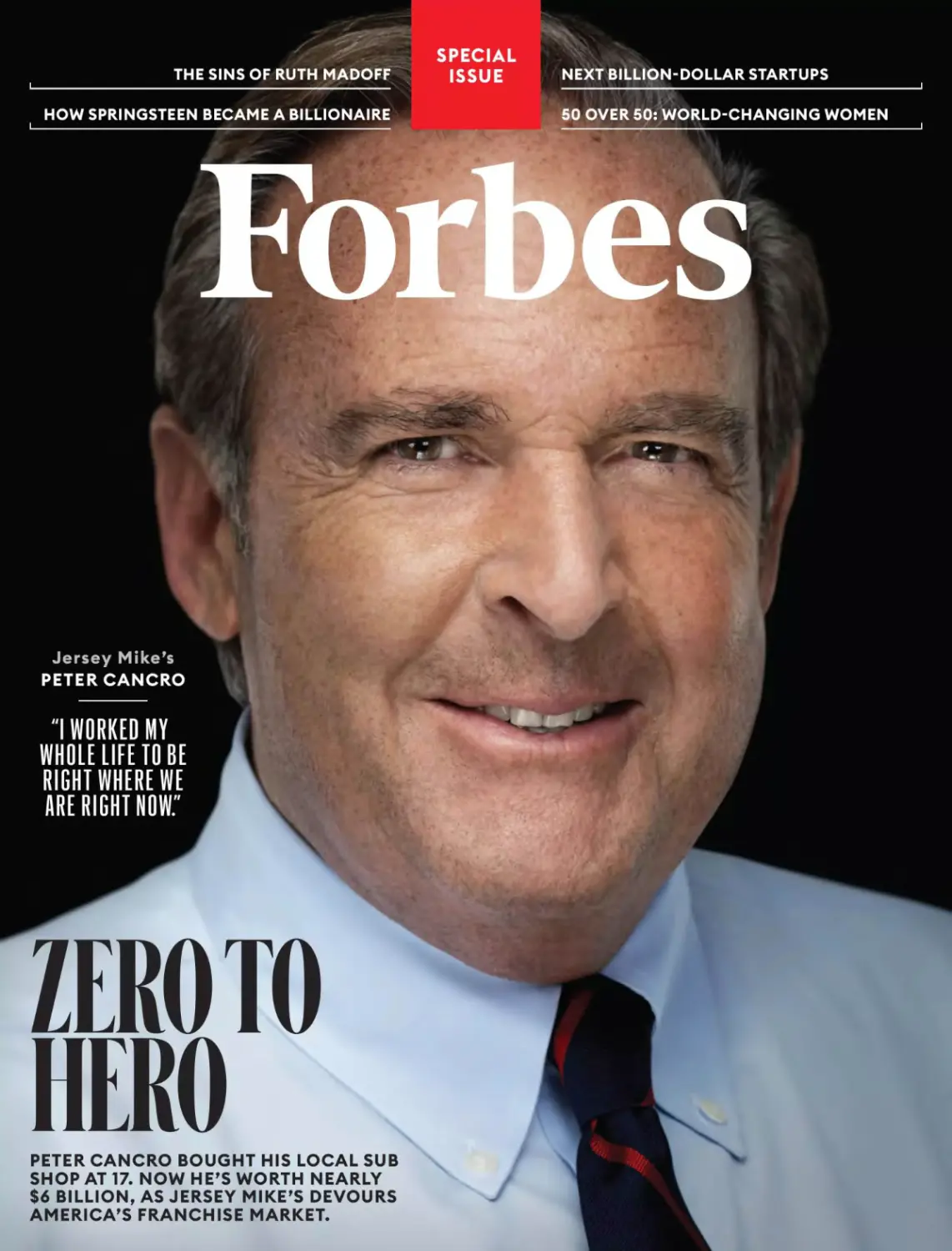
Jersey Mike’s
PETER CANCRO
"I WORKED MY
WHOLE LIFE ID BE
RIGHT WHERE WE
ARE RIGHT NOW."
ГЯ  л  ж л X ГИт/w
£lKU 1U
HERO
PETER CANCRO BOUGHT HIS LOCAL SUB
SHOP AT 17. NOW HE’S WORTH NEARLY
$6 BILLION, AS JERSEY MIKE’S DEVOURS
AMERICA’S FRANCHISE MARKET.
PATEK PHILIPPE
GENEVE
BEGIN YOUR OWN TRADITION
FAST IS THE ENEMY
VIEW THE FILM
A STORY ABOUT STANDARDS
“At Patek Philippe, when we make a watch, however
hard we work, we can only go at one speed. One that
ensures we adhere to the high standards for which
we are respected.
We understand that some people express frustration
at this. They want us to go faster. But at our family-
owned watch company, fast is the enemy. Because
to accelerate the time it takes to make a watch we
would have to cut corners and lower our quality.
And then the watch might be a very good timepiece.
But it would not be a Patek Philippe and would not
merit the Patek Philippe Seal.”
THIERRY STERN
PRESIDENT, PATEK PHILIPPE
PATEK PHILIPPE SEAL
PATEK.COM/PHILOSOPHIES
PRAETOR600
BY EMBRAER
DIFFERENT BY DESIGN.
DISRUPTIVE BY CHOICE.
9
OCEAN REEF AIRPORT
Key Largo - FL
/A\
'4,451 FEET '
Short Runway
Fly further thanks to full fly-by-wire.
NOW THE ONLY QUESTION IS,
WHERE DO YOU WANT TO GO NEXT?
August/September 2024
Forbes
Volume 207 I Number 4
INSIDE
CONTENTS
The Art of the Spiel
Billionaire Christian Angermayer
has backed seemingly every flashy
investment of the last decade:
crypto, psychedelics, brain implants,
longevity. With boundless bravado
and a roster of famous friends, he’s
getting ready to launch an Olympiad
for athletes on steroids.
By Will Yakowicz and Brandon Kochkodin
CHRISTIAN ANGERMAYER BY LEVON BISS FOR FORBES
FORBES.COM
AUGUST/SEPTEMBER 2024
Type XX 2057
breguet.com
The Breguet
Type XX has
accompanied the
most experienced
pilots since 1954,
landing on the wrist
with perfect
precision.
Make History
with us.
CONTENTS
August/September 2024
56
I lometown
Hero
After borrowing
$125,000 to buy his
local sub shop at 17,
Peter Cancro has grown
Jersey Mike’s into one
of America’s fastest-
growing restaurant
chains, with nearly
$4 billion in sales. Now
the multibillionaire faces
a big decision: Cash out
or stay hungry?
By Jemima McEvoy
76
The
Compassionate
Collector
Phaedra Ellis-Lamkins
built Promise into
a $520 million
powerhouse by helping
municipalities collect
unpaid bills with
text messages and
zero-interest plans.
By Amy Feldman
Plus: Next Billion-
Dollar Startups
100
The Sins of
Ruth Madoff
In an exclusive excerpt
from Madoff: The
Final Word, the Ponzi
King’s wife is portrayed
as a liar. Trained as
a bookkeeper, she
regularly reconciled
the account that housed
the $68 billion fraud
for decades.
By Richard Behar
49| FORBESLIFE
Mookie Betts goes
deep, Lamborghini
turntables and the
luxury float-tel wars.
ON THE COVER
Photography by
Jamel Toppin for Forbes
AVA DUVERNAY BY MARY BETH KOETH FOR FORBES
FORBES.COM
AUGUST/SEPTEMBER 2024
THE ORIGINAL INFLUENCER
RANGE ROVER
Vehicle shown: 2024 Range Rover. © 2024 Jaguar Land Rover North America, LLC
CONTENTS
8
FRONTRUNNER
17 i Brooke’s New Act
After decades of serving as of the face of other
people’s brands, Brooke Shields is embracing a
new role: entrepreneur. Plus: The 50 Over 50
201 New Billionaire: From E Street to Easy Street
How Bruce Springsteen turned his blue-collar music
into a ten-figure fortune.
22 i 50 Under 50: Wellness Wunderkinder
Getting healthy-and perchance wealthy-with
the Forbes 30 Under 30, in 30 words or less.
241 Buy, I fold, Sell
Pick up Рокётоп, but let go of Lego.
26 | World of Forbes
Around the globe with our 43 international editions.
28 i Conversation
Readers ponder the future of Al.
CONTRARIAN
ENTREPRENEURS
31 I HIV Hail Mary
Medical database billionaire Terry Ragon believes he
can succeed where major governments have failed: by
bringing together top doctors, scientists and engineers
in a moon-shot bid to cure one of the world’s wiliest viruses.
By Katie Jennings
STRATEGIES
341 Rare Fortune
Hedge Fund manager James Litinsky just wanted to
salvage a bunch of bad bonds. He ended up making
a mint from rare earths and bolstering U.S. strategic
interests-with a little help from the Chinese. By Chris Helman
TECHNOLOGY/INNOVATION
38 i Supercharging Al
Nvidia has utterly dominated the market for Al chips by
repurposing semiconductors originally designed for video
games. Now Groq, a tiny eight-year-old startup, is taking on
one of the world’s most valuable companies with a purpose-
built chip designed for Al from scratch. By Richard Nieva
Plus: The Cloud 100
MONEY & INVESTING
461 Grandmaster of Risk
At Prudential Financial, ex-NASA engineer George
Patterson runs through a few trillion calculations to
make a client happy. By William Baldwin
SPECIAL SECTION
7i | America s Top Next-Gen
Wealth Advisors ►
By Sergei Klebnikov and SHOOK Research
13 | Fact & Comment
A big war is brewing in the Middle East. The strategies
of the two key players—Israel and Iran—bear watching
in the months ahead if the world wants to avoid a
cataclysm. By Steve Forbes
106 | Thoughts On Curiosity.
PHAEDRA ELLIS-LAMKINS BY CODY PICKENS FOR FORBES; TERRY RAGON BY MICHAEL PRINCE FOR FORBES; ILLUSTRATION BY MICHAEL HOEWELER
FORBES.COM
AUGUST/SEPTEMBER 2024
SEIKO
SIINCE 1881
© 2024 Seiko Watch of America. SPB463
Japanese beauty,
crafted into
a mechanical timepiece.
Presage
www.seikoluxe.com #SPB463
SIDELINES
Forbes
The Over 50 Movement
August/September 2024 • Volume 207 | Number 4
FORBES
10 Forbes journalism can create impact in several ways.
A story that inspires or reveals. A franchise, like Forbes
Billionaires, that updates who owns what in the world.
The trickiest feat: a movement that makes people think
differently about some aspect of society. The Forbes
50 Over 50 (seepage 17) falls into that last bucket.
Just as Hemingway described bankruptcy—
“gradually, then suddenly”—so it goes with movement
building. First you need a base: Moira Forbes has spent
two decades building ForbesWomen as the leading
voice for female leaders and entrepreneurs. Then, a
spark. In 2020, Mika Brzezinski (above left) published a
book, Comeback Careers. “Women in their 50s, 60s and
beyond are paving this long runway,” says the cohost
of Morning Joe. Taking note of our resonant 30 Under
30 list and community, the 50 Over 50 was born.
A parallel franchise, just for women on that runway.
A big idea requires a big tent: the Forbes platform
and team, led by ForbesWomen editor Maggie Mc-
Grath, buttressed by Brzezinski s Know Your Value
initiative and the reach of Morning Joe. And then
a catalytic moment: in this case, March 2022,
gathering the 50 Over 50 with the women of the 30
Under 30 for the inaugural Forbes 30/50 Summit in
Abu Dhabi. International Womens Day finally had a
physical capital, with two-way mentoring at its heart.
Brzezinski felt the tipping point occurred last year,
when she looked across the stage at Hillary Clinton,
Billie Jean King, Gloria Steinem and Ukrainian First
Lady Olena Zelenska all on one panel, broadcast live
around the world. “There was no looking back,” she
says. My pick occurred this year: a mentoring session
between legendary money guru Suze Orman and
50 Over 50 honoree Linda Lockhart that resulted
in creating and funding bank accounts for 1,000
rural Kenyans. That’s what a movement looks like.
CHAIRMAN AND EDITOR-IN-CHIEF: STEVE FORBES; CEO AND PRESIDENT: MICHAEL FEDERLE
EDITORIAL
RANDALL LANE, Chief Content Officer
Executive Editors: Caroline Howard, Luisa Kroll, Kerry Lauerman, Michael Noer, John Paczkowski, Matt Schifrin,
Michael Solomon, Ту Wenger
Managing Editor: Joyce Bautista Ferrari
Assistant Managing Editors: Jessica Bohrer (Editorial Counsel), Steven Bertoni, Kerry A. Dolan, Alice Jackson-Jolley,
Rob LaFranco, Jeffrey Marcus, Janet Novack, Katharine Schwab, Alan Schwarz
Senior Editors & Writers: Maneet Ahuja (Editor-at-Large), Russell Flannery (Editor-at-Large); Dan Alexander, Emily Baker-White,
Jeremy Bogaisky, Thomas Brewster, Grace Chung, Colleen Curry, John Dobosz, Steven Ehrlich, Sarah Emerson, Cyrus Farivar,
Amy Feldman, Christopher Helman, Liane Jackson, Katie Jennings, Jeff Kauflin, Alex Knapp, Brett Knight, Brandon Kochkodin,
Alex Konrad, Alexandra Levine, lain Martin, Mitchell Martin, Seth Matlins, Tina Russo McCarthy, Maggie McGrath, Jena
McGregor, Richard Nieva, Alan Ohnsman, Richard Olsen, Rachel Rabkin Peachman, Chase Peterson-Withorn, Kelly Phillips Erb,
Helen Popkin, Steel Rose, Merrill Vaughn, Sarah Whitmire, Will Yakowicz, Jabari Young
Deputy Editors: Chris Gentilviso, Corinne Lestch, Andrea Murphy, Javier Paz, Isabel Togoh,Taesik Yoon
Associate Editors: Elisabeth Brier, Leigh Cuen, Melissa Delaney, Chris Dobstaff, Julius Juenemann, Matt Rasnic, Nicholas
Reimann, Joe Walsh IV
Staff Writers: David Axe, Nina Bambysheva, Justin Birnbaum, Danielle ChemtoU Zach Everson, John Hyatt, David Jeans,
Suzanne Rowan Kelleher, Sergei Klebnikov, Jemima McEvoy, Megan Poinski, Chloe Sorvino, Giacomo Tognini, Hank Tucker,
Emma Whitford
Senior Reporters: Alison Durkee, Matt Durot, Robert Hart, Derek Saul, Lisette Voytko-Best
Reporters: Molly Bohannon, Matt Craig, Elizabeth Daffin, Maria Gracia Santillana Linares, Monica Hunter-Hart, Phoebe Uu, Arianna
Johnson, Emily Mason, Conor Murray, Antonio Pequeno, Mary Roeloffs, Tyler Roush, Rashi Shrivastava, Alex York, Gigi Zamora
General Assignment Reporters: Richard J. Chang, Zoya Hasan, Simone Melvin, Kyle Mullins
Assistant Editors: Sarah Chandler, Jair Hilburn, Justin Teitelbaum (Sports Data Analyst), DeArbea Walker
Editorial Operations: Justin Conklin, Katherine Love, Evan Spadacdni, Francesca Walton
Communities: Seth Cohen (Chief Impact Officer); Katie Bishop, Ayisha Mendez
Art and Production: Alicia Hallett-Chan; Charles A Brucaliere, Fernando Capeto, Robyn Selman, Philip Smith, GailToivanen,
Yunjia Yuan, Cecilia Zhang
Social Media: Diana Colapietro, Morgan Grenz, Sarah Muller
ForbesTV: CW. Benston (VP); Joshua Fidler, Brittany Lewis, Cat Oriel, Bart Rust
Video: Tim Pierson; Greg Andersson, Leah Bottone, Ivan Clow, Travis Collins, Michael Cutler, Adisa Duke, Riley Hallaway,
Nicolet Hartmann, Kristin Hunt, Kieran Krug-Meadows, Chad McClymonds, Alexis Noriega, Miles O'Reilly, Jonathon Palmer,
Brian Petchers, Beatrice Phillips, Lauren Rivera, Morgan Sun, Michael Swartz, Kirsten Taggart Simone Varano
REVENUE OPERATIONS
SHERRY PHILLIPS, Chief Revenue Officer
Executive Support: Claire Heidenreich
Account Management: Abbey Smith (SVP); Rachel Aquino, Jessica Blitzer, Taylor Bradshaw, Alex Cohn, Cate Cox,
Jenna Fogelsonger, Ashley Grado, Adelaide Hill, Jess Hotzberg, Brian Lee, Leah Monroe, Nina Montross, Katie Moran,
Trey Newcomb, Morgan O’Hare, Akshay Patel, Allison Rickert, Karen Schneider, Rebecca Taroon, Casey Zonfrilli
Ad Sales: Kyle Vinansky (SVP); Aaron Andrews, Marissa Brown, Shae Carroll, Ruth Chute-Manning, Danielle Collins, Jennifer
Cooke, Jennifer Crowe, Sarah Curry, Hannah Davidson, Leigh Day, Emilie Errante, Sinclaire Fonville, Olivia Gelade, Louisa Goujon,
William Hosinski, Eva Kaplan, Kimberly Kurata, Martino Landeka, Jessica Lantz, Grady Lopez, Jordan Loredo, Kayleigh Love,
Tara Michaels, Alex Morton, Rornail Bin Mukhtar, Ryan Queler, Jesse Silberfein, Christina Simpson, Isabella Suppa
Content Products & Design Studio: Josh Robinson (SVP); Jake Bell, Sean Bishop, Jeremy Campbell, Nick Clunn, Jessica Desmond,
Aira Dolfo, Meghan Donovan, Sean Downey, Martine Ehrhart, Kristine Francisco, Mallory Gafas, Ross Gagnon, Deja Gaines,
Matthew Herrmann, Kari Jones, Dzenana Karajic, David MacLean, Jessica Militare, Sophia Minassian, Bianca Olivas,
Romy Oltuski, Jennifer Ramos, Kara Stiles, Jaeda Thomas, Yana Toneva, Elliot Vinzon, Janet Yin
ForbesLive & Marketing: Leann Bonanno (SVP); Nicole Alamo, Julia Aziz, Helen Barreto, Sarah Biegel, Christina Biondi,
Kate Bishop, Jessica Charles, Brett Cohen, William Delehanty, Ryan Durieux, Alana Ezeji, Lex Engel, Samantha Evans*
Madie Federie, Erica Ferraro, Lucy Fetsko, Megan Hennessey, Olivia Hine, Christina Ho, Elizabeth Humphrey, Darby Humphries,
Amani Hussain, Jack Jacobs, Nicole Kerno, Susan Kessler, Cailin Knox, Juliana Longo, Sydney Melin, Menaka Menon,
Antonio Morales, Alice Naser, Jimmy Okuszka, Louie Pillari, Pat Saunders, Mona Shah, Mary Margaret Soderquist, Erika Speed,
Julieanna Stipek, Askha Thaker, Nicole Thielk, Kelly Thomas, Christina Venditti, Laura Villaraut, Blair Walther, Jason Webster
ForbesWomen: Moira Forbes (EVP); Erika Burho, Nicolette Jones
Insights, Research and Data: Janett Haas (SVP); Richard Karlgaard
DIGITAL & INFORMATION
VADIM SUPITSKIY, Chief Digital & Information Officer
Business Intelligence: David Johnson (Chief Data Officer); Anthony Calise, Ankit Dhall, Shawn D’Souza, YJ Duff, Matthew Haensly,
Evelyn Kanu, Aashis Khanal, Gaurav Khubchandani, Sanjit Mahajan, Mike Messina, Shan Newton, Alexi Potter, Krishna Pullakandom,
Zach Quinn, Phil Roth, Brandon Ruhl, Robert Salgado, Rosa Seo, Gregory Spitz Farris, Austin Tedesco
Technology: Sameer Patwardhan (SVP); Robert Ali, Jiten Bhojwani, Shakawat Bhuiyan, Don Cao* Philip Diaz, Christopher Frank,
Pete Hahm, Justin Harris, Josh Hartzog, Adaze Idehen-Amadasun, Eric Park, Mariia Posokhova, Ronak Ray, Rodney Rodriguez,
JD Weiner, Raymond Wong, Kala Woodson
Engineering: Habib Aslam, Alex Bailey, Kenneth Barney, Tay Buley, Sarah Calande, Brian Chamberlain, Chang Chu, Katie Delgado,
Somraju Gangishetti, Alec Gilchrist, Benjamin Harrigan, Devin Jolly, Caleb King, Tyler La Fronz, Yanella Lopez, Alex Lorenzo,
Travis Madar, Marissa Orea, Sungmin Park, Will Ptacek, Bharat Ramesh, Chuck Rea, Peter Richardson, Kyle Rogers, Aaron Romel,
Carmen Shannon, Alexander Shnayderman, Zachery Shuffield, Sri Sindhusha Boddapati, Anastasiia Soktoeva, Matthew Waldron,
Ben Wexler, Forrest Whiting, Gabriel Zacarias
Product: Nina Gould (Chief Product Officer), Rebeca Solorzano (SVP), Adam Wallitt (SVP), Alyson Williams (SVP); Ashley
Alexander, Sara Amato, James Barry, Sasha Brijram, Kierstyn Cheladyn, Erin Cross, Mikaela Donovan, Julie Finken, Matt Flood,
Nina Foroutan, Rachel Goroff, Kat Gratale, Lauren Gurnee, Sophie Hunter, Giulia Imholte, Sanio Iqbal, Andres Jauregui,
Traci Kalamajka, Alicia Knight, Erin Lawler, Chris Leno, Emily Lewis, Peter Liu, Stephen Lybeck, Taylor Mansinne, Julie McGovern,
Daniella McMahon, Michael Medric, Adrienne Michalski, Kelly Mui, Ade Obayomi, Melis Ocal, Jinal Patel, Casey Riordan,
Lee Rodriguez, Richard Sancho, Luis Santana, Pranav Shinde, Dmitri Slavinsky, Sophia Smrth, Lauren Soni, Jacqueline
Subramaniam, Jagan Subramanian, Reilly Tuccinard, Dor Zaidenberg
Forbes Vetted: Emily Jackson (SVP); Amanda Arnold, Brinda Ayer, Margaret Badore, Sarnia Balbaky, Cory Baldwin, Kristina
Bornholtz, Lindsay Boyers, Jenni Bruno, Whitney Bruno, Alexis Caldwell, Bridget Chapman, Lee Cutlip, Karo Cuzzone, Sholeen
Damarwala, Ashley Dean, McKenzie Dillon, Spencer Dukoff, Claire Epting, Kate Eschenburg, Luke Fater, Emily Favilla, Jennifer
Ferrise, Luke Frangis, Alex Garrett, Jane Guetti, Joy Hwang, Jayson lldefonso, Rebecca Isaacs, Catie Jaffe, Dave Johnson, Madeline
Kaufman, Katherine Louie, Rebekah Lowin, Catherine Miller, Richard Molinaro, Kari Molvar, Trinity Moore, Kimberly Peiffer, Anna
Perling, Haley Roberts, Rose Sala, Francesca Sales, Kayla Sigaroudi, Katie Simpson, Natalie Steinman, Astrid Taran, Jordan Thomas,
Blaire Tieman, Karen Tietjen, Cameron Vigliotto, Jessica Weisman, Andy Wetula
Growth: Taha Ahmed (Chief Growth Officer), Paul Reiss (SVP); Lindsay Carboy, Dawlat Chebly, Sara Colodner, Connor Davis,
Lauren Guzman, Merryl Holland, Harper Kaur, Grace Keller, Arantxa Leon Montero, Douglas Lopenzina, Faith Macer,
Matthew Mastando, Alex Noonan, Mani Patel, Binti Pawa, Matthew Quick, Nicole Ramirez, Dayne Richards, Jessica Stremmel,
Nic Thibodeau, Gabriel Vasquez, Catherine Wemquest
Customer Experience: Lynn Schlesinger (Chief Customer Experience Officer); Cristina Baluyut, Lainna Fader, Edward Hart, Alaina
Imperio, Traci Lamm, Sike Li, Kara Lipson, Natalie Maquiling, Kristen Mucci, Jalen Nelson, Diane Schmid, Rachel Thomas, Trent Walter
CORPORATE
Communications: Laura Brusca (Chief Communication Officer); Sarah Edelstein, Christina Vega Magrini, Susan Masula, Jocelyn Swift
Finance/Operations: Michael York (Chief Financial Officer), Stephanie Lewis (SVP), Parag Tolia (SVP); Jason Alwardt, Noemi
Baraket, Oneil Brodie, Rachel Collins, Rosa Colon, Mike Deochand, Taylor DiLetto, Cindy Eng, Iris Garcia, Nancy Garcia, Christie
Hansen, Melody Jimenez, Giedre Kristahn, Christopher Labianca, Christopher LoPiano, Andrea Maniscalco, Christine Martinez,
Paul Motta, Renee Obester, Nelson Osegueda, Willie Osegueda, Barbara Passarella, Jeanine Pecoraro, Gary Prasto, Jay Rerrie,
Allison Raether, Ivette Reyes, Lisa Seropiglia, Wanda Sanders, Angel Sauri, Nisha Shastri, William Simmons, Vera Sit, Katie
Sliwowski, Courtney Stanton, Joseph Tillman, Buddy Trocchio, Donald Walsh
Human Resources: Ali Intres (Chief Human Resources Officer); Ashley Abendschoen, Seth Boyarsky, Brooke Dunmore,Taylor
Gillespie, Rachel Levin, Lindsey Miron, Patrick Moffitt, Amanda Osit, Anika Robinson, Bonny Tan, Amanda Tucker
Legal: MariaRosa Cartolano (General Counsel); Lindsey Datte, Emily Desmonie, Susy Garcia, Nikki Koval, Raelynn Leggio,
Josephine Love-Loftin, Capri Reid, TJ Vita
Forbes Asia: William Adamopoulos (CEO Asia), Justin Doebele
Licensing & Branded Ventures: Peter Hung (President, Licensing & Branded Ventures); David Gassman, Matthew Muszala,
Katya Soldak
Print Magazine Consultants: Priest ♦ Grace (design); Brian Dawson (editorial); Sarkis Delimelkon (production)
FOUNDED IN 1917
B.C. Forbes, Editor-in-Chief (1917-54) Malcolm S. Forbes, Editor-in-Chief (1954-90)
James W. Michaels, Editor (1961-99) William Baldwin, Editor (1999-2010)
JAMELTOPPIN FOR FORBES; COLIN BALDWIN FOR FORBES
FORBES.COM
AUGUST/SEPTEMBER 2024
HIS BIGGEST CHALLENGE?
DEADLINES.
OUR BIGGEST SOLUTION?
RELIABLE GROUND SHIPPING.
0^:0 ©2024 United States Postal Service®.
All rights reserved.
The Eagle Logo is among the many
trademarks of the U.S. Postal Service®.
Turn shipping to your advantage.
Hit your delivery dates with the reliable
USPS Ground Advantage® service.
Learn more at usps.com/reliable.
Simple. Affordable. Reliable.
For mailable items up to 70 lbs. Expected delivery in 2-5
business days. Packages going to certain places (including
Alaska, Hawaii, and offshore destinations), or containing
hazardous materials or live animals may receive slower service.
?. I USPS Ground Advantage’
PROMOTION
DANDYMEN:
Revolutionizing Men's Grooming
In the crowded world of men’s grooming, few brands stand
out like the DandyMen. Founded in 2020 by professional
barber and national educator Lucas Kemper, DandyMen has
transformed a simple yet innovative idea into a powerhouse
brand. The brand was born out of frustration with the lack of
reasonably priced, high-performing grooming products with
high end scents inspired by designer fragrances. Now with a
retail presence in over 14,000 stores nationwide—all within
just two years—DandyMen is truly the brand to watch.
The vision is simple: offer superior
grooming products that barbershop
professionals can trust and clients will
love. DandyMen products are designed,
tested and perfected within Lucas’ own
Illume Barbershop, located in downtown Bentonville,
Arkansas. By soliciting and incorporating invaluable
feedback from both barbers and their clients, DandyMen
ensures every product is crafted with precision and
perfected through iteration.
DandyMen
isn't just a brand
it's an experience
Since its launch, the DandyMen has become one of the
fastest-growing men’s grooming companies. In addition to
expanding its retail footprint nationally, the brand has
garnered a dedicated following of professionals and
customers alike. The explosive growth is a testament to
Lucas’ leadership and unwavering commitment to quality and
customer satisfaction. “Lucas does things the right way. I’m a
big advocate of buy once, buy right. He’s taken the time to
Anyone experiencing the DandyMen not only achieves that
fresh-from-the-barbershop look but also smells incredible.
DandyMen remains committed to leading the men’s grooming
category revolution through integrity, innovation and excellence
that sets the new standard within the industry.
establish well tested and tried products. I’ve used other
higher end products you can only find in salons, and I
actually prefer DandyMen over those. And the fact that the
accessibility and the price is 30-40% less than the other
brands, while still having every bit of the quality." says
Brandon, a converted customer. The product range offers a
fragrance that blends boldness and sophistication, leaving a
lasting impression. Combined with superior performance, it’s
the scent’s silent signature that uniquely sets the brand apart.
EVERY DETAIL MATTERS
DANDYMEN
www.dandymencollection.com
'With all thy getting, get understanding
• FACT i COMMENT •
1	By Steve Forbes, Editor-in-Chief
Why This War Is Unavoidable
13
A big war is brewing among Israel, Hez-
bollah and Iran. The clash is inevitable be-
cause Tehran’s murderous mullahs won’t back
off their goal of isolating and destroying the
Jewish state. Such a conflict could rapidly ex-
pand, involving the U.S. and Russia. It could
prompt China to even more aggressive moves,
which might well trigger a confrontation be-
tween Washington and Beijing. The only ques-
tion remaining is the timing of the blowup.
It could happen soon or be delayed for a time.
The flashpoint will be the border between
northern Israel and southern Lebanon. Hez-
bollah-Iran’s large, lethal tentacle in that area—has been
launching missiles and drones into Israel since October 7-
Some 80,000 Israeli residents have had to be evacuated, an
intolerable situation for a sovereign state. Israel can’t allow
a terrorist organization to force it, in effect, to abandon
chunks of its territory.
Iran’s goal is to force a deal: Hezbollah would pull back
and stop firing rockets in return for a ceasefire in Gaza. This
would leave Hamas not only intact but also in a position to
eventually exert power over Gaza and then the West Bank.
Jerusalem could never sign off on such an agreement.
It would be the Jewish state’s long-term death knell,
signaling that Israel hasn’t the will to control
or destroy its mortal enemies. That’s why a
bigger war is coming.
Hezbollah’s fighters are more numerous
and probably more capable than those of
Hamas and possess 150,000 missiles of vari-
ous kinds. Taking out Hezbollah would be
costly. Some of its rockets and drones would
get through Israel’s Iron Dome and hit popu-
lated urban areas. Moreover, Iran wouldn’t
stand by; it would launch its own missiles
into Israel. And it would be tempted to take
the final steps in creating a nuclear device.
Does Israel have the means to destroy or substantially
cripple Iran’s nuclear facilities? Over the years they’ve been
hardened underground and dispersed around the country.
Israel would need U.S. assistance to fight against Hezbol-
lah and Iran, not to mention the remnants of Hamas. But
would we give it?
The fact that such a question can be asked heartens
the mullahs that a timorous Washington would try to stay
Israel’s hand against a full-force campaign against Hezbol-
lah. Faced with such grim prospects, Israel may well feel it
must chance a big war anyway.
And wars never go in predicted directions.
The Constitution to the Rescue
The Supreme Court recently struck a momentous blow
for the Constitution, individual liberty and a brighter and
more prosperous future when, in a related pair of rulings, it
overturned a dreadful decision it made in 1984, Chevron v.
Natural Resources Defense Council.
Chevron massively and dangerously increased the powers
of government agencies, making them all too often a law unto
themselves. It granted these entities enormous powers to
write rules and regulations without congressional approval.
Worse, what came to be called “Chevron deference” meant
that if there was any ambiguity or question about what a law
meant, courts would have to defer to the supposed exper-
tise of the agency involved. Government bureaucracies, not
the courts, would decide what a piece of legislation meant.
Judicial challenges thereby became extremely difficult,
giving bureaucracies a license to invent their own authority.
Chevron ended up being an assault on the Constitu-
tion’s separation of powers. It led to egregious abuses. For
instance, to extend their powers regulators defined “navi-
gable waters” as ponds, creeks and even mud puddles.
Individuals became easy targets, because they didn’t have
the resources to fight the federal government.
Chevron deference blatantly ignored Article III of the
Constitution, which empowers the courts to determine
what the law says. It undermined the historic powers of
Congress. Presidents who couldn’t get proposals through
the national legislature increasingly turned to federal agen-
cies to enact them instead. The result has been a blizzard of
regulations and executive orders.
President Biden, for example, wants to ultimately banish
the internal-combustion engine in cars and trucks. Congress
never passed any such prohibition—and never would because
of intense public opposition. The EPA is doing it instead. The
list of abuses is enormous—and getting worse. Regulations now
cost the economy more than an unfathomable $3 trillion a year.
To its eternal shame, Congress too often has gone along
AUGUST/SEPTEMBER 2024
FORBES.COM
Steve Forbes Cont.
with this neutering of its responsibili-
ties by passing ambiguous bills and let-
ting agencies take the heat for any con-
troversy. That’s passing the buck—and
undermining the Constitution.
Chevron also bred inconsistency,
14 as a new administration might change
the rules of a previous one.
Defenders of Chevron say overturn-
ing it will gut regulations concerning
health, the environment, aircraft safety
and the like. That’s nonsense.
The Justices made crystal clear
the difference between expertise, say,
in aircraft safety versus interpreting
laws. Government agencies such as the
Centers for Medicare & Medicaid Ser-
vices have no special competence in
resolving statutory ambiguities. That’s
the job of the courts.
The Chief Justice also made a cru-
cial point, that specific decisions made
under Chevron are not automatically
undone; they must be challenged.
Chevron underscores the impor-
tance of the upcoming election. Will
we elect a president who will continue
to act in a dictatorial manner, regard-
less of what the Supreme Court rules
on various cases? Look at how the
White House flouts the decision con-
cerning Biden’s canceling of student
debt. The president continues to do it.
FACT & COMMENT
California Off the
Rails—Again
Another regulatory train wreck is
coming in California, which calls itself
the Golden State. But California’s gov-
ernance is pure lead. Never has an area
with so much going for it—weather and
natural beauty—been so mismanaged
by its politicians. The tax and regula-
tory wounds they inflict are nonstop,
which is why businesses and people are
fleeing the state. For the first time since
it achieved statehood in 1850, Califor-
nia has been losing population.
Even so, the regulatory wreckers in
Sacramento are still going at it. They
are scheming to ban diesel-powered lo-
comotives. Older engines would be pro-
hibited by 2029, and longer-distance
freight trains would have to be at zero
emissions of carbon dioxide by 2035.
The battery technology for these train
engines doesn’t yet exist. But the once-
Golden State’s modem socialists never
let reality get in the way of their fantasies.
Railroads will have to deposit bil-
lions of dollars into a special fund, so
they’ll someday be able to buy zero-
emission locomotives. In other words,
money that could be productively em-
ployed now will instead sit around
unused to buy what may never exist.
After all, zero-emission train engines
would require batteries up to ten
times the size of today’s. Go for smaller
such engines? Putting aside their inef-
ficiency, smaller battery locomotives
are vulnerable to fires and explosions.
Given California’s economic size,
these regs would end up banning some
two-thirds of the nation’s locomotives
from entering the state. California’s
socialists know this would be a neat
way to coerce the rest of the country to
follow what California is doing.
Would this force more freight onto
supersized long-haul trucks? Not so
fast. California has a mandate to force
a transition to electric trucks.
This whole exercise is dangerous. It
makes trains and trucks more prone to
accidents. It’s a massive waste of money
that the private sector could otherwise
use to enhance our standard of living.
When it comes to transportation,
California has demonstrated a unique
ineptitude with its project to build a
463-mile high-speed rail system be-
tween San Francisco and Los Angeles.
To call this fiasco a white elephant is an
insult to pachyderms. It’s a decade be-
hind schedule, and the estimated cost
has vaulted from $35 billion to $135
billion and climbing. Only one-fourth
of the system’s length is under con-
struction, with the route having been
repeatedly altered for political reasons.
Projected ridership, which was unreal-
istic from the get-go, has been scaled
back. Funding is uncertain.
Sacramento is counting on a
Democratic win in November to pre-
vent a permanent derailment of this
ill-begotten scheme. That bailout isn’t
going to happen.
RESTAURANTS: GO, .STOP
Edible enlightenment from our eatery
experts and colleagues Monie Begley,
Richard Nalley and Randall Lane, as
well as brothers Bob, Kip and Tim.
•	Eulalie
239 West Broadway, between Walker &
White streets (Tel.: 646-476-2380)
In Tribeca, partners chef Chip Smith and
Tina Vaughn—creators of The Simone—have
a new 40-seat American restaurant with
French overtones. The prix-fixe menu is set
at $115, changing every few weeks. Tina is
the first-rate house sommelier. A first course
of crispy pork trotters highlights the chef’s
North Carolina origins. Most evenings there
is a cheese souffle and a savory tart. A fish
quenelle in a soupe de poisson creates a
break before the delectable main course—
usually with three to four mains to choose
from. Flounder is pan-seared and served with
a celeriac puree in a red-wine sauce; loin of
veal is roasted with an array of caramelized
butternut squash, baby Brussels sprouts and
matsutake mushrooms. A perfect ending to
the meal: chef Chip’s storied coconut cake.
•	Amarena
151 East 82nd St. (Tel.: 212-933-0992)
Chef Julian Medina has launched his newest
restaurant, featuring Italian fare. It’s a jam-
packed success and is set in the townhouse of
the now-closed The Simone. Many offerings
are Italian classics; others are slightly whimsi-
cal. Begin with the fiori di zucca (zucchini
blossoms filled with gorgonzola dolce), a plate
of the arancini (risotto balls spiced with truffle
cheese) or carciofi alia giudea (baby artichokes
tossed in a chili-Meyer lemon aioli). There
are four different thin-crusted pizzas with
alluring toppings, as well as a half-dozen
pastas. For entrees try the polio alia Parmi-
giana (ultra-comfort food) or the anatra alia
cacciatore (dry-aged duck breast with maitake
mushrooms, peppers and cippolini onions in
a red-wine sauce). The desserts are irresistible.
•	The Consulate
44 West 56th St. (Tel.: 646-850-1100)
This restaurant spans two levels with paneled
decor, comfortable, buttoned tan banquettes
and friendly service. Lamb tartare is first-rate,
and the ceviche is tasty. The delicious vegetar-
ian Beyond burger could fool anyone. The
buffalo chicken sandwich is spicy, the fries
great. Bread pudding and pineapple upside-
down cake quickly disappear from plates.
•	Hearth
403 East 12th St, between 1st Avenue &
Avenue A (Tel.: 646-602-1300)
From cocktails to desserts you can’t go wfrong
at this farm-to-table eaten’: fabulous cocktails,
perfect blistered shishitos and fresh anchovies
with crostinis, and a sublime butter macaroni.
The calamari salad is a crunchy delight, and
the variety burger (brisket, liver, heart and bone
marrow) with fontina cheese and caramelized
onion is amazing. Desserts are luscious.
FORBES.COM
AUGUST/SEPTEMBER 2024
this 41 mm-diameter model with integrated bracelet is crafted from Ethical Gold.
It is equipped with the chronometer-certified self-winding Chopard 01.01 -C movement.
Proudly developed and handcrafted by our Artisans, this exceptional timepiece showcases
the finest expertise and innovation cultivated within our Manufacture.
THE ARTISAN OF EMOTIONS - SINCE I860
CHOPARD BOUTIQUES
NEW YORK 730 Fifth Avenue - MIAMI Bal Harbour Shops - COSTA MESA South Coast Plaza
1 -800-CHOPARD www.chopard.com
Forbes
CEO
NOVEMBER 20-21, 2024
BANGKOK, THAILAND
FORBES GLOBAL CEO CONFERENCE
NEW PARADIGMS
Hockey sticks and techtonic shifts—change happens gradually then all at once.
Conventional models of leadership, business and entrepreneurship now face storms of
transformations: new administrations and elections worldwide, geopolitical and trade
tensions, volatile economic conditions, energy transitions, wildly accelerating tech—the
list goes on. Amid this tumult, the 22nd Forbes Global CEO Conference will gather
insights from top CEOs, thought leaders, entrepreneurs and investors as they create
new paradigms to move forward, survive and thrive.
For more information, please visit forbesglobalceoconference.com or email info@forbesasia.com.sg
PRINCIPAL SPONSOR
Bangkok Bank
CORPORATE SPONSORS
Barito Pacific
FRASERS
PROPERTY
International
Container Terminal
Services, Inc.
BY MAGGIE MCGRATH. BROOKE SHIELDS BY MARY BETH KOETH FOR FORBES
17
FRONTRUNNER
NEW ACT
After decades of serving as the face of other people's brands,
Brooke Shields is embracing a new role: entrepreneur.
AUGUST/SEPTEMBER 2024
FORBES.COM
18
FRONTRUNNER
’ve sold stuff for
other people my entire life. I never thought I’d
be a CEO.”
But at 59, Brooke Shields is suddenly both
a founder and a chief executive. In June, the
longtime actor and model launched Commence,
a New York-based hair care company for
women over 40 that she dreamed up during
the pandemic. It’s still early days—Shields
raised $3.5 million from outside investors to
help fund Commence’s first three products,
which were released in June. But it’s already,
she says, the most “challenging and exciting”
stage of her career.
New chapters are the name of the game
on our fourth annual 50 Over 50 list, which
highlights 200 women making professional
waves—whether starting a company, reshaping
philanthropy or making fresh scientific
discoveries—after age 50. The list, which we
produce in partnership with MSNBC host Mika
Brzezinski and her Know Your Value initiative,
is divided into four categories with 50 women
each: Investment, Impact, Innovation and
Lifestyle. The class of 2024 can be seen in its
entirety at forbes.com/50over50.
Of course, like most of the women on our
list, Shields’ “under 50” resume is none too
shabby, either: Her first modeling gig came
when she was 11 months old (for Ivory soap);
a decade later, she played the child of a
prostitute in Pretty Baby, which was released
in 1978 and brought both controversy and
critical acclaim. At 15, Shields became the face
of Calvin Klein jeans (“You want to know what
comes between me and my Calvins? Nothing”
was the famous line).
“She’s genuine,” Calvin Klein, now 81, says of
Shields’ appeal. “You can’t count on too many
people, but you can count on what she says—
that she really means it and believes it and
wants to do something good for people.”
AVA DUVERNAY 51
DIRECTOR, WRITER, PRODUCER
Oscar-nominated director
DuVernay didn’t pick up a
camera until she was 32.
She has since become the first
Black woman to direct a
$100 million-grossing film
(2018's A Wrinkle in Time) and,
to make 2023’s Origin, she de-
veloped a moviemaking model
that taps into philanthropists
such as Melinda French Gates.
“There are stories all around us,
and they just ignite my imagina-
tion all the time,” she says.
MIRIAM RIVERA 60
COFOUNDER, CEO,
ULU VENTURES
The daughter of migrant farm-
workers, Rivera grew up speak-
ing Spanish and learned English
by watching Sesame Street.
Today she sits on Sesame’s
board-and that’s her side gig.
Her dayjob is with Ulu Ventures,
the Palo Alto, California-based
early-stage venture firm (AUM:
$400 million) that she cofounded
in 2008. The portfolio includes or
has exited 10 unicorns, including
SoFi ($18 billion 2021 IPO) and
Guild Education ($4.4 billion
2022 funding round).
FORBES.COM
AUGUST/SEPTEMBER 2024
DAWN STALEY 54
HEAD COACH, UNIVERSITY
OF SOUTH CAROLINA
WOMEN’S BASKETBALL
In 2021, Staley became one of
the highest-paid coaches in
women’s college basketball
when she negotiated a $22.4
million contract extension. Since
then, she led the Gamecocks to
NCAA titles in 2022 and 2024.
An Olympic gold medalist and
Hall of Fame player in her own
right, Staley is building a legacy
as one of the country’s foremost
basketball coaches-ever.
4
PEGGY JOHNSON 62
CEO, AGILITY ROBOTICS
Johnson has forged a unique
“over 50” career: She was Satya
Nadella’s first hire when he took
over Microsoft in 2014, and from
2020 to 2023, she ran augment-
ed reality company Magic Leap.
Now, she helms Agility Robotics
(total funding: $180 million),
which makes humanlike robots
to work in U.S. warehouses. “In
the logistics area, there are over
a million jobs unfilled,” she says.
"It makes sense to put a human-
oid robot into these spots.”
That changemaker drive is part of what
inspired Shields to build Commence in the first
place. During the pandemic, she had started
a blog and online community for women over
40 and constantly heard that her audience felt
invisible to the beauty industry. “There was
this feeling that once you hit a certain age, all
of a sudden you lose all your value,” she says.
There were also a lot of specific questions about
hair care—how to manage the new textures
of graying hair, increased scalp dryness and
slower hair growth that can occur in middle
age. They weren’t complaining; they “wanted
problems solved,” Shields says.
To come up with a solution, she recruited
a team of veteran retail and beauty execs—
including Karla De Bernardo, who built
marketing strategies for Macy’s, and Mark
Knitowski, the former product and fragrance
guru for Victoria’s Secret. Together, they zeroed
in on what Shields calls “hero” products: an
instant (dry) shampoo (selling for $21), a leave-
in conditioner ($26) and a thickening root
serum ($30). This trio launched on June 3,
online only at shopcommence.com. It’s too early
to estimate revenue, but Shields is hopeful:
“The products have to speak for themselves.
It’s not called ‘The Brooke’ or ‘The Brooke Look
Brand’ or whatever,” she says. “This brand has
to live in perpetuity.”
What will, ideally, not live in perpetuity:
the condescending attitudes of certain
(unnamed) venture capitalists. When Shields
realized Commence would require more capital
than she could provide from her own coffers,
she did what most entrepreneurs do: turn
to angel investors and venture capitalists for
seed funding. And though she has spent the
better part of the last five decades taking
direction as a model and actor, Shields put
her foot down when one too many male VCs
accompanied their investment decision with
a lecture on what she was doing wrong as an
entrepreneur.
“I remember one day saying, T understand
your need to tell me what I’m doing wrong.
But in this particular case, I haven’t asked
for your advice,”’ she recalls. “T’ve just asked
for your money.’ ”©
FRONTRUNNER
FOR THE FULL LIST OF 200, PLEASE VISIT:
Forbes.com/50over50
FORBES.COM
20
FRONTRUNNER
New Billionaire
FROM E STREET
TO EASY STREET
How Bruce Springsteen turned his blue-collar
music into a ten-figure fortune.
After helping put Asbury Park’s Stone Pony
club on the map in the 1970s, Springsteen
dominated the charts with 21 studio albums,
seven live albums and five EPs, selling more
than 140 million records globally. He has
also told his stories in a No. 1 New York
Times bestselling memoir and 236 sold-out
Broadway performances; along the way he
won 20 Grammys, an Oscar, two Golden
Globes and a special Tony Award, and has
earned a place in both the Rock and Roll Hall
of Fame and the Songwriters Hall of Fame. The
man who sang about being born in the USA
has also received the country’s highest awards,
accepting Kennedy Center honors in 2009 and
a Presidential Medal of Freedom in 2016.
In 2021, shortly after his second run of
Springsteen on Broadway ended, he sold his
music catalog to Sony, earning a lump sum of
$500 million for his life’s work. At the time, his
longtime manager, Jon Landau, said the deal
was deserved for the half-century Springsteen
spent making music. “Everybody is getting what
is in their interest,” Landau told Forbes in 2022.
The glory days keep coming: In 2023,
Springsteen’s world tour sold more than
1.6 million tickets, generating $380 million in
revenue, per Pollstar. With concerts scheduled
through mid-2025 and no apparent plans to
slow down, the elder statesman of heartland
rock remains, in his words, a gun for hire.
In rock nr roll, as in business, it’s good to be the Boss.
Over five decades Bruce Springsteen, New Jersey’s
original guitar hero, has amassed a substantial fortune—
which Forbes conservatively estimates to be worth
 $1.1 billion—singing about his blue-collar roots. Even
now, at 74, he’s still touring and doing three-hour shows. Always a
workman’s workman, Bruce is clocking in and rolling up his sleeves.
From his first major-label LP, Greetings from Asbury Park, N.J.
(1973), Springsteen’s music spun tales of manual labor, finding love
and getting out of the place that “rips the bones from your back.”
He would know, having been bom in a Jersey Shore town to working-
class parents and living with his paternal grandparents in what he
once described as their “noticeably decrepit” home.
In April 2023, Maserati went electric with the release
of the Grecale Folgore, but this year the luxury Ital-
ian automaker had a surprise: a $2.6 million electric
powerboat. With 600 horsepower under its carbon-
fiber hull (for a peak speed of 40 knots), the 34-foot
Tridente is Maserati’s stylish yacht tender. Developed
in partnership with the EV marine company Vita-
Power, the Tridente can transport 10 people up to
46 miles without needing to be recharged (and the
battery can be replenished in less than an hour).
About the only thing about the boat that isn’t fast
is the time required to get one-delivery of the
Tridente takes around ten months.
NEW BILLIONAIRE BY LISETTE VOYTKO-BEST. PHOTOGRAPH BYSERGIONE INFUSO/CORBIS/GETTY IMAGES
FORBES.COM
AUGUST/SEPTEMBER 2024
servicenow
♦* POWERED BY NOW ASSIST
Carly received a broken
lamp on the 7th.
Replacement is out
for delivery.
Can I get a summary of
the case history?

PUT Al
TO WORK
FOR
GOOD
LISTENERS
Track Shipment
OUR PLATFORM PUTS Al TO WORK
ACROSS YOUR BUSINESS, HELPING
YOUR PEOPLE WORK BETTER.
With Al, your service reps can quickly turn
intelligence into action. Automatically
generating case summaries so your agents
know your customers better. Resolving issues
faster. And delivering the kind of service that
keeps them coming back.
ServiceNow.com/AIForPeople
THE WORLD WORKS WITH SERVICENOW
© 2024 ServiceNow Inc. All rights reserved.
22
FRONTRUNNER
30 Under 30
WUNDERKINDER
Getting healthy-and perchance wealthy—with the
Forbes 30 Under 30, in 30 words or less.
Moseley Andrews 29
Rory Beyer 28
Sameer Jafri 28
COFOUNDERS, AVIVE SOLUTIONS
Brisbane, California
Kickstart that heart:
Backed by $99 million,
Avive builds the “smallest,
lightest FDA-approved”
external defibrillator.
The device costs $1,650,
is rechargeable and
intended for use in offices,
stores and schools.
Dina Radenkovic 28
COFOUNDER, GAMETO
New York City
IVF requires a lot of painful
shots. This baby’s backed
by $73 million in funding
for clinical development of
tech to quickly mature eggs
outside the body, minimizing
hormone injections.
Vasu Nadella 29
COFOUNDER, VITAL BIOSCIENCES
Toronto
Nadella’s machine supposedly
can process 53 different
blood tests in just 20 minutes.
Despite Theranos’ gruesome
end, Vital has raised some
$66 million; investors include
Sam Altman and Marc Benioff.
Aidan Dewar 28
Stephanie Liu 28
Sam Perkins 28
COFOUNDERS, NOURISH
New York City
Managing diabetes,
cholesterol, blood pressure,
even cancer can require
significant dietary changes.
This telehealth firm with
$44 million in funding
connects patients with
registered dietitians, helping
over 100,000 so far.
Politics
BREAD OF STATE
The monetary value of the highest office in
the land has fluctuated widely since 1789,
when George Washington’s $25,000 salary
was worth about $600,000 in today’s money.
The American president has been paid $400,000
annually since 2001-but that’s worth about j
42% less today thanks to inflation. The best- I
compensated U.S. prez (in current dollars)
was William Howard Taft, whose paycheck I
resembled his waistline. The worst? Bill Clinton, у
$2.5m
per year
$1.84m
I
WILLIAM
HOWARD TAFT
(1909-13)
HIGHEST-PAID
LOWEST-PAID
$1.83m
$385k
WILLIAM
MCKINLEY
(1897-1901)
$415k
$440k
 WOODROW
V WILSON
 (1913-21)
BILL
CLINTON
(1993-2001)
JOE
BIDEN
(2021-PRESENT)
JAMES
MADISON
(1809-17)
30 UNDER 30 BY ALEX YORK; POLITICS BY KYLE MULLINS. ILLUSTRATION BY DIEGO PATINO
*2023 dollars; average inflation-adjusted salary while in office
FORBES.COM
AUGUST/SEPTEMBER 2024
servicenow
PUT Al
TO WORK
FOR
HAPPIER
MONDAYS
How many days of
vacation do I have left?
4* POWERED BY NOW ASSIST
You have seven days
remaining. Would you
like to request time off?
PTO Request
OUR PLATFORM PUTS Al TO WORK
ACROSS YOUR BUSINESS, HELPING
YOUR PEOPLE WORK BETTER.
With Al, your people are empowered with
amazing self-service experiences, removing
friction and frustration. Giving them the
answers they need faster and easier than
ever. Wasted time goes down. Productivity
goes up. And your people can focus on the
work they love. ServiceNow.com/AIForPeople
THE WORLD WORKS WITH SERVICENOW
© 2024 ServiceNow Inc. All rights reserved.
24
Vintage Toys
Peter Davis
BUY, HOLD, SELL
▼ ▼ ▼
FRONTRUNNER
TV and Film Specialist
Ca ta logue r at
Vectis A actions,
Thornaby, England
Billionaires
THE WORLD'S
RICHEST PRISONER
United States
Political Memorabilia
Catherine
Williamson
La tin American Art
Guillaume Kientz
Pokemon Cards
Pokemon is seeing a
nostalgia-driven rebirth.
Influencers are willing to pay
for first-edition cards-You-
Tuber Logan Paul paid over
$5 million for a Pikachu Illus-
trator in 2022-but prices are
accessible lower down. Last
January, a set of hologram
cards went for almost $1,200.
Catch 'em before prices soar.
Star Wars Collectibles
Strong for Star Wars,
the market is. To occupy
the high ground, hold on
to these collectibles and
let their value continue
to rise. These “12-back"
cards from British toymaker
Palitoy went for $23,000
in 2017 and are bound
to command even more
in the future.
Lego
Lego sells well at auction
no matter its condition. This
Darth Maul set-speaking of
Star Wars-sold for $3,000
in February. Lego’s frequent
releases aren’t always on
shelves long, and retired
sets are often sought-after,
building an endless cycle
of demand-and a surefire
option for sellers.
African-American
Political History
Letters written by
Frederick Douglass
discussing abolition or his
own journey to freedom
have skyrocketed in value;
interest in figures like him
continues to grow. This
1847 letter to a female
friend sold for more than
$350,000 in October 2022.
Photography
Many great contemporary
photographs can still be
bought for a few thousand
dollars, but in a few years
the market might look
different. This 1979 print by
Mexico’s Graciela Iturbide
(b. 1942), Mujer Angel
Desierto de Sonora, sold for
$10,000 this April-nearly
double its estimated price.
Women’s Political History
Female-focused political
memorabilia is catching fire
with a new generation of
collectors. Ruth Bader Gins-
burg's personal annotated
copy of the 1957-58 Harvard
Law Review sold for $100,000
in 2022. Don't dissent-this is
a new and growing market
that should get stronger
in the coming years.
Founding Fathers Ephemera
Revolutionary War material
has always been desirable,
but the market has been
starved in recent decades
by a lack of stuff up for auc-
tion. The best still brings high
prices, such as this signed
1782 letter by Benjamin
Franklin, which sold for
$188,000. But with a possibly
dwindling pool of buyers, let
the Founding Fathers retire.
Kinetic Art and Sculpture
Kinetic sculpture-art that
moves-is now mainstream.
Penetrable, a 2014 instal-
lation by Jesus Rafael Soto
(1923-2005) of Venezuela
(above), was set in motion
in Houston. With another
Soto selling for $950,000 in
2023, expect recognition of
other Latin kinetic artists,
especially women.
Fernando Botero
Colombia-born Fernando
Botero's passing last Sep-
tember at 91 reminded the
art world how prolific he was.
This 1987 painting, En la plaza,
sold for $1.3 million in Septem-
ber, but an appetite for more
ideational art combined with
the steep prices of his work
is likely to lead to a plateau,
if not a decrease in value.
Changpeng Zhao,
known simply as CZ,
reported to Lompoc, the
federal pen in Southern
California, in May to
serve a four-month sen-
tence for failing to po-
lice money laundering
on his Binance crypto
exchange. But being
behind bars hasn’t hurt
his finances. Far from
it: CZ is currently worth
some $57.8 billion, more
than five times as much
as before he pleaded
guilty last year.
What gives? First,
Binance, despite CZ’s
legal woes, is doing
great. To settle the gov-
ernment charges, the
exchange agreed to pay
a $4.3 billion penalty
(CZ personally agreed to
pay an additional $150
million), but over the last
six months Binance has
held onto its 42% global
market share. Forbes
estimates CZ owns 90%
of the business. Second,
a lot of CZ’s wealth is
in Binance’s exchange-
issued tokens, called
BNB, which are a bit like
airline loyalty points ex-
cept they trade publicly.
BNB is up 70% year to
date, trading as high as
$725 each, and a recent
Forbes investigation
with Gray Wolf Analytics
reveals CZ likely has
94 million of them. That
should go a long way at
the Lompoc commis-
sary, where a pair of
fresh socks recently cost
$1.60 and a snack bag
of chili cheese Fritos
went for $2.70.
BUY, HOLD, SELL BY SIMONE MELVIN; CZ BY JAVIER PAZ AND STEVEN EHRLICH. ILLUSTRATIONS BY CHRIS LYONS
FORBES.COM
AUGUST/SEPTEMBER 2024
RICHARD MILLE
Split-seconds chronograph
Function selector and rapid winding mechanism
Variable-geometry rotor
Case in 5N red gold and Carbon TPT®
A Racing Machine
On The Wrist
26
FRONTRUNNER
WORLD
FORBES
Across the planet, our 43 licensed
editions span six continents,
69 countries and 31 languages.
They share the same mission:
celebrating entrepreneurial capitalism
in all its forms.
BULGARIA
Hristo Borisov cofounded and heads
Bulgaria’s only unicorn company, Payhawk,
which allows corporate finance teams to
streamline and remotely manage employees’
expenses. The London-based fintech-which
started in 2018 in a business incubator in Sofia,
Bulgaria’s capital, and still maintains an
office in the city-raised $100 million at a $1 bil-
lion valuation in 2022. Borisov has been using
that money to expand in new markets-it’s
currently in 32-and integrate its services with
American Express, Microsoft and more.
HUNGARY
Vanessa Axente has modeled for major brands such as
Prada, DKNY and Calvin Klein. The native of western
Hungary is expecting her first child in August and plans to
continue walking the runway-helping to fund Essa World,
the nascent wellness brand she cofounded in 2022. The
business ships made-in-Hungary vitamins and supple-
ments across Europe and is carried in local pharmacies.
ITALY
Paolo Di Grazia cofounded
Fineco in 1999 and today is
deputy general manager of the
Milan-based financial institution,
which earned a spot on Forbes'
2024 list of the World’s Best
Banks. A focus on innovation-
including frequent improvements
to financial advisory tools-has
resulted in 25 years of uninter-
rupted growth, according to
Di Grazia. Fineco now serves
1.6 million customers and is
adding more than 10,000 new
accounts per month.
ECUADOR
After working for two decades
in the U.S., Luis David Moncayo
returned in the 1990s to his
family’s dairy farm in Ecuador’s
Andean valley. He now heads the
$100 million (2023 revenue) busi-
ness, called Nutri, which he has
expanded. Its 430 employees
process 79,000 gallons of milk
per day from its own cows and
about 15,000 suppliers, including
subsistence farmers. Moncayo
has invested $20 million into
building a new plant, which will
increase daily output by two-
thirds, with hopes of eventually
selling in foreign markets.
INDIA
In March, Sunil Gupta and
his Mumbai data-storage
startup, Yotta, received
India’s first batch of Al
chips from Nvidia after
the chip design giant’s
CEO, Jensen Huang,
promised last year to
prioritize orders from
the nation that he pre-
dicts will be the world’s
biggest Al market. Gup-
ta’s company is spending
$1 billion over three years
for 16,000 chips that Yotta
will then offer to clients
for Al computing.
BY KATHERINE LOVE AND GRACE CHUNG. BULGARIA: IVAN KOLOVOS: ECUADOR: PAVEL CALAHORRANO; HUNGARY: ZOLTAN TOM BOR; INDIA: MEXY XAVIER
FORBES.COM
AUGUST/SEPTEMBER 2024
27
SLOVAKIA
Roman Berger took over his family’s $250 million (revenue) sports betting
business, ЬПкё, after his father died at age 85 last August. The younger
Berger has focused on inking professional sponsorships and has hopes of
fulfilling his dad’s dream of expanding beyond Slovakia.
SOUTH AFRICA
Forbes Africa published its inaugural Small Giants list
of 25 notable small businesses on the continent. Founders
of three South African ventures appear on a series of
covers: Portia Mngomezulu (left), who runs an eponymous
skin care line with more than 4,000 stores across 14 na-
tions; Theo Baloyi (center) operates 31 Bathu stores selling
250,000 pairs of sneakers per year; and Brett Thompson
runs a lab-grown meat startup, NewForm Foods, with
operations split between London and Cape Town.
SLOVAKIA: MIRO NOTA; SWITZERLAND: LUKAS LIENHARD FOR FORBES SWITZERLAND; UNITED ARAB EMIRATES: MUSTAPHAAZAB FOR FORBES MIDDLE EAST
SOUTH KOREA
“Don’t treat your employees
like servants. Treat them like
owners and family.''
-One often leadership maxims that Jong-hoon Kim
espouses as chairman of HanmiGlobal, a construction
management company he started 28 years ago. In 2010,
Kim established Hanmi’s corporate social responsibility
program, in which employees donate 1% of their salary
to causes such as housing facilities for the disabled;
the company then doubles all gifts.
FRONTRUNNER
SWITZERLAND
Tobias Reichmuth, who’s now 45, wants to
live to 120. "That is roughly the age that the
body can reach without organ replacement,”
says the serial entrepreneur and investor,
who plans to put some $100 million into the
longevity sector over the next couple years.
So far, his Zug-based company, Maximon, has
invested $25 million in five ventures including
a health records platform, a health care
clinic and a supplements brand.
THAILAND
UNTIED ARABI EMIRATES
Kabir Mulchandani, the billionaire chairman of Dubai real
estate and hospitality firm FIVE Holdings, started the busi-
ness in 2011 under the name SKAI and has since opened
four high-end hotels and residences in the Middle East
and Switzerland. Looking ahead to 2025, the India native
is anticipating an IPO and opening an Ibiza property that
aims to achieve net-zero use of energy, water and waste.
Twenty-eight years after
Malaysia native Yeap Swee
Chuan founded an automobile-
parts factory in Bangkok, his now
publicly traded firm, AAPICO,
has factories in four countries-
China, Malaysia, Portugal and
Thailand-that produce parts
for such brands as Volkswagen,
BMW and Ford. Yeap, the
company’s CEO, aims to add
the United States to its manu-
facturing footprint and double
its $870 million (2023) revenue
within three years.
VIETNAM
Le Manh Cuong, CEO of PetroVietnam Technical Services Corpo-
ration, is leading the 31-year-old company into green energy.
The subsidiary of state-owned oil-and-gas firm Petrovietnam
had revenue of $895 million in 2023-55% from exports-
and is manufacturing wind turbine foundations for offshore
wind farms in Vietnam, the Taiwan Strait and the Baltic Sea.
AUGUST/SEPTEMBER 2024
28
FRONTRUNNER
Forbes
n\V\W

Conversation
AIAGONISTES
Billionaires who struck gold during the first internet age are now
battling to guide the development of artificial intelligence. The
combatants: “accelerationists,” who want the AI pedal to the
floor, and those who advocate for regulatory guardrails to miti-
 gate potential disasters. “Shouldn’t be hard to guess” which will
prevail, @aashirich commented on Instagram. “We’ve made countless movies
about how this ends.” Our June/July cover star, Vinod Khosla (net worth: $7.4
billion) leads the pro-regulation battalion, which includes LinkedIn cofounder
Reid Hoffman ($2.5 billion). A longtime venture capitalist and an early investor
in OpenAI, Khosla, 69, faces off against (inter alia) Netscape cofounder and VC
Marc Andreessen ($1.8 billion), who claims Khosla and Hoffman favor guard-
rails to protect their first-mover advantage. “The battle between open-source
and closed systems in AI policy reflects the broader struggle for control and
influence over technology’s trajectory,” Godwin Josh noted on LinkedIn. But
while Khosla bends politicians’ ears and Andreessen rails against AI “doomers,”
some are just glad to see the fight play out. “This is a pivotal discussion,” Jamil
Ahmed wrote on LinkedIn. “The perspectives of influential leaders like Khosla,
Hoffman and Andreessen are crucial in navigating this complex landscape.”
THE INTEREST GRAPH
571,609 page views America’s Richest Self-Made Women
279,706 The Midas List
152,242 Best Places to Retire in 2024: Las Cruces and Other Unexpected Hot Spots
131,029 How Arnold Schwarzenegger Became a Billionaire
85,311 Vinod Khosla, Marc Andreessen and the Billionaire Battle for Al’s Future
QUEENS OF CAPITALISM
The price of admission to our fifth annual
ranking of America’s top 100 Self-Made
Women was steep—a minimum net worth
of $300 million—and the list featured
a record 31 billionaires, up from 24 just
a year earlier. Notable newcomers
included pop star Katy Perry and
spirits entrepreneur Fawn Weaver.
BUSAYOADELEYE:
“Women making the impossible
possible, sharing the understan-
ding that with consistency and
focus, anything is achievable.”
ELIZABETH SOLARU:
“So heartening to
see women making
massive strides
across various
industries, prov-
ing that there’s no
limit to what we can
achieve! Why follow
the playbook when
you can write the
whole game?”
@UKAAAA30:
“[Diane] Hendricks’ remarkable
journey from humble beginnings to
the pinnacle of success exemplifies
the spirit of entrepreneurship and
perseverance. Her achievements serve
as an inspiration to aspiring female
leaders across the nation.”
Г @JANETDUNGAN:
“I don’t consider these
self-made, as [some] of
these women partnered
with their husbands.
Show me a self-made
woman who was single
and did it by herself.*
r @ANG.MONSTER:
“Having a cofounder or
partner shouldn’t count
against these successful
female biz women. They still
worked hard and deserve
recognition.”
@BLCKQUEEN778:
“I know I person-
ally contributed
to Rihanna’s
wealth with all the
stuff I have bought
from her.”
59,562 Inside the Exclusive Desert Community Home to Five Kardashians, Justin Bieber and a Dozen Other Celebs
33,226 The 145-Year-Old Giant Bringing Greener Hydrogen to the World
18,800 THE BOMB: These Entrepreneurs Went All-In on a Crypto Casino-and Became Billionaires
BY SIMONE MELVIN
FORBES.COM
AUGUST/SEPTEMBER 2024
EXPLORE EGYPT
-WITH THE WORLD'S MOST
RENOWNED ARCHAEOLOGISTS
UNLOCK ANCIENT SECRETS, LEARN FIRSTHAND ABOUT THE LATEST DISCOVERIES
AND GAIN BEYOND-THE-GUIDEBOOK INSIGHTS WITH THE MOST INFLUENTIAL FIGURES IN EGYPTOLOGY
ENJOY THE LUXURY OF EXCLUSIVE VIP ACCESS
TO EGYPT'S GREATEST WONDERS


‘я
пл
VIP tour of the Grand Egyptian Museum,
the largest archaeological museum in the world, with one of its directors
Private visits to the Giza Pyramids and Luxor Temple
outside regular opening hours for a more intimate and crowd-free experience
♦	A chance to stand between the paws of the Great Sphinx
instead of seeing it from a distant viewing platform
♦	Private entry to the Great Pyramid of Khufu,
with a visit to the Queen's and Subterranean Chambers - both closed to the public
♦	Private entry to the Valley of the Kings and King Tuts Tomb
♦	Tours of active excavation sites that are off-limits to the public, including
the Lost Golden City, the most important Egyptian discovery of this century
♦	Special access to Taposiris Magna Temple,
the likely long-lost resting place of Cleopatra	. —
♦	And many more once-in-a-lifetime experiences!


I
♦	Travel in true royal style - stay in historic hotels, sail
on a luxury Nile cruiser and savor the finest cuisine.
9^52
START YOUR EXTRAORDINARY TOUR OF EGYPT TODAY!
www.ArchaeologicalPaths.com M contact@archaeologicalpaths.com ^917-724-2772
THE UNIVERSITY
OF ARIZONA
GLOBAL
CAMPUS
•//	* -17/
Forbes- •.
School of Business 1
& Technology®
Earn your business degree the Forbes way.
A century's worth of combined business research.
' '71
Д Real-World Business Experienced Faculty
1
Ер A Culture of Care to Learn and Grow
13 Online Bachelor's Degree Programs
Ш 7 Online Master's Degree Programs
Il 1 Online Doctoral Degree Program
<tn An^ii^ti^n Foo	. 1 APPLY NOW	No standardized
$0 Application Fee	uagc.edu/fsbt Testing Requirements
Certain degree programs may not be available in all states]
31
32
CONTRARIAN • ENTREPRENEURS
It’s opening day at the
Ragon Institute’s new building, a sparkling-
323, OOO-square-foot glass-and-steel edifice
on Main Street in Cambridge, Massachusetts.
Governor Maura Healey, New England Patri-
ots owner Robert Kraft and presidents past
and present of MIT, Harvard and Mass General
Brigham are sipping lemon spritzers and nib-
bling hors d’oeuvres. A choir of a dozen scien-
tists and staffers starts singing “Somewhere Over
the Rainbow.” Everyone is here to toast Phillip
“Terry” Ragon, the billionaire founder of soft-
ware company InterSystems, and his wife, Susan,
also an executive at the firm. The Ragons have
donated $400 million for research to harness the
immune system to fight disease. Soon, instead
of singing, these same scientists will be running
experiments on gleaming white-and-silver lab
benches in a bid to cure one of the world’s most
elusive viruses: HIV.
“We started to evolve this whole idea of a Man-
hattan Project on HIV,” says Ragon, 74, in a rare
interview, referring to America’s massive R&D
program to build the first atomic bomb during
the Second World War. “If you tried to do the
Manhattan Project back during World War I, you
would have failed because we didn’t know about
quantum mechanics. If you waited until World
War III, you’d have been too late.”
Ragon, who is the sole owner of InterSystems
and is worth an estimated $3.1 billion, believes—
despite all good evidence to the contrary—that
we are on the cusp of a similar scientific break-
through when it comes to curing the estimated
39 million people worldwide living with HIV, the
virus that causes AIDS.
It’s a bit crazy. After all, huge organizations
with vastly more resources than the Ragon In-
stitute have spent decades trying to develop an
HIV vaccine. After years of trials and a $500
million pledge, Johnson & Johnson pulled
the plug on its last large-scale trial in 2023, a
R&P Riches
Home to Harvard,
MIT and the newly
built Ragon Institute
(above), Cambridge,
Massachusetts, has
the world’s highest
density of research
talent, Terry Ragon
says: “People talk
about Silicon Valley,
but it’s not like
Cambridge."
vaccine based in part on Ragon Institute re-
search. In total, governments, nonprofits and
companies have spent about $17 billion on HIV
vaccine development over the past two decades,
per HIV nonprofit AVAC. Not a single one has
made it beyond Phase 3 clinical trials. Ragon,
however, is not deterred. He says government
funders typically evaluate research proposals
not just upon their importance but also on the
likelihood of the experiment working out. That
never made sense to him. “You would expect
most experiments to fail,” he says, which is why
he believes his efforts, focused on funding riskier,
earlier-stage research, will succeed where bigger
players have fallen short.
The need is dire. In wealthy countries, HIV
and AIDS have been largely contained by ex-
pensive drugs, but the disease still killed some
630,000 people in 2022, mostly in sub-Saharan
Africa and Southeast Asia. United Nations re-
search estimates ending the epidemic could gen-
erate economic benefits of $33 billion per year in
lower-income countries through 2030. The CDC
says about 1.2 million Americans are HIV posi-
tive; the lifetime cost of treating each person is
around $420,000, per a 2021 study.
Ragons approach has been to bring together
scientists who don’t typically collaborate, inclu-
ding doctors, engineers, physicists, mathemati-
cians and virologists. The goal is to reengineer
people’s immune systems to cure them, which
could have far-reaching implications for other g
diseases, such as tuberculosis, malaria and can-
cer. “I’ve learned more from my failures than 2
I have from my successes,” Ragon says. “And I
think that’s true in science, too.”	z
Indeed, Ragon’s now decades-long business	§
success was the result of failure in a differ-	x
ent realm: music. After graduating from MIT £
with a degree in physics in 1972, Ragon packed "
FORBES.COM
AUGUST/SEPTEMBER 2024
33
up his guitar and moved to London—his Brit-
ish rock idols included Led Zeppelin, Jeff Beck
and Cream—to pursue rock stardom. It didn’t
work out. Returning to Boston desperate for a
paying job, he noticed that want ads were filled
with openings for computer programmers. After
several failed interviews, he was in the run-
ning for a role at Meditech, an early electronic
medical records company. “I really don’t know
much about computers,” Ragon recalls telling the
interviewer, looking up to see a poster of Mick
Jagger. “But I play guitar.” He got the job, which
turned out to be a crash course in an early pro-
gramming language known as the Massachusetts
General Hospital Utility Multi-Programming
System, or MUMPS.
After a year and a half, Ragon quit Meditech to
cofound a MUM PS-based medical billing com-
pany. In 1978, he started Interpretive Data Ser-
vices, which he would later rename InterSystems.
While other database management compa-
nies like Oracle and SAP offered businesses
a way to structure transactions into neat rows
and columns, Ragon took a gamble on a differ-
ent type of database, coded in MUMPS and or-
ganized like tree branches linking back to central
trunks. It was fast and reliable, and soon adopted
by the Department of Veterans Affairs for medi-
cal records. InterSystems grew slowly: It took 24
years to get to $100 million in revenue—driven
by its two largest customers, the VA and the elec-
tronic health records company Epic Systems—
and another 21 years to get to $1 billion by 2023.
Ragon remains optimistic about the possibility
of an HIV cure in his lifetime in part because he
has taken a similarly methodical and long-term
approach to building his software business. He
draws inspiration from the philosopher Thomas
Kuhn, who famously argued that science pro-
gresses through long periods of slow evolution
punctuated by radical revolutions, which Kuhn
called paradigm shifts. “Every once in a while,”
Ragon says, “there’s something that just turns the
world upside down.”
His own personal paradigm shift occurred
during a visit to a hospital in South Africa at the
invitation of Bruce Walker, an infectious disease
researcher at Mass General and a professor at
Harvard Medical School. It was 2007. InterSys-
tems had just acquired an electronic health re-
cords company called TrakHealth, and Walker
wanted to show Ragon the software in action. He
recalls a frail young woman entering the exam
room and the doctor pointing to a throbbing vein
in her neck, an indication of heart failure. “I’m
HOW TO PLAY IT
By William Baldwin
Biontech is sitting
(as of March 31)
on $16.9 billion of
cash equivalents
amassed during an
ephemeral burst
of profits from the
Covid vaccine it
produced with
Pfizer. It is now
spending that
hoard on research
at the rate of
$2.2 billion a year.
Objective:
tackling an
enormous range
of cancers with
novel vaccines,
most of them to be
customized, one
patient at a time.
Individualized
cancer immuno-
therapy is getting
to be a crowded
field, and every
experimental
treatment is a
long shot. But the
scientists at this
German company
have demonstra-
ted their skills. You
can buy American
Depositary
Receipts at not
much more than
the cash per share.
William Baldwin is
Forbes' Investment
Strategies
columnist.
sitting there watching her die,” Ragon says, as
he heard the doctor ask if she believed in Jesus.
“This would be a good time to make your plans
to meet your maker,” he remembers the doctor
saying before discharging her to the street. Four
thousand women ages 15 to 24 become infected
with HIV each week, the U.N. estimates—3,100
of them in sub-Saharan Africa. Ragon knew he
had to do something.
When HIV enters the body, it hijacks our cel-
lular machinery to pump out new copies of the
virus. Unlike Covid or measles, HIV inserts in-
structions directly into the DNA code, meaning
the human host will be forced to keep making
copies of the virus as long as they are alive. It is
also “extraordinarily variable,” says Daniel Ku-
ritzkes, chief of the infectious disease division
at Brigham and Women’s Hospital in Boston,
meaning “each person has a virus that’s slightly
different from [that of] another person.” The
combination of these two properties makes it ex-
tremely difficult to develop an effective vaccine.
To conquer one of nature’s toughest viruses, re-
searchers at the Ragon Institute are drawing in-
spiration from an amazing and rare natural phe-
nomenon: people who have HIV but don’t have
symptoms and essentially can’t spread the virus.
Known as “elite controllers,” their T-cells are
extremely effective at attacking and killing the
virus. Walker, who became the founding director
of the Ragon Institute, first encountered an elite
controller in the 1990s, and he has been trying to
unlock the secrets of such patients’ immune sys-
tems ever since. “If we could achieve that state in
people who are infected,” Walker says, you would
have a “functional cure.”
In 2025, Walker expects to start Phase 1
clinical trials of a new T-cell-based vaccine that
attempts to mimic a phenomenon in elite con-
trollers in which the body attacks amino acids
critical to the structure of the virus. Partners on
the project include the Gates Foundation, the
International AIDS Vaccine Initiative and the
Italian drug developer ReiThera. Will it work?
“We have been wrong so many times, and we may
be wrong here as well,” Walker says.
Fifteen years ago “roughly half the scientists
said that a vaccine is impossible,” Ragon says.
Will there be an HIV cure in his lifetime? He
doesn’t miss a beat: “Yes.” ©
CONTRARIAN • ENTREPRENEURS
FINAL THOUGHT
SOMEWI1ERE, SOMETIIING INCREDIBLE
IS WAITING TO BE KNOWN.’’
—Carl Sagan
AUGUST/SEPTEMBER 2024
FORBES.COM
CONTRARIAN • STRATEGIES
By Chris Helman
1 Photograph by Trevor Paul for Forbes
Rare Fortune
34
CONTRARIAN • STRATEGIES
Hedge fund manager JAMES LITINSKY just wanted to salvage a bunch of bad bonds.
He ended up making a mint from rare earths and bolstering U.S. strategic interests-with
a little help from the Chinese.
mountains above California’s Mojave Desert
and its status as the only U.S. source for certain
strategic metals, including the neodymium used
in “supermagnets” needed for electric vehicles,
MRI machines, computer hard drives and fighter
at MP Materials'
Fort Worth, Texas,
factory, which has
attracted $60 million
in federal subsidies
and will begin making
supermagnets in 2025.
James Litinsky first visi-
ted the Mountain Pass rare earths mine in 2015
because he was worried about the $40 million
his hedge fund had sunk into distressed bonds
jets. “I was hooked,” he says.
A few months later, Molycorp filed for bank-
ruptcy and Litinsky went on to make a risky
FORBES.COM
AUGUST/SEPTEMBER 2024
35
PATRICK WELSH FOR FORBES
play to salvage both the mine and his investors’
money. So what if he knew nothing about mi-
ning or complex rare earths chemistry? So what
if “rare” earths got their name because they are
so difficult to extract and refine? So what if the
mine, by the time he got it in 2017, had been
mothballed and reduced to a 600-foot-deep pit
filled with 30 million gallons of water? With his
Yale degree in economics and a J.D. and MBA
from Northwestern, he was cocky—and confi-
dent the numbers were compelling.
China mines and refines 80% of the world’s
rare earths. Those numbers give Washington
policymakers cold sweats given the industrial
and military importance of the metals. From
the start, Litinsky shrewdly calculated he could
count on federal support if he went into the rare
earths business—which indeed he has received,
to the tune of $105 million from both the Trump
and Biden administrations. Perhaps more sur-
prising is the degree of assistance he has received
from the Chinese, who have helped him finance
and rebuild the Mountain Pass site—and have
proven to be some of its most loyal customers.
It hasn’t all been smooth going, but the gam-
ble has paid off, making the 46-year-old Litinsky
worth at least $400 million, Forbes estimates.
He has wound down JHL Capital Group, his
Chicago-based hedge fund, which at its peak had
$2 billion in assets under management, and spends
his days as CEO of MP Materials, which operates
the now-thriving Mountain Pass mine and is fini-
shing a Fort Worth, Texas, facility that will refine
rare earths into high-performance metals.
After going public in 2020 at $10 a share in a
SPAC deal that raised $545 million, MP’s stock
shot to $56 as the price of its most valuable
output—neodymium-praseodymium powder—
spiked at $150,000 per metric ton. China has
since flooded the market, and prices are just a
third of that now, driving MP’s shares down to
$15. But MP still has a market cap of $2.4 bil-
lion, making Litinsky s 11% stake worth $265
million—adding to the profits he reaped from his
hedge fund.
When Litinsky finished distributions from
JHL in 2023, much of it in MP stock, he crowed
in a farewell letter that the fund’s gross annual
compound return since 2006 came to 23.4%,
compared to 9.5% for the S&P 500. According
to SEC filings, JHL had attracted a roster of
billionaire-linked investors, including Seth Klar-
man’s Baupost Group, Leon Coopermans Omega
Associates and Barry Sternlicht’s Jaws Capital.
Litinsky is moving to make MP less vulner-
HOW TO PLAY IT
By John Dobosz
Mining rare earth
minerals from the
ground requires
a significant
investment in
equipment to
extract, transport
and process the
prized materials.
The world’s largest
mining equipment
maker is heavy
equipment giant
Caterpillar. The
Irving, Texas-
based company
generated 20%
of its $67 billion
2023 total revenue
from its resource
industries division,
which manufac-
tures machinery
used in mine and
quarry operations.
Wall Street sees
earnings in 2024
growing 2.3% to
$21.69 per share.
At 15 times
earnings, CAT
trades well below
the 21.5 price-
earnings ratio of
the S&P 500 Index.
It also makes
excellent use of
capital, boasting
a 59.8% return on
equity and 13.2%
return on assets.
Dividends have
grown 7.3%
annually over
the past decade,
and the stock
yields 1.7%.
John Dobosz is
editor of Forbes
Dividend Investor,
Forbes Billionaire
Investor and
Forbes Premium
Income Report.
able to swings in commodity prices by integra-
ting vertically. MP is spending some $200 mil-
lion to build the nation’s first new supermagnet
plant in decades in a 200,000-square-foot space
at billionaire Ross Perot Jr.’s Alliance Texas com-
plex north of Fort Worth. Starting late next year,
U.S.-, German- and Italian-made equipment will
transform rare earth oxides into 1,000 tons per
year of the strongest magnets on earth. MP al-
ready has a contract to sell magnets to General
Motors for use in electric vehicles.
The mine takeover wasn’t the first time Litin-
sky made a gutsy bet. In 2006, with just a few
years of experience in finance, he launched his
own hedge fund—eponymously named JHL
Capital Group—with $11 million in backing from
Chicago real estate investor and former Forbes
400 member Judd Malkin. “If you really believe
you can do something and are naive enough to
take on the challenge, start as early as you can,”
says Litinsky, who began trading stocks (and
reading Forces) as a teen.
JHL did well in the financial crisis, gaining 18%
in 2008 and 30% in 2009 by shorting REITs and
“some of the regional banks that became zeroes,”
Litinsky says. “That allowed me to hit escape
velocity. I earned the right to stay and grow.”
He started “looking for babies thrown out
with the bathwater.” In 2014, he thought he’d
found one in Molycorp, an industrial metals
company that was burning through cash amid
low rare earths prices and operational problems
at Mountain Pass. Oaktree Capital Manage-
ment had just given Molycorp an emergency
loan of $400 million at 12%, and he figured he
could piggyback on that action by buying some
of Molycorp’s deeply discounted older debt, se-
cured by the Mountain Pass site.
During the bankruptcy restructuring, how-
ever, it became clear that Oaktree and JHL had
very different interests. Oaktree, with its $170
billion in assets, took over Molycorps profitable
high-end metallurgy business but was happy
to abandon Mountain Pass, which it wanted to
turn over to the government for environmental
cleanup as a Superfund site. That would have
voided the mine’s permits to operate and made
the bonds JHL held worthless.
But Litinsky had a legal ace up his sleeve:
Bankruptcy law allows a secured creditor to
make a “credit bid” in which it uses the face value
of its claim as currency to acquire assets securing
the claim. JHL’s Moly corp bonds had a face value
of $300 million. So Litinsky made a credit bid for
Mountain Pass’ mineral rights. It was a first step
CONTRARIAN • STRATEGIES
AUGUST/SEPTEMBER 2024
FORBES.COM
Rare Fortune Cont.
36
Little Big: Picture
BAR TAB
CONTRARIAN • STRATEGIES
toward saving the mine, but he still needed cash
to buy and restart the mine itself.
Enter the Chinese. Litinsky convinced rare
earths giant Shenghe Resources, based in Cheng-
du, to help finance his bid for the rest of the
Mountain Pass operations, which Litinsky and
JHL won in a June 2017 bankruptcy auction for
just $20.5 million. He presold output to Shenghe
for $50 million, enough to restart operations. In
some quarters, the ploy raised eyebrows. Shenghe
is partially owned by the Chinese government,
and wasn’t part of the point here to bolster
America’s position in rare earths minerals? Li-
tinsky shrugs off such criticism. “If there’s some
issue where we need to put the country first, of
course we will, but right now, in a global economy
we will sell to the customers that pay the highest
price.” He’s still selling some of his mine output to
Shenghe, which currently owns 8% of MP.
The financing was arguably the easiest part of
restarting Mountain Pass. The mine was a wreck,
little more than a half-mile-wide flooded mud
hole. One of JHL’s investors, retired Valero En-
ergy CEO Bill Klesse, says he scoped out the site
with some fellow engineers and warned Litinsky,
“This is going to be very difficult.”
Flooding be damned, Litinsky was excited
about how cheaply he was getting the property:
Molycorp had invested $2 billion into the mine
The best things in life definitely aren’t free. MP Materials’
customers spend north of $23 per pound for some of
James Litinsky’s rare earths. For comparison, here’s how
much a standard 16-ounce pint glass of a few common—
and exotic-liquids would set you back.
New York City top water: $0.0008
Nascar fuel: $3.25
Blood plasma: $70
Chanel No. 5 perfume: $10,000
Macallan 1926 Valerio Adami Scotch: $1.7 million
◄ Rattlesnake antivenom: $32,000
Hemgenix hemophilia treatment:
$10 million
after acquiring it in 2008. “If you can buy a world-
class asset at a discount to replacement cost at the
bottom of a cycle, luck finds you,” he says.
It took 18 months, and technical help from the
Chinese, but the MP team restarted the mine and
overhauled the site’s process of milling, concen-
trating and refining rare earths. Among the up-
dates: Where human eyes used to watch over bub-
bling cauldrons, cameras connected to AI systems
now continually measure the size of surface bub-
bles to optimize the chemical processes. Since re-
starting the mine in 2018, MP has trip-
led output. The mine’s headcount, just
eight when Litinsky took over, is up to
740 now. In 2022, with high rare metal
prices on its side, MP netted $290 mil-
lion. Last year, with prices down, net
income was just $24 million.
Litinsky plans to boost output by
50% over the next four years and fig-
ures the site has 30 years of produc-
tion left—or more if MP can find ad-
ditional rare earths hotspots on the
15,000 acres it controls nearby. This
kind of deposit, pushed out of the
earth by magma, often stretches doz-
ens of miles, he says hopefully.
Plus, he has an out-of-the-money op-
tion on MP’s “overburden hill”—that’s
62 million tons of excavated hard rock
with ore content under 2.5%, which is
too low to be economically processed
now, particularly with Mountain Pass
rock averaging a rich 6% ore content.
Someday, if the price is right and tech-
nology allows, MP could process the
pile, Litinsky says. How soon? That
will depend, he says, on the trajectory of demand.
Self-assembling artificially intelligent robots
might need a lot of supermagnets. ©
High Desert Haul
Since MP Materials
restarted the Mountain
Pass mine in 2018,
it has excavated
42 million tons of
rock, refined into
207,000 tons of rare
earth oxides.
FINAL THOUGHT
“ROCKS AND MINERALS:
THE OLDEST STORYTELLERS.”
—A.D. Posey
MP MATERIALS; GETTY IMAGES
FORBES.COM
AUGUST/SEPTEMBER 2024
Forbes
LEARN MORE
BECOME A FORBES
MEMBER
Find the stories you core about, writers you admire, newsletters
you cherish, premium video that inspires, and members-only
events that inform - all in one place with MyForbes.
Forbes
My Forbe. a.
PMtMIUM MLMBtW
Hello, Casey.
АйппЛг*' ижт /«Atmkv
Members also get access to premium journalism, discounts on
investing newsletters, early access to select product launches,
and a premium ad-light reading experience on Forbes.com.
CONTRARIAN • TECHNOLOGY/INNOVATION
By Richard Nieva 1	' Photograph by Cody Pickens for Forbes
Supercharging Al
38
CONTRARIAN • T E С H N О LO G Y/I N N О V AT I О N
Nvidia has utterly dominated the market for Al chips by repurposing semiconductors originally
designed for video games. Now GROQ, a tiny eight-year-old startup, is taking on one of
the world's most valuable companies with a purpose-built chip designed for Al from scratch.
J
▼
Jonathan Ross’ first
inkling that something was wrong came
back in February while he was speak-
ing to a host of Norwegian Parliament
members and tech execs in Oslo. Ross,
the 42-year-old CEO of Al chip startup
Groq, was in the middle of a demo he
hoped would revitalize the languish-
ing company: an Al chatbot that could
answer questions almost instanta-
neously, faster than a human can
read. But it was lagging slightly. It un-
nerved Ross, who was pitching a Groq-
powered European data center that
would showcase the specialized chips
responsible for those superfast an-
swers. “I just kept checking the num-
bers,” he recalls. “People didn’t know
why I was so distracted.”
The culprit was an influx of new
users. A day before Ross’s Oslo meet-
ing, a viral tweet from a tech founder
raving about “a lightning-fast Al an-
swer engine” sent tons of new traffic
to the online demo, buckling the com-
pany’s servers. It was a problem, but a
good one to have.
When he cofounded Groq eight
years ago, Ross’ idea was to design Al
Ross named his company after
the Martian word meaning
"to understand with empathy”
from the sci-fi classic Stranger in a
Strange Land. Elon Musk liked the
word too, dubbing his Al chatbot
Grok. "We call dibs," Ross says.
FORBES.COM
chips explicitly for what’s known in the industry
as “inference”: the part of artificial intelligence
that mimics human reasoning by applying what
it has learned to new situations. It’s what enables
your smartphone to identify your dog as a corgi in
a photo it’s never seen before, or an image genera-
tor to imagine Pope Francis in a Balenciaga coat.
It’s quite different than Al’s other computational
suck: training the massive models to begin with.
But until OpenAI released ChatGPT in late
2022, touching off a global Al frenzy, the demand
for superfast inference was limited, and the com-
pany was limping along. “Groq nearly died many
times,” Ross says from inside the startup’s semi-
conductor lab in San Jose, California, recalling-
one low point in 2019 where the startup was a
month away from running out of money. “We
started Groq maybe a little bit early.”
But now, with the demand for computational
power to build and run Al models so intense that
it’s contributing to a global electricity shortage,
Groq’s time has seemingly come—either as a po-
tential noisemaker or acquisition target for the
legacy chip giants. The need is so insatiable that
it has spiked Nvidia’s market cap to $3 trillion on
2023 revenue of $60.9 billion. Groq is still a baby
by comparison, with estimated revenue as low as
$2 million, according to a source familiar with
Groq’s finances. But as interest spikes in its chips,
the company forecasts a perhaps optimistic
$100 million in sales this year, sources say. “Com-
pute is the new oil,” Ross says.
Al firms account for 16 slots on our ninth an-
nual Cloud 100 list of the world’s top private cloud
computing companies, up from eight last year
and virtually none five years ago. With the Al chip
market expected to hit $1.1 trillion by 2027, Ross
sees a chance to snag a slice of Nvidia’s staggering
80% share by focusing on inference. That market
should be worth about $39 billion this year and is
estimated to balloon to $60.7 billion in the next
four years, according to research firm I DC.
Challengers like Groq are bullish because
Nvidia’s chips originally weren’t even built for
AL When CEO Jensen Huang debuted its graph-
ics processing units (GPUs) in 1999, they were
designed to run graphic-intensive video games.
It was serendipitous that they have been the
best-suited chips to train Al. But Groq and a
new wave of next-gen chip startups, including
Cerebras ($4 billion valuation) and SambaNova
($5.1 billion valuation), see an opening. “Nobody
who started with a clean sheet of paper chose to
make a GPU for this kind of work,” says Andrew
Feldman, CEO of Cerebras.
THE CLOUD 100
With the tech IPO market stuck in the doldrums, familiar faces rule
the top of our ninth annual list of the world’s top private cloud
computing companies, which we create in collaboration with
Bessemer Venture Partners and Salesforce Ventures. Unsurprisingly,
Al firms like Anthropic (No. 5, up from No. 73) and Scale Al (No. 7, up
26 slots) are among the biggest movers this year, while Al challengers
such as Mistral (No. 92), Runway (No. 94) and Cohere (No. 99) debut.
Also new: Ramp (No. 37) and Brex (No. 42) duke it out among buzzy
f intech startups. The top 50 are below. For the full list, company profiles
and methodology, please visit FORBES.COM/LISTS/CLOUDIOO.
Editedby ALEX KONRAD anJKENRICK CAI
Editorial Operations: ELISABETH BRIER • Reporting: RICHARD NIEVA,
KIRK OGUNRINDE, RASHI SHRIVASTAVA and JACOB WENDLER
1. OpenAI M CEO: SAM ALTMAN VALUATION: $86 BILLION* Al RESEARCH AND PRODUCTS	11. Miro < CEO: ANDREY KHUSID VALUATION: $17.5 BILLION DIGITAL COLLABORATION
2. Databricks M CEO: ALI GHODSI VALUATION: $43 BILLION DATA AND Al PLATFORM	12. Figma 3 (SEE PAGE 42)
	13. Celonis t
3. Stripe ФФ CEO: PATRICK COLLISON VALUATION: $65 BILLION FINANCIAL INFRASTRUCTURE	CEOS: ALEXANDER RINKE, BASTIAN NOMINACHER VALUATION: $13 BILLION PROCESS AUTOMATION
	14. Grammarly < CEO: RAHUL ROY-CHOWDHURY VALUATION: $13 BILLION WRITING ASSISTANT
4. Canva W CEO: MELANIE PERKINS VALUATION: $26 BILLION DESIGN SOFTWARE
	15. Netskope < CEO: SANJAY BERI VALUATION: $7.5 BILLION NETWORK SECURITY
5. Anthropic < (SEE PAGE 42)
6. ServiceTitan < CEO: ARA MAHDESSIAN VALUATION: $7.4 BILLION* TRADE INDUSTRY SOFTWARE
	16. TalkDesk < CEO: TlAGO PAIVA VALUATION: $10 BILLION CLOUD CONTACT CENTER
7. Scale Al t CEO: ALEXANDRWANG VALUATION: $13.8 BILLION DATA INFRASTRUCTURE
	17. Gusto t CEO: JOSHUA REEVES VALUATION: $9.5 BILLION PAYROLL, BENEFITS AND HR 18. Arctic Wolf t CEO: NICK SCHNEIDER VALUATION: $4.3 BILLION SECURITY OPERATIONS
8. Deel t CEO: ALEX BOUAZIZ VALUATION: $12 BILLION PAYROLL, COMPLIANCE AND HR 9. Wiz t CEO: ASSAF RAPPAPORT VALUATION: $12 BILLION CLOUD SECURITY
	19. Notion ♦ CEO: IVAN ZHAO VALUATION: $10 BILLION DIGITAL COLLABORATION
10. Navan > CEO: ARIEL COHEN VALUATION: $9.2 BILLION TRAVEL AND EXPENSE MANAGEMENT
	20.Tanium > CEO: DAN STREETMAN VALUATION: $9 BILLION DATABASE OBSERVABILITY
KEY: #UP -8 DOWN 4Ф UNCHANGED	+ NEW 0 RETURNEE
CONTRARIAN • T E С H N О LO G У/I N N О VAT I О N
AUGUST/SEPTEMBER 2024
★Pitch Book estimate
Super charging AI Cont.
40
It’s not just startups looking to dethrone
Nvidia. Both Amazon and Microsoft are build-
ing their own AI chips. But Groq’s chips, called
Language Processing Units (LPUs), are so
speedy that momentum is on its side. In a 2024
pitch deck to investors, the company touts
them as four times faster, five times cheaper
and three times more energy-efficient than
Nvidia’s GPUs when they’re used for inference.
Now Groq is raising a massive Series D round
of at least $350 million led by BlackRock, at
a valuation of at least $2 billion, according to
sources familiar with the funding.
“Their inference speeds are demonstratively
better than anything else on the market,” says Ae-
mish Shah, cofounder of General Global Capital,
which invested in multiple Groq funding rounds.
Groq started selling its chips two years ago
and has since added customers like Argonne
National Laboratory, a federal research facility
with origins in the Manhattan Project, which has
used Groq chips to study nuclear fusion, the type
of energy that powers the sun. Aramco Digital,
the technology arm of the Saudi oil company,
also inked a partnership to use Groq chips.
In March, Groq launched GroqCloud, through
which developers can rent access to its chips
without buying them outright. To lure develo-
pers, Groq offered free access: In its first month,
70,000 signed up. Now there are 280,000 and
counting. On June 30, the company turned on
payments, and it just hired Stuart Pann, a former
21.	OneTrust W
CEO: KABIR BARDAY
VALUATION: $4.5 BILLION
COMPLIANCE SOFTWARE
22.	Rippling t
CEO: PARKER CONRAD
VALUATION: $13.5 BILLION
WORKFORCE MANAGEMENT
CONTRARIAN • T E С H N О LO G У/I N N О V AT I О N
23.	Grafana Labs <
CEO: RAJ DUTT
VALUATION: $6 BILLION
DATABASE OBSERVABILITY
24.	Checkr <
CEO: DANIEL YANISSE
VALUATION: $5 BILLION
BACKGROUND-CHECK SOFTWARE
25.	Attentive >
CEO: AMITJHAWAR
VALUATION: $7 BILLION*
SMS MARKETING
26.	Carta <
CEO: HENRY WARD
VALUATION: $7.4 BILLION
EQUITY MANAGEMENT
27.	Snyk <
CEO: PETER MCKAY
VALUATION: $7.4 BILLION
DEVELOPER SECURITY
DejaView
FAUX-BOTS
Al can outperform most humans at select
tasks, like drawing cats in spacesuits or
taking the SAT. But debate rages about
whether these large language models are
truly intelligent or regurgitating stuff they
previously heard. A brief look at seemingly
intelligent machines throughout history:
CIRCA 75 A.D.: Greek mathematician
Heron of Alexandria designs statues
that automatically pour wine in temples,
deceiving believers that it’s a divine act.
1769: In Austria, Wolfgang von Kempelen
debuts a chess-playing automaton called
“The Turk” a box-shaped machine that
actually had a (presumably short) chess
master hidden inside. It is said to have
beaten both Ben Franklin and Napoleon.
28.	Cohesity t
CEO: SAN JAY POONEN
VALUATION: $3.5 BILLION
DATA SECURITY AND
MANAGEMENT
29.	CoreWeave h
(SEEPAGE 42)
30.	Airtable <
CEO: HOWIE LIU
VALUATION: $11.7 BILLION
APP DEVELOPMENT PLATFORM
31.	Zapier <
CEO: WADE FOSTER
VALUATION: $5 BILLION
WORKFLOW AUTOMATION
32.	Postman <
CEO: ABHINAV ASTHANA
VALUATION: $5.6 BILLION
API MANAGEMENT
33.	Plaid t
CEO: ZACH PERRET
VALUATION: $13.4 BILLION
FINANCIAL DATA CONNECTIVITY
▲ 1939: Elektro, a talking robot who smokes cigarettes, hits
New York’s World’s Fair. But the words are prerecorded, and he
needs a human to clean the tar from his “lungs” after taking a drag.
34.	Dataiku t
CEO: FLORIAN DOUETTEAU
VALUATION: $3.7 BILLION
DATA SCIENCE PLATFORM
1965: Joseph Weizenbaum’s ELIZA pops onto the scene as an early
computer “therapist.” While some find the chatbot convincing, she
really gives only canned answers like “would you say that you have
psychological problems?” and “tell me more.”
35.	Zoho t
CEO: SRIDHARVEMBU
VALUATION: N/A
OFFICE SOFTWARE SUITE
36.	Yardi <
CEO: ANANT YARDI
VALUATION: N/A
REAL ESTATE SOFTWARE
37.	Ramp +
(SEEPAGE 42)
38.	Dialpad <
CEO: CRAIG WALKER
VALUATION: $2.2 BILLION
CUSTOMER INTELLIGENCE
39.	Icertis t
CEO: SAMIR BODAS
VALUATION: $3 BILLION*
CONTRACT INTELLIGENCE
40.	AppsFlyer <
CEO: OREN KANIEL
VALUATION: $2 BILLION
MOBILE MARKETING ANALYTICS
41.	Guild <
CEO: Bl JAL SHAH
VALUATION: $4.4 BILLION*
EDUCATION BENEFITS PLATFORM
42.	Brex +
CEO: PEDRO FRANCESCHI
VALUATION: $12.3 BILLION
CORPORATE CARDS AND
EXPENSES
43.	IPassword #
CEO: JEFF SHINER
VALUATION: $6.8 BILLION
IDENTITY SECURITY
44.	Fivetran ♦
CEO: GEORGE FRASER
VALUATION: $5.6 BILLION
AUTOMATED DATA MOVEMENT
45.	Automation
Anywhere 4
CEO: MIHIRSHUKLA
VALUATION: $7.3 BILLION*
ROBOTIC PROCESS AUTOMATION
46.	Abnormal Security >
CEO: EVAN REISER
VALUATION: $4 BILLION
EMAIL SECURITY
47.	VAST Data 4-
CEO: RENEN HALLAK
VALUATION: $9.1 BILLION
Al DATA INFRASTRUCTURE
48.	Motive <
CEO: SHOAIB MAKANI
VALUATION: $2.9 BILLION
FLEET MANAGEMENT
49.	Flock Safety +
CEO: GARRETT LANGLEY
VALUATION: $4.4 BILLION
VEHICLE SURVEILLANCE
50.	Seismic <
CEO: DOUG WINTER
VALUATION: $3 BILLION
SALES ENABLEMENT
KEY: #UP <DOWN 4Ф UNCHANGED + NEW RETURNEE
BETTMANN/GETTY IMAGES
FORBES.COM
AUGUST/SEPTEMBER 2024
You're a
data + Al
company
Generation Al won't be for the chosen
few. It's everyone's game, open to all.
And it will be led by those brave enough
to become something new.
Your data.
Your Al.
Your future.
Own them all. On the new
Data Intelligence Platform.
О databricks
Supercharging Al Cont.
42
NEW AND NOTABLE
CONTRARIAN • T E С H N О LO G Y/I N N О V AT I О N
Ramp +
RANK: 37
CEO: ERIC GLYMAN
VALUATION: $7.7 BILLION
CORPORATE CARDS
AND EXPENSES
After Glyman sold his
first company, online flight price tracker
Paribus, to Capital One in 2016, he shifted
his focus to fintech, cofounding Ramp
three years later. The New York City-
based startup provides “digital” credit
cards, with custom limits and banking
features, to tech outfits including Shopify,
Discord and Glossier. Ramp helps corpo-
rate card users spend less, saving money
fortheir companies. “It’s great to get $1
back on every $100 you spend,” Glyman
says. "But the best way to get more in your
bank account is not spending that $100.”
the company, headquartered in Roseland,
New Jersey, has raised a total of $12 billion
in a mix of debt financing and venture
capital from Blackstone, Coatue and
others to try to satiate that demand, with
its valuation catapulting to $19 billion. Key
to CoreWeave’s rapid ascent is the large
number of prized Nvidia GPUs it acquired
for crypto mining back in 2017. It pivoted
in 2019 to renting them out to Al startups.
By 2023, its business had exploded. With
more than a dozen data centers across
the United States, CoreWeave is now
eyeing international expansion in Spain,
Norway and Sweden and is considering an
IPO as soon as 2025.
makes Figma’s software more accessible
to those who don’t know textures from
typographies. But the launch wasn’t
without growing pains: An accusation
went viral on Xthat Figma’s new feature
for generating designs from just a prompt
was borrowing from existing apps.
Field disputed it but announced he was
temporarily rolling it back. "I hate missing
the mark,” he posted on the social site.
Anthropic t
RANK: 5
CEO: DARIO AMODEI
VALUATION: $18.2 BILLION
Al RESEARCH
AND PRODUCTS
CoreWeave +
RANK: 29
CEO: MIKE INTRATOR
VALUATION: $19 BILLION
CLOUD-BASED COMPUTE
CoreWeave CEO Mike
Intrator never anticipated
Figma
RANK: 12
CEO: DYLAN FIELD
VALUATION: $12.5 BILLION
PRODUCT DESIGN
AND DEVELOPMENT
After seemingly gradua-
ting from this list in 2023, Figma has been
the huge demand the Al arms race would
create for his company’s cloud comput-
ing service. "It has overwhelmed us,” he
says, and despite buying more chips,
"we’re still behind.” Over the pastyear,
reinstated as No. 12 after its planned
acquisition by Adobe for $20 billion fell
through in December due to antitrust
concerns. Six months later, in June, the
company hosted a “suddenly single” party
of sorts at Config, its annual user confer-
ence. There, 10,000 attendees watched
CEO Dylan Field unveil Figma Al, which
Anthropic has emerged as the OpenAI
challenger with the most staying power. In
June, the $18 billion (valuation) Al company
released a large language model that
cofounder and CEO Dario Amodei boasts
"outperforms every competitor” regard-
less of price. The model, called Claude 3.5
Sonnet, is already hard at work coding apps
and digesting legal documents. But Amodei
is most excited about health care. Pfizer
and the Dana-Farber Cancer Institute are
early customers, as is DeepScribe, which
uses the tool to help doctors organize
conversations with patients. “As the models
get smarter, they’re going to be increasingly
used for the core of the field,” Amodei says.
Intel exec and now Groq’s COO, to scale up rev-
enue and operations. Pann has reason for opti-
mism: Forty percent of GroqCloud customer tick-
ets are requests to pay for more compute power.
“The Groq chip really goes for the jugular,” says
Meta chief scientist Yann LeCun, Ross’ former
computer science professor at NYU who recently
joined Groq as a technical advisor. Ross cut his
teeth at Google, where he worked on the team
that created the company’s “tensor processing
unit” semiconductors, which are optimized for
machine learning. He left in 2016 to start Groq
with fellow Google engineer Doug Wightman,
who served as Groq’s first CEO. That year, Groq
raised a $10 million round led by VC fund Social
Capital. But from there, finding new investors
was difficult. Wightman left a few years later and
did not respond to interview requests.
There are still naysayers. One VC who passed
on the company’s upcoming funding round calls
Groq’s approach “novel” but didn’t think its intel-
lectual property was defensible in the long term.
Mitesh Agrawal, head of cloud for the $1.5 bil-
lion Al infrastructure company Lambda Labs,
says his startup doesn’t plan to offer Groq or any
other specialized chips in its cloud. “It’s very hard
right now to think beyond Nvidia,” he says.
Ross knows it’s an uphill climb. “It’s sort of like
we’re Rookie of the Year,” he says. “We’re nowhere
near Nvidia yet. So all eyes are on us. And it’s like,
‘What are you going to do next?’ ” ©
Additional reporting by Rashi Shrivastava,
Alex Konrad and Kenrick Cai.
FINAL THOUGHT
“11 IE QI JESTION OF \\ 1IETI1ER A
COMPl JTER CAN 11IINK IS NO MORE
INTERESTING I I I AN 11 IE QI JESTION OF
\\ I IETIIER A SUBMARINE CAN SWIM.”
—Edsgpr IV Djikstra
RAMP; COREWEAVE; FIGMA; ANTHROPIC
FORBES.COM
AUGUST/SEPTEMBER 2024
BRANDS EITHER
STAND OUT
or FADE О
Stand out on the digital frontlines
with Contentstack.
In a world gone digital, your digital experiences are everything.
They need to rise above the noise and capture attention. That's why
delivering the right digital experience, to the right audience, at the
right time is more important than ever. Leading brands like Alaska
Airlines, MongoDB, Walmart, Crocs and Steve Madden know that,
and are choosing Contentstack's #1 headless CMS to deliver
personalization at scale, powered by brand-relevant Al and
automation to make it happen. You can too.
Are you ready for an experience edge?
CONTENTSTACK
Reimagine possible
Communities
•A In Schools
In schools
to unlock
potential.
At the beginning of his freshman year, Jalen's ambition wavered. He lost sight of his goals
and found himself straying from his path. Toriano from Communities In Schools became
his trusted guide, working with Jalen to improve his attendance, raise his GPA and set clear
goals for the future. Now a senior, Jalen is a first-chair trombone player and drum major
in his high school marching band. He's exploring musical scholarship opportunities for
college, and he has dreams of becoming a U.S. Marshal. There are millions of at-risk kids
like Jalen who need a caring adult to help them stay in school and succeed in life.
See how we help all kids succeed. | CommunitieslnSchools.org

46
CONTRARIAN • MONEY i INVESTING
By William Baldwin
Photograph by Victor Llorente for Forbes
Grandmaster of Risk
At Prudential Financial, ex-NASA engineer GEORGE PATTERSON runs through
a few trillion calculations to make a client happy.
CONTRARIAN • MON^Y & INVESTING
Hazard Awareness
Patterson, at Prudential’s
New Jersey headquarters,
cautions his market
theoreticians against
overconfidence in their
models. That’s what did in
the hedge fund Long Term
Capital Management.
The beauty of theoreti-
cal physics intersects with the messy busi-
ness of stock picking at the Newark, New
Jersey, office of PGIM Quantitative Solu-
tions. There, George N. Patterson, a phys-
ics Ph.D. who left a career at the National
Aeronautics and Space Administration to
work on investing, presides over a research
team that includes 13 other doctorates.
A physicist on Wall Street? If you’re into
partial differential equations, you won’t
find this such an odd fit. The equation that
describes the drift of stock prices is almost
identical to the one that defines the move-
ment of heat. There is a big difference,
though, between the disciplines of natural
science and finance. Planets follow predic-
table trajectories, while securities markets
are sometimes just nutty. Patterson makes
the point: “Gravity never has a bad year.”
As PGIM Quant’s chief investment offi-
cer, Patterson has the task of adapting ab-
stract theories found in finance textbooks
to the practical assignment of assembling
stock, bond and commodity portfolios for
mostly institutional clients. Tools: arcane
objects like copulas, directed graphs and
hidden Markov models. Input: 61 terabytes
of data. Output: 400,000 trades a year.
“We’re like a baleen whale filtering tiny
FORBES.COM
AUGUST/SEPTEMBER 2024
47
shrimp,” Patterson says. A whale in a big pod:
PGIM Quant accounts for $102 billion of the
$1.3 trillion in global investment management
at Prudential Financial, the 149-year-old insurer.
Patterson, 58, remembers from his childhood a
visit to the New York Mercantile Exchange with
his father, a commodities trader. So perhaps it
was not a surprise that, early in his career doing
computer simulations at NASA’s Pasadena, Cali-
fornia, lab, Barclays Global Investors was able to
lure him away. He joined PGIM in 2017-
Can you beat the market with a room full of
computers? Not easily. PGIM doesn’t disclose
performance of its separately managed accounts,
which go back 49 years, but it does have some
smallish and more recent mutual funds with
observable records. PGIM Quant runs large-
company, small-company and international
funds with performances over the past five years
(per Morningstar) exceeding relevant indexes
before expenses but falling behind after. The in-
stitutional customers, paying lower fees (posted
rates are 0.3% to 0.65% of assets annually), pre-
sumably do better.
PGIM’s computer whizzes can earn their keep
even if all they do is track the benchmarks. The
reason is that endowment and pension clients
have different and exacting constraints. One may
want to keep up with the S&P 500 while holding-
no fossil-fuel stocks, another may purge weap-
ons or tobacco, while yet another might want to
underweight a sector that is overrepresented in
its accounts elsewhere.
The objective is to maximize a score that re-
wards expected return while penalizing risk.
Risk counts, or else you veer off into a portfolio
consisting entirely of aggressive growth stocks
like Nvidia and Netflix. As it happens, a portfolio
consisting of stocks like those would have done
very well recently, but it’s not what the client
wants and it would be out of place at a prudent
institution that was known, in its earliest days, as
the Widows & Orphans Friendly Society.
At PGIM Quant, a risk-aware computer
gropes toward a high point inside a space with
thousands of dimensions, each representing a se-
curity that could be owned. Thank goodness for
fast chips. This maximizing work is undertaken
daily for each client, and each client’s solution
grinds through 3 trillion calculations.
The late Harry Markowitz laid out the rela-
tion of risk to reward 72 years ago. He calculated
the payoff from diversification in terms of the
covariance between any two stocks, a measure
of their tendency to march to the same beat.
The Vault
CALCULATING
RETURNS
By 2015, the
“fastest-growing
big hedge fund
on the planet"
was Two Sigma
Investments, which
“math genius”
John Overdeck
and “computer
nerd” David Siegel
had built into a $28
billion (AUM) giant
by going full-bore
quantitative:
“The human mind
has not become
any better than
it was 100 years
ago, and it’s very
hard for someone
using traditional
methods to juggle
all the informa-
tion of the global
economy in their
head,” Siegel said
at an investor
conference earlier
this year. In fact,
Two Sigma’s data
scientists and
systems analyze
more than 10,000
data sources, using
75,000 CPUs with
750 terabytes
of memory....
“Eventually the
time will comethat
no human invest-
ment manager will
be able to beat
the computer.”
—Forbes,
October 19, 2015
Two Sigma has
more than $60
billion in assets
today, but Siegel
and Overdeck
(billionaires both)
are locked in a
brawl over how to
run the business,
proving that the
human element is
alive and well.
The game is to get securities with low (or better,
negative) covariances.
All very elegant in a finance textbook, Patterson
says, but hazardous in the real world. You measure
a covariance by looking at the past several years of
stock prices. This input has a lot of what Patter-
son, borrowing a term from electrical engineering,
calls “noise.” Set a computer to work on past prices
and it might seize on a fluke, a low covariance be-
tween some car company and some fishmeal com-
pany. The computer would tell you that a portfolio
consisting of Tesla and the fishmeal stock would
be especially stable. But this is nonsense.
Another problem with classic portfolio theory
is that it assumes a covariance is a single, fixed
number. In the real world, the codependency of
two assets might be low in placid markets but
shoot up during turbulence. This is the essence
of what went wrong in the global financial crisis:
Everything crashed at once.
Taking wisdom from that experience, quan-
titative analysts now measure relationships be-
tween securities with “copulas,” which explicitly
allow for rising codependency during bear mar-
kets. The PGIM analysis embodies those, plus
other refinements.
Patterson’s team has concocted a graph that
uses securities filings to measure the linkages
between corporations. (Example: Door manu-
facturer Jeld-Wen reveals that it gets 15% of
revenue from Home Depot.) They are playing
around with a Markov model (named for a Rus-
sian mathematician) to describe the stock mar-
ket. This analysis assumes that a genie, hidden
in a dark room, plucks up and down moves from
one of two urns, one containing random balls
with a bullish average, the other with a bearish
tilt. Seeing only the balls that come out, you try
to divine his rule for choosing the urn.
Patterson doesn’t want his mathematicians
to get carried away with any of this. Quantita-
tive work is “a loaded weapon,” he says. If the
computer turns up a “statistical anomaly that
seems to work but we don’t know why,” he won’t
use it. Echoing an aphorism often attributed to
Albert Einstein, he defines his goal this way:
“Use enough complexity to model the real world,
but not any more than that.” G
CONTRARIAN • MONEY & INVESTING
FINAL THOUGHT
“PI n SICS IS NOH IING MORE 11 IAN A
SEARC I 1 FOR ULTIMATE SIMPLICITY,
Bl T SO FAR ALL W E 11AVE IS A KIND
OF ELEGANT MESSINESS.”
—Bill Bryson
AUGUST/SEPTEMBER 2024
FORBES.COM
^GAGGEHAU
\	• I*
FOR THOSE WHO KHOW

PLUS
Lamborghini turntables,
Brutalist watches and
the luxury float-el wars
Mookie.e
Betts Лий
50
THE EYE
FORBESLIFE
The hotel wars are moving from land to sea over the next few
years. Marriott was the first to enter the fray with the launch
of its inaugural Ritz-Carlton Yacht Collection vessel, Evrima
(above), in 2022. A second Ritz-Carlton yacht, lima, will
make her maiden voyage in September. Not to be outdone,
Four Seasons Yachts announced its first ten itineraries for
2026, and earlier this summer, it added 13 more journeys.
The first Four Seasons sailings will head to St. Barths, Nevis,
the Grenadines, St. Lucia, Barbados, Martinique, Curasao
and Aruba, while the Mediterranean voyages will travel
to Croatia, Gibraltar, Montenegro, Italy, Portugal, Spain
and Turkey. Both companies offer pre- or post-trip land
options at the resorts in their respective portfolios. And both
prefer yacht to cruise ship because their boats are smaller—
the Evrima accommodates just 298 passengers—and the
services are closer to those of private yachts than giant Love
Boat-sty\e ships. “There’s a distinct difference between
a cruise ship and a yacht,” says Jim Murren, CEO of Ritz-
Carlton Yacht Collection. “Cruise ships cater to a vast array
of people who love that type of experience; they love having-
segmented times to eat, casinos, entertainment and theme
park-like experiences all in one inclusive environment. That’s
not us.” And it’s a good thing the ocean is vast—because the
Aman hotel group is launching Aman at Sea in 2027.
RITZ-CARLTON YACHT BY EDGARDO CONTRERAS
FORBES.COM
AUGUST/SEPTEMBER 2024
51
Reshaping Time
As its name implies, Brutalism can be tough to love. The
architecture movement, which emerged in the 1950s and
remained in style through the ’70s, was renowned for
its minimalist design and a focus on raw materials. Now
Brutalism is having a mini-revival in the watch world.
New York artist Phillip Toledano and Hong Kong designer
Alfred Chan drew inspiration for their new B/l watch
from Marcel Breuer’s iconic
building at 945 Madison Avenue
in New York (the former home
of the Whitney Museum of Art)—
most notably its trapezoidal
windows. The limited-edition
Toledano & Chan B/l ($4,000, top)
is made of stainless steel with
a lapis dial and “destro” crown
} on the left side of the case. For
a more elegant Brutalist rewind,
Audemars Piguet reached into
its considerable archive to create
the [RE]MasterO2 ($47,200,
bottom), which is based on an
asymmetrical gold timepiece from
I960. Limited to 250 pieces, the
[RE]MasterO2 features a 41mm
sand gold case with a faceted
crystal. Collectors immediately
angled to buy both watches.
FORBESLIFE
Pappy Van Winkle
lovers have long
known that bour-
bons produced by
its Buffalo Trace
cousin, W.L. Weller,
share a similar
wheated mash bill-
albeit at a fraction
of the price. Not so
with its newest
release, Weller
Millennium, a
limited-edition
whiskey that retails
for $7,500. A blend
of straight bourbon
and wheat whiskies
distilled around
the turn of the
millennium-2000,
2003, 2005 and
2006, if you’re keep-
ing score at home-
the finished product
is the first modern
Weller whiskey
(including Weller
Antique, Weller
12 Year and the
super-premium
William Larue Weller)
that’s not a bour-
bon. By law, bourbon
has to be 51 percent
corn, and Millenni-
um’s mash bill is not.
Despite a fairly high
99 proof, the whis-
key is balanced, with
waves of chocolate
and toffee mixing
with notes of citrus
and dried fruit. If
you can get your
hands on a bottle,
good luck trying to
make it last until the
next millennium.
A NEW BULL RUN
Audiophiles can now take a Lamborghini for
a different kind of a spin. The luxury Italian
automaker recently partnered with Technics,
the Japanese electronics brand, to produce
the SL-1200M7B ($1,599), a special-edition
turntable based on the acclaimed Technics
SL-1200. Launched in 1972, the
SL-1200 was the first direct-drive
turntable (meaning the motor
is directly under the platter),
which made it a favorite among
disco and hip-hop DJs in the
1970s because it allowed for
beat matching and all that
scratching. The Lamborghini
turntable is available in three
signature Lambo colors
(Arancio Apodis, Verde Shock
and Giallo Athon) and comes with a vinyl record (featuring an
image of a Revuelto wheel on the disc) that plays six different
engine sounds of Lamborghini supercars.
AUGUST/SEPTEMBER 2024
FORBES.COM

DARREN MOWER/GETTY IMAGES. MOOKIE BETTS WEARS A JACKET AND PANTS BY BOTTEGA VENETA,
BOOTS BY BRUNELLO CUCINELLI AND SUNGLASSES BY PAUL SMITH. STYLIST: ASHLEY NORTH
In a private tour of his new Los Angeles mansion, the
Dodgers’ All-Star shortstop goes deep on his big-league business
ambitions—and why he wants to be a bowling kingpin.
BY JABARI YOUNG • PHOTOGRAPHY BY ETHAN PINES FOR FORBES
54
FORBESLIFE
On
a hot summer afternoon at his new $15 million contem-
porary mansion in a posh suburb of Los Angeles, Mook-
ie Betts is not sitting by his large infinity pool taking in the
postcard-worthy view. Rather, the 31-year-old Dodgers
All-Star shortstop is hidden away in a sleek white struc-
ture across the lawn that houses his modern man cave.
Inside, Betts sits by the slick black-and-gray bowling
lanes he commissioned when he bought the home earli-
er this year. On one side of the building, a basketball court
can be converted into a pickleball court. There’s also a
workout area with a treadmill, weights and a large flat-
screen TV. These are the kinds of luxuries you can afford
when you’re a few years into a 12-year, $365 million con-
tract to play baseball.
“Sometimes,” Betts says of his sanctuary, “you just
want to hang out, put some music on and bowl a cou-
ple of games.” But Betts, who has competed in the World
Series of Bowling and has rolled several perfect games,
isn’t working on his hook in here or practicing how to pick
up a difficult split. He’s looking over the financial terms of
his latest investment in GrowthLoop, a New York City-
based software company with nearly $20 million in rev-
enue last year that uses generative Al to aid marketers.
“I’m trying to really grasp it,” Betts tells Forbes. “But it’s
hard—all the acronyms and terms.” Fortunately, he says,
“Google comes in clutch.”
The same could be said of Betts, who in 2018 became
the first player in baseball history to win Most Valuable
Player, a Gold Glove, a Silver Slugger, the batting title and
a World Series in the same year.
Then again, it’s a sport he was born to play. His par-
ents named him Markus Lynn Betts—or MLB—and de-
spite those prophetic initials and his small frame, they
encouraged him to play all sports growing up in Nash-
ville, Tennessee. A natural competitor, Betts developed a
love for the three Bs—baseball, basketball and, yes, bowl-
ing. In 2010, he was named the state’s boys’ bowler of the
year, but as a star second baseman, shortstop and outfield-
er for John Overton High School, he was scouted by Major
League teams. In 2011, the Boston Red Sox drafted him as
an amateur, and he stormed through their Minor League
system and, three years later, made his way to the Majors
as the Red Sox’ starting right fielder.
Eleven years into his Cooperstown-worthy career, Betts
now has two World Series rings (with the Red Sox and
the Dodgers), and with Los Angeles making two record-
breaking deals in December—signing 30-year-old Japa-
nese phenom Shohei Ohtani to a 10-year contract and
inking a 12-year deal with 25-year-old pitcher Yoshinobu
Yamamoto—Betts could soon add a third.
“There is no way I can replicate what he does,” Betts
says of the otherworldly Ohtani, who is often compared to
Babe Ruth because he’s a dominant pitcher and can vie for
the home run title. But MLB Commissioner Rob Manfred
also knows what Betts brings to the sport. “He plays the
game with a special combination of skill and joy,” he tells
Forbes. “MLB is a better league for having Mookie Betts as
one of our most popular stars.”
This season, Betts made the difficult switch to full-time
shortstop for the Dodgers after spending the last three
years in the outfield. The move is uncommon—as position
players age, they typically move from the infield to the out-
field—but Betts will do what’s best for the team. And being
on the injured list this summer with a fractured left hand
is only slowing his progression as an infielder.
“I think it’s because I’m partly lazy,” he says of the tran-
sition. “Not lazy in the work, but lazy in that I want to get
to the answer as quickly as possible. I don’t like taking the
long route to find out what I’m doing.”
That philosophy may need to change in his business en-
deavors, however, where taking the long route can often
pay huge dividends.
Betts became an investor in GrowthLoop this summer
after meeting the company founders in January and then
flying the leadership team to Arizona during spring train-
ing to discuss how Al powers its products.
“He’s incredibly business-sawy,” GrowthLoop co-CEO
Chris Sell says of Betts. “He learns so quickly.”
Betts also cofounded One Marketing Group in 2020, a
Los Angeles-based media company that co-produces his
podcast, On Base with Mookie Betts, and he co-owns a juic-
ing company, Honee, with his wife, Brianna, whom he met
in middle school. “I’m just there to support her,” he says.
And, of course, bowling is a part of Betts’ vision for the
future. He also owns Lanes Trains and Automobiles, a
family-friendly bowling center in Murfreesboro, Tennes-
see—Forces estimates it had revenue of $3 million last
year—that he wants to expand throughout the country.
“We’re in the process of a name change now,” he says.
Betts admits he’s still learning the business side of bowl-
ing, a $3.8 billion industry in the United States, and he
knows it will take time to master it as long as baseball is his
primary focus. In the meantime, he’s collecting advice from
local billionaires Magic Johnson and LeBron James as he
establishes his own portfolio. Betts dreams of building a
“dynamic” empire, one that emulates his baseball talents.
That means “being able to shift and move and change
directions,” he says, “being able to change and adapt to
whoever I am.” Eventually, he predicts, he’ll be a full-time
bowling kingpin.
“You will see a chain of bowling alleys somewhere,”
Betts says as he looks around his kegler’s paradise. “That’s
definitely going to happen.” ©
FORBES.COM
AUGUST/SEPTEMBER 2024
ф PlaneSense
TRUSTED FRACTIONAL OWNERSHIP SINCE 1995
Welcome to the intelligent business flying solution.
Safety
Service
Value
866.214.1212
www.planesense.com
U.S. | Canada | Bermuda | Bahamas | Caribbean | Central America | Mexico
TO BUY HIS LOCAL SUB SHOP
AT AGE 17, PETER CANCRO
HAS BUILT JERSEY MIKE’S
INTO ONE OF AMERICA'S
FASTEST-GROWING
RESTAURANT CHAINS,
WITH NEARLY $4 BILLION
IN SALES. NOW THE
MULTIBILLIONAIRE FACES
A BIG DECISION: CASH OUT
OR STAY HUNGRY?
FORBES.COM
AUGUST/SEPTEMBER 2024
AUGUST/SEPTEMBER 2024
FORBES.COM
58
THE PROFILE
PETER
(AM R()
R( MLS
IIP THE
SLEEVES
of his blue Brooks Brothers oxford and steps into the first
position on the sandwich assembly line. With a practiced
flick of the wrist, the 67-year-old owner and CEO of Jersey
Mike’s zips a knife clean through a freshly baked 15-inch
loaf. To his right, an employee in a navy apron works a block
of pink meat against a slicer. They’re making the Cancro
Special, a layer of provolone topped with a towering pile
of roast beef and pepperoni, sprinkled with shredded let-
tuce and tomato, then slathered with the chain’s signature
mix of oil, vinegar and oregano. Every sub at Jersey Mike’s
is made this way: fresh, in front of customers, with high-
quality meat sliced or grilled to order. “You go around the
country and nobody is doing this,” Cancro boasts as he
neatly wraps his lunch in parchment.
Cancro has been making sandwiches at this Point Pleas-
ant sub shop on the Jersey Shore since 1971, when he was
14. This is the original Jersey Mike’s, tucked away on a small
side street behind an unassuming brown brick facade. The
store, which opened in 1956, is now a training hub where
Cancro and his team teach newly minted franchisees how to
operate their stores like quality mom-and-pop delis. Trai-
nees even take a class on New Jersey history. “People see
us as the local sub shop. They don’t consider us a chain,”
says Cancro, who insists his high-touch approach is the
Beoch Buns
In the early days, Mike’s Subs sold up to 1,300 loaves of bread
a day during the hot summer months on the Jersey Shore.
In the winter, they’d be lucky to move 500. "I'd call my sister,
Cathy, and say, ‘I think I’m going to sell and go back to
college,'" Peter Cancro recalls. “But only fora brief moment."
secret sauce that has helped turn Jersey Mike’s
into one of the nation’s fastest-growing fast-food
brands, on track to hit nearly $4 billion in sys-
temwide revenue this year from 3,000 locations
(99% of them franchisees). It’s also made Cancro
a supersized fortune. Including both the value of
the business and his share of dividends paid out
over the years, Jersey Mike’s sole owner is worth
an estimated $5.6 billion. That’s more than Mark
Cuban or Steven Spielberg, and twice as much
as Jimmy John’s founder Jimmy John Liautaud.
“Peter Cancro’s Jersey Mike’s brand is spectacu-
lar,” says the rival sandwich billionaire, who sold
out to Inspire Brands, a subsidiary of private eq-
uity firm Roark Capital, in 2019, but remains
chairman of Jimmy John’s. “He’s blown past me.”
Over the past five years, Jersey Mike’s has av-
eraged annual sales growth of 20.2%, accor-
ding to food service consulting firm Technomic,
with revenue jumping from $1.3 billion in 2019
to $3.3 billion in 2023. Only four other U.S. food
chains have grown faster: Mediterranean fast-
casual eatery Cava, chicken outfit Raising Cane’s
and a pair of drive-through coffee sellers, Scoo-
FORBES.COM
AUGUST/SEPTEMBER 2024
Discover a new way of luxury
living in Cuanacaste, Costa Rica
Presenting three turnkey branded residences set for delivery in November 2025
at W Residences Costa Rica - Reserva Conchal, where you can enjoy all the
benefits of the W Costa Rica in the comfort of your own home.
Experience the unmatched perks of living in Reserva Conchal with high-end
amenities, stunning Playa Conchal as your backyard, and a world-class Robert
Trent Jones II golf course.
Live luxury, comfort, and adventure like never before!
To learn more, visit reservaconchal.com
Offered for sale by Luxury Living Costa Rica
Yali Alpizar, CEO - High-end Luxury Expert
+506 8861 1515 I yali@costaricaluxury.com
© 2024 FGP, LLC. All Rights Reserved. Forbes Global Properties® is a pending trademark registration used under license.
iTranscOmer
•bl Prime Developments
60
THE PROFILE
ter’s and Dutch Bros. Jim Salera, a food-and-
beverage analyst with investment banking firm
Stephens, says Jersey Mike’s and several of these
others all benefit from the same trend: the rise
of an “affordable luxury” class of fast food. “What
[customers] are looking for is the intersection of
quality and price,” Salera says. He adds that the
typical Jersey Mike’s customer is likely to be higher-
income than those who go to McDonald’s and
Burger King. Which is why Jersey Mike’s stores
can charge as much as $19 for their biggest subs
and still bring in an average of nearly $160,000 in
net profit a year, according to Forces’estimates.
Cancro is riding the momentum, planning to
open another 5,000 stores in the next five years, and
300 in Canada in the next decade. The goal is to have
more than 10,000 stores (Subway would still have
about twice as many in the U.S.). Cancro is backing
the expansion with an aggressive advertising push,
spending nearly $600 million over the past three
years on marketing such as TV spots featuring fel-
low Jersey Shore native Danny DeVito, who debuted
as Jersey Mike’s first celebrity spokesperson in 2022.
The big question is how long Jersey Mike’s can
maintain a hometown feel as it multiplies across
the country and undoubtedly fights off tempting
takeover offers. Its three biggest rivals—Subway,
Jimmy John’s and Firehouse Subs—all sold out
to big financial firms in the past five years. Can-
cro himself seems to be getting ready to move on. He has
taken up residency in taxation-friendly Miami, where he
spends six months a year when he’s not visiting franchisees.
There were rumors earlier this year that Blackstone was of-
fering Cancro $8 billion to sell. Cancro denies that he came
close to a deal but admits he’s talked to lots of people over the
years. Despite its size, the company remains in many ways a
family affair. Tatiana, his wife of 11 years, works there, as do
three of his four children and his 70-year-old brother, John.
Also on the payroll: a number of friends and neighbors (nearly
all 185 people working at its Manasquan, New Jersey, HQ are
from the area). “It was kind of like getting in the mob,” jokes
Stephen Reid, Jersey Mike’s head of publicity and the former
mayor of Point Pleasant Beach, who worked in the original
store and came back to work for Cancro full-time in 2019.
Will there be a sale? Probably, but no one really knows
when. “When he’s done having fun, he’ll stop. Until then,
he’s not going to stop,” John Cancro says.
“I’ve worked my whole life to be right where we are right
now, and things have just started to grow, believe it or not,”
Cancro says. “Am I going to be here 40 years from now?
Probably not.”
Cancro is a jersey guy through and
through, despite his likely tax-motivated
move south. He still has a home in Spring
Lake, around six miles from the original
 store in Point Pleasant, itself only five miles
FRANCHISE FINANCES
A MENU OF EVERYTHING POTENTIAL BUYERS NEED TO KNOW ABOUT A FEW OF
AMERICA’S FASTEST-GROWING CHAINS.
By Stephen Pastis
	SCOOTER'S] W COFFEE Ж			troelCAFE
YEAR FOUNDED	1998	1956	1994	1997
LOCATIONS	7501	2,840	2,279	1,400
SALES2	$561 million	$3.34 billion	$3.21 billion	$1.3 billion
AVG. INITIAL INVESTMENT	$1.1 million3	$500,000	$586,0003	$510,0003
TOTAL FEES4	8%	11.5%	11.3%	11%
AVG. SALES PER STORE2	$877,000	$1.3 million	$1.8 million	$979,000
FIVE-YEAR CAGR	28%	20%	18%	17%
2023 EST. NET PROFITS PER STORE5	$70,200	$156,300	$310,600	$127,300
EST.NET MARGIN5	8%	12%	17%	13%
SIGNATURE MENU ITEM	Coromelicious	#13 Italian Sub	Lemon Pepper	Island Green Smoothie
AU chains are 97%franchised or more. 'Figuresfrom2023FDD. -Sales datafrom Technomic represents calendar year2023. 'Investment represents average of a rung’.4Includes royalty and advertisingfees. "These numbers
are Forbes estimates, based on information gathered or estimatedfrom fvrbes reporting publicly available documents and conversations withfinancial experts. They are not approved or provided by thesefranchises.
FORBES.COM
AUGUST/SEPTEMBER 2024
Forbes
GLOBAL PROPERTIES
< 2024 PGP, LLC. All Rights Reserved. Forbes Global Properties* is a pending trademark registration used under license.
Providing unrivaled access
to the world's finest properties
Sun-Kissed Serenity
CORFU, GREECE
EUR €14,000,000
Offered for sale by Roula Rouva Real Estate
Roula Rouva
rr@rrcorfurealestate.com | +30 2661 023032
ForbesGlobalProperties.com

62
THE PROFILE
from Jersey Mike’s headquarters. The youngest of three chil-
dren, he grew up in a working-class home in Point Pleasant.
His father was an auto mechanic; Mom cared for the kids.
President of his senior class at Point Pleasant High School
and defensive back on its football team, he was popular,
athletic and smart. Heading into his senior year in 1975, he
had plotted out a bright future for himself, far from New
Jersey. The basic outline: play football at the University of
North Carolina at Chapel Hill before becoming a lawyer.
But then Mike’s Subs, the sandwich shop where he had
worked part-time since age 14, went up for sale. Cancro
says his mom suggested he buy out his boss. But his brother,
John, who also worked at Mike’s, remembers things dif-
ferently. John says a friend told him the shop was for sale
and suggested he buy it. “I laughed and said, ‘There ain’t
no way I’m buying the store. I don’t want to make subs for
the rest of my life.’ ” That night, he told his brother about
the opportunity. Peter, who wasn’t even old enough to slice
cold cuts (according to national labor laws, you must be
18), skipped school the next week, frantically looking for a
financial backer. After reaching out to family friends, he
finally persuaded one of his old football coaches, Rod Smith,
a VP at the local Ocean County7 National Bank, to lend him
$125,000 at 10%.
He skated through the last four months of high school
and began working like a maniac, recruiting friends and
family to help. “I went to graduation and then to work at the
store,” he says. Soon he paid the loan back, and Mike’s Subs
was selling nearly $1 million worth of sandwiches a year.
“He was a prodigal son even back then,” says John Hughes,
a Point Pleasant native who started working for Cancro in
1984 and now oversees Jersey Mike’s franchisee training.
Cancro opened his second deli in 1980 but sold it within
18 months. In 1987, he got the idea to start franchising after
noticing how many people were wrapping up his sandwiches
to fly back to California or even London. He pulled out a
notepad and started brainstorming new names for the busi-
ness that would play up its Jersey roots: New Jersey Mike’s,
New Jersey Subs, Jersey Mike’s. He circled the last one.
Most major fast-food chains operate on a franchise model,
which allows them to expand quickly and cheaply. Local
operators pay an initial fee and a fat royalty to license (for
Jersey Mike’s, it’s $18,500 and 6.5%). In return they get a
proven money making concept—and the support and train-
ing to succeed. “That’s when we really started to grow,” Can-
cro says. Jersey Mike’s added about 30 stores in the next
four years, stretching beyond Jersey into Ohio and Tennes-
see, where his brother-in-law opened a shop. A short reces-
sion and subsequent lending crisis in 1991 hit Jersey Mike’s,
which had overleveraged to fund expansion; Cancro had to
lay off all six corporate employees, including his brother,
who briefly worked detailing cars. Chastened, Cancro
redoubled his efforts, and by 1994 he had dug Jersey Mike’s
out of the hole and rehired everyone. By the end of the dec-
ade, the company had expanded to more than 100 loca-
tions. The chain passed $1 billion in systemwide sales (the
aggregate revenue of all its franchises and corporate stores)
by 2018. Then, two years later, the pandemic hit. “Everyone
said ‘Stop, don’t do anything, hold onto your cash,”’ Cancro
WE WATCHED POPEYES
CHICKEN SELE FOR
$1.8 BILLION. PANERA
BREAD SELE TO JAB.
THEN DUNKIN’. IT’S AN
INTERESTING TIME,.
INTERESTING MULTIPLES.’

remembers. He did the opposite. “I’m kind of a
go-the-other-way person.”
In March 2020, as most of the country went
into lockdown, Cancro wrote and starred in his
first-ever TV commercial. It wasn’t the typical
fast-food pitch. Instead Cancro thanked his fran-
chisees for all they were doing to help hospitals
and first responders. He also told every shop that
Jersey Mike’s parent company would cover the
cost for them to donate up to 1,000 subs to hos-
pitals, food banks and anyone else in need.
A much bigger bet: Cancro raised $500 mil-
lion in a corporate securitization, then spent
more than $150 million remodeling Jersey
Mike’s 1,700 stores during the pandemic. Usually
franchisees pay for such improvements, but not
in this case. Cancro also spent $40 million up-
grading the company’s app and website. He even
bought a private jet so he could fly around the
country visiting stores at a time when travel was
at a near standstill. The impact of Cancro’s Covid
whirlwind was astounding: “Sales rose 65%,”
he says, to a systemwide $2.2 billion in 2021,
up from $1.3 billion in 2019. Average sales
per franchise went from $850,000 to a recent
$1.3 million, about one-third more than a typi-
cal Jimmy John’s and more than double that of
Subway, according to QSR magazine.
PERHAPS JERSEY MIKE'S could have
grown faster sooner were Cancro
not so so picky about who could
run each outlet. The company
 claims only about 1% of people
who apply to own a Jersey Mike’s are approved;
if that’s true, it’s harder to land a Jersey Mike’s
franchise than to get admitted to Harvard, whose
2024 acceptance rate was 3.6%.
FORBES.COM
AUGUST/SEPTEMBER 2024
PROFIT
shaBng
»il INNOVATION
!S£! CENTERS U.S. DAIRY.
HEALTHY PEOPLE • HEALTHY PRODUCTS • HEALTHY PLANET
In Mifflintown, Pennsylvania,
dairy farmer Brett Reinford is
putting waste to work for the
planet. By recycling cow manure
and food waste from local
grocery stores, this innovative
farmer is keeping waste out of
landfills and generating enough
renewable energy to help power
his farm and community.
SEE DAIRY DIFFERENTLY
at usdairy.com
© 2024 Innovation Center for U.S. Dairy
San Diego Zoo
Wildlife Alliance
WITHOUT YOU
THERE’S NO
The world’s most extraordinary
wildlife are relying on us to survive.
Thank you for becoming a friend.
66
LEGENDARY LOCALS
A BITE-SIZED TOUR OF SOME OFTHE NATION’S UNIQUE REGIONAL SANDWICHES.
THE PROFILE
Beef on Week
1837 • BUFFALO, NEW YORK
Вг/CHLOE SORVINO
Sliced roast beef served on kiimmelweck,
a round roll encrusted with caraway
seeds and salt
BACKSTORY
German baker William Wahr
supposedly brought his secret recipe
fora crunchy but soft-on-the-inside
roll from Bavaria. Just add beef.
GRAB ONE AT
Schwabl’s ($16.99). The West
Seneca institution claims to be the
sandwich’s original home.
Hot Brown
1920s • LOUISVILLE, KENTUCKY
Toast piled with turkey and bacon,
then slathered with Momay sauce.
Served open-face
BACKSTORY
A Jazz Age all-night dance party
left guests at the Brown Hotel ravenous;
chef Fred Schmidt wanted to give
them more than just eggs.
GRAB ONE AT
Wagner’s Pharmacy ($15.99).
The "world-famous diner and
gift shop" opened in 1922.
Shrimp Po-Boy
1929 • NEW ORLEANS
Fried shrimp, shredded lettuce, tomato,
sliced pickes and remoulade on a loaf
of New Orleans-style French bread
BACKSTORY
When the New Orleans streetcar union
went on strike, brothers Bennie and
Clovis Martin (former union members)
fed the "poor boy" strikers with these
giant sandwiches. Many fillings are
used, including oysters and crawfish.
GRAB ONE AT
Zimmer’s Seafood ($15.95)
makes a classic.
Lobster Roll
1929* NEW ENGLAND
Lobster on a bun
BACKSTORY
There are regional variations even
within New England. The Connecticut
version is drenched in butterand served
warm, while in Maine, you’ll get chilled
lobster with a squirt of mayo.
GRAB ONE AT
Abbott’s Lobster in the Rough ($23)
in Noank, Connecticut.
Horseshoe
1928 • SPRINGFIELD, ILLINOIS
Two slices of thick toast topped with
sliced meat (usually ham), French fries
and cheese sauce. Served open face
BACKSTORY
Chef Joe Schweska of Springfield’s
Old Leland Hotel was inspired by a slice
of ham resembling a horseshoe. He threw
fries on top to symbolize the shoe’s nails.
Properly served on a sizzling plate.
GRAB ONE AT
Charlie Parker’s Diner ($12.99), named
"best hangover food" in 2011.
Pimento Cheese
1908 • THE SOUTH, PARTICULARLY GEORGIA
Pimento cheese spread between two slices
of fluffy white bread
BACKSTORY
Patrons of the Masters golf tournament
have been snacking on this mixture
ofcream cheese, mustard, chives and
minced pimento peppers, originally
published in a Good Housekeeping
article, since the 1950s, when they
cost 25 cents each.
GRAB ONE AT
Henri’s Bakery and Deli in Atlanta ($6.99).
“We put people through a rigorous screening
process,” explains Hughes, Jersey Mike’s head of
training. Cancro looks for “owner-operators” who
are willing to get their hands dirty and buy whole-
heartedly into the company’s culture, which in-
cludes a focus on community7 engagement and
charitable giving (Cancro boasts that every franchisee volun-
tarily donates a full day’s worth of sales during the company’s
“optional” annual Day of Giving).
Dalton Stewart spent four years trying to secure Jersey
Mike’s first Texas franchise but was rebuffed. “They told
me, ‘First of all, you don’t have enough money, and sec-
ILLUSTRATIONS BY SCOTT ANDERSON FOR FORBES
FORBES.COM
AUGUST/SEPTEMBER 2024
PROMOTION
Empower!
Latino Mental Health
with Culturally
Competent Sup
Whai Makes Selia Unique?
ACCESSIBILITY AND CONVENIENCE
Selia provides mental health support anytime,
anywhere via its digital platform. It includes individual
coaching, group spaces, and self-help resources like
meditations, breathing exercises, and readings.
Selia is revolutionizing mental health care by offering
culturally competent mental health support to the Latino
community in the US. Understanding the unique challenges
and cultural nuances Latinos face, Selia provides mental
health solutions that seek to bridge the gap between
traditional support methods and culture-specific needs and
behavior.
CULTURALLY COMPETENT SPECIALISTS
Selia connects users with culturally attuned, certified
mental health specialists who understand Latino
experiences such as family dynamics, homesickness,
immigration-related stress, and cultural stigmas around
mental health.
HOLISTIC APPROACH
Selia offers a holistic approach that includes services
covering emotional, physical, professional, financial
and social health, ensuring that all aspects of a
person's well-being are addressed while providing a
more efficient and inclusive support experience.
“Our goal is to ensure that all Latinos have access to mental health support
that respects their cultural identity and meets their specific needs,' says
Santiago de Bedout, co-founder and CEO of Selia. “We don't just provide
support, we create a community of support that empowers people to thrive."
How Selia Works
CUSTOMIZED RECOMMENDATIONS
Users are paired with mental health coaches
considering their needs, cultural background,
personality, and preferences, fostering a
committed, long-term relationship.
FLEXIBLE OPTIONS
Selia's specialists have fairly high availability
ranges, which allows users to schedule
appointments at a time and date that suits
them, allowing them to have a process that fits
their lifestyle and preferences.
COMPREHENSIVE SUPPORT
From mental health coaching to specialized
high performance coaching and group spaces,
Selia offers a variety of services to meet diverse
needs.
Impact and Growth
170,000
SESSIONS COMPLETED
30,000
USERS
Selia has proven its
effectiveness and
reliability.
Users report significant
improvements in their
well-being, demonstrating the
tangible benefits of culturally
competent support.

Rurally competent mental health support is crucial,
addressing mental health issues while fostering belonging
and understanding,' says de Bedout. 'This approach
acknowledges Latinos' unique cultural experiences, building
trust and ensuring they feel seen, heard, and respected.'

Looking Ahead
As Selia continues to grow, the focus remains on expanding
its reach and enhancing its services to better serve the
Latino community. Selia is committed to providing
accessible and effective mental health support that makes a
lasting difference.
"Our vision is to create an environment where mental health
support is readily available and culturally relevant, enabling
Latinos to achieve their full potential," concludes Santiago.
To learn more about how Selia is
empowering Latino mental health,
visit our website, download our app,
or contact us for more information.
68
JOINING JERSEY MIKE'S
WAS KIND OF LIKE GETTING
IN THE MOB.”
THE PROFILE
ond of all, we aren’t ready to be [in Texas] yet.’” Finally,
in 2001, he got a meeting with Cancro and convinced the
CEO to take a chance on him. He now owns nine stores
across Texas, the state with third-most Jersey Mike’s lo-
cations, after California and Florida. New Jersey ranks
No. 5 with 131 stores.
A great way to snag a Jersey Mike’s franchise? Work at Jer-
sey Mike’s. So far, Cancro has awarded about 75 franchises
to former employees and managers. He even со-signs these
stores’ leases and lends the lucky new franchisees money to
cover startup costs. “We know it will be hundreds, hopefully
thousands of people getting their own stores,” he says.
Each new Jersey Mike’s owner and at least one of his or
her employees must go through 360 hours of training, a
full eight weeks during which they’ll “smell like sub” from
working on the sandwich line, according to Hughes. That
includes five days at the Point Pleasant training center or,
when sessions are too big, at a local hotel where they learn
about “Jersey Pride.” “We talk a bit about the Jersey Shore
in particular—and not the MTV version,” Hughes adds,
acknowledging that it can take a bit of work to undo peo-
ple’s misconceptions of the Garden State as the armpit of
America, as some call it.
Each shop is carefully choreographed. There’s a slicer
and grill (for hot subs or cheesesteaks) within view. Inte-
riors are designed to evoke the Shore, with beach murals,
surfboards or wood panels on the walls. Even things that
don’t seem planned are planned—like the slightly vary-
ing portions of meat due to slicing, to curate the authen-
tic deli feel. Such manic attention to detail seems to work.
Only around 100 stores, or 3.5% of its U.S. locations, have
closed or sold to new ownership, according to publicly
available franchise disclosure documents. That compares
to 10.2% at Jimmy Johns. “[Cancro] will not terminate a
franchise until we do everything we can for that person,”
says COO Mike Manzo, whose older brother played high
school football with Cancro. That includes buying them
out or finding a new owner.
Despite paying workers well—managers of its company-
owned stores get between $125,000 and $175,000, and
franchisees are encouraged to pay the same—Jersey Mike’s
has labor costs well below the industry average. That’s be-
cause it has to employ only 12 to 15 people at each store
across all shifts; a typical McDonald’s employs anywhere
from around 20 to 50 per location. Cancro credits the as-
sembly line format as the differentiator. As a result, Jersey
Mike’s spends an estimated 25% of gross sales on labor, five
points below most rivals.
F CANCRO WERE hit by the pro-
verbial bus tomorrow, his daugh-
ter Caroline Jones, 36, would take
over as CEO. Jones is married to
the son of Hoyt Jones, a former
Domino’s Pizza exec who is Jersey Mike’s presi-
dent. “From her teenage years, she’s traveled the
country with me,” says Cancro, who was partly
inspired to develop a succession plan after watch-
ing Subway struggle following the death of its co-
founder Fred DeLuca. DeLuca, who died of leu-
kemia at 67 in 2015, reportedly made few plans
for his company’s future. After his passing, Sub-
way entered a leadership crisis and shuttered
about 7,700 of its nearly 45,000 global stores
amid food quality concerns and the arrest of its
spokesperson Jared Fogle on child porn charges.
Though Cancro claims to have no timetable, he
knows now would be a smart time to cash out. Jer-
sey Mike’s is better known and more popular than
ever. Restaurant chains have been changing hands
at mouthwateringly high prices. Subway, Jersey
Mike’s most obvious competitor, sold to Roark ear-
lier this year for over $9 billion. “We watched Pop-
eyes chicken sell for $1.8 billion,” Cancro says. “We
watched Panera Bread sell to JAB [for $7-5 billion].
Then Dunkin’ sold for $12 billion or something
like that.” (The actual number was $11.3 billion.)
“It’s an interesting time, interesting multiples.”
If Jersey Mike’s changes hands, there’s the ques-
tion of how a sleek Manhattan financial firm like
Blackstone might handle its Jersey roots. Cancro
brushes off concerns, citing Domino’s Pizza as a
good example. (Its founder, Tom Monaghan, is a
mentor.) Monaghan sold his more than 90% stake
in Domino’s to Bain Capital in a nearly $1 billion
deal in 1998, and that brand has thrived, Cancro
says. “People sell all the time and it goes well.”
He certainly seems to be laying the groundwork
for a post-sandwich life. In 2021, he and Tatiana,
his second wife, spent nearly $40 million to buy
a 15,000-square-foot, 19-bedroom home at the
edge of Indian Creek Island, the elite Miami en-
clave where his neighbors include Jeff Bezos, Tom
Brady and husband-and-wife power duo Jared
Kushner and Ivanka Trump. The couple now
have at least four homes in Miami, New York City
and New Jersey. Additionally, he has pocketed
around $600 million in pretax dividends over the
past four years, according to Forbes' calculations,
giving him plenty of cash. He’s open to the idea of
buying a sports team like his pal Monaghan did
with the Detroit Tigers. But first he’d have to stop
thinking about Jersey Mike’s all the time. “We’re
a main sponsor of the National Hockey League,
and when I watch the games, I don’t watch the
hockey. I look for our logo on the ice,” Cancro says.
That’s why when it comes to his eventual exit, he’s
taking a hard stance: “When I’m out, I’m out.” О
FORBES.COM
AUGUST/SEPTEMBER 2024
 Traveler
THE
1 GOLD LIST
2023
Miami Roundtrip @
DECEMBER 1-11, 2025 | SEVEN SEAS GRANDEUR
10 DAYS AT SEA
ЦП
YOUR WORLD-CLASS JOURNEY
WITH STEVE FORBES.
MoneyShow presents
1
CONDE NAST TRAVELER RATED
REGENT GRANDEUR CRUISE SHIP #1

MONTE CARLO TO ROME
June 21—July 2,2025 I Seven Seas Splendor
11 DAYS AT SEA
BOOK & PLAN YOUR VOYAGE
•	WORLD CRUISE & GRAND JOURNEYS	• EXPLORE THE WORLD’S MOST LUXURIOUS
FLEET-REGENT SEVEN SEAS CRUISES
•	SAIL WITH STEVE FORBES AND AN
EXTRAORDINARY ROSTER OF EXPERTS • ENRICHMENT FORBES PRIVATE TOURS
BE SURE TO CALL 1-800-530-0770 TO SECURE THE BEST STATEROOM SELECTION!
Mention Priority Code: 062873
Lizzie is provinc
anxiety is
her challenge, not her limit.
Mental healthcare works
when you make the call.
Get more resources and information
at MentalHealthCareWorks.com
AMERICAN
PSYCHIATRIC ZTz*
ASSOCIATION JUJ
FOUNDATION
Suicide & Crisis
Lifeline: Dial 988
Forbes
AMERICYS
TOP
WEALTH
AI)VIS( )RS
BY SERGEI KLEBNIKOV AND SHOOK RESEARCH
AUGUST/SEPTEMBER 2024
FORBES.COM
72
AMERICA’S TOP NEXT-GEN WEALTH ADVISORS
The business of financial advice has long been dominated by
graybeards. In fact, only 30% of advisors today are under age 40,
according to the Certified Financial Planner Board of Standards.
Still, there is no minimum age requirement for offering prudent
financial advice. The Forbes/SHOOK Top Next-Gen Advisors list
features 100 top professionals who were born in 1985 or later. This
group of young advisors all have long careers ahead of them and
cumulatively manage nearly $279 billion in assets.
1.	Matt Van Beek
Merrill Wealth
Management
SEATTLE, WA
$3.5B
2.	Nick Francia
UBS Private
Wealth Management
WASHINGTON, DC
$4.6B
3.	Matthew Gallo
Merrill Wealth
Management
WALNUT CREEK, CA
$1.1 В
4.	William
Gomez-Moller
UBS Private
Wealth Management
CORAL GABLES, FL
$2.5B
5.	John Hudspeth
Merrill Wealth
Management
NAPLES, FL
S818M
6.	Ryan Magnesen
Morgan Stanley
Wealth Management
OAK BROOK, IL
$6.3B
7.	Jordan Liss
Merrill Wealth
Management
SHORT HILLS, NJ
SIB
8.	Eric Olson
Morgan Stanley
Private Wealth
Management
SCOTTSDALE, AZ
S4.5B
9.	Sara Wendt
Miracle Mile Advisors
LOS ANGELES, CA
S3.7B
10.	Jonathan Peters
Morgan Stanley
Wealth Management
DEERFIELD, IL
$3B
11.	Jeffrey Browne
Merrill Wealth
Management
MOUNT LAUREL, NJ
$1.1 В
12.	Garrett Burke
Merrill Private
Wealth Management
HEATHROW, FL
$1.9 В
13.	Brendan Burke
Merrill Private
Wealth Management
HEATHROW, FL
$1.9 В
14.	Christopher Dillon
UBS Wealth
Management
BOSTON, MA
S1.7B
15.	Derek Jancisin
Merrill Private
Wealth Management
PITTSBURGH, PA
SIB
16.	Harris Ringelheim
UBS Wealth
Management
GARDEN CITY, NY
$1.2B
17.	Kyle Olson
Merrill Wealth
Management
NEW YORK, NY
S1.2B
18.	Michael LaCroix
Morgan Stanley
Wealth Management
SAN DIEGO, CA
S651M
19.	Jens Pascucci
Merrill Wealth
Management
SEATTLE, WA
S3.2B
20.	Hollis Montgomery
Morgan Stanley
Wealth Management
ATLANTA, GA
$8B
21.	Alex Rykken
RBC Wealth
Management
EDINA, MN
$929M
22.	Rachel Barzilay
Merrill Wealth
Management
BOCA RATON, FL
S1.4B
No.3
MATTHEW GALLO
MERRILL WEALTH MANAGEMENT
Walnut Creek, California
“We have a rule on our team
that we never let a phone call
or an email go unanswered
before the day is up.”
23.	James Bogart
Bogart Wealth
MCLEAN, VA
S2.7B
24.	Michelle Hanson
Merrill Wealth
Management
NEW YORK, NY
SIB
25.	Worth Boyce
UBS Private
Wealth Management
AVENTURA, FL
$4.6B
26.	Kyle Kelley
Merrill Wealth
Management
HOUSTON, TX
$7.6B
27.	Michael Karsa
Lido Advisors
CHICAGO.IL
S2.4B
28.	Elizabeth Evans
Evans May Wealth
CARMEL, IN
$1.2B
29.	Dominic Altobelli
Merrill Wealth
Management
CHICAGO.IL
$2B
30.	Megan Portacci
UBS Private
Wealth Management
PLANO, TX
$1.8 В
31.	Christopher
Battaglia
Merrill Wealth
Management
NEW YORK, NY
$2.2B
32.	James Taylor
Morgan Stanley
Wealth Management
NEW YORK, NY
$2B
33.	Krystal Julius
Merrill Wealth
Management
WAYZATA, MN
$1.3B
34.	Stockton Schultz
UBS Wealth
Management
PHOENIX, AZ
$2.4B
35.	Andrew Feichter
William Blair
CHICAGO.IL
S624M
36.	Travis Frayard
UBS Private
Wealth Management
LAFAYETTE, LA
$1.5B
37.	Robbie Kornegay
Truist Investment
Services
RALEIGH, NC
$2.3B
38.	David Miller
Morgan Stanley
Wealth Management
PLANO, TX
S240M
39.	Trey Mahoney
UBS Private
Wealth Management
PALM BEACH
GARDENS, FL
S2.1B
40.	Jeremy Jacques
Jacques Financial
ROCKVILLE, MD
S411M
41.	Jeremy Keller
UBS Private
Wealth Management
LAS VEGAS, NV
$6B
42.	Jason Goldstrich
Morgan Stanley
Wealth Management
CORAL GABLES, FL
$5.7B
43.	David Hancock
Merrill Wealth
Management
COLUMBUS, GA
$1.6B
44.	David Laut
Abound Financial
GRANITE BAY, CA
S390M
45.	Fred Haas
Merrill Wealth
Management
GREENSBURG, PA
$526M
46.	SachTrivedi
Truist Investment
Services
WINTER PARK, FL
$1.2B
ILLUSTRATIONS BY MICHAEL HOEWELER FOR FORBES
FORBES.COM
AUGUST/SEPTEMBER 2024
Cash is food
Cash is water
Cash is hygiene
Cash is relief
Cash is safety
Cash is flexible
Cash is best
Donating cash to international
relief efforts is the best way to ensure
those in need get what they need
USAID
FROM THE AMERICAN PEOPLE
^INTERNATIONAL
L/ZZ BD I S A S T E R
«INFORMATION
74
AMERICA’S TOP NEXT-GEN WEALTH ADVISORS
No. 14
CHRISTOPHER DILLON
UBS WEALTH MANAGEMENT
Boston, Massachusetts
“On the equity side, we’ve had
unbelievable success with direct
indexing, separately managed
accounts. When you have clients
who make a lot of money; being
extremely tax-efficient is one of
our number one priorities.'*
47. Matthew Clark
William Blair
BALTIMORE, MD
$1B
48. Tommy Holder
Merrill Wealth
Management
STUART, FL
$573M
49.Trung Lam
JPMorgan Wealth
Management
SANTA CLARA, CA
S595M
50.	Austin R. Del’Ve
UBS Private
Wealth Management
LOS ANGELES, CA
S6.3B
51.	Joey McLister
Morgan Stanley
Private Wealth
Management
WASHINGTON, DC
$6.5B
52.	Sam Solondz
Truist Investment
Services
WASHINGTON, DC
S474M
53.	Tony Zhang
Morgan Stanley
Private Wealth
Management
PASADENA, CA
S638M
54.	Daniel Emerson
UBS Wealth
Management
ATLANTA, GA
SIB
55.	Shyan Ard a Ian
Merrill Wealth
Management
LOS ANGELES, CA
S673M
56.	Tyler Seelow
JPMorgan Wealth
Management
LOUISVILLE, KY
$463M
57.	Kayvon Sarmadi
UBS Wealth
Management
WASHINGTON, DC
S835M
58.	Christian Blocker
Merrill Wealth
Management
AVENTURA, FL
SIB
59.	Matthew Fournier
JPMorgan Wealth
Management
LOS ANGELES, CA
S1.1B
60.	Andrew Cottrell
Merrill Wealth
Management
CINCINNATI, OH
S595M
61.	Griffin McQuilling
Morgan Stanley
Private Wealth
Management
NEW YORK, NY
S4.1B
62.CyKolod
Edward Jones
ELIOT, ME
S309M
63.	Matt Shetler
Merrill Wealth
Management
STATE COLLEGE, PA
S1.8B
64.	Nick LoMaglio
UBS Wealth
Management
CHICAGO, IL
S564M
65.	Tom Klingman
Klingman 8c
Associates
NEW YORK, NY
S3.5B
66.	Alex Mayer
Morgan Stanley
Wealth Management
NEW YORK, NY
S2.7B
67.	Adam Band
Merrill Wealth
Management
NORTH BETHESDA, MD
S2B
68.	Sara Wohl
Merrill Wealth
Management
ANN ARBOR, Ml
S582M
69.	Jake DeCotiis
Wells Fargo Advisors
SHORT HILLS, NJ
$2.2 В
70.	David Glickstein
Morgan Stanley
Wealth Management
NEW YORK, NY
S2.7B
71.	Brian Sharp
Merrill Wealth
Management
NORTH BETHESDA, MD
S2B
72.	Chris Munroe
Morgan Stanley
Wealth Management
CHICAGO, IL
S13.4B
73.	Scott
MacDonald
UBS Private Wealth
Management
PHOENIX, AZ
S546M
74.	Nicole
Anzoategui
Morgan Stanley
Wealth Management
PALO ALTO, CA
S764M
75.	Michelle Place
Merrill Wealth
Management
NORTHBROOK, IL
$518 M
76.	Thomas Hurley
Merrill Private
Wealth Management
CINCINNATI, OH
$8.1 В
77.	David Dudek
Morgan Stanley
Private Wealth
Management
SAN FRANCISCO, CA
S3B
78.	Wesley Burns
LPL Financial
SEATTLE, WA
S614M
79.	DJ Carcieri
Merrill Wealth
Management
PROVIDENCE, Rl
S836M
80.	Sam Sack
Morgan Stanley
Wealth Management
NEW YORK, NY
$891M
81.	Bijan Behboodi
UBS Private
Wealth Management
BELLEVUE, WA
$1.7B
82.	William
Oakland III
Morgan Stanley
Wealth Management
NEW ORLEANS, LA
S1.4B
83.	Kyle Adams
Stifel
WOOSTER, OH
$968M
84.	Roberto
Barbanente
Morgan Stanley
Wealth Management
DEERFIELD, IL
$2.1 В
85.	Shen Li
Merrill Private
Wealth Management
CHICAGO, IL
$2.3B
86.	Sam Sinclair
UBS Wealth
Management
ROCKLAND, MA
S6.4B
87.	Katie Hancock
Morgan Stanley
Wealth Management
TUSCALOOSA, AL
S4.8B
88.	Richard
Fetherolf
Merrill Wealth
Management
PONTE VEDRA BEACH,
FL
$2B
89.	Corey Mazza
UBS Private
Wealth Management
LOS ANGELES, CA
$3.2B
90.	Dakota
Holtgrieve
Edward Jones
PRATT, KS
S458M
91.	Kevin Hereford
Wells Fargo Advisors
Financial Network
ST. LOUIS, MO
S427M
92.	Justin Bell
Stifel
NEW YORK, NY
S750M
93.	Robert Vaughan
Morgan Stanley
Private Wealth
Management
MENLO PARK, CA
S52B
94.	Lauren Konstantin
UBS Wealth
Management
WHITE PLAINS, NY
$2.7B
95.	Eric Worrell
Wells Fargo Advisors
GRIFFIN, GA
$827M
96.	Jack Mullen
Merrill Private
Wealth Management
CHICAGO.IL
$7.7B
97.	Kyle Segelle
Ameriprise
Financial Services
CHESTERFIELD, MO
$1.2B
98.	Nina Daoud
Ameriprise
Financial Services
OXFORD, CT
$651M
99.	David Dreifuss
William Blair
CHICAGO.IL
$1.3 В
100.	Jonathan Smith
Ameriprise
Financial Services
LOUISVILLE, KY
S882M
No. 98
NINA DAOUD
AMERIPRISE FINANCIAL SERVICES
Oxford, Connecticut
“We re really focusing on
that next generation by looking
at clients’ beneficiaries and
making sure we re developing
relationships with them.**
ILLUSTRATIONS BY MICHAEL HOEWELER FOR FORBES
AUMfigures are Team Assets (Custodied). For thefull ranking, please visit forbes.com/top-next-gen-advisors
FORBES.COM
AUGUST/SEPTEMBER 2024
г
.1; \
CRC 3649714 08/24
Morgan Stanley
V a ,
' feW

Congratulations to Our
2024 Forbes Top Next-Gen
Wealth Advisors & Top
Next-Gen Wealth Advisors

Best-In-State
Where grit meets vision: with our top-ranked Financial Advisors,
you get listening more than talking and a personalized plan built on
insights and innovative technology. You get access to world-class
resources and a high standard of excellence that consistently
earn our professionals significant accolades.


;1%
»‘ J* ti
Speak to a Morgan Stanley Financial Advisor today and see how
the Morgan Stanley Client Experience® can help you achieve
what’s most important to you.
Scan the QR code to
see who made the list
Source: Forbes.com. Awarded in August 2024. Data compiled by SHOOK Research LLC (the research company) in partnership,
with Forbes (the publisher) for time period from 3/31/23-3/31/24. Rankings are based on the opinions of SHOOK Research LLC,
who evaluated advisors on both quantitative and qualitative factors including client retention, industry experience, review of
compliance records, firm nominations, assets under management and revenue generated for their firms. Rankings do not reflect
any client experience. For more information on award methodology, scan the QR code above.
© 2024 Morgan Stanley Smith Barney LLC. Member SIPC.
THE LIST
Phaedra
Ellis-Lamkins
built
PROMISE
into a
$520 million
powerhouse
by helping
municipalities
collect
unpaid bills
with text
messages
and
zero-interest
plans.
Promise CEO
Phaedra Ellis-Lamkins
78
APRIL BINGHAM,
THE LIST • NEXT В I L L I О N - D О L L A R STARTUPS
DIRECTOR OF
RICHMOND,
VIRGINIA’S
DEPARTMENT
OF PUBLIC
UTILITIES,
WAS WORRIED.
During the pandemic, as consumers struggled to pay their
utility bills, the city’s unpaid accounts had soared to $41 mil-
lion by November 2022, up nearly threefold from roughly
$15 million in February 2020. The steep increase raised ques-
tions about how the city would fix its aging infrastructure, in-
cluding maintaining a century-old water main. Collecting on
those unpaid bills was vital: They added up to 13% of the city-
owned utility’s annual billing.
In February 2023, Richmond turned to Promise, a software
startup based in Fairfield, California, that manages payment
plans for state and local governments and that had already helped
the city distribute federal aid. The result: While bills 90 days past
due have continued to rise, 11,000 people have signed up for a
payment plan, and 93% are making payments on time, thanks
to Promise’s consumer-friendly app, zero-interest plans and abil-
ity to pay by credit card, Venmo or just about any other method.
“When we had in-house payment plans, [customers] would
make one payment to stop the disconnection and then break
the payment plan and start the cycle over again,” Bingham says.
“Promise allowed people to feel human again, to take control of
their finances and to be secure in making a decision about what
they can and cannot afford.”
For Promise cofounder and CEO Phaedra Ellis-Lamkins, trea-
ting with respect people who are struggling financially is what it’s
all about. A 48-year-old Black woman who grew up on welfare
and worked as a labor organizer in her 20s, Ellis-Lamkins also did
stints as a nonprofit executive and pop star Prince’s business advi-
sor before she turned her focus to helping folks pay their bills. But
Promise is not a charity or a nonprofit. Instead, Ellis-Lamkins is
out to prove that a fast-growing, venture-backed company can be
successful without being exploitative. “We’re all trying to use capi-
talism to do things we believe in,” Ellis-Lamkins says.
Promise’s focus on state and municipal governments
and utilities, for which it provides dashboards with
real-time updates about payments and relief programs,
differentiates it from the larger group of fintech startups
that help consumers pay their bills. Most of those firms
simply offer hard-pressed customers high-interest-
rate loans, which is the last thing they need. Promise
makes money from the other side of the equation. It’s
the governments and utilities that pay, not the custo-
mers: Municipalities typically pay a minimum of
$1 million per year; states up to $10 million. But it’s a
good deal for them too. After signing up with Promise,
recoveries from delinquent accounts can soar to 85%
or more. “For the municipalities, this was found money,
money they never thought they’d get,” says investor
Mitch Kapor. “It created this huge momentum of not
just cities but entire states signing up.”
“When we first started, the counsel from every-
one was to become a lender. The reality is the econ-
omics do not work for short-term, high-risk loans,”
Ellis-Lamkins says. “We are committed to zero in-
terest. You have to make a decision. Are people not
paying because they don’t want to or because they
can’t? If you fundamentally believe people aren’t
paying because they can’t, you can’t charge them 30%
interest rates. Thirty percent interest rates are puni-
tive. Who wants to charge interest to someone in pain
or struggling?”
Last year, Promise’s revenue reached approximately
$20 million, more than triple what it brought in for
2022. The company expects revenue to more than
double this year and again next, reaching roughly
$100 million in 2025—and $300 million in 2027-
That’s thanks to dozens of contracts with utilities
and municipalities in states such as Virginia, Missis-
sippi, Hawaii and Washington. It’s also profitable—
by any measure, says Ellis-Lamkins. With $51 mil-
lion raised from investors that include Kapor Capital,
First Round, XYZ Capital and 8VC, Promise reached
a valuation of $520 million at its most recent equity
funding in 2021.
Those numbers helped Promise make the cut for
this year’s Next Billion-Dollar Startups list, Forbes'
annual showcase of the 25 companies we think most
likely to reach a $1 billion valuation.
Fixing government financial systems isn’t a sexy
space, but it touches just about everyone. It’s also
an increasing focus for investors who have seen suc-
cesses like budgeting-and-accounting software firm
OpenGov (recently valued at $1.8 billion) and pub-
licly traded payments firm Paymentus (market cap
$2.4 billion). But building technology for slow and
bureaucratic local governments is also a challenge.
“It can be difficult to design such services well and
in ways that are intuitive and easy to use,” says Beth
Noveck, a professor at Northeastern University and
director of The Governance Lab.
FORBES.COM
AUGUST/SEPTEMBER 2024
Michigan's world-class workforce has the specialized skills
and training that companies like Our Next Energy need to
build the next generation of EV battery technology. Seize
your opportunity at MICHIGANBUSINESS.ORG
Ъ MICHIGAN ECONOMIC
W DEVELOPMENT CORPORATION
III
III
II
MICHIGAN OFFERS AN
EXCEPTIONAL TALENT
POOL AND IDEAL LOCATION
FOR U.S.-BASED BATTERY
MANUFACTURING."
MUJEEB IJAZ - Founder and CTO, Our Next Energy
HI
42040
min
I —
 nun

PURE OPPORTUNITY
80
THE LIST • NEXT В I L L I О N - D О L L A R STARTUPS
For Ellis-Lamkins, that’s the point. “I want it to be
beautiful and easy,” she says. “Our clients care because
it’s efficient. ... At the end of the day, government
wants to know they’re going to collect the money.”
ELLIS-LAMKINS grew up in Suisun City,
California, a small town across the railroad tracks
from the company’s current headquarters in Fairfield.
It was mostly known for its oil refinery and polluted
waterfront. The San Francisco Chronicle deemed it
the worst place to live in the Bay Area in 1988.
Ellis-Lamkins was raised by a single mom who
worked as a waitress; the family received food stamps
and other government assistance. When she was 12,
her mom got a union job working for Solano County,
and Phaedra was able to leave the free lunch line at
school. As one of the few poor students in her school’s
gifted program, she also got a glimpse of what a differ-
ent, wealthier world looked like. Her mother is white,
her father Black, and she recalls seeing stark differ-
ences in how her mom and her paternal grandmother,
with whom she was close, were treated. “It was all
these small things that just dehumanize you,” she says.
“My job is to make sure other kids don’t feel that shitty.”
Even before graduating from Cal State Northridge,
she worked as an organizer for SEIU Local 715, which
represents service workers, knocking on doors of home
health care workers, urging them to vote for a union
contract. By the time she was 27, she was executive
director of the South Bay AFL-CIO Labor Council,
representing over 100 unions and 100,000 workers.
Her first career twist came in 2009, when she took
over from activist and TV commentator Van Jones as
CEO of Green for All, an Oakland, California-based
nonprofit working to bring clean-energy jobs to low-
"I am drawn to the work
because I have a strong sense of
JUSTICE,
but people buy the product
because it works better”
income communities. Jones later introduced her to
Prince, and while backstage at the superstar’s concert,
the two hit it off and Prince hired her as his business
advisor. In 2014, she helped him win an epic battle to
secure ownership of his master recordings. “Phaedra
forced the powers that be to relent,” Jones wrote in a
eulogy for Prince after his 2016 death.
Ellis-Lamkins was approaching 40 when she got
her first tech job in 2015. She joined Honor, which uses
technology to match caregivers—mostly Black and
Latina women—with older adults who need help.
While she was brought on to recruit home health care
workers, she soon began overseeing revenue and fund-
raising for the San Francisco-based startup.
In 2017, Ellis-Lamkins and her friend and longtime
colleague Diana Frappier, a 52-year-old lawyer, star-
ted Promise. They originally focused on bail reform.
Their idea was to use technology to make the bail pro-
cess more efficient—an idea that solidified after Ellis-
Lamkins received a call from a friend who said bounty
hunters were at his door because he had misread a
slip of paper about when to return for a court date on
a minor charge. “She is the vision person, and I am
behind the scenes,” Frappier says.
They raised funds from investors, most of whom
they already knew from Honor, and took their start-
up through the Y Combinator accelerator in the winter
of 2018. “Govtech was basically dead when we funded
Promise,” says Y Combinator’s Michael Seibel. “The
things that intimidate other founders, [Phaedra] en-
joys.” While Black women typically struggle to secure
venture funding, Ellis-Lamkins’ experience at Honor
made her a known quantity. “I had run revenue,” she
says. “People knew I knew how to make money.”
From a windowless office in a former Oakland re-
cording studio, Ellis-Lamkins sold the idea to county
officials around the country; Her software reminded of-
fenders of court dates and other mandatory appoint-
ments, and could also help jails manage drug testing.
She had already signed up Alameda County and a few
municipalities when she learned how her software
might be used during a meeting at a county jail. “They
were bragging about keeping someone in jail for seven
years for a marijuana arrest,” she says. “I walked out of
the meeting and said, ‘This isn’t where I want to be.’”
She offered her investors their money back, but they
urged her to do what startups do all the time: pivot.
From Promise’s work with the criminal justice sys-
tem, Ellis-Lamkins knew that if someone couldn’t af-
ford to pay a parking ticket or municipal fine, they
would generally need to take a day off work to go to
court in person, documents in hand. Those who didn’t
jump through hoops might face an arrest warrant. “That
is a broken system for the level of debt people have,” she
says. “That is something technology is capable of fixing.”
To test that idea, she chose three cities—Oakland,
Philadelphia and Dallas—that had lots of parking tick-
ets, and offered those who were delinquent no-interest
loans. Ninety percent paid Promise back. She set out
to convince local governments that she could help
them increase debt collections, from as low as 13% to
as high as 95%, by using carrots instead of sticks.
LOUISVILLE, KENTUCKY, was among
the first municipalities to sign up in 2021. Over 18
pandemic-scarred months, delinquencies had bal-
looned fourfold to $16 million from a more typical
FORBES.COM
AUGUST/SEPTEMBER 2024
ADVERTISEMENT
Forbes shook
FIND A TOP
IIWV l\L ADVISOR
STAR VOL
Whether your assets are under $5OOK or exceed
$25M, safeguard your financial future by working
with top-tier wealth management professionals.
Our top ranked advisors are chosen through an extensive research process, which
includes telephone and in-person interviews ensuring only the highest quality advisors
make the cut. Entrust your assets and financial future with one of America's top advisors,
prioritizing meaningful impact and confident recommendations to friends and family.
-----Forbes----
BEST-IN-STATE
WEALTH ADVISORSM
SHOOK' RESEARCH
Forbes
TOP FINANCIAL
SECURITY PROFESSIONALS 2024
SHOOK RESEARCH
----- Forbes --
TOP NEXT-GEN
WEALTH ADVISORSHB
SHOOK’RESEARCH
BEST-IN-STATE
TOP WOMEN
WEALTH ADVISORS M
SHOOK RESEARCH
а мн*мш uc  име шли •«ноя
-------Forbes------
TOP 250
WEALTH ADVISORS 2024
SHOOK RESEARCH
	uud игмяшамоя
-------- Forbes -------
TOP WOMEN
WEALTH ADVISORS M
SHOOK RESEARCH
пюопиис-имвмыяачшоя
-----Forbes-----
TOP WEALTH
MANAGEMENTTEAMS в
SHOOK RESEARCH
-----Forbes----
TOP RIA
FIRMS 2024
SHOOK- RESEARCH
ИЖВ
GET MATCHED WITH THE RIGHT ADVISOR FOR YOU BY
VISITING OUR SEARCHABLE DIRECTORY ON FORBES.COM
Ек-W-
82
THE LIST • NEXT В I L L I О N - D О L L A R STARTUPS
$4 million. And only 20% of customers with pay-
ment plans were current. “We were seeing such an
alarming amount of delinquencies and bad debt.
We knew we couldn’t sit and wait because of the
financial risk it brought to the utilities,” says Tony
Parrott, executive director of the Louisville and
Jefferson County Metropolitan Sewer District.
Louisville’s experience was typical. Juliet Ellis,
who joined Promise in December 2020 as head
of utilities after working as chief strategy officer
at the San Francisco Public Utilities Commis-
sion, recalls how utility execs were having wor-
ried discussions about customers falling behind
on payments. “The payment plans we were using
didn’t work. We couldn’t reach customers, and if
we could sign them up for a payment plan most
of them were going to break it anyway,” she says.
Soon, local officials were seeking out Promise
rather than the other way around. There was no
sales team beyond Ellis-Lamkins and Juliet Ellis.
“Someone asked us, ‘How much is your market-
ing spend?’ I was like, ‘Oh, let’s see, zero plus
zero, so that would be zero,’” Ellis-Lamkins
says. The upside is frugality, but the downside is
that she’s still personally doing much of Prom-
ise’s selling. (She’s currently hiring salespeople to
meet the startup’s aggressive revenue goals.) “It
reminds me of Palantir early on, where her par-
ticular brand of genius is crucial to making these
things happen,” says Joe Lonsdale, a cofounder of
Palantir and managing partner of 8VC.
Today, utilities are the core of Promise’s busi-
ness, which spans red and blue states. Regardless
of who wins the presidential election this Novem-
ber, Ellis-Lamkins figures state and local govern-
ments will continue to invest in technology.
The problems utilities are facing “aren’t going
to go away,” Ellis says. She ticks off the issues:
aging infrastructure, not enough federal funding,
the need to strengthen the energy grid because
of climate change. Rates are inevitably going up,
but customers are already squeezed by rising
rents and other costs.
Beyond utilities, Promise sees potential in ev-
erything from parking tickets to local taxes. It’s
also looking at offering identity and income veri-
fication, which it already does for its own pay-
ment programs, as a separate product to sell to
local governments dealing with aging technology.
The startup is also experimenting with machine
learning so that someone already certified for, say,
food stamps could qualify for other low-income
assistance without additional paperwork.
“I am drawn to the work because I have a
strong sense of justice, but people buy the prod-
uct because it works better,” Ellis-Lamkins says.
“I deeply want to beat other companies, and show
that being predatory is not the path forward.” ©
NEXT BILLION-DOLLAR
STARTUPS
Damn, we’re good. For the tenth year running, Forbes has
teamed up with TrueBridge Capital Partners to search for the
25 U.S. venture-backed companies most likely to reach a $1 billion
valuation. Of the list’s 225 alumni, 130, or 58%, became unicorns,
including DoorDash, Figma, Anduril, Benchling and Rippling,
although 21 of those are now worth less than $1 billion. Forty-two
were acquired; only three (1%) went public for less than $1 billion.
There have been surprisingly few disasters: Just five startups
imploded or shut down, most spectacularly microbiome testing
startup uBiome, an alum of the 2018 list, which liquidated after
being raided by the FBI over its billing practices. This year’s batch-
chosen from more than 150 nominations and presented here in
alphabetical order-is, unsurprisingly, full of companies betting
on artificial intelligence to do, well, just about everything.
• • •
Edited by A my Feldman
Editorial Operations: Elisabeth Brier • Reporters: Thomas Brewster,
Kenrick Cai, Katie Jennings, Brit Morse, Rashi Shrivastava
CLAY_____________________________________________
FOUNDERS: Kareem Amin (CEO), Varun Anand,
Nicolae Rusan____________________________________
EQUITY RAISED: $62 million_______________________
ESTIMATED 2023 REVENUE: $3 million_______________
LEAD INVESTORS: BoxGroup, First Round Capital,
Meritech Capital, Sequoia Capital________________
New York City-based Clay makes an Al-based assistant
that helps companies manage customer relationships
by automating tasks that typically require a human
hand—drafting emails, say, then sending them and
keeping track of who was contacted and when. The
company has 2,500 corporate customers, including
Notion, Reddit, Opendoor and Anthropic.
COACTIVE Al_______________________________________
FOUNDERS: Cody Coleman (CEO), Will Gaviria Rojas__
EQUITY RAISED: $44 million________________________
ESTIMATED 2023 REVENUE: $0________________________
LEAD INVESTORS: Andreessen Horowitz, Bessemer Venture
Partners, Cherryrock Capital, Emerson Collective__
Promotional photos and videos can be hard for companies
to manage because of the multitude of places they’re
used—broadcast, print, online—and how they’re stored.
San Jose, California-based Coactive Al aims to fix that
by using Al to analyze, categorize and otherwise wrangle
floods of visual data for marketing folks. Cody Coleman,
33, who holds a master’s degree in electrical engineering
and computer science from MIT and a Ph.D. in computer
science from Stanford, previously cofounded Al industry
consortium MLCommons.
•	CODEIUM
FOUNDERS: Douglas Chen, Varun Mohan (CEO)
EQUITY RAISED: $93 million____________
ESTIMATED 2023 REVENUE: $1 million____
LEAD INVESTORS: Greenoaks, Kleiner Perkins
(See page 83.)
FORBES.COM
AUGUST/SEPTEMBER 2024
| CODEIUM
Varun Mohan, 27, left an engineering
gig at self-driving vehicle company
Nuro after becoming frustrated by
how long it was taking for the technol-
ogy to mature. In 2021, he teamed
up with Douglas Chen, now 28, whom
he knew from both middle school
Math Olympiad competitions and
MIT. The brainy duo created Codeium,
which makes an Al app that works
like autocomplete, but for code. It's
not quite a full replacement for expen-
sive software engineers, but it’s close,
and-better yet-it’s available now.
Codeium’s freemium app has already
signed up 700 paying customers
including Anduril, Dell and Zillow.
“One of the beautiful things about
this space is that you can actually ship
something today," Mohan says. Reve-
nue has been doubling each quarter.
83
Codeium CEO
Varun Mohan
THE LIST • NEXT В I L L I О N - D О L L A R STARTUPS
VARUN MOHAN BY CODY PICKENS FOR FORBES
CORTEX
FOUNDERS: Ganesh Datta, Anish Dhar(CEO),
Nikhil Unni
EQUITY RAISED: $52 million
ESTIMATED 2023 REVENUE: $6 million
LEAD INVESTORS: IVP, Sequoia Capital,
Tiger Global Management, Y Combinator
Increasingly powerful software requires
increasingly complex code—and more
people to write it. Keeping track of who
wrote what and for which part of a project
is a logistical nightmare. That’s where
Cortex comes in. The San Francisco
startup developed software to help teams
track the owner and status of each project
to eliminate unnecessary administrative
work and, fingers crossed, ensure that
deadlines are met. Customers include
Adobe, TripAdvisor and Unity.
EMPOWER FINANCE
EOUNDERS: Justin Ammerlaan,
Warren Hogarth (CEO)
EQUITY RAISED: $53 million
ESTIMATED 2023 REVENUE: $100 million
LEAD INVESTORS: Blisce, Icon Ventures,
Sequoia Capital ___________________
Empower Finance, based in San Francisco,
isn’t a traditional lender. To assess some-
one’s creditworthiness, the eight-year-old
startup uses Al to analyze an individual’s
finances, including cash flow, before pro-
viding advances of up to $300 instantly.
Its 2 million members, who are younger
and make an average $50,000 per year,
pay $8 per month for the service. It also
offers lines of credit and credit monitoring.
•	EQUIP
FOUNDERS: Erin Parks, Kristina Saffron (CEO)
EQUITY RAISED: $110 million
ESTIMATED 2023 REVENUE: $35 million
LEAD INVESTORS: The Chernin Group,
General Catalyst, Optum Ventures
(Seepage 84.)
EVENUP
FOUNDERS: Rami Karabibar (CEO),
Saam Mashhad, Ray Mieszaniec
EQUITY RAISED: $100 million
ESTIMATED 2023 REVENUE: $12 million
LEAD INVESTORS: Bessemer Venture
Partners, Lightspeed Venture Partners,
NFX, SignalFire
Legal Al is hot, and EvenUp is riding
the wave. The San Francisco startup,
founded in 2019, uses Al to help more
than 800 personal-injury law firms sort
through the endless, mind-numbing
medical records needed to draft demand
letters. The company claims that its
software can save time, flag missing
documents and, to the satisfaction
of ambulance chasers everywhere,
even increase settlement amounts.
•	FIREWORKSAI
FOUNDERS: Benny Chen, Dmytro
Dzhulgakov, Pawel Garbacki,
Dmytro Ivchenko, Lin Qiao (CEO),
James Reed, Chenyu Zhao
EQUITY RAISED: $77 million
ESTIMATED 2023 REVENUE: $3 million
LEAD INVESTORS: Benchmark,
Sequoia Capital_________________
(See page 86.)
•	HADRIAN______________
FOUNDER: Chris Power (CEO)
EQUITY RAISED: $180 million
ESTIMATED 2023 REVENUE: $3 million
LEAD INVESTORS: Andreessen Horowitz,
Founders Fund, Lux Capital
(See page 88.)
AUGUST/SEPTEMBER 2024
FORBES.COM
84
THE LIST • NEXT В I L L I О N - D О L L A R STARTUPS
HEYGEN
FOUNDERS: Wayne Liang, Joshua Xu (CEO)
EQUITY RAISED: $74 million
ESTIMATED 2023 REVENUE: $8 million
LEAD INVESTORS: Benchmark, Conviction
Los Angeles-based HeyGen makes mar-
keting videos for companies including
Salesforce, Amazon and Volvo. Instead
of actors, though, HeyGen’s videos star
photorealistic Al-generated avatars. It’s
faster and cheaper—and there are no union
hassles from the Screen Actors Guild.
HeyGen can generate an Instagram-worthy
video on your iPhone in just five minutes.
H0RIZ0N3.AI
FOUNDERS: Snehal Antani (CEO),
Anthony Pillitiere
EQUITY RAISED: $80 million
ESTIMATED 2023 REVENUE: $11 million
LEAD INVESTORS: Craft Ventures, SignalFire
Ransomware attacks are an ever-present,
quickly evolving threat—as car dealers
nationwide can attest after losing mission-
critical computer networks at the start of
this summer’s selling season. Founded by
U.S. special operations, national security
and industry veterans in 2019, Horizon3.ai
uses Al to find and fix vulnerabilities to
help prevent dangerous hacks before they
occur. The company takes what it calls the
“attacker’s perspective” to pinpoint weak
spots before it’s too late.
IMPRINT
FOUNDERS: GauravAhuja,
Da rag h Murphy (CEO) _________________
EQUITY RAISED: $161 million
ESTIMATED 2023 REVENUE: $25 million
LEAD INVESTORS: Affirm, Kleiner Perkins,
Ribbit Capital, Stripe, Thrive Capital
Every consumer brand seems to have
its own credit card these days, and at
least some of those are thanks to Imprint.
The New York City startup uses proprie-
tary technology7 to help customers like
Holiday Inn Club Vacations and super-
market chain HEB launch their own cards
more quickly. Unlike traditional banks,
Imprint’s tech can tailor rewards and
discounts to individual people and
their spending habits—nudging them
to spend more.
LANGCHAIN
FOUNDERS: Harrison Chase (CEO),
Ankush Gala
EQUITY RAISED: $35 million
ESTIMATED 2023 REVENUE: $0
LEAD INVESTORS: Benchmark Capital,
Sequoia Capital
Thanks to the Al boom, thousands of
developers are building applications on
top of models from OpenAI and Anthropic
without really understanding the complex
underlying code. San Francisco-based
LangChain’s software gives developers
a window into an Al’s behavior—for
instance, it could help figure out why a
chatbot is being rude or giving customers
outdated information. LangChain started
as an open-source project in 2022 and
launched as a company a year later.
More than 1 million developers at
companies that include Moody’s and
Podium now use its software.
EQUIP
First diagnosed with anorexia when
she was 10, Kristina Saffron was told
by doctors she didn’t have much
hope for recovery. But her parents
didn’t listen, and she ended up in a
special type of family-based treat-
ment. “These disorders require you
to fight your brain many times a day,’’
says Saffron, 32. “It’s not only inef-
fective, but kind of mean to ask
people to treat them alone.” In 2019,
she teamed up with psychologist Erin
Parks to found Equip, which provides
family-focused therapy for eating
disorders that is virtual by design
since it’s easier for kids to get-and
stay-better at home. To date, Equip
has contracts with 25 insurers and
has helped more than 5,000 patients.
Equip CEO
Kristina Saffron
KRISTINA SAFFRAN BY ETHAN PINES FOR FORBES
FORBES.COM
AUGUST/SEPTEMBER 2024
Donate your car and be part
of the team that ends cancer.
Did you know you can donate your used car to Stand Up To Cancer and
help fund cancer research? It makes a significant impact. Your donation
brings us one step closer to a world without cancer. Do something good,
skip costly repairs, and free up space in the garage. We accept all types
of vehicles, running or not.
Donating is easy, and
your gift is tax-deductible.
Call: 844-866-SU2C (7822)
or visit: standuptocancer.org
Stand Up To Cancer is a 501(c)(3) charitable organization.
FIREWORKSAI
86
THE LIST • NEXT В I L L I О N - D О L L A R STARTUPS
Fireworks Al CEO
Lin Qiao
Companies sprinting to launch Al
applications all run into the same
hurdle: computing power and its
cost. To scale from thousands of
customers to millions, you must foot
a big bill. That’s where Fireworks Al
comes in. The startup aims to help
businesses ship new Al products in
as few as five days at minimal cost.
It does so by offering a better way
to train Al models, which squeezes
higher performance from existing
hardware, reducing the need to
spend more money on fancier graph-
ics processing units (GPUs). Some
35,000 developers at companies
including Uber and DoorDash use
Fireworks Al to experiment with more
than 100 Al models. Before starting
Fireworks in 2022, Lin Qiao spent
seven years at Meta, where she led
the team that developed the popular
programming language PyTorch.
LINEAR_________________________
FOUNDERS: Tuomas Artman, Jori Lallo,
Karri Saarinen (CEO)
EQUITY RAISED: $52 million
ESTIMATED 2023 REVENUE: $11 million
LEAD INVESTORS: Accel, Sequoia Capital
Finnish immigrants Karri Saarinen,
Tuomas Artman and Jori Lallo worked
at fast-growth companies such as Airbnb,
Uber and Coinbase, where they learned
howr difficult it can be to execute large
projects across various teams. In 2019,
they launched Linear in San Francisco
to streamline workflows and help people
better grasp who’s working on which
parts of a product. The company claims
its software is now used by 66% of
companies on the Forbes Al 50 list.
METRONOME
FOUNDERS: Kevin Liu, Scott Woody (CEO)
EQUITY RAISED: $79 million
ESTIMATED 2023 REVENUE: $9 million
LEAD INVESTORS: Andreessen Horowitz,
General Catalyst, New Enterprise
Associates
Move over, “all-you-can-eat” subscriptions:
Usage-based pricing is emerging as the
dominant model for some of the fastest-
growing software companies, and San
Francisco-based Metronome is part of
that shift. The company’s billing platform
lets startups experiment with new financial
models, such as flat rates and tiered pricing.
Customers include major tech companies
such as Nvidia, Databricks and OpenAI.
MIDIHEALTH
FOUNDERS: Jill Herzig, Kathleen Jordan,
Sharon Meers, Joanna Strober (CEO)
EQUITY RAISED: $104 million
ESTIMATED 2023 REVENUE: $7 million
LEAD INVESTORS: Emerson Collective,
Felicis, GV, SemperVirens Venture Capital
CEO Joanna Strober, 56, and her three co-
founders—all women in their 50s—started
this menopause-focused health startup in
2021 after suffering through sleepless
nights and menopause-related mood
swings. It offers women virtual health
care that is covered by insurance. Strober
previously cofounded Kurbo, a digital
health company focused on helping
kids and teens eat better, which was
acquired by Weight Watchers’ parent,
WW International, for $3 million in 2018.
OWNER
FOUNDERS: Dean Bloembergen,
Adam Guild (CEO)
EQUITY RAISED: $59 million
ESTIMATED 2023 REVENUE: $10 million
LEAD INVESTORS: Activant Capital, Alt
Capital, Redpoint Ventures, SaaStr Fund
Adam Guild—a 24-year-old high school
dropout, Thiel Fellow and alumnus of
the 2021 Forbes 30 Under 30 Food &
Drink list—started Owner in 2020 to
build websites and power online orders for
mom-and-pop eateries. The San Francisco
startup uses Al to automate marketing
LIN QIAO BY CODY PICKENS FOR FORBES
FORBES.COM
AUGUST/SEPTEMBER 2024
If you’re hiring,
the answer is yes!
Do you have a
job that’s right
for someone
with autism?
± autism
speaks
Learn more at autismspeaks.org/WIN
88
THE LIST • NEXT В I L L I О N - D О L L A R STARTUPS
Hadrian CEO
Chris Power
HADRIAN
Chris Power always believed U.S.
manufacturing was backward but
says he learned how "horribly right”
he was after he arrived in the U.S.
from Australia in 2019 and toured a
bunch of small, old-school machine
shops. The then-28-year-old college
dropout undertook what he calls a
"ludicrously difficult” endeavor to
build a high-tech plant in America to
make metal precision parts for multi-
national aerospace and defense out-
fits. The company claims that its Tor-
rance, California, factory can make
spaceflight-grade parts 10 times faster
and more than 40% more efficiently
than legacy manufacturers. Power
employs just 170 workers, some of whom
run 10 machines at a time. All receive
equity in the firm. Hadrian is growing
at rates of 20% or more each month,
despite not having set up a salesteam
until this spring. Power plans to estab-
lish additional factories-he’s now con-
sidering locations in Texas, Arizona
and Virginia. "If you want something
made, we’ll make it for you, higher-
quality, faster and cheaper," he says.
and offers small restaurants a way to
deliver meals without paying the hefty
fees charged by delivery giants such as
DoorDash, Grubhub and Uber Eats.
•	PEREGRINE
FOUNDERS: Nick Noone (CEO), Ben Rudolph
EQUITY RAISED: $60 million
ESTIMATED 2023 REVENUE: $10 million
LEAD INVESTORS: Fifth Down Capital,
Friends & Family Capital, Goldcrest Capital
(See page 90.)
PINECONE
FOUNDER: Edo Liberty (CEO)
EQUITY RAISED: $138 million
ESTIMATED 2023 REVENUE: $17 million
LEAD INVESTORS: Andreessen Horowitz,
Iconiq Growth, Menlo Ventures, Wing
Venture Capital
A former research director at Amazon
Web Services and Yahoo, Edo Liberty
started Pinecone in 2019 to help compa-
nies sort through oceans of data, such
as text, pictures and videos, for use in Al
applications. One of its 5,000 customers,
drug developer Frontier Medicines, used
Pinecone’s database to search through
and get insights from billions of molecules
for its drug recovery research; a financial
services company used it to cross-check
users’ profile photos to detect fraud.
•	PROMISE	'
FOUNDERS: Phaedra Ellis-Lamkins (CEO),
Diana Frappier
EQUITY RAISED: $51 million
ESTIMATED 2023 REVENUE: $20 million
LEAD INVESTORS: 8VC, First Round Capital,
Kapor Capital, the General Partnership,
XYZ Venture Capital_____________________
(See “The Compassionate Collector,”page 76.)
REDPANDA
FOUNDER: Alexander Gallego (CEO)
EQUITY RAISED: $166 million
ESTIMATED 2023 REVENUE: $8 million
LEAD INVESTORS: GV, Lightspeed
Venture Partners
Companies are inundated with data—cus-
tomer orders, new accounts, transactions,
you name it. It can be overwhelming. Five-
year-old Red panda helps companies such
as Cisco and Vodafone process all of it in
real time, so customers get new informa-
tion down to the millisecond. Founder Al-
exander Gallego, a Colombian immigrant,
previously built Concord Systems, a data
processing company, which was acquired
by Akamai Technologies back in 2016.
REPLICATE
FOUNDERS: Ben Firshman (CEO),
Andreas Jansson
EQUITY RAISED: $60 million
ESTIMATED 2023 REVENUE: $15 million
LEAD INVESTORS: Andreessen Horowitz,
Sequoia Capital______________________
What Al model should you use to build
your app? You could use OpenAI’s GPT-4,
or you could opt instead for increasingly
popular open-source models like Stable
Diffusion and Meta’s Llama 2, which
offer a lot more flexibility. Replicate,
headquartered in San Francisco, provides
a library of 25,000 open-source models,
helping 2 million developers test out
which one works best for them. And
once they’ve decided, they can simply
run their applications through Replicate.
CHRIS POWER BY ETHAN PINES FOR FORBES
FORBES.COM
AUGUST/SEPTEMBER 2024
THE CHASM
OF ADDICTION
Physical distance can keep you safe and healthy.
But if an emotional distance forms between you and those
closest to you, it may be due to drug or alcohol use.
Partnership to End Addiction works with you to establish
the connections that can help save lives and end addiction.
Get support to help your child at DrugFree.org
Partnership
to End Addiction
90
THE LIST • NEXT В I L L I О N - D О L L A R STARTUPS
RUNPOD________________________________
FOUNDERS: Zhen Lu (CEO), Pardeep Singh
EQUITY RAISED: $20 million
ESTIMATED 2023 REVENUE: $15 million
LEAD INVESTORS: Dell Technologies Capital,
Intel Capital_______________________
RunPod does for artificial intelligence
what the big cloud providers such as
Amazon did for internet applications:
Companies no longer need to buy their
own GPUs; they can just use RunPod’s
instead. Cofounder Zhen Lu, 39, has a
doctorate in computational chemistry
and also taught at the University of
Pittsburgh. His Mount Laurel, New
Jersey-based startup is already profitable
and raised $20 million in seed funding
from the venture capital arms of Intel
and Dell in May.
SCRIBE
FOUNDERS: Aaron Podolny,
Jennifer Smith (CEO)
EQUITY RAISED: $55 million
ESTIMATED 2023 REVENUE: $15 million
LEAD INVESTORS: Amplify Capital, Redpoint
Ventures, Tiger Global Management
In a remote-work world, training a
colleague or new hire requires getting
on Zoom, sharing screens and talking it
through. Scribe, based in San Francisco,
aims to make teaching easier. The com-
pany’s app captures onscreen actions
and uses AI to convert them into detailed
step-by-step guides with screenshots and
texts. Designed for people tired of always
having to hop on a quick call to explain
something again, Scribe now has more
than 2.5 million individual users.
TURNKEY^
FOUNDERS: Bryce Ferguson (CEO),
Jack Kearney
EQUITY RAISED: $23 million
ESTIMATED 2023 REVENUE: $0
LEAD INVESTORS: Lightspeed Faction,
Galaxy Ventures, Sequoia Capital
Founders Bryce Ferguson and Jack
Kearney met when they were building
Coinbase Custody, which at one point
held over 10% of all cryptocurrency in
circulation. But the existing infrastructure
for crypto wallets—where people hold
their crypto—was overly complicated
and built for nerdy early adopters. With
Turnkey, the duo simplified it for the
rest of us, offering a tool that makes
it much easier for anyone to build and
manage their own crypto wallets. G
Peregrine CEO
Nick Noone
1
NICK NOONE BY CODY PICKENS FOR FORBES
PEREGRINE
In 2018, Nick Noone, the former head
of Palantir’s U.S. Special Operations
unit, and his cofounder, Ben Rudolph,
embedded with the San Pablo Police
Department in California to learn
what tech tools would be most helpful
to law enforcement. They ultimately
came up with Peregrine, which officers
can use to search across their depart-
ment’s many datasets and surveillance
footage. For instance, if a cop is about
to enter a property, Peregrine can pull
up all past data associated with that
address-like if anyone with a criminal
record is associated with the place.
It took Noone, 35-a former elite gym-
nast who helped Stanford win repea-
ted national titles-and Rudolph, 33,
years to develop Peregrine, but their
slow and methodical approach has
paid dividends: The company, based
in San Francisco, has contracts with
53 agencies across the U.S., including
the Atlanta Police Department and
the Orange County Sheriff’s Office
in California. Between 2022 and
2023, revenue tripled from $3 million
to $10 million, and Noone says the
company is on track to triple it again,
to $30 million this year. “One of the
reasons we have won the trust of this
community is because, though we’re
outsiders, we don’t just sit in the ivory
towers of Silicon Valley," he says.
It sickens us to say,
“This can’t happen again.”
Again.
Sandy Hook
PROMISE
Learn the signs to prevent school shootings
at SandyHookPromise.org
92
THE TREND
BILLIONAIRE CHRISTIAN ANGERMAYER HAS BACKED
SEEMINGLY EVERY FLASHY INVESTMENT OF THE LAST
DECADE: CRYPTO, PSYCHEDELICS, BRAIN IMPLANTS,
LONGEVITY. WITH BOUNDLESS BRAVADO AND A
ROSTER OF FAMOUS FRIENDS—INCLUDING PETER THIEL,
UMA THURMAN AND THE PRESIDENT OF RWANDA—
HE’S GETTING READY TO LAUNCH AN OLYMPIAD FOR
ATHLETES ON STEROIDS.
The Art
Of
The
Spiel
BY WILL YAKOWICZAND BRANDON KOCH KO DIN
PHOTOGRAPH BY
LEVON BISS
FOR FORBES
FORBES.COM
AUGUST/SEPTEMBER 2024

94
THE TREND
♦ In a suite on the fourth floor of the Four Seasons
in Austin, Texas, the German billionaire Christian
Angermayer is talking about his newest investment
the Enhanced Games, a 21st-century Olympics on
steroids—literally.
A year ago, when Angermayer’s friend Aron D’Souza, an
entrepreneur and the lawyer who worked with Peter Thiel to
take down Gawker Media, mentioned he wanted to disrupt the
Olympics by launching a major sporting event that allows athletes
to dope with performance-
enhancing drugs(under a
doctor’s supervision),
Angermayer thought the
idea was brilliant.
“I look at the world through the lens of ‘what’s
the business model, or how can we make mon-
ey?’ ” he says while a stylist puts some light make-
up on his face and perfects his jet-black hair be-
fore an appearance on The Joe Rogan Experience.
“I said, ‘Hey, that’s a multibillion-dollar idea.’ ”
The 46-year-old Angermayer, who is worth $1.1
billion and invests through his family office, the
H
luMANSARE
WIRED TO WANT TO SEE THE
FASTEST MAN OR WOMAN,”
ANGERMAYER SAYS OF THE
ENHANCED GAMES. “THEY
DON’T WANT TO SEE THE FASTEST
NATURAL MAN.” AND HE HAS
NO DOUBT THE EVENT WILL BE
A SUCCESS. “IT’S GOING TO
BE ONE OF THE BIGGEST SPORTS
FRANCHISES OUT THERE.”
Malta-based Apeiron Investment Group, has sunk about
$2.5 million into the Enhanced Games. Thiel and Bal-
aji Srinivasan, the Silicon Valley venture capitalist and
cryptocurrency entrepreneur, also invested in the project.
The organization, which will feature a $1 million prize to
whoever breaks the 100-meter-sprint world record and
the 50-meter-freestyle world record in swimming, hopes
to launch its first competition in 2025 with five sports.
While the Olympics have had a 3,000-year head start,
Angermayer, with the bravado of a gold medalist, believes
that an international sporting event that allows steroids
and other drugs with a focus on pushing the limits of
human potential will easily surpass the ancient games.
“Humans are wired to want to see the fastest man
or woman,” he says. “They don’t want to see the fast-
est natural man.” He says the Enhanced Games will be
broadcast live, possibly from an arena or a soundstage,
and he has no doubt it will be a success. The London-
based company is in talks to raise $300 million. “It’s go-
ing to be one of the biggest sports franchises out there,”
he continues with unbridled optimism over a meal of
scrambled eggs and smoked salmon in his suite. “If we
do that, it’s going to be worth $5 billion to $10 billion.
I could dream bigger, but that’s realistic.”
Of course, many of Angermayer’s projects don’t seem
realistic, or even possible, at first blush. His sui generis
investment portfolio, which is mostly held through
Apeiron ($2.5 billion in assets under management),
ranges from crypto mining to psychedelic drugs to dino-
saur fossils to brain implants—but don’t call him faddish.
“If I’m faddish, then I created the trend,” says Anger-
mayer, who has a tattoo of the chemical structure of psilo-
cybin, the psychoactive compound in magic mushrooms,
on his right forearm. “I’m spotting things very early.”
Private equity-cum-crypto billionaire Mike Novo-
gratz, who wrote the first check (alongside Angermayer
and Thiel) to Compass Pathways, a British biotech con-
ducting clinical trials on psilocybin, says Angermay-
er’s real superpower is networking. “His ability to con-
FORBES.COM
AUGUST/SEPTEMBER 2024
95
CINDY ORD/GETTY IMAGES; JULIEN M. HEKIMIAN/GETTY IMAGES (2)
nect people with capital and opportunities is extraordinary,”
says Novogratz, who has invested alongside Angermayer in
other ventures, including the controversial crypto company
Block.One and ATAI Life Sciences, a psychedelic drug start-
up Angermayer founded, which hopes to gain FDA approval
to treat mental illnesses. “He is a stunning networker.”
The 59-year-old Novogratz met Angermayer in 2010 when
he was advising U.S.-based funds with investments abroad,
pro bono, about how to deal with the European financial
crisis. A member of the German Parliament was in tow.
As he does with fad, Angermayer bristles at the word net-
worker. Too many people network solely to get what they
want out of others, he says. For a man who need not work
ever again, he has dedicated time and effort to create what
he calls a “diverse life” filled with friends who run or used to
run countries (former German Chancellor Angela Merkel),
star in Hollywood films (Uma Thurman) or make more
money than he does (Novogratz and Thiel). “I would say if
you wanted to call it networking, look at it the same way as
with money,” he says. “It’s about the power of compounding.”
And as often as he can be spotted behind many zeitgeist-y
investments of the last decade, he also makes cameos in high-
profile scandals. It was Angermayer who, in 2019, brokered
a $1.1 billion investment by SoftBank into the now-insolvent
German payments company Wirecard, which collapsed af-
ter auditors reported the company was missing $2.1 billion
in cash. For that, Angermayer was paid around $12 million.
“I literally just made the introduction,” Angermayer says.
“I agreed on a 1% fee, which is not even high, by the way.”
During Angermayer’s 40th birthday party in 2018 at a
friends castle in Austria, he reportedly introduced Thiel
to Daniil Bisslinger, a Russian who works for the Kremlins
Ministry of Foreign Affairs. Thiel, according to Business
Insider, which broke the story, reported the meeting to the
FBI, saying that Bisslinger invited him to speak at a con-
ference in St. Petersburg and offered a meeting with Vladi-
mir Putin. Bisslinger apparently reached out to Thiel again
with the same offer to meet Putin in 2022. (Thiel did not re-
spond to a request for comment.)
The ensuing scandal is “so absurd,” Angermayer says,
explaining that the whole narrative was made up. “I
had a birthday party. I had two friends. They met each
other there,” he says. “Whatever friends of mine do, it’s
not my thing.”
♦	RAISED IN THE 200-person village
of Triebendorf, Germany, not far from the Czech Republic,
Angermayer has come a long way from his humble begin-
nings. His father worked in construction; his mother, be-
fore staying home to raise him, was a secretary. He was ob-
sessed with business from a young age. Having learned how
to write in grade school, his first project was creating an in-
voice, which his mother apparently still has. When he was 6,
his parents took him to the Care Bears movie. Young Chris-
tian loved the film, but he was even more fascinated that his
parents paid for a ticket. When they returned home from
the theater, he took the remote control, wrote up a price list
and started charging his mother and father to watch TV.
Good Company
A world-class networker, Christian Angermayer leverages
his friendships with entrepreneurs, political leaders and
celebrities-including (from top) actress Uma Thurman, NBA star
Giannis Antetokounmpo and entertainer Queen Latifah-in
his business and philanthropic endeavors.
THE TREND
AUGUST/SEPTEMBER 2024
FORBES.COM
96
THE TREND
“My parents were really worried,” he says. “Now they’re
proud, but [at the time, they thought] ‘What did we do wrong?’ ”
Angermayer’s life would be good fodder for a German fairy
tale about entrepreneurs, by his telling. In 1998, he was ad-
mitted to the University of Bayreuth, and within the first
month he met two professors, Stefan Limmer and Roland
Kreutzer, who were working on a novel gene-targeting tech-
nology called RNA interference. The academics then started a
company with Angermayer called Ribopharma AG. While the
smart, scrappy 21-year-old had only a small stake, Ribophar-
ma was backed by the German government, enabling Anger-
mayer to drop out of school. In 2003, Ribopharma merged
with a Massachusetts-based company, Alnylam, which later
went public. At 25, Angermayer was a multimillionaire.
While still in his 20s, he made a connection that would
later pay off handsomely. He became close with Golo
Quandt, a member of one of Germany’s richest families.
After Ribopharma, Angermayer had cofounded a financial
services firm called Angermayer, Brumm & Lange Group
with two college friends. AB L had a hard time raising money
until, in 2004, Quandt invested an estimated $40 million
across a series of companies.
If that weren’t enough, in 2007, a friend of Angermay-
er’s who worked for Germany’s foreign ministry asked if
he would host a dinner for Paul Kagame, the president
of Rwanda. Angermayer and Kagame hit it off, and a few
weeks later, he was invited to visit Kigali, Rwanda’s capital.
During his trip to Rwanda—which Angermayer calls the
“Singapore of Africa” due to its business-friendly atmo-
sphere—he told Kagame that he wanted to invest in the
country. Kagame told him a small bank, the Banque Rwan-
daise de Developpement, was for sale. “I literally came
home and bought a bank for $10 million,” he recalls.
He then created the African Development Corporation, a
Frankfurt-based banking group, and hired a CEO who execu-
ted a rollup of regional banks across nearly a dozen countries
on the continent. In 2014, Angermayer and his partners sold
ADC to the disgraced former CEO of Barclays, Bob Diamond,
H
Iappiness
AND LONGEVITY ARE, FOR ME,
THE MOST NATURAL PRODUCTS.
YOU WON’T FIND ANYONE
WHO SAYS ‘I DON’T WANT TO
BE HAPPY’ AND ‘I DON’T WANT
TO BE HEALTHY.’”
and his African financial firm, Atlas, in a deal that inclu-
ded another banking outfit for more than $265 million.
Angermeyer says he had a 15% stake in ADC at the time.
Kagame, who appointed Angermayer to his Presiden-
tial Advisory Council, has a lot of respect for the investor.
In an email to Forbes, he praised Angermayer’s “optimistic
view of the future” and his ability to create “megatrends.”
By the time he cashed out of ADC, Angermayer, then
36, had struck out on his own with a new investment
firm, Apeiron, and focused on how he wanted to live his
life. “I just want to do things which really, truly fascinate
me,” he says.
♦	KNOWN AS A teetotaler—he
claims he has drunk just a few drops of alcohol—Anger-
mayer was persuaded by a friend to take magic mush-
rooms while on a Caribbean vacation in 2014. “It was
the single most important experience of my life,” he says.
After the trip, he visited Novogratz in New York and
told him that mushrooms have the potential to become
a blockbuster pharmaceutical drug. Three days later, in
a sheer coincidence, a man named George Goldsmith
came into Novogratz’s office and pitched a business
to develop psilocybin into a depression medication.
Novogratz, Thiel and Angermayer invested $1 million
each into the London-based company, Compass.
A few years later, in 2018, Angermayer started his
own psychedelics firm, ATAI Life Sciences, which he
took public on the Nasdaq in 2021. He owns a 20%
stake, currently worth $44 million. ATAI is conduc-
ting clinical trials on a suite of psychedelics, from DMT
to ibogaine to MDMA. In all, Angermayer has invested
$40 million in the company. “If we succeed, and if we
medicalize psychedelics, ATAI will be a double-, triple-
digit billion-dollar company,” he says.
Somewhere along the line, he also got into Bitcoin. He
still owns about 1,000 of them, worth about $58 million
at the current price of $58,000. He’s a true believer who
thinks a single Bitcoin will eventually be worth $1 million.
“People overcomplicate Bitcoin,” he says. “It’s digital gold.”
He also believes that science will eventually be able
to keep humans from aging, predicting that living to
100 will one day be common. To that end, he cofounded
two longevity companies, Zurich-based Rejuveron and
Cambrian Bio in New York. Both are developing FDA-
approved medications to help people delay aging. His in-
vestment thesis—as futuristic as it is optimistic—is hard
to refute: Sell long-term health and vanity. “Happiness
and longevity are for me the most natural products,” Ang-
ermayer says. “You won’t find anyone who says T don’t
want to be happy’ and ‘I don’t want to be healthy.’ ”
As always, he is his own best marketing message. He
looks much younger than his 46 years. He says he takes
a “stack” of performance-enhancing drugs, although he
won’t reveal his formula; he wants people to go to a doc-
tor and get professional advice, as he does. He also un-
dergoes psychedelic assisted therapy once or twice a year
in a country where it’s legal. “It’s like a broad-spectrum
FORBES.COM
AUGUST/SEPTEMBER 2024
Charity
Navigator
□ □□□
Today's cancer research is tomorrow's victory.
100% of your donation goes directly to
game-changing cancer research.
11 consecutive Charity
Navigator 4-star ratings,
among top 2% of all charities I. *	‘ J
X +h e W bMIU<>
Lovt)
FOUNDATION
VICTORY OVER CANCER
98
THE TREND
antibiotic for your brain,” he says. Other biohacks include
taking modafinil, the non-amphetamine stimulant used to
treat narcoleptics, to combat jet lag. He is also not shy about
saying he uses Ozempic for weight loss even though he is
quite trim. “It’s outsourced discipline,” he told Rogan in June.
For a man so focused on the future, Angermayer has a
passion that’s deeply buried in the past: collecting dinosaur
bones. He hires “literal cowboys” for his venture in Mon-
tana to prospect for and dig up fossils. His collection in-
cludes a Diplodocus, one of the largest Triceratops ever
found and a young T. rex, which he says is worth $40 mil-
lion. (He named it “Chomper” in homage to Don Bluth’s
The Land Before Time.) “It’s a little bit like oil drilling,” he
says. “I got hooked on it, and it’s an amazing investment.”
Overall, Angermayer’s portfolio has been a bit of a mixed
bag lately. He says certain investments, like Blackrock Neu-
rotech, a Utah-based brain-computer interface compa-
ny and Canadian artificial intelligence-powered drug dis-
covery firm AbCellera, have
resulted in a 5x return. Block
.One, the crypto company,
netted $70 million for his
investors, he says, while his
hedge fund, Jiva Peak, which
is focused on small- to mid-
cap biotech stocks, posted a
59% return between its No-
vember 2023 launch and
this spring.
But some of his publicly
traded positions have taken
a beating. ATAI, which went
public in June 2021 at nearly
$20 a share, is currently trad-
ing for less than $1.30, only
a little north of the mini-
mum $1 it needs to stay listed
on the Nasdaq. Angermayer
blames biotech stocks’ falling
out of favor on rising inter-
est rates. That’s not entirely
unreasonable, but while the
Nasdaq biotech index is down
13% since ATAI went public,
ATAI shares are down 92%.
“I could name 50 companies
in biotech that are doing really, really well and are trading
90% down,” Angermayer says. “I didn’t do anything wrong.”
It’s a similar, if marginally less bleak, story with North-
ern Data, a Germany-based bitcoin miner. Northern Data
has more than halved from about €60 in 2020, when Ang-
ermayer took a position, to nearly €17 today. In June, the
former COO and CFO of the company’s U.S. subsidiary filed
a wrongful-termination lawsuit alleging Northern Data was
misrepresenting its financial condition and evading taxes.
Northern Data said it “refutes the allegations in the stron-
gest terms” and suggested that the lawsuit is “financially
motivated.” The whole industry has struggled since its pan-
demic peaks, but even compared just to a group of large
JURASSIC ASSETS
When Christian Angermayer is
not funding futuristic companies,
he’s digging into the past. Over the
last few years, the Germany-born
entrepreneur has been paying
paleontologists to excavate
dinosaur fossils in Montana and
other sites in the U.S. “It’s a little
bit like oil drilling-it takes 1.5 years
to dig it out and 1.5 years to clean,”
he explains. “It’s a passion; I love dinosaurs. I got hooked
on it and it’s an amazing investment.” Dinosaur fossils
have become a new asset class for the ultrawealthy in
the past decade-in 2022, a Deinonychus, which inspired
the velociraptors in Jurassic Park, sold for $12.4 million, and
Maximus, a T. rex skull, went for $6 million the same year-
and Angermayer wants a piece of the market. His collec-
tion includes a juvenile T. rex, a Diplodocus and one of
the largest Triceratops ever found. "It’s definitely the most
scarce [asset],” he says. “It has a lot of emotional value too.”
cryptocurrency miners like Marathon Digital Holdings,
Riot Platforms, CleanSpark, Hut 8 and Iris Energy,
Angermayer’s investment doesn’t look good. Over that
period, Northern Data is down 79%, the worst among
the bunch. “I think Northern Data has a massive disad-
vantage of being listed in Germany, and I hope the man-
agement is changing that soon and doing a U.S. listing,”
Angermayer says in an email, sharing a screenshot from
his Bloomberg Terminal showing that the company has
outpaced Marathon—if you use a shorter time frame
starting in November 2022.
In the case of ATAI, Novogratz insists that even though
the stock has collapsed, Angermayer deserves credit for
creative thinking and raising money to explore whether
psychedelics can help address the global mental health
crisis. According to Novogratz, Angermayer “raised more
capital for the psychedelic space in the first nine months
we were together than the whole space raised in the
previous 25 years.” No-
vogratz remains bull-
ish about the company’s
prospects, even though
the value of his stake fell
from $170 million shortly
after the initial public of-
fering to less than $15
million today. “Nobly, or
unfortunately, depending
on how you want to think
about it,” he says, “I didn’t
sell any of my shares.”
Setbacks aside, there
is always more Zeitgeist
investing to be done.
Among the topics Anger-
mayer is thinking about
is how the transgender
rights movement is crea-
ting more bodily auton-
omy for people and how
humans have replaced
religion with other forms
of worship, from sports
to celebrity. He regards
Swifties, for instance, as
a powerful new cult.
Angermayer’s bullet train of thought then brings him
to a hypothetical investment idea: What if you could buy
an index of the world’s top 20 A-list celebrities? His thesis
hinges on the idea that trust in institutions is crumbling,
and people are turning instead to the rich and famous.
“If you say whom do you trust more, the U.S. gov-
ernment or Taylor Swift? I think 90% would say Tay-
lor Swift,” he says.
And while that celebrity index might not exist just
yet, Angermayer lets drop that he’s about to start a new
business—with his friend Uma Thurman. G
Additional reporting by Giacomo Tognini
LEVON BLISS FOR FORBES
FORBES.COM
AUGUST/SEPTEMBER 2024
Hope
is what we do.
At ChildFund, hope is about helping kids everywhere grow up healthy, educated, skilled and -
above all - safe. Hope is about keeping children safe wherever they are: at home, in school, online.
Hope is about all of us - including children - writing our story together. ChildFund.org
ChildFund
Because we need each other.
Ruth-less
“She was not in the business," Bernie
Madoff said of his wife’s involvement in
the Ponzi. "She was not charged with
anything. She was not under investigation."
But, in fact, she was investigated.
RUTH MADOFF BY PETER KRAMER/NBCU/GETTY IMAGES
X
101
The
Sins
— THE
INVESTIGATION
Ruth
Madoff
By
RICHARD
BEHAR
IN AN EXCLUSIVE EXCERPT FROM
MADOFF: THE FINAL WORD, THE PONZI
KING’S WIFE IS PORTRAYED AS A LIAR.
TRAINED AS A BOOKKEEPER, SHE REGULARLY
RECONCILED THE ACCOUNTTHAT HOUSED
THE $68 BILLION FRAUD FOR DECADES.
THE INSIDE STORY OF WHY “RUTHIE BOOKS”
AND HER TWO SONS WERE NEVER
CHARGED WITH A CRIME.
THE INVESTIGATION
Ruth “Ruthie Books” Madoff.
That's the nickname FBI agents privately
gave to Bernie Madoff's wife of nearly
62 years, and it's a fitting one, given that
she lied like a mobster on the witness
stand when she appeared on 60 Minutes—
one of the rare interviews she granted
since her husband's arrest in 2008.
On the show, which aired in 2011, she told Morley
Safer that she had worked as a receptionist and book-
keeper at Bernard L. Madoff Investment Securities
(BLMIS) from 1961 to 1963, but then left to raise their
sons. “And later on, when the boys started to work there,”
she added, “we lived within walking distance, and I had
an office there where I took care of decorating things
and house things and boat bills and managing those
things. But I was never the bookkeeper after 1963.”
As with every Ponzi scheme, Bernie Madoff lured in
new money by pointing to the mammoth gains being
pocketed by those who had already “invested.” But keep-
ing your customers satisfied, even as you swindle them
year after year, requires more managerial acumen than
you might think. Financial records (with her handwri-
ting on them) and testimony from former employees re-
veal that Ruth did plenty of work to maintain some of
the critical Ponzi bank accounts for decades after the
1960s—and right up until early 2008, the year their
bubble busted. “I remember thinking, as I was watching
the show, 'Oh my God, she’s on 60 Minutes lying about
her role in the company!’” exclaims former prosecutor
Lisa Baroni, who oversaw several years of investigations
on Madoff’ family and employee cases. “What she said
was untrue.”
Nobody gave Ruthie Books’ TV claim a second
thought at the time, but the feds knew the truth as early
as 2009, thanks to information from Frank DiPascali,
one Madoff’s top lieutenants and the feds’ principal in-
formant. “When asked about Ruth’s work with BLMIS,
Frank understood that her role was the person who
reconciled the Chase 703,” according to an FBI agent who
interviewed him in 2009 and included the observation
on a confidential summary known in agency parlance as
a 302. (During my 15 years of probing Madoff’s Ponzi,
I obtained more than 100 pages of such 302s.)
The “703” was the nickname for the JPMorgan Chase
checking account from which virtually all of the Ponzi
money flowed. (“Reconciliation” in this context means
matching bank statements with other company records of
money flowing in and out.) Ruth’s job, in other words, was
to make sure the numbers added up, to keep the books tidy.
While both Bernie and Ruth always vigorously insis-
ted she didn’t know anything about anything, it bears
repeating that Madoff’s 703 account was the Ponzi. Be-
tween 1986 and 2008 alone, the 703 account received
deposits and transfers of about $150 billion, almost
all of it from investors. (Madoff’s fraud is considered a
$68 billion Ponzi, however, because that’s the phantom
amount that customers had on their account statements
when he was finally brought to justice.)
On one day alone, more than $100 million, at jack-
hammer speed, shuffled back and forth between the
Chase account and one of Madoff’s biggest investors.
What did Ruth think while she tallied the figures—day
after day after day—from her company office she claimed
was mainly used for “decorating things and house things
and boat bills”? She was known to have been great at
math since her high school days, so that kind of rapid-
fire money movement must have raised red flags. Did
she ever ask her husband about it? She’s never said.
DiPascali did recall Ruth often seeking “answers about
FORBES.COM
AUGUST/SEPTEMBER 2024
103
GI/BM/GETTY IMAGES (2)
checks that had not cleared or were out of numerical or-
der.” But in 2008, months before the Ponzi exploded,
Ruth seemed to curtail her involvement, he said.
DiPascali was corrupt—he pleaded guilty to 10 counts
of fraud and died of lung cancer in 2015 while awaiting
sentencing—but as stoolies
go, he had a sterling reputa-
tion with the feds. Over more
than four years, he had sat
for more than 75 lengthy de-
briefing sessions with inves-
tigators, who told me they
never caught him in a lie.
And he was hardly the only
employee who could speak
to Ruth’s enduring role with
the 703 account. In 2018, I
asked Eric Lipkin, a BLMIS
employee who had pleaded
guilty to falsifying records,
how long Ruth was doing
the bookkeeping work from
the time he joined the firm in
1992. “Forever,” he said. “She
was in the office quite a bit.”
Not every BLMIS em-
ployee who fingered “Ruth-
ie Books” was convicted of
a crime. There was one wit-
ness in the Madoff Five case
[the five employees convic-
ted of crimes at trial] who
was never charged: Wini-
fred Jackson, who worked at
Madoff Securities for more
than ten years, helping out
with the 703 account. Jack-
son says that when she first
began, in 1987, Ruth was the
primary reconciler, “catch-
ing transposition of num-
bers, making corrections if
need be.”
This does not mean, of
course, that Ruth knew her
husband’s business was a
Ponzi scheme. There is no
evidence she did. So why
lie on 60 Minutes about the
bookkeeping? And given
that lie, how and why should we take her word on any-
thing important?
“She was not in the business,” Bernie once insisted to
me from prison, where he was serving 150 years for his
crimes. “She was not charged with anything. She was
not under investigation.” But the truth is that Ruth
Madoff definitely was under investigation.
While Ruth’s role in the fraud may have been margi-
Lqvg and Money
"Ruth was not exactly warm and fuzzy,” says a former
Madoff employee. "And if you talk to any of her friends, they'll
give you the same. She was not a big hugger. She could be
very elegant. Not a total lack of warmth, but formal.”
nal, her father, Saul Alpern, an accountant, keeps pop-
ping up in the Ponzi’s origin story. Saul introduced Ber-
nie to many of his initial investors in the early 1960s.
“Saul was the incubator,” says Steven Garfinkel, a for-
mer FBI agent who probed the family after Madoff’s
arrest. “Like a Silicon Val-
ley venture capitalist putting
tech people together, Saul
brought con men together.”
Ruth and her sons, Mark
and Andrew, had main-
tained that they first learned
of Bernie’s fraud on Decem-
ber 10, 2008—the day before
his arrest—when he suppos-
edly confessed to them be-
fore leaving for the compa-
ny holiday party. According
to their story, Bernie said he
would turn himself in some-
time during the next week,
prompting his sons to turn
him in themselves right away.
While many feds believe the
story was a ruse—arranged
by Madoff to make his sons
appear to be law-abiding
citizens—no proof has ever
emerged that it was a lie.
Either way, Ruth certainly
did not act heroically. Her re-
sponse was to immediately
withdraw $10.5 million from
one of her BLMIS-linked ac-
counts. (Three weeks earlier
she had taken out an addi-
tional $5 million.) She ap-
parently didn’t realize—or
care—that her husband’s ad-
mission meant the music had
to stop instantly: no more
corporate credit card and no
withdrawals of funds that
would need to be returned to
defrauded investors.
“The boys,” as they were
universally known, seemed
similarly unconcerned about
the legions of innocent, if
greedy, investors fleeced by
their father. They both protested their innocence to the
last—Mark died by suicide in 2010 while Andrew suc-
cumbed to lymphoma in 2014—fighting the return of tens
of millions to a court-appointed trustee, Irving Picard,
overseeing recovery of most of the stolen billions; indeed,
they insisted they were still entitled to over $100 million
in deferred compensation. It was only in 2017, eight years
after their father pleaded guilty, that their estates settled
THE INVESTIGATION
AUGUST/SEPTEMBER 2024
FORBES.COM
104
THE PONZI CHRONICLES
A BRIEF HISTORY OF BERNIE MADOFF’S
LIFE AND CAREER.
THE INVESTIGATION
NOVEMBER 1959
Marries his high school
sweetheart, Ruth Alpern.
MARCH 1964
Son Mark Madoff is born.
---APRIL 1938
Bernie Madoff is born in
Queens, New York.
Services in New York.
1992-1
The Ponzi scheme begins, I—
according to Madoff.
L APRIL 1966
Son Andrew Madoff is born.
r-DECEMBER 2008
Arrested and charged with
securities fraud.
JUNE 2009
Sentenced to 150 years
in prison.
L SEPTEMBER 2014
Andrew Madoff dies
from lymphoma.
MARCH 2009-1
Pleads guilty to
11 federal felonies.
DECEMBER 2010 J
Mark Madoff dies
by suicide.
APRIL2O2I —1
Dies in federal prison
in North Carolina.
with Picard, agreeing to cough up $23 million.
Not a single Madoff family member ever approached
the U.S. Attorney’s office after Bernies arrest to of-
fer their cooperation. In the wake of Bernie’s purpor-
ted confession, Ruth and Peter Madoff, Bernie’s brother,
the company’s chief compliance officer, did nothing.
Former FBI agent Garfinkel investigated the Madoff
boys and believes the U.S. Attorney’s office should have
indicted them both. “Oh, absolutely,” he says today.
“They were on the road to being indicted before Mark’s
suicide. I thought the evidence was there—not neces-
sarily that they knew that it was a Ponzi scheme, but
the way they were benefiting from certain transactions
in their IA [Investment Advisory] account statements.”
Fake and backdated stock trades appeared regularly in
Mark and Andrew’s accounts. Falsified account state-
ments materialized whenever they needed to show huge
assets for personal real estate purchases. Those fraudu-
lent records were handed out to the brothers at their
BLMIS trading desk.
In the end, however, prosecutors decided there was
not enough evidence to prove beyond a reasonable doubt
that Madoff’s sons knew their riches were rooted in a
vast fraud. “Willful blindness,” or intentionally keeping
oneself ignorant of crimes, is difficult to prove in a court
of law. What can’t be denied, however, is that they most
certainly should have known. Both had real-world expe-
rience in the markets. Moreover, records show that over
the last decade of BLMIS’ existence, nearly $800 mil-
lion was diverted from the phony investment business
and moved into the supposedly legitimate trading units
the sons personally ran—with their uncle Peter oversee-
ing them—businesses that were bleeding out red during
those years. The various BLMIS units became financially
incestuous. By the end, nothing was clean.
In 2005, as part of an investigation by the Securities
and Exchange Commission, Bernie received a fax from
the agency asking for records—including incoming and
outgoing email for a handful of employees that inclu-
ded his sons. That sparked a massive document shred-
ding party, DiPascali told the feds. Andrew, Mark, Peter
and Peter’s daughter, Shana (the company’s compliance
counsel), set about destroying “problematic” emails,
which DiPascali defined for the FBI as any email “that
referenced [IA] customers or could trigger further in-
quiry by the auditors.” Peter Madoff eventually pleaded
guilty to filing false statements with the SEC, as well as
cheating on his taxes. (He served roughly nine years of
his ten-year sentence and was released in 2020.) Shana
narrowly eluded indictment. Reached by phone earlier
this year, she declined to discuss anything to do with
her BLMIS days. “I’ve moved on,” she said, “and I’m in
a very good place, and so I don’t need to go back there.”
“I’LL NEVER FORGIVE
MYSELF," BERNIE MADOFF
TOLD ME FROM PRISON
ABOUT HIS FRAUD.
I “BUT IT’S NOT LIKE
LANNED IT. IF I DID,
ГМ I WOULD HAVE
DONE IT BETTER."
GETTY IMAGES (5); THE UNIVERSITY OF ALABAMA LIBRARIES SPECIAL COLECTIONS (TOP RIGHT)
FORBES.COM
AUGUST/SEPTEMBER 2024
3 L6B-NY-301292-FD
Сосгтуогсс of FD-302 cz
PRANK DIPASCALI
. 4/15-06/09/09
on_____________
46
went upstairs and was looking at MADOFF in his office just staring
at his computer screen like he was comatose. DIPASCALI had noticed
that MADOFF was under tremendous stress for the past few weeks.
DIPASCALI went into MADOFF*s office eventually and MADOFF finally
said: "I'm at the end of my rope." DIPASCALI did not know what he
meant. MADOFF said: "I don’t have any money." DIPASCALI could not
believe what he was hearing. MADOFF went on: "The whole business
has been a scam. It goes all the way back to MOE (STEINBERG) and
goes back to ABE (HERSHON) .  Even though DIPASCALI had long ago
realized the trades were not real, he still believed, and had been
convinced by MADOFF, that the money was somewhere. MADOFF was
telling him there was no money. DIPASCALI was frantic. MADOFF
seemed at peace with it by this time, but DIPASCALI kept yelling at
him, not believing what was happening. MADOFF told him he was
making a scene and that he should calm down. Then DIPASCALI knew
he had to calm down and start thinking._____He feir rhov	____
THE INVESTIGATION
Game Over
In an FBI memo summarizing an interview with federal prosecutors, Frank DiPascali, one of Bernie Madoff’s top lieutenants, recounts the
moment the Ponzi king first told him he was out of money and that the fraud dated back to his earliest clients from the 1960s.
DiPascali also emphasized to the FBI that his dis- |
cuss ions with Bernie about the day-to-day mechan-
ics of maintaining the Ponzi were often conducted “in
front of Andrew, Peter and Mark, and most anyone at
BLMIS. No topics were off-limits. No coded language
was used.” As DiPascali recalled, if he told Madoff’ he
was having trouble making the desired fake profits for
clients, Bernie would respond, “Well, go back and look
at yesterday’s opening and use that.” Then he’d turn to
Andrew and ask, “What did the market do yesterday?”
Anybody with trading experience knew he was talking
about picking stocks after the fact and using those pri-
ces as the basis for fraudulent “trades.”
“I’m at the end of my rope,” Bernie told DiPascali in the
days before his 2008 arrest. “The whole business has been
a scam.” A week later, DiPascali told the FBI, he walked
into Bernie’s office to find him talking with Peter “about
the history of BLMIS and how the fraud went all the way
back to [his first two non-family investors in the 1960s]
and that Peter did not seem shocked by any of this.”
FORBES (ISSN 0015 6914) is published six times a year in February, April (double
issue), June, August, October and December (double issue) by Forbes Media LLC,
499 Washington Blvd., Jersey City, NJ 07310. Periodicals postage paid at Newark,
NJ 07102 and at additional mailing offices. Canadian Agreement No. 40036469.
Return undeliverable Canadian addresses to APC Postal Logistics, LLC, 140 E.
Union Ave, East Rutherford, NJ 07073. Canada GST# 12576 9513 RT. POSTMAS-
TER: Send address changes to Forbes Subscriber Service, P.O. Box 5471, Harlan,
IA 51593-0971.
CONTACT INFORMATION
For Subscriptions: visit www.forbesmagazine.com; call 1-515-284-0693; or write
Forbes Subscriber Service, P.O. Box 5471, Harlan, IA 51593-0971. We may make por-
As for Ruth Madoff, now 83 and residing in an
assisted-living facility near New York, she still has her
supporters. “I love Ruth,” Elaine Solomon, who was
once a secretary to Bernie and finished her career work-
ing for Peter Madoff, told me in 2011. “I think Ruth has
been the biggest victim in all of this. These people who
say Ruth should have known—you know, you should
walk in somebody’s shoes before you make such a com-
ment. She lost everything. The love of her life for 50
years. Her sons, her friends.”
Even her husband, who was accused of being a socio-
path, claimed he had plenty of regrets. “What I did was
terrible,” Bernie Madoff told me in one of our prison
interviews. “I’ll never forgive myself. But it’s not like
I planned it. If I did,” he added with a chuckle, “I would
have done it better.” ©
Adaptedfrom “Madoff: The Final Word,” by Richard Behar.
Copyright © 2024. Reprinted by permission of Avid Reader
Press, an imprint of Simon & Schuster, Inc.
tionsof our mailing list available to reputable firms. If you prefer that we not include
your name, please write Forbes Subscriber Service (address above).
For Back Issues: visit www.forbesmagazine.com; e-mail getbackissues@forbes.com; or
call 1-212-367-4141. For Article Reprints or Permission to use Forbes content including text,
photos, illustrations, logos and video: visit www.forbesreprints.com; call PARS Interna-
tional at 1-212-221-9595; e-mail http://www.forbes.com/reprints; ore-mail permissions©
forbes.com. Permission to copy or republish articles can also be obtained through the
Copyright Clearance Center at www.copyright.com. Use of Forbes content without the
express permission of Forbes or the copyright owner is expressly prohibited.
Copyright © 2024 Forbes Media LLC. All rights reserved. Title is protected through a
trademark registered with the U.S. Patent & Trademark Office. Printed in the U.S.A.
AUGUST/SEPTEMBER 2024
FORBES.COM
• THOUGHTS ON •
106
Curiosity
“Curiosity is the key
to creativity.”
—Akio Morita
“They are ill discoverers
that think there is no
land, when they can
see nothing but sea.”
—Francis Bacon
“One should try everything
once, except incest and
folk dancing.”
—Sir Arnold Bax
“A generous and elevated mind
is distinguished by nothing
more certainly than an
eminent degree of curiosity.”
—Samuel Johnson
“Not many sounds in life,
and I include all urban and
rural sounds, exceed in
interest a knock at the door.”
—Charles Lamb
“Curiosity is only vanity.
We usually only want to
know something so that
we can talk about it.”
—Blaise Pascal
“Four be the things I’d be
better without: love, curiosity,
freckles and doubt.”
—Dorothy Parker
“The love of knowledge is
a kind of madness.”
—C.S Lewis
“Study hard what interests
you the most in the most
undisciplined, irreverent and
original manner possible.”
—Richard Feynman
“It’s not a silly question if you
can’t answer it.”
—Jostein Gaarder
August 7. \920
Best-Kept Plants—Eastman Kodak
FOKBBS
HOMAS A. EDVSOKS T\ME »
, чЬвЫг. He ш Vb ЪммсмК men m
Edwon reads "VOKBES " Ask
l Чете*» 'be answer:
•l read VORBES’. \ «к® k-
U. itvmuYate» peop\e to w
to think and to do thine* to
make progreM m the

Bright Ideas
August 7,1920
How did one of history’s most revered inventors come
up with his next big idea? In August 1920, Forbes ran an
interview with “the busiest man in the world”—Thomas
Edison—to understand what inspired and motivated him.
His answer took the magazine’s founding editor by
surprise. “I read Forbes” the Wizard of Menlo Park, then
73, told B.C. Forbes. “I like it. It stimulates people to
work, to think and to do things to make progress in the
world.” Forbes went on to explain that Edison reads “to
increase his store of knowledge. He sucks in informa-
tion as eagerly as the bee sucks honey from flowers.”
By the time Forbes published his “long talk” with Edison,
the inventor’s legacy—the phonograph (1877), the first
practical lightbulb (1879), the movie camera (1891), reli-
able alkaline batteries (1910)—was largely behind him.
Eleven years after appearing on the cover of Forbes, Edison
died with 1,093 patented inventions to his name—a record
that would last more than 70 years until he was surpassed
in 2003 by Japanese inventor Shunpei Yamazaki.
SOURCES: THE ADVANCEMENT OF LEARNING, BY FRANCIS BACON; FAREWELL MY
YOUTH, BY SIR ARNOLD BAX; THE LIFE OF SAMUEL JOHNSON, BY JAMES BOSWELL;
MADE IN JAPAN, BY AKIO MORITA; VALENTINE’S DAY, BY CHARLES LAMB; THE
COMPLETE POEMS OF DOROTHY PARKER; SOPHIE’S WORLD, BY JOSTEIN GAARDER;
THE COMPLETE ESSAYS, BY MICHEL DE MONTAIGNE; OUT OF THE SILENT PLANET,
BY C.S. LEWIS; FAIR PLAY, BY TOVE JANSSON; PENSEES, BY BLAISE PASCAL; WOMEN
WHO RUN WITH THE WOLVES, BY CLARISSA PINKOLA ESTES.
“We have more curiosity
than understanding.
We grasp at everything, but
catch nothing except wind.”
—Michel de Montaigne
“Do not tire, never lose
interest, never grow
indifferent. Lose your
invaluable curiosity and
you let yourself die.”
—Tove Jansson
“I set out to discover the why
of it, and to transform my
pleasure into knowledge.”
—Charles Baudelaire
“Practice listening to your
intuition, your inner voice.
These intuitive powers were
given to your soul at birth.”
—Clarissa Pinkola Estes
“We honor God for what he
conceals; we honor kings
for what they explain.”
—Proverbs 25:2
FINAL THOUGHT
"If you haven’t had the
experience, how can you
pass on the lesson?”
—Malcolm Forbes
FORBES.COM
AUGUST/SEPTEMBER 2024
Wealth Management
y: 'HI
*•
$10 MILLION MARKETABLE SECURITIES AND/OR LIQUID ASSETS REQUIRED. InvestmentondWeolthMonagementSeryicesareprovidedbyWhittierTroslCompanyondTheWhittierTrustComDonyofNevada, Inc. (referred to herein individually and collectively as
“ WhittierTrustTstote-charteredtrustcompanieswhollyownedbyWhittierHoldingsJnc. ("WHlTadoselyheld holdingcompanv.Thisdocumentisprovidedfor informationalpurposesonlyandisnotintended,andshoulanotbeconstrued,asinvestment,taxorlegaladvice. Pastperformanceis
noguaronteeofrutureresultsand noinvestmentor fmancialplanningstrategycanguaranteeprofitorprotedion against losses. All names, characters, andincidentsrexceptforcertainincidentalreferences,are6ctitious.Anyresemblance to realpersons, living ordeadjsentirely coincidental.
WHITTIERTRUST.COM
WhittierTrust
Tim and Karons cherished 1936 Ford Roadster holds more
than memories; it’s part of their legacy. A legacy much like
those that have been carefully cultivated at Whittier Trust.
Just as he plans to pass down their beloved car, the work he
and advisors like him have done empowers families to pass
on their own unique legacies.

TIM MCCARTHY j
MANAGING DIRECTOR /

Learn More

САТНАУ EXPERT
From tailor-made solutions and meticulous planning to
on-ground supervision, our team ensures your heavyweight,
odd-sized and other special cargo is always delivered safely.
WE KNOW HOW
САТНАУ
EXPERT
У CATHAY CARGO
MOVE BEYOND