/


Author: Sartre J-P.
Tags: philosophy history dialectics marxism

Text
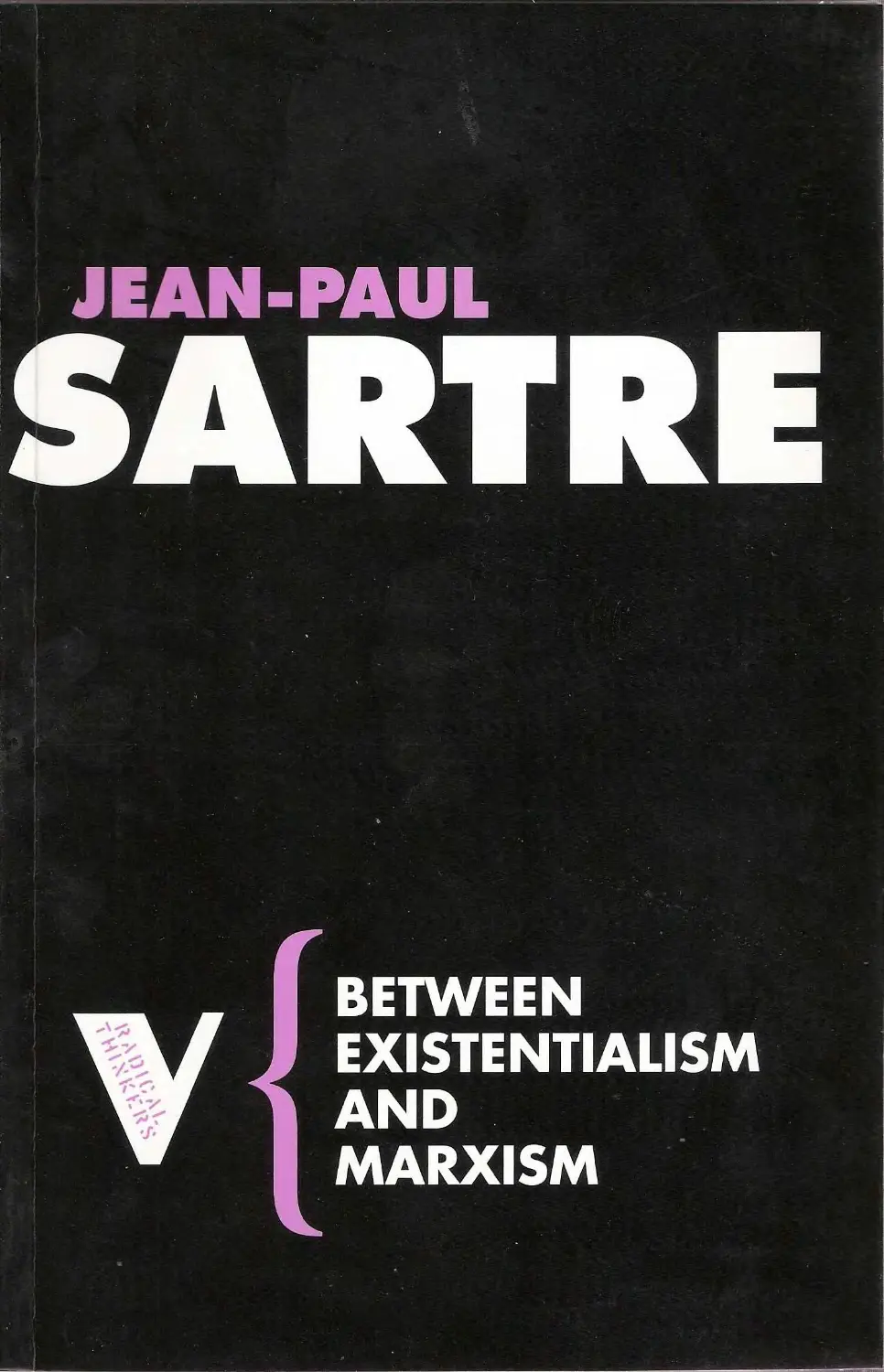
BETWEEN EXISTENTIALISM
AND MARXISM
Jean-Paul Sartre
. Transla
ed by John Matthews
)
_I
VER-SO
London . New York
I. Self-Descriptions
The Purpose. of Writing was originally an interview given by Sartre to Madeleine
Chapsal in 1959, and published in her volume entitled Les Ecrivains en Personne
(Paris 1960).
The Itinerary oj. a Thought was an interview given by Sartre a decade later, in
1969, to New Left Review, and published in NeW' Left Review No 58. English-
language copyright NLR.
The Purposes of Writing
I would lilee to asle you some questions about literature.
Good - hardly anyone ever discusses literature with me now. Philosophy
is another story. . . .
It's no1lJn that you are cu"ently working on sev.eral projects - (J book on
Mallarme, a book on Tintoretto, a book on Flaubert, and an autobiography.
You're working on all of them at once, without being able or - you might
say - without wanting to bring any of them to a conclusion. Can you explain
this?
Yes, I can - but it J;t1eans leaving literature to one side and coming back to
philosophy. For the last fifteen years I have been looking for something-
I was trying, f you like, to lay the political foundations of anthropology.
This project got bigger and bigger - it gre like a. generalized cancer.
Id s came to me, and I waJIl't sure what to do with them, so I put them
-anywhere - in whatever book ,I happened to be working on at the
time.
Now I've finished with that. The ideas are all in place. I'm working on
something that will relieve me of all of them - the Critique of Dialect;c.al
Reason. The first volume will be ublished within a mont , and the
second w thin a year. I no longer feel the_need to make long digressions
in my books, as if I were forever chasing after my own philosophy. It
will now b deposited in little coffins, and I will feel completely emptied
and at peace - as I felt after Being and Nothingness. AfeeIingof emptiness:
a writer is fortunate if he can attain such a state. For when one has othing
to say, one can say everything.
When the book on anthropology is finally behind me, I will be able to
write - on anything I like. As for philosophy, I will do no more'than make
brief mental notes about i , for my own purposes.
10
In your work, are philosophical ideas primary?
What is primary is what I haven't yet written - what I intend to write
(not tomorrow, but the day after tomorrow) and what perhaps I will
never write. . . .
Of course, since it takes a lot of time and effort to make a little headway
in ideological questions, this does amount in a y to saying that philo-
sophy is primary for me. But not always. When I wrote Huis Clos, for
example - a one-act play that doesn't contain a word of philosophy -
Being and Nothingn ss had already come out, or was at any rate in the
process of being published. This story of mine about souls in torment
was not symbolic - I had no wish to 'repeat' Being and Nothingness in
different words. What would have been the point? I simply made up
some stories ''lith an imagination, sensibility and thought that the con-
ception and writing of Being and Nothingness had united, integrated and
organized in a certain way. If you like, my tome on philosophy was being
narrated in the form of small n<?n-philosophical stories. The audience
believed there was soniething in them they 'had to unde:stand. There was
nothing of the sort.
But when one is writing works which are non-philosophical, while still
uminating on philosophy - as I have been doing for most of my time
over the last ten years - every page, every line, suffers from hernia.
Recently when I felt I was writing a hernia, I found it better to stop.
That's why I have all these books waiting to be completed. Of course,
I would very much like to finish them. Equally I would like to write
something completely different. For example, to say the Truth. This is
the dream of every aging writer. He thinks he has never told it - and yet
he has never spoken of anything else; he is naked. Let us suppose that he
insists, in any case, on doing a striptease himself. I have always 'produced
a literature of occasional writings; I have always produced to order. Of
course the employer can no longer be the State - nowadays it's everyone
or someone: a political milieu in which I am involved, a particular event
that calls for comment. The positive aspect of these orders is that they
never allow the writer to 'indulge himself'. And by the same token, his
public is automatically defined.
My pr ent b ok on the . Dialectic had its beginnings in an order. A
11ze Purposes oj' Writing 11
Polish review asked me to write an article on existentialism. I did so.
Then I rewrote it for the readers of Temps Modernes. And then, on re-
reading it, I saw that it lacked a foundatio - the compass and valid ty of
the Dialectic needed to be established. So then I got down an wrote the
weighty tome that will be coming out soon. The ideas were there, but I
lacked courage. . . . In earlier days I published books in complete inno-
cence; but I have lost that now. Anyway the Polish order was the kick
that despatches an apprentice parachutist into space. '
Did you have to write about tlte Dialectic in oriler to be able to d;scu.
Flaubert?
Yes. The fact that I couldn't stop myself discussing him in the Polish
article proves it; and the fact that I transposed long passages 'from my
book on him' into the Critique confirms it. At the present moment the
book on FJaubert is long and, still not finished. But at least it now won't
need a truss - it won't have any hernias.
Is this way of proceeding a personal cha,.acteristic of yours?
I think it depends' on the situation, on the current preoccupation of the
philosopher in question. Everything has changed: in Hegel's day history
burst into philosophy in the form of tragedy; in Kierkegaard's, it 'was
biography in the form or buffoonery, or drama.
Descartes saw pis principal task as the search for the correct rules to
guide the mind. What resulted from this was a Rationalism of Knowledge
and of Ethics. Of course Cartesian ism expressed and fashioned classical
reason. But whatever may have been its relations with tragedy, it is clear
that tragedy did not directly express the content of this universalism.
While toda.'y?
1'oday I think that philosophy is dramatic in nature. The time for con-
templating the immobility of substances which are what they are, or for
laying bare the Jaws underlying a succession of phenomena, is past.
P ilosophy is concerned with man - who is at once an agent and an act ,
who produces and plays his drama while he lives the contradictions of his
situation, until, either his individuality is shattel ed or his conflicts ar
resolved. A play (be it epic, such as Brecht's, or dra atic) is the most
12
appropriate vehicle today for showing man in action - i.e. man full stop.
It is with this ,nan that philosophy, from its own point of view, should
be concerned. That is why the theatre is philosophical and philosophy
dramatic. '
If this is what philosophy is to become, then why the rest oj your literary
output? Why don't you limit yourse/fto books o philosophy.'
I wanted to write novels and plays a long time before I knew what
philosophy was. I still want to; I've wanted to all my life.
Since school?
Even before that. I found philosophy at school so boring that I was
convinced it was just a waste of time. My attitude owed something per-
haps to the way the subject was taught i those days.
But in any case these perspectives on the reality of man are not inter-
changeable. Philosophy is dramatic but it does not study the individual
as such. There is a certain amount of osmosis between my book on
Flaubert and the Critique, but what will never be transferred from the
first book to the second is the effort to understand Flaubert as an indi-
vidual (it matters little in this respect, of course, if I fail or am partly
successful). Again it's a question of an ordered interpretation. It would
be impossible to philosophize on Madame Bovary because this is a unique
book. More unique than its author -like all books. But it can be $tudied
with method.
In What is Literature? you said that, in your opinion, prose was no more
than an instrument, an extensio of one's arm or hand. Yet the writers who
interest you are Flaubert, Genet, Mallarme - all of whom seemed to regard
writing as an end in itself. How do you reconcile this contradiction?
There are differences between the three. As far as Flaubert is concerned,
I use him to show that literature, understood as a pure art deriving all
its rules from its own essence, conceals its author's commitment and his
fiery opinions on every sort of subject - including social and political
questions. Flaubert is a classic case. I'm sure that I will be attacked for
taking advantage of him unduly. Whose fault is this? Flailbert is a very
great writer. And after all, why shouldn't I try to explain the mixture of
1'he Purp.oses of Writi1lg 13
profound admiration and repulsion that Madame Bova y has inspired
in me ever since my adolescence?
On the other hand, I am in complete sympathy with MaUarme and
Genet - they are both, conscious of their commitment.
Mal/arm'.'
Yes, in my opinion. It is certain that Mallarme bore little resemblance to
the Mallarme of literary history. He is our greatest poet. A wild, im-
passioned man. Yet so self-controlled that he could kill himself with a'
simple movement of his glottis! . . . 'His was an all-embracing commitment
- social as much as poetic.
A commitm t that was a rejection then?
Not just that. He rejected his epoch, but he preserved it in the form of a
transition, a tu nel. He hoped that one day what he used to call 'the
crowd' - by which he meant a mass public assembled in a godless cath-
edral rather than in a theatre - would see Tragedy played before th m.
The one and only Tragedy - at once the drama of man, the movement of
the world, the tragic return of the, seasons - a tragedy whose author (as
anonymous as Homer) would be dead, or else be just one of the audience,
present at the unfolding of a 'masterpiece that did not belong to him,
one which all would st ge for him as for all. MaUarme linked his Orphic
and tragic conceptions of Poetry to the communion of a people rather
than to individual hermeticis,m. The latter w s no more than a rejection
of bourgeois stupidity. To be sure, MaUarme did not think one could
write 'openly' for a mass publi . But he felt that for a united people, the
obscure would become clear. {
So 1lJnat you're saying, is that even Miters who are considered to be detached
are in reality committed. 2 Did y u study Flaubert and .M;allarme in order to
demonstrate this?
This and other things. In the case of Mallarme I have only just begun
and won't be able to take him up again for a long time. I. mention him
only to indicate that 'pure' literature is a dream.
So you believe that literature is a/TPays committed?
tf {itet1\tur is pot everythins it is worth nothin . This is wh t I mean by
I4
'commitment'. It \\Tilts if it is reduced to innocence, or to songs. If a
\vritten sentence does not reverberate at every level of man and society,
then it makes no sense. What is the literature of an epoch But the epoch
appropriated by its literature?
You have been acctlsed oj" not taking literature seriously enough, . of wanting
to "take it the ,-,assai of politics. ,What do you say to that?
I think it would be more logical for people to accuse me of exaggerating
its importance. The beauty of literature lies in its desire to be everything -
and not in a sterile quest for beauty. Only a whole can be beautiful:
those \\'ho can't understand this - whateyer they may have said - have
not attacked me in the name of art, but in the name of their particular
commitment.
In your case, do you think that literature has fu/filled all its promises?
I don't believe it can fulfil them - not in my case, nor in that of anyone
in particular. What I have in mind are the exigencies of pride. An insane
pride is necessary to write - you can only afford to be modest after you've
sunk your pride in your work. Having said this, it must be confessed that
the author can miss his mark; he can also be interrupted in the middle of
his work. So what ? You have to aspire to everything to have hopes of
doing something.
But i. n't this what every writer dreams. of - to . write something that is
et'er ything?
I think s ; I would hope so. But I'm afraid of the humility of certain
writers. All those academies and legions of honour - a writer must be so
humble to accept them! On the other hand, if others try to elicit every-
thing out of nothing, they should say so.
Why?
If they maintain silence they perpetuate a contradiction which disturbs
other writers. A writer has nothing in his hands, nothing in his pockets.
If he's h lding a pack of cards, he has to start by laying them on the
table. I loathe all charlatans who try to make people believe that there is
something magic about writing. They lead those who come after them
stray they mould them ioto sQrcerers Jik themselves. Let writers
The Purposes f Writing IS
begi by renouncing illusionism. What vanity and humility to want to be
taken for conjurers.! Let them say openly what they aspire to and what
they're d ing.
The critics encourage them never to admit to a soul - above all to
themselves - the nature of their desires and the means at their disposal.
They want to cling to the old romantic idea - the best of us must write
as the bird sings. But a writer is not a bird.
Are there any writers today who are working in accordance with your ideas -
towards greater freedom, within a full commit'f11ent? Which contemporary
writers interest you?
If you put the question to me in that form, then I must confess there
aren't too many. There are some very talented writers: Butor, Beckett.
I'm very interested in the works of Robbe-Grillet and of Nathalie
Sarraute. Still, if we examine their works from the point of view of totality,
I would say that there is only one writer in France who has clearly
formulated' the problem and found an answer to the demands of the
whole - and that is Butor.
,I don't think the others are interested in the problem - they're looking
for som thing else. And why not recognize their right to do so?
( .
You feel that writers are wrong to restrict the field of their inquiries?
No, of course not. But they would be wrong to declare - as they do
perhaps, butcthen what writer hasn't at some. point in his .life ? - that there
is only one thing worth doing: what they are doing at the moment. But
inquiry and 'experience are v,aluable. There are so many of us in this
country, creating togeth r and alone the real totality of French literature
today, as objective spirit! Individuals can linger over details - they won't
contribute any less to the whole, thanks to the efforts of all the others.
Would you say that your research is more total in scope than that of others?
In its intention, yes; but its success is something else altogether! Many
people have a sharp sight for details, but lose focus when they try to
locate these details in the ensemble. I can say without any qualification
whatever that I have always found what Nathalie Sarraute writes to be"
remarkable. But she believes that the protoplasmic exchanges which she
16
describes enable her to grasp the elementary relations between indivi-
duals, whereas alJ she succeeds in revealing are the abstract _and infinitesi-
mal effects of a welI defined social milieu: one that is leisured, bourgeois,
somewhat worldly, in which work and i leness are never really distin-
guished. The paranoic structure which becomes more and more marked
in her books, reveals a type of relationship characteristic of these milieus.
But in her works the individual is not restored to his position within
the milieu which conditions him; nor is the milieu restored within the
individual. We are left on the undifferentiated and illusory plane of the
immediate. In reality, all these inter-individual movements are defined
by their relation to a totality - a whole that is mutely sigDified by their
very pulverulence. But in Nathalie Sarraute's books, the totality is
distinguished by its absen9C. The title of her latest work, Planetarium,
proves that it has been excluded intentionally. For that matter the swarm-
ing qu.ality of her Planetarium eV9kes a copy of Proust's Temps Retrouve
slowly decomposing under the action of lost Time (Temps perdu). In this,
too, it is very much the work of a wom n; for this pulverization is exactly
the obverse of the refusal to assume responsibility for an at\omized world
- it is the rejection of action. .
You just referred to 'the work of a woman'. Do you think women are incapable
of writing anything but women's books.'2
I
Not at all. What I understand by a woman's book is one w ich refuses
to take into account the activities of men. A' lot of men have written
nothing but feminine books. And by 'wo an' 1 ean 'woman in society' -
tbe woman who has been dispossessed of the right to say: 'I have no less
an impact on the world than my male neighbour.' When I peak of a
'woman's novel', this is what I have in mind: the novelist has made her
mark with her t ent, but she has shown no desire to wrench herself out
of her disinherited condition - both because of resentment and connivance
with the enemy.
I referred a moment ago to paranoic structure. It must be stressed
again that this imposes itself on an author involuntarily, perhaps un-
consciously. Contemporary music has set itself the task of isolating these
structures in sound-space, but our 'young novelists' are either unaware
of the e:x;istence of such structures, or expel them from the universe of
The Purpo..'ics of Writi1lg I7
the novel. They have discovered that characters, qualities, substances
never had any existence. It is positive that each generation should re-
discover this. But does it mean that there is no synchronic or diachronic
structure in the societies which produced them? Don't these novelists
realize that what they are eliminating from their works forms the very
foundation of anthropology and anthropolo cal research?
It.is said, for example, that Robbe-Grillet's aim is to decondition our
literary vision by sweeping away all its pre-established significations.
Fashionable. critics on the left who support Ro:bb Grillet have even
gone so far as to say that this deconditioning will liberate us from any
bourgeois vision of the world. Unfortunately, this deconditioning may be
possible in a musical work - as in the case of Webern - but only in the
sense that it liberates the listener from his expectations. But the total
object that figures in a novel is a human object, and it is nothing without
its human significations. Robbe-Grillet's deconditioned -objects float
between two levels of signification, between two extremes. On the one
hand,"he may deal with topographies, mechanical measurements, strictly
objective descriptions - yet nothing is more human than the use of
(landmarks, calculations and surveys. Take away man, and things are no
Io ger near or far off - they are no longer things at all. The affirmation
that we can describe things, classify them, find an order in them is the
primary moment of mathematical Reason. Alternatively - and this is
Robbe-Grillet's other extreme - these highly rigorous descriptions
suddenly assume the guise of symbols of an obsessional and rigorously
subjective universe. This universe has to deploy a particular symbol-
object because the obsessive subject's,thinking cannot - as Lacan would
say - achieve articulation. A case in point is the famous rape in Robbe-
Grillet's Voyeur. This story shows children walking alon a beach; the
author's attention seems to be concentrated solely on the intersection of
two movements - the movement of the waves, and perpendicular to this,
that of the children's footprints in the wet sand. Suddenly everything
capsizes into a symbol; the mere chiming of a bell is enough to make us
see the children's walk as undefined, aimless, and .yet ordered by certain
ppeals which may be real or may be dreams - we will never know; a
walk which seems to be unique and at the same time begins over and
over again. What we have here is quite simply a rather flat symbol of
I8
our condition; in other words, Rene Char's man, an imitated illusion.
I find a stra ge attraction in objects like, this ones which betray
their makers. It remains true that they are the product of a laboratory-
type schematization. Noone has the right to choose between all the
diverse significations whose dense sweeps 'constitute human reality.
They have to be there - all of them. It is not necessary to name them,..
But literature finds its initial impulse in silence.
You don't feel that a/I things are always present in this silence, even whe1t the
writer selects only one or two of them? Ijyou 'were writing a review of one of
Robbe-Griller's orNathalie Sa"aute's books, would you demonstrate that the
universe is there, in its totality, around their every phrase?
Yes. Perhaps. But it would be a waste of time. On the other hand, we
\
should recognize that someone is alive today in France who has the
ambition and every possibility of becoming a great writer - our first
great writer si'nce 1945: Butor. He's the man we should be trying to help-
although.I suspect he needs no assistance - by attempting to interpret is
intentions and communicating them to the public. He i proud - he writes
to live. He aims to capture in his writing men who seem at times to come
straight out of a populist novel, through the totality in which they are lost.
And, because of this, none of these men turns out to be what we took
him to be at first: each one, lo t at first in the whole, ends up by interior-
izing and expressing it; each one ends up by writing.
I'm in the middle of reading Degres at the moment. Never before have
I come across such an able and profound attempt to seize an individual
in the light of the family and work relations which produce and condition
him, and which he transforms. A new life comes jnto existence: in this
novel, a man cannot be reduced to a series of social attributes, nor is he
properly an indiv dual reality. Nor yet a mere mixture of social and
individual characteristics. In fact, the principle of individuality is aban-
doned. Within professional and traditional groups we find recurrent
groups and indeterminate groups appearing - and they are all the same.
This book is certainly out of the ordinary. If I were a critic, I would very
much like to discuss it.
I am struck all the more in that I saw great promise in his earlier
work, La Modification, Butor has given the objects which in Robbe.
The Purposes of Writing 19
Grillet's hands are no more than an index of obsession, their true meaning
(through a technique which is hardly new, but which reveals an extreme
rigour): they become instruments which transform whoever uses them.
An intention to catch a train acts as a cen re of indetermination. But for
the moment it is the train which acts: its trajectory, its stops, its traditions,
the station and its irreversibility (both departure and destination' are
eq ally irreversible - while topographically the two stations are equi-
valent), the distances to the other people - all these .factors 'nlodify the
characters.
I get the feeling from Butor's first three books that we are confronted
here with a premeditated attempt - the perfectly hopeless attempt that
only a true writer is capable of - to master everything. He has already
covered a lot of ground, and he will go further.
But what about you? What has your own experience of literary activity been?
Have you used literature in the way you hoped to? Are you content, optimistic. 2
Or do youfeel disappointed?
No, I've never felt disappointed. My worle has always gone well. There
have been books I had to abandon half-way through because I didn't know
how to go on. Others that I had hopes for were published but got a bad
reception - and I realized that I was wrong and the critics were right.
But that's all part of the job. One way or another, you get the same
frustrations in any profession.
J What I mean is that writing in itself cannot entail disappointment. In
what follows I'm going to appear a bit confused, but the subject would
take up too much time otherwise. So to be brief: in the domain' of ex-
pression, success is necessarily failure. I'm not referring to those mis-
understandings to which the aristocratic authors of'the last century
attributed their large circulations. I'm speaking of technical success. I,t
is impossihle to succeed, since at the outset you set yourself the goal of
failure (to capture movement in immobile objects, for instance); after all
the lies, you always come back to this in the end - so many little faults
accumulate that the moment comes when you just can't take the work
,any further; all is lost. At this point, my friend Giacometti explains, you
can throw your piece of sculpture in the rubbish bin or exhibit it in a
s-allery. So there it is, You never quite grasp what you set out to achieve,
20
"
And.then suddenly it's a statue or a book. The opposite of what you
wanted. If its faults are insc bed methodically in the n gative which you
present to the public, they at least point to what it might have been. And
the spectator becomes the real sculptor, fashioning his model in thin air,
or reading the book between the lines.
Since you mention the public, how would you describe your relation to it.'
How has this relation evolved.' Haven't you said that the public plays an
important rf)le in the life of a written work.
One has so many links not only to one's ti e but, in - this epoch of
nationalism, to national society as well- that a writer's personal history
is inevitably that of his public. One day, when we were young, Simone de
Beauvoir and myself decided "to o skiing - a serious and deliberate
decision, which we thought quite original. The day we left, we discovered
that all the older school-children in Paris together with all their teachers
had been just as original as ourselves. What this means'is that I would
never say what I felt unless I were sure that everyone felt the same. I
don't want to express my public in spite of myself, af er the fashion of
those fin de siecle aristocrats of sensibility who aspired to' an exquisite
sense of Toledo or of Goya - and who, in the end, merely expressed a
bourgeois preciosity that was soon throttled by the First World War.
My aim is to express, to the best of my ability, wha"t I fiel as an ordinary
person.
Who makes up your public.'
Students, teachers, people who love reading, who have a weakness for
it - they make up a very small circle. My print-run is of no significance;
it can be large or small, but this particular readership is still the same.
Not my readership but ours: that of everyone wpo is afflicted with the vice
of writing.
Journalists have an odd approach: they compile a list of circulations,
calculate averages and make statistical comparisons (of dubious accuracy
since they are generally based on incorrect data), and then draw con-
clusions. What they've done is co fuse the meaning of the print.run of a
book with that of their own newspaper. In a country like the USSR where
there are State publishing' ventures the circulation of book has a rell
The Purposes of Writing 21
meaning: if the public demands a new translation of Zola, this' means
that people really want to read or re-read Zola. Whereas here, under
conditions of liberal capitalism and free enterprise, circulation figures
have no meaning. What relationship is there between a book like S hwarz-
Bart's recent novel - a thoughtful, relentless, profound work, an attempt
devoid of any illusions to recover all the dead we have killed -, and the
sma.rtly dressed young woman with a hard, stupid face I saw the other
day reading The Last of the Just in the dining car as she ate a pastry?
She was reading his book, but she wasn't part of his public.
You haven't quite answered my question. Do you personally feel you hl;lve
succeeded or failed. 2 Would you say that anything has changed because of
what you have written?
Not a thing. On the contrary, ever since my youth I have experienced
utter impotence. But that's neither here nor there. You could say, if you
like, that to begin with I wrote a few books which weren't directly con-
cerned with social problems; then came the Occupation - people began
to think it was necessary to act. After the war, we felt once more that'
books, articles, etc. could be of use. In fact they were of no use W' atever.
Then we came to feel - or at least I did - that books conceived and
written without any specific relation to the immediate situation could be
of long-ter use. And these turned out to .be just as useless, for the
purpose of acting on people - all you found was a distortion of your oWn
thoughts and feelings. You find your own words turned against you and
changed out of all recognition by a young man taking a casual swipe at
you. Fair enough - I did the same myself. That's literary endeavour for
you - you can see that it doesn't produce the results you wanted it to.
All the same, those you have influenced haven't all turned round anti attacked
you. Don't you ever come acrOss Miters in whom you recognize yourself with
Pleasure?
Of course. But you must understand - if I am to approve of them they
m st be making something new out of what I've made myself; and since
I am still alive, this can only be in opposition to what I am doing myself.
People worthy of esteem-could never be the passive recipients of someone
22
else's influence. If I really" recognized myself in someone, it would vex
me - why begin what I have done all over again? On the contrary, if"a
writer (or a young reader who is not a writer) pleases me, it's usually
because he disconcerts me somewhat initially. So much the better if I
subsequently discover behind the novelty of his thoughts an image of my
former self - though altered and half-obscured with age.
In a word, what is honourable about reading is this: the reader freely
allows himself to be influenced. This fact alone is enough to quash the
fable of his passivity. The reader invents us: he uses our words to set his
own traps for himself. He is active, he transcends us - that is why we
write. And that precisely is why I have never been disappointed by iny
craft. Of course, I had to endure the apprenticeship of impotence - but
this was because in 1940 or thereabouts I still innocendy believed in
Father Christmas.
Perhaps this will surprise you, hut I have someti,nes had the feeling that you
yourself were somewhat imprisoned within this epoch, this society, and within
your work as well. When I saw Les Sequestres d'Altona I said to, myself
that the real victim of sequestration was yourself.
Myself? I should welcome it. Hitherto, I've never been sequestered
enough for my liking. If I were Frantz, I wouldn't be consumed with
remorse. Fundamentally, he represents the negative of one of my fondest
dreams' - to be in a cell, and to be able to write in peace. I shall nourish
this sweet regret until the day I die. . . !
No, what I actually wanted to'do was pass on something that I felt.- in
common, I believe, with everyone. The men of my generation and those
a little younger than ourselves (I'm '54) were gripped by a feeling of
consternation when we looked upon this epoch we all helped to build,
and we said: 'So, that's what it was.' I'm not talking about what a young
Russian might have felt, but of what a Frenchman felt when he looked back.
You must understand; in our youth we were gentle - the problem of
violence tormented us. The upshot was that the whole of the younger
generation espoused a violent creed and so disposed of the problem.
That's what I was trying to say to you - how difficult it is to recognize
oneself in others! Because one is other.
Precisely. One has the feeling that you WhO"' the problem of violence 'tor-
11ze Purposes of Writing 23
mented' are still worse at ease in this gloomy society of ours than others, that
you feel restricted in it, that it stifles you - and that you 'secrete' your work
as a kind of refuge from it. This is why I asked you whether you felt 'seques-
tered' .
No. The sense of gloom in Les Sequestres was essentially inspired by _t e
current state of French society. It's a frightful wreckage - and like anyone
else, i'm inescapably' part of it. If I'm a prisoner - together with all who
have said no and who go on saying no - it s of the present regime.
What do you call violence?
The people of my generation had lived through two periods of sacred
violence by the time they reached their adolescence. In 1914 there was
the war: we were told that it was just and that God was on our side. And
in 1917 there was the Russian Revolution. In the interim, in fact, we had
become a little less mystified, and by 1919 our hopes rested on the
Revolution. Don't get the idea that I am confusing the violence of a
capitalist war with that of the i surrection of Petrograd. Today I firmly
believe that the month of October 1917 irreversibly transformed the
world. But I'm discussing how we felt as children. We were steeped in the
violence of our fathers. From 1914 to 1918 I lived at La Rochelle: at that
time children were in power - they thought they were at the front. One
of my school-friends' chased after his mother with a knife - he had
given him potatoes, and he didn't like them. In other respects, they were
very. sensible boys. But these events had in some way turned their heads -
they, were asked to interiorize this sacred violence. They did so and, in
their ensuing disgust, many of them - including myself - experienced
little diffic lty in substituting a holy revolution fo this holy wa . When I
became a student at the Ecole Normale, no one - not even a thala* -
would have dared to openly reject violence. We were concerned above aU
to channel it, to restrict it. We sought a well-behaved and profitable
violence. Most of us were very mild and yet we became violent beings.
For one of our ,problems was this: could a particular act be described as
one of revolutionary violence or did it rather go beyond the violence
necessary for the revolution? This problem has stayed with us all our
lives - we will never surmount it.
:lTranslator's note: A militant Catholic student - from 'ceux qui vont a la messe'.
24
Do you. see what I mean? Mter that, many ,of us had children. Not
myself, but then I taught other people's children - I was a teacher. All
of us shared the' responsibility for bringmg them up:, And then these
children had children of their own. Now, it seems to me. that these
children have grown up under our influence and that many of them have
radicalized the whole phenom non of violence. The young people in Lon-
don who recently started to lynch West In ians) young German anti-
emites or young French fascists all share a' common indulgence in an
absolutely pure and unconditioned violence. Su h a brand of violence
never calls itself into question. It kes no effort to criticize itself. It is
in love with itself. It is as much an explosion of hate proyoked by ppverty
as a sport. There are b/ousons noirs - juvenile delinquents - who are
bored out of their minds i the housing estates of the Paris suburbs.
They form gangs; and then everything is so cosy, so sinisterly cosy in
these high-rise apartment blocks - carefully built .by the neo-paternalism
of our capitalists - that there's nothing for them to do but smash every-
thing. .
This is what staggers us. One use to think - or at l st we thought - of
violence as born of exploitation and oppression, and as directed against
them. In a certain sense, there was a p litical motivation' behind the
construction of these apartment .blocks, directed - like all paternalist
policies - against the interests of the workers. Now we,' older ones, would
understand it if young people broke doors and windows in them as
protest agai st this paternalism. I m not saying they would be right, but
that we would understand them. But no, they pick fights with each 'other,
or beat up passers-by. It is certainly their situation which provokes this
violence. But it only appears legitiinate to them because it is anarchic. If
it acquired the slightest political direction, they would begin to suspect it.
In our eyes, violence could be justified if it were being used to safe-
guard the interests f the masses, a revolution, etc. But for these de-
linquents, violence can never, be put to use: it is good only when it's
senseless.
I don't want to go on and discuss this: I'm merely giving you an example
of influence at work. And of course these young people weren't con-
ditioned by our conceptions, but by the Cold War. But then \\'e were the
ones who waged the Cold War.
The Purposes oJ Writing 25
Do you believe that one fashions one's epoch."
When you reach the age of 54, you can be excused for s eaking in the
p st. tense. But it does.n't matter how old you are, it always remains true
that History ma es man and man makes History.
Would you ay that we are responsible for it?
es, both responsible and complicit. The whole of French society is
re ponsible for the Algerian War, and for the way it is being conducted
(torture, internment camps, etc.) - the whole of the 'society, including the
men and women who have never stopped protesting against it. We are
inextricably involved: th slightest discussion between the left-wing
groups who were gradually assassinating each other had the effect of
encouraging orture, or a putsch. All these s ft and well-meaning gentle
men' we have become - we have all had to interiorize the war. The result
is that we are solidary with it, plunged ever more deeply in violence. This,
among other things, is what I was trying to convey in Les Sequestr's. The
dying Frantz, the executioner - he is us, he is myself.
None of this stops a man from writing.
:. , I:" .
What do you see as the function of literature, if you have this feeling of
impotence, in a century that has seen more violence than any before it. t
Man lives in the midst of,images. Literature offers him a critical image of
himself.
Then it's a mirror. t
A critical mirror. If literature is to be engaged, it must reveal, demon-
strate, represent. After that, people can lOok at each other face to face,
and act as they want. In the eighteenth century, writers were arried along
by history, but not today; now they have become suspect. We should try
,to keep this role for ourselves - what would become of a society if it had
no suspects?
You think writers are 'suspect' ! Aren't you over-estimating the importance
accorded to thenz?
They are suspected of having a mirror in their pocket, of wanting to take
26
it out and hold it up to their 'neighbour - who might have a stroke if he
saw himself as he really is. . . .
Writers are suspect because Poetry and Prose have become critical
Arts: it was MaUarme who called his own body of work, 'critical poetry'.
Writing, today as in the past, has always meant calling-' the whole of
writing into question. The same i true of Painting, Sculpture, Music:-
Art in its totality is engaged in the activity of a single man, as he tests and
pushes back' its limits. But writing cannot be critical without calling
everything into question: this is its content. The adventure ,of writing
undertaken by each writer challenges the whole of mankind. Both those
who read and those who do not. Any string of words whatsoever (assuming
the writer has talent) - even a sentence describing the virgin forest - calls
everythin we have done into .question, and poses the issue of legitimacy
(which particular one is of little importance - all are shapes of human
power). Compare these suspects, to ethnologists: ethnologists describe,
but writers can' no longer describe. They must take sides.
Isn't the writer's occupation a strange one? Of course, writing demands a
lot of energy, but at the same time it seems to derive from the writer's
weakness.
In my case, I chose writing in place of death, and because I lacked faith.
That was certainly a sort of weakness.
When I was seven or eight years old, I Jived with my widowed mother
together with a Catholic grandmother and a Protestant grandfather. At
the dinner table, each poked fun at the other's religion. No malice was
involved - it was simply a family tradition.' But a child reasons in a
straightforward fashion: I concluded from these exchanges that the two
faiths were equally valueless. Even though my family saw it a their duty
to bring me up as a Catholic, religion never had any weight with me.
Now about the same age I was terrified of death. Why? Perhaps,
understandably, because I had no beneficent myth of eternal life to fall
back on (beneficent for children, that is). I was already writing, in my
childish way. I was already pouring my longing for immortality - literary
immortality, of course - into writing. I have since abandoned the idea of
literary survival, but it was certainly the initial focus of my cathexis.
The Christian, in principle, has no fear of death because he knows he
1'he ]Jurposes oj' Writing 27
has to die in order to begin true life. Life on earth is merely a period of
trial to earn glory in heaven. Various precise obligations go with this.
There are rites to be observed,' and vows can be taken,' such as those of
obedience, chastity, poverty. I inherited all this and transposed it bodily
into literary terms - I would be unknown all my life, but I would merit
immortalijy through my dedication to writing and my professional
integrity. My glory as a writer would date from the time of my death.
I had some stirring debates with my conscience: was it necessary for me
to experien e everything before I could write about" everything? Or
should I live a monk's life in order to devote all my time to polishing my
phrases? In either case what was at stake was everything. In my imagin-
ation, literary life was modelled on religious life. I dreamt only of ensuring
my alvation. . . .
, I wasn't aware of any of this until I was forty - simply because I ha
never inquired into my motives for writing. I contested everything sa e
my own profession. Then one day I was writing down some thoughts on
morality when it struck me that I 'Yas propounding a writer's ethics for
the benefit of writers - though I was supposed to be addressing people
who never did any writing! That forced me to go back to the origins of
this bizarre attitude, to unearth its presuppositions - or, if you like, my
childhood cathexes. Today I'm sure I came to the right conclusion -
that I had transposed religious needs into literary longings. The more so
since writers a little older than myself followed the same trajectory - it
was the epoch that fashioned its future writers.
So you're right in effect; writing is an escape, a sign of weakness.
'What d,oes it matter to me, if I can write Pa/udes . . . ?'
But didn't you jllst say that you 1tO longer have O,1ty interest i,z literary
glory?
It's not that I no longer have any interest in it, but that from a certain
point in my life onwards, it no longer made any sense. The more death
became a reality, the more this glory became pure mystification. Someone
said recently t at he knew of nothing more igno.minious than posthumous
r habilitation: one of our number is trapped, he dies from rage or grief
and then, a quarter of a tcentury later, a monument is erected in his
honour. And the jackals who make the speeches over his effigy are the
28
very ones who killed him in the first place - they honour death in order to
poison the living.
As a matter of fact, no one - nothing - can be rehabilitated, especially
not an assassin. As for the dead man: he suffers until the very end, he
perishes in despair, and that's the end of it for him. In their own time,
Nietzsche 'and Baudelaire were made wretched and senile - and now
peop e turn round and tell us th t one was the prophet of the twentieth
century, and the other was France's greatest poet! . . . What do these
titles change? Death cannot be recUperated.
But what did you mean when you spoke of weakness ( I don't think
I've touched upon what you had in mind.
I feel a writer always has a recourse to fall back on. He writes his work,
good or bad (you said a moment ago that literary labour in itself cannot
disappoint),. when he finds reality disagreeable he can retreat and 'seek
refuge with his pen and paper. While a man who involves himself in action
is liable to lose everything.
You speak as if a choice were possible. The fact is th t - save in the case
of a restricted circle of leisured members of the ruling class - you cannot
choose between writing and politics. It's the situation that decides. Take
the men who form the Algerian FLN, for example: for them the politi l
problem was posed as something violent and immediate. A whole gener-
ation knew nothin but war from their earliest childhood. Re ourse to
violence, in such a case, is not an option, but a course of action imposed
by the situation. When the war is over, some of them will doubtless
become writers. But politics and war will have been their lot initially.
In France, it's the middle classes that supply both the literary and
political personnel of the nation. The nation is rather shop-worn - and
has been for many years. Therefore hesitation is permitted. You know the
result - the wretchedn ss of French politicians. At this level there is no
distinction between the two activities: bad "literatul e is redeemed by its
political content, and politics is turned into bad literature. This lack of
differentiation is such that writers ate attacked - as I have been - for
having lost wars (a right-wing attack) or for not urging the mas es to the
assault of our Bastilles (a left-wing attack). A few years ago a journalist
came to see me, at a time when the affairs of State or Universe weren't
The Purposes of Writing 29
going too well. 'What I need is a cry from the heart,' he told me, 'would
you be so good as to ma e it?' Can you believe it - sometimes I did!
But with varied results - wl)ich depended on other people: on the num-
ber of those who had decided -- before my intervention, of course ,- to join
the demonstration. But this is the very grandeur and weakness of a
literature pf pathos - in politics, it depends for its effect entirelyo:,on
others. -It is other people - who perhaps have not even read the writer -
who swell his words with their passion. The real work of the committed
writer is, as I ,said before, to reveal, demonstrate, demystify, and dissolve
myths and fetishes in a critical acid bath. With a bit of luck, other people
will utilize him to create new myths; or else - as happened in the case
of 'Pushkin and' of the Elizabethans - the 'purest or most flamboyant
style can become the equivalent of political action because the writer
enables the nation to iscover its own language,' as the ulti ate moment
of its unification. W e ere not given such opportunities. I feel that fewer
and fewer young people are driven to write these days. In my time, you
could hope to die in your bed. I felt assured of a long life when I looked
at my ancient but active grandfather: I had the right to adopt a literary
religion, as I had sixty years of faith and needs in front of me. But since
the Cold War, young people have been brought up to believe that death
could come any day. God has regained the upper hand over literature - he
can save a soul at a moment's n.otice, whereas my God, a crueller deity,
demanded a lifetime's work. . . . And so the mystification begins all over
again - history is full of such cycles and eddies. I've said all this to show
you that explanations of literature based on psychological concepts of
weakness or strength - or any other subjective notion - are at once
superficially, correct and far too simple. Don't forget that a man carries
a whole epoch within him, just as a wave carries the whole of the sea. . . .
You think people are becomi g jess inclinerJ to write. 2
There's no lack of inclination, certainly. But do writers today want' to do
nothing else but write? Maybe one day the faculty of writing will belong
to everyone - someone will make use of it somewhere, then it will dis-
appear and reappear in their neighbour. Full-time writers will be a thing
of the past - there will simply be people who do several things, including
writing. This will be a much more satisfactory situation - one which wiU
3°
go far closer to fulfilling the basic need to wt.ite that is present in everyone -
even today. Just who are we, the professionals? We claim to have re-
ceived a mandate; people let us do the writing - instead of doing it
themselves. We put ourselves forward as elected representatives. But
this is a lie. And with today's huge print-runs, the publishing houses
accentuate the fraud - every book bought becomes a vote in favour of its
author. In reality, people read because they want to write. Anyway,
reading is a sort of rewriting.
From this point of view, yes, people discover that they have a need to
express their lives. During my time as a prisoner of war in a German
Stalag, I came across a little poacher. He'd really been through the mill -
abandoned child, brought up by the State, every sort of misfortune.
One day, after he had joined up in the Army, he got a letter telling him
his wife was deceiving him. He left at once with his gun, found her in
bed in the arms of her lover, and shot the two of them on the spot. Then
he came back a.nd gave himseIfup. This was in May 1940. He was thrown
into a military prison. Then the Germans came, and packed him off to a
prison camp in Germany. His story of passion a d crime, no longer
subject to sanction, remained unresolved. We, his comrades, knew all
about it - an official from the Military Tribunal was able to confirm it.
But this wasn't enough - the man felt cheated. All the more so since
mourning was doing its work ins de him, and there would soon be nothing
left of the experience but an abstract memory. 8e then invented the idea of
writing it down in order to express it - in other words, to possess it in all
its clarity and distinction, and at the same time to let the story take
possession of him and so survive - with its author, frozen and objectified
within ,it. Of course, he wrote it very badly - this is where the difficulties
start. Read Blanchot's Le Paradoxe d'Ayrte - he explains marvellously
how this initial desire to say everything results in everything being hidden.
But that's another question. What I'm trying to say is that people - people
everywhere - wish their own life, with all its dark places that they sense,
to be an'experience not only lived, but presented. They would like to see it
disengaged from all the elements that crush it; and rendered essential by
an expression that reduces what crushes them to inessen ial conditions of
their person. Everyone wants to write because everyone has a need to be
meaningful - to signify what they experience. Otherwise it all slips away-
The Purposes of Writing 3 1
I
you go about with your nose to the ground, like the pig made to dig for
truffles - and you find nothing.
I've shed a lot of literary illusions - that literature has an absolute
value, for instance, that it can save a man or simply change men (except
in special circumstan es). Today all this seems long out of date to me.
But the -,writer goes on writi g, having lost these illusions, b6cause; 'as
the psychoanalysts say - he, has invested everything in his occupation.
He goes on writing for the same reason that others go on living with
people of whom they are no longer fond, or are fond in a different way -
because they a e their family. But I still possess one conviction, one only,
and I shall never be shaken from it: writing is a need felt by everyone.
It's the highest fQrm of the basic need to communicate.
In that case, shouldn't those who have chosen writing as a career be the most
satisfied of people, since they spend their whole time doing what others only
dream of?
.No, because it's their job. Every person is always faced in his own lifetime
with the task of wresting his life from the various forms of night.
Is q reader necessary?
Of course. The cri ecrit - written cry - to use Cocteau's phrase, only
becomes an absolute when it is preserved in other people's memories,
when it is integrated into the objective- spirit. It goes without saying that
the public you aim to reach (it may be imaginary) will never coincide
exactly with the ppblic you actually reach. But perhaps this real public
takes the place of (the 'one you aimed'at.
Deep d011J1l, then, everyone would like to be a writer. 2
Yes and no. A writer alienates himself to his writing - which is unfor-
tunate. When I was eight, I thought that Nature nerself was not insensible
to the appearance of a good book. When an author finished his manuscr pt
with the words 'the end', I fancied a falling star would appear in the sky!
Today I feel that writing, as a job, is an activity that is more or less the
me as any other. . But I must repeat, this is not the point: what is
important is that every single person feels, perhaps only unconsciously,
the need to be a witness of his time, of his life - before the eyes of all, to
3 2
be a witness to himself. And you should never forget that our feelings and
acts are always ambiguous and confused - something inside us obstructs
their development, or interferes with then1 like crackle on a radio.
Tragedy is not lived tragically, nor pleasure pleasurably. The need to
write is fundamentally a quest for purification.
The Itinerary of a Thought
How do you envisage the relationship between your early philosophical
1lJ1'itings, above all L'Etre et Le Neant, and your present theoretical work,
from the Critique de la Raison Dialectique onwards? In the Critique, the
typical concepts of L'Etre et Le Neant have-disappeared, and a completely
new vfJcabulary has taken their place. Yet when reading the passages of your
forthcoming study .of F/aubert puIJlished in Les Temps Modemes one is
struck by the sudden re-emergence of the characteristic idiom of the ea.rly
work - thetic consciousness, ego, nihi/ation, being, nothingness. These notions
are nOllJ juxtaposed in the text with the distinct set of concepts which derive
from the Critique - serialization, totalization, practico-inert, col/ect;'l.'es.
What is the precise relationship bet11Jeen the two in your current thought?
The basic question here, of course, is my relationship to Marxism. I will
try to explain au obiographically certajn aspects of my early work, which
may help to clarify the reasons why my outlook changed so fundamentally
after the Second World War. A simple formula would be to say that life
taught me la force des choses - the power of circumstances. In a way', L' Etre
et LeN/ant itself should have been the beginning of a discovery of this
power of circumstaI\.ces, since I had already been made a soldier, when
(
I had. not wanted to be one Thus I had already encountered something
that was my freedom and which steered me from without. Then I was
taken prisoner, a fate which I had sought to escape. Hence I started to
learn what I have called human reality among things: Being-in-the-world.
Then, little by little, I found that the world was more complicated than
this, for during the Resistance there appeared to be a possibility of free
decision. For my state of mind during those years, I think that the first
plays I wrote are very symptomatic: I called them a 'theatre of freedom' .
The other day, I re-read a prefatory note of mine to a collection of these
plays - Les Mouches, Huis C/os and others - and was truly scandalized. I
had written: 'Whatever the circumstances, and wherever the site, a man
34
is always free to choose to be a traitor or not. . . .' When I read this, I
said to myself: it's incredible, I actually believed that!
To understand how I could have done so, you must remember that
there was a very simple problem during the Resistance - ultimately, only
a question of courage. One had to accept the rIsks involved in what one
was doing,. that is, of being imprisoned or deported. But beyond this?
A Frenchman was either for the Germans or against them, there was no
other option. The r al political problems, of beil)g 'for, but' or 'against,
but', were not posed by this experience. The resqlt was that I concluded
that in any circumstances, there is always a possible choice. Which is
false. Indeed, it is so false that I later wanted precisely to refute myself
by creating a character in Le Diable et Le Bon Dieu, Heinrich, who
cannot choose. He wants to choose, of course, but he cannot choose
either the Church, which has abandoned the poor, or the poor, who have
abandoned the Church. He is thus a living contradiction, who will never
choose. He is totally conditioned by his situation.
However, I understood all this only much later. What the drama of the
war gave me, as it did everyone who participated in t, was the experience
of heroism. Not my own, of course - all I did was a . few en"ands. But the
militant in the Resistance who was caught and tortured became a myth
for us. Such militants existed, of course, but they represented a sort of
personal myth as well. Would we be able to hold out against torture too?
The problem then was solely that of physical endurance - it was not the
ruses of history or the paths of alienation. A man is tortured: what will he
do? He either speaks or refuses to speak. This is what I mean by the
experience of heroism, which is a false experience.
Mter the war came the true experience, that of society. But I think it was
necessary for me to pass via the myth of heroism first. That is to say,
the pre-war personage who was more or less Stendhal's egotistical
individualist had to be plunged into circumstances against his will, yet
where he still had the power to say yes or no, in order to encounter the
inextricable entanglements of the post-war years as a man totally con-
ditioned by his social existence and yet sufficiently capable of decision
to reassume all this conditioning and to become responsible for it. For
the idea which I have never ceased to develop is that in the end one is
always responsible for what is made of one. Even if one can do nothing
The Itinerary of a Tltought 3S
else besides assume this responsibil . For I believe that a man can
always make something out of what ,is,made of him. This is the limit I
would today accord to freedom: the,small movement which makes of a
,totally cooditioned social being someone who does not rend r back
I ,
completely what his conditioning has given him. Which makes of Genet
a poet whel} he had been rigorously conditioned to be a thief.
Perhaps the book where I have best explained what I mean by freedom
is, in fact, Saint Genet. For Genet was made a thief; he Said '1 am a thief',
and this tiny change was the start of a process whereby he became a poet
and then eventually a being no longer even on the margin of soci ty,
someone who no ,longer ,knows where he is, who falls silent . It cannot
be a happy freedom, in a case like this. Freedom is not a triumph. For
Genet, it simply marked out certain routes which were not initially
.
given.
L'Etre et Le Neant traced an interior experience, without any co-
ordination with the exterior experience ofa petty-bourgeois intellectual,
which bad become historically catastrophic at a certain moment. For I
wrote L'Etre et Le Nlant after the defeat of France, after all. But,catas-
trophes have no lessons, unless they are the c mination of a praxis.
Then one can say, my action . has failed. But the disaster which over-
whelmed the couritry had taught us nothing. Th\ls, in L' Etre et Le Neant,
what you could call 'subjectivity' is not what it wo,uld be for me now,
the small margin in an operation whereby an interiorizat on re-exteriorizes
itself in an act. But 'subjectivity' and 'objectivity' seem to me entirely
useless notions today, anyway. I might still use the term 'objectivity') I
suppose, but only to emphasize that everything is objective. The individual
interiorizes his social determinations: he interiorizes the relations of
production, the family of his childhood, the historical past, the con-
temporary institu ons, and he then re-exteriorizes these in acts and
options which necessarily refer us back to: them. None of this existed in
L'Etre et Le Neant.
In L'Etre et Le Neant,you radically reject{d the concept of the uncon cious,
saying tllat ;t was (J philos{}phical contradiction. The model of consciousness in
your early work effectively eJ, cludes any< iilea, of it whatever. Consciousness is
a/ways transparent to itself, even if tl,e-: subject creates:a false screen of' bad
3 6
,-
faith'. Since then, you have among other things written a film scr;pt on
Freud -
- I broke with Huston precisely because HUston did not understand
what the unconscious was. That was the whole problem. -He wanted to
suppress it, to replace it with the pre-conscious. He did not want the
unconscious at any price -
The question one would like to ask is how you conceive the precise theoretical
statute of the work of Freud today? Given your class position, it ;s not
perhaps so surprising that you did not discover Marx before the war. But
how did you miss Freud? Surely the opaque evidence of the unconscious, its
resistances,- should have been accessible to you even then? They are not exactly
conlparable to the class struggle.
The two questions are linked, however. The thought of both Marx and
Freud is a the?ry of conditioning in exteriority. When Marx says: 'It
matters little what the bourgeoisie thinks it does, the important thing is
what it does', one could replace the 'bourgeoisie' y 'a hysteric', and the
formula would be one of Freud. Having said this, I must try to recount
my relationship to Freud's work biograph cally. I will begin by saying
that I undoubtedly had a deep repugnance for psychoanalysis in my
youth, which needs to be explained as much as my innocence of the class
struggle. The fact that I was a petty-bourgeois was responsible for the
latter; one mig t say that the fact that I was French was responsible for
the former. There would certainly be a lot of truth in this. You must
never forget the weight of Cartesian rationalism i France. When you
have just taken the bachot at the age of 17, with the 'I think, therefore I
am' of Descartes as your set text, and you open The Psychopathology of
Everyday Life, and you read the famous episode of Signorelli with its
substitutions, combinations and displacements, implying that Freud was
simultaneously thinking of a patient who had committed suicide and of
certain Turkish mores, and so on - when you read all that, your breath
is simply taken away. "
Such inyestigations were completely outside my preoccupations at the
time, which were at bottom to provide a philosophical foundation for
realism. Which in my opinion is possible today, and which I have tried
The Itinerary of a Tkollglzt 37
to: do all my life. In other words, how to give man both his autonomy
and his reality among real objects, avoiding idealism without lapsing
into a mechanistic materialism. I posed the problem in this way because
I was "ignorant of dialectical materialism, although I should add that
this later allowed me to assign certain limits to it - to validate the historical
dialectic Jwhile rejecting a dialectic of nature, in the sense of a natUral
process which produces and resolves man into an ensemble o.f physical
laws.
" To return to Freud, however, I have to say tbat I was incapable of
understandirig him because I was a Frenchman with a good Cartesian
tradition behind me, imbued with a certain rationalism, and I was there-
fore deeply shocked by the idea of the unconscious. However, I will not
say only this because I must add that I remain shocked by what was
inevitable in Freud - the biological and physiological language with
which he underpinned thoughts which were not translatable irito without
mediation. Right up to the time of Fliess. as you know, he wrote physio-
logical studies designed to provide an equivalent of the cathexes and
equilibria he had found in psychoanalysis. The result is that the nner
in which he describes the psychoanalytic object suffers from a kind of
mechanistic cramp: This is not always true, for there are moments when
he transcends' this. But in general this language produces a mythology
of the unconscious'which I cannot accept. I am completely in agreement
with the facts of disguise and repression, as facts. But the words 'repression',
'censorship', or 'drive' - words which express one, moment a sort of
finalism and the next moment a sort of mechanism, these I reject. 'Let
,us take the example of 'condensation" for instance, which is an ambivalent
term in Freud. One can interpret it simply as a phenom non of association
in the same way as your English philosophers and psychologists of the
18th and 19th centuries. Two images ate drawn together external1y, they
condense and form a third: this is classical psychological atomism. But
one can also interpret the term on the contrary as expressive of a finality.
Condensation occurs because two images combined answer, a desire, a
need. This sort of ambiguity occurs again and again in Freud. The result
, i a strange representation of the unconscious as a set of rigorous mechan-
istic determinations, in any event 'a causality, and at the same time as a
mysterious finality, such that there are 'ruses' of the 'unconscious, 'as
3 8
tpere are 'ruses' of history; yet it is impossible to reunite the two in the
work of many analysts - at least early analysts. I think that there is
always a fundamental ambiguity in them; the unconscious is one moment
another consciousness, and the next moment other than consciousness. What
is other than consciousness then becomes simply a mechanism.
Thus I would reproach psychoanalytic theory with being a syncretic
and not a dialectical thought. The word 'complex', indeed, indicates
this vel y evidently: interpenetration without contradiction. I agree, of
course, that there may exist an enormous number of 'larval' contladic-
tions within individ als, which are often tIanslated in certa n situations
by interpenetrations and not by confrontations. But this does not mean
these contradictions do not exist. The results of syncretism, on. the
contrary, can be seen in the idea of the Oedipus complex for instance:
the fact is that analysts manage to find everything in it, qually well the
fixation on the mother, love of the mother, or hatred of the mother as
Melanie Klein argues. In other words, anything can be derived from it,
since it is not s ructured. The consequence is that an analyst can say one
thing and then the contrary immediately afterwards without in any way
worrying about lack of logic, since after all opposites interpenetrate'. A
phenomenon can mean this, while its contrary can also'mean the same
thing. Psychoanalytic theory is thus a 'soft', thought. It has no dialectical
logic to it. Psychoanalysts will tell me that this is because there is no such
logic in reality. But this is precisely what I am not sure of: I am con-
vinced that complexes exist, but I am not so certain that they are not
structured.
In particular, I believe that if complexes are true structures, 'analytic
scepticism' would have to be abandoned. What I call the 'affective
scepticism' of psychoanalysts is the belief of so many of them that the
relationship which unites two people is only a 'reference' to an original
relationship which is an absolute: an allusion to a primal scene, incom-
parable and unforgettable - yet forgotten - between father and mother.
Ultimately, any sentiment experienced by an adult becomes for the
analyst a sort of occasion for the rebirth of another. Now, there is a r al
truth in this: the fixation of a girl on an older man may well come from
her father, or the fixation of a young maD on a girl may derive from a
profusion of original relationships. But what is missing in conventional
The Itinerary of a Thought 39
psychoa lytic accounts is the idea 'of dialectical irreducibility. In a truly
dialectical theory, such as historical materialism, phenomena derive
from n each other dialectically: there are different configurations of dia-
lectical reality, and each of these cm;rljgurations is rigorously conditioned
by the previous one, while preserving and superseding it at the same time.
This sup session is, however, precisely irreducible. While one con-
figuration may preserve another, it can never simply be reduced to its
predecessor. It is the idea of this autonpmy that is lacking in psychoana.
lytic theory. A sentiment or a passion between o persons is certainly
highly conditioned by their relationship to the 'primal object', and one
can locate this object within it and explain the new relationship by it;
but the relationship itself remains irreducible.
Thus there is an essenti l difference in my relationship to Marx and my
relationship to Freud. When I discovered the class struggle, this was a
true discovery, in. which I now believe totally, in the very form of the
descriptions which Marx gave of it. Only the epoch has changed; other-
wise it is the same, struggle with the same classes and the same road to
victory. Whereas I do not believe in the unconscious in the form in
which psychoanalysis presents it to us. In my present ,book on Flaubert,
I have replaced my eallier notion of consciousness (although I still use
the word a lot), with what I call Ie vleu -lived experience. I will try to
describe in a mom nt what I mean by this term, which is neither the
precautions of the preconscious, 'nor the unconscious, nor conscious-
:ness, but the terrain in which the individual is perpetually overflowed
by himself and his riches and consciousness plays the trick of determin-
ing its lf by forgetfulness. ' -
In L'Etre et Le Neant, there is not much room for the phenomenon of dreams.
For Freud dreams were a privileged' sPace' of the unconscious, the zone where
psychotfnalys;s was discovered. D you try to situate the space of dreams in
your current works.'2 This would 6e a concrete tesfof your present relationship
to Freud.
My work on Flaubert deals with dreams. Unfortunately FIaubert hiM-
self reports very few of his dleams. But there are two extremely striking
ones - both nightmares, which he recounts in Mbnoires d'un Pou, an
autobiography he wrote at the age' of 17, and which are thus perhaps
4:0
<::/-
partly invented. One concerns his father, the other his mother: both
reveal his relationship to his parents with an extraordinary evidence.
The interesting thing, however, is tha otherwise Flaubert virtually
never mentions his parents in his writings. In fact, he had very bad
relationships with both his father and his mother, for a whole number of
reasons which I try to analyse. He says nothing about them. They do
not exist in his early works. The only time that he speaks of them, he
speaks of them precisely where a psychoanalyst would like him to do so,
in the narrative of a dream. Yet it is Flaubert himself who spontane-
ously does so. Thereafter, at the very end of his life, five years before he
died, he published a novella called La Legende de Saint Julien I' Hospitalier,
which he said he had wanted to write for thirty years: it is in effect the
story of a man who kills his father and his mother and who becomes a
writer by doing so.
Thus Flaubert has two quite different conceptions of himself. One is at
the level of banal description, for example when he writes to his mistress
Louise: 'What am I? Am I intelligent or am I stupid? Am I sensitive
or am I stolid? Am I mean or am I generous? Am I selfish or am I selfless,?
I have no idea, I suppose I .am like everyone else, I waver between all
these. . . .' In other words, at this level he is completely lost. Why?
Because none of these notions has any meaning in themselves. They
only acquire a meaning from inter-subjectivity, in other words what I
have called in the Critique the 'objective spirit' within which each mem-
ber of a group or society refers to himself and appears to others, estab-
lishing relations of interiority between persons which derive from the
same information or the same context.
Yet one cannot say that Flaubert did not have, at the very height of his
activity, a comprehension of the most obscure origins of his own history.
He once wrote a remarkable sentence : 'You are doubtless like myself,
you all have the same terrifying and tedious depths' - les mQnzes pro-
fondeurs terribles et ennuyeuses. What could be a better formula for the
whole world of psychoanalysis, in which one makes terrifying discoveries,
yet wbich always tediously come to the same thing? His awareness of
these depths was not an intellect1:1al one. He later wlote that he often
had fulgurating intuitions, akin to a dazzling bolt of lightning in which
.,
one simultaneously sees nothing and sees everything. Each time they
The Itinerary of a T/lought 41
went out he tried to retrace the paths revealed to him by this blinding
light, stumbling and falling in the subsequent darkness.
, For me, these formulations define the relationship which Flaubert had
with what is ordinarily called the unconscious, and what I would call
a total absence of knowledge, but a real compreherision. I distinguish
here betw en' comprehension and inteI1e tion: there can be intellection
of a practical conduct, but only comprehension of a passion. What I call
Ie veeu - lived experience - is precisely the ensemble of the dialectical
process. of psychic life, in so far as this process is obscure to itself because
it is a constant totalization, thus necessarily a totalization which cannot
be conscious of what it is. One can be conscious of an external totalization,
but one cannot b conscious of a totalization which also totalizes con
sciousness. 'Lived experience', in this sense, is perpetually susceptible
of comprehension, but never of knowledge. Taking it as a point of
departure, one caJ.1 know certain psychic phenomena by concepts, but
'not this experience itself. The highest form of comprehension of lived
experience can forge its O\\1J1 language - which will.always be inadequate,
and yet which will often have the metaphorical structule of the dream
itself. Comprehension of a dream occurs when a man can express it in a
language which is itself dreamt. Lacan says t at the unconscious is
structured like a'language. I would say that the language which expresses
it has the structure of a dream. In other words, comprehension of the
unconscious in 'most cases never' achieves explicit expression. Flaubert
constantly speaks of I' indisab/e, which means t e 'unsayable', only the
word does not exist in French,. it should be /' indicible (perhaps it was a
regional usage in Flaubert's time, but in any case it is not the normal
word). The 'unsayable', however, was somethiIig very definite for him.
When he gave his autobiography to his mistress at the age of 25, he wrote
to her: 'You will suspect a l the unsayable.' Which did not mean fantily
secrets or anything like that. Of course, he hated his elder brother, but
t is is not what he was talking about. He meant precisely this kind of
comprehension of oneself which cannot be named ahd which perpetually
escapes one.
The conception of 'lived experience' marks my change since L'Etre et
Le Neant. My early work was a rationalist, philosophy of tonsciousi'iess. It
was all very well for me to dabble'in apparently non-rational process s
42
in the individual, the fact remains that L'Etre et Le Neant is a monument
of rationality. But in the end it becomes an irrationalism, because it can-
not account rationally for those processes which are 'below' consciousness
and which are also rational, but lived as in-ational. Today, the notion of
'lived experience' represents a effort to preserve that presence to itself
which' seems to me indispensable for the existence of any psychic fact,
while at the same time this presence is so opaque and blind before itself
that it is also an absence from itself. Lived -experience is always simul-
taneously present to itself and absent from \ itself. In developing this
notion, I have tried to surpass the traditional psychoanalytic ambiguity
of psychic fa ts which are both teleological and mechanical, by showing
that every psychic fact involves an intentionality which aims at something,
while among them a certain number can only exist if they are compre-:
hended, but neither named nor known. The latter include what I call
the 'stress' of a neurosis. A neuro js is in the first instance a specific, wound,
a defective structure which is a certain way of living a childhood. But this
is only the initial wound: it is then patched up and bandaged by a system
which covers and soothes the wound, and which thel:1, like anti-bodies in
certain cases, suddenly does something abominable to the organism.
The unity of this system is the neurosis. The work of its 'stress' is
intentional, but it cannot be seized as such without disappearing. It is
precisely for this reason that if it is, transferre into the domain of know-
ledge, by analytic treatment, it can no longer be reproduced in the same
manner.
There is an obvious question raised by your work on Flaubert. You have
already written a study of Baudelaire -
- A very inadequate, an extremely bad one -
'Then a long book on Genet, after that an essay on Tintoretto and then an
autobiography, Les Mots. After this succession of writings, what will be the
methodological novelty of the book on Flaubert? Why exactly did you decide
to return once again to the project of explaining a life?
In the Question de Methode, I discussed the different mediations and
procedures which could permit an advance in our knowledge of men
,The Itinerary of a Tho14ght 43
if they were taken together. In fact, eyeryone knows and everyone admits,
for instance, that psychoanalysis a d Marxism should be able .to find
the ,mediations necessary to allow a combination -of the two. Everyone
adds, of course, that psychoanalysi is not primary, but that correctly
coupled and rationalized with Marxism, it can, be useful. Likewise,
everyone ..tsays that there are American sociolpgical notions which have a
certain v,aIidity, and that. sociology in general should be used - not, of
course, the Russian variety wnich is no more than an enumeration or
nomenclature. Everyone agrees on all this. Everyone in fact says it - but
who has tried to do it?
I myself was in general only repeating these irreproachable maxims in
Question de Methode. The idea of the book on Flaubert was to abandon
these theoretical disquisitions, because they were ultimately getting us
nowhere, and to try to give a concrete example of ' how it might be done.
The result can l<>9k after itself. Even if it is a failure; it can thereby
give others the idea of redoing it better. For the question. the book
seeks to answer is: how shall I study a man with all thes methods, and
I
how in this study :".ill these methods' condition each other and find their
respective place?
You feel you did not have these' keys when 'you wr:ote Saint Genet, for
exampk? .
No, I did not have them aU. It is obvious that the study of the con-
ditioning of Genet at the level of institutions and of history' is inade-
quate - very, very inadequate. The main lines of the interpretation,
that Genet was an orphan of Public Assistance, who was sent to a peasant
home and who owned nothing, remain true, doubtless. But all the same,
this happened in 1925 or so and there was a whole context to this ,life
which is quite absent. I The Public Assistance, a foundling, represent
specific social phenomena, an4 anyway Genet is a produc.t of t e twentieth
century; yet none of this is registered in the book.
Whereas today I would like the reader to feel the presence of Flaubert
the whole time; my ideal wo d be that the, reader simultaneously feels,
co prehends and knows the personality of F aubert, totally as an indivi-
dual and yet totally as an expressi9n of his time. In other words,. Flaubert
can only be understood by his difference,:from hisi,neighbours.
44.
Do you see what I mean by this? For example, there were a consider-
able number f writers who elaborated analogous theories at the time
and produced more or less valid works inspired by them, Leconte de
Lisle or the Goncourts, for example: it is necessary to try to study how
they were all determined to produce this particular vision, and how
Flaubert was determined similarly yet otherwise, and saw it in another
fashion. My aim is to try to demonstrate the encounter between the
development of the person, as psychoanalysis has shown it to us, and
the development of history. For at a certain moment, an individual in
his very deepest and most intimate conditioning, by the family, can
fulfil a historical role. Robespierre could be taken as an example, for
instance. But it would be impossible to pursue such a study of him,
because there are no materials for doing so. What would be necessary
to know is what was the encounter of the revolution which created the
Committee of Public Safety, and the son of Monsieur and Madame
Robespierre of Arras.
This is the theoretical aim of your present work. But why exactly the choice
of Flaubert?
Because he is the imaginary. With him, I am at the border, the barrier of
dreams.
There have been writers or politicians who have left a certain work and who
could equally well provide the material for such a study -
IIi theory, yes. There were a number of reasons, however, which led
me to select Flaubert. Firstly, to give the strictly circumstantial cause of
this selection: Flau bert is one of the very rare historical or literary
personages who have left behind so much information about themselves.
There are no less than 13 volumes of correspondence, each 0£.6oo pages
or" so. He often wrote letters to several perso s the same day, with slight
variations between them which are often very amusing. Apart from this,
there are numerous reports and witnesses of him; the Goncourt brothers
kept a diary and saw Flaubert very frequently, so that we see him from
the outside through Jhe Goncourts and we also have a record of what he
said to others about himself, recorded by the Goncourts not aD alto-
The Itinerary oj" a l'hougnt 4S
gether trustworthy source, ',of course, since they were rancorous imbeciles
in many ways. Nevertheless, there ate many facts in their Journal.
Besides this" of course the.re is a complete correspondence with George
Sand,.1etters of George Sand on Flaubert, memoirs of him, and so on.
All this is completely circumstantial, but it is of great importance.
Secol}dly, however, Flaubert represents for me -the exact opposite of
my own conception of literature: a total disengagement and a certain
idea of fOI'm, which is' not that which I admire. ,For example, Stendhal
is a. writer whom I greatly prefer to Flaubert, while Flaubert is probably
much more "important for the development of the novel than Stendhal. I
mean that Stendhal is much finer nd stronger. One can give oneself
completely to him - his style is acceptable, his heroes are sympathetic,
his vision of the world is true and the historical conception behind it is
very acute. There is nothing like this-in Flaubert. Only, FIaubert is much
more significant than Stendhal for the history of the novel. If Stendhal
had not existed, it would still have been possible to go straight from
Laclos to Balzac. Whereas, let us say, Zola or the Nouveau Roman
are inconceivabIt without Flaubert. Stendhal is greatly loved by the
French, but his influence on the novel is minimal. Flaubert's influence
by contrast is immense, and for this reason alone it is important to study
him. Given that he began to fascinate me precisely because I saw him
in every way as the contrary of myself. I found myself wondering: 'How
was he possible?' For then I rediscovered another dimension of Flaubert,
which is besides the very source of his talent. I was used to r ding
Stendhal and company, where one is in complete accord with the hero,
whether he is-'Julien Sorel or Fabrice.
Reading Flaubert one' is plunged into persons with whom one is in
complete disaccord, who are irksome. Sometimes one feels with them,
and then somehow they suddenly reject one's sympathy and one finds
oneself once again antagonistic to them. Obviously it was this. ,that
fascinated me, because it made me curious. This is precisely Flaubert's
art. It is clear that he detested himself, and when he speaks of his principal
characters, he has a terrible attitude of sadism and masochism, towards
them: he tortures them because they are himself, and also to show that
other ople and the world torture him. He also tortures' them because
they are not him and he is anyway vicious ana sadistic and wants to
4 6
torture others.. His unfortunate characters have very little luck, sub-
mitted to all this.
At the same time, Flaubert writes from within his characters and is
always speaking of himself in a certain fasbion. He thus succeeds 'in
speaking of himself in a way that is' unique. This type of discomfited,
refused confession, with its self-hatred, its constant reversion to things
he comprehends without knowing, wanting to be completely lucid and
yet always grating - Flaubert's testimony about himself is something
exceptional, which had never been seen before and has not been seen
since. This is another motive for studying him.
The third reason for choosing Flau bert is that he represents a sequel to
L'lmaginaire. You may remember that in my very early book L'Imag;n-
aire I tried to show that an image is not a sensation reawakened, or
re-worked by the intellect, or even a former perception altered and
attenuated ,by knowledge, but 'is something entirely different - an absent
reality, focused in its absence through what I called an analogon: that is
to say, an object which serves as an analogy and is traversed by an inten-
tion. F or example, when you are going to sleep, th little dots in your
eyes - phosphenes - may serve as an analogy for every kind of oneiric
or hypnagogic image. Between waking and sleeping, some people' see
vague shapes pass', which are phosphenes through which they focus on an
imagined person or a thing. In L'Imaginaire, I tried to prove that imagi-
nary objects - images - are an absence. In my book on Flaubert, I am
studying imaginary persons - people who like Flaubert act out roles. A
man is like a leak of gas, escaping into the imaginary. Flaubert did so
perpetually; yet he also had to see reality because he hated it, so there is
the whole question of the relationship between the real and the imaginary
which I try to tudy in his life and work.
Finally, via all this, it is possible to ask the question; what was the
imaginary social world of the dreamy bourgoisie of 1848? This is an
intriguing 'subject in itself. Between 1830 and 1840 Flaubert was in a
Lycee in Rouen, and all his texts speak of his fellow-pupils there as con-
temptible, mediocre bourgeois. It so happens, however, that there were
five years of violent, historic fights in the ycees of that time! Mter the
1 evolution of 1830,' there were boys who launched political struggles in
the schools, who fought and were defeated. The reading of the romantics,
Tile Itinerary of a Thought 47
of which Flaubert speaks so often as a challenge to their parents, is only
explicable in this perspective: when these' youths finally become biases,
they have been recuperated as 'ironic' bourgeois, and they have failed.
The extraordinary thing is that Flaubert does not say a word about any
of this. He simply describes the boys who surround, him as if they were
future adults - in other words, abject. He writes: 'I saw defects which
would oecome vices, needs which would become manias, follies which
would become crimes - in short, children would become men,.' The only
history of the school for him was the passage from childhood to maturity.
The reality -is, .however, that this history was that of a bourgeoisie seized
with shame at itself in its sons, of the defeat of these sons and thereby
the suppression of its shame. The end result of this history will be the
massacre of 1848.
Before 1830, the bourgeoisie was hiding under its blankets. When it
finally emerged; its sons cried 'Bravo! Weare going to declare the
Republic,' but their fathers found they needed an eiderdown after all.
Louis-Philippe . became king. The sons persuaded themselves their
fathers had been' duped, and continued the stru gle. The result as, an
uproar in the schools: in vain, they were expelled. In 1831, when Louis-
Philippe dismisses Lafayette and' the road to reaction is open, there
were boys of '13 or 14 in Flaubert's school, who calmly refused to go to
confession, having decided that this was an exceIlent pretext for a con-
frontation with the authorities, since ,after all the bourgeoisie was stiIl
officially Voltairean. Confession was a surviyal from Louis XVIII and
Charles X, and raised awkward questions about compulsory religious
instruction, which might eventually get as far as the Chamber of Deputies.
I take off my hat to these boys of 14 who planned this strategy, knowing
very well that they would be expelled from the school. The chaplain
descended on them - 'C;o ess!' 'No!' - then another functionary -
'No, No, No!' - they were taken to the princip l and thrown out of tbe
school. Whereupon there was a gigantic _uproar in the whole col1eg, ,
which was what theY,had hoped for. The fourth yea class threw rotten
eggs at the vice-principal, and two more oys were expelled. Then the
day-boys of the class met at dawn and took an oath to avenge their
'comrades. The -next day at six in the morning, the boarders opened t e
doors to them. 'Together, they seized and occupied th building.
48
Already, in 1831! From their fortress there, they bombarded the Academic
Council which was deliberating in another building within reach of their
windows.
The principal was meanwhile throwing himself at the feet of the older
pupils, imploring them not to soIidarize with the occupation - success-
fully. Eventually, the fourth year class did not achieve the reinstatement
of their comrades, but the authorities had to promise that there would
be no sanctions against them for the occupation. Three days later, they
found they had been tricked: the college was closed for 'two months.
Exactly like today!
The next year, when they came back, they were naturally raging and
there was constant turbulence in the Lycee. This was the time in which
Flaubert l,ived, and yet he did not experience it like that. He wrote a
great deal about his childhood and youth - but there is not a single text
which refers to this history. In fact, what happened, of course, as that
he lived the same evolution of this generation i hi$ own way. He was
unaffected by this violent episode and yet he arrived at the same result
by a different route somewhat later. The philosophy teacher in the
school fell ill, and a substitute took over for him.' The pupils decided
the substitute was an incompetent and ade life impossible for him.
Th,e principal tried to victimize two <?r three, and. the whole cla s soli-
darized with them: FIau bert now wrote their collective letter to the
principal, denouncing the quality of the course and the threats of punish-
ment. The upshot was that he and two or three others were expelled
from the school. The meaning of the, protest this time is very clear:
Flaubert and his class:..mates were young ,bourgeois deman ing a proper
bourgeois education - 'Our fathers are paying enough, after all.' The
evolution of a generation and of a class are manifest in this second
episode. These different experiences produce a bitter literature on the
bourgeoisie and then this generation resigns itself to becoming merely
ironic - another way of being bourgeois. \
Why have you opted for biography and the theatre in recent years, and
abandoned the novel? Is it that you think Marxism and psychoanalysis have
rendered the novel as a form impossible, by the 'weight of their concepts.
I ave often asked myself that ques i9n. It is, in fact, true that there is
The Itinirary of a Thought 49
no technique that can account for a character in a novel as one can
account for a real person, who has. existed, by means of a Marxist or
'psychoanalytic interpretation. But if an author has recourse to these two
systems-'within a novel, without an adequate formal device for doing
so, the nov l disappears. T ese devices are lacking, and I do not know
if they ar possible'. ":'
y u think that t e exist ce of Marxi m and of psychoanalysis prevents.o,f'Y
novelist from writing, s'o to speak, naively today?
\ .
By no mea s. But if he does so, the novel will all the same be classified
as 'naive'. In- other words, a natural universe of the novel will not exist,
only a certain pecific, type of novel - the 'spontaneous', 'naive' novel.
There are excel1ent examples of the latter, but the author who writes
them has to make a conscious decision to ignore the e interpretative
techniques. Thereby he necessarily becomes less naive. .There is another
type of novel today in which the work is conceived as a sort of infernal
machine - fake novels like those of Gombrowicz, for example. Gom-
browicz is aware ' 'of psychoanalysis,. and of Marxism and many ot1ter
things, but he remai s sceptical about them, and hence constructs
objects which' destroy t emselves in their very act of construction -
reating a model for what might be a novel With an analytic and materialist
foundation. 'r , ',-
Why have you personally stopped witing novels? , ",
'Because I have felt no urge to do so Writers have always more or less
chosen the imaginary. They have a need for a certain ration of fiction.
Wr ting on Flaubert is enough for me by way of ficti n - it might indeed
be called a novel. Only I would like people to ,say that it was a rue noy :
I try to achieve a certain level of comprehension of Flaubert by means 9f
hypotheses. Thus I use fiction - guided and controlled, but. -Bonethe.l
fiction - to explore why,.let us say, Flaubert wrote one thing on theisth
March and the exact opposite' on, the 21st March, to the same corre-
spondent, without worrying about the contradiction. My hypotheses are
,in this sense a sort of invention of the personage.
You have reproached a book like The Children of Sanchez/or not heing'a
S°
literary work because the people in it spoke a langtlage like that of all of us
when we are not writers. You think such works lack invention?
The Children of Sanchez is not a literary work, but it renders a mass of
literary works redundant. Why write a novel on its characters or their
milieu? They tell us much more by themselves, with a much greater
self-:-understanding and eloquence. The book is not literature because
there is no quest for a form that is also a meaning in it: for me the two -
.form and meaning - are always linked. There is no production of an
object, a constructed object.
You continue to 1lJ1'ite plays?
Yes, because plays are something else again. For me the theatre is essen-
\
tially a myth. Take the example of a petty-bourgeois nd his wife who
quarrel with each other the whole time. If you tape theit disputes", :ro
will record not only the two of them, but the petty-bourgeoisie and its
world, what society has made of it, and so on. Two or three such studies
and any possible novel, on the life of petty-bourgeois couple would b
outclassed. By contrast, the relationship between man and woman as we
see it in Strindberg's Dance of Death will never be outclassed. The
subject is the same, but taken to the level of myth. The playwright
presents to men the eidos of their daily existence: their own life in such a
way that they see it as if externally. This was the genius of Brecht, indeed.
Brecht would have protested violently if anyone id to him that his
plays were myths. Yet what else is Mother Courage - an anti-myth that
despite itself becomes a myth?
You discussed the theatre with Brecht?
I saw Brecht three or four times in a political context, but we never 1tad
a chance to ,discuss the theatre. I admire Brecht's plays very much, but I
think that what Brecht said about them is not always true. His theory of
Entfremdung - distanciation - is one thing: the actual relationship be-
tween the public and his characters is another. The blind and deaf girl
in Mother Courage calls to the people when she falls from the roof, dying.
This is a scene of pathos, and yet. it is precisely a passage of the play,
The Itinerary of a 1nou/{ht . 5 I
where Brecht most wants to establish a contestation and recoil from
the drama. Mother Courage herself is an anti-heroine who - unavoidably,
by her ver mystification - becomes a heroine. The Caucasian Chalk
Circle presents the same paradox - scenes such as the flight of the servant
or the adjudication of the child, which despite all Brecht's eff rts are
extremely moving in the most classical tradition of the theatre. Brecht
was tremendously astute in his use or' ,theatre, but he could not always
control the final result of his writing
The Critique de'Ia Raison Dialectique appears to be con tructed on the ide//,
that there is afundamenta/ homogeneity between the individual and history:'
the central theme. of the book is the reversible relatIonships - interversions -
hetween the individual, worked matter, the group, the series, the practico-inert,
collectives. To a40pt its vocabulary, your formal aim is to show how the
totalizing acts of every individual are totalized i exteriority by others and
become other to thei; agents, just s U'.0ups become other to themselves through
serialization. The Critique deals in a very systematic way with that aspect of
history which presents itself as alienation and Jegradation of intentional
projects, whether by individuals or groups, in their encounter with materiality
and alterity, in the' world of scarcity. There is, however, another aspect of
history,which is not accounted for by, the Critique. Social facts are not simply
a totalization in exteriority of the totalizing. acts of a multiplicity of individuals
and groups, which may during certain privileged moments achieve an apocalyp-
tic sovereignty, but which normally fall into the practico-inert. The.y have an
intrinsic order of t ir own, which is not deducible from the cri s-crossing of
innumerable individual totalizations. The most obvious example of this is
language - which can in no way be described as a simple totalization of all the
v
speech-acts of linguistic agents. The subject who speaks never totalizes -linguistic
laws by his words. Langu ge has its own intelligibility as a system wh ch
appears heterogeneous to the subject. Can the themes of 'totalization' and
the 'practico-inert' ever .account for the.,emergence of ordered social structures
not merely random a/ientltion of subjective projects.
But there is totalization in language. Y 0:0 cannot say a single sentence
whi<;h does not ref r, by its elements, to opposites. Thereby the whole
of language, as a system of differential meanings, is present in its very
absence, as linguists themselves admit. Every sentence is 'a levY on the
52
'
entire resources of speech, for words only exist by their opposition to
each other. There is thus certainly totalization in language.
The question is whether there is only totalization? There are two central ex-
amples in the Critique of a multiplicity of totalizations which fall into the
practico-inert and become an alien power denaturing the intentions of their
agents. One is that of different Chinese peasants cutting d011m trees to enlarge
their cultivation of land, thus creating erosion, which thereby causes floods
which then ruin their lands. The other is of the impact of gold in r6th-century
Spain - whereby the individual decisions of each single producer to raise
prices caused an unconlrol/a le general inflation 'which evenltlal/y resulted in
the collective impoverishment of all of them. These two examples do not have
the same. type of intelligibility -
agree. The deforestation of the Chinese peasants is a product of in-
dividuals, each a ting on their own, directly on nature, in ignorance of
the others. They are not united by any collective object, and it is only
gradually that the end-result of their acts imposes itself on them. The
counter-finality of these peasants is cultural, but it concerns above all
the relationship of a multiplicity of individuals with nature. Whereas
the impact of gold in Spain presupposes money, which is a social in-
stitution. Money has nothing natural about it, i't is a conventional system
in some ways very similar to language. Thus gold is a pre-eminently
social fact. I therefore am perfectly in agreement that there is a specific
reality of social facts. This reality i plies precisely that every totalization
of the individual in relation to thi reality either fails, is deviated by it or
is a negative totalization. When I speak, I never say completely what I
want to say and I often do not know what I say, given that my words are
robbed from me and revealed to me as other than what I intended. But
the important thing is that these social facts are, in spite of everything,
the produ t of the social activity of collective ensembles. I will be dis-
cussing this in the second volume of the Critique. Language exi ts only as
a convention.
But where does the order of this convention come from? To ask the same
question in (J. different way: by the end of the Critique the reader has been
taken through all the different reversible relationships of individuals, groups,
The Iti,zerary of a Thotlgl,t S3
series a1Ja the practico-inert, which con.'ttitute for you (the formal elements of
any history'. Yet frOltZ this per..fpective tl,ere .'teems to be no reason why history
should not then e an arbitrary chao.." of inter-blocking projects, a ..fort of
colossal traffiy-j(J.m. t
There are a number of reasons.. The first is that accumulation exists.
There are ---crucial domains where accumulation oCcu : science, capital,
goods - which thereby, produce a history: change. This is something
different from a mere transition. There are peri s which are transitions,
until sometlUng is invented that change . For example, the whole, feudal
period of th 11th, 12th and 13th centuties is a perpetual turmoil:
there were e:vents everywhere, yet there was no emergence from the
, ,
Middle Ages because the el ments for doing so did not exist. Then, one
day, a certain number of processes coincided, social and economic facts
like the indebtedness of the lords, the ruin of the Church, the change
in the nature of CatholicIsm, the peasant revolts, scientific discoveries,
and a spiral development of history resulted. Science, of coune, in a
sense advanced in a straight line through all its conversions, hesitations
and errors. These mistakes an confusions might be classified as 'sub-
'jective' - they have little importance in the development of science. On
the, other hand, they whirl about every level of science and deform ,its
discoveries and practices, cha11rging them into other than themselves: a
discovery made ecause of war in time of war will serve in peace, while
a discovery in time of peace will serve for war . Simultaneously, there are
wh9le lateaux where the cla struggle changes because there is a new
mode of production. I have not discussed any of this in the first volume
of the Critique, both because I believe in the general schema provided by
Marx and because I intend to study it at the level of history proper. For
it i at the level of history" that one shou d determine to what extent there
is or is not progress, to what extent progress exists, only where there is
accu, mulatiQn nd whether it produces in its train total modifications
which are not necesSarily progressive.
What ;s going to be the arch tecture of the second 'L'olume of the Critique?
. I
.
I will simply try ,t show the dialectical intelligibility of a movement of
historical temporalizatlon. '
54
A movement?
The movement. The difference between the first and second volume is
this: the first is an abstract work where I show the possibilities of ex-
change, degradation, the practico-inert, series, collectives, recurrence
and so on. It is concerned only with the theoretical possibilities of their
combinations. The object of the second volume is history itself. But I
know no other history than our own, so the question 'What is history?'
becomes 'What is our hist ry?' - the history in which Mahomet was
-born and not one in which he never lived. It is irrelevant to wonder
whether there are other histories in other galaxies. Perhaps there are,
but we know nothing of them, and they consequently have no importance
for us. Thus all the notions which will emerge from the second volume
will be rigorously applied to. our own history; my aim will be to prove
that there is a dialectical intelligibility of the singular.. F or ours is a
singular history. It is determined by .the forces of production and the
relations of production, their correspondences and their conflicts. It is
possible that in completely primitive societies there exist the 'global
facts' of which Ma ss speaks - a kind of undifferentiated soci l con-
ditioning. But. even if this -were so, it is not the history that I will be
studying. What I will seek to show is the ialectical intelligibility of that
which is not universalizable.
It is still very difficult to see how a multiplicity of individual acts can never
give birth to social structures which have their 01lm laws, discontinuous fronl
the acts which for you formally constitute a historical dialect.' A tribe can
speak a language for centuries and, then he iscovered by an anthropologist
who can decipher its phonological laws, which have been forever unknoTPn to
the totality of the subjects speaking the language. How can these objective
la:1Ps be deduced merely from words spoken?
I believe that all the same language is a totalized and detotalized result
of the ensemble of human activities during a certain time. Language is
imposed on each of us as a practico-inert.
The connotation of 'practico-inert' is precisely that of a brute,- random mass
alien to human agents. The problem' is, hOllJ does thi; mass happen to have a
rigorous structure - the laws of grammar, or more fundamentally, the relations
The Itinerary of a Thought 5S
oj. production.' These structures are never intentional objects - they are
heterogeneous to'the historical acts of individuals 1
There is a historical problem of the passage from non-language to
language in early human communities: it is impossible to reconstruct
this passage, but probably it was accomplished within, certain rly
institutionr. For language .sustains institutions, institutions are a language,
and language is itself an institution. From the moment that a limited
system of signs exists, which ha an institutional character, both invented
by the group and already dividing the group, language can change men
into collectives. I have tried to explain this in the Critique. An institution
or collective object is always a product of tbe activity of the group in
matter, whether verbal matter or physico-chemical matter, and is thereby
sealed and surpassed by an inertia which separates tbe group.and imposes
itself on it as the instituted and sacred. The subjective here capsizb
into the objective and the objective into the subjective: the result is an
instituted object. Thus I am in complete agreement that social facts have
theu. own structures and, laws that dominate individuals, but I only See
in this the reply of worked matter to the agents who work it.
,Why is this 'reply' a coherent discou se.'2
For me the fact of being worked does not endow matter with a system,
but the fact of becoming inert converts work into a system.
,- ,
Not everything tha't ;$ inert ;s II system.
..)
Structures .are reated by activity which has -no stru ture, but suffers its
results as a structure.' '
How can individual'ac s result in ordered struc.tures, 1Jd nQt a tangled
labyr nth - un!ess you believe in a sort of pre-established harmony betwet!'
them?
You are forgetting . the level of power and therefore of gene ity. If a
decision is taken at a certain level of poli,tical or religious power, an
objective unity is given by the project at that level. What then happens
is that others deviate and deform the project, but they simultaneously
Create somethi g else by their work: other structures with their own
internal relations which constitute a .queer kind of object, but a potent
S6
and si ificant one. In the last chapter of the Critique, entitled 'Towards
History' , I started to discuss this problem. I tried to argue that an
'object created by a plurality of different or antagonistic roups is never-
theless, in the very moment of their shock against each other, intelligible.
In the second volume, I was going to take the elementary example of a
battle, which remains intelligible after the confusion of the two armies
engaged in combat in it. From there I planned to develop a study of the
objects constituted by entire coIlectivities with their own interests. In
particular, I want to analyse the example of Stalin to see how the obj.ects
which constituted Stalinist institutions were created through the en-
semble of relationships 'between groups and within groups in Soviet
society, and through the relationship of all these to Stalin and of Stalin
to them. Finally, I was going to end by studying the unity of objects in a
society completely rent asunder by class struggle, and considering several
classes and their actions to show how t ese objects were completely
deviated and always represented a detotalization while at the same time
preserving a determinate intelligibility. Once one bas reached t s, one
has reached history. Hence I had the embryo of an answer to the question
you have been asking me. There is an institutional order which is nece
sarily - unless we are to believe in God the father or an organicist mytho-
logy - the product of masses of en constituting a social unity and which
at the same time is radically distinct from all of them, becoming an im-
placable demand and an ambiguous means of communication and non-
communication between them. Aesop said that language is both. The
same is true of institutions. Indeed, I would like to write a study of work
and technology to show exactly what happens to material in industry,
how it becomes an inhuman image of man, by its demands. For I believe
that the existence of different ethics in different epochs is due to m tter: it
is because of inert, inanimate objects that there are demands in us. A
'emand is fixed and inert: a duty has no life in it, it is aI, ways immobile
and imbecile, because whenever anyone tries to do his so-called duty,
he always finds himself in opposition to others. This contradiction
ultimately derives from the demands of materiality in us. To sum up
what I have been saying in a sentence: my aim in the second volume of
the Critique was precisely a study of the paradoxical object which is an
institutional ensemble that is perpe ually detotalized.
\
The Ititzerary of a Thought 57
There is another dimension of the Critique which must be strikingfor any new
reader of;t today, T e book;n some respects appears an ,anticipation of two of
the major historical events of recent years, the May Revolt in France and the
Cultural Revolution in China. T "e are long analyses of the dialectical re-
lationship bet11Jeen class, cadres, trade-unions and political party during
factory occupations, taking I936 as a mode which often seem to prefigure
the trajectory of the French proletariat in May 1968. At the same time, there
is a. passage where you evoke the official parades in Tien An Minh Square
in the Peking, of the early sixties as a sort of pyramidal 'mineralization of
man', wherebj a bureaucratic order manipulates dispersed series beneath
it to confer on' them a false semblance of groups. Do you then ,oday interpret
the Cultural Revolution as an attempt to reverse the deterioration of the
Chinese Revolution into a set of bureaucratically institutionalized groups
manipulating passive masses, by a sort of gigantic 'apocalypse" . throughout
China which recr ates 'fused groups' such as once made the Long March
and the People's War - to use the language of the Critique?
I should say that. I regard myself as very inadequately informed about
the Cultural Revolution. The specific I,evel of the phenomenon is that of
ideology, culture and politics - in other words, superstructures which
are the higher instances of any dialectical scale. But what happened at
the level of infrastructures in China which led to the initiation of this
movement in the superstructures?' There . must have been determinate
contradictions at the base of the Chin socialist economy which pro-
d ced the movem nt for a return to something like a perpetual fused
group. It is possible that the origins of the Cultural Revolution are to be
found in the conflicts over the Great Leap Forward, and the investment
policie$ undertaken at that time: Japanese Marxists have often main-
tained this. But I nevertheless must confess that I have not succeeded in
understanding the causes of the phenomenon in its totality. The idea of
a perpetual apocalypse is naturally v ry attractive - but I am convinc d
that it is not exactly t is, and that' the infrastructural rea ons for the
Cultural Revolution must be sought.
You' do not think that Sino-Soviet conflict was a cruc;al determinant?
Part of the Chinese lead ship appears to have consciously heen'determined
to avoid any reproduction of the present state of the USSR in China. Is ;t
58
necessary to assume insurmountable contradictions within the Chinese eco,!,omy
to explain the Ctlltural Revoltltioll?
\
I certainly do not thipk that the Cultural Revolution is in any way
mechanicid reflection .of infrastructural contradictions: but I think that
to understand its total meaning one should be able to reconstruct the
precise moment of the historical process and f the economy at which i
exploded. It is perfectly clear, for instance, that Mao was virtUally
marginalized for a certain time and that he has now reassumed p.Q er.
This change is undoubtedly linked to internal Chinese conflicts, which
go back at least to the Great Leap Forward. " .
Equally striking are the contradictions within the Cultural Revolution.
There is a central discordance between the unleashing of mass initiatives
arid the cult of the leader. On the one side, there is the perpetual main-
tenance of the fused group with unlimite personal initiatives within it,
with the possibility of writing anything in big-character posters) even
'Chou En-Iai to the gallows' - which did, in fact happen in Peking; on
the other side, there is the fetichization of the little red book, read aloud
in waiting rooms, in airplanes, in railway stations, read before others
who repeat it in chorus, read by taxi-drivers who stop their cab to read
it to passengers - a hallucinating collective catechism which resounds
from one end of China to the other.
Your own analysis of the fundamental reason for the degadation of groups
into series in the Critique is that scarcity ultimately renders inevitable the
tall of any collei/tive protect into the practico-inert. China remains a very
poor country, with a low level of development of productive forces. Your own
account of the reign of scarcity leads to the conclusion that it is impossible to
abolish bureaucracy in such a country,. any attempt to overcome bureaucratic
degradation of the revolution will inevitably be profoundly marked by the
objective limits imposed by scarcity. This line of argument would explain the
bureaucratic safety-ra;ls, whether institutional like the army or ideological
like the cult of personality, which trammel mass initiative in China.
It is evident that completely untrammelled initiatives can lead to a sort
of madness. Because the free and anarchic development of the individual
-' not the social individual of the future, but the free practical organism
The Itinerary of a Thought S9
, "
of today - may not endanger his own eason, but can endanger a society.
But to insist on his total freedom within a fused group and at the same
time to put pebbles in his head, called the Thoughts of Mao, is not to
create a whole man. The two halves of the process are in complete con-
tradiction.
PerTzaps the paradox of a cultural revolution is that it is ultimately impossible
in China, where it was invented, but is somewhat more possible in the advan ed
countries of the, West?
I think that i correct. With one qualification: is a cultural revolution
,Possible witb ut making the revolution? French youth during May
wanted a cultural revolution - what was missing for them to achieve one?
The; ability to make a real revolution. In other words, a revolution which
,is no way initi lly cultural, but is the. seizure of power by violent class
struggle. Which is not to say that the idea of cultural revolution in France
was merely a mirage: on the contrary, it expressed a radi l contestation
of every established value of the university and society, a way of looking
at them as if they had already perished. It is very important that this
contestation be maintained.
What were the main lessons of the May Revolt for you?
I have always been convinced that the origins of May lie in the Viet-
namese Revolution. For the French students who unleashed the process
of May, the Vietnamese war was not merely a question of taking the side
of the Nationaf' Libe tion Front or \the people of Vietnam against
US imperialism. The fundamental impact of the war on European or US
mili ants was its enlargement of the field of the possible. It had, pre-
viously seemed. impossible that the Vietnamese could resist successfully
such an enormous milit ry 'machine and win. Yet that is what they
did and by doing so they completely changed the horizon of French
students, among others: they now knew that there were 'possibilities that
remained unknown. Not that everything was possible, but that one can
o y know something is impossible once one has tried it and failed. This
was a profound discovery, rich in its eventual conseque ces and revolu-
tionary in the West.
60
Today, over a year later, it is clear that to a certain extent we have dis-
covered the impossible. In particular, as long as the French Communist
Party is the largest conservative party in France, and as long as it has
the confidence of the workers, it will be impossible to make the free
revolution hat was missed in May. Which only means that it is neces-
sary to pursue the struggle, however protracted it lI1:ay be, with the same
persistence as the Vietnamese, who after all are continuing to fight and
continuing to win.
May was not a revolution: i did not destroy the bourgeois state. To make the
revolution next time, orga ization will be necessary to co-ordinate and lead
the struggle. What sort of political organiz tion do you judge to be the
appropriate instrument today?
.)
It is obvious that anarchism leads nowhere, today as yesterday. The
central question is whether in the end the only possible' type of political
organization is that which we know in the shape of the present CPs:
hierarchical division between leadership and rank-and-file, communica-
tions and instructions proceeding from above dOWJ1.wards only, isolation
of each cell from every other, vertical powers of dissolution and' discipline,
separation of workers and intellectuals? This pattern developed from a
form of organization which was born in clandestinity in the time of the
Tsars. What are the objective justifications of its existence in the West
today? Its purpose here appears merely to ensure an authoritarian
centralism which excludes any democratic pract ce. Of course, in a civil
war situation, a militarized discipline is necessary. But does a proletarian
party have to resemble the present-day Communist Parties? Is it not
possible to conceive of a type of politicaJ -Organization where men are not
barred and stifle4 ? Such an organization would contain different currents,
and would be capable of closing itself in moments of danger, to reopen
thereafter.
It is always true, of course, that to fight something one must change
oneself into it; in other words one must become its true opposite and not
merely other than it. A revolutionary party must necessarily reprOduce -:-
up to a .certain limit - the centralization and coercion of the bourgeOis
state which it is its mission to overthrow. However, the whole problem-
the history of our century is there 'to prove it - is that once a party d'ia-
The Itinerary of a Thought 61
lectically undergoes this ordeal, it may become arrested there. The
result is then that it has enormous difficulty in ever escaping fro the
bureaucratic rut which it initially accepted to make the revolution apinst
a bureaucrat mi1itary machine. From that moment on, only a cultural
revolution against the new order can prev,ent a degradation of it. It is not
a benevolent reform that is occurring in China today, it is the violent
destruction of a whole system of privilege. Yet we know nothing Qf what
the future will be in China. The danger of a bureaucratic deterioration,
wil be powerfully present in any Western country, if we succeed in
making the revolution: that is absolutely inevitable, since both external
imperialist encirclement and the internal class struggle will continue to
exist. The idea of an instant and total liberation is a utopia. We can
already foresee some of the limits and constraints of a 'future revolution.
But he who takes these as an excuse not to make the revolution and who
fails to struggle for it now, is simply a counter-revolutionary.
Abroad, you are often seen as a classical product of French university culture.
The university system in which you were educated and made your early
career was the exact target of the first explosion which set off the upheaval
of May. What is your judgment of it now. 2
It is certainly true that I am a product of this system, and I am very
" . ,
aware of it: although I hope I am not only that; When I was a student,
only a very smaY I elite got to university, and if one had the additional
'luck' to get into the Ecole Normale, one had every material advantage.
,In a. sense t!1e French university system formed me more than its pro-
fessors, because in my time the latter, with only one or two exceptions,
were very mediocre. But the system, above all the Ecole Normale, I
accepted as absolutely' natural: son' and grandson of petty-bourgeois
intellectuals, it never occurred to me to question it. The lectures of the
cours ag;stral seemed idiotic to us, but only because the teachers who
gave it had nothing to tell us.. Later, -others saw that the lecture course
itself was irredeemable. We merely abstained from ever going to the
Sorbonne: only once, when law students threatened to invade it, did
we go to the lectures there - otherwise never. Most of the Ecole Norma'le
students of my time were very proud if they became agregls, for instance
(although there were a few who thought the hierarchy of agreg s and
62
Jicencies was monstrous). Nizan was an exception, of course. He detested
the ,Ecole Normale, for very good reasons - its class function in creating
a privileged elite. Although he was academically 'successful', he never,
never fitted into the system. By the third year he was in such a state of
malaise that he escaped to Aden. Of course, this was related to neurotic
problems in his personal history, but the fundamental fact was that he
could not breathe within these institutions designed to perpetuate a
monopoly of knowledge.
What is your view of a correct Marxist practice within the institutions of
bourgeois culture - the educational system - after May.'
Is a positive revolutionary culture, conceivable today? For me, this is
the most difficult problem posed by your question. My frank opinion is
that everything within bourgeois culture that will be surpassed by a
revolutionary culture wilI nevertheless ultimately also be preserved by
it. I do not believe that a revolutionary culture will forget Rimbaud,
Baudelaire or Flaubert, merely because they were very bourgeois and not
exactly friends of the people. They wilI have their place in any future
socialist culture but it will be a new place determined by new needs
and relations. They will not be great principal values, but they will be
part of a tradition reassessed by a different praxis and a different culture.
!;But how can they be reassessed today, when a revolutionary culture
does not exist? They have only one place within existing society - the
site assigned to them by bourgeois culture. What is the 'correct use' of
Rimbaud for a young socialist militant in Vincennes or Nanterre? The
question is unanswerable. It is true that a certain number of university
intellectuals of an older generation became revolutionaries within a
society that dispensed this culture to them. But the situation has changed
radically since then. To take only the material conditions of a university
education: in my time an orthodox lecture course was trundled out to
perhaps 15 or 20 people. It was less shocking, because it could formally
be contested: a student could' interrupt and say he isagreed, and the
lecturer would tolerate this because it hid the completely authoritarian
character of the whole course. Today, there are 100 or 200 students
where there were once 15. There is no longer any chance of this. Where
it was once possible to turn bourg,eois culture against itself, showing
The Itineral:Y of a Thought 63
that Liberty, Equality and Fraternity ,had become their opposites,
today the only possibility is to be.:, against bourgeois culture.. For the
traditional,system is collapsing. The Baccalaureat in France is som -
thing incredibl , in its antiquation. In Rouen-Le Havre recently, the
subject of the philosophy paper was: 'Epictetus said to a disciple: "Live
Hidden". Co ment.' Can you imagil)e - giving a 'question like that ;to
school-children of sixteen in this day and age! Not only the reference is
outrageous, of course. Ten per cent to 20 per cent of the candidates thought
that Vis Cache (Live Hidden) was Vices Caches (Hidden Vices), imagining
perhaps that this ,was ancient orthography, and interpreted the quotation
to mean: 'Hide your Vices.' They then developed at length the idea of
Epictetus along the lines 'If you have vices, satisfy them, but secretly.'
The funniest, and saddest thing of all is that they approved the formula
of Epictetus! 'For it is like that in society, one can have a vice, but one
should practise it-in solitude.' Innocent answers, showing what bourgeois
morality is in fact like; pitiful answers because these -pupils obviously
thought, 'Epictetus must be famous, if I criticize him I might get 4 out
of 20 and fail, the only thing to do is to agree with him.' There is no
relationship, no' contact whatever between these young people and th ir
teachers. Bourgeois culture in France is destroying itself. Thus for the
moment, regardless of the eventual future, I believe that a radical negation
of the existing culture is the only ,possible option for young militants - a
negation which wiII often take the form of violent contestation.
v'
Are you going to write sequel to Les Mots? What are your future plans.'
No, I do not think'that a sequel to Les Mots would be of much interest.
The reason why I produced Les Mots is the reason why I have studied
Genet or Flaubert: how'does a man become someone who writes, who
wants to speak of the imaginary? This is what I sought to answer in
, .
my own case, as I sought it in that of others. What could there be to say
of my existence since 1939? How I became the writer who produced
the particular works I- have signed. But the reason why I wrote L4
Naus!e rather than some other book is of little importance. It is'the
birth of the decision to write that is' of interest.. Thereafter, what is
equally interesting are the reasons why I was to write exactly the con-
trary to what I wanted to write. But this is another subject altogether
64
- the relationship of a man to the history of his time. Thus what I will
write one day is a political testament. The title is perhaps a bad one,
since a testament implies the idea of giving advice; here it will simply
be the end of a life. What I would like to show is how a man comes to
politics, how he is caught by them, and how he is remade other by
them; because you must remember that I was not made for politics, and
yet I was remade by politics so that I eventually had to enter them. It is
this which is curious. I will recount what I did politically, what mis-
takes I committed, and what resulted from it. In doing so, I will try to
define what constitutes politics today, in our own phase of history.
Vietnam: Imperialism and Genocide was writtet:l by Sartre in December 1967, in
his capacity as President of th International War Crimes Tribunal created
by Bertrand Russell. Sartre was charged by the Tribunal with setting out the
grounds for its verdict t at the United States government had committed geno-
cide in Vietnam. The text was first published in English in Ne1P Left Review 48.
Czechoslovakia: The Socialism that Came infrom the ColtJ, WI.S written in 1970,
as an introduction to a volume of interviews with Czechoslovak intellectuals
edited by Antonin Liehm, entitled Trois Generations (paris 1970).
Prance: Masses, Spontaneity, Party was an interview iscussion with the
Italian journal II Manifesto, 'given in August 1969. It was first published in
English in The Socialist Register 1970; the translation below is used by per-
mission of Merlin Press.
Vietnam: Imperialism and Genocide
The word 'genocide' has not been in existence for very long: it was coined
by the jurist Lemkin between the two world wars. The thing is as old as
I
mankind and so far no society has existed whose structure has prevented
it from committing this c ime. In any case, genocide is a product, of
history and it bears the mark of the society from which it comes. The
example which we are to consider is the work of the greatest capitalist
power in the present-day world: it is as such that we must try and
examine it - in- other words, in so far as it expresses both the economic
infrastructure of this power, its political aims and the contradictions of
the present set of ircumstances.
In particular we must try to understand the intentions, .in respect to
genocide, of the American government in its war against Vietnam. Because
Article 2 of the 1948 Convention defines genocide on the basis of intent.
The Convention made tacit reference to events that were fresh in every-
one's memories: Hitler had openly proclaimed his deliberate intention
of exterminating the Jews. He used genociqe as a political means and did
not disguise the fact. The Jew had to be put to death wherever he came
from not because he had been caught preparing to fight, or because he
"\
was taking part in resistance movements, but simply because he wasJeTPish.
Now the American government has naturally been careful not to say
anYthing so e plicit. It even claimed that it' was rushing to the support
'of its allies, the outh Vietnamese, attacked by the Communists of the
North. After, studying the facts, can we objectively discover such an
unspoken aim? Can we say, after this investigation, that the American
armed forces are killing the Vietnamese for the simple reason that they
are Vietnamese? This can be established only after a short historical
discussion: the structures .of war change with the infrastructures of
society. Between 1860 and the present day, military thinking and
objectives have undergone' profound changes, and the outcome of this
68
metamorphosis is, in fact, .the 'cautionary' war the United States is fight-
ing in Vietnam. 1856 - convention to protect the goods of neutral countries;
186 4 - attempt at Geneva to protect the wounded; 1899, 1907 - two
conferences at The Hague to tty to regulate fighting generally. It was no
coincidence that jurists and governments should have been increasing
the attempts to 'humanize war' on the eve of the most frightful inassacres
mankind has ever known. In his work On Military Conventions, V. Dedijer
has shown clearly tbat capitalist societies were also simultaneously
engaged in the process of giving birth to the monster of total war - which
expresses their true nature. This is because: /
(I) Rivalry between industrialized nations, who fight over. the new
markets, engenders the permanent hostility which is expressed in the
theory and practice of what is known as 'bourgeois nationalism'.
(2) The development of industry, which is at the root of these antagon-
isms, supplies the means of resolving them to the ben fit of one of the
competitors, by producing devices that kill on an ever more m ssive scale.
The result of this development is that it becomes more and more diffi-
cult to distinguish between the front and the rest Qfthe country, between
combatan s and civilian population.
(3) AIl the more so since new military objectives are now appearing
near the towns - i.e. the factories which, even when they are not actually
,working for the army, are nonetheless to some degree the storehouses
of the country's economic potential. ,The de truction of this potential
is precisely the aim of conflict and the means of winning it.
(4) For this. reason, everyone is mobilized: the peasant fights on the
front, the worker supports him behind the lines, tbe peasant women
take their men's places in the fields. In the total struggle mounted by one
nation against another, the worker tends to become a combatant because,
in the final analysis, it is the power that is strongest economically that
has the most chance of winning.
(5) Lastly the democratic development of the bourgeois countries tends
to involve the masses in political life. They do not control the decisions
of those in power, and yet little by little they become self-aware. When
a war breaks out, they no longer feel remote from it. Reformulated,
often distorted by propaganda, it becomeS a focus of .moral effort for
the whole community: in each belligerent nation everyone, or almost
VietnQII1: Imperia/ism a"d Genocide 69
everyone, after a certain amount of manipulation, becomes the enemy
of all the members of the other - which is the last step in the evolution
of total war.. / ,
(6) These sa!pC s ieties in full technological growth continue to
broaden the field of competition by multiplying means of communica-
tion. The famous 'One World' of the Americans already existed ,by t e
end of the 19th' century, when American wheat finally brought about
the ruin of the .E gIish farmer. Total war is no longer the war waged by
all members of one national community against aU those of another.
It is total for (q,nother reason: because it may well involve the whole
world.
So that war between (bourgeois) nations - of which the 1914 war was
the first example- but which had been .threatening Europe since 1900 -
was not the invention of a single man or a single government, but the
simple need for total effort which became obligatory, from the begin-
ning of the ce tury onward, for those who shed to continue politics
by other means. In other words, the choice was clear:' no war or that
war. It was that war that our fa hers fougbt. And the governments -
who saw it coming 'without having the' intelligence or the courage to
avoid it - tried in vain to humanize it.
Yet during the -first world conflict, the intention of genocide appeared
only sporadically. It was primarily a question - as in previous' centuries
- of shattering the mil.itary power of a country, even if the underlying
aim was to ruin its economy. But, if it was true to say that one tould no
longer distinguish clearly between civilians and soldiers, it was rarely -
for this very reason - that the population was overtly aimed at, with the
exception of a few terror raids. In any case the belligere ts - at any rate
t ose who were actively conducting tbe war - were industrial powers,
which implied a certain balance at the outset: each possessed a force for
the diss asion' of possible ,exterminations - i.e. the power to' apply the
law of retaliation; this explains why, even in the midst of the massacre,
a sort of prudence still reigned.
.
"
Ho ever, after 1830 and during the whole of the last century, there
were many examples of genocide outside Europe. Some of these were
7°
the expression of authoritarian \ political structures and the others -
those relevant for the understanding of the sources of United States
imperialism and the nature of the war in Vietnam - had their origin in
the internal structures of the capitalist'democracies. To export goods
and capital, the great powers - England and France in particular - built
themselves colonial empires. The name given by the French to their
'conquests' - possessions d'outre mer (overseas possessions) - indicates
clearly that they had managed to obtain the only by wars of aggression.
The aggressor seeks out the adversary on his own ground, in Mrica, in
Asia, in the under-developed countries; and, far from waging a 'total
war', which would presuppose a certain reciprocity at the o tset, he
tak advantage of his absolute superiority in arms. to commit only an
expeditionary corps to the conflict. This gains an easy victory over the
regular armies - if there are any - but as this uncalled-for aggression
arouses the hatred of the civilian population, and s nce the latter is always
a mine of rebels or soldiers, the colonial troops hold sway' by terr9r,
!
that is to say, by, constantly renewed massacres. These massacres are
genocidal in character: they involve destroying 'a part of the group'
(ethnic, national, religious) to terrorize the rest and to destructure the
native society. When in the last century the French after wreaking
havoc i Algeria, imposed on its tribal society - where each community
owned the land jointly - the practice of the Code Civile, which introd\}ced
the legal norms of bourgeois owriership an enforced the dividing' up
of inheritances, they systematically destroyed the economic infrastruc,,:"
ture of the country and tlie land soon passed from the peasant clans
into the hands of traders from the parent country. In point of fact coloni-
zation is not a matter of mere conquest - like the annexa ion in 1,870
by Germany of AIsace-Lorraine;' it is, of' necessity, cultural genocide.
Colonization nnot take place without the systematic elimination of the
distinctive features of the native society, combined with the refu l to
allow its members integration with the parent country, or to benefit
from its advantages. Colonialism is, in fact, a stem: the colony sells
raw materials and foodstuffs at preferential rates to the colonizing power
which, in return, sells the colony industrial goods at the price current
on the'world market. This curious system of exchange can be established
only if work is imposed on a colonial sub-proletariat for starvation wages.
Vietnam: Itlzperialis111 and Genocide 7L
The inevitable consequence is that the colonized peoples lose their national
individuality, their culture and their customs, sometimes even their
language, and live, in abject poverty, like shadows, ceaselessly reminded
of their 'sub-humanity'.
However, their value as almost free manpower protects them to some
degree against genocide. Just before the remberg trials the French,
to set an example, massacred seventy 'thousand Algerians at Setif. This
was such a matter of course at the time that no one took it into their
heads to judge 'the French government as they were to judge the Nazis.
But this 'deli erate destruction of a part of the national group' could
not be extended without damaging the colonialists' own interests. By
exterminating their sub-proletariat, they would have ruined themselves.
It was becaus they could not liquidate the Algerian population and,
equally, because they could not integrate it, that the French lost the
Algerian war.
.
These observations help us to understand that the structure of colonial
wars changed after the Second World War. It was about this time, in
fact, that the colonial peoples, enlightened by that conflict and its effects
upon the 'Empy..es , and subsequently by the victory of Mao Tse Tung,
determined to reconquer their national independence. The characteristics
of the struggle were laid down in advance: the colonialists had superiority
in arms, the natives 'in numbers. Even in Algeria - a colony which the
French had not mer Iy exploited but also settled - the ratio in terms of
numbers was I to 9. During the two world wars, many native Algerians
had been trained as soldiers and had become;.'seasoned fighters. However,
the scarcity and poor q lity of arms - at least at first - meant that
fighting units were necessarily few in number :.:-Their action too was
dictated by those objective conditions: terrorism, ambushes, harassment
of the enemy, hence extreme mobility of the combat groups, who had to
strike suddenly and then vanish immediately. This was possible only
with the participation of the entire, population - hence the famous
symbiosis of the liberation forces and the people in. general. Everywhere
the army of liberation organized agrarian reform, political power, edu-
cation; the people supported them, fed them, bid their soldiers and gave
7 2
them their young men to make good their losses. It is no coincidence that
the people's war made its appearance, with its principles, its strategy, its
tactics and its theoreticians, just when the industrial powers were taking.
total war to its limits with the industrial production of atomic power. Nor
is it a coincidence that thjs should have resulted in the collapse of colo-
nialism. The contradiction which gave victory to the Algerian PLN can be
en to have been present in many other places at the time: as a matter of
fact, the People's War'tolled the knell of classical warfare (just as the
hydrogen bomb did at the same time). Colonial armies we e powerless
against partisans backed by the entire population. They had only one
means of escaping the harassment that was demoralizing them and threat-
ening to end in new Dien-Bien-Phu's, and that was to 'get rid of the
water as well as the fish' - meaning the civilian population. Indeed, the
soldiers of the parent country soon learned to regard these silent, obstinate
peasants who, half a mile away from an ambush, knc;.w nothing, had seen
nothing, as their most formida,ble enemies. And since it was a whole and
united people which was holding the classical a y at bay, the only anti-
guerrilla 'strategy that could payoff would be t e destruction of this
people, Le. of civilians, of women and children. Torture and 0 genocide:
this was the response of the colonial powers to the revolt of their subject
peopl s. And this response, we know, is useless if it is not radical and
total: that determined population, unified by its army of partisans,
politicized, savage, will no longer be intimidated, as in the heyday of
colonialism, by a 'cautionary' massacre. Q!.tite the reverse, its hatred will
simply be redoubled: therefore 'it is no longer a question of terrorizing
but of pbysically liquidating a whole people. But' this is not possible
without at the same time liquidating the colonial economy, and therefore,
as a direct and logical result, the whole colonial system. So the settlers
panic, the parent countries weary of sinking men and money into an
endless war, the masses within them ultimately oppose the continuation
of a barbarous conflict, and the colonies become sovereign states.
.
However, there do exist cases where genocide as a response to a people's
war is not restrained by infrastructural contradictions. Total genocide
then emerges as the absolute basis of anti-guerrilla strategy. And, in
Vietnam: Imperialism and Genocide 73
certain circumstances, it may even appear as the ultimate objective - to
be .attained immediately or gradually. This is exactly what is happening
in the war in Vietnam. This is a new moment i!)- the imperialist pr
which is usually called eo-colonialism - b cause it can be defined<.as
aggression against a former colony, which has already obtained .tits
independence, to subject it once again to colonial rule. From the. outset
it is ensured - ,by tbe financing of a putsch, or by some other machina-
tion - that the new rulers of the State will not represent the interests ,of
the masses but:. hose of a thin layer of privileged people and, conse-
quently, those offoreign capital. In the case of Vietnam, what happened
was the appearance of Diem -:- imposed, supported and armed by the US -
and the nnouncement of his decision to reject. the Geneva agreements
and to set up the Vietnamese, territory situated below the Seventeenth
Parallel as an independent State. What followed was the necessary con-
sequ nce of these premisses: a police force and an army were needed' to
hunt down former combatants ,who, balked of their victory, became
ipso facto and before any, effective resistanoe the enemies o( the new
regime; in short t ere was a reign of terror, which provoked a new up-
rising in the' South and rekindled the people ls war. Did the' United
States ever believe that Diem, would crush the revolt in the bud? Be
tha as it may, 'they did not hesitate to send in first experts and then
troops; and promptly found themselves involved in the struggle up to
the neck. And we d once again more or less the pattern of the war that
Ho-Chi-Minh fought against the French, although the American govern-
ment declared, at the ',beginning, that it was sending troops only out of
generosity and to fulfil its duties towards an ally.
That is how things appear on the surface. But looked at more closely,
these two successiye strUggles appear basically different: the United
States, unlike the French, have no economic interests in Vietnam, apart
from a few private firms who have invested a certain amount there.
And these interests are not so considerable that, if the need arose, they
could not be sacrificed - without harm to the American nation as a whole
and without really damaging the monopolies. So that, since the govern-
ment of the United States is not engaged in the struggle for directly
economic reasons, it has no reason to hesitate to end it by an absolute
strategy, i.e. by genocide. Obviously this is not 'enough to prove that it is
74
envisaging such a strategy - merely that there is nothing to prevent it
from doing so.
In fact, according to the Americans themselves, this conflict has two
objectives. Q!tite recently, Rusk stated: 'It is ourselves we are defending.'
It is no longer Diem, the ally in danger, nor Ky whom they are so gener-
ously assisting: it is the United States which is in danger in Vietnam.
This means clearly that their first aim is military: to encircle communist
C:hina, the main obstacle to their expansionism. For this reason they will
not allow south-east Asia to slip through their fingers. They have put
their men in power in Thailand, they control two thirds of Laos and
threaten to invade Cambodia. But these conquests will have been to no
avail if - they find themselves faced with a free, united Vietnam with' a
population of thirty-one million. This is w y. military chiefs are apt to
talk of a 'key-position'; this is why Dean Rusk says, with unwitting irony,
that the' American armed forces are fighting in Vietnam 'to avoid a third
world war'; either this phrase has absolutely no meaning, or one must
interpret: 'to win it . In short, the first. objective is dictated by the need
to establish a Pacific defence line. A l1-eed, be it added, that only arises
within th framework of the general policy of imperialism.
The second objective is economic. General Westmoreland defined it in
these terms at the end of last October: W e are waging war in Vietnam
to show that guerrilla warfare does not pay.' /To -show this to whom?
To the Vietnamese themselves? This would be 9dd, to say the least: is
it necessary t consume so many lives and so much money to prove this
to a nation of poor peasants fighting thousands of miles away from San
Francisco? And, above all, seeing that the interests of the big companies
there are more or less negligible, what need was there to attack that
nation, to provoke it to conflict just to be able to crush it and prove the
futility of its struggle? Westmoreland's phrase - like Rusk's quoted
above - needs completing. It is the others who must be shown that guerrilla
warfare does not pay. All the exploited and oppressed nations who might
be tempted to throw off the Yankee yoke by a people's war, waged first
against their pseudo-government and the compradores supported by a
national army, then against the 'special forces' of the United States, and
lastly against the GIs. In other words, in the first place Latin America.
And, more generally, the Third World as a whole. Replying to Guevara
Vietnam: Imperialisnt and Genocide '75
who said 'We need several Vietnams', the United States government says:
'They will all be crushed as I crush this one.' In other terms, America's
war, above all, is an example and a 11!arning. An example for three con-
ti ents and perhaps for four - after all Greece too is a peasant nation, a
dictatorship has just been set up there, one must anticipate: submission
or radical liquidation. So this cautionary genocide is addressed to ,11
mankind; it is by this warning that 6 per cent' of mankind hope to succeed,
thout too muc expense, in controlling the remaining 94 per cent. Of
course, it would! be preferable - for propaganda. purposes - th t the
Vietnamese should, give in before being annihilated. And yet even that is
not so certain - if Vietnam' were to be scrubbed off the face of the map,
the situatiol}. would be clearer. Submission could conceivably be due to
"'\."
some avoidable failing; but if these peasants do not weaken for an instant,
and if they pay for their heroism with an inevitable death, then guerrillas
still unborn will be'discouraged more surely. At this stage in the argu-
ment, three points have been established: what the United States govern-
ment wants is a base and an example. To attain its first objective it ClIn,
with no difficulty other than the resistance of the Vietnamese themselves,
liquidate a whole people and establish the Pax Americana over a d erted
Vietnam; to achi e" the second, it must effect this extermination - at
least in part. .
.
The- statements of American statesmen lack the outspokenness of those
made' by Hitler in his time. But such frankness is not vital:, it is enough
that the facts should speak. The speeches that accompany them, ad
usum internum, wiIl be believed only by the American people; the rest of
the world understands quite well. Those governments which are accom-
plices keep silent; the ot1ters denounce the genocide, but the United
States government finds it only too easy simply to tell them that there
has never been any question of such a thing, that they are simply revealing
their biased attitudes by these unproven accusations. In truth, say the
Americans, all we have ever done is to put this option to the Vietnamese -
North and South: either you cease your agression or we break you.
There is no longer any need to point out that this proposition is
absurd, since the aggression is American and since, consequently,' only the
7 6
Americans can put an end to it. And this absurdity is not uncalculated: it
is clever to formulate, with apparent innocence, a demand which the Viet-
namese cannot satisfy. In this way the United States government retains '
the power- of deciding whether or not to cease hostilities. But even if one
translated this as meaning: 'DecIare yourselves beaten or we'll bomb
you back into the stone age', the second term of the alternative, is still
genocide.
It has been said: genocide, yes, but conditional. Is this objection legally
valid? Is it even convincing? If the, argument did make sen e legally,
the United States government would just escape the accusation of
genocide. But the law, in distinguishing intention from pretext, leaves
no place for this loophole. Genocide - particularly if it has been con
tinuing for several years - may well be motivated by blackmail; One
may' well say that one will 11 a halt if t e victim sub it ; these re pre-
texts and the act is still - absolutely and completely - genocide in intent.
In part cular since - as is the case - a part of the group has .been annihilated'
to force the remainder into submission.
But let us look at the whole ritaner and consider the terms of the
alternative. In the South, this is the choice: villages are bur t, the
population is subjected to masSive and deliberately murderous bom-
bardments, their cattle are killed, vegetation is ruined by defoliants,
crops are sprayed with poisons and destroyed, machine-gunning is in-
discriminate, there is murder, rape, pillaging: this is genocide in the
strictest sense of the word - mass extermination. What is the alternative?
What must the, people of Vietnam do to escape this atrocious death?
They must rally to the armed forces of the United States or of Saigon,
and allow themselves to be shut up in strategic hamlets or in those 'New
Life' hamlets which differ from the first only in na e - in fact in
concentration camps. We have a good deal of evidence about these
camps from many \\ritnesses. They are surrounded by barbed wire.
The most elementary needs are not catered for: there is undernourish-
ment, complete absence of sanitation. The prisoners are thrown to-
gether in tents or cramped airless quarters. Social structures are destroyed:
husbands are separated from their wives, mothers from their children,
family life - so deeply' respected by the Vietnamese - no longer exi ts.
Since households were broken up, the birthrate has dropped. Every
Vietnam: lmperiali.,.m and Genocide 77
possibility of religious or cultural life has been suppressed. Even wor -
work to ensure the continuation of their own lives and those of their
families - is denied them. These unfortunate people are not even slaves:
slavery did not prevent a rich culture from existing among the Negroes in
the United States. Here the group is reduced to the state of a formless
mass, to the extremes of vegetative existence. If it wishes to emerge from
I
this state, the bonds re-established among these pulverized, hate-ridden
men can only be political: they form clandestine groups of resistance.
/
T e enemy gues es this. The result: even these. mps themselves are
combed through two or three times; even there, security is never attained
and the pulverizing forces have to work relentlessly. If by chance a
fatherless family IS freed, children with an older sister or a young mot er,
they go to swell the sub-proletariat of the big towns. The oldest sister or
the mother, without a breadwinner and with other mouths to feed,
complete their degradation by prosti ting themselves to the enemy.
What I have just described - the lot of a third of the population in the
South, according to the evidence of Donald Duncan - is in fact another
sort of genocide, equally condemned__by the 1948 Convention:
AR TI CLE IIv .
(b) Causing serious, bodily or mental harm to members of the
group;
( c) Deliberately inflicting on the group conditions of life calculated
to bring about its physical destruction in whole or in part;
(d) mposing measures intended to prevent births within the
grouP3
( e) Forcibly transferring children. . . .
In other words it is not true to say t at the choice turns on death or
submission. Because submission itself, in these circumstances, is geno-
cide. It' would b more apt to say that they must choose between
immediate death by violence and slow death at the end of a period of
physical and mental degradation. Or rather, there is no choice, there is no
condition to be fulfilled: the blind chance of an 'operation', or some...
times indiscriminate terror, may decide the type of genocide that an
Individual will undergo.
18 it different in he Noith ?
78
On the one hand, there is extermination: not merely the daily risk of
death but the systematic destruction of economic infrastructures, from
dikes to factories, of which 'not a 'stone must be I,eft standing'. Deliberate
attacks on the civilian popul,ation, especially in rural districts. Destruction
of hospitals, schools, places of worship, a sustained effort to annihilate the
achievements' of 20 years of socialism. Is it simply to terrorize the popu-
lation? But this can be achieved only ,by the daily extermination of an
ever-growing part of the group. And then this terrorism itself, in' its
psycho-social consequences, is genocide: there is no way of knowing if,
among children in particular, it may not cause mental disturbances which
will long, indeed possibly always, damage mental balance.
The alternative is surrender. This means that they accept that their
country should be cut into two and that American dictatorship, directly
or throug-h intermediaries, should be imposed upon their compatriots,
-even upon members of their own families whom war has separated
from them. Would this intolerable humiliation end the war? It is far
from certain: the National Liberation Front and the Democratic Re-
public of Vietnam, although closely allied, have different strategy and
different tactics, because their situations within the war are different.
If the National Liberation Front continued the struggle, the American
bombers, despite the surrender of the Democratic" Republic of Vietnam,
\vouId continue attacking the latter. But if the war were to end, we
know - from official declarations - that the United States would be
eager generously to pour mouritains of dollars into the reconstruction
of the Democratic Republic of Vietnam. This means quite simply that
they would destroy, by private investment or conditional loans, the
whole economic basis of socialism. And this too is genocide: you cut a
sovereign state into two parts; you occupy one of the two halves, and
rule there by terror; you ruin the enterprise achieved at such a price by
the other half and, by means of calculated investments, you keep it
nicely at heel. The national group known as 'Vietnam' is not physically
eliminated, yet it no longer exists: it has been economically, politically
and culturally s ppressed. :
In the North as in the South, there is a choice only between t o types
of destruction: collective death or disintegration. The most significant
thin is that the American government has been able to test the resistance
Vietnam.' Imperialism and Genocide 79
f the National Liberation Front and of the Democratic R public of
Vietnam. 'It knows that destruction - unless it is total - will always be
ineffectual. The Front is more powerful than ever; North Vietnam is
unshakeable. ,For this very reason, the calculated extermination of the
Vietnamese p ople cannot be aimed at making them capitulate. They
are being offered an ' onourable peace' with the knowledge that they
will not accept it; and this apparent alternative is concealing the real
intention of imperialism, which is gradually to push escalation to its
/
utmost limits, i...e. to total genocide. It may be .objected that the United
States government could have gone about it more directly and 'cleaned
up' Vietnam by a Blitzkrieg of all its inhabitants. But, apart from the
fact that this extermination required the setting up of a complex logistic
apparatus - for example, the creation and free use in Thailand of air
bases, shortening the bombers' journey by several thousand miles - the
essential aim of 'escalation' was and still is to prepare bourgeois opinion
for the idea of genocide. From this point of view, the Americans have
succeeded only too well. Repeated and systematic bombings of crowded
districts of Haiphong and Hanoi which two years ago would have aroused
violent protests, are carried out today amid a sort of general indifference
that is more Iik paralysis than apathy. The trick has come off: what is,
in fact, the preparati n of public opinion for the final genocide is seen by
that opinion as a gentle, and continually increasing pressure. Is this
genocide possible? No. But that depends on ,the Vietnamese and on them
alone, on their courage, on the admirable effectiveness of their organiz-
ation. As far as the United States government is concerned, no one can
exculpate it from its crime with the pretext that the intelligence and
heroism of its victim enable him" to limit its effects. One may conclude:
faced with a people's war - a product of our time, a reply to imperialist
aggression and a demand for sovereignty made by a people which. values
its unity - two at itudes are possible. Either the aggressor withdraws and
makes peace, recognizing that a whole nation is rising up against him;. or
else, a ware of the uselessness of classical strategy, he has recourse, if he
can do so without damaging his interests, to extermination pure and
simple. There is no third choice; but this choice, at least is always
possible. Since the armed forces of the United S tes are sinking ever
deeper into the mud of Vietnam, since they are intensifying bombardments
80
and massacres, since they are trying to gain control of Laos and are
planning to invade Cambodia, when they could withdraw, there is no
doubt that the American government, despite its hypocritical denials,
has opted for genocide.
.
,/
v
The intention becomes apparent from a consideration of the facts. It is
necessarily premeditated. It is possible that, in other ages, genocide may
have been realized suddenly, in a moment of violent emotion, during
tribal or feudal struggles. Anti-guerrilla genocide a product of our
time, presupposes organization, bases and therefore accomplices (it
takes place only at a distance), a special budget. It m st therefore be
thought out, planned. Does this mean that its authors are clearly aware
of what they want? It is hard to decide about this: one would have to
probe deep into men's hearts, al)d Puritan bad faith can work wonders.
Perhaps certain members of the State Department are so used to lying
to themselves that they still manage to believe that they are working for
the good of Vietnam. After the recent declarations of their spokesmen,
one may imagine that these ,self-deluding innocents are rapidly de-
creasing in numbers; 'It is ourselves we are defending',; 'Even if the
Saigon government asked us to, we wo ld not leave Vietnam', etc. In
any case, we do not need to concern ourselves with this game of psycho-
logical hide and seek. The truth is to be found on the spot, in the racism
of the American forces. Of course, this racism - anti-Negro, anti-Asiatic,
anti-Mexican - is a fundamental fact which goes very deep and which
existed, potentially or in fact, long before the Vietnam war. The proof
of this is that the United States government refused to ratify the Con-
I
venti on against genocide. This does not mean that, as early as 1948, it
was thinking of exterminating a people, but - according to its own state-
ments - that this pledge would have g ne against the internal legislation
of many of its States. In other words - and it aU links up - the present
rulers think they have a free hand in Vietnam because their predecessors
refused to take a stand against the anti-Negro racism of the Southern
whites. In any case, since. 1965, the racism of the American .soldiers,
from Saigon to the Seventeenth Parallel, has been,intensifying. The young
Americans torture, they utilize the current from their field telephones
Vietnam: lmperiali.t;m and Gellocide 8r
unflinchingly, they fire on unarmed "Romen for target-practice, they kick
wounded Vietnamese in the testicl , they cut the ears off the dead as
trophies. The officers are even worse: a general boasted - in front .of a
Frenchman who reported this in evidence before the Tribunal - that he
pursued the 've', from his helicopter and shot them, in the ricefi,el .
These, of course',were not fighters in the National Liberation Front, who
know how to protect themselves, but peasants .cultivating their rice.. The
'Vietcong' and tpe Vietnamese are tending to merge in the minds of these
confused men, who regularly declare that 'The onI}. good Vietnamese is. a
'dead Viet amese' - or, the inverse of this but which comes to the same
thing, 'Every dead Vietnamese is a Vietcong'. Peasants are preparing. to
'
harvest the rice to the south of the Seventeenth Parallel. American
soldiers appear, set fire to their houses and want to transfer them to a
strategic village. The peasants protest. What else can they do, bare-
handed against these Martians? They say: 'The rice crop is so good. We
want to stay to eat our rice. ' Nothing else; but that is enough to exasperate
the young Americans. 'The Vietcong put these ideas into your heads.
They've been teaching you to resist.' These soldiers are so confused that
they see 'subversive' violence in the fe ble protests that their own violence
has aroused. At the root of aU this there is probably a certain disappoint-
ment. They have coine to save Vietnam, to free it from Communist
aggressors; they sOQ see that the Vietnamese do not like them; from the
becoming role of .liberators they 'are pushed into that of occupying
forces. It is a sort 'of.dawning of awareness: they don't want us, there':s
nothing we can do here. But the moment of hesitation takes them no
further. Their anger boi,ls'up and they say to themSelves quite simply
that any Vietnamese is, . by definition, suspect. And this is true, from
the neo-colonialists' point of view: they understand vaguely that in a
'people's war, the civilians-'are the only visible enemy. They begin to hate
them; racism does t e rest. They thought they were there to s ve these
men; they discover with vicious glee that tbey are, there to kill them.
Every one of them is a pot tial Communist: the proof is that they"'hate
the Americans. From that point on, the truth of the Vietnamese war
is to be found in these confused and remotely;-controlled minds: and";it
, .
begins to resemble Hitler's _utterances. Hitler killed the Jews because
they were Jews, The armed forces of the United States torture and kill
82
the men, ""omen and children of Vietnam because the.y {l.,.e Vietnamese. In
this \vay, whatever the lies and verbal precautions taken by the govern-
n1ent, the drive to genocide is lodged in the heads of the soldiers. And
this is their \vay of living out the murderous situation the government
has put them in. The witness Mar.tinsen, a 23-year-old student who had
'interrogated' prisoners for six months and who found the memory of
it intolerable, told us: '1 am the stereotype of an American college
student, and I find myself a war criminal.' And he was right to add:
'Anyone would have become like me, in my place.' His only mi take
was to attribute his degrading crimes to the influence of war in g nerai.
For they were not attributable to war in the abstract, unspecified, but to
this war, fought by the world's greatest power against a people of poor
peasants, and which forces those fighting it to live it out as the only
form of relationship possible between a highly industrialized counUy
and an under-developed o e, i.e. as a relationship of genocide expressed
through racism. The only relationship - short of calling a halt an
leaving.
Total war presupposes a certain balance of forces, a certain reciprocity.
Colonial wars were fought without this, but colonial interests restricted
genocide. The present example of genoci e, the latest result of t e' un-
equal development of soc eties, is total war fought to the bitter end, by
one side only and without the slightest degree of reciprocity.
The American government is n t ilty of having invented mod ,rn
genocide, nor even of haying selected it, chosen it from among other
possible and effective replies to guerrilla warfare. It is not guilty - for
instance - of having preferred it for strategic or economic reasons. In
fact, genocide appears as the only possible rea&tion to the rebell!on of a
.whole people against its oppressors. The American government is guilty
of having preferred, of still preferring a,policy of aggression and of war,
aiming at total genocide, to a policy of peace, the only real alternative -
because the latter would necessarily imply a reconsideration of the main
objectives imposed on it by the big imperialist companies through their
pressure groups. It is guilty of continuing and intensifying the war,
although each of its members understands more clearly each day, from
the repo s of the military chiefs, that the only means of winning is to
'liberate' Vietnam from all of the Vietnamese. It is guilty,. by pl tting,
ViettZam: /1!'peria/isnt and Genocide 83
misrepresenting, lying and self-deceiving, of becoming more deeply
cQmmitted every instant, despite the lessons of this unique and intoler-
able experienc , to a course which is leading it to the point of no return.
It is guilty) self-confessedly, of knowingly carrying on this cautionary
war to make genocide a challenge and a threat to peoples everywhere.
We have seen that one of the features of total war was a constant growth
in the number;and speed of ' means of transport: sinc 'I9I4) war can no
longer remain localized, it must spread throughout the world. Today the
process is becoming intensified; the links of the One World, this universe
upon which th.e J United States wishes to impose its hegemony, are ever
closer. For this reason, of which the American government 'is well aware,
the present act f genoci e - as a reply to a people's war - is conceived
and perpetuated in Vietnam not only a ainst the Vietnamese but against
u anity. When a peasant falls in his ricefield, mown down by a machine
gun, we are all struck. In this way the Vietnamese' are.fighting for all men,
and the Americans against all 'men. Not in the figurative sense or the
abstract. 'And not'only because genocide in Vietnam would be a crime
universally condemned by the law of nations. But. because, gradually,
....J ,
the threat of genocide is extended to the whole human race, backed up
by the. threa of atomic warfare, i.e. the absolute point of total war, and
beca.u e this crime, perpetrated every day before the eyes of all, makes all
t ose who do not denounce it the accomplices of those who commit it and,
the better to bring us un4er control, begins by degrading us. In this
sense, imperialist genocide can only become more radical - because the
group aimed at, to be, terrorized, through the Vietnamese nation, is the
human group in its entirety
Czechoslovakia:
The Socialism that Came in from the Cold
The voices we are about to hear were raised between 1966 and the first
months of 1 96 ; a timorous first light crept over the Carpathians of
Slovakia, the plains of Moravia, the mountains of Bohemia. A little more
time, and we might have seen in broad daylight men who had been
hidden from us by clouds ever since we delivered them to the Nazis for
twelve months of peace - in 1938.
, Dawn, however, never came; no lark sang. Since then socialism has
fallen back into the long night of its Middle Ages. I remember a Soviet
friend saying to me towards 1960: 'Have patience; improvements will
take time perhaps, but you will see that progress is irreversible.' Today I
sometimes feel that nothing was irreversible except the steady, remorse-
less degeneration of Soviet socialism. These S ovak and Czech voices
remain, bouquets of. caught breath, still warm and alive, disavowed,
unrefuted. We cannot hear them without unease. They speak of a sinister
and grotesque past, they tell us that it is buried forever, and yet this
resuscitated past has once again become the interminable present of
Czechoslovakia. They cautiously announce a better future that, soon
afterwards, a great wind blew out like a candle. It is tempting to compare
them to the light that falls from dead stars" all the more so since they
bore a message, before the country was once again plunged into silence,
that was not addressed to us. However, it is now that we must understand
them; I shall try to explain here why these voices concern us.
, Thirteen interviews, fourteen accounts, or if you like, fourteen con-
fessions. For a confession, in the sense which Rousseau gave to the word,
is the exact opposite of a self-criticism. Those who speak here - novelists,
playwrights, poets, essayists; there is even a 'philosopher - seem relaxed,
measured, rarely harsh, often ironic; if they burn ,vith revolutionary
rage, they scarcely reveal it. They assert less than they question, and
question themselves. Apart from this, they differ in every respect. Some
of them are sons of workers, of peasants, of teachers, Mucha'.s father;
Czechoslovakia '8S
was a painter, and Kundera's a musician; Havel is a escendant of the
upper bourg pisie qf the pre-war epoch. Some are Czechs, others Mora-
vians, and thers SIovak . The eldest, Novomesky, was sixty-tw when
these intervie,vs took place; the youngest, Havel, was thirty-two and
could have bee his son. Novomesky Witnessed the birth and death of the
first Czechoslo ak Republ.c; he was one of the three main leaders of the
Slovak Upristng in 1944; then as a Cabinet,Minister after tbe war he
helped make his country what it became, which did not pJ:event him a
little later from ending, like so many others, in prison. Havel was two
years old at t e time of the surrender at Munich, fifteen when the trials
began. Men of mature age range between these two., Three generations
of which the firSt formed the destiny of the third, and the third willingly
made itself the judge of the two others; the second, ,victim and accom-
plice, was attracted to both by undeniable affinities and yet s parated
from them by part cular antagonisms. Such is the content of this work:
intellectuals look about themselves. and within tbemselves and ask 'What
happened ?'
I fear that Yt e last words may 'put off'more than one reader: 'Intel-
lectuals? A mandarin caste that has no right to speak in the name of the
people.' Precisely, hey are very careful not to.; citizens of Czechoslovakia,
they s eak to their. fellow ci izens. N at to you. Their real interlOCutors
seem to have been less supercilious than you, since for years culture had,
as Liehm says, performed the function of politics. Thus in spite of tbeir
diverg nceS or oppositions, and through their very nuances, hesitations,
and diversity of characters, it is possible to reconstruct, a common im-
plicit discour$e on twenty-five years of Czechoslovak history from them.
It is this discourse - such as I understand it - that' I would like to trace
with you, before you read the individual accounts themselves. .
Novomesky, the first to question himself,'goes st aight to the nub of the
problem: the present misfortune of Cze hoslovakia is due to its adoption
of a ready-made socialism. He is in the best position to ,speak to \18 of the
years that immediately followed,the Second World War. In I94S nobody
wanted to restore the First Republic: it had collapsed hefore the occu-
pation, at Munich. or the angry young men of the time, the capitulation
of 1938 was not merely t e fault of their allies, it was first and foremost
the responsibility of their own bourgeoisie. The humanism of Benes had
86
proved a mere plaster mask. It was now pulverized; and behind it there
was not a human face, not even a ruthless one - only mechanical cogs.
Why else had a united people not risen up against the German Diktat in
193 8 ? Would resistance have been useless? Would insurrection have
been drowned in blood? Perhaps. But perhaps, too, an uprising would
have forced the Allies to change their folicies. In any event, resistance
was preferable to passivity. But what was the cause of this passivity?
Indubitably, the relations of production, that is to say, the bourgeois
institutions of the First Republic. The high degree of industrialization
of the country developed 'massifying' forces that sapped the unity of the
workers and tended to make each of them a solitary molecule; the reign
of profit, which is a thing, imposed on men the dispersal and inertia of
things. When the insurgents came to power after the liberation, they
swore that this society of impotence would never return.
Socialism for them was thus initiaIly tbe overthro of the golden calf,
the integration of all into a human collectivity, full citizenship for each
member of it, fulI rights to participate in the economic, social, and political
administration of the countrY. They would cr te in the heat of the
battle the national unity that they had been unable to obtain when
circumstances demande(J it, by, putting the fate of all in the hands of
all, which could be done on only one basis: the socialization of the
means of production. '
The reasons why a people chooses socialism matter comparatively
little; what is essential is that they build it with their own hands. 'What
is true', said Hegel, 'is only what has ; come so." This is also, of course,
the principle of psychoanalysis: it would be futile or harmful, even if
per impossibi/e one knew the secrets of a patient, to reveal them to him -
to administer his truth to him -like, a blow on the head with a cudgel; the
patient must rather always search for it himself and change himself by
hIS very search, in such a way that" he will discover the truth when he is
prepared to' bear it. What holds for the individual also in this. respect
holds for great collective movements. The proletariat must emancipate
itself by its own means, forge its. own arms and class consciousness in
daily battle, in order to take power when it is capable of exercising it.
This was not entirely the case in the U SR; but it should be added that
a people makes itself socialist by making socialism, as much as by its
CzecJloslovakio, 87
efforts to inStall necessary new structures and break old ones; outside
itself and within itself, as by any' functi ning of 'established instituti,ons.
Lenin said o( the Russian masses - c nfused, still imbued with id l?gie.ft
of the old regime, most of them illiterate '-,that ,the new society.:could only
be built with them and by them.; It waS' just this that-the revolutionaries of
. .
Bohemia, of Slovakia wanted t9 'achieve: o. : ha ge themselves by'chang-
ing the world,'to make themselves, by a patient ant! te ious construction
of their sociali$m, men become socialists. Today, as you will see below,
several of them call Yalta 'another Muni h'..At t e ti e, they ere full of
gratitude towards' the 'USSR, which had just f eed them from German
. ...1
rule, and dazzled by a military victory which they,:saw as the riu ph of a
liberated socieo/ over a great Q1pitalist power or more,simply, of Good
over Evil. They asked no more than t remain"wit,hin t e zone of S,oyiet
influence, and never dreamt of.contesting the l adership. of the state that
was their 'elder brother'. They wanted to benefit from its experience and
advice, but to do the work. of the revolution th msely , on tbe basis of
their own problems, their own particular situation, their own re our es,
their own history, and their own culture. Czechoslovakia,. a small, b -
national cQunt ; highly industrialized, a h ndred t mesinvaded and
enslaved, had no model to copy. It was necessary for i to invent its own
path, wending through errors surmounted, deviations corrected, ,dis-
tortions redressed - as Cuba was to do fifteen years 'later, -:- it) order to
be able one day. to recognize itself in .its work.
It was spared the trouble. The two great po ers each, made a con-
tribution: after Yalta" the Marshall PJan. We know wba foIIo ed. In
1948 the Communists took power and the el er brother bes owed on the
cadet the gift of a prefabricated socialism. In the USSR, this socialism
had developed for better or for worse, in practice very ba ,ly'rather than
reasonably weIl. At least it was a answer - during the firSt years .... to
the diffi wties of a. huge and overwhelmingly agrarian country in the
process of industrialization, without a bo rgeoisie and, after the Civil
War and its massacres, virtually' without. a proletariat, on which im-
perialist blockade imposed economic autarky, and with it official
sacrifice of the peasantry to the creation . of heavy industry. Since the
working class, now absent, could not exercise its dictatorship, the Party
believed' itself constrained to exercise it in its pl ce, or rather in place of a
88
future working class. The traordinary demographic upheaval that was
both the means an effect of socialist ac mu1ation i " well own. ro
reb ild the second ry sector, resources were squeezed from the primary
sector, as always happens, but the etamorphosis was so swift that the
Party had to forge the new working class by dica1ly,. ecasting the pea-
sants needed in industry. These mutants had none of the traditions ()fthe
old revolutionary ,proletariat: wher.e could they have acquired t em?
An accelerated acculturation had to be imposed by various manipulati.ons:
to combat the stubborn survival of old ideologies and primordial cq.stoms
that presented themselves f.$ the spontaneous' nature of the people,. the
Bolshevik Party sought to create a 'second nature' that would suppress
the first by conditioning, refle es and loading memories with a ballast
of mini-Marxist maxims to confer the necessary stabi ty, weight, nd
inertia on the thought.. of the masses. Driven by the necessities of the
time, the Party, far from expressing the consciousnCis Qf the workers, was
obliged to produce it. The only real fQrce in this' iIiunense inve ebrate
coun , it found. itsetf i pel1ed to concentrate power. Instead of assisting
the withering away of th State by a critical independence of it, the
Party reinforced the State by id ntifying itself \\rith it, but was ther by
'overcome with administrative sclerosis. Controlling a majority, in all
elected assemblies, this gi nti apparatus was semi-paralysed by its
own omnipot nce: in its..;ubjquity and solitude, it ceased any lo ger to
be able to see itself. All nis was at first only a stop-gap, remedy, ,a provi-
sional deviation of whose perils Lenin was well aw re, and wh ch he
believed could be corrected. Soon, how er, the Soviet 'bureaucracy that
was the inevitable produ of t is accumulation of responsibilities,
transformed it into a definitive. system. Soviet society gradually CQn-
solidated ,its structure around this spinal cord and in a half-century
b me what it i today"..We:, are all now familiar with this history; ,it is
futile to wonder wh ther things could have turned out differently.
. 'Vhat is certain is that new r lations of productio were instituted in the
USSR under the pressur , f a vital, need: to produce at all costs. T is
end, at least, was imposed upon an almost entirely agricultural country
which had just socialized the .neans of production.. Electrification de-
voured the Soviets. But it was at least a partial success, to the extent that
it was a necessity at that time, in that space.
Czechoslovakia 89
I
echoslovakia, by contrast, had long since passed the phase of.
primitive acc mulation and was merely encumbered by the type, of
socialism so ,kindly bestowed on it. The country had no urgent need to
develop heavy industry sinCe its resources were already mainly derived
before the war from prosperous manufactures. As for autarky - the
horse 'medicine that the USSR had initially -administered to'itself urider
duress 1 - this' small nation that depended on foreign trade, exporting
consumer good'S and importing most of its heavy equipment, had neither
reason nor (despite the wealth of its subsoil) resources to achieve it. Now
integrated in o the socialist zone, all it needed to do was to change cus-
.J
tomers. 2 In fact, the inordinate expansion of its output and especially the
absurd reversal of its priorities rapidly forced it to produce for the sake of
production, wh n it should on the contrary have reorgani ed its existing
industries to satisfy the 'needs of its own people and to meet the legitimate
demands of its ne I clients abroad, and above all should' have sought to
improve its productivity. The identification of Party and State might
have been necessary - or appeared to be necessary - 'in fatal circum-
stances'3 in R ia, to control the c demographic transformation of an
agricultural country in the throes of industrialization. But what sense did
it make for a nation of fourteen million inhabitants, with a considerable
and intact proletariat that had acquired, by its struggles, its defeats, its
very' imp tence under the First R public, an incontestable class con-
,. . J
Sciousness and strong workers' traditions? 4 Czechoslovaki could have
been the first power to accomplish 'a successful transition from an ad-
vanced capitalist economy to a socialiSt economy, offering the proletariat
of the West, if not a model, at least. an embodiment of its own revolution-
ary future. It lacked nothing, neither the means ,nor the men; if genuine
workers' control was possible anywhere, it was in Prague and Bratislava.
To its isfortune, the manipulators in MoSCQw, manipulated by their
own manipulations, ould not even understand the idea of such a social-
ism. They imposed their system . instead. This imported, disadapted
model, with no real foundations in the country, was sustained from the
I. The country also, of course, had the necessary resources to be self-sufficient.
2. Which in point of f ct it did, substituting the USSR for Germany, but under
conditions that are common knowledge.
3. Rosa Luxemburg.
9°
outside by the solicitude; of the' 'elder brother'. It was instaIled ,as 'an
idol - that is to say, a fixed set of unconditional demands, indisputable,
undisputed, inexplicable, unexplained, Th Czechoslovak workers had
freed themselves from the reign of profit only to fall under that of feti r
chized production. One nail drives out another;, the 'Thing in power".in
the old republic was evicted and replaced by another 'Thing',. one
alienation substituted by another alienation. Once its heavy machinery
was ,installed, it dislocated every structure - slowly, at first, then with
increasing speed - and ravaged-the country.
It could, of course, be said that this socialism confe!red on Czechcr
slovakia was made by Czechs and Slovaks, or rather through them. The
trouble is that it did not socialize them. Let there be no misunder-
standing: the men of 1945 were convinced revolutionaries and, most .of
them remained so, but the system forbade them the, experience of building
socialism themselves. In order to change them, th experience would
have had to take tJtem as they, were; the system took them as they w re
not. Instead of presenting itself as an open set of problems calling .for
both a rational transformation of structures and a constant modification
of ideas (in other words a reciprocal and dialecti l interaction, of practice
and theory), it posed with incredible complacency. as a, gracious gift of
providence, a socialism withput tears - in other words, without revoluti n
or any contestation what ver. The tas were already defined; it only
remained to execute the . All k pwledge was already complete: it only
remained t,o memorize ,it.
Under such condition , it is not surprising that the men of the first
generation, those who had been militants in tbe Communist Party (CSK)
befor the War and had fought in the.R istance during the Occupation,
should have reverted after 1956, as Novomesky says, to their options of
1920. Preve,nted from building anything, they had altered nothing of
,them. Buried and hidden beneath the stonework of slogans above them,
the memories of their past, the hopes of their youth, lay intact; all the
more so, in that they became for many a soundless refuge' from the
official line. Alas, such memories, however fresh for their bearers,
inevitably acquire mould;: it is a folly to try to relive one's twenties when
one is sixty. But in the same way, and for the same reason, the collective
fund of old conservative customs in the country was not touched. Our
Czeclzos/oT..'akia 91
fourteen witnesses arc categorical about this: families, churches, local or
national tradit 9ns, 'patterns of thought, ideologies, - the whole heritage
that would ve been superseded or, modified by a socialism in the
process of becoming - either survived or actually strengthened 'under the
,established order. Skacel points out the growing influence of catholicism
in Bmo, while others report that relations between Bohemia and Slovakia,
lways somewhat tense, progressively declined rather than improved,
as they should ',ha e done in a gr t common undertaking. Yet if old
mores remaine virulent beneath a cloak of semi-clandestinity, w must
not conclude that human relations were in no way changed by the new
regime. From 1948 to 1956 they grew worse every day; false relations
of. production were established under a rigged economy and a reified
apparatus of power.
,. It is clear, first. 'of all, t t the system deprived its citizens of any real
participation in the national enterprise' in whioh it was at the' same
moment calling on ,them to work together. Naturally, there was no
question of self-government by workers, or of control exercised by
regUlarly elected assemblies; the system, as we have seen, is by definition
allergic to such leftist aberrations. I 'am hinking rather' of' another'
inevitable corolIary 'of imported soci lism':' the vertiginous and radical
' epoliticization of a country which the Occupation and Resistance had
profoundly politicized'. ,'All our witnesses agree on this phenomenon.
The 'Thing', of course, could not function without men: it 'recruited
men who were things blockheads that it changed into pinheads. These
b came, creatures possessed by power, hierarchized bureaucrats, each
of whom commanded in the name of another - his superior, this other in
the name of yet another, and the highest of all in the Dame of the 'Thing'
itself. The latter was, by essence inCapable of adaptation or progress:
the smallest hange risked undoing it. It therefore never needed to renew
its cadres, or rather, it needed never to renew them. If a b reaucra
disappeared, he' was replaced by ,another who resembled him like a
brother and was scarcely any younger. The 'system' conserved and
conserved itself; it had no other end than to persevere in its being. It
hus naturally tended to produce a gerontocracy, for the old are generally
conservative. Consequ'ently,: the 'first generation', which imported the
system, carefulIy kept the second generation out of all key posts. 'We were
9 2
eternal dauphins,' remarks a forty-year-old witness. Kundera writes:
'My generation was deeply divided. . . . Some emigrated, others fell
silent; some adapted, still others .(1 was one) resorted to a kind of legal
and constructive opposition. All these attitudes, however" lacked dig-
nity. . . . External emigration ended in impasse; internal emigration
withered in solitude and impotence; loyal opposition, where it continued
to publish, was condemned to inconsequence and compromise; as for
those who submitted . . . they became corpses. None of us can be satisfied
with ourselves, and the bitterness of this experience is the common bond
of a whole generation . . . which no longer even has the desire to defend
itself, when attacked by the young.'
Impotent and compromised, virtually excluded from public affairs by
their elders, attacked by their youngers for nevertheless having partici-
pated unduly in them - such is the 'middle' .generation. Its members
rarely judge their elders very severely, however; after registering the
omplete bankruptcy and fraud of the regime, they sometimes add, with
a pity that is not without tenderness: 'They had so little chance to have
any effect on anything.' As for the aggressive .youth' which occasionally
insults them - much less than they suggest - ,they are afraid of it and
afraid for it. The younger generation is sceptical and cynical, they
explain, because it feels that it can do nothing I about anything. They
feared that this age-group, raised in ign rance, when knowledge ,was
debased, would ,suifer a destiny worse than their own; it would regret
the First Republic. because it would never have known its corruption,
and then would be progressively recuperated by the regime, which it
would finally - because it is necessary o live somehow - in turn per-
petuate without believing- in it. That at least was what adults were pre-
dicting. for adolescents before the winter of 1967-1968. They were right
about one thing: this third generation rejected with horror and disgust
the prefabricated socialism proffered to it. The rejection was ineffective
because prior to 1967, this generation had no purchase, on anything.
But what its elders did not understand - except perhaps Skacel - was
that one day the' opening of a breach, the appearance of any possibility
of un ertaking a comqton action, would be enough for this impotent
.cynicis to change into revolutionary demands and for this 'absurdist'
youth t become, in th eyes of everyone, the generation of Jan Palach.
Czec/loslovakia 93
For within this generation, in effect, the mineralization of man had
scarcely begu .
Kosik and,' Kundera give us precious information about the nature of
this process of mineralization, which is all the more instructive in that
they consider it from different standpoints. Its essential feature was that
the 'Thing' thought Man,' through the intermediary of its servants, and
it goes without saying, conceived him as a thing. Not as a subject of
history, but, necessarily, 3:8 -its object. Blind and deaf to all properly
uman dime !ons, it reduced him to a mechanical system: not merely
in theory, but hi its everyday practice. 'The regime had no consciously
4efined concept f Man,' Kosik says, 'it merely presupposed an effigy of
him and mass-prod. ced it b use it needed precisely that sort of citizen.'
What distinguishes homo bureaucrat;cus is an ensemble of negative
traits. He does not laugh. 'The ruling group considered laughter incom-
patible with its station.' In other words, it had unlearned how to laugh.
If one of its members, contrary to his institutional character, permitted
himself any display of .gaiety, he risked both himself and his entourage.
An example of the' official attitude was the misadventure - recounted by
Liehm - of the 'i!DPudent youngste who thought that they could make
fun of NezvaI 'with impunity. This grotesque episode, I imagine, was the
origin of The Joke. It was forbidden to 1l)ant to laugh. An illuminating
imperative, which follows rigorously from its prenuses: laughter contests,
so when the revolut on is conservative, it is counter-revolutionary.
'Official man'" in Kosik's phrase, does not die either, 'becau e ideology
does not acknowledge death'. For good reason; a robot is not alive, and
hence cannot ie; when it goes wrong, it is repaired or scrapped. 'In a
sense,' Kosik adds, 'he possesses no body either.' Naturally: the system
has cog-wheels and transmission belts, but no organs; those who 'think'
for it have no. eyes to see organisms, those antibureaucratic integers that
might take themselves for ends if undue attention were paid to them.
The Czech philosopher adds that homo bureaucraticus knows neither the
grotesque, nor the tragic, nor the absurd, because these existential
categories have no discernible relationship to' production, and con-
sequently no reality; they are mere misty mirages of the dreamy bour-
geoisies of the West. He concludes: 'Official man has no co ience, and
. no need of one.' What on earth would he have done with one, indeed? His
94
paths are laid out; his tasks are preordained; his reflexes arc conditioned
by tried and te tcd methods, including the cerebral reflex improperly
known as thought. This superb object, external to itself and moved by
external forces, is regulated solely by Pavlovian mechanics; it is eminently
manipulable and infinitely corvcable. 'Yet men,' Kosik writes, 'are not
borl1;:'careetists, mean, blinkered, insensible, incapable of reflection,
amenable to corruption. It was the system that needed such men and
procured them, to assure its own operation.'
The men of the system, as products of fetic ized production, are
suspect by definition: doubly suspect, both because they are reified and
ecause they are never completely so. Robots are designed to be mani-
pulated and are therefore potentially treacherous instruments; since the
holders of po\\rer know how to work their controls, why should not
foreign agents find out how to do so too? Then who is to know who is
actuaIIy pulling the strings? But at the same time to ,the very extent that
mineralization is not complete - and it never is, for these mineral bipeds
are men who must live their mineralization as human beings - their very
existence is a danger to the regime. To laugh, o weep, to die, even'to
sneeze, is to reveal a malignant and possibly, bourgeois spontaneity. To
live, in short, is to contest; if not in fact, t least in principle. Hence the
necessity for constant surveillance. The regime benefited doubly .from
its double suspicion. First of all, it had no other end than itself and
hence, lacking any controls or mediations, became a victim of its own
unlimited power - unable either to perceive itself, or to conceive that it
might be criticized. It therefore made it, an axiom that men should be
doubted rather than institutions. Consequently, it suited the regime that
in these animal-machines the animal should sometimes reappear beneath
the machinery: animality is Evil,' the irreducible residue of a succession
of corrupted miIIennia. Criticism never revealed an imperfection of the
system, but rather the profound vice of the critic, the serf-will which
leads every man to sin sooner or later, at least in spirit, against the building
of socialism. But, 'above all,' the principle of the permanent corruptibility
of homo ,bureaucraticus' had two manifest advantages: it justified recourse
to the Machiavellian practices of buying or terrorizing men, and it allowed
the 'Thing' to liquidate its own ministers when the need arose. When the
machine rattled or stalIed" it eliminated a few leaders rather than sought
C zec hoslovale a 95
repair - which would anyway have been futile. Such lea ers were.traitors
in the pay of the enemy; the motor itself was working well, its'inexplicable
"seizur s' w re simply dU,e to the fact t at'they wer.e trying to, sabotage it.
In short, the 'Thing' was forced to use men, but it distrusted, despised
and detested them: just as the ma ter does 'his., slaves ,or t e boss his
workers. Suspicion" hatred and contempt were the fine., sentiments that it
sought to inculcate in the relations between men and. the relation of each
man to himself. . , , \ ,
It remains tq, know whether it succeeded in doing so. Our wi nesses
reply that there is ,no douQt that it did. At least, in certain cases and up to
a certain point. Who, then, lent himself to the system? The corrupt, the
cowardly, the ambitious? On the contrary, the best men; the most
sincere, the most' devoted, the ,1J10st scrupulous .communists. Kundera
tells us why. The mechanist vision 'of man is not, as Kosik seems to think,
the cause of bureaucratic socialism; it is its product or, if you like, its
ideology. The Revolution of 1917 bore v{ith ,it immense hopes. :Marxist
optimism mingled with old drea s of 1848, ,with Ro antic i eals, with
Babeuf's egalitarianism, with Utopias of Christian origin. When . 'scientific
socialism' triuID:p'hed, it did not jettison ,this- humanist bric-a-brac; it
claimed to be the heir and executor' of its deep, if idealist aml?itions. Its
goal was to liberate--. the workers from their chains, to put an end to
exploitation, to replace the dictatorship of profit, wper men are the
,products of their products, by a free and classless,society where hey are
their own product. When the Party, no'w bureauc t zed, eventually
merged with the State, these principles, these ide ls? these great objectives
did not disappear for all that. On the contrary, ,government: spokesmen
made frequent aIlusions to them in their speeches, at a time when numer-
ous Muscovites had acquired the habit of nQt ;.going to "sleep until the
first light of awn, after having as ured thems lves that the milkman had
already passed their door. ," ' '
The bureaucratic system had, of course, long since given rise to', :its'
own ideology. But this ideology was never.:explicit;"present ev rywhere'
in practical acts, it could only be glimpsed in the turn of a. phrase,- a
. eeting passage in official speeches; for i was masked by another ideology,
proclaimed ad usum populi, a yaguely Marxian humanism. It was this that
bemused the young Slovaks and, young: -Czechs.of th time. In 1945,
9 6
galvanized by words, they fell into the trap. Is it not striking that Vaculik,
one of the most implacable accusers of the system, joined the Party
enthusiastically - he was twenty years old - because he had read Stalin's
tract Dialectical and Historical Materialism? It is with this in mind that
Kundera, without pretending. to compare German society to Soviet
society, declares that Hitlerism was in one respect much less dangerous
than what he calIs Stalinism. One at least knew what to expect from
Nazism. It spoke out loud and clear; a Manichean vision of the world has
rarely been more starkly expressed. But Stalinism was something very
different; it was designed to confuse its victims. There were two axes
of reference in it, two visions of the world, two ideologies, two types of
reason - one dialectical, the other mechanist. Official culture repeated
Gorki's egregious slog n: 'Man - that sounds proud', while its func-
tionaries were sending actual men, weak and sinful by nature, to prison
camps. How could the contrasts be reconciled? The yery idea of socialism
seemed to have gone mad.
Of course, it had not. -But the servants of the 'Thing' demanded,
apparently without cynicism, that their fellow, citizens and themselves
accept the system in the name of socialist humanism. They presented -
perhaps in good faith - the man of the future as the ultimate term of a
bold and sublime enterprise in the name of which his ancestor; the man of
the present, was called upon to let himself be treated, and to treat him":
self, as reified and culpable. This was not whol.ly their fault; their brains
were suffering from a malady ordinarily located in the bladder: an
affliction of stones. But all those who tried - out of loyalty to the principles
of socialism - to look at themselves with the Medusa's gaze of these men,
experienced a generalized distortion of thought. The result was the
apparent paradox s that Kundera bitterly enumerates: 'In art, the
official doctrine was realism. But it was forbidden t _spe k of the real. A
cult of youth was publicly celebrated, but ou . o yp th was denied us.
In those m rciless times" films showed nothing bpt t e t, mid approaches
of gentle and enraptured lovers. We were su p e ';,,-to .demonstrate
our joy everywhere, yet the slightest sign df gaietY' ':'expos .d us to the
gravest penalties..' He would have defined the situation "better, perhaps,
if. he had written: in the name of realism, we were forbidden to depict
reality; in the name of.youth, we were prevented fro, being young; in
Czechoslovakia 97
the name of socialist joy, gaiety was repressed. Worst of all, these gross
deceptions met #with omplicity in themselves. So long as they still
believed in bureaucratic socialism - at least as the thankless and painful
road that leads to true socialism - these men used their living and dia-
lec ical reason to justify the reign of petrified reason, which necessarily
led them to ratify the condemnation of the former by the latter. Con-
J vinced by propaganda that, as Mirabeau said, 'The road that leads from
Evil to Good is Worse than Evil', they first resigned themselves to Evil
because. they be!ieved it to be the sole means of attaining Good, then
driven by what one of them calls 'the demon of consent', they came to see
it as Good i self, and assumed their own resistance to petrification to be
Evil. Cement poured into them through their eyes and through their ears,
and they considered the protests of their simple good sense to be the
residue of a bourgeois ideology that divorced them from the people.
All the witnesses who are in their forties admit that they felt a .need to
disqualify in advance every te pta ion to criticize, for fear that it might
reveal the rebirth of individualism in them. They recount the care with
which they buried th smallest surprise or unexpected malaise in the
darkest corne -, of their memory, the effort which they mad,e not to see
what might have shocked them. For, in effect, they ran a great risk: a
single doubt wou .have een enough to put the whole system in question,
and they were certain that criticism would have reduced them to an
ignoble solitude. B rn during the First Republic, they "bore the indelible
marks of a culture wbich they had at all costs to discard, if they wanted
to achieve harmony with the masses. In point of fact, ,the discourse of the
'Thing' proclaimed itself the thought of the working class itself, and
the claim was self-evident since the 'Thing' exercis d its dictatorship in the
, name of the proletariat and was the consciousness of the class. In practice
no one actually thought the declarations of the 'Thing', for they were
precisely unthinkable.. But each took' them to be certified expressions of
the Objective Spirit at the time, and while waiting to understand the
learnt' them by heart and installed them like mysterious icons, within
th ir personal inner shrine. AlI- workers, peasants or intellectuals - were
UJ;1a ware that they were the victims of a new alienation and atomization.
Every man, reproaching hi self with subjectivism, sought to break out
of his molecular isolation and rediscover the ardent unity of partisan and
98
revolutionary action, in which each comes to each not as another but a
the same as himself; none dared realize that he was b ing summoned to
erase his suspect anomaly by denying himself, by making himself other
than h;mse/fin order to rejoin others, in so far as they tried to make them-
selves other than themselves. These serialized men couid only communi-
cate among themselves by the intermediary of the o.ther-than-man.
They thus plunged ever deeper into solitude by the very efforts they made
to escape it, and distrusted each other to the very extent that they mis-
trusted heinselves. Liehm has graphically described here the ultimate
hysterical temptation, the logical conclusion of the whole process:
falling on one's knees to believe, and replacing reason by faith - credo
quia absurdum. Which amounts to saying that ,under the reign of feti-
chi zed production every real man appears to himself, in his simple daily
existence, as an obstacle to the construction of socialism and can ev de
the crime of living only by suppressing himself altogether.
Such attitudes, obviously, occurred only in extreme cases. F or many
workers the system essentiaIly meant a growing disinterest in public
affairs, night, numbness. To compensate them, they were granted a title;
,every worker was deemed a functionary. Many i tellectuals, by contrast,
were frenetic exponents of self-destruction. It must be said that they were
accustomed to the role. In bourgeois democracies as in people's demo-
cracies, these specialists of th universal often feel ncumbered' by their
singularity. But, as Kundera remarks, their masochism is completely
innocuous in the West; nobody pays any attention to it. But in the socialist
countries, they are never trusted and the powers that be are always
ready to help them to destr y themselves. In Czechoslovakia they hastened
to plead guilty to the slightest reproach, using their intelligence only to
recast absurd accusations until they had made them acceptable, and to
recast themselves until they could accept them. In the Party, moreover,
the best leaders - who were by no means all intellectuals - also recast
themselves: from loyalty.
I t is only when seen in this light that the famous confessions during
the trials of the 1950S can be understood. To secure them, the process of
self-destruction had to be driven to extremes. It was n longer a question
of tacitly refining improbable imputations to give them a semblance of
truth. The 'int rrogators' were charged with the task of blunting the
Czechoslovakia 99
-
critical faculties of the accused. by threats, biows, deprivation of sleep
and other techniques, to make them accept accusations that were in-
herently unacceptable. But if the percentage of failures was negligible,
it was because Czechoslovak man had long been prepared for confession.
Essentially suspect to his leaders, to his neighbours, to himself, a separa-
tist in spite of nimself by the simple fact of his molecular existence,
potentially guilty in the best of cases, in the worst a criminal without
knowledge of his crime, devoted despite everything to the party which
crushed him - to such a man, a forced confession could appear to hold
out the promise of an end to his insupport bIe malaise. Even if, he kept
an inner certainty that he had not committed the faults attributed to him,
he could confess to them out of self-punishment. Thus the victims of
certain anxiety neuroses, tortured by an inexplicable sentiment of guilt,
steal in order to be caught, and recover their tranquillity in prison; in
condemning"them for a minor felony, society has punished their original
sin; once they have paid, they are at peace. There was another psycho-
logical mechan at .work too. Goldstiicker reports that after his release
from prison, he read the work of a psychoanalyst who saw in confession
an 'identification with the aggressor', and he adds that in his own ex-
perience this interpretation was not very far. from the truth. The aggres-
sor was the Party, hi:s reason for living, which excluded him and barred,
him like an unscaleabl waIl, answering every denial with the reply of the
police: 'There is only one truth - ours.' When the Truth claims the
massive solidity of the Great Wall of China, how can fragile subjective
convictions oppose it ('1 wasn't in Prague that day; 1 never saw Slansky')?
It is better for the unhappy prisoner secretly to reintegra e the Party
again, by identifying with it and the things that represent it, em bracing
the contempt and hatred that they display towards him in its name.
Once he finally succeeds in looking at himself with the petrifying eyes
of the Gorgon in power; the miserable and petty incongruity that separ-
ates him from it will disappear: his life. The prospect of guilt can induce
a kind of vertigo. Confession will at least bring peace, torpor, death.
On this subj'ect, I can add to Goldstiicker's testimony a story whose
authenticity I guarantee. In another people's democracy, on the occasion
of another series of trials, a former woman partisan, who had risen to
high positions, was thrown hi prison on charges of foreign espionage.
100
The police claimed that she had worked for the British Intelligence
Service and that when her husband had unmasked her during the Resis-
tance, she had arranged for him to be trapped and killed in an ambush.
After several weeks of 'treatment', she confessed everything, and an
indignant tribunal sentenced her to life imprisonment. Her friends later
learnt that she was no longer being tortured, that she spoke little to her
fellow prisoners, but appeared to have recovered her calm. The affair had
been so crudely fabricated that her statements had not convinced any-
body; when the leadership of the regime was reshuffled, the young
woman was released and rehabilitated. She disappeared, and it was
learnt that she was hiding with her family. The first person who forced
the door into her room, at the entreaty of her parents, found her curled
up on a sofa, her legs tucked und,er her, utterly silent. He spoke to her
for a long time without getting any reply, and when she finally managed
a few strangled words, it was to say in an anguishe voice: 'What's the
matter with all of you? After all, I was guilty.' What the condemned
woman could not bear was neither her maltreatment, nor her disgrace,
nor her imprisonment, but on the contrary her rehabilitation. In other
words, mineralized thought can bring repose. Laid like a gravestone in a
tormented head, it rests there, heavy, inert, imposing 'security', crushing
dou bts, reducing the' spontaneous movements of life to an insignificant
swarming of insects. Without necessarily going to this extreme, con-
fession is in the logic of the system; one might even say that it is the
natural term of it. Firstly, because the 'Thing' - possessed neither of
understanding nor reason - in no way demands that its instruments
believe what they say, but 'only that they say it publicly. Secondly,
because in this imported socialism, which sought to convince Czech
workers of 1950 that in the last resort they were simply Russian peasants
of 1920, the truth was defined as an institutionalized lie. Those who
installed the system in good faith, or who persuaded themselves that it
suited Czechoslovakia, were sooner or later forced to lie desperately
without believing in their fictions, to' continue to advance towards what
they took to be the Truth.
The young woman I spoke of was awakened by electric shock treat-
ment. A somewhat Stalinist method of cure, but not an inappropriate
one for de-stalinizing brains. Less seriously ill, a single electric shock
Czechoslovakia 101
sufficed for our fourteen witnesses: 'the Report attributed to Khrus chev' ,
as L' Humanitl used to call it. As a matter of fact, the report had something
in common with the horse medicine that 'restored' the innocent-in-
spite-of-herself: it was a thunderbolt and nothing more. Not an idea, not
an analysis, not even an attempt at an interpretation. A 'tale told by an
idiot, full of sound and fury, signifying nothing'.'Naturally Khrushchev's
own intelligence was not at issue. He simply spoke in the name of, the
system: the machine was a good one, its principal servant had not been;
\
fortunately thiS:' saboteur had since quitted the wo.rld and everything
would now proceed smoot y again. In short; the new personnel elimin-
ated the encumbrance of a dead man as the old personnel had eliminated
living men. It was true, however, that Stalin had ordered massacres and
transformed the ountry of socialist revolution into a police state; he had
been truly convinc d that the Soviet Union could only reach communism
by passing through a concentration-camp socialism. But as one of our
witnesses acutely remarks, when established power judges it useful to
tell the truth, iris because it has no better lie available. Such a truth, issu-
ing from official mouths, becomes no more than a lie corroborated by facts.
Stalin was an.,eviI man? Indeed. But how could Soviet society have
raised him to his throne and kept him there for a quarter of a century?
To those worried by' the question, the new personnel tossed four words:
'the cult of personality'. Let them be content with this bureaucratic
formula, a typical exa ple of the nth; kable. The Czechs and the Slovaks
had the feeling that a mass of rubble had fallen on their heads, breaking
into pieces and shattering all their idols with it. It was, I imagi e a
painful awakening. An awakening? The word is doubtless not the right
one, for as one of them writes, there was 1)0 sense of great surprise; it
suddenJy seemed to them that they had always known hat they were
being told. Moreover,. far from reawakening to a world of daylight,
everything seemed unreal to them. Those who attend.ed the rehabilitation
trials came back dumbfounded: the dead were acquitted with the same
words and speeches that had served to condemn them. Certainly, it was
no longer criminal to be alive. But this innovation was merely felt, and
cou d not be proved. The, institutionalized lie subsisted: inert and intact.
Observers of a huge, dist t process of crumbling, they scented from
afar something rotten in the kingdom of Russia. However, they were
102
authoritatively told that in their own country the model imported from
the USSR had never functioned better. In fact, the machine was stiIl
running at home. Everything had changed, and nothing had changed.
Khrushchev gave public notice of this when the Hungarian people made
an inopportune attempt to draw conclusions from the Twentieth Con-
gress. Obviously, the Czechoslovaks no longer believed in the institution-
alized lie, but they were much afraid that they had now nothing left to
believe in. Ther had hitherto lived in what one of then1 calls a 'socialist,
fog' ; now that the fog was lifting somewhat, they could survey the damage
that it had hidden. A devastated economy was on the point of collapse.
Antiquated factories were churning out products of mediocre quality,
without the slightest concern for the real needs of the conjuncture.
Technical and professional skilIs were sinking in standard day by day.
'The humanities were declining inexorably' (Kundera). The country
had literally no idea of its real situation, for officiall es and falsification of
statistics had both destroyed previous elements of knowledge and halted
all new socio-economic surveys or research. It was not even the case that
the leaders of the regime knew the truth and concealed it: in this sense
the truth simply did not exist, and no one had the means to ascertain it.
The youth of the country were unquestionably the most disarmed of all.
',The knowledge of the young is fragmentary, atomized"disconnected;
our secondary schools are incapable of providing their pupils with a
coherent vision of anything, including our. national history. As for world
history, it is better left unmentioned; our pedagogic level is past belief'
(Goldstiicker). ,(J.-
Our \vitnesses found themselves in an unknown country, on an un-
identified planet, between the secret East and the forbidden West. They
suspected that Khrushchev's tragi-comic speech on 'Stalin's crimes'
would find its truth if it were integrated into a Marxist analysis of Soviet
society. But what confidence could they retain in Marxism when the
Thing' in power never ceased to invoke it? If it was the official lie, how
could it at the same time be the truth? And if there were two Marxisms,
one false and one genuine, how could they -- products of the false 0:- tell
which was the genuine? They realized then that they were themselves
the least knQwn natives in tll.is sequestered land. It is said that when
Joseph Ie Bon, a Deputy of the Convention, was interrogated by his
Cze l1oslovakia I03
judges in 1795 about the reasons for his terrorism in the Pas-de-Calais,
he replied with a sort of astonishment: 'I don't understand. . . . Every-
thing happened so quickly. . . .' Nothing went very quickly in Czecho-
slovakia from 1948 to 1956, but doubtless fatigue, habit, resignation, lack
of imagination and self-delusion created a mournful probability of the
improbable, a normality of the abnormal, a daily life of the unlivable,
all shrouded in mist. Now the mist was broken, and as its last 'wisps
drifted across the plain, disabused men were to be found saying, in their
)
turn: 'I don't understand.' Who were they, who. had lived the unlivable,
tolerated the intolerable, taken the destruction of their economy for t e
construction .of socialism, abandoned reason for faith in the name of
scientific socialism, and, finally, admitted- faults or confessed crimes
they had not- ommitted? They were unable to remember their past lives,
o measure 'the weight of things said and done', to evoke their most
intimate memories, without falling into the slight daze that Freud calls
'estrangement'. At first, their reactions differed widely - from disgust to
shame, from: anger to scorn.
Kundera chose black humour. 'I was born on the first of April, which
was not with,Q;qt- its metaphysical consequences. . . . People of my gener-
ation are bad company for themselves. I have no great liking for myself.'
What he call 'the ebb of Stalinism' led him to absolute scepticism:
'Stalinism was based on lofty ideals which it gradually transformed into
their opposite: love of humanity into cruelty to men, love of truth into
delation. . . . In my first book, at the height of Stalinism, I tried to react
against it by appealing to an integral humanism. . . . But when the ebb of
Stalinism came . . . I asked myself the question: Why in fact should one
love man, anyway? Today, when I hear talk of the innocence of a child
or the self-sacrifice of a mother, of our sacred duty to increase and multi-
ply, I know the litany all too well. I've learnt my lessons.' This lyricist
abandon d poetry to recapture lost categories: the comic, the grotesque.
He wrote The Joke - whose title alludes not only to the innocent jest of
it hero, but to the whole system in which a childish lark inevitably leads
to the deportation of its author. Havel, for his part, simultaneously dis-
covered the absurdity of the world and his own absurdity. Born into a
bourgeois family, uneasy from the outset at finding himself a rich child
among poor children, rootless and disoriented, Havel became a victim
1°4
after the war\ of the discrimination against Jews and s,ons of bourgeois
families. Numerous professions were closed to him and he could not
enter a university - with the admirably logical result that for years he
vainly requested authdrization to take a course in drama at the University
of Prague, and only obtained it after having made his name as a play-
wright. He too was alienated, however, to the sovereign 'Thing'. A little
less than the others, perhaps. Many of them sought integration, while e
knew it to be impossible because he was not wanted. The result was that
he very soon tended to feel absurd in a world that was absurd. The
'revelations' of 1956 only increased his feeling of homelessness, which
is why his theatre has been compared to the 'drama of the absurd' in
the West. 4
- ,
In short, whether they felt themselves unreal in a, sadly ceremonious
and unreal society - victims, witnesses, and accomplices of a monu-
mental and nightmarish farce, or whether they floated like absurd imps
in a milieu governed by such a fundamental absurdity that any attempt
either to adapt to it or to change it was itself rendered absurd from the
outset, all the men who speak here suffered what psychiatrists call 'a
crisis of identity' in the first years after the Twentieth Congress. They
were not the only ones - a silent, dumb malaise was spreading among the
masses. But they were probably the worst affected in this respect. What
were they to do? They could kiIl them elves or try to live. From certain
allusions that the reader will find in the interviews, it can be guessed that
some of them chose the first. The others sought to make use of the
right to exist that had just been officially granted to them. They then
,had little option: to live was first of all to wres on) elf away from a de-
personalization that risked becoming an alibi, to learn to know oneself in
order to remake oneself. And how could they recount thei own history
to themselves without seeking it out where it belonged, in the last fifty
years of their national history? For their individual adventures and the
great collective adventure of the Czechoslovak people reflected each
other: in the situation of extreme urgency in which they found them-
selves, without categories or concepts to think reality, or to think them-
4. With this difference, however, that his plays have an unmistakable political con-
tent for his compatriots., In A Report about You, he made it clear that nothing could
change so long as the system remained intact and secreted its bureaucracy.
Czechoslovakia IDS
selves, they realized that each of these two histories could only be re-
constructed through the other. Subjectivism? No, modesty. They had to
find the truth or perish. Not the truth of the system: they were not yet
armed to attack it - that would come later. The truth, for this moment,
of their own life, of all Czech and Slovak lives in this brute reality. They
sought it with nothing in their hands and nothing in their pockets,
abstaining from any ideological nterpretation. They started by returning
to the facts, to the concealed and travestied facts which Novotny had
. I
candidly said should not be treated with too m ch servility. 5
Slowly and' stubbornly, amidst their own uncertainty, and despite the
threats and censorship of the regime, these men had the great merit of
publicly undertaking this Oedipal search. We shall see, for example,
how Putik -left journalism for literature. Formerly, no doubt to avoid
questioning the great syntheses of Stalinism, P tik immersed himself in
external facts, as they were reported by the radio and the press through-
out the world, fruits disguised in the East by a leaden pedantry, and in the
West by a 'Sly -'objectivism'. 'The need to write down my own thoughts,
to express myself in my own way, developed only after 1956. That year,
like the war ,.1 ft its mark on many people. Brutally so. In my case, I had
already guessed'many things and asked myself others. Nevertheless, it
was the decisive. . . jolt. It was then that I became acutely aware that I
was not doing what I really wanted to do.' What he wanted to do was
write in order to' know himself, and as most of the novelists repres ted
here put it, to 'know men', to rediscover them in 'their existential dimen-
sions'. 'From 1956 to 1958,' Kosik says, 'Czech culture was polarized
on existential problems and the question - "What is tn n?" - became its
common denominator.'
Have no fear: Czechoslovak intellectuals were not interested in patch-
ing up another hUInanism. They had known two sorts of humanism - that
of Bene& and that of Stalin - both of which, as one of our witnesses' aptly
comments, 'hid .men from them'. Both had crumbled, and no one dreamt-
of reassembling the debris. The hard and exhilarating task before them
was the only possible one, the only ne essary .one - to approach their
5. An idea which in a certain sense is perfectly correct, since it seems to criticize
Rtfllpolitilt. But coming from Novotny, it simply meant that facts sheuld be disregarded
when they contradicted the decisions of the leadership.
106
fellow men without any philanthropic prejudice. From this point of view,
the question posed by Kundera was the sign of a salutary radicalism:
'Why should one love men?' Yes, why? Some day they would know the
answer, or perhaps never. For the moment it mattered little. Kundera's
scepticism was certainly no soft pillow for the mind, but it would be a
mistake to believe that it led to despair. 'Kundera expressly tells us that
he saw in it the renaissance of thought: 'Scepticism does not abolish the
world, it turns it into questions.' Profiting from their estrangement, they
decided that nothing shalI be taken for granted, no truth be sanctified.
For them .as for Plato, astonishment was the beginning of philosophy
and for the moment they had no wish to go beyond it. The affirmations
of officialdom were replies that pre-empted questions to prevent them
being asked; they preferred questions that had no answers. Thought
could not rid itself of the chalky concretions which had so long damaged
or distorted it, by countering them with other concretions, b t only by
dissolving them in fluid problems. This did not prevent research; on the
contrary, it stimulated it, assigning new tasks and provisional limits to it.
In April 1968, Havel foresaw 'a social art of a pr foundly realist temper',
which would show 'the individual in his social context, with his private
life, his family; his children, his material situation. All this will be on the
agenda once it becomes possible to tell the truth about things. . . . We
can expect a new type of social realism, a1,1d even in the novel a new
direction of psychological research, sounding out the unexplored.' 6
Goldstiicker concurs when - to show that he quest of these new Oedi-
puses seeks to be exhaustive - he declares (Marx and Freud said it
before him): 'It is impossible to attain the depths of reality by describing
its surface manifestation.'
This zeal .will make more than one Western reader smile: we in the
'free' world have advanced beyond that! We have long been familiar with
introspection, meta psychology , psychoanalysis. It is true: we have
another way of not knowing ourselves, and we speak more freely of our
emotional complexes than of our material condition or of our socia-
professional milieu; we prefer' to ask ourselves about the homosexual
6. It will be noted that the art which Havel envisaged here had nothing in common
with his previous 'absurdism'. He hoped at the time that the new society in gestation
would at last be able to integrate the oudaws on the margins of the dying system.
Czechoslovakia 107
component of our characters than about the history which has made us
and which we have made. We too are victims and accomplices of aliena-.
tion, reification, mystification. We too stagger beneath 'the weight of
things said and done', of lies accepted and transmitted without belief.
But we have no wish to know it. We are like sleepwalkers treading in a
gutter, dreaming of our genitals rather than looking at our feet. The
Czechs too, of course, have to rethink these problems which the puritan-
ism of the fifties had masked from them. 7 But as one of them said to
)
Liehm: 'How lucky we would be if all we had to think about was that!'
For these men must say everything or disappear. The questions that we
ask ourselves casually, abstractly, -and a-thousand others that we would
never think of asking ourselves, they ask passionately and concretely. If
they do not ye know themselves completely, it is because their experience
is too rich; it will take them time to put it in order.
This is not the only reason. I remember a conversation with a Latin
American writer i.n 1960: he was tired, more lucid than disappointed,
still a militant. v I knew that his life was full of battles, of victories and
failures, that he ha known exile and prison, that he had been expelled
from the Party rhy, his comradeS and then reintegrated, and that in the
course of this incessant struggle he had kept his loyalties while losing his
illusions. 'You ought to write this history - your history,' I said to him.'
He shook his head -: it was the only time he showed any bitterness - and
replied: 'We Communists have no history.' I realized then that the
autobiography of which I had spoken, his own or that of one of his
comrades there or elsewhere, had little chance of seeing the iight. No
history, and no memory. The Party of course, possesses the one and the
other, but both are counterfeit. He wh'l> writes the history of a Com-
munist Party from the outside, using publi mateiials, documents, and
testimonies, is always liable to be misled by his prejudices, and in any
event necessarily lacks the irreplaceable experience of having known it
from within. He who has left the Party tends tq choke on his rancour
and dip his pen in bile. He who writes from inside the Party, with the
assent of its leadership, becomes an official historiographer, elpding
questions of the past according to the positions of the present. To wbat
7. Several of them in these interyiews explicidy refer to psychoanalysis as a means of
access to a 'deeper reality'.
108
can a militant who seeks to understand his life turn, since the organization
that has surrounded and produced him discourages s ch Sl1 bjective
ventures in principle, at best inclining him to bear false witness against
himself even in his innermos't thoughts? What does he have at his
disposal? Reconstructed memories, desiccated or cancelled by a succes-
sion of self-criticisms, or other remembrances still vivid but insignificant
or incomprehensible. After having 'negotiated' so many t\vists and turns
in the party line, how is he to remember the direction he thought he was
taking at the start, or even to know where he is heading at present? Who
in the party can claim that the key he uses to interpret its actions today
will still be the same a year hence? Dissemblers arrange to keep secret
dimensions to themselves, like the Russian whose friends told me: he has
twelve storeys of sincerity, you have only reached the fourth. This type
is always silent. Others have given their lives to their party twice over;
they have often risked their life on its orders in, emergencies, while in
day-to-day discipline they have let it sink into sand behind them, in
dunes where the slightest gust of wind suffices to erase their footprints.
The Czechs and the Slovaks who speak ere are for the most part
members of the Communist Party. They, too, gave their lives in enthu-
siasm and then' lost sight of them for several years. It is they, however,
who have undertaken in these interviews, in novels, in a hundred diff rent
essays, 8 the task of recovering them, wpic seemed impossible in 1960
and which encounters the same difficulties today. For this reason, they
had to proceed step by step, to overcom their inner resistances, to scan
virtually invisible traces, to raise tombstones to see what was buried
beneath. Above all - this was the fundamental problem they had to
find the right lighting. Fortunately, their memories were still fresh: in
1956 the 'socialist fog' was only eight years old. Khrushchev's report,
however absurd it may have been, gave them the 'final shock' which
allowed them to speak of themselve$ and the Party in the necessary way.
They did not attempt to plane above this great body of which they were
an integral part; it was their anchorage. If they had suffered the system,
they also knew that they had made it - for although it was prefabricated,
it had at least to be installed - and that their very struggle to limit some
8. In this respect I know no document so considered, so stubborn, and so lucid as
Artur London's admirable record of his imprisonment, The Confession.
Cuclzos/ovakia .109
of its excess.es had merely been a certain way of accepting it. They
therefore spoke of it from the inside, since that is where they still are, and
with an incontestable solidarity, without ever condemning it in hatred
and rage the better to proclaim their innocence. They took their distance
within it, by virtue of the dislocation induced by their estrangement,
which suddenly illuminated- practices that had been so routine that they
had performed them without noticing it. It was as if they could only
recover their lives, 'in the name of norms to be fixed, of fidelities to be
, )
regained, by an internal critique of the Party, and as if they could contest
the role of the Party only by a radical contestation of themselves, inter-
rogating their actions and results, their omissions, their abdications
and their compromises. What might seem a vicious circle emerges in
these interv ws as in fact a dialectical movement to permit both their
readers and themselves to find their lost truth - a concrete totalization,
continual1y' detotalized, contradictory and problematic, never closed
back on itself, n ver completed, yet nevertheless one single experience.
It ,is his tot ization that is the necessary point, of departure for any
theoretical resear h, the point from which Marxism started with Marx
and then restarte again with Lenin, with Luxemburg, with Gramsci,
but to which it has never since returned.
What could they base themselves on to maintain' the a;stanc;at;on
necessary to the pursuit of their inquiry? The answer is clear: their
national culture. Is this any reason t'o tax them with nationalism as the
old guard of mummified Stalinists did? No. Read them and you will
see. Is it their fault if the tide of pseudo-Marxism revealed, as it ebbed,
that their historical traditions remained intact because th y had never
been developed and surpassed towards a genuine socialism? Who is
responsible if they discover that a recourse to their oWn history, however
insufficient it may be, is temporarily more useful for understanding their
present than the empty concepts hitherto imposed on them? They do
not deny that at a later stage there must be a return to a Marxist inter-
retation of their national experience; quite the contrary. But to meet
the urgent needs of the moment it was necessary to start with simple,
known facts: the .configuration of the soil, the gee-political situation of
the country, its small size, all of which made Bohemia and Slovakia
battlefields for their powerful neighbours; its incorporation 'in the
110
Austro-Hungarian Empire which then 're-Catholicized' them by force,
as the Russian State is now trying to 're-Stalinize' them. Such elements
of the past were so many mortgages on their future and explanations of
the present. The two peoples have always struggled against occupying
powers, of whatever provenance, and against their lumbering invincible
armies, by a constant reaffirmation of their cultural identity. 'The
Czechs,' Liehm says, 'are the only people in Europe to have traversed
most of the 17th century and the whole of the 18th century without
possessing a national aristocracy, the normal fount of education, culture,
and politics at the time. The result of coercive germanization and re-
catholicization-. . . was that the birth of Czech politics was necessarily an
effort to revive national language and civilization. . . . Thus there has.
long been a close and organic unity between culture and politics in our
country. '
In the epoch of Stalinization, the problems were different, but the
w pons of the Czechs remained the same: against the glacial socialism
imposed on them, they asserted their own cultural character. Czech
intellectuals rediscove ed ih the 1960s a duty: to protect their national
culture, not in order to preserve it as it was, but in order to construct
beyond" it a socialism that would change it, and yet retain its imprint.
This perspective allowed them to feel more at home on the planet;
they were not, as they had once thought, strangers among strangers.
If they had temporarily believed otherwise, it was becau e the reign of
the 'Thing' had atomized them. To overthrow it without lapsing into
'subjectivism', each of them had to recognize in each of his neighbours
his fe/low -' that is to say, the product of the same cultural history. The
struggle involved here is hard, and its outcome uncertain. Our witnesses
know that they are 'living in a century of incorporation of smaller units
by larger units'. One of them even declares that 'the process of integration
threatens sooner or later to absorb all small nations'. What is then to be
done? They have no ready answer; since they closed their catechisms,
they ceased to want to be sure of anything. All th y know is that at
present the struggle of Czechoslovakia for its cultural autonomy is part
of a much wider struggle, waged by many nations - large and small -
against the policy of blocs and for the achievement of peace.
The regime, already uncertain and divided by inner conflicts, now
Czechoslovakia I I I
deemed it prudent to unload some ballast. For fear that the new cultural
commitment of intellectuals might lead them to abandon 'socialist
realism' for 'critical realism' - two equally unthinkable concepts, but the
servants of the 'Thing' can only react to dangers that threaten it if they
can find a definition of them in their catalogues - it invited them to
become non-committed" 'If you lack the means to declare your con-
fide ce in the system, you have permission to talk without saying any-
thing.' Such concessions were too late" Those who express themselves
J .
here - and many others whom they represent .- rejected this tolerance.
Goldstiicker's comment is admirable: 'The notions of "realism" and
"non-realism" merely obscure the true problem - which is how far the
commitment of the artist is allowed to go when he seeks to depict the
historical £9ndi ions of life created by the social processes of the last
years.' They were not calling for a return to bourgeois liberalism but,
since truth is revolutionary, were claiming the revolutionary right to tell
the truth. . .
The Partr leadership of the time could not even understand this
demand. For th,em the truth had already been spoken, everyone knew it
by heart, andJ:h duty of the artist was simply to repeat it. A dial9gue of
the deaf appeared to be occurring. But suddenly the masses caught fire:
what might have seemed, at the outset, the professional concem1of a
privileged caste, ecame the passionate demand of an entire people.
We must now explain how that which was so acutely lacking in France a
month later Came to be realized in Czechoslovakia in April 1968: the
unity of intellectuals and working class.
The economic situation in the sixties had become more and more dis-
quieting: there was no lack of Cassandras among economists. Their cries
of alarm had not yet reached the general public. Everything happened
inside the Party, or rather ,inside its permanent apparatus: in other words,
the struggle. to repair the machine merged with the struggle for',power
within it. In the leadership, conflict sharpened between the bureaucrats
of yesterday and those of today. The former, whom Liehm calls 'ama-
teurs', justified their universal incompetence by the Stalinist principle
of the autonomy of politics. The latter were younger and almost all
belonged to the generation of 'eternal dauphins'; without questioning
the system, they advocated the primacy of economics, at least in the
,;
112
current conjuncture. 9 In short, they were reformists. The nature of the
regime was not at stake in this conflict. The old men in power. legitimized
their authority under the ancient slogan of the intensification of the class
struggle during the building of socialism. The young men seeking power
justified their claims by invoking their skills and the urgent need to redress
the economy. These authoritarian reformists saw no contradiction in
basing an unmodified autonomy of politics on immediate imperatives of
the economic infrastructure. They promised to abolish the fetichism of
production from above, readjusting output to the resources and the
needs of the country and adapting it to some extel)t to the demands of
consumption. The conflict of these two despotisms, one ,obscuranti,st
and the other enlightened, led both of them to turn toward the working
class. The proletariat would arbitrate between them.. .
Now initially, the working class seemed to lean towards the old
leadership. Depoliticized by the dreary routine to which they were
confined, many workers were apprehensive of changes that appeared to
threaten the security of their jobs. To win them to its side, the other clan
had to concede the workers a certain control over production, and to
promise them a 'law on the socialist enterprise'. The reff?rms envisaged
necessarily involved a certain liberalization of the regime: there was talk
of decentralization, of self-management. There was talk, but so long as
the system subsisted, such words were void of meaning. The Yugoslav
experience has shown that self-management remains a dead letter V\Then
political power is monopolized by a privileged group based on a cen-
tralized apparatus. It was noW the merit of Slovak intellectuals to exploit
the paralysis of a regime blocked by its own internal contradictions, and
to incite the workers to respond to the offers of reformist liberalism by the
revolutionary demand for socialist democratization. In reality, no one
on either side had a clear awarene s at first of what was happeriing. The
intellectuals, attracted towards reformism, essentiaIly wanted their
articles to help swing the masses over to the side of the reformers. But
their writings - those the reader will find here and many others too,
9. It is striking that the Party leadership in East Germany had simultaneously defused
conflicts at the top and dynamized the East German economy, by associating tech-
nocrats with it in the exercise of power. The result is that its domination of the masses
is more rigorous than in any other people's democracy.
Czechoslovakia I I3
products of the long process of meditation that had begun in 1956 - had
a wider and deeper effect than they themselves suspected. By -seeking
and setting out the truth, they laid bare the system, and by explai ing
their own experience they demonstrated to their readers that the Czecho-
slovak people needed, not to put an end to the 'abuses' of the regime, but
to liquidate tbe system as a whole.
The trials, 1he confessions, the deformation of thought, tbe institu-
J
tionalized me dacity, the atomization, the universal mistrust - these
were not abuSes; they were the inescapable co sequences of a pre-:
fabricated socia ism. No improvement, no patching' could make them
disappear. No matter what team was in power, even if it revealed good-
,vill, it would be petrified or crushed, unless both Czechs and Slovaks
fell upon the machine with hammer-blows and pounded rith all their
might until it c llapsed, demolished 'beyond repair. The intellectuals
learnt the real dypamic content of their thought at the end of 1967, when
their writings-J were honoured with the wrath of a now weary regime.
Gagged for a bri f interval, they saw their ideas descend into the streets.
Student youth.... the generation they so doubted - had appropriated them
and were brandishing them like banners. The v ctory of reformism in
J anu ry 1968 was no longer their victory, in spite of the temporary
alliance of the masses ,and the technocrats. Thei real triumph came a
little later, when the working class, roused from its torpor if not yet
fully' conscious of itself, re embered its old maximalist demand, the only
one that truly sprang from this class: power to soviets. There were dis
cussions in eveIJ enterprise, experiments in direct democracy. In some
factories th:e workers did not even wait 'for the passage of the new law to
evict the manager and p ace his -elected successor under the control of a
workers' council. The new Party leadership, overtaken by mass initiatives
had to revise its draft law to take account of this popular upsurge. But it
was too late for it was becoming clear that the process of democratization
could not be halted. The intellectuals realized that this great popular
II)ovement r presented a radicalization of their own tbought, and now
radicalized themselves, intensified their struggle against the system,
without turni g against the pew team of leaders. ,
. No press or radio has ever been freer than in Czechoslovakia during
the spring of 1968. What was most striking to a Westerner was that the
114
battle of the intellectuals for complete freedom of expression and infor-
mation was supported by the workers, who very quickly decided that the
right to unrestricted information was one of their basic demands. It was
on this common foundation that the union of workers and intellectuals
was sealed. 10 The fact reveals the extent to which the problems of a
'people's democracy' differ from our own. French workers will not
launch a strik.e if the Government infringes the freedom of the press,
and under present conditions their attitude is understandable. Power
rarely needs to muzzle the newspapers; profit takes care of that. Workers
read Le Parisien Libert without believing a word of it and reason that the
problems of the press will find their solution with the pure and simple
abolition of profit. They know, perhaps, that censorship exists in the
USSR or in Poland, but this doesn't stop them sleeping. They have been
told that in those countries the proletariat exercises its dictatorship;
and that therefore it would be a crime to permit counter-revolutionary
gazettes, in the name of abstract bourgeois principles, to continue to
poison the air with their lies.
But in 1968, after twenty years of Stalinism, the situation was very
different for Czech and Slovak workers. To stait with, they too had been
sated with lies, though just how sick of them they had been they were
only now becoming fulIy aware. The dictatorship of the proletariat was
the dictatorship of a party that had lost all contact with the masses. As
for class struggle, how could they believe that it intensified with the
progress of socialism? They were perfectly welI aware that ever since
its installation socialism had done nothing but regress. Censorship in
their eyes was not even a lesser evil, since it was lies that censored truth.
On the contrary, to the very extent that they became conscious of their
maximalist demand for councils, the full truth - as theoretical and prac-
tical knowledge - became indispensable to them, for the'simple re;lson
10. This union still existed when I returned to Prague in November 1969. The students
had occupied certain faculties to protest against the de 1ac,o r tablishment of
censorship. It was still possible to speak with a certain freedom about the occupying
power. For example, at the request of a student, I could say in front of a crowded
auditorium that I considered the intervention of the Five to be a war crime; while the
students could demand freedom of information within the perspective of the maximalist
demand oudined above. The government was contemplating repression of them, with-
out much confidence, when the workers in key Czech factories halted its plans by
announcing that they would immediately strike if action was taken against the students.
Czechoslovakia :J IS
that \yorkers' power cannot be exercised even in the :workplace if it is not
constantly well informed at all levels. Naturally, this d mahd affected
not only the daily diffusion of national and international news by. the
mass media. It acquired its -real meaning at a deeper level. To be able to
orient, correct, and control production, to situate their own activities
within the \ ountry and within th world, o remain across geographical
distances'in{permanent contact with each ,other, the Czech and( Slovak
.
workers dem nded full participation in the scientific and cultural life of
the nation. 'This claim, which only just start d to become conscious
of itself duri g the Prague spring, would sooner or later have set off a
revolution in culture and education. Thus within a vast revolutionary
movement, workers and intellectuals constantly radicalized each other.
Intellectuals became convinced that they could perform their office - the
search for truth - only in a socialist society in which power was shared by
all. Workers, f scinated by the polemics unleashed in the newspapers,
became cotivinced that they could never achieve socialism without
breaking the m.onopoly of knowledge (,vhich exists in the East as in the
West) and guaranteeing the widest social diffusion of truth. The fuJI
development of this truth as both theory and practice would be the
fruit of the dialectical unity of these two aspirations. There. ,is o doubt
that aU the agents of this process were far from knowing where they were
going and what th y were doing. But neither can there be any doubt that
they were trying to achieve socialism by liquidating the system and
establishing new relations of production. The new ruling group, out-
paced but unbemused, aw this quite clearly, as can be seen, from the
timid project for 'revisions of the party statutes' published in Rude Pra'lJO
on 19 August. 1968, hich forbade 'occupancy of a plurality of public
offices in the Party and in the State' .11 It was the bureaucracy itself that
was finally obliged to administer the first hammer-blows to break the
"machine. <-
Everyone knows the sequel. Before it was even full-born, this socialism
was smothered by counter-revolution. This is what Pravda claims, and I
II. The idea in itself, of course, was neither new nor revisionist. It is even formally
inscribed in the statutes of the CPSU. I have shown elsewhere why it never received
. the slightest shadow of application in the USSR. What mattered. in Czechoslovakia was
the willingness the new rule revealed to return to original ideals, o give life to a for-
gotten principle, to restore some revolutionary role to the Party.
116
am in complete agreement with the Russian newspaper except on the
minor question of cardinal points: the counter-,.revolutionary forces did
not come from the West. For once it was not Western imperialism that
crushed a movement towards democratization and restored the reign
of the 'Thing' by constraint and violence. The leaders of the USSR,
terrified to see socialism on the march again, sent their tanks to Prague
to stop it. The system was saved just in time, another set of leaders was
rapidly installed. Public congratulations on the Soviet iJttervention
renewed the institutionalized lie. Nothing had changed, except that a
prefabricated socialism, now become an oppressor socialism, had been
unmasked. Official propaganda resounds amid the silence of fourteen
million people who no longer believe a word of it. Those who repeat it
at the top are as lonely as the French coUaborators during the German
occupation. They know that they are lyjng, that the 'Thing' is the enemy
of Man; but the lie has taken hold of them and will ,no longer let them go.
Their incitement to delation is within the logic of. the system, whose
sur ival depends on every citizen mistrusting others and himself. But
self distrust is now finished: after the Twe ieth Congress and the
invasion of 1968, Czechs and Slovaks can no longer be tricked nto it.
The regime can now only try to make everyone, in spite of this, a potential
informer and therefore a suspect to his neighbours. Despite a few token
precautions, the five invading powers scarcely troubled to conceal the
eminently conservative nature of their intervention. Our Western bour-
geoisie was not in error: the entry of tanks into Prague reassured it. Why
not end the Cold War and conclude a new Holy Alliance with Russia to
maintain order everywhere? This is the perspective at which we have
now arrived. The cards are on, the table and it is no longer possible to
cheat.
Yet we still do cheat. The Left protests, denounces, blames, or 'regrets'.
Le Monde often publishes texts inspired by a virtuous anger, followed by
a long list of signatures that always include the same ames - mi e for
example. Let us sign indeed! Anything is better than a mutism that might
appear acceptance. Provided that moralism does not serve as an alibi.
It is true, of course, that what the Five have done is ugly and shameful.
But how little they care! Even if they were concerned about the reactions
of the European Left, they would .be gratified if it merely stamped its
Czechoslovakia 117
foot and shouted. So long as we restrict ourselves to deontology,. the
system can rest easy. The Soviet leaders arc guilty, they did not act as
socialists! The accusation implies that they could have done. They alone
are 'charged; the regime itself is not questioned. Bu if we wiU read these
interviews and decipher the Czech experience through them, we win
soon understand that these leaders, recruited and formed by the system,
exercising power in the name of the 'Thing', could not have acted other-
wise than they did. It is the whole regime that must be assailed, and the
. relations of production which generated it and. have in turn' been rein-
forced and petrified by it. Mter the month of August 1968, ,t is necessary
to forsake the' comforts of moralism and to abandon reformist illusions
about this type of regime. The machine cannot be repaired; the peoples
of Eastern Europe must seize hold of it and destroy it.
The revolutiQnary forces of the West no\v have only one way of helping
Czechoslovakia effectively in the long run. That is, to listen to the voices
that speak t6 us of its fate, to assemble documents about it, to try to
reconstruct and, analyse events there in depth, beyond the present con-
juncture, for the light they cast on the structures of Soviet society, the
nature of the people's democracies, and the interconnections between
the two. The duty of the Left in Western Europe is to profit from this
analysis, to rethi , without preconceptions or prejudices, its own objec-
tives, tasks, possibilities and types of organization, in order to be able to
answer the fundamental question of our time.: how to unite all the
I
exploited to overth ow the old ossified'structures of our' own society,
how to produC'e new'5ttuctures which will ensure that the next revolution
d s not give birth to that sort of socialism.
.Translator's note: Deontology = Science of moral duty or obligation.
France: Masses, Spontaneity, Party
->
During t May events in France, and in the course of the working-class
struggle of 1968 generally, movements at the base attacked the Communist
parties not only for their bureaucratic degeneration or for their .refornlist
options,. they a/so criticized the very notion of the party as the political, struc-
tured organization oj. the class. When these movements suffered setbacks, a
number of' leftist' groups came to emphasize organization against spontaneity,
and advocated a return to 'pure' Leninism. Neither of these attitudes seems
to us satisfactory. It seems to us that one can only properly criticize spon-
taneity - and this was the lesson of 1968 - if it is realized that the subjective
maturity of the working class requires today a new form of organiza-
tion, adapted to ,the conditions of strugile in. the societies of advanced
capitalism. "
We ,should like to focus this conversation on the theoretical bases of this
problem. You have been concerned with this ever since the now classic dis-
cussion of 1952 (Communists and Peace) and the polemic which followed
with Lefort and Merleau-Ponty, by way of The Ghost of Stalin of 1956 to
the Critique de la Raison Dialectique. In 1952, you were charged 1Ilith
hyper-subjectivism and you were reproached with a failure to recognize any
existence of the working class other lhan in the party. In 1956, it was the
reverse acctesation that was directed at you, namely that you. were guilty of
an objectivism which tended to explain Stalinism as the inevitable product of a
particular historical situation. In actualfact, it seems to us that both positions
had a common basis in the concept of'scarc; y', in the structural backwardness
of the country in which the October Revolution occurred, in the 'necessities'
imposed by the fact that the revolution was not 'ripe' and that socialism had
to be built in a context of primitive accumulation. In this specific situation,
you considered that the party was bound to superimpose itself upon a mass
which had not reached the required level of cpnsciousness. Do you believe
that this image of the party - which we shared with you in the fifties - must
France: Masses, Spontaneity, Party J.19
be revised because the situation has changed,. or, on the contrary, that ;t nJust
be revised becattse the earlier formulations wire vitiated by theoretical ;11-
adeqttacies which have since then been nlore clearly revealed?
There was certainly inadequacy. But this must be situated historically. In
1952, when I wrote Communists and Peace, the essential political choice
was the defence of the French Communist Party, and particularly of the
Soviet Union ',:accused as it was of imperialism. It was essential to reject
this accusation if one did not wish to find oneself on the side of the
Americans. Afterwards, it was shown that the, USSR, by behaving
in Budapest as'Stalin (whether because of political intelligence or for
other reasons) did not behave iti 1948 in relation to Yugoslavia, and then
by repeating the operation in Czechoslovakia, was acting i the manner
of an imperialist ,power. In saying this, I do not intend to express a moral
. judgement. I am ,pnly stating that the external policy of the USSR seems
essentially inspir d by its antagonistic relations with the United States,
and not by a prJnciple of respect, of quality, vis-a-vis other socialist
states. I tried to ,explain the point in -the Critique de /a Raison Dialectique.
This of course was still an attempt at a formal solution, which should
have been followed by an historical analysis of the USSR in Stalin's
time - an analysis ,which I have already sketc d out and which forms
part of ' a second volume of the Critique, but which will probably never
appear.
In short, what I trJed to show in relation to concepts like mass, party,
spontaneity, siriality" channels, groups, represents the embryo of an
answer to this problem. In effect, I tried to show that the part}', in relation
to the mass, is a nece sary reality because the mass, by itself, does not
I
possess spontaneit.Y.. By'itself, the. mass remains serialized. But conversely,
as soon as the party becomes an institution, so does it also - save in
exceptiona1 circumstances - become reactionary in relation to what it
has itself brought into being, namely the fused group. In other words t
the dilemma spontaneity/party is a false problem. In terms of its self-
consciousness, the class does not appear homogeneous; but rather as an
ensemble of elements, of groups, which I define as 'fused'. Among the
workers, we always find fused groups in this or 'that factory where a
struggle occurs, in the course of which individuals establish relations of
120
reciprocity, enjoy in regard to the totality of groups what I have caIled a
'wild freedom', and acquire a definite consciousness of their class position.
But besides these fused groups, there are other workers who are' not
united by struggle, who remain serialized, and who are therefore in-
capable of spontaneity because they are not linked to the rest, except
-in a reified relation, in a serialized connection. Even a fused group -
for instance a factory which is on strike - is continually subjected to
and weighed down by serialized relations (massification, etc).} The
same worker who finds himself in a fused group at his place of work
may be completely serialized when he is at home or at other moments
of his life. Weare therefore in the presence of very diffe ent forms of
class consciousness: on the one hand, an advanced consciousness, on
the other an almost non-existent consciousness, with a series of media-
tions in ,between. This is why it does not seem to me that' one can speak
of class spontaneity; it is only appropriate to sp k of groups, produced
by circumstances, and which create themselves in the course of particul r
situations; in thus creating themselves, they do not rediscover some
kin of underlying spontaneity, bur rather experience a specific condition
on the basis of specific situations of exploitation and of particular demands;
and it is in the course of their experience that they achieve a more or less
accurate consciousness of themselves.
I
This said, what does the party represent in relation to the series?
Surely a positive factor, since it prevents a colI apse into complete seriality.
The members of a Communist Party would themselves remain isolated
and serialized individuals if the party did not turn them into a group
through an organic link which enables a Communist in Milan to com-
municate with another Communist worker from any other region.
Moreover, it is thanks to the party that many groups are formed in the
course of struggle, because the party makes communication easier.
l:I0wever, the party finds itself as a general rule compelled either to
absorb or to reject the fused group which it has itself helped to create.
In comparison with the group, whose organization never goes beyond
a kind of reciprocal pact, the party is much more strongly structured; A
group forms itself under stress, for instance to achieve some goal ('We
must take the Bastille'); as soon as the action is over, the individuals who
compose the group anxiously face each other and try to establish a link
Prance.' Ma.t e. , Spontatzeity, Party 121
which might replace the link forged, in action, a kind of pact or oath,
which in turn tends to constitute th beginning of a series and to establish
between them a relationship of reified contiguity. This is what I.have
called 'Fraternity-terror'. The party, on the contrary, develops as an
ensemble of institutions, and therefore as a closed, static system, which
has a tendency to sclerosis. This is why the party is always behind \ in
relation to the fused mass, even when it tries to guide that mass: this is so
because it tries: to weaken it, to subordinate it, and may even reject it
and deny any solidarity with it. .
The thought and action of each group necessarily reflect its structure.
What occurs is therefore the following: the thought of a fused group -
by virtue of the_ fact that it is born in the stress of a particular situation
and not because of some kind of 'spontaneity' - has a stronger, fresher,
more critical charge than that of a structured group. As an institution,
a party has an institutionalized mode of thought - meaning something
J ,
which deviates from reality - and comes essentially to reflect no more
than its own organization, in effect ideological thought. It is upon its
own schema that is modelled, and deformed, the experience of the
struggle itself; while the fused group thinks its experience as it presents
itself, without institutional mediation. This is why the thou ht of a
group may be vag e, incapable of being theorized, awkward - as were
the ideas of the students in May 1968 - but nevertheless represents a
truer kind of thought because no institution is interposed' between
experience and the feflection upon existence.
No doubt, w are dealing with a contradiction which is inherent in th
very function of the party. The latter comes into being to liberate the
working class from ser. ality; but at the sa e time, it is a reflection - a
reflection of a certain type, since the party is intended to abolish that
conditi.on - of .the seriality and massification of the masses upon which it
bperates. 'J.:his seriality of the masses finds expression in the party's
institutional character. Compelled as it is to d al with what is serialized,
it is itself partly inert and serialized. In order to protect itself, it thus ends
up by opposing the fused groups, even though these groups are an aspect
of a working class which it wants to represent and which it has itself very
often brought into movement.
'H.ere is the underlying contradiction of the party, which has emerged
122
to liberate the masses from seriality and which ha$ itself become an
institution. As such, it harbours so many negative features (I don't
mean here bureaucracy or other forms of degeneration, but rather the
institution l structure itself, which is not necessarily bureaucratic) that
it finds itself compelled, fundamentally and in all cases, to oppose all
the new forces, whether it ries to use them or whether it rejects them.
We have seen these two differeI1:t attitudes adopted by the French and
the Italian Communist parties vis-a-vis the students: the French party
rejected. them; more subtly, the PCI tried to attract them and to direct
their experience by means of contact and discussion. A party can only
choose between th.ese two attitudes: this is its underlying limitation.
,Let me give you another classic example, namely the question of
democratic centralism. As long as democratic centralism operated in
a dynamic situation, for instance during clandestinity and the organiza-
tion of the struggle in Russia, that is precisely a the time when Lenin
elaborated its theory, it remained a living thing. There was a moment
of centralism, because it was necessary, and a moment of real democ-
racy, because people could argue and decisio s were taken in common.
As soon as it was institutionalized, as ,vas the case in all Communist
countries, centralism took precedence over democracy, and democracy
itself became an 'institution', subjected to its own inertia: there exists,
for instance, a right to speak, but the fact alone-that it should be a right-
and only that - empties it so much of its substance that, in reality, it
becomes a non-r,ight. The re,aI question is therefore to know how to
overcome the contradiction which is inherent in the very ture of the
party, so that (not only in its relations with opponents .and in its tasks
as a fighting organization, but also in relation to the class which it repre-
sents) the party may constitute an active mediation between serialized
and massified elements for the purpose of their unification; in other words,
how the party may be able to receive the impulses which emanate from
movements and, rather than claim to direct them, may be able to genera-
lize experience for the movement and for itself.
The real location oj. revolutionary consciousness is therefore neither in tne
mmediate class, nor in the party, but in the struggle. On this view, the party
remains alive as long as it is an instrument of struggle, but exchanges the end
France: Masses, Spontaneity, Party 123
for the means as soon as it beco,nes an institution, and becom.es' its own end.
The contradiction which is inherent in the ptlrty, and which you emphasize,
can perhaps be resolved to the' extent that one tries to approach the problem
of the political organization oj. the class not in general terms, but in the
immediacy of specific situations. What seems i,,,possible is a meta-historical
solution. It therefore seems necessary to envisage the objective conditions in
which this dilemma can be. resolved on each occasion. In our view, this implies
two conditions: frst oj.al/.that the class should transcend the level of seriality
to become effectively and totally the subject of collec ive action.
This is an impossible condition; the working class can never express
itself completely an active political subject: there will always be zones
or regions or sectors which, ecause of historical reasons of development,
will remain serialized, massified, alien to the achievement of consciousness.
There is alway a residue. There is a strong tendency today to generalize
the concept of ctass consciousness and of cla.s$ struggle as pre-existing
elements antecedent to the struggle. The only a priori is the objective
situation of class exploitation. Consciousness is only born in struggle:
the class struggle only exists insofar as there exist places where an actual
struggle is going o . It is true that the proletariat carries within itself
the death of the bourgeoisie; it is equally true that the Capitalist system is
mined by structural contradictions. But this does not necessarily imply
the existence of class consciousness or !Jf class struggle. In order that
there should be consciousness and struggle, it is necessary that somebody
should be fighting.
In other words, the class struggle is virtually possible verywhere in
the capitalist system, but really exists only where the struggle is actually
being carried on. On the other hand, the struggle, even while it is being
carried on, differs in terms of each ituation. In France, for nstance,
the condi iQns and forms of struggle are extremely diverse: in Saint-
Nazaire, the workers' st ggles, which are very violent, retain the charac-
teristics of the last century; in other, more 'advanced', capitalist zones,
they assume a different character, with an articulation of demands which
may be greater, but in a ore moderate Context. This is why it is im-
possible, even for that part of the working tlass' which is actually strug-
gling, to speak of unification, Save theoretically. The twenty four-hour
12 4
general strikes organized by the CGT are no more, at best, than the
symbol of a unified struggle.
Dut are we not in a phase of capitalist unification 0.( society, as much in
ternlS of the infrastructure as of the st./.per.ftrtlctures (types of consumption
arzd styles of life, language, massification)? Is it not true that the fragmen-
tation of individual situations is accompa1tied by the ev.er ",ore obvious
'totalization' of the system l And should not this have as its consequence
the formation of an ohjective material hase for the growing tlnification of the
class and of its class consciousness.'
In actual fact, the structure remains extremely diversified and unstable.
But is there a tendency towards tenification or not?
Yes and no. In France, for instance, capitalism artificially maintains
live thousands of small enterprises, for whose .existence there is no
reason from the point of view of economic rationality'; but they are useful
to capitalism, either because they represent a conservative political
sector (these are the social strata which vote fo de Gaulle or Pompidou),
or because they provide a norm for capitalist costs of production, despite
the increase in productivity. In effect, the tendencies to integration do not,
cancel out the profound diversities of structural situations.
Add to this that advanced capitalism, in relation to its awareness of
its own condition, and despite the enormous disparities in the distribu-
tion of income, manages to satisfy the elementary needs of. the majority
of the working class - there remain of course the marginal zones, IS per
cent of workers in the United States, the blacks and the immigrants;
there remain the elderly; there remains, on a global scale, the third
world. But capitalism satisfies certain primary needs, and also satisfies
certain needs which it has artificially created: for instance the need of a
car. It is this situation which has caused me to revise my 'theory of
!
needs', since these needs are no longer, in a situation of advanced capital-
ism, in systematic opposition to the system. On the contrary, they
partly become, under the control of that system, an instrument of inte-
gration of the proletariat into certain processes engendered and directed
by profit. The worker exha1;lsts himself in producing a car and in earning
enough to buy one; this acquisition gives him the impression of having
Fra1ICC: Masses, 'pont(lllei }', Party 12S
satisfied a 'need'. The system which exploits him provides him simul-
taneously with a goal and with the possibility of reaching it. The con-
sciousness of the 'intolerable character of the system must therefore no
longer be sought in the impossibility of satisfying elementary needs but,
above all else, in the consciousness of alienation - in other words, in the
fact that this life is not worth living and has no meaning, that this mecha-
nism is a deceptive mechanism, that these needs are artificially created,
that they are talse, that they are exhausting and only serve profit. But
to unite the cla on this basis is even more difficult. This is why I do not
agree with any of the optimistic visions presented by Communist parties
or by left move ents, who seem to believe that capitalism is henceforth
at bay. Capita ism's means of control over classes are still powerful; and
it is far from being on the defensive. As for bringing about a evolutionary
elan, .this requires a long patient labour in the construction of consciousness.
....J
I
Even so, this unifi ation appeared immediate and obvious in ,May 1968.
Absolutely' obvious. It is one of the rare instanc s where everyone saw
in the struggles o ' the local factory a model of his own struggles. A
phenomenon of the same order, but of far greater dimension, occurred
in 1936. But at that time the working-class institutions played a deter-
minant role. The movement started when socialists and communists were
already in power, and offering, up to a certain point, a model which
allowed the class a rapid achievement of consciousness, the fusion of
. '
groups, and unification.
In May, not only were parties and unions not in power, but they were
also a long way from playing a comparable r le. The element which
unified the struggle was something which, in my opinion, came from
afar; it was an idea which came to us from Vietnam and which the
students expressed in the formula: 'L'imagination au pouvoir.' In other
words, theLarea of the possible is much more vast than the dominant
classes have' accustomed us to believe. Who would have thought that
fourteen million peasants would be able to resist the greatest industrial
and military power in the world ? An yet, this is what happened. Vietnam
ught us that the area' of the possible is immense, and that one need not
be resigned. It is this which was the, lever of the students' revolt, and the
workers understood it. In the, united demonstration of the 13th of May,
126
this idea suddenly became dominant. 'If a few thousand youngsters can
occupy the universities and defy the government, why should we not be
able to do the same?' Thus it was that from the 13th of May onwards,
and following a model which at that moment came to them from outside,
the workers went on strike and occupied the factories. The element which
mobilized and united them was not a programme of demands: this came
later, to justify the strike, and of course there was no lack of motives for
strike action. But it is interesting to note that t e demands came later,
after the factories had already been occupied.
It would therefore seem that, at the origin of May, there was no immediately
material element, no partictllar/y explosive structural contradiction?
The preceding autumn, . something had provoked a generalized dis-
content among the workers, namely the reactionary measures of the
government in the field of social security. These_measures had hit the
whole working population, whatever their occupation. The unions, either
because they were taken by surprise or because they did not want to
expose themselves too much, did not manage t? offer adequate opposition
to the measures. There wa , if my memory serves, a day of general strike,
but that is as far as it went. However, a deep and unexpressed discontent
endured; and it broke out again in strength in the May demonstrations.
There is today a possible new element of unification: this is the absolutely
futile character which the rise in prices, and then devaluation, have given
to the increases in wages which were obtained at the time. But it is not
easy to know in advance whether these unifying elements of discontent
williea.d to a united revolt. In May, on the other hand, this revolt occurred
and in my opinion, the detonator was not so much that the workers
became conscious of exploitation but t at they became conscious of
their own strength and of their o,vn possibilities.
Yet, this revolt of May was a failure and was followed by a victory of reaction.
Is that because it did not contain the elements capable of pushing the revolution
to a conclusion or because it lacked political direction?
It lacked political direction, of a kind capable of giving it the political
and theoretical dimension without which the mpvement could not but
subside, as indeed happened. It lacked a party capable of taking up
France: Masses, Spont41teity, Party I27
completely the movement and its potentialities. As a matter of fact, ho\,"
could an insti utiona.lized structure, as in the case of the Communist
parties, place itself in the service of something which took it by surprise?
How could it be sufficiently receptive to react, not by saying 'Let us see
what we can get out of this ?', or 'Let us try to attract the movement to
ourselves so that it does not escape from us', but by saying 'Here is
reality an4 we -must serve it by trying to give it theoretical and practical
generality so that it may grow and be further advanced? Naturally, a
communist party which is unable to adopt this attitude becomes what
the French Communist Party has been in practice for twenty-five years:
a brake on any ' evolution ry movement in France. Everything which
does not emanate from it alone, the party either rejects or suppresses.
, !
In fa t, while you criticize the Communist ptlrties as they are, you affirm the
need for a momen - oj. unification and ,of organization oj. the movement. 2
Certainly, and this is where the problem lies. We are confr nted with
reaction, 'with strong and complex capitalist rule, which has an ample
capacity of repressjon and. integration. This d mands a counter-organiz-
ation of the class. T e problem is to know how to prevent that counter-
organization from d teriorating by becoming an 'institution'. '.
Agreed. But it is interesting to note that the need for a p,olitical organization
oj. the class seems to contradict a forecast of Marx) according to 'which the
proletariat, with the g'f;Dw,¥, of capitalism, would express itself immediately
in a revolutionary movemJnt, without the help of political 11,ediation. At the
origin of this thesis, ther was the cqnviction that the crisis o.f capita/ism
would occur fairly early, and that there were growing within capitalis",
strains which the system could I10t absorb - for instance, the development oj.
productive flrc s would enter into contradiction with the mechanism (!{
capitalist development. Later on, Lenin saw in the socialization of productive
forces a facUJr capable, up to a certain point, of la.ring the ground for the
socialist organization of the economy, once the political apparatus of
the bourgeois state had been smashed. We are forced today to recognize the
inadequacy of such theses. In the first place, the product ve forces do not enter
irect/y into contradiction with, the system, because they do not represent
something neutral and o!Jjective, but are the product of the systen, and are
subjected ,to its priorities and are affected by it. . . .
I28
Yes, these forces are not necessarily fated to come into conflict; they are
produced by this type of development, 'as is shown - for instance - by the
choosing of space development in the scientific field. As for the socializ-
ation of productive forces, even tho,:!gh it is incorrect to speak here of a
'class', one must recognize that the development of these forces has
brought into being a bureaucracy and a certain technocracy which have
acquired a dangerous power of control over the masses and the means of
integrating them into an authoritarian society.
In effect, the passage of capitalism into socialistll does not have the same
characteristics as the passage of feudalism into capitalism. Capitalist relations
of production developed progressively inside feudal society, so much so thaI
when ,the latter collapsed, it had no more than the shell of a different
structural reality, which had already ripened within it. This is what cann()t
happen witll the proletariat; it cannot, inside capita/i.rm, e.\1Jress itself
through embryonic'forn,s of socialist organization.
The processes are indeed different, whether from the angle of structures,
or of relations of production, or of ideas. From the Renaissance onwards,
culture was no longer feudal but bourgeois; new social groups, such as
the noblesse de robe, were bourgeois. This process preceded and accom-
panied the establishment of capitalist relations of production. The
gestation of the bourgeoisie lasted for centuries and expressed itself in an
alternative that was present in existing society. This cannot happen in
relation to the proletariat - not even from the point of view of culture.
For the proletatiat does not possess a culture "Fhich is autonomous: it
either uses elements of bourgeois culture, or it expresses a total refusal
of any culture, which is a way of affirming the lack of existence of its own
culture. It may be objected that the proletariat nevertheless possesses a
'scale of values' which is proper to it. Of course, by wanting a revolution,
it wants something different from what now exists. But I am' suspicious ":
of expressions such as 'scale of values' which can easily be turned into"]
their opposite. The revolt of the students was a typical expression of the 1
problem of a counter-culture: it was a refusal which, because it lacked its
own elaboration, ended up by borrowing, even though it gave them a"
contrary meaning, a series of ideological trappings from its oppon nts"'
(conceptual simplification, schematism, violence, etc). {
Fr(J,nce: MIJ. se.'\, Spontaneity, Party I29
Tlte anti-t;apitllliJt re7)oltttion i. , tlterefore, both ,.ipc anti not ripe. Cla.f."
antagonism produces the contradiction, but is not, by itself, capable of pro-
ducing the alterna.tive. ¥et, if one is not to reduce the revolutio" to a pure
voluntarism and a pure subjectivity, or, conversely, if one is not to fall back
into evolutionism, on what precise bases can one prepare a revolutionary
alternative?
,I repeat, mor on the basis of 'alienation' than of 'needs'. In short, on the
reconstruction of the individual and of freedom - the need for which is so
pressing that even 'the most refined techniques of integration cannot
afford to disco nt it. This is why these techniques try to satisfy that need
in imaginary form. All of 'human engineering' is based on the idea that
the employer must behave towards his subordinate as if the latter was
his qual, because - this is implicit - no maD can renounce this right to
equality. An<1 the worker who faUs into the trap of the 'human relations'
of paternalism becomes its victim, to the very degree that he wants
effective equality. . '
This is true, but then how is one to demonstrate that this need is produced hy
advanced capitalism and that it is not simply the residue of a 'humanism'
which antedates capitalism? It may be that the answer will have to be sought
preciselj in the contradictions inherent in the development of capital: fOr
instance, in the fragmentation of work as opposed to a level of education much
higher than is required by the role which"'the worker is called upon to assume,.
in the quantit{Jtive and qualitative development of education paralleled hy
inadequate job opportunities; in an increase of demands and in the obstacles
to their satisfaction - in short, in a constant frustration of that productive
-fOrce whicb is man.
'The fact is that the development of capital increases proletarianization -
,.not in the sense of absolute pauperization, but by the steady worsening
.:of the relation between new needs and th role played by the workers, a
'.,:.worsening provoked not by slump but by development.
!;rhe revoltltionary political organization of the. c/ass therefore requires the
' 111aboration of an alternative. It seems to us that this problem was under-
'$timated d, ring May. Those who took up positions of Marcusian inspiration
I30
or of a spont,/'neist khltl in the [tl.t;hion of Cohn-Bendit relied excluJively 011
'legation; in so do.ing, the,y were not even {"ble to ensure that the struggle
would be contintletl, because in complex and advanced societies the majority
of people want to know what is being proposed. Even though it is oppressed
and alienated, the working class does have access to means of subsistence, and
is bound to ask what will replace what is to be destroyed.
On the other hand, those who assumed positions opposed to those of
Cohn-Bendit - for instance Alain Touraine and Serge Mallet - did not see
the necessity of proposing an alternative because, according to them, the
developnlent of productive forces and the subjective maturation of the m'asses
TlJould make immediately possible the self-government of society. This too
. eelns to tIS mistaken: for while it is true that the development of capitalism
ripens the possihility of revolution by creating new needs and new.forces, it is
,also true that these reflect the system which produces them. This is why the
sudden breakdo oj"the ystem necessarily leads to a fall. in production: it is
an illusion to believe that socialism is the productive system inherited from
capitalism with selj:'government added to it. What is involved is a system
of an altogether different kind, in a national and international context which
acts and reacts upon it. This suggests the need for a transitional model, for
the C01zstruction of an alternative, for a revolutionary project which constitutes
the idea of the new society. One is thus driven back to the problem of uni-
fication, of political preparation, oj" the party. , '
It is undoubtedly true that a theory of the passage to socialism is necessary.
Suppose that the situation quickens in France or in Italy and leads to
the achievement of power. What ideas do we have as to how a highly
industrialized country can reconstruct itself on a socialist basis, while
it is subjecte to foreign boycott, to the devaluation of its cur ency 'and
tQ the blockade of its exports? The USSR found itself in such a situation
after the revolution. Despite the terrible sacrifices and the enormous
losses inflicted upon it by civil war, despite the political and economic
encirclement which was stifling it, the problems which the US.SR had to
resolve were less complex than those which w uld today be confronted
by an advanced society. From this point of view, none of us - and no
Communist party - are prepared. You speak of the necessity of a political
perspective of transition. So be it. But what Communist party has ela-
France: Masses, Spontaneity, Party 13I
borated a theory of revolutionary transition in a cou,ntry of advanced
and non-autarchic capitalism?
Since the twenties, the problem of the passage to socialism has never been
placed on the agenda by Communist parties in regard to advanced ,capitalist
countries. -: .
Exactly. EspecHiI1y not since the war and the Yalta agreements. There
has therefore been- no real thinking devoted to alternatives. And this is
not a secondary '"matter if one wishes to understand what Communist
parties have becOme. In the book by Annie Kriegel, Les Communistes
Pranfais, the judgement passed on the "French Communist Party is on the
whole a severe one; but what remains implicit is that, despite all the
errors and failings, which Annie Kriegel enumerates, the party,' as far as
she is concerned, ,constitutes a given alternative, notwithstanding its
actual policies. In4eed, it constitutes the proletarian alternative to capital-
ist society in France. This reasoning makes no' sense. At the point where
we reach agreement in insisting on the need for the political organization
of the class, we must also realize that the 'historical' institutions of the
Communist Party,are completely inadequate for the achievement of the
tasks which are often' assigned to them. We were saying just now that,
without a moment of unification of the struggle, without a cultural
mediation and a positive response, it is impossible to go beyond revolt;
and revolt is always defeated politically. We agree on that. But this does
not change in any way the fact that an institutionalized party is not cap-
able of acting as a mediator between culture and struggles: the reason
being that what is still confused and non-systematized thought in the
asses (though true as a reflection of experience),.is completely deformed
'once it has been translated by the ideological mechanisms of the party,
and presents a totally different relation to. what we call culture. In order
that the schema which you propose may operate, it would be necessary
that the party should continually be able to struggle against its 0\\11
institutionalization. Without this, the whole schema is falsified. If the
cultural apparatus of the Communist parties is practicaJly null, the
reason is not that they lack good intellectuals, but that the 'mode of
existence of these parties paralyses their collective effort of thought. Action
and thought arc not separable from the organization. One thinks as one
,
13 2
is structured. One acts as one is' organized. This is why the thought of
Communist parties has come to be progressively ossified.
Historically, Communist parties assumed their particular character in the
context of the Third International and of political and ideological evefJts in
the Soviet Union and in the socialist camp. These parties constitute a reality
which has influenced the configuration of the class and which has produced
certain forms of action,' certain ideologies, certain changes in existing forces.
Today, however, we are witnessing a class movement which, for the first time
in Europe, tends to situate itself in a dialectical relation with the Com-
munist parties, and to identify itselfwith them only in part. This movement
weighs upon the parties, whifh must either r,ject it or be modified by it.
(The hypothesis that the movement can simply be absorbed by the party does
not see", realistic to us, as is shown by the students). In either case, the
problem which is posed is that of a new manner of being of the party, either
through crisis and the renewal of existing ,arties, - or through a new con-
struction of the unitary political , expression of the class. Is such a new manner
of being possible. Is a party fated to become progressively institutionalized
and to detach itself from the movement which gave birth to it, as you suggested
at the beginning, or can one conceive of an {Jrganization which would be
capable of fighting continually against the limitations, the sclerosis and the
institutionalization which threaten it from within.'"
While I recognize the need of an organization, I must confess that I
don't see how the problems which confront any stabilized structure could
be resolved.
To summarize what you have just said, the political party would need to
ensure the growth and the autonomy of mass "Struggles instead of restraining
them,. it should also ensure the development of a ,counter-culture,. and it
should finally know how to oppose a global, total response to the type of
rationality and to the social relations upon which society rests. These are, it
seems, specific tasks of the party, in so far as their global character transcends
the problems which the specific moment of struggle and the fused group can
resolve.
Yes, but these cannot be resolved without the party either.
Agreed. In order to get out of this. one may advanre some hypotheses,
France: Masses, 'Spontaneity, Party 133
Before all else, the revolutionary party must, so tMt it may escape institution-
alization, consider itself as permanently in the service of a struggle 1lJhich
has its own dimensions, its OTlm autonomous political levels. This implies the
transcendence of the Leninist or Bolshevik model of the party - from its
origins to the Popular 'Fronts - "cording to which there is supposed to exist
a c"nstant separf}tion between the moment of a mass struggle purely con-
cerned with specific demands and the political moment, which is specific to
th, party. In', history, this transcendence has only been sketched out in the
'soviets'. It corresponds to a model of a social revolution rather than a purely
political one, a revolution where power is taken by the soviets aM not by the
party. Moreover, the revolutionary movement t1Just transcend an inadequacy
of Leninism: the theory of revolution has until now'bem a 'theory of the
seizure of power , much more than a 'theory of society'. The result has been
an inability of Communist parties to analyse advanced capitalist societies
and to foreshadow the goals which the revolution must reach,. in other words,
an inability to understand the new needs expressed by the movement and to
say how they are to be satiSfied. (This is what happened with the st dents .
there was neither understanding nor olution of the problems which they
posed on the role of education, its relation to society, the modes and content
of a non-authoritarian type of education.) Thirdly, 1 there is need of permanent
probing so that theory should be a le to encompass all features of the move-
ment. A political organization of the class which claims to be Marxist does
not merely think a posteriori; it interprets experience through a methodology,
a grid - in regard to such categories as 'capital', 'class', 'imperialism', etc.
Thus, in so far as ti,e relation between party and class remains op", - and
J
this, alone ;s capable of preventing both the particularism of (I fragmented
experience and the institutionalization of the unifying political moment ,- one
neetJ.s to find a solution to tnese three problems.
I agree, on cohdition that his dialectic manifests itself as a dual power,
and that one does not claim to solve it within a purely political schema.
Even then, there are many problems which remain. You speak of a
methodological or a theoretical 'grid', provided as it were in advance and
through whicn. experience may be interpreted. But is it not the case that
the concept of capital remains a thin and abstract notion if one does not
constantly elaborate anew the analysis of modern capitalism by research
134
and by the permanent critique of the results of research and of struggle?
True thought is certainly one: but its unity is dialectical - it is a living
reality in the process of formation. What is required is the construction
of a relationship between men which guarantees not only freedom, but
revolutionary freedom of thought - a relationship which enables men to
appropriate knowledge completely and to criticize it. This, in any case,
is how knowledge has always proceeded, but it is never how the 'Marxism'
of Communist parties has proceeded. So that the creative culture of its
members may grow and in order to enable them to acquire a maximum
of true knowledge, the party - the political organization of the class - must
make it possible for them to innovate and to engage in mutual argument,
instead of presenting itself as the administrator of acquired knowl dge.
If one looks outside the party, the debate on Marxism has never been
richer than it is now because, particularly since the break-up of mono-
lithism and t'he posing of the problem of the diversity of socialism, there
exists a plurality of Marxist inquiries and open disagreements between
them.
But these are disagreements on the exegesis of sacred texts, quarrels of inter-
pretation, rather than a renewal of inventiveness and of II creative interpre-
tation of reality.
That is not altogether true. Of course, the discussion on the texts pre-
dominates. But take the example of Althusser: he is not simply involved
in exegesis. One finds in him a theory of the concept, of autonomous
theoretical knowledge, of the study of contradictions from the angle of
the dominant contradiction, or 'over-determination'. These are original
inquiries, which cannot be criticized without a new theoretical elabor-
\ '
ation. Personally, I have been compelled, in ord,er to criticize Althusser,
to look again at the idea of 'notion' and to draw a series of conclusions
in the process. The same may be said about the concept of 'structure'
introduced by Levi-Strauss which some Marxists, whether fruitfully or
not, have tried to use. In other words, a real discussion always demands
an effort and leads to new theoretical results. If what is wanted is genuine
inquiry, one must therefore set up a structure which guarantees dis-
cussion; without' this, even the theoretical model which the political
organization would wish to ,place before the experience of the clasS'
} Masses, Spontaneity, Party 135
remains inoperative. This is a permanent contradiction in the party: in
fact, it is a limitation of all Communist parties.
Just as complex is the hypothesis of an. 'open' relation between a
unifying political organization of the class, i.e. the party, and the self-
government of the masses in councils or soviets. We must not forget
that when this was attempted, in post-revolutionary Russia, the unitary
organizations of the masses rapidly disappeared, and only the party
remained. Thus a dialectically necessary process resulted, in the USSR,
in the party , taking the power which should have be n taken and kept by
the soviets. It may be that it could be otherwise today, but in the years of
encirclement of the USSR by capitalist countries, in conditions of civil
war and dreadful internal shortages, it is not too difficult to understand
the process Jwhereby the soviets completely disappeared. This is the
reason why I have occasionally written that in the USSR, it is of a
dictatorship for the proletariat rather than of the proletariat that one
should speak, in the sense that the party assumed the task of destroying
the bourgeoisie on behalf of the proletariat. It was, moreover, unavoidable
that, in order that the USSR should survive, the proletariat, as has
happened wherever here has been a revolution, should find itself asked
to renounce what were, before the revolution,- the most specific objectives
of its struggle, namely an increase in its wages and the reduction in the
hours of work. It could not have been otherwise, for it would have been
difficult for the workers themselves to give up these objectiv , even if
'they had experienced self-government at their place of 'work. Finally, to
speak of what is relevant today, it seems to me difficult for an organization
of soviets or councils to be created when there exists a strong 'historical'
articulation of the working class, in the form of trade unions or the
,party. In France, we have had the experience of cOD1mittees of action.
But these were quickly dissolved, not because they were prohibited
.J "-
but because the trade unions soon resumed control of the situation.
'This last contradiction. does not seem insurmountable. Every trade union
struggle which involves not only negotiations about wages hut also ahout
1'hythms of work, hours, the organization of work and its control shows the
,;;need for direct forms of organization of the workers. Without a unitary,
"assembly at the base, possessed oj. an autonomous character and a bigl,
I3 6
politica,llevel, negotiations on this scale cannot be undertaken. It is in this
sense the trade union struggle which compels the rediscovery of the problem
of the direct institutions of the class. This is a matter of experience, not an
intellectual invention. Of course, these new forms.come up against conservatism
and bureaucracy. But one must also take into account certain limitations
whic/( are part of th ir being. Prom this point of view, the Italian experience
is interesting: between the party or the union on the one hand ant! the move-
ment on the other, the alternative is not always, as you were suggesting,
either rejection or reduction to the role of a transmission belt. We are here
confronted with social tension, which assumes its 011Jn forms and which, at the
same time, weighs upon the traditional institutions of the class, TlJithout
finding a point of equilibrium either in the first or in the second. In fact,
while the limitations of the union exist and are 1en011m, the institutions of
direct democracy al o have their limitations: though they do, in general,
function perfectly well during a period. of agitation, as happened at Piat
during the recent struggles, tltey run the risk of subsequently becoming,
unconsciously, the i struments of a separation between one gr up and another,
one enterprise and another, and therefore of being useful to the ",anagement.
And does not the union, at that point and despite all its limitations, con-
stitute a defence against the fragility of the new institutions? In effect, the
movement appears today richer and more complex than its political expression.
\
At any, rate, what seems to me interesting in your schema is th duality
of power which it foreshadows. This means an open and i educible
relation between the unitary moment, which falls to the political organiz-
ation of the class, and the moments of self-government, the ounciIs, the
fused groups. I insist on that word 'irreducible' because there can only be
a permanent tension between the two moments. The party will always
try, to the degree that it wants to see itself as 'in the service' of the move-
ment, to reduce it to its own schema. of interpretation an development;
while the moments of self-government will always try to project their
living partiality upon the contradictory complex of the social tissue. It is
in this struggle, maybe, that can be expressed the beginning of a re-
ciprocal transformation; however, that transformation - if it is to remain
revolutionary - cannot but go in the direction of a progressive dissolution
of the political element in a society which not only tends towards uni-
Prance: Masses, Spontaneity, Party I37
fication but also towards self-government, that is to say, which seeks to
accomplish a social revolution that abolishes, together with the state, all
other specifically political moments. In short, this is a dialectic so oriented
as to bring us back to the schema of development of Marx., Up to now,
it has not h ppened; but it may be that the conditions for it are; beginning
to exist in the societies of advanced capitalism. This is in any case' a
hypothesis on which to work. '
3. Philosophy /Poetry / Painting
Kierleegflllrd: The Singular Universill was a paper delivered to a UNESCO
colloquium on Kierkegaard, en tided 'The Living Kierkegaard', in April 1964.
Malltwtni: The Poetry of Sui&uu was first published as an introduction to a new
Gallimard edition of Ma11arme's poems in 1966.
Tintoretto: St George IInd the Drag,n is part of Sartre's uncompleted study of
Tintoretto (Jacopo Robusti), and was probably written towards 1957. It was
first published in L'Ar& No 30, 1966. Another major section of this projected
study was published in Les Temps M,tJernes in 1957 as Le SeiJUlstr'de Ven;se,
of which an English translation can be found in EssllYs on Aesthetics (London
1964): it is essentially biographical in focus. The present essay provides a
complementary formal analysis of one of TintoreJto's major works, St George
and the Drllgon, which is in the National Gallery. The painting of the same
theme by Carpaccio, to which Sartre refers, is in the oratory of the Church of
San Giorgio dei Schiavoni in Venice, and was painted hort1y after 1500..
Kierkegaard: The Singular Universal
The title of our collQquium is 'The Living Kierkegaard'. It has the merit
of plunging U$, to the very heart of paradox, and Soeren himself would
have appreciated this. For if we had gathered here today \to discuss
Heidegger, for example, no one would have dreamed of entitling our
debate 'The Living Heidegger'. The living Kierkegaard, in other words,
turns out to meap the dead ierkegaard'. But not just this. It means that
for us he 'exists, that he forms the object of our discussions, that he was
an instrument of our thought. But, from this point of view, one could
'use the same expression to designate anyone who became part of our
culture after he died. One could say, for example, 'The iving Arcim-
boldo',. since surrealism has allowed us to reappropriate this painter
and cast him in a new light; but this would amount to making an object
of him within what Kierkegaard caUed the world-historical. But, pre-
cisely, if Soeren is in our eyes a sort of radioactive object, of whatever
,potency and virulence, then he can no longer be this living being whose
subjectivity necessarily appears - in so far as it is li d - as other thaD:
what we know of it. In short, he sinks into death. The abolition of the
subjective in a subject of History - the reduction of one who was an
agent to an object - is an explosive historical scandal in th case of all
who disappear from amongst us. History is full of holes. But nowhere is
this more obvious than in the case of the 'knight of subjectivity'. Kierke-
gaard was a man who set out to pose the prob em of the historical abso.
lute, who emphasized the scandalous paradox of the appearance and
disapp rance of this absolute in the course of History. If we cannot
revive this martyr of interiority other than in the form of an object of
knowledg , a determination of his praxis will forever escape us: his
Iiv ng effort, to elude knowledge through reflective life, his cIai to be,
.
. · Translator's note: Giusep e Aramboldo (c. 1530-1$93), paint of f tastic facet;
""d fi res\
14 2
in his very singularity and at the heart of his finitude, the absolute
subject, defined in interiority by his absolute relationship with being.
In other words, if death is historically no more than the passage of an
interior to exteriority, then the title 'The Living Kierkegaard' cannot be
justified.
If we retain something of this life which, in its time and place, removed
all traces of itself, then Kierkegaard himself is the scandal and the para-
dox. Unable to be understood as anything other than this immanence
which for forty years never stopped designating itself as such, either he
eludes us forever and the world rid itself, in 1856, of nothing; or else the
paradox exposed by this dead man is that a historical being, beyond his
own abolition, can still communicate as a non-object, as an absolute
su bject, with succeeding generations. What will attract our attention
then will not be the religious problem of Christ incarnate nor the meta-
physical problem of death, but the strictly historical paradox of survival:
we shall plumb our knowledge of Kierkegaard in order to locate what in a
dead man eludes knowledge and survives for us beyond his destruction.
We shall ask ourselves whether the presence,. that is the subjectivity of
someone else, always inaccessible to cognition in its strict sense, can
nevertheless be given to us by some other means. Either HistorY closes
back over our knowledge of this death, or the historical survival of. the
subjective ought to change our conception of History. In other words
either, Kierkegaard today, 24 April 1964, is dissolved by the eniymes f
knowledge or - he persists in demonstrating to us the still virulent scandal
of wh t one might call the transhistoricity of a historical man.
He posed the fundamental question in these 'terms: 'Can History act
as the point of departure for an eternal certitude? Can one find in such a
point of departure anything otber than an historical interest? Can one
base eternal happiness on a merely historical knowledge?'
And of course what he has in mind .here is the scandalous paradox of
he birth and death of God, of the' historicity of Jesus. But we must go
further; for if the answer is yes, then this trans\1istoricity belongs to
Soeren, Jesus' witness, just as much as to Jesus himself; and to us as
well, Soeren's grand-nephews. As he says himself, we are all contem-
poraries.. In a sense, this is to explode History. Yet History exists 'and
· Translator's note: Epigraph to Phi/osophical Fragments,
K;er1eegaard: The Singular Universal I43
it is man who makes it., Thus posteriority and contemporaneity mutually
imply and contradict each other. For the moment we cannot proceed
further. We must go back to Kierkegaard and question him as a privileged
witness. Why privileged? I am thinking of the I Cartesian proof of the
existence of God through the fact that I erist fI);th the idea of God.
Kierkegaard is a' singular witness - or, as he says, the Exception - by
'virtue of a redoubling in himself of the subjective attitude: in our eyes he
is an object of knowledge 'in so far as he is a subjective witness of his own
subjectivity,. , hat is to say, in so far as he is an existent announcer of
existence by virtue of his own existential attitude. Thus he becomes
both object and subject of our study. We should take this subject-object
in so far as it demonstrates a historical paradox that transcends it;
we shall ques i9n its testimony in so far in its historicity - he said such-
and-such on such...and-such a date - transcends itself and makes the
paradox of the object-subject burst within History. By integrating his
words into our language, in translating him with our words, wilt the
limits o knowledge be revealed? And by virtue of a paradoxical reversal
of meaning, will tHis knowledge point to the signifier as its silent foun-
dation? '
In principle everything about him can be 1en011Jn (connu). Doubtless
he kept his secrets well. But one can press him hard and extract state-
ments from him and interpret them. The problem can now be formulated:
when everything is kn011Jn (su) about the life of a man who refuses to be
an object of 'knowledge and whose originality rests precisely in this
refusal, is there aD irreducible. beyond this? How are we to s ize it and
think it? The question has two sides to it - prospective and retrospec-
tive. One can ask w at it means to have lived when all the determinations
of a life are kn01/hl. But one can also ask what it means to live when the
essential core of these determinations has been foreseen? For the singu-
larity of the Kierkegaardian adventure is that, as it unfolded, it revealed
itself to itself as known in advance. Thus it lived within and in spite of
knowledge. It must be borne in mind that' this opposition between fore-
seen and lived experience was made manifest around 1850 in the oppo-
sition between Hegel and Kierkegaard. Hegel had gone, but his system
lived on. Soeren, whatever he did, acted within the limits of what Hegel
· Translator's note: Sartre uses 'think' transitively.
144
had called the unhappy consciousness - that is to say he could only
realize the complex dialectic of the finite and the infinite. He would
never be able to surpass it. Kierkegaard knew that he already had his
place within the system. He was familiar with Hegel's thought, and he
was a ware of the interpretation it conferred in advance on the movements
of his life. He was trapped and held in the beam of the Hegelian projector;
he either had to vanish into objective knowledge or demonstrate his
irreducibility. But, precisely, Hegel was dead and this death pronounced
his knowledge as dead knowledge, or as knowledge of death. While
Kierkegaard showed by the simple fact of his life that all knowledge
concer ing the subjective is .in a certain sense false knowledge. Foreseen
by the system, he disqualified its legitimacy by not appearing in it as a
moment to be surpassed and' at the site assigned to him by the master,
but on he contrary, emerging quite simply as 'a survivor of the system
and its prophet, as one who, despite the dead determinations of, an
anterior prophecy, had to live this foreseen life as if it were indeterminate
at the outset and as if its determinations had -arisen of their own accord
within free 'non-knowledge'.
The new aspect of the problematic that Kierkegaard reveals to us is the
fact that in his personal life he did not contradict the content of know-
ledge but illegitimized knowledge of any content. By negating the con-
cept through the very fashion in which he realized its prescriptions in
another dimension, he was traversed through and through by the light of
knowledge - for others and also for himself, as he was acquainted with
Hegelianism - but at the same time remained utterly opaque. In oth r
words, this pre-existent knowledge revealed a being at the heart of
future existence. Thirty years ago, the contradictions of colonialism
constituted, in the eyes of the generation of colonized born into it, a
being of misery, anger, blood, revolt and struggle; a few amongst the
best-informed of the oppressed and of the coloJ1.ialists themselves were
aware of this. Or to take a quite different example, a vacancy created
high up or low down on the social scale creates a destiny, that is to say a
future but foreseeable being for the person who will fill it, even though
this destiny remains for each candidate, if there is more than one, no
more than a pos ible being. Or, in the narrow particularity of private life,
the $tructUres of a specific family (seen as a Jocal example of an institution
Kierkegaard: 111e Singular Utliversal 145
\.
produced by the movement of History) permit the psychoanalyst, in
theory at least, to foresee the future destiny (to be lived and undergone)
that will be a particular neurosis for a child born into this milieu. Kierke-
gaard foreseen by Hegel is but a privileged example of such ontological
determinations which pre-date birth and allow themselves to be con-
ceptualized.
Soeren identified with the problem because he was conscious of it.-
He knew that .Hegel, in pointing to him as a moment of universal History
vainly posed "for itself, attained him in the being which he suffered as a
schema to be accomplished in the course of his life, and which he called
his Untruth, or the error that he was at the start of his life, as a trun-
cated determination. But this was the point: Hegel's designation attained
him like the Ijg.ht from a dead star. The untruth had to be lived; it too
belonged to his subjective subjectivity. And so he could write, in the
Fragments: 'My own Untruth is something I can discover only by , myself,
since it is only when I have discovered it that it is discovered, even if the
whole world knew of it before.'. But when it is discovered, my Untruth
becomes, at least in the immediate, my Truth. So subjective truth exists.
It is not knowledge (savoir) but self--determination; it can be defined
neither as an extrinsic relation of knowledge (connaissance) to being, nor
as the internal imprint of a correspondence, nor as the indissoluble unity
of a system. 'Truth,' he said, 'is the act of freedom.' I would not know
how to be my own Truth even if its premisses were given in me in advance:
to reveal it means to produce it or to produce myself as I am; to be for
myself what .I have to be.
What Kierkegaard highlighted was the fact that the opposition between
non-knowledge and knowledge is an opposition between two onto ogical
structures. The subjective has to be what it is - a singular realization of
each singularity. One would have to go to Freud for the most illuminating
commentary on this remark. In fact psychoanalysis is not knowledge nor
does it claim to be, save when it hazards hypotheses on the dead and thus
allows death to make it a science of death. It is a movement, an internal
labour, that at one and the same time uncovers a neurosis and gradually
makes the subject capable of supporting it. With the result that at the term
· Translator's note: Kierkegaard, Philosophical Fragments, trans, David Swenson, )
rrinc on University Press, I9 6z , p. 17.
14 6
(actually an ideal) of this process, there is a correspondence between
the being that has developed . and the truth it once was. The truth
in this case is the unity of the con9uest and the object conquered. It
transf rms without teaching anything and does not appear until the end
of a transformation. It is a non-knowledge, an effectivity, a placing in
perspective that is present to itself in so far as it is realized. Kierkegaard
would add that it is a decision of authenticity: the rejection of flight and
the will to return to oneself. In this sense knowledge cannot register this
obscure and inflexible movement br which scattered determinations are
elevated to the status of being and are gathered together into a tension
\vhich ,confers on them not a signification but a synthetic meaning: what
happens is that the ontological structure of subjectivity escapes to the
I
extent that the subjective being is, as Heidegger has' put it so well, in
question in its being, to the extent that it never is except in the mode 'of
having to be its being.
From this point of view, the moment of subjective truth is a tempora-
lized but transhistorical absolute. And subjectivity is temporalization
itself: it is what h ppens to me, \\9hat cannot be but in happening. It is
myself in so far as I can only be a random birth - and, as Merleau-Ponty
said, in so far as I must, no matter how short my life, at least experience
the occurrence of death; but" it is also myself in so far as 'I try to regain
control of my own ad enture by assuming - we shalI come back to this
point -:- its original contingency in order to establish it in necessity. In
short, in so far as I happen to myself. Dealt with in advance by Hegel,
subjectivity becomes a moment of he objective spirit, a determination of
culture. But if nothing of lived experience can elude knowledge, its
reality remains irreducible. In this sense, lived experience as concrete
reality is posed as non-knowledge. But this negation of knowledge implies
the affirmation of itself. Lived experience recognizes itself as a projection
into the milieu of meaning, but at the same time it fails to recognize
itself there since, in this milieu, an ensemble is constituted which aims
randomly at objects and since, precisely, it is itself not an object. Doubt-
less, one of the principal concerns of the nineteenth century was to dis-
tinguish the being of an 'object from one's knowledge of it, in other words
to reject idealism. M-arx attacked Hegel not so much for his point of
departure, as his reduction of being to knowledge. But for Kierkegaard,
Kierkegaartl: The .Singular Universal I47
as for ourselves today when we consider the Kierkegaardian scandal, the
question is one of a certain ontological region iQ. which, being claims at
once to elude knowledge and to attain itself. Waelhens has rightly written:
'With the advent of Kierkegaard, ietzsche and Bergson, philosophy
ceased to be explanation at a distance, and claimed to be henceforth at one
with experience,'- itself; it was no longer content to throw light on man
and his life, but aspired to become this life in its full consciousness
of itself. It seemed that for the philosopher this ambition involved an
obligation to renounce the ideal, of philosophy as a rigorous science, since
the basis of this ideal was inseparable from the idea of a detached . . .
spectator. '
In short, the determinations of lived experience are not simply hetero-
geneous to knowl dge, as the existence of thalers was ,heterogeneous
for Kant to the' concept of thaler and to the judgement that combined the
two. It is t e very way in which these determinations attain themselves
in the redoubling of their presence to thems lves that reduces knowledge
to the pure abstraction of the concept and,_ in the first moment at least
(the only one Kierkegaard described) turns an object-subjectivity into
an objectiye nothing in relation to a subjective subjectivity. Knowledge
(savoir) itself has a being; bodies of knowledge (connaissances) are realities.
For Kierkegaard, even in his lifetime, the being of knowledge was
obviously radically heterogeneous to that of the living subject. Thus we
,can designate the determinations of existence with words. But either
this designation is nothing but a place-marker, a set of references without
conceptualization, or else the ontological structure of the concept and of
its Jinks - i.e. objective being, being in exteriority - is such that these
references, grasped as notions, cannot but yield a false knowledge when
they present themselves as insights into being in interiority.
In his life, .Kierkegaard lived this paradox in passion: he desperately
wanted to designate himself as a transhistorical absolute. In humour and
in irony, he revealed himself and concealed himself at the same time.
He did not refus to communicate, but simply. held o to his secrecy
in the act of-communication. His mania for pseudonyms was a systematic
disqualification of proper names: even to assign him as an individual before
the tribunal of others, a welter of mutually contradictory appellations,
was necessary. The more he becomes Climacus or Virgelin Hufnensis,
14 8
the less he is Kierkegat/.rtl, this Danish citizen, this entry in the regis ers
of the civil authorities. '
This \vas all very \\;'ell so long as he was alive: by his life he gave the
lie to a dead man's predictions which were a knowledge of death. That is
to say he ceaselessly fabricated himself by writing. But on the 11th of
November 1855 he died, and the paradox turned against him without
ceasing to be scandalous in our eyes. The prophecy of a dead man con-
demning a living being to exist as an unhappy consciousness, and our
knowledge of this living being once he has died, reveal their homo-
geneity. In fact in our own time Kate Nadler - to cite but one example -
has appli d to the late Kierkegaard the prediction of the late Hegel. A
dialectical pair is formed, in which each term denounces the other:
Hegel foresaw Kierkegaard in the past, as a superseded moment; Kierke-
gaard gave the lie to the internal organization of Hegel's system by show-
ing that superseded moments" are conserved, not only in the Aufhebung
that maintains them as it transforms them, but in themselves, without
any transformation whatever; and by proving that even if they arise anew,
they create, merely through their appearance, an an i-dialectic. But,
once Kierkegaard died', Hegel regained possession of him. Not within the
System, whic visibly crumbled in so far as it was a finished totality
of Knowledge which, as a system, was subsequently totalized by the
onward movement of History itself - but simply by virtue of the fact that
the, late Kierkegaard has become in our eyes homogeneous with the
descriptions that Hegelian k,nowledge gives of him. The fact remains, of
course, that he contested the whole system by appearing in a place that
was not assigned to him: but since the system itself is an object of know-
ledge and as such is contested, this anachronism provides us with nothing
really new. By contrast, the Knowledge that we have of him is knowledge
of a dead man and thus knowledge of death; as such it rejoins the Hege-
lian intuition which produced and concep ualized a future death. In
ontological terms, Kierkegaard's pre-natal being was homogeneous with
his post-mortem being and his existence seemed merely to be a way of
enriching the, first so that it could equal the second:' it was no more than
a provisional malaise, an essential means of getting from one .to the other,'>
but, in itself, an inessential fever of being. The notion of the unhappy/
conscio\\sness bec me Soeren's insurpassab\e destiny as w U $ th .,
Kierkegaard: 1'he "ingular Universal I 49
.generality enveloping our most particularized items of knowl dge con-
cerning his dead life. Or if you like, to -die meant to be restored to being
and to become an object of knowledge. That at least is the recurrent lazy
conception whose aim is to close a breach. Is it true? Should we'say that
death terminates the paradox by revealing that it is nothing more than a
provisional ap pearance, or on the contrary, that it pus es it to the ex-
treme and consequently, since we die, the whole of History becomes
,paradoxical - an insurmountable conflict between being and existence,
between non-knowledge and knowledge? It was Ki rkegaard's merit
that he formulated this problem in the very terms of his life. Let us come
back to him.
Let us note at the outset that between him and us, History has taken
place. No doubf it is still going on. But its richness puts a distance, an
obscure density between him and us. The" unhappy consciousness will
find other incarnations, and each of them will contest this consciousness
by his life and confirm it by his death, but none of them will reproduce
Kierkegaard by vi tue of a kind of resurrection. Knowledge has its
foundations in this instance hi non-coincidence. The' poet of faith left
texts behind. These writings are dead unless we breathe our . life into
them; but if revived they bear the stamp of thoughts committed to paper
long ago, somewhere else, with the means to hand - they only partially
answer to our present requirements. Unbelievers will pronounce the
Kierkegaardian proof to be unconvincing. Theologians, in the name of
dogma itself, may declare themselves unsatisfied and find the attitude
and declaratioI1$ of the 'poet of Christianity' insufficient and dangerous.
TheY may reproach him in the name of his own admission, through the
very title of poet that he gave himself, with not having got beyond what
he, himself called th 'aesthetic stage'. Atheists will either - a formula
dear to him - reject any relationship' with this absolute and opt firmly
for a relativism, or else define the bsolute in History in other terms - and
regard Kierkegaard as the witness of a false absQlute or a false witness of
the absolute. Believers, on the other hand, will declare that the absolute
'K.ierkegaard aimed at is certainly that which exists, but that the relation
'of ,historical man to transhistoricity which he tried to establish, was
" nvoluntarily deflect d and lost by him in the night of atheism. In ch
'Case, his attempt is pronounced a failure.
150
There is more: the failure'is explained. In different ways, it is true, but
by convergent approximations. Mesnard, Bohlen, Chestov and Jean
Wahl are a11 agreed in stressing t1te psychosomatic significance of the
'thorn in the flesh'.. This means that, in the case of this dead man, lived
experience itself is contested. Later conceptual judgement renders the
life itself inauthentic. Kierkegaard lived out badly - in the sense of
obscurely, disguisedly - determinations that we can perceive better than
he. In short, in the eyes of historical knowledge, one lives to die. Existence
is a mild surface ripple that is soon stilled in order to allow the dialectical
development of concepts to appear; chronology dissolves into homo-
geneity and in the end, into timelessness. Every lived ,venture ends in-
failure for the simple reason that History continues.
B t if life is a scandal, failure is even more scandalous. First \ve describe
and denounce it by collections of words that aim at a certain object
named Kierkegaard. In this sense the 'poet of faith' is a signified - like
this table, like a socio-economic process. And it is true that death first
presents itself as the fall of the subject into the realm of absolute object-
ivity. But Kierkegaard in his writings - today inert or living with our life
- proposes a usage of words that is the converse of this: what he seeks
is a dialectical regression from signified and significations to signifier.
He presents himself as. a signifier, and at a stroke refers us back to our
transhistoricity as signifiers,. Should we reject this regression a priori?
To do so is to constitute ourselves as relative - relative to History if we are
unbelievers, relative to Dogmas and mediated by the Church if we
believe. Now if such is the clse then everything should be relative, in
us and in Kierkegaard himself, except his failure. For ,failure ca be
explained but not resolved: as non-being it possesses the absolute character
of negation. In fact historical negation, even at the heart of a relativism,
is an absolute. It would be a negative absolute to declare that at Waterloo
there were no fighter planes. But this negative declaration remains a
formality:- as the two adversaries were equally without air power and
were both incapable of missi g it, this ineffectual absence is no more than
a formal proposition devoid of interest, that merely registers the temporal
distance from Waterloo to ,the present., There are, however, other
· Translator's note: Referred to by Kierkegaard in the Pllpi,,,, the Edifying Discourses,
and Conelud;ng Unscientific Postscript.
KierkegaarJ: 1'he Singular Universal 151
negative absolutes and these' are concrete: it is correct -to state that
Grouchy's army did not link up with the Emperor;. and this negation
is historical in the sense that it reflects the frustrated expectation of the
head of an army, and the fear turned to satisfaction of the enemy. It is
effective in the sense that Grouchy's delay in all probability settled the
outcome of the.:battle. It is thus an absolute, an irreducible but a concrete'
absolute. Simil rly in the case of the failure: the fact that an ambition is
not realised i objectivity means that it returns to subjectivity. Or, more
precisely, the interpretations of such a failure aim via moderate negations
(he didn't consider . . ., he couldn't be aware at the time; etc.) to reduce it
to the positive, to erase it before the affirmative reality of the Other's
victory, whateve,r it may be.
But at once this relative positivity slips back and reveals what no
knowledge could - ever transmit directly (because no historical advance
could recuperate it): failure lived in despair. Those who died of anguish,
of hunger, of exhaustion, those defeated in the past by force of arms, are
so 'many gaps in our knowledge in so far as they existed: subjectivity
constitutes othing for objective knowledge since it is a non-knowledge,
and yet failure demonstrates that it has an absolute existence. In this way
Soeren Kierkegaard, conquered by death and recuperated by historical
knowledge, triumphs at the very moment he fails" by demonstrating
that History cannot recover him. a dead man, he remains the insur-
passable scandal of sujectivity; though he may be known through and
through, he eludes History by the very fact that it is History that con-
stitutes his defeat and that he lived it in anticipation. In short, he eludes
History because he is historical.
Can we go further? Or must we simply conclude that death irrevocably
filcbes the agents of past History from the historian? Here it is necessary
to question what remains of Kierkegaard, hi, verbal 'remnants. For
he constituted himself in his historicity as an absolute contesting the
historical knowledge that would penetrate him after his death. But the
. kind of interrogation with which we are Concerned is of a particular type:
it, is a paradox itself. Kant situated himself in the realm of cognition in
: order to test the validity of our knowledges. We, the living, can approach
:... -Translator's note: Emmanuel de Grouchy was a general under Napoleon at
Waterloo.
15 2
him through the realm of cognition, question his words with words,
and cross-examine him on concepts. But Kierkegaard stole language
from ,knowledge in order to use it against knowledge. If we approach
him, as we are compelled to do, thr ugh the realm of cognition, our
words encounter his and are disqualified by disqualifying them. The fact
is that his use of the Word and our own are heterogeneous. Thus the
message of this dead man is scandalous through the very fact of its
existence, since we are incapable of considering this residue of a life as a
determination of knowledge. On the contrary, the paradox reappearS
since his hought expressed in words constitutes itself within knowledge
as irreducible non-knowledge. Our interrogation must then either dis-
appear without trace, or be transformed and itself become non-knowledge.
questioning non-knowledge. That is to say, the questioner is called into
question in his very being by the questioned. Such is the fundamental
virtue of the pseudo-object called the works of Kierkegaard. But let us
push our examination to the very moment of this metamorphosis.
This philosopher was an anti-philosopher. Why did he reject the.
Hegelian system and, in a general way, the whole of philosophy? Because,
he says, the philosopher seeks a first beginning. But .why, one may ask,
did he who rejected beginnings take as his point of departure the Christ-
ian dogmas? For to accept them a priori without even t ing their
validi is tantamount to making them the uncontested principles of
thought. Is there not a contradiction here? Did not Kierkegaard, ha ng
failed to establish a solid beginning himself, take the beginning of others
as the origin and foundation of his thought? And as he failed to test it
through criticism, and as he neglected to doubt it to the point where it
could no longer be doubted, did it not retain for him, even in his most
intimate thought, its character of otherness?
- This is, indeed, the unfair question that knowledge puts to existence.
But, in Kierkegaard's pen, existence replies by rejecting knowledge's
case. To deny dogma, it says, is to be mad and to proclaim the fact. But
to prove dogma is to be an imbecile: while time is wasted proving that
the soul is immortal, living -belief in immortality withers away. At the
absurd limit of this logic) the day would come' when immortality' was
finally proved irrefutably - except that no one would believe in it any
more. There is no way we could better understand that immortality, ev
Kierkegaard: The Singular Universal IS3
if proven, could never be an object of knowledge: it is a particular
absolute relationship between immanence and transcenden e that can
only be constituted in nd through lived experience. And of course this
is sufficient for believers. But for the non-believer that I am, what this
means is that the real relation of man to his being can only be lived, in
History, as a transhistorical relationship.,
Kierkegaard replies to our question by rejecting philosophy or rather
by radically changing its end and aims. To seek the beginning of know-
ledge is to affirm that the foundation of temporality is, precisely, tiIneless,
and that the historical individual can wrench himself free of History,
de-situate himself and relocate his fundamental timelessness by a direct
vision of being. Temporality becomes the means of intemporality.
Naturally Hegel was aware of the problem since he placed philosophy
. at the end of -History, as truth-that-has-come-into-being and retr
spective . knowledge. But this is the point: History is never finished, so
, I
this atemporal recon titution of temporality, 'understood as the unity
of the logical and the tragic,. becomes in turn an object of knowledge.
From this point of view there is no being at all at the beginning
of Hegel's system, but only the person of Hegel, such as it had been
fashioned, such as it had fashioned itself. This is the ort of ambiguous
discovery that can lead, from the point of view of knowledge, only ,to
scepticism.
To avoid this, Kierkegaard took as his point of departure the person
envisaged as non-knowledge, that is to say in as much as he both produces
and discovers, at a given moment in the temporal unfolding of his life,
his relation to an absolute which is itself inserted in History. In short,
far from denying the beginning" Kierkegaard testified to a beginning
that is lived.
How is it possible ,that, in the context of History, this historical situ-
ation does not contest the claim of the thinker to have disclosed the
absolute? How can a thought that has appeared testify on its own behalf
after its disappearance? This is the problem Kierkegaard s t himself in
the Philosophical Fragments. Of course, this paradox was first and fore-
','most a religious one. What was at stake was the appearance and dis-
. 'appearance of Jesus. Or equally, the transformation of one sin - Adam's -
':::'into original and hereditary sin. But it was just as much the personal
154
problem of Kierkegaard the thinker: how could he establish the trans-
historical validity of a thought that had been produced ,vithin History
and wo ld disappear into it? The answer lay in 'reduplication': the
insurpassable cannot be knowledge, but must be the establishment in
History of an absolute apd non-contemplative relation with the absolute
that has been realized in History. Rather than knowledge dissolving the
thinker, it is the thinker who testifies on behalf of his own thought. But
these ideas are obscure and can appear to be merely a verbal solution so
Jong as one has flot understood that they proceed from a novel conception
of thought.
The beginning of the thinker's existence is analogous to a birth. This
is not a rejection but a displacement of the beginning. Before birth there
was non..being; then comes the leap, and the moment they are born to
themselves, the child and the thinker find themselves immediately
,situated within a certain historical world that has produced them. They
discover themselves as a particular adventure, whose point of departure
is a set of socio-eco omic, cultural, moral, religious and other relations,
which proceeds with whatever means are to nand, that is to say within
the limits of these relations, and which gradually becomes inscribed in
the same set. The beginning is reflective - I saw and touched the world,
and so see and touch myself, this self who touches and sees the sur-
rounding things; in this way I discover myself as a finite being, one that
these same objects I touched and saw condition invisibly in my very sense
, /""
of touch and sight. As against the constant and non-human beginning
that Hegel postulated, ,Kierkegaard proposed a start that is in flux, that
is conditioned and is conditioning, whose foundation approximates to
what Merleau-Ponty called envelopment. We are enveloped: being is
behind us and in front of us. He-who-sees is visible, and sees only by
virtue of h s visibility. 'My body', said Merleau- onty, 'is caught in the
fabric of the world, but the world is made from the stuff of my body.'
Kierkegaard knew he was enveloped: he saw Christianity and in partic-
ular t e Christian community in Denmark with the eyes that this com-
. munity had given him. This is a new paradox: I see the being that
fashioned me. I see it as it is or-as it made me. 'Overview thought' has an
easy solution to this: having no qualities, the understanding grasps the
objective essence without its own nature imposing particular' deviations
Kierkegaard.' 1'ne itlgu/ar Universal 155
on it. Idealist relativism has an equally simple solution: the object fades
away; what 1 see, being the effect of causes modifying my vision, contains
no more than what these latter determine me to be. In each case, being'is
reduced to knowledge.
lK.ierkegaa d rejects both solutions. The paradox, for him, is the fact
that we discover the absolute in the relative. Kierkegaard was a Dane,
bom at,the beginning of the last century into a Danish family, and con-
ditioned by Danish history and culture. He came across other Danes as
his contempo ries, people who were formed by the same History and
cultural traditions. And at the same time, oreover, he could think the
historical traditions and circumstances that had produced them all and
produced himself. Was there either deviation or appropriation? Both.
If objectivity has to be unconditioned knowledge, then there can be no
true objectivity: to see one's surroundings, in this instance, would be to
see without seeing, to touch without touching, to possess in oneself an
a prior; intuiti_on of the ,other and, at the same time, to grasp him on the
basis of commbn presuppositions that can never wholly be uncovered.
Even in broad daylight my neighbour is dark and impenetrable, separated
from me by his apparent resemblances; and yet I sense him in his under-
lying eality when I penetrate deeper into my own inner reality and attain
its' transcendental conditions. Later, much later, the 'presuppositions
inscribed in things will be correctly deciphered by the historian. But at
this level, the mutual comprehension that takes the existence of a com-
munal envelopment for granted will have disappeared. In short, con-
temporaries understand each other without knowing each other, whereas
the future historian will know them but his greatest difficulty - a difficulty
bordering on the 'impossible - will be to understand them as they under-
stood each other.
In fact - and Kierkegaard was aware of this - the experience which
turns back upon itself, after the leap, comprehends itself more than it
knows itself. In other words, it sustains itself in the milieu of the pre-
suppositions that are its foundation, without succeeding in elucidating
them. Hence a beginning that is' a dogma. A particular religion produced
Kierkegaard-: he could not pretend to emancipate himself from it so
that he CQuld rise above it and see it as historically constituted. Note
however th t other Danes, from the same society, from the same class,
IS6
became non-believers: but even they could do nothing to prevent their
irreligion questioning or - challenging these dogmas, this particular
Christianity which had produced them - and hence their past, their
religious childhood and finally then1selves. Thus whatever they did, they
remained wedded to their faith and their dogmas while vainly ttempting
to negate them by using other words to express thc;ir emand for an
absolute. Their atheism was in fact a stian pseudo-atheism. As it
happens, one's envelopment determines the limits within which real
modifications are possible. There are times when disbelief can only be
verbal. Kierkegaard doubted as a youth, and hence was more conse-
quential than these 'free-thinkers': he recognized that his,thought was not
free and that whatever he might do or wherever he might go his religious
determinations would follow him. If in spite of himself he saw Christian
dogmas as irreducible, then it was perfectly legitimate for him to locate
the beginni g of his thought at the moment when it retraced its steps
to them to get at its roots. Such a thought was doubly embedded in
history: it grasped its envelopment as a conjuncture, and it defined itself
as aD identity between the beginning of' thought and thought of the
beginn ng.
If such was the case, what then was to become of the universality of
historical determinations? Must we deny in absolute terms that there is
any social sphere, with structures, pressures and developments of its own?
Not at all. We shall see that Kierkegaard testified to a ouble univer-
sality. The revolution consisted in the fact that historical man, by his
anchorage, turned this universality into a particular situation and this
common necessity into an irreducible contingency. In other words, far
from this particular attitude being, as in Hegel, a dialectical incarnation
of the universal moment, the anchorage of the individual made this
universal into an irreducible singularity. Did not Soeren say to Levin
one day: 'How lucky you are to be a Jew: you escape Christianity. If I
had been protected by your faith, I would have enjoyed a quite different
life.'? This was an ambiguous remark, for he often reproached Jews with
being inaccessible to religious experience. There could be no doubt that
dogma was truth, and the Christian who was not religious remained
· Translator's note: Q!1oted from a letter concerning Kierkegaard from Pastor A. F.
Schioedte to H. P. Barford, dated 12 September'186g.
Kierkegaard: 1ne Singtllar Un;ver:;a/ IS7
inauthentic, outside himself, lost. But there was a sort of humble birth-
right which meant, in the case of a Jew, a Moslem or a Buddhist, that
the chance occurrence of their birth in one place rather than another was
transformed into a statute. Conversely, Kierkegaard's deepest' r lity,
the fabric of his being, his torment and his law appeared to him in the
very heart of their necessity as the accidental outcome of his facticity.
Again this contingency was common to all members of his society. He
came across' others which belonged only to him. In 1846 he wrote: 'To
believe is t9 lighten oneself by assuming a considerable weight; to be
objective is to lighten oneself by casting off burdens . . ., Lightness is
an infinite weight, and its altitude the effect of an infinite weight.' He
was clearly alluding to what he called elsewhere the 'thorn in the flesh'.
H re we ar confronted with pure contingency, the singularity of his
conditionings. Soeren's unhappy consciousness was the product of
random determinations which Hegelian rationalism did not take into
account: a gloomy fathec who was convinced that he would be struck by
a divine curse on . his children; the mournings that seemed to bear out
these expectations and ended by persuading Soeren that he would die by
the age of thirty-four; the mother, mistress and servant, whom he loved
in so far as she was his mother and whom he reproved in o far as she
was an intruder in the household of a widower and testified to the carnal
lapses of his father, and so on. The origin of singularity is the random at
its most radical: if I had had a different father . . . if my father had not
blasphemed, etc. And this pre-natal accident reappears in the individual
himself and in his determinations: the thorn in the flesh was a complex
disposition whose inner secret has not yet been unearthed. But all
authors are agreed in seeing a sexual anomaly as its kernel. A singularizing
accident, this anomaly was Kierkegaard, it made him; it could not be
cured, and hence could not be surpassed; it produced his most intimate
self as a pure historical contingency, which might not h ve been and in
itself meant .nothing. Hegelian necessity was not negated, but it could
not be embodied it out becoming a singular and opaque contingency;
in an individual the rationality of History is experienc irreducibly as
.madness, as an inner accideIit, expressive of random encounters. To our
questioning, Kierkegaard replies by revealing another aspect of the para-
do)(: there can be no historical absolute that is not rooted in ch nce;
IS8
because of the necessity of anchorage, there can be no incarnation of the
universal other than in the .irreducible opacity of the singular. Is it
Saeren "vho says this ? Yes and no: to tell the truth he says 1Iotking if
'to say' means the same as 'to ignify', but his work refers us back, without
speaking, to his life.
But here the paradox has a twist to it, for to experience original con-
tingency means to surpass it. Man, irremediable singularity, is the being
through whom the universal comes into the world; once fundamental
chance starts to be lived, it assumes the form of necessity. Lived
experience, we discover in Kierkegaard, is made up of non-significant
accidents of being in so far as they are surpassed towards a significance
they did not possess at the beginning, and which I will call the singular
universal.
To gain more insight into this message, let us come back to the notion
of sin which lies at the centre of Kierkegaard's thought. As Jean Wahl
has noted correctly, Adam exists in a pre-Adamite state of innocel)ce, i.e.
of ignorance. Nevertheless, although the Self does not yet exist" this
being already envelops a contradiction. At this level, the spirit is a
synthesis which unites and divides: it' brings body and soul together and,
in doing so, engenders the conflicts which oppose them. Dread makes its
appearance as the interiorization of being, 'that is to say its contradiction.
In other words, being has no interiority prior to the appearance of dread.
:aut since the spirit c n neit er flee nor fulfil itself, since it is a dissonant
unity of the finite and the infinite, the possibility of choosing one of the
terms - the finite, the flesh, in other words the Self which does not yet
exist - makes its appearance in the form of dread, at the moment when
God's Thou Shalt Not resounds. But what is this prohibition? In actual
fact, communication is not possible - no more than it was possible between
Kafka's Emperor and the subject he wanted to touch but whom his
message does not reach.. But Kierkegaard gave this Shalt Not its full
value when he deprived the Serpent of the power to, tempt Adam. If
the Devil is eliminated and Adam is not yet Adam, who can pronounce.
the prohibition and at the same time suggest to the pre-Adamite that he
turn himselfinto Adam? God alone. A curious passage from the Journal.
explains why:
· Translator's note: Franz Kafka: A" l,nperial Message.
Kierkegaard: Tile Singular Universal IS9
ql1inipotence . . .. should make things dependent. But if we rightly consider
omnipotence, then clearly it must have the quality of so taking itself back in the
I :very manifestation of its all-powerfulness that the results of this act of the oml)i...
pOtent 'can be independent. . . . For goodness means to give absolutely, yet in
such a way that by taking oneself back one makes the recipient independent. . . .
Omnipotence alone . . . can create something out of nothing which endures of
itself, because omnipotence is always taking itself back. . . . If . . . man had even
. he least independent existence (in regard to materia) then God could not make
him free. · -
, .
The pre-Adamite state of innocence is the final moment of dependence.
At any moment God will withdraw from his creature as the ebbing tide
uncovers a piece of otsam; and by this movement alone he creates
dread - as the'possibility of independence. In other words, God becomes
at once the Ptohibiter and the Tempter. Thus dread is the abandonment
of being to the forbidden possibility of choosing finitude by a sudden
retreat of the infinite. Dread is the internalization of this forsaken con-
dition and it is.i,completed by the free realization of the sole possible
future of Adam abandoned - the choice of the finite. The moment of sin
is defined by the restitution of original being as meaning. Being was the
contradictory unity between the finite and the impalpable infinite, but
his unity remaine in the indistinction of ignorance.' Sin as re-exterior-
;zation makes, the constituent contradict on reappear. It is he deter-
mination of it: the Self and God appear. God is infinite withdrawal but
yet immediate presence, in so far as sin bars the way to any hope of
return to Eden. The Self is chosep finitude, nothingness affirmed and
d limited by an act; it is determination conquered by defiance; it is the
.j
gularity of extreme estrangement. Thus the terms of the contradiction
I,re the same and yet the state of ignorance and sin are not homogeneous:
the finite is now constituted as loss of the infinite, freedom as the necessary
arid irremediable foundation of the formation of the Ego. Good and Evil
make their appearance' as the meaning, of this exteriorization of the
interiority, that is sinful freedom. Everything happens as though God
eed1d sin in order that man might produce himself in front of him, as
' if he - had solicited it in order to bring Adam out of his state of ignorance
. I
'and give meaning to man.
· Translator's note: Kierkegaard's Papi,", VII A 181.
/60
But \\'C are all Adam. Thus the pre-Adamite state is one with the
contingency of our being. f"or Kierkegaard, ,\\,hat produces it is a dis-
united unity of accidents. In this sense, sin becomes the estab/i..,;hment of
Kierkegaard as a surpassal of these scattered data towards a meaning.
The contingency of our being is the beginning; our necessity only appears
through the act which assumes this contingency in order to give it a
human meaning, in other words to make of it a singular relationship to the
Whole, a singular embodiment of the ongoing totalization which envelops
and produces it. Kierkegaard was well aware of this: what he called sin
is, as a whole, the supersession of the (pre-Adamite) state by the advent of
freedom and the impossibility of retreat. Thus the "web of subjective
life - what he called passion, and Hegel called pathos - is nothing other
than the freedom that institutes the finite and is lived in finitude as
inflexible necessity.
If I wished to summarize what Kierkegaard's non-signifying testimony
has to offer. to me, a twentieth-century atheist who does not believe in sin,
I would say that the state of ignorance represents, for the individual,
being-in-exteriority. These exterior deterl1}inations are interiorized in
order to be re-exteriorized by a praxis which institutes them by objecti-
fying them in the world.
_ This 'is what Merleau-Ponty,was saying when he wrote that History
-
is the milieu in w}tich 'a form burdened with contingency suddenly
opens up a cycle of the future and commands it with the authority of tbe;
instituted'. The cycle of the future is a meaning: in the case of Kierke-'
gaard; it is the Self. Meaning can be defined as the future relation of the;;
instituted to the totality of _t e world or, if you like, as the syntheticf-
totalization of scattered chance occurrences by an objectifying negationij
which inscribes them as necessity freely created in the very universe in
which they were scattered, and as the presence of the totality - a totaIi
of time and of the universe - in the determination which negates them
by posing itself for itself. In other words, man is that being who- trans
forms his being into meaning, and through whom meaning comes intOj
the world.<
The singular universal is this meaning: through his Self-the practi "
assumption and supersession of being as it is - man restores o t ,'
univers it enveloping unity, by en ravin it s a finite Qetermin tio;
Kierkegaard: The Singular U"iversal 161
and a mortgage on future History in the being which envelops, him.
Adam temporalizes himself by sin, the necessary free choice and radical
transformation of what he is - he brings human temporality into the
universe. This clearly means that the foun ation of History is freedom
in each man. For we are all Adam in so far as each of us commits on his
oWn behalf rtd on behalf of all a singular sin: in other words finitude, for
each person, is necessary and incomparable. By his finite action, the
agent alters the course of things - but in conformity with what this course
itself ought p be. Man, in fact, is a mediation between a transcendence
behind and transcendence in front, and this twofold transcendence is
but one. Thus we can say that through man, the course of things
is deviated in th direction of its own deviation. Kierkegaard here
reveals to us the basis of his own paradox and of ours - and the two
are the sanle'. .Each of us, in our very historicity, escapes History to
the extent that we make it. I myself am historical to the extent that
others also make history and make me, but I am a transhistorical absolute
by virtue of whaJ I inake of what they make of me, have made of me
and will make of me in the future - that is, by virtue of my historiality
( historia/ite).
". We still need to understand properly what the myth of sin holds for us:
the institution of a man is his singularity become law for others and for
himself. What is Kierkegaard's body of work but himself in' so far as he
is a universal? But on the other hand" the content of this universality
iremains his conting ncy - even if elected and surpassed by his choice of
It. In short, this universality has two sides to it: by virtue of its meaning
'it, raises contingency to the level of concrete universality. This is its
,;luminous and yet unknowable recto side - to the extent that knowledge
::1:efers to the 'world-historical' by the mediation of an anchorage. Its
erso side is in darkness, and refers back to the contingent set of analytical
;iind social data which define Ki rkegaard's being before his nstitution.
f'.
('fwo errors in method are thereby denounced. The first of them, the
[ or1d-historical, would define Kierkegaard's message in its abstract
niversality and as the pure expression of general structures; thus
egelians would categorize it as the unhappy consciousness, incarnation
If a necessary moment in universal Bistory, or interpreters like Tisseau.
It. Translator's note: Paul-Henri Tisseau, one of Kierkegaar J's French translators.
162'
would view it as a radical defini ion of faith, an appeal by a true Christian
addressed to all Christians.
The other error would be to deem his work a simple effect or trans-
lation ,of original chance occurrences: this is what I would call psycho-
analytical scepticism. Such a scepticism is founded on the fact that the
whole of Kierkegaard's childhood is present in his work and forms the
basis of its singularity, and that in a sense, there is nothing more in the
books he wrote than the life he instituted. Soeren's works are rich in
Freudian symbols, it is true, and a psycho-analytical ref:lding of his texts
is quite possible. The same holds good for what I would call sceptical
Marxism, that is to say bad Marxism. Although its truth ere is mediate,
there is no doubt that Kierkegaard was ,radically conditioned by his
historiCal environment: his disdain for the masses, and aristocratic
demeanour, his attitude to money, leave no trace of doubt as to his social
origins or his political position (for example his liking for absolute
monarchy), which, though well concealed, surface time after time and
obviously form the basis of his ethical and religious opinions.
But this is the point: Kierkegaard teaches us that the Self, action and
creation, with their dark side and light side, are absolutely irreducible
to the one or to the other. The shadow is wholly in the light because it is
instituted: it is true that every act and every text expresses the whole of
the Self, but this is because the Self-as-institution is homogeneous with
action-as-Iegislator. It is impossible to make the general conditions the
basis of it: this would be to forget that they are general in a 'world-
historical' sense - for example the relations of production in Denmark
in 1830 - but that they are lived as non-significant chance by each indivi-
dual, who is inserted in them fortuitously. By virtue of the fact that the
individual expresses the universal in singular terms, he singularizes th
whole of History which becomes at once necessity, through the very way
in which objective situations take charge of themselves, and adventure,
\
because History is forever the general experienced and instituted as a
particularity which at first is non-signifying.
In this way the individual becomes a singular universal by vir.tue of th
presence within himself of agents defined as universalizing singularities.
But conversely, the side in shadow is already in light because the same
individual is the moment of interiorization of exterior contingency.
K;crkeglsard: 1'he 'itlgular Universal 163
Without this pre-instituting unity, the person could lapse into scattered
disorder; too frequently psychoanalysis reduces meaning to non-meaning
because it refuses to acknowledge that dialectical stages are irreducible.
But Kierkegaard was perhaps the first to show that the universal enters
History as a singular in so far as the singular institutes itself in it as a
universal. In this novel form of historiality we encounter paradox. once
again: here it .acquires the insurpassable appearance of ambiguity.
But as we have $een, the theoretical aspect of his work, in the case of
Kierkegaard, i pure illusion. When we encounter .his words, they im-
mediately invite us to another use of language, that'is to say of our own
words, since they are the same as his. Kierkegaard's terms refer to what
are now called, in' accordance with his precepts, the 'categories' of
existence. But these categories are neither princip es nor concepts nor the
elements of con epts: they appear as lived relationships to a totality,
attainable by s arting with the words and following their trajectory back
from sp ech to speaker. This meaDS that not a single one of these verbal
alliances is intelligible, but that they constitute, by their very negation of
any effort to know them, a reference back to the foundations of such an
effort. Kierkegaard made use of irony, humour, myth and non-signifying
sentences in order to communicate indirecdy with us. This means that
if one adopts the traditional, attitude of a reader to his books, \ their words
engender a seri of pseudo-concepts which are organized under our
eyes into false knowledge. But this false knowledge denounces itself as
false at the very moment of its formation. Or rather it' is constituted as
knowledge of something which pretends to be an object but in fact cannot
be other than a subject. Kierkegaard made r.egressive use of objective and
objectifying ensembles in such a way that the self-destruction of the
language ecessarily unmasked he who employed it. In this way the
surrealists were later to think that they could unmask being by lighting
fires in language. But being was still, they believed, in front of their eyes;
if the words - whatever they were - were burned, being would be
unveiled to infinite desire as a surreality, something which was also
ultimately a non-conceptual sur-objectivity. Kierkegaard by contrast
C() structed his language in such a way as to reveal within his false
knowledge certain lines of force which allowed the possibility of a
return from the pseudo-object to the subject. He invented regressive
16 4
enigmas. His verbal edifices were rigorously logical. But the very abuse
of this logic always gave rise to contradictions or indeterminacies which
implied a complete reversal of our own perspective. or example, as
Jean Wahl has pointed out, even the tide The Concept of Dread is a
provocation. For in Kierkegaard's terms dread could never be the object
of a concept. To a certain extent, in so far as dread is the source of a free
and te poralizing choice of finitude, it is the non-conceptual foundation
of all concepts. And each of us ought to be able to understand that the
word 'dread' is a universalization of the singular, and hence a false
concept, since it awakens universality in us to the very extent that it
refers to the Unique, its foundation.
It is by turning his words upside down that one can understand
Kierkegaard in his lived and now vanished singularity, that is to say in
his instituted contingency. His finitude, excluded, corrupted and ineffec-
tive, victim of the curse that he believed his father had brought on the
whole family, could be described as impotence and as alterity. He is
other than all others, other than himself, other than what he writes. He
institutes his particu1arity by his free ch i e to be singular, that is to say
he establishes himself at that ambiguous moment when interiorization,
pregnant with future exteriorization, suppresses itself so that the latter
may be born. Kierkegaard, w o was afraid of being alienated by inscribing
himself in the transcendence of the world, opted for identification with
this dialectical stage, the perfect locus of the secret. Of course, he could not
refrain from exteriorizing himself, as interiorization can only be objecti-
fication. Yet he did his best to prevent his objectification from defining
him as an )object of knowledge, in other words to ensure that the inscrip-
tion of his person in the realm of reality, far from condensing him into
the unity of ongoing History, should remain as such indecipherable, and
refer back to the inaccessible secret of-interiority. He performs brilliantly
at a social function, laughing and making others laugh, and then notes
in his journal that he wishes he could die. He could make people laugh
because he wanted to die, an he wanted to die because he made people
laugh. In this way his exteriority - a sparkling wit - was deprived of
meaning, unless it is to be seen as the intentional contestation of every
action reduced to its objective result, unless the meaning of any mani-
festation is not precisely incompletion, non-being, non-signification,
Kierkegaard: The Singular Univer.t;a/ 165
forcing he who wishes to decipher it to return to its inaccessible source,
interiority. Kierkegaard instituted his accidents by choosing to become
. the knight of subjectivity.
Now that he is dead, Soeren takes his plac in knowledge as a bourgeois
who came to Denmark in the first half of the last century, and was con-
itioned by a'specific family situation, itself an expression of the move-
ment of history in its generality. But he takes his place in knowledge as
nintelligible, a a disqualification of knowledge as a virulent lacuna, that
'eludes con ptualization and consequently death. We have now gone
full circle and can reconsider our initial question. We asked what it ,was
that prevented the late Kierkegaard from becoming the object of know-
ledge? The answer is that he was not such while e was alive. Kierke-
gaard reveals to us that death, which we took to be the metamorphosis of
existence into .knowledge, radically abolishes the subjective, but does not
change it. If Kierkegaard, in the first instance, can appear to be an
assemblage of items of knowledge, the reason is that the /mown is not
contested in any) immediate fashion by lived experience. But at the next
moment it is knowledge which 'radically contests itself in the pseudo-
object that this dead man is to us. It discovers its own limits as the object
of study, impotent to ,become an utonomous determination of the
exterior, escapes it.
The paradox, at this level, can be seen in a new light: can the con-
testation of knowledge by itself be surpassed? Can it be surpassed in the
face of the living being who bears witness to his secret? Can it be sur-
pass d when this living being has utterly disappeared? To these questions,
Kierkegaard has but one reply, and it is always the same: the regression
from signified to signifier cannot be the object of any act of intellection.
Nevertheless, we can grasp the signifier in its real presence through what
Kierkegaard calls comprehension. But the knight of subjectivity does not
-define comprehension, and does not conceive it as a new action. However,
through his work, he offers his life to us to be comprehended. We encounter
it in 19 6 4, in History, fashioned as an appeal to our comprehension.
. But is there anything left to be understood if death is utter abolition?
'Kierkegaard replied to this with his theory of 'contemporaneity'. In
relation to the dead man Soeren, there remains one thing to be under-
stood, and that is ourselves. Soeren, alive in his death, is a paradox for
166
us: but Soeren had already himself encountered the same paradox iri
relating to Jesus, in starting from Adam. And his first solution was to say
that one comprehends what one becomes. To comprehend Adam is to
become Adam. And certainly if an individual cannot become Christ, at
least he can comprehend his unintelligible message without any temporal
mediation by becoming the man to whom this message was destined - by
becoming a Christian. Thus Kierkegaard lives'on if it is possible for us to
become 'Kierkegaard or if, conversely, this dead man is ceaselessly
instituted by the living - borrowing their life, flowing into their life, and
nourishing his singularity with our own. Or if, in other words, he appears
at the heart of knowledge as the perpetual denouncer, in eac of us, of
non-knowledge, of the dialectical stage in which interiorization turns into
exteriorization; in short, of existence.
Yes, says Kierkegaard; you may become myself because I may become
Adam. Subjective thought is the reflective grasp of my being-an-event,
of the adventure that I am and which necessarily ends in my becoming
Adam - that is, in recommencing original sin in the very movement of my
temporalization. Sin in this case is choice. .Every man is at once himself
and Adam renewed, precisely to the extent that Kierkegaard was at once
himself and his father, the blasphemer whose blasphemy he took upon
himself through his own sin. Every sin is singular in so far as it institutes,
in particular conditions, a unique individual and, at the same time, it
is sin in general in so far as it is the choice of finitude and blasphemous
defiance of God. In this way the universality of sin is contained in the
singularity. of ch,oice. By virtue of it, every man always becon:tes all man
Each individual moves History forward by recommencing it, as well a,s by
prefiguring within 'himself new beginnings yet to come. From this point
of vie\\r, if Kierkegaard could become Adam, it was because Adam was
already at the heart of his sinful existence the premonition of a future
Kierkegaard. If I can become Kierkegaard it is because Kierkegaard was
in his being already a premonition of us all.
If we take up the questio again in the initial terms in which we posed
it, it comes to this: Kierkegaard's words are our words. To the extent
that, within the framework of knowledge, they are cha ged into non-
knowledge and are referred' back via the J1aradox from the signified to
the signifier, we are th signifier they regressively disclose. . Reading
Kierkegaard: The Singular Universal 167
Kierkegaard I reascend back to myself; I seek to grasp Kierkegaard and
it is myself I hold; his non-conceptual work is an \invitation to understand
myself as the source of all concepts. Thus the knowledge of death, by
discove ing its own limits, does not issue into sheer absence, but comes
'back to Kierkegaard. I discover myself as an irreducible existent, that is
o say as freedom t at has become my necessity. I understand that the
object of knowledge is his being in the peaceful mode of perennity and by
the same token hat I am a non-object because I have to be my being. In
fact my bei g is a temporalizing and hence suffered choice - but the
nature of this sufferance. is to be freely suffered, and thus to be sustained
as a 'choice.
Kierkegaard is restored as my adventure not in his unique meaning
but at the level of my being-as-adventurer, in so far as I have to be the
event that ha pens to me from outside. In so far as History, univers-
alized by things - the bearers of the seal of our action - becomes, through
each new birth of man, a singular adventure within which it enfolds its
universality, Soeren could continue to live after his death as my fore-
runner before birth, when I begin anew in different historical conditions.
Curiously, this relationship of reciprocal interiority and immanence
between Kierkegaard and each of us is established, not in the relativity of
circumstances, but rather at the very level where each of us is an in-
comparable absolute. And what can demonstrate to us the reality that is
common to all and yet in each case is singular, but words? Words are
signs turned back on themselves, tools of indirect commu ication
referring me to myself because they refer uniquely to him.
Kierkegaard lives on because, by rejecting knowledge, he reveals the
'transhistorical contemporaneity, of the dead and the living. In other
-words he unmasks the fact, that every man is all man as a singular uni-
versal or, if you like, because he shows temporalization, in opposition to
-Hegel, to be a transhistotical dimension of History. Humanity loses its
aead and begins them absolutely anew once more in its living. !Gerke-
gaard is not myself, however - I am an atheist. Nor is he the Christian
who will reproach him tomorrow for his negative theology. Let us y
that he was, in his own time, a unique subject. Once dead he can be
revived only.by becoming a multiple subject, that is to say. an inner bond
'linking our singularities. Each of us is Soeren in our capacity as adventure.
168
And each of our interpretations, contesting the others, nevertheless
subsumes them as its negative depth. Just as each of them; conversely, is
contested but subsumed by the others to the extent that, refusing to see
in it a complete reality or knowledge concerning reality, they conceive of
its possibility by referring to the susceptibility of Kierkegaard to several
different interpretations: in fact, divergence, contradiction and ambiguity
are precisely the determinate qualifications of existence. Thus it is today's
Other, my real contemporary, who is the foundation of Kierkegaard's
profundity, his way of remaining other within myself, without ceasing to
be mine. Conversely he is, in each of us, the denunciation of ambiguity
in himself and in others. Kierkegaard, comprehensible in the name of
each ambiguity, is our link, a multiple and ambiguous existential rela-
tion between existent contemporaries, themselves lived ambivalences.
He remains within History as a transhistorical relation between c n-
temporaries grasped in their singular historialjty. Within ach of us he
offers and refuses himself, as he did in his own lifetime; he is my adven-
ture and remains, for others, Kierkegaard, the other - a figure on the
horizon testifying to the Christian that (aith is a' future development
forever imperilled, teStifying to myself that the proc of becoming-fln-
atheist is a long and difficult enterprise, an absolute relationship to these
two infinites, man and the universe'. ,
__ Every enterprise, even one brought to a triumphant conclusion,
remains afai/ure, that is to sayan incompletion to be mpleted. It lives
on because it is open. The particular failure, in Kierkegaard's case, is
clear. Kierkegaard demonstrated his historicity but failed to find History.
Pitting himself against Hegel, he occupied himself ver-exclusively with
transmitting his instituted contingency to the human adventure and,
because of this, he neglected praxis, which is rationality. At a stroke, he
denatured knowledge, forgetting that the world we know is the :world .we
. make. Anchorage is a fortuitous event, but the possibility and rational
meaning of this chance is given by general structures of envelopment
which found it and which are themselves the universalization of singular
adventures by the materiality in which they are inscribed.
Kierkegaard is alive in his death in as much as he affirms the irreducible
singularity of every man to the History which nevertheless conditions
him rigorously. He is dead, within the very life that he continues to lead
KierkegaarJ: The Singular Universal ;[69
wi hin ourse ves, in as much as he remains an inert interrogation, an
open circle that demands to be closed by us. Others, in his own time or
shortly thereafter, went further than him and completed the circle by
writing: 'Men make history on the basis of prior circumstances.' In these
words there is and is not progress beyond Kierkegaard: for this circularity
remains .abstract and risks excluding the human singularity of the con-
crete universal, so long as it does not integrate Kierkegaardian immanence
within the historical dialectic. Kierkegaard and Marx: these living-dead
men condl ion our anchorage and institute thel11:selves, now vanished, as
our future,- as the tasks that await us. How can we conceive of History and
the transhistorical in such a way as to restore to the transcendent necessity
of the historical process and to t)1e free immanence of a historicization
ceaselessly renewed, their full reality and reciprocal interiority; in theory
and practice? In short, how can we discover the singularity of the uni-
versal and the universalization of the singular, in each conjuncture, as
indissolubly Iiitked to each other?
Mallarme: The Poetry of Suicide
f
Mallarme, born into a family of civil servants, and brought up by a
grandmother who left much to be desired, felt revolt welling up inside
him at an early age, but was unable to give it expression; Society, nature,
the family - he rejected everything, even the pale and wretched child he
saw in the mirror. But the efficacy of revolt varies inversely with its
diffusion. The whole world needs to be blown up, of course: but the
problem is to do it without getting our hands dirty,. A bomb is an object
just as much as an Empire armchair: it is a little more dangerous, that's
all. What intrigues and compromises are necessary in order to place it
just right! Mallarme was not, nor would ever be, an anarchist: he rejected
"
all individualist activity. His violence - and I use the word without
ironf - was so desperate and total that it became transformed into a
peaceful idea of violence. No, he would not turn the world upside down:
he would place it in parentheses. He opted for the terrorism of politeness:
between himself and other things, other men, even his own being, he
always managed to preserve an imperceptible distance. It was this
distance that he wanted to express at first in his poetry.
MaUarme wrote his early poems as a form of recreation. He had to
reassure himself that he was really on the right path. He detested his
birthright, and wrote to obliterate its memory. As Blanchot has put it, the
universe of prose is sufficient unto' itself, and we cannot count, on it
furnishing us of its own accord with reasons for surpassing it. If the,
poet can locate a poetic object in the real world, we can assume he is
already acting at the behest of Poetry; in a word, h has found his true
progenitor. Mallarme always conceived of this 'vocation' as a categorical
imperative. What drove him on was not the urgency, the wealth of his
impress!ons, nor the violence of his feelings, but an order : 'You will
proclaim through your work that you hold the universe at a distance.'
Mal/arm!: The Poetry of Suicide I7I
And in fact his first poems were concerned with nothing other than
Poetry itself. It has been pointed out that the Ideal which was always
central to his verse remained an abstraction, the poetic disguise of a
simple negation: it was the indeterminate region one is forced towards
when one moves away from reality. It would subsequently.serve him as
alibi: he wa$ able to pretend ,that he abandoned being, not because
his hatred and resentment drove him to it, but in order to reach the
ideal. (
Yet he would have ,had to believe in God, for it was God who guaran-
teed Poetry. The poets of the previous g neration saw themselves, as
minor prophets: through their mouths, God spoke. But Mallarme no
longer believed in God. Yet discredited ideologies do not disappear at
one blow, but-leave crumbling remnants in men's minds. Mter having
killed God with his own hands, Mallarme still hankered after a divine
sanction : Poetry, in his eyes, needed to retain its transcendental qualitY -
even though he, had done away with the source of all transcendence.
Now that God was dead, his inspiration could come from tainted sources
only.. These had to establish his poetic calling. Mallarme could still hear
God's voice, but in it he discerned the vague chorus of sounds that
belong to nature. In the evening, for example, someone might whisper
into his room - and it would turn out to be the' wind. The windt or the
voice of his ancestors: it was stiIl a fact that the prose of the world does
not inspire poems; it was still a fact that verse has to pre-exist within the
poet; it was still a fact that the poet listens to words ringing inside his
head before he writes them down. Facts, yes, but resting on a fallacy:
what Mallarme grasped was that every fresh line of, a poem struggling to
surface was in 'fact an older line struggling to revive. Thus the words
whi h seem to reach the poet's lips fresh from his heart, are in fact
emerging from cold storage in his memory. What can inspiration be then?
Reminiscences - and nothing else. Mallarme caught a g,limpse in the
future of a youthful image of himself, beckoning; he drew closer and it
turned out to be his father. Time seemed an illusion to him: the future
was nothing but the aberrant appearance which the past may assume in
a man's eyes. .This despair, which at that time Mallarme chose to call
his impotence t as it left him in a state in whic he felt he had to reject all
sources of inspiration! and all poetic themes which were not the abstract
17 2
and formal idea of Poetry itself - drove him to postulate a whole system
of metaphysics, an analytical and vaguely Spinozist variety of materialism.
In this system, nothing was supposed to exist other than matter, eternal
murmur of being, space 'indifferent as to whether it expanded or con-
tracted'.. The appearance of man was supposed to lead to the trans-
formationfor him of eternity into temporality, and of infinity into chance.
In itself in fact the never-ending causal chain was all that it could be.
An all-knowing understanding would perhaps grasp the absolute neces..
sity underlying such a system: but to finite eyes the world appeared
to be in a state of perpetual encounter, an absurd succession of random
events. If this was the case, then the reasoning of our intellect was as
deranged as the reasoning of our heart, and the principles of our thought
and the categories of our action were shams: man was an impossible
dream. Thus the poet's impotence symbolized the impossibility of
being man. In this schema there is only one tragedy, that is always the
same, 'and which is resolved at once, in no more than the time it takes to
demonstrate lightning defeat'. This is how it comes about: 'He throws the
dice. . . . And he who created them assumes material form again, in the
shape of the dice themselves.' There were dice; there are dice. There were
words; . there art words. Man was' a volatile illusion floating above the
movements of matter. Mallarme, a purely materi l creature, sought to
conjure up aD order of existence s perior to matter. His was a theological
impotence: the death of God left a void which the poet tried to fill, an
failed. The man Mallarme envi aged, like that of Pascal before him, had
to express himself in terms of drama and not in terms of essence: 'latent
god who cannot become', he was defined by his impossibility. 'This
insensate game of writing consists in arrogating to oneself on the strength
of a doubt an obligation. to recreate everything by means of. remini-
scences.' But 'Nature is always there - nothing can be added to it.' In
epochs that have no future, when for instance historical advance is
blocked by the weighty prestige of a king or by the incontestable triumph
of a certain class, invention appears pure reminiscence: it has all been
said before - the writer has turned up too late. Ribott would soon pro-
-Translator's note: 'parei! a soi qu'il s'accroisse ou se nie' - see !lUlltull'ombre
""'""I, Penguin Mil/lanni, p. 85.
tTranslator's note: Theodule Ribot (1839-1916), early French protagonist of an
Mal/arm/: The Poetry of Suicide 173
pound the theoretical basis of this feeling of impotence by compounding
opr mental images with our memories.
In Mallarme, tben, we find the outline of a metaphysics of pessimism:
one which postulates that matter, i.e. formless infinity, possesses a vague
sort of proclivity for retracing its steps so as to gain knowledge ' f itself.
In order to illumine, its obscure infinity, it produces tbese ribbons of'
thoughts, these tattered pennants, we ca11 men. But in the infinite dis-
persion 'of matter, the Idea is lost. Man and chance come to be born at
the same tim .,- each begotten of the other. Man is a ,f ur , a 'wolr
among 'wolves'. His nobility is to liv out this flaw in his maJcitl g right
up until the time .of the final explosiorl.
And wasn't an explo,sion ca11ed for?' Mallarme, at Toumo,n, Besan on
and Avignon, very seriously envisaged suicide. What weighed on his
mind at rst was the a..pment'thlt if man is impOssible, then this im-
possibility must be made manifest by et ng it to the, point where
it destroys itself. ,For once the cause gov g our action could not be
considered material. Being, runs the argument, can only produce being;
and if the poet opts for non-b ing as the logical consequence of his
non-possibility, then his No becomes the cause of Nothingness. A human
rder arises against being - throug Man's very disappearance. Before
Mallarme, Flaubert had already written a passage in which he caused St
Anthony to be tempted in these words: '(Kill yourseJf). Do something,
which will make you the equal of God. Just think of it . . . He created
you - and by virtue of your courage, you are, free to destroy his handi-
work.) Wasn't this what Mallarme always wanted? In his contemplated
suicide there was an element of terrorist crime. And didn't he say once
tbat suicide and crime were the only supernatural acts of which man was
capable? Some few men have the capacity. t confuse their own drama
with that of humanity' - and this is their salvation. MaDarme never
doubted for a minute that had he killed himself, the human species in its
entirety would have died with him. His suicide would have been gtmo-
cide. Being would regain its purity through his disappearance. Since
chance was supposed to have arisen along with man, along with him it
would expire:_ 'So infinity is to elude my family) after thei su1fe gs
experimental psychology. In 18,6 he founded the RI'OUI pililolOI. M u, F,., "
;, "Btrll",,,.
174
from it . . . Ancient region . . . devoid of chance . . . Which was to have
arisen out of the c mbinations of the Infinite. On the one hand, the
necessary Absolute; and on the other - the Idea.'
Slowly, through generations of poets, the poetic idea had been ruminat-
ing the contradiction whicl1 rendered it impossible: the death of God
was the final blow. And Mallarme, the last representative of the poetic
race, enjoyed the privilege of living this contradiction in its pure form -
and of dying from it. Thus he brought to a close the poetic phase of
human history. His suicide - at once sacrifice an4 genocide, affirmation
and negation of man would reproduce the throw of the dice: matter
would be matter once again. ,
If however this crisis did not result in his death, it was because supreme
inspiration came knocking at his window. During this dummy run of
his voluntary death, Mallarme suddenly discovered his doctrine:
the reason why suicide was efficacious was that jt replaced the abstract,
fruitless negation of the whole of being, ..with a negative mode of
action. In Hegelian terms we could say that Mallarme's contemplation
of the absolute act - suicide - enabled hiD! to surpass 'stoicism', as a
purely formal affirmation of the mind in opposition to free-being, to-
wards scepticism 'which realizes that of which stoicism was m rely the
concept. . . (In scepticism) the mind becomes perfect thought, annihilat-
ing the being of the world in the multiple variety of its determinations,
and the negativity of self-consciousness becomes real negativity.' Mal-
larme's first impulse had been to recoil in disgust and condemn the world
in its entirety. Driven to the summit of his spiral flight, the dizzy heir
'did not dare move', for fear of falling. But he now become aware that
universal negation is equivalent to the absence of negation. To negate is
an act: every act must be inserted in time, and exercised on a particular
content. Suicide is an act because in effect it destroys a being and because
it causes the world to be haunted by an absence. If being is dispersion,
man by losing his being acquires an incorruptible unity. More, his,
absence has an astringent effect on the being of the universe; like Aristo-
telian forms, absence binds things together, seeping into them with its
secret unity. What the poet felt he had to capture in his verses was this
essential movement of suicide. Since man was incapable of the act of
creation yet still possessed the power to destroy, and since he affirmed
Mal/artn/: The Poetry of 'uiciJe I7S
his identity by the very act of annihilating himself, the poet's work
would be a labour of destruction. Considered from the poi t of view of
death, poetry would become, in Blanchot's apt phrase, 'a language
whose whole strength is not to be, and whose whole glory is to evoke,
in the absence of itself, the absence of all'. Mallarme could write proudly
to 'Lefebvre hat Poetry had b me critical. I staking his aU, Mallarme
discovered h elf, under the glaring light of death, in his essence as
man and poet. He had not abandoned his rejection of everything, he had
simply r ndered it effective. He would soon be able- to write that 'a poem
is the only bomb worth making'. At times, he actually came to believe
that he had really' killed himself.
It was not by c nG that MaUarme wrote the word - 'Nothing' - on
the first page of his Poesies complq!es.. Since a poem is the suicide' both
of man and poetiy, being must fiDalIy close over this death; the moment
of poetic "plenitude must correspond to that of annulment. Thus the
truth that these poems have ecome, is nothingness: 'Nothing will have
taken place but the place.'t We are familiar with the extraordinary
negative logic Mallarme invented - how, under his pen, a lace curtain
vanishes to reveal nothing but the absence of a bed,: while a 'vase
devoid of any liquid' agonizes with ut consenting to hope for anything
that might announce an invisible rose,S or how a tomb is burdened only
'with the absence of heavy wreaths'.11 'The virginal, living and beautiful
day." . .' offers a perfect example of this internal annulment at work ip a
poem. 'Today' and its future are only an illusion; the present is reduced
to the past; a swan which believed that it was acting is nothing but a
m mory of its lf, fixed without h?pe 'in the cold dream of scorn'. An
appearance of movement vanishes, and all that remains is the infinite
and undifferentiated surface of ice. The explosion of colours and for s
discloses to our senses a symbol that refers us back to the tragedy of
man - which dissolves into nothingness. Such is the internal movement
.' Ri .l._. ' ( ' N thin thi · · Ii f ' )
en, cette ume, Vlerge vers . . . 0 g, S loam, a VIrgU1 ne 0 poetry...
See Penguin M.n.,.",e, p. 7.
, tSee Un coup de dls, Penguin MilIltwmI, p. 231.
t See Une dente/Ie "{lbolit, PengUin MlIllmnl, p. 99.
"S See Surgi de /11 Groupe, Penguin Mlllklnne, p. 98.
II See Sur les bois oublils, Penguin Mllilarml, p. 89-
" , See Penguin MlllllIrml, p. 8S.
I7 6
pf these astonishing poems, at once silent words and faked objects. In
their very disappearance, they were ultimately to evoke the outlines of
some object 'absenting itself in flight', and their very beauty was to be
virtually an a priori proof that lack of being is a manner of being. .
Virtually an a priori proof - but an unsound one. Mallarme was too
lucid not to und rstand that no single experiment will ever contradict the
principles that guided its construction. If Chance were present at the
beginning, then 'a dice throw will never abolish it'.. In _ any act in which
there is an element of chance, it is chance alone which accomplishes its
own Idea by affirming or negating itself. In a poem, it is chance which
negates itself. Poetry, the child of chance and its foe, abolishes chance in
the act of abolishing itself, because its symbolic abolition is that of man
himself. Yet all this, at bottom, was only a hoax. The origin of Mallarme's
irony was his knowledge of the absolute vanity, yet entire necessity of his
work; he could discern in it two unsynthesized opposites perpetually
engendering and repulsing each other - chance and necessity. Chance
____ creates necessity, an illusion of man - this fragplent of nature gone mad.
Necessity creates chance as \that which limit and defines it a contrario.
Necessity negates chance 'word by word' in the body of the poem;
chance in its turn negates necessity since the 'full employment' of words
is impossible. Necessity abolishes chance in turn by the suicide of the
poem and of Poetry. There was in MaUarme an element of dour humbug:
he. created and nurtured amongst his friends and disciples the myth of a
masterpiece which would suddenly reabsorb the world; he feigned to be
preparing for it. But he knew perfectly well that such a project was
impossible. AIl he had to do was simply make it appear that his whole
life was dedicated to this absent object: an Orphic explanation of the
Earth (which was nothing other than poetry itself). I cannot doubt that
he firmly believed his death would eternalize this relationship to Orphism
as the poet's loftiest ambition, and its failure as the tragic impossibility of
man. If a poet dies at twenty-five, overcome by his own sense of im-
potence, the event ranks as no more than a curiosity; but when a fifty-six-
year-old-poet perishes at the very moment when he has mastered all the
preliminaries and is about to commence his life-work - this is the very
tragedy of man. Mallarme's death was a memorable mystification.
· See Un coup de des, Penguin MlIlla""l, p. 207.
Mal/arm': The Poetry of Suicide 177
But it was a ystification by meaDS of the truth: a 'veridical mummer_
of himself', Mallarme performed to the world at large for thirty YQrs
the tragedy for one. player which he bad often dreamed of writing. He
was himself the 'latent god who cannot become, youthful shadow of all,
hence bearer of myth . . . forcing a subtle effacement o the living through
the subtle invasion of his presence'. In the complex system .of this
comedy, his poe{l1S had first to be failures in order to be perfect. It was
not enough that they should abolish both language and world, nor even
that they should. annul themselves; what the system. demanded was that
they should represent the fruitless draft sketches of an unprecedented
,
and impossible masterp e which only the chance occurrence of death
prevented him fr in beginning. Everything falls into place if we view
these symbolic sui ides in the light of an accidental death being in tbe
light of nothingne s. Through an unexpected twist, the atrocious ship-
wreck ahead conferred on the poems he actually Mote an absOlute
necessity. What is. most poignant about them is that whereas they en..
rapture us, their author held them worthless. He gave them the final
touch when, on the eve of his death, he' pretended to be interested in
nothing but his future masterpiece) and wrote to his wife and daughter:
'Have no doubt that this work was to be most beautiful.' The truth? A
lie? But this was the very man Mallarme wanted to be - man dying
throughout the world from the disintegration of the tom or the cooling
of the sun, and murmuring. of the Society he had wanted to construct:
'Have no doubt that this work was to be most beautiful.'
A hero, prophet, magicIan and tragedian aU at once, this slight, feminine
man, discr et in his ways and little attracted to women, deserved to die
at the threshold of o r century: in fact he heralded its coming. To a
greater degree than Nietzsche, he experienced the death of God; well
before Camus, he felt that suicide was the original question confronting
man; his struggle day after day against chance would be taken up later
by others, yet with no greater lucidity. In a word, what be asked himself
was this: Is there a way to be found, within determinism that leads
outside it? It is possible to turn praxis upside-down and rediscover
subjectivity by reducing the universe and oneself to. objectivity? He
systematically applied to art what was still only a philosophical principle
and was to become a political maxim: 'Make and in making make your-
17 8
self.' Shortly before the gigantic onrush of technology, he invented a
tech ique of poetry; at the same time as Taylor was devising methods
to mobilize men in order to give their work its maximum efficiency, he
was mobilizing language in order to secure the maximum profit from
words. But the most striking feature of the man, it seems to me, was the
metaphysical anguish which he endured so openly and modestly. Not a
single day passed without his being tempted to kill himself, and if he
lived on, it was for the sake of his daughter. But this suspended death
gave him a kind of charming and destructive irony - his 'native intelli-
gence', which was above all the art of finding and establishing in his
daily life, and even in his perception, a 'lethal duet' to which he su
mitted all the objects of this world. He was wholly a poet, wholly dedi-
cated to the critical destruction of poetry by itself. Yet at the same time,
he remained aloof: a 'sylph belonging to cold ceilings',. he studied hi :-
self. If it was matter that roduced poetry, perhaps the lucid thought f
matter escaped from its determinism? So his poetry itself came t9 be
placed in' parentheses. One day someone sent him a few drawings; he
liked them, but what particularly attracted him was the sketch of an old'
magician with a mournful smile: 'It comes from knowing', he commented,
'that his art is a fraud. But at the same time he seems to saying: "Ye ,'
it might have been the truth." ,
-Translator's note: See Surg; de /Q ,roupe, Penguin M,!JJarmi, p. 98.
, Tintoretto: St George and the Dragon
Tintoretto knew or anticipated everything that his predecessor was lucky
enough to ignore . What account of himself did this painter of passions
give when asked by his clients to commemorate an act? For an answer
let us question the. painting in the National Gallery.
Jacopo begins by relegating the oldier and the animal to the half-light
of the middle-ground. This is a favourite procedure of his: as a rule he
makes use of it to rob us of our time. Not so in this case: after all, what
believer would not ardently seek out a Christ or Virgin Mary in the
depths of a crowd? Yet however great may have been St George's
contribution to the welfare of Venice, the most serene City has loftier
protectors - among others, St Mark. No one will take the trouble to
peer into the half-l ght to <Ii,scern the shabby and indistinct scuffle there:
8t George isn't popular enough. If a painter wants to impose him, let
him bring into close-up, out in the light! This is what Carpaccio did,
and this is what Robusti refuses to do. Out of sullenness, I believe. This
George is the painter's..personal enemy, the protagonist of every drama,
the adventurer who is called in treatises on morality the agent. Tintoretto's
brush will exile this captain, who disturbs the universe of pathos by the
incongruity of an act.
A double and contradictory distension expels him a d propels towards
us the sumptuous sign of that blindest of passions, fear. On the right, in
bright light, a woman throws herself against the glass frontier of the
painting. A tilt-shot from below accentuates her. This is where the
canvas begins: it is impossible to ignore or pass beyond her. We first
contemplate this range 'of every visible, quality - light and form colour,
modelling; we imagine the object endowed with the density and weight
of. this beautiful, fair flesh. And then diagonally we cross a rarefied
wasteland to reach the site of the curious combat. Our itinerary for the
moment goes from right to left, from foreground to background. The
180
painter will not let go of us until he has first in1pressed this luxurious
flight on us. A flight, a fall, a collapse, a swoon - it is all these at once.
The girl is running straight like a mad thing ahead; but matter resists,
sticks to her shoes, slips or crumbles; under her skirt, her shapely legs
stumble - one knee is about to hit the ground. Tintoretto keeps us here
moment longer: floating behind this dread he has painted the proudly
billowing waves of a cloak., In this remarkable but sombre painting, t e
only bright plumage is that of fright - fright alone is allowed to be pink.
Why? Is an attempt being made to demoralize us ? Yes - in a way. For
just at this point the canvas opens up: it is time for us to go right
into it.
On the left of the painting, by the shore of a putrescent lagoon, ,ve
discover a sizeable reptile with gnarled, mangled wings. Our look im-
mediately connects this vern1in with the fugitive girl; a slither, a flight or
a leap would be enough - and Beauty would b.e devoured by the Beast..
This fulgurating relationship flashes from right to l ft and from front to
back; but it is not reciprocal. The animal has excellent reasons for
temporary distraction; it is the girl whose long ostensible rout denounces
the evil intentions of the monster . We no sooner glimpse the monster,
however, than the time-sequence of the painting is overthrown. So long'
as we did not know the reasons for it, the girl's attempt to escape was
not simply a wild passion - she might have decided, albeit trembling, on
the wisest course. She seemed to be losing her balance. Was she about to
stumble or would she regain her footing? That such a question can be
put implies that an enterprise unfolding in time has suddenly been
broken by a false step - the breakage is an instant. Sheerer fissures
exist - vertical or scythe-like; and Robusti knows how to summon the
necessary angles of our bodies from them. But this time he has other
intentions: he deftly compensates for the threat of a fall with the hint of a
recovery. OUf uncertainty tempers our expectancy - we are not disturbed
either by the postponement sine die of a too-awaited disaster, or by the
perpetual promise of a reprieve forever deferred. In short, our, eye
demands nothing; the moment 'of rupture fades into a flabby suspense;
it even becomes the guarantee of the temporal dimension of the painting.
F or since the immediate future is indeterminate, we can guess that a i
durable enterprise is afoot. Freed from all physical impatience, we have
Tintoretto: St George and the Dragon 181
been forewarned that an act will be accomplished or aborted, according
to whether events take this course or that.
This initial illusion lasts for less time than it takes to describe it. This
is where our itinerary starts, that is all; although it is also where it always
begins again. It:t sho , this is a moment - a moment made to disappear. In
effect, no sooner is the dragon noticed than the instant triumphs. Not
'that girl definitely falls - Jacopo is too crafty for that. He merely puts her
enterprise in parentheses: Bea ty will not escape from the Beast without
the intervention of Providence. What then does ,it matter to us whether
she finally tumbles or recovers? We are shown the passive abandonment
of a body disordered by fear; as for the fate of the young person it is
being d cided a nundred metres behind her. In short, the instant retains
its delicate balance, but duration decamps from the scene. ,For the rest,
on the left of the painting, in the middle-ground, a corpse suggests a
prophecy: the die is cast - if the finger of God does not crush the reptile,
the maiden will die. In fact she is already dead. he instantaneous violence
of her fligbt and the eternal repose of death balance each other. It was
not for nothing that Tintoretto placed this cadaver in our path, between
the fugitive and the animal - his canvases are covered with signs whose
,function is to foretelI the future of the principal characters and to figure
its imminence. Other men perform what they are about to do, suffering
the fate that will overtake them, or which they will only just escape.
Robusti had to depict the inevitable downfall of the girl for us - a Natural
inevitability, before the intervention of the Supernatural. But he profits
from it to suggest that the swift transience of the instant is identical to
eternal rest
The dragon would only have to be on the look-out, would only have to
deign to give his attention to the frightened scramblings of his future
repast, to pull the whole of the canvas over towards him. It would dis-
appear down his gullet and we would follow it. It would suffice ,for him
to be steady, but ready to spring, and the dramatic action would revolve
about him; we wou14 feel the depth of the painting as a threat. But he is
not on the look-out - God has rendered him so deaf that he cannot hear
he charge of the holy lancer. Now it is too late - the pike has pierced him;
. he has bee killed. No, it is still too soon - he has not ye had time to die,
only to suffer . We are enclosed by the instant - his start of wild terror,
r82
his jaws wrenched apart with pain, between the visible shock and legible
death (foretold, moreover, y the sacred legend itself). Yet another
suspended death. Although baleful still, he no longer threatens anyone -
his only concern is his own predicament. In short, this dragon dis-
appoints us, as the maiden did before him: she was not really seeking
safety from him, just as he is not a real threat to her. At a stroke, the
armed intervention of the saint disqualifies the flight of the girl -, she
runs on, though now out otdanger. Terror has driven her mad; she will
career forward aimlessly, without stopping, until she faints. Her flight,
provoked by an external cause whose disappearance forms the very
subject of the painting, survives her; it will continue indefinitely, for
want of any inner ability to halt itself. Is this J)ot the definition of inertia?
Scientists would soon establish the principles of it. Robusti knows
nothing of science. Yet on his canvas he depicts death, fear, life as inert
appearances - borrowed, maintained, removed: always from the outside.
Robusti's itinerary conducts us through a complex play of deceptions:
each presence points to the next, and is disqualified by it. The beast and
the corpse condemn the princess to death - and the death of the beast
transforms the deceased maiden into a mechanical system gone wrong.
At the outset one presence - a splendid and massive terror - dominates
from the foreground on our right. But we do not have to go very deeply
into the picture to see this as the mere residue of an effect that' has sur-
vived its cause. In fact, once we have discerned the agony of the beast,
the true present is revealed while the other slips into the past. The
painter's message is clear: everything on his canvas is taking place at
once. He encloses everything i the unity of a single instant. But to
conceal its too brutal cleavage, a phantom s ccession is pressed upon us.
Not only is the cou'rse of events traced in advance, but each successive
stage devalues its predecessor and denounces it as the inert memory of
things. The repose of the corpse is memory - prolonged, repeated from
one moment to the next, forever identical, useless. As for the dragon,
hi ugline s demonstrated his wickedness. He suffers; hi agony distracts
or suspends his faculties - 'and his wickedness passes. His ugliness loses
its function, but lingers on - etched in his leather. The time-trap works,
and we are caught in it. A false present greets us at every step and un-
masks its predecessor, which returns, behind our backs, to its original
T;ntoretto: St George and the Dragon 183
condition as petrified memory. We believe fohat we are encountering the
true present each time, and that it flows in living form behind us into the
past.
Just one thrust of a lance bas to produce all these cracks in inertia at
once. The painte 's itinerary forces us then to 'go from the flight of the
girl all the way back to the death blow of the Saint. What do we find ? Is the
saint performing ,an act, or is he merely the passive vehicle of an event?
Let us look closer: for this soldier of God can scarcely be seen. I notice
t t he is chargiI)g from right to left, as 'in Carpa cio's painting: But
this time be is more knowing, less bold. Rather than confront the monster
candidly, he stabs it by stealth from behind - to make victory more
certain. The position of his lance-head testifies to this: It has just struck
the beast above the 'eye. The years have transformed the knight-er nt into a
condottiere. I see nothing wrong in this - the girl had to be saved, auda-
city would have been criminal in such circumstances. But something
has been lost. Carpaccio's dragon was a sort of prodigy, the'child of the
devil and of paganism. The two supernatural beings, one the emissary
of Providence and the other the instrument of the devil, had to fight it
out face to face. In this manichean confrontation, the painter pitted
eaven against Hell - the beautiful prey in her robes was merely a
pretext. Here, in this place, as everywhere, God had to triumph over
idolatry. Such, moreover, was the meaning of the legend - once the
Beast was dead, the whole city was converted to the Christian religion.
'Tintoretto believed in the All-Powerful, in original sin, in God's
abandonment of man. About the Devil, we cannot be so sure. In any
case, he conceived his dragon as a product of nature, a Loch Ness mon-
ster. While George, despite e phosphorescent wave'that encircles his
head, became the victim of a brush determined to naturalize the super-
natural. Huma , all too human, George grips his lance. It is not he that
is the drivi g force behind the blow, but his horse: the soldier merely
uses its momentum to the full. AIl he does is grip tight with his thighs
and bend low over the neck of his mount to cushion the recoil. I am well
aware that this was standard procedure in tournaments; but at least
th se jousts pitted combatants of the same species and the same arms
against each other, while the same signal alerted both of them together.
A trace o this age can be seen in Carpaccio's painting - be known
I84
for his aristocratic tastes, and took pleasure in depicting a champion'
striking cleanly, in style. To show the champion's style, he had to show.
his act, and to show that he had to depict his hands: the saint's left
profile is turned towards us, but' he is holding up his right hand and all
can see his iron fist, the symbol of every human endeavour, gripping his
lance and thrusting it at the beast. Carpaccio was so intent on showing
us that the saint's weapon was wholly articulated with his hand, that he
forced the hand to point the lance obliquely, across the courser's neck.
On reflection, it is evident that other modes of attack would have been
faster or more certain in thei outcome - but from Carpaccio's point of
view they all suffered from the same drawback: the saint would have to
drive his lance to the right of his horse, so that a few inches of its length
would be blocked from view by the horse's head - ,enough, anyway, to
break the durable unity of this lightning stroke. Carpaccio the aristocrat
preferred to cheat a little - hardly at aU, for the public to see Force in the
service of Order.
Tintoretto's tastes were plebeian. What he liked best, I think, .was the
sweat of artisans struggling with intractabJe matter:, I have said that it
was their troubles and the drama of their lot tha he depicted. Thus he
made his soldier, without even thinking about it, into a good workman,
labouring hard and perspiring profusely. In fact, the saint's enterprise
changed radically from one canvas to the other: for Tintoretto, George is
wholly occupied with charging, 'lance downwards, a piece of vermin
off-guard and stupefied by Providence, that offers no resistance apart
from the thickness of its hide and the hardness of its bones. In a word)
for Tintoretto, G"eorge is a workman driving in a nail.
If only we were shown his hammer and his five fingers gripping it I
But this is carefuJIy avoided. Observe the position of the lance. Tintoretto
could not prevent it being a foreshortened, rectilinear vector, but he
promised himself that he would not let it dominate the painting. In the
church of San Giorgio degli Schiavoni, he must, I imagine, have become
much more aware of the problem, and may even have glimpsed its
solution: two opposed ends could be achieved by the use of opposing
means. In his painting, therefore, everything had to be the contrary' of
what Carpaccio had done. Robusti would conceal the lance, and he would
hide George's right hand, because he guessed that his predecessor had
1'i"toretto: St George and the Dragon 185
gone out of his way to show both of them. Tintoretto deliberately con-
structed his painting around a leftward-pointing axis - so that our gaze
penetrates it at an angle - in order to project the left-hand side of the saint
to us and deprive us of this image of practical efficacy - the closed fist
gripping and aiming the instrument. As a consequence the lance is three-
quarters hidden behind the opaque mass of horse and rider; the dim
light does the rest - you need good eyes to see the lance's fourth quarter.
All we pick out is a vague glimmer of steel beneath the soldier's bent
elbow - the e1.1d of the lance; and between the horse's head and the
dragon, a black streak - its sJtaft - whose head has already diSappeared
into the monster's skull. Everything takes place as if Jacopo had taken
the precaution of removing all straight lines from his painting.
What he actually did was worse: while scrubbing out these fore-
shortened lines,' these pins that fix people and things to the. canvas, like
,multicoloured butterflies onto cork, he contrived by a stroke of ingenious
malice to leave an insubstantial trace of them - optical phantoms of what
they had once been. The axis of the action thus disappeared, but in its
place he painted, in the far distance, two privileged spectres - horizontal
and perpendicular - in order to figure, in the form of mirages, our
absolute i potence. Before coming back to St George, we must con-
centrate for a moment «?n the background of the painting. Let us consider
this distant town, pale with fear, Jess substantial than a puff of smoke.
The verticality of its tall ramparts proclaims the abandonment of the
princess. Here we may recall the story of this unfortunate maid. The
cowardly citizens' of the town have been paying the Beast a tax in the form
of virgins - a di t, it appears, particularly delectable to dragons. One day
Fate picked on the Icing's daughter, and this interesting sovereign, instead
of beating drums and issuing calls to arms, decided that it would be mor
honourable to bow to the common destiny. A democrat from funk,
the enlightened despot "had his own child led to the water's dge and
there abandoned. Abandoned? That's putting it mildly - her fellow
citizens delivered her to the dragon. With tears in their eyes, -according
to the legend. Indeed, they were still crying, I don't doubt, when an
hour later they had raised all the drawbridges and gone home to sleep
behind bolted doors. Then St George happened to pass by. Outraged by
these events, he decided to stay. On Tintoretto's canvas, everything is
186
finished: it is for God to make the next move. The community has shut
itself up - it is distant, inaccessible. The terrorized maid flees from the
dragon, but each step also takes her further away from the capital that
rejected her. F or the soldier and the princess, the business has to be
settled out here in the wasteland, without the assistance of men - where
the alternatives are to kill or to die. Such is the meaning of the insub-
stantial rigidity of those sharp-edged ramparts. 'Don't count on us!' At
beginning of our century, another craftsman called K . . . , a surveyor by
trade, happened upon a .castle built on a hill; it too had elusive ramparts,
,hewn out of the same matter. Grace alone, the divine concourse, allows
those on earth to know and accomplish what must be accomplished.
What would the sixteenth century see in a dista t figuration of absolute
v'erticality? It would see grace, revealed and erased in a single movement
Why not? Tintoretto is the epic painter of solitude. Like all great soli-
taries, he was a man who inhabited crowds. He ,who had been so often
humiliated and betrayed, and so often a betrayer, believed that the
human community without grace became a den of thieves. In order that
man might cease to be a wolf for men, ,a tra smutation of his being was
necessary, that verticality could figure 'and ab,undant grace alone could
accomplish. But God tarries and life rushes by; it passes without his ever
appearing, and without our ceasing to await him. Look closel} at he
mirage of those vertiginous walls - the mirage is that of Godot. But a
Godot rooted to the spot - who wi l not come.
As for the horizontal, here things are worse. If man is nothing but a
savage beast, then absolute verticality, even reduced to a spectre of itself,
does not prevent him from communicating his hopes to God. But that
straight line across the horizon represents precisely such a prohibition.
Its office is to separate earth from heaven. Let us, look at it more closely:
the dead water and the clouds above it fade away in a single mov -
mente But the artist has no liking for sea-voyages; the sombre in-
distinction of the lagoons an.d their banks hold no interest for him.
The proof: he makes no effort to interest us in them. The sky is his
destination: it is there he would like to travel. What emptiness! The
tender tormented pink is a summons: 'Flee on high, flee! I sense that the
angels are drunk . . .' Fine. But why does he have to go so far? One need
only live a few weeks in Venice to find this nostalgia suspicious. If the artist
Tintoretto: St George and the Dragon r87
was fond of the rarifaction of being, all he had to do was to take a walk
around the Fondamenta Nuove, at dusk or dawn, -to encounter it every-
where, virtually tangible - it is a Venetian speciality. In Venice, the sky
shimmers around the pale fingers of the city, crackles dryly at eye-level-
while up there above the stratosphere it appears as a series of loose, grey
silken folds reced.ing out of sight. Between this delicate silken scarf and
the rooftops there is a void, a wasteland criss-crossed with scintilla of
light. Even when'the heat is intense, the sun remains 'cool'; yet nowhere
in the world doe it erode so much. It can make n island vanish, dis-
integrate a district, fall into. a canal and evaporate its water, turn the
gentle lapping of the waves into a sparkling stammer.
".. This was Tintoretto's one great love: all his work testifies to it. The
lagoons of air above the lagoon he was born in, these precipitates of inert
azure, tumbling into the dead water out of pure space - he loved them so
much he wanted to paint them everywhere. Critics have grumbled that
Tintoretto never breathed a word of his native city in his paintings. Not
a word? But he spoke of nothing else. Not of the gondolas certainly - you
will find none in his canvases. Nor of the old wooden bridge of the
Rialto. But no matter how you approach it, Venice must give itself to you
Wholly or not at all. That is its character, and what differentiates it from,
say, Rome or Palermo. Jacopo collected up his city and diluted it into a
cone of translucidity. He preserved the mottled impenetrability of its
palaces in such a dazzling transparency that they hurt your eyes. It was
Venice once more that he depicted in his St George - a lagoon of air
wafting its pink folds above a lagoon of water. Later paintings - the
majority - would depict the Pearl of the Adriatic for us as aD attack of the
sky against the earth. In these, a deadened blueness, tinged with grey
and salmon-pink, is blasted through the interminable purity of space,
against a stagnant expanse of water. Why? Doubtless to destroy all germs
of life in it, utterly to mineralize the ge atinous morass quivering between
the walls of the canals. There is no suggestion of this yet in the St George:
the next phase of Venetian painting would witness a sumptuous return
to the vows of poverty. The full-blown colours would be faded or, still
ore frequently, eroded by exploding lights. Such was the evolution
dictated by local history and the inner logic of the art, and in this period
they designated their reformer: Tintoretto. This hallucinated weight-lifter
188
was accorded a mandate to give plastic representation to the decom-
pression of matter into luminosity. To confer a mandate is not difficult-
all that is necessary is to plant in the depths of the mandated a few
insurmountable contradictions; he will always manage to contrive a
mandate ou of them. Thus it was, we may be sure, in the case of }acopo.
To transmute weight into grace was natural to him; but to show how the
latter was no more than an attenuated guise of the former was his mission.
One which had, clearly, only very indirect links with man's surroundings -
his environment of things and material products of his labour. Critics
long ago ceased to look for the secret of Sienese painting in the strange
relief of the Appennines. Everything was floating, everything now has
weight, everything wiII flow away: the painter must dive into the Adriatic
and flow with it to discover its luminous energy. This is the order of the
questions with which we are confronted. Nevertheless the negation of a
negation does not of itself - whatever may have been said - change it into
an affirmation; a 'no' is never surpassed towards a 'yes' save under the
impulse of a premonition. Without a mandate, signs cannot be deciphered;
without signs, a mandate remains what it is - an. abstract a d stuttering
mission. Where other than in Venice could Jacopo find the weight of fire
and the hea of being, the hopeless proximity of walIs, the aimless wander-
ing. in a labyrinth and then, suddenly, the cinemascopic vision of a pale
glow in the distance? He would merely have seen blue there, of course,
had predestined interests not made him invent the ordinary. But he
would have had no idea of the 'terrible wonders' he was about to produce,
if his disquiet had not previously discovered them about itself, as the
brute response of things.
Now let us take a brief look at something that troubles 'me. The light
in Venice in other words, the metamorphosis of light into the city, and
of the city into light - is to be found on all his canvases, even where the
subject demands an interior decor. In spite of appearances, it is . not
flaming torches that illuminate the great halls of his banquets: sham
suns flood them with the blonde light of the Venetian dusks, or with the
steely tint of its dawns. Yet the sky itself is blocked off. Even today in
Venice the devotees of tenuity merely have to lift their heads for inspir-
ation - the air is made of nothing. Didn't Jacopo ever lift his? Yes, he had
to. His gaze too would have been lost in this rarefied gas. But this did
Tintorelto: St George and the Dragon ,/89
not deter him: he preferred to bottle up his local firmament, this glittering
island above his city, with heavy. traffic - inky, gravid, immobile clouds.
Better yet when he could bar our look with a ceiling. He allowed himself
. I
to paint the distillation of this volatile light - such as it was, floating above
his head - but only on condition that he cast it out, beyond our reach.
In his paintings of the Last Supper, 'the apostles gather in a long low
room to drink Christ's blood and to eat his body. Robusti does not spare
us a single detail of the ceiling. But for the background he puts a door in
the wall, ope. ng onto a luminous void. On the ho izon, the sky is an
airy summons' - to be engulfed, to soar into it. On the horizon: in other
words, this impossible relief (for who can boast of having reached the
horizon?) provides' the measure of our distance from it. All of us are
born in exile. This, again, is what he attempted to depict in his St George.
The dragon, the soldier and the princess arc fighting under a leaden sky:
we cannot make the mistake of confusing the supernatural light emanating
fro beneath it with a natural transparency. This halo, comes from a
plunging angel piercing through the flattened dome of clouds. Farther
on, much farther on, above the horizontal line, we see Venice, a delicate
bouquet of radiance, the rose of the winds. It opens up - and all the
pleasures of gliding in the air seem to await us. They will continue to wait
until the day of the Last Judgement: man must win or lose his trial
beneath the bituminous lid of an enclosed sky.
at is the origin of this vision of Tintoretto's? The religious sym-
bolism s plain and I grant that it implied these procedures to some
extent; 'but I do not -believe that it was powerful enough to ensure their
adoption. Still less so, in as much as the macadam laid down on the
celestial avenues seems to me a trifle Huguenot at the edges: those who
are called are without number, but who knows if there have ever been any
elected? Tintorctto's original obsession, moreover, n1ust be remembered:
relief looms overhead; depth, in general, is a tidal ebb and flow which we
shall never rejoin. At a distance, weight diminishes, and can be efeated.
By the same token, distances can raise man up to God - on condition that
he reach them. A condition Tintoretto pitilessly refused his clients.
Obsession and prejudice are the driving forces behind his composition.
. <-
But they cannot explain everything. If aD object or a character become
heavier close up, and lighter in the distance, well and good: there is a
19°
perfect concordance with our experience of Venice. But Robusti must
have been oddly made to catch handfuls of ancestral sky and then cast
them into the background of his canvas, till they nearly disappear. Mter
having swept his canvas of light, subtle spirit of his homeland, as if it were
unclean, it is stranger still that he should have filled the hole it left on
high with tar. Did the subject demand this sort of treatment? One could
hardly believe so. Horror, after all, can be'solar too. The proof is that, in
the case of Carpaccio, small clouds - scattered, moreover, along the
hori on - are merely employed s extras: the saint transfixes the Beast
under an avalanche of gold. The sinister aspect of the painting lies
elsewhere - in the corpses, for example, and the patient and sadistic care
with which Carpaccio painted them. No; one can certainly be eviscerated
in the sun. One man alone demanded that the sky should be leaden, so
that the clouds form a ceiling above our heads, and that man was Tintor-
etto. I cannot help seeing this systematic betrayal of his City of Light as
the effect of a secret bitterness, of a nameless resentment.
Did he love Venice? Passionately. He lived there, and he hoped to die
there, in the midst of those he knew. He found t e wide ,vorId frightening
and sequestration suited him. He would not have complained of his fate,
in short, had he been quite sure of not finding, up above in heaven, the
city he preferred to all others down here on earth. Unfortunately this
would hardly be likely. When one enjoys the conspicuous glory of
belonging to the Serenissima, it is for all time - death does not count.
This man of the people painted too many official Paradises not to know
that each national community maintains a permanent commission by
God s side: new recruits, after a brief sessiOn at the reception and sorting
centre, are ushered in the direction of their reconstituted homeland.
The Venetian dead, in particular, were attached officially to the celestial
Serenissima, wh ch resembled its terrestrial counterpart in every detail,
save that deceased doges for ed a college in Paradise, and the number
of senators was multiplied by the succession of generations. Against the
anarchism of the apostles, celestial Venice saved moral order by preserving
its social hierarchy. It provided new arrivals with jobs equivalent to those
they had left behind, and conferred the same honours they had received
un earth.
For Tintoretto there .ere 110 honours - Titian had taken them all.
" 1,tzlilrett(): St George i\nd the Uragol1 191
Tintoretto had tQ endure snubs, "he felt disgust, he fawned on people
without pleasing them, and displeasing himself. A dog's life. This was
how he dreamed: if he had to keep company forever with the old man ho
poisoned him; - and if Caliari. the forger, the usurper, was coming to join
them, what could distinguish heaven from hell? Of course he would
enter the wheel of souls, and revolve around the All-Powerful - but his
neighbour would be Veronese, predictably managing to steal God's
smiles from Tintoretto. And then, in any case, his neck would have to
bear the weig,ht of a patrician bearing the weight .of a doge. In reality,
-, ,
the still-medieval servility of the artisan masked an uneasy Ii beralisJ.11
whose origins lay in 'economic competition, and a morose egalitarianism
born of his social intercourse with the bourgeoisie. He painted Elysian
fields for high bureaucrats and this was repugnant to him. To die in
Venice, of course,. would be a fine dream. But in the end he dreamt of
something finer: the angels ould receive his soul and, at the end of a
long oblique ascension, introduce him clandestinely into heaven via
other heavens. He would live through a few centuries as a tourist, without
settling down in anyone place, comparing institutions and regimes; then,
if he came across a homeland he liked, I he would have himself naturalized
discreetly before even the college of doges ,vas notified of his arrival.
This was not what he thought? Agree : it is what he painted. With
the result that in his St George he figured the impossible universe of
verticality in he distance, and everywhere else erased all straight lines
from space, as if they were so many whalebones corsetting it. Space,
without axes or tutors, coIIapses into a rounded huddle. It buckles. Any
being or movement introduced into it - a lump, a puffiness, an inflam-
mation - is bent by irresistible forces. The curved line became the
shortest distance between two points:
Let us r turn to the one-way itinerary the artist prescribes: we discover
a series of arcs. In the first place, the princess: it is possible to trace a
semi-circle from the, tip of one hand, via her hair, to the other hand. On
her left, we come across a series of characteristic domes: that formed by
the upper edge of the spreading corolla of her cloak; that of the corpse;
that of the shad wy lines running along the belly and mane of the horse;
and that of the back of the saint. I mention only the essential. Observe,
· Translator's note: Paolo Caliari was the original name of the painter Veronese.
19 2
moreover, on the extreme left, the beginnings of an arch - simply a tree
trunk - and up above, on the screen of the sky, those pink ellipses about
an angel. There can be no doubt about it: Tintoretto has taken an old tale
whose events occurred within our daily physical compass and, with the
tip of his brush, projected it into curved space. At a stroke, the instant
dilates and overflows. On both Carpaccio's 'and Tintoretto's canvases
our eyes are forced to follow one-way paths - but the roads have changed.
In Carpaccio's painting, our gaze slides promptly and immediately to
the rigidity of a lance; in Tintoretto's, it wanders, through valleys,
pivots round a bulge, swings between rotundities in search of an exit,
envelops the hindquarters of a horse and ascends to its neck by the only
acceptable route - that of the least deviation. The painting admits no
difference between a short cut and the longest way round. This thickening
of duration has at least one advantage: since the speed of time on the
canvas is much faster then the real time of our o dinary experience, yet
it is this real time that rules the behaviour of the princess and the saint,
the instant evoked for us on the canvas - soft, stuffed with itself like
prunes from Tours - no longer disturbs us. t is a molecule, of course,
but a giant molecule, which exceeds and envelops our fitful atten ion.
Here Baroque time was born - 'that heavy time which the following
century would try to slow down even further, and eventually die of the
attempt. In short, Robusti painted the instantaneous, but a curvdd
instantaneity which we identify as a duration.
To come back to our soldier, I concede that his heroism s,uffers some-
what from this metamorphosis. It is not very often that curved space
is pparent to inhabitants of rectilinear space. ,But, as we can see from
this example in every case the confrontation is scandalous. The spectator
is indignant: his time is confiscate , and to what purpose? To be wasted
heedlessly - to be poured away. The duel between Man and the Beast
would have finished long ago if, the painter had not rounded each move-
ment, replaced all straight lines by twirls and forced his creatures to
telegraph their blows, to suspend them, or delay them indefinitely.
Is this action? Is this soldier performing an act? He is killing, I agree.
But a fall of rock can kill as well, by chance. What is St George doing?
Wh t can he do in this hemispherical world in which he is assigned
residence? He weighs. But because Tintoretto has suppressed the prac-
TillJoretto: St George and the Dragon 193
tical axis of the lance, the knight merely \\'eighs on the horse rather than
on the monster. This is only appearance, no doubt - but it is extremely
legible: nothing seems to me more difficult for an artist than to banish
false illusions from the illusory. In any case, the secret balance of the
painting's fo ms evokes a dull heaviness, and reduces the saint to his
,veight. When one Io ks at.a painting of this period, one starts, as we said,
by perceiv ng an Apollonian range of fantasies: we recognize the charac-
t rs in the painting, the locations, the events portrayed. Knowledge is
our guide, 'even words - those of the title, for. instance. In this way
anecdotal meaning becomes a part of the process of seeing. However, a
duller and dark r world exists below: the same forms participate in its
composition, I but ,they lose their sense, in it and become part of a sub-
terranean and non-figurative order which filters through the brilliant
ceremonies - of the eye and ends by conditioning our perception. From
this point of view, the killer on his mount never ceases for a moment to be
the secret dome which crowns, yet crushes, the superimposed arcades of
the painting. In other words this providential saviour, rather than pillaging
space at a gallop, is himself borne along by all the voussoirs of the canvas.
The world bends about this true soldier, hero and lounger, like a bro ding
hen: hatched in a curved wasteland, he adapts himself by striking a pose
and lets a mare carry him off to the scene of the crime. )
However, Tintoretto was not so foolish as systematically to deny a
saint the chance of being one of the subjects of History. He left sugges-
tions and clues in the painting, which show virtually nothing, yet let us
de ide whether an act is actually occurring or not. '
The suggesti ns first: the saint's lance and hand have not abandoned
the canvas - their presence is masked. You will understand that your
eyes do not demand that they be visible; they can accommodate thein..
selves to not finding any trace of them. But experience teUs us that they
exist, that the saint has not had his right hand amputated, and invites us
to a casual quest for the signs of combat. At a lower level, our kno,vledge
and feelings come together: the former enlightens the latter, the latter
condition the former. Our blind sensibility receives the information that
the saint is no an inanimate mass, that he i a man and is IJaning his
.weight on the dragon more than on his mount. By the same token, the
centre of gravity shifts, and the delicate balance we thought we have
194
surprised turns out never to have existed.; our muscular sensations
demand that a nc,v distribution of weight be established - they seek a
prop. But the painter has done his job well. We accord him complete
freedom of action; neither our eyes - nor our muscles - demand that
the support be visible; we will be satisfied if it is visibly signified. Tintor-
etto provides every possible appeasement: we know the lance is there -
we can see a snatch of it. If the honourable onlooker insists on seeing all
of it, together with the hand holding it, he is welcome to turn round and
back into the painting. When he has got to the other side of the com-
batants, in the far depths of the painting, he can contemplate the limpid
mystery of the captain's right flank. What will he see there? Whatever
he wishes. Since this journey through the canvas can only be accom-
plished in the imagination, it is the latter, in the last analysis, which will
be the final arbiter in each case. Conversely, cach of us will be reflected
wholly in this final option. It will be a projective test, in short. Tintoretto
is no more responsible for what we imagine to be on his canvas than
Rorschach for what we perceive in his ink-blots. It is true: from without
and from the left side of the rider we only know' the saint by his mass.
But only a curmudgeon could claim without proof that the view would
be the same from within and from the right side. The paint-brush has
not prejudged the issue in any way: who says that weight, approached
from the opposite direction, might not appear as the best help-meet of
men and saints, as their servant and mistress? Perhaps we might have
the good fortune to surpris George in his true miraculous self. Suddenly
he would teach us, perhaps, what we really are: unstable miracles, sub-
mitting the universe to our domination by intelligent control of the
servitudes it imposes on us. Nothing should be excluded, so much is
clear: not even the wild supposition that the painting is uninhabited,
that-all that can be discerned in it is the clash of inhuman forces, that man
is a haunted mineral.
But, as the work was commissioned by a devout clientele, the most
pious conclusion will, no doubt be the closest to the truth. In short,
Robusti was paid to paint a sacred action; he took pains to ensure that it
did not appear on the canvas - knowing that frantic bigotry and con-
formity would suffice to ensure that every spectator saw action where
there was none. The tailor who banked on courtiers admiring on trust a
Tintoretto: 8t George and the Dragon 195
fine s it of royal clothes on a naked monarch was hardly more wily: he
himself knew, of course, that his Majesty was opening the ball or presid-
ing over his Council in his birthday suit. But was Robusti, the trickster,
any less cunning? If we looked at the saint from the other side, the
painter's opinion is that we would see the same mass, borne along by the
same momentum: neither lance nor hand could change matters in any
way. 'So then', you will say, 'why wasn't he franker? He had nothing to
fear: from one side or from the other, with or without a lance, the im-
potence of n is denounced.' Ah! Q!1ite so. If he were to denounce
this impotence, he would lose his client. He was irksom to his clientele,
without wanting to be, he knew it and was scared of that. Do you think
I
he 'would want "to make matters worse by a premeditated scand l? Stay
out of trouble...:. that was his motto. If he had to paint an act that savoured
of heresy, it was just as well not to paint it at all. And, rather than refuse
the commission, the whole scene would be painted leaving out the act - a
hierarchy of characters and events would usher us, from right to left and
from foreground to background, to the left-hand side of a patently
right-handed soldier. At the same time, Robusti showed his guile by
choosing a powerful protector - he let his customers know that he would
reproduce, point by point, the composition of the great and pious Car-
p ccio, and that this was the only course open to him since his predeces-
sor's St George was' and would remain (perhaps) unequalled. His clients
congratulated him. The contrivance appeared triply guaranteed to them:
it was fifty years old, it was the work of a dead man, another parjsh had
tried it out and 'declared itself satisfied. Running-in expenses would be
saved. As it happened, J acopo did not lie: the new master was to draw
" .
his inspiration from the: old, taking over from him the general features
of his composition. What he neglected to say, however, was that he
would push this composition to the limit, until it would rock and overturn.
Robusti saw at a glance the weakness of Carpaccio's composition - the
lance that crosses over the horse - and knew that all he had to do was
correct it to obtain the result he wanted. His aim, as we now know; was
to leave, in the midst of the most rigorous causal chain, a calculated
i determination -: he would not paint the actual battle, he would depict
an eclipse of the action by obscuring it with the very bodies which were
supposed to be produc,ing it. He would make a secret of the act - the
19 6
secret of the canvas. He would exile this absence as far away as possible,
to the ranks of all the other exiles, on the pallid ramparts, in the fleeing
sky. He would decide nothing, but would leave the client with the task
of assigning a name, an essence to the invisible event: the bewitching of a
mass by a void, wink of God to His soldier, or a drama, a conflict arising
from man and engendering him.
'What a fuss', you're going to say. And it's true - Robusti did make a
lot of fuss, an enormous amount, like all painters, though less than writers.
But I can't help that: it's all there on the canvas. You can easily verify
if you like. Of course, I have had to spell out what came to him in a flash.
I have taken friends to see the painting, each time I've been in London,
and all of them react in the same way: what astonisl;1es them is Tintoretto's
transparent desire to paint a dazzling action by starting with a rout and
then proceeding to relegate the thrust of the lance off-stage. But if we
restore the painting to its time - the last years of he painter's maturity-
we will understand hat this was a familiar disposition of Tintoretto's.
In a way, he used it everywhere, and one could say that in the St George
he did not invent it so much as comprehend it. It recurred in his work
for quite other reasons; but he understood the advantage, in this par-
ticular case, he could take from it.
4. Psychoanalysis
. ,
The four texts in this section were published as a single feature in Les Temps
Motlernes, April 1969. J-P. Pontalis (a psychoanalyst) and B. Pingaud (a literary.
critic) were members of the editorial board of Les Temps Motlernes who disagreed
with the journal's decision to publish the tape-recorded document in question.
The footnote appended by Sartre on p. 199 refers to the subsequent resignation
of Pontalis and Pingaud from Les Temps Motlernes a year later, over an article
calling for the destruction of the present system of higher education in France.
The Man with a Tape-recorder
A . . .'8 text diy ded us deeply. Eventually we made a compromise peace
which I hope will last. l I will set down here why I feit from the moment
I saw the text t at we should publish it; Pontaiis and Pingaud, who were,
of the contrary opinion, will state the reasons for their opposition to the
decision. Here then is the document, sandwiched between our articles. '
. A few words 'at the outset, to avoid a probable misunderstanding. I
am not a 'false friend' of psychoanalysis, but a critical fellow-traveller,
and I have neither the desire, nor the wherewithal, to ridicule it. Some
people will find the dialogue below funny; it's always good to see. Punch
give the officer a hiding. Personally I don't find anything funny in it,
neither from the point of view of the analyst, nor from that of the patient.,
Obviously A . . . has the upper hand, and I will say presently why I find
him exceptional; but the analyst, af er all, came out of the affair, if with-
out glory (who, apart from a judoka, could have done better?) also
without defeat - he did not speak. In addition, I am II1:ore than willing to
admit that' the interview occurs within the context of the analytic re-
lationship itself: the dispute hinges, it would seem at first sight, on a
particular interpretation, that according to A . . . Dr X has given of his
patient's symptoms for .many years, and then suddenly retracted (it goes
without saying that we wiIl not take sides over the issue of the interpre-
tation n,or its retraction, since the tape-recorder did not pick up the
first part of the conversation). Besides, A . . . is the first to concede this:.
he gives the document the title "Psychoanalytical Dialogue'. There is
'irony in this title - it reminds us of Merlin's remark that ' uch a man
thinks he is analysing someone else, whereas frequently he is analysing
'\ himself'. Dr X is upposed to have projected his own 'childhood prob-
lems' onto A . . . This' is only A's side of the story, and anyway it is not
the most important aspect fr m our point of view: if I stress it, it is only
I. It did not last (7 October 197 0 ).
200
because it illustrates the problematic aspect of the dialogue. A . . . refers
to Freud on two occasions with sincere respect: he cannot make up his
mind whether it is psychoanalysis as such that has failed, or whether he
would have been cured by a better analyst. In any case, for t4S this is not
the point. If mistakes had been committed, we can quite understand that
A . . ., as the victim of them, should be angry - but in our eyes an isolated
case cannot call the whole of psychoanalysis into question, any more than
an ecclesiastical crime could imperil the Church in the eyes of believers.
Psychoanalysis is a discipline which aims towards rigour and whose goal
is to cure. For that matter it is not a single discipline, but sev raI. If
objections to it are raised - objections to certain aspects of psychoanalytic
practice, rather than to its principles - discussion of them should be
conducted with as much rigour as is invested by practitioners in their
clinical and the apeutic procedures..
, Why then did I find this dialogue so fascinating? Because it spotlights,
with dazzling clarity, the irruption of the subject into the consulting
room, or rather the overthrow of the univocal relationship linking the
subject to the object. And by subject here I o not mean the Self or the
Ego - a quasi-object that is a product of reflexion - but the agent: in this
brief encounter, A . . . is the subject in the sense in which Marx called
the proletariat the subject of History. Let us be clear on this point: A . . .
acknowledges that he 'needed help', and he reproaches Dr X for 'not
having cured him', for having kept him in a state of dependence while
promising' that he would one day 'authorize' him to recover his health.
He speaks of Dr X's clients as 'ill' - in inverted commas - by which he
means: those whom analysts regard as ill, but not those they have rendered
such. 'You have', he says, 'made me worse.' Thus he does not present
himself as a perfectly free and healthy suJ>ject (who is?) nor as one of
those whom Jones calls 'adults' (a terrible word when one considers that
Jones thought that Fr,eud's wife was an adult, but not Freud), but as a
dam'aged subject, or, if you like, as the subject of his damage, as the
tormented unity of grave yet elusive problems to which he asks others
to help him find the solution. Having said this, what does he attack Dr
X for? Let him say why in his own words: 'One can't get better lying
on that thing (pointing his finger at the psychoanalyst's couch) . . . You're
scared of looking people in the face. A moment ago you told me to "face
The Man with (J, Tape-recorder 201
up to my fantasies". I could never have faced up to anything! You made
I!1e turn my back on you. You can't cure people like that. It would never
work because,. . living with other people means knowing how to look
them in _the face.' Is he challenging the method, the couch, the studied
mutism of t e :great professional listeners? Yes and no: for several years
he has poure4 himself out, exposed himself, well aware that his apparently
random and free-spoken remarks corresponded to a dark and hidden
text that he had to construe rather than discover - a text contained in the
spoken word. in the sense in which, as Eluard said, 'There is another
world, and it is inside this one.' But in the arresting juxtaposition: 'face
up to. . . turrt 11)Y back', he reveals his deepest experience. By his presence
alone, the invisible and silent witness of the discourse of the patient (by
which we "should understand: what he says and what is said through the
indispensable mediation of a subject) transforms his speech, even as it is
uttered, into ax,. object. Why? For the simple reason that there could
never .be any reciprocity between these 'two figures, the one lying on the
couch, his back to another sitting down, invisible and intangible. I
am well aware that the 'patient' has to emancipate hiInself; his task is
one of gradual self-discovery. The trouble, A . . . tells us, is that it is
:understood at the outset that he will embark on this voyage of discovery
passively, through a ga,ze that he cannot see and that judges him. The man
with tbe tape-recorder is convinced that the road to independence (facing
up to one's fantasies, and to other people) cannot pass via. a situation of
absolute depende ce (transference an'd frustration; an at least tacit
promise - I will cure you; waiting for 'authorization'). He is disappointed,
it is true; he takes it out on his doctor and some will say that he thus
merely demonstrates an incomplete transference, gone awry. But how are
we to answer him when he tells us that a 'patient's' cure has to begin with
a face-to-face encounter and sh,ould subsequently develop into a joint
undertaking in whicl1 each person takes his chances and assumes his
responsibilities? He has been castrated? So be it. He certainly wants to
be told this unpleasant fact, but ',by someone looking him in the face.
The interpretation should be proposed to him in the course of a long
ommon adventure, in interiority, and not 'come' to him anonymously,
like stone tablets. This particular subject hopes to gain some compre-
hension of himself, as a damaged, de ailed subject. For lack of any
202
inter-subjective collaboration, he 'acts it out' - as the analysts say - which
means he turns praxis, and the situation, upside-down. In the 'Psycho-
analytical Dialogue', the roles are reversed, and the analyst become the
object. For the second time, a rendezvous of man with man is missed.
This episode, which some people will find funny, represents a tragedy
of impossible reciprocity.
'Violence has occurred' says Dr X - and it certainly had. But was it
not more a sort of counter-violence? A . . . poses the question admirably:
is not the. 'interminable psychoanalytical relationship'; the dependence;
the anticipated and induced transference; the feudal bond; the long
corifinement of a man lying prostrate on a couch, reduced to the bab-
blings of childhood, utterly drained - is not all this original violence? I
know what Dr X would reply (or what he would have replied had the
tape-recorder not been there): 'We never use coercion; -everyone comes
and goes as he pleases; when a patient wishes to. leave us, we may try to
dissuade him for his own good, but ifhe insists, we don't stand in his way;
the proof is that three years ago I regretfully let you go.' This is quite
true and in my view, the analysts themselv s are not in question. But
A . . . would refuse to be quelled. He tells us: if the men are set aside, and
,
the situation itself is considered on its own, then the weekly or bi-weekly
abdiCation of responsibility of the analysand to the analyst becomes an
increasingly imperious need. For the condition of a object has certain
advantages - violence becomes at least latent and insinuating, and then
to be a subject is so exhausting. On the couch, everything solicits one to
substitute the agonizing responsibility of being an .individual, for aban-
donment to the incorporated company of basic drives.
This inversion of praxis is a clear demonstration that the psychoanaly-
tical relationship is, by its very nature, a violent one, whatever may be the
particular doctor-patient duo we have in mind. In fact, when violence
turns the situation upside down, the analyst becomes at once analysand,
or rather analysable: the use of force against his helplessness places him
artificially.in the situation of a neurotic. A . . . certainly counted on this:
he had been pondering his course of action for three years. Listen to him:.
'U ntil this moment you were accustomed to total control over the situa-
tion, and then suddenly a new element is introduced, and upsets things. . .'"
and the analyst's reply shows that he has been abruptly transfonne4,
The Matt with a Tape-recorder 203
into a patient. His discourse, at this ,stage, now in turn needs to be
deciphered: 'I'm not used to physical violence.' What a strange turn of
phrase - why didn't he say '. . . to violence' ? Is he used to moral violence
then? And why does he treat the act of 'pulling ut a tape-recorder' as
an example of physical violence? Far be it from me to make a issue out of
a few words uttered in a moment of quite understandable stress: all I
hope to do is $how that when violence breaks into a discourse, each word
becomes an over-signifier that either means too much or too little. The
abrupt transformation of Dr X - the subject of the analysis, the agent
of the therapy - into an object precipitates a crisis of , identity in him:
how is he to 'recognize himself? This is what lies behind the uncanniness
(or 'estrangem nt' as Lacan would say, translating the Freudian term
Unheim/ichkeit). that he suddenly feels, and his desperate resistance to
A. . .; he absolutely refuses to speak in front of the tape-recorder. The
reason for this must be sought in the first instance in his professional
de-ontology. But, is this enough? Does it adequately account for bis
feeling of horror when confronted with the tape-recorder? Was. he not
in fact making the discovery, like the object of an analysis, that his
wor4s, which he guarded so jealously and which floated away so lightly
ijn the silence of his office (a 'patient' is not a witness), were about to b,e
registered and preserved for ever more? They had been nothing but the
gay murmur of his overeign thought, and now they threatened to become
the petrification of it. Once inert, they would testify against him.. A
tape-recorder can nrage even the mildest person because it evokes the
warning of English justice to the accused: 'from this moment, everything
you say may be taken down and used in evidence against you'.
Dr X makes one last effort to intimidate A. . ., to treat him like an
object in order to recall him to his dependence: 'You're dangerous
because you don't have a g asp on reality.' But all he gets for his
trouble is the inspired response: 'What is this "reality))?' Yes, what
is reality when analyst and, patient are face to face; when, with the aid of
violence, the analyst can no longer decide what is real in solitary
sovereignty, in other words can no longer privilege a certain conception
Qf the world? What is reality when henceforth the patient refuses to
"speak? Or when in the course of a farcical exchange of mutual antagonism,
,each man psychoanalyses the other, or rather when the two of them
2°4
apply the same schema to each other: 'You're imitating your father.)
'No I'm not, you're imitating yours. ' 'You're acting the child.' 'No,
you are.' What is reality then, when the language of psychoanalysis, re-
duplicated, echoic, seems to have gone mad?
Such a 'limiting situation' (I should add that other analysts have
found themselves in similar situations, and that is one of the risks of their
profession) allows us to pose the real question: must we choose between
the subject-being of the 'patient' and psychoanalysis? Consider the man
with the tape-recorder. Consider how he has turned the whole problem
over in his mind for three years (whether he erred in his conclusions or
not is of little importance); consider how his plan matured; how he
decided on his attack; how he implemented it. Listen to him speaking;
hear the irony and anguish in his voice ('I'd have to have a nerve to let
myself in for such a thing . . .') and listen. to the confidence in his voice
as he juggles with concepts that for so long were appljed to him. I ask you:
at this moment, who is he ? Who is this man A . . . speaking? Is he no more
than a blind psychological process, or is he the transcendence of this
process by an act? I have no doubt that his eyery word and actIon could
be given a psychoanalytical interpretation - provided he were reduced
once more to his status as the object of analysis. What would vanish along
with the subject, is the inimitable and singular quality of the scene - its
synthetic organization, in other words the action as suc . And let no one
tell me it's a 'patient' who is organizing it: I agree) I agree that he is
organizing it like a patient. But he is organizing it, all the same. Psychoana-
lysis can explain the motivation behind someone who 'acts out' his drama,
but the acting itself, which interiorises, surpasses and preserves the
morbid motivations within the unity of a tactic, the act which gives a
meaning to the meaning conferred on us - hitherto psychoanalysts have
not bothered to take account of this. Why not? Because it would mean
reintroducing the notion of the subject. A. . .) the indispu able subject
of this episode, might find valid interlocutors in England or in Italy:.
a new generation of psychiatrists are seeking to establish a bond of
reciprocity between themselves and those they are treating. Without
abandoning anything. of the immense gains of psychoanalytic knowledge,
.Translator's note: A reference to the work of Ronald Laing and others in London,
and of Franco Basaglia and his colleages in Gorizia.
Tile Man with Tape-recorder 205
they respect above all, in each patient, their mislaid freedom to act - as
Sl1 bjects and as agents. 2 I do not see why conventional psychoanalysis
should not join them one day. In the meantime, I offer this 'Dialogue' as
a beneficent and benign scandal.
2. I am not unaware of the difficulties they face; 'depth psychology't as Lagache
no es, presupposes a general loosening or self-abandon on the part of the patient, and
thus makes the couch mandatory. Face-to-,face encounters, on the contrary, demand
vigilance, sovereignty, and a certain tension. But no progress will, be made unless both
approaches are grasped together.
I .
Psychoanalytic Dialogue
,. 1 .
" ::
. ...
;j
.
!
.j
A: I want something to come to a definite conclusion. Up till now I've
folIowed all your orders; now you sho tld try to . . . Anyway, I don't see
why . . . .
Dr X : Now if you please . . . we are agreed; there, we'll stop here.
You'll regret this.
A: Are you frightened of this tape-recorder then?
Dr X: I don't want it near me. I'm not going along with this.
A: But why not? At least explain to me why not. Are you afraid of the
tape-recorder?
Dr X: Cut it out!
A: You're cutting me off? Now this is interesting; you're bringing up
the question of 'cutting' again. A moment ago you were talking about my
penis being cut off - and now you're the one who's doing the cutting.
Dr X: Listen! I've had enough of this ta e-recorder!
A: How do you mean?
Dr X: Either you take it out of the room, or the interview is over.
.Agreed? I would certainly like to explain to you what I was going to
explain - but as things stand, either you take this tape-recorder outside,
or I'll refuse to say another ,vord. I'm sorry but that's how it is.
A: I think you're frightened! I think you're frightened and that's silly
because what I've just done is in your interests; without making a fuss
about it I'm taking a big risk and I'm doing it for you and for lots of other
people. But I want to get to the bottom of this whole mystification and I
intend to go on.
Dr X: Fine, well then . . .
A: No! Stay where you are, Doctor! You're going to stay there apd,
you're not going to pick up that phone; you're going to stay where you
are and above all don't start thr tening me with the strait-jacket.
Dr X: I won't threaten you so long as you leave this room.
Psychoanalytic Dialogue 207
A: I will not leave this room! I'm caUing you to account. I mean it -
you' better be able to account for yourself. And I'm not doing so
purely on my own behalf, but on behalf of . . . Come on now - sit down;
don't let's get angry. You'll see. . . you won't be hurt. I'm not out to get
you. Come on, calm down. Sit down. . . you don't want to? Very well
then, let's stay standing. Right then, ,let's get back to my 'penis being
cut off' - wasn't hat the expression? My father wanted to cut off my . . .
Wash't that it? ' "
Dr X: Listen! J\t the moment you're not in a state for a discussion.
A: Of course I a ! You're the one who doesn't want to talk. You're
the one who's not hi a state for discussion.
Dr X: I've asked 'you to put away your tape-recorder.
A: But my tape-recorder isn't a tail, you know. It's a listening device
that keeps a benevolent check on us.
Dr X: I was trying to explain something to you . . .
A: Right. Carry on.
Dr X: And then suddenly, instead of trying to understand. . .
)
A: Because you were about to drop a capital remark, the sort of thing
you've been stuffing my ,hea with for years, and I don't want you now
to try arid get out of it by dodging the issue - or I should say, by avoiding
your responsibility for the hundredth time. .
Dr X: Your responsibility, you mean.
A: What?
Dr X: At the moment, you want to make me responsible for things
tbat are your own responsibility.
'A: Not at aU! I'm making a study at the moment, a scientific study.
Dr X: Perhaps you are . . .
A: Good, then let's continue. No doubt you know that things run far
more efficiently when you use a tape-recorder for these studies. You're
freer; you don't have to take notes. We're getting somewhere.
Dr X: This is not the place to carry out scientific studies!
A: But it is! I thought I was the guest of a man of science. Anyway
I've entrusted myself to the care of a man of science, and now I'd like o
know just what the science it is he practises, for I have my doubts about
this 'science' - it may be nothing but ,charlatanism. .
Dr X: W ell I have the right to refuse o talk in front of a tape-recorder.
208
A: Of course you have the right, and you're not backward in exercising
it; many thanks. . . You feel you're being accused; you're talking like an
American who won't make a statement unless .he has his lawyer with
h . S . d , '
1m . .. It own.
Dr X: I'.m ready to talk to you and explain things to you.
A: Fine, let's carryon then!
Dr X: But I'm not ready to talk in front of a tape-recorder.
A: But why were you just about to telephone?
Dr X: Because I had told you that if you insisted on using a tape-
recorder you had to get out.
A: But why? Why were you going o telephone,?
Dr X: Because I had told you that if you insisted on using a tape
recorder you would have to get ,out; I didn't want to have you put a,vay,
but . . .
A: But why did you . . . You can't have me put away, you know! If
anyone deserves to be put away, it's you - that's if we're trying to find
out who's unbalanced.
Dr X: I . . . I . . . This really is . . .
c
A: Listen, I've got nothing against you. I don't want to harm you; on
the contrary . . .
Dr X: Right then, we're agreed. Turn off your tape-recorder.
A: This is fun, i n't it; except that I wish you'd stop being frightened .,' .
Dr X:.I don't think it's fun.
A: But you're frightened. And your libido, what are you doing about
that? Do you think I want to cut off your little willie? Of course I don't!
I'm here to give you a real . . . But it's fantastic ! You've had this little
occasion coming to you for a long time. Listen, admit that you're getting
out of it very nicely. Doctor!!! Doctor, I've got nothing against you, but
you obviously have. . . you've got something against yourself.
Dr X: At this moment you're. . .
A: I've got nothing against you, but . . . I feel you abuse your position.
Yes, that's it, You have abused me. I would even go so far as to say that
you've defrauded me, if we're going to use legal jargon: you haven't met
your obligations. You don't kno how to cure people - you only'know i
how to make them worse. Tha.t's a fact - all we need do is ask your othe -
patients, your 'patients', or people you calJ your patients, people whQ
PsycllOalla/ylic Dialogue 209
come to you for help and get nothing, who get nothing but one long
wait . . . Come on, sit down! J.. et's be reasonable. Let's be reasonable!
There. Are you a man or a mouse? Are you a man?
Dr X: ,For the last 'time, you"ve gQt a tape-recorder there and I won't
put up with 'it. _
A: I'm sorry. I have to repeat that I pulled this tape-recorder out - to
use your wO'rQ - J>ecause I didn't like the way you suddenly demanded
Ithat we drop the question of castration.
Dr X: Well,J;d certainly be willing to discuss the question of castration,
if that is in fact your real problem, but I won't say anything in front of a
tape-recorder. , .
A: Fine, well we won't talk about it; we'll wait until you change your
mind. You're tr-apped.
Dr X: What do y u hope to get out of trapping me?
A: I've got nothing to lose!
Dr X: Maybe.
'> '
A : You're frightened! Come on now, Johnny. Buck up, eh ? You don't
want to?
Dr X : You dori t regard this as a serious situation?
A: It's terribly serious. That's why it would be much better if you'd
put a different face on it than the one you are. . . I'd have to have a
nerve to let myself in for such a thing! Yet even so I need to be absolutely
sure . . .
Dr X: No, you don't have to be sure. If you were 'sure you wouldn't
be acting like that!"Now let me go; this is a highly dangerous situation.
A: Dangerous? '
Dr X: Yes, you're dangerous.
A: I'm not dangerous at aU; you're only saying that. You never stop
trying to make me believe I'm dangerous, but I'm not in the least bit
dangerous.
Dr X: You're dangerous because you don't have a grasp on reality.
A: That's not true.
Dr X: You don't have grasp on reality! ,
A: I'm a little lamb. I've always been as gentle as a lamb.
Dr X: You don't have a,grasp on reality!
. 4: YOQ're the one who's dangerous. It's he who says it wbo is it!
2IO
Dr X: You don't have a grasp on reality!
A: What is this 'reality' ?
IJ, X: At the moment. you're dangerous because you don't have a
grasp on 'reality. .
A: But what is 'reality'? W have to agree on our definitions first. I
know one thing, from the point of view of your reality, and that is that
you're very angry, you're having difficulty controlling yourself - you're
going to explode any minute. You're going to snap; you're under pressure;
you're getting yourself into a state and tha helps no one. I've got nothing
against you,; you've got 'no reason to be angry. I'm not your father!
Dr X: You've got your tape-recorder there!
: So?
Dr X: Switch it' off!
A: Come on, it's not so bad as all that. Does it frighten you? It's not a
gun. /'
Dr X: Switch it off!
A:, Are you frightened?
Dr X: Switch it off!"
A: What do YOij mean - switch it off?
Dr X: I don't like this sort 'of interview.
A: Now listen, do you want' a spanking?
Dr X: There, you see, you're dangerous!
, A: Do you ant a spanki g ?
Dr X: You see, you're dangerous.
A: No', I' not, I'm simply ask:ing you this question: would you mind
stop acting like a child J ? '
Dr X: I teIl you you're dangerous.
A: And .I'm telling you you're actin like a child.
Dr 'X: And you're going to show me what for, I can see.
A: No, I'm' not going not to show you what for.
Dr X: Switch it off!
A: Bl.1t wl1at do you mean - 'S itch it off!' ?
Dr X: I've.got nothing more to say to you: you're dangerous. ,
A: What do you mean, ou've...got nothing more to say ? You've got to
s,quare accounts with me. '
Dr X: I've a ked you to go.
Psycho{lnalytic Dialogue 2Il
A: I'n1 sorry! I've no intention of going!
Dr X: S e how dangerous you are!
A : You've got to square accounts with me!
Dr X: See how dang rous you are!
A: I'm not dangerous. All I'm doing is raise my voice, and you can't
take it. If, someone starts shouting, you get frightened, don't you?
When you hear shouting you lose your cool. You're terrified - it's your
daddy shout ng at you (the two men are now standing within inches of each
oiker), but ill I'm doing here, Johnny,. is shouting to show you that it's
not serious this time. Now, you see, you've got over your fear already.
There! You'v overcome your fear. That' better, isn't it? You're all right
now. That's better. You see, it's not all that serious: I'm not your father,
And I could shout some more, but I won't. There, that's enough.
.Dr X: Are you mimicking your father at the moment?
A: No, come on, I'm mimicking yours! The one I can see in your eyes.
Dr X: You're trying to play the part of . . .
A: I don't want to play any part with you; all I want is to be free of
the pain you pU,t me through! Now it's you who's shitting in your pants!
Of course. Look at you - what are you folding your ,arms like tbat for?
You're protecting yourself. Do you, really think I want to hit you?
Where did you get that idea from? I'm far too reasonable for that! I've
got myself"under control; I don't want to do what you'd like me to do.
Things would b.e much simpler then, would '.t they} I'd hit you; I'd
be in the wrong; I'd,have started it; I'd have don something which
would give you the power to . . . who knows? . . . to play the doctor, yes,
to play the psychiatrist.
. If I'm' threatening anyone,. it's not little Johnny, but the sadistic
doctor. . . Not little Johnny. He's suffered enough already. I have no
wish to .hit him - but the doctor, the psychiatrist, the one, who took the
place of my father, he deserves a good kick in the pants. Now, let me
explain. Sit down. No? You don't want to?
Dr X: You can speak. I won't. I've told you that I . . .
A: All right then, I'll 'speak. So, there y,ou are! I wan ed to say this the
moment I pulled out the tape-recorder - I only pulled it out to speak,
ecause I had something to say. Obviously you can t>e recorded:too, if
you like - I'U send rou a tr..nscription. You sho\lJd find:; it very interesting.
212
Well I gope you ,,"ill, anyway. . . Well, here V\'e go! You can't get better
lying on that thing! (p()inti g Iris .finger f[.t the p. )'c"oana?J'.ft'J couch); it's
impossible ! You can't get better yourself, because you've spent too many
years on it. You're scared of looking people in the face. A moment ago
you started to t II me how I had to 'face up to my fantasies'. I could
never have faced up to anything ! You made me turn my back on you.
You can't cure people like that. It would never work, because in fact
living with other people means knowing how ,to look them in the face.
WI1at did you think I'd learn o that couch? The way things are, you've
robbed me eve of my w sh to live with o hers or to face up to anything,
and that's your problem! That's why you make p ople lie down like that!
Because you can't look them in the face. You can't cure them; all you
can' do is palm off (on them your own father-figure problems, the ones
you've never been able to come to terms with. From one session to
another you dr g your victims along like this ''lith your fa her-probl m,
do 't you? Do you see what I'm trying to say? And I've had a terrible
time trying to understand this and get out of it. Y 0:U 've certainly made me
perform some mental gymnastics. A few a,t any rate - and you have to
agree, it cost me qui e a lot, if that's all it was! But there is worse: you've
robbed me of my ability to face up to things by promising me . . . I put
myself in your hands" but because I couldn't see you I had no idea when
y u were finalIy going to give me wh t I had come to you to get. I w s
waiting for your authorization. That's what I was doing ! You would
have been stupid to give it to me, wouldn't you, to get me out of it, since
I was keeping you; you lived off me, you sucked me dry - I was the
patient, and you were the doctor, and in the end you'd turned your awn
childhood problem over to me - I was the child and you were the father. . .
You had' all the rights, didn't you ? You had the right, to have me put
away at some time, well not perhaps me, but other people anyway. . .
Dr X: I was dialling 999 to have you taken out of here - 999, the police,
t get rid of you.
A: The police? Daddy? So that's it ! Your daddy Vlas a policeman.
And you were ringing daddy to come and get me.
Dr X: Because in JIlY opinion . . ·
A: But listen, this is interesting. Why did you want to ring for th
police ? You would have missed all this. r ou have to admit . . .
P ychoa1lalyti(,' Dialogue 213
Dr X: You're a qualified lawyer. . .
A: . .\. that I was right to stop you.
Dr X: When someone refuses to leave your home you call the police.
A: You're right. That's a fact. You brought me here, you drew me
into your little sanctum, your little cave .'. .
Dr X: I asked you ,to go.
A: Lis en! If you take the floor to say things like that, then you might
as well let e go on because if you don't we're going to get fed up, we're
,going to waste time, agreed?
If- you've ,really ,got something important to say, you should say it,
all right? Of course you should come out with it. It's a fact - you're a
mass of inhibitions. But if all you can say is you're calling the police or
you wanted to call them, then that's something we really should analyse.
All right then, is that better? (speaking in a very calm and gentle voice)
AII,right now?
".,' Dt. X: No (he gets up), you're going to go and listen to that tape-recorder
you've got.
A: No, n,o, no, no, that's not the important thing now. Just look at
how you' react d - what a fuss!. You've got yourself all worked up just
because I pun out a little machine that allows us to understand what's
going on here. It doesn't make sense. Besides you haven't really explained
why you don't want to be recorded. Wouldn't you like to tell me why
you're so angry? I'll tell you why - because suddenly there I was, in
control of something! That's why. Up to now you were accustomed to
,
having total control over the situation, and the suddenly a new element
is introd ced, and upsets things.
Dr X: I'm not used to physical violence.
A: What do you mean - 'physical violence' ?
Dr X: Pulling out that tape-recorder was a violent act.
A: An act of physical violence? (Utter astonishment)
Dr X: Besides, you're perfectly well aware it was - all you have to do is
look where my telephone is to see there has been physical violence.
(The telephone ended up' on the floor f.!-fter the previous episode.. , You're not
going to pick up that phone . . .')
, A: Now listen, are you serious? Did you enjoy saying what you just
said? Are you happy now? I want to be sure' you're all right. Are you
2/4
feeling: OK? Everything working? Ooh, ooh . . . (using baby language)
Doctor! (speaking very so.ftly an.d gently) Coo-coo . . . Come on, you've
got to say something-; d'on't you want to tell me? Well! Just look at this
situation. It's ridiculous! Let's try to rise to the occasion, will we?
pr X: 'Look - all this you've just been saying - what you were just
explaining to me . .
>.A : Yes? What?
Dr X : You would do well to listen to it over again.
A: Of course - and you as well - to listen 0 to your silence . . . You're
the one ho's repressed, since you can't speak. I pull out a tape-recorder
and all of a sudaen you cut off! That was the image you used - you said,:
'Cu it out.' Well you've cut out your own game, haven't you, the ay':a
murderer cuts out when he gives himself up. I'm not cutting out; on the
contrary, I want to carryon, I, want us to get closer to the truth . . .
Dr X: Your time is up; y,ou'll have to go.
A : No, time doesn't exist!
Dr X: Yes it does!
A: No it doesn't .0. . We'll have a good time from ow on, believe me.
Dr X: You have now explained something"- well, all you have to do
is draw the right conclusions from it. But you have explained some-
thing. . . .
A: Yes?-
-I Dr 0 X: . . . that you should hav-e understood a long time ago.
A: What?
Dr X: Your attitude.
A: What do you mean, my attitude?
Dr X : Your attitude, what you've just explained. . . ,
A: My attitude? What about yours (buzz at the door) yo think yo
can just cut me off.
Dr X: What you have just explained is your attitude. Di you h ,r
that? Someone else is waiting to see me. ,
A: 'Yha.t do I care? The next victim's in no hurry.
Dr X: Well I do care.
,A: (speaking stiffly and authoritatively): We wi l not leave this room
until matters have been cleared up concerning what has taken plaC'e nd
the problem of your responsibilities and your, failure to meet the .
Psychoanalytic Dialogue 215
Don't talk to me of physical violence; it was you who began the physical
violence by forcing me to lie down on that couch; it was you who twisted
me, who turned my head upside down. It was you who distorted things,
don't you realize that? Don't you realize that all of a sudden you look
ridiculous?' There's someth ng beyond this moment here now! There's
something sha efuJ about your present, infantile behaviour!
Dr X : You see how dangerous you are; I told you that you were
, dangerous. : '
A: Doctor X, you're a clown! . . . and an ominous lown at that!
You're dodging the issue. . . I've come two or three times a week to YQU
for' I don't kno ' how many years, and what have you given me? If I'm
mad and danger,ous as you say I am at the moment, all you're doing is
ieaping what YO,u'ye sown,' what you've invested with your erroneous
theory. Take note of that. d after all, this little scare should do you a
lot of good - all I'm asking you to do is think a bit about what you're
., I
doing: it's sort of a little assignment I'm setting you - it's not all that
serious! It's riot going to hu you! Come on, what about a smile? Don't
l ok so sullen. It s a very iniportant thing, you know, to be concerned
with curing people, to be a doctor; and psychoanalysis is very important -
pe'ople are always writing books about it; it's worth thinking about, it's
worth talking frankly to each other and trying to understand just what
has gone on between us, because maybe we can learn something and
pass it on. to others. I'm not dangerous, so don't keep saying I am - all
you're trying to qo is get us off the subject. You've profited from a
ready-made situation, you're very privileged: you came after Freud,
you were put through a course, and you ended up with a little brass
nameplate on your door. And now you give yourself the right to muck
about with people's lives, and you hope to get out of it like that. You're
a failure; you'll never do anything with your life but burden other: people
with your 'own problems . . .
WeIl, it's all over now, you understand! No more! You should be
very pleased with what I ve just made you put up with, because in fact
it was nothing, nothing at all. '
::rDr X; It was: you're making me put up with your presence.
.A: I'm not making you put up with my presence. . . I'd like you to
stay sitting down. .
216
Dr X : Physical violence!
A Don't be silly. (In a paternal and reassuring voice.)
f)r X: Physical violence!
, A: Don't be silly, it's theatre.
Dr X : You're inflicting physical violence on me!
A : Not at all, I'm not inflicting any physical violence on you.
Dr X: I gave you the opportunity to explain yourself.
A; Well now I'd like to hear you explain yourself.
Dr X:, I gave you the opportunity to, explain yourself, and I suggested
that . . .
A: Rubbish, you cut me off; you interrupted the explanation I wanted
to give you to begin with.
\ Dr X: Only in so far as I id not wish to speak in front of a tape...
recorder. '
A: But to begin with, I didn't ask you to speak, I just asked you to et
me speak.
-Dr X: No, you asked me to speak.
A: You interrupted me, that's what happened; you suddenly men-
tioned the police.
Dr X: The intervie,v is now over.
A: No kidding? Rats! I say it isn't. WelI? Who',s going to take the
first step towards physical violence?
. Dr X: You're the one who's moving in that direction.
A: Not at all, I'm fine here; I'm like a southern senator who' won't.
leave his seat.
Dr X: You're very dangerous, yes, you're really extremely . . .
(The' doctor goes across to h,is window,. th office is, on,.a first floor; loud
nois of shutters opening.) ,
A: Are you going to jump out the window? How amazing! Are you
really going to? (Clatter of shutters again as . . . closes them, laughing.)
You see, this really is theatre.
Dr, X: This is going to get nasty.
A: It's going to get theatrical! A blood-curdling drama. There will be
blood!
Dr X: Right, there will be blood.
A: Whose blood?
Psychoanalytic Dialogue 217
Dr X: There will be blood.
A: No there won't be, it won't turn out like that. It's going to end
yery nicely. We're having a great time.
Dr X: This is going to end with violence.
A: No it's not
Dr X: Let .me open the ,door and go . . .
A: Are you frightened? Are you back at the beginning? Hooh!
Dr X: See, you re d nger<?us! .
A': No, I need to relax.
Dr X: Strange way you have of relaxing; you're frightened.
A : You want to frighten me.
Dr X: You're dangerous because you're frightened.
A: Dangerous? What do you mean, dangerous?
Dr X: You're beinga physical nuisance by staying here.
, A: Is that ow I'm being dangerous?
Dr X: That's right. . .
A: And what about moral torture,! What do you make of that?
Dr X: You're acting in a physical manner.
A: Listen, w e slaves revolt, there's obviously a little blood spilt,
...
and yet you can see that no one here is bleeding yet. '
Dr X: You're acting in a physical manner.
(It should be .pointed out' that A. . . is occupying a strategic position,
le ning against the Otlly door in the room.)
A : You're shining" in your pants.
Dr X: Would you like me to?
A: Not at all, but I can se you are.
Dr X: You tnirik you've got the upper hand. . . you think you're
ropping me in it. .
'.. . ,,4: I'm not dropping you in it; I've got no intentIon of dropping you
ill it. 'AIl-I' want is for you to start talking seriously.
Dr X: Well I am'talking seriously: your time is up.
A: What? "
Dr X: It's time; I have other people to see. .
'-A: .It's time? How? It's the time of reckoning! It certainly is - the
time has come.
Dr X: I'm very sorry.
18
'-, A: What do you mean, you're very sorry? Excuse me, but I'm the
one who's very sorry, you don't seem to realize that. You've sent me
round he,bend, you've Qriven me crazy' for years! Years! And you want
to leave it there?
Dr X: Help! . . . help!! ,
(The doctor goes on to shout anf)ther dozen times, more and Inore loudly,
a1td in a voice that sounds more and more high pitched.)
Murdere ! Help! HELP! HELP! HE P!
A: Shut up and sit down. . '
Dr X: Help! Help!
A: Shut up, ,or I'll haye to gag you.
Dr X: H,e-e-e-elp! (Long wailing soun4.)
I J'4: Y ou i ly £0,01 ! You PQor idi t,! Sit dow !
Dr 'X: He-e elp! (Very feeble murmuring.)
A :. What are, you (rightened of?
Dr X: He-e lp! ,(Wailing 'again.) You see, you are dangerous.
4: But I'm not dang,erous.
DrX: He-e-elp!
A: Are you frightened I'll cut off your 'littl illie ?
Dr X: He-e-e ...elp! (This is the finest cry of all.)
A: This ,viII e' a hilarious tape. I
,Dr X: It 'will be hila ous? Help! Help! Help! ,
(This time he utters a final dismal sound ,like a dying anil1zal - followed
hy a long silence.) . .
A: Come on, my good man, put on your glasses.
Dr X.: They're broken. (This is n t true.) (A new pause.)
, .
A: Well, I c,ertainly ,di,dn't' expect this; I didn't think you'd behave
like that" I really ,didn't. W t a child yo are! It ,vas you who started the
whole scene. Sit down. And you a man of science! That's ,really some-
thing; Freud would be delighted. He never got hi self into a situation
like this, like a madman raving on.
Dr' X: I think e'd better leave it there. People outside have heard us,
and I think per aps t would he better if you left. .
A: For my part, I'd be delighted if you took this to t e very end.
Dr X: You're rU,nning the risk of being put away, but there's nothing
I can do about that.
Psyclloanalytic Dialogue 219
A : Very '\ nice; delighted I'm sure. I'm willing to stay here, to see if
you'll really go that far. We're writing a fine chapter in the history of
psychoanalysis right now.
Dr X: What else do you want me to say?
A: Well then, let's sit down and wait for the police; let's wait for your
daddy to co e. Go on, sit down, relax. You're terribly worked up, Dr
Jekyll . . . Eh? Mr Hyde is never far away, eh? . . . and to think that. I
meant you no:'harm . . . (pause) I'm not dangerous, I'm very kind.
Dr: X : Yes, you certainly are. _
A: No, no '. . we're going to make the psychoanalysts stand trial now,
and we're goi'ng to have a look at what goes on, at what they do in their
consulting rooms, and we'll see where they're at with their clients, yes
we'll see. . . And I think we're going to make a very interesting discovery
and find out just who's got his head screwed on back to front. What, do
you want to go ? You want to run off? Coward I
(The doctor can be heard in the background, talking to his wife: 'Lulu,
please, dial 999,/')
A: (mimicking the doctor's ,voice and expression): For God's sake,
hurry . . . Right, we're off . . .
You have nothing more to say Doctor - before we part ?
Dr X: Next time. . .
A: Yes?
Dr X: Today'l'll say no more; I would like to speak with you, but
only in front of people who are capable of restraining you.
A: Very good I
Dr X: Bl1:t I'm ready to explain myself to you, without a tape-recorder,
and in front of people who can restrain you.
A: Very good! You have nothing more to say? We're finished then?
This is where you cut me off? The session's over? <-
Dr X: Yes!
A: Very good, the session's over then. That's the first one; until the
next one then. Good-bye, Doctor.
220
REPL Y TO SAR'fRE
[I. B. PONTALIS]
I hope it will be understood that I do not wish to comment on the 'docu-
ment' that Sartre has taken the responsibility for publishing: all I wish
to do is add a word to the presentation.
What interest me s the (act that Sartre tells us he was 'fascinated' by
the record of A. . .'s exploit in chaUenging his feudal oppressor face to
face. Sartre evidently recognizes himself in this mirror, even if the
reflection is distorted. He projects into it the antagonistic couples of
which he is s fond, rediscovering them all the more easily in that A. . .
seems to obey his schemas.
But to conclude from this tragic-comic fragment that the time has
come for all those undergoing analysis to follow the command daubed at
Censiet:* 'Analysed of the earth, arise' (unless th y should emigrate to
Italy) and for all psychoanalysts to announce the good news 'You have
been castratea' to their patients, looking them straight in the eye, subject
to subject - would seem to me to jump to rather hasty conclusions.
f'urther, I feel that to reach such conclusions is to -reveal a fundamental
misunderstanding of the whole of psychoanalysis. How, for example, can
one salute its 'immense gains in knowledge' and at the same time reject
the very principle of the psychoanalytic relati.ons'hip? Is it not praxis,
here as elsewhere, that makes the appearance of the theoretical object
possible? One day the history of Sartre's thirty-year-Iong relationship
with psychoanalysis, an ambiguous mixture of equally deep attraction
.'and repulsion, will have to be written and perhaps his work reinterpreted
in the light of it. .
As for the virtues of dialogue, I have never seen them celebrated
before by Sartre - fortunately! Otherwise he could never have given
such powerful witness to the failure of reciprocity, nor b en able to
confer on what he has called 'limiting situations' (madness, amongst
others) their exemplary value. We might recalI Huis Glos or La Chambre,
and above all, in this regard, the hero of Les Sequestrls d' Altona - that
admirable play in which in another theatre, a tape-r.ecoJ;der. was already,
used to register he course of an 'inner dialogue'.
.Translator's note: .A..'reference to, one of the slogans inscribed in the University of
Paris during the May Revolt of 1968.
221
REPLY TO SARTRE
[BERNARD PINGAUD]
As'I am neither a psychoanalyst nor a psychoanalyst's patient, I do not
feel I need be so restrained in my remarks as Pontalis. I will thus try to
explain why this text 'divided us deeply'. Anyone who just reads Sartre's
prologue might wonder at this. But if he reads A. . .'s text, concurrently,
he will soon see the gulf between the two of them. It is obvious - at least
o myself, speaking in my full freedom as a 'subject' - that what ,Sartre
sees in this dialogue that has been partially transcribed .by A. . . is simply
not there, or is there only in the vaguest outline. It is equally obvious
that Sartre. is blind, or pretends to be blind, to w at is there. F or this
certainly 'is an interview that takes place 'in the framework of the psycho-
analytiG. relationship' - and one moreover that we have to judge only
from its ending, since 'the tape-re order did not pick up the beginning.
, of the conversation'. There is no need to be very expert in psychoanalysis
to understand that this 'acting out' is part of the very cure it is supposed
to be ch Ilenging so radically, and that in. publishing it like this we are
making an irresponsible intervention in a 'patient-doctor' relationship
about which we know nothing, or n xt to nothing. Thus the first question
we had to ask ourselves "'as: what r is the purpose of publishing this
interview - whom will it help? I cannot say that the answer to this question
IS in any way clear.
Now let us look at the background. Sartre has nothing against psycho-
analysis. 'So be it. But what is he doing, after having made a show of his
good intentio s, if not denouncing both the practice of psychoanalysis
and the theory on which it is based? To insist that the psychoanalyst's
refusal to engage in a face to face encounter with his patient amounts to
transforming the latter into an object, is too gross and hoary an argu-
ment. Sartre himself gives the answer to it, when he says: 'I am well
aware that the "patient" has to emancip te himself; his task is one' of
gradual self-discovery.' But let us see what com s afterwards: 'The
trouble, A. '. . tells us, is that it is understood at the outset that we will
embark on this voyage of discovery .passively, through a gaze that he
cannot see and that judges him. . .' I like this 'A. . . tells us' and ,"'onder
if it should be understood in the sense: 'Sartre tells us.' For we have two
options here, which exclude each other. Either Sartre .dopts this thesi
222
as his ()\vn, and it is a different psychoanalysis he is offering us, one which
is hased on a different conception of man, and employs different thera-
peutic methods - those, for example, of the Italian and English psy-
chiatrists who 'are seeking to establish a bond of reciprocity between
themselves and those they are treating'. But we would still have to know
whether the two situations are comparable, and why psychoan.alysts,
apparently, reject this 'reciprocity'. Or alternatively Sartre leaves A. , .
with the responsibility for his interpretation, and the problem then is-to
ascertain the meaning of such an interpretation within an analysis, why it
arises - whether it was because the therapeutic treatment was wrong, or
badly handled - or whether a reversal of the analytic relationship is not
always a part, at some stage or other, of the cure itself. I am speaking
as an outsider here, and will refrain from any sumn1ary conclusions.
But when I read Sartre's text, and see the way in which he uses phrases
like 'weekly or bj..weekly abdication' to suggest an assimilation of psycho-
analysis to narcotics - I cannot help, thinking that it is the whole of
psychoanalysis that he is calling into question, in the name of h s personal
conception of the subject. .
It is quite normal, besides, that debate should focus on this question,
since Freud's essential discovery was not, as some have over-hast ly
claimed, to deny 'the existence of the subject, but to displace it, to 'de-
centre' it by demonstrating the non-subject on t e basis of which it is
constituted and from which it always derives. The question is then
simply this: is the interview transcribed by A. . . a suitabl text with
which to launch such a debate?
I should say not. Even if we were to assume that one can elicit the
lesson from the dialogue that is drawn by Sartre (i.e. assume we were
really dealing with a challenge to psychoanalysis as such, rather than to a
particular analyst), it would still be a misleading over-simplication to
,decree that, in the therapeutic situation, the patient is reduced to total
passivity and the analyst 'can decide, \\That is real in solitary sovereignty'.
F or it woul not be difficult to assemble many witnesses to the contrary,
who could testify that it was precisely an initial alienation ,that helped hem
to become freer subjects. It seems tQ me that the non",:,recip ocity criticized
by Sartre (and which the analyst has himself experienced in his own
time) is the very condition of the discovery or restoration of a 'subject-
Psycltoanalytic Dialogue 223
beJng', that has been compromised, obscured, 'alienated', by what, is
'known as the 'malady'. The psychoanalytic relationship can never be
equal, or reciprocal, except at the point where it is terminated - he
ideal point that is called a 'cure'. This in no way gives any privilege to
the analyst, as an individual. It rather privileges the Other by the detour
of whom. reciprocity is re-establish d - a re-establishment which, in a
certain way, always comes too late, or as ' Freud said, nachtraglich, 'after
\'
the even '. Thus there is no contradiction or incompatibility between
the 'subj ct..;being of the patient' and the psychoanalytic II)ethod: in
one sense, his subject-being .is always present, and in another sense, it
always reJ.nains to be achieved. The most 'afflicted' patient, it is true,
organizes' his illness. Psychoanalysis does not therefore give him the
means to organize himself. But neither does it take it away from him.
All it can do, when it is successful, is to hefp him to modify aD organi-
zation in which he is alienated. And, of course, it is the subject himself
who accom'plishes the modification by 'discovering himself' through the
'psychoanalytic relationship.
Sartre is entitled to criticize Freud's conception of psychoanalysis in
the -name of another conception, and to oppose a therapy of reciprocity
to a therapy of 'violence'. But to do so would be to embark on a debate
over fundamentals. The principal merit of the 'compromise' we have
reached in this dispute is to have forced us to pose the problem in these
terms. But I' still hold that A. . . 's text, precisely because it goes no
further than 'an 'acting out', was the worst way of inaugurating such a
debate.
5. Intellectuals
A Plea for Intellectuals consists of three lectures delivered by Sartre at Tokyo
and Kyoto in September-Octob.er J 965, during a visit to Japan.
A Friend of the People was an interview given in October 1970 to the Frcnch
periodical L' Idiot I ntentational, which has since ceased publication.
NOTE: I reproduce these lectures and this interview - ,separ ted by
a gap of five years,' and by the events of May 1968 - in order to demon-
'strate how unstable the notion of the intellectual is today. In my Japanese
lectures I described, without naming him as such, the type t at since
May 1968 ,has often been called 'the classical intellectual', and even then
I showed, though, without exactly being aware of what I was doing,
how he eronomous - o unselbstiindig, to use a German phrase - he
appeared 'to b . In fact the moment of 'unhappy consciousness' - that is
to say the, intellectual proper - in no way repr ents a stasis but rather a
provisional halt in the steady transformation of a- technician of practical
knowledge'into a radicalized companion of the masses, on condition - and
- .
that is what I failed to say at the time - that he takes a new distance from
his, profession, in other words from -his social being, and understands
that no political denunciation can compensate rot the fact that in thi
social being he remains objectively an enemy of the people.!
. Today I have finally understood that the intellectual cannot r,emain at
the stage of unhappy consciousness ( characterized by idealism and
inefficacity): he must resolve his own problem - or, if you like, negate his
intellectual moment in order to try to achieve a new popular statute.
I. Of cours. any pro tst against the war in Vietnam by many American college
profess rs is welcome. But this protest counts for little (relative inefficacity) in compari-
son with the work which others perform, in the laboratories put at their disposal, in
providing the' US Army with new weapons. '
A Plea for Intellectuals
I. WHAT IS AN INTELLECTUAL?
A. The situation of the intellectual
Were we to consider only the attacks made on intellectuals, we would
ha e to conclude that they are guiltj of many crimes. It is striking, too,
that these attacks are everywhere more or less the same. In Japan, for
example, reading several newspaper and magazine articles, translated
into English for the Western world, I gained the impression that after
the Meiji era, the intellectuals were divorced from political power; after
the Second World War however, and especially in t e years from 1945 to
1950, one would have thought that intellectuals had seized political
power and proceeded to do much damage. Over the same period, if you
read the French press, it might have looked as if intellectuals had reigned
supreme in France too and been responsible for various disasters. In
your country as in ours, a military. collapse (we called ours a victory,
while you called yours a defeat) was followed by a period of remilitari-
zation of society in the service of the Cold War. Intellectuals are commonly
believed to have understood nothing of this process. Here in Japan, as in
France, they were condemned for the same violent and contradictory
reasons. In Japan, their proper function is held to be that of preserving
and transmitting culture, and thus by definition to be conservative;
accordingly they are attacked for having mistaken their office and their
role by becoming critical and negative, so that in the end, in their ceaseless
sniping at au hority, they saw only the evil in their country's history.
The result was that they went wrong in everything, which would not
have been so serious had they not misltd the people at every important
conjuncture.
A Plea for Intellectuals 229
Mislead the people! This presumably means: inducing them to turn
their backs on their own interests. Do intellectuals then exercise a certain
amount of power in the same sense as the government? No - once they
depart from the cultural conservatism that defines their activity and
yocation, tney are attacked, accurately enough, for their impotence.
Who listens to them? In any case, they are intrinsically weak - they
produce nothing and possess nothing but their salary to live on, which
prevents them from standing up for themselves in civil society, l t alone
politi society. Intellectu s are thus ineffective a d unstable; they
compensate for their lack of political or social power by taking thems lves
for an elite qualified to deliver judgement on everything - which they
are not. Hence, their moralism and idealism (they, think as if they were
already living in the distant future and pass judgement on our times
from the abstract point of view of pos!erity). '
Let us add one more characteristic: their dogmatism. Intellectuals
invoke' certain intangible but abstract principles as arbitrary criteria of
action. Here the allusion is usually, of course, to Marxism. As such, it is
a furthe contradiction since Marxism is opposed in principle to moralism.
The contradiction is solved by projecting it onto intellectuals themselves.
In any case, their attitudes are invariably compared unfavourably with
the realism of ,politicians: whereas intellectuals betrayed their function,
their raison d'2tre, and identified themselves with 'the spirit that always
denies', politicians both in Japan and France modestly set about re-
constructing their war-tom country, displaying a wise empiricism imbued
with the traditions and, in certain cases, the new techniques ( and theories)
of the Western world. Europe has gone, farther in this direction than
J apan. You consider intellectuals to be a necessary evil: they are, needed
Ito preserve, transmit and enrich culture; some will always be black sheep,
but their i;nfIuence can be neutralized. In Europe, intellectuals hav
already been pronounced dead: under the influence of American ideas,
the imminent disappearance of men who claimed to know everything is
widely predicted. 'The progress of science will replace such universalists
,with rigoro sly specialized teams of researchers.
Is i possible, despite their mutual contradictions, to find a common
element in all these criticisms ? Yes, it is. We may say they are all inspired
23°
by one fundamental reproach: the intellectual is someone wlto tlleddles ill
what is not his business and claims to question both received truths and the
accepted behaviou inspired by them, in the name of a global conception
.of man and of society - a conception that is today untenable and hence
abstract and false, because the industrialized countries can be defined by
the extreme diversity of their life styles, social functions, and concrete
problems.
Now, it is true that the intellectual is someone who intervenes in
problems that do not co cem him. So much so that in France the word
'inteIlectual', as a pejorative term, dates from tJ1e Dreyfus affair. In the
opinion of the anti-dreyfusards, the acquittal or condemnation of Captain
Dreyfus was a matter for the military tribunals and, in tbe final analysis,
for the General Staff: the dreyfusards, by insisting on the innocence of the
accused, were interfering in a domain that was outside their competence.
Originally, then, the category of intellectuals was seen as a heterogeneo s
collection of individuals who bad acquired a certain fame by exercising
their intelligence (in the exact sciences, the applied sciences, medicine,
literature, etc.) and who subsequently abused this f me y straying outside
their proper province and criticizing society and established authority
in the name of a global and dogmatic conception (vague or precise:
moralist or marxist) of man.
If we want an example of this common, conception of the intellectual,
I would suggest that the scie tists working on atomic fission in order to
perfect the techniques of atomic warfare should not be called 'intellec-
trials': the} are scientists, and nothing more. But if these same scientists,
terrified by the destructive power of the devices they have helped to
create, join forces and sign a manifesto alerting public opinion to the
dangers of the atomic bomb, they become intellectuals. This is the
sequence of events: (I) they stray outside their field of competence -
constructing bombs is one thing, but evaluating their USe is another;
(2) they abuse their celebrity or their authority to do violence to public
opinion, by oncealing the unbridgeable gulf that separates their scientific
knowledge from their political appreciation - deriving from very different
principles - of the devices on wh ch they are working; (3) they do not
protest against the use of the bomb on the grounds of any technical
A Plea for Intellectuals. 23I
defects it may have, but in he name of a highly controversial system of
values that sees human life as its supreme standard.
How important are these basic' complaints? Do they correspond to
anything in the real world? We cannot ans\ver this before we know what
an intellectual is.
B. What is an intellectual?
Sinc the i tell tual is criticized for ying outside the field of his 011Jn
competence, he is see as a particular case of a wider set of persons who
are efined by v rious socially recognized functions. Let us see what this
means.
All praxis has several moments to it. Action partially negates that
which is (the practical field represents a situation to be changed) t9 the
profit ,of that which is not (the end in view, a redistribution of the initial
elements of the situation in order, ultimately, to reproduce life). But
this negation is a disclosure and is accompanied by an affirmation, since
that which ;s nor is realized by that which ;s; the act of disclosure of that
which is, on the basis of that 'which is not, should be as exact as possible
since this act has to find in what is given the means of achie ng that
which does not yet exist (the resistance to be expected from a material is
revealed as a function of the pressure that must be applied to it).
, Thus all praxis contains a moment of practical knowledge that reveals,
surpasses, preserves and already modifies reality. This is the level of
research and practical truth, defined as a grasp of being in as much as t
encloses the possibility of its own directed change. Truth comes into
being out of non-being, into the present out of the practical future.
From this point of view, an enterprise that has successfully been accom-
plished is a verification of possibilities discovered in the course f it.
(If I manage to cross .a river with a make-shift bridge, the material
selected and assembled for the purpose will have demonstrated the,
solidity expected of it.) From this,we may conclude that practical know-
ledge is, in the first instance, invention. If various possibilities are to be
discoyered, utilized and v rified, they must first e ;nvented , In th s
sense, every man is a project: he is a cre.tor, because he invents what
23 2
a/ready exists, starting with what does not yet exist; he is a scientist,
because he will never succeed in anything without first assessing exactly'
all the possibilities that will help him to realize his project; he is a re-
searcher and a challenger, for since the end in view will indicate only
schematically the means needed to attain it, in so far as it is itself abstract,
he must seek. concrete means which will in their turn delimit the end
a d sometimes enrich it by deflecting it. The result is that he puts the
end in question by the means, and vice versa, until the point is reached
where the end becomes the integral unity of the means used to achieve it.
It is at this point that he has to decide whether 'it is all worth it' - in
other words, whether this aggregate end, envisaged from the global
point of view of life, is wort the extent of the transformations of energy
needed to realize it; or, if you like, whether the gain is worth the expense
of energy. For we live in a world of scarcity in which every expenditure
shows up somewhere else as a waste.
Within modern societies, the division of labour ensures that different
groups are allocated different tasks which, taken together, constitute
praxis. For our purposes, this division of labour engenders specialists of
practical knowledge. In other words, in and through this particular
group, disclosure is isolated as a moment of action and posed for itself.
The ends are defined by the ruling class and are realized by the working
classes, but the study of the means to them is reserved to a group of
technicians who belong to what Colin Qark calls the tertiary sector,
made up of scientists, engineers, doctors, lawyers, jurists, academics
and so on. These men as individuals do not differ from other men,
sin e each of them, whatever he does, discloses and preserves the being
that he surpasses by his project of organizing it. On the other ha'nd, the
social function which is assigned to them consists of the critical examin-
ation of the field of the possibles; neither the evaluation of ends, nor in
most cases (there are exceptions: surgeons for example) their realization
falls within the province of these specialists.' Such tecluiicians of practical
knowledge do not yet, as a group, qualify as intellectuals, but it will be
from their midst - and nowhere else - that intellectuals will be recruited.
To understand better ",hat intellectuals are, let us see how, in France,
they came into being. Up to about the 14th century, 'the cleric, a servant
of the Church, was in his own way the holder of a body of knowledge.
A Plea for Intellectuals 233
TypicallYt neither the barons nor the peasants knew how to read. R ding
was the pro7.,ince of the cleric. But the Church wielded economic power
(it possessed immense" wealth) and political power (as evidenced by the
truce of God. which it imposed on the nobility and was generally able
to enforce). It was, as such, the guardian of an ideology - Christianity,-
which expressed it and which it inculcated in ot er .classes. The cleric
was the mediator between lord and peasant; he enabled them to recognize
each other in so far as they possessed (or believed they possessed) a
commo ideology. He preserved dogmas, and transmitt d and adapted
traditions. In his ca,pacity as a servant of the Church he was not a specialist
in any' one branch of knowledge. He offered a mythical image of, the
world, a totalitarian myth which, while expressive of the class con-
sciousness of the Church, defined the place and destiny of man in a
wholly sacred universe; it reinforced, of" course, the existing social
hierarchy.
The specialist in the field of practical knowledg appeared with the
development of the bourgeoisie. The merchant class, as it crystallized,
entered into conflict with the Church, whose principles (the just price,
condemnation of usuty) fettered the development of commercial capital-
ism. However, it adopted and 'preserved the ideology of the clerics
without troub1.ing unduly to define its own ideology. But from amongst
its own sons it chose its technical auxiliaries and advocates. Merchant
navies presupposed the existence of scientists and engineers; double-
entry book-keeping needed calculators who would develop into mathe-
aticians; unconditional property and contracts multiplied the demand
for lawyers; medicine evolved and anatomy provided an inspiration for
bourgeois realism in the arts.' A new stratum of 'experts in means' thus
arose from thin the ranks of the bourgeoisie: they constituted neither
a class nor an elite, but were wholly integrated in the vast enterprise that
was mercantile capitalism, and provided it with the means to self-
eproduction and expansion. These scientists and experts were not
the guardians of any ideology, and their function was certainly not to
provide the bourgeoisie with one. They were to t ke little, part in the
.Tnnslator's note: A ruling by the Church dating from the 11th century forbidding
any Kt of violence or hostilities between armies &om Friday evening to Monday mom-
ing.
234 .
conflict that. ranged the bourgeoisie against the ideology of the Church.
The formulation of ideological problems was left to the clerics, who
split into opposing camps in the name of synthetic universality, at the
time when the development of commerce had turned the bourgeoisie
into a force to be reckoned with. There sprang from their efforts to adapt
a sacred ideology to the demands of a rising class, simultaneously, the
Reformation (Protestantism was the ideology of mercantile capitalism)
and the Counter-Reformation (the Jesuits contended with the reformed
Church for the bourgeoisie': thanks to them, the notion of usury gave
way to that of credit). The men of knowledge lived through these con-
flicts, interiorized them, were deeply affected by the contradictions of the
epoch, but were not their principal agents.
As it happened, no adaptation of sacred ideology could ultimately
satisfy the bourgoisie, whose interests now demanded a desacralization
of every sphere of practical activity. It was this secularization - beyond
all inter-clerical conflicts - that the technicians of practical knowledge
had unwittingly prepared by rendering bourgois praxis aware of its own
nature, and defining the time and space of the circulation of commodi-
ties. As one sacred field after another was laicized, God was obliged to
retire back to Heaven: from the end of the 17th century, he became a
Hidden God. At this time, the bourgeoisie felt a compelling need to
affirm itself as a claSs with a global conception of the world, that is to
sayan ideology: such was the content of what has been called 'the
intellectual crisis of Western Europe'. This ideology was not created by
clerics but by specialists of practical knowledge: men of the law (Mont-
esquieu), men of letters (Voltaire, Diderot, Rousseau), mathematicians
(d'Alembert), a tax-farmer (Helvetius), doctors, etc. They took the
place of clerics and called themselves philosophers, that is to say 'the lovers
of Wisdom'. Wisdom was equated with Reason. Over and above their
specialist labours, they were called upon to create a rational conception
of the Universe which would embrace and justify the actions and demands
of the bourgeoisie.
They were to use the analytic method of reasoning which was the
method of research that had proved its efficacy. in the sciences. and
technologies of the time. They were now to apply it to the problems
of history and society: it was their best weapon against the traditions,
A Plea for Intellectuals 235
privileges and myths of the aristocracy, long founded on an irrational
syncretism. Prudence, however, led them in turn to give a syncretic
guise to the vitriols they p epared for the corro'sion of aristocratic and
'theocratic myths. As a single example, I will cite the idea of Nature, a
compromise between the rigorous object of the exact sciences and the
Christian world created by God. Nature was the one and the other at the
same tinle. It was in the first instance the idea of a totalizing and syncretic
unity of everything that exists - and thus referred back to a divine
Reason; but at the same time it was the idea that everything is subject
to laws'and that the world consists of an infinite number of causal series,
in whic each object of knowledge is the fortuitous effect of the juncture
of several of dlese series, which eliminate any need for a Demiurge. The
ample shelter of this well-chosen concept allowed thinkers to be Chris-
tians, deists, pantheists, atheists or materialists; the men of the time
either dissimulated their deepest convictions behind this fa de without
ever believing in it, or they deceived themselves and became believers
and non-believers at the same time. Most of the phi/osophes fell into the
second cat ory - for although they had developed specialist skills of
,practical kDowledge, they were still influenced by the beliefs incuJcated
into them in their earliest childhood.
Henceforward, their task- was to forge weapons for the bourgeoisie in
its struggle against feudalism and to bolster its proud consciousness of
itself. By extending the idea of natural law to the economic sphere - an
inevitable but fundamental error - they both secularized the economy
and converted it into a domain 'external to man: a system of inflexible
laws ,,,hose constraints permitted' no modification. The economy was
part of Nature - here too one could only command Nature by obeying it.
I
When the philosophes demanded liberty, the right of free inquiry, all
they were doing was demanding an independence for ithoug t that was
necessary to conduct practical resea ch (which, they were performing at
the same time). But for the bourgeois class, the target of this demand was
above all the abolition of feudal shackles on commerce, and the victory
of liberalism or free. economic competition. In the same way, individualism
appeare to bourgeois propriators as the validation of reQI property - a
relationship without intermediaries between the possessor and the goods
possessed - as against feudal property, which expressed above all a
23 6
'relationship between men themselves. The notion of social atomism was
the outcome' of the application of the scientific thought of the period to
society: the bourgeois made use of it in order to reject social 'organisms'.
Equality between all social atoms was a necessary consequence of the
scientific ideology which derived from analytical Reason: the bourgeoisie
made use of it to discredit the nobility by pitting the rest of society
against it. In fact at the time, as Marx said, the bourgeoisie saw itself
as the universal class.
In'short, the phi/osophes did what intellectuals are criticized for doing
today - they used their skills for another end than that towards which
they were supposed to be working; they developed a bourgeois ideology
based on- a mechanistic and analytical scientism. Should we view them
as the first intellectuals? Yes and no. It is true that aristocrats attacked
them, at the time, for meddling in affairs that had nothing to do with
them. The nobles and the prelates reproached them for doing this: but
not the bourgeoisie. For the fact was that their ideology did not arise out
of thin air: the bourgeois class produced it in a raw and diffuse state in
and through its commercial practice. This class was becoming' aware
that it needed such an ideology to achieve full consciousness of itself
through a system of signs and symbols - ,and to dissolve and destroy the
ideologies of the other classes in society. The philosophes can thus be
seen as organic intellectuals, in the sense that Gramsci gave to the word.
They were born into the bourgeois class, and they took upon themselves
the task of expressing the objective spirit of this class. Where did this
organic accord come from? Firstly, from the fact that they were en-
gendered by this class, borne along by its successes and saturated by its
customs and attitudes. Secondly and above all, from the fact that the
adyance of scientific and practical research, and the progression of the
rising class, moved forward together. The ense ble of ideas and values
composed of a spirit of contestation, a rejection of the principles of
authority and the fetters on free commerce, a conviction of the univer-
sality of scientific laws and a belief in the universality of man by contrast
with feudal particularism, culminated in the twin formulas: every man
is a bourgeois-; every bourgeois is a man. This ideological complex has a
name: bourgeois humanism.
This was its golden age. The phi/osophes, born, educated and moulded
A Plea for Intellectuals 237
within the bourgeoisie, fought in consonance with it to bring its .ideology
to light. That,-age is now distant. Today the bo rgeois class is in power,
but no one any longer believes it to be a universal class. This alone would
suffice to make its 'humanism' obsolete; all the more so since this ideology
was adapted to a capitalism of family enterprises, and bears no relation to
the era of monopolies. Yet it lingers on; the bourgeoisie persists in calling
itself humanist, the W e t has baptized its lf the Free World, and so on.
However, in the last "third of the 19th century and, particularly from the
Dreyfus ffair onwa ds, the' grandsons of the philosophes became intellec-
tuals. What does this mean?
Intellectuals are still recruited from the ranks of the technicians of
practical 'kno"",ledge. Bu in order to define them we must enumerate
the modern characteristics of this social category.
(I) The technician of practical knowledge is recruited from above. In
general he is no longer a member of the ruling class, but it is this class
that defines his being by its allocation of jobs: an allocation that is a func-
tion of the .exact nature of its priorities (for example, according to the
level of ind strialization), and of the social needs determined by its
particular options and interests (a society in part chooses the number of
. \
its deaths, according to the fraction of surplus-value it assigns to medical
research). The job, as a position to be filled and a role to be played,
defines a priori the future of an abstract but awaited man. Such and such
a number of places for doctors, teachers, etc., in 1975 means for a whole
category of adolescents at' once a specific structuration of the field of
their possibilities, of studies to be undertaken, and at the same time a
destiny. In fact, it sometimes happens that the job awaits them even
before their birth, as their social being. . This being is nothing other" in
effect, than the unity of the functions they will have to fulfil day in day
o t. In this way the ruling cla determines the number of technicians of
practical knowledge in accordance with the dictates of profit, which is its
supreme end. It decide at the same time what fraction of surplus-value
it will devote to their salaries, in keeping with the level of industrial
development, the state of the business cycle, and the appearance of new
needs. (M ss production, for example, involves a considerable expansion
of the advertising industry, and thus calls into being a growing army
of applied psychologists, statisticians, copy-writers and designers; while
23 8
the adoption of 'human engineering' involves the direct participation of
applied psychologists and of sociologists.) Today the situation is clear
enough: industry is trying to extend its control over the university to
force it to abandon the old obsolete humanism and replace it with special-
ized disciplines, destined to supply firms with testers, supervisors, public
relations officers, and so forth.
(2) The ideological and technical formation of the specialist in practical
knowledge is also defined by a system that is instituted from above
(primary, secondary and higher education) and hence is n ari1y
selective. The ruling class regulates ed cation in such a way as to give its
technicians (a) the ideology it judges suitable for them "(primary and
secondary education) and (b) the knowledge and skills to enable them to
perform their functions (higher education).
It thus educates them a 1":;or; to fulfil two roles: it turns' them sim-
ultaneously into specialists in research and servitors of hegemony, that
is to say custodians of tradition. In their second role they become 'func-
tionaries of the superstructures', to use another of Gramsci's expressiol}s.
As such, they are granted a certain degree of power -: that of 'exercising
the subaltern functions of social hegemony and political government'
(testers perform policing functions, teachers implement the selecti n
procedures, etc.). They are implicitly entrusted with the task of trans-
mitting \ received values (adapting them as the need arises, to changing
circumstances) and if necessary combating the ideas and values of all
other classes, by deploying their specialized knowledge. At this level
they are the agents of an ideological particularism, which is sometimes
openly admitted (the aggressive nationalism of the Nazi theoreticians)
and sometimes concealed ( iberal humanism, with its false universality).
It is worth noting in passing that they are in this respect expected to
concern themselves with things that have nothing to do with ,them. Yet
no one would dream of calling. them intellectuals, since they merely
camouflage the dominant ideology as scientific laws. In the colonial epoch,
psychiatrists conducted so-called rigorous studies to establish the in-
feriority of Mricans, for example, on the basis of the anatomy and
physiology of their brains. In this way, they contributed to the main-
tenance of bourgeois humanism - all men are equal except colonials who
are merely shadows of men. Other studies established in the same way
A Plea for Intellectuals 239
the inferiority of women: humanity was bourgeois, wbite and masculine.
(3) Class relations automatically regulate the selection of the technicians
of practical knowledge: in France t ere are hardly any workers in ili:is
social category, because of the enormous difficu ty for a working-class
child to acquire higher education; a somewhat greater number of peasants
can be found in this category, because the most recent waves of rural
emigration have been to some extent absorbed in civil administration in
the towns. But above all this category consists of ,sons of the pe ty bour-
geoisie. A system of scholarships (education is free, but one ,needs money
to live) allows the state to adopt this or that recruitment policy according
to the circumstances. We should ad'd that even for middle-class children,
the field of possibilities open to them is rigorously limited by family
resources: six years of medical training p ts too much 'of a strain on the
budget of a lower-middle class family. Thus his whole situation is
rigorously efined for the technician of practical knowledge. He is bo ,
in general, into the middle ranks of the middle classes, where from
earliest childhood; a particularist ideology of the ruling class is inculCated
in him, whiI,e his work invariably ranges him in any case with the middle
classes. .J This means that in general he has no contact whatever with
workers: in fact he is an accomplice to their exploitation ,since, after all,
he lives off surplus value. In this sense his social being and his destiny
come to him from without: he is a middle man, a middling man, a middle-
class man, The general ends towards which his activities lead are not his
ends.
f
It is at this point that the intellectual makes his entrance. His emer-
gence is root,ed' in the fact that the socialized worker whom the ruling
class has made a technician of practical knowledge suffers at various
levels from a fundamental contradiction.
( I) He has been a 'humanist' from his earliest childhood - which means
that he was taught to believe that all men, are equal. Yet, if he considers
himself, he becomes aware that he is living roof that all men are not
equal. He possesses. a measure of social power by virtue of his knowledge
become skill. This knowledge came to him, the son of a civil servant or
manager or, member of the liberal profeSsions, as a heritage': cultUre
resided in his family even before he was born into it. Thus to be born
into his family and to be born into culture were one and the Same thing
24°
for him. And if he happens to be one of the few who have risen from the
.rariks of the working class, he will have ' ucceeded only by traversing a
complex and invariably unjust system of selection which has eliminated
most of his comrades. He is thus lways the possessor of an, unjustified
privilege even, and in a certain sense above all, if he has brilliantly passed
all the tests. This privilege, or monopoly of knowledge, is in radical
contradiction with the tenets of humanist egalitarianism. In other words,
he ought to renounce it. But since he is this privilege, he can only re-
nounce it by abolishing himself, a course which would contradict the
instinct for life that is so deeply rooted in most men.
(2) The philosophe of the 18th century had, as we have seen, the luck
to be born as an organic intellectual of his 011Jn class. This meant that the
ideology of the bourgeoisie - which contested the obsoI te forms of
feudal power - seemed to arise spontaneously out of the general principles
of scientific research, an illusion which derived from the universalism
of the bourgeoisie: in opposition to the aristocracy, which deemed itself
particularized by virtue of descent and race, the bourgeoisie took itself
to be the universal class.
Today, the bourgeois ideology with which the technicians of practical
knowledge are initially impregnated by, their education in the 'humanities ,
contradicts the other component part of themselves, their function as
researchers, equipped with specific knowledges and methods. They are
universalist because they seek universal form$ of knowledge and practice.
But if they apply their methods to an examination of the ruling class and
its ideology - which is also their 011m - they cannot hide from themselves
the fact that both are surreptitiously particularist. At that moment,
in their very research, they discover alienation: they become aware tbat
they are the' instruments of ends which remain foreign to them and which
they are forbidden to question. This contradiction stems not from them-
selves but from the ruling class itself. We can see this clearly in an
example taken from Japanese history.
In 1886 Arinari Mori reformed the Japanese educational system:
primary education was to be ased on the ideology of militarism and
nationalism, it was to nourish in the child loyalty to, the State and sub-
mission to traditional values. But at the $ame time Mori was convinced
(we are talking about the Meiji era) that if education were to be limited
.......
A Plea for Intellectuals 241
to these basic conceptions, Japan would be unable to produce the scien-
tists and technicians necessary for its industrialization. Thus, for the
same reason, 'higher' education had to be given a certain amount of
freedom in order to stimulate research.
Since then the Japanese educational system has been drastically
changed, but I have cited this example in order to show that the con-
tradiction \ experienced by the technicians of practical knowledge is
created by the contradictory needs of the ruling class. In effect, it is the
dominant class which fashions the contradictory mould which awaits the
technicia from their earliest childhood, and which turns them into
men-in-contradiction, since the particularist ideology of obedience to a
state, to a political policy, to a ruling class, must enter into conflict in
their case, with the free and universalist spirit of ,researc which is also
conferred on them from without, but at a later date, when they are already
submissive _ In France, this contradiction is the same: from childhood
they are screened from social reality - the exploitation of the majority by a
minority - by a false universality. Under the name of humanism the
true condition of the workers and peasants and the class struggle is
.\. (
concealed from them. A lying egalitarianism masks the imperialism,
colonialism and racism which are the ideology of these practices. When
they start their higher education, most of them have already been imbued
since infancy with a belief in the inferiority of women. Liberty, exercised
by the bourgeoisie alone, is presented to them as a formal universality -
everyone has 1 the right to vote. Peace, progress and fraternity in conceal
the mechanisms of 'selection which make each of them a 'competitor'
against each other, or the wars of imperialism such as the US aggression
in Vietnam. Recently, they have been made to learn or recite pretentious
prattle about 'affluence', whose only function is to dissimulate the fact
that two-thirds of humanity live in a state of chronic under-nourishment.
To give any appearance of unity to all these contradictory thoughts, to
check the freedom of research in the name of ideas which are manifestly
faIse, it is cOl1:8equently necessary to fetter free scientific and technical
thought with norms which do not belong to science, and to erect external
barriers to the. spirit of inquiry, while trying to believe and make others
believe that they are inherent to any inquiry. In short, scientific and
technical thought can develop its universality only under control. Thus in
24 2
spite of its kernel of freedom, universality and rigour, science - sub-
ordinated to particularism - becomes ideology.
(3) Whatever may be the goals of the ruling class, the technician's
activity is first and foremost practical: in other words, ,his goal is what is
useful. Not what is useful to this or that social group, but what is useful
without specification or limits. When a doctor is engaged lin research to
find a cure for cancer, his quest does not specify, for example, that only
the rich are to be'cured, for the simple reason that degrees of wealth have
nothing to do with cells of cancer. The indetermination of tbe patient to
be cured is necessarily conceived as a universalization: if it is known how
to cure one man (obviously characterized by socio-professional traits
which fall outside the scope of research) then all men may be. cured.
But in reality 't e doctor finds that he is caught within a system of relations
defined by the ruling class in terms of scarcity and profit (the supreme
end, of the industrial bourgeoisie). The result will be that his research,
limited by the funds made available for it and - if he finds a cure - by
th high price of initial treatments, will only benefit a minority. (We
shou d add that his discoveries can be shelv Q for commercial reasons
by this or that organization:, a first-class re edy devised in Rumania for
nlaladies of old age can be secured in certain countries ut not in France,
because f the resist nce of the local pharmaceutical companies; other
medicaments may exist in laboratories for several years but cannot be
bought anywhere, while the. public is kept ignorant of them, etc.). In many
cases, with the complicity of the technicians of practical knowledge i
question, privileged social groups rob discoveries of their social utility,
and transform it into a utility for the minority at the expense of the
majority. For this reason new inventions frequently remain for a long
time instruments of frustration for the majority: such is one of the
meanings of relative impoverishment. Thus t e technician who' creates
inventions for all men may become - at least for a time hose length
can rarely be predicted - simply an agent of the pauperization of the
working class. This process is particularly obvious in the case of major
improvements in industrial products, which are promptly utilized by the
bourgeoisie to increase its profits.
Thus the tec.hnicians of knowledge engendered by the ruling class
are always torn by an inner ontradiction. On the one hand, in their
A Plea }or Int /Jectuals 243
capacity as salaried employees and minor functionaries of the super-
structure, they' are directly dependent on the managers of private or
state enterprises and are defined in this particularity as a specific stratum
within the tertiary sector. On the other hand, in as much as their speciality
is always the universal, these specialists embody a contestation of the
very particularisms with which they have been injected and which they
cannot contest without cont ting themselves. They insist there is no
such thing as 'bourgeois science' and yet their science is bourgeois by
virtue Qf the limits imposed on it, and they know it. All the same, it
is true that in the phase of research proper they work in an atmosphere
of freedom, which makes the return to their real -condition all the more
bitter. (
The powers that be are not l:\naware of the fact that the reality of the
techpician's activity is a ceaseless reciprocal contestation between the
universal and the particular, and that the technician therefore represents,
at least potentially, what Hegel calIed an 'unhappy consciousness'. For
this reason authorities regard him as extremely suspect. They accuse him
of being someone 'who is forever saying no'; although they know per-
fectly'. well that contestation is not a mere character trait but necessary
procedure of scientific tho ght. For scientific thought, while it is tra-
ditionalist to the extent that it accepts a corpus of accumulated knowledge,
is negative to the extent that the object of study contests itself within it and
thereby renders possible further scientific advance. The upshot of the
Michelson MorIey experiment. was to put in question the whole of
Newtonian physics. But this contestation was in no way sought as such.
Progress in the measurement of speed (technical progress in instrumen-
tation, linked to industrial development) led Michelson and Morley to
attempt to measure the velocity of the earth. Their measurement re-
vealed a wb.olly unexpected contradiction; they took cognizance of it
only in order the better to overcome it with a new contestation - which
was in effect forced on them by the object. Fitzgerald and Einstein may
thus be seen not so much as scientists contesting a previous system, but
· Translator's nQte: the Michelson-Morley experiment of 1887 was set up to attempt
to Ineasure the velocity of the earth through a 'fixed' frame of reference (the aether) by
the effect which it was anticipated. this velocity would have on the velocity of light.
The failure of the experimenters to detect a,ny such effect was the starting point of
Einstein's theory of relativity in 1905.
244
rather as exploring what had to be abandoned in the system in order to
integrate into it the results of experience at least cost. No matter: in the
eyes of authority, if technicians of knowledge are such that current
means are disputed in their work, they will eventually start to dispute
current ends - the abstract postulates of the ruling class and the aggregate
unity of current means. Thus the researcher is simultaneously indis-
pensable and yet suspect in the eyes of the dominant class. He cannot
fail to experience and interiorize this suspicion, and to become suspect
from the outset in') his own eyes.
Thereafter there ,are tw,o possible lines of development:
(i) The technician of knowledge accepts the dominant ideolopy or
adapts himself to it: in the end, in a state of wholly bad faith, he puts
the universal to the service of the particular; he practices self-censorship
and becomes apolitica , agnostic, etc. It can also happen that he is politic-
ally coerced into abandoning a valid dissent and renounces his ability to
question the world, at the price of considerable damage to his sk lls. In
this case, his rulers typically say with satisfaction of a man, 'he is no
intellectual' .
(ii) If the technician of practical knowledge becomes aware of the
particularism of his ideology and cannot reconcile himself to it: if he sees
"-
that he has interiorized authoritarian principles in the form of self-
censorship; if r e has to call in question the ideology that formed him to
escape malaise and mutilation; if he refuses to be a subaltern agent of
bourgeois hegemony and to act as the means towards ends which he is
forbidden to know or to dispute - then the agent of practical ,knowledge
becomes a monster, that is to sayan intellectual; someome who attends
to w.hat concerns him (in exteriority - the principles which guide the
conduct of his life; and in interiority - his lived experience in society)
and whom others refer to a man who interferes in what does not concern
him.
In a word, every technician of knowledge is a potential intellectual
since he is defined by a contradiction which is none other than the"
permanent tensi n within him between his universalist technique and
the dominant ideology. But in reality a technician cannot simply decide
to become an intellectual. Such a conversion will depend in part on his
personal history, which may determine whether the tension which
A Plea for Intellectuals 245
characterizes him is released; while in the last analysis only social
factors can co plete the tra formation.
Among the latter figure first and foremost the policy adopted by the
ruling classes and the living standard they promise their intellectuals -
in particular their students. Low salaries are certainly a way of intensifying
their dependence. But they may also incite technicians of knowledge to
revolt by revealing the real position reserved for them in society. Then
again the ruling class may be unable to provide all its students with the
jobs which. have been promised them: those who fail to find employment
will faU below the standard of living - no matter how low - typical of
techni ians, and will tend to develop solidarity with the less favoured
social ,classes. Unemployment of this kind, or demotion to less well-paid
and leSs honorific employment, is often the outcome of a process of selec-
tion within the educational system; but the negative product of such
selection (the eliminated student) cannot contest the filtering mechanisms
of which he is a victim without contesting the whole of society. There
are also certain historical conjunctures in which the traditional values
and.dominant ideology of society are violently opposed by the working
class, inducing profound transformations within the ruling. class itself.
At uch times, numerous specialists in knowledge are transformed
into in el1ectuals because the contradictions which' have erupted in
society bring home' to them their own contradiction. If, on the other
hand, the dominant classes seek to augment the impact of ideology at
the expense of that of science, it is they who intensify the inner tension
within technicians and are responsible for their transformation' into
intellectuals - by reducing the quota of technique, science and free
research to a level below what such technicians can accept. In Japan,
in recent years, the capitalist State has fQ ced teachers of history to
deform historical truth;, even ,yhere the latter had till then been solely
concerned with teaching or establishing facts, they were therebyim-
pelled to oppose, in the name of their own professional conscience and
scientific standards, a ruling ideology which they had otherwise hitherto
passively a cepted. Usually all these diverse determinants operate at the
same time: for their totality, however contradictory it may be, reflects
the general attitude of a society towards its specialists. But these pressures
can ultimately do no more than bring the specialist to consciousness Qf
24 6
his own constitutional cOlttradiction. The intellectual is thus someone who
becomes a ware of the opposition, both within himself and within society,
between a search for practical truth (with all the norms it implies) and a
ruling ideology (with its system of traditional values). Although this new
a wareness must, in order to be real, operate in the case of the intellectual
first and foremost at the level of his professional activities and functions,
it -.is nothing other than an unmasking of the fundamental contradictions
of the society: that'is to say, the struggle between classes and within the
dominant class itself, the organic conflict between the truth the latter
. needs for its own purposes and the myths, values and traditions with
which it seeks to infect other classes in qrder to ensure its hegemony.
,The intellectual, the product of a class-divided society, testifies t ,
these conflicts because he has interiorized them. He is thus a product of
history. In this sense no society, can complain of its intellectuals without
accusing itself, for it has the intellectuals it makes.
2. THE FUNCTION OF THE INTELLECTUAL
A. Contradicti01ZS
We have defined the intellectual in his existence. We must now discuss
his function. But does he have one? It is clear, in effect, that no one has
given him a mandate to exercise a function. The dominant class attaches
no importance to him: all it is willing to acknowledge is the technician of
knowledge and the minor functionary of the superstructure. The under-
privileged classes cannot engender him since he d'erives from the specialist
in practical truth who in turn is created by the options of the dominant
class, which allocates a fraction of surplus value to produce him. As for
the middle classes - to whom he belongs - although they originally
suffer from the same inner divisions, reproducing within themselves the
discord between the bourgeoisie and the proletariat, their contradictions
are not experienced at the level of myth versus scientific knowledge, or
particularism versus universalism: thus the intellectual cannot knowingly
be mandated to express them.
Let us say that the intel1 ctoal is characterized as having a mandate
i
A Plea for Intellectuals 247
from no one, and as receiving his statute from no autliority. He is, as
such, not the product of a particular decision - as are' doctors, teachers,
etc., in as much as they are agents of authority - but the monstrous
product of a monstrous society. He is claimed by no one and recognized
-by no one (neither th State, nor the power-elite, nor the lobbies, nor
the organizations of the exploited classes, nor the masses). We can. be
sensible of what he says but not of his existence. For example, discussing
a diet and the reasons for it, we may say more or less inanely: 'It was my
doctor', who told me that') whereas if an intellectual's arguments take
effect tand are widely accepted, they will be pre$ented in themselves,
withb t any reference to he who first developed them. They will become
I an anonymous outlook, the common property of all. The intellectual is
suppressed by the very manner in which his products are us d.
, Thus 1)0 one concedes. him any rights or status. In fact, his existence
canDof be admitted, since it cannot even admit itself. It is simply the
lived impossibility of being a pure technician of practical knowledge in
our societies. This definition reveals the intellectual as the most disarmed
of men: he certainly cannot belong to an elite because, at the outset, he
disposes of no knowledge and, ,consequently, no power. He cannot hope
to teach, even though he is often recruited from amongst the ranks of
teachers, because he is initia.lly one who is ignorant. If he is a professor or
a scientist, he does /mow certain things even if he cannot derive them
from true principles. But as an intellectual, h is searching for other things:
the restrictions, violent or subtle, of universality by particularism, and
the envelopment of truth by myth have made him essentiaIly an inves-
tigator. He investigates himself first of all in order to transform the
contradictory being assigned to him into a harmonious totality. But this
cannot be his only object, since to find his inner secret a d resolve his
organic contradiction, he must proceed to apply the rigorous methods
he uses as a specialist technician of practical knowledge to the society
of which he is a product - to its ideology, its structures, its options and
its praxis.
The principles which govern these methods are: freedom of research
(and contestation); rigour of inquiry and proof; quest for truth (dis-
closure of being and its conflicts); universality of' r sults ! obtained.
Nevertheless, these abstract principles do not suffice in themselves to
24 8
constitute an adequate me hod for the intellectual's pursuit of his object,
for the, specific object of his inquiry is two-fold, in effect, and each
aspect is both the complement and converse of the other. The intellectual
will both seek to understand himself within society, in so far as he is a
product of society, and at the same tirp.e to study the total society which
produces, at a certain point in time, intellectuals like himself. The result
is a perpetual reversal of perspectives: the self is referred to the world
and the wor d is referred to the self: The object of tlie researcb of an
intellectual can thus never be the object studied by anthropology, For
the intellectual cannot consider the social whole objectively, because he
discovers it within himself as his fundamental contradiction. Nor, on t e
other hand, can he be satisfied with a merely subjective questioning of him-
self, since he is precisely inserted into a determinate society that has
fashioned him. From these remarks we may conclude that:
( I ) The object of the intellectual's inquiry demands a specialized
knowledge of the abstract method of which we have spoken. Within
this constant reversal of perspectives that is necessary to overcome his
inner contradiction, the two moments - the interiorization of exteriority
and re-exteriorization of interiority - must be rigorously linked. Such a
linkage of contradictory terms is nothing other than the dialectic. The
dialectic is a method that the intellectual is not qualified to teach. When
he awakens to his new condition and seeks to overcome his 'difficulty in
being', he is not familiar with any dialectical procedure. It is his object
that will impose it on him little by little, since it is a two-fold object and
each of its faces refers to the other . Yet even at the end of his quest the
intellectual will not have a rigorous knowledge of the method that has
imposed itself on him.
(2) In any case the ambiguity of his object separates the intellectual
from the realm of abstract universality. The mistake of the philosophes was
to believe that they could directly pply a universal ( and analytic) method
to the society in which they existed, when precisely they lived within it:
for in fact it conditioned them historicalIy in such a way that its ideological
presuppositions infiltrated their positive research nd even their negative
will to combat them. The reason for their error is obvious: they were
organic intellectuals working for the very class that had produced them,
and their universality was simply the false universality of the bourgeoisie,
A Plea for Intellectuals 249
which took itself to be a universal lass. Thus when they sought man,
they got no further than the bourgeois. True inteJlectuaI investigation,
if it is to free truth from the myths which obscure it, implies a traversal
I
of research hrough the singularity of the researcher. The latter needs to
situate himself iIi the social universe in order to Qe able' to grasp and
destroy within and without himself the limits that ideology imposes on
knowledge. It is at the level of the situation that the dialectic of interiori-
zation and" exteriorization is operative;' the intellectual's thought must
ceaselessly turn back on itself in order always to aPPJ:ehend, itself as a
singular universality - a thought secretly singularized by the class pre-
judi es inculcated in him since childhood, even while it believed itself
to be free of them and to have attained the universal. To take just one
example, if we wish to combat racism (as an ideology of imperialism) it
is not enough simply to oppose it with universal arguments that are
dra from anthropological science. Such arguments may be convincing
on the level of universality - but racism is a concrete everyday attitude,
and consequently a man can since ely hold anti-racist opinions of a
universal type, while in his deepest recesses, under the influence of his
childhood, he remains a racist - so that one day he wiII involuntarily
behave like .one in ordinary life. Thus the intellectual's labour will come
to nothing, even if he demonstrates the aberrant character of racism,
unless he constantly returns to himself to liquidate the traces of racism
within him left over by 'his childhood, by a rigorous investigation of the
'incomparable monster' tnat is his self.
At this level the intellectual, who by virtue of his work as a technician
of knowl dge (endowed with a certain salary and standard of living)
can be classified as a petty-bourgeois promoted by a selective educational
process, must ceaselessly combat his own class - which, itself moulded
by the culture of the ruling class, necessarily reproduces within him a
petty-bourgeois ideology and .petty-bourgeois thoughts and sentim nts.
The intellectual is thus a technician of the universal who realizes, that
in his own field, universality does not exist ready-made; but perpetually
remains to be achieved. One of the prmcipal traps' an intellectual must
avoid in this e terprise is to universalize too fast. I have seen some who
were in such a hurry to p over to the universal that during the Algerian
war they condemned Algerian terrorism in exactly the same breath as
25 0
14'rench repression. Such a judgement was the very pattern of a false
hourgeois universality. What these intellectuals failed to understand was
, that the Algerian rebellion - an insurrection of the poor, disarmed and
hunted by a police regime - could not but choose guerrilla war 'and the use
of bombs. Thus, the true intellectual, in his struggle against himself, will
ome to see society as the arena of a struggle between particular groups
(particularized by virtue of their structure" their position. and their
destiny) for the statute of universality. In contradiction to the tenets of
bourgeois thought, he will perceive that man does not exist. But by the
same token" once he knows he is not yet a man, he will grasp - within
,himself and then outside himself, and vice versa - man as a task. As
Ponge has said: man is the. future of man. In opposition to bourgeois
h9manism, an intellectual ,vho achieves self-awareness necessarily comes
to see both his own singularity and its adumbration of man, as the distant
goal of a practical and daily enterprise.
(3) For this reason, a criticism often made of intellectuals is senseless-
the general prejudice that an intellectual is an abstract being who lives
. in a world of pure universality, who i familiar only with 'intellectual'
and purely negative values, whose 'cerebral' reasoning is impervious to
the appeals of sensibility. The origin of these criticisms is obvious: the
intellectual is an agent of practical knowledge, first and formzost, and it is
only rarely that he ceases to be so when he becomes a intellectual.
It is true that he claims to apply methods of the exact sciences outside
their familiar domain, in particular to dissolve the dominant ideology
both outside and within himself - an ideology that is presented to him
in the form of confused and lusive thoughts and 'affective' or 'vital'
values, ,so called to magnify their fundamentally irrational character.
But his goal is to realize the practical subject and to discover the prin-
ciples of a society capable of engendering and sustaining such a subject.
I n the interim he pursues .his investigation at all levels and attempts to
nlodify himselfin his' sensibility as well as his thoughts. This means that as
far as possible he seeks to produce, both in himself and in others, a true
unity of the personality, a recuperation by each agent of the ends im-
posed on his activity (which woul , by the same stroke, become different
ends), a suppression of alienations, a real freedom for thought - by
defeating external social prohibitions dictated by the class structure, and
A Plea ,for Intellectuals 251
iltternal inhibitions and self-censorship. If there is a sensibility which he
rejects, it is a class sensibility -.- for example the 'rich' and variegated
sensibility of racism; but he rejects it in favour of a richer sensibility,
that implies human relations of reciprocity. There is no certainty that he
will achieve this completely, but at least he will indicate the path towards
it, both to himself and to others. What he contests, by contrast, is simply
ideology (and its practical consequences) - in so far as ideology, whatever
its origi , is a mendacious and imperspicuous substitute for a class
consciousness. Thus his contestation is merely a negative moment of a
praxis which he is incapable of undertaking alone, a praxis which can
only bel brought to fruition by the totality of oppressed and exploited
classes, and whose positive meaning - even if he can only glimpse it - is
the advent in a distant future of a society of free men.
(4) T is' dialectical action of one singular universal on other singular
universals should never, therefore, be conducted in the abstract. The
ideology to be combated by the intellectual is constantly actualized in
events. We should be clear on this point: ideology comes to us not so
much in: the form of a set of clearly defined propositions, but rather as a
way of expre sing and masking particular events. Racism, for example, is
sometimes :- but rather rarely - manifested in books (as in the case of
Drumont's La Prance Juive), but it will be found much more frequently
as the hidden motor of events, such as the Dreyfus affair; or in the
justifications casually and indirectly furnished by the mass media for
racist violence - whether as legal persecution (Dreyfus), lynching, or
intermediate forms - which themselves constitute one of the principal
aspects of racism. To discharp'e himself of the clinging racism against
which he must always struggle, the intellectual can express his ideas in
a book. But the most .Important thing he can do is tirelessly to denounce
in acts the sophisms which attempt to justify the condemnation of a Jew
on the grounds that he is a Jew, or to excuse a particular pogrom or some
massacre. In short, the intellectual must work at the level of events to
produce other concrete .events that will combat pogroms or racist verdicts
in the courts, by revealing the violence of the privileged in all its naked-
ness. By event I !'iean a fact that is the bearer of an idea, in other words,
a singular universal - for the universalit} of the idea i limited by the
singularity of the fact, a aIJ.ted and localized event that takes pla&e at a
25 2
certain point in the history of a nation, and which resumes and totalizes
it to the extent that it is a totalized product of it. This means, in effect,
that the intellectual is constantly confronted with the concrete, and can
only make a concrete response to it.
(5) The intellectual's most immediate enemy is what I will term the
false intellectual and what Nizan called a watch-dog - a type created by
the dominant class to defend its particularist ideology by arguments
which claim to be rigorous products of exact reasoning. In actual fact,
)
representatives of this category share the same origins as true intellec-
tuals: they too begin as technicians of practical knowledge. It would be
simplistic to imagine that the false intellectual is merely an individual
who has 'sold out' - unless we understand the bargain that 1makes a
technician of knowledge into a false intellectual as a little less crude than
is normally implied. Let us say that certain subaltern functionaries of the
superstructure feel 'that their interests are tied to those of the dominant
class -' which is true - .and refuse to feel anything else - which is to sup-
press the opposite, sentiment, that is also true. In other words, they
ignore their alienation as men (actual or potential men) and think only
of their power as functionaries. They wear the appearance of intellectuals
and also start by contesting the ideology of the dominant class - but
their's is a pseudo-contestation, whose .rapid exhaustion'merely serves
to demonstrate that the dominant ideology is resistant to all contestation.
In other words, the false intellectual, unlike the true, does not say no,
but rather cultivates the 'no, but. . .' or the 'I know, but still. . .' attitude.
These arguments are capable of seducing the true intellectual, who
typically is only too inclined - in his capacity as a functionary - to enter-
tain such attitudes himself, and to use them to revert again from monster
to pure technician. But he is also necessarily impelled to refute such
arguments, precisely because he is already the monster that they cannot
convince. He will thus reject 'reformist' propositions, and in doing so
will tend to become more and more radical. In actual fact radicalism and
intellectual commitment are one and the same; it is the 'moderate'
arguments of reformists which logically radicalize the intellectual, by
showing him that he .must either reject the basic principles of the ruling
class or serve it by merely appearing to reject them. For example, many
false intellectuals in France declared during the French war in Indo-China
A Plea for Intellectuals 253
, ,
or the Algerian war: 'Our colonial policy is not all it should be: there is
too much inequality in our overseas territories. But' I am against all
violence, whatever its origin: I wish to be neither executioner nor victim,
and for this reason I am opposed to the revolt of the natives against the
settlers.' To ;lny radicalized thinker, it is clear that such a pseudo-
universalist position amounts to the following: '1 am in favour of the
chronic ,violence that the settlers inflict on the colonial peoples (super-
exploitation, unemployment, under-nourishment, police terror) - which
is in any case a minor evil that will be righted in the long run; but I am
against th violence that the colonial peoples seek to exercise in order to
liberate'themselves from their oppressors.' It is then obvious enough
that once the use of counter-violence against the oppressors is vetoed,
mild re roaches to them count for very little (such as: 'grant equal pay,
or, at least make a gesture towards it'; 'a little more justice, for goodness
sake I'). Such reproaches are patently a fa de since the false intellectual
seeks to prevent the real strength of the oppressed from transforming
.them into demands backed by arms. If the colonial population does not
rise. en m sse, the settlers are well aware that it will find no organized
force in t e metropolitan country to sUpport it. Colonial authorities thus
have no reason to object to the false intellectual, whose discourse helps
to divert the colonial population from revolt by luring it towards the
mirage of reformism. Intellectual radicalism is thus normally fortified
and developed by the arguments and attitudes of the false intellectuals.
In the permanent dialogue between true and false intellectuals, reformist
argumen and their practical consequences (preservation of the status
quo) necessarily tend to revolutionize true intellectuals, since they demon-
strate that reformism merely performs the double function of serving
the dominant class while allowing the technicians of practical knowledge to
maintain an illusory distance from their employers, in this dominant class.
AIl those who adopt a universalist perspective here and now are re-
as uring t the established order: the universal today is made up of false
intellectuals. True intellectuals - uneasily aware of their essentially
monstrous character - are by contras disquieting: for they suggest that
the human universal is yet to come. Many false. intellectuals enthusiastic-
ally joined Gary Davis's movement for 'world gov rnment' after the
Second World War. They hoped to become citizens of the world overnight
254
and to establish the reign of Peace on Earth. 'Very good', a Vietnamese
of the time might say to a false French intellectual of this type : 'Now
make a start by demanding peace in Vietnam, since that is where the
fighting is.' 'Not on your life,' .the intellectual would reply: 'that would
only help' the Communists.' Such an attitude wants peace in general,
but no particular peace, whether to the advantage of imperialism or of
its colonial victims. But' he who calls for universal peace, but no par-
ticular peace, merely confines himself to a moral condemnation of war -
something everyone repeats, even President Johnson. It is because of
the role of false intellectuals that tQe popular image of an inteI1ectual (as I
explained in the first lecture) is of a moralist and idealist, who pro-
nopnces moral condemnations 0.£ war and dreams in this violent world
of a day when ideal peace will finally r ign - a peace that will not be a
new human order founded on the abolition of all wars by the victory of
the oppressed, but a sp ritual idea of a peace descended from heaven.
It is for this reason that the true intellectual, as a radical thinker, is
neither a moralist nor an idealist: he knows that the only peace worth
having in Vietnam will cost blood and tears; he kno s that peace will
only come after, the withdrawal of American troops and the el1:d of
American bombing - therefore after the defeat of the United States. In
other words, the nature of his contradiction obliges him to commit
himself in every one of the conflicts of our time, because all of them -
class, national, and racial conflicts - are particular effects of the oppres-
sion of the under-privileged and because, in each of these conflicts, he
finds himself, as a man conscious of his own oppression, on the side of the
oppressed.
Nonetheless, it must be repeated, his position is not a s ientific one.
He gropingly appl,ies a rigorous method to unknown objects which he
denlystifies by . demystifying himself; he pursues a work of practica
exposure by combating ideologies and' revealing the violence they mask
or justify; he labours in order that a social universality may one day be
possible where all men will be truly free, equal and fraternal, certain ih
his knowledge that on that day, and not before, the intellectual as a
J
species will disappear, and men will at last acquire practical knowledge
in liberty and harmony. For the moment, all he can do is seek and
stun1ble, '".ith no other guide than his, dialectical rigour and radicalism.
A Plea for 11Itellectutlls 255
<;B. The intellectual and the masses
The intellectual stands alone because no one has mandated him. Now
one of his contradictions is that he cannot liberate himself unless others
liberate themselves at the same time. For every man possesses personal
goals which are perpe ally stolen from him by the system. Alienation
eyen xtends into the ranks of the ruling class itself, whose me bers
work for inhuman ends which do not belong to them, that is to say
funda:mentally for profit. Thus the intellectual, once he grasps his own
contradiction 'as an individual expression. of objective contradictions, is
in solidarity with every man. who struggles for himself and for others
against. these contradictions.
However it would be wrong to imagine that the intellectual could
accomplish this task by simply studying the ideology inculcated into
him (for example by subjecting it to ordinary critical methods). In actual
fact it is his 011m ideology - it manifests itself both in his mode of life
(in so:far as he is a reQI me ber of the middle classes) and in his Welta.n-
schiJuun,g. In other words it is the tinted glasses through which he normally
looks at the world. The contradiction from which he suffers is at first
experienced only as suffering. In order to examine it, he must take his
distance from it - and this he cannot do without assistance. In effect, this
historical agent is entirely conditioned by his circumstances and his
consciousness is precisely the opposite of an overview. If he sought to
project himself into the future in order to know himself (as we can know
past societies), he'would miss his goal completely; he has no knowledge
of the future, and. even if he were to guess an aspect of it, ,it would be
as still imbued with his own current prejudices - and thus would re-
produce the very contradictions he sought to look back upon. If he were
to try to place himself theoretically outside society in order to judge the
ideology of the dominant class, at best he would take his contradictions
. with him; at worst he would i eritify with the big bourgeoisie which is
economically situated above the middle classes and overlooks them, and
he .would then accept its ideology without demur. It follows that if he
hes to understand the society in which he lives, he has only one course
'open to' him and that is to adopt the point of view of its most under-
privileged members.
25 6
The under-privileged ,do not. represent universality, which is non-
- exis ent today, but they do represent the immense majority, particularized
by the oppression and exploitation which make of them the products of
their products, and rob them of their ends (as the technicians of practical
knowledge are likewise robbed) by reducing them to particular means
of production, defined by the instruments they fashion and the tasks
the e utensils assign to them. Their struggle against this absurd par-
ticularization leads them in their turn to seek universality - not, of course,
the universality of the bourgeoisie (when it views itself a universal
class) - but a concrete universality of negative origin, bo of the liquid-
ation of particularisms and the advent of a classless society. The only
way the intellectual can really distance himself from the official ideology
decreed from above is by placing himself alongside those whose very
existence contradicts it. The urban and rural proletariat, by nature
prove that our societies are particularist and class-divided. The fact
that two billion people out of a world population of three billion are
under-nourished today reveals another fundament l truth of our present
societies - belying the myth of afiluence invented by false inteUec als.
The degree of consciousness achieved by the exploited' classes is variable -
they may at times be deeply imbued with bourgeois ideology; but they
nevertheless remain characterized by an objective intelligence. This
intelligence is not a gift, ,but is a product of their point of view of society,
the one and only radical perspective on it - whatever their political
I
attitudes may be (in some cases resigned dignity or reformism, to the
extent that their objective intelligence has been obscured by v lues
inculcated by the dominant class). This objective perspective gives rise
to a popular mode of thought, which spontaneously views society from its
foundations upwards, starting \vith the lowest level of the social hierarchy
that is most susceptible to radicalization. This popular vision captures
the dominant classes and their allies as in a tilt shot angled from below,
in which they appear not as cultural elites but as enormous statues whose
pedestals press down with all their weight on the classes which reproduce
the life of th society. Here there is no mutual recognition, courtesy or
non-violence (as between bourgeois who look into each other's eyes at
the same height), but a panorama of violence endured, labour alienated
and elementary J1eeds denied. If the intellectual can adopt this simple
-\ ..4 Plea for Intellectuals 257
and radical perspective, he would see himself as he really is, from below-
rejecting his class and yet doubly conditioned by it (born into it as a
psycho-social 'bac ground' and reinserted into it as a technician of
knowledge), weighing on the popular classes as a charge on the surplus-
value they produce. He would then clearly perceive the ambiguity of his
position and, if he applied the rigorous methods o( the dial ctic to these
funda,mental truths, he would learn in and through the p,?pular classes
the true nature of bourgeois society. He would abandon what few refor-
mist ilIusions he has left, and would become a revolutionary. He would
understand' that the masses must imperatively break the idols that
crush l,them. His new task would then be to combat the. perpetual re-
emergence within the people of ideologies which paralyse them. But at
this level, new contradictions arise.
"'\
( I) tn the first place, the under-privileged classes do not as such produce
intellectuals, si c it is precisely the accumulation of capital which
allows the dominant classes to create and to augment teChtlical capital.
Of course, the 'system' recruits a few technicians of practical knowledge
from t e exploited classes (in France, about 10 per cent); but even if
these t chnicians come from the people, they are immediately integrated
into the iddle classes through their work, their salary and their standard
of living. In other words, the under-privileged classes do not produce
organic representatives of the obje tive intelligence which is theirs.
Until the day of the revolution, an organic intellectual of the proletariat
will remain a contradiction in terms. Besides, since such an intellectual
would be born into classes who demand the universal because of their'
very situation, he wo ld never be the monster we have described as an
unhappy consciousness (if he could exist at all).
(2) The second contradiction is a corollary of the first. If the intellectual)'
who cannot be organically produced as such by the under-privileged
classes, nevertheless seek to rally to them in order to assimilate their
objective jnteIligence and, to inform his trained methods ,,'ith their'
popular principles, e will promptly and justifiably encounter the distrust
of those with whom he wishes to ally. In effect workers are bound to see
him as a member. of the middle classes - ,in other words, of strata which
are by definition accomplices of capital. The intellectual is thus necessarily
separated by a gulf from those men whose point of view he wants to
25 8
adopt - that of universalization. He is, in fact, constantly attacked for
this by the false intellectuals who are in the pockets of the established
order of the ruling class and its allies : 'You are a petty-bourgeois who
has imbibed bourgeois culture from birth and lived amonst the middle
classes; how dare you claim to represent the objective spirit of the working
classes; you have no contact with them and they want nothing to do with
you.' In point of fact it seems as if there is a vicious circle here: in order to
struggle against t e particularism of the dominant ideology, it is necessary
to adopt the point of view of those whose very existence condemns it.
But to adopt this point of view, an intellectual must never have been a
petty-bourgeois, since his education has irretrievably infected him from
! the start. Moreover, since it is the contradiction betwe n particularizing
ideology and universalizing knowledge that makes a petty-bourgeois
into an intellectual, to adopt this point of view it would be necessary not
to be an intellectual.
Intellectuals are perfectly well aware of this new contradiction: many
of them come to grief over it and go no further. They either assume a
position of too great humility towards the exploited classes (hence their
long-standing temptation to refer to themselves as prol tarians, or to try
to becottlc proletarians), or they faII into systematic suspicion of each
other (each suspects that the ideas of the other are secretly conditioned
by bourgeois ideology, because every JnteIIectuaI is tempted by his petty-
bourgeois background and sees in others a reflection of himself); or
finally, in desperation at the distrust of which they are the object, they
retreat and - unable to revert to simple technicians of knowledge at peace
with themselves - they become false intellectuals.
Joining a mass party - another temptation - does not resolve the
problem. The distrust remains. Discussion of the precise role of intellec-
tuals and theoreticians in the Party recurs again and again. This has
I
happened many times in' France. The same pattern occurred in Japan,
around 1930, in the time of Fukumoto, when the communist Mizuno left
the Japanese CP and accused it of being 'a theoretical discussion group
dominated by the petty-bourgeois ideology of corrupted intellectuals'.
Who in that epoch could claim that he represented or theorized the
objective intelligence of the ,vorking class? Those who insisted, for
instance, that the Meiji restoration was a bourgeois revolution? Or those
A Plea for Intellectuals 259
who denied this? If it is the Party l adership which decides the matter
on practical political grounds, who can be sure that when these change, its
personnel and opinion will not be changed too? IT this should happen, it
is safe to predict that those who retained the condemned theory a 'moment
too long will be denounced as 'corrupt intellectuals' - in other words as
intellectuals tout court, since corruption is precisely the fundamental
characteristic which every intellectual rebels against once he has dis-
covered it inside himself. Thus if petty-bourgeois intellectuals are led by
their own contradictions to align themselves with the working class, they
will serve'it at their risk and peril; they may act as theorists but never as
organic intelIectuals of the proletariat, and this contradiction, no matter
how welI it may be understood" will never be resolved. Thus our axiom
is confirmed that intellectuals cannot receiv a mandate from anyone.
-\
c. The role of the intellectual
These" two complementary contradictions are awkward but not as serious
as they might appear to be at first sight. The exploited classes, in actual
fact, do not need an ideology so much as the practical truth of society.
That ,is. o say, they have no need of a mythical representatiqn of them-
, ,
selves; they need knowledge of the world in order to change it. This
means that they demand to be situated (since knowledge of one class
implies knowledge of all the others and of the balance of forces between
them), 'and that they aspire to discover their organic goals and the praxis
which will enable them to reach them. In short, they need to posess their
own practical truth, which means they seek to grasp themselves both in
their historical particularity (such as two industrial revolutions have
made them, with their class memory, or. material residues of past struc-
tures; workers 'in 5t Nazaire, for example, are contemporary witnesses
to an old.er for of the' proletariat) and in their struggle fOr universalization
(that is to S8:y, against exploitation, oppression, alienation, inequality,
the sacrifice of labour to capital) The dialectical relationship between
these two exigencies is what is called class consciousness. NoW it is at this
level that' the in elIectual can serve the people. Not as a technician of
universal knowledge, since he is situated, as are the 'under-privileged'
classes themselves. But precisely in so far as he is a singular universal,
260
since' an intellectual achieves self-consciousness by simultaneously
discovering his class particularism and his task of universality - which is
to contradict and surpass his particularity towards a universalization of
the particular, starting from his original particularism. But since the work-
ing cl ss seeks to change the world by taking itself as it is as the point of
departure, instead of posing itself at the outset as universal, there is a
parallelism between the effort of the intellectual to achieve universaliz-
ation and the spontaneous movement of the working class. In this sense,
although the intellectual can never be originally sitttated within this class,
it is a gain that he has become conscious of his situated condition, even
as a' member of the middle class. His task is not to deny his situation,
but to use his experience of it to s;ttlate the working class, and his uni-
versalist techniques to illuminate the efforts of this class to achieve
universalization. At this level, the contradiction which produces an
intellectual offers him the means to grasp the historical singularity of the
proletariat with universal methods (historical research, structural analysis,
dialectics) and its striving towards univer lization in their particularity
(as they issue from a singular history and preserve it o the very extent
that they call for the incarnation of a revolution). It is by applying t e
dialectical method, by grasping the particular in the demands of the
universal and reducing the universal' to the movement of a singularity
towards universalization, that the intellectuai - defined as a man who has
achieved consciOtlSness of his own constituent contradiction - can help the
proletariat to achieve its own self-consciousness.
However, his class particularity may vitiate over and over again his
efforts as a theoretician. Thus the intellectual must forever struggle
against the ideology which forever rises anew within him, perpetually
recreated in novel forms by his original situation and formation. He has
two resources he should use simultaneously in this struggle:
(I) Perpetual self-criticis11Z: he must not confound the universal - ,vhich
he practices as a specialist in the field of practical knowledge: y=f(x) -
with the singular efforts of a particularized social group to achieve
universalization. If he poses as the guardian of the universal, he lapses
at once into the particular and again becomes a victim of the old illusion
of the bourgeoisie that takes itself for a universal class. He must strive to
remain a"\vare of the fact that he is a petty-bourgeois breaking out of his
A Plea for Intellectuals 261
mould, constantly tempted to renourish the thoughts of his class. He
must remind himself that he is never secure from the danger of lapsing
into universalism (which thinks of itself as already completed and as such,
excludes the effort of various particularities towards universalization),
into racism, nationalism, or imperialism. (In France the so-call d 'res-
pectful left' is one which respects the values of the right even though it
believes it does not share them - such ,vas 'our left' during the Algerian
war.) At the very moment when the inteUectuaI is den uncing these
attitud s, he is always liable to be infected by them: American Blacks
have good reason to denounce with horror the paternalism of many
inteUectual and anti-racist whites. Thus an intellectual cannot jOin
workers, by saying: 'I am no longer a petty-bourgeois; 1 move freely in
the universal.' Q!1ite the contrary; he can only do so by thinking 'I 'am
a petty2. ourgeois; if, in order to resolve my ODm contradiction, I have
placed myself alongside the proletariat and peasantry, I have not thereby
ceased to be a pe -bourgeois; all I can do, by constantly criticizing and
radical ing myself, is step by step to refuse - though this interests no one
but mys lf - my petty.bourgeois conditioning.'
(2) A concrete and unconditioned alignment with the a{tions of the u1zder-
privileged classes. Theory, in effect, is nothing but. a oment of praxis:
the moment of assessment of the field of possibilities before it. Th re-
fore, if it is true that theory illuminates praxis, it is equally true that it is
conditioned and particularized by the total enterprise undertaken, since
before posing itself for itself, it arises organically within an action which is
always particular. The role of the intelIectual is thus not to judge an
action before it has begun, nor to urge that it be undertaken, nor to
supervise its development. On the contrary, it is to join it in mid-course
in its elemental forms (a wild-cat strike, or a stoppage that has already
been canalized by a trade union), to integrate himself in it, participate
in it physically, allow himself to be captured and borne along by it and
only then, to he extent that he judges it necessary, to decipher its nature
and illuminate its meaning and possibilities: In so far as a common
praxis integrates him into the general movement of the proletariat, he
can grasp, . within its internal contradictions (the action is particular in
its origins, universalizing in its ends) both the particularity and the
universalizing ambitions of this movement, as a force at once familiar
262
(the intellectual shares the same goals and runs the same risks) and
foreign, that has borne him a long distance from where he once stood,
yet' remains given and out of reach: excellent conditions for grasping and
defining the particularities and universal exigencies of a proletariat.
How can a specialist in universality best serve the movement of popular
universalization? Both in his capacity as one who can never be assimilated,
and remains excluded even during violent action, and as a divided con-
sciousness, that can never be healed. The intellectual wiII never be either
completely inside the movement (thus lost within a too great proximity
lof class structures) nor completely outside it (since as soon as he begins
to act, he is in any case a traitor in the eyes of the ruling class and of
his own class, one who uses the technical knowledge they allowed him
to acquire against them). Outlawed by the privileged classes, suspect to
the under-privileged classes (because of the very culture he puts at their
disposal), he can begin his work. And what exactly is his work? One
could, I believe, describe it in the following terms:
( I) He must struggle against the perpetual rebirth of ideology amongst
the popular, classes. In other words, he should attack externally and
internally every ideological representation that they entertain of them-
selves or their power (the 'positive hero' the 'personality cult', the
'glorification of the proletariat', for example, all of which may appear to
be products of the working class but are in fact borrowed from bourgeois
ideology:, as such, they must be destroyed).
(2) He must make use of the capital of knowledge he has acquired
from the dominant class in order to help raise popular culture - that is
to say, to lay the foundations of a universal culture.
(3) Whenever necessary and particularly in the present conjuncture,
he should help to form technicians of practical knowledge within the
under-privileged classes, since these classes nnot themselves produce
them, in the hope that they will become the organic intellectuals of the
working class, or at least, technicians who are as near as possible to such
intellectuals (who cannot yet in fact be created). .
(4) He must recover his own ends (univer lity of knowledge, freedom
of thought, truth) by rediscovering them as the real ends sought by all
those in struggle - that is, as the future of man.
(s) He should try to radicalize actions under way, by demonstrating
A Plea for Intellectuals 263
the ultimate objectives beyond immediate ai,ms - in other words, uni.
versalization as a historical goal of the working class.
(6) He must act as a guardian of the historical ends pursued by the
masses, against all political power - including .the power or mass parties
and a,pparatuses of the working class itself. Since an end is always, in
effect, the unity of its means, he must examine the latter in the light of
the pr nciple that all means are gqod if efficacious, prot'jded they do not
deform the end pursued.
The:Jast task raises a new difficulty. In as much as a intellectual. puts
himself at the service of a popular movement, he must observe its dis-
cipline;, and refrain from weakening the o ganization of the masses.
But in as much as he must clarify the practical relationship between
means and ends, he can never renounce his critical faculties if he is to
prese e the fundamental ,meaning of the ends pursued by the movement.
But this contradiction need not detain us: il' is the natural element of the
combatant intellectual, which he will live in tension, with more or less
success All we can say on this subject is that there should be intellectuals
associat d with the political leadership of popular parties or organizations
- in a ituation of maximum discipline and minimum criticism. I t is
equally' necessary' that there should be intellectuals outside parties,
united with the movement as individuals from the outside, in a situation
of minimum discipline and maximum criticism. Between these two
extremes (we could say, the opposite poles of opportunism and ultra-
leftism) there is a marsh of intellectuals shifting from one position to the
other, non-party memb'ers who nevertheless respect discipline and
critical party members who are always on the brink of leaving;, through
them a sort of osmosis take.s the place of antagonisms - one man enters
the party' as another man leaves. No matter: antagonisms may diminish,
but perp tual contradictions and dissensions are the lot of the social
group we calI.intelIectuals - all the more so. in that a fair number of false
intellectuals have normally slipped into their ranks, police agents capable
of understanding the problems of the intellige*tsia. The swarm of
disputes t at make discord the normal internal statute of the intelli-
g ntsia will astonish only those ,who belie,:e we live in the era of the
universal rather than that of universalizi g endeavour. What is certa
is that thought progresses by contradictions. It should be stressed that
26 4
contemporary divergences can become so accentuated that they divide
'intellectuals very deeply (after a defea , or during a decline, after the
Twent etl? Congress or in consequence of the' Sino-Soviet split) and that
in such cases they usually threaten "to weaken both the movement of
thought and the popular movement itself. For this reason intellectuals
, \
must try to establish, maintain or re-establish an antagonistic unity
amongst themselves - in other words, a dialectical consensus that con-
tradictions are necessary and a unitary supersession of opposites is
always possible, and that therefore, rather than trying obstinately to
convert others to one's own point 'of view at all costs, intellectuals should
seek to create by mutual understanding of conflicting theses the con-
dition for surpassing them.
At this point, we reach the term of our inquiry. We know that an
intellectual is an agent of practical knowledge and that his principal
contradiction (professional universalism versus class particularism) impels
him to join the movement of the under-privileged classes towards
universalization, for fundamentally they are moving to\vards the same
goals as himself, whereas the dominant class reduces him to the rank of a
means towards a particular end which is not his own and which, cons
quently, he is powerless to criticiz .
It remains true that, even so defined, the intelIectual has a mandate
from no one; suspect'to the working class, a traitor to the dominant class,
a fugitive from his own class \vho can yet never wholly escape it, he
rediscovers his own contradiction once again, modified and deepened,
even within the ranks of popular parties. If he joins one of these parties,
he wiil still be at once solidary and excluded, since he always remains in
latent conflict with political authority. Everywhere the intellectual is
unassimilable. His own class wants no more of him than he of it, but no
other class opens to welcome him. How then can we speak of the function
of an intellectual? Is he not rather one man too malry, a defective product
of the middle classes, compelled by his imperfections to live on the
fringe of the under-privileged classes without ever becoming part of
them? Today, many people from all classes think that the intellectual
. arrogates functions to himself that do not exist.
In one sense, this is true. The intellectual, indeed, is ,well aware of it.
He cannot ask anyone to legitimize his 'function'. l-Ie is a by-product
A plea for Intellectuals 265
of our societies, and the contradiction within him between truth and
belief, knowledge and history, free thought and authoritarianism, is not
the outcome of an intentional praxis but of an internal reaction - that is
to say t,he system of relations between mutually incompatible structures
within the synthetic unity of a person.
But on closer inspection we find that the ,intellectual's contradictions
are th contradictions inherent in ea.ch one of us and in the whole society.
Our ends are robbed from all of us - we are all means towards ends which
escape, us, ends which 'are fundamentally inhuman; we are all tom
between objective thought and ideology. The only difference is that, in
general, these' contradictions remain at the level of lived experience and
find expression either in a straightforward denial of basic needs or ,in
a diffuse dissatisfaction (among the white coUar workers of the middle
classes "for instance) whose causes are not perceived. This does not mean
that people do not suffer from these contradictions - on the contrary,
they can die or go mad from them. But in general they lack, for want
of technical knowledge, a reflective consciousness of their situation. Yet
each--' of ,us, though we may not be aware of it, spontaneously strives to
achieve, this consciousness, which would permit man to reassert his
mastery, over this savage society that turns him ,into a monster and a slave.
The intellectual, because of his own contra<liction, is driven to make tliis
effort for himself, and consequently for everyone - and it is this that
becomes his function. In one sense he is suspect to all, since he is a dis-
putant from the outset and thus a potential traitor, but in another sense,
he makes an effort to achieve consciousness for all. Of course, everyone
can repeat the performance afterwards. However, to the extent that he is
a situated and historical being, the disclosure he atteIl)pts to accomplish
is always liable to be limited by re-emergent prejudices, or by confusion
of a co pleted universality with an ongoing universalizati n, as well as
by simple ignorance of history (inadequacy of instruments of research).
But (a)' e expresses society, not as it will be for a future historian, but as
it is now for itself - and his ,degree of ignoranc therefore represents the
minimal ig!t0rance that structures his society; (b) he is not, consequently,
infallible - on the contrary he is often mistaken; but his errors, to the
extent that they are inevitable, indicate the minimum coefficient of mis-
takes to which under-privileged classes are liable in any historical situation.
266
Through the intellectual's struggle against his own contradictions
inside him and outside him, a historical society gains a perspective - a
hesitant, doubtful perspective, conditioned by external circumstances -
on itself. It attempts to thin itself practically, that is to say to determine
its structures and its ends; in short, to universalize itself on the basis of
methods' which the intellectual derives from his techniques of knowledge.
In a certain sense the intellectual becomes a guar(Jian of fundal1lenta/ ends
(the emancipation, universalization and hence humanization of man).
But let us be clear on one point: within society, the technician of practical
kno ledge possesses in his capacity as a subaltern functionary of the
superstructures, a certain amount of power. The intellectual, on the
other hand, though he springs from this technician, is powerless, even if
he is linked to the leadership of a party. For at another level this link
returns him to the role of a subaltern functionary of the superstructures
and, while accepting this role for reasons of discipline, he must also
always contest it, by constantly watching over the relationship between
means chosen and organic ends. As such, his function can vary from
testimony to martydom: established power, whatev r its complexion,
typically seeks to make use of intellectuals as instruments of its propa-
ganda, but it distrusts them and always makes them the first victim,s of a
purge. No matter: as long as he can write and speak, the intellectual
must defend the popular classes against the hegemony of the dominant
class and against the oppo unism of popular apparatuses.
When a society loses its ideology and its system of values as a result of
a gr t upheaval (such' as military defeat, or enemy occupation) it often
happens that it will - almost without being aware of it - expect its intel-
lectuals to liquidate the old system -and recr,eate a new one. Yet, of
course, its intellectuals will not be content simply to replace an o twom
ideology with another, just as, particularist, that erely facilitates he
reconstruction of the same type of society as before. T ey will attempt to
abolish all ideology and to define the historical ends of the exploited
classes. Thus it comes about that when the dominant class regains the
upper hand, as it did in Japan towards 1950, it attacks intellectuals for
having failed in their duty - that is to say, for not having dressed up the
old ideology in order to adapt it to the new circum.stances (in other words,
for not having behaved in confor ty with t e general idea of a tech-
A Plea for Intellectuals 267
nician of practical knowledge). At the same time, it may happen, that the
exploited classes (either because living standards are rising, or because
the dominant ideology remains powerful, or because workers temporarily
blame intelJectuaIs for their setbacks, or because they need a pause in their
struggle) condemn the past aC,tions of the intellectual, and relegate him to
solitude. But this solitude is his lot, since it arises from' his own contra-
dictions:. he. can no more escape from it when he exists in symbiosi with
the exploited classes whose organic intellectual he can never be, than he
can abandon it at the moment of defeat by making false and futile re-
tractions '(unless he is to become a pseudo-intellectual). In actual fact,
when he is working with the exploited classes, his apparent communion
does not, mean that he is necessarily right, any more than his near-total
solitude in moments of retreat mean that he is necessari]y wrong. In
other words, numbers have nothing to do with the problem. The intel-
lectuals' duty is to live his contradiction for all and to surpass it for all by
his radicalization (in other words, by the application of techniques of
truth to" lies and illusions). Precisely because of' his contradiction, he
tends to. become a gUardian of democracy: he challenges the abstract
character of the rights conferred by bourgeois 'democracy', not because
he wishe . to suppress them, but because he seeks to complete them with
the concrete rights of socialist democracy - while preserving, in either
form of democracy, the functional truth of freedon1.
3. IS THE WRITER AN INTELLECTU,AL?
I
We have defined the situation of the intellectual in terms of the con-
tradiction, within him between practi l knowledge (truth, universality)
and ideology (particularism). This definition applies to teachers, scien-
tists, doct9rS, and others. But by this criterion, is th writer an intellectual?
On the one hand, be ,exhibi s most of the fundamental characteristics of
intellectua1i y. On the other hand, his social activity as a 'creator' does
not a priori appear to have universalization or practical knowledge as its
end. If beauty can be een as a particular mode of unveiling the world)
the role of contestation in a beautiful work of art would seem. to be
268
minimal-. indeed in a certain sense, inversely proportional to its beauty.
Moreover, it would appear that excellent writers (e.g. Mistral) can draw
their strength from established traditions and ideological particularism.
Writers may also oppose the development of theory (in as much as
theory interprets the social world and the place they occupy in it) .in the
name of lived experience (their particular experiences) or of absolute
subjecti:vity (the cult of the Ego; Barres and the enemy - the barbarians,
the engineers - in the Jardin de Berenice). For that matter, is it correct to
describe whatever it is that a reader learns from a writer. as know/edge?
And if so, should we not define the writer in terms of his choice of a
particularism? But this would prevent the writer from living within the
scope of the contradiction that makes someone an intelIectual. For while
the intellectual vainly seeks integration into s ciety, only to encounter
solitude, does not the writer choose solitude from the outset? If this were
indeed the case, then the writer's sole task would be his art. Yet we all
know that some writers are committed and struggle for universalization
alongside or among intellectuals. Is this to be explained by factors
external to their art (the historical conjuncture) or. is commitment an
imperative which, in spite of all we have said above, is somehow inherent
in their art? These are the questions we must now examine together.
2
The role, object, means and end of writing have all changed in the
course of history. We have no intention of considering the problem here
in its generality. We shall confine our observations to the contemporary
writer, the poet who has declared himself to be a prose-writer and lives
in the post-World War II world. This is an epoch in which naturalism
is- no longer readable, realism is questionable, and symbolisnt has lost its
vigour and its modernity. The only firm ground we have as a starting
point is that the contemporary writer (1950-70) is a IDan who has
taken ordinary language as his materi l: by ordinary language I mean
whatever serves as a vehicle for all the propositions of the members of a
single society. Language, we are told, is a means of self-expression. We
also commonly hear that expression is the stock-in-trade of the writer - in
other words, he is someone who has something to say.
But everyone has something to say, from the scientist reporting the
A Plea for Intellectuals 269
results of his experiments to the traffic polic man reporting an accident.
And none of them needs a writer to express it for them. More precisely)
such subjects as laws, social structures, mores (anthropology), psycho-
logical or meta psychological proc,esses (psychoanalysis), events which
have occurred and ways of iiving (history) - none of these constitute what
a writer has to say. We have all had the experience of meeting someone
who sa : 'Ah! If only I could tell the story of my life - it would make a.
novel t You're a writer - I'll tell it to you, and you can write it down.'
Here the shoe is on the other foot - the writer becom s .aware that the
very people who regard him as someone v/ho has something to say,
regard hi at the same time as someone ho has nothing to say. In effect,
people find it quite natural to tell us the story of their life because they
think th important thing (both for them and for us) is that we possess
(in varying degrees) the technique of narrative, an that we can take the
content of our story from anywhere. This is an opinion often shared by
critics. For example, those who said "Victor Hugo is a form in search of a.
-:'\
content" forgot that a form demands certain types of content and excludes
others:;
3
What seems to justify this point of view is that for t e purposes of his art
the writer Can only rely on ordinary language. Usually, as it happens, a.
man who has something to say chooses the means of communication that
will trans'mit a maximum of information and a minimum of misinfor-
mation. An example of such a mean of communication is a technical
language: it is conventional and specialized; new ,,"Fords are introduced
corresponding to precise definitions; its c de is, as far as possible, pro-
tected from the distorting influences of history. The language of ethno-
logists is a good case in point. Now ordinary language (which a ts,
incidentally" as the basis for a large number of technical langu es)
leaving a ertain imprint of imprecision on all of them) contains a maxi-
mum of misinformation. That is to say, since such elements as :words or
rules of syntax mutually condition each other and have no reality other
than through their interrelations, to speak is in fact to recreate the entire
language as a conventional, structu ed and particular ensemble. At this
level, its particularities do not represent a body of information about the
27°
object the writer is discussing; although they can become a body of
information about the language - for the purposes of a linguist. But at
the level of signification they are either simply superfluous or positively
harmful - because of their ambiguity, because of the very limits of the
language viewed as a structured totality, because of the variety of mean-
ings that history has imposed on them. In short, the word the writer uses
possesses a much denser materiality than, for instance, the mathe-
matician's symbols, which effaces itself before its signified. One might
say th.at the word tends both to point vaguely in the direction of the
.signified and to impose itself as a presence, ,drawing the reader's attention
to its own density. This is why it has been possible for people to say that
to name something means both to present the signified and to kill or bury
it in the mass of the word.
The words in ordinary language are at one and the same time too rich
(they largely overflow their concept, because of their long existence, the
combination of shocks and rites which make up their memory' or 'living
past') and too poor (they are defined in relation to the whole of the
language as a fixed determination of it, rather than as a supple possibility
of expressing something new). In the exact sciences, when a new pheno-
menon is discovered, a word to name it is simultaneously invented by a
few and rapidly adopted by all in the scientific community - entropy,
complex numbers, transfinity, tensors, cybernetics) or operational
calculus. But even though it sometimes happen$ that a writer feels called
upon to invent a word, in general he rarely makes use of this procedure
in order to transmit a knowledge or register an emotion. He prefers to
utilize a 'current' word and charge it with a new meaning that becomes
superadded to its old ones ,- one might say that he has vowed to utilize
the whole of ordinary language and nothing but ordinary language, with
all the misinformative features that hamper it. If then the writer adopts
ordinary language, he does so not simply as a means for transmitting
knowledge, but also as a means for not transmitting it. Writing means
both possessing language ('The Japanese naturalists', a critic said, 'con-
quered prose from poetry') and not possessing it, in so far as language is
something other than the writer and other than men. A specialist language
is the, conscious creation of the specialists who use it; its conventional
character is the outcome of .synchronic and diachronic agreements estab-
A Plea for Intel/ectuals 27I
lished between themselves. For example, a phenomenon is often named,
at the eginning, by two or more words, but with,the passing of time, one
of them becomes dominant and the others drop a'way. In this sense, the
young student of the discipline in question is led tacitly to accede to
these agreements as well. He simultaneously learns the thing, and the
word that designates it, and he thereby becomes, as a coJlective subject,
master 'f!f his tec nica/ language. The writer, on the contrary, knows th.at
ordinary language is developed by men 'who speak without agreement with
each other. Conventions are,' established through the activities' of these
men, but in so far as the groups they constitute are other for each other
and thus other t an thems lves, and in so far as t e whole of language
develops in an apparently autonomous fashion as a materiality which
mediate 'between men to the ,extent that men a,re mediat9rs betwe n its
different 'aspects (a materiality I have elsewhere called practico-inert).
Now the writer is interested in this materiality ' n so far ,as it seems to
possess Jif of its own and eludes him, in common with al the other
speakers of the language. In French there are two genders - masculine
and fetrii ine - which can' only be understood in terms of each, other.
Now as it, happens, thes two genders designate not only men and women,
but in addition - in each case, via a long history - objects which in them-
selves are neither masculine nor feminine but neuter. In these cases -a
sexual dichotomy is d void of conceptual' significance. It becomes
positively. misinformative when it goes so far as to reverse genders; so that a
feminine gender applies to men and a masculine gender to women. One
of the greatest of modem writers, Jean Genet, delighted in such phrases
as this: 'Les brulantes amours de la sentinelle et du anneq in. '. The
word amour is, mascuJine in the sing:ular and feminine in the plural; Ii!'
sentinelle is a man, and Ie mannequin is a women. Of course this sentence
transmits an item of information: a certain soldier and a women from the
world of fashion-parades love each other passionately. But it/ tranSmits
this information in such a bizarre way that it c n be said to be deformed
as well: the man is feminized and tlte woman mascul nized. Let us say
Translatorts note: Literally: 'the ardent passion the sentry and model feel for each
other'. The point of the sentence is that the word'sentinelle (a masculine :concept) is
grammatically feminine and the word mannefJu;n (a feminine co cept) is grammatically
masculine. '
27 2
that the sentence is eroded by a falsely informative materiality. To sum
up, it is a writer's sentence, in which the information is invented in such
a way that the pseudo-information is richer than it.
It ".as on the strength of this that Roland Barthes made his distinction
between ecrivants and ecr;va;ns - 'literal writers' and 'literary writers'.
The literal writer uses language to transmit information. The literary
writer is a custodian of ordinary language, but he goes beyond. it, for his
material is language as non-significance or misinformation. He is an
artisan ,\Tho produces a certain verbal object by working on the materi-
ality of words; for him, meaning is the means and non-meaning the
end.
Coming 'back to our first description, we can say that the prose...writer
has something to say, but that this something is nothing sayable, nothing
conceptual r conceptualizable, nothing that signifies. We do not yet
know what this something is nor whether, in the writer's quest for it,
he n1ust make an effort towards universalization. AIl we know is that
this object is formed by his work on the particularities of a historical and
national language. The object thus formed will be: (I) a concatenation of
significations which control each other (for example, a story that is being
told); (2) and yet,' vie"red as a totality, other and more than this: the
wealth of non-signifying elements and of misinf rmation closes back, as
It were, on the order of significations.
If to write is to communicate, the literary objec appears as a form of
communication beyond language - a form of communication that rests
on the non-signifying silence enclosed by the words (though also pro-
duced by them). Thus the phrase: 'this is just literature' typically means:
'you speak in order to say nothing'. It remains to ask ours.elves what this
nothing is, this silent non-knowledge that the literary object has tQ com-
municate to the reader. The only way to reach an ans\ver is to go. back
from the signifying content of literary works to the fundamental silence
which surrounds them.
4
The signifying content of a literary work may refer to the objective world
(by this I mean both society, the social ensemble of the Rougon-Macquart,
and the objectified universe of inter-subjectivity, as in Racine or Proust
A Plea for Intellectuals 273
or Nathalie Sarraute) or to the subjective world (here it is no longer a
question of analysis nor of distanciation, but of co.mplicit a hesion, as in
The Naked L nfh by B rroughs). In each of the two cases the content,
taken on ,its oWn,_ is abstraCt in the' original sense of the word, that is to
say it is cut off from the conditions which would be necessary to make it
an object capable of exist g on its own.
Let s consider the first case. Whether the work attempts to disclose
t e social world as it really is or to demonstrate the inter-psychology
of various"groups, it must be assumed - if we merely consider the set of
significa ions it proposes - that the author enjoys a complete overvielP of
his object. fhe writer thus appears to possess a consciousness similar in
type to -a 'bird's-eye view': desituated, he glides above the world. To
know the social world is to claim to be exempt from its conditioning; to
know the domain of interllllsubjective psychology is to claim to be exempt
as a writer' from psychological conditioning. Now it goes without saying
that th novelist can never make' such a claim: Zola saw the world-that-
Zola-s w., Not that what he saw was pure subjective illusion - naturalism
in France drew ,from the sciences of the time and Zola w:as, moreover, a
remarkable observer. But what reveals Zola in his writings is a point of
view, an atmosphere, a particular selection of details, a narrative tech-
nique, a certain rhythm ,of episodes. Thibaudet called Zola' an epic
writer, and there is a considerable element of truth in this. But he should
also be c.alled a mythic writer, because his characters are frequently
myths as well. Nana, for example, is in part the daughter of Gervaise, the
girl ,vho went on to become one of the great prostitutes of the, Second
Empire, but she is above all a myth - the ftmme fatale who start life as a
luckless child in the down-trodden proletariat and avenges her class on
the males of the dominant class. It would be interesting to go through.
lola's works and catalogue his obsessions - sexual and other - as well
as. to trace his diffuse feeling of guilt.
Besides) it \vould' be difficult for anyone who had studied Zola not to
recognize him if he ere given a chapter to read f om one of his ,works
without being told the' name of the author. But recognition is not the
same as cognition. We read the epic-mythical description of the exhibition
of linen-wares in Au Bonheur des Dames and we say: 'This is Zola!' for
n it Zola is patent - recognized but unknowable, because he had no
..
274
knowledge ,of himself. Zola was a product of the society he described and
observed it with the eyes it had given him. Was this author totally unaware
of the fa:ct that he put himse/fin his books? Of course not: had the natural-
ist writer not wanted readers to recognize and admire him, he would
have abandoned literature for scientific pursuits. The most objective of
writers will always strive to be an invisible but filt presence in his books:
he seeks to be present in them and moreover' he cannot help but be
so. '
Conversely, those who write their fantasies in perfect complicity with
themselves necessarily deliver the presence of the world to us - precisely
in so far as this world conditions them, and their place in society partially
explains their style of writing. It is, just when they are most in harm ny
with themselves, that they can readily be seen as a particularization of
bourgeois idealism and individualism. Why is this so? Well, it so happens
that the exact sciences, and anthropology in particular, cannot offer us an
exact account of what we are. Everything they state is true - the facts
cannot be o.therwise - but the scientific attitude presupposes a certain
distance between knowledge and its object. This is a valid assumption in
the natural sciences (macrophysics) and in anthropology, to the extent
that the scientist can situate himself in a relationship of exteriority to the
object under study (ethnographic material, primitive societies, quanti-
fiable social structures, statistical patterns of behaviour, etc.). But the
assumption is no longer valid in microphysics, where the experimenter
is objectively part of the experiment. And this particular condition
refers us back to a capital feature of human existence, which Merleau-
Ponty termed our insertion in the world and I have called our particularity.
Merleau-Ponty went on to say: we have the capacity to see because we are
visible. What this comes down to is the proposition that we can only see
the world in front of us because it has constituted us from behind as visual
beings, who ,are therefore necessarily also visible beings. In fact there is a
fundamental link between our own being (the multiple determinations
that we have to exist) and the being in front Qf us, that is there to be seen.
The apparition that is constituted in a world that produces me by assign-
ing me through the banal singularity of my birth to a unique adventure,
while at the same time conferring on me by my situation (the son of a
man, of a petty-bourgeois intellectual, of such and such a family) a
A Plea for Intellectuals 275
general destiny (a class destiny, a family destiny, an historical destiny), is
none other than what I call being-in-the-11Jor/d or the .f!ngtl/ar tlniver.fa/.
This apparition is fated to expire in a universe which I interiori%e by nlY
very project to wrest myself free of it, an interi9rization of the exterior
accomplished by the very moment in which I exteriorize my interiorit}'.
This can be put in yet another way: I, as a part of an ongoing totalization,
am the p oduct of this totalization and thereby express it entirely;, but
can only xpress it by turning myself into a totalizer, that is to say by
grasping he world in front of. me in a practical disclosure. This is the
explanation for the fact that Racine reproduces his society (his epoch, its
institutions, his family, his class, etc.) by disclosing and producing inter-
subjectivitj in his works; and for the (act that Gide reveals the world that
both prodqces and conditions him in his advice, .to -Nathanael, or in the
most intimate pages of his journal. The ,vriter 'is not a special case: he
too cann t escape his insertion in the world, and his writings are the very
type of a, singular universal. Whatever their category, literary works
always _"aye two complementary facets: the historical singularity of their
being, and the universality of their aim - or vice versa, the universality
of their being and the singularity of their aims. A book is necessarily a
part of the world, through which the totality of the world is "lade manifest,
although without ever being fully disclosed. ,
This perpetually dual character of a literary work is what co stitutes
its richness, its ambiguity and its limitations. This duality was not
explicitly apparent to classical or naturalist writers, although they were
not entirely unaware of it. Today it is clear that it is not simply a passive
determination of the literary work; for the latter can have no other end
than to exist on both planes at once, because its very structure as a singular
universal prevents any possibility of positing a unilateral end. The
writer utilizes language in order to produce a two fold object which
testifies, in its being and in its end, both to its singular universality and
to its universalizing singularity. ,
However we mU$t be quite clear here. I 'know or can find out tha I am
determined universally; I know or can find out that I am part of an
ongoing totalization that is totalized, and that my slightest gesture will
retotalize it. Certain human sciences - marxism, sociology, psycho-analysis
- provide me with the tools I need in order to know my plact and the
27 6
I
general lines of my development. These are the facts in my own case.
I am a.!petty-bourgeois, the son of a naval officer. I was fatherless. One
of my grandfathers was a doctor and the other a teacher. I was fed bour-
geois culture such as it was spooned out between the years 1915 and 1929,
when my studies officially came to a close. These facts, linked to certain
objec ive data of my childhood, endowed me with a predisposition to-
wards a certain neurotic reaction. If I examine this ensemble in the
light of anthropology, I shall acquire a certain type of knowledge about
myself which, far from being useless to the writer, is indispensable today
to deepen and develop literature. But it is indispensable in order to
illuminate the literary option proper, to situate it externally, and to
clarify the writer's relationship with the world in front of him. But no
matter how precious it may be, knowledge of myself and of others in our
pure objectivity does not constitute the fundamental object of literature,
since such knowledge represents universality without the singular . Nor,
conversely, is the literary object created by' a total complicity with
fantasies.,What constitutes the object of literature is being-in-the-world -
not in so far as it is treated externally, but in so far as it is lived by the
writer. For this reason literature, though it must today rest more and
more on universal scientific knowledge, is not concerned with trans-
mitting it ms of information from any given sector of that knowledge.
Its subject is the unity of the world, a unity that is ceaselessly called into
question by the twofold movement f int riorization and exteriorization
or, if you like, by the impossibility of the part being anything ,other than
determined by the whole or of merging with the whole that it negates by
the very determination (omnis determinatio est- negatio) that is conferred
on it by the whole. The distincti!Jn we make between the world in front
and the world behind should not blind us to the fact that the two are
continuous - they make but one. Flaubert's hatred of the bourgeoisie was
is way of exteriorizing the interiorization of his bourgeois-being. The
'fold in the world' of which Merleau-Ponty used to speak is today the
only possible object for literature. The writer will restore, for example, a
landscape, a street scene, an event:
(I) In so far as these singularities are embodiments of the whole, which
is the world;
(2) Simultaneously, in so far as the way in which he expresses them
A Plea for Intellectuals 277
testifies to the fact that he is hio1self a separate embodiment of the sa-n1e
whole (the world interiorized);
, (3) In so far as this insurmountable duality reveals a rigorous unity
that haunts the object produced without ever being visible in it. In effect,
the individual was originally this unio/, but his existence destroys it as a
unity to the very extent that it manifests it. Since even the destruction of
,this existence would not restore it, the w iter is better advised to try to
make it felt in the ambiguity of his work, as the impossible unity of a
suggested duality.
If such is in fact the aim of the modern writer - whether or not he is
conscious of it - then a number of consequences for his works will follow:
( I) First of all, it is true that fundamentally the writer has nothing to say.
We should understand by this that his basic aim is not to communicate
knowle4ge. ,
(2) But he c01nmun;cates, all the same. For he presents the human
condition in the form of an object (the work) such that it can be grasped
in its most radical depth (being-in-the-world).
'(3) But this being-in-the-world is not presented in the same way as I
am referring to it here, by verbal approximations that still strive towards
universality (for I describe it in so far as it is the mode of being of all
men - which could be expressed by saying: man is the son. of man).
The writer'can testify only to his own being-in-the-world, by produc-
Jng an ambiguous object which suggests it allusively. Thus the real
relationship between reader and writer remains non-knowledge: when
reading a writer's work, the reader is referred back indirectly to his
own reality as a singular universal. He realizes himself - both because
he enters into the book and does not completely enter into it - as
another, part of the same whole, as another view-point of the world ,on
itself.
(4) If the writer has n.othing to say, it is because he must present every-
thing - in other words, the singular and practical relationship of the part
to the whole which .is being-in-the-world; the literary object must
testify to the paradox of man in the world, not by providing information
about men in general (which would make the author no more' than an
amateur psychologist or sociologist) but by simultaneously objectify-
i.ng and subjectifying being-in-the-world - being-in-this-world - as a
27 8
constitutive and unsayable relationship between everyone nd every-
thing, and between each man and all others.
(5) If the work of art has all the characteristics of a singular universal,
everything happens as if the author had taken the paradox of his human
'condition as a means, and the objectification of this condition in the midst
of the lfJor/d as an end. Thus beauty today is nothing other than the human
condition presented not as facticity but as the product o a creative free-
dom (that of the author). And, to the extent that this creative freedom
aims at communication, it addresses itself to the creative freedom of the
'reader and solicits him to recompose the work by reading it (for reading,
too, is creation); in other words, it invites him freely to grasp his own
being-in-the-world as if it were the product of his freedom - as if he were
the responsible author of his being-in-the-world even while suffering
it, or if you like, as if he was the world incarnated in liberty.
Thus the literary work of art cannot be life addressing itself directly
to life and seeking to realize - by emotion, sexual desire and so on - a
symbiosis between writer and reader. On the contrary, by addressing
itself to freedom, it invites the reader to assum _ responsibility for his
own life (but not for the circumstances which modify it and can make it
intolerable). It does so not by edifying but, on the contrary, by demanding
an aesthetic effort to recompose it as the paradoxical unity of singularity
and universality.
(6) We can now understand that the total unity of the recomposed
work of art is silence - that is to say, the free incarnation, through words
and beyond word , of being-in-the-world as non-knowledge folding
back over a 'partial but universalizing knowledge. It remains o ask
ourselves how the author can engender an underlying non-knowledge -
the object of his book - by means of significations; in other words, how
he can fashion silence with words.
It is here that we can see why the writer is a specialist in ordinary
language, that is to say the language that contains the greatest quantity
of misinformation. In the first place, words have two aspects as being-in-the-
UJorld. On the one hand they are objects that have been sacrificed:- for
they are always surpassed towards their significations, which - once
understood - become in their turn polyvalent verbal schemas which can
be expressed in a hundred different ways, hence with other words. On
A Plea for Intellectuals 279
the other hand, they are material realities: in this sense they possess an
obje tive structure which imposes itself and can always affirm itself at
the expense of meaning. The words 'frog' and 'ox' have sonorous and
visual values: they are presences. As such, they contain an important
quotient of non-knowledge. Much more so than mathematical symbols.
The expression 'The frog that wants to become as big as an ox'. contains,
in an inextricable blend between materiality and meaning, much more
, .
corporeal density than the expression 'x-+- y'. The writer chooses to use
ordinary languag not in spite of this material weight but because of it.
Hi.s art lies in his ability to attract the reader's attention to the materiality
of any given word, even while conveying as exactly as possible a meaning
thtc:,ugh'it, so that the object signified is at once beyond the word and yet
incarnated in its materiality. Not that the word 'frog' bears any re em-
blance whatever to the animal itself. But precisely for this reason, the word
"\
should produce for the reader the pure and inexplicable material pre ence
of a ; rog. .
. ' No element of language can be invoked without the whole of language
foregathering behind it, in all its riches and restrictions. In this sense
ordi ary language differs from technical languages, of whiclr each relevant
specialist may feel himself co-author, since they are the o'bject of inten-
tional conventions. Ordinary language, on the contrary, imposes itself on
me in its entirety in as much as I am other than myself and in as much as it
is the conventional but involuntary product of each man as other than him-
self through and for ot ers. To explain: in a market situation, I hope for my
own good that the price of a certain commodity will be as low as possible;
but the very fact of my subjective demand for It bas the effect of raising
its price: since for th sellers who supply it, I am an other, like all the
others and, as such, I act in opposition to my own interests. It is the
, '\
same in the case of the common language: \1 speak it and, in the same
breath, I am, as an other, spoken by it. Needless to say, these two facts
are simultaneous and dialecticalIy linked. No sooner have I said: 'Good
morning, how are you?' than already I no longer know whether I am
making use of language or whether language is making use 'of me. I use
it - I wanted to greet a particular man that I am pleased to see again; it
uses me - all I have done is re-actualize (with a particular intonation, it is
.Translator's note: A phrase taken from one of La- Fontaine's fables.
280
true) a commonplace of discourse that is affirmed through me. From this
moment, the whole of the language comes into play; in the conversation
that follows, I will see my intentions deflected, limited, betrayed and
enriched by an articulated ensemble of morphemes. In this way ,language,
a strange bonding device, unites me as other to an other in his . capacity (JS
an other to the very extent that it unites the two of us in so far as we are
the same - that is to say, subjects communicating intentionally ,with ch
other. .
Far from attempting to suppress this paradoxical situation, the:, writer
seeks to exploit it to the maximum and to make his being-in-language t e
expression of his being-in-the-11Jorld. He employs phrases for their value
as agents of ambiguity, as a way of 'presenting' the structured whole of
language; he plays on the'plurality of meanings; he uses the history of
words and of syntax to overcharge them with unusual secondary meanings.
So far from trying to struggle against the limitations of his language, he
uses it in such' a way as to make his work virtually incommunicable to all
but his compatriots, accentuating its nation l particularism at the very
moment that he suggests universal meanings. But .to the extent that he
makes the non-significant the proper. matter of his art, he does not
produce mere absurd word-games (though a passion for puns, as can be
seen from the case of Flaubert, is not a bad preparation for a literary
career), but aims instead to present obscured significations as they are
filtered through his being-in-the-world. His style, in effect, commqnicates
no knowledge: it produces the singular universal by showing simul-
taneously language as a generality that produces and wholly con itions
the writer in his facticity, and the writer as an adventurer, turning back
on his language, and assuming its follies and ambiguities in order to
give witness to his practical singularity and .imprison his relationship'
with the world, as lived experience, in the material presence of wo ds.
Take the sentence: 'the self is hateful: you, Miton, can cover it, but you
can never remove it'.. The meaning in his sentence is universal, but the
reader masters it t rough its abrupt non-signifying singularity" ,its s le,
which henceforth will attach itself so closely to it that he ll nO,t be able
to think the idea other than through this singularization - in ,other words,
other than through Pascal thinking it. Style is the whole of l,anguage
· Translator's note: A passage from Pascal's Pensees.
A Plea for Intellectuals 281
surveying itself, by virtue of the Dlediation of the writer, from the per-
spective of singularity. It is no more, f c urse, than 'means - though a
fUD amental mearis - of presenting being-i -the-world: There are a
hundred others, all 'of which ould be used simultaneously, and whic
deliver the writer's style of living (supple or hard, a devastating vivacity
of attack or, on the contrary, a slow start, careful preparations, leading
up to brusque compressions). Everyone knows what I am talking about
here - all those characteristics which conjure up so much of a man
that" we can virtually feel his breath, without giving us any knowledge of
him.
(7) This fundamental way of using language cannot even be 3ttempt d
if tD:e writer does not simultaneously seek to convey meanings. Without
meaning, there can be no ambiguitY, and the object does not come to
dw 11 in the word. How else could we s eak of ellipses? Ellipses of what?
The" ssential task of the modern writer is to work on the non-signifying
element of ordinary language to enable the reader to discover the beirig-
in-the-world of a singular universal. I propose to call this task a search
for significance (sens). Such a significance is the presence of the totality in
the' part. The style of a writer lies in this re'spect in his interiorization of
exteriority; within any singular effort to surpass conditions ,towards
meanings, it is what might be cal1 d the flavour of the epoch or th taste
of the historical moment, as they appear to an individual singularly
formed bv the' same history.
, But although'style is fund mental, it remai s in the background since
all it figures is the writer's insertion in the world. Much more prominent
is the signifying ensemble that corresponds to the world in front' of him,
such as it appears in its universality from a viewpoint conditioned by the
world behind him. Yet the meanings of words are nothing more than
quasi- ea ings, and taken. together they constitute no more than a
quasi- nowledge. For firstly, they are chosen as means of significance and
are rooted in it (in other words, they arise from style, are expressed by
style, and" as' such, are dimmed by their origin); while secondly, they
s em to have', been cut out. of the universal by a singularity (thus they
comprise, in'themselves, the unity and explosive cOntradiction of the
singular an the univerSal). Everything presented in a ,novel can be given
an appearan e of universality, but the appearance is a' counterfeit which
282
belies itself an >is belied by th rest of the book. Akinari, in Le Rendez-
vous aux Chrysalzthemes, begins in these terms: 'The inconstant person
establishes relationships easily, but they are only of short duration; the
inconstant p rson, once he has broken with you, will ever inquire after
you again. " Here we would seem to have a series of universal propositions.
But within the story this universality is counterfeit. To start with, two
tautological judgements provide us with a definition - one that we already
knew - of inconstancy. But what is their role here, since the story is not
about inconstancy but, on the contrary about a marvellous constancy?
The sentences thus refer us back to Akinari's singularity. \\'hy did he
choose this phrase? It occurred in the Chinese story which he used as his
inspiration, though he altered the tale totally. Did he leave the phrase in
by accident? Or to give a clear indi{''ation of his source? Or to surprise
the reader by suggesting that it was inconstancy that prevented a friend
from appearing at a rendezvous, and then later revealing his incompar-
able fidelity? Anyway, the phrase is indirectly problematical and its
universal object is contradicted by the singularity of the reasons why the
writer included it. Style constitutes the expression of. our invisible con-
ditioning by the world behind us, and meanings constitute the practical
,efforts of an author thus conditioned to attain through this conditioning
the elements of the world in front of him.
(8) These few observations, in ,effect confirm that a literary work today
is faced with the task of simultaneously demonstrating the twin facets of
being-in-the-world. It must constitute itself a self-disclosure of the
world through the mediation of a singular part produced by it, such that
the universal is everywhere presented as the generator of singularity, and
singularity as the enveloping curve and invisible limit of universality.
In a literary work, objectivity should be discerned on every page as the
fundamental structure of the subjective and, conversely, subjectivity'
should everywhere be visible as the impenetrability of the objective.
If the work J1as thisJdual intention, it matters little what formal struc-
ture it assumes. It may, as in the case of Kafka, appear as an objective
and mysterious narrative, a sort of symbolism without symbols and or
anythin precisely being symbolized, in which metaphors never indirectly
convey information, but the writing constantly indicates those modes of
be ng-in-the-world that are lived as indecipherable. It may, as in Aragon's
A Plea for Intellectuals 283
later novels, take shape as a work in whic the author openly .intervenes
in his narrative in order to limit its universality at the very moment
when he appears to want to extend it. Or again, it may q ite simply
assume the guise, as in Proust, of a work in which a fictitious character -
sibling of the narrator - intervenes n the story as judge a d protagoni t,'
instigator and witness of the whole adventure. The relation between the
singular and the universal can equally be captured in a hundred other
ways (Robbe-Grillet, Butor, Pinget, etc.). None of these forms has any
precedence over the others - their choice depends on the enterprise in
quest on. To claim the contrary is to lapse both, into formalism (the
universalization of a form that can orily exist as one expression of a
singu r universal: for example, the vous in La Modification. is valid only
in its context - but there it is perfectly valid) and into reism (the conver-
sion-of a form into a thing, an etiquette, a ritual, whereas it is simply the
inner unity of a content).
On the other hand, no work is valid unless it accounts, in the mode of
non-knowledge, or lived experience for everything: that is to say, the
social past I and the historical conjuncture, in so far as they are lived
without being known. It follows that the singular is visible only as the
non':signifying particularization of membership in a community and its
objective structures. Conversely the quasi-meanings suggested by a work
have significance (sens) as objective structures of the ,social, only if they
(appear to be concrete because lived from" a particular anchorage. An
objective universal will never e attain d by a work .of literature: but it
remains the horizon of an effort of universalizatiol} which is born from
.J
singularity and preserves it while negating i .
The literary work must therefore appertain to the whole epoch, in
\ .
other words to the situation of he author in the social world, and on the
basis of this singular insertion, to the entire social whole - in so far as this
insertion renders the author, like any other man, a being concretely in
question in his being, who lives his insertion into the world in the form of
alienation, reification, frustration, want, solitude, against a suspected
background. of possible plenitude. The totalization accomplished by the
literary work is itself, at the same time, historically particularized as a
simple moment of a wider on-going totalization. A writer today can only
. -Translator's note: Michel Butor: LtI Modificlltion.
28 4
live his being-in-the-world in the specific form of a bein,g-in-one world.
In other words, he cannot avoid being affected in his life by the contra-
d ctions of the whole plane (such as the contradiction between atomic
war and people's war, with its permanent reminder of man's capacity
today either to destroy the human species, or to advance towards social-
ism). Any writer who did not attempt to render the world of the atomic
bomb and space flights, in so far as he has experienced it in obscurity,
impotence, and disquiet, would be recounting an abstract world, not that
in which we live; he would be a mere entertainer or charlatan. The
precise form in which such an insertion into the present world conjunc-
ture is conveyed is of lit tIe importance: a vague anguish drifting from page
to page is enough to demonstrate the existence of the bomb. There is no
need whatever to speak openly of nuclear weapons. The totalization of a
writ,er, on the contrary, occurs in the domain of non-knowledge; con-
versely, in so far as life is the ultimate foundation of everything and the
radical negation of anything that threatens it, such a totalization is not
passively interiorized but appropriated from the viewpoint of the
unique importance of life. The ambivalence which underlies any literary
work was well captured by Malraux in his dictum, 'A life is worth nothing
- and nothing is worth a life.' The phrase succinctly combines the view-
point of the world behind us (producing and crushing each life with
indifference) and the viewpoint of each singularity which flings itself
against death and affirms itself in its autonomy.
The commitment of the writer is to communicate the incommunicable
(being-in-the-world as lived experience) by exploiting the misinfor-
mation contained in ordinary language, and maintaining the tension
between the whole and the part, totality and totalization, the world and
being-in-the-world, as the significance of his work. In his professional
capacity itself, the writer is necessarily always at grips with the con-
tradiction between the particular and the universal. Whereas other
intellectuals see their function arise from a contradiction btttween the
universalist demands of their profession and the particularist demands
of the dominant class, the inner task of the writer is to remain on the
plane of lived. experience while suggesting universalization as the affirm-
ation of life on its horizon. In this sense, the writer is not an intellectual
accidently, like others, but essentially. Precisely for this reason, the literary
A Plea for Intellectuals 285
work itself demands that pe situate himself outside it, on the theoretical-
pra tical plane where other intellectuals are ,already to be found. For his
work is both a restitution, on the plane of non-knowledge, of the experi-
ence of being in a world which crushes us, and a lived affirmation that
life is an absolute value and an appeal for freedom addressed to all other
men.
A Friend of the People
, ,
Since May I968 there has been a break between the traditional conception of
the left-wing intellectual and a new conception of the revolutionary intellectual
forged in struggle. Many well-meaning intellectuals of the post-war era now
find themselves confronted with a political situation they no longer understand.
What do you think of this development. 2
To answer that we must first define what an intellectual is. Some people
think of him as a person who works exclusively with his intelligence, but
this is a poor definition. No type of work is a pure exercise of the intelli-
gence; for that matter no type of work can dispense with intelligence
either. A surgeon, for example, can be an intellectual and yet his work is
manual. I do not think I intellectuals can be defined exlcusively in terms
of their profession - but all the same, we need to know in which pro-
fessions we are likely. to find them. I should say they can be found in the
o cupations which I would call the techniques of practical knowledge.
In fact all knowledge is practical, but this has been realized only recently.
This is why I use the two words together: the t chnicians of practical
knowledge develop or utilize by means of exact disciplines a body of
knowledge whose end is, in principle, the good of all. This knowledge
aims, of course, at universality: a doctor studies the human body in
general in order to cure, in any particular person, a disease whose symp-
toms he discovers and against which he develops a remedy. But the
technician of practical knowledge can just as weII be an engineer, a
scientist, a writer or a teacher. In each case, the same contradiction is to
be found; the totality of their knowledge is conceptual, that is to say
universal, but it is never used by all men; it is used, in the capitalist
c untries, above all by a certain category of persons belonging to the
ruling classes and their allies. Thus the application of the unive sal is
never universal, it is particu ar; it concerns particular people. A second
contradiction follows from this, that concerns the technician himself.
A Friend of the People 287
The technician's procedure is universal in his professional work, in his
method of obtaining knowledge, but he finds that in fact he typically
work for the privileged classes and is therefore objectively aligned with
them: at this level, he himself'is at stake. We still have not defined the
intellectual yet: all ,ve have, are technicians of practical knowledge who
either accommodate themselves to their contradiction or manage to
avoid suffering from it. But when one of them becomes aware of the
fact that despite the universality of his worJe it serves only particular
interests, then his awareness of this contradiction - what Hegel called
an 'unhappy consciousness' - is precisely what characterizes him as an
intellectual.
.,
You feel that in spite of May 1968 the traditional mission of the intellectual
is the same.'
"'""'"
No. But first we must know what this 'mission' was, and who gave it to
him In fact, b use he was both universal and particular, the intellectual
denounced each particularized use of the universal, and in each specific
case - he tried to indicate the principles of a universal policy, designed to
achieve the good of the greatest numtier.
Thus the classical intellectual was the type who would say: watch out,
they are holding this up to you today as the application of a universal -
for example, a law' that is supposed to be applied universally, under
which people are arrested impartially. Now this 'is not true, says the
intellectual. Laws are not universal, for such-and-such a reason, and on
th"e other side, there is such-and-such a particular interest that is served
by these laws; there is a particular class and a particular policy that led to
such-and-such an individual being arrested or such-and-such a war
being continued. The classic example of an intellectual's activity can be
seen in the opposition to the Vietnam war: a certain number of intel-
lectuals joined parties or organizations denouncing the war in Vietnam,
and they made use of their specialized knowledge to show, let us say,
that a particular type of defoliant had' been sprayed over the fields of
Vietnam, ,or that the justifications for the. war offered by the Americans
could not bear serious examination. In the former case they might be
chemists, in the latter historians and jurists who could base their argu-
ments on international law (while denouncing certain particularist
288
features of it at the same time). But they must be called 'classical intel-
lectuals' - to use your phrase - because even though they suffer from their
contradiction, they still consider that it renders them useful to every-
one and, consequently, they refuse to call themselves into question as
i9dividuils. Yet, in their very practice, there is as it were a hint - which
they conceal from themselves - of this cQntestation. Since they aim to
suppress outside themselves the antagonism between the universal and
the particular which constitutes them, they should also try to suppress it
within themselves; in other words, the universalist society they aspire to
objectively has no place for the intellectual.
Was there really a break in May? Does the classical conception of the role of
the intellectual still r t1lain present, or is there scope for a new conception.
To tell the truth, in most cases there has been little change and the
classical intellectual is still as ubiquitous as ever. The reason is that he
likes his role: he is a weII-paid technician of practical knowledge, who -
for example - on the one hand teaches physics, and on the other protests
against repression at meetings. He is iII at ease in principle, and thinks
that by virtue of this feeling - which represents an awareness of his
contradiction - he can be' useful, since his contradiction is the con-
tradiction of the whole society.
One might say that you acted as guide for a whole generation of French
intellectuals, and yet you were one of the first suddenly to become aware of the
failure of a large part of this generation and the need today for a new political
outlook on the part of intellectuals?
I certainly would not say I was on of the first. The correct analysis ,vas
largely the work of students. The students ho had become technicians
of practical knowledge, even in their first year at university immediately
felt the real problem: whatever happened, they were going to be turned
into wage-workers for capital or minions of its repression. Those who
saw this said to themselves: we don't want this. Or more precisely they
said: we no longer want to be inteilectuals, we want the knowledge that
we acquire (the acquisition is the first problem - subsequently there is
the problem of knowledge itself), which is a universalist knowledge, to
be used for the benefit of everyone. When the rank and file committees
against the wa in jetnam started to appear, for example, the students
A Priend of the People 389
came to realize that their apprenticeship under bourgeois orders was
in no way cancelled merely by their belonging to a committee against the
war in Vietnam. Organization of demonstrations by committees cannot
in itself alter the very kernel of the nature of the intellectual in our
society, as someone who is condemned to be in perpetual contradiction,
in so far as he does the opposite of what he wants to do and helps to
oppress the pe ple he should want to liberate. I see for ex mple teachers
I knew, who go on behaving today like classical intellectuals. Some of
them did very courageous things during the Alge ian war, saw their
apartments bombed, etc. Yet these same people, as teachers, remained
e9ucationally elitist. In the educational system they never moved from
the plane of the particular, while elsewhere they were in cOPlplete support
of the FLN, and thus in support of the total liberation of Algeria, dis-
1'lacing the universal Qnto it. They made use of their knowledge and their
mode of reasoning, formed by their studies and their practical experience,
to serve ideas which were genuinely universal - for example, the right
of a people to determine its own future; yet at the same time they re-
mained selectionists as teachers and taught their courses according to
the plans -laid down by the university. Such people never dreamt of
contesting themselves as intellectuals. They f und a good conscience in
their bad conscience, because of what they were doing - or thought they
were doing - for Algeria or Vietnam. The classical intellectual is the
sort of person, who retrieves a good conscience from his guilty conscience
by actions (in general, the writing of articles, pamphlets, etc.) that his
.,conscience impels him to do in other fields. In May 68 these people did
not go the same way as the others at all. Doubtless they supported the
students and strikers, but they failed at the outset to understand that this
was a movement contesting themselves. Some of them were visibly
confounded, and cherished a nagging hostility to the events of May
wh n suddenly they felt the movement was contesting them in their
capacity as intellectuals, whereas until then the intellectual had always
been there to help others, to be available - the natural person to provide
the theories, the ideas.
But these intellectuals were attacked for the very fOrm of their knowledge,
which.you described a moment ago a.f 'universal', and which the Chinese 1lJith
29°
jtlstice say may be universal, but remains nonetheless botlrgeois since in its
very form it is a/ready particttlarized?
Agreed, but this V\ 7 as only discovered later. What I mean is the classical
intellectual of the 1950S was the sort who thought that mathematics
represented a totally universal body of knowledge. He did not distinguish
between a way of learning and applying mathematics which would- itself
be universal, and a particularist way of learning it
To sum up, the real break occurred in May, when the intellectuals catne to
understand that it was they themselves and the very form of their knowledge
that were being called into question?
The form of their knowledge, and the nature of their real existence. One
should not say that the classical intellectual was simply the victim of a
contradiction: full stop. Such intellectuals have got to feel that this
contradiction needs to be suppressed. within themselves. Basically it is
quite true that their contradiction is the same as that of ,the society as a
whole, and it is certain that an intellectual is a wage-earner, and that his
real problems are the problems of wage-earners in general: he has a
knowledge and a power that are at the disposal of a certain kind of
society. Yet these fine people who on' the one hand supported the Algerian
.FLN, the Vietnamese NLF, and adopted vanguard positions in aII
fields, on the other hand remained in spirit who,lly in the service of a
sjtuation that made them actually harmful. They were not simply un'
fortunate people who had their contradictions like anyone else, but were
harmful precisely in the sense that they \\.ere immediately recuperable.
But in May it was not the 'established' intellectuals, who had passed
their exams and were handling real money, but the apprentice intellec.
tuals, who understood the situation and said to themselves: one thing we
do not want is to be like that.
By the end of May, science students were leftist politically, but there was
absolutely no political analysis of.their own scien'tific knowledge.
True - I noticed it at meetings; there was a mixture of paternalism - in
so far as people assumed that knowledge was after all an essential element
in political power - and of otlvr;erism, that is say a complete aband?nment
of culture. The real problem was seldom brought oUt.
A Friend of the People 29 1
So from May onwards it was the apprentice intellectuals - young
people - who refused to become personages of the traditional type
defined by a function and a salary, for. after all this is what defines a maD -
what he earns and what he does. You remarked that it is .not strictly
universal knowledge that is taught in our educational system, but bour-
geois knowledge universalized, and I would agree. But if the intellectuals
had thought this in 1968, they would never have gone ahead with the
May revolt. Because at a given moment they had to have the idea of a
universal in order to understand that this universal presupposes a uni-
ve 1. society.
The matchi,zg of society to knowledge?
Exactly. But had th./ey realized something more difficult, namely that what
hey possessed was not universal knowledge but only a particularized \
culture, the shock would have been less violent. Whereas they thought:
we. have or can have a universal knowledge, but what can we do with it
in this society ?
We came out into the streets as a result of the firJt line of analysis, anti came
to the second. . .
Only later, I agree. But the two have also been necessarily linked and
discovered together, above all in cer ain fields, for example psychiatry
(1 am thinking. of Gorizia).;I:
In your opinion, what stage /tas been reached in the process of re-education
of the intellectuals - to use a Chinese expression:; In other words, to what
exte1zt has the ba"ier between culture and politics been broken down? How
far has the process of re-education gone?
It has only just begun. Had the movement and the violent contestation of
May 68 continued, had .there not been the betrayal and the relative
defeat of June, I think that.n1any people would have adopted much more
radical positions than they have now. Because a lot of them were already
shifting rapidly.
S'o {)1Z tlte otiC IUl1ltt )'Ott have the classical intellectuals and on the other,
amongst the Jtlldellts, people wlztJ Ilave completely broken with the traditional
.Translator's note: An Italian counter..psychiatric community.
29 2
I
identity of the intellectual, who have gone,. off to work in factories, and after
two or three years no longer speak the same language at all. Their language
has become simplified, t eir relationship TJJith the proletariat has become real.
They have become nerD men, for example the ex-students working at Renault:
their language has been conzpletely transformed. This change-over is much
more difficult for thirty, forty or fifty year old intellectuals, but it is occurring.
What kind of role could they play?
Well, those who have really changed realize that there is no longer any
other way of conceiving universal ends than by forging a direct >relation-
ship with those who demand a universal society, i.e. wit the"rmasses But
this does not mean that they should follow the example of the classical
intellectuals, and 'speak' to the proletariat - in short, to produce a theory
that is sustained by the masses in action. This is an attitude tnat has been
completely abandoned.
While we are on this s bject, what do you think of the collapse oJ:-the writers'
organizations that sprang up in May '68 (Hotel de Massa, Writers-Students
Commak ? '
What happened was this: they all thought that May was an opportunity
to put into effect ideas they had conceived before. I think they were
people who were on the sidelines (former Communists)(in many cases).
They tried in vain to fit May into their preconceived schemata. '
So you think tbere is little to be expected from groups of intellectuals who
were more or less establishe (even if they were young) before May 681
That is what I think, yes.
There is little hope of re-educating them?
Little hope. Because you must not forget - an intellectual is generally an
individualist. Not all of them, but writers for example are always saddled
with their individualism, despite everything . . .
So we cannot expect much of people who have already a certain cultural
output behind them, but a kind of re-education is possible for a new type of
intellectual, one rpho has still not produced anything culturally?
Right. Deutscher laid a lot of stress on what he caUed 'ideological in-
A Friend of the jJeople 293
terest'. e meant, for example, that if you have written a lot of books,
these can thereafter become your ideological interest. In other words, it
is not simply your ideas that are there, but real, material -objects, and
these are your interest. This is not necessarily to say that what counts is
the money these books bring in - what is important is that they are your
objectification. This objectification of yourself is there, it exists - and at
any particular moment you have to repudiate it or change it or accept it
completely, bu any way you look at it you are confronted with something
that makes you different from the man who, let us y, punches tickets on
the underground all day. He has nQ ideological interest. Take myself,
for instance. I have. a certain number of books behind me. I may not
always agree with what I wrote earlier, but these books constitute my
ideological interest - for the idea of seeing them ntirely suppressed is
repugnant to me, certainly not because I am particularly proud of them,
but because of the kind of person I am. That's how people are - you have
'a past that you can't repudiate. Even if you try to, you can never repudiate
it completely because it's as much part of you as your skeleton. This gives
rise to a problem - what can you ask of a forty-five year old who already
has an extensive' production behind him?
In short, there are two types of intellectual- those who refuse out of hand to
involve themselves, and those whom Musil describes in The Man Without
Q!1alities as back-view writers' who sign a/I the petitions, are at all the
political rallies, play a useful role and yet net'" cross a certain threshold, no
matter how honest or rigorous they may be?
Except that this is a new problem, for there was no such thing as our
latter-day ultra-left before. There used to be nothing to the left of the
Communist Party. There was only one course open in 1936, or in 1940-41,
and that was to go along with the Party. If you didn't want to join it
beca,use you were not entirely in agreement with it, you were a fellow
traveller, but you couldn't do any more. There would not have been any
.point in g ing to work in a factory then. It.would have made no sense.
Then how do yotl see tile new mission of the ;nte/lectual. 'Mission' is hardly
the right word, anyway.
He must first of all suppress himself as an intellectual. What I mean by
294
intellectual, here, is a man ith a guilty conscience. What he should
learn to do is o put what he has been -able to salvage from the disciplines
that taught him universal techniques, directly at the service of the
masses. Intellectuals must to learn to understand the universal that the
masses \vant, in reality, in the immediate, this very moment.
The concrete universal?
The concrete universal. And conversely, while learning the language of
the n1asses, they can give a certain expre sion to the techniques they
------.
possess. For example, I think that a newspaper today that is created (or
the masses should comprise a certain proportion of intellectuals and a
certain proportion of workers, and th t the articles should be written
neither by the intellectuals nor by the workers, but by both together.
The workers explain what they are and and what they are doing, and the
intellectuals are there to understand, to learn and at the same time to
give things every so often a certain type of generalization.
Do you think that apprenticeship in the language oj the masses completely
cltanges the form of universal knowle ge? .
No, I do not. At least not at the moment,. This is a very important prob-
lem that touches on culture, and culture is a very difficult problem.
A problem that is always being side-stepped. . .
Yes, because we still lack the means to deal with it.
A personal, or rather a persol1a/ized question. To what extent did May
change YOtl culturally.2
May in itself had no immediate effect on me, but its consequences did.
During May I was like everyone else - I grasped nothing of what was
going on at the time. I understoQd what was being s id, but not the
deeper meaning of he events. In fact, my evolution developed from the
aftermath of May to my 'entry' into La Cause du Peuple. I questioned
myself more and more as an intellectual. Basically, I was a classical
intellectual.
Since 1968 I hope I have changed a bit, al hough I haven't ha the
opportunity of doing very much. To direct a paper nominaIly as I do, or
A Priend of the People 295
even to distribute it in the .streets, is still not real work, that is to say it:is
not writing in the conditions we talked of. The problem I face in my
own case is that of an inteilectual sixty-five years old, who for the last
twenty-five to twenty-seven years has wanted to write a F/aubert, using
well-known methods, scientific methods if you like, or at any rate analy-
tical methods, to study a man. Then May 68 happens. I have been deep
in this project for fifteen years. What do I do? Abandon it ? That wouldn't
make sense, and yet, as someone has rightly remarked 'the forty volumes
of Lenin constitute an oppression for the masses' It is a fact that the
masses have neither the time nor the means at the present moment
to tackle this type of knowledge, which is an intellectual's knowledge.
So what should I do? This is a precise and practical problem\ - what
should you do when you've been working on a book for fifteen years,
when in the lon run you have'not changed much, since. you can never
di card the whole of your childhood? What should you do? I decided
to finish the book, but as long as I go on working on it, I remain at the
level of the traditional intellectual.
ill you finish it in the way you origin/ally. envisaged?
Of course. It wouldn't make sense otherwise. But you see, this case is a
good example of a contradiction - you go as far as possible in one direc-
tion, but in another you finish what .you have to do . . . I could only
abandon this work with difficulty, for after all it would mean renouncing
the work of many years.
But you have abandoned things in the past - for example The Roads to
Freedom and other works you had begun?
Yes, but that was because of internal difficulties.
,
Yet The Roads to Freedom could speak dire t/y to the masse.f; it Wit." a
, ,
far more popular literary work than your FIaubert will ever be?
Very true. But this is a problem I cannot resolve. Should there not be a
type of research and culture that is not directly accessible to the masses
and which nevertheless is mediated to them by one means or another?
Isn't specialization still insurmountable in our day ? Or, even more
problematically, does writing this Plaubert make any, sense at all (I'm not
296
talking about ,its nterits)? Is it a work which necessarily will be buried,
or on ,the contrary is it a work which may in the long run prove to be of
some use? You can't tell. For example, I don't like what so-and-so writes,
but I can't say whether his or someone else's work might not be useful to
the masses one day, for reasons that are obscure to us now. I can't teIl-
how could I ?
Indeed. Mal/arm! himself, in 'L' Humanite Dimanche', has become Com-
rade Mal/arme. So, between May 68 and the time when you took over the
direction of ' La Cause du Peuple', something happened which wasn't enough
to stop you writing your Flaubert but which. . .
But which radicalized me in another direction. Now I consider myself
available for any correct political tasks requested of me. . It wasn't as a
lib ral defending the freedom of the press that I took over the direction of
La Cause du Peuple: I didn't do it for any reason like that. I did it as an act
which committed me to the side of people with whom I got on well, but
whose ideas I certainly don't entirely share. Yet it's not a purely formal
commitment. 1
I
We should a/so like you to say something to us ahOtlt the strengths and weak-
nesses of the revolutionary press.
Firstly, no paper has found the correct tone - not even La Cause d",
Peuple. It has a ce ain tone, but there is no link betwe.en theory and
practice. ;-
It's also a probletll to know what sort of infornlation to give. Systematic
exaggeration of minor events is often of dubious help.
Obviously it's undesir.able. Moreover, s I see it, the revolutionary press
should give a true account not only of successful actions, but of un-
successful ones too. As long as you keep up a triumphalist tone, you stay
on the same terrain as L' Human,itl. This is something to be avoided.
There are certain weIl-tried techniques of lying that I do not like. What
needs to be said, on the contrary, is tbe truth - which means saying such-
and-such was a fail re, and this is why; or again, such-and-such was
successful, and this is why. It's always more valuable to report the, truth;
the truth is revolutionary and the masses have a right to it. This is what
A Frietld oj the People 297
has never been done. Just imagine what it must have been like' for a worker
of my age who had been a Stalinist and then, one fine day, was told
brutally and without any explanation that Stalin was nothing. Such workers
were left high and dry with no further word of explanation. What kind
of behaviour is that? Is that the way to treat a man? This was a terrible
experience :... it threw people into a kind of despair. What is even more
serious is the fact that the bourgeois press tells more of the truth than the
revolutionary press, even when it is lying. The' bourgeois papers lie less.
They lie more skilfully. They manage to discredit, but they stick to the
facts. It's terrible to think that the revolutionary papers, far from being
more truthful than bourgeois papers, are less so. But what is also necessary
is that we - who are also the masses -learn to -live with the truth. Revolu-
tionaries don't want to know the truth; they have been brainwashed.
They live in a sort of dream-world. We have to create a desire for the
ruth, in ourselves and in others. .
A desire that May didn't generate, perhaps? .
True, May didn't generate this desire. Partly because of a lyrical quality
that we shouldn't reject.
The problem now is to try to define a new role for intellectuals. Because in
fact, since May, they have continued to play no other role th n that of sup-
port, or surety for a mass mOVet1lent (of students or work $) that was a/ready
there: for exat1,ple, in the CNPF* occupation.
I'll limit myself to a single observation: you still see then1 as intellectuals.
1 don't approve of that.
You're right,. it's a mistake on our part.
Yes, it's a mistake. Listen, what is needed in this connection is coIlective
work. That's \1\,hat is lacking. If you want to recapture that 'organic
union' that existed in the nineteenth century - an organic union of
workers are intellectuals - you have to work in mixed cells. Let's have
done with these separate cells cut off from each other. This is the only
way you'll ever change intellectuals. And, on the .other hand, this gives
-Translator's note: CNPF is the Confederation National du Patronat Fran (the
French Employers Federation).
298
them the opportunity within the group to test their opinions from time
to time against their own practice. I think that's the way in which they
should work.
Do you think the intellectuals who occupied the CNP F coultJ find a different
type of intervention in mass movements?
That seems highly unlikely t me. You know how difficult it is with
intellectuals . . . I have much more hopes of the young. When I talk of
organizations .bringing workers and intellectuals together, I'm thinking
of twenty to thirty year olds, the young people thrown up by May.
Adriatic, 188
Aesop, S6
Algeria, 70
Algerian War, 25, 7 1 , 249-50, 253, 261,
289'
Alsace-Lorraine,7°
Althusser, Louis, ,134
Appennines, 188
Aragon, Louis, 282 3
Arcimboldo, Giuseppe, 141
Aristotelianism, 174
Au Bon1uur des Dames [Zola], 273
Austro-Hungary, 110
Babeuf, Gracchus, 95
Balzac, Honore de, 45
BUTes, aurice,268
Barthes, Roland, 272
Baudelaire, Charles, 28, 42, 62
Beau oir, Simone de, 20
Beckett, Samuel, 15
Being and Nothingness [Sartre], 10,33, 39,
4 1 , 42
Bend, Eduard, 8S, 10S
Bergson, Henri, 147
Blanchot, Maurice, 30, 170, 175
Bohemia,84, 87, 9 1 , log
Bon, Joseph Le, 102-3
Brecht, Bertolt, I I, SO
Budapest (1956), 119
Burroughs, William, 273
Butor, Michel, 15, 18-19, 283
Cambodia, us in, 74, 80
Camus, Alben, 177
Carpaccio, Vittore, 179, 18 3-4, 192, 195
CawflSill" Clul/le Circle, The (Brecht), S I
Cause du Peuple, La, 94-6
Index
CGT (C01ljttUratiOl' Cellbale dll Trat'ail),
12 4
Chambre, La (Sartre), 220
Char, Rene, 18 .
Charles X, 47
Chestov, Leo, 150
Childrm of SancMz, The (Lewis), 49
China, peasants in, 52
Chinese Revolution, 57
Chou En-lai, s8
aark, Colin, 232
CNPF (Confldbat;on National du Patronat
Franta;s), 97-8
Cocteau, Jean, 31
Cohn-Bendit, Daniel, 130
Cold War, the, 24, 29, 116, 228
Colet, Louise (Flaubert's mistress), 40
Communists and Peaee (Sartre), 118-19
Communistes Franta;s, Les (Kriegel), 13 1
Concept of Dread, The (Kierkegaard), 164
Confession, The (London), 108
Counter-Reformation, the, 234
Cr;t;g"e de Ia Raison Dialectigue (Sartre),
9, 11-12, 33, 40, 5 1 -9, 118-19
Cuba, 87
Cultural Revolution, Chinese, 57-9, 61
Czechoslovakia, 84-117, II9
D' Alembert, Jean, 234
Danee of Death (Strlndberg), 50
Davis, Gary, and movement for 'world
government', 253
Dedijer, Vladimir, 68
Degrls (Butor), 18
DeDDBark, 154-5, 162, 165
Descartes, Rene, II, 36
Deutscher, Isaac, 29 2 -3
DiaDIe el Le Bon Dieu, L.e (Sartre), 3.
Didetot, Denis, 23.
3 00
))ien-Bien-l)hu, 72
Dreyfus Affair, 230, 237, 25 1
Drumont, Louis, 251
Duncan, Donald, 77
Ecole Normale Superieure, 23, 35, 61-2
Einstein, Albert, 243
Eluard, Paul, 201
Epictetus, 63
France, 70, 12 3, 12 7, 130-1, 134, 228-30,
238, 24 1 , 252, 258, 261
France Juive, La (Drumont), 251
Fiat, industrial struggle at, 136
First World War, 20, 23 I
Fitzgerald, George, 243
Flaubert, Gustave, 9, II 12- 1 3, 39-49,
62-3,173,276,280,295-6
Fliess, Wilhelm, 37
FLN (Front de Libbation National), 28,
7 2 , 289-9 0
French Communist Party, 60, 119, 122,
12 4, 293
Freud, Sigmund, 36-7, 39, 103, 106, 145,
200, 20 3;218,222-3
Fukumoto, Kazuo, 258
Gaulle, Charles de, 124
Genet, Jean, 12- 1 3, 35, 4 2 -3, 63, 27 1
Germany, 70, 89, I 12
Ghost of Stalin, Tht (Sartre), 118
Giacometti, Alberto, 19
Gide, Andre, 275
Goldstiicker, Eduard, 99, 102, 106, I I I
Gombrowicz, Witold, 49
Goncourt, Brothers, 44-5
Gorizia, Italian anti-psychiatric com-
munity, 291
Gorki, Maxim, 96
Goya, Francisco, 20
Gramsci, Antonio, 109, 236, 238
Great Leap Forward, Chinese, 57
Greec , dictatorship in, 75
Grouchy, Emmanuel de, 151
Guevara, Erriesto, 74-5
I-Iavel, Vaclav, 85, 103
I-Iegc1, Georg Wilhelm Friedrich, I I, 86,
143-6, 14 8 , 153-4, 157, 160, 168, 174,
287
Heidegger, Martin, 141, 146
Helvetius, Oaude Arien, 234
Hider, Adolf, 67, 75, 81
go Chi Minh, 73
Homer, 13
Hugo, Victor, 269
Hu;s Clos (Sartre), 10, 33, 220
Humall;te. L', 101, 296
Hungarian Revolt (1956), 102
Huston, John, 36
Imag;naire. L' (Sartre), 46
Italian Communist Party, 121
Italy, 130, 136, 204, 220
Japan, 228-g, 240-1, 25 8 ,266
Jardin de Berenice, Lt (Barres), 268
Jesuits, and the Counter-Reformation,
234
Johnson, Lyndon, 254
Joke, The (Kundera), 93, 103
J ones, Ernest, 200
Kafka, Franz, 158, 282
Kant, Immanuel, 147
rushchev, ildta, 101-2,108
Kierkegaard, Soeren, II, 14 -69
Klein, Melanie, 38
Kosik, Karel, 93-5, 105
Kriegel, Annie, 13 I
Kundera, Milan, 85, 9 2 -6, 98, ,102-3, 106
Lacan,Jacques, 17,41,2°3
Laclos, Cholderlos de, 4S
Lafayette, ,Marie-Joseph de, 47
Lagache, Daniel, 206
Laos, us in, 74. 80
Last of the Just, The, (Schwarz-Bart), 21
Leconte de Lisle, Charles, 44-
Lefort, (Jaude, 118
Ugende de SI Julien L'Hospitalier, La
(Flaubert), 40 .
Lenin, Vladimir I1yich, 87- 8 , 93, 9 8 , 109,
122, 127
Leninism and the Bolsheviks, 118, 133
Levi-Strauss, Caude, 134
Liehm, Antonin, 8S, 98, 107, 110-11
London,Artur, 108
Louis XVIII, 47 .
Louis-Philippe, King, 47
Luxemburg, Rosa, 89, 109
Madame Bovary (Flaubert), 12-13
Mallarmc, Stephane, 9, 12-13, 26, 170-8,
29 6
Mallet, Serge, 130
Mah2ux, dre,284
Man without Qualilies, The (Musil), 293
Marcusianism, 129
Marshall Plan, 87
Marx, Karl, 35,39, 53, 106, log, 12 7, 137,
14 6 , 169, 200, 236
M m,43,4B-9, 102, 10 9, 133-4, 162,
. 229
Mao Tse Tung, 5B-9, 7 1
Mauss, Marcel, 54
May Revolt, Paris 1968, 58-60, 118, 121,
1 2 5-6, 129, 227,286-g8
McijiRestotibon, zz8, 240,2S8
Memoires d'un Pou (Flaubert), 39
Merleau,:"Ponty, Maurice, 118, 146, 154,
160, 274-6
Mesnard, Pierre, 150
Michelson, Albert, 243
Military Conventions, On (Dedijer), 68
Mirabeau, Count Honore de, 97
Modifi&ation, LII (Butor), 18, "283
Montesquieu, Charles-Louis de Secondat,
234
Mori, Arinari, 240
Morley, Edward, 243
Moscow, and Prague 19 68 , 89
Mother Courage (Brecht), So
Mt!ts, Les (Sartre), 42, 63
Moaehes, Les (Sartre), 33, 116
Mucha,}ifi,84
Munich, 1938 betrayal, 85, 87
Musil, Robert, 293
Nadler, Kite, 148
Naked Lun&h, The (Burroughs), 273
Index 301
Nanterrc,62
Napoleon, ISI
Nausee, La.(S e), 63
,71,84,96,238, 259
Newton, Isaac, 243
Nezval, Vitezs1av, ,93
Ngo Dinh Diem, 73
guyen Cao Ky, 74
Nie he,Friedrich,28, 147,177
Nizan, Paul, 61, 252
NLF (National Liberation Front), S9
78-9, 81
Nouveau Roman, the, 4S
, Novomesky, Laco, 85, 90
Novotny, Antonin, 105
October Revolution, 118
Palach, Jan, 9 2
Paludes (Gide), 27
Paradoxe d' Ayrtl, Le (Blanchot), 30
Parisien Liberl, Le, 114
Pascal, Blaise, 172, 280
Pingaud, Ber.nard, 199,221-3
Pinget, Robert, 283
Planetarium (Sarraute), 16
Plato, 106
Poland, 113
Pompidou, Georges, 124
P9 ntalis , J.-B., 199, 220-1
Popular Front, 133
Prague, (1968), 89,99,104,114-16
Pravda, 116
Proust, Marcel, 16, 272, 283
Psy&nopatholog] of Ever]da] Life, The
(Freud), 36
Pushkin,AJexander,29
Putile, ]aroslav, 105
Iluestion de Methode (Sartre), 42-3
R e,Jean,272,275
Refonmation,the,234
Renaissance, the, 128
Rende:r.-vous au Chrysanthemes, Le
(Akinari),282
Reporlabout You, A (Havel), 104
3 02
Revolutions of 1830 and 18 4 8 , 47
Ribot, Theodule, 172
Rimbaud, Arthur, 62
Roads tn Pr tdo"" The (Sartre), 295
Robbe-Grillet, Alain, IS, 17-18, 2Hz
Robespierre, Maximilien, 44
Rougon-Macquart (Zola's novel-cyc1e),
273
Rousseau, Jean-Jacques, 84, 234
Rude Prtlvo, I 15
Rusk, Dean, 74
Russia, Tsarist, 101, 122
Saigon, 76
St Mark, 179
5t Nazaire, 23 8 , 259
San Giorgio dei Schiavoni (Church of),
184
Sand, George, 45
Sarraute, Nathalie, 15-16, 18, 273
Schwarz-Bart, Andre, 21
Second Empire, the, 273
Second World War, 71, 85, 228, 253
SefJuestres d'Altontl, Les (Sa re),' 22,
220
Setif, massacre at, 71
Sienese painting, 188
Signorelli, Luca, 36
Sino-Soviet dispute, 264, 268
Skacel, J an, 9 1 -9 2
Slansky, Rudolph, 99
Slov a, 84, 87, 91, log
Sorbonne, 61
Spinozisin, 172
Spain, impact of gold on, 52
Stalin, Joseph, 56, 96, 101-2, 105, 119,
297 .
Stalinism; 96, 100, 103, 105, log-10, 114,
118, 297
Stendhal (Henri Beyle), 43" 4S
Strindberg" August, So
rraylor, Frederick, 178
Temps A1ot/ernes, IJes, 1 I, 33
Temps Retrotlve, Le (Proust), 16
Thailand, us in, 74, 79
Thibaudet, Albert, 273
Third International, 132
Tintoretto (Jacopo Robusti), 9, 4 2 , 179-9 6
Tisseau, Paul-Henri, 161
Titian (Tiziano Vecelli), Igo
Touraine, Alain, 130
Twentieth Party Congress (of the CPSU),
102, 104, 116, 264
USA, 119, 254
us Imperialism, 59, 68- 8 3
USSR, 57, 87, 89, 101-2, 113, IIS-16, 119,
12 4, 130, ,13 2 , 135
Vaculik, Ludwik, 96
Venice, 187-90 .
Veronese, (paolo Caliari), 191
Vietnam, 68-83, 125,227,241,254,287-9
Vietnam, Democratic Republic of \DRV),
78-9
Vietnamese Revolution, 59-60
Vincennes,62
Voltaire (Fran ois-Marie Arouet), 234
Voyeur, Le (Robbe-Grillet), 17
Waelhens, Antoine, de, 147
Wahl, Jean, IS0, IS8, 1 6 4
Yaita, Conference at, 87, 13 1
Yugoslavia, 112, 131
Zola., Emile, 21, 45, '273-4