/


Text
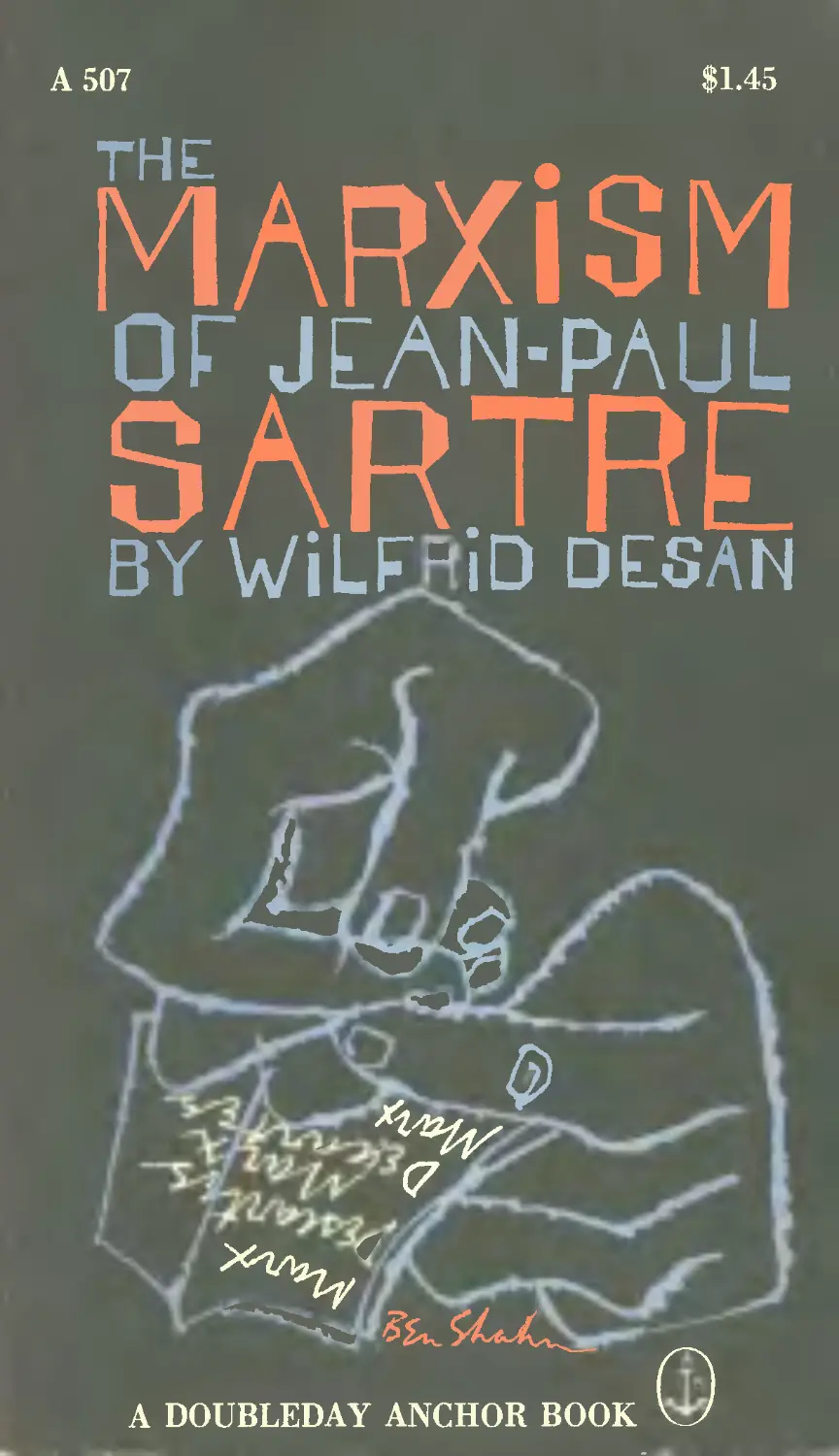
A 507 $1.45
,.H(.
MARXiSM
or J
!\N.PI\UL
S
RTR
BY WIL
.ID DE:SAN
L
......
...
r;
/ .
(/
'
g
A DOUBLEDAY ANCHOR BOOK 0
The Marxism of
Jean-Paul Sartre
WILFRID DESAN
Anchor Books
DOUBLEDAY & COMPANY, INC.
GARDEN CITY, NEW YORK
WILFRID DESAN studied in Rome and Paris, took his Licence
en Philosophie in Lille and his Ph.D. at Harvard. He has
taught at Kenyon College, Harvard, and Georgetown, where
he is at present professor of philosophy. In addition to The
Tragk Finale, he has written The Planetary Man, Vol I., A
Noetic Prelude to a United World, and is preparing for pub-
lication, The Planetary Man, Vol. II.
The Marxfsm of ]earv-Paul Sanre was originally pub-
lished by Doubleday & Company, Inc., in 1965. The
Anchor Books edition is published by arrangement with
Doubleday & Company, Inc.
Anchor Books edition: 1966
COPYRIGHT @ 1965 BY W1LFRID DESAN
ALL RIGHTS RESERVED
PRINTED IN THE 'UNITED STATES OF AMERICA
Foreword
Jean-Paul Sartre has given us his views on speculative phi...
losophy in L'Etre et le Neant. 1 Now in the Critique de la
Raison Dialectique we are told what he thinks in the realm
of sociology.2 The Critique is even more voluminous and in
my opinion, more difficult than its predecessor. Yet it con...
tams insights which are as arresting as those of the earlier
work, and if such terms as "being and nothingness" and
"Pou1-soi and En-soi' are by now commonplace, I believe
that this new work will bequeath us a vocabulary that will
become equally familiar because it is equally timely. It is
for this reason that I have undertaken to lay open the Critique
in these pages, in a manner simi1ar to that used with L'Etre
et le Neant in The Tragic Finale. 3
In his recently published autobiography, Lea Mots,4 Sartre
describes himself as a small boy leaning over the window
sill of his sixth-Hoar apartment and naming the things he saw
down below, as if in naming them, he made them ms. In the
Critique the man who has grown from that boy still looks
down upon the world from the windows of his apartment,
8J1d in describing the furious activity which he sees, makes
it both his and ours. From a bus stop on St.-Gennain...des-
Pres, man is followed from his powerless position in an un-
1 L'Etre et le N eant, Essai tEOntologie Phenomenologique
(Paris, 1943). In English: Being and Nothingness, trans. Hazel E.
Bames (New York, 1956).
2 Jean-Paul Sartre, Critique de la Raison Dialectique, precede
de Question de Methode, Tome I, Theorie des Ensembles
P,atiques (Paris, 1960). This book will hereafter be referred to
as CRD. The first section, Question de Methode, has been trans-
lated by Hazel E. Barnes under the title Search for a Method (New
York, 1963).
3 WiHrid Des an, The Tragic Finale (Harvard University Press,
1954), in paperback, New York, 1960.
4 Lea Mots (Paris, 1963).
vi THE MARXISM OF JEAN-PAUL SARTRE
organized seriality, through his feeble gropings toward a
primitive form of the group and its eventual solidification
into an organization, to his discovery of himseH as once more
powerless, this time in the paralyzing inertia of the institu-
tion. Freedom is still part of the definition of man, however,
and if the walls of the prison become too confining) he will
be driven to scale them once more.
In the course of his dialectical description) Sartre is con-
fronted again and again with the question of individual and
collective responsibility. In the modem world, which has
continued to witness persecution and violence on a grand
scale, this question is not merely an academic one, and the
author's analyses of such questions as the responsibility of
individual capitalists and colonialists in the processes of
capitalism and colonialism are provocative in this area. The
many references and footnotes to the Negro revolution which
I have added as examples of Sartre s points attest to their
ready applicability. The Critique should thus be of consider-
able interest not only to philosophers but also to sociologists
and political scientists as well. And if Sartre is correct in
maintaining that man can make his own history more mean-
ingfully as he becomes more aware of what is happening, it
is my duty to make more readily available Sartre's own ob-
servations, observations which are often controversial but al-
ways interesting.
Accordingly, I have attempted to show in Chapter I the
evolution of Sartre's social thought toward its mature expres-
sion in the Critique. A more immediate preparation for the
exploration of Sartre's book is given in Chapter II, which
contains what I consider to be important in Marx and Hegel
for the understanding of Sartre. In no way is this book a
critical e xamin ation of Marx, even less so of Hegel, but it
contains, I believe, sufficient data on both of these thinkers
for the task at hand. Chapter III consists of an examination
of the Question de Methode, an essay originally destined for
publication in a Polish review but now placed at the begin-
ning of the Critique de la Raison Dialectique to serve as an
introduction. The Question de Methode, in exploring the di-
vergent methods of existentialism and Marxism and possible
ways of combining them, is an attempt to insert the concrete
FOREWORD
vii
value of the existential dimension into the abstract frame-
work of Marxist thought. Whether this section fits precisely
where it stands is debatable. Sartre himself was hesitant, but
in the final editing placed it there, in the fear that were he
instead to place it at the end, "this mountain of pages might
seem to give birth to a mouse."5 The reader should thus un-
derstand that although the Question de Methode leads us
into the main body of the work, conversely, its own full mean-
ing comes through only in the light of the whole, and it might
very well be reread and reconsidered when one has the entire
Critique in mind.
The five following chapters of my book bring the reader
into the core of Sartre's Critique. I have made strenuous
efforts to present Sartre's view in a detailed and scrupulously
honest way. No doubt, at times my admiration comes
through, as does my criticism, but whether approving or dis-
approving, I have constantly aimed at clarifying his thought
and at revealing the encha nement all through the intermina-
ble cascade of Sartre's dialectic. I have not written to absorb
him into my own views, as some commentators consider it
,their duty to do. Nor is it my intention to replace the origi-
nal work; the reader, if I may give him good advice, should
go to the original I have written to clarify Sartre's presenta-
tion and to make available what otherwise would remain
dormant. In Chapters III-VIII Sartre is the tree, I merely
the pruner. To that intent, I have added, subtracted and
,given other or additional examples where I saw fit. Since I
have used the system of references rather than that of quo-
tations, multiple footnotes refer to the original text.
I found this whole enterprise to be a rather laborious task,
more complex than I had anticipated at the start. Sartre's
book is badly constructed; indeed, it is uselessly obscure and
interminable. Our author is definitely at that stage of his
fame where he can afford to be non-conformist to the ex-
treme, leaving just enough intelligibility so that the con-
formist might attempt the struggle to understand him. But
whatever may be its limitations, the Critique is an impressive
pedormance and undoubtedly makes an eloquent plea for
5 CRD, I, p. 9.
viii THE MARXISM OF JEAN-PAUL SARTRE
freedom. Sartre, at any rate, had only this one purpose in
mind: Marxism is livable, but only after it has understood
and accepted the invaluable price of the concrete and of
freedom. Whether or not this marriage of Marxism and ex-
istentialism is a sound one is explored in the last two chapters.
In Chapter IX, I present what are considered to be some
problematics unresolved, and in Chapter X, I attempt to
offer a more constructive criticism in showing how Sartre's
point de depart is fatal for any sound collective, be it Marx-
ist or otherwise.
In commenting upon an intricate work, not everything can
be said at once, and if certain ideas recur in the successive
chapters, it will be seen that they gain in amplitude upon
the second meeting. Each new encounter engenders more
light. Yet it will be no less apparent-such is the hope and
the wish of this writer-that the whole tenor of this book is
a progressive one. As in The Tragic Finale, I have kept close
to the topic and saved the reader useless detours.
Although I have kept abreast with other publications of
Sartre, I have paid less attention to his plays than I did in
the previous work. This is because I consider them to be less
impressive than those of his earlier days, when he gave us
such gems as The Flies and No Exit. Nor have I made use of
Saint Genet 7 which recently appeared in English but is al-
ready aged on the French market. 6 Although the message
of these works is vaguely ethical, they cannot be called philo-
sophical in the strict sense. Sartre himse1f categorized them
under C'Litterature." What has proved to be valuable, how-
ever, was the contribution of Simone de Beauvoir. Her auto-
biographies have no philosophical pretenses, and certainly
intend neither to teach nor to preach, but they do contain
a colorful illustration of Sartre) s development from as close
a SOurce as any. 7 She was his constant companion, and echoes
6 Saint Genet, Comedien et Martyr, Tome I des Oeuvres Com-
pletes de Jean Genet (Paris, 1953). English trans., Saint Genet
( New York, 1963).
7 Simone de Beauvoir, La Force de f Age ( Paris, 1960) and
La Force des COOses (Paris, 1963). The first has been translated
into English by Peter Green under the title The Prime of Life
(New York, 1962).
FOREWORD
ix
in her own thought what was uppermost in his. Sartre him-
seH came into the game again, and my manuscript was near
completion when we were given Les Mots, the first install-
ment of his autobiography. It is short, provocative, and mov-
ing in the seH-accusation of imposture, which Sartre believes
has afflicted his career. "Ce vieux bdtiment ruineux, man
imposture, c' est aussi mon caractere . . ."8 Confessions of
insincerity may touch us but they neither erase what has
been said nor completely convince the reader. Writers may
believe in their old age that they never succeeded in saying
what they wanted to say, but posterity may be grateful for
their having made the attempt. If human reality really is that
sort of supple entity which is what it is not, and is not what
it is, no wonder that it keeps projecting itself in writing with
the hope of finally saying what it wants to say. I have upon
occasion used Saxtre's sophisticated confessions in footnotes.
These, then, are the documents used in the writing of this
book. A final contribution should be mentioned. I would like
to end this foreword by acknowledging the help of my wife.
Confessions like these have by now become banal, but what
is banal has not lost its truth. Not only am I indebted to her
for correcting my English, but I have understood more than
ever that philosophy is not a soliloquy. Its qualities of clarity
and penetration result from what I have elsewhere called
the "we-language," or the convergent complementarity of the
many. Or better still, I have understood that monologue is
dialogue. For the extraordinary part played by my wife in
that sort of intellectual game, I am profoundly grateful.
WILFRID DESAN
Georgetown University
8 Sartre, Les Mots, p. 211.
Contents
FOREWORD V
I. THE ROAD TO A SARTRIAN SOCIALISM 1
The Early Years 1
Nausea and Being and Nothingness 8
Les Temps Modernes 10
Sartre vs. Merleau-Ponty 14
The Dispute, Sartre-Camus 20
II. MARXIST SEMANTICS 24
The Concept of Need 25
Alienation 26
Intellectual Alienation 28
Religious Alienation 29
Political Alienation 3 1
Economic Alienation 33
Dialectic 37
III. A QUESTION OF METHOD 4 2
General Comparison of Marxism and Existen-
tialism 4 2
The "Mediating Role" of the Individual 49
The Project as the Maker of History 55
The Progressive-Regressive Method 60
Concluding Remarks 64
IV. SOME PRELIMINARY OBSERVATIONS 7°
Critical Dialectic 1'8. Dogmatic Dialectic 7 0
Critique of the Critical Experience 75
The Place of Positivism 7 8
xii THE MARXISM OF JEAN-PAUL SARTRE
v. FROM INDIVIDUAL PRAXIS TO THE
PRATICO-INERT 82
The Forester, in Cutting Down a Tree, Makes
the Forest, or the Individual Acts, and
through His Act, Totalizes 82
The petit bourgeois Looks from His Window,
or Man as Link and Mediator 85
L' enfer c est r autre, or the Importance of
Matter go
Gold Is Destiny, or Matter as Objectification
and Alienation 95
Man as Free Prisoner of His Class, or Social
Being as Materiality 106
The Collective Entities 109
VI. FROM SERIALITY TO GROUP 124
The Conquest of the Bastille, or the groupe
en furion 124
The Philosophy of the groupe en fusion 12g
The Oath and Te"eur 139
The Organization 142
VII. FROM GROUP TO AUTHORITY 14 8
Organism or Organization 158
Structure of the Group through the Non-
Group 168
The Institution 17 1
State and Society 181
Groups, Seriality, and Extero-conditioning 183
Extero--conditioning and the Government 18g
VIII. THE GROUP IN THE WORLD OF THE
CONCRETE 195
The Group and Its Relation with the Collec-
tive and with the matiere ouvree 197
The Working Class 201
Intelligibility of Class Behavior 207
...
CONTENTS Xlll
The Class Struggle and Colonialism 212
The Intelligibility of the Class Struggle 218
Freedom and the Capitalist .221
Class Struggle as a Recent Historical Event 225
The Class Substance 228
The Control of the Working Class 23 1
The Awareness of the Dialectical Movement 235
IX. A PROBLEMATIC UNRESOLVED 242
Ethics: The Answer or Another Question? 244
Totality or Totalization 249
Immobility and Praxis 254
x. THE LAST OF THE CARTESIANS 260
The Self in Command 260
The Self where It Belongs 266
The Mandate of the Group 273
The Cartesian En-sm 27 8
Marx Revisited? 286
BmLIOGRAPHY 289
INDEX 292
To
Paul, Suzanne, and Christine
this book is dedicated
as to the future which is
enfant soumis,
r obeirais jusqu' a la mort
mais a moi.
SARTRE
In man creature and creator are united:
in man there is not only matter, shred,
excess, clay, mire, folly, chaos; but
there is also the creator, the sculptor,
the hardness of the hammer, the divinity
of the spectator, and the seventh day-
NIETZSCHE
I
The Road to a Sartrian Socialism
The Early Years
Modern life is repetition. Once a pattern is invented, it is
expressed mathematically, and once it is expressed mathe-
matically, copies are guaranteed. Since the fundamental
structure of our contemporary world has become scientific,
its principal creators are the inventors; the others merely
repeat a pattern which, once invented, is communicated and
then multiplied indefurltely. It is this pattern which modem
life impJants upon the millions incessantly and, some be-
Jieve, ruthlessly. Yet we are told that this is a source of hap-
piness: "low-maintenance living''' is happy living, the com-
fort of the machine is the comfort of man. When this scientific
and ordered living begins to find its repJica in the very be-
havior of man, however, voices of alarm begin to be heard,
and this same man lights for his Jife against the patterned
image. We :6.nd more and more titles on the publishers' lists
like The Organization Man, The Lonely Crowd, Growing
Up Absurd, or The Image Industries.
All of these protests, and many others, reflect a trend of
revolt against the repetition, organization, and conditioning
that gets hold of man and crushes his creativity. Existen-
tia1ism is one of the most powerful attempts to break the
strangle hold. Its literary and philosophical publications all
desperately fight to protect that mysterious entity called the
-freedom" of man, to give him back his uniqueness and his
creative powers. That freedom which they seek in common
is not merely the freedom that gives man the capacity of
2 THE MARXISM OF JEAN-PAUL SARTRE
saying no, but the freedom that endows him with the power
of producing the new as well. This can be said to be, I be-
lieve, the main intuition of existentialism, and the central
idea that links together Heidegger, Jaspers, Sartre, and Mar-
cel, though through an enormous variety of expressions and
amid deep disagreements. In the work of all, the individual
man is set against mass production, not because mass pro-
duction is in itself wrong but because the system places men
themselves in danger of becoming things. For the machine
steals their creativity and in replacing men, makes men ma-
chines. It has been Sartre's obsession to combat this threat,
and he has thrown all his intellectual power into the battle.
Whether or not he has done so in the right way and with the
right means is under debate, and many of my readers may
believe that his speculations have led him far astray; but few
will deny the urgency of the quest he undertook, and the
authenticity and vigor he brought to it. Few will likewise
deny the value of following him along the road he chose to
take, with all its twistings and turnings through the years.
That road, for all its turnings, nevertheless follows a fun-
damental "project." I believe that it can be said that Sartre's
essential philosophical trend is one of negation, a negation of
all limitation to freedom, all hampering of man's free move-
ment, all frustration and alienation. Of course, it must be
added that if Sartre's fundamental project is one of negation,
and if his emphasis is upon a world of darkness, the choice
of this particular presentation is for the purpose of bringing
light into that world. He apparently believes that one must
show the darkness in all its depths in order to understand
the need for light, for our first look is into a world of gloomi-
ness and oppression. No charity or love lifts the gloom; the
only glimmer of hope lies in the relentless pursuit of oppres-
sion in whatever form it occurs, human or even divine.
A1ready as a professor at the lycee of Ie Havre, Sartre be-
gan to show his dislike for the middle class, to which he him-
self belonged. He hated the "analytical' intellectuals, all
those who have ever on the tips of their tongues the prin-
ciples of democracy, equa1ity, and brotherhood, as if to pro-
fess were to practice. Existentialism, as presented in La
Nausee, Sartre's first book, was a denial of any and all prin-
THE ROAD TO A SARTRIAN SOCIALISM
3
ciples, since to him they are in most cases only a mask that
actually serves to bide selflshness. Sartre does not hate peo-
ple, but he hates people who talk always of charity and
piously pray for their fellow men, while at the same time
keeping prudently on their own level away from the people
for whom they pray.
Simone de Beauvoir, whose autobiography is, aside from
Sartre's own works, the best introduction to his soul, tells us
how as young university students- ey kept away from the
fashionable bars and restaurants. 1 However much necessity
favored the boycott, their preference was supported by their
ideology as well. Later on, in their travels, Sartre was al-
ways eager to visit and lodge in the poorer sections of cities,
as if by physically placing himseH in the midst of a lower
class, he could morally negate his own.
It is in this opposition to the bourgeoisie and to the soulless
abstraction of its ideology that Sartre's Birtation with com-
munism finds its origin. While a teacher, he refused to wear
a tie, as if he could shed his class with his tie and thus come
closer to the worker. Yet he is not and never will be a worker.
Like the petit bourgeois intellectuel that he is, he uses more
words than the workers, words with which he can analyze
their status and rebel in their name. In this rebelling he
makes himseH; his concern for the worker is the reverse
side of his contempt for the strength of the bourgeois, his
concern with man the fight against anything that humiliates
man, and his rebellion the reaction against all power. It will
appear from later pages that to call Sartre a Marxist is an
oversimplification, for his efforts to COlTect the master will
be implacable. The freedom that is so deep in Sartre revolts
against the voice of suffering itseH, whether that suHering
results from the egoism of the Continental bourgeoisie or
&om oppression preached in the name of Marx and Lenin.
Sartre virtually grew up writing and attempting to pub-
fish his writing, for he was devoted to literature, not as art
for art's sake but as a means whereby man justifies himself
and at the same time fills a need of others. The term petit
bourgeois intellectuel, which we have a1ready used, fitted the
1 The Prime of Life, p. 22.
4 THE MARXISM OF JEAN-PAUL SARTRE
young lycee professor and writer well, and it can also be
found in the Critique de la Raison Dialectique as a name
which he cherished. For if he and others could not be the
workers they wished to be, they could at least be a carrier
of the revolution in their minds, and thus to an extent escape
their class. Furthermore, in extending the new humanism to
include all men, they could escape all class whatsoever. At
the same time their writing was a kind of action; Sartre at
one point during the war had hied his hand at organizing a
resistance movement but his "Socialism and Liberty':P was
greeted with apathy and difficulty on every side and, un-
successful as an organizer, he returned to his writing, "which
represented the one fonn of resistance work still open to
him."2 For if he had grown up as a writer who apparently
had no ethics, he nevertheless placed an ethical topic at the
center of each of his plays, as we observe in No Exit and
in The Flies. To him ethics was not some ideal of human ac-
tion, it was action itseH, and brought onto the stage, it could
come closer to the life from which he believed it to be in-
separable.
The problem of finding a method to express this philosophy
of the concrete was one that had always preoccupied Sartre.
Simone de Beauvoir has told the story of the day in earlier
years when Sartre had a drink with Raymond Aron. Aron,
who had just returned from a sojourn in Germany, was able
to tell Sartre about some philosopher of whom he had never
heard before, by the name of Husserl. He excitedly explained
how Husserl had proposed a new method of philosophizing
upon the concrete. Philosophy was no longer to consist of
an inquiry into origins or of a deductive exploration for
invisible substances and causes; philosophy was to be a de-
scription of that which appears insofar as it appears, a dis-
closure of the concrete, a revelation of all that falls under
our senses, whether inside or outside ourselves. "You see,"
said Aron, pointing to his drink, "if you are a phenomenolo-
gist, you can talk about this cocktail and make philosophy
out of itl"3 Sartre became pale from emotion, according to
Simone de Beauvoir, for this presented him with the very
2 The Prime of Life, p. 397.
3 Ibid., p. 112.
THE ROAD TO A SARTRIAN SOCIALISM 5
tool for which he had been searching in order to communi-
cate his thoughts. It is no wonder that a philosopher who
was later to write plays, stories, and novels in order to bring
universals to the ground should have been excited to discover
that he could bring that same concrete expression into phi-
losophy itseH. A method to observe the concrete in and
around oneself and to describe emotions and sentiments, the
relation of the sell with the outside world, and the world
itself insofar as it is noetically shaped by man, all this was
what Sartre had been looking for. It was part of a new em-
piricism that was dependent upon experience and observa-
tion, yet kept itself clearly apart from Humean positivism.
It was, in short, an empiricism which claimed to find its way
between the two extremes of radical materialism and straight
spiritualism. Phenomenology was not merely empirical, since
its revelations were much more than a discovery of the ex-
perimental; in addition, the method claimed to discover rela-
tions from man to man, from man to bis surrounding milieu,
from man to the world, which are beyond the realm of the
strictly verifiable. This departure from positivism did not
mean that it was on the other hand spiritualistic; its propa-
gators were for the most part atheists who rejected all claims
of immortality for the soul. In my previous commentary upon
L Etre et le Neant I have given sufficient examples of the
phenomenological method. 4 One point remains to be stressed
here, and this will come out very strongly later: phenomenol-
ogy attempts a vision of the world and of others from the
viewpoint of the subject. Sartre had found a method, but it
was a method that would solidify his Cartesian seclusion.
This seclusion proved to be more than merely speculative
and noetic, for it has had ethical implications as well. Sartre
for years had hovered on the edge of the working class, but
he no doubt knew that he would never be that which he was
not in the past and that he was a prisoner of himself more
than he cared to admit, a subject one cannot abandon but
, must remain forever. I have wondered sometimes whether
phenomenology, in addition to being an instrument for
achieving brilliant and revealing descriptions, did not serve
at the same time as a mask to conceal his own sense of isola-
4: The Tragic Fitulle, pp. 95-126.
6 THE MARXISM OF JEAN-PAUL SARTRE
tion. L Etre et le Neant would then be a strenuous effort
to cure himself of this deeply rooted malaise, through the
eHort to detach man from his past in emphasizing his free-
dom from the past and the constant possibility of change.
This intellectual adventure failed, however, to liberate Sartre,
as we can observe in his hesitant connections with the Com-
munist party itself. Simone de Beauvoir leaves no doubt of
his independence in her report of the prewar era, nor does
Sartre himself in his writings. Would he or would he not join
the Party? He did not, for he preferred to remain outside it,
alone, but sovereign of himself.
The conflict of Marxism and existentialism as Sartre saw
it in these prewar days was basically one between group
and individual. At one time Sartre was a great admirer of
Dos Passos, in whose work he discovered characters who are
at the same time both individual and social. A Dos Passos
hero is unique, yet a member of the group: "what happens
to him could happen to no one else. What does it matter,
since Society has marked him more deeply than could any
circumstance, since he is Society .:p'5 Dos Passos' characters
need neither psychological mechanism, as was the case with
Proust, nor any complicated physiological background of
"explanations, as with Zola. They simply exist, as living
animals, inscrutable and yet open. They are tied up in the
social without mystery. This does not mean that his creatures
are not free, for they are. They are both free and unfree,
both interior and exterior, free in their interior Or what might
be called in their "Kantian noumenal," yet able to be seized
and observed in their phenomenal exterior, which is quasi-
frozen and coldly determined. Sartre seemed to find in Dos
Passos a key to himseH, in the insight that one both belonged
to the other and yet at the same time did not belong to the
other. 6 Sartre knew he himself belonged to the others, to the
workers and all those who are in need-this awareness has
never left him-yet he belonged also to himseH and to his own
5 Sartre, Literary and Philosophical Essays, English translation
by Annette Michelson (New York, 1962), p. 101.
6 Simone de Beauvoir describes Sartre's excited discovery of
Dos Passos in The Prime of Life, p. 113.
THE ROAD TO A SARTRIAN SOCIALISM 7
work. In belonging to himself and to his work, he could now
by the same token belong to the others.
In 1938 Sartre published in Recherches Philosophiques his
by now famous article "La Transcendance de l'Ego."7 It un-
dertook a speculative examination of Husserrs Transcenden-
tal Ego in an attempt to show that human consciousness is
impersonal and contains no ego. Consciousness for Sartre is
complete translucidity facing the opacity of the object; it is
nothing more. By this it is not claimed that the Ego cannot
arise from my reflection, for when I reflect upon what I am
doing at the present, the Ego does indeed appear. It is
Sartre's fear, however, that this introduction of the Ego into
the heart of consciousness is fatal, since it would constitute
by virtue of its density an obstacle to the perfect and all-out
freedom of human reality. Consequently he will allow no
Ego other than that which is revealed and constituted in and
through reflection. 8
This would be a mere speculative discussion without po-
1itical or sociological impact, were it not for the end of the
article, where Sartre unexpectedly warns the reader that his
philosophical stand is not an abandonment of the Left. "The
theories of the extreme Left have sometimes reproached
phenomenology for being an idealism and for drowning real-
ity in the stream of ideas," writes Sartre. 9 He answers that
phenomenology has on the contrary placed man back into
the world, where he belongs. Idealism is an expression and a
re1ie of the past; phenomenology, with its observation and
description, has brought the individual man close to the
world of suHering and need which formerly, wrapped up in
the cell of his own seH, he had ignored. Sartre's insistence
upon annihilating the Ego in the depth of consciousness even
more emphatically destroys the suspicion of idealism, since
from now on there is nothing left but a world revealed and
a world transcended.
7 Recherches Philosophiques, VI, 1936-37. A good English
translation is available: F. Williams and R. Kirkpatrick, The
Transcendence of the Ego (New York, 1957).
S For detailed explanation, see Being and Nothingness, pp. 102 if.
See eventually The Tragic Finale, pp. 27, 144 H.
9 "The Transcendence of the Ego," p. 104.
8 THE MARXISM OF JEAN-PAUL SARTRE
This is at least his hope. But it was a hope not easily to
be fu1filled, for the young Sartre carried in his heart two
loves--one for the value of the Subject and the other for the
importance of the collective-which were not ready com-
panions. There was Descartes, and there was Marx. How
to bring them together would become the mental torture
of later years, provoking the synthesis found in the Critique
de III Raison Dialectique twenty-five years later. The follow-
ing chapters will give the reader a chance to test Sartre s
skill in his combat with Marx. It will be my privilege in
the concluding remarks to inquire whether or not Husserl"s
phenomenology, of which Same is still a fervent disciple
(notwithstanding his apparent elimination of the Ego) was
indeed the best departure for a pbllosophy of the collective.
Such, then, was the Sartre of before the war, a teacher of
philosophy in the lycee, a student of Husserl, an independent
thinker whose personal views were slowly taking shape in a
somewhat anarchic-metaphysical way. Underlying all that he
did and thought was a strong anti-bourgeois feeling, cou-
pled with a profound sympathy for the worker. "We re-
turned late at night by a road overlooking the Seine, and
stopped to look at the Grande Couronne factory buildings on
the far side. They were Iit up in the darkness, and looked
exactly like gigantic but motionless fireworks, a set piece
under the black vault of the sky. 'A beautiful sight,' Pagniez
said. Sartre rubbed his nose. 'It's a factory,' he said. 'People
work all night there.' Pagniez maintained, somewhat impa-
tiently, that this didn't affect its beauty. But according to
Sartre, he was letting himself be taken in by a mere mirage.
Where was the beauty in sweated labor and exhaustion?"lO
Nausea and Being and Nothingness
H Sartre was slow in revealing his purpose, it was never-
theless taking a firmer and firmer hold upon him. Nausea al.
ready contained enough discontent with this world to betray
a strong desire on the part of the author to change it, but
precisely what direction that desire would take did not yet
10 The Prime of Life, p. 165.
THE ROAD TO A SARTRIAN SOCIALISM 9
clearly appear. 1t Nausea was an exploration and a promise.
Displaying the anti-bourgeois mentality and philosophy of
negation that are so characteristic of Sartre, it was a prelude
to the more unified and systematic opus which would appear
toward the end of the war, under the title L'Etre et le Neant.
It has often been said that the latter, appearing as it did in a
time of tragedy, merely reflected the sad mood of its epoch.
This is oversimplified, for as Sartre himself wrote, it takes
no account of time, the immense length of time which is
needed to produce such a work. L'Etre et le N eant was in
fact started long before the war and was twelve years in the
writing, before its completion in 1942. 12 The main thesis
upon which Sarlre had been working during all these years
was a description of the sad futility of all human endeavor;
man, he was finding, was merely a "useless passion." H his
readers and followers felt that Sartre had led them into an
impasse, to a tragic finale, and that they might just as well
commiserate with each other in sidewalk cafes or otherwise
do just as they pleased, Sartre himself was not in agreement.
In his mind L'Etre et le Neant was only the beginning, the
speculative basis, from which we must set forth with more
determination than ever. Once we have recognized that the
absolute is forever out of reach but that we are free, funda-
mentally free, we must ask ourselves what this freedom is to
serve. In Sartre's view the capacity for the good lies in the
awareness of our freedom and in the possibility of making
our own lives, but the possibility of choice means responsi-
bility as well. The problem was not to negate life, to with-
draw from the world; it became, rather, "What is man to do
with his staggering £reedompn
For Sartre the answer became more apparent and more
urgent toward the end of the war. Freedom can never mean
immobility, since it is by nature creative; in its incessant
actualization, one must choose, and in choosing, one must
belong. We have reached Sartre's famous "engagement," or
commitment. Just as in the realm of the noetic, consciousness
is a revelation of that which is, so also freedom and choice
11 La N ausee (Paris, 193 8 ) .
12 CRD, I, p. 34.
10 THE MARXISM OF JEAN-PAUL SARTRE
must be the will of something. There is no will for nothing,
just as there is no consciousness without a world.
We are told by Simone de Beauvoir that around this time
Sartre became very friendly with the painter Giacometti. It
was both a meeting of minds and also to an extent, a syn-
chronization of methods. Giacometti is described by Simone
de Beauvoir as being not only a talented painter but also a
man who had brains, "a really first-class mind, the sort that
sticks to hard facts and shakes the meaning out of them.' 13
Now this is exactly what phenomenology wants to do: it re-
vea1s what appears to man and the meaning of that phe-
nomenon as well. Meaning, however, appears against a back-
ground, and background for a painter-and here we return to
Giacometti-implies that a portrait is never painted in iso-
1ation but that it is one with its surroundings, just as the mind
and the will of man are caught in a situation, Sartre's en-
gagement. It was in this mood of commitment that he tried
to organize the resistance group which we have already men-
tioned, a group wWch in its attempt to embrace and engage
other middle-class intellectuals was to prove abortive. Sartre
learned from this experience that however much he praised
direct action and despised contemplation, he was himseH
made for the latter. More theoretician than actor, his "work"
was writing and his action was to take the form of founding
a new review to set forth the fruits of his contemplation.
Les Temps M odernes
The review was Les Temps Modemes, which first appeared
in 1945, with Sartre, Raymond Aron, Merleau-Ponty, and
Simone de Beauvoir on its editorial board. Its introductory
article, written by Sartre, was a minor masterpiece. 14 Sur-
prisingly enough, it is rarely read, yet it is worthy of greater
attention, for it contains the Critique de la Raison Dialec-
tique in a nutshell.
In this presentation Sartre outlines the purpose of his re-
18 The Prime of Life, p. 386.
14 A sound translation of this article has been published in the
fine anthology: Paths to the Present, edited by Eugen J. Weber
(New York, 1962). The translation is by Fran ise Ehrmann.
THE ROAD TO A SARTRIAN SOCIALISM 11
view. Les Temps Modemes will not take any stand in favor
of a political party, but it will take a position toward social
and political problems in accordance with the concept of
man that it defends. Its content will reflect the editors' con-
viction that literature must have a social function. It firmly
believes in man as an absolute, when considered in his time
and his milieu. In this sense also the individual philosopher
can be said to be an absolute, when viewed within his own
epoch, surrounded by his friends and followers, working out
his ideas and writing his books. In other words, I can say
that Descartes is an absolute, while Cartesianism is only a
relative value: the man is dead, but the philosophy con-
tinues to stroll through the centuries, "where everyone can
find what he puts into it."15
It is but a short step from the concept of man as an abso-
lute within his own milieu to that of man as revealing himself
through his dialectical structure, his being shaped by and
his shaping of that milieu. The radical innovation which a
dialectical approach brings becomes clear when we consider
its opposite, the aoolytical method, so dear to the heart of
the bourgeois. For the bourgeois, men are like "peas in a
can," all alike, juxtaposed, each of them equally available for
an examination by the analytical mind, that is, able to be de-
fined, classified, and categorized. 16 Thus is man analyzed
and placed. The bourgeois philosopher never thinks of the
Jiving dialectic, of the movement of reciprocity which links
man to man. He does not see man as free creativity, man
made by a fundamental "project," which affects his every
gesture, every word, and every deed. Man manifests him-
se)£ always and in every way, whether he chooses a wife
or buys a tie; man is everywhere, "he is the whole earth."17
Les Temps Modernes, in helping men to become aware of
what they are and can do, will liberate them.
It may appear at first glance that the bourgeois with his
analytical approach, whereby human beings are juxtaposed
and separated, protects the individual more than the dialec-
tical and synthetic approach, which attempts to tie people
13 Paths to the Present, p. 435.
16 Ibid., p. 43 6 .
17 Ibid., p. 439.
12 THE MARXISM OF JEAN-PAUL SARTRE
together. The truth of the matter is that Sartre wants to see
both methods combined, for within the global scheme of
the dialectical and the synthetic, one must also take into ac-
count the analytical. The place of both these elements is not
yet clearly defined and the author will in the years to come
show where they belong. 18
This was the end of the beginning; Les Temps Modemes
was launched and promptly set out for the open sea. It was
from the start an enormous periodical, appearing ten times
a year and totaling close to a thousand pages annually. It
was avant...gardist, leftist in the world of politics, though
without formal ties with the Communist party, existentialist
in the reahn of philosophy, socially minded, though without
a definite program in the domain of literature. The list of
editors changed over the years. Mter a while the name of
Merleau-Panty was dropped from the inside cover, as was
that of Aron and even that of Simone de Beauvoir. The one
name which never disappeared, however, was that of its
most prolific, possibly its most talented writer, Jean-Paul
Sartre himself. If he was the pillar of the review, it was in
turn his bibune, for it gave him the chance to publish what-
ever he wanted of his own work and an outlet for his flow-
ing discourses, aptly called articles-fleuvea, which spilled his
ideas over the market place. Keeping in mind the purpose of
our study, I shall merely give here those ideas appearing in
Les Temps Modemes that can be considered milestones along
the way to the magnum opus. For Lea Temps Modernes
is an invaluable source book to uncover the genesis of the
later work, and anyone who reads both the Critique de
la Raison Dialectique and Lea Temps Modemes will have
no difficulty in noticing that some of Sartre's views were
reshaped through their contact with the incisive criticism
coming from such men as Merleau-Ponty, Albert Camus, and
Claude Lefort. Sartre, like all of us, owes much to his op-
ponent, for writing about dialectic goes hand in hand with
practicing it, and in publishing his review, Sartre performed
18 Sartre has kept his promise. The Critique de la Raison Dia-
lectique contains among other things an elaborate clarification
concerning the distinction between the dialectical and the analyti,.-
cal.
THE ROAD TO A SARTRIAN SOCIALISM 13
an old feat: he well knew that sails move on opposing winds.
His most famous, perhaps also his best article appeared
under the title "Materia1isme et Revolution. "19 It made a
deep impression everywhere and has remained to this day an
undigested piece for his Marxist opponents. It consists mainly
of an accusation against the materialistic dogma of modern
Marxism. Young men are told to choose between materialism
and idealism, Sartre claims, yet the sophism of such a choice
should be obvious. For the modem Marxist, the subject is
always obiect, that is, he is a product of matter and of the
evolution of matter. The Marxist has barely stated that dogma
when he turns around and acting as if he were subject and
not object, formulates his own dogmas concerning God, His-
tory, Finality, etc. How, asks Sartre, could a Reason that is
a captive of blind forces still be a Reason which is capable of
dictating truth and discovering a world structure?20 Where
is materialism as a general philosophy when, after having
buried the subject, one all of a sudden exhumes him again,
to make him the Prophet and Metaphysician of History? The
final irony is that Soviet Marxism has killed the dialectic
in burying the Subject, for if the Subject is a fossil and sub...
jectivity nothing but matter, there can no longer be any
living dialectic. 21
The remedy in Sartre's view is the rejection of matter as
the sole infrastructure of the world and of men. The very
meaning of revolution implies a going beyond the present
situation, a process that is more than material. The new pbi-
losopher-as for example Sartre himseH-is the one who em-
bodies "the thinking of the oppressed insofar as they rebel
against oppression."22 He is both thought and action. His
thought is more than idealism, for in its unmasking of reality
it is at the same time a modification of the real. This approach
can already be discovered in Marx (in his Theses on Feuer-
bach) where it is called "practical materialism." But Sartre
19 A selection of articles from Les Temps Modernes came out
in the collection Situations. Some were translated into English un-
der the title: Literary and Philosophical Essays.
20 Literary and Philosophical Essays, p. 203.
21 Ibid., p. 216.
22 Ibid., p. 227.
14 THE MARXISM OF JEAN-PAUL SARTRE
protests that it should not be called materialism when the
oppressed can be shown a way to transcend the present
situation toward a world scheme yet to be fulfilled. Tran-
scendence is in itself Freedom, and the revolutionary shows
by his revolt that he is not a thing, but the master of things,
not an object, but a subject. The Revolution plainly demands
a new humanism, and this Sartre hopes to offer in the
Critique de la Raison Dialectique.
Sartre vs. Merleau...Ponty
If the previous article ("MateriaIisme et Revolution") was
unpleasant to the eyes of the Parisian Communist, another
series also published in Les Temps Modernes, under the title
"Les Communistes et la Paix/' was more agreeable to read.
This series contained a factual defense of the Party and an
attempt to convince the workers to join it, since it contained
their hopes portees au rouge, carried to a white-hot inten-
sity.23 Sartre maintained that the revolutionary disposition of
the worker is fruitless unless organized, for the worker in
juxtaposition with other workers is ossified and helpless.
Later on, in the Critique, Sartre will use the more elaborate
term "seriality" to characterize the helplessness inherent in
separation and to set out upon a brilliant analysis of the for-
mation of the group. But in these articles we already see the
ideas of the Critique germinating; conversely, in the light
of the later Critique, we can better understand the positions
he took in these earlier days, positions which at the time
were so startling and incomprehensible to his contemporaries.
The French worker, Sartre continues, needs politics, and
they must be those of the Party, since a democratic vote, as
practiced in the so-called democracies, merely perpetuates
his separation. Political democracy will keep the worker iso-
lated and impotent in a world where all the power and
money belong to the bourgeoisie. The worker, therefore,
needs Authority around which to rally-and Sartre surpris-
ingly launches into an enthusiastic praise of the dictatorial
23 Les Temps Modernes, octobre 1952, p. 697. The entire series
is in the following issues: juillet and octobre 1952, avril 1954.
THE ROAD TO A SARTRIAN SOCIALISM 15
power in the Party-and he needs orders. Playing upon the
similarity of the words and of their meaning, Sartre calls the
Communist party an "order," a monastic order, with a mis-
sion that is absolute and cannot tolerate any criticism. 24
Obedience on the part of the worker now is a guarantee of
his freedom in the future. Although Sartre still does not ap-
prove of the Marxist position of uncompromising material-
ism, he nevertheless considers the Party to be the only avail-
able organ for conveying the aspirations of the worker.
In the series of articles "Les Communistes et la Paix,"
the French existentialist has undoubtedly come closer to a
Marxist position. There is something pragmatical in his at-
titude, somewhat resembling that of Charles Maurras, who,
although an unbeliever, considers the Catholic Church to be
the most valuable instrument for the accomplishment of his
nationalistic purposes. So also Jean-Paul Sartre, although an
unorthodox Marxist in the eyes of Soviet Marxism, emerges
as a fervent believer in the power and efficiency of the Party.
Sartre s articles did not go unopposed. One of his severest
critics was an old friend and collaborator; in Merleau-Ponty,
Sartre all of a sudden met an opponent of his own size.
Merleau-Ponty's criticism came in the form of a book, Les
Aventures de la Dialectique,25 which attacked above all
certain totalitarian trends in Sartre's position, such as his
granting of unlimited power to the Party and of obedience
alone to the worker. Sartre wants the proletarian to play a
role of complete submission to the Party, to be pll$sif comme
une femme, maintains Merleau-Ponty, but in preaching that
sort of passivity, he seems to have forgotten what happens
when the Party has unquestioned mastery. This is all the
more strange when we have such a ready example at hand
-modem Marxism as realized in Russia should have taught
him quickly what happens when the Party wields an ex-
clusive control. 26
Merleau-Ponty finds the old dualism of Pour-8oi and En-
soi to be another of Sartre's weaknesses, since the distinction
24 Les Temps Modemes, octobre 1952, p. 759.
25 Maurice Merleau-Ponty, Les Aventures de la Dwlectique
( Paris, 1955).
26 Ibid., pp. 146, 148, 149, 175.
16 THE MABXISM OF JEAN-PAUL SARTRE
between mind and matter is too neat and too radical, as it
is in Cartesianism. 21 This is, ironically enough, unlike the con-
clusions of Marx himself, who accepted the mediation of
things and saw the "presence" of man everywhere-in the
tools he uses, on the walls which surround him, in the social
group to which he belongs. Same, in accepting only man
and things, overlooks the intermonde, that in-between-world
of history, symbolism, truths to be acbieved, etc. 28 In ignor-
ing these realities, Sartre loads upon the individual man too
great a weight of responsibility and accomplishment, as if
individual consciousness alone counts and the social order is
something alien and totally extraneous. One might even go
so far as to say that the "social dimension is a scandal for
the CogitO."29 Its existence, while not denied, is neverthe-
less accepted merely as an activity on the connnes of the
subject: the world of the Other appears "either as a trap, or
a menace, or as a task, either behind us as a remorse, or
ahead of us as project," but always as something which has
in one way or another made me incomplete or otherwise op-
presses me. so
For Sartre, then, there is no world of literature. He accepts
"a Julien Sorel of StendhaI and one of Taine and one of Leon
Blum and one of Paul Bourget" but refuses to coadunate
these entities into a world. 81 The world of literature, emptied
by Sartre of all inner consistency, becomes nothing but a
construction of the POU1'-soi. Merleau-Ponty concludes that
Sartre has no real dialectic, since the break between the
Pour-soi and the En-sol is too radical to allow for an authentic
circularity, nor has he a real philosophy of intersubjectivity,
27 Les Aventures de la Dialectique, p. 185.
28Ibid., p. 269. This is an instance where Sartre, feeling the
opposing winds, took another tack in the CRD. Whether he veered
sufficiently remains to be seen.
29lbld., p. 208. Here again Sartre has made great attempts in
the CRD to emphasize the dialectic and to improve his philosophy
of the intersubjective. I am still of the opinion that on that int
Merleau-Ponty was right, and although starting hom a totally dif-
ferent viewpoint, I shall draw conclusions siMilar to his. My at-
tempt will be to show that Sartre is not so much an Hegelian as
he is a Cartesian.
30 Ibid., p. 209.
81 Ibid., p. 190.
THE ROAD TO A SARTRIAN SOCIALISM 17
since the social dimension is merely built up from the view-
point of the Self. Between the Pour-soi and the En-soi there
is indeed nothingness.
Merleau-Ponty goes on to question Sartre s assertion that
truth in the social order is what the poorest of the poor see,
in other words, that truth is the accusation we read in their
eyes. 32 This, he believes, clearly shows how Sartre specu-
lates, yet does not observe, or rather observes what his specu-
lations have led him to look for. Caught in a position, he is
unable to see the whole clearly. Instead of taking the look of
the poor as a norm, one might better look at the whole world
and its present situation, observe events impartially and see
how they have evolved. This means keeping an eye not only
upon the poor but upon the bourgeois as well and noticing
how he may have moved away from the positions of his
grandfather. Sartre's implication becomes even more unreal-
istic when the Revolution has achieved its course. Shall we in
that hypothesis still apply the same norm? Is the look of the
poorest of the poor in Russia still a criterion of truth? It must
be, since there is no other. And if so, it is doubtful whether
that look will be one of unqualified blessing and approval. sa
The peculiar situation of Les Temps Modemes is that like
everything else in Sartre's world, it had to be an example of
creative freedom. Starting from a present that is permitted
no past, its contributors were to belong neither to church
nor to political group. They and the review itseH had to start
from nothing beyond the belief in man's freedom itseH.
Merleau-Ponty asks whether this attitude does not hide a
fundamental error, that of calling for a continual start from
zero and of dreaming of an incessant creation, when in fact
this is impossible. There is no creatio ex nihilo; there is only
creation with the material at our disposal, material that is
already shaped before it reaches our hands. Our judgment
has always a pre-predicative basis, of which it is often not
aware and which in his own situation Sartre seems to ignore.
In actual fact his review itself started moving in a definite
direction, toward the Communist camp, whether it wanted to
32Ibid.:I p. 207.
33 Ibid.
18 THE MARXISM OF JEAN-PAUL SARTRE
or not. It reached a position which it had not exactly in-
tended to reach when it started, and at no point along the
way was an article brought into the world ex nihilo. 34
Merleau-Ponty also brought up Sartre's greatest vuJnera-
biIity, a criticism the eternal would-be Communist had to
hear more than once: Is it fair to appoint oneself judge and
theoretician of the Party and yet refuse to become a mem-
berP35 Sartre believes that this can be done, but why, then,
is he less tolerant for the French worker, whom he obliges
to carry a card membership and thereby deprives of the free-
dom he so generously offers to himseH. Is communism, per-
haps, the sort of organization that one admires, envies, looks
at, but doesn't ever join? This attitude might be defensible
when one confronts some other world vision, but can it be
upheld by a Marxist, who so radically rejects all idealism to
preach action and total engagement?
While Sartre himself did not directly answer the penetrat-
ing critique of his old friend, Simone de Beauvoir went to
the rescue in a carefully documented article, "Merleau..Ponty
et Ie Pseudo-Sartrisme,n 36 the gist of which is that since
Merleau-Ponty had not understood Sartre, his statements
were a mere tilting at windmills. Sartre's philosophy, she
claims, was never a philosophy of the Subject only, but one
of the Subject conditioned by the world, for without a world
there is no Self. 8T To prove her point, the author combs the
works of her friend and extracts a great number of texts
which emphasize the unavoidable interrelation of world and
self. Against the accusation that Sartre has no grasp of dia-
lectic and reduces every action to spontaneous creation,
Simone de Beauvoir insists that action is never born from
nothingness but that it results from a concrete situation and
that this situation is one of need: I act not for the joy of act-
ing but because I am hungry or because in one way or an-
other my situation is untenable. The Revolution is not un
article de luxe, it is a need. It is not so much the echo of free..
84 US Aventures de la Dialectique, p. 258.
85 Ibid., p. 216.
86 Les Temps Modernes, juin 1955, later published together
with other essays under the title Privileges (Paris, 1955).
37 Privileges, p. 206.
THE ROAD TO A SARTRIAN SOCIALISM 19
dam-the poor do not even know what freedom is-as it is the
result of unbearable frustration. 38 "The bite of nothingness
upon being is not in this case called freedom but need."39
The same observation can be made concerning History.
History is neither mere action, nor vertiginous freedom, nor
frivolous creativity, but it is the persistent attempt to do the
best we can with the knowledge of the moment. If we are
told that "truth lies in the look of the poor," it simply means
that the falsity of society lies in its oppression, which, how-
ever much it is masked by idealism and argumentation, is
revealed by the poorest of the poor. 40 Finally, in answer
to the reproach that Sartre's flirtation with communism does
not really involve him, since he prudently remains outside
the fold, Simone de Beauvoir claims that although Sartre is
not a member of the Party, he is nonetheless exemplary in his
understanding of the poor and their needs, while Merleau-
Ponty, living in a world of ideas and nursing in his heart a
nostalgia for the religious, refuses to acknowledge a world
which is human, all too human. 41
Such, then, is the duel of two old friends. No literary duel
was ever taken too seriously in France, including this one. 42
Yet the sharp thrusts and ripostes revealed a fundamental op-
position which philosophically speaking was never bridged.
To this writer it appears that Merleau-Ponty has raised some
crucial questions, and although he himself was the first to
agree that Sartre was celebre, tacitly implying that he did
not share the same widespread fame, it is not so obvious
88 Ibid., p. 23 6 .
391bid., p. 235.
40 Ibid., p. 254.
41 Comparing Merleau-Ponty's prose and Mlle. de Beauvoir's an-
swer, I found the latter harder, almost to the point of being in-
sulting. Later she became aware of the diHerence of tone and
wrote: t Quant a lui, il ne m'en voulut pfl8, ou du moins pas long-
temps: il pouvait comprendre lea coleres intellectuelles. D'ailleu.rs,
'loot en ayant run pour r autre une t'Tea grande amit;,e nos disputes
Btaient sou vent vives; Ie m' emportais, et il sauriait/' La Force des
Choses, p. 342.
42 For an account of their later reconciliation see Merleau-Ponty
Vivant. This was a special issue of Lea Temps Modemes, bearing
no date, but pub1ished between the issues of July and November
1961 and numbered 184-185.
20 THE MARXISM OF JEAN-PAUL SARTRE
whose impact in the long run will be the more pervasive. 48
One should add that Merleau-Ponty's opposition has affected
Sartre's philosophical position in the Critique de la Raison
Dialectique. Further study will reveal that in his later work
he attempts to give the dialectic more room and to curtail
the impact of the human Subject. Whether he does so suf-
ficiently is something else again. In any case Les Temps
Modemes was for Sartre an excellent sounding board. It was
an organ where he could express his own views, where his
opponents in most cases found ample occasion to answer-
Sartre was generous in allotting them space-and where some
of his followers like Simone de Beauvoir, Francis J eanson, or
Marcel Peju were in charge of administering the coup de
...
grace.
The Dispute, Sartre-Camus
Although this event is of lesser importance for our pur-
pose, I mention it here as one more example of Sartre's grow-
ing Marxist sympathies and the unavoidable result, the loss
of another good friend. When Albert Camus published
L'Homme Revolte in 1954,44 it was reviewed by Francis
Jeanson in Les Temps Modernes under the title "Camus ou
r Arne RevoItt e."45 The title in itseH was insulting and
clearly implied that Camus' position was no longer in line
with that of Les Temps Modemes. Actually Camus' fhomme
revolte does believe in revolt, but not in an extreme form.
Similarly he believes in unions, but without political affilia-
tion, in socialism, but not through totalitarian methods, in
action, but only in fuIfillment of a transcendental Idea. Sartre,
with his distrust of anything abstract, could not accept these
qualifications of his own concreteness. Ironically, it will be
his persistent problem later on to discover a way of writing
history without drawing up an abstract blueprint, to take a
stand without positing ultimate nonns, to construct a system
43 On this topic, see James Collins in Cross Currents, XIII, No.
2, p. 197.
44 English trans., The Rebel (New York, 1954).
45 Lea Temps Modernes, mai 1952.
THE ROAD TO A SARTRIAN SOCIALISM 21
that is supple and elastic enough, without falling into Platoni-
zation.
Camus wrote a letter of reply to Lea Temps Modernes
which he addressed directly to Sartre, calling him "Monsieur
le Directeur."46 This was an unfortunate beginning. The let-
ter that followed was extremely well written; it was sensible,
prudent, polite, but just a little too elegant. It was this slight
touch of artificiality which Sartre ridiculed from the start.
In his answer, an enormous river of prose that is a prime
example of his articles-fleuves, he made huge fun of the sol-
emn tone of Camus: Why should he, close friend for ten
years, now be called "Monsieur Ie Directeur?" Sartre point-
edly countered with "Moo Cher Camus." But whatever may
be their prose-they were in their own ways both first-rate
writers-their opinions were divergent. Sartre:rs attitude was
more combative and radical, Camus. more sensitive, with a
deeper sens de la mesure. 47 Here again, as with Merleau-
Ponty, Camus was not uninHuential upon Sartre. Since he
was less of a philosopher than Merleau-Panty and lacked his
technical precision, his influence was more vague, but I think
we may say that the example of his restraint kept Sartre from
taking any more extreme positions than he did.
A dramatic blow came with the massacre of the Hungarian
freedom fighters in the revolt of Budapest in 1956. A few
weeks before, I had met Sartre in Paris and at that time he
still expressed great hopes in Khrushchev, whom he con-
sidered to be a man who would give a new turn to Russian
poUtics and to Marxism in general. "Il a du rebpect pour
lhomrne en tant que tell" Sartre told me. His high hopes
46 Les Temps Modemes, juillet 1952.
47 Sartre's break with Camus was for all practical purposes a
deflnitive one, and the two old friends were never really recon-
ciled. Although Simone de Beauvoir had been somewhat close to
Albert Camus, she took the side of her friend in this split and sub-
sequently judged Camus rather harshly. See La Force des ChoBe8:1
pp. 60, 126, 144, and 279. I, for one, find her judgment of the
author of The Plague and The Stranger too severe. Whatever
Simone de Beauvoir may say, it is undeniable that Camus' influence
is great and that his books have a strong fascination upon students,
as any professor can attest.
22 THE MARXISM OF JEAN-PAUL SARTRE
were sadly crushed along with the young idealists with the
entry of Russian tanks into Budapest.
A six-hundred-page copy of Lea Temps Modemes was de-
voted to "La Revolte de la Hongrie. '48 Although the opinions
of the contributors were various, the general trend was em-
phatically anti-Russian, with the repressive action of the So-
viet sternly condemned by all. Sartre himself wrote a long
introductory article under the title "Le Fantome de Staline,"
in which he considered the Russian intervention to be a re-
mote effect of S talinis m. He no less fiercely condemned the
attitude of the French Communist party for its slavish sub-
mission "to the dictates of Moscow." "The time of revealed
truths, of the words of the Gospel is gone: a Communist
party is possible in the West only when it has the right of
free examen.' 49 A similar attestation was published by Sartre
in the Parisian weekly L'Express on January 6, 1957. The
conclusion of both articles did not imply a total break with
Marxism-Sartre will remain a Marxist, though always on his
own tenns-but it definitely contained a severe condemna-
tion of the Russian intervention and marked at the same time
a cooling off in the relations between the Party and its in-
tellectual critic. In the Critique he makes it quite clear that
his kind of Marxism is not to be equated with communism.
Sartre has never changed his position on Budapest, as we
shall see later, and for this honesty, at times even blunt sin-
cerity, he deserves our respect. The very fact that the phi-
losopher can find himseH caught between praxis and theory,
however, points to a basic problem. Sartre, as a philosopher,
cannot avoid philosophizing and as a man of ideas, cannot
avoid theories. The difficulty arises with the idea of engage-
ment, which Iinks praxis and theory together. Accordingly,
the philosopher cannot live and think apart from events and
from the masses which carry these events. By essence en-
gage;# he comes down into the cave and like Plato's visionary,
mixes with the prisoners. His is the temptation, even the task,
of continual commitment, with its attendant risk of making
mistakes. Sartre's political thought can be said to rest upon
48 Les Temps Modemes, janvier 1957.
49 lbid. p. 693.
THE ROAD TO A SARTRIAN SOCIALISM 23
empiricism, but, in being continually dependent upon the
pragmaticaI, it lacks by principle any fundamental norm be-
yond a vague resentment toward all that is bourgeois, a cur-
rent that runs all through Les Temps Modemes. -Bourgeois"
is used here in its broadest sense as the incarnation of all that
is inert and traditional.
We may conclude that what the French existentialist op-
poses is often eloquently described, but just what global truth
he wants to see fuHilled is often left in the darkness of the
cave. No wonder, then, that many of his admirers were hope-
fully looking forward to the publication of the magnum opus
which they knew Sartre had been working upon all these
years and which was finally published in 1960 as the Cri-
tique de 10, Raison Dialectique. When its 755 pages of small
print came from the press, it became clear once more that
the philosopher was not himself going into the street, for its
depth of penetration and brilliance of insight proved that
when all is said and done, he has no greater commitment
than that to his desk.
II
Marxist Semantics
Although the Communist party had already existed for many
years in France, the introduction to Hegel, and with this, a
genuine Marxist intellectualism did not take place until
around 1936, when Alexandre Kojeve, a leading Hegelian,
began to give his courses on The Phenomenology of Mind
at the Ecole des Hautes-Etudes. 1 His early audiences in-
cluded an intellectual elite-Sartre, Merleau-Ponty, Hyppo-
lite, Fessard, and others-and through them the immense
significance which Hegel holds for the modem world erupted
upon the French intellectual scene. The impact of Hegelian-
ism was immediately apparent in the recognition of its im-
portance to Marxism and the increasing and more knowl-
edgeable use among intellectuals of terms like "dialectic" and
"a1ienation. ' More subtly, the study of Hegel Was inspira-
tional in the launching of three separate, singularly powerful
movements. These were, in brief: the Phenomenological, led
by M erle au-Panty, whose work showed the profound influ-
ence of Husserl as well as of Hegel; the Existentialist with
Sartre; and the Personalistic with Emmanuel Mounier, whose
leftist periodical Esprit was characterized by its outspoken
political and social defense of the concept of person. 2 All
1 These lectures were later published under the title: Introduc-
tion a la Lecture de Hegel. Le ons sur la Phenomenologie de
lEsprit (Paris, 1947).
2 This triple division was given by Henri Lefebvre in an article
entitled "Le Marxisme et la Pensee Fran aise," Les Temps
Modernes, juillet-aout, 1957. The article is short but provocative.
Sartre and Lefebvre do not see eye to eye in the domain of Marxist
interpretation, but Sartre nevertheless gives his opponent a hearing.
MARXIST SEMANTICS .25
three of these movements, with the exception of Gabriel Mar-
cers particular form of existentialism, sympathized with
Marxism in a more or less pronounced degree. It is therefore
vital for us to have Brmly in mind the speculative position
and tenninology of Marx, as he was inHuenced by Hegel, in
order to understand this important part of the modern intel-
lectual world, and in particular, that segment we have chosen
to examine in detail, the first volume of Sartre's Critique de
la Raison Dialectique.
The Concept of Need
Sartre's project in L'Etre et Ie Neant might be said to have
been an incessant attempt to fill the void which is man. His
speculative approach in that work showed strikingly that the
depth of the nought in man desperately wanted to be and
that the desire for being brought a permanent attraction to-
ward all that which is En...soi. It is toward this plenum that
man is incessantly carried. Sadly enough, the identification
of the nought of human consciousness with the solidity of the
outside world was doomed to failure. 3
In the Critique the essential line of this approach has not
changed. It has received, however, an even rrwre concrete
and urgent mode for the Pour-soi is now shown to be a be-
ing of need, a being which in order to live must have an ob-
ject capable of assuaging its hunger. On this level Sartre
makes no claim of originality. More than a hundred years
before, Marx had already asserted that since man is a being
of nature, a being which is part of nature and Jives from na-
ture, he is also a being of need. "Hunger is a natural need; it
requires therefore a nature outside itseH, an object outside
itseH in order to be satisfied and stilled."4 Hunger is of course
only one need. Man also seeks clothing, sex, habitation, and
it would be naIve and unrealistic to study the history of man-
kind either at its inception or at any stage along the way
without considering these needs and the continual attempts
to fulfill them. Such attempts are inseparable from pro duc-
3 See Being and Nothingness, pp. 615 and 627.
4 Marx, Economic and Philosophical Manuscripts of 1844, in
Erich Fromm's Marx s Concept of Man, p. 182.
26 THE MARXISM OF JEAN-PAUL SARTRE
tion, and we can assert without hesitation that material pro-
duction lies at the beginning of and is History. 5 Even saints
and men of ascetical detachment were not exempted from
this imperative. The founder of the Trappists, wanting noth-
ing more than a walking stick, had to go into the forest in
order to cut one from a tree. In this simple feat St. Bruno
was performing an act of material production. 6 Few men are
satisfied with so little, of course, for generally as soon as needs
are satisfied, new needs arise. The only way to satisfy this
incessant, unremitting claim of nature is through labor, for
need, in becoming passion, stirs man to action.
Since it is in the 1ight of the notion of need that the Other
gets his particular significance, the concept will become piv-
otal for Sartre. We should be prepared, however, to find in
the Critique that he more frequently uses the word scarcity
to point to a situation that engenders need. Sartre will repeat
over and over that it is in a world of scarcity (dans un monde
de la rarete) that need originates. In this world where there
is not enough of everything, the presence of the Other threat-
ens the satisfaction of my own needs. It is in such a world
that the Other appears to me even more harshly than he did
in L'Etre et le Neant, where his Look provoked my reaction
and his presence was a source of shame, or of pride, or of
hum ilia tion, 7 for now he has become a danger for my sur-
vival as welt In short, he is more than a mere Self whose
recognition I desperately require in order to consolidate the
dimension of my own Self, as he was in Hegel and in L'Etre
et le Neant. He has now become the Opponent who threat-
ens me in my very survival.
Alienation
Alienation is not an easy tenn to define, but if we first go
back to Hegel and Feuerbach, we shall be able to fix its
meaning in Marx himself. In pursuing alienation as the en-
5 Marx, German Ideology, in Fromm's Marx's Concept of Man,
p. 200.
6 Ibid., p. 206.
7 Being and Nothingness, pp. 369, 379, 404 H.; The Tragic
Finale, pp. 67 and 71.
MARXIST SEMANTICS 27
emy of genuine accomplishment and freedom, Marx drew
heavily upon Hegel's use of the concept in The Phenome-
nology of Mind. Hegel gives the word most of its original
etymological sense, whereby to be alienated means to be es-
tranged, or in one way or another not to be at home. A con-
sciousness which projects its substance outside itself, or in
other words, exteriorizes itself is alienated. In a vain attempt
to reach this myth which it has projected outside itseH,
whether in the fonn of a god or any other, human conscious-
ness becomes unhappy.8 Alienations are multiple, as one can
easily imagine, but all are in common characterized by some
form of exteriorization and by an incessant craving that is
never satisfied. Hegel's Pherwmenology is the long journey
of consciousness looking for itself. Where Proust builds up a
meticulous description of a mind recuperating time past a la
recherche du temps perdu, Hegel, absorbing the past, moves
onward a la recherche de son ame, which eventually after
a long dialectic he claims to discover in the identification of
the Self with the Absolute.
In the post...Hegelian tradition, the term alienation points
to the unnahIral situation of the individual who has built for
himself a visionary world of abstractions and dwells in that
empyrean of dreams instead of facing reality as it is. Feuer-
bach presents us with a wen-known example in his Essence
of Christianity, where man is shown to embody each one of
his main faculties-mind, will, and heart-in a Superior Being.
In positing his aspirations as fulfilled in the Deity, man deems
himseH to be by contrast weak and powerless. This concep-
tion of a Being which exists at a great distance in all the
splendor of his isolation results in alienation for man. In an
attempt to overcome this alienation, man loves "God" and
through belief in the incarnation of his Son finds a means of
reunion with the distant Deity. All this is, in Feuerbach's
opinion, not only deceitfu1 but actually harmful. Man must
confront the earth and make his happiness there:J rather than
live in the vain desire of a nonexistent God. "Homo homini
Deus! Man is God for himselfl"
In taking over the notion of alienation from Hegers specu-
8 Hegel, The Phenomenology of Mind, trans. J. B. Bailtle (Lon-
don, 193 1 ), pp. 253 H.
28 THE MARXISM OF JEAN-PAUL SARTRE
lations and Feuerbach's application of those speculations,
Marx attempted to give it a more forceful and aggressive
character. He was more pessimistic than his predecessors, for
to him alienation has been an enormous source of grief, far
surpassing that of the unhappy consciousness. Marx, wary
of all abstraction, disregards the dialectic of The Phenome-
nology of Mind, where Hegel slowly but with great depth
unrolls for us the gradual enrichment of the soul as it climbs
toward its identification with the Whole. This is too remote
for Marx, for whom alienation immediately takes a concrete
fonn; to defIne means to diversify, and alienation is either in-
tellectual, economic, or political. Something which can be
pinned down can be more easily removed, and this removal
of alienations, one by one, becomes the concrete form of
manJls earthly combat against an suffering.
One may wonder of course just what that complete human
being is whose alienations are successively cancelled, and one
may ask as well just what his ideal fulfillment ought to be.
On this no clear answer seems available. Marx-and Sartre
after him-is more successful in telling us what man must
not be: the free man who emerges from all his entangling
alienations is still an unknown.
Intellectual Alienation
In October 1836 Marx went to study in Berlin and was im-
mediately caught by the philosophy then in fashion-he be-
came a Hegelian. His Hegelianism was of the left wing vari-
ety, whose adherents, unlike those of the right, claimed to
have given up all acceptance of the Hegelian speculative
doctrine and kept only its dialectical method. In addition,
the left wing Hegelian was more liberal politically than his
opponent, who tended to be conservative. This explains
Marx's first defeat: he became editor of the Rheinische
Zeitung, but after a few years, the censors no longer per-
mitted the newspaper to appear.
This experience taught Marx that philosophy by itself was
insufficient and that in order to reach the masses and break
through the opposition which inevitably confronts specula-
MARXIST SEMANTICS 29
tive dreams, action is necessary. It became clearer every day
to Marx-it was to become an obsession later in his life-that
one must transform the world, not merely interpret it philo-
sophically. He wrote in 1845 his Theses on Feuerbach (un-
published during his lifetime), in which he attempted to
prove that the best way to realize a philosophy was to sup-
press it as an entity of mere contemplation and speculation.
A similar position is developed in another book, The Holy
Family, where philosophy is accused of soaring above praxis.
It will be Sartre's constant preoccupation in his Critique de
la Raison Dialectique as well as in certain minor publications
to convince the reader that revolution is action a1most to the
exclusion of planning. 9 On a similar topic Henri Lefebvre
writes, "Truth is the concrete."10 This is the bridge connect-
ing Marxism and existentialism, upon which Sartre himself
will linger. For Marx as for Sartre pbiIosophical abstractions
in themselves have no efficacy. "There is no immobile abso-
lute, no spiritual beyond. The propositions of the philoso-
phia perennis are either nothing but tautologies or receive
definite meaning only through an historical and empirical
context. "11 In passing, one cannot refrain from noting that
these radical assertions do not seem to have cut down upon
the number of Marxist theoreticians who are prolific writers
or in any way inhibited them from replacing "obsolete and
traditional speculations" by a no less verbose dialectic.
Religious Alienation
In this attack against all abstraction and alienation, tbe re-
ligious man comes in for heavy criticism. There is no doubt
in the mind either of Marx or of his followers that religion
estranges man from this earth and prevents him from be-
coming completely human. It is doubly dangerous in that
it not only affects man in his individual condition but aJso
contaminates his social standing, for the problem of religion
8 See, for example, the collection of articles published in Eng-
lish under the title SanTe on Cuba (New York, 1961).
10 Le Materialisme Dialectique (Paris, 1949):J pp. 54-55.
11 Ibid.
3 0 THE MARXISM OF JEAN-PAUL SARTRE
is tied up with the political structure of the state. According
to Marx, a state which is religious, whether officially or by
way of the private convictions of some of its citizens, is an
unhealthy state, for the ascendance of religion is a sign of
political decline. Here Marx is more radical than other non-
Christian philosophers, such as Brono Bauer, who still toler-
ated religion in private practice. 12 For Marx, as soon as a
private citizen is something more than a mere citizen, he is
a divided man. Living on this earth, which it may be well
to remember is very earthly, he wants to play his part, and
yet he wants at the same time to bet upon the supernatural.
The separation of Church and State does not in Marx's opin-
ion provide a solution to this "contradictory" situation. As
long as the private citizen remains a religious man, one may
as well keep the two identical.
Marx's principal objection to religion is summed up in the
well-known formula, "Religion is an opium for the people."
He believed that religion, in giving people a justification for
the evils of this world through promises of hope in some
future happiness, lulls them into an attitude of resignation.
The inspiration for this is Feuerbach, who first pointed out
the myth-making mania of the sufferer in The Essence of
Christianity. Marx goes beyond his predecessor, however, in
wanting, above and beyond an explanation of the religious
attitude, its elimination as well. This will only take place, of
course, after social and economic refonns have been made.
Marx's position is debatable at this point. He does not con-
sider the possibility that religion in itseH might be a natural
phenomenon, which neither attachment to the world nor
dialectic are able to cure. It is possible that the metaphysical
structure of man may be one of dependence upon a Supreme
Being which is the origin and end of life, and that the act
of invocation is not addressed merely to a Myth. From a
purely pragmatic point of view, one may wonder whether
an atheistic position, in which man becomes an all-powedul
and self-sufficient center, goes farther toward the elimination
12 Bruno Bauer (18o 2) was a German theologian, a Hegelian,
and a radical opponent of Christianity who published a great num-
ber of works on theology. He also became an ardent admirer of
Bismarck.
MARXIST SEMANTICS 3 1
of economic alienation. Might not atheism lead to a harden-
ing of relations between men, while the recognition of God
could bring with it a recognition of all men as brotherspls
All these are questions which a social refonner might con-
sider worthy of consideration. But neither Marx himself nor
his existentialist disciple lose much time on the topic of re-
ligion. ]e ne m occupe pas de Dieu, fe m'occupe de
l'hommer Sartre once told me, and it appears that he has
followed this rule to the letter in his Critique de la Raison
Dialectique.
Political Alienation
In the clarification of Marx's political ideas, we find ourselves
once more face to face with Hegel, for he is responsible for
Marx's position on the concept of the State, this time not as
master, but as opponent. This is not surprising when we re-
call that in politics Hegel was an arch conservative. For him
the State is an advanced form of civilization, a form which
the Spirit takes on in the latest phases of its evolution through
History and in which the freedom of the individual reaches
its fulfillment. Freedom thus goes together with an ideal
State, but this freedom must be understood strictly in the
sense of obedience and devotion, based upon personal con..
viction, to a rationally organized State. 14
According to Hegel, this ideal State was actually being
fulfilled, or in his terms, was "real" in the constitutional and
hereditary monarchy of Prussia, a regime which was basi-
cally authoritarian and left to its Parliament merely a con-
sultative vote. Hegel believed that the -rational" works itself
out gradually but inevitably in the "real" course of History,
and that this had indeed happened in his own State, which
was rational as well as real. This being so, any attempt of
'revolution or any thought of clandestine activity would be
"irrational." Impatience is unwarranted in any case, for His-
13 Ct. Jean-Yves Calvez, La Pensee tk Karl Marx (Paris, 1956),
pp. 98, 632 H.
14 Philosophy of Right, Paragraph 149. See also his Philosophy
of History, Preface.
3 2 THE MARXISM OF JEAN-PAUL SARTRE
tory in the long run will success£ul1y implement the concept
of an authentic State. 15
At this point Marx voiced his opposition. He could not
consider patience to be the mark of a reformer, or approve
of the concept of the State as an objecti.6cation of the Spirit,
or as one more phase in the grandiose panorama of the Ideal
fulfilling itself through the ages. All this he could only con-
sider to be part of a speculative and ideological structure
which diverts attention from the real and the important,
which is, in Marx's understanding, the masses. Instead of
walking on its head, the Hegelian system ought to be turned
about and placed on its feet: the "real" political world is
constituted by the masses and by class structure, not by any
ideal political superstructure. It is precisely this inversion of
values which in Marx's eyes constitutes political alienation.
In a comment upon Paragraph 261 of Hegel's Philosophy
of Right, Marx reasserts his view. According to the paragraph
under discussion, the State is a necessary entity which is
exterior to private and civil rights and superior to both. Marx
objects that this exterior entity is endowed with a real di-
mension and real power, whereby the average individual is
divested of an control and becomes politically alienated. 16
In this case, the state is not fulfilled in the people and the
masses are not sovereign; on the contrary, something unreal
and idealistic, which is embodied in the sovereign and is ex-
terior and superior to all the others, holds the reins. Hegel's
Prussia certainly cannot be called a democracy.
Marx proposes an alternative: real democracy is the iden-
tification of the State with civil society. In this view the State
is no longer incarnated in the prince and is no longer a "su-
periol' and "exterior" concept. Real universality refuses to
be confined within the "particularity" of a prince, but is
spread out among the people. But-and this is an interesting
progress-the reason for political alienation lies in the class
system, which engenders the opposition of classes, with the
15 Philosophy of Right, Preface. For comment on the famous
aphorism: "The rational is real and the real is rational," see Franz
Gregoire, Etudes Hegeliennes (Louvain, 1958), p. 3 1 4.
16 Critique de la Philosophie ik fEtat de Hegel, MEGA, I) I,
pp. 425 If.
MARXIST SEMANTICS 33
superior class being that which in princely fashion holds the
reins of government. This typically Marxist position, followed
so enthusiastically by Sartre, leads to MarxJ's position on so-
cial and economic problems, for the only way to overcome
the political problem is first to take care of the social and
economic situation.
Economic Alienation
We have arrived at the last alienation on the road toward
"perfect'7 seH-achievement. If economic alienation can be
overcome, man will have reached his complete restoration.
As far as practical applications of economic alienation were
concerned, Marx found ample examples in the country where
he had established himself, though he could have found
equally sad examples elsewhere. This was the England of
child labor. Between 1820 and 1850 hundreds of children
between the ages of four and five were brought to factories
to work. 17 In 18 35 the English economist Ure discovered
among the workers in the factories which he visited over ten
thousand children who were less than eleven years old. It
was an epoch when proletarian misery and capita1istic abuse
were at their peak and Marx could observe it all at first hand.
He turned once more to Hegel for his theoretical inter-
pretation of the economic alienation that was behind all this
misery. This return to Hegel is important not only for a clear
grasp of Marxism but of Sartre as well, since Sartre s method
in the Critique is much more Hegelian than Husserlian.
It is Heger s claim that the Self asserts itself through nega-
tion, that is, a Self which is merely in the an sich state (or
what we may call an immature and unreHected state) be-
comes fur rich (clearly and fully itself) through its negation
of the Other. IS This happens through the encounter of SeH
A with Self B: upon meeting B, A proceeds to cancel or to
negate B. But in the seHsame act of (mental) cancenation,
it discovers itself to be mediated. The same process appears
in reverse movement, coming from B to A and returning to
11 G. Weil, L'Eveil des Nationalites et le Mouvement Liberal,
8 5-1848 (Paris, 1930), p. 327.
18 Hegel, The Phenomenology of Mind, Ch. IV, p. 229.
34 THE MARXISM OF JEAN-PAUL SARTRE
B. Each in and through the mediation of the Other returns
into itself and realizes in truth and in objective certainty its
own existence through the Other. I am only a Self if I make
myself recognized by the Other, and if I recognize the Other
in the same way. This dialectic, a form of rebounding reci-
procity, will be much used by Sartre, and we shall come
back to it later in a further clarification from Sartre's own
examples.
Marx himself was less attracted by this particular game.
The content of the later pages of the Phenomerwlogy se-
duced him more, where Hegel develops his ideas on Master
and Slave. 19 According to this theory) when two egos face
one another) one asserts itself with greater power and makes
the other "'unessential." The other then is vanquished and
becomes the slave, while the nrst becomes the master. The
slave is caught up in "'thinghood," that is, he shares in the
dependency of the matter, while the master is liberated and
able to live fully. The existence of the master is nonetheless
dependent upon the slave both for recognition (he is only
through recognition) and for the things which the slave
makes. The slave cannot, of course, enjoy what the master
enjoys. He labors upon the matter in fear and trembling, but
a reaction comes, for the hard labor and deep fear trigger
what I may call, translating Hegel into modem tenns, a C'psy_
chic shock" toward gradual recovery and freedom. The wheel
of history turns and someday the slave will become the
master.
In the Manuscripts, Marx very cleverly exploited the He-
gelian dialectic of Master and Slave, above all the observa-
tion that the slave puts his labor into the thing which the
master will later enjoy. The proletarian in a capitalistic re-
gime will be compared to Hegel's slave in four ways: (1 )
The object or "objectivized labor" which the worker manu-
factures is taken away from him. "While he himself remains
dependent, he builds up a capital which is extraneous to
himself. The worker produces palaces and lives in hovels. 20
(2) His labor itself is alienated, for it is not freely chosen, but
19 Ibid., p. 235.
20 Marx, Economic and Philosophical Manuscripts, in Fromm's
Marx's Concept of Man, p. 97.
MARXIST SEMANTICS
35
forced, and he is not happy in his work. (3) If man is alien-
ated from both his product and the act of producing it, he is
likewise divorced from natme. In order to understand this
statement, one must keep in mind that in the Marxist sense,
man is coextensive to nature, that is, he lives from the in-
organic like animals, only more so, since he is himseIf more
universal. Through his labor, he comes in contact with nature
and to an extent identifies himself with nature, but in the
world of capitalism, the worker does not in a natural and hu-
man way approach the inorganic. His approach to nature is
one of compulsion so that it has an artificial character which
causes him to revolt and draw into himself. 21 ( 4) Finally it
appears that the worker is alienated in his relation to man,
for his resentment breaks up the harmony between men. It
should be kept in mind that every alienation which affects
the worker has its repercussions upon the capitalist. Even
without the opposition engendered by resentment, the capi-
talist lives an artificial life. Like all men, he should have a
close contact with nature, and in refusing to work, he ignores
the vocation of his birth.
Even in this brief summary of Marx's views, it clearly ap-
pears that he is interested in what may be called the "ma-
'terial dialectic" rather than in Hegel's gradual reconciliation
of the Self with itself. What counts for Marx is not a specula-
tive dialectic of reason, but an analysis of the actual relation-
ship of opposite forces within the social order. It is to be
expected, then, that Marx will also cast aside Hegel's belief in
a redemption of the slave through his own valor and assert
that salvation can come only through a reconstruction of the
social and economic order, in the course of which the bour-
geoisie will be eliminated. The dialectic must be kept moving
between man and object, and man and man, and it must do so
8Cientifically.
This "scientific" presentation of the dialectic was the ob-
ject of Marx's study in later years and reached the public
toward the end of his life in Das Kapital. In that work a fa-
mous distinction was first made. The product of labor was
shown to have a double value, a value in me, when the object
satisfies certain needs, and an exchange value, when it can be
21 Ibid., pp. 100 H.
36 THE MARXISM OF JEAN-PAUL SARTRE
employed as an article of exchange; so, for example, a car
has a definite use, yet it can also be used for exchange. Dif-
ferent commodities all have one thing in common-the labor
involved in making them. To calcu1ate this element of "com-
mon" labor is intricate. It can perhaps be determined when
only two commodities are at stake, but it becomes vague and
undeHned when one is confronted with the universal ex-
change of commodities. Values then must become embodied
in something and that something is money. Money becomes
value.
Marx will now apply this distinction to the labor of the
worker and distinguish between its exchange value and its
value in use. The value of exchange is the amount the worker
is paid strictly for living and subsistence, while the value in
use is the amount the labor itself is actually worth. The dif-
ference between the two is the plm-value of the commodity.
The laborer is paid for his Jiving and subsistence, not for the
plus-value, which is pocketed by the indusbialist as profit.
The continual addition of profits results in an accumulation
of money which is called capital and inversely in a growth in
poverty for the laborer. This is the structure of capitalistic
society, breeding a fundamental alienation which is at the
start of all other alienations. The wealthy capitalist helps to
perpetuate an inhuman society, where the opposition of
classes is rendered more and more violent.
Opinions differ as to whether or not the younger Marx was
more humanistic than the older, with his scientific presenta-
tion and his socialized, materialistic economy. Some believe
that he was merely expressing in his old age that which was
akeady in him as a young man, whi1e others think that he
moved in a totally different domain. Whatever may be the
truth, let us merely state at present that to call Das Kapital a
positive science may be imprndent. Theories on value and
plus-value cannot be called scientific in the strict sense of the
word. They are not the result of a strict inductive method,
nor are they verifiable point by point. In my opinion they are
a philosophy, merely a more extensive application of the
philosophical views of the younger Marx and Das Kapital is
nothing but an analysis of the fundamental alienation. It is
MARXIST SEMANTICS 37
an economic theory, grounded upon a philosophical view. 22
One may wonder of course how at the very beginning,
chronologically, society developed as it did. If one accepts a
form of economic detennination within the evolution of so-
ciety, how shall it be explained at its inception? From whence
comes the first "capital"? For Marx, the answer is violence
and will to power. History shows us that the law of brutal
force had everywhere and always the upper hand and that
the primitive accumulation of capital had no other origin.23
This is a topic which fascinates Sartre, for the question im-
mediately arises whether in addition to the automatic and
mechanistic evolution of the material dialectic human factors
also playa role, such as human violence, in Marx's fonnuIa-
tion-or human choice, in Sartre's terms. For Sartre there is
no hesitation. Capitalists have chosen to be what they are
and have fought for the execution of their free decision. In
other words, there is a participation of man in the Marxist
machinery and this participation should be recognized.
Dialectic
The term dialectic inevitably enters into any discussion of
Hegel or Marx, and, as the title indicates, of the Critique de
la Raison Dialectique, so that it might be well to attempt a
certain clarification before launching into a detailed examina-
tion of Sartre's views.
In Plato's time the tenn was being used to indicate a move-
ment of the mind, whether that movement be the search,
through dialogue and discussion, for the clarification of a con-
cept, or the ascent from a grasp of the concrete form to the
contemplation of the universal essence. An example of the
]atter is given in the Symposium, where the soul rises from
the concrete form of beauty to the enjoyment of Beauty in
22 Cf. Jean Hyppolite, "De la Structure du Capital, et de quel..
ques presuppositions philosophiques dans l'oeuvre de Marx,"
Bulletin de la Societe Fra aise de Philosophie, 1948, Vol. 4 2 ,
pp. 171 £f. As we shall see later, Sartre shows little enthusiasm for
Marx's scientific method. This is indeed one of the points where
he conflicts with Marx.
23 Marx, Capital, English translation by Samuel Moore and Ed-
ward Aveling (New York, Ig36), pp. 784-85.
38 THE MARXISM OF JEAN-PAUL SARTRE
itself. In Socrates' view the disciple must start with the love of
beautiful forms in the concrete, at first one form only, and
then another, and another, until he perceives that beauty in
every form is one and the same. From then on he will no
longer view beauty under this or that form, but growing be-
yond the relative, he will reach for the contemplation of ab-
solute Beauty. 24
Aristotle uses the term dialectic in opposition to apodictic.
The apodictic method is a demonstration in the sbict sense
of the word, whiIe the dialectical can claim only probable re-
sults. This is the meaning which was followed by the Scholas-
tics. Kant used the term to indicate all reasoning beyond the
stable activity of the understanding and as such, conducive
to illusion. To this world of illusory entities belong the meta-
physical discoveries both of the soul, with its spiritual quali-
ties, and of the existence of God. This does not imply that
Kant rejects their existence altogether but merely that he as-
serts that they can not with certainty be discovered through
reasoning and demonstration.
Hegel picked up the term dialectic to indicate his method,
and it is this meaning which is more or less understood today.
To understand this meaning, we must first of all keep in mind
that it is Hegers constant aim to reconcile subject and ob-
ject. The world can no longer be considered to be divorced
from the mind. Hegel furthennore ties together all aspects of
the real (whether mind or matter) from the most abstract,
such as being and becoming, quality and quantity, etc., to
the more concrete such as the succession of different philoso-
phies or civilizations over the ages. To tie different elements
together is to show that they have a relative structure and
that term A imp1ies sooner or later the existence of B. The re-
lational structure by which the one requires the other is fun-
damentally what is understood by dialectic.
Dialectic becomes a more complex procedure when the
two related entities, called "thesis" and -anti-thesis," through
their coming together engender a third entity. The two pre-
vious entities then are "aufgehoben" or given up and ab-
sorbed in the third. This third entity, called "synthesis, ' turns
into a new thesis and provides the beginning of a new dialeo-
24 Symposium, 210 if.
MARXIST SEMANTICS 39
tic. Incidentally, the familiar terms thesis, anti-thesis and
synthesis were not used by Hegel who instead used affirma-
tion, negation, and negation of negation. A classical example
often presented is the case of an authoritarian regime (thesis)
provoking the rise of an anti-thesis (revolution or revolution-
ary regime), which in turn becomes over the years a moder-
ate form of democracy (synthesis). Not every dialectic is
equally clear...cut, however, and there may be a running reci-
procity between two extremes, as, for example, master and
slave, which does not result in a neatly deflned synthesis.
What counts is the referential structure of both elements and
their mutual interaction. Sartre will use similar dialectic
abundantly, as we shall see later, whether between human
beings (two subjects) or a 8Ubject and an (inorganic) object.
It will become a more important approach than the mere
phenomenological method of L:lEtre et le Neant, since within
the reciprocal rebounding between subject and object, it will
allow Sartre to underline the importance of the Subject. But
before exploring in detail the Sartrian dialectic, let us observe
the Marxist position.
Weare often told that Marx is against Hegel's "ideas." In-
deed, it is well known that he rejects without hesitation
Hegel's a priori point of departure, the so-called absolute
Idea. We should add that he goes even further and is a "real-
.ist," that is, that he accepts the objective reality of the world
,as it appears to he. Labor is the test of such a reality, for the
work of man upon matter is the proof of its existence. Work
is considered, once more in imitation of Hegel, to he nega-
tion: my work on the land is a negation of the land. Unlike
Hegel, however, Marx would claim that when man plunges
into his work and becomes object, he somehow remains such
and finds himseH at the end of the dialectic to be a part of
,nature, however privileged a part it may be. For Hegel, on
the contrary, although the value of labor is not denied, the
dialectic of man leads ultimately toward an identification with
the Absolute and an abandonment of his object-character.
We have already seen that this is the conclusion of The
Phenomenology of Mind.
Notwithstanding this continual insistence upon the exclu-
sion of "ideas, ' Marx does not really favor a total rejection of
40 THE MARXISM OF JEAN-PAUL SARTRE
philosophical discussion, so long as it aims toward the im-
provement of some abuse. Thus, arguments in favor of athe-
ism help to cure mankind of its religious alienation, and others
in favor of common possession and against private property
have the wtimate purpose of righting the economic disequi-
librium. Since philosophical views like these alter a debased
state of affairs, they are not mere speculations. Knowledge
worthy of the name is oriented toward action and is pre-
served in and through action. Work and action are upper-
most, and while "ideas" may be an accompaniment, they are
not the mainspring of accomplishment.
Marx insisted that the propelling force of History lies not
in ideas or theories but in matter: it is economics that com-
mands the historical process, consequently called Historical
Materialism. As historical process, it will go its dialectica1
way until freedom for all and everyone is obtained. This will
of course mean the end of all alienations, as well as the end of
all dialectic. This end, and the new beginning, are not yet in
sight. In the meantime, action is necessary, even violent and
"illegal" action, for that, too, is part of the negation within
the dialectical process.
At this point a question arises that is of some importance
for the understanding of Sartre's position: Does dialectic need
man, or is it possible to have a dialectic of nature all by itseH?
Engels believed that the same laws of dialectic which govern
history and the development of human thought were applica-
ble to changes in nature, and he attempted to defend his
position in his Anti-Dilhring. His attitude seemed to he con-
fumed by the recent inventions of his day: the discovery of
the cell in 1839, the Clausius-Carnot law of the transfor-
mation or conversion of energy, the Darwinian revolution
( 1859). Observing these examples of movements and evolu-
tion in nature and of action and reaction both in the organic
and inorganic, Engels felt that he was justified in proclaim-
ing the existence of a dialectic in nature.
Sartre disagrees radically. His view is in accordance with
that of Kojeve, who believes that any dialectic of nature in-
dependent of man or of History (which is still man) is not
acceptable. "There can be no troth, strictly speaking, unless
there is discussion or dialogue, that is, antithesis or negation
MARXIST SEMANTICS
4 1
of the thesis."25 This negation is the negation of nature
through the intervention of man. Later on, commenting fur-
ther upon Hegel, he writes in the same vein, "Without man,
being would be deaf; it would be there (Dasein) but it would
not be true (Das Wahre)."26 Texts 1ike these have an exis...
tential ring, for they make room for the intervention of man
as organizer of a world where he is made not to be ruled. but
to rule. It will be no surprise to the reader to discover that
Sartre, who likewise sees man as a meaning-giving center,
will be reluctant to accept any dialectic without human inter-
ference. For him, too, nature without man would be a deaf
mute.
25 Kojeve, Introduction a la Lecture de Hegel, p. 455.
26 Ibid., pp. 462 and 483, footnote.
III
A Q!jestion cf Method
General Comparison of Marxism and Existentialism
From the start Sartre makes a distinction between analytical
rationalism and dialectical rationalism. Analytical rationalism
is a philosophy which considers man and matter to be juxta-
posed, with man, however, clearly supreme over things. He
judges the world as if he were a god, uninvolved and un-
prejudiced. This position implies a profound trust in man and
a conHdence in his reason, but it involves, one will readily
concede, a certain pretentiousness as well. Dialectical ra-
tionalism, on the other hand, recognizes not only human in-
terference in the organization of the world but also its con-
trary, a shaping of the mind through the rebounding of this
"organized" world upon it. There is still a mind behind ac-
tions and judgments, but that mind is one which cannot es-
cape the impact of the incarnation in which it dwells. In
short, the world affects the mind of the judging man, however
humiliating this admission may be. This mutual involvement
of man and his universe-a radical departure from all pre-
vious thought-was, according to Sartre, introduced in the
philosophy of Hegel and turned into a sociology by Marx.
This distinction between the analytical and dialectical rea-
son is of the utmost importance and will be picked up again
and again throughout Sartre's text, gaining in meaning as it
reappears, and later we shall see that the analytical reason,
as a true expression of the Cartesian era, is no longer an ade-
A QUESTION OF METHOD 43
quate expression of our own. 1 Though in making men critical
it served in the hands of the bourgeoisie as a social instru-
ment against the old feudalism ("The abstract revolt pre-
cedes by some years the French Revolution. . ."),2 it gave a
false service in the period that followed, since it attempted to
preserve the gains which had been made, to maintain the
status quo, through a "liberalism" that preached non-inter-
vention, non-intervention on the part of a proletariat that was
becoming increasingly powerless through its "atomization."3
At this point it was necessary for the analytical reason to be-
come but a moment in a dialectic that was the discovery of a
new age.
For this is, according to Sartre, the only meaning and task
of philosophy. PhiIosophy is "born from the movement of
society and is itself a movement."4 It is "a certain way for
the crising' class to become conscious of itseIf," it is the to-
talization of all knowledge up to its day, it is a praxis (ac-
tion) that forms the future. 5 In terms of this definition, by
which a philosopher must be the expression of his own era
and the forerunner of the next, there are of course very few
phiIosophers who are truly giants, and very few periods of
philosophical creation over which they tower. Sartre sees only
three since the seventeenth century, the period of Descartes
and Locke, that of Kant and Hegel, and that of our own day
-of Karl Marx. Each of these philosophies £uJ£ills Sartre's de-
mand that it be an expression of the rising class of its own
time. Thus Marxism is the contemporary philosophy, since it
expresses the movement of our own epoch, and it will last as
long as the "movement" of the masses lasts; to combat its
1 I will later attempt to show that however much Sartre repudi-
ates Cartesianism, he bimseH nevertheless never quite escapes
from its postulates.
2 CRD, I,p. 16; Barnes trans., p. 6. As noted earlier, the sec-
tion under cllscussion in the present chapter has been translated
into English by Professor Hazel Barnes, as Search for a Method.
Footnotes will refer to both the French and English texts. I should
inform the reader, however, that this chapter was written before
the English translation was available, hence that Iiteral quotations
are mine and not the translations of Professor Barnes.
3 CRD, I, p. 16; Barnes trans., p. 5.
4 Ibid.; Barnes trans., p. 5.
5 Ibid.; Barnes trans., p. 4.
44 THE MARXISM OF JEAN-PAUL SARTRE
fundamental position is only a vain attempt to reintroduce an
outdated philosophy. Even existentialism is not an independ-
ent philosophy but merely a parasitic appendage to that of
Marx. When one goes back to the origins of existentialism,
to the work of Kierkegaard, one finds not a philosopher but
rather a man in revolt, a man who is passionately rejecting
Heger's intellectualism. For !Gerkegaard the existing man can-
not be caught in a system of ideas. Men are not changed by
ideas; their suffering, need, passion are realities which can-
not be surpassed or changed by knowledge, they can only be
lived and fought against. Thus he was fighting for his very
life (existence) when he refused to be made a concept by
Hegel. 6 Hegel himself would of course have accepted !Gerke-
gaard as a "moment" of his own dialectic and equated his
desperate struggles to the "unhappy consciousness'7 which
must be surpassed. Kierkegaard becomes part of-we could
even admit an objection against-Hegel, but as such, he is
himself absorbed in the Hegelian dialectic.
The protest of Marx against Hegel (to whom he was never-
theless much indebted) was of a similar nature in that it, too,
objected that realities were not to be changed merely by a
system of thought. Marx felt that Hegel had erroneously tied
together the two concepts of objectification and alienation,
as if they were reducible one to another.'l Objectification, as
the projection of oneself through one's work into nature, need
not inevitably lead to alienation, the turning back of this work
against man, which brings with it that feeling of frustration
and nomelessness" that is so characteristic of modern man.
The very statement that alienation is characteristic of modem
man implies that while it does indeed exist and that many
workers troly are not enjoying the results of their labor, it
nevertheless need not be, for alienation is tied not to objecti-
fication per se but to an higto1'ical condition that can be
changed. In the Marxist view the remedy lies not in mere
knowledge, as if the unrolling of the different phases of man's
knowledge and the final identillcation of the SeH and the Ab-
solute couId cure the evils of modem man. Salvation lies,
rather, in labor, material labor and revolutionary praxis. Ac-
6 CRD, I, p. 22; Barnes trans., p. 16.
'l Ibid., p. 20; Barnes trans., p. 13.
A QUESTION OF METJIOD 45
tion is called for, action rather than cognition, for the human
situation cannot be birned back from its course toward dis-
aster by knowledge alone.
Thus we see that in the Sarbian interpretation Marx's posi-
tion paraIlels that of Kierkegaard in its attempt to rescue the
existential from the Hegelian Idea, yet repudiates Kierke..
gaard and rejoins Hegel in eliminating the overemphasis of
Kierkegaard upon the subjective and in defending the ob-
jective. For Marx it is the concrete individual in his world
who matters, the man who works, needs food, and must live.
Marxism thus makes room for both Kierkegaard's "specificity
of human existence" and Hegel's "concrete man in his ob-
jective reality."8
Notwithstanding all its emphasis upon the concrete, acting
individual, however, Marxism needs correction in its turn,
and it is at this moment that we must look to present-day
existentialism, keeping in mind that the modem existentialist,
like Kierkegaard, is only a man in revolt, this time against the
misuse of Marxism. Sartre wants to make it perfectly clear
that the authentic Marx must not be confused with the mod-
em Marxist; it is one of his major worries to keep Marx on
his side against the modern Marxist theoreticians, who have
ossified the tenets of their master into a priori judgments and
ceased to follow the historical process.
Marx himself was "convinced that facts are never isolated
appearances, that if they are produced together, it is always
within the higher unity of a whole, that they are tied to one
another by internal relations, and that the presence of the
one profoundly modifies the other."9 This being true, he set
out to discover the underlying totality by the facts. For him
history was a moving, dialectical totalization, a totalization
unceasingly totalizing itself, a "philosophy becoming the
world. "10 Particular facts must consequently be related to
the totalization in process. Marx himseH was always careful
never to force a concept upon a particular situation. On the
contrary, in his study of an historical event, as for example
of the Eighteenth Brumaire, he sought to understand the
8 Ibid., p. 21; Barnes trans., p. 14.
9 Ibid. 7 p. 26; Barnes trans., p. 25.
lOlbid.7 p. 30; Barnes trans., p. 30.
46 THE MARXISM OF JEAN-PAUL SARTRE
concept of the petite bourgeoisie not only as it was prior to
1848 but also as it had evolved. He explored slowly and in
detail the concrete situation in order to check whether or not
the "abstract" concept need not be modified in the light of
new evidence. For Truth is not static, it is constantly a he-
coming. 11 History must then be seen as a totalization, that is,
as a growing totality which we must attempt to reconstitute.
There is in Sartre's opinion no achieved totality but only one
in the process of being made, and the attempt to encompass
this totality-in-the-making, with the awareness that any ex-
haustive encompassing is impossible, is what he meant by
totalization. The failure to appreciate this insight can lead to
gross simplifications and even ouhight errors, for if history is
aITested, if theory (Savoir) is divorced from praxis, then
judgments will be made a priori and reality forced into a pre-
conceived mold.
This the modem Marxists have not understood, or if they
have understood, have not appreciated. It is, indeed, the
sclerosis of modem Marxism, which has so indurated its vic-
tims that such an interpretation as that of Budapest could
result. Sartre still condemns the Russians for their cruel inter-
vention. In his opinion the condemnation of the Hungarian
freedom fighters is the rigid result of an "oversimplified"
judgment, a blind spot. The Russians have not seen that "im-
perialism ' has many faces and that they have tragically mis-
read this one; the rebellion in Hungary is not to be equated
to an imperialistic move instigated by the Western camp, but
rather, one having its own character and its own origin. Hun-
gary had and has to a great extent an agrarian population,
one which, though not eager for a return to the old feudal-
ism, nevertheless is equally opposed to the imposition of
communistic kolkhozes. Fiercely individualistic, the Hungar-
ians are a people who would naturally rebel against any hasty
form of collectivization, whether or not their rebellion was
provoked by the West. The Russians have forgotten that any
change in a civilized group needs an "explanation. ' Be it
propaganda or not, the Hungarian felt entitled to know what
the future had in store for him. Knowing only one form of
11 CRD, I; Barnes trans., p. 30.
A QUESTION OF METHOD 47
socialism, the Russians were unable to envision any other
possibilities. 12
Same"s criticism of Marxism in its modem applications does
not prevent him from sharing Marx"s fundamental principle
that "the mode of production of the material life in general
dominates the development of social, political and intellectual
life."13 Man is above all a "worker who produces the con-
ditions of his life"; he is what he does. 14 Sartre also believes
with Marx that progress follows the usual triad, namely, the
contradiction between thesis and antithesis, which, once over-
come and totalized in some new fonn of synthesis, may then
again become the start of another conflict. Marxism is still
for him the answer so long as we have not overcome the
problem of scarcity, the unequal distribution of those material
things which can satisfy our needs.
For scarcity is the cornerstone of the entire Sartrian build-
ing; when it has disappeared as . a factor to take into consid-
eration, it will be time to lay another cornerstone, and to
build another building, housing some new philosophy of free-
dom which we cannot even imagine at the present. 15 In the
meantime, however, the world is divided into those who cC un _
derstand" and those who don't. In an interview with Fidel
Castro, published as a foreword to SartTe on Cuba, Sartre re-
flects the deep feeling of rapprochement among those who
do appreciate the importance of scarcity, as between Fidel
and himself. Words were few, silences meaningful, answers
predictable.
12 Ibid." p. 29; Barnes trans., p. 29. On the origin of the Hun-
garian tragedy according to Sartre, see also his article in L'Expres8,
November 9, 1956. Sartre's condemnation of the Russian inter-
vention in Budapest did not kill his friendship for the Soviet
Union, though his sympathy went through a severe crisis at that
time. Since then Sartre has visited Russia several times. He ad-
mires the Russian intellectual for his incessant effort Uto over-
come the contradictions't of the Stalinist era and to find a place in
the modem world. The Pastemaks, the Evtushenkos learn to think
for themselves. All this gives them u a depth, which is unusual in
this epoch of extero-conditioning." Simone de Beauvoir, La Force
des COOses, p. 667.
13 CRD, I, p. 31; Barnes trans., pp. 33-34.
14Ibid., p. 24; Barnes trans., p. 20.
15 Ibid., p. 32; Barnes trans., p. 34.
48 THE MARXISM OF JEAN-PAUL SARTRE
"Man's need is his fundamental right over all others," said
Castro.
"And if they ask you for the moon?" asked Sartre.
". . . it would be because someone needed it,n was Cas-
tro s reply.
Sartre had found a friend, one who understood that the
one humanism that is possible is founded "neither on work
nor on culture . . . but on need." In a sense, his entire work
in the Critique is a philosophy of those, who, in the words of
Castro, "have the courage to understand their suffering and
to demand that it be ended, in short, who are men."16
To the Marxist the meaning of history can only be the unifi-
cation of the exploited masses and the gradual growth toward
a classless society. The Proletariat must become conscious of
itseH and thus become the subject of History, become "men,"
not objects pushed around by History. It must not let its
'fJ1'llXis (action) be stolen or alienated. This happens when
men are not united; history escapes them when others make
it as well, for the differing actions cause each group to lose
the real meaning and control of its actions. This is exempli-
fied by Engels in his book The Peasant War in Germany
where the various provincial movements, though achieving
local objectives and victories, actually lost in the final result,
through their separation from one another.
We are still at the point where the Proletariat is separated
into various groups with various interests so that History is
still being made without lmowing itsel£. Sartre believes, how-
ever, that we have a greater degree of seH-awareness than
ever before; we are able to situate various groups and events
(colonialism, civil war, etc.) more accurately within the total
picture and to discover the diverse meanings of History. He
looks to the day when we will be still more aware, when men,
no longer separated, will make History in common and it
will have "only one meaning," one which will correspond to
the intentions of those who make it. 17
This is the humanism which Sartre wants to introduce to
replace the old bourgeois humanism, which "was shattered
when we sensed around our town the immense crowd of csub-
16 Sartre, Sartre on Cuba, pp. 134 if.
17 CRD, I, pp. 61-63; Barnes trans., pp. 8 o.
A QUESTION OF METHOD 49
men conscious of their subhumanity: "18 When the moment
comes that all will share alike in the abundance of things,
and consequently in humanity itseH, freedom will again tri-
umph in all its sovereignty, completely independent from all
economic dictatorships. At that moment "le marxisme aura
vecu," writes Sartre. 19 In reading this expose, one is tempted
to ask whether Sartre has said farewell to his cherished free-
dom. He has not, as we shall see, but in the concrete it is
no longer the absolute and unlimited force that it was in the
abstract presentation found in L'EtTe et le Neant.
The "Mediating Role" of the Individual
If Sartre is Marxist in his adherence to the Marxist fonnuIa
of History, he is nevertheless. existentialist in his reading of
that formula. To him, the errors of modem Marxism become
more and more apparent. They stem from a blind devotion
to an "a priori" stand, as we have already seen in the case of
the Hungarian rebellion. Traditional Marxism has provided
a framework into which its followers think they must force
History, instead of letting the events speak for themselves.
In short, the modem Marxists have ceased to live with His-
tory, but try to force History to live with them.
The work of Georg Lukacs provides, in Sartre's opinion, a
typical example of this rigidity.20 His claim that German
existentialism became "activist" under the influence of the
Nazis or that French existentialism is a wartime reaction of
the petit bourgeois against the occupation forces is naive
and grossly oversimplified. As for the mst, Heidegger was
never -activist," at least not in his philosophical writings-
furthermore, "activism" is itself nothing but "an empty con-
cept which permits opponents to 1iquidate a certain number
of unrelated ideologies" that they haven't taken the trouble
to read and comprehend. Concerning the second, Sartre can
18 Ibid., p. 23; Barnes trans., p. 19.
19 Ibid., p. 32; Barnes trans., p. 34.
20 Ibid., p. 34; Barnes trans., p. 38. Lukacs is an Hungarian-
born Communist, famous for his numerous publications on Marx-
ism. He lives at present in Moscow. For his relations with Sartre,
see De Beauvoir, La Force des Choses, p. 190.
50 THE MARXISM OF JEAN-PAUL SARTRE
himself attest that he started the research on L Etre et le
Neant in 1930, which makes the assertion that it was an
"echo of the war" absurd. 21 The blunt truth is that the Marx-
ist theoreticians are incapable of understanding the complex-
ity of the existential situation, whether philosophical or
otherwise. They do not bother to read the Other, but merely
impose a preconceived theory-theirs! In so doing, the mod-
em Marxist loses sight of the fact that there is no real totality
(un tout fait) but merely a totalization (a never-ending suc-
cession of events kept together by human intervention) ,
hence that as commentator he cannot and should not draw
conclusions concerning that which is as yet unfinished. In-
deed, his greatest limitation perhaps is that he cannot resist
the temptation of constructing universals: from a concrete
event he builds a universal, under which subsequent concrete
events are to be classified.
Thus the literary work of Paul Valery is regarded simply
as "an expression of bourgeois idealism. 77 The Marxists, in
their eagerness to assimilate and to universalize, do not bother
to differentiate. There is no attempt to understand "the origi-
nality of a bourgeois thought," only a hastiness to classify
it under "idea1ism."22 What they are doing, actually, is to
reduce the concrete-this man, this book-to an abstraction
-example of capitalist imperialism or of idealism-in the sup-
position that the abstraction-idealism-is the concrete real-
ity.23 They are only taking out of their work what they
themselves put into it, and in the meantime, Va1ery has COID-
pletely disappeared. 24 In actuality, Valery must be consid-
ered in his particular and concrete milieu to "explain" what
produced him, for while "Valc. ry is an intellectual petit bour-
geois, not every petit bourgeois is a Valery ."25
21 And it makes equally absurd the statements that L'Etre et le
Neant is merely an Hegelian product, as some German commenta-
tors at present imply. To be Hegelian in method does not mean
to be Hegelian in one's fundamental intuition. Sartre learned to
study Hegel in the classes of Kojeve just before World War II. By
that time Sartre mew what he was going to say although he was
not yet determined concerning the method.
22 CRD, I, p. 40; Barnes trans., p. 49.
23 Ibid., p. 41; Barnes trans., p. 51.
24 Ibid., p. 43; Barnes trans., p. 54.
25 Ibid., p. 44; Barnes trans., p. 56.
A QUESTION OF METHOD 51
This sentence is pivotal. It points to the correction which
Sartre wishes to introduce into modem Marxist interpreta-
tions, namely, to bring Valery (and other men, other events)
back into history. One must search out his unique qualities
by attempting to discover the "mediations" which link him
to others and to his historical surroundings. His relation to
idealism is only a part of the whole story; Marxism, content-
ing itseH with the part, misses the whole and thus does not
enable us "to grasp the process which produces the person
and his product inside a class and inside a given society at a
given moment of history."26 This kind of thought leads to
such bizarre statements as that of Engels according to which
the appearance of such a man as Napoleon at a certain mo-
ment in history was pure chance; if there had been no Na-
poleon, there would have been some other Napoleon to fill
his place. Existentialism wants to bring into relief the indi-
vidual concrete, the particular, against its general background
of productive forces.
Similarly, it is not enough to say simply that Flaubert's
Madame Bovary is a potent weapon against a class and a
regime, the expression of an epoch, determined solely by the
economic forces of that day. Other shaping influences were at
work, inHuences which the modem Marxist ignores, as for
example, those of childhood and growth. Psychoanalysis must
be used for a better understanding of the genesis of a person,
and subsequently, of the value of his work. It is only in this
way that the mediation between the particular individual and
the universal class can be discovered, since it establishes the
way the child ves his family relations inside a given so-
ciety. "27 It is only in this way that one discovers the dif-
ference between, say, a Flaubert and a Baudelaire, where
such details as the paternal "fixation" of Flaubert and the
oedipal complex of Baudelaire enter into the picmre. These
details reflect both the objective structure of society- Flau-
bert's {ather was of the new bourgeoisie and invested his
money in land and his mother was of the faded nobility,
while Baudelaire's family was urban and invested in stocks
and bonds, characteristic of the new nobility-and the chlld-
26 Ibid.; Barnes trans., p. 56.
27 Ibid., p. 47; Barnes trans., p. 61.
52 THE MARXISM OF JEAN-PAUL SARTRE
hood of the two men-Flaubert's in the company of a father
who felt socially below the industrial families in his care and
carried his resentment into violent personal relationships,
Baudelaire's under the inHuence of a mother who could af-
ford to be independent and vain, and was. Psychoanalysis
used in the framework of a dialectical totalization takes all
of this into account. 28 The Marxist, on the other hand, will
consider the individual only as the recipient of an income or
salary, forgetting that before "reifying" himself in his work,
he was discovering "reincation" and the "alienation" of labor
in the work and life of his parents. Sartre has no wish to deny
the relation between culture and economics, but he simply
wishes to deepen the meaning of that relationship through
showing that both are "mediated" through the individual,
whose work is the concrete accomplishment of many con-
tributing elements.
Existentialism can supply still another corrective to the
interpretations of modem Marxists with its recognition of the
role played by the personal involvement of the evaluating
mind. The Marxist believes that, keeping things at a distance,
he can look at them with complete detachment, but in actual-
ity, there is no ontological autonomy, either of the object or
of the subject. A sociologist cannot be rwn-engage in his de-
scription of a sociological event, as if he himself were not a
part of history or the member of a group involved in histori-
cal movements. Both he and his topic constitute a pair, and
they must be interpreted one by the other. 29 To believe
otherwise is again to shut one's eyes to the facts as they are.
For the sociologist is in himself an object of history, and his
sociological attitude a moment in its How. Lewin's Gestaltism,
which views completed totalities from the outside, rather than
totalities in the becoming, in which the viewer himself is in-
volved, has grown from his personal experiences of exclusion.
Thus Lewin, persecuted by the Nazis and exiled from Ger-
many, considers Germany from afar, and his sociology re-
flects both the fixed totality which must be rearranged (ig-
noring both past history and present conditions) and the
non-involvement of the arranger (an exile). Similarly, em-
28 CRD;, I, p. 48; Barnes trans., pp. 63-64.
29 Ibid., p. 53; Barnes trans., p. 72.
A QUESTION OF METHOD 53
piricism in its extreme form, which overlooks connections with
the past, is a common failing of American sociologists, whose
outlook is only reHecting the short history of their own coun-
try. It is possible that had they been steeped in the past, they
would have included it in their sociology.sO
This mutual coloration of the writer and his object does
not preclude, however, a certain measure of objectivity.
Sartre praises in this respect the work of Abram Kardiner,
the American sociologist, who was earner under fire for his
concept of the "basic persona1ity ' -Sartre could of course not
agree with Kardiner's assertion that a static essence could
impose itself upon the members of a group, for that would
be placing the definition before the man. S1 Although Kardi-
ner's ideas may be opposed to dialectical materialism, his re-
search is still useful, for through its empiricism it extracts
sound information, in this case on the inhabitants of the Mar-
quesas Islands, which can later be of value to those who do
believe in the dialectical method. Ironically, he can show
contemporary Marxists how to en1arge the meaning of "ma-
terial conditions" beyond that of mere technique in the sim-
ple sense of the word (which is all they consider) to include
certain human situations that are present. Thus the scarcity
of women is a material factor which influences not only pro-
ductivity but also the .style of Jif e -a2-the problem is lived
in a certain way on these islands. So the scarcity of women
results in polyandry, which in turn engenders a certain hard-
ness that is found in 'the character of the women, a tendency
toward homosexuality as a form of revenge in the men, etc.
It is unnecessary to go into the details of Kardiner's studies
here; we wish merely to point to the importance they give
to the reciprocal and circu1ar influence between concrete men
with their own unique ways of surpassing the material con-
ditions of their life, and to the interrelationship between hu-
man relations and the facts of production. For no social event
stands by itself. All are tied together and mutually react,
one upon the other.
Sartre is insistent upon the importance of these interactions,
30 Ibid., p. 52; Barnes trans., p. 71.
31 Ibid.; Barnes trans., p. 70.
32 Ibid., p. 53; Barnes trans., p. 74.
54 THE MARXISM OF JEAN-PAUL SARTRE
for to him, as to Marx, "group" can mean only a number of
people who are together in some way, their mutual relations
and the relations of these relations; it has no ontological en-
tity in itself. He does not deny that the group has a status-
its rules and administration-but this status is not and cannot
be closed. Each totality is detotalized, that is, open to further
growth. 33 The terminology is Sartre's, for the Marxists have
never turned their attention sufficiently to these matters to
supply a vocabulary. For example, they have never fully ex-
plored the concept of the "collective," Sartre's term for these
groupings around some object. 34 So they can come to con-
sider the market a thing and the workers in its power an ab-
straction, whereas Sartre will show that the power of the
market actually rests upon the separation of individuals who
are very real indeed, that the market is an absence rather
than a presence, a Hight rather than a consensus. 35 Further-
more, these collectives have themselves to be placed within
a social "climate." Marxism has barely touched upon the in-
finite complexity of our social situation, with explorations into
what it means to belong to clubs, to a church, to a factory
or a school, to a street, even to a certain position or way of
looking at things. Man lives his class not only as a worker
working but as a worker living in the milieu of his products.
Sartre reproaches the Marxists for having overlooked the mul-
tiple connections which make up the individual life and hav-
ing kept only the abstract skeleton of universality. "The result
is that it (Marxism) has completely forgotten the meaning of
what a human being is; and to make up for this lack, it has
nothing but the absurd psychology of a Pavlov."36
33 CRD I, p. 56; Barnes trans., p. 78. Sartre himseH places a
footnote here to the effect that he will develop these ideas later, so
the reader should not be concerned if their import is not clear.
34 We will deepen this meaning later, in Chapter V, page 109 ff.
where Sartre probes into the matter of collectives. Indeed, he goes
on from there to give the detailed philosophy of the group which
he feels Marxists have neglected. In the course of his discussion
many of the statements we are making here will be enlarged
upon. I have transferred the extremely interesting development
of his ideas on the market (CRD, I, p. 56) to Chapter V, where
the reader will be better prepared to understand them.
35 CRD, I, p. 56; Barnes trans., p. 78.
36 Ibid., p. 58; Barnes trans., p. 83.
A QUESTION OF METHOD 55
Man must be brought back into Marxism, through the in-
tegration, within its framework, of a concrete anthropology.
Though critics have called Sartre's methods cCirrational,n he
protests that they aim, on the contrary, at an elimination of
the obscure and the in detennin ate, of the part played by
chance. Dialectical materialism, in its pursuit of historical
totalization (Knowledge), must make use of the empirical
data provided by sociology and psychoanalysis. 37 The method
for doing so, for integrating man as an existential being into
the philosophy of Marxism, Sartre calls "the progressive-
regressive method."
The Project as the Maker of History
It is almost a commonplace to say that according to Marx,
man is entirely detennined by anterior conditions, economic
in nature, in other words, that he is merely a passive element
which is subject to conditioning. Yet Sartre claims that Marx
really meant that this "passive n entity can also inHuence his-
tory more positively, either by resisting it or by collaborating
with it. 38 There is a circular movement, with man partially
in control of the motion, not merely a wheel turning in one
predetermined direction, in the spinning of which he is hope-
lessly caught. Man is admittedly conditioned by his social
environment, but he nevertheless makes himself in the way
he surpasses this given and thus he turns back to condition
his environment as well.
We have already made clear that Sartre shares the Marxist
dream of a classless society; it should also be evident by now
that he does not agree with those Marxists who would see it
37 If a living Marxism needs sociology and psychoanalysis, these
two disciplines in their turn need Marxism. For unless their data
are integrated into the movement of History, their givens will, if
they don't become lifeless, at least "sleep side by side" (CRD,
I, p. 59; Barnes trans., p. 84).
38 CRD, I, pp. 60-61; Barnes trans., pp. 85-87. Sartre quotes
various references which could be used to support either view,
as, for example, the second preface of Vas Kap ita l, where the
passivity of man is dominant. Actually the texts are not clear, but
Sartre claims that their very ambiguity points to the rich com-
plexity of Marxist thought.
56 THE MARXISM OF JEAN-PAUL SARTRE
come about through some sort of mechanistic determination.
For Sartre, too, man is "alienated," but the alienated man is
still not a thing, and alienation is not brought about by the
same kind of physical laws that regulate the natural order. 89
Alienation can change the intended results of an action, but
not the human reality of the action itseH. The German peas-
ants in Enge1s The Peasant Wat in Germany did not achieve
the goals they thought they had achieved, but this does not
mean that they were mere things caught in the force of His-
tory; they were still real men making real, if alienated His-
tory.40 A little later in his text Sartre accuses the contemporary
Marxists of having forgotten that man, however alienated or
remed he may be, is nevertheless still man and claims that
Marx meant by "remcation" that they were "condemned to
live humanly the condition of material things"41 (italics
mine). It is at this point that a typical existentialistic dimen-
sion of man, which was so prominent in L Etre et le Neant,
is exploited. Man is seen to be above all capable of "going be-
yond" his given situation through his «project," which is his
attitude toward the multiple possibles open to him. "To say
what a man is implies to say what he can,' and conversely,
"to say what a man can is to say what he is."42
It is an irony that the Marxists, who live so naturally in the
future of "Five Year Plans," have ignored this basic dimen-
sion of man and of society and considered only the past as a
determination, working in a mechanistic way upon the pres-
ent, whereas in truth, man's projected flight into the future
is equally important in shaping his present. Although society
determines for each man his objective situation and "the
troth of a man is the nature of his work" (and his salary),
he lives this truth nevertheless in going beyond it toward an-
other objective, in surpassing his given and going on to pro-
duce a new condition. 48 We continually go beyond ourselves,
that is, we go beyond the contradictions of a past childhood
into a present adulthood through an objectification of deed
89 CRD, I, p. 63; Barnes trans., p. 91.
40 Ibid., p. 61; Barnes trans., p. 88.
41 CRD, I, p. 70, footnote; Barnes trans., p. 104.
42 Ibid., p. 64; Barnes trans., p. 93.
43 Ibid.; Barnes trans., p. 93.
A QUESTION OF METHOD 57
and act (the production of an object or an event in the social
world) with the hope of liberating ourselves from the ten-
sions of the status to which we belong. The new status, how-
ever, is itself conducive to new contradictions. So we are once
more propelled into the search for a new attibJ.de, in which a
fresh effort toward depassement is attempted. At the core of
the inner contradiction of man lies a material or economic sit-
uation-here Marx is right-but this situation is not a frozen
reality weighing upon a present event. It is, rather, a chal-
lenge looking for its solution in the future.
When prices are high and wages low, the workers demand
an increase in their salaries. Their rebellion is based not upon
some inevitable .eHect 7 or law but upon a Jived reality: the
worker is hungry and tired and resents his condition, and his
resentment is already a going beyond toward the possibility
of change. 44 'When the result is a change in conditions, we
can see in that result both the lived reality that has been
surpassed, that of the hungry, tired, resentful worker, and
the projected change, the rebellion in the fonn of a strike,
secret resisting of work quotas, etc. If the worker had been a
mere thing, he would have been incapable of feeling hunger
and fatigue, of resenting this, and of rebelling in such a way
that a new set of conditions is reached. This is what Sartre
means when he sees history as a totalization forever being
totalized and when he rejects both a mechanistic materialism
and a dialectic that imposes itseH on the universe, a meta-
physical force behind the historical process that replaces man
(Hegelian idealism) .45 For Sartre man is the totalizer, and
without man, there would be no totalization, and conse-
quently, no history.
Sartre gives a sbiking example which may help to clarify
his position. 46 A colored ground-crewman stationed at an air
base near London was condemned to remain forever on the
ground, since his race barred him from ever becoming a
pilot. This was his objective situation; the only possibilities
open to him were to remain a part of the ground crew, or
to rebel, that is, to objectify his rebellion through the produc-
44 lbid.:t p. 67; Barnes trans., p. 97.
45Ibid.:t p. 68; Barnes trans., p. 99.
46 lbid.:t pp. 65-66; Barnes trans., pp. 95-96.
58 THE MARXISM OF JEAN-PAUL SARTRE
tion of some object or event. This could have ranged from a
simple feeling of resentment to the writing of a book to the
spectacular means he actually chose. This particular man,
refusing the prohibition, stole a plane, piloted it across the
Channel, and crashed to his death in France. His individual
project involved the internalization of the possibles open to
white people, the piloting of a plane, and this he did, even
though for him, lacking their training, it meant death. In
this individual choice the general revolt of the colored
against the colonizers is reflected, as well as the present
status of the conflict-passive resistance is over, but organized
resistance has not yet come (or the possibility of colored
pilots was still "in committee"), and individual acts of pro-
test are still necessary. We might compare this example to
recent events in our own country, where the colored race
has also passed the stage of passivity and internalizes for its
own members the same range of possibi1ities-decent wages,
good housing, educational and occupational opportunities-
that is open to the rest of the population. In its beginning
stages the revolt called for individual acts of protest that
were dazzling in their heroism-men carrying placards of
protest along lonely Southern roads, families moving into
homes in white neighborhoods where they were not wel-
comed, students enrolling in universities under police protec-
tion-until the day when organization had reached a point
where thousands could march together with their placards
to the very steps of the White House. The historical process
which is unfolding does so through real men with real
projects; it is not some closed, inevitable system, whether
mechanistic or dialectical.
The material conditions of a man's existence (the social,
historical reality) of course determines the number of pos-
sibilities that are open to him. What a man does reveals
both what he was, for in going beyond, he reveals what was
the need which he negated and surpassed, and what he can
do, for in going beyond a need, he realizes positively one oE
his possibles. These may be very 1imited-in a bourgeois so-
ciety where the cost of a medical education is high, the
worker may not be able to dream of his son s becoming a
A QUESTION OF METHOD 59
doctor. He can, however, join a union, vote to go on strike,
etc., in an attempt to change the situation more remotely,
for the sake of his son s son. It is the project, "as a mediation
between two moments of objectivity, which makes ms-
tory. 47 When we speak of human praxis, we mean the sub-
jective surpassing of one objectivity, a given condition, to
the realization of another objectivity, which at one time was
merely one of the possibilities internalized as the project,
or one of the ends which called forth the action. (We will
recall here the definition of man in L:tEtre et Ie N eant as a
:Bight out of the present into the future.) 48 In the objective
process, then there is necessarily a subjective moment be-
tween the two objectivities, between the starting point and
the end result in an object or an event. 4D This surpassing
which is the project (it has no content) Sartre calls "a long
work"; although a life continually changes, there is an under-
lying permanence, an underlying orientation. "A life unrolls
in spirals; it passes over and over by the same points but on
different levels of integration and complexity."5o
Thus in the life of Flaubert one could find a continuous
movement from his childhood onward, all of which gets its
coloration from the relationship to his father. The rejection
of a medical career because the brother had already suc-
ceeded in medicine so brilliantly, the choice of law as an
alternative, the attacks of hysteria to avoid the hated career,
the final objectification in literature, all are moments in an
unrolling spiral. Sartre does not deny that the drama that
was Gustave Flaubert was played out against an economic
background, upon a stage with particular props, but he
wishes to restore to the actor his power to act. Furthennore,
if there is tbis dialectic between a man and his given starting
point and between a man and his fellows, if the movement
of a life is synthetic, it is our task to reconstruct it if we wish
to discover its truth. Our old methods of thought, which
push us toward the linear and the analytical, do not equip
us for this task, and as an alternative, Sartre, "following
47 CRD I, p. 68; Barnes trans., p. 99.
48 Being and Nothingness, p. 149; The Tragic Finale p. 43.
49 CRD, I, p. 68; Barnes trans., p. 97.
50 Ibid. p. 71; Barnes trans., p. 106.
60 THE MARXISM OF JEAN-PAUL SARTRE
Hegel and Marx, demands nothing less than a new rational-
ity," a dialectical rationalism. 51
The Progressive-Regressive Method
The progressive-regressive method bases itseH upon this one
fundamental supposition, which we have already explained,
that man is defined by his work, or as Sartre puts it, cCdans
son profet." "Project' implies that man is always beyond him-
self towards . . . This smving toward objectification takes
different forms according to the individual, but its ulti-
mate explanation lies in choice, not in a mechanistic, sci-
entifically conditioned choice, but one that is hidden away
in the complex mystery of the Sell or Pour-soi. 52 The project
betrays the secret of the Self: it is the purpose, the finality in
the future which commands the essential choice and direc-
tion of a man's life. The problem which this method sets
for itself is to find this tension, this project, this movement
which extends from one objectivity to another, to reinvent
the movement by discovering its beginnings, regressively, and
going along with it progressively through its possibles, or
field of insbuments to its ends, both intended and unin-
tended (alienated).
If man is always beyond himself towards, then none of
his actions are understandable without going beyond the
present and looking at them in the light of the future or in
the light of their ends, as that future or those ends appeared
to him. 53 Sartre calls this understanding "comprehension." A
simple example will be helpful. 54 I am talking with my
51 CRD, I, p. 74; Barnes trans., p. 111.
52 Although Sartre does not explicitly go back to his fonnula-
tion of L Etre et le Neant, it will occur to the reader that the
method described is based upon his earlier dualism. of the Pour-
soi and the En-sol and that it constitutes an attempt to get hold
of the Pour-sol, or human consciousness. In order to review the
earlier position, the reader might read pages 102, 149, and 588
in Being and Nothingness. For comment, see The Tragic Finale,
pp. 35, 43, and 201. Concerning the use of the old terminology
in CRD, see the discussion in Chapter X.
53 CRD, I, p. 96; Barnes trans., p. 152.
54 Ibid., pp. 96--97; Barnes trans., pp. 153-55.
A QUESTION OF METHOD 61
friend in a room when he suddenly jumps up and starts to-
ward the window. I understand the meaning of his action;
the room is too hot, and he is going to open the window. My
"comprehension" is possible only because first, I, too, as a
man, feel the heat and can live with my friend what he is go-
ing to do in order to surpass this given and because second,
I am able to unify the act by a regressive movement back to
the original situation of being too hot and simultaneously
by a progressive movement to its remedy of letting in air. I
know also the field of instruments through which he must
pass-the table he must avoid, the window he must open,
etc. Thus this relatively simple enterprise has a rich com-
plexity of meanings, each unified with the other-the room
itself defines my friend's action (it defines his path, provides
the window or lack of a window, etc.) but conversely, my
friend.s action unifies the room-his opening of the window
shows its use, etc. The action is that which defines the origi-
nal given-if my friend had not jumped up, it would have
been because the heat was not unbearable. Or it is possible
that we were so absorbed in our discussion that we did not
notice the heat. A third man entering the room finds it un-
bearably hot, and seeing the closed window, he can through
a regressive movement to the given that has not been sur-
passed reconstrnct for himseU our absorption. 55
It is because we ourselves have projects and objectify
ourselves in things (the opened or closed window) that we
are able to comprehend project and objectification in others.
The movement of my comprehension ascending toward the
objectification of a "project" of a human being is progressive,
while the attitude by which I simultaneously grasp his origi-
nal condition is regressive. This is not a matter of mere con-
templation; we are understanding the Other as a dimension
of our own 1i£e. Modem positivism, which has permeated
Marxism, refuses to study man as this Hight into the future,
as one guided by and pursuing ends. Sartre protests, for al-
though it is indeed wrong to attribute the properties of
man to the inorganic-anthropomorphism must be eliminated
from the natural sciences-it is equally wrong to banish
55 Ibid., p. 97; Barnes trans., p. 155.
62 THE MARXISM OF JEAN-PAUL SARTRE
those properties of man which rightfully belong to man
and to consider him merely as an object. 56
It is also in the light of this position that one can under-
stand Sartre's insistence upon considering man as the signify-
ing animal, for obviously man is the entity through which
meaning is introduced into the world. 57 L'Etre et Ie Neant
has made it abundantly clear that man is responsible for the
world: it is man who attaches a purpose to objects and
equally it is man who reads the purpose which has been
inscribed in the object. To come back for a moment to the
overheated room, we can see now that if the window is not
opened, the newcomer entering the room will feel the need
of the deed-to-be-done-and-not-yet-done, that is, he will read
a purpose into the window, as that which could be opened
to ventilate the room. He not only understands the window
as an instrument, but as we have already seen, he can a1so
deduce from the non-use of that instrument the fact that the
people who were in the room were so involved in their con-
versation that they did not feel any discomfort. The closed
window was a sign in many ways, a sign of what could be
done, pointing toward the future, and a sign of the indiffer-
ence of the two occupants of the room, pointing toward the
past. One thing is certain: man goes beyond the object and
endows its naked materiality with a meaning, causing the
naked and brute object to become a sign.
This is one of the old tricks familiar to the movie producer,
for in the world of the image, more than anywhere else, the
visual goes beyond its material existence and is endowed by
man with meaning. In the bullet holes, I discover the fight,
and in the broken glasses, the drunken party. 58
This still does not fall into the abuse called anthropomor-
phism, for I do not attribute the characteristics of man to
the lifeless, but merely recognize the world as human and
acknowledge that the depth of the world is nothing more
than the depth of man. 59 To comprehend therefore is in most
cases nothing but a return (regressive method) into the gen-
56 CRD)t I, p. 98; Barnes trans., p. 157.
57 Ibid., p. 96; Barnes trans., p. 152.
58 Ibid., p. g8; Barnes trans., p. 156.
59 Ibid., p. 92; Barnes trans., p. 145.
A QUESTION OF METHOD 63
esis of an act or an opus: in the depth of his act man has built
up his future and then executed the act that was to bring
about that future. The drive toward his future is his project,
and as I follow its movement in the progressive act, I can
read as in a sign the author himself and the complex world
in which he has lived.
When we apply this method to Robespierre and the Revo-
lution, or to Flaubert and his objectification in Mada'I'M Bo-
f)ary, we should keep in mind that the regressive steps will
be much more complex to trace than those that merely lead
back from the window in the overheated room to the occu-
pants of the room, but in principle it will be the same method.
It is not always possible to penetrate both an epoch and a
man living within that epoch without deep and exhaustive
study and without the use of all the tools at our disposal. The
task is less tiring, of course, for the present-day Marxist, who
always knows in advance what he wants to find. . . and finds
it. 60 One could, for example, merely apply the universal
Marxist slogan at the beginning in order to understand the
French revolutionary Robespierre. It would be far simpler
than making a careful study of his past, his growth and his
milieu, and reconstructing the "reciprocity' of the relations
between himself and his period, as Sartre would have us do.
Robespierre's mind worked dialectically (as do all minds):
there was an action and reaction between himseH and his
surroundings, both of which we must seek to understand,
one through the other, by means of a continual "cross refer-
ence. ' It is imperative, in order to achieve any real grasp of
an epoch, to study its "instruments," that is, its modes of
thought, since this is the field through which Robespierre
must pass, the window which he must open. Thus, we can
see that he was under the influence of the Idea of Nature, as
were all in his time, and that for him and his contemporaries
the Revolution was a growing totality, not an achieved fact.
We must establish the significations of these ideas, both for
those of his day and for Robespierre himse1f. In short, one
must put oneseH back into this period in order to understand
Robespierre, "a man fitted, in some luckier settled age, to
have become one of those incoITUptible Pattern-Figures, and
60 Ibid. p. 86; Barnes trans., p. 133.
64 THE MARXISM OF JEAN-PAUL SARTRE
have had marble-tablets and funeral-sennons, 61 and then
discover those details which differentiated him from others
of his day and led him, jaw mangled, to the guillotine. Car-
lyle s Pattem- Figure is of course as false to reality as was
Engels' "some other NapoIeon' for it is the peculiar reactions
of a particular mind to the challenge which confront it that
makes the man what he is, and it is impossible to imagine
any other Robespierre than the one we know. It is this
Robespierre facing this challenge in this period into whom
we wish to descend through the regressive method.
Sartre s use of the method to descend from the novel Mad-
ame Booory into its author and into its epoch is perhaps more
ingenious. It should be stated once more that the bare asser-
tion that "Madame Booory is a product of its epoch" is a
gross oversimp1iHcation. The regressive method will reveal
much more than that. It will reach as far as possible into the
genesis of the masterpiece, and by this very fact into the life
of the author himself and into the spirit of this epoch. Analy-
sis-and this is precisely in what the regressive method con-
sists-will show us that Flaubert was somewhat feminine, that
he was a solitary, even lonely person, that he was narcissistic,
etc. 62 This alone does not reveal the work to us in all its com-
plexity . We have still to place it in its epoch, an epoch of
capitalism on the one hand-Flaubert was a landed proprietor
himself-and of great poverty on the other. We add that in
that epoch and to that author, who was at bottom a mystic
and a metaphysician, no other instrument was available than
the instrument of his times: he had to tell a story. Flaubert
then will go through this instrument and tell a story, but what
a story it will be: "fouvrage monstruex et splendide . . .
Madame Booory."63
Concluding Remarks
The concluding pages of the Question de Methode are
printed in italics to underline their importance. 64 They con-
61 Thomas Carlyle, The French Revolution (Modern Library
ed. ), p. 6g8.
62 CRD I, p. gl; Barnes trans., p. 143.
631bid., p. 94; Barnes trans., p. 148.
641bid., pp. 103-11; Barnes trans., pp. 167-81.
A QUESTION OF METHOD 65
tain the core of the theory which has a1ready guided our au-
thor in the preceding pages and will also direct his method in
the further sections of his book. They are difficult. I have at-
tempted to clarify his thought and I beg the reader to bear
with me in the effort of understanding. Some of the dark spots
that still remain after the preliminary presentation will be il-
luminated as Sartre gives still more practical applications
later on.
In Sartre's opinion, certain anthropologies take man as the
obiect of their study but tacitly omit that in their inquiry he
who interrogates is man as well. In the very omission lies the
admission that the human beings who constitute the topic of
their examination are being considered merely as objects.
This is regrettable. It should ever be kept in mind that the
interrogator is in fact the same as the one who is intelTogated,
that man is studying man. 65 Anthropologists who ignore this
fact behave like geometricians, who can work with space and
time in the concrete without being concerned with the no-
tions or concepts of space and time. They exert themselves
in formulating laws on the workings of human society, but in
so doing, they do not reveal what man bimseH is. "Les sci-
ences de 7:homme ne s inte"ogent pas sur fhomme."66 The
true anthropologist, on the contrary, is obliged to explore
what man is. This, as we know already from the speculative
study on man in VEtte et 1£ Neant, he feels is a difficult un-
dertaking, however urgent it may be. For as we have seen,
Sartre believes that any conceptual definition of man is im-
possible, since human reality becomes and is not. "Human
reality makes itself and invents itseH continually. So it ap-
pears that existence precedes essence." Essence (what we
are) is a result of what we make ourselves to be. 67
Sartre's former resolution of the problem lies at the basis
of the present view. Human reality, although resisting any ab-
stract formulation, can be understood through its protect
within the framework of society. Man is a dynamic entity-
651bid., p. 104; Barnes trans., p. 167.
66 Ibid.; Barnes trans., p. 168. Notice the reflective structure of
this quotation. In quoting Sartre, I have not always italicized his
italics, since the choice of the quotation was sufficient emphasis
in itself.
67 Being and Nothingness pp. 25 and 61.
66 THE MABXISM OF JEAN-PAUL SARTRE
and it is this which modem-day Marxism has forgotten-
man is p1'o-fect, and the fluid becoming of human reality
escapes all methods of knowledge which approach man as if
he were a static entity. When we say that man is p1'oject,
we imply that in his continual act of existing he (1) can-
not be conceptualized, that is, understood by way of clear
concepts, but (2) he can be comprehended. To make this
act of comprehension more explicit does not mean to make it
ipso facto part of Knowledge, Knowledge being understood
as that achievement of man's intellect in which universal
statements and general laws are formulated. This Sartre calls
Le Saooi,. Comprehension is not Knowkdge. It may very
well prepare the ground for Knowledge, but for the present
we should insist that comprehension is nothing but that move-
ment of the human consciousness by which it reproduces the
project of the Other. 6S It is a kind of pre-Knowledge, but
it can never be universalized as intellection because the project
is constantly in flux. Comprehension is thus act the act by
which one lives the existence of the other. 69 This approach
in motion is only possible because both the interrogator and
the interrogated are themselves human beings, constituted of
project, negation, tramcendency, and need.
Comprehension, then, can be said to be existence itseH or
better still, a way of existing. It is the incessant growth of
existence, which can never stand still. It cannot be frozen
into concepts, for it sweeps away all concepts in its onward
movement. Comprehension, in the Sartrian interpretation, is
itself action and simultaneously an understanding of the
other's existence-his existence falls under my comprehend-
ing pro-ject. Obviously, this pro-jecting dimension of man
prevents him from being a thing, since he is always beyond
being a thing.
Sartre fears that his approach may be called irrational. He
radically protests that this qualification is not at all suitable
for his approach (though it may be for that of Kierkegaard).
The term anti-intellectualistic would be more exact,70 for he
does admit that not everything can be seized by the inteI-
68 CRD, I, p. 105; Barnes trans., p. 171.
69 Ibid.; Barnes trans., p. 171.
70 Ibid., pp. 1 0 5, 106; Barnes trans., pp. 171, 172.
A QUESTION OF METHOD 67
Iect. So, for example, when man uses language, he makes
himseH clear through words and becomes what may be
called "object of [the other] man."71 But at the source of
this "becoming object" lies the incessant growth of existence
itself, a growth which escapes the intellect and can only be
comprehended. It can also be pointed at in the process itseH
of language, which in its act of expression returns upon it-
self: I understand X because to an extent I am X myself and
constitute a project on the basis of the spoken word.
The anthropologist who really wants to be complete must
add to intellectual Knowledge a comprehensive non-Knowl-
edge, by which he feels the motion of that existing, project-
ing, transcending entity called man. This comprehensive non-
Knowledge grows into an intellectual grasp when it reaches
the stages of conceptualization, but even then the very words
themselves point regressively at the comprehension. The mu-
tual interaction of both comprehen8ion and intellection must
therefore be incessant if knowledge wants to be real and
not merely misleading through sheer ignorance of the deeper
structure of existing man. Nor should one forget that com-
prehension can only be obtained when one studies man in
his concrete situation, that is, when one sees a project as
fulfilled in a particular time and place and discovers this by
reaching retrogressively into the elemental subjacent structure
of that man in that concrete milieu. 72
Such a correction would have been welcomed-to give
these speculations a more concrete shape-in the assessment
of the Hungarian revolution in 1956, the example of mis-
judgment that came up in previous pages. Sartre does not
reintroduce it here, but I believe that I can very well do so
for him in order to clarify his arduous dialectic. What the
Russians lacked in their brutal repression was precisely
a comprehension of the Hungarian collectivity. They ap-
proached Hungary with an "intellectualistic" scheme, that is,
with a Marxist dogma that was frozen and unchangeable.
They possessed only Knowledge, with no supple grasp or
comprehension of the diversification of the projects involved.
It is also their fundamental, continuing mistake in Africa,
71 Ibid., p. 106; Barnes trans., p. 172.
72 Ibid., p. 107; Barnes trans., p. 174.
68 THE MARXISM OF JEAN-PAUL SARTRE
where the same unnuanced "intellectual u approach of a
Marxist dogma is imposed upon a totally diverse culture and
civilization.
Sartre now feels at peace with his present position: he is
both a Marxist and an existentialist. 73 The two views do not
oonHict: they merely complement one another. There is only
one anthropology, and it is the Marxist, which takes man
"a partir de la mllterialit6 de sa condition."74 It needs, how-
ever, a corrective and this corrective can only be, as we have
seen, existentialism, for existentialism will forcibly remind
Marxism that both the interrogator and the interrogated are
the same: they are both man, and in man lie "free" existence
and unique project. Later on Sartre will approach all the
familiar Marxist idioms such as remcation, alienation, and
labor from the same deepened point of view and show that
the complete grasp of anyone of them presumes an existen-
tialistic pro-fect. The individual man objectifies himself in
his labor, but his performance is a result of his fundamental
project, by which he "transcends himself toward" such ac-
complishments. In all this it should and will appear that
existentialism is not anti-Marxist. It is, however, definitely
anti-dete rminis tic. The Sartrian brand of Marxism is, in the
hopes of our author, true Marxism, a Marxism which ac-
cepts a dualism of being and knowledge, and which in pro-
pounding that dualism does not level man to being a mere
part and fragment of Nature, but respects him as a human
being. It is from that human being that knowledge comes
as a "moment" of its activity. From whence man himself
comes, Sartre does not make clear, and I am afraid, never
will.
Whatever this limitation may be, it can not be denied that
within the total frame of his thought, Sartre has respect
for man. "Ce qui m'interesse, c'e8t fhomme," he once said,
and everyone will agree that his immense intellectual energy
has indeed been directed into the defense of what he calls
"findepassable singularite de fa'Ventu.re humaine."75 In 1949,
the walls of Warsaw were plastered with signs reading:
73 CRD, I; Barnes trans., p. 174.
74 Ibid.; Barnes trans., p. 175.
75 Ibid." p. 108; Barnes trans., p. 176.
A QUESTION OF METHOD 6g
"Tuberculosis slows down production."76 This was indeed
tragically true. Statistics do not lie, and they relentlessly
demonstrated the authenticity of the equation. Sartre won-
dered, however, about the tubercular worker himseH, who
to the Marxist was no more than a "variable," a cipher dis-
solved in the production processes. Existentialism is a protest
against just such an expu1sion of man, until Marxism itself,
re alizin g its oversight and "comprehending," fulfills its obliga-
tion. By that time, existentialism will have achieved its aim
and having no longer any claim for survival, will disappear
in the dialectic.
76 Ibid., p. 109; Barnes trans., p. 178.
IV
Some Preliminaryr 0 bserv ations
Critical Dialectic 1'8. Dogmatic Dialectic
It will quickly appear to the reader of the Critique de la
Raison Dialectique that Sartre in his abundant use of dialec-
tic is more Hegelian than Husserlian, as he was in L'Etre et
Ie Neant. The descriptive method is not completely aban-
doned, but we Bnd it subordinated to a constant call upon
the Hegelian approach of a "rebounding" reciprocity. Most
French intellectuals are in one way or another Hegelian.
Having absorbed two inHuential forebears, Descartes and
Bergson, during their lycee years and at the university, they
are eager to apply research both for motion and for clarity
to other philosophies. In Hegel they discover the perfect
telTain, for his philosophy provides both a moving dialectic
for the Bergsonian-minded and an obscurity which every
Cartesian finds an ample challenge to his powers of clariflca-
tion. In this respect Sartre is no exception, and this not only
makes for difficult reading in his work, but also means that
to an extent his theory stands or falls with the Hegelian
dialectic.
The grounds for this dialectical approach could eventually
be demonstrated by induction, but in Sartre's view this would
be an endless task, and for all practical purposes it need only
be stated a priori. 1 One is moved to ask, however, how dia-
lectical materialism, which claims to be the basis of every-
thing, can become the basis of itseH. Hegel himself made
no claim that his dialectic was demonstrable, but left it to
1 CRD, I, p. 117.
SOME PRELDdINARY OBSERVATIONS 71
stand upon its own power of evidence. For him the knowl-
edge of nature and of the world ultimately came through a
Imowledge of the SeIf.2 According to Sartre, Marx believed
that on the contrary Being could not be reduced to Knowl-
edge, although the two are dialectically related. 3 This inter-
pretation would imply that we can never come to an ulti-
mate self-identification with the Whole, as we do in the
Hegelian dialectic. The defense by Marx of a dualism of
"matter" and "mind" conflicts with their identification in the
scientific mechanism which surprisingly enough is professed
by modern Marxism. These "positivistic" Marxists, in accept-
ing determinism and mechanistic succession, claim that
prophecy is possible, since History is nothing but a mecha-
nistic repetition and the future lives in the present as an un-
avoidable effect of the present cause. Sartre protests against
this view, and in tracing the human element integrated
within scientific trends, shows their consequent unpredict-
ability. One might even go so far as to say that this is the
raison if etre of his book.
Here already he points to an inconsistency in Marxism,
which claims that every ideology is merely an expression of
an economic situation but that its own position is independ-
ent of and can explain History. Man, who is only a piece
of matter, an object like all other parts of nature, can sud-
denly turn on his heels and become Lenin making statements
on the nature of History that are dogma to an those other
"parts of nature" which happen to belong to the Communist
party .
Sartre, as would be expected, bluntly rejects this sophism.
Not only is man more than an object, more than a victim of
a dialectical matter that is governed by the laws of nature,
but even if he were object only, how could he suddenly be-
come subject and make laws concerning the nature of the
Real and the course of History? If I am a victim of the uni-
verse and ideas are only a passive occurrence in me, how
can I know that they are indeed a truthful reflection of
21bid., p. 121. Cf., also the end of Chapter I in this book.
S CRD, I, p. 121.
7 2 THE MARXISM OF JEAN-PAUL SARTRE
the real?4 Sartre continues relentlessly with his questions.
Why should the Marxist have the right to impose upon Na-
ture as a whole a dialectic which has barely been discovered
in the social order? "How can a human being, lost in the
world, crossed by an absolute movement which reaches him
from everywhere, how can he also be that consciousness which
is certain of itseH and of the Truth?,'5
Lenin introduced a slight modification through his claim
that human consciousness is nothing but a reHection-un
reflet-o£ being, a reflection which at its best is only ap-
proximately correct. In making this claim, however, he in-
validated the content in its very enunciation. For how can a
"reHection" which is "approximately exact" or which is sheer
passivity make any infallible pronouncement concerning the
propelling forces of History?
Sartre himseH comes to the rescue, he believes, by finding
sufficient data spread all through Marx's work to build up a
more realistic epistemology, by which Marx can be defended
against Marx. In so doing, he draws heavily, of course, upon
his own theory of knowledge, with which L'Etre et le Neant
has made us familiar. 6 At the heart of this theory lies the
fundamental dualism of Pour-sm and En-soi, the Pour-8oi;,
or Being-for...itseH, being human consciousness, which is
nothing but the revelation of that which is, while the En-soi,
or Being...in-itself, is the world as hunted and revealed by
man. Both Pour-sol and En...soi are irremediably tied to-
gether, yet the one is not the other. It should be added-and
this is of vital importance here-that the Pour-soi Knows"
through negation, that is, it knows an object in the very act
4 CRD, I, pp. 123 ff. These pages are extremely interesting. At
times they fall prey, however, to Sartre's volubility and are repeti-
tious. The topic alSo comes up in a very good footnote on page 30
of the CRD. Those who have read Sartre's famous essay entitled
"Materialisme et Revolution" will find striking resemblances to
these passages, with one important difference. The older Sartre,
author of the CRD, wants Marx on his side and takes great pains
to demonstrate that the dualism which he defends in the world
of knowledge was already present in Marx, although it was not
always explicitly recognized as such by the latter.
5 CRD, I, p. 126.
6 Ibid., p. 131, see also footnote, p. 31. For more detailed in-
formation, see Being and Nothingnes8 pp. 172. H.
SOME PRELIMINARY OBSERVATIONS 73
of "negating" what it is not: the object which confronts me
is not a tree, it is not a car, it is not a barber's pole; it is a
lamppost. In this mutually rebounding, "annihilating" dialec-
tic between the SeH and its object, the lamppost appears
for what it is. It should furthermore be kept in mind that
there is no Pour-soi without an En-soi;J since all conscious...
ness is consciousness of something. Without an object there
would simply be no consciousness.
No one would claim of course that this formulation comes
directly from Marx. It is definitely Sartrian, yet it does pre-
sent us with an interpretation of the world in which "being
is the negation of mowing and knowing gets all its strength
from the negating of being,"7 an expression which can in
its roots be discovered in some Marxist and Hegelian texts.
The very important conclusion is that for Sartre and for
Marx (at least in Sartre's view of Marx) mind or conscious...
ness is divorced from Nature, and Nature has no power of
command upon the mind of man. Although it is unavoidably
related to matter, mind for Sartre is definitely not matter.
It should be made clear, however, that Sartre's purpose lies
far from any attempt to make the Pour-soi a soul and to give
it any subsequent claims to immortality. He wishes, rather,
to show that since it is outside being, it is free and respon-
sible, not merely thrown about in some causal chain of be-
ing. Moreover, in the act of knowledge, the Pour-8oi reveals
a world, which, without man, would not be in the light and
not being in the light, would not be.
It is by now obvious that Sartre could not agree with any
claim that there is a dialectic in inorganic nature all by itself.
In his view this thesis cannot be demonstrated. s If there is
dialectic in nature, it can only be insofar as human praxis
confers upon matter its particular "importance," or stated
diHerently, insofar as material conditions affect the human
world and in turn themselves receive the impact of human
interference. Only within the social orbit of man can matter
have dialectical implications. Outside man and without man,
dialectic is mere hypothesis.
7 CRD, I, p. 131.
S Ibid., p. 129.
74 THE MARXISM OF JEAN"'PAUL SARTRE
The dialectic which SartTe accepts is the reciprocity be-
tween man and the world, man and man, the individual11lllR
and the group. This dialectic moves through history in a suc-
cession of contradiction and to ta li tion. It is precisely the
awareness of this dialectic which makes the world, its struc-
ture and its history intelligible. It will appear as a necessity
only when lived as such by man. (Man is used here not as
mankind in the abstract but as the concrete existent.) This
dialectic will be materialistic only in the sense that the in-
dividual discovers it in his "exteriority," which is actually
his labor and the results of his labor. It will appear then that
dialectic is not a blind law but a Hood reality resulting from
the multitude of men acting within themselves and with one
another dialectically. It will appear as necessary and intel..
ligible to the individual observer when lived as such by him.
Dialectic is only understood and accepted when lived by the
interrogator. "The individual [then] discovers the dialectic
as a rational transparency insofar as he practices it himseH,
and as an absolute necessity insofar as it escapes him . . .
and the others do it."9 There is here, of course, a reciprocity
at work according to which the dialectic is exterior to all
because in its totality it is interior to no one, but nonethe-
less really exists.
This, then, is precisely what Sartre proposes to do in the
pages to come: he wants to live with the reader aU furms of
life and to show their dialectical stmctures, then submit this
to a "critique." His purpose is to show that there is place for
a Critical Dialectic to replace the Dogmatic Dialectic of
certain Marxist theoreticians; the resulting study will be,
as its title indicates, a Critique de la Balson Dialectique. In
doing this, Sartre does not chum to introduce an interpreta-
tion of History that is counter to the Marxist view, that is, to
dialectical materialism, but he wants merely to become aware
of the dialectic, and through this awareness, to show its ra-
tionality (when well understood) and necessity. Any effort
to show the rationality of dialectical materialism, or to make
it intelligible will of course consist in protecting the place of
the human Subject.
9 CRD, I, p. 133.
SOME PRELIMINARY OBSERVATIONS
75
Critique of the Critical Experience
Sartre now gives a critical prelude, in the course of which
he hopes to bring the dialectical process to the surface and
prove its reality. For if dialectic is an inner dimension of
being and of knowing, it must manifest itself as intelligible
and in one way or another as translucid, that is, at least par-
tially open to conceptualization. This will be possible, the
dialectic will manifest itself as such, if a totalization takes
place and is accessible to a thought which itself continually
"totalizes." Totalization is a key term which will appear
again and again in Sartre's discussion, and it is important at
this point to distinguish it clearly from another Sarbian con-
cept, that of totality.l0 A totality is not to be identified with
-the sum of its parts"; it is constituted, rather, through an
internal relation of its parts, a relation which results from
some previous intervention but which is now stabilized and
inert as, for example, a picture, a symphony, a machine, a
tool. Each of these constitutes a "totality." These totalities
are important, and I would like to call them, although Sartre
himself does not use the term, "catalyzers" of human rela-
tions. Further along in the text they will be called the
p1'atico-inert. The making or using of a totality is called
praxis. In addition to the totality, there is also totalizatio.n
or the unifying aspect of an act which is, as Sartre puts it,
en couts, that is, of an act which is not terminated but never-
10 Sartre is Dot the first to use the term "totalization," and 1 am
certain that he claims DO monopoly in that field. See on that topic
Georges Gurvitch in the Appendix to Dialectique et Soclologie
(Paris, 1962), p. 173, and Proudhon, La Creation de rOrdre
(Paris, 1927), p. 233. In his article "Sartre and Metaphysical
Stalinism" (Dissent, Spring 1961), Lionel Abel makes the valu-
able suggestion of "translating' the term "totalizer" into "maker-
of-the-1.Vhole." As a further help in clarifying the meaning, I would
like also to indicate the pertinent remarks of G. Lichtheim in
his article "Sartre, Marxism and History" (History and Theory,
1963, No. 2. ) to the effect that totalization cannot be contained
within the contemplative consciousness alone but must spill over
into action or praxis. This is indeed Sartre"s intent. Lichtheim's
article is most useful in placing the Sartrian position in its his-
torical context.
7 6 THE MARXISM OF JEAN-PAUL SARTRE
theless can be considered synthetically when one views ev-
ery part as connected with every other part. An empty house
-to cite the example given by the author-would be pratico-
inert, but once inhabited, it becomes a home and the center
of that unifying activity which is called "totalization." We
can now understand how dialectic is nothing but this totaliz-
ing activity, 11 which can be known when the bower is him-
self part of the inner dialectic. For only one who participates
can mow and is consequently able to take a critical attitude.
It follows that in such an hypothesis no abstract universal
is possible. This would be a contradiction in terms. Sartre
at this point, not without an air of triumph, once more buries
the abstract universal-':':La totalisation ne peut etre qu'une
aventure singulwre. "12 All reflection, in the very act of par-
ticipation in a dialectic, takes as its object a particular slice
of the dialectical reality.
Sartre confesses without hesitation that a "critique" in the
line of his own effort is only possible through the use of the
tools bequeathed us by Hegel and Marx. The Stalinists,
however, have corrupted the natural How of historical dialec-
tic through their improper methods and falsified epistemol-
ogy. Thus there is an urgent need for a critique. Such a
critique as this which is being presented by Sartre could also
be made by others, as is indeed happening, but whoever
takes up the task, it is one which needs to be done now.
When Sartre writes, cIl s'agit de n'importe qui aujourd"hui,'''13
this must be understood literally. Anyone-indeed every-
one-in the post-Stalinian era could and should avoid rigid
thinking and totalize the dialectic on his own behalf. Sartre
claims no monopoly. Others have attempted what he has
done; the efforts are "tentatives . . . rwmbreuses-toutes in-
teressantes et toutes contestables (y compris naturellement
lle . ) "14
ce -cz....
It is in this critical rethinking of history that the individual
will realize how Marxism must be truly understood. For un-
like traditional Marxism, which starts with production, moves
11 CRD, I, p. 139.
12 Ibid., p. 140.
13 Ibid., p. 141.
14 Ibid., p. 142.
SOME PRELIMINARY OBSERVATIONS 77
from there to the structures of group and of society, studies
the contradictions which these impose and finally reaches
the individual, the critical experience will start with the in-
dividual. It will proceed from the individual in his abstract
praxis-Sartre uses the term "abstract" in the Hegelian sense
of incomplete-analyze his relations with the Other, trace the
growth of groups and other collective forms, and end with
the absolute concrete entity: the historical man. 15
One might object that this inner experience carried by
the individual-and for all purposes this individual may be
myself-omits an experience of the past, since the past es-
capes my immediate awareness. To this Sartre answers, "1
myself am conditioned dialectically by a past which is to-
talized and also totalizes the human adventure: as a man of
a culture (this expression fits every man, whatever his cul-
ture may be, even the illiterate), I totalize myself from a
whole past and to the extent of my culture, I totalize this
experience."16 The entire past is present in me and in my
I experience, and this past knowledge-all the knowledge that
has been gathered up to now-should be available, theoreti-
cally at least, to our regressive dialectic. We should not con-
fess that we know nothing, as did Socrates, for actually we
are on the way to knowing aU, since in our dialectical ex-
perience, we can use all which the past has gathered.
In speaking of the past, Sartre brings in once more the
familiar idea of reciprocity; it is almost a leitmotiv in his pub-
lication, and we will see it appear again and again, with an
ever-deepening meaning. At this meeting it is used to de-
scribe that complex structure of mutual relations which links
me to the other, in whatever moment of the present or the
past. So, for example, I am linked to Socrates, and although
I have not actually lived that moment in Athens, I am
linked to it through the intermediacy of culture. This reci-
procity reveals both me and the other and replaces any uni-
versal definition of man: I am that which Socrates has made,
and it is I who make Socrates, for only through me can he
survive.
15 Ibid., p. 143.
16 Ibid., p. 144.
7 8 THE MARXISM OF JEAN-PAUL SARTRE
The Place of Positivism
At this point in the text, Sartre once again considers tbe ap-
plicability of dialectic to nature, still with a certain dis-
pleasure, but this time from a new vantage point. There is
still in his view no dialectic of nature without man, but na-
ture obviously exists and is open to the probings of positivis-
tic reason, since it is only reason working upon nature that
is capable of measuring quantities with precision. Yet this
approach can only be a "moment' within the larger embrace
of the dialectical method. Analytical and positivistic thought
with their quantitative approach have their place, but that
place must be clearly demarked: one must see that it is
merely the inert which is measuring the inert. In the analyti-
cal method, la pensee doit se faire chose:} 17 and in this
"thingi£ication " thought absorbs the quantification of the out-
side reality. Man's mind becomes quantitative in a world of
quantity, inorganic in a world of the inorganic. This attitude
is provisional, but is continually reinvented and then dropped
once more by the dialectical reason. For it is dialectic which
dominates History. It can reveal many things which are hid-
den to the positivist, since only dialectic, in moving beyond
its contraditions, can uncover the new, while in positivistic
analysis, the new is constantly reduced to the old.
The emerging of the entirely new must be part of a com-
plete dialectic, but the genesis of the new, that which is not
reducible to the past, is nevertheless intelligible. One can
understand it, however, only if one sees it as part of a process
and as segment toward an end. 'Comprendre . . . c e8t voir
Ie tout," writes Sartre. 18 Within the totalizing view, the new
part falls into its place and can be understood. One under-
stands the new, furthermore, in the act of producing it, not
insofar as it comes to one from the outside. 19 It will be our
task to develop this argument further, but we should add
here, as a hint to the line which will be pursued, that intel-
17 CRD, I, p. 148.
18 Ibid., p. 149.
19 Ibid., p. 150.
SOME PRELIMINARY OBSERVATIONS 79
Iigibility will be considered to be not merely applicable to
an individual adventure; it is the total human adventure
which is understandable, or as we call it here, "intelligible,"
although there is no grand Totalizer who holds it all in his
mind.
In excluding the possibility of a grand Totalizer, Sartre
of course manifests his atheism. 20 He does not go into a
demonstration here, as his reasons have been sufficiently de-
veloped in L'Etre et le Neant. Although in the earlier work
Sartre attempted to give several arguments for his atheistic
position, the main "proof' grew out of the impossibility of
bringing together the Pour-sm and the En--soi in one unified
entity which would be all and everything. Such Being is
non-existent. Sartre's atheism results from this dual strucb.1re
of the Pour-soi and En-soi which leaves no room for a third
entity. Even if there were a God, he still could not see the
totality, for, asserts Sartre, "No consciousness, not even God's
can see the underside' -that is, apprehend the totality as
such. For if God is consciousness, he is integrated in the
totality. And if by his nature, he is a being beyond conscious-
ness (that is, an In-itseH which would be its own founda-
tion) still the totality can appear to him only as obfect (in
that case he lacks the totality's intemal disintegration as the
subjective effort to reapprehend the self) or as subfect (then
since God is not this subject, he can only experience it with-
out knowing it). Thus no point of view on the totality is con-
ceivable; the totality has no coutside," and the very question
of the meaning of the cunderside' is stripped of meaning. We
cannot go further.':J21 Since there is no Totalizer, it is our task
to show that totalization, that is, this comprehensive grasp
of the dialectic, is necessarily a concern of the many. The
different ways in which this is accomplished will be shown
later.
Sartre next summarizes the work to be done in the follow-
ing pages. It would not be advisable to summarize his sum-
mary, since the outlines he gives would only be puzzling
20 Ibid., p. 15 2 .
21 Sartre, Being and Nothingness, p. 302. For an attempt to de-
fend the existence of a totalizing God, see my book, The Planetary
Man, I, Chapter VIII.
80 THE MARXISM OF JEAN-PAUL SARTRE
without a knowledge of the details he later fills in. I shall
instead merely point to the double structure of the book
which follows. The first part starts from a dialectical exami-
nation as comprehended and understood through individual
praxis. We soon discover, however, that this dialectic reveals
to us the inert, which consists of the series (individual men
juxtaposed) and other forms of passivity called the "anti-
dialectic." The dialectic is free, controlled, planned; the
anti-dialectic comes into play when the actions of man es-
cape him and he becomes unfree, inert, passive. In the for-
mer he is master of his fate, in the latter, victim. Against
this menace of stagnation and in an attempt to regain con-
trol of the dialectic, man has united with others to form a
group, the second type of dialectical action. The analysis
of group makes up the second part of the book, where Sartre
uncovers the circular movement linking both group and in-
dividual and series and group, for groups will be distin-
guished from series and from what Sartre calls a collective.
All this constitutes only the horizontal phase of what may
be called the content of history or the intelligible structures
of society. A second volume is projected, in which Sartre
plans to analyze these constructions chronologically and to
show the truth and intelligibility of History itself. 22
Our exploration is actually nothing but the experience of
the identity of an indi'Viduallife and human history.23 This
identity is still the object of future demonstration, but it can
be said already that its truth will be experienced in our
analysis. If there is a dialectic, it will appear as the totalizing
force which envelops us, in all our freedom, as a necessity.
Both freedom and its "rocky foundation,"24 or necessity,
will be the object of our experience. Necessity results from
the continual interiorization of an external reality-we act
and through our action contaminate a world-and the ex-
teriorization of an internal dimension-in action we produce
an external object. We are very clearly caught in nature or
in the power of the inorganic, as will appear later more force-
fully. Sartre makes a brief but unequivocal admission of the
22 CRD, I, p. 156.
23 Ibid.
24 Ibid., p. 157.
SOME PRELIMINARY OBSERVATIONS 81
material connections and dependence of man upon matter. 25
He is still concerned above all with human freedom, and he
has no intention of burying it underneath scientific deter...
minism, but nevertheless, his thought has somewhat evolved,
and freedom is no longer as detached from the matter as it
was in previous publications. Indeed, the conclusion to which
these very interesting pages lead is that matter is the motor of
History, but it is "matiere ouv1ee,:n that is, matter touched
by man. Man is an object of History when he looks back-
ward, since manJls pasf' belongs not to himself but to the
past; he is a robot, an essence, forever "frozen" and reified. 26
Man in the present is still free to go beyond himself, and
far from being a robot, he constantly makes himself.
Our critical experience will show us at all levels this in-
dissoluble unity of "organic and inorganic," on the level of
the individual himself, of the series (of individuals), of the
group and as a consequence, of bistory itself. In this state-
ment we have the main structure of the coming pages. Sartre
will at the start discuss what he cans the "constituting'"
dialectic (on the individual level), then the anti-dialectic
(as we have seen, the menace of the inert) and finally, the
equilibrium re-established through the "constituted" dialec-
tic in the group. This will then be synthetically and progres-
sively brought together in one global totalization, the ground
and starting point of History.
25 Ibid. p. 158.
261bid. See also Being and Nothingne88 pp. 114 and 328. For
eventual comment see The Tragic Finale:- pp. 3 8 and 78.
v
From Individual Praxis to
the Pratico-Inert
The Forester, in Cutting Down a Tree, Makes the
Forest, or the Individual Acts, and through His Act,
Totalizes
"The most important discovery of dialectical experience. . .
is that man is 'mediated" by things to the extent that things
are mediated by man."l This is one of the core statements of
Sartre"s book, and it implies what he calls a dialectical cir-
cularity. The Hegelian overtones are, of course, obvious, but
Sartre will incorporate them into his own ordering and give
them new meaning, as we will see in the following pages.
We may state without hesitation that the individual lies
at the beginning of all historical dialectic, whatever may be
the later impact of collective entities upon him. The first
dialectical manifestation originates with need, which reveals
a lack in the organism itsel£.2 As lack, it may appear to be
negative, yet it has a positive result: it compels the organism
to act in order to preserve its existence. The living organism
goes beyond itself to explore the environment as a possible
field where it can gratify its needs. Nature is the medium to
fulfill the lack-man wrests his livelihood from it-but it is a
danger zone as well, since it hides the possibility of death
for the organic entity. To protect himself and to subsist,
1 CRD, I, p. 165.
2 Ibid.; p. 166; see also in this book, Chapter II, pp. 25-28.
« "
FROM INDIVIDUAL PRAXIS TO THE PRATICO-INERT 83
i1wmme du be80in 3 -the "man of need" -uses both tools and
his own body, to the extent that it is material and "inert/
for man, in his approach to nature, becomes inert in a world
of the inert.
It immediately becomes apparent that organic function,
need, and praxis ( and by praxis we understand the action
taken) are correlated. When nature negates man through its
menace, man offsets this threat by negating nature. It should
be well understood, however, that that negation which comes
from nature and reaches man is ultimately provoked by man
himself and not by nature, whatever the claims of Engels
may be. Sartre here defends a position which he has a1ready
proposed in the beginning of L;'Etre et le Neant, where hu-
man intervention was so strongly emphasized. In that work,
it is the Pour-soi, the consciousness of man, which introduces
non-being into things. The En-soi, or nature, is massive
and full being, and as such, it cannot !mow itseH.4 Sartre
continues to place heavy emphasis upon the Pour-soi (with-
out using that term), which in this work, in the form of "man"
or "labor" or "human praxis," continues to confer meaning
upon the En-soi, or matter.
We have mentioned that need is at the origin of all hu-
man activity, since it compels man to do something in order to
overcome some lack. This need-as the reader will remem-
ber from the study of Chapter II-is identical with the funda-
mental pro-feet of the individual man toward the surround-
ing world. 5 This essential attitude of the individual unifies
and totalizes the surrounding plurality as future possibility
and constitutes by this very fact a passive and inert totality,
a totality which in turn forges an obstacle to man and in this
sense negates him, but this negation, we repeat, comes to
3 Sartre's colorful term does not lend itse1f easily to translation.
4 CRD, I, p. 168; see also The Tragic Finale;, pp. 16 H., and on
p. 19= "This aPnihila tion, the specmc activity of the For-itself, is
possible only if the For-itseH is 'out' of Being-in-itseH. If human
realitx were a massive and full being like Being-in-itseH, if it were
enguHed in the density of being, then all capacity for negation (or
annihilation) would be excluded. Only 'what is not' is able to
understand "what is.:J" See also Being and Nothingness; p. 11.
- 5 CRD, I, p. 173.
84 THE MARXISM OF JEAN-PAUL SARTBE
man as a result of his own initiative. His labor not only has
an impact upon the surrounding field of action, but also is in
its very essence a mediation of the worker with himself. In
addition, within the external tota1ity, it opposes a part to the
whole. It is man who through his labor introduces in nature
the awareness of the whole and supplies a consciousness of
the tearing apart of the whole, le tout et la Mchirure du
tout. 6 Sartre introduces here the example of a forester who
chops down a tree in a virgin forest. His labor recognizes
nature as a whole and within that whole cuts its part
(through negation); in so doing, it understands the whole
or "totalizes" through the implicit negation of its own nega-
tion. Thus, if and when the forester cuts a tree, it is a nega..
tion-the tree is removed-yet he implicitly recognizes the
whole, which is the forest intact. Similarly, when I erase the
vestiges of a certain event, through this act I recognize a
differentiation within the co-ordinated whole. What Sartre
wants us to see is that between man and his instrumental
field an incessant "chasse-croise,» or reciprocal exchange, is
at work. Man is always dominated by the end, which is ever
present, and this end is dictated by the need, or project. "On
guette a la chasse"7-one incessantly stalks his prey.
This is the dialectic of the working man. It implies a vari-
ety of movements-the "shaping of the present through the
future, the interchange of the inert with the inorganic, ne-
gation, contradictions overcome, negation of negation, in
short, totalization in action.:J'8 All this, it may be well to re-
member, does not explain the origin of the organic entity
which we call man, but merely shows it to us in action, as a
living, existing, and free entity. Sartre himself is reserved
concerning any explanation of the origins of the organic. In
his view, we are certain only of the existence of human life;
we have no strict proof of its evolution from the inorganic.
The theory of evolution he considers to be merely an inter-
esting hypothesis, one which is far from being demonstrated
6 CRD:J I, p. 173.
7 Ibid., p. 174.
8 Ibid.
cc ,
FROM INDIVIDUAL PRAXIS TO THE PRATICo-INERT 85
apodictically, and which as it stands requires more "faith"
than he is prepared to bestow upon it. 9
H the intelligibility offered by the dialectWal reason does
not solve the problem of origin, the analytical reason does
no better. Actually the analytical reason is only "a moment"
within the dialectical movement, and although the average
man is not aware of it-he may very well be convinced that
life consists merely of the mechanical and the analyticaI-
he will, if he pays sufficient attention, easily see that in any
act of labor is buried the dialectic. 1o
The petit bourgeois Looks from His Window, or Man
as Link and Mediator
This section of Sartre's study has unusual interest, not so
much for its conclusion as for its penetrating phenomenologi-
cal description, combined with the use of a dialectical
reciprocity a la Hegel. The method is both Hegelian and
Husserlian, and Sartre shows himself a master in manipulat-
ing the combination. The description may be long and di-
luted, but to one who has said farewell to the deductive
method, no other road seems possible.
Human relations are, in Sartre s view, not so much a result
of History as a phenomenon which runs concomitant with
History. One must examine them carefully before tying them
up with the problem of production as the Marxists eagerly
(and prematurely) do. For modem Marxism, as we very well
know, human reality is nothing more than an inert and pas-
sive entity, pushed around by the forces of production. Such
an hypothesis not only cancels History-how could there be
History, if man is a mere robot-but also contains a defense of
bourgeois philosophy as well, since above all the bourgeois
9 Sartre s reluctance to accept the theory of evolution must be
linked to his position in L'Etre et le Neant, where, as is well
known, the Pour-sol and the En-soi are kept strictly distinct. The
origin of the Pour-sol is not so simple and Sartre confesses not to
have an answer at hand. The surprising conclusion is that Sartre
somehow in this domain is more conservative than the Jesuit
Teilhard de Chardin.
10 CRD, I, p. 176.
86 THE MARXISM OF JEAN-PAUL SARTRE
wants man to be passive and hence susceptible to condition-
ing. 11 For Sartre, on the contrary, human relations are a re-
sult of human activity. They are human insofar as they result
from the praxis of men. In the example of language, Sartre
agrees that le mot est matwre. 12 History has made the word,
but it has done so only because there was man first. Lan-
guage presupposes man and his interindividual structure.
Sartre now launches into the strange description of a petit
bourgeois intellectuel looking from a hotel window and ob-
serving two men working in neighboring fields but separated
by a fence and unaware of each other. Obviously the observer
does not belong to their class. Their worries are not my wor-
ries, reasons the petit bourgeois staring from his window,
their hopes and plans are not mine, but the very insight I
have into these differences englobes and constitutes them as
part of my understanding. 1S In the grasp of my own seH, I
understand their work, how their individual aims shape their
labor, and how all this locates them in a class. Anyone of
these multiple negations-they are not what I am-reveals to
me what they are. I see their gestures, their tools, etc., not
only in their present meaning but also as significant of a fu-
ture, for it is against this future that their present is under...
stood. But all this emphasizes my own limitations as wen,
-in status, I am only a petit bourgeois intellectuel-and in
skill, I am not able to do what they do.
But this is not all. I am always the subject, the living sub...
ject, and as such I am also a link. 14 In being the third man,
I am the one who brings their mutual ignorance of one an-
other into being. Through me this mutua] ignorance obtains
a real and objective dimension, not merely a subjective quali..
fication, for phenomenology-it should not be £orgotten-dis...
covers realities which a mere empiricism does not see. I am
also the one through whom each of them gets an "objective"
standing, just as I become "objece in their presence. There
11 CRD:t I, p. 180.
12 Ibid.
13 Ibid., p. 183.
14 This is another idea dear to the heart of Sartre. Man, intro-
spectively subfect:t becomes object through his being-known-by-
the-other. See Being and Nothingness, p. 339.
« " 8
FROM INDIVIDUAL PRAXIS TO THE PRATICO-INERT 7
is in all this no Grand Maker of essences at work; there is
nothing more than a human individual, the presence of an-
other individual, and the dialectic born out of the praxis be-
tween both. In case of mutual ignorance-as was the case
here-there is, of course, the need for a third man, but the
latter may very well be dropped when the two know one an-
other. Even when they are aware of one another"s presence,
however, the third man still plays a role when his presence
creates the us-object feeling of the two. The us-object
emerges when the relation-any relation-between two peo-
ple is observed by a third man. Both of US become object in
the world of a third person. In this new relation I and the
other suddenly become unined. 15 The third man may some-
times be the enemy, or he may be God or somebody whom
we ought to placate with a gift. The gift then implies reci-
procity and signifies upon its acceptance a cessation of hostili-
ties. In our society all these relations, whether between two
or among three persons, are fluent and unstable, they come
up and disappear and then come up again.
Coming back once more to our two workers, still occupied
on opposite sides of the fence, one must emphasize that their
relation of reciprocity is always concrete. It is neither ab-
stract comme la charite des chretiens,16 nor the result of
some Kantian-Iike decision to treat one another as an end.
Kant"s approach in the Metaphysics of Morals, which treats
man as a universal, is of no value to Sartre, nor is tbe third
formulation of the categorical imperative-that man is his own
law, with a static, rational element within himself command-
ing his actions. There is no human nature, or universal char-
acter of man; there is only this farmer recognizable by his
tools and his clothes or this construction worker, known
through his praxis and his pro-ject. Everything on them and
around them makes me recognize and accept them for what
they are. At the start of all human relations lies this funda-
mental recognition, or what I might call acceptance of the
other for what he is, an acceptance which is based upon his
praxis or individual performance. Strangely enough, there is
15 Being and Nothingness, p. 415. (In The Tragic Finale,
p. 9 2 .)
16 CRD, I, p. 18g.
88 THE MARXISM OF JEAN-PAUL SARTRE
even a mutual recognition between the worker and the em-
ployer who will exploit him. For although the worker will be
exploited, at the start of this exploitation lies his freedom,
his free acceptance of the contract, and of all that it implies.
We observe in all this Sartre's continual attempt to dis"'
cover a human world, a world which is indeed matter and
yet has at the same time a dimension which is more-than-
matter. Man Jives in a material world which he needs to
change for his very subsistence, and it is in this act of trans-
forming matter or a portion of it that he "makes" himseH and
builds up the flexible relation of reciprocity with the other
man. Similarly, we have that reciprocity called exchange,
when two men agree to become means for one another in
the object they have manufactured, with the hope that this
mutual subordination will serve their individual aims. There
is struggle, however, when one man, recognizing the instru-
mental value of the other man, attempts to use it against his
will, and when the other man refuses to be used instrumen-
tally. Once more, we have a human decision, but that human
decision is imbedded in materiality, with matter not only
supplying the means of implementing it but also lying at the
origin of the struggle itseIf.17 Incidentally, the matter which
lies at the origin of struggle may actually be the absence of
matter, that which we call scarcity. Scarcity is of major im-
portance to Sartre, as we shall see again and again.
In conclusion, Sartre feels the need to emphasize once
more the importance of the third man, in our example, the
petit bourgeois intellectuel gazing from his window. His pres-
ence is, indeed, that .which keeps alive the objective mean-
ing written in things, and ( also) that which constitutes the
group as totaJity."18 One remarks Sartre's continual insistence
-to cover" man through the presence and the ever-active
awareness of the other man. This object-incation of man hap-
pens always through matter, for every individual, although
Dot matter himseH, is sunk in materiality. From all this it
clearly appears that there is nothing more active than Sartre:P s
Pour-soi, yet it is itseH nothing but the revelation and manip-
uIation of what it is not. It is forever involved, in Sartre's
17 CRD:p I, p. 192.
18 lbid.:p p. 197.
FROM INDIVIDUAL "PRAXIS" TO THE PRATICO-INERT 89
terms continually engage, but it has no consistency of its
own and must hang upon what it is not in order to be.
For the purpose of showing what the third man does in
this strange function of "objectifying an event, Sartre gives
the example of a taxi driver who, while driving along the
Seine, observes a group of people who are leaning over the
low stone wall along its banks and watching something in the
water. Their movements and gestures are caught by the taxi
driver and reveal to him a specific action of men, a common
intention. In keeping this intention alive, the third man is
mediator between a form of universality (the common deed
and purpose of these men) and the different individuals
themselves. Unity is imposed upon them from the out8ide.
This is a pivotal point; Sartre continually attempts to aban-
don the universal and to substitute for it a link, which, not in
itseH an abstract common entity, constitutes nevertheless a
means of combining the one and the many.19
This attitude of the third man carries with it the possibility
of a hierarchy, since it builds up a synthesis between himself
and the others, which at times is not reciprocal, as for ex-
ample when one person commands and the others must sub-
mit to his orders. This may eventually be a turning movement,
since each one may in turn become the third man. This ques-
tion, obviously not a simple one, win be more thoroughly
explored later. At this point in the text, one thing is certain:
human relations exist "and they are actually nothing but the
relation of man's praxis with itseH."20 Human relations result
from the turning back of man's activity upon itseH.
It would be well to recapitulate where we now stand. We
have discovered that at the start there is an individual praxis.
Upon leaving this "abstract" moment, we have seen the re-
lations of men arise as an unavoidable dimension, each man
with his own pro-ject and totalizing mental activity embrac-
ing the other. We have noticed also how these connections
were cemented in and revealed through the inorganic ma-
teriality.21 Human beings are organisms, but these organisms
live in a world of matter, use matter and constitute a plurality
19 Ibid.
20 Ibid., p. 19B.
21 Ibid.
go THE MARXISM OF JEAN-PAUL SARTRE
spread open over the inorganic. Their activities, each one of
them, are caught up in diverse matter. This multiplicity and
variety of material (and inorganic) conditions shape the re-
lations of men and give them their individual and peculiar
character.
We have not yet reached History and indeed, we still have
a long way to go. For first we must acquire the tools to un..
derstand groups, such as classes, nations, and society itse1f.
Still, we have started well on the way in seeing the human
individual at work, his praxis and incessant vitality, his total-
ization and the slow growth of relations from man to man
through the diverse materiality which conditions each of
them. We must pause once more to see how this matter that
is "touched" by man hits back at him.
L' enter c' est r autre, or the Importance of Matter
The paradoxical purpose of this section is to show that not..
withstanding all our protests to the contrary, a part of human
history has an inhuman dimension. This inhuman dimension
lies in the cruel and desperate dependency of man upon
his negation, that is, upon his labor, insofar as it comes back
to him in the fonn of inertia. This will of course require more
comment in the following pages, but it should be noted at the
start that this tie between the individuals in our history and
their surrounding materiality is characterized by ,:c une lutte
acharnee contre III rarete.,;J22 Scarcity is considered by Sartre
to be the very foundation of human history, that which in
our world has made it to be what it is. One could, of course,
imagine a world where this sad feature would be lacking, but
it is not the present world, where after thousands of years
three quarters of its population is still undernourished. For
there is no "man" in general, there is only our man of today,
and it is this man who interests us.
The topic itseH is not new, but what is new, in Sartre's
opinion, is the dialectical point of view; it will be seen that
in the phenomenon of scarcity in human history, materiality
is merely rendering to man what man had beforehand in-
22 CRD;J I, p. 201.
« "
FROM INDIVIDUAL PRAXIS TO THE PRATICO-INERT 91
flicted upon matter. Scarcity reaches matter through man and
man through matter. There are primitives who live in ""scar-
city" and extreme poverty, yet lack a history, so it is clear
that scarcity alone does not impart reality to history; man's
confrontation of matter, or of the absence of matter, is also
important. We note again a circularity at work, a circularity
which must be closely studied if history is to be at all intel-
ligible.
If the only field of action open to man must contain scar...
city as an inevitable part (as it does in our world), then we
may say that "scarcity defines a particular relation of the in...
dividual to his environment."23 It is from scarcity, which is in
its very default a "materiality," that the threat of destruction
reaches the individual man. We must concede that there is
an inhuman dimension, a dimension which has a quantita-
tive character: of a certain thing there is not enough, there-
fore I must negate you. In other words, scarcity is the nega-
tion of man through the presence of other men. These other
men threaten what I have because there is not enough for all.
This formulation can also be expressed in another way:
"scarcity realizes the passive totality of the individuals of a
collectivity as an impossibility of coexistence."24 As a con-
sequence, there is a trend toward a reduction in the number
of inhabitants of that collectivity, manifested in various ways.
One does not have to kill directly, but one can let children
die, or through the practice of birth control not let them be
born at all, thus eliminating the future consumer. This is the
way it is done in bourgeois democracies as well as in Com-
munist China, until production can catch up with population.
It should be added that every member of the group, although
surviving, is a possible candidate for elimination and that
everyone is as a result questioned in his very being by all the
others. Sartre observes that "man's own activity thus rebounds
against man himself."25 Man becomes, through matter, other
than himself; he becomes the inhuman man. Every man is
for the other man something demoniacal in that although the
Other is the same as I am-I discover in him what I discover
23 Ibid., p. 204.
24 Ibid., p. 205.
25 Ibid., p. 206.
92 THE MARXISM OF JEAN-PAUL SARTRE
in myself-he is nonetheless other, since for me "'he carries
in himseH the menace of death."26
Every man, then, is both factor and victim of scarcity. It
is because of scarcity under one form or another that man
kills. Sartre feels that he is in opposition to Hegel when he
states that the death of the other man is not an end in itself
but merely a means to survival. 27 For it now appears that
the notion of evil is conceived through the Other because of
the threat which the Other poses. Man perpetually faces
anti-man,28 even where scarcity is less apparent, as, for ex-
ample, in the case of the primitive nomads who wander over
the prairie with enough space and sustenance for all. This
does not argue against Sartre's case, for even where all needs
are fuHiIled, the anxiety still remains that some day they may
no longer be, and from this anxiety grow distrust and hate.
Life is a play of reciprocity, a treacherous reciprocity, from
the heart of which ethics is born.
Sartre seems to give way to a Manichean trend, whereby
Evil gets its incarnation. He does so brilliantly, however, and
substantiates his position more carefully and more convinc-
ingly, it seems to me, than he did in certain previous works,
as, for example, in Huit-Clos (No Exit). The reader will re-
member that in that particular play one of the characters
uttered a phrase that is now famous: "L'enfer c est rautre.:'
The impact was dramatically sbiking, but as a whole less
persuasive philosophically. Through such analyses as this
one, which probes the question of scarcity and its social im-
plications, Sartre brings his drama off the stage and into a
philosophical and sociological work, where we find that the
Other is as much a threat as ever.
26 CRD, I, p. 208.
27 Sartre's position may be defensible as far as content goes, but
to formulate this in the form of an opposition to Hegel is another
matter. I am not at all certain that Sartre has understood Hegel
correctly on this point. Hegel's man wants recognition above all
and stakes his very life on that condition. The death of the other
is not an end in itseH. In fact, Hegel's dialectic rejects the death
of the opponent, since that eventuallty would cancel the possibility
of recognition. See Hegel, The Phenomenology of Mind, p. 133.
28 Sartre coins the word "contre-homrrw." Keeping this meaning
in my comment, I use "anti-man."
" "
FROM INDIVIDUAL PRAXIS TO THE PRATICO-INERT 93
Since men are often restricted within a certain space and
confront common problems of materiality and technology, it
is easy to see how these elements of materiality totalize men
into certain groups. The difficulty arises when groups of a
different sbucture live on the edges of or even actually over-
lap one another s fields of action, the same unity of environ-
ment thus resulting in a contradictory totalization. Sartre
gives the example of a group of Chinese farmers who wish to
expand their arable land into the roaming ground of a group
of nomads, who are consequently pushed into the desert.
The same piece of land totalizes group A (the fanners) and
group B (the nomads), and the individual freedom of the
one is bypassed ( depasse) by the project of the other.
Through matter (the land) man becomes for the other man
inert and passive, a mere object among objects, an obstacle
to be overcome that is no different from the material ob-
stacles of the environment. It is at this moment that he dis-
covers a new praxis-war. War is a work, cC un travail de
rhomme sur fhomme/'29 whereby the Other becomes an ab-
solute object to the conqueror. The case of the Chinese
farmers and the nomads is not an academic one; we are aU
tragically united through our living in a world that is defined
by scarcity and in which as a consequence our projects some-
times overlap.
Sartre is of the opinion that Marxists-from Marx himself
to Engels and their followers-have not sufficiently appre-
ciated the importance of this concept of scarcity. Thus he
criticizes Marx's attempt to give an explanation of the pre-
capitalistic society of the Romans in the "Answer to Nicolas
MikhaiJovski"" ( 18 77). In this text Marx describes the trans-
fonnation of Roman society from a primitive into a more ad-
vanced state, the development of an internal opposition of
classes, and finally, the eruption of this class stmcture into a
class struggle. Sartre points out that while this may be a
truthful narration of the events themselves, it makes no at-
tempt to explain why they happened as they did. 30
29 CRD" I, p. 211.
30 Ibid., p. 215.
94 THE MARXISM OF JEAN-PAUL SARTRE
Engels in his Anti-Duhring does no better. 31 When he
claims that the disaggregation of primitive society, which
was composed of small landowners, resulted in a realignment
which subsequently developed into opposing and conflicting
classes, he gives once more a narration of succession, not
one of human motivation. Any motivation or "explanation' is
merely positivistic; thus he fonnulates such a law as: the
speed with which a primitive society changes into an indus-
trial society depends on the speed of the change of its nat-
ural products into industrial ones. S2 Even Engels himself is
dissatisfied with this explanation and resorts later on to an-
other. This time it is the division of labor which is considered
to be at the origin of the division of classes. s3 This approach
is historical but not satisfactory either, for it still does not
reveal the human adventure in all this. The Sartrian leitmotiv
appears again-it is acting man and matter which has been
acted upon which play their part in the unrolling dialectic,
not matter alone. For Sartre, then, the basic questions still
remain unanswered. Why does the transfonnation of society
from one level to another result in antagonisms? Why does
the division of labor (positive connotation) evolve into class
struggle (negative connotation)? It is here that Sartre turns
for his answer to the presence in man of an inhuman element
based upon scarcity. Neither Marx nor Engels ever fully con-
sidered the element of negativity, which because of scarcity
is built-in in man as t1wt element by which one is capable of
kiUing 01 vulnerable to being killed. Same gives Diihring
("otherwise tin imbecile") the credit of at least having un-
derstood the importance of violence. 34 Violence is not merely
an exterior act-it can be an act no doubt-but it is also in-
teriorized scarcity, or that by which everyone sees in everyone
else the Other and the principle of Evil. 35 It is this interior-
ized aspect which Marx and Engels have overlooked.
There can be no doubt that class differentiation starts
31 Engels, Anti-Dilhring, ed. Costes (Paris, 1931-33), II, p. 33.
This reference is given by Sartre himseH.
32 CRD I, p. 217.
33 Engels, Anti-Diihring III, p. 48.
34 CRD, I, p. 221.
85 Ibid.
" "
FROM INDIVIDUAL PRAXIS TO THE PRATICO-INERT 95
where there is less production than is strictly required, where
as a consequence some have and others don't have, some
produce and others do not produce, some are overfed and
others are dying from hunger. It should nevertheless be kept
in mind-and that is what Marx and Engels do not do-that
a multiple fonn of interiorization runs all through these mul-
tiple strata. So, for example, the rich can gladly accept the
status of being Other and better than the rest, or less likely,
they could refuse it, and the poor can accept their plight as
inevitable in the order of things, or they can react with pas-
sion and violence, and carrying the resentment in their
hearts, wait for the moment to rebel. This is what Sartre
means by interiorization, or the conscious "taking over" of
the external situation.
When man starts manufacturing an object with the pur-
pose of negating a scarcity, this object or matiere ouvree
should result in a diminution of scarcity and in a consequent
relaxation of tensions. In true fact, however, it has not, for
the labor of man and its objectification in a product has only
resulted in making something which in its very being is a
comfort for a few and a frustration for the many. What man
has made becomes an anti-social force. This Marx has shown
already in Das Kapital, where capital constitutes a gigantic
bloc of alienation. Sartre will show how through concrete
experience materiality as a positive presence conditions hu-
man relations. Class £onnation will not only become more in-
telligible, but apodictically so, that is, necessary. 36 For when
comforts and frustrations are harbored in hearts, and not
merely displayed in the market place, opposition is certain
to result.
Gold Is Destiny, or Matter as Objectification and
Alienation
When one studies the problem of scarcity and the means
which have been taken to alleviate it, it becomes apparent
that in many cases the remedy has been worse than the dis-
ease itself. An immense amount of energy and potential power
36 Ibid., p. 224-
96 THE MARXISM OF JEAN-PAUL SARTRE
was unleashed through the discovery of the uses of iron and
coal, an immense wealth was poured into the Western world
through the media of steel and the locomotives and machines
which were made out of steel, yet, surprisingly enough, not-
withstanding the fabulous enrichment, poverty continued as
always, or worse still, increased in certain milieus, as for
example, among the farmers. The new inventions revolu-
tionized an old society and provoked a complete reclassifica-
tion and regrouping. Industrialization, which was to have
been a remedy to scarcity, drew the farmer away from the
countryside and brought him in immense numbers to cities,
which soon became overcrowded with his kind; he was lev-
eled to being merely an inert and easily replaceable instru-
ment of the factory. Industrialization, one more attempt of
man to counteract scarcity, exacted an enormous price: a
"new man' was brought into being, a man who was to be
only a producing, inert figure, with no consuming, acting life
of his own. Sartre applies to this succession of events his
familiar semantics of negativity. Scarcity, as a negation of me
(because you are there), challenges my initiative. This ne-
gation lies at the origin of man's praxis. That this praxis and
its result under the form of industriaJization in the iron-coa1
era has failed is all too obvious; the attempt to counteract
the negation of man has only resulted in a further negation
of man. 31
Sartre sees a similar phenomenon at work in the problem
of slavery, which was an earlier human attempt to counter-
act scarcity. Its remote origin lay in need, or what one may
can negativity. This need does not have to be present as an
actual and positive fact, it may merely be a lack of gain. The
scarcity of that labor which is necessary to produce gain re-
places the scarcity of tools. One goes beyond the need, or
negativity, in :finding cheap labor, and one flnds cheap labor
in organizing razzias and other means of capturing men, who
are subsequently reduced to subhuman beings. (By "subhu-
man n one understands man as a producing but not as a con-
suming, or at least only a subconsuming, figure.)
It appears clearly from both examples that thus far, any
37 CRD I, p. 227.
" "
FROM INDIVIDUAL PRAXIS TO THE PRATICO-INERT 97
attempt to go beyond scarcity, to cancel its negation has only
resulted in producing the subhuman in greater numbers.
Scarcity freely "overcome" has not cured the suffering of
mankind. Sartre will attempt to explain this sad state of affairs
through revea1ing the close dialectical interplay of man and
machines, or of man and materiality. His detailed analysis in
the following pages is one more attempt to make intelligible
the complex strocture of the human praxis and its reverbera-
tion upon man. 38 The method which he uses continues to be
the observation of historical events and a careful analysis of
what he sees in the light of their dialectic, again a combina-
tion of Husserl and Hegel, but with a strong Sartrian stamp.
It is strange and fascinating, this interplay of man and
matter, matter and man, and if it is in part deadly to man (as
we have seen) it is in part cClife_giving" to matter, which is in-
vested with the power to hit back at man. In order to show
the impact of the circular dialectic of matter and man, Sartre
uses the example of the policy of deforestation as it was prac-
ticed in China for thousands of years, with as its disastrous
sequel Hoods that raged unchecked over the treeless land.
The act of deforestation can be equated with an act of colo-
nization; it was a conquest against Nature and against the
nomads, it was systematic (as is a human praxis, in contrast
to natural destruction) and it reflects a unification of mul-
tiple human actions within certain spatial Jimits. This passive
unity blocks the active interference of the individual man,
who might have foreseen what was impending. All this re-
sults in a massive alienation, an alienation which constitutes
a fatality for the worker. "The worker becomes his own ma-
terial fatality; he produces the inundations which win ruin
him-' 39 As soon as human labor is crystallized, it escapes its
human cause (and control) through its materiality and be-
comes loaded with meaning. It carries a new danger, in that
the correction of nature by man produces an anti-human
88 Ibid., pp. 229 fIe Sartre's stress upon the negative as the remote
origin of the sequel of events is aimed against Engels, who accord-
ing to Sartre moves from positive to positive, thereby faIling once
again into that mechanistic conditioning which Sartre so con-
demns for its overlooking of human intervention.
39 CRD, I, p. 234.
98 THE MARXISM OF JEAN-PAUL SARTRE
menace. To the extent that man posits himseH as anti-physics,
nature itself becomes a negation of man. This revolt of na-
ture is in turn counteracted by new activity, in this example,
the construction of dams to combat the Hoods and bridges to
cross the waters.
These Jinks between man and matter are even more strin-
gent in the case of the precious metals. They are, as we shaD
see, simultaneously "product, merchandise, sign, power" and
become also "exigency) tensions, limitations, enterprise, in-
human activity."40 Here, more than anywhere, the praxis of
man provokes as a reaction a rigid and fatalistic anti-praxis
and finality brings its unavoidable counterfinaJity. Thus Sartre
describes how the discovery of gold in Peru resulted ulti-
mately in Spanish decadence. First of all, we must notice
that the gold is given human quantifications: it has volume,
it can be numbered, and it is "contained." The container is
Spain. Spain is a natural container geographically, but above
all, it is so through human praxis:J which) through a variety
of institutions-its customs, the command of an authoritarian
king, etc.-has given it a shape. 41 Human praxis is unifying
and revealing-it is man who measures and counts and con-
tains, it is man who gives gold its value and its meaning. In
so doing, this human praxis sets itself in the matter-the gold
must be transported, loaded and unloaded, guarded and pro-
tected, in all this absorbing the labor of men. As usual, how...
ever, the dialectic is at work, and matter in turn conditions
human praxis. "Man loses himself so that the human thing
might exist. "42
Sartre discovers a confinnation of his thesis in lola's Bete
Humaine, where man is seen as losing himself in becoming
a thing. This "thingification," or the Pour..soi sliding into the
thingness of the En-sm, is an obsession of Sartre's, an obses-
sion which came up again and again in his main speculative
work. For example, it is discussed there in connection with
masochism: "The masochist, in letting his partner torture and
beat him, bies to become a thing-in-itself. Masochism, too,
however, is a sin and a failure. It is a sin because the mas-
40 CRD, I, p. 235.
41 Ibid., p. 237.
42 Ibid., p. 238.
« "
FROM INDIVIDUAL PRAXIS TO THE PRATICO-INERT 99
ochist, in attempting to become Cobject," gives up his free-
dom. It is a failure because he seeks to have his partner con...
sider him as an Cobject,' when he is not one and never can
be one."43
In this passage, Sartre shows the reverse of his discovery
of the remcation in man and reveaJs the human element
posited in the thing. The gold is con tamina ted by the pres-
ence and manipulation of men, of many men, but it has its
revenge. It has become vital to Spain, its container, but it
will not be contained: the gold runs away. This flight of the
gold has been caught in the metaphor of Braudel: cCL Es_
pagne e8t un chateau if eau. "44 The gold fights against its
own accumulation and escapes like water from the container
into other places of the Mediterranean basin. For the accu...
mulation of the whole degrades the value of the part, or in
other words, when there is too much of something, it di...
minishes in value, and we observe the beginning of a gradual
devaluation. In an attempt to stop devaluation, the employer
diminishes salaries, but in limiting income, he lowers the
standard of living of the working class, which in turn dam...
ages his own industrial enterprise. In its flight, it is the gold
which pursues man.
It appears from all this that matter retains its meaning as
if that meaning were written in it. 41'S It has been invested
with human qualities, as if these had inherited a physical
weight, and has acquired an inert future, which has the
power to hit back at its living past. Man reaches out and dis-
covers the other man in the materiality, as if human con...
sciousness had become imbedded in the matter it handles.
This materiality in which the mind of man is condensed be-
comes destiny: gold is fatality. Matter, no Jonger pure mat-
ter, is now humanized. 46 The paradox is that though we
must be somehow more than matter, we are condemned to
hang onto matter. It is a threat to our Jives and a limit to our
knowledge, in society it is even an inert force which holds us,
43 My comment in The Tragic Finale, p. 60, on the original pas...
sage in Being and Nothingness, pp. 2057, 276, 278.
44 CRD, I, p. 241.
45 Ibid., p. 245.
46 Ibid., p. 247.
100 THE MARXISM OF JEAN-PAUL SARTRE
yet like Antaeus we draw our strength from the earth. Man
is not matter, yet man and matter taken together constitute
all that there is, and any theological addition is superHuous. 47
For the reader of earlier Sartrian literature, we are only
reformulating the famous dualism of the Pour-8oi and the
En-soi. Paraphrasing De Wae1hens) comment on Heidegger,
Sartre writes, "Man is man through being (matter), which
he is not."48 Man has placed in things "his future, his own
praxis, his own knowledge."49 Things, therefore, as in the
case of gold, absorb human activity and return it, after hav-
ing materialized it. The power of negation comes from man
himself, but once posited in the matter, it often becomes a
power of destruction, for gold contains the envy of many.
Thus, "matter, through the human contradictions it carries in
itself, becomes for and through men the fundamental motor
of History."50 Yet, though matter has been endowed with
power only through man, it escapes his control and produces
co untemnality, which breaks the cycle of repetition. What
the praxis of man has produced and unified hits back at him;
man is indeed produced by his own product.
This not only results in a certain leveling of matter and
man, since they are the product of one another, but can also
lead to the conclusion that the machine commands its oper-
ator, since it constitutes itseH as an unconditional imperative:
it wants to be operated in this way and in no other way. One
can say that all commands reach me through the matter, for
it is massive industrialization which commands uncondition-
ally the way I have to act. This can, of course, be reduced
to a conditional imperative: "If you want to produce such
and such an object, you have to handle this tool in such and
such a way. . ." But the hypothesis is an abstract one, for
when life is at stake, using the means for survival becomes an
unconditional order.
One can turn the argument once more and insist that the
command reaches man only through the machine insofar as
47 CRD, I, p. 248.
48 The reference to De WaeIhens comes from his little book:
Phenomenologie et Verite, p. 16.
49 CRD, I, pp. 248, 249.
50 Ibid., p. 250.
" "
FROM INDIVIDUAL PRAXIS TO THE PRATICO-INERT 101
it reaches the machine through man, so that when we say
"steam provokes the construction of great factories," it is ulti-
mately through man that all this happens. 51 Without man,
steam and machines would disappear. We come full circle
here to the need which dictates the invention: the machine
is present in the inventor as the awareness of a lack and as
"future objectification of a past praxis in its realization, which
through the future wanted to be rea1ized. "52 The man who
prepares and launches rockets, in the factories and at Cape
Kennedy, is himself under a higher command, the command
of the matter-the weight of the missfle, the distance to be
achieved, the resistance to be vanquished, etc. He is thus in
truth caught between a double materiality, the present,
which "orders" him to work in such and such a way, and the
future which through his own past achievement he has now
to execute. Matter always demands more and more, through
me.
At this moment we are encountering a problem caned ob-
jective contradiction. 53 This is a form of opposition which
through human intervention emerges in the matter upon
which my labor is at present exercising itseH. All progress
brings its reaction, which Sartre calls .counterBnality." Fi-
nality is in accordance with the purpose of an act, but coun-
terlinality occurs when the act itself results in another end
that is indirect and unforeseen, as for example when mass in-
dustry, in drawing farmers from the hinterlands, unwittingly
kills agricultural exploitation. This is a contradiction provoked
by things themselves_ There is once more a way for men to
bypass this contradiction: one can import agricultural prod-
ucts from the colonies, and to that effect build cargoes, but
this Beet cannot in all safety cross the oceans unless there is
also a war fleet to protect it.
The concatenation of finality and counterfinaIity is no less
striking, when the industrialization of a certain region results
in air pollution. 54 At first glance it may appear that the final-
ity or the original intention resulting in the deed-I wanted
51 Ibid.
52 Ibid., p. 257-
53 Ibid., p. 258.
54 Ibid.
102 THE MARXISM OF JEAN-PAUL SARTRE
to industrialize this region and make it wealthy-was the on1y
intention. The finality, then, would alone be what was
wanted, while the reaction would definitely have been un-
wanted and must be considered to be a totally indirect result.
This approach, however, is an oversimplification. Actually-
and this is what in Sartre's terms makes things intelligible
-counterfinality, although not the primary intention, often is
nevertheless part of our intentions as well; for the pursuer of
a cause is also responsible for the results, and one is justified
in concluding that the second intentionality may have been
surreptitiously accepted, or at the very least, not positively
rejected. Air pollution affects everyone, but in particular the
poor, who cannot avoid it (even for weekends), yet want
the factory, notwithstanding its unhealthy contamination. The
worker thus both wants and does not want air pollution. The
industrialist, on the other hand, although not positively and
willingly causing air pollution, has done little to prevent it,
and through this negljgence has introduced one more ele-
ment which sets apart the rich as a class. 55 From this it ap-
pears that both finality and counterfina1ity are inextricably
connected and that if every finality implies a counterfinality
because of the rebounding of the matter, it is no less true that
every countemnality also implies a finality because of the
intervention of man.
From the same starting point, whereby man is tied up with
the matter which surrounds him, Sartre develops a similar
idea. When an individual is dependent in his subsistence
upon a material entity-outside-himself, he has an interest. 56
He discovers his4' own reality in an external reality, and he
then tries to enlarge this external reality, which is himself.
In so doing, however, he makes it more and more essential,
with the result that when this object involves other men, the
latter naturally become more and more unessential. 57 To-
ward them he becomes more and more inhuman. This is
clearly the case with the employer (and owner of a factory)
who buys new machines. Competition compels him to do so,
for it is the interest of the other industrialist, hence his as
55 C RD, I, pp. 259-60.
56 Ibid., p. 261.
57 Ibid., p. 263.
" "
FROM INDIVIDUAL PRAXIS TO THE PRATICO-INERT 103
well. The thing-outside-himseH, or factory, is the supreme in-
terest and it becomes difficult to say at a certain moment
whether it is an end or a means, but it can be seen with no
difficulty that it is my interest because it is the interest of the
othe, (manufacturers). To the extent that it is the interest
of the other man I must deny it to him. There is thus simul-
taneously a dependence upon the other and a negation of
the other. Similarly, if I am a writer, my interest lies in a
book. That book is my refuge against the course of History,
my interest lies in defending and completing certain positions
against later generations. I am at the same time both de-
pendent upon and fighting against History.58 Whether in
the realm of ideas (as in writing) or in the rea1m of industry,
interest is a "negative relation of man with the practical field
or his surroundings through the things which he is, or a rela-
tion of the thing itseH [e.g., the book] to other things through
man."59
We must add that while the machine is the interest of the
employer, it is not and cannot be the interest of the worker,
for although his living is attached to the machine, he is none-
theless a victim of industrialization, one of the many who, in
the manipulation of the machine, become merely standard-
ized operators. The machine he manipulates makes him "pra-
tico-inert"; he does things, but his performance has no soul
and no unicity. For him it is a danger and a menace as well-
to his health, through air pollution, and to his job, which may
be lost through further automation.
The worker therefore becomes an individual without a par-
ticular interest and a candidate for a certain class. It is too
early to discover as yet the seeds for the unifying totalization
of that class, but it can be seen already that a trend will grow
whereby the worker will attempt to change the machine from
machine-as-destiny to the machine-as-interest. One way to do
this would be the socialization of the means of production.
This does not exclude the possibility, remote no doubt, of
suppressing interest altogether, but this could only be done
through the suppression of otherness, or (alterite," that phe-
58 Ibid., p. 267.
59 Ibid.
104 THE MARXISM OF JEAN-PAUL SARTRE
nomenon by which the machines are of interest for me be-
cause they are of interest for you.
The machine has acquired a personality that is at times
more powerful than that of its owner. "Dans les salons des
grands bourgeois, les machines se rendent visite et realisent
leur accord provisoire," writes Sartre. 60 If General Motors
and Renault play goH together, it is not out of any attach-
ment to each other but to the machines which embody their
interest and might also become their destiny, if someday,
through the intervention of the worker, the tables are turned.
Interest lies in the "worked matter" (matiere ouvree) or in
any matter insofar as each group or each individual struggles
to control it or to pull this control away from the other. 61
Sartre with good reason rejects Mill's utilitarianism as a basis
for the intelligibility of social phenomena. On the contrary,
if I want machines, it is not because of the fact that they
are useful to me, but because they are useful to the Other.
Observing the conflict within society, Sartre then claims that
division among men results from present-day production, and
not the reverse. Division is not cause, but effect. What is
necessary, therefore, is a change in the methods of produc-
tion, in the hope of improving human relations. As long as
employers and employees stand at opposite sides of the ma-
teriality in which their interest is embodied, the combat
among men will continue.
If it is a fact that man builds up a dialectic through his
relation with matter, is this fact a necessity? Must the ac-
cumulation of gold result in a devaluation which results in
lower salaries for the workers, and so on? Was it inevitable
that the cutting of trees in China resulted in the construction
of dams thousands of years later?
Sartre begins his analysis of this profoundly important
question by turning our attention to a simple, everyday situ-
ation. When we observe a group of people waiting for a bus
and all looking in the same direction to see whether it is
coming, we can say that the materiality builds up a certain
unity, that the matter totalizes. The bus becomes that par-
ticular entity which, on its way toward St.-Germain-des-Pres,
60 CRD, I, p. 274.
61Ibid., p. 278.
'" "
FROM INDIVIDUAL PRAXIS TO THE PRATICO-INERT 105
keeps the people waiting together at that particular "stop.-
To the extent that men are haunting matter, matter com-
mands men. 62 This grip of matter upon man embraces him
only as an inert entity. The potential bus passenger is mere
object, one of many waiting to be picked up; there is noth.
ing any of them can do to hasten the coming of the bus, much
as the craning of necks shows that they would like to. It is
through the inorganic in the organic that man comes in con-
tact with the inorganic. In this contact with the inorganic,
which results in the exteriorization of man himself-in this
case as inert passenger-the idea of necessity appears as soon
as we realize that having accomplished a deed, we have
actually pedormed something else as well. There is always
an undesired deed that lies beyond the desired deed. Thus,
if you want to take the bus, you are compelled to join the
group of people who are waiting.
This does not imply that there was a compulsion at the
start. There is no compulsion even when the results are a
necessity, since the choice of the means toward an end is
nevertheless my choice and results from my project. Once
the choice is made, however, the act unavoidably walks in a
certain direction, whatever I may wish. Furthermore, in
every action there is always the possibility of a failure, of
which the least that can be said is that it was certainly not
wanted. This is a world of interaction, and any action of
mine undergoes a metamorphosis from the outside, a change
which I cannot prevent. Gold is indeed a power, yet its con-
trol "escapes" me. The bankruptcy of a Genovese business-
man may appear to be his own responsibility, but it may actu...
ally have crashed upon him through an unforeseen, or at least
uncontrollable, dialectic of events, for to retum to Braudel,
we discover that the Mediterranean basin is a material unity,
and any events within its borders affect the private business
of the Genovese banker. It seems as if one chooses the means
toward some particular end, but once one's act is perpetrated,
it escapes and in its objectification leads to ends other than
the perpetrator had intended or desired. There is, in short,
always a double element at work: "objectification (or man
working upon matter) and objectivity (or totalized matter
62 Ibid., p. 280.
106 THE :MABXISM OF JEAN-PAUL SARTRE
working upon man) ."63 The necessity appears even more
stringent when the praxis is performed with a clear mind
and complete lmowledge, for when freedom seems to be com-
plete and the choice made in the light of a full acquaintance
with the facts, the results are more than ever unavoidable.
Necessity works retroactively from the accomplished deed
back into its origin where it was freely born. It is natural,
therefore, that in the achievement of an opus, the creator
both recognizes himseH and finds there a stranger. For there
is an Hegelian aBenation at work: man discovers himself as
other in the objectivity, and in objectivized matter, contem-
plates with sorrow the anti-man.
Man as Free Prisoner of His Class, or Social Being
as Materiality
Man discovers-and here Sartre uses more than ever an Hege-
lian terminology-his being-outside-himseH as his troth and
his rea1ity. It is, indeed, the pratico-inert or the ponderosity
of matter in and around him which catches hold of man and
places him in a social class. This inorganic presence, strangely
enough, both describes and is man: it is actually his -truthful
definition." This ponderosity, or pratico-inert, which is me
and places me where I belong, gets hold of everyone, sparing
none. It Des in the heart of the employer himse1f, for competi-
tion with other industrialists and the exigencies of his cus-
tomers weigh heavily upon him. Of course, it pins down the
employee even more relentlessly, and he finds himself in an
even tighter trap. It is a reality, a strange reality no doubt,
yet a reality perceived not "by stones or by gods" but clearly
there for men to feel and push against, to lift or collapse
under. This "weight" of the pratico-inert which defines the
individual man also classifies him socially. One can truly say
that the working woman who spends eight hours a day in a
monotonous and fatiguing job, from which her needs are
barely fuHllled, has no other essence outside this frustrated
self; she truly is what she does. These conditions are part of
63 CRD;J I, p. 284.
" "
FROM INDIVIDUAL PRAXIS TO THE PRATICO-INERT 10 7
her individuality and actually define it. They make her what
she is and hold her where she belongs. 64
Yet-and this is a hopeful sign-there is something incom-
plete in this ontological identification of one's seH with the
pratico-inert of one's career. No essence is ever completely
rigid, and one may very well revolt and attempt to go beyond
it. Although the position of the worker in the society of today
is quasi-prefabricated, with his whole behavior molding him
into a definite pattern, he nonetheless can attempt to go be-
yond it. Sartre here draws upon the principles of transcend-
ency of which the Pour-8m, according to L'Etre et Ie Neant,
is capable. 65 For however strong may be the inertia which
holds him down, for man there is always the possibility of
going beyond. 66 Of course, the going beyond itself, in a
paradoxical way, once more draws the limits of his own sta-
tus, for he underlines what he is in attempting to go beyond
it. In point of fact, the worker is caught by his own work. His
salary is a result of that work, and if his expenses are limited
and compel him to live within certain limitations, he can
do nothing more outside his working hours than "make him-
self what he is,' namely, a worker. 67 Man is a strange com-
bination of transcendency and necessary compulsion, and
whatever his freedom may be, he is caught in the pratico-
inert of his class. One is forced to concede, "It was waiting
for me before I was born. 68 Within this class dimension
there is, of course, a certain latitude, the latitude of the in-
dividual-Peter does not behave exactly like John-but this
individualism is only exercised within certain bonds.
It will appear hom the preceding summary that although
Sartre desperately wants to believe that man, including the
worker, is free, that he himself makes himseU what he is, yet
he is forced to admit that man must nevertheless make him-
self within a circumscribed area, that he is a prisoner of his
own given. One cannot escape the impression that qua1iflca-
64Ibid. pp. 28g H.
65 See Being and Nothingness, p. 171, and The Tragic Finale,
pp. 38 ff.
66 CRD, I, p. 292.
67 Ibid., p. 294.
68 Ibid.
108 THE MARXISM OF JEAN-PAUL SARTRE
tions have undermined the absolute freedom of the days of
L Etre et le Neant, and if it still exists, it is no longer abso-
lute. Although freedom is nowhere denied-on the contrary,
the greater the threat, the more stubborn the defense-there
is nonetheless the constant implication that it is severely
handicapped, or what Sartre calls inert. It almost seems as if
he himself is attempting to "go beyond" a certain given and
desperately attempting to push back the weight of the
pratico-inert, lest it crush all individual freedom. His lan-
guage emphasizes ponderosity and heaviness, as if the possi-
ble admission that freedom is no longer what he once thought
it was weighs heavily upon him.
Even within the working class itseH, there is a further
partitioning or compamnenta1ization. Once more la machine
organise les 1wmmes, since the amount of skill of the indi-
vidual worker will classify him either among the skilled or
the unskilled, with the machine doing the selecting. 69 All
this "is written in Being," and the inertia and hierarchy of
rank cannot be easily broken, however great may be the
constant effort to do so. "In deciding what they were, the
machine has decided what they could do. "70 An unskilled
worker is treated as such by the skilled, and condemned by
him to be what he is. We who live in a different society, still
capitalistic but slightly more advanced, understand the situa-
tion created by the machine a century ago, and "we under-
stand (all this) from our invisible walls, that is, we have an
understanding of all petrified limits of human relations on
the basis of the invisible limit which petrifies ourS.'''71 The
-discovery of Being is frightening" concludes Sartre, although
one may attempt to ignore what one is. 72
The stringent Jimitations of freedom should not make us
forget, however, that the praxis of men is free temporization,
since it efficiently plans and reorganizes and shapes a future.
A unification of the working class was possible and has taken
place, against aD odds, as we shall see later. For the present
we must conclude that the fact of belonging to a class, l'etre
69 CRD, I, p. 295.
70 Ibid., p. 299.
71 Ibid., p. 300.
'12 Ibid., p. 301.
" "
FROM INDIVIDUAL PRAXIS TO THE PRATICO-INERT 109
de classe, is a pratico...inert status, the necessary result of the
individual and common praxis.
The Collective Entities
We have now reached the point where it is possible to ex-
plore in greater detail the concept of class, to examine its
inorganic quality and the viscuous cohesion of its members,
which exists, however much it may be internally divided.
Such an exploration will make the dialectic of its members
more inteUigihle-and less mechanistic-than traditional Marx-
ism has hitherto been able to show us.
From the start we must distinguish between two social en-
tities: (1) the group which aims at a definite purpose and
in an organized way pushes toward the elimination of all
inertia within itself, and (2) the series, or serialite, which,
on the contrary, is characterized by its passive, inert, inor-
ganic quality. The group will be the object of a more ex-
haustive study in the next chapter, but first it must be
distinguished from the second of the two entities, the series,
which is made up of a juxtaposition of individuals, all of
whom are defined within the collective ensemble as Other,
but have no further distinction. 73 In order to show more
clearly what he means by series, Sartre turns for his example
to the crowd of people we have already observed waiting for
the autobus at a stop along St.-Germain-des-Pres.
What strikes us nrst of an in this crowd is the solitude of
the individual member. These people neither know one an-
other nor care about one another; as Sartre quotes from
Proust, Chacun est bien seul."74 All this fits into the spirit
of the modem metropolis, where the individuals are inter-
changeable, yet in their solitude somehow protected, as for
example, behind their newspapers on the bus. Yet solitude
does not cancel the dialectic which ties one to the group.
73 The term "series" has been used before in the very pene-
trating examination of Proudhon in his La Creation ck l'Ordre
(Paris, 1927), pp. 188 H. All this does not detract from the fresh-
ness of the Sartrian approach, but we should be aware of the
fact that Sartre has invented neither the term nor its meaning.
74 CRD, I, p. 309.
110 THE MARXISM OF JEAN-PAUL SARTRE
Even the man who turns his back to the others knows that
he belongs to the group of waiting people. The local limita-
tion (the trottoir the sign around which they gather) and
the similarity of purpose (expectation of the autobus) uni-
:Bes them in a loose way. Of course, the autobus itseH is the
centralJink, what Sartre calls the colkctive entity: as object,
it overflows its inert materiality and is £uI1 of meaning, with
a future and a past in the life of the travelers. In the present,
it is also that which wiD dictate the seriality: through this
object, which is the bus, the potential passengers become
interchangeable, their internal qualities are negated, and
they become simply other among others. This negation is
carried over to their waiting in Une, where, in Paris at least,
their positions are impersonally dictated by a number emitted
from a machine. The very fact that they take turns implies
first, the existence of some totality of which they are all a
part and second, the existence of the Other. Consequently,
although some form of universality is present-they are all
alike as waiting passengers-there is nevertheless also a fonn
of succession-I am first, you are second, etc.-the one is
never the other.
The members of a series, then, are human individuals who
are made to possess an inorganic character-that aspect by
which man is "outside himse]£ as an inert object,"75-and
who are joined to one another in their status of individual
qua object or Other. That which objectifies them, as Other
among Others, and at the same time joins them together or
relates them is some object, called a collective entity, in this
case, the bus. The collective entity, in summary, may be de-
fined as that material and inorganic entity by virtue of which
we exist outside ourselves as a plura1ity in an indistinct way.76
It is an inert object which gathers together a series of indi-
viduals about itseH, and holds them there as inert and a1ien-
ated from themselves.
It becomes apparent that the seriality is not structured;
in contrast to the group, which within itseH is constructed and
hierarchical, the Other is never the subordinate or the su-
perior, he is simply the Other. In this series gathered to-
75 CRD, I, p. 3og.
76 Ibid., p. 3 0 7.
« "
FROM INDIVIDUAL PRAXIS TO THE PRATICO-INERT III
gether by the approaching bus, the factory owner is equiva-
lent to the lowest clerk, the duchess to the chalWoman. In
order to understand this kind of collective, one must see that
the material object-the bus-realizes the unity of interpene-
tration of individuals insofar as they are beings in the world
outside themselves, and only on this basis, and that it struc-
tures their relations according to the rule of seriality" The
multiplicity-the waiting crowd-finds in an inert (but man-
made) object-the bus-its unity of exteriority-that which
makes them Other among Others. The seriality comes from
the pratico..inert multiplicity of individuals, all of whom are
equivalent to one another, yet who are compelled to give in
to a certain order of succession, which can be either temporal
or spa tiaI.
The seriality implies some form of reciprocity, since my
place is determined by your presence, yet the reciprocity is
not mutually even, since the relation does not go both ways
in the same fashion. One could as well say that an alterity
is present -everyone is Other-but in the series this aIterity
is in succession, with the differentiation determined accord-
ing to the order of succession. 77 This differentiation is loose
and unstructured, nothing more, really, than a convenience-
I get on the bus first, then you-and does not actually affect
the individual, beyond, of course, meaning that jf you are the
second in line and there are only two seats, you will be able
to sit, but if you are the third, you will have to stand.
There are two features which should be noted: there is a
visible unity resulting from some accidental circumstance-
this is a bus stop, around which people gather; and there
is a less obvious unity, in the fact that every unit constitutes
itself in the rassem.blement as the objective element of a
series 78 -the bus rider has a certain place in the line. This
being in line or belonging to a series is a way of being of the
individuals (in this particular situation of waiting for a bus
their reality is in this inert being..outside-themselves), but
the serial unity itself is "une unite en fuite," a rassemblement
loosely held together and constituted only by way of not be-
ing a structured group. As soon as it would become organized
71 Ibid., p. 3 1 4.
78Ibid., p. 316.
112 THE MARXISM OF JEAN-PAUL SARTRE
or structured-as for example, into a union of bus passengers
protesting the kind of service (as happened in Montgomery,
Alabama when the Reverend Martin Luther King, Jr., ral-
lied the Negroes to "strike" against the transit company) it
would no longer be a seriality; it would be a group.
This serial structure has been described as loose, unor-
ganized, escaping any rigidmcation; for all this, it is none-
theless not just an ideal, fictive entity or a mere concept, it
is something very real. This becomes more apparent in the
case of Jewishness. To be a Jew is not a fiction in a society
which persecutes Jews; it is a real relation by which the Jew
is considered as Other by the others. The plurality of Jews
as an object of scorn is on this basis a unity and constitutes
a seriality. The individuals exist in solitude to one another
and are interchangeable; they belong to the collective only
by virtue of their J ewishness, not by virtue of their internal
qualities (X persecutes Y because Y is a Jew, not because he
is strong or weak, noisy or quiet, a fanner or a banker); there
is a reciprocity of a kind-"I am a Jew because you are a Jew,
and he is not a Jew and calls us Jews." The collective entity
is the inorganic and material entity-the plurality of Jews
which is the object of scorn-which in its pratico-inert dimen-
sion is the foundation of the serial structure-a collection of
people related to each other only through their common
Otherness and common state of being an object of scorn to
those not in the collection.
Sartre, continuing his masterly analysis, makes the distinc-
tion that a serial structure may be direct, as housewives form-
ing a queue at the bakery shop, or indirect, as the listeners
who are tuned in to a particular radio station. The indirect
seriality is characterized by absence, that is, by the impossi-
bility of any easy intercommunication, as in the case of the
radio audience. Any reaction for or against what the speaker
says is and must be serial. Unlike in the direct seriality where
an appeal might be made in the presence of all (as, for ex-
ample, by the baker), the listeners must be alerted one by
one if there is to be any concerted reaction (that is, if there
is to be any organization into a group). As listeners we are
all alike, a captive audience, which is to an extent powerless,
or at least slow to be moved. The broadcasting station is here
" "
FROM INDIVIDUAL PRAXIS TO THE PRATICO-INERT 113
the collective entity in a double way, for first it produces me
as an inert member of a series and "as Other among the
Others" (the multiplicity finds in that object its unity of ex-
teriority), and seCQnd, it is itself the result of a serles of peo-
ple aheady converted to the governmental ideas, acting as a
series, and of which the radio is actually the organ. 79 Neither
of these forms has the structure of a concerted and organized
group. An impact of the Other takes place upon the Other as
Other, whatever this impact may be-fascination, anger, re-
volt, etc.
In this perspective, it is clear that the number of constit-
uents within a series is not limited. Furthermore, although
they are members of the same series, the individual qualities
of the participants may be entirely different. Whatever the
range of their internal qualifications or abilities, however,
there is and remains in the seriality some sort of impotency
to react collectively. Any concerted reactions must await the
formation of a group, as we shall see later.
Up to now we have considered the series, or seriality, only
as it is constituted by isolated terms, individual human be-
ings, the unity of whom lay only in their alterity as impo-
tency, or their existence as inert Other among Others. This
kind of seriality was exemp1ified in the bus passengers, the
listeners to a radio program, the readers of Le Figaro. so
These examples were chosen, however, only in order to sim-
plify the structure of the collective, that we might lay it bare
for examination. Actually the coexistence of man-man living
among other men-is defined as much by human relations of
reciprocity as it is by the more solitary actions of reading,
riding, Jistening that are gathered up into the loose kind of
unity we have already analyzed.
Since these h uman relations of reciprocity constitute com-
plex chains and polyvalent systems, they are hard to isolate
and analyze, but we shall attempt to see how each individual
relation is conditioned by the others through the environing
materiality. Sartre gives the example of the dissatisfaction of
the workers in a certain workshop provoked by a certain
79 This example of a seriality will be explored at great length in
Chapter VII where Same discusses bureaucracy in government.
80 CRD, I, p. 3 2 5.
114 THE MARXISM OF JEAN-PAUL SARTRE
measure taken by the management. 81 This discontent is
manifested in the quasi plurality of human relations between
the workers, that is, something is built up or gathered to-
gether that vaguely unites the workers in their otherness to
the direction, not yet organized or erupting into action, but
nevertheless there, in the air. The communal unrest in the
one shop transmits itseH to other rassemblements:I to other
workshops which are also constituted in themselves as Others
-they have either Ielt an opposition to their own manage-
ment upon a previous occasion, or show a sympathy to the
discontented workers upon this one-these transmit it to
others, and so on. This communal unrest, or worker solidar-
ity, may be external to the factory, internal to the profession,
that is, the workers in another atelier, though having no par-
ticular present discontent against their own management, feel
as others (of the same profession) the discontent of the first
atelier and are affected. There is also a branch of lateral
seriality, secondary but very important, by which the unrest
is transmitted through individual worries to the families, and
from them to whole groups of habitations. What Sartre is
describing is the existence of a milieu, which is a special
kind of plurality, a quasi plurality by which the human re-
lations in one workshop are conditioned by' the human rela-
tions in another workshop, through the environing materiality,
which provides a unity outside itself of these inter-individual
relations. The relations in one workshop gather force through
the very fact of the existence of other workshops with similar
problems; there is an otherness in every living relation, and
the human relations in the first workshop would be very dif-
ferent without the existence of the other workshops, also feel-
ing themselves as other to their own managements and re-
lated serially to the first workshop through this common
feeling of otherness. There is a unity of exteriority; they are
together outside themselves. This seriality (of workshops)
constitutes an inert milieu conducteur, a vague, powerless
as yet (in its present state) unity, structured only through
the Other as Other. There is no direct communication in an
organized way, but the seriality itself as a totality of all the
relations exists inside the relations of each workshop.
81 CRD, I, p. 326.
" "
FROM INDIVIDUAL PRAXIS TO THE PRATICO-INERT 115
As in a suburb, a collection has been gathered together,
not as spatially locatable, not easily grasped, continually es-
caping, but nevertheless there and very real. Like Jewishness
as an object of scorn, which becomes very real in periods of
persecution, this milieu (of worker solidarity, communal un-
rest) becomes very real when organization begins, and there
are unions, strikes, etc. A force was gathering, with its
strength coming from the multiplicity of others loosely con...
stituted in the plurality; each of these others is related to
the plurality or milieu on the basis of all the other totalized
relations.
The seriality constitutes, then, a certain milieu, whether
this be the cohesion of individuals, as Others, working within
a certain profession, living within a certain section of a city,
or belonging to a particular business collectivity, retail or
wholesale. Milieu, as we have seen, is ultimately structured
through the Other. cCEach element is linked to the other ele-
ments, but it is linked from its place in the series and through
its escaping liaison with all the intermediate elements."82
There is a unity-we all live in the sixteenth arrondissement,
we are all small grocers of Montmartre-but it immediately
appears that this unity is of the escaping type. C est une
unite fuyante. Sartre comes back to this expression again and
again, in an attempt to re-emphasize the idea that the unity
made up of our plurality-the inhabitants of a particular sec-
tion, the grocers of another-is one which has no clear-cut
limits, no mathematical circumscription. There is some form
of container, in which one nnds oneseH Other among Others,
but no attempt toward any grouping is made. It is the elusive-
ness of the seriality that makes it so extremely difficult to
pin down, to grasp, and it slips through our fingers as a con-
cept because it is indeed continually escaping as a reality.
Although not structured like a group, the seriality can be
extremely powerful, notwithstanding its passive, inert, unor
ganized quality. In detennining his sales prices, the grocer
must take into account his competitor, his customer and "the
fact that the customer comes to the store as other than him...
82Ibid., p. 3 2 7.
116 THE MARXISM OF JEAN-PAUL SARTRE
self,"83 that is, he acts in the presence of the grocer not only
for what he is but also for what he is not. Every- buyer is
potentially Other. He faces grocer Z, but he must be viewed
as potentially confronting grocer X. There is an otherness
inside every Jiving relation, as we have a1ready seen. One is
Other than oneself, yet Other than the Other. 84 The market
is a totaIity- I am in touch with it by visiting this place, or by
telephone or teletype-but it is a detotalized totality, since it
contains a factor of dispersion. The market is clearly a ,as-
semblement of the escaping type, and no individual decision
really affects it-I alone cannot make up the price of a par-
ticular object. The price imposes itseH upon me as buyer or
as salesman precisely because it imposes itself upon my
neighbor or competitor and it imposes itself upon my neigh-
bor and competitor because it imposes itself upon his neigh-
bor and competitor, and so Oll.
What we are seeing here is that the collective object, the
market, is characterized not by a consensus, an organized
unity, but by a flight, a disunity. I, who am a powerless mem-
ber of the series gathered around the market, nevertheless
help to constitute it, by virtue of my isolation from the
others. As Sartre has stated it very clearly in an earlier chap-
ter, ". . . it is not the presence of others but their absence
which is at the basis of this constraint (in concrete relations);
it is not their union but their separation."85 Thus when the
small grocer sees taxes and wholesale prices rise, without be-
ing able to increase his own prices for fear of pricing himseH
out of the market, he feels trapped. His sense of powerless-
ness is based upon his isolation from others of his kind and
mayor may not be the stimulus which will provoke him to
move toward them and attempt to form a group. Even in
that phase, it may be power, but it will be a power that be-
longs to no one, for it synchronizes with the fear which is
everywhere and nowhere. It is, concludes Sartre, serialized
fear.
The result of all tbis is that Sartre's free man, caught in
the seriality, loses much of his zest. Man no longer appears
83 CRD, I, p. 3 2 7.
841bid., p. 332.
851bid., p. 56; Barnes trans., p. 7 8 .
" "
FROM INDIVIDUAL PRAXIS TO THE PRATICo-lNERT 117
as the arrogant Orestes who walks through The Flies with
all the self-sufficient ardor of a newly conquered freedom.
Seen in the stark light of the seriality, man becomes less
powerful, trapped in his own inertness. Even his intellectual
acceptances based upon faith are nothing but an acceptance
of the transmitted "truth," without any possibi1ity of check-
ing it. The powerful dictator is par excellence the Other, the
anonymous other; the propagation of news under his regime
acts as a contagion, but one has to become explicitly aware
of the disease in order not to succumb and fall victim. At
this moment Sartre's negative attitude comes through. H we
have left the theme of The Flies, we have not moved far
from No Exit. The Other is here definitely a burden and a
source of disillusion.
We are now in a position to understand what a "class" is,
for it, too, is "a collective with a pratico-inert character, while
the individual himseH as a member of the class is a member
of a seriality."86 Sartre's philosophical analysis of the evolu-
tion of the French "proletariat" will incorporate these in-
sights, familiar to us by now, and through them, this evolu-
tion will become more intelligible. By "intelligible" Sartre
seems to mean that they will be seen not merely in a clearer
light but at times in a different light altogether. Thus Marx's
assertion in the Manifesto that "the combined efforts of men"
lie at the start of the inhmnan character of production is
considered by Sartre to be an ('unfortunate" statement, since
on the contrary, it is in his view the atomization of men
which is responsible. There is a "combination of eHorts" in-
deed, but that combination is a unity of the type we have
just been reviewing-loose, unorganized, and above all, built
around an obfect. "C'est fobjet et fobjet seul qui combine lea
efforts humains dans son unite inhumaine. "87 It is the mer-
chandise and its price which regulate the relation of buyer
and salesman, not the combined efforts" of either. Everything
is built around it. All the rest is mere rite. Outside this object
in a capitalistic regime-merchandise, machine, etc.- ( and
here Marx and Sartre agree) man is atomized, he is other,
and other only in a world of mere (unorganized) multiplicity.
86 Ibid., p. 345.
87 Ibid., p. 35 0 .
118 THE MARXISM OF JEAN-PAUL SARTRE
Industrialization brings with it the machine, and the ma-
chine, as object, as collective entity, alienates the worker,
makes him Other among Others. The worker is the negation
of the machine world, just as the machine is the negation of
the worker. The negation of this negation is, as we have seen,
the salvation of the worker, but this will consist in replacing
the milieu as mere rassemblement and organizing it into the
groUp.88 Multiplicity will be replaced by the ordered praxis
of the group in order to overcome the link-in-powerlessness
which is mere seriality.
The coming together which takes place does so around an
object. This object is at times under a menace, and it is pre-
cisely because of this threat that a growing unity emerges-
as, for example, in the case of the colons united in defense of
the old colony. Some stimulus provokes a closer organization
of the ineffective seriality, although in its initial phase, the
unity is still passive and marked by dispersion and impotency.
This slow, faltering process can be seen in the evolution of
the worker and his class. For a long time the workers are
enemies to one another within their own class. "The class
as collective in this case becomes a material thing, made up
of men, which is a negation of man and also a serial impossi-
bility of negating that negation."89 Gradually, however, as
the history of the workers' movement in France has shown,
a contact is established between the workers. Certain 0 bsta-
cIes are overcome, obstacles such as the vestiges of "'Chris-
tian ideology" and the distances between different cities, and
communication between the workers is established through
newspapers, meetings, etc. Despite the tempting alternatives
of defeatism, discouragement, and abstentionism, "organiza-
tion" is painfully born in the heart of this passivity that
weighs down the seriality. The working class is simultaneously
"Destin et negation du Destin";90 it is Destiny, but destiny
fought against and contradicted. The collective does pull it-
seH out of inertia or, as Sartre puts it, strain itself cC pour
s'arracher a fEtre," to tear itself away from iEtre. 91 L'Etre
88 CRD, I, p. 351.
89 Ibid., p. 353.
90 Ibid., p. 357.
91 Ibid., p. 35 8 .
" "
FROM INDIVIDUAL PRAXIS TO THE PRATICO-INERT 119
is here, of course, the torpor of the En-soi-Jike seriality, which
is attacked by Le N eant, with the hope of transforming the
poor standing of the worker as a thing among other things
into the status of a free human being, an active, negating
Pour-soi, through the gradual organization of the collective.
In his enumeration of the different phases of the historical
evolution, Sartre admits the presence of a strong trend of
"necessity" and appears to be quite fatalistic in his views.
Clearly, he has nowhere been confronted with such a power
of inertia and such a deeply ingrained resistance of the
seriality .
It is the constant purpose of Sartre's book to make intel-
ligible the collective praxis, as he now attempts to do through
tracing the slow organization of the workers' collective and
their plan to reconstruct the social field. In order to under-
stand this process, we must keep in mind that there is a
double praxis: the individual praxis, or the negation coming
from the individual toward his product, and the collective
praxis just mentioned. Between both lies the hard and immo-
bile core of the anti-dialectic, or pratico-inert.
This anti-dialectic, through the manipulation of individual
activity, bears the stamp of the individual. The product of
my hands is my "objectification," it is my freedom reiIied in
my work. How this object in many ways hampers freedom
is made clear in the case of merchandise. Merchandise im-
poses itseJf upon the buyer: "c'est 14 liberte qui Umite la
liberle."92 There is a double &eedom at work, the freedom
of the maker and the freedom of the buyer, but both are
caught by the object, which hits at man from both sides.
Materiality alone does not transform anything, but it becomes
"haunted" as soon as it hangs, as does the merchandise, be-
tween two freedoms. That merchandise, by the very fact that
it is bought by the other, retroactively affects the maker and
the producer. A whole set of freedoms is orbiting around
the object, for it is a "negation of everybody by everybody."93
Nevertheless, it must not be forgotten-for this ultimately
makes the pratico-inert intelligible-that at the start of every-
thing lies the initiative of the individual man. In him origi-
92 Ibid., p. 3 61 .
93 Ibid., p. 362.
120 THE MARXISM OF JEAN-PAUL SARTRE
nated the object, which later, escaping its maker, reaches out
with its multiple meaning in all directions, "implicating" the
others and robbing them of a part of their freedom. Human
activities are not suppressed; in Sartre's view, they are merely
conditioned and directed. At this moment Sartre so closely
links together the dual structure of Pour-8oi and En-soi that
they almost become one. "Looking through my window,"
writes Sartre, "1 see autos which are men and of which the
drivers are autos, policemen regulating the circulation at the
comer of the street, further still an automatic regulation of
the traffic through red and green lights, a hundred exigencies,
which from the ground climb up to me."94 Behind all these
imperatives hides the other(s), who reaches out at me and
at the many others, endlessly, indefinitely, until . . . some
day perhaps man revolts. The commands reaching him
through the objects will provoke a reaction and the serianzed
power-of-the-serianty start an upsurge. For it is nevertheless
man's "willingness" which "takes it" all. Things in their mul-
tiple form get hold of him and he robmits freely. What if he
"takes it" no longer?
But let us not run ahead-later on the group will perform
what the seriality is as yet powerless to do-here we wish
merely to underline the fact that the individual on this globe,
although caught in many ways, is not unfree. On the con-
trary, one has to be man and free to be able to grasp the
meanings of things and to execute the commands that they
imply. Even the worker freely engages himseH, although he
knows that the machine will be his prison and his alienation.
Freedom in these cases admittedly does not mean the possi-
bility of choice but rather the "necessity of living the restric-
tion under the form of an exigency to be filled by a praxis."95
Although the individual is aware of all this and knows that
as other (in the series) he is powerless, he nevertheless goes
beyond his impotency through the consideration that the
present condition is provisional and relative. He is powerless
now, but he will change a world. Just as these words are
ringing hope in our ears, however, Sartre's pessimism intrudes
once more, and he turns their meaning inside out: the will
94 CRD, I, p. 363-
95 Ibid., p. 3 6 5.
FROM INDIVIDUAL "PRAXIS" TO THE PRATICo-INERT 121
to introduce a change, from the very first weak efforts, is
merely an expression of incapacity. He who struggles con-
fesses that he is an exploited man. For the class has a viscos-
ity, indeed, and if the worker by exception breaks the bar-
rier and steps into the world of the bourgeois, his act is in
fact a proof that a similar effort by the common worker is
doomed to fai1. 96
In these and the following pages, Sartre once more seems
sadly caught between freedom and fatalism and painfully
unable to stress either one. One might answer that this is
indeed life, and Sartre's tortuous dialectic merely reflects
truthfully the immense intricacy of human existence on this
planet. It looks as if Sartre's Pour-soi, no less than any other
Pour-soi, is hopelessly trapped in the pratico-inert, the
pratico-inert this time being the most complex of all: How
shall I make the pratico-inert intelligible?
Our author does not give up his attempt. His preceding
analyses have in his opinion shown the dramatic impact of
the concept of negation and what it does from the point of
view of the pratico-inert itself, as for example in the case of
the iron-coal complex, with its negation of the worker and,
for that matter, of the greater part of a nation. We !mow that
in the beginning the labor of man was a negation of matter
and that this matter, once touched, becomes the negation of
man. The result, of course, is the fatigue and even enslave-
ment of man. 97 There is in all this no mutual hatred of men
in and of itseH but rather a mutual friction of men through
materiality. Their antagonism is caught in an object, yet iron-
ically, this matter-negation (Same's term) eventually results
in the series, which when organized into a group, is the unity
of those very men who were earlier driven apart.
Even before his unification in a group, moreover, the in-
dividual man, prisoner of his class and of his career, has
96 Sartre has in mind the French worker. It is a well-known
fact that in the New World the class banier can be broken faster
and more easily than in the Old. It is one feature of American
capitalism that it offers the intelligent laborer (and his children)
grants that will enable him to improve his cultural standing, hence
increase his abilities. Whether this impresses Sartre is very doubt-
ful.
97 C RD, I, p. 37 1 .
122 THE MARXISM OF JEAN-PAUL SARTRE
moments of lucidity and becomes aware of his "imprison-
ment" and of the sort of alienation which this or that pratico-
inert holds for him and for the others. There are even occa-
sions when the individual worker becomes clearly aware of
the social implications of certain acts, as for example, when
a Stakhanov, in his greed for a better salary, intensifies his
work, thus challenging his associates and compelling them
to increase their output as well. In this way he simply be-
comes his own enemy and makes common cause with the
patron. There is always an otherness hidden in the act and
sooner or later the act will with strict necessity turn against
him. Although we fall again and again into anti-human fail-
ures, there is nevertheless something to be gained through
these very failures, since in a negative way, namely, as com-
mon impotency, they have a way of cementing together the
unhappy victims within the seriality. One bemedaled Sta-
khanov can cause countless misery to his fellow workers, but
if that misery causes them to unite, he can be a remote cause
of their happiness as well. AU this is obscure and somewhat
indefinite at nrst, since it is, in Sartre's words, aM experience
fuyante: it runs away with the other (s), who in an indefinite
and obscure way constitute the series. 98 However vague it
may be, this self-realization and groping...toward-the-other is
real and causes the pain of a1ienation to Hare up in the hearts
of the exploited men. There is no general and a priori rule
according to which under this stimulus the seriality will break
up its ineptitude and constitute the group. This differs from
one case to another. One thing is certain. At a certain mo-
ment the individual dialectic, on the basis of the materiality
which it cannot cross, will invent new media in a new social
field against the imperium of the pratico-inert. This new dia-
lectic win imitate the remote and original dialectic of the
solitary worker when he was working upon the matter. It
will go beyond itself and place itself in the service of a com-
mon cause. This new dimension can be called a culture-
dialectic, in contrast to the previous one, which might be
called the nature-dialectic. In the past man has produced
through his work the anti-man; in the future he will produce
98 CRD, I, p. 374.
FROM INDIVIDUAL "PRAXIS" TO THE PRATICo-INERT 12-3
through his union with the other the anti-physis, or the cor-
rection of nature. Our eventual unification through and in
the group will be the negation of "the impossibility of life
which threatens the serial multiplicity_ "99
99 Ibid., p. 377-
VI
From Seriality to Group
The Conquest of the Bastille, or the groupe en fusion
In the last chapter our .description of the seriality inevitably
included its contrast to the group, as well as hints as to how
the series eventually becomes a group. Sartre will now ex-
amine these matters in greater detail, but before he does so,
he makes two background remarks to clear the way for his
analysis. First, the assertion that the seriality lies at the be-
ginning of group evolution does not mean that it necessarily
has a chronological priority, but it does imply that it has at
least a logical priority. The one implies the other, that is, the
group presupposes the multitude. We are therefore entitled
to speak of an anteriority of the collective (as seriality). His-
tory gives innumerable examples of this, but that with which
we are concerned is the evolution of the working class from
mere rassemblement to groUp.l
Secondly, it appears from the start, and it will appear even
more clearly later on, that Sartre rejects as mere mythology
all comparisons of the group to an organism, or what he calls
the "biological" approach. Organicism is a trend toward view-
ing the group as a biological entity like the body, only larger.
Sartre denies this super organism on empirical grounds-the
object of our observation shows nothing like this to be true
-but also for speculative reasons, since the viewing of the
group as organism seems to exclude the individual grandeur
and dignity of man. Most important of all, it leaves no room
1 CRD, I, p. 3 8 4.
FROM SERIALITY TO GROUP 12-5
for Sartre's cherished dialectical approach, by which group
fonnation is seen to occur as a result of opposition, or to be
born out of negation.
An example will make this clear. During the Middle Ages
we observe the existence, if not de facto at least de jure, of
three classes: the noblesse, the bourgeoisie, and the serfs.
The continual attempt of the bourgeoisie to hurdle the social
baniers and climb into the noblesse resulted in a strengthen-
ing of those barriers through the formation, in seH-defense,
of a group, with drastic rules regulating the entrance of out-
siders. This decision indirectly affected the serfs as well, since
it not only revealed their inferiority and impotency, but also
the eventual power which could be theirs through grouping.
This is a natural event all through history, as the law of
dialectic plays its game; as soon as one collectivity organizes
itself into a group, the others begin to look for a way to
strengthen their opposition. The action is always reciprocal:
your seH-defense provokes my organization and your organi-
zation results in my self-defense. It is the outsiders who
through their impotency point up the strength of those who
are grouped, and it is in the minds of these outsiders that
the group is, through a unifying synthesis, totalized. 2 This
revelation of the strength of the other is my negation, betray-
ing as it does, by contrast, my own lack of strength, or virtual
impotency.
All this is only by way of a general introduction and serves
in Sartre's mind to prepare us for a much more detailed
analysis of the extremely involved dialectic which takes place
in group formation. Before his analysis of what constitutes
and forms the group, he wants us to be prepared for what
it is not, and as these remarks have hinted, it is neither an
organism nor a superorganic entity.
Sartre basically accepts dialectic as the infrastructure of
sociological growth, but he looks at this dialectical procedure
with a critical eye. His book-and this must be kept in mind
-is une critique de la raison dialectique. The dialectic which
moves through history is not merely a detenninistic one to
which man must blindly submit. At every stage the subject
2 Ibid., p. 3 82 .
126 THE MARXISM OF JEAN-PAUL SARTRE
intervenes; even in the seriality man chooses to an extent
his prison, and if the walls become too co n 6niTl g, he, in uni-
son with others, is driven to escape and forms a groUp.R In
the case of the bus passengers, they chose to take the bus
from a certain stop to another; if they wanted to achieve a
certain end-the arrival at a particular destination-they were
of course compelled to stand and wait for the bus which
would take them there. One might say that they were caught,
but, on the other hand, there is always the possibility of
going beyond. Thus, the Negro riders in Alabama might al-
ways have accepted unequal service, which as members of
a series they were forced to do, but they did not; they united.
There is always the human element; man is caught, yet free.
He is not the mere helpless pawn of a dogmatic dialectic, as
the Marxists would have us believe. Furthermore, Sartre
would have us always be aware of the events which are
operating, as now when we observe the genesis of the group
as a rational and inteUigible procedure. It is the intention
of the entire work to lay all this before us, to bring it out of
the darkness into the 1ight, but as we have said before, others
may-and must-do it also. It has always been a preoccupa-
tion of Sartre's to investigate how much a person is condi-
tioned by his class and how far he is self-determined. Even
in the early 1930S he was admiring Dos Passos' aesthetic solu-
tion of the problem in The 4200 Parallel, in which the char-
acters were drawn simultaneously as "detailed individuals
and as purely social phenomena."4 Simone de Beauvoir, in
her account of Sartre's reactions given in The Prime of Life,
continues, "Crueny, he [Dos Passos] observed mankind both
in terms of the comedy labeled £reedom which they play out
inside themselves, and also as the mere helpless projections
of their situation. Sartre and I frequently attempted to ob-
serve some third person, or more often ourselves, in this
stereoscopic fashion."5 Apparently this omniscience is not
limited to Sartre and Simone de Beauvoir, for they admired
Dos Passos' presentation of individuals who "in moments of
need, or exhaustion, or labor, or revolt. . . had their .Hash of
8 Man not only chooses his prison; he makes it as well.
4 The Prime of Life, p. 113.
51bid.
FROM SERIALITY TO GROUP 127
fulfillment or their instant of truth: [ who] lived.' 6 The
critique may not result in a philosophical treatise; it may,
indeed, be merely a flashing moment of light in the life of
some individual worker.
Relying not upon some momentary insight but upon
Sartre's more ordered description of the dialectical process,
we come back to his presentation and find another of his re-
current themes, one which is basic to Marxism itself, namely,
that at the start of all change lies a need. We have seen al-
ready that need is the stimulus for all human activity-that
man's work itself begins in order to fulfill his basic needs and
that his project, engendered by "what is lacking" (above
and beyond the means for bare physical survival) carries
him always beyond-himseH-towards. The need is such that
it results in the impossibility of the individual remaining what
he is. One must change, that is, one must break the ground
of what is forbidden. Yet this conquest of that which is for-
bidden contains a paradox, since upon the basis of scarcity,
one thinks of oneself and not of the other. How can it be
explained that in a situation where all that matters is the
survival of the self, the group has come into being? In an-
swering this question, let us remember that it is an object
which brings men together. It was the common object, that
which we have called the "collective entity," which resulted
in the vague unity of the seriality and in the same way, it is
an object which will provoke a closer unification, and ulti-
mately the formation of the group itself. This of course needs
to be more fully developed, and Sartre will do so through a
close observation of some of the most striking events of the
French Revolution.
On July l , 1789, there is a state of insmrection in Paris.
We observe several things. The Parisians, still juxtaposed in
the manner of the seriality, are hungry and tired. Their pleas
for a greater equality and a chance to alleviate their misery
have gone unheeded by the government. On the contrary,
the king and his ministers are set against them, provoking
already an embryonic form of unity-in-misery amid the Pa-
risian seriality. People talk and grumble and begin to move.
They discover, furthermore, that the army has encircled
6 Ibid.
128 THE MARXISM OF JEAN-PAUL SARTRE
Paris; everyone in Paris finds himself "particle of a sealed-off
materiaIity."1 All of these factors-mutual discomfort, the op-
position of the government, and the siege by the army-help
to strengthen the cohesion of the people: everyone sees him-
seff as other in the other, and yet as himself.
At this moment, carried forward on this wave of discon-
tent, a crowd loots the arms depot. This is a positive deed
against the king. 8 The rassemblement has acted, and in this
free deed it has suddenly discovered that it was a group. This
is certain only as far as the past is concerned; the angry
crowd unified and accomplished something. As for the fu..
ture, they still must prove themselves, and gathering to-
gether their weapons in self-defense, they posit a new act of
free self-assertion qua group. Some government officials in
alarm attempt to form a militia inside the growing group,
with the hope of dividing its strength; but the attempt not
only fails but results in a redoubled rallying of the people,
whose violent reaction against the militia unifies them more
than ever and only serves to accelerate the formation of a
group-in-opposition.
The dissolution of the seriality is now apparent to every-
one. It is not yet a group, but it can already be called un
groupe en fusion. Borrowing a term from Malraux, Sartre
caUs the mystique of the collectivity tumbling into a group
ane apocalypse. 9 He chooses his epithets with great care at
this critical moment and a1so takes over Jaures' beautiful ex-
pression to convey a sense of the heightened pressure; it is
indeed a time of haute temperature historiqu.e . . .10
The menace now becomes more precise in one section of
the city, in the neighborhood of the Bastille. Its eight im-
mense towers have always dominated the quartier St.-
Antoine, where they were sullenly hated as a symbol of royal
arbitrariness. Now the cannons, pointed outward across the
wide and deep moats between prison and people, pose a
threat from behind, while at the same time the inhabitants
must defend themselves against the enemy in front of them,
7 CRD, I, p. 387.
8 Ibid., p. 3 8 9.
9 Ibid., pp. 391 and 410.
10 Ibid., p. 395.
FROM SERIALITY TO GROUP 129
coming from the outside. More pressed than others, they
must act as a group if they want to survive, and an elemen-
tary form of organization begins.
The Philosophy of the groupe en fusion
Sartre now proceeds to philosophize upon the historical
events which we have just observed. He notes first of all that
a groupe en fusion is triggered into formation by "the tran-
scendent action of one or more groups already constituted. "11
Seriality steps from its loose ineptitude into the following,
more forceful phase when under threat; or in dialectical
terms, negation is answered by negation. This formulation of
the process is somewhat ambiguous, however, and should
not be understood as a mere deterministic causation-the
outside group threatens, the series as a result organizes, A
produces B-since there must also be present what Sarne
calls the "act of autodetermination.' In other words, the uni-
fication which is definitely not wanted by the outside group
is produced from the inside of the new groupe en fusion.
This is an important nuance. Although the causal interference
of the outside group cannot be denied its part in integrating
the seriality of the quartier St.-Antoine or of the entire city
of Paris, this birth of the new group cannot be induced or
artificially provoked, if there is no interiorized existence of
the newborn. The integration is wanted by the individual
constituents, and it is precisely this positive intervention of
the human individual which gives the unification its human
aspect. The members of the newborn group interiorize the
integration through their assent.
Sartre, wishing to avoid oversimplification (and to dem-
onstrate the freedom of the individual man, ever his pre-
occupation), reformulates the question in this way: What
makes it possible for a member of a series, as for example,
an inhabitant of the quartier St.-Antoine, to step into that
structural unity which is called a group, and which as a
group, can storm a Bastille? How does the impotent individ-
ual decide by himself to become power? To answer that ques-
111bid., p. 394.
130 THE MARXISM OF JEAN-PAUL SARTRE
tion, we come back always to the common object, in our case
the common danger-the Bastille as a power and a presence,
the besieging army-around which the seriality of the quaTtier
St.-Antoine is orbiting. There are, furthermore, a certain
number of relations which have paved the way for eventual
unification, as, for example, the comradeships resulting from
living in the same section, being involved in the same labor
or belonging to the same class. Since these relations have up
to now not excluded the impotency of the multitude qua
multitude, something further must happen, nevertheless, in
the strange phenomenon of group formation.
It is to the individual that we must turn at this stage of
"haute temperature historique." The organized totality that
threatens (government, army) totalizes the non-group (the
citizenry of Paris), drawing everyone from his being merely
Other and making him the third man in relation to a certain
constellation of reciprocities. This "third man" is freed of his
inert otherness, as object, and discovers a free interindividual
reality as an immediate human relation; the Other, passive
object of the old series, freely becomes acting subject, who
himseH totalizes. It was a hundred centers of syntheses which
rallied together to take the Bastille. For it is through this
third man that the practical unity is revealed and asserted
as the negation of an organized pTllxis-the onslaught of the
government, the army-which threatens them all. "The third
man, structurally speaking, is the human mediation through
which directly [from you to me, me to you, man to man]
the multiplicity of epicenters and ends [individual centers of
action, isolated from one another in the seriality] makes itself
organized as determined by a synthetic objective."12 In other
words, when the outside group totalizes the multiplicity, the
latter tota1izes itseH; the objective of the third man becomes
tM common obfectif)e, and it is felt as such by him, he knows
himseH to be uniHed with all the others by a common exi-
gency. His danger is my danger, and vice versa. The in-
habitant of the quartier St.-Antoine is in grave peril, not as
an isolated bandit, whose eccentric behavior needs correc-
tion, nor merely as another in the vague form of a seriality
12 CRD, I, p. 398.
FROM SERIALITY TO GROUP 131
like that of the market, but as an individual of that section
and of that particular political brand: he is wanted and he
is object of a planned and totalizing annihilation coming
down upon all the Parisians of that quartier. It is "Versailles '
which makes every inhabitant realize himseH to be the third
man.
At this moment one might still object that Sartre's inter-
pretation is merely a form of positivism, as if it were merely
the menace of the danger which links an of us together,
event A inevitably producing event B, but this is not exactly
the case. The dialectic is not mechanical but supposes the
free intervention of the individual, or what Sartre calls oCc me _
diated dialectic." In order to understand this, one must see
that while up to now I have always totalized my quartier
from the outside, now, under the menace of the planned at-
tack from the outside, I am integrated in this totalized total-
ity. I am aware of the menace which threatens the series qua
impotent senes, in which I am included, but this time I posi-
tively and freely go beyond the impotency and as a result
unify the totality.
The apparent contradiction between me as an insider of a
passive seriality and me as an outsider who totalizes the
series under menace finds its solution in action. 13 The Pari-
sians storm onto the streets and through their act overcome
the psychological malaise. Through action, one is practically
integrated. The third man emerges both as human organizer
of a unity and as human part of the unity, but in the very act
of free participation, whether as unifier or uniHed, he dis-
solves the seriality. His freedom is, of course, conferred by
the collectivity, or in Sartre's terms, "mediated through the
other.' When in a riot he escapes with the others he will at a
certain moment stop with them. This is already the begin-
ning of an organization, where the third man does not ex-
actly decide what to do, but simply does it. He does it freely,
yet he does it mediated through the other. He is still in a way
unifier, but the unity does not depend on his unification, for
it gradually grows beyond him. When I belong to the group
in action, I no longer see the group, and this visual limitation
reBoots my position vis-a.-vis the group, since I no longer
13 Ibid., p. 400.
132 THE MABXISM OF JEAN-PAUL SARTRE
-dominate" the group through synthesis but make it what it
is through my active participation. I am now no longer the
Other, but like everyone, the third that is, one is not just an-
other in a series, but one is other through the mediation of
the group . Actually, "the mediation is double, for the group
mediates between the third men, and each third with the
other third through the group."14
An example of the first mediation occurs when during a
manifestation a crowd of manifestants sees itseH increased by
several members. Individual X belonging to the original
crowd sees this new addition and joyfully adds himself to
individual Z of the newcomers, but this operation can only
happen through the group as such. Each individual gives
through the group the power which he himself receives
through the group. In the Other, I see myseH coming: I
discover him not as Other (as in the seriality) but as myself.
The multitude is here not a juxtaposition but strictly a praxis,
that is, an act, as the act of manifesting together or of at-
tacking. There is in all this no magic involved; it is simply my
freedom recognizing itself in the common action. 15 I am not
just the serial Other, but myse1f, co-operating in a common
action, which reaches its actualization from me to the other
through the group. Sartre's analysis of these matters in these
particular passages of his book seems to me to be a very
shrewd one indeed.
He goes on to develop further the second mediation, that
of the third man between the group and the third man. This
type of mediation is exemplified when the third man, in the
midst of a running battle, gives the signal to -Stop" or "Go
ahead." These mots aordre are immediately followed by
the third man who did not give the orders. They are not
strictly orders, they are simply manifestations coming from
the third man, myself or the other. One cannot call these
mots if ordre products of the group, for they come from an
individual, but in the act of understanding and of executing
them, I, who did not give the orders, recognize myse1f, and
my free choice confums them. 16 There is-as it is easy to
14 CRD, I, p. 4 0 4.
151bid. p. 4 0 7.
16Ibid., p. 4 0 9.
FROM SERIALITY TO GROUP 133
recognize-a certain ambiguity present. The individual, who
always remains a being which is in part transcendent ( as
subject) and in part self-contained (as object), can at a cer-
tain moment break this circle, if he so desires, and assert his
transcendence. The third man somehow behaves both as one
who transcends the group and as one who is buried in the
group. In shouting the mot aordre, he regulates my activity,
but he is not yet a leader. He is still a common individual,
myself or the other, who happens to shout the right command
at the right moment because of certain topological data.
Sartre at this point recapitulates and attempts to deepen
two major observations which have already emerged in the
preceding examination of the genesis of the groupe en fusion.
These groupes en fusion fascinate him both because they
are not merely abstract speculations but actual historical facts
which during the years 1788-89 constituted the core of the
French Revolution and because they offer him an act in the
drama of human history where the subject, the human indi-
vidual, stands very clearly on the stage. IT It is Sartre's task,
a1most his mission, to raise the curtain and make intelligible
the events which took place and above all, the part played
by the individual in those events.
The first point that he makes concerning the French Revo-
lution is that the unification has taken place on the basis of
certain objectives, all of which could be reduced to one, the
defense of Paris. The objective or purpose to be attained has
pushed the group into formation, although often it afterward
survives its own objective. The group is «totalized" through
its object, but the situation of the group is a living one and
it will keep alive when there is a continual respecification of
its purpose and a reorganization adapted to its purpose.
Without being an organism, the group in this respect could
nevertheless be compared to an organic structure, for just as
the body reflects in its attitudes and internal reactions the
17 In the first weeks of the Cuban revolution Sartre similar
saw fulfilled what he here calls the tt groupe en fusion/I He calls
it the "honeymoon" of the revolution. There was as yet no bu-
reaucracy, no apparatus, but still a direct contact between the
leaders and the masses. It was around that time that Sartre visited
Cuba and saw or at least thought he saw his description fulfilled.
See La Force des Choses, p. 515.
134 THE MAItXISM OF JEAN-PAUL SARTRE
physical structure of its surroundings, so also the attitude of
the individuals in the group is commanded by the structure
of certain objectives. These objectives can be altered midway
and the original purpose not attained at all, but the group
may still continue, with a change in purpose and a consequent
change in attitude. When for some unexpected reason the
mot a ord,e or command within the group is not followed, a
particular action may be dropped. Or some eccentric indi-
vidual (in the trne sense of the word, "not having the same
center," misreading the attitude of the group-in-becoming)
may rashly start throwing stones at the police, thrusting him-
seH out of the group in an unpleasant and awkward way.18
These are only minor deviations; what counts, according to
Sartre, is the insight into the impact of the future upon the
present growth of the group, and it is this insight which must
gradually guide the third man. The fact that some mots
a o1dre or commands have not been followed is accidental
and does not alter the fact that some individuals have seen
the purpose and acted to that end. The whole movement of
the groupe en fusion carries its own intelligibility; in achiev-
ing its peculiar purpose, the growth of the group was the
most natural and economical gesture. No eccentric has
stopped that, although it should be recognized that in a
group where everyone is third man, someone will act out of
line, just as another will reflect the objective of the group and
feel its true center; he will be called the third man regula-
tor .19 The groupe en fusion, in short, is a process with a
purpose: one must find weapons, one must fight, one must
defend Paris. Later other purposes may emerge, and the
group in its particular structure may consequently be altered
to achieve those new pmposes.
Ironically, there is in group formation not only the unity
of purpose but also a multiplicity of individual syntheses
whereby each individual member totalizes on his own behaH
the totality of the group. One may well wonder how unity
can be produced by such a plurality of individual syntheses,
or in other words, how and why a community of actions and
18 CRD, I, p. 413.
19 Ibid., p. 4 1 5.
FROM SERIALITY TO GROUP 135
objectives is preserved in and through a multiplicity of in-
dividuals and their individual syntheses.
We know that at a certain moment the seriality has been
dissolved through the free activity of the individual directing
himself and others, all of them as third men, toward a certain
common praxis. This happens simultaneously in all members
of the collectivity. The mots aordre are shouted here and
there, but they are not tbe cause of the movement. What
does count is the realization that my praxis comes back to
me through the other as supported and accepted by the
totality of the group. ' If the mots aordre are followed, it is
because they have all given them."2o In the groupe en fu$ion
there are hundreds of individual syntheses, yet they are, as
multiplicity, dialectically negated in the very act of consti-
tuting the group. Each act can be said to be a free individual
development) yet it is such only through the group. The
group alone makes the act efficient and is instrumental in its
success. Although it can be said in all truth that the individ-
ual freely joins the group, it is no less certain that if he wants
to survive, he must join, for salvation lies where the group
is. While the seriality was always elsewhere, or as Sartre put
it tl en tuite/' it can be said now that salvation is here. The we
expresses the ubiquity of the me as interiorized by the others,
which is not at all the case in the seriality.
Although there is at this stage of the game no leader, there
is nevertheless a strong solidarity and common action, which,
although internally diversified-I do this, you do that-keeps
all of us subordinated to the common purpose. Once the
victory is achieved-in our example, the capture of the Bas-
tille-some form of frustration may follow, but this comes only
later, as a counterfinality. As the reader will remember from
the last chapter, the praxis of man always provokes as a re-
action its anti-praxis, finality always produces a counter-
:6nality. The free act of man sets itself in the matter, and in
so doing, escapes his control and is endowed with the power
to hit back at him. The dialectic is a living one; it is man who
acts upon the matter, it is man, not some superorganism,
who took the Bastille, but now it will be the Bastille which
takes man, for fear sets in as part of the co unterfinaIity . The
20 Ibid., p. 4 18 .
136 THE MARXISM OF JEAN-PAUL SARTRE
group settles down at night around the ruins, but the old
chateau, although tamed, is still a menace. As if to conceal
that menace, they decorate the site with festooned lamps
and pasteboard trees and erect a sign, "lei ion danse- -it is
almost as if they must dance away their fear. 21
One should not see in all this any hypersynthesis tran-
scending the individual act, for there is only the individual
synthesis which knows itself to be identical "with" any other
individual synthesis. This synthesis-and Sartre is ins is tent-
happens "from within" in freedom. It is from the "within,"
through the individual choice, that the plurality becomes
unity. The group is of course not indifferent to its numbers,
since this factor can become instrumentally effective, but the
number does not in itseH constitute the group. It is merely
instrumental in the usual manner of the inorganic; man must
work through the matter.
This ubiquitous presence of the individual synthesis
through and in the other is practical, and by this Sartre means
it is an act, not a state of mind: it is a praxis which through
the object or group results in a common act. Yet the common
act itseH, this ubiquitous presence, is an ubiquity in freedom.
A groupe en fusion is a revolt in freedom, and a conquest
against alienation. 22 My freedom recognizes itself in my own
action and simultaneously in the action of the Other.. No
one is imposed upon..
This is a crucial point for Sartre, and here mOre than ever
he asserts himself against a Leninist interpretation of Marx-
ism, which is squarely materia1istic and mechanistic. For
Sartre, there is a mutual recognition in reciprocity, not an
abstract recognition, but one manifested in the common act.
This does not imply that there are no conHicts, for there are
indeed.. The liquidation of the seriality goes more slowly
here, faster elsewhere. The individuals, being free, are not
homogeneous, and there are orders and counterorders.. All
this is, nevertheless, accidental in the essential process, the
gradual changing over, in freedom, from seriality to group.
The nuance between freedom and compulsion at this point
21 The descriptive detail is from Thomas Carlyle's The French
Revolution, p. 281.
22 CRn, I, p. 4 26 .
FROM SERIALITY TO GROUP 137
is a subtle one; I join, that is, I give myself in freedom, but
there is immediately a self-imposed limitation upon my free-
dom. My choice is actually a dependence here within the
group rather than death elsewhere in complete independ-
ence. Facing the alternative of all or nothing, the group is
born, and it is only on the basis of an impossibility of living
any longer as a human being that one unites. If the individ-
ual loses himself in the group, it is nevertheless only in order
to find himself.
Once united, the individual may face hardship and even
violence. Here Sartre obviously has in mind the days of the
Terreur, where the freedom given up to the group gave way
to violence, and some of the very revolutionaries who had
helped to fonn the group themselves became its victims when
they dared to retract the freedom they had once so eagerly
bestowed upon it and now wished to wield again as individ-
uals. They became victims of their own alienated freedom, for
"There is only a dialectical contradiction between . . . Lib..
erty . . . and Violence exercised against the Other whether
outside or inside the groUp."23 John Ford has given a mas-
terly presentation of this form of repression of the group
against the individual member in his classic film The In-
former, where Victor McLagIen, playing the infonner, was
summarily eliminated, after having cCtaken back" the freedom
he had earlier so enthusiastically dedicated to the Sinn Fein.
All this is looking ahead, however, and will be the conse..
quence of the fact which concerns us at present, that the
totalization of the group going out from the individual and
embracing the plurality of the group also englobes, on the
rebound, the individual himse]£; he is both unifier and uni-
fied. The act of individual interiorization pulIs the group to-
gether, but it is not mere immanent activity, remaining within
the subject. It transcends him, and in so doing, imposes a
control upon his freedom from the outside. If this whole ac-
tivity were merely immanent in each individual, without the
outward manifestation and its consequent restriction upon
him, one would then have to call upon some form of hyper-
organic structure to identify and tie together the group. On
23 Ibid., p. 429.
138 THE MARXISM OF JEAN-PAUL SARTRE
the other hand, it would be falling into the opposite extreme
if one were to consider the action from the outside to be all-
powerful, since then we would have in the group nothing
more than a molecular ensemble, without any intervention
of the subject. 24 Neither supposition actually takes place.
What does happen is that I am a unifier, as is every subject,
and this unifying activity results not in an ontological and
organic unity, but in a unified and common praxis, which
curbs my own unlimited freedom. Yet this common praxis
is to the advantage of all, for unlike an organism) such as the
human body, which is both means and end, the group is
merely means, and its end is the salvation of the individual.
Group, then, is not an organism or hyperorganism-Sartre is
adamant in rejecting these epithets-it is, rather, a common
praxis, resulting from a multiple interiorization accomplished
in freedom, together with the unavoidable yet freely ac-
cepted mortification which such a common praxis implies.
As we conclude this section, let us keep in mind that we
are still in the phase called the groupe en fusion, and have
not yet reached the phase of strict organization, or still less,
that of institution. Although there was a differentiation of
functions during the capture of the Bastille, this had only a
provisional aspect, often dictated by the place where one
found oneself-since I happened to be in the front ranks of
the group, I was the one who had to climb over the wall.
Although there is undoubtedly some co-ordination, it is not
yet organization; the group needs to be unified only enough
to undertake a particular action and it does not feel the need
to reflect upon its status. It is only after it has done what it
had to do that it becomes more conscious of itseH. It was
only after the Bastille had been taken and the heat of the
battle over that the need for a new form of integration be-
came mgent. Once the tension is over, the menace of serial-
ity appears once more. The group qua group survives
through the legacy of its past action, but a problem arises
concerning its permanent character, which must somehow
solidify that inheritance. It is important for the survival of
the group that I, who am now a guardian during the night
after the capture of the Bastille, keep the awareness of the
24 CRD, I, p. 43 1 .
FROM SERIALITY TO GROUP
139
group as a common reality alive. The interiorization must
smvive, but it will have to struggle against the encroach-
ment of solitude and fragmentation.
The Oath and Te"eur
This menace of atomization is met by means of the oath,
whereby the individual freedom previously given over to the
group is frozen there. More technically, the oath is the "af-
firmation by the third man of the permanence of the group
as a negation of its exterior negation," that is, the third man
recognizes the necessity of the group to combat any further
threats of extermination and thereby emerges permanently,
be hopes, from his former inert seriality. 25 The oath itseH
imposes a new form of inertia, since it eliminates all out free-
dom on the part of the individual members of the group tak-
ing that oath. The group thus becomes its own inertia, as a
protection against slipping back once more into mere serial-
ity after its immediate objectives have been achieved. The
oath is, furthermore, a fonn of reciprocity, in the sense that
through the oath I protect myself and the third man, the one
being protected through the other. This reciprocity must be
mediated through the whole group, since my oath is only a
guarantee when taken for granted by the others as well.
This definitely modifies the status of the group, for the clear
implication is that from now on I could become a traitor. My
oath is a protection against any such deflection. All this does
not destroy my freedom, which is actually "aM liberte qui
jure . . . ,"26 yet this freedom is undoubtedly restrained
through the oath itseH, once it has been taken. Here freedom
is limited from the inside and it is juxtaposed to the freedom
of the Other, who likewise limits himself from within. 27 As
a result, the taking of an oath brings with it as an unavoida-
ble concomitant a state of affairs where the third man once
more becomes Other. Although he is not yet the Other of
the seriality, there admittedly enters an element of the
25 Ibid., p. 440.
26 Ibid., p. 44 2 .
27 Ibid., p. 443.
140 THE MARXISM OF JEAN-PAUL SARTRE
pratico-inert, since the agents themselves become pratico-
inert through the oath.. This conformity contrasts with the
Bexible dialectic of the groupe en furian; the future has be-
come more rigid. 28
Even though it has been at a certain cost, there is never..
theless the compensation that less labor is involved at the
stage of the oath than in the earlier phase of combat and
conquest. The group arose in a spirit of sacrifice. Its unity
was the enemy. This object pressing toward unification no
longer pushes them. All these differences between the phase
of the oath and the previous phase should not make us forget
that fundamentally they have the same motivation, and that
motivation is fear. The danger is still present, although now
it lies within rather than exterior to the group, for the fear
is now that of seeing the group itseH dissolve into seriality.
In order to avoid that danger, the group itself exerts pressure
on its members, and they themselves are thus in danger
within the group. Violence threatens them Dot from the out-
side but from the inside, that is, from the group itself. The
oath protects my freedom at the risk of my own life. This
results in what Sartre calls a state of terreur. The deeper in-
telligibility of the oath is seen to be the "affirmation of vio-
lence as the diffused shucture of the groupe en fusion. 29
This terreur appears, however, only when there is a danger
of dissolution. so It is of no consequence whether the oath is
invoked through a transcendent object (God, the Bible) or
whether it comes from within, and is more immanent. The
intervention of God does not really matter in Sartre's con-
ception, for the oath really implies the possibility and ad-
mission of violence by man upon man, and it is thus man who
asserts himseH to be absolute. In a religious group, God is
28 CRD, I, p. 445.
29 Ibid., p. 449.
30 Terreur is presented here principally as a potential physical
punishment to the traitor, as for example, when a member of the
underground movement during the war did not submit to the order
given by the group, he was under the threat of a severe penalty
that might even be death. Terreur does not always have to be in
the form of physical harm. It can very well, in the opinion of
this writer, exert its power through the menace of excommunica-
tion or of the Index, or any other form of moral ostracism.
FROM SERIALITY TO GROUP 141
in charge of the punishment, but even there, men sometimes
act as his surrogate, or more precisely, the group acts "be-
fore" God and in his place. In any case, I, the victim, have
freely accepted to be such through the oath. My oath im-
plies death as a possible destiny.
Since the group is not an organism, it has to act in the
manner described or it would disintegrate. It lives under
Terreur, but that te"eur is one which unites, not one which
separates. There is in each of the members a solicitude for
the other, but it is a "mortal solicitude. "31 All this is concrete
and practical, not merely abstract, and it results in a to t li7a -
tion here and now, which is quite different from the "Hight"
that was characteristic of the seriality. Sartre calls this new
situation "le commencement de rhumanite."32 If he waxes
somewhat rhetorical, it is because for the .first time man nnds
himself to be powerful through a common freedom which is
able to conquer the helpless seriality. This common freedom
is not, of course, based upon any common human nature-as
we all know, Sartre will have none of that-but it stems from
a recognition of the other as an accomplice in the act "which
pulled us out of the earth."33 We are brethren, not because
of a received similarity of nature, like that of peas in a can,
but because we are the sons of our own common free
choice. 34 Unity comes from free choice.
This is a striking passage in Sartre- s text, but the reader's
admiration is tempered by a certain malaise when he notices
a continual insistence upon a "common" freedom, which as
a result of a common oath in the past is entitled to be pro-
tected by violence in the future. For it clearly appears now
that the groupe en fusion has become a groupe en contrainte.
The traitor is not dismissed: he is simply eliminated. Same
shows little tenderness, although I am not certain that he
would be as heartless in reality as he is in his dialectical de-
scription. According to him, the violence inHicted upon the
traitor implies a bond of love among the executers. The dan-
81 CRD, I, p. 453.
82 Ibid.
33 Ibid.
84 "Introduction to Les Temps Modernes;/' in Paths to the Pres-
ent, p. 436.
142 THE MARXISM OF JEAN-PAUL SARTRE
ger of the outside enemy, observed at the origin of the groupe
en fusion, is now replaced by te"eur. Perhaps we cannot yet
call this right of violence a right in the strict sense of the
word, since we have not yet an institution, but we can call
it a iurisdiction in a vague way. It is not an individual right,
or a social contract, or habit or custom. It is a sort of juris-
diction which Sartre is at pains to explain, and so eager is he
to pay it his respect that he even calls it something "sacred."
Thus, something is sacred when freedom comes back to the
individual through some sacred media as an imposition and
as an "absolute" limitation. The group under oath has this
sacred character, and ceremonies are quite often the materia1
form through which the sacred character reaches its mem-
bers. 55 However, it should be added that the oath does not
have to be an explicit act, but may very well be implicitly
present without any external performance or ceremonies.
Above all, it is a necessity, whether explicit or implicit, ex-
terior or immanent, when the group is no longer gathered
together in one place or in one building. so
The Organization
The evolution of the group continues, and we approach a
new phase which is called organization. Organization implies
that there is a dismbution of tasks, and it is again the com-
mon aim- "common interest, common danger, common need,
which is at the origin of this distribution of taskS."37 This
division may be imposed without taking the individual into
85 CRD, I, p. 458.
36 At the close of the "March for Freedom and Jobs," a mani-
festation which drew thousands of Negroes and sympathizers to-
gether in Washington, D.C., in August 1963, the leaders asked
all / resent to take an oath, an oath that after they had disbanded
an returned to their homes throughout the country, they would
continue the fi t for civil rights and the protest against inequality.
The Bastille had in a sense been taken-the March had been an
enormous success-but now night was setting in, and with it, the
fear that the participants might be lost to one another in the dark-
ness of separation. The oath, though it involved no threat of ter-
reur beyond the price of a renewed apathy, was an attempt to
cement the gains of the day.
37 CRD, I, p. 4 60 .
FROM SERIALITY TO GROUP 143
account at all, or it may respect his talents and capacities.
Whichever manner may be chosen, it is an activity of the
group upon itseH and results from the needs of the group at
this particular moment. Once the oath has cemented its unity,
a differentiation within that unity arises through the distri-
bution of jobs designed to meet different needs.
Up to now we have seen the individual as the one who
freely interiorized the multiplicity into a group and who sub-
sequently through the oath that cemented the group saw his
function reduced to one of mere membership or otherness
in inert freedom. The unity of the group-under-oath has re-
mained abstract, abstract in the Hegelian sense of "incom-
plete," but now through the distribution of functions it takes
on a concrete character. The function or particular job dif-
ferentiates the individual and gives him a meaning in
addition to mere alterity-under-oath. The terreur which we
have described was efficient but remained remote, since it
appeared only when there was a deflection from the group.
It was a menace but not a mission. Now the individual will
have a particular function for which to train himself.
In order to make this new ordering clear, let us turn to the
example of a soccer team. One player is chosen to be the
goa1keeper and subsequently prepares himself for that posi-
tion by acquiring various skills. It is his duty to be a skillful
goalkeeper, to keep the ball from going between the posts,
and it is his right as well, since the position cm:ries with it
certain privileges. If I belong to the group, I want the goal-
keeper to be treated in a certain way and I expect him to
expect from me that special consideration. Duty and right
are correlative coming from every individual toward every
third man, as part of the praxis of the group. This function
also restricts the freedom of the goalkeeper in a new way,
since to be a goalkeeper is to be a goalkeeper only and not
something else. The function is a determining limitation-he
must function as a goalkeeper and train himself for that posi-
tion-but it is also a release from mere alterity, since it confers
on him a sovereignty over a particular portion of the world,
the area of the goal posts. The individual caught in the praxis
of the group is confined by his oath and reduced to being a
"common'" individual-it is the team which matters above all
144 THE MARXISM OF JEAN"PAUL SARTRE
-yet his individual possibilities are still great-he can be-
come the best goalkeeper of the league. He sacrifices the ec-
centric-he cannot leave his post-but he exerts the common
function in a singular way.3S Similarly, we find that a tool,
in providing contact with the world, is a limited approach
which reshicts that world, but at the same time it makes pos-
sible a sovereignty upon a portion of it, as, for example, does
St...Exupery's airplane in Wind, Sand, and Stars. To be a pilot
is to be a pilot only, yet the possibilities within this function
are various and splendid.
We see a common denominator in our two examples, the
soccer team and a group of revolutionaries: they both con-
tain a variety of jobs, each of which looks to a future to be
fulfilled, and this future can only be fulfilled through organi-
zation. Each individual movement conditions the movement
of the others, and each attempt receives its justification in the
future. Its truth is its fn1fillrn ent, states Sartre, echoing Hegel.
My individual action is both annulled and fulfilled in the
accomplishment of all individual action. Thus, each individual
act contains both a right and a duty, and all acts end up and
are absolved in the objective attained. "Individual praxis is
a mediation which cancels itself."39
All common purpose is achieved through individual and
differentiated actions. So, for example, in the soccer game,
the center fOlWard who has the ball at this moment must
execute a very personal action-he and he alone must out-
maneuver his opponent-before this can become part of a
more extensive strategy to a common end. Yet it is equally
true that individual freedom here is for the present discarded,
for its assertion in and for itself would eliminate the team. 40
When a single player in a game lacks team spirit, he jeopar-
dizes the accomplishments of the team. This emphasis upon
a common purpose above all personal ends does not mean
to minimize individual initiative, which in certain circum-
stances (in the soccer game: bad weather, much wind, ex-
cellent opponents) may require an unusual effort from the
individual. Within their specific functions some members of
38 CRD, I, p. 466.
39 Ibid., p. 470.
40 Ibid., p. 47 2 .
FROM SERIALITY TO GROUP 145
the team are better than others. Indeed, individual achieve-
ments and skills may count for much in the gradual execu-
tion of a victory; an element of creative freedom most
certainly belongs to each individual, even though he be a
member of the team.
We now see what the organization means; it is both a
distribution of functions, with the consequent possibility for
individual initiative, and a subordination of individual ends
to the common purpose. "The function is a task to be exe-
cuted . . . and a relation between every common individual
and all the others."41 It is, in short, a regulated heterogene-
ity. The oath was already an abstract preparation for this
internal differentiation, through its reintroduction of alterity
-under oath, we are all equal, all members of the group. It
is only afterward that we can afford to be different. It is only
after the leve1ing that organization steps in with its differen-
tiation, and with limits drawn to that differentiation. Each
individual function creates a situation with the group and
through the group, with each one of its members. We mem-
bers of the group are all brothers tied together by this com-
plex dialectic of each toward each through the group. One
can only specify the functions of X with an eye upon Y, or
point at the functions of Y with an eye upon X. There is a
brotherhood at work, but it should never be forgotten that
the brotherhood is Une Fratemite-Terreur. The group may
be a large one, almost indefinite and vague, but the oath
binds together its absent members and the Fraternite-Ter-
'feur persists. 42 When we speak of the organized group, we
do not imply that everyone is indispensable, although the
function is. Sometimes the "indispensable" member is elimi-
nated or exiled in a purge, or at other times he is kept on as a
mere number, thereby proving that he was not indispensa-
ble. 43 Sometimes in the midst of some action, as in a soccer
game for example, there may be a reorganization within the
global organization on the basis of the game, for the change
of situation within the spatial ambit of one part results in a
41 Ibid., p. 474.
42 Ibid., p. 478.
43Ibid.;J p. 481.
146 THE MARXISM OF JEAN-PAUL SARTRE
reciprocal modification for all. Within the group there is a
continual movement and Huidity of reciprocities.
Mter having stated his basic principles, Sartre steps into
a detailed analysis of some very complex groups, of which
there are many examples in our modem society. He con-
siders, for example, the intricate relation within one city of
the adult worker who produces with the children who do not
yet produce, and the older and retired people who no longer
produce. The reciprocity of the producer goes in a double
direction: it goes toward the past when he takes care of the
retired, and into the future when he provides for the child.
Everything is reciprocal and everything is fluid, for the reci-
procity will change when secondary reciprocities are at work,
as, for example, when the proportion of old and young varies.
At times these reciprocities explode in violence, as in the
revolt of Budapest in 1956. In SartTe s interpretation, a recti-
fication of that which he proposed earlier in his article "La
Fant me de Staline," one of the causes of the revolution must
be sought in an internal strain within the working class itse1f.
With the coming of the Communist regime, this class was
swelled to include not only the workers of the old days but
also an entirely new group of people, the former petite bour-
geoisie. The Hungarian Communist Rakosi joined hands with
the Russians to liquidate the petite bourgeoisie as a class,
and they had never forgiven him or the regime their down-
grading. Consequently, it was a revolt of this minor group
of malcontents within the working class which erupted into
a nationwide revolution. If Sartre admitted a correction in
his views, however, this did not change his fundamental
judgment: he disapproved then, and continues to disapprove
of the Russian intervention. 44
What the Communist regime missed in our example and
what any regime often does not find is the way to reconcile
the dissident individual elements and to set them to working
toward a common objective. Terreur arises when for one
reason or another the regime fails to integrate the minor
groups into a new whole, and when secondary reciprocities
begin to take the place of the primary ones, as in Hungary,
44 CRD, I, p. 485-
FROM SERIALITY TO CROUP 147
where the petite bourgeoisie refused to recognize themselves
as workers working for the liberation of the working class
and fought against the new role and the leaders who had
imposed it. Since modem society is pluridimensional, the art
consists in keeping its complex structure in balance. Accord-
ing to Sartre, a mathematical logistic could be made up of
these mutual reactions, of their growths and corrections, but
the task does not tempt him, and he gladly abandons it to
the mathematicians. 45
45Ibid. p. 486.
VII
From Group to Authority
We have come a long way from the looseness of the seri-
ality. The individual in the series, as Other among Others,
had no power with which to combat impositions upon his
freedom, yet after he has united, first lightly in the heat of
the battle or opposition, later more strongly in a group held
together by an oath, and still later in a more tightly organized
collection of individuals, each with his WHerent function, is
he not caught in a structure which makes him more a pris-
oner than ever? It looks as if, at the end of the last chapter,
Sartre left himseH open to a rather difficult question. For
if a mathematician or a specialist in cybernetics can put these
matters into statistics, are we not fully immersed in the in-
organic and have we not given up the life of the dialectic
within the group?
Sartre's answer to this menace of the inorganic is to admit
that its intervention cannot, in truth, be overlooked and that
there is indeed a skeleton of the inorganic and the quantilia-
ble within life. He makes a heavy qualiflcation, however, in
adding that what is skeletic is not so much the individuals
as the relations of these individuals. Anyone of them is free
to step out of the scheme at will, and what will remain will
be the relations and what at this point Sartre calls structures,
in imitation of Levi-Strauss's "Structures elementaires de la
parente."1 These structures are the empty schemes in which
family relations-to take an example-fulfill themselves. Con-
I CRD I, p. 487; Claude Levi-Strauss, Les Structures elemen-
taires de la parente (Paris, 1949) .
FROM CROUP TO AUTHORITY 149
sidered aside from the living dialectic, they are susceptible
to mathematical calculations, but they are nevertheless orig-
inally dependent upon a free choice. They are built upon
rights and duties, oaths and engagements freely taken and
freely fulfilled by the candidates. Only when A wants to
marry B does the complicated scheme of relations between
cousins, nieces, parents, aunts, and uncles begin. The possi-
bility of using mathematics can only follow upon a free de-
cision. 2 The structure of the group is an ambiguous entity,
one which has a mechanical element and yet is the expres-
sion of. a living integration and praxis of unification. As a
consequence, it implies a "contradictory tension: it is both
freedom and inertia."3
This pre-existence of a scheme of relations and a free ac-
ceptance (or rejection) of those relations later is seen when
a child is born into an existing group. Sartre launches here
into an extremely provocative discussion of the emergence
of a child into a group. Every child that is born is heir to a
ready-made scheme; as he emerges into a milieu under oath,
for example, he is himself bound by that oath, which has
been taken for him by his parents. Even before his birth, he
is a ""determined possibility of the father and mother"; his
limit is their limit as long as he is only a possibility, but it
becomes his limit as well as their limit as soon as he is bom. 4
The purpose of such ceremonies as baptisms and initiations
is to make available the possibility of a later interiorization
of an oath on the part of an individual as a free common
agent. The oath must first be an external link of the indi-
vidual with the group in order to qualify him as a common
agent (one choosing from within the group); without the
oath, as an individual agent, he cannot lift himseH as easily
to the level of the group and must therefore choose as an out-
sider, from without the group. The power of the group is
never his, and a decision made from outside the group
(whether to join it) is very different from one made within
it (whether to remain or leave). In incorporating him within
the group, the parents open both possibilities to him, whereas
2 CRD, I, p. 491.
3Ibid., p. 487.
4 Ibid., p. 49 1 .
150 THE MARXISM OF JEAN-PAUL SARTRE
the unbaptized, the uninitiated have only one possibility, un-
less through a greater effort, they are able to lift themselves
to the level of the group, there to know and decide.
The word .commonJ'J' has occurred again and again in
these pages, gathering a weight of meaning at each recur-
rence. We saw it used first to describe an objective that
united all men in its pursuance and that in so doing, drew
them out of their mere alterity into a new relationship of
being "third man." In this relationship, a freedom was con-
ferred by the collectivity, "mediated through the Other,"
that released a new power to man. This freedom was called
a common freedom, and in enabling man to conquer the
helplessness that was inevitable in the seriality, it lifted him
to a new level of efficiency, so much so that Sartre calIed it
"the beginning of humanity."5 Unity was seen to be the re-
sult of common free choice. It will be SartreJ's constant worry
to quaJify the two terms common and free and to distinguish
between the inertia imposed by the group and the free ac-
ceptance of the individual, who is free common agent. Wher-
ever the terms are encountered, they should be read with a
sense of their real depth of meaning, of their ambiguity and
reciprocity, for if freedom is conferred by the collective, the
collective can only exist through free choice.
This digression on the terms common and free has been
made so that as we return to Sartre's discussion of the emer-
gence of the child into the group, we will be certain to give
both words their full weight. Sartre goes on to discuss-al-
though it is as a footnote-the often-questioned attitude of
the French Catholic who, although lukewarm or even free-
thinking himseH, nevertheless has his children baptized and
even educated as Catholics. 6 The Catholics whom Sartre has
in mind are those who are themselves Catholic by origin, no
longer by faith, and who through their respect-and perhaps
by virtue of a cousin who is a seminarian, or a maternal
aunt who is pious-may still be considered and consider them-
selves to be members of the group. These are the parents
who say of their children, "They must be free; they will
5 CRD, I, p. 453. On the qommon individual and his inert free-
dom see also a very interesting passage in CRD, I, p. 493.
6 CBD, I, p. 491, footnote.
FROM GROUP TO AUTHORITY 151
choose when they are twenty," and rather than make total
indetermination the basis of this later choice (actually an
impossibility, since this already implies a choice for the child
on the part of the parents), they put him in possession of his
common freedom, which he interiorizes "as the real power
of his individual freedom. '7 From this superior level, from
an inside knowledge of the group, where he bas a function
and a reciprocal relation with everyone in the group, he can
decide whether he wants to remain within it fervently or in
a lukewarm way, or whether he wants to reject it entirely.
This is a choice in freedom which is not open to the "atheist
by birth/ who is only an individual and has never known the
power of faith as a common freedom, his to choose or criti-
cize. Thomas Aquinas may seem a strange companion to
Jean-Paul Sartre, but here he joins hands (however loosely!)
in recognizing the power of the group as a whole in the
dialectic of the individual decision- "The small children are
baptized in the faith of the whole church" (italics mine),
and in pointing out the weight of the parental decision-
"natural order requires that the child who has not yet
reached the age of reason be directed to God through the
reason of its parents. It is therefore in the faith of the parents
that the children are saved. '8 It is only the believer who has
the experience both of the power of religion in the Christian
community and, if he has doubts, of the inferiority of the
state of solitude. 9
In truth, whatever the parents do, they inevitably create
prejudices, for the atheists are also a group, and the child
undergoes either the implicit baptism of atheism (or indif-
ference, agnosticism, etc.) or the explicit Christian baptism;
in any case, he bears the weight of the parental decision all
his 1ife. 10 The liberals, whatever they say, must also make
decisions for their children without being able to consult
them in advance. It is equally true, of course, that these de-
cisions will actually mark the child only as the child freely
7 Ibid.
8 Summa III, Q. 68, art. 9 ad 2; ibid. art. 10, resp. and ad 3.
9 CRD, I, p. 492 (in footnote continued from p. 491).
10 Ibid.; on the solitude of the atheist, see my book The Plane-
tary Man, I, Ch. VIII.
152 THE MARXISM OF JEAN-PAUL SARTRE
interiorizes them later. The born Catholic must nevertheless
make himself Catholic, the born atheist must choose atheism.
As Sartre wrote earlier of the worker, "Man is only a situa-
tion: a worker is not free to think or to feel like a bourgeois;
but in order that this situation should become a man, a whole
man, it should be lived and left behind on the way towards
a particular aim. In itse1f, it remains indifferent as long as a
human freedom does not give it a meaning: it is neither toler-
able nor unbearable as long as a freedom does not accept it,
does not rebel against it, that is to say as long as a man does
not choose himself in it, by choosing its significance. Then
only, within this free choice, it becomes determinant. . .nll
The schemes are there, the structures are pressing to be
filled, but it can be only a man who fills them, in all his
limited freedom. In every group there is some inorganic in-
ertia for the individual, but this obtains value and significance
later on, as the child-grown-adult interiorizes the decision
concerning his future taken by his parents. 12
Sartre has been attempting in these pages to discover and
describe the structure of the group, and his pro bing has led
him to an ambiguity which couples the freedom of the in-
dividual with a certain qualification of that freedom which
he calls la necessite de la liberte. 13 This necessite de la
liberte does not refer to his celebrated "one cannot not be
free"-that unavoidable obligation of the Pour-8m to be free,
by which a refusal to make a choice is in itself a choice;14
it points, rather, to the unavoidable incorporation of the in-
dividual in some collectivity, which brings with it an inert
element which is part of any free decision on the part of that
individual-ccone cannot not be in a group," and being in a
group, one is necessarily weighed down by a certain ponder-
osity. This inert element that enters into the freedom of the
individual in the group, or the "common individual," has
been described through the example of the child born into
11 End of Sartre's "Introduction to Les Temps Modernes/' first
issue, 1945, quoted in the anthology Paths to the Present, p. 441.
12 CRD, I, p. 492.
13 Ibid., p. 494.
14 See Being and Nothingness, pp. 478 £f.; The Tragic Finale,
p. 106.
FROM CROUP TO AUTHORITY 153
the group and initiated into and subsequently educated in
its rites. Through his description of collective realities, in
which man is situated:1 it seems that Sartre has been laboring
to supply that "synthetic psychology'" that he has earlier de-
clared was lacking in Marxism. 15
Another example of this neces8ire de la liberte can be
seen in the domain of military subordination. When in the
midst of a battle a lieutenant gives an order to a soldier in
his command. and the soldier executes that order, he is, in his
very obedience, accepting and interiorizing it as his own.
Nevertheless, this praxis presumes the silent presence of the
liberte...terreur and a whole complex of rights and duties. 16
The soldier is obliged to execute the order, under threat of
cowt martial, so that there is a certain weight bearing down
upon his freedom. This possibility of betrayal and subsequent
punishment presumes the existence of an organized group,
with a hierarchical structure of ranks of command and sub-
ordination and the ensuing relations of soldiers with officers.
These structures constitute a skeleton of the inert, which is
quantifiable, but there is at the same time always an "un-
foreseen area which stands out of the social :field. "17 The
soldier is not a stone or a tree or a number: he may disobey,
however unlikely, and accept the consequences not only of
court martial but also of breaking up the unity of the group
which is his freedom.
The structure of the group, then, includes both analytical
and synthetic elements, both inertia and freedom. It is ob-
vious that in the groups we have mentioned, as for example
in the army, analytical necessity exists, and in that domain,
things can be counted, calculated and predicted-so many
men have to be nourished, the food has to be carried to the
front line over such and such a distance, etc. 18 In addition
to this analytical skeleton, however, the structure of the
15 "Marxism has not yet at its disposal a synthetic psychology
fit for its totalitarian conception of the class." "Introduction to
Lea Temps Modemes,'1 in Paths to the Present, p. 440.
16 CRD I, p. 495.
17 "Introduction to Les Temps Modernes,:11 in Paths to the
Present, p. 440.
18 CRD I, p. 4 8 6.
154 THE MARXISM OF JEAN-PAUL SARTRE
group also implies the subjective synthesis or totalization,
in other words, the interiorization and acceptance by indi-
viduals of the total activity. The group has no separate
organic status; Sartre once more wants it to be clearly under-
stood that its very existence is made possible only through
the integrating process of each individual. He even goes so
far as to say that for the individual the group is a means, an
instrument for his security, even an object, an object which
he can manipulate to an extent. 19 Perhaps the term quasi
object would actually be better here, for since I am myself
part of the group and through the oath caught in the group,
I cannot confront the group as an extrinsic and distinct ob-
jeet. I am in it myself.. The ambiguity which we discover is
not unlike that which we have earlier remarked in the act of
reflection. 20 The individual act of reflection, as has been suf-
ficiently shown in our speculative analysis, is never entirely
one, nor is it entirely dual. Reflection has both oneness and
duality, since in the act of reflecting, one tears oneself away
from oneself, yet not entirely so. In the same way, the group
in its reflective attitude, that is, when it faces itself, never
constructs a double entity. It can never entirely confront
itself as one confronts a distinct object. Yet when I claim
that the group is my quasi object, it should be understood as
follows-and here we introduce a nuance which brings us very
much in the line of previous dialectic-I cannot in confronting
the group divorce myseH from the Other, since as common
individual (that is, individual caught in the group through
the oath) I am the same as the Other. I interiorize what he
desires (as far as the group is concerned) and he interiorizes
what I wish. This cCsameness" reaches even into the functional
differentiation. The organizer (or leader) is really the same
as the one who is organized (or subordinate) and both re-
spectively in their function of leader and subordinate ap-
prove, by way of interiorization, the order to give and the
order to be accepted.
As a result of the confrontation of the group with itself, or
of the reflective attitude of the group upon itself, the group
19 CRD, I, p. 498.
20 Being and Nothingness, p. 150; The Tragic Finale, pp. 43
and 73.
FROM GROUP TO AUTHORITY 155
gets into action, that is, it modifies its purpose or perhaps
reinforces and accelerates its current course. Its action now
requires a structure, which was not yet the case with the
groupe en fusion, which acted under the immediate pressure
of some common danger or need. In the aftermath we need
organization, with its leaders, propagandists, specia1ists, ordi...
nary members, etc. This structure, constituting an unavoid-
able inorganic skeleton, is the necessary expression of the
totalization of the group. A function develops itseH naturally
in the group, as a means to fulIDI some end or action, and
as such, is one of its vital expressions. This function, and all
functions, provides the sUucture of the group. They are
wanted by the group, since, as member, everyone is the
same as everyone else; all of us, as members of the group,
want that particular objective, that form of propaganda, that
sort of activism. These activists (the name reselVed by Sartre
for the more active members of the group) have a certain
autonomy, and the way in which they fuIfiII their function
may very' well be unique. Their relative autonomy does not
prevent them from being, in fact, the expression of the in-
teriorized acceptance and approval of the other members of
the group; their activism is actually the remolding of the
group by itseH, and this reshaping requires a structure, a
structure according to which a certain power is recognized in
some and executed by one or another. All these things were
not yet present in their specific, clear-cut way in the groupe
en fusion-the "leader/ we will remember, was only the
"third man regulator" who rose spontaneously from the crowd
because of some topological or psychological advantage-but
they inevitably appear as soon as the group is beyond that
elementary stage and begins to consolidate itseH as a groUp.21
The reHective attitude of the group expressed through ac-
tion has also a noetic character, that is, the individual mem-
bers of the group have an "idea'JI of the group, an idea which
the group produces of itseH. This idea is pervasive and shapes
a whole way of thinking and of viewing the world, as well
as of judging other people and events. A Marxist, a Catholic,
a Frenchman views things in a certain way by virtue of his
Marxism, his Catholicism, his French nationality. It is in fact
21 CRD, I, p. 502.
156 THE MARXISM OF JEAN-PAUL SARTEE
the judgment of the "common individual';' of that particular
group. Although there is a certain inertia involved, the "idea;"
of the group does not have the stability and fixity of a piece
of gold; being human, it is elastic and within certain limits
evolves, and the "common judgments' of a Marxist, a Cath-
olic, or a Frenchman may very well change over the years.
We have seen that the structure of the group is twofold,
with an inorganic skeleton and a more spontaneous or syn-
thetic element. We can discover this same dualism in the idea
which the group forms of itself. Since it is a result of indi-
vidual totalization, from the inside, this "idea" is something
felt in common by the group and is quite often totally un-
ImOWD to the outsider. One has to be a Marxist to know what
it means to be a Marxist, since only those who belong to the
group can know what it truly means. Since "being" is a part
of mowing, this "silent knowledge which the group has of
itself' often eludes the anthropologist. 22 This is, I believe, a
very acute observation on the part of Sartre. To an extent,
it explains to the outsider why members of the group behave
in such and such a way; their membership and internal ac-
ceptance of certain views and ideals has revealed to them a
world which he can never understand or penetrate. 23 Even
the primitive tribes have their "principles, perhaps not ab-
stracted into a written or even a spoken code, but neverthe-
less universally Jived and practiced within the tribe. Their
22 CRD, I, p. 503-
23 Edward T. Hall has written a book entitled The Silent Lan-
guage (Garden City, New York, 1959), in which he attempts to
pursue some of the ways in which people communicate silently
with one another. The approach to time, for example, differs
greatly in different groups; the American businessman feels in-
sulted when he has to wait for forty-five minutes for an appoint-
ment with a Latin businessman, whereas for the Latin, this is per-
fectly natural. This is because the "duration scales" are different:
for a businessman of the eastern United States, meeting an equal
in the daytime, Hall gives "eight time sets in regard to punctuality
and length of appointments: on time, five, ten, twenty, thirty, forty-
five minutes, and. one hour early or late, each with a different
meaning." Both Latin and North American would find it diffi-
cult to cope with the Mghan who made an appoinbnent with his
brother but failed to mention the year (paperback ed. [1961],
pp. 29, 136). This handling of time, although quantifiable in the
example, rests upon something unquantifiable and ineffable.
FROM GROUP TO AUTHORITY
151
matrimonial ceremonies, for example, may consist of rites
which reflect the ethical positions of the group The anthro-
pologist can enumerate the events which take place and in-
terpret them in his own light, but he can never quite grasp
the inner common convictions which give them such a wealth
of meaning to the participants, for whom these convictions
serve as absolutes and are ethically normative. Their cere-
monies are a form of showing fidelity to the oath,24 but the
exact nature of that Bdelity and of the unwritten oath itself
never finds its way into the anthropologist's dissertation.
Literature gives us abundant examples of this inability of the
outsider to understand in all its innuendoes and nuances the
idea which a group has of itseH.25
This also explains why conversion is usually a slow process,
for it involves, beyond the intellectual or abstract knowledge
of a new faith, a whole new way of looking at things, of judg-
ing persons and events, which must be internally accepted
and felt. From the point of view of his philosophy, Sartre
could not be more right. Yet earlier he has written that con-
version was a matter of "the instant,» a sudden break in the
individuars way of living and thinking. 26 However paradoxi-
cal this may seem, the two statements do not really conHict.
There may indeed come an .instant' in which the individuaJ
has a sudden insight into the futility of an old point of view
and the possibilities and beauties of a new one, as when an
atheist becomes a Christian. The insight may be instanta-
neous, as also its acceptance, but the subsequent adaptation
to the new group, with all its inner and felt common con-
victions and outlooks, may be painful and long.
In addition to this internal interpretation of the idea, usu-
ally ineffable, there is also that seH-knowledge of the group
that is concerned with the mechanical or skeletal sbucture.
This is, of course, communicable, since it refers not so much
to the internal way of living of the group as to its rules and
24 CRD:. I, p. 504.
25 E. M. Forster, whose novels all dramatize the impossibility
of total comprehension between people of different countries or
social classes or sensibilities, introduces his Howards End (19 10 )
with the motto, "Only connect . . ."
26 Being and Nothingness:. p. 465; The Tragic Finale, pp. 104-5.
158 THE MARXISM OF JEAN-PAUL SARTRE
laws, which are readily open to observation from the outside.
It is the inert and quantifiable element, such as the rules
which regulate family relations. We add once more that even
in this area, however subject to mathematical calculation it
may be, the dialectical reason is nevertheless still supreme
and keeps the analytical reason always in its place. Graphs,
tables, predictions can be made, but the person is always
free to step out of the statistic. For History ultimately be-
longs to the dialectic.
Organism or Organization
In the pages that follow, Sartre comes back once more to the
problem of what type of being to ascribe to the activity of
the group insofar as this activity is common and constituted.
There is an admitted unity which is somehow preserved, but
is this unity organic or simply organized? Does it resemble
the unity of the individual himself, or is it something dif-
ferent?27
Sartre emphatically rejects any magical or mystical inter-
pretation that would give the group a Gestalt or some sort
of collective consciousness and insists that its unity lies only
in the common praxis and the common purpose, as interi-
orized by each of the members. The group is not a totality.
It always shives toward the unrealizable totality, hence is
continually in motion. Its freedom lies in the freedom of its
free members, and it keeps alive through their continual in-
ternal inventiveness. As we have already seen, it is in order
to achieve a common purpose that the members of a group
undertake a common action, and this common action pre-
supposes organization. The group to Sartre is nothing more
than this organized activity, held together first by the oath,
later by institutionalism and authority, directed toward com-
mon ends; it is not some hyperorganism which exists outside
of this common activity. It is not a totality, but simply per-
petual totalization. Sartre will now attempt to colToborate
this position, with some extremely complex arguments, all
of which constitute a desperate struggle to keep the indi-
27 CRD, I, pp. 505, 507.
FROM GROUP TO AUTHORITY 159
vidual organism (or human reality) at the center of every-
thing and to reject any overarching "entity.7'
He first observes that the historian or the sociologist who
begins a study of the group himself belongs to a group, what-
ever group this may be, and by virtue of his own member-
ship, he is able to understand and comprehend the group
wherever he sees it. He is himseH an organism which can
interiorize an organization, and is thus able to understand
the process in others. If he, Sartre, is a Frenchman and a
member of the petite bourgeoisie intellectueUe, he can then
realize what it is to be an Mrican, an American, a worker,
and this is not a mere speculative understanding but one
through his own praxis, from the inside. This leads to the
interesting conclusion that the group lies within reach of the
individual organism, or within the immediate experience of
the human individual and is not some hyperorganic entity
-like Cod or GestaIt-out of reach for the human reality.28
It remains true, however, that the group is not the indi-
vidual. It runs along some different, more efficient level,
where the seriality is overcome and where the oath, terreur,
organization are possible. At the start of all this, whatever it
is, stands the individual: he posits the group through his
totalization, and constitutes it in the race to the Bastille.
(Actually the race and totalization are synonymous, since
one totalizes in one s action.) In the light of these reserva-
tions, the homogeneity between the praxis of the group and
that of the individual becomes all the more shiking. This
similarity can be observed without difficulty whether one
observes the group as object or whether one looks at the
praxis of a group as subject. In either case, that which is not
an organism is acting strangely like one.
We see this, for example, in the activity of the group-
object. In the hands of the individual, the group can become
means and object, as in the Praetorian Guard in the retinue
of the emperor. They do for him what he cannot do all by
himseH, since they can be stationed at every gate and if nec-
essary, even cover every window, but it is he who totalizes
their intention, that of guarding his person. He encompasses
28Ibid O :J p. 509.
160 THE MARXISM OF JEAN-PAUL SARTRE
their praxis in the way he grasps his own praxis. 29 They are
nothing more than instruments within his field. Thus he uses
the men who make up the Praetorian Guard somewhat in the
way he might use certain tools. "Tel qui peut s'ab1'iter der-
riere des rochers, peut aussi s' abriter derriere des autres
masses, des hommes.:J:J30 Through the oath men become rocks,
to be manipulated, moved, used as a shelter against some
danger or against the failure to achieve some end which re-
quires their united efforts. In this use of the group-of many
men, many rocks-there is something similar to the use of the
machine by an organism, which uses the machine to do more
than it can do alone. Behind the machine, however, stands
the man, who invents it, runs it, gives it its purpose. So also
the group is tool, and it stands between me, the individual
member-sovereign. and the purpose to be achieved, as a tool
stands between the individual worker and his work. One can
even say that the structure of the group is not unlike that of
the workshop; just as tools are disposed in a variety of ways,
each with a different usefulness, so also the inner structure of
the group, with its hierarchy, presumes the existence of vari-
ous functions with a variety of purposes. In its most primitive
fonns, the group as utensil can almost be said to be an inert
tool. 31 Both tool and group nonetheless echo an individual
praxis. The shoe factory turns out many more thousands of
shoes than the individual cobbler, but it follows his proce-
dure; so also the Praetorian Guard can be in many more
places and exert a greater combined strength than the em-
peror all by himself, but it does what he would do himself,
protect him against the enemy.
We discover this same imitation of the individual praxis
in the case of the group-subject, as, for example, when a
group is pursuing a fugitive. The Mexican priest in Graham
Greene's The Power and the Glory realizes very well that it
is a careful, planned pursuit which is after him. That pursuit
is like the project of an individual, and the group like a living
organism, only larger, more powerful. The fugitive knows
that the police are everywhere-on the mountain and in the
29 CRD, I, p. 512.
30 Ibid., p. 513.
81 Ihid.;J p. 5 1 4.
FROM GROUP TO AUTHORITY 161
valley, in the houses and on the roads. The group of the po-
licemen is a ubiquity-they are everywhere-yet it is a unity
as well. One could say that the priest himseH is their unity,
for it is a unity all out to catch him: it is organized freedom
for his extermination. Here it acts very much like an individ-
ual organism, but frighteningly more efficient. Although all
this may not make us conclude that the group is an organ-
ism, the individual observer cannot help noticing that there is
a sbiking resemblance between the two. The group has
power, it is directed toward the future, as in the case of the
individual working by himself, and this future comes down
toward the present as a unifying force. 32
Some of the villagers in Greene's novel were not "for" the
revolution, however, and refused to turn in the priest. Had
they all interiorized its aims as fervently as the revolution-
aries themselves did, the pursuit by the police would have
been greatly simplified and, of course, there would have been
no drama to put into a novel. From all this we can see that
no unifying impact can reach the group from the future un-
less there is individual interiorization. This is of supreme im-
portance for Sartre. As a revolution gets under way, with a
groupe en fusion gathering together the formerly disparate
elements into a common, consenting force, we are unable to
discover any organic synthesis or Gestalt. The initiative may
come from the top (authoritarian fonn) or from the bottom
(democratic approach), but in either case, it comes through
and to man, without the intervention of some hyperorganism.
Instead, what we observe is a form of reciprocity, a mutua]
acknowledgment of the participants, "a practical recognition
in the act on the tacit basis of the oath."33 Everyone sees
himseH in the Other, in a common project and a common
purpose, and the individual loses himseH in the us in order
to find himseH a stronger I. Sometimes, as in the uprising
of 1917 in Petrograd, this feeling of solidarity expresses itself
in a slogan. Thus the stunned cry, "The army is with us!"
circulated like wildfire among the revolutionaries, who, ordi-
narily accustomed to opposition from the military, now in-
cluded the soldiers themselves within their mutual recogni-
32 Ibid., p. 516.
83Ibid.;J p. 520.
162 THE MARXISM OF JEAN-PAUL SARTRE
tion. 84 The "us feeling" was all the more striking in that a
traditional opponent was now interiorizing and interiorized
with them.
This dialectic of reciprocity-I am the same as the Other-
does not, of course, exclude a heterogeneous structure. There
is always some form of organization at work. Even when
there is not yet a leader or an official authority, there will be
an agitator who keeps things going. In so doing, he is only ex-
pressing the common purpose. A diversity of functions is nec-
essary. Since the individual soldier lacks eyes in the back of
his head, the square structure of the legion must supply them
for him. Similarly, he cannot fight night and day, but must
be replaced by another team while he regathers his strength.
The diversity does not seek to emulate the living organism,
but merely to complete through human inventiveness and
the strength of the many what was lacking in each partici-
pant acting alone. 35 Even if we concede that the group does
remotely imitate the unity of the organism, we can still say
that it nevertheless merely imitates life, but is not itseH life.
In truth, it is life which uses the group and gives it the nec-
essary diversification, for behind the organization stands al-
ways the individual organizing.
In emphasizing the unity of the group and its organiza-
tion, we do not want to deny that there is a plurality, or to
assert that the individuals within this plurality are always
in perfect agreement. On the contrary, they conflict, from
their first heated proposals on the street to their more con..
sidered decisions made in meetings and committees. The
deeper reason for their conflict is that every solution which is
proposed is necessarily a limited one. The conflict, then, will
have to be solved, either through concession or through ab-
sorption or even through the elimination of one of the parties
concerned. Whatever may happen, whatever the means used,
the solution that will be adopted will be an individual solu-
tion, that is, one that comes from one individual, although it
may eventually be corrected and amended by another in...
dividual. The result has sometimes been called "an agreement
34 CRD, I, p. 519. Sartre also cites in this context a similar in..
stance, when the Navy joined the uprising in Kronstadt in 1918.
35 CRD, I, p. 521.
FROM GROUP TO AUTHORITY 163
of minds," although actually there are no minds, "no more
than there are souls."36 There is not even agreement. There
is no reason why Peter and John must agree in the same way
two scientists agree; to make such a claim is to reduce his..
tory to an analytical procedure. Agreement is accidental, for
conCUlTence in the same action even if it means the limiting
or even eliminating of some proposa1s is all that matters. The
solution that, in fact, will be reached is more than an agree-
ment; it is a solution that makes the member of the group
un homme engage through and through. The idea that will
prevail and upon which we "agree" (or concur) may very
well result in the cry , '"A 10, BastiUer The acceptance of this
'"order" means the liquidation of other solutions and direc-
tions-or other ideologies-and the realization that a new
practical field has been indicated. My view is at present your
view and vice versa because of our participation in the group.
It is a reinteriorization of the multiplicity. This process does
not require any hyperorganism, but is nothing more than the
common acceptance of the same solution, according to wbich
a solution is mine to the extent that it is the solution of my
neighbor. The same solution is everywhere among us mem-
bers of the group, the solution of one having become the
solution of all. 37 "L'infJention de 16 solution est un moment
indioiduel qui trouve partout son ici en Be detenninant '6-
cip,oquement par sa presence ,ecipt'oque do,ns taus lea ici."38
The strange phenomenon of the group, however, is that
what has been accepted in freedom deteriorates into inertia.
What is accepted by all and obtains a common character is
also by this very fact frozen. This does not mean that all
growth is excluded, but it is considerably slowed down, and
once a change is accomplished, it too becomes inertia. This
is a characteristic feature of the group. The group grows and
evolves like an organism., with this notable difference: while
the organism starts from inertia and grows into living free-
dom, the group starts from freedom and grows into inertia.
This inertia must always characterize the group, for it is part
of any common work and is precisely that which makes the
36 Ibid., p. 527.
37 Ibid., p. 530.
38 Ibid.
164 THE MARXISM OF JEAN-PAUL SARTRE
group possible as common activity. The solution or view
which has been accepted must carry with it a certain rigidity
and be imposed, if necessary, upon all, with dissensions either
eliminated or absorbed into the unity of the group.
Once more, the group is not an organism; it merely acts
as if it were an organism, which dishibutes the jobs in order
to achieve the common end. That common end comes from
the future down toward the present and constitutes the uni-
fying power of the group. It is under the pressure of a need
that the group was founded by the individual participants,
and in that sense can be called a product, a product of the
individual dialectic. Thus Sartre has called the individual in-
teriorization ane rationalite constituante and the group une
rationalite constituee. As such, it is not a totality in the way
an organism is a totality; although it strives to be a totality
and is continually in motion, it never reaches the limits of an
organic totality. The group, born from the organic, remains
always haunted by the organic. Sartre seems to emphasize
here the contingent character of the human organism in a
way that bears some resemblance to a Thomistic approach.
Thus the contingent is unable to create what is similar to it-
sell, but can only procreate; man can make a group, but he
cannot make an organism. The rationalite constituee, product
of the organic, is doomed never to attain the organic status
itself, which remains ever an ideal toward which it strives.
We can now understand why the common praxis does not
have the trans lucid intelligibility of the "individuar praxis.
As individual in the group, I encounter certain limitations
and restrictions which I cannot overcome. This inertia con-
tains an obscurity which I can never entirely clarify, never
make understood in the way I can make understood an act
which is entirely individual. The interiorization of the multi-
ple activity must be undertaken again and again by each in-
dividual because of the unpredictable element introduced
by the others.
Similarly, it is difficult to confine the group spatially, as
one can the individual, for it has la profondeur du monde.
The individual has also his spatial extension, but unlike the
group, he carries with him, wherever he goes, a strong in...
FROM GROUP TO AUTHORITY 16 5
temal unity. This biological unity, called organism, has also
its internal "communications,:" just as the group has its "liai-
sons,!):J but while these communications in the living body are
organic, those within the group are inorganic. There is a lot
of "non-group':J between the members of the group.39 In ad-
dition to the dispersion imposed by space, time also plays
a role. When the group attempts to accomplish something,
it takes a certain time, and there are many deviations. Both
space and time, then, are great creators of inertia and argue
against the group as a biological unit.
The group is no more a machine than it is an organism,
but just as we saw that it had "organic' characteristics, so
also we see that it will run efficiently to the extent that it is
cmachinale." It is organization, or as Sartre now puts it, in
line with his previous expressions, it is une dialectique COR-
8tituee, and this must be understood in the sense that "it is
not a dialectical praxis, realizing a unity of individuals, but
that there are individual and constituting dialectics ( des
dialectiques individuelles et constitoontes) that invent and
produce through their work a dialectical apparatus in which
they lock themselves up with their instruments and which
specifies itself through the purpose."40 As we have seen, this
internal, self-isolated apparatus fails in its attempt to become
an organism, and its perpehIal totalization never becomes
totality.41 It is in constant need of repair, and this repair can
be made only through the addition of new members. In its
plurality and far-reaching ubiquity, it can never be frozen.
On the contrary, the incessant addition of new members re-
sults in a certain orientation or processus which cannot be
stopped, cannot be mathematically pinned down so that one
can ever say definitively, "This is the group, once and for-
ever .n
Process, unlike praxis, requires an intervention which re-
peats itself and yet results in a being different because its
originators (individuals) are different. There is no detennin-
ism involved in either of the two, praxis or process, since the
39 CRD, I, p. 536.
40 Ibid., p. 539.
411bid.
166 THE MARXISM OF JEAN-PAUL SARTRE
evolution is wanted and oriented and defined on the basis
of a certain future, yet there is a different intelligibility. 42
In the praxis of the group, I, as a common individual, un-
derstand the other (common) individual, since he is the same
as myself. There is a limit, however, to my complete under-
standing of him, and this limit is his individuality. Although
common, he is individual, and as such, produces a blind spot
in my comprehension. Under the skin of the common hides
the unique. Except for that limitation, the intelligibility of
the praxis poses no problem and requires no super individual
entity, but merely the individual act of interiorization of the
ensemble and its striving toward the common purpose. 43
When I observe the group as a process, however, it appears
as something which sUps away from the control and some-
times even from the comprehension of the individual group
member. Process is something which he somehow under-
goes, and as we have seen, alters, slowly and subtly but
irrevocably, his "common" judgments. It results from the in-
cessant addition of new members, who, although free syn-
thesizers of the totality, through their very number and nov-
elty give a certain irrevocable orientation to the group. This
phenomenon has been studied by such scholars as Lewin,
Kardiner, and Moreno, to whom it appears to be plainly un-
intelligible. 44 Although Sartre agrees with the findings of
these men, that the group does have some inner orientation
over the years, he does not share their puzzlement over its in-
telligibility, since for him the obscure and inert aspect of the
group as process constitutes only one moment in the intelligi-
bility of the group as a whole. It is also in the light of this
unavoidable evolution that some symptoms of the group can
be understood, as, for example, that aging which takes place
when the recruiting of new members is slow and the leader-
ship becomes too rigid. Growth and rejuvenation form part
42 CRD, I, p. 542.
43 Ibid.
44 Lewin and Kardiner have been mentioned before. J. L. Mo-
reno is a Ro nmani an-born sociologist and M.D., at present living
and working in the United States. He is a specialist in social re-
search, mostly concerned with the pattern of relations among peo-
ple within a group.
FROM GROUP TO AUTHORITY 167
of the process of the group. All these aspects deserve atten-
tion, for it is obvious that process and praxis are not synony-
mous and that if one wants to judge and to estimate the value
of a group, it is not enough to consider its present activity or
praxis. One must also keep an eye upon its process, that is, its
change or lack of change, in short, its direction.
In conclusion, we may say that the group is a dialectique
constituee, that is, it is the result of the free intervention of
man and as such, it is intelligible. We have seen both how it
is born out of the free and creative will of man and how
nevertheless it unavoidably carries along with it the weight
of the inert. There is freedom, of course, but this freedom is
limited from the start, since it is a guided and restricted free-
dom, une liberle juree. Its success lies in its achievement: it
did take the Bastille but it can never omit the individual, who
is the dialectique constituante. Behind the group, just as be-
hind the machine, stands the organic, individual man.
The analytical reason has impressed a great many people
through its amazing achievements. Taylorism, for example,
in teaching us that any activity can be broken up into its
components, in the way an automobile Js made upon the as-
sembly line, has pointed the way to a use and economy of
time that considerably increases man's output. 45 The elec-
tronic computer is an even more amazing feat, since it can
break up very complex problems and .count" their parts. This
division and calculation of the quantifiable is the work of the
analytical reason. On this Sartre would agree. Yet he would
add that there is no organization a la Taylor, nor is there any
electronic brain that can operate outside the dialectical rea-
son. Within the dialectic we discover some phases of the
analytical, for the free and creative intervention of man re-
sults, through its very praxis, in producing some zones which
are analyzable and quantifiable, divisible and enumerable.
The man was there first, however, before the time study and
before the IBM machine.
For present-day automation is only one more invention
which in its analytical structure is a product of the mind of
man. It is more than a product, it is an imitation of the hu-
45 CRD, I, p. 549.
168 THE MARXISM OF JEAN-PAUL SARTRE
man model, or organism. Automation is in its "passive," inert
shucture a complex attempt to imitate the skill of man and
thus save his labor. It is not too much to say that man as
organism serves as a model for both the machine and the
group. Although neither groups nor machines are organic
in their structure, they nevertheless constantly are driven to
imitate the organic category. Their 1imitation is at times sbik-
ing but never complete, for they never become organic. 46
We must look still elsewhere to discover the sort of being we
can attribute to the group.
Stmcture of the Group through the Non-Group
It is to the relation of those who are grouped with those who
are not grouped that Sartre turns in order to pin down that
"existence" of the group that has hitherto eluded him. His
attempt here is reminiscent of the line of thought in L;)Etre
et Ie N eant where he denies a real nature to human reality
but accepts in its stead a categorization of men by and
through the other. Thus the Jew becomes a Jew only because
he is considered as such by the non-Jew. Indeed, all char-
acter cannot exist in and for itself, but only for-the-Other..
"Character is the result of a classification born out of a com-
parison with Others."47
Coming back to our present study, we see that the group
has an impact upon the seria1ity of those who are not in the
group. This impact may be negligible, as, for example, the
reaction that a group of stamp conectors provokes among
those outside their group, but it may also be considerable,
as seen in the much stronger reactions produced by such a
group as a militia. It is easy to see that this group, as a nega-
tion of the seriality, would affect the neighboring seriality
which is still powerless, but what is important is that this
effect produces, in turn, a reaction.
This reaction implies a totalization coming from each of
the non-grouped individuals toward the group. It is the out-
sider who posits the group as a group and as a unit under
46 CRD, I, p. 552.
47 Being and Nothingness, p. 350; The Tragic Finale, p. 82.
FROM GROUP TO AUTHOIDTY 16 9
oath. Thus when I deliver my airmail letter to the postal
employee through his narrow office window, I am making an
act of trust in the whole group of people concerned with the
mail service. "The whole mail system in France is affected
by the praxis under oath which carries a letter from Lille to
Nice."48 When I come to the post office in Lille, I confront
each function as part of the whole group and although I may
know the individual employee, I do not treat him as such,
or at least only incidentally, but in this context, merely as
an employee.
The group becomes through the customer a sort of inertia
under oath. This is the being of the group. For the customer
the postal service is an entity, with an interior structure, vari-
ous tensions, a spatiotemporal spreading out. This is the postal
service here, and nowhere do we find any collective con-
sciousness that could place it elsewhere. As for the member
of the group himseH, he confronts the rest of humanity as
une foret humaine which surrounds him and posits him as
a member of the group. They know him, respect him, hate
him as such, regardless of his personal qualities, for whatever
he may be as an individual, he will first of all be treated as a
"member." The individual becomes in these relations "un-
essential." He may still have importance in another context,
but in this one, all that counts for the outsider is his "mem-
bership."49 One considers in this one person the whole group.
As the incarnation of the group, he is the "being-accused'"
as group by the entourage. An irate customer who has waited
far too long in line may very well vent his anger upon the
man who, standing behind the window, stands there for the
group. This identification, even though made by the entou-
rage, is of course not the fault of the entourage, but of the
group itself. The for t humaine, or entourage, is interiorized
by the group member. The paTti or group is nonnative and
is knowingly so, to both the outsider and the insider. Even
so, Sartre continually insists that the objective totality of the
group comes to the group through the Other. From the in-
side, as we have repeated again and again, there is always
the interiorization of the individuals which results in a totaH-
48 CRD, I, p. 556.
49 Ibid., p. 559.
17 0 THE MARXISM OF JEAN-PAUL SARTRE
zation, but this interiorization is caught only on the rebound
against the background of the non-grouped Others. If I
understand Sartre COlTectIy at this point, it looks as if the
group member needs the background of the non-group mem-
ber to execute his t otA 1iza tion.
Sartre next turns to other matters but comes back again
to this topic a few pages later. 50 It is as if he wants to make
it absolutely clear that however important the individual and
his power of totalization are, however efficacious the oath is
as a cementing together of the group, it remains true that
the group gets an ontological status and its force of synthesis
only through the non-member. Deep interiority, then, is ac-
tually the other side of abstract exteriority. Sartre could not
be more Hegelian at this point. 51 This being X of the group
which we reach, that is, the compression of its structures and
tensions, past and future, is still possible only through the
Other, the non-grouped one, even though the latter ignores
them. Indeed, 1 can say that the being X of the group ( the
tenn is Sartre's) is through the Other's ignorance.
These views seem to be a logical development of those
briefly sketched in L'Etre et le N eant, where community Hfe
was not a focus of study and thus was mentioned only in
passing. Even so, Sartre was already making a distinction
between the Uus-object," when I and the Other become
equivalent and unified through being the object in the world
of a third person, and the "we-subject," when 1 do something
in concert with others. 52 At that time, he considered the "we-
subject" to be a very loose kind of organization, with the
"I" emphasized much more than the "we" ("I am with some-
body"); it was "merely a psychological structure, however,
and certainly not an ontological one."53 On the other hand,
the "us-object" was considered to be "a real dimension, de-
pending upon the existence of the third man and resulting
from Being-for-the-Other ."54 It looks as if here Sartre is
bringing together the "we-subject" and the "us-object,"
50 CRD, I, p. 5 6 7.
51 Ibid., p. 562.
52 Being and Nothingness, pp. 413 ff.; The Tragic Finale, p. 92.
53 The Tragic Finale, p. 94.
54 Ibid., p. 95.
FROM GROUP TO AUTHORITY 17 1
which had no strict correlation in the earlier work. 55 Now,
though you and I and another interiorize a common objec-
tive, we are still not a group unless there is someone else who
does not interiorize that project and is thus outside the
group.
It is also interesting to recall that in L Etre et le Neant
Sartre denied the possibility of the existence of any form of
human totality, any we humani8t, any human intersubjec-
tivity, since in order for this to be so, there would have to be
some new third being looking at us, that is, God, and for
Sartre there is no God. 56 In the light of the preceding pages
on La Critique de la Raison Dialectique, we could say that
Sartre has not changed his views; the human totality still can
have no ontological status as a group, since there is no one
outside it.
The Institution
There is a certain paradox in the fact that it is the outsider,
the non-member who, in his viewing of the group, is neces-
sary to constitute it, to give it its ontological status, yet it is
the insider, the member, who, through his act of totalization
and mediated reciprocity, gives it its practical, functional
character, but can never confer its ontological character. In-
deed, the practical and the ontological are in conflict. This is
because, as it will appear, the member is in the group but
never completely one with it.
We see this in the situation of the players ranged on the
soccer field. When we consider two individuals, A and B, we
see that it is through A that B knows what his own future
gestures will be. In that sense we can say that there is some-
thing sovereign in the attitude of A, since he regulates the
future of the group or of the team. Yet he is himself a mem-
ber of the group, hence "his sovereignty is limited by reci-
procity."57 The same thing can be said of the others: they
are each and all sovereign, and simultaneously, everyone is
55 Ibid.
56 Ibid.
57 CRD, I, p. 5 6 4.
17 2 THE MARXISM OF JEAN-PAUL SARTRE
quasi object of the Other's regulation. There is a permanent
totaIization (I am sovereign), but at the same time a con-
tinual detotalization (I am quasi object). For the time be-
ing, B, within the activity of the team, recognizes the sov-
ereignty of A, but this means aIso that B is recognized by
A. B is someone who cannot be overlooked. Everyone is thus
both essential and unessential, and there is a continual ten-
sion between immanence and transcendence. "My sover-
eignty is never a transcendent sovereignty,"58 but on the
other hand, my dependence is never completely immanent
either. The resulting conflict is obvious: to be in the group
means that you are unable to get outside and at the same
time unable to identify yourself completely with the group.
There is a practical unity which is necessarily a contradiction
with the ontological one. It is this conflict between the com-
mon and the individual which results in a new transfonna-
tion: the group becomes institution.
We have seen that the te"eur resulted from an awareness
that the newly formed group possessed no inner cohesion,
no independent status, since it was only the product of a
multiple totalization, which, when dispersed, carried always
the danger of disintegration. The introduction of te"eur was
therefore the necessary price for the cohesion of the group,
but it was the individual who paid that price, since if the
group is essential, he becomes unessential. On the other hand,
there is nevertheless still something essential in him, some-
thing which cannot be taken away, for there is always "the
moment of praxis," which is his moment and must long to
the free individual dialectic. The group cannot act a "mul-
tiple interiorization," it can only act through the · dividual,
here and now, and this very execution of his duty · gs the
individual out of the group and perhaps, paradoxic lly, into
his own exile. Against this menace, the oath can be erely
a negative protection, a defense against what the gro it-
seH induces him to do. Thus the individual may have to travel
abroad, in an act of obedience and in accordance with the
oath, but the consequent contact with the outsider, which
might prove to be a danger for his convictions, is a result
58 CRD, I, p. 566.
FROM GROUP TO AUTHORITY 173
which cannot be entirely prevented. In order to serve the
group, the individual must sometimes step out of it.
Although the group is in a certain place un contenant, the
members cannot always be strictly limited as content within
that spatial container. One does not really live spatially
within the group; after the Bastille has been taken, the streets
clear and the rebels return to their homes. In an even more
important dispersion, the unity of the group depends upon
its organization, with a differentiation of functions, and these
functions, to be most effectively fulfilled, often require the
autonomy of the individual, with his expenditure of initiative
and sometimes even his physical isolation. It is indeed an
irony that the future efficacy of the group depends upon
"my individual freedom-that is, upon that movement which
releases for me as real possibles the dangers of exclusion,
physical liquidation, and betrayal."59 This is a strange yet
unavoidable paradox, implying as it does the contradiction
that the practical unity of the group-its unity for action-re-
quires and yet at the same time makes impossible an onto-
logical unity that is close-knit.
A typical example is the movement of the "working priests"
in France, the whole purpose of which was to bring the
workers back to the Faith and to protect them against a
Marxist materialism. In order to do so, the priests decided to
live as closely as possible with the workers, to enter into their
world by working side by side with them in factories, yards,
and ships, and by Jiving on the same wages, which often
meant in slums and overcrowded rooms. They were to be
workers in every way save one; they were in addition priests,
whose function was to bring the word of God into an in-
different world, to introduce spiritual values into a material-
istic milieu. The intentions of the group were clear, and so
were the means. The most immediate result was, of course,
that the c'spatial container" of the priests was no longer the
rectory or the convent and that their habitual associations
were no longer with their sacerdotal colleagues. The working
priest spent most of his time out of the group, even though
his withdrawal was only in order to serve the group. It was,
59 Ibid., p. 570.
174 THE MARXISM OF JEAN-PAUL SARTRE
of course, to be anticipated that for some of them the dan-
gers of "exile" proved to be too great and they lost their
equilibrium as priests; some gave up their vows of celibacy
and married, others gave in to the materialistic atmosphere
and themselves became Communists. In a highly controver-
sial decision, the Church ended the nine-year-old "experi-
ment" in 1954, on the grounds that it carried with it too great
a risk to the priests involved, and substituted a "Workers'
Mission," which was to "co-ordinate" a lay apostolate with
the ministry of parish priests in their efforts among the work-
ers. In effect, the exiles were being called back into the
group, however great the benefits of their work outside it
had been.
In introducing this example, I want merely to illustrate
Sartre's theory with a particularly apt case. Sartre's thoughts
were certainly far from the missionary efforts of the Church"
but his conclusion- "The group makes itseH for action and
dissolves in the action"6°-has a particularly pertinent ap-
plication in that area. Every act on the part of a member of
a group could be a refusal of the oath, but such must be the
fluidity and freedom of human individual participation. For
"the individual is never entirely in the group, nor is he en-
tirely outside it."61
The group reacts to this state of affairs through the intro-
duction of a new safeguard, the institution, and the com..
mon individual becomes the institutional individual. Even if
it does not constitute progfess in the full sense of the word,
this evolution seems to be necessary one, for as the group
goes forward, it does so at certain price to the individual.
We notice that each time a urge takes place within a group,
the purpose may be to "re- tablish the interior homogene-
ity, actually they replace th quasi-structured heterogene-
ity (function and power of the opposition) by a vague (or
diffused) heterogeneity. "62 A purge does not change the
minds themselves, it merely changes an outward behavior. I
am in the group without being in the group as myself, or
rather, we are all in the group and no one is outside the
60 CRD, I, p. 573.
61 Ibid.
62 Ibid., p. 57 6 .
FROM GROUP TO AUTHORITY 175
group, since the transcendent dimensions (by "transcendent"
we mean the tendency to go outside the group) are cut out
-by force. The attempt to reintroduce confonnity by force
constitutes a terreur. The ter1"eur, however, is not a final solu-
tion, since one can never get hold of the Other in his other-
ness. Commenting on the Terreur of the French Revolution,
Sartre considered it to be an unavoidable reaction not so
much against individual freedom per se as against the men-
ace of seriality. The historical threats of those days-invasion,
counterrevolution, etc.-were such that the Te"eur was nec-
essary to prevent the dispersion of the Other, to keep the
group itself together. In truth, the terreur is actually a natu-
ral development of a group, any group. It is not a minority
dictating its will through violence, but it is myself and all of
us involved in a mutual distrust and a mutual hope, the hope
of consolidating the group through consolidating the inert
within us. The oath provides one basis of the inert, but this
basis is insufficient. The terreur is an attempt (however vain)
to produce in the group an ontological unity instead of a
mere practical unity. Everyone now becomes an inorganic
thing through which the purpose will be accomplished, and
the freedom which is left is the freedom of the group, not of
the individual, except as he finds it through the group. When
individual freedom is alienated, or entrusted to the group,
and only the '''fun cti on:J' is left, we are on our way to what
we call an institution. 63 This implies two main transforma-
tions: the introduction of a certain desired inertia, and the
appearance of authority.
As an immediate result, the institution has a greater sta-
bility and a greater rigidity, but it has also by the same token
a strong power of inertia, since it considers the ultimate pur-
pose and the immediate function as essential and the indi-
viduals as unessential. In this situation, any individual who
proposes a change is suspect, for that is by itself a revelation
of his individual freedom. 64 A group becomes institution
when there is an impotency toward alteration. It remains
directed upon a common objective, but it is frozen through
the internal alterity, which is, as we know, characteristic of
63 Ibid' 7 p. 5 80 .
64 Ibid., pp. 581 ff.
176 THE MARXISM OF JEAN-PAUL SARTRE
the seriality. Yet it works. There is still not an "entity" in the
idealistic sense of the word, but there is a unity of alterity
from now on replacing the absent unity of the group. In an
interesting development, the individual is "recognized"
through certain institutional prerogatives, for example, the
unifonn of the lieutenant or the decorations of a hero. "Com-
mand and powerlessness become reciprocal, and so they be-
come terreur and inertia.'''65 The pram of everyone becomes
remed, but the climax of degradation is reached when the
individual himself wants to become a thing. One is actually
destined for such an eventuality before one's birth, especial1y
when the victim of certain military and civic categories. The
fact is that when the individual is born into a certain society,
he cannot escape being included in certain groups as well.
Not without reason do we speak of a prefabricated inertia. 66
Here, however, we are only returning to the problem of the
freedom of the individual born into a group, which was con-
sidered at the be gjnnin g of the chapter; if the accent then
was upon his freedom, notwithstanding the inertia of the
group, it is now upon the inertia of the group, which never-
theless limits the freedom of the individual.
A second innovation is the appearance of authority. The
remote foundation of authority lies in the sovereignty which
started with the groupe en fusion. At that time the "third
man regulator" could be anybody. In further evolution we
saw how Fratemite-Terreur took over as an essential deter-
mination. This approach appears to be a necessary qua1iflca-
tion and is a form of authority, but real and stable authority
comes only with the institution. Authority rests upon seriality
and inertia, yet its efficiency consists, paradoxically enough,
in fighting against dispersion. In certain circumstances, as
when the group is dispersed, the power of individual syn-
thesis and totalization breaks down, and at that moment au-
thorlfy takes over and exercises its power of synthesis.
It \does not make sense to claim that authority comes from
God, as a "divine right," or that it is an expression of the
totali , incarnating some form of collective sovereignty. Both
inte retations must be rejected according to Sartre, since
65 RD, I, p. 585.
66 lid., p. 5 8 6.
FROM GROUP TO AUTHORITY 177
( 1) there is no God and (2) there is no ontological unity of
the group as such. Actually we should not look for any
"metaphysical" foundation of authority, for there is none. It
arises naturally from within the group, from the concession
of its members, for in fact, "every man is sovereign,"67 but
as we have seen, in practice there are limitations, and these
limitations come from other men. We are all quasi sovereign
within the group, but we cede a certain measure of our sov-
ereignty to the group in return for the greater possibilities
of unwed action. It is now our task to explore what makes
one of us capable of blocking the circularity of the third
man and of becoming the sovereign.
Before turning to this, let us insist once more that the sov-
ereign does not incarnate some form of collective sovereignty.
That sort of "mystical" thing does not exist in the group; in
its stead, there is only a multitude of quasi sovereigns. Among
them, the sovereign is regulator. His presence results in the
impossibility of every third man becoming regulator, for he
(the sovereign) is mediator of communications, a function
he has obtained through explicit or implicit concessions. One
mediates now through certain offices-ccdes bureaux:P -and the
sovereign himself becomes the "indepassable" entity. 68 One
cannot go around him; he stops the flow of circularity. The
common imperative ordering the group to strive toward a
common purpose reaches me or returns to me through the
sovereign. This is what is commonly called an order. Through
the oath I am obliged to be obedient, and if I want to pro-
tect the group, I cannot not be obedient. From now on my
freedom is alienated, or rather my freedom is in the sovereign
because I want it to be there. Of course, this transferal suf-
fers a limitation in the individual, who, however obedient he
may be, is nevertheless the one who is going to execute the
order and who exercises therein a certain freedom of action.
If he is a soldier, he is the one who calculates the distance,
pulls the trigger at the right moment, etc.-the immediate
decisions are still his.
The ultimate freedom of decision of what to do and not to
67 Ibid., p. 5 88 .
68 Ibid.:p pp. 591, 5g z .
178 THE MARXISM OF JEAN-PAUL SARTRE
do nevertheless belongs to the sovereign. He reinteriorizes
the multiplicity of institutions, and mediates between them;
through him, military organization, finance, law, education,
etc., are kept together. He is the ultimate regulator and the
one beyond whom no one else can go, as we have said, the
"indepassable."69 This does not prevent him from being a
"common':P individual and from losing himself in that "com-
mon n aspect, so that it makes sense to shout, "Le roi est mort,
vive le roil" King, president, pope in their function, however
exalted, merely temporaIize the eternal.
The act of obedience is actually a presence of the au-
thority in the individual and somehow it brings him nearer
to the other individuals, for in the act of obedience he be-
comes the same as the others. 70 The institutional Other is
not, however, the serial Other. The presence of authority
testifies to an institutional monolithism, which was not the
case in the seriality and true to the origin of the word, the
monolith as a single block of stone shaped into a monument,
the institution is a kind of monument, with the institutional
others as its stones. For all that, Sartre still energetically re-
jects the implication that authority gives the institution an
ontological status as one being or entity. It does not con-
stitute an incarnation of the group, but merely acts as an
organ of integration and in this sense, the metaphor of the
monument is misleading. The institution resists change and
rests upon a certain inertness on the part of its members, but
it is not shaped once and for all; the verb must be kept in
the present progressive tense of shaping.
Institutional monolithism keeps persons and things together
through a variety of means, and among these may be in-
cluded that of the terreur. This is not always true, but we do
find that the group that is in a process of institutionalization
indeed lives under une auto rite te"eur. "Produit par la ter-
reur, le souverain doit devenir t agent responsable de la
terreur."71 The sovereign wants unity and gets it, but his
method follows a biological pattern, that is, the '''unity of the
organism: his right hand trusts his left hand and no other
69 CRD, I, p. 5g6.
70 Ibid., p. 597.
71 Ibid., p. 600.
FROM GROUP TO AUTHORITY 179
hand. 72 This beautiful quotation expresses the less beautiful
spirit of suspicion which is present in the institutionalized
group. Paradoxically enough, the leader wants a sort of unity
which the common individual cannot easily accept, for the
latter is, in fact, not part of an "organism'" and to consider
him as such is to force him into an alien mold. The result is
that the individual becomes a sort of quasi-inorganic entity
whose inertia carries and executes the orders of the sov-
ereign.73 Indeed, he must empty himseH of his own indi-
viduality and submit mechanically, perinde ac cadaver
( Sartre himseU here quotes the Ignatian motto). Although
in some circumstances there can be a mystification or pro-
visional enthusiasm, it can only be provisional and as soon as
the emotion passes, the masses return to their molecuIar dis-
persion.
At the origin of the practical, necessary introduction of a
certain individual as sovereign, there lies a double element:
his own qualities of power and the lack of power among
other individuals. Sartre cites as an example of power in a
potential sovereign the medieval chevalier, who had a horse
while the others fought on foot. One must remember, indeed,
that in all or at least most cases, there was first a de facto
exercise of power and afterward a legalization or an attempt
to excuse it de iure. 74 All this is an inbinsic part of the grad-
ual institutionalization of the group. In and through the in-
stitution, everyone frees himseH of his freedom and finds it
again on the summit, that is, in the hands of the sovereign.
It is in the hands of one person, but he has the authority
now because he had it then.
Sartre seems to imply here that all sovereignty is a pis-
aZZer, that is, one follows one man blindly, for fear of worse
adventures. Yet it always remains difficult to say whether in
the relation between the sovereign and "his" people, he be-
longs to the people or the people belong to him. No a priori
72 Ibid.
73 Ibid.;, p. 601.
74 Ibid., p. 602. This applies not only to medieval chevaliers
but also, in the opinion of this writer, to our own reactions as well.
First we throw the bomb on Hiroshima and afterward look for
legal and moral justifications.
180 THE MARXISM OF JEAN-PAUL SARTRE
solution can be given here, and the concrete circumstances
of sovereign and people must reveal whether or not the sov-
ereign incarnates the end and wishes of the people or
whether they are merely his instrument. In the belief of this
writer these passages strongly echo Hegel in their concept of
freedom. It is not necessary to go into Hegel's very com-
plex notions on the subject, but we might recall here one
form, his CCsubjective heedom," which is a self-curtailed free-
dom, according to which the individual grants obedience and
devotion to a rationally organized State. 75 It is an attitude
based not upon fear and habit but upon conviction. It im-
plies allegiance not exactly to a group but to a State, which,
according to Hegel, is an entity based upon reason and not
upon instinct, as would be the case, for instance, with the
family. Not all of this applies to Sartre's freedom in the group,
but it is obvious that a parallel can be made, since some form
of self-discipline and self-restraint seems to be attached to
both fonns of freedom. That any parallel at all can be made
is striking when one considers how Sartre's concept of free-
dom, purely speculative and unrestrained in L'Etre et le
N eant, has become more limited when viewed in the con-
crete.
Returning to the medieval chevalier and his rise to power
because he literally towered above his contemporaries who
were on foot, we can discover an analogy, claims Sartre, with
various modem situations, where certain groups and their
leaders range their power against the helplessness of the
non-grouped serialities. 76 For example, we can point to the
powerful publisher William Randolph Hearst, who dictatori-
ally governed a chain of newspapers (his group) and in this
way inflicted his opinion upon the public opinion, that is,
upon the mind of the seriality, or non-grouped multitude of
readers. His power, since it was organized and put into print,
was great, and it became even greater because of the very
powerlessness of the others, who were Jess vocal. In short, he
rode whlle the others walked, and Hearst himself became
in a way a unity of his readers, an abstract unity that is.
75 See Hegel, The Philosophy of History, trans. J. Sibree (New
York, 1956), p. 39.
76 CRD I, p. 605.
FROM GROUP TO AUTHORITY 181
The Hearst Empire reigned over a Hearst mentality, and
although there were unorganized protests, no real legitima-
tion was necessary, for here too, to exist was to be legal.
State and Society
The intention of the preceding remarks was not so much to
give the historical origin of sovereignty as to show that it is
dialectically intelligible. The chevalier has ridden and con-
tinues to ride through history, with power pitted dialectically
against powerlessness and becoming more and more concen-
trated in the hands of fewer and fewer persons. The conclu-
sion was that the group in its gradual process of institutionali-
zation comes more and more to be under the control of a
sovereign.
This sovereignty becomes a more complex concept when
it is viewed not solely as a phenomenon of the group, of all
groups, but when it is seen as operating in society at large.
"Society" is itself not strictly a group, as "group" has been
defined, but rather a plurality of groups and of their relations
to the senalities outside them, all of these-groups and se-
rialities-within some container or limited space. 77 This en-
semble also has a sovereign, and this sovereign is called the
"State." The State is power, and this is so because one group,
called the State, is conceded authority by the impotent se-
riality of the other groups. The State does not express the
wishes of the multitude, according to Sartre; this would be
mere mystification. It is, more coldly, merely a procesSU8 of
institutionalization and an inevitable result of a society of
groups protecting itseH, which, once established, calls itself
"the legitimate government." There is nothing legitimate or
illegitimate about it; it merely is. It is a factual processus.
-I am obedient because I can do nothing else and that gives
pseudolegitimacy . . . to the sovereign. "78 Thus Sartre once
more sees in the concept of State something fatalistic and in
the submission of the individual (and of his group) something
inevitable. The State is authority and can he defined, in the
77 Ibid., p. 608.
78 Ibid., p. 609.
182. THE MARXISM OF JEAN-PAUL SARTRE
terms of Mascolo, as the unity of all the impossibilities which
define the exploited individual negatively.79 The State has
started as a group which gradually, from its need for unity
of command, deposited the sovereignty in the hands of one
man. This sovereign group manipulates the underlying col-
lectives and groups as a series, and its own authority is noth-
ing but power wielded by virtue of the powerlessness of the
outside seriality. This and this only makes the sovereignty of
the State intelligible.
It is in this light that we can understand how the State
identifies itseH with the dominating class in a society (in
case the society is not a classless society) and keeps the op-
pressed class what it is, through force if necessary. so A rev-
olution can alter the situation and a new class become the
dominating class, but of course the State does not want its
equilibrium disturbed, since it may nnd itself replaced by
another group, which then becomes the State. Sartre thus
finds Marx to be completely consistent in his assertion that
the State is maintained at all costs by the bourgeoisie. 81
Since the State is, in fact, synonymous with the dominating
class, the bourgeoisie, it will strive ever to preserve things as
they are and keep class struggle to a minimum. This brings,
then, a strange contradiction, since the State claims to be a
sovereign unity of all classes, yet actually identifies itself with
one of them. Although it claims to be national, it favors the
dominating class. Even within this one class, an internal crisis
remains always a threat, and the State may meet its downfall
not only from the outside-as in a rebellion of the oppressed
class-but also from the inside, that is, from a split in its own
group. Thus, the 9th Thermidor, which marked the end of
the Te"eur and of Robespierre, did not originate among out-
siders but arose from within, as a crisis of authority within
the governing group. The constant threat of annihilation
causes the governing group ever to strengthen its power and
79 CRD, I, p. 610.
80 Ibid.
81 On this idea in Marx, see The Communist Manifesto (New
York, 1948), p. 11, and The German Ideology (New York, 1939)
in the section on Feuerbach. The same idea is less explicit but
nonethe1ess present in The Eighteenth Brumaire of Louis Bona-
parte (New York, no date), pp. 57ff.
FROM GROUP TO AUTHORITY 183
concentrate its authority in the hands of one person or a
resbicted group. In order to do so, it must ensure the per-
manent powerlessness of the others, and this it does through
keeping them in serlalities, which it may manipulate for its
own purposes and preservation.
Groups, Seriality, and Extero-conditioning
The analysis of this manipulation of the seria1ities by these
sovereign groups includes some of Sartre's most perceptive
passages. The helplessness of the individual in the face of an
increasingly organized and institutionalized society about him
has been explored by many in recent years, but Sartre's pages
shed a new light upon the phenomena that have been ob-
served, through their attempt to give a philosophical explana-
tion, from a point of view with which we are already fa'{J1i1iar .
Thus, in Sartrian terms, groups work upon serlaJities, that is,
upon ungrouped individuals, exerting an exterior control upon
the decision of the individual that has been called by "some
American sociologists" extero-conditioning (Sartre approves
of the term and takes it over), as opposed to intero-conditfon,..
lng, which also implies a limitation of freedom, but is a limi-
tation which comes from the inside of man, from the indi-
vidual's own decision, as when he freely takes an oath. 82 In
inter<rconditioning, the individual interiorizes the common
purpose and accepts his function and the functions of others
as the necessary structure of the group; in this sense, and In
this sense only, is he -the same as- the others; his inertia
comes from the oath. The manipulated seriality, on the con-
trary, has no common purpose, and the sovereign group bies
to see that it doesn-t acquire one, since its metamorphosis
into a group is the first step toward rebeIDon or revolution.
The inertia of the series comes from its impotency, and every-
one is in it only to the extent that his action and his thoughts
come to him from the others. The object of the sovereign
group, then, is to condition everyone through making him
Other among Others, in other words, through keeping him
82 CRD, I, p. 614_ Sartre does not specify who these sociologists
are.
18 4 THE MARXISM OF JEAN-PAUL SARTRE
inert and passive. It is not enough, however, for the group
to extero-condition the series merely through its impotency
and passivity. A more active co-operation of the serial mem...
ber must be enlisted, and this is done through "fascinating
the Other, every Other, with a deception, the deception of
believing that in acting like the Other, be is acting like the
totality.83 This is the trap of extero-conditioning: the sov-
ereign plans to act upon the series in such a way that it fee1s
as if it is totalizing itseH_ Says the sovereign group, for ex...
ample, American funeral directors, "Everyone owes this re-
spect to his Loved One, that he ride in a Cadillac (for the
first time) to his grave"; echoes the member of the series,
"Everyone else gives this kind of funeral, therefore I must,
too, or I will not be respecting my Loved One.." In folIo wing
the tradition, set by the funeral directors themselves, he feels
himself to be part of a practical totality, those who in their
mourning pay their respects to the dead. It is important for
the Funeral Industry to keep in the public image certain
material accompaniments equated with dignity, respect, and
love. The series must act as a totality, the others do it and I,
as Other, do it, but the unity of that totality must be of the
escaping type, everywhere and nowhere, for if it were to
assemble and discuss the expensiveness of the modern fu-
neral, its possible incompatibilities with religious or philo-
sophical beliefs, that is, if it were to organize, to totalize
itseH as a group with the common purpose of objecting to
the extero-conditioning of the funeral directors, it would
make possible a rebellion against that sovereign group.
Sartre found a simple example of extero-conditioning dur-
ing his trip to the United States in 1946, when he was struck
by the weekly announcement on the radio of a list of "ten
best-selling records."84 The implication, of course, was, "Buy
this record, for it is a best seller," in tota1 disregard of any
independent value judgment of the eventual buyer. Some-
times another argument was used, the judgment of a group
of experts, as when a "board" makes the selections for a
"record club." In both cases, the outside opinion, whether
83 CRD, I, p. 615.
84 Ibid.
FROM CROUP TO AUTHORITY 185
determined by the "people)' through their purchases or by
the "experts" chosen for the panel, does not necessarily re...
flect my view, but merely the view of the Other. The same
techniques are used by book publishers, who have made
l4best sel1er 7 ' a household word; Sartre turns for his example
in this field to a French one, the Prix Goncourt, where once
more we :find the actio in distans of a group upon the series
through the intermediacy of a jury, the authority of which
is not contested, even though it is seH-bestowed. 85 (Actually
the judges might be competent, but they are still imposing
their views, however well-founded, upon others. ) We see in
these examples that the members of a series, facing the rec-
ord companies and the book publishers, are powerless.
It should be noticed also how, through the announcement
of the sale of a certain record, a (vest sener,:') there is a muta-
tion of quantity into quality. The supposition is that this must
be a good record, since many have been sold. The series
through its directed choice has built up a hierarchy of val-
ues. Yet, however truthful all this may appear, there is a lie
underneath, if it be only the fact that the number of copies
of a certain book or record sold is never given in proportion
to the total sales of books or records. In addition, there is a
deception involved in taking the week as a chronological
limit: the purchases have to be made in this week, and the
whole 'psychoJogy' consists in showing the person who has
not bought the record what he has missed during that span
of time.. He is an accused man, a defendantI Fortunately, he
can still repair his mistake, for there is another week com-
ing; it is characteristic of the advertising in this field to speak
always of the future, of "the record you will1ove." The group
wants constantly to indoctrinate in him that he must act like
the Other, but ironically, the Other is no one but himself,
for every Other is leaning upon the Other in a series, and he
listens to the record which has been chosen by the Other
and by himseH as Other. Ultimately what he is doing when
he buys is what the group wants him to 00. 86
The purpose of the sovereign group is c]ear: to sell as
many records as possible, through making it appear that the
85 Ibid., p. 61 7.
861bid.) p. 61 9_
186 THE MARXISM OF JEAN-PAUL SARTRE
totality buys. This is extero-conditioning. It gives the individ-
ual the illusion that he is a member of a totality. In fact, it
"pushes the alterity into the extreme, since it determines
the serial individual to do as the others do in order to be as
they are. "87 If he continues, the buyer will finally have the
same collection as the Other's, which is actually no one s.
For the totality of which he feels himseH a part is a false
totality, directed from the outside, as a determination of
everyone by the others, and of no one by himseH. The
"everyone" of whom the transcending group speaks-"they
are all buying this record"-is in fact no one; paradoxically,
each one, in trying to be like the illusory everyone, con-
tributes to and constitutes the illusion, but it nevertheless
remains without foundation-each one hies to be everyone,
but everyone is no one.
Sartre sees this principle of extero-conditioning to be most
pervasive in the more advanced capitalistic countries, where
it is to the interest of industry and commerce, whatever may
be their rivahies, to be united in extero-conditioning the
masses to buy more and to adapt their budgets not to their
personal needs and tastes but to the requirements of the na-
tional economy. Full production and a "healthy" national
economy depend upon the consumer, who must be convinced
that he needs more and more things. The frantic buying at
the Christmas season represents a united effort of the tran-
scending group-including bankers, who sponsor Christmas
clubs; department stores, which enthrone Santa Claus in the
midst of seductive displays in their toy departments; munici-
pal governments, which decorate the streets of the city to
create an "atmosphere" (for buying); etc.-and if there is
an individual protest here and there, to the effect that this
may possibly not incarnate the "true spirit" of Christmas, it
must be drowned out by the noise of carols over the loud-
speaker and more performances of Mr. Scrooge. For the sales
statistics calculated in the more sober month of January are
a crucial index to the state of the national economy, and in
order that they may reflect a flourishing condition, the con-
sumer who is accustomed to a certain degree of prudence
87 CRD, I, p. 620.
FROM GROUP TO AUTHORITY 187
and thrift, who in other words is intera-conditioned, must be
wooed away from his independent thinking and choices and
buy like the Others. He must be made to feel he is a Mr.
Scrooge if there are not piles of presents heaped about his
Christmas tree, as there are under all the other Christmas
trees.
It is not really possible to extero-condition the adult un-
less he has been habituated to this conditioning as a child.
In other words, he must be conditioned to being conditioned,
and Sartre finds that this is indeed the case in the American
schools. There everyone is taught "to be the expression of
all the OthersJ" and the one who is most perfectly Other
among all the Others is the most rewarded. 88
Sartre holds that a knowledge of these structures of extero-
conditioning is of vital importance in understanding certain
historical events which in the past have been interpreted as
the result of a spontaneous movement of the masses. One
discovers that in actuality they were a result of a systematic
manipulation of the serialities by certain sovereign groups.
The active anti-Semitism of the German petite bourgeoisie
under Hitler, for example, was not a spontaneous movement
but rather a systematic extero-conditioning by a group upon
the series. The sovereign group, in this case the Nazis, made
it appear that "everyone" (who was no one) hated the Jews
-there were signs of this hatred everywhere, on the radio,
in the newspapers, on the walls, in caricatures, definitions
repeated a hundred times, etc. 89 The Jewish mannequin was
draped with such hateful characteristics that it was not con-
sidered out of order to smash the store window to destroy the
image. The propaganda of the sovereign group served two
purposes: that of supplying a concrete designation-C'the Jew"
is this kind of person, hence worthy of your hatred; and that
of supplying an attitude for the seria1ity--everyone feels this
way, hence I must. The hatred of "the JewJ" was in each
member of the series the hatred felt by the Other, not by
himself; the Others all hate the Jews, it is the climate of opin-
ion, against which I dare not rebel. The government, then,
set up this feeling that the Other was anti-Jewish, and all
88 Ibid. p. 6Z1.
89 lbid. p. 6Z2.
188 THE MARXISM OF JEAN-PAUL SARTRE
these Others together had a kind of unity, nourished by the
mass media. Some gave in to the hatred incited by the propa-
ganda of the sovereign group and became themselves the
pratico-inert agents of a directed pogrom; these were the
name-callers and the window smashers. Everyone else be-
came involved as well, however, if only that when a Jew was
arrested or executed by order of the government, the lack
of protest was a passive assent to the action of the Other.
Everyone was an extern-conditioned criminal, to the extent
that he assumed the crime of the government insofar as it
was committed in another place and by the Other. 90
The acceptance by all the others of the violence of the
sovereign group produces only a false unity, however, a unity
which rests on two false bases. First, the "acceptance" is
only the impotency of resisting it, not a genuine acceptance,
so the active persecutor is not actually acting in the name
of any real totality. The practice of the sovereign group is
to intensify the separations through fear, distrust, propa-
ganda, so that there is an illusion of unity in accepting the
pogrom, when actually it is impossible to realize any other
unity than that one. The separation of members is immense.
Second, the serial acceptance of the persecutions increases
the separation of its own members, one from another, since
each one accepts as Other, not as himself. At the moment of
the pillage or execution, each one realizes that nothing can
stop his passive participation, since he and the others are
not themselves in danger and there is no possibi1ity of the
series totalizing itseH into a group with a common objective.
Even were there some more noble objective than self-de-
fense, sa y "love of humanity" to totalize the series, the sov-
ereign group introduces distrust as a supplementary factor to
keep them separated. Thus no one acts against, and in not
acting against, all are tacitly helping to perpetrate the crime.
Everyone is made, from the outside, the Other responsible
for the violence committed by the Other. 91 Where "collective
responsibility" is serial responsibility, it doesn't matter
whether one inwardly assents or refuses.
Furthermore, the fact that there is no opposition to the
90 CRD I, pp. 6Z2- z 3.
91 Ibid., p. 6 z 3.
FROM GROUP TO AUTHORITY 18g
pillaging keeps the persecutors in a series, not pushing them
toward any organized effort. The pillaging is allowed by the
government only as a series of isolated, dispersed incidents,
with the agents acting always in the milieu of the Other,
never as an organized group. The sovereign group wants to
prevent organization at all costs, and the trick is to draw
from the masses the desired manifestations of anti-Semitism
while at the same time keeping them in a series. Indeed, it is
characteristic of any sovereign group which wants to extero-
condition the outsider in the series to oppose any organized
reaction. The funeral directors who urge costly funerals, the
merchants who begin to decorate their store windows with
Christmas trees before Thanksgiving do not mind scattered
criticism too much, but they are upset by any attempt at
organized opposition, which would transfonn the series upon
which they work into an opposing group. For the sovereign
group cannot tolerate any organization of the series that
would give it the power to fight back.
Extero-conditioning and the Government
This t:t:monde de r Autre" is the world of government as well
as of business;92 we have already seen the tragic conse-
quences of this in the case of the Hit1erian regime. We do
not have to look to such extreme examples as a Fascist dic-
tatorship, however, to discover that the action of the State
toward its subordinates consists of a gigantic extero-condi-
tioning. Even in the democratic counmes, the electoral sys-
tem is based upon an elective body that is viewed as an im-
mense and passive multitude, "and the list of the elected
candidates does not better express the will of the nation than
the list of best-selling records expresses the taste of the cus-
tomers."93 According to Sartre, the only means by which
that will could be truly expressed would be by a revolutionary
regrouping that would combat the inertia of the institutions,
but this the government in power of course wants to prevent.
We have already seen earlier in the chapter how the group
92 Ibid., p. 625.
93 Ibid. p. 624, footnote.
190 THE MARXISM OF JEAN-PAUL SARTRE
which was organized in freedom becomes increasingly in-
stitutionalized and that what was accepted in freedom de-
teriorates into inertia. The individual is in the group not as
himself but as Other, and anyone who proposes a change
is suspect, since this is a revelation of his individual freedom.
The unity of the institutional group is a unity of alterity, and
the freedom which is left is the freedom of the group, not of
the individual. It is the group, its immediate functions and
ultimate purposes which are essential, at the cost of the in-
dividual, who becomes unessential. Furthermore, the free-
dom of the group is in the hands of a sovereign (person or
restricted group) and in the act of obedience to that sover-
eign, each individual becomes the same as the others. The
institution keeps its members together through a variety of
means, among which are terreur and extero-conditioning; at
this point, we have reached a new constitution of the group,
the stage of bureaucracy.
Bureaucracy is a complex hierarchical system of leve1s,
the lowest of which is supposed to have a direct contact with
the masses, the needs and wishes of whom it conveys to the
next level, and so on, up to the summit. What actually hap-
pens, however, is that the lowest rank is only an inert, inor-
ganic instrument of the rank above it; the role of each ran
manipulated by the groups superior to it, is to extero-condi-
tion the others. Surrounded by series, based on the passivity
of the masses at the bottom, each level is itseIf serialized and
passive, for the sovereign group at the top encourages the
inertia of all the collectives below. The subordinate groups
seem to be actual mediators, but they act only as Others,
never as themselves; though they are themselves sovereigns
(over those below), they are so only in the "milieu of the
Other."94 From one end of the hierarchy to the other, the
objects governed by the laws of exteriority govern other ob-
jects under them. "The paralyzation of the system climbs
necessarily to the summit, where the sovereign alone is un-
touched. "95
We can see an example of these mechanisms in operation
in the approach of the conservative South toward the prob-
94 CRD, I, p. 62 4.
95 Ibid., p. 6.26.
FROM GROUP TO AUTHORITY 191
Iem of desegregation. The Negro population had for years
bad its needs and desires established, if possible, from the
outside; thus, "they're all right if they keep their place" was
the extero-conditioned white feeling, and the colored maid
who devotedly served the family was often devotedly loved
back, but as the maid. When the maids and gardeners wanted
to work in offices and factories, teach school, become lawyers
and doctors, and realized that their segregated schools were
inadequate for their aspirations, some "enlightened whites
conceded that they might indeed expect facilities that were
equal but separate. The real feeling and need of the Ne-
groes, the anguished cry for a recognition of their dignity as
human beings was smothered in seriality and went unheard.
At each level of the hierarchy of the white society in which
they lived, the people were extern-conditioned to think of
the Negro as inferior, or at least as different. H an official
were to believe otherwise, on his own, he would still be held
back from voicing or acting on his opinion through the mis-
trust of his equals, who might not invite his daughter to their
parties, or fear of his superiors, who might relieve him of his
position. The superior who dismisses the anti-segregationist,
the neighbor who shuns him, may not want to do so, but they
do so as Other, because the Others want it. Thus no one
dares to protest effectively, and the voice of the governor,
reinforced by some scattered demonstrations of segregation-
ists against the Negro, is the voice of a silent state. There
may be many who deplore his policy, but they are paralyzed
by their serial isolation, one from another.
In short, "the difference between the local director and
those he directs is not great. . . both Jive, act, and think
serially. '96 Each director is for his superior simply a piece of
inorganic matter, an inert and passive entity, albeit "a su-
perior instance of the seriality '97 of those he represents. If
he were to exercise his autonomy and individual initiative, if
he really did act as "sovereign ' over those in his command,
he would be suspect. He is held back by distrust of his
equals, or "serial terreur,:" by his own extero-conditioning, and
by fear of his superiors. Sometimes there are rebellions and
96 Ibid., p. 6Z5.
97 Ibid., p. 626.
192. THE MARXISM OF JEAN-PAUL SARTRE
protests, but the one who rebels or protests or innovates is
always "Other, stranger, suspect, leader."08 His equals and
superiors maintain that they govern in the general interest,
while the "meneur," the rebel, is an anti-sovereign who
would govern on the basis of his own personal interest. His
cry is an isolated, serial cry that cannot reach the ears of
those who are extero-ronditioned not to listen. When it is
heard, it is often too late. General Billy Mitchell, the leader
who early saw the importance of air power, was court-mar-
tialed for his initiative, and it remained for a later generation
to see his plea reach the summit. In the days before the
French Revolution, the king and his counselors were not
really aware of the extent of the seething discontent of the
populace. The deep and real needs of living and suffering
people never traveled up the ladder of bureaucracy to the
king, and when they did, it was too late, for they had by
then formed the basis of a group, a group which refused all
mediation because it wanted to constitute its own sovereignty.
It was too late for any concessions, however great, for revo-
lution had come.
Bureaucracy is, in summary, "the extero-conditioning of
the inferior multiplicity; distrust and serial terreur at the
level of one's equals; the annihilation of organisms in obedi-
ence to a superior organism (each dissolves in himseH his
organic individuality as an uncontrollable factor of multiplic-
ity and bases himself with his peers in an organic unity of
the superior) .J'J'90
Curiously enough, Sartre maintains that bureaucracy and
red tape are worse in the "socialistic" states (his euphemism
for any communistic regime) since, all things, considered,
there are still more open tensions and complaints in the bour-
geois democracies. The socialistic regimes are immobilized
by their policies, while the parliamentary regimes remain in
ebullition, or as Levi-Strauss puts it, they are "d chaud."lOO
As a consequence, the sovereign is more aware of what hap-
pens, and has to consult the dominating class which brought
him into power, while in a socialistic state, the sovereign or
98 CRDJ' I, p. 6Z5.
90 Ibid., p. 626.
100 Ibid., p. 627.
FROM GROUP TO AUTHORITY 193
the sovereign group turns on top, in a vacuum. Having no
struggle or control through other groups, it has only itself to
control itself. The result is an increase in bureaucracy and
an eventual evolution into a police state, which tolerates no
control outside itself.
This is one of the weaknesses of the socialistic world, and
notwithstanding its accomplishments, there is still a great
need for "debureaucratization, decentralization, and democ-
ratization. 101 Whatever may be Sartre's sympathy for so-
cialism and leftist movements, he shows little enthusiasm for
their realization in the "socialistic state;" as, in the prime
example history has given us, Russia and her satellites. There
the "dictatorship of the proletariat" has never come about;
indeed, it could not come about because the idea itself is ab-
surd and contradictory to the laws of dialectical reason. At
first it is too early to install a dictatorship of the proletariat;
we see this in the Revolution of 1917, when a group of only
a few, not particularly representative of the proletariat, took
over. The sovereignty of this group "was from the point of
view of the masses neither legitimate nor illegitimate," it sim-
ply was, and adds Sartre sarcastically, "Its practical legality
results from the fact that the sovereign has built up his ille-
gality through his faults and through his crimes; so History
has judged. "102 At present it is too late to install a dictator-
ship of the proletariat, in the sense of a real exercise of power
by a working class which has totalized itseH. The exercise of
power by a combination of an active and sovereign group
together with the passive seriality of workers makes no sense
whatever. Indeed, as we have already said, the whole con-
cept of a C:dictatorship of the proletariat" is an impossible one,
since the group can never become, in any form, a hyperor-
ganism. 103
Sartre's solution, then, does not consist in any hope for the
future establishment of an impossibility. He sees the sins of
Russian socialism-bureaucracy, te"eur, and the personality
cuItus-and admits that in the era of Stalin, the sovereign,
through these means, became the iru1epassable, the one be-
101 Ibid., p. 629-
102Ibid., pp. 6 2 9 fI.
103 Ibid., p. 630.
194 THE MARXISM OF JEAN-PAUL SARTRE
yond which no one could go, to the extent that state, party,
and personality were, for all practical purposes, one. He
would like to see, on the contrary, the relinquishing by the
sovereign of his monopoly of the group ( democratization")
and the "progressive wilting of the State in favor of a re-
grouping of the diHerent extero-conditioned serialities' 104
(decentralization and debureaucratization). In the era of Sta-
linism, Stalin himseH took over the function of the multiplic-
ity, and the individual interiorization of a multiple activity
was rendered impossible; there was no multiplicity to in-
teriorize, praxis was processus, inert and inevitable. This was
extreme centralization and bureaucracy.
On the contrary, the constituting dialectic must develop
as free organic praxis and as a human relation of reciprocity,
but in so doing, it also decides the possibilities and impossi-
bilities of the common praxis and introduces its own inertia.
The critical experience makes possible, however, the main-
tenance of the double character of praxis and processus,
praxis as activity, processus as inertia, with both the possi-
bilities that are opened up and the limitations which are the
inevitable concomitant.
Sartre concludes with a summary that emphasizes once
more the increasing institutionalization of the group as an
inevitable phenomenon. The same air of fatalism which we
have observed earlier hangs heavily over this passage, with
only the previous plea for "the critical experience ' to lift the
oppressive weight of inertia. Thus the unity of the group is
seen to Jie in its object, in the groups exterior to it, in each
of its members as excluded third, ultimately, in the activity
of the sovereign, to whom power is delegated. The power is
never really in the group itseH, except through the powerless-
ness of its members, a powerlessness which gives the ma-
terial functions a greater power and inertia. The true effi-
ciency of the group lies in its immersion in the matter, but
where this happens completely, where praxis becomes pro-
ces$US and action becomes inert and passive, the common
ends are no longer controllable. Without ceasing to be the
common ends of the group, they become destinies.1° 5
104 CRD, I, p. 630.
105 Ibid., p. 631.
VIII
The Group in the World if
the Concrete
Sartre at this point begins to slow down the progress of his
dialectical examination in order to summarize what has been
said before and to "locate" his present position. We will re-
member that in the very beginning of his Critique he em-
phasized the concrete character of every event in history and
the fact that the event was made by the man, as well as the
man by the event. The idea of reciprocity was early intro-
duced, whereby a group in action is reacted upon and itseH
reacts to the reactions it has itscH provoked. Life was seen
as movement, a mutual involvement of man and his universe,
reacting and interacting upon each other. Every group as a
totality may have a status, its rules and administration, but
that status is an open, de totalized one, subject to further
growth or eventual death, according to the members within
it and its interactions in the world. In this earlier statement
of what was to follow, Sartre was opposing to the rigidity
and dogmatism of Marxism wrongly interpreted the insights
of existentialism, which would COlTect the dogmatic dialectic
of Marxism with a critical dialectic that would follow the
movement of history itseH. He is thus in line with the ob-
jectives stated at the beginning of his study when he at-
tempts to place the "group" in the world of the concrete.
This "localization," however, does not make these passages
any easier to read; indeed, they are as difficult as ever. One
of the most frequent criticisms of Sartre's book is that he has
196 THE MARXISM OF JEAN-PAUL SARTRE
shown an utter disregard for his reader, from the Table of
Contents, which, with its four uninformative entries, might
better have been omitted, to the carelessness of his text-re-
peated sentences, uncompleted subdivisions (A's with no B s,
1'8 with no 2'S), parentheses that are opened but not closed. 1
This lack of regard for the reader, interpreted even more
strongly by some as actual contempt, is ironic in view of the
fact that the author calls upon one to do so much. Thus
everyone is expected to totalize the dialectic on one's own
behaU and to perform a critical rethinking of history, not to
accept blindly such rigid interpretations as those of some
Marxists- The dialectic which moves through history is not
merely deterministic; at every stage-individual, serial, group
-the free individual intervenes. H he cannot control, he can
at least be aware of the events that are operating. This is
actually the purpose of the Critique-to make the operations
of history intelligible; others should also make the same at-
tempt, even if the moment of intelligibilitY be only for an
instant. Sartre struggles to see man not as a hopeless pawn
of a dogmatic dialectic, of the "4forces of History, ' but as a
man who, if not in charge of his own destiny, is at least aware
of it.
More important than the technical details but in the same
spirit, the text itseH is needlessly difficult and disorganized
so that the reader must struggle to find his way. That way,
notwithstanding its detours, has led the reader, by means of
tbe critical experience, or the t:t:critique de 10, raison dialec-
tique," to see that there is at all levels an indissoluble unity
of the organic and inorganic, on the level of the individual,
of the series, of the group, and of history itself. It is now
Sartre's purpose to show this once more, in a more concrete
way, and the emphasis of these pages is upon the relation
between the group, which we are now prepared to under-
stand, and other collectives, as they operate in the world.
Sartre attempts to keep all his arguments in line and feels
the need to bring in once more the problem of scarcity as
tbe remote cause of the genesis of the group. The reader has
1 The Table of Contents is as follows: Questions of method-page
13. Critique of dialectical reason-page 113: Book I-page 163;
Book II-page 379.
THE GROUP IN THE WORLD OF THE CONCRETE 197
the feeling that the combination of the different elements
within his dialectic at times gets a little out of hand. It is our
task-when Same has forgotten it-to keep in mind the gen-
eral trend of the argument, and when necessary, to close the
parenthesis for him.
The Group and Its Relation with the Collective and
with the matiere ouvree
As we have already seen, the praxis of the group takes place
not in a vacuum but in a world of matter, where it objectifies
itself outside itself and thus somewhat escapes the control
of its originators. This objectification, or impact of the group,
has three consequences. First, it can be said that it directly
affects the environmental field and produces definite changes
in the other groups and serialities of that field. Once a group
comes into existence within a certain milieu, it asserts itse1f
dialectically. Sartre here remains faithful to a position with
which the reader has become amply familiar. He does not
believe that philosophical exploration has done all that it can
when it merely enumerates a certain number of entities and
presents each of them in a static way, totally ignoring their
mutual relations. '"Essential analysis" is not sufficient; truthful
investigation must be undertaken in the awareness that there
exists a Howing life between the multiple human situations,
such as groups and other collectives. 2
It is to be expected, then, that the group will not only have
an impact upon the environing materiality, but that it will
itseH feel the rebounding of that impact, as the second con-
sequence of its praxis. Thus the impact of the group upon
its environment may very well appear to be a success in its
immediate field-Sartre gives as an example the occupation
of a country by a victorious army, where the conquest seems
to be complete and the goals of the victor obtained. Yet one
must look beyond the initial victory to see that by virtue of
the omnipresent dialectic, the effect of the all-powerful, con-
quering group is somehow robbed of its apparent strength
2 The term "essential analysis" as opposed to 'llexistential analy-
sis'J was used by Professor P. Fransen in his article "Three Ways
of Dogmatic Thought," Cross Currents (Spring 1963), pp. 142 fI.
198 THE MARXISM OF JEAN-PAUL SARTRE
and inevitably results in some form of alienation for the victor
himself. The solitude of the victor is never an unchallenged
one. What this may produce in the future we cannot say,
and it doesn't really matter in our present examination; the
important point is that things have to be understood in an
historical progression. One cannot, furthermore, consider
mankind as one man. There is, on the contrary, a continual
growth based upon the plurality of men, upon the action and
reaction of the groups themselves. 3 Thus the dispersion is
one not only in time but also of a multiple interiorization.
It is for this reason that the 0 bjectmcation of the group-the
impact or result of its praxis-often escapes the group. Com-
ing back to our example, we see that it is extremely difficult
for the occupation forces to foresee not only where and when
and how underground movements of resistance will emerge,
but also what will be its own reaction to them. Any prophetic
insight is obscured by the fact that in addition to the syn-
chronic effect of the group, the immediate or simultaneously
produced effect, one must also take into account what Sartre
calls the diachronic effect, the element of duration. He is
stressing here a new emphasis which has become fashionable
in modem philosophy, that things happen in time, and thus,
that what does not happen now may very well come to pass
later. All this becomes even more sbingent when action and
reaction stretch over more than one generation. The accom-
plishments of the "original" group, that is, the group in its
first phase, are often transformed by the children, who "steal'
the intentions of their fathers and gradually replace them
with other goals. The long-range results of a group praxis
can be seen in the aftennath of the first World War, con-
trasting France and Germany, where the "expensive victory"
resulted in a strong pacifist movement in France, while in
Germany it produced feelings of revenge which crystallized
in the world of Nazism and renewed dreams of conquest.
Such are the diachronic effects of the group praxis that to-
day s victor becomes tomorrow's victim.
Sartre's third point underlines the fact that the group itseH
undergoes the counterfinality of its actions through a slow
3 CRD, I, p. 634.
THE GROUP IN THE WORLD OF THE CONCRETE 199
but irrevocable ossification. We have already described in
detail the sad decline of the group as it becomes organiza-
tion and institution, and the accompanying "petrification" of
the individual group member. Here Sartre pushes his de-
scription still further in maintaining not only that institution-
alism is the previously designated pratique petrifiee -ossi-
fied action-but also that the action is no longer even its own
action but originates &om outside the groUp.4 Studies by
American sociologists of sales techniques used in the United
States have shown, according to Sartre, that the salesman
must first manipulate himself, that is, interiorize goals which
are not his own, before he is able to manipulate others. 5 In
other words, in order to persuade the customer that he must
buy what the Other is buying, he must himseH become
Other. ("1 have one myself and could not do without it.")
This "world of the Other" in which each group member lives
has already been amply described in the previous chapter.
The nuance which Sartre wishes to introduce here is that
the techniques which are developed to extero-condition the
series outside the group horizontally end by extero-condition-
ing the group members themselves vertically. The only dif-
ference between the manipulated series and the manipulating
group is that the former submits in unorganized exteriority,
as exteriorized Other, whereas the group members have an
organized action which has been interiorized but is neverthe-
less entirely detennined by its object, and is thus a false
unity; they have interiorized Othemess. 6 At this point the
group has returned to the serial status from which it came,
this time with its "practical unity the inert seal of pure ex-
teriority."7 Unorganized powerlessness has become organized
powerlessness, and the series that was no more than a help-
less pawn in the hands of others is replaced by the group that
is no more than a machine.
The mass of people surging toward the Bastille had a far
different future in mind. Sartre chooses a Marxist terminol-
ogy to characterize the noble origin and purpose of the
4 Ibid.;, p. 636.
5 Ibid.
61bid.
7 lbid. p. 63 8 .
200 THE MARXISM OF JEAN-PAUL SARTRE
grOUp. Thus it was to have released man from the status of
otherness, of alterity, that makes him "the product of his
own product" and to have made him instead "the product of
the group, which means-insofar as the group is freedom-
his own product."8 Through the group, before ossification sets
in, each Other is given the possibility of liquidating in him-
seH the Other of the powerless series. It could be the "free
milieu of free human relations,:" producing the free common
individual; the group could be "the most efficacious means
of governing the environing materiality" and "of liberating
man from his alterity."9
That is to say, the group could be freedom, but this seems
to be but Sartre's beatific vision, and in the concrete, on
earth, things turn out diHerently. Fatalism once more in...
trudes, and the group as seen above is contrasted with its less
glorious endings in institutionalism and otherness, in passivity
and inertia. This evolution seems to be an inevitable one,
although every group doesn't have to go through all the dif-
ferent phases. (The groupe en fusion may dissolve then and
there, or it may undergo a long development; a sovereignty
may arise directly from the collective.) What does seem al-
ways to be true is the fundamental reciprocity between group
and collective. The group constitutes itseH from the Others
of the collective and bears always, as birthmarks of its origin,
the submissive and exterior characteristics of the collective
from which it issues. There is a mutual action and reaction
between the group and the seriality from which it comes,
just as in the reverse, the purpose of the group affects the
surrounding series, who could perhaps join, but refusing
membership, assume their alterity as if it were the result of a
free common praxis. (fu other words, they achieve a totaliza-
tion by virtue of non-membership in the group.) Between
both, the dialectical exchange is comparable to an osmosis. 10
The series infects the group with its passivity, and the group
causes the series to reflect upon its status and perhaps even-
tually even to form itself into its own group. Sartre calls the
8 CRD, I, p. 639.
9 Ibid.
10 Ibid., p. 640.
THE CROUP IN THE WORLD OF THE CONCRETE 201
influence upon the group of the collective the "first circu-
larity" and the falling back of the group once more into col-
lective the "second circularity':P; this constitutes for him the
movement of History. This double circularity from the col-
lective to the group and back into collective embodies "the
terminal moment of the dialectical experience and also by
the same fact the very structure of sociallife."11 All of his-
tory is shown to be a "perpetual double movement of re-
grouping and petrillcation. "12
In summary, both the organic and the inorganic are op-
erating at all levels. At the start of everything is, of course,
the individual, but he is not a Robinson Crusoe, who con-
fronts matter alone on a solitary island. Notwithstanding his
dependence upon others, however, the group member is i
depassable, for beyond the raison constituee there lies al-
ways the raison constituante> that is, the mind of the indi-
vidual man, with its function of to ta1i7.in g or of mentally
encompassing the multiplicity of the group. All groups come
from the series, however, and as we have seen, eventually
go back to them, for -the group canies a destiny of seriality
from the moment of its practical totalization.):P13 H matter is
humanized, the organism is likewise contaminated. It is Sar-
ne's continual worry to show the intelligibility of this suc-
cessive dialectic, as he now proceeds to do with the notion
of class.
The Working Class
Sartre has earlier discussed the concept of class in conjunc-
tion with his presentation of the notion of seriality. At that
time, the members of a class, as of the working class, were
seen to be powerless members of a series. The working class
was a collective, built around an object, the machinery and
merchandise of industrialization, and the worker himseH was
aIienated, a mere Other among Others. This meant that his
truth and his reality lay in his being-outside-himsel£, in the
11 Ibid., p. 642.
12 Ibid., p. 643.
13 Ibid.
202 THE MARXISM OF JEAN-PAUL SARTRE
pratico-inert weight of the matter in and around him. In this
earlier chapter we described the fatigue which overwhe1ms
the working woman, who emerges from the monotony of her
working hours into a gray world of unfuHilled needs. Fol-
lowing Sartre, we stated that she has no "essence n other than
this frustrated self, that what she does (and can never do)
constitutes her being.
It looks as if man's freedom is truly doomed. Yet Sartre,
in his earlier presentation, insisted upon a means of salvation,
for if man was forced to live within certain given limitations,
he was, on the other hand, always free to revolt against them.
The weight of inertia was seen to be almost crushing to the
individual worker, but the sheer weight of his misery might
also cause him to unite with others and to form a group, with
its new possibilities of freedom.
We are prepared, at this new meeting with the concept
of class, to deepen still further our understanding of it and
to place it in the world of the concrete. Sartre still sees "class:J'
as made up, above all, of the powerlessness within the serial...
ity. The being-of-a-class, as of the working class, is deter...
mined by the pratico-inert only by virtue of this serial dis...
persion. The worker is exploited because he is isolated, and
it appears as if he is locked up forever in this world of the
Other, helpless to escape and become truly himself. It is at
this point that Sartre comes to the rescue and adds that no
class struggle would ever be possible unless "there existed
the permanent possibility of dissolving the series."14 The class
is, then, not only a present status-the pratico-inert which
catches hold of man and keeps him where he is, man's destiny
-but also a possible status-the potentiality of transcending
the present condition and of fanning a group, the negation
by man of his destiny. The group itself is, in relation to the
class, this possible status, that to which eventually the work...
ing class can tend; it stands cc comme un statut possible en
permanence."15 In moments of social unrest, of conflicts and
strikes, the class exists in fact as practical totalization, as if
it were a group, and even though the movement later falters,
14 CRD, I, p. 644.
15 Ibid., p. 647.
THE GROUP IN THE WORLD OF THE CONCRETE 203
the very fact that it took place at all shows the possibility of
the class-as...unity .16
Still, the class as a whole is not transfonned into a group,
even in periods of revolution. The series lives on, surrounded
by groups of action which have varying degrees of develop-
ment-they may be random strikes in one village alone, or
unions so highly institutionalized that they are almost bu-
reaucracies-and which pursue varying immediate objectives.
There is, indeed, a triple element within the concept of class,
the real unity of which is thus "a liaison of interiority between
common multiplicities and serial multiplicities."17 What really
makes you belong to a class is your behavior. If you act as
a worker, if you have interiorized the aims and objectives
of the worker, you belong to the working class, no matter
to which of the elements you belong. Outside of this
fundamental unity in behavior and general objectives, in
praxis, Same sees the class as divided into three parts: (1 )
the inert series, powerless, but nevertheless profoundly af-
fected by the groups outside itse]£; (2) the groupes en fu-
sion, or under oath, rising up among the workers themselves
in moments of social unrest; and (3) the institutional and
organized group of the unions. 18 The second two elements
are drawn £rom the seriality and carry its marks; their subse-
quent relationship to this series from which they have come
is so complex that Sartre will later feel compelled to defend
its very intelligibility. The three have no ontological unity
(beyond "seriality past, present, and future,") but, as we
have seen, they do have a practical unity through their com-
mon behavior as workers. 19 They cannot be considered to
16 Ibid.
17 Ibid., pp. 643-44.
18 Ibid., p. 647.
19 Sartre sees the being of a class as pratico-inert, determined by
the seriality. The g1'oupe en fusion and the organization and institu-
tion have their being-outside-themselves in the series from which
they come and which stiJl sustains them. In other words, the group
has its being of a c'Wss outside itseH in the series, while the series
finds both the affirmation and the negation of its being in the for-
mation and actions of the group. The worker carries upon himseH
and in his being the sentence of the exploiting class, but in the
common actions which arise, he finds both the affiunation of his
class as worker, determined by his salary and his job, and the free-
204 THE MARXISM OF JEAN-PAUL SARTRE
constitute a group, since there is no fraternal interiorization
on the part of all the workers. Sartre exemplifies this in his
detailed examination of the origin and organization of the
French syndicates, or unions.
Although these syndicates claimed to incarnate the work-
ers, they were actually a group composed only of the elite,
which excluded the workers who were in the outside series.
We see once again the medieval chevalier riding to power
while the others, in this case, went on working. In fanning
the syndicate-group, the syndicalists asserted that they, and
they alone, were the workers, and they imposed their de-
cisions upon the majority outside the union-organization.
There is a certain irony in the fact that these aggressive ele-
ments, in forming a group out of the seria1ity, were asserting
their membership in the working class (one asserts what one
is in attempting to go beyond it), yet once the group was
formed, it escaped the workers and became a group strange
to the working class. 20 The union official is no longer a
worker because he no longer works 1ike a worker, and the
union is the working class "objectified, exteriorized, institu-
tionalized, sometimes bureaucratized. 21 The union is of the
class, but the entire class is not present within it. 22 It is the
authority of this class, but cut off from it; it is a group by the
very virtue of its separation, that is, by virtue of the serial
dispersion of the non-members. The latter now have a dou-
ble seriality-a seriality exploited by the employers, and a
dom to overcome it, to change through common action his present
dissatisfactions. The being of class is, thus, Dot only present
seriality, but might be defined more fully as seriality past, present
and future-past in the groupes en fusion and the unions, present in
the unorganized masses, future in the eventual dissolution of the
groups. The seriality is overcome when the workers group to un-
dertake some action, and returns when they take up their work
again, whether as victors or vanquished. This is the ontological
status of the worker. The praxis of the up, as the dissolution of
the serial being, is either the present and practical rea1ity of the
common individual or his future possibility. The pennanent dis-
solution of the seriality, the actualization of the class-as-unity
would bring with it a new ontological status.
2p CRD, I, p. 646.
21 Ibid.
22 Ibid., p. 644-
THE GROUP IN THE WORLD OF THE CONCRETE 205
seriality manipulated by the unions, in that the obedience
and confidence of other workers in and to their unions else-
where conditions the obedience and confldence of the work-
ers here. 23 We can find no better example of this state of
affairs than in the Teamsters' Union in the United States,
where James Hoffa and those around him claim to represent
the workers, yet impose their decisions, made on the higher
level, upon the vast majority below. The individual worker
may not agree with the "bosses/ but he is rendered power-
less by his serial impotency to protest, by the Fraternite-
Terre-ur wielded by the union, and by the absence of any
more effective means of opposing the employer.
The union stands always as the external guarantee of a
possible interiorization of all the working class, as the "ab-
stract skeleton of a united class, a permanent invitation to
unite. n24 It represents practically the possibility of unity in
its permanence, but it is still not itself this unity. The work
of its members is to maintain across the separation and by
their centralized unity this possible unity as sovereignty and
to bring about the local conditions that will permit it to come
about. 25 Its own members have only a serial, inert being, on
the level of the institution, which, as we have seen in the last
chapter, makes the function essential and the individual un-
essential, the actions of the individual inorganic (or per-
formed as Other) in contrast to the organic (perfonned on
his own initiative). "The tension which determines one by
the other, the serialized Sovereign, and the series inertly
receiving the inert sign of its unity, renders always possible,
under the action of definite circumstances, the 1iquidation of
the seriality. "26 In other words, the series, with the example
before it in the unions of the unity that is possible, will dis-
solve and unite in a common action, constituting as it does
so its own sovereignty, from within.
These groupes en fusion thus exercise their own sover-
eignty and throw off the inertia of the other two elements.
They fill in with skin and bones the abstract skeleton of the
23 Ibid. p. 645.
24 Ibid.;, p. 647.
25 Ibid.;, p. 651.
26 Ibid. p. 65 2 .
206 THE MARXISM OF JEAN-PAUL SARTRE
institutionalized group. OntologicalIy, they belong to all, since
they are the "being of class transcended and conserved";
practically, they are defined "dialectically against the series
as resistance passed or still to pass, against the unions as ex-
terior and objective mandates which are either to be refused,
interiorized, or ignored. 7 This is to say that the group
which rises from the series may pursue the same objectives
as the unions, or it may repudiate them and with them, the
sovereignty itself of the unions. The groupe en fusion agitates
for the common interest of a local group of workers and in
so doing, acts for the entire class; it is the classe agissante,28
the action of the senes. Although it dissolves the series locally
in its very formation, it is the action for the entire series (the
whole class) but in a particular situation. 29 This is what the
Marxists call "the emancipation of the proletariat by itseH."80
It is unthinkable that any of these local actions would clash
with the interests of the working class (as was the case with
the unions) and the syndicate member should affirm them.
This he doesn't always do, however, and there is a certain
contradiction. The local group may contest the sovereignty
of the union member as being only intermediate and passive,
whereas theirs is free and fraternal. He, on the other hand,
will say that their actions are only a "particular determina-
tion of the class," hence limited and finite, and that only he
can regulate them through the sovereignty of the syndical
institution, which guards the general interests of the class
itself. 31 It is true that attempts by the groupes en fusion to
go beyond the seriality that is the working class produce still
another seriality, in that each group, with its limited goals,
determines all other groups as Other and that this milieu of
seriality is that in which the union thrives.
The conflict of sovereignties shows that the praxis of each
level may not only differ but actually may conflict and con-
tradict, so that there will be conBicts between diverse fonns
of the same action. The end objective is the same for both
27 CRD, I, p. 652.
28 Ibid., p. 654.
29 Ibid., p. 649.
30 Ibid., p. 654.
31 Ibid.
THE GROUP IN THE WORLD OF THE CONCRETE 207
-the mobilization of the working class-but the immediate
means may differ. The groupe en fusion supports the institu-
tional group as an inertia, as its own inert exteriority, and
where the immediate objectives coincide, it even interiorizes
it as its own. This can only be done, however, as a determi-
nation in reciprocity, since the group is defined always by
its mediated reciprocities. Where they do interiorize the same
objectives, the groupe en fusion acts as a subsidiary to the
union, and may even relinquish its claim to action and de..
teriorate into a series again.
What happens specifically actually belongs to history, but
what can happen in general, all the possibles, are neverthe-
Jess intelligible, not by the analytical reason, but by the dia-
lectical reason. In the past, considerations of "class" have been
oversimplified, in tending to view the working class either as
unified and fighting en bloc against the exploiters or as en-
tirely serialized and impotent. In reality, in the process of
history, the class is not an "either-or" but a combination of
the three elements we have been viewing, with various ones
coming to the surface at various times. Any understanding
of the ""working class" must take into consideration all three
levels and the state they are in in relation to each other, and
in order to do so, one must comprehend the individuals in-
volved at the various levels.
Intelligibility of Class Behavior
It becomes clear from the preceding pages that the c'work-
ing class" cannot be studied merely as an object which can
be conceptualized and the "action of the working class" as
a causal sequence, as some anthropologists would have us
do. As an alternative, Sartre applies concretely the principles
which he has set forth in his "Question of Method,:" discussed
in our Chapter III. In accordance with those principles, the
working class is seen as a totalization in course, a movement
from certain given conditions toward certain objectives, with
each level acting reciprocally in relation to the reactions of
the two others, to whom, in turn, his own reaction may be
the object of a guess. It is the task of the historian who is
himself situated to reproduce this tota1izing movement, or
208 THE MARXISM OF JEAN-PAUL SARTRE
in Sartrian terms, to "comprehend" it. This he can do because
he is a human being, and as a human being, he can exist the
praxis and the project of the human beings who are in par-
ticular, concrete situations other than his own. From this point
of view, he will see that the action at one level of the class
is understandable only if one considers it in relation to all the
other levels, since a totalization is operating in the working
class, by which it carries on the same action (interiorization
and depassement of material conditions imposed by the
other) at its different levels, with secondary conflicts sub-
ordinated to a fundamental accord. 32 At each level one must
totalize the entire class, which implies an awareness of the
other levels. "Comprehension' is necessary not only for the
historian who would understand the process which is in the
making but a1so for the agents themselves who are making
that history. The syndicate, for example, must measure the
combativity of the series, for a series which is too passive
will not easily follow the union directive to strike, while a
series which is too active may very well take things into its
own hands and become what Sartre colorfully calls le groupe
sauvage. ss The praxis at any level is at the same time its own
and other. "The class is both praxis and inertia, both the
otherness that is the result of separation and a field that is
common to all.' 34 In the growth of anyone of the elements,
one must presume a totalization that is already there, for this
growth would not take place unless there were some form of
totalization. New groups arise under need, but in their birth,
they "comprehend" the class by way of totalization. It is their
neld of action, a "totality to totalize. "35 (By the same token,
it is not a totality already totalized.)
The observer who is situated-Sartre here emphasizes, as
he has throughout his book, the point that it is man who is
studying man-can grasp the unity of the different levels of
action in a common project. For example, if the price of
transport is raised in a certain locality, it is reacted to com-
32 CRD I, p. 66g.
3S Ibid., p. 660.
84 Ibid., pp. 661-62,
85 Ibid., p. 662.
THE GROUP IN THE WORLD OF THE CONCRETE 20g
monly but diHerently on the various levels. It is (lived as
powerlessness c to conquer' in the series, as a provocation to
action in the group, as a particular and local objective to be
viewed in the light of more general and fundamental ob-
jectives on the level of the union."36 Sometimes the conflict-
ing and contradictory actions of the diHerent levels work
against each other, and in provoking still more repressive
actions on the part of government or industry, seem to make
no sense whatsoever. This is because the plurality of systems,
each with its meaningful (signifiants) actions, produces re-
sults that belong to no system. Thus a manifestation will have
neither the violence that the rebelling group bad hoped for
nor the caIrn deliberation that the syndicate had counseled. 37
The end result-the objectification of the praxis, or the proces-
sus-seems to be a mere thing. Working hours have been lost,
the workers have become discouraged and disheartened, and
all seems to have been for nothing. The positivist would see
this as an irreversible series of events in a physico-chemical
system, signifying nothing. What he overlooks, however, is
that the very senselessness of the movement makes a great
deal of sense if it is followed long enough and if it is viewed
from the inside. Viewed in the light of the totality, the re-
sulting processus, though a failure, can tell us what state the
working class is in, that is, the degree of self-consciousness it
has, the relationship of one level to another, etc. As we have
observed in an earlier chapter, one must watch not only the
praxis of a group but its processus as well. The non-significant
objectification is thus seen to be a synthesis of the various
levels, each with significant but broken actions. The raison
dialectique constituee has as its negative limit its ending in
the non-dialectic.
The difficulties in comprehension come not from the com-
plexity of the object but from the situation of the observer,
or of the agent. a8 Thus if the action is taken on one level,
one may ask in desperation, "What are they waiting for?' or,
-why do they let us disperse?'" but the answers become less
36 Ibid.
87 Ibid., p. 659.
38 Ibid., p. 657.
210 THE MARXISM OF JEAN-PAUL SARTRE
elusive when all the levels are taken into consideration. It
is only then that one comprehends the circularity of condi-
tioning and control and understands the perpetual readapta-
tion each level must make toward the common action in the
light of the other levels. The class is still a totality to totalize,
still in perpetual, circular, di lectical movement. Were it a
totality, it would have to have one totalizer who would be
able to block the circularity, but it is not, and the ultimate
totalization lies in the individual, or as Sartre calls him "the
free organism,' who is immersed in the different levels of
the class. 39 This "free organism" totalizes in an individual,
free act, on every level, yet mediated through the other
leveJs. Sartre calls this activity of the free individual com-
prehending the tota1ity the dialectique constituante, and
without it, there would be no history to comprehend. In or-
der to make clearer both this circularity of control and the
importance of the individual, Sartre gives as an example the
mediation of the series in the conflict between the local syndi-
cate and the groups which are "spontaneously" fonned. The
final action is a processus of all three dimensions, each finding
its sense in relation to the other two, and this processus is
comprehensible, whether it gives the final appearance of a
well-ordered action or of hopeless chaos. H the workers
movement is able to be stamped out by the union, this is
possible only because the class as a whole is in such a state
of dispersion that the union is able to wield more authority
and power. Or on the other hand, it may be impossible for
the local workers' movement to be held back because it has
too great a significance for the class as a whole. In either
case, the actions are not isolated, self-sufficient monologues
but must play out their dramas in dialogue with the rest of
the class. The union officials and the strikers comprehend
their situation in the class in order to determine the possibili-
ties which are open or closed to them. These possibilities or
impossibilities do not come from the outside, in the words of
Same, "like a phantom"; they are, rather, the result of the
individual freely to t ali ?in g his serial alienation, which he is
39 CRD, I, p. 665.
THE GROUP IN THE WORLD OF THE CONCRETE 211
free to accept or reject. 40 The class assumes in action its
being-of-class. 41
Comprehension, in conclusion, is possible because ulti-
mately it is we ourselves who produce the actions of the class.
'Where these escape the agents, who are perpetually totaliz-
ing and in so doing, making history, and the witnesses, who
attempt to understand that history-in-the-making, it can be
grasped only as processus. 42 This processus cannot be con-
ceptualized into an abstract notion, since the class is not some
hyperorganism where all the contradictions of experience are
suppressed and resolved. On the contrary, the processus,
though escaping the control and direct comprehension of
man, is tied to the human situation. It is impossible (though
paradoxically, necessary), to grasp the class as total objec-
tivity; for that to be possible, the class would have to be seen
as a totalized totality viewed from outside the human con-
dition, an impossibility for anyone but God. This means of
course, that the only dimension of the class which Sartre
will allow is that perfonned by way of integration by the
individual mind. The class is continually making itself, and
Sartre will not grant it any exteriority other than that of the
abstract limit of our comprehension, that point beyond which
we cannot gO.43 The most that the viewer, himseH totally
immersed in a class, can hope to achieve in dealing with a
social multiplicity is to comprehend the various individual
projects, as they are mediated through one another, and to
follow the praxis of all from their given conditions to their
objectification. One must study them in their becoming, and
when that becoming ends in objectification, in alienation, or
for the group, in a return to the series, in short, in the pratico-
inert or the anti-dialectic, the limits of comprehension are
40 Ibid.
41 Action may of course mean "inaction." Thus Martin Luther
King, Jr., has written of and to the Negro in America, "Moreover,
we must learn that passively to accept an unjust system is to co-
operate with that system, and thereby to become a participant
in its evil.'. Strength to Love (New York, 1963), p. 6.
42 CRD, I, p. 667.
43 We are reminded here of Sartre's refusal in L'Etre et Ie Neant
to allow any conceptualization of a human being, since he, too, is
continually making himself.
.212 THE MARXISM OF JEAN-PAUL SARTRE
reached. Still the "witness ' -be he anthropologist, sociologist,
Marxist, etc.-must supplement intellection with comprehen-
sion, or he will run the risks of dogmatism or of relativism. 44
The Class Struggle and Colonialism
Up to this point, for purposes of simplification, we have been
considering the working class as if it existed in isolation from
other classes, but we must now admit a new complexity to
our study in introducing the impact of the opposing class.
It becomes necessary to explore the problem of how and
when ( and whether) one can synthesize a diversity of
classes in a larger unifying totality.
The first point to establish is the nature of the opposition
between classes. Sartre brings up once more the conflict be-
tween Diihring, who reduced that opposition to sheer op-
pression, and Engels, who equated it with economism, in
terming it an unavoidable conflict of molecular forces based
upon changes in the mode of production. 45 As would be ex-
pected, Sartre brings man back into the equation ( with
Engels, man was no more than a variable quantitative) and
insists that any social modifications and consequent conflicts
are based upon their interiorization and the resulting free
praxis of the individual. We have already seen how it is the
attitude of the individual man which unifies and totalizes the
surrounding plurality as future possibility, and how the ob-
jectification of his praxis may escape him and constitute a
passive and inert totality which turns around to negate him.
In other words, it is the dialectic itself which gives birth to
the anti-dialectic of the collectivity, or what Sartre here calls
r ensablement de la dialectique (the gradual blocking of the
dialectic) .46 There is a perpetual circularity between praxis
and pratico-inert, between the constitution of a group and its
dissolution back into a series. If man creates through his own
praxis his own inertia (the anti-dialectic, the pratico-inert)
it is also man who lets himself become victim of that pratico-
44 CRD, I, p. 668.
45 Sartre s disagreement with Engels on this point has aheady
been discussed in Chapter IV.
46 CRD, I, p. 671.
THE GROUP IN THE WORLD OF THE CONCRETE 213
inert, through his acceptance of it in constituting (by his pas-
sive action, or his inaction) a false unity (as we have seen in
the case of extero-conditioning), an alienated working force,
or a seriality.47 The processus, as pratico-inert, as the inexora-
ble, relentless direction of a group is thus continually upheld
by man s action (or inaction), a very different conception
from that of the cCeconomists, ' who would consider what
are really the negations of interiority to be external deter-
minations, and the man-made, though uncontrollable pro-
cessus to be a physico-chemical phenomenon. Sartre's entire
text has been a detailed development and demonstration of
the thesis that all changes and conHicts discovered by econo-
mism must be supported by the concrete movement of a hu-
man and historic dialectic.
Sartre would thus qualify Engels assertion that "the mode
of production in human history is the infrastructure of so-
ciety" with the addition that this is so only because "labor,
as free activity . . . is the infrastructure of the pratico-
inert."48 One cannot deny that labor loses itseH in the inert;
this is indeed the destiny of everything which comes from
man. Nevertheless, these objects of man, even in their inert-
ness, point back to an originating mind, for machines and
tools are the thought of man written in the matter. Further-
more, if man is a prisoner of the pratico-inert which he has
himself made, he is so freely, since it is his choice to pick
up the tool or to stand behind the machine. All of these
points should be abundantly clear by now, but Sartre wishes
to refresh our memories before transposing them to the more
concrete arena of colonial struggles.
There he insists that one cannot merely say that the vari-
ous groups which are involved are the expression of the in-
terests of their class. They may be indeed, the colonial sys-
tem did indeed respond to the objective needs of French
capitalists generally, but nevertheless it was originally built
by particular interests ( of this banker, this shipper, this
manufacturer, this French settler) united and organized by
a common activity and a common intention (through pres-
47 Ibid.
48 Ibid.
214 THE MARXISM OF JEAN-PAUL SARTRE
sure groups, government statesmen, the army, etc.). The
colonial struggle is not an unavoidable evolution of molecular
forces, or the result of the encounter between a highly de-
veloped civilization and a backward one, as economism
would have it; colonialism was originally built by living men,
who pursued an organized program that included the liqui-
dation of a certain number of natives, the dissolution of their
traditional institutions, the deprivation of their property, and
the forging of an economic tie with the "mother ' country, to
the disadvantage of the natives. 49 These practices all served
to make of the Moslem, for example, a serial being, power-
less to react since his own "group" had been destroyed, pow-
erless to live as other than a i:i:sous-homme," since he had been
dispossessed and was considered in the new milieu to be
unemployable, or employable only at the rates the con-
queror set. Sartre mercilessly attacks the inhuman violence
of the colonial, in asking what more could be expected of
men who in their factories at home made of their employees
mere subhumans and in cynically adding, "H he so considers
his own compatriots, what then is the Algerian [to him], a
dogr 50 The colonialist has inherited the attitude of violence
and exploitation, as the rapport of his class, the bourgeoisie,
with the dominated class, the proletariat, but if it is under-
gone as pratico-inert at home, he reinvents it abroad, and
bis own praxis now finds a new form of violence in colonial-
ism. This is the evolution of violence: an inherited structure
of alienation in the pratico-inert, its actualization as praxis
in colonialism, its objectification in a new pratico-inert system
denning the relations of colonizers and colonized. 51 It is the
dialectic of Jiving men who produce the anti-dialectic of
exploitation, and who continue to control it.
For it is not only the colonialist who comes under Sartre's
nre; the son, a1so, is responsible for the violence of the sys-
tem. Even if it has produced him and is lived in part as in-
ertia, the struggle must nevertheless be continually rein-
vented and confirmed by living men, and it is the son who
freely accepts to continue the attitude of the original ex-
49 CRD, I, p. 675.
50 Ibid.
51 Ibid., p. 676.
THE CROUP IN THE WORLD OF THE CONCRETE .215
plaiter. We will recall that this problem of the amount of
freedom available to the child born into a group has been
discussed in an earlier chapter; at that time, Sartre admitted
the presence of some inorganic inertia, but nevertheless in-
sisted that the pre-existing structures and schemes, here
"colonialist' and "colonialism," could be filled only by Jiving
men and that the child-grown-adult must himself interiorize
the decision already made for him. If racism is a product of
the colonial system of exploitation and conquest, which made
the Moslem the Other, the Enemy, it must still be maintained
and reinvented in the daily conduct of the present genera-
tion. 52 "Son of the colonial and son of the Moslem are equally
children of the objective violence which defines the system
itseH as a pratico-inert infemum. But if the vioJence-object
produces them, if they undergo it in part as their own inertia,
it is because it was (Drst) violence-praxis . . . it is man
who has written his violence in the thing."53 The son is both
victim and perpetrator, for Sartre adds, in phrases reminiscent
of those in L Etre et le Neant, that violence can only be main-
tained when reinvented. 54 In the earlier work the emotion
of sadness was compared to a cup that continually loses it
contents and is in need of refilling. Here the father hands
the cup of violence to the son, and though the shape is there,
the contents would drain out if another living being did not
keep the vessel filled. It is true that the future generations
of colonialists have inherited a system that is a necessary
processus, in which their own actions are alienated (hiring
a Moslem at abominable wage rates, treating him as an en-
emy because he has already been made one by those before),
but that processus was deliberately created earlier by an
oppressive praxis. It is furthermore troe that past victories
are renewed daily by the very presence of the anny in Al-
geria, as la violence petrifi,ee. 55 Responsibility may be tem-
pered but never evaded, for "exploitation as a pratico...inert
processus is identical with historic praxis realizing, detennin-
52 Ibid. p. 671.
53 Ibid. p. 675.
54 Being and Nothingness, p. 61; The Tragic Finale, pp. 25-26.
55 CRD, I, p. 679.
216 THE MARXISM OF JEAN-PAUL SARTRE
ing, and controlling itself in the milieu of passive activity. '56
The real antagonism between oppressors and oppressed is
not easily determinable, since it is neither mere pranco-inert
processus, nor an open praxis of combat. Individual rela-
tions of tension between colonialists and Moslems will arise,
conHicts which bave a common signification but one which
is not directly realizable, since there is as yet no community
among the Moslems and no common individuals, but merely
a seriality of Moslems and serial individuals. 57 The Moslem,
experiencing oppression in his daily life, carries a resent-
ment in his heart, even when he wishes "assimilation/' and
there is a certain negative unity, albeit a powerless one, in
his being other than the "enemy/ together with the other
Moslems. The different groups among the colons have a more
organized unity which is conditioned by the "climate of the
colony,' through their being other than the surrounding series
and through their having in common a better living than
their counterparts in the home country, an advantage that
depends upon that series 58 (cheap servants, higher salaries
for overseas personnel, etc.).
At times one can more easily ascertain the index of vio-
lence, as on the morning after a group of drunken soldiers
has profaned a mosque. All the colonial employers will feel a
disquiet and may punish or even strike a Moslem employee,
not as a direct consequence of his conduct, but simply by
virtue of his being in the other camp. If the employer, see-
ing a community in what is still series, considers his antagonist
as a common individual of a group, he will hasten the day
when he will become just that. 59 It is the colonial himself
who is creating the opposing group as a negative unity. As
the tension grows, the respective unification of the opposite
camps grows untn they are not mere negative unities but
positive unities of action, and violence explodes on a grand
scale. We have seen the results in Algeria-for the natives,
it was the end of atomization and the beginning of libera-
tion. Sartre excuses the violence of the rebels, for it was
56 CRD, I, p. 6 8 4.
57 Ibid., p. 685.
58 Ibid. p. 684.
59 Ibid., p. 68 5.
THE GROUP IN THE WORLD OF THE CONCRETE 217
"nothing else but the violence of the colonial; there was never
any other violence. 60
Through this concrete example of colonial expansion and
its cu1mination in bloodshed, Sartre has wanted to show that
History is more than mere detenninism, more than mere
processus. It implies the praxis of men, men with projects,
men who wish to overcome certain material conditions and
who invent, plan and reshape their practical field toward
certain ends. Similarly, class struggle cannot be simply iden-
tified with "a double contrary alienation of two serialities in
the pratico-inert"; the struggle between the classes is one of
oppression and exploitation of the one by the other in its
entire development. 61 Exploitation and capitalism cannot de-
velop as a processus unless there is someone with the inten-
tion to exploit. If class struggle is nothing but molecular
conflict and conditioning, History becomes positivism. 62 If,
on the other hand, it is praxis alone, and the resistance of
matter is not recognized, then "the human mliverse dissolves
into an idealism of the Hegelian type. "63
Sartre refuses to be either a positivist or an idealist in what
he considers to be the Hegelian sense. Two remarks might,
however, be made at this point. First, -idealist" is a term
which Sartre and other contemporary philosophers apply to
anyone who attempts a metaphysical interpretation above
and beyond bare phenomenological observation and descrip-
tion. Hegel becomes a prime target because of his trend to
let the human mind become the pervasive element in the
romposition of an intelligible world and to minimize the
60 Ibid., p. 687.
61 Ibid. The word ccoppression" refers to the individual direct
action or praxis, "exploitation'J to its objectification as processus.
The colonialist or capitalist oppresses; his actions on the level of
his class become exploitations.
62 Sartre has of course attacked detenninism in L Etre et le
Neant. Motives cannot be conditioned-ossified from all time, for
all time-since "their whole value depends on my insight and on
my continual evaluation" (The Tragic Finale, p. 97). The view has
not changed in this later work but must be constantly restated, since
this is the crucial point of divergence with "some Marxists." See
Being and Nothingness, p. 440.
63 CRD, I, p. 688.
218 THE MARXISM OF JEAN-PAUL SARTRE
importance of material reality. In my opinion such an inter-
pretation of Hegel is a somewhat one-sided one. As we have
seen previously, the Hegelian mind does indeed pervade the
cosmos, but it does not for that very reason exclude Nature.
On the contrary, it is in the synthesis of Idea and Nature
that a human world is born. Secondly, it is an oversimplifi-
cation to state that the exclusion of positivism and Hegelian
idealism leaves no alternative but Sartre's view. One cannot
rest satisfied that these three theories cover the field, for other
interpretations could possibly be mentioned.
The Intelligibility of the Class Struggle
Sartre considers his own interpretation of the class struggle
to be a via media, since it gives a place to both mind and
matter. Thus the basic material condition with which we are
confronted, the fundamental given of our world as we know
it is scarcity, Man is dominated by need, and it is to satisfy
his needs that he acts. The actions of men satisfying their
needs in a world which cannot satisfy the needs of all will
necessarily conflict, one with another. This is so basic that
Sartre now defines man as "a practical organism living with
a multitude of fellow men in a field of scarcity ."64 The world
in which he nnds himseH is a world of reciprocity, but that
reciprocity, with scarcity ever posing a threat, can only be
one of mutual menace.
Sartre's description of this ((battle unto death" is striking
and forceful, though harsh in its moral implications. 65 Thus
scarcity, bringing a perpehIal menace of death, makes each
individual a risk of death for the other, and anyone who uses
a product I need or want becomes superHuous. It is not only
my praxis which counts, however, for the other, insofar as
he is like me, can likewise consider me to be superfluous. He
menaces my life even as I menace his, and we both become
inhuman to the extent that we are human. It is therefore
necessary that I (and my community) destroy the menacing
praxis-and heedom-of the other (and his community). It
64 CRD I, p. 688.
65 Ibid., p. 7 0 5.
THE GROUP IN THE WORLD OF THE CONCRETE 219
is my freedom as an individual man which organizes the
field of action and reaches the Other, not insofar as he is a
simple object but insofar as he is a free being who is, in turn,
capable of menacing my freedom if he is not held back. This
of course implies violence, but the only violence which is
conceivable is that of "freedom upon freedom through the
mediation of inorganic malter. n66 The freedom of the Other
may be directly destroyed, as we have seen in the case of the
colonists versus the colonized, who become the enemy or
the contre-homme. Even the freedom of his own brother is
curtailed, as in the case of Fratemite-Terreur, for fear of his
becoming other and enemy. In both instances man is violent,
whether it is oppression against the contre-homme, who
threatens his way of life because there is not enough for all,
or whether it is terreur against his brother, who must be kept
a brother, by force if necessary. In both cases, it is freedom
annihilating freedom, for fear it will itself be annihilated.
When "certain groups of individuals band together with the
idea of exacting labor that will be accumulated, in return
for a regulated substandard consummation," we see the struc-
ture of capitansm. 67 This has arisen as a conscious praxis,
with one group oppressing the other because of this per-
petual battle of freedoms, fought on a battleground of
scarcity.
This emphasis upon the free praxis of men in a battle for
survival does not of course exclude the importance of the
inert and of counterfinaJities. Man works through matter,
and Engels is right when he claims that the iron-coal struc-
ture has dictated class structure and created the proletariat.
At the beginning the use of coal in the manufacture of steel
created its scarcity, and the owners of mines were driven to
discover new methods of extraction in order to meet the new
demands, or they would be eliminated from the market. As
we have seen before, the market was not a consensus of own-
ers but a £light. It was as a member of a series that the newly
born capitalist was obliged to cut his costs to increase his
profits, and to stay on the market, and it was as a member
of another series that the worker was reduced to a subhuman
66 Ibid., p. 68g.
67 Ibid., 690.
!1,20 THE MARXISM OF JEAN-PAUL SARTRE
status. The exigencies came from the outside to the owners-
the sudden demand for coal, and its subsequent scarcity-but
it was necessary for him to interiorize that scarcity, and to
exercise as his free response the oppression of others in order
to meet the new demands. Scarcity for the owner, after all,
was not the menace of starvation but merely the possibility
of not taking the fullest advantage of his heritage, the coal
mine, by reorg anizin g the field and meeting the competition.
Anyone who stood in his way became for him the contre-
homme; whether his resistance was inert-not enough work-
ers in a village-or active-sabotage, thefts, sbikes-it was
alike interpreted as antagonistic praxis.
It is true that the tre de cWsse of the worker is produced
by the mine (Engels), but it is also troe that the praxis of
the owner would not co-operate in the process unless the
industrialist considered the worker as a contre-homme and
an enemy.6S There is a certain contradiction in the fact that
the indusbia1ist creates a whole mystique about the "free
contract," as if he is negotiating with his equal, another mem-
ber of the human race, and then proceeds to treat him as
enemy, subhuman, member of another species. 69 The indus-
malist resolves the contradiction in considering the worker
as one who freely sells himself; "man freely becomes mer...
chandise."7o Unlike in slavery, where there is no connection
between production and payment, the "free worker n sup-
posedly can increase his payment through increasing his
production; he can seD himself at a higher price, or if one
wishes, become more expensive merchandise. Since this in...
centive is necessary to keep up production, the worker must
be allowed a measure of his freedom and his humanity, yet
at the same time be hated and restrained as one whose free-
dom must not be allowed to resist the employer. The worker
must always be watched as a free enemy, not merely as an
object.
We might observe, in passing, that underneath his harsh
views, Sartre hides what I would like to call a mild form of
Manichaeism. Man is free, yet he has evil built-in, or rather,
68 CRD, I, p. 6gz.
69 Ibid.
70 Ibid., p. 693.
THE CROUP IN THE WORLD OF THE CONCRETE 221
he is evil and menacing because he is free. His freedom is
my menace. All this betrays a deep distrust of man in any
actual predicament, not unlike the pessimism found in earlier
writings. Sartre has always found the relations between men
to be conflicting ones. Even before scarcity became the given,
the Other was the enemy, whose mere presence was a men-
ace to me. Wherever two subjects confronted one another,
a duel ensued, for Sartre was obsessed by the idea that the
glance of the Other diminished me, in making me an object.
In order to avoid being made object, I must overcome the
freedom of the Other. The only resbiction to freedom which
Sartre allowed in L'Etre et le N eant was the freedom of the
Other infringing upon my freedom. 71 One wonders whether
the Sartrian man could not upon occasion choose a different
attitude, forbearance, for example, instead of distrust, or
charity instead of hate. Sartre's descriptive narration of peo-
ple and events "as they are" does not discover that fonn of
behavior, and perhaps, as we will discuss in the last chapter
where I offer my comments upon Sartre's text, the extremely
negative attitude of the viewer himself gives the picture its
drab coloration. In truth, if man were ever to be defined as
-a practical organism living with a multitude of fellow men
in a field of abundance" (a possibility which Sartre contin-
ually puts into parenthetical asides as being not inconceiv-
able) one feels he would find other points of conIDct in the
new philosophy of freedom which would succeed an out-
dated Marxism.
Freedom and the Capitalist
In Sartre's opinion, the whole capitalistic regime constitutes
a serial collective, with the complex structure of the market,
profits and loss, capitalization, circulation of merchandise,
etc., based upon the laws of alterity, as they have already
been explained elsewhere in this sh1dy. "Capital is not a
totality but a Hight."72 This is to say that the capitalistic sys-
71 See my discussion of the Other as a diminishment of "me" in
L'Etre et le Neant, in The Tragic Finale, pp. 67-93, 116, 117,
122. Being and Nothingness, p. 509.
72 CRD, I, p. 6g6.
222 THE MARXISM OF JEAN-PAUL SARTRE
tem depends upon the atomization, or the separation, of
those involved, and is characterized by a methodical non-
organization. This does not mean, however, that it is merely
the sum total of unrelated capitalists. On the contrary, they
are related serially, gathered together by the collective en-
tity that is capital, in the accumulation of which all must
share. There is a general movement that proceeds through
a certain unity, even though that unity is one of alterity. In-
deed, their unity is by virtue of their alterity, and its cen-
ter, the accumulation of capital, is as man-made as the bus
which we used in our first example of the series as a collec-
tive. Bus and capital serve the same function of making each
member a mere Other among Others, with their relationship
one of a common being-outside-themselves. The individual
action of the manufacturer is objectified in a processus; "it
comes back to him as other, and everything is defined through
the Other, as for example, when one imports a new machine
because the Other does it . . .:"73 (Or has not yet done it.)
Notwithstanding its escape into alterity, every action never-
theless remains his own direct, free decision. The industrialist
has to intervene, to decide, to consult, to plan, even though
together with the decisions freely taken, the processus gets
started and continues to unroll (upheld by other decisions,
also freely taken). It is always this indushialist, in this fac-
tory who decides to replace a certain number of workers
with a machine, and no gainsaying will make the decision
other than "a direct action with a marginal alienation."74 It
will recover its serial sense later, for each operation of the
capitalist has a redundancy upon other activities or events,
and this continues into the infinite or transfinite where all
series terminate. Although the sum of this chain reaction
reaches into what Sartre has been calling the "transfinite"
and its actual structure is one of seriality, the individual
intervention is accomplished in freedom. The capitalist
chooses his machines freely and consciously as a means to
tie down the freedom of others and to keep them-be they
his workers or his competitors-under a perpetual menace.
His actions are dictated by violence, and although he may
73 CRD, I, p. 6g6.
74 Ibid.
THE CROUP IN THE WORLD OF THE CONCRETE 223
rejoin that when he makes a decision, it is actually the Other
who decides-c"Ce n' est plus moi qui opprime, c est r Autre"75
-or although he may defend himseH as only a player of a
ruthless game of economic laws, Sartre answers him with
good reason, "It is not the things which are unmerciful, but
man.' 76 This Engels seems to have forgotten in his Anti..
Dilhring. It is after all man who chooses to play the game,
man who is ruthless, talk as he may about the necessity of
oppression. He knows that oppression has to be rnthless if he
himse1f wants to survive, and since he wants to survive, he
freely consents to it. The father did it, and the son quietly
takes over the Same unscrupulous methods. His taking over
can only be interpreted as free approval.
The "liberal" theoreticians are aware that this seriality of
producers, workers, and consumers must be maintained at all
costs, and that it is maintained only in a system which is un-
organized and stmctured ( or actually non..structured) by
separation. The system encourages a false totalization on all
its levels, whereby everyone at each level acts like the Other,
but that Other is ironically no one but himseH acting as
Other. "In the milieu of the Other, that is, in the pseudo-
totality of concurrential Hight, oppression changes into pow-
erlessness not to oppress, or if one prefers, it becomes a
necessity."77 We have already seen in detail how the false
or pseudototaIity, induced by the sovereign, operates, as in
the case where the producers were united, whatever their
respective rivalries, in persuading the consumer to buy more
than he really wanted to buy. This same extero-conditioning
applies to the producers themselves, who, as Other, buy
machines, reduce salaries, etc. The capitalist, as sovereign,
chooses this state of affairs which delivers to the mlltibe
ouvree its power of stealing the freedom of others, and even-
tuallyof himself. His theoreticians ensure that it will be ever
so; their "optimism" is based upon two contradictory prin-
ciples. One, analytical in nature, asserts that "economic laws,"
not they themselves, are responsible for particular disasters.
The other, falsely synthetic, argues that the "natural laws of
75 Ibid.:I p. 6gB.
76 Ibid., p. 6g9.
77 Ibid., p. 6g8.
224 THE MARXISM OF JEAN-PAUL SARTRE
economy" must regulate the accumulation of capital for the
good of society as a whole. 78 The "good of society7' seems to
be equivalent to the good of themselves alone, however, for
they are the human beings, who must be supported by the
"other species," those who are not human beings. One recalls
the Greeks of ancient times, who considered themselves to
be the only civilized beings and all others to be mere bar..
barians. So also the bourgeois, in replacing an absent unity
with the unity of a concept, shelters himself behind a bour-
geois humanism, according to which only the bourgeois are
human and all others are excluded. 79 Anyone threatening his
way of life, based upon the accumulation of capital, is the
contre-homme and must be treated with violence. The dimen-
sion of being of the bourgeoisie is based upon the non-human
dimension of the worker, for the bourgeois needs him to be
what he is. As a salve to his conscience and his theory, he
allows the worker enough freedom to sign away his free-
dom in the "free contract," in other words, "freely to exclude
himself from the bourgeois humanism. 7780 The worker must
always remain worker, for the system must have its bar-
barians, and Saint-Marc Girardin is quoted to that very end:
"Les p-roletaires som nos barbares."81
The roots of this "bourgeois humanism ' are to be found in
a strangely ambiguous attitude of each member of the bour-
geoisie. On the one hand, he upholds the seriality of his class
when it is exigent; on the other hand, he considers his class
as a possible totality, as when the workers resist the system.
At this level, exploitation (on the level of proces8Us) is taken
to be a mediation of individual acts of oppression that makes
them a duty of each common individual of the class. 82 In
actuality there is no totality, and consequently no common
individual, but the bourgeois acts as if there is always the
possibility of a totality, though this is never actualized, and
consequently, of a common individuality, though this is but
an illusion. The failure to achieve an actual totality is always
78 CRD, I, p. 699.
79 Ibid., p. 702.
80 Ibid., p. 703.
81 Ibid.
82 Ibid' 7 p. 7 02 .
THE CROUP IN THE WORLD OF THE CONCRETE 225
the fault of the others, according to each would-be '''common
individual," and his own individual acts of oppression thus
become a duty earned out to uphold the class as a sovereign
totality. Unlike in the aristocratic or theocratic regimes,
where the nobles or priests oppressed others from their places
in the totality, the bourgeois oppress from their places in a
series and find their only unity in concepts, as the concept
of bourgeois humanism, which justifies their actions as a de-
fense of civilization (and incidentally, of their own con-
tinued existence). For the bourgeois class is not a group, not
a hyperorganism, but merely a series of individuals kept to-
gether through their common oppression and exclusion of
the worker. As Sartre will put it later, "Divided in the proces-
sus of exploitation, it is one and indivisible in oppression. '83
The only limit to their oppression is the need they them-
selves have of the worker. For without the worker, they
themselves would not be.
Class Struggle as a Recent Historical Event
Same next proceeds to give a detailed account of the strug-
gle between the classes in France in the nineteenth century.
Since much of this is of purely local interest, a summary
for the English-speaking reader is unnecessary, but some ex-
tremely interesting general observations emerge from the
detail. Thus the worker is seen to have become increasingly
aware of his exclusion from the "general good," both through
particular instances of oppression and through the realization
that the government was on the side of the bourgeoisie. It
was not the impersonal laws of economics but the govern-
mental troops which caused him finally to interiorize his situ-
ation and to unite. The bourgeoisie, in turn, found itseH a
class-object, and each member felt himself to be an object
of hate, not as a particular but as a common individual. In
the eyes of the worker, the bourgeois was a criminal by in-
heritance of all the past wrongs perpetrated upon the worker.
The bourgeoisie thus acquired a common being from the
outside, a status it never could achieve from the inside, di-
83 Ibid., p. 706.
226 THE MARXISM OF JEAN-PAUL SARTRE
vided as it was by a seriality that was the very foundation
of its system and the preclusion of any regrouping. H the
bourgeoisie failed to interiorize itseH into a group, the work-
ing cJass nevertheless saw it as one. Were not the government
troops, after all, put into its service? To the son of a worker
killed in a massacre, the antagonisms of the cWsse sanglante
are but a fine point; he can only see its members as unified
in an organized, methodical campaign fed by hatred and
fear, and it little matters that their consent was given only as
Other.
"Each other bourgeois is led, through his being-object for
the other class to see himseH as a co-responsible member
of a concrete group that is none other than his own class. It
is necessary, of course, to turn the sign reading "criminal-
member' to read "upholder of social values!'''84 He is actu-
any, in Sartre's presentation, a rather pitiable figure, con-
fused both as to the nature of the enemy he faces (Are the
workers united or not, are these workers in my factory
"good" or "bad"?) and as to the nature of his own class-
being, insofar as it has been induced by the Other, from the
outside, and is not determined by himself as one himself
totalizing a totality. In other words, his common being arises
as object-hatred of the other class, the extent of which he is
not always certain, and bis only possible unity is in a common
oppression of the worker, an uncertain unity since he is never
sure of the totality he faces and since his oppression is always
perpetrated as Other, as member of a seriality. This does not
relieve the bourgeois from his responsibility, for his participa-
tion is in a threefold way. First, as a member of the bour-
geoisie, he is with those who control the government and its
troops, wbich are called out against the worker. Second, he
supports the various pressure groups within his class. It was
a majority of the Assembly which approved the use of troops
in a particular massacre. Third, even if he was ignorant of
the governmental action, even if he was far removed from
politics, he belongs to the class of the massacrers as Other,
and although it is "only tomorrow that he will learn that he
has killed, "85 he is guilty of participation through his passive
84 CRD I, p. 706.
85 Ibid., p. 709.
THE GROUP IN THE WORLD OF THE CONCRETE zZ7
attitude, from which he can only be absolved if he attempted
to group together some of his confreres to protest the mas-
sacres and oppose the repressive measures. This third form
of participation brings us to the delicate problem of "collec-
tive responsibiIity' ; though "one has vainly attempted so to
define it,"86 it remains true that the definition of the class by
the groups rising within it can only be carried through if the
class-series is deposse and manipulated by those groups. H
each member is not directly involved, he gives at the very
least his passive assent and becomes by default their instru-
ment.
This assent has usually been to things as they are, to the
status quo. Some have bied to effect a systematic, organized,
responsible evolution within the capitalistic society itself, to
enlarge the conception of the "general good," and inciden-
tally, stave off revolution; such a visionary, in France, was
Louis Blanc. The pressure groups within the bourgeoisie
sabotaged all his efforts, however, for they preferred battle
to negotiation with the proletariat. (N egotiation would rec-
ognize its rights and its humanity!) These groups fought un-
der the banner of "liberalism," which for them meant non-
intervention so far as tbe economic laws of the bourgeoisie
were concerned (what if a few thousand workers were to
die during a "period of readjustment") and repressive inter-
vention against the proletariat, when needed. 87 The patron
of the province, who lived far away from the capital where
things were decided, was as much a killer as those in the
group who made him an instrument of their praxis. Actually
neither may have picked up a gun-it is enough to close a
national workshop and send the workers away jobless to have
exercised "the fundamental right ( of the bourgeoisie) to
kill. "88
Sadly enough, the son, more than the father, constitutes
the class in a conscious and reHective way, for the son real-
izes, more than the father ever could, what he is, and in this
very act, unifies past and present. It is he who interiorizes
an inherited historical being, whereby he is the beneficiary
86 Ibid.
87 Ibid., p. 7 12 .
88 Ibid., p. 7 1 3.
228 THE MARXISM OF JEAN-PAUL SARTRE
of past oppressions, and a social being, based on that Coloody"
history that makes him the enemy in the eyes of the other
class. This he does from within the class; his interiorization
and acceptance of the total activity, diachronic and syn-
chronic, solidifies the past and constitutes the present and
future. His act of reHection supposes the same partial identifi-
cation of himseH with the object which we have already seen
is true of the group member and the group.. Thus since he is
part of the class, he cannot confront it as a separate and dis-
tinct object, but only as a quasi object. This means that he
can never entirely divorce himself from the Other in the
class, just as the individual can never tear himself away
from himseH, or the group member from the group. He is the
same as tbe Other, and interiorizes what the Other wishes.
The internal change brought through reflective totalization
is of the greatest importance, for it gives to the past a sacred-
ness (as the regulative norm) and to the present a duty to
continue the oppression and never to yield to the worker. He
expects the Other to be unyielding, since every concession
brings with it the risk of a fatal evolution, and he himseH
stubbornly refuses to concede, since the Other conversely
expects it of him. This refusal to yield on the part of each
one takes the place of an oath, which would be given were
it a group. Though it is not a group, and the oath is not
explicitly given, there is a kind of integration, for the bour-
geoisie is conscious of itself as a class which could be be-
trayed or denied. He not only knows the class but compre-
hends it, that is, reproduces the project of all the others, in
other words, lives the existence of the Other. Thus whatever
the Other does, he understands immediately because he is
the same in refusing to concede and in oppressing. 89
The Class Substance
The oppressive praxis takes many forms, one of which Sartre
explores in detail, that of "distinction." Through this example,
he leads up to the idea of a class-substance, a particular way
of looking at things which the class members have in com-
89 CRD, I, p. 717.
THE GROUP IN THE WORLD OF THE CONCRETE 229
moD, based upon the inertia of a totalizing oppression of the
other class. 90 (The term "substance" here does not have all
the metaphysical implications it sometimes has.) Thus in the
second haH of the nineteenth century a bourgeois style of
Jife began to appear that has been called "humanistic puri-
tanism," or "distinction.' The life of a man of distinction
was one of restraint and sobriety; his clothes were simple,
his tastes modest, his wife frigid. In every phase of his living
he suppressed his needs and claimed the priority of culture
over nature. To the anonymous originators of what was
later to become the public attitude of the bourgeoisie, "dis-
tinction" was a justification of their inheritance. The capitalist
was distinguished from his workers in that he was free from
their needs; he was of another order of being, of a cultural
order that need not submit to the ordinary demands of na-
ture. The signification of puritan sobriety among the rich is
obvious; through oppression freely exercised upon them-
selves, the oppression of the worker could be viewed as the
oppression of nature by culture. Furthermore, if the patron
does not overeat, he has a greater right to underfeed his
workers. (Sartre comments cynically in a footnote, "The
ascetic is a man rich enough to choose his poverty freely.")91
This particular praxis was invented by certain inheritors in
certain conditions as a justification of their inheritance, but
it became alienated until "distinction as a serial raison be-
comes the dictatorship of the Other."92 What was originally
"my oppression on my own body has become the oppression
of all the Others on my body."93 Thus the various rites of
distinction-pwitanism, cultural salons, soirees-become the
praxis of the entire class, as class; each member performs
them, not as a particular justification of a particular heritage,
but for the others. Each bourgeois comprehends sobriety or
puritanism as Other and as a tactic of an organized oppres-
sion; "his class is totalizing itself under the fonn of culture
and rejection of the body in the same movement which holds
DO Ibid.:I p. 722.
91 Ibid., p. 717, footnote.
92 Ibid., p. 7 1 9.
93 Ibid.
23 0 THE MARXISM OF JEAN-PAUL SARTRE
off the worker. . . who after all is nothing but a body."94
The oppression of the worker thus continues on the social
level, as each bourgeois destroys the worker in himself.
Through this example, we can understand the objective
spirit of the class. The various actioDS comprised under the
general term distinction" are not only singular praxes, singu-
lar inventions of detail but also parts of an inert totality, a
totalite autre that in its impassibility becomes a power, the
power of the Other,95 or as Heidegger would call it, the
power of the "one/ das Man. One acts in the way the Other
acts in order to please the Other. Each judges and talks en
bourgeois concerning art, literature, etc., and his opinion is
no longer his own but that of the others, elsewhere. A par-
ticular novel or a particular painting is chosen, by no one and
everyone, and later it is abandoned, by everyone and no one.
It is not only appreciated as Other (each examines it insofar
as it pleases the Other and in order to make himself Other)
but it is even produced as Other, insofar as the painter at-
tempts to anticipate the tastes of others. To comprehend and
to produce are thus the same thing. 96 The comprehended
object is the concrete mediation between the members of the
class, though "the result can never be communication, since
the comprehension in each one is identical and there is noth-
ing to communicate. 97 The comprehension itseH is a com-
prehension-autre. (Sartre here makes a distinction between
comprehension-autre and comprehension de r Autre. Thus the
latter is direct, I reproduce the act of the Other and make
him into myself, with the limits of my comprehension coming
from the object, while the former is indirect, I make myself
Other in order to understand the object through all the
others, or to comprehend their comprehension, with the
limitations coming from the Other, not from the object.) 98
The result is of course a false totalization; in a real totaliza-
tion, every local event is a detennining here, whereas in the
94 CRD, I, p. 720.
95 Ibid., p. 721.
96 Ibid., p. 723.
97 Ibid., p. 722.
98 Ibid., footnote.
THE GROUP IN THE WORLD OF THE CONCRETE 23 1
totalisation-autre, which determines a milieu of circularity,
the here is always an elsewhere.
This picture of the bourgeoisie which Sartre paints is
hardly a flattering one. The bourgeois still emerge, as in his
famous first novel La Nausee, as les salauds, with their very
"'class substance" consisting of an explicit or tacit oppression
of the worker. Even their support of religion has as its motive
his oppression through superstition and ignorance-if the
worker believes in a paradise after his death, he will be less
Jikely to seek one on earth. The bourgeoisie must support
the church financially, stand behind the power of the priest
( who as Other oppresses elsewhere) perhaps even himself
become a Christian. This comprehension of the usefulness
of the church may be either cynical-when it is supported
merely as the opium of the people-or sincere-when the
individual bourgeois actually believes that the religion of the
people is also the religion of man. 99 In either case, it serves
as an instrument. Allred de Musset was one of the first to
equate the two significations of unbelief (offense to God,
cause of social unrest) in his Confession clan enfant du siecle
(1836) in which he reproaches the bourgeoisie for having
dechristianized France. tOO It is unclear in this volume
whether his reproach is based upon their disavowal of a truth
or upon their shattering of an illusion; in either case, it would
have been better to have kept the faith, as a buttress against
his own dissipation and addiction to ethyl and against the
uprisings of the workers as well. Tme or false, faith has a
practical usefulness, and even though it indeed be opium, a
metaphorical opium is less harmful than real ethyl and real
revolts.
The Control of the Working Class
By the turn of the century exploitation had become so ruth-
less that the inevitable happened-it came into conflict with
itseH. For since the exploitation of the worker for the profit
of the employer cannot continue without the worker bim-
99 Ibid., p. 7 2 4.
100 Ibid.
232 THE MARXISM OF JEAN-PAUL SARTRE
self, and since the worker was on the way toward being ex-
tenninated by the free development of the p-roces$US of
exploitation, the question arose as to how one could control
that 'P"0cessus without limiting the profit. 101 In order to save
their class, the bourgeoisie took refuge in Malthusianism.
Through a doctrine which maintained that since population
naturally multiplies faster than the means of subsistence, the
lower class must inevitably suHer from poverty and hunger,
the bourgeoisie could justify both their prevention of popu-
lation growth and the low standard of living for those who
were allowed to survive on the lower levels. Their praxis of
oppression, in accordance with their doctrine, was threefold:
( 1) the prevention of births-the worker, in deciding that
he could not support another child, was only serving "the
sentence" imposed upon him by the other class;102 (2) the
refusal to enlarge the market, with its concurrent of a "pro-
voked scarcity"; and (3) the encouragement of competition
between the various milieus of workers, under the banner
"Divide to Rule."103 The employer increased his own in-
come, though at the same time reducing production, through
selling at a higher price, the larger firms setting their prices in
accordance with those of smaller, less efficient businesses, but
realizing a far greater margin of profit. This margin became
even greater as worker was set against worker to produce
more and thus himself to become more valuable merchandise
to offer on the hiring market. No overt conspiracy on the part
of the bourgeoisie was necessary, for everything went silently
but smoothly through the power of the seriality. Sartre sums
it all up succinctly: "Abortionist, £amisher, divider, the bour-
geois class continues the massacre. n104
Sartre has chosen Malthusianism as practiced by the
101 CRD, I, p. 7 2 6.
102 Ibid.
103 Ibid., p. 727.
104 Ibid. One cannot help feeling that Sartre plays the moral-
izer in these emotional passages, though he claims that he does not,
or at least he has not yet clearly shown where his norm of morality
lies. He is obviously on the side of the worker, with him against
the bourgeoisie sanglante, but he does not clearly indicate why his
attitude is the right one. We shall have a chance in our next chap-
ter to explore this point in greater detail.
THE GROUP IN THE WORLD OF THE CONCRETE 233
French bourgeoisie for his example, but there are of course
still other means of control which might be and have been
used, such as paternalism and "'human engineering.:J:J ( Sartre
uses the English term.) The assertion that these practices
constitute the "motors" of History makes more sense than
does the Hat generalization that "economics" are the motor of
History, but this is so only because it comes closer to the re-
alization that the evolution of mankind is built upon the re-
lations between the various collectivities (groups, classes,
etc. ) , relations which are practical: they result from free
praxis, whether this be in the fonn of help and support, or of
conHict and oppression. Remcation and other elements of the
anti-dialectic play a part-they are the inorganic and the in-
ert which have so often been discussed in these pages-but
one cannot limit history to these elements alone and reduce
man to a pure "moment of the inert."105 Our analysis of the
dialectic should by now have abundantly shown that this is
not the case, but Sartre once more hammers in the point (as
he has throughout the book) that however great is the in-
ertia and powerlessness of alterity, there remains neverthe-
less the power of man organizing and changing his field of
action, choosing the means to the end, adapting these means
and ends to a different environment. Alienation itself would
fall away if man were not a free being who chooses and pre-
fers, resents his frustration, and attempts to overcome it. Even
the admission that there is a certain amount of remcation in
man makes sense only if one presumes that he once was not a
thing, for one cannot reify that which is already a thing. 106
Sartre is clearly remembering his old distinction between the
Pour-8m and the En-soi; his position here has not changed.
One must keep in mind that there is a difference between
individual praxis, common praxis, and 'fJ'Taxi8-processus, with
individual praxis being the free action coming from the indi-
vidual, common 'P"axis that coming as free deed from the
group, and praxis-processus being any free action together
with its sequel of necessary events. It is important to keep
all three smetly apart from a mere pratico-inert processus,
which is nothing but a mechanistic succession of events, with
105 CRD, I, p. 731.
l 06 1bid
., p. 732.
234 THE MARXISM OF JEAN-PAUL SARTRE
no human intervention admitted at the start. 107 No attempt
is made to deny the existence of this pratico-inert processus,
but Sartre summons all the power of his dialectic to show
that behind the concatenation of events stands the practical
organism called man. Reciprocity implies man reciprocating,
whether he helps or oppresses. Oppression is definitely an
act of man, as is the reaction in the form of a strike. Each of
these acts of man is different in a different situation, thus
showing both adaptability and inventiveness. The future can
only be realized by men themselves, and no one can safely
predict what human insight and free choice will bring. 108
The worker is not a robot, however hard the other class tries
to make him one; he nevertheless lives his time and takes
upon himself the gradual fulfillment of history, and no one
can prevent him from totalizing his class as a free entity
which will construct the future. One concrete way of doing
so is the strike, his refusal against all odds to keep the ma-
chines in the factories going. From all this an antagonism re-
sults, an antagonism which is reciprocal and c'assumed/'
whether one likes it or not, and the bourgeois class under-
goes and assumes a totalization by negation.
One can understand, finally, that the unity of each class
results from its antagonism. with the other class, and this
antagonism results from deliberate praxis. It should be added
that this praxis originates in a world where the fundamental
but sad characteristic is scarcity. One can of course imagine
other worlds, but we are charged with explaining ours, and
in order to do so, we must confront the fact that there are
classes. ". . . if there are c!o,sses, one must choose: either one
will define them by way of inertia, that is, as the strata of so-
ciety and with no more unity than the compact inertia of
geological slices; or their moving, changing, fleeing, unseiz-
able and real unity must be seen as coming from other classes,
in this sense that the classes are all linked together through a
practical reciprocity . . . This implies that the unity of each
is dependent upon the unity of the other and, above all, that
this dependency does not come from some dialectical magical
107 CRD, I, p. 732.
108 On Sartre's notion of future, see Being and Nothingness:I pp.
126 fF. and 145; The Tragic Finale, pp. 39, 4 2 .
THE GROUP IN THE WORLD OF THE CONCRETE 235
entity but from a real project [human and free] of violence
which integrates the other unity as a practical factor of its
own unity."109
Sartre has presumed in the course of his argument the
existence of two classes, although it will be remembered that
he further divides the working class into three parts: the
union, the groupe combat, and the seriality. (The bourgeoisie
is also in three parts: the group-institution or sovereign, pres-
sure groups, seriality.) All of these collectivities are what
they are through their mediation with the others. This media-
tion implies a circularity, since the movement goes through
the other and returns. When one class triumphs over an-
other, this results in an intrusion of the freedom of the victor
into the freedom of the vanquished, which on the rebound
makes the victor more than ever aware of his own undam-
aged freedom, on condition of course that the freedom of
the defeated is still alive. For to reign supreme over the dead
is no thrill for the victor. 110
The Awareness of the Dialectical Movement
The preceding analysis has to be placed in the How of His-
tory, from the broader vantage point of which it will appear
that since the past is neither forgiven nor forgotten, the
heritage of mutual antagonism creates in the present and in
the future a coherent class and gives it this stubborn and
hard character which we know. Action and reaction solidify
the mutual opposition until that day is reached when the
working class can no longer tolerate "the impossibility of its
situation" and wants to create a new world through the de-
struction of the present. 111 While it is true that at times the
worker was prepared for a more conciliatory attitude, as in
England, where events did not lead to such violent clashes
109 CRD, I, pp. 735-36. The comment between brackets is mine.
This is indeed the way in which the term "project" must be under-
stood in Sartre's view.
110 CRD, I, p. 736. For a similar dialectic among individuals in
the domain of love) see Being and Nothingness, p. 364; The Tragic
Finale, p. 85.
111 CRD, I, p. 737-
236 THE MABXISM OF JEAN-PAUL SARTRE
(extraneous factors were in operation such as profits from
her colonial empire and a foreign policy which kept her out
of European wars), or where other methods, such as pater-
nalism, neopatemaIism, and human engineering have masked
the radical attitude of the employer, it appeared that in our
example, that of France during the nineteenth century, an
agreement became more and more impossible. The position
of the worker was an intolerable one, for in the eyes of the
employer he was not even considered to be a human 00-
ing. 112 The worker carries upon himseH the contempt of the
employer and mows himseH as he is known by the employer
-in a typical Sartrian rebounding-"as a slave-worker en-
chained to do evil and as Other than man.':J113 The worker
naturally cannot assume and interiorize this Manichaeistic
identity inlIicted upon him by the employer, and in his re-
fusal to define himseH as evil and inhuman, which is a re-
fusal of "bourgeois Manichaeism/' he is contesting the claim
of bourgeois hnmanism to be the universal, where his own
role can only be that of playing the non-human. His task,
then, is to enlarge the stage and make room for another hu-
manism, a true and positive humanism, where culture is not
a bourgeois monopoly and where he, too, is one of the players,
with his rightful share of the intellectual and artistic life.
This is where the dialectical reason asserts its value, for
it is the dialectic which overspans the vast, inexorable CUITent
of History and which gathers up as a mere segment within
its moving ensemble the analytical reason. This the petit
bourgeois inteUectuel has understood. As an intellectual, he
is in search of the universal, and this universal he discovers
in the working class. It is the worker who is the potential
universal, for "praxis is the measure of man and the founda-
tion of troth," not intellectual analyses. 114 The bourgeois,
leaning solely upon the analytical, positivistic interpretation
of world reality, rejects the dialectical movement as a menace
to his own reasoned superiority and practical supremacy, but
his protest is but a part of the dialectic, and whether he
112 CRD, I, p. 739.
113 Ibid., p. 740. See also The Tragic Finale, pp. 69 H.; Being
and Nothingness, p. 275.
114 CRD, I, p. 741.
THE GROUP IN THE WORLD OF THE CONCRETE 237
wants it or not, he and his class, with all its "immobile"
analytical procedures, is caught up in the How of dialectical
History.115 The intellectual, as interpreter of this dialectical
movement, states what is and will be, and this he sees to be
the dialectical praxis of the working class and its uprising
against oppression and exclusion.
The practical understanding of the dialectical movement
(the cRaison dialectiqud") in the working class Sartre has
called its "objective spirit," an invention discovered to offset
and negate its "dehumanization."116 We will recall that the
bourgeoisie also had an "objective spirit," which lay in its
explicit or tacit oppression of the worker, but whereas the
bourgeois oppresses as Other, the worker resists this oppres-
sion as himself agent. The class totalized by the Other must
dissolve this unity induced from the outside by a real move-
ment of totalization. 117 Alterity has been overcome and re-
fused in the formation of the groupe de combat, and the
worker who Hatly says, "1 will not do more than the Others in
order not to oblige the Others to do more than they can, so
that the Other will not oblige me to do more than I can," is
"already master of a dialectical humanism not as theory but
as practice. 118 Even though the Raison dialectique belongs
to the working class and the Raison analytique to the bour-
geoisie, some members of the bourgeoisie, namely its intel-
lectuals, discover the Raison dialectique and by means of it
and of the class which denies them, discover themselves and
their own class as well. These "traitors" to their class give the
Raison dialectique its theoretical expression, as we see, for
example, in the work of Marc Bloch and Georges Lefebvre.
Not mentioned but tacitly accepted as the petit bourgeois
intellectuel par excellence is of course the most talented of
them all, Jean-Paul Sartre himself. 119
1151bid.
116 Ibid
., p. 743.
117 Ibid
., p. 74 1 .
118 Ib . d
t ., p. 743.
119 This idea appears more and more frequently, that the domi-
nating class can discover itself and achieve freedom only if the
dominated class is liberated and a truly universal humanism pre-
vails. It is undoubtedly true that the Negro revolution in America
has caused all Americans to question their own lives and motives.
.238 THE MARXISM OF JEAN-PAUL SARTRE
The contradiction between the two types of rationality,
dialectic and analytical, in the bourgeois class is not properly
our subject. Sartre wishes, rather, to insist that we grasp the
rhythm of History itseH, and that the intelligibility of this
rhythm be dialectic. In a world fashioned by scarcity (again,
as he so often has, Sartre posits as an aside the possibility of
worlds where there would be no scarcity) 120 it is inevitable
that one class exploits the other, and the result is a reciprocal
antagonism, a conflict of classes. One might wonder at this
moment whether the individual caught in the dialectic of
History can really "comprehend" it, whether he can decipher
its complex mixture of freedom and inertia. Sartre believes
that the best answer is that of Diogenes, who solved a the-
oretical question with a practical answer: he stood up and
walked. 121 The analogy is a pointed one: we do indeed
struggle with or against our class, and when in the last para-
graph the word "invention" was used to describe the prac-
tical understanding of the dialectical movement, the choice
was not accidental. It is man who discovers and invents, un-
derstands and acts. In the conDict of classes, everyone knows
that he faces free men, not things, and that in the planning
of a strategy, one has to be aware of what the opponent
lmows and of what he knows of my knowing him. The di-
mensions of freedom are multiple. One has to view oneseH
See, for example, the following reflections of Thomas Merton in
a review on William Kelley's A Different Drummer ( Garden
City, New York, 1962), a novel by a young Negro writer: "The
real tragedy is that of the white man who does not realize that,
though he seems to himself to be free, he is actually the victim
of the same servitudes which he has imposed on the Negro: pas-
sive subjection to the lotus-eating commercial society that he has
tried to create for himself, and which is shot through with falsity
and umreedom from top to bottom. . . . Is there really a genuine
freedom for the person or only the irresponsibility of the atom-
ized individual members of mass society? . . . The white man is
so far gone that he cannot free the Negro because he cannot even
free hUnself. Hence these books are not in any sense demanding
that the whites now finally free the Negroes. On the contrary, the
magnificent paradox they utter is that the Negro has a mission to
free the white man: and he can begin to do this if he learns to free
himseIf." Jubilee:l September J.963-
120 CRD, I, p. 744-
121 Ibid., p. 745.
THE GROUP IN THE WORLD OF THE CONCRETE 239
not only as acting subject but as the acted-upon object of
the Other as well. 122 No one would deny that there is an in-
organic or material element-Sartre calls it somewhat face-
tiously materiali8te-which includes the material conditions
of time, space, environment, means of action, etc. Dialectic
for Sartre is freedom built around matter, while a positivistic
interpretation takes into account matter alone.
Sartre finds as a natural parallel to the human condition
of class warfare upon a battleground of scarcity the actual
situation of men in a war. There the thingification or gradual
objectification of freedom is something which happens to the
loser under the pressure of the winner. Before the battle lines
are drawn, each unit already has a certain amount of materi-
ality which makes it object, or inorganic, in the strict sense
of the word. 123 Any weakness in that line, any ignorance of
what it can or cannot do, or of what the Other can or cannot
do, is fatal. Freedom is the skill to foresee, to go beyond what
is, to calculate what can be done and what can "be taken in"
from the opponent. This is no question of extero-conditioning
but rather of planned calculation. Prevision thus concerns
the material impedimenta insofar as they are haunted by
freedom. The praxis of the other must be known, and it is
only to the extent of this awareness that one can attempt to
go to the end of one s own capacities. Freedom incessantly
measures itself against freedom. 124
Even in a group of soldiers that is surrounded and will be
exterminated, this freedom, though by now a desperate free-
dom, is still there. Although their annihilation appears in-
evitable and their totally "becoming object" practically cer-
tain, they still continue the battle because deep in their
hearts remains the will to go beyond the "alienation" which
the opposing group has in:Oicted upon them. Their mutual
combat is in a way an agreement upon "freedom," which
although transcended in the one camp is still for both an
object of antagonism. The continuation of the battle is an
admission of "fault" on one side-aware of our mistake, we
continue the battle-but on the opposite side, it is a free de-
122 Ib ' d
t ., p. 747.
123 Ibid.
124 Ibid., p. 74 6 .
o THE MARXISM OF JEAN-PAUL SARTRE
cision to exploit that "fault" and bring about the passive ob-
jectification of the enemy.125
All struggle is a combat of freedom against freedom.
Therein lies, against a background of rarete, the profound
menace of man for his fellow man: man is the being through
the praxis of whom man is reduced to the state of haunted
object. 126 The error of the loser is always a defeat in freedom.
We see this in the example of a woman who, even as she
jumped from a moving train, fell beneath the wheels, and
was carried to her death in agony, kept repeating, "1 should
not have jumped! I should not have jumped!n Powerless to
reverse her fate, she had nonetheless fully chosen it herseH;
such is indeed the power of man over thingS. 127 One will
recall that one of the main theses of L Etre et le Neant was
that remorse is an assertion and proof of freedom, since it
clearly implies that one could have acted differently.
Where the struggle lies between man and man, the strug-
gle is one of freedom against freedom, subject against sub-
ject, project against project, with the definite hope on each
side of transforming the Other into a subhuman object, into
a thing. Together with the (free) praxis and the combat born
in the dialectic of opposition, there is always and there al-
ways must be the attempt to comprehend. This comprehen-
sion is not unlike that which happens in a chess game, where
the highest skill consists in foreseeing as far as possible and
with the greatest possible precision the move, or praxis:l
of the opponent. This could eventually become an object
of mathematical calculation, at which level one wonders
whether there are still two players or only one, the winner.
The game nevertheless started with two players, two proj-
ects, two freedoms, and the loser is only the loser to the ex-
tent that he becomes a passive object. To the extent that he is
unforeseeable, he is not an object. The chess game serves as
a simplified symbol of actual life. The "scandar' is not that
the Other exists, as Hegel would imply, but the fact that the
Other must exist as a menace so long as rarete is a factor in
this sad world of ours. In the Sartrian understanding, the re-
125 CRD, I, p. 749.
126 Ibid.
127 Ibid.
THE GROUP IN THE WORLD OF THE CONCRETE 241
suIting violence is not blind, but presupposes, rather, a re-
interiorization of the situation, the situation of all of us in
,arete. 12S H one of the "combattants" is no longer able to com-
prehend, that is, if he is no longer able to size up the praxis
of the other with all the possible combinations, he becomes
the loser and an object for the other. It is impossible to un-
derestimate the importance of a clear insight, or what we
have been calling "comprehension," for the loss of compre-
hension is the loss of freedom itseH.
128 Ibid., p. 75 2 .
IX
A Problematic Unresolved
Such, then, is the content of the Critique de la Raison
Dialectique. The reader who courageously plunges into it
will discover the conquest to be a laborious one, for the book
is cumbersome, repetitious, and in a superfluous way, ex-
tremely difficult. It is unfortunate that the construction of
the Critique pays so little heed to the eventual reader, for
it will undoubtedly discourage many. Simone de Beauvoir,
ever ready to come to the defense of her friend, has attrib-
uted the chaotic nature of the work to be due in part to the
influence of the tense period during which it was written.
Although its content had been in his mind for years, Sartre
did most of the writing between 1957 and 1960, when
France was deeply shaken by the war in Algeria and by the
transition from the Fow-th Republic to the regime of Charles
de Gaulle. All this deeply affected Sartre and he sought "to
protect himself in working furiously at the Critique de la
Raison Dialectique. He did not work with the usual inter-
ruptions, erasures, tearing up and rewriting of pages; instead,
working for hours at one stretch, he dashed from page to
page without rereading what he had written, as if he were
caught by ideas which his pen could not overtake even at
a gallop. . ."1 The writing and composition of the Critique
was such a gigantic effort that it actually made Sartre ill for
a while. Of this his opus bears the marks, and although Mlle.
de Beauvoir did a great deal of proofreading, it would be
unfair to make her responsible for the editing of such difficult
1 La Force des Choses, p. 407.
A PROBLEMATIC UNRESOLVED
243
and obscure pages. This most devoted of Sartre's readers
loyally did her ubnost, and felt herself amply rewarded: "I
spent hours in reading and rereading the manuscript of the
Critique de la Raison Dialectique; 1 groped my way through
obscure tunnels, but once in full daylight, 1 was often car-
ried away by a pleasure which made me feel twenty years
"2
younger.
One can readily agree that the tunnel is indeed one which
is weD-worth traversing, for the Critique is an impressive
work and carries a forceful message, one which might be
briefly formulated as follows. Man is not matter; he is more
than matter. Creator of himself, creator of the group, con-
ditioned in his liberty, controlled by oath and terreur,
subjugated by authority and institution, man qua man does
not die. His freedom is indestructible. If he is the worker,
he freely signs the contract which will exploit him; if he is
the employer, he shrewdly plans and decides how to sub-
jugate worker and competitor alike. Man is both free and
not free, creative and inert, master and slave, rebel and pris-
oner, builder of the Bastille and its destroyer as well.
From a methodological point of view, the book reveals
once again Sartre's unusual phenomenological sldll. He is a
master in describing what he sees, albeit he sometimes sees
only what he wants to see. The most subtle nuances emerge
from amid an incorrigible verbosity, for the writer thinks
aloud until he reaches the perfect expression for his thought,
then does not bother to turn back to erase the preliminary
gropings. Faithful to a method described in La Nausee-"Il
faut ecrire au courant de w plume; sans chercher les mots"-
Sartre writes on and on, nnham pered by the lack either of
words or of ideas. 8
We have seen that the influence of Husserl went hand in
hand with that of Hegel, and the discussion of Hegelianism
in the second chapter was an attempt to prepare the reader
for a recognition of Sartre s skillful use of Hegelian reciproc-
ity in his phenomenology. It would be hard to cite any pub-
lication since The Phenomenology of Mind itself in which the
2 Ibid., p. 499.
3 La Nausee) p. 77.
244 THE MARXISM OF JEAN-PAUL SARTRE
rebounding concatenation from man to man or from man to
matter is more heavily exploited. If the universe of the past
was one in which men were merely juxtaposed, that of the
present is one in which men are tied together by an invisible
link. Sartre claims that although this link is not matter and
is therefore not empirically perceptible, it is nevertheless
phenomenologically observable and the mind of man is able
to discover the dialectic. In this description of the relational
link between men, Sartre no longer uses the look and the re-
actions of shame and pride called forth by the look, as he
did in L' Etre et le N eant, 4 but in closer imitation of Hegel,
he shows the Self to be born through the awareness of the
Other, the relations between X and Z being construed by the
third man. Hegers famous synthesis no longer has any ex-
ternal fulfillment, but lies, rather, inside man himself. To
be man, or freedom, or totalization, or synthesis is all one and
the same thing. The whole enterprise is an onward move-
ment, of which the living individual is the present inheritor.
In his function of recipient, it is he who adds up the dialectic.
Ethics: The Answer or Another Question?
A question which naturally comes to the mind of the reader
of the Critique de la Raison Dialectique is whether or not
it can be considered to be the long-awaited expression of
Sartre" s ethical position. In an attempt to answer this ques-
tion, we would do well to take a brief look at Marx"s ethics,
for it is only in the Ught of Marxist morals that Sartre's posi-
tion becomes intelligible.
Marx himseH had no direct interest in the search for an
ethical norm. His clearly avowed purpose was to liberate
the proletarian and thus enable him to reach personal satis-
faction. Unfortunately for Marx-and this is no less true for
any social reformer-the ethical question in one way or an-
other keeps coming up. Then the answer came: ethics was
part of the superstructure, hence as with all manifestations of
the superstructure, it would result from the material state of
affairs of a nation. Ethics, in other words, is grounded in
4 Being and Nothingness, pp. 252 H.
A PROBLEMATIC UNRESOLVED 245
economics. 5 Just as feudalism was the prelude to a capitalistic
world and a capitalistic ethic, so also capitalism will give
way to socialism and to a socialistic ethic. \Vhatever class is
in power dictates the moral code which will support it and
keep it in existence. Since the proletariat is the growing class,
it is only natural that we can expect its ethics to be the ruling
ethics. What these ethics are or will be is not made precise,
but we may surmise that in a general way the Marxist moral
is and will be to free man from his alienations. It is consid-
ered unfitting for the time being to explore beyond the day
when this happy situation will have been reached.
Turning to Sartre, we are shuck by the fact that wherever
we can discover any ethical statement, it has a strong Marxist
Havor. Sartre also strongly objects to any universal and ab-
stract nonn of ethics. Thus he said upon one occasion: "The
moralist is like a driver: in driving his car, he watches the
curves of the road.'" He agrees with Marx that the proletariat
is the class of the future and that "truth lies in the look of the
poor." The attempt of the proletarian to realize this truth in
the conquering of the world is consistent and unavoidable.
Value itseH is presented as that toward which my praxis
tends, as it does toward its future. 6 The ought is of a tempo-
rary nature, for with the gradual elimination of man"s aliena-
tions, these values themselves will no longer be necessary.
They result from our living in an inferno of exploitation and
oppression, and thus are needed for the present, but after the
revolutionizing of our social structure, they will return into
nought. 7 The perennial protection of values which belong to
a tradition is often a mask for systems of oppression and ex-
ploitation. It is the rich man who is "virtuous" and wants
everyone else to be. His "values" are a defense of the status
5 Karl Marx, Critique of the Gotha Program, p. 10. See aho The
Gemum Ideology" p. 14.
6 CRD, I, p.. 302.
7 Ibid. Sartre himseH wrote in his unpublished notes : "A moral
attitude appears when technical and social conditions make a posi-
tive behavior impossible. Morality is an ensemble of idealistic
hicks which help you to live in the way the lack of resources and
techniques compelS you to live." (Quoted in La Force des Choses,
p. 218.)
.246 THE MARXISM OF JEAN-PAUL SARTRE
quo. 8 Once in power, however, the proletarian will dictate
the ethics of a classless society, one in which scarcity will
have been overcome. What these ethics will be in the con-
crete is no clearer than what the new philosophy of freedom
will be. The two are equally inconceivable at the present
time, for we cannot see beyond the bend of the road.
Although these and similar assumptions seem to bring
Sartre close to Marx in the rea1m of ethics, it should be kept
in mind that while he agrees with his master that "matter'"
shapes History and therefore all cultural and ethical expres-
sion as well, it is in Sartre s view "matter" as shaped by free
man. He bitterly complains that present-day Russian Marx-
ists have kept alive a semantics of moralism without show-
ing that value makes sense only when connected with (free)
praxis. As a consequence, they are unable to make intelligible
the concepts they use. 9
Be this as it may, Sartre himseH would be the first to agree
that the ethical implications contained in the Critique leave
many questions unanswered. He might add that the Critique
is a sociological study and has no ethical pretensions. This,
however, would merely postpone the problem, for in that
case one might wonder whether or not a sociological stand
as defended by Sartre could ever give birth to a nonnative
ethics.
Although one might applaud Sartre s efforts to spiritualize
a materiaIistic world interpretation, it is not easy to demon-
strate that the "deviation" of Marxism as preached in the
communist milieu is necessarily wrong, once one has made
it clear that every epoch deserves the thinking of its doing..
H thought reflects the manipulation of matter by man, and
philosophical docbine is merely an echo of that interference
in a world of matter, why should a Marxist "deviation" be
wrong? What allows me in a succession of human intellectual
performances to distinguish the true from the false, the right
from the wrong, if no fundamental nonn stands as immobile
and no value survives perennially? Sartre may retort that all
that counts is man. The debate begins, however, as soon as
8 CRD, I, pp. 302, 303 in footnote.
D Ibid.
A PROBLEMATIC UNRESOLVED
247
preCISIons are asked for: what man deserves our attention
and what is it in man that calls forth our utmost defenses.
Another ambiguity has struck me in reading the Critique.
I can not shake off the impression, still in the realm of ethics,
that at times a strange form of Manichaeism emerges from
its pages. Obviously Freedom is defended as something pre-
cious, but no less obvious appears the menace that threatens
this value and slowly but irrevocably chokes the divine in
the heart of man, the menace of the inert or the anti-dialectic.
The inert is something omnipotent; as the enemy of liberty,
it can only be an omnipotent Evil, changing Freedom into
Coercion, and into Destiny. Destiny in Sartre.s view does not
present us with a detenninism built upon the mechanistic
conception of a succession of cause and effect, yet it is so
pressing and weighs so heavily upon man's decisions that by
a strange contradiction with Sartre's fundamental view on
absolute freedo it tends to threaten freedom altogether, or
at least that which is its most cherished concomitant, respon-
sibility. Praxis is always in danger of becoming processus.
This Manichaeistic trend, quite pronounced in the Critique,
is also present in Sartre. s little book on Cuba, which serves
to betray his thought to us, even though it was written with-
out scholarly pretensions. Sartre, in describing what he sees,
makes it clear that what he sees has to be. The Cuban revo-
lution may be childish and immature in some of its mani-
festations, but it must be taken for granted. Here is a Sar-
man Plato finding the program of The Republic being
happily fulfilled. Que sera. sera. Is Revolution responsible for
its crimes or are they merely facts? CouId things have gone
differently and better or are they the unavoidable resuIts of
a society in turmoil, hence without moral connotation? Is
Evil, like Destiny, written in the hearts of men as an inde-
structible mark? One fact appears more and more distinctly,
that the Revolution seems to be devoid of all moral obliga-
tions save one, and that is to succeed. No wonder that any
individual who stands in the way of History-and History
is the gradual growth of a classless society, we must remem-
ber-can only be a monstrous being. The employer above all
appears as violent, croel, and inhuman. His living praxis
is oppression, and oppression is "permanent violence, that
248 THE MARXISM OF JEAN-PAUL SARTRE
is, insofar as it exercises itself against the anti-human
· ' 10
species _ . .
Since all of us have known employers who show a deep
sense of charity, this may appear to be a one..sided judgment.
Must we philosophers ignore them? Is charity a shame in
this world where Nie chean harshness is the rule? The
reader of Sartre catches himseH with mixed feelings: while
admiring the brilliant defense of freedom as a value, the
deep compassion for the underdog and the persistent attempt
to lift man above matter, he cannot help questioning the ex-
clusive emphasis upon violence and the attendant implica-
tion that charity hampers the How of History. In the pages
of Sartre the Sermon on the Mount finds no followers any-
where, and worse still, it should not, for such a spirit holds
back progress. This is a world where "man is violent . . .
against the anti..man (that is, against any man) and against
his Brother, as being such that he can at any time become
an anti-man [un contre-homme]."11
At this point the objection might be made that the present
situation is provisional. Since the remote cause of evil, or
what might be called Sartre" s original sin, is scarcity, once
scarcity has been taken away from this universe, violence
will equally disappear. This is indeed the hope of all of us.
Yet the question unavoidably arises: Will man be better
when there is no more scarcity? When there is enough of
everything, will evil disappear from the surface of this earth?
10 CRD, I, p. 6g8.
11 Ibid., p. 68g_ In Les Aventures de la Dialectique written
many years before the Critique, Merleau- Ponty discovered a link
between the Cogito and the Sartrian type of violence. Wrote
Merleau-Ponty: "Des que la conscience intervient elle intervwnt
en legislateur souverain, parce que c est elle quj donne le sens,
que le sens n est pas plus 00 nwins" qu a ne Be divise pas qu.iJ,
est total au nul. On reconnait le cogito. C" est lui qui donne a 14
violence sa nuance sartrlenrul' (p. 214). Violence oocame a more
important part of his theory thaD. one would expect on the part
of a man who is at heart a generous person. "SanTe avail reaZise d
Cuba la vente de ce que di8att Fanon; dans la violence, fopprime
pulse son humanite." De Beauvoir, La Force des Choses, p. 619-
Compare with Sartre, Les Mots, p. 210. See on the same topic the
article written by J.-M. Le Blond: "Histoire et Liberte chez
Sartre," in Etudes July-August 1960, p. 74-
A PROBLEMATIC UNRESOLVED 249
An affinnative answer is doubtful for anyone who remem-
bers the conclusion of L:JEtre et le Neant, where man is
dramatically described as an incessant failure. How can man,
who perpetually transcends his achievements, ever be satis-
fied? I can always dream of better even when I am no longer
hungry; in this respect the lives of our American millionaires
are not exactly comforting to contemplate.
To this writer, the Sarbian man stiD appears in this work
to be incurable. He is subject but as subject oompelled to
fight and striving to win, he must "submit" to the Other and
become the "common man." He subsequently lives under
oath and in terreur. He becomes member of a group, which
eventually turns him into an "institutionalized" man. He
moves ever in a circle in which freedom becomes slavery
and slavery turns back to freedom recaptured. Man is a
profoundly frustrated being and always wiD be. Why does
Sartre, who knows man so well, look for another man? Are
the conclusions of L'Etre et Ie N eant notably altered? Our
attempts to discover any definitive ethical answer in Sartre
seem to result only in a further questioning.
Totality or Totalization
One thing is certain. Praxis is better than idle speculation,
for only action overcomes the contradiction inherent in man.
We are told that the main character of Sartre's play The
Devil and the Lord is an attempt to incarnate his ethical
man, not because Goetz commits a murder but because in
committing a murder, he acts. It is at this point that I must
disagree with a thinker for whom I have a great respect. For
me the writer of the Gospel is still right when he specifies
the origin of the act in the opening words of his narration:
"In the beginning was the Word"; for Sartre, who has lost
his belief in truth for its own sake, only Goethe can be right:
"In the beginning was the Deed." This divergence has its
consequences.
To Sartre's definition of man as freedom must be added
the qualification that this freedom, since it is perpetually
productive and creative, exists only in the act. Man is act.
25 0 THE MARXISM OF JEAN-PAUL SARTRE
And since action prevails, cognition and culture in general
can only stand in its service and manifest themselves through
it, through action. Free action is not action for its own sake,
however, as the study of L'Etre et le Neant may have led
us to conclude. Sartre now asserts more firmly that action
and creation should be placed in the service of a political
ideal. Writer and philosopher alike are committed men, men
who belong to a Cause. This involvement has, moreover, a
noetic implication. It is in its very being an act of under-
standing, since to be a reformer is to illuminate History for
oneself and for others. The writer, then, is a reformer-his
is an ethical commitment-but this activity is also a cogni-
tion: commitment is an act of learning.
The implications of all this are clear: History is a process
which every living individual totalizes and encompasses, but
in order to encompass it in truth, one must consider and con-
sult the poor. Their look is an accusation, for in it we see
both what the social order is and also what it should be.
Any philosopher worthy of the name must accept the chal-
lenge of their plea and express the wishes and hopes of a new
world; the historical situation of the present draws him ir-
revocably into the combat for one ideal: the defense and
propagation of liberty. Those who are ignorant of or indif.
ferent to that ideal are summarily dismissed by Sartre, and
only those who have understood the need for a socialistic
Europe can number among his elect. It is to the fulfillment
of these hopes that he himself devotes, as he has for years,
all of his literary craftsmanship and immense intellectual
energy.
It should be noted emphatically that although Sartre's
commitment is incessant, it has never overlooked the SeH,
which has always been well protected. The Sartrian Self has
always been free from all dogmatism, even the Marxist, and
has ever been Huid in its manifestations, save for the uni-
formity of a vague sentiment against the bourgeoisie. Sartre
himseH did not marry, nor did he join the Party; his rela-
tions with Communism are fraught with hesitations, half
commitments, and denials. Freedom has never been forgot-
ten . . . nor have the caprices of the Self. Sartre s totaliza-
tion was above all one of a splendid isolation.
A PROBLEMATIC UNRESOLVED 25 1
This attitude is ambiguous, to say the least, and calls for
some questioning. One may even wonder whether it is still
philosophic or merely a subtle play of the mind caught
in its own game. No doubt Sartre has chosen Marxism as
his philosophy, but within Marxism he has cut himself a
costume of his own size. No engagement could appear more
candid and yet at the same time less dogmatic. The ambiguity
lies in the term totalization, implying as it does petpetuaI
action and creation. As we know, History is totalization, as
is also man himself. The Sartrian Se1f demands an incessant
departure; Sartre himself tells the story that once when he
had to choose a symbol of maximum speed from several
drawings, which included a galloping horse, a soaring eagle,
and a motorboat gunning its motor for a rapid take-off in
a race, he chose the boat because of its phenomenal force
in the Iaunching. 12 Man is that power of creation which starts
ever anew and with a vigor that overcomes all obstacles.
Sartre has made it very clear that he is against any form
of totality that is beyond concrete human achievement. If
we now observe more closely the reason behind this denial,
it appears that for Sartre totality is out of place because it
implies immobility. Sartre's philosophy can only accept a
swift-moving SeH in pmsuit of a world which it itself cre-
ates. For the same reason knowledge is carried on in motion
and action and is denied that static character which the
Greeks cherished in their v611alr; Tl1r; VOl1O"£CA)c;, the quiet
storm of the Pure Act, undoubtedly active, yet immobile,
caught in self-contemplation and by essence self-contained.
There is no place for the contemplative in Sartre's restless,
onward-moving world. In short, he is against any form which
as totality or as immobility encloses the totalizing reality
caUed man.
This is, I believe, a fair account of Sartre's position. To
me, the serious question arises as to whether such a totality
can be left out. Does the motion of the motorboat make
sense without the immobility of the lake? Does totalization
exist outside a norm, which as an immense dome overspans
the praxis of man? Is totalization really a creation or is it not
rather an accomplishment-within a pre...existing totality?
12 Sartre, Lea Mots, p. 193.
252 THE MARXISM OF JEAN-PAUL SARTRE
These are some of the questions which legitimately can be
asked, it seems. This writer does not claim that he can an-
swer them himself, but he at least hopes to show through a
clarification of terms that Same has left in this field a prob-
lematic unresolved.
Sartre himseH, as previously mentioned, considers totality
to be merely the material result of human achievement, as,
for example, the tool that the praxis of men has manufactured
or the work of art that he has executed. There is no objec-
tion to this conception of the term-one is free to define one's
own terms-but Sartre s refusal to extend its domain beyond
that of human achievement reveals nevertheless his refusal
to accept any other totality. I should like to suggest that
Sartre has left out, by definition and by intention, any totality
which is immobile and might be considered to be an entity
englobing the individual man, to which he belongs as part
or fragment. The encompassing entity which I have in mind
is double: it is cosmos, and it is human totum.
If we consider Totality as cosmos, we do not limit its mean-
ing to that which has been achieved by the hands of man or
to what lies in front of him as his tool or his opus, but we also
include that which is prior to man s deed, as that out of which
he has drawn his object. The Totality or whole would then
be the immense container of matter in which he lives. How
far this cosmic Totality reaches, where it starts and where it
ends, we do not know. Whatever its limits are, the creativity
so highly praised by Same can only start from there that is,
from this spatiotemporal totality, and it cannot reach beyond
these terrestrial frontiers. Totalization, then, is not mere crea-
tion, uninhibited creation. This is a deceptive term. Totaliza-
tion is movement, a movement which goes away from the
subject and calIs upon all his forces, but it is confined within
a path and poised toward a future which is partly deter-
mined, since it is only within an immobile totality that the
moving and "creating n takes place. That expansion of a cos-
mos which is already there englobes my creation. Though
my act may appear to be performed in the instant, the cos-
mos has a way of being ahead of my totalization through its
inexorable laws, which, although not yet applying to what is
not yet, nonetheless are there awaiting my free act. This act
A PROBLEMATIC UNRESOLVED 253
of mine is carried in the continuity of the dimensions of the
universe as Totality. However &ee and spontaneous, it is
caught by a certain number of rules wWch come to its en-
counter: they are the presence of a future which when added
to an accomplished past constitutes the totality within which
every totalization finds its place and its moment and from
which it can in no possible way sever itse1f. One is always
here and now, no doubt, but the values of the here and now
are safeguarded with the instruments of past and future.
Past, present, and future are aspects only of a surviving
totum. It is laudable for man to prefer the present and the
existential, but it is imperative for the philosopher to see the
present cCangularityn hanging in the span of an enduring
cosmos.
But-and this is another point which Sartre has overlooked
-the acceptance of an enduring cosmos is only possible be-
cause of a tacit faith in a human totality. I have attempted
to show elsewhere how the individual man himself is the un...
divided fragment or atamos of this human totum and how
he is entrapped within its nets. IS This totum humanum im-
plies a past, a present, and a future which does not exist as
yet but commands through its lawmaking procedure the in-
ternal growth and cohesion of the totum. The act of procrea...
tion is itseH testimony to the oneness of a gigantic totality.
The hypothesis of a being who is alive and rational but nei...
ther results from nor tends toward procreation would indeed
be a totality unto itseH. This is not the case with man. For
the existent called man as we lmow him is both from and
toward, and through this very dimension attests to the ex-
istence of an englobing human totality. Although one can
speak with Sartre of totalization as per£onned by the Jiving
individual, this "summing up of the past" must in my opinion
be understood not as a conclusion but as a provisional synthe-
sis, for man is a transmitter. He does not really conclude
anything; as in the Olympic Games, he is merely one of the
runners and must pass on the torch. In short, he is but a rela-
tion between past and future and his synthesis can never be
considered to be finished in depth.
13 The Planetary Man, I, p. 21.
254 THE MARXISM OF JEAN-PAUL SARTRE
It follows, then, that although the future of mankind as
physical totality is still the absent wing, this future is never-
theless present in the structure of man as relation. Mankind
in its physical expansion is not an entity existing all at once
-this we concede gladly-but it should be added that man-
kind as a whole is through its intemallaw of procreation and
transmission beyond the present and beyond its living repre-
sentatives. As totum it has an atemporal character, although
its constituents themselves come in succession. For all their
mobility, their activity is merely part of the game played out
under the dome of the totum;, intelligent play, but partial
play nevertheless, since its finality is never wrapped with the
player solely and completely.
The whole question is whether the future, although not
yet visible or present in the act, still can motivate an actual
event. 14 On this point Sartre and this writer clearly disagree.
Sartre himseH accepts a shaping of the present through the
future, but only in the realm of individual existence; he com-
pletely ignores the same influence in the actions of the col-
lective upon its internal parts. The Collective is denied any
"project. 7' Since Sartre claims that the moments of an indi-
vidual life must be understood U a partir de sa totalite/'15 we
might ask why he could not go further and admit that the
individual and his totalization must be understood against
the background of the Collective and the Totality as well,
even when this Totality has not completely unfolded through
time.
Immobility and Praxis
Sartre makes a remark in Les Temps Modernes to the effect
that there are certain people who write books with a vision
sub specie etemitatis, yet whose publications carry a date.
The wit of the paradox should not mislead us into believing
the underlying assumption, for there is nothing wrong with
the attempt to make a pronouncement sub specie etemitatis
and yet to write it, as one must, on a certain day, in a cer-
14 I have used the term remote completion for a slightly differ-
ent application of a similar idea. See The Planetary Man, I, p. 28.
15 Simone de Beauvoir, La Force des Choses, p. 57, in footnote.
A PROBLEMATIC UNRESOLVED 255
tain month, of a certain year. Sartre's own statement is such
that he hopes it to be a truthful one and in its truth-content
to stand forever.
What Sartre's pun overlooks is that man, though he be
part and fragment of an enveloping world, probes that world
and expresses the results of his probing in a judgment. This
judicative act is made under the obsession of the absolute,
even though that absolute be a myth. It is this character of
our judgment to which we now turn.
Observing the behavior of men and the efforts of philoso-
phers to prescribe some rule for moral behavior, we discover
that there are a great many moral norms, such as the
Hedonist, Utilitarian, Stoic, etc. This is not the place to ex-
press any ethical preference. Let us merely point out that
man has always searched for some norm and that this norm,
whatever it might be, has always constituted a limit, a self-
made area within which he accomplishes his deeds. It erects
by hypothesis an invisible wall, beyond which he believes he
should not venture. The implication is that X, and only X, is
good (and therefore ought to be done). That statement may
be indeed general, but somehow it is there.
Sartre himseH has made great efforts to keep this 'c abso-
lute" out of sight: by intention his world is not a circum-
scribed, seH-enclosed entity that is complete within itself.
Its occupants wander in open spaces with no ultimate norm
or general strategy to guide them through the void; they have
only strategems and what in a erode way must be called
"expediency." This was the main objection of Albert Camus
against his old friend and has no doubt left many a disciple
at a loss, for he is given no map with familiar landmarks, but
must follow his own road winding off into the unknown.
The motivation behind this moral labyrinth is philosophi-
cal. Sartre s position is both Marxist, in its pragmatic char-
acter, and existentialist in its insistence that there be merely
incessant choice and never-ending creation. Sartre, when
asked for an ethical norm, has kept silent. His silence is elo-
quent, however, for it clearly shows that any fonnulation
like X is good implies a concession to the immobility of the
absolute and of the abstract. This he has wanted to avoid at
all costs.
256 THE MARXISM OF JEAN-PAUL SARTRE
Yet in my opinion, the attempt was in vain, for the strange
thing is that Sartre is himself caught in the necessity of the
dogmatic and the oracular, whether he wants it or not. He
makes it repeatedly clear in the Question de Methode that
there can be no global view of History. Negating the pos-
sibility of any historical totality, Sartre once more sees History
as a mere succession of man's changing manipulation of ma-
terial things, together with its correlated expression in a phil-
osophical doctrine. There is no transhistorical view. Each
philosopher is the philosopher of his epoch, an absolute of
his own times, but he becomes merely a relic of the past as
the sequel of events goes on. New answers fit new times, and
the expression of our age can only lie in Marxism. Yet we
might ask here what right Sartre has to find in a purified
Marxism the decisive expression of our age. His pronounce-
ments concerning History seem to be as absolute as those of
Spengler. It seems difficult, moreover, to make this assertion
-granting that a man who believes only in totalization has
a right to do so-without some sort of a transhistorical grasp
of the totality, including past and future.
The fact is that dictates do not lie in the intention of the
philosopher, his to make or not to make; they lie in the struc-
ture of the human mind, which tears down with great energy
the walls of the absolute, only to build up new ones with no
less alacrity. It seems that man cannot not judge. It is his
obsession to make an ethical statement in an absolute form
because in any statement he makes, he faces this temptation
toward absolutizing. When he claims that X is good ( and
ought to be done), he formulates a proposition which bas
practical implications, how to behave in the world of things
and of men. When he makes a specu1ative judgment, X is Y,
he reflects this Reality itself without immediate practical con-
notations, but both judicative acts equally denote or attempt
to denote Rea1ity. In their vision of the Real, they are abso-
lute. Who escapes the seduction of the attempted vision? No
one. When man judges, he comes to the fore, takes a stand,
and implies that things are such. In his judgment, in a mo-
ment of absoluteness and immobility, he visualizes an iden-
tity of subject and predicate. The absolute lies in the grasp of
A PROBLEMATIC UNRESOLVED 257
the object, which his vision internalizes. This is not to claim
that the "mystery" of the real is solved, or that the 'knowl-
edge" contained in the act of judging is exhaustive, or even
less that it can be totally reached by one man. All this would
be presumption. It is merely stated, as it was earlier in the
paragraph, that man cannot not judge and that his mind is
caught by necessity in an "immobility."
The judicative act of the philosopher is of course more
complex than the same operation performed by the man on
the street, but he is no better off than his fellow men. His
vision draws a circle around the world and around men: as
man himse1f, he is included; to the extent that he is vision,
he falls outside. Although coming from a certain point of the
globe and formulated at a certain time, Truth gives his act,
as it gives any judgment, a value of universality and lifts it
to the dimensions of the immobile and the timeless. He
stands on the bank of the river, and his judging reveals that
which is static and enduring in the moving reality below him.
When Sartre states his belief in the praxis of the individual
existent, he is making a statement that in its very formula-
tion and vision transcends praxis. When Bergson states his
belief in the eternal mouoont, his judgment is the immobile
echo of a perpetuum mobile.
It is true that Bergson's intuition of the mouvant or Sar-
tre's comprehension of the project imply that at the very core
of cognition motion is built-in. To this I must respond that
to the extent of the overlapping of consciousness and the
mobile, the former is itse1f a process, but to the extent that
consciousness becomes an act of discernment, it is no longer
motion. It surfaces from the flux into immobility. At that mo-
ment takes place the theoorein (the seeing or visualization),
which is by itse1f not a negation of the motion, still less its
destruction, but is, rather, its consecration, or motion as un-
derstood. At this stage vision is rest, immobile and static.
Only because his act of noesis itself is made from a point of
rest can the philosopher absolutize the relative as relative,
that is, for what it is.
From the preceding, I would like to make these conclud-
ing remarks:
258 THE MARXISM OF JEAN-PAUL SARTRE
( 1) Learning is the process of transposing ontological
density into vision. History is that learning as it progresses;
though the last comer sums it up and encompasses it-an
accomplishment for which the term totalization is not unsuit-
able-it still remains true that his vision qua vision is im-
mobile. Totalization is a useful term when understood as the
praxis of man achieving history, as long as one keeps in mind
that this very act stands between a double immobility, that
of the human vision, and that of a C0811UJS that as timeless
and intenninable totality reaches beyond aU individual acts
of totalization.
(2) It is only natural that any attempt toward immobility
is also an attempt toward non-alliance. Philosophy is not a
sword but an inquiry.16 In order to discover Truth, the phi-
losopher must be non-engage. 17 Every philosopher is in
proper fact a meta-pbilosopher. Since he must outdistance
himseIf as individual, who is engaged in the world, he at-
tempts to be the philosopher of his own philosophizing; there
precisely lies his meta-philosophical attitude. His whole co-
nab.ts is above all one of disengagement. The closer he comes
to this position, the closer he comes to a level of immobility.
Since vision itself is not action, commitment as such does not
solve the problem of cognition. On the contrary, it is more
likely that incessant commibnent hampers cognition and
vision. Any "declaration of war" before the inquiry is :fin-
ished is an undue act of alliance. At that moment the phi-
losopher is no longer meta-philosopher and becomes pam-
16 In Les Mots Sartre has lost some of his combativity: ttLong_
temps r ai pris ma plume pour une epee: d present ;e connais notre
impuissance" (p. 211).
17 I can only subscribe to the words attributed to Nathalie Sar-
raute in the course of a lecture in Moscow: t'Quand Ie m'assied8
d man bureau, ;e laisse a la porte la politique, les evenements, 18
monde; ie deviem une autre personne.1' This remark was quoted,
with disapproval, by Simone de Beauvoir in La Force des Choses,
p. 211. In an interview with Mme. Sarraute, she informed me
that this quotation, although true in spirit, was not exact in its
formulation. Mme. Sarraute has elsewhere emphasized this need
for a "realistic" and unprejudiced approach. See, for example,
The Age of Suspicion, trans. Maria JolaS (New York, 1963), p. 134.
A PROBLEMATIC UNRESOLVED 259
phIeteer instead; since he is no longer the critic of his own
commitment, he belongs to a Cause and not to Truth. 1s
The philosopher s non-engagement, as this writer under-
stands it, does not imply that an individual vision is ever
exhaustive, nor does it posit the attitude of non-alliance as
one of complete objectivity. Although the philosopher is not
intentionally implicated, or willingly a participant, his view,
although aiming at total noesis and "immobility ' in truth, is
caught in its very origin in what I call the angular, that is in
the individual and the partial. 19 That sort of e'engagemenf'
catches him in the rear by the very fact that he is Dasein,
with the residual content of suchness in him. It is neither
chosen nor wanted, it is a result of his being thrown or
"geworfen" into a certain materiality. In limitation he is born.
This limitation is imposed, not sought, unlike the Sartrian
limitation, which is explicitly intended and wanted. The
philosopher, in the hope of reducing the "partial" within
himseH and the unavoidable trial and judgment of the Totum
Genus Humanum above himself, tries to elude any frontal
engagement when philosophizing. At that moment he is the
"will to the Causa Prima." With that aim in mind he divorces
action and cognition and seeks totalization and progress
through individual praxis, but only as performance within a
Parmenidian Totality. This Sartre has ignored. He is pure
mobility and incessant commitment, and his praxis takes
place outside an all-encompassing dome. We can only con-
clude with the statement that to be a victim of time leaves
still another problematic unresolved.
18 On the problem of capricious choice, see the penetrating
criticism by Alvin Plantinga in "An Existentialist Ethics," Review
of Metaphysics, XlI, pp. 249-50.
19 I have defined in The Planetary Man the angt!lar vision as
that vision which belongs in exclusivity to an individual. Angular
in my definition does not mean erroneous. See Chapter III, p. 35.
x
The Last of the Cartesians
H, for Sartre, individual totalization is supreme, it is because
the SeH is supreme. Totalization is the Sell. Undeniable as
the influence of Hegel and Husserl upon his philosophical
methodology may be, Sartre is in my opinion fundamentally
French in his spirit and in his ultimate vision of the world
and of man. I hope to show in the foUowing pages that as
the power of Descartes is the power of Sartre, so also is it
his weakness.
The Self in Command
Freedom, for Descartes, is that unearthly quality of tbe
Cogito by which "in affirming or denying, pursuing and
avoiding the things suggested by the understanding, we be-
have in such a way that we do not feel that any external
force has constrained us in our decision. 'l Free will thus ex-
presses itsell in a variety of ways: it can be a positive force of
seH-determination, but this capacity of proceeding toward
and of preferring certain things includes the power of nega-
tion as well. The text from the fourth Meditation clearly im-
plies that the capacity of denial is a1so part of the dimension
of freedom. In actuality this idea was aheady present in the
flrst Meditation, where the possibility of doubt presumed
freedom "on the lowest degree. ' At that time doubt was pre-
1 Meditation IV, in Meditations, trans. by L. J. Lafleur (New
York, 19 6 0), p. 51.
THE LAST OF THE CARTESIANS 261
sented as the capacity of not-embracing, the posse non am-
plecti. 2
When we turn from the obselVations of Descartes to the
work of Sartre, we see immediately that he has seized upon
the negative aspects of freedom. H, for Sartre, what counts
is the Self, it appears that for him, more than for many others,
it takes the shape of negation. Someday perhaps in the psy-
choanalysis of a remote childhood, the seedbed of Sartre's
fundamental project will be revealed. But it can be said al-
ready that this descent from the book into the author (as he
himself maintains can and should be done) would consist-
ently reveal a character of refusal. Whatever may have hap-
pened in his life, one can say that he is a vitality which has
savored its reverse. 3
The :first negation in Sartre is the negation of the infinite.
Nom sommes pour une morale et un art du fini. 4 The finite
can deliver only the finite and has no opening into the ab-
solute except to affirm its negation. It is only the infinite
which gives birth to absolutes, but this infinite I have not
been able to find in Sartre, except as a vague nostalgia and
a feeling for the endless motion of this earth. Galileo of the
noesis, he moves through the sociological strata and discov-
ers their motion, but having abandoned the absolute, he
gives us a universe that has neither sun nor any other center
of stability. Man builds over the ages his tomb and his prison,
resuscitates and liberates, only to destroy again and to re-
build anew in a never-ending cycle. Sartre's philosophy is a
philosophy of finite life looking at itself and discovering only
the contingent and the continuation of the contingent. There
2 See Principia philosophiae (1644), I, 37. On freedom as posi-
tive force, see Lettre a Mesland, 2 mai 1644, A.T., t. IV, p. 117.
Compare also with the concept of the Will refusing to choose in
Meditation IV, p. 53.
8 This was written before the publication of Les Mots, Sartre's
own account of his early life, which in a strange way seems to con-
firm my words. Writes Sartre: "I shall tell later what acids cor-
roded the defonning transparency of my SeH, when and how 1
became the apprentice of violence, discovered my ugliness, which
for a long time was my negative principle and the quicklime in
which the marvelous child was dissolved . . .' (p. 210).
4 Les Temps Modernes, I, 1945, introductory article.
262 THE MARXISM OF JEAN-PAUL SARTRE
is no paramount remedy, no dogma of salvation, only this
universe and this man, the universe incessantly tempting
man and man perpetually responding.
Another negation, which may seem surprising and yet is
very Sarman, is the negation of matter. On second thought,
Sartre's revolt of mind against matter should not be too sur-
prising, since mind, too, is an underdog. He has carried on
a lifelong struggle to protect what the French so aptly call
la lucidite, which is of course Descartes' old Cogito, the
privilege that mind alone has of not being earth, or any kind
of matter. In the depths of his doubt Descartes discovered
one certainty, namely, that he thinks, and therefore is a spir-
itual being. Lucidite is that unique light that, containing a
world of sense data, itseH stands outside and above the world.
This is Descartes' defense against a world that is myth-
mundus est fabula-and Sartre, as a descendant of the Car-
tesian tradition, introduces it into his own life and doctrine
as the negation of matter. Mind alone is supreme and free.
In the Cartesian view, thought contains the complex activity
of perceiving, mowing, willing, and desiring. Yet knowing
is not exactly desiring, since the latter has no limits. Only
because you know as a man can you desire as a god.
This Sartre has inherited, but he has eliminated God from
his inheritance and replaced him by man, who now has ab-
solute freedom. Sartre complains that in the days of Des-
cartes an estab1ished order of truths, a dogmatic and even
a dictatorial structure of society prevented man from being
creative in his freedom. Man was "inIinitely free" only inso-
far as he said no to evil, that is, insofar as he walked in the
footsteps of God. His freedom was not a creative invention
but merely a refusal. That sort of freedom of course dis-
pleases Sartre, to whom freedom which is not creative is
not worthy of the name. It is, moreover, not even freedom.
He writes, "If man does not invent his God, if he does not
construct Knowledge, he is only nominally free. Cartesian
freedom here joins hands with Christian freedom, which is
a false freedom. Cartesian man and Christian are free for
Evil, but not for Good, for Error, but not for Truth. God
takes them by the hand and through the conjunction of
natural and supernatural lights which he dispenses to them,
THE LAST OF THE CARTESIANS 26 3
leads them to the Knowledge and Virtue he has chosen for
th "5
em.
The conclusion for Sartre is obvious: man must take over
the freedom of God. The freedom which man has a right to
conquer and to possess is the freedom of Orestes in revolt
against Zeus-we recognize the theme of The Flies. Des-
cartes' description of God's ilIimited and creative freedom
is for Sartre nothing but a sublimation and a transposition
of human wishes into divine fulfillment. "The God of Des-
cartes is the freest of the gods that have been forged by hu-
man thought."6 For Descartes it was clear that Freedom
and Creation were one, and that God alone fullills this ideal
of creativity that is unrestrained by the demands of time
and space. In Cod, willing is creating, and we still have
not left the grounds of St. Thomas Aquinas, who, although
above all an intellectualist, would also claim that Amor
Dei est creans. Sartre would have us leave these enclosed
grounds and step forth on our own, with the result that there
is no longer for him a human freedom limited by a divine
freedom but a human freedom that is unlimited and un-
restricted.
This was not the only modification which Sartre intro-
duced into the famous Cogito. By a strange irony, at the
very time that the Ptolemean system lost out and man's
world was no longer the center of this universe, man"s
Mind asserted itself to be an omnipotent and powerful
center of a world of Knowledge. Ga1ileo and the discoverer
of the Cogito were contemporaries. The earth might have
been set in motion around the sun, but the mind was to
discover a power of immobility, for the rationalist of those
days trusted that his truth, like that of mathematics, was
irrefutable and universal. This fonn of absolutes in immo-
bility Sartre could not accept, since between Descartes and
himseH, Hegel had appeared and placed motion in the
mind itself.. Under the impulse of the Spirit-divine or not-
man"s ethical and cultural expression, caught in a world of
time and space, evolves with History. Marx inherited this
Hegelian view but stripped it of its idealistic content. The
5 Sartre, Literary and Philosophical EssaY8 p. 193.
6 Ibid., p. 194.
264 THE MARXISM OF JEAN-PAUL SARTRE
origin of History now is material, based upon the need and
economy of man, but historical succession remains. Under
this Hegelian impact, the Cartesian Subject could no longer
be equated to an eagle soaring above time and space, but
was reduced to a bird caught between mountain tops. The
pronouncements sub specie eternitatis were gone-so we are
told-for although Hegel himself was still the aquila meta-
physicans, his followers were not.
Existentialism as professed by Sartre is an abandonment
of the immobile Reason but not of the Subject. It is Des-
cartes corrected by Hegel. This does not necessarily imply
a greater modesty, for upon reHection it will appear that
the human Subject brought into existence by the Cartesian
Cogito has with Sante reached its zenith. The fundamental
intuition in both L Etre et le Neant and the Critique de
la Raison Dialectique claims accomplishments of the Ego
which are immense.
In L' Etre et le N eant, it is the core of a creative noesis
which reveals and organizes a world, dominates its sur-
roundings, escapes detenninism, is immensely free, lives
instant by instant, is lawgiver to nature, and in the reverse
of William James's words, stands firm while nature accom-
modates itself to him. The omnipotent and absolutely free
Cartesian God, whose creatio continuafa kept a universe
aHoat, has found a replica in Sartre's Pour-sol, who &om
now on in this age of GOtterdammerung takes care of a
world. One cannot help remarking how in this age of ours
the philosopher's effort aims at replacing the old God by
the new one, the new one being, of course, man himseH.
There is always need for an explanation, and although that
term is for the time being taboo-one does not explain, pne
merely describes-the moving force of the philosopher's work
is a strenuous attempt to replace the Cause by the cause.
I should add that even the term cause is antiquated, and
we must replace it by clarificatwn. This is exactly the need
which the Pour-soi fuffins. In inventing the Pour-soi, Sartre
has dispelled the mystery once more, and the world is
nothing but the Pour-soi in act.
In the Critique de la Raison Dialectique Sartre has taken
THE LAST OF THE CARTESIANS 265
a similar stand: What makes the group? The individual.
What moves the inert? disturbs the sociological strata?
starts the revolution? expels the king? The individual once
more. Neither God nor devil, neither State nor society, only
man is responsible for man, only the individual man makes
and assembles the totality through his pTaxis. There is noth-
ing but the individual self and its unexplained and unex-
plainable power of synthesis.
In the light of this enormous emphasis upon the SeH, we
might expect the Other to be overshadowed, as indeed he
is. In a well-known article, "The Transcendence of the
Ego,"7 a remote preparation for his philosophical position
in later books, Sartre cancels the Ego as the ontological
core and substance of the individual. The Other at that
time was ignored by virtue of the fact that there was no
ontological entity to which he could be linked. In L'Etre
et Ie N eant, the Other was no longer ignored, but he be-
came the enemy. The literary corollary of this philosophical
stand is famous: L:I enter c est r autre! In the Critique de la
Raison Dialectique the Other remains a menace, but he is
nevertheless needed for my salvation. The group is born
through me as individual and for my protection. The con-
stituents of the group are such through my act of totaliza-
tiOD, and by this Sartre means that the group is a collection
of entia rationis which my praxis calls into being. Their
"membership" is my creation. The group holds no ontologi-
cal dimension other than that which the individual Self
wants it to have. Such is the power of the individual praxis. 8
When the Other is no longer a help, he becomes, in a
world of scarcity, a danger. On such a globe as ours, where
there is not enough for all, he appears as menace, scandal,
contre-homme, perpetual opponent. No wonder that the
exclusive emphasis upon the subject as the supreme value
and the Ens Realissimum excludes any philosophy of love.
Philosophical subjectivity, which starts with the Self and
'1 In French, "La Transcendance de l'Ego," Recherches Philo-
8ophiques, VI (1936-37).
8 Merleau-Ponty wrote in Les Aventures de la Dialectique, p.
15 6 : "Pour Sartre la prise de conscience est un absolu." Sartre
has not altered his stand in the book under study.
266 THE MARXISM OF JEAN-PAUL SARTRE
measures everything horn the viewpoint of the Sell, is a form
of speculative egotism, just as unselfishness is a prelude to
charity. Sartre"s Pour-8oi in L"Etre et le Neant meets an op-
ponent at every turn, as does the individual man in the
Critique de kt Raison Dialectique. Since there is no we, but
only me in this age of decadent Cartesianism, we find
neither charity nor benevolence.
What Sartre wants to make clear through all the obscu-
rity of his prose is that the Individual is "sovereign" and
that the Other is completely incidental. Neither group nor
totality of any form stands above the individual. It is neces-
sary for us to examine this claim, for, although Sartre has
erected an impressive defense of the Subject, in order to
clear the way he has bad to tear down the scaffolding of
the Intersubjective. 9
The Self where It Belongs
The problem of the Group and of the Intersubjective should
not be misconstrued as being merely an ethical question.
Upon sober reflection one discovers it to be an ontological
or, better still, a semantical problem. The term opponent-
the opponent of the individual subject, that is-is nothing
but a product of individual semantics, that is, of a semantics
which is made upon the size of the individual. 10 Such a
semantics, the product of man working and thinking and
inventing as an individual, is and was the semantics of
Western thought, which reached its highest point in the
philosophy of Descartes, whose Cogito was the subject
par excellence. Only on the basis of the subfective and as a
9 Professor Herbert Spiegelberg was well inspired when he
wrote in 1954: ". . . from the plillosophical angle its ["it" refer-
ring to Sartre's social pbil c::a hy 1 prime weakness appears to be
the lack of a theoretical fa ation..." "French Existentialism:
Its Social Philosophies," The Kenyon Review, Vol. XVI, No. 3
(Summer 1954), pp. 446-63- The Critique has opened new
horizons, given us some revealing descriptions but it has not funda-
mentally belied Spiegelberg's statement.
10 I would like to refer the reader here to The Planetary Man, I,
the Introduction and Chapter VI.
THE LAST OF THE CARTESIANS 267
consequence, only on the basis of the defense of the subject,
do terms like opponent and menace-for-me make sense.
Discovery is dependent upon the chosen point de vue.
Sartre's problem-and it is actually the problem of Western
thought at this stage of its evolution-can only be solved
through a radical change, a change in point of departure
from the Individual to the Totality, whether this Totality
(or Totum) be the Totum Genus Humanum, that is, man-
kind as a physical whole or a totum of a smaller size, cus-
tomarily called a group. When a totum is considered as Sub-
ject, it will be a kind different from the individual subject,
since it will contain the individual men themselves as its
physical constituents. Individuals, then, are in fact frag-
ments, unique and unequal, of the collective totum. The
totum itself presents a basis of oneness, which is made up
of the individuals as parts, but this oneness neither prevents
nor hampers their individual freedom. They keep their mo-
bility against a background of belonging. I still do what I
want, I say what I wish, I move freely, etc., but this
"freedom" does not cut the fundamental tie with the Total-
ity. Within the oneness of the total Subject, the we-aware-
ness makes sense for the nrst time. We are constituents of
the totum, since we-not I-constitute the totality and the
Subject. This we-element must not be misunderstood. It is
not a vague sentimental unity expressed by the word "to-
getherness," a term which has recently gone through a brief
period of success. We-awareness is the unemotional con-
frontation and acceptance of a reality, the reality namely,
of a totum, of mankind as a physical totality that is frag-
mented, with each of us a fragment of that totum.
In this view, the Self can no longer be considered to be
an independent and metaphysically solitary entity but rather
as a relational dimension, or better still as a persona in the
etymological sense of the Latin word, that is, as that
"through which the sound comes."II The individual Self is
thus an opening of the Totality upon the world. It is through
each individual that the totum is given the possibility of ap-
proaching a world.
The reader who has followed us thus far has no doubt
11 See The Planetary Man, I, p. 71.
z68 THE MARXISM OF JEAN-PAUL SARTRE
understood that the totum is no longer being considered
here as a logical totum or class. Here again I underline a
topic brought up elsewhere,12 but the re-emphasis is neces-
sary for the understanding of my opposition to Sartre.
Sartre's mistake in the making of a philosophy of the groop
lies in his use of the logical class only, that class or category
which we have inherited from Aristotle's Logic. Containing
objects A, B, C, etc., on the basis of certain similarities, its
categories offer the pluraIity of human minds a possibility
for identical thinking and identical understanding. Within
this approach, which is in my understanding followed by
Sartre, no ontological provision is made for the unequal and
the unique, both of which are simply overlooked.
The totum physicum, unlike the logical class, is a totality
resulting from the addition of different individuals, each of
whom brings his own unique and exclusive contribution.
This totum is in the opinion of this writer the archetype
upon which all grouping must be construed. By this I do
not imply that the logical class must be dropped altogether.
Its use will always remain the pedagogy for the under-
standing of the similar and the essential but one should
keep in mind that however pervasive it has been in Western
thought, it distorts the texture of the real as much as it re-
flects it, for in its search for the similar, it makes no room
for the different and the unique. It is here that the leveling
technique of standardization finds its roots. H the logical
totum has killed the unequal, the addition of men in the
totum physicum implies, on the other hand, an acceptance
of their uniqueness and a recognition of individual char-
acter.
When we probe Sartre on this topic, we are first of all
confronted with a firm stand on ontological equality: A
man cannot be more of a man than other men because free-
dom is similarly infinite in each individual."13 What this
absolute freedom means we have examined in the study of
L Etre et le Neant and it will not be necessary to return to
it here except to add that in the concrete this absolute free-
12 See The Plllnetary Man, I, p. 13.
13 Sartre, Literary and Philosophical Essays, p. 183.
THE LAST OF THE CARTESIANS 269
dom does not exist. For all practical purposes infinite free-
dom in man has inevitable limitations. Even Sartre would
make such a concession. If we accept this less-than-absolute
heedom in the individual man, where then lies the unique-
ness of a man? The Sartrian answer seems to be that
what characterizes the individual is his project. We have
already observed that through the project Sartre makes an
eloquent defense of the individual, coming back to the
topic again and again, as if to make sure that we have
gotten it.
H we accept Sartre:J s defense of the uniqueness of man
as lying in his project and his transcendence, we may never-
theless still ask from where this choice or original project
comes. If instead of merely observing the outward mani-
festation of this project, one goes back into the individual
man in an attempt to discover the motivating basis, one
finds nothing but the psychoanalytic and the sociological.
Sartre has uncovered these elements most skillfully in the
case of Flaubert, through delving into the relations of the
author with his father and with society through the me-
dium of his family. These observations are admittedly very
sensitive, but it should be noted that they only serve to
bring out precisely that which Sartre wishes to avoid. For
this emphasis upon the psychoanalytic and the social un-
derlines the fact that Flaubert is caught in the whole, or
conversely stated, stresses the impact of the collective upon
that "portion" we call Flaubert. No doubt it is Sartre's in-
tention to preseIVe the uniqueness of the individual, but
his skill as an analyst convinces us instead of the enormous
part played by the collective in shaping Flaubert, who was
pressed by the totum into being the genius which he was.
We should of course make it clear here that if without the
totum there would have been no Madame Bovary, it is
equally true that these inHuences (of the totum) upon
Flaubert are not themselves Flaubert. They merely con-
stitute the past (and future) working upon Flaubert:
only Flaubert himseH can carry the present. However heavy
is the weight of his milieu and his ancestry, it is still Flau-
bert who is that irreplaceable entity in whom the project
is rooted and through whom it obtains its unique char-
270 THE MARXISM OF JEAN-PAUL SARTRE
acter. I would like to suggest at this point that this process
which we have followed of the author incessantly transmut-
ing what he has absorbed into what he is and "projecting"
it into "cet ouvrage monstrueux et splendide, Madame
Bovary gets its maximum intelligibility only when and if
we grant the totum an ontological status, thus providing
our doctrine with a metaphysical basis for inequality and
uniqueness. The acceptance of the totum as a physical whole
would then result equally in the acceptance of its constitu-
ents as parts and fragments, the subsistence and ontologi-
cal depth of which must be unequal and unique in order
to ensure the survival of the totum. The surviving totum
provides an answer to the fundamental inequality of men
and the singularity of the particular fragment which con-
stitutes that man. This does not imply that the transcendence
which is proper to man ought to be cancelled or that proj-
ect has to be ignored, but it adds to this the all-important
point that the project is such and such only because it has
its roots in the particularity of the individual himself. It is
because individual X is such that he has such a project.
But the suchness of individual X is meaningless in isolation.
Only because there are others within an englobing Totality
can X be X. What Sartre does not see is that the unique
implies the unequal and that inequality fulfills itself within
" ."
orgamc oneness.
Finally one might add that here, as is so often the case,
the semantic confirms the ontological. If X appears to be
unique, it can only mean that he is different from others
in that totum. The term "different" in its etymology denotes
the meaning of "dis-ferre," but only if one is somehow re-
lated to can one be carried away from. The words them-
selves imply that only in the circular plurality of a "physi-
car tatum, where the many are parts, can the many be
unequal parts, and in being unequal, be unique as well.
The uniqueness of the individual therefore has no mean-
ing without the presence of other individuals. In X lies the
slumbering core which against the others but within the
global configuration of the totality gives him his distinctive-
ness. Each individual is an inimitable segment indeed, but
he is such only against a background of belonging to a totum
THE LAST OF THE CARTESIANS 27 1
. · . and I must add, at the price of that belonging. For if
uniqueness is his glory, it serves also as an instrument to-
ward the total achievement of mankind. Ontological diver-
sification or individual uniqueness (which goes with it) is
intelligible only when segment X is part of a totality which
qua totality resists disappearance. The grandeur of indi-
vidual X never means independence. This has been the tragic
metaphysical mistake of recent centuries, and Sartre is only
one more victim of the illusion.
Sartre sees dependency as a menace for the Pour-soi.
In his fear of anything which resembles the Ge8talt or of any
oneness which even remotely might be considered organic,
he shuns this solution and chooses instead a position where
the many are juxtaposed but in no way co-ordinated. Lack-
ing a philosophy of the collective, his dochine presents us
with a series of units which are fundamentally equal, al-
though on the surface diversified. They act and "project" in
a diversified way, but no explanation is offered for this di-
versification in them. Ontological equality has not been
abandoned, and the Logic of Aristotle has merely been
strengthened through the influence of Descartes. Thus in-
dividuals are all alike, but since they are subjects, each of
them, they wander freely, the lonely proprietors of an
empty globe. Sartre himself pokes fun at those who dis-
cover similarities in crabs, start studying them, and m-
umphantly present us with the "eternal crab."14 Sartre has
no intention whatsoever of discovering the eternal man.
This must be stated emphatically. Yet having killed the or-
ganic, he has, in my opinion, unwittingly killed the un-
equal.
In Sartre's defense, it should be mentioned that together
with an incessant defense of the subject, there is a continual
attempt to protect a dialectic of reciprocity. This may ap-
pear at first glance to be a protection of the intersubjective
as if Sartre did believe in an interpersonal status over and
above the condensed activity of the POO1'-8oi or subject in
action. This is actually not the case. What happens is-and
the reader may remember the scene of the petit bourgeois
14 Les Temps Modemes (octobre 1952), in the article uLes
Communistes et la Paix," p. 727.
272 THE MARXISM OF JEAN-PAUL SARTRE
gazing from his hotel window-that A views B as he works
and in his visualization gives him a status both of object
and of subject. Object-ification always happens through mat-
ter, for every individual, although not matter himself, is sunk
in materiality. All this is part of the game of the Pour-soi,
which is in itself nothing but the revelation and manipula...
tion of what it is not. A considers B as a subject as well and
knows that under the materiality lurks the danger of Free-
dom, which will later appear to be both a menace and a
help. The subject will be shown to be praxis and an active
support in the creation of the group. Although Sartre would
for all this vehemently reject all accusations of idealism, it
should nevertheless be stressed that no interpersonal status
is present nor accepted beyond that which proceeds from
the subject, whether from A or in the reverse from B. Some
may see the "intersubjective" in this, but I would be in-
clined to think that there is much "subjective" but little
"inter." The Other is merely an alter ego. Sartre juggles
with alter ego's:J but alter ego's have nothing unique, they
are merely the same. 15
It should be remarked further that this structure of
unity-in-diversity that is characteristic of the totum is so
natural, and I should say so elemental, that it is present
before any organized grouping. The fragmented Tatum
Genus Humanum is the group par excellence, the model
and matrix of all subsidiary group formation. Sartre did
not observe that already among those waiting for the bus
on the place St.-Cermain-des-Pres we had this inequality
in depth, since it is, notwithstanding the seriality, a crowd
of unequals struggling to survive and doing so through a
diversity of occupations, through a division of labor. The
group is there in a latent and potential way.
To construct outside of this elemental group which is the
Totum Genus Humanum another grouping, whether it be
one which aims at the conquest of the Bastille or one which
15 ct. CRD, I, p. 426, where in the text, "Dans l' Autre, qui agit
avec moi, 100 liberte ne peut se reconnattre que comme la
meme, . . ." Sartre conflnns his fundamental position, and where
liberties are presented as equal and juxtaposed, not as unequally
grounded and converging or completing one another.
THE LAST OF THE CARTESIANS 273
wants to protect the rights of the worker, is only natural-
and no one would contradict Sartre on the point-on con-
dition that the prototype of all grouping is kept in mind.
Anyone of Sartre's groups is nothing but an imitation of
that most essential structure, the structure namely, of the
segmented Totum Genus Humanum, surviving the menace
through internal inequality and diversification of jobs. The
individual man is ontologically and in depth group-frag-
ment. Survival is possible only where the dissimilar frag-
ments complete one another. It is this ontological inequality
-not to be confused with juridical inequality-which re-
sults in a division of labor and thereby in a salvation of the
totum, whatever may be its size. The group, then, appears
as a physical sum of the diverse resulting in a defense of
the constituents.
The Mandate of the Group
Although Sartre refuses to give the group a status all by it-
self and makes it exclusively dependent upon the creation
of the individual self, he does not deny that the growth
from seriality to group and later on to institution results
in a serious loss of freedom for the individual self. These
passages are in my opinion among the most impressive
of the whole book. Actually he has done so well that,
for me at least, he has reversed his own thesis: he has con-
vinced me that the group is more and other than the in-
dividool. I am thinking, for example, of that force of fata1ism
which comes so strongly into the foreground as the book
progresses. The term fatalism is obscure and I would like
to return to its eventual meaning later, but at this point
one thing emerges with force and clarity, namely the fact
that within the growing trend of organization, it appears
that the subject is no longer sooereign. The least which
can be said is that the acceptance of a fatalistic trend means
a limitation of the subject qua Sovereign, since it posits a
power above and beyond that of the individual.
We observe also Sartre's detailed description of the seri-
ality as it appears, for example, in the world of business,
274 THE MARXISM OF JEAN-PAUL SARTRE
where he clearly implies that the plurality comes first and
the individual only later. A striking example in that field is
the notion of interest. Something interests me not because
it is useful to me but because it is wanted by the plurality.
With these words Mill's form of Utilitarianism is rejected
and the collectivity, that anonymous and strange power, is
placed in charge of value judgment. 16 The plurality dictates
my Credo. At a certain moment Sartre mentions the force-
ful obligation which reaches the individual, but it reaches
him from nowhere: C'C'est une fuite infinie."17 Its origin is
lost in the darkness of the infinite. He also elaborates at
length upon tela grande peur" and convincingly shows that
all through history, groups or nations are at times caught
by a great panic. No single individual is responsible because
everyone is. I8 We are one step removed from Sartre's analy-
sis of processus, according to which praxis and its un-
avoidable evolution chooses a certain direction which no one
individual can alter. Things once more appear to be irreversi-
ble. They are above any individual power, and Sartre
would agree, but if they escape the control of the omnipo-
tent[!] individual, where do they belong but in the hands
of the plurality?
Furthermore, we recall that Sartre was relentless in pin-
ning upon the group a collective responsibility for its sins
of commission and omission. As the son of a bourgeois, I
am not better than my father and I inherit his sins along
with his money. In these pages, Sartre joins hands with
Dostoevsky "Believe me, everyone is really responsible for
all men and for everything" 19 -only he is more violent, spar-
ing no insults for the bourgeois massacreur. Sartre seems
unaware that in proclaiming a collective responsibility of
the group or of the class, he is endowing that group or class
with a dimension of being that is totally alien to the indi-
vidual endeavor. Only when the group has an ontological
status can one bestow it with moral guilt.
16 CRD I, p. 279.
17 Ibid., p. 349.
18 Ibid., p. 343.
19 The Brothers Karamazov (New York: Modem Library),
p. 344.
THE LAST OF THE CARTES S 275
What does all this mean? It means: above the individual
hangs a strange power, a power which he cannot shake off,
but which guides him irresistibly) instills the collective guilt
into his heart, and is in every way stronger than himself.
Sartre may call it marche irreversible, destin, processus, or
fu.ite infinie; all these are words, and their meaning is not
always the same, but they all converge on this one point:
the individual man is not really a Sovereign. Forces pursue
him and hold the Prometheus in chains. Sartre's semantics
are in fact a subterfuge which attempts to hide the fact that
the group has a power and that it has a power because it
has an ontological status. In my opinion, there is no destiny,
but there is a freedom of the group, which formulates its
decisions above and beyond the choice of the individual, de-
cisions which are at times bitterly resented by the latter.
The group is, and decides as such.
Philosophers of the past have always made exclusive use
of what I call irzdividual semantics, since they claim that
every term can carry its full meaning as understood by the
singular individual. Sartre provides in this respect no ex-
ception. I have attempted to show elsewhere that there are
terms which for their complete understanding require the
intervention of the group.20 They belong to what I have
called group-semantics. What appears unintelligible to the
individual may very well be intelligible to the group. What
looks like destiny to the individual man is merely the dis-
position of certain means toward an end that is visualized
by the group. The group, whether existing in its elemental
and natural way or in a man-made form (for a particular
purpose), confronts a pro blematic situation and adopts a
solution. It has a ccfreedom 7 :J and makes a choice. This
« choice'7 quite often appears as a mystery to the individual
existent but it compels him, nonetheless, as destiny.
The increase of the birth rate during and immediately
after a war is a characteristic example. Individuals do not
consciously reflect upon that need, yet this drive toward
procreation imposes itseH upon them in the form of a quasi
obligation. The group manifests itseH in toto and chooses
20 The Planetary Man, I, pp. 80 £f.
.2.76 THE MARXISM OF JEAN-PAUL SARTRE
a certain solution. We might also observe the renewal
which at times takes place within a group. H the group is
a religious one, the believer may consider the rejuvenation to
be of supernatural origin. Should this be true, it still remains
a fact that in its actual and present fulfillment it is a group
decision. The individual member feels totally inadequate or
even impotent until the group as such begins to move. I can
also very well visualize the prise de la Bastille as the result
of a group decision. Here once again we see the group at
work, the group being born before my articulate awareness
of it and before my reaching the Boulevard, yet in its de-
cision englobing all of us and provoking the response of
each one of us. The entity "group ' sweeps in some remote
and invisible way (invisible to the individual perception)
all individuals, men and women, onto the boulevard St.-
Antoine. It is a "free" decision, motivated by the circum-
stances no doubt, although one which does not necessarily
coincide with my individual choice. The group decision may
force me into action, at times to the damment of my own
interests or while appearing "unreasonable." To the extent
that the group takes a clear-cut shape, it may even seem
to be a prison and then of course the term destiny comes
to mind, yet it is in fact nothing but the group acting in sel£-
defense, as a group must, even at the price of some of its
unwilling "fragments." We have already mentioned the re-
lentless, irreversible pursuit of The Informer in John Ford's
film of that title. Whatever might have been the sympathy
of the group members for Victor McLaglen in his role of
the half-idiotic culprit, his condemnation to death had to
stand, for the sake of the group. The decision could not
be changed by or for an individual, or even by a few
individuals, who understood all the nuances of this mud-
dIed, bewildered life. The organization, a supra-individual
entity, had decided, and nothing could reverse that de-
cision, for it belonged to a different dimension.
From our preceding analysis, it foUows that when indi-
'Viduals revolt against Authority, be it Stalin or Louis XVI
or the Grand Inquisitor, that revolt has silently been in the
hearts of many long before it could receive its explicit formu-
lation through praxis. In other words, the group has been
THE LAST OF THE CARTESIANS 277
born but its members are unaware of the birth. The group
is there before the individual has a clear consciousness of
its existence. He belongs to the unborn group and he does
not know it. His conscious co-operation will be free, that
is, it will be based partly upon his own choice, but at the
same time his actions are made possible by the global free-
dom which surrounds him. When Sartre describes skillfully
and in great detail the rush of the rioters on the Boulevard
toward the Bastille, he nevertheless overlooks the fact that
the individuaI s conscious response is a response to the group
as an ontological and massive entity that already exists.
More precisely, Sartre accepts such a response in the form
of individual interiorization, but he does not see that in.
teriorization is merely a symptom of synchronization, not a
creation. It responds to what is. Grouping comes to the in-
dividual man from the rear: it seizes him because of an urge
emerging from the totum itself, an urge which is in depth
a drive for survival. Grouping in its ultimate intelligibility
is a necessity imposed upon the individual; as such it is in
him before manifesting itself through praxis. In my opinion
the group is born from the group. The individual no doubt
conbibutes, that is, he consciously co-responds to its con-
scious genesis, but as fragment of that particular totum,
he was already involved in its pre-logical birth. Once the
group is well on its way to its stages of organization and in-
stitution, this co-response will be asked less and less fre-
quently as a free and voluntary praxis for then-and here
Sartre will of course agree-we observe the birth of the
inert and of the anti-dialectic, of the overpowering hold of
the group as group. I confess that we have as yet no clear
semantics to express the status of the group. The hesitancy
about giving it a name nonetheless does not imply that it
should be denied an existence. Sartre may be right in re-
jecting the term organism. If this term is incorrect, however,
it is not because in one way or another it reflects a certain
hampering of individual wishes but because the group can-
not without danger of gross oversimpliflcation be placed on
the same footing as the individual.
There is obviously no objection against calling man him..
seH a totum or even a sovereign but it must be with the
.278 THE MARXISM OF JEAN-PAUL SARTRE
clear understanding that man is sovereign only toward his
own internal constituents. His freedom or power of decision
is pure and complete only within himseH: he chooses and
wishes, he desires and wants, he denies and affirms. Never-
theless, he will collide with external resistance when he
starts executing, since execution involves the transition from
his being a totum in relation to his own inner dimensions
to his being a fragment in relation to the enveloping di-
mensions of a superior totum. Man is a god in the depth
of his dreams only. There he is truly sovereign, but once
the self steps outside its kingdom, it realizes that it is but a
part of a universe, not master of it, that it is a fragment
of a totum, not a factor of it.
Sartre s subject attempts in vain to dominate the group,
just as in L Etre et le Neant, his Pour-8m was a vain effort
to conquer the Other. The appropriation of other men and
of the world was doomed to failure, just as is the domina-
tion of the group through the subject, for the obvious reason
that neither individual man nor Pour-sot are made for domi-
nation of what is above and beyond. The world is ours, not
mine, and what I cannot accomplish, no doubt the group
will, but it should be well understood that the group does
not consist of me alone, but is an internally diversified and
higher totum made up of many me's.21
The Cartesian En-8oi
There is within the Sartrian frame of thought more than
the Cartesian lucidity, which Sartre has transfonned into
21 Sartre has not made clear the distinction between that which
provokes the group into existence and the r oup itseH. Versailles
may very wen have provoked the turmo. in the quartier St.-
Antoine and my demands may have started the grouping and or-
ganizing of the postal services; still, the outsider is not the group.
Cause and effect should not be interming1ed, for the one is defi-
nitely not the other. Kurt Lewin, whom Sartre mentions without
reference, considers the boundary erected by the outsider to be a
condition of group structure, but he does not consider it to be the
essential feature. The group is in his terms a "dynamical whole"
which is definitely more than the sum of its parts. "It has its own
structure, its own goals, and its own relations to other groups."
(See Kurt Lewin, Resolving Social Conflicts, pp. 84 and 1 6 4.)
THE LAST OF THE CARTESIANS 279
his Pour-soi. In addition there is what might be called
mutatis mutandis, a Cartesian En-soi. Sartre far from ig-
nores "matter:J:J in the Critique. On the contrary a considera-
ble amount of attention is devoted to it, much more than in
L'Etre et le Neant, and the extreme entanglement of mat-
ter and mind at times oomes to the fore very forcefully.
I am now thinking of certain passages where "men appear
as autos" and "autos as men, 7' or where man, in imitation
of Zola:J s Rete Humaine, is viewed as losing himseU in be-
coming a thing. "ThingiIication" is not new to the French
Existentialist; it is mentioned frequently in his previous
writings.
Nor is the problem itself new; it is one which has con-
fronted philosophers of every age. Although one might thor-
oughly disagree with Descartes' solution, one cannot deny
that he had seen the intricacy of man's constitution. For if
man is basically not matter, how can and does he respond
to matter within himself and to the quantum which sur-
rounds and penetrates him? The answers of Descartes are
well known and this is not the place to repeat what others
have already analyzed. Let me merely point to the fact that
one can discover in his work a double path leading to the
acceptance of matter in and around man.
The famous dualism of body and soul appears as the
conclusion of a Cartesian deduction in the fotuth part of the
Discourse on Method. But there is another aspect of his
method which receives less attention, that where the pres-
ence of the continuum is somehow directly felt by Descartes
as a phenomenon. So, for example, he describes the muscular
movements which appear to us from within and the strange
weight of the body bearing down upon the soul. 22 In this
occurrence he mentions the fatigue felt by the soul in carry-
ing a body, a fatigue which at times is so heavy that one
envies the angels. Descartes states in the flfth part of the
Discourse on Method that "it would not suffice to place
the soul in the body like a pilot in a ship, . . . but that
it must be more intimately joined and united with the body
in order to have feelings and appetites like ours, and so
22 Reponse a la sixwme obiection.
.280 THE MARXISM OF JEAN-PAUL SARTRE
constitute a real man."23 This general awareness is not un..
like the sensation of "internal space ' wWch Maine de Biran
has revealed with great finesse. He sees man as the discov-
erer of space through the use of his organs. That discovery
is at first merely a vague awareness of the voluminosity of
the body, felt by children and no doubt even by animals.
Gradually, in attempting to overoome the resistance and the
volume of the bodily organs in oneseH, the Self itself is born,
for opposition increases the awareness of the Self. The
SeH arises, enveloped in a material embrace from wWch it
can no longer release itseH.24
It is interesting to note, then, that already before Sartre,
philosophers like Descartes and Maine de Biran had drawn
attention to the ponderosity of the inert within man. More-
over, Descartes did more than merely mention the felt
presence of matter "within" the soul; he also presented
it as a mutual negation long before Hegel and Marx. In his
Entretiens avec Burman, he pointed to that attitude of
the mind where it says no to matter and where matter says
no to the mind, although both are condemned to live to-
gether in their mutual denial as one.
When Sartre himseH came on the scene with L'Etre et
Ie N eant, he brought a new semantics and a new ordering
through the use of the Pour-sol, and the En-soi. I have suf-
ficiently explored the meaning of these tenns in a previous
publication so that it is not necessary to do so now. It can
briefly be stated that En-soi is that which does not choose
but is chosen, that which does not know but is known.
As such it is opposed to human consciousness or Pour-sol,
whose function of discovery and conscious desire, of know-
ing and choosing, places the human individual in the di-
mension of nought, that is, in the dimension of not being
matter.
This would seem to settle the problem, if it were not for
the fact that the Pour-soi is contaminated by matter through
23 Discourse on Method, trans. L. J. Lafleur (New York, 1960),
p. 38.
24 Maine de Biran, F ondements de Psychologie Premiere Partie,
sect. II, chs. 3 & 4. See also Raymond Vancour, La Theorie de la
Connaissance chez Maine de Biran (Paris, 1944), p. 183.
THE LAST OF THE CARTESIANS 281
the presence of the Body. Avoiding a Cartesian dualism
within man, Sartre wrote a penetrating chapter in L'Etre
et le Neant on The BodY:I the implication of which was
that there is no dual structure within man, but that man.s
consciousness in a world of material things "exists" a body.
Through this psychic body man himself is a center of refer-
ences and is definitely une rwesence au monde. 25
This solution may have appeared to be satisfactory in
the days of L Etre et le Neant:t but in the Critique it has lost
its effectiveness. The propinquity, even the actual interpene-
tration of mind and "matter" -terms which are not Sartrian,
I confess-have become such that it is no longer possible to
keep the concept of matter (or its corresponding term) out
of the definition of man. A new semantics is not always a
cure for old problems. There is a danger of eliminating the
ghost and saving the machine, but there is no less peril in
choosing the ghost alone, in the hope that the machine
will be forgotten. It is my clear impression that Sartre's
definition of man as propounded in L'Etre et Ie Neant does
not warrant the formidable impact of matter upon man
which is shown and defended in the Critique de la Raison
Dialectique. Or to put it differently, if -men become autos,"
perhaps the reason must be sought in the fact that there is
something of an auto within man. The question may be
asked whether the En-8m, which Sartre in L"Etre et le Neant
has carefully kept outside the inner dimension of the Pour-
8m, has not, or rather should not, become in the Critique
an integral part of man. We begin to wonder whether it
really suffices to consider the body as a .contingent pres-
ence" rather than as an essential part of man in order for
us to live philosophically at ease in a world of earth and
stones, that is, whether one meets matter without if there
is not matter within.
If gold means so much to man-as the Critique so em-
phatically states that it does-something within man must
be essentially dependent upon gold. If machines affect him
so deeply, something "cybernetic" must be hidden within
his structure. The excitement produced by the discovery of
25 On this topic see Being and Nothingness, p. 326; The Tragic
Fi114le, p. 78.
82 THE MARXISM OF JEAN-PAUL SARTRE
the steel and coal complex in the Europe of the nineteenth
century surely proves that the definition of the Pour-soi
purely as creative freedom and transparent lucidity is pat-
ently deficient. Within the texture of man we must discover
as an essential part that which can carry gold as an inner
complementum and saturation, and we must incorporate
this into our definition of man. L>Etre et Ie N eant, in not do-
ing so, has not prepared us for coping with the heavy in-
vasion of matter in the Critique. In the previous study, hu-
man consciousness was defended as absolute freedom.
Sartre s Pou1-soi had nothing to lean upon and did not realIy
confront matter: it could aHord to be volatile, translucid,
and absolutely free. But now the Sartrian man, threatened
with the elements, can no longer appear as mere freedom.
Sartre, aware that a concept like the Pour-8m is too frail
to combat a world of resistant materiality, has quietly
dropped the old terminology. Sometimes he employs the
tenn organism, which is more neutral than mere conscious-
ness, but he has actually made no real attempt to redefine
man. Forgetting that one confronts matter without only
when reinforced with matter within, he has sent this angel
of light unarmed unto the earth, there "to negate" and "to
"
conquer.
The spirit and content, once more, are French and Carte-
sian, betraying a dictate of mind above matter, however
Hegelian and dialectical might be the semantics and the
method. I would even be inclined to say that this combina-
tion comes naturally, not only because of the powerful in-
fluence of Hegel and of his philosophy of mobility upon all
Continental writing but also because of the fact that dialectic
carries the obscure more easily. One may even go so far as
to wonder whether perhaps dialectic does not result from
an introspection that attempts to clarify the twilight zone
of matter and mind within man, but failing in its effort,
brings it to the fore by way of extemalization: what man
has not been able to clarify within himself, he has trans-
posed outside himself. Dialectic then would be the obscure
reciprocity of two entities and their no less obscure syn-
thesis. What we can no longer consider to be distinct and
-discernible" we bring together as one and call "synthesis."
THE LAST OF THE CARTESIANS 283
It is neither one, nor two: it is synthesis. Thus is dialectic
born, and the rare zones of light within its mysterious depths
are considered to be analytical and proper to the world of
mechanics.
Dialectic is, in my opinion, Sartre's answer to the prob-
lem of the relation between matter and mind. It is clever,
for it enables him to avoid the quantifiable, hence to pre-
serve freedom within the inscrutable movement of the dia-
lectic. It is clever for still another reason. Philosophy can
survive only in a world of the non-mathematically meas-
urable. In an age where Metaphysics is in a decline, Hegers
dialectic appears as a last attempt to salvage from the ana-
lytical and the quantifiable a margin of being, that being
which sages of the ancient world and of the Middle Ages
had safely placed in the realm of the invisible and the immo-
bile. There, static and real, it was called "metaphysics."
Sartre's approach showed great versatility indeed. Unfor-
tunately his outwardly turned dialectic-man versus exter-
nal "matter"-still did not solve the problem under discus-
sion, the need to increase the inner density of man and to
enable "matter" to become an integral part of a definition.
By his omission Sartre showed once more what he included.
Man is the dictator of the earth and the manipulator of the
organic. Stripped down to the naked Pour-soi, he faces a
world. 26
This is, however, only the beginning of his seclusion.
Man is not only separated from matter within, but when he
is confronted with matter or with any human operation
outside himself, he does so in loneliness. Sartre misses that
collective noesis which, in my opinion, the approach to this
universe requires. Only the a priori acceptance that we oc-
cupy this extramental real can warrant my own fragmentary
exit, or in other words, I can reach outside myself into a
26 I had already written all this when I read in Les Mots: uEv_
ery man has his natural place; neither pride nor value decide
aoout its height: his childliood decides it. Mine is the sixth floor
of a Parisian building with a view over the roof tops . . . I
breathed there (again) the rarefied air of Belles Lettres, the Uni-
verse stretched out at my feet and every object humbly begged
for a name, which to give was at the same time both to create the
object and to seize it" (p. 46).
284 THE MARXISM OF JEAN-PAUL SARTRE
real world only if we are there. A lonely Cogito on a bare
planet would forever hang between dream and reality. Only
tbe acceptance of the Other can make that which is between
us something real. The current emphasis upon my world,
which the penetrating analyses of Heidegger and of Merleau-
Ponty have brought to the foreground, implies the existence
of your world, since the distribution of worlds among in-
dividuals presumes the existence of a World, immense and
gigantic, wherein my portion fits, juxtaposed to yours. This
aspect contemporary thought has neglected. And yet it is
from a World collectively owned by the Totum Genus Hu-
manum that derivatively, the appropriation, noetic and other-
wise, must be inferred. The Totum Genus Humanum lmows
the world it occupies and strictly speaking, no other. This
is tantamount to saying that the subject is not the I but the
We. 27 The human totality in its physical envergure is sub-
ject and within itself there can be no doubt concerning the
existence of its inner constituents. It can be said, therefore,
that it occupies a world which it divides among its inner
constituents and gradually humanizes. We embrace a world,
we negate the inert, we humanize matter, etc. What we
embrace is inclusive of a world, since the world is nothing
but what is between us, whether this c1mown' be a physical
"between" or merely a noetic "between," as in the case
when the mind of the astronomer wanders in the galaxy
and in this way brings remote distances within human
range. 28 Hence when Sartre wants un regard situe,"29 the
look upon the world from a person enguUed in his own ma-
teriality, it should be kept in mind that epistemologically
speaking, this look is open to correction and reaches a truth
of a generic level only when supported through multipli-
cation. The objective is nothing but the subjective multi-
plied in a world where a fragmented Tatum Genus Hu-
manum occupies a totum univer8Um. 30
27 The Planetary Man, I, pp. 7, 81 if.
28 Ibid., pp. 6, 97.
29 CRD, I, p. 31, footnote.
30 I am not ignorant of the fact that through his judicious use of
intentionality) Sartre ties his Pour-soi in with the En-soi, with the
clear hope of avoiding all accusations of subjectivism. I would
like to make two remarks in connection with that approach. First,
THE LAST OF THE CARTESIANS 28 5
We can now observe how the Cartesian psyche gets its
origin. Within space the fragment, or human individual, has
mobility. It is this mobility, however, which brings confusion
and presumption, since it induces the fragment to believe
that it is what in fact it is not, namely, independent. The
individual is not independent, he is merely free. Forgetting
that he is dependent upon the surrounding matter and upon
others, he takes for granted a power and an independence
which he does not have. The Psyche of the Cartesian BUb-
lectivity is built upon toot presumption since it confuses mo-
bility and distances on the one hand with independence on
the other. Reality teaches us differently. It teaches us that
power and skill belong to the totum, whatever may be its
size, that within the totum the individual subject is merely
a response to the solicitations of the we, and that the same
individual subject accepts the group as an estab1ished fact,
not something he himseH "wishes" into existence. Conse-
quently, to visualize the individual as a sovereign upon this
spatially constructed universe is merely to play with words.
Whatever lives upon this globe is plurality, though it be
under a variety of fonns-seriaI, grouped, or institutional. It
occupies this earth, subject to the unavoidable rebuff and
mishaps of all occupation-Sartre's analysis of countemnaIity
contains much truth-but it occupies and conquers as a col-
lective. For a world in which the solitary adventure gathers
meaning only within a collective enterprise, Sartre's philoso-
phy is not prepared.
the link between the Pour..soi and the En-sol is revealed in the
pre-logical depth and results from a reflective attitude, which is
itseH prior to the recognition of a universe. Hence the Subject
dominates. Second-and this merely confirms point one-within
the life-world the movement toward a world (my world) starts
from the subject. Sartre introduces intentionality as an attempt to
reconquer the real. But this approach overlooks the fact that the
real is already an occupation of the we and only afterward, within
this closed circle, tacitly accepted, conceded to the expansion of
the individual Self. SartreJ's weakness (and to a lesser extent
Merleau-Ponty's) is anthropocentrism. A similar accusation was
made recently by John Wild against existentialism in general. See
The Journal of Philosophy (October 24, 1963) in the article, "The
Philosophy of Martin Heidegger,U p. 677.
286 THE MARXISM OF JEAN-PAUL SARTRE
Marx Revisited?
In the opening lines of the Critique Sartre made it emphati-
cally clear that he was a Marxist. Whether or not he de-
serves this name depends of course on the meaning of the
term. Unfortunately the meaning has become so elastic by
now that its application means little. Official interpreters
range from Engels to Mao Tse-tung, and the scholarly com-
mentators are legion. H, summarizing what I have said in the
second chapter of this book, I attempt to give a definition,
I believe that one can oonsider a Marxist to be one who sees
History as progressing under the moving force of economics
and man himseH as a being of action, no longer held back
by myth and speculation, but attempting within the progress
of History to free himseH of all alienations, whether they be
political, economic, or religious. The ultimate fulfillment of
these dreams will be the classless society, where all will live
in freedom and total equality.
This definition may fit many, it may even lit Sartre. Un-
fortunately one element was left out, which, ironically, con-
stituted the main topic of our study_ We may at present call
it the numanistic" dimension, since it asks what is the im-
portance of man himseH in the f ulfil1m ent of History and
what is the nature of man and the power of his interven-
tion. We know well Sartre's view on that topic by now, and
to summarize once more what has been said in the preced-
ing pages would be useless repetition. On this point, there
is no similar certainty concerning the attitude of Marx him-
self. Here the controversy rages. Is there only one Marx,
who consistently defended the same view? Did Marx evolve
gradually and, without any radical break, merely express to-
ward the end of his life what was already in him as a young
man? Did an older Marx, under the influence of Engels,
break off with his past and launch into a more scientific view
of the evolution of History? Did Marx agree with Engels on
the defense of the dialectic of nahIre? All of these positions
have been defended and it appears that no clear-cut answer
is available. 31
31 For detailed infonnation on this controversial topic, see Cal-
vez, La Pensee de Karl Marx, pp. 413 and 425. See also L. Dupre,
THE LAST OF THE CARTESIANS 287
Sartre himself wants a consciousness which is situated in
the world and which through its negation posits things and
englobes them in a dialectical appropriation. Consciousness
is then c'une negativite situee,:" that is, a negating act which
is itself caught within the contours of time and space. No
doubt this negativity needs "matter" in order to be-it knows
"matter," negates it and gets hold of it-but it is itseH more
than "matter." It is creative freedom, it is discovery of a
world, it is totalizer of the group. It is the FO'fce Constituante,
which interiorizes and synthesizes. It is all this. But if it is all
this, is it still Marxist? In my opinion the answer is no. There
is no place in the writings of Karl Marx for a Sell with such
an amplitude. Sartre's free Self is an ens amplissimum. As
far as the impact of the infrastructure upon man is concerned,
the term itself is usually loosely defined by Sartre, but upon
occasion he makes it very clear where he stands: "Ce fie sont
pas les chases qui sont impitoyables, ce sont les hommes. "32
Man is the responsible being. IT Sartre does not fit smoothly
into the framework of Marxist semantics, it is because of his
persistent intention to place subjectivity at the start of the
revolution. No influence whatsoever has made Sartre deviate
from his fundamental assertion: The Self is Sovereign.3s
Sadly enough this is not the way in which Marxism has been
Jived in the countries that have practiced its tenets, for there
at least, few subjects have been "sovereign" and only the
dictators have been free.
The irony of Sartre's situation is that while dreaming of a
free and powerful Self that is variously creative and to whom
is given the charge of a world, its organization and depart-
mentalization, its grouping and institutionalization, Sartre
has in fact created an entity too isolated in a hostile world
to be ever successfully committed to a group or to anything.
"The Challenge of Marxism," in Cross Currents, Summer 1962.
On the diversity of interpretation within the Communistic camp,
see G. A. Wetter, SoW'jetideologie Heute, I: Dialektischer und
H istorischer M aterialismus (Frankfurt, 1962), pp. 51 if.
82 CRD, I, p. 31.
33 A similar point is made, although based upon a different ap-
proach, by Professor R. Kwant in a very thorough article: "Het
Marxism van Sartre." Tydschrift 1)oor Philo sophie, December
1960, p. 674.
.288 THE MARXISM OF JEAN-PAUL SARTRE
Descartes did not beget Marx. The Cartesian cogito was not
a prelude to a Marxist collective, nor could "the king of crea-
tion" ever become submissive to the performance of the
group. In my opinion Sartre's combination is an explosive
one, especially so in that it is not held by way of the paradox
of two contrasting views which are kept separate in their
organic totalities and viewed merely as supplementing one
another; the views are held, rather, as a unified synthesis,
where both theories have lost their own individual character
and are now supposedly united in a homogeneous whole. In
fact Sartre has not abandoned Descartes. Although his de-
fense of the individual man as a free being deserves praise,
it has gathered the defect of its virtue as well, for in blowing
up the subject beyond measure, it has killed the status of
the group and of the intersubjective. This is, I believe, the
Haw of his brilliant argument. One is not what one wants to
be, but merely what one has never given up being.
Bibliography
Since this study was concerned with a well-defined topic,
the bibliography will be limited as well. I have not deemed
it necessary to enumerate all the works of Jean-Paul Sartre.
This list is by now easily available. I myseH have given one
in my book, The Tragic Finale. A more detailed list is offered
by Philip Thody in his penetrating book, lean-Paul Sanre,
a Literary and Political Study. To my knowledge, books other
than mine commenting on the Critique de la Raison Dia-
lectique are not available. Georges Gurvitch in his book
Dialectique et Sociologie devotes one chapter ( twenty
pages) to the Critique.
In addition to the articles in Les Temps Modernes, those
works of Sartre used in the making of my book are as
follows:
Sartre, Jean-Paul: "La Transcendance de l'Ego" in Recherches
Philosophiques, VI, 1936-37. English translation by For-
rest Williams and Robert Kirkpatrick, The Transcendence
of the Ego. New York, 1957.
T/ Etre et le Neant, Essai ci Ontologie PMnomA..
nologique. Paris, 1943. English translation by Hazel E.
Barnes, Being and Nothingness. New York, 1956.
Critique de la Raison Dialectique, precede de Ques-
tion de Methode, Tome I, Theone des Ensembles Pratiques.
Paris, 1960. Question de Methode has been translated
into English by Hazel E. Barnes under the title Search
for a Method. New York, 1963.
Les Mots. Paris, 1963.
290 THE MARXISM OF JEAN-PAUL SARTRE
Literary and Philosophical Essays, English translation
by Annette Michelson. New York, 19 62 .
WORKS OF OTHER AUTHORS
Calvez, Jean-Yves: La Pensee de KarZ Marx. Paris, 1956.
Camus, Albert: L Homme Revolte. Paris, 1954. English trans-
lation by Anthony Bower, The Rebel. New York, 1954.
Carlyle, Thomas: The French Revolution.
De Beauvoir, Simone: PrivUeges. Paris, 1955.
La Force de l Age. Paris, 1960. English translation
by Peter Green, The Prime of Life. New York, 1962.
T.a Force des COOses. Paris, 19 6 3.
De Waelhens, Alphonse: Phenome1Wlogie et Verite. Paris,
1953.
Desan, WiHrid: The Tragic Finale. Harvard University Press,
1954; rev. ed., New York, 1960.
The Planetary Man, Vol. I. Georgetown University
Press, Ig61.
Engels, Friedrich: Anti-Duhring. The Peasant War in Ger-
many. French trans. Brache, ed. Castes. 3 vols. Paris,
193 1 -33. New York, 1926.
Feuerbach, Ludwig: The Essence of Christianity.
Forster, E. M.: Howards End.
Fromm, Erich: Marx s Concept of Man. New York, 1961.
Goldstein, Kurt: The Organism: A Holistic Approach to
Biology Derived from Pathological Data in Man. New
Yark, 1934.
Green, Norman N.: Jean-Paul Sartre, the Existentialist Ethic.
University of Michigan Press, 19 6 0.
Gregoire, Franz: Etudes Hegeliennes. Louvain, 1958.
Gurvitch, Georges: Dialectique et Sociologie. Paris, 1962.
Hall, Edward T.: The Silent Language. Garden City, New
York, 1959.
Hegel, G. W. F.: The Phenomenology of Mind. English
translation by J. B. Baillie. London, 1931.
The Philosophy of History. English translation by J.
Sibree. New York, 1956.
Jeanson, Francis: Sartre par Lui-meme. Paris, 1958.
King, Martin Luther, Jr.: Strength to Love. New York, 1963.
BmLIOGRAPHY
29 1
Kojeve, Alexandre: Introduction a la Lecture de Hegel.
Le ons ror la Phenomenologie de (Esprit. Paris, 1947.
Lefebvre, Henri: Le Materialisme Dialectique. Paris, 1949.
Lewin, Kurt: Resolving Social Conflicts. New York, 194 8 .
Marechal, Joseph: Le Point de Depart de la MBtaphysique,
cahier V. Paris, Louvain, 1926.
Marx, Karl: Capital. English translation by Samuel Moore
and Edward Aveling. New York, 1936.
Critique of the Gotha Program. New York, 1938.
R conomic and Philosophical Manuscripts of 1844.
London, 1959.
a nd Engels, Friedrich: The Communist Manifesto.
New York, 1948.
The German Ideology. New York, 1939.
Merleau-Ponty, Maurice: Les A-ventures de la Dialectique.
Paris, 1955.
Nietzsche, Friedrich: The Philosophy of Nietzsche.
Ong, Walter J.: Ramus: Method, and the Decay of Dialogue.
Harvard University Press, 1958.
Proudhon, Pierre-Joseph: La Creation de lOrdre. Paris, 19Z7.
Sarraute, Nathalie: The Age of Suspicion. English translation
by Maria Jolas. New York, 1963.
Thody, Philip: lean-Paul Sanre, a Literary and Political
Study. New York, 1961.
Thomas Aquinas: Summa theologica, Pars Tertia.
Tucker, Robert c.: Philosophy and Myth in Karl Marx. Cam-
bridge University Press, 1961.
Weber, Eugen J., ed.: Paths to the Present: Aspects at Euro-
pean Thought from Romanticism to Existentialism. New
York, 1962.
Weil, G.: L Eveil des Nationalites et le Mouvement Liberal,
1815-1848. Paris, 1930.
Wetter, Gustav A.: Sowjetideologie Heute. I: Dialektischer
und historischer Materialismus. Frankfw1:, 1962.
Abel, Lionel, 75 n
Action, 18, 43, 45, 131, 132,
155, 194, 206, 211. See a o
Praxis
Activism, activists, 49, 155
Africa, 67
Age of Suspidon, T1u3 ( Sar-
raute ), 258 n
Agreement, and group organi-
zation, 162-83
Air pollution, 102, 103
Alabama, 112, 126
Algeria, 214, 2 1 5, 242
Alienation, 24, .26-37, 40, 44,
56, 122, 136; economic, 28,
33-37, 97; intellectual, 2B-
29; political, 28, 31-33; re-
ligious, 27-31
Alterity, 103, 111, 113, 175,
190, 237
America. See United States
Analytic (analytical), 11, 153,
167, 223, 237; rationalism,
42 If, 5g-60, 85, 237-40
Angular, angular truth, 259
"Answer to Nicolas Mikhai-
Iovski" (Marx), 93
Antluoporen m, 28sn
Anthropology, 5 65, 67, 68,
156, 207
Anthropomorphis 61, 62
Anti-dialectic, 80, 81, 119, 211,
277
Anti-IJii,hring (Engels), 40, 94,
223
Index
Anti-intenectualistic, compre-
hension as, 66-67
Anti-man, 92, 106, 122, 248,
265. See also Contre-homme
Anti-physis, 123
Anti-Semitism, 112, 115, 168,
187-8g
Anti-thesis. See Thesis
Apodictic method, 38
Aquinas, Saint Thomas. See
Thomas Aquinas, Saint
Aristotle, 38, 268, 27 1
Aron, Raymond, 4, 10, 12
Articles-fleuves, 12, 21
Asceticism, 26, 229
Atheism, 30, 40, 79, 151-52
Atomization, 117, 216
Atamos, 253
Authority, and the group, 175-
83, 204, 276
Automation, 103, 167-68
Autos, men as, 279, 281
Aventures de la Dialectique,
Les ( Merleau-Ponty ), 15-
20, 248 n, 265 n
Awareness, 48, 122, 126, 196,
208, 280; of dialectical move-
ment, 235-41; of the we,
267 if, 283-85
Baptism, 149, 151
Barnes, Hazel E., v n, 43 n
"Basic personality," Kardiner's
conrept of, 53
EX 293
Bastille, 128, 129, 130, 135, Camus, Albert, 12, 255; dispute
13 8 , 173, 199, 27 6 , 277 with Sartre, 2cr-21, 255
Baudelaire, Charles Pierre, 51 "Camus on I'Ame Revoltee"
Bauer, Bruno, 30 (Jeanson), 20
Beauvoir, Simone de, viii, 3, 4, Cape Kennedy, 101
6, 10, 12, 242-43, 25 8 n; and CaPital (Dll8 Kapital), 35-37,
Camus, 21 n; Foree des 55 n, 95
Choses, viii n, 21 n, 47 n, Capitalism, capitalists, 34-37,
49 n, 134, .242 n, 245 n, 95-104 ii, 121, 186, 212-18
248 n, 254 n, 258 n; "Mer- (See also Bomgeois; Class);
leau-Ponty et Ie Pseudo-Sar- and class struggle (See Class
hisme," 18-20; Prime of struggle); and freedom, 219-
Life, viii n, 3, 4, 6 n, 8 n, 25 ff (See also Freedom)
10 n, 126 Carlyle, Thomas, 64
Being and Nothingness. See Cartesianism. See Descartes,
Etre et k Neant, L' Rene, and Cartesianism
Being-of-a-class, 202, 203 n, Castro, Fidel, 47-48
211, 220 Categorical imperative, Kant's,
Bergson, Henri, 70, 257 87
Best sellers, extero-conditioning Catho1ics, Catho1icism, 15, 150-
and, 184-86 52, 173-74
Bite Humaine (Zo1a), 98, 279 Causa Prima, 259
Birth control, 9 1 , 232 "Challenge of Marxism, The'
Birth rate, 275 (Dupre), 287n
Bismarck, Otto, Prince von, 30 n Charity, 221, 248, 266
Blanc, Louis, 227 Chess game, 240
Bloch, Marc, 237 Chevaliers, medieval, 179
Book sales, extero-conditioning Childhood: and conditioning,
and, 18 4-85 56-57, 187, 283 n; and the
Bourgeois, 3, 23, 35, 182, 212- group, 149-52, 1 8 7, 198; in-
18, 224 fI (See also Capital- fiuences on Flaubert, 5 1 -52,
ism; Class) ; analytical ap- 59
proach of, 11, 223-24; and Chin
-::'1 gl ( s Cl a, 91, 93, 97, 1°4
Class strug e ee ass Chris 8
struggle); and class sub- · tianity, 27, 30, 11 , 150-
stance, 228-31; humanism, 51, 173-74, 23 1 , 262
48, 224- 2 5 if, 236; P etit Chrisbnas sales, conditioning
b lle 1 for, 186-87, 189
ourgeois inte etue 3, 86- Circulari ty, dialecti cal, 82 iF,
90, 236-37
Braudel, Femand, 99, 105 91:1f, 97, 201, 210, 212, 231
Brothers Karamazov (Dostoev- Civil rights, 14 2 n. See also Seg-
sky), 274 n regation
Bruno, Saint, 26 Class, classes, class system, 32-
Budapest. See Hungarian revolt 33, 36, 55, 94 if, 108, 10 9 if,
Bureaucracy, 190--Q4, 204 118, 182, 201-41; behavior,
Bus passengers, seriality and, 203, 2°7- 12 ff, 231, 235; de-
104-5, log-12, 113, 126 fined, 117, 202; struggle
( See Class struggle) ; sub-
stance, 228-31; working,
201-41 (See also Proletariat)
Calvez, Jean-Yves, La Pensee
de KarZ Marx, 31 n, 286 n
294 THE MARXISM OF JEAN-PAUL SARTRE
Class struggle, 94 ff, 182, Consciousness, 7, 9, 44, 7 2 -75,
225 iI; and colonialism, 212- 79, 83 ii, 258, 280, 28 7-88
18; intelligibility of, 218-21; (See also Pour-soi; Sell);
as recent historical event, Lenin on, 72
225-28; and scarcity, 88, 90- Constituted and constituting
95, 96, 218-21, 238, 240, dialectic, 81, 164, 165, 167,
248 194, 201, 20g-10
Clausius-Carnot law, 40 Consumers, conditioning of,
Coal. See Iron-coal era 184-87, 189, 199, 223
Cogito, 260, 262, 263, 267, Contre-homm.e 92 n, 21g-21,
288 224, 248, 265. See also Sub-
Collective, 46, 54, 110, 112, humans
113 ff, 285; entity, 110; and Conversion process, 157
the group, 127, 135, 197- Cosmos, 252-54, 25 8
201 If, 273-74; responsibility, Counterfinality. See Finality
226, 273-74 and Counterfinality
Collins, James, 20 n C reatio continuata, 264
Colonialism, 97, 118; and class Creation de l Ordre, La (Proud-
struggle, 212-18 hon), 75n, 109D
Colored race. See Negroes Critical vs. dogmatic dialectic,
Common being, 225-26. See 70 ff, 195 iI
also Common free agent, in- Critique de la Philosophie de
dividual l'Etat de Hegel, 32 n
Common free agent, individual, Critique de la Raison Dialec-
149 iI, 154, 156, 200, 210, tique (Sartre); difficulties for
224-26 the reader in, 65, 195-97,
Communism, Communist Party 242 fF; message of, 4 8 , 243 if;
(See also Marxism; specific published, 23
concepts, countries, individu- Critique of the Cotha Program
als): and bureaucracy, 192- ( Marx), 245 n
94; and revolution ( See Cross Currents (periodical),
Revolution) ; Sartre and, 6, 20 n
1 4 1 9 4 Cuba, g n, 4 8 , 133 n, 247
- , 21-22, 7 D, 174, Culture, totalization and, 77
250-51; semantics, 24-41, Culture-dialectic, 122
28 7
"Communistes et la Paix, Les u
(Sartre), 14-20, 271 n
Communist Manifesto ( Marx
and Engels), 117 182n
Comprehension, 60-68, 157;
of class behavior, 208-12,
230-3 1 , 235-41; defined, 66;
vs. knowledge, 61-68
Compre-hension-autre 230-31
Compulsion, 105 ff, 136
Conditioning, extero-, intero-,
18 3-94, 199, 223
Confession d'un enfant du
sieck (M usset), 231
Darwinism, 40, 84
De Beauvoir, Simone. See Beau-
voir, Simone de
Deforestation, 97
De Gaulle, Charles. Sec Gaulle,
Charles de
"De la Structure du Capital
. . . dans l'oeuvre de Marx"
( H yppolite ), 37 n
Democracy, Marx on, 32
Descartes, Rene, and Cartesian-
ism, 8, 16, 42, 43, 70, 260,
271; Cogito, 260, 262, 263,
266, 288; Discourse on
Descartes (cont d)
Method, 279; En-soi 278 If;
Meditations, 260-61; Sartre
and, 260-88
Destiny, 247. See also De-
terminism; Freedom
Determinism, 55 if, 68, 71 if,
247. See also Conditioning;
Freedom
Detotalization, 54, 115. See also
Totalizing, totalization
Devil and the Lord, The (Sar-
tre), 249
De Waelhens, Alphonse. See
Waelhens, Alphonse de
Diachronic effect, 197-98
Dialectic (dialectical) , 11, 24,
35, 282 ( See also specific
concepts, men, movements);
awareness of, 235-41; block...
ing of, 212; circularity, 82 ff)
9 1 If, 97, 201, 210, 212, 231;
constituted and constituting,
81, 164, 16 5, 16 7, 194, 201)
2og-10; critical vs. dogmatic,
70 if, 195 if; definitions, his-
torical background, 37-41;
and freedom (See Freedom);
and group formation, 124-48
(See also Group); material...
ism, 13, 34 ff, 40, 53 if, 70-
74 if; mediated, 131 If; in na...
ture (See Nature); rational...
ism, 42 ff, 60, 85, 164-65)
167, 201, 237-41; scientific
( Marx's), 35-37
Dw.lectique constituante, 81,
194, 210. See also Rationalite
constituante
Dialectique constituee, 81, 194,
209. See also Rationalite con-
stituee
Dialectique et Sociologie 75 n
Dictatorship of the proletariat,
193-g4
Different Drummer, A (Kel-
ley), 238 n
Diogenes, 238
Direct seriality, 112
295
Discourse on Method (Des-
cartes), 279
Distinction, bourgeois, 229-31
Dogmatic vs. critical dialectic,
70 if, 195 ff
Dos Passos, John, 6, 126
Dostoevsky, F., Brothers Kara-
mazov, 274 n
Diihring, E. K., 94, 212; Anti-
Diihring ( Engels) , 40, 94,
223
Dupre, L., 286 n
INDEX
Economic alienation, 28, 33-
37, 97
Economic and Philosophical
Manuscripts of 18 44 (Marx),
25 n, 34
Ego, 7- 8 , 34, 26 4, 2 6 5. See also
Consciousness; Self
Eighteenth Brumaire, 45
Eighteenth Brumaire of Louis
Bonaparte, The (Marx),
182ll
Electoral system, 189
Empiricism, 5, 23, 53
Engels, Friedrich, 51, 64, 286;
Anti-Dilhring, 40, 94, 223;
Peasant War in Germany,
48, 56; Sartre and) 40, 83,
93-94, 97 n, 212-13, 219,
223
England, 33, 235
En-so(, 15-16, 25, 60 n, 72-73,
79, 83, 85 n) 120; Cartesian,
27 8 - 8 5
Entretiens avec Burman (Des-
cartes), 280
Esprit (periodical), 24
ES$ence of Christianity (Feuer-
bachL 27, 3 0
Essential analysis, 197
Ethics, 4, 92; Sartre's Position
on, 244-49, 255, 256
Etre et Ie N eant, L' (Being and
Nothingness), 5-6, g, 25, 26,
49, 50, 7 2 n, 81 n, 217 n;
man denned in, 59, 62, 249,
264, 281
296 THE MARXISM OF
Etudes H egeliennes (Gregoire),
32n
Eveil des Nationalites et le
M ouvement Liberal, L
(Weil), 33 n
Evil, 94, 211 n, 220-21, 247,
248
Evolution, Darwinian, 40, 84
Evtushenko, E. A., 47 n
Exchange value, 35-36, 88
Excommunication, 140 n
Existentialism, and Marxism,
general comparison of, 42-
6g. See also Marxism; spe-
cific concepts, terms, etc.
Exploitation, 88, 207, 214-17,
224, 23 1 (See also Colonial-
ism; Oppression) ; defined,
217n
Express, L', 22
Extero-conditioning, 183-94,
199, 223
"Fantome de Staline, Le" (Sar-
tre), 146
Farmers, 93, 96, 101
Fatalism, 119, 121, 194, 200,
273
Fessard, attends lectures on
Hegel, 24
Feuerbach, Ludwig A., 13, 29,
182 n; Essence of Christian-
ity, 27, 3 0
Figaro, Le, 113
Finality and countcrfinality,
101-2, 135, 198-99
Flaubert, Gustave, 51-52, 59,
63, 64, 26g
Flies, The (Sartre), 4, 117, 263
Fondements de Psychologie
(Maine de Biran), 280 n
Force de I' Age, La (Beauvoir),
viii D. See also Prime of Life
Force des Chases, La (Beau-
voir), viii n, 21 n, 47 n, 49 n,
134, 24 2 n, 245 n, 254 n
Ford, John, 137, 276
Forster, E. M., 157 n
42nd Parallel, The (Dos Pas-
sos ) , 126
JEAN-PAUL SARTRE
Fragments, and the totum, 267,
269-73, 27 6 , 278, 2 8 4
France and the French, 50,
121 n, 173-74, 198, 225, 227,
232-33, 236; class struggle in
(See Class struggle); coloni-
alism, 214-18; Communist
in, 14-20, 21-22, 24, 174;
Revolution, 43, 63, 127 If,
175, 27 6
Fransen, P., 197n
Fratemite-Te1'1'eur, 145, 205.
See also Terreur
Freedom, 1, g, 106 H, 11g-23 ff,
243 iI, 249 iF, 268, 282-88;
and capitalism, 221-25 If;
and class stmggle, 219 iI,
233-41; common, 141 If,
149 H, 155, 156, 200, 210;
Descartes', 260-61, 262,
279 H; and the group, 136-
47, 150 ff, 1 6 7, 177 H, 190,
200 if, 275-78; necessite de
'La liberte, 152-53; and nega-
tion, 94, 97, 261 If
Freedom march, 142 n
"French Existentia1ism: Its So-
cial Philosophies" ( Spiegel-
berg), 266 n
French Revolution ( Carlyle),
63
Fromm, Erich, Marx's Concept
of Man, 25 n, 26 n, 34 n
Funerals, and extero-condition-
ing, 184, 189
Future, 60, 61, 83, 101, 234,
52-54
Galileo GaIilei, 263
Gaulle, Charles de, 242
German Ideology (Marx), 26 D,
182 n, 245 n
Gennany, 4 8 , 49, 52, 56, 1 8 7-
88, 19B
Gestalt, 158, 159, 161, 27 1
Gestaltism, Lewin's, 52
Giacometti, A., 10
God, 27, 3 1 , 38, 79, 140-4 1 ,
17 1 , 176-77, 262-63
Goetz, and action in Devil and
the Lord, 249
Gold, 98, 99, 100, 104, 281-82
Government, 225 ( See also
State, the) ; and extero-
conditioning, 18g-94
"Grande peur" (great panic),
274
Greeks, 251
Greene, Graham, The Power
and the Glory, 160-61
Gregoire, Franz, 32 n
Group, 53-54, 80, 109, 110,
118, 124-41, 265-68, 288;
and authority, 175 IF; evolu-
tion of seriality into, 124-
42; fragments, 273, 276, 27 8 ,
284; and freedom (See under
Freedom) ; groupe combat,
235, 237; groupe en con-
trainte, 141; groupe en fu-
sion, 128, 129-39, 155, 200,
203, 205-7; groupe sauvage,
208; as object, 154, 159; in-
stitutionalizing of, 171-83,
199; organization of, 142-47,
154, 158 ff, 18 9, 276; seman-
tics, 276; structure of, 148-
58 ff) 168 ff; in the world of
the concrete, 195-41
Gurvitch, Georges, 75 n
Hall, Edward T., The Silent
Language, 156 n
Hatred, 187-88, 221
Hearst newspapers, 180
Hegel, G. W. F., 24, 27, 42,
43, 44, 45, 92, 2 6 3; aliena-
tion concept in, 26-- 2 7, 33-
35; dialectic of, 37, 38-4 1 ,
70-71, 85, 92 n, 217, 244,
282-83; Marx and, 24-41,
44-45; Master and Slave the-
ory of, 34-35; Phenorru3nol-
ogy of Mind, 24, 27, 28, 34,
92 n, 243; Sartre and, 26,
50 n) 70, 92 n, 218, 243-45,
283; on the State, 31-32, 180
Heidegger, Martin) 2, 49, 100,
23 0 , 284
INDEX
297
Hiroshima, 179 n
"Histoire et Liberte chez Sar-
tre" (Le Blond), 248 n
History, 19, 40, 7 1 ff, 25 1 , 258;
Marxian semantics and view
of, 25-26, 45-46, 4 8 ff, 263-
64; project as maker of, 55-
59; Sartrian view of, 49 H,
85--90 ff, 200-1, 2 1 7-18,
233, 235-4 1 , 248, 256
Hitler, Adolf, 187, 189
Hoffa, James, 205
Holy Family, The (Marx), 29
H om1M Revolte, L (Camus) ,
20
Howards End (Forster), 157 n
Huit-Clos (No Exit), 4, 92
Human engineering, 233
Humanism, 4, 14, 4 8 , 286;
bourgeois, 48, 224-25, 236;
Sartrian, 14, 48-49, 237 n,
286
Humanistic puritanism, 229-31
Human relations, 85-89 ff, 95,
113, 114, 130 ff, 149 if,
244 £f. See also Reciprocity
Human vs. anti...human, 72 ff
Humean positivism, 5
Hungarian revolt, 21-22, 46,
67, 146
H usserl, Edward, 4, 7, 8, 24,
85
Hyppolite, Jean, 24, 37 n
IBM machines, 167
Idealism) 7, 13, 50, 217
Immanence, 172
Immobility, 251-54; and praxis,
254-59, 264
Index, the, 140 n
Indirect seriality, 112
Individual semantics, 266, 270-
7 1 , 275, 280, 281
Individualism ( uniqueness),
107, 166, 267-73, 273---7 8 .
See also Ego; Freedom; Self
Industrialism, 95-104 ff, 118
Inert, the, 75, 80, 81, 83, 103,
108, 158, 280
2g8 THE MARXISM OF JEAN-PAUL SARTRE
Inertia, as characteristic of Kronstadt uprising, 162 n
group, 163, 165, 175-76, 194 Kwant, R., 287 n
Informer, The, 137, 27 6
Initiation ceremonies, 149
Insight, conversion and sudden-
ness of, 157
Instantaneous insight, 157
Institution, the, 171-83
Institutionalized man, 249
Intellectual alienation, 28-29
Intelligibility, 78-79, 85, 102,
104, 117, 167; of class be-
havior, 207-21; of class
struggle, 218-21
Interest, 102, 103, 274
Interiorization, 94-95, 139,
154, 155, 16 4, 205, 277; and
conditioniag, 183, 18 7, Igg
Internal space, 280
Intero-conditioning, 183, 187,
199
Intersubjective, intersubjectiv-
ity, 16, 266--73, 288
Introduction a la Lecture de
Hegel, Le ons SUf la Phe-
nomenologie de l'Esprit,
24 n, 41 n
Inventions, 96, 101, 238
Iron-coal era, 96, 121, 219, 282
Jaspers, Karl, 2
Jaures, J. L., 128
Jeanson, Francis, 20
Jews, Jewishness, 112, 115, 168,
187-88
Judgment, 255-59, 274
Kant, Kantian, 6, 3 8 , 43, 87
Kardiner, Abram, 53, 166
Kelley, William, A Different
Drummer, 238 n
Khrushchev, Nikita S., 21
Kierkegaard, Soren A., 44, 45,
66
King, Martin Luther, Jr., 112,
211n
Knowledge, 66, 67; comprehen-
sion vs., 60-69; defined, 66;
silent, 156-57
Kojeve, Alexandre, 24, 40, 50 n
Kolkhozes, 46
Land, 39, 93, 97
Le Blond, J. M., "Histoire et
Liberte chez Sartre," 248 n
Lefebvre, Georges, 237
Lefebvre, Henri, 24 n, 29
Lefort, Claude, 12
Lenin, N., 3, 71, 7 2 , 136
Levi-Strauss, Claude, 148, 192
Lewin, Kurt, 52, 166, 278 n
Lichtheim, G., 75 n
Literary and Philosophical Es-
says (Sartre), 6 n, 13 n,
263 n, 268 n
Literature, 50, 157; Sartre on
function of, 4, 11, 16
Logical totum (or class) , 268
Look, the, 17, 19, 26, 221, 244,
245, 250, 28 4
Lucidite, 262
Lukacs, Georg, 49
Machine, the, 2, 100-1, 103-4,
108, 118, 121, 282; and the
group, 165, 168
McLaglen, Victor, 137, 276
Madame Bovaty (Flaubert),
51, 63, 64, 269-70
Maine de Biran, Marie F" p",
280
Malraux, Andre, 128
Malthusianism, 232
Manichaeism, 92, 220, 23 6 , 247
Manifesto. See Communist
Manifesto
Mao Tse-tung, 286
Marcel, Gabriel, 2, 25
March for Freedom and Jobs,
142n
Market, the, 54, 116, 119, 2 1 9,
232
Marquesas Islands, 53
Marx, Karl, 3, 16, 25, 28 ff, 43-
48, 54, 193--94 ( See also
Marxism; specific concepts,
terms, etc.) ; alienation con-
cept in, 28, 32, 33-37, 40,
44, 56; Communist Mani-
Marx, Karl (cont d)
testo, 117, 182 n; Critique of
the Gotha Program, 245 n;
Economic and Philosophical
Manuscripts of I8 25 n,
34; Gennan Ideology, 26
182 n, 245 n; and Hegel, 24-
4 1 , 44-45 (See also Hegel);
Holy Family, 29; Kapital,
35-37, 55 n, 95; on religion,
.29-31, 39-40; on the State,
31-32, 182 (See also State,
the)
Marxism (See also Marx, Karl;
specific concepts, terms,
etc. ) : as contemporary phi-
losophy, 43 if, 256; defiDed,
286-88; dete rminism in,
55 if, 68, 71 if (See also Free-
dom); dialectic in (See Dia-
lectic) ; ethics in, 244-46 ff;
and Existentialism, general
comparison of, 42-6g (See
also specific concepts, terms,
etc. ) ; semantics of, 24-41,
287
"Marxisme et la Pensee Fran-
{taise, Le" ( Lefebvre), 24 n
Marx. s Concept of Man
(Fromm), z5 n, 26 n, 34 n
Mascolo, on the State, 181-8Z
Masochism, 98
Master and Slave theory)
Hegel's, 34-35
Mat4rialisme Dialectique, Le,
29n
"Materialisme et Revolution"
( Sartre ), 13- 1 4, 72 n
Materialist, materialism, 13,
34 ff, 40, 53 if, 7<>-74 fl. See
also Matter; Nature
Matiere ouvree, 81, 95, 104, 223
Matter, 88, 89 if, 97 if, 106-22,
243, 246, Z62 ff, 278-88
Maurras, Charles, 15
Mediated dialectic, 1311£
Mediation, 51 ff, 84-89; and
group formation, 130 if
Meditations ( Descartes), .260-
61
31 I
EX 299
Mediterranean Basin, 99, 105
Merleau-Ponty, Maurice, 10, 12,
21, 24, 248 n, 284; and Sar-
tre, 10, 14-20, 248 n, 265 D,
2B5 n
"Merleau-Ponty et Ie Pseudo-
Sartrisme" ( Beauvoir ), 18-
20
Mef'leau-Ponty V want, 19 n
Merton, Thomas, 238 n
Metaphysics of Morals (Kant),
87
Milieu, 115, 118
Mill, James, 104, 274
Mitchell, W j]H m (Billy), 192
Montgomery, Ala., 112, 126
Morals, morality, 244-49, 255,
256
Moreno, J. L., 166
Moslems, 215-17
Motorboat, as Sartrian symbol
of movement, 251
Mots, Les ( Sartre ), 24 8 n,
251 n, 25 8 261 n, 283 n
Mots tl ordre, 134-35
Mounier, Emmanuel, 24-
Musset, AHred de, .231
Nature, 35, 39-41, 7 1 ff, 7 8 -
80 fI, 97-g8, 123. See also
Matter
Nature-dialectic, 122
Nausea (Sartre), 2, 9, 23 1 , 243
Nazism, 49, 52, 187-88, 19B
Necesslte de la liberte, 152-53
Need, 18, 25-27, 48, 82-84,
101, 127, 218. See also Scar-
city
Negation, 2, 33, 40, 4 1 , 73, 83,
84, 118, 121; and freedom,
94, 97, 261 ff, 287-88; scar-
city as, 91 ff, 96
Negroes, 57-58, 11.2, 126,
142 D) 191, 211 n, 238 n
9th Thermidor, 182
Noblesse, nobility, 125
No Exit (Sartre), 4, 92, 117
Nomads, 93, 97
300 THE MARXISM OF
Oath, the, 139-42, 143, 145,
149, 157, 161
Object ( s), 3 8 , 39, 65, 86, 99,
118, 127, 272 (See also Ob-
jectification); quasi, 154, 159
Objectification, 44, 56, 5g-63,
88, 95, 101, 105-6, I1g, 272;
of the group, 197, 198, 211
Objective contradiction, 101
Objective spirit of class, 230,
237
Objectivity, 105-6
Occupation army, 197
Oppression, 216-18, 223-25,
231, 232, 234 (See also Co-
lonialism; Exploitation) ; de-
Dned, 217 n
Organicism, 124-25, 133,
158 ff, 277
Organism, 82 ff, 124 H, 133 ff,
158 ff, 277, 282
Organization, the group and,
142-47, 154, 158 ff, 18 9, 276
Ossified action, 199
Other, the, 33, 104; and class
struggle, 226-28, 229-30,
265; and scarcity, 26, 92-95,
218-21 if, 265; and seriality,
110- 1 7, 183-94, 199 if; and
the group, 132, 139-40, 154,
168, 170, 183-94, 278 n
Pagniez, vs. Sartre on beauty, 8
Paris, revolt of 1789 in, 12711
Pasternak, Boris, 47 n
Paternalism, 233
Paths to the Present (Weber,
ed.), 10 n, 11 n, 141 n, 152 n,
153 n
Pavlov, Ivan P., 54
Peasant War in Germany, The
( Engels), 48, 56
Peju, Marcel, 20
Pensee de Karl Marx, La (Cal-
vez), 31 n, 286 n
Persona, the Self as, 267
Personalistic movement, 24-25
Peru, discovery of gold in, 9 8
Pessimism, Sartre's, 120, 221
Petit bourgeois intellectuel, 3,
JEAN-PAUL SARTRE
236-37; as link and medi-
ator, 8 9
Petrograd uprising, 161-62
PhenOmeno1iJgie et Verite
(Waelhens), 100 n
Phenomenology, 5, 7-8, 10, 24,
243
Phenomenology of the Mind,
The (Hegel), 24, 27, 28, 34,
92 n, 243
Philosophy, Sartre's view of, 2g,
43 H, 255-59, 260 if, 265 ff
Philosophy of History, The
(Hegel), 180 D
Philosophy of Martin Heidegger
(Wild), 285 n
Philosophy of Right ( Hegel),
3Z
Plague, The (Camus), 21 n
Planetary Man, The ( Desan),
79 n, 253 n, 254 n, 266 n,
275 n, 284 n
Plato, 22, 37, 247
Plus-value, 36
Political alienation, 28, 31-33
Positivism, 5, 62, 78-81, 94,
217
Pour-soi, 25, 60, 7 2 -73, 79, 83,
85 n, 88, 107, 26 4, 271,
278 H ( See also Conscious-
ness; Self); and En-sol dual-
ism, 15-17, 60 n, 72--73, 79,
120, 279-85
Power and the Glory, The
(Greene), 160-61
Praetorian Guard, 15g-60
Pratico-inert, 75, 80, 107, 108,
111, 119, 121; processus as,
212- 1 3, 233-34
Praxis (action), 43, 44-45, 75,
108-g, 119, 138, 15g-60,
219, 249 H; and anti-praxis,
98; and class stroggle, 44-45,
217 n (See also Class strug-
gle ); defined, 43, 59, 75, 83;
and the group, 164, 166, 167,
194, Ig8, 208, 212, 265, 277;
immobility and, 254-59, 263;
individual, common, praxis-
processus, 233-34
EX 301
100, Raison analytique 237. See also
Analytic ( aDalytical )
Raison dialecUque, 237. See
also Dialectic (dialectical)
Rakosi, M., 146
Rassemblement, 111, 124
Rationalism, rationality) 42 ff,
60, 85, 164-65, 167, 201,
237-4 1
Rationalite constituante, 164,
165, 167, 201. See also Via-
lectique constituante
Rationalite constltuee, 164, 165,
167, 201. See also Dialec-
ttque constltuAe
Rebel The (Camus), 20 n
Rechmches Philosophiques, 7
Reciprocity, 77, 84, 88, 92, 162
195, 218, 234, 243, 27 1 ; hu-
man relations of, 11, 74, 113,
146, 234 (See also Human
relations) ; oath as form of,
139, 146, 161
Record sales, extero-condition-
ing and, 184-86
Reflection, 7, 154-55, 227,
.285 D
Regressive method. See Progres-
sive-regressive method
ReiBcation, S2, S6, 99
Religion, 79, 118, ISO-52, 173-
74, 231, 262; and alienation,
27, 29-31, 40
Remote completion, concept of,
254n
Republlc The (Plato), 247
Resolving Social Conflicts
(Lewin), 278 n
Revolution: French, 43, 63,
127 If, 175, 276; Hegel on,
3 1 ; Hungarian, 21-22, 46,
67, 146; Russian, 161-62,
193; Sartrian view of, 13-14,
29, 161-62, 193, 247
Rheinische Zeitung, Marx edits,
2B
Robespierre, Maximilien F. M.
I. de, 63, 64, 182
Robinson Crusoe (Defoe), .201
Precious metals, gS, 99,
104, 281-82
Pressure groups, 227
Priests, 160-61, 173-74, 225
Prime of Life, The (Beauvoir),
3, 4, 6n, 8n, 10 n, 126
Principia philosophiae ( Des-
cartes), 261 n
Privileges, 18 n
Prix Goncourt, 185
Process, 165-67. See also
Praxi8; Processus
Proces$U$, 165-66, 181, 194,
209, 210, 213, 2. 1 7, 222, 233-
34, 274. See also Praxis
Procreation, 254, 275
Progressive-regressive method,
55, 60-64
Project, the, 68, 83, 235, 26g; as
maker of history, 55-59 11,
66, 93
Proletariat, 34-37, 4 8 , 57, 201-
4 1 , 246; and class s :a f e
(See Class struggle); · c-
tic of, 84, 87, 97-103 IF,
106 ff ( See also Dialectic) ;
dictatorship of, 193-94;
emancipation by itseH, 206;
as group, 124-47 (See also
Group) ; as seriality, collec-
tivity, 113-23 (See also Se-
ries, seriality)
Proudhon, Pierre-Joseph, 75 n,
10gD
Proust, Marcel, 6, log
Prussia, 3 1 , 32
Psychoanalysis, 52, 55, 26g
Purges, and the group, 174-75
Puritanism, bourgeois, 229
Quasi object, 154, 159. See also
Object
Question de Methode (Search
for a Method), v, vi- 42-
6g, 256
Racism, 58, 112, 126, 142 n,
19 1 , 215, 237 n
Radio audience, as indirect se-
riality, 112, 113
302 THE MAR SM OF
Roman society, Marx on trans..
formation of, 93
Russia. See Union of Soviet 80-
ciaUst Republics
St.-Antoine, Paris, 128, 129, 130
St.-Exupery, Antoine de, Wind,
Sand, and Stars, 144
Saint..Marc Girardin, 224
Salauds, the bourgeois as, 231
Sales, and conditioning, 184-
87, 189, 199, 223
Sarraute, NathaIie, 258 n
Sartre on Cuba, 29 D, 47, 247
"Sartre, Marxism and History"
(Lichtheim), 75 n
"Sartre and Metaphysical Sta-
linism" (Abel), 75 n
Scarcity, 26, 47, 53, 91 (See
also Need); and class strug-
gle, 88, 9o-g5, 96, 218-21,
23 8 , 240, 24 8
Scholastics, the, 38
Scientific dialectic, Marx's, 35-
37
Search for a Method (Question
ik Methode), v, vi-vii, 42-
69, 256
Segregation, 58, 112, 126,
142 n, 191, 237n
SeH, 60, 71, 250 ff, 260-72,
280, 287. See also Conscious-
ness; Ego; En-soi; Pour..soi
Semantics: group, .276; individ-
ual, 266, 27<>-71, 275, 280,
281; Marxist, 24-41, 287
(See also specific concepts,
terms)
Serfs, 125
Series, seriality, 10g-23, 183-
94, 199 ff, 273; and class,
201 II, 235; defined, 80, 109;
and group evolution, 124-42,
18 3-94, 199 ff
Sennon on the Mount, 248
Signifying animal, man as, 62,
63
Silent knowledge, 156-57
Silent Language, The ( Hall) ,
156n
JEAN-PAUL SARTRE
Situations, 13 n
Slavery, scarcity and, 96, 121
Soccer team, as example of or-
ganization of the group, 143-
46, 17 1 -7 2
"Socialism and Liberty," 4
Society, the individual, the
group, and, 181-89 ff
Sociology, sociologists, 52, 55,
159, 183, 199, 269
Socrates, 3 8 , 77
Sovereign, sovereignty, 176-82,
1 8 7--94, 206, 266, 273
Space, 165, 173, 280, 285
Spain and the Spanish, effect of
gold discovery on, 98, 99
Spiegelberg, Herbert, 266 n
Stakhanov, and group action,
122
Stalinism, 22, 47 n, 75-76, 194
State, the, 181--94 (See also
Government); Hegel on, 31-
3 2 , 180; Ma on,31-32, 182
Steel, g6, 219, 282
Stranger, The (Camus), 21 n
Strength to Love (King), 211 n
Strikes, 210, 234. See also Un-
ions
Structures, 148-49, 152, 153
Structures elementaires de la
parente, Les ( Levi-Strauss),
148
Subhumans ( sous-homme ), 96,
21 224 (See also Contre-
homme ); defined, 96
Subject, 38, 39, 86, 170-71,
2 6 4, 266-73 £f. See also Ego;
Object; SeH
Subjective freedom, Hegel's,
180
Substance. See Class substance
Symposium, 37-38
Synchronic effect, 198, 277
Syndicates. See Unions
Synthesi3, synthetic, 11-12, 38-
39, 153, 223, 253, 265 (See
also Dialectic) ; and the
group, 132-39 ff, 265 ( See
also Group, the)
EX 303
Tragic Finale, The (Desan),
vn, 26n, 59 n , 81 n, 83 n, 99,
217 n, 221 n, 281 n
Pierre, Transcendence of the Ego, The
(Sartre), 7
Transcendency principJe, 107,
133, 172, 175, 265 ff
Trappists, 26
Taylorism, 167
Team, the group as, 143-46
Teamsters' Union, 205
Teilhard de Chardin,
8sn
Temps Modernes, Les, 11-23,
14 1 n, 152 n, 153 n, 254,
261 n, 271 n
Terreur, 137, 143, 14 6 , 153,
175, 176, 178, 205; and the
oath, 140-4 1 , 145
Theoorein (the seeing or visu-
alization), 257
Theorie de la Connaissance
chez Maine de Biran, La
(Vancour), 280 n
Theses on F euerbach ( Marx),
13, 29
Thesis, anti-thesis, synthesis,
38-39. See aLYo Dialectic;
Synthesis
Thin cation, 9 8 , 279
Third man, 86, 87, 89, 130-32,
133, 139; regulator, 134, 155,
176 IF
Thomas Aquinas, Saint, 151,
263
"Three Ways of Dogmatic
Thought" (Franson), 197 n
Time, 156 n, 16 5, 259; and dia-
chronic effect, 198
Tool, the group as, 144, 160
Totality, 46, 50, 52, 54, 75-
77 83-84, 116, 267, 268,
270 (See also Pratico-inert;
Totalizing); and the group,
130 if, 15 8 , 18s-86; vs. total-
izing, 210-11, 249-54
To t Q 1izin g, totalization, 54, 75-
77 ff, 83-84, 104, 116 (See
also Praxis; Totality) ; and
the group, 93, 130 iI, 154,
158, 159, 170; history as, 45,
50, 57, 75-77 H; vs. totality,
210-11, 249-54
Totum, 252-54, 259, .267-73,
277, 278, 285
Totum Genus Humanum, 259,
2 6 7, 272, 284
Tatum physicum. See Totum
Unhappy consciousness, 44
Union of Soviet Socialist Re-
publics, 15, 17, 22, 46-47,
67-68, 14 6 , 193; Revolution
of 1917, 161-62, 193
Unions, 203-11, 235
United States: conditioning of
consumers in, 184-87; Ne-
groes, racism in, 57-58, 112,
126, 142 n, 191, 211 n, 238 D;
sociologists, 52-53, 159, 183,
199; workers compared to
French, 121 n
Ure, and English child labor,
33
Us-object, 87, 170
Utilitarianism, 10 4, 274
Valery, Paul, 50
Value, 35-36; in exchange, 35-
36; plus-, 36; in use, 35-36
Values, 217D, 245, 246, 274.
See also Ethics
Vancour, Raymond, 280 D
Violence, 37; and colonialism
( class s truar: )' 214-17
( See also s struggle) ;
and the grou 137, 140-42,
146, 187-88; and scarcity,
94-95, 24 8
Waelhens, Alphonse de, 100
War, 93, 14 0 n, 153, 198, 239-
40, 275
Warsaw, 68
WashinJ;tton, D. C., Freedom
Marro on, 142 n
We...awareness, 267 iF, 283-85
Weil, G., 33 n
We-subject, 17<>-71, 283-85
Wetter, G. A., 287 n
304 THE MARXISM OF JEAN-PAUL SARTRE
Wild, John, 285 n Working priests, 173-74
Wind, Sand, and Stars (8t.- World War I, 198
Exupery ), 144
Worke3 matter. See Matwre Zola, Emile, 6; Bete Humaine,
ouvree 98, 279
Workers' Mission, 174
Working class, 201-41. See also
Proletariat
Philosophy, Political Science
!\RXi S M
r J AN.P1\LJL
q6 J&t
This probing analysis of Jean-Paul Sartre, which centers
on the French philosopher's controversial, highly techni-
cal Critique de la rai.mn dialectique, published in France
in 1960 and thus far un translated into English except for
the first section, makes available to English readers, for
the first time, the full impact of Sartre's vie >; in the realm
of sociology and his attempt to marry the basic concepts
of Marxism and Existentialism.
". . . d detailed examination uf the confluence of Existen-
tialist and Socialist thought... scrupulous, and especially
useful for it.. di,, ut;>;ion of the intellectual antecedent>; of
Sartre's position to be found in Descartes and Husserl.
Although the book concentrates on Sartre's Critique de la
raison dialectique, it also gives an absorbing account 01
the French thinker's development from the period of his
early essays." Emile Capouya, The Saturday Review
"... an erudite, very sympathetic, but not uncritical read-
ing." Alice Mayhew, Commonweal
"... gives [one] a dearer idea of Sartre's achievement and
shows how one's misgivings about the Sartrian system can
be combined with admiration for the sheer intellectual
vitality Sartre displays." John Weightman, The Neu
York Times Book Review
"Sartre is fortunate in having such a lucid and perspica-
cious interpreter a>; Profe>;sor De>;an, d >;cholar who i.. as
much at home in English as in French and whb unites
imaginative and constructive zest with weight of learning
and critical acumen." T. A. Burkill, The Christian Century
A DOUBLEDAY ANCHOR BOOK
@
Cover DesiBD by Ben Shabo