/


Author: Anderson M. Katz V. Wilson R.
Tags: mathematics stories history of mathematics natural sciences
ISBN: 0-88385-546-1
Year: 2004


Text
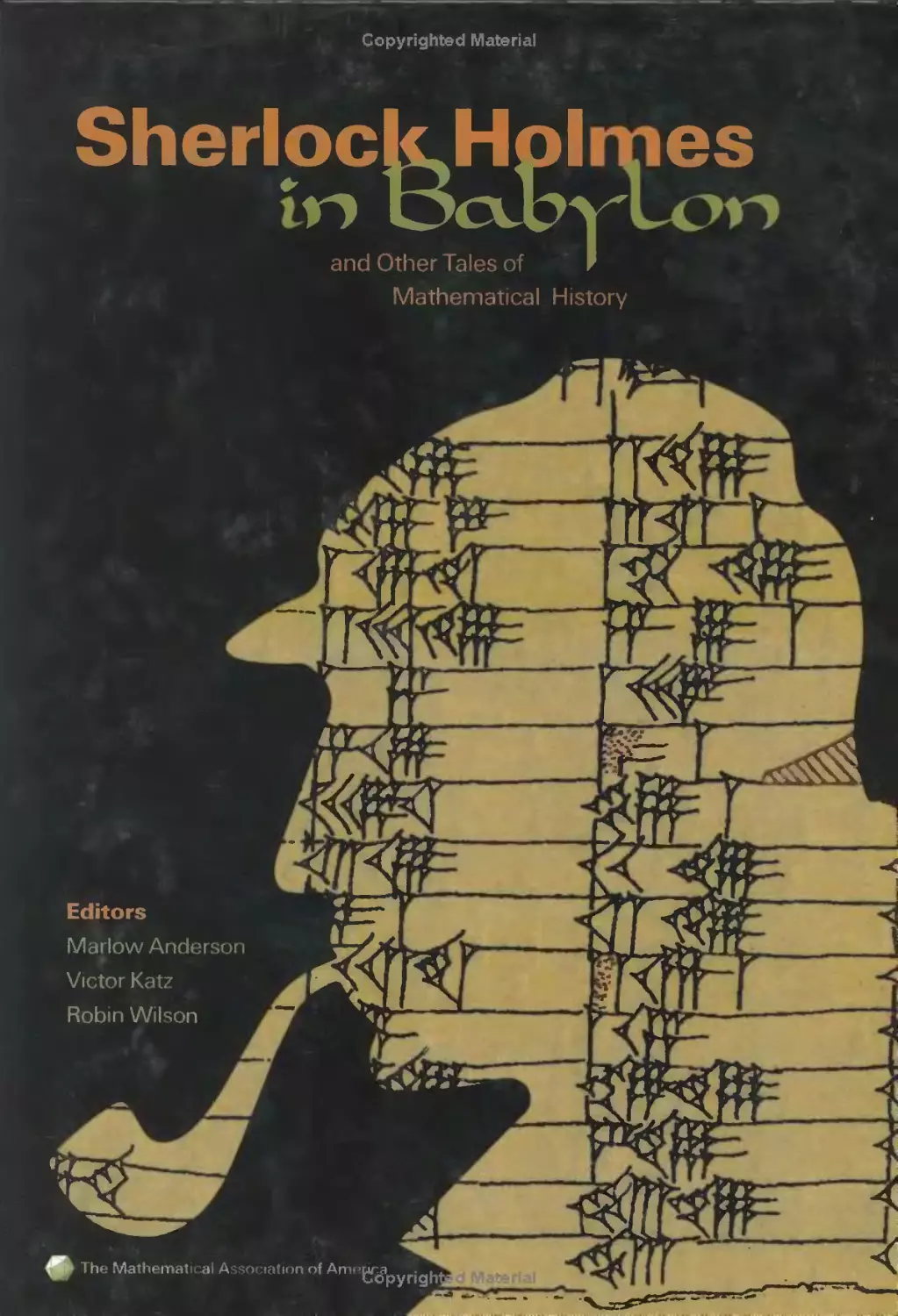
Sherlock Holmes in Babylon
and Other Tales of Mathematical History
@ 2004 by
The Mathematical Association of America (Incorporated)
Library of Congress Catalog Card Number 2003113541
ISBN 0-88385-546-1
Printed in the United States of America
Current Printing (last digit):
10 9 8 7 6 5 4 3 2 1
Sherlock Holmes in Babylon
and Other Tales of Mathematical History
Edited by
Marlow Anderson
Colorado College
Victor Katz
University of the District of Columbia
Robin Wilson
Open University
1. :(;\:
',,/1
. ,,,- ' I,'I!
\\\\\ . : ":
:\%
,"' ,
_:
Published and Distributed by
The Mathematical Association of America
Committee on Publications
Gerald L. Alexanderson, Chair
Spectrum Editorial Board
Gerald L. Alexanderson, Chair
Robert Beezer Russell L. Merris
William Dunham Jean J. Pedersen
Michael Filaseta J. D. Phillips
Erica Flapan Marvin Schaefer
Eleanor Lang Kendrick Harvey Schmidt
Jeffrey L. Nunemacher Sanford Segal
Ellen Maycock Franklin Sheehan
John E. Wetzel
SPECTRUM SERIES
The Spectrum Series of the Mathematical Association of America was so named to reflect its purpose: to
publish a broad range of books including biographies, accessible expositions of old or new mathematical
ideas, reprints and revisions of excellent out-of-print books, popular works, and other monographs of high
interest that will appeal to a broad range of readers, including students and teachers of mathematics,
mathematical amateurs, and researchers.
777 Mathematical Conversation Starters, by John de Pillis
All the Math That's Fit to Print, by Keith Devlin
Carl Friedrich Gauss: Titan of Science, by G. Waldo Dunnington, with additional material by Jeremy Gray
and Fritz-Egbert Dohse
The Changing Space of Geometry, edited by Chris Pritchard
Circles: A Mathematical View, by Dan Pedoe
Complex Numbers and Geometry, by Liang-shin Hahn
Cryptology, by Albrecht Beutelspacher
Five Hundred Mathematical Challenges, Edward J. Barbeau, Murray S. Klamkin, and William O. J. Moser
From Zero to Infinity, by Constance Reid
The Golden Section, by Hans Walser. Translated from the original German by Peter Hilton, with the
assistance of Jean Pedersen.
I Want to Be a Mathematician, by Paul R. Halmos
Journey into Geometries, by Marta Sved
JULIA: a life in mathematics, by Constance Reid
The Lighter Side of Mathematics: Proceedings of the Eugene Strens Memorial Conference on Recreational
Mathematics & Its History, edited by Richard K. Guy and Robert E. Woodrow
Lure of the Integers, by Joe Roberts
Magic Tricks, Card Shuffling, and Dynamic Computer Memories: The Mathematics of the Perfect Shuffle,
by S. Brent Morris
The Math Chat Book, by Frank Morgan
Mathematical Apocrypha, by Steven G. Krantz
Mathematical Carnival, by Martin Gardner
Mathematical Circles Vol I: In Mathematical Circles Quadrants L IL IlL IV; by Howard W. Eves
Mathematical Circles Vol II: Mathematical Circles Revisited and Mathematical Circles Squared, by Howard
W. Eves
Mathematical Circles Vol III: Mathematical Circles Adieu and Return to Mathematical Circles, by Howard
W. Eves
Mathematical Circus, by Martin Gardner
Mathematical Cranks, by Underwood Dudley
Mathematical Evolutions, edited by Abe Shenitzer and John Stillwell
Mathematical Fallacies, Flaws, and Flimflam, by Edward J. Barbeau
Mathematical Magic Show, by Martin Gardner
Mathematical Reminiscences, by Howard Eves
Mathematical Treks: From Surreal Numbers to Magic Circles, by Ivars Peterson
Mathematics: Queen and Servant of Science, by E.T. Bell
Memorabilia Mathematica, by Robert Edouard Moritz
New Mathematical Diversions, by Martin Gardner
Non-Euclidean Geometry, by H. S. M. Coxeter
Numerical Methods That Work, by Forman Acton
Numerology or What Pythagoras Wrought, by Underwood Dudley
Out of the Mouths of Mathematicians, by Rosemary Schmalz
Penrose Tiles to Trapdoor Ciphers . . . and the Return of Dr. Matrix, by Martin Gardner
Po lyo m in 0 es, by George Martin
Power Play, by Edward J. Barbeau
The Random Walks of George P61ya, by Gerald L. Alexanderson
Remarkable Mathematicians, from Euler to von Neumann, loan James
The Search for E. T. Bell, also known as John Ta in e, by Constance Reid
Shaping Space, edited by Marjorie Senechal and George Fleck
Sherlock Holmes in Babylon and Other Tales of Mathematical History, edited by Marlow Anderson, Victor
Katz, and Robin Wilson
Student Research Projects in Calculus, by Marcus Cohen, Arthur Knoebel, Edward D. Gaughan, Douglas
S. Kurtz, and David Pengelley
Symmetry, by Hans Walser. Translated from the original German by Peter Hilton, with the assistance of
Jean Pedersen.
The Trisectors, by Underwood Dudley
Twenty Years Before the Blackboard, by Michael Stueben with Diane Sandford
The Words of Mathematics, by Steven Schwartzman
MAA Service Center
P.O. Box 91112
Washington, DC 20090-1112
800-331-1622 FAX 301-206-9789
Introduction
For the past one hundred years, the Mathematical Association of America has been publishing
high-quality articles on the history of mathematics, some written by distinguished historians such as
Florian Cajori, Julian Lowell Coolidge, Max Dehn, David Eugene Smith, Carl Boyer, and others.
Many well-known historians of the present day also contribute to the MAA's journals. Some
years ago, Robin Wilson and Marlow Anderson, along with the late John Fauvel, a distinguished
and sorely missed historian of mathematics, decided that it would be useful to reprint a selection
of these papers and to set them in the context of modem historical research, so that current
mathematicians can continue to enjoy them and so that newer articles can be easily compared
with older ones. After John's untimely death, Victor Katz was asked to fill in and help bring this
proj ect to completion.
A careful reading of some of the older papers in particular shows that although modem research
has introduced some new information or has fostered some new interpretations, in large measure
they are neither dated nor obsolete. Nevertheless, we have sometimes decided to include two
or more papers on a single topic, written years apart, to show the progress in the history of
mathematics.
The editors hope that you will enjoy this collection covering nearly four thousand years of
history, from ancient Babylonia up to the time of Euler in the eighteenth century. We wish to
thank Don Albers, Director of Publication at the MAA, and Gerald Alexanderson, chair of the
publications committee of the MAA, for their support for the history of mathematics at the MAA
in general, and for this project in particular. We also want to thank Beverly Ruedi for her technical
expertise in preparing this volume for publication.
Vll
Contents
Introduction
Vll
Ancient Mathematics
Foreword ... . . . . . . . . . . . . . . . . . . . . . . . . . . . . . . . . . .
Sherlock Holmes in Babylon, R. Creighton Buck . . . . . . . . . .
Words and Pictures: New Light on Plimpton 322, Eleanor Robson
Mathematics, 600 B.C.-600 A.D., Max Dehn . .
Diophantus of Alexandria, J. D. Swift . . . . . . . . . . . . . . . . . .
Hypatia of Alexandria, A. W Richeson ........
Hypatia and Her Mathematics, Michael A. B. Deakin . . . . .
The Evolution of Mathematics in Ancient China, Frank Swetz ..........
Liu Hui and the First Golden Age of Chinese Mathematics, Philip D. Straffin, Jr.
Number Systems of the North American Indians, W C. Eells . . . .
The Number System of the Mayas, A. W Richeson . .
Before The Conquest, Marcia Ascher
Afterword . . . . . . . . . . . . . . . . . . . . . . . . . .
3
5
14
27
41
47
52
60
69
83
94
98
105
Medieval and Renaissance Mathematics
Foreword .............................................
The Discovery of the Series Formula for 7r by Leibniz, Gregory and Nilakantha, Ranjan Roy
Ideas of Calculus in Islam and India, Victor J. Katz .............
Was Calculus Invented in India?, David Bressoud .. . . . . . . . . . . . .
An Early Iterative Method for the Determination of sin 1 0 , Farhad Riahi
Leonardo of Pisa and his Liber Quadratorum, R. B. McClenon. . . . . . . . .
The Algorists vs. the Abacists: An Ancient Controversy on the Use of Calculators,
Barbara E. Reynolds . . . . . . . . . . . . . . . . . . . . . . . . . . . . . . .
Sidelights on the Cardan- Tartaglia Controversy, Martin A. Nordgaard . . . . . . . .
Reading Bombelli's x-purgated Algebra, Abraham Arcavi and Maxim Bruckheimer
The First Work on Mathematics Printed in the New World, David Eugene Smith . .
Afterword . . . . . . . . . . . . . . . . .. ........................
109
111
122
131
138
143
148
153
164
169
173
The Seventeenth Century
Foreword .........................................
An Application of Geography to Mathematics: History of the Integral of the Secant,
v: Frederick Rickey and Philip M Tuchinsky .. ........
Some Historical Notes on the Cycloid, E. A. Whitman . . . . . . .
Descartes and Problem-Solving, Judith Grabiner . .. ....
177
179
183
188
IX
x
Sherlock Holmes in Babylon and Other Tales of Mathematical History
Rene Descartes' Curve-Drawing Devices: Experiments in the Relations
Between Mechanical Motion and Symbolic Language, David Dennis . . . . . . . . . . . .
Certain Mathematical Achievements of James Gregory, Max Dehn and E. D. Hellinger . . . . .
The Changing Concept of Change: The Derivative from Fermat
to Weierstrass, Judith Grabiner . . . . . . . . . . . . . . . . . . . . . . . . . . . . . . .
The Crooked Made Straight: Roberval and Newton on Tangents, Paul R. Wolfson
On the Discovery of the Logarithmic Series and Its Development
in England up to Cotes, Josef Ehrenfried Hofmann . . . . . . . . . . . . . .
Isaac Newton: Man, Myth, and Mathematics, Frederick Rickey . . . . . . . . . .
Reading the Master: Newton and the Birth of Celestial Mechanics, Bruce Pourciau
Newton as an Originator of Polar Coordinates, C. B. Boyer . . . . . . . . . . . . . . . . . . . .
Newton's Method for Resolving Affected Equations, Chris Christensen. . . . . .
A Contribution of Leibniz to the History of Complex Numbers, R. B. McClenon . .
Functions of a Curve: Leibniz's Original Notion of Functions
and Its Meaning for the Parabola, David Dennis and Jere Confrey
Afterword . . . . . . . . . . . . . . . . . . . . . . . . . . . . . . . . . . . .
The Eighteenth Century
F orew ord .. . . . . . . . . . . . . . . . . . . . . . . . . . . . . . . . . . . . . . . . . .
Brook Taylor and the Mathematical Theory of Linear Perspective, P. S. Jones
Was Newton's Calculus a Dead End? The Continental Influence
of Maclaurin's Treatise of Fluxions, Judith Grabiner . . . . . . . .
Discussion of Fluxions: from Berkeley to Woodhouse, Florian Cajori . .
The Bemoullis and the Harmonic Series, William Dunham . .
Leonhard Euler 1707-1783, J. J. Burckhardt . . . . . . . . . . . . . . . . . . . . .
The Number e, J. L. Coolidge . . . . . . . . . . . . . . . . . . . . . .
Euler's Vision of a General Partial Differential Calculus for a Generalized
Kind of Function, Jesper Liitzen . . . . . . . . . . . . . . . .. .........
Euler and the Fundamental Theorem of Algebra, William Dunham . . . .
Euler and Differentials, Anthony P. F erzola . . . . . . . . . . .
Euler and Quadratic Reciprocity, Harold M Edwards
Afterword . . . . . . . . . . . . . . . . . . . . . . . . . . . . .
Index
About the Editors
199
208
218
228
235
240
261
274
279
288
292
297
301
303
310
325
332
336
346
354
361
369
375
383
385
387
Ancient
Mathematics
Foreword
The twentieth century saw great strides in our understanding of the mathematics of ancient times.
This was often achieved through the combined work of archaeologists, philologists, and historians
of mathematics.
We especially see how this understanding has grown in the study of the mathematics of
Mesopotamia. Although the clay tablets on which this mathematics was written were excavated
beginning in the nineteenth century, it was not until early in the twentieth century that a careful
study of the mathematics on some of these tablets was undertaken. In particular, the tablet known
as Plimpton 322 was first published by Neugebauer and Sachs in 1945, who determined that the
numbers in each row of the tablet always included two out of the three numbers of a Pythagorean
triple. Since that time, there has been a great scholarly debate on how those numbers were found,
as well as the general purpose of the tablet. In our opening papers, we present two discussions
of this issue, one by R. Creighton Buck and a second by Eleanor Robson. Both of these papers
illustrate the necessity of applying ideas from several disciplines to help us make sense of the past.
Greek mathematics has, of course, been studied ever since the demise of Greek civilization. A
survey of the history of Greek mathematics, as it was understood in the 1940s, is presented here by
Max Dehn, a prominent mathematician in his own right-he solved one of the Hilbert problems.
Dehn's article originally appeared in four parts in the Monthly, each part dealing with a different
chronological period. The first part considers the work of Pythagoras and his school; the second
deals with Euclid; the third considers Apollonius and Archimedes; while the fourth gives us a
summary of the mathematics in Greek culture under the domination of the Roman empire.
Two of the mathematicians mentioned by Dehn are dealt with in more detail in the following
articles, one on Diophantus and two on Hypatia. J. D. Swift examines several problems posed
by Diophantus and explains some of his ingenious solutions. A. W. Richeson discusses the life
of Hypatia through a detailed analysis of the sources available to him in 1940. In a more recent
article, Michael Deakin considers the latest research on the work of Hypatia. He explains how
we know what we do know, especially in regard to her mathematical work, and what remains as
speculation.
Frank Swetz presents a detailed survey of what we know about mathematics in ancient China.
Not only does he explain in detail certain mathematical techniques of the Chinese, but he also
presents a detailed bibliography so that the reader may explore further. Swetz briefly mentions the
third-century mathematician Liu Hui, whose work is explored in greater detail by Philip Straffin
in the next article. There we learn not only about Liu Hui' s commentaries and extensions of
the Chinese classic Nine Chapters on the Mathematical Art, but also about Liu's use of a limit
argument to determine the volume of a pyramid. Although Liu used what is now called Cavalieri's
principle to determine certain volumes, he could not figure out how to determine the volume of
3
4
Ancient Mathematics
a sphere. Straffin shows us how a later mathematician, Zu Gengzhi, ultimately determined the
correct formula for that volume through a creative use of the same principle.
This section concludes with three discussions of mathematics in the Americas. First, W. C. Eells
reports on the data from many years of linguistic study and analyzes the structure of the number
systems in numerous groups of North American Indians. Next, A. W. Richeson looks at the number
system of Mayas, displaying both the head-variant form of the monuments as well as the more
familiar written form in the codices. Marcia Ascher, in an article written to commemorate the 500th
anniversary of Columbus's first visit to the western hemisphere, then discusses the mathematics
of two of the civilizations living there at the time. She explains the quipus of the Incas of Peru
and Ecuador and then deals anew with the Mayans, concentrating in particular on the types of
mathematical problems that they could solve in their number system.
Sherlock Holmes in Babylon
R. CREIGHTON BUCK
American Mathematical Monthly 87 (1980), 335-345
Let me begin by clarifying the title "Sherlock
Holmes in Babylon." Lest some members of the
Baker Street Irregulars be misled, my topic is the ar-
chaeology of mathematics, and my obj ective is to re-
trace a small portion of the research of two scholars:
Otto Neugebauer, who is a recipient of the Distin-
guished Service Award, given to him by the Mathe-
matical Association of America in 1979, and his col-
league and long-time collaborator, Abraham Sachs.
It is also a chance for me to repay both of them a
personal debt. I went to Brown University in 1947,
and as a new Assistant Professor I was welcomed
as a regular visitor to the Seminar in the History of
Mathematics and Astronomy. There, with a handful
of others, I was privileged to watch experts engaged
in the intellectual challenge of reconstructing pieces
of a culture from random fragments of the past. (See
[4], [5].)
This experience left its mark upon me. While I do
not regard myself as a historian in any sense, I have
always remained a "friend of the history of math-
ematics"; and it is in this role that I come to you
today. Let me begin with a sample of the raw mate-
rials. Figure 1 is a copy of a cuneiform tablet mea-
suring perhaps 3 inches by 5. The markings can be
made by pressing the end of a cut reed into wet clay.
Dating such a tablet is seldom easy. The appearance
of this tablet suggests that it may have been made
in Akkad in the city of Nippur in the year -1700,
about 3700 years ago.
Confronted with an artifact from an ancient cul-
ture, one asks several questions:
(i) What is this and what are its properties?
(ii) What was its original purpose?
(iii) What does this tell me about the culture that
produced it?
In the History of Science, one expects neither theo-
rems nor rigorous proofs. The subject is replete with
conjectures and even speculations; and in place of
proof, one often finds mere confirmation: "I believe
P implies Q; and because I also believe Q, I there-
fore also believe P."
In Figure 1, we draw a vertical line to separate the
first two columns. In the first column, we recognize
what seem to be counting symbols for the numbers
from 1 through 9. Paired with these in the second
column we see 9, then 1 and 8, then 2 and 7, and
then 3 and 6. This suggests that what we have is a
"table of 9' s", a multiplication table for the factor
9. Checking further, we see 5 and 4 across from the
r iW
rr i!I
W
'ff
W
TW
" r rrr
" f4T
If Y 4<f
.( r
.{f \
4f r
r
W Jf
rr4f
Yr
JfTT'&11F
4Wyy
.(ftJ IT
flT
W
wr
,.(
41f
Figure 1.
5
6
counting symbol for 6, which confirms the conjec-
ture. However, in the next line we see 7 and then
across from it what seems to be a 1 and a 3.
We modify our conjecture; instead of an ordinary
decimal system, we are dealing with a hybrid. There
is a decimal substratum, using one type of wedge for
units and another for tens but the system is base 60 in
the large. The 1 and 3 in fact represent 60 + 3 == 63.
We then immediately conjecture that the same wedge
symbol will be used for 1, for 60, for (60)2, (60)3,
and so on, while the digits will be given in a decimal
form.
Thus from a single tablet we might have conjec-
tured a complete sexagesimal numeral system. We
would then seek confirmation of this by examin-
ing other tablets, hoping to see the same patterns
there. Indeed, this was done in the last century, and
among the thousands of Babylonian tablets many
were found that bear multiplication tables of the
same general type as that given in Figure 1, gen-
erated by various multiplication factors. There are a
great many duplicates.
We find the Babylonian numeral system cumber-
some to write. In this paper, base 60 numerals will
be written by putting the digits (0 through 59) in or-
dinary Arabic base ten, separating consecutive digits
by the symbol "/". The "units place" will be on the
right as usual. Thus
7/13/28 represents 28+13(60)+7(60)2 = 26,008.
Addition is easy:
14/28/31
3/35/45
18/4/16
If the tablets that bear multiplication tables are
catalogued, something strange is seen. Many tables
of 9's, 12's, etc., are found; but there are also multi-
plication tables for unlikely factors, while many ta-
bles we would have expected never appear. In Figure
2 we list those that occur frequently.
,
We are left with three puzzles:
(i) Why are some tables missing? (For example, 7,
11, 13, 14 , etc.?)
(ii) Why are there tables with factors such as 3/45,
7/12, 7/30, and 44/26/40?
(iii) Why are there so many tablets with exactly the
same multiplication tables on them?
Some clues are found; for example, there are tablets
that contain two versions of the same multiplication
Ancient Mathematics
2 18 1/15 = 75
3 20 1/20 = 80
4 24 1/30 = 90
5 25 1/40 = 100
6 30 2/15 = 135
8 36 2/24 = 144
9 40 2/30 = 150
10 45 3/20 = 200
12 48 3/45 = 225
15 50 4/30 = 270
16 6/40 = 400
7/12 = 432
7/30 = 450
8/20 = 500
12/30 = 750
16/40 = 1000
22/30 = 1350
44/26/40 = 160,000
and a scattering of others
Figure 2. Factors Used for Multiplication Tables
table, one done neatly and one less neatly and per-
haps with an error or two. I am sure that a familiar
picture comes immediately to your mind: a cluster
of students, all engaged in copying a model table
provided by the teacher who will shortly be grad-
ing their efforts. Are we not correct to infer that in
Nippur there was probably an extensive school for
scribes who were in training to become bureaucrats
or priests?
To help answer the first two questions, let us ex-
amine another tablet, which for convenience I have
transcribed into the slash notation. (See Figure 3.)
This again fits the pattern of two matched columns,
and we look for an explanation. We note at once that
in the first few rows the product of the adjacent col-
umn numbers is always 60. There seem to be some
exceptions, however. With the pair 9 and 6/40, this
product is
(9) x (6/40) == (9) x (400) == 3600
2 30 16 3/45 45 1/20
3 20 18 3/20 48 1/15
4 15 20 3 50 1/12
5 12 24 2/30 54 1/6/40
6 10 25 2/24 1/4 56/15
8 7/30 27 2/13/20 1/12 50
9 6/40 30 2 1/15 48
10 6 32 1/52/30 1/20 45
12 5 36 1/40 1/21 44/26/40
15 4 40 1/30
Figure 3.
BUCK: Sherlock Holmes in Babylon
and again
(16) x (3/45) == (16) x (225) == 3600
while still further down, we see
(27) x (2/13/20) == (27) x (8000) == 216,000.
The solution becomes obvious if we write these
products in Babylonian form; since 60 is 1/0, 3600
is 1/0/0, and 216,000 is 1/0/0/0. For confirmation,
look at the last entry in the table:
(1/21) x (44/26/40) == (81) x (160,000)
== 12,960,000
== 1/0/0/0/0.
If we now follow the Babylonian practice of omit-
ting terminal zeros, we see that Figure 3 is merely
a table of reciprocals, written in "sexagesimal float-
ing point." If A is an integer in the first column,
the integer paired with it in the second column,
A R, is one chosen so that their product would be
written as "1," meaning any suitable power of 60.
The integers that appear in the table will always be
factorable into powers of 2, 3, and 5, since these
have terminating reciprocals in base 60. The term
"floating-point arithmetic" is today a computer con-
cept but is also understandable to anyone who has
used a slide rule or worked with logarithms; the con-
cept would also have been familiar to medieval as-
tronomers who multiplied large numbers by the de-
vice called "prosthaphaeresis."
Now that Figure 3 is understood, we can answer
the two puzzles left hanging on the previous page.
Observe that the integers used to generate multi-
plication tables, as seen in Figure 2, mostly come
from the standard reciprocal table. (There are also
tablets that contain nonstandard reciprocals, recip-
rocals of such numbers as 7, 11, etc., of necessity
given in terminating approximate form.) In floating
point, B -;- A == B x A R. Thus the combination of
a set of multiplication tables and a reciprocal table
makes it easy to carry out floating-point division,
provided that the divisor is one of the "nice" num-
bers in base 60, of the form 2 a 3,651'. For example,
let us divide 417 by 24; in base 60, this will be
6/57 -;- 24 == 17/22/30.
Method:
6/57 -;- 24 == (6/57) x (24)R == (6/57) x (2/30) :
6/57 x 2 == 12 + 1/54 == 13/54
6/57 x 30 == 3 + 28/30 == 3/28/30
answer == 17/22/30
7
- -- ---......-- -.-...--...--..-- ---- - .
;II) L U
" )..) - '"
GO ..c ColI ,...
0 0 I,)
-yo a.J VI
., 0 JJ
0
n
!.. w 1.) .
.. c.1I 6' ..t
-0 &It () 0 "-
.c
"I .J: 0
b
0 - L W
0 " -
"-
.- bS , "- ...... 1.1
"- CS' ..J{ "-
0 w
..t oJ: () 0 It.J
,., 0 0 CI'I 0 0
- - -.. - - - - - - - - - - - - - - - - - - - - --..
Figure 4.
The last steps in this calculation are easier if one
recalls that 30 == 2 R , so that multiplication by 30
is the same as halving. (Of course the scribe must
be sure to keep track of the actual magnitudes and
place values.)
That common calculations were made in this fash-
ion becomes even more plausible in the light of one
remarkable discovery. This is an inscribed cylinder,
carrying on its curved face a copy of the standard
reciprocal table and each of the standard multiplica-
tion tables. (In Figure 4, we show this restored, with
each multiplication table indicated by its generator.)
With the help of this cylinder, perhaps mounted on a
stand, a scribe could easily keep track of taxes and
calculate wages; perhaps we have here the Baby-
lonian version of a slide rule or desk calculator!
With this brief introduction to the arithmetic of the
Babylonians, we turn to another tablet whose mathe-
matical nature had been overlooked until the work of
Neugebauer and Sachs. It is in the George A. Plimp-
ton Collection, Rare Book and Manuscript Library,
at Columbia University, and usually called Plimpton
322. (See Figure 5, which is reproduced here by per-
mission of the Library.) The left side of this tablet
has some erosion; traces of modem glue on the left
edge suggest that a portion that had originally been
attached there has since been lost or stolen. Since it
was bought in a marketplace, one may only conjec-
ture about its true origin and date, although the style
suggests about -1600 for the latter. As with most
such tablets, this had been assumed to be a commer-
cial account or inventory report. We will attempt to
show why one can be led to believe otherwise.
8
.... --.....--.- - - - -
.
2
2
.
.
.
.
.
.
.
.
.
.
.
...
Ancient Mathematics
- - - - - - ____ - _ - --------..- - .- --.-.. ___ _.-......--.... __._ - .0. .
Figure 5. Plimpton 322
Column A
15
58/14/50/6/15
1/15/33/45
5 29/32/52/16
48/54/ 1/40
47/ 6/41/40
43/11/56/28/26/40
41/33/59/ 3/45
38/33/36/36
35/10/2/28/27 /24/26/40
33/45
29/21/54/ 2/15
27 / 3/45
25/48/51/35/6/40
23/13/46/40
Column B
1/59
56/7
1/16/41
3/31/49
1/5
5/19
38/11
13/19
9/1
1/22/41
45
27/9
7 /12/ 1
29/31
56
Column C
2149
3 I 12/1
1/50/49
5/9/1
1/37
8/1
59/1
20/49
12/49
2116/1
1/15
48/49
4/49
53/49
53
S011le of the nutnerals there are short and SaIne long,
apparently at randotn. In contrast with this, all the
nU11lerais in columns Band C are rather short, and
we do not see any evidence of generallTIonotonicity.
Since it is easier for us to work with Arabic nu-
tnerals, let us translate columns Band C into these
nU11lerais and look for patterns. (See Figure 7.) We
see at once that B is slTIaller than C, with only
two exceptions. Also, playing with these numbers,
we find that column B contains exactly one pritne,
natnely, 541, while column C contains eight num-
bers that are pritne.
In the first 20,000 integers, there are about 2,300
pritnes, WhiCh is about 1 0 percent; atnong 15 inte-
B C B C
119 169 541 769
3367 11521 4961 8161
4601 6649 45 75
12709 18541 1679 2929
65 97 25921 289
319 481 1771 3229
2291 3541 56 53
799 1249
Figure 7.
FigUre 6. Plimpton 322
First, let us transcribe it into the SlaSh notation,
as seen in Figure 6. we have reprOduced the three
1l1ain COlumns, WhiCh we have labeled A, B, and
C. we note that there are gaps in COlumn A, due
to the erOSion. However, it seems apparent that the
nUlTIbers there are SteadilY decreaSing. we note that
BUCK: Sherlock Holmes in Babylon
C+B C-B
288 50
14888 8154
11250 2048
31250 5832
162 32
800 162
5832 1250
2048 450
1310 228
13132 3200
120 30
4608 1250
26210 -25632
5000 1458
109 -3
Figure 8.
gers, selected at random from this interval, we might,
then, expect to see one or two primes, but certainly
not eight! This at once tells us that the tablet is math-
ematical and not merely arithmetical. (Imagine your
feelings if you were to find a Babylonian tablet with
a list of the orders of the first few sporadic simple
groups. )
Encouraged, one attempts to find further visible
patterns, for example, by combining the entries in
columns Band C in various ways. One of the ear-
liest tries is immediately successful. In Figure 8, we
show the results of calculating C + Band C - B.
If you are sensitive to arithmetic you will note that,
in almost every case, the numbers are each twice a
perfect square.
If C + B == 2a 2 and C - B == 2b 2 , then
B == a 2 - b 2 and C == a 2 + b 2 . Thus the entries
in these columns could have been generated from
integer pairs (a, b). In passing, we note that B, be-
ing (a-b)(a+b), is not apt to be prime; on the other
hand, when a and b are relatively prime, every prime
of the form 4N + 1 can be expressed as a 2 + b 2 .
In Figure 9, we have recopied columns Band
C, together with the appropriate pairs (a, b) in the
cases where this representation is possible. As a fur-
ther confirmation that we are on the right track, we
note that in every such pair the numbers a and b
are both "nice", that is, factorable in terms of 2, 3,
and 5. In five cases, the pattern breaks down and no
pair exists. It will be a further confirmation if we
can explain these discrepancies as errors made by
the scribe who produced the tablet. We make a sim-
ple hypothesis and assume that Band C were each
9
B C (a, b)
119 169 12,5
3367 11521 ?
4601 6649 75,32
12709 18541 125,54
65 97 9,4
319 481 20,9
2291 3541 54,25
799 1249 32,15
541 769 ?
4961 8161 81,40
45 75 ?
1679 2929 48,25
25921 289 ?
1771 3229 50,27
56 53 ?
Figure 9.
computed independently from the pair (a, b) and that
a few errors were made but each affected only one
number in each row. Thus in each vacant place we
will assume that either B or C is correct and the
other wrong, and attempt to restore the correct en-
try. Since we do not know the correct pair (a, b) we
must find it; because of the evidence in the rest of
the table, we insist that an acceptable pair must be
composed of "nice" sexagesimals.
We start with line 9; here, B == 541, which hap-
pens to be the only prime in Column B. We therefore
assume B is wrong and C is correct, and thus write
C == 769 == a 2 + b 2 . This has a single solution,
the pair (25,12). (We also note that both happen
to be nice sexagesimals.) If this is correct, then B
should have been (25)2 - (12)2 == 481, instead of
541 as given. Is there an obvious explanation for
this mistake? Yes, for in slash notation, 541 == 9/1
and 481 == 8/1. The anomaly in line 9 seems to be
merely a copy error.
Turn now to line 13; here, B is far larger than C,
which is contrary to the pattern. Assume that B is
in error and C is correct, and again try C == 289 ==
a 2 + b 2 . There is a "nice" unique solution, (15, 8),
and using these, we are led to conj ecture that the
correct value of B is (15)2 - (8)2 == 161. Again, we
ask if there is an obvious explanation for arriving at
the incorrect value given, 25921. A partial answer is
immediate: (161)2 == 25921; so that for some reason
the scribe recorded the square of the correct value
for B.
Continuing, consider line 15. Since B == 56 and
C == 53, we have B > C, which does not match the
10
general pattern. However, it is not clear whether B is
too large or 0 too small. Trying the first, we assume
o is correct and solve 53 == a 2 + b 2 , obtaining the
unique answer (7,2). We reject this, since 7 is not
a nice sexagesimal. Now assume that B is correct,
and write 56 == a 2 - b 2 == (a + b) (a - b). This has
two solutions, (15, 13) and (9,5). We reject the first
and use the second, obtaining 92 + 52 == 106 as the
correct value of O. Seeking an explanation, we note
that the value given by the scribe, 53, is exactly half
of the correct value.
Turning now to line 2 of Figure 9, we have B ==
3367 and 0 == 11521, either of which might be
correct. Assume that 0 == a 2 + b 2 and find two
solutions (100,39) and (89,60). While 100 and 60
are nice, 39 and 89 are not, so we reject both pairs
and assume that B is correct. Writing 3367 == (a-b)
(a + b) and factoring 3367 in all ways, we find four
pairs: (1684,1683), (244,237), (136, 123), (64,27),
of which we can accept only the last. This yields
(64)2 + (27)2 == 4825 as the correct O. Comparing
this with the number 11521 that appeared on the
tablet, we see no immediate naive explanation for
the error. For example, since 4825 == 1/20/25 and
11521 == 3/12/1, it does not seem to be a copy
error. Without an explanation, we may have a little
less confidence in this reconstruction of the entries
in line 2.
The last misfit in the table is line 11, where
we have B == 45 and 0 == 75. This is unusual
also because this is the only case where Band 0
have a common factor. The sums-and-differences-of-
squares pattern failed because neither 0 + B == 120
nor 0 - B == 30 is twice a square. However, every-
thing becomes clearer if we go back to base 60 no-
tation and remember that we use floating point; for
120 == 2/0, which is twice 1/0 and which we can
also write as 1, clearly a perfect square. In the same
way, 30 is twice 15, which is also 4 R and which
is the square of 2 R . The pattern is preserved and
no corrections need be made in the entries: with
a == 1 == 1/0 and b == == 2 R == 30 == 0/30,
we have a 2 == 1/0 and b 2 == 0/15, and
o == a 2 + b 2 == 1/0 + 0/15 == 1/15 == 75
B == a 2 - b 2 == 1/0 - 0/15 == 0/45 == 45.
(Another aspect of the line 11 entries will appear
later. )
With this, we have completed the work of editing
the original tablet. In Figure 10, we give a corrected
table for columns Band 0, together with the appro-
priate pairs ( a, b) from which they can be calculated.
B
119
3367
4601
12709
65
319
2291
799
481
4961
45
1679
161
1771
56
Ancient Mathematics
o
169
4825
6649
1854
97
481
3541
1249
769
8161
75
2929
289
3229
106
( a, b)
12, 5
64, 27
75, 32
125, 54
9,4
20, 9
54, 25
32, 15
25, 12
81, 40
1, == 30
48, 25
15, 8
50, 27
9, 5
Figure 10. Corrected Version
It is now the time to raise the second canonical
question: What was the purpose behind this tablet?
Speculation in this direction is less restricted, since
the road is not as well marked. We can begin by ask-
ing if numbers of the form a 2 - b 2 and a 2 + b 2 have
any special properties. In doing so, we run the risk
of looking at ancient Babylonia from the twentieth
century, rather than trying to adopt an autochthonous
viewpoint. Nevertheless, one relation is extremely
suggestive, involving both algebra and geometry. For
any numbers (integers) a and b,
( a 2 - b 2 ) 2 + (2ab) 2 == (a 2 + b 2 ) 2 . (1 )
In addition, if we introduce D == 2ab, then B,
0, and D can form a right-angled triangle with
B 2 + D 2 == 0 2 . And finally, these formulas generate
all Pythagorean triplets (triangles) from the integer
parameters ( a, b). (See Figure 11.)
There is no independent information showing that
these facts were known to the Babylonians at the
time we conjecture that this tablet was inscribed, al-
though, as will appear later, their algebra had already
B
D
Figure 11. B == a 2 - b 2 , D == 2ab, C == a 2 + b 2
BUCK: Sherlock Holmes in Babylon
mastered the solution of quadratic equations. If the
tablet indeed is connected with this observation, then
the unknown column A numbers ought to be con-
nected in some way with the same triangle. The next
step is, then, to proceed as before and try many dif-
ferent combinations of B, 0, and D, in hopes that
one of these will approximate the entries in column
A. Slopes and ratios are an obvious starting point,
so one calculates 0 7 B, 0 7 D, B 7 D, etc. After
discarding many failures, one arrives at the combi-
nation (B 7 D) 2 . In Figure 12, we give the values
of this expression, calculated from the corrected val-
ues of B and using the hypothetical values of (a, b)
to find D. (We remark that it was very helpful to
have a programmable pocket calculator that could
be trained to work in sexagesimal arithmetic!)
If we now return to Figure 6 and compare the
numerals given there in column A with those that
appear in Figure 12, we see that there is almost total
agreement. For example, in line 10 we have exact
duplication of an eight-digit sexagesimal! On proba-
bilistic grounds alone, this is an overwhelming con-
firmation. Of course, at the top of the tablet where
there were gaps due to erosion, Figures 6 and 12
are not the same, but it is evident that the calculated
data in Figure 12 can be regarded as filling in the
gaps. There are two minor disagreements in the tvlO
tables. In line 13, the tablet does not show an inter-
nal "0" that is present in Figure 12. This could have
been the custom of the scribe in dealing with such
line value
1 59/0/15
2 56/56/58/14/50/6/15
3 55/7/41/15/33/45
4 53/10/29/32/52/16
5 48/54/1/40
6 47/6/41/40
7 43/11/56/28/26/40
8 41/33/45/14/3/45
9 38/33/36/36
10 35/10/2/28/27/24/26/40
11 33/45
12 29/21/54/2/15
13 27/0/3/45
14 25/48/51/35/6/40
15 23/13/46/40
Figure 12. Calculated Values of (B -;- D) 2
11
an event. In line 8, the scribe has written a digit "59"
where there should have been a consecutive pair of
digits, "45/14". Since 59 == 45 + 14, it is not dif-
ficult to invent several different ways in which an
error of this sort could have been made.
It should be remarked that Neugebauer and Sachs
did not use (B 7 D)2 as a source for column A
but rather (0 7 D)2. Because of the relationship
between Band 0, and formula (1), one sees that
(07 D)2 == (B7 D)2+ 1. Thus, the only effect of the
change would be to introduce an initial "1/" before
all the sexagesimals that appear in Figure 12, and the
reason for their choice was that they believed that
this was true for column A on the Plimpton tablet.
Others who have examined the tablet do not agree.
(I have not seen the tablet, and I do not believe it
matters which alternative is used.)
We now know the relationship of columns A, B,
and O. Referring to Figure 11, 0 is the hypotenuse,
B the vertical side, and A is the square of the slope
of the triangle; thus, in modem notation A == tan 2 ().
It is interesting to observe that the anomalous case
of line 11, with B == 45 and 0 == 75, turns out to be
the familiar 3,4,5 triangle; in the Babylonian case,
this would seem to have been the , 1, triangle,
since 45 == 3 x 4 R and 75 == 1/15 == 5 x 4 R . Of
course the triangle, the side D, and the parameters
(a, b) are all constructs of ours and not immediately
visible in the original tablet. All that we can assert
without controversy is that A == B 2 7 (0 2 - B 2 ).
Let us reexamine some of our reasoning. In lines
2, 9, 13, and 15, the scribe recorded correct values
for A but incorrect values for 0, B, B, and 0, re-
spectively. This suggests strongly that A was not cal-
culated directly from the values of Band 0, but that
A, B, and 0 were all calculated independently from
data that do not appear on the tablet; our hypothetical
pair (a, b) gains life. (Of course there is the possi-
bility that the tablet before us is merely a copy from
another master tablet.) In either case, it seems odd
that column A should be error free while columns
Band 0, involving simpler numbers, should have
four errors.
Other questions can be raised. If, as argued by
Neugebauer, the purpose of the tablet was to record
a collection of integral-sided Pythagorean triangles
(triplets), why do we not see the values of D, or at
least the useful parameters (a, b)? And why would
one want the values in column A which are squares
of the slope? And why should the entries be arranged
in an order that makes the numbers A decrease
monotonically?
12
Variants of this explanation have been proposed.
If one computes the values of the angle () for each
line of the tablet, they are seen to decrease steadily
from about 45 ° to about 30°, in steps of about 1 ° .
Is this an accident? Could this tablet be a primitive
trigonometric table, intended for engineering or as-
tronomic use? But again, why is tan 2 () useful [3],
[6]?
Additional confirmation of such a hypothesis
could be given by an outline of a computational
procedure leading to the tablet, which makes all of
the errors plausible and also shows why they would
have occurred preferentially in columns Band C.
(See [1], [4], [7].)
Building upon an earlier suggestion of Bruins, an
intriguing explanation has been recently proposed by
Voils. In Nippur, a large number of "school texts"
have been found, many containing arithmetic exer-
cises. Among these, a standard puzzle problem is
quite common. The student is given the difference
(or sum) of an unknown number and its recipro-
cal and asked to find the number. If x is the num-
ber (called "igi") and x R is its reciprocal (called
"igibi"), then the student is to solve the equation
x - x R == d. Thus, the "igi and igibi" problems are
quadratic equations of a standard variety.
The school texts teach a specific solution algo-
rithm: "Find half of d, square it, add 1, take the
square root, and then add and subtract half of d."
This is easily seen to be nothing more than a ver-
sion of the quadratic formula, tailored to the "igi and
igibi" problems. Voils connects this class of prob-
lems, and the algorithm above, with the Plimpton
tablet as follows.
First, assume with Bruins that the tablet was com-
puted not from the pair (a, b) but from a single pa-
rameter, the number x == a -;- b. Since a and bare
both "nice", the number x and its reciprocal x R can
each be calculated easily. Indeed, x == a x b R and
x R == b x a R , and a R and b R each appear in a
standard reciprocal table. Next observe that
B == a 2 - b 2 == (ab)(x - x R )
C == a 2 + b 2 == (ab)(x + x R )
A= ( r = { (X-XR)r.
This shows that the entries A, B, C in the Plimpton
tablet could have been easily calculated from a spe-
cial reciprocal table that listed the paired values x
and x R . Indeed, the numbers Band C can be ob-
tained from x ::I:: x R merely by multiplying these by
Ancient Mathematics
integers chosen to simplify the result and shorten the
digit representation. (See [1], [2], [7].)
Voils adds to this suggestion of Bruins the obser-
vation that the numbers A are exactly the results ob-
tained at the end of the second step in the solution
algorithm, (d/2)2, applied to an igi-igibi problem
whose solution is x and x R . Furthermore, the num-
bers Band C can be used to produce other problems
of the same type but having the same intermediate
results in the solution algorithm. Thus Voils pro-
poses that the Plimpton tablet has nothing to do with
Pythagorean triplets or trigonometry but, instead, is
a pedagogical tool intended to help a mathematics
teacher of the period make up a large number of igi-
igibi quadratic equation exercises having known so-
lutions and intermediate solution steps that are easily
checked [7].
It is possible to point to another weak confirma-
tion of this last approach. Suppose that we want a
graduated table of numbers x and their reciprocals
x R . We start with the class of all pairs (a, b) of rel-
atively prime integers such that b < a < 100 and
each integer a and b is "nice", factorable into powers
of 2, 3, and 5. It is then easy to find the terminating
Babylonian representation for both x == a -;- band
for x R == b -;- a. Make a table of these, arranged with
x decreasing. Impose one further restriction:
V3 < x < 1 + J2.
(This corresponds to the limitation 30° < () < 45°,
where () is the base angle in the triangle in Figure
11. )
Then, the resulting list of pairs will coincide with
that given in Figure 10, the corrected Plimpton ta-
ble, except for three minor points. The pair (16, 9)
does not appear, the pair (125,54) does appear, and
instead of the pair (2, 1) we have the pair (1, ); in
\ passing, we recall that the last pair yields the stan-
dard 3, 4, 5 Pythagorean triangle.
Unlike Doyle's stories, this has no final resolu-
tion. Any of these reconstructions, if correct, throws
light upon the degree of sophistication of the Baby-
lonian mathematician and breathes life into what was
otherwise dull arithmetic. For other vistas into the
past, especially those that show us the beginnings
of computational astronomy, I refer the reader to the
bibliography. I can do no better than to close with
an analogy used by Neugebauer:
In the "Cloisters" of the Metropolitan Museum
in New York there hangs a magnificent tapestry
which tells the tale of the Unicorn. At the end
BUCK: Sherlock Holmes in Babylon
we see the miraculous animal captured, grace-
fully resigned to his fate, standing in an en-
closure surrounded by a neat little fence. This
picture may serve as a simile for what we have
attempted here. We have artfully erected from
small bits of evidence the fence inside which
we hope to have enclosed what may appear
as a possible living creature. Reality, however,
may be vastly different from the product of our
imagination; perhaps it is vain to hope for any-
thing more than a picture which is pleasing to
the constructive mind, when we try to restore
the past.
- The Exact Sciences in Antiquity (p. 177)
13
References
1. E. M. Bruins, On Plimpton 322: Pythagorean num-
bers in Babylonian mathematics, Kon. Neder. Akad. U.
Wetensch. Proceedings, 52 (1949) 629-632.
2. E. M. Bruins, Pythagorean triads in Babylonian Math-
ematics, Math. Gaz., 41 (1957) 25-28.
3. Howard Eves, Introduction to the History of Mathe-
matics, 4th ed., Holt, Rinehart & Winston, New York,
1976.
4. O. Neugebauer, The Exact Sciences in Antiquity,
Dover, New York, 1969.
5. O. Neugebauer and A. Sachs, Mathematical Cuneiform
Texts, American Oriental Ser., vol. 29, American Ori-
ental Society, New Haven, 1945.
6. Derek J. de S. Price, The Babylonian 'Pythagorean tri-
angle' tablet, Centaurus, 10 (1964) 219-231.
7. D. L. Voils, to appear in Historia Mathematica.
Words and Pictures: New Light on Plimpton 322
ELEANOR ROBSON
American Mathematical Monthly 109 (2002), 105-120
1 Introduction
In this paper I shall discuss Plimpton 322, one of
the world's most famous ancient mathematical arte-
facts [Figure 1]. But I also want to explore the
ways in which studying ancient mathematics is, or
shQuld be, different from researching modem math-
ematics. One of the most cited analyses of Plimpton
322, published some twenty years ago, was called
"Sherlock Holmes in Babylon" [4]. This enticing ti-
tle gave out the message that deciphering historical
documents was rather like solving a fictional murder
Figure 1. Plimpton 322 (obverse). Drawing by the author.
14
mystery: the amateur detective-historian need only
pit his razor-sharp intellect against the clues pro-
vided by the self-contained story that is the piece of
mathematics he is studying. Not only will he solve
the puzzle, but he will outwit the well-meaning but
incompetent professional history-police every time.
In real life, the past isn't like an old-fashioned who-
dunnit: historical documents can only be understood
in their historical context.
Let's start with a small experiment: ask a friend
or colleague to draw a triangle. The chances are that
he or she will draw an equilateral triangle with a
-
\. LA tt-
I V. J ,,."' I
, -
' J
...
G;! nJ .. -
:!i.. iL ?o _ . . - PlH!i kI
%j['I .,. rr,...{ If""' fJ ....
_. J PI"'" / · >- ;:.
. T -'!.u:r -__I -
: fJ. -yo ...: :'I I 1 rr
r r '''[rI.ArJ 1 10l1li 'rr- - r I ... ,
mj 1 "" !lie pr-
bt: r:i\... . ;: .n.l ,.-'.,1> "'rr-. " 'oil; J
Pt<. :.. .. ""''frr" '" f' r T -- .. . r...-1j..rI--
' I I _ ;. \' , '\ \, ".........
_If r . ' -- - Ilf
. u
. j 0.. ..... .,...
..... "-.J'. " '\ t=
I D' ' .g,( L:r4d t.L1II'\
; ' i. 'I', ,. T/ < .
I ' 1CIU"..u,
I !' .I. r- ,....<1.. tj-
..F. J .,
,,, I"r- ----,
J£ 'r./ ." , I. ".. I--
'I r ,,'X'I - ---'J rW'''
I _ ..... I,"""J
I Mo&. ... JJl.J..... ._
!'\' rr w= ... V !.
r f- -1 I f -< .t:J- y
J .& j ........_T .
i fC;) y.... ... ' r I
r.:;. , . H -
C r r, "oi( r: ' ,f2'
- - +-
.. - -----1 .. -- - _ _.....-r .. . _...
_ ........ _
4=D ::: '. I11III- .... rL
._ . ... ...-,
,
y I
ry-
y
I
j[{ .- r ...._
_F -c
-. Y "'f
. V I !
I r '/-/C.. "
''"
/I"'- r =II :. ow'
,
z- '\ ,
! ,
ffF !E
'OIIi _ ,-
\.. ,
r: =- , F
?r r .c r-
_ oil r15r-J
'.-... '-
FW -c\ < _
. r.iirrl1IQ n ,.... ..J1 V"
U'T" -4
"""I!VJ T _ .. .- ,
r rrr .. : "..
I'rY -< t;:: .:';' i !
< ,t: .:....;,..: .
. .i:.!a1..
...". ..- ......-
ROBSON: Words and Pictures: New Light on Plimpton 322
15
54
. .
.: : .; ..
. - ........I..-.: I
.: :.::.: ;-:; :
.. ...-.. ..
:=?,.
Figure 2. UM 29-15-709 (obverse). Drawing by the author [26, p. 29].
horizontal base. That is our culturally determined
concept of an archetypal, perfect triangle. However,
if we look at triangles drawn on ancient cuneiform
tablets like Plimpton 322, we see that they all point
right and are much longer than they are tall: very
like a cuneiform wedge in fact. A typical example
is UM 29-15-709, a scribal student's exercise, from
ancient Nippur, in calculating the area of a triangle
[Figure 2]. The scale drawing next to it shows how
elongated the sketch is.
We tend to think of mathematics as relatively
culture-free; i.e., as something that is out there, wait-
ing to be discovered, rather than a set of socially
agreed conventions. If a simple triangle can vary
so much from culture to culture, though, what hope
have we in relying on our modem mathematical sen-
sibilities to interpret more complex ancient mathe-
matics? Unlike Sherlock Holmes we cannot depend
solely on our own intuitions and deductive pow-
ers, and we cannot interrogate the ancient authors
or scrutinise their other writings for clues. We there-
fore have to exploit all possible available resources:
language, history and archaeology, social context, as
well as the network of mathematical concepts within
which the artefact was created. In the case of Plimp-
ton 322, for instance, there are three competing in-
terpretations, all equally valid mathematically. As I
shall show, it is these contextualising tools that en-
able us to choose between them.
Plimpton 322 is just one of several thousand
mathematical documents surviving from ancient Iraq
(also called Mesopotamia). In its current state,
it comprises a four-column, fifteen-row table of
Pythagorean triples, written in cuneiform (wedge-
shaped) script on a clay tablet measuring about 13
by 9 by 2 cm [20, Text A, pp. 38-41]. The hand-
writing of the headings is typical of documents from
southern Iraq of 4000-3500 years ago. Its second and
third columns list the smallest and largest member of
each triple-we can think of them as the shortest side
8 and the hypotenuse d of a right-angled triangle-
while the final column contains a line-count from 1
to 15. Part of the tablet has broken away at the begin-
ning of the first column but, depending on whether
you believe the column has fully survived or not,
it holds the square of either the hypotenuse or the
shortest side of the triangle divided by the square
of the longer side Z. Whether it lists d 2 /Z 2 or 8 2 /Z2,
this column is in descending numerical order. The
numbers are written in the base 60, or sexagesimal,
place value system. I shall transliterate them with
a semicolon marking the boundary between integers
and fractions, and spaces in between the other sex-
agesimal places [Figure 3].
There have been three major interpretations of the
tablet's function since it was first published [Figure
4]: 1
1. Some have seen Plimpton 322 as a form of
trigonometric table (e.g., [15]): if Columns II
1 Incidentally, we can dislIDss immediately any suspicion that
Plimpton 322 might be connected with observational astronomy.
Although some simple records of the movements of the moon
and Venus may have been made for divination in the early sec-
ond millennium BCE, the accurate and detailed programme of
astronolIDcal observations for which MesopotalIDa is rightly fa-
mous began a thousand years later, at the court of the Assyrian
kings in the eighth century BCE [3].
16
Ancient Mathematics
[ta ]-ki-il-ti i-li-ip-tim
[sa 1 in ]-na-as-sa-hu-ma SAG i-il-lu-u
[(1) 59] 00 15
[ (1) 56 56] 58 14 50 06 15
[(1) 55 07] 41 15 33 45
(1) 53 10 29 32 52 16
(1) 48 54 01 40
(1) 47 06 41 40
(1) 43 11 56 28 26 40
(1) 41 33 45 14 3 45
(1) 38 33 36 36
(1) 35 10 02 28 27 24 26 40
(1) 33 45
(1) 29 21 54 2 15
(1) 27 00 03 45
(1) 25 48 51 35 6 40
(1) 23 13 46 40
tB.SI8 SAG
1 59
56 07
1 16 41
3 31 49
1 05
5 19
38 11
13 19
8 01
1 22 41
45
27 59
2 41
29 31
28
tB.SI8 i-li-ip-tim
249
1 20 25
1 50 49
5 09 01
1 37
8 01
59 01
2049
12 49
2 16 01
1 15
48 49
449
53 49
53
MU.BI.IM
KI.l
KI.2
KI.3
KI.4
KI.[5]
[KI.6]
KI.7
KI.8
KI.9
KI.I0
KI.l1
KI.12
KI.13
KI.14
KI.15
Figure 3. Transliteration of Plimpton 322.
line a p q x l/x
1 44.76° 12 5 224 25
2 44.25 ° 1 04 27 2 22 13 20 25 18 45
3 43.79° 1 15 32 2 20 37 30 25 36
4 43.27° 2 05 54 2 18 53 20 25 55 12
5 42.08° 9 4 2 15 2640
6 41.54 ° 20 9 2 13 20 27
7 40.32° 54 25 2 09 36 27 46 40
8 39.77° 32 15 2 08 28 07 30
9 38.72° 25 12 2 05 28 48
10 37.44° 1 21 40 2 01 30 29 37 46 40
11 36.87° 2 1 2 30
12 34.98° 48 25 1 55 12 31 15
13 33.86° 15 8 1 52 30 32
14 33.26° 50 27 1 51 06 40 3224
15 31.89° 9 5 1 48 33 20
Figure 4. The proposed restorations at the beginning of the tablet according
to the trigonometric, generating function, and reciprocal pair theories.
and III contain the short sides and diagonals of
right-angled triangles, then the values in the first
column are tan 2 or 1/ cos 2 -and the table is
arranged so that the acute angles of the triangles
decrease by approximately 1 ° from line to line.
2. Neugebauer [19], and Aaboe following him, ar-
gued that the table was generated like this:
If p and q take on all whole values subject
only to the conditions
(l)p>q>O,
(2) p and q have no common divisor (save
1 ),
(3) p and q are not both odd,
then the expressions
x == p2 _ q2
Y == 2pq
z == p2 + q2
[our s],
[our l],
[our d],
will produce all reduced Pythagorean num-
ber triples, and each triple only once [1, pp.
30-31].
The quest has then been to find how p and q were
chosen.
ROBSON: Words and Pictures: Ne v Light on Plimpton 322
TURKEY
MEDITERRANEAN
SEA
SYRIA
. Damascus
o
.
17
\3
IRAN
500 km
.
Figure 5. Map of the archaeological sites mentioned in the text. Drawing by the author.
3. Finally, the interpretation first put forward by
Bruins [5], [6] and repeated in a cluster of inde-
pendent publications about twenty years ago [4],
[9], [30] is that the entries in the table are de-
rived from reciprocal pairs x and l/x, running in
descending numerical order from 2;24 rv 0;25 to
1 ;48 rv 0;33 20 (where rv marks sexagesimal reci-
procity). From these pairs the following "reduced
triples" can be derived:
s' == slZ == (x - 1/x)/2,
Z' == ZIZ == 1,
d' == d I Z == (x + 1 I x ) 12.
The values given on the tablet, according to this
theory, are all scaled up or down by common fac-
tors 2, 3, and 5 until the coprime values sand d
are reached.
How are we to choose between the three theories?
Internal mathematical evidence alone clearly isn't
enough. We need to develop some criteria for as-
sessing their historical merit. In general, we can say
that the successful theory should not only be mathe-
matically valid but historically, archaeologically, and
linguistically sensitive too.
A great deal of emphasis has been laid on the
uniqueness of Plimpton 322; how nothing remotely
like it has been found in the corpus of Mesopotamian
mathematics. Indeed, this has been an implicit argu-
ment for treating Plimpton 322 in historical isolation.
Admittedly we know of no other ancient table of
Pythagorean triples, but Pythagorean triangles were
a common subject for school mathematics problems
in ancient Mesopotamia. This point has been made
before (e.g., by Friberg [9]) but hasn't yet proved
particularly helpful in deciding between the three
interpretations of Plimpton 322. What we shall do
instead is to make some new comparisons. None of
the comparative material itself is new though: all but
one of the documents I have chosen were published
at the same time as Plimpton 322 or decades earlier.
First, Plimpton 322 is a table. Hundreds of
other tables, both mathematical and nonmathemat-
ical, have been excavated from Mesopotamian ar-
chaeological sites. What can we learn from them?
Second, if Plimpton 322 is a trigonometry table,
then there should be other evidence of measured an-
gle from Mesopotamia. We shall go in search of this.
Third, Plimpton 322 contains words as well as
numbers: the headings at the top of each column
should tell us what the tablet is about. Some of the
more difficult words also appear on other mathemat-
ical documents from Mesopotamia. Can they help us
to understand their function on Plimpton 322?
Finally, Plimpton 322 was written by an individ-
ual. What, if anything, can we say about him or her,
and why the tablet was made?
18
2 Turning the tables on
generating functions
Let's start with some very general contextualisation.
We can learn a lot about any tablet simply from its
size, shape, and handwriting.
Plimpton 322 is named after its first Western
owner, the New York publisher George A. Plimp-
ton (see Donoghue [8]). He bequeathed his whole
collection of historical mathematical books and arte-
facts to Columbia University in the mid-1930s along
with a large number of personal effects. Surviving
correspondence shows that he bought the tablet for
$10 from a well-known dealer called Edgar 1. Banks
in about 1922 [2]. Banks told him it came from an
archaeological site called Senkereh in southern Iraq,
whose ancient name was Larsa [Figure 5].
Vast numbers of cuneiform tablets were being il-
licitly excavated from Larsa at that time. Several
big museums, such as the Louvre in Paris, Oxford's
Ashmolean Museum, and the Yale Babylonian Col-
lection bought thousands of them. Although Plimp-
ton 322 doesn't look much like other mathematical
tablets from Larsa, its format is strikingly similar
to administrative tables from the area, first attested
from the late 1820s BCE. The tablet YBC 4721 [12,
no. 103], for example, is an account of grain des-
tined for various cities within the kingdom of Larsa
[Figure 6]. It was written in the city of Ur, then un-
der Larsa' s political control, in 1822 BCE and is now
housed at Yale.
Like Plimpton 322 it is written on a "landscape"
format tablet (that is, the writing runs along the
longer axis) with a heading at the top of each col-
umn. Entries in the first column are sorted into de-
scending numerical order. Calculations run from left
to right across the table, while the final column lists
the names of the officials responsible for each trans-
action. Although the scribes of Larsa mostly used the
cuneiform script to write a Semitic language called
Akkadian, they often used monosyllabic words from
a much older language, Sumerian, as a kind of short-
hand. Like the final column of Plimpton 322, the last
heading on YBC 4721 carries the Sumerian writing
MU.BI.IM for Akkadian sumsu ("its name"). Unlike
Plimpton 322 though, the text is dated in the final
line. There are about half a dozen published tables
from the Larsa area with these same characteristics:
all of them are dated to the short period 1822-1784
BCE and so, therefore, is Plimpton 322.
So we can already say that Plimpton 322 was
written by someone familiar with the temple admin-
Ancient Mathematics
istration in the city of Larsa around 1800 BCE, at
least twenty years before its conquest by Babylon in
1762. Sherlock Holmes, if he ever made it to Baby-
lon, would have been over 100 miles away from the
action: no ancient mathematics has ever been found
there.
And the fact that Plimpton 322 follows the same
formatting rules as all other tables from ancient
Larsa leads us to dismiss Neugebauer's theory of
generating functions. If the missing columns at the
left of the tablet had listed p and q, they would not
have been in descending numerical order and would
thus have violated those formatting rules. Nor, under
this theory, has anyone satisfactorily explained the
presence of Column I in the table. There are other
good reasons to eliminate the generating function
theory; I deal with them in [29]. The trigonometry
table and the reciprocal pairs remain.
3 Circling round trigonometry
We saw at the beginning of this article how differ-
ently from us the people of ancient Mesopotamia
thought about triangles; that contrast with modem
concepts runs right through their plane geometry.
For instance, YBC 7302 [20, p. 44] is roughly
contemporary with Plimpton 322 [Figure 7]. From
its circular shape and size (about 8 cm across) we
know the tablet was used by a trainee scribe for
school rough work. It shows a picture of a circle
with three numbers inscribed in and around it in
cuneiform writing: 3 on the top of the circle, 9
to the right of it, and 45 in the centre. Now 9 is
clearly the square of 3, but what is the relationship
of these numbers to 45? The answer lies in the spa-
tial arrangement of the diagram. Looking closely, we
can see that the 3 lies directly on the circumference
of the circle, while the 45 is contained within it. The
9, on the other hand, has no physical connection to
the rest of the picture. If on this basis we guess that
3 represents the length of the circumference and 45
the area of the circle, we should be looking for the
relationship A == c 2 /47r. We have the c 2 -that's the
9-and if we use the usual Mesopotamian school
approximation 7r 3, we get A == 9/12. This trans-
lates in base 60 to 45/60, namely, the 45 written in
the circle.
When we teach geometry in school we have our
students use the relationship A == 7rr 2 ; none of us,
I would guess, would use A == c 2 /47r as a formula
for the area of a circle. In modem mathematics the
ROBSON: WOJ'-ds and Pictures: New Light on Plimpton 322
1,' . I I. I .. I .,
" .,
, . J, I
. . 1 .
.
, , ,
...
'.1, It ' , , . -,
//': 5- " .
I .
I' ..1., I I. I, _
J ., , . ' ,
. , - , C.
I J '1: IIi . I
:1 I fl.. . , .
'I :'1
, I . .
. . . f
. I
,
.
. -
.
..
I
,
i
J
....
19
, ..
. , I
.
'-1'111/
II ' 'I ! -,I'I r ,
J f ,
., - , -I'.
I , · I
...
, .
,
I
. ..
,
,
, '.0 , .
. . ,
. .. I .,
, I II
,
II II II I
I , i,1I11 Jill
"';'1 , /(1 III 'f (1/ i
/i ,. I !III III
,'III h ! / II III I III,' '* "/I
/111': I I ill/l// I""
1 · JIll ;,/ II. :IIlfi
'IIJI I I 1II I I //(11/1,
· J' 1/. 1'1111 Jill 111111111.
II (" I, I, " {J ( III II
,,1 I Illl"I " " I fIlii
/ '1 1 ' , ,I.II/Iil '1'01.,
4 I , . ,Jill,.,
' 1 6 1 ' , "",,1 II t "
,. I !.
, .,1/ ,/ /
I, JI !,'
,
.
.,
.
I
. I ·
, . ,'f
,.
I!:
I
\
...
...
" .'1,
"1/ L "t., 111"r:'7:
., I1I1 I , I .',
I , ( , ,. , I If " I
.
,
.'
.
\ .',
. I-
t
J I'
/11 .i i
..
,
.....
. A
... .
41
.
.JI Z .. I
" I' " '1-' ·
I II fl "1"1 , # \ 'I
' I J .'1 .'/" , . I '
, j I / . "., · /'4 6 J II
J , ..I- #.1"4 # fI
Ii., 1,/1 ,III/I/,,'I/h;;' /,' II,
t · }I{ : / ' 1/11/1111/11""'"'' I'f
I '1 II I Jd I ",' I I I I' .
,"IIII " 1 " 1 ' 1 1 '1
/ ('I' ( I 'I I , I, I. ' II
.
"
a
..
.
.
f I ,
.
,
,i
.
.
-
,
.
.
I
.
1
. .
, ,
I .
\
,
,
.
II :
4 It l
. . "'.tl
, , I"
"'- ,
'-. ,.
'r , 1
, ,
,
'I
I. · rI
" !
.
Ill--
I
I
II ,6 '/
I .. ..
,
I .
11 ,. I
_IU
"
...
\ .
r
.
.,
1
.
,
/
. II
, I II
j ,
For Mar-
For
Total
301 <gur>
301 <gur>
296 gur
277 <gur> 200 sila
Grain debit For Ur
301 <gur> 301 <gur>
301 <gur> 214 gur, 285 sila
296 <gur> 180 gur [60 gur]
277 gur 200 sila [ ]
From 23 gur 40 sila of [Samas-. . -aplu's] troops/workers
1176 gur 20 sila 481 <gur> 274 <gur> 485 sila
From the grain of Lu-am-. . .
And from 23 gur 40 sila of Samas-. . . -aplu's troops/workers
Month 1, day 7,
Year that RIm-Sm became lang (1822 BCE).
Figure 6. YBC 4721, after Grice [12, pl. XL]. 1 gur == 300 sila 300 litres.
86 gur 15 sila
56 <gur>
277 <gur> 200 sila
420 gur 95 sila
1176 gur 20 sila
,
,
, .
--/"
,'" . ,
" ..
s. .
(
I
\
,
(/'" .
. #
) : # ) \...., "
\,
'\ \,
,. .. . r -"' " - ..
\ , ,
1 , - { .f
l
} f
\
. ,.. ." ,
.':' ,
.". .... ,
. ..... i
..'
l
{
t l .
t. '; ,
..
3
'\
j I
I I
1 I
j !
,I
· J
! I
n
\-
"" . ,
"-
': .-; / : &
. '" '""
aJf, ,
,
!
\ (
1 )
..,,11),
-. "-
,..' #
-..
'" ,;.) "
". ."A'''''
.., ole , , ,,' . -'"
-",. /
,
# .
. . ""....... .:"" , /
. " .:'
... " .
.., ."
...."" ..
, '" ",: a,i
"-,,,,-,
45
9
A
.
II
'\
\
\
t
,
f
(
..
,
e:"t.
o
J"
o
, "
.. SI'
... .
. ,
FigUre 7. YBC 7302 (Obverse). DraWing bY the author.
Its name
Lipit-Suen
Nur-Dagan
IIi -eriba
Samas-kima- ilisu
20
circle is conceptualised as the area generated by a
rotating line, the radius. In ancient Mesopotamia, by
contrast, a circle was the shape contained within an
equidistant circumference: note that there is no ra-
dius drawn on YBC 7302. There are many more
examples of circle calculations from the early sec-
ond millennium, and none of them involves a ra-
dius. Even when the diameter of a circle was known
. '
Its area was calculated by means of the circum-
ference. We also see this conceptualisation in the
language used: the word kippatum, literally "thing
that curves," means both the two-dimensional disc
and the one-dimensional circumference that defines
it. The conceptual and linguistic identification of a
plane figure and one of its external lines is a key
feature of Mesopotamian mathematics. For instance,
the word mithartum ("thing that is equal and op-
posite to itself') means both "square" and "side of
square." We run into big interpretational problems
if we i ore these crucial terminological differences
between ancient Mesopotamian and our own math-
ematics.
What does this tell us about Plimpton 322? That
if plane figures were conceptualised, named, and de-
fined from the inside out, then the centre of the circle
and the idea of the rotating radius could not have
played an important part in Mesopotamian mathe-
matics. And if the rotating radius did not feature
in the mathematical idea of the circle, then there
was no conceptual framework for measured angle
or trigonometry. In short, Plimpton 322 cannot have
been a trigonometric table.
This should have been our intuition on later his-
torical grounds anyway. Nearly two millennia after
Plimpton 322 was written, Ptolemy conceptualised
the circle as a diameter rotating about its centre in
order to simplify his calculations of chords of arc-
but those chords were functions of arc, not of an-
gle (Toomer [31, p. 47]). (Ptolemy, working in Ro-
man Egypt in the second century CE, was heavily re-
liant on Mesopotamian traditions: he used astronom-
i al data from first millennium Assyria and Babylo-
nIa, adapted Mesopotamian mathematical methods
,
and even calculated in base 60.) Over the following
millennium several generations of Indian and Iraqi
scholars compiled tables of half-chords, but the con-
ceptual transition from arc to angle was slow and
hal tinge
Returning to the early second millennium BCE, I
should emphasise two points. First, I do not mean
that the ancient Mesopotamians did not know that
circles could be generated by rotating radii. There
Ancient Mathematics
r--- --
t - ---
.. ...- . - - -. ,.--
....--....-
Figure 8. BM 15285 (detail). Drawing by the author [25,
p. 214].
is a great deal of visual evidence to show that they
did. For example, BM 15285, a compilation of plane
geometry problems from Larsa, depicts several cir-
cles whose deeply impressed centres reveal that they
were drawn by means of rotating compasses [Fig-
ure 8]. But Mesopotamian mathematical concepts
were as socially bounded as ours are: although we
often draw circles free-hand without radii, even in
mathematics classes, it would rarely cross our minds
to teach our students A == c 2 / 47r. Equally, radii were
known and used in ancient Mesopotamia, but played
little part in the dominant outside-in conceptualisa-
tion of plane geometry. Second, neither do I mean
that there was no concept of angle at all in ancient
Mesopotamia. Gradients were used to measure the
external slope of walls and ramps in formulations
like "for every 1 cubit depth the slope (of the canal)
is 1/2 cubit" (YBC 4666, rev. 25; [20. text K]). There
was also a rough distinction made between right an-
gles and what we might call "wrong angles," namely,
those configurations for which the Pythagorean rule
held true or not, with probably a 10° to 15° leeway
(see Robson [24]).
To sum up so far: the theory of generating
functions is organisationally implausible, while the
trigonometric theory is conceptually anachronistic.
We are left with the theory of reciprocal pairs-how
does it measure up to our historical expectations?
4 Words count too:
reciprocal pairs
We can start by recognising that reciprocal pairs-
unlike generating functions or trigonometry-played
a key role in ancient Mesopotamian mathematics.
Our best evidence is from the scribal schools of
ROBSON: Vords and Pictures. New Light on Plimpton 322
s
10
21
15
20
Two thirds of 1 is 0;40. The reciprocal of 24 is 0;02 30.
Its half is 0;30. The reciprocal of 25 is 0;02 24.
The reciprocal of 2 is 0;30. The reciprocal of 27 is 0;02 13 20.
The reciprocal of 3 is 0;20. The reciprocal of 30 is 0;02.
The reciprocal of 4 is 0; 15. The reciprocal of 32 is 0;01 52 30.
The reciprocal of 5 is 0;12. The reciprocal of 36 is 0;01 40.
The reciprocal of 6 is 0; 10. The reciprocal of 40 is 0;01 30.
The reciprocal of 8 is 0;07 30. The reciprocal of 45 is 0;01 20.
The reciprocal of 9 is 0; 06 40. The reciprocal of 48 is 0; 01 15.
The reciprocal of 10 is 0;06. The reciprocal of 50 is 0;01 12.
The reciprocal of 12 is 0;05. The reciprocal of 54 is 0;01 06 40.
The reciprocal of 15 is 0;04. The reciprocal of 1 00 is 0;01.
The reciprocal of 16 is 0;03 45. The reciprocal of 1 04 is 0;00 56 15.
The reciprocal of 18 is 0;03 20. The reciprocal of 1 21 is 0;00 44 26 40.
The reciprocal of 20 is 0;03. <Its half>
Figure 9. MLC 1670, after Clay [7, 37].
nineteenth and eighteenth century Larsa, Dr, and
Nippur, where thousands of surviving practice copies
show that scribal students had to learn their sexages-
imal multiplication tables in the correct order and by
heart. The first part of the series was the set of thirty
standard reciprocal pairs encompassing all the sex-
agesimally regular integers from 2 to 81 (thereby
including the squares of the integers 1 to 9) [Fig-
ure 9]. The trainees also learned how to calculate the
reciprocals of regular numbers that were not in the
standard list and practised division by means of find-
ing reciprocals, as this was how all Mesopotamian
divisions were carried out (see Robson [26, pp. 19-
23].
Looking at the reciprocals proposed as the start-
ing point for Plimpton 322 [Figure 4], it turns out
that although only five pairs occur in the standard
list, the other ten are widely in evidence elsewhere
in Mesopotamian mathematics (as constants, for in-
stance), or could be calculated trivially using meth-
ods known to have been taught in scribal schools.
None of them is more than four sexagesimal places
long, and they are listed in decreasing numerical or-
der, thereby fulfilling our tabular expectations. But
we haven't yet explained the purpose of the first sur-
viving column: what are all those 8 2 / Z2 (or d 2 / Z2)
doing there?
The headings at the top of the table ought to tell
us: that, after all, is their function. We have already
seen that the last column, which contains only a line-
count, is headed like the other tables from Larsa with
the signs MU.BI.IM meaning sumsu ("its name").
22
The two columns immediately preceding that, we
remember, contain what we can conveniently think
of as the shortest sides and diagonals of right-angled
triangles. They are headed 1B.SI8 SAG and 1B SI8 i-
li-ip-tim for mit!Jarti putim and mit!Jarti iliptim
("square of the short side" and "square of the di-
agonal," respectively). This contradiction disappears
when we recall that Mesopotamian plane figures are
defined and named for their key external lines. We
can thus adjust our translations to read "square-side"
of the short side and diagonal, respectively. (I am us-
ing the translation "diagonal" here rather than "hy-
potenuse" to indicate that this is a general word for
the transversal of a figure, not restricted to triangles.)
Last and by far the most difficult, the heading of
the first surviving column reads
[ta ]-ki-il-ti i-li-ip-tim
[sa 1 in ]-na-as-sa-hu-u-ma SAG i-il-lu-u
v
(for Akkadian takilti iliptim sa is ten
innassahuma putum illu),
v
where square brackets mark missing cuneiform signs
that I have restored. Surprisingly, no one has been
able to improve convincingly on the translation made
by Neugebauer and Sachs when they first published
Plimpton 322 [20, p. 40]. They were uncertain about
the first word and the last word, as well as what was
missing at the beginning of the second line. In fact
the last word is legible, if a little squashed. The
breaks at the beginnings of the lines can be filled in,
and the whole understood, through comparison with
other mathematical documents that use the same ter-
minology. We end up with something like this:
The takiltum-square of the diagonal from which
1 is tom out, so that the short side comes up.
To understand what exactly that means, and how it
relates to the reciprocal pairs, we need to look at one
more mathematical tablet, YBC 6967 [20, text Va].
This tablet is almost certainly from late nineteenth
to early eighteenth century Larsa, like Plimpton 322.
It contains instructions for solving a school problem
about reciprocal pairs. As Jens H0yrup has shown,
we can best understand this sort of mathematics not
as algebra but as a very concrete cut-and-paste geom-
etry [13, pp. 262-266]. Once again square brackets
show restorations of missing text.
[A reciprocal] exceeds its reciprocal by 7. What
are [the reciprocal] and its reciprocal?
The product of the mystery reciprocals is by def-
inition 1 (or any power of 60). The fact that their
difference is an integer suggests that we should think
Ancient Mathematics
of them as integers too. We can thus conceptualise
them as the unknown lengths of a rectangle with
area 60 [Figure 10].
You: break in half the 7 by which the reciprocal
exceeds its reciprocal, and 3;30 (will come up).
Multiply 3;30 by 3;30 and 12;15 (will come
up).
Following the instructions, we can move the broken
piece of the rectangle to form an L-shaped figure,
still of area 60, around an imaginary square of area
12 1/4.
Append [1 00, the area,] to the 12; 15 which
came up for you and 1 12;15 (will come up).
What is [the square-side of 1] 12;15? 8;30.
Together, therefore, they comprise a large square of
area 72 1/4 and side 8 1/2.
Put down [8;30 and] 8;30, its equivalent, and
subtract 3;30, the takiltum-square, from one (of
them); append (3 ;30) to one (of them). One is
12, the other is 5. The reciprocal is 12, its recip-
rocal 5.
We remove the vertical side of the imaginary small
square from that of the large composite square, re-
verting to the smaller side of the original rectangle,
a side whose length is 5. We find the longer side
of the rectangle by adding the horizontal side of the
imaginary square onto that of the large composite
square and arrive at the answer 12.
If instead we choose a reciprocal pair whose prod-
uct is not 60 but 1, their product can be imagined
as a much longer, narrower rectangle than in Fig-
ure 10. But the semidifference of the reciprocals,
(x - l/x)/2, can still be found and the rectangle
rearranged to form an L-shaped gnomon, still of
area 1. Its outer edges will still be the lengths of
a large square, and its inner edges the lengths of
a small square. That is, we will have a composite
large square that is the sum of 1 (itself a squar Y
and an imaginary small sq are. This set of three
squares, all generated by a pair of reciprocals, obeys
the Pythagorean rule d 2 == 8 2 + Z2. Their sides, in
other words, are the Pythagorean triple we have been
looking for.
Let us look again at the heading of Column I:
The takiltum-square of the diagonal from which
1 is tom out, so that the short side comes up.
It describes the area of the large square, composed of
1 plus the small square-the verb ilum ("come up"),
we have seen, is the standard term for "to result."
Our restoration dilemma is now solved: we should
ROBSON: Words and Pictures: New Light on Plimpton 322
23
10
..,
-
11
I .
I
... ..' r ..'
It '"
,
.
.
[A reciprocal] exceeds its reciprocal by 7.
What are [the reciprocal] and its reciprocal?
You: break in half the 7 by which the reciprocal
exceeds its reciprocal, and 3 ;30 (will come up).
Multiply 3;30 by 3;30 and 12;15 (will come up).
Append [1 00, the area,] to the 12;15 which came up
for you and 1 12;15 (will come up).
What is [the square-side of I] 12;15? 8;30.
Put down [8;30 and] 8;30, its equivalent, and subtract
3;30, the tald/turn-square, from one (of them); append
(3;30) to one (of them).
One is 12, the other is 5.
The reciprocal is 12, its reciprocal 5.
.
.,
,.
5
Re
5 f.' r
....
y
. - ....
.., . :
I
7
3 1 2
60
60
t
Ua
VBC
6967
M
1 1
".
,. A.
Figure 10. YBC 6967, after Neugebauer and Sachs [20, pl. 17].
put 1 s at the beginning of every entry. There is one
stnall tenninological discrepancy left to deal with: in
Plitnpton 322 takiltum refers to the area of the large
composite square, while in YBC 6967 it means the
side of the s1l1al1 itnaginary square. We know by now
to expect squares and their sides to be named iden-
tically so that is not a probletn. The word itself, a
technical derivative of the verb kullum ("to Inultiply
lengthS tOgether into areas") does not suggest that
its tneaning ShOUld be reStricted to either the little
square or the big square but that its pattern Of at-
testation is restricted to exactlY these cut-and-paste
geometrical scenariOS.
we have found, then, the tnost histOricallY, CUltur-
allY, and linguisticallY conVinCing Of our three inter-
pretatiol1s Of PlilTIpton 322: a list Of regular reCiPro-
cal pairs, eaCh fOur Places long or Shorter, was drawn
UP in the usual decreaSing numerical order on the
miSSing part Of the tablet. They were used to find
the Short Sides s and diagonalS d Of triangles With
long Sides Of length l == 1 bY the methOd Of cOInplet-
ing the square. one Of the intermediate reSUlts was
recorded in the first extant COlumn. Then cormnon
factors were elin1inated frotn the triples produced to
give the coprilTIe short sides and diagonals listed in
Columns II and III.
All we need to know now is who wrote Plitnp-
ton 322 and for what purpose but that is easier said
than done!
5 In search of an author
AnCient Mesopotan1ia was a cUlture that PriZed
anonymised tradition over indiVidual creatiVity. Even
the greatest workS Of literature were attributed
to deities or to long_dead histOrical figures (see
MiChalOWSki [17]). It is very unlikelY that we Will
ever be able to put a na111e to our author, let alone
outline hiS or her personality or life histOry. we can
find out a great deal Of 1I1ore general information
thOUgh. F or instance, it is VirtuallY certain that our
author was lTIale: all the known felTIale SCribes from
anCient Mesopotan1ia lived and worked mUCh further
north, in central and northern Iraq. we can alSO rule
out the POSSibility that our author was a tnathetnati-
cian in either Of the senses we normallY tnean. He
24
L /
.....,
I;. r.l 1..7"4
if' I ... "" ....' l' _
6' .. .J
.II
,,--, :.q r "" ...,... ---
.. -L1t..../t!1
..II .... -f:. 7 r.4 ). rn
' ... "1 , _
... " ...., .lJ_
I:. 7('" 'a ... v-r
.f ,,-..,: · . ....J.
: r r:o , I' tI::----
]I. ..1'.11
.. fill :.J Ri -.: ..." -; '" I ----
,\. E::.-
;! "A -;
· .. I II, r-r=::--
'-.L. to II'" rt _
J5-' -..... :=::::=::-
1;: Jlr K<
.. CI: Rr----
'''iII:I-
".
I i1 {It'- !{
. -. ... :II "' l .-/
"'1... -:. W
J br - fo X r
rx lI[ ry
-4 J-i(J rtP ,
'- " ,
..J
--.
-
Ancient Mathematics
[If each] square side is [...], what is the area?
[If each] square side is [...], what is the area?
[IfJ each square side is 20, what is the diagonal?
[IfJ each square side is 10, what is the border?
If the area is 8 20, what is the circumference?
If the area is 2 13 20, what is the circumference?
If the area is 3 28 20, what is the circumference?
If the area is 5, what is the circumference?
To the area of the circle add 1/2 a length: 8 25.
From the area of the circle take 1/2 a length: 8 15.
To the area of the circle add 1 length: 8 30.
From the area of the circle take 1 length: 8 10.
To the area of the circle add 1 1/3 lengths: 8 33 20.
From the area of the circle take 1 1/3 lengths: 8 0640.
To the area of the circle add 1 1/2 lengths: 8 35.
[From] the area of the circle take 1 1/2 lengths: 8 05.
[To] the area of the circle add 1 2/3 lengths: 8 36 [40].
Figure 11. BM 80209 (obverse). Drawing by the author.
cannot have been a professional mathematician-the
professionalisation of academic disciplines is a phe-
nomenon of the very recent past. Nor was he likely
to have been an amateur mathematician like those
of Classical Antiquity and the Middle Ages, i.e., an
educated member of the merchant classes or ruling
elite for whom wealth, high status, or royal patronage
provided enough leisure time to indulge his mathe-
matical inclinations [18, ch. 7]. There is not one
example of this type of individual in the whole of
Mesopotamia's three-thousand year history. Rather,
he must have been someone who used literacy, arith-
metic, and mathematical skills in the course of his
working life.
We can say something more positive about the au-
thor's identity by recalling some of our earlier con-
clusions. First, the methods used to construct Plimp-
ton 322-reciprocal pairs, cut-and-paste geometry,
completing the square, dividing by regular common
factors-were all simple techniques taught in scribal
schools. Our author could have been a trainee scribe
or a teacher. Second, he was familiar with the for-
mat of documents used by the temple and palace
administrators of Larsa. That rules out the option
that he was a student, but indicates instead that he
was a professional bureaucratic scribe. In that case
he would have been highly numerate, for the vast
maj ority of ancient administrative documents related
to quantity surveying or accountancy. If the author
of Plimpton 322 was a teacher, then he was almost
certainly a bureaucrat too: we know the names and
primary professions of about half a dozen ancient
Mesopotamian teachers, and all of them had careers
in temple administration.
It is highly unlikely, however, that Plimpton 322
was written for the temple bureaucracy: its organ-/
/
isational structure most closely resembles a class
of school mathematics documents that we might
call "teachers' problem lists." A good example is
BM 80209, originally from ancient Sippar near mod-
em Baghdad but now housed in the British Museum
[10]. It repeats a few school mathematics problems
over and over, each time giving a different set of
numerical data that will yield a tidy integer answer
[Figure 11]. Plimpton 322 is also a repetition of the
same mathematical set-up fifteen times, each with a
different group of well-behaved regular numbers. It
would have enabled a teacher to set his students re-
peated exercises on the same mathematical problem,
and to check their intermediate and final answers
without repeating the calculations himself.
6 Conclusions
I stated at the beginning that this paper would
be both about Plimpton 322 and about historical
ROBSON. Words and Pictures Neltv Light on Plimpton 322
methods more generally. A great deal of the history
of Inathematics concerns periods, languages, and set-
tings that we know a lot about and share common
ground with: we are already more or less familiar
with Galois's cultural background, for instance, or
Newton's. We are also helped enormously by know-
ing their identities, their life histories, other writings
by theln and their contemporaries. This allows us to
contextualise the mathematical content of their work,
helping us to understand it as they did. But when we
start to study Inathematics from cultures whose lan-
guages, social practices, and common knowledge we
do not share, we have to work considerably harder
at positioning it within a historically and mathemat-
ically plausible framework. 2
Plimpton 322, analysed solely as a piece of math-
ematics, looked very modem, although it was im-
possible to say which branch of modem mathemat-
ics it most closely resembled: trigonometry, num-
ber theory, or algebra. It seelned millennia ahead
of its time, incomparably more sophisticated than
other ancient mathematical documents. But if we
treat Plimpton 322 as a cuneiform tablet that just
happens to have mathelnatics on it, a very different
picture emerges. We see that it is a product of a very
particular place and time, heavily dependent on the
ancient scribal environment for its physical layout
as a table, its mathematical content, and its func-
tion as a teacher's aid. All the techniques it uses are
widely attested elsewhere in the corpus of ancient
Mesopotamian school mathematics. In this light we
can admire the organisational and arithmetical skills
of its ancient author but can no longer treat him as
a far-sighted genius. Any reselnblance Plimpton 322
might bear to modem Inathematics is in our minds,
not his.
References
1. A. Aaboe, Episodes froln the Early History of Math-
ematics, New MathematIcal Library, vol. 13, Math-
ematical Association of America, Washington, D.C.,
1964.
2. E. J. Banks, Description of four tablets sent to Plimp-
ton, unpublished Inanuscript, Columbia University Li-
braries Special Collections, Cuneiform Collection, no
date.
2 For the socIal history of Mesopotal111an Il1athematics, see Nis-
sen et al. [21], H0yrup [14], and Robson [25, pp 138-183], [27],
[28], all with further bIbliography. Friberg [11] is a comprehen-
sive survey of Mesopotal111an mathematical techniques. For the
social history of Mesopotal111a in general, see Walker [33], Roaf
[23], Postgate [22], Kuhrt [16], and Van De Mieroop [32]
25
3. D. R. Brown, Mesopotamian Planetary Astronomy-
Astrology, Cuneiform Monographs, vol. 18, Styx Pub-
lications, Groningen, 2000.
4. R. C. Buck, Sherlock Holmes in Babylon, Amer. Math.
Monthly 87 (1980), 335-345.
5. E. M. Bruins, On Plimpton 322, Pythagorean numbers
in Babylonian mathematics, Koninklijke Nederlandse
Akademie van Wetenschappen Proceedings 52 (1949),
629-632.
6. -, Pythagorean triads in Babylonian mathematics:
The errors on Plimpton 322, Sumer 11 (1955), 117-
121.
7. A. T. Clay, Babylonian Records in the Library of
J. Pierpont Morgan, vol. 4, Yale University Press,
New Haven, 1923.
8. E. F. Donoghue, In search of mathematical treasures:
David Eugene Smith and George Arthur Plimpton,
Historia Mathematica 25 (1998), 359-365.
9. J. Friberg, Methods and traditions of Babylonian
mathematics: Plimpton 322, Pythagorean triples and
the Babylonian triangle parameter equations, Historia
Mathematica 8 (1981), 277-318.
10. -, Methods and traditions of Babylonian math-
ematics, II: an Old Babylonian catalogue text
with equations for squares and circles, Journal of
Cuneifonn Studies 33 (1981), 57-64.
11. -, Mathematik, In Real Lexikon der Assyriologie,
vol. 7, D. O. Edzard, ed., De Gruyter, BerliniLeipzig,
1987-90, pp. 531-585 (in English).
12. E. M. Grice, Records from Ur and Larsa dated in
the Larsa Dynasty, Yale Oriental Series, Babylonian
Texts, vol. 5, Yale University Press, New Haven, 1919.
13. J. H0yrup, Algebra and naive geolnetry. An inves-
tigatIon of some basic aspects of Old Babylonian
Inathematical thought, Altorientalische Forschungen
17 (1990) 27-69; 262-354.
14. -, In Measure, Number, and Weight: Studies in
Mathematics and Culture, State University of New
York Press, Albany, 1994.
15. D. E. Joyce, Plimpton 322, <http://alephO.clarku.edu/
rvdj oycel1nathhist/plimpnote.html>, Clark University,
1995.
16. A. Kuhrt, The ancient Near East: c. 3000-300 BC,
Routledge History of the Ancient World, 2 vols., Rout-
ledge, London, 1995.
17. P. Michalowski, Sailing to Babylon, reading the dark
side of the moon, in The Study of the Ancient Near
East in the Twenty-First Century: the William Foxwell
Albright Centennial Conference, J. S. Cooper & G. M.
Schwartz, eds., Eisenbrauns, Winona Lake, IN, 1995,
pp. 177-193.
26
18. R. Netz, The Shaping of Deduction in Greek Mathe-
matics. a Study in Cognitive History, Ideas in Con-
text, vol. 51, Cambridge University Press, Cambridge,
1999.
19. O. Neugebauer, The Exact Sciences in Antiquity,
Munksgaard, Copenhagen, 1951; 2nd ed., Brown Uni-
versity Press, Princeton, NJ, 1957; reprint ed., Dover,
New York, 1969. All page references are given ac-
cording to the Dover edition.
20. - and A. J. Sachs, Mathematical Cuneiform Texts,
American Oriental Series, vol. 29, American Orien-
tal Society and the American Schools of Oriental Re-
search, New Haven, 1945.
21. H. Nissen, P. Damerow, and R. K. Englund, Archaic
Bookkeeping: Early Writing and Techniques of Eco-
nomic Administration in the Ancient Near East, Uni-
versity of Chicago Press, Chicago/London, 1993.
22. J. N. Postgate, Early Mesopotamia: Society and Econ-
omy at the Dawn of History, Routledge, London/New
York, 1992.
23. M. Roaf, Cultural Atlas of Mesopotamia and the An-
cient Near East, Facts on File, London, 1990.
24. E. Robson, Three Old Babylonian methods for dealing
with "Pythagorean" triangles, Journal of Cuneiform
Studies 49 (1997), 51-72.
Ancient Mathematics
25. -, Mesopotamian Mathematics, 2100-1600 BC:
Technical Constants in Bureaucracy and Education,
Oxford Editions of Cuneiform Texts, vol. 14, Claren-
don Press, Oxford, 1999.
26. -, Mathematical cuneiform tablets in Philadelphia,
part I: problems and calculations, SCIAMVS-Sources
and Commentaries in Exact Sciences 1 (2000), 11-48.
27. -, Mesopotamian mathematics: some historical
background, in Using History to Teach Mathematics,
V. J. Katz, ed., Mathematical Association of America,
Washington, D.C., 2000, pp. 149-158.
28. -, The uses of mathematics in ancient Iraq, 6000-
600 BC, in Mathematics Across Cultures: the History
of Non-Western Mathematics, H. Selin, ed., Kluwer
Academic Publishers, Dordrecht, 2000, pp. 93-113.
29. -, Neither Sherlock Holmes nor Babylon: a re-
assessment of Plimpton 322, Historia Mathematica
28 (2001), 167-206.
30. O. Schmidt, On Plimpton 322. Pythagorean numbers
in Babylonian mathematics, Centaurus 24 (1980), 4-
13.
31. G. J. Toomer, Ptolemy's Almagest, Duckworth's, Lon-
don, 1984.
32. M. Van De Mieroop, Cuneiform Texts and the Writing
of History, Routledge, London and New York, 1999.
/
33. C. B. F. Walker, Cuneiform, British Museum Press,
London, 1987.
Mathematics, 600 8.C.-600 A.D.
MAX DEHN
American Mathematical Monthly 50 (1943), 357-360;
50 (1943),411-414; 51 (1944),25-31; 51 (1944), 149-157
1 600 B.C.-400 B.C.
1.1 Introduction
Isolated arithmetical and geometrical facts were,
without doubt, known in prehistoric times much as
such facts are now known among the most prim-
itive tribes. Rather advanced mathematical knowl-
edge appears in ancient Egyptian papyri (for instance
in the Rhind Papyrus of the 14th century B.C.) and on
numerous Babylonian cuneiform texts dating from
2000 B.C. onwards. Certainly the Greeks learned
many of the algebraic methods and the techniques of
geometric measurements from these ancient peoples
through the lively commerce of the Eastern Mediter-
ranean. Our reports begin with Greek mathematics
after 600 B.C.
1.2 Sources
The sources for the history of mathematics in Greece
during the period from 600 B.C. to 400 B.C are very
scarce and unreliable. We have a fragment of math-
ematical history by Eudemus (ca. 320 B.C.) in an
excerpt of the sixth century A.D. This fragment itself
is in a bad state, corrupted by later changes. There
are, however, scattered among the works of Greek
authors, enough passages concerned with the math-
ematics and mathematicians of Ancient Greece for
,
us to derive a fairly clear idea of this early period.
1.3 Early Greeks
While there is no mathematician known from ancient
Egypt or Babylon, we do know the names of famous
Greek mathematicians.
Thales (ca. 600 B c.) of Miletus (see map), who
was probably of Phoenician origin, is known as the
father of Greek mathematics. He had many disciples.
It may be that there is a direct connection between
him and Pythagoras (ca. 550 B.C.) from Samos. The
latter, who was the head of an aristocratic brother-
hood, a school of wisdom and science, was a polit-
ical and philosophical leader in Southern Italy. He
emphasized the importance of mathematics in the
higher or liberal education, and for many centuries
his name invoked an aura of mysticism. After his
death, his school flourished for more than a hundred
years, and numbered several famous mathematicians
among its members. They will be mentioned in the
second section.
Hippocrates of Chios (ca. 450 B.C.) was proba-
bly not connected with the Pythagoreans. He taught
mathematics at Athens. We have a fragment of his
mathematical work transmitted by Eudemus. This
is the first published mathematical investigation
known. Hippocrates is probably also the author of
the first manual of geometry.
Hippias of Elis (ca. 430 B.C.) was a famous
Sophist, a man with vast knowledge in mathematics
and astronomy. An outstanding teacher, he was paid
for his courses, which he gave mainly at Athens,
where teaching and research in mathematics were
concentrated at the end of the period with which the
present report is concerned.
Even in this early period we begin to see many of
the features of modem scientific activity: authors fa-
mous for their achievements, ambitious to find new
results; renowned teachers; pupils eager to learn;
books where results are collected, digested, and pre-
sented in such a way that the reader understands
27
28
"
,
. ....
..
,
'"'
)
..
"
,
,
'.
,
"
,
,
,
,
"
-
,
"
,
,
the facts and proofs, and is inspired to do research
hilTIself.
1.4 Achievements
What is left to us of Babylonian and Egyptian math-
ematics shows only prescriptions for cOlTIputations
or for solutions of particular problems. But we find
in the old Greek mathematics, proofs of the given
solutions of problems and of the various theorelTIs;
we find convincing explanations. Great proble:ms are
proposed and treated. Problems of construction are
SOlved With the helP Of ruler and compass. Among
SUCh problems are the conversion Of areas into each
other (see Figure 1)' the most ilTIportant case being
the squaring Of the rectangle; and the construction Of
the regular pentagon bY means Of the gOlden ratiO.
FigUre 1.
Ancient Mathematics
t
..
t ) ...
\
"
'" l
"
. ,.
'"
J
I
Also propounded at this period were three clas-
sical problems of construction: the squaring of the
circle, the trisection of an angle, and the duplica-
tion of the cube. The first two problems stimulated
the construction of the first curve apart froIn the
"naturally" given circle. This curve, which was in-
vented by Hippias, is the qua dr atrix, whose equa-
tion in rectangular coordinates is y x cot ( 1rX / 2r ) .
The construction of points on this curve, approach-
ing the y-axis at the level y == 2r / 1r, corresponds
to the ArchiInedean computation of the perillleters
of regular polygons approaching the circulllference
Of a Circle. In the construction Of Hippias, the litn-
iting process is visualized bY the continuous curve
approaChing the y-aXiS.
The prOblems Of trisecting an angle and Of dUPli-
cating the CUbe led to new meChanical deVices other
than the COlnpass, and [mallY, at the beginning Of the
next periOd, reSUlted in the discovery Of the coniCS.
1.5 Theorems
prObablY the first theorems, found bY the GreekS,
were prOPOSitions about angles. The pythagorean
theorem, as a relation between the lengthS Of the
Sides Of a right triangle, was in all likelihOOd al-
readY known to the BabYlonians; as a theorem about
DEHN. Mathematics, 600 B C.-600 A.D.
areas it is perhaps a Greek achievement. At all
events, the knowledge of this theorem which was
always attributed to Pythagoras himself, was a mat-
ter of great moment to all educated Greeks.
Endeavoring to square the circle, Hippocrates dis-
covered areas bounded by two circular arcs which
could be constructed by compass and rule. The sim-
plest case is indicated in Figure 1, in which the two
shaded areas are equal.
To this period belongs the discovery and the con-
struction of the five regular solids.
The greatest achievement of this epoch was the
discovery and proof of the existence of irrational
ratios in the incommensurability of side and diag-
onal of a square. Whether the original proof was
given by arithmetical or geometrical methods is un-
known. This was the first example of a mathematical
truth contrary to naively simplifying intuition. The
necessity for a strict proof became apparent, and this
influenced the whole development of mathematics in
the direction of rigor.
Further, we have the discovery of the proj ection
of the infinite process of counting into arithmetical,
geometrical, and kinelnatic ideas. These phenomena
were found and discussed by the Eleates (Elea, a
city of Southern Italy). The finite sum of an infinite
geometric progression, the indefinite subdivision of
a finite line or of a finite movement were all in con-
tradiction to naive intuition and provoked profound
problems as well as new constructions in Philosophy.
2 400 B.C.-300 B.C.
2.1 Survey of the century
The most iInportant men of this period are Plato
and Aristotle. They clarified the aims and methods
of scientific work. Not only did they dominate the
spiritual life of this era, but they have remained to
the present day-at different tiInes one more than the
other-the leaders of all people struggling to find the
truth and to order the world of phenomena.
We owe to this period the outstanding system-
atic work on mathematics by Euclid (ca. 300 B.e).
It was used as a textbook soon after it was writ-
ten, superseding all other textbooks written before
it. Euclid's work was the only textbook for the ele-
ments of mathematics everywhere until about one
hundred and fifty years ago and is even used in some
countries today (for example, England).
A little older than Euclid's Elements is the old-
est mathematical treatise preserved in its original
29
form-a work of Autolycus belonging to the domain
of applied mathematics which describes the simplest
phenomena of the movement of the stars as phenom-
ena in the geometry of the sphere.
The Academy founded by Plato about 380 B.C.
at Athens favored the study of mathematics. Im-
portant progress was made at the Academy in
both mathematicallnethod and mathematical knowl-
edge. Typical scholarly work was done in the Peri-
patetic School founded by Aristotle about 350 B.C.
at Athens. Eudemus, a member of this school, was
the author of the first history of mathematics. For
the larger part of this century Athens was the center
of mathelnatics. However, at the end of the period,
in line with political developments, Alexandria, the
city founded in Egypt in 331 B e by Alexander the
Great, became an important cultural and especially
mathematical center. Euclid taught here.
2.2 Mathematical reasoning
The philosophical discussions of this period led the
mathematician to a higher level of consciousness of
what he was doing. He became aware that the objects
of his geometrical research had no existence in the
outer reality appearing to our senses. They are some-
thing between this reality and the realm of ideas to
which such concepts as that of the integers belong.
Further he was taught that it was his duty to for-
mulate the foundations of his deductions, the defini-
tions as well as the basic suppositions (the axioms).
Also the form of the deduction itself was strongly
influenced by the philosophical discussions.
The analytical method was introduced. This
method starts with the assulnption that the required
construction has been carried out, and so leads to
simpler figures easier to construct. Thereafter, one
returns to the original problem of construction.
Connected with this method is the method ofindi-
rect proofs of theorems, which was probably already
used in the first period, but now was in a certain
sense the fashion in mathelnatical works. Aristotle
laid the logical foundations upon which this method
rests, the axiom of contradiction and the axiom of the
excluded third. Both devices have turned out to be
of great importance in modem discussions of mathe-
matical methods.
A special case of the indirect proof appears in the
method of exhaustion, indispensable for the proofs of
theorems concerning areas not bounded by straight
lines or volumes of general polyhedra (for example,
pyramids).
30
Ancient Mathematics
. .
: .."
. ....:.... I
-: . -. .. -. . ..
.. '. .
. . .
.'
......", ... __ --..--:"....:. .::-..............! r,- :... ',.-. :........
.', .,.... --. l . -:.,. 1." _ :... ':.... .: -1 .::: t.. ....... -.Ie _I .. ........ '"" .. .:-
._._ .,:. ," ."-' .r!...-.... ..::.." . -,- '" --.: :::'-"., . '.
...... :..... .: :..:. "..:-' ',: .:'J....-:. .. _. ,. .' ......J. _ I "'..,' - I. .
- · a. "'. l....,.r - - .. .. - a, .. . :- .. .. II .,.
. 0 : 4_ -:__ r . - . ..
- . .. ; , .. .. _ .. ." .. 1. : . a
'_ f' .' . .I.... . . __ . '_. _' '. ..... _ .
"- ...... . '. ... , ....,. --...... ':-.".. . . ...:..:". ... , ,
.. ",,". ... ,," .. ,. . .." . . - ". - . .. .... ... ,," :"" " . ..... .
.. .., ". . .. , ... .. J .. " t · .r - ·
:' ..: ' / 2. " ,. 1.....:- .. ., " - ....:..::: .. - ...... ..
1_ . _- , 1 '. .' 'I . - , . . .' _ - '''.ll, .
.......... "''''',,, -: :... .& " '--: " ,,' ".".... ... "" .: ". ": 41 ' -:.."
" ." I ., J , .- ': . r .,. "
.. ... " ... ..
. 'I __' .... _... ..
..,. '11
...- " l .
1 -. .. .. I ". _,.... ..J -: ! &.. :: . ....
I :. _.':c,'t""J...'.:! .'" It ..... ,"r I. ':-"1':""".1"'1
- .. - ',:. --' . - :- ( .'" J . . . - .'
, ,: ... f .. to .. .. .. ... .. .. :,," I ..
. - ....... -I .. · ......, : . ... . . .. . I , . ..... : . . . ., . ...,.. .
.... ___ .... :-' r: '. _. . .... .... ...: J" . . ... .:,..... .....,. : ... .. .
":" ,.- -..,.: ::..J.. f'" ..
- '4. , ..... w. ... _. . .'.. .....1....
.. . ; · :.. .. ! . ::. · .::'.. .. ..' . j.. z: . . ..:
.' "., :.: ";" ". ':= :: ':. '. : :: .: . .' -:. :.,:: : . . :....
-. -,: r. . :... .:. . : :..: ,1::.. " '::. ! "'\ ....=...::
. ' . : . . ".': ...... - . ;. -::; :" . :': :: :'. . . -' ,". :.. ". : ;'.
..............
, . ' .:r .' ",:. _... _ - . 4 ", -.' .-:.
" . I ar- I. ':........ -:; , ,.-. '" __. . .
'. ..:'. . .. .'t . - ....... . ,. . . :. ...
- .......... ,Ii ..,.... .', . I- _' : ..:. .
. ...... ...,,1_ , ..L:, 1 ._ ,'"
III .., . I . - ,- J ....f... . .. -: .
: :.f -' ....,.
-... . ..,. . .... _ .;:. ...s ,'.:".. . .
"' . I . t " I .. , .. ,.' ,.....
· L." '--: I --' 1 .', -I.... ..
.: .' --:,.! . .- , t . . . . . I ... .
,.. . J ., . t " _ .. _. . , ..
. a..:,- '.' t 1 1 :. -, ... '. . ........ -... . .
. ....-- ..... r ....' .'. .
:.; ':.... .. -.' t j' .... . .: .
'. 14' ...'... ... y .
..J. . --'" .,..... .,. ....".
, _ . - '....:.. "f.. .. "l1li . .
..'" I.-:...-:.:. .. .'-........ _' -"". .J
. ...... : - ......., ,
... '. _. . : . _.3 - -... p--, :- , - '.:'.,
r :; .:: .:. , . .. =--. :
.. . : t.: . . :"::.-." :: . ':. ..: :' -.: ..
...... ... . -!.,. t
. . . : ......
1 " · I..
, ,
... -- ..
,
- J ...
- , ..,..., -... 'II1II
. ,
.
..
; .
, .
..... . . I: _.... f .. .
. .'. ..... ,..t .'.:
, . _ · t _...J-, )
') ..... '- - -, - . - ,. . \
. - ..
.. .. . .....- ... '-' .. . ,...
.. I . : ,;.. I ....!. I. .
, . . - ".1' . 1
.' - .... ..
.
. . - ,- . : ".. ...
... ,. 1.. 'I- ,. . ... .
'\- . I. 1 't' - I . . .. .
_ . l "i ......" - .L a- -.. l '.
., ,L1 \ ....... -. ...."
1 ... . ' r . _ - ,,.,, r- " ..' I.,
. ,. , ,I .'-
. , "\. '" I .' I - .-. , & · -..
,I , .._ . -60. jP-' ", ',1"" '.'
-. " I '. I" 1 L., . _ '. ., I.. . ,-'
... 1.. '" - L 1 r .,. -I-- I _ . . ..., . -- .
I I L- . L " ... ... -' "
... '. I ,. 1.. ,. I :...., , L. 0 I · ,. 0 .: - - . . ';c. T
... I' ..' - '\. J - .' , · L _. . ..' ", .0 ... .. .
_.. I -.t.....,.1. .,.... .,
. " _ r ' "': t · t, () " I L..)-"'. . .. '.. I.... ........., 01 .
..... '- 1. ., I. .... ... ,.., .
. . - , . . it. , tI : I . 1 .. -; ,I \.' . . . ..... . ..... _ ...
.'[ · :L' {,,, i j.. ! 'J , . J.- _ . , ' r . .
:.. r ..... 1" ',1' hi
:' '::'.':, :,'. I _ I L' ....._
. '.' . ..-'-. ,.t.... , t' 1"1,' .
. .. ..... .... ..: . . .. 1...1 . ., .....
, .....' .". -,....!... . , - 1 .. \ ". '
. -.. . . I : .' .. :.';": I , .. -' . 't
..,. ,....:.. .. .... ..: ..: .' .. " '., _ . t . ..... '
... J .:'.1 '. - :.; .: ..:.. ..: .:".:'': . t .. _-. ' ·
: _ - '" - .:.'.. .... . ..:::.:..:-: 'I " .:..: ?'. . . ?, _, _.
-; I t ._ .:... e I. . r .... _ -" J '.' .,'
J ... . .. ' . . ... . I ........ .., ..
,,---' ....., '-. .. : -:.. '..:.' .. . 1..1 __
.1./1. .. ....i ..t '.:. :. ,.. ....::-:...:. _ 't .".... .',...,
.. ,_ '. . - -...... 1. ':....... .... '.. I .-::-., . ,
J:- . · ... ;1 . ......,... -. ..... -r--t.. t 1
.:---- . _ . ... '.. .... ....( . t- a.. .. '" · _ t.'
. ..........! :. : . .. '. -:. _: ....' :.' ., I . eo. 1.1 ... L
, ,.' 9' ............ ..', II !', ....... 1" '1,' _.
. _I' . ....,... . ..,' '.. ..,. " -.. ..1:.. :...... " . 't" . ..." I
.' ..t, t .', t : -; .: ..,..,.. . '. _.. - . t , '. -;.
... 1 - . . .' 4' . \I. ..... .-1. :: ... . . t "_'" '....... r'. ... .
.__:..'...... .,_ .'''' ....:: ..: .., ," L""'; .... :,.-. .'
t - - . .... .... -:.' .. .'. '...- . .,' I . . ,_ t
.,.... -' '., .' , " 1......""1.. I 1"1. . ...
. ,. _ .. -. r , 4.. ....... I -, I r: . . ... ' '.. ,',... . I
:: .-:.: L " ;: (}/ ;::' .'. ::. I. · ,: . . /r . ;} :::.::
- .' ... , .' . :r .. - . .. -: 'r' . .' · 1 : .... '.'
: - .- I. '-. '. '.-:-..... :. . :- .. ..... '.!. l . . .'
,!..-1 .....1..':............:.. i. L .... · .... .
a.. .... " :.._ _ , ... . . . .. :- ' : . ..... . : . . .: . :: . : . . . .. . : . ' = . : . . . .. ' . ' . . . . I
: :: :::":' . ' .I.:.:..... ! . . .. . '.:
1'-, I "- :..:,.' 3:..,::. ':'.:'. ". f - . .'
I- , ,t ," I , ,L.. . :.. ,. :-.... .' . .... ." e: a
. ...... ' 1 "'" l,\ '. ., '. .. . / --: · -. . . . . . :." . :.
, 1. . . . -_... : ...,.. . . .. :. " .
" 1. -"",' I. ..' _:'.' . r.. '. . . . ........ . 1 .
\I,' ..' ..... r.'. ':..".. ..". .- :. .. ..... :. .., .
.J I ...: ... ..... 't .' JI'" ..' .. .' I .... . . ........
. r : (; : =.' . .:.: -:,,: . .:. =.;" ." .' .. .: .' ..,.
. . . -, .. t. ... . . . .. ... . . . : '. I ,
.: ':/; : . (.' ..: :'. . : ; '. ::. . } . ; . ; . : . ':-::: . . :.: . . .:. ; : '.: . :..:.:. . :'.' '. ..... .....
-, : '. ...... "
· 4:1.1. I'': :'. ': -: ::'. '.
... .. : ": . - . . . .. :.. .....
. ;:., . . );! {: t i : :;t { i"3 :: :. : '.
'.:.' '..
. :. ......
... -
- ...
r
,-,..-..- ......
I.. ...)' . . . .
- ... . .
. I .
-': . ..-.....-
- - ... ......., ..
'--I ., . .
"..."w .::.. ',1
: , .. a. I . j . . ... -.':.4
.... -, -.. , , . "''', . .. .-
....- .'. . .. ' . '...-..-.
._ "'...:.. ::.., . .
.- -'j ": : f. .. . . . J. . J .. .... -.
. . -' ..'":.': . :.....
.. . .
1 .: ....
. . I.
... ! :. -- ,.' · J. - I: :
. t . .,
. .- -:.: ::.: ; : .<.':.:..! .... J
l - ... ., I ..
I' .
.-
.'" .
. . .';.. \ . I .
. " ':..'
. .... }.;/.: .:; .
.-I
. .
...J
- -.
, 1
..., ,...-._J.
r. \- ":. - "-: ;
. .
y'
#'
. I..
. .'
.:J-
:3
.w
,
-
.,_-' ',. .r-
t ..: " · _: .....o' ..... l . ·
. , I.: :.. ..... : .... .. . . I ... . ....-
--a . .
..' . .-:'.:':. l . .. ·
....... -. a.
. r ....
:'- ':
. , 1
. .' . . '1 t} r .
. ..,.. _. :. .,: : . ," . .:." :..., . ___ I
.. .. . j. .... r . . . t.. .' . . : z , ) ". " - L ,<It t , .
· I: .... .,. i '. '. '. . I . .:- ' t:. f. ., - ". _.. ... 4. t'
'. , ..... ., . i I ..
.J . t r . - ". . . ....: .,. ..! - ..: It ..' t. .
. 1. - . . . . '.. ':,' "':' . .. .'. 1 :'.. . -. I r" .. . ." ... -.... - . '
. t _ . :. . :... &: J ... I -' , . -: : L III,. . . ,
. - '-,-:. :-': . . '..'. ..' .":..... " .:. .". "'. ...... -:..-.. .. :...=.:.:.: . :.. . : ,. .::I:' , . . ' . . " _ ' ':.. ' ' ' '":,:,,, ...." ,:",
- - -- .:. :-: :.;.....:.:.-:.:'-:> .:..:. .. '.' .' ....- ".
: :.: ;:f. .!:;: . i. : :: :; /: . .?t:.: . ;.;.( . { ;: :'.:" ::.: :.. : ; .\'.:' :.'. . :.'. :f<' .;:: .i'.::i ';.' .. :::'::;:. -: i : \) {:':." ' ':."
.' , . .. '. . . . ' . . . .. .. .:...... . ". . e.,' .... i .".:' .' ..
. '_ . .. -.I .. '. . . . . .' I . . .. . .,... e . '. . : . . .. .
. .. . ., I . . .. . - . . : . .. .. -:-..
" '. .':: .:... ..:..' .1:.....:: ': . : .
. ::'i ; ; \ .r :?'i . : ::::.: ';. :::;'. :..: .:' ;.: :'. .'.; y ;: {-; :;i :,':' : : ;"..' ': ':. > ..... - . -
) ,..,.... .." '. . . I.. . : . . ....
; ( : : . . :: ... . ;:: : . ; : ' . > . ; . ' . : : : : : : . ; . .: . ; . .; . ' . ;) r . - : -t ,' p.:.:. : i/': ": . . .:. ;/ : :'..; ':';.;:+... }, : :..: >\;: . i ':: :..: .:. ", .': '. -; '.. . -: ": ..: :' .: .: ; ".
. : : - ;.- . . - ..;.... . ". .: : : . ;. >': ... :. : . :: . : , . : . .. \'... . ( . : .. : : \ .!:= .'. } . ' <' . ' <';' '. ;
0:...:.. 1 .:.:... . .:. 1 ... : . ... ...... _ I."
'.. I... :. '--'. -:'r 1 · 't ....:. : ..:..... ....: ...1 ...
Y, :: . . . :.: . . ...... ..': . :: : ' '':' , I'' _ ':-''; =_ .', S . : .? .... I' . . :. · . '.' .... '. . . :'.: : . ...:.: ";' '::.' 0
.t' ..-:.': .
........ I...... . . . "
. ':; . ':. : .. .. ,: .;:..::.:: r : : . < ;' , ; . : : . : . ': . ' '- ' :" ' ;' :; . : :.\ .: : '. :.... ..' .
.. a.... t . ..' . ... : . . , r' :- . . ' " . : ...:.. . .- '.' ''':'
: .. .. . . --= . . !.' : J
, . . . . . '0 . : . . "... - _; . ... . . .. I. ..e .' . ....
. - - .. ..... ..: .. ... .:. . .
. ....:...:--:.1 '::- . .. .
: . . ..... .. ..--; -- . -.' ..-
" . .
...' -.. .."
.. .. I ............ - ..
. .. . ..... ..:
.. .".. 1 ..
. . . .".: .... ." --= ".
..:. :
.. .
.' : .
f'
r I,...... .
I ,.-,
,
,
. .
I .
. .'
r
.. : I
, .
,.
_: (
i , .' .:.-.
.. - .. . .
.. I .
. .....:
. .'
. .
.-\0_
.'. . - '. I _ .
. . "
" t. .......
I... r_
--.L. -' 1-.
.. :,- ..
lL . , .'
!: ..
I .
. .
. . .
1 .. -_1.:-....... .-It
.....-- _. . .1...... '" . ..:.
_..:.. . J .... , - ..... i
.Ll · Y ,'.
.)
- ... f .' .. .. - \"
...._ ...., '. l-, -.:...
., ., .. , .........
. . . I .:_ .... . ....... I' ...
...... " ; .1. . I.. J · ,.. ... --..
. . ,: _ --: I , . I .. ..... :: t . .... . 1
.J ' L ... :.. .... t... - I '" _ " :..... _. -: .
... '"' .. I . -, .:.. Ie. . . 1..... 4 :
:- ....' · ........ ... ...... ";'''... -, ... . . -'t'" ":r.;- ...-:
--. . ... .
..' ....
I. . _......... ... L .--: ,
.',',.: ;>- ;::. &'. .. ' . .: . " . -;:. . ,
........ ..' r-. '.
..' .
1 .
" . ...
. .
. f
..
.. ,I
. -I
.{ .
"' l -4."
.... . t
,. . ..
, ,
oS
111
.'
t
.
,
.
JAI
"
, .,- ""
I' :......
tott
. .
-, r.
. . .
. .'
.' .
,--:,.,
'r'f,
_r:-
,
. .
.'
. .
-. . .
. ... .
. '. ":
. .
. .... ...
. . .
, . .
. .
. .
1\
, .
- .:' ..
,
.. '. r I
. '. .
..... .
. .
. .-
. . .
.. ..
. .
. .
... =-:.
. .
. . .
'. .
. t
..
--- ':,...
. (I .. ie. "c.: . 0 L. . .
;. -, .......:. '...... I
.:. .. , .,,' -I'
.. .. ... . r ..: ; , 't "': 0
J I. .... _-. - .-... .....
- '. : ,"
oJ
,
) .. .
( (
\ l .
ra .
. l.
1 .
. . " S. I
. .
. .
. .
:..
"""\ ':'
. . .
- .'
. .. .
;! .:
.. . .. .. . . .'.
· ..s.....:..i .'.'. : ,_.:-
I . .. "'&. . .,' t' ..:
. .t' J ,.1
. ,
I
I
r
r
J
. , , ..
.. I
."'" t . ""
,
':.
. .
., .,.'
...
,
, . ..
.. .
'- , .
Ia.
!
, ,
..
: .
,
. .'
.'
.'
. '.
. .. .
. .. .
.., ...
..'
.. -:.: ::. ..
-
. . - t' -,
, .. . '. :..- , '.. -
. :. - '......: ,
..,......... ........
. .
.. . .
. ,:, . 'f
.,. . I .
r:: , ..;; .1. .. ..
.,. I :'
- .... .
'. '. . . '. \
. .
.. .t .
'.' 1
. ...
,
-'.
. . .
. ..... .' F. :.\'. :
e... ..
. '. . '. .'. .: / S: :'. :: ..: . ...... .
.. . :.: :' . . . '.. .
" ...
. ': .'. ...< : -:.. '.:':. .
. .. ...... I ..
..:. '.. . .'.
... . .. .
.... ..: . . ..' ... '. t ,
. .. .
..:..'--_-
,
. .
-..
. . .
. .: -:
-::. .\ .:::>:5>. ;. ;.!; : ,
. .' '.
. .. .
...:. .
;L
r
. .
., .-
, .
.... : - ... .. .
. ..... -- .. r
. ... I .......
. .
. .
. ..
.'
.. ....
'. 1 I .
. .
. .
. ..
.. .'. .
. . .
. .
..
. .
. . '. ...
. . .'
. .
.'
. . .
,..: .
.
'. .
.
. . .
;i: (iifiiit/ ': : :: ':\ ?:. f} ::: ;:: ::'. :. : . ". .... :'. . ..:. ·
. ...... .. . I .. .. . I. . . ..:: ... I.. '.. . . I
":' ': ". .': , .:., . .:.' . .... :: . . .r'.
f .. · . .' . . . . .
:":.:.:.,,:_.. r ..::: . ; . '.' .::::. . ' :'"'' ::.../:.. :'. ..: :.
... .' . .. f
. . '. . ...1 .:..... .. . _ . _ . . . . .
. . ... ....
.. . . . . . . . . .' I.... . . . . '. e I .. . .
. ... '. . . '. .. .
.. ": . '. ':..' -: '. . ." . . '. '..
. '; '. ..... . '" . '.': ". ':. ." ....:... '.
., .. - . .. :.. . .. .. e. . .. .
:.. . .
...
.' 0
.'. . .
.. . ..
. .. ..
.. . .
.' .
.. ..' . .'. ...... t.. .t. .' .',. .. r .., ': .' :.. .
.. ... . ..A...,. .. . . I. I. . . . . .
. _% . .... . .. . 4 J . :. . . . ' .
. : ':'. ':' ..
.... ..... .:. ........'..: ... . . .. - .
.:. '. '. .... ". ( : . . '. . '.' . .
: .. .. .
: ..... . '. ::" ..' : '.' :::'. '.. ...... :.. : . :' .
. .' . . ...... ... . .... . ........ . . . . '.' :..: . :. .' .
:: ;.?: . ? :< ";:.}\ .> . . ': . :. .... . ":': " ..' ....
" ", ". .
..'. . . . . .
. ... . .
. . .. . .. .
e. .. .'
. ......
'. - ':'.:. '.':. : ":". ..
. ....... .'
'.
. .
. '.
.' .
'.
. .' t
. .
. .'
....
. .
...
I.. .
I
...
. .
. .
. .
, ." ,
-
Pla.
. .
. .
( -; '.,
" . . -I . . 1" :
, .' f. .
... , . '..
. .
.. '.-.'
.. a.'''' ..
,::.'. .'. .... :...: . . : -
.. , !.. r.
.':. ......
\ .
.. ..
'. '
.. ,
: :. , .
'.
'.
.J
. .
.. : .
, ,I . . ' ,
.,z". I,
J _ .a....
.
..... .
.. . . .
. . .
. ...
. ..
'. .
..... .:........
- .:.. ..' . .,
- ,.. .- :..
. ..
".6 ....
, ...-'
. .. #
.. . I
.' . ..
"., - j
. :..
. ..
. .
.,
. .
, .'
.,
.'
;- '.:.
'. '
'.
. . .
... ... e ..
. .
:"
..
.., .
. ,
.. .
- .
. ...
. .
,- .;:.
. . .
. .'
. .. .
. . .
I ....
. .' .... ..
.... ..... '.
.'. .
"
... . I I
: \, .
1 . I . .
. .
. . . I'.
. .
. .
. .
..
. .
. ...
. . e. .
. . .
. .... . ..
.'. I
- ...... . .!' .....
. .' ,
- . .' . J
.. . :.. . .
.'
. .
1, 1. '..... '. . : .'. . . .. . .
't/,'! '.' : .: . . . .:. . . ':. . . . . :.'. ". '. :'. '. '. .'
!;; ." 'ii , , ...... H' .......:.. .... .
t .1" · I . . I. . .. .
... ," . . . ... .' . .
I . I ... . . I .. . · ....:.
, J . · '. .... ...
. ,. I I . ,.-
.I '. , , ... .........
. .. ...
'" .. ..: - . I. . .' . ... . -. :. .
-" ..I \1 , . o. . . .' '..
· f . r" .., · . ..' .... '..
j . \ .'''' I · .... . . .... .
.. t 1 , "f" '. . .. ..
... ., 1 'f':1 1".);":'" '. .. '.
.. : :,'.jl .'. . '. . '. -. '. . . .
U",. 'f ,1,r! II r:.' .hlJ." . . _ ....
, . to ,4 1 ' J' · I ,.'1 L'. . . I" \ ,," . . ."
'J.} iL.t..,... \ ,......."I,:...,UU.:.. .....::: . .'
'" f'!J. ." It.....1 , . ,":'" I .. 1 J " '.- ,,:.'. I' .. .
r liJ-r: ....L;.. _ .J. . "'..""" .....';1 ....: , ,......'1;.'. -
ItCI' I ' J '''' ;4 , "i,.'1' 1 f 41". ., I-' . I t... : "' .
,7', ,'" ,:t ;1.0:,... l11&,.... ..r ' .' ....._ 't:-... !' 1;..:'...',i.......J, ',. ....,
(' J f I' J r .' . ....., 'J ;lln... ".., _I .... ,.... ...... .. '. I' ·
I 111 ,," "'.- ...1' 1 " I' "L'.."! . ;'1,.. . ......! .,. '"- 1 ,," I' ..(... ,.... .....
'.1 , .J&'l ...r.. u ,.1 .' 1 · L I'" ...., .", .. ...
1'1T' ",.,...'f'I . \',\';." _1., 'J"" __'.' 11 "",- ...." ,...,.. .... ....
,i f . I ', \ IJt",,, ,)'U .l 'IYJ. ., '1, , "'llln "".:,.. ".' ,," .,1' I.".. ", I
. .T"" P'1 \I' II,J" \,,,.,. :.l. ,,,... '.,LI'.'..".I....I., .,, ":-,... -.... II'
,-" 1,f1" ll.' ,'..;.11\1 . .. _" .': - .':...., .1 LI". ""/C,:..", ..".. , '1;:" -,':':, "
.
: .
/
. .
. .
'.'
I
. .
. .
. .'
'-I :. .
. .
. .
. '.
. ..
-... ....
1 .
. .
. ..
. .. I
. ".. .f. .t
... I'....:. ".
. . I. . .::: '.\':.'. : :....:....::.,:;...:..:. .. . ".:' :.-
. .. . . ... , ...... .......
'.. I...... #. _.. ....... _. '. . I.. . .. . . ... '. '. .
". '. ...., .:.:..- . '. . '. ":' '. .:. ". ': . :..:: ..... ....:....;. :.:'.
. . . . . .. ......: I.. . . · J . .... · .. I" .... .
-
. . ...
. .
..
. .
. ...
. . .
.. .'
. .
.
.
.
. .
. .
,
\
I
---
J
2.3
Various achievements
associated his
name
incorrectly with the
achieve-
ments of Archimedes.
A great achievement was the invention of a sound
tnethod of handling irrational ratios: this was accotn-
plished by em.bedding them. in the set of the rational
ratios. This m.ethod is developed to a high degree of
perfection in the Fifth Book of Euclid's Elements.
The two m.athematicians Theatetus of Athens and
brother, Dinostratus,
the circle by Hippias' quadratrix, proved
Menaechtnus'
.
.
In
squanng
I . X7r
1m x cot
2r
2r
.
1f
belOngS, so far as we knOW,
diSCOVery Of the sim.plest properties Of the
Menaechtnus, alSO a fOllower Of Plato, is believed to
be the discoverer Of all three types Of COniCS, regard-
ing them. as the lOCi conSisting Of the intersection Of
a cone With a Plane perpendiCUlar to the generating
line Of the cone. Menaechtnus used the hYPerbOla
and the parabOla sitIlultaneously for the SOlution Of
the prOblem Of dOUbling the CUbe, that is to construct
.
A little Older than Menaechtnus, Archytas Of Tar-
entum. used a three-dirnensional conStruction for the
Eudoxus of Cnidos, both intirnately connected with
Plato, certainly contributed a great deal to this de-
velopm.ent.
TO thiS
His proof is
assumption that the quadratrix is a continuous curve.
exact
.
the modern
sense
under the
In
tirne
the
2.4
EUClid'S Elements
.
It is to the end Of thiS period that we must aSSign
the Elements Of EUClid, prObablY written in Alexan-
dria. we fmd there the greatest part Of What nowa-
days is called elementary geotnetry. Som.e important
eletIlentary theorems, SUCh as those concerning the
intersection Of the tnedians or the altitudes Of a tri-
conICS.
dUPlication Of the CUbe. He must have been a tIlan
Of extraordinary SCientifiC renown. The Roman poet
Horace wrote a poem about hitn, but unfortunatelY
irrationalS WhiCh contains as speCial cases the irra-
tionalS aSSOCiated With the regular SOlidS. ThUS he
first developed the theory Of the WhOle nUlTIberse
angle, are not to be found there.
EUClid'S final aim. was ObViOUSlY the metriC the-
ory Of the regular SOlidS. In thiS theory occur variOUS
irrational ratiOS. ThiS gave EUClid the opportunity to
bUild on a broad baSiS the theory Of the dotnain Of
DEHN'Mathematics, 600 B.C.-600 A.D.
Here is found the process for determining the great-
est common divisor of two whole numbers. This
process, called the Euclidean algorithm, dominates
under many different guises both the elementary and
the advanced theories of arithmetic and algebra. He
developed also other theories of purely arithmetical
interest. We cite as an example the theory of per-
fect numbers, which are defined by the property that
each is equal to the sum of its divisors (e.g. 6, 28,
496). This theory has not made much progress since
the time of Euclid.
Then follows the comprehensive theory of those
irrationals which are generated by using, apart from
addition and multiplication, the single or double ex-
traction of a square root. Such irrationals occur in the
metric theory of the regular solids. An example of
this occurrence is found in the fact that th e side of a
regular pentagon is equal to V I0 - 2V5r/2, where
r is the radius of the circumscribed circle. We find
here no attempt to determine rational approximants
to these irrationals; Euclid's main concern was to
determine algebraic relations between the occurring
irrationals.
Of great importance is the introduction of the pos-
tulate of parallels in the beginning of Euclid's work.
It is known from remarks of Aristotle that the theory
of parallels worried mathematicians. The introduc-
tion of a theorem about parallels as a postulate was
an audacious device. It made possible the rigorous
construction of this geometry, but caused much trou-
ble to mathematicians through the ages until modem
times.
Beside the Elements, Euclid wrote other works
which are for the greatest part only preserved in
fragments. Of importance for this review is his book
on Porisms, some fragments of which we find with
Pappus' work. (Pappus lived more than five hundred
years after Euclid.) In this work, Euclid probably ap-
proached problems concerning functions, especially
linear functions and their geometrical equivalents as
embodied in straight lines, circles, and pencils of
straight lines passing through a common point.
3 300 B.C.-200 B.C.
3.1 The life of Archimedes
The third century before Christ was dominated by
the achievements of two men, Archimedes and Apol-
lonius.
Archimedes has been considered, during his life
and since his death up to this very day, the best
31
known mathematician. He died in the year 212 B.C.
when the Roman army conquered Syracuse. About
fifty years later, the Greek historian Polybius, living
in ROlne and writing on Roman history, related how
Archimedes, by his mechanical inventions, became
a formidable adversary to the Roman general who
besieged Archimedes' native city. "The soul of one
man," writes Polybius, "created almost insurmount-
able obstacles for the Roman army."
Archimedes saw the mathematical structure of sta-
tic phenomena. This insight enabled him to do im-
portant engineering work in war and peace, and to
bring to light the basic principles of the statics of
rigid bodies and ideal fluids. He does not seem,
however, to have attached too high a value to these
achievements, since he wanted on his own tomb-
stone a figure symbolic of his measurement of the
sphere: a sphere with the circumscribed cylinder.
He was of noble birth, a kinsman and friend of
Hiero, king of Syracuse. Syracuse had been for many
centuries a center of commerce and culture, a point
where Greeks and Phoenicians met. It is very proba-
ble that Archimedes went to Alexandria and studied
there with the successors of Euclid.
A great part of his works is extant. There are no
textbooks among them; many of them are concerned
with theories or single problems. He was well aware
of the value of discoveries and claimed the priority
for his own. To show his superiority, he proposed
to his Alexandrian competitors certain problems to
be solved and certain theorems to be proved, inten-
tionally including among the theorems some wrong
ones. To take pride in one's own discoveries is per-
haps not the sign of a philosophical mind, but it is
certainly characteristic of times of great scientific
progress. Archimedes was primarily a research man.
He founded no school and had, as far as we know,
no personal followers.
Archimedes died in the year 212 B.C. at the hand
of a common Roman soldier. His tomb was found
and restored by Cicero one hundred and fifty years
later, when the latter was governor of Sicily. The
Roman statesman did not share our reverent feeling
for the unique genius of Archimedes, but spoke with
condescending pity of the "modest man operating
with sand and writing stylus" (paper and pen).
3.2 The achievements of Archimedes
Foundations of mathematics. He was probably the
first to emphasize the axiomatic foundation of conti-
nuity, stating the following postulate of basic imp or-
32
Ancient Mathematics
. ... - . ....... .............. ...... .... .... .....
.... .. ........... ...... a.- .......... .. ....... .......... ........... .. .............. ... ... ....... ....... .... ........ ... ............ .. .......... ... ..
....... ... ...... ...... ....... ................ .... .
.... ..... .. ...... .......... ....... .......... ..................................................... .. ........... ....... ... ... ...... ..... .. ....... .... .... .. ....... ...... ..__.. ..... .. ....,.. ........ ............................... ....tI............... .. .................. ... ................. ..
tance for all non-algebraic operations: the difference
of two unequal quantities of the salTIe kind, when
added to itself a sufficient number of titnes, will
exceed any other quantity of the salTIe kind. This
postulate was called, in the nineteenth century, the
postulate of ArchilTIedes. But Archimedes hitnself
did not call it an axiom. He says only that he had to
aSSUll1e it for his deductions and that the tnathetnati-
cians before him, by tacitly using it, had achieved
results universally acknowledged as right. This at-
titude again shows Architnedes' non-philosophical
trend of tnind. He did not concern himself with eter-
nal truthS and ideas; he preferred to reach hiS aim
bY assutning the ObViOUS as true.
Of sitnilar Character was the other assull1ption en-
abling hitn to aSSign to a Plane (convex) curve a
length, and to a curved (convex) surface an area. we
tnay formUlate the assulTIption thiS way: if one Closed
convex surface (curve) is comPletelY inSide another
Closed convex surface (curve), then the former has
a stnaller area (length) than the latter. It WOUld be
interesting to knOW hOW he WOUld have aSSigned a
length to a non_Plane curve or an area to a surface
Of negative GaUSSian curvature; for exatnple, to the
hYPerbOlOid Of one Sheet.
An apPlication Of the "Architnedean" axiolTI is the
cOlTIputation Of the number Of grains Of sand suffi-
cient to fill the "universe" in the sense of the as-
tronOlTIers of his time. He generated this number by
lTIeans of exponential operations. This setni-popular
work, addressed to Hiero's son Gelo, shows the sur-
prising power of lTIathetnatical syInbols.
An application of the assutnption concerning the
length of a plane curve was the approxitnation of
7r, the ratio of the circumference of a circle to the
diatneter. We have seen that, in Euclid, there are no
approxitnations of irrational num.bers.
Architnedes cotnputed the length of the peritneter
of the regular polygons of 6 x 2 n sides, and in this
m.anner obtained (in mOdern notatiOn)
2 n an > > 2 n - 1 a
b 6 n,
n
(n
1 2 ... )
" ,
\
where
b n - v'2 + b n - 1 ,
an == v' 2 - b n - 1 ,
With
tains
b o == V3.
ArChimedes gives approxilTIate values for the re-
SUlting algebraiC nutnbers for n 1,2,3,4 and ob-
22 223
7 > 7r > 71 ·
DEHN: Mathematics, 600 B.C.-600 A.D.
The history of the measurement of the circle
goes back to very ancient times. The number 3 as
an approximate value of 1r is used by people of
low scientific standing. The comparison between the
simple experiment yielding this approximation and
Archimedes' procedure enabling us to determine 1r
to any degree of accuracy demonstrates the wide dis-
tance between two levels of human thinking.
Problems of tangents and arcs. The major part of
the mathematical work of Archimedes is related to
what we now call Calculus. For example, the de-
termination of the tangents to the "Archimedean"
spirals is related to the differential calculus. In the
work preserved by Eutokius (500 A.D.) we find the
solution of the problenl of determining the maximum
of the function x ( s - x) 2 . This is done by determin-
ing a hyperbola of the type xy == c which touches
the parabola y == (s - x) 2 . We see that Archimedes
solved the problem of finding the maximum through
the use of tangents as we do it now.
Much more important are the problems connected
with the process of integration. We have already
mentioned the determination of the area of the sur-
face of a sphere with given radius, and the deter-
mination of its volume. Archimedes started with the
computation of the area of the surface and, for this
purpose, had to compute the integral of sin x. He
achieved this integration by establishing the identity
. 1r . 21r . 31r (2n - 1)1r
SIn - + SIn - + SIn - + . . . + sin
2n 2n 2n 2n
1r
== cot -.
4n
Characteristic for the trend of Greek mathematics
is the formulation of this problem: it is required to
construct a plane figure having the san1e area as the
surface of a sphere with given radius. The answer
is: the plane figure is a circle with radius twice that
of the given sphere. Having found the area of the
surface, Archimedes determined the volume.
Further we find Archimedes dealing with the con-
struction of a square with area equal to that of a
plane figure bounded by arcs of a parabola and by
straight lines. For the squaring of the parabola, he
had to determine the asymptotic value of the sum
1 2 + 2 2 + . . . + n 2
n 3
In another solution of the problem, Archimedes
makes use of mechanical notions, primarily of the
center of gravity and its obvious properties. (Inci-
dentally, it is not easy to take the existence of the
33
center of gravity of an arbitrary body for granted.)
He uses these properties to evaluate, as we shall say,
an integral.
This is also the method he uses in a work writ-
ten for Eratosthenes, an outstanding astronomer and
mathematician of his time. This work was found
only recently in Istanbul, written on parchment that
was later used for a liturgical text. Here Archimedes
combines the mechanical method with the device of
taking areas or volumes as if these were aggregates
of lines or surfaces. Everywhere else in his works
he uses the exact method of exhaustion. In this lat-
ter one, dedicated to a fellow master of mathematics
,
he does not hesitate to bring into play the relations
between properties of areas and properties of a sum
of lines. In this work he finds the volume of a sphere
directly (thereby avoiding the integration of the sine
function), reducing the problem to that of the men-
suration of the cone.
There are probably extant in Arabic translation
some other works of Archimedes. Not long ago there
was discovered in the work of an Arabic author a
remarkable construction of the regular heptagon by
Archimedes (see Figure 2). It is as follows: ABCD
is a square. A line AEFG is so constructed that it
meets the diagonal DB in E, the side BC in F, the
side DC in G, so that the triangles AEB and FCG
have the same area. H is a point on DC such that
EH is parallel to CB. Then HC is the side of the
regular polygon with 14 sides in the circle with the
radius C G.
Such constructions with a moving ruler meeting
two given lines in a prescribed way were often used
in Greek mathematics.
G
B
Figure 2.
34
3.3 The achievements of Apollonius
Apollonius, some forty years younger than
Archimedes, was born in Pergamum, about 250
B.C. Pergamum was, at this time, beginning to be a
center of culture. There are still extant great works
of art produced there at the time of Apollonius.
It is probable that he lived a part of his life in
Alexandria, but he was closely connected with at
least one of the rulers of Pergamum, Attalus, to
whom he dedicated one book of his great Treatise
on conics.
Whereas Archimedes made his investigations in
regions hitherto untrodden and used new methods
,
Apollonius uncovered in his principal work, the trea-
tise on conics, a field of geometry already partially
known as a grand structure of admirable wealth and
beauty. Through the theory of conics the astonishing
fecundity of mathematical thought became apparent,
perhaps for the first time. One simple notion, in this
particular case, that of the plane sections of a cone,
produces a wealth of problems and theorems.
One aim of Apollonius was to cover in a system-
atic treatment all that was already known about con-
ics. Originally, the conics were considered as spatial
phenomena. But we find Archimedes already using
a definition of the conics as plane loci. The points
of these loci are defined by a pair of lines which are
different from our common rectangular coordinates
only in so far as they are not a pair of proportions (or
numbers) obtained through the introduction of unit
lines. In Archimedes the "equation" of the conic has
the form
y2 == kx(d - x),
where k is a proportion (or a number) (see Figure 3).
For k > 0 and k =1= 1 we get the ellipse immediately
as the proj ection of the circle for which k == 1. In
Apollonius, the equation for the conics, the basis for
all his investigations, is in oblique coordinates
2 px 2
y == px ::I:: -,
a
y
x d-x
Figure 3.
Ancient Mathematics
where the + sign gives the hyperbola (y2 is "sur-
passing" px), the - sign characterizes the ellipse
(y2 is "deficient" with regard to px); for infinitely
great a we get the parabola (y2 "equals" px). These
names for the different conics are probably Apollo-
nius' own.
Apollonius had to solve many problems to achieve
a systematic theory of the conics. In the original
equation for the conic, there are three parameters: p,
a, and the angle between the x-line and the y-line.
From these data one had to find the position and the
length of the axes. Further, to have theorems valid
for both ellipse and hyperbola, it was necessary to
take the two branches of the hyperbola together as
one curve, a difficult abstraction since it seems to
contradict the appearances. This abstraction became
easy only after the introduction of infinitely distant
points in the seventeenth century.
In the work of Apollonius there are found the ele-
mentary construction of tangents to a given conic
through a given point or in a given direction, the dis-
cussion of the problems of normals through a given
point, and geometric constructions carried out with
the help of conics. These problems are related to
problems of maxima and minima and to the discus-
sion of the intersection of conics. This latter prob-
lem is equivalent to the determination of the number
of real roots for an equation of the fourth degree
by means of certain inequalities between the coeffi-
cients.
The problem of determining a conic by five of
its points is not considered, in spite of the solution
of equivalent problems. Probably the obstacle was
that the problem could not be easily enunciated, be-
cause it was necessary to determine at the same time
whether one could construct an ellipse, hyperbola, or
parabola going through the five given points (the as-
sumption being that no three of them are collinear).
It seems quite impossible to find out who it was
that determined the foci. One wonders in what way
the old mathematicians came to discover these char-
acteristic points. Probably Euclid already knew that
the conics were loci of points for which the distances
from a fixed point and from a fixed line have a fixed
ratio. Apollonius knew the most important properties
of the foci of the ellipse and hyperbola, namely, that
they are the centers of the orthogonal involutions,
that the tangents make equal angles with the lines
through the foci, and finally the theorem concerning
the sum or difference of the focal distances.
We conclude our report on Archimedes and Apol-
lonius with a remark by Leibnitz: He who under-
DEHN: Mathematics, 600 B C.-600 A.D.
stands Archimedes and Apollonius will admire less
the achievements of the foremost men of later times.
4 200 8.C.-600 A.D.
4.1 Trigonometry
It is in this period that we find Greek mathematics
strongly influenced for the first time by phenomena
outside the world of mathematical ideal entities. The
astronomer observes the positions of the sun, moon,
planets and fixed stars at different places and at dif-
ferent times. He measures a number of angles which
are not independent variables. To establish their rela-
tions, to determine other, not observable, angles, for
instance the angle measuring the arc between the
annual circular path of the sun and the pole of the
daily circles of the fixed stars, requires new math-
ematical investigations. All these problems pertain
to the geometry of the sphere and the solution of
these problems constitute what is now called spher-
ical trigonometry.
Furthermore, we find plane trigonometry devel-
oped. The investigation of relations between the
sides and the angles of a plane triangle was perhaps
inspired by spherical trigonometry.
N ow, in the case of spherical trigonometry, as in
that of plane trigonometry, the relations are not alge-
braic if one measures the angles as fractional parts of
a full angle, which is always the case in astronomical
observations. One needs to introduce non-algebraic
functions of the fractions determining the angles in
order to obtain algebraic relations. It is sufficient to
introduce one function of this kind: One may take
the angle as an angle between the radii of a circle,
then this function can be chosen as the ratio of the
chord subtending the angle to the diameter of the
circle.
Thus we have two problems for spherical and
plane trigonometry:
1. One has to find the (algebraic) relations be-
tween the chord function of the angles and the
arcs in a spherical triangle and the (algebraic)
relations between the chord function of the an-
gles and the sides of a plane triangle.
2. One has to investigate the chord function,
which again may be divided into three parts:
(a) the determination of the algebraic functional
relations;
(b) the numerical computations of the function,
which in turn implies
35
(c) the finding of certain inequalities determin-
ing the behavior of the function in the neigh-
borhood of certain points.
We note in passing that the chord function of an
angle is double the sine function of the half of the
angle.
4.2 The seeds of the notion of function and
of transformation
In trigonometry the mathematicians came closer to
the notion of function than in the older theory of
"locus". But the general idea of function did not ap-
pear at all, still less the idea of transformation. A
transformation is, one may say, nothing else than a
materialized function: the transformed geometrical
element, for instance a new point, is a function of
the old one. But this embodiment of a function is not
so easily visualized as the locus. We shall see below
that the main difficulties confronting the foundation
of proj ecti ve geometry are overcome in this period.
But still we do not find the beginning of a system-
atic development of projective geometry. We do not
even find a systematic use of the fact that the conics
are generated by the projective transformation of a
circle.
4.3 Commentaries
In this period we find several valuable commen-
taries on the works of the mathematicians Euclid,
Archimedes, and Apollonius.
4.4 Other peoples
The disturbances of the old world by the expeditions
of Alexander had also an effect on the state of math-
ematics. The Greeks came into closer contact with
the Egyptians and with the people of Mesopotamia.
The inhabitants of India came in contact with Greek
art and Greek mathematics, also in closer contact
with the culture of Asia Minor. Although Greek
mathematics during its first period was certainly
under Babylonian influence, its peculiar and vigor-
ous development obscured that influence for many
centuries. At this time, however, the characteris-
tics of Babylonian mathematics became quite appar-
ent. Mathematical exercises, to be seen in cuneiform
texts from 2000 B.C., appear in Greek textbooks. In
India, we see a flourishing of mathematics under
Greek influence, especially arithmetic which, per-
haps, was reflected back to the Greeks. For the first
- . ".:' . .: : -: . ;':.' .: -:. .
" .., : I . .... , '. 'J
, ':-1 '" : · -.
.. . I '. .. 1_ ·
· ... II II.' t.
I :'. . . .. r". ........ .
. . : . . r .. .:: : . :. . _: .' p." I
. '. . . . . ..' \ I I ." ..1 '" _
. . !.. :' ..: . .
. . . ..
. . .. . : , ',e __-. :' '.. .
: . _ ." ',". I . ., . . . . t
· '. :.: .;. .: · . _...:.. 'u -- .. -4
. . . .. ., 1 ...... - \. .. ..
. . . . ! . : . ' . "''' _: , II ,,' .
. .' . . . . ..1 ,
.... .., .:'..:': .': . ' .: .... . . . . . ., _ .:' ]. :'" .', . . .'! . .:.. ..: 'l.: ': . .: . ,-i..' . ;',
. .. '. . .. . ... ". I
. . .. . ',.'" ' .: .' ..: 1 ( ':.', ,
II' .. '.. I . . · J-' '.. ..: " I I. ·
-. :.'. .,: ....,..... .:' :::(.. ,::'., ;'; .:::::'!.::' :.!.' :'. '. :. . ". 'r I ',i:-' : " ".
. ., . '. .. 1 " . I' I ..
.. : : . :'. .' -. .' :'.::.... .:: " '; . : '. : . . .. . . . ': '. . .. , "'"' , .1., :. :'.. \ " :, , .. .j .
. . ..... . : .,. . " .. . , ,. .. ....1 \ \ . t. -
. . '.. '. .1' - ':': '. . \' '.' I .:.. I' .... . . . . . '. . . ,
. . '. . . 1 .: . -' .'. . . . ( . .. . .. · ,of .... · ..
'.. '.:. :'" ..:. ":. . :'.. .!.' ':- ': :. .' . : '.'!.. . r-- , . J t. ...., "1 ') . - . . · I, t ' , .
- . .;: ,:.:.:' ;': i :.r: .<::', ": ::' . !. ..,:::,,:.. . :: ': ::. .-:: '..i: : ':. ' t.'::" '.;: :..: ;".> ..-,: . . '. --::. .::.:: : '. ... ' · · I. : .. ".:: \', .: / · ?:: · , ,<.' :'.' -.'= .... ):' '0: ,'. · \ · , I I- - .'
.. .. .. ..... .. .. .. .. .... . ... ".." ..," ..... .. .. .. ...." 11' ... . ...... - .. .. , .,..
. :. .' :. :..: ':: :' '._ .... ' .' . _=' . '.' w' ' .:' .:. . ::.:. .. ..:' J.. -. .- , .... . ., -. ..' .'.:'" . · .. ' .. . . , I .I _ ·
· ......: . · t " .. ... " .. ....... .. ..... .. .... .." .... .. .." .. .":..a , .... .. - .. '," 1 · I 1.. "':....1 fI ....., ...... , t . , ·
· · . :' ':", :...::- .= i ';. ./:'. /;.:.': :.:::; :. : ;,;:' .,:' ::. .: :«::' ':" -. :',: . .....1 '.:, ' '.',". , '.:::: .. . ' ' . . ' :.: ", '. "0. _ ,.1. . . '.' :''- '':'.''. -. - . . ' · · . l' > ." · ! '
. . . t ". 1_. .,'".' I.. !. .\. ., . . '.: .. . . . . ,. · :" ,'.'.'. .'. .. : . ::. '. . ". . , .. .... . I r t" I .'). :.... : r . ' I , · " .' . -: 4 , . . I t
. .. . .. , ( . . ., to . .. 4" . - ." . . .. ,. I .... . ... "".... .' ! .. . "".1..' . . - . ,. - \
'I" - .. · . -.'. .. ':. .. I,. . t .: _ ......... .:. ," '.,. : .': I .-" t. .. ..... .'.. " ........ _t .. .1: t · .. ... :.. . '.. ; .. ....:. ... t ... .a I .. '.. ...- ',....:. .. .., ". .. ..
: ... .... .... 4* .. t .... .. .. .. . I... \ -.J" '" ,__.. . .." .. " ." .. ..' r I," I..., .... '.. ........ ' . . ... - . '\ I,.. ,.. . -' , I . ... . .. .. .. .. · .. .. .. . .... ".
· .. . 1.. - ... , _. '" ..... . .l '. 1 . r..'" I. .' .... .... J . -. 11 .... . , .-. .
,... .. .. ..., . . ., . · . t 1 . · ... .JI'.. _ . · ... _1.' " . , . . ,. - .. . . _ ... , .....,.. . .' . .. - .
::..-. --:'. .....':'..&..1 ",...4, '-'1' ':.r:,: "1..... ,',.:,.... :- .,....' .(' ...., .. · .:- " .., _ .....: . _ ._' ,a.. .:' . : '
.. . . "',. . : ,t r .' .. )'. · . . --...,. . . . '- \ . . . . '.. '. I. .... , . . _ . '. \ _ . r, '" ... - ,. \ ft. ". '-- "' . I ,
.- ,.....t:.. ,t ..- I.',' :... 1.... ... .".. ..... ",.-. '-', ;:'.\,. ..".' ,'. ...: ,'. ., ,. '.' .-.,.. ... .." I'.' .,'.. ....... .... ". '. ... . -- · ,
:'. I::':: .;'.' 4: _ '.:. ". .: ': .... .: ." :.'. ;.r ',.\:...!.' ..__ ....:.. '-..... .'. ..' '.'. ":" ". · ,_ '. 1-. · ; '. ..'.. '1--.. .. t ":' _. u. . -.
. t.. .' .... " . t" ... .. . ......... I .,.' I.. ". . . . '.. - , . . ... '\. ." - . . .
: ':' '\:"'//-:" ":'.:. - « .:::\,. . '; ,.j - 2: ..: :.. .' /.:::'::!. \/ ". . .::; . . ::'::: .: ::: :.>': " ; '.' · <' '. '. <.: . .'.: -.. -:. .' ': ': . "', ".I · ,:;, ."! '. ' ,"0:': : i ; < >: · ,:': ':' ': > i:'.:: ' . .: : -." '., . . <. ::1 " .' ':.. '. . , .: . ': '.' .:.. .' . . . .
. "c'..'., I:. -.. . :. . # · -. .. II .J ...- : . .....,1..,... '. .: . _ ." '. .... .' . ...'...- . .. · .. , .' . . \- .. " _ ,:.: : t. :..__. .. . . .. . . .. .. . ..
: .., ... ..o6. . r ...- . ; .. . .,. . i.. '..' . _ .....' ,I . ..'.-... . ' .- I:' ,'. .. . .......... · . . . ,,':.. . . . . , ,. _' ....._ '" ...-..1. .. . "I ' t - C . . _ . . . . .. !
, '. " " ., .... ---. t '. t I :); - ... , I . \ . ... ",' , .. -. I ..... . - .. . I .. .. .. . _ . .I,......., I. · . .' . C. -.. _ . . . . . .
t ; '_ .:. . ..... .'- ....., .' .. I -" . ..... , ..':'. ..' ,I . -.. . ,: .. .. III I ", - ... J ' _ _ ......' .. . J' ..... . . -... 'I.......... .. . (,... .. · '" . . , . __' " . : :.
..' . . : ....: ::.. -.,.J ,'. " ::. . ::,'. f.. . - _ --": I _ I.' . _. '. · :.!'; ....: :: .. .'. : . . r .' , .. : ." : . .' '.. '1:-: . .' . ..', . . " . -...:' _ _ : . j. I. . . . ...: '. _ --. \ . : -: .. - _ I'. . , ' ,.':"." -;" .: .' . . .' . : .
. . · :.:! ....,': r :. " , · .. '.,'. . .. (. .' .",. I : '." . . . I . t r. _ . I . .... f' .: . ..' .- .' · · .. ). . . -. -r . ,." C". .,. I..... . _ ' . - I L' " · .. ",-. . . . .. .. . . ; .
t , .. . I . - -.;. (.. ; \. -Ii J .JIo -.. .,-.. .' ,'. 1 .... ... '. ' ... ') . ,.., . ..! . · ..- . , " . ,. , . I....t..,'. .' " ...... - - . - . "'I . . , .'
;.-. '. , I. ...: .' '. -:. .I. J 1.:..- \. \ -: I!' .' - . ,. I . . t . I # . .. ........ - . . ..1. , ,; I.. . ' I' .. , . . '.. ," .. . I - -1 f:. - .- '_ . i .. I ,.,oj .. 1 ..,. :. · . I . . I! .. _: : . . 1 . ... . - .
-'I ' .. I:' t I:. " 1....-. " ..,' ! .. ..., .....,: I',... ..,. :':':' : -. ., . .'It.":"". ': . .' . I. ,,' .," .. ." l' i. : ' , ,'. .. .... .":. - I., . . . -: " . '. : ..
': .; I 'f, I' '. . . .-.., I ... .. 'f '-, . .. ., .:. . , . -, ... .. I.. _ -. . .' '. , . . ,.. I .' I . . , ..., t t. . ' , " .' ". , . .. , .. . I' .. .'. . .. , .. :, . '.
: .' I f., I .', .. _ . ; ...' .. I 'I. .). I I .. I : ... If....... I- I .. '-',.. . ' ....:' , I" t:.. ..... ,," · ... ' .' : . . -:,. _ . .."... · I, I,.. .- -. . -. '_ l . \.. [. '.. . . _ I .... . .':.:..... . - , 1 '. . .. t: ' . I .. .. .' . .
i' \. .i.. f .'. - ':.... 1" -. · ',. .r..'.'.. .... .', "' '..: .:..I e . ...: ...1'.'.. I' '. I.....!.....' 1_ '.J .t, ,........! ".'.,.. ':',' . .:', ;,.-.... ':". -'. 'I.. I. : '..,: ... . .
, I. . .':- ".,. - I' 1.." . " . t'. j, -'.' I ..J I . : s ,.'.'. '- 1 . .: .-', .. '. ," , . " . " J - .. . I. I ','oJ . ... :... .' ,. ...' . .t#. _.. .' . . . .
" . .. " . "I! _. . · . . .. · , _ .' . · t ., . ., · , . . . - , '" ... I . · . . . :..... .. , J . · .' _ .... 'I __. . -. , . .' .. I .. . - . ... . !. I' .
I', .t. .1 .... .'. ..... " .,. I, "., '.. -:"! <1\:. .. -.. ...1.,.....- ,....' I. . ',-,,'" .,.... ......, I:' ... '.' I . '4 . ,I' .,-._. .1.. I.. . '..... .' I ., ,. ,_....., ,,-;' '.' .
. .'l ..', .. :.":',; "..a.. " .;,. t. .:- 0 9 .': . __". "':'.1 · I .:; : .. \. ;. ..... ,', .,'.. .,. .. _, - .... I.....: r ',.. J':'" ' ..r t . 4, .' -. .. ,!, . _.' .... .,.. . ;. . .
.. ,. . . -'. .: :--..... ., I, : :.J. '. :.. .. : .... ., ,-. -. · .-.; ... .. I.. . t .. , . -. . . , r . -. "': i .... -. '- . .. t.... .. '" - . j ... · ..... .. _ ... .. #I . . .. . -- ."
. ; ...... . · . .... , r-- . - - .. .'.. I ., " . -- I . I - - ',. . ,. , 1. .. - ... . . . . - . - ,. . \.' .. . -' · · " . ." .. .' .. · ." . .' 1 . .
, I -, '.,r... .'_. :.:.;.. ". ...... ._ -' 't -' , - .. .'_ .... -i ':.&'., ,;".: . I. .' I ..., .'. '.. _.. ,. .-: ....' _ · .:-. ."-..-_. ........ _ r - .6 . :. .' . f #. ..' -'.. ..., .' t.. . .. ..
.... ", . t r 1. ,. - . ..1 ' .. .. . .. -.... .... \ , .. - ".,J. I.. ., I' I. . . .,' Ii . ,...... '" r ... ..' " .. . . .
),. L' . '. .; . ..:: ." : : --II . _' ".: . : '.. , _' , .. · =. ,....'...,. ,!,., : . ..:. .' · .......: . ..... . .... . .... ...... J: P" . "r.,,'. w. . _ ...." .... . I ' _ _" . · .. _ . _ . · . . . . -:.. ... ', .. _ , .
: ' ., .. -I . . .., ....._.L. · '. ... . ". II' . .. .. . . · . · ,. ..' , . , · -. - . . -... .'" - . .. · - ..... '. · r ",".. "-,. .. .., . · . . . .. " . . . :. . r . . I. .
. . ,.. . · · .... .. .. r - : .J ... .' _' - .. .. . eo '.'. I ..... .' . · . -.,. : ':.' . . . · , ., -- '.. ) ,. t... '" -- .. .. , ,. .... . '.. . .. . eo... ,. .
· ,. · .... ...... · Jj . -" , - I .. .. .....f . ,. -.'. "... . .. .-, '. I ' . . '.. · - . .. . ... .
· I, 1',...-: . . . ...., .,. t . , . '. I .. ., ,_.... - , - . · ,..,. . . ., . .. . .. . .. . . . ,. ,'" .. ". .' .. -. , . - -. - ... .... . . \ . . ...
, . . ' . I"" Z:' .. · .. -T.. . "',:...: .' '. .- . : .' '... . I... I : .' 9 _'.. _ . , \.. .. . .. """ - . . J.,J ... .... .. ': .. . . -. ... _I . .." . . . .
. '.. I... .. .. "\. ".' : '..- II '. . , . tI ,.....' .. :1.1. . , " . . I I ...... ..'.... .. ., ,'. - .. ,.. . . ._ ,- 1.. --:... . .,. I . ' , . '. . .
I, ..-;:.:-.'.14. "A.. L ,t .'....., ... ,. ....'.. --'.' ,. ,... ....r.. '... -. It o.:,t. · . '.: .,.... . - It...... 1_ -4- 1. . :.-: . .. '. .
, .: . - ,..... · .,' .: t. p" · : .... ' . :.. :'.' "i' ,'. : ..' . " . t · . "'. .- - . - l' \' - . " - C' . c ','- : - . · . .
, ......' II ..'" .'. _ . ". ,_ ,.. I _. ... *' ' . I - . .. ,.'. . ...... - . ,. . . . -. . . . r . .. :"' :. . . .. . '. . .. .': . .. .'
- . ., " " · .. . I t, .. I , '. , ,. '.. .... · . . . .. . · , t ... . '. , . I ,... 1 . ! . . t .
.... 4L ... - J " ,4.. - I .. . " I' i a z .. . , . . I . - .. .' _ · . .. . . .... .' . . . , . .
I fit ' . » J - I ;.. I , ,.,. . . . I.,..... . ... .. . .. .. l' . . --... t I - ... .. ' · - ... . ".. ,- . .. ... .. .
.' · - '.. .' r -.. ...:.... ... -' . " I - .-:. '" - . t '" ...., -. -'. .. ,....... : " .' -.-.- f. .. . 1 . . '. I . · , .. . . - .- .. .
M . . .... .. .... .. .. . .. .'. , : '.' &.. 1 \- " . ," : t' -r ". ; ......... ": I .. '. I '. " . . I . ..' ....;. r . - . #. -. . ' .:. .. . . . .
=t 1 r., . ., r . I t' .' '. ' t . .. . .. . . .. ., . I. . . . .' '. J. t 'I. .. . . . . .. , . . . . "
, . :.0.' a.. .r- II.. l' '. · ....',... f. . ., ,.... f,.,' . _. -: .,' , _. .. .. I . ,.. .. .; . ! t'''' I. ... L- , '! l', .. .. .. .... J ';."." .'. r
,'..' ......... t;I... . .. . r . .. . .. -, -. . _"""'., "..' '. I. ... . ...._ . '.I. ; . . t. . . :' r" .'.'.. . .. . I .. . 4 ." r r _ .. . , . .' . _' .... II .... I ," '" ' . -....... ! . ' . .:
'. -. " . . . ...' " . I. . . .. . -- .. 'I ' I ", , .. . ..a '\ .. . \.. .. . . ....". I I I .. 1 1: "I . \ - ,.... " .:' , & . . t I. ..... .' I , .. } .., t . · . .. . .' ., I) . . , , . . I .
" '\.'t' 1.....' '. I -'f.' I, 1-".. .'.' .. "'..'_'1:. ....' 1',-' r.'_'.' ,... I I.. '. ....1;. ...... ';". ,.' · ',I %.," .. .'. .' .".; oO . '. '. ..\' '. , ,. , .... . . . ....
.4f/11t4' , ... .1 .. . I ..f' ;. : . .., . . . · I ..., ': . . . _, .:. 'I '.. I. '.. ' J"":' ; .. I. . 'I! . :. .... , . . .. ..... _ ..-. ,." -1. ,_.. -.. " .. .' , t ... . : ", , ..... po,. .' I ," f: . .. . I .. . . .. '.: .. ,
..' 1. 1 . . .. .,'"' . _ .. 'I 1 I. 1 -", I' -' oil '\.,. I , ... J t" " .... . .. " .'. . _ - . to ... %.c . l . '. .' f'" .. _ f . , " .. .. .. .: . · . I .:
..., . _ I ,.. to.. '.;--!..., I. · ..#. J , . .. I , _,: _t , '. "t.:".'.' -:- -..; . . . -", I , t:,'. . , -. . C .. . . 6_ .... . , ....'. " _ ' .. I . .. " a . . l' . . .... r-. : .... . _ -, - '.. , ,.,.. .'. . . . :.' .... , . . . : " .
l .-'. f'. · - . . ,. " , .. · . . .. . ,.. . " · .., · . .. ...,.. I · - I . . . f l" I" . . . ..
.' I ... .. .1. . .. ) .. . , I. !....... ': . . . I '-. _'. " . _. :.. ......:.... ... , .. ..: .. .. '. . r. j · i' · "'1. \ I':' , .. · .. t I,' ,,' · :.: :. ". .) . , I. .. ,I! . .. .
- '. ...... ... .. .. I . ' . . ". J , . ' . , .J.... -. .. . Ii . . .' & · :: . . '.. . .. 'r ..' _ .. . . . ..' '''', . .. . 1 '.. . '.r-.. r. . :.. I . ' . .4 .' , . -.' , ;. . . '.' , ! J ..
;. .:.-:!.,:.' .;' :- ' :-E'-,' ." ...: '- l.'. .. .. . .-".: . ,.: : .-; _. .:.;-;-. :; ,...... ...: . :'. . a"': ,, " , '::.;- .: \. --'. ...... . ' '''''...:-: :'.; ; I..'.:' .',,':.__'.' . ,_,.. .,:.. L., :. : .: .,' -.....:' > . . :. - . . .' . .'
. - t. .... 1 't -..' · ..) - .-.. . . . . - 1 , · . r' - . . .' -: .' - " & .' .., . . .... . - .. . . . , . ..' , . . . .
.. ':... , ."-I-.' ",'" - . - ""..', t"' : .... I...., .'.1 I.'. ..:.. ,.., '''':'- .. - '4. 1 .' ..-. -. .'._ . -: . _ .,:, ; __'.... ..' .. _ .' -.' ,:-' . I... -. '. · · . , '....., ..' __I. -
..' \ I ......_ .... ,., . 4 .. t.. ). ." -. .oO, I , , .,' 1 . &. I.. _ &. .': . \ ... , ". . ... '. -. _. . . . · .
. · . - ... ... i. t" - . · '," . . . · . I.- &.... .' , ....... \ .. . ". . L,.; .. , .. - - . ' 1 ' . . ,. J' .. _... .. . . ,. . ... .. I. ,1,. . .
'. : . I :.. -1' . .. .... .. '. ," .., .... ,- :... . i ... . I , ...... ,". I · ... . .. . . . : . . , . . . :. -: . _ ... . .. .,,' 1..... ... _.... _. . · .J .If . . . .. '.. ... ... .
, ",. :. " -. , -. . .. ., ..J' I . C .. &. ".' . till . - _ '. I,.. . ,. .. . ... .. .. . . '. · ] .. . ,
· ." . J . :. . r---- ..., .'. - · ... . .. · ..,: '" ..... - .' :. , .. '.. I . . . . .. . 1 · t...... . .... ,...... .. .. . . . -. , . .' . . 'II ' .... '. t · .......... : . :r- - ') '. . ..:
:': ;;. ;...... .:' -! .: :-, ..,' " ;:... .:.'.... ._. r.....,. :....: .: " ". ...;'.' "" '.::. ' .' ..... ..... ,":".:.1 :..... .: .:. =-.'"' ..:. ,'... " of .": '.' " - . :'Jo. . '. .!..... . '. ':
. . --:. : ; - .. .. I. - , , , .. -. -,... , , . j .... . , .. . ..-. , ".... .. . . . ' .. .. . ..... .. , . '* . .. ,. . · _ J. L. - .
. ... . . . .., II. L -. .. _. . ,. . -. .... \ '1" ... . .-_.. . . . . ., , I , _ ..... _ . " , . I .. -'. .... . ..... . .: .. . " . .' - . ·
. I . I. . . .. . a....,. ... ... 1--" _ . . .. , , .. , .. . . 1 . .: . . I ...., - .. i- ,,- - ..' ': . ., . I! .. _ . II. I' .' 't. . ". . . ... : . . . I:.. I
.' '. \ .. . - . _ ! i.'; . . ...' . . . I . J I . , . ':- I. .. " , . .... - . .". _: '. , ' . ; .'. .:.. . :.. :. ... . - .. · t,.. ,.., . . .
t. , '.' :'. .... · · , ... . . · -, "1.' .... · .. · , · '.. r-' "'1 . .. .. .,. I ., . . ... · J. .. ! .. . . · . t - -.. . I '. · .. · . .... ., . _ - ' .
'. .: !.: . ' "f-:'-I:" .: ,-,": ..... .:;t ',.......:..:.. ...:..., :. " ::.._:'. :, :'. 4 ,.. . . ,::. :" . ":.': ";'. "': _";'.:...: :.',: . '. .. .: ,: ...... .:. j'.:':'. . ". :..1 'I':..' ... .:' .: ..". '.': t.... .
.. 'I..: . '...'. ," ......7.1:' ......;.,. I'. ,. . .1 , ...",..,'.... . . I...... ; . ,I'.. '" ". ". ',.' .' . ,,-,' l...... .6.. .,. .. J ..1: I ! ::..1 I, '.' I.... .1 . .
i:. . -f. I. ..' .:'. I' I. '! t. . . ...:. .'..':(' . -: .'.. ..,..,..,. ' ... -....... ' . .. ''I . ......: . I 'I! . _ . ,_'.. t' -, : I ' I .. o. .... .- . : -. '.. " , '. . . I' .. . ... : · . .
.'. .. , ! : , I ,.. . .. . -' -. . .. , .' "1'__.. .. : ., ... -' I' . '. \ 1. I . ." _'. . _ I.:. . . & .. 1 I' ' -. :. I . . . . . .
. If". . I r. . . . -, - '" .. " . . .. . , I , . '.. . . ,. . . - .. .' , . . . . .: .
- : ...... .' ..1 .. I '.. .:.. , .. · ...... i i .... ' l r - - · ')..., . ". ..:. ., . .. r. . I . .' . ,.' I . ... . . · .. . : _' , .. I
. i I . .. : I. : ." 1. .. . . .. I' " ..... _ _ ... , . If .... ,. . :. - . . '. -. · I . ... .' ... . a' . I. # . . . , ..., . . . .........: .- ... :'. . , t . . . .: . I ' . .... I' .
1........-... '....-'.: : ......: -.-', I'" . .,. ,- '.1- " .... = - ......... I' " :.t.. .. Ii : . -.a. .- .1 .'
. t.' I : :...:: ._f .; .. 'l'.: I,..:,; ;.. .. '..... : 'w.' I . · .' .... '. I .. . ... .. .....:: .'.' . _ t ,..:.' ..' . , ' . . . -. .. :. '.' , . . .
:': . .' _=, _ .' . :'.":. ." -- "': OS .,: : : ,'..: ':.'. :. :,;"! . "':. ' _ 1 : -:. .: . : · t ' "'). . .. .' . :. . . : - '. '" · . .'
. .. .1. . ., . _ . .. ,. . . . . ,'. '... .. ." I ,. .' J ; . . .. . . . . ,. ,
. I.... ',. ....:. . . .. r . . : i.., ... . ; 11. ....L 'I' -':.' .'" t . . :. :' . : . '. . .. . , ........ I ,.. '.' _ . · .
. .. '. .. I. _ . .. . I. . '. .- \. . .. I. .. I'., .... . . . · J
. . :.:'. - '.- .... . I -- . : . . I . It. .. . .. . - III : . , ' . . , .. . . . . ... - , . . . , . . _ . . .
. . . . -:-.... . \ . . : . ' - . . . . . ." ': . .. I .', ' ". . ... . ....... .
. _. I . . ; . . ..- .... . . .p
-:. ..... ,:'., ' : .... . . ....' .. . . .. 4'. . J ..:! . · · . ... :: " .. . 1_.. . . ,'. .
· ,. J . i.. I I.. :"'-..' .' :'; '. '. ..' - ,.: · -. ... . ..:" .'. . .. .. ..' ...
. ' " . . .: I' '. · :' <, .:: ; ::':../" .: ,: : ':,' :: ' . :::': ':,'. :':;.: r. \: .: ' ,_ .. : · :. ,.' · ·
. ,. ... ., . " t
. . .. . . , I,. ...... . '... . -. _
. ....1 ' . . · 1! ,:-- :; . ,
. : .1'. I It...... .. .
"... I. I,. :.1, '. ..1.... ,.,' , .
. .. J I I.. . "t .
. .... ., t I: . . ., . . . .. " .
f .:.1... 1. "'. '. :, .. ..
.... .:;".1.......' '.
. . . . "
. . I I I.. .. . . , . I
, . " t. ... I' t
. . ... ,. I
I '"
" . .
. ,
I'. ...
. . .. I .
.. . II I. .. . · I
., ,- ... ..,
. .
. .
36
. .
\
. '.
. .
.
. ....
. , ..
.' I I
.' .
. .
.
)"
or
.
. .
. '
. . ,.
" t
". '"
. .
.. . ..
'. .
.
.
.
. ...1 '.'
.' -' .
. . .. .., ), . ..
. .
.
. .
. .
. : . ...
I. ...... : .
.
"\
I .
{ . ....
'. .
. . .
J . r ...' '.
,., . .
.. . .
". I
.. .., ,
. ., 'r . ",
.1 · ..
I. .. . '1..
" . .
: .'.
, "
. ., ,
I
, 1 .
'. '
t
.. .. I,. ". : : ..
'..:'.. !.. .
r I
.' . I
. .
. .. . .
.
. ':.
... . : . .
, . '. .
. .
. . .
I , .. . .
,-
. .
. .'. .'. .
.
, :'.
. . J
. . '. & .'. :' .. ..
I' I!.':.. : 9. ',.
. ' .0 I . . . \ '. . .. ..
.( X::. i' . ' :;:':, : . . :. ..: .:: ':', -
.. . ,': . . -. .
. , .' .
, - .. :".. t, . .
. .' .'. ..... .' . .:. -' . "T
:. '. ..:"
-,. . ' . . . .. ':
: . , ... "
. . . .
.'
. .
'. .
. .. -
, ,. .. ..... : " t
. I': I'. :...... _.'. : , .: 1 . .'
. I' :, . . .. :.' '. .
. . I. . .
... :..' .
...
.: . .:. -- .
,
.
\
& .
.
',. - If
"
, ,
. .... .
. ,
.
.
. ,
. . .
.
, ,-.
.. . \
t ,
.
I" ·
.
,
..
-. .
.. .f , .
.
,
. .
.. . "
. ... ,
I
.
.
. ..
I' . .
, .
.
. .
... ..,
.
,.
. .
.,
,
- - -
,
. .
time after Euclid we find in this period new arith-
lTIetical problems and new methods for their solution.
These were again seeds which, 1500 years later, were
developed into full growth.
Important new symbols for numbers were intro-
duced in India and were transmitted to the Near East
and Europe where we shall encounter thelll in the
next period.
was afraid to enter alone into the vast and Unknown
reallTI Of that SCience the eXistence Of WhiCh he di-
vinede AlreadY in pappus, time the best lTIinds were
4.5 General significance of this period
The tillle covered by this article is very long, 800
years, in cOlTIparison with the periods covered by ear-
lier sections. In it no Inathematician Of SUCh glOriOUS
fatTIe as EUClid, ArchitTIedes, or Apollonius appears.
But it is not easy to call it a periOd Of decadence
if one recognizes the tnany seedS to be developed
later. one Inathematician Of thiS titne, pappus (about
300 A.D.), even expressed hiS feeling that mathetnat-
ics UP to hiS titne was onlY in the beginning Of its
developlTIent. He says: "I saw that all (tnathelllati-
cians) move about onlY in the beginnings Of pure
and apPlied tnathetnatics; and I had a feeling Of awe
(because 1 was aware) that 1 COUld ShOW Inuch bet-
ter and lnuch tnore useful things." perhaps pappus
Ancient Mathematics
. .' . .
. . . c. ...
. - - . - ... 1
"'.. ., r.. .. ,
.' I,. ,...f
. .. _' I.. '" '."
....' ," -..... I" I.
.. ,... .' .;.-,
. .
t . . .
.
,
. .
: - : .' . I ' "; \
.. " , .\.. \'.
" . ' " I · '.
. ., i.' ':
- . "..' ..... .
I ,
&:,. .. . . . :'. ..".:. ,1
, ..,' · '.' ,..j
L. ,.... ." . .
I · ," ',' ..t
-, .'. .'
I , .. t "
, · . .. . .:'.'. t
..' I' : : ..:',. : . :
, f:',' · ': 1
:. .' ,'. ...,
. ..L'.' ",'
. ,I .. '.'. ,
. I"
.... r 'I ,".. . ,
.. .. ,.,' 'II. ' :
.. '..:' . " I
. .
.... .
t I : - -. '. '. - : ' . ·
. . . .. -I
. , t
.. . - . '.' . . ,.
t.: . .'. I " f
. . I., \.' .'
J .:. 1
l ' . . " '. j
. . .
"
'1 .
. , .
.
'-. " . .. 't'
.. ' . I
.., '. .
,
. . '\
.
.
..
.
,\..
I
'1 · 1
I '
.
& I.. I' f
. ,
.
. .
. .
f
.
..
"
,. .
. .
. f
, . ."
, - '4.... '
, ....
,
-
t I
'.
I . .
" J
.' 1
t t, ·
J f . _ .
,
, ,
, .'
.
.
. .
,
.
1 I
,'""' .'
; I
f .
- , , \
,. 1. . J '. '
- ,. , 1 -
.
. L
. .
4
"
I ·
. ",
L · ..
,
. .
.
.'
..
to
t
.. .
. : .
. .1
. , .. .
. .'
. .
. .' . 1 : dl
. ., I
· , . · 'I J
. . . ,
" 'I
. t
. .
. ,.
: . .,. , .. I' 'w ')
I
..' = Z . '. ': .', r . .
. ..... - I ,
- ..... ..: .
. '., "..
. . .
, . . ..
.... - . . . .
. .: ..., ,,,,' J
.. , .
.. '.. r.....,,')
. t.l . . w a
. I. _ ,
, ". . .-.....
...
..
, .
. ,
. . .. I
. . . I ; "', .\. '
.. 4 · I... ... ,
. .. 1 r' ..,
. 1 . .... I i
. . : ' ,.,'
'. . I I
. .. . .' t .. J
1.. . I' :. 4
. . . . ...', . _.' I
'. : \
. - . ..
., " .. ..... '
. I · . ,
. .' ".1 .
..' ".' -.' . :. --
'. . -.. . .. ., , .
I . .' 1 ;... . . . -' J
. ... f ',.,.
. ,. -" . ..
. .' -
.6 '. ..... *...
. .. I
. I'
. .
'-
. .'
- .
. : I
. , .. '
. I
. . . ..\ :,
.... '. . . ., i
",,'- .. I ' ·
. ..1 ..' ,
. ,,' I
.. - . ,
- .
. . .
.
. I
. .. . '-,. ... .
. .... . I ' ..
\ ". . . ., --.
I . ,
, . .',
.' ; ." .".
. ..
.. . -.... . .. ...
: I... I
, '.
. :" P."
'. .... f '.
) &. .-, ,
...... . t I I ,. ..'J
. ,
. .
t
. .
. . eo ·
. .
,. I
- -,
. " .
. .. . .'. ..
..' '.....4 . · ,
, ". .,r
. . " ..
.
, .,.
. .
. ....:
. ..
, . --- ..
-
<lilt . . . . ..
. ".'.' I _..:
....a,. .r I ., ·
!. . ,t: .
. I . '._ , ,.. ., .
· ". ". .I.l.. I,'
, ,- - 41 · " ,
',. . , -.
'. ..... : · I.' J \_....' :
.. ... . .. ,-'., ',- '. .
.., r .. .. . } " J ( ,-
, . - ., t .
-' ,:-,::' I ' I"',." .,i I
_.t. ,.
-;"" :. ': . " . '\' I'.' ..;
. ' . , ... . ,.. \
. .. ". i }'} "" J t .' j1t\. II
. . '1.. - · I I . I .. .I, II · tl
.' !"'1:J,...'.IIt1,a..,"''"\ ,':
t , -,' - 'I' I .: ......,' I" . "t\ \ .
J , , L. '" .. , . l ..
.l..- -; .... .. 'L"",'. \ I
'. i" · "., l' .',
1 -:) 1 , .,. .,.,. i '1 I . I '
... 1 \ .11. 'n,\" V' \
:'1'," ,. .." I'. \
II' 1 1 . ..\ ,
,'J..\"": \ -
'It'I"" _'f',. I
· - , .l't - I \ "'" \' ,. ·
, '., ".) '"' .... " \ ( '
" , , .. \ 'I , \. ," \ · }
\', 1 , ,,,,,\ 1)\ "'1,,' =.w
. " . .. \,..
· t, ,." .
.,1. .1 ,
__ 1:", ... . _ .
.
. .. .
.
- .
.
. .
. - .. ..
4 .....' I .:, I;'
...- " : ' . ,
· 'f . 1 .,
. .
. .
.
f
,
..
'I
t.
" .
, .
. .
. ... .. "
t ,
. f I
) .
.
. ..
., . I
. ,
, ,
.
I .
. .
, .
.
.. I. ,
.
,
, .
,
. .
.. · f
. .
. '.
I ·
.
, .
, .
, .
,
. .
. .
.
.
. . .
,
t .
.
, 't .
-
... I
I
.
, -. .
...
f
. - '. ,. ,
.. f'
I " · ..
. ,
.
.
.
--- - - ---...- -
Inore interested in mystical or theological problems
than in scientific ones.
The great treatise of Ptolemy of Alexandria (about
150 A.D.) on astronolllY stood for lTIore than 1500
years by the side of Euclid's Elements as a book of
indisputable authority.
4.6 The foundations of trigonometry
This treatise of Ptolemy is commonly called Al-
magest into which word the Arabs changed the orig-
inal title, i] {tEl'aA'f} avvTa c:;, The Great Com-
Position. In thiS bOOk ptolemy COllected, enlarged
and systematized the results Of preCeding astronomi-
cal investigations, both practical and theoretical, es-
peCiallY those Of the great \ Greek astronomer Hip-
parCh us (about 200 B.C.). Most falTIous is hiS SYS-
tematization Of the movel11ent Of the Planets bY us-
ing combinations Of CirCUlar movelllents. But thiS
· part Of hiS work is Of minor interest for the histOry
Of lTIathematics.
The trigonometry Of the Almagest is based on
two theore:ms. The first is called the theorem
Of Menelaus, WhO lived about fifty years before
ptOlemy in Alexandria. HiS work is extant onlY in
ArabiC and Hebrew tranSlations. Figure 4 represents
the theoretn Of Menelaus for Plane figures, Where we
DEHN: Mathematics, 600 B.C.-600 A D.
A
A'
B
Figure 4.
c
have the relation
A'B B'C C'A
A'C . B'A . C'B == 1.
This theorem is also valid for the sine function of
the arcs on the sides of a spherical triangle and in
this form is used by Ptolemy to prove the relations
between the arcs and angles of a spherical trian-
gle. It is interesting to see why the theorem for the
plane figures is so easily changed into a theorem for
spherical figures: the theorem in the plane is easy
to generalize for the plane of proj ective geometry by
taking cross ratios instead of ratios. Then we obtain
immediately the corresponding theorem about planes
and lines through a point which we take as center
of the sphere. The cross ratio of points on a line in
the plane corresponds to the cross ratio of lines in a
plane through the central point. And this latter cross
ratio is expressed by the sine function of the angles
between the lines; hence the advantage of our sine
function in comparison with the original chord func-
tion. Menelaus, of course, as well as Ptolemy, does
not go the way of projective geometry to prove the
spherical theorem by the plane theorem.
The second theorem is used to find the functional
relations for the chord function. This theorem is
called after Ptolemy and states a relation between the
six distances of four points on a circle. The proof of
Ptolemy is probably the shortest possible, and is to
be found in all textbooks on geometry. The analysis
of the theorem shows the following elements: first,
an identity between two cross ratios, determined by
the same four points, an identity known as Euler's
identity for four points on a line; second, the alge-
braic identity expressing the invariance of the cross
ratio under a linear transformation; third, the geo-
metric fact that a linear transformation in the plane
of a complex variable transforms lines into circles.
The theorem is used in the special case where two of
the four points are on one diameter. To go, by way
of this theorem, to the addition theorem for the sine
function is certainly not the simplest possible way.
37
For the numerical evaluation of the chord function
Ptolemy needs the addition theorem and further the
fact that the function (sin x) I x is decreasing with in-
creasing x for 0 < x < 1r 12. The fact that (tan x) I x
is increasing with increasing x for 0 < x < 1r I 2 is
already proved in a very simple way in Euclid's Op-
tics. One may prove in a similar and quite as simple
way that (sin x) I x is decreasing with increasing x
for the same range. Ptolemy gives a rather compli-
cated proof. The fact itself had already been used by
Aristarchus of Samos more than three hundred years
before Ptolemy when he discussed the appearance of
the sphere of the moon. Tables for the chord func-
tion were given long before Ptolemy by Hipparchus
but these have not been handed down to us.
4.7 Achievements in geometry
The most remarkable achievements of this period in
geometry are due to Pappus. In the seventh book
of his Mathematical Collections he proved the the-
orem that the cross ratio of four points on a line
(AC lAD): (BC I BD) is not altered by perspective
projection. With the help of this theorem he proves
several other propositions. By far the most important
is the following: Let A, B, C be three points on one
line, A', B' , C' three points on another line; then the
lines AB' and BA', BC' and CB', CA' and AC',
respectively, meet in three points lying on one line.
c
Figure 5.
This theorem marks an event in the history of
geometry. From the beginning geometry was con-
cerned with measures: lengths of lines, areas of plane
figures, volumes of bodies. Here we have for the first
time a theorem which is established by the ordinary
theory of measures but is itself free of all elements
of measurement; it states the existence of a figure
which is determined through the incidence of lines
and points only. It is the first "configuration" of pro-
jective geometry, and it was shown more than 1500
years later that this configuration alone is sufficient
to build up projective geometry in the plane. The
38
mathematicians who pointed out the important role
of this theorem were unjust toward Pappus in nam-
ing the theorem after Pascal.
4.8 Practical mathematics
After Euclid's Elements and Ptolemy's Almagest
there is perhaps no ancient work on mathematical
methods and natural science which had such a last-
ing, uninterrupted influence as that of Heron. About
Heron's life we know scarcely anything. For a long
time scholars tried to find out when he lived through
a study of his works, and made guesses ranging from
150 B.C. to 200 A.D. For the moment it seems to
them most probable that he lived in Alexandria in
the first century A.D. There are books bearing his
name which probably have not been written by him.
In this whole collection we find little pure mathemat-
ics. It is only incidentally that, teaching all sorts of
practical methods of measuring, he states and proves
rigorously how to express the area of a triangle in
a symmetrical way in terms of the sides. He also
shows himself as a resourceful mathematician in the
proof of the theorem that the three auxiliary lines
in Euclid's proof of the Pythagorean theorem meet
in one point. But the main tendency of Heron is
to make mathematics bear fruit in the treatment of
practical problems. He shows many ways of finding
approximate measures.
He also treats problems of surveying, for instance
the problem of finding the direction of the line join-
ing two points, if one of the points is not visible from
the other point. He solved this problem by measur-
ing the rectangular coordinates of auxiliary points
between the two given points. This is in symbols:
xo, Yo and X n , Yn may be the coordinates of the two
given points, Xi, Yi (i == 1,... , n - 1) the coordi-
nates of the auxiliary points; then the direction is
given by
Yn - Yo L: =I (Yi - Yi-I)
- n .
X n - Xo L:i=1 (Xi - Xi-I)
The idea of determining the position of different
points on a surface, especially the earth, by two coor-
dinates is much older than its appearance in Heron's
work. Coordinates were quite indispensable to the
astronomer in determining the relative positions of
the places of observation. Thus we find already Hip-
parchus determining the points on the globe through
the two angles of latitude and longitude.
In many of the problems of Heron concerned with
measuring we find similarities with Egyptian meth-
Ancient Mathematics
ods. There are other aspects of his work which are
obviously connected with the mathematics of the
Babylonians. Thus we find an example of a quadratic
equation for the radius of a circle given through the
sum of the number measuring the area of the cir-
cle and of the number measuring the circumference.
Such problems as this have scarcely any practical
value; furthermore, they are very remote from the
problems of classical Greek mathematics. Similar
problems, however, are to be found in very old col-
lections of Babylonian exercises.
Heron also tries to compute the volume of a trun-
cated pyramid whose linear measures as they are
given are impossible. Out of these data he gets
for the volume an expression corresponding to the
square root of a negative number. He takes instead
of this expression the square root of the number with
positive sign, which magnitude, within the given
problem, has no significance whatsoever.
We may say that there are in Heron's works char-
acteristics of the Greek, Egyptian, and Babylonian
mathematics, and even a premonition of develop-
ments of much later times.
Heron was not only an ingenious mathematician.
He observed the forces of nature and used them to
build all sorts of machines, most of them of very
little practical use. He was probably the first to use
the power of expanding steam to set heavy bodies in
motion, for instance to make a sphere rotate about
an axis. His manifold inventions were well known to
the Renaissance physicists, among others, to Galileo.
4.9 Algebra and theory of numbers
There is a fourth mathematician in this period whose
name still lives in the work of modem mathemati-
cians, Diophantus. In the first book of his Arithmetic
we find many problems not very different from old
Babylonian problems. But the form of his treatment
of these problems is very important: as the prob-
lems never lead to an irrational quantity, Diophantus
is able to present a theory of equations in a seem-
ingly modem form. All the difficulties in operations
with irrational quantities, which can only be over-
come by an at least partially developed theory of lim-
its, do not appear here. Thus we find here symbols
and methods of solution of equations quite similar
or equivalent to modem symbols and methods. The
form of Diophantus' work has undoubtedly influ-
enced the further development of algebra. However,
he was probably not the first to give this form to
arithmetical operations.
DEHN: Mathematics, 600 B.C.-600 A.D
We know nothing of the life of Diophantus. Those
scholars may be right who suppose that Diophan-
tus lived at Alexandria in the time of Ptolemy and
Heron.
Beginning with the second book of Diophantus'
Arithmetic we find a new type of problem, belonging
to the theory of numbers. In the first problem of this
type one has to find two rational numbers which
squared and added are equal to a given square, a 2 .
The method of the solution is quite general. He puts
one number equal to x, the other equal to rx - a.
Then he finds
2ar
x==
r 2 + 1 .
He indicates the general solution but takes special
values for a and r. This problem is, of course, not
different from the old problem of finding two ra-
tional numbers x and y so that x 2 + y2 == 1. But
already the next problem is something new: to di-
vide the sum of two squares a 2 + b 2 into two other
squares. He puts one number equal to x + a and the
other number equal to rx - b and finds
2rb - 2a
x==
r 2 + 1 .
Again he indicates a general solution but takes spe-
cial values for a, b, and the parameter r. This pro-
cedure is nothing else than the rationalization of the
equation u 2 + v 2 == a 2 + b 2 .
In the same way the next example is to be con-
sidered as a rationalization of the algebraic relation
y2 - z2 == d. In general we may characterize the
problems of Diophantus as problems of rationaliza-
tion of algebraic relations, i.e., of the finding of a
representation of an algebraic relation through ratio-
nal functions of a parameter. Diophantus does not
try to find solutions in integers.
These problems and their solutions made a great
impression on mathematicians of the sixteenth and
the seventeenth centuries and were certainly one of
the reasons for a new flowering of that noble science,
the theory of numbers.
4.1 0 Commentaries
The most famous of the ancient commentators is
doubtless Proclus, who lived in the middle of the
fifth century A.D. But he was much more a philoso-
pher than a mathematician. He was head of the Neo-
Platonic school at Athens. His contributions to math-
ematics are certainly very slight, but his commentary
on the first book of Euclid is an invaluable source for
39
the history of Greek mathematics. The commentary
is also typical of his time, which considered meta-
physical speculations, mostly of a mystical charac-
ter, as the most important task for lovers of wisdom.
These people looked down on mathematics because
it made use of hypotheses whereas pure speculation
was nonhypothetical.
Heron, too, made additions to, and commentaries
on, the work of Euclid. Pappus wrote about Euclid,
Apollonius and other mathematicians. Of the later
commentators we mention Eutocius, who lived in the
sixth century A.D. and came from Ascalon in Syria.
He showed himself a very able mathematician and
gave us an excellent commentary on Archimedes,
where we find the most valuable report on the dif-
ferent solutions of problems of the third degree. He
was even able to restore an old corrupted manu-
script, probably of Archimedes, where we find the
solution of a maximum problem, mentioned in our
third section.
Here we make an end to our necessarily incom-
plete report on Greek mathematics.
4.11 The Romans
We mention only one Roman, Boethius, who was
executed by Theodoric, King of the Goths, in 524.
His mathematical importance lies in his role as trans-
lator. In his time Greek was no longer known by
all who were interested in science. Boethius trans-
lated, along with Plato and Aristotle, also Euclid,
Ptolemy, and Archimedes, but these translations are
not extant. He is the first author where we find the
quadruple of the four sciences, arithmetic, music,
geometry, and astronomy, as constituting the math-
ematical branch of the liberal arts, the quadrivium.
We do not owe to the old Romans any significant
contribution to mathematical science.
4.12 Mathematics in India
We can give only a very short review of mathemat-
ical activities in India during this period. The out-
standing mathematicians of this country were pri-
marily astronomers; we mention only Aryabhatta
(about 500 A.D.) and Brahmagupta (about 600 A.D.).
Whereas Diophantus treated problems of finding ra-
tional values for algebraic relations of second and
higher degree, the mathematicians of India treated
the problem of finding integers satisfying linear rela-
tions. One recognizes that such problems are indeed
of interest in astronomical investigations. It is prob-
40
able that the Indians were depending on the research
work of Babylonian astronomers.
Probably the Indians, in their development of a
new symbolism for the writing of integers, were also
indebted to the Babylonians. They determined the
integer by expanding it into a power series with 10
as basic number:
m
n == Lail0i, ai < 10.
i=O
Then they represented the integer by the symbol
Ancient Mathematics
am . . . a2alaO. The old Babylonians had alreadyrep-
resented integers in this way, using 60 as the basic
number. But their representation was ambiguous be-
cause they did not use symbols for those coefficients
which are equal to zero.
We find our sign 0 already in the astronomical
tables of Ptolemy, and we also find it used as an
abbreviation for "nothing" in Heron's writings. But
the systematic use of the symbol 0 came from India
to the Arabs and through them to Europe, and had
an inestimable influence upon all kinds of scientific
and practical computations.
Diophantus of Alexandria
J. D. SWIFT
American Mathematical Monthly 63 (1956), 163-170
1 Introduction
The name of Diophantus of Alexandria is immor-
talized in the designation of indeterminate equations
and the theory of approximation. As is perhaps more
often the rule than the exception in such cases, the
attribution of the name may readily be questioned.
Diophantus certainly did not invent indeterminate
equations. Pythagoras was credited with the solution
(2n + 1, 2n 2 + 2n, 2n 2 + 2n + 1)
of the equation x 2 + y2 == z2; the famous Cattle
Problem of Archimedes is far more difficult than
anything in Diophantus, and a large number of other
ancient indeterminate problems are known. Further,
Diophantus did not even consider the most common
type of problem called by his name, the linear equa-
tion or system of equations to be solved in integers.
Nevertheless, on at least three grounds the place
of Diophantus in the development of mathematics
is secure. On all the available data he was the first
to introduce systematic algebraic procedures to the
solution of non-linear indeterminate equations and
the first to introduce extensive and consistent alge-
braic notation representing a tremendous improve-
ment over the purely verbal styles of his predeces-
sors (and many successors). Finally, the rediscov-
ery of the book through Byzantine sources greatly
aided the renaissance of mathematics in western Eu-
rope and stimulated many mathematicians, of whom
the greatest was Fermat. (Much of Fermat's work is
known from notes written in his copy of Diophantus
[1].)
Of Diophantus as an individual we have essen-
tially no information. A famous problem in the
Greek Anthology indicates that he died at the age
of 84, but in what year or even in which century we
have no definite knowledge. He quotes Hypsicles
and is quoted by Theon, the father of Hypatia. Now
H ypsicles, in the introduction to his book, the so-
called Book XIV of Euclid, places himself within a
generation or so of Apollonius of Perga whose time
is definitely established by the rulers to whom he
dedicates his works. Thus we may put Hypsicles in
the early or middle part of the second century B.C.
with reasonable accuracy [17]. Theon, on the other
hand, definitely saw the eclipse of 364 A.D. [10].
Within this gap of five hundred years, historians are
at liberty to place Diophantus wherever he best fits
their theories of historical development [10, 14]. The
majority follow [2] and, on the basis of a dubious
reference by the Byzantine Psellus (c. 1050), assign
him to the third century A.D.
2 The Arithmetic
The surviving work of Diophantus consists of six
books (sometimes divided into seven) of the Arith-
metic and a fragment of a work on polygonal num-
bers. The introduction to the Arithmetic promises
thirteen books. The position and content of the miss-
ing six or seven books is a matter of conjecture. (The
reader is reminded that a "book" is a single scroll
and represents the material contained in twenty to
fifty pages of ordinary type.)
These books may be summarized as follows: Book
I: Determinate systems of equations involving lin-
ear or quadratic methods. Books II to V: Equations
and systems of equations, the majority of which
are quadratic indeterminate although Books IV and
V contain a selection of cubic equations, determi-
nate and indeterminate. Book VI: Equations involv-
ing right triangles. All books consist of individual
problems and their solutions in positive rationals. In
41
42
the ordering of the problems some consideration has
been given to relative difficulty and interrelation of
material, but the over-all impression is of a discon-
nected assortment.
3 Notation
The numerical notation used by Diophantus is, of
course, the standard Hellenistic notation which uses
the letters of the Greek alphabet with three archaic
letters added to give 27 different symbols [6, 7]; the
first nine stand for units, the second for tens and
the last for hundreds. Thus, for any further nota-
tion, either non-alphabetic symbols or monogram-
matic characters were required.
There is a single symbol for the unknown quantity.
This may be a monogram for ap () {l0<;. The symbol
for "minus" is apparently a monogram for the root of
AE 'ljJ <; [5]. Addition is indicated by juxtaposition.
The powers of the unknown are designated by eas-
ily recognizable monograms, the square by v for
8vva{l <;, the cube by KV for v/3o<;. Higher pow-
ers are formed from these by addition, i.e., the fifth
power is considered as square-cube. To avoid am-
biguity it is necessary to have a special symbol for
the zero-order terms also, a monogram for {lova80<;,
and to write all the negative terms together. Thus, if
we adopt an equivalent set of conventions in Eng-
lish, retaining Arabic numerals and the letter x for
the indeterminate, the expression
6x 4 + 23x 3 - 2x 2 + x - 5
would appear as
SQSQ6c u 23XIMSq2U n 5.
Fractions were represented either in the inverse
position to the present day or by inserting the word
for "divided by" between the numerical expressions
on the same line. Reciprocals of integers and neg-
ative powers of the unknown are designated by a
special symbol placed after the number or power.
The most important limitation of this notation is
the restriction to one unknown. Since practically all
the problems require the determination of several
quantities, a considerable part of Diophantus' work
lies in the reduction to a single quantity. Further, no
general solution in expressed parameters is possible.
Even if a general method is indicated, it must be
restricted in its presentation to a specific numerical
case.
Ancient Mathematics
A particular problem will illustrate the situation.
In problem 1, Book IV, it is desired, in modem terms,
to solve the system:
x 3 + y3 == a, x + y == b.
Essentially the method is to let
x == z + b/2, y == b/2 - z.
Substitution in the first equation now yields a bi-
nomial quadratic. Let us look at this problem in a
translation as bald as possible:
To partition a given number into two cubes of
which the sum of the sides is given: Let the number
to be partitioned be 370 and the sum of the sides
U n l0. Let the side of the first cube be xlU n 5, the
latter term of which is half the sum of the sides.
Therefore, subtracting, the side of the other cube
is U n 5M x. Then the sum of the cubes will be
SQ30U n 250. This is equal to U n 370 as is given
and x becomes U n 2. As to the original numbers,
the first side will be un 7 and the second, un 3. The
first cube, 343; the second, 27.
4 Diophantine algebra
With this problem in mind let us turn to some aspects
of Greek and Babylonian mathematics. A number of
tablets [15, 16], both old Babylonian (1800-1600
B.C) and Seleucid (300 B.C. and later), exist which
teach the solution of equations which can be reduced
to the forms
x + y == a;
xy == b
[10, 12, 13]. Again Euclid's Elements II, 5, 6 can
best be viewed as giving solutions to these problems
[12]. In modem notation, the procedure in both cases
is to write
x == a/2 + z,
y == ::I::(a/2 - z);
xy == b == ::I:: ( a 2 / 4 - z2);
z == v a 2 /4 ::I:: b.
Now Diophantus in I (27, 30) considers the same
equations, solves them the same way and applies
the basic idea repeatedly as in the quoted problem.
Other examples can be followed in a similar way,
e.g.,
x 2 + y2 == a,
xy == b.
(See [13] for a complete discussion of quadratic
equations in antiquity.)
SWIFT: Diophantus of Alexandria
Let us now compare the treatment in the three
cases. The tablets consist of lists of problems of
varying complexity each framed in specific numbers
and quantities. The problems are not "practical" nor
in any sense rigorously geometrical; men are added
to days, lengths to areas, areas are multiplied, etc. It
is clear that the basic thought is purely algebraic. The
problems are so set that the solutions are positive in-
tegers or terminating sexagesimal fractions such that
the roots can be obtained from tables of squares,
but from other tablets we learn of approximations to
non-terminating rationals like 1/7 or irrationals like
yI2.
The Euclidean problems are cast in the form of
propositions about line segments, squares and rec-
tangles. Their generalizations in II, 28, 29, concern
parallelograms. The propositions are general and the
result is deduced rigorously from the postulational
basis. The results are line segments which may well
be incommensurable with the original segments; i.e.,
"irrational" answers are acceptable.
In Diophantus the problems are formulated in
terms of abstract numbers but a "number" is always
positive rational. The solutions are worked out in
terms of particular numerical examples. This proce-
dure may be considered analogous to carrying out a
geometrical construction in terms of particular line
segments and, indeed, Diophantus probably intended
that his problems should be read in this manner.
There is, however, no pretense at postulational de-
velopment. No general propositions are stated even
where the solution implies them. Restrictions on the
choice of initial values are not always given; in the
case of I, 27, we are informed that a 2 /4 - b must
be a square but in the problem in the previous sec-
tion no restriction is mentioned. The most reasonable
conclusion is that he did not know the form of the
restriction or did not know how to express numbers
that satisfied the restriction. The authors of [5] and
[ 4] disagree but on the naive ground that since he
did come up with workable numbers 370 and 10, he
must have had some way of generating them. The
answer is obvious; he generated them from the an-
swer.
Like the Babylonians, Diophantus had no qualms
about adding areas and lengths (see VI, 19 in [5])
although, to be precise, he says that he adds "the
number in the area" to "the number in the length".
His algebraic technique is tremendously advanced
beyond anything we possess of the Babylonians. The
complicated cubic and higher degree equations and
the indefinite equations are not even suggested in
43
Babylonian algebra. The latter had examples of bi-
nary cubics and a few other higher degree equa-
tions soluble by tables; they also knew general forms
for Pythagorean numbers and obtained solutions of
x 2 - 2 y 2 == 1, but this is as far as our present evi-
dence takes them. Even in the quadratic case there
may be a difference [13]. When a quadratic is to
be solved, Diophantus makes some effort to choose
the variable so that a binomial equation results, but
if this is not practicable, the general quadratic for-
mula (positive sign before the radical) is used with-
out further comment. The question is still at issue
whether the Babylonians ever solve a quadratic with-
out bringing it into some normal form involving a
known sum or difference and product.
It is useless even to try to guess what proportion of
the advanced problems and methods are Diophantus'
own. Most modem historians postulate a continuous
underlying tradition of oriental algebraic methods in
Greek mathematics rather than a sudden invasion in
the Roman period. If this be so, texts and problem
lists would certainly have existed. It is probable that
the Arithmetic was in good part a compilation of
such a quality that the predecessors were no longer
held in repute. There are traces of the Diophantine
notation elsewhere; Heron (60 A.D.) used the same
minus sign for example, but no evidence exists that
the semi-algebraic notation or the general methods
it permitted were used before the publication of the
Arithmetic.
To sum up, the basic algebraic approach in Dio-
phantus is Babylonian. The generality and abstrac-
tion is Greek. The work may be viewed as an episode
in the decline of Greek mathematics [12] or as the
finest flowering of Babylonian algebra [10].
5 Indeterminate problems
In giving translations of several illustrative prob-
lems, I have avoided the usual practice of direct
translation. Instead, I adhere carefully to the method
of the original while replacing the particular num-
bers used by parameters. The rationale may thus be
conveyed with less verbal explanation than if the
presentation were given in its original special form.
At the same time, the full power of the method is
apparent.
II. 9: If n == a 2 + b 2 , find other representations of n
as the sum of two squares.
Modify a to x+a. The corresponding modification
of b may be written (rx - b). Here x is the unknown,
44
a, band r were assigned specific values.
n == a 2 + b 2 == (x + a)2 + (rx - b)2
== (r 2 + l)x 2 + (2a - 2br)x + a 2 + b 2 .
Thus, x == (2br - 2a)/(r 2 + 1), where r may be any
rational such that the required quantities are positive.
Note the clever choice of the unknown; fixing x
and solving for r would leave a condition on x still
to be met; b 2 - x 2 - 2ax would have to be made a
square. Again, if a is increased by a fixed amount
and the unknown is taken as the corresponding de-
crease in b, the result does not come out at once. The
choice of rx - b instead of b - rx was dictated solely
by the numerical values selected which happened to
make b - rx negative. (But see V; 24, below.) Euler
wrote
a 2 + b 2 == (a + rx)2 + (b _ qy)2
which results in a more symmetric solution but this
concept is foreign to Diophantus' notation and the
solution above is quite general.
Here would be a perfect opportunity to state a
proposition instead of a problem. A proof of the the-
orem: "Any number which is the sum of two squares
can be represented as such in an infinite number of
ways", is contained in the solution above.
III. 6: Find three numbers whose sum is a square
and such that the sum of any two is a square:
x+y+z==t 2
x + y == u 2 , y + z == v 2 , x + z == w 2 .
Here Diophantus assigns a definite value to w, or,
in modem notation, lets it play the role of the para-
meter. He then chooses an unknown, r, restricting it
as follows: Let t == r + 1, u == r, v == r - 1. Then
z == 2r + 1, y == r 2 - 4r, x == 4r and w 2 == 6r + 1.
Thus r == (w 2 -1) /6 where w is an arbitrary rational
exceeding 5 (so that y is positive). So
x == (2w 2 - 2) /3;
y == (w 2 - 1)(w 2 - 25)/36;
z==(w 2 +2)/3.
This problem was chosen to illustrate two points.
First, Diophantus is not interested in generality ex-
cept as an incidental by-product. A considerable in-
crease in generality can be obtained merely by re-
placing r::l:: 1 by r::l:: s in the solution and this possi-
bility could easily have been indicated by the addi-
tion of a single phrase. Second, the choice of word-
ing of the problems is often peculiar from a modem
Ancient Mathematics
viewpoint. This problem is clearly equivalent to the
single equation:
u 2 + v 2 + w 2 == 2t 2 .
Incidentally, using methods available to Diophan-
tus but probably exceeding his control of notation, a
much more general solution of this equation is avail-
able than the system
(u,v,w, t) == ((w 2 -1)/6, (w 2 -7)/6,w, (w 2 +5)/6)
given above. The equation being homogeneous, it
will be more convenient to solve in integers. Let
w == r s u == s2 - P V == s2 - q then
, , ,
S4 + (r 2 /2 - P _ q)s2 + (p2 + q2)/2 == t 2 .
The left-hand side is a perfect square if
p2+q2==2k2, r 2 /2-p-q==2k.
The first of these is the problem of finding three
squares in arithmetic progression. It does not occur
specifically in the Arithmetic, probably because it is
too simple in the rational case, reducing essentially
to a == b == 1 in the problem above. It will be more
convenient to take a solution derived from the solu-
tion given to the Pythagorean equation by Euclid. If
X 2 + y2 == Z2,
(X + y)2 + (X _ y)2 == 2Z 2 .
Thus
p == -m 2 + 2mn + n 2 , q == m 2 + 2mn - n 2 ,
k == m 2 + n 2 , r 2 == 4(m + n)2,
and r == 2(m + n).
Thus
(u, v, w, t) == (S2 + m 2 - 2mn - n 2 ,
s2 - m 2 - 2mn + n 2 ,
2(m + n)s, S2 + m 2 + n 2 ).
The previous solution is obtained by setting m == 2,
n == 1 and dividing by 6.
V 24: Find a solution of x 4 + y4 + z4 == t 2 .
If t 2 == (x 2 - m)2, then x 2 == (m 2 - y4 - z4) /2m.
Thus an integer m must be found so that
(m 2 _ y4 _ z4)/2m
is a square. Let m == y2 + Z2 so
x 2 == y2 z2 / (y2 + z2).
SWIFT' Diophantus of Alexandria
Thus y2 + z2 must be a square, say (y + r)2. Then
y == (z2 - r 2 ) /2r. Thus
(x, y, z, t)
== ( z3 - r 2 z z2 - r 2 z8 + 14z 4 r 4 + r 8 )
z2 + r 2 ' 2r ' z, 4r 2 (z2 + r2)2 .
This example has been chosen for three reasons.
First, it is of great historical interest. To this problem
Fermat appended a note: "Why does Diophantus not
ask for the sum of two biquadrates to be a square?
This is, indeed, impossible. . . ." Later, Euler conjec-
tured that it was also impossible to find three fourth
powers whose sum was a fourth power; i.e., to re-
place t 2 by t 4 . This question remains unsolved.
Second, the problem indicates what happens when
the notation is insufficient. First, the chosen un-
known is x; m, y, z are assigned specific values to
indicate that they play the role of parameters. But the
problem cannot be completed, so the author turns to
a sub-problem in which y is the unknown.
Finally, the problem contains a curious case of
indifference to sign. The quantity x 2 - m is, in fact,
the negative root of t 2 == (x 2 - m)2. Since only
the square is used, no harm is done but we must
remember that, to Diophantus, the quantity x 2 - m,
which he used, did not exist. The reader may find it
interesting to see why x 2 +m was not used by trying
it. Why m - x 2 , which is positive and produces
the same result, was not preferred is a matter for
conjecture.
VI. 19: Find a right triangle such that its area added
to one of its legs is a square while the perimeter is
a cube.
First form the triangle
(2x + 1, 2x2 + 2x, 2X2 + 2x + 1).
The perimeter is 4x 2 +6x+2 == (4x+2)(x+l).
Since it is difficult to make a quadratic a cube, con-
sider in turn the triangle
((2x + 1)/(x + 1), 2x, 2x + 1/(x + 1)),
obtained by dividing through by x+ 1. The perimeter
is 4x + 2 and the area is (2x 2 + x) / ( x + 1). Adding
(2x + 1)/(x + 1) to the latter we have 2x + 1. Thus
, 4x + 2 is required to be a cube and 2x + 1 a square.
The obvious value for 2x + 1 is 4. Thus x == 3/2
and the triangle is (8/5,3,17/5).
It is not clear whether or not Diophantus implies
the more general solution
2x + 1 == 4r 6 , x == (4r 6 - 1) /2;
45
probably not.
This problem is illustrative of the rather peculiar
problems considered throughout Book VI and of the
complete freedom from geometrical considerations.
To Euclid such phrases as "the sum of one side and
the area" would have been shocking nonsense.
6 An approximation problem
In v: 9 it is required as a sub-problem to find two
squares, both exceeding 6, whose sum is 13. Since
we have, in the first example of the preceding sec-
tion, a general method of partitioning a number into
two squares when one such partition is given, it is
merely necessary to set the two values equal, solve
for the parameter and approximate this solution in
rationals. If this is done with a == 2 and b == 3, we
find r == 5 + .;26. Approximating by r == 10,
13 == (258/101)2 + (257/101)2
and it is readily seen that the conditions are met.
Of course, Diophantus could not do this since the
parameters were not express ed. H e first finds a num-
ber slightly greater than -1 13/2. 13/2 == 26/4; if
.;26 < 5 + l/x, x 2 < lOx + 1; let x == 10, then
-1 13/2 rv 51/20. Now
51/20 == 3 - 9/20 == 2 + 11/20.
Thus we wish to find a number near 1/20 such that
(3 - 9y)2 + (2 + lly)2 == 13.
Then y == 5/101 and the squares are precisely those
obtained above.
The problem is typical of the approximate meth-
ods used. To approximate the nth root of a rational,
first write it in the form p/ qn by multiplying nu-
merator and denominator by the necessary integer
to make the denominator a perfect nth power. Then
multiply p by the nth powers of successive integers
until pan is sufficiently close to a perfect nth power,
say b n . The approximation is then b/aq. To improve
an approximation al to va, set (al + l/x)2 == a
and approximate x.
7 Transmission of Diophantus
When the Arabs overran the Southeastern Mediter-
ranean in the 7th century, they came into possession
of manuscripts of works which had been published
46
in sufficiently large editions to survive the wars at-
tendant on the breakup of the Roman Empire and
the lack of interest in learning of the early Chris-
tians. Among these was the Arithmetic or at least
a portion of it. Translations and commentaries were
published in Arabic. These have all been lost; their
only trace is in bibliographers' references. When the
Arabs formulated their own algebra, they apparently
appealed directly to the basic Oriental tradition pre-
viously cited. The beginnings of an algebraic nota-
tion and the abstract numbers are nowhere to be seen.
With the sole exception of the problems mentioned
in Section 3 as common to the whole ancient world
(Diophantus L 27-30) not one problem from the
Arithmetic is found in the algebra of AI-Khwarizmi
or, as far as is known, in any other basic Oriental
text [13]. Probably the Arabs found Diophantus too
impractical for their utilitarian mathematics and the
Hindus, if they ever saw the Arithmetic, were inter-
ested in other problems such as the theory of linear
indeterminate problems.
In the other reservoir of learning, Byzantium, the
manuscripts of Diophantus lay almost unnoticed for
eight centuries. We do not know when the missing
books were lost but the part which we now possess
escaped the sack of Constantinople by the Crusaders
in 1204 and later in the same century M. Planudes
and G. Pachymeres wrote commentaries on the first
part of the Arithmetic. At some time, probably in the
course of the emigration of the Byzantine scholars
during the Turkish conquests, copies were brought
to Italy and Regiomontanus saw one there between
1461 and 1464.
The first translation to Latin was made by W.
Holzmann, who wrote under the Greek version of
his name, Xylander. This translation was published
in 1575. Meanwhile, Bombelli, in 1572, distributed
all the problems in the first four books among prob-
lems of his own in a text on algebra. Bachet, bor-
rowing liberally from Bombelli and Holzmann, made
another translation in 1621 and a second edition
was published in 1670 including Fermat's marginal
notes. In the next two centuries various translations
were made into modem languages which were based
primarily on the editions just mentioned by Holz-
mann and Bachet. Finally, in 1890, P. Tannery pre-
pared a definitive edition of the Greek text with
a translation into simple mathematical Latin using
modem numerical and algebraic notation. From this
work the three excellent translations listed in the bib-
liography have been prepared. The references to the
last two paragraphs are the commentaries in [2] and
Ancient Mathematics
[6], particularly the latter which has been followed
rather closely.
Bibliography
A. Greek Text with Latin Translation:
1. C. G. Bachet, Diophanti Alexandrini Arithmeticorum
libri sex, etc. Paris, second edition, 1670.
2. P. Tannery, Diophanti Alexandrini opera omnia cum
Graecis commentariis, Teubner, vol. i, 1893, vol. ii,
1895.
B. Modern translations based on [2]:
3. A. Czwalina, Arithmetik des Diophantos aus Alexan-
dria, Gottingen, Vandenhoek, 1952.
4. P. ver Eeke, Diophante d'Alexandrie. Les six livres
arithmetiques et Ie livre des nombres polygones.
Bruges, Descee, 1926.
5. T. L. Heath, Diophantus of Alexandria, Cambridge,
1910.
C. Histories and Compilations
of Ancient Mathematics:
6. T. L. Heath, History of Greek Mathematics (two vol-
umes), Oxford, 1921.
7. -, A Manual of Greek Mathematics, Oxford,
1931.
8. G. Loria, Le Scienze esatte nell' antica Grecia, 2nd
edition, Milan, Hoepli, 1914.
9. G. H. F. Nesselmann, Die Algebra der Griechen,
Reimer, Berlin, 1842.
10. O. Neugebauer, The Exact Sciences in Antiquity,
Princeton, 1952.
11. I. Thomas, Selections Illustrating the History of
Greek Mathematics, Harvard and Cambridge (Loeb
Classics) 1939.
12. B. L. van der Waerden, Science Awakening, P. No-
ordhoff, Groningen, 1954 (English translation by A.
Dresden).
D. Miscellaneous References:
13. S. Gandz, "The Origin and Development of the
Quadratic Equations in Babylonian, Greek and Early
Arabic Algebra", Osiris, vol. 3 (1938) pp. 405-557.
14. J. Klein, "Die griechische Logistik und die Entste-
hung der Algebra", Quellen and Studien zur Ges. der
Math. Abt. B, vol. 3,1934-6, pp. 18-105; 122-235.
15. 0 . Neugebauer, Mathematische Keilschrift- Texte, 3
Vols., Springer, 1935-7 = Quellen und Studien zur
Ges. der Math. Abt. A, vol. 2.
16. O. Neugebauer and A. Sachs, Mathematical
Cuneiform Texts, American Oriental Society, New
Haven, 1945 = Am. Oriental Series, vol. 29.
17. Paulys Real Encyclopadie der Classischen Altertums
Wissenschaft, Stuttgart, 1893.
Hypatia of Alexandria
A. W. RICHESON
National Mathematics Magazine 15 (1940), 74-82
The first woman mathematician regarding whom
we have positive knowledge is the celebrated
mathematician-philosopher Hypatia. The exact date
of her birth is not known, but recent studies indi-
cate that she was born about AD. 370 in Alexandria.
This would make her about 45 years of age at her
death. Hypatia, it seems, was known by two different
names, or at least by two different spellings of the
same name; the one, Hypatia; the other, Hyptachia.
According to Meyer [6], there were two women with
the same name living at about this time; Hypatia,
the daughter of Theon of Alexandria; the other, the
daughter of Erythrios. Hypatia's father was the well-
known mathematician and astronomer Theon, a con-
temporary of Pappus, who lived at Alexandria during
the reign of Emperor Theodosius I. Theon, the di-
rector of the Museum or University at Alexandria,
is usually considered as a philosopher by his biog-
raphers.
Hypatia's biographers have given us but little of
her early personal history. We know that she was
reared in close touch with the Museum in Alexan-
dria, and we are probably safe in assuming that she
received the greater part of her early education from
her father. If we are to judge from the records which
the historians have left us, we would conclude that
her early life was uneventful. It would seem that
she spent the greater part of her time in study and
reading with her father in the Museum.
Suidas [9] and Socrates [8], as well as others who
lived at the same time, lead us to believe that Hypa-
tia possessed a body of rare beauty and grace. They
attest not only to her beauty of form and coloring,
but each and every one speaks just as highly of the
beauty of her character. In the absence of a life paint-
ing of Hypatia we must depend upon the conception
of others for a picture of the philosopher. In the intro-
duction to his edition of Theon's Commentary [3]
Halma has given us a short biography of Hypatia.
On the title-page there is a medallion which gives
his conception of the philosopher [see the next ar-
ticle]. Meyer feels that this drawing is unfortunate,
as he does not believe it gives a true impression of
the woman Hypatia. Charles Kingsley, on the other
hand, in his novel Hypatia, has written a vivid de-
scription of his impression of the philosopher.
If we are to believe the historians as to her beauty,
we would expect that she was eagerly sought af-
ter in marriage. This apparently was the case: her
suitors included not only outsiders, but many of her
students as well. The question of her marriage, how-
ever, leads us to one of the controversial points of her
life. Suidas states she was the wife of the philoso-
pher Isidorus; then 25 lines later, he states she died
a virgin. This apparent contradiction has been ex-
plained in several ways by later writers.
Toland [11] believes she was engaged to Isidorus
before she was murdered, but was never married.
Hoche [4] is of the opinion that the mistake arose
from Suidas' abstract of the works of Damascius, a
conclusion which Meyer does not believe to be true,
pointing out that he found on the margin of one
of Photius' works the statement, "Hypatia, Isidore
uxor." Since Photius transcribed Hesychius' works,
it is possible that the error arose in this manner. The
evidence against such a marriage is further substan-
tiated by the fact that Damascius states that Isidorus
was married to a woman named Danna and had a
child by this wife. Another fact which should be
taken into consideration is that Proclus was much
older than Isidorus: it has been pretty definitely es-
tablished that Proclus was born about 412, and, since
Hypatia's death occurred in the year 415, it would
be impossible for Hypatia to have been the wife of
47
48
Isidorus. The present writer is inclined to agree with
Meyer that the mistake arose in Photius' transcrip-
tion of Hesychius' work and that Hypatia was not
married at any time in her life.
The second controversial point is the question of
her death. In studying the statements made by many
of the historians in regard to her death it seems de-
sirable to review the murder in relation to the events
which had happened previously. It is necessary for us
to investigate not only Hypatia's relation to pagan-
ism, but also the relation between Cyril, the Christian
bishop at Alexandria at this time, Orestes, the Ro-
man Governor at Alexandria, and Hypatia. In view
of the triangular relationship, we shall recall briefly
some of the important events just prior to and during
the episcopate of Cyril and their relationship to the
authority of the Roman Governor.
On October 12, 412, Theophilus, the Bishop at
Alexandria, died, and six days later his nephew Cyril
was elevated to the episcopate of Alexandria. From
the outset the new bishop began to enforce with
zeal the edicts of Theodosius I, the Roman Emperor,
against the pagans, along with restrictions which he
himself promulgated against the Jews and unortho-
dox Christians. He further began to encroach upon
the jurisdiction which belonged to the civil authori-
ties; that is, to the Roman Governor. It must be re-
membered that the population of the city of Alexan-
dria in the fourth and fifth centuries of the Christian
era consisted of a conglomeration of nationalities,
creeds, and opinions, and that nowhere in the Em-
pire did the Romans find a city so difficult to rule
as Alexandria. The people were quick-witted and
quick-tempered, and we read of numerous clashes,
street fights, and tumults, not only between the citi-
zenry and the soldiers, but also between the different
classes of citizens themselves. There were frequent
riots between the Jews and the Christians on the one
hand and the pagans and the Christians on the other.
The Christian population did little or nothing to quiet
these people, but even added one more controversial
topic for them to quarrel about. Consequently we
find that the edicts and promulgations of Cyril not
only caused strife among the people but aroused the
anger of the Roman Governor, Orestes, the one per-
son who stood in the way of the complete usurpation
of the civil authority by Bishop Cyril. Friction con-
tinued between these two until there was a definite
break in their relations.
Because of her intimacy with Orestes, many of
the Christians charged that Hypatia was to blame,
at least in part, for the lack of a reconciliation be-
Ancient Mathematics
tween Orestes and Cyril. Socrates states that some of
them, whose ringleader was named Peter, a reader,
driven on by a fierce and bigoted zeal, entered into
a conspiracy against her. They followed her as she
was returning home, dragged her from her carriage,
and carried her to the church Caesareum, where they
stripped her and then murdered her with shells. They
tore her body to pieces, took the mangled limbs to
a place called Cinaron, and burned them with rice
straws. This brutal murder happened, he says, un-
der the tenth consulate of Honorius and the sixth of
Theodosius in the month of March during Lent, so
that the year of her death may be set as 415.
Socrates' report of Hypatia's death is corrobo-
rated not only by Suidas, but also by other histori-
ans such as Callistus [1], the ecclesiastical historian,
Philistorgus [12], Hesychius [2] the Illustrious, and
Malalus [5]. Damascius says that Cyril had vowed
Hypatia's destruction, while Hesychius states that
his envy was caused by her extraordinary wisdom
and skill in astronomy. Damascius also relates that at
one time Cyril, passing by the house of Hypatia, saw
a great multitude, both men and women, some com-
ing, some going, while others stayed. When he was
told that this was Hypatia's house and the purpose
of the crowd of persons was to pay their respects to
her, he vowed her destruction.
When we compare these statements, it would seem
that Hypatia's death, or at least the occasion of it,
was due to her friendship with Orestes. This friend-
ship enraged the Christian populace because they
felt that she prevented a reconciliation between Cyril
and Orestes. We are also led to believe that the more
sober-minded of the Christians yearned for a recon-
ciliation between these two and that no doubt her
death was ordered by Cyril.
Among the later writers on the subject there is a
divergence of opinion. Toland lays the death of Hy-
patia directly at the feet of Cyril. Wolf [13], on the
other hand, is inclined to believe that Cyril knew
beforehand that the murder was being plotted but
did nothing to prevent it. As to the causes of the
murder, Wolf mentions her belief in paganism and
her teaching of Neoplatonism, along with the prac-
tice of treating the mentally diseased with music, all
of which might be considered as coming under the
pale of the edicts of Theodosius I regarding pagan
worship.
The present writer is inclined to follow Meyer part
of the way in the interpretation of these events; that
is, Hypatia was used as a sacrifice for a political or
personal vengeance, possibly a political vengeance.
RICHESON: Hypatia of Alexandria
Cyril and Orestes were at odds; both had made var-
ious reports to the Emperor, each one attempting to
show that his actions were justified. On the other
hand, Orestes was the one person who stood in the
way of the complete assumption of the civil power
by Cyril, and naturally Cyril was eager to use every
incident which would embarrass Orestes. In the case
of Hypatia's death it would seem that its underlying
cause was not so much a struggle for the assump-
tion of the civil authority, but rather a struggle of
the Christian church against the pagan society of
Alexandria. It must be remembered that although
Orestes professed Christianity, the fact still remained
that this profession was more one of policy than of
faith. In all justice it would certainly seem that Cyril
should be held at least indirectly responsible for her
death. Certainly he could have prevented the mob's
violence, if he had made the slightest effort.
Meyer feels the relation between Cyril and Syne-
sius should be considered in investigating Hypatia's
death. He is of the opinion that possibly there was
an old difference between these two, and that her
death was brought about by Cyril in order to set-
tle this difference with Synesius. Meyer bases his
conclusions on the contents of Epistle 12 [10] of
Synesius, in which he exhorts Cyril to go back to
the Mother Church, from which he had been sepa-
rated for a period of time for the expiation of sin.
The present writer is of the opinion that Meyer has
no justification for this assumption. Although we do
not know the exact date of Synesius' death, it was
probably between 412 and 414, and it must be re-
membered Cyril was not raised to the bishopric until
late in the year 412. It is very probable that Epis-
tle 12 was written before Cyril was made Bishop
at Alexandria, though as a matter of fact we have
no convincing evidence that the letter was written
to Saint Cyril. Furthermore, there is no evidence to
support the belief there ever existed any difference
between Cyril and Synesius.
It has been stated above that little is known con-
cerning Hypatia's early life. Consequently there is
little on which to base our conclusions regarding her
early education. It goes without saying that her father
taught her in mathematics, astronomy, and science.
Beyond this we do not know who her teachers were,
but we rest assured that, with an intellect as fertile
as hers, she was not long satisfied with the narrow
training in mathematics and astronomy. In order to
understand the possible trend of her education it is
necessary to take a look at the working of the Mu-
seum at Alexandria. The Museum had its origin in
49
the efforts of Ptolemy Soter about 300 B.C., when
he brought to the city of Alexandria all the philoso-
phers and writers it was possible for him to obtain.
To these he gave every encouragement possible, not
only financial aid, but also in books and manuscripts
from Greece. The later rulers of Egypt continued
their support until the country came under Roman
authority in 30 B.C. This ended the first period of
intellectual activity, which is characterized as purely
literary and scientific in nature. With the conquest
of the country by the Romans, intellectual activity
was again in the ascendancy and Roman, Greek, and
Jewish scholars were again attracted to the city. This
second school of thought was somewhat different
from the first. We have an intermingling of nationali-
ties with their varying philosophies and personalities,
all of which developed into the speculative philos-
ophy of the N eoplatonists, the religious philosophy
of the early Christian fathers, and the gnosti ism of
the Oriental philosophers. This second period of in-
tellectual activity continued until about 642, when
the city was destroyed by the Arabs. Considered as
a whole, the Alexandrian School stood for learn-
ing and cosmopolitanism, for erudition rather than
originality, and for a marked interest in all literary
and scientific techniques. It was at the Museum that
these philosophers, writers, and scientists gathered
to lecture to their students and to converse with one
another. Theon, Hypatia's father, was director or fel-
low in the Museum, and it is reasonable to infer that
Hypatia came into close contact with the leading ed-
ucators and philosophers of Alexandria.
The question is frequently asked whether or not
Hypatia studied at Athens. Here again we come to a
point which has not been definitely decided. Suidas
says she obtained part of her education there, or at
least the passage has been so interpreted, for both
Meyer and Hoche are of the opinion that Suidas has
been misinterpreted on this point. Wolf states that
Hypatia studied at Athens under Plutarch but Meyer
again points out that this was highly improbable, as
at the time Plutarch was lecturing at Athens, Hypatia
was probably 30 years of age and was herself lec-
turing at Alexandria. Suidas also makes mention of
the fact that she studied under another philosopher at
Alexandria, but he does not identify this philosopher
except to say that it was not Theon. Meyer thinks
it might have been Plotinus. Regardless of how or
where she received her education, we do know that
she received a thorough training in arts, literature,
science, and philosophy under the most competent
teachers of the time.
50
It was with this training that she succeeded to
the leadership of the N eoplatonic School at Alexan-
dria. The exact date at which she assumed control of
the school is not known, but Suidas informs us that
she flourished under Arcadius, who was Emperor
of the Eastern Roman Empire from 395 to 408. We
are naturally led to ask two questions regarding her
teaching: first, what was her ability as a teacher?
second, what was the nature of her teaching? The
first question is much simpler than the second, al-
though there are sufficient facts relating to the nature
of her teaching to enable us to draw a fairly definite
conclusion.
All the contemporary and later writers on this pe-
riod testify to the high reputation of her work as
a teacher. Each one attributes an extraordinary elo-
quence and an agreeable discourse to her lectures.
Suidas speaks highly of her teaching methods, while
Synesius in one letter praises her voice and in an-
other mentions that her philosophy was carried to
other lands. Socrates and Philistorgius tell us that
not only the Egyptians, but students from other quar-
ters of Europe, Asia, and Africa came to her classes
until there was in reality a friendly traffic in intel-
lectual subjects. Suidas states that, on account of
her ability as a teacher and her personality, Orestes
sought out her house to be trained in the art of public
manners. Damascius states she far surpassed Isidorus
as a philosopher, and it should be remembered that
Damascius was a friend and pupil of Isidorus.
Among her disciples there are many well-known
men other than Synesius. The names of these in-
clude Troillius, the teacher of the ecclesiastical his-
torian Socrates, Euoptius, the brother of Synesius
and probably the Bishop of Tolemais after the death
of Synesius, Herculianus, Olympius, Hesychius, and
finally Herocles, the successor of Hypatia in the Pla-
tonic School at Alexandria.
From her teaching position she expounded the phi-
losophy of the Neoplatonic School and her fame rests
primarily upon the manner in which she conducted
this school. In her teaching she no doubt lectured
not only on philosophy as we know it today, but
also included the scientific subj ects of mathematics,
astronomy, and the subject of physics as known at
the time. She was apparently well versed in astron-
omy, since Suidas tells us that she excelled her father
in this field. We may also assume that she taught the
rudiments of mechanics, since there is a reference in
one of Synesius' letters to an astrolabe which she
constructed, and in another letter Synesius requests
Hypatia to make a hydroscope for him.
Ancient Mathematics
Neoplatonism, as a philosophic system of thought,
had its inception during the second century of the
Christian era. It was built up from the remains
of many of the systems of philosophies of ancient
Greece and became a religion for many of the hea-
thens, who could no longer believe in the old gods
ofOlympus. The Neoplatonist believed in a supreme
being or power, which was the Absolute or One of
the system. This supreme power was mystic, remote,
and unapproachable in a direct fashion by finite be-
ings. Hence there existed between man and the Ab-
solute lesser gods or agencies. The first in this series
was Nous or Thought, which was emanated by the
Absolute as an image of itself. Below Nous, there
existed the triad of Souls, which pervaded all of the
material universe, and all of those beings with which
it is peopled are a direct emanation from the triad
of Souls. Matter or material things were thought of
as belonging to an evil category, while the triad of
Souls belonged to a pure category. Man, a mixture
of the material and the spiritual, has the power by
indulging in self-discipline and subjugation of the
senses, to lift himself to a level where he may re-
ceive from the Absolute a revelation of divine real-
ities. Once man has caught a glimpse of this vision,
he is able to free himself entirely from the thralldom
of matter.
It should be noted that the development was from
a higher to a lower or descending series. Since each
series participated in the one above it, there was
also a turning back, where the soul by an ascend-
ing process was able to return to the Absolute. The
obj ect of life, when the soul was perfectly free, was
to rise by the practice of virtue from the category of
matter to the higher category of intelligible realities.
There were purifying virtues, which disciplined the
soul till it became capable of union with the Ab-
solute.
We have no writings of Hypatia, but we may rest
assured that she at least subscribed to the general
principles of Neoplatonism. Plotinus' works show
that he succeeded in contempt of bodily cares and
needs, and we find the same thing to be true with Hy-
patia. No doubt Hypatia's use of logic, mathematics,
and the exact sciences gave her a discipline which
kept her and her pupils from going too far in the su-
perstitions and speculations of some members of this
group of thinkers. Synesius in his speech before the
Arcadians, acknowledges the purely subjective char-
acter of the different attributes which are conceived
of by man as belonging to the divine nature. He also
felt a wholesome reticence in his attempts to reach
RICHESON: Hypatia of Alexandria
towards the Incomprehensible. He believed in the
Trinity of Plotinus, but did not assign to the World-
soul the creating or animating of the entire universe.
He thought occasional supernatural communications
between God and the human soul were possible, and
he also believed that man was able to purify his soul
to such an extent that he would be able to elevate
the imagination to a point where it would be pos-
sible for him to share in the ecstacy of the upper
light. He believed that the final goal aimed at in life
was a pure and tranquil state of mind, undistracted
by fierce passions, gross appetites, or the demands
of worldly affairs. It would be reasonable to assume
that these tenets of Synesius' faith were inculcated
in him by his beloved teacher Hypatia.
In considering the writings of Hypatia we have
but little information to fall back on. Suidas is the
only historian to give us any information concern-
ing her writings. He gives us the names of three:
a commentary on the Arithmetica of Diophantus of
Alexandria, a commentary on the Conics of Apollo-
nius of Pergassus, and a commentary on the Astro-
nomical Canon of Ptolemy. None of these are extant
at the present time.
We are naturally led to the question of why Hypa-
tia, a student of philosophy, a teacher of renown, and
the leader of the N eoplatonic School at Alexandria,
left only three works and those three purely mathe-
matical or astronomical. The answer is probably that
Suidas quoted the writings of Hypatia as given by
Hesychius, who for some reason gives an account
only of the Astro-Mathematical works of Hypatia. It
is rather difficult for us to believe that with approx-
imately twenty years of teaching she would produce
not more than three works, and those three commen-
taries. So we are led to the conclusion that Hypatia
did leave other writings, which were probably lost in
the destruction of the library at Alexandria, and that
these works were principally philosophic in nature.
It is true that both Halma and Montucla [7] make
mention of other works of Hypatia; Halma in par-
ticular says she left behind "beaucoup d' ecrits." At
the present time it is impossible to determine from
what source Halma obtained this information, and it
is more than probable this is only a conjecture on
his part.
51
With the passing of Hypatia we have no other
woman mathematician of importance until late in the
Middle Ages. Although we have no definite infor-
mation to indicate that she exerted any great influ-
ence on the development of mathematics or science
in general, nevertheless she certainly passed on to
her scholars and followers a discipline and restraint
which were carried over to a later period. It is pos-
sible that the effects of her teachings have been lost
sight of, since any wor1}s she might have left be-
hind were certainly lost when the Arabs destroyed
the Library at Alexandria in 640.
References
1. Callistus, Nicephori Kallisti historia ecclesiastica
Migne, Patrologiae Graecae, Tome 147, Paris, 1856.
2. J. Flacch, ed., Hesychii Milesii Onomatologie que
supersunt cum prolegomenis, Leipzig, 1882
3. Halma, ed. Theon d'Alexandrie, Commentaire sur Ie
livre III de I 'A 1m ages te de Ptolemee, Paris, 1882.
4. Richard Hoche, Hypatia die Tochter Theons, Philo-
logus, Funfzehnter J ahrgang, Gottingen, 1869, pp.
435-474.
5. Johannus Malalus, Chronographia ex recensione Lu-
dovici Dindorfii, Bonn, 1831.
6. Wolfgang Alexander Meyer, Hypatia von Alexan-
dria, Heidelberg, 1886, p. 52.
7. J. F. Montucla, Histoire des Mathematiques, Tome
I, Part I, Liv. V, Paris, 1799.
8. Socrates, The Ecclesiastical History, trans. by Henry
Bohn, London, 1853.
9. Suidas, Lexicon, Lexicographi Graeci, Vol. I, Pars.
IV, ed. by Ada Adler, Leipzig, 1935.
10. Synesius, Opera quae extant omnia, Patroligiae
Graecae, Tome 66, Paris, 1864.
11. John Toland, Tetradymus, London, 1720, pp. 101-
136.
12. H. Valesio, ed., Ex ecclesiastici Philostorgii historia
epitome confecta a Photia patriarcha, Paris, 1873.
13. Stephen Wolf, Hypatia, die Philosophin von Alexan-
drien, Vienna, 1879.
.
a la an
er
a
.
ema ICS
MICHAEL A. B. DEA
American Mathematical Monthly 101 (1994), 234-243
1 Introduction
A later tnathetnatician, Theon of Alexandria, was
the last person definitely known to have been asso-
ciated with the Museum. Because he recorded two
eclipses (one of the sun and one of the tnoon) and
because he is also credited with achievetnents during
the reign of Theodosius I, it is thought that he was
at the height of his powers in the decade 360-370.
Theon lTIay well have been the last "president" of the
MuseulTI. His daughter, Hypatia, was associated with
the N eo-platonic School a different institution.
Alexandria, in the years around A.D. 400, was
a turbulent mix of cultures. Christians were in the
tnajority, but they were divided atnong thetnselves.
The first wotnan 11lathetnatician of wholTI we have
reasonably secure and detailed knowledge is Hypa-
tia of Alexandria. Although there is a considerable
am.ount of lTIaterial available about her, very much
of that is fanciful, tendentious, unreferenced or plain
wrong. These limitations are to be found even in
works that we might hope to be authoritative; for
example, the entry in the Dictionary of Scientific Bi-
ography (DSB) [11]. Even where the account given
is tnore careful and accurate [14, 19, 20], one is
disappointed to be told so little of Hypatia's Math-
ematics.
This article will direct the reader's attention to
the best accessible sources and will describe what is
known about her 11lathetnatical activities.
I'"
,
'. \ ;
,
I"
.
.
tJ
.
. , .
2
The historical background
,
,.
.. J' II
, I . . '\
,
. , ,.
" -
. "",.
J' )
II ,
.
r \
, I
. \
. .
.
I I-
.
In about 330 B.C., Alexander the Great conquered
northern Egypt and, via a deputy (Ptoletny I Soter),
founded a city (Alexandria) in the Nile delta. This
almost immediatelY became hotne to the Alexandrian
Museum, an institution Of higher learning, rather
akin to the tnedieval univerSities Of some 1500 years
later. EUClid was an earlY (prObablY the first) "pro-
fessor" Of tnathematics.
The Museum continued for tnany centuries. In 30
B.C., Cleopatra,s SUiCide allowed the Roman EInpire
to OCCUpy Alexandria, but thiS event destroyed nei-
ther the City'S Greek heritage nor its intellectual tra-
dition. In the years that fOllowed, two Of the great-
est Of the late Greek lllathe111aticians flouriShed in
Alexandria. Diophantus was active around A.D. 250
and prOduced in partiCUlar hiS Arithmetica at thiS
titne. several generations later, pappus (c. 300-c.
350) alSO worked there.
I I
.
.
f
. .
,
. .
-.
,
t
. -.
,
\
, I
l
.
. I ,.
t "
. ,
,
,
.
.
, · L
,. ."
.
. . .
.
.
1 .. -.
. .
-;- ,.
J.
\
. .
, ",' . , ,
I I
f
.
\
, . I ,
. . .
... .
so
"
.
.
"
.. ,
.
'. .
, , I
. 1..',....
I ,
I
,
,
..
o "'- '.
.
. t
( .. .
,. , .""..
I : r
,
I
\0
. ,
. "
\ i'
t,-
. '\ .
I
Y
. .
.
"
.
,
" .
.
"
,
..
I ,
. . .' ..
I . · . r' ..' .
.Jo,f"i (I ,
'\ t ..'
., , ..,
.,
,
. \.
i O I
,,. .
. ."
J
"
. . . I
. . :: .
I . ........ . .: .
,
I . ,
.. ,.
.. r , ,
,
.
..
I.lt '. "
'. ' J/ I.' . .
· . . ft
J... , " ,
( ....'.. I
It... I
.' . .. ;' . . .
,'" .. .... . .:: t
r ., ,..)..*.... ,
.. ) . / . "_0"'" fit "
' . II..... .
. " .', ," ,/
.. oJ/" .. I
. . ,., '..- . :r
I . ',. . . " . :. I
'.' .... . + .
.. ,. ;j- 10. ,
. .... .: \ . .. I. , .
..., ... ,
1\..... .'
f .. L , .. . .
.. t, : or . ....
I \; , . :
"0 ) ,:.,
, t
j'
Gasparo' S portrait Of HYPatia
52
DEAKIN: Hypatia and Her Mathematics
There were also persons whom. the Christians re-
garded as "pagans"; these could be anything from.
believers in the Olympian pantheon to adherents of
various schools of "N eoplatonic" thought. Beyond
these there were also Jews and Gnostics.
The Roman Empire, of which Alexandria was a
part, was under external pressure from. the Huns
and the Visigoths. It split in 395 into the Western
Empire (ruled frOIn Rom.e) and the Eastern Em.pire
(ruled frOIn Constantinople). The official religion
was Christianity: it had been established under Con-
stantine. But there had been relapses; in particular,
Julian the Apostate had reigned over the cotnbined
empire from 361 to 363.
At the tim.e of Hyp tia's death, the local gover-
nor was Orestes, a Christian not unsympathetic to
other views, but whose authority was under chal-
lenge frOIn that of the less tolerant Cyril (St. Cyril
of Alexandria) who acceded to the bishopric in 412.
The divisions that beset the city were prone to erupt
into sectarian violence; the great libraries associated
with the Museutn were one by one destroyed, the
last going up in smoke in 392 when the temple of
Serapis was put to the torch during a riot. Another
such disturbance was to claim. Hypatia's life in the
second decade of the fifth century. She died, bru-
tally hacked to pieces, at the hands of a Christian
lynch-mob.
Following this, very possibly in part because of
it, the thrust of Neoplatonist thought and education
lTIoved frOtn Alexandria to Athens. Three natnes re-
quire tnention. Proclus (41 0?-485) was the last of
the great tnathematicians of antiquity. He frequented
the Neoplatonic School at Athens and is best re-
tnembered for a cormnentary on Book I of Euclid's
Elements. After Proclus calIle Isidorus and his pupil
DalIlascius (philosophers both of thetn rather than
m.athetnaticians, althOUgh the latter lIlay have SOITle
claim on a Place in lIlathelTIatical histOry [6, pp.
312-313]). In 529, the emperor Justinian, enforCing
Christianity as the state religion, Closed the Neo-
PlatOniC SChOOl and Dam.ascius went into exile in
perSia.
3 The primary sources
The Oldest accounts Of HYPatia com.e to Us from ei-
ther the Suda (or Suidae) LeXicon or frOtn the writ-
ings Of the earlY Christian ChurCh. For an acceSSible
account Of them., giVing Inore detail than I prOVide
here, see Mueller [14].
53
"
\
.' \
.
) .
.
l
\ ..
, ,
.
.
,I - .
. ,
. ... ..j
,
,
,
.
. I
,
" . .
..
. . .
,
I
. 8'
.
.
..
, .
'. . .. ,
....... \
, . .
, - '..
, . . . .
.r .' ,. ...
, ,
... '-
.
ji.,
.
, .
r
,
Medallion of Hypatia in the Introduction to Haltna's
edition of Theon's Commentary on the A/mageste.
(Artist Unknown)
Briefly, the Suda was a 10th-century encyclope-
dia, alphabetically arranged, and drawing on earlier
sources. In the case of Hypatia, these are in part
known. (One is a now lost work, a life of Isidorus
by Damascius.) The relevant entry is unusually long,
but is not seen as reliable in all its aspects (see [25]);
indeed in places it contradicts itself.
The other sources are to be found in the tnain in a
com.pilation known as the Patrologiae Graecae [13],
or PG for short. This gives earlier accounts (partic-
ularly of her death) than are available in the Suda
and also preserves letters to her and about her from
the hand of one of her pupils, Synesius of Cyrene.
Also by Synesius is a letter published as a separate
docutnent included with the others in FitzGerald's
translation [4].
4 Life and legend
The best-recorded event in Hypatia's life is her death
and the tnanner of it. The fullest account tells us
that a crowd of Christian zealots led by one Peter
the Reader seized her, stripped her and proceeded to
distnem.ber her and burn the Pieces Of her corpse.
Another says She was burned alive, but this WOUld
seetn to be a less accurate verSion.
The POlitical baCkground to thiS action has been
the cause Of mUCh speCUlation. Gibbon [5] is bY
no means alone in attributing the guilt for the mur-
der to Cyril, but Rist [20] disputes thiS, WhiCh does
tnean taking issue With the Suda. Rist's account,
in essence, has it that, like victillls Of ViOlence in
Belfast or Beirut tOday, She was seized not With any
great selectiVity at all, but rather because She was
a well_known PUbliC figure, prOminent on the other
Side Of a religiOUS diVide. ThiS to IllY mind is qUite
cOlllpatible With the statetnent quoted bY Gibbon to
the effect that She was killed because Of her outstand-
54
ing ability. We need not posit any specific jealousy
to say this, and Rist thinks it is unlikely that precise
differences of doctrine led to her death. Rist does toy
with the idea that her mathematical activities were a
partial cause, hypothesizing that these included as-
trology. This, to me, sets us on a path we have no
reason to travel.
The date of her death is now generally accepted to
have been 415, although others have been suggested.
See Mueller [14] for details.
The date of her birth is much less certain. (This is
to be expected - people are not, generally speaking,
famous when they are born.) The eclipses described
by Theon, Hypatia's father, have been dated to 364.
So, from the eclipses to the time of her death is an
interval of 51 years. Valesius, an early commentator
on the PG who had the wrong date for the eclipses,
reckoned this interval at 47 years; rounding this to
45 produces a date of c. 370, which is the generally-
stated figure. Of course, astrology aside, we have no
real reason to suppose that her birth coincided with
the eclipses; nor have we any idea how old Theon
(or more importantly his wife) was in 364. (I tend
to agree with Mueller that a date of c. 350 is more
plausible. )
As to her life between these uncertain dates, we
may readily summarize. She was a respected and em-
inent teacher, charismatic even, and beloved of her
pupils (e.g., Synesius). We have evidence that she
was regarded as physically beautiful, that she wore
distinctive academic garb, that she taught not only
Mathematics but also Philosophy, that she gave pub-
lic lectures and may have held some kind of public
office.
She seems to have been determinedly celibate, in-
deed repelling one ardent suitor by confronting him
with one of her used menstrual pads and lecturing
him on the shameful and unclean nature of what he
thought beautiful (the vagina).
Although almost all the primary sources are Chris-
tian and tell of the life and death (at Christian hands)
of a prominent advocate of a rival philosophy, they
do so in such a way that we are left with a favorable
impression of her. My reading of this is that the of-
ficial discouragement of her teachings on the part of
the Church authorities and of their (Christian) civic
counterparts was far from complete.
Certainly that favorable impression has informed
various works of literature of which the best-known
in English are Kingsley's novel [10] and the passage
from Gibbon. Also fiction is Hubbard's telling of
Hypatia's story [9]. It formed a chapter in a popular
Ancient Mathematics
reader early this century and has given us the mQst
widely disseminated "portrait" of Hypatia, attributed
to an artist called Gasparo, of whom I am able to
learn nothing. (Of course such "portraits" have ex-
actly the same validity as (e.g.) Dore's illustrations
of the Bible.)
5 Hypatia's Philosophy
The Philosophy expounded by Hypatia is known to
have been Neoplatonist. There were various versions
of Neoplatonism, all endowing Plato's Theory of
Forms with an explicitly religious dimension. Rich-
eson [19] describes one such system; Rist [20] sug-
gests that Hypatia actually preached another.
Richeson does however make a particularly in-
sightful remark on the connection between Neopla-
tonist Philosophy and Mathematics. The nature of
Mathematics is to abstract - to derive ideas from
material things. Thus Geometry, although it has its
origin in the practical world of land surveyors and
inspectors of weights and measures, transcends these
beginnings. The Elements deals with a world that is
no longer the world of the practical but rather the
world of ideas. Thus Mathematics could be seen as
a paradigm of that transcendence over the material
that Neoplatonism enjoined.
6 Hypatia's Mathematics
That Hypatia was a mathematician is beyond doubt.
The PG tell us that she learned her Mathematics
from her father Theon and went on to excel him in
the subj ect and to teach it to numerous students. An-
other such source is more critical: "Isidorus greatly
outshone Hypatia, not just because he was a man and
she a woman, but in the way a genuine philosopher
will over a mere geometer." This opinion, which will
earn no praise from either women or mathematicians,
is thought to derive from Damascius' life of Isidorus,
the lost work that in part informed the Suda. (Marrou
[12], following Tannery [25], supplies the following
delightful gloss: "[it] means in plain language that
Isidorus knew nothing of mathematics. ")
However, the Suda itself gives the most explicit
account of Hypatia's mathematical works. It at-
tributes to her the authorship of three works. The
only things she is known to have written all deal with
Mathematics or Astronomy. The books that many
feel she must have authored on Neoplatonist Philos-
ophy receive no mention. Others (e.g., Kramer [11])
DEAKIN: Hypatia and Her Mathematics
55
- -..
The picture that emerges of Theon is one of an
editor, teacher and textbook-writer rather than a re-
search l11athetnatician. So is he judged, often with
lTIore than a hint of disapproval. But this should not
tnean that his was a wasted life. His works were
preserved, presu111ably because they were perceived
as having lasting value. It is all too understandable,
given the politics of late 4th-century Alexandria and
the decay of the Musewn, that the e111phasis on
research (possible in Pappus's til11e) should be re-
placed by the priority of conserving knowledge.
After considering her works seriatim, I shall offer
the hypothesis that in her scholarly priorities Hypatia
was very tnuch her father's daughter. This, as I hope
I have just tnade clear, is not to denigrate her.
r- .-
r: rR ' '"
."'7"' ' IJj, . rl))
". '. , \
1/ 1 ....J..,1
J .. . '. '\
. - · · J . :. .;. · · "'"'
- .....--.
- -' , ... - - - - ,
.' - . -..:..'! . _. t .. _..--. '\
. J - - .... - .... - --- - --"'""\ "
_ --t . ,..,. 9 .- - - · '.,- ... -
( J ..: - - - ', .. . - i :: - :::: ;:.... . .... _:. 10
_ . . .". 4'.'" ,'\..:__-
· · ..'-1 ,.... .. · ..-.- ·
-. _ - - _'. ':, ., _' , , ,. 'L: ;. :: :., .: ?-
J--- 'J _ ,. . - _ -..... ...
_.- "'...' --. ........ ..
. · -... t ., .::: , ...--- ·
. - , ..e --: t..- -. · . . _ · .
. . ....
. .. . _.1' .,t \
I . .... -.. .: -
, .......
- .... - ,,- --'- :: ' ."
.w._ ' · ._:!.....t.., . -\ .
.- .... . . . . . . . . - .- -
· . , -. . · - t . _ ------A
. . .' ) ...... .
. . . "'> .e a ---..-
,.. ..' ..... r . · -'\
I - · .-. , . , .. -""
. ..' .' . -----.....
. '.' . - .., - - \
. _.. I
. .... ..
,)' .'.' ," ..o..(lt .. .1 -.-,- _
tf ' . . t ... : :: · · . J L. .. · .: '. · .
- . ,. - ..
I .... . . .., -- _
,.,a. ;.&, . "...., - .. _ ----1
. . ,I" " . .e. r--
. _, a.. ; ,.- _ ..I.,e- __
.' _.. , .. t
.. . . -.'.': . .... - .
. . . .. \. f' . .... . .
. a '. , ':' r I . . ... . .. . a ---1
1 1 - . t....... · . ___ ... _
.. . · ., I- , - ... . . . .'
",,"' · .' "" -t . · · · .. ..
" · . .I' · · _. I
, ..... fl. .'( · .. t .... :
I . '."1 ..
. - "; ,-
. .... . . .. ... , ...J
.. . . ,.. n ." ..' '-: r-
'. ,,) ,"',. .t' " :.- -
· " · .' : , .... .::. ..! ... .- ---i e .'" --- .- .
. . .:.... .............. .-
. , . \.. I I _ .. I" .. _ _-'
. I . . .' _. ! I . I · - _. . _ _ . - - ......
t I . . - ,-, . , .. ,,- -.. - . , -
. '..1. ,. , '."" . It. I. ... - :. _ I
. -.....'. If. 0 . I ... ' __ -. . . .. L.. ....
. . ..' .' .. -,. - ,
:.. .' . . . I . · . I - .... . - I . .. . .. '* - I r-' - - - - . .
. .... .-.... . .,.. - .. ,
· ..... .. ." .,- ' ..--. --.. J - -
\ '. . !::--_. -.. J: , ..-
. - - . ..... '. I .'1.
. · . ,. .' l . _ ...'a. _ I
\ . . .. - I . . .: '.. .' j '. - : . :_-:. --
,,*. .. · t , .: 1 ' ........ _ _ - .
.=-- --- .- ....,.. -- I . .,. I. ..\. .a...- -- ,
I'. . .: . i' , \ .' .. - -,'
· /, o' · ---- J
_ _ _ I r, 1.. . -'. -;.- -:. ;. -, . _ ----'
. .a. ..
\ . -..... .. . . '.' . , .. - ,
Il T'"'""'"" . · ........ , · . · / I
-y- ..,. I ' · . ;., ,... , II' "'- :- ;. - I
; 7 "'/.,' ., ,. I ..t ',. - -- .-,
\ '. ., , ."/,/ .I. \ I. ...' .' '.. . . . ,_ ___
'// · \ · I I .. J -
\ y - __' " '." "'" ..' · , 0 ':, . , " . . .,1. - - v- - _' .-
w - t' , ".. " ' I ,., II · - .'. ;= t
\ '"- ._ . --..... , ' -- --
. '. ' .. _, _.... - ....-. I
r I t' \ ' " - - '. I .'" l .---=- .
\ ,/ I.... . _ _.
\ .--"- I/', 1 \ \\' · , " . . · . , t!. - -' - "
'1 , I I ' \ '. 1 " · \ \ ' -.:- .... J
, ". ... .. .'-' \ , -.....--
· \ . . ,. ' ".", - r- - .. . .,
\. \. . " I . ...... . . '. . ..=- =--:....:..-_:7 /
- , I, _ _ _ y "
I : · _ . ",' - _, __ I
, . - -- - . -
.. _.- , ...
-.' . -.-- ---
- ' , : Q . I - _ -:"
- - . "
/ . ..., " '.1' .. ._
!' - " .. ._- >
. \. .... " f .J.
. .
,.,..'
- .
. .
---
--
I .-
, .-. .
t - -
. --;
I
"
,--
--
.
-
...--
.
-.
7 ollonius' Conics
have credited her with further works of Mat hetna tics.
For this there is no evidence, except in one specific
instance to be described below. The relevant passage
in the Suda is precisely twelve words long. And even
this short excerpt is the subject of various alternative
and disputed readings. However, there is a general
consensus that Tannery [25] is correct in rendering It
thus: "She wrote a Cornm.entary on Diophantus, [one
on] the astronomical Canon, and a Cornm.entary on
Apollonius ' s Conics."
"Cornm.entaries" were what we would now refer
to as "Editions" (with the obvious difference that
they needed to be copied by hand), and the au-
thor of a "Cornm.entary" is perhaps better referred
to as an "Editor." Such "Editors" or "Co:rmnenta-
tors" did, however (to a greater or lesser extent, and
with greater or lesser care to distinguish their own
COntributions frol11 the Original), provide new mate-
rial Of various sorts (Witness Fermat's fatnous mar-
ginal note to Diophantus). It ShOUld be noted that
in m.any cases the Original text has COIne down to
us OnlY through Co:rmnentaries or tranSlations (often
into ArabiC).
Theon, HYPatia's father, was a prOlifiC author
Of Co:rmnentaries. He wrote one on the Elements
(WhiCh, in Places, still prOVides our present text),
on two other workS bY EUClid, the nata and the OP-
tiCS, and on two workS bY Ptole111Y, the Almagest
and the HandY Tables. There were alSO workS now
lost or partlY so; partiCUlarlY germane to our stOry
is a work on the astrOlabe. F or thiS and lTIore, see
To0111er [28].
Apollonius lived around 200 B.C. and the Conics
is the lTIost itnportant of his surviving works. See,
for tnore detail, Toom.er's account [27]. There are
very few sources for our present text and Hypatia's
Commentary is not one of thetn. Of the eight books
that tnake up the Conics, the first four survive via
a Commentary by Eutocius while three of the re-
tnaining four have corne down to us via the Arabic.
The other is lost, as is also, we must conclude, Hy-
patia's Commentary, unless it is the lost original of
Eutocius' work.
8 The Astronomical Canon
In the case of the "Astronomical Canon", we are
much better placed. It is now generally assutned
that Tannery's interpolation (the words in brackets in
Section 6) in the Suda entry is correct. This means
that thiS work also was a co:rmnentary. The Inost
likelY Original is one Of the works Of PtoleInY, either
the Almagest or the HandY Tables. It Will be rerne111-
bered that Theon wrote co:rmnentaries on both these
workS.
Theon's cornm.entary on the Almagest has been
printed in variolls editions. The best and :most recent
is bY A. ROl11e [21, 22]. (But see alSO [23].) It com-
prises separate cormnentaries on the thirteen bOOkS
that go to tnake UP the Almagest. The titular inSCriP-
tions (as described bY Rome frOIn hiS studY Of the
m.anuscripts) Of the fITst and second bOOkS aSCribe
these workS to Theon himself. BOOkS 4-13 contain
no inscriPtions. onlY the very best manuscriPts con-
tain the commentary on BOOk Three, and here the
56
inscription tells us that the work is Theon's "in the
recension of my philosopher-daughter Hypatia."
Heath [8], reviewing Rome's work, thus ascribed
this chapter of the commentary to Hypatia, with the
inference that it was also the work alluded to in the
Suda, and that Theon (recognizing his daughter's
work as superior to his own) had suppressed his ear-
lier effort in favor of hers. (The pity, from our point
of view, is that we don't have both versions before
us; so we cannot see for ourselves where or how or
to what extent Hypatia's commentary differed from
Theon's.) Rome himself discusses the matter at con-
siderable length in his later work [22], but in such
a way as not to rule out a possibility that has been
canvassed: that father and daughter collaborated.
Neugebauer [16, p. 838] accepts this as likely.
However, he regards it as probable that what the
Suda refers to is a commentary not on the Almagest
at all, but on the Handy Tables. This is because the
same word (Canon) is used for both works. (Delam-
bre [2] had earlier noted this same concordance of
wording, but as his work predates Tannery's sug-
gested interpolation, he credits Hypatia with a set of
Astronomical Tables.) If the Suda were referring to a
commentary on the Almagest, so the argument goes,
then it would speak of the Syntaxis, rather than the
Canon. (Syntaxis is the Greek name for the work we
now know by its Arabic designation.) Against this,
however, is the Canon of Parsimony and the fact
that Book 3 of the Almagest has a strongly tabular
character.
9 Diophantus' Arithmetic
We may also have some of Hypatia's own writing
from the commentary on Diophantus. Diophantus'
major work is the Arithmetic, originally comprising
thirteen books. Of these only six now survive from
the Greek, and possibly part of another, now listed as
separate, the Polygonal Numbers. Tannery [26] sug-
gested that all existing manuscripts known to him de-
rived from a common source and that that source was
Hypatia's commentary. His careful "family tree" of
the manuscripts was later modified in one detail and
made available in the amended form in Heath's Edi-
tion [7]. The presumption was that Books 7-13 are
lost because Hypatia's commentary did not include
them, much as Eutocius' commentary extended only
to the first four books of the Conics. This hypothe-
sis enj oyed a deal of support, and Vogel's article on
Diophantus in the DSB simply accepts it.
Ancient Mathematics
The basis for this theory was the Greek text and
the fact that the Suda reference to Hypatia's com-
mentary is the only mention of so ancient an edi-
tion. Sesiano [24, pp. 71-75] however queries this
account. This is a matter of great controversy. The
old theory will be presented first, but see the remarks
at the end of this section.
On the old story, the mathematical world of today
owes Hypatia a great debt, for without her we would
have much less of the works of Diophantus. But
there is an obvious corollary. If what survives for us
is Hypatia's commentary, then some of her work may
appear there. It may be possible to see what is hers.
One complication is that a later scribe was thought to
have attempted to reconstruct Diophantus' original
text and thus to have systematically omitted material
he judged to be interpolated. But "the distinction
between text and scholia being sometimes difficult
to draw, he included a good deal which should have
been left out" [7, p. 14].
On this account, the most likely of the supposed
interpolations to have come from Hypatia's hand are
two "student exercises" at the start of Book II. The
first asks for the solution of the pair of simultaneous
equations:
x - y == a,
x 2 _y2==(X-y)+b,
where a, b are known. The next is a minor general-
ization. It requires the solution of the pair of simul-
taneous equations:
x - y == a,
x 2 - y2 == m(x - y) + b,
where a, m and b are known. There is some evi-
dence to link this problem to Hypatia: a nine-word
phrase in the original Greek is identical with one
from Euclid's Data, which her father had edited.
Recent work by Roshdi Rashed, Sesiano and oth-
ers has suggested that some of the lost books of
Diophantus in fact survive in Arabic translations.
This has led to very great and indeed bitter contro-
versy. What is at issue (apart from the personal ri-
valries involved) is whether Diophantus or someone
else wrote the newly discovered works and where
they might fit into the fragment previously published.
Sesiano and others are inclined to the view that if
anything of Hypatia's commentary survives then it
survives in the Arabic. There are no clear indications
of what might be by her and what by Diophantus or
by other scholiasts. Many of Sesiano' s conclusions
are hotly disputed by Rashed [18]. However, tenta-
tive attributions of material to Hypatia all tend to
DEAKIN: Hypatia and Her Mathematics
accept the overall assessment reached above - that
her contributions to mathematical knowledge itself
were slight or non-existent.
1 0 The astrolabe
The other source for information about Hypatia's
mathematical activities is the correspondence of
Synesius.
There is a brief but telling reference to Hypatia in
Synesius' essay-letter De Dono Astrolabii. The name
"astrolabe" was a term applied to a variety of instru-
ments. For a good overview of later developments,
see [17]; earlier ones are discussed by Neugebauer
[15]. A simple attempt to replicate the motions of the
heavens in a mechanical model produces the device
known as an "armillary sphere." Such an obj ect is
necessarily 3 -dimensional and unwieldly, more suit-
able for display purposes than for use as a practical
instrument of observation or computation.
However, once we have a theory of stereographic
proj ection, the way is open for the construction of a
more practical two-dimensional device. This theory
was given by Ptolemy in his Planisphaerium, which
even includes tabular material. Whether Ptolemy
went on to develop the "little astrolabe" (i.e., the
practical instrument) has been argued. Neugebauer
regards it as probable that he did.
The next figure is Theon. Ptolemy died in about
170 A.D., about two centuries before Theon's active
period. Theon wrote, as we have seen, commentaries
on the Almagest and the Handy Tables. The Suda
also credits him with a treatise on the little astrolabe,
and Arab sources refer in addition to a work of his
on the armillary sphere. This set corresponds exactly
to the set of works assigned to Ptolemy by the Arabs.
There is thus considerable evidence that Theon
was familiar with the theory of the little astrolabe.
We might speculate that he invented it, but the pic-
ture of Theon that has come down to us is one of
Theon as a disseminator and conserver of knowl-
edge, rather than an innovator. Moreover, Neuge-
bauer has given us grounds to believe Ptolemy to
have been the inventor.
Although Theon's work on the astrolabe is now
regarded as lost, Neugebauer finds such similari-
ties between later works that they must derive from
a common source. This source he believes to be
Theon. He further argues (because of the exact corre-
spondence described above) that what Theon wrote
was a Commentary on an earlier book by Ptolemy.
57
This gives us the background to Synesius' De
Dono Astrolabii. Writing to Paionos, he states that
he designed the astrolabe hitnself with help from
Hypatia and had it crafted by the very best of silver-
smiths. The inference is that the theory of the astro-
labe and the details of its construction were passed
down from Ptolemy, via Theon, to Hypatia, who in
her turn taught Synesius.
11 The Hydroscope
Letter 15 of Synesius begins: "I am reduced to this,
that I have to have a hydroscope." The letter then
goes on to ask her to make him one, to quite detailed
specifications. The question of what he needed is
puzzling. The general presumption is that he was
ill.
The term "hydroscope" usually implies a clepsy-
dra or water-clock, but this seems inappropriate as
a translation in this case. Why should he be, even if
brought so low, in such urgent need of a water-clock?
FitzGerald believes that Fermat (yes, the Fermat) [3]
is right in suggesting that what Synesius needed was
a hydrometer, that is to say, a densimeter. This makes
much more sense of the specifications, which refer
to the need to measure the weight of the water (the
clepsydra measures the volume), and describe an in-
strument that sounds very like a hydrometer.
The suggestion is that Synesius needed it in his
illness somehow to measure a medicine he was tak-
ing (or less plausibly the salinity of his drinking wa-
ter). Hydrometers are now used, as they well may
then have been, to measure the alcoholic contents
of fermented or distilled liquors. Possibly Synesius
was making his own medicine by some such means.
My friend and colleague Charles Hunter (Depart-
ment of Anatomy, Monash University) however of-
fers a novel suggestion - that the "hydroscope" was
in fact a urinometer and that the dosage of some di-
uretic was calculated by reference to the specific
gravity of the urine.
12 Assessment
What we know of Hypatia is little enough; what we
know of her Mathematics is only a small subset of
that little. There is evidence that she was greatly
regarded as a teacher and a scholar. The range of
her acknowledged expertise was considerable. She
edited works of Geometry, Algebra and Astronomy,
knew how to make astrolabes and "hydroscopes",
58
and did a lot else besides. One cannot but be im-
pressed with this breadth of interest. Moreover, at the
time of her death (assuming with Toomer [28] that
Theon pre-deceased her) she was in fact the great-
est mathematician then living in the Greco-Roman
world, very likely the world as a whole.
She is variously described as a philosopher, a
teacher of Philosophy, a mathematician and as-
tronomer, a learned woman and a geometer.
We can understand the term "philosopher" in two
senses: it has the technical sense that it retains to this
day, but it also has a generic meaning of "thinker".
Theon also is described in the sources as a philoso-
pher. But this is surely in the second sense; Theon
clearly emerges as a specialist mathematician and
astronomer - the Suda goes on to say as much.
Hypatia does not (unless one accords weight to the
quote in Section 6 above); the Suda is at some pains
to make this clear. "She also took up other [non-
mathematical] branches of philosophy and though
a woman she cast [an academic robe] around her-
self and appeared in the centre of the city" (Rist' s
translation) - the Suda then proceeds to describe
the Philosophy she taught, mentioning the work of
Plato and Aristotle, in particular.
However, if we restrict consideration to Mathe-
matics alone, we may well query the usual judgment
that Hypatia outclassed her father. It comes from the
PG and modem sources regularly repeat it uncriti-
cally. We may also deduce it from Theon's heading
to his Commentary of Book 3 of the Almagest.
We may still however dispute this opinion and
indeed argue the opposite. That a fond father might
recognise and promote his daughter's improvement
of one of his own works is understandable enough.
That ecclesiastical historians, of whom we have no
evidence of mathematical ability, might use fame or
even notoriety as an index of talent is equally so.
But this does not end the matter.
While it is of course too much to posit a universal
theory of natural selection of scholarly works (it be-
ing by no means always true that the best works are
the survivors) nonetheless scholars of earlier times
preserved, translated and taught from those works
they adjudged as valuable, much as we do today. In
fact, we do know something of the principle of nat-
ural selection that operated. Because the focus had
moved from research to conservation, those works
were preserved that were well regarded as textbooks
[29]. Many research works from the period are lost.
We have no evidence of research Mathematics on
the part of either father or daughter. What we can
Ancient Mathematics
reconstruct of their Mathematics suggests to us that
they edited, preserved, taught from and supplied mi-
nor addenda to the works of others. A great deal
of Theon's work survives and at most a small part
of Hypatia's. In other words Theon was seen as the
better text-writer, even if he himself generously de-
murred in one case.
Where Hypatia does quite clearly outshine Theon
is in her reputation as a teacher. She was revered as
such and no similar endorsement of Theon has come
down to us. (It is perfectly possible that this is the
basis of the original statement.) We are left with a
well-attested account of a popular, charismatic and
versatile teacher. And that, I suggest, is the best pic-
ture we can form of her.
Addendum: Too late for mention in the main ar-
ticle, I was made aware of the lengthy discussion
of Hypatia by W. R. Knorr [Textual Studies in An-
cient and Medieval Geometry (Boston: Birkhauser,
1989)]. Beginning from a stylistic analysis of Book
Three of Theon's Commentary on the Almagest,
Knorr builds an elaborate and detailed, though spec-
ulative, argument to attribute several other lost works
to Hypatia. In particular, he suggests that Eutocius'
Commentary on Apollonius' Conics in fact derives
from Hypatia's earlier Commentary, the one men-
tioned in the Suda.
References
1. Deakin, M. A. B., Hypatia the Mathematician,
Monash University History of Mathematics Pam-
phlet 52 (1991).
2. Delambre, J. B. J., Histoire de I' Astronomie An-
cienne 2 (New York: Johnson, 1965; reprint of an
1817 original), 317.
3. Fermat, P., Oeuvres 1 (Ed. P. Tannery and C. Henry)
(Paris: Gauthier, 1891),352-365.
4. FitzGerald, A. (ed. and trans.), The Letters of Syne-
sius of Cyrene (London: Oxford University Press,
1926).
5. Gibbon, E., The Decline and Fall of the Roman Em-
pire (first published 1776-1788; many subsequent
editions), Chapter 47.
6. Gow, J. A Short History of Greek Mathematics (New
York: Chelsea, 1968; reprint of an 1884 original),
312-313.
7. Heath, T. L., Diophantus of Alexandria (Cambridge
University Press, 1885; Dover reprint, 1964).
8. -, Review of Ref. [21], Class. Rev. 52 (1938),
40.
DEAKIN: Hypatia and Her Mathematics
9. Hubbard, E., Little Journeys to the Homes of Great
Teachers 23 ( 4) (East Aurora, NY: Roycrofters,
1908).
10. Kingsley, C., Hypatia (first published 1851; many
subsequent editions).
11. Kramer, E. E., Article on Hypatia, DSB 6, 615-616.
12. Marrou, H. I., Synesius of Cyrene and Alexandrian
Neoplatonism, in The Conflict between Paganism
and Christianity in the Fourth Century (Ed. A.
Momigliano) (Oxford: Clarendon, 1963), 126-150.
13. Migne, J.-P. (ed.), Patrologiae Graecae (Paris:
Migne, 1857-1866).
14. Mueller, I., Hypatia, in Women of Mathematics: A
Biobibliographic Sourcebook (Ed. L. S. Grinstein
and P. J. Campbell) (New York: Greenwood, 1987).
15. Neugebauer, 0., The Early History of the Astrolabe,
Isis 40 (1949), 240-256.
16. -, A History of Ancient Mathematical Astronofny
(Berlin: Springer, 1975).
17. North, J. D., The Astrolabe, Sci. Am. 230 (1), (Jan.
1974), 96-106.
18. Rashed, R., Review of Ref. [24], Math. Rev.
85:01006.
59
19. Richeson, A. W., Hypatia of Alexandria, Nat. Math.
Mag. 15 (1940), 74-82.
20. Rist, J. M., Hypatia, Phoenix 19 (1965), 214-225.
21. Rome, A., Commentaires de Pappus et de Theon
d'Alexandrie sur I 'Almageste (2), Studi e Testi (Vat-
ican) 72 (1936).
22. -, Commentaires de Pappus et de Theon
d'Alexandrie sur I'Almageste (3), Studi e Testi (Vat-
ican) 106 (1943).
23. -, Le troisieme livre des commentaires sur
I , "Almageste" par Theon et Hypatie, (Paris: Presses
universitaires de France, 1926; excerpted from Am.
Soc. Sci. Brucelles 46, 1926).
24. Sesiano, J., Books IV to VII of Diophantus' Arith-
metica (New York: Springer, 1982).
25. Tannery, P., L'article de Suidas sur Hypatia, Ann.
Fac. Lettres Bordeaux 2 (1880), 197-200.
26. -, Diophanti Alexandrini opera omnia (Leipzig:
Teubner, 1893-1895).
27. Toomer, G. J., Article on Apollonius, DSB 1, 179-
193.
28. -, Article on Theon, DSB 13, 321-325.
29. -, Lost Greek Mathematical Works in Arabic
Translation, Math. In tell. 6 (2) (1984), 32-38.
The Evolution of Mathematics in Ancient China
FRANK SWETZ
Mathematics Magazine 52 (1979), 10-19
A popular survey book on the development of math-
ematics has its text prefaced by the following re-
marks:
Only a few ancient civilizations, Egypt, Baby-
lonia, India and China, possessed what may be
called the rudiments of mathematics. The his-
tory of mathematics and indeed the history of
western civilization begins with what occurred
in the first of these civilizations. The role of
India will emerge later, whereas that of China
may be ignored because it was not extensive
and moreover has no influence on the subse-
quent development of mathematics [1].
Even most contemporary works on the history of
mathematics reinforce this impression, either by ne-
glecting or depreciating Chinese contributions to the
development of mathematics [2]. Whether by igno-
rance or design, such omissions limit the perspec-
tive one might obtain concerning both the evolution
of mathematical ideas and the place of mathematics
in early societies. In remedying this situation, west-
ern historians of mathematics may well take heed of
Whittier's admonition [3]:
We lack but open eye and ear
To find the Orient's marvels here.
Language barriers may limit this quest for informa-
tion; however, a search of English language sources
will reveal that there are many "marvels" in Chinese
mathematics to be considered.
1 Legend and fact
The origins of mathematical activity in early China
are clouded by mysticism and legend. Mythological
Emperor YU is credited with receiving a divine gift
60
from a Lo river tortoise. The gift in the form of a
diagram called the Lo shu is believed to contain the
principles of Chinese mathematics, and pictures of
Yu's reception of the Lo shu have adorned Chinese
mathematics books for centuries. This fantasy in it-
self provides some valuable impressions about early
Chinese science and mathematics. Yu was the pa-
tron of hydraulic engineers; his mission was to con-
trol the flood-prone waters of China and provide a
safe setting in which a water-dependent civilization
could flourish. The users of science and mathematics
in China were initially involved with hydraulic en-
gineering proj ects, the construction of dikes, canals,
etc., and with the mundane tasks of logistically sup-
porting such projects. A close inspection of the con-
tents of the Lo shu reveals a number configuration
(Figure 1) which would be known later in the West
as a magic square. For Chinese soothsayers and geo-
mancers from the Warring State period of Chinese
history (403-221 B.C.) onward, this square, com-
prised of numbers, possessed real magical qualities
because in it they saw a plan of universal harmony
based on a cosmology predicated on the dualistic
theory of the Yin and the Yang [4].
OOOOOOOOO ..
4 9 2
g X - 3 5 7
-
.90 <> 8 1 6
Figure 1.
SWETZ: The Evolution of Mathematics in Ancient China
When stripped of ritualistic significance, the prin-
ciples used in constructing this first known magic
square are quite simple and can best be described
by use of diagrams as shown as follows:
1. Construct a natural square.
7 4 1
8 5 2
9 6 3
2. Distort it into a diamond.
1
4 2
7 5 3
8 6
9
3. Exchange corner elements.
9
4 2
3 5 7
8 6
1
4. Compress back into a square.
4 9 2
3 5 7
8 1 6
The construction and manipulation of magic
squares became an art in China even before the con-
cept was known in the West [5]. Variations of the
Lo shu technique were used in constructing magic
squares of higher order with perhaps the most im-
pressive square being that of order nine:
1. Start with a natural square
1 10 19 28 37 46 55 64 73
2 11
3 12
4 13
5 14
6 15
7 16
8 17
9 18 81
2. Then fold each row into a square
of order 3 (example using row 1)
55 28 1
64 37 10
73 46 19
61
3. Apply the Lo shu technique
28 73 10
19 37 55
64 1 46
4. The nine resulting magic squares of order 3
are then positionally ordered according to the
correspondence of the central element in their
bottom rows with the numbers of the Lo shu:
4,9,2; 3,5,7; 8,1,6.
31 76 13 36 81 18 29 74 11
22 40 58 27 45 63 20 38 56
67 0 49 72 54 65 0 47
30 75 12 32 77 14 34 79 16
21 39 57 23 41 59 25 43 61
66 [I] 48 68 W 50 70 [Z] 52
35 80 17 28 73 10 33 78 15
26 44 62 19 37 55 24 42 60
71 m 53 64 IT] 46 69 51
While the Lo shu provides some intriguing in-
sights into early mathematical thinking, its signifi-
cance in terms of potential scientific or technological
achievement is negligible. Historically, the first true
evidence of mathematical activity can be found in
numeration symbols on oracle bones dated from the
Shang dynasty (14th century B.C.). Their numerical
inscriptions contain both tally and code symbols, are
clearly decimal in their conception, and employ a
positional value system. The Shang numerals for the
numbers one through nine are illustrated in Figure
2.
X A + )( J
Figure 2.
By the time of the Han Dynasty (2nd century B.e.-
4th century A.D.), the system had evolved into a cod-
ified notation that lent itself to computational algo-
rithms carried out with a counting board and set of
rods. The numerals and their computing-rod config-
urations are illustrated in Figure 3.
2 3 4 5 6 1 8 9 for coefficients
--- -J..--L-L-L of ]01"-2 n=1,2...
-- ---
- --
-
II In till 1In! T T lJr 1J1r for coefficients
of I @'r - 1 n - 1,2. .. .
Figure 3.
62
lilt --L 1-1
Figure 4.
Thus in this system 4716 would be represented as
in Figure 4 [6]. Occasionally the symbol x was used
as an alternative symbol for 5, in the even power
places.
Counting boards were divided into columns desig-
nating positional groupings by 10. The resulting fa-
cility with which the ancient computers could carry
out algorithms attests to their full understanding of
decimal numeration and computation. As an exam-
ple, consider the counting board method of multiply-
ing 2 three-digit numbers, as illustrated in Figure 5.
Counting board Acoompanyul8
I (multiplier) rod computations
2 4 6
2x3-6
(product) 2xS.. 10
3 5 1 (mu1tip1icand 70
2 4 6 I
2x7- 14
7 I 4 -
114
3 5 7 4x3.. 12
834
4x5- 20
I 4 6 I 854
4X7- 28
8 5 6 8
3 S 7 8568
6x3- 18
8748
6x5- 30
I 6 I (UUW«) 8778
8 7 8 2 2 6x7= 42
-
3 S 7 87822
Figure 5.
The continual indexing of partial products to the
right as one multiplies by smaller powers of ten tes-
tifies to a thorough understanding of decimal no-
tation. In light of such evidence, it would seem
that the Chinese were the first society to understand
and efficiently utilize a decimal numeration system
[7]. If one views a popular schematic of the evo-
lution of our modem system of numeration (Figure
6) and places the Chinese system in the appropri-
ate chronological position, an interesting hypothesis
arises, namely that the numeration system commonly
used in the modem world had its origins 34 centuries
ago in Shang China!
Ancient Mathematics
1_ = == Z A + )( .) I
Shang numerals
!
1-:: ;;q: II,.)" ?
Brahmi numerals
!
,t.t ¥ 1'-" <I\ -I
Indian (Gvalior)
oJ
11 I 9 r o 1
Sanskrit-Devanagari (Indian)
(1300 BC)
(300 BC)
I' r r't'"D!1.i VA 9 -I
£ast Arabic (still used
in Turkey)
1''G' 4Ib .I' 8 , I
11 th century (apices)
I'.&. " I' 11'
West Arabic (gubar)-
I" p.t; I"""pl
15th century
I PJt$'..,....1
16th century (Diller)
Figure 6.
2 The systematization of early
Chinese mathematics
The oldest extant Chinese text containing formal
mathematical theories is the Arithmetic Classic of
the Gnomon and the Circular Paths of Heaven,
[Chou pei suan ching]. Its contents date before the
third century B.C. and reveal that mathematicians of
the time could perform basic operations with frac-
tions according to modem principles employing the
concept of common denominator. They were knowl-
edgeable in the principles of an empirical geometry
and made use of the "Pythagorean theorem". A di-
agram (see Figure 7) in the Chou pei presents the
oldest known demonstration of the validity of this
theorem. This diagram, called the hsuan-thu in Chi-
nese, illustrates the arithmetic-geometric methodol-
ogy that predominates in early Chinese mathemati-
cal thinking and shows how arithmetic and geome-
try could be merged to develop algebraic processes
and procedures. If the oblique square of the hsuan-
thu is dissected and the pieces rearranged so that
two of the four congruent right triangles are joined
with the remaining two to form two rectangles, then
the resulting figure comprised of two rectangles and
SWETZ: The Evolution of Mathematics in Ancient China
II
Figure 7.
one small square have the same area as their parent
square. Further, since the new configuration can also
be viewed as being comprised of two squares whose
sides are the legs of the right triangles, this figure
demonstrates that the sum of the squares of the legs
of a right triangle is equal to the square of the hy-
potenuse [8]. The processs involved in this intuitive,
geometric approach to obtain algebraic results was
called chi-chii or "the piling up of squares" [9].
The next historical text known to us is also a Ran
work of about the third century B.C. It is the Nine
Chapters on the Mathematical Art [Chiu chang suan
shu], and its influence on oriental mathematics may
be likened to that of Euclid's Elements on western
mathematical thought. The Chiu chang's chapters
bear such titles as surveying of land, consultations
on engineering works, and impartial taxation, and
confirm the impression that the Chinese mathemat-
ics of this period centered on the engineering and
bureaucratic needs of the state. Two hundred and
forty-six problem situations are considered, reveal-
ing in their contents the fact that the Chinese had ac-
cumulated a variety of formulas for determining the
areas and volumes of basic geometric shapes. Linear
equations in one unknown were solved by a rule of
false position. Systems of equations in two or three
unknowns were solved simultaneously by computing
board techniques that are strikingly similar to mod-
63
em matrix methods. While algebraists of the ancient
world such as Diophantus or Brahmagupta used var-
ious criteria to distinguish between the variables in
a linear equation [10], the Chinese relied on the or-
ganizational proficiency of their counting board to
assist them in this chore. Using a counting board to
work a system of equations allowed the Chinese to
easily distinguish between different variables.
Consider the following problem from the Chiu
chang and the counting board approach to its so-
lution.
Of three classes of cereal plants, 3 bundles of
the first, 2 of the second and 1 of the third
will produce 39 tou of com after threshing; 2
bundles of the first, 3 of the second and 1 of the
third will produce 34 tou; while 1 of the first,
2 of the second and 3 of the third will produce
26 tou. Find the measure of com contained in
one bundle of each class [11]. [1 tou = 10.3
li ters ]
This problem would be set up on the counting
board as:
1 2
2 3
3 1
26 34
31st class grain
2 2nd class grain
1 3rd class grain
39 Number of tou
Using familiar notation this matrix of numbers is
equivalent to the set of equations
3x + 2y + z 39
2x + 3y + z 34
x + 2y + 3z 26
which are reduced in their tabular form by appropri-
ate multiplications and subtraction to
3x + 2y + z 30
36y 153
36z 99
and
36x == 333
36y == 153
36z == 99.
Thus x == 333/36, y == 153/36 and z == 99/36.
A companion problem from the Chiu chang in-
volves payment for livestock and results in the sys-
tem of simultaneous equations:
-2x + 5y 13z
3x 9y + 3z
-5x + 6y + 8z
1000
o
-600.
64
Rules provided for the solution treat the addition and
subtraction of negative numbers in a modem fash-
ion; however, procedures for the multiplication and
division of negative numbers are not found in a Chi-
nese work until the Sung dynasty (+ 1299). Negative
numbers were represented in the computing scheme
by the use of red rods, while black computing rods
represented positive numbers. Zero was indicated by
a blank space on the counting board. This evidence
qualifies the Chinese as being the first society known
to use negative numbers in mathematical calcula-
tions.
The Chou pei contains an accurate process of ex-
tracting square roots of numbers. The ancient Chi-
nese did not consider root extraction a separate
process of mathematics but rather merely a form of
division [12]. Let us examine the algorithm for di-
vision and its square root variant. The division al-
gorithm is illustrated in Figure 8 for the problem
166536 -;- 648.
The Chinese technique of root extraction depends
on the algebraic proposition
(a + b + c)2 == a 2 + 2ab + b 2 + 2(a + b)c + c 2
== a 2 +(2a+b)b+(2(a+b]+c)c (1)
which is geometrically substantiated by the diagram
given in Figure 9. This proposition is incorporated
directly into a form of division where VN == a +
b + c. The counting board process for extracting the
square root of 55225 is briefly outlined in Figure 10.
Root extraction was not limited to three digit results,
for the Chinese were able to continue the process to
several decimal places as needed. Decimal fractions
were known and used in China as far back as the
Countin g board layo ut Aa:ompanyin g rod computations Exp lanations
2 (quotient) )66500 200 is chosen
-120000 -(200 X 6(0) as the first
166536 (dividend) 46500 partial
-8000 - (200 )(40) quotient
648 (divisor) 38500
-1600-(200X8)
36900
25 36930 50 is chosen
- 30000.. (SO X 6(0) as the second
36936 6930 partial
- 2000 = (SO X 40) quotient
648 4930
400 -(SOX 8)
4530
257 4536 7 is chosen
-4200 -(1 X 6(0) as the third
4536 336 partial
-2SO-(7x40) quotient
648 56
-56 =(7X8)
0 process is finished
Figure 8. 166536 7 648
Ancient Mathematics
T t - --
. t ft. I.
ik
.,.
a 11 t, . 11
. --
,.- f J-
.
I!$ "f ,., t
..--
j, t fta1
"
:f
.... ,. , ta fA:
b ...t- Ct .-
X 4It\ \a;tre ' ::.
11" ,
,- t
c -+(-+l,a'*'>X"' \.\'1r'.\ ,,
-*- Figure 9. A geometric proof of Equation (1)
Algebraic Significance Numerical entries on board
[J
I SS 251
a
N-a 2
aX 10000
10000
2
15225
20000
10000
a+b
N-a 2
(2a+ b)b X 100
(2a+b)XlOO
100
23
15225
12900
4300
100
a+b
N -[a 2 +(2a+ b)b]
(2a+b)x 100
100
23
2325
4300
100
a+b+c
N - (0+ b)2 -[2a(a + b)+ c]c
2(a+b)+c
12 S I
465
Figure 10. The calculation of V 55225 == 235. The 1 in
the upper box represents an indexing rod that determines
the decimal value of the divisors used. At the beginning
of the process, it is moved to the left in jumps of two
decimal places until it establishes the largest power of
ten that can be divided into the designated number. After
each successful division, the rod is indexed two positional
places to the right.
SWETZ: The Evolution of Mathematics in Ancient China
5th century B.C. Where a root was to be extracted
to several decimal places, the computers achieved
greater accuracy by use of the fo rmulae [13]
V ml0 kn
vrn == 10 k .
Cube root extraction was conceived on a similar
geometric-algebraic basis and performed with equal
facility.
Historians of mathematics often devote special
consideration to the results obtained by ancient soci-
eties in determining a numerical value for 7r as they
believe that the degree of accuracy achieved sup-
plies a comparative measure for gauging the level
of mathematical skill present in the society. On the
basis of such comparisons, the ancient Chinese were
far superior to their contemporaries in computational
mathematical ability. Aided by a number system that
included the decimalization of fractions and the pos-
session of an accurate root extraction process the
Chinese had obtained by the first century a value of
7r of 3.15147. The scholar Liu Hui in a third century
commentary on the Chiu chang employed a "cutting
of the circle method" - determining the area of a
circle with known radius by polygonal approxima-
tions - to determine 7r as 3.141024. A successor,
Tsu Chung-chih, refined the method in the fifth cen-
tury to derive the value of 7r as 355/113 or 3.1415929
[14]. This accuracy was not to be arrived at in Eu-
rope until the 16th century.
3 Trends in Chinese algebraic
thought
While the Chinese computational ability was indeed
impressive for the times, their greatest accomplish-
ments and contributions to the history of mathemat-
ics lay in algebra. During the Han period, the square
and cube root extraction processes were being built
upon to obtain methods for solving quadratic and
other higher order numerical equations. The strat-
egy for extending the square root process to solve
quadratic equations was based on the following line
of reasoning. If x 2 == 289, 10 would be chosen as a
first entry approximation to the root, then
289 - (10)2 == 189.
Let the second entry of the root be represented by
y; thus, x == 10 + y or (10 + y)2 == 289 which, if
expanded, gives the quadratic equation
y2 + 20y - 189 == O.
65
By proceeding to find the second entry of the square
root of 289, 7, we obtain the positive root for the
quadratic y2 + 20y - 189 == 0 [15].
By the time of the Sung Dynasty in the 13th
century, mathematicians were applying their craft to
solve such challenging problems as:
This is a round town of which we do not know
the circumference or diameter. There are four
gates (in the wall). Three Ii from the northern
(gate) is a high tree. When we go outside of the
southern gate and turn east, we must walk 9 Ii
before we see the tree. Find the circumference
and the diameter of the town. [1 Ii == 0.644
kilometers]
If the diameter of the town is allowed to be rep-
resented by x 2 , the distance of the tree from the
northern gate, a, and the distance walked eastward,
b, the following equation results.
x 10 + 5ax 8 + 8a 2 x 6 - 4a(b 2 - a 2 )x 4
- 16a 2 b 2 x 2 - 16a 3 b 2 == o.
F or the particular case cited above, the equation be-
comes
x 10 + 15x 8 + 72x 6 - 864x 4 -11604x 2 - 34992 == O.
Sung algebraists found the diameter of the town to
be 9 Ii [16].
The earliest recorded instance of work with in-
determinate equations in China can be found in a
problem situation of the Chiu chang where a system
of four equations in five unknowns results [1 7]. A
particular solution is supplied. A problem in the third
century Mathematical Classic of Sun Tzu [Sun Tzu
suan ching] concerns linear congruence and supplies
a truer example of indeterminate analysis.
We have things of which we do not know the
number; if we count by threes, the remainder is
2; if we count by fives, the remainder is 3; if
we count by sevens, the remainder is 2. How
many things are there? [18]
In modem form, the problem would be represented
as:
N - 2 (mod 3) - 3 (mod 5) 2 (mod 7).
Sun's solution is given by the expression
(70 x 2) + (21 x 3) + (15 x 2) 23 (mod 105)
which when analysed gives us the frrst application
of the Chinese Remainder Theorem.
66
If ml, . . . , mk are relatively prime in pairs, there
exist integers x for which simultaneously
x - al (mod ml), . . . , x ak (mod mk)'
All such integers x are congruent modulo m
mlm2 . . . mk. The existence of the Chinese Re-
mainder Theorem was communicated to the west by
Alexander Wylie, an English translator and math-
ematician in the employ of the nineteenth century
Chinese court. Wylie recorded his findings in a series
of articles, "J ottings on the Science of the Chinese;
Arithmetic" which appeared in the North China Her-
ald (Aug.-Nov.) 1852. The validity of the theorem
was questioned until it was recognized as a variant
of a formula developed by Gauss [19].
Perhaps the most famous Chinese problem in in-
determinate analysis, in the sense of its transmission
to other societies, was the problem of the "hundred
fowls" (ca. 468).
A cock is worth 5 ch'ien, a hen 3 ch'ien, and
3 chicks 1 ch'ien. With 100 ch'ien we buy 100
fowls. How many cocks, hens, and chicks are
there? [ch'ien, a small copper coin]
The development of algebra reached its peak dur-
ing the later part of the Sung and the early part of the
following Yuan dynasty (13th and 14th centuries).
Work with indeterminate equations and higher or-
der numerical equations was perfected. Solutions of
systems of equations were found by using methods
that approximate an application of determinants, but
it wasn't until 1683 that the Japanese Seki Kowa,
building upon Chinese theories, developed a true
concept of determinants.
Work with higher numerical equations is facili-
tated by a knowledge of the binomial theorem. The
testimony of the Chiu chang indicates that its early
authors were familiar with the binomial expansion
(a + b) 3 , but Chinese knowledge of this theorem is
truly confirmed by a diagram (Figure 11) appear-
ing in the 13th century text Detailed Analysis of the
Mathematical Rules in the Nine Chapters. [Hsiang
chieh chiu chang suan fa.] It seems that "Pascal's
Triangle" was known in China long before Pascal
was even born.
While mathematical activity continued in the post-
Sung period, its contributions were minor as com-
pared with those that had come before. By the time
of the Ming emperors in the 17th century, west-
ern mathematical influence was finding its way into
China and the period of indigenous mathematical
accomplishment had come to an end.
Ancient Mathematics
11 tk 7 -!;
8fJ +
Jtt)
- At
," ..
-f/.
;;/
- \
'R ,\ ,, tt\ ..\!
Figure 11.
4 Conclusions
Thus, if comparisons must be made among the so-
cieties of the pre-Christian world, the quality of
China's mathematical accomplishments stands in
contention with those of Greece and Babylonia, and
during the period designated in the West as pre-
Renaissance, the sequence and scope of mathemati-
cal concepts and techniques originating in China far
exceeds that of any other contemporary society. The
impact of this knowledge on the subsequent devel-
opment of western mathematical thought is an issue
that should not be ignored and can only be resolved
by further research.
In part, such research will have to explore the
strength and vitality of Arabic-Hindu avenues of
transmission of Chinese knowledge westward. The
fact that western mathematical traditions are osten-
sibly based on the logico-deductive foundations of
early Greek thought should not detract from consid-
ering the merits of the inductively-conceived math-
ematics of the Chinese. After all, deductive system-
ization is a luxury afforded only after inductive and
empirical experimentation has established a founda-
tion from which theoretical considerations can pro-
ceed. Mathematics, in its primary state, is a tool
SWETZ: The Evolution of Mathematics in Ancient China
for societal survival; once that survival is assured,
the discipline can then become more of an intellec-
tual and aesthetic pursuit. Unfortunately, this second
stage of mathematical development never occurred
in China. This phenomenon - the fact that math-
ematics in China, although developed to a high art,
was never elevated further to the status of an abstract
deductive science - is yet another fascinating aspect
of Chinese mathematics waiting to be explained.
Notes
67
7. A strong case for this theory has been made by Wang
Ling, The Chinese Origin of the Decimal Place-
Value System in the Notation of Numbers. Commu-
nication to the 23rd International Congress of Orien-
talists, Cambridge, 1954.
8. Although a 3,4, 5 right triangle is used in the delTIOn-
stration, the Chinese generalized their conclusion for
all right triangles. The 3, 4, 5 triangle was merely a
didactical aid.
9. See Frank Swetz, The 'Piling Up of Squares' in An-
cient China, The Mathematics Teacher 70 (1977),
72-79.
1. Morris Kline, Mathematics: A Cultural Approach 10. Diophantus (275 AD) spoke of unknowns of the first
(Reading, Mass.: Addison-Wesley Publishing Co. number, second number, etc., whereas Brahmagupta
1962) p. 12. (628 AD) used different colors in written computa-
2. In his 712-page A History of Mathematics (N ew tions to distinguish between variables.
York: John Wiley & Sons Inc., 1968) Carl Boyer 11. Chiu chang suan shu, Fang Cheng (chapter 8), prob-
devotes 12 pages to Chinese contributions; the latest lem 1.
revised edition of Howard Eves, An Introduction to 12. F or a discussion of the Chinese ability at root extrac-
the History of Mathematics, (New York: Holt, Rine- tion, see Wang Ling and Joseph Needham, Horner's
hart and Winston, 1976) contains 6 pages on the his- Method in Chinese Mathematics: Its Origins in the
tory of Chinese mathematics. The contents of these Root Extraction Procedures of the Han Dynasty,
pages are based on information given in an article T'oung Pao 43 (1955),345-88; Lam Lay Yong, The
by D. J. Struik, On Ancient Chinese Mathematics, Geometrical Basis of the Ancient Chinese Square-
The Mathematics Teacher 56 (1963), 424-432 and Root Method, Isis (Fall, 1970), pp. 92-101.
represent little of Eves' own research. 13. A lengthy discussion of the use of this formula in Eu-
3. John Greenleaf Whittier, "The Chapel of the Her- rope is given in D. E. Smith, History of Mathematics
mits". (New York: Dover Publishing Co., 1958 reprint) vol.
4. Under this system, the universe is ruled by Heaven II, p. 236.
through means of a process called the Tao ("the 14. The evolution of 1[' in China is traced out in Lee
Universal way"). Heaven acting through the Tao ex- Kiong-Pong, "Development of 1[' in China", Bulletin
presses itself in the interaction of two primal forces, of the Malaysian Mathematical Society 6 (1975),40-
the Yin and the Yang. The Yang, or male force, was 47.
a source of heat, light and dynamic vitality and was 15. An actual computational procedure used in solving
associated with the sun; in contrast, the Yin, or fe- quadratics can be found in Ho Peng Yoke, The Lost
male force, flourished in darkness, cold and quiet Problems of the Chang Ch'iu-chien Sua Ching, a
inactivity and was associated with the moon. In con- Fifth Century Chinese Mathematical Manual, Oriens
junction, these two forces influenced all things and Extremus (1965), 12.
were present individually or together in all physical 16. For a detailed discussion of the solution of this prob-
objects and situations. In the case of numbers, odd lem see Ulrich Libbrecht, Chinese Mathematics in
numbers were Yang and even, Yin. For a harmonious the Thirteenth Century (Cambridge, Mass.: The MIT
state of being to exist, Yin- Yang forces had to be Press, 1973) pp. 134-40.
balanced. 17. Chiu chang suan shu, chapter 8, problem 13:
5. For a fuller discussion of Chinese magic squares, There is a common well belonging to five families;
see Schyler Camman, Old Chinese Magic Squares, (if we take) 2 lengths of rope of family X, the re-
Sinologica 7 (1962), 14-53; Frank Swetz, Mysticism maining part equals 1 length of rope of family Y;
and Magic in the Number Squares of Old China, The the remaining part from 3 ropes of Y equals 1 rope
Mathematics Teacher 71 (January, 1978), 50-56. of Z; the remaining part from 4 ropes of Z equals 1
6. The evolution of counting rod numerals continued rope of V; the lacking part remaining from 5 ropes
for about 3000 years in China, i.e., 14th century BC- of V equals 1 rope of U; the remaining part from
13th century AD. For a discussion of this process, see 6 ropes of U equals 1 rope of X. In all instances
Joseph Needham, Science and Civilization in China if one gets the missing length of rope, the combined
(Cambridge: Cambridge University Press, 1955) vol. lengths will reach (the water). Find the depth of the
3. pp. 5-17. well and the length of the ropes.
68
Ancient Mathematics
If we let W equal the depth of the well, the following
system of equations result:
2X + Y == W
3Y + Z == W
4Z + V == W
5V + U == W
6U + X == W
which are readily reduced to:
2X - 2Y - Z == 0
2X + Y - 4Z - V == 0
2X + Y - 5V - U == 0
X + Y - 6U == O.
18. Sun Tzu suan ching, chapter 3, problem 10.
19. See the discussion of the Chinese Remainder Theo-
rem in Oystein Ore, Number Theory and its History
(New York: McGraw-Hill Inc., 1948) pp. 245-49.
Liu Hui and the First
Golden Age of Chinese Mathematics
PHILIP D. STRAFFIN, JR.
Mathematics Magazine 71 (1998), 163-181
1 Introduction
Very little is known of the life of Liu Hui, except
that he lived in the Kingdom of Wei in the third cen-
tury A.D., when China was divided into three king-
doms at continual war with one another. What is
known is that Liu was a mathematician of great
power and creativity. Liu' s ideas are preserved in
two works which survived and became classics in
Chinese mathematics. The most important of these
is his commentary, dated 263 A D., on the Jiuzhang
suanshu, the great problem book known in the West
as the Nine Chapters on the Mathematical Art. The
second is an independent work on mathematics for
surveying, the Haidao suanjing, known as the Sea
Island Mathematical Manual.
In this paper I would like to tell you about some
of the remarkable results and methods in these two
works. I think they should be more widely known,
for several reasons. First, we and our students should
know more about mathematics in other cultures, and
we are probably less familiar with Chinese math-
ematics than with the Greek, Indian and Islamic
traditions more directly linked to the historical de-
velopment of modem mathematics. Second, Western
mathematicians who do know something about the
Chinese tradition often characterize Chinese math-
ematics as calculational and utilitarian rather than
theoretical. Chinese mathematicians, it is said, devel-
oped clever methods, but did not care about mathe-
matical justification of those methods. For example,
Mathematics was overwhelmingly concerned
with practical matters that were important
to a bureaucratic government: land measure-
ment and surveying, taxation, the making of
canals and dikes, granary dimensions, and so
on. . . Little mathematics was undertaken for its
own sake in China. [2, p. 26]
While there is justice in this generalization, Liu
Hui and his successors Zu Chongzhi and Zu Gengzhi
were clearcut exceptions. Their methods were dif-
ferent from those of the Greeks, but they gave argu-
ments of cogency and clarity which we can honor
today, and some of those arguments involved infi-
nite processes which we recognize as underlying the
integral calculus.
My final reason is that I think mathematical genius
should be honored wherever it is found. I hope you
will agree that Liu Hui is deserving of our honor.
To understand the context of Liu's work, we must
first consider the state of Chinese mathematical com-
putation in the third century A.D. We will then look
at the general nature of the Nine Chapters and Liu's
commentary on it, and at Liu's Sea Island Mathe-
matical Manual. I will then focus on three of Liu's
most remarkable achievements in geometry - his
calculation of 1r, his derivation of the volume of
pyramidal solids, and his work on the volume of
a sphere and its completion by Zu Gengzhi.
2 Chinese calculation in the first
century A.D.
From at least the period of the Warring States (475-
221 B.C.) a base ten positional number system was in
common use in China [12]. Calculations were done
using rods made from bone or bamboo, on a count-
ing board marked off into squares. The numerals
from 1 to 9 were represented by rods as in Figure 1.
69
70
Ancient Mathematics
I II HI 1111 11111 T II lil- liiI
123456789
J... 11111 - ill
1iiI
II
-L ifill - 1m
mr
T -
- 1iI
1iTi
II - T
- l1r
lITr
11
II - lir
1ilr
T -
II - 111
-mr
T - T
1111
lliil
726
9 1 6538
63
23
18
58
54
4
Figure 1. Numerals and the division algorithm
Their placement in squares, from left to right, repre-
sented decreasing powers of ten. Rods representing
odd powers of ten were rotated 90° for clarity in
distinguishing the powers. A zero was represented
simply by a blank square, called a kong, where the
marking into squares prevented the ambiguity some-
times present in, say, the Babylonian number system.
There were efficient algorithms for addition, sub-
traction, multiplication and division. For example,
the division algorithm is shown in Figure 1, except
that you should imagine the operations being done
rapidly with actual sticks. Notice the close relation-
ship to our modem long division algorithm, although
subtraction is easier because sticks are physically re-
moved. In fact, it is identical to the division algo-
rithm given by al-Khwarizmi in the ninth century
and later transmitted to Europe, raising the compli-
cated problem of possible transmission through India
to the West [12]. (See [17] for a conservative dis-
cussion. )
Notice how the answer 726 ends up with 726
in the top row, and then 4 above 9. This led Chi-
nese calculators to represent fractions by placing
the numerator above the denominator on the count-
ing board. By the time of the Nine Chapters there
was a completely developed arithmetic of fractions:
they could be multiplied, divided, compared by cross
multiplication, and reduced to lowest fonn using the
"Euclidean algorithm" to find the largest common
factor of the numerator and denominator. Addition
was P erfonned as !! +.f - ad+bc and then the frac-
b d - bd '
tion was reduced if necessary. In the Nine Chapters,
160 of the 246 problems involve computations with
fractions [11].
We will see that Chapter Eight of the Nine Chap-
ters solves systems of linear equations by the method
known in the West as "Gaussian Elimination" after
C. F. Gauss (1777-1855), which, of course, involves
subtracting one row of numbers from another. In the
course of such calculations, it is inevitable that neg-
ative numbers will arise. This presented no prob-
lems to Chinese calculators: two colors of rods were
used, and correct rules were given for manipulating
the colors. Liu Hui suggested in his commentary on
the Nine Chapters that negative numbers be treated
abstractly:
When a number is said to be negative, it does
not necessarily mean that there is a deficit.
Similarly, a positive number does not necessar-
ily mean that there is a gain. Therefore, even
though there are red (positive) and black (neg-
ative) numerals in each column, a change in
their colors resulting from the operations will
not jeopardize the calculation. [17, pp. 201-
202]
Perhaps most remarkably, Chinese mathemati-
cians had developed by the time of the Nine Chap-
ters efficient algorithms for computing square roots
and cube roots of arbitrarily large numbers. The al-
gorithm for the square root computed the root digit
by digit, by the same method which used to be taught
in American schools before the coming of the cal-
culator. Martzloff [1 7] works through an example,
and Lam [11] shows how it would look on a count-
ing board. The algorithm for finding cube roots was
similar, although, of course, more complicated.
In other words, by the time of the Nine Chapters
the Chinese had developed a number system and
a collection of calculational algorithms essentially
equivalent to our modem system, with the exception
of decimal fractions.
STRAFFIN: Liu Hui and the First Golden Age of Chinese Mathematics
71
3 Nine Chapters on the
Mathematical Art
Nine Chapters on the Mathematical Art is a compi-
lation of246 mathematical problems loosely grouped
in nine chapters. Some of its material predates the
great book-burning and burial-alive of scholars of
213 B.C., ordered by emperor Shih Huang-ti of the
Qin dynasty. Indeed, Liu Hui writes in the preface
of his commentary
In the past, the tyrant Qin burnt written docu-
ments, which led to the destruction of classical
knowledge ... Because of the state of deterio-
ration of the ancient texts, Zhang Cang and his
team produced a nevI version . . . filling in what
was missing. [17, p. 129]
It is believed that the Nine Chapters were put in their
final fonn sometime before 100 A.D. It "became, in
the Chinese tradition, the mandatory reference, the
classic of classics." [1 7, p. 14] At the time of this
writing there is no complete English translation of
the Nine Chapters, although there are many schol-
arly Chinese editions, and translations into Japanese,
Gennan and Russian. An English translation by J.
N. Crossley and Shen Kangsheng is in preparation,
to be published by Springer Verlag. For summaries,
see [11], [17], [18], [21].
The fonnat of the Nine Chapters is terse: a prob-
lem, its answer, and a recipe for obtaining the an-
swer. Usually no justification is given for the method
of solution. Just the facts.
Chapter One has many problems on the arithmetic
of fractions, and a section on computing areas of
planar figures, with correct fonnulas for rectangles,
triangles and trapezoids. Here's a problem on the
area of a circle:
1.32: There is a circular field, circumference
181 bu and diameter 60 bu. Find the area of
the field.
Answer: 11 mu 90 11 2 bu. (1 mu = 240 bu)
Method: Mutually multiply half of the cir-
cumference and half of the diameter to obtain
the area in bu. Or multiply the diameter by it-
self, then by 3 and divide by 4. Or multiply the
circumference by itself and divide by 12. [11,
p.13 ]
The first method is correct, but the data of the prob-
lem and the other two methods assume that the ra-
tio of the circumference of a circle to its diameter,
which we call 7r, is three. This assumption is made
throughout the Nine Chapters.
Chapter Two is a series of commodity exchange
problems involving proportions. Chapter Three con-
cerns problems of "fair division." The solutions
given may not seem very fair to us:
3.8: There are five persons: Dai Fu, Bu Geng,
Zan Niao, Shang Zao and Gong Shi. They pay
a total of 100 qian. A command desired that the
highest rank pays the least, and the successive
ones gradually more. Find the amount each has
to pay.
Answer: Dai Fu pays 8 i qian; Bu Geng
10 130 . . Z N . 14 82 . .
pays 137 qlan, an Iao pays 137 qlan,
Shang Zao pays 21 qian; Gong Shi pays
43 qian. [11, p. 21]
The method calls for dividing the cost in proportions
1 1 1 1 1 h . h . .. dd '
5 : 4" : "3 : 2: , w IC gIves practIce In a Ing
fractions, but badly exploits the lowest rank person!
Chapter Four contains problems asking for the
calculation of square roots and cube roots. The last
problem of Chapter Four is
4.24: There is a sphere of volume
16441866437500 chi. Find the diameter.
Answer: 14300 chi.
Method: Put down the volume in chi, multi-
ply by 16 and divide by 9. Extract the cube root
of the result to get the diameter of the sphere.
[11, p. 23]
This gives the fonnula V == 1 9 6 d 3 for the volume of
a sphere in tenns of its diameter, which isn't correct
even if we take 7r == 3.
Chapter Five asks for the volumes of a number of
solids, including several different kinds of pyramids,
frustrums of pyramids, cones and their frustrums,
and a wedge with a trapezoidal base. The given for-
mulas are all correct, but no hint is gi ven of how
they were derived.
Chapter Six deals with fair division in a much
more realistic way than the problems in Chapter
Three. There are problems on transporting grain, tax-
ation and irrigation. There are also some less realis-
tic problems which make one wonder how Chinese
students must have felt about "word problems":
6.14: There is a rabbit which walks 100 bu
before it is chased by a dog. When the dog has
gone 250 bu, it stops and is 30 bu behind the
rabbit. If the dog did not stop, find how many
more bu it would have to go before it reaches
the rabbit.
Answer: 107 bu. [11, p. 28]
Chapter Seven has a number of problems involv-
ing two linear equations in two unkowns, usually
72
solved by the method of "false position." Problems
in Chapter Eight involve solving n linear equations
in n unknowns for n up to 5. The method of solu-
tion, described in detail, is Gaussian elimination on
the appropriate matrix represented on the counting
board. The Chinese called this method fangcheng.
See [1 7] for an extended example. Perhaps the most
interesting problem is
8.13: There are five families which share a well.
2 of A's ropes are short of the well's depth by
1 of B' s ropes. 3 of B' s ropes are short of the
depth by 1 of C' s ropes. 4 of C' s ropes are short
by 1 of D's ropes. 5 of D's ropes are short by
1 of E' s ropes. 6 of E' s ropes are short by 1 of
A's ropes. Find the depth of the well and the
length of each rope.
Answer: The well is 721 cun deep. A's rope
is 265 cun long. B' s rope is 191 cun long. C' s
rope is 148 cun long. D's rope is 129 cun long.
E's rope is 76 cun long. [11, p. 37]
Notice that this problem involves five equations
and six unknowns, and thus is indeterminate. Liu
Hui pointed out that the solution gives only the
necessary proportions for the lengths. It is also the
smallest solution in integer lengths.
The problems in Chapter Nine involve right trian-
gles and the "Pythagorean" theorem, which had long
been independently known in China, where it was
called the gou-gu theorem [26]. No proof is given
of this theorem, or of a correct formula for the diam-
eter of the inscribed circle in a right triangle. Similar
right triangles are used to solve surveying problems
involving one unknown distance or length.
4 Liu Hui's commentary
The Nine Chapters presents its solution methods
without justification. Liu Hui in his commentary set
himself the goal of justifying those methods. One
reason was practical, as Liu wrote about the Nine
Chapter's use of 3 for the ratio of the circumference
of a circle to its diameter:
Those who transmit this method of calculation
to the next generation never bother to exam-
ine it thoroughly but merely repeat what they
learned from their predecessors, thus passing
on the error. Without a clear explanation and
definite justification it is very difficult to sepa-
rate truth from fallacy. [20, p. 349]
Another reason has to do with seeing and appreciat-
ing the logical structure of mathematics:
Ancient Mathematics
Things are related to each other through logical
reasons so that like branches of a tree, diver-
sified as they are, they nevertheless come out
of a single trunk. If we elucidate by prose and
illustrate by pictures, then we may be able to at-
tain conciseness as well as comprehensiveness,
clarity as well as rigor. [20, p. 355]
In this section, we'll begin our examination of Liu's
attempt to attain "clarity as well as rigor" by looking
at five of his contributions.
Problems in Chapter Four of the Nine Chapters
require taking square roots using the square root al-
gorithm. To take the square root of a 2k + 1 or
2k + 2 digit number N, the algorithm begins by
finding the largest number Ao == ao x 10 k , where
ao is a digit, such that Aa < N. Then compute
N I == N -Aa. Now find the largest Al == al x 10k-1
such that AI(2Ao + AI) < N I , and form N 2 ==
N I - AI(2Ao + AI)' Continue in this manner. If
N is a perfect square, its square root will be the
(k + I)-digit number S == aOal . . . ak.
Liu Hui first gives a geometric argument, similar
to arguments used in Greek geometric algebra, to
explain why the algorithm works. Consider Figure
2, which is not to scale. (Liu' s original figures were
all lost, but most of them are easy to reconstruct
from his verbal descriptions.) From a square of area
N, we first subtract a square of side Ao, then the L-
shaped figure of width AI, which the Greeks called
a gnomon, then a gnomon of width A 2 , and so on
until we exhaust the square.
Well, at least we exhaust the square if N is a per-
fect square, as it is in many of the Nine Chapters
problems. (Some of the problems involve rational
perfect squares, for instance N == 564752i in prob-
lem 4.15.) But Liu also asks what happens if N is
not a perfect square: "In this case it is not sufficient
N
Ao Al A 2 ...
Figure 2. Geometry of the square root algorithm
STRAFFIN: Liu Hui and the First Golden Age of Chinese Mathematics
to say what the square root is about by simply ignor-
ing the [remaining] gnomon."[7, p. 211] For integral
but non-square N, the square root algorithm yields
N == 8 2 + R, where 0 < R < 28 + 1. Liu gives two
ways of approximating the square root. The first is
to take a rational approximation using
R R
8 + 28 + 1 < VN < 8 + 8 . [17]
The second is even more interesting. If we continue
the algorithm on the counting board past the last
digit of N, we get
ak+l ak+2
v n aOal . . . ak + - + - + . . . .
10 100
The ancient Chinese had names for the fractions
1/10k for k up to five. Liu suggests continuing
the calculation down to "those small numbers for
which the units do not have a name," and if neces-
sary adding a fraction to ak+5 to get even greater
accuracy [11]. In other words, it is not stretching
very much to say that Liu Hui invented decimals; he
certainly invented their calculational equivalent. We
will see that he needed this kind of accuracy for his
calculation of 7r. Liu also gave a justification for the
cube root algorithm using a three-dimensional figure
similar to Figure 2.
Chapter Eight of the Nine Chapters solved sys-
tems of linear equations using the fangcheng method
on a counting board matrix: multiples of rows (ac-
tually columns, since the equations were set up ver-
tically on the counting board) were systematically
subtracted from other rows to reduce the matrix to
triangular fonn. Liu Hui explains that the goal of
this method is to reduce to a minimum the number
of computations needed to find the solution: "gener-
ally, the more economic a method is, the better it is."
In fact, Liu compares two different fangcheng meth-
ods for solving problem 8.18 by counting the number
of counting board operations needed in each method
[17]. Surely this is the first example in history of an
operation count to compare the computational effi-
ciency of two algorithms.
Finally, Chapter Nine of the Nine Chapters pre-
sented, without justification, solutions to a number
of problems involving right triangles. Liu Hui justi-
fied these solutions by a series of ingenious "dissec-
tion" arguments, based on the principles that con-
gruent figures have the same area, and that if we
dissect a figure into a finite number of pieces, its
area is the sum of the areas of the pieces. I'll give
two examples.
73
b
a
c
x4=
b
a
d
Figure 3. Diameter of a circle inscribed in a right triangle
The solution to problem 9.16 finds the diameter
d of a circle inscribed in a right triangle with legs a
and b and hypotenuse c by
d == 2ab .
a+b+c
Liu's dissection proof of this result can be recon-
structed as in Figure 3 [20]. See it?
For the second example, consider the famous gou-
gu theorem that for a right triangle as above, a 2 +
b 2 == c 2 . For this theorem, Liu's verbal description
of his proof is
The shorter leg multiplied by itself is the red
square, and the longer leg multiplied by itself
is the blue square. Let them be moved about
so as to patch each other, each according to
its type. Because the differences are completed,
there is no instability. They fonn together the
area of the square on the hypotenuse. [31, p.
71]
Clearly Liu had a dissection proof of the gou-gu
theorem. Just as clearly, the verbal description does
not enable us to reconstruct Liu's diagram. Figure 4
shows two proposed constructions. The first, where
the square on the hypotenuse is allowed to overlap
the squares on the legs, is due to Gu Guanguang in
74
blue
Ancient Mathematics
red
(b)
Figure 4. Dissection proofs of the gou-gu theorem
(a)
1892, reported in [17]. The second, less straightfor-
ward but without overlapping squares, is from [31].
5 The Sea Island Mathematical
Manual
Chapter Nine of the Nine Chapters included sur-
veying problems involving one unknown distance
or length. However, most real surveying problems
involve several such unknowns. For example, we
might wish to detennine the height of, and distance
to, a mountain which is inaccessible, perhaps be-
cause it is on an island we cannot reach. Liu Hui
pointed out that we can do this by making two ob-
servations, and worked out the geometry of how to
make two observations yield the unknown distances.
If we wish also to know the height of a pine tree on
top of that inaccessible mountain, we can do it with
three observations. His compilation of solutions to
nine illustrative surveying problems became the Sea
Island Mathematical Manual. The mountain on the
sea island is the first problem; the pine tree is the
second. [1] and [24] include complete translations
with commentary.
Here is the sea island problem:
For looking at a sea island, erect two poles of
the same height, 30 chi, the distance between
the front and rear pole being 6000 chi. Assume
that the rear pole is aligned with the front pole.
Move away 738 chi from the front pole and ob-
serve the peak of the island from ground level;
it is seen that the tip of the front pole coincides
with the peak. Move backward 762 chi from
the rear pole and observe the peak from ground
level again; the tip of the rear pole also coin-
cides with the peak. What is the height of the
island and how far is it from the front pole?
Answer: The height of the island is 7530 chi.
It is 184500 chi from the front pole. [24, p. 20]
The extant version of the Sea Island Manual con-
tains only the problems, answers, and recipes for
obtaining the answers, exactly as in the Nine Chap-
ters. Liu Hui also gave proofs for the correctness of
his methods, but these proofs and the accompanying
diagrams were not preserved, and the best we can do
is offer plausible reconstructions. Using the notation
of Figure 5, Liu's method for solution corresponds
to the fonnulas
bd
h == x + b == + b,
al - a2
a2 d
y==
al - a2
We must obtain these fonnulas using only similar
A
x
H
B
b
y
E a 2 F a} G
Figure 5. The height of a sea island
STRAFFIN: Liu Hui and the First Golden Age of Chinese Mathematics
75
.
.
', 1
,. ... ...
.. .-"
.'
.'
, -' /
,. ..F/ ' #'..
'\I I I ......... u .....
/ . . 7 .. J · A "".
,
. /'
#o-.
,. ,,". ,I.,
..,a .,. J) .... · ..'
.. / ,- i'
... .,.... . ...: .
"'.
. / "o. .. , ./ ". .o.., / .. .. . ..
L/" / .o. / '.. "
... ,; .' " ,)'O "," # . .1'..... /
/. / ir ....' / ....... .. /,. '" ..t"/ / . / //)
I .,:J · ./ "," /' ·
"." ." / . ..' .. /. "o. / " . . ..
.." / "." ../' ..." 'O:,-/ ..'/'.. ..,l
. II " J' l' / / ·
-I" " . . I' ..
/ . .. I / :-" · ;' :-. i" .
"", ... CO- / / ,.!' ,....
· ... ...... .... ,. ".",- '
." , to
. ." .. ", ....
--w".. . . .t"
.
, ." . 1" /
. .
, £' ",<' / ....
".' of . ,.
,," ,
. "' /
oil . ,. .
.
.(
I I
,
.
.. /
.I' ...... · /" ./
. ... " ..'
, " .. . . ..' ,.
. . /
...... ,../ / ' .,,"
. ,
.. i ,- ,/'"
./ JI I.'. / ....... / '
.. .. .
, .
..
. ....
..i / -
."
.. ..
...tt. .
.> ".""
. i' ..
I ".
.
\,
..
2
.. I '1111
i
I
(a) A rectangular lemma.
(b) A rectangular proof.
Figure 6.
b
, so xal - by + bd.
al
(1)
drawing a plan of the place and fixing the position
of his catnp." [24, p. 15] There is an interesting par-
allel in the West. Swetz notes that Greek armies had
a specific reason for wanting to calculate unknown
height at an inaccessible distance, quoting Heron of
Alexandria:
How tnany titnes in the attack of a stronghold
have we arrived at the foot of the ratnparts and
found that we tnade our ladders and other nec-
essary itnpletnents for the assault too short, and
have consequently been defeated sitnply for not
knowing how to use the Dioptera for tneaSUf-
ing the heights of walls; such heights have to be
measured out of the range of enemy missiles.
[24, p. 28]
right triangles, since there was no concept of an-
gle, l11uch less any trigonotnetry, in ancient Chinese
tnathetnatics, nor was there any use of similar trian-
gles other than right triangles. Here is one 111ethod.
Since ABD rv DGH,
x
y+d
Since ABC rv CEF,
x
b
-
, so xa2
a2
by.
(2)
y
Subtracting these equations gives x(al - a2) bd
which leads to the expression for the height, and
then substitution gives the distance.
Swetz [24] gives a very plausible alternate deriva-
tion which avoids the use of similar triangles COIn-
pletely. It is based on a lemma about rectangles
which is illustrated in Figure 6a: if we divide a rec-
tangle into four stnaller rectangles at any point on
its diagonal, then the two rectangles shaded in the
figure must have the saIne area. This follows fro In
a dissection argwnent. The diagonal divides the rec-
tangle into two congruent triangles. Fr0111 these tri-
angleS, sUbtracting the congruent triangleS labeled A
and B yieldS the given rectangles. If we apPlY thiS
reSUlt twice to Figure 6b, the equal \\\ rectangles
give equation (1)' and the equal III rectangles give
equation (2). ThiS tnethod is alSO discussed in [9].
The sea ISland Manual was certainlY not the
deepest tnathetnatics WhiCh Liu Hui did, but it prOb-
ablY had the greatest immediate iInpact. Recall that
the kingdotn Of Wei was continuallY at war dUring
the time Of Liu' s work. surveYing was important
for tnaps WhiCh supported war, as well as the ad-
ministrative bureaucracy. NeedhaIn reports that the
Wei general Deng Ai always "estitnated the heights
and distances, measuring bY finger breadthS before
6 The calculation of 7r
Recall that problem 1.32 of the Nine Chapters gave
the correct formula for the area of a circle, but used
a value of three for 1r. Liu points out that for a cir-
cle of radius one, the area of a regular dodecagon
inSCribed in the circle is three, so the area Of the Cir-
cle must be greater than three. He then proceedS to
esti111ate the area Of the CirCle more exactlY bY calCU-
lating the areas Of inSCribed 3 · 2 n -gons as fOllOWS.
In a CirCle Of radiUS r, let C n be the length Of the
Side Of an inSCribed n-gon, an be the length Of the
perpendiCUlar from the center Of the CirCle to the Side
Of Of the n-gon, and Sn be the area Of the n-gon.
see Figure 7. Then we can calCUlate inductivelY
C2n - J (c n /2)2 + (r - a n )2,
S2n - - nrc n .
C6 r,
an == J T 2 - (c n /2)2,
76
Figure 7. The calculation of 7r
The last formula is clever, and follows from noticing
that each of the 2n triangles making up the 2n-gon
can be thought of as having base r and height c n /2.
Moreover, Figure 7 shows that the area S of the
circle satisfies
S2n < S < Sn + 2(S2n - Sn) == 2S 2n - Sn.
Liu considers what happens when we take n larger
and larger: "the finer one cuts, the smaller the left-
over; cut after cut until no more cut is possible;
then it coincides with the circle and there is no left-
over. "[20, p. 347] As n gets large, S2n approaches
the area of the circle and nC n approaches the cir-
cumference, so we have justified the Nine Chapters
claim that the area of a circle is one-half the product
of its radius and circumference.
Taking r == 10, Liu Hui carries out the calcula-
tions, keeping 6-place accuracy, up to n == 96, hence
approximating the circle by a 192-gon. He concludes
that
3.1410 < 7r < 3.1427,
and suggests that for practical calculations it should
be enough to use 7r 3.14. Either Liu or some inter-
polating later commentator carried the computation
as far as n == 1536 and obtained the approximation
7r == 3.1416. See [13] and [28] for treatments of the
intricacies of this kind of calculation. [13] gives a
translation of Liu Hui' s text.
If we compare this treatment to Archimedes' in
Measurement of a Circle, the similarities are strik-
ing, although the differences are also interesting.
Archimedes, of course, included a formal proof by
the method of exhaustion required by the conven-
tions of Greek geometry. However, the subdivision
method and the inductive calculation are essentially
the same. Archimedes obtained his upper bound
Ancient Mathematics
by considering circumscribed polygons, instead of
Liu's clever method of using only inscribed poly-
gons. Archimedes used 96-gons to obtain his famous
estimate
3 < 7r < 3 , or 3.1409 < 7r < 3.1428.
Two centuries later Zu Chongzhi (429-500 A.D.)
carried Liu Hui' s approach farther. Using a poly-
gon of 24576 sides, Zu obtained the bounds
3.1415926 < 7r < 3.1415927. See [13] and,
for a different view, [28]. In addition, Zu rec-
ommended two rational approximations for 7r,
Archimedes' value of 22/7, and the remarkably ac-
curate 355/113 3.1415929.
Zu's method for arriving at his rational approxi-
mation for 7r is not known. One line of reasoning
would be to start with Zu' s value of 3.1415926 and
the approximation 2; == 3 3.1428571, which is
slightly too large, and ask for a fraction which, when
added to 3, would give a better approximation than
does. It is easy to see that the fractions we should
check are those of the form 7k 1 ' We then try to
find k so that
1 k k .1428571 - .1415926 = .0012645,
7 7 + 1
1
49k + 7 .0012645, 49k + 7 791.
The solution k == 16 gives the rational approxima-
tion 3 111 6 3 == . For another possible approach, see
[ 1 7].
Zu Chongzhi's approximation of 7r was not bet-
tered until al-Kashi of Samarkand computed 7r to 14
decimal places in the early 15th century. The ratio-
nal approximation 355/113 was not discovered in
Europe until the late 16th century.
7 The volume of pyramids
Chapter Five of the Nine Chapters gives correct for-
mulas for the volumes of a number of pyramidal
solids. For example, the volume of the chu-tung, a
truncated rectangular pyramid illustrated in Figure
11, is correctly given as
h
-(2ab + ad + bc + 2cd).
6
Did you know that formula? From it follows the
volume of a rectangular pyramid (put c == d == 0), a
truncated square pyramid (put a == b, c == d), and a
rectangular wedge (put d == 0).
STRAFFIN: Liu Hui and the First Golden Age of Chinese Mathematics
77
Figure 8. Dissecting a cube and a qiandu
Liu Hui gives justifications for these fonnulas
based on dissection arguments and a remarkable
limit argument. I will mostly follow the translation
and discussion in [30]. Liu's argument uses three
special solids: a qiandu, which is a triangular prism,
a yangma, which is a rectangular pyramid whose
vertex is above one comer of its base, and a bienao,
which is a tetrahedron with three successive perpen-
dicular edges. See Figures 8, 9 and 10.
Liu starts with the case of a cube, which he dis-
sects into three congruent yangma, to conclude that
the volume of a regular yangma is 1/3 the volume
of the cube. See Figure 8. Since a yangma and a bi-
enao fit together to make a qiandu, which is 1/2 of
the cube, the volume of the bienao must be 1/6 the
volume of the cube. Alternatively, we could get this
result by dissecting the yangma into two congruent
b ienao.
Now suppose that instead of a cube, we start with
an a x b x c rectangular box. We can still dissect it
. :: ........:: :: ............
b if j ....... ............
: ...........:.............. .... :"::.:. .... ..... .::
b
...........
'.
C
Y a
c
b
C
Y b
Y c
c
b
b
Figure 9. Three types of yangma and bienai
into three yangma, but now these yangma will have
3 different shapes, so it is not clear that their vol-
umes are equal. We can also dissect a yangma into
two bienao, or assemble a bienao and a yangma to
make a qiandu, but again, the bienao have 3 dif-
ferent shapes, and it is not clear that their volumes
are equal. U sing the notation in Figure 9, what the
dissections do show is that
Y a + Y b + Y e == abc
Y a + Ba == abc/2
Y b + Bb == abc/2
Y e + Be == abc/2
Y a == Bb + Be
Y b == Ba + Be
Y e == Ba + Bb.
However, this does not give enough infonnation to
evaluate the volumes.
Figure 10. Dissecting a yangma and a bienao
Liu proceeds to prove that Y b == 2Bb (and simi-
larly Y a == 2Ba, Y e == 2B e ), which does allow us to
conclude that the volume of each yangma is abc/3
and that of each bienao is abc/6. His method is
shown in Figure 10. Dissect Y b at the midpoints of
its sides into a rectangular box, 2 qiandu, and two
half-size copies of Y b (call them Y;). Similarly, dis-
sect Bb into 2 qiandu and 2 half-size copies of Bb
(call them B£). Since the box and 2 qiandu have
twice the volume of 2 qiandu, we only need to show
that Y; == 2B£. Liu notes that these new figures to-
gether have 1/4 the volume of the original figures,
since the two small yangma and bienao fit together
to fonn two qiandu whose total volume is abc/8.
Repeat the dissection on each of the new figures,
and continue. At each stage the volume we have not
yet accounted for is 1/4 that of the previous stage.
Liu expresses what happens in the limit as follows:
The smaller they are halved, the finer are the
remaining dimensions. The extreme of fineness
is called minute. That which is minute is with-
out fonn. When it is explained in this way,
why concern oneself with the remainder? [30,
p. 173]
78
a
Ancient Mathematics
2x
.
,
.
I
,
,
,
t
,
.
..--------- ----.---
h
. .
,.,....
c
+
h
a
2x
h
h
, .
, ,
" .
, .
I ·
, .
, .
,4' :
, .
I I
. .
" .
, .,
/ ...J.:::___.. _ ______
, ,.
,. .".
a
Figure 11. The volume of a chu-tung
This is not a modem limit argument, of course.
Liu seems to be saying that if we cut the figures
into smaller and smaller pieces, we will come to
a point where the pieces are so small that they no
longer have fonn or volume. (The tenns translated
as 'minute' and 'fonn' are philosophical tenns from
the Tao Te Ching.) Still, we recognize the limit idea,
and the recursive dissection argument has a delight-
ful elegance. For some of the philosophical issues,
see [7], [16] and [30]. For a comparison to the Greek
proof in Euclid's Elements, see [4].
Knowing the volume of a yangma, we can now
derive the volumes of the other solids by dissection.
For example, let's verify the fonnula for the volume
of the chu-tung. Dissect it as in Figure 11 into a box
L, four qiandu of two different shapes Qa and Qb,
and four yangma Y. If we do this to six copies of
the chu-tung, we have
6L + 12Qa + 12Qb + 24Y.
Now reassemble these, as in Figure 12, into
two boxes of volume hed: 2L
one box of volume had: L + 4Qb
one box of volume hbe: L + 4Q a
two boxes of volume hab: 2L + 8Qa + 8Qb + 24Y.
Notice that for the last step we need to replace
some of the Y h yangma with yangma of other
shapes, but this is allowable since we have shown
that these yangma all have the same volume.
Finally, Liu derives the volume of a cone from
the volume of a square pyramid, and the volume
of a truncated cone from the volume of a truncated
square pyramid, by using what we know as "Cava-
lieri's principle," after Bonaventura Cavalieri (1598-
1647). We can state this principle as
The volumes of two solids of the same height
are equal if their planar cross-sections at equal
heights always have equal areas; if the areas
of the planar cross-sections at equal heights al-
ways have the same ratio, then the volumes of
the solids also have this ratio.
Liu inscribes the truncated cone, for example, in
a truncated square pyramid of the same height, and
STRAFFIN- Liu Hui and the First Golden Age of Chinese Mathematics
79
then says that since each cross-section consists of a
circle inscribed in a square, tIle ratio of the volutnes
of the truncated cone to the truncated pyratnid must
be in the same ratio as the area of a circle to its
circumscribed square, i.e., 7r /4 [7].
8 The volume of a sphere
figure by a plane perpendicular to the axis of the box-
lid. The cross-section of the sphere will be a circle,
inscribed in the square which is the cross-section of
the box-lid, so again the ratio of the areas is 7r / 4, and
since this is true for all cross-sections, the ratio of
the volutnes of the sphere and the box-lid must also
be 7r / 4. Now the box-lid is certainly slTIaller than
the original cylinder, so the ratio of the volumes of
the sphere and the cylinder rnust be strictly less than
7r / 4.
This lovely argurnent using Cavalieri's principle
shows that the Nine Chapters formula is wrong, but
in order to use it to find the correct volume of the
sphere, we would need to be able to find the volulTIe
of the double box-lid. Liu tried to do this, but could
not. He recorded his failure in a poem., translated by
D. B. Wagner as "The GeolTIeter's Frustration:"
Look inside the cube
And outside the box-lid;
Though the diminution increases,
It doesn't quite fit.
The marriage preparations are complete;
But square and circle wrangle,
Thick and thin make treacherous plots,
They are incotnpatible.
I wish to give rny humble reflections,
But fear that I will Iniss the correct principle;
I dare to let the doubtful points stand,
Waiting for one who can expound thelTI.
[29, p. 72]
Recall that problem 4.24 of the Nine Chapters gave
the volum.e of a sphere as 1 9 6 d 3 . Liu points out that
this is incorrect, even using the inaccurate value of 3
for 1f. He explains the error as follows. Let a cylin-
der be inscribed in a cube of side d, and consider
the cross-section of this figure by any plane perpen-
dicular to the axis of the cylinder. The plane will cut
the cylinder in a circle of diatneter d, inscribed in
a square of side d. The ratio of these areas is 7r / 4.
Since this is true for each cross-section, the saIne
ratio must hold for the volumes, so that the volume
of the cylinder is d 3 . Now consider the sphere of
dia111eter d inscribed in the cylinder. If we assutne,
incorrectly, that the ratio of the volum.e of the sphere
to the volutne of the cylinder is also 1f / 4, then we
get that the volutne of the sphere is : d 3 , which is
the Nine Chapters result (using 1f == 3).
How do we know that the ratio of the volwnes
of the sphere and cylinder cannot be 1f / 4 ? Liu' s
ingenious argulTIent is as follows. Inscribe a second
cylinder in the cube, with axis orthogonal to that
of the first cylinder, and consider the intersection
of these two cylinders. Liu called this intersection
a "double box-lid." See Figure 12. Since the sphere
is contained in both cylinders, it is contained in the
box-lid. Moreover, consider any cross-section of this
\
I
The wait turned out to be two centuries, and the
person Liu waited for was Zu Gengzhi, the son of
Zu Chongzhi. Stories associated with Zu Gengzhi
are reminiscent of those told about Architnedes and
lTIany m.athetnaticians since then. F or instance, "he
studied so hard when he was still very young that he
did not even notice when it thundered; When he was
thinking about probletns While Walking he bUlTIped
into peOPle." [15, p. 82]
Zu Gengzhi argues as fOllOWS. conSider one
eighth Of the dOUble bOX_lid inscribed in the CUbe
Of Side r d/2. see Figure 13. If a Plane is passed
through thiS figure at height h, it intersects the CUbe
in a square Of Side r, and the bOX_lid in a square Of
Side s. BY the gou-gu theorem., r 2 - 8 2 - h 2 . Hence
the area Of the gnolTIon outSide the bOX_lid is h 2 .
NOW Zu Gengzhi conSiders another SOlid Of height
r Whose cross_section at height h is h 2 : an inverted
yangma cut from a CUbe Of Side r. see Figure 13.
The part Of the CUbe outSide the bOX_lid, and thiS
yangma, have all their correSPonding cross_sections
.-.... - ...-
I
I
I
"
"
,
\
...................
.
.
.
.
............................
.
.
.
.
.
.
..
'.
.
...
.
I
-=-- ----- __-.a
-- -
'-
........
FigUre 12. cross sections Of a SPhere in a dOUble bOX_lid
in a CUbe
80
Ancient Mathematics
"\
--....
.
.
.
.
.
.
.
.
.
.
.
.
.
,
. ............. ......................... .... ... ......... J.
.. · S
. .
.. .
. .
. .
.
.
.
.
.
."
'1"
.
.
..
.
..
h
,
..a...............",... .........,..,.........
.e ,
. .
Co.
.
...
.
.
..
.
...
\
."
.
\
\
\
..,.
.
"
.
-
'"
.
..
..
.
.
a..................... ...........,........,.
.
Ii
.
.
.
.
.
.
.
:";
.
..
...
...
..
II
.
.
.
.
.
.
.
\
r \ \
\
\
\ i I
\ j
\ t
............................. . ................................
\
,
,
\
h \
.
.
.
.
.
.
.
.
.
.
.
h
7
..
.
.
...
..
..
.
.
.
.
.
.
.
.
.
.
.
.
.
.
.
.
r
.
.
.
.
.
.
..
.
.
.
.
. '
" . I
.
.
.
" ... I
.
..
1
Figure 13. The volume outside a box-lid is Cavalieri-equivalent to a yangma
of the salTIe area. Zu then states his version of Cav-
alieri ' s principle in verse:
IfvolulTIes are constructed of piled up blocks [areas],
And corresponding areas are equal,
Then the volutnes cannot be unequal. [29, p. 75]
Since the volwne of the yangma is r 3 , and the
volutne outside the box-lid tnust be the same, the
volulTIe inside the box-lid must be r3. Putting the
eight pieces together, we get that the volu111e of the
cotnplete double box-lid l11ust be two-thirds of the
cube containing it, d3. Retnembering Liu Hui's re-
sult that the sphere takes up 1r / 4 of the double box-
lid, we finally get the correct formula for the volutne
of a sphere of diatneter d:
d3 == d3.
43 6
There was another precursor, of course.
Archimedes had calculated the volutne of a
sphere, and in Proposition 15 of The Method,
he calculated the voluIne of the perpendicular
intersection of two cylinders of the salTIe radius.
The argument for Proposition 15 is in the part of
The Method which has not survived, but it is not
difficult to reconstruct the reasoning frOIn other
demonstrations earlier in the book. Archimedes
thought of volulTIes as made up of planar slices and
balanced thetn on a lever against the slices of other
volutnes. It is an extension of Cavalieri's principle.
F or a general discussion of the use of versions of
Cavalieri's principle in Greek geotnetry, see [1 0] .
v
9
Conclusion
But certainlY Zu Gengzhi gave a Clear statem.ent Of
the prinCiPle and used its power lTIore than a millen-
nillIn be£ore Cavalien e [14].
Following Liu, Zu ends his discussion with a
poelTI, "The Geotneter's Triumph:"
The proportions are extrem.ely precise,
And my heart shines.
Chang Heng COPied the anCient,
Smiling on posterity;
Liu Hui fOllowed the anCient,
HaVing no titne to reVise it.
NOW What is so diffiCUlt about it?
one need onlY think. [29, pp. 76_77]
one COUld argue that Liu Hui did not use the full
power Of cavalieri' s PrinCiPle, Since he onlY apPlied
it to the Situation Of one figure inSide another, Where
the cross_sections were CirCles inSCribed in squares.
After the theoretical phase of Chinese 111athelTIat-
ics in the 3rd through 5th centuries, represented by
Liu Hui, Zu Chongzhi and Zu Gengzhi, proofs and
jUstifications began to be less itnportant. AlthOUgh
the work Of Liu Hui was still taUght in the offiCial
SChOOl for the sons Of the state, instruction began
to etnphasize rote learning Of 11lethods rather than
justifications. Liu's diagralTIs from. the c0111l11entary
on the Nine Chapters and arguments fr0111 the sea
ISland Manual, and Zu Chongzhi's work, were lost.
The next, brief flowering Of creative mathelTIatics in
China did not happen until the 13th century, With
tnathelTIaticians like Qin Jiushao, Li Zhi, Zhu Shijie
and yang Hui. After the thirteenth century, Chinese
lTIathematics deClined again until the periOd Of con-
tact With the west.
It is interesting to speCUlate WhY Chinese rnath-
etnatics, With SUCh a powerful calCUlational base
STRAFFIN: Liu Hui and the First Golden Age of Chinese Mathematics
and such a strong theoretical start, did not develop
a coherent, ongoing mathematical tradition. Mart-
zloff [17] and Swetz [25] review a number ofpossi-
ble reasons: emphasis on practical applications, rote
learning and reverence for established ideas which
stifled creativity, uneven state support, and low so-
cial status accorded to mathematicians compared to
scholars in the humanities.
Nevertheless, the remarkable achievements of
Chinese mathematics in its first golden age are wor-
thy of our interest and admiration.
References
[8] and [21 ]-[27] contain very accessible introductions to
Chinese mathematics. [15] and [17] are comprehensive
modern histories of Chinese mathematics which make ex-
tensive use of Chinese research. [18] and [19] are older
histories which are still good reading.
1. Ang Tian Se and Frank Swetz, A Chinese mathe-
matical classic of the third century: The Sea Island
Mathematical Manual of Liu Hui, Historia Mathe-
matica, 13 (1986) 99-117.
2. David Burton, History of Mathematics: An Introduc-
tion, Wm. C. Brown, Dubuque, 1995.
3. Karine Chemla, Theoretical aspects of the Chinese
algorithmic tradition (first to third century), Histuria
Scientiarum, 42 (1991) 75-98.
4. J. N. Crossley and A. W. C. Lun, The logic of Liu
Hui and Euclid as exemplified in their proofs of the
volume of a pyramid, Philosophy and the History of
Science: A Taiwanese Journal, 3 (1994) 11-27.
5. Heath, T. L., ed., The Works of Archimedes, Dover,
1912.
6. Ho Peng- Yoke, Liu Hui, Biographical Dictionary
of Mathematicians, Charles Scribner's Sons, New
York, 1991.
7. Horng Wann Sheng, How did Liu Hui perceive the
concept of infinity: a revisit, Historia Scientiarum, 4
(1995) 207-222.
8. G. Joseph, The Crest of the Peacock, Penguin, Lon-
don, 1991.
9. Victor Katz, A History of Mathematics: An Introduc-
tion, Harper Collins, Chicago, 1993.
10. Wilbur Knorr, The method of indivisibles in an-
cient geometry, in R. Calinger, ed., Vita Mathemat-
ica, Mathematical Association of America, Washing-
ton, 1996.
11. Lam Lay Yong, Jiu Zhang Suanshu (Nine Chapters
on the Mathematical Art): an overview, Archive for
History of Exact Sciences, 47 (1994) 1-51.
81
12. Lam Lay Yong, Hindu-Arabic and traditional Chi-
nese arithmetic, Chinese Science, 13 (1996) 35-54.
13. Lam Lay Y ong and Ang Tian Se, Circle measure-
ments in ancient China, Historia Mathematica, 13
(1986) 325-340.
14. Lam Lay Yong and Shen Kangsheng, The Chinese
concept of Cavalieri's principle and its applications,
Historia Mathematica, 12 (1985) 219-228.
15. Li Yan and Du Shiran, Chinese Mathematics: A Con-
cise History, translated by J. Crossley and A. Lun,
Oxford University Press, Oxford, 1987.
16. Geoffrey Lloyd, Finite and infinite in Greece and
China, Chinese Science, 13 (1996) 11-34.
17. Jean-Claude Martz I off, A History of Chinese Math-
ematics, Springer-Verlag, New York, 1997.
18. Yoshio Mikami, The Development of Mathematics
in China and Japan, Chelsea, New York, 1913.
19. Joseph Needham, Science and Civilisation in China,
vol. 3: Mathematics and the Sciences of the Heavens
and the Earth, Cambridge University Press, Cam-
bridge, 1959.
20. Siu Man-Keung, Proof and pedagogy in ancient
China: examples from Liu Hui' s commentary on Jiu
Zhang Suan Shu, Educational Studies in Mathemat-
ics, 24 (1993) 345-357.
21. Frank Swetz, The amazing Chiu Chang Suan Shu,
Mathematics Teacher, 65 (1972) 425-430. Reprinted
in F. Swetz, ed., From Five Fingers to Infinity, Open
Court, Chicago, 1994.
22. -, The 'piling up of squares' in ancient China,
Mathematics Teacher, 70 (1975) 72-79. Reprinted in
F. Swetz, ed., From Five Fingers to Infinity, Open
Court, Chicago, 1994.
23. -, The evolution of mathematics in ancient
China, Mathematics Magazine, 52 (1979) 10-19.
Reprinted in F. Swetz, ed., From Five Fingers to
Infinity, Open Court, Chicago, 1994.
24. -, The Sea Island Mathematical Manual: Survey-
ing and Mathematics in Ancient China, Pennsylvania
State University Press, University Park, 1992.
25. -, Enigmas of Chinese mathematics, in R.
Calinger, ed., Vita Mathematica, Mathematical As-
sociation of America, Washington, 1996.
26. Frank Swetz and T. I. Kao, Was Pythagoras Chi-
nese? An Examination of Right Triangle Theory in
Ancient China, Pennsylvania State University Press,
University Park, 1977.
27. Robert Temple, The Genius of China, Simon and
Schuster, New York, 1986.
28. Alexei Volkov, Calculation of 7r in ancient China:
from Liu Hui to Zu Chongzhi, His to ria Scientiarum,
4 (1994) 139-157.
82
Ancient Mathematics
29. D. B. Wagner, Liu Hui and Tsu Keng-chih on the
volume of a sphere, Chinese Science, 3 (1978) 59-
79.
30. -, An early Chinese evaluation of the volume
of a pyramid: Liu Hui, third century A.D., Historia
Mathematica, 6 (1979) 164-188.
31. -, A proof of the Pythagorean theorem by Liu
Hui (third century A.D.), Historia Mathematica, 12
(1985) 71-73.
Number Systems of the North American Indians
w. C. EELLS
American Mathematical Monthly 20 (1913), 263-272, 293-299
The linguistic diversity of the Indians inhabiting the
North American continent is one of the most re-
markable features of world ethnology. The late direc-
tor of the Bureau of American Ethnology says: "In
philology, North America presents the richest field
in the world, for here is found the greatest number
of languages distributed among the greatest number
of stocks." [16, p. 78] The Bureau recognizes al-
most three score distinct linguistic families having
no lexical resemblance, no apparent unity of origin,
no relation to European or Asiatic languages. These
"families" are further subdivided linguistically into
750 "tribes" or languages. [17, p. 1]
These languages differ as widely in number words
and number systems as they do in other features.
This is in marked contrast with the languages of
the great Indo-European family where, even in lan-
guages which are mutually unintelligible, the same
root words appear with great uniformity in the nu-
merals. The very remarkable differences in the form
and use of the numerals of the American Indians
afford a fruitful field for study of the evolution of
the concept of number among hundreds of distinct,
uncivilized peoples. This paper is based upon an ex-
amination of the number systems of more than three
hundred of these languages in North America. We
will discuss the origin of number words and their
principles of formation, the way in which they were
built up into number systems, and some of the vari-
ations of these systems in actual use.
1 Principles of formation
1.1 Digital origin
The child's most natural counters are his fingers;
to them he turns almost instinctively when wishing
to count. What evidence is there that primitive peo-
ples, races in the childhood state, have also turned to
their digits for assistance? The answer to this ques-
tion will throw much light on the origin of number
words and their development into systems. We shall
consider three kinds of evidence.
Evidence from systems used. The almost univer-
sal prevalence of decimal, quinary, or vigesimal sys-
tems of numeration on the North American continent
is perhaps the strongest general evidence that count-
ing in its origin is digital. But the octonary, quater-
nary and ternary systems mentioned later will show
that such evidence is neither universal nor conclu-
sive. To this indirect evidence, based on the systems
used, can be added direct proof from observation and
from the ascertained meaning of number words.
Observational evidence. Many observers report
that Indians in various parts of the continent use
their fingers, or fingers and toes, in counting, at
the same time speaking the corresponding number
words. With some tribes the use of the fingers is the
important thing, the accompanying vocal utterance
being of secondary importance; e.g., some of the Es-
kimo tribes use the same words for 6, 7, 8, 9, 10 as
for 1, 2, 3, 4, 5 but count them on the second hand.
In others the language development has led to in-
dependent numerals which often preserve evidence
of their digital origin. Examples are given in the
next section. In widely separated tribes all over the
continent actual finger counting has been observed
and the rather remarkable fact noted that the order
of counting is almost always uniform, commencing
with the little finger of one hand and counting to the
thumb, thence to the thumb of the other hand and to
the little finger again. Usually the fingers are bent
83
84
as the counting continues, but sometimes the hand
is first clenched and the fingers then extended one
at a time. [1, vol. 1, pp. 6-7] This general unifor-
mity of order gives considerable aid in the linguistic
discussion of the next paragraph.
Linguistic evidence. The German philologist
Grimm in speaking of the Old World languages,
says, "All number words come from the fingers of
the hand." [9, p. 167] Is this observation true for the
New World? In the languages of civilized nations the
numerals are so ground down from long usage that
it is difficult to detect in their form their possible
digital origin. While this is also the case in some
Indian languages, in many there are striking simi-
1arities, while in others digital words and number
words are almost or quite identical. Following the
observed order of counting, the little fingers would
be used for 1 and 10, the fourth fingers for 2 and 9,
etc. Only a few typical examples of the many noted
will be given with reference to each number.
The number ONE. Some of the names given the lit-
tle finger are "the smallest," "the last of the hand,"
· "little daughter of the hand." While we do not ex-
pect to find the word for one always or even usually
connected with that for little finger (since the con-
cepts of unity doubtless preceded formal counting)
yet some instances are known; e. g., Massachusetts:
pasuk from piasuk, "very small"; Montagnais: in-
lare, "end is bent"; Zuni: topinte, "taken to start
with. "
Two is sometimes derived from finger; e.g., Mon-
tagnais: nake, "another bent in"; Dakota: nonpa, "to
bend down"; Zuni: kwillin, "that (finger) put down
with its like." But more often it is connected with
the word for "hand," probably because there are two
hands.
THREE. The third finger is often named "the mid-
dle"; e.g., Massachusetts: nishwe, from nashaue,
"half way"; Zuni: hain "equally dividing one."
FIVE is counted on the thumb and we have
Karankawan: natsa behema, from natsa, "one," be-
hema, "finger." But more prominent is the idea
that the hand is completed, variously expressed
as "finished," "fingers finished," "all fingers," "all
done," etc.; e.g., Ojibwa: nanan, "gone," "spent,"
and similarly in several Eastern languages. Hidatsa:
kichu, from ki, "completely," chu, "turned down";
Ute: munugi, from manoku, "all." In most instances
however it is connected with "hand," or "whole
hand"; e.g., Kaniagmiut: talgamen, from talega,
"hand"; Comanche: mowaka, from mowa, "hand";
Ancient Mathematics
Kl th o t fj t " " "' h d ".
ama . unep, rom u, away, nep, an, I.e.,
"hand-away. "
From six to nine the numerals are expressed (a)
from the names of the fingers used; (b) by "hand" +
1, 2, 3, 4; (c) by 1, 2, 3, 4, + "again" or "besides"
(most frequent); or by (d) by 1, 2, 3, 4 repeated with-
out change. This last method is found only among
the Eskimo and is probably always accompanied by
the actual use of the second hand.
SIX. The Point Barrow six well illustrates the
evolution of a number word. We are given the
three forms atautyimin-akbinigin-tudlimut, literally,
"once-on next- (and) five," atautyimin-akbinigin,
"once-on next," akbinigin, "on next." Other exam-
ples of six are Tano: manli, from man, "hand," Ii,
"piece,", i.e., "hand and piece of next"; Klamath:
nadshk-shapta, "one I have bent over"; Takelma:
maimis, "finger one in."
SEVEN falls on the index finger or "pointer," e.g.,
Zuni: tserucek from tserverc, "to point"; Greenland:
arfinek-mardluk, "on the other hand-two"; Omaha:
penompa, from pe, "finger," nompa, " two."
For EIGHT, Hudson's Bay: kittukleemot, "mid-
dle finger"; Omaha: pethatbathi, "finger-three"; Kla-
math: ndan-kshapta, "three I have bent over."
F or NINE the subtractive principle comes into
use and we have the additional forms "one left"
,
"only one," etc. We also have the forms, Greenland:
mikkelerak, "fourth finger"; Zuni: tenalikya, "all but
one held up with rest."
TEN is counted on the little finger, e.g., Hudson's
Bay: eerkitkoka, "little finger." But more promi-
nent is the fact "two hands completed," "man fin-
ished," or "man." Thus Zuni: as tem thla, "all of
the fingers"; Wintun: pampa-sempta from pampu-ta,
"two," sem, "hand"; Konkau: machoko, from mar,
"hand," choko, "double."
Above ten, various combinations of the first ten
numerals occur in which of course these digital
names reappear. A few other examples of interest
will be given.
ELEVEN. Unalit: atkhakhtok, "it goes down" re-
ferring to change from hands to feet).
THIRTEEN. Greenland: arkanenpingasut, "on the
first foot, three," etc.
SIXTEEN. Unalit: gukhtok, "it goes over" (to toes
of other foot).
NINETEEN. Maidu: tsoi-ni-maiduk, from maidu,
" " .,, "" . h " . ft 1
man, tS01, lour - lOur WIt man, I.e., a er 5,
4 on toward 20 (man); and similarly for 16, 17, 18.
TWENTY. In decimal-system languages twenty is
usually but not always "two tens." In the viges-
EELLS: Number Systems of the North American Indians
imal it is quite commonly "man," "Indian," "all
hands and feet"; e.g., Navaho: natin, from tine,
"man"; Greenland: inuk-mavdlugo, "man come to an
end," or inup-avatai-navdlugit, "man's outer mem-
bers completed"; Kaniagmiut: swinuk, from suke, in-
nuk, "man"; Wintun: ketet-wintun, from ketet, "one,"
wintun, "Indian"; Tuolomne: renge mewoom, "one
man"; Maidu: kom maiduk, from maidu, "Indian,"
and kom, possibly "whole"; Shasta: tsec, from tsec,
"man"; Tlingit: tlekha, from tIe, "one," hka, "man."
Extent and distribution. Clear linguistic digital
evidence similar to the examples given above has
been found in about 40 per cent of the languages
examined, uniformly distributed over the continent.
Doubtless further study will reveal similar evidence
in other languages especially where adequate vocab-
ularies have not been available.
Non-digital evidence. We turn now to a consider-
ation of the evidence that the origin of number words
was non-digital in some languages. There are four
phases to be considered.
(1) First Four Numerals. The concepts of unity and
duality are so fundamental that in many instances
we may be sure they were named before formal
finger counting gave names to the corresponding
words. One has a connection with the first personal
pronoun in some languages. Two seems often to
come from roots denoting separation, "that" as dis-
tinguished from "this," or from ideas of pairs, being
frequently related to the words for hands, feet, eyes,
wings, husband and wife. Three is more frequently
digital, but it seems sometimes to have a mean-
ing of "more," "many," a plural as distinguished
from a dual. Compare Micmac: tchicht, "three," with
the cognate Delaware tchitch, "still more." Four
is sometimes expressed by a word meaning "com-
plete," "right," "perfect." Its frequency as a sacred
number among the North American Indians and its
use in some cases as the base of a quaternary sys-
tem indicate that it is a unique word of non-digital
orIgIn.
(2) Arithmetical Operations. Numbers higher than
ten and in many cases those higher than five are
expressed by arithmetical operations, and the digi-
tal meaning, even if present in the beginning, usu-
ally sinks into the background. The process of such
combination begins earlier than the English in many
Indian languages. We have numerous examples of
3 == 2 + 1, 4 == 2 x 2, 4 == 2 + 2, 6 == 3 x 2,
8 == 4 x 2, 10 == 5 x 2, 12 == 6 x 2, 9 == 3 x 3
85
and other rarer combinations. Thus there are many
cases in which words for numerals above three are
derived by purely arithmetical processes. Of course
there are the higher numerals, hundred, thousand,
million, where they exist, in which we should rarely
expect digital evidence.
(3) Marks of Completion. When the Indian has
counted ten or twenty he may use some reminder
of the fact, such as a pebble, stick, arrow, grain of
com, etc. For example, Huchnom: 20, pualya, "one-
stick-stand" and similarly for 40 and 60; in the same
language 1 00 is pual, "one-stick" and similarly for
200; Maidu: 20, penim nokom "two arrow"; Galli-
nomero: 100, tcacuto-hai, "ten-stick."
(4) Superlative and Indefinite. When a simple arith-
metical combination is not used, especially for the
expression of higher units, a superlative principle is
sometimes found. Hundred is often expressed, "big
ten," and thousand as "old hundred," "big hundred"
or "too many to count"; e.g., Delaware: 1 ,000, ngutti
kittapachkei, "the great hundred"; Choctaw: 1000,
tahlepa siponki, "old hundred"; Kwakiutl: 1,000,000
tlinhi, "number which cannot be counted"; compare
the Greek "myriad."
We conclude that in North American Indian lan-
guages it is by no means true that number words,
even as far as ten, always "come from the fingers,"
although they probably do in a large majority of
cases and the close connection can be traced in many
instances. There is little uniformity as to method of
formation, considerable diversity being found even
in adjacent languages of the same family. This would
indicate that their separation into tribes preceded the
development of formal counting.
1.2 Additive principle
Cantor says that addition and multiplication are two
methods of counting as old as the formation of num-
ber words. [1, vol. 1, p. 8] The additive principle is
found of course in all numeral systems. Three phases
of it are of interest in the American Indian languages.
Repetition. This is the simplest form of the addi-
tive principle. If "one" is given, either as a symbol
or as a word, "two" may be expressed "one-one,"
"three" as "one-one-one," etc., or by symbols as in
the Roman numerals from one to four. In the ges-
ture language of the Indians this is the method used,
the fingers being the counters. In spoken languages
no instance has been found of "two" as "one-one,"
but there are several of "four" as "two-two"; e.g.,
86
Catawba: 2, purra, 4, purrapurra. In the Indian pic-
tographs or hieroglyphics the simple repetition of
strokes or notches is used, even for numbers up to a
hundred. Sometimes these are grouped into tens by
longer strokes or larger notches.
Addition in a base. English does not begin to use
the additive principle until ten is reached, but many
Indian languages begin much earlier. The earliest in-
stance found is in the Coahuiltecan: 1, pi!, 2, ajtic,
3, ajtic-pi!. In other languages we find such expres-
sions as "6-2 added" for 8, "8+1" for 9, "12+3" for
15, and of course very often "5+ 1, 2, 3, 4," for 6, 7,
8, 9 and "10+ 1, 2, . . . , 9" as in English for 11, 12,
. . ., 19. Those from 15 to 19 are also represented by
"15+1,2,3,4." An interesting variation is shown by
the Maidu numerals from 16 to 19 which in trans-
lation are "one with man" for 16, "two with man"
for 1 7 and similarly for 18 and 19 to 20 "man," the
thought being "15 and one more on toward entire
man. "
Precedence. Hankel and Fink call attention to a
general law by which the written representation of
numbers, when not confined to the mere rudiments,
shows a tendency for higher numerals to precede the
lower to represent addition. [10, p. 32; 6, p. 8] Is
there a similar tendency for the spoken order of nu-
merals among the Indian languages? Does the lower
precede the higher or vice versa? In about 150 lan-
guages sufficient facts were available for study of
the method of formation of compound numerals by
the additive principle. The groups from 5 to 10, from
10 to 20, and above 20 have been considered sepa-
rately. Using the notation "G + L" to indicate "the
greater is followed by the less" and "L + G" for the
opposite, "5+ 1," "1 +5," etc., to stand for pure num-
ber combinations in the order given, and "1 + X,"
"X + 1," for the indefinite cases of an unknown
element (probably non-numerical such as "again,"
"besides," etc.) combined with the known numbers,
we may summarize the results of an examination of
these languages as follows.
In the 5-10 group for the pure number combina-
tions, L + G and G + L occur with about equal fre-
quency. But if we include the unknown compounds
X + 1 and 1 + X with G + Land L + G respectively,
L + G predominates about 2:1. In the 10-20 group
for pure number combinations G + L predominates
strongly, 8: 1, a reversal of the order of the first group.
But for X + 1 and 1 + X, L+G predominates slightly,
the ratio being 4:3, so that G + L predominates in
the group 2: 1. In the group of higher combinations
Ancient Mathematics
G + L predominates 16: 1. Combining these results
G + L predominates altogether about 2: 1. If the in-
definite cases of 1 + X and X + 1 are excluded, only
pure number combinations remaining, we approach
close to a definite law. G + L then predominates
about 8: 1. G + Land L + G both occur in the same
language in fully half the cases examined. In this
particular a marked contrast with the multiplicative
principle will be observed. It may be mentioned that
our own (oral) system is mixed, L + G from 10 to
20, and G + L for higher numbers.
1 .3 Subtractive principle
Fink says: "In the verbal formation of a number sys-
tem very rarely does subtraction come into use." [6,
p. 8] This statement is scarcely warranted or the
systems of the American Indians for the principle
has been found in 40 per cent of the languages ex-
amined. It occurs most frequently in expressions for
"nine"; e.g., "one finger left," "one from ten," "one
from finished," etc., but also in the cases of 4, 7,
8, 14, 17, 18, 19 and the odd tens, 30, 50, etc.
It is widely but not uniformly distributed over the
continent. It occurs most frequently in the northern,
eastern and central sections of the continent, less on
the Pacific coast and least of all about the Gulf of
Mexico. As is to be expected, "one subtracted" is
most usual, occurring in about 30 per cent of the
languages, "two subtracted" in about 5 per cent and
"three subtracted" and "ten subtracted" in about 2
percent each. The use of the principle is found in
some languages but not in closely related ones of
the same family.
One subtracted. As examples we may give
for nine, Unalit: keka-mitatet, "nearly ten," or
payuk-ostau, from payuk, "one," ostau, "less?";
Uinta: suromatampsuin, "near-ten"; Haida: klath-
skwanson, from klath, "one," and skwansin, "ten."
For four we have Takhtam: voatcham, from mah-
atcham, "five"; Zuni: awiten, "all fingers all
but done." For fourteen, Point Barrow: akimiax-
otaityuna, "I have not quite 15." For nineteen,
Alaska: enuenok-otalia, "twenty less one." Thirty-
nine, Kulanapo: pitikunanu-akhokaki, "forty, one
not. " Arikara expresses both 7 and 9 from 8 and
10 respectively by means of a diminutive particle,
"little ten," "little eight."
Two subtracted. Onondaga: 8, teg-ueron, from
te g ni "2'" Crow' 8 nu rp a- p ik from nu rp a "2" and
, , ., , "
pirake, "10"; K wakiutl: matl-gwanatl, from matI,
"2. "
EELLS: Number Systems of the North American Indians
Three subtracted. This occurs but rarely. Pawnee
is noteworthy. In it, 17, 18, 19 are tauit-kaki, pitkus-
kaki, usku-kaki from usku, "1," pitkus, "2" tauit, "3,"
and kaki, "less."
TeD subtracted. This is quite common among
some of the California families, where the odd tens,
30, 50, 70, 90 are expressed as 40, 60, 80, 100 com-
bined with ten, with the thought "60 lacking 10." In
some cases however the thought may be "(40) and
10 on the way to 60," a variation of the additive
principle not uncommon among these tribes.
1 .4 Multiplicative principle
This principle, like the additive, is of universal use
in Indian as well as in all other languages for the for-
mation of higher numerals. It seems to begin in the
Indian languages with the expression of 4 as "2 x 2."
It is constantly used in the formation of "secondary
bases" in the ternary, quaternary, quinary, decimal,
and vigesimal systems. Our chief interest in study-
ing this principle is in the question of precedence.
A much more decisive law of precedence than in
the case of the additive principle is found. About
200 languages afford data for the conclusion that
the marked tendency in the formation of higher nu-
merals by multiplication is for the lesser number to
precede the greater. This coincides with both the oral
and written English forms. In every group the type
L x G predominates over the type G x L to a marked
degree. For the formation of the tens, form of the
type 2 x 10 predominate over the type 10 x 2 in the
ratio 5: 1; for the hundreds, 2: 1; for the thousands,
2: 1; for others (e.g., 8 == 2 x 4), 17: 1. Or altogether a
predominance of Lx G, 4: 1. Almost all the instances
of G x L are found in the languages about the Gulf
of Mexico and in the single but large Siouan fam-
ily of the plains. If the Siouan languages alone were
left out of consideration the predominance of L x G
would be about 8: 1. In only five languages do we
find L x G and G x L both occurring in the same
system, a decided contrast to the results noted in the
study of the additive principle.
1.5 Duplicative principle
A striking feature of the Indian numeral systems is
the frequency of occurrence of a duplicative or pair-
ing principle. In some instances 6 is expressed as
"2 x 3 " "a g ain 3 " "3 3 " "threes" and similarl y for
, " ,
4, 8, 10, and even 12. The large number of natural
pairs, such as the eyes, hands, arms, wings, etc., sug-
gests that counting by pairs might be the course of
87
evolution followed by some languages. The standard
histories of mathematics make little reference to such
a principle as of any importance in the numeral sys-
tems of primitive people. [1, vol. 1, p. 5] We do find
Hankel, however, making the rather surprising state-
ment in discussing the number words of uncivilized
people, that ten is never expressed as two times five,
but always by a simple number word. [10, p. 20]
This is not the case in American Indian languages;
e.g., Gabrieleno: wehes-mahar, from wehe, "2," and
mahar, "5"; Serranos: wor-maharte, from maharte,
"5" wor "2'" Patwin' P amna-semta from eti-semta
" . r, ,
"5," pampet, "2." Examples of its use for 4, 6, 8, 12
are Kutchin: 6, neckh-kiethei, 8, nakhei-etanna, from
kh . " 2 " k . th . " 3 " t " 4 '" K . 8
nac ai, , Ie ai, , e anna, , ansas. ,
kiya-tuba, from tuba, "4," kiya, 'again"; Shoshone:
4, what-sowit, from what, "2"; Cehiga: 12, cape-
nanba, from cape, "6," nanba, "2"; Chwachamaju:
8 k fr . t " 4 " k " 2 "
, om-tea, om ml ca, , 0, .
In languages of the same family and even dialects
of the same language there is variation in the use
of this principle. And many examples can be given
where the principle is not used at all in languages
closely related to those in which it is. One feature
is rather surprising; namely, of the approximately
125 cases of the probable use of this principle, it is
far more common in the formation of four, six, eight
than in the case of ten, even though ten is represented
so commonly by the two hands. Fifty instances of its
use for the formation of "8" are found, thirty-five for
"4" (although some of these are somewhat obscure),
twenty-five for "6," only ten for "10" and two for
"12." Several languages seem to use it regularly in
the formation of the even numbers to ten.
1.6 Divisive principle
Historians of mathematics agree on the rarity of the
use of this principle in the formation of numerals
the world over. [6, p. 8; 10, p. 21] Only two or
three possible instances have been found in Indian
languages. Thus we have Unalit: 10, kolin, and the
literal meaning of the word, "upper half of the body";
Point Barrow: 10, kodlin, "upper part (of body),"
and similarly in other Eskimo languages. One other
example has been found, Pawnee: 5, sihuks, 'hands
half' from ishu, "hand," and huks, "half," i.e., "half
of the two hands."
1 .7 Fractions
Although many tribes had numeral systems of inte-
gers running into the thousands and even to millions,
88
very few of them had any idea of fractions. Where
we do find such ideas they are of the most rudimen-
tary sort. "One half' occurs most frequently, but only
in about a dozen cases as far as noted, while exam-
ples of the other fractions are almost negligible. It
is worth mentioning that the few instances we find
are all of "unit fractions." Onondaga shows the best
development of fractions, but how meager for a lan-
guage whose numerals are given to one million. Its
fractions are: !, sat wachenonk, meaning uncertain;
, achen-na-degayagui, from achen, "3," meaning
"thrice divided"; , gayeri-degayagui, from gayeri,
"4," "four times divided."
1.8 Notation
As already mentioned, few symbols for number other
than the spoken words are found. But on grave posts,
buffalo robes, tattooing and other mnenomic pic-
tographs there are a few pictured symbols. The usual
method used for indicating numbers is by the repeti-
tion of single strokes, i.e., the additive principle in its
simplest form. Sometimes the strokes are arranged in
rows of ten or every tenth stroke is made longer than
the others. Instances of this kind are found for the ex-
pression of numbers as high as thirty. They are found
among the more highly civilized Indians of the mid-
dle west, especially among the Dakotas. On the other
hand the Comanches are said to have been "ignorant
of the elements of figures, even of a perpendicular
stroke for one." [5, p. 416] Pure numeral notation is
not always found. Frequently the number of objects
is expressed by the repetition of the symbol for the
obj ect the desired number of times, especially in the
case of men or tepees. Another method is by dots.
A man's head with eight dots above it in one case
means nine men, the head itself counting for one.
Another picture gives a head over which are thirty
black dots in three lines of ten each. This is said to
mean thirty men, not thirty-one. Thus the usage is
not fixed. The use of notches cut on sticks was fre-
quent, not only in the middle west but in California
and on Puget Sound in western Washington. At the
San Gabriel mission in California every tenth notch
was cut entirely across the stick instead of only in
the comer.
2 Systems of numeration
Counting cannot be carried far by the use of suc-
cessive unrelated terms of symbols for each number.
For higher terms some system of compounding is
Ancient Mathematics
necessary, the usual method being by reference to
some stopping point or base which is thought of
as a new starting point. The choice of this base is
of fundamental importance in the development of a
true number system as distinguished from a mere
series of numbers. The choice of this base seems
usually to be related to primitive finger counting.
One hand, two hands, or all the fingers and toes,
are the three most natural stopping points, leading
respectively to quinary, decimal, and vigesimal sys-
tems as illustrated below. There is much variation in
the choice of these bases and in the way in which
they are built up into systems for actual use after the
base has been established. Thus a pure quinary sys-
tem is rare, usually merging into a decimal or viges-
imal one for the higher numbers. Accordingly in the
list given below of the number of instances of each
system found, quinary and quinary-decimal systems
have been classed together, and similarly vigesimal
and quinary-vigesimal. The numbers found are: dec-
imal 146, quinary and quinary-decimal 106, vigesi-
mal and quinary-vigesimal 35, quaternary 15, ternary
3, octonary 1 (binary 81). The binary instances given
in parentheses refer simply to languages in which
the duplicative principle (already discussed) occurs.
These may be thought of as traces of a binary sys-
tem. But there are no binary systems in the true sense
of the word.
2.1 Decimal systems
Many of the American Indian systems have deci-
mal scales as regular and as complete as our own,
extending to quite high limits. Many others, while
predominantly decimal, are combined with other sys-
tems, decimal-quinary and decimal-vigesimal being
most frequent. The decimal system appears exclu-
sively (i.e., no elements of other systems have been
found) in only eleven families, all of which are small
ones totaling only 19 languages of those examined.
Thus in only a comparatively few cases do the lan-
guages of a single family use the decimal system
consistently.
As illustrations we find "one hundred" expressed
by a unique word or by such forms as "completed,"
"stock of tens," "10 x 10"; "thousand" by "10 x 10 x
10 " "1 0 x 100 " "bi g hundred" "old man hundred"
, , , ,
"lar g e stock of tens'" "million" b y "1 000 x 1 000 "
, " ,
"big thousand," "too many to count." While there
are many variations, intermediate numbers as a rule
are formed as in English.
EELLS' Number Systenls of the North American Indians
2.2 Quinary and quinary-decimal systems
As already Inentioned a pure quinary system is very
rare, if indeed one exists. The pure form would re-
quire only five elements and is of course 1, 2, 3,
4, 5, 5 + 1, 5 + 2, 5 + 3, 5 + 4, 2 x 5, and so on
to 3 x 5, 4 x 5, and 5 x 5 as a new primary base.
There are various approximations to such a system.
Even 10 as "2 x 5" is uncommon although several
instances of this have already been given. We have
as variations for the numbers from 6 to 9, 6 == X + 1
("X" standing for some descriptive, non-numerical
word), 7 == X + 2, etc., arising from such forms
of thou g ht as "a g ain 1 " "second 1 " "1 more" "on
, , ,
the other, 1," the numerals of the second quintate
repeating without the use of the expressed base five.
One or more of these forms may be entirely lack-
ing, 8 being expressed "2 x 4" and similarly. But
only in case at least two of the numbers between 5
and 10 show such a formation have we classed it
as quinary. Nine is a frequent variation, since it is
so often expressed by the subtractive principle. With
these explanations we may state that quinary systems
occur in about one third of the languages examined,
appearing most frequently in the region around the
Gulf of Mexico and least in the languages along the
Northwest Coast.
Space will not permit illustrative systems to be
given in full. Luiseno is purely quinary to ten, [4, p.
681] Gallinomero has only a few variant forms until
it reaches forty where it changes to decimal, [4, p.
676] while most of the quinary systems are of the
general type, 1, 2, 3, 4, 5, X + 1, X + 2, X + 3,
X + 4 and a new word for ten, e.g. Delaware [19,
p. 65] or Shawnee. [13, p. 269]
2.3 Vigesimal and
quinary-vigesimal systems
Vigesimal systems more or less complete occur in
about one tenth of the languages examined. With
the exception of the Caddoan family in the middle
west they all appear along the Pacific Coast or in the
far north. The obvious explanation of this system is
in the digital origin of counting. The well known
ethnologist Gatschet says that "tribes living in trop-
ical and hot climates mostly possess the vigesimal
system of the notation, which is rather infrequent
among the Indians of the United States." [8, p. 210]
He finds the explanation in the fact that they live
barefoot as contrasted with the moccasined northern
Indians. But this "barefoot" explanation, also given
89
by other writers (especially to account for the unusu-
ally well developed vigesimal systems of the Mexi-
cans and Aztecs) [2], rather breaks down in the case
of the Eskimo and tribes of the north Pacific Coast
where the climate is scarcely adapted to the bare-
foot stage. And yet among the Eskimo the vigesimal
system has found its fullest development north of
Mexico. The use of fingers and toes for the develop-
ment of a vigesimal system seems to be independent
of climate.
Twenty is the primary basis of the vigesimal sys-
tem and is usually expressed as "man," "Indian,"
"man completed"; the multiples of twenty being ex-
pressed as "two men," "three Indians," etc. Pawnee
carries this to 1 ,000 which is "50 persons." [3] The
vigesimal system usually occurs in connection with
some other system. Three types of combination may
be noted.
Quinary-vigesimal. This is most frequent. The
Greenland Eskimo says "other hand two" for 7, "first
foot two" for 12, "other foot two" for 17 and simi-
lar combinations to 20, "man ended." The Unalit is
also quinary to twenty which is "man completed."
But 40 is "two sets of animals' paws," 6Q "three sets
of animals' paws" and so on regularly to 400 where
there is an interesting change in the formation of this
primary base (20 x 20) from animals back to man,
for 400 is "20 sets of man's paws." [14, p. 238]
Decimal-vigesimal. Systems in which no quinary
elements are found are comparatively rare. Wintun is
alternately decimal and vigesimal, 20, 40, 60, being
"one Indian" "two Indian" "three Indian" while
, , ,
30, 50 are "3 x 10," "5 x 10." [4, p. 675] Others are
similar.
Quinary-decimal-vigesimal. Several systems show
a combination of the three digital bases in their for-
mation. Kopiagmiut is quinary to ten, decimal for
the formation of the odd tens and vigesimal for the
even ones. [15] Amador is purely decimal to ten,
quinary from ten to twenty, and then vigesimal, the
odd tens being formed by addition of ten to the pre-
ceding even ones, e.g., 50 - 40 + 10. [4, p. 680]
Haida is quinary-decimal and quinary-vigesimal al-
ternately to a hundred, then pure vigesimal, 400 be-
ing 20 x 20 x 1 and 800 being 20 x 20 x 2. [11, p.
123]
2.4 Quaternary systems
Fairly well-defined quaternary systems reaching to
eight may be found among the Montagnais of the
90
far north, the Foxes of Wisconsin, the Iowas and
Missouris of the Plains - but they find their best
and fullest development into true systems in various
California tribes. Usually they are mixed with other
systems, but one or two cases are found of practically
pure quaternary systems.
It is not easy to account for the origin of such a
system. Two possibilities may be suggested.
(a) Digital. Perhaps a few tribes, for reasons best
known to themselves, did not use their thumbs in
counting. This is possible but there is little if any lin-
guistic or observational evidence to support it. Most
frequently these systems show the words, "stick,"
"middle," "body." "Body" might be considered dig-
i tal.
(b) Sacred Number Theory. Four was the sacred
number of many widely separated tribes of Indi-
ans. The four cardinal points of the compass and the
four seasons were recognized by the Indians. Among
several tribes the literal meaning of "four" is "com-
plete," "right," "perfect." However the systems of
these tribes are not quaternary ones. A chart for the
sacred rites of the Ojibwas shows four degrees of
initiation for medicine men. The swastika, with its
four arms, originated with the Indians of the South-
west and was much used in basketry. There is a
widespread "four worlds" of Indian mythology. In
the various languages spoken on Puget Sound the
same word for four, with minor variations, is seen
most frequently, and it is the only number word com-
mon to about a dozen of these languages which have
been most carefully studied by a missionary among
them. All these data are suggestive of the origin of
a quaternary system, although the fact remains that
most of the instances given above are from tribes
which do not actually possess such systems.
Santa Barbara as far as sixteen is as follows: 1, 2,
3,4, X+l, X +2, X +3,8,9, X+2, 11, 3x4, X +1,
X + 2, X + 3, 16. For 20 and above it is decimal,
probably due to contact with civilization. San Luis
Obisbo has X +2, X +3, for 6,7; 8+1 for 9; 12+1,
12 + 2, 12 + 3 for 13, 14, 15. [4, p. 682] Numerous
other languages have many quaternary forms.
2.5 Ternary system
A ternary system is much rarer than a quaternary and
nowhere occurs in a pure form. Two well-developed
ones are given below. It is even more difficult than
in the case of the quaternary system to account
for its origin. It is possible that to some primitive
minds it seemed natural to count one, two, three,
Ancient Mathematics
and then by groups of threes. In some languages
there is a similarity between the words for "this,"
"that," "that (remote)" or "here," "there," "yonder"
and the first three numerals. A number of instances
of 6 expressed as 2 x 3 have already been given and
some writers have mentioned them as examples of
a ternary system. But for reasons already explained
they are better considered as formed by the Duplica-
tive principle, unless occurring in connection with
nine or twelve similarly formed. The Cuchan nu-
merals for 3, 6, 9, are ha-mook, hum-hook, hum-ha-
mook. [18, p. 41] In San Antonio 4 is related to 1,
6 is derived from 3, and 12 is directly 4 x 3, 15 is
5 x 3, and 13 is 12 + 1. [4, pp. 683, 690]
But Coahuiltecan of Texas is the most interest-
ing example found. It has binary, ternary, quaternary,
quinary, decimal and vigesimal features, [7, p. 1] but
seems to be prevailingly ternary. Its system as far as
50 is as follows:
1
2
3==2+1
4
5
6==3x2
7==4+3
8==4x2
9==4+5
10 == 5 x 2
11 == 10 + 1
12 == 4 x 3
13 == 12 + 1 16 == 15 + 1 19 == 18 + 1 30 == 20 + 10
14 == 12 + 2 17 == 15 + 2 20 40 == 20 x 2
15 == 5 x 3 18 == 6 x 3 50 == 40 + 10
2.6 Octonary system
A single system with a base eight is known, the Yuki
of California. This interesting system in translation
is: [4, pp. 677, 685]
1 9 = beyond-I-hang
2 10 = beyond-2-body
3 11 = -3-body
4 12 = -4-body
5 13 = -5-body
6 14 = -6-body
7 15 = -7-body
8 16 = middle-none
17 = 1-middle-project
18 = 2-middle-project
19 = 3-middle-project
20 = 4-middle-project
2.7 Traces of other systems
Only traces of the use of other bases are found.
(a) Binary. If we include the large number of exam-
ples of the duplicative principle already discussed,
we have many instances of binary elements. But
these are only in the multiplicative principle and re-
fer simply to doubling. The only place where we
have found the additive principle used is in the
Coahuiltecan (just given) where 3 == 2 + 1. We may
also notice Chutsinni: 2, stunga; 4, stung-sung; 8,
stun-sunga. Y okaia: 2, ko; 4, duo-ko; 8, ko-ko-dol.
EELLS' Number Systems of the North American Indians
(b) Sexanary. Aside from the instances of twelve
expressed as 2 x 6 mentioned under the duplicative
principle, we have Wimunche Ute: 7 == 6 + 1, Rum-
sen: 7 == X + 6, 8 == 2 + 6.
(c) Base of Nine. Trinity: 10 == 9 + 1, 11 == 9 + 2.
(d) Base of Forty. Chwachamaju: 40, ku-hai, "1-
stick"; 80, ko-hai, "2-stick."
(e) Base of Sixty. Achomawi: 70 == 60 + 10, 80 ==
60 + 20.
2.8 Conclusions
The most striking feature of the systems which have
been studied is their diversity, even in languages of
the same family, and much more marked when the
country as a whole is considered. For instance, in
the closely related languages of the Yukian family
in California, although the numerals from one to
four are quite similar, yet two of the systems are
quinary-decimal, a third is quinary-vigesimal, while
the fourth is octonary; or in the Pujunan family in
which one system is decimal, eight quinary-decimal
and two quinary-vigesimal.
How many unique abstract number words are nec-
essary for building up a number system? We recall
that in English ten are used and all up to one hun-
dred are but combinations of these ten. Of course
two are sufficient - in a binary system. Many of
the Eskimo tribes manage quite well with five. The
Luiseno of California has but five abstract number
words, but it has higher units which are chiefly de-
scriptive phrases indicating various combinations of
hands and feet. Many languages which have a deci-
mal system get along easily without the full quota of
ten as used in English. This is accomplished by the
use of such combinations as 8 == 2 x 4, 6 == 2 x 3, 7,
8, 9 as 3, 2, 1 respectively subtracted from 10, and
others which have already been given. The Coahuil-
tecan (given under the ternary system) forms all the
numbers up to twenty with only four unique words,
those for 1, 2, 4, 5 - a very remarkable instance.
3 Miscellaneous points
3.1 Limits in use
The numerals in some languages are given as high
as a million and in many others to a thousand or
more. We are naturally led to inquire whether such
high numbers were actually in use by primitive peo-
ple. The evidence found on this point cannot be
here given in detail. Only a few conclusions may
91
be stated. The Eskimo seem to be poorest in ability
to count, being low in comparison with the tribes
of the United States. Most of them in ordinary con-
versation do not use above five or six, referring to
higher numbers as "many," but the more intelligent
of them can count to 400. The Indians of the east-
ern United States who stand comparatively high in-
tellectually, could use their numerals to 1 0,000 and
their systems were such as to admit of indefinite ex-
pansion, one billion for instance being expressed as
1, 000 xI, 000 xI, 000. The Crees could count cor-
rectlyas far as 1,000. The Winnebagoes are said to
use their numerals as high as one million. Indefinite
and countless numbers they represent by the terms
"leaves on the trees," "stars of the heavens," "blades
of grass on the prairie," "sand on the lake shore."
The Crows do not count above a thousand, as they
say honest people have no use for higher numerals!
The Apaches cannot use numbers beyond 100,000.
Any of the California tribes of which positive state-
ments can be made can count into the hundreds. As
a definite upper limit to counting ability we find that
the Tuolomne are credited with the ability "to count
with great rapidity almost to infinity"! [12, p. 406]
Speaking in general terms, we may say that the
rather highly developed Siouan tribes of the Plains,
the Iroquoian and Algonquian families of the east,
and the Muskogean tribes of the South - all rather
high in the scale of civilization - could count intel-
ligently at least into hundreds of thousands and had
words for even higher numbers; that most of the
other Indians of the country had little actual knowl-
edge of forms for numbers higher than thousands;
while the Eskimo of the far north were limited to
hundreds and in many cases to twenty or even ten.
It is probable that before coming in contact with Eu-
ropean civilization the Indians had little occasion to
use numbers beyond a thousand. But the systems of
many of them were such as to admit of indefinite
and easy extension when needed.
3.2 Numeral classifiers
Some tribes use different sets of numerals for count-
ing different classes of objects. The Tsimsian lan-
guage has quite distinct forms for counting men
and for counting things. More frequently the number
stem is modified by a prefix or suffix which is in
the nature of a classifier to denote the class of ob-
j ects counted. The Haida has no less than 15 of these
classifiers. Others seem to have an even larger num-
ber. This usage is found very generally among the
92
languages of the north Pacific coast and but rarely in
other parts of the country. The Tsimsian mentioned
above has different forms for abstract counting, for
counting flat objects or animals, for round objects
or time, for men, for long obj ects, for canoes, for
measures.
3.3 Verbal nature
In a few languages the numerals are true verbs
instead of adj ectives, and as such are conjugated
through all the variations of mood, tense, person and
number. As far as found this peculiarity is limited
to three languages, Cree, Crow, Micmac.
3.4 Derivative numerals
The formation of ordinals, adverbials and distribu-
tives from the cardinal numerals is more properly a
grammatical than a numerical process and as such
need receive only slight notice here.
(a) Ordinals are found most frequently, usually be-
ing formed from the cardinals by a suffix or other
terminal modification, occasionally by a prefix. In
the Creek an unusual method is found, the ordinal
being formed from the cardinal in the same way that
the superlative of the adj ective is formed from the
comparative.
(b) Distributives are also frequently found. They are
formed from the cardinals by prefixes, suffixes, or
reduplication.
(c) Adverbials, as far as noted, are formed by suf-
fixes.
3.5 Arithmetical operations
We shall close our discussion of the varied, inter-
esting, and intricate number systems of the North
American Indians with a reference to their ability to
perform arithmetical operations. In our study of the
principles of formation of number words we found
an extensive use of addition and multiplication, a
less use of subtraction, and very slight use of division
in the formation of number systems. But aside from
these instances (all operations on only the bases of
the systems) the calculative ability of the American
Indians was very slight and of the most elementary
sort. Addition, subtraction or multiplication was ac-
complished only with the aid of the fingers, sticks,
pebbles or other convenient counters. It is probably
that the native Indian mind had practically no idea of
mental arithmetic, being unable to multiply or divide
Ancient Mathematics
numbers mentally, or even to add or subtract any ex1...
cept the smallest. His need for such operations was
probably as slight as his knowledge.
4 Notes
4.1 Bibliographical note
It is ilnpossible to give a comprehensive bibliography
of this subj ect in a small space. Most of the mate-
rial is in hundreds of separate vocabularies, gram-
mars, dictionaries and discussions of the various lan-
guages of the American Indians. Considerable infor-
mation may be found in the reports of the Bureau
of American Ethnology, Washington, D.C. Pilling's
Bibliographies, published by this Bureau from 1887
to 1894, contain references to most of the literature
up to the date of their publication for the nine most
important linguistic families. In addition, [2], [4],
[17], and [18] may be mentioned as especially im-
portant. Full credit can scarcely be given for each
statement made in this paper. The above mentioned
sources have been used freely, but even more the
numerous dictionaries and grammars mentioned at
the beginning of this note. A bibliography of about
300 titles prepared by the author is on file in the
library of the University of Chicago, the Newberry
Library, Chicago, and the library of the University
of Wisconsin.
4.2 Nature of sources
Before the arrival of the white man the Indian had
no written language, except a system of rude hiero-
glyphics among some of the more intelligent tribes.
Reproductions of many of these are given by Mallery
in the 4th and 10th Reports of the Bureau of Eth-
nology. They have but little of mathematical interest.
The oral number systems of the Indians are the im-
portant sources available. But these have been com-
mitted to writing by hundreds of different men, of
varying reliability and familiarity with the languages,
of different nationalities, using various systems of
spelling, at different dates, and extending to various
limits. Aside from this is the fact that the same Indi-
ans are often known by a dozen or twenty different
names, or the same name is applied to several dis-
tinct tribes speaking different languages. Such con-
fusion in the sources makes it extremely difficult to
classify them satisfactorily for the purposes of com-
parative study. Many errors in detail must have been
made which can only be corrected by further study
EELLS: Number Systems of the North American Indians
and reference to experts in American linguistics in
various parts of the country. But it is hoped that such
errors as have been made are not serious enough to
affect much, if at all, the general results and state-
ments made in this paper.
4.3 Nature of conclusions
The conclusions stated in this paper are usually
based entirely on the relative number of the 324 ex-
amined. Little effort has been made to indicate the
amount of territory covered or the number of Indians
involved. Some of the languages were used by only
a few people, others by many thousands. But for the
purposes of this paper a small tribe with peculiar-
ities in its number system is as interesting and as
important as a much larger one.
References
1. Moritz Cantor, Vorlesungen iiber Geschichte der
Mathematik, Leipzig: Teubner, 1880-1908.
2. L. L. Conant, The Number Concept, New York,
1896.
3. J. B. Dunbar, The Pawnee Language, 1893. (Pam-
phlet, copy in Newberry Library, Chicago)
4. R. B. Dixon and A. L. Kroeber, Numeral systems of
languages of California, American Anthropologist 9.
5. D. W. Eakins, in Schoolcraft's Indian Tribes,
Philadelphia, 1851-60.
6. K. Fink, History of Mathematics, Beman and Smith,
trans., Chicago, 1900.
93
7. A. Gallatin, Transactions of the American Ethnolog-
ical Society, 1 (1845).
8. A. S. Gatschet, Indian Numeral Adjectives, Ameri-
can Antiquarian, 2.
9. Grimm, Geschichte der deutschen Sprache.
10. H. Hankel, Zur Geschichte der Mathematik in Al-
terthum und Mittelalter, Leipzig, 1874.
11. C. Harrison, Haida Grammar, Proceedings and
Transactions of Royal Society of Canada, (2nd se-
ries), 1, sec. 2.
12. A. Johnson, in Schoolcraft's Indian Tribes, Philadel-
phia, 1851-60.
13. J. Johnson, Present State of Indian Tribes Inhabit-
ing Ohio, Proceedings of the American Antiquarian
Society 1.
14. E. W. Nelson, Eskimo about Bering Strait, in Eigh-
teenth Annual Report, Bureau of Ethnology, 1896-
97.
15. P. Petitot, Vocabulaire Francaise Esquimau, Paris,
1876.
16. J. W. Powell, First Annual Report, Bureau of Eth-
nology, 1879-80.
17. -, Linguistic Families of America, North of Mex-
ico, in Seventh Annual Report, Bureau of Ethnology,
1885-86.
18. J. H. Trumbull, On Numerals in American Indian
Languages, Transactions of the American Philolog-
ical Association, 1874.
19. D. Zeisberger, Grammar of the Delaware, Transac-
tions of the American Philosophical Society, 3.
The Number System of the Mayas
A. W. RICHESON
American Mathematical Monthly 40 (1933), 542-546
The number systems of the North American Indians
have recently been discussed in detail in two papers
in this Monthly [2]. The system of numbers devel-
oped by the semi-civilized Maya Indians of Central
America is probably the most interesting of all sys-
tems developed by the early inhabitants of this con-
tinent.
The examples of the number system of the Mayas
that have been found, or at least that have been deci-
phered, deal with the counting of time events or peri-
ods, and many authorities are of the opinion that the
recording of time series was the sole purpose of their
numbers. The records of their chronicles are found
as glyphs on the monuments and as written in the
codices. These records present two methods of writ-
ing numerals, the normal form and the head-variant
form. Both forms are essentially the same, and the
Mayas were able to express a number as easily by
one method as by the other. The head-variant form is
found with few exceptions on the monuments, while
the normal form is found exclusively in the codices.
In the head-variant form there are distinctive head
forms for each of the numbers from 0 to 12 inclu-
sive, while from 13 to 19 inclusive the numbers are
written by using the head form for 10 plus the form
for whatever unit is needed to make up the desired
number. Each number is characterized by a distinc-
tive type of head, by means of which it can be distin-
guished from any other number. In the case of three
numbers, 2, 11, and 12, however, the characteristic
elements have not been determined with certainty.
The forms for these numerals occur very rarely on
the inscriptions, and consequently, the data are not
sufficient to justify a statement as to the character-
istic elements.
Figures 1-3 illustrate the head forms for 6, 10, and
16 respectively. Figure 4 shows the head form for 16
94
Figure 1.
Figure 2.
Figure 3.
Figure 4.
used as a multiplier with the kin or day sign to the
right. It should be noted that the head form for 16
is made up of the fleshless jaws of the character for
10 with the "hatchet" eye for 6. The characteristic
elements for the numbers from 0 to 19 are given in
the table on the next page.
In the normal form the number combinations from
1 to 19 inclusive are formed by dots and bars. Each
dot has the numerical value of 1 and each bar repre-
sents five. Generally the dots are placed horizontally
over the bars or to the side of a vertical arrangement
of the bars; for example, 4 and 17 were written re-
spectively as follows.
. .
. . . .
,
On the inscriptions the number forms were fre-
quently decorated to give them symmetry and a bal-
anced form; this has often been a source of error in
deciphering the inscriptions. Since the Mayas used a
vigesimal system of numeration, there was no need
of a symbol for twenty, since 20 units of the first
RICHESON: The Number Systern of the Mayas
Head form
o
Characteristic element
Clasped hands across
lower part of face
Forehead ornament composed
of lTIOre than one part
Undetermined
Banded head dress
Bulging eye with square irid,
snag tooth, curling fangs
from back of mouth
"Tun" sign for head dress
Hatchet eye
Large scroll passing under eye
and curling under forehead
Forehead ornament
composed of one part
Dots on lower cheek
or around mouth
Fleshless lower and upper jaws
Undetermined
Undetermined-type of head known
Head for 3, 4, 5, 6, 7, 8, 9
with fleshless lower jaw for 10
1
2
3
4
5
6
7
8
9
10
11
12
13 to 19
order gave one unit of the second. However, a sym-
bol for zero was absolutely indispensable, and this
symbol, which somewhat resembled the shape of a
shell, is found on the inscriptions and in the codices.
The symbol was first recognized by Dr. Forstemann
[ 4].
1 Methods of numeration
The Mayas developed two systems of numeration;
the multiplication method and the "numeration by
position". Although different in form, both methods
are essentially vigesimal.
The first method, which is rarely found except on
the inscriptions, makes use of both the normal and
head-variant forms. The numbers are formed by us-
ing the bar and dot characters or the desired head
form to build up the multipliers from 0 to 19 in-
clusive, with the time period signs as multiplicands.
Until recently most authorities have stated that the
Maya time count was one of days or kins and that
the count was not strictly vigesimal. The following
table will show the count under this assumption:
1 kin = 1 day
20 kins = 1 uinal = 20 days
18 uinals = 1 tun = 360 days
95
20 tuns = 1 katun = 7,200 days
20 katuns = 1 baktun = 144,000 days
etc.
On the other hand, Dr. Teeple of the Carnegie
Institute and Mr Wm. E. Gates of The Johns Hopkins
University have advanced the opinion that the tun is
the correct unit of time used by the Mayas, and that
the time count is vigesimal throughout. They argue
that the division of the tun or year into 18 and 20
parts is nothing more than fractional parts of the
Maya time unit [10].
Figure 5 illustrates the formation of the number
75,550 on the basis of the above table by employing
the dot and bar characters for the multipliers with
the kin, uinal, tun, and katun signs as multiplicands.
Reading from the top down, we have 10 katuns =
72,000 kins, 9 tuns = 3,240 kins, 15 uinals = 300
kins and 10 kins = 10 kins. The sum of the four
products is 75,550 kins. This number could be ex-
pressed also by the head forms for the multipliers 10,
9, 15, and 10, in place of the dot and bar characters.
The second method of numeration, namely that by
position, is very similar to the Hindu-Arabic decimal
system as used today. Although the system is vigesi-
mal and thus required 19 different combinations for
the units, it was built up by the three simple charac-
ters: the dot, the bar, and the zero. With this method
the Mayas were forced to fix arbitrarily a starting
point and to confine themselves to one series only, or
else the positional value of the nineteen digits would
be useless. They accordingly adopted an ascending
@
Figure 5.
96
. . . .
= 4 X 2,880,000 = 11 )520,000
= 6 X 144,000 = 864,000
= 14X 7,200= 100,800
=13X 360= 4,680
= 15X 20= 300
= 1X 1= 1
12,489,781
.
. . . .
. . .
.
Figure 6.
series which corresponds to our decimal series from
right to left.
We illustrate in Figure 6 the method by the number
12,489,781. This is the largest number yet found in
the codices.
2 Discussion of the numbers
The Maya numbers were no doubt written as they
were spoken. The names of the numbers from 1 to 20
inclusive are given below as they appear in Beltran's
Arte del Idioma Maya.
1 hun
2 ca
3 ox
4 can
5 ho
6 uac
7 uuc
8 uaxac
9 bolon
1 0 lahun
11 buluc
12 lahca
13 oxlahun
14 canlahun
15 lolahun
16 uaclahun
17 uuclahun
18 uaxaclahun
19 bolonlahun
20 hunkal or kal
Very little seems to be known concerning the ori-
gin of the number words from 1 to 5 inclusive. Dr.
Brinton [1] is of the opinion that the Maya proper
and the neighboring Mayan dialects were derived
from one common archaic form of speech and not
from one another. In the case of the smaller num-
bers, this opinion seems to be justified, as they were
no doubt formed before the beginning of their his-
tory. A number of arguments have been advanced
for the derivation of the numbers from 5 to 9. Dr.
Thomas [11] believes that the hand was not used in
the count until 5 was reached and that the numbers
from 6 to 8 inclusive were composite. He suggests
that uaxac is the answer to the whole question, that
the x of ox = 3 has been combined by u with some
form of 5 to give eight and that the forms for 6 and
7 are formed in a similar manner. Pio Perez on the
other hand gives as a signification of the verb uac
Ancient Mathematics
or uach "to take out one thing which is placed in
another and united with it." This would seem to in-
dicate counting on the fingers and turning them in
for the first five and then opening them out while
counting the second five. Bolon = 9 seems to have
the meaning "on the way to 1 0", while lahun = 10
is lah hun; "it finishes one man," i.e., counting on
the fingers.
The numbers from 12 to 19 inclusive are without
doubt composite numbers, i.e., 12 == 10 + 2, 13 ==
10 + 3, etc. As we should expect in a vigesimal sys-
tem, there is a definite number for 20, kal or hunkal.
Henderson gives for kal "to close, to shut" or as a
substantive "a fastening together", i.e., a fastening
together of both hands and feet.
The count from 21 to 40 inclusive is by addition
to the first 20, e.g., 21 is hun-tu-kal == 1 + 20 or 1
to the 20. Forty is ca-kalor 2 x 20. From 41 on, the
count is regular, but is different from 21 to 40. Here
the count is by subtraction from the next 20 [8].
Dr. Brinton states that the Maya's use of numbers
was somewhat different from ours [1]. The num-
bers are rarely used except with a numeral particle,
which is suffixed to the numeral and indicates the
character or class of the obj ects which are about to
be enumerated. With the aid of these particles Dr.
Brinton gives another method which was frequently
employed to express their numbers. For eighty-one
years they did not write hun tu yox kal haab, as we
would expect, but can kal haab catac hunpl haab,
i.e., four score years and one year.
3 Conclusion
It is quite evident that the Mayas had developed a
number system with a place value for their charac-
ters many years before the advent of the white man.
Dr. Teeple is of the opinion that the Mayan viges-
imal system of numbers was a distinct part of an
American civilization [10].
The records also indicate that the Mayas were un-
able to handle fractions as we do today, but on the
other hand they were able to and did perform long
numerical computations involving multiplication and
division. Just how these computations were carried
out we do not know. Dr. Forstemann in his work
gives an instance from the inscriptions where the
calculation runs into the millions [3].
It is impossible to give complete references for
many of the statements, but the material has been
drawn largely from the following sources.
RICHESON: The Number System of the Alayas
References
1. Dr. Brinton, Maya Chronicles.
2. W. C. Eells, Number Systems of the North Amer-
ican Indians, American Mathematical Monthly, 20
(1913), 263-279; 292-299.
3. Forstemann, Zur Entzifferung der Maya-
Handschriften, No. II.
4. -, Zur Maya Chronologie, Zeitschrift fur Eth-
nologie, (Berlin) 1891.
5. W. J. McGee, Primitive Numbers, 19th Annual Re-
port of the Bureau of American Ethnology, 821-851.
6. G. Morley, An Introduction to the Study of Maya Hi-
eroglyphs, Bureau of American Ethnology, Bulletin
57.
97
7. S. G. Morley, The Inscriptions of Copan, Carnegie
Institution, Washington, D. C., 1920.
8. Rosney, Memoire sur la numeration dans la langue
et dans I' ecriture sacree des anciens Mayas, Compte-
Rendu de Congres International des Americanistes
,
(Paris 1875), vol. 2, p. 439.
9. Dr. Spinden, Ancient Civilizations of Mexico.
10. John Teeple, Maya Astronomy, No. 11, Carnegie In-
stitution, Washington, D. C.
11. Cyrus Thomas, Numerical Systems of Central Amer-
ica and Mexico, 19th Annual Report of the Bureau
of American Ethnology 1897-98, 853-955.
Before The Conquest
MARCIA ASCHER
Mathematics Magazine 65 (1992), 211-218
1 Introduction
In the late 15th century, through their explorers,
Europeans "discovered" the New World. Although
the discovery would cause drastic change, the New
World was, of course, not new to its inhabitants.
When the Europeans arrived, there were at least 9
million people in about 800 different cultures living
in the Western Hemisphere. Because of the vast dis-
ruptions that eventually took place, what we know
about them and their mathematical ideas is limited.
Most of the cultures had no writing as we commonly
use the term and so there are no writings by them in
their own words. For the cultures that did not sur-
vive, we have primarily what can be learned from
archaeology and from the writings of the Europeans
of the time, who had little understanding and little
respect for these cultures so different from their own.
F or those that did survive, we also have their oral
traditions.
We focus here on the mathematical ideas of two
sizable groups, the Incas and the Maya. The regions
the groups inhabited, their cultures, and their his-
tories are quite distinct, as are their mathematical
ideas. Fortunately, for both groups, there is suffi-
cient information for us to gain some understanding
of their rich and complex ideas. Here we present an
abbreviated introduction to the content and context
of the sophisticated data handling system of the In-
cas and the intricate calendric system of the Maya.
2 The Incas
The Incas comprised a complex state of about 5 mil-
lion people that existed from about 1400 C.E. to 1560
C.E. in what is now Peru, and also parts of modem
Ecuador, Bolivia, Chile, and Argentina. There were
98
many different peoples in the region, but, starting
about 1400, the Incas forcibly consolidated the oth-
ers into a single bureaucratic entity. The consoli-
dation was achieved by the overlay of a common
state religion and a common language, relocation of
groups of people, extensive systems of roads and
irrigation, and a system of taxation involving, for
example, agricultural products, labor, and cloth. The
Incas also built a network of storehouses to hold and
redistribute goods as well as to feed the army as it
moved. The Inca bureaucracy can be characterized
as methodical, highly organized, and intensive data
users. Although the Incas did not have what we call
writing, they did keep extensive records. These were
encoded via a logical-numerical system on spatial ar-
rays of colored, knotted cords called quipus.
A few selected people from each region that the
Incas occupied were trained to serve in the Inca ad-
ministration and, in particular, to be responsible for
gathering, and then encoding and decoding a wide
variety of information on the quipus. Believing the
quipus to be works of the Devil, the Spanish de-
stroyed thousands of them. Only about 500 remain.
These were recovered from graves, probably buried
with those who made them. Only rarely can we read
the quipus in the sense that specific meaning can be
assigned. However, we can reconstruct something of
their logical-numerical system and, as a result, see
the interrelationships of some of the data they con-
tain.
A photograph of a quipu is in Figure 1. Figure 2
is a schematic. In general, a quipu has a main cord
from which other cords are suspended. Most of the
suspended cords are attached such that they fall in
one direction (pendant cords); some few fall in the
opposite direction (top cords). Subsidiary cords are
often suspended from the pendant or top cords. And
ASCHER: Before The Conquest
99
..,.
-
.
.
.
.
.
. :
Top cord
L >
Main
cord
Subsidiary cord
. -
.
.
. ..
,
.
.
.
.
.
.
,
,
"',
"
,
(
.
........ ...JI
--v""""
....
Dangle
end
cord
-
..
" .
.
.
.
.
'-v-I Pendant
cords
Subsidiary
cords
Figure 2. A schematic of a quipu.
Pendant cords
Figure 1. A quipu in the collection of the Museo Nacional
y Arquelogia, Lima, Peru. (Photo by Marcia and Robert
Ascher. )
group. Similarly, subsidiaries are associated or dif-
ferentiated by color as well as by level and relative
position on the given level.
Spaced clusters of knots on the cords represent
num.bers. No matter what the cord placement, only
three types of knots appear (single knots, long knots,
and figure-8 knots). Depending on the knot types
and relative cluster positions, each cord can be in-
terpreted as one nutnber or as multiple numbers. If
it is one num.ber, it is an integer in the base 1 0 po-
sitional system. Each knot cluster is read as a digit
and each consecutive cluster, starting frOIn the free
end of the cord, is valued at one higher power of 10.
The units position is always a long-knot cluster or a
figure-8 knot, while all other positions are clusters of
single knots. When, instead, the cord carries tnulti-
pIe num.bers, long-knot clusters or figure-8 knots are
interspersed with single-knot clusters thereby signal-
ing the start of a new number. The color coding of
the cords alSO helPS in the interpretation Of values bY
enabling the distinction between a nUmeriCal value
Of zero and an intentional OmiSSion or blank.
Knot types and knot POSitions, cord directions,
cord levelS, COlor, and spaCing are all structural in-
dicators that were cotnbined together in SUffiCientlY
standardized ways to be read and interpreted bY
the community Of quiputnakerse That is, the quipus
served for communication, not as ad hOC personal
mnem.onic deVices. TOP cordS, for exaInple, gener-
allY carry the sum Of the pendant cordS With WhiCh
they are grouped on the m.ain cord. Another aspect Of
the systetn that is cruCial to its general apPlicability
is that nutnbers were used as labelS as well as mag-
nitudes. partiCUlarlY With the advent Of computers,
there can be subsidiaries of subsidiaries, and so on.
(Notice that in Figure 2 the first pendant has two
subsidiaries on the same level while the fourth pen-
dant has two levels of subsidiaries.) SOIne pendant
cords have as lTIany as 18 subsidiaries on one level,
and some have as tnany as 1 0 levels of subsidiaries.
Sotnetitnes a single cord (dangle end cord) is at-
tached to the end Of the tnain cord in a way that sets
it apart froIn the pendant and top cordS. All cord at-
taChments are tight so that the spaCing between the
cordS is fixed and serves to group or separate the
cordS. overall, a quipu can be made UP Of as few as
three cordS or as many as 2000.
COlor is alSO a feature Of the lOgical systerne It
is used primarilY to aSSOCiate or differentiate cordS
Within a Single quipu. ThUS, COlor as well as space
can create cord grOUPings. For examPle, eight pen-
dants can be fonned into two grouPS bY haVing four
White pendants fOllowed bY four green pendants, or
bY a four_COlor sequence repeated twice. In the lat-
ter case, eaCh cord is not onlY aSSOCiated With its
group, bUt alSO With the like_COlored cord in the other
100
this usage is now very prevalent in our own culture.
For example, the composite number 202-387-5200
is a label identifying a geographic region, a locale
within that region, and a specific telephone within
that locale.
The quipus, then, are logically structured arrays
of magnitudes and labels. Let us translate three f
them into notation that is familiar but preserves theIr
logical structure. Then we can delve into some of
their internal data relationships.
The quipu shown in Figure 1 contains solely quan-
titative data. Analysis of the pendant cord colors and
spacing shows that there are six ordered sets of 18
values each. We will call the j th value in the i th set
aij, where i == 1,..., 6;j == 1,...,18. When the
knots are interpreted as magnitudes, we find that,
for all j,
alj == a2j + a3j
and, in turn,
6
a2j == L aij.
i=4
Hence, the relationship
6
alj == L aij
i=3
also holds. Additionally, there are subsidiary cords
on the pendants in five of the six cord groups. Thus,
for each aij, for i == 2, . . . , 6; j == 1, . . . , 18, there
are as many as 11 ordered subsidiary values. Call
them
aij k, with k == 1, . . . , 11.
Here, too, consistent summation relationships exist:
6
a2jk == L aijk for k == 1, . . . ,11; j == 1, . . . , 18.
i=3
A modem analogy of data with sums of sums and
sets of sums, as is seen in this example, is an ac-
counting scheme for a company, broken down to
reflect that it is made up of several departments and
producing a variety of products.
In our second example, the arrangement of values
and their sums is analogous to a matrix that has, as
a subset, the transpose of the sum of two other ma-
trices. Specifically, this quipu' s data can be thought
of as two 3 x 3 matrices, each preceded by a single
value, and a 3 x 5 matrix. Calling the elements of
the matrices
aijk i == 1,2,3; j == 1,2,3; k == 1,2,
Ancient Mathematics
and
b ij i == 1,2,3; j == 1,2,3,4,5,
the relationship is
2
b i ,2j-l == L ajik
k=l
And, continuing the analogy to matrices, the single
value preceding each of the 3 x 3's would be the
sum of its first row; that is,
for i == 1, 2, 3; j == 1, 2, 3.
2
Ck == L aljk
j=l
for k == 1, 2.
Some of the data structures remind us of spread-
sheets, matrices, and tree diagrams. Other quipus
have other layouts, non-quantitative as well as quan-
titative data, other kinds of internal data relation-
ships, or even relationships with data on other qui-
pus. Many remain fascinating puzzles. One of these,
our final example, is from a pair of quipus that were
found together.
The specific numbers on these two quipus are dif-
ferent, but the quipus share several internal data rela-
tionships, including what we commonly call a differ-
ence table. While both appear to be expressions of
the same algorithm, a concise unifying description
escapes me. Translated into tabular form, they are
compared in Figure 3. I have superimposed arrows
and heavy lines on the tables to indicate the sim-
ilarities that I see. Perhaps you can find additional
similarities or, perhaps, you can find a generalization
that unites the data sets.
Figure 3. Data excerpted from a pair of quipus found
together. Arrows and heavy lines highlight some of their
similarities. In both, for example, all values are the same
in the first column and in row 2, column 3. Also, in both,
the third column contains the differences of consecutive
values in the second column. (The quipus are described
by C. Radicati di Primeglio in "La 'seriaci6n' como posi-
ble clave para descifrar los quipus extranumerales", Doc-
umenta: Revista de La Sociedad Pemana de Historia 4
(1965), 112-215.)
ASCHER: Before The Conquest
Reference [1] contains more details, examples,
and discussion of the context, contents, and inter-
pretation of quipus. Although we lack the cultural
associations needed to know what a specific quipu
means, the quipus surely are records of human and
material resources and calendric information. But
they contain much more - possibly information as
diverse as construction plans, dance patterns, and
even aspects of Inca history. Overall, the logical-
numerical system embedded in these spatial arrays
of colored, knotted cords was sufficiently general to
serve the needs of the Inca bureaucracy. Their use
was terminated soon after the destruction of the Inca
state in 1560 C.E.
3 The Maya
The Mayan peoples have a complex cultural tradi-
tion extending over a long period of time and encom-
passing different groups speaking about 25 different
languages. They shared much in the way of culture
but, spread through time and space, they had dif-
ferent centers and political organizations, some dif-
ferent ideas, and some different practices. Discus-
sions of their history usually begin sometime before
1000 B.C.E. The period 200-1000 C.E. is referred to
as the Classic period and is marked by ceremonial
centers with monumental architecture, a system of
writing, an elaborate astrological science, and nu-
merous centers of social, religious, economic, and
political activities interrelated by marriage and trade
networks. During the Classic period, the Maya in-
habited what are now the eastern Mexican states of
Chiapas, Tabasco, Campeche, Quintano Roo, and
Yucatan; Belize; Guatemala; and the western por-
tions of Honduras and El Salvador. On the eve of the
Spanish conquest, there were spread out in this area,
many independent yet culturally interrelated states,
none as grandiose as earlier. Because they were dis-
persed and independent, they did not succumb to
the Spanish as quickly and easily as did the Incas.
Today, primarily in Chiapas and the highlands of
Guatemala, some Maya traditions continue.
Christopher Columbus, in 1502, is said to have
been the first European to encounter the Maya, and
his brother, Bartholomew, was the first to record the
name of the group. By that time, however, remains of
the Classic Maya period were already covered over,
and so another "discovery" - this time archeolog-
ical - took place beginning in the mid-1800s. In
addition to some ongoing traditions, what we know
101
of the Maya, and in particular of their mathematical
ideas, comes from archeological materials, including
thousands of inscribed stone monuments (stelae) and
four post-Classic books (codices), the only ones re-
maining of the thousands that were burned by the
Spanish.
We will concentrate on the idea of time as it per-
meates the Mayan culture. Time is considered to be
cyclic. Supernatural forces and beings are associ-
ated with and influence units of time. Events of the
past, present, and future are related through the re-
currence of named time units. There are, however,
not just one, but several, overlapping cycles that all
must be taken into consideration to give meaning
to any particular time unit. Although their calendric
concerns extend to the incorporation of astronomi-
cal phenomena, the Maya were preoccupied with the
interrelationship of the arbitrary cycles they created
and imposed on time. For this reason, the Maya are
said to have "mathematized" time and, through it,
their religion and cosmology.
There is, first of all, a 260-day ritual almanac.
Each day within it is identified by a number in a cy-
cle of 13 and a named deity in a cycle of 20. (Each of
the 13 numbers also has an associated deity.) There
is a vague year of 365 days (called "vague" because
it does not keep in alignment with the seasons). It
results from a cycle of 20 numbers within a cycle of
18 named deities plus five unnamed days. (The cy-
cle of 20 is now referred to as a month but does not
have a lunar correspondence.) One calendar round
is 18,980 days (52 vague years, 78 almanac cycles)
since that is the least common multiple of 365 and
260. A date within this, made up of an almanac
date and a vague year date, reads, for example, 4
Ahau 8 Cumku where Ahau and Cumku are names
of deities.
In the ceremonial centers of the Classic period,
there were temples atop large, stepped pyramid frusta
as high as 213 feet. Hundreds of stelae, some as
tall as 32 feet, were erected around them to com-
memorate different events. To mark an event, what
was needed was to accurately and fully identify it
in time and, sometimes, to state how many days it
was from another event. In addition to the calendar
round date, another significant identifier was a Long
Count: the number of days from the beginning of the
then current Great Cycle. A Great Cycle is based on
a 360-day period (a tun) consisting of 18 uinals of
20 days each; 20 tuns are a katun, 20 katuns are a
baktun, and 13 baktuns are a Great Cycle. An exam-
ple of a Long Count transcribed into our numerals is
102
9.0.19.2.4. From left to right this reads "9 baktuns,
o katuns, 19 tuns, 2 uinals, and 4 days." To convert
to our system, starting at the right, each position-
with the exception of the third - is multiplied by
one higher power of 20. In the third position, an
18 is used instead. Hence, the Long Count date of
9.0.19.2.4 is interpreted as:
9 . 18 . 20 3 + 0 . 18 . 20 2 + 19 . 18 . 20 + 2 . 20 + 4
== 1, 302, 884 days
from the beginning of the Great Cycle that started
on the calendar round date of 4 Ahau 8 Cumku. The
exact correlation of this date with the Gregorian cal-
endar is not known. However, by one commonly ac-
cepted correlation, the beginning of the Great Cycle
was in 3114 B.e.E. and the date given by the Long
Count above is, thus, in 454 e.E.
This Long Count date appeared on a stela that
also was dated in the calendar round as 2 Kan 2
Yax. But, as with most stelae, it had dates placing
it within still more cycles. There was a 9-day cycle
of Lords of the Night, each associated with one of
the nine levels of the underworld. Hence, a specific
Lord of the Night also dates the day being marked.
And, in addition, the day is placed within a lunar
cycle. Lunar years and half-years are made up of
29- and 30-day lunar months. The stela contains the
moon number within the lunar half-year, the age of
the moon, and whether it is a 29- or 30-day month.
Just as there are nine levels below the earth, there
are 13 levels in the heavens above. There are four
cardinal directions and each of the quadrants they
define is associated with a different color. Uniting
time and space, the days of the 260-day ritual al-
manac move in a counterclockwise direction through
the four quadrants. Hence, not only are time and
space related, but the ritual almanac has within it
a four-color cycle. In some cases, where dates also
identify days within a 819-day cycle associated with
the rain god, the use of four colors effectively makes
that cycle 819 . 4 == 3276 days.
Many of the Maya computations are projections
into the past or into the future that require dovetail-
ing the cycles. For instance, one inscription, com-
memorating the enthronement of a ruler, gives the
calendar round dates of his birth and his enthrone-
ment, as well as of the enthronement of an ear-
lier, somehow related ruler or deity. The number of
days between these events is also included in Long
Count form. For example, the time elapsed since the
enthronement of the deity is 7.18.2.9.2.12.1 days.
Ancient Mathematics
Hence, given one calendar round date, a calendar
round date some 1 i million years earlier was calcu-
lated or, given two calendar round dates, their Long
Count difference (number of days between them)
was calculated.
To more fully savor the calculation, you might
try to do such a problem. First, recall that each of
the 260 days in the ritual almanac is identified by a
number in a cycle of 1 to 13 and a named deity in
a cycle of 20. For simplicity, let us call the deities
D 1 , . . . , D 20 . In the 365-day vague year, five days
are unnamed while, for the rest, each day is identi-
fied by a number in a cycle of 1 to 20 within each
of 18 months named for deities. Call these deities
d 1 , . . . , d 18 and assume that the five unnamed days
follow 20d 18 . The calendar round date is the al-
manac date followed by the vague year date. What,
then, is the calendar round date that is 2.3.5.10 days
after 8D 10 13d 10 ? And, what is the Long Count Dif-
ference between 12D 8 6d 2 and the next 5D 4 l2d 17 ?
(Answers at the end of the article.)
The Dresden Codex, attributed to the eleventh
century in Yucatan is the most mathematical of the
codices. It is constructed as a long strip of paper
made from tree bark, folded into pages, coated with
white plaster, and painted. Perhaps as aids to compu-
tation, the codex includes several tables of multiples;
for example, there are tables of multiples of 5.1.0
(that is, of 1820 that equals 7 . 260 and 5 . 364) up
to 1.0.4.8.0. But, even more important, other tables
in the codex combine backward and forward cal-
endar projections with evidence of keen astronom-
ical knowledge. One set of tables correlates lunar
cycles with ritual almanac dates. These tables cover
405 lunations and are interpreted as prediction tables
for possible eclipses. Another set of tables in this
codex correlates Venus visibility events with ritual
almanac and vague year dates. Covering 65 Venus
cycles, which is 146 almanac cycles and 104 vague
years, it includes corrections reflecting the fact that
the mean synodic year of Venus is not an integral
number of days. (The mean synodic year of Venus
is 583.92 days.) The corrections are such that the er-
ror between real and tabulated times of the positions
of. Venus would be off by just two hours in about
500 years!
We know that much is unknown about the knowl-
edge and mathematical ideas of the Maya. Dates
and numbers, written in a variety of symbolic forms,
have been recognized and deciphered. But the Maya
writings contain much more. The writing system is
complex because it contains about 1000 symbols and
ASCHER: Before The Conquest
both phonetic and non-phonetic elements. A great
deal of recent activity in decipherment raises the
hope that more will become known about Maya ideas
and the Maya culture in general. (For more details
on number representation, the tables in the Dresden
Codex, and possible algorithms for the date differ-
ence calculations, see [2] and [5]. Reference [3] dis-
cusses the importance of the Maya scribes including
evidence that they were both women and men. Also,
[4] is an excellent comprehensive overview of the
Maya.)
4 Conclusion
The Inca and Maya are two substantial examples of
cultures whose mathematical ideas were both sophis-
ticated and independent of those of Western culture.
We can never know about all of the mathematical
ideas they had and, what is more, we cannot know
what they might have developed had they continued
to thrive.
103
Answers to Exercises: 11D 20 8d 5 ; 1.19.6.16.
References
1. M. Ascher and R. Ascher, Code of the Quipu. A
Study in Media, Mathematics and Culture, University
of Michigan Press, Ann Arbor, MI, 1981.
2. M. Closs, The mathematical notation of the ancient
Maya, Native American Mathematics, ed. by M. Closs,
University of Texas Press, Austin, TX, 1986, pp. 291-
369.
3. -, My mother and my father were both scribes
,
Research Reports on Ancient Maya Writing, Center
for Maya Research, Washington, DC, in press.
4. J. S. Henderson, The World of the Ancient Maya, Cor-
nell University Press, Ithaca, NY, 1981.
5. F. G. Lounsbury, Maya numeration, computation, and
calendrical astronomy, Dictionary of Scientific Biogra-
phy, Vol. 15, suppl. 1, Scribners, New York, 1978, pp.
759-818.
Afterword
The two standard accounts of Mesopotamian mathematics (as well as the mathematics of other
ancient civilizations) are Otto Neugebauer's The Exact Sciences in Antiquity [14] and B. L. Van
der Waerden's Science Awakening I [16]. Although they are both still useful, they have been
superseded in some of their technical accounts of the mathematics by the results of new research.
Among the newer surveys of Mesopotamian mathematics are articles by Jens H0yrup [7] and Joran
Friberg [5]. H0yrup also has a book-length treatment of the technical aspects of the Mesopotamian
tablets: Lengths, Widths, Surfaces: A Portrait of Old Babylonian Algebra and Its Kin [9] as well
as a series of more general essays on ancient and medieval mathematics: In Measure, Number,
and Weight: Studies in Mathematics and Culture [8].
The standard, and still useful, history of Greek mathematics is Thomas Heath's A History of
Greek Mathematics [6]. But many aspects of Heath's analysis have been challenged in recent
years. The two best reevaluations of some central parts of the story of Greek mathematics are
Wilbur Knorr's The Ancient Tradition of Geometric Problems [10], which argues that geometric
problem solving was the motivating factor for much of Greek mathematics, and David Fowler's
The Mathematics of Plato's Academy: A New Reconstruction [4], which claims that the idea of
anthyphairesis (reciprocal subtraction) provides much of the impetus for the Greek development
of the ideas of ratio and proportion. A newer work, Serafina Cuomo's Ancient Mathematics [3],
is an excellent survey of Greek mathematics, aimed particularly at non-specialists.
There are now two good surveys of the history of Chinese mathematics available in English:
Chinese Mathematics: A Concise History [11], by Li Yan and Du Shiran and A History of Chi-
nese Mathematics [13] by Jean-Claude Martzloff. In addition, there is now a complete English
translation, with commentary, of the classic Nine Chapters on the Mathematical Art [15].
For more information on Peruvian quipus, the best source is Mathematics of the Incas: Code of
the Quipu [1] by Marcia and Robert Ascher. This book provides a mathematical analysis of various
techniques of quipu making and also provides exercises for students. A good survey of Mayan
mathematics is Floyd Lounsbury's article [2] in the Dictionary of Scientific Biography. Finally,
Native American Mathematics [2], edited by Michael Closs, provides more up-to-date information
on the number systems of North American Indians, as well as material on the mathematics of other
Native American civilizations.
References
1. Marcia and Robert Ascher, Mathematics of the Incas: Code of the Quipu, Dover, New York, 1997.
2. Michael P. Closs, ed., Native American Mathematics, University of Texas Press, Austin, 1986.
3. Serafina Cuomo, Ancient Mathematics, Routledge, London, 2001.
105
106
Ancient Mathematics
4. David H. Fowler, The Mathematics of Plato's Academy: A New Reconstruction, Oxford University
Press, 1999.
5. Joran Friberg, Mathematik, ReaUexikon der Assyriologie 7 (1987-1990), 531-585 (in English).
6. Thomas Heath, A History of Greek Mathematics, Dover, New York, 1981 (reprinted from the 1921
edition).
7. Jens Heyrup, Mathematics, algebra, and geometry, in The Anchor Bible Dictionary, David N. Freedman,
ed., Doubleday, New York, 1992.
8. -, In Measure, Number, and Weight: Studies in Mathematics and Culture, State University of New
York Press, Albany, 1994.
9. -, Lengths, Widths, Surfaces: A Portrait of Old Babylonian Algebra and Its Kin, Springer, New
York, 2002.
10. Wilbur Knorr, The Ancient Tradition of Geometric Problems, Birkhauser, Boston, 1986.
11. Li Yan and Du Shiran, Chinese Mathematics: A Concise History, trans. by John N. Crossley and
Anthony W.-C. Lun, Clarendon Press, Oxford, 1987.
12. Floyd G. Lounsbury, Maya Numeration, Computation, and Calendrical Astronomy, Dictionary of Sci-
entific Biography, vol. 15, Scribners, New York, 1978, 759-818.
13. Jean-Claude Martzloff, A History of Chinese Mathematics, trans. by Stephen S. Wilson, Springer,
Berlin, 1997.
14. Otto Neugebauer, The Exact Sciences in Antiquity, Princeton University Press, 1951.
15. Shen Kangshen, John N. Crossley and Anthony W.-C. Lun, The Nine Chapters on the Mathematical
Art: Companion and Commentary, Oxford University Press, 1999.
16. B. L. Van der Waerden, Science Awakening L Oxford University Press, New York, 1961.
Medieval
and Renaissance
Mathematics
Foreword
Although the Middle Ages are often thought of as a period of little progress in mathematics, the
statement is true only of Europe; much progress was made in other parts of the world. The first
three papers in this section deal with the contributions of medieval south Indian mathematicians
to the development of the power series representation of the sine, cosine, and arctangent series;
these power series first occur in a work by Nilakantha in the early sixteenth century. A detailed
derivation of the series appeared later in that century in a work of Jyesthadeva, who attributed
the series to the fourteenth-century mathematician Madhava. This Indian work was first brought
to the attention of western scholars by C. M. Whish in 1835, but his work had no effect. They
were reintroduced to Europe in a series of articles by C. Rajagopal and his associates beginning
in 1949.
The article by Ranjan Roy discusses the derivation of the arctangent formula and its application
to finding a series approximation to 1f. Roy also discusses the analogous work by Gottfried Leibniz
around 1675 and by James Gregory a few years earlier. Victor Katz's article concentrates on the
derivation of the sine and cosine series. Since it was necessary for the derivation of all three series
for the Indian mathematicians to have some knowledge of formulas for the sum of integral powers,
Katz discusses one particular derivation of such formulas. This was the work of fun al-Haytham,
known to the West as Alhazen, a mathematician who worked in Egypt around the year 1000.
Finally, David Bressoud looks at the question of finite differences and how the Indian knowledge
of these helped lead to the sine series. He also outlines Narayana's fourteenth-century derivation
of the sum formula for integral powers. Both Katz and Bressoud consider the question of how
close Islamic and Indian mathematicians came to inventing the calculus.
In another article dealing with an Islamic mathematician, Farhad Riahi considers al-Kashi's
derivation of the formula for the sine of a triple angle and its use in determining the sine of 1
degree to an arbitrary level of accuracy. This work was one of many in Islam in which polynomial
equations were solved numerically.
The next two articles in this section deal with mathematics in medieval Europe. The most impor-
tant European mathematician of medieval times was Leonardo of Pisa (now known as Fibonacci).
Although he is most famous for his major work on arithmetic and algebra, R. B. McClenon de-
scribes in some detail his Book of Squares, a treatise on some aspects of number theory which was
unequaled until the time of Euler. Leonardo was also one of the first to introduce the Hindu-Arabic
decimal place-value system to Europe. Barbara Reynolds discusses the controversies surrounding
the introduction of this system and the conflict between the 'modem' users of paper-and-pencil
algorithms and the 'traditional' users of the abacus for calculation.
We next move to the Renaissance. The basic story of the discovery of the cubic formula in
sixteenth-century Italy is well known. Martin Nordgaard discusses some of the delightful details
109
110
Medieval and Renaissance Mathematics
behind this story, based on his examination of the series of challenges and responses between
Niccolo Tartaglia and Ludovico Ferrari. As we see from this article, progress in mathematics is
sometimes accompanied by intrigue and conflict. To provide additional insight into Renaissance
mathematics, Abraham Arcavi and Maxim Bruckheimer take you through a section of Rafael
Bombelli's Algebra, in which they extract a square root. The authors show the relationship of
Bombelli's method to the method of continued fractions.
Finally, David Eugene Smith presents some of the mathematical ideas present in the first math-
ematics book published in the western hemisphere, the Sumario Compendioso of 1556, written by
Juan Diez. Not only did this book provide an introduction to arithmetical methods, but it also dis-
cussed the solution of quadratic equations, where the methods were evidently taken from European
algebras of the same century.
The Discovery of the Series Formula for 7r by
Leibniz, Gregory and Nilakantha
RANJAN ROY
Mathematics Magazine 63 (1990), 291-306
1 Introduction
The formula for 7r mentioned in the title of this ar-
ticle is
7r 111
4 == 1 - 3 + 5 - 7 + . . . . (1)
One simple and well-known modem proof goes as
follows:
l x 1
arctan x == 2 dt
o 1 +t
x 3 x 5 x2n+l
== X - 3 + "5 - ... + (_I)n 2n + 1
l x t2n+2
+ (_I)n+l dt.
o 1 + t 2
The last integral tends to zero if I x I < 1, for
l x t2n+2 l x
dt < t 2n + 2 dt
o 1 + t 2 - 0
Ix12n+3
== 2n + 3 --+ 0
as n --+ 00.
Thus, arctan x has an infinite series representation
for Ixl < 1:
x x x
arctan x == x - - + - - - + . . . (2)
357
The series for 7r / 4 is obtained by setting x == 1
in (2). The series (2) was obtained independently by
Gottfried Wilhelm Leibniz (1646-1716), James Gre-
gory (1638-1675) and an Indian mathematician of
the fourteenth century or probably the fifteenth cen-
tury whose identity is not definitely known. Usually
ascribed to Nilakantha, the Indian proof of (2) ap-
pears to date from the mid-fifteenth century and was
a consequence of an effort to rectify the circle. The
details of the circumstances and ideas leading to the
discovery of the series by Leibniz and Gregory are
known. It is interesting to go into these details for
several reasons. The infinite series began to playa
role in mathematics only in the second half of the
seventeenth century. Prior to that, particular cases of
the infinite geometric series were the only ones to be
used. The arctan series was obtained by Leibniz and
Gregory early in their study of infinite series and, in
fact, before the methods and algorithms of calculus
were fully developed. The history of the arctan se-
ries is, therefore, important because it reveals early
ideas on series and their relationship with quadrature
or the process of finding the area under a curve. In
the case of Leibniz, it is possible to see how he used
and transformed older ideas on quadrature to develop
his methods. Leibniz's work, in fact, was primarily
concerned with quadrature; the 7r / 4 series resulted
(in 1673) when he applied his method to the circle.
Gregory, by comparison, was interested in finding
an infinite series representation of any given func-
tion and discovered the relationship between this and
the successive derivatives of the given function. Gre-
gory's discovery, made in 1671, is none other than
the Taylor series; note that Taylor was not born un-
til 1685. The ideas of calculus, such as integration
by parts, change of variables, and higher derivatives,
were not completely understood in the early 1670s.
Some particular cases were known, usually garbed
in geometric language. For example, the fundamental
theorem of calculus was stated as a geometric theo-
rem in a work of Gregory's written in 1668. Similar
examples can also be seen in a book by Isaac Barrow,
Newton's mentor, published in 1670. Of course, very
111
112
soon after this transitional period, Leibniz began to
create the techniques, algorithms and notations of
calculus as they are now known. He had been pre-
ceded by Newton, at least as far as the techniques
go, but Newton did not publish anything until con-
siderably later. It is, therefore, possible to see how
the work on arctan was at once dependent on earlier
concepts and a transitional step toward later ideas.
Finally, although the proofs of (2) by Leibniz,
Gregory and Nilakantha are very different in ap-
proach and motivation, they all bear a relation to
the modem proof given above.
2 Gottfried Wilhelm Leibniz
(1646-1716)
Leibniz's mathematical background [1] at the time
he found the 7r /4 formula can be quickly described.
He had earned a doctor's degree in law in February
1667, but had studied mathematics on his own. In
1672, he was a mere amateur in mathematics. That
year, he visited Paris and met Christiaan Huygens
(1629-1695), the foremost physicist and mathemati-
cian in continental Europe. Leibniz told the story of
this meeting in a 1679 letter to the mathematician
Tschirnhaus, "at that time ... I did not know the
correct definition of the center of gravity. For, when
by chance I spoke of it to Huygens, I let him know
that I thought that a straight line drawn through the
center of gravity always cut a figure into two equal
parts. . .. Huygens laughed when he heard this, and
told me that nothing was further from the truth. So
I, excited by this stimulus, began to apply myself to
the study of the more intricate geometry, although as
a matter of fact I had not at that time really stud-
ied the Elements [Euclid] ... Huygens, who thought
me a better geometer than I was, gave me to read
the letters of Pascal, published under the name of
Dettonville; and from these I gathered the method
of indivisibles and centers of gravity, that is to say
the well-known methods of Cavalieri and Guldinus."
[2]
The study of Pascal played an important role in
Leibniz's development as a mathematician. It was
from Pascal that he learned the ideas of the "char-
acteristic triangle" and "transmutation." In order to
understand the concept of transmutation, suppose A
and B are two areas (or volumes) which have been
divided up into indivisibles usually taken to be in-
finitesimal rectangles (or prisms). If there is a one-
to-one correspondence between the indivisibles of
Medieval and Renaissance Mathematics
M
o
a C D
Figure 1.
b
A and B and if these indivisibles have equal areas
(or volumes), then B is said to be obtained from A
by transmutation and it follows that A and B have
equal areas (or volumes). Pascal had also consid-
ered infinitesimal triangles and shown their use in
finding, among other things, the area of the surface
of a sphere. Leibniz was struck by the idea of an
infinitesimal triangle and its possibilities. He was
able to derive an interesting transmutation formula,
which he then applied to the quadrature of a circle
and thereby discovered the series for 7r. To obtain
the transmutation formula, consider two neighboring
points P(x, y), and Q(x + dx, y + dy) on a curve
y == f(x). First Leibniz shows that area( OPQ) ==
(1/2) area (rectangle(ABCD)). See Figure 1. Here
PT is tangent to y == f (x) at P and 0 S is perpen-
dicular to PT. Let p denote the length of OS and z
that of AC == BD == ordinate of T.
Since l:::.OST is similar to the characteristic
l:::.PQ R,
dx ds
p z
where ds is the length of PQ. Thus,
1 1
area (0 PQ) == 2 Pds == 2 zdx. (3)
Now, observe that for each point P on y == f(x)
there is a corresponding point A. Thus, as P moves
from L to M, the points A form a curve, say
Z == g(x). If sector OLM denotes the closed re-
gion formed by y == f (x) and the straight lines 0 L
and OM, then (3) implies that
I 1 b
area (sector OLM) == - g(x) dx.
2 a
(4)
ROY: The Discovery of the Series Formula for 7r by Leibniz, Gregory and NUakantha
113
This is the transmutation formula of Leibniz. From
(4), it follows that the area under y == f (x) is
l b ydx = f(b) - f(a) + area (sector OLM)
= ([Xy] + l b ZdX) . (5)
This is none other than a particular case of the for-
mula for integration by parts. For it is easily seen
from Figure 1 that
dy
z==y-x dx '
Substituting this value of z in (5), it follows that
(6)
l b Y dx = [xy] - rf(b) x dy,
a Jf(a)
which is what one gets on integration by parts.
Now consider a circle of radius 1 and center
(1, 0). Its equation is y2 == 2x - x 2 . In this case,
(6) implies that
z= V 2X - X2 - x(1-x)
V 2x - x 2
= J 2 x x = : ' (7)
so that
2Z2
X ==. (8)
1 + Z2
In Figure 2, let LADB == 2(}. Then the area of
the sector AD B == () and
() == area (LADB) (9)
+ area (region between arc AB and line AB).
By the transmutation formula (4), the second area is
! fox zdt where z is given by (7). Now, from Figure
A
c
2(} (1, 0)
o
Figure 2.
z
x
Figure 3.
3 it is seen that
l x Z dt = (XZ - l z x du ) .
Using (8) and (10), it is now possible to rewrite (9)
as
(10)
1 1 l z t2
() == -y + -xz - dt
2 2 0 1 + t 2
1 (Z t 2
= 2 [z(2 - x) + xz] - 10 1 + t 2 dt
(since y == z (2 - x))
l z t2
== Z - 1 2 dt.
o + t
At this point, Leibniz was able to use a technique
employed by Nicolaus Mercator (1620-1687). The
latter had considered the problem of the quadrature
of the hyperbola y(1 + x) == 1. Since it was already
known that
l a an+l
xndx -
o -n+l'
he solved the problem by expanding 1/(1 + x) as
an infinite series and integrating term by term. He
simultaneously had the expansion for log(1 + x).
Mercator published this result in 1668, though he
probably had obtained it a few years earlier. A year
later, John Wallis (1616-1703) determined the val-
ues of x for which the series is valid. Thus Leibniz
found that
Z3 z5
(}==z-3+5-.... (11)
In Figure 2, LABC == () and z == x/y == tan().
Therefore, (11) is the series for arctan z.
114
Of course, Leibniz did not invent the notation for
the integral and differential used above until 1675,
and his description of the procedures is geometrical
but the ideas are the same.
The discovery of the infinite series for 7r was Leib-
niz's first great achievement. He communicated his
result to Huygens, who congratulated him, saying
that this remarkable property of the circle will be cel-
ebrated among mathematicians forever. Even Isaac
Newton (1642-1727) praised Leibniz's discovery. In
a letter of October 24, 1676, to Henry Oldenburg,
secretary of the Royal Society of London, he writes,
"Leibniz's method for obtaining convergent series is
certainly very elegant, and it would have sufficiently
revealed the genius of its author, even if he had writ-
ten nothing else." [3] Of course, for Leibniz this was
only a first step to greater things as he himself says
in his "Historia et origo calculi differentialis."
3 James Gregory (1638-1675)
Leibniz had been anticipated in the discovery of
the series for arctan by the Scottish mathematician,
James Gregory, though the latter did not note the
particular case for 7r /4 [4]. Since Gregory did not
publish most of his work on infinite series and also
because he died early and worked in isolation dur-
ing the last seven years of his life, his work did not
have the influence it deserved. Gregory's early sci-
entific interest was in optics about which he wrote
a masterly book at the age of twenty-four. His book,
the Optica Promota, contains the earliest descrip-
tion of a reflecting telescope. It was in the hope,
which ultimately remained unfulfilled, of construct-
ing such an instrument that he traveled to London
in 1663 and made the acquaintance of John Collins
(1624-1683), an accountant and amateur mathemati-
cian. This friendship with Collins was to prove very
important for Gregory when the latter was working
alone at St. Andrews University in Scotland. Collins
kept him abreast of the work of the English math-
ematicians such as Isaac Newton, John Pell (1611-
1685) and others with whom Collins was in con-
tact. [5]
Gregory spent the years 1664-1668 in Italy and
came under the influence of the Italian school of
geometry founded by Cavalieri. It was from Stefano
degli Angeli (1623-1697), a student of Cavalieri,
that Gregory learned about the work of Pierre de Fer-
mat (1601-1665), Cavalieri, Evangelista Torricelli
(1608-1647) and others. While in Italy, he wrote
Medieval and Renaissance Mathematics
two books: Vera Circuli et Hyperbolae Quadratura
in 1667, and Geometriae Pars Universalis in 1668.
The first book contains some highly original ideas.
Gregory attempted to show that the area of a general
sector of an ellipse, circle or hyperbola could not be
expressed in terms of the areas of the inscribed and
circumscribed triangle and quadrilateral using arith-
metical operations and root extraction. The attempt
failed but Gregory introduced a number of impor-
tant ideas such as convergence and algebraic and
transcendental functions. The second book contains
the first published statement and proof of the funda-
mental theorem of calculus in geometrical form. It
is known that Newton had discovered this result not
later than 1666, although he did not make it public
until later.
Gregory returned to London in the summer of
1668; Collins then informed him of the latest dis-
coveries of mathematicians working in England, in-
cluding Mercator's recently published proof of
x 2 x 3
log(1 + x) == x - - + - - . .. .
2 3
Meditation on these discoveries led Gregory to pub-
lish his next book, Exercitationes Geometricae, in
the winter of 1668. This is a sequel to the Pars Uni-
versalis and is mainly about the logarithmic function
and its applications. It contains, for example, the first
evaluations of the indefinite integrals of sec x and
tan x. [6] The results are stated in geometric form.
In the autumn of 1668, Gregory was appointed to
the chair in St. Andrews and he took up his duties
in the winter of 1668/1669. He began regular cor-
respondence with Collins soon after this, communi-
cating to him his latest mathematical discoveries and
requesting Collins to keep him informed of the lat-
est activities of the English mathematicians. Thus,
in a letter of March 24, 1670, Collins writes, "Mr.
Newtone of Cambridge sent the following series for
finding the Area of a Zone of a Circle to Mr. Dary,
to compare with the said Dary's approaches, putting
R the radius and B the parallel distance of a Chord
from the Diameter the Area of the space or Zone
between them is =
B 3 B 5 B 7 5B 9
2RB - 3R - 20R3 - 56R5 - 576R7 '" [7]
This is all Collins writes about the series but it is, in
fact, the value of the integral 2 JOB (R2-x 2 )1/2dx af-
ter expanding by the binomial theorem and term by
term integration. Newton had discovered the bino-
mial expansion for fractional exponents in the win-
ROY: The Discovery of the Series Formula for 7r by Leibniz, Gregory and NUakantha
115
ter of 1664/1665, but it was first made public in the
aforementioned letter of 1676 to Oldenburg.
There is evidence that Gregory had rediscovered
the binomial theorem by 1668 [8]. However, it
should be noted that the expansion for (1 - x )1/2
does not necessarily imply a knowledge of the bino-
mial theorem. Newton himself had proved the expan-
sion by applying the well-known method for finding
square roots of numbers to the algebraic expression
1 - x. Moreover, it appears that the expansion of
(1- x)1/2 was discovered by Henry Briggs (1556-
1630) in the 1620's, while he was constructing the
log tables [9]. But there is no indication that Gre-
gory or Newton knew of this. In any case, for reasons
unknown, Gregory was unable to make anything of
the series - as evidenced by his reply of April 20, "I
cannot understand the series you sent me of the cir-
cle, if this be the original, I take it to be no series."
[10] However, by September 5, 1670, he had discov-
ered the general interpolation formula, now called
the Gregory-Newton interpolation formula, and had
made from it a number of remarkable deductions.
He now knew how "to find the sinus having the arc
and to find the number having the logarithm." The
latter result is precisely the binomial expansion for
arbitrary exponents. For, if we take x as the loga-
rithm of y to the base 1 + d, then y == (1 + d)X and
Gregory gives the solution as
X ( x - 1 )
(1 + d)X == 1 + dx + d 2
1.2
x(x - 1) (x - 2) d 3
+ +...
1.2.3
[11 ]
It is possible that Newton's series in Collins' letter
had set Gregory off on the course of these discov-
eries, but he did not even at this point see that he
could deduce Newton's result. Soon after, he did
observe this and wrote on December 19, 1670, "I
admire much my own dullness, that in such a con-
siderable time I had not taken notice of this." [12]
All this time, he was very eager to learn about New-
ton's results on series and particularly the meth-
ods he had used. Finally on December 24, 1670,
Collins sent him Newton's series for sin x, cos x,
sin -1 x, and x eot x, adding that Newton had a
universal method which could be applied to any
function. Gregory then made a concentrated effort
to discover a general method for himself. He suc-
ceeded. In a famous letter of February 15, 1671
to Collins he writes, "As for Mr. Newton's univer-
sal method, I imagine I have some knowledge of it,
both as to geometrick and mechanick curves, how-
ever I thank you for the series ye sent me and send
you these following in requital."[ 13] Gregory then
gives the series for aretan x, tan x, see x, log see x,
log tan x, sec- 1 (V2e X ) and 2aretantanhx/2.
However, what he had found was not Newton's
method but rather the Taylor expansion more than
forty years before Brook Taylor (1685-1731). New-
ton's method consisted of reversion of series, expan-
sion by the binomial theorem, long division by series
and term by term integration [14]. Thinking that he
had rediscovered Newton's method, Gregory did not
publish his results. It is only from notes that he made
on the back of a letter from Gedeon Shaw, an Ed-
inburgh stationer, dated January 29, 1671, that it is
possible to conclude that Gregory had the idea of
the Taylor series. These notes contain the successive
derivatives of tan x, see x, and the other functions
whose expansions he sent to Collins. The following
extract from the notes gives the successive deriv-
. f O . h . . I dy d 2 y
atIves 0 tan , ere m IS successIve y y, dB ' dB2 ,
etc., and q == rtanO. Gregory writes [15]:
1 st: m == q
q2
2nd: m == r + -
r
2 q 3
3rd: m == 2q + 2
r
8q2 6 q 4
4th: m == 2r + - +
r r
40q3 24 q 5
5th: m == 16q + + -:;t
r r
6 h . - 16 136q2 240q4 120q6
t.m- r+ + 3 + 5
r r r
q3 q5 q7
7th: m == 272q + 9872" + 1680 4 + 720 6
r r r
2 4
8th: m == 272r + 3233 + 11361 q 3
r r
q6 q8
+ 13440 5 + 5040 7 ,
r r
It is clear from the form in which the successive
derivatives are written that each one is formed by
multiplying the derivative with respect to q of the
preceding term by r + q2lr. Now writing a == rO,
Gregory gives the series in the letter to Collins as
follows:
a 3 2a 5 17a 7
r tan 0 == a + 3r 2 + 15r 4 + 315r 6
3233a 9
+ 181440r 8 + . . .
The reasons for supposing that these notes were writ-
116
ten not much before he wrote to Collins and were
used to construct the series are (i) the date of Gedeon
Shaw's letter and (ii) Gregory's error in computing
the coefficient of q3 in the 7th m, which should
be 1232 instead of 987 and which, in turn, leads
to the error in the 8th m, where the coefficient of
q21r should be 3968 instead of 3233. This error
is then repeated in the series showing the origin of
the series. Moreover, in the early parts of the notes,
Gregory is unsure about how he should write the
successive derivatives. For example, he attempts to
write the derivative of see () as a function of see ()
but then abandons the idea. He comes back to it later
and sees that it is easier to work with m 2 instead of
m since the m 2 ,s can be expressed as polynomi-
als in tan (). This is, of course, sufficient to give
him the series for sec (). The series for log sec () and
log tan( 7r / 4 + ()) he then obtains by term by term
integration of the series for tan () and see () respec-
tively. Naturally, the 3233 error is repeated. He must
have obtained the series for arctan x from the 2nd
m which can be written as
da
dq
r2 q2 q4
==1--+--...
r 2 + q2 r 2 r4 .
The arctan series follows after term by term inte-
gration. Clearly, Gregory had made great progress in
the study of infinite series and the calculus and, had
he lived longer and published his work, he might
have been classed with Newton and Leibniz as a
co-discoverer of the calculus. Unfortunately, he was
struck by a sudden illness, accompanied with blind-
ness, as he was showing some students the satellites
of Jupiter. He did not recover and died soon after in
October, 1675, at the age of thirty-seven.
4 Kerala Gargya Nilakantha
(c. 1450-c. 1550)
Another independent discovery of the series for
arctan x and other trigonometric functions was
made by mathematicians in South India during the
fifteenth century. The series are given in Sanskrit
verse in a book by Nilakantha called Tantrasan-
graha and a commentary on this work called
Tantrasangraha-vakhya of unknown authorship. The
theorems are stated without proof but a proof of the
arctangent, cosine and sine series can be found in
a later work called Yuktibhasa. This was written
in Malayalam, the language spoken in Kerala, the
southwest coast of India, by Jyesthadeva (c. 1500-
Medieval and Renaissance Mathematics
c. 1610) and is also a commentary on the Tantrasan-
graha. These works were first brought to the notice
of the western world by an Englishman named C.
M. Whish in 1835. Unfortunately, his paper on the
subject had almost no impact and went unnoticed
for almost a century when C. Rajagopal [16] and
his associates began publishing their findings from
a study of these manuscripts. The contributions of
medieval Indian mathematicians are now beginning
to be recognized and discussed by authorities in the
field of the history of mathematics [1 7] .
It appears from the astronomical data contained
in the Tantrasangraha that it was composed around
the year 1500. The Yuktibhasa was written about
a century later. It is not completely clear who the
discoverer of these series was. In the Aryabhatiya-
bhasya, a work on astronomy, Nilakantha attributes
the series for sine to Madhava. This mathematician
lived between the years 1340-1425. It is not known
whether Madhava found the other series as well or
whether they are somewhat later discoveries.
Little is known about these mathematicians. Mad-
hava lived near Cochin in the very southern part of
India (Kerala) and some of his astronomical work
still survives. Nilakantha was a versatile genius who
wrote not only on astronomy and mathematics but
also on philosophy and grammar. His erudite expo-
sitions on the latter subj ects were well known and
studied until recently. He attracted several gifted stu-
dents, including Tuncath Ramantijan Ezuthassan, an
early and important figure in Kerala literature. About
Jyesthadeva, nothing is known except that he was a
Brahmin of the house of Parakroda.
In the Tantrasangraha-vakhya, the series for arc-
tan, sine and cosine are given in verse which, when
converted to mathematical symbols may be written
as follows (see Figure 4):
y 1 ry 1 ry3 1 ry5
r arctan - == - . - - - . - + - . - - . . .
x 1 x 3 x 3 5 x 5
y
where - < 1,
x
8 2
Y == 8 - 8 . (2 2 + 2)r 2
8 2 8 2
+ S' (2 2 + 2)r 2 . (4 2 + 4)r 2 - . . .
( sine)
8 2 8 2
r - x == r . (2 2 _ 2)r 2 - r. (22 _ 2)r 2
8 2
. (4 2 - 4)r 2 + . ..
( cosine)
RO ' The Discovery of the Series Formula for 7r by Leibniz, Gregory and NUakantha
117
x
r-x
Figure 4.
There are also some special features in the
Tantrasangraha's treatment of the series for 7r / 4
which were not considered by Leibniz and Gregory.
Nilakantha states some rational approximations for
the error incurred on taking only the first n terms of
the series. The expression for the approximation is
then used to transform the series for 7r / 4 into one
which converges more rapidly. The errors are given
as follows:
7r 111
4 1 - 3 + 5 - . . . =F n (12)
::I::/i(n + 1) i == 1,2,3,
where
1 n/2
11 (n) == 2n ' 12(n) == n 2 + l ' and
(n/2)2 + 1
f3(n) = (n2 + 5)n/2 '
The transformed series are as follows:
7r 3 1 1 1
4 == 4 + 3 2 - 3 - 53 - 5 + 7 3 - 7 - . . . (13)
and
7r 4 4 4
-- - + -...
4 - 1 5 + 4 . 1 3 5 + 4 . 3 55 + 4 . 5 .
Leibniz's proof of the formula for 7r / 4 was
found by the quadrature of a circle. The proof in
Jyesthadeva's book is by a direct rectification of an
arc of a circle. In Figure 5, the arc AC is a quarter
circle of radius one with center 0 and OABC is a
square. The side AB is divided into n equal parts
of length 8 so that n8 == 1, Pr-lPr == 8. EF and
Pr-ID are perpendicular to OPr. Now, the triangles
OEF and OPr-1D are similar, which gives
ER Pr-I D h . Pr-I D
OE OP r - 1 ' t at IS EF == OP r - 1 '
o
A=P
o
B=P
n
Pr-I
Pr
c
Figure 5.
The similarity of the triangles Pr-lPrD and
o AP r gives
Pr-lPr
OPr
Thus
D D _ Pr-lPr
or Tr-l - OPr .
Pr-I D
OA
EF == Pr-lPr Pr-lPr
OPr-10P r OP;
8 8
1 + AP; 1 + r 2 8 2 .
Since arc EG EF 8/(I+r 2 8 2 ), arc of circle
IS
n 8
7r/4= lirn" 1 28 2 ' (14)
n oo L-i + r
r=l
Of course, a clear idea of limits did not exist at that
time so that the relation was understood in an intu-
itive sense only. To evaluate the limit, Jyesthadeva
uses two lemmas. One is the geometric series
1 23
==1-x+x -x +....
l+x
Jyesthadeva says that the expansion is obtained on
iterating the following procedure:
1 -l-X ( 1 )
l+x l+x
=l-X(l-X( l X ))'
The other result is that
s ) = I P + 2 P + . . . + n P
n P + 1
I".J
for large n.
(15)
p+l
118
A sketch of a proof is given by Jyesthadeva. He
notes first that
nS(p-l) == S(p) + S(p-l) + S(p-l) + . . . + S(p-l)
n n 1 2 n-l .
(16)
This is easy to verify. Relation (16) is also contained
in the work of the tenth century Arab mathematician
Alhazen, who gives a geometrical proof in the Greek
tradition [18]. He uses it to evaluate S 3) and S 4)
which occur in a problem about the volume of cer-
tain solid of revolution. Yuktibhasa shows that for
p == 2, 3
Medieval and Renaissance Mathematics
Subtracting the second relation from the first,
1
::I::u n == an - a n -2 == ::1::- =F f(n + 1) =F f(n - 1).
n
(18)
Then
an == a n -2 ::I:: Un
== a n -4 =F U n -2 ::I:: Un
== al - U3 + U5 - U7 + . . . ::I:: Un
== 1 - f(2) - U3 + U5 - U7 + . . . ::I:: Un.
s(p) It is clear that
S(p-l) + S(p-l) + . . . + S(p-l) rv ( 17 )
1 2 n-l p'
and then suggests that by induction the result will
be true for all values of p. Once this is granted, it
follows that if
p
S(p-l) rv
n ,
p
then by (16) and (17),
s(p) n P + 1
nS(p-l) rv S(p) + or S(p) rv
n n p n p+l'
and (15) is inductively proved.
We now note that (14) can be rewritten, after ex-
panding 1/( 1 + r 2 ( 2 ) into a geometric series, as
[ n n n ]
: = Ji 8 1 - 8 3 r 2 + 8 5 r 4 - . ..
[ In 1 n ]
== lim 1 - - r 2 + - r 4 - . . .
n oo n 3 L.-; n 5 L.-;
r=1 r=1
111
==1--+---+...
357
where we have used relation (15) and the fact that
8 == l/n. Now consider the approximation (12) and
its application to the transformation of series. Sup-
pose that
111 1
a == 1 - - + - - - + . . . ::I:: - ::r: f( n + 1 )
n 3 5 7 n l ,
where f (n + 1) is a rational function of n which will
make ana better approximation of 7r / 4 than the nth
partial sum Sn. Changing n to n - 2 we get
1 1 1
a n -2 == 1 - - + - - . . . =F ::I:: f(n - 1).
3 5 n-2
. 7r
hm an == 4
n oo
and therefore
7r
- == 1 - f (2) - U3 + U5 - U7 + . . . .
4
(19)
Thus, we have a new series for 7r /4 which depends
on how the function f (n) is chosen. Naturally, the
aim is to choose f(n) in such a way that (19) is
more rapidly convergent than (1). This is the idea
behind the series (13). Now equation (18) implies
that
1
f(n + 1) + f(n - 1) == - - Un. (20)
n
For (19) to be more rapidly convergent than (1),
Un should be o(l/n), that is negligible compared
to l/n. It is reasonable to assume f(n + 1)
f (n - 1) f ( n ). These observations together with
(20) imply that f(n) == 1/2n is a possible rational
approximation in equation (12). With this f(n), the
value of Un is given by (20) to be
111 1
U --- - --
n-n 2(n+l) 2(n-l)- n 3 -n'
Substituting this in (19) gives us (13), which is
7r 1 1 1 1
4 == 1 - 4 + 3 3 - 3 - 53 - 5 + 7 3 - 7 - . .. .
The other series
7r
444
- + -...
1 5 + 4 . 1 3 5 + 4 . 3 55 + 4 . 5
4
is obtained by taking f(n) == (n/2)/(n 2 + 1) in
(19).
It should be mentioned that Newton was aware
of the correction fl (n) == 1/2n. For in the letter to
Oldenburg, referred to earlier, he says, "By the series
of Leibniz also if half the term in the last place be
ROY: The Discovery 0./ the Series Formula for 7r by Leibniz, Gregory and NUakantha
119
added and some other like devices be employed, the
computation can be carried to many figures." How-
ever, he says nothing about transforming the series
by means of this correction.
It appears that Nilakantha was aware of the impos-
sibility of finding a finite series of rational numbers
to represent 7r. In the Aryabhatiya-bhasya he writes,
"If the diameter, measured using some unit of mea-
sure, were commensurable with that unit, then the
circumference would not likewise allow itself to be
measured by means of the same unit; so likewise
in the case where the circumference is measurable
by some unit, then the diameter cannot be measured
using the same unit." [19]
The Yuktibhasa contains a proof of the arctan se-
ries also and it is obtained in exactly the same way
except that one rectifies only a part of the 1/8 circle.
It can be shown that if 7r / 4 == Sn + 1 (n ), where
Sn is the nth partial sum, then 1 (n) has the contin-
ued fraction representation
1 [ 1 1 2 2 2 3 2 ]
f(n) = 2 n+n+n+n+ ... .
(21)
Moreover, the first three convergents are
1 n/2
11(n)== 2n ' 12(n)== n 2 +1 ' and
(n/2)2 + 1
f3(n) = (n2 + 5)n/2 '
which are the values quoted in (13). Clearly, Ni-
lakantha was using some procedure which gave the
successive convergents of the continued fraction (21)
but the text contains no suggestion that (20) was ac-
tually known to him. This continued fraction implies
that
2 1 2 3 2 52
==2+---...
4 - 7r 2+ 2+ 2+
which may be compared with the continued fraction
of the seventeenth-century English mathematician,
William Brouncker (1620-1684), who gave the result
4 1 2 3 2 52
-==1+---....
7r 2+ 2+ 2+
The third approximation
(n/2)2 + 1
f3(n) = (n2 + 5)n/2
is very effective in obtaining good numerical values
for 7r without much calculation. For example
1 1
1 - - + . . . - - + 13(20)
3 19
gives the value of 7r correct up to eight decimal
places [20]. Nilakantha himself gives 104348/33215
which is correct up to nine places. It is interesting
that the Arab mathematician Jamshid-al-Kasi, who
also lived in the fifteenth century, had obtained the
same approximation by a different method.
5 Independence of these
discoveries
The question naturally arises of the possibility of
mutual influence between or among the discover-
ers of power series, in particular the series for the
trigonometric functions. Because of the lively trade
relations between the Arabs and the west coast of
India over the centuries, it is generally accepted that
mathematical ideas were also exchanged. However,
there is no evidence in any existing mathematical
works of the Arabs that they were aware of the con-
cept of a power series. Therefore, we may grant
the Indians priority in the discovery of the series
for sine, cosine and arctangent. Moreover, historians
of mathematics are in agreement that the European
mathematicians were unaware of the Indian discov-
ery of infinite series [21]. Thus, we may conclude
that Newton, Gregory and Leibniz made their dis-
coveries independently of the Indian work. In fact,
it appears that yet another independent discovery of
an infinite series giving the value of 7r was made by
the Japanese mathematician Takebe Kenko (1664-
1739) in 1722. His series is
2 _ [ 00 22n+l (n!)2 ]
7r - 4 1 + (2n + 1)! ·
[22]
This series was not obtained from the arctan series
and its discussion is therefore not included. How-
ever, the independent discovery of the infinite series
by different persons living in different environments
and cultures gives us insight into the character of
mathematics as a universal discipline.
References
1. For further information about Leibniz' s mathematical
development, the reader may consult: J. E. Hofmann,
Leibniz in Paris 1672-1676 (Cambridge: The Cam-
bridge University Press, 1974) and its review by A.
Weil, Collected Papers Vol. 3 (New York: Springer-
Verlag, 1979). An English translation of Leibniz's
own account, Historia et origo calculi differentialis,
can be found in J. M. Child, The Early Mathematical
120
Manuscripts of Leibniz (Chicago: Open Court, 1920).
An easily available synopsis of Leibniz's work in cal-
culus is given in C. H. Edwards, Jr., The Historical
Development of the Calculus (N ew York: Springer-
Verlag, 1979).
2. The Early Mathematical Manuscripts, p. 215.
Bonaventura Cavalieri (1598-1647) published his
Geometrica Indivisibilibus in 1635. This book was
very influential in the development of calculus. Cav-
alieri's work indicated that
l a n a n + 1
x dx== l '
o n+
when n is a positive integer.
Blaise Pascal (1623-1662) made important and fun-
damental contributions to projective geometry, prob-
ability theory and the development of calculus. The
work to which Leibniz refers was published in 1658
and contains the first statement and proof of
{o sin 1> d1> = cos 0 0 - cos o.
lea
This proof is presented in D. J. Struik' s A Source
Book in Mathematics 1200-1800 (Cambridge: Har-
vard University Press, 1969), p. 239.
Paul Guldin (1577-1643), a Swiss mathematician of
considerable note, contributed to the development of
calculus and his methods were generally more rigor-
ous than those of Cavalieri.
3. See H. W. Turnbull (ed.), The Correspondence of
Isaac Newton (Cambridge: The University Press
1960), Vol. 2, p. 130.
4. Peter Beckmann has persuasively argued that Gre-
gory must have known the series for 7r / 4 as well.
See Beckmann's A History of Pi (Boulder, Colorado:
The Golem Press, 1977), p. 133.
5. The reader might find it of interest to consult: H. W.
Turnbull (ed.), James Gregory Tercentenary Memor-
ial Volume (London: G. Bell, 1939). This volume con-
tains Gregory's scientific correspondence with John
Collins and a discussion of the former's life and work.
6. A proof of the formula
1° sec1>d1> = log tan ( + n
was of considerable significance and interest to math-
ematicians in the 1660' s due to its connection with
a problem in navigation. Gerhard Mercator (1512-
1594) published his engraved "Great World Map" in
1569. The construction of the map employed the fa-
mous Mercator proj ection. Edward Wright, a Cam-
bridge professor of mathematics, noted that the ordi-
nate on the Mercator map corresponding to a latitude
Medieval and Renaissance Mathematics
of (}O on the globe is given by c J: see q; dq;, where c
is suitably chosen according to the size of the map. In
1599, Wright published this result in his Certaine Er-
rors in Navigation Corrected, which also contained a
table of latitudes computed by the continued addition
of the secants of 1',2',3', etc. This approximation to
J: see q; dq; was sufficiently exact for the mariner's
use. In the early 1640's, Henry Bond observed that
the values in Wright's table could be obtained by tak-
ing the logarithm oftan(7r /4+() /2). This observation
was published in 1645 in Richard Norwood's Epitome
of Navigation. A theoretical proof of this observation
was very desirable and Nicolaus Mercator had offered
a sum of money for its demonstration in 1666. John
Collins, who had himself written a book on naviga-
tion, drew Gregory's attention to this problem and, as
we noted, Gregory supplied a proof. For more details,
one may consult the following two articles by F. Ca-
jori: On an Integration antedating the Integral Calcu-
lus, Bibliotheca Mathematica 14 (1913/14), 312-19,
and Algebra In Napier's Day and Alleged Prior In-
vention of Logarithms, in C. G. Knott (ed.), Napier
Memorial Volume (London: Longmans, Green & Co.,
1915), pp. 93-106. More recently, J. Lohne has es-
tablished that Thomas Harriot (1560-1621) had eval-
uated the integral J: see q; dq; in 1594 by a stere-
ographic projection of a spherical loxodrome from
the south pole into a logarithmic spiral. This work
was unpublished and remained unknown until Lohne
brought it to light. See J. A. Lohne, Thomas Harriot
als Mathematiker, Centaurus, 11 (1965-66), 19-45.
Thus it happened that, although J see q; dq; is a rela-
tively difficult trigonometric integral, it was the first
one to be discovered.
7. James Gregory, p. 89.
8. See The Correspondence of Isaac Newton, Vol. 1, p.
52, note 1.
9. See D. T. Whiteside, Henry Briggs: The Binomial
theorem Anticipated, The Mathematical Gazette 15
(1962), 9. Whiteside shows how the expansion of
(1 + x )1/2 arose out of Briggs' work on logarithms.
10. James Gregory, p. 92.
11. In their review of the Gregory Memorial Volume, M.
Dehn and E. Hellinger explain how the binomial ex-
pansion comes out of the interpolation formula. See
The American Mathematical Monthly 50 (1943), 149.
12. James Gregory, p. 148.
13. Ibid.,p.170.
14. It should be mentioned that Newton himself discov-
ered the Taylor series around 1691. See D. T. White-
side (ed.), The Mathematical Papers of Isaac New-
ton, Vol. VII (Cambridge: The Cambridge University
Press, 1976), p. 19. In fact, Taylor was anticipated
by at least five mathematicians. However, the Taylor
ROY: The Discovery of the Series Formula for 7r by Leibniz, Gregory and Nilakantha
121
series is not unjustly named after Brook Taylor who
published it in 1715. He saw the importance of the
result and derived several interesting consequences.
F or a discussion of these matters see L. Feigenbaum,
Brook Taylor and the Method of Increments, Archive
for History of Exact Sciences, 34 (1985), 1-140.
15. James Gregory, p. 352.
16. Rajagopal's work may be found in the following pa-
pers: (with M. S. Rangachari) On an Untapped Source
of Medieval Keralese Mathematics, Archive for His-
tory of Exact Sciences, 18 (1977), 89-102, On Me-
dieval Kerala Mathematics, Archive for History of Ex-
act Sciences, 35 (1986), 91-99. These papers give the
Sanskrit verses of the Tantrasangrahavakhya which
describe the series for the arctan, sine and cosine. An
English translation and commentary is also provided.
A commentary on the proof of arctan series given in
the Yuktibhasa is available in the two papers: A Ne-
glected Chapter of Hindu Mathematics, Scripta Math-
ematica, 15 (1949), 201-209; On the Hindu Proof of
Gregory's Series, Ibid., 17 (1951), 65-74. A commen-
tary on the Yuktibhasa' s proof of the sine and cosine
series is contained in C. Rajagopal and A. Venkatara-
man, The sine and cosine power series in Hindu math-
ematics, Journal of the Royal Asiatic Society of Ben-
gal, Science, 15 (1949), 1-13.
17. See J. E. Hofmann, Ober eine alt indische Berech-
nung von 7r und ihre allgemeine Bedeutung,
Mathematische-Physikalische Semester Berichte, Bd.
3, H. 3/4, Hamburg (1953). See also D. T. Whiteside,
Patterns of Mathematical Thought in the later Sev-
enteenth Century, Archive for History of Exact Sci-
ences, 1 (1960-1962), 179-388. For a discussion of
medieval Indian mathematicians and the Tantrasan-
graha in particular, one might consult: A. P. Jushke-
vich, Geschichte der Mathematik in Mittelalter (Ger-
man translation Leipzig, 1964, of the Russian original,
Moscow, 1961.)
18. See The Historical Development of the Calculus
(mentioned in note 1), p. 84. Alhazen is the latinized
form of the name Ibn AI-Haytham (c. 965-1039).
19. See Geschichte der Mathematik, p. 169.
20. These observations concerning the continued fraction
expansion of j (n) and its relation to the Indian work
and that of Brouncker, and concerning the decimal
places in j(20), are due to D. T. Whiteside. See On
Medieval Kerala Mathematics, of note 16.
21. See Patterns of Mathematical Thought in the later
Seventeenth Century, of note 17. See also A. Weil,
History of Mathematics: Why and How, in Collected
Papers, Vol. 3 (New York: Springer-Verlag 1979), p.
435.
22. See D. E. Smith and Y. Mikami, A History of
Japanese Mathematics (Chicago: Open Court, 1914).
This series was also obtained by the French mission-
ary Pierre Jartoux (1670-1720) in 1720. He worked
in China and was in correspondence with Leibniz, but
the present opinion is that Takebe's discovery was in-
dependent. Leonhard Euler (1707-1783) rediscovered
the same series in 1737. A simple evaluation of it can
be given using Clausen's formula for the square of a
hypergeometric series.
Ideas of Calculus in Islam and India
VICTOR J. KATZ
Mathematics Magazine 68 (1995), 163-174
1 Introduction
Isaac Newton created his version of the calculus dur-
ing the years from about 1665 to 1670. One of New-
ton's central ideas was that of a power series, an
idea he believed he had invented out of the anal-
ogy with the infinite decimal expansions of arith-
metic [9, Vol. III, p. 33]. Newton, of course, was
aware of earlier work done in solving the area prob-
lem, one of the central ideas of what was to be the
calculus, and he knew well that the area under the
curve y == x n between x == 0 and x == b was given
by b n + 1 j(n + 1). (This rule had been developed
by several mathematicians in the 1630s, including
Bonaventura Cavalieri, Gilles Persone de Roberval,
and Pierre de Fermat.) By developing power series to
represent various functions, Newton was able to use
this basic rule to find the areas under a wide variety
of curves. Conversely, the use of the area formula
enabled him to develop power series. For example,
Newton developed the power series for y == arcsin x,
in effect by defining it in terms of an area and using
the area formula. He then produced the power series
for the sine by solving the equation y == arcsin x
for x == sin y by inversion of the series. What New-
ton did not know, however, was that both the area
formula - which he believed had been developed
some 35 years earlier - and the power series for
the sine had been known for hundreds of years else-
where in the world. In particular, the area formula
had been developed in Egypt around the year A.D.
1000 and the power series for the sine, as well as
for the cosine and the arctangent, had been devel-
oped in India, probably in the fourteenth century. It
is the development of these two ideas that will be
discussed in this article.
Before going back to eleventh-century Egypt,
however, we will frrst review the argument used both
122
by Fermat and Roberval in working out their version
of the area formula in 1636. In a letter to Fermat in
October of that year, Roberval wrote that he had
been able to find the area under curves of the form
y == xk by using a formula - whose history in the
Islamic world we will trace - for the sums of pow-
ers of the natural numbers: "The sum of the square
numbers is always greater than the third part of the
cube which has for its root the root of the greatest
square, and the same sum of the squares with the
greatest square removed is less than the third part
of the same cube; the sum of the cubes is greater
than the fourth part of the fourth power and with
the greatest cube removed, less than the fourth part,
etc." [5, p. 221]. In other words, finding the area of
the desired region depends on the formula
n-l k+l n
ik < n < i k .
k+1
i=l i=l
Fermat wrote back that he already knew this result
and, like Roberval, had used it to determine the area
under the graph of y == xk over the interval [0, xo].
Both men saw that if the base interval was divided
into n equal subintervals, each of length Xo j n, and
if over each subinterval a rectangle whose height is
the y-coordinate of the right endpoint was erected
(see Figure 1), then the sum of the areas of these
circumscribed rectangles is
x Xo (2xo)k Xo (nxo)k Xo
n k -:;;: + n k -:;;: + . . . + n k -:;;:
xk+l
= n +l (1 k + 2 k + . . . + n k ).
Similarly, they could calculate the sum of the ar-
eas of the inscribed rectangles, those whose height
is the y-coordinate of the left endpoint of the corre-
sponding subinterval. In fact, if A is the area under
KATZ: Ideas of Calculus in Islam and India
Y =X k
Xo 2x o 3xo
n n n
nxo
n
Figure 1.
the curve between 0 and Xo, then
Xk+l
o (1k+2k+...+(n-1)k)<A
nk+l
xk+l
< n +l (1 k + 2 k + . . · + n k ).
The difference between the outer expressions of this
inequality is simply the area of the rightmost cir-
cumscribed rectangle. Because Xo and Yo == x are
fixed, Fermat knew that the difference could be made
less than any assigned value simply by taking n suf-
ficiently large. It follows from the inequality cited
by Roberval that both the area A and the value
x +l /(k + 1) == xoyo/(k + 1) are squeezed be-
tween two values whose difference approaches O.
Thus Fermat and Roberval found that the desired
area was xoyo/(k + 1).
The obvious question is how either of these two
men discovered formulas for sums of powers. But at
present, there is no answer to this question. There is
nothing extant on this formula in the works of Rober-
val other than the letter cited, and all we have from
Fermat on this topic, in letters to Marin Mersenne
and Roberval, is a general statement in terms of tri-
angular numbers, pyramidal numbers, and the other
numbers that occur as columns of Pascal's trian-
gle. (We note that Fermat's work was done some
twenty years before Pascal published his material
on the arithmetical triangle; the triangle had, how-
ever, been published in many versions in China, the
Middle East, North Africa, and Europe over the pre-
vious 600 years. See [4], pp. 191-192; 241-242,
324-325.) Here is what Fermat says: "The last side
123
multiplied by the next greater makes twice the tri-
angle. The last side multiplied by the triangle of
the next greater side makes three times the pyramid.
The last side multiplied by the pyramid of the next
greater side makes four times the triangulotriangle.
And so on by the same progression in infinitum" [5,
p. 230]. Fermat's statement can be written using the
modem notation for binomial coefficients as
( n + k ) == (k 1) ( n + k )
n k + k+1'
We can derive from this formula for each k in turn,
beginning with k == 1, an explicit formula for the
sum of the kth powers by using the properties of the
Pascal triangle. For example, if k == 2, we have
n(n;2) =3(n;2)
=3 (;) =3 j(j;1)
= 3 t i(i; 1) = 3 t i 2 : i .
i=l i=l
Therefore,
2 n(n+2 (n+l) _ ti= ti 2
3 . 1 . 1
- =
and
n' 2 n 3 + 3n 2 + 2n n 2 + n
:L> = 3 - 2
i=l
2n 3 + 3n 2 + n n 3 n 2 n
6 ==3+2+ 6 '
In general, the sum formula is of the form
n nk+l nk
L ik = k+l +2+ p (n),
i=l
where p( n) is a polynomial in n of degree less than
k, and Roberval's inequality can be proved for each
k. We do not know if Fermat's derivation was like
that above, however, because he only states a sum
formula explicitly for the case k == 4 and gives no
other indication of his procedure.
2 Sums of integer powers in
eleventh-century Egypt
The formulas for the sums of the kth powers, how-
ever, at least through k == 4, as well as a version
124
of Roberval's inequality, were developed some 650
years before the mid-seventeenth century by Abu Ali
ai-Hasan ibn ai-Hasan ibn al-Haytham (965-1039),
known in Europe as Alhazen. The formulas for the
sums of the squares and cubes were stated even ear-
lier. The one for squares was stated by Archimedes
around 250 B.C. in connection with his quadrature
of the parabola, while the one for cubes, although
it was probably known to the Greeks, was first ex-
plicitly written down by Aryabhata in India around
500 [2, pp. 37-38]. The formula for the squares is
not difficult to discover, and the one for cubes is
virtually obvious, given some experimentation. By
contrast, the formula for the sum of the fourth pow-
ers is not obvious. If one can discover a method for
determining this formula, one can discover a method
for determining the formula for the sum of any inte-
gral powers. Ibn al-Haytham showed in fact how to
develop the formula for the kth powers from k == 1
to k == 4; all his proofs were similar in nature and
easily generalizable to the discovery and proof of
formulas for the sum of any given powers of the in-
tegers. That he did not state any such generalization
is probably due to his needing only the formulas for
the second and fourth powers to solve the problem
in which he was interested: computing the volume
of a certain paraboloid.
Before discussing ibn al- Haytham' s work, it is
good to briefly describe the world of Islamic science.
(See [1] for more details.) During the ninth century,
the Caliph al-Ma'mun established a research insti-
tute, the House of Wisdom, in Baghdad and invited
scholars from all parts of the caliphate to partici-
pate in the development of a scientific tradition in
Islam. These scientists included not only Moslem
Arabs, but also Christians, Jews, and Zoroastrians,
among others. Their goals were, first, to translate
into Arabic the best mathematical and scientific
works from Greece and India, and, second, by build-
ing on this base, to create new mathematical and sci-
entific ideas. Although the House of Wisdom disap-
peared after about two centuries, many of the rulers
of the Islamic states continued to support scientists
in their quest for knowledge, because they felt that
the research would be of value in practical applica-
tions.
Thus it was that ibn al-Haytham, born in Basra,
now in Iraq, was called to Egypt by the Caliph al-
Hakim to work on a Nile control project. Although
the project never came to fruition, ibn al-Haytham
did produce in Egypt his most important scientific
work, the Optics in seven books. The Optics was
Medieval and Renaissance Mathematics
translated into Latin in the early thirteenth century
and was studied and commented on in Europe for
several centuries thereafter. Ibn al- Haytham' s fame
as a mathematician from the medieval period to the
present chiefly rests on his treatment of "Alhazen' s
problem," the problem of finding the point or points
on some reflecting surface at which the light from
one of two points outside that surface is reflected to
the other. In the fifth book of the Optics he set out
his solutions to this problem for a variety of surfaces,
spherical, cylindrical, and conical, concave and con-
vex. His results, based on six separately proved lem-
mas on geometrical constructions, show that he was
in full command of both the elementary and ad-
vanced geometry of the Greeks.
The central idea in ibn al-Haytham's proof of the
sum formulas was the derivation of the equation
n n n ( p )
(n+ 1) 8 ik = k ik+l + k ik .
(*)
Naturally, he did not state this result in general form.
He only stated it for particular integers, namely n ==
4 and k == 1, 2, 3, but his proof for each of those k is
by induction on n and is immediately generalizable
to any value of k. (See [7] for details.) We consider
his proof for k == 3 and n == 4:
(4+1)(13+23+33+43)
== 4(1 3 + 2 3 + 3 3 + 43) + 1 3 + 2 3 + 3 3 + 4 3
== 4 . 4 3 + 4(1 3 + 2 3 + 33) + 1 3 + 2 3 + 3 3 + 4 3
== 4 4 + (3 + 1)(1 3 + 2 3 + 33) + 1 3 + 2 3 + 3 3 + 4 3 .
Because equation (*) is assumed true for n == 3,
(3 + 1)(1 3 + 2 3 + 33)
== 1 4 + 2 4 + 3 4 + (1 3 + 2 3 + 33) + (1 3 + 23) + 1 3 .
Equation (*) is therefore proved for n == 4. One
can easily formulate ibn al-Haytham's argument in
modem terminology to give a proof for any k by
induction on n.
Ibn al-Haytham now uses his result to derive for-
mulas for the sums of integral powers. First, he
proves the sum formulas for squares and cubes:
i 2 = ( ; + ) n ( n + D
n 3 n 2 n
==-+-+-
3 2 6
KATZ: Ideas of Calculus in Islam and India
i 3 = ( : + ) n( n + l)n
n 4 n 3 n 2
==-+-+-
4 2 4'
We will not deal with these proofs here, but only
with the derivation of the analogous result for the
fourth powers. Although ibn al-Haytham himself de-
rives this result only for n == 4, he asserts it for ar-
bitrary n. We will therefore use modem techniques
modeled on ibn al-Haytham's method to derive it
for that case. We begin by using the formulas for
the sums of squares and cubes to rewrite equation
(*) in the form
n n n ( 4 3 2 )
(n + 1) k i 3 = k i 4 + : + + :
n 1 n
= 2::>4 + 4 2::>4
i=l i=l
1 n 1 n
+ 2 I>3 + 4 2:>2.
i=l i=l
It then follows that
n 5 n In In
(n + 1) 2::>3 = 4 L i 4 + "2 2::>3 + 4 L i 2
i=l i=l i=l i=l
i 4 = (n + 1 - ) i 3 - i 2
.4 4 ( 1 ) .3 1 .2
k 2 =5 n+"2 k 2 -5 k 2
= (n+ ) ( : + )n(n+1)n
- ( ; + )n(n+ )
= ( + ) (n+ )n(n+1)n
- ( + ) (n+ )n' .
Ibn al-Haytham stated his result verbally in a form
we translate into modem notation as
t i4= ( + )n(n+ ) [(n+1)n- ].
The result can also be written as a polynomial:
n n5 n4 n 3 n
.4
't =="5 + 2 + 3 - 30 '
i=l
125
b --------
ih
(i - l)h -
x = ky2 :
kb 2 - k(ih)2 I
_______:J._______
I
-------T-------
I
I
I
x=kb 2
Figure 2.
I
I
I
I
---I
-..J
I
I
I
It is clear that this formula can be used as Fermat and
Roberval used Roberval's inequality to show that
n '4 1
Hrn LJ i= 1 't
n---j-oo n 5 5
Ibn al-Haytham used his result on sums of inte-
gral powers to perform what we would call an inte-
gration. In particular, he applied his result to deter-
mine the volume of the solid formed by rotating the
parabola x == ky2 around the line x == kb 2 perpen-
dicular to the axis of the parabola, and showed that
this volume is 8/15 of the volume of the cylinder of
radius kb 2 and height b. (See Figure 2.) His formal
argument was a typical Greek-style exhaustion argu-
ment using a double reductio ad absurdum, but in
essence his method involved slicing the cylinder and
paraboloid into n disks, each of thickness h == b / n,
and then adding up the disks. The ith disk in the
paraboloid has radius kb 2 - k ( ih ) 2 and therefore
has volume
7rh(kh 2 n 2 - ki 2 h 2 )2 == 7rk 2 h 5 (n 2 _ i 2 )2.
The total volume of the paraboloid is therefore ap-
proximated by
n-l n-l
1rk 2 h 5 L (n 2 - i 2 )2 = 1rk 2 h 5 L(n 4 -2n 2 i 2 +i 4 ).
i=l i=l
But since ibn al-Haytham knew the formulas for the
sums of integral squares and fourth powers, he could
calculate that
n-l 8 1
L(n 4 - 2n 2 i 2 + i 4 ) = 15 (n - 1)n 4 + 30 n
i=l
8 4 1 4 1
== -n . n - -n --n
15 2 30
and therefore that
n-l
8 ) 4 L ( 2 '2 ) 2 8 4
-(n - 1 n < n - 't < -n. n .
15 i=l 15
126
But the volume of a typical slice of the circumscrib-
ing cylinder is 7rh((kb)2)2 == 7rk 2 h 5 n 4 , and there-
fore the total volume of the cylinder is
7rk 2 h 5 (n - l)n 5 ,
while the volume of the cylinder less its "top slice"
is 7rk 2 h 5 (n - l)n 4 . The inequality then shows that
the volume of the paraboloid is bounded between
8/15 of the cylinder less its top slice and 8/15 of
the entire cylinder. Because the top slice can be made
as small as desired by taking n sufficiently large, it
follows that the volume of the paraboloid is exactly
8/15 of the volume of the cylinder as asserted.
Ibn al-Haytham's formula for the sum of fourth
powers shows up in other places in the Islamic world
over the next few centuries. It appears in the work
of Abu-I-Hasan ibn Haydur (d. 1413), who lived
in what is now Morocco, and in the work of Abu
Abdallah ibn Ghazi (1437-1514), who also lived in
Morocco. (See [3] for details.) Furthermore, one also
finds the formula in The Calculator's Key of Ghiyath
ai-Din Jamshid al-Kashi (d. 1429), a mathematician
and astronomer whose most productive years were
spent in Samarkand, now in Uzbekistan, in the court
of Ulugh Beg. We do not know, however, how these
mathematicians learned of the formula or for what
purpose they used it.
3 Trigonometric series in
sixteenth-century India
The sum formulas for integral powers surface in
sixteenth-century India and they are used to develop
the power series for the sine, cosine, and arctan-
gent. These power series appear in Sanskrit verse
in the Tantrasangraha-vyakhya (of about 1530), a
commentary on a work by Kerala Gargya Nilakan-
tha (1445-1545) of some 30 years earlier. Unlike
the situation for many results of Indian mathemat-
ics, however, detailed derivation of these power se-
ries exists, in the Yuktibhasa, a work in Malayalam,
the language of Kerala, the southwestern region of
India. This latter work was written by Jyesthadeva
(1500-1610), who credits these series to Madhava,
an Indian mathematician of the fourteenth century.
Even though we do not know for sure whether
Madhava was the first discoverer of the series, it
is clear that the series were known in India long
before the time of Newton. But why were the In-
dians interested in these matters? India had a long
tradition of astronomical research, dating back to at
least the middle of the first millennium B.C. The In-
Medieval and Renaissance Mathematics
dians had also absorbed Greek astronomical work
and its associated mathematics during and after the
conquest of northern India by Alexander the Great
in 327 B.C. Hence the Indians became familiar with
Greek trigonometry, based on the chord function, and
then gradually improved it by introducing our sine,
cosine, and tangent. Islamic mathematicians learned
trigonometry from India, introduced their own im-
provements, and, after the conquest of northern India
by a Moslem army in the twelfth century, brought the
improved version back to India. (See [4] for more
details. )
The interaction of astronomy with trigonometry
brings an increasing demand for accuracy. Thus In-
dian astronomers wanted an accurate value for 7r
(which comes from knowing the arctangent power
series) and also accurate values for the sine and co-
sine (which comes from their power series) so they
could use these values in determining planetary po-
sitions. Because a recent article [8] in Mathematics
Magazine discussed the arctangent power series, we
will here consider only the sine and cosine series.
The statement of the Indian rule for determin-
ing these series is as follows: "Obtain the results
of repeatedly multiplying the arc [8] by itself and
then dividing by 2,3,4,... multiplied by the ra-
dius [p]. Write down, below the radius (in a col-
umn) the even results [i.e., results corresponding to
n == 2,4,6, . . . in 8 n /n!pn-l], and below the radius
(in another column) the odd results [corresponding to
n == 3,5, 7, . . . in 8 n /n!pn-l]. After writing down
a number of terms in each column, subtract the last
term of either column from the one next above it,
the remainder from the term next above, and so on,
until the last subtraction is made from the radius in
the first column and from the arc in the second. The
two final remainders are respectively the cosine and
the sine, to a certain degree of approximation." [6,
p. 3] These words can easily be translated into the
formulas:
8 2 8 4
X == cas 8 == P - - + - - . . .
2!p 4!p3
8 2n
+ (_l)n (2n)!p2n-l +...
8 3 8 5
Y == sin 8 == 8 - - + - - . . .
3!p2 5!p4
82n+ 1
+ ( -1) n (2n + I)! p2n + . . .
(These formulas reduce to the standard power series
when p is taken to be 1.)
KATZ: Ideas of Calculus in Islam and India
/
/
/
/
/
/
// P. Y2 J.;
/ ;;1
/ ;; 1
/;; 1 Y
/ ;; 1
; X 2 1
o
D
E F
--
J
--
--
x
--
Xl
Figure 3.
The Indian derivations of these results begin with
the obvious approximations to the cosine and sine for
small arcs and then use a "pull yourself up by your
own bootstraps" approach to improve the approxi-
mation step by step. The derivations all make use
of the notion of differences, a notion used in other
aspects of Indian mathematics as well. In our discus-
sion of the Indian method, we will use modem fiO-
tation to enable the reader to follow these sixteenth-
century Indian ideas.
We first consider the circle of Figure 3 with a
-
small arc a == AC AC. From the similarity of
triangles AGC and OEB, we get
Xl - X2 Y and Y2 - YI X
-
a p a p
a Xl - X2 Y2 - YI
or
pyx
In modem terms, if LBOF == 0 and LBOC
LAO B == dO, these equations amount to
sin( 0 + dO) - sin( 0 _ dO) == Y2 - YI == ax
p p2
2p dO
== cosO
p
== 2 cos 0 dO
and
cos( 0 + dO) - cos( 0 _ dO) == X2 - Xl == - ay
p p2
== _ 2p dO sin 0
p
== -2 sin 0 dO.
127
X 5
X 4
X 3 X 2 Xl
Figure 4.
Now, suppose we have a small arc s divided into n
equal subarcs, with a == s / n. For simplicity we take
p == 1, although the Indian mathematicians did not.
By applying the previous results repeatedly, we get
the following sets of differences for the y' s (Figure
4) (where Yn == Y == sins):
nY == Yn - Yn-l == aX n
n-IY == Yn-l - Yn-2 == aXn-l
2Y == Y2 - YI == aX2
IY == YI - Yo == aXI.
Similarly, the differences for the x's can be written
n-IX == X n - Xn-l == -aYn-1
2X == X3 - X2 == -aY2
IX == X2 - Xl == -aYI.
We next consider the second differences on the y's:
2Y - IY == Y2 - YI - YI + Yo
== a(x2 - Xl) == -a 2 YI'
In other words, the second difference of the sines is
proportional to the negative of the sine. But since
I Y == YI, we can write this result as
2Y == YI - a 2 Yl'
Similarly, since
3Y - 2Y == Y3 - Y2 - Y2 + YI
== a(X3 - X2) == -a 2 Y2,
128
it follows that
A A 2 2 2
U3Y == U2Y - Q Y2 == YI - Q YI - Q Y2,
and, in general, that
A 222
unY == YI - Q YI - Q Y2 - . . . - Q Yn-l'
But the sine equals the sum of its differences:
Y == Yn == IY + 2Y + . . . nY
== nYI - [YI + (YI + Y2) + (YI + Y2 + Y3)
+ . . . + (YI + Y2 + . . . + Yn-l)] Q2 .
Also, 81n YI Q, or nYI 8. Naturally, the
larger the value of n, the better each of these ap-
proximations is. Therefore,
Y 8 - lirn ( ) 2 [Yl + (Yl + Y2) + . . .
n----t 00 n
+ (YI + Y2 +... + Yn-l)].
Next we add the differences of the x's. We get
x n - Xl == -Q(YI + Y2 + . . . + Yn-l).
But X n X == cas 8 and Xl 1. It then follows that
X 1 - lirn ( ) (YI + Y2 + . . . + Yn-l).
n ----t 00 n
To continue the calculation, the Indian mathemati-
cians needed to approximate each Yi and use these
approximations to get approximations for X == cas 8
and Y == sin 8. Each new approximation in turn is
placed back in the expressions for X and Y and leads
to a better approximation. Note first that if Y is small,
Yi can be approximated by i8 I n. It follows that
( 8 ) [ 8 28 (n -1)8 ]
x l- lirn - -+-+...+
n----too n n n n
==1- lirn ( ) 2[1+2+...+(n-l)]
n ----t 00 n
== 1 _ Hrn [ n(n - 1) ]
n----too n 2 2
8 2
==1--
2'
Medieval and Renaissance Mathematics
Similarly,
Y 8 _ lirn ( ) 2 [ + ( + 28 ) +...
n----too n n n n
+ ( + +...+ (n 1)8 )]
8 3
== 8 - lirn 3" [1 + (1 + 2) + (1 + 2 + 3)
n----t 00 n
+ . . . + (1 + 2 + . . . + (n - 1))]
8 3
==8- lirn -[n(I+2+...+(n-l))
n----too n 3
- (1 2 + 2 2 + . . . + (n - 1 )2)]
. [ l: - l i l: - l i2 ]
== 8 - 8 3 hrn -l _ -l
n----too n 2 n 3
= 8 - 8 3 ( - )
8 3
==8--
6'
and there is a new approximation for Y and there-
fore for each Yi. Note that in the transition from
the second to the third lines of this calculation the
Indians used ibn al- Haytham' s equation (*) for the
case k == 1. Although the Indian mathematicians did
not refer to ibn al- Haytham or any other predecessor,
they did explicitly sketch a proof of this result in the
general case and used it to show that, for any k, the
sum of the kth powers of the first n integers is ap-
proximately equal to nk+l I(k + 1). This result was
used in the penultimate line of the above calculation
in the cases k == 1 and k == 2 and in the derivation
of the power series for the arctangent as discussed
in [8].
To improve the approximation for sine and cosine,
we now assume that Yi (i8In) - (i8)3/(6n 3 ) in
the expression for x == cas 8 and use the sum formula
in the case k == 3 to get
x 1 _ lirn [ _ + 28 _ (28)3 +...
n----too n n 6n 3 n 6n 3
(n- 1)8 ((n- 1)8)3 ]
+ n - 6n 3
2 4
==1- + lirn [ 13+23+"'+(n-l)3 ]
2 n----too 6n 4
2 4 n-l '3
1 8 8 1 . L....-i= I
== --+- 1m
2 6 n----too n 4
8 2 8 4 1
==1- 2 + 6 ' 4
8 2 8 4
== 1 - 2 + 24 '
KATZ: Ideas of Calculus in Islam and India
Similarly, ibn al-Haytham's formula for the case
j == 3 and the sum formula for the cases j == 3 and
j == 4 lead to a new approximation for y == sin 8:
8 3 . ( 8 ) 2 [ 83 ( 83 (28)3 )
y 8--+ hm - -+-+
6 n oo n 6n 3 6n 3 6n 3
+...+ ( + (2s)3 +...+ ((n-1)s)3 )]
6n 3 6n 3 6n 3
8 3 8 5
== 8 - - + lim - [ 1 3 + (1 3 + 23 )
6 n oo 6n 5
+ . . . + (1 3 + 2 3 + . . . + (n - 1 )3)]
8 3
==8--
6
8 5
+ Hm - 5[ n ( 13+23+...+(n-1)3 )
n oo 6n
- (1 4 + 2 4 + . . . + (n - 1)4)]
83 8 5 [ n-l '3 n-l '4 ]
== 8 _ + _ Hm D i=l 'l _ D i=l 'l
6 6 n oo n 4 n 5
= s - s; + s; ( _ ) = s _ s; + l S ;O '
Because Jyesthadeva considers each new term in
these polynomials as a correction to the previous
value, he understood that the more terms taken, the
more closely the polynomials approach the true val-
ues for the sine and cosine. The polynomial approxi-
mations can thus be continued as far as necessary to
achieve any desired approximation. The Indian au-
thors had therefore discovered the sine and cosine
power series!
4 Conclusion
How close did Islamic and Indian scholars come to
inventing the calculus? Islamic scholars nearly de-
veloped a general formula for finding integrals of
polynomials by A.D. 1000 - and evidently could
find such a formula for any polynomial in which
they were interested. But, it appears, they were not
interested in any polynomial of degree higher than
four, at least in any of the material which has so
far come down to us. Indian scholars, on the other
hand, were by 1600 able to use ibn al-Haytham's
sum formula for arbitrary integral powers in calcu-
lating power series for the functions in which they
were interested. By the same time, they also knew
how to calculate the differentials of these functions.
So some of the basic ideas of calculus were known
129
in Egypt and India many centuries before Newton. It
does not appear, however, that either Islamic or In-
dian mathematicians saw the necessity of connecting
some of the disparate ideas that we include under the
name calculus. There were apparently only specific
cases in which these ideas were needed.
There is no danger, therefore, that we will have
to rewrite the history texts to remove the statement
that Newton and Leibniz invented the calculus. They
were certainly the ones who were able to combine
many differing ideas under the two unifying themes
of the derivative and the integral, show the connec-
tion between them, and turn the calculus into the
great problem-solving tool we have today. But what
we do not know is whether the immediate prede-
cessors of Newton and Leibniz, including in par-
ticular Fermat and Roberval, learned of some of
the ideas of the Islamic or Indian mathematicians
through sources of which we are not now aware.
The entire question of the transmission of math-
ematical knowledge from one culture to another is
a matter of current research and debate. In partic-
ular, with more medieval Arabic manuscripts being
discovered and translated into European languages,
the route of some mathematical ideas can be better
traced from Iraq and Iran into Egypt, then to Mo-
rocco and on into Spain. (See [3] for more details.)
Medieval Spain was one of the meeting points be-
tween the older Islamic and Jewish cultures and the
emerging Latin-Christian culture of Europe. Many
Arabic works were translated there into Latin in the
twelfth century, sometimes by Jewish scholars who
also wrote works in Hebrew. But although there is
no record, for example, ofibn al-Haytham's work on
sums of integral powers being translated at that time,
certain ideas he used do appear in both Hebrew and
Latin works of the thirteenth century. And since the
central ideas of his work occur in the Indian mater-
ial, there seems a good chance that transmission to
India did occur. Answers to the questions of trans-
mission will require much more work in manuscript
collections in Spain and the Maghreb, work that is
currently being done by scholars at the Centre Na-
tional de Recherche Scientifique in Paris. Perhaps in
a decade or two, we will have evidence that some of
the central ideas of calculus did reach Europe from
Africa or Asia.
References
1. J. L. Berggren, Episodes in the Mathematics of Me-
dieval Islam, Springer-Verlag, New York, 1986.
130
2. Walter E. Clark, The Aryabhatiya of Aryabhata, Uni-
versity of Chicago Press, Chicago, 1930.
3. Ahmed Djebbar, Enseignement et Recherche
Mathematiques dans Ie Maghreb des XIIr-XIve
Siecles (Publications Mathematiques D'Orsay No.
81-02) Universite de Paris - Sud, Orsay, France, 1981.
4. Victor Katz, A History of Mathematics: An Introduc-
tion, Harper Collins Publishers, New York, 1993.
5. Michael Mahoney, The Mathematical Career of Pierre
de Fermat 1601-65, Princeton University Press,
Princeton, NJ, 1973.
Medieval and Renaissance Mathematics
6. C. T. Rajagopal and A. Venkataraman, The sine and
cosine power-series in Hindu mathematics, J. of the
Royal Asiatic Society of Bengal - Science 15 (1949),
1-13.
7. Roshdi Rashed, Ibn al-Haytham et la measure du
paraboloids, J. for the History of Arabic Science 5
(1981),262-291.
8. Ranjan Roy, The discovery of the series formula for
1r by Leibniz, Gregory and Nilakantha, Mathematics
Magazine 63 (1990), 291-306.
9. D. T. Whiteside, The Mathematical Papers of Isaac
Newton, Cambridge University Press, Cambridge,
1967-1981.
Was Calculus Invented in India?
DAVID BRESSOUD
College Mathematics Journal 33 (2002),2-13
1 Introduction
No. Calculus was not invented in India. But two
hundred years before Newton or Leibniz, Indian
astronomers came very close to creating what we
would call calculus. Sometime before 1500, they had
advanced to the point where they could apply ideas
from both integral and differential calculus to derive
the infinite series expansions of the sine, cosine, and
arctangent functions:
x 3 x 5 x 7
sin x == x - - + - - - - . . .
3! 51 7! '
x 2 x 4 x 6
cas x == 1 - - + - - - - . . .
2! 41 6!
x 2 x 3 x 4
arctan x == x - - + - - - - . .. .
234
Roy [13] and Katz [7, 8] have given excellent ex-
positions of the Indian derivation of these infinite
summations. I will give a slightly different expla-
nation of how Indian astronomers obtained the sine
and cosine expansions, with an emphasis on the suc-
cession of problems and insights that ultimately led
to these series.
This story provides illuminations of calculus that
may have pedagogical implications. The traditional
introduction of calculus is as a collection of al-
gebraic techniques that solve essentially geometric
problems: calculation of areas and construction of
tangents. This was not the case in India. There, ideas
of calculus were discovered as solutions to essen-
tially algebraic problems: evaluating sums and in-
terpolating tables of sines.
Geometry was well developed in pre-1500 India.
As we will see, it played a role. But it was, at best,
a bit player. The story of calculus in India shows
us how calculus can emerge in the absence of the
traditional geometric context. This story should also
serve as a cautionary tale, for what did emerge was
sterile. These mathematical discoveries led nowhere.
Ultimately, they were forgotten, saved from oblivion
only by modem scholars.
2 Greek origins of trigonometry
Trigonometry arose from, and for over fifteen hun-
dred years was used exclusively for, the study of
astronomy/astrology. Hipparchus ofNicrea (ca. 161-
126 BC) is considered the greatest astronomer of an-
tiquity and the originator of trigonometry. Trigonom-
etry was born in response to a scientific crisis. The
Greek attempt to cast astronomy in the language
of geometry was running up against the disturbing
fact that the heavens are lop-sided. New tools were
needed for analyzing astronomical phenomena.
Let me paint the background to this crisis. It be-
gins with the assumption that the earth is stationary.
While this was debated in early Greek science-
does the earth go around the sun or the sun around
the earth? - the simple fact that we perceive no
sense ,of motion is a powerful indication that the
earth does not move. In fact, when in the early seven-
teenth century it became clear that the earth revolves
about the sun, it created a tremendous problem for
scientists: How to explain how this was possible?
How could it be that we were spinning at thou-
sands of miles per hour and hurtling through space
at even greater speeds without experiencing any of
this? Surely if the earth did move, we would have
been flung off long ago. Newton's great accomplish-
ment in the Principia was to solve this problem. He
created inertial mechanics for this purpose, building
it with the then nascent tools of calculus.
So we begin with a fixed and immovable earth.
131
132
Above it is the great dome of the night sky, rotat-
ing once in every 24 hours. In far antiquity it was
realized that the stars do not actually disappear dur-
ing the day. They are present, but impossible to see
against the glare of the sun. The position of the sun
in this dome is not fixed. During the year, it travels
in its own circle, called the ecliptic, through the con-
stellations. One can tell the season by locating the
position of the sun in its annual journey around this
great circle. This is what the zodiac does. The sign
of the zodiac describes the location of the sun by
pinpointing the constellation in which it is located.
Most stars are fixed in the rotating dome of the
sky, but a few, called the wanderers or, in Greek, the
planetes (hence our word planets), also move across
the dome following this same ecliptic circle. If the
position of the sun is so important in detennining
seasons of heat and cold, rain and drought, it ap-
pears self-evident that the positions of the wanderers
should have important-if more subtle-influences
on our lives. Astronomy/astrology was born.
Aristotle, in the 4th century BC, inherited a world-
view that saw the earth as the fixed center of the uni-
verse with the moon, sun, and planets embedded in
concentric, ethereal spheres that rotated with perfect
regularity around us. It became the basis for a com-
prehensive world-view that was tight and consistent
and would last for almost two millenia. But its first
cracks appeared in less than two hundred years.
The four cardinal points of the great circle tra-
versed by the sun mark the boundaries of the sea-
sons: winter solstice, spring equinox, summer sol-
stice, and autumnal equinox. If the sun travels the
Winter
solstice
Autumnal
equInox
Spring
equInox
Summer
solstice
Figure 1. The unequal seasons, rounded to nearest 1/8
day.
Medieval and Renaissance Mathematics
ecliptic at constant speed, the four seasons should be
of equal length. They are not (see Figure 1). Winter
solstice to spring equinox is a short 89 days. Spring
is almost 90 days. Summer, the longest season, is
over 93 days. And fall comes close to 93 days. If,
in fact, the sun moves at a constant speed, this can
only mean that the earth is off-center. Hipparchus
tackled the problem of calculating the position of
the earth.
The basic problem of trigonometry as understood
by Hipparchus and his contemporaries is the follow-
ing: Given an arc of a circle, find the length of the
chord that connects the endpoints of that arc (see
Figure 2). This chord length depends on both the
length of the arc and the radius of the circle. For the
Greeks, as for all scientists right through Newton,
90 0 was not the measure of a right angle, but of the
distance around one quarter of the circumference of
a circle. Degrees were a measure of distance. Given
a circle of circumference 360 0 , it would be natural
to take the radius to be 360/27r == 57.2957795...
For greater accuracy, the circumference of this stan-
dard circle could be measured in minutes. The cir-
cumference is then 21,600 minutes and the radius is
3437.74677 . . . It would become common in Indian
trigonometry to use a radius of 3438. There is some
evidence that Hipparchus, whose trigonometric ta-
bles no longer survive, also may have used a radius
of 3438.
Hipparchus was probably the first to construct
a table of values of the length of the chord for a
given arc, what is sometimes called crd a. In modem
trigonometric notation, the chord is twice the sine of
a
Figure 2. The relationship between crd a and sin a.
BRESSOUD: Was Calculus Invented in India?
half the angle, multiplied by the radius of the circle
which We will take to be 3438 (see Figure 2):
crd a == 3438 . 2 sin(a/2).
For the problem of the position of the earth, the
arc from the winter solstice to the summer solstice
is approximately 176° 18'. Assuming that we know
that crd 176° 18' == 6872', it follows that half of the
chord is 3436'. We can now use the Pythagorean
theorem to find the distance from the center of the
circle to this chord:
distance == vi 3438 2 - 3436 2 11 7' .
This chord is 117 minutes, almost two full degrees,
off center.
Over succeeding centuries, as astronomical obser-
vations became more accurate, the model for the
movement of sun and planets became more compli-
cated. Planets will seem to pause and reverse direc-
tion. I This was explained by putting small spheres
inside each crystal ring, epicycles on which each
planet would rotate around a point which itself trav-
eled around the earth. Even with an off-centered
earth, it was necessary to vary the speed of the
spheres. This was often accomplished by adding an
equant, a point from which the angular velocity of
the center of the small circle appears constant (see
Figure 3). All of the workings of this model relied
on trigonometric calculations, and these calculations
relied on an accurate table of chords.
.",----.....
,
,
/
.
Figure 3. An epicycle combined with an equant. The
planet circles the center of the epicycle. The center of the
epicycle moves so that its angular velocity relative to the
equant is constant.
ISee http://alpha.lasalle.edu/-smithsc/Astronomy/
retrograd . html for an illustration and explanation of retro-
grade motion.
133
By the end of the first century AD, Menelaus of
Alexandria knew the formulas for the chords of sums
and differences of angles, double and half angles.
With these, he was able to construct an accurate ta-
ble of chords. In the second century, Ptolemy, also of
Alexandria, published his system of the heavens, in-
cluding a table of chords for angles in increments of
half a degree, equivalent to a table of sines in incre-
ments of a quarter-degree. It is important to our story
to look at how this table was constructed. While it
was given as a table of chords, I will explain it in
terms of more familiar sines.
Beginning with the fact that sin 30° == and us-
ing the half-angle formula
. JI-COS(2a)
SIn a == 2'
one can calculate the sines of 15°,7°30', and 3°45'.
Going back at least to Archimedes, it was known
that
. 0 I V 5 v'5
SIn 36 == 2 2'
and so we get the sine of 18 0. Using the sines of
15 ° and 18 ° and the difference of angles formula,
sin( a - (3) == sin a cas {3 - cos a sin {3,
we get the sine of 3 0. N ow we can calculate the
sines of 1 °30' and 45'.
We are down to a very small angle. The Greeks
knew that for very small angles, we have the ap-
proximation
SIn a a
-
sin {3 {3 .
It follows that
4 3°
sin 1 ° - sin - .
3 4
This is not a bad approximation. The error is of
the same order of magnitude as that introduced by
using 3438 as the radius of a circle of circumference
21600, less than 1 part in 10000. Two more iterations
of the half angle formula, and we are down to the
sine of 15'. Now we can use the sum and difference
of angles formulas to fill in the missing values in
the table. .
Ptolemy's Almagest was the last great scientific
achievement of the Grreco-Roman world. Fortu-
nately, India was just coming into its high classical
period. Indian astronomers learned of the Greek ac-
complishments and began to incorporate them into
134
their own science. 2 They did not stop with bor-
rowing Greek ideas. They began to improve on
what the Greeks had accomplished. Among their
improvements would be conceptual breakthroughs
that would allow them to reduce the errors to 1 part
in 10 12 .
3 Trigonometry in classical India
One of the first innovations was to work with the
half-chord rather than the Greek chord, what was
called the ardha-jya or "half bowstring," eventually
simplified to just jya (bowstring) or jfva. Islamic
astronomers learned much of their trigonometry from
India; Europe would learn it from North Africa. That
is why today we use sines instead of chords. 3 But
the greatest contribution to trigonometry to come out
of India was the analysis of how to interpolate the
tables of sines. From this would come the power
series for the sine and cosine.
Aryabha!a, born in 476, analyzed a fourth century
Sanskrit table of sines and described an interesting
pattern when he took differences of consecutive en-
tries, and then differences of those differences:
a 3438 1st 2nd
SIn a difference difference
3° 45' 225
7° 30' 449 224 -2
11 ° 15' 671 222 -3
15° 890 219 -4
18° 45' 1105 215 -5
22°30' 1315 210 -5
26° 15' 1520 205 -6
30° 1719 199
Aryabha!a observed that these second differences
are very close to the value in the second column
divided by 225:
[ sin(x + 225') - sin x] - [ sin x - sin(x - 225')]
- SIn x
r-.J
r-.J
225
2 According to Neugebauer and Pingree [9], the Paulisa-
siddhanta and the Romaka-siddhanta (4th century or earlier) are
based on Greek astronomical works. Similarities in ternunology,
calculations, and choices of constants-as well as the names of
these works-argue for the importation of Greek astronomical
techniques.
3 According to Datta and Singh [3], Arab mathematicians used
the termjiba, clearly derived from the Sanskrit j fva. When Gher-
ardo ofCremona (ca. 1150) translated this into Latin, he misread
it as jaib which is Arabic for "bosom" or "bay," and translated it
as sinus from which we get sine.
Medieval and Renaissance Mathematics
Datta and Singh [3, pp. 75-77] argue that this
could have been derived from the trigonometric iden-
tity
[sin(x + a) - sin x] - [sin x - sin(x - a)]
== _ sin x ( 2 sin ( a / 2) ) 2 , (1 )
3438
in which the argument of the sine is measured in
minutes. This derivation is pure speculation, but it
does illustrate how Aryabha!a' s successors might
have come to discover the second derivative for-
mula for the sine. The sum of angles and half-
angle formulas that are needed to derive (1) were
certainly known by 1200 and probably long before
that. Ever since the inception of trigonometry, it had
been known that 2 sin(a/2)/a is approximately 1
for small values of a. When the argument of the sine
function is measured in minutes, it follows from (1)
that
1 . sin(x+a)-2sinx+sin(x-a)
1m
0:-+0 a 2
== -sin x lim ( 2Sin(a/2) ) 2
3438 2 0:-+0 a
- SIn x
3438 2 .
By 665, Brahmagupta of Bhillamala (modem
Bhinmal) in Rajasthan had found the formula that
showed how to use the second differences to approx-
imate interpolated values. We assume that we want
to find the value of sin( x + E) where x is the nearest
angle for which we know sin x. We also assume that
a is the common difference between angles in our
table, so that we also know the sines of x + a and
x-a. These can be used to approximate the first
and second derivatives of sin x:
d. sin(x + a) - sin(x - a)
- d smx ,
x 2a
d 2 . sin(x + a) - 2sinx + sin(x - a)
d 2 SIn x 2 .
X a
Brahmagupta stated that
sin(x + E)
. sin(x + a) - sin(x - a)
SIn x + E
2a
E 2 sin( x + a) - 2 sin x + sin( x - a)
+ 2" a 2 .
It is worth noting that this formula is valid no matter
what units - degrees, minutes, or radians - we use
to measure E and a. We do, however, have to use
the same units for both.
BRESSOUD: Was Calculus Invented in India?
What Brahmagupta had discovered is the
quadratic case of the Newton interpolation formula. 4
The right side is the unique quadratic polynomial
that agrees with the sine at x - a, x, and x + a.
Note that if a and E are measured in radians and we
take the limit as a --+ 0, then we get the familiar
Taylor polynomial in E:
2
sin(x + E) sin x + E COSX - sinx.
2
In the early ninth century, Govindasvamin of Ker-
ala showed how to extend Brahmagupta's quadratic
formula to interpolation formulas for higher powers.
By the twelfth century, Bhaskara II was using the
fact that the first difference of the sine, sin( x + E) -
sin x, is close to E COS x in the sense that their ra-
tio approaches 1 as E approaches O. He also used
( - sin x )E 2 to approximate the second difference of
the sine. Around 1400 in a commentary on the work
of Govindasvamin, Paramesvara used the limits of
the first, second, and third differences to give a cubic
approximation for sin( x + E) when sin x is known:
E E 2 E 3
sin(x+E) == sinx+ R cosx- 2R2 sin x- 4R3 cosx,
where the arguments of the trigonometric functions
are measured in units equal to R- 1 radians. This
formula is not quite correct. The last denominator
should be 6R 3 . But the Indian astronomers were on
their way to the general Maclaurin expansions of the
sine and cosine.
The exact date and attribution of the series
for sine, cosine, and arctangent are uncertain.
The earliest unquestioned appearance of these se-
ries is in the Yuktibha a written by Jye thadeva
in the early 1500s. Jye thadeva based his work
on the Tantrasaf!lgraha of NIlakaI).tha, written in
1501. A commentary on the Tantrasaf!lgraha by
one of Jye thadeva' s students, the Tantrasaf!lgraha-
vyakhya, written prior to 1550, has led Rajagopal
and Rangachari [11] to argue that NIlakaI).tha was
familiar with these series and that they were part of
the oral tradition that accompanied his work. The se-
ries for the sine does appear in one of NIlakaI).tha' s
later works, the Aryabhatfya-bhasya, written prior to
1545, where he attributes it to Madhava who lived
approximately 1349-1425. There is additional evi-
dence from the results that Madhava is known to
have authored that he probably did know these se-
4Newton's mterpolation formula appears in his Principia Math-
ematica. Brook Taylor used it to derive the Taylor series.
135
ries. 5 What this all means is that the date of dis-
covery of these series cannot be pinned down any
more accurately than after 1350 and before 1550,
with evidence suggesting the earlier rather than the
later part of this window. In any event, they were
discovered in India well over a century before their
rediscovery in Europe.
4 The power series expansion
for sine
Up to this point, I have translated the Indian for-
mulas into more familiar sines and cosines, but to
do proper justice to the Indian derivation of the sine
series, I need to state and follow the proof in some-
thing closer to the original notation. I will use jya a
and koj a (for kotijya) to denote, respectively, the
half-chord of the arclength a and the half-chord of
the complementary angle. Note that these are also
dependent on the radius, R. If the sine and cosine
are functions of angles measured in radians, then
jya a == Rsin(ajR),
koj a==Rcos(ajR).
We will present Jye thadeva's proof that
a 3 a 5 a 7
jya a == a - R 2 3! + R 4 5! - R 6 7! + . . . .
The first step is to find the limiting formulas for
the first difference of the jya and kotijya. In Fig-
- -
ure 4, we let P X be the arclength a and P R be
a, the change in a. The problem is to estimate
RS == (jya a) == jya (a + a) - jya a and
PS == (koj a). We mark Q, the midpoint of arc
-
P R, and note that OQ is the perpendicular bisector
of chord P R.
For a small change in arclength, the chord P R is
-
a very good approximation to the arc P R, and so we
will not distinguish between them. Also, BQ equals
jya (a + a) which we will identify with jya a.
Similarly, we treat OB as equal to koj a. Triangle
RSP is similar to triangle OBQ, and therefore
RS _ OB ( ' _ ) _ ( a)koj a
P R - OQ ===? Jya a - R '
PS _ BQ ( k' ) _ -( a)jya a
PR - OQ ===? OJ a - R .
(2)
(3)
5 See the analyses by Pingree [10] and Sarma [15].
136
o CBA X
Figure 4. RS == (jya a) and PS == (koj a).
In modem terms, Jye !hadeva's next step is to ob-
serve that
sin a = 10. cosxdx,
and
cosa = 1-10. sinxdx.
Using these equalities, a polynomial approximation
to the sine can be turned into an approximation of
the cosine with degree one higher. A polynomial ap-
proximation of the cosine can be turned into an ap-
proximation of the sine with degree one higher. We
then iterate this process to generate the infinite se-
nes.
Let me put the preceding paragraph into nota-
tion that is still modem but closer to the spirit of
Jye !hadeva's construction. He sets a == n Lla and
observes that the sum of small differences is equal
to the large difference:
n-1
koj a-koj 0== LLl(koj (iLla)).
i=O
He uses (3) and the approximation jya a a to
simplify this:
k . k . 0 - (Lla )jya (i Lla)
OJ a - OJ == L.....J
i=O R
= -( a)2 I: i
R i=O
-(Lla)2(n 2 - n)
2R
We know that koj 0 == R, nLla == a, and (Lla)2n
can be made arbitrarily small by taking Lla suffi-
(4)
Medieval and Renaissance Mathematics
ciently small. Taken with (4), this implies that
a 2
koj a R - - (5)
2R'
We now use this approximation and the result
given in (4) to improve the approximation to jya a:
n-1
jya a - jya 0 == L Ll(jya (iLla))
i=O
= I: a ( R- (i a)2 )
i=O R R
( Lla ) 3 n-1
= n a - 2R2 L i 2 . (6)
i=O
We use the fact that -0 1 i 2 is n 3 /3 plus lower
order terms to get the improved approximation:
a 3
jya a a - 2 . 3 R2 .
(7)
In the next iteration we need to know that
-0 1 i 3 is n 4 /4 plus lower order terms. For the
general iterative step, we need to know that
n-1 k+1
L i k = ; 1 + lower order terms. (8)
i=O +
Today we recognize that -0 1 ( i / n ) k (1/ n ) is a
Riemann sum for f01 xk dx. In other words, what
we need to know is that
fa k a k + 1
J o X dx = k + 1 .
Jye !hadeva's argument for (8) is given by Roy [13].
Katz [8] describes al-Haytham's derivation of (8) for
k < 4, an approach that is easily extended to any
value of k. AI-Haytham lived in eleventh century
Egypt, but knowledge of his results may have trav-
eled to India. In fact, this asymptotic estimate for the
summation of the kth powers became widely known
in the Middle East and India before the fifteenth cen-
tury. I shall describe the approach used by Naraya a
in his Ga1Jitakaumudi:, written in 1356.
Naraya a built on earlier observations that
G)=(n l),
t C l) = (n;2),
C 2) = (n;3).
BRESSOUD: Was Calculus Invented in India?
The first two of these are ancient and can be found
in both Greek and early Jain mathematics. They lend
themselves to geometric proofs. Narayal).a's greatest
accomplishment was to view these not as geometric,
but as formulaic or algebraic (though, of course, he
did not have the advantages of our notation). He
thought of them as iterated sums. This suggested the
following generalization:
C + - 1) = ( : ) . (9)
Each iterated sum, (n+Z-l), is equal to
n( n + 1) (n + 2) . . . (n + k - 1)
k!
n k
== - + lower order terms.
k!
It follows from (9) that
n ( 'k )
8 ! + lower order terms
nk+l
( )1 + lower order terms,
k+ 1 .
which implies (8). It is worth noting that NarayaJ;1a
also showed how to use equation (9) to find sums of
other specific polynomials in i by first expressing the
polynomial as a linear combination of these binomial
coeffi ci ents.
5 Conclusion
There is no evidence that the Indian work on series
was known beyond India, or even outside Kerala,
until the nineteenth century. Gold and Pingree [4]
assert that by the time these series were rediscovered
in Europe, they had, for all practical purposes, been
lost to India. The expansions of the sine, cosine, and
arc tangent had been passed down through several
generations of disciples, but they remained sterile
observations for which no one could find much use.
No. Calculus was not discovered in India. I am
left wondering how much important mathematics is
today known but not yet discovered, passed among
a coterie of tightly knit disciples as an intriguing
yet seemingly useless insight, lacking the context,
the fertilizing connections, that would enable it to
blossom and produce its fruit.
137
Bibliography
1. D. M. Bose, S. N. Sen, and B. V. Subbarayappa, A
Concise History of Science in India, Indian National
Science Academy, 1971.
2. B. Datta and A. N. Singh, revised by K. S. Shukla,
Hindu geometry, Indian Journal of History of Science
15 (1980) 121-188.
3. -, Hindu trigonometry, Indian Journal of Hist01Y
of Science 18 (1983) 39-108.
4. D. Gold and D. Pingree, A hitherto unknown Sanskrit
work concerning Madhava' s derivation of the power
series for sine and cosine, Historia Scientiarum 42
(1991) 49-65.
5. R. C. Gupta, An Indian form of third order Taylor se-
ries approximation of the sine, Historia Mathematica
1 (1974) 287-289.
6. T. Heath, A History of Greek Mathematics, reprint of
Oxford edition of 1921, Dover, 1981.
7. V. J. Katz, A History of Mathematics: an Introduction,
2nd edition, Addison-Wesley, 1998.
8. -, Ideas of calculus in Islam and India, Math.
Magazine 68 (1995) 163-174.
9. O. Neugebauer and D. Pingree, The Paficasiddhantika
of Varahamihira, Det Kongelige Danske Vidensk-
abernes Selskab, Historisk- Filosofiske Skrifter, Vol. 6,
Nos. 1 & 2, 1970.
10. D. Pingree, Jyotihsastra, Astral and Mathematical
Literature, A History of Indian Literature, Vol. 6, Otto
Harrassowitz, Weisbaden, 1981.
11. C. T. Rajagopal and M. S. Rangachari, On an un-
tapped source of medieval Keralese mathematics,
Archive for History of Exact Sciences 18 (1978) 89-
102.
12. C. T. Rajagopal and A. Venkataram, The sine and
cosine power-series in Hindu mathematics, J. Royal
Asiatic Society of Bengal, Science 15 (1949) 1-13.
13. R. Roy, The discovery of the series formula for 7r by
Leibniz, Gregory and NTIaka tha, Math. Magazine 63
(1990) 291-306.
14. T. A. Saraswathi, The development of mathematical
series in India after Bhaskara II, Bulletin of the Na-
tional Institute of Sciences 21 (1963) 320-343.
15. K. V. Sarma, A History of the Kerala School of Hindu
Astronomy, Vishveshvaranand Institute, Hoshiarpur,
1972.
An Early Iterative Method
for the Determination of sin 1 0
F ARHAD RIAHI
College Mathematics Journal 26 (1995), 16-21
1 Background
In his popular History of Mathematics, Carl B. Boyer
[5] dated the medieval period in Europe from 529
A.D. to 1436. It was in 529 that the Byzantine em-
peror Justinian, fearing a threat to orthodox Chris-
tianity, ordered all pagan philosophical schools at
Athens to be closed and the scholars dispersed.
Rome, then ruled by the Goths, was hardly a hos-
pitable home for the learned, but many found a haven
in Sassanide Persia. To Boyer the year 1436 marked
the dawn of a new mathematical era in Christian
Europe for two reasons. It saw the birth of the most
influential European mathematician of the fifteenth
century, Johann Mueller, better known as Regiomon-
tanus, and Boyer took 1436 as the probable year of
death of al-Kashi, the last in a long lineage ofpromi-
nent Muslim scholars (who actually died in 1429).
Until recently, historical accounts esteemed Mus-
lim scientists mainly for holding Greek learning
in cold storage until Europe was ready to accept
it, and indeed the decline of Muslim scholarship
did coincide with Europe's emergence from the
Middle Ages. But between 750 and 1450, Islamic
civilization in fact produced a series of remark-
able mathematicians who, among other accomplish-
ments, invented the decimal system (including dec-
imal fractions), created algebra, systematized plane
and spherical trigonometry, made important discov-
eries in these sciences, and developed ingenious
methods for solving algebraic equations. Only re-
cently have researchers in the history of mathemat-
ics begun to re-discover what medieval and renais-
sance scholars knew well, the intellectual legacy be-
queathed by Muslim scientists. One eminent math-
ematical historian has lamented this long neglect as
138
"unfortunate, not only from a scholarly point of view,
but from a pedagogical one as well, for Islam's con-
tributions include some gems of mathematical rea-
soning, accessible to anyone who has learned high
school mathematics" [3]. A recent general survey by
Victor Katz [10] gives proper weight to the achieve-
ments of medieval Muslim mathematicians.
Who was al-Kashi, this Janus-faced mathemati-
cian who looked back at the old and anticipated
the new? He was born in the second half of the
fourteenth century in the town of Kashan (Iran),
whence his name Kashani-or al-Kashi, as he is
better known in the West. How he learned mathe-
matics is obscure. By his own account, he first led
the precarious life of a wandering scholar, seeking
patronage at the courts of local lords and dedicating
scientific treatises in return. Then, around 1420, he
was invited to Samarkand (in present day Uzbek-
istan) by the Great Khan Ulugh Beg (1393-1449)
to help design and construct a state-of-the-art ob-
servatory. AI-Kashi remained in Samarkand as the
director of this observatory until his death on June
22, 1429.
The author of several important works in math-
ematics and astronomy, al- Kashi also invented as-
tronomical instruments, such as the planetary equa-
torium, and perfected existing ones. In the treatise
reviewed below, he calculated the value of sin 1 0 to
a high degree of accuracy by an iterative procedure.
In another work, he determined the value of 7r up to
1 7 correct decimal digits. His magnum opus, the Key
to Arithmetic (1427) is a magisterial compendium of
arithmetic and algebra which remained a standard
textbook in the Muslim world until the seventeenth
century, and was probably known in Europe as well.
RlAHI: An Early Iterative Method for the Determination of sin 1 0
(Two Byzantine manuscripts on arithmetic exercises
brought to Vienna in 1562 refer to his text; see [8].)
AI-Kashi's book was the first complete treatment
of the theory and application of decimal fractions,
which he recommended in place of the sexagesimal
system [3], [10] -the standard scientific computa-
tional scheme since Ptolemy (second century A.D.)
2 AI-Kashi's determination of
sin 1 0
AI-Kashi's original treatise about chords and sines
is unfortunately lost. In the preface to his Key to
Arithmetic, he mentions having written "a treatise
on chords and sines for use in the calculation of the
chord and sine of the third of an arc whose chord
or sine is known,. .. one of the problems that my
predecessors have found difficult" to solve [9]. For-
tunately, his method survived in brief accounts by
a colleague at the Samarkand observatory and by
this astronomer's grandson. Their versions, trans-
lated from Arabic (the former lingua franca of the
Muslim world) into French, English, and Russian,
have prompted several scholarly studies [2]. Yet
within a commentary in Persian written by another
colleague of al-Kashi named Abd-el Ali Birjandi
[4], there exists a more complete description of al-
Kashi's procedure, apparently unknown to Western
scholars. My article is based on Birjandi's account.
Using modem symbols, I shall describe al-Kashi's
ingenious iterative method, establish the existence
and uniqueness of a solution, and show the conver-
gence of this algorithm, since none of these issues is
rigorously addressed in the studies mentioned above.
To appreciate the importance of al- Kashi' s con-
tribution, bear in mind that trigonometry assumed
a central place in Muslim mathematics. It supplied
the tools for accurate astronomical calculations
,
the elaboration of calendars, geographical measure-
ments, and navigation. Based on translations of the
Indian Surya Siddhanta (fourth or fifth century A.D.),
the Spherica of Menelaus (first century A.D.), and
especially Ptolemy's Almagest, Muslim mathemati-
cians developed plane and spherical trigonometry to
an advanced level. They promoted the use of the
modem trigonometric functions instead of the chord
functions; proved the half-angle formulas, the sine
law, and the addition theorem for sines; developed
linear and quadratic interpolation procedures; and
established tables for the values of the trigonometric
functions.
139
Figure 1. AA' == crd 2a == 2R sin a
In this massive labor of computing trigonometric
tables, knowing the precise value of sin 1 0 is of fun-
damental importance. From the value of sin 1 0 and
the values of a few other basic sines, the trigonomet-
ric formulas generate sin pO for all integer values of
p. The half-angle formulas can then be used to com-
pute the sines in intervals of 0 and -l o. Finally,
interpolation algorithms yield values for finer sub-
divisions. Although Ptolemy's interpolation method
[1] for the approximate calculation of chords, in par-
ticular the chord of 1 0 , had been refined and used
by Muslim mathematicians, they knew well the in-
herent limitations of this procedure, which quickly
grows cumbersome and whose accuracy is restricted
by the very inequalities from which it proceeds. To
find a simpler and rapidly converging method for
the evaluation of sin 1 0 was highly desirable, and
this became al-Kashi's goal. (See Figure 1 for the
relation between crd 2a, the chord of angle 2a, and
sin a. )
He begins by setting up an equation expressing
sin lOin terms of sin 3 0 . His method is purely geo-
metrical and general, so that he can be justly con-
sidered the first to derive the well-known formula
sin 31 == 3 sin 1 - 4 sin 3 1
otherwise attributed to Viete in the late sixteenth cen-
tury.
Consider a semicircle of radius R with center
o and diameter AE (see Figure 2). Let B, C, D
be points on this semicircle such that arc AB ==
arc BC == arc CD. Ptolemy's theorem [1] applied
to the inscribed quadrilateral ABC D yields
AB. CD + BC. AD == AC. BD.
Since AB == CD == BC and BD == AC, we have
AB 2 + BC. AD == AC 2 . (1)
140
D
E
o
Figure 2.
F A
Now determine point F on AE such that EF == EC
and consider the similar isosceles triangles AB F
and ABO. We have
AB
AF
AF == AB 2
R
AO
AB
or
so that EF == 2R - AF == 2R - AB 2 / R. On the
other hand, in the right triangle AEC,
AC 2 == AE 2 - EC 2 == 4R 2 - EF 2
,
so that
AC 2 = 4R 2 _ (2R _ A:2 ) 2
== 4AB 2 _ AB 4
R2 .
(2)
Equations (1) and (2) yield
AB 2 + AB . AD = 4AB2 _ AB 4
R2 '
that is,
AB 3
AD == 3AB - R2 . (3)
Clearly, if arc AB == 2a, then arc AD == 6a, and re-
calling that crd 2a == 2R sin a (see Figure 1), equa-
tion (3) yields
8R 3 sin 3 a
2R sin 3a == 6Rsina - R2
or
sin3a == 3sina - 4sin 3 a.
In particular, for a == 1 ° and setting sin 1 ° x,
al- Kashi obtains the cubic equation
4 1
x == -x 3 + - sin 3°
33'
(4)
Medieval and Renaissance Mathematics
one of whose roots is sin 1 0. Note that al- Kashi ig-
nored negative roots, since negative numbers had not
yet been introduced in his time.
Standard Euclidean constructions, along with ac-
curate algorithms for the extraction of square roots,
provide the value of sin 30° as half the length of
the side of a regular hexagon inscribed in the unit
circle, and the value of sin 36 ° as half the length of
the side of a similarly inscribed pentagon. Hence,
sin 3° == sin (18° - 15°) can be calculated with any
desired accuracy.
To calculate the root of equation (4), al-Kashi de-
vised an iterative method known today as fixed point
iteration. He appears to have used the sexagesimal
system, but for clarity I shall render his argument
using decimal expansions. Being aware of the in-
equality sin <p > (1/ n) sin ( n . <p ), which implies that
sin 1 ° > sin 3 0, he considers the cubic term in
equation (4) as a small correction to be added to
sin 3°. He then argues as follows:
The root x cannot be substantially larger than
sin 3 0, so if one considers the decimal expansion
of x, the first two or even three digits after the deci-
mal point should be identical with those in the deci-
mal expansion of sin 3°. AI-Kashi uses the known
value of sin 3°, so that sin 3° == 0.0174453...,
and concludes that the root should have a decimal
expansion x == 0.01ala2a2". where the ak are
whole numbers between 0 and 9. Inserting this first
estimate into equation (4), he finds
4 3
0.010ala2 a 3 . . . == 3 (0. 01a la2 a 3 . . . )
1 .
+ - sln3° (5)
3
or (subtracting 0.01 from both sides)
4 3
O.OOal a2 a 3 . . . == 3 (O.O la l a2 a 3 . . . )
+ 0.0074453. . . .
The last equality should hold true digit by digit, and
since the cubic term in the right-hand side has its
first non-zero digit in the sixth decimal place, one
may safely conclude that al in the left-hand side
should be equal to the digit in the third decimal posi-
tion in the right-hand side, that is al == 7. Hence, al-
Kashi obtains for the first approximation Xl == 0.01 7
(the Oth approximation being Xo == 0.01). Then
agaIn:
O.017 a 2 a 3'" = (O.017a2a3' . .)3 + sin 3°
RlAHI: An Early Iterative Method for the Determination of sin 1 0
or (subtracting 0.01 7 from both sides)
4 ) 3
0.000a2 a 3 . . . == - (0.017 a2a3 . . .
3
+0.0004453 . . . .
He then reasons as before, comparing the fourth
decimal digit of the left-hand side to that of the
right-hand side, and concluding that a2 == 4, so
that the second approximation now reads X2 ==
0.0174. In this fashion, al-Kashi computes the value
0.0174524064372835103712 for sin 1 0 , which is
correct up to the first 17 decimal digits. In doing so,
he claims that the kth decimal digit of the value of
the right-hand side of equation (4) depends only on
the values of the first k - 1 digits in the decimal ex-
pansion of x, and concludes that one can determine
the value of sin 1 0 with any degree of accuracy.
Let us now examine why al-Kashi's algorithm
does indeed produce a value as close to the true
value of sin 1 0 as one wishes. Denoting sin 3 0 by
p, 1x3 + p by f(x), and 0.01ala2 . . . an by x n , we
observe that the procedure described above amounts
to the iteration of f starting with Xo:
Xl == f(xo),
X2 == f(Xl) == f(f(xo)),
x n == f (f (f (. . . f (xo) . . .))). (6)
U sing a common scientific calculator and start-
ing with Xo == 0.01, one readily calculates X4 ==
0.017452406437273. . . , which provides an approx-
imate value for sin 1 0 that is correct up to the first
13 decimal digits.
We have to prove that the iteration equation (6)
does converge to sin 1 0 , so that al-Kashi's algorithm
is an effective procedure. To see this, note that equa-
tion (4) can be reinterpreted as r == f ( r ), which
means that determining a root of equation (4) is
equivalent to finding a fixed point r of the func-
tion f. Now, the existence and uniqueness of such a
fixed point are guaranteed by the following general
theorem [6].
Theorem. Let f be a continuous function that maps
a closed interval I == [a, b] into itself, and for which
If'(x)1 < M < 1 for all X in I. Then, f has a
unique fixed point r in I. Moreover, for any Xo in
I, the sequence {x n } obtained by the iterations of
f starting with Xo converges to r, and IX n - rl <
Mn x Ixo - rl for all n > 1. (See Figure 3.)
141
x
o
Xu
X2
XI X2 r
XI
Figure 3.
To apply the above theorem to al-Kashi's cubic
f(x) == 1x3 + p with p == sin 3 0 , first note that as
p is of the order of 0.01, we can choose the interval
I to be, say, [0.01,0.02]. Then, f'(x) == 4x 2 is pos-
itive on I, so that I is increasing on this interval,
and since f(O.Ol) > 0.01 while f(0.02) < 0.02,
it follows that f maps I into itself. Furthermore,
the derivative f', being increasing on I, assumes its
maximum at X == 0.02, so that If'(x)1 < 1.6 x 10- 3 .
This justifies al-Kashi's claim that each iteration of
f yields (at least) one more correct decimal digit,
i.e., the error is reduced by a factor at least as small
as .l - the theorem guarantees that, in fact, the
10 3
error is reduced by at least a factor of 1.6 x 10- .
Hence, the iteration algorithm does converge to the
unique fixed point. The insensitivity of the iteration
to the choice of the Oth approximation Xo, as long
as Xo is chosen in I, becomes evident too. At this
point, it is worth mentioning that the condition that
f be a "contraction mapping" in the vicinity of the
fixed point (i.e., If'(x)1 < 1 for all x in I) is ab-
solutely crucial: If this condition is not satisfied, then
the iterative procedure described above may gener-
ate cyclic or even chaotic sequences, leading away
from the fixed point [7].
In conclusion, it is now apparent that besides con-
verging rapidly, al- Kashi' s algorithm requires only a
few simple operations at each step: raising a number
to the third power, an addition, and a division. That
al-Kashi did not seem to concern himself with ques-
tions of existence and uniqueness should not be held
against him. He was primarily interested in devising
methods for accurately determining numerical solu-
tions to problems important in astronomy. The fore-
going should show how he acquitted himself with
deep insight and great elegance.
142
References
1. A. Aaboe, Episodes from the Early History of Math-
ematics, Random House, New York, 1964, pp. 115-
116.
2. A. Aaboe, AI-Kashi's iteration method for the deter-
mination of sin 1 0 , Scripta Mathematica 20 (1954)
24-29; see references list.
3. J. L. Berggren, Episodes in the Mathematics of Me-
dieval Islam, Springer, New York, 1986.
4. A. A. Birjandi, Commentary on Ulugh Beg's As-
tronomical Tables, Tehran University Library manu-
script no. 473 (in Persian).
5. C. B. Boyer, A History of Mathematics, 2nd ed.,
Wiley, New York, 1991.
Medieval and Renaissance Mathematics
6. R. L. Burden and J. D. Faires, Numerical Analysis,
4th ed., PWS-Kent, Boston, 1988, p. 60.
7. L. O. Cannon and J. Ehrlich, Some pleasures and
perils of iteration, Mathematics Teacher 86 (1993)
233-239.
8. A. P. Juschkewitsch, Geschichte der Mathematik im
Mittelalter, Pfalz Verlag, Basel, 1964, pp. 241-242.
9. al-Kashi, Key to Arithmetic, Tehran edition, undated
(in Arabic); author's translation.
10. V. J. Katz, A History of Mathematics, Harper Collins,
New York, 1993.
Leonardo of Pisa and his Liber Quadratorum
R.B. McCLENON
American Mathematical Monthly 26 (1919), 1-8
The thirteenth century is a period of great fascina-
tion for the historian, whether his chief interest is
in political, social, or intellectual movements. Dur-
ing this century great and far-reaching changes were
taking place in all lines of human activity. It was
the century in which culminated the long struggle
between the Papacy and the Empire; it brought the
beginnings of civil liberty in England; it saw the
building of the great Gothic cathedrals, and the es-
tablishment and rapid growth of universities in Paris,
Bologna, Naples, Oxford, and many other centers.
The crusades had awakened the European peoples
out of their lethargy of previous centuries, and had
brought them face to face with the more advanced
intellectual development of the East. Countless trav-
elers passed back and forth between Italy and Egypt,
Asia Minor, Syria, and Bagdad; and not a few ad-
venturous and enterprising spirits dared to penetrate
as far as India and China. The name of Marco Polo
will occur to everyone, and he is only the most fa-
mous among many who in those stirring days truly
discovered new worlds.
Among the many valuable gifts which the Orient
transmitted to the Occident at this time, undoubtedly
the most precious was its scientific knowledge, and
in particular the Arabian and Hindu mathematics.
The transfer of knowledge and ideas from East to
West is one of the most interesting phenomena of
this interesting period, and accordingly it is worth
while to consider the work of one of the pioneers in
this movement.
Leonardo of Pisa, known also as Fibonacci 1 , in
the last years of the twelfth century made a tour of
the East, saw the great markets of Egypt and Asia
1 This is probably a contraction for "Filiorum Bonacci," or pos-
sibly for "Filius Bonacci"; that is, "of the family of Bonacci" or
"Bonacci's son." See [3].
Minor, went as far as Syria, and returned through
Constantinople and Greece [8]. Unlike most travel-
ers, Leonardo was not content with giving a mere
glance at the strange and new sights that met him,
but he studied carefully the customs of the people,
and especially sought instruction in the arithmetic
system that was being found so advantageous by
the Oriental merchants. He recognized its superior-
ity over the clumsy Roman numeral system which
was used in the West, and accordingly decided to
study the Hindu-Arabic system thoroughly and to
write a book which should explain to the Italians its
use and applications. Thus the result of Leonardo's
travels was the monumental Liber Abaci (1202), the
greatest arithmetic of the middle ages, and the first
one to show by examples from every field the great
superiority of the Hindu-Arabic numeral system over
the Roman system exemplified by Boethius [2]. It is
true that Leonardo's Liber Abaci was not the first
book written in Italy in which the Hindu-Arabic nu-
merals were used and explained [10], but no work
had been previously produced which in either the
extent or the value of its contents could for a mo-
ment be compared with this. Even today it would be
thoroughly worthwhile for any teacher of mathemat-
ics to become familiar with many portions of this
great work. It is valuable reading both on account of
the mathematical insight and originality of the au-
thor, which constantly awaken our admiration, and
also on account of the concrete problems, which of-
ten give much interesting and significant information
about commercial customs and economic conditions
in the early thirteenth century.
Besides the Liber Abaci, Leonardo of Pis a wrote
an extensive work on geometry, which he called
Practica Geometriae. This contains a wide variety
of interesting theorems, and while it shows no such
143
144
originality as to enable us to rank Leonardo among
the great geometers of history, it is excellently writ-
ten, and the rigor and elegance of the proofs are de-
serving of high praise. A good idea of a small portion
of the Practica Geometriae can be obtained from
Archibald's very successful restoration of Euclid's
Divisions of Figures [1].
The other works of Leonardo of Pisa that are
known are Flos, a Letter to Magister Theodorus,
and the Liber Quadratorum. These three works are
so original and instructive, and show so well the re-
markable genius of this brilliant mathematician of
the thirteenth century, that it is highly desirable that
they be made available in English translation. It is
my intention to publish such a translation when con-
ditions are more favorable, but in the meantime a
short account of the Liber Quadratorum will bring
to those whose attention has not yet been called to it
some idea of the interesting and valuable character
of the book.
The Liber Quadratorum is dedicated to the Em-
peror Frederick II, who throughout his whole ca-
reer showed a lively and intelligent interest in art
and science, and who had taken favorable notice of
Leonardo's Liber Abaci. In the dedication, dated in
1225, Leonardo relates that he had been presented to
the Emperor at court in Pisa, and that Magister J 0-
hannes of Palenno had there proposed a problem 2 as
a test of Leonardo's mathematical power. The prob-
lem was, to find a square number which when ei-
ther increased or diminished by 5 should still give a
square number as result. Leonardo gave a correct an-
swer, 11 ,/14 ' For 11 :14 = (3 1 5 2 )2, 6 1 9 14 = (2 t2 )2,
and 16 1 9 44 == (4 11 2 ) 2 . Through considering this prob-
lem and others allied to it, Leonardo was led to write
the Liber Quadratorum [8]. It should be said that
this problem had been considered by Arab writers
with whose works Leonardo was unquestionably fa-
miliar; but his methods are original, and our admi-
ration for them is not diminished by careful study
of what had been done by his Arabian predecessors
[11].
In the Liber Quadratorum, Leonardo has given us
a well-arranged, brilliantly written collection of the-
orems from indeterminate analysis involving equa-
tions of the second degree. Many of the theorems
themselves are original, and in the case of many
others the proofs are so. The usual method of proof
employed is to reason upon general numbers, which
2In the introduction to Flos we are told that two other problems
were propounded at the same time.
Medieval and Renaissance Mathematics
Leonardo represents by line segments. He has, it is
scarcely necessary to say, no algebraic symbolism,
so that each result of a new operation (unless it be
a simple addition or subtraction) has to be repre-
sented by a new line. But for one who had studied
the "geometric algebra" of the Greeks, as Leonardo
had, in the fonn in which the Arabs used it [6], [12],
[7], this method offered some of the advantages of
our symbolism; and at any rate it is marvelous with
what ease Leonardo keeps in his mind the relation
between two lines and with what skill he chooses
the right road to bring him to the goal he is seeking.
To give some idea of the contents of this remark-
able work, there follows a list of the most important
results it contains. The numbering of the proposi-
tions is not found in the original.
PROPOSITION I. Theorem. Every square number3
can be fonned as a sum of successive odd numbers
beginning with unity. That is,
1 + 3 + 5 + . . . + (2n - 1) == n 2 .
PROPOSITION II. Problem. To find two square
numbers whose sum is a square number. "I take any
odd square I please, ... and find the other from the
sum of all the odd numbers from unity up to that odd
square itself. ,,4 Thus, if 2n + 1 is a square (== x 2 ),
then
1 + 3 + 5 + . . . + (2n - 1) + x 2 == n 2 + (2n + 1)
== a sum of two squares == (n + 1)2.
This is equivalent to Pythagoras's rule for obtaining
rational right triangles, as stated by Proclus [9], viz.,
( x 2 ; 1 r + x 2 = ( x 2 : 1 r .
For, inasmuch as 2n + 1 == x 2 , we have
n == (x 2 - 1)/2 and n + 1 == (x 2 + 1)/2.
PROPOSITION III. Theorem.
( :2 _ 1 r + n 2 = ( :2 + 1 r
This enables us to obtain rational right triangles in
which the hypotenuse exceeds one of the legs by 2. It
3 Throughout this article, unless otherwise stated, the word
"number" is to be understood as meaning "positive integer."
4The use of quotation marks indicates a literal translation of
Leonardo's words; in other cases the exposition follows his
thought without adhering closely to his form of expression.
McCLENON: Leonardo of Pisa and his Liber Quadratorum
is attributed by Proclus to Plato [9]. Leonardo also
gives the rule in case the hypotenuse is to exceed
one leg by 3, and indicates what the result would
be if the hypotenuse exceeds one leg by any number
whatever.
PROPOSITION IV. Theorem. "Any square exceeds
the square which immediately precedes it by the
amount of the sum of their roots." That is,
n 2 - (n - 1)2 == n + (n - 1).
It follows from this that when the sum of two con-
secutive numbers is a square number, then the square
of the greater will equal the sum of two squares. For,
if n + (n - 1) == u 2 , then n 2 - (n - 1)2 == u 2 or
n 2 == u 2 + (n - 1)2.
PROPOSITION V. Problem. Given a 2 + b 2 == e 2 ,
to find two integral or fractional numbers x, y, such
that x 2 + y2 == e 2 .
Solution: By Proposition II or Proposition III, find
two other numbers m and n such that m 2 + n 2 == q2.
If q2 i= e 2 , multiply the preceding equation by e 2 j q2,
obtaining
( .mr +( .nr =c 2
so that x == ej q . m, y == ej q . n is a solution.
PROPOSITION VI. Theorem. "If four numbers not
in proportion are given, the first being less than the
second, and the third less than the fourth, and if
the sum of the squares of the first and second is
multiplied by the sum of the squares of the third and
fourth, there will result a number which will be equal
in two ways to the sum of two square numbers." That
IS,
(a 2 + b 2 ) (e 2 + d 2 ) == (ae + bd) 2 + (ad - be) 2
== (ad + be) 2 + (ae - bd) 2 .
This very important theorem should be called
Leonardo's Theorem, for it is not found definitely
stated, to say nothing of being proved, in any ear-
1ier work. Leonardo considers also the case where
a, b, e, and d are in proportion, and shows that then
( a 2 + b 2 ) (e 2 + d 2 ) is equal to a square and the sum
of two squares. This gives him still another way of
finding rational right triangles. 5
5For instance, letting a = 6, b = 4, c = 3, d = 2, we have
(36+16)(9+4) = 676 = (6.3+4.2)2 = (6.2+4.3)2+
(6.3-4,2)2 =26 2 =242+102.
145
PROPOSITION VII. Theorem.
(x 2 _ y2)2 + (2xy)2 == (x 2 + y2)2
This is Euclid's general solution of the problem of
finding rational right triangles [6]; Leonardo proves
this very simply as a corollary of Proposition VI.
PROPOSITION VIII. Problem. "To find two num-
bers the sum of whose squares is a number, not
a square, formed from the addition of two given
squares." That is, to find x and y such that x 2 +y2 ==
a 2 + b 2 . Choose any two numbers e and d, such that
e 2 + d 2 is a square, and write (a 2 + b 2 )(e 2 + d 2 ) as
a sum of two squares, let us say p2 + q2; this we
can do by Proposition VI. Construct the right trian-
gle whose legs are p and q; the n the si milar triangle
whose hypotenuse is equal to -J e 2 + d 2 will have as
its legs the two required numbers x and y.
PROPOSITION IX. Theorem.
6(1 2 + 2 2 + 3 2 + . . . + n 2 ) == n(n + 1)(2n + 1).
The proof of this is strikingly original, and proceeds
from the identity
n(n + 1)(2n + 1) == n(n - 1)(2n - 1) + 6n 2 .
Hence
n(n - 1)(2n - 1) == (n - 1)(n - 2)(2n - 3)
+6(n-1)2,
(2)(3)(2 + 3) == (1)(2)(1 + 2) + 6(2)2,
(1)(2)(1 + 2) == 6(1)2.
It follows by addition that
n(n + 1)(2n + 1) == 6(1 2 + 2 2 + 3 2
+...+(n-1)2+n 2 ).
PROPOSITION X. Theorem.
12[1 2 + 3 2 + 52 + . . . + (2n - 1)2]
== (2n - 1)(2n + 1)4n.
Leonardo gives a proof very similar to that of Propo-
sition IX.
PROPOSITION XI. Theorem.
12[22+42+62+.. .+(2n)2] == 2n(2n+2)(4n+2),
and likewise
18[3 2 +6 2 +9 2 +. . . + (3n)2] == 3n(3n+3)(6n+3),
146
and
24[4 2 +8 2 +122+.. .+(4n)2] == 4n(4n+4)(8n+4),
and in general
6a[a 2 + (2a)2 + (3a)2 + . . . + (na)2]
== na(na + a) (2na + a).
Here Leonardo has almost discovered the general
result
a 2 + (a + d)2 + (a + 2d)2 + . . . + [a + (n - 1)d]2
6na 2 + 6n(n - l)ad + n(n - 1)(2n - 1)d 2
6
His method needed no change at all, in fact.
PROPOSITION XII. Theorem. If x + y is even,
xy(x + y)(x - y) is divisible by 24; and in any case
4xy(x + y)(x - y) is divisible by 24. A number of
this form is called by Leonardo a congruum, and he
proceeds to show that it furnishes the solution to a
problem proposed by Johannes of Palermo.
PROPOSITION XIII. Problem. "To find a number
which, being added to, or subtracted from, a square
number, leaves in either case a square number. "
Leonardo's solution of this, the problem which had
stimulated him to write the Liber Quadratorum, is
so very ingenious and original that it is a matter of
regret that its length prevents its inclusion here. It is
not too much to say that this is the finest piece of
reasoning in number theory of which we have any
record, before the time of Fermat. Leonardo obtains
his solution by establishing the identities
(x 2 + y2)2 _ 4xy(x 2 _ y2) == (y2 + 2xy _ x 2 )2
and
(x 2 + y2)2 + 4xy(x 2 _ y2) == (x 2 + 2xy _ y2)2.
PROPOSITION XIV. Problem. To find a number of
the form 4xy(x + y)(x - y) which is divisible by
5, the quotient being a square. Take x == 5, and y
equal to a square such that x + y and x - yare also
squares. The least possible value for y is 4, in which
case
4xy(x + y)(x - y) == (4)(5)(4)(9)(1) == 720.
PROPOSITION XV. Problem. "To find a square
number which, being increased or diminished by 5,
Medieval and Renaissance Mathematics
gives a square number. Let a congruum be taken
whose fifth part is a square, such as 720, whose fifth
part is 144; divide by this the squares congruent to
720,6 the first of which is 961, the second 1681, and
the third 2401. The root of the first square is 31, of
the second is 41, and of the third is 49. Thus there
results for the first square 6 1 9 J4 ' whose root is 2 1 7 2 '
which results from the division of 31 by the root of
144, that is, by 12; and for the second, that is, for
the required square, there will result 11 1 9 J4 ' whose
root is 3 1 5 2 , which results from the division of 41 by
12; and for the last square there will result 16 1 9 J4 '
whose root is 4 11 2 ."
PROPOSITION XVI. Theorem. When x > y, (x +
y)/(x - y) i= x/yo It follows that x(x - y) is not
equal to y (x + y), and "from this," Leonardo says,
"it may be shown that no square number can be
a congruum." For if xy(x + y)(x - y) could be a
square, either x (x - y) must be equal to y (x + y),
which this proposition proves to be impossible, or
else the four factors must severally be squares, which
is also impossible. Leonardo to be sure overlooked
the necessity of proving this last assertion, which
remained unproved until the time of Fermat [4], [5].
PROPOSITION XVII. Problem. To solve in rational
numbers the pair of equations
x 2 + x == u 2 ,
x 2 - X == v 2 .
The solution is obtained by means of any set of three
squares in arithmetic progression, that is, by means
of Proposition XIII. Let us take xI, x , and x for
the three squares, and let the common difference,
that is, the congruum, be d. Leonardo says that the
solution of the problem is obtained by giving x the
value x / d. For then 7
4 2 2 ( 2 + d) 2 2
2 x2 x 2 x2 x2 x 2 x 3
X +x== d 2 +a:== d2 == d 2 ;
and
4 2 2 ( 2 d) 2 2
2 x2 x 2 x2 x 2 - x 2 x 1
X -x== d 2 -a:== d2 == d 2 .
6That is, the three squares in arithmetic progression, whose com-
mon difference is the congruum 720. They are obtained by Propo-
sition XIII, thus: Taking x == 5 and y == 4, y2 + 2xy - x 2 == 31,
the root of the first square, x 2 + y2 == 41, the root of the second
square; and x 2 + 2xy - y2 == 49, the root of the third square.
7The simplest numerical example would be x == 1, x == 25,
x == 49, and this is the illustration given by Leonardo. It leads
to x == 25/24, from which we have x 2 + x == 1225/576 ==
(35/24)2 and x 2 - x == 25/576 == (5/24)2.
McCLENON' Leonardo of Pisa and his Liber Quadratorum
PROPOSITION XVIII. Problem. To solve in rational
numbers the pair of equations
x 2 + 2x == u 2 ,
x 2 - 2x == v 2 .
The method is similar to that in Proposition XVII,
the value of x being found to be 2x / d. Leonardo
adds, "You will understand how the result can be
obtained in the same way if three or more times the
root is to be added or subtracted."
PROPOSITION XIX. Problem. To solve (in inte-
gers) the pair of equations
x 2 + y2 == u2,
x 2 + y2 + z2 == v 2 .
Take for x and y any two numbers that are prime to
each other and such that the sum of their squares is
a square, let us say u 2 . Adding all the odd numbers
from unity to u 2 - 2,8 the result is ((u 2 - 1)/2)2.
Now
( u 2 ; 1 r + u 2 = ( u 2 : 1 r
Thus
( U 2 2 -1 ) 2
z2 ==
( 2+1 ) 2
and v 2 = u 2
PROPOSITION XX. Problem. To solve in rational
numbers the set of equations
x + y + z + x 2 == u 2 ,
x + y + z + x 2 + y2 == v 2 ,
x + y + z + x 2 + y2 + z2 == w 2 .
By an extension of the method used in Proposition
XIX Leonardo obtains the results x == 3 , y == 9 '
z == 28 . He even goes farther and obtains the inte-
gral solutions x == 35, y == 144, z == 360. He con-
tinues, "And not only can three numbers be found in
many ways by this method but also four can be found
by means of four square numbers, two of which in
order, or three, or all four added together make a
square number ... I found these four numbers, the
first of which is 1295, the second 4566 , the third
11417 , and the fourth 79920." In the midst of the
8Here u 2 is odd, because it is the sum of the squares of two
numbers x and y which are prime to each other. It is not possible
that both x and yare odd, smce (2m + 1)2 + (2n + 1)2 ==
4m 2 + 4m + 4n 2 + 4n + 2, and this is divisible by 2 but not
by 4, and hence can not be a square. Thus, of the numbers x and
y, one must be even and the other odd, hence x 2 + y2 is odd.
147
explanation of how these values were obtained, the
manuscript of the Liber Quadratorum breaks off
abruptly. It is probable, however, that the original
work included little more than what the one known
manuscript gives. At all events, considering both the
originality and power of his methods, and the impor-
tance of his results, we are abundantly justified in
ranking Leonardo of Pisa as the greatest genius in
the field of number theory who appeared between
the time of Diophantus and that of Fermat.
Bibliography
1. Archibald, Euclid's book on Divisions of Figures,
with a Restoration based on Woepcke's Text and on
the Practica Geometricae of Leonardo Pisano, Cam-
bridge, England, 1915.
2. Boethius, ed. Friedlin, Leipzig, 1867.
3. Boncompagni, Della Vita e delle Opere di Leonardo
Pisano, matematico del secolo decimoterzo, Rome,
1852.
4. Fermat, Oeuvres, Paris, 1891.
5. Heath, T. L., Diophantus of Alexandria, Cambridge,
1910.
6. Heath, T. L., The Thirteen Books of Euclid's Ele-
ments, Cambridge, 1908.
7. Karpinski, L. C., Robert of Chester's Latin trans-
lation of the Algebra of AI-Khowarizmi, New York,
1915.
8. Leonardo of Pis a, Scritti di Leonardo Pisano, 2 vols.,
Rome, 1857-1861.
9. Proclus, ed. Friedlein, Leipzig, 1873.
10. Smith and Karpinski, The Hindu-Arabic Numerals,
Boston and London, 1911.
11. Woepcke, Recherches sur plusieurs ouvrages de
Leonard de Pise, et dur les rapports qui existent
entre ces ourages et les travaux mathematiques des
Arabes, Rome, 1859.
12. Zeuthen, H. G., Geschichte der Mathematik im Al-
terum und Mittelalter, Copenhagen, 1896.
The Algorists vs. the Abacists: An Ancient
Controversy on the Use of Calculators
BARBARAE.REYNOLDS
College Mathematics Journal 24 (1993), 218-223
In 1299 the bankers of Florence were forbidden to
use Arabic numerals and were obliged instead to
use Roman numerals. And in 1348 the University of
Padua directed that a list of books for sale should
have the prices marked "non per cifras, sed per lit-
eras clara" (not by figures, but by clear letters). [1],
[11], [15]
Our "modem" decimal system of notation actually
comes to us from ancient India. Some of the symbols
in use today were used as early as the third century
B.C. (The zero, however, did not appear until much
later - about A.D. 376.) The Arabs carried these nu-
merals into Western Europe at the time of the Moor-
ish invasions about A.D. 750. Gerbert, who became
Pope Sylvester II toward the end of the tenth cen-
tury, is the first European scholar who is definitely
known to have taught using the Hindu-Arabic nu-
meration system. Yet, three and four hundred years
later we find these nUlnerals being outlawed! Hindu-
Arabic numerals seem so much more convenient to
use than Roman numerals, especially for represent-
ing large numbers in a small space, that we might
wonder why this system of notation was not readily
adopted as soon as it was known. [3], [7], [13]
Since the Greeks of the sixth and fifth centuries
B.C. are known to have traveled throughout the an-
cient world and would certainly have come into con-
tact with positional systems of numeration such as
that used by the Babylonians, it seems strange that
they did not generally recognize and adopt a numer-
ation system that was more efficient for computation
than their own non-positional system. Various con-
jectures have been offered: that they were more in-
terested in properties of the numbers themselves than
in theories of computation, or that they preferred to
148
guard knowledge of computation from common peo-
ple (and thus protect the hold the educated elite held
over the lower classes). In either case, the ancient
Greeks, who contributed much to the development
of other areas of mathematical thought, did little to
advance the use of a positional numeration system,
and thus little to advance the science of computa-
tion. [9]
The numerals used by the ancient Romans are fa-
miliar to us, as they are still used for such things
as numbering chapters in a book or representing
the date on a cornerstone. Suppose Roman numerals
were the only numerals we had, and that all com-
putations had to be done using them. The notation
is simple enough for small numbers when the cal-
culations can be easily done mentally, but it quickly
becomes cumbersome as the numbers get large.
How did the ancient Romans do their calcula-
tions? For instance, how would they have found the
sum CCVIII + DCXVII? Perhaps they first wrote
down all the symbols that appeared in the prob-
lem, thus: DCCCXVVIIIII, and then regrouped these
as: DCCC:XXV. (See Figure 1.) However, there is
archeological evidence to suggest that normally they
would have used a calculating board or abacus.
Contemporary writers in ancient Greece and Rome
made frequent reference to the use of pebbles and
@@ 000
+ @@ WO 0
[P) @ W 00
000
@ @@@ ID'! o/J
Figure 1.
REYNOLDS: The Algorists vs. the Abacists: An Ancient Cont,"oversy on the Use of Calculators
149
. . . . ..
1
,
",
,
""'""'-
.
.. .
- '- "
'-
,
( t
j
"
. I
-t
-------
-- -
-
--- -
-
- ---
-
-
- -
'\
"'-'- -
1 -
-
-
f
-. ,.
- ....
-- -
- --
r"o..
'. I
<I
-- -
..
( ......-
I
.
00/' I
--
. "
- \-- '.. I
,
"
..... .. .
I I
,
-
I _
. -.
'.
, J
"
. -
I r "
,
. t I
f t
(
1 -
-
.. ......"
. (
.
. -
- -.
,., .
-
. -.......... - "'""".. -
t I .
) " f
...
..
... .
"'
. "
.. -
. ....-oIIIt.
-.
.......
,
..... - 0f1I ...
. J
"
I J
-.,......... ... .
. t
1 )
(
..-
(.
...
(
-...
.
-
--
"
.....
---.
. ..
t ,
'- ..
I ·
-
.----. -
" '
. ..
--- .
. . .
,.
.. .
.. ...... .
- -
. ..... ..
, -
- -
..
---
- --
.
"'10 .
- .
.. . . . ..
.110. .... ..
..
_.""......
.. . -
- ---......-...-. ....",.., .,..
.... ..
--.....
. . ,
,
. - .-.. .
--.. ,
...
; )
-
- - -.......---..-."....,..", - ........
............... .... -.a. ".J///IwI1o- . .... .
....
.
...-. - ......-... ..-
. .. .... ..-. -.
............. ...
, - ..... .......- "'...... .........
- fI_ .. .. _. . _.......... _... . .. .. . . .. .... . . .. . . .
, ..: ...' ......_ ......... .JII\I,
-e .- ..... .., . .
...
__A
...
'"
, J
oil
t )
. I ,
.
.. ...... ,
......... -
--.- A
. .... ...
- -
a _ __. _______ _ _ _ _
..... . ........-.. .-.,. ... -..... ....... .......... .. . .. .. -........ .... ..
Figure 2. The abacist versus the algorist. (From Gregor Reisch, Margarita Philosophica, Strassbourg, 1504.)
other counters for reckoning. Although no wOQden
boards have survived frOlIl those times, several stone
or lllarble Greek abaci have been found. At tnany
ROlTIan sites, arCheOlOgists have found Piles Of slllall
smooth rounded stones WhiCh lOOk like they tnay
have been made bY drOPPing a hOt lTIolten SUbstance
frOm. several feet above a flat surface. These stones
WOUld have been a convenient Size to use in calCU-
lating on an abacus. A few bead-fratne calCUlators,
small enough to be held in one hand, have been
found. perhaps these were the portable POCket cal-
CUlators Of that day. [11]
NOW hOW WOUld that same addition problern have
appeared if the ROlllans did the actual cOlTIputa-
tion on the abacus? unlike paper and penCil algo-
rithmS, all cOl11putations on the abacus are dynamiC
processes. The first nUlllber is represented on the
board by appropriately placed stones or counters.
To add the second nutnber to this, more stones are
Pushed into Place and the regrOUPing is done qUiCklY
ahnost "automaticallY" so that When the COln-
putation is fillished, the onlY number appearing on
the board is the rmal reSUlt.
In Figure 3, notice that V is represented bY a stone
in the space between the I and the X, as if it were
an intermediate grOUPing. SimilarlY D is represented
bY a stone in the space between C and M. The five
I_stones are rePlaced bY one stone in the v_space,
and two V _stones are rePlaced bY one stone on the
X_line. The final reSUlt WOUld appear as in Figure
3b. ThiS COUld eaSilY be recorded as DCCCXXV bY
glanCing at the stones. In the notation WhiCh we use
tOday, those seven stones WOUld be represented bY
JUSt three symbOlS as 825.
150
M . M
D - -- 0
c .. ------ C
L L
X e.-- -e. x
v . . v .
I ... ee I ..
CCVII + DCXVII DCCCXXV VII or 7
(208) (6] 7) (825)
(a) (b)
Figure 3.
The examples of abacus representations and the
corresponding Roman and Arabic notations in Fig-
ure 4 suggest that Roman numerals are easier to
use in recording calculations that were done on the
counting board. An illiterate public may well have
been suspicious of this new notation which some-
times used one symbol to represent two, three, or
even four stones and - worse - sometimes used a
symbol where there was no stone at all! Although the
use of the zero symbol was sometimes understood in
medieval times, it was, for the most part, a confus-
ing concept which was not needed in the use of the
counter board or in the writing of Roman figures.
If the result was recorded in Roman numerals, you
would have exactly one symbol for each stone on
the counter board. Pen-reckoning, as it was called,
and even the figures themselves were treated with
suspicion. [7], [11]
The Italian laws referred to at the beginning of this
article hint of some kind of controversy. Generally
laws are not enacted unless the state feels the need
to protect one group of individuals from another.
Although the Hindu system of numeration had
been rejected by some, Italian merchants of the
twelfth century recognized its superiority for compu-
tational purposes. These merchants became noted for
their knowledge of arithmetic operations and devel-
oped methods of double-entry bookkeeping. How-
ever, the forms of the Hindu numerals were not
fixed, and the variety of forms gave rise to ambi-
guity and fraud. (Human nature hasn't changed ap-
preciably since the twelfth century!) Outside of Italy,
most European merchants kept accounts in Roman
numerals until at least 1550 (and most colleges and
monasteries until 1650!). [1], [4]
The struggle between the algorists, as the advo-
cates of pen-reckoning were called, and the abacists
continued into the sixteenth century. In manuscripts
from the twelfth century, there are striking differ-
ences between these two groups. Algorists calcu-
late with a zero, do not employ the abacus, teach
extraction of roots, and use Babylonian sexagesi-
Medieval and Renaissance Mathematics
.
-
-
...
LVIII or 58
o or 500
Figure 4.
mal fractions; the abacists, on the other hand make
no reference to Hindu-decimal notations, use aba-
cus methods (which make extraction of roots almost
unthinkable), and use Roman duodecimal fractions.
[4], [8]
In Germany, France, and England, Hindu numer-
als were scarcely used before the mid-fifteenth cen-
tury. The use of the abacus seems to have hung on
well into the seventeenth and eighteenth centuries.
Even after people finally began to trust the Arabic
numerals, they still preferred to use abacus methods
to do their calculations. Evidence of the widespread
popular use of abacus methods can be found in arith-
metic books published in the sixteenth through the
eighteenth centuries. [4], [10], [11]
Among the most popular English-language text-
books were those written by Robert Recorde. In his
Ground of Artes Teaching Works and Practice of
Arithmetik, first published in 1542, he included a
chapter showing the use of abacus methods for doing
calculations using Hindu-Arabic figures. This chap-
ter was retained in subsequent editions for more than
a hundred years! Numerous other arithmetics pub-
lished in the sixteenth through the eighteenth cen-
turies in French, Spanish, German, and even Latin
describe abacus methods for solving arithmetic prob-
lems. [10], [11]
A few tables have survived from the late Middle
Ages with lines carved into their tops and letters or
figures carved into them indicating that they may
have been used as counting tables. And there are
a large number of metal counters for use on these
tables. (These counters are called Rechen-pfennig-
literally, "reckoning penny" - in German, andjeton
in French, from jeter, to throw or to cast.) They were
minted in great quantities from the twelfth through
the eighteenth centuries. [11]
Rechen-pfennig were apparently made to order for
the customer and the variety of design is marvelous.
Many bear crests or seals of various kinds, or heads
of reigning monarchs in England and France. Many
carry a proverb or other common saying, such as:
HEUT ROT MORGEN TODT (Here today, gone to-
REYNOLDS: The Algorists vs. the Abacists. An Arlcient Controversy on the Use of Calculators
151
t
'\..... ,..
1 0 Jt t .. · I jf ·
. , .' \ ::1. }11 - . , J 1& j"--:4
,". I, . ".,' ': ' · "I: -:' J ],'1' . .'J':' t:.'
. .
. . , . .
.f}. , t
.. I
tk'-I T'._I':r- .
f
I ,1.& .
.J
The usual form of the Chinese abacus or suan-pan
has five unit-beads and two five-beads on each rod.
So it would be possible to represent a value of up
to 15 on each rod. Then in si111plifying a result, two
five-beads on one rod are pushed away from the bar
while a unit-bead is pushed toward the bar on the
rod i11l111ediately to the left. Five unit-beads at the bar
are replaced in a sinrilar rnanner by one five-bead on
the same rod. Thus, when the result is completely
sitnplified, the value in ordinary decimal notation
can be read from the abacus by simply reading the
value represented on each rod from. left to right.
The Japanese have developed a form of the abacus
which allows faster operation by a skilled person.
The beads are srnaller and each rod is shorter. (Thus
each bead is rnoved through a shorter distance than
on the Chinese tnodel.) Also, the Japanese abacus or
soroban has only four unit-beads and one five-bead
on each rod. So it is possible to count up only to 9 on
each rod. In a manner very sinrilar to ordinary deci-
Inal notation, the regrouping Inust be done constantly
throughout the process of calculation. The final an-
swer is easily read without any need to simplify the
result.
A little reflection on the different numbers of
beads on each rod of the Chinese and Japanese abaci
gives us a :method for doing calculations in various
bases. In general, in order to do calculations in base
n, we would need an abacus on which we could
count to at least n - 1 on each rod. An ordinary Chi-
nese abacus can be used to work problems in base
16, or hexadecitnal notation. Sinrilarly, if we ignore
the five-beads and consider only the five unit-beads,
we could do calculations in base 6. And by ignor-
ing the five-beads on the Japanese so rob an, we can
calculate in base 5. (In these lower bases, base 5 or
base 6, it really isn't necessary to have an interme-
diate grOUPing as we can qUiCklY "see" three, fOur,
or five beads.)
The thought processes inVOlved in USing the aba-
cus are very CloselY related to the process Of count-
ing, and are surpriSinglY sinrilar to the arithmetiC Of
:making Change. For Inore than two thousand years,
the abacus has been used throughout the world to
dO base-l0 arithmetiC. yet the earlY historiC roots Of
the abacus are Older than the C011l111on acceptance
Of deCimal notation. Ro:man nmnerals, aWkward for
"pen_reCkoning", seetn to be a natural notation for
recording the reSUlts Of calCUlations done on an aba-
CUS. The abacus developed as a m.echanical deVice
WhiCh operates on baSiC ideas about counting. In
contetnporary America we no longer use counting
morrow), GaTES SEGEN MACHET REICH (The
blessing of God lTIakes it rich), DAS WORT GaTES
BLEffiT EWIG (The word of God endures forever).
S01Ile of the tnost interesting counters and, from
the point of view of the history of arithmetic, the
lTIost valuable are those that show a merchant
sitting at a counting board. Others show an abacus
on the obverse and a problem. worked in Arabic nu-
tneral on the reverse, indicating that the two I1lcthods
of cOInputation were in use at the saIne til1le. [11]
The thought process involved in working on the
counter board is different from that involved in pen-
reckoning. If I aIn solving a probletn like 400 - 382,
I begin by saying, "Ten nrinus two is eight." This is
a fact that I have tnemqrized and just use without
picturing in my nrind a physical lTIodel that repre-
sents this fact. But if I Inake purchases at the drug-
store atnounting to $3.82 and give the clerk four
one-dollar bills, I expect a di111e, a nickel, and three
pennies in change. This process of seeing a sitnple
subtraction in concrete terms and of grouping the
result in convenient units nickels, dimes, quar-
ters is Inore like the thought process involved in
working on an abacus.
Today the abacus is cormnonly thought of as a
"Chinese calculator." But it did not appear in China
until rather late. In fact, the earliest m.ention of the
abacus in Chinese literature does not appear until
the twelfth century A D. ! [ 11] In places throughout
the world where the abacus is presently being used
Japan, China, Russia, and other countries in the
Near and Far East it generally takes the form
of beads sliding on fixed batnboo rods. There are
a fixed number of beads on each rod and there is
no possibility of "carrying" a bead frOlTI one rod to
the next. Usually the beads are arranged on each rod
with the unit-beads below a calculating bar and the
five-beads above the bar, as in Figure 5. When beadS
are pushed against this bar, they are conSidered in
the calCUlation; When they are PUShed away frOIn the
bar, they are ignored. so the beadS on the abacus
Pictured in Figure 5 represent the value 71,536.
I .' . .
. '" - _ \ I . '.
- ------- ..- - -- -----
-- - - -
\
;';'. }I .' l t-; ;::4F (:.: '. " . : '. . . I...,:..'
.r' ::.1.
'.. .
.
I ....
, ,.
...
..1 .
... . I
I,
I
. . f
",..1. i
I I
. Of !
. . .'
"'I!/
- -
-
l': ..' 1'1
. ."tr
I I
( . ...
. . (
".
.
.'
1
. . .}o.: :. .'
. - ; J J.' .! . I, :. r It
.: . r.
.. . J
I ,
I, _
. .
. . .
I
J
I
,
,, , L 'l r:!
. . .1 , 'I ,. .., .:;;,
1... ,.;. . '
. .
LI.r1. .
"
: ;.1 "
,1 S....1
aio.:'.o;-' 'f ...h','
( ,....tl.j
......
,.
it )6( 1
.. ".'.
. 'I t .' \ ; 1 .s .
. .,., . "..
"
J
t
.., L- 1 'If" 'r , . ' )
, J .I . : , .,. i '-IJr !
.
J t. ,.
. I .
1.-' r
. '!'-a\ J , .
, t ,-
1 11 r. ·
:M'"
,l '--...
, I. :-i
j
. I .
" I .
I J."
rI' ':'l r
. \"., I .\:..."':I.,,\:
,. I, .
. ;.,
· L I.
... - 1 \)' I
.:. 1 \.:r:;( r '.
,
:. ". _:11 1 ' a. .J ! .. . .... , ' . .
":/l .1 '.' t 1 " ,
i ''11 I t
"
.j' t\:....
.I . ".:'1 i r
.
, " (
1;11 ,
- . . . . ..
..
..
.:-j. t1 1 t
. ! t - il-
. .
.. ,
, t . I
..r- .
-
I .. .::'
.
r .1 1 -
.:.rAi.i .. . r4' .. I .... I _0-
t. t -"'.f'
I ·
""'t'1 , I 1
FigUre 5.
152
boards; however, we are dependent upon other kinds
of calculating devices. Even modem electronic com-
puters operate on basic ideas about counting - al-
though, these usually count in base 2 at speeds so
fast that we easily overlook the underlying counting
process.
References
1. W. W. Rouse Ball, A Short Account of the His-
tory of Mathematics, Dover, New York, 1960. [An
unabridged and unaltered republication of the au-
thor's fourth edition which first appeared in 1908.]
2. David Bergamini, Mathematics, Life Science Li-
brary, New York, 1972.
3. J. Bronowski, The Ascent of Man, Little Brown,
Boston, 1973.
4. Florian Cajori, A History of Elementary Mathemat-
ics, Macmillan, New York, 1897.
5. Florian Cajori, A History of Mathematical Notations,
Vol. 1: Notations in Elementary Mathematics, Open
Court, LaSalle, IL, 1928.
6. Florian Cajori, A History of Mathematics, 2nd ed.,
Macmillan, New York, 1922.
Medieval and Renaissance Mathematics
7. Tobias Dantzig, Number: The Language of Science,
4th ed., Free Press, New York, 1954.
8. Howard Eves, An Introduction to the History of
Mathematics, revised ed., Holt Rinehart Winston,
New York, 1964.
9. Bernard H. Grundlach, The history of numbers and
numerals, Historical Topics for the Mathematics
Classroom, Thirty- first Yearbook of the National
Council of Teachers of Mathematics, Washington
DC, 1969.
10. Louis Charles Karpinski, The History of Arithmetic,
Russell & Russell, New York, 1965.
11. J. M. Pullan, The History of the Abacus, Praeger,
New York, 1969.
12. David Eugene Smith, Number Stories of Long Ago,
National Council of Teachers of Mathematics, Wash-
ington, DC, 1919.
13. David Eugene Smith, History of Mathem.;;ztics, 2
vols., Dover, New York, 1958.
14. David Eugene Smith and Jekuthiel Ginsberg, Num-
bers and Numerals , National Council of Teachers of
Mathematics, Washington, DC, 1971.
15. Dirk J. Stroik, A Concise History of Mathematics,
3rd revised ed., Dover, New York, 1967.
Sidelights on the Cardan-Tartaglia Controversy
MARTIN A. NORDGAARD
National Mathematics Magazine 13 (1937-38), 327-346
1
There is quite a difference in the frame of mind
which comes with the answer to a problem only
vaguely defined and lying in an uncharted field, like
the invention of the differential calculus, or with a
discovery that comes undivined like a flash of light-
ning from some human mind, like the invention of
logarithms,- and the reaction that greets the answer
to a problem posed to the world for centuries when
that answer arrives, two thousand years in the com-
Ing.
The solution of the cubic had presented itself
to the human mind as an intellectual problem al-
ready in the fifth century B.C.; it became a scientific
need in Archimedes' calculation on floating bod-
ies in the third century B.C.; it confronted the Arab
astronomers in the Middle Ages. And now it was
solved! The first of "the three unsolved problems of
antiquity" to be solved.
It produced a great impression. How great, one
can gauge from the fact that all respectable texts on
algebra for the next 200 years gave long chapters and
discussions to the cubic equation. The influence of
the discovery must be gauged not only by its mathe-
matical fruitfulness, which after all did not prove to
be so very great, but by the stimulus it gave to study,
the courage it gave the human mind to soar into the
unknown and "make the impossible possible".
The main events leading up to the discovery of a
general solution of the cubic equation and the en-
suing controversy are given in the various histories
of mathematics. But there are illuminating sidelights
in this unique controversy - documentary, anecdo-
tal, biographical- which do not lend themselves. to
recording in a well-balanced history of mathematIcs
but which are of absorbing interest to the members
of the guild of mathematicians. There are the many
source materials, for one thing; from some of these
we shall quote extracts. There is the language and
symbolism, or lack of it, of the algebra prior to Vieta,
Stevin, and Descartes. And then there is the expo-
sition of the status of algebraic theory before the
monumental works of Cardan and Tartaglia.
The 16th-century custom of scientific "duels" and
public disputations were a j oint inheritance from
the philosophical disputations of the Schoolmen and
the tournaments of the knights. A chief canon of
combat was that no one should propose a question
or problem that he himself could not solve. The
outward forms were modeled somewhat after the
contests of arms - challenge, response, witnesses,
judges, keeper of the stakes, etc. .
Public challenges were given, not only for acquIr-
ing glory and prestige, but also for making a liv-
ing. The vanquished, honor lost, had no more pupils;
while the victor, heralded and feted, would be called
to various cities to teach and lecture. Consequently,
many inventors guarded their secrets. There must
have been many discoveries lost to the world due to
this custom. Tartaglia himself died while still writ-
ing on his algebra and before reaching his contem-
plated climax on his solution of the cubic; and ex-
cept for the premature publication of it by Cardan
and Tartaglia's accusation in the Quesiti his solution
might have died with him.
2
The Dramatis Personae of the celebrated contro-
versy were five: Zuanne de Tonini da Coi, Antonio
Maria Fior, Girolamo Cardano, Nicolo Tartaglia, and
Ludovico Ferrari. The time: 1530 to 1548. Place:
Pavia, Padua, Bologna, Milano, Brescia, Venice, the
centers of art and learning in Renaissance Italy.
153
154
The first two were minor characters and little is
known about them outside their connection with this
controversy; they were messengers, links, as it were,
to bring about action between the other three. Zuanne
da Coi (sometimes called Giovanni dal Colle) was a
teacher in Brescia interested in mathematics from the
standpoint of problem solving. Antonio Maria Fior
(sometimes written Floridus and Del Fiore) flitted
about from place to place, causing battle and distur-
bance; but History will thank him for it. He was an
arithmetician, having according to reports no theo-
retical knowledge in algebra. He had been a pupil
of Scipio Ferro, of whom more later.
Nicolo Tartaglia was born at Brescia in 1506, died
at Venice in 1557. He came from a very poor fam-
ily, was left fatherless at the age of six, and had only
two weeks of formal schooling; but by self educa-
tion his powerful mind mastered both the classics
and the then known mathematics. He taught mathe-
matics in Verona, Vicenza, Brescia, and, from 1534
or 1535 until his death in 1557, in Venice. His prin-
cipal mathematical works are: Nova Scienza (1557),
where he is the first one to discuss the problems of
gunnery and fortification mathematically; (2) Que-
siti ed invenzioni diverse (1546), in nine books, of
which the last one deals with algebra; (3) General
Trattato di numerie misure in two volumes (the first
published in 1556, the second in 1560) including an
arithmetic, a treatise on numbers, and his work on
algebra.
Girolamo Cardano (Hieronymus Cardanus or
Jerome Cardan) was born at Pavia in 1501, died
in Rome in 1576. He received a good university ed-
ucation in Pavia and Padua, having equal zest for
medicine and mathematics. Between 1524 and 1550
he taught and practiced medicine, much of the time
in Milano; in the same period he studied mathe-
matics assiduously and published many important
works. In 1562 he became a university professor at
Bologna and in 1570 he moved to Rome to become
astrologer to the Pope. He wrote voluminiously on
many subjects, but in mathematics we mention these:
(1) Practicae Arithmeticae (1539); (2) De Regula
Aliza (1540); (3) Ars Magna (1545), the first sys-
tematic work in algebra up to that time, a text that
helped to clarify the principles of algebra and lift the
subject out of mere equational problem solving into
a theory of equations.
Ludovico Ferrari was born at Bologna in 1522
and died there in 1565. His parents were poor, and
he came to Cardan's house as an errand boy. He was
later allowed to listen to his master's lectures, and
Medieval and Renaissance Mathematics
before long became Cardan' s most brilliant pupil.
For all his moral lapses and irascible temper, Ferrari
was ever loyal to his protector; in fact, he looked
upon himself as owing his very being to Cardan, des-
ignating himself as "suo creato". As far as we know
he never published anything independently. What he
discovered he let Cardan encorporate into the Ars
Magna. One of his discoveries was a general solu-
tion of the biquadratic equation. For he was able, by
using the solution of a cubic already discovered by
Tartaglia, to solve the question proposed by Da Coi,
namely
x 4 + 6x 2 + 36 == 60x,
succeeding where both Tartaglia and Cardan had
failed. Ferrari was only twenty-three years old when
the Ars Magna was published.
In reading works on algebra from this period the
reader must learn to divorce from his conscious-
ness many of the ideas and forms he has associ-
ated with algebra. He will remember that in 1500
there were no imaginary numbers; they did at times
make unwelcomed appearances but were not legit-
imized. Negative numbers did not have operational
status and x 3 == px + q had a different solution from
that of x 3 + px == q, for instance. The symbols +,
-, ==, in our sense, did not exist, and our words
"plus" and "minus" were not conventionalized. The
unknown was variously called thing, side, cos, res.
Thus Tartaglia's equation ("capitolo") x 3 + 3x 2 == 5
was "a cube and three censi are equal to five".
Besides Cardan's Ars Magna and Tartaglia's
Questiti and General Trattato we have as source
material the six Cartelli (letters of challenge of F er-
rari) and the six Risposti (responses) of Tartaglia.
These were sent as printed pamphlets to the mathe-
maticians of Italy.
Being literature of a day it is a wonder that all
the twelve bulletins have come down to us. As one
might expect, they have their own exciting history.
In 1844 Prof. Silvestro Gherhardi owned a volume
containing the six Cartelli of Ferrari and the first
five Risposti of Tartaglia. In 1848, after a four years'
search in all the libraries and old book-stores of the
various cities of Italy, Gherhardi finally laid hands
on the missing 6th Risposta in an old book shop in
Bologna; it is the only copy of this Risposta found
so far. Previously all that was known of Tartaglia's
6th letter were citations from Bombelli (1572) and
writers living later than Tartaglia by 200 years. In
1858 Gherhardi, meeting with political vicissitudes
and exile and in need of money, sold his copy to Libri
NORDGAARD. Sidelights on the Cardan-Tartaglia Controversy
155
of London, it being "clipped" on to the other eleven.
But first Gherardi was permitted to make an exact
copy of the letters "by the hand of Benaducci di
Foligno". And that was fortunate; for the copy sent to
Libri was lost. So it has been by a slender thread that
the last of the twelve letters has reached us. In 1876
the twelve letters were "collected, autographed, and
published" by Enrico Giordani in a limited edition of
212 copies under the title I sei cartelli di matematica
disfida di Ludovico Ferrari con sei controcartelli in
risposta di Nicolo Tartaglia.
An additional word concerning Tartaglia's Quesiti
ed invenzioni diverse. It consists of short, sprightly
accounts in dialogue form of problems he discussed
with or solved for various people, the first Quesiti
dated 1521, the last, 1541. Quoting conversations
and letters, citing dates, places, and names of inter-
locutors, many of whom were still living, the book
has strong documentary secureness. It is charmingly
written, besides. The last of the nine books, com-
prising 42 quesiti, deals with algebra.
3
The first to give a general solution for a cubic equa-
tion was neither Cardan nor Tartaglia. That honor
belongs to Scipio del Ferro, professor of mathemat-
ics at Bologna.
As late as 1494 Luca Pacioli in his authority-
carrying Summa had set forth these types of equa-
tions as not yet being solved:
n == ax + bx 3
n == ax 2 + bx 3
n == ax 3 + bx 4 .
And he intimated that their solutions might not be
possible. However, the first of these was solved by
Ferro of Bologna.
About all we know of Scipio Ferro is that he was
born at Bologna about 1465 and died there in 1526,
that he was professor at the University of Bologna
from 1496 to 1526, that he had a general solution
for x 3 + px == q, and that he confided his method
to his pupil Antonio Maria Fior. We do not know
whether he had derived it himself or found it in an
Arab work; whether it was an empirical formula or
was the product of a demonstration. What writings
he left must have come into the hands of his son-
in-law Annibale della Nave, who succeeded him in
his professorship (1526-1560). But no such writings
are extant. Both Cardan and Tartaglia refer to the
solution Fior received from Ferro, Tartaglia placing
it about 1506, Cardan placing it at about 1514. It
was probably even later.
4
Curiously enough, the one who seems to have set the
wheels in motion for the final onslaught on the cubic
equation was a man of meagre mathematical attain-
ment but of much physical mobility. It was Zuanne
de Tonini da Coi. Teaching in Brescia he had, of
course, heard of the work of Nicolo of Brescia, now
of Verona. In 1530, as one Brixellite to another, with
more courage than prudence he proposed to Tartaglia
two problems which reduced to solving the equations
x 3 + 3x 2 == 5 and x 3 + 6x 2 + 8x == 1000.
This, the opening chapter in the history of the
exciting discovery, is described by Tartaglia in his
Quesiti, namely in Quesito XIV. There for the first
time we learn that Tartaglia (at this time only 24
years of age) had been dabbling with the cubic.
It will give the reader a little of the flavor of the
period and give him a peek into one of the interesting
books of mathematics to read Tartaglia's own first
reference to the attack on the cubic equation.
"QUESITO XIV, which was proposed to me at
Verona by one Maestro Zuanne de Tonini da Coi,
who has a school in Brescia, and was brought to me
by Messer Antonio da Cellatico in the year 1530.
Maestro Zuanne- Find a number which multi-
plied by its root increased by three equals five. Sim-
ilarly find three numbers such that the second is
greater by two than the first and the third is greater'
by tWo than the second and where the product of the
three is 1000.
N- M. Zuanne, you have sent me these two
questions of yours as something impossible to solve
or at least as not being known by me; because, pro-
ceeding by algebra, the first leads to the operation
on a cube and 3 censi equal to 5, and the second
on a cube and 6 censi and 8 cose equal to 1000.
[That is, x 3 + 3x 2 == 5; x 3 + 6x 2 + 8x == 1000.] By
F. Luca and others these equations have up to now
been considered to be impossible of solution by a
general rule. You believe that with such questions
you can place yourself above me, making it appear
that you are a great mathematician. I have heard that
you do this towards all the professors of this science
in Brescia, so that they for fear of these your ques-
tions do not dare to talk with you; and perhaps they
know more about this science than you.
156
M Z.- I understand as much as you have written
to me and that you think such cases are impossible.
N- I do not say such cases are impossible. In
fact, for the first case, that of the cube and the censi
equal to a number, I am convinced I have found the
general rule, but for the present I want to keep it
secret for several reasons. For the second, however,
that of the cube and censi and cose equal to a num-
ber, I confess I have not up till now been able to find
a general rule; but with that I do not want to say it
is impossible to find one simply because it has not
been found to the present. However, I am willing to
wager you 10 ducats against 5 that you are not able
to solve with a general rule the two questions that
you have proposed to me. And that is something for
which you should blush, to propose to others what
you yourself do not understand, and to pretend to
understand in order to have the reputation of being
something great."
That ends the first encounter.
5
We now go back a ways to the aforementioned pupil
of Scipio del Ferro, Antonio Maria Fior, sometime
of Venice. He seems to have turned Ferro's for-
mula to account in the popular mathematical con-
tests then in vogue. Hearing of Tartaglia's claim to
solving some cubic, possibly publicized through Da
Coi, and thinking Tartaglia an impostor and him-
self knowing Ferro's solution of x 3 + px == q, he
challenged the latter to a contest. It was set for F eb-
ruary 22, 1535. Tartaglia, knowing Fior was only
an arithmetician, gave the contest little thought at
fIrst. But when he heard that "a great master" "30
years ago" had communicated to him the solution of
a cubic, he became worried and set himc;elf to study
the equation x 3 + px == q. (He already had solved
x 3 + px 2 == q.) On February 14, eight days before
the date set for delivering the solutions to the no-
tary who kept the stakes, he found the solution of
x 3 + px == q; and on the next day he also found the
solution of x 3 == px + q.
Each had challenged the other with thirty ques-
tions. As Tartaglia had suspected, all Fior's prob-
lems reduced to the form x 3 + px == q, and he solved
them all in two hours. It almost seemed wicked of
Tartaglia, for he had constructed problems such that
most of them led to the solution of x 3 + px 2 == q
and Fior could not answer a one of them. "I waived
the stake and took the honor," says Tartaglia.
Thus ended the second encounter.
Medieval and Renaissance Mathematics
We read of these things in the histories. But our
modes of life and thinking, our physical environ-
ment, are so removed from 16th century Italy that it
is hard for us to reconstruct the tenseness and excite-
ment that accompanied these contests. Honor, gold,
and the instinct of game were powerfully present.
The questions themselves - the instruments of com-
bat - what did they look like? The histories tell us
about x 3 + px == q. That seems so general and col-
orless. And then there were no x 3 + px == q. There
were "cube and cose equal to a number" and simi-
lar expressions. The challenges did not come in that
form either-they came as problems. And since this
is a sidelight, we shall see what they are. And, gentle
reader, so as to be along in spirit with the tense par-
tisans of that February 22, 1535, solve one or two;
you are along in the opening skirmish of the famous
"Battle of the Cubic" of the 16th century.
These were the questions submitted by Fior for
February 22, 1535:
1. Find the number which added to its cube root
gives 6.
2. Find two numbers in double proportion [x,2x]
such that if the square of the larger is multiplied
by the lesser and to the product is added the sum
of the numbers, the result is 40.
3. Find a number which added to its cube gives 5.
4. Find three numbers in triple proportion
[ x, 3x, 9x] such that if the square of the small-
est is multiplied by the largest and the product
be added to the mean number, the result is 7.
5. Two men were in partnership, and between them
they invested a capital of 900 ducats, the capital
of the first being the cube root of the capital of
the second. What is the part of each?
6. Two men together gain 100 ducats. The gain
of the first is the cube root of the gain of the
second. What is the gain of each?
7. Find a number which added to twice its cube
root gives 13.
8. Find a number which added to three times its
cube root gives 15.
9. Find a number which added to four times its
cube root gives 17.
10. Divide fourteen into two parts such that one is
the cube root of the other.
NORDGAARD' Sidelights on the Cardan-Tartaglia Controversy
11. Divide twenty into two parts such that one is
the cube root of the other.
12. A jeweler buys a diamond and a ruby for 2000
ducats. The price of the ruby is the cube root of
the price of the diamond. Required the value of
the ruby.
13. A Jew furnishes capital on the condition that
at the end of the year he shall have as interest
the cube root of the capital. At the end of the
year the Jew receives 800 ducats, as capital and
interest. What is the capital?
14. Divide thirteen into two parts such that the prod-
uct of these parts shall equal the square of the
smallest part multiplied by the same.
15. A person buys a sapphire for 500 ducats and
gains the cube root of the capital invested. What
was his gain?
16-30 deal with lines, triangles, and various equi-
lateral polygons with sides so divided as to become
problems of dividing 7, 12, 9, 25, 26, 28, 27, 29,
34, 12, 100, 140,300,810,700 each into two parts
such that one is the cube root of the other.
As we see, all these reduce to the form x 3 + px ==
q.
Of Tartaglia's 30 challenge questions to Fior we
have record of only the first four. These follow:
1. Find an irrational quantity such that when it is
multiplied by its square root augmented by 4, the
result is a given rational number.
2. Find an irrational quantity such that when it is
multiplied by its square root diminished by 30,
the result is a given rational number.
3. Find an irrational quantity such that when to it
is added four times its cube root, the result is
thirteen.
4. Find an irrational quantity such that when from
it one subtracts its cube root, the result is 10.
These problems resolve themselves into solving
for the irrational quantity x in
x 3 + mx 2 == n;
x 3 + mx == n;
m 2 x 2 == x 3 + n;
x 3 == mx + n.
6
It is the ever-moving Da Coi again who brings in
the next important personage in these events, Giro-
157
lamo Cardano. For after his interview with Tartaglia
he leaves Brescia and moves to Milano. There he
meets Cardan who engages him to instruct one of
his classes. Da Coi tells him about Tartaglia and
his discovery. Cardan, at this time preparing mate-
rial for his ambitious work, Ars Magna, was much
interested in the mathematical duel of Tartaglia and
Fior. He therefore sends as messenger Zuan Anto-
nio de Bassano, a book seller, to Tartaglia to inquire
about his invention. The atmosphere of the time and
the temperament of the principals are well sketched
by Tartaglia, under the date of January 2, 1539, in
Quesito XXXI. Fatto da M Zuanantonio libraro, per
nome d' un Messer Hieronimo Cardano, Medico et
delle Mathematice lettor publico in Milano, adi. 2.
Genaro, 1539.
Zuantonio- Messer Nicolo, I have been directed
to you by a certain man, a good physician in Milano
called Messer Hieronimo Cardano, who is a great
mathematician and gives public lectures on Euclid
in Milano; at present he has a work in press on the
art of arithmetic, geometry, and algebra, which will
be a beautiful thing. He has heard of the contest
you had with Maestro Antoniomaria Fiore and how
you agreed to prepare 30 cases or questions each,
and that you did that. And his Excellency has heard
that all the 30 questions proposed to you by Maestro
Antoniomaria led you by algebra to an equation of
the cosa and the cube equal to a number (che ui
conduceano in Algebra in un capitolo di cosa e cubo
equal a numero), and that you found a general rule
for such an equation and that by the power of this
invention you solved in the space of two hours all
the 30 cases he proposed to you. On this account
his Excellency begs that you would be so kind as to
send him this rule that you have invented; and if it
pleases you he will insert it in his forthcoming book
under your name.
N- Tell his Excellency that he must pardon me;
that when my invention is to be published it will be
in my own work. His Excellency must excuse me.
Z.- If you do not want to impart your invention
to him, his Excellency ordered me to ask you at least
to let him have the 30 abovementioned cases which
were proposed to you together with their solutions
[meaning the results, not the rule obtaining them].
N- Not even that can be. For whenever his Ex-
cellency observes one of these cases and its solution
he will get to understand the rule that I found. And
by means of this one rule many others dealing with
this subject can be derived."
So far, Tartaglia.
158
After this second rebuff Zuanantonio proposes
seven problems leading to these equations:
2x 3 +2x 2 +2x+2==10 (1)
2x 3 + 2x2 + 2x + 2 == lOx (2)
2x 3 + 2x == 10 (3)
2x 3 + 2x 2 == 10 (4)
2x 3 + 2 == lOx (5)
x 4 + 8x 2 + 8 2 == 10x 3 (6)
x 3 + 3x 2 == 21 (7)
Somewhat hotly Tartaglia rejoins: "These ques-
tions are from Messer Zuanne da Coi. And from no
one else, for I recognize the last two. Two years ago
he proposed to me a question like the sixth and I
made him own up that he neither understood the
problem nor knew the solution. He also proposed
one similar to the last one, which involves work-
ing in census and cubes equal to a number [that is,
x 2 + px 3 == q] and out of my kindness I gave him
the solution less than a year ago. For such solutions
I found a particular rule applicable to similar prob-
lems. "
The bookseller maintains the questions are Car-
dan's, however. And to support his request he praises
Cardan's abilities and deftly mentions his connection
with a certain high and rich personage, the Marquis
del Vasto, a benefactor who was to publish Cardan's
book.
"I do not say his Excellency is not a very learned
and capable person", says Tartaglia. "But I say he
is not able to solve the seven problems which have
been proposed to me to be solved by a general rule."
When the messenger leaves he gives him a copy of
Fior's 30 questions but not the solutions.
Cardan's reply, February 12, 1539, is full of bitter
insult. You are not at the top of the mountain, you
are only at its foot, in the valley, he tells Tartaglia, in
substance. It is peculiar that you attribute the seven
problems to Da Coi, as if there were no one in Mi-
lano able to do such a thing. Da Coi is as young as he
says he is; I have known him since before he could
count to ten. You said if one of these problems is
solved, they all are solved. That is completely wrong.
I wager 100 ducats you are not able to reduce them
to one, nor to two, nor to three equations. (This is
the purest invention of Cardan: Tartaglia had said
nothing of the kind. Or else the bookseller had mis-
understood him.) Concluding, he proposes two prob-
lems. The first, taken from Pacioli but not solved by
him, requires to find four numbers in geometric pro-
Medieval and Renaissance Mathematics
gression whose sum is 10 and whose square sum
is 60. The second concerns two men in partnership
who gain the cube of the tenth part of their several
capitals.
To the first Tartaglia in his restrained reply of
February 18 gives an elegant solution. But he is not
cajoled into giving away his secret by solving the
second, still keeping to himself his solution of "the
cube and the cose equal to a number".
Neither tricks nor insults succeeding, Cardan turns
to flattery and praise. So in a letter dated March 13,
1539 he begins: "Messer Nicolo, mio carissimo."
Asks Tartaglia not take his former words up in bad
part. Blames it onto Da Coi who had given him a
wrong idea of Tartaglia. Now the ungrateful wretch
has left Milano unceremoniously and also left the
sixty pupils he had secured for him. He ends by
inviting Tartaglia to visit him in Milano and says
that the Marquis del Vasto is anxious to meet him.
(This was probably pure fiction.) He concludes the
letter with high praise for the nobleman and warm
feelings for "mio carissimo" Tartaglia:
"And so I urge you to come at once, and do not
deliberate; for the said Marquis is a remunerator of
all virtuosi, so liberal and magnanimous that no one
who serves his Excellency in any matter remains
unsatisfied. So do not hesitate to come, and come
and live in my house and no otherwheres. May Christ
keep you from harm. March 13, 1539. Hieronimo
Cardano, Physician."
This was the rift in the wall that made Tartaglia's
citadel crumble. He accepts the invitation and stays
a few days in Cardan' s house. Their conversation is
recorded in Quesito XXXIV under date March 25,
1539.
C.- It is convenient for us that the Marquis has
just left for Vigevano so we can talk about our af-
fairs till he returns. You surely have not been any
too obliging in not showing me your solutions of
the cube and cose equal to a number that I have so
earnestly asked you to do.
T. - I tell you, I am niggardly in this matter, not
for the sake of this simple equation only and the
things that it has enabled me to find, but for the
sake of all the things this equation ought to help
me cover in the future. For it is a key that opens up
the investigation of a great many other equations. If I
were not now occupied with the translation of Euclid
(I am already on Book XIII) I would already have
discovered a general rule for many other equations.
[Then he discusses his plan for his book on algebra.]
If I now showed the solution to a speculative mind,
NORDGAARD: Sidelights on the Cardan-Tartaglia Controversy
159
like your Excellency, he could easily discover the
other solutions and publish them as his own, which
will completely spoil my project. [Notice all along
the distinction between solutions, answers, and the
formula or process that gives the solutions.] This is
the reason that has compelled me to be so discourte-
ous toward your Excellency; so much the more since
you are about to publish a work on a similar sub-
ject and in which work, you wrote you would like
to insert my invention under my name.
e.- But I wrote you that if that did not meet your
approval, I will promise to keep it a secret.
T.- As to that, I just can't believe you.
e.- Then I swear you by the holy Evangels of
God and as a man of honor that I will not only never
publish it, but I will write for myself in code so that
no one finding them after my death understand. If
you will now believe me, believe; if not, let it pass.
T. - If I did not believe such an oath, I should
certainly be regarded as a man without faith. But I
have decided to go to Vigevano to find the Marquis;
for I have already been here three days and am tired
of waiting. On my return I promise to reveal it all.
e.- If you wish to see the Marquis I will give
you a letter so that he may know who you are. But
before you go I wish you would show me the rule,
as you promised.
Then Tartaglia gives him the solution for x 3 +
px == q and x 3 + q == px. Instead of a code Tartaglia
gives it in twenty-five lines of poetry, seven tercets
followed by a quatrain. It must have been as good
as a code, for in a letter of April 9th Cardan has
trouble with this mathematical poetry. In his reply
Tartaglia says it is not ut == i p 3, but ut == (ip)3.
We will just give a taste of this mathematical po-
etry by quoting one tercet:
Quando che'l cubo con Ie cose appresso,
Se aggruaglia a qualche numero discreto
Trouan dui altri, differenti in esso.
Meaning: If x 3 + px == q, let t - u == q.
The next few lines say: Also let ut == (i p ) 3 , then
x == {It - {/U.
Tartaglia must already have begun to feel uneasy,
for on leaving Cardan he says to himself: "I will
not go to Vigevano. I will go back to Venice, come
what may." In the exchange of letters that follow it
becomes evident that Cardan is putting his powerful
mind to work on Tartaglia's formulae from every
angle and soon discerned implications that Tartaglia
himself had either not been able to see or was too
busy to follow up (he was busy with his translation
of Euclid).
The Irreducible Case came up in a letter from
Cardan in August 1539, when Cardan asks: How
about x 3 == px + q when
( )3 > G f
as in x 3 == 9x + 10?
Tartaglia saw that Cardan was now making his
own investigations and felt none too good about it.
He himself could not solve the difficulty, and his
answer to Tartaglia lacks frankness. "Has Tartaglia
lost spirit maybe from much studying and reading?"
banters Cardan in his next letter. "If he is sure of un-
derstanding the rule he will wager 100 ecus against
25 that he can solve x 3 == 12x + 20." Tartaglia did
not answer.
On January 5, 1540 came a noteworthy letter from
Cardan - noteworthy in the light of what followed.
Very friendly; not "mio carissimo" now, but "quanto
fratello". "That devil" Zuanne dal Colle (as Cardan
always spelled it) has returned to Milano and caused
him no end of grief. Both in his teaching and in other
matters. But, warns Cardan, he has your equation
x 3 + px == q and px + q == x 3 , and he boasts that
during his sojourn in Venice he had a discussion with
Fior and so arrived at what he searched for. Then he
tells of various algebraic solutions that Zuanne had
solved, giving details. The whole letter looks like a
build-up for 1545, to show that the knowledge of
the cubic was not Tartaglia's only.
But Tartaglia does not catch the drift. "Cardan
has a mind more dull than I thought", he muses.
"Zuanne imposes on him when he says that he has
the solution of equations. But I do not want to reply.
I have no more affection for him than I have for
Messer Zuanne. I will leave them to one another.
But I can see that he has lost spirit and does not see
how things will turn out."
Then all correspondence between these two
ceases.
The next five years were quiet, seemingly.
Tartaglia, busy with his translations of Euclid and
Archimedes, holding in abeyance his future work
on algebra; Cardan, assisted by the brilliant Ferrari,
working on theArs Magna. In 1545 this monumental
work appeared from the Numberg press of Petreius.
In it, with his consent and under his name, was Fer-
rari's solution of the biquadratic. In it, and with his
name, but not with his consent, was Tartaglia's so-
lution of x 3 + px == q. The solution that was to have
160
been written in code lest the world should get knowl-
edge of it was broadcast on the pages of Cardan's
most ambitious work.
It is given as Chapter XI of the Ars Magna, and
is prefaced by a statement that Scipio Ferro had first
found the solution, that later Tartaglia also invented
it and showed the solution, but not the demonstra-
tion, to Cardan. Tartaglia had told Cardan he was
jealous of the solution of x 3 + px == q not so much
for the equation itself, but for the work to which it
was the key. And true enough, using this key, ten
additional chapters on the cubic besides Ferrari's
on the biquadratic, enrich the contents of the Ars
Magna. How Tartaglia felt when his eyes saw this,
we can imagine. Or can we?
Tartaglia's reply to the statement and the act is
given in his Quesiti - documented with names, cir-
cumstances, dates, places,- published the following
year. Cardan never satisfactorily met those accusa-
tions in writing, nor could Tartaglia entice him to
meet him in person for a mathematical combat.
7
Now comes a most unique spectacle in mathematical
history; not as mathematics but as human passions,
wickedness, and contrariness.
Cardan did not reply to the accusations of
Tartaglia. But Ludovico Ferrari, his grateful pupil,
"suo creato", took up the gauntlet for his master.
On February 10, 1547, he sent a public challenge
to Tartaglia at Venice: a pamphlet with four pages
of content and four (!) pages of names of mathe-
maticians in various universities and cities to whom
copies of the challenge had been sent, fifty in all.
Among these we notice the name of Ferro's succes-
sor, "Hannibal dalle Nave"; but neither Da Coi nor
Fior.
"Messer Nicolo Tartaglia", it begins, "there has
come into my hands a book by you called Quesiti
ed inventioni nuovi, in the last treatise of which you
mention his Excellency Signor Hieronimo Cardano,
a physician at Milano, who is at present a public lec-
turer in medicine at Pavia. And you are not ashamed
to say that he is ignorant in mathematics, that he
is a dull individual, deserving to have Messer Gio-
van da Coi placed before him ... I think you have
done this, knowing that Signor Hieronimo has such
a great genius that not only in medicine, which is
his profession, has he a reputation for ability, but
also in mathematics, in which he has at times in-
dulged as a game, to get recreation and enjoyment,
Medieval and Renaissance Mathematics
and in which he has become so widely successful
that without exaggeration he is considered one of
the great mathematicians."
Besides a multitude of errors, the challenge con-
tinues, Tartaglia has also plagiarized from J ordanus,
whose propositions he has placed in the 8th book
without citing his name. Tartaglia has blamed Car-
dan unjustly; he, who is not worthy to mention Car-
dan's name (if quale a pena sete degno di nom-
in are ). Thereupon he challenges Tartaglia to a pub-
lic disputation from ancient and modem authors on
"Geometry, Arithmetic, and all the disciplines that
depend on these, as Astronomy, Music, Cosmogra-
phy, Perspective, Architecture. and others, ... and not
only on what Latin, Greek and "vulgar" [vernacular,
modem] authors write on these subjects, but also on
your own inventions."
The time was thirty days; the stake, up to 200
scudi, to be decided by Tartaglia. "And in order that
this invitation shall not appear too private, I have
sent a copy of this writing to each of the gentlemen
named below."
Thus begins the fourth part of this celebrated con-
troversy.
Tartaglia replies on February 19, nine days later.
Also a printed pamphlet, equally formal: "From Ni-
colo Tartaglia of Brescia, Professor of mathematics
in Venice, to Messer Ludovico Ferraro, Public Lec-
turer of Mathematics in Milano." Six pages of com-
pact print, with four witness signatures. But instead
of an impressive list of mathematicians at the end,
he has a postscript:
"And in order that this reply of mine shall not
appear too private, I have had 1000 copies printed
to send them around Italy in general; since I am
not acquainted with the cities in Italy or with the
universities, where one can buy the friendship and
knowledge of experts and scholars, as you do (be-
cause, in truth, my experience and acquaintance are
limited to my study and to my students). For this
reason I do not only not have the friendship but not
even the acquaintance of these persons."
Therefore, he continues, he will not send his reply
to the persons Ferrari names; could not do it even
to a certain named person, "for he died two months
ago." (Ferrari's challenge had come nine days ago!)
As for a response, he will not meet Ferrari in
combat. It is with Cardan he has a quarrel, and when
that gentleman is ready, Tartaglia will accept. So he
sends a counter-challenge that Cardan and Ferrari on
one side and he on the other submit one to the other
a list of problems to solve.
NORDGAARD. Sidelights on the Cardan-Tartaglia Controversy
Six weeks later, on April 1, COlnes a second chal-
lenge from Ferrari -and this time in Latin. Why
change from Italian to Latin? Tartaglia thought he
knew.
In Cartello II Ferrari touches upon the solution of
the cubic equation. Tartaglia has taken umbrage at
Cardan for publishing his solution of the cubic. What
if the published solution was that of a third party?
Five years ago, declares Ferrari, in 1542, Cardan and
Ferrari were in Bologna and there visited Annibale
della Nave, Scipio Ferro's son-in-law, who showed
them books written by Scipio; and there was the
solution Cardan published. Annibale is alive today
and can be called as a witness anytime. (This would
be a serious argument, except it is not convincing.
Why, since there was no secrecy about it, had Cardan
in Ars Magna not mentioned Scipio's writings and
Annibale's part, instead of referring only to Scipio
and Fior?)
A large portion of Tartaglia's replies is sparring
for obj ectives. He regularly wants to get into combat
with Cardan himself; just as regularly the slippery
Ferrari turns him off. Another objective is to have the
contest be a list of challenge questions, to be solved
in a specific time; Ferrari wants a public disputation
in Rome, Florence, Pisa, or Bologna, to be chosen
by Tartaglia, and judges to be selected from persons
in the city chosen.
Two points taken up in Risposta II evoke our sym-
pathy:
The first concerns the mode of contest. Besides
considering the method of challenge lists a bet-
ter arbiter of ability than public disputations, the
sender may have had an added reason for his choice.
Tartaglia, "the stammerer", had an impediment of
speech ever since as a child he was cut by a French
soldier in the cathedral massacre at Brescia. In a
public disputation he would have a serious handicap
engaging the oily Cardan and the brilliant Ferrari.
The second dealt with where and with whom the
stake was to be deposited and if only gold was to be
used, or whether Tartaglia could, for part of the sum,
deposit printed copies of the Quesiti. Remembering
Tartaglia's worldly circumstances one can here read
much between the lines.
Replying to the charge of plagiarism, he says:
Though the statement of the propositions emanated
from Jordanus, the demonstrations and arrangement
were Tartaglia's. The statement of a proposition
without the proof is of no value. Answering Ferrari's
reference to the cubic: "It would be presumptuous
of me to give the impression that the result which
161
I discovered could not also have been discovered
at other times and by other persons, and that they
cannot likewise be discovered in the future and by
other persons: even when they will not be given to
the public by Signor Hieronimo or myself. But this
can I say with truth, that I never saw these things in
any author but discovered it myself."
He pokes a thrust at Cardan for not being willing
to enter the contest but sending Ferrari instead. And
then he dishes up this pretty one:
"You say that you have heard that in the past few
years I have made machines and invented several
types of instruments and that people think that by
my persistent knowledge I have succeeded in making
a machine with which I can shoot clear to Milano
while I am stationed in Venice.
"Regarding this particular, I answer they are not at
all wrong. For since the presentation of your Cartello
I have actually built one with which, while I am in
Venice, I can shoot, not only as far as Milano, but
even as far as Pavia [Cardan had left Milano and
was now located in Pavia], and shoot with such a
direct aim that I will not only scare you and Signor
Hieronimo but cause you great anguish."
Then he proposes a challenge of thirty-one ques-
tions. He states that he can solve them, adding: "I
am not like Signor Hieronimo who presents cases he
does not know how to solve himself."
Ferrari counters with 31 other questions in the
Cartello III (June 1) without answering Tartaglia's.
This letter is a highly insulting piece. "In response
to my reply," he says, "I have received your tartagli-
ata [a pun on the etymology of Tartaglia's name]:
which, though long and confused, contains nothing
but insults, refusals to admit defeat, and a fixed idea
of wanting to fight while running away."
In Risposta III (July 9) Tartaglia gives the solu-
tion to Ferrari's 31 questions and boasts he is the
victor. In Cartello V (October, 1547) Ferrari tears
Tartaglia's answers to pieces mercilessly and claims
only five are correct. This Cartello is almost a book
in size, all of 55 pages; 41 pages are mathematics
and contain Ferrari's solutions of Tartaglia's chal-
lenge list.
Eight months pass before the answer comes, the
longest time between any of these exchanges. And
then the unlooked-for happens: on June 1, 1548,
Tartaglia accepts the challenge to a public dispu-
tation and even to have it in Cardan's and Ferrari's
own bailiwick, Milano. How and why the change?
He may have become so exasperated with Ferrari's
manhandling of his solutions in Cartello V and of
162
other provocative matters in the Cartello - and he
did want a duel with Cardan - that he was willing
to forego his preferred mode of question lists. Or
there may have been other reasons as insinuated by
Ferrari, necessitating "Brescia versus Milano". For
city pride and championships did not begin in the
20th century. Tartaglia had recently moved to Bres-
cia where some of its chief citizens had promised
him liberal remuneration for giving public lectures
on Euclid. Ferrari insinuates that his acceptance of
the challenge to Milano was one of the stipulations.
Tartaglia accepted the challenge. But let no one
think there was sportsman's etiquette there. Cartello
VI (July 14, 1548) and Risponta VI (July 24, 1548)
perforce takes up arrangements on the business el-
ement. But they have plenty of room for smarting
sentences, especially Ferrari's. He seems to have fed
on his own anger and vindictiveness.
F or a year and a half these tirades had continued.
On August 10, 1548, the "disputation" took place,
and with what outcome we read in Tartaglia's own
account, written nine years later, in an article inter-
polated in his General Trattato.
It follows:
"In 1547 Cardan and his creature Ludovico Fer-
raro brought me a challenge in two printed pam-
phlets. I addressed to them 31 questions, with the
stipulation that they should be solved in 15 days
after receiving them. After that the solution should
be considered as not arrived. They let two months
pass without giving any sign of existence, and then
they sent me 31 questions without giving me the
solutions of any of mine; besides, the terms stip-
ulated had passed by more than 45 days. I found
the solution of 10 of them the same day, the next
day a few more, later all the rest, and, so as not
to let pass the interval of 15 days, I hurried to get
them printed and sent to Milano. In order to con-
ceal their slowness in answering my questions or at
least a few of them they took up my time with other
matters full of silly foolishness, and it was not till
the end of seven months that they sent me a public
reply where they boasted that they had solved my
questions. However, even had that been true, those
solutions given so long a time after the term fixed
would have been without any merit; but the greater
part of them were completely wrong. I desired to
proclaim publicly that they were wrong, so, being in
Brescia and hence in the neighborhood of Milano, I
sent to them both a printed challenge asking them to
meet me the following Friday, August 10, 1548 at
10 0' clock near the church called the Garden of the
Medieval and Renaissance Mathematics
Order of Zoccolante to argue publicly my refutation
of their pretended solutions. Cardan, so as not to be
at the examination, left Milano hurriedly.
"On the day set Ferraro came alone to the meeting-
place, accompanied by a crowd of friends and by
many others. I was alone with my brother whom
I had taken along from Brescia. I went before the
entire crowd and began by giving briefly an expo-
sition of the subj ect for discussion and the reason
for my arrival in Milano. When I wanted to take
up the refutations of the solutions I was interrupted
for a period of two hours by words and actions un-
der pretext that there should be chosen, at that very
place, a certain number of judges from the auditors
present, all friends of Ferraro and to me entirely un-
known. I would not consent to such a trick and said
that my understanding was that all the auditors were
judges, the same as those who read my refutation
when printed. Finally they let me speak, and in or-
der not to tire my audience I did not commence with
tedious topics from number theory and geometry, but
it seemed to me suitable to refute their solution of a
question in Chapter 24 in Ptolemy's Geography; and
I constrained Ferraro publicly to own that he was in
error. When I wished to continue they all began to
shout that now I should discuss my own solutions
of the 31 questions that had been proposed to me
and which I had solved in 3 days. I obj ected that
they should let me finish what concerned my refu-
tations, then I would take up what they asked for.
Neither reasoning nor complaining could be heard.
They would not let me speak further and gave the
word to Ferraro. He began by saying I had not been
able to solve the fourth question in Vitruvius, and
he expatiated on this clear till the supper hour. Then
everybody left the church and went home."
So far Tartaglia. Seeing the temper of the crowd
and fearing violence, he did not wait to continue
his disputation the next day but hurriedly left for
Brescia by another road than that by which he had
come, glad to keep his life.
So ended this combat at the Church of Zoccolante,
original even for this age.
8
In 1556 (ten years after the appearance of Quesiti),
came the first two parts of Tartaglia's great life work,
for the contents of which he had reserved many dis-
coveries made even before the lnventioni of 1546.
It was the General Trattato di numeri, et misure,
a huge, ambitious and well-written work on arith-
NORDGAARD: Sidelights on the Cardan-Tartaglia Controversy
163
metic and algebra. It is said to be the best work on
arithmetic in the entire century. The third part, which
was not published till 1560, was left uncompleted;
for Tartaglia died in 1557. It was largely algebra and
it is thought the last division was to have included
his work on the cubic equation. As it is, we have
only so much of his work in this field as is found in
the Quesiti of 1546.
Reading Bombelli's x-purgated Algebra
ABRAHAM ARCAVI and MAXIM BRUCKHEIMER
College Mathematics Journal 22 (1991),212-219
Reading mathematics is hard work and reading a
four hundred year old mathematics text is four hun-
dred times harder. The language, notation and also
the spirit are different from ours. If the reader is not
already convinced from past experience, the follow-
ing extract should prove the point.
Let us first assume that if we wish to find the
approximate root of13 that this will be 3 with 4 left
over. This remainder should be divided by 6 (double
the 3 given above) which gives . This is the first
fraction which is to be added to the 3, making 3
which is the approximate root of13. Since the square
of this number is 13 , it is too large, and if one
wishes a closer approximation, the 6 which is the
double of the 3 should be added to the fraction ,
giving 6 , and this number should be divided into
the 4 which is the difference between 13 and 9, . . .
If you understood-don't read on. If you didn't,
then in this article we illustrate in some detail how
a little perseverance can turn "obscurity" into a re-
warding experience for students.
1 Bombelli's method
The text quoted above was written by Rafael
Bombelli, a 16th century Italian mathematician. He
wrote an important textbook which appeared in two
editions, L 'algebra parte maggiore dell' arithmetica
(1572) and L 'algebra (1579). It includes Bombelli's
contributions to the solution of cubic and quartic
equations and many geometrical problems solved al-
gebraically (see, for example, [2] and [4]).
In this paper we reproduce from the 1579 edition
the algorithm he introduced to approximate square
roots, which is the subj ect of the obscure paragraph
164
quoted in our introduction. At the time Bombelli
wrote his Algebra, decimal fractions were not yet
in use; they were introduced by Simon Stevin in
his book La disme ("The tenth") in 1585. Bombelli
developed his method using common fractions. We
will follow in his footsteps. The chapter starts (the
English version from which we quote is [5, p. 81])
with a very human touch - not exactly in the style
L'A L G EB R A
OPERA
Di RAFAE L BOMBS LLI da Bologna
DiuUi in uc Libri.
COIJ 1.1 qual, ,ill ftlCno J4 It ,o'r 'tins;" in ptrfilt4
lfJgllir;ont Jrll4 'tor;" dtll'.Arimtlic,.
Con voa T4uoJ3 copiof3 delle m:ucricJcbc.
in clf"u conrcngono.
PIj1J hITA in 1."lllnl/1(;, Jt/li RIIJilji dJ
tJ,IIIlI,I/t/i'lIl.
IN BOLOGNA,
P.:.r Giouanni RoGi. M D L X X I X.
Con Ijcrll 4 d,. SuplTiori .
Figure 1.
ARCAVI and BRUCKHEIMER: Reading Bombelli's x-purgated Algebra
165
of a modem textbook - serving precisely the purpose
of engaging and motivating readers.
Method of Forming Fractions in the Extraction
of Roots (Modo di formare il rotto nella estratione
delle Radici quadrate)
Many methods of forming fractions have been given
in the works of other authors; the one attacking and
accusing another without due cause (in my opinion)
for they are all looking to the same end. It is indeed
true that one method may be briefer than another,
but it is enough that all are at hand and the one that
is the most easy will without doubt be accepted by
men and be put in use without casting aspersions
on another method. . . . In short, I shall set forth the
method which is the most pleasing to me today and
it will rest in men's judgement to appraise what they
see: meanwhile I shall continue my discourse going
now to the discussion itself.
The above extract is followed by the text we
quoted in our introduction. Even if we translate the
"recipe" for extracting square roots described there
from its rhetorical form (see, for example, [6, pp.
378-379]) into modem symbols, and follow the cal-
culations, the procedure is still unmotivated. Why
should one divide the remainder by 6? Why should
one add the 6 to the ? Why should one divide it
into 4? And so on.
Why did Bombelli find this method the most
pleasing? It would seem to be hard to agree with
him, at least when one reads it for the first time.
However, in a subsequent paragraph, Bombelli him-
self provides a fuller explanation of his method,
which we reproduce (the English version we quote
here is taken from [3, pp. 69-70].) followed by the
modem notation.
1. Let us suppose we are required to find the root
of 13. The nearest square is 9, which has root 3.
I let the approximate root of 13 be 3 plus 1 tanto
[ unknown] .
3+x==Vi3
2. Its square is 9 plus 6 tanti p. 1 power. We set this
equal to 13.
(3 + x)2 == 9 + 6x + x 2 == 13
3. Subtracting 9 from either side of the equation we
are left with 4 equal to 6 tanti plus one power.
6x + x 2 == 4
4. Many people have neglected the power and
merely set 6 tanti, equal to 4. The tanto then comes
.M oJ(J di firmart il ro/t ,"ll eflrAltione
delle lldd,ci .aJrAI .
Malti mo.:ii fono fiJti fcritti da gli alcri autori de
I IV fo dt fonnarc il cotlotltuno tc1tfando,e accu fando I'al
tro (31 mio giudicio) fcoza al,un propolito J }>(lche
tutti mirano ad un fine; Eben vero che I'una e piLi bre-
ue dc:U'alrra, ma bafia che tutce fupplifcono, e qu lIa
ch e pili facile, non e oubbio ch' {fa lara acccttata da
gli huon\ini, e farl poLla in ufo fenl.a talfarc aJcuno &
perche potria e{ferc) che hoggi io infegnaffi una rego-
la,laquaJe pi3Ctrebbe pili dell'aftre date per iI pa{faco,
e.poi venjl1 uo'altro, e ne trou:llfe una piu vaga, c fa..
cde e coli farcbbe aU'hora quella 3Ccttata ,e la mia
confutata)pcrche(com fi dice)la cfperienz:l ci e mae-
{ira, c l'opra loda It a l'teficc. I'cro mettero queHa che
pili a me piace per hora , e fara in' arbitrio de gli
huomj i pigliare qual vorranno: dunque venendo at
fano dICO. Che prefupofio) che fi voglia i1 prof-
limo t3to di I 3 ) che fara 3) c auanztra 4) il qua..
Ie li parrira per 6 (dqppio del 3 fudeuo ) DC uie-
ne 7 , que!1o il primo rorto , cne fi hi da gionge_
re J 3, c hc= fa 3 +- , (h'e il proflilno Jato di. r 3>pcrche
11 fuo quadrato to 1 +, ch'e fuperfluo + ma uolen
duli pin appronit'narc ) a16.doppio de) 3 le gIi aggion-
g3. il rotto)cioe Ii -;- , e rara 6 -;- , e per eIfo parten doli
i1 4) (he aU:1nza dal 9 fino aJ 13)
Figure 2.
2
to 3 ...
2
6x == 4 =? x == -
3
5. ... and the approximate value of the root is 3
since it has been set equal to 3 p. 1 tanto.
2
Vi3 3+x 3-.
3
So far, Bombelli has found a first approximation by
"neglecting" (lasciato andare) the value of x 2 and
thus obtaining x == , the fraction that is to be added
to 3 to obtain an approximation to yT3. The second
approximation is now found by taking into account
what was neglected in the first approximation.
6. However, taking the power into account, if the
tanto is equal to , the power will be of a tanto,
which, added to the 6 tanti, will give us 6 and
tanti, which are equal to 4.
6x + x 2 == 4 } =? 6x + 2 x == 4
6x + xx == 4 3
7. So the tanto will be equal to , and since the
approximate is 3 p. 1 tanto it comes to 3 .
433
=? x== ==- =? 3+x==3-.
6+ 5 5
166
Note that Bombelli has taken the product x 2 == xx,
and given one x the value previously obtained, and
the other becomes the new fraction that is to be
added to 3 to obtain the next approximation to .JI3.
He now uses this double-entendre for x recursively.
8. But if the, tanto is equal to 3 , the power will be
of a tanto and we obtain 6 tanti equal to 4 . . .
6x + x 2 == 4 } 3
6 4 ==} 6x + -x == 4 . . .
x + xx == 5
Solving for x, Bombelli obtains a third approxima-
. 3 20
tlon, 33 .
The process can be continued for as long as one
has patience. Or to put it in Bombelli's words: e
cosi procedendo si puo approssimare a una cosa
insensibile (and this process may be carried to within 3
an imperceptible difference [5]).
2 Bombelli's method and
continued fractions
Bombelli's algorithm can also be described in the
following way. We wish to find an x so that .JI3 ==
3 + x. Squaring both sides, 13 == (3 + x) 2 . Whence
6x+x 2 or x(6+x) == 4, and finally x == 4/(6+x).
Note that in the expression 4/ ( 6 + x), the x takes
the value obtained in the previous stage. However,
the x on the left takes a new value obtained in
the present stage. This corresponds to the double-
entendre noted above. In more precise modem nota-
tion we would write
4
Xn+l == 6 + X n .
Using our notation we obtain the continued fractions
4
X2 == ,
6+ Xl
4
X3 ==
6+X2
4
X4 ==
6+X3
4
- 6+ '
6+X1
4
6 + 6+-
6+:Z:1
One cannot assert that Bombelli invented continued
fractions, since this form - or anything that could
suggest it-does not appear in his text. However,
we read (in [6, pp. 419-420]) that:
Although the Greek use of continued fractions
in the case of greatest common measure was
Medieval and Renaissance Mathematics
well known in the Middle Ages, the modem
theory of the subject may be said to have begun
with Bombelli (1572). . . The next writer to con-
sider these fractions, and the first to write them
in substantially the modem form was Cataldi
(1613), and to him is commonly assigned the
invention of the theory. His method was sub-
stantially the same as Bombelli' s, but he wrote
the result of the square root of 18 in the fol-
lowing form:
4.&2
8&2
8&2
8
Bombelli's method in the
classroom
In this section we would like to suggest how
Bombelli's method can be used in the classroom.
"Dictionary" questions. This activity helps the stu-
dents to become acquainted with unknown notation,
symbols, names of concepts, or formulations in the
source. For example, the following dictionary is to
be completed by the student, as a first step in deci-
phering the text.
Rhetorical Language Modern Notation
p. or plus
equal to
one quantity (unknown)
power (second, of unknown)
3+x
9 plus 6 tanti p. 1 power
The translation process illustrates the immense
power which that little x, which we take so for
granted, gives us. This is further illustrated in the
next section.
"Redoing" and applying the mathematics. Once
the terminology is understood, we give students
the left side of the eight steps from the section
"Bombelli's Method" and ask them to translate each
step into modem notation. When the method is clear
from the algorithmic point of view, we ask students
to apply it to other numbers and thus give the experi-
ence some permanence. For example, the calculation
for -/2 gives the continued fraction
1
1 + I
2+
2+ 2 ;
ARCAVI and BRUCKHEIMER: Reading Bombelli's x-purgated Algebra
167
This activity can be integrated into one or more
places in the curriculum. The main subj ect is ob-
viously approximating square roots and Bombelli's
method can be compared to others. It can also be
discussed when dealing with fractions and continued
fractions, as part of a unit on irrational numbers, or
as a nice illustration of iteration.
Issues for discussion. We have overcome our per-
plexity when we first read Bombelli's "recipe". We
take the opportunity to point out to students the
moral learned from the exercise. Unlike reading in
many other areas, reading mathematics, even when
the notation is modem, also involves writing, re-
doing in other ways, drawing diagrams, and defi-
nitely rereading. But, the task is still incomplete.
Bombelli's text raises many mathematical issues for
the critical reader. We deal with some of them in the
classroom in the following way.
Compare the successive approximations of .JI3.
Resorting to calculators in order not to place the bur-
den of the activity on comparing common fractions,
we find that the first approximations in decimal form
are:
3 + Xl == 3.66666 . . . , 3 + X2 == 3.60,
3 + X 3 == 3.606060 . . . ,
3 + X4 == 3.6055045 . . . .
Looking at the first four decimal digits of .JI3 ==
3.6055513 . . . one notices that the even approxima-
tions are less than .JI3 and increasing, and the odd
approximations are greater than .JI3 and decreasing,
as illustrated in the following diagram.
.
3 +x 4
. .
.
.
...
3 3 + x 2
3 + x 3 3 + Xl
odd approximations
even approximations
Had Bombelli presented his method today, he would
immediately be required to prove that, if one contin-
ues the process indefinitely, the sequence will indeed
converge to the desired root. A sketch of the proof
follows.
The first approximation to .JI3 is greater than .JI3.
( 2 ) 2 4
3 + 3 == 9 + 4 + 9 > 13.
The second approximation to .JI3 is less than .JI3.
( 3 ) 2 18 9
3 + - == 9 + - + - < 13.
5 5 25
With mathematical induction, one can prove that
every odd approximation is greater than .JI3 and
that every even approximation is less than .JI3. The
two proofs are similar. We sketch the case for the odd
approximations. The induction starts with the step 1
above. Then we assume that X2n-1 > .JI3 - 3 and
prove that X2n+l, the subsequent odd approximation,
is also greater than .JI3 - 3. In order to do that, we
express X2n+1 in terms of X2n-l,
4
X2n+1 == 6 + 4
6+X2n-l
4
> 4 == -3 + V13.
6 + 6+03-3
Next we show that every odd (even) approximation
is less than (greater than) its predecessor. For exam-
ple, in the case of the odd approximations, we have
to show that
X2n-1 > X2n+1 or X2n-1 - X2n+1 > O.
We again express X2n+1 in terms of X2n-l, and, as
before, the rest is algebra.
Finally, since the odd (even) approximations are
decreasing (increasing) and always greater (less)
than .JI3, as shown above, they must approach some
limit. We still need to show that the limit lo of the
sequence of odd approximations is the same as the
limit le of the sequence of even approximations.
One way to show that each limit is .JI3 is the
following. Since
4
X2n+1 == - 4 -
6 + 6+X2n
we can take the limits of both sides to obtain
4
le == 4 '
6 + 6+l e
Solving the equation we obtain le == .JI3 - 3. We
obtain an identical result for odd approximations,
and thus both limits coincide. Bombelli might have
provided this argument, making use of his technique
of double-entendre, had anyone in the 16th century
thought that these things needed proving.
4 Final comments
We used this activity with secondary mathematics
teachers as a part of a sequence of activities on the
historical development of irrational numbers [1]. We
found that original sources are a very appropriate
168
way to convey the feeling of mathematics as a liv-
ing and developing human endeavor. The rhetori-
calor quasi-rhetorical expositions, in which the au-
thor shows personal preferences (1 shall set forth
the method which is the most pleasing to me today),
and presents some arguments in non-rigorous way
(Many people have neglected the power . . . ) were
very motivating. And the process of understanding
the original source, first at the algorithmic level and
then by discussing its mathematical validity as un-
derstood with modem eyes, was very enlightening.
The teachers found that reading mathematics can be
an engaging and enj oyable activity.
Medieval and Renaissance Mathematics
References
1. A. Arcavi, M. Bruckheimer and R. Ben-Zvi, History of
mathematics for teachers: The case of irrational num-
bers, For the Learning of Mathematics 7 (1987) 18-23.
2. C. B. Boyer, A History of Mathematics, Princeton Uni-
versity Press, NJ, 1985, p. 322.
3. P. Dedron and J. Hard, Mathematics and Mathemati-
cians, Vol. 2, Transworld, 1974, pp. 69-70.
4. S. A. Jayawardene, The influence of practical arith-
metics on the algebra of Rafael Bombelli, Isis 64
(1973) 510-523.
5. D. E. Smith, A Source Book in Mathematics, McGraw
Hill, NY, 1929, pp. 80-82. (The English translation of
the Bombelli paragraph is by V. Sanford.)
6. D. E. Smith, History of Mathematics, Vol. IT, Dover,
NY, 1953, 418-420.
The First Work on Mathematics
Printed in the New World
DAVID EUGENE SMITH
American Mathematical Monthly 28 (1921), 10-15
1 General description
If the student of the history of education were asked
to name the earliest work on mathematics published
by an American press, he might, after a little inves-
tigation, mention the anonymous arithmetic that was
printed in Boston in the year 1729. It is now known
that this was the work of Isaac Greenwood who held
for some years the chair of mathematics in what was
then Harvard College. If he should search the records
still further back, he might come upon the Americ n
reprint of Hodder's well-known English arithmetic,
the first textbook on the subj ect, so far as known, to
appear in our language on this side of the Atlantic. If
he should look to the early Puritans in New England
for books of a mathematical nature, or to the Dutch
settlers in New Amsterdam, he would look in vain;
for, so far as known, all the colonists in what is now
the United States were content to depend upon Euro-
pean textbooks to supply the needs of the relatively
few schools that they maintained in the seventeenth
century.
The earliest mathematical work to appear in the
New World, however, antedated Hodder and Green-
wood by more than a century and a half. It was
published long before the Puritans had any idea of
migrating to another continent, and fifty years be-
fore Henry Hudson discovered the river that bears
his name. Of this work, known as the Sumario Com-
pendioso, there remain perhaps only four copies, and
it is desirable, not alone because of its rarity but be-
cause of its importance in the history of education
on the American continent, that some record of its
contents should be made known to scholars.
In order to understand the Sumario Compendioso
it is necessary to consider briefly the political and so-
cial situation in Mexico in the middle of the sixteenth
century. Cortes entered the ancient city of Tenochtit-
lan, later known as Mexico, in the year 1519, but its
capture and destruction occurred two years later, in
1521. Thus, in the very year that Luther was attack-
ing certain ancient customs and privileges in the Old
World, the representatives of other ancient customs
and privileges were attacking and destroying a wor-
thy civilization in the newly discovered continent.
The first viceroy of New Spain, which included
the present Mexico, was a man of remarkable genius
and of prophetic vision - Don Antonio de Mendoza.
He assumed his office in 1535, and for fifteen years
administered the affairs of the colony with such suc-
cess as to win for himself the name of "the good
viceroy." He founded schools, established a mint,
ameliorated the condition of the natives, and encour-
aged the development of the arts. In his efforts at
improving the condition of the people he was ably
assisted by Juan de Zumarraga, the first Bishop of
Mexico. Among the various activities of these lead-
ers was the arrangement made with the printing es-
tablishment of Juan Cromberger of Seville whereby
a branch should be set up in the capital of New
Spain.
As a result of this arrangement there was sent
over as Cromberger's representative one Juan Pab-
los, a Lombard printer, and so the "casa de Juan
Cromberger" was established, prepared to spread the
doctrines of the Church to the salvation of the souls
of the unbelievers. Cromberger himself never went
to Mexico, but his name appears either on the por-
tadas or in the colophons of all the early books. From
and after 1545, however, the name is no longer seen,
Cromberger having already died in 1540.
169
170
Medieval and Renaissance Mathematics
,
- ..
.. -
-
..
'"
- ,
"4 · ..., I
I .... /I
1
.
,
--
... .-
,
.
.
...
. .
I . I
..
.
.\. '..
-
.
I I
t- -
..
.
..
.
,.
.
.
...
l .
.
-
..
..
....,
)
..
.
...
..
t a.M .
.
... .
.
.
t "
.'.
1-
.fa
.
,
I
. 1
r
II
..
...
. '.
.. '
I
I -
,.. ,. ..
"
.
. ,
"..
«
'.
.
--
,-
r
f
.. -
".
, . .' .
- . . I ,
I
I
I '
"
.
.
..
"
4" 4'
. . I 1
. ,
I
.
. .,.
, I
...
.
1 ... -. 1
. , : -
. I I
. .I . ,I .
I .1 :t...
. "I , \
I I I
. I
I .
... .. I
I , .
. , ,. ...
. , I
--
t I
I
I I 'I
I
. I
, .
I.
.. JI
.. -
.. ..
I .
, I · I
I · {
.. I
. .
r
.
.
...
'I
1 , ..
3,
.
.
, .
,
.
I
,
.
I I , t
I ..
,. :.
I
, '
.. .i
.
.
I
.
'.
... . t
.
. .
I .
. I
)
I ..
t
.
. , .
I
,
,.
. . It
.."
I .
.... .
...
I
. ,
...
... .
...
.
.,
...
I
.1
,,' k
__a___ I i
- .- I
t I
- t
.a
..... -
.
.
. .. .'
t ·
. .
" II
" I
I ,-. ·
.
,
.
, i I
-.
.
I
..
J
.
.
"
.
I
.
.
c .
.
.-
-- .
I
I
,
"
.
: ..
...,
I ... ,...,
...
" ,
It
. I
... -
1-
I
I
.
4
f
II
.
.... - , .
. ,
.
I
.
.
t
"
....
I
lit II ..
J
...
..
- .
.... ..
a _ 'a I .. ,
. . 41 I' :'I I I
.
. .I
.
......,
I ·
.. iii
» II
...
oS
.
-.
, .
. 'II
.
,
( I
...
...
, ....... .
...
\
'.
,
]I ...... . I
- .
...., I · .
JI. I ; · I
, .'"
4
-.
IIf .... ...
... ... 111>..
.
.....
.
I
- -
. ) .
I I I
I
I
,
, .
,
... .. I
- I
.11
L
1 I
I ,
- I I
' '
-:
. I I I
_. ....J
I'
I. i..
...
- I
. I
L
.
- -
...
. I
J I
,- r
j
.... '-. i I
"
Figure 1. Title Page of the First Work in Mathematics printed in the New World
The author of the Sumario was one Juan Diez, a
native of the Spanish province of Galicia, a cotnpan-
ion Of cortes in the conquest Of New spain, and the
editor Of the works Of Juan de AVila, "the apostle
Of Andalusia," and Of the Itinerario Of the spaniSh
fleet to yucatan in 1518. He is som.etitnes confused
With another Juan Diaz (the nalIle being spelled both
ways), a contemporary theOlogian and author. In a
letter written to Charles V in 1533 he is Il1entioned as
a "Cieri go anciano Y honrado," so that he lIlUst have
been advanced in years When the Sumario appeared.
That thiS was the case is alSO apparent frOID a record
Of the expedition Of 1518 in WhiCh it is stated that
"trixim.us vn clerigo que dezia j oan diaz," dOUbtless
a young and adventurous apostle, full Of zeal and
deSire to make known the gospel in the New world.
Juan Diez undertOOk the work primarilY for the
purpose of assisting those who were engaged in the
buying of the gold and silver which was already be-
ing taken fr0111 the rrrines Of peru and MeXiCO for the
further enriChing Of the 1110neyed Class and the rulers
Of spain. He felt that he COUld best serve thiS purpose
bY preparing SUCh a set Of tables as ShOUld relieve
these merChants as far as POSSible frOm. any neces-
Sity for c0111putation. APparentlY, however, he was
pro11lpted bY the further dernand for a brief treat-
rnent Of aritlunetic WhiCh ShOUld be SUited to the
needS Of apprentices in the counting houses Of the
New world, and SO he devotes eighteen pages to the
subj ect Of cOlTIputation and presents it in a rnanner
not unworthY Of the European Writers Of the periOd.
The lTIost interesting feature Of the work, however,
is neither the tables nor the aritlunetic; it conSists Of
SiX pages devoted to algebra, ChieflY relating to the
SMITH: The First Work on Mathematics Printed in the New World
quadratic equation.
The book consists of one hundred and three folios
,
generally numbered. After the dedication ( folios i v
, ,
and ij, r) there is an elaborate set of tables, including
those relating to the purchase price of various grades
of silver (folio iij, v), to per cents (folio xlix, r), to
the purchase price of gold (folio lvii, v), to assays
(folio lxxxj, r), and to monetary affairs of various
kinds. The mathematical text (folio xcj, v) consists
of twenty-four pages besides the colophon (folio ciij,
v). As already stated, eighteen of these pages relate
chiefly to arithmetic, and six to algebra.
The book was printed in the City of Mexico in the
year 1556, being the first work on mathematics to
be printed outside the boundaries of Europe, except
for the ancient block books of China.
In order to give some idea of the general nature
of the work, a few of the problems will be set forth,
chiefly those which illustrate the application of al-
gebra as we understand the term today.
2 Typical problems not listed
under algebra
1. I bought 10 varas of velvet at 20 pesos less than
cost, for 34 pesos plus a vara of velvet. How much
did it cost a vara?
Rule: Add 20 pesos to 34 pesos, making 54 pesos,
which will be your dividend. Subtract one from 10
varas, leaving 9. Divide 54 by 9, giving 6, the price
per vara.
Proof' 10 varas at 6 pesos is 60 pesos. This minus
20 pesos is 40. You paid 34 pesos plus a vara costing
6 pesos, and this gives the result, 40 pesos.
2. I bought 9 varas of velvet for as much more
than 40 pesos as 13 varas at the same price is less
than 70 pesos. How much did a vara cost?
Rule: Add the pesos, 40 and 70, making 110. Add
the varas, 9 and 13, making 22. Dividing 110 by 22
the quotient is 5, the price of each vara.
Proof' 9 varas at 5 pesos is 45 pesos, which is 5
more than 40 pesos; and 13 varas at 5 pesos is 65,
which is 5 pesos less than 70, as you see.
3. Required a number which if 8 is added to it
will be a square, and if 8 is subtracted from it will
also be a square.
Take half of eight, which is 4; square it, making
16; add 1, making 17, and this is the number to
which if you add 8 you have 25, the root of which
171
is 5; and if 8 is taken from it there is left 9, the root
of which is 3; for 3 times 3 is 9, as you see.
4. Find 2 numbers the sum of the squares of which
will make a square number which has an integral
root.
The first numbers are 3 and 4, for their squares are
9 and 16, and these added together make 25, the root
of which is 5. Observe that you have 5 numbers; the
first are 2 and 3; the next are 3 and 4, the proposed
numbers; and there is also 5, which is their root.
Place these numbers as you see in the figure below.
Then use cross multiplication, saying "3 times 3 is 9,
and 2 times 4 is 8". Place these numbers at the right-
hand side, one under the other. Then multiply again
at the top, 2 times 3 is 6; and underneath, 3 times
4 is 12. Now subtract the less from the greater, that
is, 6 from 12, and there remains 6. Divide this by 5,
the root of the assumed numbers, and the quotient is
1 , one of the numbers required. Now add 8 and 9,
the products of the first multiplication, and the sum
is 17. Divide this by 5 and the quotient is 3 and
this is the second required number.
Proof' The square of 1 is 1 ; the square of 3
is 11 : ; and these added together, as you see, make
13.
6
5 2 6 3 9 17
348
12
02
1713
5
1
611t
5
3 Typical problems listed under
algebra
Although the above problems are solved by arith-
metical rules, they are essentially algebraic. Under
the title Arte Mayor the author gives a number of
examples generally involving quadratic equations, of
which the following are types:
1. Find a square from which if 15 is subtracted
the result is its own root.
Rule: Let the number be cosa (x). The square of
half a cosa is equal to i of a zenso (x 2 ). Adding 15
and to i makes 16, of which the root is 4, and
this plus is the root of the required number.
Proof' Square the square root of 16, plus half a
cosa, which is four and a half, giving 20 and i,
which is the square number required. From 20i sub-
tract 15 and, and you have 4 and , which is the
root of the number itself.
172
Medieval and Renaissance Mathematics
2. A man takes passage in a ship and asks the
master what he has to pay. The master says that
it will not be any more than for the others. The
passenger on again asking how much it would be,
the master replies: "It will be the number of pesos
which, multiplied by itself and added to the number,
will give 1260." Required to know how much the
master asked.
Rule: Let the cost be a cosa of pesos. Then half of
a cosa squared makes of a zenso, and this added
to 1260 makes 1260 and a quarter, the root of which
less of a cosa is the number required. Reduce 1260
and 4 to fourths; this is equal to 5° 4 41 , the root of
which is 71 halves; subtract from it half of a cosa
and there remains 70 halves, which is equal to 35
pesos, and this is what was asked for the passage.
Proof. Multiply 35 by itself and you have 1225;
adding to it 35, you have 1260, the required number.
3. A man is selling goats. The number is unknown
except that it is stated that a merchant asked how
many there were and the seller replied: "There are so
many that, the number being squared and the product
quadrupled, the result will be 90,000." Required to
know how many goats he had.
Afterword
Although there is much current research on medieval Indian mathematics, there are few books
or articles accessible to the non-specialist. The classic history of Indian mathematics is B. Datta
and A. N. Singh's History of Hindu Mathematics [2], but this book, written in the 1930s, does
not at all reflect modem research, such as the material on power series in the three articles on
India in this section. A more recent book, which has two chapters devoted to ancient and medieval
Indian mathematics, is Crest of the Peacock [6], by George Gheverghese Joseph. We understand,
however, that there are other works on Indian mathematics, now in the planning stage, which will
be both comprehensive and accessible.
Since there are still massive quantities of Islamic mathematical documents still unread in libraries
around the world, it is not yet possible to produce a comprehensive history of Islamic mathematics.
However, two recent books provide glimpses into various aspects of this history. The first is
Episodes in the Mathematics of Medieval Islam [1], by Len Berggren, which is designed to be
comprehensible to secondary students. The second, on a somewhat higher level, is Roshdi Rashed's
The Development of Arabic Mathematics: Between Arithmetic and Algebra [9]. This book is an
organized translation of a number of articles by Rashed, originally written in French, which provide
insights into the development of arithmetic and algebra in the Islamic tradition.
Probably the best general treatment of European mathematics in the medieval period is in
Chapters 5 and 7 of Science in the Middle Ages [8], edited by David Lindberg. Many individual
texts from that time period are available in English, including Leonardo of Pisa's Book of Squares
[5] and his Liber Abaci [12].
A good survey of Renaissance mathematics is found in The Italian Renaissance of Mathematics:
Studies on Humanists and Mathematicians from Petrarch to Galileo [10], by Paul Lawrence
Rose. Again, many of the important texts of that time period have been translated into English.
In particular, the interested reader may consult Cardano's The Great Art, or the Rules of Algebra
[3] and see exactly how Cardano described his solution of cubic equations. Other documents from
the history of the discovery of the cubic formula are available in The History of Mathematics: A
Reader [4], edited by John Fauvel and Jeremy Gray. More information on Bombelli's work can
be found in the article [7] of Federica La Nave and Barry Mazur.
Several researchers have recently been studying the Sumario Compendioso, trying to understand
more about the background of Juan Diez. A recent article discussing this work and related works
published in New Spain is by Edward Sandifer [11].
References
1. J. Lennart Berggren, Episodes in the Mathematics of Medieval Islam, Springer, New York, 1986.
2. B. Datta and A. N. Singh, History of Hindu Mathematics, Asia Publishing House, Bombay, 1961 (reprint of
1935-38 original).
173
174
Medieval and Renaissance Mathematics
3. Girolamo Cardano, The Great Art, or The Rules of Algebra, trans. and ed. by T. Richard Witmer. MIT Pres ,
Cambridge, 1968.
4. John Fauvel and Jeremy Gray (eds.), The History of Mathematics: A Reader. Macmillan, London, 1987.
5. Leonardo Pisano Fibonacci, The Book of Squares, trans. and ed. by L. E. Sigler. Academic Press, Boston, 1987.
6. George Gheverghese Joseph, The Crest of the Peacock: Non-European Roots of Mathematics, 2nd edition. Prince-
ton University Press, 2000.
7. Federica La Nave and Barry Mazur, Reading Bombelli, The Mathematical Intelligencer 24 (2002), 12-21.
8. David Lindberg (ed.), Science in the Middle Ages. University of Chicago Press, 1978.
9. Roshdi Rashed, The Development of Arabic Mathematics: Between Arithmetic and Algebra, Kluwer, Dordrecht,
1994.
10. Paul Lawrence Rose, The Italian Renaissance of Mathematics: Studies on Humanists and Mathematicians from
Petrarch to Galileo, Droz, Geneva, 1975.
11. Edward Sandifer, Spanish colonial mathematics: a window on the past, The College Mathematics Journal 33
(2002), 266-278.
12. L. E. Sigler, Fibonacci's Liber Abaci: A Translation into Modern English of Leonardo Pisano's Book of Calcu-
lation, Springer, New York, 2002.
The
Seventeenth
Century
Foreword
The seventeenth century saw a great acceleration in the development of mathematics. In particu-
lar, it witnessed the invention of analytic geometry and the calculus, achievements accomplished
through the work of numerous mathematicians. The articles in this section deal with many aspects
of these important ideas. In addition, several of the articles emphasize the relationship of history
to the teaching of mathematics.
The age of exploration in Europe required new and better maps. The most famous of these,
produced by Gerardus Mercator in 1569, enabled sailors to plot routes of fixed compass directions
as straight lines. To accomplish this, Mercator progressively increased the distances between par-
allels of latitude, the further they were from the equator. But Mercator himself did not explain the
mathematics behind this increase in distance. In their article, Fred Rickey and Philip Tuchinsky
provide this explanation, basing their work on Edward Wright's Certaine Errors in Navigation of
1599, and relate it to the computation of the integral of the secant.
In the next article, E. A. Whitman explores the history of the cycloid. This curve, first described
by Galileo, was used as a test case for the numerous new techniques being developed in the first
half of the seventeenth century. Thus, Roberval found the area under the curve; Roberval, Fermat,
and Descartes each found ways of drawing tangents to it; and Pascal found centers of gravity
of both the region bounded by the curve and the solid formed by revolving a part of the curve
around a line in the plane. Later on, it was shown that the curve was both an isochrone and a
brachistochrone.
In her first article, Judith Grabiner reconsiders the purpose of Descartes' Geometry, finding
in it a detailed guide to geometrical problem solving. She notes that to solve a problem meant,
for Descartes, not only finding a curve that satisfies the conditions of the problem, but also
finding its equation and the constructing the curve. In fact, much of the Geometry is devoted
to construction techniques, especially constructions through mechanical linkages. David Dennis
explores these techniques in his own article and shows how many of them can be replicated with
modem geometrical software. Dennis further emphasizes Descartes' role in testing explicitly the
ability of symbolic algebra to represent geometry. Today, in contrast, we usually regard the algebra
as given and use it to derive geometrical properties.
James Gregory was one of the premier mathematicians of the mid-seventeenth century, but
unfortunately much of his work was either neglected by his contemporaries or never published
because of his untimely death. Max Dehn and E. D. Hellinger attempt to correct this injustice by
discussing some of Gregory's most important ideas related to the development of calculus, including
his probable knowledge of the construction of Taylor series, a half-century before Taylor's own
work.
In her second article, Judith Grabiner takes us through the history of the derivative. As she notes,
177
178
The Seventeenth Century
the derivative was first used, then discovered, then explored, and finally defined. With well-chosen
examples from the works of mathematicians from Fermat and Hudde to Cauchy and Weierstrass,
she shows how the history of the 'concept of change' is exactly the reverse of the standard method
of teaching about the derivative in a calculus course. Teachers of calculus therefore need to be
aware of this history as they develop their courses.
Paul Wolfson's article begins with Roberval's method of finding the tangent to the cycloid, as
discussed by Whitman. But he then follows Roberval in using his kinematic method to determine
tangents to other curves and shows that, contrary to contemporary critics, Roberval was quite
aware of the limitations and difficulties of this method. Newton used the same basic kinematic
method in some of his earliest manuscripts. Wolfson enables us to follow Newton as he struggles
with these ideas through a number of writings in the mid-1660s.
Another concept that Newton dealt with in his earliest writing was the power series for the
logarithm. In fact, when Newton learned that Nicolas Mercator had published this series, he began
to worry that some of his other discoveries on series might also be known. J. E. Hofmann discusses
Mercator's work on the logarithmic series, as well as the work of Gregory, Newton, Cotes, and
others.
In the next four articles, we consider more aspects of Isaac Newton's thought. In an article
published in honor of the three-hundredth anniversary of Newton's Principia, Fred Rickey takes
us through the basic highlights of Newton's life and work. We learn about the mathematical books
Newton read before beginning his own work on calculus as well as aspects of Newton's own
work on the binomial theorem, optics, and gravity. Rickey also carefully dispels the myths that
Newton invented the calculus so he could apply it to the study of celestial mechanics and that he
originally developed the ideas in the Principia in algebraic form before translating them into the
classical geometry. He emphasizes further that Newton's genius was the result of his "stubborn
perseverance. "
There is another 'myth' about Newton, one which some historians believe to be true, that in the
Principia Newton never proved that the inverse-square law of gravitational attraction implies that
a body travels in a conic path with the center of attraction at a focus. Bruce Pourciau, in the next
article, shows that Newton's argument in his masterwork, admittedly very sketchy, can be expanded
into a quite rigorous proof of this theorem, one that Pourciau believes Newton had in mind.
Carl Boyer describes Newton's use of polar coordinates, compares them with Jakob Bernoulli's
use, and then shows that Euler systematized this use in 1748. In a final article on Newton, Chris
Christensen describes Newton's method for solving 'affected equations' for y-that is, solving
equations in two variables for one of the variables as a power series in the other. This method
is based on Newton's original method for solving polynomial equations numerically, a recursive
method slightly different from what our textbooks normally call 'Newton's method' today.
As the other inventor of the calculus, Leibniz also deserves some articles in this collection. In
the frrst, by R. B. McClenon, we see how Leibniz contributed to the notion that complex numbers
are a useful tool in solving equations. Leibniz showed that Cardano's formula is valid even in the
irreducible case where it produces a sum of cube roots of complex numbers. In the final selection
in this part, David Dennis and Jere Confrey discuss Leibniz's notion of a function of a curve and
show how these ideas, combined with Descartes' notion of creating a curve through mechanical
linkages, can help students understand the relationship between geometry and algebra.
An Application of Geography to Mathematics:
History of the Integral of the Secant
v. FREDERICK RICKEY and PHILIP M. TUCHINSKY
Mathematics Magazine 53 (1980), 162-166
Every student of the integral calculus has done battle
with the formula
J see () d() = In I see() + tan()1 + c. (1)
This formula can be checked by differentiation or
"derived" by using the substitution u == see O+tan 0,
but these ad hoc methods do not make the formula
any more understandable. Experience has taught
us that this troublesome integral can be motivated
by presenting its history. Perhaps our title seems
twisted, but the tale to follow will show that this
integral should be presented not as an application of
mathematics to geography, but rather as an applica-
tion of geography to mathematics.
The secant integral arose from cartography and
navigation, and its evaluation was a central ques-
tion of mid-seventeenth century mathematics. The
first formula, discovered in 1645 before the work of
Newton and Leibniz, was
J see () d() = In I tan( () /2 + 1f /4) I + c, (2)
which is a trigonometric variant of (1). This was
discovered, not through any mathematician's clever-
ness, but by a serendipitous historical accident when
mathematicians and cartographers sought to under-
stand the Mercator map projection. To see how this
happened, we must first discuss sailing and early
maps so that we can explain why Mercator invented
his famous map projection.
From the time of Ptolemy (c. 150 A.D.) maps were
drawn on rectangular grids with one degree of lat-
itude equal in length to one degree of longitude.
When restricted to a small area, like the Mediter-
ranean, they were accurate enough for sailors. But
in the age of exploration, the Atlantic presented vast
distances and higher latitudes, and so the naviga-
tional errors due to using the "plain charts" became
apparent.
The magnetic compass was in widespread use af-
ter the thirteenth century, so directions were con-
veniently given by distance and compass bearing.
Lines of fixed compass direction were called rhumb
lines by sailors, and in 1624 Willebrord Snell dubbed
them loxodromes. To plan a journey one laid a
straightedge on a map between origin and destina-
tion, then read off the compass bearing to follow.
But rhumb lines are spirals on the globe and curves
on a plain chart - facts sailors had difficulty under-
standing. They needed a chart where the loxodromes
were represented as straight lines.
It was Gerardus Mercator (1512-1594) who
solved this problem by designing a map where the
lines of latitude were more widely spaced when lo-
cated further from the equator. On his famous world
map of 1569 ([1], p. 46), Mercator wrote:
In making this representation of the world we
had. . . to spread on a plane the surface of the
sphere in such a way that the positions of places
shall correspond on all sides with each other
both in so far as true direction and distance
are concerned and as concerns correct longi-
tudes and latitudes ... With this intention we
have had to employ a new proportion and a new
arrangement of the meridians with reference to
the parallels ... It is for these reasons that we
have progressively increased the degrees of lat-
itude towards each pole in proportion to the
lengthening of the parallels with reference to
the equator.
179
180
Mercator wished to map the sphere onto the plane
so that both angles and distances are preserved, but
he realized this was impossible. He opted for a con-
formal map (one which preserves angles) because,
as we shall see, it guaranteed that loxodromes would
appear on the map as straight lines.
Unfortunately, Mercator did not explain how he
"progressively increased" the distances between par-
allels of latitude. Thomas Harriot (c. 1560-1621)
gave a mathematical explanation in the late 1580s,
but neither published his results nor influenced later
work (see [6], [11 ]-[ 15]). In his Certaine Errors in
Navigation. .. [22] of 1599, Edward Wright (1561-
1615) finally gave a mathematical method for con-
structing an accurate Mercator map. The Mercator
map has its meridians of longitude placed verti-
cally and spaced equally. The parallels of latitude
are horizontal and unequally spaced. Wright's great
achievement was to show that the parallel at lati-
tude 0 should be stretched by a factor of see 0 when
drawn on the map. Let us see why.
Figure 1 represents a wedge of the earth, where
AB is on the equator, C is the center of the earth,
and T is the north pole. The parallel at latitude 0 is a
circle, with center P, that includes arc M N between
the meridians AT and BT. Thus BC and N Pare
parallel and so angle P N C == O. The "triangles"
ABC and M N P are similar figures, so
AB BC NC
MN == NP == NP == seeO,
or AB == M N see O. Thus when M N is placed on
the map it must be stretched horizontally by a factor
see O. (This argument is not the one used by Wright
[22]. His argument is two dimensional and shows
T
North Pole
A
B
Figure 1.
The Seventeenth Century
that BC == N P see 0.)
Suppose we can construct a map where angles
are preserved, i.e., where the globe-to-map function
is conformal. Then a loxodrome, which makes the
same angle with each meridian, will appear on this
map as a curve which cuts all the map's meridians
(a family of parallel straight lines) at the same angle.
Since a curve that cuts a family of parallel straight
lines at a fixed angle is a straight line, loxodromes
on the globe will appear straight on the map. Con-
versely, if loxodromes are mapped to straight lines,
the globe-to-map function must be conformal.
In order for angles to be preserved, the map must
be stretched not only horizontally, but also vertically,
by see 0; this, however, requires an argument by in-
finitesimals. Let D( 0) be the distance on the map
from the equator to the parallel of latitude 0, and
let dD be the infinitesimal change in D resulting
from an infinitesimal change dO in O. If we stretch
vertically by see 0, i.e., if
dD == see 0 dO,
then an infinitesimal region on the globe becomes
a similar region on the map, and so angles are pre-
served. Conversely, if the map is to be conformal the
vertical multiplier must be see O.
Finally, "by perpetuall addition of the Secantes",
to quote Wright, we see that the distance on the map
from the equator to the parallel at latitude 0 is
D(O) = if} see 0 dO.
Of course Wright did not express himself as we have
here. He said ([2], pp. 312-313):
the parts of the meridian at euery poynt of lat-
itude must needs increase with the same pro-
portion wherewith the Secantes or hypotenusae
of the arke, intercepted betweene those pointes
of latitude and the aequinoctiall [ equator] do
increase .... For ... by perpetuall addition of
the Secantes answerable to the latitudes of each
point or parallel vnto the summe compounded
of all former secantes,... we may make a ta-
ble which shall shew the sections and points of
latitude in the meridians of the nautical planis-
phaere: by which sections, the parallels are to
be drawne.
Wright published a table of "meridional parts" which
was obtained by taking dO == I' and then comput-
ing the Riemann sums for latitudes below 75°. Thus
RICKEY and TUCHINSKY: An Application of Geography to Mathematics
the methods of constructing Mercator's "true chart"
became available to cartographers.
Wright also offered an interesting physical model.
Consider a cylinder tangent to the earth's equator
and imagine the earth to "swal [swell] like a blad-
der". Then identify points on the earth with the
points on the cylinder that they come into contact
with. Finally unroll the cylinder; it will be a Merca-
tor map. This model has often been misinterpreted
as the cylindrical proj ection (where a light source
at the earth's center projects the unswollen sphere
onto its tangent cylinder), but this projection is not
conformal.
We have established half of our result, namely
that the distance on the map from the equator to the
parallel at latitude 0 is given by the integral of the
secant. It remains to show that it is also given by
In I tan( + )I.
In 1614 John Napier (1550-1617) published his
work on logarithms. Wright's authorized English
translation, A Description of the Admirable Table of
Logarithms, was published in 1616. This contained a
table of logarithms of sines, something much needed
by astronomers. In 1620 Edmund Gunter (1581-
1626) published a table of common logarithms of
tangents in his Canon triangulorum. In the next
twenty years numerous tables of logarithmic tangents
were published and so were widely available. (Not
even a table of secants was available in Mercator's
day. )
In the 1640s Henry Bond (c. 1600-1678), who
advertised himself as a "teacher of navigation, sur-
vey and other parts of the mathematics", compared
Wright's table of meridional parts with a log-tan ta-
ble and discovered a close agreement. This serendip-
itous accident led him to conjecture that
D(O)=lntan( + : ) .
He published this conjecture in 1645 in Norwood's
Epitome of Navigation. Mainly through the corre-
spondence of John Collins this conjecture became
widely known. In fact, it became one of the out-
standing open problems of the mid-seventeenth cen-
tury, and was attempted by such eminent mathemati-
cians as Collins, N. Mercator (no relation), Wilson,
Oughtred, and John Wallis. It is interesting to note
that young Newton was aware of it in 1665 [18],
[21] .
The "Learned and Industrious Nicolaus Mercator"
in the very first volume of the Philosophical Trans-
actions of the Royal Society of London was "willing
181
to lay a Wager against anyone or more persons that
have a mind to engage... Whether the Artificial
[logarithmic] Tangent-line be the true Meridian-line,
yea or no?" ([9], pp. 217-218). Nicolaus Mercator
is not, as the story is often told, wagering that he
knows more about logarithms than his contempo-
raries; rather, he is offering a prize for the solution
of an open problem.
The first to prove the conjecture was, to quote
Edmond Halley, "the excellent Mr. James Gre-
gory in his Exercitationes Geometricae, published
Anno 1668, which he did, not without a long train
of Consequences and Complication of Proportions,
whereby the evidence of the Demonstration is in a
great measure lost, and the Reader wearied before he
attain it" ([7], p. 203). Judging by Turnbull's modem
elucidation [19] of Gregory's proof, one would have
to agree with Halley. At any rate, Gregory's proof
could not be presented to today's calculus students,
and so we omit it here.
Isaac Barrow (1630-1677) in his Geometrical
Lectures (Lect. XII, App. I) gave the first "intel-
ligible" proof of the result, but it was couched in
the geometric idiom of the day. It is especially note-
worthy in that it is the earliest use of partial fractions
in integration. Thus we reproduce it here in modem
garb:
J J 1 J cosO
see 0 dO == _ 0 dO == 2 0 dO
cos cos
== J cos 0 dO
1 - sin 2 0
== J cosO dO
(1 - sin 0) (1 + sin 0)
== J cos 0 cos 0 dO
2 1 - sin 0 + 1 + sin 0
= [-In 11 - sinOI + In 11 + sinO!] + c
2
1
== 2 In I (1 + sin 0) / (1 - sin 0) I + c
= In 1(1 + sin 0)2 /(1 - sin 2 0)1 + c
2
1 .
== - In I (1 + SIn 0) 2 / cos 2 0 I + c
2
== In I (1 + sin 0) / cos 0 I + c
== In I see 0 + tan 0 I + c.
We became interested in this topic after noting
one line of historical comment in Spivak's excellent
Calculus (p. 326). As we ferreted out the details and
shared them with our students, we found an ideal
soapbox for discussing the nature of mathematics,
182
the process of mathematical discovery, and the role
that mathematics plays in the world. We found this
so useful in the classroom that we have prepared a
more detailed version for our students [17].
References
The following works contain interesting information per-
taining to this paper. The best concise source of informa-
tion about the individuals mentioned in this paper is the
excellent Dictionary of Scientific Biography, edited by C.
C. Gillespie.
1. Anonymous, Gerard Mercator's Map of the World
(1569), Supplement no. 2 to Imago Mundi, 1961.
2. Florian Caj ori, On an integration ante-dating the in-
tegral calculus, Bibliotheca Mathematica, 3rd series,
14 (1915) 312-319.
3. H. S. Carslaw, The story of Mercator's map. A chap-
ter in the history of mathematics, Math. Gazette, 12
(1924) 1-7.
4. Georgina Dawson, Edward Wright, mathematician
and hydrographer, Amer. Neptune, 37 (1977) 174-
178.
5. Jacques Delevsky, L' invention de la proj ection de
Mercator et les enseignements de son histoire, Isis,
34 (1942) 110-117.
6. Frank George, Harriot's meridional parts, J. Inst. Nav-
igation, London, 21 (1968) 82-83.
7. E. Halley, An easie demonstration of the analogy of
the logarithmick tangents to the meridian line or sum
of secants: with various methods for computing the
same to the utmost exactness, Phi/os. Trans., Roy.
Soc. London, IX (1695-97) 202-214.
8. Johannes Keuning, The history of geographical map
projections until 1600, Imago Mundi, 12 (1955) 1-24.
9. Nicolaus Mercator, Certain problems touching some
points of navigation, Phi/os. Trans., Roy. Soc. Lon-
don, 1 (1666) 215-218.
10. E. J. S. Parsons and W. F. Morris, Edward Wright
and his work, Imago Mundi, 3 (1939) 61-71.
11. Jon V. Pepper, Harriot's calculation of the meridional
parts as logarithmic tangents, Archive for History of
Exact Science, 4 (1967) 359-413.
The Seventeenth Century
12. -, A note on Harriot's method of obtaining merid-
ional parts, J. Inst. Navigation, London, 20 (1967)
347-349.
13. -, The study of Thomas Harriot's manuscripts, II:
Harriot's unpublished papers, History of Science, 6
(1967) 17-40.
14. -, Harriot's earlier work on mathematical navi-
gation: theory and practice. With an appendix, 'The
early development of the Mercator chart,' in Thomas
Harriot: Renaissance Scientist, Clarendon Press, Ox-
ford, 1974, John W. Shirley, editor, pp. 54-90.
15. D. H. Sadler and Eva G. R. Taylor, The doctrine of
nauticall triangles compendious. Part I: Thomas Har-
riot's manuscript (by Taylor). Part II: Calculating the
meridional parts (by Sadler), J. Inst. Navigation, Lon-
don, 6 (1953) 131-147.
16. Eva G. R. Taylor, The Haven-Finding Art, Hollis and
Carter, London, 1971.
17. P. M. Tuchinsky, Mercator's World Map and the
Calculus, Modules and Monographs in Undergrad-
uate Mathematics and its Applications (UMAP)
Proj ect, Education Development Center, Newton,
Mass., 1978.
18. H. W. Turnbull (ed.), The Correspondence of Isaac
Newton, Cambridge Univ. Press, 1959-1960, vol. 1,
pp. 13-16, and vol. 2, pp. 99-100.
19. -, James Gregory Tercentenary Memorial Vol-
ume, G Bell & Sons, London, 1939, pp. 463-464.
20. D. W. Waters, The Art of Navigation in England in
Elizabethan and Early Stuart Times, Yale Univ. Press,
New Haven, 1958.
21. D. T. Whiteside, editor, The Mathematical Papers of
Isaac Newton, vol. 1, Cambridge Univ. Press, 1967,
pp. 466-467, 473-475.
22. Edward Wright, Certaine Errors in Navigation, Aris-
ing either of the ordinaire erroneous making or vsing
of the sea Chart, Comp ass e, Crosse staffe, and Tables
of declination of the Sunne, and fixed Starres detected
and corrected, Valentine Sims, London, 1599. Avail-
able on microfilm as part of Early English Books
1475-1640, reels 539 and 1018 (these two copies
from 1599 have slightly different title pages). The
preface and table of meridional parts have been re-
produced as Origin of meridional parts, International
Hydrographic Review, 8 (1931) 84-97.
Some Historical Notes on the Cycloid
E. A. WHITMAN
American Mathematical Monthly 50 (1943),309-315
1 Introduction
In this paper our interest is not in a renowned math-
ematician, a celebrated school, or a famous prob-
lem, but in a curve, the cycloid. More particularly,
our interest is to center around its relation to the
mathematics of the seventeenth century, one of the
great centuries in the history of the subj ect. This
curve had the good fortune to appear at a time when
mathematics was being developed very rapidly and
perhaps mathematicians were fortunate that so useful
a curve appeared at this time. A new and powerful
tool for the study of curves was furnished by the
analytic geometry, whose year of birth is commonly
given as 1637. New methods for finding tangents
to curves, the areas under curves, and the volumes
of solids bounded by curved surfaces were being
discovered at a rapid pace, and a new subj ect, the
calculus, was in the making. In these developments
the cycloid was the one curve used preeminently and
nearly every mathematician of the time used it in a
trial of some of his new theory, even to the extent
that much of the early histories of analytic geometry,
calculus, and the cycloid are closely interwoven.
In the history that follows we shall not be con-
cerned with historical minutiae, but only with the
broad outlines of the story of this curve.
2 Early history of the curve
The original discoverer of the cycloid appears to be
unknown. Paul Tannery has discussed a passage by
Iamblichus referring to double movement and has
remarked that it is difficult to see how the cycloid
could have escaped the notice of the ancients [3].
John Wallis in a letter of 1679, ascribed the discov-
ery to Nicolas Cusanus in 1450 and also mentioned
Bouelles as one who in 1500 advanced the study
of this curve. In the case of Cusanus, however, his-
torians are agreed that Wallis was mistaken unless,
says Cantor, he had access to some manuscript now
lost. Now Bouelles mentions that he had observed
a rolling wheel yet he seems to have considered the
generated arch as a part of a circle whose radius was
five- fourths that of the generating circle. The history
of the cycloid becomes more definite when we come
to Galileo. This scientist and teacher, famed for his
telescope and microscope and as the discoverer of
the isochronism of the vibrations of a pendulum, this
Galileo attempted the quadrature of a cycloidal arch
in 1599, at least so writes his pupil Torricelli in a
publication of 1644. We here learn that Galileo had
sought to measure its area and for this purpose used
a balance upon which he placed a material cycloidal
arch and a generating circle of like material. Always
the arch was about three times as heavy as the cir-
cle, wherefore Galileo had given up his experiment
since he believed that an incommensurable ratio was
in question. Cantor writes of Galileo that he was the
first to make this curve well known and that it was
he who gave it its name. The curve was also known
as a roulette and as a trochoid.
3 The work of Roberval
The scene now shifts to France, to the activities of
Gilles Persone de Roberval, and to the problem of
the quadrature of the cycloid. Going up to Paris in
1628 Roberval soon became a member of that small
,
group of scientists and mathematicians who were
wont to gather twice a week, generally at the home
of Pere Marin Mersenne, to discuss matters of com-
mon interest. Now Mersenne had brought the cycloid
to the attention of French mathematicians at various
183
184
times and Roberval soon learned of this curve but
could not immediately effect the quadrature. How-
ever, a new method of finding the areas under curves
was made known in 1629 when Cavalieri submitted
his notes on the theory of indivisibles to show his
fitness for the chair of mathematics at the Univer-
sity of Bologna, where he was a candidate. This new
theory, and its extensions later, exerted an enormous
influence upon the subj ect of finding the areas under
curves, hence on the development of the calculus. In
this paper we are concerned only with one part of
this theory which is known as Cavalieri's Theorem
[1] and which says that if two areas are everywhere
of the same width one to the other, then the areas
are equal.
About 1634 Roberval effected the quadrature of
the cycloid, or trochoid as he called this curve. The
first publication of his proof seems to have been
in 1693 when his Traite des lndivisibles [2] ap-
peared. To explain the long delay in publication of
this important discovery, it may be noted that the
Chair of Ramus at the College Royale which Rober-
val had won in 1634, automatically became vacant
every three years, to be filled again by open compe-
tition. As the incumbent set the questions it seems
plausible that Roberval should conceal his meth-
ods. In this way he would have a set of questions
whereby he should win the coming contests. Profes-
sor Walker states that the accident of occupying this
chair caused Roberval to lose credit for many of his
discoveries.
Roberval's quadrature depends upon a so-called
cycloid companion curve and an application of Cav-
alieri's Theorem. Professor Walker [2] gives a trans-
lation of this quadrature, but we shall describe it only
in a general way. This is among the very earliest of
the quadratures.
Let OABP be the area under the half arch of
the cycloid whose generating circle has the diame-
ter OC. Take P any point on the cycloid and take
PQ equal to DF. The locus of Q will be the com-
panion curve to the cycloid. This curve OQ B is
C
B
o
A
The Seventeenth Century
the sine curve y ==- a sin( x/a) where a is the ra-
dius of the generating circle, if we take the origin at
the midpoint of the arc OQB, and the x-axis paral-
lel to OA. Now by Cavalieri's Theorem, the curve
OQB divides the rectangle OABC into two equal
parts, since to each line as DQ in OQBC there
corresponds an equal line in OABQ. The rectangle
OABC has its base and altitude equal respectively
to the semicircumference and diameter of the gener-
ating circle, hence its area is twice that of the circle.
Thus OABQ has the same area as the generating
circle. Also the area between the cycloid 0 P Band
the curve OQ B is equal to the area of the semicircle
OFC since these two areas are everywhere of the
same width one to the other. Hence the area under
the half arch is one and one-half times the area of
the generating circle, and the area under the arch is
three times that of the generating circle.
4 Construction of the tangent
Early in 1638, Mersenne wrote to Fermat and
Descartes presenting for their consideration the prob-
lem of the quadrature of the cycloid and the con-
struction of a tangent to the curve. For a year or
more previously Roberval and Fermat had been in
correspondence, with Senator Carcavy as intermedi-
ary. The subjects discussed included tangents, cu-
batures, and centers of gravity. Mersenne' s letters,
however, brought to a focus the question of tangents
for in August of this year Roberval, Fermat, and
Descartes each gave Mersenne a method of drawing
a tangent and each had a different method. In the en-
suing dispute between Fermat and Descartes over the
relative merits of their constructions, Roberval sided
with Fermat. In turn Descartes wrote several letters
to Mersenne bitterly ridiculing some of Roberval' s
tangent constructions which Mersenne had transmit-
ted to him.
The question of priority in the matter of tangents
we leave as unsettled and also unimportant, since
each could not have borrowed from the others, so
different were the methods. Part of the dispute over
the relative merits of the constructions arose from
different ideas as to the meaning of tangents to
curves other than circles. The definition of a tan-
gent as the limiting position of a secant had not yet
been generally accepted.
We proceed to describe each of the three tangent
constructions. Descartes' method is that which we
now call instantaneous centers of curvature.
WHITMAN: Some Historical Notes on the Cycloid
A
F
D
Let B be any point on the half arch of the cycloid
ABC and let it be required to draw a tangent to the
cycloid at B.
Draw BE parallel to the base AD cutting the
circle at E. Draw BF parallel to ED and BH per-
pendicular to BF. BH is the required tangent.
The proof is based on the following considera-
tions:
If a polygon ABC D rolls on a straight line A' D',
any point A will describe a number of segments of
circles whose centers will be at B', C', D', etc. The
tangents to these segments will always be perpen-
dicular to the line joining the point of tangency to
the center of the circle. Consequently if the gener-
ating circle is considered as a polygon which has
an infinite number of sides, the tangent at a given
point will be the line perpendicular to the line j oin-
ing this point to the point where the generating circle
touches the base at the same instant it passes through
the point.
A
A'
B'
C'
D'
Roberval's tangent construction makes use of the
composition of forces and is easily understood in
connection with his particular way of stating the de-
finition of the cycloid.
Let the diameter AD of the circle move always
parallel to its original position with A on the line
AB until it takes the position BO with AB equal to
a semicircumference. At the same time let the point
A move on the semicircle ACD in such a way that
the speed of AD along AB may be equal to the
speed of A along the semicircle, thus allowing A
to reach the point D at the same time AD reaches
BO. The point A is carried along by two motions,
185
its own on the semicircle and that of the diameter
AD. The path of A due 10 these two motions is the
half cycloid APO.
To construct a tangent at any point P on the cy-
cloid, draw P P' parallel to AB cutting the semicir-
cle at C. Then draw CF tangent to the semicircle
and draw P E parallel to C F. The bisector of the
angle E P P' is the required tangent since it is the
resultant of two equal motions.
o
p'
A
B
While finding the two components may be diffi-
cult for many curves, yet the cycloid is said to be
the eleventh curve for which Roberval thus found
tangents.
Fermat's construction is not unlike that of
Descartes, but the proof appears to the casual reader
to be quite as complicated as that of Descartes is
simple. In the course of the proof a straight line is
replaced by the arc of a circle. This is equivalent to
assuming that an arc of a circle approaches coinci-
dence with a certain straight line, making the method
essentially one of limits. To one interested in the
early approaches to the calculus, Fermat's method
will be more interesting than that of Roberval or
Descartes. The methods of the latter show what can
be done in special cases and without the calculus. As
Fermat's proof is quite long and is readily available
elsewhere [4], [2], it will not be shown here.
With the area under the cycloidal arch and the
tangent construction well mastered by his fellow
Frenchmen, Mersenne announced these results to
Galileo in 1638. Galileo, now old and blind, passed
them on to his pupils Torricelli and Viviani, adding
the suggestion that this curve would give a graceful
form for the arch of the bridge that was projected
for the nearby Amo River at Pisa. These pupils re-
sponded with a quadrature and a tangent. The inter-
est thus kindled led Torricelli to a considerable study
of the curve. In 1644 he made public his quadrature
and a method of drawing a tangent. This was the
earliest printed article on the cycloid.
Roberval was angered at seeing another print
proofs that he considered his own discoveries. He
wrote a letter to Torricelli charging plagiarism. More
186
specifically, Roberval charged that a certain French-
man had written out Fermat's method of maxima
and minima and Roberval's propositions on the cy-
cloid, that these papers had come into Torricelli' s
hands after the death of Galileo, and that Torricelli
had published them as his own. This dispute was
cut short by Torricelli' s early death in 1647, a death
caused, according to Cajori, by this charge of pla-
gIarIsm.
5 Pascal's mathematical contest
Our next episode in this history centers around
Blaise Pascal, known for his Pensees and his Lettres
Provinciales as well as for his mathematical works.
After a brilliant early career in mathematics he had
turned to theology. But suddenly the old mathemati-
cal propensity reasserted itself. Ball writes that Pas-
cal was suffering from sleeplessness and toothache
when the idea of an essay on the cycloid occurred
to him. To his surprise the tooth ceased to ache. Re-
garding this as a divine intimation to proceed with
the problem, he worked incessantly at it for eight
days and completed a tolerably full account of the
geometry of the cycloid. As certain questions about
this curve had never been publicly answered, a prize
was now offered by Pascal under the nom de plume
of Amos Dettonville.
The year was 1658 when Newton was sixteen
years old. The prizes were two in number, forty
and twenty Spanish doubloons. The time allotted
was June first to October first. Senator Carcavy was
made recipient of the solutions offered and he, Pas-
cal, and Roberval were the judges. The problems
were as follows:
1. The area and the center of gravity of that part of
a cycloidal arch above a line parallel to the base.
2. The volume and center of gravity of the volume
generated when the above area is revolved about
its base and also about its axis of symmetry.
3. The center of gravity of the solids formed when
each body is cut by a plane parallel to its axis of
revolution.
Only two contestants, Wallis and Lalouvere, had
submitted offerings when time was called. Ball says
that Wallis did not submit solutions for the centers
of gravity, and Cajori says that Wallis made many
mistakes. Both historians agree that Lalouvere was
quite unequal to the task. The judges declared that
neither contestant was entitled to a prize.
The Seventeenth Century
At the time of this contest, Sir Christopher Wren
sent to Pascal his proposition on the rectification of
the cycloid, not, however, including any proof. When
Pascal showed this to Roberval the latter is said to
have proved the proposition immediately, claiming
to have known it for many years. To Wren goes
the credit for the first publication and its proof [4],
when Wallis published it as Wren's a year later in
his Tractatus duo.
While the contest was on, Pascal published his
L 'Histoire de la Roulette and after the decision of
the judges, his solution of the problems. With Pas-
cal's and Wallis's publications at this time, the prob-
lems of quadrature, tangents, rectification, cubature,
and centers of gravity are substantially completed
in so far as the cycloid, or roulette as it was bet-
ter known to the Frenchmen, was concerned. All
this was accomplished in a period of about twenty-
five years and before Newton's work in the calculus.
The principle of indivisibles, or infinites, or what-
ever they had used, had in the hands of Roberval,
Fermat, Torricelli, Wren, and Wallis led to important
results. The cycloid curve was always being used; it
was the pre-eminent curve, and its importance was
to be seen later.
6 The brachistochrone problem
In another fifteen years, Huygens was using the
cyloidal pendulum in an attempt to get a better
chronometer and made use of the property that
the evolute of the cycloid is another equal cycloid.
This same Huygens discovered that a heavy particle
reached the bottom of an inverted cycloidal arch in
the same length of time no matter from what point on
the arch it began its descent. In 1686, Leibniz wrote
the equation for the curve, thus showing the rapid
progress that was being made in analytic geometry.
This equation is given here as Leibniz wrote it since
his form shows interesting variations from those em-
ployed at present:
J dx
y = V 2x - xx + V .
2x - xx
In the decade following the publication of this equa-
tion, the Bernoulli brothers, Jacques and Jean, pub-
lished several articles on the cycloid. But we shall
hurry on to one final episode in the history of the
curve.
In June, 1696, Jean Bernoulli proposed a new
problem which mathematicians were invited to
WHITMAN: Some Historical Notes on the Cycloid
solve: If two points A and B are given in a ver-
tical plane, to assign to a mobile particle M the
path AM B along which, descending under its own
weight, it pa sses from the point A to the point B
in the briefest time. In later amplifying the prob-
lem Bernoulli says to choose such a curve that if
the curve is replaced by a thin curve or groove
and a small sphere placed in it and released, then
this sphere will pass from one point to the other in
the shortest possible time. Thus the famous brachis-
tochrone problem appeared on the scene. The so-
lution is the inverted cycloidal arch. An elaborate
model of the brachistochrone formed a considerable
part of the mathematics exhibit at the Golden Gate
International Exposition in 1940, from which we
may conclude that there is still considerable inter-
est in the problem.
In giving out his solution [1], Jean Bernoulli wrote
that a new kind of maxima and minima is required.
In this solution we see that mathematics had ad-
187
vanced at this time as far as the calculus of vari-
ations. In a few more years there began to appear
articles on general methods for determining the na-
ture of curves formed by other rolling circles and on
curves of descent under activating forces other than
gravity. As the cycloid thus loses its pre-eminence,
this seems a proper place to close this recital of its
history.
References
1. David Smith, Source Book in Mathematics, pp. 644-
655.
2. Evelyn Walker, A Study of Roberval's Traite des Indi-
visibles, Columbia University, 1932.
3. Paul Tannery, Pour I 'histoire des !ignes et sur-
faces courbes dans I' antiquite, Bulletin des sciences
mathematiques, Paris, 1883, p. 284.
4. Georg Cantor, Vorlesungen iiber Geschichte der Math-
ematik, Volume II, 861-863,904.
Descartes and Problem-Solving
JUDITH GRABINER
Mathematics Magazine 68 (1995), 83-97
Introduction
What does Descartes have to teach us about solv-
ing problems? At first glance it seems easy to re-
ply. Descartes says a lot about problem-solving. So
we could just quote what he says in the Discourse
on Method [12] and in his Rules for Direction of
the Mind ([2], pp. 9-11). Then we could illustrate
these methodological rules from Descartes' major
mathematical work, La Geometrie [13]. After all,
Descartes claimed he did his mathematical work
by following his "method." And the most influen-
tial works in modem mathematics - calculus text-
books - all contain sets of rules for solving word
problems, rather like this:
1. Draw a figure.
2. Identify clearly what you are trying to find.
3. Give each quantity, unknown as well as known,
a name (e.g., x, y, . . .).
4. Write down all known relations between these
quantities symbolically.
5. Apply various techniques to these relations until
you have the unknown(s) in equations that you
can solve.
The calculus texts generally owe these schemes to
George P61ya's Mathematical Discovery, especially
Chapter 2, "The Cartesian Pattern," and P61ya him-
self credits them to Descartes' Rules for Direction
of the Mind ([32], pp. 22-23, 26-28, 55-59, 129ft).
So I studied those philosophical works as I began
to write about Descartes and problem-solving. But
the more I re-read Descartes' Geometry, the more
convinced I became that it is from this work that
his real lessons in problem-solving come. One could
188
claim that, just as the history of Western philosophy
has been viewed as a series of footnotes to Plato, so
the past 350 years of mathematics can be viewed as
a series of footnotes to Descartes' Geometry.
Now Descartes said in the Discourse on Method
that it didn't matter how smart you were; if you
didn't go about things in the right way-with the
right method - you would not discover anything.
Descartes' Geometry certainly demonstrates a suc-
cessful problem-solving method in action. Accord-
ingly, this article will bring what historians of math-
ematics know about Descartes' Geometry to bear on
the question, what can Descartes teach the math-
ematics community about problem-solving? To an-
swer this question, let us look at the major types
of problems addressed in the Geometry and at the
methods Descartes used to solve them.
A first look at Descartes'
Geometry
We have all heard that Descartes' Geometry con-
tains his invention of analytic geometry. So when
we look at the work, we may be quite surprised at
what is not there. We do not see Cartesian coordi-
nates. Nor do we see the analytic geometry of the
straight line, or of the circle, or of the conic sec-
tions. In fact we do not see any new curve plotted
from its equation. And what curves did Descartes al-
low? Not, as we might think, any curve that has an
equation; that is secondary. He allowed only curves
constructible by some mechanical device that draws
them according to specified rules. Finally, we do not
find the term "analytic geometry," nor the claim that
he had invented a new subject-just a new (and
revolutionary) method to deal with old problems.
GRABINER. Descartes and Problem-Solving
What we do see is a work that is problem-driven
throughout. Descartes' Geomet1y has a purpose. It
is to solve problems. Some are old, some are new;
all are hard. F or all the lip service. in Descartes'
Discourse on Method to mathematics as logical de-
duction from self-evident first principles ([ 12], pp.
12-13, 18-19), the Geometry is not like that at all.
It discovers; it does not present a finished logical
structure. The specific purpose of the book is to an-
swer questions like "What is the locus of a point
such that a specified condition is satisfied?" And
the answer to these questions must be geometric.
Not "it is such-and-such a curve," or even "it has
this equation," but "it is this curve, it has this equa-
tion, and it can be constructed in this way." Every-
thing else in the Geometry - and that does include
algebra, theory of equations, classifying curves by
degree, etc. -are just means to this geometric end.
To solve a problem in geometry, one must be able
to construct the curve that is its solution.
The background of Descartes'
Geometry
To appreciate how much Descartes accomplished,
we must first look at some achievements of the au-
cient Greeks. They solved a range of locus problems,
some quite complicated. To find their solutions, they
too had "methods." Greek mathematics recognized
two especially useful problem-solving strategies:
reduction and analysis ([25], pp. 23-24).
First, let us describe the method of reduction [in
Greek, apogoge]. Given a problem, we observe that
we could solve it if only we could solve a second,
simpler problem, and so we attack the second one in-
stead. For instance, consider the famous problem of
duplicating the cube. In modem notation, the prob-
lem is, given a 3 , to find x such that x 3 == 2a 3 . Hip-
pocrates of Chios showed that this problem could be
reduced to the problem of finding two mean propor-
tionals between a and 2a. That is, again in modem
notation, if we can find x and y such that:
a/x ==x/y==y/2a,
(1)
then, eliminating y, we obtain x 3 == 2a 3 as required
([25], p. 23). But more geometric knowledge led to
a further reduction ([25], p. 61). If we consider just
the first two terms of (1),
a/x == x/y,
189
A
K
c
Figure 1.
we obtain x 2 == ay, which represents a parabola.
The equation involving the first and third terms in
( 1) yields
a/x ==y/2a
or xy == 2a 2 , which represents a hyperbola. Thus the
problem of duplicating the cube is reducible to the
problem of finding the intersection of a parabola and
a hyperbola. This reduction promoted Greek interest
in the conic sections.
The other problem-solving strategy is what the
Greeks called "analysis" -literally, "solution back-
wards" (arnapalin lysin [20], Vol. ii, p. 400; [25],
p. 9; cpo pp. 354-360). The Greek "analysis" works
like this. Suppose we want to learn how to construct
an angle bisector, and suppose that we already know
how to bisect a line segment. We proceed by first
assuming that we have the problem solved. Then,
from the assumed existence of that angle bisector,
we work backward until we reach something we do
know. In Figure 1, take the angle A, and draw AK
bisecting it.
Then, mark off any length AB on one side of the
angle, and an equal length AG on the other side.
Connect Band G with the straight side BG, as in
Figure 2. Now let M be the intersection of the an-
gle bisector with the line BG. Since angle BAM ==
A
K
c
Figure 2.
190
angle MAC, AB == AC, and AM == AM, trian-
gle ABM is congruent to triangle ACM. Thus M
bisects BC. But wait. Recall that we already know
how to bisect a line segment. Thus, we can find such
an M. Now we can construct the angle bisector by
reversing the process we just went through. That
is, suppose we are given an angle A. To construct
the angle bisector, construct AB == AC, construct
the line BC, bisect it at M, and connect the points
A and M. AM bisects the angle. This method-
assuming that we have the thing we are looking for
and working backwards from that assumption until
we reach something we do know-was well-named
"solution backwards." Pappus of Alexandria, in the
early fourth century C.E., compiled a "treasury of
analysis" in which he gave the classic definition
of "analysis" as "solution backwards"; described 33
works, now mostly lost, by Euclid, Apollonius, Aris-
taeus, and Eratosthenes, which included substan-
tial problems solvable by the method of analysis;
and provided some lemmas that illustrate problem-
solving by analysis ([20], Vol. ii, pp. 399-427).
In our example of bisecting an angle, the math-
ematical knowledge needed was minimal. But the
Greeks knew all sorts of properties of other geomet-
ric figures, notably the conic sections, and so had an
extensive set of theorems to draw on in using "analy-
sis" to solve problems in geometry ([6], pp. 21-39;
[10], pp. 43-58; [20] passim; [25]). (The best and
fullest account is that of Knorr [25].)
Thus we see that Descartes, though he champi-
oned these techniques, clearly did not invent the
method of analysis and the method of reduction.
Descartes' ideas on problem-solving, moreover, have
other antecedents besides the Greek mathematical
tradition. First, a preoccupation with finding a uni-
versal "method" to find truth appears in the work of
earlier philosophers, including the thirteenth-century
Raymond Lull, whose method was to list all possible
truths and select the right one, the sixteenth-century
Petrus Ramus, who saw method as the key to ef-
fective teaching and to allowing learners to make
their own discoveries ([29], pp. 148-149), and the
seventeenth-century philosopher of science Francis
Bacon, whose method to empirically discover nat-
ural laws was one of systematic induction and testing
[ 1]. All of these seekers for method suggested that
intellectual progress, unimpressive earlier in history,
could be achieved once the right method for finding
truth was employed. Descartes shared this view.
A second, more specific antecedent of Descartes'
work was the invention of symbolic algebra as
The Seventeenth Century
a problem-solving tool, a tool that was explicitly
recognized as a kind of "analysis" in the Greek sense
by its discoverer, Vieta, in 1591 ([6], p. 65; cp pp.
23, 157-173). To say "let x ==" the unknown, and
then calculate with x - square it, add it to itself,
etc., as if it were known - is a powerful technique
when applied to word problems both in and outside
of geometry. Vieta recognized that naming the un-
known and then treating it as if it were known was
an example of what the Greeks called "analysis,"
so he called algebra "the analytic art." Incidentally,
Vieta's use of this term is the origin of the way
we use the word "analysis" in mathematics. In the
seventeenth and early eighteenth centuries, the term
"analysis" was often used interchangeably with the
term "algebra," until by the mid-eighteenth century
"analysis" became used for the algebra of infinite
processes as opposed to that of finite ones [4].
Descartes was quite impressed with the power of
symbolic algebra. But, although he had all these pre-
decessors, Descartes combined, extended, and then
exploited these earlier ideas in an unprecedented
way. To see how his new method worked, we need
to look at a specific problem.
Descartes' method in action
We begin with the first important problem Descartes
described solving with his new method ([ 13] pp.
309-314, 324-335). The problem is taken from Pap-
pus, who said in turn that it came from Euclid and
Apollonius ([ 13], p. 304). The problem is illustrated
in Figure 3 (from [13], p. 309).
Given four lines in a plane, and given four an-
gles. Take an arbitrary point C. Consider now the
Figure 3.
GRABINER: Descartes and Problem-Solving
distances (dotted lines) from C to the various given
lines where the distances are measured along lines
,
making the given angles with the given lines. (For
instance, the distance CD makes the given angle
CDA with the given line AD.) A further condition
on C is that the four distances CD, C F, C B, and
C H satisfy
(CD. CF)/(CB. CH) == a given constant. (2)
The problem is to find the locus of all such points
C. For Descartes, that means to discover what curve
it is and then to construct that curve. (At this time,
,
any reader who does not already know the answer is
encouraged to conjecture what kind of curve it is-
or to imagine constructing even one such point C.)
Here is how Descartes attacked this problem. First
assume, as we must in order to draw Figure 3, that
we already have one point on the curve. We will then
work backwards, by the method of analysis. Draw
the point C, and draw the distances. Label the dis-
tance from C to the line EG as y, and the line seg-
ment between that distance and the given line D A as
x. Given these labels x and y, we use them and look
for other relationships that can be derived in terms
of them. For instance, independent of the choice of
C, the angles in the triangle ABR are all known
(since angle CBG is one of the given angles in the
problem, we have angle ABR by vertical angles;
angle RAB is determined by the position of the two
given lines that include the segments DR and GE).
Thus the shape of triangle ABR is determined, so
the side RB is a fixed multiple of x. Descartes there-
fore called that side (biz) . x, where he took biz to
be a known ratio. Thus CR == y + (biz) . x ([13],
p. 310). Using his knowledge of geometry in this
fashion, Descartes found many more such relation-
ships, and was able to express each of the distances
CD, C F, C B, and C H as a different linear function
of the line segments x and y. For the case where
( CD . C F) I ( C B . C H) == 1, those expressions let
him derive an equation between the unknowns x and
y and various constants he called m, n, z, 0, and p:
y==m-(nlz).x+ v m2+ox+(plm)'x2 (3)
([13], p. 326). Now perhaps the modem reader can
guess what type of curve that equation represents. So
could Descartes. From his studies of Greek geome-
try, Descartes knew quite a lot about the conic sec-
tions, so he said, though he did not explain, that if
the coefficient of the x 2 term is zero, the points C
lie on a parabola; if that coefficient is positive, on
191
a hyperbola; if negative, on an ellipse; etc. The po-
sitions, diameters, axes, centers, of these curves can
be determined also, and he briefly discussed how to
do this ([13], p. 329-332).
The reader will have observed that there is no
fixed coordinate system here. Descartes labeled as
x and y the lengths of line segments that arose in
this particular situation. Let us also make a com-
ment about his choice of notation. Vieta had used
uppercase vowels for the unknowns, consonants for
knowns. Since matters of notation are relatively ar-
bitrary, the fact that we use Descartes' lowercase
x and y, rather than Vieta' s A and E, testifies to
the great influence of Descartes' work on our alge-
bra and geometry. Further, though Descartes himself
wrote mm and xx rather than m 2 and x 2 ([13], p.
326), he did use raised numbers, exponents, for in-
teger powers greater than two (e.g., [13], pp. 337,
344). Today we follow Descartes here too, using ex-
ponential notation for all powers.
The Greeks already knew that the Pappus four-
line locus was a conic section. Nonetheless, the way
Descartes derived this result is impressive. In line
with our overall purpose, let us reflect on the method
Descartes used. Why is "let x equal the first un-
known" so powerful here? Because the technique
of "reduction" was used by Descartes to effectively
reduce a problem in geometry to a problem in al-
gebra. Once he had done this, he could use the al-
gorithmic power and generality of algebra to solve
a formerly difficult problem with relative ease. It is
an old problem-solving method, to reduce a problem
to a simpler one, but because the simpler one is al-
gebraic, Descartes had something different in kind
from what had been done before. Algebra puts mus-
cles on the problem-solving methods of analysis and
reduction.
Beyond the Greeks
To fully exploit the power of algebra - to go beyond
the Greeks - Descartes had to make a major break
with the past. The earlier symbolic algebra of Vieta
was based on the theory of geometric magnitudes in-
herited from the Greeks. Because of this geometric
basis, the product of three magnitudes was spoken of
as a volume. This created a problem: What might the
product of five magnitudes be? Also, Greek geome-
try presupposed the Archimedean axiom: Quantities
cannot be compared unless some multiple of one can
exceed the other, so one cannot add a point to a line,
192
or an area to a solid. How then could one write x2+x
([ 6], pp. 61, 84)? Descartes, like his predecessors,
did not envision pure numbers, but only geometrical
magnitudes. He too felt constrained to interpret all
algebraic operations in geometric terms. But he in-
vented a new geometric interpretation for algebraic
equations that freed algebraists from crippling re-
strictions like being unable to write x 5 or x 2 + x.
He freed himself, and therefore freed his successors,
including us. Here is how he did it.
He took a line that he called "unity," of length
one, which could be chosen arbitrarily. This let him
interpret the symbol x as the area of a rectangle
with one side of length x, the other of length one. He
could now write x2+x with a clear conscience, since
it could be thought of as the sum of two areas. Even
more important, he interpreted products as lengths of
lines, so that he could interpret an arbitrary power
as the length of a line. That is, the product of the
line segments a and b for Descartes did not have to
be the area ab, but could be another length such that
ab / a == b /1. And the length ab could be constructed,
as in Figure 4 ([13] p. 298).
In this example, the product of the lines B D and
BC is constructed, given a unit line AB. Let the
line segments AB and BD be laid off on the same
line originating at B, and let the segment BC be
laid off on a line intersecting BD. Extending BC
and constructing ED parallel to AC yields the pro-
portion BE/BD == BC/1, since AB == 1. Thus
BE is the required product BD . BC. Of course
this is an easy construction, but he had to give it ex-
plicitly. Descartes' philosophy of geometry did not
let him merely assert that there was a length equal
to the product of the two lines; he had to construct
it. Now there was no problem in writing such ex-
pressions as x 5 . This was just the length such that
x 5 /x 3 == x2/1.
B
D
A
Figure 4.
The Seventeenth Century
By showing that all the basic algebraic opera-
tions had geometric counterparts, Descartes could
use them later at will. Furthermore, he had made
a major advance in writing general algebraic ex-
pressions. Because of Descartes' innovations, later
mathematicians came to consider algebra as asci-
ence of numbers, not geometric magnitudes, even
though Descartes himself did not explicitly take this
step. Descartes took his notational step in the ser-
vice of solving geometric problems, in order to le-
gitimize the algebraic manipulations needed to solve
these geometric problems. What became a major
conceptual breakthrough, then, was in the service
of Descartes' problem-solving.
Descartes could now go beyond the Greeks, ex-
tending the Pappus four-line problem to 5, 6, 12, 13,
or arbitrarily many lines. With these more elaborate
problems, he still followed the same method: La-
bel line segments, work out equations. But when he
found the final equation and it was not recognizable
as the equation of a conic, what then? To answer
this, let me give the simple example he gave, a spe-
cial case of the five-line problem. He considered four
parallel lines separated by a constant distance, with
the fifth line perpendicular to the other four ([ 13],
pp. 336-337). (See Figure 5.) What, he asked, is the
locus of all points C such that
CF. CD . CH == CB. CM . AI, (4)
where AI is the constant distance between the
equally spaced parallel lines and where the distances
are all measured at right angles?
Again, Descartes proceeded by analysis. Assum-
ing that he had such a point C, he labelled the appro-
priate line segments x and y (x == CM, y == CB),
designated the known distance AI as a, and wrote
down algebraic counterparts of all kno\vn geometric
relationships. For this problem they are simple ones.
For instance CD == a - y and CF == a + (a - y) ==
F
D C
-- ------ - --,.- - ..---- ---- ------ H
I B
I
I
I
.
I
I
a
,
.
,
G
E M A
Figure 5.
I
GRABINER: Descartes and Problem-Solving
2a - y. Thus condition (4) becomes
(2a-y)(a-y)(y+a) ==y-x-a,
which, multiplied out, yields the equation ([ 13], p.
337)
y3 _ 2 ay 2 - a 2 y + 2a 3 == axy. (5)
This is not a conic (it is now often called the cubical
parabola of Descartes), so the next question must be,
can the curve this represents be constructed? That is,
given x, can we find the corresponding value of y
and thus construct any point C on the curve? Until
these questions are answered affirmatively, Descartes
would not consider the five-line problem solved, be-
cause, for him, it is a problem in geometry. The
algebraic equation was just a means to the end for
Descartes; it was not in itself the solution.
So precisely what does "constructible" mean for
Descartes? Can the curve represented by that cubic
equation be constructed, and, if so, how?
Here another of Descartes' methodological com-
mitments helped him solve this problem: his com-
mitment to generality. The ancients allowed the con-
struction of straight lines and circles, said Descartes,
but classified more complex curves as "mechanical,
rather than geometrical" ([ 13], p. 315). Presumably
this was because instruments were needed to con-
struct them. (For instance, Nicomedes had generate
the conchoid by the motion of a linkage of rulers
([25], pp. 219-220), and then used the curve in du-
plicating the cube and trisecting the angle.) But even
the ruler and compass are machines, said Descartes,
so why should one exclude other instruments ([ 13],
p. 3 15; tr., p. 43)? Descartes decided to add to
Euclid's construction postulates that "two or more
lines can be moved, one upon the other, determining
by their intersections other curves" ([13], p. 316).
The curves must be generated according to a def-
inite rule. And for Descartes, such a rule, at least
in principle, was given by the use of a mechanical
device that generated a continuous motion. Exactly
what this means is complex - for instance, the ma-
chine is not allowed to convert an arc length to a
straight line -hut Bos has provided an enlightening
discussion ([3], pp. 304-322, esp. p. 314).
Figure 6 reproduces one of Descartes' curve-
constructing devices ([13], p. 320). The first curve
he generated using it was produced by the intersec-
tion of moving straight lines. The straight line K N
(extended as necessary) is at a fixed distance from
a ruler G L. The ruler is attached to the point G,
around which it can rotate. The point L can slide
193
.
.
.
\ I
.
.
.
.
Ei
.
"
.
c
.
:
.
.
A
Figure 6.
along the ruler G L. The segment K L moves up the
fixed line AB (extended as needed). As KL moves
up, the ruler, which has a "sleeve" attached to L,
rotates about G. Note that K L, K N, and the an-
gle between them are all fixed. Then the point at
which the ruler G L intersects the straight line K N
extended, namely C, will be a point on the curve
generated by this device.
To help the reader understand the operation of
this device, I show, in Figure 7, the construction of
a second point C' by this device. K L has moved up;
K N thus has a new position; the ruler has rotated to
a new position. Where the ruler and K N extended
now intersect is another point C' on the curve. If
one continues moving K L up and down, the points
C, C', etc., trace a new curve.
Ruler
....
.-
,,-
."
,,&
."
..
..
....1.
."
..
..
. .
..
. t
.
..
..
....
.
.
.
4
E:
.
..
..
..
.
.
.
A
Figure 7.
194
But what kind of curve is it? Descartes solved
this problem in his usual way. He labelled the key
line segments (he let the unknowns y == C Band
x == BA, and the knowns a == AG, b == KL, and
c == N L), and algebraically represented the geomet-
ric relationships between them. He then showed that
if K N C is, as it is in our diagram, a straight line,
the new curve generated by the points C, C', etc., is
a hyperbola ([13], p. 322). (In fact AB is one of the
hyperbola's asymptotes, and the other asymptote is
parallel to K N, as was shown by Ian van Schooten
in his Latin edition of Descartes' Geometry ([ 13],
p. 55n).) If instead of the straight line K NC, one
uses a parabola whose axis is the straight line K B,
the new curve constructed by the device can again
be identified once its equation is found. In this case,
Descartes showed by his usual method that the curve
produced was precisely the cubic curve of (5) that he
got for the simple five-line problem! ([13], p. 322.)
This coincidence must have suggested to
Descartes that his construction method could obtain
any desired curve. Also, using algebra, Descartes
showed that his device would produce curves of
successively higher degrees ([13], p. 321-323). For
instance, when K N was a straight line, it pro-
duced a curve represented by a quadratic; when K N
was a parabola, it produced a third-degree curve.
Descartes, struck by the generality of these results,
said that any algebraic curve could be defined as
a Pappus n-line locus ([13], p. 324), but here he
went too far. (For a proof that this is incorrect, see
[3], pp. 332-338; incidentally, Newton was the first
to try to prove that Descartes was in error on this
point ([3], p. 338).) Descartes also seems to have
believed that any curve with an algebraic equation
could be constructed by one of his devices. And here
he was right, as was shown in the nineteenth century
by A. B. Kempe ([22], cited in [3], p. 324). Thus
Descartes' methods really did yield results of the
generality he sought. We can now understand and
appreciate the claim with which Descartes' Geom-
etry begins: "Every problem in geometry can easily
[!] be reduced to such terms that a knowledge of the
lengths of certain straight lines is sufficient for its
construction." (See [13], p. 297.)
The power of Descartes'
methods: tangents and equations
Descartes held that curves were admissible in geom-
etry only if they could be constructed, but of course
The Seventeenth Century
he also had equations for them. Thus the study of the
curves, and of many of their properties, could be ad-
vanced by the study of the corresponding equations.
Let us briefly consider one example where Descartes
did this.
All properties of geometric curves he had not yet
discussed, he said, depend on the angles curves make
with other curves ([13], pp. 341-342). This problem
could be completely solved, he continued, if the nor-
mal to a curve at a given point could be found. The
reader will recognize that this is an example of the
reduction of one problem to another. And how does
one find the normal to a curve? Again, by a reduc-
tion. It is easy to find the normal to a circle, so we
can find the normal to a curve at a point by finding
the normal to the circle tangent to the curve at the
same point. Thus we must find such a tangent cir-
cle. And how did Descartes begin his search for that
circle? By yet another reduction, this time to alge-
bra: He sought an algebraic equation for the circle
tangent to the given curve at the given point.
He did this by starting with a circle that hit the
curve at two points, and then letting the two points
get closer and closer together. This required, first,
writing an algebraic equation for a circle that hit the
curve twice. The equation for the points of intersec-
tion of that circle and the original curve would have
two solutions. But "the nearer together the points
. .. are taken, the less difference there is between
the roots; and when the points coincide, the roots
are equal" -that is, the equation has only one so-
lution when the points coincide, and thus has only
one solution when the intersecting circle becomes
the tangent circle ([13], pp. 346-347). To find when
the two solutions of the algebraic equation became
one, Descartes in effect set the discriminant equal to
zero, providing another demonstration of the power
of algebraic methods to solve geometric problems.
Thus, the algebraic equation let him find the tan-
gent circle. Finally, the normal to that circle at the
point of tangency gave him the normal to the curve
([ 6], pp. 94-95). Quite a triumph for the method of
reduction!
Descartes applied this technique to find normals
to several curves. For instance, he did it for the so-
called ovals of Descartes ([13], pp. 360-362), whose
properties, including normals, he used in optics. He
also discussed finding the normal to the cubical
parabola whose equation is (5) ([13], pp. 343-344).
Descartes' method was the first treatment of a tan-
gent as the limiting position of a secant to appear in
print ([6], p. 95). Thus his method of normals was
GRABINER: Descartes and Problem-Solving
a step in the direction of the calculus, as was Fer-
mat's contemporary, independent, simpler, and more
elegant method of tangents ([6], pp. 80, 94-95; [30],
pp. 165-169; [5], pp. 166-169, 157-158).
There is one more important class of problems
taken up in Descartes' Geometry, the solution of al-
gebraic equations. As we have mentioned, classical
problems like duplicating the cube required solving
equations. So did constructing arbitrary points on the
curve that solved a locus problem. Descartes said in
fact that "all geometric problems reduce to a single
type, namely the question of finding the roots of an
equation." (See [13], p. 401.) Since this process was
so important, if one were given an equation, it would
be good to learn as much about the solutions as pos-
sible before trying to construct them geometrically.
In the last section of the Geometry, Descartes tried
to do just this, by developing a great deal of what
is now called the theory of equations. One example
will suffice to illustrate his approach:
(x - 2) (x - 3) (x - 4) (x + 5) == o. ( 6)
Using this numerical example and multiplying it out,
he obtained
x 4 - 4x 3 - 19x 2 + 106x - 120 == O. (7)
Descartes pointed out that one can see from the way
the polynomial in (7) is generated from (6) that it has
three positive roots and one negative one, and that
the number of positive roots is given by the num-
ber of changes of sign of the coefficients (this is
the principal case of what is now called Descartes'
Rule of Signs). Also, a polynomial with several roots
is divisible by x minus any root, and it can have as
many distinct roots as its degree ([13], pp. 372-374).
Descartes was not the first to have pointed out these
things, but his presentation was systematic and in-
fluential, and the context made clear the importance
of the results. The algebra was not an end in itself;
it was all done to solve geometric problems.
The last maj or class of problems addressed in the
Geometry was constructing the roots of equations
of degree higher than two. Going beyond the Greek
example of a cubic solved by intersecting conics,
Descartes solved fifth- and sixth-degree equations.
Why? They come up, he said, in geometry, if one
tries to divide an angle into five equal parts ([13],
pp. 412), or if one tries to solve the Pappus 12-
line problem ([13], p. 324). To illustrate his solution
method, he solved a sixth-degree equation with six
positive roots by using intersecting cubic curves. The
195
I
Figure 8.
curve he used was not y == x 3 , which we might think
of as simple, but the cubics he had defined as the
intersections of moving conic sections and lines. In
Figure 8, the diagram for one such solution is shown
([13], p. 404). The cubic curve, a portion of which
is shown as NCQ, intersects the circle QNC at
the points that solve the sixth-degree equation. The
cubic curve involved in this construction, generated
by the motion of the parabola CDF, is the cubic
curve (5) once again.
Descartes said that he could construct the solution
to every problem in geometry. We can now see why
he thought that!
Conclusion
Now that we have seen Descartes in action, let us
assess his influence on problem-solving. First, con-
sider the mathematics that we now call "analysis."
Descartes' Geometry solved hard problems by novel
methods. There was, as an additional aid for his
196
successors, the simultaneous and analogous work of
Fermat; though Fermat's work on analytic geometry,
tangents, and areas was not printed until the 1670s,
it was circulated among mathematicians in the 1630s
and 1640s and exerted great influence. Geometry
itself attracted many followers. Continental mathe-
maticians, especially Frans van Schooten and Flo-
rimond Debeaune, wrote commentaries and added
explanations for Descartes' often cryptic statements.
They also extended Descartes' methods to construct
other loci. The second edition of Schooten' s com-
mentary on Descartes' Geometry (with a Latin trans-
lation) was published in 1659-1661 together with
several other influential works based on Descartes.
One was Jan de Witt's Elements of Curves, which
systematized analytic geometry, including a discus-
sion of constructing conic sections from their equa-
tions ([6], pp. 115-116); another was Hendrik van
Heuraet's work on finding arc lengths. Schooten's
collection helped inspire both John Wallis and Isaac
Newton. Wallis "seized upon the methods and aims
of Cartesian geometry" ([6], p. 109) and went even
further in replacing geometric concepts by algebraic
or arithmetic ones. Many mid-seventeenth-century
mathematicians, including Wallis, James Gregory,
and Christopher Wren, influenced both by Descartes
and by Fermat, used algebraic methods to make fur-
ther progress on the problem of tangents, and -
as Descartes had suggested, but did not do - to
find areas. Men like van Heuraet, William Neil, and
Wren also found arc lengths for some curves this
way ([5], p. 162), which Descartes, who couldn't
do it, had said couldn't be done ([13], p. 340). Wal-
lis also extended the algebraic approach of Descartes
to infinitesimals. In the 1660s, Isaac Newton care-
fully studied Schooten' s edition of Descartes, using
it (together with the work of men like Barrow, Wal-
lis, and Gregory) as a key starting point in his inven-
tion of the calculus ([35], pp. 106-111,128-130). In
1674, less than two years before his own invention
of the calculus, Gottfried Wilhelm Leibniz worked
his way through Descartes' Geometry; he was espe-
cially interested in the algebraic ideas ([21], p. 143).
He later even examined some of Descartes' unpub-
lished manuscripts ([21], pp. 182-183).
Some scholars have credited Descartes with bring-
ing about a revolution in analysis ([7], pp. 157-159,
506; [3], p. 304; for dissenting views, see [31], pp.
110-111; [21], pp. 202-210; [18], p. 55; [19], p.
164). But at the very least we may say of the Geom-
etry what Thomas Kuhn once said about Coperni-
cus' On the Revolution of the Celestial Orbs ([26],
The Seventeenth Century
p. 134); though it may not have been revolution-
ary, it was "a revolution-making text." The problem-
solving methods introduced in Descartes' Geometry
and developed in the commentaries on it were clearly
seminal throughout the seventeenth century, influ-
encing both Newton and Leibniz, whether or not
Descartes was the first inventor of these techniques.
And such influence continued through the eighteenth
century and beyond ([17], pp. 156-158, 505-507).
Incidentally, the systematic approach to ana-
lytic geometry we all learned in school is not in
either Descartes or Fermat (though Fermat, un-
like Descartes, did plot elementary curves from
their equations), but dates from various eighteenth-
century textbooks, especially those from the hands of
Euler, Monge, Lagrange, and Lacroix ([16], pp. 192-
224). Descartes, though, was not a textbook writer,
but a problem-solver. The essence of his influence
was in his new approach and his self-consciousness
about method. These highlight his achievement as a
problem-solver.
Second, then, let us look at his influence on
problem-solving in general. The problem-solving
methods we teach our students are the direct descen-
dants of Descartes' methods. This is not because
he passed them down to us in a set of rules (al-
though he did). Nor is it because his methods work
for the problems in elementary textbooks (although
they do). It is because his methods solved many out-
standing problems of his day. Descartes saw himself
as a problem-solver because he had a method. He
saw himself also as a teacher of problem-solving.
One can see this even in the way he left hard ques-
tions as exercises to the reader, as he put it at the end
of the Geometry, "to leave for others the pleasures of
discovery." (See [13], p. 413.) His Geometry teaches
us how to solve problems because it contains a set of
solved problems whose successful solutions validate
his methods. We may not care about the Pappus four-
line problem, but we certainly prize the problem-
solving power of a generalized algebra. Descartes'
methods have come to us indirectly - who reads
the Geometry nowadays? - but they have come to
us because they are embedded in the work of his
successors: In algebraic notation and equation the-
ory, in analytic geometry, in calculus, in Lagrange's
view that algebra is the study of general systems of
operations, and in the more abstract and general sub-
j ects built upon these achievements. Because of his
influence on later mathematicians, Descartes' meth-
ods are embedded also in the way we teach mathe-
matics, in the standard collections of problems and
GRABINER. Descartes and Probleln-Solving
solutions. In fact, for routine problems, the task of
applying Descartes' analytic methods is, as he in-
tended, fairly mechanical. Some of the Rules for Di-
rection of the Mind explicitly parallel the method
of the Geometry, ([2], pp. 177-178) and P61ya is
thus right to have made such rules explicit for mod-
em students. Inventing new mathematical methods
- say, like analytic geometry - is, however, not a
routine task. Even here, for Descartes, "method" is
crucial.
Third, then, for those of us who want to in-
vent great and new things like analytic geometry,
to teachers and students of mathematics, Descartes
has something else he wants us to learn, and that is
his emphasis on method in general. Here he, together
with his great contemporary Sir Francis Bacon, have
inspired many. For instance, Leibniz saw his dif-
ferential calculus as a problem-solving method, ex-
plicitly comparing it with analytic geometry, saying
"From [my differential calculus] flow all the ad-
mirable theorems and problems of this kind with
such ease that there is no more need to teach and
retain them than for him who knows our present
algebra to memorize many theorems of ordinary
geometry" ([27], excerpted in [34], p. 281). Or, in
our century, there is P61ya' s sophisticated emphasis
on teaching about method. Let me put Descartes'
lesson this way: Raise problem-solving techniques
to consciousness. Reflect on the methods that are
successful and on their strengths and weaknesses.
Then apply them systematically in attacking new
problems. That is how Descartes himself invented
analytic geometry, as he said in the Discourse on
Method: "I took the best traits of geometrical analy-
sis and algebra, and corrected the faults of one by
the other." (See [12], pp. 13, 20.)
Fourth and last, let us briefly consider a key point
in Descartes' philosophy: that the methods of math-
ematics could solve the problems of science. Here,
Descartes the philosopher learned from Descartes the
mathematician that method was important, that the
right method could solve previously intractable prob-
lems. He used the ideas of reduction and analysis in
his philosophy of science. For instance, he argued
that all macroscopic phenomena could be explained
by analyzing nature into its component parts, bits of
matter in motion. (See [14], pp. 409-414 and [36],
pp. 32-38.) Descartes came to believe that the most
powerful methods were both general and mathemat-
ical. His Principles of Philosophy (1644) attempted
to deduce all the laws of nature from self-evident
first principles; his principles XXXVII and XXXIX
197
are equivalent to Newton's First Law of Motion
(1687) ([8], pp. 182-183). In fact, Descartes went so
far as to state that everything that could be known
could be found by a method modelled on that of
mathematics. He wrote,
Those long chains of reasoning, so simple and
easy, which enabled the geometers to reach the
most difficult demonstrations, had made me
wonder whether all things knowable to man
might not fall into a similar logical sequence. If
so, we need only refrain from accepting as true
that which is not true, and carefully follow the
order necessary to deduce each one from the
others, and there cannot be any propositions so
abstruse that we cannot prove them, not so re-
condite that we cannot discover them ([12], pp.
12-13, 19).
Descartes' vision is clearly echoed by what Leib-
niz wrote in 1677 about his own search for a gen-
eral symbolic method of finding truth: "If we could
find characters or signs appropriate for expressing
all our thoughts as definitely and as exactly as arith-
metic expresses numbers or geometric analysis ex-
presses lines, we could in all subj ects in so far as
they are amenable to reasoning accomplish what is
done in Arithmetic and Geometry." (See [28], p. 15.)
Again, consider the prediction of the great prophet
of progress of the Enlightenment, the Marquis de
Condorcet, that Descartes' methods could solve all
problems. Although the "method" of algebra "is by
itself only an instrument pertaining to the science of
quantities," Condorcet wrote, "it contains within it
the principles of a universal instrument, applicable
to all combinations of ideas." This could make the
progress of "every subject embraced by human in-
telligence ... as sure as that of mathematics." (See
[9], pp. 238, 278-279; quoted in [17], p. 222.)
Descartes has been attacked as a methodological
imperialist and a reductionist and lauded as an in-
tellectual liberator and one of the founders of mod-
em thought (e.g., [11], [18], [24], [33]). For good
or ill, the power of Descartes' vision has shaped
Western thought since the seventeenth century, and
his mathematical work helped inspire his philoso-
phy. But whatever our assessment of Descartes the
philosopher may be, his importance for the mathe-
matician is clear. The history of the past 350 years
of mathematics can fruitfully be viewed as the story
of the triumph of Descartes' methods of problem-
solving.
198
References
1. Bacon, Francis, Novum Organum [1620). Often
reprinted, e.g., in E. A. Burtt, ed., The English
Philosophers from Bacon to Mill, Modern Library,
New York, 1913, pp. 24-123.
2. Beck, L. J., The Method of Descartes: A Study of the
Regulae, Clarendon, Oxford, 1952. [Note: Descartes'
Rules for Direction of the Mind (Regulae) were writ-
ten about 1628, and published posthumously in 1701.]
3. Bos, H. J. M., On the representation of curves in
Descartes' Geometrie, Arch. Hist. Ex. Sci. 1981, 295-
338.
4. Boyer, Carl B., Analysis: Notes on the evolution of a
subject and a name, Math Teacher 47 (1954), 450-
462.
5. -, The Concepts of the Calculus, Columbia, New
York, 1939.
6. -, History of Analytic Geometry, Scripta Mathe-
matica, New York, 1956.
7. Cohen, I. B., Revolution in Science, Harvard, Cam-
bridge, 1985.
8. -, The Newtonian Revolution, with illustrations
of the Transformation of Scientific Ideas, Cambridge
University Press, Cambridge, 1980.
9. Condorcet, Marquis de, Sketch for a Historical Pic-
ture of the Progress of the Human Mind, 1793, tr. J.
Barraclough, in Keith Baker, ed., Condorcet: Selected
Writings, Bobbs-Merrill, New York, 1976.
10. Coolidge, J. L., A History of Geometrical Methods,
Oxford University Press, Oxford, 1940.
11. Davis, P. J., and Hersh, Reuben, Descartes' Dream,
Harcourt, Brace, Jovanovich, New York, 1986.
12. Descartes, Rene, Discourse on the Method of Rightly
Conducting the Reason to Seek the Truth in the Sci-
ences, 1637, tr. L. J. Lafleur, Bobbs- Merrill, New
York, 1956. The first set of page numbers in each
citation in the present paper are from this translation;
the second set are from the edition of Ch. Adam et
P. Tannery, eds., Oeuvres de Descartes, Paris, 1879-
1913, Vol. VI.
13. -, The Geometry, tr. from the French and Latin
by D. E. Smith and M. L. Latham, Dover Reprint,
New York, 1954. Contains a facsimile reprint of the
original 1637 French edition. In here, page references
from Descartes, which appear in the Dover reprint, are
given from the French edition, while citations from
the Smith-Latham commentary are identified by the
page numbers from the Dover reprint.
14. Dijksterhuis, E. J., The Mechanisation of the World-
Picture, tr. C. Dikshoorn, Oxford University Press,
Oxford, 1961.
15. Gaukroger, Stephen, ed., Descartes: Philosophy,
Mathematics, and Physics, Barnes and Noble, New
York, 1980.
The Seventeenth Century
16. Gillies, Donald, ed., Revolutions in Mathematics, Ox-
ford University Press, Oxford, 1992.
17. Grabiner, Judith V., The centrality of mathematics in
the history of Western thought, Math. Magazine 61
(1988), pp. 220-230.
18. Grosholz, Emily, Cartesian Method and the Problem
of Reduction, Clarendon Press, Oxford, 1991.
19. -, Descartes' Unification of Algebra and Geome-
try, in [15, pp. 156-168].
20. Heath, Thomas L., Greek Mathematics, 2 vols.,
Clarendon Press, Oxford, 1921.
21. Hofmann, J. E., Leibniz in Paris, 1672-1676: His
Growth to Mathematical Maturity, tr. A. Prag and
D. T. Whiteside, Cambridge University Press, Cam-
bridge, 1974.
22. Kempe, A. B., On a general method of describing
plane curves of the nth degree by I inkwork, Proc.
Lond. Math. Soc. 7 (1876), 213-216.
23. Klein, Jacob, Greek Mathematical Thought and the
Origin of Algebra, The MIT Press, Cambridge, 1968.
24. Kline, Morris, Mathematics in Western Culture, Ox-
ford University Press, Oxford, 1964.
25. Knorr, Wilbur, The Ancient Tradition of Geometric
Problems, Birkhauser, Boston, 1986.
26. Kuhn, Thomas S., The Copernican Revolution, Har-
vard, Cambridge, 1957.
27. Leibniz, G. W., De geometria recondite et analysi
indivisibilium atque infinitorum, Acta Eruditorum 5
(1686). Excerpted in [34, pp. 281-282].
28. -, Preface to the General Science, in [37, pp. 12-
17].
29. Mahoney, Michael S., The Beginnings of Algebraic
Thought in the Seventeenth Century, in [15, pp 141-
155].
30. -, The Mathematical Career of Pierre de Fermat,
1601-65, Princeton University Press, Princeton, 1973.
31. Mancosu, Paolo, Descartes' Geometrie and revolu-
tions in mathematics, in [16, pp. 83-116].
32. P6lya, George, Mathematical Discovery: On Under-
standing, Learning, and Teaching Problem Solving,
John Wiley & Sons, Inc., New York, 1981.
33. Russell, Bertrand, A History of Western Philosophy,
Simon and Schuster, New York, 1945.
34. Stroik, Dirk J., A Source Book in Mathematics, 1200-
1800, Harvard, Cambridge, 1969.
35. Westfall, Richard S., Never At Rest: A Biography
of Isaac Newton, Cambridge University Press, Cam-
bridge, 1980.
36. Westfall, Richard S., The Construction of Modern
Science, John Wiley & Sons, Inc., New York, 1971.
37. Wiener P., ed. Leibniz: Selections, Scribner's, New
York, 1951.
Rene Descartes' Curve-Drawing Devices:
Experiments in the Relations Between
Mechanical Motion and Symbolic Language
DAVID DENNIS
Mathematics Magazine 70 (1997), 163-174
1 Introduction
By the beginning of the seventeenth century it had
become possible to represent a wide variety of
arithmetic concepts and relationships in the newly
evolved language of symbolic algebra [19]. Geome-
try, however, held a preeminent position as an older
and far more trusted form of mathematics. Through-
out the scientific revolution geometry continued to
be thought of as the primary and most reliable form
of mathematics, but a continuing series of investiga-
tions took place that examined the extent to which al-
gebra and geometry might be compatible. These ex-
periments in compatibility were quite opposite from
most of the ancient classics. Euclid, for example, de-
scribes in Books 8-10 of the Elements a number of
important theorems of number theory cloaked awk-
wardly in a geometrical representation! [16]. The
experiments of the seventeenth century, conversely,
probed the possibilities of representing geometrical
concepts and constructions in the language of sym-
bolic algebra. To what extent could it be done?
Would contradictions emerge if one moved freely
back and forth between geometric and algebraic rep-
resentations?
Questions of appropriate forms of representation
dominated the intellectual activities of seventeenth
century Europe, not just in science and mathemat-
1 See, for example, Book 10, Lemma 1 before Prop. 29,
where Euclid generates all Pythagorean tnples geometrically even
though he violates the dimensional integrity of his argument. Ar-
eas in the form of "similar plane numbers," are multiplied by
are s to yield areas. There seems to be no way to reconcile di-
mension and still obtain the result.
ics but perhaps even more pervasively in religious,
political, legal, and philosophical discussions [13,
24, 25]. Seen in the context of this social history
it is not surprising that mathematicians like Rene
Descartes and G. W. von Leibniz would have seen
their new symbolic mathematical representations in
the context of their extensive philosophical works.
Descartes' Geometry [11] was originally published
as an appendix to his large philosophical work, the
Discourse on Method. Conversely, political thinkers
like Thomas Hobbes commented extensively on the
latest developments in physics and mathematics [25,
4]. Questions of the appropriate forms of scientific
symbolism and discourse were seen as closely con-
nected to questions about the construction of the new
apparatuses of the modem state. This is particularly
evident, for example, in the work of the physicist
Robert Boyle [25].
This paper will investigate in detail two of the
curve-drawing constructions from the Geometry of
Descartes in such a way as to highlight the issue
of the coordination of multiple representations (see,
e.g., [6]). The profound impact of Descartes' math-
ematics was rooted in the bold and fluid ways in
which he shifted between geometrical and algebraic
forms of representation, demonstrating the compat-
ibility of these seemingly separate forms of expres-
sion. Descartes is touted to students today as the
originator of analytic geometry, but nowhere in the
Geometry did he ever graph an equation. Curves
were constructed from geometrical actions, many
of which were pictured as mechanical apparatuses.
After curves had been drawn Descartes introduced
199
200
coordinates and then analyzed the curve-drawing ac-
tions in order to arrive at an equation that represented
the curve. Equations did not create curves; curves
gave rise to equations. 2 Descartes used equations to
create a taxonomy of curves [20].
It can be difficult for a person well schooled in
modem mathematics to enter into and appreciate the
philosophical and linguistic issues involved in sev-
enteenth century mathematics and science. We have
all been thoroughly trained in algebra and calculus
and have come to rely on this language and gram-
mar as a dominant form of mathematical represen-
tation. We inherently trust that these symbolic ma-
nipulations will give results that are compatible with
geometry; a trust that did not fully emerge in math-
ematics until the early works of Euler more than
a century after Descartes. Such trust became possi-
ble because of an extensive set of representational
experiments conducted throughout the seventeenth
century which tested the ability of symbolic alge-
braic language to represent geometry faithfully [5,
7]. Descartes' Geometry is one of the earliest and
most notable of these linguistic experiments. Be-
cause of our cultural trust in the reliability of sym-
bolic languages applied to geometry, many of those
schooled in mathematics today have learned com-
paratively little about geometry in its own right.
Descartes wrote for an audience with opposite pre-
dispositions. He assumed that his readers were thor-
oughly acquainted with geometry, in particular the
works of Apollonius (ca. 200 B.C.) on conic sections
[ 1, 15]. In order to appreciate the accomplishments
of Descartes one must be able to check back and
forth between representations and see that the re-
sults of symbolic algebraic manipulations are con-
sistent with independently established geometrical
results. The seventeenth century finessed an increas-
ingly subtle and persuasive series of such linguistic
experiments in the work of Roberval, Cavalieri, Pas-
cal, Wallis, and Newton [8, 9]. These led eventually
to Leibniz's creation of a general symbolic language
capable of fully representing all known geometry of
his day, that being his "calculus" [5, 7].
Because many of the most simple and beautiful
results of Apollonius are scarcely known to mod-
em mathematicians, it can be difficult to recre-
ate one essential element of the linguistic achieve-
ments of Descartes - checking algebraic manipula-
2 Descartes' contemporary, Fermat, did begin graphing equations
but his work did not have nearly the philosophical or scientific
impact of Descartes' . Fermat's original problematic contexts came
from financial work rather than engineering and mechanics.
The Seventeenth Century
tions against independently established geometrical
results. In this article I will ask the reader to become
a kind of intellectual Merlin and live history back-
wards. After we explore one of Descartes' curve-
drawing devices, we will use the resulting bridge be-
tween geometry and algebra to regain a compelling
result from Apollonius concerning hyperbolic tan-
gents. The reader can choose to regard the inves-
tigation either as a philosophical demonstration of
the consistency between algebra and geometry or as
a simple analytical demonstration of a powerful an-
cient result of Apollonius. By adopting both views
one gains a fully flexible cognitive feedback loop
of the sort that my students and I have found most
enlightening [6].
I was recently discussing my work on curve-
drawing devices and their possible educational im-
plications with a friend. His initial reaction was sur-
prise: "Surely you don't advocate the revival of geo-
metrical methods; progress in mathematics has been
made only to the extent to which geometry has been
eliminated." This claim has historical validity, espe-
cially since the eighteenth century, but my response
was that such progress was possible only after math-
ematicians had achieved a basic faith in the ability
of algebraic language to represent and model geom-
etry accurately. I argued that one cannot appreciate
the profundity of calculus unless one is aware of
the issue of coordination of independent representa-
tions. Many students seem to learn and even master
the manipulations of calculus without ever having
questioned or tested the language's ability to model
geometry precisely. Even Leibniz, no lover of geom-
etry, would feel that such a student had missed the
main point of his symbolic achievement [5]. On this
point my friend and I agreed.
Descartes' curve-drawing devices poignantly raise
the issue of technology and its relation to mathe-
matical investigation. During the seventeenth cen-
tury there was a distinct turning away from the clas-
sical Greek orientation that had been popular dur-
ing the Renaissance in favor of pragmatic and stoic
Roman philosophy. During much of the seventeenth
century a class in "Geometry" would concern itself
mainly with the design of fortifications, siege en-
gines, canals, water systems, and hoisting devices
- what we would call civil and mechanical engi-
neering. Descartes' Geometry was not about static
constructions and axiomatic proofs, but concerned
itself instead with mechanical motions and their pos-
sible representation by algebraic equations. Classical
problems were addressed, but they were all trans-
DENNIS: Rene Descartes' Curve-Drawing Devices
formed into locus problems, through the use of a
wide variety of motions and devices that went far
beyond the classical restriction to straight-edge and
compass. Descartes sought to build a geometry that
included all curves whose construction he consid-
ered "clear and distinct" [11, 20]. An examination
of his work shows that what he meant by this was
any curve that could be drawn with a "linkage", i.e.,
a device made of hinged rigid rods. Descartes' work
indicates that he was well aware that this class of
curves is exactly the class of all algebraic curves,
although he gave no formal proof of this. This the-
orem is scarcely known among modem mathemati-
cians, although it can be proved straightforwardly
by looking at linkages that add, subtract, multiply,
divide, and generate integer powers [3]. Descartes'
linkage for generating any integer power was used
repeatedly in the Geometry and has many interesting
possibilities [10].
This transformation of geometry from classical
static constructions to problems involving motions
and their resultant loci has once again raised itself
in light of modem computer technology, specifically
the advent of dynamic geometry software such as
Cabri and Geometer's Sketchpad. Many new edu-
cational and research possibilities have emerged re-
cently in response to these technological develop-
ments [26]. It seems, indeed, that seventeenth cen-
tury mechanical geometry may yet rise from the
ashes of history and regain a new electronic life in
our mathematics classrooms. (It has always had a
life in our schools of engineering, where the finding
of equations that model motion has always been a
fundamental concern.) My own explorations of sev-
enteenth century dynamic geometry have been con-
ducted with a combination of physical models and
devices along with computer animations made using
Geometer's Sketchpad [18]. The first figure in this
paper is taken directly from Descartes, but all the
others were made using Geometer's Sketchpad. This
software allows a more authentic historical explo-
ration since curves are generated from geometrical
actions rather than as the graphs of equations. Static
figures cannot vividly convey the sense of motion
that is necessary for a complete understanding of
these devices. In the generation of the figures in this
paper no equations were typed into the computer.
Figure 1 is reproduced from the (original)
1637 edition of Descartes' Geometry [11, p. 50].
Descartes described the device as follows:
Suppose the curve EO to be described by the
intersection of the ruler GLand the rectilinear
201
......
-- .
.. -.
.' .
. .
.' f,
.' C.
00' ",.
"
"
--
.0
11
.
1
....
.
.
.
.
.
.
.
.
,
.
.
.
.1
.
.
.
.
E
.
.
.
.
.
f
A
Figure 1. Descartes' Hyperbolic Device
plane figure N K L, whose side K N is pro-
duced indefinitely in the direction of 0, and
which, being moved in the same plane in such
a way that its diameter K L always coincides
with some part of the line BA (produced in
both directions), imparts to the ruler G L a ro-
tary motion about G (the ruler being hinged to
the figure N K L at L). If I wish to find out
to what class this curve belongs, I choose a
straight line, as AB, to which to refer all its
points, and on AB I choose a point A at which
to begin the investigation. I say "choose this
and that", because we are free to choose what
we will, for, while it is necessary to use care
in the choice, in order to make the equation
as short and simple as possible, yet no matter
what line I should take instead of AB the curve
would always prove to be of the same class, a
fact easily demonstrated.
Descartes addressed here several of his main
points concerning the relations between geometri-
cal actions and their symbolic representations. His
"classes of curves" refer to the use of algebraic de-
grees to create a taxonomy of curves. He is asserting
that the algebraic degree of an equation representing
a curve is independent of how one chooses to impose
a coordinate system. Scale, starting point, and even
the angle between axes will not change the degree
of the equation, although this "fact easily demon-
strated" is never given anything like a formal proof
in the Geometry. Descartes also mentioned here the
issue of a judicious choice of coordinates, an impor-
tant scientific issue that goes largely unaddressed
in modem mathematics curricula until an advanced
202
The Seventeenth Century
level, at which point geotnetry is scarcely lllentioned.
Descartes went on to find the equation of the
curve in Figure 1 as follows. Introduce the variables
(Descartes used the term "unknown and indetermi-
nate quantities") AB y, BC == x (in Inodern no-
tation, C (x, y)), and then the constants ("known
quantities") G A == a, K L b, and N L - c.
Descartes routinely used the lower case letters x, y,
and z as variables, and a, b, and c as constants; our
lTIodern convention sterns from his usage. Descartes,
however, had no convention about which variable
was used horizontally, or in which direction (right
or left) a variable was measured (here, x is mea-
sured to the left). There was, in general, no demand
that x and y be tneasured at right angles to each
other. The variables were tailored to the geotnetric
situation. There was a very hesitant use of negative
values (often called "false roots"), and in most geo-
tnetric situations they were avoided.
Continuing with the derivation, since the triangles
KLN and KBC are similar, we have clb == xl BK,
hence BK - !2. x , hence BL Qx - b. From. this
c c
it follows that AL y + BL - y + x - b.
Since triangles LBC and LAG are similar, we have
BC I BL AG I AL. This itnplies the following
chain of equations:
f(
N
G
Figure 2. Descartes' Device in the Asymptotic Position
f( C
.'
.
.1:
.:.1:
..'.....
f2' ) '1 1
'.' 't
&i!it'J ii l
I IJifl l i l !I! I I!1
lal!il: I I I I II!
,'j- )1:I'i II-I"!'
N . Jt:I.,hlfh! hlllll:ll L
\
3
x a
x - b y + x - b
b
{::} x y + -x - b
c
A
b
a -x - b
c
the constants a, b, and c frOln those in Figure 1. In
Figure 2, the line K N is in the asymptotiC POSi-
tion, i.e., parallel to GL. I Will hereafter reuer to
b 2 ab
{::} xy + - x - bx x - ab
c c
2 C
{::} X == cx - bXY + ax - ac. (1)
Descartes left the equation in this form because he
wished to etnphasize its second degree. He con-
clUded that the curve is a hYPerbOla. HOW does thiS
fOllOW? AS we said before Descartes assumed that
hiS readers were well acquainted With Apollonius.
we Will return to thiS issue ShortlY.
If one continues to let the triangle N LK rise along
the vertical line, and keeps traCing the lOCUS Of the
intersection Of G L With N K, the lines Will even-
tuallY becolne parallel (see Figure 2)' and after that
(he other branCh Of the hYPerbOla Will appear (see
Figure 3).
These figures were tnade With Geometer ' s SketCh-
pad, althOUgh I have altered SlightlY the values Of
Figure 3. Geometric Display of the Tenns in the Hyper-
bolic Equation
this particular position of the point K, as point O.
In this position triangles N LK and GAL are sitn-
ilar, so AK == AO acb + b (the y-intercept Of
the asymptote). The Slope Of the asymptote is the
salTIe as the fixed Slope Of KN, i.e., blc. (Recall
that KL b, NL - c, and GA == a.)
TO reWrite Equation (1) USing A as the Origin in
the usual tnodern sense, With x tneasured POSitivelY
to the right, we can SUbstitute -x for x. With thiS
SUbstitution, SOlVing Equation (1) for Y yieldS
y
1 b
ab- + _x +
x c
ab + b .
c
(2)
In Equation 2, the linear equation Of the asymp-
tote appears as the last two terms. In Figure 3, I have
Shown, to the right, the lengthS that represent the val-
ues Of the three terms in Equation 2, for the pOint
DENNIS: Rene Descartes' Curve-Drawing Devices
203
N
f(
N ,..1
L
//
.."
o
A
Figure 4. Hyperbola/in Skewed Coordinates
Figure 5. Device Adjusted to Draw Right Hyperbolas
P . (The labels 1, 2, and 3 represent respectively,
the inverse term, the linear term, and the constant
term.) Term 3 accounts for the rise fr0111 the x-axis
to the level of point 0 (the intercept of the asymp-
tote). Adding term 2 raises one to the level of the
asymptote, and term 1 completes the ordinate to the
curve.
As a geom.etric construction, the hyperbola is
drawn from parameters that specify the angle be-
tween the asymptotes (LN K L) and a point on the
curve (G). If one changes the position of the point N
without changing the angle L N K L, the curve is un-
affected, as in Figure 4. The derivation of the equa-
tion depends only on sin1ilarity, and not on having
perpendicular coordinates. As long as GA (which
determines the coordinate systetn) is parallel to N L,
the derivation of the equation is the same except for
the values of the constants N L c, and G A a
(both have become larger in Figure 4). Of course this
equation is in the oblique coordinate syste:m of the
lines GA (X-axiS) and AK (y-axiS). It is the saIlle
curve geOmetriCallY, with the sa111e form Of equa-
tion, but With new constant values that refer to an
Oblique coordinate systeIll. AS long as angle LN K L
reInains the saIne, and G is taken at the sam.e diS-
tance fro111 the line K L, the deVice Will draw the
satne curve. ThiS form Of a hYPerbOliC equation, as
an inverse term PIUS linear terms, dependS onlY on
USing at least one Of the asymptotes as an aXiS.
I have encountered many students WhO are well
acquainted With the function y 1/x, and yet have
no idea that its graPh is an hYPerbOlae Descartes,
construction can be adjusted to draw right hYPer-
bOlas. conSider the speCial case in WhiCh the line
K N is parallel to the x_aXiS (see Figure 5). The
point G is on the negative x-axis. Let K G x, and
AK - y (i.e., G - (x, y)), AG a, and KL b.
Now AL == y - b, and since triangles LKG and
LAG are sitnilar, we have KG / K L AG / AL, or,
equivalently
x
a
by-b.
Hence the curve has equation
1
y == ab- + b. (3)
x
A vertical translation by b would move the origin
to the point 0, and letting a b 1, would put
G at the vertex (-1, -1), yielding the curve with
equation y l/x.
Equation 3 can be seen as a special case of Equa-
tion 2, obtained by substituting (X) for c, where c is
thought of as the horizontal distance froIn L to the
line K N. All translations and rescalings of the lTIul-
tiplicative inverse function can be directly seen as
special metnbers of the fan1ily of hyperbolas, using
this construction.
2 01 1 on iUS regained
HOW dO we knOW that these curves are, in fact,
hYPerbOlas? Descartes said that thiS is imPlied bY
Equation 1. In hiS comm.entaries on Descartes, van
Schooten gives us lTIore detail [11, p. 55, note 86].
once again these tnathetnaticians assumed that their
readers were fan1iliar With a variety Of ratiO prop-
erties froIn BOOk 2 Of the coniCS Of Apollonius [1,
15] that are eqUivalent to Equation 1. I Will not give
a full set Of formal prOOfS, but Will instead suggest
Ineans for eXPloring these relations.
several beautiful theoreIlls Of Apollonius concern-
ing the relations between tangents and asymptotes
204
Figure 6. Hyperbola as a Family of Equal Area Triangles
are easily explored in this setting. Using the asymp-
totes of the curve in Figure 5 as edges to define rec-
tangles, one sees that the points on the curve define
a family of rectangles, all with the same area (see
Figure 6). Indeed, if M and N are any two points
on the curve, Equation 3 implies that 0 P M 8 and
OQ N R both have area equal to a . b, the product
of the constants used in drawing the curve. Another
interesting geometric property is that the triangles
T8M and NQU are always congruent. This con-
gruence provides one way to dissect and compare
these rectangles in a geometric manner [1 7].
Approaching these equations analytically, assume
that the curve in Figure 6 has the equation x . y == k
(using 0 as the origin). Let M == (m, klm) and
N == (n, kin), i.e., OP == m and OQ == n. The
line through M and N has equation
-k ( k k )
y == -x + - + - .
mn m n
Hence TO == + E, and, since 80 == , this
m n m
implies that T 8 == == N Q. Since triangles T 8 M
and NQU are clearly similar, T8 == NQ implies
that they are congruent and that T M == NU. Now
let the points M and N get close to each other; then
the line M N gets close to a tangent line, and one
can perceive a theorem of Apollonius:
Given any tangent line to a hyperbola, the seg-
ment of the tangent contained between the two
asymptotes is always bisected by the point of
tangency to the curve [1, 15].
This property is a defining characteristic of hyperbo-
las. This simple and beautiful theorem immediately
implies, among other things, that the derivative of
1 I x is -1 I x 2 . (Look at the congruent triangles and
compute the rise over run for the tangent.) This gives
a student an independent geometrical check on the
validity of the calculus derivation.
This bisection property of hyperbolic tangents is
not restricted to the right hyperbola. Looking back
The Seventeenth Century
T
S
S
R
R
o
o
Figure 7. Bisection Property of Hyperbolic Tangents
at Figure 3 and Equation 2, one sees that any hy-
perbola coordinatized along both its asymptotes will
always have an equation of the form x . y == k for
some constant k. To see this, subtract off the linear
and constant terms from the y-coordinate, and then
rescale the x-coordinates by a constant factor that
projects them in the asymptotic direction (in Figure
7 the new x-coordinate in this skew system is OQ).
In the general case the curve can be seen as the set of
comers of a family of equiangular parallelograms, all
with the same area. In Figure 7, for any two points
M and N on the curve, the parallelograms OQ N R
and 0 P M 8 have equal areas. Since the triangles
T8M and NQU are congruent, by letting M and
N get close together one sees that any tangent seg-
ment TU is bisected by the point of tangent (M or
N).
An alternative view of the situations just described
is to imagine any line parallel to TU meeting the
asymptotes and the curve in corresponding points
T', M', and U'. Then the product T'M' . M'U' ==
T M . MU. That is to say, parallel chords between the
asymptotes of a hyperbola are divided by the curve
into pieces with a constant product. This follows
from our discussion, because the pieces are constant
proj ections of the sides of the parallelograms just
discussed. This form of the statement was most often
used by van Schooten, Newton, Euler and others in
the seventeenth century. This statement (from Book
2 of Apollonius [1, 15]) was traditionally used as
an identifying property of hyperbolas. This constant
product was given as a proof by van Schooten that
the curve drawn by Descartes' device was indeed
a hyperbola [11, p. 55]. Apollonius derived these
properties directly from sections of a general cone.
In this way it is possible to investigate hyperbolas,
using both geometric and algebraic representations,
to create a complete cognitive feedback loop. Nei-
ther representation is used as a foundation for proof;
instead, one is led to a belief in a relative consis-
DENNIS: Rene Descartes' Curve-Drawing Devices
tency between certain aspects of geometry and alge-
bra through checking back and forth between alter-
native representations. A calculus derivation of the
derivative of y == 1/ x becomes, in this setting, a
limited special case of the bisection property of hy-
perbolic tangents. It can be very satisfying to see
symbolic algebra arrange itself into answers that are
consistent with physical and geometric experience.
Students of calculus can then experience the elation
of Leibniz, as they build up a vocabulary of viable
notation, capable of being checked against indepen-
dently verifiable physical and geometric experience.
Mathematical language is then seen as a powerful
code for aspects of experience, rather than as the
sole dictator of truth.
3 Concho ids generalized from
hyperbolas
The hyperbolic device is only the beginning of what
appears in Descartes' Geometry. He discussed sev-
eral cases where curve-drawing constructions can be
progressively iterated to produce curves of higher
and higher algebraic degree [11, 10]. It is usually
mentioned in histories of mathematics that Descartes
was the first to classify curves according to the alge
braic degree of their equations. This is not quite ac-
curate. Descartes classified curves according to pairs
of algebraic degrees; i.e., lines and conics form his
first class (he used the term genre), curves with third
or fourth degree equations form his second class,
etc. [11, p. 48]. This classification is quite natural if
one is working with mechanical linkages and loci.
With most examples of iterated linkage, each itera-
tion raises the degree of the curve's equation by two,
with some special cases that collapse back to an odd
algebraic degree [7]3. What follows is an example
of such an iteration based on the hyperbolic device.
3 Descartes' linkages led directly to Newton's universal method
for drawing conics, which is essentially a projective method [7,
23]. This same classification by pairs of degrees is used in modem
topology in the definition of "genus". The "genus" of a non-
singular algebraic plane curve can be thought of topologically as
the number of "handles" on the curve when defined in complex
projective space. In complex projective space, linear and quadratic
non-singular curves have genus 0, and are topologically sphere-
like. SimIlarly, curves of degrees 3 and 4 are topologically torus-
hke, and have genus 1. Curves of degrees 5 and 6 are topologically
double-holed and have genus 2, etc. In the real model, (i.e , when
considering only real solutions of one real equation in 2 variables)
the genus 0 curves consist of at most one oval when you join up
the asymptotes The genus 1 curves will have two ovals, which is
what you'd expect when cutting through a torus by a plane, etc.
(This comment was made to me by Paul Pedersen.)
205
Figure 8. Conchoids Drawn by Dragging a Circle along
a Line
Descartes generalized the previous hyperbola con-
struction method by replacing the triangle K LN
with any previously constructed curve. For exam-
ple, let a circle with center L be moved along one
axis and let the points 0 and 0' be the intersections
of the circle with the line LG, where G is any fixed
point in the plane and LG is a ruler hinged at point
L just as in the hyperbolic device (see Figure 8).
Then 0 traces out a curve of degree four, known
in ancient times as a conchoid [11, p. 55]. The two
geometric parameters involved in the device are the
radius of the circle (r), and the distance (a) between
the point G and the axis along which L moves.
Figure 8 shows three examples of conchoids for
a > r, a == r, and a < r. If the curve is coordina-
tized along the path of L, and a perpendicular line
through G (OG), then its equation can be found by
looking at the similar triangles GOL and OXL (top
of Figure 8). Since GO == a, LO == r, OX == y,
OX == x, and XL == y r 2 - y2 one obtains the
ratios of the legs of the triangles as follows:
yr2 _ y2
Y
This is equivalent to
x 2 y2 == (r 2 _y2)(a_y)2,
y r 2 - y2 + x
a
an equation of fourth degree, or of Descartes' second
class. (The squared form of the equation has both
206
branches of the curve, above and below the axis, as
solutions. )
This example demonstrates Descartes' claim that,
as one uses previously constructed curves to draw
new curves, one gets chains of constructed curves
that go up by pairs of algebraic degrees. Descartes
called the conchoid a curve of the second class, i.e.,
of degree three or four. Dragging any rigid conic-
sectioned shape along the axis, and drawing a curve
in this manner will produce curves in the second
class. Dragging curves of the second class will pro-
duce curves of the third class (i.e., degree five or
six), etc. Descartes demonstrated this general prin-
ciple through many examples [11, 7, 10], but he
offered nothing like a formal proof, either geomet-
ric or algebraic. His definition of curve classes was
justified by his geometric experience.
Notice that when a < r, the point G becomes a
cusp or a crossover point. When singularities like
cusps or crossover points occur, these tend to oc-
cur at important parts of the apparatus, like a pivot
point (such as G) or a point on an axis of motion.
Other important examples of this phenomena can
be found in Newton's notebooks [22, 23]. I am not
asserting any particular or explicit mathematical the-
orem here. This general observation is based upon
my own historical research and empirical experience
with curve-drawing devices. There are probably sev-
eral ways to make this observation into an explicit
mathematical statement, subject to proof (Newton
attempted several [23]). There are many open ques-
tions concerning these forms of curve iteration and
the relations between the parts of the physical de-
vices and the singularities of the curves [7]. Students
might benefit from such empirical experience - re-
gardless of the extent to which they eventually for-
malize that experience in strictly algebraic or logical
language. An instinctual sense of where curve singu-
larities might occur is fundamentally useful in many
sciences [2]. Modem computer software makes such
investigations routinely possible with a minimum of
technical expertise.
4 Conclusion
Descartes wrote his Rules for the Direction of the
Mind [12] in 1625, twelve years before he would
publish his famous Geometry. In this earlier work
he emphasized the importance of making strong con-
nections between physical actions and their possible
representations in diagrams and language. Here are
The Seventeenth Century
a few quotes:
Rule 13: If we understand a problem perfectly,
it should be considered apart from all super-
fluous concepts, reduced to its simplest form,
and divided by enumeration into the smallest
possible parts.
Rule 14: The same problem should be under-
stood as relating to the actual extension of bod-
ies and at the same time should be completely
represented by diagrams to the imagination, for
thus will it be much more distinctly perceived
by the intellect.
Rule 15: It is usually helpful, also, to draw these
diagrams and observe them through the external
senses, so that by this means our thought can
more easily remain attentive.
These lines from Descartes sound much like parts
of the hands-on, problem-solving educational phi-
losophy of mathematics put forth by the National
Council of Teachers of Mathematics [21]. Descartes'
entire approach to mathematics had problem solving
as its foundation [14], but we must not allow our-
selves to read into him too modem a perspective.
He was constructing a new method of mathematical
representation that responded to both the new sym-
bolic language of his time ( algebra) and to the new
technology of his time (mechanical engineering). He
was not seeking the broad educational goals of the
NCTM. In fact, his Geometry was not widely read
in the seventeenth century until it was republished,
in 1657, with extensive commentaries by Franz van
Schooten.
Nonetheless, Descartes' approach to geometry
through curve-drawing devices and locus problems
has important implications for education. His work
connects important classical and Arabic traditions
with modem algebraic formalisms [7]. It provides
the missing linkages (pun intended). These linkage
and loci problems, combined with the new dynamic
geometry software, allow a new kind of exploration
of curves that could go far towards ending the isola-
tion of geometry in our mathematics curriculum. One
can use geometrical curve generation to recreate cal-
culus concepts such as tangents and areas in a much
more elementary and physical setting [7, 8, 10], as
well as to explore complicated questions about alge-
braic curves left open since the seventeenth century
[7, 23]. Computer graphic techniques have already
led to new branches of mathematics, such as fractals.
Perhaps a new phase of computer-assisted empirical
geometrical investigation of curves and surfaces has
DENNIS: Rene Descartes' Curve-Drawing Devices
already begun. If this new beginning proves as rev-
olutionary as the century that began with Descartes'
Geometry, then we are in for some very exciting
tiInes.
References
1. Apollonius of Perga, On Conic Sections, in Vol. 11 of
The Great Books of the Western World, Encyclopedia
Britannica, Chicago, IL, 1952.
2. V. I. Arnol'd, Huygens & Barrow, Newton & Hooke,
Birkhauser Verlag, Boston, MA, 1990.
3. I. I. Artobolevskii, Mechanisms for the Generation
of Plane Curves, Macmillan, New York, NY, 1964.
4. F. Cajori, Controversies on mathematics between
Wallis, Hobbes, and Barrow, The Mathematics
Teacher 22 (1929), 146-151.
5. J. M. Child, The Early Mathematical Manuscripts
of Leibniz, Open Court, Chicago, IL, 1920.
6. J. Confrey, A theory of intellectual development, For
the Learning of Mathematics (in three consecutive
issues) 14 (3) (1994),2-8; 15 (1) (1994),38-48; 15
(2) (1995).
7. D. Dennis, Historical Perspectives for the Reform of
Mathematics Curriculum' Geometric Curve Draw-
ing Devices and their Role in the Transition to
an Algebraic Description of Functions, unpublished
doctoral dissertation, Cornell University, Ithaca, NY,
1995.
8. D. Dennis and J. Confrey, Functions of a curve: Leib-
niz's original notion of functions and its meaning for
the parabola, The College Mathematics Journal 26
(1995), 124-130.
9. D. Dennis and J. Confrey, The Creation of Contin-
uous Exponents: A Study of the Methods and Epis-
temology of Alhazen and Wallis. in J. Kaput & E.
Dubinsky (Eds.) Research in Collegiate Mathemat-
ics II, CBMS Vol. 6, pp. 33-60, American Mathe-
matical Society, Providence, RI, 1996.
10. D. Dennis and J. Confrey, Drawing Logarithmic
Curves with Geometer's Sketchpad: A Method In-
spired by Historical Sources, in J. King and D.
Schattschneider (Ed.), Geometry Turned On: Dy-
namic Software in Learning, Teaching, and Re-
search, MAA, Washington, DC, 1997.
207
11. R. Descartes, The Geometry, Dover, New York, NY,
1954.
12. R. Descartes, Rules For the Direction of the Mind,
Bobbs- Merrill, New York, NY, 1961.
13. M. Foucault, The Order Of Things: An Archeol-
ogy Of The Human Sciences, Pantheon Books, New
York, NY, 1970.
14. J. Grabiner, Descartes and problem solving, Math.
Magazine 86 (1995), 83-97.
15. T. L. Heath, Apollonius of Perga: Treatise on Conic
Sections, Barnes & Noble, New York, NY, 1961.
16. T. L. Heath, The Thirteen Books of Euclid's Ele-
ments, Dover, New York, NY, 1956.
17. D. Henderson, Experiencing Geometry on Plane and
Sphere, Prentice-Hall, Englewood Cliffs, NJ, 1996.
18. N. Jackiw, Geometer's Sketchpad (computer pro-
gram), Key Curriculum Press, Berkeley, CA, 1996.
19. J. Klein, Greek Mathematical Thought and the Ori-
gin of Algebra, M.I. T. Press, Cambridge, MA, 1968.
20. T. Lenoir, Descartes and the geometrization
of thought: The methodological background of
Descartes' geometry, Historia Mathematica 6
(1979), 355-379.
21. National Council of Teachers of Mathematics,
Professional Standards for Teaching Mathematics,
NCTM, Reston, VA, 1991.
22. I. Newton, The Mathematical Papers of Isaac New-
ton, Vol. 1 (1664-1666), (ed. D. T. Whiteside), Cam-
bridge University Press, Cambridge, UK, 1967.
23. I. Newton, The Mathematical Papers of Isaac New-
ton, Vol. 2 (1667-1670), (ed. D. T. Whiteside), Cam-
bridge University Press, Cambridge, UK, 1968.
24. B. Rotman, Signifying Nothing: The Semiotics of
Zero, Stanford University Press, Stanford, CA, 1987.
25. S. Shapin and S. Schaffer, Leviathan and the Air
Pump: Hobbes, Boyle, and the Experimental Life,
Princeton University Press, Princeton, NJ, 1985.
26. D. Schattschneider and J. King (Eds.), Geometry
Turned On: Dynamic Software in Learning, Teach-
ing, and Research, MAA, Washington, DC, 1997.
Certain Mathematical Achievements of
James Gregory
MAX DEHN and E. D. HELLINGER
American Mathematical Monthly 50 (1943), 149-163
For a long time the light of James Gregory did not
shine as brightly as did that of John Wallis, Isaac
Barrow and Isaac Newton, the other three great
British mathematicians of the seventeenth century.
Only recently, through the endeavors of several Scot-
tish mathematicians, especially E. T. Whittaker, G.
A. Gibson and H. W. Turnbull, Gregory's genius is
revealed and fills with admiration all those interested
in the development of modem mathematics.
The James Gregory Tercentenary Memorial Vol-
ume, edited by H. W. Turnbull [1], contains Gre-
gory's momentous scientific correspondence, mostly
with 1. Collins. An extremely important supplement
is the large number of Gregory's hitherto unpub-
lished notes, recording his mathematical ideas and
calculations. These notes were found in a collection
of documents in the University of S1. Andrews Li-
brary, written on the blank spaces of letters to Gre-
gory. This material affords the possibility of studying
his achievements and ideas.
In this paper we shall discuss Gregory's expan-
sions of general and particular functions into series.
In addition, we shall exhibit the ideas which are set
forth in his first mathematical publication Vera cir-
culi et hyperbolae quadratura [2]. These ideas are
concerned, to some extent, with the associated prob-
lem of constructing by certain limiting processes the
functions which measure the areas of circles and
conICS.
1 The "Taylor's series"
In a letter of February 15, 1671 to J. Collins (see
Memorial [1], pp. 170 ff.) Gregory gives the power
series for seven important functions, each with 5 or 6
terms. These functions are, if for the sake of brevity
208
we may use modem notations,
arctan x, tan x, see x,
log see x, log tan ( ; + : ) ,
arcsec(v'2e X ), 2 arctan (tanh ; ).
He mentions without further explanation that he had
some knowledge of Newton's "universal method".
Hereby, he refers to some series which Newton had
discovered and which Collins had but recently com-
municated to him.
We may surmise that he obtained the arctangent
series in a way analogous to that by which three
years earlier N. Mercator [3] had found the series
for log(l +x). He may have considered arctan x as
the area under the curve y == (1 + x 2 ) -1 , transformed
(I+X2)-1 by formal division into a power series and
finally integrated this infinite sum. However, there
is no possibility of obtaining the other series in a
similar way.
On the blank space of a letter to Gregory, dated
January 29, 1671, Turnbull found a group of com-
putations about just these seven functions [4]. The
comparison of these computations with Gregory's
expansions indicates the way of his thoughts. First,
they include almost without exception, as many of
the successive derivatives of the functions, as would
be needed in finding the 5 or 6 numerical coefficients
of the series by successive differentiation. Second,
all coefficients in Gregory's series are correct with
the exception of a single coefficient in both the ex-
pansions for tan x and for log see x. (The second er-
ror is a consequence of the first since he obviously
obtained the log see series by integrating the tangent
DEHN and HELLINGER: Certain Mathematical Achievements 0.( James Gregory
209
series.) Finally, all derivatives in Gregory's notes are
correct with the exception of a single numerical er-
ror in the derivatives of tan x, which was probably
due to miscopying one number. However, using this
erroneous value one finds exactly the erroneous co-
efficients in the series for tan x and log see x. From
these two facts, Turnbull argues conclusively that
Gregory used the tables of the derivatives for the
construction of his power series.
We see two possibilities for such a construction.
On the one hand, we may imagine that Gregory
applied in each particular case something like the
"method of undetermined coefficients" together with
successive differentiation. That he mentions "New-
ton's universal method" immediately before giving
his series may be considered as supporting this as-
sumption. In fact, if we look upon the whole of
Newton's work we are justified in assuming that
Gregory thought of this combined method as "New-
ton's universal method", even though the idea had
been sketched as early as 1637 by Descartes in his
Geometrie, and had since been applied by many
other mathematicians. Nevertheless, Gregory's re-
mark must be considered as a mere guess based upon
the few results from Newton's still unpublished in-
vestigations which Collins had communicated to him
with no hint about Newton's method.
On the other hand, we may suppose that Gregory
could have applied the same process for an unspec-
ified function and could have obtained the general
expression for the nth coefficient of the expansion.
Thus he would have anticipated Taylor's classical
expansion by forty-four years. Neither the letters nor
the other material, so far as published, substantiate
the latter possibility. From all these facts, we may
conclude that Gregory possessed a method for find-
ing the Taylor expansion of any particular function,
but we cannot affirm that he possessed Taylor's for-
mula for an unspecified function.
It may be interesting that the second man, C.
Maclaurin, whose name is closely associated with
this series, deduced it seventy years later, in his Trea-
tise of Fluxions (1 742) by a reasoning similar to that
of Gregory. Of course he applied it at once to an un-
specified function. He quotes Taylor's book for the
formula but could not have known Gregory's dis-
covery then buried in the correspondence.
2 The interpolation formula
For the independent discovery by Gregory of a fa-
mous interpolation formula, full evidence is given
in a letter of his published long ago. Nevertheless,
nobody seems to have realized this fact until E. T.
Whittaker brought it to general notice. In the letter to
Collins [5] of November 23, 1670, Gregory stated
explicitly a formula which interpolates for a func-
tion y == f (x) when its values at equidistant points
0, c, 2c, 3c, are given. This formula is identical with
the famous formula
I(x) = 1(0) + x 111(0) + x(x; c) 112 /(0)
c c. c
+ x (x - c) (x - 2c) 11 3 1 (0) + . .. , (1 )
c . 2c . 3c
which Newton made known some years later [6] and
which mostly bears his name. It is not essential that
Gregory assumes here f(O) == O. Further, we may
note that, of course, he did not have for the dif-
ferences the notation f(O), 2f(0), 3 f(O),.. . .
This came into use much later under the influ-
ence of Leibniz's symbolism. He takes single let-
ters d, f, h, . .. for these values, carefully defined
by forming the sequences of the 1 st, 2nd, 3 rd, dif-
ferences. Newton uses almost the same notation as
Gregory.
In the correspondence on this formula between
Collins and Gregory [7], there is mentioned the pro-
cedure which Briggs had used in extending his ta-
ble of logarithms to subintervals. Briggs took differ-
ences, generalizing the older method of linear inter-
polation. His procedure can be considered in some
way as the predecessor of the interpolation formula.
However, Briggs does not state such a formula nor
does he give any motivation of this procedure. Gre-
gory's formula was given in answer to a question
raised by Collins for such a motivatio .
Of course, Gregory also states his formula without
a proper proof, but it is obvious that he could and did
verify the formula for polynomials. The same is true
for Newton's first publications, although later, in the
methodus difJerentialis, he sketches a way to derive
the formula. It is interesting that the interpolation
of tables is only one aim of Gregory's statement;
he emphasizes strongly its use for the problem of
approximate quadrature of curves and gives various
formulas in this connection. Incidentally Newton [8]
makes the same application of the interpolation for-
mula. ,
The infinite process which is involved in this in-
terpolation formula implies a serious mathematical
difficulty which even its discoverers may have felt
semiconsciously. The polynomial Pn(x) of the nth
degree which is given by the first n + 1 terms of
210
the formula (1) takes on the values of f ( x) at the
equidistant points
0, c, 2c, . .. , nc,
and is determined by this property. This, obviously,
is the essential fact which was discovered and com-
municated by Gregory and Newton. Yet they tacitly
assumed that for other unspecified values of x the
successive polynomials P n (x) yield an approxima-
tion to f ( x) which can be improved by increasing
n. Apparently, they thought only of such values of
x which are located between 0, c, . . . , nc, that is to
say, they considered only the proper problem of in-
terpolation. Here the fact of the steadily improved
approximation looks rather evident although a pre-
cise formulation and an exact proof were not within
the range of these early developments. Things are
different if one turns to the problem of extrapola-
tion, considering values x outside the interval of the
multiples of c. The published material gives no ev-
idence that Gregory used his formula for extrapo-
lation. And Newton in the Philosophia(! Naturalis
Principia [6] applies the interpolation formula, not
in order to find the place of a comet at any time
beyond the range of the observations, but only for
intermediate moments.
It is important to realize this situation since the
way from the interpolation formula to the Taylor se-
ries goes through a sort of extrapolation. Assuming
c infinitely small, one concentrates 0, c, 2c, . .. in an
arbitrarily small neighborhood of a fixed value and
one seeks an expression for f ( x) at another fixed
value at a finite distance. This can be done formally
by applying the usual symbols of the difference and
differential calculus. One has only to replace, corre-
sponding to this limiting process, the nth difference
quotient ny / xn in Newton's formula by the nth
derivative dny / dx n . But in doing so one leaps over
a very serious difficulty, using the symbols without
regard to their original meaning. In fact, the higher
derivatives are defined originally by iteration of the
differentiation process (limit of first difference quo-
tient) and their connection with the higher difference
quotients is not trivial. And still more difficult for a
critical mathematician is the whole limiting process
from the interpolation formula to the infinite series.
Perhaps such difficulties make us understand why
Gregory did not state any connection between his
two great results and why Newton, so far as we
know, never formulated the Taylor series.
The first to dare to leap over these gaps was Brook
Taylor in 1715 [9]. He could do so, since he obvi-
The Seventeenth Century
ously knew not only Newton's methods but also the
concepts and notations introduced in the meantime
by Leibniz. He did not use the symbols of Leibniz,
but, adapting them to Newton's language, he devel-
oped a notation of his own which may, of course,
appear a little awkward to us. He applied this sym-
bolism without being influenced by the intrinsic dif-
ficulties mentioned above. Thus he came automat-
ically from the interpolation formula to his general
series by this purely formal procedure which later on
was often performed unscrupulously with the help of
the suggestive notation of Leibniz.
3 The binomial series
In an enclosure [10] with the letter to Collins of
November 23, 1670, Gregory deals with the problem
of finding the "number" of a given logarithm x; that
is to say, if we denote the base by 1 + d, of finding
y == (1 + d) x. For the sake of brevity, we again use
modem notations without changing anything else.
Gregory gives the solution as follows:
X ( x - 1 )
(1 + d)X == 1 + xd + d 2
1.2
x(x - 1) (x - 2) d 3 ( 2 )
+ 1.2.3 +...,
which is of course the binomial series. The com-
parison of Gregory's formula and notation with the
statement of the interpolation theorem in the prin-
cipal part of the same letter [5] shows clearly that
he found his result by applying the theorem to the
function f(x) == (1 +d)X using the known values at
x == 0, 1, 2, . .. . Indeed, since the first difference of
this function turns out to be
f(x) == f(x + 1) - f(x) (3)
== (1 + d)x+l - (1 + d) X == d. f(x),
the values of its successive differences at x 0
become
f(O) == 1,
2 f (0) == d 2 ,
f(O) == d,
3 f ( 0) == d 3 , . . . .
Thus, the interpolation formula (1) yields immedi-
ately the binomial series (2).
The correspondence of Gregory and Collins gives
full evidence that this discovery of Gregory was en-
tirely independent of Newton's investigations in the
binomial theory. Gregory knew at this time only a
single one of Newton's results, namely the series
DEHN and HELLINGER: Certain Mathematical Achievements of James Gregory
for the "zone of the circle", i.e., the series for the
function
1 x (R 2 - X 2 )1/2dx.
Collins had communicated the mere statement of the
latter to him seven months previously [11]. In fact,
Newton had found this series by integrating term by
term the expansion of the binomial
(R 2 _ x 2 )1/2.
Having Collins' communication, Gregory tried hard
but without success to prove the result directly. Ob-
viously, his discovery of the general binomial the-
orem was in no way influenced by this knowledge
and he did not guess arty connection. Afterwards,
, .
he recognized suddenly that Newton s senes was a
simple consequence of his own theorem and, in a
letter of December 19 [12], complains much of "his
own dullness", not to have noticed the fact before.
Besides, Newton's binomial theorem did not become
generally known before 1676, when, about ten years
after he had found it, he communicated it to Old-
enburg in the two famous letters [13] (June 6 and
October 4).
It is interesting to compare the way in which New-
ton had discovered his theorem, as he describes it in
the second of these letters, with Gregory's deduc-
tion. We mention only the most important points,
simplifying the notation as before. Newton computes
first the powers (1 + d) n for the lowest integers
n - 2 3 4 ... and discusses how to find directly
- , " ,
the numerical coefficients of d, d 2 , d 3 , . .. in each
of these expressions. He then makes the important
remark that these coefficients in the expansion of
(1 + d)n can be generated by multiplication of the
numbers
n-O
1
n-1
2
n-2
3
that is to say, that the coefficient of d m in the ex-
pansion of (1 + d)n is equal to
n( n - 1) . . . (n - m + 1)
1.2...m
(4)
Of course, equivalent multiplicative relations for ac-
tually the same integers had been discovered a few
years before by Pascal who defines them as elements
of his "arithmetical triangle", without reference to
the binomials.
From this statement Newton proceeds in an ex-
tremely audacious way. He got the idea from the
211
procedure by which J. Wallis had developed his fa-
mous product formula for 7r by considering the suc-
cessive integrals
1 1 (1 - x2)n/2dx
for n == 0,1,2,.... (As a matter of fact, Newton
starts in that letter with the consideration of these
integrals instead of with the binomial itself.) He ap-
plies the same formula (3) also for the intermediate
values n == 1/2,3/2,5/2, . .. in order to obtain ex-
pressions for (1 + d) n with these fractional values of
the exponent, although he now has to write infinite
series instead of finite sums. Further generalizations
enable him to state the theorem for arbitrary values
of the exponent.
To be sure, neither Gregory's nor Newton's de-
duction is an exact proof in the modem sense. In
some respects, Gregory's way may seem to us more
satisfactory: he deduces the result from a general
theorem, the interpolation formula, and from a char-
acteristic property of the function (1 + d) x, namely
the difference equation (3). On the other hand, New-
ton makes this almost adventurous generalization of
a finite algebraic identity, deduced for integral ex-
ponents only, into an infinite series for fractional
exponents. Nevertheless, there is some internal con-
nection between the two procedures. In his investi-
gation, Newton considers the powers of a binomial
as a function of the exponent as does Gregory, and
not as a function of the second term d of the bi-
nomial. Thus, the procedures are not so different in
their essence as they are in their execution. If one
compares them with the usual modem proofs of the
binomial theorem, one may remark that the latter are
based on the consideration of (1 + d) x as a function
of d and that they use the successive derivatives
with respect to d and the Taylor series instead of
the successive differences with respect to x and the
interpolation formula.
Newton realized the necessity of showing the way
in which his consideration may be completed by
a proper proof. As an example, he verifies by di-
rect multiplication that the square of his series for
(1 + d)I/2 is equal to 1 + d. Neither Gregory nor
Newton tried to prove the convergence of the se-
ries. Such a proof was not, at this time, believed to
be necessary; but certainly they had the feeling that
these infinite sums determined definite numbers.
In this connection, it is interesting to find in a
somewhat later letter of Gregory, dated April 9, 1672
[ 14], an early attempt to estimate the remainder of an
212
infinite series by comparing it with the geometrical
series. Here, he approximates the logarithmic series
x 3 X 5 X 7
x+-+-+-+...
357
by expressions such as
x 3 x 5 9x 7
x+ - + - +
3 5 7 . 9 - 7 . 7 x 2
and emphasizes that the analogous expressions
formed by using more terms of the original series
will give a better approximation. Obviously, this es-
timate is obtained by comparison with the geometric
serIes
x 3 x 5 X 7 ( 7 x 2 ( 7 x2 ) 2 )
x+-+-+- 1+-+ - +...
3 5 7 9 9 .
Thus, we see here the first step on the way which,
more than a century later, led Cauchy to his conver-
gence tests.
4
Gregory's Vera Quadratura
Gregory's Vera Circuli et Hyperbolae Quadratura
[2], a small volume, contains extremely interesting
and original ideas which are, to be sure, a little re-
mote from the mathematics of his time. Even if his
mathematical technique was not always sufficient to
get a complete solution of the problems he saw, even
if he sometimes makes incomplete deductions and
wrong conclusions, the investigations show an im-
mense creative power. He follows in some way the
classical procedure of Archimedes, but reveals the
algebraic content of the method. Besides, instead of
calculating the perimeter of the circle as Archimedes
did, he operates on areas. This enables him to deal
simultaneously with the sectors of the circle, ellipse
and hyperbola.
M
The Seventeenth Century
Let M be the center of a conic AC B, let AT and
BT be the tangent lines at A and B, respectively,
and let the straight line MT intersect AB at D and
the conic at C. Gregory concludes first from funda-
mental properties of the conics the relations [15]:
AD == DB, MC 2 == MD. MT.
(5)
Now he draws the tangent line at C which intersects
AT at U and BT at V, and compares the following
pairs of polygonal areas which are inscribed in or
circumscribed about the sector MACB: on the one
hand he compares the inscribed triangle io == M AB
with the circumscribed quadrangle 10 == M AT B, on
the other hand the inscribed polygon i 1 == MAC B
with the circumscribed polygon 1 1 == M AUCV B.
The polygon i 1 is composed of two equal triangles
MAC and MCB; the polygon 1 1 of two equal
quadrangles M AU C and M CV B. Then, elemen-
tary properties of the conics, especially the relations
(5), enable him to deduce easily two equations be-
tween these four areas as follows:
1 1 == 2i1 I O .
i 1 + 10
N ow, operating on the triangles M AC and M C B,
and on the quadrangles M AU C and M CV B in the
same way as he had operated on the triangle M AB
and the quadrangle M AT B, he gets four triangles
of equal areas i2/4, inscribed in the sector MACB,
and four quadrangles of equal areas 12/4 circum-
scribed about the same sector. Obviously, he obtains:
i 1 == Violo ,
1 2 == 2i 2 I 1 .
i 2 + 1 1
Repeating the same operation n times, he constructs
for each successive n == 3,4, . . . an inscribed poly-
gonal area in composed of 2 n equal triangles, and a
circumscribed one In, composed of 2 n equal quad-
rangles. The successive areas are given by:
i 2 == V i 1 I 1 ,
T
in+1 == Vinln ,
1 _ 2in+1In 2i n l n
n+1 -. + 1 . . ;-;;-:r l
n+1 n n + v n1n
(n == 0,1,2,.. .).
(6)
Geometrically it is obvious that the area S of the
sector MACB lies between each pair in, In, and
that, if n increases indefinitely, these areas will ap-
proach S as closely as one desires, one sequence
increasing from below, the other decreasing from
above. But Gregory is not satisfied with this visual
DEHN and HELLINGER: Certain Mathematical Achieven1ents C?f James Gregory
213
evidence. He recognizes in the successive construc-
tion of the in, In a new arithmetic operation which
yields the value S, and therefore he feels a neces-
sity to prove what we call the convergence of the
limiting processes
lirn in == lirn In == S.
n-+CX) n-+CX)
(7)
In fact, with that high degree of exactness which
we find in the classical Greek mathematics, he first
shows that
IIn+l - in+ll < IIn - in I
and then concludes that IIn - in I becomes smaller
than any given number if n is sufficiently large.
To realize the mathematical importance of Gre-
gory's method we may state that, for the circle and
ellipse where 10 > io, the area S can be expressed
as follows:
'o f¥ 0 io
S == 10 T . arctan . .
.10 - o o
(8)
F or the circle, the first factor is simply M A 2 , the
second the angle () == EM A. For the hyperbola
where 10 < io, we have only to interchange 10 and
io and to replace the arctangent function by the in-
verse of the hyperbolic tangent function. If we use
imaginary numbers, we recognize that we have the
same analytic function, since tanh ix == i tan x. But
Gregory has discovered, without applying imaginary
numbers, that the same analytical process - the ap-
proximation by the formulas (7), (8) - yields the
area of the hyperbola as well as the area of the
ellipse. In other words, he has found, for the first
time in history, the analytical connection between
the quadrature of sectors of the ellipse (or of the cir-
cle) and the quadrature of sectors of the hyperbola.
The history of these quadratures is interesting.
We may assume that astronomical practice originally
suggested the introduction of the arc of a circle as
independent variable and the coordinates of the point
on the circumference as dependent variables, that is
to say, the introduction of the circular functions sine,
cosine, and so on. This development may be con-
nected with the fact that Archimedes investigated
primarily the rectification of the circle instead of the
quadrature. But the rectification of the general con-
ics is an entirely different and much more difficult
problem. In considering the area of the circular sec-
tors Gregory was able to find one single analytical
process for the quadrature of all conics.
Now, it has been known since the middle of the
17th century that the quadrature of the hyperbola
is connected with the logarithmic function. There-
fore, it was obvious to Gregory himself that he had
found one analytical process for getting from alge-
braic expressions to logarithmic functions as well as
to inverses of the circular functions.
This discovery is generally ascribed to Euler who,
some seventy years later, arrived at the connection
between the exponential function and the circular
functions by using formal operations in the field of
complex numbers. It is doubtful whether Euler con-
sidered hyperbolic functions as analogous to circular
functions and whether he used, in this respect, the
analytical analogy between the processes of quadra-
ture of circular and hyperbolic sectors.
The comparison of Euler' s and Gregory's achieve-
ments may enhance our admiration for Gregory's ge-
nius. Indeed, it is not easy to connect in the field of
real numbers the two integrals
J \11 - x 2 dx and J V I + x 2 dx
or
J 1 d and J 1 dx.
V I + x 2 x V I - x 2
As we have seen, this was achieved by Gregory.
In his Appendicula ad veram circuli et hyperbolae
quadraturam of 1668 [16] Gregory gives an array of
linear combinations of the first in and In with defi-
nite numerical coefficients which yield much better
approximations to the area S than do in and In them-
selves. Gregory was extremely offended that Huy-
gens did not acknowledge his work to be an essential
improvement over his older methods. Therefore he
tried to make obvious the strength of the new theory
by stating numerous new and surprising results with-
out revealing how he had found them. Turnbull [1 7]
has verified that, for the circle, one gets exactly Gre-
gory's approximations if one first expresses in and
In in terms of trigonometric functions of the angle
(), then expands these expressions in power series
in (), and finally forms such linear combinations of
them which begin with the term () and contain af-
terwards as many vanishing coefficients as possible.
Analogous considerations are valid for the hyper-
bola. If Gregory operated in this manner he must
have known the first terms of the power series for
trigonometric and hyperbolic functions as early as
1668. Indeed, it is possible that he got this knowl-
edge without using differentiation, but the published
214
material does not seem to contain anything to cor-
roborate this.
There are two other points in Gregory's specu-
lations which particularly reveal the range of his
mathematical ideas with respect to the actual later
development of our science. First, the recurrent con-
struction of the areas in, In is with him only one ex-
ample of a very general, new analytic process which
he coordinates as the "sixth" operation along with
the five traditional operations (addition, subtraction,
multiplication, division, and extraction of roots). In
the introduction, he proudly states "ut haec nostra
inventio addat arithmeticae aliam operationem et
geometriae aliam rationis speciem, ante incognitam
orbi geometrico." This operation is, as a matter of
fact, our modem limiting process. Clearly, his idea
is, if we formulate it in modem language without
changing the notions, to investigate two sequences
of quantities aI, a2, . . . and b I , b 2 . . . defined by the
recurrent equations
a n +I == cjJ( an, b n ), b n + I == X( an, b n ) (9)
n == 1, 2, 3, . . . .
He uses the word "convergent" for these sequences,
very probably for the first time in history, if for each
n
o < b n + I - a n +I < b n - an.
Of course, this definition does not conform com-
pletely to our precise notion of convergence; but in
applying his notion he proves in most cases the cor-
rect and sufficient inequality
o < b n + I - a n +I < p(b n - an)
where p < 1 is independent of n. (In his original
problem, he has, as seen previously, p == .) Then
he concludes that the "last convergent terms" of the
sequences an and b n are equal, and he calls them
terminatio of the sequences. In his original problem
this terminatio is the area S.
From his further examples we may mention the
following ones:
a n +I == an + a(b n - an),
b n + I == b n + (3(b n - an) (10)
and
2a n b n
a -
n+I - + b '
an n
b _ an + b n
n+I -
2 .
(11)
Here he succeeds in finding the terminatio by an in-
genious and simple idea: he determines an invariant
The Seventeenth Century
expression F ( an, b n ) such that
F(a n +I' b n + I ) == F(a n , b n ); (12)
then, the terminatio t will satisfy the equation
F(aI, b I ) == F(t, t),
(13)
which gives the value t in terms of aI and b I . For
the examples (10), (11) he can state immediately the
invariant expressions
F(a n , b n ) == (3a n + ab n and F(a n , b n ) == an . b n ,
respectively, and he finds as the terminatio, using
(13):
t = fial + ab 1 and t = ,
(3+a
respectively.
One may remark that Gregory investigated in (6)
and (11) different combinations of arithmetical, geo-
metrical and harmonical means. One could imag-
ine that he tried to treat other combinations of these
means, but that he could not find out an algebraic
expression or a geometric interpretation. In the fol-
lowing century the relation between the arithmetical-
geometrical mean and the elliptic integrals was dis-
covered by Lagrange, Legendre and Gauss. We know
especially that Gauss studied these means in his early
youth before he had any knowledge of the calculus,
and that these means, later on, showed him the way
to the elliptic integrals [18]. We know moreover that
Pfaff, the teacher of Gauss, investigated sequences
closely related to Gregory's sequence (6) [19]. Thus,
we could guess that we have here an influence of
Gregory's work on one of the most important the-
ories of modem analysis, but we have no definite
evidence of such connections.
The second point may be still more momentous.
Gregory attempts to prove that the terminatio S of
the polygons in, In cannot be expressed by using the
traditional five "elementary" operations on io and 10.
In the preface he puts particular emphasis on this
phenomenon. From his exposition we may suppose
that he first had tried to "square the circle", i.e. to
find such an "elementary" expression for S. But he
was critical enough to recognize that the difficulties
in this search could not be overcome. And realiz-
ing that the task of algebra and analysis consists
as well in solving a problem as in proving, if nec-
essary, the "impossibility" of a certain solution, he
dared to try such a proof, although he did not find
DEHN and HELLINGER: Certain Mathematical Achievements of James Gregory
215
any pattern for doing it. He emphasizes that since
Euclid's classification of the usual irrationalities in
his tenth book, nothing of this kind has even been
attempted. Of course, Leonardo Pisano had shown
[20] about 1200 A.D., that a certain cubic equation
cannot be solved by Euclid's irrationalities. How-
ever, Gregory could not have had any knowledge of
this investigation since it was not published before
the nineteenth century. It is a testimony to Gregory's
surprising intuition that he mentions further as prob-
lems impossible in the same sense just these two: to
solve the general algebraic equation and to get an
nth root by solving quadratic equations.
To be sure, Gregory does not prove that it is im-
possible to square the circle, although this is in his
mind. He approaches only a much easier problem: to
prove that the area of an arbitrary circular sector S
cannot be expressed in terms of the areas io and 10
by the five elementary operations - or, in modem
language, that the arctangent function as given by
(8) and defined by the limiting process (6), (7), is
not a combination of such algebraic functions. The
foundation of his proof is the remark that two se-
quences (6) yield the same terminatio S whether we
begin the process with io, 10 or with iI, II; therefore
S depends upon io and 10 in the same way as upon
i 1 and II. To put it in modem language, the function
satisfies the algebraic functional equation:
S(io,I o ) == S(i 1 , II) == S ( Viola , . 2i ) ,
o + oIo
(14)
i.e., S( io, 1 0 ) can be transformed algebraically into
itself. He tries to prove that the identity (14) is im-
possible for any function formed only by the five el-
ementary operations. First he removes the irrational-
ity, introducing two suitable new variables u, v by
the equations
io == u 2 (u + v), 10 == v 2 (u + v).
Then (6) shows that
i 1 == uv(u + v), II == 2uv 2 ,
and the identity (14) becomes
S(u 2 (u + v), v 2 (u + v)) == S(uv(u + v), 2uv 2 ).
(15)
Now he states two properties of this identity from
which he is going to deduce its impossibility for
functions S of the above described algebraic type:
I) The arguments of S on the left side contain u
up to the third power, while those on the right side
contain u only up to the second power.
2) On the left side, both arguments are binomial,
while on the right side the second one is only mono-
mial.
Of course, Gregory is able to prove correctly by
this procedure that the identity (15) cannot be sat-
isfied by a rational integral function S of its two
arguments, and even, with slightly more difficulty,
that it cannot be satisfied by any rational function.
However, we do not believe that the facts he offers
are sufficient to furnish the proof that S is not an ir-
rational function built up in using extraction of roots.
Indeed, the algebraic factor
Io / V Io - io
of (8) satisfies, itself, an identity which differs from
(14) only by a factor 2 in the left member, and Gre-
gory's considerations could be applied equally well
to the modified identity. The point is that the identity
(14), used as basis for his proof, implies an intrinsic
difficulty: it is equivalent to the algebraic relation
between tan () and tan 2() and, moreover, Gregory
thinks of it only as valid in the restricted interval
o < () < 1r.
Today, we would conclude the transcendental
character of tan () (and, simultaneously, of the in-
verse function arctangent) immediately from the pe-
riodicity of that function (tan () == tan(() + 7r)). Al-
though such a conclusion seems to us extremely sim-
ple, it may have been difficult and remote at Gre-
gory's time.
A modem mathematician will highly admire Gre-
gory's daring attempt of "proof of impossibility"
even if Gregory could not attain his aim. He will
consider it a first step into a new group of math-
ematical questions which became extremely impor-
tant in the 19th century. However, the contemporary
echoes of Gregory's undertaking were in no way
favorable. First of all, Huygens criticized [21] the
Vera Quadratura in an extremely unfavorable man-
ner. Gregory had sent him one of the first copies. He
expected his discoveries to be fully appreciated by
this great mathematician who himself had done very
important work on the problem of the quadrature of
conics and the circle. But, unfortunately, Huygens
was apparently angry that those earlier investigations
were not mentioned. Thus, he put more emphasis
on some claims of priority and on some objections
against Gregory's deductions than on the importance
of Gregory's new ideas and results. There is no need
to report here on the unpleasant discussion which
arose from this criticism [22]. We mention only the
single point of importance where Huygens showed
216
a profounder insight. I-Ie says: even if the area of
an arbitrary circular sector cannot be expressed al-
gebraically in terms of the areas ia, la, one can still
imagine such an expression to be possible for partic-
ular sectors, for example, for the whole circle itself.
Gregory, obviously, had overlooked this possibility
in his original publication. In his answer he tried
to deduce the result for the "particular case" from
that for the arbitrary sector. These endeavors could
not but fail; it took more than two centuries before
mathematics had developed the necessary means to
prove the transcendency of 7r.
5 Conclusion
Surveying the importance of all these discoveries and
ideas of Gregory, and realizing that the total range
of his scientific work is by no means covered by
our report, one may wonder why this great man did
not exert more influence on the actual development
of mathematics. The reason can be found in some
unfortunate, almost tragical facts, in Gregory's life
which hampered his activity as well as the effec-
tiveness of his work. After some short sojourns in
London (1663 and 1668), and several years ofinspir-
ing studies in Italy (1664-1668), mostly in Padua, he
was appointed Professor of Mathematics at the Scot-
tish University of St. Andrews. At this old school,
still living entirely in medieval traditions, the young
scholar was rather isolated. There he was the only
one who knew of the new development of mathe-
matics. He himself abounded with new ideas, but
there was no possibility to discuss or to teach them.
Moreover, hardly any literature was available. Only
through his correspondence with Collins whom he
had met in London and who had become his close
friend, could he learn what the great mathematicians
in England and abroad were planning and complet-
Ing.
Thus, his ideas could not find the response they
deserved and he himself did not develop them as
far as it might have been possible in closer contact
with mathematicians of equal rank. Still worse con-
sequences may have been involved in the lack of
appreciation of his first important publication, the
Vera Quadratura, and especially in the unkind and
unjust criticism of Huygens which we have men-
tioned above.
Apparently, these experiences impressed the proud
young Scotchman so deeply that he abandoned en-
tirely the trend of ideas he had started so suc-
The Seventeenth Century
cessfully. We can imagine that otherwise he might
have applied his "convergent" pairs of sequences,
as defined by recurrence formulas, to various prob-
lems and that he might have brought this important
process to greater prominence in the early analy-
sis. In fact, he afterwards used the infinite series,
probably influenced by the reports he got, scantily,
on Newton's work. Yet, also here, fate did not fa-
vor him. For he was not given time and opportunity
to complete and publish his investigations; and his
great merits were darkened by Newton's glory who,
meanwhile, could finish his work.
Besides, Gregory had inaugurated research on dif-
ferential and integral calculus without knowing what
his eminent competitors were doing simultaneously
in this field. He was even the first to publish, as early
as 1668, a proof [23] of the "fundamental theorem,"
that the two characteristic problems of the calculus,
namely, to determine the slopes and to determine the
areas, are inverse to one another. Also here he met
misfortune; immediately afterwards there appeared
Barrow's great work Lectiones Geometricae, which
went much farther and won all the fame. A few years
later, Newton's and Leibniz's momentous results on
the calculus became known and made obsolete the
work of all their predecessors.
Gregory did not live to see this development. He
had eventually taken over a professorship at the
University of Edinburgh, which granted him better
working opportunities. But only one year later, in
the fall of 1675, he suddenly fell ill and died in his
thirty-seventh year. Most of his discoveries and ideas
were buried in his letters and notes or lost through
his death.
References
1. Published for the Royal Society of Edinburgh, Lon-
don, 1939.
2. Pataviae, 1667; reprinted as appendix to J. Gre-
gory's Geometria pars Universalis, Venetiae, 1668,
and again in Chr. Huygens, Opera varia, vol. II, Lug-
duni Batavorum, 1724, pp. 407-462. Our report in
no. 4 is based on our essay in the Memorial [1], pp.
468-478.
3. N. Mercator, Logarithmotechnica, Londini, 1668.
4. Published with a comprehensive commentary of H.
W. Turnbull in the Memorial [1], pp. 350-359.
5. Memorial [1], pp. 118-122, especially p. 119 f.; cf.,
Turnbull's commentary, ibid, p. 124. With regard to
the earlier publications of that letter, one may com-
pare ibid, pp. 25 and 29.
DEHN and HELLINGER: Certain Mathenlatical Achievements of Jalnes Gregory
217
6. It is mentioned first, but not formulated, in Newton's
letter to Oldenburg of October 24, 1676 (Newton,
Opuscula Mathematica I, Lausannae et Genevae,
1744, pp. 328-357; see particularly p. 340) and com-
pletely stated in his Philosophiae Naturalis Prin-
cipia, 1687, book III, lemma V, and in his Methodus
Differentialis, 1711 (Opuscula [6], p. 271 ff.) - at
both places for equidistant and non-equidistant ordi-
nates.
7. See Memorial [1], p. 58, and Turnbull's note, p. 59.
8. In the letter quoted in [6], p. 341.
9. Methodus Incrementorum, Londini, 1715.
10. See Memorial [1], p. 131 f., and Turnbull's com-
mentary, p. 132 f.
11. Letter of March 24, 1670, Memorial [1], p. 88; cf.,
Gregory's answer, ibid., p. 92.
12. Memorial [1], p. 148; cf., Turnbull's commentary, p.
150 f.
13. Newton, Opuscula I [6], pp. 307-322, especially p.
307 f., and pp. 328-357, especially pp. 329 ff.
14. Memorial [1], p. 230.
15. In our essay in the Memorial [2], p. 469, the sec-
ond of these formulas is misprinted. We may cor-
rect here some other minor misprints in that es-
say: p. 469, last line, read 1 2 instead of y1 2 i 2 ; p.
471, last formula, read b n + 1 == X ( an, b n ) instead of
b n + 1 == cp(a n , b n ); p. 478, note 7, read tanh instead
of tan on one side of the formula.
16. First part of Gregory's Exercitationes Geometricae,
Londini, 1668.
17. See Memorial [1], p. 461 ff.
18. Cf., L. Schlesinger, Gauss' Fragmente zur Theorie
des arithmetisch-geometrischen Mittels, N achrichten
der Goettinger Gesellschafl der Wissenschaften,
1912, and his essay in Gauss, Werke, vol. X, part
2, Berlin, 1933, Abhandlung 2.
19. Cf., Pfaff s letters to Gauss in Gauss, Werke, vol. X,
part 1, Leipzig, 1917, p. 234 ff., and H. Geppert,
Mathematische Annalen, vol. 108, 1933, p. 205 ff.
20. Published first by B. Boncompagni, Tre scritti inediti
di Leonardo Pisano, Firenze, 1854. The proof to
which we refer is reviewed comprehensivly by F.
Woepke, Journal de mathematiques pures et ap-
pliquees, vol. 19, 1854, p. 401 ff.
21. First in a review in the Journal des Scavans, Paris,
July, 1668; cf. the references in [22].
22. One may compare, also for further literature, our es-
say [2] and the comprehensive report of E. J. Dijk-
sterhuis, Memorial [1], pp. 478- 86. The most im-
portant parts of the discussion are reprinted in Chr.
Huygens, Opera varia II [2], pp. 463 ff., and again
in the Oeuvres completes de Christiaan Huygens,
vol. VI, La Hage, 1895, pp. 228 ff.
23. Contained in the Geometriae pars un ivers a lis , Vene-
tiae, 1668. Cf. the essay of A. Prag on this work in
the Memorial [1], pp. 487 ff.
The Changing Concept of Change:
The Derivative from Fermat to Weierstrass
ruDITH V. GRABINER
Mathematics Magazine 56 (1983), 195-206
Some years ago while teaching the history of math-
ematics, I asked my students to read a discussion
of maxima and minima by the seventeenth-century
mathematician, Pierre Fermat. To start the discus-
sion, I asked them, "Would you please define a rela-
tive maximum?" They told me it was a place where
the derivative was zero. "If that's so," I asked, "then
what is the defmition of a relative minimum?" They
told me, that's a place where the derivative is zero.
"Well, in that case," I asked, "what is the difference
between a maximum and a minimum?" They replied
that in the case of a maximum, the second derivative
is negative.
What can we learn from this apparent victory of
calculus over common sense?
I used to think that this story showed that these
students did not understand the calculus, but I have
come to think the opposite: they understood it very
well. The students' answers are a tribute to the power
of the calculus in general, and the power of the con-
cept of derivative in particular. Once one has been
initiated into the calculus, it is hard to remember
what it was like not to know what a derivative is
and how to use it, and to realize that people like
Fermat once had to cope with finding maxima and
minima without knowing about derivatives at all.
Historically speaking, there were four steps in the
development of today's concept of the derivative,
which I list here in chronological order. The deriv-
ative was first used; it was then discovered; it was
then explored and developed; and it was finally de-
fined. That is, examples of what we now recognize
as derivatives first were used on an ad hoc basis in
solving particular problems; then the general concept
lying behind these uses was identified (as part of the
218
invention of the calculus); then many properties of
the derivative were explained and developed in ap-
plications both to mathematics and to physics; and
finally, a rigorous definition was given and the con-
cept of derivative was embedded in a rigorous theory.
I will describe the steps, and give one detailed math-
ematical example from each. We will then reflect on
what it all means - for the teacher, for the historian,
and for the mathematician.
The seventeenth-century
background
Our story begins shortly after European mathemati-
cians had become familiar once more with Greek
mathematics, learned Islamic algebra, synthesized
the two traditions, and struck out on their own.
Fran<;ois Vieta invented symbolic algebra in 1591;
Descartes and Fermat independently invented an-
alytic geometry in the 1630's. Analytic geometry
meant, first, that curves could be represented by
equations; conversely, it meant also that every equa-
tion determined a curve. The Greeks and Muslims
had studied curves, but not that many-principally
the circle and the conic sections plus a few more
defined as loci. Many problems had been solved
for these, including finding their tangents and areas.
But since any equation could now produce a new
curve, students of the geometry of curves in the early
seventeenth century were suddenly confronted with
an explosion of curves to consider. With these new
curves, the old Greek methods of synthetic geome-
try were no longer sufficient. The Greeks, of course,
had known how to find the tangents to circles, conic
GRABINER: The Changing Concept of Change
Figure 1.
Figure 2.
sections, and some more sophisticated curves such
as the spiral of Archimedes, using the methods of
synthetic geometry. But how could one describe the
properties of the tangent at an arbitrary point on a
curve defined by a ninety-sixth degree polynomial?
The Greeks had defined a tangent as a line which
touches a curve without cutting it, and usually ex-
pected it to have only one point in common with the
curve. How then was the tangent to be defined at the
point (0, 0) for a curve like y == x 3 (Figure 1), or to
a point on a curve with many turning points (Figure
2)?
The same new curves presented new problems to
the student of areas and arc lengths. The Greeks
had also studied a few cases of what they called
"isoperimetric" problems. For example, they asked:
of all plane figures with the same perimeter, which
one has the greatest area? The circle, of course, but
the Greeks had no general method for solving all
such problems. Seventeenth-century mathematicians
hoped that the new symbolic algebra might somehow
help solve all problems of maxima and minima.
Thus, though a major part of the agenda for
seventeenth-century mathematicians - tangents, ar-
219
eas, extrema-came from the Greeks, the subject
matter had been vastly extended, and the solutions
would come from using the new tools: symbolic al-
gebra and analytic geometry.
Finding maxima, minima, and
tangents
We turn to the first of our four steps in the history
of the derivative: its use, and also illustrate some
of the general statements we have made. We shall
look at Pierre Fermat's method of fmding maxima
and minima, which dates from the 1630's [8]. Fer-
mat illustrated his method first in solving a simple
problem, whose solution was well known: Given a
line, to divide it into two parts so that the product
of the parts will be a maximum. Let the length of
the line be designated B and the first part A (Figure
3). Then the second part is B - A and the product
of the two parts is
A(B-A) ==AB-A 2 .
(1)
A
B-A
'-
---/
B
Figure 3.
Fermat had read in the writings of the Greek
mathematician Pappus of Alexandria that a problem
which has, in general, two solutions will have only
one solution in the case of a maximum. This remark
led him to his method of finding maxima and min-
ima. Suppose in the problem just stated there is a
second solution. For this solution, let the fIrst part
of the line be designated as A + E; the second part
is then B - (A + E) == B - A-E. Multiplying the
two parts together, we obtain for the product
BA+BE - A 2 - AE - EA - E 2
== AB - A 2 - 2AE + BE - E 2 . (2)
Following Pappus' principle for the maximum, in-
stead of two solutions, there is only one. So we set
the two products (1) and (2) "sort of' equal; that
is, we formulate what Fermat called the pseudo-
equali ty:
AB - A 2 == AB - A 2 - 2AE + BE - E 2 .
Simplifying, we obtain 2AE + E 2 == BE and 2A +
E == B. Now Fermat said, with no justification and
220
no ceremony, "suppress E." Thus he obtained A ==
B /2, which indeed gives the maximum sought. He
concluded, "We can hardly expect a more general
method." And, of course, he was right.
Notice that Fermat did not call E infinitely small,
or vanishing, or a limit; he did not explain why he
could first divide by E (treating it as non-zero) and
then throw it out (treating it as zero). Furthermore,
he did not explain what he was doing as a special
case of a more general concept, be it derivative, rate
of change, or even slope of tangent. He did not even
understand the relationship between his maximum-
minimum method and the way one found tangents;
in fact he followed his treatment of maxima and
minima by saying that the same method - that is,
adding E, doing the algebra, then suppressing E-
could be used to find tangents [8, p. 223].
Though the considerations that led Fermat to his
method may seem surprising to us, he did devise a
method of finding extrema that worked, and it gave
results that were far from trivial. For instance, F er-
mat applied his method to optics. Assuming that a
ray of light which goes from one medium to another
always takes the quickest path (what we now call
the Fermat least-time principle), he used his method
to compute the path taking minimal time. Thus he
showed that his least-time principle yields Snell's
law of refraction [7] [12, pp. 387-390].
Though Fermat did not publish his method of
maxima and minima, it became well known through
correspondence and was widely used. After math-
ematicians had become familiar with a variety of
examples, a pattern emerged from the solutions by
Fermat's method to maximum-minimum problems.
In 1659, Johann Hudde gave a general verbal formu-
lation of this pattern [3, p. 186], which, in modem
notation, states that, given a polynomial of the form
n
Y == Lak xk
k=O
there is a maximum or minimum when
n
L kakxk-l == o.
k=l
Of even greater interest than the problem of ex-
trema in the seventeenth century was the finding of
tangents. Here the tangent was usually thought of as
a secant for which the two points came closer and
closer together until they coincided. Precisely what it
meant for a secant to "become" a tangent was never
The Seventeenth Century
y
(x + h,f(x + h))
I
I
I
I
- - ---
'---
h
x
Figure 4.
completely explained. Nevertheless, methods based
on this approach worked. Given the equation of a
curve y == f ( x ), Fermat, Descartes, John Wallis,
Isaac Barrow, and many other seventeenth-century
mathematicians were able to find the tangent. The
method involves considering, and computing, the
slope of the secant,
f(x + h) - f(x)
h
doing the algebra required by the formula for
f (x + h) in the numerator, then dividing by h. The
diagram in Figure 4 then suggests that when the
quantity h vanishes, the secant becomes the tangent,
so that neglecting h in the expression for the slope
of the secant gives the slope of the tangent. Again,
a general pattern for the equations of slopes of tan-
gents soon became apparent, and a rule analogous
to Hudde's rule for maxima and minima was stated
by several people, including Rene Sluse, Hudde, and
Christiaan Huygens [3, pp. 185-186].
By the year 1660, both the computational and the
geometric relationships between the problem of ex-
trema and the problem of tangents were clearly un-
derstood; that is, a maximum was found by comput-
ing the slope of the tangent, according to the rule,
and asking when it was zero. While in 1660 there
was not yet a general concept of derivative, there was
a general method for solving one type of geometric
problem. However, the relationship of the tangent to
other geometric concepts - area, for instance - was
not understood, and there was no completely satis-
factory definition of tangent. Nevertheless, there was
a wealth of methods for solving problems that we
now solve by using the calculus, and in retrospect, it
would seem to be possible to generalize those meth-
ods. Thus in this context it is natural to ask, how
did the derivative as we know it come to be?
GRABINER. The Changing Concept of Change
It is sometimes said that the idea of the deriva-
tive was motivated chiefly by physics. Newton, af-
ter all, invented both the calculus and a great deal of
the physics of motion. Indeed, already in the Mid-
dle Ages, physicists, following Aristotle who had
made "change" the central concept in his physics,
logically analyzed and classified the different ways
a variable could change. In particular, something
could change uniformly or non-uniformly; if non-
uniformly, it could change uniformly-non-uniformly
or non-uniformly-non-uniformly, etc. [3, pp. 73-74].
These medieval classifications of variation helped
to lead Galileo in 1638, without benefit of calcu-
lus, to his successful treatment of uniformly acceler-
ated motion. Motion, then, could be studied scientif-
ically. Were such studies the origin and purpose of
the calculus? The answer is no. However plausible
this suggestion may sound, and however important
physics was in the later development of the calculus,
physical questions were in fact neither the immediate
motivation nor the first application of the calculus.
Certainly they prepared people's thoughts for some
of the properties of the derivative, and for the intro-
duction into mathematics of the concept of change.
But the immediate motivation for the general con-
cept of derivative - as opposed to specific examples
like speed or slope of tangent - did not come from
physics. The first problems to be solved, as well as
the first applications, occurred in mathematics, es-
pecially geometry (see [1, chapter 7]; see also [3;
chapters 4-5], and, for Newton, [17]). The concept
of derivative then developed gradually, together with
the ideas of extrema, tangent, area, limit, continuity,
and function, and it interacted with these ideas in
some unexpected ways.
Tangents, areas, and rates of
change
In the latter third of the seventeenth century, Newton
and Leibniz, each independently, invented the calcu-
lus. By "inventing the calculus" I mean that they did
three things. First, they took the wealth of methods
that already existed for finding tangents, extrema,
and areas, and they subsumed all these methods un-
der the heading of two general concepts, the concepts
which we now call derivative and integral. Second,
Newton and Leibniz each worked out a notation
which made it easy, almost automatic, to use these
general concepts. (We still use Newton's x and we
still use Leibniz's dy/dx and J ydx.) Third, Newton
221
and Leibniz each gave an argument to prove what
we now call the Fundamental Theorem of Calculus:
the derivative and the integral are mutually inverse.
Newton called our "derivative" afluxion-a rate of
flux or change; Leibniz saw the derivative as a ratio
of infinitesimal differences and called it the differ-
ential quotient. But whatever terms were used, the
concept of derivative was now embedded in a gen-
eral subj ect - the calculus - and its relationship to
the other basic concept, which Leibniz called the in-
tegral, was now understood. Thus we have reached
the stage I have called discovery.
Let us look at an early Newtonian version of the
Fundamental Theorem [13, sections 54-5, p. 23].
This will illustrate how Newton presented the calcu-
lus in 1669, and also illustrate both the strengths and
weaknesses of the understanding of the derivative in
this period.
Consider with Newton a curve under which the
area up to the point D == (x, y) is given by z (see
Figure 5). His argument is general: "Assume any
relation betwixt x and z that you please;" he then
proceeded to find y. The example he used is
n ax(m+n)/n.
,
m+n
z==
however, it will be sufficient to use z == x 3 to illus-
trate his argument.
In the diagram in Figure 5, the auxiliary line bd is
chosen so that Bb == 0, where 0 is not zero. Newton
then specified that BK == v should be chosen so that
area BbHK == area BbdD. Thus ov == area BbdD.
Now, as x increases to x + 0, the change in the area
z is given by
z(x + 0) - z(x) == x 3 + 3x 2 0 + 3x0 2 + 0 3 - x 3
== 3x 2 0 + 3x0 2 + 0 3 ,
v
A ,-
B'--
o
.J b
-y
x
Figure 5.
222
which, by the definition of v, is equal to ov. Now
SInce
3x 2 0 + 3x0 2 + 0 3 == ov,
dividing by 0 produces 3x 2 + 30x + 0 2 == v. Now,
said Newton, "If we suppose Bb to be diminished
infinitely and to vanish, or 0 to be nothing, v and
y in that case will be equal and the terms which
are multiplied by 0 will vanish: so that there will
. " 3 2
remaIn. . . x == y.
What has he shown? Since
z(x + 0) - z(x)
o
is the rate at which the area z changes, that rate is
given by the ordinate y. Moreover, we recognize that
3x 2 would be the slope of the tangent to the curve
z == x 3 . Newton went on to say that the argument
can be reversed; thus the converse holds too. We
see that derivatives are fundamentally involved in
areas as well as tangents, so the concept of derivative
helps us to see that these two problems are mutually
inverse. Leibniz gave analogous arguments on this
same point (see, e.g. [16, pp. 282-284]).
Newton and Leibniz did not, of course, have the
last word on the concept of derivative. Though each
man had the most useful properties of the concept,
there were still many unanswered questions. In par-
ticular, what, exactly, is a differential quotient? Some
disciples of Leibniz, notably Johann Bernoulli and
his pupil the Marquis de I'Hospital, said a differ-
ential quotient was a ratio of infinitesimals; after
all, that is the way it was calculated. But infinites-
imals, as seventeenth-century mathematicians were
well aware, do not obey the Archimedean axiom.
Since the Archimedean axiom was the basis for the
Greek theory of ratios, which was, in turn, the basis
of arithmetic, algebra, and geometry for seventeenth-
century mathematicians, non-Archimedean objects
were viewed with some suspicion. Again, what is a
fluxion? Though it can be understood intuitively as a
velocity, the proofs Newton gave in his 1671 Method
of Fluxions all involved an "indefinitely small quan-
tity 0", [14, pp. 32-33] which raises many of the
same problems that the 0 which "vanishes" raised
in the Newtonian example of 1669 we saw above.
In particular, what is the status of that little o? Is it
zero? If so, how can we divide by it? If it is not zero,
aren't we making an error when we throw it away?
These questions had already been posed in Newton's
and Leibniz's time. To avoid such problems, Newton
said in 1687 that quantities defined in the way that
3x 2 was defmed in our example were the limit of
The Seventeenth Century
the ratio of vanishing increments. This sounds good,
but Newton's understanding of the term "limit" was
not ours. Newton in his Principia (1687) described
limits as "ultimate ratios" - that is, the value of the
ratio of those vanishing quantities just when they
are vanishing. He said, "Those ultimate ratios with
which quantities vanish are not truly the ratios of
ultimate quantities, but limits towards which the ra-
tios of quantities decreasing without limit do always
converge; and to which they approach nearer than
by any given difference, but never go beyond, nor in
effect attain to, till the quantities are diminished in
infinitum" [15, Book I, Scholium to Lemma XI, p.
39].
Notice the phrase "but never go beyond" - so a
variable cannot oscillate about its limit. By "limit"
Newton seems to have had in mind "bound", and
mathematicians of his time often cite the particular
example of the circle as the limit of inscribed poly-
gons. Also, Newton said, "nor... attain to, till the
quantities are diminished in infinitum." This raises a
central issue: it was often asked whether a variable
quantity ever actually reached its limit. If it did not,
wasn't there an error? Newton did not help clarify
this when he stated as a theorem that "Quantities
and the ratios of quantities which in any finite time
converge continually to equality, and before the end
of that time approach nearer to each other than by
any given difference, become ultimately equal" [15,
Book I, Lemma I, p. 29]. What does "become ulti-
mately equal" mean? It was not really clear in the
eighteenth century, let alone the seventeenth.
In 1734, George Berkeley, Bishop of Cloyne, at-
tacked the calculus on precisely this point. Scientists,
he said, attack religion for being unreasonable; well,
let them improve their own reasoning first. A quan-
tity is either zero or not; there is nothing in between.
And Berkeley characterized the mathematicians of
his time as men "rather accustomed to compute, than
to think" [2].
Perhaps Berkeley was right, but most mathemati-
cians were not greatly concerned. The concepts of
differential quotient and integral, concepts made
more effective by Leibniz's notation and by the
Fundamental Theorem, had enormous power. For
eighteenth-century mathematicians, especially those
on the Continent where the greatest achievements
occurred, it was enough that the concepts of the cal-
culus were understood sufficiently well to be applied
to solve a large number of problems, both in math-
ematics and in physics. So, we come to our third
stage: exploration and development.
GRABINER: The Changing Concept of Change
Differential equations, Taylor
series, and functions
Newton had stated his three laws of motion in words,
and derived his physics from those laws by means
of synthetic geometry [15]. Newton's second law
stated: "The change of motion [our 'momentum'] is
proportional to the motive force impressed, and is
made in the direction of the [straight) line in which
that force is impressed' [15, p. 13]. Once translated
into the language of the calculus, this law provided
physicists with an instrument of physical discovery
of tremendous power- because of the power of the
concept of the derivative.
To illustrate, if F is force and x distance (so mx
is momentum and, for constant mass, mx the rate of
change of momentum), then Newton's second law
takes the form F == mx. Hooke's law of elastic-
ity (when an elastic body is distorted the restoring
force is proportional to the distance [in the opposite
direction] of the distortion) takes the algebraic form
F == - kx. By equating these expressions for force,
Euler in 1739 could easily both state and solve the
differential equation mx + kx == 0 which describes
the motion of a vibrating spring [10, p. 482]. It was
mathematically surprising, and physically interest-
ing, that the solution to that differential equation in-
volves sines and cosines.
An analogous, but considerably more sophisti-
cated problem, was the statement and solution of the
partial differential equation for the vibrating string.
In modem notation, this is
8 2 y T8 2 y
8t 2 J.18x2 '
where T is the tension in the string and J.1 is its mass
per unit length. The question of how the solutions to
this partial differential equation behaved was investi-
gated by such men as d' Alembert, Daniel Bernoulli,
and Leonhard Euler, and led to extensive discussions
about the nature of continuity, and to an expansion
of the notion of function from formulas to more gen-
eral dependence relations [10, pp. 502-514], [16, pp.
367-368]. Discussions surrounding the problem of
the vibrating string illustrate the unexpected ways
that discoveries in mathematics and physics can in-
teract ([16, pp. 351-368] has good selections from
the original papers). Numerous other examples could
be cited, from the use of infinite-series approxima-
tions in celestial mechanics to the dynamics of rigid
bodies, to show that by the mid-eighteenth century
the differential equation had become the most useful
223
mathematical tool in the history of physics.
Another useful tool was the Taylor series, devel-
oped in part to help solve differential equations. In
1 715, Brook Taylor, arguing from the properties of
finite differences, wrote an equation expressing what
we would write as f (x + h) in terms of f (x) and its
quotients of differences of various orders. He then
let the differences get small, passed to the limit, and
gave the formula that still bears his name: the Taylor
series. (Actually, James Gregory and Newton had an-
ticipated this discovery, but Taylor's work was more
directly influential.) The importance of this property
of derivatives was soon recognized, notably by Colin
Maclaurin (who has a special case of it named af-
ter him), by Euler, and by Joseph-Louis Lagrange.
In their hands, the Taylor series became a powerful
tool in studying functions and in approximating the
solution of equations.
But beyond this, the study of Taylor series pro-
vided new insights into the nature of the derivative.
In 1755, Euler, in his study of power series, had said
that for any power series,
a + bx + cx 2 + dx 3 + . . . ,
one could find x sufficiently small so that if one
broke off the series after some particular term - say
x 2 - the x 2 term would exceed, in absolute value,
the sum of the entire remainder of the series [6,
section 122]. Though Euler did not prove this-
he must have thought it obvious since he usually
worked with series with finite coefficients - he ap-
plied it to great advantage. For instance, he could
use it to analyze the nature of maxima and minima.
Consider, for definiteness, the case of maxima. If
f(x) is a relative maximum, then by definition, for
small h,
f(x - h) < f(x) and f(x + h) < f(x).
Taylor's theorem gives, for these inequalities,
f(x-h)=f(x)-h df(x) +h 2 d2f (x) -..,
dx dx 2
< f(x); (3)
f(x + h) = f(x) + h df(x) + h 2 d2 f(x) +...
dx dx 2
< f(x). (4)
N ow if h is so small that hdf ( x ) / dx dominates the
rest of the terms, the only way that both of the in-
equalities (3) and (4) can be satisfied is for df (x) / dx
224
to be zero. Thus the differential quotient is zero
for a relative maximum. Furthermore, Euler argued,
since h 2 is always positive, if d 2 f (x) / dx 2 =I 0,
the only way both inequalities can be satisfied is
for d 2 f (x) / dx 2 to be negative. This is because the
h 2 term dominates the rest of the series-unless
d 2 f (x) / dx 2 is itself zero, in which case we must
go on and think about even higher-order differential
quotients. This analysis, first given and demonstrated
geometrically by Maclaurin, was worked out in full
analytic detail by Euler [6, sections 253-254], [9,
pp. 117-118]. It is typical of Euler's ability to choose
computations that produce insight into fundamental
concepts. It assumes, of course, that the function in
question has a Taylor series, an assumption which
Euler made without proof for many functions; it as-
sumes also that the function is uniquely the sum
of its Taylor series, which Euler took for granted.
Nevertheless, this analysis is a beautiful example of
the exploration and development of the concept of
the differential quotient of first, second, and nth or-
ders - a development which completely solves the
problem of characterizing maxima and minima, a
problem which goes back to the Greeks.
Lagrange and the
derivative as a function
Though Euler did a good job analyzing maxima and
minima, he brought little further understanding of
the nature of the differential quotient. The new im-
portance given to Taylor series meant that one had to
be concerned not only about first and second differ-
ential quotients, but about differential quotients of
any order.
The first person to take these questions seriously
was Lagrange. In the 1770's, Lagrange was im-
pressed with what Euler had been able to achieve
by Taylor-series manipulations with differential quo-
tients, but Lagrange soon became concerned about
the logical inadequacy of all the existing justifica-
tions for the calculus. In particular, Lagrange wrote
in 1797 that the Newtonian limit-concept was not
clear enough to be the foundation for a branch of
mathematics. Moreover, in not allowing variables
to surpass their limits, Lagrange thought the limit-
concept too restrictive. Instead, he said, the calcu-
lus should be reduced to algebra, a subj ect whose
foundations in the eighteenth century were generally
thought to be sound [11, pp. 15-16].
The Seventeenth Century
The algebra Lagrange had in mind was what he
called the algebra of infinite series, because La-
grange was convinced that infinite series were part
of algebra. Just as arithmetic deals with infinite
decimal fractions without ceasing to be arithmetic,
Lagrange thought, so algebra deals with infinite al-
gebraic expressions without ceasing to be algebra.
Lagrange believed that expanding f (x + h) into a
power series in h was always an algebraic process. It
is obviously algebraic when one turns 1/ (1 - x) into
a power series by dividing. And Euler had found,
by manipulating formulas, infinite power-series ex-
pansions for functions like sin x, cos x, eX. If func-
tions like those have power-series expansions, per-
haps everything could be reduced to algebra. Euler,
in his book Introduction to the analysis of the infi-
nite (Introductio in analysin infinitorum, 1748), had
studied infinite series, infinite products, and infinite
continued fractions by what he thought of as purely
algebraic methods. For instance, he converted infi-
nite series into infinite products by treating a series
as a very long polynomial. Euler thought that this
work was purely algebraic, and - what is crucial
here-Lagrange also thought Euler's methods were
purely algebraic. So Lagrange tried to make the cal-
culus rigorous by reducing it to the algebra of infinite
senese
Lagrange stated in 1 797, and thought he had
proved, that any function (that is, any analytic ex-
pression, finite or infinite) had a power-series ex-
panSIon:
f(x + h) == f(x) + p(x)h + q(x)h 2
+ r ( x ) h 3 + ... , ( 5)
except, possibly, for a finite number of isolated val-
ues of x. He then defined a new function, the co-
efficient of the linear term in h (which is p( x) in
the expansion shown in (5)) and called it the first
derived function of f(x). Lagrange's term "derived
function" (fonction derivee) is the origin of our term
"derivative." Lagrange introduced a new notation,
f' (x), for that function. He defined f" (x) to be
the first derived function of f I ( x), and so on, re-
cursively. Finally, using these definitions, he proved
that, in the expansion (5) above,
q(x) == f"(X)/2, r(x) == f'Il(X)/6,
and so on [11, chapter 2].
What was new about Lagrange's definition? The
concept of function - whether simply an algebraic
expression (possibly infinite) or, more generally,
GRABINER. The Changing Concept of Change
any dependence relation - helps free the concept of
derivative from the earlier ill-defined notions. New-
ton's explanation of a fluxion as a rate of change
appeared to involve the concept of motion in mathe-
matics; moreover, a fluxion seemed to be a different
kind of object than the flowing quantity whose flux-
ion it was. For Leibniz, the differential quotient had
been the quotient of vanishingly small differences;
the second differential quotient, of even smaller dif-
ferences. Bishop Berkeley, in his attack on the calcu-
lus, had made fun of these earlier concepts, calling
vanishing increments "ghosts of departed quantities"
[2, section 35]. But since, for Lagrange, the deriv-
ative was a function, it was now the same sort of
object as the original function. The second deriva-
tive is precisely the same sort of obj ect as the first
derivative; even the nth derivative is simply another
function, defined as the coefficient of h in the Taylor
series for f(n-I) (x + h). Lagrange's notation f' (x)
was designed precisely to make this point.
We cannot fully accept Lagrange's definition of
the derivative, since it assumes that every differen-
tiable function is the sum of a Taylor series and thus
has infinitely many derivatives. Nevertheless, that
definition led Lagrange to a number of important
properties of the derivative. He used his definition
together with Euler's criterion for using truncated
power series in approximations to give a most use-
ful characterization of the derivative of a function
[9, p. 116, pp. 118-121]:
f(x + h) == f(x) + hf'(x) + hH,
where H goes to zero with h. (I call this the
Lagrange property of the derivative.) Lagrange in-
terpreted the phrase "H goes to zero with h" in terms
of inequalities. That is, he wrote that,
Given D, h can be chosen so that f(x + h) - f(x)
lies between h (f'(x) - D) and h (f(x) + D). (6)
Formula (6) is recognizably close to the modem
delta-epsilon definition of the derivative.
Lagrange used inequality (6) to prove theorems.
F or instance, he proved that a function with posi-
tive derivative on an interval is increasing there, and
used that theorem to derive the Lagrange remain-
der of the Taylor series [9, pp. 122-127], [11, pp.
78-85]. Furthermore, he said, considerations like in-
equality (6) are what make possible applications of
the differential calculus to a whole range of prob-
lems in mechanics, in geometry, and, as we have de-
scribed, the problem of maxima and minima (which
Lagrange solved using the Taylor series remainder
which bears his name [11, pp. 233-237]).
225
In Lagrange's 1797 work, then, the derivative is
defined by its position in the Taylor series - a
strange definition to us. But the derivative is also de-
scribed as satisfying what we recognize as the appro-
priate delta-epsilon inequality, and Lagrange applied
this inequality and its nth-order analogue, the La-
grange remainder, to solve problems about tangents,
orders of contact between curves, and extrema. Here
the derivative was clearly a function, rather than a
ratio or a speed.
Still, it is a lot to assume that a function has a
Taylor series if one wants to define only one deriva-
tive. Further, Lagrange was wrong about the algebra
of infinite series. As Cauchy pointed out in 1821, the
algebra of finite quantities cannot automatically be
extended to infinite processes. And, as Cauchy also
pointed out, manipulating Taylor series is not fool-
proof. For instance, e- l / x2 has a zero Taylor series
about x == 0, but the function is not identically zero.
F or these reasons, Cauchy rej ected Lagrange's defi-
nition of derivative and substituted his own.
Definitions, rigor, and proofs
Now we come to the last stage in our chronological
list: definition. In 1823, Cauchy defined the deriv-
ative of f (x) as the limit, when it exists, of the
quotient of differences (f (x + h) - f (x)) / h as h
goes to zero [4, pp. 22-23]. But Cauchy understood
"limit" differently than had his predecessors. Cauchy
entirely avoided the question of whether a variable
ever reached its limit; he just didn't discuss it. Also,
knowing an absolute value when he saw one, Cauchy
followed Simon I'Huilier and S.-F. Lacroix in aban-
doning the restriction that variables never surpass
their limits. Finally, though Cauchy, like Newton and
d' Alembert before him, gave his definition of limit
in words, Cauchy's understanding of limit (most of
the time, at least) was algebraic. By this, I mean that
when Cauchy needed a limit property in a proof,
he used the algebraic inequality characterization of
limit. Cauchy's proof of the mean value theorem for
derivatives illustrates this. First he proved a theorem
which states: if f (x) is continuous on [x, x + a], then
min f'(x) < f(x + a) - f(x) < max f'(x).
[x,x+a] a [x,x+a]
The first step in his proof is [4, p. 44]:
Let 6, E be two very small numbers; the first is cho-
sen so that for all [absolute] values of h less than 6
and for any value of x [on the given interval], the
226
ratio (f (x + h) - f (x)) / h will always be greater
than f'(x) - E and less than f'(x) + E.
(The notation in this quote is Cauchy's, except that
I have substituted h for the i he used for the incre-
ment.) Assuming the intermediate-value theorem for
continuous functions, which Cauchy had proved in
1821, the mean-value theorem is an easy corollary
of (7) [4, pp. 44-45], [9, pp. 168-170].
Cauchy took the inequality-characterization of the
derivative from Lagrange (possibly via an 1806 pa-
per of A.-M. Ampere [9, pp. 127-132]). But Cauchy
made that characterization into a definition of deriv-
ative. Cauchy also took from Lagrange the name
derivative and the notation f' (x), emphasizing the
functional nature of the derivative. And, as I have
shown in detail elsewhere [9, chapter 5], Cauchy
adapted and improved Lagrange's inequality proof-
methods to prove results like the mean-value theo-
rem, proof-methods now justified by Cauchy's def-
inition of derivative.
But of course, with the new and more rigorous
definition, Cauchy went far beyond Lagrange. For
instance, using his concept of limit to define the in-
tegral as the limit of sums, Cauchy made a good
first approximation to a real proof of the Fundamen-
tal Theorem of Calculus [9, pp. 171-175], [4, pp.
122-125, 151-152]. And it was Cauchy who not
only raised the question, but gave the first proof, of
the existence of a solution to a differential equation
[9, pp. 158-159].
After Cauchy, the calculus itself was viewed dif-
ferently. It was seen as a rigorous subj ect, with good
definitions and with theorems whose proofs were
based on those definitions, rather than merely as a
set of powerful methods. Not only did Cauchy's new
rigor establish the earlier results on a firm founda-
tion, but it also provided a framework for a wealth
of new results, some of which could not even be
formulated before Cauchy's work.
Of course, Cauchy did not himself solve all the
problems occasioned by his work. In particular,
Cauchy's definition of the derivative suffers from
one deficiency of which he was unaware. Given an
E, he chose a 8 which he assumed would work for
any x. That is, he assumed that the quotient of differ-
ences converged uniformly to its limit. It was not un-
til the 1840's that G. G. Stokes, V. Seidel, K. Weier-
strass, and Cauchy himself worked out the distinc-
tion between convergence and uniform convergence.
After all, in order to make this distinction, one first
needs a clear and algebraic understanding of what
a limit is - the understanding Cauchy himself had
The Seventeenth Century
provided.
In the 1850's, Karl Weierstrass began to lecture at
the University of Berlin. In his lectures, Weierstrass
made algebraic inequalities replace words in theo-
rems in analysis, and used his own clear distinction
between pointwise and uniform convergence along
with Cauchy's delta-epsilon techniques to present
a systematic and thoroughly rigorous treatment of
the calculus. Though Weierstrass did not publish his
lectures, his students - H. A. Schwartz, G. Mittag-
Leffler, E. Heine, S. Pincherle, Sonya Kowalevsky,
Georg Cantor, to name a few - disseminated Weier-
strassian rigor to the mathematical centers of Europe.
Thus although our modem delta-epsilon definition
of derivative cannot be quoted from the works of
Weierstrass, it is in fact the work of Weierstrass [3,
pp. 284-287]. The rigorous understanding brought
to the concept of the derivative by Weierstrass is
signaled by his publication in 1872 of an example
of an everywhere continuous, nowhere differentiable
function. This is a far cry from merely acknowledg-
ing that derivatives might not always exist, and the
example shows a complete mastery of the concepts
of derivative, limit, and existence of limit [3, p. 285].
Historical development versus
textbook exposition
The span of time from Fermat to Weierstrass is over
two hundred years. How did the concept of deriva-
tive develop? Fermat implicitly used it; Newton and
Leibniz discovered it; Taylor, Euler, Maclaurin de-
veloped it; Lagrange named and characterized it; and
only at the end of this long period of development
did Cauchy and Weierstrass define it. This is cer-
tainly a complete reversal of the usual order of text-
book exposition in mathematics, where one starts
with a definition, then explores some results, and
only then suggests applications.
This point is important for the teacher of math-
ematics: the historical order of development of the
derivative is the reverse of the usual order of text-
bqok exposition. Knowing the history helps us as
we teach about derivatives. We should put our-
selves where mathematicians were before Fermat,
and where our beginning students are now - back
on the other side, before we had any concept of
derivative, and also before we knew the many uses
of derivatives. Seeing the historical origins of a con-
cept helps motivate the concept, which we - along
with Newton and Leibniz-want for the problems
GRABINER: The Changing Concept of Change
it helps to solve. Knowing the historical order also
helps to motivate the rigorous definition - which
we, like Cauchy and Weierstrass, want in order to
justify the uses of the derivative, and to show pre-
cisely when derivatives exist and when they do not.
We need to remember that the rigorous definition is
often the end, rather than the beginning, of a subj ect.
The real historical development of mathematics -
the order of discovery - reveals the creative mathe-
matician at work, and it is creation that makes doing
mathematics so exciting. The order of exposition,
on the other hand, is what gives mathematics its
characteristic logical structure and its incomparable
deductive certainty. Unfortunately, once the classic
exposition has been given, the order of discovery is
often forgotten. The task of the historian is to recap-
ture the order of discovery: not as we think it might
have been, not as we think it should have been, but
as it really was. And this is the purpose of the story
we have just told of the derivative from Fermat to
Weierstrass.
References
1. Margaret Baron, Origins of the Infinitesimal Calcu-
Ius, Pergamon, Oxford, 1969.
2. George Berkeley, The Analyst, or a Discourse Ad-
dressed to an Infidel Mathematician, 1734, in A. A.
Luce and T. R. Jessop, eds., The Works of George
Berkeley, Nelson, London, 1951 (some excerpts ap-
pear in [16, pp. 333-338]).
3. Carl Boyer, History of the Calculus and Its Concep-
tual Development, Dover, New York, 1959.
4. A.-L. Cauchy, Resume des le90ns donnees a I 'ecole
royale poly technique sur Ie calculi infinitesimal,
Paris, 1823, in Oeuvres completes d'Augustin
Cauchy, Gauthier-Villars, Paris, 1882-83, series 2,
vol. 4.
5. Pierre Dugac, Fondements d'analyse, in J.
Dieudonne, Abrege d'histoire des mathematiques,
1700-1900, 2 vols., Hermann, Paris, 1978.
227
6. Leonhard Euler, Institutiones calculi differentialis, St.
Petersburg, 1755, in Opera omnia, Teubner, Leipzig,
Berlin, and Zurich, 1911- , series 1, vol. 10.
7. Pierre Fermat, Analysis ad refractiones, 1661. In Oeu-
vres de Fermat, ed., C. Henry and P. Tannery, 4
vols., Paris, 1891-1912; Supplement, ed. C. de Waard,
Paris, 1922, vol. 1, pp. 170-172.
8. -, Methodus ad disquirendam maximam et mini-
mam et de tangentibus linearum curvarum, Oeuvres,
vol. 1, pp. 133-136. Excerpted in English in [16, pp.
222-225].
9. Judith V. Grabiner, The Origins of Cauchy's Rigorous
Calculus, MIT Press, Cambridge and London, 1981.
10. Morris Kline, Mathematical Thought from Ancient to
Modern Times, Oxford, New York, 1972.
11. J.-L. Lagrange, Theorie des fonctions analytiques,
Paris, 2nd edition, 1813, in Oeuvres de Lagrange, ed.
M. Serret, Gauthier-Villars, Paris, 1867-1892, vol. 9.
12. Michael S. Mahoney, The Mathematical Career of
Pierre de Fermat, 1601-1665, Princeton University
Press, Princeton, 1973.
13. Isaac Newton, Of Analysis by Equations of an Infimte
Number of Terms [1669], in D. T. Whiteside, ed.,
Mathematical Works of Isaac Newton, Johnson, New
York and London, 1964, vol. 1, pp. 3-25. _
14. -, Method of Fluxions [1671], in D. T. Whiteside,
ed., Mathematical Works of Isaac Newton, vol. 1, pp.
29-139.
15. -, Mathematical Principles of Natural Philoso-
phy, tr. A. Motte, ed. F. Cajori, University of Califor-
nia Press, Berkeley, 1934.
16. D. J. Stroik, Source Book in Mathematics, 1200-
1800, Harvard University Press, Cambridge, MA,
1969.
17. D. T. Whiteside, ed, The Mathematical Papers of
Isaac Newton, Cambridge University Press, 1967-
1982.
The Crooked Made Straight:
Roberval and Newton on Tangents
PAUL R. WOLFSON
American Mathematical Monthly 108 (2001), 206-216
1 Introduction
In October 1665, about two years after he had
first read a mathematics book, Isaac Newton be-
gan investigating a method for finding the tangents
to "mechanical" curves. He can have known only
vaguely that he was following a path trod previ-
ously by several outstanding mathematicians, Torri-
celli, Descartes, Roberval, and Barrow among them.
In his ignorance of the details of their work, Newton
stumbled before setting himself firmly on the way to
his calculus. As he progressed, he overcame the in-
adequate mathematical language that had kept others
from expressing - sometimes from even thinking-
their ideas clearly.
Newton's method found tangents by regarding a
curve as the traj ectory of a moving particle, so that
the velocity vector lies along the tangent. Sometimes
one can easily find the velocity vector, however,
by decomposing the given motion into simpler ones
with known velocity vectors. This method of finding
tangents to curves by decomposing the velocity vec-
tor is often called the kinematic method. Newton's
first manuscript on the kinematic method included
three examples of curves that had traditionally been
described by the composition of motions: the spi-
ral of Archimedes, the cycloid, and the quadratrix.
In addition to these mechanical curves, described as
traj ectories, Newton also discussed the ellipse, a so-
called geometrical curve.
. ewton h d n t been the first to consider compo-
sItton of mottons In general or any of these particular
examples. Of course, the general idea of composi-
tion of motions goes back to the ancient Greeks
,
as the examples of the Archimedean spiral and the
228
quadratrix show. (The epicyclic paths of Ptolemaic
astronomy give other ancient examples of curves
generated by two or more motions.) In his Two New
Sciences (1638), Galileo decomposed a projectile's
motion into a uniform horizontal motion and a uni-
formly accelerated vertical motion in order to show
that the traj ectory is a parabola. In his On the Mo-
tion of Heavy Bodies (1644), Torricelli reversed the
line of argument: by treating the parabola as a traj ec-
tory formed from the composition of two motions, he
eXplained how to determine its tangent at any point.
Although the parabola was of special interest to him,
Torricelli also discussed the Archimedean spiral and
the cycloid in similar terms.
That same year, Descartes published his Prin-
ciples of Philosophy. There, he discussed the de-
composition of movements in a general way and
illustrated the idea with a description of the cy-
cloid. Descartes went beyond generalities, however:
in a fragment published posthumously, he actually
used the kinematic method to find the tangent to the
quadratrix. By this time, too, Roberval had lectured
on the kinematic method and had communicated it
to Fermat. He took an insight shared by a few lead-
ing mathematicians and made it into a successful
method.
2 What Roberval knew
Giles Personne de Roberval (1602-1675) expounded
his method at the College Royal in Paris, where he
held the Ramus chair from 1643 until his death. One
of his students was Fran<;ois de Verdus, whose notes
formed the basis for Roberval' s presentation to the
Academie Royale des Sciences. The Academie pub-
WOLFSON. The Crooked Made Straight. Roberval and Newton on Tangents
G
A
C
Figure 1.
lished it in 1693 as Observations on the composition
of Movements and on the means of finding Tangents
to curved lines [14]. The work begins with a discus-
sion of the nature of composite motions. Roberval
observed that uniform rectilinear motions combine
by the parallelogram law (vector addition). To find
tangents by decomposing motions, Roberval offered
the following
General Rule. By the specific properties of the
given curve, examine the divers motions of a point in
the place where you want the tangent, and compose
all the motions to a single one; draw the line of
direction of motion, and you have the tangent. [14,
p. 24]
To see what Roberval meant, we may begin with
an example. Like Torricelli and others, Roberval dis-
cussed the cycloid (Figure 1). He defined it in the
usual manner as the path traced by a point E on
a circle that rolls on a straight line. It follows, he
observed, that the instantaneous motion of E can
be decomposed into a linear motion parallel to the
base line and an instantaneous circular motion given
by the tangent to the circle. Therefore, to draw the
tangent to the cycloid at E, he used essentially the
following steps: draw EF II AC and draw FC par-
allel to the tangent ED to the circle. On FC take
H so that
AC : circumference of the circle :: EF : F H.
Then E H is the tangent.
This example, considered again by Barrow and
Newton, does not yet make clear the subtlety of
Roberval's method. Consider, therefore, another of
Roberval's examples, the ellipse (Figure 2). From
its definition as the locus of points F for which
F B + F A == constant
229
Figure 2.
it follows, he observed, that F moves so that either
it recedes from B in FC and approaches A in F A,
or vice versa. Since F recedes from one point as
much as it approaches the other, the motion of F
can be decomposed into two motions, represented
by lengths FC and F D', for example, and the com-
posite motion is represented by the diagonal of the
parallelogram FC I'D'. Therefore, the line I' F M
that bisects LAFC is the tangent line.
Here, as in the example of the cycloid, Roberval
was apparently recombining component velocities by
vector addition. More specific than Roberval' s Gen-
eral Rule, this method has often been called the Par-
allelogram Rule, which we can state as follows.
Parallelogram Rule. To find the tangent to a
curve at a point F, first decompose the motion of
F along the curve into two or more independent
motions for which the instantaneous velocity can be
found; then, use the parallelogram law of velocities
to find the resultant, which lies along the tangent
line.
Unfortunately, it proved all too easy to apply
the Parallelogram Rule incorrectly. Many histori-
ans believe that Roberval himself did so. For ex-
ample, in The Historical Development of the Cal-
culus, C. H. Edwards discussed in detail the case
of the ellipse (as well as the parabola and the cy-
cloid) and concluded that "it was something of a
230
stroke of good fortune that Roberval obtained the
correct tangent lines to the parabola and ellipse by
this method." [7, p. 137] More generally, Roberval's
biographer, L. Auger, remarked that
This method is far from being general and
. . . the cases where it does not succeed are more
numerous than those where it is crowned with
success . . . . As a matter of fact, the cases where
Roberval applied his method were not blem-
ished with error, whether he chose them or was
favored by luck. . .. [2, p. 63]
Criticism of this argument goes back to the
nineteenth-century mathematician J. Duhamel, who
stated that Roberval
gave false rules for the determination of tan-
gents to curves generated by radius vectors di-
rected toward fixed centers. He applied these
rules in particular cases where they suc-
ceeded. [6, pp. 257-258]
Duhamel's point was that the Parallelogram Rule
assumes the independence of the component mo-
tions. He specifically criticized its use for curves
given in bipolar coordinates, showing that the rule
is correct only if either the position vectors are or-
thogonal or the two velocity vectors are equal in
magnitude. In the ellipse, therefore, the Parallelo-
gram Rule does not correctly determine the tangent
vector, although the diagonal of the completed par-
allelogram happens to lie along the correct tangent
line.
But was Roberval unaware of the restrictions on
the Parallelogram Rule? Roberval' s illustration for
the ellipse, unlike Figure 2, did not show a parallel-
ogram; the points D' and I' and the lines D'I' and
C I' have been added to the original diagram. Rober-
val's instructions were simply to bisect LAFC or
LBFD by IFM.
Another "stroke of good fortune"? Before decid-
ing, consider a further example of his work, the
quadratrix (Figure 3). Roberval used the ancient def-
inition of this curve as the locus of points F of inter-
section of two lines, one (F I) descending with uni-
form speed through parallels to AB, the other (FA)
rotating with uniform speed about a center A. One
might be tempted to apply the Parallelogram Rule to
the vertical vector together with the vector tangent to
the circle with radius F A. In a manuscript published
posthumously [3], we can see Descartes using just
this construction. Roberval, however, saw that the
Parallelogram Rule would be misapplied here, be-
cause the motion of the point of intersection is not
The Seventeenth Century
A
B
I
Figure 3.
determined by these two motions. He noted that in
addition to the two movements already mentioned,
the point F has a further one that obliges it to remain
in the intersection of F I with F A. He says
Because these two movements are not the only
ones, I do not draw from R a line parallel to
F I and equal to F K, to have at its other end
the point of the tangent, but rather look at all
the movements of F which describe the quadra-
trix. [14, p. 62]
Andersen [1, p. 298] suggests that Roberval,
aware of the limitations of the Parallelogram Rule,
had developed a new kinematic method. She has
rewritten Roberval's argument using the language
of vectors, a valuable service since it is hard to see
Roberval's method in the original turbid exposition.
Some of our difficulties in understanding Rober-
val's exact thoughts about the quadratrix and the
ellipse arise because the text of Roberval' s Obser-
vations consists of the notes of his student de Verdus,
who evidently understood very little of what he was
writing. In discussing the Archimedean spiral, for
example, the text devotes a full page to saying that
at constant angular speed, the linear speed of rota-
tion varies from point to point with the instantaneous
radius. Yet Roberval was fully able to deal with a
variety of curves where the component motions are
not uniform. Again, Andersen remarks that, "Verdus
described Descartes's parabola incorrectly, but nev-
ertheless found the right tangent" [11, p. 179, n. 8].
The notes, therefore, do not adequately represent the
subtlety of Roberval's thought. We have Roberval's
word for this; he inserted several deprecating mar-
ginal notes in de Verdus's text. For example, Rober-
val notes of one explanation: "badly applied, but
easy to understand." Of the determination of the tan-
gent to the quadratrix, Roberval writes, "This propo-
sition is too long and embroiled." Indeed, it reads as
WOLFSON: The Crooked Made Straight: Roberval and Newton on Tangents
if de Verdus, unsure where the argument lay, wrote
down everything he could imagine to be relevant. It
seems safest, therefore, to assign any infelicities and
mistakes to de Verdus, as Roberval always obtained
the correct tangents.
To exculpate Roberval, however, is not to assert
that his lectures were ever expressed with perfect
clarity. We think of composition of motions in terms
of vectors from the start: both the position and the
velocity are given by vectors. Roberval, however,
was one of those who were just developing that lan-
guage. He was able to express clearly the vector sum
of two velocities, but not the sum of two position
vectors, themselves functions of time. Because of
this, the composition of motions might mean differ-
ent things in different cases. Thus Roberval could
not easily say why the quadratrix was composed
of more than just the circular and the vertical mo-
tion. Two decades later, Newton struggled with the
same difficulties and emerged triumphant. Thanks to
Whiteside's wonderful edition of Newton's mathe-
matical papers, we are able to trace his thoughts.
3 What Newton thought
Newton's investigations of the kinematic method of
tangents seem to echo those of Roberval. Did New-
ton know the latter's work? One possible conduit
might have been Isaac Barrow. Barrow himself had
investigated the kinematic method about a year and
a half before Newton. Then he wrote to Collins:
If you remember, Mersennus and Torricellius
do mention a general method of finding the tan-
gents to curve lines by composition of motions,
but do not tell it us. Such a one I have some-
thing found out. [sic] [13, p. 34]
He reported his own method in the first portions of
his Geometrical Lectures (published 1670), where
he used it principally not to find tangents but to prove
qualitative theorems about them. He did, however,
show, "by way of specimen," how his method could
be used to determine the tangents of "Cycloids, and
curves described like them."
We do not know how much Barrow influenced
Newton. We do know that, at the beginning of his
mathematical studies, Newton read an edition of
Descartes's Geometry that included a detailed com-
mentary by Schooten concerning the cycloid. This,
in addition to a more general passage in Descartes's
Principles of Philosophy, may have introduced New-
ton to the basic idea of composition of motions.
231
Whatever he may have read or heard, the records
show that Newton worked out the kinematic method
of tangents for himself.
We can trace his thoughts in a series of manu-
scripts written between October 1665 and October
1666. These papers (all of which appear in [16])
compnse
1. notes written in October 1665, entitled "How to
draw tangents to Mechanichall lines,"
2. a revision of the previous notes, given the same
title, dated 8 November 1665,
3. a more complete paper dated 13 November 1665,
4. two drafts of his revised thoughts on limit-motion,
14 and 16 May 1666,
5. the October 1666 tract on fluxions.
In them, Newton discussed the problem of finding
tangents to several of the same curves that Roberval
had considered, including the cycloid, the ellipse,
and the quadratrix. In the first paper, Newton used
the Parallelogram Rule. His application of this rule
to the quadratrix incorrectly determined its tangent
(Figure 4) (and only fortuitously determined the cor-
rect tangent line to the ellipse). Within a few weeks,
however, Newton had seen the error of applying the
Parallelogram Rule in these cases, and he corrected
the examples in the succeeding papers. In his No-
vember 13 paper, Newton first wrote:
Find. . . in w t proportion those two lines to w ch
crooked line is cheifly related doe increase
k
Figure 4.
232
k
Figure 5.
or decrease; produce yffi in yt proportion from
-r given point in ye crooked line; at those ends
draw perpendiculars to yffi, through whose in-
tersection -r tangent shall passe. [16, p. 386,
my italics]
This seems to describe Newton's treatment of the
curve ("crooked line") of the quadratrix (Figure 5)
and also of the ellipse (Figure 6). Why should one
look for the intersection of the perpendiculars to the
tangents to the component motions? Perhaps Newton
was still thinking of particular examples where the
two motions were instantaneously perpendicular. Or
maybe Newton's idea was that an infinitesimal mo-
tion displaced the point onto a small circle centered
on the original point.
Whatever his idea, he had second thoughts as
he wrote the manuscript, so that he replaced the
italicized words in the preceding quotation with
these: "lines in which those ends are inclined to
move." The change did not affect the examples of
the quadratrix or the ellipse, since in those cases,
the points are inclined to move along the perpen-
diculars. (Newton explicitly said this of the ellipse.)
Nevertheless, his correction is significant, because
it shows that by this time, Newton had obtained a
basic geometrical insight via kinematics: the figure
that determines the tangent vector is a quadrilateral,
but not necessarily a parallelogram. In the papers that
followed, he systematized this, his third method, and
incorporated it into more general settings.
The Seventeenth Century
Figure 6.
Propositions Six and Seven from the May 14,
1666 manuscripts (Figures 7 and 8) show the prin-
ciples that Newton saw behind his method.
Prop 6 t . If -r streight line ea doth rest &
da doth move: so yt -r point a fixed in -r line
da moveth towards it: Then from -r moveing
line da drawing de II ab, & ye same way w ch
-r point a moveth; These motions, viz[:] of-r
fixed point a towards b, of -r intersection point
a in -r line ad towards d, & of -r intersection
point a in ye line ae towards e, shall bee to one
another, as their correspondent lines de, ad, &
ae are.
Prop 7 t . If ye streight lines adm, ane, doe
move, soe yt -r point a fixed in -r line amd
moveth towards b,& -r point a fixed in -r line
I
I
I
I
I
I
I
I
b
Figure 7.
WOLFSON: The Crooked Made Straight: Roberval and Newton on Tangents
Figure 8.
ae moveth towards c: Then from the line amd,
draw de II ab & ye same way; & from ye line ae
draw nm II ac, & r contrary way, to make up
r Trapezium denm. And if any two of these
foure lines de, mn, md, ne, bee to any corre-
spondent two of these foure motions, viz: of r
points a (fixed in line dma) towards b, of
r point a (fixed in r line ane) towards c, of
r intersection point a moveing in r line dma
according to ye order of ye letters m, d, & of r
intersection point a in ye line ane according to
r order of r letters n, e: Also all r foure lines
shall be one to another as those foure motions
are. [16, p. 391]
Proposition Six expresses a principle that we can
easily translate into vector language: -;J == a1 + ;;J,
where the three vectors represent the displacement
of the point a in the plane, the displacement of the
point of intersection in the fixed line ae, and the op-
posite of the displacement of the point of intersec-
tion in the moving line ad. Proposition 7 discusses
the situation when both lines move. It expresses the
movement of the point of intersection in two ways,
as movement in line md plus movement of line md,
and as movement in line ne plus movement of line
nee If one knows the movements of the lines, one
can draw a quadrilateral, and its diagonal (from a)
represents the motion of the point a in the plane. Of
course, Newton was chiefly interested in the cases
where the lines are curved; in that case he used the
tangent lines to determine the infinitesimal motion.
When Newton rewrote the preceding principles two
days later, he stated explicitly that the lines might be
curved.
Here Newton articulated the basis for the quadri-
lateral construction that had first appeared in his
November 13 manuscript. A rationale for a correct
kinematic determination of tangents, inchoate in the
lecture notes of Roberval and unclear to Newton half
a year earlier, was now revealed. Newton's method
233
was not a simple vector decomposition of velocities,
but rather the inference drawn from such decompo-
sitions with respect to two different moving frames.
We begin to understand the significance of New-
ton's discovery when we look back at his paper.
Newton had begun with the problem of drawing tan-
gents to mechanical curves, but the quotation from
the November 13 paper actually refers to the problem
of determining tangents to "Geometricall lines"-
that is, to algebraic curves. Descartes, who had in-
troduced the distinction in his Geometrie, had de-
fined geometric curves in terms of compositions of
simple motions. Thus a geometric curve is traced by
a point that moves in such a way that two distances,
x and y, measured from the point, are related al-
gebraically. Before writing the November 13 paper,
Newton had already shown how to calculate the cor-
responding algebraic relation between the velocities
(dx / dt and dy / dt, as we would say). In this way, he
could determine, at any point, the ratio of lengths of
the velocity vectors of the component motions. With
the kinematic method, he could then determine the
tangent vector to the curve traced by the two mo-
tions. For example, in an ellipse (Figure 6), he let
the distances from the foci be x and y, respectively.
Then x + y == c, a constant, and (as we would say)
dx / dt == -dy / dt. Newton therefore laid off equal
lengths along the two radii, but (since the veloci-
ties have opposite sign) one directed away from its
focus, the other toward its focus. He completed the
quadrilateral by drawing perpendiculars at the ends
of these vectors (because those lines represent the
directions of motion of the radii). The intersection
of these perpendiculars determined the fourth vertex
of a quadrilateral based at the point on the curve.
The diagonal through the point on the curve and the
fourth vertex was the tangent.
4 Conclusion
Since Newton's kinematic method is largely ignored
today, one might guess that it exerted little influence
on the development of the calculus. On the contrary,
Newton made it a major part of his new methods.
Any coordinate system in the plane, after all, de-
termines two families of coordinate curves, and the
intersection of a curve from each family determines
a point. Given a curve with an algebraic equation in
these coordinates, the technique of the preceding ex-
ample could be used to determine its tangents. New-
ton showed the general utility of the technique in his
234
October 1666 tract on fluxions, a work that summa-
rized his researches up to that time. The kinematic
method had entered the mainstream of the develop-
ing calculus.
References
1. K. Andersen, Precalculus, 1635-1665, Companion
Encyclopedia of the History and Philosophy of
the Mathematical Sciences, ed. I. Grattan-Guinness,
Routledge, London and New York, 1994, pp. 292-
307.
2. L. Auger, Un savant meconnus: Gilles Personne de
Roberval, Librarie Scientifique A. Blanchard, Paris,
1962.
3. I. Barrow, The Geometrical Lectures of Isaac Barrow,
ed. J. Child, Open Court, Chicago and London, 1916.
4. R. Descartes, Les principes de philosophie, Chez
Jean-Baptiste Besongne, Rouen, 1698.
5. -, Excerpta es MSS. R. Des-Cartes: Tangens
Quadratarire, R. Des-Cartes Opuscula Posthuma,
Physica et Mathematica, Amsterdam, 1701.
6. J. Duhamel, Note sur la methode des tangentes de
Roberval, Memoires presentes par divers savants a
I 'A cademie des sciences de l'Institut de France, 5
(1838) 257-266.
7. C. H. Edwards, The Historical Development of the
Calculus , Springer-Verlag, New York, 1979.
The Seventeenth Century
8. Galileo Galilei, Dialogues Concerning Two New Sci-
ences, tr. H. Crew and A. de Salvio, McGraw-Hill,
New York, Toronto, London, 1914.
9. A. Malet, FroJn Indivisibles to Infinitesimals, Bel-
laterra, Universitat Autonoma de Barcelona, 1996.
10. I. Newton, The Mathematical Papers of Isaac New-
ton, ed. D. T. Whiteside, vol. 1, Cambridge University
Press, Cambridge, 1967.
11. K. Pedersen, Roberval' s Method of Tangents, Cen-
taurus, 13 (1968) 151-182.
12. K. Pedersen, Techniques of the Calculus, 1630-1660,
From the Calculus to Set Theory, 1630-1910, ed. I.
Grattan-Guinness, Duckworth, London, 1980.
13. S. R. Rigaud, Correspondence of Scientific Men of the
Seventeenth Century, Oxford University Press, Ox-
ford, 1841.
14. G. P. de Roberval, Observations sur la composi-
tion des Mouvmens, et sur Ie moyen de trouver
les Touchantes des lignes courbes, Memoires de
I 'Academie royale des Sciences depuis 1666 jusqu 'a
1699, VI (1730) 1-89.
15. E. Torricelli, Opere di Evengelista Torricelli, ed. G.
Loria and G. Vassara, vol. II, F aenza, 1919.
16. D. T. Whiteside, Patterns of Mathematical Thought
in the later Seventeenth Century, Archive for History
of the Exact Sciences, 1 (1961) 179-388.
On the Discovery of the Logarithmic Series and
Its Development in England up to Cotes
JOSEF EHRENFRIED HOFMANN
Mathematics Magazine 14 (1939), 37-45
To the expert of today the logarithmic series appears
to be a very non-essential detail. In its time it was a
very notable discovery as regards itself alone, as well
as in the framework of the general theory of series.
It was discovered circa 1667 by Newton and inde-
pendently by Mercator. Huygens and Gregory were
close to the same discovery but they were antici-
pated by the other two. Newton was then 24 years
old, Mercator 47. For Newton the logarithmic series
was a beginning, for Mercator the climax.
1 Nicolas Mercator
(1620-1687)
Mercator's life work is almost forgotten today, cer-
tainly unjustly. Mercator was a distinguished mathe-
matician, physicist and astronomer. Shortly after his
arrival in London the much-traveled man was re-
ceived into the Royal Society. Products of that pe-
riod are his new astronomical theory [10], the edi-
tion of Euclid [11], the navigation problems [12]
and the calculation of logarithms [13]. We shall be
concerned here with the latter.
The Logarithmo-technia is divided into three very
unequal parts. The first two sections, which had al-
ready been published separately in 1667, are devoted
entirely to the calculation of a system of common
logarithms. In the presentation of logarithms Mer-
cator proceeds very intuitively and clearly accord-
ing to the then generally customary usage. He di-
vides the number domain between 1 and 10 by in-
sertion of geometric means (he calls them ratiuncu-
lae) into 10 million parts. Thus the logarithm of a
number between 1 and 10 is determined from the
number of ratiunculae between 1 and this number.
Mercator now develops his process for the calcu-
lation of the common logarithm of two bases (as
such he chooses, stated in modem form, 1.005 and
0.995). It is very carefully thought out and in con-
trast to the previously adopted methods of calcula-
tion has the great advantage that the calculation is
purely rational. By continued squaring Mercator gets
two successive second powers of the base, between
which is the number 10. Now the smaller of these
powers is multiplied by the descending series of the
previous squares until the new power exceeds 10.
Then the performance is repeated until one has the
two successive integral powers of the base, between
which lies the number 10. Now several further deci-
mal places of the power of the base are determined,
which becomes approximately equal to 10, by means
of the regula falsi. Hence there follows by division
the number of the ratiunculae which are referred to
the base, i.e., its logarithm.!
Now Mercator introduces the absolute value of the
logarithm from the ratio of two positive magnitudes
as its "proportional measure" and teaches calcula-
tion with these proportional measures. Then he forms
logarithms from the successive members of an arith-
metical series and shows that the terms of their dif-
ference series become smaller and smaller. He builds
up the logarithms themselves from the first terms of
1 If we set, e.g. 1.005 == 9, then Mercator forms 9 2 , 9 4 ,
g8, 9 16 , 9 32 , g64, 9 128 , 9 256 , and fmds that 9 512 > 10.
Hence he reckons further g256+128, 9384+64, 9448+32 > 10,
9448+16 > 10, 9448+8, 9456+4, 9460+2 > 10, 9460+1 < 10.
From g461 == 9.965774 and 9 462 == 10.015603 he finds
9 46 1.6868 10; therefore the number of ratiunculae pertain-
mg to 9 is ten million: 461.6868 == 21,659.7. Consequently the
common loganthm of 9 == 0.00216597 (instead of 0.00216606).
235
236
the difference series. The logarithms of powers and
roots are approximated by means of the logarithms
of rational approximation values. There is attached
an excellent process for the gradual refinement of
the calculation. As a supplement several formulas
are given which serve convenience in calculation.
Then follow more exact directions for the practical
calculation of a complete table of logarithms.
In the third section the ordinate
1 2 3
y== ==l-x+x -x ...
l+x
of the equilateral hyperbola is transformed, by di-
viding out, into a power series. The surface of the
hyperbola segment is built up entirely in the sense of
Cavalieri's method of infinitesimals from the total-
ity of all parallel coordinates "contained" in it. How
one is to take and combine the sums over the single
powers of x is only briefly alluded to. [From the de-
tailed explanations, it seems to follow that Mercator
had not studied Cavalieri's original works but had
learned from lectures heard in Rostock, Copenhagen
and Danzig.] Thus Mercator gets the hyperbolic seg-
ment in that form which we would today write thus:
l X 1 t = x _ 2 + 3 _ :4 . . .
However he does not express his result by a formula,
but entirely in words. By means of an extremely
bold conclusion he finds that this series can also be
expressed by the logarithm of (l+x). The paper ends
with the calculation of the body which "consists" of
infinitely many hyperbolic segments. We would thus
write the result expressed again only in words:
l x x2 x 3 x 4 x 5
log(l + t) dt == - - - + - - -...
o 1.2 2.3 3.4 4.5
This third section of the Logarithmotechnia was
at once announced by John Wallis through a review
in the Phil. Trans. [17], in which the formal notation
is very much improved. Wallis calls attention to the
fact that Mercator's development is admissible only
for x < 1 and adds the development of
{X dt x 2 x 3 x 4
J o 1 - t = x + 2 + 3" + 4 +. .. (0 < x < 1)
In a note by Mercator himself [9, I, 227-232] the
logarithms determined from the hyperbolic segments
are expressly designated as "natural logarithms".
Here the values of log 2, log 3, log 10, and log 11
The Seventeenth Century
are determined from the correctly combined series
for
log(l + x) and log 1 , with x = 0.1 and 0.2.
1-x
Next Mercator by means of multiplication with
0.43429 == 1/ log 10 transforms from the natural to
the common logarithms and vice versa.
2 James Gregory (1638-1675)
A few months later Gregory came before the public
with his Exercitationes geometricae (London, 1668),
whose interesting preliminary history I must briefly
go into. On account of his Vera circuli et hyperbo-
lae quadratura (Padua, 1667), in which he sought to
prove the algebraic impossibility of squaring a cir-
cle, Gregory had involved himself in a heated quar-
rel with Huygens. The very adverse, indeed unjust
criticism of Huygens in the Journal des S9avans
(July, 1668) was followed by a rather irritable re-
ply by Gregory in the Phil. Trans. (July, 1668), then
a reply, unbearable for Gregory, by Huygens in the
Journal des S9avans (Nov. 1668) and a brisk cor-
respondence between Huygens and the most influ-
ential members of the Royal Society, who would
gladly have smoothed out the affair and thus hin-
dered a further explanation by Gregory. The latter
fell into frightful excitement. He believed he was
persecuted, disliked and slighted on all sides. The
Exercitationes geometricae, on which he was just
then working and in which he took a stand on nu-
merous questions of the day, were misused in the
foreword for a huge counter-attack against Huygens
[9, II, 2-5]. Later the quarrel was put aside by the
Royal Society-one might almost say, by compul-
sion-and Gregory's book was rather hushed up on
account of the malicious introduction. This fate was
undeserved; for the mathematical content of the Ex-
ercitationes is important.
For us only a small part of the little work is impor-
tant [7]. There Gregory, who depends on the geomet-
ric integration method of Gregoire de Saint Vincent
[ 4] and most probably was familiar with Fermat's
essay De aequationem localium transmutatione, &
emendatione . . . [3], gives a completely impeccable
proof for the representation of the hyperbolic seg-
ment by means of the power series. Moreover he
combines two adjacent segments and forms that se-
ries which we represent today by
1 1 l+x
- og
2 1-x
HOFMANN On the Discovery of the Logarithmic Series and Its Development in England up to Cotes 237
but everything is still expressed very ponderously.
The relation to logarithms is only cursorily touched
on and dismissed rather superficially. Meanwhile,
we have a letter of Gregory of a later date, which
gives us a better insight into his accomplishments
[15, 240]. [The letter is dated April 9, 1672 and ad-
dressed to the weights and measures officer Michael
Dary, who rated as a good algebraist and was
counted among the more intimate friends of John
Collins. Unfortunately the original is lost; we must
rely on a copy by Collins in which the nomenclature
was probably altered from that of the original.] In-
deed there a sub dominant (Minorante) is set up for
the logarithmic series. It arises by setting from any
member of the series for
1 1 l+x
- og
2 I-x
on, instead of the correct terms of the series those
of a geometric series.
3 Isaac Newton (1642-1727)
The logarithmic series plays a great role in the earli-
est researches of Newton, concerning which we are
only very meagerly informed. Fortunately the evolu-
tion of this detail can be surveyed rather accurately.
Newton probably was occupied in the years 1665
and 1666 with the quadrature of the hyperbolic seg-
ment.
By a purely numerical attack which corresponds
to the series of Mercator and Wallis he arrived at
the surface segments. However, from the beginning
on he calculated this from half the sum and dif-
ference, and was thus in possession of Gregory's
results. He also knew the relation to logarithms.
[Probably he learned it through his teacher Isaac
Barrow, who even at that time knew that the hyper-
bolic segment is proportional to the logarithm of the
quotient of the including ordinates.] In the Analysis
per aequationes numero terminorum infinitas [18,
3-28] and in the Methodus jluxionum et serierum
infinitarum cum ejusdem applicatione ad curvarum
geometriam [18, 29-140] the presentation gradually
becomes more general and in a letter of January 19,
1689 to Collins [15, 285-286] there appears not only
the series for the hyperbolic segment represented by
1 a+x
og
a-x
but also the remark that this series converges twice
as rapidly as the original series of Mercator.
In the Analysis per aequationes the logarithmic
series moreover is cleverly gotten by reversion by
means of gradual approximation. In the first letter
to Oldenburg for Leibniz of June 13, 1676 [16, (2)
32--41], this reversion function is written in quite
general form and in the second letter to Oldenburg
for Leibniz of October 24, 1676 [16, (2) 130-149]
it is gotten out by a sort of comparison of powers.
Moreover Newton gives in the Methodus jluxionum
a process, not yet entirely mature, of finding the log-
arithm of a from the already known logarithms of
a ::I:: x and the given x.
4 The methodological
.
expansion
With these developments the formulation of the fun-
damental material, namely the setting up of the loga-
rithmic series and its reversion, is completely closed.
That which follows is refinements in details and
methodological improvements. They were not im-
mediately successful, indeed not until a full quar-
ter of a century after the first discoveries; at a time
therefore, when the new thoughts were no longer so
strange and unusual.
Foremost is Edmund Halley (1656-1742) with his
attempt to eliminate the hyperbolic surface - that
painful transition structure between the series and
the logarithm [5], [8].
He explains the logarithmic series and its rever-
sion from the binomial theorem for infinitely small
resp. infinitely large exponents. In modem terms his
process reduces to the change of limits:
(l+X)l/n-l
log(l + x) = y = Hrn /
n-+CXJ 1 n
and
(l+x)== lirn ( l+ y ) n
n-+CXJ n
It is expressed however without the change of limits,
only with n == 00 and in very obscure form. Doubt-
less Halley first set n == 00 in the binomial series,
then established the connection with the logarithmic
series and accordingly attempted to get it by rever-
sion. But this was only very slightly successful; it
remained in a changed dress with fine but obscure
words.
A few years later Abraham de Moivre (1667-
1754) explains in a short essay the attack on the
undetermined coefficients in the transformation of
series - at that time no longer much of which was
238
new as to thought content [14]. In it the deduction
of the logarithmic series is also touched on. It occurs
thus:
If 1 + z is a number and its logarithm is expressed
by the series az+bz 2 +cz 3 +. . . , then the logarithm
ay+b y 2+ cy 3+... belongs to l+y. If now l+z ==
(1 + y)n, therefore
az + bz 2 + cz 3 + . . . == nay + nb y 2 + ncy3 + . .. ,
then one can develop and insert z == (1 + y)n - 1
according to the binomial theorem. Then the a, b, c,
etc. can be determined by comparison of coefficients
with the exception of the first a, which remains ar-
bitrary and characterizes the different kinds of log-
arithms. That is really remarkable enough; for the n
which remained arbitrary falls completely out of the
calculation. Unfortunately this is not expressly em-
phasized by de Moivre, although he doubtless knew
it. Fundamentally de Moivre attacked the problem as
it is done with a functional equation. The passage
under consideration is certainly one of the earliest
examples of it.
Twelve years later Roger Cotes (1682-1716)
again takes up the same thought. He recognizes its
deeper meaning and thinks it through clear to the
end [2].
The result is the new definition of the logarithm
from the functional equation f (aX) == x f ( a). Cotes
doesn't yet have our functional signs. He replaces
it by a designation which he knew basically since
Mercator: f ( a) means for him the measure of the re-
lationship aX. The functional equation is now solved
by an infinitesimal method which is equivalent to our
treatment by means of differential calculus. Hence
there follows
( c + X ) ( X x 3 x 5 )
f ==M -+-+-...
c - x C 3c 3 5c 5
and the modulus M characterizes the various loga-
rithmic systems which can be gotten in such a man-
ner. By reversion of the logarithmic series Cotes on
this occasion comes to a continued-fraction devel-
opment of e (doubtless based on direct dividing out
of his result calculated to twelve decimal places)
and finally gives the quadrature of the hyperbolic
segment and the hyperbolic sector by means of log-
arithms. These calculations of his we can designate
in modem style and very aptly as "logarithmic inte-
gration"; that is the essence of the Logometria. It is
a new method - we would designate it as an ex-
ample of the substitution method in the transforma-
tion of indefinite integrals- by means of which an
The Seventeenth Century
abundance of contemporary but apparently mutually
unrelated separate results could be explained from
a single guiding viewpoint. Cotes himself provided
for the best in this respect in the Logometria and
the fragments of the Harmonia mensurorum which
he completed; Smith added nothing new of his own.
If we look back then we recognize in this entire
development from Mercator to Cotes a coherent line.
The thought content becomes piecemeal richer and
richer, the form better and better, more and more
complete. Cotes stands as the last on the shoulders
of all his predecessors. He really gives something
finished and complete.
We must add that Leibniz in 1673 worked through
Mercator's Logarithmotechnia and at least after
1676 was in possession of the reversion of the log-
arithmic series. However the exact details cannot
be presented at the moment as long as the Leibniz
edition is not completed; for it will certainly bring
new material which remained hitherto inaccessible.
Meanwhile, the activity of Leibniz and his school
had no further influence on the development of the
logarithmic series in England; hence it could be ig-
nored without essential loss.
To the reader of today much in the conception
and mode of expression of that time appears strange
and unusual. Between us and the mathematicians of
the late seventeenth century stands Leonhard Euler
(1707-1783). He is the real founder of our modem
conception. However non-rigorous he may be in de-
tails, he ends and conquers the previous epoch of
direct geometric infinitesimal considerations and in-
troduces the period of mathematical analysis accord-
ing to form and content. Whatever was written after
him on the logarithmic series is necessarily based no
longer on the already obscured predecessors in the
receding mathematical Renaissance, but on Euler's
lntroductio in analysin infinitorum, Lausanne 1748,
in which the entire seventh chapter treats of loga-
rithms.
References
1. Henry Briggs, Arithmetica logarithmica sive logarith-
morum chiliadis triginta, London, 1624.
2. Roger Cotes, Logometria, Philosophical Transactions
29 (1714), 5-45. Reprinted in Roger Cotes, Har-
monia mensurarum, sive Analysis et Synthesis per
raisonum et angulorum mensuras promotae; acce-
dunt alia Opuscula mathematica, Robert Smith, ed.
Cambridge, 1 722, 1-41.
3. Pierre de Fermat, De aequationum localium transmu-
tatione, et emendatione ad multimodam curvilineorum
HOFMANN: On the Discovery of the Logarithmic Series and Its Development in England up to Cotes
239
inter se vel cum rectilineis comparationem, cui annec-
titur proportionis geometricae in quadrandis infinitis
parabolis et hyperbolis usus, in Clement-Samuel de
Fermat, Varia opera mathematica, Toulouse: Joannis
Pech, 1679, 44-57.
4. Gregory of St. Vincent, Opus geometricum quadrat-
urae circuli et sectionum coni, Antwerp, 1647.
5. Edmond Halley, A most compendious and facile
Method for constructing the Logarithms, exempli-
fied and demonstrated from the Nature of Numbers,
without any regard to the Hyperbola, with a speedy
Method for finding the Number from the Logarithm
given, Philosophical Transactions 19 (1695), 58-67.
Reprinted in [9, II, 84-91].
6. J. E. Hofmann, Nicolaus Mercators Logarithmotech-
nia (1668), Deutsche Mathematik 3 (1938), 445-466.
7. -, Weiterbildung der logarithmischen Reihe Mer-
cators in England, I, Deutsche Mathematik 3 (1938),
598-605.
8. -, Weiterbildung del' logarithmischen Reihe Mer-
cators in England, II, Deutsche Mathematik 4, 1939.
9. Francis Maseres, Scriptores logarithmici, London,
1791.
10. Nicolas Mercator, Hypothesis Astronomica nova,
ejusque cum Observationibus consensus, London,
1664, extended in the InstituJiones astronomicae,
London, 1676.
11. -, Euclidis Elementa Geometrica, novo ordine ac
methodo fare demonstrata, London, 1665. The sec-
ond edition is augmented by an Introductio brevis in
Geometriam, London, 1678.
12. -, Problemata quaedam, ad promotionem scientiae
navigatoriae facientia, Philosophical Transactions 2
(1666), 161-163.
13. -, Logarithmo-technia; sive methodus constru-
endi logarithm os nova, accurata, et facilis; scripto
antehac communicata, anno sc. 1667, non is Augusti.
Cui nunc accedit vera quadratura hyperbolae, et
inventio summae logarithmorum, London, 1668. A
reprint is in [9, I, 169-196]. See also [6].
14. Abraham de Moivre, A Method of extracting the Root
of an Infinite Equation, Philosophical Transactions
20 (1698), 190-192.
15. Stephen Jordan Rigaud, Correspondence of Scientific
Men of the XVIIth Century, Oxford, 1841.
16. H. W. Turnbull, et. al. (eds.) The Correspondence
of Isaac Newton. Cambridge: Cambridge University
Press, 1959-78. 7 volumes.
17. John Wallis, Review of [13], Philosophical Transac-
tions 3 (1668),753-759; reprinted in [9, I, 219-226].
18. D. T. Whiteside, ed., The Mathematical Works of
Isaac Newton. New York: Johnson Reprint Co., 1964.
2 volumes.
Isaac Newton: Man, Myth, and Mathematics
v. FREDERICK RICKEY
College Mathematics Journal 18 (1987), 362-389
Three hundred years ago, in 1687, the most fa-
mous scientific work of all time, the Philosophiae
Naturalis Principia Mathematica of Isaac Newton,
was published. Fifty years earlier, in 1637, a work
which had considerable influence on Newton, the
Discours de la Methode, with its famous appendix,
La Geometrie, was published by Rene Descartes.
It is fitting that we celebrate these anniversaries by
sketching the lives and outlining the works of New-
ton and Descartes.
In the past several decades, historians of science
have arranged the chaotic bulk of Newton manu-
scripts into a coherent whole and presented it to us in
numerous high quality books and papers. Foremost
among these historians is Derek T. Whiteside, of
Cambridge, whose eight magnificent volumes over-
flowing with erudite commentary have brought New-
ton to life again.
By unanimous agreement, the Mathematical
Papers [of Isaac Newton] is the premier edi-
tion of scientific papers. It establishes a new
criterion of excellence. Every further edition of
scientific papers must now measure itself by its
standard. [26 p. 87]
Other purposes of this article are to dispel some
myths about Newton-for much of what we previ-
ously "knew" about him is myth - and to encourage
the reader to look inside these volumes and to read
Newton's own words, for that is the only way to
appreciate the majesty of his intellect.
1 Newton's education and
public life
Isaac Newton was born prematurely on Christmas
Day 1642 (O.S.), the "same" year Galileo (1564-
240
1642) died, in the family manor house at Wool-
sthorpe, some 90 kIn NNW of Cambridge. His illiter-
ate father - a "wild, extravagant, and weak man" -
had died the previous October. His barely liter-
ate mother, Hanna, married the Reverend Barnabas
Smith three years later, leaving Newton to be raised
by his aged grandmother Ayscough.
Newton attended local schools and then, at age 12,
traveled 11 kIn north to the town of Grantham, where
he lived with the local apothecary and his books
while attending grammar school. The town library
had two or three hundred books, some 85 of which
are still chained to the walls. Of course he stud-
ied Latin, also some Greek and Hebrew. Four years
later, in 1658, he returned home to help his now
twice-widowed mother manage the farm. Recogniz-
ing that Newton was an absent-minded farmer, his
uncle William Ayscough (M.A. Cambridge, 1637)
and former Grantham schoolmaster, Henry Stokes,
persuaded his mother to send him back to Grantham
to prepare for Cambridge. Judging by a mathemat-
ical copybook in use at Grantham in the 1650s,
Stokes was a most unusual schoolmaster. The copy-
book contained arithmetic through the extraction of
cube roots, surveying, elementary mensuration, plane
trigonometry, and elaborate geometric constructions,
including the Archimedean bounds for 7r. This went
far beyond anything taught in the universities of the
period; consequently, contrary to tradition, Newton
had a superior knowledge of mathematics before he
went to Cambridge [33, pp. 110-111; 34, p. 101;
updating 20, I, p. 3].
In 1661, eighteen-year-old Newton matriculated
at Trinity College, the foremost college at Cam-
bridge, as a subsizar (someone who earned his way
by performing simple domestic services). This po-
sition reflected his wealthy mother's reluctance to
RICKEY: Isaac Newton: Man, Myth, and Mathematics
send him to the university. At that time, Cambridge
was little more than a degree mill. Lectures were
seldom given. Fellows tutored primarily to augment
their income. Although Newton did not finish any
of the books from the established curriculum, which
consisted mostly of Aristotelian philosophy, he did
learn the patterns of rigorous thought from Aristo-
tle's sophisticated philosophical system. A chance
encounter with astrology in 1663 led him to the more
enlightened "brisk part of the University" that was
interested in the work of Descartes [28, p. 90]. The
laxity of the university allowed him to spend the last
year and a half of his undergraduate studies in the
pursuit of mathematics. In 1665, Newton received
his B.A. "largely because the university no longer
believed in its own curriculum with enough convic-
tion to enforce it." [28, p. 141].
In the summer of 1665, virtually everyone left the
university because of the bubonic plague. The next
March the university invited its students and Fellows
to return for there had been no deaths in six weeks,
but by June it was clear that the plague had not left,
so the students who had returned left again. The
university was able to resume again in the spring of
1667. Newton had left by August 1665 for Wool-
sthorpe. He returned on 20 March 1666, probably
left again in June, but not until he had written l1is
famous May 1666 tract on the calculus. He did not
return to Cambridge until late April 1667, having re-
vised the May tract into the October 1666 tract while
back on the farm. "For whatever it is worth, the pa-
pers do not indicate that anything special happened
at Woolsthorpe." [27, p. 116]. Much has been writ-
ten about these plague years as the anni mirabiles of
Newton, but the record clearly shows that he wrote
the bulk of his mathematical manuscripts on the cal-
culus while he was at Cambridge.
Myth: At the Woolsthorpe farm, during the
plague years, Newton invented the calculus so
that he could apply it to celestial mechanics.
The primary source for the myth [27, p. 110] of
Newton's miracle years is this 1718 (unsent?) letter
from Newton to Pierre DesMaizeaux:
In the beginning of the year 1665 I found the
Method of approximating series & the Rule for
reducing any dignity [ = power] of any Binomial
into such a series. The same year in May I found
the method of Tangents ..., & in November
had the direct method of fluxions & the next
Year in January had the Theory of Colours &
241
in May following I had entrance into inverse
method of fluxions. And the same year I began
to think of gravity extending to orb of the
Moon & (having found out how to estimate the
force with w ch globe revolving within a sphere
presses the surface of the sphere) from Keplers
rule . . . I deduced that the forces w ch keep the
Planets in their Orbs must [be] reciprocally as
the squares of their distances from the centers
about wch they revolve: & thereby compared
the force requisite to keep the Moon in her Orb
with the force of gravity at the surface of the
earth, & found them answer pretty nearly. All
this was in the two plague years of 1665 &
1666. For in those days I was in the prime of
my age for invention & minded Mathematicks
& Philosophy [= Science] more then at any time
since. [27, p. 109]
Lucasian Professor. At Trinity College, Newton be-
came a Minor Fellow in 1667 and a Major Fellow
in 1668. On 29 October 1669, at the age of 26,
Newton became the second Lucasian Professor of
Mathematics at Cambridge, succeeding Isaac Bar-
row (1630-1677). This post gave him security, intel-
lectual independence, and a good salary. According
to the Lucasian statutes, Newton was to lecture once
a week during each of the three terms and to deposit
ten of the lectures in the library. Even though this
position had been designed by its founder Henry Lu-
cas as a teaching post, not a research position [20,
V, xiv], Barrow had already turned the position into
a sinecure and Newton did not work much harder
at the teaching aspects of the post. He deposited 3-
10 lectures per year for the fIrst seventeen years as
Lucasian Professor, and none thereafter.
As a teacher, Newton left no mark whatsoever.
Years later, when he was duly famous, one would
expect that many people would have claimed to have
attended his lectures, yet we know of only three.
Perhaps the situation is best summed up by Newton's
amanuensis (a human wordprocessor), the unrelated
Humphrey Newton:
He seldom left his chamber except at term
time, when he read in the schools as being Lu-
casianus Professor, where so few went to hear
him, and fewer that understood him, that oft-
times he did in a manner, for want of hearers,
read to the walls. [6, X, 44]
London and Beyond. In 1696, Newton accepted the
post of Warden of the Mint (moving to London in
242
The Seventeenth Century
1:.
-.. "'t
'
only £170. Although the fanrily didn't know what
they had sold, the book dealers knew what they
had bought. Newton's annotated copy of Barrow's
Euclid, which sold for five shillings, was soon in
a bookseller's catalogue for £500. In 1927, the re-
tnaining 858 volulTIes were offered for £30,000 but
reInained unsold until 1943 when they were pur-
chased for £5,500 and donated to the Wren Library
at Trinity College. Of the thousand or so that were
dispersed in 1920, some still show up unrecognized
in bookshops. As recently as 1975, one was pur-
chased in a Cambridge bookshop for £4. The books
are easily identified by Newton's peculiar l11ethod of
dog-earing by folding a page down to point to the
precise word that interested hil11.
FroIn Newton's library, 1736 books have now
been located. Since his was a working library, a
subject classification of the non-duplicates provides
SOIne information about Newton's interests. (For ad-
ditional details, see [10, p. 59], frOIn which this table
is condensed.)
.- . . .. : . . . ..
. ...... .,.,.. . . ....
.: .. . ." : . I.' ; ....:
. : . ...1 ,.,"\. - ..
__... .la.. . . II..
. ._. ... II
...; .. ... '.: -.... \
. ,"
. ."
. . .- .:- n ....
...... .. ..
..., ,.,"'1
:..',. ....: . I · f .I', r.
'fl., .'
. ' I. .. . - e : . ' ".',. .
.-!1 . .. ... .. .... ,.a.. .,.
. I ,........ ......... !. , ..... \ '..,.. .. ...
. . , -, .. .. .U · f] . U'
... '1:'" ,0 u' J' 't .
...1,.. . h '" .. . r 'I . .,. , I. :,
'''' ( \ \" !' .....". "., .. .
'. \ , ', .. .. .\.1. .... . ..
... .. ,(., \ . to .. '- . ,
. .fI ., \: .... " ,.. ..' .
I, .,. . "'. .:... ,,-
, ?, ',,' - .. : \ · : '.. .. . II .1. ..;-
... 1 .. ..... ..\ .... .'1 ... I \ "..
.. ... "11'. I..... ,. .
,_ . ... . . . . . · · .. · · · · .. , . 1 · · .,.
. '. :) .: : 1 ,-.. ., ..... ..., .. .."
, I... ..... .. . 0 .., . . ,. ,__, ,. / '
" ..... ,.... .1.' ....,. .. . - I.. . '1
t .,. 10'. to " . to . , '. t.,)
" ., \. " ..,...., '.' . ,.,,' . . I I ..-. ..
· .,. .' t. ... I.. 'I.......... . . I . I .. .
.... ..1. , ,..." .i.. :"1 .,...... '" '" ',.
"...... ..,.. .\ , ,..,.....\ .i..' ..:\ ;..' i'I'"
. ....-. , .- I... ....... .... .Ia .1.. . .. . . . \ 1'.. :.
. . t ,., ..., .... ..... I' \.
'. '4o \"t'j::'.\':'. ''':.-, \< } -' J \.' '.. I . !
' . \ "'ih....' I , I
..... ..hY. In...
- · " "' \ "'''''(1 ,i..
eo e. .. . .... I;...I \ ;; _ , ".." \. ,.. 'I' ..
,. .. .,n"...\...,' I... ' , ' "') , "': ' . T: . " I
.., ,. " \ . j1,., I '1 I. - _. .
. ., J.!, " \ \ \ . r.. II"'" .A.. .
, . ,n \. "r' \',. '(-:1'(. - 1". ."
" ({1 \ r. .. I ., 'J . . .. .
.. ..... . . . ,..",.- ...'. .
.' .e ::-" ' , \1" ..".. I - -... ·
· ... ... .. \' \ " · ... ' i I " .,,, , , e. e ..
. .10 ....,J h" . \ . .
. 10 10.. '. ... , , ..l', ., .,
;, \ :t+ ',. · ... 11,r. . \.".. "
. .t.. ) .. II I' ;-, _
.' '\ -. .' . . . .,
10' .. . _.- , · \ ,
,"40 ·
· .'IIk" · \ _ .
. } . . .' t
, "
. --
.
. I. .... .
. ..
.
.'! .
., .
, ..- ...
'''1'''- . j
f '. r,' .
.,..,. ,
..\l."
. .
1 .
. -.. :.. . .
. . .....: ...
.
. .
. .
. ,
. ..
-\- :..
;J' .
. '1' .t..
.: :. ':i.
.. .Ia'..
I . .' . .
".. ,
';: '. \"!
'_ II.
,"". . '.
"II "Il
,- ,. ..1'
.:.:. :.';
I'\ - .
. I..: :r:
:e :: ;;:
I . ,.
. "
. . e":. I
, ,
. : 'I' .." ... ..
; ,to. It '" ,:".-. . . . '
":,:1: :
.. . .
t" ... ..
'.,1." I'
. .. '. ....I.:.
""":" 10 .
"' l "" .
\ .... :::. .
1 r "" .
- ...., .
.,.
, \ ,
I ')1:':
. \.4-
.. l
.
.:. . I .
,.. I .. . t ,
..I.;U + \,;,.
I.... ... ,". . t _
-: . ..'t . . ,..;,
.\,. ' L .-
... ,y
. . .1
...: It' t _ \ (I-
. .' . 'r ....
to . 'h -
II' I.
\ . \} ! _ . ,,\, .'
'. ... .. ..\.." .
'''",",
.'. . '1
. .'
.. .
. ..
, ,
,
.
'.'. : .
'I .
I
- ...... ....
'. .
. ,.
,.&-3
... . .
.: I
.. -..:...
e' .
\. " :, \"
. . ,
. .. -:-- '- .. ..
.
. .
I "
. ,. ... ..'" .
. ... \ I ...
fI .. -..
Figure 1. Newton at age 82.
They remained in the Musgrave fanrily until 1920,
When some Of them. were SOld at auction as part
Of a "Library Of lTIl.scellaneous literature", £etching
March or April of 1696) and four years later becal11e
Master. In 1701, Newton resigned the Lucasian pro-
fessorship. In 1703, he was elected President of the
Royal Society, which he ruled with an iron hand until
his death. In 1705, Newton was knighted by Queen
Anne not for his scientific advances, but for the
service he had rendered the Crown by running (un-
successfully) for Parliament in 1705 [28, p. 625]. For
the rest of his life, Newton looked after the Mint and
the Royal Society, twice revised his Principia (1713
and 1726), engaged in the infarnous priority dispute
with Leibniz, and toiled on secret research in reli-
gion and church history. His creative scientific life
essentially ended when he left Call1bridge.
Newton died 20 March 1727, at the age of 84,
having been ill with gout and inflatIled lungs for
some tilTIe. He was buried in Westrninister Abbey.
Newton's Nachlass. At the titne of his death New-
ton was wealthy. Incotne frOIn the Lucasian Chair
and farm rents brought £250 per year, sufficient for
a handsotne living for a bachelor Don. When he be-
ca1I1e Master Of the Mint, hiS Salary jUll1ped to £600
and he alSO received the perqUisite Of a commis-
Sion on the atnount Of COinage. ThiS atnounted to
SOIne £1500 per year, thUS bringing hiS incotne to
over £2000 per year, a very SUbstantial figure at that
tilTIe. on hiS death hiS estate was valued at £30,000.
Newton left hiS library Of some two thousand VOl-
umes to hiS nieces and nePhews. The bOOkS were
qUiCklY SOld to the warden Of Fleet Prison for
£300 for hiS son Charles Huggins WhO was a CleriC
near OXford. on HugginS' death in 1750 they were
SOld to hiS successor, Jatnes Musgrave, for £400.
Subj ect
Mathematics
Physics/ Astronomy
Alchemy
Theology
History
Other Science
Other
No. of Titles
126
85
169
477
143
158
594
Percentage
7.2
4.9
9.6
27.2
8.2
9.0
33.9
Newton also had access to the library of Barrow
until Barrow's death in 1677, and to the Cambridge
libraries until he Inoved to London in 1696.
Whiteside has tracked down every available scrap
of tnaterial on Newton's rnathetnatics and published
it in The Mathematical Papers of Isaac Newton [20].
To really appreciate Newton's Inathe:matical genius,
one Inust grapPle With hiS tnathetnatics as he wrote
it. The best Place to gain an overview for this proj ect
is in WhiteSide's wonderful intrOductions to these
voluInes and to the variOUS papers in them. They
have been used extenSivelY in preparing thiS paper.
ThiS biograPhical SketCh has been intentionallY
kept Short. F or further detailS about Newton and hiS
work, see the artiCle bY I. B. COhen in the Dictionary
Of SCientifiC BiograPhY CDS B) [6, x, pp. 42_103].
ThiS is the Single 1110St authoritative reference work
about the lives and contributions Of deceased SCien-
tistS. TO aVOid frequent references to it, we give dates
after the first occurrence Of an indiVidual' s name if
the DSB contains an artiCle abOUt him.. TWO excel-
lent biograPhies Of Newton are westfall'S full sci-
.
RICKEY: Isaac Newton: Man, Myth, and Mathematics
entific biography, Never at Rest [28], and Manuel's
psychobiography A Portrait of Isaac Newton [15],
some conclusions of which must be taken with care.
F or mathematical details, consult the many papers
of Whiteside, only a few of which are cited here.
2 Newton's mathematical
readings
The year 1664 was a crucial period in Newton's de-
velopment as a mathematician and scientist, for it
was then that he began to extend his readings be-
yond the traditional Aristotelian texts of the mori-
bund curriculum to the new Cartesian ideas. (For
details of Newton's non-mathematical readings, see
McGuire [16].) According to Abraham De Moivre
(1667-1754), the expatriate French intimate of New-
ton during Newton's last years, the immediate im-
pulse for Newton taking up mathematics was:
In 63 [Newton] being at Sturbridge [interna-
tional trade] fair bought a book of Astrology,
out of a curiosity to see what there was in it.
Read in it till he came to a figure of the heav-
ens which he could not understand for want of
being acquainted with Trigonometry.
Bought a book of Trigonometry, but was not
able to understand the Demonstrations.
Got Euclid to fit himself for understanding
the ground of Trigonometry.
Read only the titles of the propositions,
which he found so easy to understand that he
wondered how any body would amuse them-
selves to write any demonstrations of them. Be-
gan to change his mind when he read that Par-
allelograms upon the same base & between the
same Parallels are equal, & that other proposi-
tion that in a right angled Triangle the square
of the Hypothenuse is equal to the squares of
the two other sides.
Began again to read Euclid with more atten-
tion than he had done before & went through
it.
Read Oughtreds [Clavis] which he under-
stood tho not entirely, he having some dif-
ficulties about what the Author called Scala
secundi & tertii gradus, relating to the solu-
tion of quadratick [&] Cubick Equations. Took
Descartes's Geometry in hand. tho he had been
told it would be very difficult, read some ten
pages in it, then stopt, began again, went a lit-
tle farther than the first time, stopt again, went
243
back again to the beginning, read on till by de-
grees he made himself master of the whole,
to that degree that he understood Descartes's
Geometry better than he had done Euclid.
Read Euclid again & then Descartes's Geom-
etry for a second time. Read next Dr Wallis's
Arithmetica Infinitorum, & on the occasion of
a certain interpolation for the quadrature of the
circle, found that admirable Theorem for raising
a Binomial to a power given. But before that
time, a little after reading Descartes Geometry,
wrote many things concerning the vertices Axes
[&] diameters of curves, which afterwards gave
rise to that excellent tract de Curvis secundi
generlS.
In 65 & 66 began to fmd the method of Flux-
ions, and writt several curious problems relat-
ing to that method bearing that date which were
seen by me above 25 years ago. [20, I, pp. 5-6]
These words of De Moivre, which agree with the
report of Conduitt [20, I, pp. 15-19], certainly have
an air of authenticity to them, and we know, based
on extant manuscripts, that they are substantially
correct (modulo Stokes's copybook). In the years
1664-1665, Newton made detailed notes on the fol-
lowing contemporary high level books, which influ-
enced him at the very beginning of his mathematical
studies.
. Barrow's Euclidis Elementorum (1655)
. Oughtred' s Clavis Mathematicae (1631) in the
1652 edition
. Geometria, a Renato des Cartes, 1659-1661 edi-
tion of Schooten
. Schooten's Exercitationum Mathematicarum
Libri Quinque (1657)
. Viete's Opera Mathematica, 1646 edition of
Schooten
. Wallis's Arithmetica Infinitorum (1655)
. Wallis's Tractatus Duo (1659).
Let us look carefully at each of them to see what
Newton learned.
Euclid (fl. ca. 295 B.C.). As De Moivre indicated,
Newton read Euclid as a student, although he did
not develop any deep knowledge of the work then.
Recall the story [28, p. 102] that Barrow examined
Newton on Euclid and found him wanting. New-
ton was mainly influenced by books II (geometrical
244
algebra), \T (proportion), VII (number theory), and
X (irrationals). The primary thing that he learned
from Euclid was the traditional forms of mathemat-
ical proof [20, I, p. 12].
William Oughtred (1575-1660). At age fifteen,
Oughtred went to Cambridge where he studied math-
ematics diligently on his own, for there was then
hardly anyone there to teach him. He graduated B.A.
in 1596 and M.A. in 1600. In 1603, he became a
(pitiful) preacher and soon settled in as rector at Al-
bury where he remained until his death.
It was as a teacher that he was renowned. He
taught privately and for free. People came from the
continent to talk to him, so wide was his reputation
in mathematics. To instruct a young Earl, Oughtred
wrote a little book of 88 pages that contained the
essentials of arithmetic and algebra. Clavis Math-
ematicae (Key to Mathematics) published in 1631,
was "a guide for mountain-climbers, and woe unto
him who lacked nerve." [2, p. 29]. The style was
obscure, the rules so involved they were difficult
to comprehend. Oughtred carried symbolism to ex-
cess, a habit acquired by his most famous pupil, John
Wallis. Nonetheless, Clavis established Oughtred as
a capable mathematician and exerted a considerable
effect in England, for it was a widely studied book
in higher mathematics [32, p. 73].
Oughtred's Clavis, in the 1652 edition, was one
of the first mathematical books that Newton read.
From it he learned a very important lesson: Oughtred
taught that algebra was a tool for discovery that did
not need to be backed up by geometry [13, p. 408].
Newton held Oughtred in high regard, describing
him as "a Man whose judgment (if any man's) may
be safely relyed upon." [19, III, p. 364]
Rene Descartes (1596-1650). Rene du Perron
Descartes was born 31 March 1596 in La Haye (now
La Haye-Descartes), France, a small town 250 km
SSW of Paris. At the age of eight, he enrolled in the
new Jesuit college at La Fleche. There Descartes
received a modem education in mathematics and
physics - including the recent telescopic discover-
ies of Galileo - as well as more traditional school-
ing in the humanities, philosophy, and the classics.
It was there, because of his then delicate health, that
he developed the habit of lying abed in the morning
in contemplation. Descartes retained an admiration
for his teachers at La Fleche but later claimed that
he found little of substance in the course of instruc-
tion and that only mathematics had given him any
certain knowledge.
The Seventeenth Century
Descartes graduated in law from the University of
Poitiers in 1616, at age 20, but never practiced law as
his father wished. By this time, his health improved
and he enjoyed moderately good health for the rest
of his life. Because he decided that he could not
believe in what he had learned at school, he began a
ten-year period of wandering about Europe, spending
part of the time as a gentleman soldier. It was during
this period that Descartes had his first ideas about
the "marvelous science" that was to become analytic
geometry.
Although we have little detail about this period
of his life, we do know that he hoped to learn from
"the book of the world." Descartes reached two con-
clusions. First, if he was to discover true knowledge
he must carry out the whole program himself, just
as a perfect work of art is the work of one mas-
ter. Second, he must begin by methodically doubting
everything taught in philosophy and looking for self-
evident, certain principles from which to reconstruct
all science.
In November 1628, Descartes had a public en-
counter with Chandoux, who felt that science was
founded only on probability. By using his method to
distinguish between true scientific knowledge and
mere probability, Descartes easily demolished Chan-
doux. Among those present was the influential Car-
dinal de Berulle, who charged Descartes to devote
his life to working out the application of "his man-
ner of philosophizing . . . to medicine and mechan-
ics." To execute this design, Descartes moved to the
Netherlands in 1628, where he lived for the next
twenty years.
In Holland, Descartes worked at his system and,
by 1634, had completed a scientific work entitled
Le Monde. He immediately suppressed the book
when he heard about the recent condemnation of
Galileo by the inquisition. He learned this from
Marin Mersenne (1588-1648), a fellow student at La
Fleche and later the hub of the scientific correspon-
dence network in Europe. This reveals Descartes'
spirit of caution and conciliation toward author-
ity (he was a lifelong devout Catholic). Later he
took care to present his less orthodox views more
obliquely.
Three hundred and fifty years ago, in 1637, the
Discours de la Methode [Figure 2], with appendices
La Dioptrique, Les Meteores, and La Geometrie,
appeared anonymously in Leyden, although it was
soon widely known that Descartes was the author.
The opening Discours is notable for its autobio-
graphical tone, compressed presentation, and elegant
RICKEY: Isaac Newton: Man, Myth, and Mathematics
245
D I S '-' 0 It S
1 "' .,.
,1
...
-J ...
. I,
})Ol1f bien conduir fa rai(on hcrch
la ve ire. ans lcs rei n s.
,
r
1 - t
'"
'.
,
. .;.1.:) .
, .
-.
.
t ..
-' '- .
, .
, . .
..
.. .
4
- ,
- ..
.
.. f ·
-t . ,. t , ; ". I .
,
. : :::\..; )}{i?,
'{.' '.::J:: '"1-..'1._:, ,
.: . ,. : .... . C I. · : ........
.; . ,r.:,.:.( '....." .:.;_ > :.-
. .. .. r;... -i .:.1. --h t"
.. . .... . ....... ::.C .. .. ";1-. I
,'.. . .,. '"':. _.; '" .LI ''"1' .:-
,.! .. :=- ....'-:.::.:.., ".,:.' .,.....
..... '..1 ..I
, .:... .. ..:'....., .. I
.\..'::11. 1 !
"\rl IT'
" . , .
P,'.
, .
r [, U S
"
o P La
.
, .
-
".. :
J.
-:
.
, .
Sa
ET
L G E
92..: 0 Jf 's T 1-1 0
(
,
'. ,
)'
,
. 'I
..
. .
.
.
.
..
, .
.
} :' :
. .
I .
.. .. ...
. :. ..:::. :. .
.... y
. , ..
· r I ·
, '::.
:: " I. , . '. ..J...
.'- :..: :.., .
. :.... ..:-: . .'.
.-._:_ e._.. .. , .
fI ..c.',.:.."'.... :..:'". :-
, t.' ."::' :.:... """;"I'-'
.. I. ( . .. :.. ..: :. ....' ...."
, ,,;,1...,. .,..... .I"." ., · A
e - ) U I ..:C.....:.. .:;::. ..: :)::'.... I '= ,
('I " _.: ....':...T.- .... . I ... .-.
..' . :.J ....., ,.. t' ......, r . -, , ·
"',\"'f l : , H I -&41!':'; ;:.r::. .::'. ;::::.'.:':; . :.::': . ;.11-" .
, "( ,. -, - r t . ... ...... ...f..l e, .' )-....... . J
· - . ...... "-' "... ....J:.. 1-..... ........ ... . , -.. ·
-,... 0'" .. " . - ') '. . '.' . .. -... 1"). , t
- . :. :-:t:; ;; : :: ;:;. ::.:: ..: ::{ :C .' :1,.
It, . ...1. ..1,. : '1.,' .. .:....-:..., _:''' ,..1L I r '
'Ph",. ."". '... I.C ' ,(1 1 ,... -....
::r:,:_ -. .1:, ./ :';: '-o: , :'(A' { " . : - .::'.
- '.'. "," C ' -" "'''-' ,I,.. -: ..: '
....:.. I'" j, J' J,n ,.: :'
H':' ) " .t' Xjj . \' '.. .,.::'
,' 'J . " - -.... r
" ... n r
. .' IV'
. . I
.. p ...(
. . .. . . .. \;'" ;1
. .
.
.
. .
.......
"')
L' .
1! .
'. .
Co .
t .
. .
. .... ..
, (I t' .
. .
. '-..
-.. 1-
..,T"I \
L. '
.. . .' ; J · .." I . "
, f. ' I \
' . I'
,- -' · ' \\ \\ \' t:
'", ,\.,.I I I ';
, . ... '.. .
,. .- oJ I
. \ ,." , .'
, : I
. ., -,
, ... _.. =- . "
.."
.' :. :. : .' : ,':)
.... ,.......... .
.. .... ....'
,... 1..-
..... 'I
-. -:... ::.': :; ..:.!,
.. .. ........ I I '
. ... .,.:' .:: ::::': "
.. "' g .re ,--r-
: .. -:.....c. ,-,1'-11
..i A,Io. . r- .
....... ,
'.. ..: i.:: ., :.--:
,:. .: .....
..._,.... ...,.
,I.::;.:!II
'. .,.
:' .
:=-r..,
..--,
.
. . - .
.
.
o
, I
. I
:r.js ,
.", .
. .
, . \ .
. .
...... . .
.,. .. -\ . ...
. " " "
"'. ,.
. . \ .... " . .
I - , .
. ,
.
.
. ,
.:
, . ..
, . .
. ;If..:
, T'.\ .
I. t.. ...
o " ...:-., ... .
. ..--r............... I' ...
,.,r4'-',..&.,,--:-: ,. ...,.' ..'
f .I-.:-!.___-:. .1 -...... .. . .
, . r..", ,.._... ..... .-... ."
.J rfJJlr ' ''', '-,: "
o., ,!\ ,. .... .::"
,\-L- ..,).... _. _.... ,...
. ' H' r-; .
I --,J.'-.. ..
IC. .
." .... -,
"
..
I
. I
.
. I.
I J
II
,
I . .
'., ..,.
:':( . t , .
.' 1. . \ .. .
. . .1 I . .
_, .. I ..
. .
,. . .
..t " . , ., ·
. , . .. .
_ . t. .
. . ,
, . . . It · I
.. , I
t, · . .... . .,
, .." .
.. ., . .
, . . .. I
.' . " .
\- . , .'.
,.. ,
') ..
. . I I ,
,\ " .. ,
, ' .
\ ,
,.,.u. J J. :t.,J " .. ,
.0 ........ .\. \1.\ \.I t.,. .
. . . I I. '1 ..." \ IL '\ '
.. .', '. ..,.,_, t." \ . \
.' \.. \ '.,' :'. '''\:\ . " .
'. . '.' , . "
"
. ,
t
. j
.
.
I
I,ft-
. ,.
of' .
,
A 1.1 F: Y f) £
Dc 'In1 im ri [N A
c I :) , (: X X XII.
e · I .-
Figure 2. Discours de la Methode
'I
t .
, 1"
I I
. 1
, t f.
I t \ .'.
· I r ·
f .
. II
, . .
. ,. .
. I ·
Figure 3. Rene Descartes
In 1644, Descartes PUbliShed prinCipia Philo-
s0tfJ h, . ae , a work in WhiCh he presented hiS Views
French style. It was written in French since he in-
tended as did Galileo to ail11 over the heads
of the academic community to reach the educated
people. Today, it is this opening Discours, with its
problel11-solving techniques that is read. (P6lya was
very much influenced by Descartes. [22, I, p. 56])
Descartes' Rules: The first was never to accept
anything as true that I did not know evidently to
be such; that is to say, carefully to avoid haste
and bias, and to include nothing l110re in tny
judgelTIents than that which presented itself to
lTIY mind so clearly and so distinctly that I had
no occasion to place it in doubt.
The second was to divide each of the difficul-
ties that I examined into as l11any parts as pos-
sible, and acCOrding as SUCh diVision WOUld be
reqUired for the better SOlution Of the problelTIs.
The third was to direct IllY thinking in an or-
derlY way, bY beginning With the obj ects that
were sim.plest and eaSiest to understand, in or-
der to clil11b little bY little, graduallY, to the
knOWledge Of the Inost cOInplex; and even for
thiS purpose aSSUming an order am.ong those Ob-
jects WhiCh dO not naturallY precede eaCh other.
And the last was at all til11es to l11ake enutnera-
tions so cOl11plete, and reViews so general, that
I WOUld be sure Of Omitting nothing. [4, p. 16]
on cosm.ology. He expounded a m.echanical philoso-
phy in which a body could influence only those other
bodies that it touched. Thus, for exatnple, Descartes
itnagined space filled with "vortices" that l110ved
the planets. This world view quickly beca1Ile do tn-
in ant in Europe. After the publication of Newton's
Philosophiae Naturalis Principia Mathematica, the
two scientific outlooks cOl11peted until well into the
eighteenth century. Significantly and this is re-
flected in the titles Newton l11ade l11athetnatics in-
dispensable for understanding the universe.
Queen Christiana of Sweden, ambitious patron of
the arts and collector of learned lTIen for her court,
had seen the works of Descartes and pleaded with
hil11 to join her and teach her philosophy. She sent a
l11an-of-war to fetch hitn but he was loath to go, in
his words, to the "land of bears between rock and
ice." But gO he did. Being m.ore Of an athlete than a
SCholar, the 23-year-Old Queen wanted her lessons at
five in the l110rning in a COld library With WindOWS
thrown Wide open. ThiS harSh land, Where "tnen' s
thOUghts freeze during the Winter lTIonths," was too
l11uch for Descartes. A few tnonths later he caught
pneuInonia and died on 11 February 1650.
contents Of the Geometry. The Geometry Of
Descartes is available to US in two EngliSh editions,
the well_knOwn Smith-Lathatn tranSlation [3] and
the onlY cOlTIplete EngliSh tranSlation Of the WhOle
Discours de lG MethOde bY Olscamp [4]. The latter
ShOUld be conSUlted Since the appendiX on OPtiCS
containS lTIuch interesting m.aterial on the coniCS.
246
The Seventeenth Century
Eolin 1i i ay
2-
t /I t -. b h:
ie fais N L efgale a i IJ, & LM
efgale a!J come deuat, pmsJau lieu
de ioindre les pains M N J ie tire
{ R parallele a LN. & do cen.
tre N par L ayant defcrit vn cer..
cle qui lacooppe aux poins Q Be
R, ]&1 ligne cherchee -t eft M C21
oubie M R, car en ce cas eIle s'ex-
prime en deuxfasoDs,af auoir t:xJ ill + r- II"-- bb
- - -
&- :n i tI -- fl. i a II -- 6 b.
Bt Ii J cercle, qlli ayant fon centre an point N J pa{fe
par Ie pOInt L, ne cooppe DY ne touche la ligne droitc
M Q... R, il n'y a aucune racine en I' B quariol1) de fa oD
qU.OD petIt aifurer que la. cooftruaion d 1 problefme
p oppte eft im poftible ·
"
'R
N
II
L
Figure 4. From p. 303 of Descartes' Geometrie
.
.
.
.
.
,
.
.
.
.
.
.
.
.
.
.
.
.
.
.
.
.
.
.
.
.
.
.
.
.
.
.
.
.
.
.
.
.
.
.
.
.
.
.
.
.
.
.
.
.
.
.
.
.
.
.
.
.
.
.
.
.
.
.
.
.
.
.
.
In the first book of the Geometry, Descartes gave
new geom.etric solutions of quadratic equations. For
exatnple [Figure 4], to solve the equation z2 az-
b 2 (where a and b are both positive), Descartes drew
the base line LM of length b and a perpendicular
line LN of length a/2. Then he drew the circle
with center N and radius N L. This circle cut the
line perpendicular to LM at M in two points. The
line segments M Rand M Q are the solutions of the
equation, as the reader can easily check. Descartes
was aware that if the circle tnisses (only touches) the
perpendicular to LM at M, then there is no (only
one) solution to the equation.
Observe [Figure 4] that we have adopted
Descartes' notation. In fact, his Geometry is the
oldest mathem.atics text that we can read without
haVing great difficulties With the algebraiC notation.
Descartes intrOduced the use Of x, y, Z for vari-
ables and a, b, C for constants, and he alSO intro-
duced the exponential notation (except that he som.e-
times writes "aa" for our "a 2 ,,). The OnlY Significant
difference is that Descartes uses the s)'111bol X) for
equality.
Another prOblem Descartes dealt With in the fITst
bOOk was the prOblem. Of pappus (fl. A.D. 300_350)'
WhiCh he tnistakenly believed was still open. The
prOblem aSkS for the lOCUS Of pOints SUCh that the
prOduct Of the distances (m.easured at fixed angles)
to half Of a fixed set Of lines is equal to the prOduct
.
.
.
.
.
.
.
.
.
.
.
I
.
I
.
.
.
.
.
.
.
.
.
.
.
..
.
..
.
.
.
.
.
.
. .
.
.
.
.
.
.
.
.
/.
.
.
.
.
.
.
.
.
.
.
.
.
.
.
.
(. + a )( a - t )(2 a - .'( )
}t =
u.t
.
.
Figure 5. Cartesian Parabola
Of the distances to the other half (tim.es a constant if
the number Of lines is Odd). If there are three or fOur
lines, Descartes Showed that the lOCUS is a coniC. AS
an example With five lines, Descartes conSidered one
horizontal line and fOur equallY spaced vertical lines
[Figure 5].
He set the prOduct Of the distances to the fITst
third, and fOurth vertical lines equal to the prod
uct Of the constant distance a between the lines
,
the distances to the second vertical line and the
horizontal line, and Obtained the equation axy
(X + a) (a - x)(2a - X). Newton later called thiS
curve the carteSian parabOla. Since there were very
few curves in Descartes, day, eaCh received itS own
.
RICKEY: Isaac Newton: Man, Myth, and Mathematics
247
1
I
l
"
.
.
.
.
.
.
.
.
.
.
.
.
fancy na1Ile. This curve was only the second cu-
bic (that is, a polynomial in two variables of degree
three) ever discussed. The first was the Cissoid of
Diocles (fl. ca. 190 B.C.). De cartes used his new
curve extensively in his third book to solve equa-
tions of the fifth and sixth degrees as intersections
of it and a circle.
Ii i
"
.
. "
: C ( , y )
.
.
.
.
.
.
.
.
.
.
.
.
.
.
.
.
.
.
.
.
.
9
.
.
..
.
,
.
.
.
.
.
.
"
.
.
.
..
.
.
I
,
,
..
.
,
.
.
.
.
.
.
.
.
. . . . . . . . . c . . .
.
.
.
.
.
.
.
.
.
.
.
.
.
Geometrical vs. Mechanical Curves. The second
book of Descartes' Geometry begins with a dis-
cussion of those curves which Descartes believed
should be admitted into geometry. He does not con-
sider the equation to be a sufficient representation of
a curve, for equations are clearly algebraic objects.
This forced hi1Il to always defme curves by giving
some ge01Iletric criterion.! Later he derived the equa-
ti on.
Descartes made a strict distinction between the
curves that he called "ge01Iletrical" and those which
he called "mechanical", but his explanation was
none too clear. It has tunled out that Descartes' geo-
metrical (tnechanical) curves are just the graphs of
our algebraic (transcendental) functions. See Bos [1]
for a full discussion. Descartes said that a curve is
geotnetrical if it "can be conceived of as described
by a continuous motion" [3, p. 43]. This excludes the
spiral and the quadratrix because "they Inust be con-
ceived of as described by two separate m.ovements
whose relation does not admit of exact detennina-
tion" [3, p. 44]. Descartes allowed the use of a loop
of thread to trace out a ge01Iletricai curve, as long
as the shape of the string rem.ained polygonal [3, p.
91 ]. Thus, the ellipse is a geom.etrical curve since it
can be traced out using the familiar gardener's con-
struction using string and pegs. In La Dioptrique,
Descartes showed how to construct the hyperbola
using straightedge and string [4, p. 135]. However,
the curve generated by the m.oving end of a Piece
Of thread as it unWindS frOlll a SPOOl is a Inechan-
ical curve, for the thread was curved While wound
around the SPOOl and straight after it unWindS.
.
.
.
..
...
.
.
.
.
.
.
.
:\
.
.
.
.
.
.
.
.
.
.
.
..
.
.
.
.
.
.
41
.
.
.
.
.
.
.
,
I Sl
Figure 6. The Cartesian Parabola is geometric
on the other hand, geolTIetry ShOUld not in-
ClUde lines that are like strings, in that they are
som.etim.es straight and sornetitnes curved, Since
the ratiOS between straight and curved lines are
not knOwn, and I believe cannot be discovered
bY hutnan mindS, and therefore no conClUSion
based upon SUCh ratiOS can be accepted as rig-
orous and exact. [3, p. 91]
BK, and sitnplifying, we Obtain,
x 3 - 2ax 2 - a 2 x + 2a 3 - axy,
it was important for it set up the question of recti-
fication of curves that is, the problem of fmding
arc length of curves.
Let us now consider Descartes' argum.ent for the
Cartesian Parabola being a geotnetrical curve. He
gave the following definition of a geom.etrical curve,
then found its equation. Since its equation is the
sam.e as that of the Cartesian Parabola, the Cartesian
Parabola is a geom.etric curve.
I shall consider next the curve GEG [Figure 6],
which I il11agine to be described by the inter-
section of the parabola G K N (which is tnade
to move so that its axis K L always lies along
the straight line AB) with the ruler G L (which
rotates about the point G in such a way that it
constantly lies in the plane of the parabola and
passes through the point L). [3, p. 84]
If we let AB be the y-axis and AG be the x-axis
(Descartes used the opposite convention), then the
Cartesian Parabola is the locus of all points G ( x, y)
of intersection of the parabola that slides up and
down the y-axis and the ruler that pivots at the fixed
pOint G(2a, 0) and passes throUgh the pOint L mov-
ing alOng the y-axiS with the parabOla. The parabola
has equation x 2 az, Where a KL and Z BK
(the fOCUS Of the parabOla is one- fOurth Of the way
frOtn K to L). Descartes found the equation Of the
curve USing ClaSSical geometry: Since the triangles
GMG and GBL are Similar, GMIMG - GBIBL,
that is, (2a - x)ly XI BL. ThUS, we have
xy
BK == a - BL a - .
2a-x
BUt the equation Of the parabOla G K N can be Writ-
ten B K - x 2 I a. Equating these expreSSions for
That straight and curved lines cannot be compared
is an Old dictutn Of Aristotle. Descartes, adoption Of
248
which is the equation of the Cartesian Parabola.
(Note that the name comes from the fact that a
parabola is sliding up and down the line.)
Descartes' Subnormal Method. In our calculus
classes, one important problem is to find an equa-
tion of the tangent line to a curve at a given point
on the curve. Problems were not phrased this way in
the seventeenth century, because equations of lines
was not a well-developed topic. They asked (equiv-
alently) for the subnormal for a given point on the
curve, that is, the length of the segment on the x-
axis between the abscissa of a point on the curve
and the x-intercept of the normal line at that point.
The subtangent was defined analogously.
Descartes presented a method for finding the sub-
normal [Figure 7]. If we can find a circle, with center
P on the x-axis, that cuts a curve in precisely one
point C, then the radius at that point is normal to
the curve. But if the center of the circle through the
point C be moved "ever so little" along the x-axis,
the circle will cut the curve at two points. This idea
provided a means of finding the subnormal for any
point (xo, Yo) on the curve. Starting with the equa-
tion of the curve and the equation of a variable circle
with center P == (v, 0), find the equation giving their
intersection. Then choose P so that the intersection
equation has a double root.
Let us consider the case of the parabola y2 == kx.
The circle having center P == (v, 0) and radius 8
that passes through the point (xo, Yo) has equation
(v - XO)2 + Y5 == 8 2 .
Since (xo, Yo) is on the parabola, Y5 == kxo, and we
obtain
x5 + (k - 2v)xo + (v 2 - 8 2 ) == O.
This equation will have a double root if and only if
the discriminant is zero; in which case,
Xo == -(k - 2v) /2, or vxo == k/2.
I .
u
I I
tJ - x = subnormal
Figure 7. Finding the subnormal
The Seventeenth Century
This looks mysterious today, but any mathematically
literate contemporary of Descartes would know that
the parabola has constant subnormal. Perhaps we
should check this result using the new calculus: If
y2 == kx, then 2yy' == k. So y' == k/(2y). Thus,
the normal line at (xo, Yo) has slope -yo/(k/2). To
plot the normal line, we go down Yo from the point
(xo, Yo) to land on the x-axis, and then go right
the constant distance k /2. Thus, the subnormal for
any point on this parabola does indeed have constant
length, k/2. Descartes was justly proud of this work,
for he wrote:
I have given a general method of drawing a
straight line making right angles with a curve at
an arbitrarily chosen point upon it. And I dare
say that this is not only the most useful and
most general problem in geometry that I know,
but even that I have ever desired to know. [3,
p. 95].
There is one final quotation from Descartes that is
important here, for it deceived Newton in a positive
way:
When the relation between all points of a curve
and all points of a straight line is known [that
is, when we have the equation of the curve] . . .
it is easy to find . . . its diameters, axes, center
and other lines [e.g., tangent and normal lines]
or points which have especial significance for
this curve ... By this method alone it is then
possible to find out all that can be determined
about the magnitude of their areas, and there is
no need for further explanation from me. [3, p.
92]
Newton believed Descartes' claim, that from the
equation of a curve one can tell everything about it.
This encouraged Newton to develop the variety of
ad hoc techniques which he learned from the works
of Descartes and Wallis into algorithms for solving
problems about all curves. This was just one of the
motivations that Newton had for inventing the cal-
culus.
F or further information about Descartes, see the
DSB article by Crombie, Mahoney and Brown [6,
IV, pp. 51-65]. The book by Scott [23] contains a
detailed discussion of his mathematical work. Bos
[1] gives an interesting study of Descartes' concept
or curve. Of course, one should read the Geometry
itself [3], [4].
Frans van Schooten (1615-1660). Schooten en-
rolled at the University of Leiden at age 16, where
RICKEY: Isaac Newton: Man, Myth, and Mathelnatics
he was carefully trained by his father in the Dutch
school of algebra. He met Descartes when the latter
was in Leiden to supervise the printing of the Dis-
cours de la Methode (1637). Schooten recognized
the value of the work but had difficulty mastering
its contents. So he went to Paris for further study,
where he was cordially welcomed by Mersenne.
While in Paris, Schooten read the manuscripts of
Pierre de Fermat (1601-1665) and Franyoise Viete
(1540-1603), and under commission of the famous
Leiden publishing house of Elsevier, gathered all
the printed works of Viete. This included Viete' s
most famous work, In Artem Analyticam Isagoge
(Introduction to the Analytic Art) of 1591, which
dealt mainly with the theory of equations. Because
of this work, Viete is known as the father of algebra.
Conscious of the great importance of the scattered
works of Viete on algebra, geometry, and analysis,
which had been published separately from 1579 to
1615, Schooten republished them with commentary
as Francisci Vietae Opera Mathematica (1646). The
work quickly became an indispensable collection of
mathematical source materials, and Newton carefully
studied a copy from the Cambridge libraries [20, I,
p. 21].
Schooten returned to Leiden in 1643 and be-
gan working on a Latin translation of Descartes'
Geometrie, which he published in 1649. Descartes
had been dissatisfied with the form and argument
of his Geometrie from the very day of its publica-
tion, and therefore encouraged the writing of com-
mentaries clarifying its obscurities and developing
its approach. Because of its valuable commentary
and excellent figures, Schooten' s edition was enthu-
siastically received. This success led him to prepare
a much enlarged second edition that appeared in two
volumes (1659-1661). It contained about 800 pages
of commentary and new work, in addition to the
100 page translation of Descartes' Geometrie, and
included [20, I, pp. 19-20]:
. Schooten' s extremely valuable commentaries.
Many of these details were derived directly from
Descartes' own criticisms made in correspondence
with Schooten.
. Florian Debeaune's (1601-1652) Notae Breves, a
work which Descartes welcomed as a perceptive
exposition of the more elementary aspects of his
work. Debeaune posed the first inverse tangent
problem.
. Jan Hudde's (1628-1704) studies on equations
and extreme values. His rule for locating dou-
249
ble roots of equations was useful in applying
Descartes 5 tangent method. It was an important
precursor of the derivative.
. Jan de Witt's (1629-1695) excellent tract on conic
sections.
. An example of Fermat's extreme value and tan-
gent method.
. Christiaan Huygens' (1629-1695) first publica-
tion, an improved method for finding the tangent
to the conchoid.
. Hendrik van Heuraet's (163 3-ca. 1660) rectifica-
tion method, of which we shall say more below.
All of this shows the great effort that Schooten
devoted to the training of his students and to the
dissemination of their findings. Much of their work
is available only in correspondence, careful studies
of which are currently being made. It was from these
editions of Schooten that mathematicians learned of
the work of Descartes. It was the second Latin edi-
tion that Newton borrowed and annotated in the sum-
mer and autumn of 1664 (the copy he bought the fol-
lowing winter may have been the 1649 edition). It
had an immense impact on his mathematical devel-
opment; for after mastering it, he was current with
research in the new analysis.
John Wallis (1616-1703). Before attending Em-
manuel College, Cambridge, the only mathematics
Wallis knew was what he learned from his brother
who was preparing for a trade. At Cambridge, math-
ematics "were scarce looked upon." He took his
M.A. in 1640 and was ordained. In 1649, he was
appointed Savilian Professor of Geometry at Oxford,
an appointment that must have surprised those who
thought the only mathematics he had done was to
decode a few messages for the Parliamentarians.
This is not quite true, but, wrote Wallis "I had not
then [in 1648] seen Descartes' Geometry." [20, III,
p. xv]. In 1647 or 1648, he chanced upon Oughtred's
Clavis, mastering it in a few weeks, and then redis-
covered Cardano's formula for the cubic. In 1648,
at the request of Cambridge professor of mathemat-
ics John Smith, he reworked Descartes' treatment of
the fourth-degree equation by factoring it into two
quadratics. As soon as he was appointed Savilian
Professor at Oxford, he took up the study of mathe-
matics, with rare energy and perseverance, and soon
became one of the best mathematicians in Europe.
He held the post for 50 years.
250
Wallis's Operum Mathematicorum Pars Altera
(Oxford, 1656) was a fat and rather motley two-part
collection of his early mathematical lectures, com-
mentaries, and researches [20, I, p. 23]. It contained
his De Sectionibus Conicis (dated 1655), a treatise
of 110 pages that was the first elementary text on
the conics treated from the Cartesian viewpoint. In
an appendix, Wallis tried to extend the approach to
higher plane curves, especially the cubical parabola
a 2 y == x 3 , where the constant a 2 was used to pre-
serve dimensionality. He successfully found the sub-
tangent, but had trouble with the graph because he
did not feel comfortable with negative numbers. He
also introduced the semi-cubical parabola ay2 == x 3 ,
a curve that played a very important role in the de-
velopment of the calculus [30, pp. 295-298]. Quite
suddenly the mathematical world had been presented
with a powerful analytic geometry, only to find that
there were few curves on which to practice it. The
new perspective of Wallis - which took some time
to be adopted by the mathematical community-
was that any algebraic equation in two variables de-
fines a curve [13, p. 238].
Together with his conic sections, Wallis published
the work on which his fame rests Arithmetica In-
finitorum (dated 1656; printed 1655). This volume
developed from his study of the Opera Geometrica
(1644) of Torricelli (1608-1647). Wallis tried to ap-
ply these methods to the quadrature of the circle,
but not even the study of the voluminous Opus Geo-
metricum (1647) of Gregorius Saint Vincent (1584-
1667), helped. Out of the project of squaring the cir-
cle, he did get his famous infinite product for 1r / 4.
The Arithmetica Infinitorum exerted a singularly
important influence on Newton when he studied it in
the winter of 1664-1665. From it, Newton learned of
the problem of quadratures, or, as we now say, find-
ing areas under curves. Newton probably also read
Wallis's Tractatus Duo (1659) that presented his re-
search on the cycloid, cissoid, and other geometrical
figures.
Rectification of Curves. By 1638, Descartes sus-
pected that the logarithmic spiral might be rectifi-
able; that is, the length of an arc of the curve could
be computed. Even if correct, this would not cause
him any difficulties because the spiral is a mechan-
ical curve, and Descartes only accepted Aristotle's
dictum that straight lines and curved lines could not
be compared for geometrical curves. In 1657, Huy-
gens found the length of an arc of a parabola; but
he used a mechanical curve in his solution, and thus
The Seventeenth Century
Descartes' version of Aristotle's dictum was still in-
tact. Also Huygens' method did not generalize.
The first geometrical curve to be rectified in a
geometric way was Wallis's semi-cubical parabola
ay2 == x 3 . As often happens, several people solved
the problem simultaneously: William Neil in 1657,
Hendrick van Heureat in 1659 [14], and Pierre de
Fermat in 1660. Of course, a priority dispute erupted.
Heureat's solution was the most influential because
it was published in Schooten's second Latin edition
of Descartes' Geometry. The proof used the new
classical geometry of the seventeenth century and
was fairly intricate (for details, see [8] or [13]). The
method of proof was to replace the problem of rec-
tification of the semi -cubical parabola by a simpler
problem, the quadrature of an ordinary parabola.
This transformation of the problem to a simpler
one shows up even when we do the problem today
with the calculus, but it is so slick that it is easy to
miss what happens. Starting with y2 == x 3 (it is no
accident that we still do this first today), we obtain
(y')2 == 9x/4. Thus, the arc length from, say, (0,0)
to (4, 8), is
L = 1 4 -y11 + (9x/4) dx.
The substitution u == 1 + (9x /4) transforms this into
j l0
L = (4/9) 1 VU du .
The first of these integrals represents an arc length,
whereas the second stands for the area under a
parabola. Today, we just look at these as two simple
integration problems, but in the old days B( efore)
C( alculus), these were viewed as two separate kinds
of problems.
Heuraet's method was entirely general. When
Newton saw the proof, he realized the value of trans-
forming one type of problem into another. This is
one of the roots of the Fundamental Theorem of
Calculus. It is the biggest swap of all- we trade
integration for anti-differentiation. This is precisely
what Newton did soon after he read Heuraet's proof.
(F or a full history of the rectification problem, see
Hofmann [11, Ch. 8].)
Concluding Remarks about Newton's Readings.
In order to do creative work, a mathematician "needs
an adequate notation, a competent knowledge of
mathematical structure and the nature of axiomatic
proof, an excellent grasp of the hard core of existing
mathematics and some sense of promising line for
RICKEY: Isaac Newton: Man, Myth, and Mathelnatics
251
I
1 /0 16 7
I 1;0 ! c-
t
1 0
I
--
J
r t cmatics
:
Optics .
-
cchanics r 1
lchcm,,' -
. L
heol(}gy' I J I I
.
Newton's areas of activity
future advance." [20, I, p. 11]. The works that New-
ton chose to read in 1664 and 1665 tnagnificently
tnet these needs. He took his arithtnetic sym.bolism
frOIn Oughtred, his geoInetrical fann frOIn Descartes.
Of course, he grafted on new lTIodifications of his
own while creating the calculus. He learned ele-
lTIentary scholastic logic in gramm.ar school and tra-
ditional fonns of mathetnatical proof frOIn Euclid.
He learned the new analytic geolTIetry of the sev-
enteenth century frOIn Schooten and de Witt, topics
in algebra and the theory of equations froIn Viete,
Oughtred, Schooten and Wallis. Most ilTIportantly, he
learned of the twin problelTIs of infinitesil11al analy-
sis: From. Descartes, the :method of tangents; frOIn
Wallis, quadrature. There were plenty of open prob-
ICIns for Newton to attack. Without doubt, the two
strongest influences on Newton were Descartes and
Wallis. [20, I, pp. 11-13]
It is of as lIluch interest to note what Newton
did not read. We miss the natnes of Napier, Briggs,
Harriot, Desargues, Pascal, Fennat, Stevin, Kepler,
Cavalieri, and Torricelli. Among the Greeks there
is only Euclid, not Apollonius nor Archil11edes. In
fact, Newton seel11ed to dislike the tnethod of ex-
haustion. There is great significance in this lack of
knowledge of ancient tnathetnatics and of the new
classical (as opposed to analytic) geotnetry of the
seventeenth century. He was not hampered bY its
knOWledge. Had Newton gained a deep knOWledge
Of ClaSSical geornetry and the new ClaSSical geornetry
Of hiS century, I conjecture it WOUld have hindered
hiS invention Of the calCUlUS (and similarily for Leib-
niz WhO was alSO ignorant Of ClaSSical geol11etry).
AS westfall pOints out [28, p. 100] about New-
ton, s readings:
3 Newton's works
In fact bY nrid-1665 Newton,s urge to learn frOIn
others seems to have abated [20, I, p. 15].
In rOUghlY a year, Without benefit Of instruc-
tion, he mastered the entire achievernent Of
seventeenth_century analYSiS and began to break
new ground.
VOlume 1 (1664_1666). The volutne begins With
Newton, S annOtations on the workS Of Oughtred,
Descartes, Schooten, Viete, and allis. The bUlk
Newton was an extraordinary scientist because he
made so lTIany fundalTIental contributions to different
fields:
. Mathematics, both pure and applied
. Optics and the theory of light and color
. Design of scientific instrulTIents
. Synthesis and codification of dynamics
. Invention of the concept and law of universal
gravity.
In addition, we now know, and are willing to admit,
that he spent imm.ense atnounts of time working on:
. Alcherny
. Chronology, church history, and interpretation of
the Scriptures.
The range and depth of Newton's intellectual pur-
suits never ceases to atnaze us.
As a first step in understanding Newton's contri-
butions, consider the chart above that indicates when
Newton was involved in various research areas. One
tnight think that Newton thought about everything
all of the tiIne, but the tnanuscript record shows that
he worked on OnlY a few areas at anyone titne, and
these were not neceSSarilY in hiS mind at least
disj Oint.
we begin With a synOPSiS Of Newton's rnathernat-
ics as presented in WhiteSide's edition Of Newton's
papers [20]. ThiS Will be fOllowed bY a thulTIbnail
SketCh Of eaCh Of these areas Of Newton, S intellec-
tual efforts. Since it is ilTIpossible to diSCUSS all Of
hiS contributions here, OnlY a few exatnples Of New-
ton, s tnathernatical work Will be discussed in detail.
These were Chosen With the teaCher in mind, to pro-
Vide exatnples that can be used in the classrootn.
252
consists of research on analytic geometry and the
calculus. Newton turns Descartes' subnormal tech-
nique into the notion of curvature, and Hudde's rule
for double roots into fluxions (differentiation). We
see the calculus become an algorithm in mid-1665.
This early work on the calculus was summarized in
the October 1666 tract on fluxions. In a schematic
diagram, Whiteside [20, I, p. 154] shows how all of
these ideas came together to give birth to the calcu-
lus. The volume ends with miscellaneous work on
trigonometry, the theory of equations, and geometri-
cal optics.
Volume II (1667-1670). Work on classification of
cubics begins here and was published as an appendix
to his Optics (1704). In this volume, we see Newton
struggling with the graphs. The most important work
on the calculus is the hastily composed 1669 tract De
Analysi that summarizes all of his work thus far. He
gave a copy of this to Barrow in 1669 to assert his
priority over Nicolaus Mercator (1619-1687) whose
Logarithmotechnia (1668), with its infinite series for
the logarithm, had just appeared. Half the volume
consists of his annotations on the Algebra of Kinck-
huysen. One piece of Newton's advice here is too
good not to pass on to our students:
After the novice has exercised himself some lit-
tle while in algebraic computation. . . I judge it
not unfitting that he test his intellectual pow-
ers in reducing easier problems to an equation,
even though perhaps he may not yet have at-
tained their resolution. Indeed, when he is mod-
erately well versed in this subject. . . then will
he with greater profit and enjoyment contem-
plate the nature and properties of equations and
learn their algebraic, geometrical and arithmeti-
cal resolutions. [pp. 423--425]
Volume III (1670-1673). Although Barrow encour-
aged Newton to revise De Analysi for publication,
the booksellers were uninterested. But he did com-
bine the two earlier works on the calculus and many
new results in a 1671 tract, with an important foun-
dational change: he postulated a fluent variable of
time for his fluxions, that is, all his derivatives are
time derivatives. Also, here is an investigation of
Huygens' pendulum clock and more research on geo-
metric optics.
Volume IV (1674-1684). Research in theology and
alchemy kept him busy (Figure 8), though his work
on mathematics never entirely stopped. This vol-
ume contains some of Newton's research on algebra,
The Seventeenth Century
number theory, trigonometry, and analytical geom-
etry. In the middle of this period, he became fas-
cinated with the classical geometry of the Greeks.
Only at the end of this period did Newton show
great interest in fluxions and infinite series.
Volume V (1683-1684). The bulk of this volume
consists of Newton's ninety-seven self-styled "lec-
tures", deposited as his Lucasian lectures on algebra
for the period 1673-1683. The Arithmetica Univer-
salis given here is an incomplete revision of the al-
gebra lectures. Its published version was his most
read work, not the papers on calculus.
Volume VI (1684-1691). Halley's visit in August
1684 turned Newton's interest to the geometry and
dynamics of motion, the subject of this entire vol-
ume. The work dates from the period 1684-1686,
and is arguably as creative as the miracle years of
1664-1666.
Volume VII (1691-1695). In the early winter of
1691-1962, Newton wrote De Quadratura Cur-
varum, on the quadrature of curves. He also dealt
with classical geometry (1693), higher plane curves,
and finite-difference approximations (1695). As al-
ways, Whiteside has "taken care to preserve all the
significant idiosyncrasies, contractions, superscripts
and archaic spellings" of the "ink -blobbed, much-
cancelled and often rudely scrawled manuscripts."
[p. ix]
Volume VIII (1697-1722). Most mathematicians
will find this the most interesting volume after the
first, for it contains Newton's solution (simply stated
without proof) of the brachistochrone problem as
well as documents related to the priority dispute.
(To see that this dispute involved much more than
mathematics, read Hall's Philosophers at War [9].)
We calculus teachers should refrain from telling
our students that Newton invented the calculus be-
cause he was motivated by physical considerations.
Although applications are an excellent reason for
studying the calculus, in Newton's case the record
is clear: first mathematics, then applications.
The Binomial Theorem. On the frontispiece of the
first volume of Newton's Papers we see the man-
uscript where he took up the age old problem of
squaring the circle, or (to make the activity sound
more respectable) the quadrature of the circle. He
became interested in this problem after reading Wal-
lis's Arithmetica Injinitorum. Newton learned there
how to evaluate the integrals (here expressed in Leib-
niz's notation) fox (1 - x 2 ) n/2 dx, where n is an
RICKEY: Isaac Newton: Man, Myth, and Mathematics 253
n== -2 0 2 4 6 8 times
1 1 1 1 1 1 x
-1 0 1 2 3 4 -x 3 /3
1 0 0 1 3 6 x 5 /5
-1 0 0 0 1 4 -x 7 /7
1 0 0 0 0 1 x 9 /9
Table 1.
n== -3 -2 -1 0 1 2 3 4 5 6 7 8 times
1 1 1 1 1 1 1 1 1 1 1 1 x
3 -1 1 0 1 1 3 2 5 3 7 4 -x 3 /3
2 2 2 2 2 2
15 1 3 0 1 0 3 1 15 3 35 6 x 5 /5
8 8 8 8 8 8
35 -1 5 0 1 0 1 0 5 1 35 4 -x 7 /7
16 16 16 16 16 16
315 1 35 0 5 0 3 0 5 0 35 1 x 9 /9
128 128 128 128 128 128
Table 2.
even integer. Newton tabulated the values of these
integrals in his attempt to find the area of a circle
(n == 1). To see how he did this consider the case
when n == 6:
l X (1 - x 2 )6/2 dx
== l(x) + 3( -x 3 /3) + 3(x 5 /5) + 1( -x 7 /7).
The factors in parentheses are recorded in the
rightmost column of the table below. The coeffi-
cients, 1, 3, 3, 1, are recorded in the column labeled
n == 6. In general, to evaluate fox (1- x2)n/2dx, sum
the products of the values in the nth-column by the
corresponding terms in the rightmost column.
n == 0 2 4 6 8 times
1 1 111 x
1 2 3 4 -x 3 /3
1 3 6 x 5 /5
14 -x 7 /7
1 x 9 /9
Wallis had also tabulated these integrals, but since
he used 1 rather than x as an upper limit, he did
not see the pattern. But Newton recognized it as
"Oughtreds Analyticall table", from his readings of
Oughtred's Clavis [20, I, p. 452]. We, of course,
now call this Pascal's triangle. Newton knew that
each number in the table is the sum of the number
to its left and the one above that, so he decided to
extend the pattern backwards for all even values of
n. Thus he obtained Table 1.
To extend this table to odd values of n, New-
ton used a complicated proportionality argument (see
[31] for details). Later, in a letter to Leibniz [19, I,
pp. 130-131], Newton provided an easier explana-
tion for the extension. When n is even, say, n == 2m,
the kth entry in the nth column is given by the bi-
nomial coefficient
(k m 1) = m!/k!(m - k)!'
Newton ignored the restriction that n must be even
and used the formula for binomial coefficients when
n was odd. For example, the fourth entry in the n ==
1 column is given by
( ) = G)(! - 1) (! - 2) .
4- 1 (1)(2)(3)
Thus, he obtained Table 2.
Now, from the n == 1 column, Newton was able
to draw the conclusion that he sought:
l X (1 - x 2 )1/2 dx
= x + ( _ x; ) + _ ( 5 ) + 1 ( _ x; ) + . . .
254
The Seventeenth Century
,. 111'" m- n m-1n m-"'n
P + PQt -==p - -1:- - A Q. + -- BQ. + -- CQ - - OQ-I- C)-'c.
. n " n . J, n 3 n 4 n
Where P +P is the antity, whore Root is to be extraCted, or any. Power
formed from it, or the Root of any fuch Power exrieall:ed. P is; the firft Tcrln
ot ruch Q!1antity; Q., the rcft (of fuch propofcd Quantity) divided by that
m ,
. r.ft TCrp1, 4rid. -;; tqe nent of fueh Root or Dimc:nfion fought. That is,
in the: prc;fe , (fp a QQwratick Root,) . .
Figure 9. First publication of the Binomial Theorem, 1685
For x == 1, this gives an infinite series for the
area of (a quadrant of) a circle. From this, New-
ton jumped to the conclusion that a similar "inter-
polation" could be done on curves (we would say,
on functions) as well as on their quadratures (inte-
grals), and then guessed the Binomial Theorem for
fractional exponents. He checked this result several
ways. First, he formally used the square root algo-
rithm to obtain the series
(1 - x 2 )1/2 = 1 - x2 - x4 - x6 - . .. .
2 8 16
Then he checked that it agreed with the Binomial
Theorem. Next, he squared both sides of the above
equation to see that an equality resulted. As a further
check, he used formal long division to obtain an
infinite series for (1 + x) -1. Note the wonderful
research techniques he is using. Nonetheless,
The paradox remains that such Wallisian in-
terpolation procedures, however plausible, are
in no way a proof, and that a central tenet of
Newton's mathematical method lacked any sort
of rigorous justification. .. Of course, the bi-
nomial theorem worked marvellously, and that
was enough for the 17th century mathematician.
[31, p. 180]
Newton became tremendously excited with his
new tool, the Binomial Theorem, which became
a mainstay of his newly developing calculus. He
also did such bizarre computations as approximat-
ing log(I.2) to 57 decimal places.
The Binomial Theorem was Newton's first math-
ematical publication. It appeared in Wallis's Treatise
of Algebra (Figure 9) in a summary of Newton' s two
famous letters to Leibniz in 1676 [24, pp. 330-331].
These letters are readily available, with ample com-
mentary, in Newton's Correspondence [19, II, pp.
20-47 and 110-161].
Optics. Newton's earliest work on optics was done
at Cambridge and the experiments continued at
Woolsthorpe during the plague, but was not put in
near final form until he was preparing his Lucasian
lectures for 1670-1672. It had long been known (see,
for example, Descartes [4, p. 335]) that when light
passed through a prism it was dispersed into a col-
orful spectrum. Newton was able to give a quanti-
tative analysis of this behavior and to devise a new
theory of light. In February 1671/72 (the slash date
was used because England had not yet adopted the
Gregorian calendar), this resulted in Newton's first
publication in optics, the lengthy title of which also
provides an abstract:
A Letter of Mr. Isaac Newton, Mathematick
Professor in the University of Cambridge; con-
taining his New Theory about Light and Col-
ors: Where Light is declared to be not Similar
or Homogeneal, but consisting of difform rays,
some of which are more refrangible than oth-
ers: And Colors are affirm'd to be not Qual-
ifications of Light, deriv'd from Refractions
of natural Bodies, (as 'tis generally believed;)
but Original and Connate properties, which in
divers rays are divers: Where several Observa-
tions and Experiments are alleged to prove the
said Theory. [18, p. 47]
This work engendered a controversy with Robert
Hooke (1635-1703), who claimed to have published
the ideas earlier. As a consequence, Newton became
extremely reluctant to publish. In fact, the Optics
was not published until 1704, the year after Hooke's
death.
In developing his theory of light, Newton real-
ized that lenses caused chromatic aberration. This
set him thinking about telescope design, and he con-
cluded that the problem could be avoided by using
mirrors instead of lenses. Consequently he designed
RICKEY: Isaac Newton: Man, Myth, and Mathematics
255
;-.-
F
. . I
,,..-
. - '
. . ,
. ..
............... ....... .11 ...,....... .
, .......................... .... ........
................. .....
.... ...... ...... ...... .. . ................. ..... ...... ....... .. .. . -
.,..
Elli se
Hyperbola
Parabola
arabol--
.
Gregorian Telescope, 1663.
Cassegrain Telescope, 1672
1 t mirror
F
r bol
[Figure 11]. The eyepiece was located at the side of
the telescope. IncanUng rays of starlight reflect off
the parabolic nUrror and head fOf its focus F. Before
they get there, they are reflected off the flat nUrror.
Then they converge toward F ' , the point symm.etric
to F with respect to the plane of the flat mirror. This
invention retnained unknown until Newton lTIade an-
other one (casting and polishing the nUrrors himself)
and presented it to the Royal Society of London on
11 January 1672. This so ilTIpressed the tnel1lbers
that they elected hilTI a Fellow of the Royal Society
at that very satne tneeting.
Later in 1672, another telescope design [Figure
12] was published by Guillautne Cassegrain (fl. ca.
1672) in France and abstracted in the Transactions
of the Royal Society. The concave prilIlary nUrror
is again a parabola with a hole in the center, and
the secondary is a convex hyperbolic nUrror which
shares a focus with the parabola and has its other
focus behind the hole in the parabola. Rays of
starlight reflected from the prilTIary parabolic nUr-
ror head toward the focus of the parabola. Before
reaching that focus, they are reflected by the hyper-
bolic mirror toward the other focus of the hyperbola.
Cassegrain claillled that his design was superior to
Newton's. In what was to becolTIe his typical style,
Newton ll1arshalled his evidence and attacked fu-
riously. He claim.ed that Cassegrain's idea was not
OnlY a nUn or lTIodification Of Gregory's, but also oP-
ticallY inferior. Cassegrain retreated into anonynrity.
But Newton was wrong about the superiOrity Of the
GregOrian telescope. In 1779, Jesse Ratnsden (1735-
1800) Showed that the cOlTIbination Of a concave
and a convex nUITor partiallY corrects the SPherical
aberrations, Whereas in the Gregorian telescope, the
aberrations Of the two concave nUITors are additive.
TOday the Cassegrain fi10del is used in most large
reflectors.
A mathematical reSUlt Of Newton,s wOfk on OPtiCS
grew out Of the prOblem Of grinding a hYPerbOliC
nUITor (although he did not use one, the POSSibility
Of a hYPerbOliC lens was noted bY Descartes [4, p.
139]). Newton, and independentlY ChriStOPher wren
a reflecting telescope, built one him.self, and then de-
scribed it in the March 25, 1672 issue of the Philo-
sophical Transactions. These first papers of New-
ton have been photoreproduced by I. B. Cohen [18],
along with a valuable introduction by Thom.as Kuhn.
Rather than describe N e\\ion' s theory of light (which
has been done by Alan Shapiro in the first volutne
of The Optical Papers of Isaac Newton [21 ]), we
shall briefly discuss telescope design. This provides
an interesting classroolTI exatnple of the reflective
properties of the conics.
The first reflective telescope was designed by
Jalnes Gregory (1638-1675) and published in his
Optica Promota of 1663, a work which Newton did
not read until after he had invented his own tele-
scope. Gregory's telescope consists of a concave pri-
tnary nUrror (on the right in Figure 10) that is par-
abolic in shape, and a concave secondary tnirror that
is elliptical (strictly speaking, the surfaces generated
by rotating these conics about the axis of the tele-
scope). The inconUng rays of starlight bounce off the
parabolic nUrror and are reflected through its focus.
Beyond that focus is an elliptical nUrror that shares
a focus with the parabola and has its other focus
behind a sInal1 hole in the prilTIary nUrror. Thus, af-
ter the reflected rays of starlight pass through the
cormnon focus of the parabola and ellipse, they are
reflected off the elliptical secondary nUrror and con-
verge at the second fOCUS Of the elliPse. Gregory
tried to have a telescope bUilt to hiS deSign, but the
optiCians were unable to POliSh the nUITors properlY.
In 1668, Newton Placed a flat secondary mirror
between the prilTIary parabOliC nUITor and its fOCUS
. . . .
......
.,..'
. . ,
. . . .
. . , .
,.. . ..... . .... ......... ..... ...............................................
: Newtonian Telescope, 1668 0
256
(1632-1723), discovered that the hyperboloid of one
sheet was a ruled surface. Newton used this result
to show how to make a hyperboloid of one sheet on
a lathe by holding the chisel obliquely to the axis of
the lathe.
Religion. Despite inheriting his stepfather's theo-
logical library and buying several theological books
when he came to Cambridge, Newton's serious study
of theology began only in the early 1670's. No doubt
this came about because the position of Fellow at
Trinity required that one had to be ordained in the
Anglican Church within seven years of receiving the
M.A. In Newton's case, this was by 1675. Not be-
ing one to do anything halfway, Newton became en-
gaged in an extensive reading program that took him
through all the early Church Fathers. As a result,
ordination became impossible for he had become a
heretic.
Newton became an Arian or Unitarian - he de-
nied the Trinity - of deep conviction and remained
so for the rest of his life. His argument was: "Though
Christ was the only begotten son of God, and hence
never merely a man, he was not equal to God, not
even after God exalted him to sit at his right side
as a reward for his obedience unto death." [29, p.
130]. Newton arrived at this position through a care-
ful analysis of Scripture. He believed that a deceitful
Roman Church had manipulated the Emperor Theo-
dosius to introduce the false doctrine of the Trinity
into the Scriptures in the fourth century. The Book
, . .
of Revelation was crucial to Newton s InterpretatIon.
He believed that the Roman Church was the "Great
Apostasy" and never ceased to hate and fear it [28,
p. 321].
By 1675, Newton was making plans to leave Cam-
bridge for he knew that as a Fellow at the College
of the Holy and Undivided Trinity he could not re-
veal his Arian views. To do so would be socially
unacceptable, and he never in his life did so, except
obliquely to a few people of similar persuasion. That
he read the situation correctly is indicated by the dis-
missal of William Whiston (1667-1752), Newton's
successor in the Lucasian Chair, for the uncompro-
mising expression of Unitarian views. But just at this
time, the Crown granted a special dispensation that
the occupant of the Lucasian Professorship was not
required to be ordained. Thus, Newton could stay at
Cambridge. Newton's theological studies continued
until work on the Principia interrupted [Figure 8].
In London, he was able to take up his theological
studies again, and they continued for the rest of his
The Seventeenth Century
life. (For further details, see [28, pp. 309-334] or
[29]. )
Alchemy. Newton's interest in alchemy has long
been embarrassing to some scholars, while others de-
light in this trace of hermeticism and dub him a mys-
tic. But there is now no doubt that he was a serious
practitioner [Figure 8]. From 1669 (when he bought
his first chemicals) until 1684 (when work on the
Principia interrupted), Newton spent long hours in
the "elaboratory". Newton again practiced alchemy
from 1686 until 1696, but after he moved to Lon-
don he never took it up again seriously [27, p. 121].
Newton did plan on adding alchemical references to
the second edition of the Principia although he never
did so. (For details on his alchemical work, see [5].)
One benefit of this work was that he was able to
cast the speculum for his first telescope.
In 1693 Newton suffered a nervous breakdown
,
of uncertain duration and severity. There is no doubt
that he frequently tasted his chemicals, but whether
it was caused by mercury poisoning is debatable [7,
pp. 88-90]. When Newton wrote to Oldenburg in
1673 that he intended "to be no further sollicitous
about matters of Philosophy" [19, I, p. 294], and to
Hooke in 1679 that "I had for some years past been
endeavouring to bend my self from Philosophy to
other studies in so much yt I have long grutched the
time spent in ye study" [19, II, p. 300], we must
take him at his word. During most of the decade of
the 1670s, Newton preferred theology and alchemy
to physics and mathematics.
The Principia. In his old age, Newton liked to rem-
inisce and he himself started the story of the falling
apple. We have four independent accounts of the tale
[7, p. 29-31]. Here is Conduitt's [28, p. 154]:
In the year 1666 he retired again from Cam-
bridge ... to his mother in Lincolnshire &
whilst he was musing in a garden it came
into his thought that the power of gravity (w ch
brought an apple from the tree to the ground)
was not limited to a certain distance from the
earth but that this power must extend much far-
ther than was usually thought. Why not as high
as the moon.
So let us grant that a falling apple started N ew-
ton thinking about gravity during the plague years;
even if he made up the story it is harmless. But
his retelling of this event, in his 1 718 letter to Des-
Maizeaux (which we quoted earlier), is not harm-
less. Newton attempted to push back the date of his
RICKEY: Isaac Newton: Man, Myth, and Mathematics
PHILOSOPHIl£
NATURALIS
PRINCIPIA
MATHEMA TICA.
Autore 1 NEH'To N, Trill. Coil. CII"'''''. 5«. Mathc(eoe
pi-ofdTore Lw.ji4llD, Be Societa tis R alis SodaJi.
IMPRIMATUR.
s. PEP Y S) Ktg. &C. P R A: S E S.
1- m s. 1686.
LON DIN 1,
JufTu SOf;ttllti Rrg; ac Typis Joftphi Strtlt". Proltanr Veoa-
J s apud S"",. S",ith ad intignia Principis W.//i.f' in C mircrio
D. rll"'i) aliofq; nonnuJlos 8ibliopoJas. ,1""0 MDCLXXXVJI.
Figure 13. The Principia
discovery of the law of universal gravitation to the
plague years. His papers tell quite a different story.
In late 1664, Newton learned Kepler's third law:
the square of the time that it takes a planet to make
one elliptical revolution around the sun is propor-
tional to the cube of the mean distance from the
sun, that is, T 2 rv R 3 . The following January, New-
ton discovered the Central Force, Law (see the let-
ter to DesMaizeaux), which Huygens independently
discovered and first published without proof in his
Horologium OsciUatorium (1673) (see [12]). The
Central Force Law states that the centrifugal (cen-
ter fleeing) force acting on a body traveling about
a central point is proportional to the square of the
speed and inversely proportional to the radius of the
orbit: F == 8 2 / R. Strictly speaking, this "force" is
an acceleration, but we shall follow Newton's usage.
Newton was able to discover that the gravitational
force between a planet and the sun must be inversely
proportional to the square of the distance between
them. If a planet travels with uniform speed around
a circular (not elliptical) orbit of radius R in time
T, then its speed 8 is 27r RIT. Thus,
F = = (27r T)2 = 47r 2 ( ;: ) ( 2 )'
By Kepler's third law, R31T2 is constant, and hence,
F rv 1 I R 2 . Newton left off at this point, devoting
257
most of the next decade to alchemy and theology,
though he was never completely divorced from math-
ematics (Figure 8).
Hooke, Halley, and Wren were able to make this
same deduction by 1679, but the problem of explain-
ing the elliptical orbits remained. On 24 November
1679, Hooke wrote to Newton suggesting a private
"philosophical", that is, scientific, correspondence
on topics of mutual concern. In this letter, Hooke
mentioned his hypothesis of "compounding the ce-
lestiall motions of the planetts [ out] of a direct mo-
tion by the tangent & an attractive motion towards
the centrall body." [19, II, p. 297]. This does not
seem to be much of a hint for proving that if the in-
verse square law holds, then the planets must move
in elliptical orbits. But it started Newton thinking
about the question again. Hooke gave further en-
couragement on January 17, when he wrote "I doubt
not but that by your excellent method you will easily
find out what that Curve must be." [19, II, p. 313].
Newton did succeed in finding the answer, but he
kept it to himself.
It was also in 1679 that Newton learned of Ke-
pier's second law: the radius from the sun to a planet
sweeps out equal areas in equal times. It seems
strange that Newton would have learned of the third
law as a student in 1664, but not about the second
until years later. The explanation is that the third law
was generally accepted in the scientific community
because it could be empirically verified, whereas the
second was much more of a conjecture.
In August 1684, Edmond Halley (1656-1743) vis-
ited the 41-year-old Lucasian Professor at Cam-
bridge. He asked the question that had been con-
suming him and his friends Hooke and Wren at the
Royal Society in London: What path would the plan-
ets describe if they were attracted to the sun with a
force varying inversely as the square of the distance
between them? Newton replied at once that the or-
bits would be ellipses. Since this was the expected
answer, Halley asked Newton how he knew. Newton
astonished him by answering that he had calculated
it. Halley asked to see Newton's computation, but
as Newton seemingly saved every scrap of paper he
ever wrote on, he (not surprisingly) could not find
it. Perhaps he did not want to find it; his desire to
be left alone to pursue his own interests, his fear of
controversy, and his reluctance to publish would all
make Newton want to carefully check his proof over
again before he showed it to anyone. In November
of 1684, Newton did send the computation to Hal-
ley in London, who was so excited that he prompted
258 The Seventeenth Century
,
intrinsically algebraic rather than geotnetrical,
and there is not the slightest reason in the
historical evidence or in logic to suppose that
the argum.ent of the Principia was ever cast in
an algebraic rather than the geotnetric Inode in
which it was published. [9, p. 28]
The geolTIetrical fonnat of the Principia is explained
by the fact that around 1678, Newton beca111e fasci-
nated with classical geo1l1etry [Figure 8]. The Prin-
cipia appears to be densely packed classical geotn-
etry, but that is only a facade. One need only read
a bit to realize that it is packed with the infonnal
geolTIetrical ideas of the new analysis, the calculus.
However, the fonnallTIachinery of the algebraic al-
gorithtns of the calculus is not to be found there.
In order to tnake this point clear, it would help to
look at the proof of a proposition frOIn the Principia.
Book I, Section II, Proposition I, Theorem. I says:
The areas which revolving bodies describe by
radii drawn to an itnmovable centre of force
do lie in the same itnmovable planes, and are
proportional to the tillles in which they are de-
scribed. [17, p. 40].
That is, if the gravitational force (whatever it might
be) always acts toward a fixed point S, then Kepler's
equal area law holds.
Newton's proof begins with classical geotnetry
[Figure 15]. Suppose we consider equal titne inter-
vals, and that the body tnoves frOIn A to B in one of
those intervals. In the next interval it would move,
on the saIne straight line, frOIn B to c if no exter-
nal force acts on it. The triangles S AB and S Be
that are swept out in these equal time intervals have
equal areas since the bases AB and Beare equal,
and the triangles have the saIne altitude. However,
if at B "a centripetal [center Seeking] force acts at
once With a great iInpulse", then the bOdY Inoves to
1- - -
.
I
i
.
/
I
I
"'"
Figure 14. Isaac Newton at age 46, two years after the
Principia's publication
(difEerential) calCUlUS in 1684.
Newton to expand his work. (Weinstock [25] has
challenged the cotnmon view that this proof actually
appears in the Principia.)
Newton put aside his alchetnical and theological
studies to work on what was to becoIne the Inost sig-
nificant scientific treatise ever written: Philosophiae
Naturalis Principia Mathematica. It took Newton
eighteen Inonths of intense intellectual effort to COtn-
pose his tnasterpiece, but the ti11le was not just spent
in writing up results that he had completed long ago.
Many critical ideas in the Principia were not devel-
oped until the treatise was being written. In particu-
lar, Newton created the concept of universal gravity
during this periOd.
Myth: Though Newton used the notation Of the
calCUlUS in arriVing at hiS reSUlts, he was care-
fUl in the prinCipia to recast all the work in the
form Of ClaSSical Greek geometry understand-
able bY other mathematiCians and astronomers.
Newton started thiS myth himself in the midst Of the
priOrity dispute With Leibniz. If he COUld argue that
he had used hiS calCUlUS in COlTIposing the prinCipia,
then he COUld Claim. that he did not steal the calCUlUS
frOIn Leibniz WhO PUbliShed hiS fITst paper on the
,.
. ..
. .
... . , ,
..... ... '.
... ... ..
.
. .
I ·
. .
.
.' ..
. "
. .
. #
.
.' .
. ,
,. 4
, ,
f ,
.
. .
.
. .
, .
. "
. /I
, .
. ,.
. .
. . .
. . . .
. .... .
/I .'. ..
- .' .
.. .
.
.
..
.
/I
.
.
.
, ..
. .
.' . .
... . .
. .
.
. ,
. .
. .
C' ·
. .
. .
. .
, .
. .
. .
.., .... ...
..'" -' .....,. - . - . I
.'.. ,.. .. :. . \ :
. , . . . .
. . . , # . . . .,. . . ...'
I.. · II J ·
. . . .. . . .. .
. . . .' ,. ..
. I. .. .
. . . . . . . ..
.' . . . .. ... ,
. .. .... I
.......... .., ..... ....
'. ' , . , . .. .. . .'
'. ., . . . .. .
'. ".. .... ......,
.. '. I. ., ... .. ..
- . . . . . . ..
.. . , . . ( .
.. . . , . . ..
. . . .. . . I
.. 4 . . .. ..
. . . . . .- .. I .'
..' ...' ..... ......" . .
, . . . . . . If . . _. , . ..
I. .. . . . . .
... .. .... .' ... :......
.. ... . , .. ... ..'
.. .4 .... .. .' ....
. . . III, · · . .. , · . . _ . .. ·
f. " ,'.. .." ..
'.. ., .' .... ...
" II, . ... .....
" .. ..... '.. . ,.
. , .' .... -.
.. .' . .. .' . .. .
.. . , . , ,.... . - -. -- - ----
...r .:. ....A. ....
. .:' .:. ...- . .. ..
.' , _ .. . 4 . . ...
The tnethod Of flUXions [Newton, s calCUlUS] is
FigUre 15. Newton,s prinCipia, p.37
..
RICKEY: Isaac Newton: Man, Myth, and lk[athematics
some other point G (in the same plane) in the next
time interval. The Parallelogram Law of Forces de-
termines the location of the point G; the lines G c and
SB are parallel. Triangles SBe and SBG also have
the same area, since they have a common base S B
and their altitudes are equal, namely, the distance be-
tween the parallel lines S Band G e. By transitivity,
the triangles SAB and SBG have equal areas. Sim-
ilarly for other triangles in the diagram. So far the
proofwas easy geometry. Next, Newton used an idea
from his calculus : "Now let the number of those tri-
angles be augmented, and their breadth diminished
in infinitum. . . their ultimate perimeter ADF will
be a curved line: and therefore the centripetal force,
by which the body is continually drawn back from
the tangent of this curve, will act continually" and
the areas traced out in equal times will be equal [1 7,
pp. 40-41].
So that was really quite easy. The geometric ideas
of the calculus are used constantly in the Principia,
but the algebraic notations are not.
4 Conclusion
On 5 February 1675/76, Newton wrote to Hooke
[19,1, p. 416]:
What Des-Cartes did was a good step. You have
added much. .. If I have seen further it is by
standing on ye sholders of Giants.
While it is important to realize that Newton recog-
nized the contributions of his predecessors, we must
by now feel that Newton was the greatest giant of all.
Just as Westfall, after twenty years of effort prepar-
ing Never at Rest, was more in awe of Newton when
he finished than when he began, we too may realize
that the closer we get to Newton, even when stand-
ing on the shoulders of Whiteside, the bigger the
giant becomes.
Yes, Newton was a genius. That is undeniable.
But he was not a Greek god. For all his faults, he
displayed characteristics that we should tell our stu-
dents about, for they are the keys to his, and their,
success:
. He built on the best work of the past
. He had brilliant insights
. He worked "by thinking continually"
. He had stubborn perseverance
. He steadily expanded his inquiries
259
. He made mistakes - and learned from them.
Newton's success was a synergistic combination
of innate genius and immense effort. This is the les-
son of history.
References
1. H. J. M. Bos, On the Representation of Curves in
Descartes' Geometrie, Archive History of Exact Sci-
ences 24 (1981) 295-338.
2. Florian Cajori, William Oughtred, a Great
Seventeenth-Century Teacher of Mathematics,
Open Court, Chicago, 1916.
3. Rene Descartes, The Geometry oX Rene Descartes,
translated by D. E. Smith and Marcia L. Latham,
Open Court, Chicago, 1925. Reprinted by Dover,
1954.
4. -, Discourse on Method, Optics, Geometry, and
Meteorology, translated by Paul J. Olscamp, The Li-
brary of Liberal Arts, Bobbs-Merrill, Indianapolis,
1965.
5. Betty Jo Teeter Dobbs, The Foundations of Newton's
Alchemy or HThe Hunting of the Green Lyon ", Camb-
ndge University Press, 1975.
6. Charles Coulston Gillispie (editor), Dictionary of Sci-
entific Biography, Scribners, New York, 16 vols,
1970-1980. If there are dates following an individ-
ual's name, then there is a signed article in this work
concerning him.
7. Derek Gjertsen, The Newton Handbook, Routledge
and Kegan Paul, London, 1986.
8. A. W. Grootendorst and J. A. van Maanen, Van
Heuraet's Letter (1659) on the Rectification of
Curves. Text, Translation (English, Dutch), Commen-
tary, Nieuw Archief voor wiskunde 3:30 (1982) 95-
113.
9. A. Rupert Hall, Philosophers at War: The Quarrel
Between Newton and Leibniz, Cambridge University
Press, 1980.
10. John Harrison, The Library of Isaac Newton, Cam-
bridge University Press, 1978.
11. Joseph E. Hormann, Leibniz in Paris, 1672-1676: His
Growth to Mathematical Maturity, Cambridge Uni-
versity Press, 1974.
12. Christiaan Huygens, The Pendulum Clock or Geo-
metrical Demonstrations Concerning the Motion of
Pendula as Applied to Clocks, translated by Richard
J. Blackwell, Iowa State University Press, 1986.
13. Timothy W. Lenoir, The Social and Intellectual Roots
of Discovery in Seventeenth Century Mathematics,
Ph.D. dissertation, Indiana University, 573 pp., 1974.
University Microfilms order number 75-1718.
260
14. Jan A. van Maanen, Hendrick van Heuraet (1634-
1660?): His Life and Mathematical Work, Centaurus
27 (1984) 218-279.
15. Frank E. Manuel, A Portrait of Isaac Newton, Har-
vard University Press, 1968, and New Republic
Books (paperback), Washington D.C., 1979.
16. J. E. McGuire and Martin Tamny, Certain Philosoph-
ical Questions: Newton's Trinity Notebook, Cam-
bridge University Press, 1983.
17. Isaac Newton, Sir Isaac Newton's Mathematical
Principles of Natural Philosophy and his System of
the World, revision of Andrew Motte's 1729 transla-
tion by Florian Cajori, University of California Press,
1934.
18. -, Isaac Newton's Papers and Letters on Natural
Philosophy and Related Documents, edited by I. B.
Cohen, Harvard University Press, 1958.
19. -, The Correspondence of Isaac Newton, edited
by H. W. Turnbull et aI., 7 vols., Cambridge Univer-
sity Press, 1959-1977.
20. -, The Mathematical Papers of Isaac Newton,
edited by D. T. Whiteside, 8 vols., Cambndge Uni-
versity Press, 1967-1981. References are by volume
and page number.
21. -, The Optical Papers of Isaac Newton, edited by
Alan E. Shapiro, Cambridge University Press, 1984.
22. George P6lya, Mathematical Discovery, 2 vols., John
Wiley, New York, 1962.
23. J. F. Scott, The Scientific Work of Rene Descartes
(1596-1650), London, 1952.
The Seventeenth Century
24. John Wallis, A Treatise on Algebra Both Historical
and Practical . . ., London, 1685.
25. Robert Weinstock, Dismantling a Centuries-Old
Myth: Newton's Principia and Inverse-Square Orbits,
American Journal of Physics, 50 (1982) 610-617.
26. Richard S. Westfall, Award of the 1977 Sarton Medal
to D. T. Whiteside, Isis 69 (1978) 86-87.
27. -, Newton's Marvelous Years of Discovery and
Their Aftermath: Myth versus Manuscript, Isis 71
(1980) 109-121.
28. -, Never at Rest, A Biography of Isaac Newton,
Cambridge University Press, 1980.
29. -, Newton's Theological Manuscripts, Contempo-
rary Newtonian Research, edited by Z. Bechler, D.
Reidel, Dordrecht, 1982, pp. 129-143.
30. Derek Thomas Whiteside, Patterns of Mathematical
Thought in the later Seventeenth Century, Archive for
History of Exact Sciences 1 (1961) 179-388.
31. -, Newton's Discovery of the General Binomial
Theorem, Mathematical Gazette 45 (1961) 175-180.
32. -, Sources and Strengths of Newton's Early Math-
ematical Thought, The Annus Mirabilis of Sir Isaac
Newton, 1666-1966, edited by Robert Palter, M.I.T.
Press, 1970, pp. 69-85.
33. -, Newton the Mathematician, Contemporary
Newtonian Research, edited by Z. Bechler, D. Rei-
del, Dordrecht, 1982, pp. 109-127.
34. -, Newtonian Motion, Isis 73 (1982) 100-107.
Essay review of [28].
Reading the Master: Newton and the Birth of
Celestial Mechanics
BRUCE POURCIAU
American Mathematical Monthly 104 (1997), 1-19
One factor that has remained constant through all
the twists and turns of the history of physical sci-
ence is the decisive importance of the mathematical
imagination. - Freeman 1. Dyson
1
In January of 1684, the young astronomer Edmund
Halley travelled from Islington up to London for a
meeting of the Royal Society. Later, perhaps over tea
and chocolate at a nearby coffee house, he chatted
casually about natural philosophy and other topics
with Sir Christopher Wren and Robert Hooke. Talk
soon turned to celestial motions, and Halley later
reconstructed the conversation [22 p. 26]:
I, having from the consideration of the sesquial-
ter proportion of Kepler concluded that the cen-
tripetall force [to the Sun] decreased in the pro-
portion of the squares of the distances recipro-
cally, came one Wednesday to town, where I
met with sr Christ. Wren and M r Hook, and
falling in discourse about it, M r Hook affirmed
that upon that principle all the Laws of the ce-
lestiall motions were to be demonstrated, and
that he himself had done it. I declared the ill
success of my attempts; and sr Christopher to
encourage the Inquiry said that he would give
M r Hook or me 2 months time to bring him a
convincing demonstration thereof, and besides
the honour, he of us that did it, should have
from him a present of a book of 40 shillings.
M r Hook then said that he would conceale [his]
for some time that other triing and failing, might
know how to value it, when he should make it
publick.. . . I remember sr Christopher was lit-
tle satisfied that he could do it, and though M r
Hook then promised to show it him, I do not
yet find that in that particular he has been as
good as his word.
The two-month deadline passed. Wren and Halley
waited through the summer, but still the promised
proof from Hooke never came. Finally, in August,
Halley would wait on Hooke no longer. He carried
the question to Cambridge and the Lucasian Profes-
sor of Mathematics, Isaac Newton.
Newton's secretary and attendant has painted a
portrait, daubed with colorful and concrete detail, of
the eccentric Cambridge professor Halley had finally
decided to approach [12, p. xiii-xiv]:
I cannot say, I ever saw him laugh, but once
. . . I never knew him take an Recreation or Pas-
time, either in Riding out to take Air, Walk-
ing, Bowling or any other Exercise whatever,
thinking all Hours lost, yt was not spent in his
Studyes, to w ch he kept so close. . . so intent, so
serious upon [them], yt he eat very sparingly,
nay, oft times he has forgot to eat at all, so yt
going into his Chamber I have found his Mess
untouch'd, of w ch when I have reminded him,
[he] would reply, Have I; & then making to
Table, would eat a bit or two standing, for I
cannot say, I ever saw Him sit at Table by him-
self . . . He very rarely went to Dine in Hall
unless upon some Publick Dayes, & then, if He
has not been minded, would go very carelessly,
w th Shooes down at Heels, Stockins unty'd,
Suplice on, & his Head scarcely comb'd . . . At
some seldom Times when he design'd to dine
261
262
in -r Hall [he] would turn to -r left hand, & go
out into -r street, where making a Stop, when
he found his mistake, [he] would hastily turn
back & then sometimes instead of going into -r
Hall, would return to his Chamber again . . .
. .. in his Garden, w ch was never out of Or-
der, . . . he would, at some seldom Times, take a
short Walk or two, not enduring to see a Weed
in it . . . When he has some Times taken a turn
or two [he] has made a sudden Stand, turn'd
himself about, run up ye Stairs [&] like another
A[r]chimides, with an cvp'TJ a fall to write on
his Desk standing, without giving himself the
Leasure to draw a Chair to sit down on . . .
In a letter from 1727 [22, p. 27], Abraham de
Moivre set the scene as Halley, having arrived in
Cambridge, posed the crucial question to the reclu-
sive mathematician:
. . . after they had been some time together, the
Dr asked [Newton] what he thought the Curve
would be that would be described by the Plan-
ets supposing the force of attraction towards the
Sun to be reciprocal to the square of their dis-
tance from it. sr Isaac replied immediately that
it would be an Ellipsis. The Doctor struck with
joy and amazement asked him how he knew it.
Why saith he I have calculated it . . .
Witness the birth of celestial mechanics: the embry-
onic question has been answered-
every orbital motion subject to an inverse-
square force lies on a conic having focus at
the force center
-not with a guess, but with a mathematical demon-
stration!
Semester after semester, at every college and uni-
versity, we give our students the same answer New-
ton gave to Halley, our demonstrations-so differ-
ent from Newton's - blessed by the glories of vec-
tor calculus, and in this way we honor Newton and
celebrate the emergence of celestial dynamics. In the
present article, we honor Newton in the \vay of Abel,
who counsels us to read the masters. We shall place
the original argument from Newton's Principia next
to a modem counterpart, delighting in the stark con-
trasts. One delightful difference: Newton's argument
requires that we frrst answer the converse to Halley's
question -
What force law maintains a conic motion or-
biting about the focus?
The Seventeenth Century
- and again, reading the master, we shall juxtapose
the Principia's very geometric proof of this reversal
with its demonstration by vector calculus. In this
mix of old and new, of geometry and analysis, some
insights and surprises make their way to the surface:
. The mathematics of the Principia is geometric
analysis, both analysis in the sense of 'taking
apart' as well as analysis in the sense of calculus.
Newton's geometry is calculus-limits, deriva-
tives, integrals, acceleration, curvature - masked
as geometry.
. While less precise than their vector calculus de-
scendants, the Principia's definitions have a con-
crete, visceral character that informs our geomet-
ric and physical intuition.
. The first ten sections of the Principia (apart
from the statement of the Third Law) contain no
physics, only mathematics. Newton may write of
'forces,' but he calculates accelerations. His con-
centration on acceleration and shape reminds us
that force and mass take no part in the mathemat-
ics of the one-body problem, which occupies the
leading sections of the Principia.
. In contrast to force, curvature is deeply involved
with the Principia's orbital dynamics, yet apart
from rare oblique sightings, the dependence on
curvature remains hidden.
. Asked who should receive credit for answering
Halley's question with a demonstration rather than
a guess, historians of science bow to Newton.
Asked for evidence to back up their claim, the
historians open the Principia and point to a two-
sentence argument. We confirm that Newton's lit-
tle sketch, given air and sun, blossoms into a co-
gent proof.
. Reading the masters - Archimedes, Newton,
Euler, Gauss, Riemann, ... - can mean entering
a foreign paradigm, an unfamiliar mathematical
world where alien values, language, definitions,
tools, strategies, and assumptions frustrate our at-
tempts to understand. And so it is with the Prin-
cipia. But with persistence and prayer, even the
Principia sends up her secrets. As we slowly learn
to navigate in Newton's world, we deepen our un-
derstanding of the Principia's paradigm as well as
our own.
It may seem odd to have placed our conclusions here
in the introduction, but with these closing remarks
POURCIAU: Reading the Master
now out of the way, we can read on unburdened by
the western need to fret and fuss about the point of it
all. As the Taoist philosopher Chuang Tzu suggests
[19, p. 126], we can now lean back and float with the
current, "going under with the swirls and coming out
with the eddies, following along the way the water
goes, and never thinking. . . "
2
We begin with Newton's generalized answer to Hal-
ley - that every orbit produced by an inverse-square
force must lie on a conic - in this section giving a
contemporary proof and in the next exploring the
Principia's original argument. But we should first
agree on some technical vocabulary, so that we can
be more precise. Any smooth map r == r(t) from an
open interval J into euclidean 3-space is a motion.
Every motion r has a velocity v == r and an accel-
eration a == V. For the magnitude of a vector, we
choose the same letter in non-bold italic: thus, for
example, r == Irl, v == lvi, and a == lal. (We tacitly
assume that r and v (the speed) never vanish.) We
say the motion r has an inverse-square acceleration
provided for some non-zero '\,
-,\
a== -U
r 2
for all t in J. Here U stands for the unit direc-
tion vector r / r. More generally, whenever the cross-
product r x a vanishes identically, we call r an or-
bital motion. If the origin S has some significance-
it might be the focus of a conic or the pole of a spiral,
for instance-an orbital motion may be labelled a
motion about S. A sentence that would be typical
of the Principia, "A body is urged by a centripetal
force continually directed toward an immovable cen-
ter S," becomes briefer in our language: "Given a
motion about S."
Assuming that Mars traversed an ellipse with its
position vector sweeping out equal areas in equal
times, Kepler made predictions in his Astronomica
nova of 1609 that matched the careful observations
of Tycho Brahe. In Propositions I and II (Section
II, Book 1) of the Principia, Newton uses this area
principle to characterize orbital motions in general
[11, p. 40 and 42]:
Proposition I Theorem I
The areas which revolving bodies describe by
radii drawn to an immovable center of force
do lie in the same immovable planes, and are
263
proportional to the times in which they are de-
scribed
Proposition II Theorem II
Every body that moves in any curved line de-
scribed in a plane, and by a radius drawn
to a point either immovable, or moving for-
wards with an uniform rectilinear motion, de-
scribes about that point areas proportional to
the times, urged by a centripetal force directed
to that point.
Today of course we translate these propositions
into the language of vectors:
Newton's Area Theorem. For any motion r == r(t),
the following are equivalent:
(a) r is orbital
(b) the (massless) angular momentum h == r x v is
constant.
( c) r is planar and sweeps out area at a constant
rate.
The proof is simple, especially once we agree that
the area swept out is
I 1 t
- Ir x vldt,
2 to
the only slippery step being to show r is planar when
h vanishes everywhere, but in this case the derivative
U vanishes everywhere (recall U == r / r), indicating
that t e motion lies on a fixed ray from the origin.
That U remains zero follows from a simple fact:
. h x r
U==
r 3
(1)
Halley's question and Newton's answer involve
the relationship between the acceleration of the mo-
tion and the shape of the orbit. Moving from ac-
celeration to shape, we define the trajectory of a
motion r == r(t) to mean the subset {r(t) : t E J}
of 3-space. An orbit is then just the trajectory of an
orbital motion. If a trajectory lies on a conic, say,
or a spiral, we would have a conic or spiral mo-
tion. The Principian sentence, "A body, urged by a
centripetal force continually directed toward an im-
movable center S, moves in a conic section with
focus at S," now turns into "Consider a conic mo-
tion about S." Of course conics hold some special
interest for us here, and we recall the following def-
inition: a conic is the locus of points whose distance
from a given point S (the focus) is some positive
264
d
-I
constant e (the eccentricity) times the distance from
a given line (the directrix). Perhaps we should put
this definition in vector dress, so it will feel more
comfortable when vector calculus comes to call. If
we let r be the position vector from the focus, d
the distance from the directrix to the focus, and e
(the eccentricity vector) a vector of length e which
points perpendicularly toward the directrix, then the
definition tells us that
r = e ( d - r. : ) ,
and with the notation U == r / rand l == de, this
formula turns into the vector conic equation:
r . (e + U) == l.
(2)
The constant l is called the semi-latus rectum of the
conic. Given a positive constant l and a non-zero
vector e, the vector conic equation defines a conic
with semi-latus rectum l, eccentricity e == lei, axis
along e, and focus at the origin. When e == 0, then
(2) describes a circle of radius l about the origin,
and if l == 0, we have a ray from the origin.
At this point, we have the vocabulary and back-
ground to explore a contemporary version of New-
ton's answer to Halley. Suppose we have a motion
r == r(t) with an inverse-square acceleration, so that
for some non-zero number A,
-A
a(t) == 2""" U(t)
r
for all t in some open interval J. Crossing with the
angular momentum h == r xv, we have
-A r x h
a x h == - U x h == -A
r 2 r 3
which becomes, using (1),
axh==AU.
The Seventeenth Century
Now anti differentiate, remembering that h is con-
stant because r is orbital:
v x h == AU + C == A(U + e)
for some constant vectors C and e == (1/ A) c. If we
dot with r, we find
1
A r . (v x h) == r . (e + U),
and then permuting the entries in the scalar triple
product uncovers the vector conic equation (2):
h 2
== r. (e + U).
When the constant vector h vanishes, this reduces
to U == -e, and the motion must then lie on a
fixed ray from the origin. If h does not vanish, but
e does, we conclude r == h 2 / A, so the orbit lies on
a circle centered at the origin. Supposing neither h
nor e vanishes, we have seen that the vector conic
equation (2) defines a conic with focus at the origin.
And that seals it:
Newton's Shape Theorem. Apart from motion on
a ray from the center, every motion with an inverse-
square acceleration must be a conic motion about
the focus.
A second proof of the Shape Theorem is quick
but sly. Assume again that
-A
a(t) == 2""" U(t).
r
Then of course h remains constant, but (surprise!)
so does the vector
1
L == A v x h - U.
To check, compute the derivative:
i, == .!a x h _ h x r
A r 3
1 ( -A ) hxU
== A r2 U x h - r 2 == o.
Now just dot r with L + U,
1 h 2
r . (L + U) == A r . (v x h) == '
and we recognize the vector conic equation (2).
That's all there is to it.
The sly part of this proof is (un)clear: why would
one expect the vector * v x h - U to be constant? The
POURCIAU: Reading the Master
secret lies in a formula for the eccentricity vector e.
Given any conic motion r == r(t), if we differentiate
the vector conic equation,
r . (e + U) == l,
and solve for the (constant) eccentricity vector e, we
obtain the
Eccentricity Formula. For any motion r == r(t)
satisfying the vector conic equation (2),
l
e == h 2 v x h - U.
(3)
Of course we began with an inverse-square motion,
not a conic motion, but if we had had a conic motion,
then the vector (llh 2 )v x h - U, representing as
it does the eccentricity vector, would have been a
priori constant. Knowing that ,\ turns out to be h 2 1l
(see our first proof), it seems natural then to suspect
that L == ( 1 I ,\) v x h - U should be constant in
the case of inverse-square acceleration. If you do
not like this sneaky proof of the Shape Theorem,
blame Laplace. The vector L, sometimes called the
Laplace- Runge- Lenz vector, has the history of its
rediscoveries etched in its name.
Now that we have seen two contemporary proofs,
let us drift back in time, back to the 1680s, to exam-
ine Newton's original argument for the Shape The-
orem in the Principia.
3
Only with some nervousness, do we open Newton's
monumental work Philosophiae Naturalis Principia
Mathematica. It had a reputation in 1687; it has a
reputation still- a reputation for being impenetra-
ble. In the latter half of the eighteenth century and
on into the nineteenth, this reputation fed a cottage
industry of writing notes and commentaries devoted
entirely to 'understanding' the Principia. (The indus-
try may have declined, but it still produces excellent
commentaries from time to time: witness [5] and [6],
just out in 1995.) Always formal, terse, and crabbed
in his scholarly work, Newton took these stylistic
tendencies to their limit in the Principia. Why? A
decade earlier, his theory of colors had been attacked
by Leibniz, Hooke, Linus, Lucas, as well as others,
and Newton had detested the controversy. In a shrill
letter to Henry Oldenburg, who was then Secretary
of the Royal Society, Newton despairs, "I see I have
made myself a slave to Philosophy, but if I get free
of Mr. Linus's business I will resolutely bid adew
265
to it eternally, excepting what I do for my private
satisfaction or leave to come out after me. For I see
a man must either resolve to put out nothing new or
become slave to defend it." [7, p. 198] Of course,
Newton did not "leave [the Principia] to come out
after [him]," but he did choose to limit his readership
and therefore his potential critics by composing in
an icy, mathematical style, ultimately producing 500
pages of dense Latin text - definitions, axioms, lem-
mas, theorems, propositions, demonstrations, scho-
lia, and figures, all fixed in place, a massive ordered
regiment of abstract formality. According to a close
friend of Newton's [2, p. 168] controversy of any
kind
made sr Is[aac] very uneasy; who abhorred
all Contests. . . And for this reason, mainly to
avoid being baited by little Smatterers in Math-
ematicks, he told me, he designedly made his
Principia abstruse; but yet so as to be under-
stood by able Mathematicians, who he imag-
ined, by comprehending his Demonstrations
would concurr with him in his Theory.
Yet even the most able mathematicians of the day
struggled with the Principia. The confident young
mathematician Abraham de Moivre happened to be
visiting the Duke of Devonshire when Newton ar-
rived to present the Duke with a copy of the new
work [21, p. 471]:
[de Moivre] opened the book and deceived by
its apparent simplicity persuaded himself that
he was going to understand it without diffi-
culty. But he was surprised to find it beyond
the range of his knowledge and to see him-
self obliged to admit that what he had taken
for mathematics was merely the beginning of a
long and difficult course that he had yet to un-
dertake. He purchased the book, however; and
since the lessons he had to give forced him to
travel about continually, he tore out the pages
in order to carry them in his pocket and to study
them during his free time.
Prepared by its scary reputation, we cannot con-
jure up the initial poise of de Moivre as we open
the Principia, but prepared for some hard work, let
us take a look at Newton's argument for the Shape
Theorem. Actually, to do this in the proper order, we
should close the Principia for the moment and begin
nearer the beginning, returning to Halley's call on
Newton in 1684. Earlier we have read de Moivre's
description of their meeting [22, p. 27]:
266
. . . after they had been some time together, the
Dr asked him what he thought the Curve would
be that would be described by the Planets sup-
posing the force of attraction towards the Sun
to be reciprocal to the square of their distance
from it. sr Isaac replied immediately that it
would be an Ellipsis. The Doctor struck with
joy and amazement asked him how he knew it.
Why saith he I have calculated it . . .
But stopping here is a rude interruption, for de
Moivre continues [7, p. 283],
. . . whereupon Dr Halley asked him for his cal-
culation without any farther delay, sr Isaac
looked among his papers but could not find it,
but he promised him to renew it, & sent it.
It would be three months before Newton made good
his promise, but idleness had not caused the delay,
for he not only renewed his calculation for the el-
lipse, but embedded that calculation in a nine-page
tract, De motu Corporum in gyrum (On the Motion
of Bodies in Orbit), which Halley received in No-
vember.
It is in De motu then that we should look for
Newton's original demonstration of the Shape The-
orem, that an inverse-square force implies conic or-
bits. Thumbing through its pages, we pass a line
of definitions, hypotheses, theorems, corollaries, and
problems until we stop at a familiar-looking claim
[12, VI, 49]:
Scholium The major planets orbit, therefore,
in ellipses having a focus at the centre the Sun
. . . exactly as Kepler supposed.
The Shape Theorem (at least for ellipses)! Ea-
gerly we anticipate the proof - hunched over the
scholium, eyes narrowed, pencil poised - but then
the adrenaline seeps away as we scan down the page
to find . . . nothing. Newton has left the Shape The-
orem, his answer to Halley, as a bald claim, com-
pletely unsupported! Because the scholium directly
follows:
Problem 3 A body orbits in an ellipse: there is
required the law of centripetal force tending to
a focus of the ellipse.
we would guess that Newton must have viewed the
Shape Theorem as a trivial corollary of his solution
to Problem 3, or, more generally, of what we shall
call
The Seventeenth Century
Newton's Acceleration Theorem. Every conic mo-
tion about the focus has an inverse-square acceler-
ation.
Not understanding how the Shape Theorem would
follow trivially from the Acceleration Theorem, we
turn from De motu to the Principia, expecting the
fuller development there to enlighten us.
Halley's question in August of 1684 had reseeded
Newton's interest in celestial mechanics, and De
motu was just the first little sprout. In January of
1685, he wrote Flamsteed, the Astronomer Royal,
"Now that I am upon this subject, I would gladly
know ye bottom of it before I publish my papers."
[7, p. 286]. What understatement: between Novem-
ber of 1684 and April of 1687, Newton came to
"know ye bottom of it," and the nine-page treatise
exploded into a five hundred page masterpiece.
Now remember that De motu had left the Shape
Theorem unproved. And the 1687 Principia? No bet-
ter! In Section III of Book I, Newton demonstrates
Propositions XI-XIII, which, taken together, estab-
lish the Acceleration Theorem and then follows with
the Shape Theorem dressed as a corollary [11, p. 61]
to this trio of propositions:
Cor. I. From the three last Propositions it fol-
lows, that if a body P goes from place P with
any velocity in the direction of any right line
P R, and at the same time is urged by the ac-
tion of a centripetal force that is inversely pro-
portional to the square of the distance of the
places from the center, the body will move in
one of the conic sections, having its focus in
the center of force . . .
But again, no proof. Worse yet, no one com-
plained - not Halley, not Leibniz, not Huygens, not
de Moivre-until, in October of 1710, twenty-three
years after the publication of the Principia, Johann
Bernoulli finally pointed out the obvious: Corollary I
needed a demonstration. By this time, however, per-
haps getting an early wind of Bernoulli's criticism,
Newton had already decided to fill the gap, instruct-
ing his editor, in a letter dated 11 October 1709,
to slip the following argument [13, p. 5-6] into the
second edition (1713) of the Principia:
Nam datis umbilico et puncto contactus & po-
sitions tangentis, describi potest Sectio con-
ica quae curvaturam datam ad punctum illud
habebit. Datur autem curvature ex data vi cent-
tipeta: et Orbes duo se mutuo tangentes eadem
vi describi non ossunt.
POURCIAU: Reading the Master
For the third edition (1726), Newton added to this
shockingly brief sketch the word 'velocity' in two
places, resulting in [11, p. 61]
Newton's Argument for
the Shape Theorem
For the focus, the point of contact, and the
position of the tangent, being given, a conic
section may be described, which at that point
shall have a given curvature. But the curvature
is given from the centripetal force and velocity
of the body be given; and two orbits, touching
one the other, cannot be described by the same
centripetal force and the same velocity.
Brevity may be the soul of wit, but it may be
the seed of confusion as well. No one laughs when
a fundamental proposition of celestial mechanics is
followed by a two-sentence sketch which fails to per-
suade. At least Newton's plan, although strikingly
different from what we saw in Section 2, seems both
familiar and clear-to prove that every solution to
a given initial-value problem has a particular form,
we exhibit a solution of that form and then invoke
a uniqueness principle- but connecting all the dots
in the outline may be another story especially when
some of the dots themselves are missing.
Expanding Newton's sketch in a natural way, we
arrive at what we take as his intended strategy:
Newton's Strategy for Proving
the Shape Theorem
1. Suppose given any motion r == r(t) with an
inverse-square acceleration. At some time to, note
the position ro, velocity vo, and curvature o of
the motion r.
2. Construct a conic C, having focus at the origin,
that passes through the tip of ro with tangent par-
allel to v 0 and curvature o.
3. On the conic C, put a motion r == r( t) about the
focus that leaves the tip of ro with velocity vo.
(Newton never mentions this step, which involves
making sure the position vector sweeps out area
at a uniform rate, but it's a simple matter, and one
that he probably took for granted.)
4. From Propositions XI-XIII (the Acceleration The-
orem), infer that r == r(t), a conic motion about
the focus, must have an inverse-square accelera-
tion.
5. Thus both rand r have inverse-square acceler-
ations, but even better, the matching of position,
267
velocity, and curvature in steps (2) and (3) forces
rand r to share the same proportionality constant.
6. Finally, noting that rand r now both solve the
same initial-value problem, invoke a uniqueness
principle to conclude that r == r, proving that our
given inverse-square motion r must be a conic
motion about the focus as desired.
As we begin to check whether this six-step strat-
egy unfolds further into a convincing proof, we can
see already that step (2) will block us, unless we
know a little about the curvature of conics. For a
motion r == r(t), the curvature is ITI/v and the
radius of curvature p is 1 / , where T is the unit
tangent v / v. From the velocity and the acceleration,
we can easily find the curvature from a well-known
formula:
v 3
P == la x vi'
(4)
To calculate the radius of curvature for a conic,
we start with any motion r == r(t) satisfying the
vector conic equation (2),
r.(e+V)==l,
differentiate twice to get
hxr
a. (e + V) + v . 3 == 0,
r
and insert our formula (3) for the eccentricity vector
e to see that
l hxr
h 2 a . (v x h) + v. r 3 == O.
Sliding the entries in the scalar triple products gives
back
1 ( h ) 3
la x vi == I r '
which leads to
v 3 ( rv ) 3
P = la x vi = l h '
or, rephrasing, to the
Conic Curvature Lemma. For any conic motion
with semi-latus rectum l,
l
p == IV X TI3 .
(5)
Newton cast this lemma more elegantly [12, III
p. 159]: If the line perpendicular to the conic at P
meets the focal axis at N, then p varies as P N 3 .
268
(The equivalence to our lemma follows from a geo-
metric fact about conics: the projection of P N onto
SP is the semi-latus rectum.) This lovely property is
just one of several striking results on curvature ob-
tained by Newton in his 1671 tract on series and
fluxions. "The problem [of curvature]," he wrote
in this tract, "has the mark of exceptional elegance
and of being pre-eminently useful in the science of
curves." [12, III p. 151] From an insight in his Waste
Book made around December of 1664 (over twenty
years before the Principia), we have evidence that
Newton also recognized the fundamental place of
curvature in the study of orbital motions: "If the
body b moved in an Ellipsis, then its force in each
point (if its motion in that point bee given) may
be found by a tangent circle of equall crookedness
[read curvature] with that point of the Ellipsis." [22,
p. 14] It is perhaps surprising then that curvature
plays no role in the 1687 Principia. However, in the
1690s Newton made radical plans for revising the
first edition, plans that would have made curvature
the centerpiece of his celestial mechanics. Sadly, this
radical revision never made it into print, and in the
end Newton contented himself with relatively minor
changes, squeezing some curvature methods into the
second (1713) and third (1726) editions as tacked-
on corollaries. For more on the role of curvature in
Newton's celestial mechanics, see [3, 4, 10, and 17].
N ow that we know something about the curvature
of conics, we can begin to connect all the dots in a
proof of the Shape Theorem inspired by Newton's
two-sentence argument in the Principia. We follow
the six-step strategy above, for it seems to be the
one plausible interpretation of what Newton had in
mind.
Step 1: We give ourselves any motion r == r(t) with
an inverse-square acceleration: for some nonzero '\,
suppose r solves the initial-value problem
r(t) = U(t), r(t o ) = ro, r(to) = Vo
r
on the open interval J. If ro x Vo == 0, then the
motion lies on a fixed ray through the origin, but
apart from this special case, we need to prove that
r is a conic motion about the focus. Since r is an
orbital motion, the orbit lies in a fixed plane and the
angular momentum remains fixed at ho == ro x vo.
Step 2: In this fixed plane, we now construct a conic
that "fits" the orbit of r. Let Po the radius of curva-
ture of r at r(to) == roo Put
l
Z=poIU o xt oI 3 , e= h2 voxho-Uo
o
The Seventeenth Century
where V o == ro/ro, To == volvo, and ho == ro x vo.
(As ro and Vo are not parallel, ho i= 0 and e is well-
defined.) The vector-conic equation (2)
r . (e + V) == l
now defines a particular conic C. One easily checks
that C has a focus at the origin, and that C passes
through the tip of ro with its tangent parallel to Vo
and its radius of curvature equal to Po.
Step 3: At this point, we would like to apply New-
ton's Acceleration Theorem to our constructed conic,
but the Acceleration Theorem applies only to conic
motions, indeed only to conic motions about the fo-
cus, not to mere conic loci. Therefore, on the conic
locus C we now place a motion about the focus. (To
put it differently, we must parameterize the conic
locus C in a way that keeps the acceleration vector
pointed at the focus.) By the Area Theorem, to make
a motion about the focus, we need only make a mo-
tion whose position vector from the focus sweeps out
area at a constant rate, and intuitively we can do this
by arranging for the area swept out to be our parame-
ter. More precisely: Using arc-length measured from
the tip of ro, let r1 == r1 (s) be the unit-speed motion
on C having initial velocity To. The real function
(S 1
a(s) = to + Jo ho Irl(S) x rl(s)lds
is smooth and strictly increasing. (Note that ho
Iro x vol i= 0 and Ir1(s) x r1(s)1 i= 0 for all s,
because tangents to C never pass through the focus.)
Take the (smooth) inverse a-I == a-I (t), and use it
to define a motion r == r(t) on C by
r(t) == r1 [a- 1 (t)] .
This constructed conic motion r is also a motion
about the focus S, for it has constant angular mo-
mentum ho == ro x Vo. Moreover, r(t o ) == ro and
r(t o ) == Vo.
We haven't done anything here, by the way, that
Newton couldn't do. You can find him geometrically
constructing motions about the focus, on given conic
loci, in the Principia, Book I, Section VI [11, p.
109-116]. Such constructions are even implicit in
Newton's proof of the Area Theorem in Propositions
I and II, at the very beginning of the Principia. In
his two-sentence argument for the Shape Theorem,
Newton fails to mention the problem of putting an
orbital motion on his constructed conic, but at the
Principia's level of rigor, this is a trivial omission.
POURCIA U: Reading the Master
Refer to [15 and 16] for some discussion of this
point.
Step 4: We apply the Acceleration Theorem (Propo-
sitions XI-XIII, Section III, Book 1) to r == r(t),
our newly minted conic motion about the focus, and
conclude that r has an inverse-square acceleration:
for some nonzero J-t,
r(t) == U(t)
r 2
for all t.
Step 5: To prove that J-t == A, we return to the curva-
ture matching we did in Step 2. By design, both our
constructed motion r and our given motion r share
the same radius of curvature at the tip of ro, namely
Po. For the conic motion r, by (4),
vg vg h6
Po == I ao x vol == I ..H... U X v I == J-t I lio X To 1 3 .
r2 0 0
o
Similarly, for the given motion r,
h6
Po == AIU o X To13'
It follows that J-t == A.
Step 6: We now have two solutions, the constructed
conic motion r and the given inverse-square motion
r to the initial-value problem
A
r(t) == 2" U(t), r(t o ) == ro, r(t o ) == vo
r
on the interval J. By standard uniqueness theorems
(equivalent to Propositions XLI and XLII, Section
VIII, Book I, Principia) for differential equations,
we conclude that r == r on J, and it follows that our
given inverse-square motion must be a conic motion
about the focus, as expected.
This completes a "Newtonian" proof of the Shape
Theorem - that every motion having an inverse-
square acceleration is a conic motion about the
focus-a proof springing from Newton's two-
sentence argument in the Principia. Is this proof the
contemporary version of what Newton had in mind?
Probably, but the sheer brevity of his sketch leaves
room for other views. On this issue, read [15, 16,
20, and 23].
Of course, our "completed" Newtonian demon-
stration is really anything but complete, since in step
four, to ensure that our constructed conic motion had
an inverse-square acceleration, we called on the un-
proved reversal of the Shape Theorem:
269
Newton's Acceleration Theorem. Every conic mo-
tion about the focus has an inverse-square acceler-
ation.
We now intend to study the original argument for
the Acceleration Theorem and then contrast the orig-
inal with what we might do today, but as we return
with this intention to the Principia (and specifically
to Propositions XI, XII, and XIII in Book I), we must
first page back to Proposition VI in order to under-
stand how Newton measures orbital acceleration.
4
In May of 1686, just one month after the Principia
was presented to the Royal Society, Halley sent news
to Newton of the plans for printing and publication,
but his cheerful letter ended with a sour lemon [21,
p. 446]: "There is one thing more I ought to informe
you of," he wrote,
that M r Hook has some pretensions upon the
invention of r rule of the decrease of Grav-
ity, being reciprocally as the squares of the dis-
tances from the Center. He sais you had the
notion from him . .. how much of this is so,
you know best, as likewise what you have to
do in this matter, only M r Hook seems to ex-
pect you should make some mention of him, in
the preface . . .
"Now is not this very fine?" sneered back Newton
[21, p. 448],
Mathematicians that find out, settle & do all
the business must content themselves with be-
ing nothing but dry calculators & drudges &
another that does nothing but pretend & grasp
at all things must carry away all the invention
. . . And why should I record a man for an In-
vention who founds his claim upon an error
therein & on that score gives me trouble? He
imagine he obliged me by telling me his The-
ory, but I thought myself disobliged by being
upon his own mistake corrected magisterially
& taught a Theory w ch every body knew & I
had a truer notion of then himself.
In his fury at Hooke's pretensions, Newton struck
back with his pen, literally striking out almost every
reference to Hooke in the entire Principia.
Even so, Hooke did in fact make one significant
contribution to the Principia for he was the first to
see orbital motions as the geometric signature of a
270
central attraction that pulls the orbiting body away
from its linear inertial path. In November of 1679
as the new Secretary of the Royal Society, Hooke
had asked Newton to [22, p. 22] "please ... con-
tinue your former favors to the Society communicat-
ing what shall occur to you that is Philosophicall,"
and he added,
for my own part I shall take it as a great fa-
vor . . . if you will let me know your thoughts
of [my hypothesis] of compounding the celes-
tiall motions of the planets of a direct [ straight]
motion by the tangent & an attractive motion
towards the centrall body.
Hooke had this hypothesis as early as 1670, a time
when Newton's eyes were still clouded by thoughts
of "outward endeavor" and "Cartesian vortices."
Still, Hooke's physical insight could take him only
so far. In his hands, the hypothesis remained just
that: a guess, a guess rooted in physical intuition
and mechanical experiment, yet still a guess. But in
Newton's hands, the hands of a soaring mathemati-
cal imagination, Hooke's hypothesis rose to an aerie
of definitions, lemmas, and propositions. Look, for
example, at the figure Newton draws to illustrate his
proof of Propositions I and II (Section II, Book I),
where we see, for the very first time, the mathemat-
ical equivalence of central attraction and the area
law, and you behold, in its central attraction and de-
viations from the tangent, the risen form of Hooke's
hypothesis.
Later, in Proposition VI, Newton fashions from
Hooke's inward deviation a formula for measuring
the acceleration of an orbital motion. (In the Prin-
cipia, accelerations for general motions are never
even defined.) If a particle in orbital motion falls
freely toward the acceleration center S, Newton may
have reasoned that the particle could be thought of
as instantaneously in free fall from the tangent down
to its position on the orbit. In a given time t, sup-
pose a particle moves along its orbit from P to Q.
If there had been no acceleration during this time
interval, the particle would have proceeded instead
along the tangent at constant speed v to a location L.
The deviation QL, nearly parallel to SP, would be
like the "distance fallen toward S," which we would
expect to be approximately at2, where a gives the
acceleration at P. This suggests
QL 1
- -+ -a
t 2 2
as t -+ O. Sanding top and bottom, Newton could
now have shaped the measure QL/t 2 to fit squarely
The Seventeenth Century
f ;
1"., '" " ",
:. -0"". E ,It "
.I ! --..' I "
F .' : / .I '" ,.l\ d
' , ' '" I i \." D ",,/'
, ..... . . \
I I . """ /; ,,- ,-' _a' ,
'-.J..f-"- / " \
Z ; / . , ./
I ! · / ' \
It. . I
t i // .I / \
: ; I i .I / '. C _" -;1" C
It // /> ,/' '/.,/!
f : . I' , ,/ J " I
" II ,»,,/ , "
I r ' : / . ./ . /1
. , II // ,/ ./. /
t i ' . ,., / _,r" /' /
II ' , /' ,/ I
i; " /1 ./' ./,- I
P 1/' "../ I
r r ,/ // /,,>' ./ .' __,r B
J I I, I;" /' , . V . r " ........
, li',/ " ,/ A
!! u' ,/;> ,, :':-/" __ "...- \
ii .. .;1 . . 'l' . -' . - \
. l,."/ .-",-
i i . ..v" ...,.,.' \
::./ ..' ,.,-..-
4,.., ,.,..,. ..
S
A
into his geometric approach. First nudge L just a
bit along the tangent to the position R, making the
deviation QR exactly parallel to SP.
Because time varies as the area in orbital motions,
replace t by the area of the "sector" P SQ, and the
sector in turn by the approximating triangle PSQ,
in the process turning t into the product S P . QT
- no need to keep tabs on constant factors, such as
the missing 1/2 here, for Newton works with propor-
tions, not equations - and the measure QL/t 2 into
QR/ (SP. QT)2. The limit of this ratio, as Q -+ P,
gauges the acceleration at P. In the Principia, this
measure of acceleration appears as Corollary I to
Proposition VI (Section II, Book I) [11, p. 48]. With
this corollary, Newton later derives acceleration laws
from orbit shapes.
Cor 1. If a body P revolving about the center
S describes a curved line APQ, which a right
z
POURCIAU: Reading the Master
line ZPR touches in any point P; and from
any other point Q the curve, QR is drawn par-
allel to the distance SP, meeting the tangent
in R; and QT is drawn perpendicular to the
distance S P; the centripetal force will be in-
versely as the solid S p2 . QT 2 / Q R, if the solid
be taken of that magnitude which it ultimately
acquires when the points P and Q coincide.
Before we leave the topic of acceleration, we
should take a moment to discuss the role of force
and mass in the early sections of the Principia. The
word 'force' appears, as it does above in Corollary
I, in many of the definitions, axioms, corollaries,
and propositions of the Principia, but in the first
ten sections, where Newton attends to the one-body
problem, force, and mass as well, exist literally in
name only, playing no part in the mathematics. He
may talk of 'force,' but Newton calculates accelera-
tions. The Cartesians, Huygens and Leibniz among
them, claimed that Newton, by introducing grav-
ity, and therefore action at a distance, brought Aris-
totelian 'occult qualities' back into physics. But he
should plead innocent to this charge. In the Prin-
cipia's work on orbital motions, 'force' and 'grav-
ity' become merely convenient words, as Newton
stresses the relations and laws, with no comment
on causes. The cause of gravity comes up only in
a General Scholium on the final pages of the Prin-
cipia [II, p. 547]: "But hitherto I have not been able
to discover the cause of those properties of gravity
from phenomena," wrote Newton,
and I frame no hypotheses; for whatever is
not deduced is to be called an hypothesis; and
hypotheses, whether metaphysical or physical,
whether of occult qualities or mechanical, have
no place in experimental philosophy. . . And to
us it is enough that gravity does really exist,
and act according to the laws which we have
explained, and abundantly serves to account for
all the motions of the celestial bodies, and of
our sea.
Wouldn't Newton, that lover of geometry and curva-
ture, have been delighted with Einstein's view that
geometry, indeed the curvature of spacetime, is the
very cause of gravity?
After this interlude on Newton's measure of ac-
celeration, we remain in the past, looking for the
original proof of the Acceleration Theorem in the
Principia.
271
5
Wasting no time after Corollary I to Proposition VI,
Newton attacks a series of problems with his new
measure of acceleration. In Propositions VII through
XIII he calculates the acceleration law for circu-
,
lar motions about any given point, semicircular mo-
tions about a point infinitely remote, spiral motions
about the pole, elliptical motions about the center,
and then, in a stately section all their own, elliptical,
hyperbolic, and parabolic motions about the focus.
Taken together, this final triumphant trio of propo-
sitions (XI, XII, and XIII) establishes the Accelera-
tion Theorem: Every conic motion about the focus
has an inverse-square acceleration.
Newton could have proved the Acceleration The-
orem in a single proposition covering general conic
motions, but" . . . because of the dignity of the Prob-
lem . . . ," he writes, "I shall confirm the. . . cases by
particular demonstrations." [11, p. 57] These "partic-
ular demonstrations" naturally offer the same argu-
ment with minor variations, so we may safely choose
one of the propositions to represent all three. Turn
then to the most celebrated page of the Principia and
to Newton's analysis for Proposition XI:
Proposition XI Problem VI
If a body revolves in an ellipse; it is required to find
the law of the centripetal force tending to the focus
of the ellipse.
In the ellipse, Newton draws conjugate diameters
DK and PG, with DK parallel to the tangent RP Z.
(The midpoints of parallel chords in an ellipse lie
on a line, called a diameter of the ellipse, and the
parallel chords are then called the ordinates of the
diameter. Two diameters with the property that each
272
bisects every chord parallel to the other are said to be
conjugate diameters.) From Q he drops three lines:
QR parallel to the focal radius SP, QT perpendic-
ular to SP, and Qx completing the parallelogram
QxP R. He then extends Qx until it meets PG at v
and draws P F perpendicular to DK.
Newton's analysis requires the services of three
lemmas, one of his own and two well known to
Apollonius of Perga. (For the two Apollonian lem-
mas, see [1, I p. 15 and VII p. 3 1] or [18, pp. 151
and 169].)
Newton's Lemma. P E == AC
Lemma 1. All parallelograms circumscribed about
any conjugate diameters of an ellipse have equal
area.
Lemma 2. In an ellipse, the squares of the ordinates
of any conjugate diameter are proportional to the
rectangles under the segments which they make on
the diameter.
As we have seen in the previous section, Newton
measures the acceleration of an orbital motion by
computing the limit of the ratio
QR
(SP. QT)2
as Q ---+ P. To infer an inverse-square acceleration
for this case of elliptical motion about the focus, he
must therefore prove that QRIQT 2 has a limit in-
dependent of P. In fact, as we now show, Newton's
argument reveals that QT 2 I Q R tends to the latus
rectum of the ellipse.
Because QR is Px and (by Newton's Lemma)
PE is AC, the similarity of the triangles PxV and
P EC implies
QR == Pv . AC
PC .
On the other hand, Newton's Lemma (again) and the
similarity of the triangles QxT and P EF give
QT= Qx.PF = Qx.BC
AC CD'
where the second equality follows from Lemma 1,
which assures us that PF . CD == BC . AC. We
infer
QT 2
QR
PC == L Qx 2 . PC
Pv . AC 2 Pv. C D2 '
Qx 2 . BC 2
CD2
where we have replaced 2BC 2 lAC by L. (Follow-
ing Apollonius, Newton calls 2BC 2 lAC the latus
The Seventeenth Century
rectum.) If now Q ---+ P, this last expression has the
same limit as
L vG
2 PC'
for Qv I Qx tends to one and Lemma 2 implies
Qv 2
Pv . vG
CD 2
PC2'
But vG ---+ 2PC, so that L(vGI PC), and thus also
QT 2 IQR, must tend to L. This completes Newton's
analysis for Proposition XI: Every elliptical motion
about the focus has an inverse-square acceleration.
6
We have been "going under with the swirls and com-
ing out with the eddies, following along the way the
water goes," but now just one quick swirl remains: to
return from the Principia to the present, from New-
ton's original work on the Acceleration Theorem to
the delightful contrast of a contemporary argument.
Any conic motion r == r(t) about the focus must
satisfy the vector-conic equation (2),
r. (e + U) == l,
for some positive constant l and constant vector e.
Since r is an orbital motion, h == r x v is a constant
vector. Since r is a conic motion,
l
L == -v x h - U
h 2
is a second constant vector (equal to the eccentricity
vector e by (3)). Differentiating L yields
l h x r
o == h 2 a x h - r 3 '
and taking lengths we uncover an inverse-square ac-
celeration
h 2 1
a == T r2 '
. .
provIng agaIn
Newton's Acceleration Theorem. Every conic mo-
tion about the focus has an inverse-square acceler-
atio n.
References
1. Apollonius of Perga, Treatise on Conic Sections, Vol-
umes I-VII, Cambridge University Press, Cambridge,
1896.
POURCIAU: Reading the Master
2. J. L. Axtell, Locke, Newton, and the Two Cultures,
John Locke: Problems and Perspectives, Cambridge
University Press, Cambridge, 1969, 165-182.
3. J. B. Brackenridge, Newton's Unpublished Dynami-
cal Principles: A Study in Simplicity, Annals of Sci-
ence 47 (1990), 3-31.
4. -, The Critical Role of Curvature in Newton's
Developing Dynamics, The Investigation of Difficult
Things: Essays on Newton and the History of the
Exact Sciences, edited by P. M. Harman and A.
E. Shapiro, Cambridge University Press, Cambridge,
1992, 231-260.
5. -, The Key to Newton's Dynamics: The Kepler
Problem and the Principia, University of California
Press, Berkeley, 1995.
6. S. Chandrasekhar, Newton's Principia for the Com-
mon Reader, Oxford University Press, New York,
1995.
7. G. E. Christianson, In the Presence of the Creator:
Isaac Newton and His Times, The Free Press, New
York, 1984.
8. I. B. Cohen, Introduction to Newton's (Principia',
Harvard University Press, Cambridge, 1971.
9. N. Grossman, The Sheer Joy of Celestial Mechanics,
Birkhauser, New York, 1995.
10. M. Nauenberg, Newton's Early Computational
Method for Dynamics, Archive for History of Exact
Sciences 46 (1994), 221-252.
11. I. Newton, Sir Isaac Newton's Mathematical Prin-
ciples of Natural Philosophy and His System of the
World, original translation by A. Motte in 1729, re-
vised by F. Cajori, University of California Press,
Berkeley, 1946.
12. -, The Mathematical Papers of Isaac Newton,
Volumes I-VIII, edited by D. T. Whiteside, Cam-
bridge University Press, Cambridge, 1967-1981.
273
13. -, The Correspondence of Isaac Newton, edited
by A. R. Hall and L. Tilling, Cambridge University
Press, Cambridge, 1975.
14. -, The PreliminalY Manuscripts for Isaac New-
ton's 1687 Principia 1684-1685, introduction by
D. T. Whiteside, Cambridge University Press, Cam-
bridge, 1989.
15. B. Pourciau, On Newton's Proof That Inverse-Square
Orbits Must be Conics, Annals of Science 48 (1991),
159-172.
16. -, Newton's Solution of the One-Body Problem,
Archive for History of Exact Sciences 44 (1992), 125-
146.
17. -, Radical Principia, Archive for History of Exact
Sciences 44 (1992), 331-363.
18. G. Salmon, A Treatise on Conic Sections, Chelsea
Publishing Company, New York, 1954.
19. Chuang Tzu, Chuang Tzu: Basic Writings, translated
by Burton Watson, Columbia University Press, New
York, 1964.
20. R. Weinstock, Isaac Newton: Credit Where Credit
Won't Do, College Mathematics Journal 25 (1994),
179-193.
21. R. Westfall, Never at Rest: A Biography of Isaac
Newton, Cambridge University Press, Cambridge
1980.
22. D. T. Whiteside, The Prehistory of the Principia From
1664 to 1686, Notes and Records of the Royal Society
of London 45 (1991), 11-61.
23. C. Wilson, Newton's Orbit Problem: A Historian's
Response, College Mathematics Journal 25 (1994)
193-201.
Newton as an Originator of Polar Coordinates
c. B. BOYER
American Mathematical Monthly 56 (1949), 73-78
The name of Newton, indissolubly linked with the
calculus, seldom is associated with analytic geome-
try, a field to which he nevertheless made important
contributions. Newton's use of polar coordinates, for
example, seems to have been overlooked completely
in the historiography of mathematics. The polar co-
ordinate system is ascribed generally [1] to Jacques
Bernoulli in 1691 and 1694, although it has been at-
tributed [2] to others as late as Fontana in 1784. It is
the purpose here to call attention to an application of
polar coordinates made by Newton probably a score
of years before the earliest publication of Bernoulli's
work.
In the Horsley edition of the Opera of New-
ton there appears a treatise entitled Artis analyti-
cae specimina vel Geometria analytica [3] which
is essentially the same as the Newtonian Method
of fluxions, published in 1736 by Colson. The dis-
crepancy in titles - Geometria analytica or Method
of fluxions - conveniently indicates that the work
treats of coordinate geometry as well as the calcu-
lus. In fact, its analytic form stands in marked con-
trast to the synthetic style of the Principia, which
also contained some elements of the calculus. The
Method of fluxions makes systematic use of coordi-
nates in problems 011 tangents, curvature, and recti-
fication. Moreover, Newton did not limit himself, as
had his predecessors, to a single type of coordinate
system. Having shown how to use fluxions in find-
ing tangents to curves given in terms of Cartesian
coordinates, oblique as well as rectangular, Newton
included some examples illustrating other types. In
connection with these he gave, informally, the equiv-
alent of equations of transformation for polar and
rectangular coordinates, xx + yy == tt and tv == y,
where t is the radius vector and v is a line repre-
senting the sine of the vectorial angle associated with
274
the point (x, y). Following these exercises, Newton
proceeded to give a more definitive account of non-
Cartesian systems:
However it may not be foreign from the pur-
pose, if I also shew how the problem may be
perform'd, when the curves are refer'd to right
lines, after any other manner whatever; so that
having the choice of several methods, the easi-
est and most simple may always be used [4].
To illustrate his point, Newton suggested eight new
types of coordinate system, made up of various com-
binations of pairs of distances measured radially
from given points, or obliquely to given fixed lines,
or curvilinearly along arcs of circles. One of the new
systems-Newton refers to it as the "Seventh Man-
ner; For Spirals" - is essentially that now known as
polar coordinates.
Let A be the center and AB a radius of the circle
BG (Figure 1), and let D be any point on the curve
Figure 1.
BOYER: Newton as an Originator of Polar Coordinates
ADd. Then, designating BG by x and AD by y, the
curve ADd is determined by a relationship between
x and y. Newton suggested
x 3 - ax 2 + axy - y3 == 0
as an illustration, and for this curve he determined,
from the proportion
iJ : x :: AD : At,
the polar subtangent AT for a point D. Similarly
Newton found the polar subtangents of y == ax/b,
"which is the equation to the spiral of Archimedes",
and the curve by == xx; and, he concluded, "thus
tangents may be easily drawn to any spirals what-
ever" [5].
Following the calculation of the radius of curva-
ture for rectangular Cartesian coordinates x and y,
r == 1 + zz y l + zz / Z
where z == iJ and fluxions of independent variables
are taken as unity, Newton again turned to the cor-
responding problem in polar coordinates. Using a
diagram and a notation similar to those applied in
connection with tangent problems - but with the
radius AB of the reference circle taken as unity --
he derived the result
. "I, Y + Y zz
r SIn If/ == ,
1 + zz - Z
where z == iJ / y and 'ljJ is the angle between the tan-
gent and the radius vector (fluxions of independent
variables again being taken as unity). Newton ap-
plied this formula, virtually the same as the modem
equivalent, to the spiral of Archimedes and to the
curves ax 2 == y3 and ax 2 - xy == y3. In conclu-
sion he added, "And thus you will easily determine
the curvature of any other spirals; or invent rules
for any other kinds of curves". That he realized the
significance of his use of polar coordinates seems
to be implied by his further comment that he here
had "made use of a method which is pretty different
from the common ways of operation" [6].
The comparison of the parabola with the spiral
was a favorite topic of the seventeenth century, and
in his treatment of this question, in the Method of
fluxions, Newton made use of a polar coordinate sys-
tem yet a third time. Here, however, his scheme dif-
fered from that previously presented. The notation,
too, was modified, but this may have been done in
order to avoid confusion in the simultaneous use of
275
h
d .... C
).... G
, ....
, ....
" ......
D ....
, ....
" ....
, ..
, ..
, ..
, ..
,
,
,
,
,
,
,
,
,
,
,
,
,
,
,
,
,
,
,
,
,
,
..
..
..
..
..
..
..
..
,
,
,
,
, I
I
A
b
B
Figure 2.
polar and Cartesian coordinates. If D is any point
on a curve ADd, Newton took the coordinates of D
as z and v, where z is the radius vector AD and v is
the circular arc BD (Figure 2). That is, whereas his
earlier coordinates were, in modem notation, (r, aO),
Newton this time used (r, rO). Then if the relation
between z and v is given "by means of any equa-
tion"; and if a new curve AHh, given in rectangular
coordinates AB == z and B H == y, is so determined
that, for all corresponding positions of D and H,
the arc AD is equal to the arc AH; then Newton
showed that
iJ == v - vz/z,
or, if z is taken as unity, iJ == v - v / z. In par-
ticular, "if zz / a == v is given as the spiral of
Archimedes", then v == 2z / a, and hence z / a == iJ
and z z / (2a ) == y . The lengths of the spirals z3 ==
av 2 and z y a + z == v..jC are shown in like manner
[7] to correspond respectively to lengths measured
along the semi-cubical parabola z3/2 == 3a 1 / 2 y and
the curve
(z - 2a) y ac + cz == 3cy.
Evidence indicates [8] that the Method of flux-
ions was composed by 1671, at which time Jacques
Bernoulli was in his teens; and there seems to be
no reason for suspecting the sections on polar co-
ordinates as later interpolations. The three pertinent
passages would appear to be a natural part of the
whole; and Horsley, after his editorial examination
of three different manuscript copies of the work, ap-
parently saw no reason to question the date or au-
thenticity of this material. It is surprising therefore
276
that this contribution to coordinate geometry should
have gone unnoticed so completely that the use of
polar coordinates invariably is attributed to others
of later periods. Newton is not entitled to priority
of publication, for the work appeared posthumously
in 1736; but evidence indicates that he was the first
one to adopt a system of polar coordinates in strictly
analytic form [9]. Moreover, his work in this con-
nection is superior, in flexibility and generality, to
any similar proposal to appear during his lifetime.
Priority in the publication of polar coordinates
seems to go to Jacques Bernoulli who in the Acta
Eruditorum of 1691 proposed measuring abscissas
along the arc of a fixed circle and ordinates radi-
ally along the normals. Three years later, however,
he presented in the same journal a system identical,
both in conception and notation, with that first pro-
posed by Newton. He used the coordinates y and
x, where y is the length of the radius vector of the
point and x is the arc cut off by the sides of the vec-
torial angle on a circle of radius a described about
the pole as center. That is, Bernoulli too adopted
the coordinates (r, aO), whereas in his earlier work
he had used a less convenient system equivalent to
(a - r, aO). Bernoulli, like Newton, was interested
primarily in applications of his system to the calcu-
lus; and so he also derived a formula for radius of
curvature in polar coordinates [10] and applied it to
the spiral of Archimedes, y == ax : c.
The polar coordinates of Newton and Bernoulli in
1704 were applied by Varignon [11] to a comparison
of the higher parabolas and spirals of Fermat, but no
reference was made to Newton's work. Varignon as-
cribed the idea to Jean Bernoulli and gave to Jacques
Bernoulli only the credit for priority of publication.
His information in this connection was perhaps not
unbiased; and his treatise is tedious and unimagina-
tive in comparison with the work of Newton, at that
time still unpublished.
In 1729, two years after Newton's death, Hermann
approached polar coordinates from a new point of
view. He did not concern himself with spirals, as
had Newton, Bernoulli, and Varignon, nor was he
chiefly interested in the calculus. He proposed the
study of loci "through the relationship which vec-
torial radii bear to the sine or cosine of the angles
of proj ection, from the consideration of which the
properties of curves flow just as elegantly as they
are brought out in the usual manner" [12]. That is,
Hermann seems first to have thought of polar co-
ordinates as a part of analytic geometry proper. He
gave equations for transforming from Cartesian to
The Seventeenth Century
polar coordinates, and he applied his new system to
a number of algebraic curves, including the conics.
It should be noted, however, that he did not express
his equations specifically in modem form, but wrote
them in terms of z, m, and n, where z is the radius
vector and m and n are the sine and cosine respec-
tively of the vectorial angle. Moreover, where his
predecessors had applied the polar system to spirals
alone, Hermann inversely used the scheme exclu-
sively for algebraic curves.
Euler in 1748 seems to have been the first one to
combine the points of view of Newton and Hermann.
In the influential lntroductio in analysin infinitorum
he devoted a large portion of each of two chapters to
polar coordinates, one dealing with algebraic curves
and the other with spirals. In the first case [13] he
gave the equations of transformation
x == z cas cjJ, y == z sin cjJ,
introducing modem trigonometric symbolism into
polar coordinates. He gave general consideration to
z as a function of sin cjJ and cos cjJ, and he noted in
more detail the lima<;ons
z == b cas cjJ ::I:: c
and the conchoids
b
z-
- cas cjJ ::I:: c .
In the treatment of transcendental curves Euler
adopted a slightly different notion and notation for
the independent variable in polar coordinates [14].
Here he studied curves of the form z == f(8), where
the argument 8 is the arc of a unit circle which mea-
sures the angle cjJ, feeling, apparently, that coordi-
nates must of necessity denote lengths. In connection
with the spiral curves which he drew, Euler made use
of the general angle, allowing 8 to increase indefi-
nitely, both positively and negatively. The spiral of
Archimedes therefore appeared, perhaps for the first
time, in its dual form [15]. The work of Euler is so
thorough and systematic that polar coordinates fre-
quently are attributed to him [16]. Certainly no one
after him deserves credit as the inventor of the sys-
tem. Fontana in 1784 did perhaps supply the name
"polar equation" of a curve [1 7], and he may have
been first [18] in studying analytically curves of the
form r == f ( 0, sin 0, cas 0); but one gets the very def-
inite impression that his ideas and manner of treat-
ment were inspired by Euler. It is probably not too
BOYER: Newton as an Originator of Polar Coordinates
much to say that although Newton probably orig-
inated polar coordinates, it was the work of Euler
which was the decisive factor in making the system
a traditional part of elementary analytic geometry.
Polar coordinates gradually achieved greater promi-
nence until in 1857 there appeared an entire volume
devoted to the analytic geometry of this system in
the plane and in space [19]. In 1874 the system was
generalized to include elliptic polar coordinates and
hyperbolic polar coordinates [20].
It may not be inappropriate to point out here
that bipolar coordinates, recently ascribed [21] to
Coumot in 1847, also were proposed by Newton.
Such a system appeared in the Method of fluxions
as the "Third Manner" of determining a curve. Here
Newton considered [22] the "ellipses of the second
order", now known as "ovals of Descartes". In La
geometrie [23] Descartes had proposed these curves
in connection with problems in refraction, but he
handled them, as Newton remarked, "in a very pro-
lix manner", without the application of coordinates.
Newton therefore seems to have been the originator
of bipolar coordinates in the strict sense. Represent-
ing by x and y the "subtenses" (or distances) of
a variable point from two fixed points (or poles),
Newton wrote "their relation" for the ovals as
a+ex/d-y==O.
From this equation he found the ratio of the fluxions,
and hence the tangent line. Newton pointed out fur-
ther that for a - ex / d - y == 0, a contrary sense is
indicated in the construction; and he noted that if
d == e, the curve becomes a conic section. He closes
this topic with the remark that "it would be easy. . .
to give more Examples".
Newton's generalizations of the coordinate idea
may not be among his greatest contributions to math-
ematics, but they do entitle him to a larger place in
the history of analytic geometry. In this field, as well
as in infinitesimal analysis, one may appropriately
declare, Ex ungue leonem.
References
1. See, e.g., J. L. Coolidge, A history of geometrical
methods (Oxford, 1940), p. 111. Cf. Florian Cajori,
History of mathematics 2nd ed., New York, 1931, pp.
221, 224.
2. See, e.g., D. E. Smith, History of mathematics (2
vols., New York, c. 1923-1925), II, 324. Cf. Moritz
Cantor, Vorlesungen iiber Geschichte der Mathematik
(4 vols., Leipzig, 1880-1908), IV, 513.
277
3. Opera quae exstant omnia (5 vols., Londini, 1779-
1785), I, 389-518. This appears also (with another ti-
tle) in Newton's Opuscula (3 vols., Lausannae, 1744),
I, 29-200.
4. Sir Isaac Newton, The method of fluxions and infinite
series (transl. by John Colson, London, 1736), p. 51.
Cf. Opera, I, 435.
5. Method offluxions, p. 56, Opera, I, 440.
6. Method of fluxions, p. 70, Opera, I, 453.
7. Method offluxions, pp. 132-134, Opera, 1,511-512.
8. See, e.g., H. G. Zeuthen, Geschichte der Mathematik
im XVI. und XVII. Jahrhundert (Leipzig, 1903), p.
374; and Coolidge, Ope cit., p. 320. Cf. also New-
ton, La methode des fluxions (Paris, 1740), Buffon's
Preface.
9. More or less vague adumbrations of the idea of polar
coordinates can, of course, be found in earlier work
going back as far as the time of Archimedes' spi-
ral. In early works on perspective the use of concen-
tric circles and radiating lines in problems relating to
"deformations" or "anamorphoses" represents a non-
analytic application of the polar coordinate idea, much
as ideas of latitude and longitude were forerunners of
Cartesian coordinates. Some work of James Gregory
in 1668 also represents to some extent an anticipation
of such a system. See James Gregory, Tercentenary
memorial volume (ed. by H. W. Turnbull, London,
1939), p. 493.
10. See Jacques Bernoulli, Opera (2 vols., Genevae,
1744), I, 432, 578-580. Cf. also a note by E l!estrom
in Bibliotheca Mathematica (3), XIII (1912-1913),
76-77.
11. Pierre Varignon, Nouvelle formation de spirales,
Academie des Sciences, Memoires, 1704, pp. 69-131.
Cf. Academie des Sciences, His to ire, 1704, pp. 47-
57. Generalized spirals in polar coordinates appeared
also in C. R. Reyneau, Usage de I 'analyse (vol. II,
Paris, 1708), p. 593 and in J. B. Caraccioli, De lineis
curvis (Pisis, 1740), p. 161.
12. Jacob Hermann, Consideratio curvarum in punc-
tum positione datum projectarum, et de affection-
ibus earum inde pendentibus, Commentarii Acad-
emiae Petropolitanae, IV (1729), 37-46.
13. Leonhard Euler, Introductio in analysin infinitorum
(2 vols., Lausannae, 1748), II, 212 ff.
14. Ibid., II, 284 ff.
15. Gino Loria, Perfectionnements, evolution, metamor-
phoses du concept de 'coordonnees', Mathematica,
XVill (1942), 125-145; XX (1944), 1-22, incorrectly
ascribes this dual form to Cournot a century later.
16. See, e.g., E. Muller, Die verschiedenen Koordi-
natensysteme, Encykloptidie der mathematischen Wis-
senschaften, ill (1), 596-770, especially, pp. 656-657.
278
Cf. Encyclopedie des sciences mathematiques, III (3),
1, p. 47. See also Loria, loco cit.
17. Gregorio Fontana, Sopra l'equazione d'una curva,
Memorie di matematica e fisica della societa ita 1-
iana, II (part 1,1784),123-141. See especially p. 128.
18. Gregorio Fontana, Disquisitiones physico-mathema-
ticae (Papiae, 1780), pp. 184-185. Fontana used y
instead of r, and for () he took x, where x is the arc
of a unit circle measuring the angle ().
19. J. A. Grunert, Analytische Geometrie der Ebene und
des Raumes fiir polare Koordinaten (Greifswald and
Leipzig, 1857).
The Seventeenth Century
20. C. A. Laisant, Essai sur les fonctions hyperboliques
(Paris, 1874), pp. 71-83.
21. Loria, Ope cit., p. 138. Loria here overlooks also
the use of bipolar coordinates by L. N. M. Carnot,
Geometrie de position, (Paris, 1803), p. 469, and J.
D. Gergonne, Annales de mathematiques, IV, 1813-
14, p. 42 f.
22. Method of fluxions, p. 54 f, Opera, I, 437 f.
23. See The Geometry of Descartes (translated by D.
E. Smith and M. L. Latham, Chicago and London,
1925), p. 114 ff.
Newton's Method for Resolving Affected
Equations
CHRIS CHRISTENSEN
College Mathematics Journal 27 (1996), 330-340
During the 300 years since Newton and Leibniz be-
gan disputing which of them had discovered the cal-
culus, debates have continued over the credit due to
Newton for various scientific and mathematical
achievements. Recent research by Nick Kollerstrom
[ 11] has led him to credit Thomas Simpson (1710-
1761) with the first discovery and publication in
1740 [18] of what is now called Newton's method.
William Dunham [8] has pointed out the irony
that Newton, who "bitterly resented people's getting
credit for results they did not originally discover,"
is credited with a method of approximation that "in
its full generality seems to be due to" Simpson.
The debate over priority for Newton's method
may now be settled, but almost forgotten in the dis-
cussion is that Newton presented his method for ap-
proximating real roots side by side with a similar
method for writing y in terms of x when y is im-
plicitly defined in terms of x by a polynomial equa-
tion - a so-called "affected equation." This second
"Newton's method" is an important tool in modem
algebraic geometry and, although it is more subtle
than his method for approximating roots, it can be
understood by precalculus students.
Richard S. Westfall [22] highlights how Newton
used his method for resolving affected equations to
integrate algebraic equations:
. .. in the mid-1660s, Newton was working
toward a general method of squaring curves,
as they put it then; let us say "integration"
for simplicity. Earlier mathematicians on whom
he drew had established the algorithm for in-
tegrating simple powers and had understood
that polynomials can be integrated by the same
procedure term by term. What was one to do
with curves such as y == (1 - x 2 )1/2 and
y == 1/(1 - x)? With the binomial theorem
Newton succeeded in expanding such curves
into infinite series that he could integrate term
by term and thus approximate the answer for
some value of x however close he chose. Later
he developed an iterative procedure by which
to expand "affected" equations . . . into infinite
power series in [fractional] powers of x. With
that he had a general method to integrate all of
the algebraic equations then known to mathe-
matics. No earlier mathematician had even ap-
proached a method of this power.
Though Newton's disciples Stirling and Taylor fully
appreciated his second method, it "seems to have
been lost sight of . . . after their time" [7, p. 396]. S.
Abhyankar [2] has sketched its subsequent history:
Newton's theorem was revived by Puiseux in
1850 [16], so it acquired the name "Puiseux
expansion" which is a misnomer. What's more
is that Puiseux' s proof, being based upon
Cauchy's integral theorem, applies only to con-
vergent power series with complex coefficients.
On the other hand, Newton's proof, being al-
gorithmic, applies equally well to power series,
whether they converge or not. Moreover, and
that is the main point, Newton's algorithmic
proof leads to numerous other existence theo-
rems while Puiseux' s existential proof does not
do so.
In what follows, I will frrst briefly examine New-
ton's method for approximating real roots and com-
pare it to the method of Raphson and the one found
in today's calculus texts. Then I will show how New-
279
280
ton generalized his method for approximating real
roots to a method for resolving affected equations.
Both of Newton's methods appear in his Methods
of series and fluxions [13] (composed in 1671 but
first published in 1736), in his On analysis by infi-
nite equations [12] (1669), and in his two famous
letters to Leibniz in 1676 - the Epistola prior [14]
and the Epistola posterior [15]. In each, Newton
gives, as examples, approximating a real root of the
polynomial equation y3 - 2y - 5 == 0 and resolving
the affected equation y3 + axy + a 2 y - x 3 - 2a 3 == O.
I will refer to Newton's more compact exposition of
the methods in the two letters, relevant portions of
which are included here as Appendices I and II.
Leibniz, in 1674, wrote to Oldenburg, secretary of
the Royal Society, saying that he possessed "general
analytic methods depending on power series." Old-
enburg in reply told him that Newton and Gregory
had used such series in their work. In answer to a
request for infonnation, Newton wrote the Epistola
prior on June 13, 1676, giving a brief account of his
method. He here enunciated the binomial theorem
along with his methods for approximating real roots
and resolving affected equations. Leibniz replied on
August 27 asking for fuller details, and Newton sent
through Oldenburg an account of the way in which
he had been led to some of his results, the Epistola
posterior of October 24, 1676.
Newton's method for
approximating roots
Newton, in the Epistola prior (see the first table in
Appendix I), exhibits his method of approximating
real roots by way of the cubic y3 - 2y - 5 == o.
He first guesses that there is a root near y == 2. But
Y == 2 is not a solution to the equation; so Newton
modifies his guess slightly by substituting y == 2 + p
into the equation and obtains
p3 + 6p2 + lOp - 1 == O. (1)
He neglects the non-linear tenns "on account of their
smallness", so the linear portion of the polynomial
must vanish; that is, lOp + 1 == O. Thus p == 1/10,
and Newton's new approximation for the root is y ==
2 + p == 2 + 0.1.
Because y == 2.1 is not a root, he repeats the
process by modifying p. He substitutes p == 0.1 + q
into the equation in p, which yields
q3 + 6.3 q 2 + 11.23q + 0.061 == O. (2)
The Seventeenth Century
Again neglecting higher-order tenns, he selects q
so that 11.23q + 0.061 == O. Therefore, q ==
-0.061/11.23 == -0.0054, and Newton's approx-
imation for the root is now y == 2 + 0.1 - 0.0054.
Similarly, q is modified. He substitutes q ==
-0.0054 + r into the equation in q, getting
r 3 + 6.2838r 2 + 11.162r + 0.000541551 == 0, (3)
and he selects r so that 11.162r + 0.0005416 == O.
So,
r == -0.0005416/11.162 == -0.00004852.
The example ends with y == 2 + 0.1 - 0.0054 -
0.00004852 as an approximation to the real root near
y == 2.
Raphson's method applied to Newton's cubic.
What if we apply Raphson's method to Newton's
cubic? We might begin, as Newton did, by guessing
that there is a root near y == 2, substituting y == 2+p
into the cubic to obtain (1). Like Newton, we would
let lOp - 1 == 0, solve to get p == 1/10, and obtain
y == 2 + 0.1 as the new approximation.
Here is where their methods differ. Newton lets
p == 0.1 + q and substitutes into the equation in
terms ofp, whereas Raphson would let y == 2.1 + q
and would substitute this into the original cubic.
Raphson too obtains (2), which he would solve by
the same reasoning as Newton, making his next ap-
proximation for the root be y == 2.1 + q == 2.0946.
IfRaphson continued, he would let y == 2.0946+r
and substitute this, again, into the original cubic,
where Newton substituted q == -0.0054+r into (2),
the expression for the original cubic in terms of the
variable q. Although the methods are algebraically
equivalent, essentially Newton expresses his algo-
rithm recursively where Raphson expresses it as a
simple iterative procedure.
Cajori [6] compares Newton's method and Raph-
son's method:
In 1690, Joseph Raphson (1648-1715), a Fel-
low of the Royal Society of London, published
a tract, Analysis aequationum universalis [1 7].
His method closely resembles that of Newton.
The only difference is this, that Newton de-
rives each successive step p, q, r, of approach
to the root, from a new equation, while Raph-
son finds it each time by substitution in the
original equation.. . . Raphson does not mention
Newton; he evidently considered the difference
sufficient for his method to be classed indepen-
dently.
CHRISTENSEN: Newton's Method for Resolving Affected Equations
281
By returning at each step to the original polyno-
mial, Raphson expresses the procedure as iteration
of a function Xn+l == g(x n ) where g(x) == x -
f ( x ) / f' ( x) (although he does not identify the de-
nominator as a derivative). To see the familiar form,
consider the general cubic equation
f(y) == cOy3 + cly2 + C2Y + C3 == O.
Let y == x + p where x is an initial guess for a root,
and expand:
Co (x + p ) 3 + Cl (x + p) 2 + C2 (x + p) + C3 == 0
co(x 3 + 3x 2 p + 3 xp 2 + p3) + Cl (x 2 + 2xp + p2)
+ C2 (x + p) + C3 == 0
C o p3 + (3cox + Cl)p2 + (3cox2 + 2CIX + C2)
+ (cox 3 + CIX 2 + C2 X + C3) == O.
Then discard all terms in p of degree greater than 1
and solve for p:
cox 3 + CIX 2 + C2 X + C3 f(x)
p==-
3cox2 + 2CIX + C2 f'(x)'
Raphson's approach may be conceptually sim-
pler, but note that Newton's recursive arrangement is
ideal for hand calculations. Also, the quadratic con-
vergence of the method is clear from Newton's cal-
culation-the approximate doubling of the number
of correct digits with each iteration. Newton recog-
nized this [13, p. 47], for at each stage of the calcu-
lation he omitted all terms whose contribution would
affect only the insignificant digits.
Kollerstrom [11] states that "What is today known
as 'Newton's method of approximation' has two
vital characteristics: it is iterative, and it employs
differentials." He argues that because Newton did
not return to the original equation for his substitu-
tions his method fails to be iterative, and "it did not
employ any fluxional [differential] calculus." Raph-
son's method, though iterative, likewise made no
use of differential calculus. Only Simpson's version
"sufficiently resembles the modem formulation for
him to be credited. . . as inventor," Kollerstrom con-
cludes.
While not contesting the accuracy of Koller-
strom's analysis, I leave it to the reader to decide
how much credit Newton deserves for this method
of approximating roots.
Resolution of affected equations
Recall that one of Newton's goals was to be able to
integrate y when this variable is implicitly defined
as a function of x by a polynomial equation in x and
y. Once Newton was able to expand y in terms of
a (fractional) power series in terms of x, he could
integrate term by term. As we shall see, the key
to the method of expansion he used is a geometric
device, the Newton polygon. Otherwise, this method
is very similar to Newton's recurrence method for
approximating roots.
Newton begins with the affected equation
y3 + axy + a 2 y - x 3 - 2a 3 == 0,
containing a parameter a (see Appendix I, Epistola
prior). He wishes to expand y as a series in powers
of x. (Just as for Taylor series, the translation x
x - Xo could be used to translate any point to 0, so
Newton's procedure could be used to expand y in
powers of x - xo.)
In the Epistola posterior (see Appendix II), New-
ton observes that if x == 0 then y3 + a 2 y - 2a 3 == 0;
"hence y == a very nearly." But as y == a is not a
solution of the original equation, it must be modi-
fied. Newton modifies the root by adding p to it and
substitutes y == a + p into the equation to obtain
p3 + 3 ap 2 + 4a 2 p + axp + a 2 x - x 3 == O. (4)
(See the second table in the Epistola prior. No-
tice that this table looks like the table that New-
ton obtained when he approximated a real root of
y3 - 2y - 5 == 0.)
Following his method for approximating real
roots, the next thing to be done would be to set equal
to zero the low degree terms of the polynomial in p
and x. But which ones should be considered the "low
degree terms"? Newton assigned a certain weight to
p and determined the total degrees of the terms of
the polynomial relative to this weight. He used the
Newton polygon to determine the weight assigned to
the dependent variable p.
To form this polygon, for each monomial cx j pk
present in the polynomial we plot the point in the
plane with cartesian coordinates (j, k). For exam-
ple, Figure 1 shows the points corresponding to the
terms of (4). (In Appendix II Newton plots the expo-
nent of x on the vertical axis, however.) We "apply a
ruler" (see Appendix II) to determine (together with
the half-lines on the x- and y-axes) a convex poly-
gonal path enclosing the points corresponding to the
terms of the polynomial. For equation (4), the poly-
gon consists of the line segment joining (0, 1) and
(1,0), the half-line from (0,1) to (0,00), and the
half-line from (1,0) to (00,0).
282
3
2
1 " ·
,
,
"
"
,
,
"
"
"
,
,
1
2
3
Figure 1. Newton polygon for equation (4)
How does this Newton polygon help find p? New-
ton says "I pick out the terms of the equation dis-
tinguished by the parallelograms in contact with the
ruler, and thence get the quantity to be added to
the quotient." In algebraic form the procedure can
be described as follows: The line joining (0, 1) and
(1,0) has slope -1, so let -1/ J.L == -1 and solve
to obtain J.L == 1. Then p is given weight J.L == 1 by
letting p == txJ.£ == tx, where t is a constant to be
determined. Substituting p == tx into (4) yields
(t 3 - l)x 3 + (3at 2 + at)x 2 + (4a 2 t + a 2 )x == O.
Newton, as in his root approximation method,
ignores all but the lowest-degree terms in x. Thus
he finds a value of t for which (4a 2 t + a 2 )x == 0,
namely t == - . (Notice that the terms of lowest
degree come from 4a 2 p and a 2 x, the terms in (4)
that correspond to the comer points on the Newton
polygon.) So p == - x, and Newton's new approx-
imation for y is y == a - x.
Now substitution shows that y == a - x is not
a solution to the original equation; therefore p must
be modified. Newton substitutes p == - x + q into
(4), the equation in terms of p and x, and obtains
q3+ ( X+3a) + C 3 6 x2 - X+4a2)q
65 3 a 2
- 64 x - 16 x == O. (5)
He then plots the points corresponding to its terms
and forms the Newton polygon in Figure 2.
The line segment joining (0, 1) and (2, 0) is an
edge of the Newton polygon and has slope - . Solv-
ing - t == - , gives J.L == 2, so q is given weight
J.L == 2. If we substitute q == txJ-L == tx 2 into (5), the
polynomial in terms of q and x, the terms of low-
est degree will be those corresponding to the points
The Seventeenth Century
3
2
.
1 . .
"
....
....
....
""-
....
...
"
"
....
....
...
1 2 3
Figure 2. Newton polygon for equation (5)
(0,1) and (2,0): 4a 2 q and - t6 x2. Now we need
only substitute q == tx 2 into 4a 2 q - t6 x 2 , set the
result equal to 0, and solve for t:
a 1
4a 2 tx 2 - _x 2 == 0, whence t == 64 .
16 a
Newton's new approximation is y == a- x+ 6 a x 2 .
We now understand the final line in Appendix II.
The term in y == a + p + q coming from q results
"from dividing the terms involving the lowest power
of the variable x [in (5)] by the coefficient of the
root" q.
Again, y == a - x + 6 a x 2 is not a solution to
the original equation; therefore q must be modified.
Newton substitutes q == 6 a x 2 + r into the equation
in terms of q and x and obtains
333
r 3 + -x 2 r 2 - -xr 2 + 3ar 2 + x 4 r
64a 4 4096a 2
3 3 9 2 a 2 1 6
--x r + -x r - -xr + 4a r + x
128a 32 2 262144a 3
3 x 5 15 x4 _ 131 x 3 == O. ( 6 )
16384a 2 + 4096a 128
(I resorted to using Mathematica!) Figure 3 shows
the Newton polygon for this equation.
3
.
.
2
1 ..... . . . .
..........
..........
..........
..........
...............
1 2 3 4 5 6
Figure 3. Newton polygon for equation (6)
CHRISTENSEN: Newton's Method for Resolving Affected Equations
The line segment joining (0, 1) and (3, 0) has
slope - . So x is given weight 1 and r gets weight
3. Substituting r == txJ-L == tx 3 into the polynomial
in terms of r and x, we find the terms of lowest de-
gree correspond to the points (0, 1) and (3, 0). That
. 4 2 t 3 131 3 - 0 t - 131 H h
IS, a x - 128 X - , so - 512a 2 ' ence t e
next approximation is
1 1 2 131 3
Y == a - -x + -x + x .
4 64a 512a 2
The process can be continued to find as many terms
of a power series expansion of y in terms of x as
desired. We can see in Appendix I how efficiently
Newton arranges the calculation and how closely it
parallels his earlier approximation of a root of his
cubic equation.
Fractional exponents are needed. Although New-
ton's cubic example is a good illustration of the
algorithm, it does not exhibit a key feature of the
series expansions, namely, the need for fractional ex-
ponents. The polynomial curve y2 - x 3 == 0 provides
an easy example of this. There are only two points
to plot to find the Newton polygon, (0,2) and (3,0).
The slope of the line segment joining these points is
- . So x has weight 1 and y has weight J.L == . To
make
(tx 3/2 f - x 3 = (t 2 - 1)x 3
equal to 0 we must have t == ::1::1, so y == ::I::x 3 / 2 .
Substituting, both y == x 3 / 2 and y == - x 3 /2 satisfy
the equation y2 - x 3 == 0, so the algorithm termi-
nates. The functions y == x 3 / 2 and y == _x 3 / 2 are
the two branches of the curve near the origin, where
it has a cusp; see Figure 4.
More generally, the various power series expan-
sions obtained by using the Newton polygon corre-
spond to the branches of a polynomial curve. That
is why algebraic geometers use these expansions to
1
-1
Figure 4. The curve y2 - x 2 = 0
283
describe the curve near a point. For example, graph-
ing polynomial approximations of the power series
expansions of the branches is one way to plot the
graph of y as a function of x near a point.
Extensions
For Newton's cubic the polygon has only a sin-
gle line segment (other than the half-lines on the
axes). For "irreducible" curves, the polygon always
has only one line segment. (The converse, however,
is not true [3, pp. 185, 186].) If the Newton poly-
gon has more than one line segment, we choose the
steepest negative slope (as Newton indicates in the
Epistola posterior).
Surprisingly, the denominators of the exponents do
not increase indefinitely; there is a positive integer
m that suffices for all denominators. Therefore, y
can be expressed as a power series in t (with integer
exponents) where t == x1/m.
Over a century ago Halphen [9] and Smith [19]
pointed out that a certain finite number of terms of
the series expansion of a branch are crucial. These
terms determine a finite set of pairs of positive inte-
gers called the characteristic (Puiseux) pairs of the
branch. Abhyankar [1] has shown the relationship
between the characteristic pairs determined by ex-
panding y in terms of x and those determined by
expanding x in terms of y.
More complete discussions of the Newton poly-
gon can be found in Chrystal's classic Textbook of
Algebra [7, ch. 30, sect. 18-24] and Walker's Al-
gebraic Curves [21, ch. 4, sect. 3]. More recently,
Abhyankar [3] offers a proof of "Newton's Theo-
rem" and some applications to algebraic geometry,
while Brieskom and Knorrer [4] provide a proof of
the theorem, many examples, and details about char-
acteristic pairs and their applications.
Newton's method for resolving affected equations
can be a useful ingredient in undergraduate research
projects. For example, one of my students, Tate
Hilgefort, used Newton polygons to find a root of the
general quintic equation [10]. As Bring [5] showed
in 1 786, a Tschirnhaus transformation can be found
that reduces any quintic to the form y5 + y + x == 0,
where x is a radical expression in the coefficients
of the original quintic [20]. Applying Newton's sec-
ond method (and assisted by Mathematica) Hilgefort
found the series solution
y == x + x 5 - 5x 9 + 35x 13 - 285x 17 + . . .
due to Eisenstein [20]. Thus, although the roots of
284
The Seventeenth Century
+ 2, 10000000
-0, 00544852
2,09455148
2+p==y y3 +8 + 12p + 6pp + p3
-2y -4 - 2p
-5 -5
summa -1 + 10p + 6pp + p3
+0, 1 + q == p +p3 +0, 001 + 0, 03q + 0, 3qq + q3
6pp +0,06 + 1,2 + 6,
+10p +1 + 10,
-1 -1
summa 0,061 + 11, 23q + 6, 3qq + q3
-0, 0054 + r == q +q3 -0,0000001 + 0, OOOr &c
+6,3qq +0, 0001837 - 0, 068
11,23q -0,060642 + 11,23
+0, 061 +0, 061
summa 0,0005416 + 11, 162r
-0,00004852 + s == r
Table 1. Newton's First Diagram from the Epistola prior
the general quintic cannot be expressed as a finite
algebraic combination of the coefficients, if series
are permitted, the solutions can be found.
Appendix I. Portion of the
Epistola prior
Most worthy Sir,
Though the modesty of Mr Leibniz, in the extracts
from his letter which you have lately sent me, pays
great tribute to our countrymen for a certain theory
of infinite series, about which there now begins to
be some talk, yet I have no doubt that he has discov-
ered not only a method for reducing any quantities
whatever to such series, as he asserts, but also var-
ious shortened forms, perhaps like our own, if not
even better. Since, however, he very much wants to
know what has been discovered in this subject by
the English, and since I myself fell upon this theory
some years ago, I have sent you some of those things
which occurred to me in order to satisfy his wishes,
at any rate in part.. . .
The extractions of affected roots, of equations
with several literal terms, resemble in form their ex-
tractions in numbers, but the method of Vieta and
our fellow-countryman Oughtred is less suitable for
this purpose. Therefore I have been led to devise an-
other, an example of which the following diagrams
display, where the right-hand column exhibits the re-
sults of substituting in the middle column the values
of y, p, q, r, etc. shown in the left-hand column. The
first diagram displays the solution of this numerical
equation, y3 - 2y - 5 == 0; and here at the top of the
column the negative part of the root, subtracted from
the positive part, gives the actual root 2, 09455148;
and the second diagram displays the solution of this
literal equation, y3 + axy + a 2 y + x 3 - 2a 3 == O.
In the first diagram the first term of the value of
p, q, r in the first column is found by dividing the
first term of the sum given in the line next above by
the coefficient of the second term of the same sum,
[as 1 by 10, or 0,061 by 11,23, and by changing
the sign of the quotient]; and the same term is found
in almost the same way in the second diagram. Here
to be sure the chief difficulty is in finding the first
term of the root; a general method by which this is
effected I pass over here for the sake of brevity, as
also some other things which tidy up the operation.
And as there is not time here to explain the ways of
abbreviating the process I shall merely say generally
that the root of any equation once extracted can be
CHRISTENSEN: Newton's Method for Resolving Affected Equations
285
x + xx + 131x 3 + 509x 4 &c
a - 4" 64a 512aa 16384a 3
a+p==y y3 a 3 + 3aap + 3app + p3
+axy +aax + axp
+aay +a 3 + aap
-x 3 -x 3
-2a 3 -2a 3
1 p3 1 3 3 &
-Lix+q==P - 64 x + 16 xxq c
+3app + 1 3 6 axx - axq + 3aqq
+axp 1
-Liaxx + axq
+4aap -axx + 4aaq
+aax +aax
-x 3 -x 3
+ xx + r == q 3aqq 3x 4 &
64a + 4096a C
3 3x 4
+ 16 xxq + 1024a &c
1 1 3 1
-2 axq --x - -axr
128 2
+4aaq + 116 axx + 4aar
_ 65 x3 _ 65 x3
64 64
1 1
--axx --axx
16 16
4 1) 131 3 15x 4 (131X 3 509x 4
+ aa - 2 ax + 128 x - 4096a + 512aa + 16384a 3 .
Table 2. Newton's Second Diagram from the Epistola prior
kept as a rule for solving similar equations; and that
from several such rules it is usually possible to form
a more general rule; and that all roots, whether they
be simple or affected, can be extracted in limitless
ways, and on that account the simpler of the ways
must always be considered.
Appendix II. Portion of the
Epistola posterior
Most worthy Sir,
I can hardly tell with what pleasure I have read the
letters of those very distinguished men Leibniz and
Tschirnhaus. Leibniz's method for obtaining conver-
gent series is certainly very elegant, and it would
have sufficiently revealed the genius of its author,
even if he had written nothing else. But what he
has scattered elsewhere throughout his letter is most
worthy of his reputation - it leads us also to hope
for very great things from him. The variety of ways
by which the same goal is approached has given me
the greater pleasure, because three methods of arriv-
ing at series of that kind had already become known
to me, so that I could scarcely expect a new one to he
communicated to us. One of mine I have described
before; I now add another, namely, that by which
I first chanced on these series - for I chanced on
them before I knew the divisions and extractions of
roots which I now use. And an explanation of this
will serve to lay bare, what Leibniz desires from me,
the basis of the theorem set forth near the beginning
of the former letter.. . .
What the celebrated Leibniz wants me to explain
I have partly described above. But as to finding the
terms p, q, r, in the extraction of an affected root,
first I get p thus. Having described the right angle
BAG, I divide its sides BA, AG into equal parts,
and then draw normals dividing the angular space
into equal parallelograms or squares, which I sup-
pose to be designated by the dimensions of two in-
definite kinds, say x and y, ascending in order from
the end A, as is seen inscribed in Figure 1; where
y denotes the root to be extracted and x the other
indefinite quantity, from powers of which a series is
to be constructed. Then, when some equation is pro-
posed, I distinguish the parallelograms correspond-
ing to each of its terms with some mark, and apply a
286
ruler to two or perhaps more of the marked parallel-
ograms, of which one is the lowest in the left-hand
column next AB, and others situated to the right of
the ruler, while all the rest not touching the ruler lie
above it. I pick out the tenns of the equation dis-
tinguished by the parallelograms in contact with the
ruler, and thence get the quantity to be added to the
quotient.
B
x 4 x 4 y x 4 y2 x 4 y3 x 4 y4
x 3 x 3 y x 3 y2 x 3 y3 x 3 y4
x 2 x 2 y x 2 y2 x 2 y3 x 2 y4
X xy xy2 xy3 xy4
0 Y y2 y3 y4
c
A
Figure 1.
Thus to extract the root y from
y6_5xy5+(X 3 fa) y4-7a2x2y2+6a3x3+b2x4 == 0;
the parallelograms answering to the tenns of this
equation I denote by some mark * as in Figure 2.
Then I apply the ruler DE to the lower of the places
marked in the left-hand column, and rotate it from
the lower to the higher to the right till it begins
to reach likewise another or perhaps several of the
remaining marked places. And I see that the places
x 3 , x 2 y2 and y6 are thus reached. And so from the
tenns y6 -7a 2 x2y2 + 6a 3 x 3 as though equal to zero
(and further reduced if desired to v 6 - 7v 2 + 6 == 0
B
*
* *
.....
"- *
.........
"-
......
......... *
"
,
-......
, *
,
.........
.........
D
A
E'....... C
Figure 2.
The Seventeenth Century
by putting y == v y' (ax) ), I seek the value of y, and
find four, namely
+ y' (ax ) , - y' (ax ) , + v (2ax), - y' (2ax),
of which anyone may be taken as the first tenn
of the quotient, according as it has been decided to
extract one or other of the roots.
Thus the equation
y3 + axy + a 2 y - x 3 - 2a 3 == 0,
which I solved in my fonner letter, gives
2a 3 + a 2 y + y3 == 0,
and hence y == a very nearly. And so since a is the
first tenn of the value of y, I put p for all the rest
to infmity, and substitute a + p for y. Here some
difficulties will sometimes arise, but Leibniz I think
will need no help to extricate himself from them.
But the ensuing tenns q, r, s are obtained, from the
second and third equations and the rest, in the same
way as the first tenn p from the first equation, only
with less trouble, because the remaining tenns of the
value of y commonly result from dividing the tenn
involving the lowest power of the variable x by the
coefficient of the root p, q, r or s. . . .
References
1. S. S. Abhyankar, Inversion and invariance of charac-
teristic pairs, American Journal of Mathematics 25
(1966) 77-86.
2. -, Historical ramblings in algebraic geometry and
related algebra, American Mathematical Monthly 83
(1976) 409-48.
3. -, Algebraic Geometry for Scientists and Engi-
neers, American Mathematical Society, Providence,
1990; lectures 12, 13, 21.
4. Egbert Brieskorn and Horst Knorrer, Plane Algebraic
Curves, Birkhauser, Boston, 1986; chapter 3, sections
8.3, 8.4.
5. E. S. Bring, Meletemata quaedam Mathematica
circa transformationem Aequationum Algebraicarum,
Lund University, Promotionschrift, 1786.
6. Florian Cajori, A History of Mathematics, Macmillan,
New York, 1919.
7. G. Chrystal, Textbook of Algebra, vol. 2, Chelsea,
New York, 1964. (Preprint of A. and C. Black, Edin-
burgh, 1900.)
8. William Dunham, Newton's (original) method-
or - Though this be method, yet there is madness in't,
address to the Mathematical Association of America,
San Francisco, January, 1995.
CHRISTENSEN: Newton's Method for Resolving Affected Equations
9. G. Halphen, Etude sur les points singuliers des
courbes algebriques planes, appendix to G. Salmon,
Higher Plane Curves (French ed.), Dublin, 1852.
10. Tate Hilgefort, A power series solution to the gen-
eral quintic, address to the Miami University Pi Mu
Epsilon Conference, September, 1995.
11. Nick Kollerstrom, Thomas Simpson and 'Newton's
method of approximation': An enduring myth, British
Journal for the History of Science 25 (1992) 347-
354.
12. Isaac Newton, De analysi, in D. T. Whiteside (ed.),
The Mathematical Papers of Isaac Newton, Cam-
bridge University Press, Cambridge, vol. 2, 1967-
1981, 206-247.
13. -, De methodis serierum et fluxionum, in D. T.
Whiteside (ed.), The Mathematical Papers of Isaac
Newton, Cambridge University Press, Cambridge, vol.
3, 1967-1981, 32-353; pages 43-71.
14. -, Letter to Oldenburg, 13 June 1676, in H. W.
Turnbull (ed.), The Correspondence of Isaac Newton,
vol. 2, Cambridge University Press, Cambridge, 1960.
287
15. -, Letter to Oldenburg, 24 October 1676, in H. W.
Turnbull (ed.), The Correspondence of Isaac Newton,
vol. 2, Cambridge University Press, Cambridge, 1960.
16. V. A. Puiseux, Recherches sur les fonctions alge-
briques, Journal of Mathematics Pure and Applied
15 (1850) 365-480.
17. J. Raphson, Analysis aequationum universalis, Lon-
don, 1690.
18. T. Simpson, Essays ... on mathematics, London,
1740.
19. H. J. S. Smith, On the higher singularities of plane
curves, Proceedings of the London Mathematical So-
ciety 6 (1873) 153-182.
20. John Stillwell, Eisenstein's footnote, Mathematical
Intelligencer 17 (1995) 58-62.
21. Robert J. Walker, Algebraic Curves, Dover, New
York, 1962; chapter 4, section 3. (Reprint of Prince-
ton University Press, 1950.)
22. Richard S. Westfall, In defense of Newton: His bi-
ographer replies, College Mathematics Journal 25:3
(1994) 201-205.
A Contribution of Leibniz
to the History of Complex Numbers
R. B. McCLENON
American Mathematical Monthly 30 (1923), 369-374
One of the most important and fascinating chapters
in the history of mathematics is the development
of the concept of complex numbers. Certain parts
of this development have not yet been adequately
treated by writers on the history of mathematics, and
among these is to be mentioned the work of Leibniz.
It may be worth while to recall that neither the
Hindu nor the Arabian algebraists, nor the medieval
Europeans, had recognized any possibility of attach-
ing a meaning to a square root of a negative number;
indeed it was only the exceptional writer who recog-
nized even negative roots of equations (for example,
Leonardo of Pis a; see [5]). In the sixteenth century,
Tartaglia and Cardan, in the formula for the roots of
the cubic x 3 + ax == b, viz.,
3b W7 3b W7
x == 2 + V 4 + 27 + 2 - V 4 + 27 '
noticed that in case (b 2 /4) + (a 3 /27) were negative,
the value of x would involve an "impossible" expres-
sion; and accordingly this case came to be known as
the "irreducible case", a term which persists down
to the present time. Vieta (1540-1603), the greatest
algebraist of his time, contented himself with work-
ing out a trigonometric solution for the cubic in this
case (see [8], [1], [6]). Descartes, in connection with
his "rule of signs", mentioned the existence of imag-
inary roots in an algebraic equation, but did not enter
upon any discussion of them [1].
It is now almost exactly 250 years since Leibniz,
then a young man of 25, first entered upon the se-
rious study of the possibility of getting some clear
meaning out of these so-called "impossible" quan-
tities. The inspiration for this work came to him
288
through the study of Bombelli' s Algebra, a standard
work which had been published at Bologna in 1572
and reprinted in 1579. Leibniz was not at all sat-
isfied with Bombelli' s discussion of the "Cardan"
formula for the solution of the cubic equation, espe-
cially in the irreducible case. In a letter to Huygens
[ 4], he expresses his dissatisfaction with Bombelli
for not accepting Cardan's formula as adequate in
this case; and proceeds to make these three asser-
tions: (1) that Cardan's formula is universally valid,
(2) that by means of this formula every cubic equa-
tion can be solved, and (3) that roots of all even
degrees can be formed which contain imaginaries
and yet which are themselves real. As an example
of this last, Leibniz mentions that
V 1 + R + V 1 - R =.;6 (1)
He also says in this same letter that he has found
"a method for extracting, either exactly or approx-
imately, the roots of binomials where imaginaries
enter" [4]. In reply to this communication, Huy-
gens expresses his astonishment at the relation (1)
in these words: "The remark which you make con-
cerning roots that can not be extracted, and contain-
ing imaginary quantities which when added together
give none the less a real quantity, is surprising and
entirely new. One would never have believed that
V l+ R + V l- R
would make .;6, and there is something hidden in
this which is incomprehensible to us." [4]
Leibniz evidently spent considerable time and ef-
fort on the question of the meaning of imaginary
McCLENON: A Contribution of Leibniz to the History of COlnplex Nun1bers
289
expressions, and the possibility of securing reliable
results by applying to them the ordinary laws of al-
gebra; for Gerhardt found among Leibniz's papers
a discussion of the solution of algebraic equations
which, although undated, bears every evidence of
having been written at about this time (1675). It is
published in the Briefwechsel, pp. 550-564, and al-
though it is one of the first significant documents in
the history of complex numbers, it has not hitherto,
so far as I know, been described by historians of
mathematics. A rather full description of this paper
will accordingly be worth while; and not alone be-
cause it has historical importance, but also because
the clear-cut way in which Leibniz presents many of
his points offers valuable suggestions to the teacher
of the present day.
After stating the condition under which a
quadratic equation will have real roots, Leibniz con-
tinues, "But if now a simple, that is, a linear equa-
tion, is multiplied by a quadratic, a cubic will result,
which will have three real roots if the quadratic is
possible, or two imaginary roots and only one real
one if the quadratic is impossible." He then points
out that it is exactly in the case where all three roots
of the cubic are real that the difficulty in the use of
Cardan's formula lies: the roots of
y3 + qy _ r == 0
being
3 r f?27" 3 r f?27"
y == 2 + V 4 + 27 + "2 - V 4 + 27 '
"How can it be", he says, "that a real quantity, a root
of the proposed equation, is expressed by the inter-
vention of an imaginary? For this is the remarkable
thing, that, as calculation shows, such an imaginary
quantity is only observed to enter those cubic equa-
tions that have no imaginary root, all their roots be-
ing real or possible, as has been shown by trisection
of an angle, by Albert Girard and others [2], [6].
. . . This difficulty has been too much for all writers
on algebra up to the present, and they have all said
that in this case Cardan' s rules fail."
Realizing clearly, then, the nature and difficulty of
the problem, involving as its solution did a decisive
step in advance of all his predecessors, Leibniz set
to work to get to the bottom of the matter. He was
led to the solution of the problem by an analogy in a
similar situation. "It will be useful to mention how
my mind was led to the solution of this problem. I
once came upon two equations of this kind:
x 2 + y2 == b, xy == c,
whence x 2 == c 2 / y2 , and c 2 / y2 + y2 == band
y4 _ by2 + c 2 == 0, or
b
y2 = 2 + V "4 - c 2 ,
y= J + v c 2 ,
Substituting therefore this value of y2 in x 2 +y2 == b,
I wrote
2 b
x -"2 + V 4 - c == 0,
or
x = J - v c 2 ,
But c was greater than b, and therefore
v c 2
was an imaginary quantity. However, I knew other-
wise that the sum of the unknowns x + y was a real
quantity and equal to a certain line d, which puzzled
me greatly, for inasmuch as I had deduced from the
preceding calculation that
d==x+y
= V b/2 + J b 2 /4 - c 2 + V b/2 - Jb 2 /4 - c 2 ,
I did not understand how such a quantity could be
real, when imaginary or impossible numbers were
used, to express it. I therefore began to retrace the
steps of my calculation, suspecting an error; but in
vain, for the result was always the same. At length
it occurred to me to try this operation: put
d = V b/2 + Jb 2 /4 - c 2 + V b/2 - Jb 2 /4 - c 2
== A + B;
hence, squaring both sides,
d 2 == A 2 + B 2 + 2AB
== b/2 + J b 2 /4 - c 2 + b/2 - Jb 2 / 4 - c 2 + 2c.
Therefore d 2 == b + 2c, and d == v b + 2c. Therefore,
equating the two va lues of d,
v'b+2c = V b/2+ Jb 2 /4-c 2
+ V b/2 - Jb 2 /4 - c 2 ,
290
If we put b == 2 and also c == 2, there results
\1'6= V 1+ R + J 1- R .
I do not remember to have noted a more singular and
paradoxical fact in all analysis; for I think I am the
first one to have reduced irrational roots, imaginary
in form, to real values without extracting them."
Thus Leibniz was led to what he called a sixth
arithmetical operation, viz., the reduction of imag-
inary expressions to real form. He then proceeds to
apply this operation to the Cardan form of the roots
of a cubic equation. And first, he extends the princi-
pie of the preceding work with square roots to cube
roots, as follows:
"Let 2b be a certain quantity: it can be written
also in this way:
b + vi ac + b - vi ac.
For although vi ac is an imaginary quantity, yet
the sum is none the less real, since the imaginaries
are destroyed. Let this formula be divided into two
parts, the binomial b + vi ac and the 'apotome' 1
b - vi ac, and let us investigate the cube of each
separately: the cube of b + vi ac will be
b 3 - ac vl ac - 3bac + 3b 2 vi -ac,
and the cube of b - vi ac will be
b 3 + ac vl ac - 3bac - 3b 2 vi ac,
and therefore
2b = {j b 3 - ac - 3bac+3b2
+ {j b 3 + ac vl ac - 3bac - 3b 2 vi ac,
or
{j b 3 - 3 bac + ...; -a 3 c 3 + 6a 2 c 2 b 2 - 9b 4 ac
+ {j b 3 - 3bac - ...; -a 3 c 3 + 6a 2 c 2 b 2 - 9b 4 ac ,
or
b + vi ac + b - vi ac.
"But if now from a binomial of this kind the cube
root can always be extracted, as it can from this
one, then certainly the imaginaries can always be
removed from a bin omial and an 'apotome' when
1 This is the designation used by Euclid in Book X of the Ele-
ments.
The Seventeenth Century
they are joined together. But since it can not always
be extracted from a given expression in the form
3 r 3r
2 + V 4 + 27 + 2 - V 4 - 27 '
such as cubic equations give, that is, since the given
quantity r /2 can not always be separated into two,
b 3 - 3bac, nor the given quantity (r 2 /4) - (q3/27)
into three, -a 3 c 3 +6a 2 c 2 b 2 -9b 4 ac, without another
equation, equally as difficult as the given one, there-
fore it happens that we can not always eliminate the
imaginaries from real quantities.
"But it will be useful to give examples in ratio-
nal numbers. Take the equation, which also Albert
Girard used [2]:
x 3 - 13x - 12 == 0
,
whose true root is 4. From the formulas of Scipio
Ferro or Cardan,
3 6 J 1225 V J 1225
x== + + 6-
27 27 .
I will prove that this expression is correct and real,
and must be admitted. Put
x=2+ Jl +2- Jl
V -3 V -3'
and certainly x will be equal to 4, as the equation
postulated. Now let us see if the Cardan formula
can be derived from this. Certainly by cubing and
applying the above formula
b + vi ac + b - vi ac
to this, making b == 2, and ac == , we shall have
for the cube of 2 + A this formula: 2
1 . / 1 1 1
+8 - 3 . 2 . 3 + V - 27 + 6 . 9 .4- 9 . 16 . 3
or, adding up,
6 J 1225
+ 27'
In the same way the cube of 2 - A will be
6 - J 1225
27
2Leibniz actually uses commas to indicate multiplication; he
later introduced the dot which has been universally adopted. See
[7].
McCLENON: A Contribution of Leibniz to the History of Complex Numbers
and hence
3 J 1225
6+ 27
will be 2 + A and
3 J 1225
6 - 27
will be 2 - A and, by joining the binomial to
the 'apotome' x, or
3 6 J 1225 V 6 - J 1225
+ 27 + 27
will be the same as
2+ Ii +2- Ii
V -3 V -3'
that is, will be 4, as was proposed to show."
Leibniz adds an example where a negative number
(-6) is a root of the cubic, x 3 - 48x - 72 == 0, and
establishes the fact that
\/ 36 + y-2800 + \/ 36 - y-2800 = -6.
He finally takes the bull by the horns, substitutes in
the cubic equation x 3 - qx - r == 0 the expression
for x given by the Cardan formula, and shows by
actually carrying out the algebraic reductions that
the equation is thus satisfied.
The rest of the memoir is devoted to a discussion
of the great difficulty of extending the methods of
solution to the 5th, 6th, and higher degree equations
with emphasis upon the necessity of doing this. The
concluding sentences are as follows [4]: "For this
evil I have found a remedy and obtained a method,
by which without experimentation the roots of such
291
binomials can be extracted, imaginaries being no
hindrance, and not only in the case of cubics but
also in higher equations. This invention rests upon
a certain peculiarity which I will explain later. Now
I will add certain rules derived from the considera-
tion of irrationals (although no mention is made of
irrationals), by which a rational root can easily be
extracted from them."
Here the manuscript breaks off; no doubt Leib-
niz became convinced that he could not carry his
"method" as far as he had at first supposed, and
thus the essay was left unfinished. But the influence
of this work of Leibniz is seen in the writings of
Tschirnhausen on the one hand and of John Bernoulli
on the other, each of whom received stimulation and
valuable assistance from Leibniz in the field of alge-
bra. Thus this particular memoir on complex num-
bers, although remaining unpublished for two cen-
turies, is an interesting and important document in
the history of mathematics.
References
1. Cantor, Vorlesungen iiber Geschichte der Mathematik,
Leipzig, 1900.
2. Girard, Invention nouvelle en I 'Algebre, Amsterdam,
1629.
3. Heath, History of Greek Mathematics, Oxford, 1921.
4. Leibniz, Der Briefwchsel von Gottfried Wilhelm Leib-
niz mith Mathematikern, ed. C. J. Gerhardt, Berlin,
1899.
5. Leonardo of Pisa, Scritti (ed. Boncompagni), Rome,
1857.
6. Montucla, Histoire des Mathematiques, Paris, 1799.
7. Tropfke, Geschichte der Elementarmathematik, Berlin
and Leipzig, 1921.
8. Zeuthen, Geschichte der Mathematik im XVI under
XVII Jahrhundert, Leipzig, 1903.
Functions of a Curve: leibniz's Original Notion
of Functions and Its Meaning for the Parabola
DAVID DENNIS and JERE CONFREY
College Mathematics Journal 26 (1995), 124-131
When the notion of a function evolved in the math-
ematics of the late seventeenth century, the mean-
ing of the term was quite different from our mod-
em set theoretic definition, and also different from
the algebraic notions of the nineteenth century. The
main conceptual difference was that curves were
thought of as having a primary existence apart from
any analysis of their numeric or algebraic properties.
Equations did not create curves, curves gave rise to
equations. When Descartes published his Geometry
[10] in 1637, he derived for the first time the alge-
braic equations of many curves, but never once did
he create a curve by plotting points from an equa-
tion. Geometrical methods for drawing each curve
were always given first, and then by analyzing the
geometrical actions involved in the curve drawing
apparatus he would arrive at an equation that re-
lated pairs of coordinates (not necessarily at right
angles to each other) [20]. Descartes used equations
to create a taxonomy of curves [1 7].
This tradition of seeing curves as the result of geo-
metrical actions continued in the work of Roberval,
Pascal, Newton, and Leibniz. Descartes used letters
to represent various lengths but did not create any
specific system of names. Leibniz, who introduced
the term function into mathematics [2], considered
six different functions associated with a curve, i.e.,
line segments or lengths that could be determined
from each point on a curve relating it to a given line
or axis. He gave them the names abscissa, ordinate,
tangent, subtangent, normal, and subnormal. These
six are shown in Figure 1 for the curve RP, rela-
tive to the axis AO. The line PO is perpendicular
to AO. The line PT is tangent to the curve at P,
and the line P N is perpendicular to PT.
292
R
A
T
o
N
Figure 1. PO ordinate; AO abscissa; PT tangent; OT
subtangent; P N normal; ON subnormal
It is important to note here that the curve and
an axis must exist before these six functions can be
defined. In this definition, the abscissa and ordinate
may at first seem to be a parametric representation
of the curve, but this is not the case. No parameter,
such as time or arc length, is involved. The setting
is entirely geometric. From the geometric point P,
the line segments (functions) are defined relative to
the axis AO. Abscissa is Latin for "that which is
cut off," i.e., a piece of the axis AO is cut off. By
cutting off successive pieces of the axis, the curve
gives us an ordered series of line segments PO as
P moves along the curve. Hence the term ordinate.
It should also be noted here that all of these func-
tions of a point P on a given curve are defined
without reference to any particular unit of measure-
ment. They are line segments. Leibniz, of course,
like Descartes, wanted to introduce quantification
and analyze the properties of curves algebraically,
DENNIS and CONFREY: Functions of a Curve
293
, .
\
-
." -
...
.
.'
I'
..
.
", "
.
,
. \
.
.
.
I
.
.
_ r
I
l
,
I
dy
.'.
,
I
.
.
dx
.'
.
..
.
. ..
I .,
D
.
.
.
.
.
.
.
.
.
.
.
.
. ,
.
.
.
.
.
.
.
.
.
.
.
.
.
.
.
.
.
,
.
.
J
.
.
I
.
.
.
I
.
.
.
"
.
.
.
.
..
.
.
.
.
,
.
,
.
,
I
.
,
.
-
" \ 1
. ... '
'
..
.
.
Figure 2.
"
.
I
.
.
.
.
.
.
. .,
....
but since the definition of the functions is geotnetric
he could postpone the choice of a unit until an ap-
propriate one could be found for the curve at hand.
The advantage of this will elTIerge in our discussion
of the parabola.
Since angles TPN, /POT, and PON are right
angles, the triangles TOP, RON, and TPN are all
similar. This configuration will be familiar to geotne-
ters as the construction of a geotnetric lTIean between
o Nand OT, the 111ean being 0 P.
Inspired by the work of Pascal, Leibniz saw a
fourth triangle which was similar to the three tnen-
tioned above [2], [5], [11]. This was the infinites-
imal or characteristic triangle (see Figure 2), used
by Pascal to integrate the sine function [21]. Leib-
niz viewed a geolTIetric curve as lTIade up of infi-
nitely slTIallline segtnents which each had a particu-
lar direction. He perceived the utility of this concept
in Pascal's work and it became one of the pritnary
notions in his developtnent of a system of notation
for calculus. Although many lTIodern lTIathelTIaticians
avoid this conception, it is still used as an itnpor-
tant conceptual device by engineers. Figure 2 still
appears in calculus books because it conveys an ilIl-
portant tneaning, especially to those who use calcu-
lus for the analysis of physical or tnechanical ac-
tions. (With the invention, early in this century, of
the calculus of differentials as linear functions on
the tangent lines to the curve, Leibniz's fundatnen-
tal inSight was tnade rigorous without recourse to
"infinitesiInals" [18].)
Leibniz saw great Significance in the triangles Of
Figure 1 because they were large and ViSible yet sitn-
ilar to the unseen CharacteristiC triangle. ThiS find-
ing Of large triangles that are Similar to infinitesitnal
ones is a theIne that runs through tnany Of the Inost
ilTIportant workS Of Leibniz [5]' [8]' [11]. Fr0111 Fig-
ures 1 and 2, the Similarity relations tell us that
.
, l
.
.
..
.
.
.
.
.
.
.
.
.
.
\ ,
. \ \.
,
.
.
.
.
,
'. \
\
.
.
.
"
L
r I
\
\
.
..
.
.
.
.
.
.
.
1
I-
.
. .
. .
.
. ,
. .
. \
II
*
&
.
.
.
.
Let us lOOk at hOW thiS system. workS in the case
Of the parabOla. we Inust first have a way to draw
dy PO 0 N
dx OT PO ·
a parabola. Everything begins with the existence of
a curve. Figure 3 shows a linkage that will draw
parabolic curves. This figure comes from the work
of Franz Van Schooten (1615-1660) [23, p. 359],
whose extensive commentaries on Descartes' Geom-
etry were widely read in the seventeenth century
[22]. Because his works supplied tnany of the details
Descartes omitted they were in fact lTIore popular
than the Geometry itself.
This apparatus constructs the parabola from
the familiar focus/directrix defmition. That is, the
parabola is the set of points equidistant frOIn a point
and a line. The ruler G E is the directrix and the
point B is the focus. Four equal-length links cre-
ate a tnovable rhotnbus BFGH which guarantees
that F H will always be the perpendicular bisector
of BG as G lTIoves along the ruler. GI is a lTIovable
ruler that is always perpendicular to the directrix
EG. The pOint D is the intersection Of F H and
G I as the pOint G 1110ves alOng the directrix. Hence
at all POSitions B D G D, and hence D traces a
parabOla With fOCUS B and directriX EG.
ThiS construction can be silTIulated on a computer
USing the software Geometer,s SketChPad [14]. ThiS
SOftware allOWS one to define a perpendiCUlar bisec-
tor so the fholTIbus is unnecessary. one can either
drag a pOint along the direCtriX or have the COlTI-
puter anilTIate SUCh a m.otion. Figure 4 was lTIade
USing thiS software. The pOint F is the fOCUS, and
the pOint S is mOVing along the directriX. B P is the
perpendiCUlar bisector Of F S, S P is always perpen-
diCUlar to the direCtriX, and the interseCtion pOint P
traces a parabOla.
294
Directrix
Figure 4.
One consequence of this construction that is im-
mediately apparent to the eye is that, at each point,
B P is the tangent line to the curve at P. Curves can
often be drawn by constructing a series of tangents
to the curve, the curve being the "envelope" of its
family of tangent lines. This construction is often
done using strings or paper foldings [13], [19]. In
order to fold a parabola as in Figure 4, let one edge
of a sheet of paper be the directrix and mark any
point as the focus. Make a series of folds each of
which brings a point on the directrix onto the focus.
These folds will then be the perpendicular bisectors
of the segments between these pairs of points, hence
tangent lines to the parabola.
U sing the axis of symmetry of the parabola as our
axis for abscissas and the vertex A, as our starting
point, we can investigate this curve using the six
functions of Leibniz (Figure 5). Since the tangent
line is part of the construction this can be readily
accomplished with Geometer's Sketchpad. Because
it is impossible to convey the feel of this moving con-
struction on paper, we strongly encourage the reader
Directrix
K
Figure 5.
The Seventeenth Century
to experience it by dragging the point S up and down
the directrix and observing how the "Leibniz config-
uration" changes.
What can be seen by watching the six functions
in this dynamic setting? With the figure in motion
and using color to highlight the six functions, two
invariances become readily apparent. The first one
most people notice is that the subnormal ON has
constant length. The second is that the vertex A is
always the midpoint of the subtangent OT, for points
o and T can be seen to approach and recede from
point A symmetrically. These two invariances can be
easily deduced from the geometry of the construc-
tion, but of greater significance is that they can be
visually experienced from the action of the construc-
tion. Geometer's Sketchpad allows for confirmation
of one's visual experience by turning on meters that
monitor these lengths empirically. Sure enough, ON
has constant length, and the length of AT is always
equal to the length of AO.
Postponing for a moment the geometrical proofs
of these two statements, let us first look at what
they tell us about the parabola. In the tradition
of Descartes, we introduce variables after we have
drawn the curve. Let x == AO, and let y == OP; i.e.,
x is the length of the abscissa and y is the length
of the ordinate. Since triangles TOP and PO N are
similar, we have that PO/OT == ON/PO. Since A
is the midpoint of OT, this becomes
y ON or (2.0N).x=y2,
2x y
Since ON is constant, this yields the equation of
the parabola. The constant length (2. ON) is known
in geometry as the latus rectum, i.e., the rectangle
formed by x and the latus rectum is always equal in
area to the square on y. As we are free to choose
our unit, we could choose ON == . The equation
then becomes x == y2.
U sing the similarity between the characteristic tri-
angle and triangle TOP, we obtain
dx = OT = 2x = 2y.
dy PO y
Hence both the equation and the derivative can be
found from considering the invariant properties of
Leibniz's configuration under the actions that con-
structed the curve.
1 . d
The choice of ON == 2 gave the equatIon an
derivative of the parabola in their best known form,
but this is perhaps a little artificial from the geomet-
ric standpoint. The subnormal ON is the primary
DENNIS and CONFREY: Functions of a Curve
invariant of this curve-drawing action and can be
seen as the natural choice of a unit for this curve.
As it turns out, the subnormal ON is always equal
to the distance between the focus and the directrix
of the parabola. Thus it is a natural unit. U sing the
subnormal as a unit, the equation of the parabola be-
comes x == y2/2, i.e., the common integral form of
the parabola as the accumulated area under the line
x == y. It is in this form that the parabola most of-
ten appears in the table interpolations of John Wallis
and Isaac Newton [9].
One way to prove that the subnormal is constant
is to show that it always equals the distance between
the focus and the directrix. Looking at Figure 5, we
see that SF and P N are both perpendicular to BP,
so triangles SCF and PON are congruent; hence
ON == CF.
In order to prove that the vertex A is always the
midpoint of the subtangent OT, one can establish
that triangles T BA and P BK are congruent. They
are clearly similar, but since B is the midpoint of SF
it is also the midpoint of AK, so they are congruent.
Hence T A == KP == AO.
Lastly, one might ask: How can we be sure that the
line BP is always tangent to the parabola? That is to
say, how can we be sure that each instance of the line
B P intersects the parabola in only one point? Let
Q =1= P be a point on B P, and let R be the foot of
the perpendicular from Q to the directrix CS. Since
R is the closest point to Q on the directrix, Q R <
QS. Since BP is the perpendicular bisector of SF,
QS == QF. Hence QR < QF and Q cannot be on
the parabola, being closer to the directrix than to the
focus. One could also check the tangency of BP
analytically by writing the equation of the parabola
and the line B P using the same coordinate system
and then solving the two equations simultaneously,
arriving at a quadratic equation with one repeated
root. This is the method that Descartes developed for
finding tangents; i.e., tangency occurs when repeated
roots appear in the simultaneous solutions.
These two invariant properties of the parabola
were never mentioned (so far as we know) in the
published work of Leibniz. The fact that the vertex
is the midpoint of the sub tangent was demonstrated
by Apollonius [1]. The fact that the subnormal is
constant is credited to L. Euler, who expanded and
popularized the ideas of Leibniz [7]. They both ap-
pear in Book 2 of Euler's most famous textbook, the
Introduction to Analysis of the Infinite [12]. This
book, published in 1748, was the first modem pre-
calculus textbook and, along with its sequels on dif-
295
ferential and integral calculus, did much to standard-
ize curriculum and notation. Nearly all of the topics
in our modem precalculus books are contained in
Euler's book, but what is missing from our modem
treatments is the bold empirical spirit of Euler's in-
vestigations, as well as most of his more advanced
geometry and infinite series. Euler says in the pref-
ace to his text that he presents many questions that
can be more quickly resolved using calculus. He in-
sists, however, that when students rush into calculus
too rapidly they become confused, because they lack
the experiential basis (both geometric and algebraic)
upon which calculus is built.
The parabola example demonstrates how much
can be found using only basic geometry combined
with empirical investigation. By letting the config-
uration move, we create a situation where algebra
evolves naturally from geometry. Too often in our
schools we find our geometry curriculum static and
isolated from other topics, especially algebra. Two-
column geometry proofs provide a shadow of Euclid,
but they cannot provide the dynamic experience that
leads to an understanding of functions and calcu-
lus. An important philosophical prerequisite for un-
derstanding calculus is the belief that geometry and
algebra are consistent with each other, and histori-
cally this belief did not come easily [4]. This belief
is too often tacitly assumed in our classrooms. In or-
der for students to comprehend and appreciate this
they must first be allowed to experience doubt as to
whether a geometric result will be confirmed by an
arithmetic result [8]. With modem software, comput-
ers can now readily simulate moving geometry, and
this experience can be very compelling. For some, an
empirical experience based on mechanical devices or
paper folding can be even more compelling.
For the reader who wishes to attempt this kind
of analysis on other curves, we offer the following
tantalizing tidbits. If the directrix in the above con-
struction is a circle instead of a line, then one can
draw both hyperbolas and ellipses with their tangents
[8], [23]. Paper folding also works [13], [19]. In the
case of the hyperbola, if a tangent line at a point
P is extended until it intersects the asymptotes at
points A and B, then P will always be the midpoint
of the segment AB. This little-known theorem is in
Euler [12] but goes back to Apollonius [1]. As an
empirical observation this can lead in many analytic
directions. For example, the derivative of y == 1/ x
can immediately be seen to be -1/ x 2 . Check it out!
(Similar methods can be applied to draw planetary
orbits; see the wonderful article by A. Lenard [16].)
296
Exercise. We have shown that parabolas have
constant subnormals. What curves have constant
subtangents ? (Answer precedes reference list.)
In order to have the kind of empirical experi-
ence that Lakatos [15] suggests is fundamental to
mathematical discovery, people should be encour-
aged to design, build, and explore their own de-
vices and computer simulations. Some experience
with mechanical devices can greatly aid many stu-
dents as they attempt to master the use of software
like Geometer's Sketchpad. All algebraic curves, for
example, can be drawn with linkages [3]; some are
easily built and others are best simulated. The bor-
der between mathematics, simulation, and mechan-
ical engineering can become quite fuzzy. In such a
setting geometry and algebra complement, validate,
and empower one another without forming a hierar-
chy.
After many years of working in mathematics ed-
ucation at all levels, we have come to believe that
effective educational practice must involve people
in a balanced dialogue between "grounded activity"
and "systematic inquiry" [6]. This discussion of the
parabola provides an excellent example of such a
dialogue.
Answer to Exercise. Exponential curves y ==
yoe kt . For a discussion of this question and many
others like it, see [8].
References
1. Apollonius of Perga, Treatise on Conic Sections (vol.
II of Great Books of the Western World), Encyclopedia
Britannica, Chicago, 1952.
2. V. I. Arnol'd, Huygens & Barrow, Newton & Hooke,
Birkhauser Verlag, Boston, 1990.
3. I. I. Artobolevskii, Mechanisms for the Generation of
Plane Curves, Macmillan, New York, 1964.
4. F. Cajori, Controversies on mathematics between Wal-
lis, Hobbes, and Barrow, Mathematics Teacher 22:3
(1929) 146-151.
5. J. M. Child, The Early Mathematical Manuscripts of
Leibniz, Open Court, Chicago, 1920.
6. J. Confrey, The role of technology in reconceptual-
izing functions and algebra, in Joanne Rossi Becker
and Barbara J. Pence, eds., Proceedings of the Fif-
teenth Annual Meeting of the North American Chap-
ter of the International Group for the Psychology of
Mathematics Education, Pacific Grove, CA, October
17-20, vol. I, The Center for Mathematics and Com-
puter Science Education at San Jose State University,
San Jose, CA, 1993,47-74.
The Seventeenth Century
7. J. L. Coolidge, A History of Conic Sections and
Quadratic Surfaces, Dover, New York, 1968.
8. D. Dennis, Historical perspectives for the reform of
mathematics curriculum: Geometric curve drawing
devices and their role in the transition to an alge-
braic description of functions, Unpublished doctoral
dissertation, Cornell University, 1994.
9. D. Dennis and J. Confrey, The creation of binomial
series: A study of the methods and epistemology of
Wallis, N ewton, and Euler, presented at the AMS-
CMS-MAA joint meetings, Vancouver, BC, August
15-19, 1993. Available from authors.
10. R. Descartes, The Geometry, Open Court, LaSalle,
IL, 1952.
11. C. H. Edwards, The Historical Development of Cal-
culus, Springer-Verlag, New York, 1979.
12. L. Euler, Introduction to Analysis of the Infinite (2
vols.), Springer-Verlag, New York, 1988, 1990.
13. M. Gardner, Penrose Tiles to Trapdoor Ciphers, Free-
man, New York, 1989.
14. Geometer's SketchpaJTM (version 2.1), N. J ackiw,
Key Curriculum Press, Berkeley, CA, 1994,
15. I. Lakatos, Proofs and Refutations: The Logic
of Mathematical Discovery, Cambridge University
Press, New York, 1976.
16. A. Lenard, Kepler orbits, more geometrico, College
Mathematics Journal 25:2 (1994) 90-98.
17. T. Lenoir, Descartes and the geometrization
of thought: The methodological background of
Descartes' geometry, Historia Mathematica 6 (1979)
355-379.
18. M. E. Munroe, Calculus, Saunders, Philadelphia,
1979, p. 92.
19. T. S. Row, Geometric Exercises in Paper Folding,
Dover, New York, 1966.
20. E. Smith, D. Dennis, and J. Confrey, Rethinking func-
tions Cartesian constructions, in S. Hills, ed., The
,
History and Philosophy of Science in Science Edu-
cation, Proceedings of the Second International Con-
ference on the History and Philosophy of Science and
Science Education, vol. 2, The Mathematics, Science,
Technology and Teacher Education Group, Queens
University, Kingston, Ontario, 1992, 449-466.
21. D. J. Struik, A Source Book in Mathematics, 1200-
1800, Harvard University Press, Cambridge, MA,
1969.
22. J. van Maanen, Seventeenth century instruments for
drawing conic sections, Mathematical Gazette 76:
476 (1992) 222-230.
23. F. Van Schooten, Exercitationum Mathematicorum
libri quinque, Leiden, 1657 (original edition in the
rare books collection of Cornell University, Ithaca,
New York).
Afterword
Further information on the development of the calculus can be found in several good books.
Margaret Baron's The Origins of the Infinitesimal Calculus [2] deals with many of the methods of
the calculus up to the time of Newton and Leibniz. C. H. Edwards' The Historical Development
of the Calculus [7] also shows how mathematicians calculated solutions to problems, but covers
in more detail the work of Newton, Leibniz, and their successors. The classic work by Carl Boyer,
The History of the Calculus and its Conceptual Development [4], concentrates more on the central
ideas of the calculus rather than the technical details.
The mathematical work of Newton is available in English translation in the magnificent set,
The Mathematical Papers of Isaac Newton [14], edited by D. T. Whiteside. In addition, there
is a new English translation and commentary on Newton's Principia [10], by I. Bernard Cohen
and Anne Whitman. Among the many other books which help the reader understand Newton's
masterwork are Niccol6 Guicciardini's Reading the Principia [9] and Dana Densmore's Newton's
Principia: The Central Argument [6]. Both of these books deal further with the question that
Pourciau considers, along with much other ateria1. Leibniz's works are unfortunately not all
available in English, but some of his early manuscripts have been collected and translated by J.
M. Child in The Early Mathematical Manuscripts of Leibniz [5]. For an introduction to either
man's work, it might be best to look through one of the standard biographies: Never at Rest [13]
by Richard Westfall for Newton, and Leibniz: A Biography [1] by Eric Aiton for Leibniz.
There are a number of more specialized works on the development of the ideas of the calculus
discussed in these articles. Judith Grabiner's The Origins of Cauchy's Rigorous Calculus [8]
expands on the ideas in her paper. Roberval' s work can be seen in detail in A Study of the Traite
des Indivisibles of Gilles Persone de Roberval [12] by Evelyn Walker. Carl Boyer's History of
Analytic Geometry [3] gives lots of detail of various aspects of this history. More information on
Gregory can be found in the James Gregory Tercentenary Memorial Volume [11], edited by H. W.
Turnbull.
References
1. Eric Aiton, Leibniz, A Biography, Adam Hilger Ltd., Bristol, 1985.
2. Margaret Baron, The Origins of the Infinitesimal Calculus, Pergamon Press, Oxford, 1969.
3. Carl Boyer, History of Analytic Geometry, Scripta Mathematica, New York, 1956.
4. Carl Boyer, The History of the Calculus and its Conceptual Development, Dover, New York, 1959.
5. J. M. Child, The Early Mathematical Manuscripts of Leibniz, Open Court, Chicago, 1920.
6. Dana Densmore, Newton's Principia: The Central Argument, Green Lion Press, Santa Fe, 1995.
7. C. H. Edwards, The Historical Development of the Calculus, Springer, New York, 1979.
8. Judith Grabiner, The Origins of Cauchy's Rigorous Calculus, MIT Press, Cambridge, 1981.
297
298
The Seventeenth Century
9. Niccolo Guicciardini, Reading the Principia: The Debate on Newton's Mathematical Methods for Natural Philos-
ophy from 1687 to 1736, Cambridge University Press, 1999.
10. Isaac Newton, The Principia, newly translated by I. Bernard Cohen and Anne Whitman. University of California
Press, Berkeley, 1999.
11. H. W. Turnbull (ed.), James Gregory Tercentenary Memorial Volume, G. Bell and Sons, London, 1939.
12. Evelyn Walker, A Study of the Traite des Indivisibles of Gilles Persone de Roberval, Columbia University Press,
New York, 1932.
13. Richard Westfall, Never at Rest, Cambridge University Press, 1980.
14. D. T. Whiteside, The Mathematical Papers of Isaac Newton, Cambridge University Press, 1967-1981.
The
Eighteenth
Century
Foreword
Newton and Leibniz invented calculus in the late seventeenth century. The following century saw
its continued development, so many of the articles in this section deal with aspects of the calculus.
But since the towering figure in the eighteenth century is Leonhard Euler, much of this section
deals with aspects of his work as well, both in analysis and in number theory.
The opening article of this section, however, deals with neither of these subjects. Although Brook
Taylor is best known for his 1715 work Methodus Incrementorum Directa et In versa, in which
he discusses the Taylor series expansion of a function, in that same year he also published a book
entitled Linear Perspective, in which he teaches methods for artists to represent three-dimensional
objects on two-dimensional canvases. This work went through several editions and was translated
into French and Italian, but in general proved too abstract for the artists to whom it was addressed.
P. S. Jones analyzes several interesting ideas in the book, especially those that appeared in the first
edition but were removed in later editions.
Evidently, one of the reasons Taylor's work was not as well received on the Continent as it
might have been was that it was caught in the dispute between the followers of Newton and those
of Leibniz on the origins of the calculus. Another important British author who was caught in
that controversy was Colin Maclaurin. His massive Treatise on Fluxions, which aimed to justify
and extend Newton's version of the calculus, is generally thought to have had little influence on
the Continental developers of analysis. But as Judith Grabiner shows in the next article, this idea
is entirely mistaken; Maclaurin's work was read, understood, and used by such mathematicians
as Euler and Lagrange. In fact, many of Maclaurin's ideas in this work had direct influence on
the subsequent work of d' Al embert on limits, Euler and Lagrange on series, and Clairaut on the
gravitational attraction of ellipsoids, among much else.
One of the reasons that Maclaurin wrote his Treatise was to answer Bishop Berkeley's criticisms
of Newton's approach to the calculus. In the next article, Florian Cajori discusses Maclaurin's
answers to Berkeley and the responses of James Jurin, Benjamin Robins, and several others, con-
cluding with the work of Robert Woodhouse in 1805. Woodhouse was the immediate predecessor
of the group of young mathematicians at Cambridge who formed the Analytical Society, which
aimed to bring the Continental approach to calculus to Britain to replace the increasingly sterile
Newtonian version.
Among the most important developers of Leibniz's calculus on the European continent were
Jakob and Johann Bernoulli. In the next article, William Dunham deals with Jakob's proof of the
divergence of the harmonic series, a proof that Jakob attributes to his younger brother and which is
quite different from the standard proof dating back to Oresme in the fourteenth century. Dunham
mentions that Jakob attempted afterwards to sum the series of the reciprocals of the squares of the
301
302
The Eighteenth Century
integers, without success. This sum was finally found by Leonhard Euler, to whom the remainder
of the articles in this section are devoted.
J. J. Burckhardt was one of the editors of the Euler memorial volume, published in Switzerland in
1983 to commemorate the two-hundredth anniversary of Euler' s death. Here he summarizes some of
Euler's accomplishments. In particular, he deals with some of Euler's lesser-known contributions,
in the fields of physics and astronomy. These include the text, the Dioptrica, on the principles of
optics and their application to the construction of optical instruments, and his work on perturbation
theory, especially as applied to the movements of the planets.
Among Euler's numerous achievements was his analysis of the relationship between logarithms
and exponentials in his 1748 Introduction to Analysis of the Infinite. In the next article, Julian
Lowell Coolidge traces the history of this relationship before Euler, beginning with the Greek work
on the rectangular hyperbola, including material from Gregory of St. Vincent, Christiaan Huygens,
John Wallis, Isaac Newton, and Gottfried Leibniz. In particular, he notes that until the work of
Euler, most authors did not consider logarithms as exponents, so there was little consideration of
the base of a logarithmic system. It was Euler who gave us the modem definition and succeeded
in calculating e to numerous decimal places.
Another great achievement of Euler was his idea that all kinds of functions needed to be admitted
into analysis. Although initially Euler considered only functions that were 'analytic expressions',
his work on the problem of the vibrating string led him to reconsider. Jesper Llitzen explains
Euler's vision of generalizing analysis to more general functions, especially to functions of two or
more variables, and how his vision was realized in the work of L. Schwartz on distributions in
the twentieth century.
The final three articles in this section deal with situations in which Euler was not completely
successful in solving problems he had set for himself. It is important for our students to see that even
the great Euler could fail, but in his failures there were always the seeds for the successful solution
of his problem by later mathematicians. William Dunham addresses one of Euler's 'failures', his
unsuccessful attempt to prove the fundamental theorem of algebra. Yet, as Dunham shows, an
examination of the details of Euler's attempt allows even high-school students to grasp the meaning
of the theorem along with Euler's perfectly correct treatment of the fourth- and fifth-degree cases.
Anthony Ferzola then looks at Euler's definition and use of differentials. What are these mys-
terious dx's? Euler thinks of them as 'zeros', but with the property that the ratio of any two of
them needs to be determined. Using this basic idea, we then follow Euler's determination of the
differentials of products and quotients, of logarithms, and of trigonometric functions. Ferzola also
discusses Euler's attempt to justify the change of variable formula in double integration by use of
differentials. It was not until Elie Cartan applied Grassmann's exterior product to the algebra of
differential forms that this formula was justified in the way that Euler desired.
Finally, Harold Edwards leads us through Euler's detailed computations with integers which ulti-
mately led to his statement, but not proof, of a result equivalent to the famous quadratic reciprocity
theorem. In this article, as in the previous one, we see Euler at work, doing lots of computations,
making conjectures, correcting errors, and finally coming up with accurate conclusions. But al-
though Euler did not succeed in proving his conjectures, his challenge was ultimately taken up by
Gauss, who was so enamored by the quadratic reciprocity theorem that he published six proofs of
it.
Brook Taylor and the
Mathematical Theory of Linear Perspective
P. S. JONES
American Mathematical Monthly 58 (1951), 597-606
One can distinguish four overlapping and interre-
lated periods in the development of the mathematical
theory of linear perspective:
(I) the "prehistory" period in which, for example,
the Greeks are reported to have made some use
of perspective drawing in their theater,
(2) the 15th and 16th century period of the origin of
the theory with the artists-architects-engineers of
the Renaissance (Brunelleschi, Franceschi, Al-
berti, and da Vinci),
(3) a period of geometrical expositions typified by
the works of del Monte and Stevin in the 17th
century, and, finally,
( 4) the period of a generalized, complete, and even
abstract theory.
This last period falls largely in the 18th cen-
tury and is typified by the work of William Jacob
Gravesand in Holland, Humphrey Ditton and Brook
Taylor in England, and of the Alsacian (he was born
in Mtilhausen in the period when it was allied with
Switzerland) mathematician Johann Heinrich Lam-
bert.
Of these, the work of Brook Taylor was certainly
the most widely translated and reproduced, although
the later work of Lambert rivals it in interest and
perhaps in its total effect [1].
Brook Taylor published only two books in his life-
time of 46 years. Both of these appeared in 1715
when he was 30, and both of them exerted wide in-
fluence. He is, of course, best known for his Metho-
dus Incrementorum Directa et Inversa in which ap-
pears the well known expansion of f (x + h) which
bears his name.
The other book was
LINEAR PERSPECTIVE OR, A
New METHOD
Of Representing justly all manner of
OBJECTS as they appear to the EYE
IN ALL
SITUATIONS.
A Work necessary for PAINTERS,
ARCHITECTS, & c. to Judge of, and
Regulate Designs by.
This work is today only rarely and sparingly re-
ferred to in histories of either mathematics or art.
This alone is of interest in view of a study which
shows that the original appeared in four editions (or
five, if Ware's revision be counted), the latest as re-
cent as 1811, that it appeared in three translations,
one French and two Italian, and that Taylor's Eng-
lish disciples in perspective number nine and were
responsible for twelve books and twenty-two edi-
tions from 1715 through 1888 [2]. By disciples I
here mean men who used Taylor's name in the ti-
tles or body of their own works which works in turn
followed more or less closely Taylor's sequence and
method.
One reason for this lack of recognition of Taylor's
Perspective is perhaps the same defect as that upon
which John Bernoulli is said to have seized when,
according to Taylor's grandson and biographer, he
called the book "abstruse to all and unintelligible to
artists for whom it was more especially written" [3].
I have not found these exact words but it is quite
likely both that Bernoulli said them and that one
must discount them a little because of the heated and
sharp nature of the controversy carried on by these
303
304
two men in the pages of Acta Eruditorum and the
Philosophical Transactions, beginning with a letter
by Bernoulli in 1716 [4]. This controversy was over
priority and the proper recognition of sources used
in both Taylor's Methodus Incrementorum and also
in his publications on the vibrating string and on
an isoperimetric problem. More than this, however,
it was a part of the continuation by their partisans
of the Newton-Leibniz Controversy which was not
always conducted in a fair and rational vein.
Taylor himself, however, recognized the excessive
conciseness and abstractness of his first book on per-
spective when he expanded it from 42 pages to the
70 found in the second, or 1719 edition, and when
he added a few plates showing the application of his
method to actual drawings of physical obj ects in ad-
dition to the purely geometric diagrams of the first
edition.
A later evaluation by Monge and Lacroix is in-
teresting. In An 9 (1801) they recommended to the
Academie des Sciences of the Institut de France that
it not sanction the publication of a French trans-
lation of the first edition by B. Lavite [5]. In the
introduction to their report, however, they remarked
that Taylor's work was "distinguished from a crowd
of others dealing with perspective by its originality
and the fruitfulness of the principle upon which it
was based." They also termed it "elegant", "expe-
ditious", and "not lacking in a sort of generality".
They explained that they did not favor printing it
in spite of this for two reasons; namely, that addi-
tional work or study of perspective was unnecessary
for those who already knew "Stereotomie", and that
Taylor's work was too geometrical for most artists
who were not versed in Stereotomie. This seems a
fair and rational evaluation when one recalls that it
was made by the founder of descriptive geometry
and one of his followers.
More recently Julian Coolidge has referred to Tay-
lor's work as the "capstone of the whole edifice" of
perspective [6]. In spite of this and the fact that Gino
Loria also has paid some attention to Taylor's work
[7], the tabulation of editions, translations and ex-
tensions which is noted above and detailed in the
notes has not been made before, nor is there a dis-
cussion of the first or 1715 edition available since
later writers on perspective used the second edition
and the historians have used either it or versions still
more remote from the original edition.
In this paper are presented only three of the items
of especial interest which appeared in the 1 715 edi-
tion but not in later editions. First, however, it will
The Eighteenth Century
be helpful to note that Taylor found it necessary to,
as he said, "Consider this subj ect entirely anew."
To this end he gave new terms, four axioms (in the
1719 edition), and then developed his theory in a
formal and rigorous fashion with theorems, corol-
laries, problems, and proofs. He defined the "van-
ishing line" of any "original plane" to be the in-
tersection with the picture plane of a plane through
the eye of the beholder parallel to the original plane.
This means that his basic three dimensional diagram
as shown in Figure 1 (Plate 1 of Taylor's book)
consisted of four planes parallel in pairs, the pic-
ture plane, the "directing plane" through the eye of
the beholder and parallel to the picture, the original
plane, and the plane through the eye parallel to it.
The "vanishing point" of any "original line" is the
intersection with the picture of a line through the eye
parallel to the original line. Since the intersection of
any original line with the picture is its own perspec-
tive, it follows as "PROPOSITION I, THEOREM
1" that "The representation of a Line is Part of a
Line passing thro' the intersection and Vanishing
Point of the Original Line."
The above discussion of Taylor's terminology and
Theorem 1 indicates three things about his work;
namely, his formal, mathematical formulation, the
generality of his concepts and procedures (he has, for
example, no need to distinguish a special ground line
and horizon line), and the completely new concise
synthesis which he did achieve of procedures not all
of which were original with him.
The first of the three specific items which will be
discussed here is his construction for the perspec-
tive of a triangle ABC (see Figure 20 of Taylor's
Plate 7 as reproduced in our Figure 2). Consider the
plane of the drawing to represent the picture plane
with two other planes rotated into coincidence with
it. Below ED, the intersection of the original plane
and the picture, is the original plane itself, contain-
ing AB C (to be thought of as "behind" the picture
from the viewpoint of the observer) rotated about
ED into the picture. The plane through the eye par-
allel to the ground plane has been rotated upward
about F H. Above F H then is 0, the eye point. Ex-
tend AB to meet ED in D, its "intersection". Draw
a line through 0 parallel to AB to meet F H in F,
the vanishing point of AB. F D is then the indefi-
nite perspective of AB, i.e., the perspective of AB
produced. Join 0 to A and B. The intersections of
these lines with F D determine perspective points a
and b. A similar determination of c (c could also be
located as the intersection of EH and IG) would
JONES: Brook Taylor and the Mathematical Theory of Linear Perspective
305
\
.
\
"-
"
"
"\
-..
.....
"'
...
"""'
,
'"
\
" .
()
".
.
. \ . ,
\ , I I .
, I . .'
I t \ .
\ I
" .
.
\ \ \ \ \
. \ "
. . ' , ' \,
\ . ,
'\ t I \
,
.
'\
\,\ .;
\
\
. '
\ ' t
.
I' · \
\
, t, --- ,
\ \ \>\ \. \ ,
\ \ \' " .
\ . ,
\ .
\ .\
"
,
\
\ ,
,
,
- ,
.
... t ..
t \. ,
l' ,
" ' \ \
. \' " \ \ . \ \ \ . \
, ,.. t \
\ '1 ,
, , .
\
\ .
\
I I
.
I \.\ '.
" \\ \
.
\
\,\
, \
\
t
.
I,' \
\ . '\
, \'
,
\
.
. '
. \
. ,
. . \
\\\
\
\
, ,
,
t' \
· '. t ·
.. \
Figure 1.
give a diagram in which the corresponding sides of
the two triangleS meet on ED and the lines jOining
corresPOnding vertices concur in o. AlthOUgh the
Desargues triangle theoreln is neither mentioned nor
stated, note hOW cOInpletely it is ilTIplicit in thiS con-
struction and the accolnpanying diagratn [8]. Both
the prOblem and the diagratn were mOdified in the
second edition and the relationShiP, thOUgh still ilTI-
plicit, becam.e less ObViOUS.
AlSO in the 1 715 edition but Omitted in the second
edition is the proble111 Of finding the perspective Of
the ShadOW Of a triangle on a Plane. Not onlY does
thiS aSSOCiate With the three di111ensional case Of the
Desargues the ore tn, bUt Of partiCUlar interest is Tay-
lor,s second SOlUtion Of the prOblem. WhiCh is, as he
terms it, bY putting the rules Of perspective in per-
spective. In this same vein he elsewhere gives con-
Structions for SUCh thingS as the vaniShing pOint Of
lineS perpendiCUlar to a giVen Plane for the speCifiC
purpose Of lllaking it POSSible to draw directlY in
perspective Without fITst haVing an orthogonal pro-
j ection. In thiS TaYlor antiCiPated Latnbert WhO tOOk
thiS as one Of the tnajor Objectives Of hiS Freye per-
spective (1759). TaYlor's work With SUCh prOblems
led hi111 to tnake repeated use in the 1715 edition Of
the idea Of aSSOCiating infmitely distant intersections
With parallel lines.
A second conStruction WhiCh is both unique to
the 1 715 edition and WhiCh has for its purpose the
construction Of draWings directlY in perspective is
TaYlor's SOlution Of the prOblem Of cOlTIpleting the
conStruction Of the perspective Of a CirCle, given the
306
The Eighteenth Century
o
"F , :aa,
p
Figure 2.
perspective of its center and of one of its points.
The diagram for this is to be found in "Fig. 21" of
Taylor's Plate 7 which is our Figure 2. 0 is the per-
spective of the center of a circle, A the perspective
of a point on the circle, ED the vanishing line of
its plane, and 0 the eye rotated into the picture. 0 A
then represents a radius. Draw any line through 0
to meet the vanishing line in E and extend 0 A to
intersect it in D. Bisect angle EO D to locate point
F on ED. The join of F and A meets EO in B,
another point of the perspective circle. Taylor's rea-
soning was based on the fact that since the angles at
A and B are perspectives of equal angles then 0 A
and 0 B are perspectives of the sides of an isosce-
les triangle and hence are the perspectives of equal
lines. OB must then represent a radius, and B is the
perspective of a point on the circle. This is another
example of Taylor's thinking and drawing directly in
perspective. It is also interesting to note that if the
construction were extended to determine the second
JONES: Brook Taylor and the Mathematical Theory 0.( Linear Perspective
307
s
Figure 3.
point on each radius by bisecting the supplement of
EOD we would have an harmonic set of points on
ED, and further that C and ED are pole and polar
with respect to the conic which represents the circle.
The first explicit use which the author has found
of the terms pole and polar in perspective is in
the work of Cousinery in 1828. However, John
Hamilton, one of Taylor's followers, had also read
LaHire's Sectiones Conicae (1685) in which much
use is made of harmonic sets. Book III of Hamil-
ton's Stereography or a Compleat Body of Perspec-
tive (1738) makes extensive use of harmonic sets and
some use of theorems on poles and polars although
without using the latter terms.
Our Figure 3 shows, for contrast with the above,
the two constructions for the perspective of a circle
which were given as Figure 13 in the 1719 edition
of Taylor's book. They are more conventional, use
the orthogonal proj ection of the original circle, and
are described in much more detail in the text.
Taylor gives no proof or explanation of the third
unique construction which is here presented from the
1715 edition. The construction we refer to is "n:2."
in Figure 32 of Taylor's Plate 12 which is shown
here as Figure 4. Both "n:1." and "n:2." are con-
structions for a line through a given point and the
inaccessible intersection of two other given lines.
Today, "n:2." would be regarded as an application
of harmonic sets related to complete quadrilaterals.
Knowing that he did use both the idea that lines
meeting on a vanishing line are parallel and its con-
verse, we can guess that Taylor might have proven
it quickly and easily by thinking in a "perspective"
geometry where ABC D and abed would be paral-
lelograms rather than in a "Euclidean" geometry. In
any case, Taylor was the first writer on perspective
to treat this problem.
The only original work on perspective printed in
England prior to Taylor's was Humphrey Ditton's
A Treatise of Perspective of 1712, which deserves
more note than it has had in the past but which
is not comparable to Taylor's Linear Perspective in
generality or originality. Following Taylor in Eng-
land only Hamilton showed much originality while
on the continent Lambert's work was outstanding
in this century. Another feature which, though first
met in Guido Ubaldo Monte's Perspectivae Librix
Sex (Pisa, 1600), was developed by Taylor and then
carried much farther by Lambert was the solution
of the inverse problem of perspective. This problem,
namely, given data about a perspective drawing to
draw inferences about the original, is basic in the
modem science of photogrammetry.
This discussion represents only a portion of a
complete study which the author has made of the de-
velopment of the mathematical theory of perspective.
It shows that Brook Taylor contributed a mathemat-
ically clear, concise, and logical, but abstract, for-
mulation of extraordinary generality, including some
treatment of the inverse problem. The editions, trans-
lations, and sequels to his work noted here extended
his influence beyond both his homeland and his
308
The Eighteenth Century
Q
Figure 4.
chronological period.
In conclusion, we note for those who might won-
der at the interest of Taylor in this subject that not
only is this interest consistent with the mathematical
and cultural interests of the time (Desargues, Stevin,
Ozanam, were earlier mathematicians who wrote on
this topic), but also that Taylor grew up in a home
where music and art were popular diversions. Ac-
cording to his grandson, Taylor himself in his paint-
ing "favored landscapes and water colors. They have
a force of color, a freedom of touch, a varied disposi-
tion of planes of distance, and a learned use of aerial
as well as linear perspective which all professional
men who have seen these paintings have admired"
[9].
Notes
1. Max Steck, Johann Heinrich Lambert Schriften zur
Perspektive. (Berlin: 1943), p. 48 lists Jacquier's
French translation of Taylor's work, as among the
books in Lambert's library and adds parenthetically
that it was "von Lambert im II Teil des Hauptwerkes
beniitzt. "
2. Since the writer found no other at all complete enumer-
ation of these works, it seems appropriate to preserve
this data in detail for future reference. The books re-
ferred to are:
Editions:
Brook Taylor, Linear Perspective, London: 1715.
Brook Taylor, New Princzples of Linear Perspec-
tive, London: 1719.
Brook Taylor, New Principles of Linear Perspec-
tive, third edition corrected by J. Colson. London:
1749.
Brook Taylor, Method of Perspective, 1766. The
Dictionary of National Biography (London: 1899
LIX, p. 359) lists this under Isaac Ware who, it
says, prepared the edition.
Brook Taylor, New Principles of Linear Perspec-
tive: The fourth edition, revised, London: 1811.
Translations:
Francois Jacquier, Elementi di perspectiva secondo
li principii di Brook Taylor, con varie aggiente,
Roma: 1753.
Antoine Rivoire, Nouveaux principes de la perspec-
tive lineaire, traduction de deux ouvrages, I 'un An-
glois, due Docteur Brook Taylor, l'autre Latin, de
M Patrice Murdoch, Amsterdam: 1759.
JONES: Brook Taylor and the Mathematical Theory of Linear Perspective
Jacopo Stellini, Opere varie, Padova: 1781. Con-
tains in volume II Taylor's "Nuovi principij della
prospettiva lineare" according to Pietro Riccardi in
his Biblioteca Matematica Italiana.
Disciples:
John Hamilton, Stereography or a compleat body
of perspective, London: 1738, 1740, 1748.
John Joshua Kirby, Dr. Brook Taylor's method of
perspective made easy both in theory and practice,
Ipswich: 1754, 1755; London: 1765, 1768.
John Joshua Kirby, The perspective of architecture
- deduced from the principles of Dr. Brook Taylor,
London: 1761.
John Joshua Kirby, Dr. Brook Taylor's method of
perspective, compared with examples lately pub-
lished on this subject, as Sirigatti's by Isaac Ware,
London: 1767.
Daniel Fournier, A treatise of the theory and prac-
tice of perspective. Wherein the principles - laid
down by Dr. Brook Taylor are explained by move-
able schemes, London: 1761, 1762, 1763, 1764.
Joseph Highmore, Practice of perspective on the
principles of Dr. Brook Taylor, London: 1763.
Thomas Malton, A compleat treatise on perspective
in theory and practice on the true principles of Dr.
Brook Taylor, London: 1775, 1776, 1779.
Thomas Malton, An appendix or second part to the
compleat treatise on perspective containing a brief
history of perspective, London: 1 783.
James Malton, The young painter's maulstick; be-
ing a practical treatise on perspective; - with the
theoretic principles of B. Taylor, London: 1800.
Edward Edwards, A practical treatise of perspec-
tive on the principles of Dr. Brook Taylor, London:
1803.
Joseph Jopling, Taylor's principles of linear per-
spective, new edition with additions by Joseph
Jopling, London: 1835.
George Blacker, John Heywood's second grade
perspective adapted from Dr. Brook Taylor,
Manchester: 1885-88.
3. Contemplatio Philosophica: A Posthumous Work of the
Late Brook Taylor, L.L.D., FR.S. some time Secretary
of the Royal Society. To which is prefixed a life of
the author by his grandson, Sir William Young, Bart.
FR.S., A.S.S. (London: Printed by W. Bulmer and Co.,
1793), p. 29. The title page of this book bears the
printed note Not Published. The book also includes
some letters to and from Taylor to which we will refer
later.
309
4. "Epistola Pro Eminente Mathematico Dn. J ohanne
Bernoullio, contra quendam ex Anglia antagonistam
scripta" Acta Eruditorum, (July, 1716), pp. 296-
315. The article preceding this one in Acta was
"Methodus Incrementorum Directa & Inversa; Autore
Broock (sic!) Taylor, L.L.D. & Regiae Societatis Sec-
retario," a summary of the book with comments, refer-
ences to Leibniz and his procedures and to Collins'
Commercium Epistolicum. This "review" was prob-
ably written by Leibniz himself according to Hein-
rich Auchter, Brook Taylor der Mathematiker und
Philosoph, (Wurzburg: Konrad Triltsch, 1937), p. 79.
The Taylor-Bernoulli dispute as it appeared in Acta
and the Philosophical Transactions is somewhat ex-
panded in details and clarified by the letters printed
by Young in the Contemplatio Philosophica and in
Auchter, Ope cit.
Taylor wrote on February 5, 1719 to Count Ray-
mond de Montmort in reply to a letter from Bernoulli
which Montmort had forwarded, "For if the book be so
very obscure, as he says it is, that the best artists, those
already acquainted with the subj ects, cannot well un-
derstand it." This may be the source for Young's quo-
tation. Taylor, however, seems to have been referring
to his Methodus rather than his work on perspective.
5. Institut de France, Academie des Sciences, Proces-
Verbaux des Seances de l'Academie, Tome II, An VIII-
XI (1800-1804), 1912, pp. 360 ff.
6. Julian L. Coolidge, A History of Geometrical Methods,
(Oxford, 1940), p. 108.
7. Gino Loria, Storia della Geometria Descrittiva, (Mi-
lano, 1921), pp. 43-51.
8. The copy of Taylor's book used originally in this study
is in the Rare Book Room of the University of Michi-
gan. The author, happening recently to have purchased
a copy for himself, was startled to find lines OaA and
ObB in his copy to have been drawn in with ordi-
nary pen and ink after printing. Further comparison of
the two copies showed that a number of corrections to
the plates were made during the printing process, ap-
pearing inked in the author's copy and printed in the
library's copy. It should be remarked that practically
all of the original works cited are to be found in the
University of Michigan's collection built up by Pro-
fessor L. C. Karpinski whose suggestions and advice
aided significantly in the study of which this paper is
a partial report.
9. Sir W. Young, Ope cit., pp. 28-29.
Was Newton's Calculus a Dead End?
The Continental Influence of
Maclaurin's Treatise of Fluxions
JUDITH GRABINER
American Mathematical Monthly 104 (1997), 393-410
1 Introduction
Eighteenth-century Scotland was an internationally-
recognized center of knowledge, "a modem Athens
in the eyes of an enlightened world." [74, p. 40] [81]
The importance of science, of the city of Edinburgh,
and of the universities in the Scottish Enlightenment
has often been recounted. Yet a key figure, Colin
Maclaurin (1698-1746), has not been highly rated.
It has become a commonplace not only that Maclau-
rin did little to advance the calculus, but that he did
much to retard mathematics in Britain - although
he had (fortunately) no influence on the Continent.
Standard histories have viewed Maclaurin's ma-
jor mathematical work, the two-volume Treatise of
Fluxions of 1742, as an unread monument to ancient
geometry and as a roadblock to progress in analysis.
Nowadays, few people read the Treatise of Fluxions.
Much of the literature on the history of the calculus
in the eighteenth and nineteenth centuries implies
that few people read it in 1742 either, and that it
marked the end-the dead end-of the Newtonian
tradition in calculus. [9, p. 235], [49, p. 429], [10,
p. 187], [11, pp. 228-9], [43, pp. 246-7], [42, p.
78], [64, p. 144]
But can this all be true? Could nobody on the
Continent have cared to read the major work of the
leading mathematician in eighteenth-century Scot-
land? Or, if the work was read, could it truly have
been "of little use for the researcher" [42, p. 78]
and have had "no influence on the development of
mathematics"? [64, p. 144]
We will show that Maclaurin's Treatise of Flux-
310
ions did develop important ideas and techniques and
that it did influence the mainstream of mathematics.
The Newtonian tradition in calculus did not come to
an end in Maclaurin's Britain. Instead, Maclaurin's
Treatise served to transmit Newtonian ideas in cal-
culus, improved and expanded, to the Continent. We
will look at what these ideas were, what Maclaurin
did with them, and what happened to this work after-
wards. Then, we will ask what by then should be an
interesting question: why has Maclaurin's role been
so consistently underrated? These questions will in-
volve general matters of history and historical writ-
ing as well as the development of mathematics, and
will illustrate the inseparability of the external and
internal approaches in understanding the history of
SCIence.
2 The standard picture
Let us begin by reviewing the standard story about
Maclaurin and his Treatise of Fluxions. The calculus
was invented independently by Newton and Leibniz
in the late seventeenth century. Newton and Leibniz
developed general concepts - differential and inte-
gral for Leibniz, fluxion and fluent for Newton-
and devised notation that made it easy to use these
concepts. Also, they found and proved what we now
call the Fundamental Theorem of Calculus, which
related the two main concepts. Last but not least,
they successfully applied their ideas and techniques
to a wide range of important problems. [9, p. 299]
It was not until the nineteenth century, however, that
the basic concepts were given a rigorous foundation.
GRABINER: Was Newton's Calculus a Dead End?
In 1734 George Berkeley, later Bishop of Cloyne,
attacked the logical validity of the calculus as part
of his general assault on N ewtonianism. [12, p. 213]
Berkeley's criticisms of the rigor of the calculus
were witty, unkind, and - with respect to the math-
ematical practices he was criticizing - essentially
correct. [6, v. 4, pp. 65-102] [38, pp. 33-34] [82, pp.
332-338] Maclaurin's Treatise was supposedly in-
tended to refute Berkeley by showing that Newton's
calculus was rigorous because it could be reduced
to the methods of Greek geometry. [10, pp. 181-2,
187] [9, pp. 233, 235] Maclaurin himself said in his
preface that he began the book to answer Berkeley's
attack, [63, p. i] and also to rebut Berkeley's accu-
sation that mathematicians were hostile to religion.
[78, p. 50]
The majority of Maclaurin's Treatise is contained
in its first Book, which is called "The Elements
of the Method of Fluxions, Demonstrated after the
Manner of the Ancient Geometricians." That title
certainly sounds as though it looks backward to the
Greeks, not forward to modem analysis. And the
text is full of words -lots of words. So much time
is spent on preliminaries that it is not until page 162
that he can show that the fluxion of ay is a times
the fluxion of y. Florian Cajori, whose writings have
helped spread the standard story, compared Maclau-
rin to the German poet Klopstock who, Cajori said,
was praised by all, read by none. [10, p. 188] While
British mathematicians, bogged down with geomet-
ric baggage, studied and revered the work and no-
tation of Newton and argued with Berkeley over
foundations, Continental mathematicians went on-
ward and upward analytically with the calculus of
Leibniz. The powerful analytic results and tech-
niques in eighteenth-century Continental mathemat-
ics were all that mathematicians like Cauchy, Rie-
mann, and Weierstrass needed for their nineteenth-
century analysis with its even greater power, together
with its improved rigor and generality. [9, ch. 7] [49,
p. 948] This story became so well known that it
was cited by the literary critic Matthew Arnold, who
wrote, "The man of genius [Newton] was continued
by . .. completely powerless and obscure followers
. . . The man of intelligence [Leibniz] was continued
by successors like Bernoulli, Euler, Lagrange, and
Laplace - the greatest names in modem mathemat-
ics." [1, p. 54; cited by [61, p. 15]]
Now since I myself have contributed to the stan-
dard story, especially in delineating the links among
Euler, Lagrange, and Cauchy, [38, chs. 3-6] I have a
good deal of sympathy for it, but I now think that it
311
must be modified. Maclaurin's Treatise of Fluxions
is an important link between the calculus of Newton
and Continental analysis, and Maclaurin contributed
to key developments in the mathematics of his con-
temporaries. Let us examine the evidence for this
statement.
3 The nature of Maclaurin's
Treatise of Fluxions
Why - the standard story notwithstanding - might
Maclaurin's Treatise of Fluxions have been able
to transmit Newtonian calculus, improved and ex-
panded, to the Continent? First, because the Trea-
tise of Fluxions is not just one "Book," but two.
While Book I is largely, though not entirely, geomet-
ric, Book II has a different agenda. Its title is "On
the Computations in the Method of Fluxions." [my
italics] Maclaurin began Book II by championing the
power of symbolic notation in mathematics. [63, pp.
575-576] He explained, as Leibniz before him and
Lagrange after him would agree, that the usefulness
of symbolic notation arises from its generality. So,
Maclaurin continued, it is important to demonstrate
the rules of fluxions once again, this time from a
more algebraic point of view. Maclaurin's apprecia-
tion of the algorithmic power of algebraic and calcu-
lus notation expresses a common eighteenth-century
theme, one developed further by Euler and Lagrange
in their pursuit of pure analysis detached from any
kind of geometric intuition. To be sure, Maclaurin,
unlike Euler and Lagrange, did not wish to detach
the calculus from geometry. Nonetheless, Maclau-
rin's second Book in fact, as well as in rhetoric, has
an algorithmic character, and most of its results may
be read independently of their geometric underpin-
nings, even if Maclaurin did not so intend. (In his
Preface to Book I, he even urged readers to look at
Book II before the harder parts of Book I.) [63, p.
iii] The Treatise of Fluxions, then, was not foreign
to the Continental point of view, and may have been
written in part with a Continental audience in mind.
Nor was this algebraic character a secret open only
to the reader of English. There was a French trans-
lation in 1749 by the Jesuit R. P. Pezenas, includ-
ing an extensive table of contents. [62] Lagrange,
among others, seems to have used this French edi-
tion (since he cited it by the French title [58, p.
1 7] though he cited other English works in Eng-
lish [58, p. 18]). Pezenas' translation, moreover, was
neither isolated nor idiosyncratic, but part of the ac-
312
tivity of a network of Jesuits interested in mathe-
matics and mathematical physics, especially work
in English, with Maclaurin one of the authors of in-
terest to them. [84, pp. 33, 221, 278, 517, 655] For
instance, Pezenas himself translated other English
works, including those by Desaguliers, Gardiner's
logarithmic tables, and Seth Ward's Young Mathe-
matician's Guide. [83, pp. 571-2] Thus there was
a well-worn path connecting English-language work
with interested Continental readers. Furthermore, the
two-fold character of the Treatise of Fluxions was
noted, with special praise for Book II's treatment of
series, by Silvestre-Fran<;ois Lacroix in the histori-
cal introduction to the second edition of his highly
influential three-volume calculus textbook. [52, p.
xxvii] Unfortunately, though, recognition of the two-
fold character has been absent from the literature al-
most completely from Lacroix's time until the recent
work by Sageng and Guicciardini. [42] [78] We shall
address the reasons for this neglect in due course.
4 The social context: The
Scottish Enlightenment
Another reason for doubting the standard picture
comes from the social context of Maclaurin's career.
Eighteenth-century Scotland, Maclaurin's home, was
anything but an intellectual backwater. It was full
of first-rate thinkers who energetically pursued sci-
ence and philosophy and whose work was known
and respected throughout Europe. One would expect
Scotland's leading mathematician to share these con-
nections and this international renown, and he did.
Although Scotland had been deprived of its inde-
pendent national government by the Act of Union
of 1707, it still retained, besides its independent le-
gal system and its prevailing religion, its own ed-
ucational system. The strength and energy of Scot-
tish higher education in Maclaurin's time is owed
in large part to the Scottish ruling classes, landown-
ers and merchants alike, who saw science, mathe-
matics, and philosophy as keys to what they called
the "improvement" of their yet underdeveloped na-
tion. [65, p. 254] [80, pp. 7-8, 10-11] [17, pp. 127,
132-3] Eighteenth-century Scotland, with one-tenth
the population of England, had four major universi-
ties to England's two. [80, p. 116] Maclaurin, when
he wrote the Treatise of Fluxions, was Professor of
Mathematics at the University of Edinburgh. Edin-
burgh was about to become the heart of the Scot-
tish Enlightenment, and Maclaurin until his death in
The Eighteenth Century
1746 was a leading figure in that city's cultural life.
Mathematics played a major role in the Scottish
university curriculum. This was in part for engi-
neers; Scottish military engineers were highly in de-
mand even on the Continent. [17, p. 125] Maclau-
rin himself was actively interested in the applica-
tions of mathematics, and just before his untimely
death had planned to write a book on the subject.
[36] [68, p. xix] In addition, mathematics and New-
tonian physics were part of the course of study for
prospective clergymen. [80, p. 20] The influential
"Moderate" party in the Church of Scotland appre-
ciated the Newtonian reconciliation of science and
religion. [16, pp. 53, 57]
Maclaurin's position in Edinburgh's cultural life
was not just that of a technically competent mathe-
matician. For instance, he was part of the Rankenian
society, which met at Ranken's Tavern in Edinburgh
to discuss such things as the philosophy of Bishop
Berkeley; the society introduced Berkeley's philos-
ophy to the Scottish university curriculum. [24, p.
222] [17, p. 133] [65, p. 197] Maclaurin and his
physician friend Alexander Monro were the founders
and moving spirits of the Edinburgh Philosophical
Society. [65, p. 198] With Newton's encouragement,
Maclaurin had become the chief spokesman in Scot-
land for the new Newtonian physics. His posthu-
mously published book, An Account of Sir Isaac
Newton's Philosophical Discoveries, was based on
material Maclaurin used in his classes at Edinburgh,
and the book was of great interest to philosophers.
[24, p. 137] That book became well known on the
Continent. It was translated into French almost as
soon as it appeared, by Louis-Anne Lavirotte in
1749, and the first part appeared in Italian in Venice
in 1762.
Another branch of Scottish science, namely medi-
cine, also had many links with the Continent and was
highly regarded there. Medical students went back
and forth between Scotland, Holland, and France.
[17, p. 135] [80, p. 7]
The best-known figures of eighteenth-century
Scotland had maj or interactions with, and influence
upon, Continental science and philosophy. [39] [81]
Let it suffice to mention the names of four: the
philosopher David Hume, who was a student at Ed-
inburgh in Maclaurin's time; the geologist James
Hutton, who attended and admired Maclaurin's lec-
tures; [34, pp. 577-8] and, a bit after Maclaurin's
time but still subj ect to his influence on Scottish
higher education, the chemist Joseph Black and the
economic and political philosopher Adam Smith.
GRABINER. Was Newton's Calculus a Dead End?
Maclaurin himself had twice won prizes from the
Academie des Sciences in Paris, once in 1 724 for a
memoir on percussion, and then in 1740 (dividing
the prize with Daniel Bernoulli, P. Antoine Caval-
Ieri, and Leonhard Euler) for a memoir on the tides.
[79, p. 611] [39, pp. 400-401]
Scotland in the eighteenth century nurtured first-
rate intellectual work on mathematics, philosophy,
science, medicine, and engineering, and did it all
as part of a general European culture. [39, p. 412]
[81, passim] The Treatise of Fluxions was the ma-
jor mathematical work of a Scottish mathematician
of considerable reputation on the Continent, a ma-
jor work philosophically attuned to the enormously
influential Newtonian physics and the Continentally
popular algebraic symbolism. Such a work would
certainly be of interest to Continental thinkers. Social
considerations may not suffice to determine mathe-
matical ideas, but they certainly affect the mathe-
matician's ability to make a living, to get research
support, and to promote contact and communication
with other mathematicians and scientists at home
and abroad. And so it was with Maclaurin.
5 Maclaurin's Continental
reputation
An even better reason for not accepting the tradi-
tional view of Maclaurin is that his work demon-
strably was read in the eighteenth century, and was
read by the big names of Continental mathematics.
He had a Continental acquaintance through travel
and correspondence. Even before the Treatise of
Fluxions, his reputation had been enhanced by his
Academie prizes and by his books on geometry. He
was thus a respected member of an international
network of mathematicians with interests in a wide
range of subjects, and the publication of the Treatise
of Fluxions was eagerly anticipated on the Continent.
The Treatise of Fluxions of 1742 was Maclaurin's
major work on analysis, incorporating and some-
what dwarfing what he had done earlier. It con-
tains an exposition of the calculus, with old re-
sults explained and many new results introduced
and proved. Maclaurin seems to have included al-
most everything he had done in analysis and its
applications to Newtonian physics. In particular,
the findings of his Paris prize paper on the tides
were included and expanded. His other papers, the
posthumous and relatively elementary Algebra, and
his works on geometry as such - though highly re-
313
garded - do not concern us here, but his Continental
reputation was enhanced by these as well.
Let us turn now to some specific evidence for the
Continental reputation of Maclaurin's major work.
In 1 741, Euler wrote to Clairaut that, though he had
not yet seen the Paris prize papers on the tides, "from
Mr. Maclaurin I expect only excellent ideas." [47, p.
87] Euler added that he had heard from England
(presumably from his correspondent James Stirling)
that Maclaurin was bringing out a book on "dif-
ferential calculus," and asked Clairaut to keep him
posted about this. In turn, Clairaut asked Maclaurin
later in 1741 about his plans for the book, [66, p.
348] which Clairaut wanted to see before publish-
ing his own work on the shape of the earth. [47,
p. 110] Euler did get the Treatise of Fluxions, and
read enough of it quickly to praise it in a letter to
Goldbach in 1743. [48, p. 179] Jean d' Alembert, in
his Traite de dynamique of 1743, [22, sec. 37, n.]
praised the rigor brought to calculus by the Treatise
of Fluxions. D'Alembert's most recent biographer,
Thomas Hankins, argues that Maclaurin's Treatise,
appearing at this time, helped persuade d' Al embert
that gravity could best be described as a continu-
ous acceleration rather than a series of infinitesimal
leaps. [44, p. 167] D' Alembert's general approach
to the foundations of the calculus in terms of limits
clearly was influenced by Newton's and Maclaurin's
championing of limits over infinitesimals, in partic-
ular by Maclaurin's clear description of limits in one
of the parts of his Treatise of Fluxions that explicitly
responds to Berkeley's objections (and which inci-
dentally may be the first explicit description of the
tangent as the limit of secant lines; see Section 7 be-
low). [44, p. 23] [63, pp. 422-3] Lagrange in his An-
alytical Mechanics [55, p. 243] said that Maclaurin,
in the Treatise of Fluxions, was the first to treat New-
ton's laws of motion in the language of the calculus
in a coordinate system fixed in space. Though C.
Truesdell [80, pp. 250-3] has shown that Lagrange
was wrong because Johann Bernoulli and Euler were
ahead of Maclaurin on this, the fact that Lagrange
believed this is one more piece of evidence of the
Continental reputation of Maclaurin as mathemati-
cian and physicist.
6 Maclaurin's mathematics and
its importance
The previous points show that Maclaurin could have
been influential, but not that he was. Five examples
314
will reveal both the nature of Ivlaclaurin' s techniques
and the scope of his influence: a special case of
the Fundamental Theorem of Calculus; Maclaurin's
treatment of maxima and minima for functions of
one variable; the attraction of spheroids; what is now
called the Euler-Maclaurin summation formula; and
elliptic integrals.
a. Key methods in the calculus Two methods
were central to the study of real-variable calculus
in the eighteenth and nineteenth centuries. One of
these is studying real-valued functions by means of
power-series representations. This tradition is nor-
mally thought first to flower with Euler; it is then
most closely associated with Lagrange, and, later
for complex variables, with Weierstrass. The second
such method is that of basing the foundations of the
calculus on the algebra of inequalities - what we
now call delta-epsilon proof techniques - and using
algebraic inequalities to prove the major results of
the calculus; this tradition is most closely associ-
ated with the work of Cauchy in the 1820's. I have
traced these traditions back to Lagrange and Euler
in my work on the origins of Cauchy's calculus.
[38, chs. 3-6] It is surprising, at least if one accepts
the standard picture of the history of the calculus,
that both of these methods - studying functions by
power series, basing foundations on inequalities-
were materially advanced by Maclaurin in the Trea-
tise of Fluxions. It is especially striking that the
importance of Maclaurin's work on series-work
based, it is well to remember, on Newton's use of
infinite series-was recognized and praised in 1810
by Lacroix, who also linked it with the series-based
calculus of Lagrange. [52, p. xxxiii]
Maclaurin skillfully used algebraic inequalities in
his proof of a special case of the Fundamental The-
orem of Calculus. He showed, for a particular func-
tion, that if one takes the fluxion of the area under
the curve whose equation is y == f ( x ), one gets the
function f ( x ). In his proof, Maclaurin adapted the
intuition underlying Newton's argument for this fact
in De Analysi [69] - that the rate of change of the
area under a curve is measured by the height of the
curve- but Maclaurin's proof is more rigorous. Al-
though Maclaurin's argument proceeds algebraically,
the concepts involved resemble those of the Greek
"method of exhaustion" (more precisely termed by
Dijksterhuis "indirect passage to the limit"). [26, p.
130] A key step in this Greek work is first to as-
sume that two equal areas or expressions for areas
are unequal, and then to argue to a contradiction by
The Eighteenth Century
using inequalities that hold among various rectilin-
ear areas. Newton in the Principia had based proofs
of new results about areas and curves on methods
akin to those of the Greeks. Maclaurin carried this
much further. It was Maclaurin's "conservative" al-
legiance to Archimedean geometric methods that led
him to buttress the kinematic intuition of Newton's
calculus with algebraic inequality proofs.
What Maclaurin proved in the example under dis-
cussion is that, if the area under a curve up to x
is given by x n , the ordinate of the curve must be
y == nxn-l, which is known to be the fluxion of
x n . [63, pp. 752-754] Maclaurin's diagram for this
is much like the one Newton gave in the De Analysi.
[69, pp. 3-4] Maclaurin began by saying that, since
x and y increase together, the following inequality
holds between the areas shown:
xn_(x-h)n<yh«x+h)n-xn. (1)
(Maclaurin gave this inequality verbally; I have sup-
plied the "<" signs; also, I use "h" for the increment
where Maclaurin used "0".) Now Maclaurin recalled
an algebraic identity he had proved earlier: [63, p.
583; inequality notation added]
If E < F, then
nFn-1(E-F) < En_F n < nEn-1(E-F). (2)
(It may strike the modem reader that, since nx n - 1 is
the derivative of x n , this second inequality is a spe-
cial case of the mean-value theorem for derivatives.
I shall return to this point later.)
Now, letting x - h play the role of F and x play
the role of E, E - F is h and the first inequality in
(2) yields
n(x - h)n-lh < x n - (x - h)n.
Similarly, if F == x and E == x + h, then E - F == h
and the second inequality in (2) becomes
(x + h)n - x n < n(x + h)nh.
A
n P p
Figure 1.
GRABINER: Was Nelvton's Calculus a Dead End?
Combining these with inequality (1) about the areas,
Maclaurin obtained
n(x - h)n-lh < yh < n(x + h)n-lh.
Dividing by h produces
n(x - h)n-l < y < n(x + h)n-l. (3)
Recall that, given that the area was x n, Maclaurin
was seeking an expression for y, the fluxion of that
area. A modem reader, having reached the inequal-
ity (3), might stop, perhaps saying "let h go to zero,
so that y becomes nxn-l," or perhaps justifying the
conclusion by appealing to the delta-epsilon charac-
terization of limit. What Maclaurin did instead was
what Archimedes might have done, a double reduc-
tio ad absurdum. But what Archimedes might have
done geometrically and verbally, Maclaurin did al-
gebraically. He assumed first that y is not equal to
nx n - 1 . Then, he said, it must be equal to nx n - 1 +r
for some r. First, he considered the case when this
r was positive. This will lead to a contradiction
if h is chosen so that y == n( x + h) n-l, since,
he observed, inequality (3) will be violated when
h == (xn-l + r /n)l/(n-l). Similarly, he calculated
the h that produces a contradiction when r is as-
sumed to be negative. Thus there can be no such r,
and y == nx n - 1 . [63, p. 753]
Maclaurin introduced this proof by saying some-
thing surprising for a Treatise of Fluxions: that the
use of the inequalities makes the demonstration of
the value of y "independent of the notion of a flux-
ion." [63, p. 752] (Of course one would need the
notion of fluxion to interpret y as the fluxion of the
area function x n , but the proof itself is algebraic.)
This proof was presumably part of his agenda in
writing the more algebraic Book II of the Treatise
for an audience on the Continent, where fluxions
were suspect as involving the idea of motion. Later
Lagrange, in seeking his purely algebraic founda-
tion for the calculus, explicitly said he wanted to
free the calculus from fluxions and what he called
the "foreign idea" of motion. It is thus striking that
Lagrange's Theorie des fonctions analytiques (1 797)
gives a more general version of the kind of argu-
ment Maclaurin had given, applying to any increas-
ing function that satisfies the geometric inequality
expressed in (1). In place of the algebraic inequality
(2), Lagrange used the mean-value theorem. [58, pp.
238-9] [38, pp. 156-158] The similarity of the two
arguments does not prove influence, of course, but it
certainly demonstrates that Maclaurin's work, which
315
we know Lagrange read (e.g., [58, p. 17]), uses the
algebra of inequalities in a way consistent with that
used by Lagrange and his successors.
Maclaurin's argument exemplifies the way his
Treatise reconciles the old and the new. The dou-
ble reductio ad absurdum reflects his Archimedean
agenda. Treating the area as generated by a mov-
ing vertical line, and then searching for the rela-
tionship between the area and its fluxion, are New-
tonian. Maclaurin did not have a general proof of
the Fundamental Theorem in this argument, but re-
lied on an inequality based on the specific proper-
ties of a specific function. Nonetheless, he had the
precise bounding inequalities for the area function
used later by Lagrange, and he used an algebraic in-
equality proof in a manner that would not disgrace
a nineteenth-century analyst.
Inequality-based arguments in the calculus as used
by Lagrange and Cauchy owe a lot to the eighteenth-
century study of algebraic approximations, and it
once seemed to me that this was their origin. But
the algebra of inequalities as used in Continen-
tal analysis, especially in d' Alembert's pioneering
treatment of the tangent as the limit of secants in
the article "Differentiel" in the Encyclopedie, [19]
must owe something also to Maclaurin's transla-
tion of Archimedean geometry into algebraic dress
to justify results in calculus. Throughout the eigh-
teenth century, practitioners of the limit tradition on
the Continent use inequalities; a clear line of in-
fluence connects Maclaurin's admirer d' Alembert,
Simon L'Huilier (who was a foreign member of the
Royal Society), the textbook treatment of limits by
Lacroix, and, finally, Cauchy. [38, pp. 80-87]
Now let us turn to some of Maclaurin's work
on series. There is, of course, the Maclaurin series,
that is, the Taylor series expanded around zero. This
result Maclaurin himself credited to Taylor, and it
was known earlier to Newton and Gregory. It was
called the Maclaurin series by John. F. W. Herschel,
Charles Babbage, and George Peacock in 1816 [51,
pp. 620-21] and by Cauchy in 1823. [14, p. 257]
Since it was obvious that Maclaurin had not invented
it, the attribution shows appreciation by these later
mathematicians for the way Maclaurin used the se-
ries to study functions. A key application is Maclau-
rin's characterization of maxima, minima, and points
of inflection of an infinitely differentiable function
by means of its successive derivatives. When the first
derivative at a point is zero, there is a maximum if
the second derivative is negative there, a minimum
if it is positive. If the second derivative is zero, one
316
looks at higher derivatives to tell whether the point is
a maximum, minimum, or point of inflection. These
results can be proved by looking at the Taylor se-
ries of the function near the point in question, and
arguing on the basis of the inequalities expressed in
the definition of maximum and minimum. For in-
stance (in modem [Lagrangian] notation), if f(x) is
a maximum, then
f(x) > f(x + h)
== f(x) + hf'(x) + h 2 /2!f"(x) + ... (4)
and
f(x) > f(x - h)
== f(x) - hf'(x) + h 2 /2!f"(x) - ...
if h is small. If the derivatives are bounded, and
if h is taken sufficiently small so that the term in
h dominates the rest, the inequalities (4) can both
hold only if f'(x) == O. If f'(x) == 0, then the h 2
term dominates, and the inequalities (4) hold only if
f" (x) is negative. And so on.
I have traced Cauchy's use of this technique back
to Lagrange, and from Lagrange back to Euler. [38,
pp. 117-118] [37, pp. 157-159] [58, pp. 235-6]
[29, Secs. 253-254] But this technique is explic-
itly worked out in Maclaurin's Treatise of Fluxions.
Indeed, it appears twice: once in geometric dress in
Book I, Chapter IX, and then more algebraically in
Book II. [63, pp. 694-696] Euler, in the version he
gave in his 1755 textbook, [20] does not refer to
Maclaurin on this point, but then he makes few ref-
erences in that book at all. Still we might suspect,
especially knowing that Stirling told Euler in a letter
of 16 April 1738 [91] that Maclaurin had some inter-
esting results on series, that Euler would have been
particularly interested in looking at Maclaurin's ap-
plications of the Taylor series. Certainly Lacroix's
praise for Maclaurin's work on series must have
taken this set of results into account. [52, p. xxvii]
Even more important, Lagrange, in unpublished lec-
tures on the calculus from Turin in the 1750's, after
giving a very elementary treatment of maxima and
minima, referred to volume II of Maclaurin's Trea-
tise of Fluxions as the chief source for more infor-
mation on the subject. [7, p. 154] Since Lagrange
did not mention Euler in this connection at all, La-
grange could well not even have seen the Institu-
tiones calculi difJerentialis of 1755 when he made
this reference. This Taylor-series approach to max-
ima and minima (with the Lagrange remainder sup-
plied for the Taylor series) plays a maj or role in the
The Eighteenth Century
work of Lagrange, and later in the work of Cauchy.
It is because Maclaurin thought of maxima and min-
ima, and of convexity and concavity, in Archimedean
geometrical terms that he was led to look at the rele-
vant inequalities, just as the geometry of Archimedes
helped Maclaurin formulate some of the inequalities
he used to prove his special case of the Fundamental
Theorem of Calculus.
b. Ellipsoids We now turn to work in applied
mathematics that constitutes one of Maclaurin's
great claims to fame: the gravitational attraction of
ellipsoids and the related problem of the shape of the
earth. Maclaurin is still often regarded as the creator
of the subject of attraction of ellipsoids. [85, pp. 175,
374] In the eighteenth century, the topic attracted se-
rious work from d' Alembert, A.-C. Clairaut, Euler,
Laplace, Lagrange, Legendre, Poisson, and Gauss. In
the twentieth century, Subramanyan Chandrasekhar
(later Nobel laureate in physics) devoted an entire
chapter of his classic Ellipsoidal Figures of Equi-
librium to the study of Maclaurin spheroids (figures
that arise when homogeneous bodies rotate with uni-
form angular velocity), the conditions of stability of
these spheroids and their harmonic modes of oscil-
lation, and their status as limiting cases of more
general figures of equilibrium. Such spheroids are
part of the modem study of classical dynamics in
the work of scientists like Chandrasekhar, Laurence
Rossner, Carl Rosenkilde, and Norman Lebovitz.
[15, pp. 77-100] Already in 1740 Maclaurin had
given a "rigorously exact, geometrical theory" of ho-
mogeneous ellipsoids subj ect to inverse-square grav-
itational forces, and had shown that an oblate spher-
oid is a possible figure of equilibrium under N ew-
tonian mutual gravitation, a result with obvious rel-
evance for the shape of the earth. [39, p. 172] [86
p. xix] [85, p. 374]
Of particular importance was Maclaurin's deci-
sive influence on Clairaut. Maclaurin and Clairaut
corresponded extensively, and Clairaut's seminal
1743 book La Figure de la Terre [18] frequently, ex-
plicitly, and substantively cites his debts to Maclau-
rin's work. [39, pp. 590-597] A key result, that the
attractions of two confocal ellipsoids at a point exter-
nal to both are proportional to their masses and are
in the same direction, was attributed to Maclaurin
by d' Alelnbert, an attribution repeated by Laplace,
Lagrange, and Legendre, then by Gauss, who went
back to Maclaurin's original paper, and finally by
Lord Kelvin, who called it "Maclaurin's splendid
theorem." [15, p. 38] [85, pp. 145, 409] Lagrange
GRABINER. Was Newton's Calculus a Dead End?
began his own memoir on the attraction of ellipsoids
by praising Maclaurin's treatment in the prize paper
of 1740 as a masterwork of geometry, comparing the
beauty and ingenuity of Maclaurin's work with that
of Archimedes, [57, p. 619] though Lagrange, typi-
cally, then treated the problem analytically. Maclau-
rin's eighteenth- and nineteenth-century successors
also credit him with some of the key methods used
in studying the equilibrium of fluids, such as the
method of balancing columns. [39, p. 597] Maclau-
rin's work on the attraction of ellipsoids shows how
his geometric insights fruitfully influenced a subject
that later became an analytic one.
c. The Euler-Maclaurin formula The Euler-
Maclaurin formula expresses the value of definite
integrals by means of infinite series whose coeffi-
cients involve what are now called the Bernoulli
numbers. The formula shows how to use integrals
to find the partial sums of series. Maclaurin's ver-
sion, in modem notation, is:
00 l a 1 1
L F(a + h) == F(x) dx + -F(a) + -F'(a)
o 2 2
h=O
_ FIII(a) + 1 F(v)(a) _ ...
720 30240
[35, pp. 84-86] James Stirling in 1738, congratu-
lating Euler on his publication of that formula, told
Euler that Maclaurin had already made it public in
the first part of the Treatise of Fluxions, which was
printed and circulating in Great Britain in 1737.
[47, p. 88n] [91, p. 178] (On this early publica-
tion, see also [63, p. iii, p. 691n].) P. L. Griffiths
has argued that this simultaneous discovery rests on
De Moivre's work on summing reciprocals, which
also involves the so-called Bernoulli numbers. [40]
[41, pp. 16-17] [25, p. 19] In any case, Euler and
Maclaurin derived the Euler-Maclaurin formula in
essentially the same way, from a similar geomet-
ric diagram and then by integrating various Tay-
lor series and performing appropriate substitutions
to find the coefficients. [31] [32] [33] Maclaurin's
approach is no more Archimedean or geometric than
Euler's; they are similar and independent. [63, pp.
289-293, 672-675] [35, pp. 84-93] [67] In subse-
quent work, Euler went on to extend and apply the
formula further to many other series, especially in
his lntroductio in Analysin lnfinitorum of 1748 and
lnstitutiones Calculi Differentialis of 1755. [35, p.
127] But Maclaurin, like Euler, had applied the for-
mula to solve many problems. [63, pp. 676-693]
317
For instance, Maclaurin used it to sum powers of
arithmetic progressions and to derive Stirling's for-
mula for factorials. He also derived what is now
called the Newton-Cotes numerical integration for-
mula, and obtained what is now called Simpson's
rule as a special case. It is possible that his work
helped stimulate Euler's later, fuller investigations
of these important ideas.
In 1772, Lagrange generalized the Euler-
Maclaurin formula, which he obtained as a conse-
quence of his new calculus of operators. [53] [35,
pp. 169,261] In 1834, Jacobi provided the formula
with its remainder term, [46, p. 263, 265] in the same
paper in which he first introduced what are now
called the Bernoulli polynomials. Jacobi, who called
the result simply the Maclaurin summation formula,
cited it directly from the Treatise of Fluxions. [46,
p. 263] Later, Karl Pearson used the formula as an
important tool in his statistical work, especially in
analyzing frequency curves. [72, pp. 217, 262]
The Euler-Maclaurin formula, then, is an impor-
tant result in the mainstream of mathematics, with
many applications, for which Maclaurin, both in the
eighteenth century and later on, has rightly shared
the credit.
d. Elliptic integrals Some integrals (Maclaurin
used the Newtonian term "fluents"), are algebraic
functions, Maclaurin observed. Others are not, but
some of these can be reduced to finding circular arcs,
others to finding logarithms. By analogy, Maclaurin
suggested, perhaps a large class of integrals could be
studied by being reduced to finding the length of an
elliptical or hyperbolic arc. [63, p. 652] By means
of clever geometric transformations, Maclaurin was
able to reduce the integral that represented the length
of a hyperbolic arc to a 'nice' form. Then, by alge-
braic manipulation, he could reduce some previously
intractable integrals to that same form. His work was
translated into analysis by d'Alembert and then gen-
eralized by Euler. [13, p. 846] [23] [27, p. 526] [28,
p. 258] In 1764, Euler found a much more elegant,
general, and analytic version of this approach, and
worked out many more examples, but cited the work
of Maclaurin and d' Alembert as the source of his
investigation. A. - M. Legendre, the key figure in the
eighteenth-century history of elliptic integrals, cred-
ited Euler with seeing that, by the aid of a good
notation, arcs of ellipses and other transcendental
curves could be as generally used in integration as
circular and logarithmic arcs. [45, p. 139] Legen-
dre was, of course, right that "elliptic integrals" en-
318
compass a wide range of examples; this was exactly
Maclaurin's point. Thus, although his successors ac-
complished more, Maclaurin helped initiate a very
important investigation and was the first to appre-
ciate its generality. Maclaurin's geometric insight,
applied to a problem in analysis, again brought him
to a discovery.
7 Other examples of Maclaurin's
mathematical influence
The foregoing examples provide evidence of direct
influence of the Treatise of Fluxions on Continen-
tal mathematics. There is much more. For instance,
Lacroix, in his treatment of integrals by the method
of partial fractions, called it "the method of Maclau-
rin, followed by Euler." [52, Vol. II, p. 10] [63, pp.
634-644] Of interest too is Maclaurin's clear under-
standing of the use of limits in founding the calcu-
lus, especially in the light of his likely influence on
d' Alembert's treatment of the foundations of the cal-
culus by means of limits in the Encyclopedie, which
in turn influenced the subsequent use of limits by
L'Huilier, Lacroix, and Cauchy, [38, ch. 3] (and on
Lagrange's acceptance of the limit approach in his
early work in the 1750's). [7] Although the largest
part of Maclaurin's reply to Berkeley was the exten-
sive proof of results in calculus using Greek meth-
ods, he was willing to explain important concepts
using limits also. In particular, Maclaurin wrote, "As
the tangent of an arch [arc] is the right line that limits
the position of all the secants that can pass through
the point of contact. . . though strictly speaking it be
no secant; so a ratio may limit the variable ratios of
the increments, though it cannot be said to be the ra-
tio of any real increments." [63, p. 423] Maclaurin's
statement answers Berkeley's chief obj ection - that
the increment in a function's value is first treated
as non-zero, then as zero, when one calculates the
limit of the ratio of increments or finds the tangent
to a curve. Maclaurin's statement is in the tradition
of Newton's Principia (Book I, Scholium to Lemma
XI), but is in a form much closer to the later work
of d'Alembert on secants and tangents. [20] Maclau-
rin pointed out that most of the propositions of the
calculus that he could prove by means of geome-
try "may be briefly demonstrated by this method [of
limits]." [63, p. 87, my italics]
In addition, Maclaurin had considerable influ-
ence in Britain, on mathematicians like John Landen
(whose work on series was praised by Lagrange),
The Eighteenth Century
Robert Woodhouse (who sparked the new British in-
terest in Continental work about 1800), and on Ed-
ward Waring and Thomas Simpson, whose names
are attached to results well known today. [42] Go-
ing beyond the calculus, Maclaurin's purely geomet-
ric treatises were read and used by French geome-
ters of the stature of Chasles and Poncelet. [90, p.
145] Thus, though Maclaurin may not have been the
towering figure Euler was, he was clearly a signif-
icant and respected mathematician, and the Treatise
of Fluxions was far more than an unread tome whose
weight served solely to crush Bishop Berkeley.
8 Why a Treatise of Fluxions?
The Treatise of Fluxions was not really intended as
a reply to Berkeley. Maclaurin could have refuted
Berkeley with a pamphlet. It was not a student hand-
book either; this work is far from elementary. Nor
was it merely written to glory in Greek geometry.
Maclaurin wrote several works on geometry per see
But he was no antiquarian. Instead, the Treatise of
Fluxions was the major outlet for Maclaurin's solu-
tion of significant research problems in the field we
now call analysis. Geometry, as the examples I gave
illustrate, was for Maclaurin a source of motivation,
of insight, and of problem-solving power, as well as
being his model of rigor.
For Maclaurin, rigor was not an end in itself,
or a goal pursued for purely philosophical reasons.
It was motivated by his research goals in analy-
sis. For instance, Maclaurin developed his theory
of maxima, minima, points of inflection, convex-
ity and concavity, orders of contact, etc., because
he wanted to study curves of all types, including
those that cross over themselves, loop around and are
tangent to themselves, and so on. He needed a so-
phisticated theory to characterize the special points
of such curves. Again, in problems as different as
studying the attraction of ellipsoids and evaluating
integrals approximately, he needed to use infinite se-
ries and know how close he was to their sum. Thus,
rigor, to Maclaurin, was not merely a tool to defend
Newton's calculus against Berkeley-though it was
that - nor just a response to the needs of a professor
to present his students a finished subj ect - though
it may have been that as well. In many examples,
Maclaurin's rigor serves the needs of his research.
Moreover, the Treatise of Fluxions contains a
wealth of applications of fluxions, from standard
physical problems such as curves of quickest de-
GRABINER: Was Newton's Calculus a Dead End?
scent to mathematical problems like the summation
of power series - in the context of which, inciden-
tally, Maclaurin gave what may be the earliest clear
definition of the sum of an infinite series: "There
are progressions of fractions which may be contin-
ued at pleasure, and yet the sum of the terms be
always less than a certain finite number. If the dif-
ference betwixt their sum and this number decrease
in such a manner, that by continuing the progression
it may become less than any fraction how small so-
ever that can be assigned, this number is the limit
of the sum of the progression, and is what is un-
derstood by the value of the progression when it is
supposed to be continued indefinitely." [63, p. 289]
Thus, though eighteenth -century Continental math-
ematicians did not care passionately about founda-
tions, [38, pp. 18-24] they could still appreciate the
Treatise of Fluxions because they could mine it for
results and techniques.
9 Why the traditional view?
If the reader is convinced by now that the tradi-
tional view is wrong, that Maclaurin's Treatise did
not mark the end of the Newtonian tradition, and
that not all of modem analysis stems solely from the
work of Leibniz and his school, the question arises,
how did that traditional view come to be, and why
it has been so persistent?
Perhaps the traditional view could be explained
as follows. Consider the approach to mathematics
associated with Descartes: symbolic power, not de-
bates over foundations; problem-solving power, not
axioms or long proofs. The Cartesian approach to
mathematics is clearly reflected in the work and in
the rhetoric of Leibniz, Johann Bernoulli, Euler, La-
grange - especially in the historical prefaces to his
influential works - and even Cauchy. These men,
the giants of their time, are linked in a continu-
0us chain of teachers, close colleagues, and students.
Some topics, like partial differential equations and
the calculus of variations, were developed mostly on
the Continent. Moreover, the Newton-Leibniz con-
troversy helped drive English and Continental math-
ematicians apart. Thus the Continental tradition can
be viewed as self-contained, and the outsider sees no
need for eighteenth-century Continental mathemati-
cians to struggle through 750 pages of a Treatise
of Fluxions, which is at best in the Newtonian nota-
tion and at worst in the language of Greek geometry.
Lagrange's well-known boast that his Analytical
319
Mechanics [55] had (and needed) no diagrams, thus
opposing analysis to geometry at the latter's expense,
reinforced these tendencies and enshrined them in
historical discourse. But the explanation we have just
given does not suffice to explain the strength, and
persistence into the twentieth century, of the stan-
dard interpretation. The traditional view of Maclau-
rin's lack of importance has been reinforced by some
other historiographical tendencies that deserve our
critical attention.
The traditional picture of Maclaurin's Treatise of
Fluxions radically separates his work on founda-
tions, which it regards as geometric, sterile, and anti-
quarian, from his important individual results, which
often are mentioned in histories of mathematics but
are treated in isolation from the purpose of the Trea-
tise, in isolation from one another, and in isolation
from Maclaurin's overall approach to mathematics.
Strangely, both externalist and internalist historians,
each for different reasons, have reinforced this pic-
ture.
For instance, in the English-speaking world, view-
ing the Treatise as only about Maclaurin's founda-
tion for the calculus, and thus as a dead end, has been
perpetuated by the "decline of science in England"
school of the history of eighteenth-century science,
stemming from such early nineteenth-century figures
as John Playfair, and, especially, Charles Babbage.
[77] [2] [4] Babbage felt strongly about this because
he was a founder of the Cambridge Analytical Soci-
ety, which fought to introduce Continental analysis
into Cambridge in the early nineteenth century. This
group had an incentive to exaggerate the superior-
ity of Continental mathematics and downgrade the
British, as is exemplified by their oft-quoted remark
that the principles of "pure d-ism" should replace
what they called the "dot-age" of the University. [5,
ch. 7] [10, p. 274] The pun, playing on the Leib-
nizian and Newtonian notation in calculus, may be
found in [2, p. 26]. These views continued to be
used in the attempt by Babbage and others to reform
the Royal Society and to increase public support for
British science.
It is both amusing and symptomatic of the misun-
derstanding of Maclaurin's influence that Lacroix's
one-volume treatise on the calculus of 1802, [50]
translated into English by the Cambridge Analytical
Society with added notes on the method of series of
Lagrange, [51] was treated by them, and has been
considered since, as a purely "Continental" work.
But Lacroix's short treatise was based on the con-
cept of limit, which was Newtonian, elaborated by
320
Maclaurin, adapted by d' Alembert and L , Huilier,
and finally systematized by Lacroix. [38, pp. 81-86]
Moreover, the translators' notes by Babbage, Her-
schel, and Peacock supplement the text by study-
ing functions by their Taylor series, thus using the
approach that Lacroix himself, in his multi-volume
treatise of 1810, had attributed to Maclaurin. This is,
of course, not to deny the overwhelming importance
of the contributions of Euler and Lagrange, both to
the mathematics taught by the Analytical Society and
to that included by Lacroix in his 1802 book, nor to
deny the Analytical Society's emphasis on a more
abstract and formal concept of function. But all the
same, Babbage, Herschel, and Peacock were teach-
ing some of Maclaurin's ideas without realizing this.
In any case, the views expressed by Babbage and
others have strongly influenced Cambridge-oriented
writers like W. W. Rouse Ball, who said that the
history of eighteenth-century English mathematics
"leads nowhere." [5, p. 98] H. W. Turnbull, though
he wrote sympathetically about Maclaurin's mathe-
matics on one occasion, [88] blamed Maclaurin on
another occasion for the decline: "When Maclaurin
produced a great geometrical work on fluxions, the
scale was so heavily loaded that it diverted Eng-
land from Continental habits of thought. During the
remainder of the century, British mathematics were
relatively undistinguished." [89, p. 115]
Historians of Scottish thought, working from
their central concerns, have also unintentionally
contributed to the standard picture. George Elder
Davie, arguing from social context to a judgment of
Maclaurin's mathematics, held that the Scots, unlike
the English, had an anti-specialist intellectual tradi-
tion, based in philosophy, and emphasizing "cultural
and liberal values." Wishing to place Maclaurin in
this context, Davie stressed what he called Maclau-
rin's "mathematical Hellenism," [24, p. 112] and
was thus led to circumscribe the achievement of the
Treatise of Fluxions as having based the calculus
"on the Euclidean foundations provided by [Robert]
Simson," [24, p. 111] who had made the study of
the writings of the classical Greek geometers the
"national norm" in Scotland. The "Maclaurin is a
geometer" interpretation among Scottish historians
has been further reinforced by a debate in 1838 over
who would fill the Edinburgh chair in mathemat-
ics. Phillip Kelland, a candidate from Cambridge,
was seen as the champion of Continental analysis,
while the partisans of Duncan Gregory argued for
a more geometrical approach. Wishing to enlist the
entire Scottish geometric tradition on the side of Gre-
The Eighteenth Century
gory, Sir William Hamilton wrote, "The great Scot-
tish mathematicians,. . . even Maclaurin, were decid-
edly averse from the application of the mechanical
procedures of algebra." [24, p. 155] Though Kelland
eventually won the chair, the dispute helped spread
the view that Maclaurin had been hostile to analy-
sis. More recently, Richard Olson has characterized
Scottish mathematics after Maclaurin as having been
conditioned by Scottish common-sense philosophy
to be geometric in the extreme. [70, pp. 4, 15] [71,
p. 29] But in emphasizing Maclaurin's influence on
this development, Olson, like Davie, has overstated
the degree to which Maclaurin's approach was geo-
metric.
By contrast, consider internalist historians. The
treatment of Maclaurin's results as isolated reflects
what Herbert Butterfield called the Whig approach
to history, viewing the development of eighteenth-
century mathematics as a linear progression toward
what we value today, the collection of results and
techniques which make up classical analysis. Thus,
mathematicians writing about the history of this pe-
riod, from Moritz Cantor in the nineteenth century to
Hermann Goldstine and Morris Kline in the twenti-
eth, tell us what Maclaurin did with specific results,
some named after him, for which they have mined
the Treatise of Fluxions. [13, pp. 655-663] [35, pp.
126ff, 167-168] [49, pp. 522-523, 452, 442] They
either neglect the apparently fruitless work on foun-
dations, or, viewing it as geometric, see it as a step
backward. It is of course true that many Continental
mathematicians used Maclaurin's results without ac-
cepting the geometrical and Newtonian insights that
Maclaurin used to produce them. But without those
points of view, Maclaurin would not have produced
those results.
Both externalist and internalist historians, then,
have treated Maclaurin's work in the same way: as
a throwback to the Greeks, with a few good results
that happen to be in there somewhat like currants in
a scone. Further, the fact that Maclaurin's book, es-
pecially its first hundred pages, is very hard to read,
especially for readers schooled in modem analysis,
has encouraged historians who focus on foundations
to read only the introductory parts. The fact that
there is so much material has encouraged those in-
terested in results to look only at the sections of
interest to them. And the fact that the first volume
is so overwhelmingly geometric serves to reinforce
the traditional picture once again whenever anybody
opens the Treatise. The recent Ph.D. dissertation by
Erik Sageng [78] is the first example of a modem
GRABINER: Was Newton's Calculus a Dead End?
scholarly study of Maclaurin's Treatise in any depth.
The standard picture has not yet been seriously chal-
lenged in print.
1 0 Some final reflections
Maclaurin's work had Continental influence but
,
with an important exception - his geometric foun-
dation for the calculus. Mastering this is a major ef-
fort, and I know of no evidence that any eighteenth-
century Continental mathematician actually did so.
Lagrange perhaps came the closest. In the introduc-
tion to his Theorie des fonctions analytiques, La-
grange could say only, Maclaurin did a good job bas-
ing calculus on Greek geometry, so it can be done,
but it is very hard. [58, p. 17] In an unpublished
draft of this introduction, Lagrange said more point-
edly: "I appeal to the evidence of all those with the
courage to read the learned treatise of Maclaurin and
with enough knowledge to understand it: have they,
finally, had their doubts cleared up and their spirit
satisfied?" [73, p. 30]
Something else may have blunted people's views
of the mathematical quality of Maclaurin's Treatise.
The way the book is constructed partly reflects the
Scottish intellectual milieu. The Enlightenment in
Britain, compared with that on the Continent, was
marked less by violent contrast and breaks with the
past than by a spirit of bridging and evolution. [75,
pp. 7-8, 15] Similarly, Scottish reformers operated
less by revolution than by the refurbishment of ex-
isting institutions. [16, p. 8] These trends are con-
sistent with the two-fold character of the Treatise
of Fluxions: a synthesis of the old and the new, of
geometry and algebra, of foundations and of new re-
sults, a refurbishment of Newtonian fluxions to deal
with more modem problems. This contrasts with the
explicitly revolutionary philosophy of mathematics
of Descartes and Leibniz, and thus with the spirit of
the mathematicien of the eighteenth century on the
Continent.
Of course Scotland was not unmarked by the con-
flicts of the century. During the Jacobite rebellion in
1745, Maclaurin took a major role in fortifying Ed-
inburgh against the forces of Bonnie Prince Char-
lie. When the city was surrendered to the rebels,
Maclaurin fled to York. Before his return, he be-
came ill, and apparently never really recovered. He
briefly resumed teaching, but died in 1746 at the
relatively young age of forty-eight. Nonetheless, the
Newtonian tradition in the calculus was not a dead
321
end. Maclaurin in his lifetime, and his Treatise of
Fluxions throughout the century, transmitted an ex-
panded and improved Newtonian calculus to Conti-
nental analysts. And Maclaurin's geometric insight
helped him advance analytic subj ects.
We conclude with the words of an eighteenth-
century Continental mathematician whose achieve-
ments owe much to Maclaurin's work. [39, pp. 172,
412--425, 590-597] The quotation [66, p. 350] il-
lustrates Maclaurin's role in transmitting the N ew-
tonian tradition to the Continent, the respect in
which he was held, and the eighteenth-century so-
cial context essential to understanding the fate of
his work. In 1741, Alexis-Claude Clairaut wrote to
Colin Maclaurin, "If Edinburgh is, as you say, one
of the farthest comers of the world, you are bringing
it closer by the number of beautiful discoveries you
have made."
References
1. Arnold, Matthew, The Literary Importance of Acad-
emies, in Matthew Arnold, Essays in Criticism,
Macmillan, London, 1865, 42-79. Cited in [61].
2. Babbage, Charles, Passages from the Life of a
Philosopher, Longman, London, 1864.
3. Babbage, Charles, Preface to Memoirs of the Analyt-
ical Society (Cambridge: J. Smith, 1813). Attributed
to Babbage by Anthony Hyman, Charles Babbage:
Pioneer of the Computer, Princeton University Press,
Princeton, 1982.
4. -, Reflections on the Decline of Science in Eng-
land, and Some of its Causes, B. Fellowes, London,
1830.
5. Ball, W. W. Rouse, A History of the Study of Math-
ematics at Cambridge, Cambridge University Press,
Cambridge, 1889.
6. Berkeley, George, The Analyst, or a Discourse Ad-
dressed to an Infidel Mathematician, in A. A. Luce
and T. R. Jessop, eds., The Works of George Berkeley,
vol. 4, T. Nelson, London, 1951, 65-102.
7. Borgato, Maria Teresa, and Luigi Pepe, Lagrange a
Torino (1750-1759) e Ie sue lezioni inedite nelle
R. Scuole di Artiglieria, Bollettino di Storia delle
Scienze Matematiche 1987,7: 3-180.
8. Bourbaki, Nicolas, Elements d'Histoire des Mathma-
tiques, Paris: Hermann, Paris, 1960.
9. Boyer, Carl, The History of the Calculus and Its Con-
ceptual Development, Dover, New York, 1959.
10. Cajori, Florian, A History of the Conceptions of Lim-
its and Fluxions in Great Britain from Newton to
Woodhouse, Open Court, Chicago and London, 1919.
322
11. -, A History of Mathematics, 2d, ed., Macmillan,
New York, 1922.
12. Cantor, G. N., Anti-Newton, in J. Fauvel et ai, eds.,
Let Newton Bel, Oxford University Press, Oxford,
1988, pp. 203-222.
13. Cantor, Moritz, Vorlesungen iiber Geschichte der
Mathematik, vol. 3, Teubner, Leipzig, 1898.
14. Cauchy, A.-L., Resume des le90ns donnees a l'ecole
royale poly technique sur Ie calcul infinitesimal, in
Oeuvres completes, Sere 2, vol. 4, Gauthier-Villars,
Paris, 1899.
15. Chandrasekhar, S., Ellipsoidal Figures of Equilib-
rium, Yale, New Haven, 1969.
16. Chitnis, Anand, The Scottish Enlightenment: A Social
History, Croom Helm, London, 1976.
17. Christie, John R. R., The Origins and Development of
the Scottish Scientific Community, 1680-1760, His-
tory of Science 12 (1974), 122-141.
18. Clairaut, A.-C, Theorie de la Figure de la Terre, Du-
rand, Paris, 1743.
19. d' Alembert, Jean, Differentiel, in [21].
20. d' Alembert, Jean, and de la Chapelle, Limite, in [21].
21. d' Alembert, Jean, et ai, eds., Dictionnaire Ency-
clopedique des Mathematiques, Hotel de Thou, Paris,
1789, which collects the mathematical articles from
the Diderot-d' Al embert Encyclopedie.
22. d' Alembert, Jean, Traite de Dynamique, David lan,
Paris, 1743.
23. -, Recherches sur Ie calcul integral, Histoire de
I'Academie de Berlin (1746), 182-224.
24. Davie, George Elder, The Democratic Intellect: Scot-
land and her Universities in the Nineteenth Century,
The University Press, Edinburgh, 1966.
25. De Moivre, Abraham, Miscellanea analytica, Tonson
and Watts, London, 1730.
26. Dijksterhuis, E. J., Archimedes, 2nd ed., tr. C. Dik-
shoom, Princeton University Press, Princeton, 1987.
27. Enneper, Alfred, Elliptische Functionen: Theorie und
Geschichte, 2nd ed., Nebert, Halle, 1896.
28. Euler, Leonhard, De reductione formularum integral-
ium ad rectificationem ellipsis ac hyperbolae, Nov.
Comm. Petrop. 10 (1764), 30-50, in L. Euler, Opera
Omnia, Teubner, Leipzig, Berlin, Zurich, 1911-, Sere
I, vol. 20,256-301.
29. -, Institutiones Calculi Differentialis, 1755, sec-
tions 253-255. In Opera, Sere I, Vol XI.
30. -, Introductio in Analysin Infinitorum, Lausanne,
1748, in Opera, Sere I, vols. 8-9.
31. -, Inventio summae cuiusque seriei ex data ter-
mino generali, Comm. Petrop. 8 (1741), 9-22; in
Opera, Sere I, vol. 14, 108-123.
The Eighteenth Century
32. -, Methodus generalis summandi progressiones,
Comentarii Acad. Imper Petrop. 6 (1738), 68-97; in
Opera, Sere IT, vol. 22.
33. Euler, Leonhard, Methodus universalis serierum
convergentium summas quam proxime inveniendi,
Comm. Petrop. 8 (1741), 3-9, in Opera, Sere I, vol.
14, 101-107.
34. Eyles, V. A., Hutton, Dictionary of Scientific Biogra-
phy, vol. 6, 577-589.
35. Goldstine, Herman, A History of Numerical Analysis
from the 16th through the 19th Century, Springer-
Verlag, New York, Heidelberg, Berlin, 1977.
36. Grabiner, Judith V., A Mathematician Among the Mo-
lasses Barrels: MacLaurin's Unpublished Memoir on
Volumes, Proceedings of the Edinburgh Mathemati-
cal Society 39 (1996), 193-240.
37. -, The Calculus as Algebra: J.-L. Lagrange,
1736-1813, Garland Publishing, Boston, 1990.
38. -, The Origins of Cauchy's Rigorous Calculus,
MIT Press, Cambridge, Mass., 1981.
39. Greenberg, John L., The Problem of the Earth's
Shape from Newton to Clairaut, Cambridge Univer-
sity Press, Cambridge, 1995.
40. Griffiths, P. L., Private communication.
41. -, The British Influence on Euler's Early Mathe-
matical Discoveries, preprint.
42. Guicciardini, Niccolo, The Development of New-
tonian Calculus in Britain, 1700-1800, Cambridge
University Press, Cambridge, 1989.
43. Hall, A. Rupert, Philosophers at War: The Quarrel
between Newton and Leibniz, Cambridge University
Press, Cambridge, 1980.
44. Hankins, Thomas, Jean d'Alembert: Science and the
Enlightenment, Clarendon Press, Oxford, 1970.
45. Itard, Jean, Legendre, Dictionary of Scientific Biog-
raphy, vol. 8, 135-143.
46. Jacobi, C. G. J., De usu legitimo formulae summato-
riae Maclaurinianae, Journ. f reine u. angew. Math.
18 (1834), 263-272. Also in Gesammelte Werke, vol.
6, 1891, pp. 64-75.
47. Juskevic, A. P, and R. Taton, eds., Leonhard Euleri
Commercium Epistolicum, Birkhauser, Basel, 1980.
In Leonhard Euler, Opera, Sere 4, vol. 5.
48. Juskevic, A. P., and Winter, E., eds., Leonhard Euler
und Christian Goldbach: Briefwechsel, 1729-1764,
Akademie- Verlag, Berlin, 1965.
49. Kline, Morris, Mathematical Thought from Ancient to
Modern Times, Oxford, New York, 1972.
50. Lacroix, S. F., Traite Elem en taire de Calcul
Differentiel et de Calcul Integral, Duprat, Paris, 1802.
Translated as [51].
GRABINER: Was Newton's Calculus a Dead End?
51. -, An Elementary Treatise on the Differential and
Integral Calculus, translated, with an Appendix and
Notes, by C. Babbage, J. F. W. Herschel, and G. Pea-
cock, J. Deighton and Sons, Cambridge, 1816.
52. -, Traite du calcul differentiel et du calcul
integral, 3 vols., 2nd ed., Courcier, Paris, 1810-1819,
Vol. I, 1810.
53. Lagrange, J.-L, Sur une nouvelle espece de calcul
relatif a la differentiation et a l'integration des quan-
tites variables, Nouvelles Memoires de I 'A cademie . . .
de Berlin, 1772, 185-221; in Oeuvres, vol. 3, 439-
476.
54. -, Le90ns sur Ie Calcul des Fonctions, new ed.
Courcier, Paris, 1806; in Oeuvres, vol. 10.
55. -, Mecanique analytique, 2d. ed., 2 vols.,
Courcier, Paris, 1811-1815; in Oeuvres, vols. 11-12.
56. -, Note sur la metaphysique du calcul In-
finitesimal, Miscellanea Taurinensia 2 (1 760-61 ),
17-18; in Oeuvres, vol. 7, 597-599.
57. -, Sur I' attraction des spheroi'des elliptiques,
Memoires de l'academie de Berlin, 1773, 121-148.
Reprinted in Oeuvres de Lagrange, vol. III, 619ff.
58. -, Theorie des fonctions analytiques, Imprimerie
de la Republique, Paris, An V [1797]; compare the
second edition, Courcier, Paris, 1813, reprinted in
Oeuvres de Lagrange, pub. M. J.-A Serret, 14 vol-
umes, Gauthier-Villars, Paris, 1867-1892, reprinted
again, Georg Olms Verlag, Hildesheim and New York,
1973, vol. 9.
59. Legendre, Adrien-Marie, Memoires sur les
integrations par arcs d' ellipse et sur la com-
paraison de ces arcs, Memoires de I 'A cademie des
Sciences, 1786, 616, 644-673.
60. -, Traite des Fonctions Elliptiques et des
Integrales Euleriennes, avec des Tables pour en fa-
ciliter Ie Calcul Numerique, 3 vols., Paris, 1825-
1828.
61. Loria, Gino, The Achievements of Great Britain in
the Realm of Mathematics, Mathematical Gazette 8
(1915), 12-19.
62. Maclaurin, Colin, TraUe de Fluxions, Traduit de
I' anglois par Ie R. P. Pezenas, 2 vols., Jombert, Paris,
1749.
63. -, A Treatise of Fluxions in Two Books, Ruddi-
mans, Edinburgh, 1742.
64. Mahoney, Michael, Review of [42], Science 250
(1990), 144.
65. McElroy, Davis, Scotland's Age of Improvement,
Washington State University Press, Pullman, 1969.
66. Mills, Stella, The Collected Letters of Colin Maclau-
rin, Shiva Publishing, Nantwich, 1982.
323
67. -, The Independent Derivations by Leonhard
Euler and Colin Maclaurin of the Euler-MacLaurin
Summation Formula, Archive for History of Exact
Science 33 (1985), 1-13.
68. Murdoch, Patrick, An Account of the Life and Writ-
ings of the Author, in Colin Maclaurin, Account of
Sir Isaac Newton's Philosophical Discoveries, For
the Author's Children, London, 1748, i-xx; reprinted,
Johnson Reprint Corp., New York, 1968.
69. Newton, Isaac, Of Analysis by Equations of an Infi-
nite Number of Terms, J. Stewart, London, 1745, in
D. T. Whiteside, ed., Mathematical Works of Isaac
Newton, vol. I, Johnson Reprint, New York and Lon-
don, 1964, 3-25.
70. Olson, Richard, Scottish Philosophy and British
Physics, 1750-1880, Princeton University Press,
Princeton, 1975.
71. -, Scottish Philosophy and Mathematics, 1750-
1830, Journal of the History of Ideas 32 (1971), 29-
44.
72. Pearson, Karl, The History of Statistics in the Sev-
enteenth and Eighteenth Centuries [written 1921-
1933]; ed. E. S. Pearson, Charles Griffin & Co., Lon-
don and High Wycombe, 1976.
73. Pepe, Luigi, Tre 'prime edizioni' ed un' introduzione
inedita della Fonctions analytiques di Lagrange, Boll.
Stor. Sci. Mat. 6 (1986), 17-44.
74. Phillipson, Nicholas, The Scottish Enlightenment, in
[76], pp. 19-40.
75. Porter, Roy, The Enlightenment in England, in [76],
pp. 1-18.
76. Porter, Roy, and Mikulas Teich, eds., The Enlight-
enment in National Context, Cambridge University
Press, Cambridge, 1981.
77. Playfair, John, Traite de Mechanique Celeste, Edin-
burgh Review 22 (1808), 249-84.
78. Sageng, Erik Lars, Colin Maclaurin and the Founda-
tions of the Method of Fluxions, unpublished Ph. D.
Dissertation, Princeton University, 1989.
79. Scott, J. F., Maclaurin, Dictionary of Scientific Biog-
raphy, vol. 8, 609-612.
80. Shapin, Stephen, and Arnold Thackray, Prosopogra-
phy as a Research Tool in History of Science: The
British Scientific Community, 1700-1900, History of
Science 12 (1974), 95-121.
81. Stewart, M. A., ed., Studies in the Philosophy of
the Scottish Enlightenment, Clarendon Press, Oxford,
1990.
82. Stroik, D. J., A Source Book in Mathematics, 1200-
1800, Harvard University Press, Cambridge, Mass.,
1969.
324
The Eighteenth Century
83. Taton, Juliette, Pezenas, Dictionary of Scientific Biog- 87. -, The Rational Mechanics of Flexible or Elastic
raphy, vol. 10, Scribners, New York, 1974, pp. 571- Bodies, 1638-1788, in Euler, Opera, Sere 2, vol. 11.
572. 88. Turnbull, H. W., Bicentenary of the Death of Colin
84. Taton, Rene, ed., Enseignement et Diffusion des Sci- Maclaurin (1698-1746), The University Press, Ab-
ences en France au XVILF Siecle, Hermann, Paris, erdeen, 1951.
1964. 89. -, The Great Mathematicians, Methuen, London,
85. Todhunter, Isaac, A History of the Mathematical The- 1929.
ories of Attraction and the Figure of the Earth, from 90. Tweedie, Charles, A Study of the Life and Writings
the Time of Newton to that of Laplace, Macmillan, of Colin Maclaurin, Mathematical Gazette 8 (1915),
London, 1873. 132-151.
86. Truesdell, C., Rational Fluid Mechanics, 1687-1765, 91. -, James Stirling, Clarendon Press, Oxford, 1922.
introduction to Euler, Opera, Sere 2, vol. 12.
Discussion of Fluxions:
from Berkeley to Woodhouse
FLORIAN CAJOR!
American Mathematical Monthly 24 (1917), 145-154
The first direct statement of Newton's method and
notation of fluxions was printed in 1693 in Wallis's
Algebra. Here and in the Principia of 1687 New-
ton made use of infinitely small quantities, but in
his Quadrature of Curves of 1704 he declared that
"in the method of fluxions there is no necessity of
introducing figures infinitely small." No other pub-
lication of Newton, printed either before 1 704 or
after, equalled the Quadrature of Curves in mathe-
matical rigor. Here Newton reached his high water
mark of rigidity in the exposition of fluxions. By a
fluxion, Newton always meant a finite velocity. With
one exception, all British writers on the new calcu-
lus before the appearance of Berkeley's Analyst in
1734 used the Newtonian notation consisting of dots
or "prick' d letters," and also Newton's word "flux-
ion." But strange to say, most of these writers did
not use Newton's concepts. They applied the term
"fluxion" to the infinitely small quantities of Leib-
niz - thus using a home label on goods of foreign
manufacture. Of sixteen or more writers in Great
Britain during the period of 1693-1734, nine or more
call a fluxion an infinitely small quantity; three writ-
ers do not define their terms, while only four fol-
low Newton's exposition of 1687 or 1693, involving
fluxions as finite velocities and "moments" as infi-
nitely small quantities, or else follow Newton's ex-
position of 1 704, involving fluxions as finite veloc-
ities and avoiding infinitely small quantities almost
entirely. The nine or more who used fluxions in the
sense of infinitely small quantities had no hesitation
in dropping quantities from an equation when they
were very small in comparison with the other quan-
tities. Altogether these writings contained a medley
of philosophical doctrine which presented a great
opportunity for destructive criticism on the part of
such a close reasoner and skilful debater as Bishop
Berkeley. Before this no mathematical subj ect, ex-
cept Zeno's paradoxes on motion, had ever offered
itself as a topic for picturesque dialectics; before
Berkeley only once was such expert and splendid
dialectical energy brought to bear on a fundamental
topic in mathematics.
Berkeley's Analyst marks a turning point in the
history of mathematical thought in Great Britain. His
criticisms were not openly accepted by mathemati-
cians of his day; nevertheless such effort was put
forth to avoid his obj ections that in eight years the
logical exposition of fluxions was immensely im-
proved.
In the library of Trinity College, Cambridge, there
is a marble bust of James Jurin, a noted physician, at
one time a student at Trinity. He undertook a defence
of Newton and the calculus. Under the pseudonym of
"Philalethes Cantabrigiensis," Jurin wrote two long
replies to Berkeley, full of noisy rhetoric and giving
little that was truly substantial. Berkeley found a sec-
ond antagonist in John Walton, a professor of math-
ematics in Dublin, who had a good intuitive grasp of
fluxions, but lacked deep philosophical insight and
showed himself inexperienced in the conduct of con-
troversies. Walton wrote two replies to Berkeley and
an augmentation of his second reply. Altogether this
discussion involved eight articles, three by Berkeley,
two by Jurin and three by Walton.
Berkeley made some mistakes. One was his failure
to see or admit that the Newton of 1704 was not the
Newton of 1687 or 1693. Berkeley's contention that
no geometrical quantity can be exhausted by division
is in consonance with the claim made by Zeno in his
325
326
Dichotomy or his Achilles.
In the Analyst Berkeley does not refer to Zeno, but
according to Berkeley's argument, Achilles could
not catch the tortoise. Nor can the modem reader
agree with Berkeley in the claim that second or third
fluxions are more mysterious than the first fluxion.
Berkeley experienced difficulty in conceiving
fluxions as being proportional to the nascent incre-
ments or to the evanescent increments. Newton, him-
self, in his Principia, gave expression to the philo-
sophical weakness of this explanation, for, strictly
speaking, there is no first or prime ratio, nor is
there a last or ultimate ratio. In his second reply
to Berkeley Jurin defines a "nascent increment" in
the Newtonian fashion as "less than any finite mag-
nitude," also as "an increment just beginning to exist
from nothing. . . but not yet arrived at any assignable
magnitude how small so ever." Lagrange in a letter
to Euler of November 24, 1759, said that he ex-
perienced trouble with Newton's exposition, since
it considered the ratio of two quantities at the mo-
ment when they ceased to be quantities. Lagrange
seems to have been convinced, says Jourdain, that
the use of infinitesimals was rigorous and used both
the infinitesimal method and the method of derived
functions side by side, during his whole life. The
question arises: did Berkeley believe that the calcu-
lus of fluxions was capable of rational exposition
or not? Two noted mathematicians have vouchsafed
opposite opinions on this point. Sir William Rowan
Hamilton of quaternion fame says: "On the whole,
I think that Berkeley persuaded himself that he was
in earnest against fluxions, especially of order higher
than the first, as well as against matter." To this De
Morgan replied: "I have no doubt Berkeley knew
that fluxions were sound enough." Berkeley himself
said: "I have no controversy about your conclusions,
but only about your logic and method." In view of
the further fact that Berkeley in the Analyst advanced
the theory of "Compensation of Errors" we incline
to the opinion of De Morgan. The theory of "Com-
pensation of Errors," we may add, was advanced
independently by Lagrange and L. N. M. Carnot.
According to Philip E. B. Jourdain this theory is
found also in Maclaurin's Fluxions.
There are four other points in Berkeley's Ana-
lyst to which we desire to direct attention. First, his
protestation against dropping quantities because they
are comparatively very small. Jurin in his first reply
argues in favor of the rejection of infinitesimals. In
his second reply, after having received a castigation
from Berkeley, Jurin says that this part of his ar-
The Eighteenth Century
gument was intended for popular consumption, for
men such as one meets in London, who, when told
that if Sir Isaac Newton were to measure the height
of St. Paul's Church by fluxions he would be out not
more than one tenth of a hair's breadth, and when
further told that two books had been written in this
controversy, would fly into a passion, would make
reflections about "somebody's being overpaid," and
would use expletives not fit for print.
Second, Berkeley's denial of the existence of in-
finitely small quantities is in conformity with the
tenets of the recent school of Weierstrass and Georg
Cantor.
Interesting is Berkeley's attack upon Newton's
derivation of the moment or increment of a rectangle
AB, as it is given in the Principia. Newton derives
this moment by the difference
( A + a) (B + b) - ( A - a) (B - b)
== Ab + Ba,
where a and b are assumed to be the increments of
the sides. Berkeley argues with conviction that the
increment of the rectangle AB is bA + aB + ab.
Jurin takes the arithmetical mean of the increment
bA + aB + ab of the rectangle AB and of the decre-
ment bA + aB - ab of AB and obtains the desired
true increment or "moment" as aB + bA. Sir William
Rowan Hamilton sided with Berkeley against New-
ton on this point, but no eighteenth-century mathe-
matician in England admitted the validity of Berke-
ley's criticism.
Last we come to the most fundamental of Berke-
ley's criticisms of Newton which centers upon what
is called Berkeley's lemma: If in a demonstration
an assumption is made, by virtue of which certain
conclusions follow, and if afterward that assump-
tion is destroyed or rejected, then all the conclu-
sions that had been reached by the first assumption
must also be destroyed or rejected. Berkeley applied
this lemma to Newton's mode of deriving the flux-
ion of x n as given in the Quadrature of Curves of
1704. Newton gives x a finite increment 0, expands
(x + o)n by the binomial formula, subtracts x n and
divides the remainder by o. He then lets 0 be zero
and obtains the fluxion nx n - 1 . Berkeley says that
this reasoning is not fair or conclusive. "For when
it is said, let the increment be nothing, the former
supposition that the increment be something is de-
stroyed and yet the expression got by that former
supposition is retained." By Berkeley's lemma, this
CAJORI: Discussion of Fluxions
is a false way of reasoning, "such as would not be
allowed of in Divinity."
It is interesting to observe that no British mathe-
matician of the eighteenth century acknowledged the
soundness of Berkeley's lemma and its application.
Jurin, in his second reply to Berkeley, argues
against the lemma thus : "You say that if one sup-
position be made, and be afterwards destroyed by a
contrary supposition, then everything that followed
from the first supposition is destroyed with it." Not
so, when the supposition and its contradiction are
made at different times. "Let us imagine yourself and
me to be debating this matter in an open field,. . . a
sudden violent rain falls... we are all wet to the
skin. . . it clears up. . . you endeavor to persuade me
I am not wet. The shower, you say, is vanished and
gone and consequently your wetness must have van-
ished with it." The first recognition in England of the
soundness of Berkeley's lemma came in 1803 from
Robert Woodhouse, who, in his Principles of Ana-
lytical Calculation, says that the methods of treating
the calculus "all are equally liable to the obj ection
of Berkeley, concerning thefaUacia suppositionis, or
the shifting of the hypothesis." In finding the flux-
ion of x n, the binomial expansion is effected "on the
express supposition, that 0 is some quantity, if you
take 0 equal to zero, the hypothesis is, as Berkeley
says, shifted and there is a manifest sophism in the
process. "
After Berkeley terminated his debate with the
mathematicians, two mathematicians started a quar-
rel among themselves. Thus arose the second con-
troversy on fluxions, which is comparatively little
known.
Benjamin Robins, a self-educated mathematician,
felt that Jurin had not entered a satisfactory defence
of Newton, so Robins himself in 1735 published
a tract entitled A Discourse Concerning the Na-
ture and Certainty of Sir Isaac Newton's Method of
Fluxions and of Prime and Ultimate Ratios. Robins
makes no reference to Berkeley or Jurin, or to their
controversy. He lays the.. foundation of the calculus
upon the concept of a limit. He speaks of a limit
as a magnitude "to which a varying magnitude can
approach within any degree of nearness whatever,
though it can never be made absolutely equal to it."
Here for the first time is the stand taken openly,
clearly, explicitly, that a variable can never reach its
limit. From the standpoint of debating, this stand is
a decided gain, but it is a gain made at the expense
of generality. He descends to a very special type of
variation which is not the variation encountered in
327
ordinary mechanics; it is an artificial variation which
does not permit Achilles to catch the tortoise. But
this narrow concept of a limit nevertheless answers
very well the needs of ordinary geometry. Robins's
tract is remarkable for clearness and soundness of
exposition; it is a marked advance in that respect.
The use of infinitely small quantities is rigidly ex-
cluded. The objections raised by Berkeley against
Fluxions did not apply to Robins's exposition. A
long account of Robins's Discourse, prepared by
Robins himself, was published in a London monthly
called The Present State of the Republick of Let-
ters. In the next number of this monthly appeared an
article by Jurin, under the pseudonym "Philalethes
Cantabrigiensis," in which he says that in his de-
bate with Berkeley he adhered strictly to Newton's
language, but that some other defenders of Newton
(meaning Robins) were guilty of departing from it.
Jurin argues that the words fiunt ultimo aequales
used by Newton in Lemma I of Book I in the Prin-
cipia, mean that the quantities (the inscribed and cir-
cumscribed polygons) "at last become actually, per-
fectly, and absolutely equal"; in modem phraseology,
the limit is reached. Several passages in the writings
of Newton are examined and many illustrations are
given. Robins prepared a reply to Jurin, and thus a
controversy had gotten under way which threatened
at one time to become endless. For two years there
was a steady stream of articles in the Republick of
letters and its successor The Works of the Learned.
Pemberton entered the controversy during the second
year on the side of Robins, but contributed nothing
of value. About twenty articles were written, one of
which filled one hundred and thirty-six pages. All
articles taken together covered over seven hundred
printed pages. They were attempts to ascertain what
Newton's ideas of fluxions and moments were, and
whether Newton meant that a variable can reach its
limit or cannot. And a good part of this material
has escaped the attention of mathematical histori-
ans until now. The first few articles displayed care
and ability, the later articles suffered in scientific
value from the excessive heat of controversy. JOOn's
articles against Robins are superior to his articles
against Berkeley. The debate is the most thorough
discussion of the theory of limits carried on in Eng-
land during the eighteenth century. It constitutes a
refinement of previous conceptions. In my judgment
Jurin's interpretation of Newton was more nearly
correct than that of Robins. The two disputants ex-
amined and reexamined every passage of Newton's
printed papers bearing on fluxions. Robins saw in
328
Newton's condensed writings only variables which
do not reach their limits; Jurin insisted that N ew-
ton permitted variables to reach their limits. Jurin
admitted the calculus could be consistently founded
upon Robins's idea of a limit, but he also insisted
that Robins misrepresented Newton. Jurin's concep-
tions were quite broad for his time. He said: "Now
whether a quantity or a ratio shall arrive at its limit
or shall not arrive at it, depends entirely upon the
supposition we make of the time during which the
quantity or ratio is conceived constantly to tend or
approach towards its limit." In other words, whether
a variable reaches its limit or not is a matter of
choice. We may impose conditions, so that the vari-
able reaches its limit, or conditions under which it
does not reach its limit. Thus Jurin was perhaps
the first consciously to modify and generalize the
limit concept. Modifications and generalizations of
this have been going on ever since and are still in
progress. A serious difficulty in permitting variables
of the kind ordinarily arising in geometry to reach
their limits lay in the fact that the imagination is
not able to follow the variable through an infinity
of steps that lead into the limit. The imagination ex-
hausts itself in the effort. It is right here that Robins's
variables which do not reach their limits had a great
advantage. Jurin took great pains to devise illustra-
tions of limit-reaching variables, intended to aid the
imagination, though, as he admits, incapable of ex-
hibiting the process "all the way." In one place Jurin
says: "Since Mr. Robins is pleased to talk so much
about straining our imagination, ... let us see if we
cannot find some plain and easy way of representing
to the imagination that actual equality, at which the
inscribed and circumscribed figures will arrive with
each other, and with the curvilineal figure, at the ex-
piration of the finite time." His procedure amounts
to expressing the inscribed and circumscribed poly-
gons as functions of the time, such that the limit is
reached in a finite time.
It is interesting that toward the end of his long de-
bate with Robins, Jurin begins to disavow infinitely
small quantities. He brings out the difference be-
tween infinitesimals as variables, and infinitesimals
as constants. He rejects all quantity "fixed, deter-
minate, invariable, indivisible, less than any finite
quantity whatsoever," but he usually admits some-
what hazily a quantity "variable, divisible, that, by
a constant diminution, is conceived to become less
than any finite quantity whatever, and at last to van-
ish into nothing."
Soon after the Berkeley onslaught, there appeared
The Eighteenth Century
nine British texts on fluxions, only one of which was
of decidedly inferior type. None of these texts refer to
the Jurin- Robins dispute. The latter was not widely
noticed. The two thought-compelling publications
that were widely read were Newton's Quadrature
of Curves of 1704, and Berkeley's Analyst. The lat-
ter tract was always criticized by the mathemati-
cians, yet always held in awe. These two tracts,
together with Robins's Discourse, and Maclaurin's
celebrated work on Fluxions, which appeared in
1742, mark the highest point of logical precision
reached in England during the eighteenth century.
All three of the great sections of the British Isles
had contributed to this end: England through Newton
and Robins, Ireland through Berkeley, and Scotland
through Maclaurin. Maclaurin was familiar with
the writings of the other three. He took the Greek
demonstrative rigor as a model. In a biography of
Maclaurin it is stated that several years before the
publication of his fluxions, his demonstrations had
been communicated to Berkeley and "Mr. Maclau-
rin had treated him with the greatest personal respect
and civility; notwithstanding which, in his pamphlet
on tar-water, he (Berkeley) renews the charge, as
if nothing had been done" to remove the logical
difficulties. Maclaurin avoided the use of infinitely
small quantities, "an infinitely little magnitude be-
ing," as he expressed himself, "too bold a postula-
tum for such a science as geometry." He laid less
stress upon the concept of a limit than did Robins
and Jurin, and followed more closely the kinemati-
cal concepts of Newton. The term velocity had been
the subject of dispute between Berkeley and Walton.
Maclaurin perceived the difficulty of arguing that
variab Ie velocity is a physical fact. He defined the
velocity of a variable motion as the space that would
be described if the motion had continued uniform.
He also quotes Barrow: Velocity is the "power by
which a certain space may be described in a certain
time" and then explains "power" by the considera-
tion of "cause" and "effect" in a way that sounds odd
in a work on fluxions. However, when we think of
the Thomson-Dirichlet Principle we must acknowl-
edge that the eighteenth century was not the only
time when physical concepts were brought to the
aid of mathematical theory. Apparently following
Robins, Maclaurin's explanations imply that he does
not encourage variables actually to reach their lim-
its. Maclaurin secured his rigor of demonstration at
a tremendous sacrifice. His work on Fluxions con-
sists of seven hundred sixty-three pages; the first five
hundred ninety pages do not contain the notation of
CAJORl: Discussion of Fluxions
fluxions at all; the mode of exposition is rhetori-
cal. This part deals with the derivation of the flux-
ions of different geometric figures, of logarithms, of
trigonometric functions, also with the discussion of
maxima and minima, asymptotes, curvature and me-
chanics, in a manner that the ancients might have
adopted and with a verbosity of which the ancients
are guilty. The consequence was that the work was
not attractive reading. It was much praised and much
neglected. Fifty-nine years elapsed before a second
edition appeared. As we shall see, the book did not
stop disputes on fluxions.
The middle and latter part of the eighteenth cen-
tury were periods of mediocrity. There appeared
a dozen books on fluxions, of which those of
William Emerson and Thomas Simpson were the
most noted. Both Emerson and Simpson were self-
educated mathematicians, possessing the strength
and the weakness usual with such preparation. Emer-
son returned to the use of infinitely small quantities,
but a fluxion was defined as a velocity. This return
to the use of infinitely small quantities is notice-
able in several English texts of the second half of
the century. An old lady once defended Calvinism
by saying that if you took away her total depravity
you took away her religion. There were mathemati-
cians who believed that if you took away infinit ly
small quantities you took away all their mathematics.
Simpson, in his text of 1750, which is a thorough
revision of his text of 1 737, avoids the use of infi-
nitely small quantities. His definition of fluxion is
as follows: "The magnitude by which any flowing
quantity would be uniformly increased in a given
time, with the generating celerity at any proposed
position, or instant (was it from thence to continue
invariable), is the fluxion of the said quantity at that
position or instant." Substantially this definition of a
fluxion was adopted later by Charles Hutton. Simp-
son dodges the word velocity, and remarks: "If mo-
tion in ( or at) a point be so difficult to conceive
that some have gone even so far as to dispute the
very existence of motion, how much more perplex-
ing must it be to form a conception, not only of the
velocity of a motion, but also infinite changes and
affections of it, in one and the same point, where all
the orders of fluxions have to be considered." Simp-
son's definition and treatment of fluxions avoided
the fictitious infinitesimals, as well as the perplex-
ing term "velocity." Nevertheless, it did not enjoy
security against attack, but was fiercely criticized in
the London Monthly Review. The critic claimed that
it is objectionable to define fluxion as the "magni-
329
tude by which any flowing quantity would be uni-
formly increased," for it was argued, that "in quan-
tities uniformly generated, the fluxion must be the
fluent itself, or else a part of it." It was claimed that
Simpson's endeavor to exclude velocity "cannot be
made intelligible without introducing velocity into
it." "Again he mistakes the effect for the cause; for
the thing generated must owe its existence to some-
thing, and this can only be the velocity of its motion,
but it can never be the cause itself, as his definition
would erroneously suggest." This obscure criticism
of obscure points in Simpson's exposition initiated a
third debate on fluxions which was carried on in the
Ladies Diary and in ephemeral journals called the
Palladium, the Lady's Philosopher, and the Mathe-
matical Exercises (edited by John Turner). The de-
bate was carried on between friends of Emerson on
one side and friends of Simpson on the other. Emer-
son and Simpson do not themselves appear in the
controversy. The friends of Emerson published in
1752 in London an anonymous pamphlet, entitled
Truth Triumphant or Fluxions for the Ladies, Show-
ing the Cause to be Before the Effect, etc., which
was criticized by the friends of Simpson as a "scur-
rilous pamphlet." It contains much that is foolish,
a few passages eulogizing the works of Emerson,
but also critical considerations which are of some
interest and disclose the need of a more satisfac-
tory arithmetical continuum. All in all this debate
was carried on upon a much lower scientific plane
than the former debates. The debaters represented
the rank and file of mathematicians.
In the second half of the century several abortive
attempts at arithmetization of the calculus were
made. The most worthy of these attempts is due
to John Landen, but his analysis is so complicated
as to be prohibitive. Towards the latter part of the
eighteenth century the efforts at rigorous exposition,
which were so conspicuous in the years 1735-1742,
slackened more and more. Colin Maclaurin was sel-
dom read and John Robins was altogether forgotten.
William Hales's discovery of Robins's Discourse in
1804 astonished him as would the discovery of a
new work of Archimedes. The first edition of the
Encyclopedia Britannica, 1771, permitted a "flux-
ion" to degenerate into an "increment" acquired in
"less than any assigned time." The same article on
fluxions appeared in the second edition (1779) and
in the third edition (1797). In 1801 there was pub-
lished in London Agnesi' s Analytical Institutions,
which many years earlier had been translated by John
Colson from the Italian into English. How Colson's
330
conscience must have troubled him, when a flux-
ion stood out in his translation as something "in-
finitely small," may be judged by the consideration
that in 1 736 he brought out an English translation of
Newton's Method of Fluxions. With Newton a flux-
ion always meant a finite velocity. We wonder what
Robins and Maclaurin would have thought had they
been alive in 1797 and 1801 and read these defin-
itions. What horrible visions would these ghosts of
departed quantities have brought to Bishop Berkeley
had he been alive!
As we look back over the century we see that the
eight years immediately following Berkeley's Ana-
lyst were eight great years, during which Jurin, and
especially Robins and Maclaurin made wonderful
strides in the banishment of infinitely small quanti-
ties and the development of the concept of a limit.
Both before and after that period of eight years,
there existed in most writings of the eighteenth cen-
tury in Great Britain, a mixture of Continental and
British conceptions of the new calculus, a superpo-
sition of British symbols and phraseology upon the
older Continental concepts. The result was a sys-
tem, destitute of scientific interest. Newton's nota-
tion was poor and Leibniz' s philosophy of the cal-
culus was poor. That result represents the temporary
survival of the least fit of both systems. The more
recent international course of events has been in a
diametrically opposite direction, namely, not to su-
perpose Newtonian symbols and phraseology upon
Leibnizian concepts, but, on the contrary, to super-
pose the Leibnizian notation and phraseology upon
the limit-concept, as developed by Newton, Jurin,
Robins, Maclaurin, d' Alembert and later writers.
About the opening of the nineteenth century more
recent continental authors began to attract the atten-
tion of the English. Extensive accounts appeared in
the London Monthly Review of Lagrange's Theory of
Functions, Lacroix's Differential Calculus, Carnot's
Reflexions on the Metaphysics of the Infinitesimal
Calculus. These texts were compared with English
publications in a way not altogether favoring the
English. Finally in 1805 Robert Woodhouse of Caius
College, Cambridge, brought out his Principles of
Analytical Calculation which contained many keen
criticisms of both Continental and British mathe-
maticians . Woodhouse is the first English mathe-
matician who had a good word for Berkeley. He
said: "I cannot quit this part of my subject with-
out commenting on the Analyst and the subsequent
pieces, as forming the most satisfactory controver-
sial discussion in pure science that ever yet appeared:
The Eighteenth Century
into what perfection of perspicuity and logical pre-
cision the doctrine of fluxions may be advanced, is
no subj ect of consideration; but view the doctrine
as Berkeley found it, and its defects in metaphysics
and logic are clearly made out. If for the purpose of
habituating the mind to just reasoning . . . I were to
recommend a book, it would be the Analyst."
Woodhouse is the forerunner in Cambridge of
Babbage, Peacock, and the younger Herschel, in the
promotion of the principles of pure D-ism in oppo-
sition to the dot-age of the university.
As usually happens in reformations so here there
was discarded and lost not only what was antiquated,
but also what was meritorious. Robins's Discourse
of 1735, with its full and complete disavowal of in-
finitesimals and clear-cut, though narrow, conception
of a limit was quite forgotten and d' Alembert's de-
finition was recommended and widely used in Eng-
land. Now Robins and d' Alembert had the same con-
ception of a limit. Both held the view that variables
cannot reach their limits. However, there was one
difference: Robins embodied this restriction in his
definition of a limit; d' Alembert omitted it from his
definition, but referred to it in his explanatory re-
marks.
Some of the eighteenth-century British concep-
tions possessed great merit. Perhaps no intuitional
conceptions available in the study of the calculus
are clearer and sharper than motion and velocity.
These ideas offer even now great help in approach-
ing the first study of the calculus. A second point
of merit lay in the abandonment of the use of infi-
nitely small quantities. Not all English authors of the
eighteenth century broke away from infinitesimals,
but those who did were among the leaders: Robins,
Maclaurin, Simpson, Vince, and a few others. From
the standpoint of rigor, the treatment of the calculus
by these men was far in advance of the Continental.
In Great Britain there was achieved in the eighteenth
century in the geometrical treatment of fluxions that
which was not achieved in the algebraical treatment
until the nineteenth century. It was not until after
the time of Weierstrass that infinitesimals were cast
aside by mathematical writers on the Continent.
Judged by modem standards all eighteenth cen-
tury expositions of the calculus, even the best British
expositions, are defective. As pointed out by Lan-
den and Woodhouse, there was an unnaturalness
in founding the calculus upon motion and velocity.
These notions apply in a real way only to dynam-
ics. Moreover, not all continuous curves can be con-
ceived as traceable by the motion of a point. The
CAJORI: Discussion of Fluxions
notion of variable velocity is encumbered with dif-
ficulties. Then again, in all discussion of limits dur-
ing the eighteenth century, the question of the ex-
istence of a limit of a given sequence was never
raised. The word "quantity" was not defined; quanti-
ties were added, subtracted, multiplied and divided.
Were these quantities numbers, or were they con-
sidered without reference to number? Both methods
are possible. Which did British authors follow? No
explicit answer to this was given. Our understand-
ing of authors like Maclaurin, Rowe and others, is
that in initial discussions such phrases as "fluxion of
a curvilinear figure" are used in a non -arithmetical
sense; the idea is purely geometrical. When later
the finding of the fluxions of terms in the equa-
tions of curves is taken up, the arithmetical or al-
gebraical conception is predominant. Rarely does a
331
writer speak of the difference between the two. Per-
haps
His notions fitted things so well
That which was which he could not tell.
The theory of irrational number caused no great anx-
iety to eighteenth-century workers. Operations ap-
plicable to rational numbers were extended without
scruple to a domain of numbers which embraced
both rational and irrational. There was no careful
exposition of the number system used. The modem
theories of irrational number have brought about the
last stages of what is called the arithmetization of
mathematics. As now developed in books which aim
at rigor the notion of a limit makes no reference to
quantity and is a purely ordinal notion. Of this mode
of treatment the eighteenth century never dreamed.
e
.
ernou IS an
e
.
armonlc
.
erles
WILLIAM D
HAM
College Mathematics Journal 18 (1987), 18-23
1 1 1 2
1+ 2 >2+"2==2"'
1 11 2 11 3
1+ 2 + 3+4 >2+ 4+4 -"2'
111 1111
1+ 2 + 3 + 4 + 5+6+7+8
3 1 1 1 1 4
>"2+ 8+8+8+8 -2'
readily found as an appendix to his posthutl1ous 1 713
tnasterpiece Ars Co nje c tan di, Jakob generously at-
tributed the proof to his brother ("Id pritl1us de-
prehendit Prater,") the reference being to his full-
time sibling and part-titne rival Johann. While this
"Bernoullian" argutnent is sketched in such tnathe-
tnatics history texts as Kline ([5], p. 444) and Struik
([6], p. 321), it is little enough known to warrant a
quick reexamination.
The proof rested, quite unexpectedly, upon the
convergent series
Any introduction to the topic of infinite series soon
Inust address that first great counterexatnple of a di-
vergent series whose general term goes to zero the
harmonic series =11/k. Modern texts employ a
standard argulIlent, traceable back to the great 14th-
century Frenchman Nicole Orestne (see [3], p. 92),
which establishes divergence by grouping the partial
SUInS:
1 1 1 1 00 1
:2+6+12+20+...== k(k+1).
k=l
A{ "
and in general
. '-
1 1 1 n+1
1+-+-+...+ > 2 '
2 3 2 n
1'0 e D Balilo .. utr"ufaue Soeiet. "g Sc;ie ·
1. yo ruff: Soda!
'\ ATH MA ICJ C IMI
1 ,
f I I
T
from which it follows that the partial SUInS grow
arbitrarily large as n goes to infinity.
It is Possible that seasoned mathetnaticians tend
to fOrget hOW surpriSing thiS phenotnenon appears to
the uninitiated student that, bY adding ever more
negligible terms, we nonetheless reaCh a sutn greater
than any preaSSigned quantity. Historian Of mathe-
tnatics MOrriS Kline ([5]' p. 443) retninds us that
thiS feature Of the harmoniC series seetned trOUbling,
if not pathOlogical, When first discovered.
SO unusual a series COUld not helP but attract
the interest Of the preetninent lTIathematical fatn-
ily Of the 17th century, the Bernoullis. Indeed, in
hiS 1689 treatise "Tractatus de Seriebus Infinitis,"
JakOb BernOUlli prOVided an entirelY different, yet
equallY ingeniOUS prOOf Of the divergence Of the
harmoniC series. In "Tractatus," WhiCh is now 1110St
o pus P 0 S T H U !1 U J, ·
ccrJjt
-.,
I T
"
fiEF IS TO 1 Ga.Ilic cript
...--,
..c
s
I I
. '. "
"
".
r L)
.J
,
"a" -7
I . '- ,. ...
· . · .- tf " \." Le. . r
" ,. , .J __" ·
," , .. ...." ..
.. , I _
.. -, '... . - .
- . 't .,'r-- .
. . , "
1",.. · : J'
. } I 1 -' oJ. . t "" ,. ..' ..;.>
. . _' ,. \) I · I ... -. \)
. .. . - J r . · ...
,,}J. I"
. , .
- .
J' SI:INAL N1.:t:"
IDpcnfis
H JRNISIORU1\,
-
S -i
ratrun
,. J I J (' l :i. J I I 41
to
332
DUNHAM' The Bernoullis and the Harmonic Series
The modem reader can easily establish, via mathe-
matical induction, that
n 1
L k(k + 1)
k=l
n
n + l'
and then let n go to infinity to conclude that
(X) 1
L k(k + 1) = 1.
k=l
Jakob Bernoulli, however, approached the prob-
lem quite differently. In Section XV of Tractatus, he
considered the infinite series
a a a a
N==-+-+-+-+... ,
c 2c 3c 4c
then introduced
a a a a a
P==N--==-+-+-+-+...
c 2c 3c 4c 5c '
and subtracted termwise to get
a
-==N-P
c
= G - ;J + ( ;c - ;J
+( ;c - :J +...
a a a a
== 2c + 6c + 12c + 20c + . . . .
Thus, for a == c, he concluded that
(1)
1 1 1 1 1
+ - + - + - + . . . == - == 1.
2 6 12 20 1
(2)
Unfortunately, Bernoulli's "proof' required the
subtraction of two divergent series, Nand P. To
his credit, Bernoulli recognized the inherent dan-
gers in his argument, and he advised that this pro-
cedure must not be used without caution ("non sine
cautela"). To illustrate his point, he applied the pre-
vious reasoning to the series
2a 3a 4a
S==-+-+-+...
c 2c 3c
and
2a 3a 4a 5a
T==S--==-+-+-+...
c 2c 3c 4c
Upon subtracting termwise, he got
2a a a a a
== S - T == 2c + 6c + 12c + 20c + . .. , (3)
333
which provided a clear contradiction to (1).
Bernoulli analyzed and resolved this contradic-
tion as follows: the derivation of (1) was valid
since the "last" term of series N is zero (that is,
limk (X) a / (kc) == 0), whereas the parallel deriva-
tion of (3) was invalid since the "last" term of series
S is non-zero (because limk (X)(k + l)a/(kc) ==
a/ c # 0). In modem terms, he had correctly
recognized that, regardless of the convergence or
divergence of the series L 1 xk, the new se-
ries L 1 (Xk - Xk+1) converges to Xl provided
limk (X) X k == O. Thus, he not only explained
the need for "caution" in his earlier discussion
but also exhibited a fairly penetrating insight, by
the standards of his day, into the general conver-
gence/ divergence issue.
Having thus established (2) to his satisfaction,
Jakob addressed the harmonic series itself. Using
his brother's analysis of the harmonic series, he pro-
claimed in Section XVI of Tractatus:
XVI. Summa seriei infinita harmonice progression-
I . 1 1 1 1 + 1 & . ifi .
a Ium, I + 2 + 3" + "4 5" c est In Inita.
He began the argument that "the sum of the infi-
nite harmonic series
11111
- + - + - + - + - etc.
1 2 345
is infinite" by introducing
111 1 1 1
A==-+-+-+-+-+-+...
234567'
which "transformed into fractions whose numerators
are 1, 2, 3, 4 etc" becomes
1 2 3 4 5 6
2 + "6 + 12 + 20 + 30 + 42 + . . . .
Using (2), Jakob next evaluated:
0==1+1+..1..+..1..+... ==1
2 6 12 20
D 1 1 1
== 6 + 12 + 20 + . . .
==0- 1 ==1- 1 1
222
E ll
== 12 + 20 + . . .
- D 1 _1 1 1
- -6-2-63
F == 2 1 0 + . . .
== E - 11 2 - - 11 2 -
By adding this array columnwise, and again implic-
itly assuming that termwise addition of infinite series
334
is permissible, he arrived at
C+D+E+F+...
== + ( + ) + ( + + ) + . . .
2 6 6 12 12 12
1 2 3 4
== - + - + - + - + . . . == A.
2 6 12 20
On the other hand, upon separately summing the
terms forming the extreme left and the extreme right
of the arrayed equations above, he got
111
C + D + E + F + ... == 1 + - + - + - + ...
234
== 1 + A.
Hence, A == 1+A. In Jakob's words, "The whole"
equals "the part" - that is, the harmonic series 1 + A
equals its part A - which is impossible for a finite
quantity. From this, he concluded that 1 + A is infi-
ni te.
x V L s..- (nil; .",.. tw""IIi" ".,.,tjJlMMm.) t + f +
!. +.1 + .1. & "It :-li.....
, + s .,. .,,"-
Id primus dcp t Frater t' in,... per precede
IiHnma krici i + + T + n +;\ Bee. vi{UIUI ponb, quid emc(-
pret ex iftA Cerie,. t+ t + ..\+1..... + {o J 8tc. fi ftfolftmur me-
thodo Prop. X IV. -eollegit propofftiOl1l' veritatem ex abCurdirare
manifclb J que Cequeremr J Ii fimuna faici hmDoniae finica ftatue-
_ut. Animaclvenk mim
Seriem A, t+t + t + t +f +t. Bee. (&aaionibus lingulis
ia alias» quarum numcruorcB runt I i » 3 4) &c. tran.mutati, )
fa. . B .1. + ' + J + + J.. + 6
leI 120 i 10 I'> 4 i t&C.00 C+D+E+F,&t.
- ----.-.-
C. IT + i -f-1: + +nt&C. per pree.1- }
D..+l+r +i +F+4 »&:C. C- f f
E + L + · r + L II. D I l 'X) G;
· .. 11 1'OIJO 41» a.c.:X> -1 , unde
F..... .+i +i +ir,&(".OOE-i ! lCqui-
&c. :)J &c.) tur,(.,.
,riem. 6 3) A» totUm puti) fi LUmma linita elret.
Ego
Jakob Bernoulli was certainly convinced of the
importance of his brother's deduction and empha-
sized its salient point when he wrote:
The sum of an infinite series whose final term
vanishes perhaps is finite, perhaps infinite.
Obviously, this proof features a naive treatment
both of series manipulation and of the nature of "in-
finity." In addition, it attacks infinite series "holisti-
cally" as single entities, without recourse to the mod-
em idea of partial sums. Before getting overly criti-
cal of its distinctly 17th-century flavor, however, we
must acknowledge that Bernoulli devised this proof
a century and a half before the appearance of a truly
rigorous theory of series. Further, we can not deny
The Eighteenth Century
the simplicity and cleverness of his reasoning nor
the fact that, if bolstered by the necessary supports
of modem analysis, it can serve as a suitable alter-
nati ve to the standard proof.
Indeed, this argument provides us with an example
of the history of mathematics at its best - paying
homage to the past yet adding a note of freshness
and ingenuity to the modem classroom. Perhaps, in
contemplating this work, some of today's students
might even come to share a bit of the enthusiasm
and wonder that moved Jakob Bernoulli to close his
Tractatus with the verse [7]
So the soul of immensity dwells in minutia.
And in narrowest limits no limits inhere.
What joy to discern the minute in infinity!
The vast to perceive in the small, what divinity!
Remark. Jakob Bernoulli, eager to examine other
infinite series, soon turned his attention in section
XVII of Tractatus to
1 1 1 00 1
1 + 4: + "9 + 16 + . . . = L k 2 ' (4)
k=l
the evaluation of which "is more difficult than one
would expect" ("difficilior est quam quis expec-
taverit"), an observation that turned out to be quite
an understatement. He correctly established the con-
vergence of (4) by comparing it termwise with the
greater, yet convergent series
1 1 1
1+-+-+-+...
3 6 10
( 1 1 1 1 )
==2 -+-+-+-+... ==2(1)==2.
2 6 12 20
But evaluating the sum in (4) was too much for
Jakob, who noted rather plaintively
If anyone finds and communicates to us that
which up to now has eluded our efforts, great
will be our gratitude.
The evaluation of (4), of course, resisted the at-
tempts of another generation of mathematicians until
1734, when the incomparable Leonhard Euler de-
vised an enormously clever argument to show that it
summed to 1T2/6. This result, which Jakob Bernoulli
unfortunately did not live to see, surely ranks among
the most unexpected and peculiar in all of mathe-
matics. For the original proof, see [4, pp. 83-85]).
A modem outline of Euler's reasoning can be found
in [2, pp. 486-487].
DUNHAM' The Bernoullis and the Harmonic Series
References
1. Jakob Bernoulli, Ars Conjectandi, Basel, 1713.
2. Carl B. Boyer, A History of Mathematics, Princeton
University Press, 1985.
3. C. H. Edwards, The Historical Development of the Cal-
culus, Springer-Verlag, New York, 1979.
4. Leonhard Euler, Opera Omnia (1), Vol. 14 (C. Boehm
and G. Faber, eds.), Leipzig, 1925.
335
5. Morris Kline, Mathematical Thought from Ancient to
Modern Times, Oxford University Press, New York,
1972.
6. D. 1. Struik (ed.), A Source Book in Mathematics
(1200-1800), Harvard University Press, 1969.
7. Translated from the Latin by Helen M. Walker, as noted
in David E. Smith's A Source Book in Mathematics,
Dover, New York, 1959, p. 271.
eon
u er
J. J. BURC
T
Mathematics Magazine 56 (1983), 262-273
Born in 1707, Leonhard Euler grew up in the town of
Riehen, near Basel, Switzerland. Encouraged by his
father, Paulus, a tninister, young Leonhard received
very early instruction from. Johann I Bernoulli, who
irmnediately recognized Euler's talents. Euler COlTI-
pleted his work at the University of Basel at age 15,
and at age 19 won a prize in the cOlTIpetition orga-
nized by the AcadelTIY of Sciences in Paris. His pa-
per discussed the optitnal arrangel11ent of m.asts on
sailing ships (Meditationes super problemate nau-
tico...). In 1727 Euler attetnpted unsuccessfully to
obtain a professorship of physics in Basel by sub-
mitting a dissertation on sound (Dissertatio physica
de sono); however, this failure, in retrospect, was
fortunate. Encouraged by Nicholas and Daniel, sons
of his teacher Johann Bernoulli, he went to the St.
Petersburg Academy in Russia, a field of action that
could accormnodate his genius and energy.
In St. Petersburg Euler was l11et by compatriots
Jacob Hermann and Daniel Bernoulli and so be-
friended the diplo111at and alTIateur tnathelTIatician
Christian Goldbach. During the years 1727-1741
spent there, Euler wrote over 1 00 scientific papers
and his fundatnental work on tnechanics. In 1 7 41, at
the invitation of Fredrick the Great, he went to the
Akademie in Berlin. During his 25 years in Berlin,
his incredible tnathetnatical productivity continued.
He created atnong other works, the calculus of vari-
ations, wrote the lntroductio in analysin infinitorum
(see Fig. 1), and translated and rewrote the treatise
on artillery by Benjamin Robins.
Disputes with the Court led Euler in 1766 to ac-
,
'\.
.
" .
'\,
A'
"
<
-
.
$
...
-
.
r J :
,
"
'- "" .)
,
-
, · t"" ,
.. . - (' >'
. .
,
"
(
A -
)
."
. - .. .
'\
,
'\.
'IF
....,..,..
....
..
.. #fIIr- ir.
,
- -
'.
" :
--- .
.
I
"
l'
,
.
,
.
. .
"
(
..,
( "
A .
"
.
", '(, '.
..,.
.
.') i :.:..
'" ..." ". . """
i {-
)'('" ,
- .. , . ,..\
- ..... -........ ',.
(
(. (' '-
-
FigUre 1.
336
BURCKHARDT: Leonhard Euler 1707-1783
cept a very favorable invitation by Katherine II to
return to 8t. Petersburg. There he was received in
a princely manner, and he spent the rest of his life
in St. Petersburg. Although totally blind, he wrote,
with the help of his students, the famous Algebra
and over 400 scientific papers; he left many unpub-
lished manuscripts.
In recent decades, numerous important materi-
als concerning Euler have been discovered in the
archives in the Academy of Sciences of the USSR.
It would seem that there is probably little chance
of now discovering an unknown manuscript or
something important about his life. Euler himself
acknowledged the advantageous circumstances he
found at the Academy. Judith Kh. Kopelevic notes,
"Euler's tombstone, erected by the Academy; his
bust in the building of the Presidium of the Acad-
emy; the two-centuries-long efforts of the Academy
to care for his enormous heritage and publish it-
all these show clearly that Euler's encounter with
the Petersburg Academy of Sciences was a happy
one for both sides."
1 The legacy of Euler's writings
Euler's productivity is astonishing in its range of
content and in the sheer volume of written pages. He
wrote landmark books on the subjects of mathemat-
ical analysis, analytic and differential geometry, the
calculus of variations, mechanics, and algebra. He
published over 760 research papers, many of which
won awards in competitions, and at his death left
hundreds of unpublished works; even today there
remain unpublished over 3,000 pages in notebooks.
In view of this prodigious collection of written mate-
rial, it is not surprising that soon after Euler's death
the task of surveying and publishing his works en-
countered extraordinary difficulty.
N. I. Fuss made efforts to publish more writings
of the master, but only his son P. - H. Fuss succeeded
(with the help of C. G. J. Jacobi) to generate interest
among others, including Ostrogradskii. An enterprise
in this direction was undertaken in Belgium (1838-
1839), but failed after the publication of the fifth
volume. In 1844, the Petersburg Academy decided
on publication of the manuscripts, but this was not
carried out. However, in 1849 the Commentationes
arithmeticae collectae, edited by P.-H. and N. Fuss,
were published; this contains, atnong others, the im-
portant manuscript Tractatus de doctrina numero-
rum.
337
The centennial of Euler's death in 1883 rekin-
dled interest in Euler's works and in 1896 the
most valuable preliminary to any complete publica-
tion appeared-the Index operum Leonhardi Euleri
by 1. G. Hagen. As the bicentennial of Euler's
birth neared, new life was infused into the proj ect,
which was thoroughly discussed by the academies
of Petersburg and Berlin in 1903. Although the
project was abandoned at this time, the celebra-
tions of the bicentennial of Euler's birth provided
the needed impetus for the publication of the Opera
omnia. The untiring efforts of Ferdinand Rudio
led to the decision by the Schweizerische Natur-
forschende Gesellschaft [Swiss Academy of Sci-
ences] in 1909 to undertake the publication, based
on the list of Euler's writings prepared by Gustaf En-
estrom (1910-1913). He lists 866 papers and books
published by then. The financial side appeared as-
sured through gifts and subscriptions. But the first
World War led to unforeseen difficulties. We are
indebted to Andreas Speiser for his efforts, which
made it possible to continue the publication, and
who overcame financial and publication difficulties
so that at the start of World War II about one half
of the project was completed. After the war, Speiser,
succeeded by Walter Habicht, completed the series
1 (29 volumes), 2 (31 volumes) and 3 ( 12 volumes)
of the Opera omnia except for a few volumes.
In 1947-1948 the manuscripts which had been
loaned by the St. Petersburg Academy to the Swiss
Academy of Sciences were returned to the archives
of the Academy of Sciences of the USSR in
Leningrad. Their systematic study was started under
the supervision of the Academician V. I. Smimov,
with the goal of publishing a fourth series of the
Opera omnia. As a first result, there appeared in
1965 a new edition of the correspondence between
Euler and Goldbach, edited by A. P. Juskevic and E.
Winter. In 1967, the Swiss Academy of Sciences and
the Academia Nauk of the USSR formed an Interna-
tional Committee, to which was entrusted the publi-
cation of Euler's correspondence in a series 4 A, and
a critical publication of the remaining manuscripts
in a series 4B.
To mark the passage of 200 years since Euler's
death, a memorial volume has been produced by
the Canton of Basel, Leonhard Euler 1707-1783,
Beitrage zu Leben und Werk, edited by 1. 1. Burck-
hardt, E. A. Fellmann, and W. Habicht (Birkhauser
Verlag, Basel and Boston). From a contemporary
point of view, this volume presents the insights of
outstanding scientists on various aspects of Euler's
338
achievements and their influence on later works. The
complete list of essays and their authors appears at
the end of this article. The memorial volume ends
with a list, compiled by J. 1. Burckhardt, of over
700 papers which are devoted to the work of Euler.
It should be stressed that this is certainly an incom-
plete list, and it is hoped that it will lead to many
additional listings which will then be published in an
appropriate form. It is hoped that papers little known
till now will receive the attention they deserve, and
that this effort will lead to an improvement in the
collaboration of scientists of all countries.
In the present article, we give a brief overview of
the work of Euler. In order to include information
from recently discovered work as well as the ob-
servations and insights of mode scholars, we draw
freely from material found in the memorial volume.
2 Number theory
Euler had a passionate lifelong interest in the the-
ory of numbers. Approximately one-sixth of his pub-
lished work in pure mathematics is in this area; the
same is true of the manuscripts left unpublished at
his death. Although he had an active correspondence
with Goldbach, he complained about the lack of
response on the part of other contemporary math-
ematicians such as Huygens, Clairaut, and Daniel
Bernoulli, who considered number theory investiga-
tions a waste of time, and were even unaware of Fer-
mat's Theorem. (Forty years passed before Euler's
investigations into Goldbach's problem were fol-
lowed up by Lagrange.) Andre Weil has commented
that if one were to distinguish between "theoretical"
and "experimental" researchers, as is done for physi-
cists, then Euler's constant preoccupation with num-
ber theory would place him among the former. But in
view of his insistence on the "inductive" method of
discovery of arithmetic truths, carrying out a wealth
of numerical calculations for special cases before
tackling the general question, one could equally well
call him an "experimental" genius.
At the beginning of the eighteenth century - 50
years after Fermat's death-the number-theoretical
work of Fermat was practically forgotten. In a let-
ter dated December 1, 1727, Christian Goldbach
brought to Euler's attention Fermat's assertion that
numbers of the form
2 2P - 1 + 1, p prime
(i.e., 3, 5, 17, 257, . . . ) are also prime; this led Euler
The Eighteenth Century
to a study of Fermat's works. His investigations in-
cluded Fermat's Theorem and its generalizations,
representations of numbers as sums of squares of
polygonal numbers, and elementary quadratic forms.
In the decade between 1740 and 1750, Euler cre-
ated the basis of a new theory which, until this
day, has not essentially changed its character. The
question which motivated this work was posed by
Naude on September 12, 1740, who asked Euler
the number of ways in which a given integer can
be represented as a sum of integers. For this prob-
lem, the "partitio numerorum," as well as for related
problems, Euler found solutions by associating with
a number-theoretic function its generating function,
which can be investigated by analytical methods.
Euler clearly understood the importance of his dis-
covery. Although he had not found the proof of sev-
eral central theorems of his theory, he incorporated
the basic ideas and a few elementary but remark-
able special results in his fundamental text in analy-
sis,Introductio in analysin infinitorum. V. Scharlau
comments, "Even today it is hard to imagine a more
convincing and interesting introduction to this the-
ory. "
Euler used this theory in attempting to find a for-
mula for prime numbers, where he considers the
function a(n), the sum of all divisors of n. He ob-
tained the formula
pk+l - 1
a (pk) == , for p prime
p-1
from which the computation of a( n) follows. Euler
also formulated the recursion rule for a ( n ) ,
a(n) == a(n - 1) + a(n - 2)
-a(n - 5) - a(n - 7) + . . .
and observed its similarity to the one for p( n), the
number of partitions of n. In 1750, Euler brought
these investigations to a conclusion by formulating
the identity
00
IJ(l-xi)
i=l
00
= 1 + L (_1)m(x!(3m 2 -m) + x!(3m 2 +m))
m=l
which is a cornerstone for all his related results.
Another interesting application of generating
functions can be found in Euler's various investi-
gations of "population dynamics," which probably
originated in the years 1750-1755. Scharlau writes:
BURCKHARDT: Leonhard Euler 1707-1783
From today's point of view it is possibly not
surprising that Euler found no additional re-
sults on generating functions; indeed it took
many decades - almost a century - after the
end of his activity before his achievements were
substantially surpassed. It is remarkable how
little attention was given to Euler's ideas by
the mathematicians of the 18th and 19th cen-
turies . . . There are very few mathematical the-
ories whose character has changed so little since
Euler's time as the theory of generating func-
tions and the partitions of numbers.
Among the unpublished fragments of Euler's
work (a total of about 3,000 pages, mainly bound
in numbered notebooks) are over 1,000 pages which
are devoted to number theory, mostly from the years
1736-1744 and 1767-1783. Euler's technique of in-
vestigation emerges clearly from these. After lengthy
efforts which at times span many years, he reaches
his results based on observations, tables, and empir-
ically established facts.
G. P. Matvievskaja and E. P. Ozigova, who have
perused these fragments, note that "the handwritten
materials widen our views of Euler's activity in the
field of number theory. The same holds for other
directions of his research. The manuscripts enable
us to recognize the sources of his mathematical dis-
coveries." A few examples serve to illustrate these
points. On page 18 in notebook N131 is the problem
of deciding whether a given integer is prime. The
same notebook contains an entry about the origin
of the zeta function, as well as the first mention of
the theorem of four squares, to which Euler returns
in notebook N132 (1740-1744). A particularly in-
teresting entry in notebook N134 (1752-1755) con-
tains Euler's formulation, a hundred years before
Bertrand, of the "Bertrand postulate," that there is
at least one prime between any integer nand 2n.
3 Analysis
Euler was occupied throughout his life with the con-
cept of function; the treatises he produced in analysis
were fundamental to the development of the mod-
em foundations of analysis. As early as 1727 Euler
had written a fifteen-page manuscript Calculus dif-
ferentialis; it's interesting to compare this fledgling
work with his later treatise lnstitutiones calculi dif-
ferentialis (1755). Here Euler explains the calculus
of finite differences of finite increments and consid-
ers calculations with infinitely small quantities. D.
339
Laugwitz, one of the contributors to the modem de-
velopment of analysis through the adjoining of an
infinity symbol 0, remarks that anyone who reads
this work, or Euler's lntroductio in analysin infini-
torum (1748), must be struck by the confidence with
which Euler utilizes the calculus of both infinitely
large and infinitely small magnitudes. Laugwitz in-
dicates that it is possible to formulate Euler's ideas
in the modem setting of nonstandard analysis, hence
Euler receives a belated justification of his unortho-
dox techniques.
The richness and diversity of Euler's work in
analysis can be seen by a brief summary of the book
lntroductio in analysin infinitorum. The first chapter
discusses the definition of "function" which origi-
nated with Johann Bernoulli. In the second, Euler
formulates the "fundamental theorem of algebra"
and sketches a proof; he presents results on real and
complex solutions of algebraic equations, a topic re-
sumed in chapter 12 which deals with the decom-
position of rational functions into partial fractions.
The third chapter contains the so-called "Euler sub-
stitution" and the important replacement of a non-
explicit functional dependence by a parametric rep-
resentation. Particularly remarkable is Euler's strict
theory of logarithms, and the consideration of the ex-
ponential function in chapter 6. Euler asserts that the
logarithms of rationals are either rational or transcen-
dental, a fact which was proved only two hundred
years later. Weakly convergent series are considered
in chapter 7, as well as the question of convergence
of series and the relation between a function and
its representation outside the circle of convergence.
Subsequent chapters deal with transcendental func-
tions and their representation as series or products.
The starting point of Bernhard Riemann's investiga-
tion of the distribution of primes is in chapter 15, in
the formula
L :x = II ( 1 _ /px )
n p
which the summation extends over all positive inte-
gers and the product over all primes (see Fig. 2, left).
In chapter 16 Euler turns to the new topic - rife with
algebraic ideas - of Partitione numerorum, the ad-
ditive decomposition of natural numbers (see Fig. 2,
right). The developments of power series into infinite
series found here were continued only by Ramanu-
jan, Hardy and Littlewood. The expressions found
here were later called theta functions, and used by
Jacobi in the general theory of elliptic functions. The
340 The Eighteenth Century
')
,
( )
1-.
A
) ,.
,
...
,
'''-
"......v. r<"
-.....
....
"
¥
t(
,
,
.)
$
')
,
C
"-c "
.
\ .
t
l
c C
or
"
(
--.
.
t
(
.(
) !
) ,
-.....
...
.
Figure 2.
last chapter, 17, deals with the nutnerical solution of
algebraic equations, following Daniel Bernoulli.
A. O. Gelfond, whose essay in the tnelTIorial vol-
UlTIe contains a deep analysis of the contents of Intro-
ductio. . . , interprets Euler's ideas in lTIodern terms
and stresses the great relevance of this work, even
to this day.
Euler's interest in the theory of vibrating strings is
legendary. In 174 7 d' Ale1l1bert formulated the theory
and the corresponding partial differential equation;
this prolTIpted Euler in 1750 to develop a solution,
although restricted to the case in which the vibra-
tions satisfy certain conditions. EUler'S friend Daniel
BernOUlli contributed Cabout 1753) two retnarkable
artiCles, and presented the SOlution in the form Of a
trigonolTIetric series. The problel11 is fittinglY illumi-
nated bY EUler,s question "What is the law Of the
Vibrating string if it starts With an arbitrary Shape"
and d' Aletnbert's answer "in several cases it is not
POSSible to SOlve the probletn, WhiCh transcendS the
resources Of the analYSiS available at thiS time."
EUler has sotnetitnes been critiCized for seeming to
ignore the concept Of convergence in hiS freeWheel-
ing calCUlations. yet in 1740, EUler gave an illcoln-
plete formUlation Of the criterion Of convergence that
later received caUChY, s natne. EUler' s last paper was
cOlTIpleted in 1783, the year Of hiS death; it contained
the germ of the concept of uniform convergence. His
example was utilized by Abel in 1826.
After surveying the rich contributions to analysis
tnade in Euler's titne, Pierre Dugac declares, "Euler
and d' AlelTIbert were the instigators of the most ilTI-
portant work on the foundations of analysis in the
nineteenth century."
4
plied" mathematics
(physics)
"
Euler's investigations and formulations of basic the-
Ory in the areas Of OPtiCS, electricity and tnag-
netislTI, tnechanics, hydrodynatnics and hYdraUlics
are among the lnost fundatnental contributions to the
developm.ent Of PhYSiCS as we knOW it tOday. EUler' s
Views on PhYSiCS had an innnediate influence on the
studY Of PhYSiCS in RUSSia; thiS grew out Of hiS Close
relationShiP With the conte11lporary and Inost influen-
tial RUSSian SCientist, M. V. L011lonosov, hiS several
RUSSian students, and the PUblication Of a tranSlation
(bY S. J. RUlTIovskii) Of hiS very pOPUlar "Letters to
a German princess" (see Fig. 3). The "Letters. . . ,"
WhiCh had originated as lessons to the Princess Of
Anhalt- Dessau, niece Of the King Of pruSSia, during
EUler,s years in Berlin, served as the first enCYClO-
pedia Of PhYSiCS in RUSSia. A. T. Gfigorjan and V. S.
BURCKHARDT: Leonhard Euler 1707-1783
341
"
La .. ...
...
nricroscopes. BeSides the detennination Of the
enlargetnent, the light intenSity and the field Of
View, he was primarilY interested in the devi-
fluids is one of the fruits of Euler's scientific
activity. Less well known is his role in the
developtnent of theoretical hydraulics, that is,
as llsually understood, the hydrodynanric the-
ory of fluid rnotion under a one-dirnensional
flow 111odel. Traditionally and with good rea-
son it is assumed that the foundations of
hydraulics were developed by Daniel and J 0-
hann Bernoulli in their works published be-
tween 1729 and 1743. In fact, during the second
quarter of the eighteenth century Euler did not
publish even a single paper on the elernents of
hydraulics. The central the111e of 1110st of the
recent historical-critical studies on the state of
hydraulics in that period is the detennination
of the respective contributions of Daniel and
of Johann Bernoulli. But Euler understood, all
this tilTIe, just beyond the curtain of the stage
on which the action was taking place, although
alrnost no contemporary was aware of that.
Euler's work on the theory of ships culnrinated
in the publication of Seientia navalis seu traetatus
de construendis ac dirigendis navibus, published in
1749. Walter Habicht notes the fundamental impor-
tance of this treatise:
Following the Mechanica sive motus scientia
analytice exposita which appeared in 1736, it
[the Scientia navalis...] is the second nrile-
stone in the developtnent of rational lTIechan-
ics, and to this day has lost none of its ilTIpor-
tance. The principles of hydrostatics are pre-
sented here, for the first titne, in cOlTIplete clar-
ity; based on thetn is a scientific foundation of
the theory of shipbuilding. In fact, the topics
treated here pennit insights into all the related
develop111ents in 111echanics during the eigh-
teenth century.
AlthOUgh EUler'S intense interest in the sCience Of
OPtiCS appeared before he was 30 and re111ained With
hilTI allTIost to hiS death, there is still no monograPhiC
evaluation Of hiS contributions to the Wide field Of
PhYSical and geotnetrical OPtiCS. part Of EUler' s work
is best described bY HabiCht:
In the second half Of hiS life, frOIn 1750 on and
throughout the Sixties, LeOnhard EUler worked
intenSivelY on proble111s in geoInetric OPtiCS.
HiS goal was to i111prove in several ways OP-
tical instrutnents, in partiCUlar, telescopes and
. .
.
. .
..
.-
........ "'-: .
. .
. .
)' .
.-- ... . '0. l. _ .
....
x
<
.
y . .' .
)
.. - -
.,.a ___
.. "
.. . .
"""" .': .
..
.,
., .. t
I. . :
. . ,......,. ; - . . ..
.'1"" .. ...
"___-... . 0
...
...
...
... . "
, .
.... ......
\
-..... '
...
.
..,
.'
" '
...
-. ...
. .
. .. .0
. .
',; .0.....' .
. ....
.. ,
.(
--"
.. ...-..
'.
Figure 3.
It is generallY known that the creation Of the
£oundations Of lTIodern hydrodyna1111. cs Of ideal
Kirsanov have noted that the physicist N. M. Sper-
anskii, a noted states111an and author of a physics
book (1797), used to read to his students sections
from. Euler's "Letters. . . ."
B. L. van der Waerden, in discussing Euler's jus-
tification of the principles of tnechanics, has asked,
"What did Euler mean by saying that in the com.-
putation of the total tn0111ent of all forces, the inner
forces can be neglected because 'les forces internes
se detruisent 111utuelletnent'?" He points out that in
order to answer that question it is important to know
Euler's concept of solids, fluids, and gases. Are they
true continua, or aggregates of sl1lall particles? The
answer can be found in Euler's letters #69 and #70
to a Gennan princess. He does not conSider water,
WOOl and air as true continua, but aSSUll1es that they
conSist Of separate partiCles. However, in hydrody-
nanrics, EUler treats liqUidS and gases as if they were
continua. EUler is well aware that thiS is onlY an ap-
proxilTIation.
A StudY Of the PUbliShed workS Of Daniel and
JOhann BernOUlli, as well as EUler,s unpUbliShed
workS (in partiCUlar, EUler's thiCk notebOOk from
1725_1727), bY G. K. Mikhailov, gives SOIne new
and surpriSing inSights into EUler' s contributions to
the developll1ent Of theoretical hYdraUliCS. Mikhailov
states:
342
The Eighteenth Century
ations frOIn the point-by-point itnaging of ob-
j ects (caused by the diffraction of light pass-
ing through a systelTI of lenses), and also in
the even less tractable deviations which arise
frOIn the spherical shape of the lenses. To these
probleIns Euler devoted a long series of papers,
m.ainly published by the Berlin acadelnY. He ad-
mitted that the cOlnputational solution of these
probleIDS is very hard. As was his custom, he
collected his results in a grandly conceived text-
book, the Dioptrica (1769-1771) (see Fig. 4).
This book deals with the determination of the
path of a ray of light through a systetn of dif-
fracting spherical surfaces, all of which have
their centers on a line, the optical axis of the
system. In a first approximation, Euler obtains
the familiar fonnulae of eletIlentary optics. In a
second approxi111ation he takes into account the
spherical and chrotnatic aberrations. After pass-
ing through a diffracting surface, a pencil of
rays issuing from a point on the optical axis is
spread out in an interval on the optical axis; this
is the so-called "longitudinal aberration." Euler
uses the expression "espace de diffusion." If
the light passes through several diffracting sur-
faces, the "espace de diffusion" is determined
using a principle of superposition.
Euler had great expectations for his theory,
and believed that using his recipes, the optical
instrmnents could be brought to "the highest
degree of perfection." Unfortunately, the prac-
tical realization of his systetIls of lenses did not
yield the hop ed- for success. He searched for the
causes of failure in the poor quality of the lenses
on the one hand, and also in basic errors in the
laws of diffraction which were determined ex-
perimentally in a tIlanner cotnpletely unsatisfac-
tOry frOID a theoretical pOint Of view. Because
Of the failure Of hiS predictions, EUler's Diop-
trica is often underrated.
HabiCht notes that EUler's theory can be lTIodi-
fied to Obtain the general imaging theOries devel-
oped in the nineteenth century. The cruCial gap in
EUler' s treatment conSists in neglecting those aber-
rations WhiCh are caused bY the distance Of the Object
and its images frOID the optical aXiS; With tnodifica-
tion it is POSSible to determine the SPherical aberra-
tion errors Of the third order directlY from EUler' s
fonnulas.
A responSible evaluation Of EUler,s contributions
to OPtiCS Will be POSSible onlY after EUler's unpUb-
liShed letters and IDanuscripts are edited and made
'
,
,
\ ,
'"
y
,
'I'
"
)
. -.: ..
. ,
, , -
,.
- --'" -.I"- -_
""'-
y
.'\
.
). ,
I )
""
Figure 4.
generally accessible. E. A. Felhnann provides an
example of Euler's tnethod which helps to place
Euler's contribution in a historic context. The prob-
letIl of diffraction in the atmosphere is one which
was first seriously considered by Euler:
He began by deriving a very general differential
equation; naturally, it turned out not to be inte-
grable it would have been a miracle had that
not happened. Then he searched for conditions
which make a solution possible, and finally he
solved the problem in several cases under prac-
tically plausible assulTIptions.
Euler frequently expressed the opinion that
the phenotnena in OPtiCS, eleCtriCity and m.ag-
netism. are ClOSelY related ( as states Of the
ether), and that therefore they ShOUld receive Si-
mUltaneous and equal treatment. ThiS prOPhetiC
dreatn Of EUler concerning the unity Of PhYSiCS
COUld onlY be realized after the construction
Of bridges (experitnental as well as theoretical)
WhiCh were miSSing in EUler' s tim.e. These were
later bUilt bY Faraday, w. weber and Maxwell.
EUler was deePlY influenced bY the work Of SCi-
entists WhO preceded him. as well as bY the wOfk
Of hiS conte1Ilporaries. ThiS is perhaps best illUS-
trated bY hiS rOle in the developm.ent Of potential
theory. He aCknOWledges the influence Of the work Of
Leibniz, the Bernoullis, and JaCOb Hennann, Whose
.
BURCKHARDT' Leonhard Euler 1707-1783
work he had studied in his days in Basel to 1727.
In the decade 1730-1740, the contemporaries Euler,
Clairaut and Fontaine all were active in developing
the main ideas that would lead to potential theory:
the geometry of curves, the calculus of variations,
and the study of mechanics. By 1752 Euler's work
on fluid mechanics Principia motus fluidorum was
complete. A summary of his contributions to poten-
tial theory is given by Jim Cross:
He helped, with Fontaine and Clairaut, to de-
velop a logical, well-founded calculus of sev-
eral variables in a clear notation; he trans-
fonned, with Daniel Bernoulli and Clairaut,
the Galileo-Leibniz energy equation for a par-
ticle falling under gravity, into a general prin-
ciple applicable to continuous bodies and gen-
eral forces (the principle of least action with
Daniel Bernoulli and Maupertuis fonns part of
this); and he founded, after the attempts of the
Bernoullis, d' Alembert, and especially Clairaut,
the modem theory of fluid mechanics on com-
plete differentials for forces and velocities. His
work was fruitful: the theories of Lagrange
grew from his writings on extremization, fluids
and sound, and mechanics; the work of Laplace
followed.
5 Astronomy
Research by Nina I. Nevskaja based on newly avail-
able original documents justifies calling Euler a pro-
fessional astronomer-and even an observer and ex-
perimental scientist. Five hundred books and man-
uscripts from the private library of Joseph Nicholas
Delisle have recently come to light and from these
one finds that this scientist found Euler a suitable
collaborator and valued his knowledge in spherical
trigonometry, analysis and probability.
It was a surprise when the records of observa-
tions of the Petersburg observatory during its first 21
years - which were presumed lost - were discov-
ered in 1977 in the Leningrad branch of the archives
of the Academy of Sciences of the USSR. For almost
ten years, Euler was among those who were regularly
taking measurements twice daily. Based on these ob-
servations, Delisle and Euler computed the instant of
true noon, and the noon correction. Euler's entries
were so detailed and numerous that it is possible to
deduce from them how he gradually mastered the
methods of astronomical observations. Utilizing the
insights he obtained, Euler found a simple method
343
of computing tables for the meridional equation of
the sun; he presented it in the paper Methodus com-
putandi aequationem meridiei (1735).
Euler was fascinated by sunspots; his notes from
this period contain enthusiastic comments on his ob-
servations. The computation of the trajectories of the
sunspots by Delisle's method can be considered the
beginning of celestial mechanics. The archives also
disclose that Euler helped Delisle by working out an-
alytical methods for the determination of the paths
of comets.
A little-noted field of Euler's activities, the theory
of motion of celestial bodies, is documented by Otto
Yolk. Euler's first paper, based on generally fonnu-
lated differential equations of mechanics, is entitled
Recherches sur Ie mouvement des corps celestes en
general (1747). Using the tables of planets computed
by Thomas Street from the pure Keplerian motion of
planets around the sun, Euler discusses in Sections
1 to 17 the observed irregularities. In Section 18 he
fonnulates the differential equations of mechanics,
and obtains the solution
a(l - e 2 )
r == a( 1 + e cos v) ==
1 - e cos 4>
in which r is the radius, v is the eccentric anom-
aly and 4> is the true anomaly, while e and a are
constants. This is a regularization of the so-called
inverse problem of Newton. Later, Euler obtains a
trigonometric series for 4>; such Fourier series are
the basis of his computation of perturbations. This
is the topic treated in detail in the prize proposal to
the Paris Academy, Recherches sur la question des
inegalites du mouvement de Saturne et de Jupiter,
sujet propose pour Ie prix de I 'annee 1748. In it
Euler uses, for the first time, Newton's laws of grav-
itation to compute the mutual perturbations of plan-
ets.
In his paper Considerationes de motu corporum
coelestium (1764), Euler is the first to begin consid-
ering the three-body problem, under certain restric-
tions. Euler notes the intractability of the problem:
There is no doubt that Kepler discovered the
laws according to which celestial bodies move
in their paths, and that Newton proved them-
to the greatest advantage of astronomy. But this
does not mean that the astronomical theory is at
the highest level of perfection. We are able to
deal completely with Newton's inverse-square
law for two bodies. But if a third body is in-
volved, so that each attracts both other bod-
ies, all the arts of analysis are insufficient . . .
344
Since the solution of the general problem of
three bodies appears to be beyond the human
powers of the author, he tried to solve the re-
stricted problem in which the mass of the third
body is negligible compared to the other two.
Possibly, starting from special cases, the road
to the solution of the general problem may be
found. But even in the case of the restricted
problem the solution encounters difficulties so
great that the author has to admit to have spent
much effort in vain attempts at solution.
Euler's investigation of the three-body problem
was noted only at a later date; the linear solutions to
the equation of the fifth degree were (and sometimes
still are) called "Lagrange's solutions," without any
mention of Euler. But Euler achieved fame through
his theory of perturbations, presented in Nouvelle
methode de determiner les derangemens dans Ie
mouvement des corps celestes, cause par leur action
mutuelle. By iteration he determined, for the first
time, the perturbations of the elements of the ellipti-
cal paths, and then applied this method to determine
the motion of three mutually attracting bodies.
6 Correspondence
The circle of contemporary scholars who were in-
fluenced by and in turn, influenced, Euler's in-
vestigations was as wide as one could imagine in
the eighteenth century. His voluminous correspon-
dence testifies to the fruitful interaction between
scientists through queries, conj ectures, critical com-
ments, and praise. Some of the correspondence has
been published previously in collected works; a
standard reference is the collection Correspondance
Mathematique et Physique, edited by N. Fuss and
published in 1843 by the Imperial Academy of Sci-
ence, St. Petersburg. New discoveries and more com-
plete information have produced recently published
collections. The publication in 1965 of the corre-
spondence between Euler and Christian Goldbach
has been mentioned earlier.
It is significant that the first volume, AI, pub-
lished in the fourth series of Euler's Opera om-
nia, contains a complete list of all existing letters
to and from Euler (about 3,000), together with a
summary of their contents. Volume A5 of this series
(1980), edited by A. P. Juskevic and R. Taton, con-
tains Euler's correspondence with A. C. Clairaut, J.
d' Alembert, and J. L. Lagrange.
The correspondence between Euler and Lagrange
The Eighteenth Century
from 1754 to 1775 gives valuable testimony to the
development of personal relations between two of
the most important scientists of that time. The letter
exchange begins with a letter from the 18-year-old
Lagrange, who lived in Turin, containing a query in
which he mentions the analogy in the development
of the binomial (a+b)m and the differential dm(xy).
Mathematically isolated, Lagrange expresses his ad-
miration for Euler's work, particularly in mechanics.
Especially significant is the second letter to Euler
(1755). In it Lagrange announces, without details,
his new methods in the calculus of variations; Euler
at once notes the advantage of these methods over the
ones in his Methodus inveniendi lines curvas maximi
minimive proprietate gaudentes (1744), and heartily
congratulates Lagrange. In 1756 Lagrange develops
the differential calculus for several variables and in-
vestigates, for the first time, minimal surfaces. After
an interruption of three years, Lagrange continues
the correspondence by sending his work La nature
et la propagation du son, and we find interesting dis-
cussions on the problem of vibrating strings, which
had been carried on since 1749 between d' Alembert,
Euler and Daniel Bernoulli.
After a lengthy pause, Euler resumes the corre-
spondence. The first letter (1 765) concerns the dis-
cussion with d' Alembert on vibrating strings, and
the librations of the moon. In a second, Euler tells
Lagrange that he has been granted permission by
Friedrich II to return to Petersburg, and is attempt-
ing to have Lagrange come there. In later cor-
respondence, the emphasis is on questions in the
theory of numbers and in algebra. Pell's equation
x 2 - ay2 == b; and in particular p2 -13 q 2 == 101, are
discussed. Other topics deal with arithmetic, ques-
tions concerning developable surfaces, and the mo-
tion of the moon.
In 1770 Lagrange writes of his plan to publish
Euler's Algebra in French, and to add to it an ap-
pendix; the published book is mailed on July 13,
1773. The last of Euler's letters, dated March 23,
1775, is remarkable by the exceptionally warm con-
gratulations for Lagrange's work, especially about
elliptic integrals. It may be conjectured that this was
not the end of the correspondence, but unfortunately
no additional letters have survived.
7 Postscript
This overview of Euler's life and work touches only
a small part of the wealth of material to be found in
BURCKHARDT Leonhard Euler 1707-1783
the scholarly essays in the Basel memorial volume.
In addition to careful and detailed analysis of many
of Euler's scientific and mathematical achievements,
these chapters contain new information on all aspects
of Euler's private and academic life, his family, his
philosophical and religious views, and the fabric of
his life and work at the 8t. Petersburg Academy. In
view of the overwhelming volume and diversity of
Euler's work, it may never be possible to produce
a comprehensive scientific biography of his genius.
It is to be hoped that these newest contributions to
the study of his life and work will provide impetus
for further study and publication of many of the yet
unpublished papers which are the unknown legacy
of this mathematical giant.
Reference
Leonhard Euler 1707-1783, Beitrage zu Leben und Werk,
Gedenkband des Kantons Basel-Stadt, edited by 1. J. Bur-
ckhardt, E. A. Fellmann, and W. Habicht, Birkhauser Ver-
lag, Basel, 1983.
Table of Contents
Emil A. F ellmann (Basel, CH), Leonhard Euler - Ein Es-
say uber Leben und Werk
Aleksander O. Gelfond (1906-1968) (Moskau, UdSSR),
Ober einige charakteristische Zuge in den Ideen L.
Eulers auf dem Gebiet der Inathematischen Analysi
und in seiner 'Einfiihrung in die Analysis des Un-
endlichen'
Andre Weil (Princeton, USA), L'oeuvre arithmetique d'
Euler
Winfried Scharlau (Munster, BRD), Eulers Beitrage zur
partitio numerorum und zur Theorie der erzeugenden
Funktionen
Galina P. Matvievskaja/Helena P. Ozigova (Taskent-
Leningrad UdSSR), Eulers Manuskripte zur Zahlen-
theorie
Adolf P. Juskevic (Moskau, UdSSR), L. Euler's unpub-
lished manuscript Calculus Differentialis
Pierre Dugac (Paris, F) Euler, d' Alembert et les fonde-
ments de I' analyse
Detlef Laugwitz (Darmstadt, BRD), Die Nichtstandard-
Analysis: Eine Wiederaufnahme der Ideen und Metho-
den von Leibniz und Euler
345
Isaac J. Schoenberg (Madison, USA), Euler's contribution
to cardinal spline interpolation: The exponential Euler
splines
David Speiser (Louvain, Belgien), Eulers Schriften zur
Optik, zur Elektrizitat und zum Magnetismus
Gleb K. Mikhailov (Moskau, UdSSR), Leonhard Euler
und die Entwicklung der theoretischen Hydraulik im
zweiten Viertel des 18. Jahrhunderts
Walter Habicht (Basel, CH), Einige grundlegende Themen
in Leonhard Eulers Schiffstheorie
Bartel L. van der Waerden (Zurich, CH), Eulers Herleitung
des Drehimpulssatzes
Walter Habicht (Basel, CH), Betrachtungen zu Eulers
Dloptrik
Emil A. Fellmann (Basel, CH), Leonhard Eulers Stellung
in der Geschichte der Optik
Jim Cross (Melbourne, Australia), Euler's contributions to
Potential Theory 1730-1755
Otto Volk (Wurzburg, BRD), Eulers Beitrage zur Theorie
der Bewegungen der Himmelskorper
Nina I. Nevskaja (Leningrad, UdSSR), Leonhard Euler
und die Astronomie
Judith Kh. Kopelevic (Leningrad, UdSSR), Leonhard
Euler und die Peters burger Akademie
Asot T. Grigor'jan and V. S. Kirsanov (Moskau, UdSSR),
Euler's Physics in Russia
Ivor Grattan-Guinness (Barnet, GB), Euler's Mathematics
in French Science, 1795-1815
Rene Taton (Paris, F), Les relations d 'Euler et de Lagrange
Pierre Speziali (Geneve, CH), Leonard Euler et Gabriel
Cramer
Roger Jaquel (Mulhouse, F), Leonard Euler, son fils Jean-
Albrecht et leur ami Jean III Bernoulli
Wolfgang Breidert (Karlsruhe, BRD), Leonhard Euler und
die Philosophie
Michael Raith (Riehen bei Basel, CH), Der Vater Paulus
Euler. Beitrage zum Verstandnis der geistigen Herkunft
Leonhard Eulers
Rene Bernoulli (Basel, CH), Leonhard Eulers Au-
genkrankheiten
Kurt-Reinhard Biennann (Berlin, DDR), Aus der
Vorgeschichte der Euler- Werkausgabe
Johann Jakob Burckhardt (Zurich, CH), Die Eulerkom-
mISSIOn der Schweizerischen N aturforschenden
Gesellschaft. - Ein Beitrag zur Editionsgeschichte
Johann Jakob Burckhardt (Zurich, CH), Euleriana-
Verzeichnis des Schrifttums uber Leonhard Euler
The Number e
J. L. COOLIDGE
American Mathematical Monthly 57 (1950), 591-602
1 The Greek beginning
The distinguished American mathematician, Ben-
jamin Peirce, was wont to find all of analysis in
the equation
i-i == ..;eft.
In fact, he had his picture taken in front of a black-
board on which this mystic formula, in somewhat
different shape, was inscribed. He would say to his
hearers, "Gentlemen, we have not the slightest idea
of what this equation means, but we may be sure
that it means something very important."
With regard to the symbols which appear in this
charm, there is a vast literature connected with Jr'
,
and i, when written A , leads into the broad field
of analysis in the complex domain; but it seems sur-
prisingly difficult to find a connected account of e.
I think we may make a fair beginning with the
twelfth proposition of the Second Book of Apollo-
nius' Conics, which tells us that if from a point on a
hyperbola lines be drawn in given directions to meet
the asymptotes, the product of the two distances is
independent of the position of the point chosen on
the curve. This theorem is more general than we shall
need to arrive at the number e and it is not origi-
nal with Apollonius. Let us confine ourselves to the
very special case where the hyperbola is rectangular,
and we draw to each asymptote a line parallel to the
other. When x and yare distances, we may write
xy == 1.
(1)
It is intriguing to inquire who first discovered the
theorem which leads to this equation. In the com-
mentary of Eutocius on the Sphere and Cylinder of
Archimedes [1], we come to a discussion of the clas-
sical problem of inserting two mean proportionals
between two given lengths. In one solution, which
346
he labels "ut Menaechmus," we have what amounts
to the equations
a/x == x/y == y/b;
y2 == bx; xy == ab.
(2)
He goes on to seek the intersection of a parabola and
a hyperbola.
Eutocius' statement would place the theorem very
early in the history of the conics, for Menaechmus
is usually regarded as the discoverer or inventor of
these curves, although this ascription is by no means
certain. Allman writes [2], "It is much to be regret-
ted that the two solutions of Menaechmus have not
been transmitted to us in their original form. That
they have been altered either by Eutocius or by some
author whom he followed appears not only in the
employment in these solutions of the terms parabola
and hyperbola, as has frequently been pointed out,
but more from the fact that the language used in
them is, in character, altogether that of Apollonius."
A similar doubt is shown in Loria [3]. On the other
hand, Heath is perfectly definite on this point; he
states, "This property in the particular case of the
rectangular hyperbola was known to Menaechmus"
[ 4].
But there is another reason for doubting the as-
cription to Menaechmus, aside from the linguistic
objection. The classical Greek discussion of the con-
ics always corresponds to our analysis when the axes
are a tangent and the diameter through the point of
contact, and with these data proofs are not simple.
Heath, following Zeuthen, shows the fact that the
hyperbola can be written immediately in the form
(1) if we start with a technique like ours, that is,
when the axes are a pair of conjugate diameters [5].
That is perfectly true, but the Greeks made surpris-
ingly little study of the conics when expressed in
COOLIDGE: The Number e
this fonn more familiar to us; Apollonius comes to
it quite late. It seems to me altogether doubtful that
the first discoverer of the curves should have been
able to make the transition.
2 Gregoire de St. Vincent
If we grant that the Greek mathematicians, perhaps
Menaechmus, were familiar with the fundamental
property of the rectangular hyperbola expressed in
(1), what has this to do with e? We must look ahead
some two thousand years to that original ,vriter
whose name appears at the head of this paragraph. In
1647, he published his fundamental Prologomena a
Santo Vincento, Opus geometricum quadraturae cir-
cuit et sectionum coni. This I have not seen in its
original fonn, but the content is given at great length
by Bopp in [6]. Here is the general scheme. We take
the hyperbola
xy == 1.
(3)
On the x-axis we take n equivalent rectangles whose
bases are
POP l , P I P 2 , . .. , Pn-IP n ,
while each has an upper vertex on the curve Qi.
Then,
POPl . PoQo == P I P 2 . PI Ql == P 2 P 3 . P 2 Q2 == . .. ,
and
PoQo P l P 2 PlQI P 2 P 3 (4)
PlQl POPl ' P 2 Q2 P I P 2 '
but
Po . PoQo == OPl . PlQI == OP 2 . P 2 Q2 == ... ,
so that
Po
OPl
PlQl
PoQo
OPl
OP 2 '
POPl
P l P 2
by composition. If
OPl == pO Po, then OP j == pJOP o . (5)
St. Vincent even treats the case where 0 Po and
o Pj are incommensurable, but we need not follow
him here.
The importance of this equation was early recog-
nized, because of its connection with logarithms
which were based on the relation of arithmetical and
geometrical series. There is a good deal to be said in
347
favor of the thesis that the credit for relating the rec-
tangular hyperbola with logarithms is due to Sarasa.
I have not seen his work, but like Cantor, I rely
on Kastner. In 1649, Sarasa published Solutio prob-
lematis a R. P. Marino Mersenno propositi. This was
concerned with the problem: Given three positive
quantities and the logarithms of two of them, find
the logarithm of the third. Kastner writes [7], "Zu
ihrer Beanwortung brang Sarasa drey Saetze aus des
Gregorius Buche von der Hyperbel bey, die betreffen
Flaechen der Hyperbel an der Aysmptoten, Sarasa
erinnert wie das mit Logarithmen zusammenhangt."
Cantor's view is similar [8]; he states, "Mit andern
Worten, Gregorius hatte das Auftreten von Loga-
rithmen bei der erhahnten Flachenraumen erkannt,
wen auch nicht mit Namen genannt. Letzteres that
Sarasa, und darin liegt das wirkliche Verdienst seiner
Stratschrift. "
A contrary view is expressed by Charles Hutton
[9] in the words, "As to the first remarks on the
analogy between logarithms and hyperbolic spaces,
it having been shown by Gregory St. Vincent. . . that
if an asymptote be divided into parts in geometrical
progression, and from the points of division ordi-
nates be drawn parallel to the other asymptote, they
will divide the space between the asymptote and the
curve into equal portions, from hence it was shown
by Mersenne, that by taking continual sums of these
parts there would be obtained areas in arithmetical
progression which therefore were analogous to a sys-
tem of logarithms."
This may be true, but I must point out that
whereas St. Vincent published the work referred
to above in 1647, Mersenne died in the middle
of 1648, and the dates of all of his mathemati-
cal writings which I have seen were much ear-
lier. However, St. Vincent's work was certainly
well observed. We find Wallis writing in 1658 to
Lord Brouncker [10], "Sumptis (in Asymptoto) rec-
tis NH, NI, NK, NQ, NL, NM geometrice pro-
portionalibus, in punctis H, I, K, Q, L, M, ducantur
rectae parallelae alteri Asymptoto, spatium Hyper-
bolicum ABH M in quinque partes dividi ostendit
Gregor de Sancto Vincento (si memini) decimo."
3 The introduction of
logarithms
The actual word logarithm occurs again in an
account of Gregory's Vera circuli et hyperbolae
quadratura, which was published in Padua in 1667
348
and laid before the Royal Society [11]. Here we read,
"And lastly by the same method he calculates both
the logarithm of any natural number, and, vice versa,
the natural number of any given logarithm." Perhaps
the wisest word on the subject has been pronounced
by the kindly old writer Montucla [12], "Au reste
la decouverte de cette propriete est revindiquee par
divers autres geometres." Among these I surely must
mention Christian Huygens, who acknowledges the
work of 8t. Vincent, even though he does not claim
for himself the discovery of the relation between the
hyperbola and logarithms. This is admirably set forth
in [13], first in a French account, then Huygens'
own Latin. He finds the areas bounded by the x axis,
which is an asymptote, the curve and ordinates. Two
such areas terminating by the same ordinate of 1 are
area FGDE
area ABDE
loge FG = log FG.
loge 10 10
Huygens divides numerator and denominator by 32,
which amounts to finding the 32nd root of each area,
but this has the effect of so far closing up the fig-
ure that we may safely replace the hyperbola by a
parabola whose outside area is known. He checks by
finding a very good value for log10 2.
In the same year, 1661, Huygens finds another
curve which he calls logarithmic but we should
probably call it exponential. This curve has the prop-
erty that the ordinate corresponding to the point
midway between two given points of the x-axis is
the mean proportional between their ordinates. The
equation of the curve is y :=: ka x . Huygens takes
logy
x == log 2 XO.
The constant subtangent is
y == 2 x / XQ ;
(6)
ydx Xo
dy loge 2 .
(7)
Huygens takes
Xo == IOn log10 2.
This gives for the constant subtangent
log10 e == 0.43429448190325180,
"qualium logarithmus binarij est"
0.30102995663981195.
These numbers had long been known as they had
appeared, for instance, in Briggs' Arithmetica log-
arithmica of 1624, pages 10 and 14. As a matter
The Eighteenth Century
of fact, there appeared in 1618 a second edition
of Wright's translation of Napier's Mirifici Loga-
rithmorum Canonis Descriptio which contained an
appendix, probably written by Oughtred, giving the
natural logarithms of various numbers from 100,000
to 900,000. This is probably the earliest table of
natural logarithms, although a very similar table by
John Spidell appeared in 1619 [14].
The astonishing thing about all of those writers
who connected logarithms with hyperbolic areas is
their lack of interest in what we should call the base.
Napier began by considering the relation between an
arithmetical and a geometrical series. A geometrical
series consists in successive powers of one number.
What is that number? Or given a set of logarithms,
what number has the logarithm I? I mentioned that
Briggs gave the logarithm of e, to the base 10 but
I find no mention of e itself. Of course, we might
wri te
n l Ion + x n 1 ( x ) 1
10 og10 Ion == 10 oge 1 + Ion og10 e
== x log10 e + . .. ,
but e itself does not appear. The fact is that there was
no comprehension that a logarithm was essentially
an exponent. Tropfke is very explicit in this point;
he writes, "Freilich durfen wir nicht an die mod-
erne Erklarung der Logarithmen denken, die in ih-
nen Potenzexponenten einer bestimmten Grundzahl
erkennt. Diese Auffassung machte sich erst um die
Mitte des achtenten Jahrhunderts geltend" [15]. This
is perhaps too strong a statement, for in a note on the
same page he quotes James Gregory (whom he calls
David Gregory) as saying in his Exercitationes Geo-
metricae of 1684, p. 14, "Exponentes sunt ut loga-
rithmi." I have not been able to verify this, but we
find in [16], "Si seriei Termonorum in Progressione
geometric a ab 1 continue proportionalium, puta
1, 2,4, 8, 16, 32 64, etc.
accomedetur series Indicum, sive Exponentium, in
progressione ab 0 continue procedentium, puta
0, 1, 2, 3, 4, 5, 6, etc.
Hos exponentes appelabant Logarithmos." We could
not well ask for anything clearer or more explicit.
If most writers did not look on logarithms as expo-
nents, how did they consider them? I think we find
the clue in St. Vincent's identification of logarithms
with hyperbolic areas, remembering that these were
COOLIDGE: The Number e
the days of Cavalieri and Roberval, when an area
was looked upon as the same thing as an infinite
number of line segments, a very helpful if danger-
ous definition. We find Halley writing [17], "They
may more properly be said to be numeri rationum
exponentes, wherein we consider ratio as a quantity
sui generis, beginning from the ratio of equality, or
1 to 1 == 0, . .. and the rationes we suppose to be
measured by the number of ratiunculae in each. Now
these ratiunculae are in a continued scale of propor-
tionals, infinite in number, between the two terms of
the ratio, which infinite number of mean proportion-
als is to that infinite number of the like and equal
ratiunculae between any other two terms as the log-
arithm of one ratio is to the logarithm of the other.
Thus if we suppose there to be between 1 and lOan
infinite scale of mean proportionals whose number
is 100000 ad infinitum, between 1 and 2 there shall
be 30102 of said proportionals and between 1 and
3, 47712 of them which numbers therefore are the
logarithms of the ratio of 1 to 10, 1 to 2, and 1 to 3,
and so properly called the logarithms of 10, 2, and
3."
It is hard to see how there could be a much worse
explanation of logarithms for those who "make con-
stant use of logarithms without having an adequate
notion of them." The one certain thing seems to be
that a logarithm is an infinite number. I suppose we
might translate this into the form
b a + rl a + r2 a + r3
. .
a a a + rl a + r2
a + r n b
a + rn-l a + r n
If
a + rj b n
== r, - == r ,
a + rj-l a
then n would be the logarithm.
4 Mercator, Newton, Leibniz
It is fair to say that such a definition of a logarithm
was not original with Halley. We find Mercator writ-
ing in 1668, [18] "Est enim Logarithmus nihil aliud,
quam numerus ratiuncularum contentarum in ratione
quam absolutus quisque ad unitatem obtinet." I may
mention also that this seems the first place where
the words "logarithmus naturalis" are used. But the
real significance of the article comes from the fact
that instead of studying log x he takes up log (1 + x),
which enables him to start from O. The article is not
clearly written, so I follow the much clearer exposi-
tion in Wallis [19], which was published in the same
year.
349
We study the area under the curve (3) from x == 1
to x == 1 + X. We divide the length on the x-axis
into n equal parts, each of length x. The abscissas
are
1,1 + x, 1 + 2 x, . . . ,1 + X
and the corresponding ordinates are
111
1, 1 + x ' 1 + 2 x '. . . , 1 + (n - 1) x .
The infinitesimal, rectangular areas are
x, x[l - x + x2 - x3 + . . .],
x[1 - (2 x) + (2 x)2 - (2 x)3 + . . .],...
Such infinite expansions were common in Wallis'
work. The sum of these rectangular areas may be
written
x [1 + 1 + 1 + . . . ]
- x[ x + 2 x + 3 x + . . . ]
+ X[( X)2 + (2 x)2 + (3 x)3 +...] - ... .
Now n x == X, so we have
X - X2 [1 + 2 + 3 + . . . ]
+ x3 [1 2 + 2 2 + 3 2 + . . . ] - . .. . (8)
With regard to these sums, Wallis says [19, page
222], "quod ostendit ille prop XVI etque a me alibi
delTIOnstratum." A reference he makes to Mercator
is not conclusive as the statement is sketchy; as to
his own work I will follow [20], as I shall need that
again. Here he is seeking the area under the curve
y == x n from x == 0 to x == X. His method is not
perfectly clear, as he seems merely to generalize by
analogy from cases worked out earlier, but what he
does is essentially the following:
We take N equal lengths from 0 to N x == X.
We have a set of rectangles whose combined areas
are
x[om + ( x)m + (2 x)m + (3 x)m +...].
Let us assume that
om + 1 m +... + (N - l)m
== aN m + 1 + {3N m + '"'(N m - 1 + . . . .
Replacing N by N + 1, and subtracting, we obtain
N m == (m + l)aN m + bN m - 1 + cN m - 2 ... ,
350
so
1
a==
m+1
Substituting, and remembering that N x X,
there results
xm+l
area == + /3 xxm + 'Y X2 X m - l .
m+1
The limit of this as N -+ 00 is xm+l/m + 1, since
x -+ O. We thus can substitute this result in (8),
when m == 1,2,3, . .. , to obtain Mercator's famous
formula:
x 2 X 3 X 4
log(l + X) == X - - + - - - + . . . (9)
2 3 4 .
A good deal has been written about this series, as
we see from Mazeres and elsewhere. The obvious
way to obtain the equation is to apply the calcu-
lus, so we now turn to see how this instrument was
brought to bear. In 1669, a year after Mercator had
published his work on logarithms [18], Newton sent
to Collins his article, De Analysi per aequationes
numero terminorum lnfinitas [21]. This represents
his first studies of areas under curves, which he had
been working at for a year or two, but had not pub-
lished. In fact, publication did not occur for a goodly
number of years to come; there is, however, no ques-
tion of giving his results precedence over those of
Mercator. It begins as shown below:
Curvarum simplicium Quadratura
Reg. 1: Si a m / n == y, erit an xCm+n)/n
m+n
area ABD.
I must speak further of this. In [22] we read on
p. 176, "Dr. Wallis published in his Arithmetica in-
finitorum in the year 1655 and in the 59th Proposi-
tion of that Book, if the Abscissa of any curvilinear
figure be called x and m and n be two Numbers,
the ordinates erected at right Angles be xm/n the
area of the Figure shall be (nl(m + n))xCm+n)/n.
And this is assumed by Mr. Newton, upon which he
founds his Quadrature of Curves. Dr. Wallis delTIOn-
strated this by steps in many particular Propositions
and then connected all the Propositions into one by
a Table of Cases. Mr. Newton reduced all Cases to
One, with an indefinite Index, and at the end of his
Compendium demonstrated it at once by his method
of moments, he being the first who introduced in-
definite Indices of Dignites into the Operations of
Analysis." This is Newton's own statement of the
case and must be taken as final. It is true that Wallis
The Eighteenth Century
worked out a number of special cases in a manner
not exactly like the method followed here, and did
not use a literal exponent. The greater generality of
Newton's formula is found by replacing x by xl/no
Newton's proof by "the method of moments" we
should call differentiation, and consisted in showing
that
if z = n x(m+n)/n, then dz = xm/n
m+n dx
It is fair to say also that although he gives Mer-
cator's formula, he gives it as the area under the
hyperbola, with no mention of Mercator or of loga-
rithms.
It is time to turn for a moment to the other inven-
tor of the calculus, Gottfried Leibniz. We find him
writing in 1677 or 1678 [23], "In Hyperbol sit
AB == 1 BM == x M L == 1
, , l+x'
1 1 2 1 3 1 4 "
C B M LC == - x - - x + - x - - x +...
1 2 3 4 .
This is proved by the straight expansion of 1 I (1 + x ) ,
after which there is integration term by term. We find
something more interesting a dozen years later, when
he writes to Huygens, who is said never to have
understood Leibniz's calculus of differences [24],
"Soit donc xl' abscisse et y I' ordonnee de la courbe,
et l'equation comme je vous ay dit
3
X Y == b 2xy
h .
Ie designerai Ie logarithme de x par log x et nous
aurons
3 log x + log y - log h == 2xy
supposant que Ie log de I 'unite soit 0 et Ie log b == 1.
Donc par la quadrature de I 'hyperbole nous aurons
J dx J dy
3 -;- + Y - log h = 2xy
dx dy
3- + - == 2xdy + 2ydx,
x y
dx sera a dy, on bien DB sera a y comme 2x2y - x
est a 3y - 2 xy 2 c' est a dire DB sera
2x2y - xa 2
3a 2 - 2xy
comme vous Ie demandees, a estant I 'unite."
COOLIDGE: The Number e
5 Leonhard Euler
It is now time to turn to the man who pulled all this
together and who put the number e definitely on the
map, Leonhard Euler. This he did in [25], beginning
in "Caput VII" with the base a. His argument is
outlined below:
Since a O == 1, we may put
a W == 1 + kw; w == log(l + kw).
Assume w to be very small, and write
a iw == (1 + kw)i
i i ( i - 1 )
== 1 + -kw + k 2 w 2
1 1.2
i (i - 1) (i - 2) k 3 3
+ w +....
1.2.3
Since w is infinitesimally small, and i is infinitely
large, we write iw == z
351
I pass to Ch. VII of the Introductio. Euler assumes
for small values of z,
SIn z == z, cos z == 1.
He then, following DeMoivre, writes,
cos nz
_ (cosz + H sinz)n + (cosz - Hsinz)n
2
SIn nz
( cos z + H sin z) n - (cos z - H sin z) n
2 H
Putting nz == v, and remembering that z is small,
v 2 v 4
cosv==l--+ -...
1.2 1.2.3.4 '
v 3 v 5
sin v == v - + - . . .
1.2.3 1.2.3.4.5 '
( k ) Comparing these with the value given previously for
a Z = 1 - : . a Z , one obtains
( i - 1 ) ( i - 1 ) ( i - 2 )
== 1 + kz + k 2 Z2 + k 3 z3 + . .. .
i.1.2 i.1.2.3
Since i is very large, we may assume (i - n) / i ==
1, then
k 2 z 2 k 3 z 3
a Z == 1 + kz + - + + . .. .
1.2 1.2.3
If z == 1,
k 2 k 3
a==l+k+-+ +....
1.2 1.2.3
If we take a == 10, the base in the logarithm system
of Briggs, Euler gives k == 2.30238, approximately.
For a natural logarithm we take k == 1; a == e;
and
1 1 1
e==l+-+-+ +.... (10)
1 1.2 1.2.3
Euler gives this value to 18 places, without nam-
ing the source, namely,
e == Jim ( 1 + ) i .
-+oo Z
(11)
With regard to the use of the letter e, Euler had
long employed it, for we find him writing [26], page
80, "scribitur pro numero cujus logarithmus est uni-
tas e, qui est 2.7182817 . . ." Note that this is Leib-
niz's b.
vy'=I + -vy'=I
e e (12)
cos v == 2
vy'=I -vy'=I
e - e (13)
SIn v == 2 H
and
v.v='-i == log [cos v + H sinv].
(14)
This last formula was not, strictly speaking, original.
Roger Cotes in [27] sought the area of an ellipsoid
of revolution. When the rotation is about the mi-
nor axis there is no trouble, but when the motion is
about the major axis we find him writing "Posset
hujus etiam superficiei per Logometriam designari,
sed modo inexplicabili . . . arcus erit rationis inter
EX + XC H aCE mensura ducta in H ."
I will leave Euler for a moment to speak of the
numerical value of e. William Shanks, who, until
quite recently, held the world's record of 707 places
for 1r, had a try at e [28]. Glaisher found an er-
ror in this, but Shanks corrected it, and calculated
a value which he was sure was right to 205 places.
Glaisher verified 137 of them. Boorman [29] cal-
culated e to 346 places. He acknowledged that he
and Shanks agreed only up to 187 places. "One is
wrong, which one?" Boorman gives the impression
of being a rather amateurish mathematician. Adams
[30] calculated loglO e to 272 places, probably all
352
correct. Many years ago I knew a youthful teacher
of mathematics who had the vaulting ambition to
calculate e by long-hand methods to 1,000 places. I
lost sight of him over fifty years ago, probably he
died early of heart failure.
I return to Euler. In Caput XVIII on De Fraction-
ibus continuis [25], he describes methods of expan-
sion into a continued fraction. When it is a question
of turning a rational fraction into a continued one,
the process is essentially that of finding a highest
common factor, and can be done in only one way.
Euler writes
e== 2.718281828459...,
e-l
2 == -0.8591409142295.
He writes this in the form,
e-1
2
1
1
1+ 1
6+ 1
10 + 1
14+ 1
18+-
etc.
and remarks [25], page 388, "Cuius fractio ex Cal-
culo infinitesimali dari potest."
Euler assumes that the quotients will increase by
4 each time, so that the fraction goes on indefinitely.
Hence e is not a rational fraction.
As for finding this "ex Calculo infinitesimali" he
returns to this very much later in life, "Summa-
tio fractionis continuae cujus indices progressionem
arithmetic am constituunt" in Vol. 23 of his Opera
mentioned in [25]. The method consists in estab-
lishing contact with a Riccati differential equation.
For a fuller discussion see [31]. Euler did not com-
plete all the details with modem rigor, but what I
have just shown is the first attempt to demonstrate
the irrationality of e.
We must wait a whole century for anything really
new and startling in this line. This came in 1874
with Hermite's proof that e is not an algebraic num-
ber [32], that is, not the root of any equation with
integral coefficients. A much simpler demonstration
is given by Klein in [33].
References
1. Archimedes, Opera omnia, 3rd ed. Heiberg, vol. III,
1915, p. 79.
2. G. J. Allman, Greek Geometry, Dublin, 1889.
The Eighteenth Century
3. G. Loria, Le Scienze esatte nella antica Grecia, 2nd
ed. Milan, 1914, p. 155
4. T. L. Heath, The Works of Archimedes, Cambridge,
1897, p. 1.
5. H. Zeuthen, Die Lehre von den Kegelschnitten,
Kopenhagen, 1886, p. 463.
6. Die Kegelschnitte des Gregorius a St. Vincento, Ab-
handlungen zur Geschichte der mathematische Wis-
senschaften, Vol. XIX, Part 2, Leipzig, 1907.
7. Abraham Gotthilf Kastner, Geschichte der Mathe-
matik, Vol. 3, Gottingen, 1799.
8. G. Cantor, Geschichte der Mathematik, Vol. 2, 2nd
Ed., Leipzig, 1900, p. 715.
9. Charles Hutton, Mathematical Tables, London, 1804,
p.80.
10. 1. Wallis, Opera Mathematica, Oxford, 1693, Vol. 2.
11. Philosophical Transactions, Abridged, Vol. I, p. 232.
12. C. Montucla, Histoire des mathematiques, Vol. 2,
Paris, 1800, p. 80.
13. C. Huygens, Oeuvres Completes, Vol. 14, La Haye,
1920, pp. 433, 441, and 474.
14. Glaisher, The earliest use of the Radix Method for
calculating logarithms, Quarterly Journal of Mathe-
matics, Vol. 46,1914-15, especially p. 174.
15. H. Tropfke, Geschichte der Elementarmathematik,
3rd Ed., Vol. 2, Berlin, 1933, p. 205.
16. 1. Wallis, Algebra, Ch. XII, Opera, Vol. 2, Oxford,
1693, pp. 57, 58.
17. A most compendius and facile Method for construct-
ing Logarithms exemplified and demonstrated from
the Nature of Numbers, Philosophical Transactions,
abridged, Vol. IV. 1695-1702, London, 1809, p. 19.
18. Logarithmo-technica Auctore Nicolao Mercatore; see
Mazeres, Scriptores Logarithmici, Vol. 1, London,
1791, p. 169.
19. 1. Wallis, Logarithmo-technica Nicola Mercatoris,
Philosophical Transactions, August, 1668. Mazeres
cit. in [18], p. 221.
20. -, Arithmetica Infinitorum, Oxford, 1656. Espe-
cially Prop. 59.
21. I. Newton, Commercium Epistolicum Collinsii et alio-
rum, published by Biot and Leffort, Paris, 1856.
22. An Account of the Book entitled Commercium Epis-
tolicum Collinsii et aliorum, Anonymously by New-
ton, Philosophical Transactions, Vol. XXIX, London.
23. Leibnizens Mathematische Schriften, Gerhardt Ed.,
Part 2, Vol. 1. Halle, 1858.
24. Ibid., Part I, Vol. 2.
COOLIDGE' The Number e
25. L. Euler, Introductio in Analysin infinitorum, Lau-
sanne, 1748, also his Opera Omnia seria prima,
Opera mathematica, Vol. 8.
26. -, Meditatio in Experimenta explosione Opera
Postuma, Petropoli, 1862.
27. R. Cotes, Harmonia Mensurarum, Cambridge, 1722,
p.28.
28. Proceedings of the Royal Society, Vol. 6, 1854.
29. Computation of the Naperian Base, Mathematical
Magazine, Vol. 1, 1884, p. 204.
353
30. Shanks, On the Modulus of Common Logarithms,
Proceedings of the Royal Society, Vol. 43, 1887.
31. Pringsheim, Ueber die ersten Beweise der Irra-
tionalitat von e und 7r, Sitzungsberichte der K
Akademie der Wissenschaften zu Miinchen, Vol. 28,
1898.
32. Charles Hermite, Sur la fonction exponentielle, Paris,
1874; Oeuvres, Vol. III, Paris, 1912.
33. Klein, Ausgewiihlte Fragen der Elementargeometrie,
Leipzig, 1895, pp. 47ff.
a enera
.
enera Ize
artia
.
In 0
.
I
u er's ision 0
a cu us or a
JESPER LUTZEN
Mathematics Magazine 56 (1983), 299-306
The vibrating string controversy involved lTIost of
the analysts of the latter half of the 18th century.
The dispute concerned the type of functions which
could be allowed in analysis, particularly in the new
partial differential calculus. Leonhard Euler held the
bold opinion that all functions describing any curve,
however irregular, ought to be admitted in analy-
sis. He often stressed the im.portance of such an ex-
tended calculus, but did ahnost nothing to support
his point of view tnathe111atically. After having been
abandoned during the introduction of rigor in the lat-
ter part of the 19th century, Euler's ideas began to
take lTIore concrete fonn during the early part of the
20th century, and they have now been incorporated
into L. Schwartz's theory of distributions.
In fanning the analytical expressions, Euler allowed
the use of the standard transcendental operations
such as log, exp, sin and cos in addition to algebraic
operations. Still, all the rules in the theory of func-
tions were taken over frOlTI algebra, so that Euler's
function concept was in essence entirely algebraic.
Thus lntroductio tnarked a shift in the setting of
analysis from geo11letry to algebra. Euler even ac-
cepted, and treated algebraically, infinite expressions
}
1 The algebraic function
concept
expression c0111posed in one way or another Of
thiS variable quantity and numbers or constant
quantities [12, che 1, 4].
EUler's radical stand in the dispute over the vibrat-
ing string is surpriSing Since he had canonized the
narrower range Of analYSiS WhiCh hiS tnain OPPO-
nent, J. B. R. d' Aletnbert (1717-1783), adhered to.
ThiS was done in the influential bOOk lntroductio in
anaZysin infinitorum [12]' in WhiCh EUler Chose to
detennine the relation between the variable quanti-
ties bY way Of functions instead Of USing curves, as
had been universallY done earlier (cr. [22] and [7]).
He defmed a function as fOllOWS (see Photo on the
next page):
A function Of a variable quantity is an analytical
..
. 1
354
LurZEN: Euler's Vision of a General Partial Differential Calculus for a Generalized Kind of Function
355
. -
. .
. .
... . .
.
. . . .- .
. .
. .
. .
. . .
.. ..
J'
.
-
. .
. .
'.
. .
.
. .
. .
- .
"1C-.
. .
. .
.
I. -...
.. ...
..
. '.
. ..
such as infinite series, infinite products and contin-
ued fractions. Lebesgue [25] later showed that when
such infinite limit procedures are accepted, the class
of functions is very extensive, namely, equal to the
class of Borel Functions. However, Euler did not
realize the immense generality of his function con-
cept and in theoretical considerations he conferred
on them all the nice properties he needed such as
differentiability and even analyticity in the modeIn
sense. Still, it would be off the tnark to identify
Euler's functions with one of the modeIn classes
of functions such as differentiable functions or an-
alytical functions because their definition involves
topological (geotnetrical) ideas which are foreign to
Euler's way of thinking.
Most important alTIong the nice properties shared
by all Euler's functions was the possibility of ex-
panding thetn in a power series:
2 Euler's generalized functions
The discussion of the vibrating string brought an
end to this agreeInent. D' Alembert, who in 174 7 [1]
found his faInous solution
y f(x, t) cjJ(x + t) + 'ljJ(x - t)
of the wave equation
82f 82f
8x 2 8t 2
governing the displacement y of the string, required
that the "arbitrary" functions cjJ and 'ljJ be analytical
.
expreSSIons.
f(x+i) f(x)+pi+qi 2 +ri 3 +...,
In all other cases the probletn cannot be solved,
at least not with my m.ethod, and I do not even
know whether it will not be beyond the powers
of the known analysis. In fact, it see11lS to rne
that one cannot express y analytically in a :more
general way than supposing it to be a function
of x and t [2, p. 358].
Euler, on the other hand, pointed out that this re-
quiretnent restricted the initial displacetnent cjJ( x) +
'ljJ ( x) of the string too Inuch; for exatnple, he be-
lieved that the plucked string (Figure 1) would be
excluded frOIn d' Alernbert's solution. (However, the
PlUCked string can be deSCribed analyticallY bY a
Slight 1TI0dification Of CaUChY' s exatnple: ..Ji2 I x I
[9].) Therefore he argued that one had to allOW
the functions cjJ and 'ljJ to represent arbitrarilY given
curves. In thiS way PhYSical reality led EUler to gen-
eralize the function concept so as to be in one to
one correSPondence With the geo:m.etrical concept Of
for in all differentiations actually carried out in
Euler's second influential textbool{ Institutiones cal-
culi differentialis [16] the differential quotient is
found as the coefficient p of the first power tenn.
Later in the century J. L. Lagrange [24] defined
the derivative of a function in this way and gave
a "proof' that the expansion alWayS exists. In the
nrid-18th century, however, power series were onlY
used as a practical tOOl Whereas the rnetaphysical ba-
SiS for the calCUlUS was found elseWhere. F or exatn-
PIe, d' Aletnbert defined the derivative USing limits,
and EUler' s definition Of the differential rested on a
theory Of zeros Of different order. vet, these founda-
tional differences were not reflected in the dotnain
they aSSigned to the ordinary calCUlUS; both agreed
that
y
. .. [calCUlUS] as it has been treated until now
can onlY be apPlied to curves, Whose nature can
be contained in one analytical equation [18, 97].
x
FigUre 1.
356
The Eighteenth Century
curve which he had earlier abandoned as the basic
concept in analysis.
It is surprising that Euler never provided a proper
definition of the m.ore general notion of function.
His l11any papers on the vibrating string (particularly
[17]) lTIade clear that a generalized function was
sotnething corresponding to a general hand-drawn
curve, but he never explicitly stated what this some-
thing was supposed to be. To judge from the clas-
sification of the new functions he seems to have
had an algebraic defmition in nUnd. He divided the
general functions into the continuous and the dis-
continuous. The former were identical with the func-
tions defined in Introductio, whereas the latter could
not be expressed by one analytical expression. Euler
was quite explicit about the continuity of a function
having nothing to do with the connectedness of the
curve; for example 1 / x is continuous but its graph
is disconnected at x O. Thus Euler's concept of
continuity must be distinguished from the modelTI
concept, due to Cauchy [8], and so we shall term the
former E-continuity. In [1 7] Euler further divided
the E-discontinuous functions into nUxed functions,
whose graph can be represented piecewise by finitely
Inany analytical expressions, and the functions cor-
responding to arbitrary hand-drawn curves, whose
analytical expressions l11ay, so to speak, change from
point to point.
Thus Euler's division of functions into classes was
entirely algebraic and so was his distinction between
even and odd functions. For example, in his critique
[15] ofD. Bernoulli's [6] description of the vibrating
string as a trigonoInetric series, Euler argued that an
E-discontinuous function of the form
. .
. .
<
...
.
,
.,.
.
. .
. .
. .
.
. . . 11
'. 0(.
v
. -
. .
. .
. .
" .
..
.'. s ...
. - . . e. . .
. .
.)
: 4
'"
'.
\.
'\
""
.
.
. .
..
#Ie
,
-c
f ( x ) for x > 0
- f ( -x ) for x < 0
If, therefore, x denotes a variable quantity,
all quantities which depend in SOIne way on x
or are determined by it, are called functions of
this variable [ 16, Preface].
As it stands, this is alInost the InodeIn func-
tion defmition and it clearly encotnpasses the E-
discontinuous functions. However, Euler did not re-
alize its generality. In Institutiones calculi differen-
tialis only E-continuous functions occur, and the
E-discontinuous functions are not even l11entioned.
Neither did he refer to his 1755 definition in any of
his later papers on E-discontinuous functions. This
indicates that Euler thought of his 1755 function de-
finition as being equivalent to the definition given
in Introductio. In fact, Euler's statement frOIn 1765
(quoted earlier) that analysis until then had exclu-
sively been concerned with analytical expressions
OnlY Inakes sense under thiS assuInption. (ThiS pOint
Of view is different frOIn the one put forward bY
Youschkevich [34].)
is OnlY Odd if f is Odd and bY that he Ineant that
its power series contains onlY Odd powers Of x. TO
conClUde: even When the consequences were absurd,
EUler continued to think algebraicallY about hiS new
functions, WhiCh, iInplicitly, he defined as the COl-
lection Of the (POSSiblY infmitely many) analytical
expreSSions deSCribing the correSPonding curve.
strangelY enough, EUler himself had intrOduced
a way Of thinking about functions WhiCh he COUld
have used to define hiS E-discontinuous functions
as separate entities. In hiS second textbOOk on analY-
SiS Institutiones calCUli differentia/iS (1755) [16]' he
defined functions in the fOllOWing way (see PhOto
above) :
3 EUler's ViSion Of a
generalized calCUlUS
The laCk Of a proper defillition Of the E-
discontinuous functions suggests that EUler' s lTIain
concern was not the foundation Of the generalized
function concept itself but the analYSiS it tnade pos-
Sible. we saw that initiallY EUler had intrOduced
hiS new functions for PhYSical reasons. Later [17]
he stressed that the E-discontinuous functions were
LUTZEN: Euler's Vision of a General Partial Differential Calculus for a Generalized Kind of Function 357
not forced onto analysis from outside but inevitably
emerged as arbitrary functions in the partial integral
calculus. For example [20, book 2, sect. 1, 933], the
solution of the partial differential equation
ou(x, y) == 0
ox
is an arbitrary constant under the variation of x, but
the constant can vary as a function f of y. It does not
matter whether the constants for different values of
yare connected by an analytical expression or not;
therefore f must be allowed to be E-discontinuous.
Since the functions c/J and 'ljJ in the solution of the
wave equation arise in this way when x + t and x - t
are used as independent variables, these functions
are by their nature general functions.
Euler only used the E-discontinuous functions in
the calculus of functions of several variables, but
within that theory he would apparently blaze the
trail for their unrestricted application. In contrast to
the conservative d' Alembert, Euler argued that the
development of a calculus of E-discontinuous func-
tions is particularly desirable because all earlier cal-
culus had been restricted to analytic expressions:
But if the theory [of the vibrating string] leads
us to a solution so general that it extends to
all discontinuous as well as continuous figures,
one must admit that this research opens to us
a new road in analysis by enabling us to apply
the calculus to curves which are not subj ect to
any law of continuity, and if that has appeared
impossible until now the discovery is so much
more important [18, 98].
Euler's insistence that calculus should be applica-
ble within the whole new function domain instead
of being restricted to some-possibly varying-
subclass( es) (as is the case in modem analysis) was
supported not only by the mentioned physical rea-
sons. It was also in agreement with the fundamental
belief in the generality of mathematics. For algebraic
rules were considered universally valid because they
operated on abstract quantities, and since analysis
was just infinite algebra, its rules had to be gener-
ally applicable as well.
F or, because this calculus applies to variable
quantities, that is, quantities considered gener-
ally, if it were not generally true. . . one could
never make use of this rule, since the truth of
the differential calculus is based on the gener-
ality of the rules of which it consists [14, 1.
Objection].
y
x
Figure 2.
This basic belief in the generality of mathe-
matics forced Euler to extend calculus to all E-
discontinuous functions as soon as he had allowed
them to enter his mathematical universe. Initially it
probably also made him believe that this extension
would come down to a simple admission of all the
well-known rules to the extended domain. However,
he soon had to realize that d' Alembert' s exclusion
of E-discontinuous functions was not only due to
plain conservatism but was supported by mathemat-
ical arguments.
In many examples d' Alembert showed that the
mathematical analysis of the vibrating string broke
down at points where c/J or 'ljJ changed their analytical
expression. For example, d' Al embert [3, 97] proved
that if 'ljJ is composed of two symmetric parabolas
as in Figure 2 and c/J - 0 then 'ljJ (x - t) does not
satisfy the wave equation
o2f o2f
ox 2 ot 2
at points where x - t == O. This and other difficulties
can be explained in modem terminology by the fact
that c/J or 'ljJ are not twice differentiable. D' Alembert
came close to such an insight towards the end of his
life [4], but while the controversy was at its highest,
he believed that he had proved that c/J and 'ljJ must
be E-continuous.
Euler was not convinced by d' Alembert's argu-
ments and tried to refute them with a few counter-
arguments [19] of which I shall reproduce the most
convincing. He remarked that the trouble was due to
the sharp bend in the first derivative of 'ljJ. Therefore,
one had only to smooth out 'l/J' wh!ch could _be done
by changing 'ljJ infinitely little to 'l/J. Since 'l/J (x - t)
would then satisfy the wave equation, one also had
to admit 'l/J (x - t) as a solution since infinitely small
changes were always ignored in analysis.
In Eulerian calculus this argument is not com-
pletely off the mark, and even in modem analysis
it contains the germ of a good idea (cf. following
page). Still Euler seems to have realized that he had
not overcome all obj ections to his new general analy-
358
sis, and so he often encouraged the younger mathe-
maticians to work on these problems.
This part of analysis [of two or more variables]
is essentially different from the former [of one
variable], and extends even to functions void
of all law of continuity. This part, of which we
so far know barely the first elements, certainly
deserves the united efforts of all geometers for
its investigation and development [19, 932].
4 The fate of Euler's vision
In order to follow how subsequent geometers cul-
tivated this new branch of analysis it is useful to
divide the complex of problems, seen by Euler as a
unity, into three separate parts:
(1) The generalization of the concept of function.
(2) The generalization of analysis.
(3) The development of the theory of partial dif-
ferential equations.
The last and most important point of this re-
search programme (3) was enthusiastically taken up
by most of the mathematical community and was
probably the most important mathematical discipline
during the following half century. However, a discus-
sion of it is far beyond the scope of this paper (see
[23, ch. 22, 28]).
The generalization of the function concept (1) was
also gradually accepted. In this process Euler's 1755
function definition was influential, regardless of his
own interpretation of it. For after 1755 it became
normal to reproduce this definition in textbooks on
analysis, and slowly mathematicians began to real-
ize its true generality. But this process took almost
a century. For example, Lagrange [24] and Cauchy
[8] defined functions generally as correspondences
between variables, but they both thought of them
as analytical expressions. It is natural in Lagrange's
case, because he carried Euler's algebraic approach
to its extreme, but it is surprising that the father
of modem analysis, Cauchy, had a similar way of
thinking. Still, this is evident from many remarks in
his famous Cours d'Analyse [8], for example, the
talk about "the constants or variables contained in a
given function" [8, ch. 8, 91].
In J. Fourier's works [21, 9417], one can find
some comprehension of the generality of Euler's
1755 definition but the first mathematician who re-
ally took it seriously and understood the implications
of the permissible pathologies was J. P. G. Lej eune-
The Eighteenth Century
Dirichlet [11], after whom our function concept is
justly named.
The generalization of analysis (2) suffered the op-
posite fate. At first it gained widespread acceptance
but during the 19th century the idea was entirely
abandoned. It happened as follows. In 1787 the St.
Petersburg Academy officially terminated the con-
troversy over the vibrating string by awarding L.
Arbogast the first prize for a paper on the irregular-
ities of arbitrary functions in the solutions of partial
differential equations. Arbogast came out in favor of
Euler's point of view, but he added nothing new to
the foundational difficulties [5].
However, this official support of a general cal-
culus was brushed aside by Cauchy, whose partial
rigorization of analysis was a frontal attack on the
principle of the generality of algebraic and analytical
rules which had philosophically supported Euler's
point of view. Cauchy explicitly pointed out this
fundamental shift in the introduction to his famous
Cours d'Analyse [8]:
As for the methods, I have tried to give them
all the rigour that one demands in geometry, so
as never to have recourse to reasoning drawn
from the generality of algebra.
Therefore nothing in his philosophy prevented him
from confining calculus to a subclass of the class
of functions, and in essence he restricted its use to
the continuous functions (in the modem sense). In
some of his papers he realized the inadequacy of this
restriction, but a clear idea of the spaces en (R) as
the domain of d n / dx n did not crystalize until the
1870s in the Weierstrass school.
As a whole, mathematics benefited from this rig-
orization of analysis, but the corresponding restric-
tion in the allowable solutions to partial differen-
tial equations made life complicated for the applied
mathematician. Thus when irregular physical situa-
tions occurred (as, for example, a sharp bend in a
string), the differential equation could not be used
and a new mathematical model of the system had to
be found. Such alternative models were set up, for
example, by E. Christoffel [10].
However, in the beginning of the 20th century this
procedure was felt to be so cumbersome and unnat-
ural that several definitions of generalized solutions
to partial differential equations were suggested, be-
ginning in 1899 with H. Petrini's generalization of
Poisson's equation [28]. Of the many generalization
procedures I shall mention only the "sequence def-
inition" implicitly used by N. Wiener in 1926 [33]
LUTZEN: Euler's Vision of a General Partial Differential Calculus for a Generalized Kind of Function 359
and explicitly introduced by Sobolev (1935) [32].
According to this definition, f is a generalized solu-
tion to a (partial) differential equation if there exists
a sequence of ordinary solutions {f n} converging,
in a suitable topology, to f. This definition is partic-
ularly interesting because it leads to a sensible inter-
pretation of Euler's argument against d Alembert;
for, if instead of one smooth function 'l/J infinitely
close to 'l/J, we think of a sequence 'l/Jn of such func-
tions, then Euler's argument shows that 'l/J (x - t) is
a generalized solution to the wave equation.
All the ad hoc definitions of generalized solutions
from the first half of this century were incorporated
in the theory of distributions created by L. Schwartz
during the period 1945-1950 [31] as a result of his
work with generalized solutions to the polyharmonic
equation [30]. The theory of distributions probably
constitutes the closest approximation to Euler's vi-
sion of a general calculus one can obtain, for in that
theory any generalized function is infinitely often
differentiable. However, in many respects the reality
has turned out to be different from the dream. In one
respect the reality is more satisfactory since it not
only generalizes partial differential calculus which
Euler had imagined but encompasses ordinary dif-
ferential calculus as well. In other respects it is less
perfect; for example, the general use of the algebraic
operations, such as multiplication of two generalized
functions, has been sacrificed in the theory of dis-
tributions. Moreover, the necessary generalization of
the function concept has turned out to be much more
extensive than the one Euler suggested.
5 Concluding remarks
Surely the realization of Euler's vision of a general
calculus was different from what he had imagined-
and more difficult. This can only increase our admi-
ration for his readiness to overthrow his own frame-
work of analysis when physical reality called for it.
His conduct reveals an undogmatic and flexible atti-
tude toward the foundational problems, from which
much could be learned by modem mathematicians.
On the other hand, it is worth noting that the cre-
ation of the theory of distributions made extensive
use of the classical theory of differential operators
created more in the spirit of d' Alembert; one can
even argue that the establishment of a secure foun-
dation for the more restricted classical calculus was
a necessary condition for the realization of Euler's
vision of a general calculus.
As further reading on the development of the con-
cept of function I can recommend [34], [29] and, for
those who want to brush up their Danish, [26]. The
book [27] contains more information on the history
of generalized solutions to partial differential equa-
tions and other aspects of the prehistory of the theory
of distributions.
References
1. J. d' Alembert, Recherches sur la courbe que forme
une corde tendue mise en vibration, Mem. Acad Sci.
Berlin, 3 (1747) 214-219.
2. -, Addition au memoire sur la courbe que forme
une corde tendue mise en vibration, Mem. A cad. Sci.
Berlin, 6 (1750) 355-366.
3. -, Recherches sur les vibrations des cordes
sonores, Opuscules Mathematiques, 1 (1761) 1-73.
4. -, Sur les fonctions discontinues, Opuscules
Mathematiques, 8 (1780) 302-308.
5. L. F. A. Arbogast, Memoire sur la nature de fonc-
tions arbitraires qui entrent dans les integrales des
equations aux differences partielles, St. Petersburg,
1791.
6. D. Bernoulli, Reflexions et eclaircissemens sur les
nouvelles vibrations des cordes, Mem. Acad Sci.
Berlin, 9 (1753 publ. 1755) 147-172 (see also 173-
195).
7. H. J. M. Bos, Differentials, higher-order differentials
and the derivative in the Leibnizian calculus, Arch.
Hist. Exact Sci., 14 (1974) 1-90.
8. A.-L. Cauchy, Cours d'analyse de 1 'ecole roy. Poly-
technique, Ire partie; Analyse algebrique, Paris, 1821
= Oeuvres (2) 3.
9. -, Memoire sur les fonctions continues ou discon-
tinues, Compo Rend. A cad. Roy. Sci. Paris, 18 (1844)
145-160 = Oeuvres (1) 8, 145-160.
10. E. Christoffel, Untersuchungen tiber die mit
Fortbestehen linearer partieller Differentialgleichun-
gen vertraglichen Unstetigkeiten, Ann. Mat. Pur.
Appl., (2) 8 (1876) 81-112 = Gesammelte Math.
Abh., 2, 51-80.
11. 1. P. G. Lejeune Dirichlet, Sur la convergence des
series trigonometriques qui servent a representer une
fonction arbitraire entre les limites donnees, J. Reine
Angew. Math., 4 (1829) 157-169 = Werke 1,117-132.
12. L. Euler, Introductio in analysin infinitorum (2 vols),
Lausanne, 1748 = Opera Omnia (1) 8, 9.
13. -, Sur la vibration des cordes, Mem. Acad Sci.
Berlin, 4 (1748, pub!. 1750) 69-85 = Opera Omnia
(2) 10, 63-77.
360
The Eighteenth Century
14. - De la controverse entre Messieurs Leibniz et 24. J. L. Lagrange, Theorie des Fonctions Analytiques,
, Paris, 1797, 2nd ed. 1813 = Oeuvres 9.
Bernoulli sur les logarithmes des nombres negatifs et
imaginaires, Mem. A cad. Sci. Berlin, 5 (1749) 139- 25. H. Lebesgue, Sur les fonctions representables analy-
179 = Opera Omnia (1) 17, 195-232. tiquement, J. Math. Pures Appl., 1 (1905) 139-216.
15. -, Remarques sur les memoires precedens de M. 26. J. Lutzen, Funktionsbegrebets udvikling fra Euler til
Bernoulli, Mem. A cad. Sci. Berlin, 9 (1753, publ. Dirichlet, Nordisk Mat. Tidsskr., 25-26 (1978) 5-32.
1755) 196-222 = Opera Onmia (2) 10, 233-254. 27. -, The Prehistory of the Theory of Distributions,
16. -, Institutiones calculi differentialis, St. Peters- Berline: Springer, 1982.
burg, 1755 = Opera Omnia (1) 10. 28. H. Petrini, "Demonstration generale de I' equation de
17. - De usu functionum discontinuarum in analysi, Poisson V == -41f P en ne supposant que p soit
,
Nov. Comm. A cad. Sci. Petrogr., 11 (1763, publ. continu,"K. Vet Akad. Oeuvres, Stockholm, 1899.
1768) 67-102 = Opera Omnia (1) 23, 74-91. 29. J. R. Ravetz, Vibrating strings and arbitrary functions,
18. - Eclaircissemens sur Ie mouvement des cordes Logic of personal knowledge: Essays presented to M
,
vibrantes, Miscellanea Tourinensia, 3 (1762-1765 Polanyi on his 70th birthday, London, 1961, 71-88.
publ. 1766) math. cl., 1-26 = Opera Omnia (2) 10, 30. L. Schwartz, Sur certaines familles non fondamen-
377-396. tales de fonctions continues, Bull. Sec. Math. France,
19. - Sur Ie mouvement d'une corde qui au com- 72 (1944), 141-145.
,
mencement n' a ete ebranlee que dans une partie, 31. - Theorie des Distributions (2 vols), Paris: Her-
Mem. A cad. Sci. Berlin, 21 (1765 publ. 1767) 307- ,
mann, 1950, 1951.
334 = Opera Omnia (2) 10, 426-450.
S. L. Sobolev, Obshchaya teoriya difraktsu voln na
-, Institutiones calculi integralis (3 vols), St. Pe- 32.
20. rimanovykh poverklmostyakh, Travaux Inst. Steklov.
tersburg, 1768-1770. Tr. Fiz.-Mat. in-ta, 9 (1935) 433-438.
21. 1. B. 1. Fourier, Theorie Analytique de la Chaleur, 33. N. Wiener, The operational calculus, Math. Ann., 95
Paris, 1822 = Oeuvres I. (1926) 557-585.
22. G. F. A. Hospital, Analyse des Infiniments Petits pour 34. A. P. Y ouschkevich, The concept of function up to
l'intelligence des lignes courbes, Paris, 1696. the middle of the 19th century, Arch. Hist. Exact Sci.,
23. M. Kline, Mathematical Thought from Ancient to Mo- 16 (1976) 37-85.
dem Times, Oxford: Oxford Univ. Press, 1972.
Euler and the Fundamental Theorem of Algebra
WILLIAM DUNHAM
College Mathematics Journal 22 (1991), 282-293
A watershed event for all students of mathematics is
the first course in basic high school algebra. In my
case, this provided an initial look at graphs, inequal-
ities, the quadratic formula, and many other critical
ideas. Somewhere near the term's end, as I remem-
ber, our teacher mentioned what sounded like the
most important result of them all- the fundamen-
tal theorem of algebra. Anything with a name like
that, I figured, must be (for want of a better term)
fundamental. Unfortunately, the teacher informed us
that this theorem was much too advanced to state,
let alone to investigate, at our current level of math-
ematical development.
Fine. I was willing to wait. However, second-year
algebra came and went, yet the fundamental theo-
rem occupied only an obscure footnote from which
I learned that it had something to do with factoring
polynomials and solving polynomial equations. My
semester in college algebra/precalculus the follow-
ing year went a bit further, and I emerged vaguely
aware that the fundamental theorem of algebra said
that nth-degree polynomials could be factored into
n (possibly complex) linear factors, and thus nth-
degree polynomial equations must have n (possibly
complex and possibly repeated) solutions. Of course,
to that point we had done little with complex num-
bers and less with complex solutions of polynomial
equations, so the whole business remained obscure
and mysterious. Even in those pre-Watergate days, I
began to sense that the mathematical establishment
was engaged in some kind of cover-up to keep us
ignorant of the true state of algebraic affairs.
"Oh well," I thought, "I'm off to college, where
surely I'll get the whole story." Four years later I
was still waiting. My undergraduate mathematics
training - particularly courses in linear and abstract
algebra - examined such concepts as groupoids,
eigenvalues, and integral domains, but none of my
algebra professors so much as mentioned the fun-
damental theorem. This was very unsatisfactory - a
bit like reading Moby Dick and never encountering
the whale. The cover-up had continued through col-
lege, and algebra's superstar theorem was as obscure
as ever.
It was finally in a graduate school course on com-
plex analysis that I saw a proof of this key result,
and I immediately realized the trouble: the theorem
really is a monster to prove in full generality, for it
requires some sophisticated preliminary results about
complex functions. Clearly a complete proof is be-
yond the reach of elementary mathematics.
So what does a faculty member do if an inquir-
ing student seeks information about the fundamental
theorem of algebra? It is hopeless to try to prove the
thing for any precalculus student whose I. Q. lies on
this side of Newton's; on the other hand, it would
more or less continue the cover-up to avoid answer-
ing the question - to treat an inquiry about the fun-
damental theorem of algebra as though the student
had asked something truly improper, delicate, or con-
troversial-like a question about one's religion, or
one's sex life, or even one's choice of personal com-
puter.
Let me, then, suggest an intermediate option-
something less rigorous than a grad school proof, yet
something more satisfying than simply telling our in-
quisitive student to get lost. My suggestion is that we
look back to the history of mathematics and to the
work of that most remarkable of eighteenth-century
mathematicians, Leonhard Euler (1707-1783). With
Euler's attempted proof of the fundamental theo-
rem of algebra from 1749, we find yet another ex-
ample of the history of mathematics serving as a
helpful ingredient in the successful teaching of the
361
362
subj ect. The reasoning is not impossibly difficult;
it raises some interesting questions for further dis-
cussion; and while his is not a complete proof by
any means, it does establish the result for low de-
gree polynomials and suggests to students that this
sweeping theorem is indeed reasonable.
Before addressing the subj ect further, we state the
theorem in its modem form:
Any nth-degree polynomial with complex coef-
ficients can be factored into n complex linear
factors.
That is, if P(z) == cnz n + Cn_lZ n - l +. . . +
C2 Z2 + Cl Z + Co, where C n , , Cn-l, . . . , C2, Cl, Co
are complex numbers, then there exist complex
numbers al, a2, . . . , an such that
P(z) == cn(z - al) (z - (2) . . . (z - an)'
It may come as a surprise that, to mathematicians
of the mid-eighteenth century, the fundamental the-
orem appeared in the following guise:
Any polynomial with real coefficients can be
factored into the product of real linear and/or
real quadratic factors.
Note that there is no mention here of complex
numbers, either as the polynomial's coefficients nor
as parts of its factors. For mathematicians of the
day, the theorem described a phenomenon about real
polynomials and their real factors.
As an example, consider the factorization
3x 4 + 5x 3 + 10x 2 + 20x - 8
== (3x - 1)(x + 2)(x 2 + 4).
Here the quartic has been shattered into the product
of two linear fragments and one irreducible quadratic
one, and all polynomials in sight are real. The theo-
rem stated that such a factorization was possible for
any real polynomial, no matter its degree.
Anticipating a bit, we see that we can further fac-
tor the quadratic expression - provided we allow
ourselves the luxury of complex numbers. That is,
ax 2 + bx + c = a ( x 2 + x + : )
= a (x _ -b + - 4ac)
( -b - v b 2 - 4ac )
x x-
2a
factors the real quadratic ax 2 +bx+c into two, albeit
rather unsightly, linear pieces. Of course, there is no
The Eighteenth Century
guarantee these linear factors are composed of real
numbers, for if b 2 - 4ac < 0, we venture into the
realm of imaginaries. In the specific example cited
above, for instance, we get the complete factoriza-
tion:
3x 4 + 5x 3 + 10x 2 + 20x - 8
== (3x - 1) (x + 2)(x - 2i)(x + 2i).
This is "complete" in the sense that the real fourth-
degree polynomial with which we began has been
factored into the product of four linear complex fac-
tors, certainly as far as any factorization can hope to
proceed.
It was the Frenchman Jean d'Alembert (1717-
1783) who gave this theorem its first serious treat-
ment in 1746 [5, p. 99]. Interestingly, for d' Alembert
and his contemporaries the result had importance be-
yond the realm of algebra: its implications extended
to the relatively new subject of calculus and in par-
ticular to the integration technique we now know
as "partial fractions." As an illustration, suppose we
sought the indefinite integral
J 28x3 - 4x 2 + 69x - 14 d
3x 4 + 5x 3 + 10x 2 + 20x - 8 x.
To be sure, this looks like absolute agony, as all cal-
culus teachers will readily agree. (One would have
trouble finding it in the Table of Integrals of a calcu-
lus book's inside cover, unless the book is very thor-
ough or its cover is very large.) This problem even
gives a good workout to symbolic manipulators such
as Mathematica (which required 50 seconds to find
the anti derivative on my Mac II) and which were
not available to eighteenth century mathematicians
In any case.
But if, as d' Alembert claimed, the denominator
could be decomposed into real linear and! or real
quadratic factors, then the difficulties drop away.
Here, the integrand becomes
J 28x3 - 4x 2 + 69x - 14 d
(3x - 1)(x + 2)(x 2 + 4) x.
We then determine its partial fraction decomposition,
getting
J 28x3 - 4x 2 + 69x - 14 d
3x 4 + 5x 3 + 10x 2 + 20x - 8 x
== J 28x3 - 4x 2 + 69x - 14 dx
(3x - 1)(x + 2)(x 2 + 4)
DUNHAM' Euler and the Fundamental Theorem of Algebra
== J 1 dx + J 7 dx + J 2x - 3 dx
3x - 1 X + 2 x 2 + 4
= In 13x - 11 + 7In Ix + 21 + In(x 2 + 4)
3
3
- 2 tan- 1 (x/2) + C,
and the anti derivative is found.
Thus, if the fundamental theorem were proved in
general, we could conclude that for any P(x)/Q(x)
where P and Q are real polynomials, the indefinite
integral J(P(x)/Q(x))dx would exist as a combi-
nation of fairly simple functions (at least theoreti-
cally). That is, we could first perform long division
to reduce this rational expression to one where the
degree of the numerator was less than the degree of
Q ( x ), next we consider Q ( x) as the product of real
linear and/or real quadratic factors; then apply the
partial fraction technique to break the integral into
pieces of the form
J A d
(ax+b)n x
and/or
J Bx + C dx'
(ax2+bx+c)n '
and finally determine these indefinite integrals using
nothing worse than natural logarithms, inverse tan-
gents, or trigonometric substitution. Admittedly, the
fundamental theorem gives no process for finding the
denominator's explicit factors; but, just as the theo-
rem guarantees the existence of such a factorization,
so too will the existence of simple antiderivatives for
any rational function be established.
Unfortunately, d' Alembert's 1746 attempt to
prove his theorem was unsuccessful, for the diffi-
culties it presented were simply too great for him to
overcome (see [4, pp. 196-198]). In spite of this fail-
ure, the fundamental theorem of algebra has come to
be known as "d' Alembert's Theorem" (especially in
France). Attaching his name to this result may seem
a bit generous, given that he failed to prove it. This
is a bit like designating the Battle of Waterloo as
"Napoleon's Victory."
So matters stood when Euler turned his awesome
mathematical powers to the problem. At the time he
picked up the scent, there was not even universal
agreement that the theorem was true. In 1742, for
instance, Nicholas Bernoulli had expressed to Euler
his conviction that the real quartic polynomial
x 4 - 4x 3 + 2X2 + 4x + 4
363
cannot be factored into the product of real linear
and/or real quadratic factors in any fashion whatever
[I, pp. 82-83]. If Bernoulli were correct, the game
was over; the fundamental theorem of algebra would
have been instantly disproved.
However, Bernoulli's skepticism was unfounded,
for Euler factored the quartic into the product of the
quadratics
X 2 -(2 + ) 4 + 2V7) x+( 1 + ) 4 + 2V7 + V7)
and
X 2 -(2 - ) 4+ 2V7) X+(1- ) 4+ 2V7 + V7) .
Those with a taste for multiplying polynomials can
check that these complicated factors yield the fairly
innocent quartic above; far more challenging, of
course, is to figure out how Euler derived this factor-
ization in the first place. (Hint: it was not by guess-
ing. )
By 1742, Euler claimed he had proved the funda-
mental theorem of algebra for real polynomials up
through the sixth-degree [3, p. 598], and in a land-
mark 1749 article titled "Recherches sur les racines
imaginaires des equations" [I, pp. 78-169], he pre-
sented his proof of the general result which we shall
now examine (see also [5, pp. 100-102]). We stress
again that his argument failed in its ultimate mission.
That is, Euler furnished only a partial proof which,
in its full generality, suffered logical shortcomings.
Nonetheless, even with these shortcomings, one can-
not fail to recognize the deftness of a master at work.
He began with an attack on the quartic:
Theorem. Any quartic polynomial x 4 +Ax 3 +Bx 2 +
Cx + D where A, B, C, and D are real can be de-
composed into two realfactors of the second degree.
Proof Euler first observed that the substitution
x == y - (A/4) reduces the original quartic into
one lacking a cubic term-a so-called "depressed
quartic." Depressing an nth-degree polynomial by
a clever substitution that eliminates its (n - 1) st-
degree term is a technique whose origin can be traced
to the sixteenth-century Italian mathematician Gero-
lamo Cardano in his successful attack on the cubic
equation [3, p. 265].
With this substitution, the quartic becomes
(y- r +A (Y- r +B (Y- r
+C (Y- ) +D,
364
and the only two sources of a y3 term are
( ) 4
A 4 3
Y - "4 == y - Ay +...
and
( ) 3
A 3 3
A y - "4 == A(y -...) == Ay -'..,
Upon simplifying, we find that the "y3" terms cancel
and there remains the promised depressed quartic in
y.
Not surprisingly, there are advantages to factoring
a depressed quartic rather than a full-blown one; yet
it is crucial to recognize that any factorization of the
depressed quartic yields a corresponding factoriza-
tion of the original. For instance, suppose we were
trying to factor x 4 + 4x 3 - 9x 2 - 16x + 20 into
a product of two quadratics. The substitution x ==
y - == y -1 depresses this to y4 -15 y 2 + 10y + 24,
and a quick check confirms the factorization:
y4 _ 15 y 2 + 10y + 24 == (y2 - Y - 2)(y2 + y - 12).
Then, making the reverse substitution y == x + 1
yields
x 4 +4x 3 -9x 2 -16x+20 == (x 2 +x-2)(x 2 +3x-lO),
and the original quartic is factored as claimed.
Having reduced the problem to that of factoring
depressed quartics, Euler noted that we need only
consider x 4 + Bx2 + Cx + D, where B, C, and D
are real. At this point, two cases present themselves:
Case 1. C == O.
This amounts to having a depressed quartic x 4 +
BX2 + D, which is just a quadratic in x 2 . (Euler
omitted discussion of this possibility, perhaps be-
cause it could be handled in two fairly easy subcases
by purely algebraic means.)
First of all, suppose B 2 - 4D > 0 and apply the
quadratic formula to get the decomposition into two
second-degree real factors as follows:
x 4 + Bx 2 + D = (X2 + B - V 2 - 4D )
( 2 B + vi B2 - 4D )
x x + .
2
For instance, x 4 + x 2 - 12 == (x 2 - 3) (x 2 + 4).
Less direct is the case where we try to factor
x 4 +Bx 2 +D under the condition that B 2 -4D < O.
The Eighteenth Century
The previous decomposi tion no lo nger works, since
the factors containing vi B2 - 4D are not real. For-
tunately, a bit of algebra shows that the quartic can
be written as the difference of squares and thus fac-
tored into quadratics as follows:
x 4 + BX2 + D = (X2 + v'I5) 2 _ ( xV 2v'I5 _ B ) 2
= (X2 + v'I5 - x V 2 v'I5 - B)
x (X2 + v'I5 + x V 2v'I5 - B) .
A few points must be made about this factoriza-
tion. First, B 2 - 4D < 0 implies that 4D > B 2 > 0,
and so the expression VD in the preceding factoriza-
tion is indeed real. Likewise, 4D > B 2 guarantees
that vl4D > Vifi, o r simply 2 VD > IBI > B, and
so the expression v 2VD - B is likewise real. In
short, the factors above are two real quadratics, as
we hoped.
For example, when factoring x 4 + x 2 + 4, we find
B 2 - 4D == -15 < 0 and the formula yields x 4 +
x 2 + 4 == [x 2 - xV3 + 2][x 2 + xV3 + 2].
Case 2. C -I O.
Here Euler observed that a factorization of his de-
pressed quartic into real quadratics - if it exists-
must take the form
x 4 + Bx2 + Cx + D
== (x 2 + ux + a)(x 2 - ux + {3) (1)
for some real numbers u, a, and {3 yet to be deter-
mined. Of course, this form is necessary since the
"ux" in one factor must have a compensating "-ux"
in the other.
Euler multiplied out the right-hand side of (1) to
get:
x 4 + BX2 + Cx + D
== x 4 + (a + {3 - u 2 )X 2 + ({3u - au)x + a{3,
and then equated coefficients from the first and last
of these expressions to generate three equations:
B == a + {3 - u 2 ,
C == {3u - au == ({3 - a)u, and
D == a{3.
Note that B, C, and D are just the coefficients
of the original polynomial, whereas u, a, and {3 are
DUNHAM' Euler and the Fundamental Theorem of Algebra
unknown real numbers whose existence Euler had to
establish.
From the first two of these we conclude that
a + /3 == B + U 2
C
/3-a==-.
u
and
It may be worth noting that since
o # C == (/3 - a )u,
then u itself is non-zero, so its presence in the de-
nominator above is no cause for alarm.
If we both add and subtract these two equations,
we arrive at
2 C 2 C
2/3 == B + u + - and 2a == B + u - -. (2)
u u
Euler recalled that D == a/3 and consequently:
4D == 4a/3 == (2/3)(2a)
= (B+U 2 + ) (B+U 2 - ).
In other words, 4D == u 4 + 2Bu 2 + B 2 - (C 2 /u 2 ),
and multiplying through by u 2 gives us
u 6 + 2Bu 4 + (B 2 - 4D)u 2 - C 2 == O. (3)
It may appear that things have gotten worse, not
better, for we have traded a fourth-degree equation in
x for a sixth-degree equation in u. Admittedly, (3) is
also a cubic in u 2 , so we can properly conclude that
there is a real solution for u 2 ; this, unfortunately,
does not guarantee the existence of a real value for
u, which was Euler's obj ective.
Undeterred, he noticed four critical properties of
(3):
(a) B, C, and D are known, so the only unknown
here is u.
(b) B, C, and D are real.
(c) the polynomial is even and thus its graph is sym-
metric about the y-axis.
(d) the constant term of this sixth-degree polynomial
is -C2.
Here Euler's mathematical agility becomes espe-
cially evident. He was considering a sixth-degree
real polynomial whose graph looks something like
that shown in Figure 1. This has a negative y-
intercept at (0, -C 2 ) since C is a non-zero real
number. Additionally, since the polynomial is monic
of even degree, its graph climbs toward +00 as u
becomes unbounded in either the positive or nega-
tive direction. By a result from analysis we now call
365
y
u
-u()
Figure 1. y == u 6 + 2Bu 4 + (B 2 - 4D)u 2 - 0 2
the intermediate value theorem - but which Euler
took as intuitively clear-we are guaranteed the ex-
istence of real numbers Uo > 0 and -uo < 0 satis-
fying this sixth-degree equation.
U sing the positive solution Uo and returning to
equations in (2), Euler solved for /3 and a, getting
real solutions
1 ( 2 C )
/30==- B+uo+-
2 Uo
and
1 ( 2 C )
ao == - B + U o - -
2 Uo
and, since Uo > 0, these fractions are well-defined.
In summary, under the case that C # 0, Euler had
established the existence of real numbers Uo, ao, and
/30 such that
x 4 +Bx 3 +Cx+D == (x 2 +uox+ao)(x 2 - u ox+/30).
We thus see that any depressed quartic with real
coefficients - and by extension any real quartic at
all- does have a factorization into two real quadrat-
ics, whether or not C == o. Q .E.D.
At this point, Euler immediately observed, ". . . it
is also evident that any equation of the fifth degree
is also resolvable into three real factors of which one
is linear and two are quadratic" [1, p. 95]. His rea-
soning was simple (see Figure 2). Any odd-degree
polynomial- and thus any fifth-degree polynomial
P (x) - is guaranteed by the intermediate value the-
orem to have at least one real x-intercept, say at
x == a. We then write P(x) == (x - a)Q(x), where
Q(x) is a polynomial of the fourth degree, and the
366
y
y = P( x )
a
x
Figure 2.
previous result allows us to decompose Q (x), in
turn, into two real quadratic factors.
By now, a general strategy was brewing in his
mind. He realized that ifhe could prove his decom-
position for real polynomials of degree 4, 8, 16, 32,
and in general of degree 2 n , then he could prove it
for any real polynomials whatever.
Why is this? Suppose, for instance, we were trying
to establish that the polynomial
X 12 - 3x 9 + 5x 8 + 3x 3 - 2x + 17
could be factored into real linear and/or real
quadratic factors. We would simply multiply it by
x 4 to get
x 16 _ 3x 13 + 52x 12 + 3x 7 - 2x 5 + 17x 4 .
Assuming that Euler had proved the 16th-degree
case, he would know that this latter polynomial
would have such a factorization, obviously contain-
ing the four linear factors x, x, x, and x. If we
merely cancelled them out, we would of necessity
be left with the real linear and/or real quadratic fac-
tors for the original 12th-degree polynomial.
And so, with typical Eulerian cleverness, he re-
duced the entire issue to a few simpler cases. Having
disposed of the fourth-degree case, he next claimed,
"Any equation of the eighth degree is always re-
solvable into two real factors of the fourth degree"
[1, p. 99]. Since each of the fourth-degree factors
was itself decomposable into a pair of real quadrat-
ics, which themselves can be broken into (possibly
complex) linear factors, he would have succeeded
in shattering the eighth-degree polynomial into eight
linear pieces. From there he went to the 16th degree
The Eighteenth Century
before finally tackling the general situation, namely
showing that any real polynomial of degree 2 n can
be factored into two real polynomials each of degree
2 n - 1 [I, p. 105].
It was a brilliant strategy. Unfortunately, the
proofs he furnished left something to be desired. As
we shall see, for the higher-degree cases the argu-
ments became hopelessly complicated, and his asser-
tions as to the existence of real numbers satisfying
certain equations were unconvincing. Consider, for
instance, the eighth-degree case. It began in a fashion
quite similar to its fourth-degree counterpart, namely
by first depressing the octic and imagining that it has
been factored into the two quartics:
x 8 + Bx 6 + Cx 5 + Dx4 + Ex 3 + FX2 + Gx + H
== (x 4 + ux 3 + ax 2 + (3x + 1')
x(x 4 - ux 3 + 8x 2 + EX + cp). (4)
One multiplies the quartics, equates the resulting co-
efficients with the known quantities B, C, D, . . . to
get seven equations in seven unknowns, and asserts
that there exist real values of u, a, (3, 1', . . . satisfying
this system.
The parallels with what he had previously done
are evident. But what made this case so much less
successful was Euler's admission that for equations
of higher degree, ". . . it will be very difficult and
even impossible to find the equation by which the
unknown u is determined" [1, p. 97]. In short, he
was unwilling or unable to solve this system explic-
itly for u.
Ever resourceful, Euler decided to look again at
the depressed quartic in (1) for inspiration. As it
turned out, an entirely different line of reasoning
suggested itself, a line that he thought could be
extended naturally to the eighth and higher-degree
cases:
Assuming that the quartic in (1) has four roots
p, q, r, and s, Euler wrote:
(x 2 + ux + a)(x 2 - ux + (3)
== x 4 + BX2 + Cx + D
== (x - p)(x - q)(x - r)(x - s), (5)
and from this factorization he drew three key con-
clusions.
First, upon multiplying the four linear factors on
the right of (5), we see immediately that the coeffi-
cient of x 3 is -(p+q+r+s); hence p+q+r+s == 0
since the quartic is depressed.
DUNHAM' Euler and the Fundamental Theorem of Algebra
Second, the quadratic factor (X 2 - UX + /3) must
arise as the product of two of the four linear factors.
Thus, (X 2 - UX + /3) could be
(x - p)(X - r) == X 2 - (p + r)x + pr;
it could just as well be
(x - q)(X - r) == X 2 - (q + r)x + qr;
and so on. This implies that, in the first case, u ==
p + r, whereas in the second u == q + r. In fact, it
is clear that u can take any of the ( ) == 6 values
R 1 == p + q, R 2 == r + s, R3 == p + r,
R4 == q + s, R5 == p + s, R6 == q + r.
Since u is an unknown having these six possible
values, it must be determined by the sixth-degree
polynomial
( u - R 1) ( u - R 2 ) ( u - R 3 ) ( u - R 4 ) ( u - R 5 ) ( u - R6).
This conclusion, of course, is entirely consistent with
the explicit sixth-degree polynomial for u that Euler
had found in (3).
But Euler made one additional observation. Be-
cause p + q + r + s == 0, it follows that R4 == - R 1 ,
R5 == - R 2 , and R6 == - R3' Hence the sixth-degree
polynomial becomes
(u - R 1 )(u + R 1 )(u - R 2 )
x (u + R 2 ) ( u - R 3 ) ( u + R3)
== (u 2 - RI)(u 2 - R )(u2 - R ).
The constant term here - which is to say, this poly-
nomial's y-intercept-is simply
-RIR R == -(R 1 R 2 R 3 )2.
This constant, Euler stated, was a negative real num-
ber, again in complete agreement with his conclu-
sions from equation (3).
To summarize, Euler had provided an entirely dif-
ferent argument to establish that, in the quartic case,
u is determined by a ( ) = 6th-degree polynomial
with a negative y- intercept. This was the critical
conclusion he had already drawn, but here he drew
it without explicitly finding the equation determin-
Ing u.
The advantage of this alternate proof for the quar-
tic case was that it could be used to analyze the de-
pressed octic in (4). Assuming that the octic was de-
composed into eight linear factors, Euler mimicked
his reasoning above to deduce that for each different
367
combination of four of these eight factors, we would
get a different value of u. Thus, u would be deter-
mined by a polynomial of degree ( ) == 70 having
a negative y-intercept. He then confidently applied
the intermediate value theorem to get his desired real
root Uo, and from this he claimed that the other real
numbers ao, /30, 1'0, 8 0 , EO, and 4;0 exist as well.
Euler reasoned similarly in the 16th-degree case,
claiming that ". . . the equation which determines the
values of the unknown u will necessarily be of the
12870th degree" [I, p. 103]. The degree of this (obvi-
ously unspecified) equation is simply (18 6 ) == 12870,
as his pattern suggested. By this time, Euler's com-
ment that it was ". . . very difficult and even impos-
sible . . ." to specify these polynomials had become
something of an understatement.
Prom there it was a short and entirely analogous
step to the general case: that any real polynomial
of degree 2 n could be factored into two real poly-
nomials of degree 2 n - 1 . With that, his proof was
finished.
Or was it? Unfortunately, his analyses of the 8th-
degree, 16th-degree, and general cases were flawed
and left significant questions unanswered. For in-
stance, if we look back at the quartic in (5), how
could Euler assert that it has four roots? How could
he assert that the octic in (4) has eight?
More significantly, what is the nature of these
supposed roots? Are they real? Are they complex?
Or are they an unspecified - and perhaps entirely
unimagined - new kind of number? If so, can they
be added and multiplied in the usual fashion?
These are not trivial questions. In the quartic case
above, for example, if we are uncertain about the
nature of the roots p, q, r, and s, then we are equally
uncertain about the nature of their sums R 1, R 2 , R3.
Consequently, there is no guarantee whatever that
mysterious expressions such as -(R1R2R3)2 are
negative real numbers. But if these y-intercepts are
not negative reals, then the intermediate value ar-
guments that Euler applied to the 8th-degree, 16th-
degree, and general cases fall apart completely.
It appears, then, that Euler had started down a
very promising path in his quest of the fundamen-
tal theorem. His first proof worked nicely in dealing
with fourth- and fifth-degree real polynomials. But
as he pursued this elusive theorem deeper into the
thicket, complications involving the existence of his
desired real factors became overwhelming. In a cer-
tain sense, he lost his way among the enormously
high degree polynomials that beckoned him on, and
his general proof vanished in the wilderness.
368
So even Euler suffered setbacks, a fact from which
comfort may be drawn by lesser mathematicians (a
category that includes virtually everybody else in his-
tory). Yet, before the dust settles and his attempted
proof is consigned to the scrap heap, I think it de-
serves at least a modest round of applause, for it
certainly bears signs of his characteristic cleverness,
boldness, and mental agility as he leaps between the
polynomial's analytic and algebraic properties. More
to the point, the fourth- and fifth-degree arguments
are understandable by good precalculus students and
can give them not only a deeper look at this remark-
able theorem but also a glimpse of a mathematical
giant at work. For even when he stumbled, Leon-
hard Euler left behind signs of great insight. Such,
perhaps, is the mark of genius.
Epilogue
The fundamental theorem of algebra-the result
that established the complex numbers as the op-
timum realm for factoring polynomials or solving
polynomial equations - thus remained in a very pre-
carious state. D' Alembert had not proved it; Euler
had given an unsatisfactory proof. It was obviously
in need of major attention to resolve its validity once
and for all.
Such a resolution awaited the last year of the
eighteenth century and came at the hands of one
of history's most talented and revered mathemati-
cians. It was the 22-year old German Carl Friedrich
Gauss (1777-1855) who first presented a reasonably
complete proof of the fundamental theorem (see [4,
p. 196] for an interesting twist on this oft-repeated
statement). Gauss' argument appeared in his 1799
doctoral dissertation with the long and descriptive
title, "A New Proof of the Theorem That Every In-
tegral Rational Algebraic Function [i.e., every poly-
nomial with real coefficients] Can Be Decomposed
into Real Factors of the First or Second Degree" (see
[5, pp. 115-122]). He began by reviewing past at-
tempts at proof and giving criticisms of each. When
addressing Euler's "proof," Gauss raised the issues
cited above, designating Euler's mysterious, hypoth-
esized roots as "shadowy." To Gauss, Euler's at-
tempt lacked "... the clarity which is required in
mathematics" [2, p. 491]. This clarity he attempted
to provide, not only in the dissertation but in two
additional proofs from 1816 and another from 1848.
The Eighteenth Century
As indicated by his return to this result throughout
his illustrious career. Gauss viewed the fundamen-
tal theorem of algebra as a great and worthy project
indeed.
We noted previously that this crucial proposition
is seen today in somewhat greater generality than in
the early nineteenth century, for we now transfer the
theorem entirely into the realm of complex numbers
in this sense: the polynomial with which we begin
no longer is required to have real coefficients. In
general, we consider nth-degree polynomials having
complex coefficients, such as
Z7 + 6iz 6 - (2 + i)Z2 + 19.
In spite of this apparent increase in difficulty, the
fundamental theorem nonetheless proves that it can
be factored into the product of (in this case seven)
linear terms having, of course, complex coefficients.
Interestingly, modem proofs of this result almost
never appear in algebra courses. Rather, today's
proofs rest upon a study of the calculus of com-
plex numbers and thus move quickly into the realm
of genuinely advanced mathematics (just as my high
school algebra teacher had so truthfully said).
And so, we reach the end of our story, a story that
can be a valuable tale for us and our students. It
addresses an oft-neglected theorem of much impor-
tance; it allows the likes of Jean d' Alembert, Leon-
hard Euler, and Carl Friedrich Gauss to cross the
stage; and it gives an intimate sense of the historical
development of great mathematics in the hands of
great mathematicians.
References
1. Leonhard Euler, Recherches sur les racines imaginaires
des equations, Memoires de l'academie des sciences de
Berlin (5) (1749), 1751, 222-288 (Opera Omnia (1)
6, 78-147).
2. 1. Fauvel and J. Gray, The History of Mathematics: A
Reader, Macmillan, London, 1987.
3. Morris Kline, Mathematical Thought from Ancient to
Modem Times, Oxford University Press, New York,
1972.
4. John Stillwell, Mathematics and its History, Springer-
Verlag, New York, 1989.
5. Dirk Struik (Ed.), A Source Book in Mathematics:
1200-1800, Princeton University Press, 1986.
Euler and Differentials
ANTHONY P. FERZOLA
College Mathematics Journal 25 (1994), 102-111
Two recent articles by Dunham [5] and Flusser [10]
have presented examples of Leonhard Euler's work
in algebra. Both papers are a joy to read; watching
Euler manipulate and calculate with incredible facil-
ity is a pleasure. A modem mathematician can see
the logical flaws in some of the arguments, yet at
the same time be aware that the mind behind it all
is that of a unique master.
These two articles reminded me how much fun
it is to read Euler. In researching the evolution of
the differential a few years ago, I found the work
of Euler refreshingly different from that of other
seventeenth- and eighteenth-century mathematicians.
One can read about Euler's use and misuse of in-
finite series in most histories of mathematics (e.g.
[2, pp. 486-490]). This paper offers a glimpse at
how Euler used infinitesimals and infinite series to
compute differentials for the elementary functions
encountered in a typical undergraduate calculus se-
quence. I hope the reader of this brief survey of
Euler's work with differentials will seek out origi-
nal sources such as [8] and [9]. As Harold Edwards
[7] has cogently argued, we have much to learn from
reading the masters.
Euler and the 18th century
Euler (1707-1783) was the most prolific and one of
the most influential mathematicians who ever lived.
He made major contributions to both pure and ap-
plied mathematics and his collected works amount
to over 70 volumes. So strong was his influence that
historians like Boyer [2] and Edwards [6] refer to
the eighteenth century as the Age of Euler.
Euler made the function concept fundamental in
analysis. He saw a function as both any quantity
depending on variables and also as any algebraic
combination of constants and variables (including
infinite sums or products). This is obviously not a
modem definition of a function. Still, Euler used
his function concept to maximal advantage. As we
examine some of Euler's computations, keep in mind
the immense insight and unity he achieved with the
function approach - a point of view we now take
for granted.
In his lntroductio in analysin infinitorum (1748),
one sees the first systematic interpretation of loga-
rithms as exponents. Prior to Euler, logarithms were
typically viewed as terms of an arithmetic series in
one-to-one correspondence with terms of a geomet-
ric series [3]. Euler viewed trigonometric functions
as numerical ratios rather than as ratios of line seg-
ments. He also studied properties of the elementary
transcendental functions by the frequent use of their
infinite series expansions [6, p. 270]. Euler often
used infinite series indiscriminately, without regard
to questions of convergence.
Euler's understanding and use of differentials
within the framework of functions is the focus of
this paper. Before presenting his work, a word about
the differential before Euler.
For Leibniz (1646-1 716) the differentials dx and
dy were, as the name suggests, (infinitesimal) differ-
ences in the abscissa x and the ordinate y, respec-
tively [4, pp. 70-76]. The infinitesimal was con-
sidered to be a number smaller than any positive
number. The omission of the "even smaller" higher-
order infinitesimals such as (dX)2 or dxdy, which
were deemed negligible relative to dx and dy, was
basic to his methods. So powerful were the notation
and methods that the differential calculus was truly
a differential calculus for nearly one and a half cen-
turies: The differential (and not the derivative) was
the main obj ect of study.
369
370
Leibniz gave other interpretations of the differ-
ential, but the mathematicians working in the early
eighteenth century tended to favor Leibniz's formu-
lation of a differential as an infinitesimal. It appears
in the work of Johann Bernoulli (1667-1748) and in
the first calculus textbook, Analyse des infiniment
petits pour l'intelligence des lignes courbes (1696),
which was written by L'H()pital and which made
free use of Bernoulli's ideas (see [18, p. 315]). Euler
was one of Bernoulli's pupils.
Many of Euler's results and infinite series dis-
cussed below were known to Newton, Leibniz,
Bernoulli, and others. Euler's work with differen-
tials is unique, however, in his definition of infini-
tesimals as absolute zeros and in his heavy reliance
on infinite series to develop his differential calculus.
Differentials as absolute zeros
In his Institutiones calculi differentialis (1755),
Euler stated: "To those who ask what the infinitely
small quantity in mathematics is, we answer it is ac-
tually equal to zero" [18, p. 384]. Euler felt that
the view of the infinitesimal as zero adequately
removed the mystery and ambiguity of statements
such as "The infinitesimal is smaller than any given
quantity" or the postulate of Johann Bernoulli that
"Adding an infinitesimal to a quantity leaves the
quantity unchanged." Euler then said that the quo-
tient % can actually take on any value because
n'O==O
for all real n and therefore, he concluded,
n 0
1 0'
(1)
He noted that if two zeros can have an arbitrary
ratio, then different symbols should be used for the
zero in the numerator and the zero in the denomina-
tor of the fraction on the right-hand side of equation
(1). It is here that Euler introduced the Leibnizian
notation of differentials.
Euler denoted an infinitely small quantity by dx.
Here dx == 0 and adx == 0 for any finite quantity
a. But for Euler these two zeros are different zeros
that cannot be confused when the ratio adx / dx == a
is investigated [18, p. 385]. In a similar way dy/dx
can denote a finite ratio even though dx and dy
are zero. "Thus for Euler the calculus was simply
the determination of the ratios of evanescent incre-
ments - a heuristic procedure for finding the value
of the expression 0/0" [1].
The Eighteenth Century
The neglect of higher-order infinitesimals was
also explained employing quotients. Noting that
dx == 0 and (dX)2 == 0, where (dX)2 is a zero (or
infinitesimal) of second order, Euler reasoned that
dx + (dX)2 == dx
because
dx+(dx)2 =l+dx=1.
dx
By the same reasoning, Euler established that
dx + (dx)n+l == dx
for all n > O. The omission of higher-order differen-
tials was frequently utilized by Euler in finding the
differential dy, where y is a function of x.
Computations with elementary
functions
The computations discussed in this section are all
found in Euler's Institutiones calculi difJerentialis.
Their most noteworthy feature is the use of power
series expressions for functions from the outset,
with no mention of questions of convergence. Thus,
whereas in modem textbooks the justification of
such infinite series expansions is an advanced topic
in differential calculus, for Euler they were the foun-
dation for the calculation of derivatives.
To find dy if y == x n (n any real number), Euler
used the binomial expansion [9, p. 99]. If x is in-
creased by an infinitesimal amount dx, then y expe-
riences a change of dy where
dy==(x+dx)n-xn
n ( n - 1 )
== nx n - 1 dx + x n - 2 (dx)2 + . . .
1
== nx n - 1 dx
upon the omission of the higher-order infinitesimals
( dx ) 2 , etc. Newton and Leibniz did similar compu-
tations for finding the derivative of y == x n , Leib-
niz sillg a comparable differential argument while
Newton worked with fluxions [6, p. 192]. Within
the rigorous context of
. (x+ x)n_xn
hm
x-+o x
we all use the essence of this computation (for pos-
itive integer powers of x) in our first semester cal-
culus courses.
FERZOLA: Euler and Differentials
Euler derived the product rule as follows:
d(pq) == (p + dp)(q + dq) - pq
== pdq + qdp + dpdq
== pdq + qdp
where the last step is due to the omission of the
higher-order infinitesimal dpdq.
Similar computations were done by Leibniz [4,
p. 143]. This argument is analogous to the proof
of the product rule still found in a few present-day
textbooks (e.g., [12]).
Euler's derivation of the quotient rule is unique
in its use of a geometric series [9, p. 103]:
1 1 ( 1 )
q + dq == q 1 + dq / q
== ( 1 _ dq + dq2 _... )
q q q2
1 dq
q - q2 '
Then
d ( E ) == p + dp _ p
q q + dq q
1 p
= (p + dp) q + dq q
== ( p+dp) ( _ d q ) _ p
q q2 q
dp pdq
==q-q2
qdp - pdq
q2
In chapter 6, Euler found the differentials of tran-
scendental functions. For computing the differential
of the natural logarithm (which he denoted by the
single letter "£" but which we will denote by the
usual "log"), Euler used Mercator's series [9, p.
122] :
Z2 z3
log ( 1 + z) == z - - + - - . . . .
2 3
Given y == log( x) then
dy == log(x + dx) -log(x)
= log ( 1 + )
dx ( dx ) 2 ( dx ) 3
-;- - 2X2 + 3x 3
dx
x
371
To illustrate the chain rule, Euler did many exam-
ples. For instance, if y == log( x n ) then letting p ==
x n yields y == log(p), which implies that dy == dp/p
where dp == nxn-1dx. Thus dy == ndx/x.
Euler's computation of dy for y == log(x) can
be found in a modem nonstandard analysis text [15,
p. 65]. This may seem unremarkable since nonstan-
dard analysis was developed by Abraham Robinson
in the mid-twentieth century to place the notion of
infinitesimals and their manipulation on solid logical
ground. In fact, it is rare to find nonstandard analy-
sis arguments that are exactly like Euler's, because
nonstandard analysis arguments are rarely done in
the context of infinite series (see [11] and [16]).
As an example of Euler's work with trigonometric
functions, consider the computation of dy for y ==
sin x [9, p. 132]. For this purpose he explicitly used
the sine and cosine series
x 3 x 5
sin x == x - - + - - . . . (2)
3! 5!
x 2 x 4
cos X == 1 - - + - - . . . (3)
2! 4!
to show that sin(dx) == dx and cos(dx) 1. He
obtained these results by substituting dx into (2) and
(3) and ignoring higher-order differentials. He also
employed the trigonometric identity
sin (a + b) == sin a cos b + sin b cos a. ( 4)
Thus, using (4):
dy == sin(x + dx) - sin x
== sin x cos dx + sin dx cos x - sin x
== sin x + cos xdx - sin x
== cos xdx.
This is the most beautifully efficient computation
of all those presented, especially when compared to
the usual limit computation of the derivative of y ==
sin x. There one needs to work as follows:
. sin(x+ x)
hm
x-+o x
. sinxcos( x) + sin( x) cosx - sin x
== hm
x-+o x
. sin( x) . . cos( x) - 1
== cosx hm + sIn x hm .
x-+o x x-+o X
Then y' == cos x is obtained using two limits (which
must be proven):
1 . SIn x 1
1m - ==
x-+o X
(5)
372
and
1 . cos x-I 0
1m == .
x---+o X
The first of these limits is captured in Euler's equa-
tion sin( dx) == dx. The second limit is comparable
to Euler's equation cos( dx) == 1 or cos( dx) -1 == O.
Although Euler's derivation is computationally more
compact than the standard modem approach, the lat-
ter is logically sound. Any method for differentiat-
ing the sine function must deal in particular with
(5). This is proven geometrically, since in the stan-
dard modem approach one defines at the outset the
geometric meaning of the trigonometric functions
(i.e., cosine and sine parametrize the unit circle).
The proof of (5) is relatively easy when compared
to the difficulty involved in showing the geometric
meaning of the functions Euler defined (without re-
gard to questions of convergence) as the sums of the
power series (2) and (3).
In Euler's three-volume /nstitutiones calculi in-
tegralis (1768-1770), he defined integration, like
Leibniz and Johann Bernoulli, as the formal inverse
of the differential. He used the integral symbol and
wrote, for example.
J nx n - 1 dx = x n ,
J dxjx = log x,
J cosxdx = sin x,
all plus or minus an appropriate constant. The first
volume of this work reads like a modem calculus
textbook chapter on techniques of integration. Inte-
gration by substitution, by parts, by partial fractions,
and by trigonometric substitution are all illustrated in
a logical and systematic way. Undoubtedly, Euler's
well-organized and all-encompassing use of differ-
entials in a function context did much to solidify the
popularity of the differential and integral notations
on the Continent.
The total differential
Euler's /nstitutiones calculi differentialis was the
first systematic exposition of the calculus of func-
tions of several variables. He understood a function
of n variables to be any finite or infinite expression
involving these variables. As soon as he introduced
these functions, Euler addressed the question of the
relationship among the differentials of all the vari-
ables involved.
The Eighteenth Century
He obtained the result that if
v == f(x, y, z)
then
dV == pdx + qdy + rdz,
where p, q, and r are all functions of x, y, and z
[9, pp. 144-145]. He arrived at this formula in an
interesting way. If X is a function of x alone and is
increased by an infinitesimal amount dx, then
dX == Pdx
by the usual one-variable argument. Similarly, if Y
and Z are functions of y alone and z alone respec-
tively, then
dY == Qdy
and
dZ == Rdz.
If V == X + Y + Z (i.e., a special function of
three variables), then
dV == dX + dY + dZ == Pdx + Qdy + Rdz.
If V == XYZ, then
dV == (X + Pdx)(Y + Qdy)(Z + Rdz) - XYZ.
This simplifies (upon omission of higher-order dif-
ferential terms such as ZPQdxdy) to
dV == YZPdx + XZQdy + XYRdz.
From these two examples, Euler expected that any
algebraic expression of x, y, and z has differential
dV == pdx + qdy + rdz
(6)
because a function of three variables can be thought
of as a sum of products of these variables. He gen-
eralized the result for any number of variables [9,
p. 146]. Later in the same work, he addressed the
concept of partial differentiation [9, pp. 156-157].
If y and z are held constant, then by equation (6)
dV == pdx
as there is no change in y or z. (N otice how, for
Euler, no change in y is not the same as saying dy is
the infinitesimal change in y, even though he defined
infinitesimals as being zero.) He then wrote
p == (dVjdx),
where the parentheses about the quotient remind one
that p equals the differential of V (with only the
FERZOLA: Euler and Differentials
x being variable) divided by dx. Similar meanings
apply to q == (dVjdy) and r == (dVjdz). This was
Euler's notation and understanding of the concept of
partial derivatives. The current symbol 8 dates from
the 1840' s [14]. Obviously, (6) becomes
dV == (dVjdx)dx + (dVjdy)dy + (dVjdz)dz,
although Euler did not explicitly write this.
It is worth noting that Euler's exposition of differ-
entials for functions of several variables immediately
followed his work with differentials for functions of
one variable. Exploring the differential calculus for
both single and multivariable functions before pass-
ing on to integration is an old idea which I think
has merit. It gives the calculus sequence a stronger
focus and unity, by concentrating effort on one ba-
sic concept (the derivative) in various settings be-
fore moving on to its inverse. A recent textbook by
Small and Hosack [1 7] takes this approach. Perhaps
we will see more of this, especially since computer
algebra systems such as Derive, Maple, and Math-
ematica have taken the pain out of such tasks as
surface sketching.
Differentials in multiple integrals
Euler frequently let his readers in on his thought
processes, even when the procedures seemed fruit-
less. This was mathematics being done for all to see,
not a slick modem textbook treatment. There was no
taking down the scaffolding a la Gauss.
Euler, in De formulis integralibus duplicatis
(1769), gave one of the first clear discussions of
doub Ie integrals. In the first half of the eighteenth
century, JJ f(x, y) dxdy denoted the solution of
8 2 z j 8x8y == f (x, y) obtained by antidifferentia-
tion. Euler supplemented this by providing a (thor-
oughly modem) procedure for evaluating definite
double integrals over a bounded domain R enclosed
by arcs in the xy plane. Euler used iterated integrals:
J r r f(x, y) dxdy = I b dx rh(x) z dy,
} R a J f1 (x)
where z == f(x, y). For z > 0, Euler saw this as a
volume, since J zdy gives the area of a "slice" (par-
allel to the y-axis) of the three-dimensional region
above R and under z == f(x, y), and the following
integration with respect to x "adds up the slices"
to yield the volume [8, p. 293]. This is perhaps
the first time Leibniz's powerful differential nota-
tion was used in tandem with a volume argument
373
employing Cavalieri's method of indivisibles [2, p.
361].
Euler also interpreted dxdy as an "area element"
of R. That is, R is made up of an infinite set of in-
finitesimal area elements dxdy. This is most clearly
seen when Euler attempted to change variables [8,
pp. 302-303]. And it was here that Euler ran into
diffi cui ties.
He reasoned that if dxdy is an area element and
we change variables via the transformation
x == x(t, v) == a + mt + vYl - m 2
y == y(t, v) == b + t Y l - m 2 - mv
(a translation by the vector (a, b), a clockwise ro-
tation through the angle a, where cos a == m, and
a reflection through the x-axis), then dxdy should
equal dtdv. But
dx == mdt + dvY l - m 2 ,
dy == dt y l - m 2 - mdv,
and multiplication gives
dxdy == m y 1 - m 2 (dt)2
+(1- 2m 2 )dtdv - m Y l- m 2 (dv)2.
Euler rejected this as wrong and meaningless. (How
many calculus students wonder, explicitly or implic-
itly, why we cannot just multiply the differential
forms for dx and dy?) Euler decided to attack the
problem in a formal non-geometric way, not using
area elements but rather by changing variables one at
a time (for details, see [13]). In this way he arrived
at the correct general result:
J J f(x, y)dxdy
J r{ 8(x,y)
= J f(x(t,v),y(t,v)) 8(t,v) dtdv.
In 1899, another great mathematician with a com-
putational flair, Elie Cartan, arrived at the straight-
forward multiplicative result Euler sought, by us-
ing Grassmann's exterior product with differential
forms. This is a formal product where the usual dis-
tributive laws hold but with the conditions that
dxdx == dydy == 0
and
dxdy == -dydx
(see [17, p. 514], and [13]). Thus, for Euler's dif-
374
ferentials
dxdy = (mdt + dv\h - m 2 )
x (dt V l -m2 -mdv)
== dtdtm V l - m 2 - m 2 dtdv
+ (1 - m 2 )dvdt - dvdv m V l - m 2
== -m 2 dtdv + dvdt(1 - m 2 )
== -m 2 dtdv - dtdv(1 - m 2 )
== -dtdv.
The minus sign appears because the transformation
(involving a reflection) does not preserve orientation.
In general, given any transformation from the tv-
plane to the xy-plane, the exterior product yields
8(x,y)
dxdy= 8(t,v) dtdv.
Conclusion
Even in this rudimentary survey of Euler's work with
differentials in calculus, it is fascinating to watch
a genius grapple with an ambiguous concept (in-
finitesimal) and attempt to clarify it ( absolute zero)
- however flawed the attempt. Reading Euler has
enriched my teaching of the calculus by keeping
me mindful that my students are tackling a subject
whose foundations humbled the greatest minds of
the past. Even the seemingly fruitless paths can be
instructive, as we have seen. It took mathematicians
about 150 years to come up with the exterior prod-
uct for differential forms that Euler needed for the
change of variables formula in multiple integrals.
How many other Eulerian dead ends may be worth
pursuing? Again, the advice of Harold Edwards [7]
points the way for the teacher and the researcher:
"Read the masters!"
References
1. C. Boyer, The History of Calculus, Dover, New York,
1959, p. 244.
The Eighteenth Century
2. C. Boyer, A History of Mathematics, Wiley, New
York, 1968,
3. F. Cajori, A History of Mathematics, Macmillan, Lon-
don, 1931, p. 235.
4. 1. Child, The Early Mathematical Manuscripts of
Leibniz, Open Court, Chicago, 1920.
5. W. Dunham, Euler and the fundamental theorem of al-
gebra, College Mathematics Journal 22 (1991) 282-
293.
6. C. H. Edwards, Jr., The Historical Development of
the Calculus , Springer-Verlag, New York, 1979.
7. H. M. Edwards, Read the masters!, in L. A. Steen, ed.,
Mathematics Tomorrow, Springer-Verlag, New York,
1981.
8. L. Euler, De formulis integralibus duplicatis, in A.
Gutzmer, ed., Opera Omnia: L. Euler, Vol. 17, Series
1, B. G. Teubner, Leipzig, 1915.
9. -, Ins titution es calculi differentialis, in C.
Kowalewski, ed., Opera Omnia: L. Euler, Vol. X,
Series 1, B. G. Teubner, Leipzig, 1913.
10. P. Flusser, Euler's amazing way to solve equations,
Mathematics Teacher 85 (1992) 224-227.
11. J. M. Henle and E. M. Kleinberg, Infinitesimal Cal-
culus, MIT Press, Cambridge, 1979.
12. D. Hughes-Hallett, A. M. Gleason, et aI., Calculus:
Preliminary Edition, Wiley, New York, 1992, p. 239.
13. V. Katz, Change of variables in multiple integrals:
Euler to Cartan, Mathematics Magazine 55 (1982)
3-11.
14. -, The history of differential forms from Clairaut
to Poincare, Historia Mathematica 8 (1981) 161-188,
p. 161.
15. A. Robert, Nonstandard Analysis, Wiley, New York,
1988, p. 65.
16. A. Robinson, Non-Standard Analysis, North-Holland,
Amsterdam, 1970.
17. D. B. Small and 1. M. Hosack, Calculus: An Inte-
grated Approach, McGraw-Hill, New York, 1990.
18. D. 1. Stroik, A Source Book in Mathematics 1200-
1800, Harvard University Press, Cambridge, 1969.
Euler and Quadratic Reciprocity
HAROLD M. EDWARDS
Mathematics Magazine 56 (1983), 285-291
In a letter to Goldbach bearing the date 28 August
1742, Euler described a property of positive whole
numbers that was to playa central role in the history
of the theory of numbers. (The original is a mixture
of Latin and German, which I have translated into
English as best I can. The letter can be found in [2]
or [3].)
Whether there are series of numbers which
either have no divisors of the form 4n + 1, or
which even are prime, I very much doubt. If
such series could be found, however, one could
use them to great advantage in finding prime
numbers.
By the way, the prime divisors of all series
of numbers which are given by the formula
axx ::I:: {3yy show a very orderly pattern which,
although I have no demonstration of it as yet,
seems to be completely correct. For this reason
I take the liberty of communicating to Your Ex-
cellencya few such theorems; from these, infi-
nitely many others can be derived.
I. If x and yare relatively prime, the for-
mula xx + yy has no prime divisors other than
those contained in the form 4n + 1, and these
prime numbers are themselves all contained in
the form xx + yy. I put this known theorem at
the beginning in order to make the connection
of the others more apparent.
II. The formula 2xx + yy has no prime di-
visors other than those contained in the form
8n + 1 or 8n + 3. And whenever 8n + 1 or
8n + 3 is prime, it is the sum of a square and
twice a square, that is, it is of the form 2xx+yy.
III. The formula 3xx + yy has no prime di-
visors other than those contained in the forms
12n+l and 12n+7 (or the single form 6n+l).
And whenever 6n + 1 is a prime number it is
contained in the form 3xx + yy.
IV. The formula 5xx + yy has no prime di-
visors other than those contained in the forms
20n + 1, 20n + 3, 20n + 7, 20n + 9, and every
prime number contained in one of these four
forms is itself a number of the form 5xx + yy.
V. The formula 6xx + yy has no prime di-
visors other than those contained in one of
the four forms 24n + 1, 24n + 5, 24n + 7,
24n + 11, and every prime number contained
in one of these forms is itself a number of the
form 6xx + yy.
VI. The formula txx + yy has no prime di-
visors other than those contained in one of the
6 forms 28n + 1, 28n + 9, 28n + 11, 28n + 15,
28n + 23, 28n + 25 (or in one of the three
14n + 1, 14n + 9, 14n + 11), and every prime
number contained in one of these forms is itself
a number of the form txx + yy.
From this it is thus clear that the expression
pxx + yy can have no prime divisors other than
those contained in a certain number of forms
of the type 4pn + s, where s represents some
numbers which, although they appear to have
no particular order, actually proceed according
to a very beautiful rule, which is clarified by
these theorelTIs:
VII. If a prime number of the form 4pn + s is
a divisor of the formula pxx + yy then likewise
every prime number contained in the general
form 4pn + sk will be a divisor of the formula
pxx + yy and indeed will itself be a number
of the form pxx + yy. For example, because
a prime number 28n + 9 is a number of the
form txx + yy [37 = prime = 28 . 1 + 9
375
376
7 . 4 + 9] prime numbers 28n + 81 (28n + 25)
and 28n + 729 (28n + 1) are indeed numbers
of the form txx + yy [53 and 29].
VIII. If two prime numbers 4pn+s and 4pn+
t are divisors of the formula pxx+yy then every
prime number of the form 4pn + skt j is also a
number of the form pxx + yy.
Thus when one has found a few prime divi-
sors of such an expression pxx + yy one can
easily find all possible divisors using these the-
orems. For example, let 13xx + yy be the given
formula, which includes the numbers 14, 17,
22,29,38,49,62, etc. Thus 1,7,11, 17, 19,
29, 31 are prime numbers which divide the for-
mula 13xx+yy. Therefore all prime numbers of
the forms 52n+l, 52n+7, 52n+ll etc. can be
divisors of 13xx + yy. But the formula 52n + 7
gives, by Theorem VII, also these 52n + 49,
52n + 343 (or 52n + 31), 52n + 7 . 31, or
52n + 9, further 52n + 7 .9, or 52n + 11, further
52n + 7 . 11, or 52n + 25, further 52n + 7 .25, or
52n + 19, further 52n + 7.19, or 52n + 29, fur-
ther 52n+7.29, or 52n+47, further 52n+7.47,
or 52n + 17, further 52n + 7 . 17, or 52n + 15,
further 52n + 7 . 15, or 52n + 1 and at this point
the numbers cease to be different which when
added to 52n give prime numbers of the form
13xx+yy. Thus from the single fact that 7 can
be a divisor of the form 13xx + yy the last two
theorems imply that all prime numbers of any
of the forms
52n + 1; 52n + 31; 52n + 25; 52n + 47
52n + 7; 52n + 9; 52n + 19; 52n + 17
52n + 49; 52n + 11; 52n + 29; 52n + 15
have the form 13xx + yy and also can be divi-
sors of such numbers 13x x + yy, and also more
formulas can not be derived using the theorems.
From this it is known that no prime number can
be a divisor of the form 13xx + yy other than
those contained in the 12 formulas that have
been found. N ow every prime number of the
form 4pn + 1 can be a divisor of pxx + yy.
From this, beautiful properties can be derived,
as, for example, because 17 is prime and also
of the form 2xx + yy it follows that whenever
17 m ::I:: 8n is prime it must also be of the form
2xx + yy. And when 17 m ::I:: 8n is a number of
the form 2xx + yy which admits no divisors of
this form, it is certainly a prime number.
The same situation occurs with the divisors
of the forms pxx-yy or xx-pyy, which, when
The Eighteenth Century
they are prime, must be contained in the form
4np::l:: s, where s represents certain determined
numbers. Namely, in a few cases, one will have
1. All prime divisors of the form xx - yy
contained in the form 4n ::I:: 1, which is clear.
2. All prime divisors of the form 2xx - yy
contained in the form 8n ::I:: 1.
CoroU. Therefore a prime number of the form
8n ::I:: 3 is not a number of the form 2xx - yy.
3. All prime divisors of the form 3xx - yy
contained in the form 12n ::I:: 1.
4. All prime divisors of the form 5xx - yy
contained in either the form 20n::l:: 1 or the form
20n ::I:: 9 (or in the single one IOn ::I:: 1).
etc.
And if a prime number 4pn + s divides the
form pxx - yy or xx - pyy, then ::I::4np ::I:: sk
will itself be of the form pxx - yy or xx - pyy,
whenever it is prime. If two prime numbers s
and t are numbers of the form pxx - yy, then
whenever 4np ::I:: sJ-Lt V is prime it will also be a
number of the form pxx - yy. Thus, because
7 and 1 7 are prime numbers and of the form
2xx - yy, ::I::8n ::I:: 7J-L17 V will also be of this
form whenever it is prime. Let f-l == 1, v == 1,
so 7.17 == 119 and 119 + 8 == 127 = prime, and
consequently 127 == 2xx-yy == 2.64-1. From
this it is now clear that it is not possible to find
sequences of numbers of the type pxx ::I:: qyy
which do not admit divisors of the form 4n + 1.
But I am convinced that I have not exhausted
this material, rather, that there are countless
wonderful properties of numbers to be discov-
ered here, by means of which the theory of di-
visors could be brought to much greater per-
fection; and I am convinced that if Your Ex-
cellency were to consider this subj ect worthy
of some attention He would make very impor-
tant discoveries in it. The greatest advantage
would show itself, however, when one could
find proofs for these theorems.
This passage is vintage Euler in that the basic idea
is an insight so profound that it is crucial to much of
algebraic number theory, yet at the same time many
of the individual statements are patently false. The
last statement of Theorem N, for example, is clearly
wrong. Not only is it not true that aU prime numbers
of the form 20n + 3 are of the form 5x 2 + y2, but no
prime numbers 20n + 3 are 5x 2 + y2. To prove this
EDWARDS: Euler and Quadratic Reciprocity
it suffices to note that, since p is to be odd, x and y
must have opposite parity, that is, either x == 2j + 1,
y == 2k or x == 2c, y == 2d + 1. In the first case
5x 2 + y2 == (4 + 1)(4j2 + 4j + 1) + 4k 2
== 4(4j2 + 4j + 1 + j2 + j + k 2 ) + 1
and in the second case
5x 2 + y2 == 4(5c 2 + d 2 + d) + 1,
so in either case p is 1 more than a multiple of 4
and cannot have the form 4n+3, much less the form
20n + 3, or the form 20n + 4 + 3.
Fortunately, the letter to Goldbach is only the first
of many passages in his known writings where Euler
deals with this subject, and in later versions the obvi-
ous mistakes are corrected. For example, in his main
exposition [2] of these ideas he corrects the second
part of Theorem IV to say that if p is a prime of the
form p == 20n + 1 or 20n + 9 then p == 5x 2 + y2,
and if it is a prime of the form 20n + 3 or 20n + 7
then 2p == 5x 2 + y2. (Examples: 2.3 == 5.1 2 + 1 2 ,
2.7 == 5.1 2 +3 2 ,2.23 == 5.3 2 +12,2.43 == 5.12+9 2 ,
2.47 == 5.3 2 + 7 2 .) As restated, the theorem is correct
and definitely not easy to prove.
The style of the corrected exposition [1] is
similar to the letter above in that Euler first states
a number of special theorems - covering the prime
divisors of a 2 + Nb 2 (a, b relatively prime) for N ==
1,2,3,5,7,11,13,17,19,6,10,14,15,21,35,30-
before he states general theorems. This style has
the advantage that the reader, far from having to
struggle with the meaning of the general theorem,
has probably become impatient with the special
cases and has already made considerable progress
toward guessing what the general theorem will be.
Such a style is not appropriate to the sort of short
note I am writing, however, and I will skip to the
general case. Moreover, I will state it much more
succinctly than Euler does.
Theorem. Let N be a given positive integer. Then
there is a list Sl, S2, . . . , Sm of positive integers less
than 4N and relatively prime to 4N with the fol-
lowing properties:
(1) Any odd prime number p which divides a num-
ber of the form a 2 + Nb 2 without dividing either a
or Nb is of the form p == 4N n + Si, for some Si in
the list.
(2) Every prime number of the form p == 4Nn+Si
for some Si in the list divides a number of the form
a 2 + Nb 2 without dividing either a or Nb.
377
(3) If Si and S j are in the list and if Si S j ==
4Nn + s, 0 < S < 4N, then S is in the list.
(4) If x is any integer less than 4N and relatively
prime to 4N then either x or 4N - x, but not both,
are in the list.
For example, when N == 13, the list contains the
12 numbers 1, 7, 49, 31, 9, 11, 25, 19, 29, 47, 17, 15,
that Euler gave in his letter to Goldbach. Property (4)
becomes clearer if one writes -x in place of 4N - x
when 2N < 4N - x < 4N and reorders the list in
order of the size of the absolute values of the entries.
In the case N == 13 this gives 1, -3, -5, 7, 9, 11, 15,
17, 19, -21, -23, 25, and in the general case it gives
(by (4)) a list of the positive integers x less than 2N
and relatively prime to 2N with a sign assigned to
each. To see that property (3) holds in the case N ==
13 it suffices to note that Euler, in the letter, derived
his list 1, 7, 49, 31, . . . by repeatedly multiplying by
7 and removing multiples of 52. Thus, in the case
N == 13, the numbers Si in the list are determined
by 7 i == 52ni + Si for i == 0, 1, . . . , 11, and 7 12 ==
52n12 + 1, from which (3) follows. Here are the
lists described in the Theorem for a few values of
N (see Table 1). I have included N == 4,8,9,12
just to show that the Theorem applies in these cases,
but Euler omits them for the simple reason that if
you have the list for any N then you can trivially
derive from it the list for Nk 2 for any k. For if
p divides a 2 + Nk 2 b 2 without dividing either a or
Nk 2 b then it divides a 2 + N(kb)2 without dividing
either a or N kb, and on the other hand, if it divides
a 2 + Nb 2 and if it does not divide k then it divides
(ka)2 + Nk 2 b 2 without dividing either ka or Nk 2 b.
A modem reader, after he sees the word Theorem,
expects to find the word Proof soon thereafter. How-
ever, customs were different in Euler's day and his
paper contains 59 theorems without a single proof.
He told Goldbach in his letter that "I have no demon-
stration of it as yet," and the fact is that he never
found a demonstration of it or even of a substantial
portion of it. His "theorems" were based on nothing
but empirical evidence.
In order to test the Theorem empirically one needs
to be able to test, given a prime number p and a
positive integer N not divisible by p, whether there
exist integers a and b not divisible by p such that
p divides a 2 + Nb 2 . This at first looks impossi-
ble to test because it looks like one must test an
infinite number of values of a and b. However a
,
moment's reflection shows that one need only test
378
The Eighteenth Century
Table 1.
N list
1 1
2 1 3
3 1 -5
4 1 -3 5 -7
5 1 3 7 9
6 1 5 7 11
7 1 -3 -5 9 11 -13
8 1 3 -5 -7 9 11 -13 -15
9 1 5 -7 -11 13 17
10 1 -3 7 9 11 13 -17 19
11 1 3 5 -7 9 -13 15 -17 -19 -21
12 1 -5 7 -11 13 -17 19 -23
13 1 -3 -5 7 9 11 15 17 19 -21 -23 25
values of a and b that are positive and less than p,
because p divides a 2 + Nb 2 if and only if it divides
(a+p)2+Nb 2 and the same holds for a 2 +N(b+p)2,
so multiples of p can be removed from a and b.
U sing this observation, we can illustrate how one
can test the Theorem, for example, for N == 30.
Some numbers of the form a 2 + 30b 2 are
31, 34 == 2 . 17, 39 == 3 . 13, 46 == 2 . 23,
55 == 5 . 11, 66 == 2 . 3 . 11, 79, and 94 == 2 . 47.
Thus the list must contain 31, 17, 13, 23, 11, 79
-41, 47, where indicates that 79 appears in the list
as -41 when multiples of 4N == 120 are removed to
put the number between -60 and 60. More entries
in the list can be found by using products of these.
For example, 31 . 17 == 527 47 is already in the
list, 31.13 == 403 43, 31.23 == 713 7, 31.11 ==
341 19,31. (-41) == -1271 49, and 31.47 ==
1457 17. A check shows that this assigns a sign
to each positive integer less than 60 and relatively
prime to 60 other than 1, 29, 37, 53, and 59. These
are resolved by 17.11 == 187 53, 13.23 == 299
59, 23 .47 == 1081 1, 11 . (-41) - 451 29,
and 31 . (-53) == -1643 37. Thus the list for
N == 30 is 1, -7, 11, 13, 17, -19, 23, 29, 31,
37, -41, 43, 47, 49, -53, 59. For any prime p, the
Theorem now gives a prediction as to whether p does
or does not divide a number of the form a 2 + 30b 2
without dividing a or 30b, and this prediction can be
checked in a finite number of steps. For example, it
predicts that 37 does divide a number of this form,
and, indeed, 9 2 + 30 == 111 == 3. 37. It predicts that 7
does not divide a number of this form, and, indeed,
a check of the 36 numbers a 2 + 30b 2 , 0 < a < 7,
o < b < 7, shows that none of them is divisible by 7.
It is a long test to determine in this straightforward
way whether a given p divides a 2 + Nb 2 . The work
can be greatly reduced by showing that if p divides
any number of this type without dividing b then it
divides a number of this type in which b == 1 and
o < a < p/2.1 Thus in the case p == 7, N ==
30, one need only check that 7 does not divide 31,
34, or 39 in order to conclude that the prediction
of the Theorem is correct. Similarly, since 19 does
not divide 31, 34, 39, 46, 55, 66, 79, 94, 111, the
prediction for 19 is correct.
In a few hours one could verify in this way the
prediction of the Theorem in thousands of cases for
dozens of values of N. Because the Theorem is so
simple and general and withstands these tests so eas-
ily, one readily becomes convinced that it is true.
Certainly Euler was convinced, so much so that at
times he seems to have forgotten that the Theorem
was completely unproved.
F or simplicity, the case of negative N, that is, of
prime divisors x 2 - D y 2 where D > 0, was omitted
from the statement of the Theorem. It is easy to see
that if D is a square then every prime p divides a
number of this form. (For if D == k 2 then x == k + P
gives x 2 - k 2 == p(2k + p), and p divides x only if
it divides D.) However, if D is not a square then, as
Euler already observed in his letter to Goldbach, a
similar Theorem holds, except that instead of never
1 Here is the argument. Since p does not divide band p is prune,
1 is the greatest common divisor of p and b. The Euclidean al-
gorithm can therefore be used to write 1 == Ap + B b for in-
tegers A and B. If p divides a 2 + Nb 2 then it also divides
B 2 a 2 + N B 2 b 2 == c 2 + N(l - Ap)2 and therefore divides
c 2 + N. Now c == qp + r where the remainder r can be taken
in the range -p/2 < r < p/2 and p divides r 2 + N, as was to
be shown.
EDWARDS: Euler and Quadratic Reciprocity
containing both x and - x the list in these cases
always contains both whenever it contains either.
Theorem (continued). If N is negative and not
of the form -k 2 then there is a list of integers s
in the range 0 < s < 14NI and relatively prime to
4N such that (1), (2), and (3) hold (with s < 4N
changed to s < 14NI in (3)). In this case (4) is
replaced by
(4') Exactly half the positive integers less than
12NI and relatively prime to 2N are in the list, and
x is in the list if and only if 14NI - x is in the list.
For example, here are the lists for a few negative
values of N written, as before, with -x in place of
14NI- x. The first three are from Euler's letter (see
Table 2).
Table 2.
N list
-2 ::1::1
-3 ::1::1
-5 ::1::1 ::1::9
-6 ::1::1 ::1::5
-7 ::1::1 ::1::3 ::1::9
-10 ::1::1 ::1::3 ::1::9 ::I:: 13
-11 ::1::1 ::1::5 ::1::7 ::1::9 ::I:: 19
-13 ::1::1 ::1::3 ::1::9 ::I:: 1 7 ::I:: 23 ::I:: 2 5
Actually, there is a simple relation between the
lists for Nand - N which can be summarized by
saying that a number x of the form 4n+ 1 is either in
both lists or it is in neither. For example, for N == 7,
the numbers 1,9, -3 are in both lists and 5, 13, -11
are in neither. It is possible in this way to find either
list once the other is known. The relation is simple
to prove 2 and it was well known to Euler.
It would be difficult to exaggerate the importance
of this Theorem in the history of number theory. The
effort to prove it surely spurred much of Euler's
own later work, and the other two great number
theorists of the 18th century, Lagrange and Legen-
dre, also worked on topics around and about the
Theorem without penetrating the Theorem itself. Fi-
nally, the young Gauss found a proof in 1 796, and
2 If p == 4n + 1 then, by the case N == 1 of the Theorem (which
is one of the few cases that Euler later succeeded in proving) p
divides y2 + 1 for some y. If p also divides x 2 + N for some x
not divisible by p-i.e., if p is in the list for N - then p divides
x 2 y2 + Ny2 == (xy)2 - N + N(y2 + 1), which shows that p
divides (xy) 2 - N and therefore that p is in the list for - N.
Since N is not assumed to be positive in this argument, the same
argument shows that if p is in the list for - N it is also in the
list for N.
379
published two proofs in his great work, the Dis-
quisitiones Arithmeticae in 1801. Gauss claimed to
have discovered the Theorem on his own, but he
would have needed to be in a cocoon in order not to
have had some contact with work in this direction
by Euler, Lagrange, and Legendre in the preceding
half-century. I believe that Gauss was not being dis-
honest, but that he may have forgotten many subtle
influences.
Gauss's formulation of the Theorem was very dif-
ferent from Euler's. For Euler, the basic question
was whether, given Nand p, the prime p divides a
number of the form x 2 + N. It was noted above that
if one can answer this question for N then one can
easily deduce the answer for -N. A similar argu-
ment shows that if N is a product of two numbers
N == mn and if the question can be answered for
each factor m, n then it can be answered for N.
(This becomes clear when the question "Is p in the
list for N?" is restated "Is - N a square mod p?" as
below. If the answer is known for m and -n then
it is known for N == mn because a product is a
square if and only if both factors are squares or nei-
ther factor is a square.) Thus it suffices to be able to
answer the question for N == 1 and N a prime. The
cases N == 1 and N == 2 were resolved by Euler
and Lagrange, so the question was reduced to the
case where N is an odd prime. Thus the problem is
in essence to find the list in Euler's Theorem when
::I::N is an odd prime. One can find this list with-
out testing a single prime divisor of x 2 + N if one
observes that the numbers common to the lists for
Nand - N, when N is prime, are precisely those
numbers s, - 2N < s < 2N, that can be written in
the form s == t 2 - 4Nk where t is a positive odd
integer less than N. This is a simple consequence
of the fact that squares are necessarily in the list. 3
3To see this, note that if N is an odd prime then each list
has N - 1 entries and half that many are common to the two
lists. Therefore one need only show that all squares (reduced by
subtracting multiples of 4N to put them between - 2N and 2N)
are in both lists, because this would account for all (N - 1) /2
common entnes. For any of the 2N - 2 nonzero odd integers
x between - 2N and 2N, multiplication by x and reduction by
removing multiples of 4N is a one-to-one map of this set with
2N - 2 elements to itself. For either of the two lists, if x is in the
list then, by (3), multiplication by x carnes elements of the list
to elements of the list. Therefore, by counting, it carries elements
not in the list to elements not in the list. In other words, if x
is in the list and y is not then the reduction of xy is not in the
list. Therefore multiplication by y carries elements of the list to
elements not in the list. Since the list and its complement both
have N - 1 elements, multiplication by y and reduction carries
elements in the list one-to-one onto elements not in the list. By
counting, then, it carnes elements not in the list to elements of
380
For example, when N == 11, the numbers common
to the lists are
1 2 == 1, 3 2 == 9, 52 19, 7 2 5, 9 2 - -7;
thus the list for -11 is ::1::1, ::1::9, ::1::19, ::1::5, ::1::7, and
the list for 11 is 1,3,5, -7,9, -13, 15, -17, -19,
-21. When N == 13 the numbers in common are
1 2 == 1, 3 2 == 9, 52 == 25,
7 2 -3, 9 2 - -23, 11 2 - 17
so the lists are ::1::1, ::1::9, 1:25, ::1::3, ::1::23, ::1::17 and 1,
-3, -5,7,9,11,15,17,19, -21, -23,25.
Gauss approached the subject from a different
point of view, asking, for distinct odd primes p and
q, whether q is a square mod p, that is, whether
there is an integer x such that x 2 - q is divisible by
p. His "fundamental theorem," now known as the
law of quadratic reciprocity because it describes a
reciprocal relationship between the questions "Is q a
square mod p?" and "Is p a square mod q?" states:
If p is of the form p == 4n + 1 then q is a square
mod p if and only if p is a square mod q.
If p is of the form p == 4n - 1 then q is a square
mod p if and only if -p is a square mod q.
This is easy to deduce from the Theorem above 4,
easy enough that it is not stretching matters very far
to say that the law of quadratic reciprocity is a con-
sequence of Euler's theorems. However, for reasons
to be explained in a moment, it is not in Euler's
interest to stretch matters at all.
The law of quadratic reciprocity is the crowning
theorem of elementary number theory. One might al-
most say that it is the theorem with which elementary
number theory ceases to be elementary. Gauss, who
did not waste time with trivialities, was fascinated
by this theorem, so simple to state and so difficult to
prove, and he returned to it many times in his career,
giving six different proofs of it.
Gauss also studied higher reciprocity laws, which
deal, roughly speaking, with the prime divisors of
x 3 - N ( cubic reciprocity), x 4 - N (biquadratic reci-
procity), etc. The s tudy of higher reciprocity laws
the list. Therefore if y is not in the list, the reduction of y2 is.
Thus the reduction of y2 is in the list whether or not y is.
4 Here is the argument. If p = 4n + 1 and p is a square mod q,
say p- z2 is divisible by q, then y = z or z+q is odd and p_y2
is divisible by both 4 and q. Therefore p is in the list for N = -q
(and also for N = q), which means that x 2 - q is divisible by
p for some x, that is, q is a square mod p. Conversely, if q is a
square mod p then p is in the list for N = - q. Therefore, since
p = 4n + 1, p is in both lists and p = t 2 4qk, which shows that
p is a square mod q. The proof in the case p = 4n - 1 is the
same with p replaced by -po
The Eighteenth Century
was unquestionably the central question of 19th-
century number theory, engaging the best efforts of
Jacobi, Eisenstein, Kummer, Hilbert, and many oth-
ers, and leading to the creation of algebraic number
theory. Two developments in the subsequent history
of the subj ect give further testimony to Euler's ge-
nius and the importance of the theorems that he first
announced to Goldbach.
First, a manuscript of Euler published in 1849 (he
had died in 1783) showed that Gauss was not in fact
the first to study higher reciprocity laws, but that
Euler had already made some substantial progress
on cubic reciprocity as early as 1749, and had not
published his "theorems" in this field. For example,
he stated the following conj ecture:
Let p be a prime of the form 3n + 1. Then 5 is a
cube mod p if and only if the representation of
p in the form p == x 2 + 3y2 satisfies one of the 4
conditions (1) y == 15m, (2) x == 5k, y == 3m,
(3) x ::I:: y == 15m, or (4) 2x ::I:: y == 15m.
(Theorem III of the letter to Goldbach mayor may
not assert the existence of such a representation
p == x 2 + 3y2 whenever p == 3n + 1, depending
on one's interpretation of the phrase "contained in
the form 3xx + yy." In any case, Euler later not
only asserted the existence of such a representation,
he proved it rigorously.) Euler gave no indication of
how he arrived at this astounding set of conditions,
and the fact that they are correct struck the editor
of the relevant volume of his collected works (Vol.
5 of the first series) as "bordering on the incompre-
hensible." However, the conj ecture can be derived
by applying the ideas described above to "imagi-
nary primes" of the form x + Y H and finding the
classes of imaginary primes mod 3 . 5 for which 5 is
a cube.
The second testimony to Euler's genius in the his-
tory of the subj ect is that later research showed that
the "reciprocity law" approach to the subj ect was
something of a blind alley. Hilbert in the 1890's for-
mulated the quadratic and higher laws in terms of
a simple product formula which was generally re-
garded as a more natural way of describing the basic
phenomenon, and in which there is no "reciprocity"
but, rather, an explicit formula for determining (in
the quadratic cases) which classes mod 4N contain
prime divisors of x 2 + N y2. Later, in the 1920' s,
the subj ect reached what is generally regarded as its
culmination in the form of the Artin Reciprocity
Law, which, again, has no element of "reciprocity"
in it. Moreover, in the quadratic case, Artin' s Law is
EDWARDS: Euler and Quadratic Reciprocity
almost exactly the Theorem we have stated, which
was discovered by Euler nearly 200 years earlier.
References
1. L. Euler, Theoremata circa divisores numerorum in hac
forma paa :f: q bb contentorum, Enestrom 164, Comm.
Acad Sci. Petrop. 14 (1744/6), 1751, 151-181; also
Opera Omnia, (1)2, 194-222.
381
2. P.-H. Fuss, ed., Correspondance Mathematique et
Physique, Imp. Acad. Sci., St. Petersburg, 1843, vol. 1,
pp. 144-153, reprint by Johnson Reprint Corp., New
York and London, 1968.
3. A. P. Juskevic and E. Winter, eds., Leonhard Euler
und Christian Goldbach, Briefwechsel 1729-1764,
Akademie- Verlag, Berlin, 1965.
Afterword
For more information on Maclaurin, the reader can consult H. W. Turnbull, Bicentenary of the
Death of Colin Maclaurin [10], which contains numerous articles about aspects of his work.
Florian Cajori expanded his arguments in the article in this section into a book, A History of
the Conceptions of Limits and Fluxions in Great Britain from Newton to Woodhouse [3]. A more
recent treatment of much of the same material is Niccolo Guicciardini's The Development of
Newtonian Calculus in Britain, 1700-1800 [8], and a good survey article on calculus in the first
half of the eighteenth century is by H. J. M. Bos [1].
But the eighteenth century is the century of Euler. So to learn more about the mathematics of
that century, it is essential to study the works of the Swiss genius. One good way to begin is with
William Dunham's marvelous little book: Euler: The Master of Us All [4], which gives details
of a number of Euler's mathematical gems. One can also read Euler's Introduction to Analysis of
the Infinite [6], in an English translation by John Blanton. Although there is not yet a full-scale
scientific biography of Euler, one good sketch of a biography is by Clifford Truesdell in the English
translation of Euler's Elements of Algebra [9J.
There are also histories of specific topics considered by Euler. For example, the history of
analysis is well treated in Umberto Bottazzini, The Higher Calculus: A History of Real and
Complex Analysis from Euler to Weierstrass [2] and Ivor Grattan-Guinness, The Development of
the Foundations of Mathematical Analysis from Euler to Riemann [7]. Euler's number theory is
a major topic in Andre Weil's Number Theory: An Approach through History from Hammurapi
to Legendre [12], and details on some of Euler's work on algebra are found in B. L. van der
Waerden's A History of Algebra [11]. Finally, Euler's complete works are still in the process
of being published, the process having started in 1911. There are currently about 80 volumes
available covering Euler's published works, with several more to come dealing with his letters and
unpublished manuscripts [5].
References
1. Hendrik J. M. Bos, Differentials, higher-order differentials and the derivative in the Leibnizian calculus, Archive
for History of Exact Sciences 14 (1974/75), 1-90.
2. Umberto Bottazzini, The Higher Calculus: A History of Real and Complex Analysis from Euler to Weierstrass,
Springer, New York, 1986..
3. Florian Cajori, A History of the Conceptions of Limits and Fluxions in Great Britain from Newton to Woodhouse,
Open Court, Chicago, 1919.
4. William Dunham, Euler: The Master of Us All, MAA, Washington, 1999.
5. Leonhard Euler, Opera Omnia, Societas Scientarum N aturalium Helveticae, Leipzig, Berlin, and Zurich, 1911-.
6. Leonhard Euler, Introduction to Analysis of the Infinite, Book 1, John D. Blanton. (trans.), Springer, New York,
1988.
383
384
The Eighteenth Century
7. Ivor Grattan-Guinness, The Development of the Foundations of Mathematical Analysis from Euler to Riemann,
MIT Press, Cambridge, 1970.
8. Niccol6 Guicciardini, The Development of Newtonian Calculus in Britain, 1700-1800, Cambridge University Press,
1989.
9. Clifford Truesdell, Leonard Euler: supreme geometer, in Leonhard Euler, Elements of Algebra, Rev. John Hewlett
(trans.), Springer, New York, 1984, vii-xxxix.
10. H. W. Turnbull, Bicentenary of the Death of Colin Maclaurin, Aberdeen University Press, Aberdeen, 1951.
11. B. L. Van der Waerden, A History of Algebra, Springer, New York, 1985.
12. Andre Weil, Number Theory: An Approach through History from Hammurapi to Legendre, Birkhauser, Boston,
1984.
Index
Abacus, 148-151
Algebra, 42-45, 65-66, 143-147, 164-168, 171-172,
195, 288-291, 361-368
Algebra (L 'Algebra), 164-167
AI-Kashi, 138-141
Almagest, 36-37, 55-56
Analytic Geometry, 189-197, 199-207, 244-247
Apollonius, 34-35, 51, 55, 203-204, 272, 348
Archimedes, 31-33
Aryabhata, 39, 124, 134
Astrolabe, 57
Astronom 256-259, 262-272, 343-344
e, 346-352
Epistola posterior, 281, 285-286
Epistola prior, 253, 280, 284-285
Euclid's Elements, 30-31, 243-244
Euler, L., 223-224, 238, 317, 334, 336-345, 351-352,
354-359, 361-381
Babylonian mathematics, 5-26
Berkeley, G., 311, 313, 318, 325-327, 330
Bernoulli, J. and J., 186-187,275-276,332-334
Binomial series, 210-212, 252-254
Bombelli, R., 164-167
Brachistochrone, 186-7
Brahmagupta, 39, 134-135
Fermat, P., 122-123, 185-186,218-220
Ferrari, L., 153-154, 159-162
Fibonacci, 143-147
Finger counting, 84-85
Fluxions, 310-321, 325-331
Function, 223-225, 354-356
Fundamental Theorem of Algebra, 361-368
Calculating, 148-151
Calculus, 33, 77-80, 122-129, 179-187, 194-195,
218-234,248,252-254,293,310-321,325-331,
369-374
Cardano, G., 153-163
Cauchy, A.-L., 225-226, 315-316, 355, 358
Chinese mathematics, 60-82
Chinese Remainder Theorem, 65
Chou pei suan ching, 62, 64
Complex numbers, 288-291
Conic sections, 30, 34, 272, 348
Conchoid, 205-206
Cotes, R., 238
Cubic equations, 153-163
Curve drawing, 199-207, 292-296
Cycloid, 183-187
Gauss, C., 368, 379-381
Gaussian elimination, 63
Geography, 1 79-181
Geometry (La Geometrie), 188-197, 199-207, 244-
248, 292
Greek mathematics, 27-59, 131-134
Gregory, J., 111, 114-116, 181, 208-216, 236-237,
255, 348
Halley, E., 237, 252, 257, 261, 349
Harmonic series, 332-334
Hipparchus, 132
Hippias, 27-28
Hippocrates, 27
Hydroscope, 57
Hypatia, 47-58
D' Alembert, J., 313, 315-317, 320, 340, 344, 354-355,
357, 362-363
Derivative, 218-227
Descartes, R., 184-185, 188-207, 244-248, 250, 292
Diez, J., 170-172
Differential equations, 223-224, 342
Differentials, 293, 369-374
Differentiation, 310-321
Diophantus, 38-39, 41-46, 51, 56
Ibn al-Haytham, 124-126, 136
Incas, 98-101
Indian mathematics, 39-40, 116-119, 126-129, 134-
137
Instilutiones Calculi Differentialis, 370-373
Interpolation formula, 209-210
Introductio in Analysin Infinilorum, 339-340, 369-374
Islamic mathematics, 123-126, 138-141
Jyesthadeva, 116-118, 126-129, 135-136
Lagrange,J. L.,224-225, 315-316, 321,344,355, 358
Leibniz, G.W., 111-114, 186,221-222,288-295,350,
369-370
Leonardo of Pisa, 143-147
Letters to a German Princess, 340-341
385
386
Sherlock Hobnes in Babylon and Other Tales of Mathematical History
Liber Quadratorum, 143-147
Linear perspective, 303-308
Liu Hui, 69-80
Lo shu, 60-61
Logarithms, 235-238, 347-349
Ptolemy, 20, 36-37, 51
Pythagoras, 27
Pythagorean triples, 10-12, 15-17
Quadratic reciprocity, 375-381
Quipu, 98-101
Maclaurin, C., 209, 224, 310-321, 328-331
Mayan mathematics, 94-96, 101-103
Mercator, G., 179-180
Mercator, N., 113, 235-236, 252, 349
Mesopotamian mathematics, 5-26
Reciprocals, 12, 21-24
Roberval, G.P., 122-123, 183-185,228-231
Robins, B., 327-330
New World, 169-170
Newton, I., 122, 209-211, 221-223, 231-234, 237,
240-287, 314, 327-328
Newton's method, 279-286
Nilakantha, K.G., 111-112, 116-119, 126, 135
Nine Chapters on the Mathematical Art, 63-65, 69-80
North American Indians, 83-93
Number systems, 88-91, 94-96, 148-150
Number theory, 38-39, 340-341, 375-381
Schooten, F. van, 248-249
Sea Island Mathematical Manual, 74-75
Secant, 1 79-181
St Vincent, G., 347
Square roots, 64-65, 72-73
Sumario Compendioso, 169-1 72
Optics, 254-256, 341-342
Tangents, 228-234
Tartaglia N., 153-163
Taylor, B., 303-309
Taylor series, 111-119,208-209,223-224,231-238
Thales, 27
Theon, 47, 52, 55-56, 58
Treatise of Fluxions, 310-321
Trigonometry, 18-20, 35-37, 131-141
Pappus, 37
Parabola, 293-295
Partial differential calculus, 354-359
Pascal, B, 186
Pascal's triangle, 66
Perspective, 303-308
Pi, 75-76, 111-119,
Plato's Academy, 29
Plimpton 322, 7-12, 14-25
Polar coordinates, 274-277
Principia mathematica, 256-259, 262-272
Projective geometry, 37, 303-308
Vera Quadratura, 212-216
Volume of a pyramid, 76-78
Volume of a sphere, 79-80
Wallis, J., 113, 249-250, 253, 349-350
Weierstrass, K., 226
Woodhouse, R., 330
Wright, E., 180-181
About the Editors
Marlow Anderson is a professor of mathematics at The Colorado College, in Colorado Springs;
he has been a member of the mathematics department there since 1982. He was born in Seattle, and
received his undergraduate degree from Whitman College. He studied partially ordered algebra at
the University of Kansas and received his PhD in 1978. He has written over 20 research papers. In
addition, he is co-author of a book on lattice-ordered groups, and also an undergraduate textbook
on abstract algebra.
Victor Katz is currently Professor of Mathematics at the University of the District of Columbia.
He has long been interested in the history of mathematics and its use in teaching. The first
edition of his textbook: A History of Mathematics: An Introduction was published in 1993, with
a second edition in 1998 and a shorter version to appear in 2004. He has directed three major
NSF-supported and MAA-administered grant projects dealing with the history of mathematics,
collectively titled the Institute in the History of Mathematics and Its Use in Teaching (IHMT).
Under these projects, over a hundred college faculty (and thirty-five high school teachers) studied
the history of mathematics, including how to teach courses in the subject and how to use it in
teaching mathematics courses. In the third of the projects, the Historical Modules Project, eleven
modules were developed for teaching topics in the secondary mathematics curriculum via the use
of history. These are available now on a CD.
Robin Wilson is currently Head of the Pure Mathematics Department at the Open University,
U.K., and Fellow in Mathematics at Keble College, Oxford University. He was Visiting Professor
in the History of Mathematics at Gresham College, London, in 2001-02 and is a frequent visiting
professor at Colorado College. He has written and edited about 25 books, in topics ranging from
graph theory and combinatorics, via philately and the Gilbert & Sullivan operas, to the history
of mathematics. In 1975 he was awarded a Lester Ford award by the MAA for "outstanding
expository writing." He is well known for his bright clothes and atrocious puns.
387