/
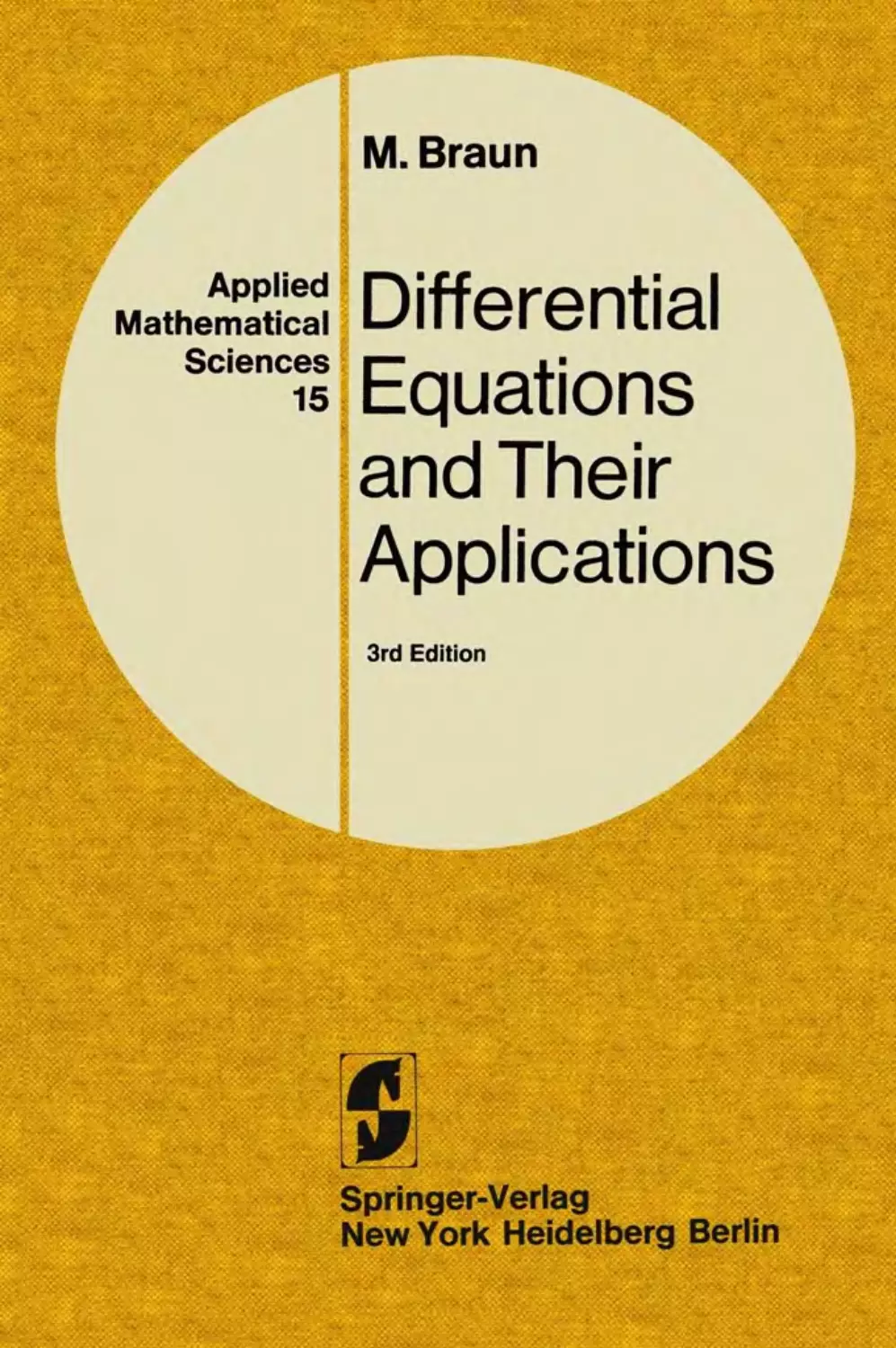


Author: Braun M.
Tags: higher mathematics mathematical analysis applied mathematics differential equations
ISBN: 0-387-90806-4
Year: 1941
Text
Applied Mathematical Sciences
Volume 15
Editors
F. John J. E. Marsden L. Sirovich
Advisors
H. Cab annes M. Ohil J. K. Hale
J. Keller J. P. LaSalle O. B. Whitham
M. Braun
Differential
Equations and Their
Applications
An Introduction to
Applied Mathematics
3rd Edition
s
Springer-Verlag New York. Heidelberg · Berlin
I
Martin Braun
Department of Mathematics
Queens College
City University of New York
Flushing, NY 11367
USA
Editors
F. John
Courant Institute of
Mathematical Sciences
New York University
New York, NY 10012
USA
1. E. Marsden
Department of
Mathematics
University of California
Berkeley, CA 94720
USA
L. Sirovich
Division of
Applied Mathematics
Brown Uni ersity
Providence, RI 02912
USA
AMS Subject Classifications: 98A20, 98A35, 34-01
Library of Congress Cataloging in Publication Data
Braun, Martin, 1941-
Differential equations and their applications.
(Applied mathematical sciences; v. 15)
Includes index.
1. Differential equations. I. Title. II. Series:
Applied mathematical sciences (Springer-Verlag
New York Inc.); v. 15.
QAl.A647 vol. 15 1983 [QA371] 510s 82-19611
[515.3'5]
All rights reserved.
No part of this book may be translated or reproduced in any form
without written permission from Springer-Verlag, 175 Fifth Avenue, New York, New York
10010, USA.
@ 1983 by Springer-Verlag New York, Inc.
Printed in the United States of America.
9 8 7 6 543 2 I
ISBN 0-387-90806-4
ISBN 3-540-90806-4
Springer- Verlag New York Heidelberg Berlin
Springer-Verlag Berlin Heidelberg New York
To four beautiful people:
Zelda Lee
Adeena Rachelle, I. Nasanayl, and Shulamit
Preface to the Third Edition
There are three major changes in the Third Edition of Differential Equations
and Their Applications. First, we have completely rewritten the section on
singular solutions of differential equations. A new section, 2.8.1, dealing
with Euler equations has been added, and this section is used to motivate a
greatly expanded treatment of singular equations in sections 2.8.2 and 2.8.3.
Our second major change is the addition of a new section, 4.9, dealing
with bifurcation theory, a subject of much current interest. We felt it
desirable to give the reader a brief but nontrivial introduction to this
important topic.
Our third major change is in Section 2.6, where we have switched to the
metric system of units. This change was requested by many of our readers.
In addition to the above changes, we have updated the material on
population models, and have revised the exercises in this section. Minor
editorial changes have also been made throughout the text.
New York City
November, 1982
Martin Braun
Preface to the First Edition
This textbook is a unique blend of the theory of differential equationS' and
their exciting application to "real world" problems. First, and foremost, it
is a rigorous study of ordinary differential equations and can be fully
understood by anyone who has completed one year of calculus. However,
in addition to the traditional applications, it also contains many exciting
"real life" problems. These applications are completely self contained.
First, the problem to be solved is outlined clearly, and one or more
differential equations are derived as a model for this problem. These
equations are then solved, and the results are compared with real world
data. The following applications are covered in this text.
1. In Section 1.3 we prove that the beautiful painting "Disciples of
Emmaus" which was bought by the Rembrandt Society of Belgium for
$170,000 was a modern forgery.
2. In Section 1.5 we derive differential equations which govern the
population growth of various species, and compare the results predicted by
our models with the known values of the populations.
3. In Section 1.6 we derive differential equations which govern the rate at
which farmers adopt new innovations. Surprisingly, these same differential
equations govern the rate at which technological innovations are adopted in
such diverse industries as coal, iron and steel, brewing, and railroads.
4. In Section 1.7 we try to determine whether tightly sealed drums filled
with concentrated waste material will crack upon impact with the ocean
floor. In this section we also describe several tricks for obtaining informa-
tion about solutions of a differential equation that cannot be solved
explicitly.
Preface to the First Edition
5. In Section 2.7 we derive a very simple model of the blood glucose
regulatory system and obtain a fairly reliable criterion for the diagnosis of
diabetes.
6. Section 4.5 describes two applications of differential equations to
arms races and actual combat. In Section 4.5.1 we discuss L. F. Richard-
son's theory of the escalation of arms races and fit his model to the arms
race which led eventually to World War I. This section also provides the
reader with a concrete feeling for the concept of stability. In Section 4.5.2
we derive two Lanchestrian combat models, and fit one of these models,
with astonishing accuracy, to the battle of Iwo lima in World War II.
7. In Section 4.10 we show why the predator portion (sharks, skates, rays,
etc.) of all fish caught in the port of Fiume, Italy rose dramatically during
the years of World War I. The theory we develop here also has a
spectacular application to the spraying of insecticides.
8. In Section 4.11 we derive the "principle of competitive exclusion,"
which states, essentially, that no two species can earn their living in an
identical manner.
9. In Section 4.12 we study a system of differential equations which
govern the spread of epidemics in a population. This model enables us to
prove the famous "threshold theorem of epidemiology," which states that
an epidemic will occur only if the number of people susceptible to the
disease exceeds a certain threshold value. We also compare the predictions
of our model with data from an actual plague in Bombay.
10. In Section 4.13 we derive a model for the spread of gonorrhea and
prove that either this disease dies out, or else the number of people who
have gonorrhea will ultimately approach a fixed value.
This textbook also contains the following important, and often unique
features.
I. In Section 1.10 we give a complete proof of the existence-uniqueness
theorem for solutions of first-order equations. Our proof is based on the
method of Picard iterates, and can be fully understood by anyone who has
completed one year of calculus.
2. In Section 1.11 we show how to solve equations by iteration. This
section has the added advantage of reinforcing the reader's understanding
of the proof of the existence-uniqueness theorem.
3. Complete Fortran and APL programs are given for every computer
example in the text. Computer problems appear in Sections 1.13-1.17,
which deal with numerical approximations of solutions of differential
equations; in Section l.ll, which deals with solving the equations x = f(x)
and g(x)=O; and in Section 2.8, where we show how to obtain a power-
series solution of a differential equation even though we cannot explicitly
solve the recurrence formula for the coefficients.
4. A self-contained introduction to the computing language APL is
presented in Appendix C. Using this appendix we have been able to teach
our students APL in just two lectures.
Preface to the First Edition
5. Modesty aside, Section 2.12 contains an absolutely super and unique
treatment of the Dirac delta function. We are very proud of this section
because it eliminates all the ambiguities which are inherent in the tradi-
tional exposition of this topic.
6. All the linear algebra pertinent to the study of systems of equations is
presented in Sections 3.1-3.7. One advantage of our approach is that the
reader gets a concrete feeling for the very important but extremely abstract
properties of linear independence, spanning and dimension. Indeed, many
linear algebra students sit in on our course to find out what's really going
on in their course.
Differential Equations and Their Applications can be used for a one- or
two-semester course in ordinary differential equations. It is geared to the
student who has completed two semesters of calculus. Traditionally, most
authors present a "suggested syllabus" for their textbook. We will not do so
here, though, since there are already more than twenty different syllabi in
use. Suffice it to say that this text can be used for a wide variety of courses
in ordinary differential equations.
I greatly appreciate the help of the following people in the preparation
of this manuscript: Douglas Reber who wrote the Fortran programs,
Eleanor Addison who drew the original figures, and Kate MacDougall,
Sandra Spinacci, and Miriam Green who typed portions of this manu-
script.
I am grateful to Walter Kaufmann-Biihler, the mathematics editor at
Springer-Verlag, and Elizabeth Kaplan, the production editor, for their
extensive assistance and courtesy during the preparation of this
manuscript. It is a pleasure to work with these true professionals.
Finally, I am especially grateful to Joseph P. LaSalle for the encourage-
ment and help he gave me. Thanks again, Joe.
New York City
July, 1976
Martin Braun
Chapter I
First-order differential equations
1.1 Introduction
1.2 First-order linear differential equations
1.3 The Van Meegeren art forgeries
1.4 Separable equations
1.5 Population models
1.6 The spread of technological innovations
1.7 An atomic waste disposal problem
1.8 The dynamics of tumor growth, mixing problems, and
orthogonal trajectories
1.9 Exact equations, and why we cannot solve very many
differential equations
1.10 The existence-uniqueness theorem; Picard iteration
1.11 Finding roots of equations by iteration
1.11.1 Newton's method
1.12 Difference equations, and how to compute the interest
due on your student loans
1.13 Numerical approximations; Euler's method
1.13.1 Error analysis for Euler's method
1.14 The three term Taylor series method
1.15 An improved Euler method
1.16 The Runge-Kutta method
1.17 What to do in practice
Contents
1
1
2
11
20
26
39
46
52
58
67
81
87
91
95
100
106
108
III
115
Contents
Chapter 2
Second-order linear differential equations
2.1 Algebraic properties of solutions
2.2 Linear equations with constant coefficients
2.2.1 Complex roots
2.2.2 Equal roots; reduction of order
2.3 The nonhomogeneous equation
2.4 The method of variation of parameters
2.5 The method of judicious guessing
2.6 Mechanical vibrations
2.6.1 The Tacoma Bridge disaster
2.6.2 Electrical networks
2.7 A model for the detection of diabetes
2.8 Series solutions
2.8.1 Singular points; Euler equations
2.8.2 Regular singular points; the method of Frobenius
2.8.3 Equal roots, and roots differing by an integer
2.9 The method of Laplace transforms
2.10 Some useful properties of Laplace transforms
2.11 Differential equations with discontinuous right-hand sides
2.12 The Dirac delta function
2.13 The convolution integral
2.14 The method of elimina tion for systems
2.15 Higher-order equations
125
125
136
139
143
149
151
155
163
171
173
176
183
196
201
217
223
231
236
241
249
255
257
Chapter 3
Systems of differential equations
3.1 Algebraic properties of solutions of linear systems
3.2 Vector spaces
3.3 Dimension of a vector space
3.4 Applications of linear algebra to differential equations
3.5 The theory of determinants
3.6 Solutions of simultaneous linear equations
3.7 Linear transformations
3.8 The eigenvalue-eigenvector method of finding solutions
3.9 Complex roots
3.10 Equal roots
3.11 Fundamental matrix solutions; eAt
3.12 The nonhomogeneous equation; variation of parameters
3.13 Solving systems by Laplace transforms
262
262
271
277
289
295
308
318
331
339
343
353
358
366
Chapter 4
Qualitative theory of differential equations
4.1 Introduction
4.2 Stability of linear systems
370
370
376
Contents
4.3 Stability of equilibrium solutions 383
4.4 The phase-plane 392
4.5 Mathematical theories of war 396
4.5.1 L. F. Richardson's theory of conflict 396
4.5.2 Lanchester's combat models and the battle of Iwo Jima 403
4.6 Qualitative properties of orbits 412
4.7 Phase portraits of linear systems 416
4.8 Long time behavior of solutions; the Poincare-Bendixson Theorem 426
4.9 Introduction to bifurcation theory 435
4.10 Predator-prey problems; or why
the percentage of sharks caught in the Mediterranean
Sea rose dramatically during World War I 441
4.11 The principle of competitive exclusion in population biology 449
4.12 The Threshold Theorem of epidemiology 456
4.13 A model for the spread of gonorrhea 463
Chapter 5
Separation of variables and Fourier series 474
5.1 Two point boundary-value problems 474
5.2 Introduction to partial differential equations 479
5.3 The heat equation; separation of variables 481
5.4 Fourier series 485
5.5 Even and odd functions 491
5.6 Return to the heat equation 496
5.7 The wave equation 501
5.8 Laplace's equation 506
Appendix A
Some simple facts concerning functions
of several variables 512
Appendix B
Sequences and series 514
Appendix C
Introduction to APL 516
Answers to odd-numbered exercises 526
Index 543
First-order differential equations
1.1 Introduction
This book is a study of differential equations and their applications. A dif-
ferential equation is a relationship between a function of time and its de-
rivatives. The equations
: =3y 2 sin(t+ y)
(i)
and
d3... d 2 y
2==e- Y +t+- (ii)
dt 3 dt 2
are both examples of differential equations. The order of a differential
equation is the order of the highest derivative of the function y that ap-
pears in the equation. Thus (i) is a first-order differential equation and (ii)
is a third-order differential equation. By a solution of a differential equa-
tion we will mean a continuous function y(t) which together with its de-
rivatives satisfies the relationship. For example, the function
y ( t) == 2 sin t - t cos 2 t
is a solution of the second-order differential equation
d 2 y
- + y==cos2t
dt 2
sInce
d: (lsint - t cos2t) + (2 sint - t cos2t)
dt
== ( - 2sint + j cos2t) + 2 sint - t cos2t == cos2t.
1
1 First-order differential equations
Differential equations appear naturally in many areas of science and the
humanities. In this book, we will present serious discussions of the applica-
tions of differential equations to such diverse and fascinating problems as
the detection of art forgeries, the diagnosis of diabetes, the increase in the
percentage of sharks present in the Mediterranean Sea during World War
I, and the spread of gonorrhea. Our purpose is to show how researchers
have used differential equations to solve, or try to solve, real life problems.
And while we will discuss some of the great success stories of differential
equations, we will also point out their limitations and document some of
their failures.
1.2 First-order linear differential equations
We begin by studying first-order differential equations and we will assume
that our equation is, or can be put, in the form
dy
1
The problem before us is this: Given f(t,y) find all functions y(t) which
satisfy the differential equation (1). We approach this problem in the
following manner. A fundamental principle of mathematics is that the way
to solve a new problem is to reduce it, in some manner, to a problem that
we have already solved. In practice this usually entails successively sim-
plifying the problem until it resembles one we have already solved. Since
we are presently in the business of solving differential equations, it is advis-
able for us to take inventory and list all the differential equations we can
solve. If we assume that our mathematical background consists of just ele-
mentary calculus then the very sad fact is that the only first-order differen-
tial equation we can solve at present is
dy
dt
g t
2
where g is any integrable function of time. To solve Equation (2) simply
integrate both sides with respect to t, which yields
Y t
g t dt + c.
Here c is an arbitrary constant of integration, and by g(t)dt we mean an
anti-derivative of g, that is, a function whose derivative is g. Thus, to solve
any other differential equation we must somehow reduce it to the form (2).
As we will see in Section 1.9, this is impossible to do in most cases. Hence,
we will not be able, without the aid of a computer, to solve most differen-
tial equations. It stands to reason, therefore, that to find those differential
equations that we can solve, we should start with very simple equations
2
1.2 First-order linear differential equations
and not ones like
dt
(which incidentally, cannot be solved exactly). Experience has taught us
that the "simplest" equations are those which are linear in the dependent
variable y .
Definition. The general first-order linear differential equation is
dy
Unless otherwise stated, the functions a(t) and b(t) are assumed to be
continuous functions of time. We single out this equation and call it lin-
ear because the dependent variable y appears by itself, that is, no terms
such as e- Y , y3 or siny etc. appear in the equation. For example dy dt
y2 + sin t and dy dt cosy + t are both nonlinear equations because of
the y2 and cosy terms respectively.
3
Now it is not immediately apparent how to solve Equation (3). Thus, we
simplify it even further by setting b(t) O.
Definition. The equation
dy
(4)
is called the homogeneous first-order linear differential equation, and
Equation (3) is called the nonhomogeneous first-order linear differential
equation for b(t) not identically zero.
Fortunately, the homogeneous equation (4) can be solved quite easily.
First, divide both sides of the equation by y and rewrite it in the form
dy
dt
y
a(t .
Second, observe that
dy
dt
y
d
t
where by In y(t) we mean the natural logarithm of y(t). Hence Equation
(4) can be written in the form
d
t
a (t).
5)
3
I First-order differential equations
But this is Equation (2) "essentially" since we can integrate both sides of
(5) to obtain that
In y t
at) dt + c I
where CI is an arbitrary constant of integration. Taking exponentials of
both sides yields
Y t exp
a t dt + CI ' C exp
at) dt
or
Y t exp at) dt
C.
6)
Now y(t) exp a t dt is a continuous function of time and Equation (6)
states that its absolute value is constant. But if the absolute value of a con-
tinuous function g(t) is constant then g itself must be constant. To prove
this observe that if g is not constant then there exist two different times t l
and t 2 for which g(t l ) c and g(t 2 ) c. By the intermediate value theo-
rem of calculus g must achieve all values between c and + c which is im-
possible if get) c. Hence we obtain the equation y(t)exp a(t)dt c
or
Y t c exp
at) dt .
7)
Equation (7) is said to be the general solution of the homogeneous equa-
tion since every solution of (4) must be of this form. Observe that an arbi-
trary constant c appears in (7). This should not be too surprising. Indeed
we will always expect an arbitrary constant to appear in the general solu-
tion of any first-order differential equation. To wit if we are given dy dt
and we want to recover y(t) then we must perform an integration and
this of necessity yields an arbitrary constant. Observe also that Equation
(4) has infinitely many solutions; for each value of c we obtain a distinct
solution y (t).
Example 1. Find the general solution of the equation (dy dt) + 2ty o.
2
Solution. Here aCt) 2t so thaty(t) cexp 2tdt ce- t .
Example 2. Determine the behavior as t ) oo of all solutions of the equa-
tion (dy dt) + ay O a constant.
Solution. The general solution is y(t) cexp adt ce- at . Hence if
a < O all solutions, with the exception of y 0, approach infinity, and if a
> 0, all solutions approach zero as t ) 00.
4
1.2 First-order linear differential equations
In applications, we are usually not interested in all solutions of (4).
Rather, we are looking for the specific solution y(t) which at some initial
time to has the value Yo. Thus, we want to determine a function y(t) such
that
dy
y to Yo.
8
Equation (8) is referred to as an initial-value problem for the obvious rea-
son that of the totality of all solutions of the differential equation, we are
looking for the one solution which initially (at time to) has the value Yo. To
find this solution we integrate both sides of (5) between to and t. Thus
1 d
10 S
s ds
1
a s)ds
10
and, therefore
In y t
In y to
Y t
In
y to)
1
a s ds.
10
Taking exponentials of both sides of this equation we obtain that
Y t
Y to
exp
1
a s ds
10
or
Y t
1
a s ds
10
1.
exp
y to
The function inside the absolute value sign is a continuous function of
time. Thus, by the argument given previously, it is either identically + 1 or
identically 1. To determine which one it is, evaluate it at the point to;
.
Sin ce
Y to
Y to
exp
a s ds
'0
I
we see that
Y t 1
. exp a s ds 1.
y to 10
Hence
Y t Y to exp
1
a s ds yoexp
to
1
asds.
10
5
1 First-order differential equations
Example 3. Find the solution of the initial-value problem
dy .
Solution. Here a(t) sint so that
0,
yO
3
-
2 ·
y t exp
t
sin s ds
o
! e (cost) - I
2 ·
Example 4. Find the solution of the initial-value problem
dy 2
+ e t y y 1 2.
2
Solution. Here a(t) e t so that
y t 2 exp
t 2
e S ds .
1
Now, at first glance this problem would seem to present a very serious dif-
ficulty in that we cannot integrate the function e s2 directly. However, this
solution is equally as valid and equally as useful as the solution to Example
3. The reason for this is twofold. First, there are very simple numerical
schemes to evaluate the above integral to any degree of accuracy with the
aid of a computer. Second, even though the solution to Example 3 is given
explicitly, we still cannot evaluate it at any time t without the aid of a table
of trigonometric functions and some sort of calculating aid, such as a slide
rule, electronic calculator or digital computer.
We return now to the nonhomogeneous equation
dy
t y b t).
It should be clear from our analysis of the homogeneous equation that the
way to solve the nonhomogeneous equation is to express it in the form
dt
b t)
and then to integrate both sides to solve for "something". However, the ex-
pression (dy dt)+ a(t)y does not appear to be the derivative of some sim-
ple expression. The next logical step in our analysis therefore should be the
following: Can we make the left hand side of the equation to be d dt of
"something"? More precisely, we can multiply both sides of (3) by any
continuous function J.L(t) to obtain the equivalent equation
dy
J.t t t J.t ty J.t tb t.
9
6
1.2 First-order linear differential equations
(By equivalent equations we mean that every solution of (9) is a solution of
(3) and vice-versa.) Thus, can we choose IL(t) so that p.(t)(dy dt) +
a(t) IL(t)y is the derivative of some simple expression? The answer to this
question is yes, and is obtained by observing that
d dy dp,
p, t Y
Hence, p,(t)(dy dt) + a(t) JL(t)y will be equal to the derivative of p,(t)y if
and only if dp,(t) dt a(t) p,(t). But this is a first-order linear homoge-
neous equation for p,(t), i.e. (dIL dt) a(t) IL 0 which we already know
how to solve, and since we only need one such function p,( t) we set the
constant c in (7) equal to one and take
P. t exp a t dt .
For this p.(t), Equation (9) ca n be w ri tten as
To obtain the general solution of the nonhomogeneous equation (3), that
is, to find all solutions of the nonhomogeneous equation, we take the indef-
inite integral (anti-derivative) of both sides of (10) which yields
IL t Y
P, t b t dt + c
or
1
IL t
Alternately, if we are interested in the specific solution of (3) satisfying
the initial condition y(t o ) Yo, that is, if we want to solve the initial-value
problem
y
P, t b t dt + c
exp
a t dt
P, t b t dt + c .
11
dy
then we can take the definite integral of both sides of (10) between to and t
to obtain that
Y to
Yo
1
P. t Y IL to)yo P. s b s ds
10
or
y
1
p, t
t
P. to Yo + JL s b s ds ·
to
12
Remark 1. Notice how we used our knowledge of the solution of the ho-
mogeneous equation to find the function p.( t) which enables us to solve the
nonhomogeneous equation. This is an excellent illustration of how we use
our knowledge of the solution of a simpler problem to solve a harder prob-
lem.
7
t First-order differential equations
Remark 2. The function JL( t) exp a t) dt is called an integrating factor
for the nonhomogeneous equation since after multiplying both sides by
p.( t) we can immediately integrate the equation to find all solutions.
Remark 3. The reader should not memorize formulae (11) and (12).
Rather, we will solve all nonhomogeneous equations by first multiplying
both sides by p.(t), by writing the new left-hand side as the derivative of
p.(t)y(t), and then by integrating both sides of the equation.
Remark 4. An alternative way of solving the initial-value problem (dy dt)
+ a(t)y b(t), y(t o ) Yo is to find the general solution (11) of (3) and then
use the initial condition y(t o ) Yo to evaluate the constant c. If the function
JL(t)b(t) cannot be integrated directly, though, then we must take the defi-
nite integral of (10) to obtain (12), and this equation is then approximated
numerically.
Example 5. Find the general solution of the equation (dy dt) 2ty t.
Solution. Here a(t) 21 so that
JL t == exp at) dt exp
-r
e .
2tdt
Multiplying both sides of the equation by ,.,,(/) we obtain the equivalent
equation
- ,2 dy
e dt
2ty
te- t2 or
d -t 1
dte y
_,2
Ie .
Hence,
_ 2
Ie ' dt + c
_,2
e
2
+c
_ 2
e 'y
and
y t)
Example 6. Find the solution of the initial-value problem
t,
Solution. Here a(t) 2t so that
p. t exp a t dt exp 2tdl ere
Multiplying both sides of the equation by p.(t) we obtain that
, e te .
e m y
,
8
1.2 First-order linear differential equations
Hence,
t d 2
e S }, s)ds
I ds
t 2
se S ds
I
so tha t
2 I
2 I e S
eSy(s) 1
2 I.
Consequently,
2
e t y 2e
,2
e
2
e
2
and
y
2 2 e
1 + I e J - ,2
2 2 ·
Example 7. Find the solution of the initial-value problem
dy
I
2' Y (2) 3.
1+ t
Solution. Here a(t) I, so that
JL(t) exp a(t)dt exp Idt et.
Multiplying both sides of the equation by lL(t) we obtain that
dy e t d e t
e t + Y or e y
dt 1 + t 2 dt 1 + t 2 ·
Hence
t d
ey s ds
2 ds
t eS
tis,
1 + S2
so that
t s
e ds
2 1 + S2
ey 3e 2
and
y
e- t 3e 2 +
t
e S
2 ds ·
2 1 +S
EXERCISES
In each of Problems 1-7 find the general solution of the given differential
equation.
dy
1. dt + Y cos t 0
dy -
2.
o
9
1 First-order differential equations
dy 2t
1
1+ t 2
dy
4. dt + Y - te'
5. dt Y I
dy t
7. dt + y I
1+ t 2
dy
r 3
y
1+ t 4
In each of Problems 8-14, find the solution of the given initial-value prob-
lem.
0, y(O) v'5 9. dt 0, y(O) 1
10. dy V 0, y(O) 0 11. dy 2ty y(O) I
+ 1 + 1 2 e-y t,
dt
dt
12. dy 1 + t, y( ) 0 13. dy 1 y(l) 2
dt + ty dt +y 1 + t 2 '
dy
14. dt 21y 1, y(O) I
IS. Find the general solution of th e e quati o n
(Hint: Divide both sides of the equation by 1 + 1 2 .)
16. Find the solution of the initi al- value p roblem
y(l) .
17. Find a continuous solution of the initial-value problem
yl+y g(t),
y(O) 0
where
g(t)
2, 0 t I
0, t > 1 ·
18. Show that every solution of the equation (dy / dt) + ay be - cl where a and c
are positive constants and b is any real number approaches zero as 1 ap-
proaches infinity.
19. Given the differential equation (dy / dt) + a(t)y f(t) with a(t) and f(l) con-
tinuous for 00 < t < 00, a(t) c > 0, and lim , -+ oo f(l) 0, show that every
solution tends to zero as t approaches infinity.
en we derived the solution of the nonhomogeneous equation we tacitly
assumed that the functions a(t) and b(t) were continuous so that we could
perform the necessary integrations. If either of these functions was discon-
tinuous at a point tl then we would expect that our solutions might be dis-
continuous at t t I' Problems 20-23 illustrate the variety of things that
10
1.13 Numerical approximations; Euler's method
In order to proceed further, we must obtain estimates of the quantities
(oj(t k ,l1k» ay and [(aj at)+ f(aj OY)]( k'Y( k». To this end observe that
the points (€k'Y( k» and (tk'Yk) all lie in the rectangle R. (It was shown in
Section 1.10 that the points ( k'Y( k» lie in R. In addition, a simple induc-
tion argument (see Exercise 9) shows that the points (tk'Yk) all lie in R.)
Consequently, the points (t k ,l1k) must also lie in R. Let Land D be two
positive numbers such that
max
(t.y) in R ay
and
aj aj
Max
(t,y) in R
Such numbers always exist if f, aj at, and aj ay are continuous in R.
Then,
Y t k + 1
Yk+ I < Y t k
Yk + hL Y t k
Dh 2
3
Now, set Ek y(t k ) Yk' k 0, 1,...,N. The number Ek is the error we
make at the kth step in approximatingy(t k ) by Yk. From (3)
Dh 2
k 0, I, . . . , N 1.
4
Moreover, Eo 0 sincey(t o ) Yo. Thus, the numbers Eo,EI,...,EN satisfy
the set of inequali ties
Ek+l < AEk+ B, Eo 0
with A 1 + hL and B Dh 2 2. Consequently, (see Section 1.12)
(5
We can also obtain an estimate for Ek that is independent of k. Observe
that 1 + hL < e hL . This follows from the fact that
hL 2 hL 3
1 + hL + + ...
1 + hL + "something positive".
e hL
Therefore,
2L
2L
Finally, since kh < a, we see that
k I,...,N.
6
\
101
..
1.3 The Van Meergeren art forgeries
may happen. In Problems 20 22 determine the behavior of all solutions of
the given differential equation as t ) 0, and in Problem 23 determine the
behavior of all solutions as t ) '!T 2.
dy I
1 21. e Vi /2
1 2
. dy
1 + sm 1 23. .
cos dl +ytanl 8mtcost.
t
dy I
t t
1.3 The Van Meegeren art forgeries
After the liberation of Belgium in World War II, the Dutch Field Security
began its hunt for Nazi collaborators. They discovered, in the records of a
firm which had sold numerous works of art to the Germans, the name of a
banker who had acted as an intermediary in the sale to Goering of the
painting "Woman Taken in Adultery" by the famed 17th century Dutch
painter Jan Vermeer. The banker in turn revealed that he was acting on
behalf of a third rate Dutch painter H. A. Van Meegeren, and on May 29,
1945 Van Meegeren was arrested on the charge of collaborating with the
enemy. On July 12, 1945 Van Meegeren startled the world by announcing
from his prison cell that he had never sold "Woman Taken in Adultery" to
Goering. Moreover, he stated that this painting and the very famous and
beautiful "Disciples at Emmaus", as well as four other presumed V ermeers
and two de Hooghs (a 17th century Dutch painter) were his own work.
Many people, however, thought that Van Meegeren was only lying to save
himself from the charge of treason. To prove his point, Van Meegeren be-
gan, while in prison, to forge the Vermeer painting "Jesus Amongst the
Doctors" to demonstrate to the skeptics just how good a forger of Vermeer
he was. The work was nearly completed when Van Meegeren learned that
a charge of forgery had been substituted for that of collaboration. He,
therefore, refused to finish and age the painting so that hopefully investiga-
tors would not uncover his secret of aging his forgeries. To settle the ques-
tion an international panel of distinguished chemists, physicists and art
historians was appointed to investigate the matter. The panel took x-rays
of the paintings to determine whether other paintings were underneath
them. In addition, they analyzed the pigments (coloring materials) used in
the paint, and examined the paintings for certain signs of old age.
Now, Van Meegeren was well aware of these methods. To avoid detec-
tion, he scraped the paint from old paintings that were not worth much,
just to get the canvas, and he tried to use pigments that Vermeer would
have used. Van Meegeren also knew that old paint was extremely hard,
and impossible to dissolve. Therefore, he very cleverly mixed a chemical,
phenoformaldehyde, into the paint, and this hardened into bakelite when
the finished painting was heated in an oven.
11
I First-order differential equations
However, Van Meegeren was careless with several of his forgeries, and
the panel of experts found traces of the modern pigment cobalt blue. In
addition, they also detected the phenoformaldehyde, which was not dis-
covered until the turn of the 19th century, in several of the paintings. On
the basis of this evidence Van Meegeren was convicted, of forgery, on Oc-
tober 12, 1947 and sentenced to one year in prison. While in prison he
suffered a heart attack and died on December 30, 1947.
However, even following the evidence gathered by the panel of experts,
many people still refused to believe that the famed "Disciples at Emmaus"
was forged by Van Meegeren. Their contention was based on the fact that
the other alleged forgeries and Van Meegeren's nearly completed "Jesus
Amongst the Doctors" were of a very inferior quality. Surely, they said, the
creator of the beautiful "Disciples at Emmaus" could not produce such in-
ferior pictures. Indeed, the "Disciples at Emmaus" was certified as an
authentic Vermeer by the noted art historian A. Bredius and was bought
by the Rembrandt Society for $170,000, The answer of the panel to these
skeptics was that because Van Meegeren was keenly disappointed by his
lack of status in the art world, he worked on the "Disciples at Emmaus"
with the fierce determination of proving that he was better than a third
rate painter. After producing such a masterpiece his determination was
gone. Moreover, after seeing how easy it was to dispose of the "Disciples at
Emmaus" he devoted less effort to his subsequent forgeries. This explana-
tion failed to satisfy the skeptics. They demanded a thoroughly scientific
and conclusive proof that the "Disciples at Emmaus" was indeed a forgery.
This was done recently in 1967 by scientists at Carnegie Mellon University,
and we would now like to describe their work.
The key to the dating of paintings and other materials such as rocks and
fossils lies in the phenomenon of radioactivity discovered at the turn of the
century. The physicist Rutherford and his colleagues showed that the
atoms of certain "radioactive" elements are unstable and that within a
given time period a fixed proportion of the atoms spontaneously disin-
tegrates to form atoms of a new element. Because radioactivity is a prop-
erty of the atom, Rutherford showed that the radioactivity of a substance
is directly proportional to the number of atoms of the substance present.
Thus, if N (t) denotes the number of atoms present at time t, then dN dt,
the number of atoms that disintegrate per unit time is proportional to N,
that is,
dN
dt
The constant A which is positive, is known as the decay constant of the
substance. The larger A is, of course, the faster the substance decays. One
measure of the rate of disintegration of a substance is its half-life which is
defined as the time required for half of a given quantity of radioactive
atoms to decay. To compute the half-life of a substance in terms of A,
assume that at time to' N ( to) No. Then, the solution of the initial-value
AN.
1
12
1.3 The Van Meergeren art forgeries
problem dN dt
AN, N (to) No is
I
N t Noexp A ds Noe-A(t-t o )
to
or N No exp A t
to · Taking logarithms of both sides we obtain that
N
o
A( t to) In t so that
In 2 0.6931
t to A A'
A t
to
(2
Now, if N No t then
3)
Thus, the half-life of a substance is In 2 divided by the decay constant A.
The dimension of A, which we suppress for simplicity of writing, is recipro-
cal time. If t is measured in years then A has the dimension of reciprocal
years, and if t is measured in minutes, then A has the dimension of recipro-
cal minutes. The half-lives of many substances have been determined and
recorded. For example, the half-life of carbon-14 is 5568 years and the
half-life of uranium-238 is 4.5 billion years.
Now the basis of "radioactive dating" is essentially the following. From
Equation (2) we can solve for t to 1 Aln(N o N). If to is the time the
substance was initially formed or manufactured, then the age of the sub-
stance is 1 Aln(N o N). The decay constant A is known or can be com-
puted, in most instances. Moreover, we can usually evaluate N quite easily.
Thus, if we knew No we could determine the age of the substance. But this
is the real difficulty of course, since we usuaJIy do not know No. In some
instances though, we can either determine No indirectly, or else determine
certain suitable ranges for No, and such is the case for the forgeries of Van
Meegeren.
We begin with the following well-known facts of elementary chemistry.
Almost all rocks in the earth's crust contain a small quantity of uranium.
The uranium in the rock decays to another radioactive element, and that
one decays to another and another, and so forth (see Figure I) in a series
of elements that results in lead, which is not radioactive. The uranium
(whose half-life is over four billion years) keeps feeding the elements
following it in the series, so that as fast as they decay, they are replaced by
the elements before them.
Now, all paintings contain a small amount of the radioactive element
lead-210 ( 2IO Pb), and an even smaller amount of radium-226 ( 226 Ra), since
these elements are contained in white lead (lead oxide), which is a pigment
that artists have used for over 2 years. For the analysis which follows, it
is important to note that white lead is made from lead metal, which, in
turn, is extracted from a rock called lead ore, in a process called smelting.
In this process, the lead-210 in the ore goes along with the lead metal.
However, 90-95% of the radium and its descendants are removed with
13
-
>.
coo Go)
0 "'0
00 ..0 -
("'.f
I t"') 0 8
E t"1
, I ;t;
"'0
C
0 .?j
-0 0
:z
-
,,-...
t
CIJ
1
....
0
fj
"'0 ]
c
c Go) 8
t"1 0 0
I cu.c: C Q)
E - - o V) N .s
=' I
'2 "'0
0 .?j
'0
c..
0
.s
8
V) iJ
- U
C":2
Go) "'0
>. .
c V)
r- '-
. C":2 V)
=' >. 0
0 >.
's 0 .c: V) 8 "'0 00
M M - - -D
N 0 ("'.f ""1"" N
I -.. I Q) t"1 N I
E E 00 >. I N M E N rj
E I
::s . C ::s I
V) "'0
"2 '- ::s 0 '2 .c:
C":2 0 ;a "'0 0 - .?j
::s
... ..c (5 C
::> Eo- c.. 'S
M .
.
.....
i
....
00
M M
N N
I I
E E
::s c: ='
'2 .2 'i:
C":2 0
... :E .c:
:;:) Eo-
-
-IN CU
>.
1.3 The Van Meergeren art forgeries
other waste products in a material called slag. Thus, most of the supply of
lead-210 is cut off and it begins to decay very rapidly, with a half-life of 22
years. This process continues until the lead-210 in the white lead is once
more in radioactive equilibrium with the small amount of radium present,
Le. the disintegration of the lead-210 is exactly balanced by the disintegra-
tion of the radium.
Let us now use this information to compute the amount of lead-210 pre-
sent in a sample in terms of the amount originally present at the time of
manufacture. Let y(t) be the amount of lead-210 per gram of white lead
at time t, Yo the amount of lead-210 per gram of white lead present at
the time of manufacture to, and r( t) the number of disintegrations of
radium-226 per minute per gram of white lead, at time t. If A is the decay
constant for lead-210, then
dy
dt
Since we are only interested in a time period of at most 300 years we may
assume that the radium-226, whose half-life is 1600 years, remains con-
stant, so that r(t) is a constant r. Multiplying both sides of the differential
equation by the integrating factor p.( t) eAt we obtain that
d
- eMy re At .
dt
Ay + r t ,
Y to
Yo-
4
Hence
e A t
eAt 0y 0
r eAt eAto
A
or
Y t
A
5
Now y(t) and r can be easily measured. Thus, if we knew Yo we could
use Equation (5) to compute (t to) and consequently, we could determine
the age of the painting. As we pointed out, thou , we cannot measure Yo
directly. One possible way out of this difficulty is to use the fact that the
original quantity of lead-210 was in radioactive equilibrium with the larger
amount of radium-226 in the ore from which the metal was extracted. Let
us, therefore, take samples of different ores and count the number of disin-
tegrations of the radium-226 in the ores. .s was done for a variety of
ores and the results are given in Table 1 below. These numbers vary from
0.18 to 140. Consequently, the number of disintegrations of the lead-210
per minute per gram of white lead at the time of manufacture will vary
from 0.18 to 140. This implies that Yo will also vary over a very large inter-
val, since the number of disintegrations of lead-210 is proportional to the
amount present. Thus, we cannot use uation (5) to obtain an accurate,
or even a crude estimate, of the age of a painting.
15
1 First-order differential equations
Table 1. Ore and ore concentrate samples. All disintegration rates
are per gram of white lead.
Description and Source
Ore concentrate (Oklahoma-Kansas)
Crushed raw ore (S.E. Missouri)
Ore concentrate (S.E. Missouri)
Ore concentrate (Idaho)
Ore concentrate (Idaho)
Ore concentrate (Washington)
Ore concentrate (British Columbia)
Ore concentrate (British Columbia)
Ore concentrate (Bolivia)
Ore concentrate (Australia)
Disintegrations per minute of 226Ra
4.5
2.4
0.7
2.2
0.18
140.0
1.9
0.4
1.6
1.1
However, we can still use Equation (5) to distinguish between a 17th
century painting and a modern forgery. The basis for this statement is the
simple observation that if the paint is very old compared to the 22 year
half-life of lead, then the amount of radioactivity from the lead-2IO in the
paint will be nearly equal to the amount of radioactivity from the radium
in the paint. On the other hand, if the painting is modern (approximately
20 years old, or so) then the amount of radioactivity from the lead-210 will
be much greater than the amount of radioactivity from the radium.
We make this argument precise in the following manner. Let us assume
that the painting in question is either very new or about 300 years old. Set
t to 300 years in (5). Then, after some simple algebra, we see that
Ayo Ay t e 300A r e 300A I. 6
If the painting is indeed a modern forgery, then Ayo will be absurdly
large. To determine what is an absurdly high disintegration rate we observe
(see Exercise 1) that if the lead-210 decayed originally (at the time of
manufacture) at the rate of 100 disintegrations per minute per gram of
white lead, then the ore from which it was extracted had a uranium con-
tent of approximately 0.014 per cent. This is a fairly high concentration of
uranium since the average amount of uranium in rocks of the earth's crust
is about 2.7 parts per million. On the other hand, there are some very rare
ores in the Western Hemisphere whose uranium content is 2-3 per cent. To
be on the safe side, we will say that a disintegration rate of lead-2IO is cer-
tainly absurd if it exceeds 30,000 disintegrations per minute per gram of
white lead.
To evaluate Ayo, we must evaluate the present disintegration rate, Ay(t),
of the lead-2IO, the disintegration rate r of the radium-226, and e 3OOA . Since
the disintegration rate of polonium-210 (210pO) equals that of lead-210 after
several years, and since it is easier to measure the disintegration rate of
polonium-210, we substitute these values for those of lead-210. To compute
16
1.3 The Van Meergeren art forgeries
e300 , we observe from (3) that A=(ln2j22). Hence
e 3OO >' = e(300/22)ln2 = 2(150/11).
The disintegration rates of polonium-210 and radium-226 were measured
for the "Disciples at Emrnaus" and various other alleged forgeries and are
given in Table 2 below.
Table 2. Paintings of questioned authorship. All disintegration
rates are per minute, per gram of white lead.
Description
"Disciples at Emmaus"
"Washing of Feet"
"Woman Reading Music"
"Woman Playing Mandolin"
"Lace Maker"
"Laughing Girl"
210pO disintegration
8.5
12.6
10.3
8.2
1.5
5.2
226Ra disin tegra tion
0.8
0.26
0.3
0.17
1.4
6.0
If we now evaluate A.Yo from (6) for the white lead in the painting "Disci-
ples at Emmaus" we obtain that
A.Y 0 = (8.5) 2 150/ II - 0.8 (2 150/ II - I)
= 98,050
which is unacceptably large. Thus, this painting must be a modern forgery.
By a similar analysis, (see Exercises 2-4) the paintings "Washing of Feet",
"Woman Reading Music" and "Woman Playing Mandolin" were indisput-
ably shown to be faked Vermeers. On the other hand, the paintings "Lace
Maker" and "Laughing Girl" cannot be recently forged Vermeers, as
claimed by some experts, since for these two paintings, the polonium-21 0 is
very nearly in radioactive equilibrium with the radium-226, and no such
equilibrium has been observed in any samples from 19th or 20th century
paintings.
References
Coremans, P., Van Meegeren's Faked Vermeers and De Hooghs, MeulenhofL
Amsterdam, 1949.
Keisch, B., Feller, R. L., Levine, A. S., Edwards, P. R., Dating and Authenticating
Works of Art by Measurement of Natural Alpha Emitters, Science (155),
1238-1241, March 1967.
Keisch, B., Dating Works of Art through Their Natural Radioactivity: Improve-
ments and Applications, Science, 160,413-415, April 1968.
17
I First-order differential equations
EXERCISES
1. In this exercise we show how to compute the concentration of uranium in an
ore from the dpm/(g of Pb) of the lead-210 in the ore.
(a) The half-life of uranium-238 is 4.51 x IQ9 years. Since this half-life is so
large, we may assume that the amount of uranium in the ore is constant
over a period of two to three hundred years. Let N (I) denote the number of
atoms of 238U per gram of ordinary lead in the ore at time I. Since the
lead-210 is in radioactive equilibrium with the uranium-238 in the ore, we
know that dN / dl= -AN= -100 dpm/g of Pb at time 10' Show that there
are 3.42 x 10 17 atoms of uranium-238 per gram of ordinary lead in the ore
at time 10. (Hint: I year = 525,600 minutes.)
(b) Using the fact that one mole of uranium-238 weighs 238 grams, and that
there are 6.02 X 10 23 atoms in a mole, show that the. concentration of
uranium in the ore is approximately 0.014 percent.
For each of the paintings 2, 3, and 4 use the data in Table 2 to compute
the disintegrations per minute of the original amount of lead-210 per gram
of white lead, and conclude that each of these paintings is a forged
Vermeer.
2. "Washing of F eet U
3. "Woman Reading Music u
4. "Woman Playing Mandolin u
S. The following problem describes a very accurate derivation of the age of
uranium.
(a) Let N 238 (t) and N 235 (t) denote the number of atoms of 238U and 235U at
time I in a given sample of uranium, and let 1=0 be the time this sample
was created. By the radioactive decay law,
d N ( t ) -ln2 N ( I )
dl 238 == (4.5) 10 9 238 ,
!{N ( / ) = -ln2 N ( I)
dl 235 0.707(10)9 235 ·
Solve these equations for N 238 (/) and N 235 (/) in terms of their original num-
bers N 238(0) and N 235(0).
(b) In 1946 the ratio of 238U / 235 U in any sample was 137.8. Assuming that
equal amounts of 238U and 235U appeared in any sample at the time of its
creation, show that the age of uranium is 5.96 X 10 9 years. This figure is
universally accepted as the age of uranium.
6. In a samarskite sample discovered recently, there was 3 grams of Thorium
(232TH). Thorium decays to lead-208 (208Pb) through the reaction 23 2 Th-+ 208 Pb
+ 6(4 4He). It was determined that 0.0376 of a gram of lead-208 was produced
by the disintegration of the original Thorium in the sample. Given that the
18
1.3 The Van Meergeren art forgeries
half-life of Thorium is 13.9 billion years, derive the age of this samarskite sam-
ple. (Hint: 0.0376 grams of 208Pb is the product of the decay of (232/208) X
0.0376 grams of Thorium.)
One of the most accurate ways of dating archaeological finds is the method
of carbon-14 ( 14 C) dating discovered by Willard Libby around 1949. The basis
of this method is delightfully simple: The atmosphere of the earth is continu-
ously bombarded by cosmic rays. These cosmic rays produce neutrons in the
earth's atmosphere, and these neutrons combine with nitrogen to produce 14C,
which is usually called radiocarbon, since it decays radioactively. Now, this ra-
diocarbon is incorporated in carbon dioxide and thus moves through the atmo-
sphere to be absorbed by plants. Animals, in turn, build radiocarbon into their
tissues by eating the plants. In living tissue, the rate of ingestion of 14C exactly
balances the rate of disintegration of 14C. When an organism dies, though, it
ceases to ingest carbon-14 and thus its 14C concentration begins to decrease
through disintegration of the 14C present. Now, it is a fundamental assumption
of physics that the rate of bombardment of the earth's atmosphere by cosmic
rays has always been constant. This implies that the original rate of disintegra-
tion of the- 14C in a sample such as charcoal is the same as the rate measured
today.. This assumption enables us to determine the age of a sample of char-
coal. Let N (t) denote the amount of carbon-14 present in a sample at time t,
and No the amount present at time t = 0 when the sample was formed. If A de-
notes the decay constant of 14C (the half-life of carbon-14 is 5568 years) then
dN(t)/dt= -AN(t), N(O)=N o . Consequently, N(t)=Noe->"t. Now the present
rate R(t) of disintegration of the 14C in the sample is given by R(t)=AN(t)=
ANoe->..t and the original rate of disintegration is R(O)=AN o ' Thus, R(t)/ R(O)
=e->..t so that t=(I/A)ln[R(O)/ R(t»). Hence if we measure R(t), the present
rate of disintegration of the 14C in the charcoal, and observe that R (0) must
equal the rate of disintegration of the 14C in a comparable amount of living
wood, then we can compute the age t of the charcoal. The following two prob-
lems are real life illustrations of this method.
7. Charcoal from the occupation level of the famous Lascaux Cave in France
gave an average count in 1950 of 0.97 disintegrations per minute per gram.
Living wood gave 6.68 disintegrations. Estimate the date of occupation and
hence the probable date of the remarkable paintings in the Lascaux Cave.
8. In the 1950 excavation at Nippur, a city of Babylonia, charcoal from a roof
beam gave a count of 4.09 disintegrations per minute per gram. Living wood
gave 6.68 disintegrations. Assuming that this charcoal was formed during the
time of Hammurabi's reign, find an estimate for the likely time of Hamurabi's
succession.
.Since the mid 1950's the testing of nuclear weapons has significantly increased the amount of
radioactive carbon in our atmosphere. Ironically this unfortunate state of affairs provides us
with yet another extremely powerful method of detecting art forgeries. To wit, many artists'
materials, such as linseed oil and canvas paper, come from plants and animals, and so will
contain the same concentration of carbon-14 as the atmosphere at the time the plant or
animal dies. Thus linseed oil (which is derived from the flax plant) that was produced during
the last few years will contain a much greater concentration of carbon-14 than linseed oil pro-
duced before 1950.
19
I First-order differential equations
1.4 Separable equations
We solved the first-order linear homogeneous equation
dy
dt +a(t)y=O (1)
by dividing both sides of the equation by y(t) to obtain the equivalent
equation
1 dy (t)
y(t) dt = - a(t)
(2)
and observing that Equation (2) can be written in the form
d
dt ln1y(t)I=-a(t). (3)
We then found Inly(t)l, and consequently y(t), by integrating both sides of
(3). In an exactly analogous manner, we can solve the more general dif-
ferential equation
dy
-=
dt
g(t)
f(y)
(4)
where f and g are continuous functions of y and t. This equation, and any
other equation which can be put into this form, is said to be separable. To
solve (4), we first multiply both sides by f(y) to obtain the equivalent
equation
dy
f (y) dt = g ( t).
Then, we observe that (5) can be written in the form
d
dt F(y(t)) = g(t) (6)
where F(y) is any anti-derivative of fey); i.e., F(y) = f f(y)dy. Conse-
quently,
F(y(t»= f g(t)dt+c (7)
(5)
where c is an arbitrary constant of integration, and we solve for y = y (t)
from (7) to find the general solution of (4).
Example 1. Find the general solution of the equation dy j dt = t 2 jy2.
Solution. Multiplying both sides of this equation by y2 gives
2 dy 2 d y3(t) 2
Y dt = t, or dt 3 = t ·
Hence,y3(t)=t 3 +c where c is an arbitrary constant, andy(t)=(t 3 +c)1/3.
20
1.4 Separable equations
Example 2. Find the general solution of the equation
dy 3
e Y dt - t - t = O.
Solution. This equation can be written in the form
.!I ey(t) = t + t 3
dt
and thus ey(t) = t 2 /2 + t 4 / 4 + c. Taking logarithms of both sides of this
equation gives y (t) = In( t 2 /2 + t 4 / 4 + c).
In addition to the differential equation (4), we will often impose an ini-
tial condition on y(t) of the form y(t o )= Yo' The differential equation (4)
together with the initial condition y (to) = Yo is called an initial-value prob-
lem. We can solve an initial-value problem two different ways. Either we
use the initial condition y(t o ) = Yo to solve for the constant c in (7), or else
we integrate both sides or (6) between to and t to obtain that
F(y(t»-F(yo)= ft g(s)ds.
to
If we now observe that
F(y)- F(yo)= fY f(r) dr,
Yo
(8)
(9)
then we can rewrite (8) in the simpler form
fY f(r)dr= ft g(s)ds.
Yo to
(10)
Example 3. Find the solution y (t) of the initial-value problem
e y dy - ( t+t 3 ) =0
dt '
y(I)= l.
Solution. Method (i). From Example 2, we know that the general solution
of this equation is y = In( t 2 /2 + t 4 / 4 + c). Setting t = 1 and y = 1 gives 1 =
In(3/4+ c), or c= e-3/4. Hence, y(t)=ln(e-3/4+ t 2 /2+ t 4 /4).
Method (ii). From (10),
.. Y f t
J 1 e r dr= I (s + s3) ds.
Consequently,
t 2 t 4 I 1
ey-e=-+----- and y(t)=ln(e-3/4+t 2 /2+t 4 /4).
2 4 2 4 '
Example 4. Solve the initial-value problem dy / dt = 1 + y2, y(O) = O.
Solution. Divide both sides of the differential equation by 1 + y2 to obtain
21
I First-order differential equations
the equivalent equation 1/(1 + y2)dy / dt = 1. Then, from (10)
( Y dr = {I ds
J o 1 + r 2 J o ·
Consequently, arctany=t, andy=tant.
The solution y = tan t of the above problem has the disturbing property
that it goes to + 00 at t = + 'IT /2. And what's even more disturbing is the
fact that there is nothing at all in this initial-value problem which even
hints to us that there is any trouble at t = + 'IT /2. The sad fact of life is that
solutions of perfectly nice differential equations can go to infinity in finite
time. Thus, solutions will usually exist only on a finite open interval a < t <
b, rather than for all time. Moreover, as the following example shows, dif-
ferent solutions of the same differential equation usually go to infinity at
different times.
Example 5. Solve the initial-value problem dy / dt = I + y2, Y (0) = I.
Solution. From (10)
f y dr = (Ids
1 1 + r 2 J o .
Consequently, arc tany - arc tan I = t, and y = tan(t + 'IT /4). This solution
exists on the open interval - 3w /4< t < 'IT /4.
Example 6. Find the solution y(t) of the initial-value problem
y : +(I+y2)sint=O, y(O)=1.
Solution. Dividing both sides of the differential equation by 1 + y2 gives
y dy .
- = - sin t.
1 + y2 dt
Consequently,
f y rdr 1 1
2= -sinsds,
I l+r 0
so that
t ln (1 + y2) - t ln2 = cost -1.
Solving this equation for y(t) gives
y (t) = + (2e -4sin 2 t/2 _ 1) 1/2.
To determine whether we take the plus or minus branch of the square root,
we note that y(O) is positive. Hence,
y (t) = (2e -4sin 2 t/2 _ 1) 1/2
22
1.4 Separable equations
This solution is only defined when
2e -4sin 2 tj2;> 1
or
e4sin2t/2 < 2.
(11)
Since the logarithm function is monotonic increasing, we may take loga-
rithms of both sides of (11) and still preserve the inequality. Thus, 4sin 2 t/2
<; In2, which implies that
t . v'In2
2 < arcsIn 2
Therefore, y(t) only exists on the open interval (- a,a) where
a=2arcsin[ Vln2 /2].
Now, this appears to be a new difficulty associated with nonlinear equa-
tions, since y(t) just "disappears" at t = + a, without going to infinity.
However, this apparent difficulty can be explained quite easily, and more-
over, can even be anticipated, if we rewrite the differential equation above
in the standard form
(I+y2)sint
y
Notice that this differential equation is not defined when y = O. Therefore,
if a solution y(t) achieves the value zero at some time t = t*, then we
cannot expect it to be defined for t> t*. This is exactly what happens here,
since y( + a) = O.
dy
-=-
dt
Example 7. Solve the initial-value problem dy / dt = (1 + y)t, y(O) = - 1.
Solution. In this case, we cannot divide both sides of the differential equa-
tion by 1 +y, since y(O) = -1. However, it is easily seen thaty(t)= -} is
one solution of this initial-value problem, and in Section 1.10 we show that
it is the only solution. More generally, consider the initial-value problem
dy / dt = f(y) g(t), y(t o ) = Yo, where f(yo) = o. Certainly, y(t) = Yo is one
solution of this initial-value problem, and in Section 1.10 we show that it is
the only solution if af / ay exists and is continuous.
Example 8. Solve the initial-value problem
(1 + e Y )dy / dt = cos t, Y ( 'IT /2) = 3.
Solution. From (10),
iY(l + er)dr= it cossds
3 w/2
so that y + e Y = 2 + e 3 + sin t. This equation cannot be solved explicitly for y
23
1 First-order differential equations
as a function of t. Indeed, most separable equations cannot be solved ex-
plicitly for y as a function of t. Thus, when we say that
y + e Y = 2 + e 3 + sin t
is the solution of this initial-value problem, we really mean that it is an im-
plicit, rather than an explicit solution. This does not present us with any
difficulties in applications, since we can always find y (t) numerically with
the aid of a digital computer (see Section 1.11).
Example 9. Find all solutions of the differential equation dy / dt = - t / y.
Solution. Multiplying both sides of the differential equation by y gives
ydy/dt= -to Hence
y2+t 2 =C 2 .
(12)
Now, the curves (12) are closed, and we cannot solve for y as a single-val-
ued function of t. The reason for this difficulty, of course, is that the dif-
ferential equation is not defined when y = O. Nevertheless, the circles t 2 + y2
= c 2 are perfectly well defined, even when y = O. Thus, we will call the
circles t 2 + y2 = c 2 solution curves of the differential equation
dy / dt = - t / y.
More generally, we will say that any curve defined by (7) is a solution
curve of (4).
EXERCISES
In each of Problems 1-5, find the general solution of the given differential
equation.
2 dy _ 2 '. _ tan x + tany
1. (I+t )- d -I+y . Hint. tan(x+y)- I t t .
t - anx any
dy
2. dt = (I + t)( I + y)
dy
4 - = e 1 + y + 3
· dt
dy 2 2
3. dt = I - t + Y - ty
. dy .
S. cosy SIn t dt = slny COS t
In each of Problems 6-12, solve the given initial-value problem, and de-
termine the interval of existence of each solution.
dy
6. t 2 (1 + y2)+2y dt =0, y(O) = I
dy 2t
7. dt = y + yt 2 ' y(2)=3
24
1.4 Separable equations
8. (l + P)I/2 : = ty3(1 + t 2 )-1/2, y(O)= I
dy 3t 2 +4t+2
9. dt = 2(y _ I) , Y (0) = - I
dy - tsiny
10 c os y - = y( I ) = 'TT / 2
· dt I + t 2 '
dy
11. dt = k ( a - y)( b - y), y (0) = 0, a, b > 0
dy
12. 3t dt = Y cost, y(I)= 0
13. Any differential equation of the form dy / dt = f(y) is separable. Thus, we can
solve all those first-order differential equations in which time does not appear
explicitly. Now, suppose we have a differential equation of the form dy / dt =
f(y / t), such as, for example, the equation dy / dt = sin(y / t). Differential equa-
tions of this form are called homogeneous equations. Since the right-hand side
only depends on the single variable y / t, it suggests itself to make the substitu-
tion y / t = v or y = tv.
(a) Show that this substitution replaces the equation dy / dt = f(y / t) by the
equivalent equation t dv / dt + v = f (v), which is separable.
(b) Find the general solution of the equation dy / dt = 2(y / t) + (y / t)2.
14. Determine whether each of the following functions of 1 and y can be expressed
as a function of the single variable y /1.
Y 2 + 2 ty Y 3 + t 3
(a) (b)
y2 yt2+ y3
y3+t 3 I+y
(c) (d) In.v.-Int+--
t 2 +y3 . I-y
e r + y
(e)
e t - y
(f) InVt+Y -lnY t- y
(t 2 +7ty+9y2)1/2
(h) 31 + 5 y .
( . t+ Y
g) sIn -
t-y
15. Solve the initial-value problem I(dy / dl) = y + V 1 2 + y2 y(]) = O.
Find the general solution of the following differential equations.
dy
16. 2ty dt = 3y2 - 1 2
"\ r:- dy
17. (I - V Iy ) dl = Y
dy t+ Y
18. - = -
dt t - Y
dy
19. et/y(y-I) dl +y(l+et/y)=O
[ Hi n I: f e - I de = In ( I + ve 1/(; ) ]
ve - I / (; + e 2
25
1 First-order differential equations
20. Consider the differential equation
dy t+y+1
dt - t - Y + 3 .
(*)
We could solve this equation if the constants I and 3 were not present. To
eliminate these constants, we make the substitution t = T + h, y = Y + k.
(a) Determine hand k so that (*) can be written in the form dY / dT =
(T + Y)/(T - Y).
(b) Find the general solution of (*). (See Exercise 18).
21. (a) Prove that the differential equation
dy at + by + m
dt - et + dy + n
where a, b, e, d, m, and n are constants, can always be reduced to dy / dt =
(at + by)/(et + dy) if ad- be=t=O.
(b) Solve the above equation in the special case that ad= be.
Find the general solution of the following equations.
22. (1 + t - 2y) + (4t - 3y - 6)dy / dt = 0
23. (t + 2 y + 3) + (2 t + 4y - I) dy / dt = 0
1.5 Population models
In this section we will study first-order differential equations which govern
the growth of various species. At first glance it would seem impossible to
model the growth of a species by a differential equation since the popula-
tion of any species always changes by integer amounts. Hence the popula-
tion of any species can never be a differentiable function of time. How-
ever, if a given population is very large and it is suddenly increased by one,
then the change is very small compared to the given population. Thus, we
make the approximation that large populations change continuously and
even differentiably with time.
Let p(t) denote the population of a given species at time t and let r(t,p)
denote the difference between its birth rate and its death rate. If this
population is isolated, that is, there is no net immigration or emigration,
then dp / dt, the rate of change of the population, equals rp (t). In the most
simplistic model we assume that r is constant, that is, it does not change
with either time or population. Then, we can write down the following dif-
ferential equation governing population growth:
dp ( t)
dt = ap ( t),
a = constant.
26
1.5 Population models
This is a linear equation and is known as the Malthusian law of population
growth. If the population of the given species is Po at time to, then p (t)
satisfies the initial-value problem dp(t)/ dt = ap(t), p(t o ) = Po. The solution
of this initial-value problem isp(t)=poea(/-t o ). Hence any species satisfying
the Malthusian law of population growth grows exponentially with time.
Now, we have just formulated a very simple model for population
growth; so simple, in fact, that we have been able to solve it completely in a
few lines. It is important, therefore, to see if this model, with its simplicity,
has any relationship at all with reality. Let p(t) denote the human popula-
tion of the earth at time t. It was estimated that the earth's human
population was increasing at an average rate of 2% per year during the
period 1960-1970. Let us start in the middle of this decade on January 1,
1965, at which time the u.s. Department of Commerce estimated the earth's
population to be 3.34 billion people. Then, to == 1965, Po == 3.34X 10 9 and
a = .02, so that
p( t) == (3.34) 10 g e ,02(/-1965).
One way of checking the accuracy of this formula is to compute the time
required for the population of the earth to double, and then compare it to
the observed value of 35 years. Our formula predicts that the population of
the earth will double every T years, where
e ,02 T == 2.
Taking logarithms of both sides of this equation gives .02T= In2, so that
T== 50ln2 34.6 years.
This is in excellent agreement with the observed value. On the other hand,
though, let us look into the distant future. Our equation predicts that the
earth's population will be 200,000 billion in the year 2515, 1,800,000 billion
in the year 2625, and 3,600,000 billion in the year 2660. These are astro-
nomical numbers whose significance is difficult to gauge. The total surface
of this planet is approximately 1,860,000 billion square feet. Eighty percent
of this surface is covered by water. Assuming that we are willing to live on
boats as well as land, it is easy to see that by the year 2515 there will be only
9.3 square feet per person; by 2625 each person will have only one square
foot on which to stand; and by 2660 we will be standing two deep on each
other's shoulders.
It would seem therefore, that this model is unreasonable and should be
thrown out. However, we cannot ignore the fact that it offers exceptional
agreement in the past. Moreover, we have additional evidence that popula-
tions do grow exponentially. Consider the Microtus Arvallis Pall, a small
rodent which reproduces very rapidly. We take the unit of time to be a
month, and assume that the population is increasing at the rate of 40% per
27
1 First-order differential equations
month. If there are two rodents present initially at time t = 0, then p (t), the
number of rodents at time t, satisfies the initial-value problem
dp (t) / dt = O.4p,
p(O) = 2.
Consequently,
p ( t) = 2 e 0.41.
(1)
Table I compares the observed population with the population calculated
from Equation (1).
Table 1. The growth of Microtus Arvallis Pall.
Months 0 2 6 10
p Observed 2 5 20 109
p Calculated 2 4.5 22 109.1
As one can see, there is excellent agreement.
Remark. In the case of the Microtus Arvallis Pall, p observed is very ac-
curate since the pregnancy period is three weeks and the time required for
the census taking is considerably less. If the pregnancy period were very
short then p observed could not be accurate since many of the pregnant ro-
dents would have given birth before the census was completed.
The way out of our dilemma is to observe that linear models for popula-
tion growth are satisfactory as long as the population is not too large.
When the population gets extremely large though, these models cannot be
very accurate, since they do not reflect the fact that individual members
are now competing with each other for the limited living space, natural re-
sources and food available. Thus, we must add a competition term to our
linear differential equation. A suitable choice of a competition term is
- bp2, where b is a constant, since the statistical average of the number of
encounters of two members per unit time is proportional to p2. We con-
sider, therefore, the modified equation
dp
dt = ap - b p 2.
This equation is known as the logistic law of population growth and the
numbers a, b are called the vital coefficients of the population. It was first
introduced in 1837 by the Dutch mathematical-biologist Verhulst. Now,
the constant b, in general, will be very small compared to a, so that if p is
not too large then the term - bp2 will be negligible compared to ap and the
28
1.5 Population models
population will grow exponentially. However, when P is very large, the
term - bp2 is no longer negligible, and thus serves to slow down the rapid
rate of increase of the population. Needless to say, the more industrialized
a nation is, the more living space it has, and the more food it has, the
smaller the coefficient b is.
Let us now use the logistic equation to predict the future growth of an
isolated population. If Po is the population at time to' then p (t), the popula-
tion at time t, satisfies the initial-value problem
dp 2
dt = ap - bp , p ( to) = PO.
This is a separable differential equation, and from Equation (10), Section
1.4,
f p dr 2 =f'ds=t-t o .
Po ar- br to
To integrate the function 1/( ar - br 2 ) we resort to partial fractions. Let
1 _ 1 = A + B
ar - br 2 r ( a - br) r a - br .
To find A and B, observe that
A (a- br)+ Br Aa+(B- bA)r
r(a-br) r(a-br)
A + B
r a - br
Therefore, Aa + (B - bA)r= I. Since this equation is true for all values of r,
we see that Aa = 1 and B - bA = O. Consequently, A = 1/ a, B = b / a, and
f p dr 1 f P ( I b )
=- -+ dr
r(a-br) a r a-br
Po Po
1 [ P a - b p o ] I P a - bpo
= - In- +In = -In-
a Po a - bp a Po a - bp ·
Thus,
P a - bpo
a(t-to)=ln- b .
Po a - 'P
(2)
Now, it is a simple matter to show (see Exercise 1) that
a - bpo
a - bp ( t)
is always positive. Hence,
p a-bp
a( t - to) = In - b 0 .
Po a - 'P
29
1 First-order differential equations
Taking exponentials of both sides of this equation gives
P a - bp
e a( / - /0) = _ 0
Po a - bp ,
or
po(a - bp)ea(t-t o )= (a - bpo)p.
Bringing all terms involving p to the left-hand side of this equation, we see
that
[ a - bpo + bpoea(t- to)] p (t) = apoea(t- to).
Consequently,
apoea(t- to) apo
p(t)= - . (3)
a - bpo + bpoea(t- to) bpo + (a - bpo)e -a(l- to)
Let us now examine Equation (3) to see what kind of population it pre-
dicts. Observe that as t oo,
apo a
P(t) - b = b .
'Po
Thus, regardless of its initial value, the population always approaches the
limiting value a I b. Next, observe that p(t) is a monotonically increasing
function of time if 0 <Po < a I b. Moreover, since
d 2 p dp dp
- =a- -2bp- =(a-2bp)p(a-bp)
dt 2 dt dt '
we see that dp / dt is increasing if p(t) < al2b, and that dp I dt is decreasing
if p(t» al2b. Hence, if Po< al2b, the graph of p(t) must have the form
given in Figure 1. Such a curve is called a logistic, or S-shaped curve.
From its shape we conclude that the time period before the population
reaches half its limiting value is a period of accelerated growth. After this
point, the rate of growth decreases and in time reaches zero. This is a
period of diminishing growth. .
These predictions are borne out by an experiment on the protozoa
Paramecium caudatum performed by the mathematical biologist G. F.
Gause. Five individuals of Paramecium were placed in a small test tube
containing 0.5 cm 3 of a nutritive medium, and for six days the number of
individuals in every tube was counted daily. The Paramecium were found
to increase at a rate of 230.9% per day when their numbers were low. The
number of individuals increased rapidly at first, and then more slowly, un-
til towards the fourth day it attained a maximum level of 375, saturating
the test tube. From this data we conclude that if the Paramecium cauda-
turn grow according to the logistic law dp / dt = ap - bp2, then a = 2.309 and
30
1.5 Population models
p
a
b
..Q..
2b
t
to
Figure 1. Graph of p(t)
b = 2.309/375. Consequently, the logistic law predicts that
(2.309)5
p (t) = (2.309)5 ( (2.309)5 ) _ 2.309t
375 + 2.309 - 375 e
375
1 + 74e - 2.309t ·
(4)
(JIe have taken the initial time to to be 0.) Figure 2 compares the graph of
p(t) predicted by Equation (4) with the actual measurements, which are de-
noted by o. As can be seen, the agreement is remarkably good.
In order to apply our results to predict the future human population of
the earth, we must estimate the vital coefficients a and b in the logistic
equation governing its growth. Some ecologists have estimated that the na-
tural value of a is 0.029. We also know that the human population was in-
creasing at the rate of 2% per year when the population was (3.34) 10 9 .
Since (l/p)(dp/dt)=a-bp, we see that
0.02 = a - b (3.34)10 9 .
Consequently, b == 2.695 X 10- 12 . Thus, according to the logistic law of
population growth, the human population of the earth will tend to the
limiting value of
a 0.029 12 = 10.76 billion people
b 2.695 X 10-
Note that according to this prediction, we were still on the accelerated
31
1 First-order differential equations
400
300
200
100
234
Figure 2. The growth of parameci urn
5
6
growth portion of the logistic curve in 1965, since we had not yet attained
half the limiting population predicted for us.
Remark. A student of mine once suggested that we use Equation (3) to find
the time t at which p( t) = 2, and then we can deduce how long ago mankind
appeared on earth. On the surface this seems like a fantastic idea. However,
we cannot travel that far backwards into the past,_ since our model is no
longer accurate when the population is small.
As another verification of the validity of the logistic law of population
growth, we consider the equation
( ) 197,273,000
p t = 1 + e -0,03134(1-1913,25)
(5)
which was introduced by Pearl and Reed as a model of the population
growth of the United States. First, using the census figures for the years
1790, 1850, and 1910, Pearl and Reed found from (3) (see Exercise 2a) that
a=0.03134 and b=(1.5887)10- 10 . Then (see Exercise 2b), Pearl and Reed
calculated that the population of the United States reached half its limiting
population of a / b = 197,273,000 in April 1913. Consequently (see Exercise
2c), we can rewrite (3) in the simpler form (5).
Table 2 below compares Pearl and Reed's predictions with the observed
values of the population of the United States. These results are remarkable,
32
1.5 Population models
Table 2. Population of the U.S. from 1790-1950. (The last 4 entries
were added by the Dartmouth College Writing Group.)
Actual Predicted Error %
1790 3,929,000 3,929,000 0 0.0
1800 5,308,000 5,336,000 28,000 0.5
1810 7,240,000 7,228,000 - 12,000 -0.2
1820 9,638,000 9,757,000 119,000 1.2
1830 12,866,000 13,109,000 243,000 1.9
1840 17,069,000 17,506,000 437,000 2.6
1850 23,192,000 23,192,000 0 0.0
1860 31,443,000 30,412,000 - 1,031,000 -3.3
1870 38,558,000 39,372,000 814,000 2.1
1880 50,156,000 50,177,000 21,000 0.0
1890 62,948,000 62,769,000 - 179,000 -0.3
1900 75,995,000 76,870,000 875,000 1.2
1910 91,972,000 91,972,000 0 0.0
1920 105,711,000 107,559,000 1,848,000 1.7
1930 122,775,000 123,124,000 349,000 0.3
1940 131,669,000 136,653,000 4,984,000 3.8
1950 150,697,000 149,053,000 -1,644,000 -1.1
especially since we have not taken into account the large waves of im-
migration into the United States, and the fact that the United States was
involved in five wars during this period.
In 1845 Verhulst prophesied a maximum population for Belgium of
6,600,000, and a maximum population for France of 40,000,000. Now, the
population of Belgium in 1930 was already 8,092,000. This large dis-
crepancy would seem to indicate that the logistic law of population growth
is very inaccurate, at least as far as the population of Belgium is con-
cerned. However, this discrepancy can be explained by the astonishing rise
of industry in Belgium, and by the acquisition of the Congo which secured
for the country sufficient additional wealth to support the extra popula-
tion. Thus, after the acquisition of the Congo, and the astonishing rise of
industry in Belgium, Verhulst should have lowered the vital coefficient b.
On the other hand, the population of France in 1930 was in remarkable
agreement with Verhulst's forecast. Indeed, we can now answer the follow-
ing tantalizing paradox: Why was the population of France increasing
extremely slowly in 1930 while the French population of Canada was in-
creasing very rapidly? After all, they are the same people! The answer to
33
1 First-order differential equations
this paradox, of course, is that the population of France in 1930 was very
near its limiting value and thus was far into the period of diminishing
growth, while the population of Canada in 1930 was still in the period of
accelerated growth.
Remark 1. I t is clear that technological developments, pollution considera-
tions and sociological trends have significant influence on the vital coef-
ficients a and b. Therefore, they must be re-evaluated every few years.
Remark 2. To derive more accurate models of population growth, we
should not consider the population as made up of one homogeneous group
of individuals. Rather, we should subdivide it into different age groups. We
should also subdivide the population into males and females, since the re-
production rate in a population usually depends more on the number of
females than on the number of males.
Remark 3. Perhaps the severest criticism leveled at the logistic law of
population growth is that some populations have been observed to
fluctuate periodically between two values, and any type of fluctuation is
ruled out in a logistic curve. However, some of these fluctuations can be
explained by the fact that when certain populations reach a sufficiently
high density, they become susceptible to epidemics. The epidemic brings
the population down to a lower value where it again begins to increase,
until when it is large enough, the epidemic strikes again. In Exercise 10 we
derive a model to describe this phenomenon, and we apply this model in
Exercise 11 to explain the sudden appearance and disappearance of hordes
of small rodents.
Epilog. The following article appeared in the New York Times on March
26, 1978, and was authored by Nick Eberstadt.
The gist of the following article is that it is very difficult, using statistical
methods alone, to make accurate population projections even 30 years into
the future. In 1970, demographers at the United Nations projected the
population of the earth to be 6.5 billion people by the year 2000. Only six
years later, this forecast was revised downward to 5.9 billion people.
Let us now use Equation (3) to predict the population of the earth in the
year 2000. Setting a = .029, b = 2.695 X 10 -12, Po == 3.34 X 10 9 , to = 1965, and
t = 2,000 gives
(2000) = (.029)(3.34)10 9
P .009+ (.02)e-(,029)35
29(3.34) 10 9
9 + 20e -1.015
= 5.96 billion people!
This is another spectacular application of the logistic equation.
34
g . &] ]' :E . Q <a ] t £ = "0
'..-1 8.D .:= .. 0 0 8 5 =. S (1) S g ;:;
- :: ",(f3 ::s . .:= O c . en.--'':= .. ........ (1) .. ..0 >-. C) ('Q
(I) ..,. (1) .. ...... 0 (I) o ' 0 ...... ::s ..,. C) 0 C'-) & .. -
. ,..-4 - > = . ..-I .:= (1) ...., d - (f3 (f3 .. CI.) ;..::j .:= .....,
bQ (1) t 0 g . oS = (1) (1) "0 = d = (I) .,..-4 C) ::s (I)
=8 ':=C).:= .:=0C1)::S"O 0 CI.) o ..oS E u
. 0 = 0 C) 0 (1) Q =.:= . '.e s o ...... c .. ..I'
(I) ..,. e u O a ....c 0 (,) .,..-4 C) "0 oJ.,o ""';;:;j '-'I
= ;:;..,.. .,..-4 'i) I"""'f = .. a 0 (1) r- 0 .,0 <a 0 . 0 oS >-.
.: ;g ;g ] = tb = . .,..-4 .s r->-. .. 'S (1) bQ 5 .. .. :E
] >-. g "0 &.g 8 tb.::: ; "0 ;'; g 'E
. .. (1) >< 8 ;..::j .:= bQ 8. 0 = (1):; a (1).D ::s "0 -::
.:= >-.':= (1)::s bQ;..::j ::s .s .. Q = c 8 - !l > (1) . rJ5 ::s .
o .. bQ = .,..-4 .,0 '!::j (1) =..d (f3 ....., .... \,,,
.:= .,0 "0 = 0 '8 t: 'C (I) ;;J (I) (1) C) 8 .:= .:= . = .S ]
8 CI.) 0 S . ;a C'-) :: 5 ep O.S > Q (1) c.> r- "0 0 0 ..I'''
. > (I) .:= c:I (f3 .,..-4 (f3 (1):: (1) ..-I" 0 ...... \,,,
-(1) - ..,. CI.) .. ........ n :.. ""'(1)C)
o CI.) - "CI.)>-. =....,..(1)- ........ 8 (1)
2 = oS oS :;. . = 8 5 > .::: 5 0 ?: 0 >
Q) >. ::s >-. .. t ::s = >-. (1) tE "0 a (,) 'C ....:I (I)
oS f.D tI) C'J 0 (f3 0 ::s . (1) > (1) G) 0 (I) >-. (1) = a ::t= .S = >-"0
> . (f3':= 0 .9 . !::j oS 8 (1)' 8 c:I . ,..-4 (I) ::s (1) tI)
"0 (1) ....,. >-. c:: 0 c.> 5=4 .> ::s d (1) g 0 .:=
00 (1) a" '..-1 f.1.. ;a] (1) .S :; u S = (1) r,j 0 (,)
:E i F: . 8 S .s .E -5 8 go f( 8'a F: .8 -:3 'S 'B j
. ta .s & r/5 :: ] oS.s ij 2 'E u
o
CI)
.
] 8 08g ]5 ] 8 :a u
. C) = c:: ...t:4 cr' 8 "0 (I) g .:= '-C 0 0 .:= 2
Q) (1).,..-4 ::s . cd (1)""" ... (1) = (I) r- "'a (,) "0 c:: "0
. "0 '0 r- .= t C) >-. oS (I) (1) 0 . 8.S 5 . <a
"0 "0 = (1) 0 ta (1) > u:= tij ';:1 .,0 .. "0 C) 1: 0 (1) "0
o Q) t .S .,..-4 . (I) .. >-. -B (1) ==..d ::S] a) a 0 :.0 (I) u 0 .D .s 2 0
S8 =<a ......, >-.= O(l) C) "a) .,o C'J(f3 (I)
Q) 0 .P 0 ::s ::::= =:gp = ..,.. .. (1).J:I "0 = (1) a) aD - (f3 \,,,
a C) a) ........ . cr \,,, (1)...t:4 ;:=1 .,0 Q . Cj a)r- CI.) = ('j (1) S C) .:=
(ij.S = c:: ::s (1) 5 0 a) € "0 r£ G) bb c:: .,..-4 .:=. ::s a:s ::s
] ] ; O 8 5] 8 g
= .0 .s = '..-1 8':= "0 r- cd 8 .,..-4 (I) '(j 'S g (1) 8 :0 "0 = (1) (I) c:f
o 0 "0 ; .:= (1) (I) 0 a) .5 5 8 ;g a) a) .. . >-. 0
'p (,) 0 rl 0 ..cI:B ... 0 8 >-",:3 ::s -:::- ';:: 0 . ." 8 a '" ..cI ',:3
= (1)"SC1) C1) 8 =cc:l(,) rT "''' 8 ('Q O' 8 >-.
p 5 0 (f3 > 0 0 .,..-4 C) a >-. :s :; g 8 (I) 0 CI.) .
B bO '..-I g C'-) '.;j bQ':=';:I C'-) ... _, (I) a) .. = . 1) (,) .. +-J (1) "0
rJ:J c:= . (f3 .:= 0 ::s = C) == 8 .. 0 r- a)::S'::: > a) ::s t: (1)
:a . ::= ..:= U ''fl .s 0 p.. = 8 = (1) = .D .:= a)
Q) 0 (1) ::s .. .. "0 = "0 >-. (1) .. (1) "0 0 . ::s "0 (I) .r;: . c:f
8 ""'" > (I) 0 a) >-. 0 = (1) (1) (,) (1) (I) c:I (,) 0 \,,, c:: 0 0
a) (1) .,..-4 (1) (,) "0.:= a).;3 . Cj (1) (,) . 0 (1) 0 = '':=
o 8 "0 "0 "O::s (1) .. (I) (1) .,0 .. . g ; . 8 (1) 0
0 >-. c:= ? 0 (1) a) ..,. d 0 <: >-. >-. CI.) ... .... = c:: _
. = ..:= . .. ...... ::s. n 8 1; a):=.. 0 0 ..-.. 8 (1) (I) (I) .
;..::j"-' .D - .......... 'C:: = = ..a (I):E ::s 0 t)
. = co =r- . (1) . 0 0 ;g = >-. = ::s a) a) O "0 .. U tI) _
Q)::S 0 a)(,).. ' (1)::S 0(,) ' c:I .............,
oS . cE .D .S ] ij cE S .5 ij .S
cS
=
o
. ,..-4
....,
Q)
(,)
Q)
Q)
.t::J
o
....,
I r- C'J a) a) "0 c:: Q) CI.) S (I) · I .. I "O = (I) = 0 = · I (1) 1"0
. ] (I) c:I .,..-4 C) 0 '..-1 1) S = 0 .,..-4 .,..-4 (I) .,..-4 .:= (1)
... .:= ..a >-. c.=:E > ...., '0 ::s 0 a)':= >-. "0 ..
Q) oS.'" 0 '" A ..... f-i '?<. i:' 8 ] '0 ] :a :3 = A'S ]
." Q .D a) . = .. a) = S . CI.) (1» "0 (,) >-.... . a n 1:: c:I
0 C'-) .. .:= a) ..0 .,..-4 .. (I) (1) 8 (1) Q C) 0 ........ (f3
60 8]. 0 = ,........ Q "0 (1) a .. "0 ..t; :; a
CI) bQ = 0 .. .,..-4 Q .;3 ...... 8 0 .D .:= (1)
g 0 . .;] . .:= C'-) . a o 8 a) I S' = (I) (,)
=' .,..-4 .. (1) 5=4 .. (f3 a)] U ...t:4 0 ::s o be o. a) . :s "0':= r£.s 0 I"""'f':= a
Of) (I) "0 ;..::j .. oS a) . S C) a) .D ..... 0 a) >-. (1) .. a) +-J (I) . ('Q ..
. "3 s o B B a) bQ oS (I) .,or- to ',..-4 :; g r-
a) "0 c:--- t).o .s t .:= '3 £ C) '6b c::
= & "0 a) a) ta r,j = . "0 a) a) >-. a) a) a) .s ..t; S .:=
o cE .D.d >-.. ::s .D .a \0 r- oS C) = = (1) :!:j.. "0 S a) :.s .,..-4 . = 0
. "0 0 au "0 0 r- - (1» .;; CS C'-) Q 0 ..,. O C) .a
a) .. ...... 'a .9 C) r- (1) _ a) :; \,,,.,.. (I)'" (f3 - ....
o ....c(l)= o':=(,)"O ':=.D a) .... 8':= , (I) (I)0oo
'[ g. ::g i B ] . .g :E .9 8]
O 0 ] .; g -:3'B [ g . . bI) .0 ;
-... a)':= a) r- "0 C a) .. C) a) 0 ('Q "0 Cd . a)'
...... .;; .. >-. "0 a) N ::s c 0 .. C) 8 C) I 0
\J ('Q::S'" (I) "0 - 0 .;;:;j (I) - (1) >-. . .0
Q) .D g (1) a) a) <a :E C) 0 0:a = .:= (f3 CI.) cd
g 5 ] F: . ] ] = 'B go 6' f-i 5 '8 . ] g 8
.19 'fj J3 Q) "0 . ..t; :E 8] -:3 0 8'
"0 .... I ""0 I = "0 = "0 C+-t = .... = s:; ...... I ...
(i) «S 0 ...... (tS " t: (i) ..d c 0 .g .g .;b 0 = c: ] .
bO ..d. . e = (i) J-4 " i e.a 0 Cd p .= (i) .... OIJ =
] ]' 8 . fi :: a = E o 1o:f.i a .9
:> (i) (i) - .... u = UU
(i) . C) :.0 ca j ..d :o 8.;,.t, 8 "0 (i)"f:i D (i) = 5 o. «S 0
"0 (i) s. - cO ... ...-4 0 "bb "t:: ..a ..d ... 0 ...... "'-t o (i) =
"0 . ""0 ...... (i) 0" (J cd r'-1 u
-. is S .s e:s u .... 0 'iJ 0 .: 8 .. «s c g .g.g
",::1 (i).6 0 ::3.. = u co U r'-1 .S .... = 0 ..= .s 'i)'
]I g '5 oS 8 !a 8 .s g 6.g oS ...... '" t tJ JI . := B j
:s (i) :;",::1] .. .bb] '0 8 0 :.a "0 5 i) . 2 -S
"0.6 a 6 -S "0 D Cd =c: -s = E U a ca ;; '0 '0 .s (i) "0 ..
= C)C+-t U u o " (i) 0 (i) =..d = -S c r'-1
U U r'-1 0 P -S . (i) :EI ';j .;;j ",::1 8 = ....... '0 (i) (i) 0 Cd ;s
..J:t «s u i9 r'-1 c...j "0'" .... ;0 «S 1: 0 II"""") «S = .,::1. = ..
«S :> «S . (i) c 8 (i)" c . (ij ",::1 0 .... .... 0 «s . 00 ri
"0 ... P 0 0.- = Cd ..J:t..... Cd ..J:t == «S e (i) :;" U) = ....
c gbO "'-tE"O= 5 e "S(i) ..J:t ..dd a
Cd.£i .... = = = (i) (i) (i) = "0 0 E:. U} 1:: U} 0 U (i) bO
. ..d .,::1.a 0 '0 .rJ -S '0 = (i) ] U o.g c :E.O t .
=.rJ C) «S bO U (i) 0 U "'-t a..... C) 8 C) Cd c:; U ....
o t«Su .... o "O .gu =.g ug= >6
:= = (i) M':E a "'-t o ca = .g. .8. c= .00 B
"s 0 "ti .0 8 =" C) Cd -S c,} a..d . . (i) U:s : = :; . = .s e
oU6 5du5= 8= 3 := oS u ] 8
i) & ] 8 N'.s ] e 2:.( 0 & :fl '0 8 e =.s
I .. e (i) "'-t "0 ... r:! (i)" u}'" -S u (i) 8 r- r'-1 6 \0 g 6 c = 0 t
g o.s 0 g "6b-S g rJ «s::a a = =........«S (i) U \0 ..J:t Cd >
U .... 0 ;.=; . ...... (i) . ... . . "0 .0» 0\ (i) >< 0:= 0
.. " = = ur "0 rJ -S t U) ... ...... (i) J:: .= r'-1
"0 = ... 8 8 :; (i) "0 ... «S .S; = U = .51 = "
M u e c:i. (i) s > 8 '611 8' -8 = '3 1 5 ': , ;g :a; rJ g
.D = 0 .. (i) ",::1 Cd (i) . 'S = 0 8. C) ...... =
(i) .0 = ;:> t:: M U}..d u. U}.fi..d cu -S ..U} 0 «S a .g 8 :.a .... =
.D .== (i) (i) 'S :S =...... (i) .E C) (i) ...... e 0 = 0 u -s .0
.a =.g "'-t .s =:0 fa 5. 6 Q. = o. := "0 0 =.s U}.= bO
a = g o 0 '0 0" & U} .g 00 U ..... t.8 fS 8 .rJ.
u = "OJ =«SdU u= s.... =r'-1
r'-1 0\ "0 .6b g = = 0 0 "3 ",::1 U "0 ;; 0 0 f.I.) «S 0 8.:= b (i) 0
. '0.: t !a Q. ! ? ' :a E9 t 5 ...' on '31? i = .8
+:: . = 8 =' & 8 8 . 0» d .. 0 '" . 0» r- " s 0 8 .... ..U} .g . g
".... :.a ..... (i) . .... .... t :5 ... 0'\ 0 .&J Po. . 0
'sa U 0 j .g "0 0 8 a:a (i).rJ .- - ..U) .0 :; c;
8 ... .... 0 cd' e ...... =.s cS B (i) Z U . (i). .... = ...... it C4 r-
",U} g::.a = ;; g: g.g (i) (i) ; .s .g O 0 &
(i) ;.:::Ioao «SC)OO (i)O ""a .... cu
o g .... ..= fa U) «S :; 5" cs (i) .... . e .&J .a ..a '0 0 .i
f:...... «S = "e:: t::.. U} C4 :.s U} C «S U}.rJ 8 ...... .0
o 8 0 d = 0 (i):g £ u:: .= (U "3 8 .... "0
8 = -,::1 0 () = C4........ = (i) "0 0 "C .,::1 .... Q. 0 (i) 8 ....
B .s ri &:a '0 8 8.s e .6 & ri .g .i gL.g .3 « .S
= 0 "0 ..= "'-t o J. "O" 0 = :- =
(i) .... 0 ..... ;.a :; tij fa ":=
88= :S8 tic)
oU(i) o=ca.. =
..J:t. "0 . g r'-1 U} ..... = 0 '" r'-1
;.... .... () "
"'-t r'-1 U 0.......... ·
o ..... " .... () = OIJ fa "
... .... ...- U 0 U
au..: .. "O o U} c
(i) U} = rn 0..= U =' Cd
S i) eu C) ()B8
d .a .g t
- 0 0.,::1 0..... C) U ..
.s .,::1 ..d ......d c C) ..",::1 tf) 1;} 5j
«S . ;::j :3;.:::1 = U = U
"0 "3 ef "'-t '0 U 0 0 r'-1' 0
O 0 U} r'-1C r'-1 5.0"0
.s & J:: e..d g g = '0 = .a oo
«S= C) u u .
(i):f.i 8 .= C) i) 'Q).g U
..=:.a as ..d = (i) ..d e::!
U UU...."'-t >o
«S :g:.a 5 (i) . 8
:s u:.a. U "0 .,::1 (i)
8 .a
cUu(i) "Odu =
.... d = ca .bb 0 0
.eO..d >.g..d .sa'(j> 8
] .Q "1 "9 a «S bo
Ur'-1 Cd -\OOa .... uc=:.a
e 6.g .. .S = e (i)
.S= . " 0 "0 == .... ....
:E .D 0 i (i) £ (i) .rJ r'-1 ....... =
',::1 0 . oS . 2 O .= .s &
.... C'-. a 0 0 0 0 0 ..d = " =
= 8.,::1 B 00 M .... U} (i)
0.,::1 d - «S '-f "0 «S U} = 0 = ..
.s . «S Cd .a U}: E ti "u 0 ..d ebb g
:;:s = a c (i) c=;a .. (i) .,::1
0.. .... (i) Q) Cd u =' u C9.D «S
;.:::I 0 0 :g i) .C u:; u 0 0:;
0...... tij . U} "0 = Cd .,::1 f-4 C4
o .S= u::: > = :s ceo ..d C) 8 . &
U (i) . Cd (U.,::1 . U)
(i)r'-1=' 8 '-t -S«S....=a
.g i . 8 c }3 8 g- «S "3 a .s"
U) U = fa.,::1 0 .,::1 ;.:::I z ] = «S
8-s e ]"O 0.rJ
3 .... 0.. S '0 8 . P ....
....= uo...... 8 .... :;()....
...J «S ct-4 "0 .... ... .... ..Q . e::
fa s 0 "0 0 "0 = M e ubO. 0
1:: 5.s "t:: 0.,::1 "t:: fa .... a;'= g.
& z ] u
,.,.
s
.....
,.,.
-9
;:s
a..
t
,.,.
t
u
e
"5
a
,f:'l
....
"ti
1.5 Population models
References
1. Gause, G. F., The Struggle for Existence, Dover Publications, New York, 1964.
2. Pearl and Reed, Proceedings of the National Academy of Sciences, 1920, p. 275.
EXERCISES
1. Prove that (a - bpo)/(a - bp(t» is positive for to < t < 00. Hint: Use Equation (2)
to show that p (t) can never equal a / b if Po -=1= a / b.
2. (a) Choose 3 times to, t}, and t 2 , with t} - t o = t 2 - t}. Show that (3) determines a
and b uniquely in terms of to, p(t o ), t}, p(t}), t 2 , and p(t .
(b) Show that the period of accelerated growth for the United States ended in
April, 1913.
(c) Let a population p(t) grow according to the logistic law (3), and let t be the
time at which half the limiting population is achieved. Show that
p(t) =
1 + e-a(t-i)
a/b
3. In 1879 and 1881 a number of yearling bass were seined in New Jersey, taken
across the continent in tanks by train, and planted in San Francisco Bay. A total
of only 435 Striped Bass survived the rigors of these two trips. Yet, in 1899, the
commercial net catch alone was 1,234,000 pounds. Since the growth of this
population was so fast, it is reasonable to assume that it obeyed the Malthusian
law dp / dt = ape Assuming that the average weight of a bass fish is three pounds,
and that in 1899 every tenth bass fish was caught, find a lower bound for a.
4. Suppose that a population doubles its original size in 100 years, and triples it in
200 years. Show that this population cannot satisfy the Malthusian law of
population growth.
5. Assume that p( t) satisfies the Malthusian law of population growth. Show that
the increases in p in successive time intervals of equal duration form the terms of
a geometric progression. This is the source of Thomas Malthus' famous dictum
"Population when unchecked increases in a geometrical ratio. Subsistence
increases only in an arithmetic ratio. A slight acquaintance with numbers will
show the immensity of the first power in comparison of the second."
6. A population grows according to the logistic law, with a limiting population of
5 X 10 8 individuals. When the population is low it doubles every 40 minutes.
What will the population be after two hours if initially it is (a) 10 8 , (b) 10 9 1
7. A family of salmon fish living off the Alaskan Coast obeys the Malthusian law
of population growth dp(t)/ dt = 0.003p(t), where t is measured in minutes. At
time t = 0 a group of sharks establishes residence in these waters and begins
attacking the salmon. The rate at which salmon are killed by the sharks is
0.OOl p 2(t), where p(t) is the population of salmon at time t. Moreover, since an
undesirable element has moved into their neighborhood, 0.002 salmon per
minute leave the Alaskan waters.
(a) Modify the Malthusian law of population growth to take these two factors
into account.
37
] First-order differential equations
(b) Assume that at time t = 0 there are one million salmon. Find the population
p(t). What happens as t.......oo?
(c) Show that the above model is really absurd. Hint: Show, according to this
model, that the salmon population decreases from one million to about one
thousand in one minute.
8. The population of New York City would satisfy the logistic law
dp I I 2
dt = 25 P - (25) 10 6 P ,
where t is measured in years, if we neglected the high emigration and homicide
ra tes.
(a) Modify this equation to take into account the fact that 9,000 people per year
move from the city, and 1,000 people per year are murdered.
(b) Assume that the population of New York City was 8,000,000 in 1970. Find
the population for all future time. What happens as t oo?
9. An initial population of 50,000 inhabits a microcosm with a carrying capacity of
100,000. After five years, the population has increased to 60,000. Show that the
natural growth rate a for this population is (1/ 5)ln 3/2.
10. We can model a population which becomes susceptible to epidemics in the
following manner. Assume that our population is originally governed by the lo-
gistic law
dp 2
- = ap - bp
dt
(i)
and that an epidemic strikes as soon as p reaches a certain value Q, with Q less
than the limiting population a/b. At this stage the vital coefficients become
A < Q, B < b, and Equation (i) is replaced by
dp 2
dt = Ap - Bp .
(ii)
Suppose that Q > A / B. The population then starts decreasing. A point is
reached when the population falls below a certain value q > A/B. At this mo-
ment the epidemic ceases and the population again begins to grow following
Equation (i), until the incidence of a fresh epidemic. In this way there are peri-
odic fluctuations of p between q and Q. We now indicate how to calculate the
period T of these fluctuations.
(a) Show that the timt; Tl taken by the first part of the cycle, when p increases
from q to Q is given by
I Q(a-bq)
T 1 = -In .
a q(a-bQ)
(b) Show that the time T 2 taken by the second part of the cycle, when p de-
creases from Q to q is given by
1 q(QB-A)
T 2 = A In ( ) .
Q qB - A
Thus, the time for the entire cycle is Tl + T 2 .
38
1.6 The spread of technological innovations
11. It has been observed that plagues appear in mice populations whenever the
population becomes too large. Further, a local increase of density attracts preda-
tors in large numbers. These two factors will succeed in destroying 97-98% of a
population of small rodents in two or three weeks, and the density then falls to a
level at which the disease cannot spread. The population, reduced to 2% of its
maximum, finds its refuges from the predators sufficient, and its food abundant.
The population therefore begins to grow again until it reaches a level favorable
to another wave of disease and predation. Now, the speed of reproduction in
mice is so great that we may set b = 0 in Equation (i) of Exercise 7. In the second
part of the cycle, on the contrary, A is very small in comparison with B, and it
may be neglected therefore in Equation (ii).
(a) Under these assumptions, show that
I Q Q-q
Tl = -In- and T 2 = .
a q qQB
(b) Assuming that T} is approximately four years, and Q/ q is approximately
fifty, show that a is approximately one. This value of a, incidentally, corre-
sponds very well with the rate of multiplication of mice in natural circums-
tances.
12. There are many important classes of organisms whose birth rate is not propor-
tional to the population size. Suppose, for example, that each member of the
population requires a partner for reproduction, and that each member relies on
chance encounters for meeting a mate. If the expected number of encounters is
proportional to the product of the numbers of males and females, and if these
are equally distributed in the population, then the number of encounters, and
hence the birthrate too, is proportional to p2. The death rate is still proportional
to p. Consequently, the population size p(t) satisfies the differential equation
dp _ 2
dt - bp - ap, a,b >0.
Show that p( t) approaches 0 as t....... 00 if Po < a/b. Thus, once the population size
drops below the critical size a / b, the population tends to extinction. Thus, a
species is classified endangered if its current size is perilously close to its critical
SIze.
1.6 The spread of technological innovations
Economists and sociologists have long been concerned with how a techno-
logical change, or innovation, spreads in an industry. Once an innovation
is introduced by one firm, how soon do others in the industry come to
adopt it, and what factors determine how rapidly they follow? In this sec-
tion we construct a model of the spread of innovations among farmers,
and then show that this same model also describes the spread of innova-
tions in such diverse industries as bituminous coal, iron and steel, brewing,
and railroads.
Assume that a new innovation is introduced into a fixed community of
N farmers at time t=O. Letp(t) denote the number of farmers who have
39
1 First-order differential equations
adopted at time t. As in the previous section, we make the approximation
thatp(t) is a continuous function of time, even though it obviously changes
by integer amounts. The simplest realistic assumption that we can make
concerning the spread of this innovation is that a farmer adopts the in-
novation only after he has been told of it by a farmer who has already
adopted. Then, the number of farmers p who adopt the innovation in a
small time interval dt is directly proportional to the number of farmers p
who have already adopted, and the number of farmers N - P who are as
yet unaware. Hence, p = cp(N - p) t or dp / t = cp(N - p) for some posi-
tive constant c. Letting dt O, we obtain the differential equation
dp
dt =cp(N-p). (1)
This is the logistic equation of the previous section if we set a = cN, b = c.
Assuming that p(O) = 1; i.e., one farmer has adopted the innovation at time
t = 0, we see that p (t) satisfies the initial-value problem
dp
dt = cp(N - p), p(O) = l. (2)
The solution of (2) is
Ne cNt
p(t)= N 1 cNI (3)
- +e
which is a logistic function (see Section 1.5). Hence, our model predicts
that the adoption process accelerates up to that point at which half the
community is aware of the innovation. After this point, the adoption pro-
cess begins to decelerate until it eventually reaches zero.
Let us compare the predictions of our model with data on the spread of
two innovations through American farming communities in the middle
1950's. Figure I represents the cumulative number of farmers in Iowa
during 1944-1955 who adopted 2,4-D weed spray, and Figure 2 represents
the cumulative percentage of corn acreage in hybrid corn in three Ameri-
can states during the years 1934-1958. The circles in these figures are the
actual measurements, and the graphs were obtained by connecting these
measurements with straight lines. As can be seen, these curves have all the
properties of logistic curves, and on the whole, offer very good agreement
with our model. However, there are two discrepancies. First, the actual
point at which the adoption process ceases to accelerate is not always when
fifty per cent of the population has adopted the innovation. As can be seen
from Figure 2, the adoption process for hybrid corn began to decelerate in
Alabama only after nearly sixty per cent of the farmers had adopted the
innovation. Second, the agreement with our model is much better in the
later stages of the adoption process than in the earlier stages.
The source of the second discrepancy is our assumption that a farmer
only learns of an innovation through contact with another farmer. This is
not entirely true. Studies have shown that mass communication media such
40
8 10 12
TIME IN YEARS
Figure 1. Cumulative number of farmers who adopted 2,4-D weed spray in Iowa
en 120
a:
I&J
2
0:
100
"-
0
0: 80
I.LI
CD
2
:)
z 60
L&J
>
i=
CI 40
..J
:)
2
u 20
o
2
4
6
0
CD
>-
X
Z
-
I.LI
CI
I.LI
O:z
:
a:
0 50
u
I.L
0 40
I.LI 30
>
20
..J
::)
2 '0
(,.)
1934 '38 '42 '46 'SO '54 '58
YEARS
Figure 2. Cumulative percentage of com acreage in hybrid com in three American
states
1 First-order differential equations
as radio, television, newspapers and farmers' magazines playa large role in
the early stages of the adoption process. Therefore, we must add a term to
the differential equation (I) to take this into account. To compute this
term, we assume that the number of farmers p who learn of the innova-
tion through the mass communication media in a short period of time t is
proportional to the number of farmers who do not yet know; i.e.,
p=c'(N-p) t
for some positive constant c'. Letting t O, we see that c'(N - p) farmers,
per unit time, learn of the innovation through the mass communication
media. Thus, if p(O)=O, thenp(t) satisfies the initial-value problem
dp
dt =cp(N-p)+c'(N-p), p(O)=O. (4)
The solution of (4) is
Nc'[ e(c'+cN)1 -1]
p(t)= N ' (c'+cN)t ' (5)
c +ce
and in Exercises 2 and 3 we indicate how to determine the shape of the
curve (5).
The corrected curve (5) now gives remarkably good agreement with Fig-
ures I and 2, for suitable choices of c and c'. However, (see Exercise 3c) it
still doesn't explain why the adoption of hybrid corn in Alabama only be-
gan to decelerate after sixty per cent of the farmers had adopted the in-
novation. This indicates, of course, that other factors, such as the time in-
terval that elapses between when a farmer first learns of an innovation and
when he actually adopts it, may play an important role in the adoption
process, and must be taken into account in any model.
We would now like to show that the differential equation
dp/ dt= cp(N - p)
also governs the rate at which firms in such diverse industries as bi-
tuminous coal, iron and steel, brewing, and railroads adopted several
major innovations in the first part of this century. This is rather surprising,
since we would expect that the number of firms adopting an innovation in
one of these industries certainly depends on the profitability of the innova-
tion and the investment required to implement it, and we haven't men-
tioned these factors in deriving Equation (1). However, as we shall see
shortly, these two factors are incorporated in the constant c.
Let n be the total number of firms in a particular industry who have
adopted an innovation at time t. It is clear that the number of firms p
who adopt the innovation in a short time interval t is proportional to the
number of firms n-p who have not yet adopted; i.e., p=A(n-p) t. Let-
ting t O, we see that
dp
dt =A(n-p).
42
1.6 The spread of technological innovations
The proportionality factor A depends on the profitability", of installing this
innovation relative to that of alternative investments, the investment s re-
quired to install this innovation as a percentage of the total assets of the
firm, and the percentage of firms who have already adopted. Thus,
A= J(""s,p/n).
Expanding J in a Taylor series, and dropping terms of degree more than
two, gives
'\_ P 2 2
1\ - a 1 + a 2 ", + a3 s + a 4 - + as", + a 6 s + a 7 ",s
n
+asw( )+a ( )+alO( : t
In the late 1950's, Edwin Mansfield of Carnegie Mellon University in-
vestigated the spread of twelve innovations in four major industries. From
his exhaustive studies, Mansfield concluded that a lo = 0 and
a I + a 2 ", + a 3 s + a s ",2 + a 6 s 2 + a 7 ",s = o.
Thus, setting
k = a 4 + a g ", + a cP ,
(6)
we see that
dp P
-=k-(n-p).
dt n
(This is the equation obtained previously for the spread of innovations
among farmers, if we set k / n = c. ) We assume that the innovation is first
adopted by one firm in the year to. Then, p (t) satisfies the initial-value
problem
dp k
dt =-;;p(n- p ),
p(to)=l
(7)
and this implies that
p(t)= n
1 + (n - I) e - k( 1 - ( 0 ) .
Mansfield studied how rapidly the use of twelve innovations spread
from enterprise to enterprise in four major industries-bituminous coal,
iron and steel, brewing, and railroads. The innovations are the shuttle car,
trackless mobile loader, and continuous mining machine (in bituminous
coal); the by-product coke oven, continuous wide strip mill, and continu-
ous annealing line for tin plate (in iron and steel); the pallet-loading
machine, tin container, and high speed bottle filler (in brewing); and the
diesel locomotive, centralized traffic control, and car retarders (in rail-
roads). His results are described graphically in Figure 3. For all but the
by-product coke oven and tin container, the percentages given are for ev-
ery two years from the year of initial introduction. The length of the inter-
val for the by-product coke oven is about six years, and for the tin con-
tainer, it is six months. Notice how all these curves have the general ap-
pearance of a logistic curve.
43
en 100
2
Q: 80
LL.
0:: 60 /-Sc
0
, I
c( I
, I
L.L. 40 , I
0 i ,
TC --f I
:-!! 20 ,I
0
I'
0 ,
1890 1900 "0 '20 130 '40 ISO
YEAR
(a)
100 '" / /
en /
2 ,.
80 /
LL. I
a:: I
0 60 I
I
« I
2 40 /
u.. I
0 CM- ' -PL
lJ! 20 ,
I
1910 1 20 '40 '50 160 170
YEAR
(b)
100 '"
CI) I
I
2 80 I
a: SM- CTC/' ".CA
-
.....
a: 60 I
0 I
I
c 40
2 SF
.....
0 20
il
0
1910 '20 '30 '40 '50 '60 '70
YEAR
(c)
Figure 3. Growth in the percentage of major firms that introduced twelve in-
novations; bituminous coal, iron and steel, brewing, and railroad industries,
1890-1958; (a) By-product coke oven (CO), diesel locomotive (DL), tin container
(TC), and shuttle car (SC); (b) Car retarder (CR), trackless mobile loader (ML)..
continuous mining machine (CM), and pallet-loading machine (PL); (c) Continu-
ous wide-strip mill (SM), centralized traffic control (CTC), continuous annealing
(CA), and highspeed bottle filler (BF).
1.6 The spread of technological innovations
Table I.
Innovation n to a4 as a9 'IT s
Diesel locomotive 25 1925 -0.59 0.530 - 0.027 1.59 0.015
Centralized traffic
control 24 1926 - 0.59 0.530 - 0.027 1.48 0.024
Car retarders 25 1924 - 0.59 0.530 - 0.027 1.25 0.785
Continuous wide
strip mill 12 1924 - 0.52 0.530 - 0.027 1.87 4.908
By-product coke
oven 12 1894 - 0.52 0.530 - 0.027 1.47 2.083
Continuous annealing 9 1936 - 0.52 0.530 - 0.027 1.25 0.554
Shuttle car 15 1937 - 0.57 0.530 - 0.027 1.74 0.013
Trackless mobile
loader 15 1934 - 0.57 0.530 - 0.027 1.65 0.019
Continuous mining
machine 17 1947 - 0.57 0.530 - 0.027 2.00 0.301
Tin container 22 1935 - 0.29 0.530 - 0.027 5.07 0.267
High speed bottle
filler 16 1951 - 0.29 0.530 - 0.027 1.20 0.575
Pallet-loading
machine 19 1948 - 0.29 0.530 - 0.027 1.67 0.115
For a more detailed comparison of the predictions of our model (7) with
these observed results, we must evaluate the constants n, k, and to for each
of the twelve innovations. Table 1 gives the value of n, to, a4, as, a9' 'TT', and
s for each of the twelve innovations; the constant k can then be computed
from Equation (6). As the answers to Exercises 5 and 6 will indicate, our
model (7) predicts with reasonable accuracy the rate of adoption of these
twelve innovations.
Reference
Mansfield, E.,,"Technical change and the rate of imitation," Econometrica, Vol. 29,
No.4, Oct. 1961.
EXERCISES
1. Solve the initial-value problem (2).
2. Let c = 0 in (5). Show that p(t) increases monotonically from 0 to N, and has no
poin ts of inflection.
3. Here is a heuristic argument to determine the behavior of the curve (5). If c' = 0,
then we have a logistic curve, and if c = 0, then we have the behavior described
in Exercise 2. Thus, if c is large relative to c', then we have a logistic curve, and
if c is small relative to c' then we have the behavior illustrated in Exercise 2.
45
1 First-order differential equations
(a) Let p(t) satisfy (4). Show that
d 2 p
- = (N - p)(cp + c')(cN -2cp - c').
dt 2
(b) Show that p(t) has a point of inflection, at which dp I dt achieves a maxi-
mum, if, and only if, c'l c < N.
(c) Assume thatp(t) has a point of inflection at t=t*. Show thatp(t*) N12.
4. Solve the initial-value problem (7).
5. It seems reasonable to take the time span between the date when 20% of the
firms had introduced the innovation and the date when 80% of the firms had in-
troduced the innovation, as the rate of imitation.
(a) Show from our model that this time span is 4(ln2)1 k.
(b) For each of the twelve innovations, compute this time span from the data in
Table 1, and compare with the observed value in Figure 3.
6. (a) Show from our model that (II k)ln(n - 1) years elapse before 50% of the
firms introduce an innovation.
(b) Compute this time span for each of the 12 innovations and compare with the
observed values in Figure 3.
1.7 An atomic waste disposal problem
For several years the Atomic Energy Commission (now known as the
Nuclear Regulatory Commission) had disposed of concentrated radioac-
tive waste material by placing it in tightly sealed drums which were then
dumped at sea in fifty fathoms (300 feet) of water. When concerned ecolo-
gists and scientists questioned this practice, they were assured by the
A.E.C. that the drums would never develop leaks. Exhaustive tests on the
drums proved the A.E.C. right. However, several engineers then raised the
question of whether the drums could crack from the impact of hitting the
ocean floor. "Never," said the A.E.C. "We'll see about that," said the en-
gineers. After performing numerous experiments, the engineers found that
the drums could crack on impact if their velocity exceeded forty feet per
second. The problem before us, therefore, is to compute the velocity of the
drums upon impact with the ocean floor. To this end, we digress briefly to
study elementary Newtonian mechanics.
Newtonian mechanics is the study of Newton's famous laws of motion
and their consequences. Newton's first law of motion states that an object
will remain at rest, or move with constant velocity, if no force is acting on
it. A force should be thought of as a push or pull. This push or pull can be
exerted directly by something in contact with the object, or it can be ex-
erted indirectly, as the earth's pull of gravity is.
Newton's second law of motion is concerned with describing the motion
of an object which is acted upon by several forces. Let y(t) denote the
position of the center of gravity of the object. rNe assume that the object
moves in only one direction.) Those forces acting on the object, which tend
46
1.7 An atomic waste disposal problem
to increase y, are considered positive, while those forces tending to de-
crease yare considered negative. The resultant force F acting on an object
is defined to be the sum of all positive forces minus the sum of all negative
forces. Newton's second law of motion states that the acceleration d 2 y / dt 2
of an object is proportional to the resultant force F acting on it; i.e.,
d 2 y 1
- = - F. (1)
dt 2 m
The constant m is the mass of the object. It is related to the weight W of
the object by the relation W = mg, where g is the acceleration of gravity.
Unless otherwise stateq, we assume that the weight of an object and the ac-
celeration of gravity are constant. We will also adopt the English system of
units, so that t is measured in seconds, y is measured in feet, and F is
measured in pounds. The units of m are then slugs, and the gravitational
acceleration g equals 32.2 ft/s 2 .
Remark. We would prefer to use the mks system of units, where y is
measured in meters and F is measured in newtons. The units of m are then
kilograms, and the gravitational acceleration equals 9.8 m/s 2 . In the third
edition of this text, we have changed from the English system of units to the
mks system in Section 2.6. However, changing to the mks system in this
system would have caused undue confusion to the users of the first and
second editions. This is because of the truncation error involved in convert-
ing from feet to meters and pounds to newtons.
We return now to our atomic waste disposal problem. As a drum de-
scends through the water, it is acted upon by three forces W, B, and D.
The force W is the weight of the drum pulling it down, and in magnitude,
W = 527.436 lb. The force B is the buoyancy force of the water acting on
the drum. This force pushes the drum up, and its magnitude is the weight
of the water displaced by the drum. Now, the Atomic Energy Commission
used 55 gallon drums, whose volume is 7.35 ft 3 . The weight of one cubic
foot of salt water is 63.99 lb. Hence !1 = (63.99)(7.35) = 470.327 lb.
The force D is the drag force of the water acting on the drum; it resists
the motion of the drum through the water. Experiments have shown that
any medium such as water, oil, and air resists the motion of an object
through it. This resisting force acts in the direction opposite the motion,
and is usually directly proportional to the velocity V of the object. Thus,
D = cV, for some positive constant c. Notice that the drag force increases
as V increases, and decreases as V decreases. To calculate D, the engineers
conducted numerous towing experiments. They concluded that the orienta-
tion of the drum had little effect on the drag force, and that
D=O.08V (lbit(S) .
47
1 First-order differential equations
Now, set y = 0 at sea level, and let the direction of increasing y be down-
wards. Then, W is a positive force, and Band D are negative forces. Con-
sequently, from (1),
d 2 y 1 g
- = -(W- B- cV)= -(W- B- cV).
dt 2 m W
We can rewrite this equation as a first-order linear differential equation for
V = dy / dt; i.e.,
dV cg g
dt + W V = W (W - B ).
(2)
Initially, when the drum is released in the ocean, its velocity is zero. Thus,
V (t), the velocity of the drum, satisfies the initial-value problem
dV + cg V= (W- B) V(O)=O, (3)
dt W W '
and this implies that
V(t)= W-B [l-e<-Cg/W)'l
c
(4)
Equation (4) expresses the velocity of the drum as a function of time.
In order to determine the impact velocity of the drum, we must compute
the time t at which the drum hits the ocean floor. Unfortunately, though, it
is impossible to find t as an explicit function of y (see Exercise 2). There-
fore, we cannot use Equation (4) to find the velocity of the drum when it
hits the ocean floor. However, the A.E.C. can use this equation to try and
prove that the drums do not crack on impact. To wit, observe from (4) that
V (t) is a monotonic increasing function of time which approaches the
limiting value
W-B
V T =
c
as t approaches infinity. The quantity V T is called the terminal velocity of
the drum. Clearly, Vet) V T , so that the velocity of the drum when it hits
the ocean floor is certainly less than (W - B) / c. Now, if this terminal
velocity is less than 40 ft/s, then the drums could not possibly break on
impact. However,
W; B = 527.43 :70.327 = 713.86 ftls,
and this is way too large.
It should be clear now that the only way we can resolve the dispute be-
tween the A.E.C. and the engineers is to find v(y), the velocity of the drum
as a function of position. The function v(y) is very different from the func-
tion Vet), which is the velocity of the drum as a function of time. How-
ever, these two functions are related through the equation
V(t) = v(y(t)
48
1.7 An atomic waste disposal problem
if we express y as a function of t. By the chain rule of differentiation,
dV / dt == (dv / dy)( dy / dt). Hence
Wdvdy
- - - == W - B - c V.
g dy dt
But dy / dt == V (t) == v(y(t)). Thus, suppressing the dependence of y on t, we
see that v(y) satisfies the first-order differential equation
,
W v dv == W - B - cv or v dv == .
g dy , W-B-cv dy W
Moreover,
v(O)==v(y(O))== V(O) ==0.
Hence,
I v rdr == l y ds== gy .
W-B-cr W W
o 0
Now,
(V rdr _ j V r-(W-B)/C dr+ W-B (V dr
J{\ W-B-cr W-B-cr c J{\ W-B-cr
000
1 l v W - B I v dr
== - - dr +
c 0 cow - B - cr
v (W-B) IW-B-cvt
= - -;; - c2 In W - B ·
We know already that v < (W - B)/ c. Consequently, W - B - cv is always
positive, and
gy v (W-B) W-B-cv
- == - - - In .
W c c 2 W - B
At this point, we are ready to scream in despair since we cannot find v
as an explicit function of y from (5). This is not an insurmountable diffi-
culty, though. As we show in Section 1.11, it is quite simple, with the aid of
a digital computer, to find v(300) from (5). We need only supply the com-
puter with a good approximation of v(300) and this is obtained in the
following manner. The velocity v(y) of the drum satisfies the initial-value
problem
(5)
W dv
-v-== W-B-cv
g dy ,
Let us, for the moment, set c == 0 in (6) to obtain the new initial-value prob-
lem
v(O) ==0.
(6)
W u du == W-B u(O) ==0. (6')
g dy ,
(We have replaced v by u to avoid confusion later.) We can integrate (6')
immediately to obtain that
W u 2 [ 2g ] 1/2
g2=(W-B)y, or u(y)= W (W-B)y ·
49
1 First-order differential equations
In particular,
_ [ 2g _ J 1/2 _ [ 2(32.2)(57.109)(300) ] 1/2
u(300)- W( W B)300 - 527.436
V 2092 45.7 ft/s.
We claim, now, that u(300) is a very good approximation of v(300). The
proof of this is as follows. First, observe that the velocity of the drum is
always greater if there is no drag force opposing the motion. Hence,
v (300) < u(300).
Second, the velocity v increases asy increases, so that v(y) v(300) for y
300. Consequently, the drag force D of the water acting on the drum is al-
ways less than 0.08 X u(300) 3.7 lb. Now, the resultant force W - B pull-
ing the drum down is approximately 57.1 lb, which is very large compared
to D. It stands to reason, therefore, that u (y) should be a very good ap-
proximation of v(y). And indeed, this is the case, since we find numeri-
cally (see Section 1.11) that v(300)=45.1 ft/s. Thus, the drums can break
upon impact, and the engineers were right.
Epilog. The rules of the Atomic Energy Commission now expressly for-
bid the dumping of low level atomic wast at sea. This author is uncertain
though, as to whether Western Europe has also forbidden this practice.
Remark. The methods introduced in this section can also be used to find
the velocity of any object which is moving through a medium that resists
the motion. We just disregard the buoyancy force if the medium is not
water. For example, let V (t) denote the velocity of a parachutist falling to
earth under the influence of gravity. Then,
WdV
--=W-D
g dt
where W is the weight of the man and the parachute, and D is the drag
force exerted by the atmosphere on the falling parachutist. The drag force
on a bluff object in air, or in any fluid of small viscosity is usually very
nearly proportional to V 2 . Proportionality to V is the exceptional case, and
occurs only at very low speeds. The criterion as to whether the square or
the linear law applies is the "Reynolds number"
R =pVL/ JL.
L is a representative length dimension of the object, and p and JL are the
density and viscosity of the fluid. If R < 10, then D V, and if R > 10 3 ,
D V 2 . For 10< R < 10 3 , neither law is accurate.
50
1.7 An atomic waste disposal problem
EXERCISES
1. Solve the initial-value problem (3).
2. Solve for y = y(t) from (4), and then show that the equation y = y(t) cannot be
solved explicitly for t = t(y).
3. Show that the drums of atomic waste will not crack upon impact if they are
dropped into L feet of water with (2g(W- B)L/ W)1/2<40.
4. Fat Richie, an enormous underworld hoodlum weighing 400 lb, was pushed out
of a penthouse window 2800 feet above the ground in New York City. Neglect-
ing air resistance find (a) the velocity with which Fat Richie hit the ground; (b)
the time elapsed before Fat Richie hit the ground.
S. An object weighing 300 lb is dropped into a river 150 feet deep. The volume of
the object is 2 ft 3 , and the drag force exerted by the water on it is 0.05 times its
velocity. The drag force may be considered negligible if it does not exceed 5%
of the resultant force pulling the drum down. Prove that the drag force is negli-
gible in this case. (Here B=2(62.4)= 124.8.)
6. A 400 lb sphere of volume 4'1T / 3 and a 300 lb cylinder of volume '1T are simulta-
neously released from rest into a river. The drag force exerted by the water on
the falling sphere and cylinder is A V s and A V c , respectively, where V s and V c
are the velocities of the sphere and cylinder, and A is a positive constant. De-
termine which object reaches the bottom of the river first.
7. A parachutist falls from rest toward earth. The combined weight of man and
parachute is 161 lb. Before the parachute opens, the air resistance equals V /2.
The parachute opens 5 seconds after the fall begins; and the air resistance is
then V 2 /2. Find the velocity V (t) of the parachutist after the parachute opens.
8. A man wearing a parachute jumps from a great height. The combined weight
of man and parachute is 161 lb. Let V(t) denote his speed at time t seconds
after the fall begins. During the first 10 seconds, the air resistance is V /2.
Thereafter, while the parachute is open, the air resistance is 10 V. Find an ex-
plicit formula for V (t) at any time t greater than 10 seconds.
9. An object of mass m is projected vertically downward with initial velocity V o in
a medium offering resistance proportional to the square root of the magnitude
of the velocity.
(a) Find a relation between the velocity V and the time t if the drag force
equals cY V .
(b) Find the terminal velocity of the object. Hint: You can find the terminal
velocity even though you cannot solve for V (t).
10. A body of mass m falls from rest in a medium offering resistance proportional
to the square of the velocity; that is, D == C V 2 . Find V (t) and compute the
terminal velocity V T.
11. A body of mass m is projected upward from the earth's surface with an initial
velocity V o . Take the y-axis to be positive upward, with the origin on the
surface of the earth. Assuming there is no air resistance, but taking into
51
1 First-order differential equations
account the variation of the earth's gravitational field with altitude, we obtain
that
dV mgR 2
m-=-
dt (y + R )2
where R is the radius of the earth.
(a) Let V(t)= v(y(t». Find a differential equation satisfied by v(y).
(b) Find the smallest initial velocity V o for which the body will not return to
earth. This is the so-called escape velocity. Hint: The escape velocity is
found by requiring that v(y) remain strictly positive.
12. It is not really necessary to find v(y) explicitly in order to prove that v(300)
exceeds 40 ft/s. Here is an alternate proof. Observe first that v(y) increases as
y increases. This implies thaty is a monotonic increasing function of v. There..
fore, if y is less than 300 ft when v is 40 ft/ s, then v must be greater than 40
ft/s when y is 300 f1. Substitute v =40 ft/s in Equation (5), and show that y is
less than 300 ft. Conclude, therefore, that the drums can break upon impact.
1.8 The dynamics of tumor growth, mixing problems
and orthogonal trajectories
In this section we present three very simple but extremely useful applica-
tions of first-order equations. The first application concerns the growth of
solid tumors; the second application is concerned with "mixing problems"
or "compartment analysis"; and the third application shows how to find a
family of curves which is orthogonal to a given family of curves.
(a) The dynamics of tumor growth
It has been observed experimentally, that "free living" dividing cells, such
as bacteria cells, grow at a rate proportional to the volume of dividing cells
at that moment. Let Vet) denote the volume of dividing cells at time t.
Then,
dV = A V
dt
for some positive constant A. The solution of (1) is
V (t) = Voe (t- to)
(1)
(2)
where V o is the volume of dividing cells at the initial time to. Thus, free
living dividing cells grow exponentially with time. One important con-
sequence of (2) is that the volume of cells keeps doubling (see Exercise I)
every time interval of length In 2/A.
On the other hand, solid tumors do not grow exponentially with time.
As the tumor becomes larger, the doubling time of the total tumor volume
continuously increases. Various researchers have shown that the data for
many solid tumors is fitted remarkably well, over almost a 1000 fold in-
52
1.8 The dynamics of tumor growth, mixing problems, and orthogonal trajectories
crease in tumor volume, by the equation
V (t) = voex p ( : (1- exp( - at)) )
(3)
where exp(x) = eX, and A and ex are positive constants.
Equation (3) is usually referred to as a Gompertzian relation. It says
that the tumor grows more and more slowly with the passage of time, and
that it ultimately approaches the limiting volume Voe /a. Medical re-
searchers have long been concerned with explaining this deviation from
simple exponential growth. A great deal of insight into this problem can be
gained by finding a differential equation satisfied by V (t). Differentiating
(3) gives
::; = VoAexp( - at) ex p ( : (1-exp( - a(t))))
= Ae -a1V.
(4)
Two conflicting theories have been advanced for the dynamics of tumor
growth. They correspond to the two arrangements
dV = (Ae -at) V
dt
dV =A(e-aIV)
dt
(4a)
(4b)
of the differential equation (4). According to the first theory, the retarding
effect of tumor growth is due to an increase in the mean generation time of
the cells, without a change in the proportion of reproducing cells. As time
goes on, the reproducing cells mature, or age, and thus divide more slowly.
This theory corresponds to the bracketing (a).
The bracketing (b) suggests that the mean generation time of the divid-
ing cells remains constant, and the retardation of growth is due to a loss in
reproductive cells in the tumor. One possible explanation for this is that a
necrotic region develops in the center of the tumor. This necrosis appears at
a critical size for a particular type of tumor, and thereafter the necrotic
"core" increases rapidly as the total tumor mass increases. According to
this theory, a necrotic core develops because in many tumors the supply of
blood, and thus of oxygen and nutrients, is almost completely confined to
the surface of the tumor and a shoft distance beneath it. As the tumor
grows, the supply of oxygen to the central core by diffusion becomes more
and more difficult resulting in the formation of a necrotic core.
(b) Mixing problems
Many important problems in biology and engineering can be put into the
following framework. A solution containing a fixed concentration of sub-
stance x flows into a tank, or compartment, containing the substance x
and possibly other substances, at a specified rate. The mixture is stirred
53
1 First-order differential equations
together very rapidly, and then leaves the tank, again at a specified rate.
Find the concentration of substance x in the tank at any time t.
Problems of this type fall u der the general heading of "mixing prob-
lems," or compartment analysis. The following example illustrates how to
solve these problems.
Example 1. A tank contains So lb of salt dissolved in 200 gallons of water.
Starting at time t = 0, water containing t lb of salt per gallon enters the
tank at the rate of 4 gal / min, and the well stirred solution leaves the tank
at the same rate. Find the concentration of salt in the tank at any time t>
o.
Solution. Let S (t) denote the amount of salt in the tank at time t. Then,
S'(t), which is the rate of change of salt in the tank at time t, must equal
the rate at which salt enters the tank minus the rate at which it leaves the
tank. Obviously, the rate at which salt enters the tank is
t lb/gal times 4 gal/min=2Ib/min.
After a moment's reflection, it is also obvious that the rate at which salt
leaves the tank is
S (t)
4 gal/min times 200 .
Thus
S (t)
S' (t) = 2 - 50 '
S(O)= So'
and this implies that
S ( t) = S oe - 0.02t + 1 OO( 1 - e - O,02t ).
Hence, the concentration c(t) of salt in the tank is given by
S(t) So
C ( t ) = = _e- O . 02t + ! ( l- e-O,02t )
200 200 2 .
(5)
(6)
Remark. The first term on the right-hand side of (5) represents the por-
tion of the original amount of salt remaining in the tank at time t. This
term becomes smaller and smaller with the passage of time as the original
solution is drained from the tank. The second term on the right-hand side
of (5) represents the amount of salt in the tank at time t due to the action
of the flow process. Clearly, the amount of salt in the tank must ultimately
approach the limiting value of 100 Ib, and this is easily verified by letting t
approach 00 in (5).
(c) Orthogonal trajectories
In many physical applications, it is often necessary to find the orthogonal
trajectories of a given family of curves. (A curve which intersects each
54
1.8 The dynamics of tumor growth, mixing problems, and orthogonal trajectories
member of a family of curves at right angles is called an orthogonal trajec-
tory of the given family.) For example, a charged particle moving under
the influence of a magnetic field always travels on a curve which is per-
pendicular to each of the magnetic field lines. The problem of computing
orthogonal trajectories of a family of curves can be solved in the following
manner. Let the given family of curves be described by the relation
F(x,y,c) =0.
(7)
Differentiating this equation yields
Fx
Fx + F;,y' = 0, or y' = - F · (8)
y
Next, we solve for c=c(x,y) from (7) and replace every c in (8) by this
value c(x,y). Finally, since the slopes of curves which intersect orthogo-
nally are negative reciprocals of each other, we see that the orthogonal
trajectories of (7) are the solution curves of the equation
Fy
y' = F · (9)
x
Example 2. Find the orthogonal trajectories of the family of parabolas
x = cy2.
Solution. Differentiating the equation x = cy2 gives I = 2cyy'. Since c =
x / y2, we see that y' = y /2x. Thus, the orthogonal trajectories of the family
y
x
Figure 1. The parabolas x = cy2 and their orthogonal trajectories
55
1 First-order differential equations
of parabolas x = cy2 are the solution curves of the equation
, 2x
y = --.
Y
This equation is separable, and its solution is
y2+2x2= k 2 .
(10)
(11)
Thus, the family of ellipses (II) (see Figure I) are the orthogonal trajecto-
ries of the family of parabolas x=: cy2.
Reference
Burton, Alan C., Rate of growth of solid tumors as a problem of diffusion, Growth,
1966, vol. 30, pp. 157-176.
EXERCISES
1. A given substance satisfies the exponential growth law (1). Show that the graph
of In V versus t is a straight line.
2. A substance x multiplies exponentially, and a given quantity of the substance
doubles every 20 years. If we have 3 lb of substance x at the present time, how
many lb will we have 7 years from now?
3. A substance x decays exponentially, and only half of the given quantity of x
remains after 2 years. How long does it take for 5 Ib of x to decay to lib?
4. The equation p' = ap a, a > 1, is proposed as a model of the population growth
of a certain species. Show that p(t) oo in finite time. Conclude, therefore, that
this model is not accurate over a reasonable length of time.
S. A cancerous tumor satisfies the Gompertzian relation (3). Originally, when it
contained 10 4 cells, the tumor was increasing at the rate of 20% per unit time.
The numerical value of the retarding constant a is 0.02. What is the limiting
number of cells in this tumor?
6. A tracer dose of radioactive iodine 131 I is injected into the blood stream at time
t = O. Assume that the original amount Qo of iodine is distributed evenly in the
entire blood stream before any loss occurs. Let Q (t) denote the amount of
iodine in the blood at time t > O. Part of the iodine leaves the blood and enters
the urine at the rate k l Q. Another part of the iodine enters the thyroid gland at
the rate k 2 Q. Find Q (t).
7. Industrial waste is pumped into a tank containing 1000 gallons of water at the
rate of 1 gal/min, and the well-stirred mixture leaves the tank at the same rate.
(a) Find the concentration of waste in the tank at time t. (b) How long does it
take for the concentration to reach 20%?
8. A tank contains 300 gallons of water and 100 gallons of pollutants. Fresh water
is pumped into the tank at the rate of 2 gall min, and the well-stirred mixture
leaves at the same rate. How long does it take for the concentration of pollu-
tants in the tank to decrease to 1/ 10 of its original value?
56
1.8 The dynamics of tumor growth, mixing problems, and orthogonal trajectories
9. Consider a tank containing, at time t = 0, Qo Ib of salt dissolved in 150 gallons
of water. Assume that water containing t Ib of salt per gallon is entering the
tank at a rate of 3 gal/min, and that the well-stirred solution is leaving the tank
at the same rate. Find an expression for the concentration of salt in the tank at
time t.
10. A room containing 1000 cubic feet of air is originally free of carbon monoxide.
Beginning at time t = 0, cigarette smoke containing 4 percent carbon monoxide
is blown into the room at the rate of 0.1 ft 3 / min, and the well-circulated mix-
ture leaves the room at the same rate. Find the time when the concentration of
carbon monoxide in the room reaches 0.012 percent. (Extended exposure to
this concentration of carbon monoxide is dangerous.)
11. A 500 gallon tank originally contains 100 gallons of fresh water. Beginning at
time t = 0, water containing 50 percent pollutants flows into the tank at the rate
of 2 gal/min, and the well-stirred mixture leaves at the rate of 1 gal/min. Find
the concentration of pollutants in the tank at the moment it overflows.
In Exercises 12-17, find the orthogonal trajectories of the given family of
curves.
12. y = ex 2
14. y = esinx
13. y2_ x 2 = e
15. x 2 + y2 = ex (see Exercise 13 of Sec-
tion 1.4)
16. y = ee x
17. y = e ex
18. The presence of toxins in a certain medium destroys a strain of bacteria at a
rate jointly proportional to the number of bacteria present and to the amount
of toxin. Call the constant of proportionality a. If there were no toxins present,
the bacteria would grow at a rate proportional to the amount present. Call this
constant of proportionality b. Assume that the amount T of toxin is increasing
at a constant rate e, that is, dT / dt = e, and that the production of toxins begins
at time t = O. Let y(t) denote the number of living bacteria present at time t.
(a) Find a first-order differential equation satisfied by y(t).
(b) Solve this differentia] equation to obtain y (t). What happens to y (t) as t ap-
proaches oo?
19. Many savings banks now advertise continuous compounding of interest. This
means that the amount of money P (t) on deposit at time t, satisfies the dif-
ferential equation dP (t) / dt = rP (t) where r is the annual interest rate and t is
measured in years. Let Po denote the original principal.
(a) Show that P (1) = PoeT.
(b) Let r=0.0575, 0.065, 0.0675, and 0.075. Show that e T = 1.05919, 1.06716,
1.06983, and 1.07788, respectively. Thus, the effective annual yield on inter-
est rates of 5 , 6t, 6 , and 7t% should be 5.919,6.716,6.983, and 7.788%,
respectively. Most banks, however, advertise effective annual yields of 6,
6.81, 7.08, and 7.9%, respectively. The reason for this discrepancy is that
banks calculate a daily rate of interest based on 360 days, and they pay in-
terest for each day money is on deposit. For a year, one gets five extra
57
1 First-order differential equations
days. Thus, we must multiply the annual yields of 5.919, 6.716, 6.983, and
7.788% by 365/360, and then we obtain the advertised values.
(c) It is interesting to note that the Old Colony Cooperative Bank in Rhode Is-
land advertises an effective annual yield of 6.72% on an annual interest rate
of 6t% (the lower value), and an effective annual yield of 7.9% on an ann-
ual interest rate of 74%. Thus they are inconsistent.
1.9 Exact equations, and why we cannot solve
very many differential equations
When we began our study of differential equations, the only equation we
could solve was dy j dt = g(t). We then enlarged our inventory to include
all linear and separable equations. More generally, we can solve all dif-
ferential equations which are, or can be put, in the form
d
dt cp( t ,y ) = 0 ( 1 )
for some function cp(t,y). To wit, we can integrate both sides of (1) to ob-
tain that
cp( t,y ) = constant
and then solve for y as a function of t from (2).
(2)
Example 1. The equation I + cos( t + y) + cos( t + y)( j dt) = 0 can be writ-
ten in the form (djdt)(t+sin(t+y)]=O. Hence,
cp(t,y) = t+sin(t+ y)= c, and y = - t+arcsin(c- t).
Example 2. The equation cos(t y)+[I+cos(t+y)] /dt=O can be writ-
ten in the form (djdt)[y+sin(t+y)]=O. Hence,
cp( t ,y ) = y + sin( t + y) = c.
We must leave the solution in this form though, since we cannot solve for y
explicitly as a function of time.
Equation (1) is clearly the most general first-order differential equation
that we can solve. Thus, it is important for us to be able to recognize when
a differential equation can be put in this form. This is not as simple as one
might expect. For example, it is certainly not obvious that the differential
equation
2t+Y-Sint+(3y2+COSy+t) : =0
can be written in the form (d / dt)(y 3 + t 2 + ty + siny + cos t) = O. To find all
those differential equations which can be written in the form (1), observe,
58
1.9 Exact equations, and why we cannot solve very many differential equations
from the chain rule of partial differentiation, that
d acp acp dy
dt cf>( t,y( t» = at + ay dt ·
Hence, the differential equation M(t,y)+N(t,y)(dyldt)=O can be written
in the form (d I dt)cp( t,y) = 0 if and only if there exists a function cp( t,y)
such that M(t,y)= a<p/at and N(t,y)= a<p/ay.
This now leads us to the following question. Given two functions
M (t,y) and N (t,y), does there exist a function cp( t,y) such that M (t,y)
= a<p/at and N(t,y)= a<p/ay? Unfortunately, the answer to this question
is almost always no as the following theorem shows.
Theorem 1. Let M (t,y) and N (t,y) be continuous and have continuous par-
tial derivatives with respect to t and y in the rectangle R consisting of those
points (t,y) with a < t < band c <y < d. There exists a function <P(t,y)
such that M (t,y) = a<pI at and N (t,y) = a<pI ay if, and only if,
aM lay = aN lat
in R.
PROOF. Observe that M(t,y)= a<p/at for some function <P(t,y) if, and only
if,
cf>(t,y) = J M(t,y)dt+h(y)
(3)
where h(y) is an arbitrary function of y. Taking partial derivatives of both
sides of (3) with respect to y, we obtain that
a<p J aM(t,y)
ay = ay dt+h'(y).
Hence, acpl ay will be equal to N (t,y) if, and only if,
J oM(t,y)
N(t,y)= ay dt+h'(y)
or
J aM(t,y)
h'(y)=N(t,y)- ay dt. (4)
Now h'(y) is a function of y alone, while the right-hand side of (4) appears
to be a function of both t and y. But a function of y alone cannot be equal
to a function of both t and y. Thus Equation (4) makes sense only if the
right-hand side is a function of y alone, and this is the case if, and only if,
a [ J aM ( t,y ) ] aN aM
- N(t,y)- dt = - - - =0.
at ay at ay
59
I First-order differential equations
Hence, if aN/at=l=aM/ay, then there is no function cp(t,y) such that M
=acp/at, N=acp/ay. On the other hand, if aN/at=aM/ay then we can
solve for
[ J aM(t,y) ]
h(y)= J N(t,y)- ay dt dy.
Consequently, M= acp/at, and N= acp/ay with
J J[ J aM(t,y) ]
cp( t ,y ) = M ( t ,y ) dt + . N ( t,y ) - ay dt dy ·
D
(5)
Definition. The differential equation
dy
M ( t,y ) + N ( t,y) dt = 0
is said to be exact if aM / ay = aN/at.
(6)
The reason for this definition, of course, is that the left-hand side of (6)
is the exact derivative of a known function of t and y if aM / ay = aN/at.
Remark 1. It is not essential, in the statement of Theorem 1, that aM / ay
= aN/at in a rectangle. It is sufficient if aM / ay = aN/at in any region R
which contains no "holes". That is to say, if C is any closed curve lying en-
tirely in R, then its interior also lies entirely in R.
Remark 2. The differential equation dy / dt = f(t,y) can always be written
in the form M(t,y)+N(t,y)(dy/dt)=O by setting M(t,y)=-f(t,y) and
N ( t ,y ) = 1.
Remark 3. It is customary to say that the solution of an exact differential
equation is given by cp( t,y) = constant. What we really mean is that the
equation cp(t,y) = c is to be solved for y as a function of t and c. Unfor-
tunately, most exact differential equations cannot be solved explicitly for y
as a function of t. While this may appear to be very disappointing, we wish
to point out that it is quite simple, with the aid of a computer, to compute
y (t) to any desired accuracy (see Section 1.11).
In practice, we do not recommend memorizing Equation (5). Rather, we
will follow one of three different methods to obtain cp( t,y).
First Method: The. equation M (t,y) = acp / at determines cp( t,y) up to an ar-
bitrary function of y alone, that is,
cp(t,y) = J M (t,y) dt + h (y).
60
1.9 Exact equations, and why we cannot solve very many differential equations
The function h(y) is then determined from the equation
f aM(t,y)
h'(y)=N(t,y)- ay dt.
Second Method: If N (t,y) = acpj ay, then, of necessity,
cp(t,y) = f N (t,y)dy + k( t)
where k( t) is an arbitrary function of t alone. Since
acp f aN (t,y)
M(t,y)=ar= at dy+k'(t)
we see that k(t) is determined from the equation
f aN (t,y)
k'(t)=M(t,y)- at dye
Note that the right-hand side of this equation (see Exercise 2) is a function
of t alone if aM jay = aN/at.
Third Method: The equations acp/at=M(t,y) and acpjay=N(t,y) imply
that
cp( t,y) = f M (t,y) dt + h(y) and cp( t,y) = f N (t,y) dy + k( t).
Usually, we can determine h(y) and k(t) just by inspection.
Example 3. Find the general solution of the differential equation
dy
3y+el+(3t+cosy) dt =0.
Solution. Here M(t,y)=3y+e l and N(t,y)=3t+cosy. This equation is
exact since aM jay = 3 and aN/at = 3. Hence, there exists a function cp( t,y)
such that
(i) 3y + e ' = and (ii) 3t + cosy = ; .
We will find cp(t,y) by each of the three methods outlined above.
First Method: From (i), cp(t,y) = e t + 3ty + h(y). Differentiating this equa-
tion with respect to y and using (ii) we obtain that
h'(y) + 3t = 3t + cosy.
Thus, h(y) == siny and q,(t,y) = e l + 3ty + siny. (Strictly speaking, h(y) =
siny + constant. However, we already incorporate this constant of integra-
tion into the solution when we write cp( t,y) == c.) The general solution of the
differential equation must be left in the form e t + 3 ty + siny == c since we
cannot find y explicitly as a function of t from this equation.
Second Method: Prom (ii), cp(t,y) == 3ty + siny + k(t). Differentiating this
61
1 First-order differential equations
expression with respect to t, and using (i) we obtain that
3y+k'(t)=3y+e t .
Thus, k(t)=e t and cp(t,y)=3ty+siny+e t .
Third Method: Prom (i) and (ii)
4>( t,y) = e t + 3ty + h(y) and cp( t,y) = 30' + siny + k( t).
Comparing these two expressions for the same function cp(t,y) it is obvious
that h(y)=siny and k(t)=e t . Hence
cp( t,y ) = e t + 3 ty + siny.
Example 4. Find the solution of the initial-value problem
3t 2 y+8ty2+(t 3 +8t 2 y+ 12y2) =0, y(2)= 1.
Solution. Here M (t,y) = 3t 2 y + 8ty2 and N (t,y) = t 3 + 8t 2 y + 12 y 2. This
equation is exact since
aM =3t2+ 16ty and aN =3t 2 + 16ty.
ay at
Hence, there exists a function cp(t,y) such that
(i) 3t 2 y+8ty2= of[> and (ii) t3+8t2y+12y2= Of[> .
at ay
Again, we will find cp(t,y) by each of three methods.
First Method: Prom (i), cp(t,y) = t + 4t 2 y2 + h(y). Differentiating this
equation with respect to y and using (ii) we obtain that
t 3 + 8t 2 y + h'(y) = t 3 + 8t 2 y + 12y2.
Hence, h(y)=4 y 3 and the general solution of the differential equation is
</>( t ,y) = ty + 4t 2 y2 + 4 y 3 = c. Setting t = 2 and y = I in this equation, we see
that c = 28. Thus, the solution of our initial-value problem is defined im-
plicitly by the equation t + 4t 2 y2 + 4 y 3 = 28.
Second Method: Prom (ii), cp(t,y) = t 3 y +4t 2 y2+4y3+ k(t). Differentiating
this expression with respect to t and using (i) we obtain that
3t 2 y + 8ty2 + k'( t) = 3t 2 y + 8ty2.
Thus k(t)=O and cp(t,y)=t +4t2y2+4y3.
Third Me!hod: Prom (i) and (ii)
cp( t,y) = t +4t 2 y2+ h(y) and 4>( t,y) = ty +4t 2 y2+ 4 y 3 + k( t).
Comparing these two expressions for the same function cp(t,y) we see that
h(y)=4 y 3 and k(t)=O. Hence, cp(t,y) = t7 +4t 2 y2+4y3.
In most instances, as Examples 3 and 4 illustrate, the third method is
the simplest to use. However, if it is much easier to integrate N with re-
62
1.9 Exact equations, and why we cannot solve very many differential equations
spect to y than it is to integrate M with respect to t, we should use the sec-
ond method, and vice-versa.
Example 5. Find the solution of the initial-value problem
4t 3 e ' + y + t 4 e ' + y +2t+(t 4 e ' + y +2y) : =0, y(O)= 1.
Solution. This equation is exact since
(4t 3 e t+ y + t 4 e ' + y + 2t) = (t 4 + 4t 3 )et+ y = 1.. (t 4 e ' + y + 2y).
ay at
Hence, there exists a function cp( t,y) such that
. acp
(1) 4t 3 e ' + Y + t 4 e ' + Y + 2t = -
at
(1 ' 1 . ) 4 I +y 2 acp
t e + y = ay .
Since it is much simpler to integrate t 4 e ' + y + 2y with respect to y than it is
to integrate 4t 3 e ' + Y + t 4 e ' + Y + 2t with respect to t, we use the second
method. From (ii), cp(t,y) = t 4 e ' + Y + y2+ k(t). Differentiating this expres-
sion with respect to t and using (i) we obtain
(t 4 +4t 3 )e ' + Y + k'(t)=4t 3 e ' + Y + t 4 e ' + Y +2t.
Thus, k(t) = t 2 and the general solution of the differential equation is
<j>(t,y) = t 4 e ' + Y + y2 + t 2 = c. Setting t = 0 and y = 1 in this equation yields c
= 1. Thus, the solution of our initial-value problem is defined implicitly by
the equation t 4 e ' + Y + t 2 + y2= 1.
and
Suppose now that we are given a differential equation
dy
M ( t,y ) + N ( t,y) dt = 0
(7)
which is not exact. Can we make it exact? More precisely, can we find a
function J.L(t,y) such that the equivalent differential equation
dy
J.L( t,y)M (t,y) + p,( t,y)N (t,y) dt = 0 (8)
is exact? This question is simple, in principle, to answer. The condition that
(8) be exact is that
a a
ay (IL( t,y)M (t,y» = at (IL( t,y)N (t,y»
or
aJ.L aM ap' aN
M- +p,- =N- +p,-.
ay ay at at
(F or simplicity of writing, we have suppressed the dependence of p" M and
N on t and y in (9).) Thus, Equation (8) is exact if and only if p,(t,y) satis-
fies Equation (9).
(9)
63
1 First-order differential equations
Definition. A function p.( t,y) satisfying Equation (9) is called an integrat-
ing factor for the differential equation (7).
The reason for this definition, of course, is that if p. satisfies (9) then we
can write (8) in the form (d/dt)cp(t,y)=O and this equation can be in-
tegrated immediately to yield the solution cp(t,y) = c. Unfortunately,
though, there are only two special cases where we can find an explicit solu-
tion of (9). These occur when the differential equation (7) has an integrat-
ing factor which is either a function of t alone, or a function of y alone.
Observe that if p. is a function of t alone, then Equation (9) reduces to
( aM _ a N )
dp. ( aM aN ) dp. _ _ ay at
N - = p. - - - or p.
dt ay at dt N .
But this equation is meaningless unless the expression
aM aN
---
ay at
N
is a function of t alone, that is,
aM aN
---
ay at
N
= R (t).
If this is the case then J.L ( t) = exp (f R (t) dt) is an integrating f actor for the
differential equation (7).
Remark. It should be noted that the expression
aM aN
---
ay at
N
is almost always a function of both t and y. Only for very special pairs of
functions M (t,y) and N (t,y) is it a function of t alone. A similar situation
occurs if p. is a function of y alone (see Exercise 17). It is for this reason
that we cannot solve very many differential equations.
Example 6. Find the general solution of the differential equation
y2 dy
T+ 2 ye t +(y+e t ) dt =0.
Solution. Here M(t,y)=(y2/2)+2ye t and N(t,y)=y+e t . This equation is
64
1.9 Exact equations, and why we cannot solve very many differential equations
not exact since aMjay=y+2e t and aNjat=e t . However,
1 ( aM a N ) y+et
- --- = =1
N ay at y + e t ·
Hence, this equation has /l( t) = ex p ( J I dt ) = e I as an integrating factor.
This means, of course, that the equivalent differential equation
y2
-e t + 2ye 2t + (yet + e 2t ) - =0
2 dt
is exact. Therefore, there exists a function cp( t,y) such that
y2 acp
(i) -e t +2ye 2t =-
2 at
and
(ii) ye' + e 21 = ; .
From Equations (i) and (ii),
y2
cp(t,y) = T et + ye 2t + h(y)
and
y2
cp(t,y) = T et + ye 2t + k(t).
Thus, h(y)=O, k(t)=O and the general solution of the differential equation
IS
y2
cp(t,y) = T et + ye 2t = c.
Solving this equation for y as a function of t we see that
y (t) = - e t + [ e 2t + 2ce - t] 1/2.
Example 7. Use the methods of this section to find the general solution of
the linear equation (dy j dt) + a(t)y = b(t).
Solution. We write this equation in the form M (t,y) + N (t,y)(dy / dt) = 0
with M (t,y) = a(t)y - b(t) and N (t,y) = 1. This equation is not exact since
aMjay=a(t) and aNjat=O. However, «aMjay)-(aNjat))jN=a(t),
Hence, /l ( t) = exp (J a ( t) dt) is an integrating factor for the first-order lin-
ear equation. Therefore, there exists a function cp(t,y) such that
(i) /l( t) [a( t)y - b( t)] =
65
1 First-order differential equations
and
(ii) p,( t) = ; .
Now, observe from (ii) that cp(t,y) = p.(t)y + k(t). Differentiating this equa-
tion with respect to t and using (i) we see that
p.'(t)y + k'(t) = p.(t)a(t)y - p.(t)b(t).
But, p.'(t) = a(t) p.(t). Consequently, k'(t) = - p.(t)b(t) and
4>( t,y) = p,( t)y - f p,( t)b( t) dt.
Hence, the general solution of the first-order linear equation is
p, ( t ) y - f p, ( t ) b ( t) dt = c,
and this is the result we obtained in Section 1.2.
EXERCISES
1. Use the theorem of equality of mixed partial derivatives to show that aM / ay
= aN/at if the equation M (t,y) + N (t,y)(dy / dt) = 0 is exact.
2. Show that the expression M (t,y)- J (aN (t,y)/at)dy is a function of t alone if
aM / ay = aN/at.
In each of Problems 3-6 find the general solution of the given differential
equation.
3. 2tsiny + y 3 e t +(t 2 cosy + 3y 2 e t ) -0
4. 1+(1 + ty)ely +(1 + t 2 ely) =0
S. ysec 2 t+secttant+(2y +tant) =0
y2 dy
6. T-2yet+(y-e') dt =0
In each of Problems 7-11, solve the given initial-value problem.
7. 2ty3+3t2y2 =0, y(l)= I
8. 2tCOSY+3t2y+(t3-t2siny-y) =0, y(0)=2
9. 3t2+4ty+(2Y+2t2) =0, y(O) = I
10. y(cos2t)ely -2(sin2t)ely + 2t+(t(cos2t)ely - 3) =0, y(O)=O
66
1.10 The existence-uniqueness theorem; Picard iteration
11. 3ty+y2+(t 2 +ty) : =0, y(2) = I
In each of Problems 12-14, determine the constant a so that the equation
is exact, and then solve the resulting equation.
dy
12. t + ye 2ty + ate 2ty dt = 0
I I ( at + I) dy
13. 2 + 2 + 3 -;;-=0
t Y Y ut
14. eat+Y+3t2y2+(2yt3+eat+y) : =0
15. Show that every separable equation of the form M (t) + N (y) dy j dt = 0 is exact.
16. Find all functions f(t) suoh that the differential equation
y 2 sint+ yf(t)(dy / dt) =0
is exact. Solve the differential equation for these f(t).
17. Show that if «aN jat)-(aMjay»j M= Q(y), then the differential equation
M(t,y)+ N(t,y)dy / dt =0 has an integrating factor p.(y) = exp(f Q (y)dy).
18. The differential equation f(t)(dy j dt)+ t 2 + Y =0 is known to have an integrat-
ing factor lJ.(t) = t. Find all possible functions f(t).
19. The differential equation e'secy-tany+(dyjdt)=O has an integrating factor
of the form e -at cosy for some constant a. Find a, and then solve the differen-
tial equation.
20. The Bernoulli differential equation is (dy j dt) + a(t)y == b(t)yn. Multiplying
through by p.(t) = exp(f a(t)dt). we can rewrite this equation in the form
dj dt( lJ.(t)y) = b(t) Ji(t)yn. Find the general solution of this equation by find-
ing an appropriate integrating factor. Hint: Divide both sides of the equation
by an appropriate function of y.
1.10 The existence-uniqueness theorem; Picard iteration
Consider the initial-value problem
dy
dt =f(t,y), y(to)=yo (1)
where f is a given function of t and y. Chances are, as the remarks in Sec-
tion 1.9 indicate, that we will be unable to solve (I) explicitly. This leads us
to ask the following questions.
I. How are we to know that the initial-value problem (1) actually has a
solution if we can't exhibit it?
67
1 First-order differential equations
2. How do we know that there is only one solution y(t) of (I)? Perhaps
there are two, three, or even infinitely many solutions.
3. Why bother asking the first two questions? After all, what's the use of
determining whether (1) has a unique solution if we won't be able to ex-
plicitly exhibit it?
The answer to the third question lies in the observation that it is never
necessary, in applications, to find the solution y(t) of (1) to more than a
finite number of decimal places. Usually, it is more than sufficient to find
y (t) to four decimal places. As we shall see in Sections 1.13-17, this can be
done quite easily with the aid of a digital computer. In fact, we will be able
to compute y (t) to eight, and even sixteen, decimal places. Thus, the
knowledge that (I) has a unique solution y(t) is our hunting license to go
looking for it.
To resolve the first question, we must establish the existence of a func-
tion y(t) whose value at t = to is Yo, and whose derivative at any time t
equals f(t,y(t». In order to accomplish this, we must find a theorem which
enables us to establish the existence of a function having certain proper-
ties, without our having to exhibit this function explicitly. If we search
through the Calculus, we find that we encounter such a situation exactly
once, and this is in connection with the theory of limits. As we show in Ap-
pendix B, it is often possible to prove that a sequence of functions y n (t) has
a limity(t), without our having to exhibity(t). For example, we can prove
that the sequence of functions
( ) = sin'17t + sin 2'17t + + sin n'17t
y n t 1 2 2 2 .. . n 2
has a limit y (t) even though we cannot exhibit y (t) explicitly. This suggests
the following algorithm for proving the existence of a solution y(t) of (1).
(a) Construct a sequence of functions Yn(t) which come closer and closer
to solving (1).
(b) Show that the sequence of functions Yn(t) has a limit y(t) on a suitable
interval to t to + lX.
(c) Prove that y(t) is a solution of (1) on this interval.
We now show how to implement this algorithm.
(a) Construction of the approximating sequence Yn(t)
The problem of finding a sequence of functions that come closer and
closer to satisfying a certain equation is one that arises quite often in
mathematics. Experience has shown that it is often easiest to resolve this
problem when our equation can be written in the special form
y(t)=L(t,y(t)),
(2)
where L may depend explicitly on y, and on integrals of functions of y.
68
1.10 The existence-uniqueness theorem; Picard iteration
For example, we may wish to find a functiony(t) satisfying
y ( t) = I + sin [ t + Y ( t) ] ,
or
y(t)=1+y2(t)+ 'y3(S)ds.
In these two cases, L(t,y(t)) is an abbreviation for
1 + sin [ t + Y ( t) ]
and
1 + y2(t)+ 'y3(s)ds,
respectively.
The key to understanding what is special about Equation (2) is to view
L(t,y(t)) as a "machine" that takes in one function and gives back another
one. For example, let
L(t,y(t») = 1 + y2(t)+ 'y3(S)ds.
If we plug the function y(t) = t into this machine, (that is, if we compute
1 + t 2 + 1 'S3 ds) then the machine returns to us the function 1 + t 2 + t 4 / 4. If
we plug he function y(t) = cos t into this machine, then it returns to us the
function
(1 sin 3 t
1+cos 2 t+ )0 cos 3 sds=1+cos 2 t+sint- 3 ·
According to this viewpoint, we can characterize all solutions y(t) of (2) as
those functions y(t) which the machine L leaves unchanged. In other
words, if we plug a function y (t) into the machine L, and the machine re-
turns to us this same function, then y (t) is a solution of (2).
We can put the initial-value problem (1) into the special form (2) by in-
tegrating both sides of the differential equation y' = f (t,y) with respect to t.
Specifically, if y(t) satisfies (1), then
I tdy(S) t
ds ds= f j(s,y(s»)ds
to to
so that
y(t)=yo+ f'j(s,y(s»)ds. (3)
to
Conversely, if y(t) is continuous and satisfies (3), then dy / dt == f(t,y(t)).
Moreover, y(t o ) is obviously Yo. Therefore, y(t) is a solution of (1) if, and
only if, it is a continuous solution of (3).
69
1 First-order differential equations
Equation (3) is called an integral equation, and it is in the special form
(2) if we set
L( t,y( t» = Yo + ft f( s,y(s) )ds.
to
This suggests the following scheme for constructing a sequence of "ap-
proximate solutions" Yn(t) of (3). Let us start by guessing a solutionYo(t) of
(3). The simplest possible guess is Yo(t) = Yo. To check whether yo(t) is a
solution of (3), we compute
YI(t)=yo+ ftf(s,yo(S»ds.
to
If Yl(t) = Yo, then y(t) = Yo is indeed a solution of (3). If not, then we try
Yl(t) as our next guess. To check whether Yl(t) is a solution of (3), we com-
pute
Y2 (t) = Yo + ft f( S'YI (s» ds,
to
and so on. In this manner, we define a sequence of functions Yl(t),
Y2(t),..., where
Yn+ I (t) = Yo+ ft f( s'Yn(s »ds.
to
(4)
These functions y n (t) are called successive approximations, or Picard
iterates, after the French mathematician Picard who first discovered them.
Remarkably, these Picard iterates always converge, on a suitable interval,
to a solution y(t) of (3).
Example 1. Compute the Picard iterates for the initial-value problem
y' = Y,
y(O)=I,
and show that they converge to the solution y(t) = e'.
Solution. The integral equation corresponding to this initial-value problem
IS
y(t)=l+ Lty(s)ds.
Hence, Yo(t) = 1
YI(t)=l+ Ltlds=l+t
i t i t t2
Y2(t)=1+ oYI(s)ds=l+ 0 (l+s)ds=l+t+ 2!
70
1.10 The existence-uniqueness theorem; Picard iteration
and, in general,
Yn(t) = 1+ /Yn_I(s)ds=l+ [/[I+S+...+ (; -II)! ]ds
t 2 t n
= 1+ t + _ 2 ' + ... + ,".
. n.
Since e t = I + t + t 2 /2! + ..., we see that the Picard iterates Yn(t) converge
to the solution Y (t) of this initial-value problem.
Example 2. Compute the Picard iterates Yt(t)'Y2(t) for the initial-value
,problem y' = 1 + y3, y(l) = 1.
Solution. The integral equation corresponding to this initial-value problem
.
IS
y(t)=I+ /(I+y3(S)]ds.
Hence, Yo(t) = 1
YI(t)= 1 + /(l + I)ds= 1 +2(t-l)
and
I t 3
12 (t) = 1 + I {I + [ 1 + 2{ S - I)] } ds
= 1 + 2( t - 1) + 3( t - 1)2 + 4( t - 1)3 + 2( t - 1)4.
Notice that it is already quite cumbersome to compute Y3(t).
(b) Convergence of the Picard iterates
As was mentioned in Section 1.4, the solutions of nonlinear differential
equations may not exist for all time t. Therefore, we cannot expect the
Picard iterates Yn(t) of (3) to converge for all t. To provide us with a clue,
or estimate, of where the Picard iterates converge, we try to find an inter-
val in which all the Yn(t) are uniformly bounded (that is, IYn(t)\ (; K for
some fixed constant K). Equivalently, we seek a rectangle R which con-
tains the graphs of all the Picard iterates Yn(t). Lemma 1 shows us how to
find such a rectangle.
Lemma 1. Choose any two positive numbers a and b, and let R be the rectan-
gle: to (; t (; to + a, Iy - Yol (; b. Compute
M= m x If(t,Y)I, and set a=min ( a, M b ) .
(t,y) In R
Then,
IYn(t)-yO/ (; M(t-t o )
(5)
for to ( t (; to + a.
71
1 First-order differential equations
Lemma 1 states that the graph of Yn(t) is sandwiched between the lines
Y = Yo + M (t - to) and Y = Yo - M (t - to)' for to (; t (; to + a. These lines
leave the rectangle R at t = to + a if a <; b / M, and at t = to + b / M if b / M
< a (see Figures la and lb). In either case, therefore, the graph of Yn(t) is
contained in R for to (; t <; t o + a.
yo+b
Yo
+"" \ \ \\Ad
'C
'J 'Jo ,, "o \ \ '\
'i
y )!- .Y
o M(t '1,) 11?
(, ....
r;
t t
to to+O t t+a
0
(a) (b)
Figure 1. (a) a=a; (b) a=b/M
-b
o
PROOF OF LEMMA 1. We establish (5) by induction on n. Observe first that
(5) is obviously true for n = 0, since Yo(t) = Yo' Next, we must show that (5)
is true for n = j + 1 if it is true for n = j. But this follows immediately, for if
IYj(t) - Yol (; M (t - to)' then
IYj+ I (t) - Yol = II f( S,Yj(s»ds
to
<I/lf(s,Yis»lds< M(t-t o )
to
for to < t (; to + a. Consequently, (5) is true for all n, by induction. D
We now show that the Picard iterates Yn(t) of (3) converge for each t in
the interval to (; t (; to + a, if aj / ay exists and is continuous. Our first step is
to reduce the problem of showing that the sequence of functions Yn(t) con-
verges to the much simpler problem of proving that an infinite series con-
verges. This is accomplished by writing Y n (t) in the form
Yn(t)=YO(t)+ [YI(t)-YO(t)] + ... + [Yn(t)-Yn-.(t)].
Clearly, the sequence Yn(t) converges if, and only if, the infinite series
[YI(t)-YO(t)] + [Y2(t)-y.(t)] +... + [Yn(t)- Yn-l(t)] + ... (6)
converges. To prove that the infinite series (6) converges, it suffices to
72
1.10 The existence-uniqueness theorem; Picard iteration
show that
00
IYn(t)-Yn-l(t)l<oo.
n=l
(7)
This is accomplished in the following manner. Observe that
Iy n( t) - Yn-I (t)1 = ft [f( S'Yn-1 (s)) - f( S'Y n -2(S)) ] cis
to
"ftlf( S'Yn-1 (s)) - f( S,Yn-2 (s))1 ds
to
I t af(s, (s))
= dY IYn-1 (s)- Y n _2(s)lds,
to
where (s) lies between Yn-l(s) and Y n -2(S). (Recall that f(x 1 ) - f(x 2 ) =
f'( )(Xl- x 2 ), where is some number between Xl and x 2 .) It follows im-
mediately from Lemma 1 that the points (s, (s)) all lie in the rectangle R
for s < to + a. Consequently,
Iyn(t) - Yn-I (t)I" L ftlYn_1 (s) - Y n -2(s)1 cis,
to
to <: t <: to + a, (8)
where
L = max
(t,y) in R
af(t,y)
ay
(9)
Equation (9) defines the constant L. Setting n = 2 in (8) gives
IY2( t) - Y. (t)1 " L ftlYI (s) - Yol ds " L ft M (s - to)ds
to to
2
LM (t - to)
2
This, in turn, implies that
f t I t (s - t o )2
IY3(t)-Y2(t)I<:L IY2(S)-Yl(S)lds<:ML 2 2 ds
to
to
ML2(t- t o )3
3!
Proceeding inductively, we see that
ML n - 1 (t- to)n
IYn(t)-Yn-l(t)l<: , ' forto<:t<:to+a. (10)
n.
73
1 First-order differential equations
Therefore, for to (; t (; to + lX,
IYl (t) - Yo(t)1 + IY2(t) - Yl (t)1 + ...
ML(t- t o )2 ML 2 (t- t o )3
<M(t-t o )+ 2! + 3! +...
MLa 2 ML 2 a 3
<;Ma+ 2! + 3! +...
M [ (exL)2 (aL)3 ]
= z; aL + 2! + 3! + · · ·
M
= Z;(e ClL -l).
This quantity, obviously, is less than infinity. Consequently, the Picard
iteratesYn(t) converge for each t in the interval to<t<to+a. (A similar
argument shows that yn(t) converges for each t in the interval t o - P < t (;
to' where P = min(a, b / N), and N is the maximum value of If(t,y)1 for
(t,y) in the rectangle to - a <; t <; to, Iy - Yol < b.) We will denote the limit of
the sequenceYn(t) by y(t). 0
(c) Proof that yet) satisfies the initial-value problem (I)
We will show that Y (t) satisfies the integral equation
y(t)=yo+ f'f(s,y(s»ds (11)
to
and thaty(t) is continuous. To this end, recall that the Picard iterates Yn(t) ·
are defined recursively through the equation
Yn+,(t)=yo+ f'f(s,yis»ds.
to
Taking limits of both sides of (12) gives
y(t)=yo+ lim f 'f(s,yis»ds.
n oo to
To show that the right-hand side of (13) equals
Yo+ f'f(s,y(s»ds,
to
(that is, to justify passing the limit through the integral sign) we must show
that
(12)
(13)
f'f(s,y(s»ds- f'f(s,Yn(s»ds
to to
approaches zero as n approaches infinity. This is accomplished in the
following manner. Observe first that the graph of y(t) lies in the rectangle
R for t < to + ex, since it is the limit of functions Y n (t) whose graphs lie in R.
74
1.10 The existence-uniqueness theorem; Picard iteration
Hence
ff(s,y(s»ds- f'f(s'Yn(s»ds
to to
<; f/IJ(s,y(s» - J(s,yn(s»lds <; L f'IY(s) - Yn(s)lds
to to
where L is defined by Equation (9). Next, observe that
00
y(s)-Yn(s)= [Yj(S)-Yj_l(S)]
j n+l
sInce
00
y(s)=Yo+ [Yj(S)-Yj_l(S)]
j-l
and
n
Yn(s)=yO+ TYj(S)-Yj-l(S)].
j-l
Consequently, from (10),
00 ( S - t )j
IY(s) - Yn(s)1 "M L Lj-l .,0
j-n+l J.
Lj-1a J _ M
< M £.J .! - L £.J
j=-n+l J j-n+l
( aL )J
., '
J.
(14)
and
f t f t (aL)J f t
j ( S ,Y ( s) ) ds - j ( S ,Y n ( S ) ) ds E; M £.J ., ds
to to j=n+l J. to
00 ( aL )J
<; Ma L .,
j-n+l J.
This summation approaches zero as n approaches infinity, since it is the
tail end of the convergent Taylor series expansion of e aL . Hence,
lim f t j(s,Yn(s») ds= f t j(s,y (s») ds,
n-+oo to to
and y(t) satisfies (11).
To show that y(t) is continuous, we must show that for every e >0 we
can find > 0 such that
ly(t+h)-y(t)l<e iflhl< .
Now, we cannot compare y(t + h) with y(t) directly, since we do not know
y(t) explicitly. To overcome this difficulty, we choose a large integer Nand
75
1 First-order differential equations
observe that
y(t+h)-y(t)= [y(t+h)-YN(t+h)]
+ [YN(t+h)-YN(t)]+ [YN(t)-y(t)].
Specifically, we choose N so large that
00
1
j:a N + 1
( aL )J f
., < _ 3 ·
J.
Then, from (14),
ly(t+h)-YN(t+h)I< ; and IYN(t)-y(t)I< ; ,
for t < to + a, and h sufficiently small (so that t + h < to + a.) Next, observe
that YN(t) is continuous, since it is obtained from N repeated integrations
of continuous functions. Therefore, we can choose >0 so small that
!YN(t+h)-YN(t)I< ; forlhl<8.
Consequently,
Iy(t+ h) - y(t)1 Iy(t+ h) - YN(t+ h)1 + IYN(t+ h) - YN(t)1
+IYN(t)-y(t)I< ; + ; + ; =e
for Ihl < . Therefore, y(t) is a continuous solution of the integral equation
(11), and this completes our proof that Y (t) satisfies (1). 0
In summary, we have proven the following theorem.
Theorem 2. Let f and af / ay be continuous in the rectangle R : to <; t <; to + a,
'y - Yol <; b. Compute
M= m x If(t,Y)I, and set a=min ( a, M b ) .
(t,y) In R
Then, the initial-value problem y' = f(t,y), y(t o )= Yo has at least one solu-
tion y (t) on the interval to t to + a. A similar result is true for t < to.
Remark. The number a in Theorem 2 depends specifically on our choice
of a and b. Different choices of a and b lead to different values of a.
Moreover, a doesn't necessarily increase when a and b increase, since an
increase in a or b will generally result in an increase in M.
Finally, we turn our attention to the problem of uniquenes of solutions
of (I). Consider the initial-value problem
: = (sin2t)y 1/3, y(O) = O. (15)
One solution of (15) isy(t)=O. Additional solutions can be obtained if we
76
1.10 The existence-uniqueness theorem; Picard iteration
ignore the fact that y (0) = 0 and rewrite the differential equation in the
form
I dy . 2
yl/3 dt =sm t,
or
d 3y2/3 .
dt 2 = sIn2t.
Then,
3 1\)2/3 I 2
-' - cos t . 2
2 - 2 = SIn t
andy= + Y 8/27 sin 3 t are two additional solutions of (15).
Now, initial-value problems that have more than one solution are
clearly unacceptable in applications. Therefore, it is important for us to
find out exactly what is "wrong" with the initial-value problem (15) that it
has more than one solution. If we look carefully at the right-hand side of
this differential equation, we see that it does not have a partial derivative
with respect to y at y = O. This is indeed the problem, as the following theo-
rem shows.
Theorem 2'. Le( f and aj / ay be continuous in the rectangle R : to' t , to + a,
Iy - Yol ' b. Compute
M= m x If(t,Y)I, and set a=min ( a' M b ) .
( t ,y) In R
Then, the initial-value problem
y' = f ( t,y ), Y ( to) = Yo ( 16)
has a unique solution y(t) on the interval to' t , to + a. In other words, if
y(t) and z(t) are two solutions of (16), then y(t) must equal z(t) for to' t
to + a.
PROOF. Theorem 2 guarantees the existence of at least one solution y(t) of
(16). Suppose that z (t) is a second solution of (16). Then,
y(t)=yo+ flj(s,y(s»)ds and z(t)=yo+ flj(s,z(s»ds.
to to
Subtracting these two equations gives
Iy (t) - z (t)1 = fl [j(s,y (s») - j(s,z(s») ] dY
to
<; fllj(s,y(s» - j(s,z(s»1 dY
to
<; L ft1y(s)-z(s)ldY
to
77
1 First-order differential equations
where L is the maximum value of laflayl for (t,y) in R. As Lemma 2 be-
low shows, this inequality implies that y(t) = z(t). Hence, the initial-value
problem (16) has a unique solutiony(t). D
Lemma 2. Let w(t) be a nonnegative function, with
w( t) " L ft w(s)ds. (17)
to
Then, w(t) is identically zero.
FAKE PROOF. Differentiating both sides of (17) gives
dw dw
--;Jt Lw( t), or --;Jt - Lw( t) < o.
Multiplying both sides of this inequality by the integrating factor e - L(t - to)
gl ves
e - L(t- to)w (t) "0, so that e - L(t- to)w( t) " w(to)
for t) to. But w(t o ) must be zero if w(t) is nonnegative and satisfies (17).
Consequently, e-L(t-to)w(t) 0, and this implies that w(t) is identically
zero.
The error in this proof, of course, is that we cannot differentiate both
sides of an inequality, and still expect to preserve the inequality. For exam-
ple, the function f l (t) = 2t - 2 is less than f 2 ( t) = t on the interval [0, 1], but
J{(t) is greater than f2(t) on this interval. We make this proof "kosher" by
the clever trick of setting
U(t)= ftw(s)ds.
to
Then,
dU f t
- d = w(t) L w(s)ds= LU(t).
t to
Consequently, e-L(t-to)U(t) U(to)=O, for t to' and thus U(t)=O. This,
in turn, implies that w(t) = 0 since
0" w(t)" L ftw(s)ds= LU(t)=O.
to
o
Example 3. Show that the solution y(t) of the initial-value problem
dy = t 2 + e- y2
dt '
y(O)=O
exists for 0 t t, and in this interval, I y (t)1 1.
78
1.10 The existence-uniqueness theorem; Picard iteration
Solution. Let R be the rectangle 0 (; t (; t, Iyl (; 1. Computing
M= m x (2+ e- y2 = I +of = ,
( t ,y) In R
we see that y(t) exists for
O . ( 1 I ) 1
( mm 2 ' 5/4 = 2 '
and in this interval, ly(t)1 (; 1.
Example 4. Show that the solution y(t) of the initial-value problem
dy - t 2 3 (0) 1
dt = e + y , Y =
exists for 0 (; t (; 1/9, and in this interval, 0 (; y (; 2.
Solution. Let R be the rectangle 0 (; t (; , 0 (; y (; 2. Computing
M= max e- t2 +y3=1+23=9,
( t ,y) in R
we see that y(t) exists for
o (; t (; min( ' )
and in this interval, 0 (; y (; 2.
Example 5. What is the largest interval of existence that Theorem 2 pre-
dicts for the solution y(t) of the initial-value problem y'= 1+ y2, y(O)=O?
Solution. Let R be the rectangle 0 (; t (; a, Iyl (; b. Computing
M= max l+y2=I+b 2 ,
( t ,y) in R
we see that y(t) exists for
o (; t (; a = min ( a, b 2 ) .
I+b
Clearly, the largest a that we can achieve is the maximum value of the
function b / (1 + b 2 ). This maximum value is t. Hence, Theorem 2 predicts
that y(t) exists for 0 (; t (; t. The fact that y(t) = tant exists for 0 (; t <; TT /2
points out the limitation of Theorem 2.
Example 6. Suppose that If(t,y)1 (; K in the strip t o (; t< 00, - 00 <y< 00.
Show that the solution y(t) of the initial-value problem y' = f(t,y), y(t o ) =
Yo exists for all t > to.
Solution. Let R be the rectangle to (; t (; to + a, Iy - Yol (; b. The quantity
M= m x If(t,y)1
(t,y) In R
79
1 First-order differential equations
is at most K. Hence, y(t) exists for
to < t t o + min( a,b j K).
Now, we can make the quantity min(a,bj K) as large as desired by choos-
ing a and b sufficiently large. Therefore y (t) exists for t > to.
EXERCISES
1. Construct the Picard iterates for the initial-value problem y' == 2/(y + I), y(O) ==
o and show that they converge to the solution y(/)== e ,2 -1.
2. Compute the first two Picard iterates for the initial-value problem y' == t 2 + y2,
y(O) == 1.
3. Compute the first three Picard iterates for the initial-value problemy' == e ' + y2,
y(O) == o.
In each of Problems 4-15, show that the solution y(t) of the given initial-
value problem exists on the specified interval.
4. y' == y2 + COS 1 2 , Y (0) == 0; 0 < 1 < t
S.y'=1+y+y2cos / , y(O) ==0; 0<1<1
6. y'== t + y2,y(O) = 0; 0 < 1 < (1)2/3
7. y' = e- /2 + y2, y(O)=O; 0 < t < t
8. y' == e _/ 2 + y 2 , y( 1) == 0; 1 < 1 < 1 + ve /2
9. y' == e _/ 2 + y2, Y (0) == 1 ; 0 < t < V2
1+(1+V2)2
10.y'==y+e- Y +e- l , y(O) ==0; O<t<1
11. y' == y3 + e -51, y(O) =0.4; 0 < t < 1 3 0
12. y' = e(y-tY-, y(O) = I; 0 .;;; t.;;; Y3 2 - I e -«I + V3)/2)2
13. y' ==(4y + e- t2 )e 2Y , y(O) ==0; 0 < 1 < 1
sve
14. y' == e - t + In( I + y2), Y (0) == 0; 0 < 1 < 00
15. y'== *(1 +cos4/)y - (1-cos4/)y2, y(O)== 100; 0 < 1 <; 1
16. Consider the initial-value problem
y' = t2+ y2,
y(O)=O,
(*)
and let R be the rectangle 0 < t < a, - b < y < b.
(a) Show that the solution y(t) of (*) exists for
0< t < m in ( a, 2 b 2 ) .
a +b
80
1.11 Finding roots of equations by iteration
(b) Show that the maximum value of b/(a 2 + b 2 ), for a fixed, is 1/2a.
(c) Show that lX = min( a, t a) is largest when a = 1/ V2 .
(d) Conclude that the solution y (t) of (*) exists for 0 < t < 1/ V2 .
17. Prove that y(t) = - 1 is the only solution of the initial-value problem
y'= t(1 + y), y(O)=-1.
18. Find a nontrivial solution of the initial-value problem y' = ty a, y (0) = 0, a > 1.
Does this violate Theorem 2'1 Explain.
19. Find a solution of the initial-value problem y' = t V I - y2 , y(O) = 1, other than
y ( t) = 1. Does this violate Theorem 2'1 Explain.
20. Here is an alternate proof of Lemma 2. Let w( t) be a nonnegative function
with
w(t).;; L fw(s)ds
to
(*)
on the interval to t < t o + lX. Since w(t) is continuous, we can find a constant
A such that 0 w(t) A for to t < t o + a.
(a) Show that w(t) < LA (t - to).
(b) Use this estimate of w( t) in (*) to obtain
AL2(t- t o )2
w(t) 2 .
(c) Proceeding inductively, show that w(t) AL n (t - lo)n / n!, for every integer
n.
(d) Conclude that w(t)=O for to < t < t o + lX.
1.11 Finding roots of equations by iteration
Suppose that we are interested in finding the roots of an equation having
the special form
x=f(x).
(1)
For example, we might want to find the roots of the equation
. 1
X = Slnx + 4".
The methods introduced in the previous section suggest the following algo-
rithm for solving this problem.
I. Try an initial guess Xo, and use this number to construct a sequence of
guesses X I 'X 2 'X 3 '..., where Xl = f(x o ), x 2 = f(x l ), x 3 = f(X2)' and so on.
2. Show that this sequence of iterates x n has a limit 11 as n approaches in-
finity.
3. Show that 11 is a root of (1); i.e., 11 = f( 17).
The following theorem tells us when this algorithm will work.
Theorem 3. Let f(x) and f'(x) be continuous in the interval a (; X (; b', with
If'(x j ; (; A < I in this interval. Suppose, moreover, that the iterates x n ' de-
81
I First-order differential equations
fined recursively by the equation
xn+l=f(x n ) (2)
all lie in the interval [a, b]. Then, the iterates x n converge to a unique num-
ber 11 satisfying (1).
PROOF. We convert the problem of proving that the sequence X n converges
to the simpler problem of proving that an infinite series converges by writ-
ing x n in the form
x n = Xo+ (Xl - Xo) + (X 2 - Xl) + ... + (X n - x n - 1 ).
Clearly, the sequence X n converges if, and only if, the infinite series
00
(x 1 -X o )+(X 2 -X I )+ ... +(Xn-Xn-l)+ ... == (xn-x n - 1 )
n-l
converges. To prove that this infinite series converges, it suffices to show
that
00
Ix 1 -x o l+lx 2 - X II+...== Ixn-xn-11<oo.
n-l
This is accomplished in the following manner. By definition, x n == f(x n - 1 )
and x n - 1 = f(xn-2). Subtracting these two equations gives
x n - x n - 1 = f( x n - l ) - f( x n - 2 ) = f'( )( x n - 1 - x n - 2 ),
where is some number between x n - l and x n - 2 . In particular, is in the
interval [a,b]. Therefore, If'( )1 < A, and
IXn - xn-ll < Alxn-l - x n - 2 1.
I tera ting this inequality n - I times gives
IXn - xn-ll < Alxn-l - ,,(n-21
< A 21 x n_2 - x n - 3 1
(3)
< A n-11 x1 - xol.
Consequently,
00 00
Ixn-xn-11< An-1Ixl-xol
n-l n-l
2 Ix1-xol
= I X 1 - Xol [ 1 + A + A +...] = I _ A ·
This quantity, obviously, is less than infinity. Therefore, the sequence of
iterates x n has a limit T/ as n approaches infinity. Taking limits of both
82
1.11 Finding roots of equations by iteration
sides of (2) gives
1'/ == lim x n + . == lim I (x n ) == I (1'/).
n-+oo n-+oo
Hence, 1'/ is a root of (I).
Finally, suppose that 1'/ is not unique; that is, there exist two solutions 1'/.
and 1'/2 of (1) in the interval [a, b]. Then,
1'/ I - 1'/2 == 1(1'/ I) - I ( 1'/2) == I' ( )( 1'/ I - 1'/2)'
where is some number between 1'/1 and 1'/2. This implies that 1'/1 == 1'/2 or f'(fJ
== 1. Butl'( ) cannot be one, since is in the interval [a,b]. Therefore, 111 ==
1'/2. []
Example 1. Show that the sequence of iterates
xo, XI == 1+ iarctanx o , x 2 == 1 + tarctanx l ,...
converge to a unique number 1'/ satisfying
1'/ == I + iarc tan 11
for every initial guess xo.
Solution. Letf(x)==I+tarctanx. Computing f'(x)==tl/(l +x2), we see
that If'(x)1 is always less than or equal to t. Hence, by Theorem 3, the
sequence of iterates Xo, XI' x 2 ,... converges to the unique root 11 of the
equation X == I + tarc tan x, for every choice of xo.
There are many instances where we know, a priori, that the equation
X == f (x) has a unique solution 11 in a given interval [a, b]. In these in-
stances, we can use Theorem 3 to obtain a very good approximation of 11.
Indeed, life is especially simple in these instances, since we don't have to
check that the iterates X n all lie in a specified interval. If Xo is sufficiently
close to 11, then the iterates X n will always converge to 11, as we now show.
Theorem 4. Assume that f( 11) == 11, and that If'(x)1 <; A < 1 in the interval
Ix -111 <; lX. Choose a number Xo in this interval. Then, the sequence of
iterates x n ' defined recursively by the equation xn+. == f(x n ), will always
converge to 11.
PROOF. Denote the interval Ix - 1'/1 <; a by I. By Theorem 3, it suffices to
show that all the iterates X n lie in I. To this end, observe that
x j + 1 - 1'/ == I( x j ) - I( 1'/) == f'( )( x j -11)
where is some number between x j and 1'/. In particular, is in I if x j is in
83
1 First-order differential equations
I. Thus,
IXj+ I -1}1 Alxj -",1 < IX j -",1
(4)
if is in I. This implies that x j + I is in I whenever x j is in I. By induction,
therefore, all the iterates x n lie in I. 0
Equation (4) also shows that x n + I is closer to 1} than xn. Specifically, the
error we make in approximating 1} by X n decreases by at least a factor of A
each time we increase n. Thus, if A is very small, then the convergence of x n
to 1} is very rapid, while if A is close to one, then the convergence is very
slow.
Example 2.
(a) Show that the equation
. 1
X = sIn x + -
4
(5)
has a unique root 1} in the interval ['IT /4, 'IT /2].
(b) Show that the sequence of numbers
xo,
. 1 . 1
Xl = sIn Xo + 4" ' X2 = sIn Xl + 4"' · · ·
will converge to 1} if 'iT / 4 Xo 'iT /2.
(c) Write a computer program to evaluate the first N iterates X 1 'X 2 '... ,x N '
Solution.
(a) Let g(x) = x - sin x - i, and observe that g( 'iT / 4) is negative while
g( 'iT /2) is positive. Moreover, g(x) is a monotonic increasing function of x
for 'IT / 4 x 'iT /2, since its derivative is strictly positive in this interval.
Therefore, Equation (5) has a unique root x = 1} in the interval 'iT /4< x <
'iT / 2.
(b) Let I denote the interval 11- 'iT / 4 x 1} + 'iT /4. The left endpoint of
this interval is greater than zero, while the right endpoint is less than 3 'iT /4.
Hence, there exists a number A, with 0 < A < 1, such that
Icosxl= (sinx+n ,,>.
for x in I. Clearly, the interval ['iT / 4, 'iT /2] is contained in I. Therefore, by
Theorem 4, the sequence of numbers
. 1 . 1
xo, Xl = sIn Xo + 4" ' x 2 = sIn x 1 + 4"' . ..
will converge to 11 for every Xo in the interval ['iT / 4, 'iT /2].
84
(c)
1.11 Finding roots of equations by iteration
APL Program
V ITERATE
[1] X NpO
[2] X[1 ] 0.25 + 1 axo
[3] K 1
[4] X[K + 1 ] 0.25 + 1 a X[K]
[5] K K+1
[6] 4XtK<N
[7] (2, pX)p(tpX), X V
Remark. If x is a vector with N components, then /'pX is the vector 1,
2, . . ., N. Thus, statement [7] causes the computer to print out the two vec-
tors 1,2,...,N and x 1 'X 2 '... ,x N in adjacent columns.
10
C
20
C
30
40
Fortran Program
DIMENSION X(200)
READ (5, 10) XO, N
FORMAT (F15.8, 15)
COMPUTE X(1) FIRST
X(1) = 0.25 + SIN(XO)
KA=O
KB=1
WRITE (6,20) KA, XO, KB, X(1)
FORMAT (1 H1 ,4X, 'N', 1 OX, 'x' / (1 H, 3X, 13, 4X, F15.9»
COMPUTE X(2) THRU X(N)
DO 40 K = 2, N
X(K) = 0.25 + SIN(X(K -1»
WRITE (6,30) K, X(K)
FORMAT (1 H, 3X, 13, 4X, F15.9)
CONTINUE
CALL EXIT
END
We ran these programs for Xo = 1 and N = 15, and the results are given in
Table I. This data implies that 17 = 1.17122965 to eight significant decimal
places. Moreover, we require only eleven iterations to find 17 correct to
eigh t decimal places.
85
1 First-order differential equations
Table I
n X n n X n
0 I 8 1.17110411
1 1.09147099 9 1.17122962
2 1.13730626 10 1.17122964
3 1.15750531 11 1.17122965
4 1.16580403 12 1.17122965
5 1.16910543 13 1.17122965
6 1.17040121 14 1.17122965
7 1.17090706 15' 1.17122965
In many instances, we want to compute a root of the equation x == f(x)
to within a certain accuracy. The easiest, and most efficient way of accom-
plishing this is to instruct the computer to terminate the program at k = j if
x j + 1 agrees with x j within the prescribed accuracy.
EXERCISES
1. Let 11 be the unique root of Equation (5).
(a) Let Xo - 'IT /4. Show that 20 iterations are required to find." to 8 significant
decimal places.
(b) Let Xo -= 'IT /2. Show that 20 iterations are required to find." to 8 decimal
places.
(c) Let xo-3'IT /8. Show that 16 iterations are required to find 11 to 8 decimal
places.
2. (a) Determine suitable values of Xo so that the iterates X n ' defined by the equa-
tion
X n + 1 == X n - ( X n 2 - 2)
will converge to V2 .
(b) Choose xo== 1.4. Show that 14 iterations are required to find V2 to 8 signifi-
cant decimal places. (V2 -1.41421356 to 8 significant decimal places.)
3. (a) Determine suitable values of Xo so that the iterates X n , defined by the equa-
tion
X n + 1 = X n - I ( X n 2 - 2)
will converge to V2 .
(b) Choose xo= 1.4. Show that 30 iterations are required to find V2 to 6 signifi-
cant decimal places.
4. (a) Determine a suitable value of a so that the iterates X n ' defined by the equa-
tion
Xn+l- X n- a (xn 2 - 3 ),
will converge to v'3 .
(b) Find v'3 to 6 significant decimal p!2.ces.
Xo = 1.7
86
1.11 Finding roots of equations by iteration
s. Let 11 be the unique root of the equation x == 1 + i arctanx. Find." to 5 signifi-
cant decimal places.
6. (a) Show that the equation 2-x==(lnx)/4 has a unique root X==." in the inter-
val 0 < x < 00.
(b) Let
X n + 1 == 2 - (In x n ) /4, n == 0, 1, 2, .. .
Show that 1 <; X n <; 2 if 1 <; Xo 2.
(c) Prove that Xn l1 as n oo if 1 Xo 2.
(d) Compute." to 5 significant decimal places.
7. (a) Show that the equation x == cosx has a unique root x == 11 in the interval 0 x
1.
(b) Let Xn+l =cosx n , n==O, 1,2,..., with 0< xo< 1. Show that O<x n < 1. Con-
clude, therefore, that Xn l1 as n oo.
(c) Find 11 to 5 significant decimal places.
1.11.1 Newton's method
The method of iteration which we used to solve the equation x = f(x) can
also be used to solve the equation g(x)=O. To wit, any solution X=TJ of
the equation g(x) = 0 is also a solution of the equation
x=f(x)=x-g(x), (1)
and vice-versa. Better yet, any solution x = TJ of the equation g( x) = 0 is
also a solution of the equation
g(x)
x=f(x)=x-
hex)
for any function h(x). Of course, h(x) must be unequal to zero for x near
TJ.
Equation (2) has an arbitrary function h(x) in it. Let us try and choose
h (x) so that (i) the assumptions of Theorem 4, Section 1.11 are satisfied,
and (ii) the iterates
(2)
g(xo) g(x 1 )
x1=x O - h(x o )' X 2 =X 1 - h(x.) ,...
converge as "rapidly as possible" to the desired root TJ. To this end, we
compute
Xo,
, _ d [ g(x) ] g'(x) h'(x) g(x)
f (x)- dx x- h(x) = 1- h(x) + h 2 (x)
and observe that
f ' ( ) =1- g'('q)
TJ h(TJ) ·
87
1 First-order differential equations
This suggests that we set h(x)=g'(x), since then f'(1}) =0. Consequently,
the iterates x n ' defined recursively by the equation
g(x n )
x n + 1 = X n - ' ( ) '
g X n
will converge to 1} if the initial guess Xo is sufficiently close to 1}. (If f'( 1}) =
0, then If'(x)1 < A < I for Ix -,,1 sufficiently small.) Indeed, the choice of
h(x)= f'(x) is an optimal choice of h(x), since the convergence of x n to 1}
will be extremely rapid. This follows immediately from the fact that the
number A in Equation 4, Section 1.11 can be taken arbitrarily small, as x n
approaches 1}.
The iteration scheme (3) is known as Newton's method for solving the
equation g(x)=O. It can be shown that if g(1}) =0, and Xo is sufficiently
close to 1}, then
Ix n + 1 -1}1 < clx n -,,1 2 ,
for some positive constant c. In other words, the error we make in ap-
proximating 1} by x n + 1 is proportional to the square of the error we make
in approximating 1} by X n . This type of convergence is called quadratic con-
vergence, and it implies that the iterates x n converge extremely rapidly to
1}. In many instances, only five or six iterations are required to find 1} to
eight or more significant decimal places.
n = 0, I, 2, . . .
(3)
Example 1. Use Newton's method to compute V2 .
Solution. The square root of two is a solution of the equation
g(x)=x 2 -2=0.
Hence, Newton's scheme for this problem is
g(x n )
X n + 1 = X n - ' ( ) = X n -
g X n
(x n 2 -2)
2x n
x n 1
=-+-
2 x n '
n = 0, 1,2, . .. .
(4)
Sample APL and Fortran programs to compute the first N iterates of an
ini tial guess Xo are given below.
APL Program
V NEWTON
[1 ] X NpO
[2] X[1] (XO+2)+ +XO
[3] K 1
[4] X[K+1] (X[K]+2)+ +X[K]
[5] K K+1
[6] 4XtK<N
[7] (2, pX)p(tpX), X V
88
1.11 Finding roots of equations by iteration
Table 1
n X n n X n
0 1.4 3 1.41421356
1 1.41428571 4 1.41421356
2 1.41421356 5 1.41421356
Fortran Program
We need only replace the instructions for computing X(1) and X(K) in the
Fortran program of Section 1.11 by
X(1)= (XO/2) + 1/XO
and
X(K) = (X(K -1 )/2) + 1 IX(K -1)
We ran these programs for Xo = 1.4 and N = 5, and the results are given in
Table 1. Notice that Newton's method requires only 2 iterations to find
V2 to eight significant decimal places.
Example 2. Use Newton's method to find the impact velocity of the drums
in Section 1.7.
Solution. The impact velocity of the drums satisfies the equation
_ 300cg W-B l [ W-B-cv ] _
g(v)-v+ W + c n W-B -0
(5)
where
c = 0.08, g = 32.2, W = 527.436, and B = 470.327.
Setting a = ( W - B) I c and d = 300cg I W puts (5) in the simpler form
g(v)= v+ d+ aln(l- vi a)=O.
Newton's iteration scheme for this problem is
(6)
g(v n ) (l-v n la)[v n +d+aln(l-v n la)]
v n + 1 = v n - ' ( ) = v n + I
g v n v n a
a-v
= v n + n [ v n + d + a In( 1 - v n I a) ], n = 0, 1, 2, . . . .
v n
Sample APL and Fortran programs to compute the first N iterates of Vo
are given below.
89
1 First-order differential equations
APL Program
V NEWTON
[1] V NpO
[2] V1 VO+D+AX @1-VO+A
[3] V[1 ] VO + (A - VO) x V1 + VO
[4] K 1
[5] VK V[K]+D+AX @1-V[K]+A
[6] V[K + 1 ] V[K] + (A - V[K]) x VK + V[K]
[7] K K+1
[8] 5XtK<N
[9] (2, pV)p(tpV), V V
Fortran Program
Change every X to V, and replace the instructions for X(1) and X(K) in the
Fortran program of Section 1.11 by
V(1) = VO + ((A - VO)jVO)* (VO + D + A * A LOG(1 - (VO / A)))
and
V(K) = V(K -1) +((A - V(K -1 ))jV(K -1))* (V(K -1) + D
+A*A LOG (1-(V(K -1) / A)))
(Before running these programs, of course, we must instruct the computer
to evaluate the constants a = (W - B)j c and d= 300 cgj W.)
As was shown in Section 1.7, v o =45.7 is a very good approximation of
v. We set v o =45.7 in the above programs, and the iterates V n converged
very rapidly to v = 45.1 ftj s. Thus, the drums can indeed break upon im-
pact.
In general, it is not possible to determine, a priori, how many iterations
will be required to achieve a certain accuracy. In practice, we usually take
N very large, and instruct the computer to terminate the program if one of
the iterates agrees with its predecessor to the desired accuracy.
EXERCISES
1. Show that the iterates X n defined by (4) will converge to VI if
'12/3 <xo<VI +(VI - '12/3 ).
2. Use Newton's method to find the following numbers to 8 significant decimal
places. (a) v'3 , (b) V5 , (c) V7 .
90
1.12 Difference equations
3. The number 'fT is a root of the equation
x x
tan 4 -cot 4 ==0.
Use Newton's method to find 'IT to 8 significant decimal places.
Show that each of the following equations has a unique solution in the
given interval, and use Newton's method to find it to 5 significant decimal
places.
4. 2x - tan x == 0; 'IT <: x <c 3 'IT /2
6. Inx+(x+ 1)3==0; 0< x < 1
8. (x-If-tex==O; O<x< 1
5. t-x+ sinx==O; t x<c 1
" C 'lTX
7. 2vx ==cosT; O<:x<:1
9. x - e - x2 == I; 0 x 2.
1.12 Difference equations, and how to compute
the interest due on your student loans
In Sections 1.13-1.16 we will construct various approximations of the solu-
tion of the initial-value problem dy / dt = f(t,y), y(t o ) . Yo. In determining
how good these approximations are, we will be confronted with the follow-
ing problem: How large can the numbers EI,...,EN be if
En+1 <AEn+ B ,
n = 0, 1, . . . , N - 1
(I)
for some positive constants A and B, and E o =01 This is a very difficult
problem since it deals with inequalities, rather than equalities. Fortunately,
though, we can convert the problem of solving the inequalities (1) into the
simpler problem of solving a system of equalities. This is the content of the
following lemma.
Lemma 1. Let E 1 ,..., EN satisfy the inequalities
En+l <; AEn + B, Eo=O
for some positive constants A and B. Then, En is less than or equal to Yn'
where
Yn+I=AYn+ B ,
Yo=O.
(2)
PROOF. We prove Lemma 1 by induction on n. To this end, observe that
Lemma 1 is obviously true for n = O. Next, we assume that Lemma 1 is true
for n = j. We must show that Lemma 1 is also true for n = j + 1. That is to
say, we must prove that <; Yj implies + 1 <; Yj+ I. But this follows im-
mediately, for if <; Yj then
+I <;A +B<AYj+B=Yj+l.
By induction, therefore, En < Y n , n=O, I,...,N.
D
91
I First-order differential equations
Our next task is to solve Equation (2), which is often referred to as a dif-
ference equation. We will accomplish this in two steps. First we will solve
the "simple" difference equation
Yn+l=Yn+Bn' Yo=Yo. (3)
Then we will reduce the difference equation (2) to the difference equation
(3) by a clever change of variables.
Equation (3) is trivial to solve. Observe that
YI-YO ==Bo
Y2-Yl =Bl
.
Yn-l - Y n -2 = Bn-2
Y n - Yn-l==B n - l .
Adding these equations gives
(Yn - Yn-l) + (Yn-l- Yn-2) + ... + (Yl - Yo) == Bo+ Bl + ... + Bn-l.
Hence,
n-l
Yn=YO+BO+ ... +Bn-l==YO+ Bj.
j-O
Next, we reduce the difference equation (2) to the simpler equation (3)
in the following clever manner. Let
Y n
Zn == An ' n = 0, 1,..., N.
Then, Zn+l=Yn+l/An+l. ButYn+l=AYn+B. Consequently,
Y n B B
z =-+ =z +
n+l An An+l n An+l.
Therefore,
n-l
B B
Zn = Zo+ £.J Aj+l = Yo+ A
j=:O
1-( f
}_ .1
A
=Yo+ A l [1-( f]
and
B
Yn=Anzn=AnyO+ A-I (An-I).
Finally, returning to the inequalities (I), we see that
En '" A 1 (A n - 1), n = 1, 2, . . . , N.
(4)
(5)
92
1.12 Difference equations
While collecting material for this book, this author was approached by a
colleague with the following problem. He had just received a bill from the
bank for the first payment on his wife's student loan. This loan was to be
repaid in 10 years in 120 equal monthly installments. According to his
rough estimate, the bank was overcharging him by at least 20%. Before
confronting the bank's officers, though, he wanted to compute exactly the
monthly payments due on this loan.
This problem can be put in the following more general framework.
Suppose that P dollars are borrowed from a bank at an annual interest rate
of R %. This loan is to be repaid in n years in equal monthly installments of
x dollars. Find x.
Our first step in solving this problem is to compute the interest due on
the loan. To this end observe that the interest II owed when the first pay-
ment is due is II =(r/12)P, where r=R/l00. The principal outstanding
during the second month of the loan is (x - II) less than the principal out-
standing during the first month. Hence, the interest 1 2 owed during the sec-
ond month of the loan is
r
I 2 =II-12(x-I 1 ).
Similarly, the interest + lowed during the (j + 1 )st month is
+I= - (2 (x- )=(I+ (2 ) - (2 x ,
(6)
where is the interest owed during the jth month.
Equation (6) is a difference equation for the numbers
r
I I = 12 P, 1 2 , · · . , 1 12n .
I ts solution (see Exercise 4) is
= (2 P (I+ (2 )j-I+ X [I-(I+ (2 )j-1
Hence, the total amount of interest paid on the loan is
12n
1=1 1 +/ 2 + ... +/ 12n =
j==l
12n , 1 12n .
= (2 P ( 1 + (2 Y - + 12nx - x ( 1 + (2 Y - I.
j-I j-I
Now,
( r ) J-I 12 [( r ) 12n ]
1+ 12 =-;: 1+ 12 -1.
J-l
93
I First-order differential equations
Therefore,
[( r ) 12n ] 12x [( r ) 12n ]
I:=P 1+}2 -I +12nx-,--- 1+}2 -1
( r ) 12n 12x [( r ) 12n ]
:= 12nx - P + P I + }2 - ,--- I + }2 - 1 ·
But, 12nx - P must equal I, since 12nx is the amount of money paid the
bank and P was the principal loaned. Consequently,
( r ) 12n 12x [( r ) 12n ]
P 1+}2 -,--- 1+}2 -1 =0
and this equation implies that
r ( r ) 12n
}2P 1+}2
( r ) 12n
1+}2 -1
Epilog. Using Equation (7), this author computed x for his wife's and
his colleague's wife's student loans. In both cases the bank was right-to
the penny.
x=
(7)
EXERCISES
1. Solve the difference equation Yn+ 1= -7Yn + 2,yo= 1.
2. FindY37 ifYn+I=3Yn+1,yO=O, n=O,1,...,36.
3. Estimate the numbers EO,E.,...,EN if Eo=O and
(a) En + 1 < 3 En + I, n = 0, 1, II . , N - 1;
(b) En + I < 2En + 2, n = 0, 1, . . . , N - 1.
4. (a) Show that the transformation Y} = /.i+ I transforms the difference equation
( r ) r r
/.i+1 = 1 + IT - rr x , II == IT P
into the difference equation
Yl+ I =(I+ (2 )yr (2 x,
(b) Use Equation (4) to find Yj - 1 == /.i.
r
Yo= Up.
5. Solve the difference equation Yn+ I = anYn + b n , YI = a. Hint: Set ZI - Yl and
Zn = Yn/ al.. .an-I for n;> 2. Observe that
Yn+ I anYn b n
zn+l== == +
a I · · · an a 1 · · · an a I · · · an
b n
== Zn + ·
a I · · · an
Hence, conclude that Zn = Zl + }:j: lb j / al.. .aj.
94
1.13 Numerical approximations; Euler's method
6. Solve the difference equation Yn+ I - nYn = 1- n, YI = 2.
7. Find Y25 if Yl = 1 and (n + I)Yn+ 1 - nYn = 2 n , n = 1,... ,24.
8. A student borrows P dollars at an annual interest rate of R %. This loan is to be
rep yed in n years in equal monthly installments of x dollars. Find x if
(a) P=4250, R = 3, and n = 5;
(b) P=5000, R=7, and n= 10.
9. A home buyer takes out a $30,000 mortgage at an annual interest rate of 9%.
This loan is to be repaid over 20 years in 240 equal monthly installments of x
dollars.
(a) Compute x.
(b) Find x if the annual interest rate is 10%.
10. The quantity supplied of some commodity in a given week is obviously an in-
creasing function of its price the previous week, while the quantity demanded
in a given week is a function of its current price. Let 8.i and Dj denote, respec-
tively, the quantities supplied and demanded in the jth week, and let lj denote
the price of the commodity in thejth week. We assume that there exist positive
constants a, b, and c such that
Sj=aPj_I and Dj=b-cPj'
(a) Show that Pj=bl(a+c)+(-alc)j(Po-bl(a+c», if supply always
equals demand.
(b) Show that lj approaches b 1 (a + c) as j approaches infinity if a 1 c < 1.
(c) Show that P = b I(a + c) represents an equilibrium situation. That is to say,
if supply always equals demand, and if the price ever reaches the level
b I(a + c), then it will always remain at that level.
1.13 Numerical approximations; Euler's method
In Section 1.9 we showed that it is not possible, in general, to solve the ini-
tial-value problem
dy
dt = f(t,y),
y ( to) = Yo.
(I)
Therefore, in order that differential equations have any practical value for
us, we must devise ways of obtaining accurate approximations of the solu-
tion y (t) of (1). In Sections 1.13-1.16 we will derive algorithms, which can
be implemented on a digital computer, for obtaining accurate approxima-
tions of y (t).
Now, a computer obviously cannot approximate a function on an entire
interval to <; t <; to + a since this would require an infinite amount of infor-
mation. At best it can compute approximate values YI'... 'YN of y(t) at a
finite number of points t I' t 2 ,. . . , tN. However, this is sufficient for our pur-
pose since we can use the numbers YI'... 'YN to obtain an accurate ap-
proximation of y(t) on the entire interval to <: t <: t o + a. To wit, let j(t) be
95
I First-order differential equations
to
t l
t 2
t 3
t 4
Figure 1. Comparison of y (t) and y (t)
the function whose graph on each interval [ , + d is the straight line con-
necting the points ( 'Yj) and ( + I'Yj+ I) (see Figure 1). We can express y(t)
analytically by the equation
y(t)=Yj+ (t- )(Yj+l-Yj)'
<:t<: +I.
If j(t) is close toy(t) at t= ; that is, if Yj is close toy( ), and if +I is
close to , then j(t) is close to y(t) on the entire interval <: t <: + I. This
follows immediately from the continuity of both y(t) and j(t). Thus, we
need only devise schemes for obtaining accurate approximations of y(t) at
a discrete number of points t I'...' t N in the interval to <: t <: to + a. For sim-
plicity, we will require that the points t I'...' t N be equally spaced. This is
achieved by cheosing a large integer N and setting t k = to + k( a / N), k =
I,...,N. Alternately, we may write tk+l=tk+h where h=a/N.
Now, the only thing we know abouty(t) is that it satisfies a certain dif-
ferential equation, and that its value at t = to is Yo. We will use this infor-
mation to compute an approximate value y I of y at t = t I = to + h. Then, we
will use this approximate value YI to compute an approximate value Y2 of y
at t = t 2 = t I + h, and so on. In order to accomplish this we must find a the-
orem which enables us to compute the value of y at t = t k + h from the
knowledge of y at t = t k . This theorem, of course, is Taylor's Theorem,
which states that
dy(t k ) h 2 d 2 y(t k )
y (t k + h) = y (t k ) + h d + _ 2 ' 2 + · .. ·
t · dt
(2)
Thus, if we know the value of y and its derivatives at t = t k , then we can
compute the value of y at t = t k + h. Now, y(t) satisfies the initial-value
problem (1). Hence, its derivative, when evaluated at t = t k , must equal
96
1.13 Numerical approximations; Euler's method
j(tk,Y(t k )). Moreover, by repeated use of the chain rule of partial dif-
ferentiation (see Appendix A), we can evaluate
d 2 y(t k ) [ af a f ]
dt 2 = ai+f ay (tk,y(tk»
and all other higher-order derivatives of Y (t) at t = t k . Hence, we can re-
write (2) in the form /
y(t k + I) = y(t k ) + hf(tk,y(t k ))
+ .;; [ + f : ] (tk,y(tk» + .... (3)
The simplest approximation of y(t k + I) is obtained by truncating the
Taylor series (3) after the second term. This gives rise to the numerical
scheme
YI = Yo+ hf(to,yo),
Y2 = YI + hf( t I'YI)'
and, in general,
Yk+I=Yk+hf(tk'Yk)' Yo=y(t o ). (4)
Notice how we use the initial-value Yo and the fact that y(t) satisfies the
differential equation dy / dt = f(t,y) to compute an approximate value Yl of
y( t) at t = t I. Then, we use this approximate value Y I to compute an ap-
proximate value Y2 of y(t) at t = t 2 , and so on.
Equation (4) is known as Euler's scheme. It is the simplest numerical
scheme for obtaining approximate values YI'... 'YN of the solution y(t) at
times t l ,..., tN. Of course, it is also the least accurate scheme, since we have
only retained two terms in the Taylor series expansion for y(t). As we shall
see shortly, Euler's scheme is not accurate enough to use in many prob-
lems. However, it is an excellent introduction to the more complicated
schemes that will follow.
Example 1. Let y (t) be the solution of the initial-value problem
dy / dt= I +(y - t)2, y(O)= t.
Use Euler's scheme to compute approximate values YI'... 'YN of y(t) at the
points t I = 1/ N, t 2 = 2/ N,..., t N = 1.
Solution. Euler's scheme for this problem is
Yk+I=Yk+h[I+(Yk-tk)2], k=O,l,...,N-I, h=l/N
withYo=t. Sample APL and Fortran programs to computeYI'...'YN are
given below. These programs, as well as all subsequent programs, have
variable values for to, Yo, Q, and N, so that they may also be used to solve
the more general initial-value problem dy / dt = I + (y - t)2, y(t o ) = Yo on
any desired interval. Moreover, these same programs work even if we
change the differential equation; if we change the functionf(t,y) then we
97
1 First-order differential equations
need only change lines 5 and 8 in the APL program and the expressions
for Y(1) and Y(K) in Section B of the Fortran program.
APL Program
V EULER
[1] T NpO
[2] Y NpO
[3] H A+ N
[4] T[1] TO+H
[5] Y[1] YO+HX1 +(YO-TO)*2
[6] K 1
[7] T[K + 1 ] T[K] + H
[8] Y[K + 1 ] Y[K] + H x 1 + (Y[K] - T[K]) * 2
[9] K K+1
[10] 7XtK<N
[11] T TO, T
[12] Y YO, Y
[13] {S}(2, pY)pT, Y V
Section A
Read in data
10
Section B
Do computations
20
Section C
Print out 30
results
Fortran Program
DIMENSION T(1 000), Y(1 000)
READ (5, 10) TO, YO, A, N
FORMAT (3F20.8, 15)
H=A/N
T(1)=TO+ H
Y(1)= YO+ H * (1 + (YO - TO) * * 2)
DO 20 K = 2, N
T(K)=T(K -1)+ H
Y(K)=Y(K-1)+H*(1 +(Y(K-1)
1 -T(K-1»* *2)
CONTINUE
WRITE (6,30) TO, YO, (T(J), Y(J), J = 1, N)
FORMAT (1 H1, 3X, 1 HT, 4X, 1 HY, 1(1 H, 1 X,
1 F1 0.7, 2X, F20.9 I»
CALL EXIT
END
Table I below gives the results of these computations for a = 1, N == 10, to ==
0, and Yo == t. All of these computations, and all subsequent computations,
were carried out on an IBM 360 computer using 16 decimal places ac-
curacy. The results have been rounded to 8 significant decimal places.
98
1.13 Numerical approximations; Euler's method
Table 1
t Y t Y
0 0.5 0.6 1.29810115
0.1 0.625 0.7 1.44683567
0.2 0.7525625 0.8 1.60261202
0.3 0.88309503 0.9 1.76703063
0.4 1.01709501 1 1.94220484
0.5 1.15517564
The exact solution of this initial-value problem (see Exercise 7) is
y(t)= t+ 1/(2- t).
Thus, the error we make in approximating the value of the solution at t = 1
by y 10 is approximately 0.06, since y (1) = 2. If we run this program for N =
20 and N=40, we obtain thatY20= 1.96852339 andY40= 1.9835109. Hence,
the error we make in approximating y(l) by y 40 is already.less than 0.02.
EXERCISES
Using Euler's method with step size h =0.1, determine an approximate
value of the solution at t = 1 for each of the initial-value problems 1-5. Re-
peat these computations with h = 0.025 and compare the results with the
given value of the solution.
dy
1. dt = 1+ t- y, y(O)=O; (y(t)== t)
2. : =2ty, y(O)=2; (y(t)=2et)
dy
3. dt = I + y2_ t 2 , y(O)==O; (y(t) = t)
4. t = te- Y + t 2 ' y(O)==O; (y(t)==ln(1 + t 2 »
Uj I +t
dy y2
5. T = - I + 2 t + , y (0) = I; (y ( t) = 1 + t
ut (I + t 2 )2
_.....", --
/
I
. f '..., ,
[1 'ff11X
6. Using Euler's method with h == 'IT /40, determine an approximate value of the
solution of the initial-value problem
dy
dt = 2 sec2 t - (I + y 2 ), Y (0) = 0
at t = 'IT /4. Repeat these computations with h = 'IT /160 and compare the results
with the number one which is the value of the solution y (t)::II: tan t at t == 'IT /4.
7. (a) Show that the substitutiony = t + z reduces the initial-value problemy' = 1 +
(y- t)2,y(0)=0.5 to the simpler initial-value problem z'=z2, z(O) = 0.5.
(b) Show that z(t) = 1/(2 - t). Hence, y(t)== t+ 1/(2 - t).
99
1 First-order differential equations
1.13.1 Error analysis for Euler's method
One of the nice features of Euler's method is that it is relatively simple to
estimate the error we make in approximating y(t k ) by Yk. Unfortunately,
though, we must make the severe restriction that t l' . . . , t N do not exceed to
+ a, where a is the number defined in the existence-uniqueness theorem of
Section 1.10. More precisely, let a and b be two positive numbers and
assume that the functions j, aj / at, and aj / ay are defined and continuous
in the rectangle to (; t (; to + a, Yo - b (; y (; Yo + b. We will denote this rect-
angle by R. Let M be the maximum value of Ij(t,y)1 for (t,y) in R, and set
a=min(a,b/ M). We will determine the error committed in approximating
y(t k ) by Yk' for t k (; to + a.
To this end observe that the numbers YO'Yl'''. 'YN satisfy the difference
equation
Yk+l=Yk+hj(tk'Yk)' k=O,l,...,N-I (1)
while the numbers y(t O ),y(t 1 ),... ,y(t N ) satisfy the difference equation
h 2 [ aj aj ]
y(tk+I)=y(tk)+hf(tk,y(tk))+2: at+f ay ( k,y( d) (2)
where k is some number between t k and t k + 1. Equation (2) follows from
the identity
d 2 y aj aj
dt 2 = at + f ay
and the fact that
dy ( t) h 2 d 2 Y ( 7' )
Y ( t + h) = y ( t) + h dt + 2 dt 2
for some number 7' between t and t + h. Subtracting Equation (I) from
Equation (2) gives
Y ( t k + 1 ) - Y k + 1 = Y ( t k) - Y k + h [ j ( 1 k'Y ( t k) ) - j ( t k'Y k) ]
h 2 [ aj aj ]
+ 2 at + f ay ( k'Y( k )).
N ext, observe that
aj (lk' 17k)
f(tk,y(t k ))- f(tk'Yk) = ay [y(tk)-Yk]
where 17k is some number betweeny(t k ) andYk. Consequently,
aj (lk' 17k)
ly(tk+I)-Yk+II"Jy(td-Ykl+ h ay Iy(tk)-Ykl
h 2 [ aj aj ]
+ 2: at + f ay ( k,y( d).
100
1 First-order differential equations
Equation (6) says that the error we make in approximating the solution
y(t) at time t = t k by Yk is at most a fixed constant times h. This suggests, as
a rule of thumb, that our error should decrease by approximately t if we
decrease h by t. We can verify this directly in Example I of the previous
section where our error at t = I for h = 0.1, 0.05, and 0.025 is 0.058, 0.032,
and 0.017 respectively.
Example 1. Let y (t) be the solution of the initial-value problem
dy t2+ y2
- = y(O)=O.
dt 2
(a) Show that y(t) exists at least for 0 <; t <; I, and that in this interval, -1
<; y(t) <; 1.
(b) Let N be a large positive integer. Set up Euler's scheme to find ap-
proximate values of y at the points t k = k / N, k = 0, 1, . . ., N.
(c) Determine a step size h = 1/ N so that the error we make in approxi-
matingy(t k ) by Yk does not exceed 0.0001.
Solution. (a) Let R be the rectangle 0 <; t <; 1, -1 <; Y <; 1. The maximum
value that (t 2 +y2)/2 achieves for (t,y) in R is 1. Hence, by the exist-
ence-uniqueness theorem of Section 1.10, y(t) exists at least for
o <; t (; a = min ( 1, + ) = 1,
and in this interval, - 1 (; y (; I.
( tf + yf ) I [ ( k ) 2 2 ]
(b) Yk+l=Yk+ h 2 =Yk+ 2N N +Yk
withyo=O. The integer k runs from 0 to N-l.
(c) Letj(t,y)=(t 2 +y 2 )/2, and compute
aj aj aj y 2 2 )
oy = y and at + f oy = t + 2" (t + Y ·
Prom (6), ly(t k )-Ykl<;(Dh/2L)(e L -l) where Land D are two positive
numbers such that
max Iyl <; L
( t ,y) in R
and
m x I t+ Y 2 (t2+y2) I <;D.
( t,y) In R
Now, the maximum values of the functions lyl and It+(y /2)(t 2 + y2)1 for
( t,y) in R are clearly I and 2 respectively. Hence,
2h
Iy(t k )- Ykl <; T(e-l)=h(e-I).
This implies that the step s-ize h should be smaller than O.OOOI/(e - I).
102
1.13 Numerical approximations; Euler's method
Equivalently, N should be larger than (e-I)IQ4= 17,183. Thus, we must
iterate the equation
Yk+ 1= Yk + 2(17 183) [ ( 17, 83 f + Y'f]
17,183 times to be sure thaty(l) is correct to four decimal places.
Example 2. Let y(t) be the solution of the initial-value problem
: =t 2 +e- y2 , y(O)=1.
(a) Show thaty(t) exists at least for 0(; t (; I, and that in this interval, -I
<; y <; 3.
(b) Let N be a large positive integer. Set up Euler's scheme to find ap-
proximate values of y(t) at the points t k = kiN, k=O, I,...,N.
(c) Determine a step size h so that the error we make in approximating
y(t k ) by Yk does not exceed 0.0001.
Solution.
(a) Let R be the rectangle 0 (; t (; I, Iy -II (; 2. The maximum value that t 2
+ e- y2 achieves for (t,y) in R is 2. Hence, y(t) exists at least for 0 (; t (;
min(I,2/2)= I, and in this interval, -I (; y (; 3.
(b) y k + 1 = Y k + h ( t k 2 + e - Yk ) = Y k + (1 1 N)[ ( k1N)2 + e - Yk 2] wi th Yo = I. The
integer k runs from 0 to N - I.
(c) Letf(t,y)= t 2 + e- y2 and compute
af 2 af af 2 2 2
- = -2ye- Y , and - + f- =2t-2y(t + e- Y )e- Y .
ay at ay
Prom (6), ly(t k )-Ykl«DhI2L)(e L -I) where Land D are two positive
numbers such that
max 1- 2ye- y2 1 (; L
( t ,y) in R
and
max 12t-2y(t 2 + e- y2 )e- y2 1 (; D.
(t,y) in R
N OW, it is easily seen that the maximum value of 12ye - y21 for - 1 (; y (; 3 is
V2j"; . Thus, we take L = V2j"; . Unfortunately, though, it is extremely
difficult to compute the maximum value of the function
2 22
12t-2y(t +e- Y )e- Y /
for (t,y) in R. However, we can still find an acceptable value D by observ-
ing that for (t,y) in R,
maxl2t - 2v (t 2 + e -y2)e- y2 1 (; max/2tl + maxl2y( t 2 + e -y2)e- y2 /
22 2
<; maxl2tl +maxI2ye- Y / xmax(t + e- Y )
=2+2 Y21 e =2(1 + Y21 e ).
103
I First-order differential equations
Hence, we may choose D =2(1 + Y2/ e ). Consequently,
2(1 + V2je )h[e v'2/e -1]
Iy(tk)-Ykl< V2]; ·
2 2/e
This implies that the step size h must be smaller than
v'2j; X 0.0001
I+ Y2/e e Y2 /e -l
Examples 1 and 2 show that Euler's method is not very accurate since
approximately 20,000 iterations are required to achieve an accuracy of four
decimal places. One obvious disadvantage of a scheme which requires so
many iterations is the cost. The going rate for computer usage at present is
about $1200.00 per hour. A second, and much more serious disadvantage,
is that Yk may be very far away from y(t k ) if N is exceptionally large. To
wit, a digital computer can never perform a computation exactly since it
only retains a finite number of decimal places. Consequently, every time
we perform an arithmetic operation on the computer, we must introduce a
"round off" error. This error, of course, is small. However, if we perform
too many operations then the accumulated round off error may become so
large as to make our results meaningless. Exercise 8 gives an illustration of
this for Euler's method.
EXERCISES
1. Determine an upper bound on the error we make in using Euler's method with
step size h to find an approximate value of the solution of the initial-value prob-
lem
dy t 2 +y2
dt - 2 y(O)== 1
at any point t in the interval [0, j]. Hint: Let R be the rectangle 0 t <; 1, 0 <; y
2.
2. Determine an upper bound on the error we make in using Euler's method with
step size h to find an approximate value of the solution of the initial-value prob-
lem
: =t-y4, y(O)=O
at any point t in the interval [0, I]. Hint: Let R be the rectangle 0 <; t I, -I <; Y
l.
3. Determine an upper bound on the error we make in using Euler's method with
step size h to find an approximate value of the solution of the initial-value prob-
lem
dy
-==t+e Y
dt '
y(O)==O
104
1.13 Numerical approximations; Euler's method
at any point t in the interval [0, 1/(e+ 1)]. Hint: Let R be the rectangle 0 t 1,
-1 y l.
4. Determine a suitable value of h so that the error we make in using Euler's
method with step size h to find an approximate value of the solution of the ini-
tial-value problem
dy
dt =e t _ y 2, y(O)=O
at any point t in the interval [0, I I e] is at most 0.0001. Hint: Let R be the rect-
angle 0 t 1, - 1 y 1.
5. Determine a itable value of h so that the error we make in using Euler's
method with step size h to find an approximate value of the solution of the ini-
tial-value problem
: =t 2 +tan 2 y, y(O)=O
at any point t in the interval [0, t] is at most 0.00001. Hint: Let R be the rectan-
gle 0 t t, - 'IT I 4 y 'IT I 4.
6. Determine a suitable value of h so that the error we make in using Euler's
method with step size h to find an approximate value of the solution of the ini-
tial-value problem
dy _ 1
dt - 1 + t 2 + y2 '
at any point t in the interval [0, I] is at most 0.0001. Hint: Let R be the rectangle
O t l, -1 y 1.
y(O)=o
7. Let y(t) be the solution of the initial-value problem
dy
dt =f(t,y), y(O)=O.
Suppose that If(t,y)1 1, 1 afl ayl I, and I(aflat) + f(af/ay)/ 2 in the rectan-
gle 0 t 1, -1 y 1. When the Euler scheme
Yk+I=Yk+hj(tk,Yk), h=
is used with N = 10, the value of Y5 is -0.15[( : )5 -1], and the value of Y6 is
O.l2[( )6-1]. Prove that y(t) is zero at least once in the interval (t, t).
8. Let y( t) be the solution of the initial-value problem
y' = f(t,y), y(t o ) = Yo.
Euler's method for finding approximate values of y(t) is Yk+ 1 = Yk + hf(tk,Yk).
However, the quantity Yk + h!(tk,Yk) is never computed exactly: we always in-
troduce an error Ek with IEkl < E. That is to say, the computer computes numbers
Yl'Y2'...' such that
Yk+ 1 = Yk + h!(tk'Yk) + Ek
withyo=yo. Suppose that I afl ayl Land /(af/at) + f(aflay)/ D for all t and
y.
(a) Show that
Ek+ 1 = Iy(tk+ I) - Yk+ Ii os;;; (I + hL)E k + h 2 + e
105
1 First-order differential equations
(b) Conclude from (a) that
E [ Dh + !. ] eaL - 1
k 2 h L
for kh a.
(c) Choose h so that the error Ek is minimized. Notice that the error Ek may be
very large if h is very small.
9. Let Yl,Y2, II. satisfy the recursion relation
Yk+ 1 = Yk + hj(tk,Yk)'
Let R be the rectangle to < t t o + a,yo- b < Y < Yo+ b, and assume that If(t,y)1
< M for (t,y) in R. Finally, let a =min(a,b/ M).
(a) Prove that IYj - Yol }hM, as long as}h < a. Hint: Use induction.
(b) Conclude from (a) that the points ( 'Yj) all lie in R as long as} a/h.
1.14 The three term Taylor series method
Euler's method was derived by truncating the Taylor series
Y (t k + 1) = Y (t k ) + hj( tk,y (t k »)
h 2 [ aj aj ]
+ T at + f ay (tk,y(t k » + ...
(1)
after the second term. The most obvious way of obtaining better numerical
schemes is to retain more terms in Equation (I). If we truncate this Taylor
series after three terms then we obtain the numerical scheme
h 2 [ aj aj ]
Yk+l=Yk+hf(tk'Yk)+T at+f ay (tk'Yk)'
with Yo= y(t o ).
Equation (2) is called the three term Taylor series method. It is obviously
more accurate than Euler's method. Hence, for fixed h, would expect
that the numbers Yk generated by Equation (2) are better approximations
of y(t k ) than the numbers Yk generated by Euler's scheme. This is indeed
the case, for it can be shown that Iy(tk)-Ykl is proportional to h 2 whereas
the error we make using Euler's method is only proportional to h. The
quantity h 2 is much less than h if h is very small. Thus, the three term
Taylor series method is a significant improvement over Euler's method.
k = 0, .. . ,N - 1
(2)
Example 1. Let y(t) be the solution of the initial-value problem
2 I
dt = 1+ (y - t) , y(O) = 2 ·
Use the three term Taylor series method to compute approximate values of
y(t) at the points t k = k/ N, k = I,... ,N.
106
1.14 The three term Taylor series method
Solution. Letf(t,y)=I+(y-t)2. Then,
af af [ 2 ] 3
-+f-=-2(y-t)+2(y-t) I+(y-t) =2(y-t).
at ay
Hence, the three term Taylor series scheme is
Yk+ 1 = y,+ h[ 1+ (Yk - t k )2] + h 2 (Yk - t k )3
with h = 1/ N and Yo = t. The integer k runs from 0 to N - 1. Sample APL
and Fortran programs to compute Yl'... 'YN are given below. Again, these
programs have variable values for to, Yo, Q, and N.
APL Program
V TAYLOR
[1] T NpO
[2] Y NpO
[3] H A+ N
[4] T[1] TO+H
[5] D2Y HX(YO-TO)*3
[6] Y[1 ] YO + H x D2Y + 1 + (YO - TO) * 2
[7] K 1
[8] T[K + 1] T[K] + H
[9] D2Y H x (Y[K] - T[K]) * 3
[10] Y[K + 1 ] Y[K] + H x D2Y + 1 + (Y[K] - T[K]) * 2
[11] K K+1
[12] 8XtK<N
[13] T TO, T
[14] Y YO, Y
[15] 2, pY)pT, Y V
Fortran Program
Replace Section B of the Fortran program in Section 1.13 by the follow-
Ing:
T(1)=TO+H
D2Y= H*(YO- TO) * *3
Y(1)= YO + H * (D2Y + 1 +(YO- TO)* * 2)
D020 K=2,N
T(K) = T(K -1)+ H
D2Y = H * (Y(K -1)- T(K -1»* * 3
Y(K) = Y(K -1)+ H * (D2Y + 1 + (Y(K -1)- T(K -1» * * 2)
20 CONTINUE
107
1 First-order differential equations
Table 1 below shows the results of these computations for a == 1, N = 10,
to = 0, and Yo = 0.5.
Table 1
t Y t Y
0 0.5 0.6 1.31331931
0.1 0.62625 0.7 1.4678313
0.2 0.7554013 0.8 1.63131465
0.3 0.88796161 0.9 1.80616814
0.4 1.02456407 1 1.99572313
0.5 1.1660084
Now Euler's method with N= 10 predicted a value of 1.9422 for y(I). No-
tice how much closer the number 1.9957 is to the correct value 2. If we run
this program for N = 20 and N = 40, we obtain that Y20 = 1.99884247 and
Y40= 1.99969915. These numbers are also much more accurate than the val-
ues 1.96852339 and 1.9835109 predicted by Euler's method.
EXERCISES
Using the three term Taylor series method with h=O.I, determine an ap-
proximate value of the solution at t = I for each of the initial-value prob-
lems 1-5. Repeat these computations with h =0.025 and compare the re-
sults with the given value of the solution.
1. dy / dt = 1 + t - y, y (0) = 0; (y (t) = t)
2. dy / dt=2ty, y(0)=2; (y(t)=2e t )
3. dy / dt= 1 + y2_ t 2 , y(O)=O; (y(t)= t)
4. dy / dt= te- Y + t/(1 + t 2 ), y(O)=O; (y(t)=ln(1 + t 2 »
5. dy / dt= -I +2t+ y2 /(1 + t 2, y(O) = I; (y(t)= I + t 2 )
6. Using the three term Taylor series method with h = 'IT /40, determine an ap-
proximate value of the solution of the initial-value problem
dy
dt =2sec2 t- (I + y2), y(O) ==0
at t = 'IT /4. Repeat these computations \ith h = 'IT /160 and compare the results
with the number one which is the value of the solution y ( t) = tan t at t = 'IT /4.
1.15 An improved Euler method
The three term Taylor series method is a significant improvement over
Euler's method. However, it has the serious disadvantage of requiring us to
compute partial derivatives of j(t,y), and this can be quite difficult if the
108
1.15 An improved Euler method
functionf(t,y) is fairly complicated. For this reason we would like to de-
rive numerical schemes which do not require us to compute partial deriva-
tives of f(t,y). One approach to this problem is to integrate both sides of
the differential equation y' = f(t,y) between t k and t k + h to obtain that
j 'k+h ( )
y(tk+1)=y(t k )+ f t,y(t) dt.
'k
This reduces the problem of finding an approximate value of y(t k + 1) to the
much simpler problem of approximating the area under the curve f(t,y(t))
between t k and t k + h. A crude approximation of this area is hf(tk,y(t k )),
which is the area of the rectangle R in Figure la. This gives rise to the
numerical scheme
(1)
Yk+ 1 = Yk + hf( tk'Yk)
which, of course, is Euler's method.
A much better approximation of this area is
[J(tk,y(tk» + !(tk+l,y(tk+ I»]
which is the area of the trapezoid T in Figure I b. This gives rise to the
numerical scheme
Yk+I=Yk+ [!(tk'Yk) +!(tk+I'Yk+ I)]. (2)
However, we cannot use this scheme to determine y k + 1 from y k since y k + 1
also appears on the right-hand side of (2). A very clever way of overcoming
this difficulty is to replace Yk + 1 in the right-hand side of (2) by the value
Yk + hf(tk'Yk) predicted for it by Euler's method. This gives rise to the
numerical scheme
Yk+I=Yk+ [!(tk,Yk)+!(tk+h'Yk+h!(tk'Yk»]' Yo=y(t o ). (3)
Equation (3) is known as the improved Euler method. It can be shown
that Iy(t k )- Ykl is at most a fixed constant times h 2 . Hence, the improved
Euler method gives us the same accuracy as the three term Taylor series
method without requiring us to compute partial derivatives.
t») J
I I
I I
,--- ---t r
I I T
R I I I
I I I
I t I I t
t k tk+h t k tk+h
(a) (b)
Figure I
109
I First-order differential equations
Example 1. Let y (t) be the solution of the initial-value problem
2 1
dt == l+(y-t), y(O)= 2 .
Use the improved Euler method to compute approximate values of y(t) at
the points tk==k/ N, k= 1,...,N.
Solution. The improved Euler scheme for this problem is
Yk+t=Yk+ {1+(Yk- t k)2+ 1 +[Yk+ h (I+(Yk- t k)2)-tk+tf}
with h == 1/ N andYo=O.5. The integer k runs from 0 to N -1. Sample APL
and Fortran programs to compute Yl'." 'YN are given below. Again, these
programs have variable values for to, Yo, Q, and N.
APL Program
V IMPROVED
[1] T NpO
[2] Y NpO
[3] H A+ N
[4] T[1] TO + H
[5] R 1 +(YO-TO)*2
[6] Y[1] YO + (H + 2) x R + 1 + (YO+(H x R)- T[1]) * 2
[7] K 1
[8] T[K + 1 ] T[K] + H
[9] R 1 + (Y[K] - T[K]) * 2
[10] Y[K + 1] Y[K]+ (H + 2) x R + 1 + (Y[K] +(H x R)- T[K + 1]) * 2
[11 ] K K + 1
[12] 8XtK<N
[13] T TOtT
[14] Y YO,Y
[15] (2t pY)pT, Y V
Fortran Program
Replace Section B of the Fortran program in Example 1 of Section 1.13 by
the following:
T(1)== TO + H
R == 1 + (YO - TO) * * 2
Y(1)==YO+(H/2)*(R+1 +(YO+(H*R)-T(1»* *2)
D020 K==2,N
T(K)== T(K -1) + H
R== 1 +(Y(K-1)- T(K-1»* *2
Y(K)== Y(K -1) +(H/2)*(R + 1 + (Y(K -1)+ (H * R)- T(K»* * 2)
20 CONTINUE
110
1.16 The Runge-Kutta method
Table I below shows the results of these computations for a = I, N = 10,
to=O, andYo=0.5. If we run this program for N=20 and N=40 we obtain
that Y20= 1.99939944 and Y40= 1.99984675. Hence the values YIO' Y20' and
Y 40 computed by the improved Euler method are even closer to the correct
value 2 than the corresponding values 1.99572313, 1.99884246, and
1.99969915 computed by the three term Taylor series method.
Table I
t Y t Y
0 0.5 0.6 1.31377361
0.1 0.62628125 0.7 1.46848715
0.2 0.75547445 0.8 1.63225727
0.3 0.88809117 0.9 1.80752701
0.4 1.02477002 1 1.99770114
0.5 1.16631867
EXERCISES
U sing the improved Euler method with h = 0.1, determine an approximate
value of the solution at t = 1 for each of the initial-value problems 1-5. Re-
peat these computations with h = 0.025 and compare the results with the
given value of the solution.
1. dyldt= l+t-y, y(O)=O; (y(t)=t)
2. dy / dt=2ty, y(0)=2; (y(t)=2e l )
3. dyldt=l+y2-t 2 , y(O)=O; (y(t)=t)
4. dy 1 dt= te- Y + tl(1 + t 2 ), y(O)=O; (y(t)=ln(1 + t 2 »
S. dy 1 dt = - 1 + 2t + y2 1 (1 + t 2 )2, Y (0) = 1; (y (t) = 1 + t 2 )
6. Using the improved Euler method with h = '1T 140, determine an approximate
value of the solution of the initial-value problem
dy
dt =2sec 2 t-(I+y2), y(O)=O
at t = '1T 1 4. Repeat these computations with h = '1T 1160 and compare the results
with the number one which is the value of the solution y (t) = tan t at t = '1T 14.
1.16 The Runge-Kutta method
We now present, without proof, a very powerful scheme which was devel-
oped around 1900 by the mathematicians Runge and Kutta. Because of its
simplicity and great accuracy, the Runge-Kutta method is still one of the
most widely used numerical schemes for solving differential equations. It is
111
1 First-order differential equations
defined by the equation
h
Yk+l=Yk+ 6 [Lk,I+2Lk,2+2Lk,3+Lk,4]'
where Yo= y(t o ) and
Lk,1 = f( tk'Yk)' L k ,2 = f( t k + th'Yk + thLk, I)
L k ,3 = f( t k + ih'Yk + t hL k,2)' L k ,4 = f( t k + h'Yk + hL k ,3).
k = 0, I,..., N - 1
This formula involves a weighted average of values of f(t,y) taken at diffe-
rent points. Hence the sum i[ L k , 1 + 2L k ,2 + 2L k ,3 + L k ,4] can be interpreted
as an average slope It can be shown that the error Iy(t k ) - Ykl is at most a
fixed constant times h 4 . Thus, the Runge-Kutta method is much more ac-
curate than Euler's method, the three term Taylor series method and the
improved Euler method.
Example 1. Let y(t) be the solution of the initial-value problem
dy ( 2
dt = I + Y - t) ,
Y(O)=t.
Use the Runge-Kutta method to find approximate values Yl'... 'YN of Y at
the points t k = k / N, k = 1, . . . , N.
Solution. Sample APL and Fortran programs to compute Yl'... 'YN by the
Runge-Kutta method are given below. These programs differ from our
previous programs in that they do not compute Yl separately. Rather, they
compute Yl in the same "loop" as they compute Y2'... 'YN. This is accom-
plished by relabeling the numbers to and Yo as t l andYI respectively.
APL Program
V RUNKUT
[1] T ,TO
[2] Y , YO
[3] H A+N
[4] K 1
[5] T T, T[K]+ H
[6] LK1 1 + (Y[K] - T[K]) * 2
[7] LK2 1 + (Y[K]+(H x LK1 + 2) - T[K] + H + 2)* 2
[8] LK3 1 +(Y[K]+(HXLK2+2)-T[K]+H+2)*2
[9] LK4 1 + (Y[K] + (H x LK3) - T[K] + H) * 2
[10] Y Y,Y[K]+(H+6)XLK1 +LK4+2xLK2+LK3
[11] K K+1
[12] 5XtK N
[13] (2,pY)pT,Y V
112
1.16 The Runge-Kutta method
Fortran Program
DIMENSION T(1 000), V(1 000)
READ (5,10) T(1), V(1), A, N
1 a FORMAT (3F20.8, 15)
H=A/N
DO 20 K = 1, N
T(K+1)=T(K)+H
REAL LK1, LK2, LK3, LK4
LK1 =1 + (V(K)-T(K»* *2
LK2 = 1 +«V(K)+(H/2)* LK1)- (T(K) + H/2»* * 2
LK3=1 +«Y(K)+(H/2).LK2)-(T(K)+H/2»..2
LK4 = 1 + «Y(K) + H. LK3)- (T(K) + H» * * 2
V(K + 1) = V(K) + (H/6). (LK1 + LK4 + 2. (LK2 + LK3»
20 CONTINUE
NA = N + 1
WRITE (6,30) (T(J), Y(J), J = 1, NA)
30 FORMAT (1H1,3X, 1HT,4X, 1HY,/(1H,1X,F10.7,2X,F20.9/»
CALL EXIT
END
Table 1 below shows the results of these computations for a= 1, N= 10,
to=O, and Yo=0.5.
Table 1
t Y t Y
0 0.5 0.6 1.31428555
0.1 0.62631578 0.7 1.4692305
0.2 0.75555536 0.8 1.6333329
0.3 0.88823526 0.9 1.8090902
0.4 1.02499993 1 1.9999988
0.5 1.16666656
Notice how much closer the number YIO = 1.9999988 computed by the
Runge-Kutta method is to the correct value 2 than the numbers YIO =
1.94220484, Y 10 = 1.99572312, and Y 10 = 1.99770114 computed by the Euler,
three term: Taylor series and improved Euler methods, respectively. If we
run this program for N = 20 and N = 40, we obtain that Y20 = 1.99999992
and Y 40 = 2. Thus, our approximation of Y (1) is already correct to eight dec-
imal places when h = 0.025. Equivalently, we need only choose N 40 to
achieve eight decimal places accuracy.
To put the accuracy of the various schemes into proper perspective, let
us say that we have three different schemes for numerically solving the ini-
tial-value problem dy / dt = f(t,y), y(O) = 0 on the interval 0 t 1, and that
113
I First-order differential equations
the error we make in using these schemes is 3h, Ilh 2 , and 42h 4 , respec-
tively. If our problem is such that we require eight decimal places ac-
curacy, then the step sizes hi' h 2 , and h3 of these three schemes must satisfy
the inequalities 3h l <; 10- 8 , Ilhi <; 10- 8 , and 42hj <; 10- 8 . Hence, the num-
ber of iterations N I , N 2 , and N 3 of these three schemes must satisfy the in-
equalities
N 1 ;> 3 X 10 8 = 300,000,000,
N 2 ;> v'TI X 104 34,000
and
N 3 ;>(42)1/4 X 102 260.
This is a striking example of the difference between the Runge-Kutta
method and the Euler, improved Euler and three term Taylor series
methods.
Remark. It should be noted that we perform four functional evaluations at
each step in the Runge-Kutta method, whereas we only perform one func-
tional evaluation at each step in Euler's method. Nevertheless, the
Runge-Kutta method still beats the heck out of Euler's method, the three
term Taylor series method, and the improved Euler method.
EXERCISES
Using the Runge-Kutta method with h = 0.1, determine an approximate
value of the solution at t = 1 for each of the initial-value problems 1-5. Re-
peat these computations with h = 0.025 and compare the results with the
given value of the solution.
1. dy / dt= I + t- y, y(O)=O; (y(t)= t)
2. dy / dt=2ty, y(0)=2; (y(t)=2e t )
3. dy / dt= I + y2_ t 2 , y(O)=O; (y(t)= t)
4. dy / dt= te- Y + t/(I + t 2 ), y(O)=O; (y(t)=ln(1 + t 2 »
5. dy / dt= -1 +2t+ y2 /«1 + t 2), y(O) = I; (y(t)= 1 + t
6. Using the Runge-Kutta method with h = 'IT /40, determine an approximate value
of the solution of the initial-value problem
dy
dt == 2 sec 2 t - (1 + y 2 ), Y (0) == 0
at t-'lT/4. Repeat these computations with h=='1T/I60 and compare the results
with the number one which is the value of the solution y(t)= tant at t='1T/4.
114
1.17 What to do in practice
1.17 What to do in practice
In this section we discuss some of the practical problems which arise when
we attempt to solve differential equations on the computer. First, and fore-
most, is the problem of estimating the error that we make. It is not too dif-
ficult to show that the error we make using Euler's method, the three term
Taylor series method, the improved Euler method and the Runge-Kutta
method with step size h is at most c1h, c 2 h 2 , c 3 h 2 , and c4h4, respectively.
With one exception, though, it is practically impossible to find the con-
stants c I ' c 2 , c 3 , and c 4 . The one exception is Euler's method where we can
explicitly estimate (see Section 1.13.1) the error we make in approximating
y(t k ) by Yk. However, this estimate is not very useful, since it is only valid
for t k sufficiently close to to' and we are usually interested in the values of
Y at times t much larger than to. Thus, we usually do not know, a priori,
how small to choose the step size h so as to achieve a desired accuracy. We
only know that the approximate values Yk that we compute get closer and
closer to y (t k ) as h gets smaller and smaller.
One way of resolving this difficulty is as follows. Using one of the
schemes presented in the previous section, we choose a step size hand
compute numbers YI'... 'YN. We then repeat the computations with a step
size h/2 and compare the results. If the changes are greater than we are
willing to accept, then it is necessary to use a smaller step size. We keep
repeating this process until we achieve a desired accuracy. For example,
suppose that we require the solution of the initial-value problemy' = f(t,y),
y(O)=Yo at t= 1 to four decimal places accuracy. We choose a step size h
= 1/100, say, and computeYI'...'Yloo. We then repeat these computations
with h = 1/200 and obtain new approximations Z I' · · · , z200. If Y 100 and z200
agree in their first four decimal places then we take z200 as our approxima-
tion of y(l).$ If YlOO and Z200 do not agree in their first four decimal places,
then we repeat our computations with step size h = 1/400.
Example 1. Find the solution of the initial-value problem
: =y(l+e-Y)+e',
y(O)=O
at t = 1 to four decimal places accuracy.
Solution. We illustrate how to try and solve this problem using Euler's
method, the three term Taylor series method, the improved Euler method,
and the Runge-Kutta method.
.This does not guarantee that z200 agrees with y(l) to four decimal places. As an added pre-
caution, we might halve the step size again. If the first four decimal places still remain un-
changed, then we can be reasonably certain that z200 agrees withy(l) to four decimal places.
115
1 First-order differential equations
(i) Euler's method:
APL Program
V EULER
[1] T ,TO
[2] Y , YO
[3] H A+N
[4] K 1
[5] T T,T[K]+H
[6] Y Y,Y[K]+HX(Y[K]X1 +. -Y[K]) + .T[K]
[7] K K+1
[8] 5 X tK N
[9] N, H, Y[N + 1] V
Section A
Read in data 10
Section B
Do computations
20
Section C
Pri nt out
resu Its
30
Fortran Program
1
DIMENSION T(1000), Y(1000)
READ (5, 10) T(1), Y(1), At N,
FORMAT (3F20.8, 15)
H=A/N
DO 20 K = 1 , N
T(K + 1)=T(K)+ H
Y(K + 1) = Y(K) + H . (Y(K) . (1 + EXP( - Y(K»)
+ EXP(T(K»)
CONTINUE
WRITE (6,30) N, H, Y(N + 1)
FORMAT (1 H, 1 X, 15, 2X, F1 0.7,4X, F20.9)
CALL EXIT
END
We set A = 1, TO=O, YO=O (T(I)= Y(I)=O in the Fortran program) and
ran these programs for N = 10, 20, 40, 80, 160, 320, and 640. The results of
these computations are given in Table 1. Notice that even with a step size h
Table 1
N h YN
10 0.1 2.76183168
20 0.05 2.93832741
40 0.025 3.03202759
80 0.0125 3.08034440
160 0.00625 3.10488352
320 0.003125 3.11725009
640 0.00 15625 3.12345786
116
1.17 What to do in practice
as small as 1/640, we can only guarantee an accuracy of one decimal
place. This points out the limitation of Euler's method. Since N is so large
already, it is wiser to use a more accurate scheme than to keep choosing
smaller and smaller step sizes h for Euler's method.
(ii) The three term Taylor series method
APL Program
V TAYLOR
[1] T TO
[2] Y , YO
[3] H A+ N
[4] K 1
[5] T T, T[K] + H
[6] DY1 1 +(1-Y[K])X. -Y[K]
[7] DY2 (Y[K] X 1 + . - Y[K]) + . T[K]
[8] Y Y, Y[K] + (H x DY2)+(H x H +2) x (. T[K]) + DY1 x DY2
[9] K K+1
[10] -+5 x tK N
[11] N,H,Y[N+1] V
Fortran Program
Replace Section B of the previous Fortran program by
DO 20 K = 1 , N
T(K + 1)= T(K)+ H
DY1 = 1 + (1 - Y(K». EXP( - Y(K»
DY2 = Y(K). (1 + EXP( - Y(K») + EXP(T(K»
Y(K + 1)= Y(K) + H. DY2 +(H. H/2). (EXP(T(K»+ DY1 . DY2)
20 CONTINUE
We set A = I, TO=O, and YO=O (T(I)=O, and Y(I)=O in the Fortran
program) and ran these programs for N = 10, 20, 40, 60, 80, 160, and 320.
The results of these computations are given in Table 2. Observe that YI60
Table 2
N h YN
10 0.1 3.11727674
20 0.05 3.12645293
40 0.025 3.12885845
80 0.0125 3.12947408
160 0.00625 3.12962979
320 0.003125 3.12966689
117
1 First-order differential equations
and Y320 agree in their first four decimal places. Hence the approximation
y(I)= 3.12966689 is correct to four decimal places.
(Hi) The improved Euler method
APL Program
V IMPROVED
[1] T ,TO
[2] Y , YO
[3] H A+ N
[4] K 1
[5] T T, T[K] + H
[6] R H x (Y[K] x 1 + . - Y[K]) + . T[K]
[7] Y Y,Y[K]+(+2)XR+HX«Y[K]+R)X1 +. -Y[K]+R)+ .T[K+1]
[8] K K + 1
[9] 5XtK N
[10] N, H, Y[N + 1] V
Fortran Program
Replace Section B of the first Fortran program in this section by
DO 20 K = 1. N
T(K + 1 ) == T(K) + H
R1 = Y(K). (1 + EXP( - Y(K») + EXP(T(K»
R2 =(Y(K)+ H. R1). (1 + EXP( - (V(K) + H. R1 »)+ EXP(T(K + 1»
V(K+1)==Y(K)+(H/2).(R1 +R2)
20 CONTINUE
We setA == I, TO==O and YO=O (T(I)==O and Y(I)==O in the Fortran pro-
gram) and ran these programs for N == 10, 20, 40, 80, 160, and 320. The re-
sults of these computations are given in Table 3. Observe that Y 160 and Y320
Table 3
N h YN
10 0.1 3.11450908
20 0.05 3.12560685
40 0.025 3.1286243
80 0.0125 3.12941247
160 0.00625 3.12961399
320 0.003125 3.12964943
118
1.17 Wha t to do in practice
agree in their first four decimal places. Hence the approximation y(l) =
3.12964943 is correct to four decimal places.
(iv) The method of Runge-Kutta
APL Program
V RUNKUT
[1] T ,TO
[2] Y , YO
[3] H A+ N
[4] K 1
[5] T T,T[K]+H
[6] LK1 (Y[K] X 1 + . - Y[K]) + . T[K]
[7] LK2 «Y[K]+(H+2)XLK1)X1 +. -Y[K]+(H+2)XLK1)+ .T[K]+
H+2
[8] LK3 «Y[K] + (H + 2) X LK2) X 1 + . - Y[K] + (H + 2) X LK2) + . T[K] +
H+2
[9] LK4 «Y[K] + H X LK3) X 1 + . - Y[K] + H X LK3) + . T[K] + H
[10] Y Y, Y[K]+(H+6)X LK1 + LK4+2 X LK2+ LK3
[11] K K+1
[12] -+5 X tK N
[13] N, H, Y[N + 1 ] V
Fortran Program
Replace Section B of the first Fortran program in this section by
DO 20 K = 1 , N
T(K + 1) = T(K) + H
LK 1 = Y(K) . (1 + EXP( - Y(K» + EXP(T(K»
LK2 = (Y(K) + (H/2). LK1). (1 + EXP( - (Y(K) + (H/2). LK1 »)
1 + EXP(T(K) + (H / 2»
LK3 = (Y(K)+(H/2). LK2). (1 + EXP( - (Y(K)+(H/2). LK2»)
1 + EXP(T(K) + (H/2»
LK4 = (Y(K) + H . LK3). (1 + EXP( - (Y(K) + H * LK3»)
1 + EXP(T(K + 1»
20 Y(K + 1)= Y(K) +(H/6). (LK1 + 2. LK2 + 2. LK3+ LK4)
CONTINUE
We set A = I, TO=O and yo=o (T(I)=O and Y(I)=O in the Fortran pro-
gram) and ran these programs for N= 10,20,40,80, 160, and 320. The re-
sults of these computations are given in Table 4. Notice that our approxi-
mation of y (I) is already correct to four decimal places with h = 0.1, and
119
1 First-order differential equations
that it is already correct to eight decimal places with h ==0.00625(N == 160).
This example again illustrates the power of the Runge-Kutta method.
Table 4
N h YN
10 0.1 3.1296517
20 0.05 3.12967998
40 0.025 3.1296819
80 0.0125 3.12968203
160 0.00625 3.12968204
320 0.003125 3.12968204
We conclude this section with two examples which point out some addi-
tional difficulties which may arise when we solve initial-value problems on
a digital computer.
Example 2. Use the Runge-Kutta method to find approximate values of
the solution of the initial-value problem
dy
_ = t 2 + y 2
dt '
y (0) = I
at the points t k = k/ N, k = 1,.. .,N.
Solution.
APL Program
V RUNKUT
[1] T ,TO
[2] Y , YO
[3] H A+ N
[4] K 1
[5] T T, T[K]+ H
[6] LK1 (T[K]. 2) + Y[K]. 2
[7] LK2 «T[K] + H + 2).2) + (Y[K] + H x LK1 + 2).2
[8] LK3 «T[K] + H + 2).2) + (Y[K] + H x LK2 + 2).2
[9] LK4 «T[K] + H). 2) + (Y[K] + H x LK3) . 2
[1 0] Y Y, Y[K] + (H + 6) x LK1 + LK4 + 2 x LK2 + LK3
[11] K K + 1
[12] -+5 x tK N
[13] 'tS(2, p Y)pT, Y V
120
1.17 What to do in practice
Fortran Program
Replace Sections Band C of the first Fortran program in this section by
DO 20 K = 1 , N
T(K + 1)=T(K)+ H
LK1 =T(K). .2+V(K)..2
LK2=(T(K)+(H/2». .2+(V(K)+(H/2).LK1)..2
LK3 = (T(K) + (H/2». .2+(V(K)+(H/2).LK2)..2
LK4 = (T(K) + H). .2 + (V(K) + H. LK3). .2
V(K + 1)= V(K) + (H/6). (LK1 + 2. LK2 + 2. LK3 +LK4)
CONTINUE
Section B
Do computa-
tions
20
Section C
Print out
results
NA = N + 1
WRITE (6,30) (T(J), V(J), J = 1, NA)
30 FORMAT (1 H1, 3X, 1 HT, 4X, 1 HV 1(1 H, 1 X, F9.7,
1 2X, F20.9 I»
CALL EXIT
END
We attempted to run these programs with A = 1, TO=O, YO= 1 (T(I)=O,
and Y(I)= 1 in the Fortran program) and N= 10, but we received an error
message that the numbers being computed exceeded the domain of the
computer. That is to say, they were larger than 10 38 . This indicates that the
solutiony(t) goes to infinity somewhere in the interval [0, I]. We can prove
this analytically, and even obtain an estimate of where y(t) goes to infinity,
by the following clever argument. Observe that for 0 (; t (; 1, y(t) is never
less than the solution cf>t (t) = 1 1(1 - t) of the initial-value problem
: =y2, y(O)= 1.
In addition, y(t) never exceeds the solution cf>2(t)=tan(t+'1T14) of the ini-
tial-value problem dy I dt = 1 + y2, Y (0) = 1. Hence, for 0 (; t (; I,
_ 1 I (; Y ( t) (; tan( t + '1T /4).
-t
This situation is described graphically in Figure I. Since cf>l(t) and cf>2(t) be-
come infinite at t = 1 and t = '1T I 4 respectively, we conclude that y(t) be-
comes infinite somewhere between '1T 14 and 1.
The solutions of most initial-value problems which arise in physical and
biological applications exist for all future time. Thus, we need not be
overly concerned with the problem of solutions going to infinity in finite
time or the problem of solutions becoming exceedingly large. On the other
hand, though, there are several instances in economics where this problem
is of paramount importance. In these instances, we are often interested in
121
1 First-order differential equations
(t )=ton(t+ : )
y(t)
y
I
(t)= H
t
t= t=1
Figure 1
determining whether certain differential equations can accurately model a
given economic phenomenon. It is often possible to eliminate several of
these equations by showing that they allow solutions which are unrealisti-
cally large.
Example 3. Use Euler's method to determine approximate values of the
solution of the initial-value problem
=ylyl-3/4+ ts in ; , y(O)=O (1)
at the points 1/ N, 2/ N,..., 2.
Solution. The programming for this problem is simplified immensely by
observing that
{ J, y>O
ylyl-3/4=(sgny)lyII/4, where sgny= 0, y=O
-1, y<O
APL Program
V EULER
[1] T NpO
[2] y NpO
[3] H 2+N
[4] T[1 ] H
[5] K 1
[6] T[K + 1 ] T[K] + H
122
1.17 What to do in practice
[7] Y[K + 1 ] Y[K] + H X « X Y[K]) X (IY[K]) * 0.25) + T[K] X 1 00 + T[K]
[8] K K+1
[9] 6XtK<N
[10] T O, T
[11] Y O,Y
[12] (2,pY)pT, Y V
Fortran Program
DIMENSION T(1 000), Y(1 000)
READ (5, 10) N
1 0 FORMAT (15)
H=2/N
T(1 ) = H
Y(1)=0
D020 K=2,N
T(K) = T(K -1)+ H
Y(K)=Y(K -1)+ H *(SIGN(Y(K-1)* *0.25, Y(K-1»+ T(K-1)*
1 SIN(3.141592654/T(K - 1»
20 CONTINUE
WRITE(6, 30) 0,0, (T(J), Y(J), J = 1 ,N)
30 FORMAT (1 H1, 3X, 1 HT, 4X, 1 HY 1(1 H, 1 X, F1 0.7, 2X, F20.9 I»
CALL EXIT
END
When we set N = 25 we obtained the value 2.4844172 for Y (2), but when we
set N = 27, we obtained the value - 0.50244575 for Y (2). Moreover, all the
Yk were positive for N = 25 and negative for N = 27. We repeated these
computations with N=89 and N=91 and obtained the values 2.64286349
and - 0.6318074 respectively. In addition, all the Yk were again positive for
N = 89 and negative for N = 91. Indeed, it is possible, but rather difficult,
to prove that all the Yk will be positive if N = 1,5,9, 13, 17,... and negative
if N = 3, 7, 11, 15, . .. . This suggests that the solution of the initial-value
problem (I) is not unique. We cannot prove this analytically, since we
cannot solve the differential equation explicitly. It should be noted though,
that the existence-uniqueness theorem of Section 1.10 does not apply here,
since the partial derivative with respect to Y of the function lyl- 3 /y+
t sin 'IT 1 t does not exist at Y = o.
Most of the initial-value problems that arise in applications have unique
solutions. Thus, we need not be overly concerned with the problem of non-
uniqueness of solutions. However, we should always bear in mind that ini-
tial-value problems which do not obey the hypotheses of the existence-
uniqueness theorem of Section 1.10 might possess more than one solution,
123
I First-order differential equations
for the consequences of picking the wrong solution in these rare instances
can often be catastrophic.
EXERCISES
In each of Problems 1-5, find the solution of the given initial-value prob-
lem at t = 1 to four decimal places accuracy.
1. =y+e- Y +2t, y(O)=O 2. =1-t+y2, y(O)=O
dy _ t 2 +y2
3. dt - 2 ' Y (0) = 0
1+1+y
5. = ty3- y, y(O) = 1
4. = ey 2-2y, y(O) = 1
124
Second-order linear
differential equations
2.1 Algebraic properties of solutions
A second-order differential equation is an equation of the form
d 2 y ( dy )
dt 2 =1 t,y, dt ·
(1)
For example, the equation
d 2 y = Sint+3 y + ( dy ) 2
dt 2 dt
is a second-order differential equation. A function y = y (t) is a solution of
(1) if y(t) satisfies the differential equation; that is
d 2 y(t) ( dy(t) )
dt 2 =1 t,y(t), dt ·
Thus, the function y(t)=cost is a solution of the second-order equation
d 2 y / dt 2 = - y since d 2 (cost)/ dt 2 = -cost.
Second-order differential equations arise quite often in applications.
The most famous second-order differential equation is Newton's second
law of motion (see Section 1.7)
d 2 y ( dy )
m dt 2 =F t,y, dt
which governs the motion of a particle of mass m moving under the in-
fluence of a force F. In this equation, m is the mass of the particle,y=y(t)
is its position at time t, dy / dt is its velocity, and F is the total force acting
on the particle. As the notation suggests, the force F may depend on the
position and velocity of the particle, as well as on time.
125
2 Second-order linear differential equations
In addition to the differential equation (1), we will often impose initial
conditions ony(t) of the form
y(to)==y y'(to)==yo. (1')
The differential equation (1) together with the initial conditions (1') is re-
ferred to as an initial-value problem. For example, let yet). denote the
position at time t of a particle moving under the influence of gravity. Then,
yet) satisfies the initial-value problem
d 2 y
dt 2 = -g; y(to)-YOo y'(to)=Yo.
where Yo is the initial position of the particle and Yo is the initial velocity of
the particle.
Second-order differential equations are extremely difficult to solve. This
should not come as a great surprise to us after our experience with first-
order equations. We will only succeed in solving the special differential
equation
d 2 y dy
_ 2 +p(t)-:;- + q(t)y==g(t). (2)
dt "1
Fortunately, though, many of the second-order equations that arise in ap-
plications are of this form.
The differential equation (2) is called a second-order linear differential
equation. We single out this equation and call it linear because bothy and
dy / dt appear by themselves. For example, the differential equations
d 2 y dy
_ 2 +3t7 +(sint)y==e'
dt "1
and
d 2 y dy
- +e'- +2y==1
dt 2 dt
are linear, while the differential equations
d 2 y dy
- +3- +siny==t 3
dt 2 dt
and
d 2 y + ( dy ) 2 = 1
dt 2 dt
are both nonlinear, due to the presence of the siny and (dy / dt)2 terms, re-
spectively.
We consider first the second-order linear homogeneous equation
d 2 y dy
tJt2 +p(t)di +q(t)y-O (3)
.The positive direction of y is taken upwards.
126
2.1 Algebraic properties of solutions
which is obtained from (2) by setting g( t) = O. I t is certainly not obvious at
this point how to find all the solutions of (3), or how to solve the initial-
value problem
d 2 y dy
dt 2 + p(t) dt + q(t)y =0; y(t o ) = Yo, y'(t o ) = Yo. (4)
Therefore, before trying to develop any elaborate procedures for solving
(4), we should first determine whether it actually has a solution. This infor-
mation is contained in the following theorem, whose proof will be indi-
cated in Chapter 4.
Theorem 1. (Existence-uniqueness Theorem). Let the functions p(t) and
q( t) be continuous in the open interval a < t < /3. Then, there exists one,
and only one function y (t) satisfying the differential equation (3) on the en-
tire interval a < t < /3, and the prescribed initial conditions y(t o ) = Yo, y'(t o )
= y . In particular, any solution y = y(t) of (3) which satisfies y(t o ) = 0 and
y'(t o ) = 0 at some time t = to must be identically zero.
Theorem I is an extremely important theorem for us. On the one hand,
it is our hunting license to find the unique solution y(t) of (4). And, on the
other hand, we will actually use Theorem I to help us find all the solutions
of (3).
We begin our analysis of Equation (3) with the important observation
that the left-hand side
y" + p(t)y' + q(t)y
( dy dl )
, "Y
y = dt ' Y = dt 2
of the differential equation can be viewed as defining a "function of a
function": with each function y having two derivatives, we associate
another function, which we'll call L[y], by the relation
L[ y J(t) = y"(t) + p(t)y'(t) + q(t)y (t).
In mathematical terminology, L is an operator which operates on func-
tions; that is, there is a prescribed recipe for associating with each function
y a new function L [y].
Example 1. Let p (t) = 0 and q( t) = t. Then,
L[ y J(t) = y"(t) + ty(t).
If y(t)=cost, then
L [ y ] ( t) = ( cos t)" + t cos t = ( t - I )cos t,
and if y(t) = t 3 , then
L[y ](t)=(t 3 )" + t(t 3 )= t 4 +6t.
127
2 Second-order linear differential equations
Thus, the operator L assigns the function (t - 1 )cos t to the function cos t,
and the function 6 t + t 4 to the function t 3 .
The concept of an operator acting on functions, or a "function of a
function" is analogous to that of a function of a single variable t. Recall
the definition of a functionf on an interval I: with each number t in I we
associate a new number called f(t). In an exactly analogous manner, we
associate with each functiony having two derivatives a new function called
L[y]. This is an extremely sophisticated mathematical concept, because in
a certain sense, we are treating a function exactly as we do a point.
Admittedly, this is quite difficult to grasp. It's not surprising, therefore,
that the concept of a "function of a function" was not developed till the
beginning of this century, and that many of the "high powered" theorems
of mathematical analysis were proved only after this concept was
mastered.
We now derive several important properties of the operator L, which we
will use to great advantage shortly.
Property 1. L[cy]= cL[y], for any constant c.
PROOF. L[ cy](t) = (cy )"(t) + p(t)( cy)'(t) + q(t)( cy)( t)
= cy " ( t) + cp ( t) y' ( t) + cq ( t) y ( t)
= c[ y"(t) + p(t)y'(t) + q(t)y(t)]
= cL[y ](t). 0
The meaning of Property 1 is that the operator L assigns to the function
(cy) c times the function it assigns to y. For example, let
L[y ](t) = y"(t) +6y'(t) - 2y(t).
This operator L assigns the function
(t 2 )" + 6( t 2 )' - 2( t 2 ) = 2 + 12t - 2t 2
to the function t 2 . Hence, L must assign the function 5(2 + 12t - 2t 2 ) to the
function 5 t 2 .
Property 2. L[YI + Y2]= L[y.]+ L[Y2].
PROOF.
L[ YI + Y2](t) = (YI + Y2)"(t) + p(t)(YI + Y2)'(t) + q(t)( Yl + Y2)(t)
= y;' ( t) + Y 2 ( t) + P ( t) y (t) + P ( t) y 2 ( t) + q ( t) Y 1 ( t) + q ( t) Y 2 ( t)
= [ y;' ( t) + P ( t) y ( t) + q ( t) Y 1 ( t) ] + [ y 2 ( t ) + P ( t) y 2 ( t) + q ( t) Y 2 ( t) ]
=L[Yl](t)+L[Y2](t). 0
The meaning of Property 2 is that the operator L assigns to the function
Yl + Y2 the sum of the functions it assigns to Y. and Y2. For example, let
L[y](t)=y"(t)+2y'(t)- y(t).
128
2.1 Algebraic properties of solutions
This operator L assigns the function
(cost)" + 2(cost)' - cost = - 2cost - 2sint
to the function cos t, and the function
(sint)" + 2(sin t)' - sint = 2cos t - 2sin t
to the function sin t. Hence, L assigns the function
( - 2 cos t - 2 sin t) + 2 cos t - 2 sin t = - 4 sin t
to the function sin t + cos t.
Definition. An operator L which assigns functions to functions and which
satisfies Properties 1 and 2 is called a linear operator. All other opera-
tors are nonlinear. An example of a nonlinear operator is
L[ y ](t) = y"(t) - 2t( y(t) ]4.
This operator assigns the function
( 1 ) " _2t ( 1 ) 4 = 1. _1. =0
t t t 3 t 3
to the function 1/ t, and the function
( C ) " _2t ( C ) 4= 2c _ 2c 4 = 2c(l-c 3 )
t t t 3 t 3 t 3
to the function c/t. Hence, for c=f:O, 1, andy(t)= l/t, we see that L[cy]
=f: cL[y].
The usefulness of Properties 1 and 2 lies in the observation that the
solutions y (t) of the differential equation (3) are exactly those functions y
for which
L[y ](t) = y"(t) + p(t)y'(t) + q(t)y(t) =0.
In other words, the solutions y (t) of (3) are exactly those functions y to
which the operator L assigns the zero function.. Hence, if y (t) is a solution
of (3) then so is cy (t), since
L[ cy ](t) = cL[y J(t) =0.
If Yt(t) and Y2(t) are solutions of (3), then y.(t) + Y2(t) is also a solution of
(3), since
L[ YI + Y2]( t) = L[ YI]( t) + L[ Y2] (t) = 0 +0= O.
Combining Properties 1 and 2, we see that all linear combinations
c1YI (t) + C 2 Y2(t)
of solutions of (3) are again solutions of (3).
-- The zero function is the function whose value at any time t is zero.
129
2 Second-order linear differential equations
The preceding argument shows that we can use our knowledge of two
solutions Yt(t) and Y2(t) of (3) to generate infinitely many other solutions.
This statement has some very interesting implications. Consider, for exam-
ple, the differential equation
d 2 y
-+y=O. (5)
dt 2
Two solutions of (5) areYt(t)=cost andY2(t)=sint. Hence,
y(t) = c t cost + c 2 sint (6)
is also a solution of (5), for every choice of constants c 1 and C2. Now,
Equation (6) contains two arbitrary constants. It is natural to suspect,
therefore, that this expression represents the general solution of (5); that is,
every solution y(t) of (5) must be of the form (6). This is indeed the case,
as we now show. Let y(t) be any solution of (5). By the existence-unique-
ness theorem,y(t) exists for all t. Lety(O)=yo,y'(O)=yo, and consider the
function
</>( t) = Yo cos t + Yo sin t ·
This function is a solution of (5) since it is a linear combination of solu-
tions of (5). Moreover, </>(0) = Yo and </>'(0) = Yo. Thus, y(t) and </>(t) satisfy
the same second-order linear homogeneous equation and the same initial
conditions. Therefore, by the uniqueness part of Theorem 1, y(t) must be
identically equal to </>( t), so that
y(t) = yocost+ yosint.
Thus, Equation (6) is indeed the general solution of (5).
Let us return now to the general linear equation (3). Suppose, in some
manner, that we manage to find two solutions Yl(t) and Y2(t) of (3). Then,
every function
Y (t) = c 1 Yl (t) + c 2 Y2 (t)
(7)
is again a solution of (3). Does the expression (7) represent the general
solution of (3)? That is to say, does every solution y (t) of (3) have the form
(7)? The following theorem answers this question.
Theorem 2. Let Yl(t) and Y2(t) be two solutions of (3) on the interval a < t <
{3, with
Yl (t)Y2(t) - Yl (t)Y2(t)
unequal to zero in this interval. Then,
y(t) = C1Yl (t)+ c 2 Y2(t)
is the general solution of (3).
PROOF. Let y(t) be any solution of (3). We must find constants c 1 and c 2
such thaty(t) = C1Yl(t)+ C 2 Y2(t). To this end, pick a time to in the interval
130
2.1 Algebraic properties of solutions
(a,f3) and let Yo and Yo denote the values of Y andy' at t == to. The constants
C I and C2' if they exist, must satisfy the two equations
c i YI (to) + C 2 Y2 (to) == Yo
C 1 Y (to) + c 2 Y2 (to) == Yo.
Multiplying the first equation by Y2(t O )' the second equation by Y2(t O ) and
subtracting gives
C 1 [YI (t o )Y2( to) - Yl (t o )Y2 (to)] = YOY2( to) - YOY2( to).
Similarly, multiplying the first equation by y (tO>, the second equation by
YI(t O ) and subtracting gives
c 2 [ Y (t o )Y2 (to) - YI (t o )Y2( to)] = YoY (to) - YOYI (to).
Hence,
YOY2 (to) - YOY2 (to)
c 1 == YI (t o )Y2 (to) - Y (t o )Y2 (to)
and
YaYI (to) - YoY! (to)
C2 == YI (t o )Y2 (to) - Y; (t o )Y2 (to)
if YI(t O )Y2(t O )- y (tO)Y2(tO)*O. Now, let
cp( t) == C 1 Y 1 ( t) + C 2 Y 2 ( t)
for this choice of constants C 1 'C 2 . We know that cp(t) satisfies (3), since it is
a linear combination of solutions of (3). Moreover, by construction, cf>( to) ==
Yo and cp'(t o ) == Yo. Thus, y(t) and cp(t) satisfy the same second-order linear
homogeneous equation and the same initial conditions. Therefore, by the
uniqueness part of Theorem I, y(t) must be identically equal to cp(t); that
.
IS,
y(t)==C 1 Yl(t)+C 2 Y2(t), a<t<{J. D
Theorem 2 is an extremely useful theorem since it reduces the problem
of finding all solutions of (3), of which there are infinitely many, to the
much simpler problem of finding just two solutions YI(t)'Y2(t). The only
condition imposed on the solutions YI(t) and Y2(t) is that the quantity
YI(t)Y2(t) - Y (t)Y2(t) be unequal to zero for a < t < (l. When this is the
case, we say that YI(t) and Y2(t) are a fundamental set of solutions of (3),
since all other solutions of (3) can be obtained by taking linear combina-
tions of YI(t) and Y2(t).
Defmition. The quantity YI(t)Y2(t)-y (t)Y2(t) is called the Wronskian of
YI andY2' and is denoted by W(t)= W[YI'Y2](t).
Theorem 2 requires that W[YI,Y2](t) be unequal to zero at all points in
the interval (a,p). In actual fact, the Wronskian of any two solutions
131
2 Second-order linear differential equations
YI(t)'Y2(t) of (3) is either identically zero, or is never zero, as we now
show.
Theorem 3. Let p(t) and q(t) be continuous in the interval a < t < /3, and let
Yl(t) and Y2(t) be two solutions of (3). Then, W[YI'Y2](t) is either identi-
cally zero, or is never zero, on the interval a < t < /3.
We prove Theorem 3 with the aid of the following lemma.
Lemma 1. Let YI(t) and Y2(t) be two solutions of the linear differential equa-
tiony"+p(t)y'+q(t)y=O. Then, their Wronskian
W (t) = W[ YI'Y2]( t) = YI (t)Y2( t) - y (t)Y2(t)
satisfies the first-order differential equation
W' + p(t)W=O.
PROOF. Observe that
W'(t) = (y\ Y2 - Yi Yz)
- y Y " + y ' Y ' - y ' Y ' - y " y
-12 12 12 12
- y Y " - y " y
- 1 2 1 2.
Since YI and Y2 are solutions of y" + p(t)y' + q(t)y = 0, we know that
Y2 = - P(t)Y2- q(t)Y2
and
Yl' = - p(t)Yl- q(t)YI.
Hence,
W'(t)=YI[ -P(t)Y2-q(t)Y2]-Y2[ -p(t)y -q(t)YI]
= -PCt)[YlY -Y Y2]
= -p(t)W(t). 0
We can now give a very simple proof of Theorem 3.
PRoOF OF THEOREM 3. Pick any to in the interval (a,f3). From Lemma I,
W[Y\,Yz](t)= W[Y\'Y2](t o )ex p ( - J>(S)dS).
Now, ex p ( - 1:: P(S)dS) is unequal to zero for a < t < /3. Therefore,
W[YI'Y2](t) is either identically zero, or is never zero. 0
132
2.1 Algebraic properties of solutions
The simplest situation where the Wronskian of two functions Yl(t)'Y2(t)
vanishes identically is when one of the functions is identically zero. More
generally, the Wronskian of two functions YI(t)'Y2(t) vanishes identically if
one of the functions is a constant multiple of the other. If Y2 = CYI' say,
then
W[ YI'Y2]( t) = YI (CYI)' - Y (CYI) = O.
Conversely, suppose that the Wronskian of two solutions YI(t)'Y2(t) of (3)
vanishes identically. Then, one of these solutions must be a constant multi-
ple of the other, as we now show.
Theorem 4. Let Y 1 (t) and Y2( t) be two solutions of (3) on the interval a < t <
{3, and suppose that W[YI,Y2](t O ) = o for some to in this interval. Then, one
of these solutions is a constant multiple of the other.
PROOF # 1. Suppose that W[Yl'Y2](t O ) =0. Then, the equations
C I YI (to) + C 2 Y2 (to) = 0
cIY. (to) + c 2 Y2( to) =0
have a nontrivial solution C I , c 2 ; that is, a solution c 1 , C 2 with Icll + Ic 2 1 :;60.
Lety(t)= CIYI(t)+ c 2 Y2(t), for this choice of constants c)'c 2 . We know that
y(t) is a solution of (3), since it is a linear combination of YI(t) and Y2(t).
Moreover, by construction,y(to)=O andy'(to)=O. Therefore, by Theorp"1
1, y(t) is identically zero, so that
CIYI (t) + C 2 Y2( t) =0,
a. < t < {3,
If c 1 =F 0, then YI(t) = - (c 2 1 C I )Y2(t), and if C 2 =F 0, then Y2(t) =
- (cil C 2 )YI(t). In either case, one of these solutions is a constant multiple
of the other. 0
PROOF #2. Suppose that W[YI'Y2](t O )=0. Then, by Theorem 3,
W[YI'Y2](t) is identically zero. Assume that YI(t)Y2(t):;6 0 for a. < t < {3.
Then, dividing both sides of the equation
Yl (t)Y2(t)- Y. (t)Y2(t)=0
by YI(t)Y2(t) gives
Y2(t) _ y;(t) =0.
Y2(t) YI(t)
This equation implies that Yl(t)= CY2(t) for some constant c.
Next, suppose that Yl(t)Y2(t) is zero at some point t = t* in the interval
a < t < {3. Without loss of generality, we may assume that Yl(t*) = 0, since
otherwise we can relabelYI andY2. In this case it is simple to show (see Ex-
ercise 19) that either YI(t) = O, or Y2(t) = [Y2(t*)ly.(t*)]Yl(t). This com-
pletes the proof of Theorem 4. 0
133
2 Second-order linear differential equations
Definition. The functions Yl(t) and Y2(t) are said to be linearly dependent
on an interval I if one of these functions is a constant multiple of the
other on I. The functions Yl(t) and Y2(t) are said to be linearly indepen-
dent on an interval I if they are not linearly dependent on I.
Corollary to Theorem 4. Two solutions Yl(t) and Y2(t) of (3) are linearly in-
dependent on the interval a < t < {3 if, and only if, their Wronskian is un-
equal to zero on this interval. Thus, two solutions Yl(t) and Y2(t) form a
fundamental set of solutions of (3) on the interval a < t < f3 if, and only if,
they are linearly independent on this interval.
EXERCISES
1. Let L[y](t) == y"(t) - 3ty'(t) + 3y(t). Compute
(a) L[e t ], (b) L[cos v'3 t], (c) L[2e t +4cos v'3 t],
(d) L[t z ], (e) L[5t z ], (f) L[t], (g) L[t z +3t].
2. Let L[y](t)=y"(t)-6y'(t)+Sy(t). Compute
(a) L[e t ], (b) L[e Zt ], (c) L[e 3t ], (d) L[e't],
(e) L[t], (f) L[t z ], (g) L[t z +2t].
3. Show that the operator L defined by
L[y](t) = f S 2 y (s)ds
a
is linear; that is, L[cy]== cL[y] and L[YI + yz]== L[y.J+ L[yz].
4. Let L[y](t) == y"(t) + p(t)y'(t) + q(t)y(t), and suppose that L[t z ] == t + 1 and
L[t] == 2t + 2. Show that y(t) == t - 2t Z is a solution of y" + p(t)y' + q(t)y ==0.
5. (a) Show thatYl(t)==Vi andY2(t)== lit are solutions of the differential equa-
tion
2t 2 y" + 3ty' - Y ==0
(*)
on the interval 0 < t < 00.
(b) Compute W[YhYZ](t). What happens as t approaches zero?
(c) Show thatYl(t) andY2(t) form a fundamental set of solutions of (*) on the
interval 0< t < 00.
(d) Solve the initial-value problem 2 tZy" + 3 ty' - y == 0; y (I) == 2, y' (I) == 1.
6. (a) Show that y.(t)= e -1%/2 and yit)= e-,z/2 f:e3%/2ds are solutions of
y"+ty'+y==o
(*)
on the interval - 00 < t < 00.
(b) Compute W[Yt,yz](t).
(c) Show thatYI andY2 form a fundamental set of solutions of (*) on the inter-
val - 00 < t < 00.
(d) Solve the initial-value problem y" + ty' + Y = 0; y(O) = 0, y'(O) - l.
134
2.1 Algebraic properties of solutions
7. Compute the Wronskian of the following pairs of functions.
(a) sin at, cosbt (b) sin 2 t, 1- cos2t
(c) eat,e bt (d) eat,te at
(e) t,tlnt (f) eatsinbt,eatcosbt
8. Let Yl(t) and Y2(t) be solutions of (3) on the interval - 00 < t < 00 with Yl(O) =
3, yi(O) = 1, Y2(0) = I, andY2(0) = t. Show thatYI(t) andY2(t) are linearly depen-
dent on the interval - 00 < t < 00.
9. (a) LetYl(t) andY2(t) be solutions of (3) on the interval a<t</l, with Yl(t O ) =
1, Yl (to) = 0, Y2( to) = 0, and Y2( to) = I. Show that Y I( t) and Y2( t) form a
fundamental set of solutions of (3) on the interval a < t < /3.
(b) Show that y(t)= YOYl(t)+ YOY2(t) is the solution of (3) satisfying y(t o )= Yo
and y'(t o ) = Yo.
10. Show thaty(t)= t 2 can never be a solution of (3) if the functionsp(t) and q(t)
are continuous at t =0.
11. Let YI(t) = t 2 and Y2(t) = tl tl.
(a) Show that Yl and Y2 are linearly dependent on the interval 0 (; t (; 1.
(b) Show that Y 1 and Y2 are linearly independent on the interval - I (; t (; 1.
(c) Show that W[Yl,Y2](t) is identically zero.
(d) Show thatYl andY2 can never be two solutions of (3) on the interval -1 < t
< I if both p and q are continuous in this interval.
12. Suppose that Yl and Y2 are linearly independent on an interval I. Prove that Zl
= Yl + Y2 and Z2 = Yl - Y2 are also linearly independent on I.
13. Let Y 1 and Y2 be solutions of Bessel's equation
t 2 y" + ty' + (t 2 - n 2 )y =0
on the interval 0 < t < 00, with Yl(I)= I, yi(l) = 0, Y2(1) = 0, and Y2(1) = 1. Com-
pute W[Yl,Y2](t).
14. Suppose that the Wronskian of any two solutions of (3) is constant in time.
Prove thatp(t)=O.
In Problems 15-18, assume thatp and q are continuous, and that the func-
tions y 1 and Y2 are solutions of the differential equation
y" + p(t)y' + q(t)y =0
on the interval a < t < /3.
IS. Prove that if Yl and Y2 vanish at the same point in the interval a < t < {3, then
they cannot form a fundamental set of solutions on this interval.
16. Prove that if Yl and Y2 achieve a maximum or minimum at the same point in
the interval a < t < {3, then they cannot form a fundamental set of solutions on
this interval.
17. Prove that if Yl and Y2 are a fundamental set of solutions, then they cannot
have a common point of inflection in a < t < {3 unless p and q vanish simulta-
neously there.
135
2 Second-order linear differential equations
18. Suppose that Yl and Y2 are a fundamental set of solutions on the interval - 00
< t < 00. Show that there is one and only one zero of Y 1 between consecutive
zeros of Y2. Hint: Differentiate the quantity Y2/Yl and use Rolle's Theorem.
19. Suppose that W[Yl'Y2](t*) == 0, and, in addition, Yt(t*) == O. Prove that either
Yt(t) = O or Y2(t)==[Y2(t*)/Yt(t*)]Yt(t). Hint: If W[Yl'Y2](t*) ==0 and Yt(t*) ==0,
then Y2(t*)Yt(t*) == O.
2.2 Linear equations with constant coefficients
We consider now the homogeneous linear second-order equation with con-
stant coefficients
d 2 y dy
L [ y ] =a- +b- +cy=O
dt 2 dt
(1)
where a, b, and c are constants, with a=l=O. Theorem 2 of Section 2.1 tells
us that we need only find two independent solutions Yl and Y2 of (1); all
other solutions of (1) are then obtained by taking linear combinations of Yl
andY2. Unfortunately, Theorem 2 doesn't tell us how to find two solutions
of (1). Therefore, we will try an educated guess. To this end, observe that a
function y(t) is a solution of (1) if a constant times its second derivatiye,
plus another constant times its first derivative, plus a third constant times
itself is identically zero. In other words, the three terms ay", by', and cy
must cancel each other. In general, this can only occur if the three func-
tions y(t), y'(t), and y"(t) are of the "same type". For example, the func-
tion y (t) == t S can never be a solution of (1) since the three terms 20at 3 ,
Sbt 4 , and ctS are polynomials in t of different degree, and therefore cannot
cancel each other. On the other hand, the function y(t)== e,t, r constant,
has the property that both y'(t) and y"(t) are multiples of y(t). This sug-
gests that we try y(t) == e,t as a solution of (1). Computing
L [ e,t] = a ( e,t )" + b ( e,t )' + c ( e,t )
== ( ar 2 + br + c )e rt ,
we see thaty(t)==e,t is a solution of (I) if, and only if
ar 2 + br + c == o.
(2)
Equation (2) is called the characteristic equation of (1). It has two roots
r.,r 2 given by the quadratic formula
-b+ Yb 2 -4ac
r 1 == 2a
-b- Yb 2 -4ac
r2=
2a
If b 2 - 4ac is positive, then r( and r2 are real and distinct. In this case, y.(t)
== e'tt and Y2(t) = e':zt are two distinct solutions of (1). These solutions are
clearly linearly independent (on any interval I), since e ':zt is obviously not
a constant multiple of e'tt for r2=1= r.. (If the reader is unconvinced of this
136
2.2 Linear equations with constant coefficients
he can compute
W[ e'l t ,e'2 t ] =(r 2 - r 1 )e('I+'2)/,
and observe that W is never zero. Hence, e'lt and e'2 t are linearly indepen-
dent on any interval I.)
Example 1. Find the general solution of the equation
d 2 y dy
- +5- +4y=O. (3)
dt 2 dt
Solution. The characteristic equation r2+5r+4=(r+4)(r+ 1)=0 has two
distinct roots r 1 = -4 and r 2 = -I. Thus'Yl(t)=e- 4t andY2(t)=e- t form a
fundamental set of solutions of (3), and every solution Y (t) of (3) is of the
form
y (t) = c1e -4t + c 2 e- 1
for some choice of constants c 1 , c 2 .
Example 2. Find the solution y (t) of the initial-value problem
d 2 y dy
dt 2 +4 dt -2y=O; y(O)=l, y'(O) =2.
Solution. The characteristic equa tion r 2 + 4r - 2 = 0 has 2 roots
-4+ Y16+8 = -2+ %
2
r 1 =
and
-4-YI6+8 ,/7
r2 = 2 = - 2 - v 6 .
Hence, Yl(t) = e'lt and Y2(t) = e'2 1 are a fundamental set of solutions of
y" + 4y' - 2y = 0, so that
y(t) = c1e( -2+ v'6)1 + c 2 e( -2- v'6)t
for some choice of constants c 1 ,C2. The constants c 1 and c 2 are determined
from the initial conditions
c 1 +c 2 =1 and (-2+%)c 1 +(-2-%)c 2 =2.
From the first equation, C 2 = I - C 1 . Substituting this value of c 2 into the
second equation gives
(-2+Y 6 )cl-(2+%)(I-c 1 )=2, or 2% cl=4+%.
Therefore, C 1 = 2jV6 + i, c 2 = 1- c 1 = t - 2jV6 , and
y(t)= ( ! + 2 ) e<-2+v6)t+ ( 1_ ---L ) e-<2+v6)/.
2 Y6 2 V6
137
2 Second-order linear differential equations
EXERCISES
Find the general solution of each of the following equations.
d d
1. dt 2 - Y == 0 2. 6 dt 2 -7 dt + y =0
d d7
3. dt 2 -3 dt +y==O 4.3 dt 2 +6 dt +2y==0
Solve each of the following initial-value problems.
d 2 y
5. dt 2 - 3 dt - 4y = 0; y(O)= I, y'(O) = 0
d 2 y
6 2-+--IOy=0' y(I)==S,y'(I)=2
· dt 2 dt '
d 2 y dy
7. 5- 2 +5- d -y=O; y(O)=O, y'(O) = I
dt t
d 2 y dy
8. - -6- +y=O' y(2) = I, y'(2) = I
dt 2 dt '
Remark. In doing Problems 6 and 8, observe that e,(t-to) is also a solution
of the differential equation ay" + by' + cy = 0 if ar 2 + br + c == o. Thus, to
find the solution y (t) of the initial-value problem ay" + by' + cy = 0; y (to) ==
yo,y'(to)==yo, we would write y(t)= c1e'l(t-t o ) + c 2 e'2(t-t O ) and solve for C 1
and C 2 from the initial conditions.
9. Let y (t) be the solution of the initial-value problem
d 2 y
- +5- +6y==0.
dt 2 dt '
y(O) == 1, y'(O) == V.
For what values of V does y(t) remain nonnegative for all t > 01
10. The differential equation
L[y] == t 2 y" + ary' + fly =0
(*)
is known as Euler's equation. Observe that t 2 y", ry', and y are all multiples of
t' if y == t'. This suggests that we try y =: t' as a solution of (*). Show that y .. t'
is a solution of (*) if r 2 +(a -1)r+ p==O.
11. Find the general solution of the equation
t 2 y" +5ry'-5y ==0, t>O
12. Solve the initial-value problem
t 2 y" - ry' -2y=0; y(I)-O, y'(I)-1
on the interval 0 < t < 00.
138
2.2 Linear equations with constant coefficients
2.2.1 Complex roots
If b 2 -4ac is negative, then the characteristic equation ar 2 + br+ c=O has
complex roots
- b + rV 4ac - b 2 - b - rV 4ac - b 2
r 1 = 2a and r 2 = 2a ·
We would like to say that e r1t and e'2 t are solutions of the differential
equation
d 2 y dy
a- +b- +cy=O. (1)
dt 2 dt
However, this presents us with two serious difficulties. On the one hand,
the function e rl is not defined, as yet, for r complex. And on the other
hand, even if we succeed in defining e'I' and e '2 1 as complex-valued solu-
tions of (1), we are still faced with the problem of finding two real-valued
solutions of (1).
We begin by resolving the second difficulty, since otherwise there's no
sense tackling the first problem. Assume that y(t)= u(t)+ iv(t) is a com-
plex-valued solution of (1). This means, of course, that
a[ u"(t) + iv"(t)] +b[ u'(t)+ iv'(t)] +c[ u(t)+ iv(t)] =0. (2)
This complex-valued solution of (1) gives rise to two real-valued solutions,
as we now show.
Lemma 1. Let y(t) = u(t) + iv(t) be a complex-valued solution of (I), with a,
b, and c real. Then, Yl(t)= u(t) and Y2(t) = v(t) are two real-valued solu-
tions of (1). In other words, both the real and imaginary parts of a com-
plex-valued solution of (I) are solutions of (I). (The imaginary part of the
complex number a + i/3 is /3. Similarly, the imaginary part of the function
u( t) + iv( t) is v( t).)
PROOF. From EquatioQ (2),
[ au" ( t) + bu' ( t) + cu ( t) ] + i [ av" ( t) + bv' ( t) + cv ( t) ] = O. (3)
Now, if a complex number is zero, then both its real and imaginary parts
must be zero. Consequently,
au"( t) + bu'( t) + cu( t) = 0 and av"( t) + 00'( t) + cv( t) = 0,
and this proves Lemma 1. 0
The problem of defining e rl for r complex can also be resolved quite
easily. Let r= a + i/3. By the law of exponents,
e rt = e ale ifJ t . ( 4)
Thus, we need only define the quantity e ifJt , for /3 real. To this end, recall
139
2 Second-order linear differential equations
that
x 2 x 3
eX = 1 + x + 2! + 3f + ... · (5)
Equation (5) makes sense, formally, even for x complex. This suggests that
we set
, (i{3t)2 (i{3t)3
e I/Jt = 1 + i {3t + + + ... .
2! 3!
Next, observe that
(i{3t)2 {32t 2 i{33t 3 {34t 4 i{35t 5
I + i/3t + 2! +... = 1 + i{3t - 2! - 3! + 4! + 5! +...
[ {32t2 {34t 4 ] O [ {33t3 (35t 5 ]
= 1 - 2! + 4! +. . · + I {3t - 3! + 5! +. · .
= cos{3t + i sin(3t.
Hence,
e(a + ifJ)t = e ate ifJt = eat (cos (3t + i sin (3t). (6)
Returning to the dif ferenti al equation (1), we see that
y (t) = e[ - b+ rV 4ac- b 2 ]1/2a
= e- bt / 2a [ cos V 4ac- b 2 t/2a+ isin V 4ac- b 2 t/2a]
is a complex-valued solution of (1) if b 2 - 4ac is negative. Therefore, by
Lemma 1,
Yl (t)= e-bt/lacos{3t and Y2(t)= e- bt / 2a sin{3t, {3= V 4ac- b 2
2a
are two real-valued solutions of (I). These two functions are linearly inde-
pendent on any interval I, since their Wronskian (see Exercise 10) is never
zero. Consequently, the general solution of (1) for b 2 - 4ac < 0 is
y ( t) = e - bl /2a [ C 1 COS {3t + c 2 sin {3t ] ,
{3 = V4ac-b2
2a ·
Remark 1. Strictly speaking, we must verify that the formula
d
-e,r = re,t
dt
is true even for r complex, before we can assert that e'lt and e '2 1 are com-
plex-valued solutions of (1). To this end, we compute
!i e(Ol + ifJ)1 = !i e 0l1 [ cos {3t + i sin {3t ]
dt dt
= e OlI [ (a cos {3t - (3 sin{3t) + i (a sin{3t + {3 cos {3t) ]
140
2.2 Linear equations with constant coefficients
and this equals (a + if3)e(a+ifJ)/, since
(a + i/3 )e(a+ ifJ)t = (a + i/3 )e a/ [ cosfJt + i sinfJt]
= e al [ ( a cos fJt - fJ sin {3t) + i ( a sin {3t + {3 cos fJt) ].
Thus, (d/ dt)e r1 = re rt , even for r complex.
Remark 2. At first glance, one might think that e'2 t would give rise to two
additional solutions of (I). This is not the ca se, though, since
e'2 1 =e-(b/2a)l e -i fJ I, /3= V 4ac-b 2 /2a
= e - bl/2a [ cos( - fJt) + i sin ( - {3t) ] = e - bl /2a [ cos pt - i sin pt ] .
Hence,
Re { e r2 ' } = e - bl/2a cos {3t = y 1 ( t)
and
Im{ e'2 / } == - e -bl/2a sin{3t = - Y2 (t).
Example 1. Find two linearly independent real-valued solutions of the dif-
ferential equation
d 2 y dy
4 dt 2 +4 dt +5y= . (7)
Solution. The characteristic equation 4,2 + 4, + 5 = 0 has complex roots '1
= - t + i and '2 = - t - i. Consequently,
e'l' = e( -1/2+ ;)1 = e - t/2COS t + ie -1/2 sin t
is a complex-valued solution of (7). Therefore, by Lemma 1,
Re{ e'l/} == e-I/ 2 cost and Im{ e'lt} = e- t / 2 sint
are two linearly independent real-valued solutions of (7).
Example 2. Find the solution y(t) of the initial-value problem
d 2 y dy
- +2- +4y=O. y(O)=I, y'(O) = I.
dt 2 dt '
Solution. The characteristic equation ,2 + 2,+ 4= 0 has complex roots r l =
- 1 + v'3 i and '2 = - 1- v'3 i. Hence,
e 'It = e( - 1 + v'3 ;)1 = e - I cos v'3 t + ie - I sin v'3 t
is a complex-valued solution of y" + 2y' + 4y = O. Therefore, by Lemma 1,
both
Re{ e'l/} = e- t cos v'3 t and Im{ e'l/} = e- t sin v'3 t
are real-valued solutions. Consequently,
y ( t) = e - t [ C 1 cos v'3 t + c2 sin v'3 t ]
141
2 Second-order linear differential equations
for some choice of constants c 1 'C 2 . The constants c 1 and c 2 are determined
from the initial conditions
1=y(O)=C 1
and
1 = y'(O) = - C 1 + V3 c 2 .
This implies that
c, = 1,C 2 = .Ji and y(t) = e- t [ cos V3 t + .Ji sin V3 t l
EXERCISES
Find the general solution of each of the following equations.
d 2 y dy d 2 y dy
1. dt 2 + dt +y==O 2.2 dt 2 +3 dt +4y==0
d 2 y dy d 2 y dy
3. dt 2 +2 dt +3y==0 4. 4 dt 2 - dt +y==O
Solve each of the following initial-value problems.
d 2 y dy
s. dt 2 + dt + 2y == 0; y(O) == 1, y'(O) == - 2
d 2 y dy
6. - +2- d +5y==0; y(O)==O, y'(0)=2
dt 2 t
7. Assume that b 2 -4ac<O. Show that
Yl (t) = e( - b/2a)(t- to) cos p (t - to)
and
Y2 (t) == e( - b/2a)(t - to) sinP (t - to),
are solutions of (1), for any number to.
Solve each of the following initial-value problems.
d 2 y dy
8. 2 dt 2 - dt + 3y =0; y(l) == 1, y'(l) = 1
d 2 y dy
9. 3 dt 2 -2 dt +4y =0; y(2) = 1, y'(2)== -1
10. Verify that W[e at cospt, eat sinpt) == {Je2at.
11. Show that e illJt is a complex-valued solution of the differential equation y" +
w 2 y == o. Find two real-valued solutions.
p= Y4ac-b 2
2a
12. Show that (cos t + i sin t)' = cos rt + i sin rt. Use this result to obtain the double
angle formulas sin2t ==2sintcost and cos2t == cos 2 t- sin 2 t.
142
2.2 Linear equations with constant coefficients
13. Show that
(cost} + isint)(cost 2 + isint 2 ) =cos(t) + t 2 ) + isin(t) + t 2 ).
Use this result to obtain the trigonometric identities
cos( t} + t 2 ) = cost. cos t 2 - sint} sin t 2 ,
sin ( t. + t 2) = sin t) cos t 2 + cos t} sin t 2'
14. Show that an y complex number 0 + ib can be written in the form Ae i8 , where
A = V 0 2 + b 2 and tan(J= blo.
15. Defining the two possible square roots of a complex number A e;8 as
+ VA e;8/2, compute the square roots of i, 1 + i, - i, Vi .
16. Use Problem 14 to find the three cube roots of i.
17. (a) Let r.=>..+iJL be a complex root of r 2 +(a-l)r+,8=0. Show that
t" +;#J. = t"t;#J. = t"e(ln t)i#J. = t" [cos JL In t + i sin JL In t]
is a complex-valued solution of Euler's equation
d 2 y dy
t 2 _ + at- + py =0. (*)
dt 2 dt
(b) Show that t"cosJLlnt and t"sinJLlnt are real-valued solutions of (*).
Find the general solution of each of the following equations.
d 2 y dy
18. t 2 2 +t- d +y=O, t>O
dt t
d 2 y dy
19. t 2 _ 2 +2t- d +2y=0, t>O
dt t
2.2.2 Equal roots; reduction of order
If b 2 = 4ac, then the characteristic equation a,2 + b, + c = 0 has real equal
roots 'I ='2 = - b /2a. In this case, we obtain only one solution
YI (t) = e -b112a
of the differential equation
d 1 y dy
a- +b- +cy=O. (1)
dt 2 dt
Our problem is to find a second solution which is independent of YI. One
approach to this problem is to try some additional guesses. A second, and
much more clever approach is to try and use our knowledge of YI(t) to help
us find a second independent solution. More generally, suppose that we
know one solution Y = Yl(t) of the second-order linear equation
d 1 y dy
L[y]= dt 2 +p(t) dt +q(t)y=O.
(2)
Can we use this solution to help us find a second independent solution?
143
2 Second-order linear differential equations
The answer to this question is yes. Once we find one solution y = y.(t) of
(2), we can reduce the problem of finding all solutions of (2) to that of
solving a first-order linear homogeneous equation. This is accomplished by
defining a new dependent variable v through the substitution
y(t)= Yl (t)v(t).
Then
dy dyl dv
dt = v dt + Y 1 dt
and
d 2 y =v d 2 y, +2 dv , + d2v
dt 2 dt 2 dt dt Yl dt 2 ·
Consequently.
d 2 Yl dv dyl d 2 v [ dyl dv ]
L[y]=v dt 2 +2 dt dt +y, dt 2 +p(t) v dt +y, dt +q(t)vy,
d 2 v [ dyl ] dv [ d2Yl dyl ]
=y, dt 2 + 2 dt +p(t)y, dt + dt 2 +p(t) dt +q(t)y, V
d 2 v [ dyl ] dv
=y, dt 2 + 2 dt +p(t)y, dt '
since Yl(t) is a solution of L[y]=O. Hence, y(t)= Yl(t)V(t) is a solution of
(2) if v satisfies the differential equation
d 2 v [ dyl ] dv
y, dt 2 + 2 dt + p(t)y, dt =0. (3)
Now, observe that Equation (3) is really a first-order linear equation for
dv / dt. Its solution is
dv [ f [ y ( t) ] ]
dt = cexp - 2 y, (t) + p(t) dt
=cex p ( - f P(t)dt)ex p [ -2 f ;:i: dt]
cex p ( - f P(t)dt}
yf(t)
(4)
Since we only need one solution v( t) of (3), we set c = 1 in (4). Integrating
this equation with respect to t, and setting the constant of integration equal
144
2.2 Linear equations with constant coefficients
to zero, we obtain that v(t)= f u(t)dt, where
ex p ( - f p(t)dt)
u( t) =
yf(t)
(5)
Hence,
Y2(t)=V(t)y\(t)=y\(t) f u(t)dt (6)
is a second solution of (2). This solution is independent of YI' for if Y2(t)
were a constant multiple of YI(t) then v(t) would be constant, and conse-
quently, its derivative would vanish identically. However, from (4)
dv ex p ( - f P(t)dt)
dt = y (t)
and this quantity is never zero.
Remark 1. In writing v(t) = J u(t)dt, we set the constant of integration
equal to zero. Choosing a nonzero constant of integration would only add
a constant multiple of YI(t) to Y2(t). Similarly, the effect of choosing a con-
stant c other than one in Equation (4) would be to multiply Y2(t) by c.
Remark 2. The method we have just presented for solving Equation (2) is
known as the method of reduction of order, since the substitution y(t)=
YI(t)V(t) reduces the problem of solving the second-order equation (2) to
that of solving a first-order equation.
Application to the case of equal roots: In the case of equal roots, we found
YI(t)=e- bt / 2a as one solution of the equation
d 2 y dy
a- +b- +cy=O. (7)
dt 2 dt
We can find a second solution from Equations (5) and (6). It is important
to realize though, that Equations (5) and (6) were derived under the
assumption that our differential equation was written in the form
d 2 y dy
_ 2 +P(t)- d +q(t)y=O;
dt t
that is, the coefficient of y" was one. In our equation, the coefficient of y"
is a. Hence, we must divide Equation (7) by a to obtain the equivalent
equation
d 2 y b dy c
- +--+- y=O.
dt'J. a dt a
145
2 Second-order linear differential equations
Now, we can insertp(t)=bja into (5) to obtain that
ex p ( - f : dt)
u(t) =
[ e - bll2a J 2
e - bl I a
= I.
e - bl I a
Hence,
Yit)=Yl(t) f dt=tyl(t)
is a second solution of (7). The functions YI(t) and Y2(t) are clearly linearly
independent on the interval - 00 < t < 00. Therefore, the general solution
of (7) in the case of equal roots is
Y (t) = c1e -b112a + c 2 te -b112a = [ c 1 + c 2 t Je -b112a
Example 1. Find the solution y(t) of the initial-value problem
d 2 y dy
dt 2 +4 dt +4y=O; y(O) = I, y'(O) =3.
Solution. The characteristic equation r 2 + 4r + 4 = (r + 2)2 = 0 has two equal
roots 'I = r 2 = - 2. Hence,
y(t) = c1e -21 + c 2 te -21
for some choice of constants C 1 ' c 2 ' The constants c 1 and c 2 are determined
from the initial conditions
l=y(O)=C 1
and
3 =y'(O) = -2c 1 +c2'
This implies that c 1 = I and c 2 =5, so thaty(t)=(1 +5t)e- 2/ .
Example 2. Find the solution y(t) of the initial-value problem
d 2 y dy
(l-t 2 ) dt 2 +2t dt -2y=O; y(O)=3, y'(O) = -4
on the interval -1 < t < 1.
Solution. Clearly, y 1 (t) = t is one solution of the differential equation
d 2 y dy
(l-t 2 )-+2t--2y=O. (8)
dt 2 dt
We will use the method of reduction of order to find a second solution
Y2(t) of (8). To this end, divide both sides of (8) by 1- t 2 to obtain the
equivalent equation
d 2 y 2t dy
-+ --
dt 2 1 - t 2 dt
2
2 Y = o.
I-t
146
2.2 Linear equations with constant coefficients
Then, from (5)
ex p ( - J l: t t 2 dt)
U(t)= 2
YI (t)
In(l- 12)
e
t 2
1- (2
2 '
t
and
Y2(t)=t! 1 /2 dt=-t( +t)=-(1+t 2 )
js a second solution of (8). Therefore,
Y ( t) = C 1 t - C 2 (I + t 2 )
for some choice of constants c 1 , C 2 . (Notice that all solutions of (9) are con-
tinuous at t = + 1 even though the differential equation is not defined at
these points. Thus, it does not necessarily follow that the solutions of a dif-
ferential equation are discontinuous at a point where the differential equa-
tion is not defined-but this is often the case.) The constants c 1 and c 2 are
determined from the initial conditions
3=y(0)=-C2 and -4=y'(O)=c(.
Hence, y(t) = - 4t + 3(1 + t 2 ).
EXERCISES
Find the general solution of each of the following equations
d 2 y dy d 2 y dy
1. dt 2 -6 dt +9y=O 2. 4 dt 2 -12 dt +9y=O
Solve each of the following initial-value problems.
d 2 y dy
3.9- 2 +6- d +y=O; y(O) = 1, y'(O)=O
dt t
d 2 y dy
4. 4 dt 2 -4 dt +y=O; y(O)=O, y'(O)=3
S. Suppose b 2 =4ac. Show that
y( (t) = e -b(t-to)/2a and Y2(t) = (t - to)e -b(t- to)/2a
are solutions of (1) for every choice of to.
Solve the following initial-value problems.
d7 dy ,
6. dt 2 +2 dt +y=O; y(2)= 1, y (2)=-1
d 2 y dy
7 9- -12- +4y=O. y(w)=O, y'(w) =2
· 2 '
8. Let a, band c be positive numbers. Prove that every solution of the differential
equation ay" + by' + cy = 0 approaches zero as t approaches infinity.
147
2 Second-order linear differential equations
9. Here is an alternate and very elegant way of finding a second solution Y2(t) of
(I ).
(a) Assume that b 2 =4ac. Show that
L [ e" ] = a ( e rt )" + b ( e rt )' + ce rt = a ( r - r.) 2 e rt
for r 1 = - b / 2a.
(b) Show that
(a / ar)L[ e rt ] = L[ (a / ar)e rt ] = L[ te rt ] = 2a(r - r.)e" + at(r - r.)2e rt .
(c) Conclude from (a) and (b) that L[ter1t]=O. Hence, Y2(t) = ter)t is a second
solution of (1).
Use the method of reduction of order to find the general solution of the
following differential equations.
d 2 y 2(t+ I) dy 2
10. -- T+ y=O (YI(t)=t+l)
dt 2 (t 2 +2t-l) ut (t 2 +2t-l)
d 2 y dy
11. - -4t- +(4t 2 -2)y=0 (y.(t)=e t2 )
dt 2 dt
d 2 y dy
12. (l-t 2 )--2t-+2y=0 (Yl(t)=t)
dt 2 dt
d 2 y dy
13. (l+t 2 )--2t-+2y=0 (y.(t)=t)
dt 2 dt
d 2 y dy
14. (l-t 2 )--2t-+6y=0 (Yt(t)=3t 2 -1)
dt 2 dt
d 2 y dy
15. (2t + I) dt 2 -4(t + 1) dt +4y =0 (Yt(t)= t + I)
16. t2 ;; +t : +(t 2 - y=O (Yl(t)= t )
17. Given that the equation
d 2 y dy
t dt 2 -(1+3t) dt +3y=0
has a solution of the form ect, for some constant c, find the general solution.
18. (a) Show that t r is a solution of Euler's equation
t 2 y" + aty' + fJy =0, t >0
if r 2 +(a-l)r+ p=O.
(b) Suppose that (a-I)2=4p. Using the method of reduction of order, show
that (In t)t(l-a)/2 is a second solution of Euler's equation.
Find the general solution of each of the following equations.
d 2 y dy d 2 y dy
19. t 2 -+3t-+y=0 20. t 2 _-t-+y=O
dt 2 dt dt 2 dt
148
2.3 The nonhomogeneous equation
2.3 The nonhomogeneous equation
We turn our attention now to the nonhomogeneous equation
d 2 y dy
L[y]= dt 2 +p(t) dt +q(t)y=g(t) (1)
where the functions p(t), q(t) and g(t) are continuous on an open interval
a < t < p. An important clue as to the nature of all solutions of (1) is pro-
vided by the first-order linear equation
dy
dt -2ty= -to (2)
The general solution of this equation is
y ( t) = ce , 2 + -i ·
Now, observe that this solution is the sum of two terms: the first term, ce ,2 ,
is the general solution of the homogeneous equation
: -2ty=O (3)
while the second term, , is a solution of the nonhomogeneous equation
(2). In other words, every solution r (t) of (2) is the sum of a particular
solution, (t)= , with a solution ce ' of the homogeneous equation. A sim-
ilar situation prevails in the case of second-order equations, as we now
show.
1beorem s. Let YI(t) and Y2(t) be two linearly independent solutions of the
homogeneous equation
d 2 y dy
L[y] = _ 2 +P(t)- d +q(t)y=O
dt t
(4)
and let (t) be any particular solution of the nonhomogeneous equation (I).
Then, every solution y(t) of (1) must be of the form
y( t) = CIYI (t) + c 2 Y2( t) + (t)
for some choice of constants c l , c 2 .
The proof of Theorem 5 relies heavily on the following lemma.
Lemma 1. The difference of any two solutions of the nonhomogeneous equa-
tion (1) is a solution of the homogeneous equation (4).
PROOF. Let I(t) and t/l2(t) be two solutions of (1). By the linearity of L,
L[ t/l1-t/l2](t)=L[ t/l1](t)-L( t/l2](t)=g(t)- g(t)=O.
Hence, t/ll (t) - t/l2( t) is a solution of the homogeneous equation (4). D
149
2 Second-order linear differential equations
We can now give a very simple proof of Theorem 5.
PROOF OF THEOREM 5. Let y(t) be any solution of (I). By Lemma I, the
function cp(t) == y(t) - .p(t) is a solution of the homogeneous equation (4).
But every solution cJ>(t) of the homogeneous equation (4) is of the form
cp(t)== c.y.(t)+ C2Y2(t), for some choice of constants c.' c 2 . Therefore,
y ( t) == 4>( t) + .p ( t) == c. Y. ( t) + c 2 Y 2 ( t) + .p ( t). D
Remark. Theorem 5 is an extremely useful theorem since it reduces the
problem of finding all solutions of (1) to the much simpler problem of find-
ing just two solutions of the homogeneous equation (4), and one solution
of the nonhomogeneous equation (1).
Example 1. Find the general solution of the equation
d 2 y
dt 2 + Y = t. (5)
Solution. The functions y. (t) = cos t and y 2( t) = sin t are two linearly inde-
pendent solutions of the homogeneous equation y" + Y == O. Moreover, .p(t)
== t is obviously a particular solution of (5). Therefore, by Theorem 5,
every solution y(t) of (5) must be of the form
y ( t) == c. cos t + c 2 sin t + t.
Example 2. Three solutions of a certain second-order nonhomogeneous
linear equation are
I (t) == t, 2 (t) == t + e t , and .p3 (t) == I + t + e t .
Find the general solution of this equation.
Solution. By Lemma 1, the functions
.p2(t) -.pI (t) == e t and t/l3(t) - .p2(t) == 1
are solutions of the corresponding homogeneous equation. Moreover, these
functions are obviously linearly independent. Therefore, by Theorem 5.
every solution y(t) of this equation must be of the form
y(t) == clet + c 2 + t.
EXERCISES
1. Three solutions of a certain second-order nonhomogeneous linear equation ar
"'. (t) =- t 2 , "'2 (t) = t 2 + e 2t
and
"'3(/)= 1 + t 2 +2e 2t .
Find the general solution of this equaLic .
150
2.4 The method of variation of parameters
2. Three solutions of a certain second-order linear nonhomogeneous equation are
\[II (t) = 1 + e 12 , \[I2(t) = 1+ te,2
and
\[13 ( t) = (t + 1)e,2 + 1
Find the general solution of this equation.
3. Three solutions of a second-order linear equation L[y]= g(t) are
\[11 (t) = 3 e' + e,2, \[12 (t) = 7 e I + e,2
and
\[13 ( t) = 5 e I + e _,3 + e t 2 .
Find the solution of the initial-value problem
L[y]=g;
y(O)= 1, y'(0)=2.
4. Let a, band c be positive constants. Show that the difference of any two solu-
tions of the equation
ay" + by' + cy = g(t)
approaches zero as t approaches infinity.
s. Let (t) be a solution of the nonhomogeneous equation (I), and let cp(t) be a
solution of the homogeneous equation (4). Show that \[I ( t) + </>( t) is again a solu-
tion of (1).
2.4 The method of variation of parameters
In this section we describe a very general method for finding a particular
solution \f;(t) of the nonhomogeneous equation
d 2 y dy
L[Y]= dt 2 +p(t) dt +q(t)y=g(t), (1)
once the solutions of the homogeneous equation
d 2 y dy
L[y] = - +P(t)- d +q(t)y=O
dt 2 t
(2)
are known. The basic principle of this method is to use our knowledge of
the solutions of the homogeneous equation to help us find a solution of the
nonhomogeneous equation.
Let y t (t) and Y2( t) be two linearly independent solutions of the homoge-
neous equation (2). We will try to find a particular solution \f;( t) of the
nonhomogeneous equation (1) of the form
\f;(t) = ut(t)Yt(t) + U2(t)Y2(t); (3)
that is, we will try to find functions ut(t) and u 2 (t) so that the linear combi-
nation U1(t)Yl(t) + U 2 (t)Y2(t) is a solution of (1). At first glance, this
151
2 Second-order linear differential equations
would appear to be a dumb thing to do, since we are replacing the problem
of finding one unknown function tJ;( t) by the seemingly harder problem of
finding two unknown functions u1(t) and u 2 (t). However, by playing our
cards right, we will be able to find u1(t) and u 2 (t) as the solutions of two
very simple first-order equations. We accomplish this in the following
manner. Observe that the differential equation (1) imposes only one condi-
tion on the two unknown functions u1(t) and u 2 (t). Therefore, we have a
certain "freedom" in choosing u1(t) and u 2 (t). Our goal is to impose an
additional condition on u1(t) and u 2 (t) which will make the expression
L[U1Yl + U2Y2] as simple as possible. Computing
d d
dt tJ;(t) = dt [ U1Yl + U 2 Y2]
= [u1Yl + U2Y2] + [uIYl + U 2 Y2]
we see that d 2 tJ; / dt 2 , and consequently L[tJ;], will contain no second-order
derivatives of U I and U 2 if
Yl(t)Ul(t)+Y2(t)U (t)=O. (4)
This suggests that we impose the condition (4) on the functions u1(t) and
u 2 ( t). In this case, then,
L[ tJ;] = [u1Yl + U 2 Y2]' + p(t)[ u1Yl + U2Y ] + q(t)[ U.Yl + U 2 Y2]
= ul Yl + u2Y2 + u 1 [Yi' + p( t)Yl + q( t)YI] + U2[ Y + p( t)y + q( t)Y2]
= u 1 Yl + u2Y2
since bothYI(t) andY2(t) are solutions of the homogeneous equation L[y]
= O. Consequently, tJ;(t) = u 1 YI + U 2 Y2 is a solution of the nonhomogeneous
equation (1) if ul(t) and u 2 (t) satisfy the two equations
Yl (t)u 1 (t) + Y2( t)u 2 (t) =0
Yl (t)u 1 (t) + Y2( t)u2 (t) = g( t).
Multiplying the first equation by y (t), the second equation by Y2(t), and
subtracting gives
[Y 1 (t) Y ( t) - Yl (t) Y2 (t) ] Ul ( t) = - g( t) Y2 (t),
while multiplying the first equation by Yl(t), the second equation by YI(t),
and subtracting gives
[ Y 1 ( t) Y 2 ( t) - Y 1 ( t) Y 2 ( t) ] U2 ( t) = g ( t) Y 1 ( t).
Hence,
g(t)Y2(t)
Ul (t) = -
w[ Yl'Y2]( t)
and u 2 (t)= g(t)Yt(t) .
w[ YI'Y2]( t)
(5)
Finally, we obtain u1(t) and u 2 (t) by integrating the right-hand sides of (5).
152
2.4 The method of variation of parameters
Remark. The general solution of the homogeneous equation (2) is
y(t) = c 1 y. (t) + c2Y2(t).
By letting c. and c 2 vary with time, we obtain a solution of the nonhomo-
geneous equation. Hence, this method is known as the method of variation
of parameters.
Example 1.
(a) Find a particular solution \f;(t) of the equation
d 2 y
- +y=tant (6)
dt 2
on the interval - 'IT /2 < t < 'IT /2.
(b) Find the solutiony(t) of (6) which satisfies the initial conditions y(O) =
1, y'(O) = 1.
Solution.
(a) The functionsYl(t)=cost and Y2(t) = sint are two linearly independent
solutions of the homogeneous equation y" + Y = 0 with
W[ YI'Y2] (t) = YI Y2 - Y Y2 = (cos t)cos t - ( - sin t)sint = 1.
Thus, from (5),
u (t) = - tantsint and u 2 (t) = tantcost. (7)
Integrating the first equation of (7) gives
f . f sin2 t
u. ( t) = - tan t sin t dt = - dt
cost
= j COS2 t -I dt = sint -Inlsect + tantl.
cost
=sint-In(sect+tant), - ; <t< ;
while integrating the second equation of (7) gives
U2(t)= ftantcostdt= jsintdt=-cost.
Consequently,
\f; ( t) = cos t [ sin t - In ( sec t + tan t) ] + sin t ( - cos t)
= - cos t In(sec t + tan t)
is a particular solution of (6) on the interval - 'If /2 < t < 'If /2.
(b) By Theorem 5 of Section 2.3,
y(t)= c) cost+ c 2 sint-costln(sect+tant)
for some choice of constants c), c 2 . The constants c) and c2 are determined
from the initial conditions
l=y(O)=c( and l=y'(0)=c 2 -1.
153
2 Second-order linear differential equations
Hence, c 1 == 1, c 2 == 2 and
y ( t) == cos t + 2 sin t - cos t In( sec t + tan t).
Remark. Equation (5) determines u1(t) and u 2 (t) up to two constants of in-
tegration. We usually take these constants to be zero, since the effect of
choosing nonzero constants is to add a solution of the homogeneous equa-
tion to (t).
EXERCISES
Find the general solution of each of the following equations.
d 2 y
1. - + Y = sec t - '1T < t < '1T
dt 2 -, 2 2
2. :; - 4 : + 4y = te 21
d 2 y dy
3. 2 2 - 3- d + y =(t 2 + l)e'
dt t
d 2 y dy 3,
4. - - 3 - + 2y = te + 1
dt 2 dt
Solve each of the following initial-value problems.
5. 3y"+4y'+y=(sint)e-'; y(O) = 1, y'(O)=O
6. y" +4y' +4y = t S / 2 e- 2 ,; y(O)== y'(O) ==0
7. y" -3y'+2y== v7+T; y(O)==y'(O)==O
8. y" - y == f(t); y(O) == y'(O) == 0
Warning. It must be remembered, while doing Problems 3 and 5, that
Equation (5) was derived under the assumption that the coefficient of y"
was one.
9. Find two linearly independent solutions of t 2 y"-2y=0 of the formy(t)=t'.
Using these solutions, find the general solution of t 2 y" - 2y = t 2 .
10. One solution of the equation
y" + p(t)y' + q(t)y ==0
(*)
is (I + t)2, and the Wronskian of any two solutions of (*) is constant. Find the
general solution of
y" + p(t)y' + q(t)y = 1 + t.
11. Find the general solution of y"+(1/4t 2 )y=fcost, t>O, given thatYl(t)=Vt
is a solution of the homogeneous equation.
154
2.5 The method of judicious guessing
12. Find the general solution of the equation
d 2 y _ 2t dy + 2 = 1 + t2
dt 2 1 + t 2 dt I + t 2 Y ·
13. Show that sec t + tan t is positive for - 'IT /2 < t < 'IT /2.
2.5 The method of judicious guessing
A serious disadvantage of the method of variation of parameters is that the
integrations required are often quite difficult. In certain cases, it is usually
much simpler to guess a particular solution. In this section we will establish
a systematic method for guessing solutions of the equation
d 2 y dy
adil +b dt +cy=g(t) (I)
where a, band c are constants, and g(t) has one of several special forms.
Consider first the differential equation
d 2 y dy
L[y]=a 2 +b- d +cy=aO+alt+...+antn. (2)
dt t
We seek a function \[I ( t) such that the three functions a ", bt/;' and Co/ add
up to a given polynomial of degree n. The obvious choice for \[I(t) is a
polynomial of degree n. Thus, we set
(t)=Ao+Alt+ ... +An tn (3)
and compute
L [ \[I ] ( t) = a\[l " ( t) + bt/;' ( t) + etfi ( t)
= a [ 2A 2 + ... + n ( n - 1) Ant n - 2 ] + b [ A I + ... + nA n t n - 1 ]
+c[Ao+Alt+ ... +Ant n ]
= cAnt n + (CAn_1 + nbAn)tn-1 + ... + (cA O + bA 1+ 2aA 2 ).
Equating coefficients of like powers of t in the equation
L [ ] ( t) = a o + a It + ... + an t n
gIves
cAn = an' cAn_1 + nbAn = an-I'... ,cAo+ bA 1 + 2aA 2 = a o . (4)
The first equation determines An = ani c, for c:;t=O, and the remaining equa-
tions then determine An-I'." ,A o successively. Thus, Equation (1) has a
particular solution \[I ( t) of the form (3), for c =1= o.
We run into trouble when c=O, since then the first equation of (4) has
no solution An. This difficulty is to be expected though, for if c=O, then
L[ 1/1] = a " + bt/;' is a polynomial of degree n -1, while the right hand side
155
2 Second-order linear differential equations
of (2) is a polynomial of degree n. To guarantee that a " + bt/;' is a poly-
nomial of degree n, we must take as a polynomial of degree n + I. Thus,
we set
o/(t)=t[Ao+Alt+... +AntnJ. (5)
We have omitted the constant term in (5) since y = constant is a solution of
the homogeneous equation ay" + by' = 0, and thus can be subtracted from
(t). The coefficients Ao, A I'''. ,An are determined uniquely (see Exercise
19) from the equation
a\fl" + b\[J' = a o + a It + ... + an t n
if b=l=O.
Finally, the case b = c = 0 is trivial to handle since the differential equa-
tion (2) can then be integrated immediately to yield a particular solution
(t) of the form
I [ a t 2 a t 3 a t n + 2 ]
",(t) = a 1 2 + 2 3 + ... + (n+ ;)(n+2) ·
Summary. The differential equation (2) has a solution \fI(t) of the form
Ao+Alt+... +Ant n ,
o/(t)= t(Ao+Alt+... +Ant n ),
t 2 (Ao+A l t+... +Ant n ),
c=l=O
c = 0, b =1= 0 .
c=b=O
Example 1. Find a particular solution 0/( t) of the equation
d 2 y dy 2
L [ y ] = dt 2 + dt + Y = t · ( 6)
Solution. We set 0/(/)=Ao+AI/+A 2 t 2 and compute
L[ 0/ J(t) = 0/"(/) + o/'(t) + o/(t)
= 2A 2 + (A I + 2A 2 t) + Ao+ A It + A 2 / 2
= (Ao + A I + 2A 2 ) + (A 1+ 2A 2 )t + A 2 / 2 .
Equating coefficients of like powers of t in the equation L[ 0/]( t) = t 2 gives
A 2 = 1, A 1+ 2A 2 =0
and
Ao+AI+2A2=0.
The first equation tells us that A 2 = 1, the second equation then tells us that
Al = - 2, and the third equation then tells us that A 0 = O. Hence,
\fI(t) = -2t+ 1 2
is a particular solution of (6).
156
2.5 Tbe method of judicious guessing
Let us now re-do this problem using the method of variation of parame-
ters. It is easily verified that
YI(t)=e-t/ 2 cosv'3 t/2 and Y2(t)=e- t / 2 sinv'3 t/2
are two solutions of the homogeneous equation L[y] = O. Hence,
tJ;(t) = u 1 (t)e-t/ 2 cos v'3 t/2+ u 2 (t)e- t / 2 sin v'3 t/2
is a particular solution of (6), where
- t 2 e- t / 2 sin v'3 t/2 -2
u,(t)= f dt=- ft 2 e t / 2 sinv'3 t/2dt
W[YI'Y2](t) v'3
and
t 2 e - t/2 cos v'3 t /2 2
u2(t)= f [ ] dt= - ftV/2cosv'3 t/2dt.
W YI'Y2 (t) v'3
These integrations are extremely difficult to perform. Thus, the method of
guessing is certainly preferrable, in this problem at least, to the method of
variation of parameters.
Consider now the differential equation
L[ ] d2y b dy ( n ) at
y =a- 2 + - d +cy= ao+a1t+ ... +ant e ·
dt t
We would like to remove the factor eat from the right-hand side of (7), so
as to reduce this equation to Equation (2). This is accomplished by setting
y(t)=eatv(t). Then,
(7)
y'= eat (v' + av) and y" = eat (v" +2av' + a 2 v)
so that
L[ y ] = e at [ av" + (2aa + b )v' + (aa 2 + ba + c)v ].
Consequently, y(t) = eatv(t) is a solution of (7) if, and only if,
d 2 v dv 2
a- 2 +(2aa+b)- d +(aa +ba+c)v=aO+a1t+...+ant n . (8)
dt t
In finding a particular solution v (t) of (8), we must distinguish as to
whether (i) aa 2 + ba + c =1= 0; (ii) aa 2 + ba + c = 0, but 2aa + b =1= 0; and (iii)
both aa 2 + ba + c and 2aa + b = o. The first case means that a is not a root
of the characteristic equation
ar 2 + br + c = O. (9)
In other words, eat is not a solution of the homogeneous equation L[y]=O.
The second condition means that a is a single root of the characteristic
equation (9). This implies that eat is a solution of the homogeneous equa-
tion, but teat is not. Finally, the third condition means that a is a double
157
2 Second-order linear differential equations
root of the characteristic equation (9), so that both eOlt and teOlt are solu-
tions of the homogeneous equation. Hence, Equation (7) has a particular
solution "'(t) of the form (i) 1/J(t) == (Ao + ... + Antn)e Olt , if eOlt is not a solu-
tion of the homogeneous equation; (ii) 1/J(t)== t(Ao+... +Antn)e Olt , if eOlt is
a solution of the homogeneous equation but teOlt is not; and (iii) 1/J(t) ==
t 2 (Ao + ... + Antn)e Olt if both eOlt and teOlt are solutions of the homogeneous
equation.
Remark. There are two ways of computing a particular solution 1/J(t) of (7).
Either we make the substitutiony == eOltv and find v(t) from (8), or we guess
a solution (t) of the form eOlt times a suitable polynomial in t. If a is a
double root of the characteristic equation (9), or if n;> 2, then it is advis-
able to set y == eOltv and then find v(t) from (8). Otherwise, we guess ",(t)
directly.
Example 2. Find the general solution of the equation
d 2 y 4 dy 4 _ (1 27 ) 2t
_ 2 - - d +:Y- +t+...+t e.
dt t
Solution. The characteristic equation ,2-4r+4=0 has equal roots '1 ='2
= 2. Hence, Yl(t) = e 2t and Y2(t) == te 2t are solutions of the homogeneous
equation y" - 4y' + 4y == O. To find a particular solution (t) of (10), we set
y == e 2t v. Then, of necessity,
d2 = I + t+ t 2 + ... + t 27 ,
dt
Integrating this equation twice, and setting the constants of integration
equal to zero gives
(10)
t 2 t 3 t 29
V (t) == 1.2 + 2. 3 + ... + 28. 29 ·
Hence, the general solution of (10) is
2t 2t 2t [ t t ]
y(t)=c}e +c 2 te +e 1. 2 2 +...+ 28 ;9
= e 2t [ c} + c2 t + t2 + ... + 2: ;9 l
It would be sheer madness (and a terrible waste of paper) to plug the ex-
pression
(t)= t 2 (Ao+A 1 t+ ... +A27t27)e2t
in to (10) and then solve for the coefficients A 0' AI'.. · , A 27.
Example 3. Find a particular solution (t) of the equation
d 2 y dy
L[y] = - -3- +2y =(1 + t)e 3t .
dt 2 dt
158
2.5 The method of judicious guessing
Solution. In this case, e 3t is not a solution of the homogeneous equation
y"-3y'+2y=O. Thus, we set 1/;(t)=(A o +A l t)e 3t . Computing
L [ 1/; ] ( t) = 1/;" - 31/;' + 21/;
= e 3t [ ( 9A o + 6A I + 9A It) - 3( 3A o+ A 1+ 3A It) + 2(Ao+ A It)]
= e 3t [ ( 2A o+ 3A I) + 2A It]
and cancelling off the factor e 31 from both sides of the equation
L [ 1/; ] (t) = (1 + t )e 3t ,
gIves
2Alt+(2Ao+3Al)= 1 + t.
This implies that 2A 1 = 1 and 2Ao+ 3A} = 1. Hence, A} = t, Ao= - and
1/;(t) = (- * + t /2)e 3t .
Finally, we consider the differential equation
[ ] _ d 2 y b dy _ ( n ) { coswt ( )
L y -a 2 + - d +cy- ao+a}t+ ... +ant X . · 11
dt t Slnwt
We can reduce the problem of finding a particular solution t/J(t) of (11) to
the simpler problem of finding a particular solution of (7) with the aid of
the following simple but extremely useful lemma.
Lemma 1. Let y (t) = u( t) + iv( t) be a complex-valued solution of the equa-
tion
d 2 y dy
L[y]=a dt 2 +b dt +cy=g(t)=g\(t)+ig 2 (t) (12)
where a, b and c are real. This means, of course, that
a[ u"(t) + iV"(t)] + b[ u'(t) + iv'(t)] + c[ u(t) + iv(t)] = g} (t) + ig 2 (t).
(13)
Then, L[u](t)=g}(t) and L[v](t) = g2(t).
PROOF. Equating real and imaginary parts in (13) gives
au" ( t) + bu' ( t) + cu ( t) = g} ( t)
and
av" ( t) + 00' ( t) + cv ( t) = g 2 ( t).
D
Now, let cp(t)=u(t)+iv(t) be a particular solution of the equation
d 2 dy
y b - ( + + n ) iwt
a 2 + d + cy - a o ... ant e ·
dt t
(14)
The real part of the right-hand side of (14) is (a o + ... + antn)coswt, while
159
2 Second-order linear differential equations
the imaginary part is (ao+ ... +antn)sinwt. Hence, by Lemma I
u( t) == Re{ cp( t)}
is a solution of
ay" + by' + cy == ( a o + ... + an t n ) cos wt
while
v ( t) = 1m { cp( t) }
is a solution of
ay" + by' + cy = (a o + ... + ant n ) sinwt.
Example 4. Find a particular solution \[I(t) of the equation
d 2 y
L[y]= dt 2 +4y=sin2t. (15)
Solution. We will find \[I(t) as the imaginary part of a complex-valued solu-
tion <p(t) of the equation
d 2 y
L[y] = - +4y=e 2it . (16)
dt 2
To this end, observe that the characteristic equation ,2 + 4 = 0 has complex
roots, = + 2i. Therefore, Equation (16) has a particular solution cp(t) of the
form cp(t) = A o te 2it . Computing
cp'( t) == Ao(1 + 2it)e 2it and cp" (t) = Ao( 4i - 4t)e 2it
we see that
L[ cp ] (t) == cp" (t) + 4cp( t) = 4iA o e 2it .
Hence, Ao== 1/4i= - i/4 and
cp(t) = - it e 2it = - it (cos2t+ isin2t)=!.. sin2t- i!.. cos2t
4 4 4 4 ·
Therefore, \[I ( t) == 1m { cp( t)} = - (t / 4) cos 2t is a particular solution of (15).
Example 5. Find a particular solution \[I ( t) of the equation
d 2 y
2 +4y =cos2t. (17)
dt
Solution. From Example 4, cp(t)=(t/4)sin2t- i(t/4)cos2t is a complex-
valued solution of (16). Therefore,
1/J( t) = Re{ cp(t)} = sin 2t
is a particular solution of (17).
160
2.5 The method of judicious guessing
Example 6. Find a particular solution \[I ( t) of the equation
d 2 y dy
L [ y ] =-+2-+y=tetcost. (18)
dt 2 dt
Solution. Observe that tel cost is the real part of te(1+i)t. Therefore, we can
find \[I ( t) as the real part of a complex-valued solution cf>( t) of the equation
d 2 y dy
L [ y ] =-+2-+y=te{I+;)/. (19)
dt 2 dt
To this end, observe that 1 + i is not a root of the characteristic equation
,2 + 2r + 1 = o. Therefore, Equation (19) has a particular solution </>( t) of the
form CP(t)=(Ao+A1t)e{1+i)/. Computing L[CP]=CP" +2</>' +cp, and using the
identity
(1 + i)2 + 2( 1 + i) + I = [ (1 + i) + I ]2 = (2 + i)2
we see that
[ (2 + i)2 A It + (2 + i)2 Ao + 2(2 + i)A 1 ] = t.
Equating coefficients of like powers of t in this equation gives
(2 + i)2 A I = 1
and
(2+ i)Ao+2Al =0.
This implies that Al = 1/(2 + i)2 and Ao= - 2/(2 + i)3, so that
</>( t) = [ - 2 + t ] e O + ;)/.
(2+ i)3 (2+ i)2
After a little algebra, we find that
cf>( t) = I {[ (IS t - 4)cos t + (20t - 22)sin t ]
+ i [ (22 - 20 t )cos t + ( 15 t - 4 )sin t ] } .
Hence,
e l
1/;( t) = Re{ cf>( t)} = 125 [(1St - 4)cost + (20t - 22)sin t].
Remark. The method of judicious guessing also applies to the equation
d 2 y dy n
L[y]=a-+b-+cy= p.(t)e t
dt 2 dt j = 1 J
where the Pj(t),j = 1,..., n are polynomials in t. Let \fIj(t) be a particular
(20)
161
2 Second-order linear differential equations
solution of the equation
L[ y ] = Pj( t)e Qjt ,
j=I,...,n.
Then, \[I ( t) = }:j_. \[Ij( t) is a solution of (20) since
L[ I{I] = L[ j ll{lj] = j l L[ 1/'i] = j;l Pj(t)e ajl ,
Thus, to find a particular solution of the equation
y" + y' + Y = e t + tsint
we find particular solutions \fI.(t) and \fI2(t) of the equations
y"+y'+y=e t and y"+y'+y=tsint
respectively, and then add these two solutions together.
EXERCISES
Find a particular solution of each of the following equations.
I. y" + 3y == t 3 - 1 2. y" + 4y' + 4y == teOlI
3. y" - y == t 2 e I
S. y" +2y' + Y == e- I
7. y" +4y == tsin2t
9. y" - 2y' + 5y == 2cos 2 t
11. y" + y' - 6y == sin t + te 21
13. y" - 3y' + 2y == e I + e 21
4. y" + y' + Y == 1 + t + t 2
6. y" + 5y' + 4y == t 2 e"
8. y" - 6y' + 9y == (3t' - 5t 4 )e J'
10. y" - 2y' + 5y == 2(cos 2 t)e '
12. y" + y' +4y == t 2 +(2t + 3)(1 +cost)
14. y" +2y'= 1 + t 2 + e- 21
15. y"+y==costcos2t 16. y"+y==costcos2tcos3t.
17. (a) Show that cos 3 wt == Re{ e 3i c.)1 + 3e i c.)I}.
Hint: coswt==(e iwl + e- iWI )/2.
(b) Find a particular solution of the equation
10y" + 0.2y' + lOOOy = 5 + 20cos 3 10t
18. (a) Let L[y]=y"-2rly'+rI2y. Show that
L[ e'tlv(t) ] = e'tlv"(t).
(b) Find the general solution of the equation
y" - 6y' + 9y == t 3 / 2 e 31 .
19. Let \[I(t) == t(Ao + ... + Ant n ), and assume that b *0. Show that the equation
a\[l" + b\[I' == ao + ... + ant n determines Ao,... ,An uniquely.
162
2.6 Mechanical vibrations
2.6 Mechanical vibrations
Consider the case where a small object of mass m is attached to an elastic
spring of length I, which is suspended from a rigid horizontal support (see
Figure 1). (An elastic spring has the property that if it is stretched or com-
pressed a distance l which is small compared to its natural length I, then
it will exert a restoring force of magnitude k l. The constant k is called
the spring-constant, and is a measure of the stiffness of the spring.) In
addition, the mass and spring may be immersed in a medium, such as oil,
which impedes the motion of an object through it. Engineers usually refer
to such systems as spring-mass-dashpot systems, or as seismic instruments,
since they are similar, in principle, to a seismograph which is used to detect
motions of the earth's surface.
/
/
/
Figure 1
Spring-mass-dashpot systems have many diverse applications. For ex-
ample, the shock absorbers in our automobiles are simple spring-mass-
dashpot systems. Also, most heavy gun emplacements are attached to such
systems so as to minimize the "recoil" effect of the gun. The usefulness of
these devices will become apparent after we set up and solve the differen-
tial equation of motion of the mass m.
In calculating the motion of the mass m, it will be convenient for us to
measure distances from the equilibrium position of the mass, rather than
the horizontal support. The equilibrium position of the mass is that point
where the mass will hang at rest if no external forces act upon it. In
equilibrium, the weight mg of the mass is exactly balanced by the restoring
force of the spring. Thus, in its equilibrium position, the spring has been
stretched a distance l, where k l = mg . We let y = 0 denote this equi-
librium position, and we take the downward direction as positive. Let y(t)
denote the position of the mass at time t. To find y(t), we must compute
the total force acting on the mass m. This force is the sum of four separate
forces W, R, D and F.
163
2 Second-order linear differential equations
(i) The force W = mg is the weight of the mass pulling it downward.
This force is positive, since the downward direction is the positive y direc-
tion.
(ii) The force R is the restoring force of the spring, and it is proportional
to the elongation, or compression, dl + Y of the spring. It always acts to re-
store the spring to its natural length. If dl + Y > 0, then R is negative, so
that R = - k(dl + y), and if dl + Y < 0, then R is positive, so that R =
- k( l + y). In either case,
R = - k(dl+ y).
(iii) The force D is the damping, or drag force, which the medium exerts
on the mass m. (Most media, such as oil and air, tend to resist the motion
of an object through it.) This force always acts in the direction opposite the
direction of motion, and is usually directly proportional to the magnitude
of the velocity dy / dt. If the velocity is positive; that is, the mass is moving
in the downward direction, then D = - c dy / dt, and if the velocity is nega-
tive, then D = - cdy / dt. In either case,
D = - c dy / dt.
(iv) The force F is the external force applied to the mass. This force is
directed upward or downward, depending as to whether F is positive or
negative. In general, this external force will depend explicitly on time.
From Newton's second law of motion (see Section 1.7)
d 2 y
m dt 2 = W+R+D+F
=mg-k(Al+y)-c : +F(t)
dy
= -ky-c dt +F(t),
since mg = k l. Hence, the position y(t) of the mass satisfies the second-
order linear differential equation
d 2 y dy
m- +c- +ky=F(t) (I)
dt 2 dt
where m, c and k are nonnegative constants. We adopt here the mks system
of units so that F is measured in newtons, y is measured in meters, and t is
measured in seconds. In this case, the units of k are N 1m, the units of care
N .s/m, and the units of m are kilograms (N .s2/m)
(a) Free vibrations:
We consider first the simplest case of free undamped motion. In this case,
Equation (1) reduces to
d 2 y d 2 y
m- +ky=O or _ 2 +w y=O (2)
dt 2 dt
164
2.6 Mechanical vibrations
where w5 = k / m. The general solution of (2) is
y(t) = a coswot + b sinwot. (3)
In order to analyze the solution (3), it is convenient to rewrite it as a single
cosine function. This is accomplished by means of the following lemma.
Lemma 1. Any function y(t) of the form (3) can be written in the simpler
form
y(t)=Rcos(wot- ) (4)
where R = V a 2 + b 2 and = tan -1 b / a.
PROOF. We will verify that the two expressions (3) and (4) are equal. To
this end, compute
R cos(wot - ) = R coswot cos + R sinwot sin
and observe from Figure 2 that Rcos =a and Rsin =b. Hence,
R cos( wot - ) = a cos wot + b sin wot. 0
b
a
Figure 2
In Figure 3 we have graphed the function y = R cos(wot - ). Notice that
y(t) always lies between - Rand + R, and that the motion of the mass is
periodic-it repeats itself over every time interval of length 2'1T / Wo. This
type of motion is called simple harmonic motion; R is called the amplitude
of the motion, the phase angle of t he motion, To = 2", / Wo the natural
period of the motion, and W o = V k / m the natural frequency of the sys-
tem.
(b) Damped free vibrations:
If we now include the effect of damping, then the differential equation
governing the motion of the mass is
d 2 y dy
m- +c- +ky=O. (5)
dt 2 dt
The roots of the characteristic equation mr 2 + cr + k = 0 are
- c+ V c 2 -4km
r 1 =
2m
- c - V c 2 - 4km
and r 2 = 2m
165
2 Second-order linear differential equations
y
R
27T /W O I
------ --------
t
-R
Figure 3. Graph of y(t) = R cos(wot - 6)
Thus, there are three cases to consider, depending as to whether c 2 - 4km
is positive, negative or zero.
(i) c 2 - 4km > O. In this case both r} and r2 are negative, and every solu-
tion y (t) of (5) has the form
yet) = aeT)t + be T2t .
(ii) c 2 - 4km = O. In this case, every solution y(t) of (5) is of the form
yet) = (a + bt)e- ct / 2m .
(iii) c 2 - 4km < O. In this case, every solution y(t) of ( 5) is of th e form
y (t) = e -cl/2m[ a cos,.u + b sinJLt], JL = V 4k 2 : - c 2 .
The first two cases are referred to as overdamped and critically damped,
respectively. They represent motions in which the originally displaced mass
creeps back to its equilibrium position. Depending on the initial condi-
tions, it may be possible to overshoot the equilibrium position once, but no
more than once (see Exercises 2-3). The third case, which is referred to as
an underdamped motion, occurs quite often in mechanical systems and
represents a damped vibration. To see this, we use Lemma 1 to rewrite the
function
y (t) = e- ct / 2m [ a cosJtt + b sinJtt]
in the form
y (t) = Re -ct/2m cos( Jtt - 8).
The displacement y oscillates between the curves y = + Re- ct / 2m , and thus
represents a cosine curve with decreasing amplitude, as shown in Figure 4.
Now, observe that the motion of the mass always dies out eventually if
there is damping in the system. In other words, any initial disturbance of
166
2.6 Mechanical vibrations
y
y = Re cf / 2m
"/
-....:
"
..............,
t
;'"
"," y =_Re-ct/2m
",'"
",'"
Figure 4. Graph of Re-ct/ 2 mcos(JLt-8)
the system is dissipated by the damping present in the system. This is one
reason why spring-mass-dashpot systems are so useful in mechanical sys-
tems: they can be used to damp out any undesirable disturbances. For ex-
ample, the shock transmitted to an automobile by a bump in the road is
dissipated by the shock absorbers in the car, and the momentum from the
recoil of a gun barrel is dissipated by a spring-mass-dashpot system
attached to the gun.
(c) Damped forced vibrations:
If we now introduce an external force F(t) = Focoswt, then the differential
equation governing the motion of the mass is
d 2 y dy
m z +c- d +ky=Focoswt.
dt t
(6)
Using the method of judicious guessing, we can find a particular solution
(t) of (6) of the form
Fo
(t)= 2 [(k-mw 2 )coswt+cwsinwt]
(k - mw 2 ) + c 2 w 2
F 0 [ 2 ] 1/2
2 (k - mw 2 ) + C 2 w 2 cos(wt - 8)
(k - mw 2 ) + c 2 w 2
Focos(wt - 8)
-
[ 2 ] 1/2
(k - mw 2 ) + C 2 w 2
(7)
where tan8=cw/(k-mw 2 ). Hence, every solutiony(t) of (6) must be of
167
2 Second-order linear differential equations
the form
Focos(wt - 6)
y(t)==<I>(t)+ (t)==<I>(t)+ 1/2 (8)
[(k - m( 2 )2 + c 2 w 2 ]
where </>(t) is a solution of the homogeneous equation
d 2 y dy
m- +c- +ky=O. (9)
dt 2 dt
We have already seen though, that every solution Y == </>( t) of (9) approaches
zero as t approaches infinity. Thus, for large t, the equation y(t) == (t) de-
scribes very accurately the position of the mass m, regardless of its initial
position and velocity. For this reason, (t) is called the steady state part of
the solution (8), while <I>(t) is called the transient part of the solution.
(d) Forced free vibrations:
We now remove the damping from our system and consider the case of
forced free vibrations where the forcing term is periodic and has the form
F(t) == Focoswt. In this case, the differential equation governing the motion
of the mass m is
d 2 y Fo
2 +w5Y== - coswt,
dt m
The case W=FWo is uninteresting; every solution y(t) of (10) has the form
. Fo
y(t)=c,coswot+c2smwot+ (2 2) coswt,
m wo-w
and thus is the sum of two periodic functions of different periods. The in-
teresting case is when w = wo; that is, when the frequency w of the external
force equals the natural frequency of the system. This case is called the res-
onance case, and the differential equation of motion for the mass m is
w5=k/m.
(10)
d 2 y 2 Fo
2 +woY== - coswot.
dt m
We will find a particular solu tion (t) of (11) as the real part of a
complex-valued solution <I>(t) of the equation
(11)
d 2 y Fo '
- +w5Y= -e''''oI.
dt 2 m
Since e iwo1 is a solution of the homogeneous equation y" + w5Y = 0, we
know that (12) has a particular solution </>(t)==Ate iWo1 , for some constant A.
Computing
(12)
<1>" + w5<1> = 2iw o Ae iwo1
168
2.6 Mechanical vibrations
we see that
I Fo - iFo
A----
- 2iw o m - 2mw o ·
Hence,
- iF. t
</>( t) = 2 0 (coswot + i sinwot)
mw o
Fot . . Fot
- 2 sIn wot - I 2 cos wot
mwo mw o
is a particular solution of (12), and
Fot
\[I ( t) = Re{ <1>( t)} = 2 sinwot
mw o
is a particular solution of (11). Consequently, every solution y(t) of (11) is
of the form
. Fot.
y(t)=c1coswot+c 2 slnwot+ 2 slnwot
mw o
(13)
for some choice of constants c 1 , c 2 .
Now, the sum of the first two terms in (13) is a periodic function of
time. The third term, though, represents an oscillation with increasing am-
plitude, as shown in Figure 5. Thus, the forcing term Focoswt, if it is in res-
onance with the natural frequency of the system, will always cause un-
bounded oscillations. Such a phenomenon was responsible for the collapse
of the Tacoma Bridge, (see Section 2.6.1) and many other mechanical
ca tas trophes.
y
t
Figure 5. Graph of f(t) = At sinwot
169
2 Second-order linear differential equations
EXERCISES
1. It is found experimentally that a 1 kg mass stretches a spring 49/320 m. If the
mass is pulled down an additional 1 14m and released, find the amplitude,
period and frequency of the resulting motion, neglecting air resistance (use
g == 9.8 m/s 2 ).
2. Lety(t)=Ae')t+Be'lt, with IAI+!BI*O.
(a) Show that y(t) is zero at most once.
(b) Show that y'( t) is zero at most once.
3. Let y(t) = (A + Bt)e,t, with IA 1+ IB! =FO.
(a) Show that y(t) is zero at most once.
(b) Show that y'(t) is zero at most once.
4. A small object of mass 1 kg is attached to a spring with spring constant 2N 1m.
This spring-mass system is immersed in a viscous medium with damping
constant 3 N. s 1m. At time t == 0, the mass is lowered 112 m below its
equilibrium position, and released. Show that the mass will creep back to its
equilibrium position as t approaches infinity.
S. A small object of mass 1 kg is attached to a spring with spring-constant 1 N 1m
and is immersed in a viscous medium with damping constant 2 N. s/m. At time
t == 0, the mass is lowered 1/4 m and given an initial velocity of 1 mls in the
upward direction. Show that the mass will overshoot its equilibrium position
once, and then creep back to equilibrium.
6. A small object of mass 4 kg is attached to an elastic spring with spring-constant
64 N/m, and is acted upon by an external force F(t) == A cos 3 wt. Find all values
of w at which resonance occurs.
7. The gun of a U.S. M60 tank is attached to a spring-mass-dashpot system with
spring-constant lOOa 2 and damping constant 200a, in their appropriate units.
The mass of the gun is 100 kg. Assume that the displacement y(t) of the gun
from its rest position after being fired at time t:= 0 satisfies the initial-value
problem
lOOy" +200ay' + lOOa 2 y:= 0; y(O) := 0, y'(O) == 100 m/s.
It is desired that one second later, the quantity y2 +(y')2 be less than .01. How
large must a be to guarantee that this is so? (The spring-mass-dashpot
mechanism in the M60 tanks supplied by the U.S. to Israel are critically
damped, for this situation is preferable in desert warfare where one has to fire
again as quickly as possible).
8. A spring-mass-dashpot system has the property that the spring constant k is 9
times its mass m, and the damping constant c is 6 times its mass. At time t:= 0,
the mass, which is hanging at rest, is acted upon by an external force F( t) :=
(3sin3t) N. The spring will break if it is stretched an additional 5 m from its
equilibrium position. Show that the spring will not break if m 1/5 kg.
9. A spring-mass-dashpot system with m == I, k:= 2 and c:= 2 (in their respective
units) hangs in equilibrium. At time t == 0, an external force F(t) == 'IT - t N acts
for a time interval 'IT. Find the position of the mass at anytime t> 'IT.
170
2.6 Mechanical vibrations
10. A 1 kg mass is attached to a spring with spring constant k == 64 N/m. With the
mass on the spring at rest in the equilibrium position at time t == 0, an external
force F(t) == (!t) N is applied until time t l == 7'77'/16 seconds, at which time it is
removed. Assuming no damping, find the frequency and amplitude of the
resulting oscillation.
11. A 1 kg mass is attached to a spring with spring constant k == 4 N/m, and hangs
in equilibrium. An external force F( t) == (1 + t + sin 2 t) N is applied to the mass
beginning at time t == O. If the spring is stretched a length (1/2 + '1T /4) m or
more from its equilibrium position, then it will break. Assuming no damping
present, find the time at which the spring breaks.
12. A small object of mass 1 kg is attached to a spring with spring constant k == 1
N/m. This spring-mass system is then immersed in a viscous medium with
damping constant c. An external force F(t) == (3-cos t) N is applied to the
system. Determine the minimum positive value of c so that the magnitude of the
steady state solution does not exceed 5 m.
13. Determine a particular solution \f;(t) of my" + cy' + ky = Focoswt, of the form
\f;(t) = A cos(wt-cp). Show that the amplitude A is a maximum when w 2 =w5
- t (c / m)2. This value of w is called the resonant frequency of the system. What
happens when w5< t(c/m)2?
2.6.1 The Tacoma Bridge disaster
On July 1, 1940, the Tacoma Narrows Bridge at Puget Sound in the state
of Washington was completed and opened to traffic. From the day of its
opening the bridge began undergoing vertical oscillations, and it soon was
nicknamed "Galloping Gertie." Strange as it may seem, traffic on the
bridge increased tremendously as a result of its novel behavior. People
came from hundreds of miles in their cars to enjoy the curious thrill of
riding over a galloping, rolling bridge. For four months, the bridge did a
thriving business. As each day passed, the authorities in charge became
more and more confident of the safety of the bridge-so much so, in fact,
that they were planning to cancel the insurance policy on the bridge.
Starting at about 7:00 on the morning of November 7, 1940, the bridge
began undulating persistently for three hours. Segments of the span were
heaving periodically up and down as much as three feet. At about 10:00
a.m., something seemed to snap and the bridge began oscillating wildly. At
one moment, one edge of the roadway was twenty-eight feet higher than
the other; the next moment it was twenty-eight feet lower than the other
edge. At 10:30 a.m. the bridge began cracking, and finally, at 11: 10 a.m.
the entire bridge 'came crashing down. Fortunately, only one car was on
the bridge at the time of its failure. It belonged to a newspaper reporter
who had to abandon the car and its sole remaining occupant, a pet dog,
when the bridge began its violent twisting motion. The reporter reached
safety, torn and bleeding, by crawling on hands and knees, desperately
171
2 Second-order linear differential equations
clutching the curb of the bridge. His dog went down with the car and the
span-the only life lost in the disaster.
There were many humorous and ironic incidents associated with the col-
lapse of the Tacoma Bridge. When the bridge began heaving violently, the
authorities notified Professor F. B. Farquharson of the University of
Washington. Professor Farquharson had conducted numerous tests on a
simulated model of the bridge and had assured everyone of its stability.
The professor was the last man on the bridge. Even when the span was tilt-
ing more than twenty-eight feet up and down, he was making scientific ob-
servations with little or no anticipation of the imminent collapse of the
bridge. When the motion increased in violence, he made his way to safety
by scientifically following the yellow line in the middle of the roadway.
The professor was one of the most surprised men when the span crashed
into the water.
One of the insurance policies covering the bridge had been written by a
local travel agent who had pocketed the premium and had neglected to re-
port the policy, in the amount of $800,000, to his company. When he later
received his prison sentence, he ironically pointed out that his embezzle-
ment would never have been discovered if the bridge had only remained
up for another week, at which time the bridge officials had planned to
cancel all of the policies.
A large sign near the bridge approach advertised a local bank with the
slogan "as safe as the Tacoma Bridge." Immediately following the collapse
of the bridge, several representatives of the bank rushed out to remove the
billboard.
After the collapse of the Tacoma Bridge, the governor of the state of
Washington made an emotional speech, in which he declared "Weare
going to build the exact same bridge, exactly as before." Upon hearing
this, the noted engineer Von Karman sent a telegram to the governor stat-
ing "If you build the exact same bridge exactly as before, it will fall into
the exact same river exactly as before."
The collapse of the Tacoma Bridge was due to an aerodynamical phe-
nomenon known as stall flutter. This can be explained very briefly in the
following manner. If there is an obstacle in a stream of air, or liquid, then
a "vortex street" is formed behind the obstacle, with the vortices flowing
off at a definite periodicity, which depends on the shape and dimension of
the structure as well as on the velocity of the stream (see Figure 1). As a
result of the vortices separating alternately from either side of the obstacle,
it is acted upon by a periodic force perpendicular to the direction of the
stream, and of magnitude Fo cos wi. The coefficient Fo depends on the
shape of the structure. The poorer the streamlining of the structure; the
larger the coefficient Fo, and hence the amplitude of the force. For exam-
ple, flow around an airplane wing at small angles of attack is very smooth,
so that the vortex street is not well defined and the coefficient Fo is very
small. The poorly streamlined structure of a suspension bridge is another
172
2.6 Mechanical vibrations
css---
- - ------------------------ - - .---
<? 7-
Figure 1
matter, and it is natural to expect that a force of large amplitude will be set
up. Thus, a structure suspended in an air stream experiences the effect of
this force and hence goes into a state of forced vibrations. The amount of
danger from this type of motion depends on how close the natural
frequency of the structure (remember that bridges are made of steel, a
highly elastic material) is to the frequency of the driving force. If the two
frequencies are the same, resonance occurs, and the oscillations will be de-
structive if the system does not have a sufficient amount of damping. It has
now been established that oscillations of this type were responsible for the
collapse of the Tacoma Bridge. In addition, resonances produced by the
separation of vortices have been observed in steel factory chimneys, and in
the periscopes of submarines.
The phenomenon of resonance was also responsible for the collapse of
the Broughton suspension bridge near Manchester, England in 1831. This
occurred when a column of soldiers marched in cadence over the bridge,
thereby setting up a periodic force of rather large amplitude. The
frequency of this force was equal to the natural frequency of the bridge.
Thus, very large oscillations were induced, and the bridge collapsed. It is
for this reason that soldiers are ordered to break cadence when crossing a
bridge.
Epilog. The father of one of my students is an engineer who worked on the
construction of the Bronx Whitestone Bridge in New York City. He
informed me that the original plans for this bridge were very similar to those
of the Tacoma Bridge. These plans were hastily redrawn following the
collapse of the Tacoma Bridge.
2.6.2 Electrical networks
We now briefly study a simple series circuit, as shown in Figure I below.
The symbol E represents a source of electromotive force. This may be a
battery or a generator which produces a potential difference (or voltage),
that causes a current I to flow through the circuit when the switch S is
closed. The symbol R represents a resistance to the flow of current such as
that produced by a lightbulb or toaster. When current flows through a coil
of wire L, a magnetic field is produced which opposes any change in the
current through the coil. The change in voltage produced by the coil is pro-
portional to the rate of change of the current, and the constant of propor-
173
2 Second-order linear differential equations
R
L
+
- I
C
Figure I. A simple series circuit
+
tionality is called the inductance L of the coil. A capacitor, or condenser,
indicated by C, usually consists of two metal plates separated by a material
through which very little current can flow. A capacitor has the effect of re-
versing the flow of current as one plate or the other becomes charged.
Let Q (t) be the charge on the capacitor at time t. To derive a differen-
tial equation which is satisfied by Q (t) we use the following.
Kirchoffs second law: In a closed circuit, the impressed voltage equals the
sum of the voltage drops in the rest of the circuit.
Now,
(i) The voltage drop across a resistance of R ohms equals RI (Ohm's
law).
(ii) The voltage drop across an inductance of L henrys equals L(dI/ dt).
(iii) The voltage drop across a capacitance of C farads equals Q/ C.
Hence,
E ( t ) = L dI + RI + Q
dt C'
and since I (t) = dQ (t) / dt, we see that
d 2 Q dQ Q
L- +R- + - =E(t). (1)
dt 2 dt C
Notice the resemblance of Equation (1) to the equation of a vibrating
mass. Among the similarities with mechanical vibrations, electrical circuits
also have the property of resonance. Unlike mechanical systems, though,
resonance is put to good use in electrical systems. For example, the tuning
knob of a radio is used to vary the capacitance in the tuning circuit. In this
manner, the resonant frequency (see Exercise 13, Section 2.6) is changed
until it agrees with the frequency of one of the incoming radio signals. The
amplitude of the current produced by this signal will be much greater than
174
2.6 Mechanical vibrations
that of all other signals. In this way, the tuning circuit picks out the desired
station.
EXERCISES
1. Suppose that a simple series circuit has no resistance and no impressed voltage.
Show that th e charge Q on th e capa citor is periodic in time, with frequency
Wo = V 1/ LC . The quantity V I / LC is called the natural frequency of the
circui t.
2. Suppose that a simple series circuit consisting of an inductor, a resistor and a
capacitor is open, and that there is an initial charge Qo= 10- 8 coulombs on the
capacitor. Find the charge on the capacitor and the current flowing in the circuit
after the switch is closed for each of the following cases.
(a) L = 0.5 henrys, C = 10- 5 farads, R = 1000 ohms
(b) L= 1 henry, C= 10- 4 farads, R=200 ohms
(c) L=2 henrys, C= 10- 6 farads, R=2000 ohms
3. A simple series circuit has an inductor of 1 henry, a capacitor of 10- 6 farads,
and a resistor of 1000 ohms. The initial charge on the capacitor is zero. If a 12
volt battery is connected to the circuit, and the circuit is closed at t = 0, find the
charge on the capacitor 1 second later, and the steady state charge.
4. A capacitor of 10- 3 farads is in series with an electromotive force of 12 volts
and an inductor of 1 henry. At t = 0, both Q and I are zero.
(a) Find the natural frequency and period of the electrical oscillations.
(b) Find the maximum charge on the capacitor, and the maximum current flow-
ing in the circui t.
5. Show that if there is no resistance in a circuit, and the impressed voltage is of
the form Eosi nwt, th en the charge on the capacitor will become unbounded as
t 00 if w = V 1/ LC . This is the phenomenon of resonance.
6. Consider the differential equation
.. . Q
LQ+RQ+ C = Eocoswt. (i)
We find a particular solution "'(t) of (i) as the real part of a particular solution
cp( t) of
LQ+ RQ+ = Eoe i "".
(ii)
(a) Show that
Eo .
iW</>( t) = 1 e 'WI.
R + i( wL - wC )
(b) The quantity Z = R + i(wL - 1/ wC) is known as the complex impedance of
the circuit. The reciprocal of Z is called the admittance, and the real and im-
aginary parts of 1/ Z are called the conductance and susceptance. De-
termine the admittance, conductance and susceptance.
7. Consider a simple series circuit with given values of L, Rand C, and an im-
pressed voltage Eosinwt. For which value of w will the steady state current be a
maximum?
175
2 Second-order linear differential equations
2.7 A model for the detection of diabetes
Diabetes mellitus is a disease of metabolism which is characterized by too
much sugar in the blood and urine. In diabetes, the body is unable to burn
off all its sugars, starches, and carbohydrates because of an insufficient
supply of insulin. Diabetes is usually diagnosed by means of a glucose
tolerance test (GTT). In this test the patient comes to the hospital after an
overnight fast and is given a large dose of glucose (sugar in the form in
which it usually appears in the bloodstream). During the next three to five
hours several measurements are made of the concentration of glucose in
the patient's blood, and these measurements are used in the diagnosis of
diabetes. A very serious difficulty associated with this method of diagnosis
is that there is no universally accepted criterion for interpreting the results
of a glucose tolerance test. Three physicians interpreting the results of a
GTT may come up with three different diagnoses. In one case recently, in
Rhode Island, one physician, after reviewing the results of a GTT, came
up with a diagnosis of diabetes. A second physician declared the patient to
be normal. To settle the question, the results of the GTT were sent to a
specialist in Boston. After examining these results, the specialist concluded
that the patient was suffering from a pituitary tumor.
In the mid 1960's Drs. Rosevear and Molnar of the Mayo Clinic and
Ackerman and Gatewood of the University of Minnesota discovered a
fairly reliable criterion for interpreting the results of a glucose tolerance
test. Their discovery arose from a very simple model they developed for
the blood glucose regulatory system. Their model is based on the following
simple and fairly well known facts of elementary biology.
1. Glucose plays an important role in the metabolism of any vertebrate
since it is a source of energy for all tissues and organs. For each individual
there is an optimal blood glucose concentration, and any excessive devia-
tion from this optimal concentration leads to severe pathological condi-
tions and potentially death.
2. While blood glucose levels tend to be autoregulatory, they are also in-
fluenced and controlled by a wide variety of hormones and other metabo-
lites. Among these are the following.
(i) Insulin, a hormone secreted by the fJ cells of the pancreas. After we
eat any carbohydrates, our G.I. tract sends a signal to the pancreas to
secrete more insulin. In addition, the glucose in our blood directly stimu-
lates the fJ cells of the pancreas to secrete insulin. It is generally believed
that insulin facilitates tissue uptake of glucose by attaching itself to the im-
permeable membrane walls, thus allowing glucose to pass through the
membranes to the center of the cells, where most of the biological and
chemical activity takes place. Without sufficient insulin, the body cannot
avail itself of all the energy it needs.
176
2.7 A model for the detection of diabetes
(ii) Glucagon, a hormone secreted by the a cells of the pancreas. Any ex-
cess glucose is stored in the liver in the form of glycogen. In times of need
this glycogen is converted back into glucose. The hormone glucagon in-
creases the rate of breakdown of glycogen into glucose. Evidence collected
thus far clearly indicates that hypoglycemia (low blood sugar) and fasting
promote the secretion of glucagon while increased blood glucose levels
suppress its secretion.
(iii) Epinephrine (adrenalin), a hormone secreted by the adrenal medulla.
Epinephrine is part of an emergency mechanism to quickly increase the
concentration of glucose in the blood in times of extreme hypoglycemia.
Like glucagon, epinephrine increases the rate of breakdown of glycogen
into glucose. In addition, it directly inhibits glucose uptake by muscle
tissue; it acts directly on the pancreas to inhibit insulin secretion; and it
aids in the conversion of lactate to glucose in the liver.
(iv) Glucocorticoids, hormones such as cortisol which are secreted by the
adrenal cortex. Glucocorticoids play an important role in the metabolism
of carbohydrates.
(v) Thyroxin, a hormone secreted by the thyroid gland. This hormone
aids the liver in forming glucose from non-carbohydrate sources such as
glycerol, lactate and amino acids.
(vi) Growth hormone (somatotropin), a hormone secreted by the anterior
pituitary gland. Not only does growth hormone affect glucose levels in a
direct manner, but it also tends to "block" insulin. It is believed that
growth hormone decreases the sensitivity of muscle and adipose membrane
to insulin, thereby reducing the effectiveness of insulin in promoting
glucose uptake.
The aim of Ackerman et al was to construct a model which would ac-
curately describe the blood glucose regulatory system during a glucose
tolerance test, and in which one or two parameters would yield criteria for
distinguishing normal individuals from mild diabetics and pre-diabetics.
Their model is a very simplified one, requiring only a limited number of
blood samples during a GlT. It centers attention on two concentrations,
that of glucose in the blood, labelled G, and that of the net hormonal con-
centration, labelled H. The latter is interpreted to represent the cumulative
effect of all the pertinent hormones. Those hormones such as insulin which
decrease blood glucose concentrations are considered to increase H, while
those hormones such as cortisol which increase blood glucose concentra-
tions are considered to decrease f/. Now there are two reasons why such a
simplified model can still provide an accurate description of the blood
glucose regulatory system. First, studies have shown that under normal, or
close to normal conditions, the interaction of one hormone, namely in-
sulin, with blood glucose so predominates that a simple "lumped parame-
ter model" is quite adequate. Second, evidence indicates that normogly-
cemia does not depend, necessarily, on the normalcy of each kinetic
177
2 Second-order linear differential equations
mechanism of the blood glucose regulatory system. Rather, it depends on
the overall performance of the blood glucose regulatory system, and this
system is dominated by insulin-glucose interactions.
The basic model is described analytically by the equations
dG
(ft=FI(G,H)+J(t) (I)
dH
(j(=F 2 (G,H). (2)
The dependence of FI and F 2 on G and H signify that changes in G and H
are determined by the values of both G and H. The function J(t) is the ex-
ternal rate at which the blood glucose concentration is being increased.
Now, we assume that G and H have achieved optimal values Go and Ho by
the time the fasting patient has arrived at the hospital. This implies that
FI(Go,Ho) =0 and F 2 (G o ,H o )=0. Since we are interested here in the devia-
tions of G and H from their optimal values, we make the substitution
g= G- Go, h= H - Ho.
Then,
dg
dt =Fl(GO+g,Ho+h)+J(t),
dh
dt =F2(G O +g,Ho+h).
Now, observe that
aFt (Go,Ho) aFl (Go,Ho)
Fl(Go+g,Ho+h)=Fl(Go,Ho)+ aG g+ aH h+el
and
aF2(G o ,Ho) aF2(G o ,Ho)
F 2 (G o + g,Ho+ h) = F 2 (Go,Ho) + aG g+ aH h + e 2
where e( and e 2 are very small compared to g and h. Hence, assuming that
G and H deviate only slightly from Go and Ho, and therefore neglecting
the terms e l and e 2 , we see that
dg aF I (Go,Ho) aFl (Go,Ho)
dt = aG g+ aH h+J(t) (3)
dh aF2(G o ,Ho) aF 2 (G o ,H o )
dt = aG g+ aH h. (4)
Now, there are no means, a priori, of determining the numbers
aFt (Go,Ho) aFt (Go,Ho) aF2(G o ,Ho)
aG aH aG
and
aF2(G o ,Ho)
aH
However, we can determine their signs. Referring to Figure 1, we see that
dg / dt is negative for g> 0 and h = 0, since the blood glucose concentration
178
2.7 A model for the detection of diabetes
G.I. Tract
J
,
'/
)t,
,,' ,
,
o
Glucose Pool
G
,
Tissue
Uptake
Liver
,
,
,________J
Endocrines
/
/
// Hormone Pool
o H
Hormone
MetaboHsm
Figure 1. Simplified model of the blood glucose regulatory system
will be decreasing through tissue uptake of glucose and the storing
of excess glucose in the liver in the form of glycogen. Consequently
aF1(Go,Ho)/aG must be negative. Similarly, aF1(Go,Ho)/aH is negative
since a positive value of h tends to decrease blood glucose levels by facili-
tating tissue uptake of glucose and by increasing the rate at which glucose
is converted to glycogen. The number aF 2 ( Go' Ho)/ aG must be positive
since a positive value of g causes the endocrine glands to secrete those
hormones which tend to increase H. Finally, aF 2 (G O ' Ho)/aH must be
negative, since the concentration of hormones in the blood decreases
through hormone metabolism.
Thus, we can write Equations (3) and (4) in the form
=-mlg-m2h+J(t) (5)
= -m 3 h+m 4 g (6)
where m 1 , m 2 , m 3 , and m 4 are positive constants. Equations (5) and (6) are
two first-order equations for g and h. However, since we only measure the
concentration of glucose in the blood, we would like to remove the vari-
able h. This can be accomplished as follows: Differentiating (5) with re-
spect to t gives
d dJ
-=-m --m -+-
dt2 1 dt 2 dt dt.
Substituting for dh/ dt from (6) we obtain that
d 2 g dg dJ
_ 2 =-ml- d +m2m3h-m2m4g+- d · (7)
t t
Next, observe from (5) that m 2 h = (- dg/ dt) - m 1 g + J (t). Consequently,
179
2 Second-order linear differential equations
g(t) satisfies the second-order linear differential equation
d dJ
2 +(m 1 +m 3 )- d +(mlm3+ m 2 m 4 )g=m 3 J + - d ·
t t
We rewrite this equation in the form
d 2 g dg
2+2a- d +W5g=S(t) (8)
dt t
where a == (m 1 + m 3 )/2., w5= m.m3 + m 2 m 4 , and S(t)= m 3 J + dJ / dt.
Notice that the right-hand side of (8) is identically zero except for the
very short time interval in which the glucose load is being ingested. We will
learn to deal with such functions in Section 2.12. For our purposes here, let
t = 0 be the time at which the glucose load has been completely ingested.
Then., for t 0, g(t) satisfies the second-order linear homogeneous equa-
tion
d 2 g dg 2
2 +2a- d +wog=O. (9)
dt t
This equation has positive coefficients. Hence, by the analysis in Section
2.6, (see also Exercise 8, Section 2.2.2) g(t) approaches zero as t ap-
proaches infinity. Thus our model certainly conforms to reality in pre-
dicting that the blood glucose concentration tends to return eventually to
its optimal concentration.
The solutions g( t) of (9) are of three different types, depending as to
whether a 2 - wJ is positive, negative, or zero. These three types., of course,
correspond to the overdamped, critically damped and underdamped cases
discussed in Section 2.6. We will assume that a 2 - w5 is negative; the other
two cases are treated in a similar manner. If a 2 - W5 < 0, then the character-
istic equation of Equation (9) has complex roots. It is easily verified in this
case (see Exercise 1) that every solution g(t) of (9) is of the form
g( I) = Ae -at cos( wt - ), w 2 = W5 - a 2 . (10)
Consequently.,
G(t)=Go+Ae-atcos(wt- ). (11)
Now there are five unknowns Go., A, a, w o , and in (11). One way of de-
termining them is as follows. The patient's blood glucose concentration be-
fore the glucose load is ingested is Go. Hence, we can determine Go by
measuring the patient's blood glucose concentration immediately upon his
arrival at the hospital. Next., if we take four additional measurements G.,
G 2 , G 3 , and G 4 of the patient's blood glucose concentration at times t I' 1 2 ,
t 3 , and t 4 , then we can determine A, a, wo, and 6 from the four equations
G j = G o + Ae-a cos(w - ), j= 1,2.,3,4.
A second, and better method of determining Go' A, a, w o , and is to take n
measurements G 1 , G 2 , ..., G n of the patient's blood glucose concentration at
180
2.7 A model for the detection of diabetes
times t 1 , t 2 ,..., tn. Typically n is 6 or 7. We then find optimal values for GO'
A, a, "'0' and 8 such that the least square error
n
E= [G j - G o - Ae-""cos(w - 8) t
j-l
is minimized. The problem of minimizing E can be solved on a digital
computer, and Ackerman et al (see reference at end of section) provide a
complete Fortran program for determining optimal values for Go' A, a, "'
and 8. This method is preferrable to the first method since Equation (II) is
only an approximate formula for G (t). Consequently, it is possible to find
values Go' A, a, "'0' and 8 so that Equation (11) is satisfied exactly at four
points t l , t 2 , 1 3 , and t 4 but yields a poor fit to the data at other times. The
second method usually offers a better fit to the data on the entire time in-
terval since it involves more measurements.
In numerous experiments, Ackerman et al observed that a slight error in
measuring G could produce a very large error in the value of a. Hence, any
criterion for diagnosing diabetes that involves the parameter a is unreli-
able. However, the parameter "'0' the natural frequency of the system, was
relatively insensitive to experimental errors in measuring G. Thus, we may
regard a value of "'0 as the basic descriptor of the response to a glucose
tolerance test. For discussion purposes, it is more convenient to use the
corresponding natural period To = 2'1T / "'0. The remarkable fact is that data
from a variety of sources indicated that a value of less than four hours for
To indicated normalcy, while appreciably more than four hours implied mild
diabetes.
Remark 1. The usual period between meals in our culture is about 4 hours.
This suggests the interesting possibility that sociological factors may also
playa role in the blood glucose regulatory system.
Remark 2. We wish to emphasize that the model described above can only
be used to diagnose mild diabetes or pre-diabetes, since we have assumed
throughout that the deviation g of G from its optimal value Go is small.
Very large deviations of G from Go usually indicate severe diabetes or di-
abetes insipidus, which is a disorder of the posterior lobe of the pituitary
gland.
A serious shortcoming of this simplified model is that it sometimes
yields a poor fit to the data in the time period three to five hours after in-
gestion of the glucose load. This indicates, of course, that variables such as
epinephrine and glucagon play an important role in this time period. Thus
these variables should be included as separate variables in our model,
rather than being lumped together with insulin. In fact, evidence indicates
that levels of epinephrine may rise dramatically during the recovery phase
of the GTT response, when glucose levels have been lowered below fasting
181
2 Second-order linear differential equations
g(t)
t
Figure 2. Graph of g( t) if a 2 - wg > 0
levels. This can also be seen directly from Equation (9). If a 2 - w5 > 0, then
g(t) may have the form described in Figure 2. Note that g(t) drops very
rapidly from a fairly high value to a negative one. It is quite conceivable,
therefore, that the body will interpret this as an extreme emergency and
thereby secrete a large amount of epinephrine.
Medical researchers have long recognized the need of including epi-
nephrine as a separate variable in any model of the blood glucose regula-
tory system. However, they were stymied by the fact that there was no reli-
able method of measuring the concentration of epinephrine in the blood.
Thus, they had to assume, for all practical purposes, the the level of epi-
nephrine remained constant during the course of a glucose tolerance test.
This author has just been informed that researchers at Rhode Island
Hospital have devised an accurate method of measuring the concentration
of epinephrine in the blood. Thus we will be able to develop and test more
accurate models of the blood glucose regulatory system. Hopefully, this
will lead to more reliable criteria for the diagnosis of diabetes.
Reference
E. Ackerman, L. Gatewood, J. Rosevear, and G. Molnar, Blood glucose regulation
and diabetes, Chapter 4 in Concepts and Models of Biomathematics, F. Heinmets,
ed., Marcel Dekker, 1969, 131-156.
EXERCISES
1. Derive Equation (10).
2. A patient arrives at the hospital after an overnight fast with a blood glucose con-
centration of 70 mg glucose /100 ml blood (mg glucose /100 ml blood ==
milligrams of glucose per 100 milliliters of blood). His blood glucose concentra-
tion 1 hour, 2 hours, and 3 hours after fully absorbing a large amount of glucose
is 95, 65, and 75 mg glucose/IOO m1 blood, respectively. Show that this patient is
normal. Hint: In the underdamped case, the time interval between two succes-
sive zeros of G - Go exceeds one half the natural period.
182
2.8 Series solutions
According to a famous diabetologist, the blood glucose concentration of a
nondiabetic who has just absorbed a large amount of glucose will be at or
below the fasting level in 2 hours or less. Exercises 3 and 4 compare the
diagnoses of this diabetologist with those of Ackerman et al.
3. The deviation g( t) of a patient's blood glucose concentration from its optimal
concentration satisfies the differential equation (d 2 g/dt 2 )+2a(dg/dt)+a 2 g=0
immediately after he fully absorbs a large amount of glucose. The time t is
measured in minutes, so that the units of a are reciprocal minutes. Show that
this patient is normal according to Ackerman et aI, if a> '1T /120 (min), and that
this patient is normal according to the famous diabetologist if
g'(O) < - ( I O + a) g(O).
4. A patient's blood glucose concentration G (t) satisfies the initial-value problem
d 2 G + 1 dG + 1 G
dt 2 20 (min) dt 2500 (min)2
1
- 2 75 mg glucose/loo ml blood;
2500 (min)
G (0) = 150 mg glucose/loo ml blood,
1 1- 4e 1S / S
G'(O) = - aG (O)/(min); a> 200 }_ e lS / S
immediately after he fully absorbs a large amount of glucose. This patient's opti-
mal blood glucose concentration is 75 mg glucose/loo ml blood. Show that this
patient is a diabetic according to Ackerman et aI, but is normal according to the
famous diabetologist.
2.8 Series solutions
We return now to the general homogeneous linear second-order equation
d 2 y dy
L[y]=P(t)- 2 +Q(t)- d +R(t)y=O
dt t
(1)
with P (t) unequal to zero in the interval a < t < /3. It was shown in Section
2.1 that every solution y(t) of (1) can be written in the form y(t) = c 1 Yl(t)
+ C2Y2(t), where Yl(t) and Y2(t) are any two linearly independent solutions
of (1). Thus, the problem of finding all solutions of (1) is reduced to the
simpler problem of finding just two solutions. In Section 2.2 we handled
the special case where P, Q, and R are constants. The next simplest case is
when P (t), Q (t), and R (t) are polynomials in t. In this case, the form of
the differential equation suggests that we guess a polynomial solution y(t)
of (1). If y(t) is a polynomial in t, then the three functions P(t)y"(t),
Q (t)y'(t), and R (t)y(t) are again polynomials in t. Thus, in principle, we
can determine a polynomial solution y(t) of (1) by setting the sums of the
183
2 Second-order .linear differential equations
coefficients of like powers of t in the expression L[y](t) equal to zero. We
illustrate this method with the following example.
Example 1. Find two linearly independent solutions of the equation
d 2 y dy
L[y]= dt2 -2t dt -2y=O. (2)
Solution. We will try to find 2 polynomial solutions of (2). Now, it is not
obvious, a priori, what the degree of any polynomial solution of (2) should
be. Nor is it evident that we will be able to get away with a polynomial of
finite degree. Therefore, we set
00
y(t)=a O +a 1 t+a 2 t 2 +... = ant n .
n==O
Computing
dy +2 3 2 n-l
dt =a 1 a 2 t+ a 3 t +... = nant
n-O
and
d 2 y 00
2 =2a 2 +6a 3 t+ ... = n(n-l)a n t n - 2 ,
dt n=O
we see that y (t) is a solution of (2) if
00 00 00
L[y](t)= n(n-l)a n t n - 2 -2t na n t n - I -2 ant n
n-O n-o n-O
00 00 00
= n(n-l)a n t n - 2 -2 na n t n -2 antn=O. (3)
n-O n-O n-O
Our next step is to rewrite the first summation in (3) so that the expo-
nent of the general term is n, instead of n - 2. This is accomplished by in-
creasing every n underneath the summation sign by 2, and decreasing the
lower limit by 2, that is,
00 00
n(n-l)a n t n - 2 = (n+2)(n+ l)a n + 2 t n .
n-O n--2
(If you don't believe this, you can verify it by writing out the first few
terms in both summations. If you still don't believe this and want a formal
proof, set m == n - 2. When n is zero, m is - 2 and when n is infinity, m is
infinity. Therefore
00 00
n(n-l)a n t n - 2 = (m+2)(m+ l)a m + 2 t m ,
n-U m--2
and since m is a dummy variable, we may replace it by n.) Moreover, ob-
serve that the contribution to this sum from n = - 2 and n == - 1 is zero
184
2.8 Series solutions
since the factor (n + 2)( n + I) vanishes in both these instances. Hence,
00 00
n(n-l)a n t n - 2 = (n+2)(n+ l)a n + 2 t n
n-O n-O
and we can rewrite (3) in the form
00 00 00
(n+2)(n+ l)a n + 2 t n -2 na n t n -2 antn=O. (4)
n-O n-O n=O
Setting the sum of the coefficients of like powers of t in (4) equal to zero
gIves
(n + 2)(n + 1 )a n + 2 - 2na n - 2a n =0
so that
2(n+l)a n 2a n
a - -
n+2- (n+2)(n+ I) - n+2.
Equation (5) is a recurrence formula for the coefficients a O ,a},a 2 ,a 3 ,....
The coefficient an determines the coefficient a n + 2 . Thus, a o determines a2
through the relation a2 = 2ao/2 = a o ; a 2 , in turn, determines a 4 through the
relation a 4 = 2a 2 /(2 + 2) = ao/2; and so on. Similarly, a} determines a3
through the relation a 3 = 2a}/(2 + 1) = 2al/3; a3' in turn, determines as
through the relation as = 2a 3 /(3 + 2) = 4a l /3. 5; and so on. Consequently,
all the coefficients are determined uniquely once a o and a} are prescribed.
The values of a o and a} are completely arbitrary. This is to be expected,
though, for if
y ( t) = a o + a} t + a 2 t 2 + ...
then the values of y and y' at t = 0 are a o and a} respectively. Thus, the
coefficients a o and a l must be arbitrary until specific initial conditions are
imposed on y.
To find two solutions of (2), we choose two different sets of values of a o
and a 1 . The simplest possible choices are (i) a o = I,a} =0; (ii) ao=O, a} = 1.
(5)
(i) ao=l, al=O.
In this case, all the odd coefficients a 1 ,a 3 ,a S '... are zero since a 3 =2a}/3 =
0, as = 2a 3 / 5 = 0, and so on. The even coefficients are determined from the
rela tions
2a 2 I 2a 4 I
a 2 = a o = I, a 4 = 4 = '2 ' a 6 = 6 = 2. 3 '
and so on. Proceeding inductively, we find that
1 I
a - --
2n - 2. 3. · · n - n! ·
Hence,
t 4 t 6 2
YI(t)= 1 + t 2 + 2! + 3! + ... =e'
185
2 Second-order linear differential equations
is one solution of (2).
(ii) a o = 0, a l = 1.
In this case, all the even coefficients are zero, and the odd coefficients are
determined from the relations
2a l 2 2a 3 2 2 2a s 2 2 2
a 3 = 3 = '3' as = 5 = 5" '3' a 7 = 7 = -;:; 5" '3'
and so on. Proceeding inductively, we find that
2 n
a 2n + 1 = 3 ·
.5... (2n+ 1)
Thus,
00
2 t 3 22t S 2 n t 2n + I
Y2(t)=t+T+ 3.5 +...= 3.5...(2n+l)
n=O
is a second solution of (2).
Now, observe that YI(t) and Y2(t) are polynomials of infinite degree,
even though the coefficients P(t)= 1, Q(t)= -2t, and R(t)= -2 are poly-
nomials of finite degree. Such polynomials are called power series. Before
proceeding further, we will briefly review some of the important properties
of power series.
1. An infinite series
00
2 n
y ( t) == a o + a I (t - to) + a 2 ( t - to) +... = an (t - to)
n-O
(6)
is called a power series about t == to.
2. All power series have an interval of convergence. This means that there
exists a nonnegative number p such that the infinite series (6) converges
for It - to I < p, and diverges for It - to I > p. The number p is called the
radius of convergence of the power series.
3. The power series (6) can be differentiated and integrated term by term,
and the resultant series have the same interval of convergence.
4. The simplest method (if it works) for determining the interval of conver-
gence of the power series (6) is the Cauchy ratio test. Suppose that the
absolute value of a n + 1/ an approaches a limit A as n approaches infinity.
Then, the power series (6) converges for It- tol < I/A, and diverges for
It-t o l>I/A.
5. The product of two power series :_oan(t - to)n and :_obn(t - to)n
is again a power series of the form :_ocn(t - to)n, with c n = aob n +
alb n _ 1 + ... + anb O . The quotient
2
a o + alt + a 2 t +...
b o + b 1 t + b 2 t 2 + · ..
of two power series is again a power series, provided that bo=l=O.
186
2.8 Series solutions
6. Many of the functions f(t) that arise in applications can be expanded in
power series; that is, we can find coefficients a o , ai' a 2 ,... so that
00
f(t)=aO+al(t-tO)+a2(t-to)2+.oo = an(t-to)n. (7)
n=O
Such functions are said to be analytic at t = to' and the series (7) is called
the Taylor series of f about t = to. It can easily be shown that if f admits
such an expansion, then, of necessity, an = f(n)( to) / n!, where f(n)( t) =
d"f( t) / dt n.
7. The interval of convergence of the Taylor series of a functionf(t), about
to' can be determined directly through the Cauchy ratio test and other
similar methods, or indirectly, through the following theorem of complex
analysis.
Theorem 6. Let the variable t assume complex values, and let Zo be the point
closest to to at which f or one of its derivatives fails to exist. Compute the
distance p, in the complex plane, between to and zoo Then, the Taylor series
of f about to converges for It - to I < p, and diverges for It - to I > p.
As an illustration of Theorem 6, consider the function f(t) == 1/(1 + t 2 ).
The Taylor series of f about t == 0 is
I _ 2 4 6
1+ t2 -1- t + t - t +...,
and this series has radius of convergence one. Although the function
(I + t 2 )-1 is perfectly well behaved for t real, it goes to infinity when t == + i,
and the distance of each of these points from the origin is one.
A second application of Theorem 6 is that the radius of convergence of
the Taylor series about t == 0 of the quotient of two polynomials a( t) and
b(t), is the magnitude of the smallest zero of b(t).
At this point we make the important observation that it really wasn't
necessary to assume that the functions P (t), Q (t), and R (t) in (1) are poly-
nomials. The method used to solve Example 1 should also be applicable to
the more general differential equation
d 2 y dy
L[yJ = P(t)- + Q (t)- d + R (t)y =0
dt 2 t
where P(t), Q(t), and R(t) are power series about to. (Of course, we would
expect the algebra to be much more cumbersome in this case.) If
P(t)=PO+PI(t-t O )+".' Q(t)=qo+ql(t-t o )+".,
R (t) = r 0 + r I (t - to) + oo ·
and y(t) = a o + al(t - t o )+ ... , then L[y](t) will be the sum of three power
series about t == to. Consequently, we should be able to find a recurrence
formula for the coefficients an by setting the sum of the coefficients of like
187
2 Second-order linear differential equations
powers of t in the expression L[y](t) equal to zero. This is the content of
the following theorem, which we quote without proof.
Theorem 7. Let the functions Q (t) 1 P (t) and R (t) 1 P (t) have convergent
Taylor series expansions about t = to' for It - tol < p. Then, every solution
y(t) of the differential equation
d 2 y dy
P(t) dt 2 +Q(t) dt +R(t)y=O (8)
is analytic at t = to' and the radius of convergence of its Taylor series ex-
pansion about t = to is at least p. The coefficients a 2 , a 3 , . . ., in the Taylor
series expansion
y(t) = a o + a} (t - to) + a 2 (t - t o )2 + ... (9)
are determined by plugging the series (9) into the differential equation (8)
and setting the sum of the coefficients of like powers of t in this expression
equal to zero.
Remark. The interval of convergence of the Taylor series expansion of any
solutiony(t) of (8) is determined, usually, by the interval of convergence of
the power series Q(t)1 P(t) and R(t)1 P(t), rather than by the interval of
convergence of the power series P (t), Q (t), and R (t). This is because the
differential equation (8) must be put in the standard form
d 2 y dy
_ 2 +P(t)- d +q(t)y=O
dt t
whenever we examine questions of existence and uniqueness.
Example 2.
(a) Find two linearly independent solutions of
d 2 y 3t dy 1
L[y]= dt 2 + l+t 2 dt + l+t 2 Y =O.
(10)
(b) Find the solution y(t) of (10) which satisfies the initial conditions y(O)
= 2, y'(O) = 3.
Solution.
(a) The wrong way to do this problem is to expand the functions 3t/(1 + t 2 )
and 1/(1 + t 2 ) in power series about t=O. The right way to do this problem
is to multiply both sides of (10) by 1 + t 2 to obtain the equivalent equation
d 2 y dy
L[Y]=(I+t 2 ) dt 2 +3t dt +y=O.
We do the problem this way because the algebra is much less cumbersome
when the coefficients of the differential equation (8) are polynomials than
188
2.8 Series solutions
when they are power series. Setting y(t) = :_oant n , we compute
00 00 00
L[y](t)=(I+t 2 ) n(n-l)a n t n - 2 +3t nant n - I + ant n
n-O n-O n O
00 00
= n(n-l)a n t n - 2 + [n(n-I)+3n+1Ja n t n
n=O n O
00 00
= (n+2)(n+ l)a n + 2 t n + (n+ 1)2 antn .
n-O n-O
Setting the sum of the coefficients of like powers of t equal to zero gives
(n + 2)(n + l)a n + 2 + (n + 1)2a n = O. Hence,
(n + 1)2a n (n + l)a n
a n +2= - (n+2)(n+ 1) = - n+2 (ll)
Equation (11) is a recurrence formula for the coefficients a 2 , a 3 , ... in terms
of a o and al. To find two linearly independent solutions of (10), we choose
the two simplest cases (i) a o = 1, a I = 0; and (ii) a o = 0, a I = 1.
(i) ao=l, al=O.
In this case, all the odd coefficients are zero since a 3 = -2a l /3=0, a 5 =
- 4a 3 / 5 = 0, and so on. The even coefficients are determined from the rela-
tions
a o 1
a ------
2- 2 - 2'
3 a 2 I · 3
a =--=-
4 4 2.4'
5a 4 1.3.5
a 6 = - - = -
6 2.4.6
and so on. Proceeding inductively, we find that
n I · 3 · · · (2n - 1) n I · 3 · · · (2n - 1)
a = ( -1 ) = ( -1 )
2n 2.4... 2n 2 n n!.
Thus,
2 1 3 00 I · 3. · · ( 2n - 1 )
( ) _ I t. 4 - ( 1 ) n 2n
Yl t - -2"+ 2.4 t +...- £.J - 2 n n! t
n-O
(12)
is one solution of (10). The ratio of the (n + I)st term to the nth term of
YI(t) is
1.3... (2n-I)(2n+ l)t 2n + 2 2 n , -(2n+ l)t 2
_ X n. _
2n+l(n+ I)! 1.3... (2n-l)t 2n 2(n+ 1)
and the absolute value of this quantity approaches t 2 as n approaches in-
finity. Hence, by the Cauchy ratio test, the infinite series (12) converges for
It I < 1, and diverges for It I > 1.
(ii) ao = 0, a 1 = I.
189
2 Second-order linear differential equations
In this case, all the even coefficients are zero, and the odd coefficients are
determined from the relations
2a 1 2 4a 3 2 · 4 6as 2 · 4 · 6
a3 = - 3 = - "3' as = - 5 = 3. 5 ' a 7 = - 7 = - 3. 5 · 7 '
and so on. Proceeding inductively, we find that
n 2. 4. · · 2n
a 2n + 1 = ( - 1) 3. 5. .. (2n + 1) -
( - 1)n2 n n!
3 · 5 · · · (2n + 1) ·
Thus,
00 ( _ I ) n 2 n ,
'_ 23 2.4 s _ n.2n+l
Y2(t)-t-- 3 t +- 3 S f +...- "'"' ( ) f
· 3 · S. .. 2n + I
n-O
(13)
is a second solution of (10), and it is easily verified that this solution, too,
converges for I tl < 1, and diverges for I tl > I. This, of course, is not very
surprising, since the Taylor series expansions about t = 0 of the functions
3t/(1 + t 2 ) and 1/(1 + t 2 ) only converge for It I < I.
(b) The solutionYl(t) satisfies the initial conditions y(O) = I, y'(O) =0, while
Y2(t) satisfies the initial conditions y(O)=O, y'(O) = 1. Hence y(t)=2Yl(t)+
3Y2(t).
Example 3. Solve the initial-value problem
d 2 y dy
L [ y ] =-+t 2 -+2ty==0. y(O)=I, y'(O) =0.
dt 2 dt '
Solution. Setting y(t) = :_oant n , we compute
00 00 00
L[yJ(t)= n(n-l)a n t n - 2 +t 2 na n t n - 1 +2t ant n
n-O n-O n-O
00 00 00
= n(n-l)a n t n - 2 + na n t n + 1 +2 a n t n + 1
n-O n-O n-O
00 00
= n(n-l)a n t n - 2 + (n+2)a n t n + 1 .
n-O n-O
Our next step is to rewrite the first summation so that the exponent of the
general term is n + I instead of n - 2. This is accomplished by increasing
every n underneath the summation sign by 3, and decreasing the lower
limit by 3; that is,
00 00
n(n-l)a n t n - 2 == (n+3)(n+2)a n + 3 t n + 1
n-O n--3
00
= (n+3)(n+2)a n + 3 t n + 1 .
n- -1
190
2.8 Series solutions
Therefore,
00 00
L[yJ(t)= (n+3)(n+2)a n + 3 t n + 1 + (n+2)a n t n + 1
n--l n-O
00 00
= 2a 2+ (n+3)(n+2)a n + 3 t n + l + (n+2)a n t n + 1 .
n=O n-O
Setting the sums of the coefficients of like powers of t equal to zero gives
2a 2 = 0, and (n + 3)(n + 2)a n + 3 + (n + 2)a n =0; n =0,1,2,...
Consequently,
an
a 2 =0, and a n + 3 = - 3 ;
n+
n >0.
(14)
The recurrence formula (14) determines a 3 in terms of ao, a 4 in terms of
a I' as in terms of a 2 , and so on. Since a 2 = 0, we see that as, as, a 11' . .. are all
zero, regardless of the values of a o and a I. To satify the initial conditions,
we set ao= I and a l =0. Then, from (14), a 4 ,a 7 ,a IO '''. are all zero, while
_ a o _ 1 _ a 3 _ 1 _ a 6 _ 1
a 3 - - 3 - - 3" ' a 6 - - 6 - 3.6 ' a 9 - - 9' - - 3. 6 · 9
and so on. Proceeding inductively, we find that
(_I)n (_I)n (_I)n
a 3n = 3 6 3 = 3 n 1 2 = 3 n , .
· ... n · ... n n.
Hence,
t 3 t6 t 9 (_I)n t 3 n
y(t)= 1- 3 + 3.6 - 3.6.9 + ... = £.J 3 n n!
n=O
By Theorem 7, this series converges for all t, since the power series t 2 and
2 t obviously converge for all t. (We could also verify this directly using the
Cauchy ratio test.)
Example 4. Solve the initial-value problem
d 2 y dy
L [ y J =(t2-2t)- +5(t-I)- +3y=0.
dt 2 dt '
y(I)=7, y'(I)=3. (15)
Solution. Since the initial conditions are given at t = I, we will express the
coefficients of the differential equation (15) as polynomials in (t - 1), and
then we will find y (t) as a power series centered about t = 1. To this end,
observe that
t 2 - 2 t = t ( t - 2) = [ ( t - 1) + 1 ] [ ( t - 1) - 1 ] = ( t - 1)2 - 1.
Hence, the differential equation (15) can be written in the form
d 2 y dy
L[yJ = [ (t-l)2-1 ] - +S(t-l)- +3y=0.
dt 2 dt
191
2 Second-order linear differential equations
Settingy(t) = :_oan(t-I)n, we compute
00
L [ y ] ( t) = [ (t - 1)2 - I] n ( n - 1) an ( t - I) n - 2
n-O
00 00
+5(t-l) na n (t-l)n-l+3 an(t-I)n
n-O n-O
00
= - n(n -1)a n (t-l)n-2
n-O
00 00
+ n(n-l)an(t-I)n+ (5n+3)a n (t-l)n
n O n-O
00 00
= - (n+2)(n+ l)a n + 2 (t-l)n + (n 2 +4n+3)a n (t-l)n.
n-O n O
Setting the sums of the coefficients of like powers of t equal to zero gives
-(n+2)(n+ l)a n + 2 +(n 2 +4n+3)a n =0, so that
n 2 +4n+3 n+3
a n + 2 = (n+2)(n+ I) a n = n+2 an'
n >0.
(16)
To satisfy the initial conditions, we set a o = 7 and a 1 = 3. Then, from (16),
3 3
a=-a=-.7
2 2 0 2 '
4 4
a=-a=-.3
3 3 1 3 '
5 5.3
a 4 = 4 a 2 = 4.2 · 7 ,
6 6.4
as = Sa 3 = 5.3 · 3,
7 7.5.3
a 6 = 6'a 4 = 6.4.2 .7,...
8 8.6.4
a7 = 7 as = 7.5.3 · 3, · · ·
and so on. Proceeding inductively, we find that
3. 5. · · (2n + I) 4. 6. · · (2n + 2)
a2 = · 7 and a2 1 = · 3
n 2.4... (2n) n+ 3-5-. - (2n+ I)
(for n ;> I).
Hence,
) 324 3
Y (t = 7 + 3( t - I) + 2 - 7( t - I) + 3". 3( t - 1) +...
_ 3.5... (2n+ 1)(t-l)211 _ 2"(n+ 1)!(t-l)211+1
- 7 + 7 2" , + 3( t 1) + 3 () '
n · 3 - 5. .. 2n + 1
n-l n-l
Example 5. Solve the initial-value problem
d 2 y dy
L [ y ] =(I-t)-+-+(I-t)y=O. y(O) = 1, y'(O) = 1_
dt 2 dt '
192
2.8 Series solutions
Solution. Settingy(t)= ::aoant n , we compute
00
L [ y ] ( t) = (1 - t) n ( n - 1) an t n - 2
n=O
00 00
+ na n t n - I + (1 - t) an t n
n O n=O
00 00
= n(n-l)a n t n - 2 - n(n-l)a n t n - 1
n O n=O
00 00 00
+ nant n - l + ant n - antn+ 1
n=O n=O n=O
00 00
= (n+2)(n+l)a n + 2 t n - n(n-2)a n t n - 1
n=O n=O
00 00
+ an t n - an t n + 1
n-O n=O
00 00
= (n+2)(n+ l)a n + 2 t n - (n+ 1)(n-I)a n + 1 t n
n=O n=O
00 00
+ an t n - an _ 1 t n
n-O n=l
= 2a 2 + a l + a O
00
+ {(n+2)(n+ l)a n + 2 -(n+ 1)(n-l)a n + 1 +an-an_1}t n .
n=l
Setting the coefficients of each power of t equal to zero gives
a I + a o ( n + 1) ( n - 1) an + I - an + an - 1
°2=- 2 and °n+2= (n+2)(n+l) ,
n 1.
(17)
To satisfy the initial conditions, we set a o = 1 and a 1 = 1. Then, from (17),
-al+a o 3a 3 -a 2 +a l 1
6 =0, a 4 = 12 = 6 '
1 15a s -a 4 +a 3 1
= 60 ' a 6 = 30 = 360
a 2 = - 1,
a 3 =
8a 4 - a 3 + Q2
as = 20
and so on. Unfortunately, though, we cannot discern a general pattern for
the coefficients an as we did in the previous examples. (This is because the
coefficient a n +2 depends on the values of a n + l' an' and an-I' while in our
previous examples, the coefficient a n + 2 depended on only one of its prede-
cessors.) This is not a serious problem, though, for we can find the
coefficients an quite easily with the aid of a digital computer. Sample APL
and Fortran programs to compute the coefficients a 2 ,..., an in terms of a o
193
2 Second-order linear differential equations
and ai' and to evaluate the "approximate" solution
y ( t) ::::: a o + a I t + . . . + an t n
at any point t are given below. These programs have variable values for a o
and ai' so they can also be used to solve the more general initial-value
problem
d 2 y dy
(I-t) dt 2 + dt +(I-t)y=O; y(O)=ao> y'(O)=a,o
APL Program
V SERIES
[1] A+-NpO
[2] A[1 ]+-A 1
[3] A[2]+- - (A 1 + AO) + 2
[4] A[3]+-(AO-A1)+6
[5] SUM+-AO+(A1 XT)+(A[2]XT*2)+A[3]XT*3
[6] K+-2
[7] A[K + 2]+-«A[K - 1 ] - A[K]) + (K -1) x (K + 1) X A[K + 1]) + (K + 1) X
K+2
[8] SUM+-SUM +A[K +2] xT* K+2
[9] K+-K + 1
[1 0] 7 X tK N - 2
[11] SUM V
Fortran Program
DIMENSION A(200)
READ (5, 10) AO, A(1), T, N
1 0 FORMAT (3F15.8, 15)
A(2) = - 0.5 * (A(1) + AO)
A(3) = (AO - A(1 »/2. * 3.
SUM = AO+ A(1)* T + A(2) * T * * 2 + A(3) * T * * 3
NA==N-2
D020 K=2,NA
A(K + 2) = (A(K -1) - A(K) + (K + 1.) * (K -1.).
1 A(K+1»/(K+1.).(K+2.)
SUM = SUM +A(K+2)* T* *(K+2)
20 CONTINUE
WRITE (6,30) N, T, SUM
30 FORMAT (1 H1, 'FOR N = I, 13, " AND T = " F1 0.4/1 H, 'THE
1 SUM IS', F20.9)
CALL EXIT
END
194
2.8 Series solutions
Setting AO = I,A 1 = I, (A (I) = I for the Fortran program), T= 0.5, and N =
20 in these programs gives
y(D ==: ao+a.O)+ ... + a 20 (t)20 = 1.26104174.
This result is correct to eight significant decimal places, since any larger
value of N yields the same result.
EXERCISES
Find the general solution of each of the following equations.
1. y" + 1)" + Y = 0
3. (2+ t 2 )y" -1)" -3y =0
2. y" -I)' =0
4. y" - t 3 y =0
Solve each of the following initial-value problems.
s. t(2-t)y"-6(t-l)y'-4y=0; y(I)=I, y'(I)=O
6. y" + t 2 y == 0; y(O) = 2, y'(O) = - 1
7. y"-t 3 y=0; y(O)=O, y'(O) = -2
8. y" +(t 2 +2t+ l)y' -(4+4t)y=0; y( -1)=0, y'( -1)= 1
9. The equationy" - 21)" +Ay =0, A constant, is known as the Hermite differential
equation, and it appears in many areas of mathematics and physics.
(a) Find 2 linearly independent solutions of the Hermite equation.
(b) Show that the Hermite equation has a polynomial solution of degree n if
A = 2n. This polynomial, when properly normalized; that is, when multi-
plied by a suitable constant, is known as the Hermite polynomial Hn(t).
10. The equation (1 - t 2 )y" - 21)" + a(a + l)y = 0, a constant, is known as the
Legendre differential equation, and it appears in many areas of mathematics
and physics.
(a) Find 2 linearly independent solutions of the Legendre equation.
(b) Show that the Legendre differential equation has a polynomial solution of
degree n if a = n.
( c) The Legendre polynomial Pn (t) is defined as the polynomial solution of the
Legendre equation with a = n which satisfies the condition Pn(l) = 1. Find
Po(t), p.(t), P 2 (t), and P 3 (t).
11. The equation (1- t 2 )y" -I)" + a 2 y =0, a constant, is known as the Tchebycheff
differential equation, and it appears in many areas of mathematics and physics.
(a) Find 2 linearly independent solutions of the Tchebycheff equation.
(b) Show that the Tchebycheff equation has a polynomial solution of degree n
if a = n. These polynomials, when properly normalized, are called the
Tchebycheff polynomials.
12. (a) Find 2 linearly independent solutions of
y" + t 3 y' + 3t 2 y = O.
195
2 Second-order linear differential equations
(b) Find the first 5 terms in the Taylor series expansion about t = 0 of the solu-
tion y (t) of the initial-value problem
y" + t 3 y' + 3t 2 y = e t ;
y(O) =0, y'(O) =0.
In each of Problems 13-17, (a) Find the first 5 terms in the Taylor series
expansion :=oant n of the solution y(t) of the given initial-value prob-
lem. (b) Write a computer program to find the first N + 1 coefficients
ao, a l ,..., aN' and to evaluate the polynomial a o + a. t + ... + aNt N . Then,
obtain an approximation of y(t) by evaluating oan(t)n.
13. (1- t)y" + 0" + y =0; y(O) = 1, y'(O)=O
14. y" + y' + 9' =0; y(O) = - 1, y'(O) =2
IS. y" + ry' + ety =0; y(O) = I, y'(O)=O
16. y" + y' + ety =0; y(O)=O, y'(O) = -I
17. y"+y'+e-ty=O; y(O)=3, y'(O) = 5
Remark. In APL, the instruction ! N causes the computer to evaluate N L)
2.8.1 Singular points, Euler equations
The differential equation
d 2 d
L[y] = P(t)-f + Q(t) d + R(t)y == 0
dt t
(1)
is said to be singular at t == to if P(t o ) = o. Solutions of (1) frequently
become very large, or oscillate very rapidly, in a neighborhood of the
singular point to. Thus, solutions of (1) may not even be continuous, let
along analytic at to, and the method of power series solution will fail to
work, in general.
Our goal is to find a class of singular equations which we can solve for t
near to. To this end we will first study a very simple equation, known as
Euler's equation, which is singular, but easily solvable. We will then use the
Euler equation to motivate a more general class of singular equations which
are also solvable in the vicinity of the singular point.
Definition. The differential equation
d 2 d
L[y] == t 2 -----L + at + py == O.
< dt 2 dt
(2)
where a and p are constants is known as Euler's equation.
196
2.8 Series solutions
We will assume at first, for simplicity, that t > O. Observe that t 2 y" and
ty' are both multiples of t' if y == t'. This suggests that we try y == t' as a
solution of (2). Computing
d d 2
-t'== rt,-l and -t'== r(r -1)t,-2
dt dt 2
we see that
L[t'] == r(r -1)t' + art' + fJt'
== [r(r -1)+ ar + fJ] t'
== F(r )t'
(3)
where
F( r ) == r( r - 1) + ar + fJ
==r 2 +(a-l)r+fJ.
(4)
Hence, y == t' is a solution of (2) if, and only if, r is a solution of the
quadratic equation
r 2 +(a-l)r + fJ == O.
The solutions r 1 , r 2 of (5) are
r) = -t[(a-l)+ v(a-l)2 -4(3 ]
r 2 = - t [ ( a-I) - V ( a-l)2 - 4(3 ].
Just as in the case of constant coefficients, we must examine separately
the cases where (a - 1)2 - 4{J is positive, negative, and zero.
(5)
Case 1. (a - 1)2 - 4fJ > O. In this case Equation (5) has two real, unequal
roots, and thus (2) has two solutions of the form Yl(t) == t", Y2(t) == t'2.
Clearly, t'l and t'2 are independent if r} =t= r 2 . Thus the general solution of
(2) is (for t > 0)
y(t) == c}t" + c 2 t'2.
Example 1. Find the general solution of
L[y] =t 2 d2y +4t dy +2y=O
dt 2 dt '
Solution. Substituting Y == t' in (6) gives
L[t'] == r(r -1)t' +4rt' +2t'
==[r(r-I)+4r+2]t'
== (r 2 +3r +2)t'
== (r + 1)(r +2)t'
t >0.
(6)
197
2 Second-order linear differential equations
Hence r} == -1, r 2 == -2 and
C c
y(t) = c1t-} + c 2 t- 2 == -1 +-1.
t (2
is the general solution of (6).
Case 2. (a -1)2 -4{J = O. In this case
r 1 == r 2 =
I-a
2
and we have only one solutiony == t rl of (2). A second solution (see Exercise
11) can be found by the method of reduction of order. However, we would
like to present here an alternate method of obtainingY2 which will generalize
very nicely in Section 2.8.3. Observe that F( r) = (r - r})2 in the case of
equal roots. Hence
L[t r ] == (r - r})2t r .
(7)
Taking partial derivatives of both sides of (7) with respect to r gives
;r L[tr] =L[ ;r tr] = ;r [(r-rt)2t r ].
Since a(tr)jar == trln t, we see that
L [ t rl n t] == (r - r} ) 2 t r In t + 2 ( r - r} ) t r.
The right hand side of (8) vanishes when r == r 1 . Hence,
L [ t rlln t] = 0
which implies that Y2(t) == trlln t is a second solution of (2). Since t rl and
tr1ln t are obviously linearly independent, the general solution of (2) in the
case of equal roots is
y( t) = (c} + c 2 ln t )t r , t > O.
(8)
Example 2. Find the general solution of
L[y]=t 2 d2y -5t dy +9y=O
dt 2 dt '
Solution. Substituting y = t r in (9) gives
L [ t r] == r ( r - 1 ) t r - 5 rt r + 9 t r
== [r(r -1)-5r +9]t r
= (r 2 -6r +9)t r
=(r-3)2 tr .
t >0.
(9)
198
2.8 Series solutions
The equation (r - 3)2 == 0 has r == 3 as a double root. Hence,
Y t ( t ) == t 3 , Y2 ( t ) == t 3ln t
and the general solution of (9) is
y ( t ) == ( C t + C 2ln t ) t 3 , t > o.
Case 3. (a -1)2 -4{J < O. In this case.
rt == A + ip, and r 2 == A - ip,
with
_ I-a _ [4p_(a_l)2]t/2
A- 2 ,p,- 2
(10)
are complex roots. Hence,
</>( t) = t A + i ,." = tAt i ,."
== t A ( elnf)i"" == tAei,."lnt
== tAr cos(p,ln t) + i sin(p,ln t)]
is a complex-valued solution of (2). But then (see Section 2.2.1)
Yt( t) == Re{ </>( t)} == tAcos(p,ln t)
and
Y2( t) == 1m { </>( t)} == t A sin( p,ln t)
are two real-valued independent solutions of (2). Hence, the general solution
of (2), in the case of complex roots, is
y( t) = t A [ ctcos(p,ln t) + c 2 sin(p,ln t)]
with A and p, given by (10).
Example 3. Find the general solution of the equation
L[y] ==t 2 y"-5ty'+25y==0, t>O.
Solution. Substituting y == t r in (11) gives
L [ t r] == r ( r - 1 ) t r - 5 rt r + 25 t r
= [r(r -1)-5r +25]t r
= [r 2 -6r +25]t r
The roots of the equation r 2 - 6r +25 == 0 are
6 +/ 36-100
2 == 3 + 4i
(11)
199
2 Second-order linear differential equations
so that
</>( t) = t 3 +4i = t 3 t 4i
= t 3 e{1n t)4i = t3ei(4ln t)
= t 3 [ cos( 4ln t) + i sin ( 4ln t)]
is a complex-valued solution of (II). Consequently,
Yl( t) = Re{ </>( t)} = t 3 cos( 41n t)
and
Y2 ( t ) = 1m { <p ( t ) } = t 3 sin( 4ln t )
are two independent solutions of (11), and the general solution is
Y ( t ) = t 3 [ C 1 cos( 4ln t ) + C 2 sin ( 41n t ) ] , t > o.
Let us now return to the case t < O. One difficulty is that t T may not be
defined if t is negative. For example, (-1)1/2 equals i, which is imaginary. A
second difficulty is that In t is not defined for negative t. We overcome both
of these difficulties with the following clever change of variable. Set
t=-x, x>O,
and let y = u( x), x > O. Observe, from the chain rule, that
dy _ dudx _
dt dx dt
du
--
dx
and
d 2 y _ d ( du ) _ d ( du ) dx _ d 2 u
dt 2 - dt - dx - dx - dx dt - dx 2 .
Thus, we can rewrite (2) in the form
2 d 2 u ( du )
(-x) -+a(-x) -- +pu=O
dx 2 dx
or
2d 2 u du _
x +ax- d +pu-O,
dx x
x>O
(12)
But Equation (12) is exactly the same as (2) with t replaced by x and y
replaced by u. Hence, Equation (12) has solutions of the form
CIX T1 + C2 XT2
u(x)= (C 1 +C 2 lnX)X TI
[c1cos(/Lln x) + c 2 sin(/Lln x)] x A
(13)
200
2.8 Series solutions
depending on whether (a - 1)2 - 4{3 is positive, zero, or negative. Observe
now that
x==-t=ltl
for negative t. Thus, for negative t, the solutions of (2) have one of the forms
c II t I r. + c 21 t 1 r2
[ C 1 + C Zln 1 t 1 ] 1 t 1 rl
[ C 1 COS( JL In 1 t 1 ) + c 2 sin (pIn I t I )] I t 1 A
Remark. The equation
2 dZy dy
(t-t o ) dt 2 +a(t-t o ) dt +(3y=O (14)
is also an Euler equation, with a singularity at t == to instead of t = O. In this
case we look for solutions of the form (t - to)r. Alternately, we can reduce
(14) to (2) by the change of variable x = t - to.
EXERCISES
In Problems 1-8, find the general solution of the given equation.
1. t 2 y" + 5ty' - 5y == 0 2. 2t 2 y" + 3ty' - y == 0
3. (t -1)2y" -2(t -l)y' +2y == 0 4. t 2 y" + 3ty' + Y == 0
5. t 2 y"-ty'+ y==O 6. (t-2)2 y "+5(t-2)y'+4y==O
7. t 2 y" + ty' + Y == 0 8. t 2 y" + ty' + y == 0
9. Solve the initial-value problem
t 2 y"-ty'-2y==O; y(I)==O, y'(l)==l
on the interval 0 < t < 00.
10. Solve the initial-value problem
t 2 y"-3ty'+4y ==0; y(l)==l, y'(I)==O
on the interval 0 < t < 00.
11. Use the method of reduction of order to show that Y2( t) == t r1l n t in the case of
equal roots.
2.8.2 Regular singular points, the method of Frobenius
Our goal now is to find a class of singular differential equations which is
more general than the Euler equation
t 2 d2y +at dy +(3y=O (1)
dt 2 dt
201
2 Second-order linear differential equations
but which is also solvable by analytical techniques. To this end we rewrite
(1) in the form
d 2 y + a dy +p...y=O.
dt 2 t dt t 2
A very natural generalization of (2) is the equation
d 2 y dy
L[y] == _ 2 + P(t)- d + q(t)y == 0
dt t
where p(t) and q(t) can be expanded in series of the form
p ( t ) == Po + PI + P2 t + P3 t 2 + . . .
t
( ) qo ql
q t ==tz+t+q2+q3t+q4t+ ...
(2)
(3)
(4)
Definition. The equation (3) is said to have a regular singular point at t == 0
if p( t) and q( t) have series expansions of the form (4). Equivalently, t == 0
is a regular singular point of (3) if the functions tp(t) and t 2 q(t) are
analytic at t == o. Equation (3) is said to have a regular singular point at
t == to if the functions (t - to)p(t) and (t - t o )2q(t) are analytic at t - to.
A singular point of (3) which is not regular is called irregular.
Example 1. Classify the singular points of Bessel's equation of order p
t 2 d2y +t dy +(t 2 _p2)y=O (5)
dt 2 dt '
where" is a constant.
Solution. Here P(t) == t 2 vanishes at t == O. Hence, t == 0 is the only singular
point of (5). Dividing both sides of (5) by t 2 gives
d 2 y +1. dy + ( 1- ,,2 ) Y == o.
dt 2 t dt t 2
Observe that
tp(t)==1 and t 2 q(t)==t 2 _,,2
are both analytic at t == O. Hence Bessel's equation of order p has a regular
singular point at t == O.
Example 2. Classify the singular points of the Legendre equation
( l_t 2 ) d 2y -2t dy +a ( a+l )y ==O ( 6 )
dt 2 dt
where a is a constant.
Solution. Since 1- t 2 vanishes when t == 1 and -1, we see that (6) IS
202
2.8 Series solutions
singular at t = + 1. Dividing both sides of (6) by 1- t 2 gives
d 2 y _ 2t dy +a (a+l) y=O.
dt 2 1 - t 2 dt 1 - t 2
Observe that
and
2t 2t
(t-I)p(t)=-(t-l) =-
I - t 2 1 + t
2 ( t - 1)2 1 - t
(t-I) q(t)=a(a+l) l-t 2 =a(a+l) I+t
are analytic at t = 1. Similarly, both (t + l)p(t) and (t + 1)2q(t) are analytic
at t == -1. Hence, t = 1 and t = -1 are regular singular points of (6).
Example 3. Show that t == 0 is an irregular singular point of the equation
t 2 d2y +3 dy +ty=O. (7)
dt 2 dt
Solution. Dividing through by t 2 gives
d 2 y +1- dy +!y=O.
dt 2 t 2 dt t
In this case, the function
tp(t)=t( :2 ) = ;
is not analytic at t == O. Hence t = 0 is an irregular singular point of (7).
We return now to the equation
d 2 y dy
L[y] = -z + P(t)- d + q(t)y == 0
dt t
(8)
where t == 0 is a regular singular point. For simplicity, we will restrict
ourselves to the interval t > O. Multiplying (8) through by t 2 gives the
equivalent equation
d 2 d
L[y] == t 22 + t(tp(t))2. + t 2 q(t)y == O.
dt 2 dt
(9)
We can view Equation (9) as being obtained from (1) by adding higher
powers of t to the coefficients a and p. This suggests that we might be able
to obtain solutions of (9) by adding terms of the form t r + 1, t r + 2 ,... to the
solutions t r of (1). Specifically, we will try to obtain solutions of (9) of the
form
00 00
y(t) = ant n + r = t r ant n .
n=O n=O
203
2 Second-order linear differential equations
Example 4. Find two linearly independent solutions of the equation
dZy dy
L[y]==2t-+-+ty==0 O<t<oo. (10)
dt Z dt '
Solution. Let
00
y( t) == ant n + r ,
n=O
a o :;6 O.
Computing
00
y'(t)== (n+r)ant n + r - 1
n=O
and
00
y"(t)== (n+r)(n+r-l)a n t n + r - z
n=O
we see that
L[y] = t r [ 2 n 0 (n + r)( n + r -1 )ant n - I
00 00 ]
+ n o (n + r )ant n - I + n;o ant n + 1
=t r [2 n o (n+r)(n+r-1)a n t n - I
00 00 ]
+ n;o (n+r)ant n - I + n 2 a n _ 2 t n - 1
== [2r(r -1)a o + ra o ]t r - 1 + [2(1 + r )ra 1 +(1 + r )a 1 ]t r
00
+ [2(n + r )(n + r -I)a n + (n + r )a n + a n _ 2 ]t n + r -].
n=2
Setting the coefficients of each power of t equal to zero gives
(i) 2r(r -1)a o + rao == r(2r -l)a o == 0,
(ii) 2(r + l)ra 1 +(r + l)a 1 == (r + 1)(2r + l)a] == 0,
and
(iii) 2(n + r)(n + r -1)a n +(n + r)a n = (n + r)[2(n + r)-I]a n = - a n - 2 ,
n 2.
The first equation determines r; it implies that r == 0 or r == !. The second
equation then forces a 1 to be zero, and the third equation determines an for
n 2.
204
2.8 Series solutions
(i) r = O. In this case, the recurrence formula (ill) is
- a n - 2
a =
n n(2n-l)'
Since a l = 0, we see that all of the odd coefficients are zero. The even
coefficients are determined from the relations
n 2.
-a -a a -a -a
- 0 a- 2 _ 0 a- 4 _ 0
a 2 - 2.3' 4- 4.7 - 2.4.3.7' 6- 6.11 - 2.4.6.3.7.11
and so on. Setting a o = 1, we see that
t 2 t4 00 (-I)nt 2n
YI(t)=I--+ + ... =1+
2.3 2.4.3.7 n=12nn!3.7...(4n-l)
is one solution of (10). It is easily verified, using the Cauchy ratio test, that
this series converges for all t.
(ii) r = !. In this case, the recurrence formula (ill) is
- a n - 2 - a n - 2
a = == n 2.
n (n+!)[2(n+!)-I] n(2n+l)'
Again, all of the odd coefficients are zero. The even coefficients are
determined from the relations
-a
a - 0
2 - 2.5 '
- a 2 a o
a - -
4 - 4.9 - 2.4.5.9'
-a -a
a= 4 = 0
6 6.13 2.4.6.5.9.13
and so on. Setting a o = 1, we see that
[ t2 t 4 ]
Y2(t) = t I/2 1- 2.5 + 2.4.5.9 + ...
[ 00 ( 1 ) n 2n ]
= t l/2 1 + - t
n=12nn!5.9...(4n+l)
is a second solution of (10) on the interval 0 < t < 00.
Remark. Multiplying both sides of (10) by t gives
2t 2 d2y +t dy +t 2 y=O.
dt 2 dt
This equation can be viewed as a generalization of the Euler equation
2t 2 d 2 y + /y = O. (11)
dt 2 dt
Equation (11) has solutions of the form t r , where
2r(r-l)+r=0.
This equation is equivalent to Equation (i) which determined r for the
solutions of (10).
205
2 Second-order linear differential equations
Let us now see whether our technique, which is known as the method of
Frobenius, works in general for Equation (9). (We will assume throughout
this section that t > 0.) By assumption, this equation can be written in the
form
[ ] 2 d 2 Y [ 2 ] dy [ 2 ]
L Y =t +t Po+P 1 t+P2 t + ... - d + qo+q 1 t+q2 t + ... y=O.
dt t
Set
00
( ) n+r. h -J- 0
Y t == kl ant , WIt a o ' .
n=O
Computing
00
y' ( t ) = (n + r ) ant n + r- I
n=O
and
00
y"(t)= (n+r)(n+r-l)a n t n + r - 2
n=O
we see that
L[y] = trL o (n + r )(n + r -1)a n t n + (m /mtm) L o (n + r )ant n ]
+ (m o qm tm ) (n o ant n )}.
Multiplying through and collecting terms gives
L[y] =[r(r-l)+ por+qo]aot r
+{[(I+r)r+ po(l+r)+qo]a l +(rPI +ql)aO}t r + 1
+ {[(n + r)(n + r -1)+ po(n + r)+ qo] an
+ : : [(k + r)Pn-k + qn-k] ak}t n + r
+ . . . .
This expression can be simplified if we set
F(r) == r(r -1)+ por + qo.
(12)
206
2.8 Series solutions
Then,
L [y ] == a 0 F( r ) t r + [ a 1 F( 1 + r ) + ( 'p 1 + q 1 ) a 0] t 1 + r + . . .
+ anF(n + r )t n + r + C : [(k + r )Pn-k + qn_k]ak}t n + r
+ . . . .
Setting the coefficient of each power of t equal to zero gives
F(, ) == ,(, - 1) + por + qo == 0
(13)
and
n -}
F(n+,)a n ==- }: [(k+r)Pn-k+qn-k]a k , n l. (14)
k=O
Equation (13) is called the indicial equation of (9). It is a quadratic
equation in r, and its roots determine the two possible values 'I and '2 of ,
for which there may be solutions of (9) of the form
00
ant n + r .
n=O
Note that the indicial equation (13) is exactly the equation we would obtain
in looking for solutions t r of the Euler equation
2 d 2 y dy _
t +pot- d +qoY-O.
dt t
Equation (14) shows that, in general, an depends on , and all the preceding
coefficients a o , al,...,a n - I . We can solve it recursively for an provided that
F(1 + r), F(2 +,),... ,F(n +,) are not zero. Observe though that if F(n + r)
== 0 for some positive integer n, then n +, is a root of the indicial equation
(13). Consequently, if (13) has two real roots 'I' '2 with r l > r 2 and'1 - r 2 not
an integer, then Equation (9) has two solutions of the form
00
00
YI(t)==t r \ a n ('I)t n 'Y2(t)==t r2 a n (r 2 )t n ,
n=O n=O
and these solutions can be shown to converge wherever tp(t) and t 2 q(t)
both converge.
Remark. We have introduced the notation an('I) and a n ('2) to emphasize
that an is determined after we choose, =='1 or '2.
Example 5. Find the general solution of the equation
d 2 d
L[y] == 4t +3 Jr +3y == o.
dt 2 dt
(15)
207
2 Second-order linear differential equations
Solution. Equation (15) has a regular singular point at t == 0 since
tp(t)==i and t 2 q(t)==it
are both analytic at t = o. Set
00
y( t) == ant n + r , a o =1= o.
n=O
Computing
00
y'(t) == (n + r )ant n + r - 1
n=O
and
00
y"(t)= (n+r)(n+r-l)a n t n + r - 2
n=O
we see that
00
L[y] == 4 (n + r )(n + r -1)a n t n + r - 1
n=O
00 00
+3 (n+r)a n t n + r - 1 +3 ant n + r
n=O n=O
00 00
== [4(n+r)(n+r-l)+3(n+r)]a n t n + r - 1 + 3an_Itn+r-1.
n=O n=l
Setting the sum of coefficients of like powers of t equal to zero gives
4r(r -1)+3r == 4r 2 - r = r(4r -1) == 0
(16)
and
[ 4( n + r ) ( n + r - 1 ) + 3 ( n + r )] an = ( n + r ) [ 4( n + r ) - I] an == - 3 an - 1 ,
n I. (17)
Equation (16) is the indicial equation, and it implies that r == 0 or r == t.
Since these roots do not differ by an integer, we can find two solutions of
(15) of the form
00
ant n + r
n=O
with an determined from (17).
r == O. In this case the recurrence relation (17) reduces to
3 an-l -3a n - 1
a -- -
n- 4n(n-l)+3n - n(4n-l).
208
2.8 Series solutions
Setting a o == 1 gives
a}==-I,
-3a 1
°2= 2,/ =3 2 . 7 ,
_ - 3a 2 _ 2 1
a 3 - 3.11 --3 2.3.7.11 '
a == - 3a 3 == 3 3 1
4 4.15 2.3.4.7.11.15'
and, in general,
_ (_I)n 3n - 1
an - ( ) .
n !7 . 11 . 15 . .. 4n - 1
Hence,
00 ( l ) n3n-l
Yl(t)== t n
n = 0 n!7. 11 . 15 . . . (4n - 1)
(18)
is one solution of (15). It is easily seen, using the Cauchy ratio test, that
Yl(t) converges for all t. Hence Yl(t) is an analytic solution of (15).
r == t. In this case the recurrence relation (17) reduces to
-3a n - 1 -3a n - 1
a == == n 1
n ( n + -! ) [ 4( n - * ) + 3 ] n (4n + I) , .
Setting a o == 1 gives
-3 3 2 -3 3
a l == 5' a 2 == 2.5.9' a 3 == 2.3.5. 9. 13 '
3 4
a == ...
4 2.3.4.5.9.13.17' .
Proceeding inductively, we see that
_ ( - 1) n 3 n
an - ( ) .
n!5.9.13...4n+l
Hence,
( 1 ) n 3n
Y2 ( t ) == t 1 / 4 t n
n = 0 n!5. 9. 13 · · · (4n + 1)
00
is a second solution of (15). It can easily be shown, using the Cauchy ratio
test, that this solution converges for all positive t. Note, however, that Y2(t)
is not differentiable at t == O.
The method of Frobenius hits a snag in two separate instances. The first
instance occurs when the indicial equation (13) has equal roots r} == r 2 . In
209
2 Second-order linear differential equations
this case we can only find one solution of (9) of the form
00
Y I ( t ) = t r} ant n .
n=O
In the next section we will prove that (9) has a second solution Y2( t) of the
form
00
Y2(t)==Yl(t)lnt+t r } bnt n
n=O
and show how to compute the coefficients b n . The computation of the b n is
usually a very formidable problem. We wish to point out here, though, that
in many physical applications the solution Y2( t) is rejected on the grounds
that it is singular. Thus, it often suffices to find Yl( t) alone. It is also
possible to find a second solutionY2(t) by the method of reduction of order,
but this too is usually very cumbersome.
The second snag in the method of Probenius occurs when the roots r t , r 2
of the indicial equation differ by a positive integer. Suppose that r 1 = r 2 + N,
where N is a positive integer. In this case, we can find one solution of the
form
00
Yt(t)=t r } ant n .
n=O
However, it may not be possible to find a second solution Y2( t) of the form
00
Y2 ( t ) = t r2 b n tn.
n=O
This is because F(r 2 + n) = 0 when n = N. Thus, the left hand side of (14)
becomes
N-I
O'a N =- [(k+r 2 )PN-k+qN-k]a k
k=O
(19)
when n = N. This equation cannot be satisfied for any choice of aN' if
N-I
[(k+r 2 )PN-k+qN-k]a k =F0.
k=O
In this case (see Section 2.8.3), Equation (9) has a second solution of the
form
00
Y2(t) = Yl(t)1n t + t r2 bnt n
n=O
where again, the computation of the b n is a formidable problem.
210
2.8 Series solutions
On the other hand, if the sum on the right hand side of (19) vanishes,
then aN is arbitrary, and we can obtain a second solutio!} of the form
00
Y2 ( t ) = t r2 b n tn.
n=O
We illustrate this situation with the following example.
Example 6. Find two solutions of Bessel's equation of order!,
t 2 d2y +t dy +(t 2 -1/4)y=0 O<t<oo. (20)
dt 2 dt '
Solution. This equation has a regular singular point at t = 0 since
tp(t)=1 and t 2 q(t)==t 2 -i
are both analytic at t == o. Set
00
y(t)= ant n + r , ao*O.
n=O
Computing
00
y'(t)= (n+r)ant n + r - I
n=O
and
00
y"( t) = (n + r )( n + r -1 )a n t n + r - 2
n=O
we see that
00 00
L[y]== (n+r)(n+r-l)a n t n + r + (n+r)ant n + r
n=O n=O
00 00
+ a t n + r + 2 -1 a t n + r
n 4 n
n=O n=O
00 00
= [(n+r)(n+r-l)+(n+r)-*]a n t n + r + a n _2 tn + r .
n=O n=2
Setting the sum of coefficients of like powers of t equal to zero gives
F(r )a o = [r(r -1)+ r - i] a o = (r 2 - *)a o = 0 (i)
F(I+r)a 1 =[(I+r)r+(I+r)- *]a 1 =[(I+r)2- *]a 1 =0 (ii)
and
F(n+r)a n =[(n+r)2_*]a n =-a n _ 2 , n 2 (iii)
Equation (i) is the indicial equation, and it implies that r I = !, r 2 = - ! .
r 1 = t: Set a o = 1. Equation (ii) forces a 1 to be zero, and the recurrence
211
2 Second-order linear differential equations
relation (iii) implies that
- a n - 2 - a n - 2 2
a == == n .
n F( n + ! ) n ( n + 1) ,
This, in turn, implies that all the odd coefficients a 3 , as,..., are zero, and
the even coefficients are given by
- a o - 1 1
a 2 == 2.3 = 2.3 == - 3T
- a I 1
a= 2 = __
4 4.5 2.3.4.5 5!
-a -1 1
a== 4 = _
6 6.7 2.3.4.5.6.7 7!
and so on. Proceeding inductively, we see that
_ (-I)n
a 2n - (2n) !(2n + 1)
Hence
Y ( t ) =tI/2 ( 1- + - +... )
I 3! 5! 7!
is one solution of (20). This solution can be rewritten in the form
tl/2 ( (3 t S t7 )
YI(t)=T t- 3 ! +5!- 7! +...
1 .
= Ii smt.
r == - t: Set a o = 1. Since I + r = t is also a root of the indicial equation, we
could, conceivably, run into trouble when trying to solve for ai- However,
Equation (ii) is automatically satisfied, regardless of the value of a l . We will
set a l = O. (A nonzero value of a l will just reproduce a multiple of Yt(t».
The recurrence relation (ill) becomes
- a n - 2
a n = 2
(n -t) -!
_ -a n - 2 _ -a n - 2
n 2 -n n(n-l)'
n 2.
All the odd coefficients are again zero, and the even coefficients are
-a 1
_ 0 _
a 2 - -
2.1 2!
-a 1
_ 2 _
a 4 - 4.3 - 4!
-a 1
_ 4 _
a 6 - -
6.5 6!
212
2.8 Series solutions
and so on. Proceeding inductively, we see that
_ (_I)n
a 2n - (2n)! ·
Hence,
Y ( t ) =t-I/2 ( 1-f.+ - +... )
2 2! 4! 6!
1
= Ii cost
is a second solution of (20).
Remark 1. If r is a complex root of the indicial equation, then
00
y(t)==t r ant n
n=O
is a complex-valued solution of (9). It is easily verified in this case that both
the real and imaginary parts of y( t) are real-valued solutions of (9).
Remark 2. We must set
00
y(t)= Itlr ant n
n=O
if we want to solve (9) on an interval where t is negative. The proof is
exactly analogous to the proof for the Euler equation in Section 2.8.1, and is
left as an exercise for the reader.
We summarize the results of this section in the following theorem.
Theorem 8. Consider the differential equation (9) where t == 0 is a regular
singular point. Then, the functions tp(t) and t 2 q(t) are analytic at t = 0
with power series expansions
tp(t)==PO+P 1 t+p 2 t 2 + ... ,t 2 q(t)=qo+q 1 t+q 2 t 2 + ...
which converge for I t I < p. Let r I and r 2 be the two roots of the indicial
equation
r(r-l)+ por+qo=O
with r l r 2 if they are real. Then, Equation (9) has two linearly independent
solutions YI(t) and Y2(t) on the interval 0 < t < P of the following form:
(a) If r l - r 2 is not a positive integer, then
00 00
Y I ( t ) = t r) ant n , Y2 ( t ) == t r2 b n tn.
n=O n=O
213
2 Second-order linear differential equations
(b) If't r 2 , then
00 00
Yt(t)==t rt ant n , Y2(t)==Yt(t)lnt+t rt bnt n .
n=O n=O
(c) If't - r 2 = N, a positive integer, then
00 00
Yt(t)=t rt ant n , Y2(t)=aYt(t)lnt+t r2 }: bnt n
n=O n=O
where the constant a may turn out to be zero.
EXERCISES
In each of Problems 1-6, determine whether the specified value of t is a
regular singular point of the given differential equation.
1. t(t-2)2 y "+ty'+ y==O; t==O 2. t(t-2)2 y "+ty'+ y==O; t==2
3. (sin t)y" + (cos t)y' + .!.y == 0; t == 0 4. (e t -l)y" + ely' + y == 0; t == 0
t
1
5. (1- t 2 )y" + . y' + Y == 0; t == -1
sln( t + 1 )
6. t 3 y" + (sin t 2 )y' + ty == 0; t == 0
Find the general solution of each of the following equations.
7. 2 t 2 Y " + 3 ty' - (1 + t) Y == 0 8. 2 ty" + (1 - 2 t) y' - y == 0
9. 2ty" +(1 + t)y'- 2y == 0 10. 2t 2 y"- ty' +(1 + t)y == 0
11. 4 ty " + 3 y' - 3 y == 0 12. 2 t 2 y" + ( t 2 - t) y , + Y == 0
In each of Problems 13-18, find two independent solutions of the given
equation. In each problem, the roots of the indicial equation differ by a
positive integer, but two solutions exist of the form tr r::=o ant n .
13. t2y"_ty'_(t2+ )y==0 14. t 2 y"+(t-t 2 )y'- y==O
15. ty"-(t 2 +2)y' + ty == 0 16. t 2 y" +(3t - t 2 )y'- ty == 0
17. t 2 y" + t(t + l)y'- y == 0 18. ty"-(4+ t)y' + 2y == 0
19. Consider the equation
t 2 y"+(t 2 -3t)y'+3y == 0 (*)
(a) Show that r == 1 and r == 3 are the two roots of the indicial equation of ( * ).
(b) Find a power series solution of ( *) of the form
00
Yt(t)==t 3 ant n , ao==l.
n=O
214
2.8 Series solutions
(c) Show that Yl( t) = t 3 e- t .
(9) Show that (*) has no solution of the form
00
t b n tn.
n=O
(e) Find a second solution of (*) using the method of reduction of order. Leave
your answer in integral form.
20. Consider the equation
t 2 y" + ty' - (1 + t)y = o.
(a) Show that r == - 1 and r == 1 are the two roots of the indicial equation.
(b) Find one solution of the form
00
Yl(t)==t ant n .
n=O
(c) Find a second solution using the method of reduction of order.
21. Consider the equation
ty"+ ty'+2y = o.
(a) Show that r == 0 and r == I are the two roots of the indicial equation.
(b) Find one solution of the form
00
Yl(t)==t ant n .
n=O
(c) Find a second solution using the method of reduction of order.
22. Consider the equation
ty" + (1- t 2 )y' +4ty == o.
(a) Show that r == 0 is a double root of the indicial equation.
(b) Find one solution of the form Yl(t) == =o ant n .
(c) Find a second solution using the method of reduction of order.
23. Consider the Bessel equation of order zero
t 2 y" + ty' + t 2 y == O.
(a) Show that r == 0 is a double root of the indicial equation.
(b) Find one solution of the form
t 2 t 4 t 6
y( t ) ==I--+ - +...
I 22 22.42 22.4 2 .6 2 .
This solution is known as Jo(t).
(c) Find a second solution using the method of reduction of order.
215
2 Second-order linear differential equations
24. Consider the Bessel equation of order "
t 2 y"+ ty'+(t 2 - ,,2)y == 0
where " is real and positive.
(a) Find a power series solution
(" 00
J,,(t) == 2:' ant n , ao == 1.
v. n=O
This function J,,( t) is called the Bessel function of order v.
(b) Find a second solution if 2 v is not an integer.
25. The differential equation
ty" + (1- t)y' + AY == 0, A constant,
is called the Laguerre differential equation.
(a) Show that the indicial equation is ,2 == o.
(b) Find a solution y(t) of the Laguerre equation of the form =o ant n .
(c) Show that this solution reduces to a polynomial if A == n.
26. The differential equation
t (1 - t ) y" + [ y - (1 + a + {l) t ] y' - all y == 0
where a, P, and y are constants, is known as the hypergeometric equation.
(a) Show that t == 0 is a regular singular point and that the roots of the indicial
equation are 0 and 1- y.
(b) Show that t == 1 is also a regular singular point, and that the roots of the
indicial equation are now 0 and y - a - {l.
(c) Assume that y is not an integer. Find two solutions Yl(t) and Y2(t) of the
hypergeometric equation of the form
00 00
Y 1 ( t) == ant n, Y2 ( t ) == t 1- y b n tn.
n=O n=O
27. (a) Show that the equation
2( sin t ) y II + (1 - t ) y' - 2 y == 0
has two solutions of the form
00 00
Yl(t) == ant n , Y2(t) == t l / 2 bnt n .
n=O n=O
(b) Find the first 5 terms in these series expansions assuming that a 0 == b o == 1.
28. Let y(t) == u(t)+ iv(t) be a complex-valued solution of (3) with p(t) and q(t)
real. Show that both u( t) and v ( t) are real-valued solutions of (3).
29. (a) Show that the indicial equation of
t 2 y" + ty' + (I + t)y == 0
has complex roots , == + i.
216
2.8 Series solutions
(b) Show that ( * ) has 2 linearly independent solutions y( t) of the form
00 00
y( t) = sin(ln t) ant n +cos(ln t) bnt n .
n=O n=O
2.8.3 Equal roots, and roots differing by an integer
Equal roots.
We run into trouble if the indicial equation has equal roots r. == r 2 because
then the differential equation
d 2 y dy
P(t) +Q(t)- d +R(t)y==O (1)
dt t
has only one solution of the form
00
y( t) == t' ant n .
n=O
(2)
The method of finding a second solution is very similar to the method used
in finding a second solution of Euler's equation, in the case of equal roots.
Let us rewrite (2) in the form
00
y(t) == y(t, r) == t' an(r )t n
n=O
to emphasize that the solution y(t) depends on our choice of r. Then (see
Section 2.8.2)
L [ y ] ( t , r ) == a 0 F( r ) t'
+ n 1 {an(r )F(n + r)+ : : [(k + r )Pn-k + qn_k]ak}t n + r .
We now think of r as a continuous variable and determine an as a function
of r by requiring that the coefficient of t n +, be zero for n 1. Thus
n -}
- [(k+r)Pn-k+qn-k]a k
( ) k=O
a r =
n
F( n + r )
With this choice of an(r), we see that
L [y ] ( t , r ) = a 0 F( r ) t' . (3)
In the case of equal roots, F(r) == (r - r 1 )2, so that (3) can be written in the
form
L[y ](t, r) = ao(r - r 1 )2 t ,.
Since L[y](t, r 1 ) == 0, we obtain one solution
YI(t)=tr,[a o + n 1 an(rl)t+
217
2 Second-order linear differential equations
Observe now, that
a _ [ a y ]
ar L [y ] (t, r) - L a;:- (t, r )
_ a ( ) 2 r
- ar a o r - r 1 t
== 2a o ( r - r 1 )t r + a o ( r - r 1 )2(ln t )t r
also vanishes when r == r 1 . Thus
a
Y2 ( t ) == a r Y 1 ( t , r ) I r= rl
= ;r L o On(r)tn+rL=r,
00 00
= [a n ( r 1 )tn+rl]ln t + a ( r 1 )t n + rl
n=O n=O
00
= Yl(t)ln t + a (rl)tn+rl
n=O
is a second solution of (1).
Example 1. Find two solutions of Bessel's equation of order zero
L[y] =t 2 d2y + /y +t 2 y=0 t>O. (4)
dt 2 dt '
Solution. Set
00
y( t) = ant n + r .
n=O
Computing
00
y'(t)== (n+r)ant n + r - 1
n=O
and
00
y"(t)= (n+r)(n+r-l)a n t n + r - 2
n=O
we see that
00 00 00
L[y]== (n+r)(n+r-l)a n t n + r + (n+r)ant n + r + a n t n + r + 2
n=O n=O n=O
00 00
= (n + r)2 ant n + r + a n _ 2 t n + r .
n=O n=2
218
2.8 Series solutions
Setting the sums of like powers of [ equal to zero gives
(i) r 2 a o =F(r)a o =0
(ii) (1 + r )2a 1 = F( 1 + r ) a 1 = 0
and
(iii) (n + r)2a n = F(n + r)a n = - a n - 2 , n 2.
Equation (i) is the indicial equation, and it has equal roots r 1 = r 2 = o.
Equation (ii) forces a 1 to be zero, and the recurrence relation (iii) says that
- a n -2
an = 2 .
(n+r)
Clearly, a 3 = as = a 7 = · · · = o. The even coefficients are given by
- a o - I
02(r)= (2+r)2 = (2+r)2
-a 1
04(r)= (4+r2)2 = (2+ r)2(4+ r)2
and so on. Proceeding inductively, we see that
_ (-l)n
a 2n (r)- 2 2 2 .
(2+r) (4+r) ...(2n+r)
To determine Yl(t), we set r = O. Then
-1
O 2 (0) = 22
1 I 1
a 4 (0) = 2 2 4 2
2 .4 2 (2!)
o (0) = -1 -1
6 22.4 2 .6 2 2 6 (3!)2
and in general
o 0 = (-1)" _ (-1)"
2n() 22.4 2 ... (2n)2 2 2n (n!)2'
Hence,
t2 [4
y(t)-I--+
1 - 2 2 2 4 . (2!)2
00 (-I)nt 2n
2 2
n=O 2 n(n!)
is one solution of (4). This solution is often referred to as the Bessel function
of the first kind of order zero, and is denoted by J o ( t ).
t 6
+ . . .
2 6 (3 !)2
219
2 Second-order linear differential equations
To obtain a second solution of (4) we set
00
Y2( t) == YI (t )In t + a 2n (0)t 2n .
n=O
To compute a 2n (0), observe that
a 2n ( r ) d ( ) d ( ) -2 ( ) -2
( ) == - d Inla2n r 1== - d In 2+ r . .. 2n + r
a 2n r r r
d
==-2 dr [ln(2+r)+ln(4+r)+ ... +In(2n+r)]
( 1 1 1 )
==-2 2+r + 4+r +...+ 2n+r ·
Hence,
a2n(O) = -2( + + ... + 2 1 n )a 2n (o)
= - ( 1 + + · · · + ) a 2n (O).
Setting
111
H ==1+-+-+ ... +-
n 2 3 n
(5)
we see that
-H(-I)n (_I)n+I H
a 2n (0) == n == n
2 2n ( n !)2 2 2n ( n !)2
and thus
00 ( l)n+IH
Y2(t) == YI(t)ln t + 2 n t 2n
n=O 2 2n (n!)
is a second solution of (4) with Hn given by (5).
Roots differing by a positive integer. Suppose that r2 and r. == r2 + N, N a
positive integer, are the roots of the indicia! equation. Then we can certainly
find one solution of (1) of the form
00
y( t) == t rt a n ( r. )t n .
n=O
As we mentioned previously, it may not be possible to find a second
solution of the form
00
t r2 bnt n .
n=O
220
2.8 Series solutions
In this case, Equation (1) will have a second solution of the form
a
Y2( t) = ar Y ( t, r)
00
= aYl( t)ln t + a ( r 2 )t n + r2
n=O
where a is a constant, and
00
y(t,r)=t r an(r)t n
n=O
with
a o = ao(r) = r - r 2 .
The proof of this result can be found in more advanced books on differen-
tial equations. In Exercise 5, we develop a simple proof, using the method of
reduction of order, to show why a logarithm term will be present.
Remark. It is usually very difficult, and quite cumbersome, to obtain the
second solution y( t) when a logarithm term is present. Beginning and
intermediate students are not expected, usually, to perform such calcula-
tions. We have included several exercises for the more industrious students.
In these problems, and in similar problems which occur in applications, it is
often more than sufficient to find just the first few terms in the series
expansion of Y2( t), and this can usually be accomplished using the method
of reduction of order.
EXERCISES
In Problems I and 2, show that the roots of the indicial equation are equal,
and find two independent solutions of the given equation.
1. ty" + y'-4y = 0
2. t 2 y" - t( 1 + t) y' + Y = 0
3. (a) Show that r = -I and r = 1 are the roots of the indicia! equation for Bessel's
equation of order one
d 2 dy
t 2 -----1.. + t- +(t 2 -l)y = o.
dt 2 dt
(b) Find a solution:
00
Jt(t)=tt antn,ao=l.
n=O
J) ( t) is called the Bessel function of order one.
(c) Find a second solution:
( t ) = - J ( t ) ln t + 1. [ 1- (-l)n(H n + Hn-t) t2n ] .
Y2 ) t kI 2 2 n ' ( - 1 ) ,
n=l n. n .
221
2 Second-order linear differential equations
4. Consider the equation
ty"+3y'-3y==O, t>O.
(a) Show that r == 0 and r == - 2 are the roots of the indicial equation.
(b) Find a solution
00
YI(t) == ant n .
n=O
(c) Find a second solution
1 1 1 11 31 2
,. ( t ) == y( t ) lnt+---+-+-t+-t + ...
f2 I t 2 t 4 36 576 .
5. This exercise gives an alternate proof of some of the results of this section, using
the method of reduction of order.
(a) Let t == 0 be a regular singular point of the equation
t 2 y" + tp ( t ) y' + q ( t ) y == 0
(i)
Show that the substitution y == trz reduces (i) to the equation
t 2 z" + [2, + P ( t ) ] tz' + [ ,( , - 1) + 'p ( t ) + q ( t ) ] Z == o. (ii)
(b) Let , be a root of the indicial equation. Show that (ii) has an analytic
solution Zl(t) == =oantn.
(c) Set Z2(t) == ZI(t)V(t). Show that
v ( t) == f u ( t ) dt ,
e- f[2r+p(t)]/tdt
where u ( t) == 2 .
ZI(t)
(d) Suppose that , =='0 is a double root of the indicial equation. Show that
2'0 + Po == 1, and conclude therefore that
uo
u(t)==-+UI+U 2 t+ ....
t
(e) Use the result in (d) to show that Y2(t) has an In t term in the case of equal
roots.
(f) Suppose the roots of the indicial equation are '0 and '0 - N, N a positive
integer. Show that 2'0 + Po == 1 + N, and conclude therefore, that
u(t)= I N ii(t)
t
where u( t) is analytic at t == o.
(g) Use the result in (f) to show that Y2( t) has an In t term if the coefficient of t N
in the expansion of u(t) is nonzero. Show, in addition, that if this coefficient
is zero, then
( ) V-N V-I 2
V t == - + . . . + - + V I t + V2 t +...
t N t
and Y2( t) has no In t term.
222
2.9 The method of Laplace transforms
2.9 The method of Laplace transforms
In this section we describe a very different and extremely clever way of
solving the initial-value problem
d 2 y dy
a dt 2 +b dt +cy=f(t); y(O)=Yo. y'(O)=Yo (I)
where a, band c are constants. This method, which is known as the
method of Laplace transforms, is especially useful in two cases which arise
quite often in applications. The first case is when f(t) is a discontinuous
function of time. The second case is when f(t) is zero except for a very
short time interval in which it is very large.
To put the method of Laplace transforms into proper perspective, we
consider the following hypothetical situation. Suppose that we want to
multiply the numbers 3.163 and 16.38 together, but that we have forgotten
completely how to multiply. We only remember how to add. Being good
mathematicians, we ask ourselves the following question.
Question: Is it possible to reduce the problem of multiplying the two num-
bers 3.163 and 16.38 together to the simpler problem of adding two num-
bers together?
The answer to this question, of course, is yes, and is obtained as follows.
First, we consult our logarithm tables and find that In 3.163 = 1.15152094,
and In 16.38 = 2.79606108. Then, we add these two numbers together to
yield 3.94758202. Finally, we consult our anti-logarithm tables and find
that 3.94758202 = In 51.80994. Hence, we conclude that 3.163 X 16.38 =
51.80994.
The key point in this analysis is that the operation of multiplication is
replaced by the simpler operation of addition when we work with the loga-
rithms of numbers, rather than with the numbers themselves. We represent
this schematically in Table 1. In the method to be discussed below, the un-
known functiony(t) will be replaced by a new function Y(s), known as the
Laplace transform ofy(t). This association will have the property thaty'(t)
will be replaced by sY(s)-y(O). Thus, the operation of differentiation with
respect to t will be replaced, essentially, by the operation of multiplication
with respect to s. In this manner, we will replace the initial-value problem
(I) by an algebraic equation which can be solved explicitly for Y(s). Once
we know Y (s), we can consult our "anti-Laplace transform" tables and re-
cover y (t).
Table I
a
b
a.b
Ina
Inb
Ina + Inb
223
2 Second-order linear differential equations
We begin with the definition of the Laplace transform.
Definition. Let f(t) be defined for 0 t < 00. The Laplace transform of
f(t), which is denoted by F(s), or E{f(t)}, is given by the formula
F(s)= eU(t)} = £00 e-Slf(t)dt (2)
where
(ooe-Slf(t)dt= lim (A e-Slf(t)dt.
J o A-+oo J o
Example 1. Compute the Laplace transform of the function f( t) = I.
Solution. From (2),
A 1 - sA
e { f ( t) } = lim r e - sl dt = lim - e
A -+00 J o A -+00 S
_ { I, s>o
- s
00, s 0
Example 2. Compute the Laplace transform of the function eDt.
Solution. From (2),
L A e(D-s)A -I
E{e Dt }= lim e-steDtdt= Jim
A-+oo 0 A-+oo a - s
{ I
- ,
- s-a
00,
s>a
s<::a
Example 3. Compute the Laplace transform of the functions cos wt and
sin wt.
Solution. From (2),
e { coswt} = co e -SI coswt dt and e{ sinwt} = 00 e -sl sinwt dt.
Now, observe that
e{ coswt} + iE{ sinwt} = 1 00 e-ste;(,)t dt= lim (A e(;(,)-s)t dt
o A-+oo J o
. e(;(,)- s)A - 1
= hm
A-+oo iw - s
{ I s+ iw
= s - iw = S2 + w 2 '
undefined,
s>o
s<O
224
2.9 The method of Laplace transforms
Equating real and imaginary parts in this equation gives
e { cos wt} = 2 S 2 and e { sin wt} == 2 W 2 ' S > o.
s +w s +w
Equation (2) associates with every function f(t) a new function, which
we call F(s). As the notation e{f(t)} suggests, the Laplace transform is an
operator acting on functions. It is also a linear operator, since
e{ cd, (t)+Cd2(t)} = k OOe - st [ cdl (t)+C2J2(t)]dt
= C 1 k oo e-slJI (t)dt+ C2 k oo e- sl J2 (t)dt
= c 1 e {fl (t) } + c 2 e {/2 ( t) } ·
It is to be noted, though, that whereas f(t) is defined for 0 <; t < 00, its
Laplace transform is usually defined in a different interval. For example,
the Laplace transform of e 21 is only defined for 2 < s < 00, and the Laplace
transform of eSt is only defined for 8 < s < 00. This is because the integral
(2) will only exist, in general, if s is sufficiently large.
One very serious difficulty with the definition (2) is that this integral
may fail to exist for every value of s. This is the case, for example, if f (t) =
e 12 (see Exercise 13). To guarantee that the Laplace transform of f(t) exists
at least in some interval s>so, we impose the following conditions onf(t).
(i) The function f(t) is piecewise continuous. This means that f(t) has at
most a finite number of discontinuities on any interval 0 <: t <: A, and
both the limit from the right and the limit from the left of f exist at ev-
ery point of discontinuity. In other words,f(t) has only a finite number
of "jump discontinuities" in any finite interval. The graph of a typical
piecewise continuous functionf(t) is described in Figure 1.
y
t
Figure 1. Graph of a typical piecewise continuous function
225
2 Second-order linear differential equations
(ii) The function f(t) is of exponential order, that is, there exist constants
M and c such that
If( t)1 <; Me ct ,
O<;t<oo.
Lemma 1. If f(t) is piecewise continuous and of exponential order, then its
Laplace transform exists for all s sufficiently large. Specifically, if f(t) is
I
piecewise continuous, and If(t)1 <; Me ct , then F(s) exists for s > c.
We prove Lemma I with the aid of the following lemma from integral
calculus, which we quote without proof.
Lemma 2. Let g( t) be piecewise continuous. Then, the improper integral
fo<XJg(t)dt exists if fo<XJ 1 g(t)1 dt exists. To prove that this latter integral ex.
ists, it suffices to show that there exists a constant K such that
foAlg(t)ldt K
for all A.
Remark. Notice the similarity of Lemma 2 with the theorem of infinite
series (see Appendix B) which states that the infinite series an converges
if lanl converges, and that lant converges if there exists a constant K
such that lad + ... + Ian I <; K for all n.
We are now in a position to prove Lemma 1.
PROOF OF LEMMA 1. Since f(t) is piecewise continuous, the integral
JoA e -Slf(t)dt exists for all A. To prove that this integral has a limit for all s
sufficiently large, observe that
loA Ie -Slf( t)1 dt M loA e -slecI dt
= 2L [ e(C-S)A - 1 ] <:: 2L
c-s s-c
for s> c. Consequently, by Lemma 2, the Laplace transform of f(t) exists
for s> c. Thus, from here on, we tacitly assume that If(t)1 <:: Me ct , and
s>c. D
The real usefulness of the Laplace transform in solving differential
equations lies in the fact that the Laplace transform of f'(t) is very closely
related to the Laplace transform of f(t). This is the content of the follow-
ing important lemma.
226
2.9 The method of Laplace transforms
Lemma 3. Let F(s)= e{f(t)}. Then
e{f'(t)} = se{f(t)} - f(O) = sF(s) - f(O).
PROOF. The proof of Lemma 3 is very elementary; we just write down the
formula for the Laplace transform of f'(t) and integrate by parts. To wit,
e {I' ( t) } = lim (A e - sl f' ( t) dt
A -'00 )0
A L A
= lim e-S1f(t) 1 + lim s e-S1f(t)dt
A-.oo 0 A-.oo 0
=-f(O)+s lim (Ae-S1f(t),dt
A-.oo )0
= -f(O) +sF(s).
o
Our next step is to relate the Laplace transform of f"(t) to the Laplace
transform of f(t). This is the content of Lemma 4.
Lemma 4. Let F(s) = e{f(t)}. Then,
e{f"(t)} = s2F(s) - sf(O) - f'(O).
PROOF. Using Lemma 3 twice, we see that
e {f"(t)} = se{ f'( t)} - f'(O)
= s[ sF(s) - f(O)] - f'(O)
= s2F(s) - sf(O) -f'(O).
D
We have now developed all the machinery necessary to reduce the prob-
lem of solving the initial-value problem
d 2 y dy
a-+b-+cy=f(t). y(O)=Yo, y'(O)=y (3)
dt 2 dt '
to that of solving an algebraic equation. Let Y(s) and F(3) be the Laplace
transforms of y(t) andf(t) respectively. Taking Laplace transforms of both
sides of the differential equation gives
e { ay" ( t) + by' ( t) + cy ( t) } = F ( s ).
By the linearity of the Laplace transform operator,
e { ay" ( t) + by' ( t) + cy ( t) } = a e { y" ( t) } + be { y' ( t) } + c e { y ( t) },
227
2 Second-order linear differential equations
and from Lemmas 3 and 4
e{y'(t)} =sY(s)-Yo,
e { y " ( t) } = S2 Y ( s ) - sy 0 - y .
Hence,
a[ s2y(S) - SYo- Yo] + b[ sY (s) - Yo] + cY (s) = F(s)
and this algebraic equation implies that
(as+b)yo ayo F(s)
Y(s)= as 2 +hs+c + as 2 +hs+c + as 2 +hs+c . (4)
Equation (4) tells us the Laplace transform of the solutiony(t) of (3). To
find y (t), we must consult our anti, or inverse, Laplace transform tables.
Now, just as Y(s) is expressed explicitly in terms of y(t); that is, Y(s)
= /oooe-S1y(t)dt, we can write down an explicit formula for y(t). However,
this formula, which is written symbolically as y(t)= e- I {Y(s)}, involves
an integration with respect to a complex variable, and this is beyond the
scope of this book. Therefore, instead of using this formula, we will derive
several elegant properties of the Laplace transform operator in the next
section. These properties will enable us to invert many Laplace transforms
by inspection; that is, by recognizing "which functions they are the
Laplace transform of".
Example 4. Solve the initial-value problem
d 2 y dy
- -3- +2y=e 3t . y(O)= I, y'(O) =0.
dt 2 dt '
Solut;vn. Let Y(s)= e{y(t)}. Taking Laplace transforms of both sides of
the differential equation gives
s2Y(s)-s-3[sY(s)-I]+2Y(s)= s 1 3
and this implies that
Y(s)= 1 + s-3
(S-3)(S2_3s+2) s2-3s+2
I s-3
+ .
(s-I)(s-2)(s-3) (s-I)(s-2)
(5)
To find y(t), we expand each term on the right-hand side of (5) in partial
fractions. Thus, we write
1 = + B +
(s-I)(s-2)(s-3) s-I s-2 s-3 ·
228
2.9 The method of Laplace transforms
This implies that
A(s-2)(s-3)+ B(s-1)(s-3)+ C(s-1)(s-2)== 1. (6)
Setting s == 1 in (6) gives A == t; setting s = 2 gives B = - I; and setting s = 3
gives C = t. Hence,
1 =! 1 _---1-+!---1-
(s-I)(s-2)(s-3) 2 s-l s-2 2 s-J ·
Similarly, we write
s-3 = D +
(s- I)(s-2) s-1 s-2
and this implies that
D(s-2)+E(s-I)=s-3. (7)
Setting s == 1 in (7) gives D == 2, while setting s = 2 gives E == - 1. Hence,
1 1 111 2 1
Y(s)== 2 s-l - s-2 + 2 s-J + s-1 - s- 2
=1 1 _--L+!---1-
2s-1 s-2 2s-3.
Now, we recognize the first term as being the Laplace transform of et.
Similarly, we recognize the second and third terms as being the Laplace
transforms of - 2e 2t and 4 e 3t , respectively. Therefore,
Y(s) == e{ %e t - 2e 21 + te3t}
so that
y ( t) == % e 1 - 2e 21 + t e 31 .
Remark. We have cheated a little bit in this problem because there are ac-
tually infinitely many functions whose Laplace transform is a given func-
tion. For example, the Laplace transform of the function
{ !et - 2e 2t + le 31 t=l= 1 , 2, and 3
z(t)== 2 2 '
0, t = I, 2, J
is also Y(s), since z(t) differs from y(t) at only three points.. However,
there is only one continuous function y(t) whose Laplace transform is a
given function Y(s), and it is in this sense that we writey(t)= e- 1 {Y(s)}.
We wish to emphasize that Example 4 is just by way of illustrating the
method of Laplace transforms for solving initial-value problems. The best
way of solving this particular initial-value problem is by the method of
-If f(t)=g(t) except at a finite number of points, then f'.t(t)dt= ibg(t)dt.
229
2 Second-order linear differential equations
judicious guessing. However, even though it is longer to solve this particu-
lar initial-value problem by the method of Laplace transforms, there is still
something "nice and satisfying" about this method. If we had done this
problem by the method of judicious guessing, we would have first com-
puted a particular solution (t) = i e 3t . Then, we would have found two in-
dependent solutions e t and e 2t of the homogeneous equation, and we
would have written
y(t) = clet + c 2 e 2t + ie 3t
as the general solution of the differential equation. Finally, we would have
computed C I = % and C2 = - 2 from the initial conditions. What is unsatisfy-
ing about this method is that we first had to find all the solutions of the
differential equation before we could find the specific solution y(t) which
we were interested in. The method of Laplace transforms, on the other
hand, enables us to find y (t) directly, without first finding all solutions of
the differential equation.
EXERCISES
Determine the Laplace transform of each of the following functions.
1. t
2. t n
7. sinatcosht
4. eat sin ht
6. sin 2 at
8. t 2 sin t
3. ea.' cos bt
S. cos 2 at
9. Given that 10 00 e- x2 dx = v;r /2, find f.{ r 1/2}. Hint: Make the change ofvari-
able u = Vi in (2).
Show that each of the following functions are of exponential order.
10. t n
11. sinat
12. e Vi
13. Show that e t2 does not possess a Laplace transform. Hint: Show that ell-st > e t
for t > s + 1.
14. Suppose thatf(t) is of exponential order. Show that F(s) = e{f(t)} approaches
o as s oo.
Solve each of the following initial-value problems.
15. y" - 5y' +4y = e 2t ; y(O) = I, y'(O) = -I
16. 2y" + y' - Y = e 3t ; y(O) =2, y'(O) = 0
Find the Laplace transform of the solution of each of the following initial-
value problems.
17. y"+2y'+y=e- t ; y(O)=I,y'(O)=3
230
2.10 Some useful properties of Laplace tranSforms
18. y" + Y = t 2 sint; y(O) = y'(O) =0
19. y" + 3y' + 7y =cost; y(O)=O, y'(0)=2
20. y" + y' + Y = t 3 ; y(O) = 2, y'(O) = 0
21. Prove that all solutions y(t) of 01" + by' + cy = f(t) are of exponential order if
f(t) is of exponential order. Hint: Show that all solutions of the homogeneous
equation are of exponential order. Obtain a particular solution using the
method of variation of parameters, and show that it, too, is of exponential
order.
22. Let F(s)= E{f(t)}. Prove that
{ dnl' ( t ) } d fj <n-l) ( O )
e n =snF(s)-sn-1j(O)- ... - I .
t dt n-
Hint: Try induction.
23. Solve the initial-value problem
y'" - 6y" + 11y' -6y = e 4t ;
y(O) == y'(O)=y"(O) =0
24. Solve the initial-value problem
y" - 3y' + 2y = e- t ;
y(t o )=I, y'(to)=O
by the method of Laplace transforms. Hint: Let <l>(t)= y(t + to).
2.10 Some useful properties of Laplace transforms
In this section we derive several important properties of Laplace trans-
forms. Using these properties, we will be able to compute the Laplace
transform of most functions without performing tedious integrations, and
to invert many Laplace transforms by inspection.
Property 1. If e{j(t)}=F(s), then
d
e{ -tf(t)} = ds F(s).
PROOF. By definition, F(s)= foooe-S1f(t)dt. Differentiating both sides of
this equation with respect to s gives
F(s)= £oo e-S1f(t)dt
= (00 l(e-SI)f(t)dt= (00 -te-S1f(t)dt
)0 as J o
=e{ -if(t)}. D
231
2 Second-order linear differential equations
Property I states that the Laplace transform of the function - tf(t) is
the derivative of the Laplace transform of f(t). Thus, if we know the
Laplace transform F(s) of f(t), then, we don't have to perform a tedious
integration to find the Laplace transform of tf(t); we need only differenti-
ate F(s) and multiply by -I.
Example 1. Compute the Laplace transform of te'.
Solution. The Laplace transform of e ' is 1/(s-I). Hence, by Property I,
the Laplace transform of te' is
e{tet} = - !!.. --L = 1 .
tis s-1 (s-I)2
Example 2. Compute the Laplace transform of t 13 .
Solution. Using Property 1 thirteen times gives
d l3 d l3 I ( 13 ) !
e { t 13 } = ( - 1 ) 13 - e { I } = ( - 1) 13 - - = .
tis 13 tis l3 S Sl4
The main usefulness of Property 1 is in inverting Laplace transforms, as
the following examples illustrate.
Example 3. What function has Laplace transform -1/(s-2)2?
Solution. Observe that
1 d 1
(s-2)2 = tis s-2
Hence, by Property 1,
and
1
== e{ e 21 ).
s-2
e - 1 { - 1 2 } = - te 21 .
(s-2)
Example 4. What function has Laplace transform -4S/(S2+4)2?
Solution. Observe that
4s _ d 2 and / -e{sin2t}.
(s2+4)2 - tis s2+4 s +4
Hence, by Property 1,
e- I { - 4s 2 } = -tsin2t.
(s2+4)
Example 5. What function has Laplace transform 1/ (s - 4)31
232
2.10 Some useful properties of Laplace transforms
Solution. We recognize that
1 d 2 1 I
(s-4)3 = ds 2 2 s- 4 ·
Hence, using Property 1 twice, we see that
1 == e { .! t 2 e 4t } .
(s-4)3 2
Property 2. If F(s) == e {f(t)}, then
-e{ eatf(t)} == F(s - a).
PROOF. By definition,
e { ea1j( t)} = £00 e -Slealj( t)dt= £00 e(a-s)lj( t)dt
= £ooe-(s-a)lj(t)dt = F(s-a). 0
Property 2 states that the Laplace transform of eatf(t) evaluated at the
point s equals the Laplace transform of f(t) evaluated at the point (s - a).
Thus, if we know the Laplace transform F(s) ofj(t), then we don't have to
perform an integration to find the Laplace transform of eatf(t); we need
only replace every s in F(s) by s - a.
Example 6. Compute the Laplace transform of e 3t sin t.
Solution. The Laplace transform of sint is 1/(s2+ 1). Therefore, to com-
pute the Laplace transform of e 3t sin t, we need only replace every s by
s - 3; that is,
e { e 31 sin t} = 1 2 .
(s-3) +1
The real usefulness of Property 2 is in inverting Laplace transforms, as
the following examples illustrate.
Example 7. What function g(t) has Laplace transform
G ( s ) = s-7 ?
25+(s-7)2 ·
Solution. Observe that
F ( s) = 2 S 2 = e { cos 5 t }
s +5
and that G(s) is obtained from F(s) by replacing every s by s-7. Hence,
233
2 Second-order linear differential equations
by Property 2,
s-7
= e{ e 7t cosSt}.
( s - 7)2 + 25
Example 8. What function has Laplace transform 1/(s2-4s+9)?
Solution. One way of solving this problem is to expand 1/(s2-4s+9) in
partial fractions. A much better way is to complete the square of S2 - 4s +
9. Thus, we write
1
s2-4s+9
1
-
s2-4s +4+ (9 -4)
1
2 ·
(s-2) +5
Now,
2 1 = e { --.L sin v'5 t } .
s +5 v'5
Hence, by Property 2,
1 = 1 = e { --.L e 21 sin v'5 t } .
s2-4s+9 (S-2)2+5 v'5
Example 9. What function has Laplace transform s/(s2-4s+9)?
Solution. Observe that
s s-2 2
- 2 + 2 .
s2-4s+9 (s-2) +5 (s-2) +5
The function s /(S2 + 5) is the Laplace transform of cosv'5 t. Therefore, by
Property 2,
s-2 ,rF
2 = e { e 21 cos v 5 t},
(s-2) +5
and
S = e { e21 cosv'5 t + -Le 21 sin v'5 t } .
s2-4s+9 v'5
In the previous section we showed that the Laplace transform is a linear
opera tor; that is
e { C I II (t) + C 2 f2 (t) } = C I e {f. (t) } + C 2 e { 12 ( t) } ·
Thus, if we know the Laplace transforms F.(s) and F 2 (s), of I.(t) and 1 2 (t),
then we don't have to perform any integrations to find the Laplace trans-
form of a linear combination of Il(t) and 12(t); we need only take the same
linear combination of F1(s) and F 2 (s). For example, two functions which
appear quite often in the study of differential equations are the hyperbolic
cosine and hyperbolic sine functions. These functions are defined by the
equations
e al + e- al
cosh at = 2 '
. e al - e - at
sInh at = 2 ·
234
2.10 Some useful properties of Laplace transforms
Therefore, by the linearity of the Laplace transform,
e{ cosh at} = e{ eat} + e{ e- at }
_l [ 1 + 1 ] _ s
- 2 s - a s + a - s2 - a 2
and
e{sinhat} = e{eat}- e{e- at }
1 [ 1 1 ] a
= 2 s - a - s + a = S2 - a 2 ·
EXERCISES
Use Properties 1 and 2 to find the Laplace transform of each of the follow-
ing functions.
1. t n
2. tne at
3. t sin at
4. t 2 cos at
s. t 5 / 2 (see Exercise 9, Section 2.9)
6. Let F(s) = e (f(t)}, and suppose that f(t)/ t has a limit as t approaches zero.
Prove that
q f (t) / t } = 1 rXJ F ( u) duo (*)
(The assumption thatf(t)/t has a limit as t O guarantees that the integral on
the right-hand side of (*) exists.)
7. Use Equation (*) of Problem 6 to find the Laplace transform of each of the
following functions:
(a) sint (b) cosat -1
t t
eat _ e bt
(c)
t
Find the inverse Laplace transform of each of the following functions. In
several of these problems, it will be helpful to write the functions
als3+{31S2+YlS+81 Q 1 S2+{31S+Y
Pl(S)= and P2(S)=
(as 2 + bs + c)(ds 2 + es + f) (as + b)(cs 2 + ds + e)
in the simpler form
( ) _ As+B + Cs+D
PI s -
as 2 +bs+c tis 2 +es+ f
s
8. 2
(s+a) +b 2
1
10.
s(s2 + 4)
1
12.
(S2 + a 2 )(s2 + b 2 )
A Cs + D
and P2(S)= b + 2 ·
as + cs + tis + e
s2-5
9.
s3+4s2+3s
11. s
s2-3s-12
13. 3s
(s + 1)4
235
2 Second-order linear differential equations
1
2
s(s+4)
1
2
(S2 + 1)
17. Let F(s)==e{f(t)}. Show that
f(t) == - ! e- l {F'(s)}.
t
Thus, if we know how to invert F'(s), then we can also invert F(s).
s
15. 2
(s+l) (s2+1)
14.
16.
18. Use the result of Problem 17 to invert each of the following Laplace transforms
( s + a ) a ( a2 )
(a) In s- a (b) arctan'S (c) In 1-
Solve each of the following initial-value problems by the method of
Laplace transforms.
19. y" + Y ==sint; y(O) = 1, y'(O) ==2
20. y" + Y == tsint; y(O)== 1, y'(O)==2
21. y" - 2y' + Y == tel; y(O) ==0, y'(O) =0
22. y" - 2y' + 7y == sin t; y(O) == 0, y'(O) == 0
23. y" + y' + Y == 1 + e - I; y(O) = 3, y'(O) == - 5
24. y"+y=g -7, ; y(O)=O,y'(O)=O
2.11 Differential equations with discontinuous
right-hand sides
In many applications, the right-hand side of the differential equation ay" +
by' + cy = f(t) has a jump discontinuity at one or more points. For exam-
ple, a particle may be moving under the influence of a force fl(t), and
suddenly, at time t 1 , an additional forcef 2 (t) is applied to the particle. Such
equations are often quite tedious and cumbersome to solve, using the
methods developed in Sections 2.4 and 2.5. In this section we show how to
handle such problems by the method of Laplace transforms. We begin by
computing the Laplace transform of several simple discontinuous func-
tions.
The simplest example of a function with a single jump discontinuity is
the function
Hc(t)= { :
O<;t<c
t> c
This function, whose graph is given in Figure 1, is often called the unit step
236
2.11 Differential equations with discontinuous right-hand sides
t
C
Figure 1. Graph of Hc(t)
function, or the Heaviside function. Its Laplace transform is
e { He (I)} = L fX) e -s'He (I) dt -= i fX) e -sl dt
o c
f A e-CS - e- 8 ,A
= lim e -.It dt = lim
A-+oo c A-+oo S
e - cs
= - s > o.
s
Next, let f be any function defined on the interval 0 < t < 00, and let g
be the function obtained from f by moving the graph of f over c units to
the right, as shown in Figure 2. More precisely, g(t)=O for 0< t<c, and
g(t)= f(t- c) for t;> c. For example, if c=2 then the value of g at t==7 is
the value of f at t = 5. A convenient analytical expression for g(t) is
g(t)=Hc(t)f(t-c).
The factor Hc(t) makes g zero for 0 <: t < c, and replacing the argument t
of f by t - c moves f over c units to the right. Since g( t) is obtained in a
simple manner from f(t), we would expect that its Laplace transform can
also be obtained in a simple manner from the Laplace transform of f(t).
This is indeed the case, as we now show.
...: ' '\,
t
t
c
Figure 2
237
2 Second-order linear differential equations
Property 3. Let F(s)=f{f(t)}. Then,
e{ Hc(t)f(t- c)} = e-CSF(s).
PROOF. By definition,
e{ He (t)f( t - c)} = 10 00 e-s'H e (t)f( t - c )dt
= fooe-S1f(t-c)dt.
c
This integral suggests the substitution
= t- c.
Then,
1 00 e -Slf( t - c) dt= i 00 e -s( +e) f( )d
c 0
= e-es 10 00 e-S f( )d
= e-CSF(s).
Hence, e {Hc(t)f(t - c)} = e-cse {f(t)}.
D
Example 1. What function has Laplace transform e- s js2?
Solution. We know that Ij s 2 is the Laplace transform of the function t.
Hence, by Property 3
-S
= f{ HI (t)(t-l)}.
s
The graph of HI (t)( t - 1) is given in Figure 3.
t
Figure 3. Graph of HI(/) (1-1)
238
2.11 Differential equations with discontinuous right-hand sides
Example 2. What function has Laplace transform e- 3s /(s2_2s-3)?
Solution. Observe that
111
- -
2 2 2 ·
S - 2s - 3 s - 2s + 1 - 4 (s - 1) - 2 2
Since 1/( S2 - 22) = e { t sinh 2 t}, we conclude from Property 2 that
\ =e { elsinh2t } .
(s-l) -2 2
Consequently, from Property 3,
- 3s { I }
2 e = e 2 H 3 ( t) e t - 3 sinh 2( t - 3) .
s - 2s - 3
Example 3. Letf(t) be the function which is t for 0 <; t < 1, and 0 for t'> 1.
Find the Laplace transform of J without performing any integrations.
Solution. Observe thatf(t) can be written in the form
f(t)= t[ Ho(t)- HI (t)] = t- tHI (t).
Hence, from Property 1,
e{J(t)} = e{ t} - e{ tHI (t)}
1 d e- s 1 e- s e- s
=-+--=-----
S2 ds s S2 S S2.
Example 4. Solve the initial-value problem
d 2 y dy { I, 0 <; t < 1;
2- 3 -+ 2y =f(t)= 1,2<t<3;
dt dt 1, 4 <; t < 5;
0, 1<; t<2;
0, 3 <; t < 4;
0, 5 <; t < 00.
y(O)=o, y'(O)=O
Solution. Let Y(s)= f{y(t)} and F(s) = e{f(t)}. Taking Laplace trans-
forms of both sides of the differential equation gives (S2 - 3s + 2) Y (s) =
F(s), so that
F(s)
Y ( s ) - -
s2-3s+2
F(s)
(s-I)(s-2) .
One way of computing F(s) is to write f(t) in the form
J(t) = [Ho (t)- HI (t)] + [H2 (t) - H3 (t)] + [H4 (t)- Hs (t)].
Hence, by the linearity of the Laplace transform
I -s -2s -3s -4s -Ss
e e e e e
F(s)=---+---+---.
s s s s s s
239
2 Second-order linear differential equations
A second way of computing F(s) is to evaluate the integral
ooe-Slf(t)dt= ile-Sldt+ h3e-Sldt+ £5e- Sl dt
1 -s -2s -3s -4s -5s
-e e -e e-e
+ +
s s s
Consequently,
1 -s + -2s -33 + -43 -53
-e e -e e -e
Y(s)= s(s-I)(s-2) ·
Our next step is to expand 1/ s(s - 1)(s - 2) in partial fractions; i.e., we
wri te
1 = A + B + C .
s(s-I)(s-2) s s-1 s-2
This implies that
A(s-I)(s-2)+ Bs(s-2)+ Cs(s-I)= 1.
(1)
Setting s = 0 in (1) gives A = t; setting s = 1 gives B = - I; and setting s = 2
gives C = . Thus,
1 =11_ 1 +1 1
s(s-I)(s-2) 2s s-1 2s-2
= e { - e ' + e 21 }.
Consequently, from Property 3,
y(t) == [t - e t + t e2t ] - HI (t)[ t - e(/-I) + t e2 (t-I)]
+ H 2 (t) [ t - e(t-2) + te2(t-2)] - H3 (t)[ t - e(/-3) + ie2(/-3)]
+ H4 (t) [ t - e(t-4) + te2(t-4)] - H5 (t)[ t - e(t-S) + te2(t-S)].
Remark. It is easily verified that the function
1_ e(t- n) + !e 2 (t-n)
2 2
and its derivative are both zero at t== n. Hence, bothy(t) andy'(t) are con-
tinuous functions of time, even thoughf(t) is discontinuous at t == 1, 2, 3, 4,
and 5. More generally, both the solution y(t) of the initial-value problem
d 2 y dy
a- +b- +cy==f(t).
dt 2 dt '
y (to) == Yo, y'( to) == y
240
2.12 The Dirac delta function
and its derivative y'(t) are always continuous functions of time, if f(t) is
piecewise continuous. We will indicate the proof of this result in Section
2.12.
EXERCISES
Find the solution of each of the following initial-value problems.
1. y"+2y'+y==2(t-3)H 3 (t); y(0)==2,y'(0)==1
2. y" + y' + Y = H",(t) - H 2 ",(t); y(O)== 1, y'(O) =0
3. y"+4y= { : ; <4; y(O)=3,y'(O)=-2
4. y" + Y'" { :t;, :O; y(O) = 1, y'(O)=0
5 "+ - { cos t, 0 <; t < 'IT /2. ( 0 ) == 3 ' ( 0 ) == - 1
· y y - 0, 'IT /2 < t < 00' y , Y
6. " + 2 ' + = { sin 2 t, 0 < t < 'IT /2. ( 0 ) == 1 ' ( 0 ) == 0
y Y Y 0, 'IT /2 < t < 00' y , Y
7. y"+y'+7y= {6, : ; y(O)=O,y'(O)=O
8. y" + Y == { t2, 0 < t < 1 ; y(O) ==0, y'(O) ==0
0, 1 <; t < 00
{ 0, 0 < t < 1
9. y" - 2y' + Y == t, 1 <; t < 2 ; y(O)==O, y'(O)== 1
0, 2 <; t < 00
10. Find the Laplace transform of Isintl. Hint: Observe that
00
Isintl=sint+2 Hm,(t) sin(t-n'IT).
n=l
11. Solve the inItial-value problem of Example 4 by the method of judicious guess-
ing. Hint: Find the general solution of the differential equation in each of the
intervals 0 < t < I, 1 < t < 2, 2 < t < 3, 3 < t < 4, 4 < t < 5, 5 < t < 00, and
choose the arbitrary constants so that y(t) and y'(t) are continuous at the
points t = 1, 2, 3, 4, and 5.
2.12 The Dirac delta function
In many physical and biological applications we are often confronted with
an initial-value problem
d 2 y dy
a 2 +b- d +cy=f(t);
dt t
y (0) = Yo, y'(O) = Yo
(1)
241
2 Second-order linear differential equations
fl t )
to
t,
t
Figure 1. The graph of a typical impulsive function f(t)
where we do not know f(t) explicitly. Such problems usually arise when we
are dealing with phenomena of an impulsive nature. In these situations, the
only information we have about f(t) is that it is identically zero except for
a very short time interval to t t I' and that its integral over this time in-
terval is a given number 10 =1= O. If 10 is not very small, then f (1) will be
quite large in the interval 10 1 1 I. Such functions are called impulsive
functions, and the graph of a typical f (1) is given in Figure 1.
In the early 1930's the Nobel Prize winning physicist P. A. M. Dirac de-
veloped a very controversial method for dealing with impulsive functions.
His method is based on the following argument. Let t I get closer and closer
to 10. Then the functionf(t)/10 approaches the function which is 0 for 1=1=
1 0 , and 00 for t = 1 0 , and whose integral over any interval containing 10 is I.
We will denote this function, which is known as the Dirac delta function,
by 8 (t - to). Of course, 8 (t - to) is not an ordinary function. However, says
Dirac, let us formally operate with 8 (t - to) as if it really were an ordinary
function. Then, if we set f(t) = 108 (t - to) in (1) and impose the condition
f b g(t)8(t-to)dt= { g(to) ifa to b (2)
a 0 otherwise
for any continuous function g(t), we will always obtain the correct solution
y(t).
Remark. Equation (2) is certainly a very reasonable condition to impose
on 8 (t - to). To see this, suppose that f (t) is an impulsive function which is
positive for to < t < t 1 , zero otherwise, and whose integral over the interval
[to,t.J is 1. For any continuous function g(t),
[ min g ( t) ] f ( t) < g ( t) f ( t) [ Max g ( t) ] f ( t).
10<'1<'1) 10<'1<'11
Consequently,
f ll [ min g(t) ] f(t)dt< f l) g(t)f(t)dt< f ll [ Max g(t) ] f(t)dt,
to 10<'1<1) 10 10 10<1<1)
242
2.12 The Dirac delta function
or
min g(t) < f t l g(t)f(t)dt < max g(t).
10<'1<'11 10 10<'1<'11
l tl
Thus, as tl to, g(t)f(t)dt g(to).
to
Now, most mathematicians, of course, usually ridiculed this method.
"How can you make believe that 8 (t - to) is an ordinary function if it is
obviously not," they asked. However, they never laughed too loud since
Dirac and his followers always obtained the right answer. In the late
1940's, in one of the great success stories of mathematics, the French
mathematician Laurent Schwartz succeeded in placing the delta function
on a firm mathematical foundation. He accomplished this by enlarging the
class of all functions so as to include the delta function. In this section we
will first present a physical justification of the method of Dirac. Then we
will illustrate how to solve the initial-value problem (1) by the method of
Laplace transforms. Finally, we will indicate very briefly the "germ" of
Laurent Schwartz's brilliant idea.
Physical justification of the method of Dirac. Newton's second law of mo-
tion is usually written in the form
d
dt mv(t) = f(t) (3)
where m is the mass of the particle, v is its velocity, and f(t) is the total
force acting on the particle. The quantity mv is called the momentum of
the particle. Integrating Equation (3) between to and t I gives
mv(t1)-mv(t o )= f/If(t)dt.
10
This equation says that the change in momentum of the particle from time
to to time t) equals flf(t)dt. Thus, the physically important quantity is
the integral of the force, which is known as the impulse imparted by the
force, rather than the force itself. Now, we may assume that a>O in Equa-
tion (1), for otherwise we can multiply both sides of the equation by -1 to
obtain a> O. In this case (see Section 2.6) we can view y(t), for t to, as the
position at time t of a particle of mass a moving under the influence of the
force - b(dy / dt) - cy. At time to a force f(t) is applied to the particle, and
this force acts over an extremely short time interval to < t < t l . Since the
time interval is extremely small, we may assume that the position of the
particle does not change while the force f(t) acts. Thus the sum result of
the impulsive force f(t) is that the velocity of the particle jumps by an
amount 10/ a at time to. In other words, y(t) satisfies the initial-value prob-
lem
d 2 y dy
a- +b- +cy=O.
dt 2 dt '
y(O) = Yo, y'(O) =y
243
2 Second-order linear differential equations
for 0 <: t < to, and
d 2 y dy
Q- +b- +cy=O.
dt 2 dt '
I
( ) ' ( ) ' 0
Y to =Zo, Y to =zo+-
a
(4)
for t > to, where Zo and Zo are the position and velocity of the particle just
before the impulsive force acts. It is clear, therefore, that any method
which correctly takes into account the momentum 10 transferred to the
particle at time to by the impulsive forcef(t) must yield the correct answer.
It is also clear that we always keep track of the momentum 10 transferred
to the particle by f(t) if we replacef(t) by I o 8(t-t o ) and obey Equation
(2). Hence the method of Dirac will always yield the correct answer.
Remark. We can now understand why any solutiony(t) of the differential
equation
d 2 y dy
a- +b- +cy= f(t) f(t) a piecewise continuous function,
dt 2 dt '
is a continuous function of time even thoughf(t) is discontinuous. '[0 wit,
since the integral of a piecewise continuous function is continuous, we see
that y'(t), must vary continuously with time. Consequently, y(t) must also
vary continuously with time.
Solution of Equation (I) by the method of Laplace transforms. In order to
solve the initial-value problem (1) by the method of Laplace transforms,
we need only know the Laplace transform of 8 (t - to). This is obtained di-
rectly from the definition of the Laplace transform and Equation (2), for
e{ 8 (t- to)} = £00 e- sl 8 (t - to)dt= e- S1o
(for to 0).
Example 1. Find the solution of the initial-value problem
d 2 y dy
dt 2 -4 dt +4y=38(t-I)+8(t-2); y(O)= I, y'(O) = l.
Solution. Let Y(s)=e{y(t)}. Taking Laplace transforms of both sides of
the differential equation gives
s2y -s-I-4(sY -1) +4 Y=3e- s + e- 2s
or
(S2 - 4s + 4) Y (s) = s - 3 + 3e- s + e- 2s .
Consequently,
Y(s)= s-3 2 + 3e- s 2 + e- 2s 2 .
(s-2) (s-2) (s-2)
244
2.12 The Dirac delta function
Now, 1/(s-2)2== e{te 2t }. Hence,
3e- s + e- 2s = e{3H (t)(t-l)e 2 <t-I}+H (t)(t-2)e 2 <t-2>}.
(S-2)2 (s-2)2 I 2
To invert the first term of Y(s), observe that
s - 3 _ s - 2 1 = e { e 2t } _ q te 2t }.
(S-2)2 (s-2)2 (s-2)2
Thus, y(t) == (1- t)e 2t + 3Hl(t)(t - l)e 2 (t-l) + H 2 (t)(t - 2)e 2 (t-2).
I t is instructive to do this problem the long way, that is, to find y (t) sep-
arately in each of the intervals 0 t < 1, 1 <; t <2 and 2 < t < 00. For 0 <; t <
1, y (t) satisfies the initial-value problem
d 2 y dy
- -4- +4y==O. y(O)= 1, y'(O) = 1.
dt 2 dt '
The characteristic equation of this differential equation is ,2 - 4r + 4 = 0,
whose roots are r l = r2 = 2. Hence, any solution y(t) must be of the form
y(t)=(a] +a2t)e2t. The constants a) and a2 are determined from the initial
conditions
l=y(O)=a] and l=y'(O)=2a]+a2.
Hence, a) = 1, a2 = -I and y(t) =(1- t)e 2t for 0 <; t < 1. Now y(l) ==0 and
y'(I)== - e 2 . At time t= 1 the derivative of y(t) is suddenly increased by 3.
Consequently, for 1 <; t < 2, y(t) satisfies the initial-value problem
d 2 y dy
dt 2 -4 dt +4y=O; y(I)=O, y'(1)=3-e 2 .
Since the initial conditions are given at t = I, we write this solution in the
formy(t)=[b l +b 2 (t-l)]e 2 (t-l) (see Exercise 1). The constants b] and b 2
are determined from the initial conditions
O=y(I)=b l and 3-e 2 =y'(I)=2b]+b 2 .
Thus, b l == 0, b 2 == 3 - e 2 and y(t) == (3 - e 2 )(t - l)e 2 (t-), 1 <; t < 2. Now,
y(2)::(3-e 2 )e 2 andy'(2)==3(3-e 2 )e 2 . At time t=2 the derivative ofy(t)
is suddenly increased by 1. Consequently, for 2 <; t < 00, y(t) satisfies the
initial-value problem
d 2 y dy
--4-+4y=0. y(2)=e 2 (3-e 2 ), y'(2) = 1 +3e 2 (3-e 2 ).
dt 2 dt '
Hence y(t)=[c] +c 2 (t-2)]e 2 (t-2). The constants C I and c 2 are determined
from the equations
e 2 (3 - e 2 ) = c] and 1 + 3e 2 (3 - e 2 ) = 2c I + c 2 .
245
2 Second-order linear differential equations
Thus,
c] = e 2 (3 - e 2 ),
C 2 = 1 + 3e 2 (3 - e 2 ) - 2e 2 (3 - e 2 ) = 1 + e 2 (3 - e 2 )
and y(t) = [e 2 (3 - e 2 ) + (I + e 2 (3 - e 2 »(t - 2)]e 2 (t-2), t 2. The reader should
verify that this expression agrees with the expression obtained for y(t) by
the method of Laplace transforms.
Example 2. A particle of mass 1 is attached to a spring dashpot mech-
anism. The stiffness constant of the spring is Ilb/ft and the drag force ex-
erted by the dashpot mechanism on the particle is twice its velocity. At
time t = 0, when the particle is at rest, an external force e - t is applied to
the system. At time t = 1, an additional force f(t) of very short duration is
applied to the particle. This force imparts an impulse of 3 lb. s to the par-
ticle. Find the position of the particle at any time t greater than 1.
Solution. Let y (t) be the distance of the particle from its equilibrium posi-
tion. Then, y (t) satisfies the initial-value problem
d 2 y dy
- +2- +y=e- t +38(t-I).
2 '
y(O)=o, y'(O) =0.
Let Y(s)= e{y(t)}. Taking Laplace transforms of both sides of the dif-
ferential equation gives
(s2+2s+I)Y(s)= II +3e- s ,
s+
or Y(s)= I + 3e- s .
(s + 1)3 (s + 1)2
Since
I _ e { t 2 e- t } and
(s+I)3 - 2
we see that
3e- s =3e{ H (t)(t-I)e-(t-t))
(s + 1)2 I
2 -I
y(t)= t + 3H t (t)(t-I)e-(t-t).
Consequently,y(t)=4t 2 e- t +3(t-l)e-(t-l) for t> I.
We conclude this section with a very brief description of Laurent
Schwartz's method for placing the delta function on a rigorous mathemati-
cal foundation. The main step in his method is to rethink our notion of
"function." In Calculus, we are taught to recognize a function by its value
at each time t. A much more subtle (and much more difficult) way of re-
cognizing a function is by what it does to other functions. More precisely,
let f be a piecewise continuous function defined for - 00 < t < 00. To each
function cp which is infinitely often differentiable and which vanishes for It I
246
2.12 The Dirac delta function
sufficiently large, we assign a number K[</>] according to the formula
K[ ep] = L: ep(t)f(t)dt.
(5)
As the notation suggests, K is an operator acting on functions. However, it
differs from the operators introduced previously in that it associates a
number, rather than a function, with </>. For this reason, we say that K[</>] is
a functional, rather than a function. Now, observe that the association </>
K[</>] is a linear association, since
K[ C1epl + C 2 ep2] = L: (C1epl + C 2 ep2) ( t)f(t) dt
=cIL: epl(t)f(t)dt+c 2 L: ep2(t)f(t)dt
= c.K[ </>.] + c 2 K[ </>2].
Hence every piecewise continuous function defines, through (5), a linear
functional on the space of all infinitely often differentiable functions which
vanish for I tl sufficiently large.
Now consider the functional K[</>] defined by the relation K[</>]=q,(t o ).
K is a linear functional since
K[ c.</>. + C 2 </>2] = c.</>. (to) + C 2 </>2 (to) = c.K[ </>.] + c 2 K[ </>2].
To mimic (5), we write K symbolically in the form
K[ep] = L: ep(t)6(t-t o )dt.
(6)
In this sense, 8 (t - to) is a "generalized function." It is important to realize
though, that we cannot speak of the value of 8 (t - to) at any time t. The
only meaningful quantity is the expression L: cp(t)6(t- to)dt, and we
must always assign the value cp( to) to this expression.
Admittedly, it is very difficult to think of a function in terms of the lin-
ear functional (5) that it induces. The advantage to this way of thinking,
though, is that it is now possible to assign a derivative to every piecewise
continuous function and to every "generalized function." To wit, suppose
that f(t) is a differentiable function. Then f'(t) induces the linear func-
tional
K'[ ep] = L: ep(t)f'(t)dt.
(7)
Integrating by parts and using the fact that cp( t) vanishes for I tl sufficiently
large, we see that
K'[ ep] = L: [ -ep'(t) ]f(t)dt= K[ -ep'].
(8)
247
2 Second-order linear differential equations
Now, notice that the formula K'[<p] = K[ - <P'] makes sense even if f( t) is
not differentiable. This motivates the following definition.
Definition. To every linear functional K[<P] we assign the new linear func-
tional K'[ ] by the formula K'[ ] = K[ - ']. The linear functional K'[ ]
is called the derivative of K[ ] since if K[q,] is induced by a differentia-
ble function f(t) then K'[</>] is induced by f'(t).
Finally, we observe from (8) that the derivative of the delta function
8 (t - to) is the linear functional which assigns to each function «/> the num-
ber - «/>'( to), for if Kl«/>] = cp( to) then K'[ ] = K[ - </>'] = - «/>'( tJ. Thus,
L: cf>( t)8'( t - to) dt = - 4>'(to)
for all differentiable functions </>( t).
EXERCISES
1. Let a be a fixed constant. Show that every solution of the differential equation
(d 2 y/dt 2 )+2a(dy/dt)+a 2 y==0 can be written in the form
y(t) == [Cl + C2(t - a)]e-a(t-a).
2. Solve the initial-value problem (d 2 y / dt 2 )+4(dy / dt)+ 5y == f(t); y(O)== 1, y'(O) ==
0, where f( t) is an impulsive force which acts on the extremely short time inter-
vall < t < 1+1'", and III +1'f(t)dt = 2.
3. (a) Solve the initial-value problem (d 2 y / dt 2 ) - 3(dy / dt) + 2y - f(t); y(O) - I,
y'(O) == 0, where f( t) is an impulsive function which acts on the extremely
short time interval 2< t<2+1'", and I22+J(t)dt = -I.
(b) Solve the initial-value problem (d 2 y / dt 2 ) - 3( dy / dt) + 2y .. 0; y (0) - 1, y'(O)
-= 0, on the interval 0 <; t < 2. Compute Zo == Y (2) and Zo - y' (2). Then solve
the initial-value problem
d 2 y dy
dt 2 -3 dt +2y==0; y(2)==zo, y'(2)-zo-l,
2 <; t < 00.
Compare this solution with the solution of part (a).
4. A particle of mass I is attached to a spring dashpot mechanism. The stiffness
constant of the spring is 3 lb/ft, and the drag force exerted on the particle by
the dashpot mechanism is 4 times its velocity. At time t =- 0, the particle is
stretched t ft from its equilibrium position. At time t.. 3 seconds, an impulsive
force of very short duration is applied to the system. This force imparts an im-
pulse of 2 lb. s to the particle. Find the displacement of the particle from its
equilibrium position.
248
2.13 The convolution integral
In Exercises 5-7 solve the given initial-value problem.
d 2 y
5. dt 2 +y=sint+8(t-w); y(O)=O,y'(O)=O
d 2 y dy
6. dt 2 + dt +y=28(t-I)-8(t-2); y(O)==l,y'(O)=O
d 2 y dy
7. _ 2 +2- d +y==e-t+38(t-3); y(0)==0,y'(0)=3
dt t
8. (a) Solve the initial-value problem
d 2 y 00
2" +y== 8(t-jw), y(O) =y'(O) ==0,
dt j _ 0
and show that
y(t) = { sint,
0,
n even
nodd
in the interval nw < t < (n + 1)'11'.
(b) Solve the initial-value problem
d 2 y 00
2" +y= 8(t-2jw), y(O) =y'(O) =0,
dt j-O
and show thaty(t)=(n+l)sint in the intervaI2nw<t<2(n+l)w.
This example indicates why soldiers are instructed to break cadence when
marching across a bridge. To wit, if the soldiers are in step with the natural
frequency of the steel in the bridge, then a resonance situation of the type (b)
may be set up.
9. LetJ(t) be the function which is t for t > t 0 for t= t and -'f for t < to. Let
K [</>] be the linear functional
K[cf» = L: cf>(t)f(t)dt.
Show that K'[</>] = K[ -cp']=cf>(t o ). Thus, 8(t- to) may be viewed as the deriva-
tive of J(t).
2.13 The convolution integral
Consider the initial-value problem
d 2 y dy
a dt 2 +b dt +cy=f(t); y(O)=Yo' y'(O)=yo' (1)
Let Y(s)= e{y(t)} and F(s)= e{f(t)}. Taking Laplace transforms of
both sides of the differential equation gives
a[ s2y(S) - SYo- y ] + b[ sY(s) - Yo] + cY (s) = F(s)
249
2 Second-order linear differential' equations
and this implies that
as+b a, F(s)
Y(s)= Yo+ Yo+
as 2 + bs + c as 2 + bs + c as 2 + bs + c ·
Now, let
YI(t)=e- l { as+b }
as 2 + bs + c
and
Y2(t)=e- l { 2 a } .
as + bs + c
Setting f (t) = 0, Yo = 1 and Y = 0, we see that Y 1 (t) is the solution of the ho-
mogeneous equation which satisfies the initial conditions YI(O) = 1, Yl(O) =
O. Similarly, by settingf(t)=O,yo=O andy =I, we see thatY2(t) is the
solution of the homogeneous equation which satisfies the initial conditions
Y2(O) = 0, Y2(0) = 1. This implies that
\[I(t)=e- I { F(s) }
as 2 + bs + c
is the particular solution of the nonhomogeneous equation which satisfies
the initial conditions \[1(0) = 0, \[1'(0) = O. Thus, the problem of finding a par-
ticular solution \[I(t) of the nonhomogeneous equation is now reduced to
the problem of finding the inverse Laplace transform of the function
F(s)/(as 2 + bs+ c). If we look carefully at this function, we see that it is
the product of two Laplace transforms; that is
F(s) = e{J(t)}xe { Y2(t) } .
as 2 + bs + c a
I t is natural to ask whether there is any simple relationship between "'( t)
and the functions f(t) andY2(t)/ a. It would be nice, of course, if (t) were
the product of f(t) with Y2(t)/ a, but this is obviously false. However, there
is an extremely interesting way of combining two functions f and g
together to form a new function f * g, which resembles multiplication, and
for which
e{ (f*g)(t)} = e{f(t)} X e{ g(t)}.
This combination of f and g appears quite often in applications, and is
known as the convolution of f with g.
Definition. The convolution (f * g)(t) of f with g is defined by the equation
U.g)(t) = tf(t- u)g(u)du.
(2)
250
2.13 The convolution integral
For example, iff(t)=sin2t andg(t)=e t2 , then
(1 2
U.g)(t) = 1o sin2(t-u)e" duo
The convolution operator * clearly bears some resemblance to the mul-
tiplication operator since we multiply the value of f at the point t - u by
the value of g at the point u, and then integrate this product with respect to
u. Therefore, it should not be too surprising to us that the convolution op-
erator satisfies the following properties.
Property 1. The convolution operator obeys the commutative law of multi-
plication; that is, (f * g)(t) = (g * f)(t).
PROOF. By definition,
(f.g)(t) = £If(t- u)g(u)du.
Let us make the substitution t - u = s in this integral. Then,
(f.g)(t) = - fOf(s)g(t-s)ds
t
= £lg(t-s)f(s)ds = (g.J)(t).
o
Property 2. The convolution operator satisfies the distributive law of mul-
tiplication; that is,
f* (g+ h) = !*g+ !*h.
PROOF. See Exercise 19.
o
Property 3. The convolution operator satisfies the associative law of multi-
plication; that is, (f * g) * h = f * (g * h).
PR00F. See Exercise 20.
o
Property 4. The convolution of any function f with the zero function is
zero.
PROOF. Obvious.
o
On the other hand, the convolution operator differs from the multiplica-
tion operator in that f * I =1= f and f * f =1= f2. Indeed, the convolution of a
function f with itself may even be negative.
Example 1. Compute the convolution of f(t)= t 2 with g(t)= 1.
251
2 Second-order linear differential equations
.
Solution. From Property 1,
(I t 3
(j*g)(t) =(g*J)(t)= )0 1.u 2 du="3.
Example 2. Compute the convolution of f(t)=cost with itself, and show
that it is not always positive.
Solution. By definition,
(j* f)(t) = £' cos(t - u)cosudu
= £' (cos t cos 2 u + sin t sin u cos u) du
I t I +cos2u . (I.
= cost 2 du + slnt In Slnucosu du
o 0
= t[ !... + sin2t ] + sin3 t
cos 2 4 2
t cos t + sin t cos 2 t + sin 3 t
2
t cos t + sin t ( cos 2 t + sin 2 t)
2
t cos t + sin t
2
This function, clearly, is negative for
(2n + 1)'1T t (2n + 1)'1T + 4'17',
n = 0, 1, 2, . .. .
We now show that the Laplace transform of f*g is the product of the
Laplace transform of j with the Laplace transform of g.
Theorem 9. e{(f*g)(t)} == e{j(t)} X e{ g(t)}.
PROOF. By definition,
e{ (j * g)( t)} = [00 e- s ,[ £' f( t - u) g( u)du ] dt.
This iterated integral equals the double integral
f f e-S1f(t- u)g(u)dudt
R
where R is the triangular region described in Figure 1. Integrating first
252
2.13 The convolution integral
u
t
Figure 1
with respect to t, instead of u, gives
e{U.g)(t)} = [00 g(u)[ £00 e-stf(t-u)dt ]du.
Setting t - u = , we see that
foo e-stf(t-u)dt= i oo e-s(u+O f(€)d€.
u 0
Hence,
e{ U.g)(t)} = [00 g(u)[ oo e-SUe-SEf(€)d€] du
= [ oo g(u)e-sudu][ ooe-SEf(€)d€]
= e{f(t)}xe{g(t)}. 0
Example 3. Find the inverse Laplace transform of the function
a
s2(s2 + a 2 ) ·
Solution. Observe that
1- = e { t} and 2 a 2 = e { sin at } .
s2 s + a
Hence, by Theorem 9
e- 1 { 2 2 a 2 } = rt(t-u)sinaudu
s (s + a ) J o
at - sin at
-
a 2
253
2 Second-order linear differential equations
Example 4. Find the inverse Laplace transform of the function
I
s(s2+2s+2) ·
Solution. Observe that
1. = e {l } and
s
1
s2+2s+2
1 2 = e { e - t sin t } .
(s+l) +1
Hence, by Theorem 9,
e- 1 { 1 } = (t e - u sinudu
s(s2+2s+2) )0
= [1- e- t (cost + sint)].
Remark. Let Y2(t) be the solution of the homogeneous equation ay" + by'
+ cy = 0 which satisfies the initial conditions Y2(0) = 0, y;(O) = 1. Then,
Y2 (t)
\[I(t)=f(t)* a (3)
is the particular solution of the nonhomogeneous equation ay" + by' + cy =
f(t) which satisfies the initial conditions \[1(0) = \[1'(0) = o. Equation (3) is
often much simpler to use than the variation of parameters formula de-
rived in Section 2.4.
EXERCISES
Compute the convolution of each of the following pairs of functions.
1. eat, e bt , a =1= b
2. eat, eat
3. cos at, cos bt
S. sin at, sin at
4. sin at, sinht, a =1= h
6. t, sint
Use Theorem 9 to invert each of the following Laplace transforms.
1 s s
7. 8. 9.
s2(s2+1) (s+I)(s2+4) (s2+1)2
1 1 I
10. 11. 2 12.
s(s2 + 1) S2(S + 1) (s2 + 1)2
Use Theorem 9 to find the solution y(t) of each of the following integro-
differential equations.
13. y(t)=4t-3 {y(u)sin(t-u)du
14. y(t)=4t - 3 {y(t - u)sinudu
254
2.14 The method of elimination for systems
15. y'(t) = sint + {y(t - u)cosudu, y(O) =0
16. y(t)=4t 2 - {y(u)e -(t-u)du
17. y'(t)+2y+ J>(U)du =sint, y(O) = 1
18. y(t)= t- e t foty(u)e-Udu
19. Prove that j. ( g + h) == j * g + f . h.
20. Prove that (j*g)*h == j.(g.h).
2.14 The method of elimination for systems
The theory of second-order linear differential equations can also oe used
to find the solutions of two simultaneous first-order equations of the form
x'= "d; =a(t)x+b(t)y+f(t)
dy
y'== dt ==c(t)x+d(t)y+g(t).
(1)
The key idea is to eliminate one of the variables, say y, and then find x as
the solution of a second-order linear differential equation. This technique
is known as the method of elimination, and we illustrate it with the follow-
ing two examples.
Example 1. Find all solutions of the simultaneous equations
x' == 2x + y + t
y'==x+3y+ 1.
(2)
Solution. First, we solve for
y == x' - 2x - t (3)
from the first equation of (2). Differentiating this equation gives
y' == x" - 2x' -1 == x + 3y + 1.
Then, substituting for y from (3) gives
x" - 2x' - 1 == x + 3( x' - 2x - t) + 1
so that
x" -5x' +5x==2-3t.
Equation (4) is a second-order linear equation and its solution is
(1 + 3t)
x(t)=e 5t / 2 [ c 1 e Y5 t/2+ c2e -Y5 t/2] - 5
(4)
255
2 Second-order linear differential equations
for some constants C 1 and C 2 . Finally, plugging this expression into (3) gives
( t) - 51/2 [ 1 + v'5 vIS t /2 + 1 - v'5 - vIS t /2 ] + t - I
y - e 2 c1e 2 c 2 e 5 .
Example 2. Find the solution of the initial-value problem
x'=3x-y, x(0)=3
y'=x+y, y(O)=O.
Solution. From the first equation of (5),
y =3x- x'.
Differentiating this equation gives
(5)
(6)
y'=3x' - x" = x + y.
Then, substituting for y from (6) gives
3x' - x" = x +3x - x'
so that
x" - 4x' +4x =0.
This implies that
x(t) = (c 1 + c 2 t)e 2t
for some constants C 1 , C 2 , and plugging this expression into (6) gives
y ( t) = ( C 1 - C 2 + C 2 t) e 21 .
The constants C 1 and C 2 are determined from the initial conditions
x(0)=3=c 1
y(O) =0= C 1 - C 2 .
Hence c 1 ==3, c 2 ==3 and
x( t) == 3(1 + t) e 2t ,y( t) == 3te 2t
is the solution of (5).
Remark. The simultaneous equations (1) are usually referred to as a first-
order system of equations. Systems of equations are treated fully in
Chapters 3 and 4.
EXERCISES
Find all solutions of each of the following systems of equations.
1. x'-6x-3y
y'-2x+y
2. x' - - 2x + y + t
y'r= -4x+3y-l
256
3. x'= -3x+2y
,
y = -x-y
2.15 Higher-order equations
4. x'=x+y+e t
y'=x-y-e'
Find the solution of each of the following initial-value problems.
5. x' = x + y, x (0) == 2
y'=4x+y, y(0)=3
7. x' =x -y, x (0) = 1
y'=5x-3y, y(0)=2
9. x'=4x+Sy+4etcost, x(O)=O
y'= -2x-2y, y(O)=O
11. x'=2x-Sy+sint, x{O)=O
y'=x-2y+tant, y(O)=O
6. x'=x-3y, x (0) =0
y'= -2x+2y, y(O)=S
8. x'=3x-2y, x (0) = 1
y'=4x-y, y(O)=S
10. x'=3x-4y+e', x (0) = 1
y'=x-y+e', y(O) = 1
12. x' =y + 11(t), x (0) =0
y' = - x + 12(t), y(O)=O
2.15 Higher-order equations
In this section we briefly discuss higher-order linear differential equations.
Definition. The equation
dny d n - y
L [ Y ] == an ( t) d n + an - 1 ( t) 1 +... + a o ( t) Y == 0, an ( t) =F 0 ( 1 )
t dt n-
is called the general nth order homogeneous linear equation. The dif-
ferential equation (1) together with the initial conditions
Y (to) = Yo, y'( to) = Yo,... ,y(n-l)( to) = Yo(n-l)
(1')
is called an initial-value problem. The theory for Equation (1) is com-
pletely analogous to the theory for the. second-order linear homoge-
neous equation which we studied in Sections 2.1 and 2.2. Therefore, we
will state the relevant theorems without proof. Complete proofs can be
obtained by generalizing the methods used in Sections 2.1 and 2.2, or by
using the methods to be developed in Chapter 3.
Theorem 10. Let Yl(t),... ,yn(t) be n independent solutions of (I); that is, no
solution Yj(t) is a linear combination of the other solutions. Then, every
solution y(t) of (1) is of the form
y(t)=C1Yl(t)+ ... +cnYn(t)
(2)
for some choice of constants c 1 ,..., cn. For this reason, we say that (2) is
the general solution of (I ).
To find n independent solutions of (I) when the coefficients a o , a 1 ,... ,an
do not depend on t, we compute
L [ e rt] = ( an r n + an _ 1 r n - 1 + ... + a o ) e rt.
(3)
257
2 Second-order linear differential equations
This implies that ert is a solution of (1) if, and only if, , is a root of the
characteristic equation
n + n-I + + _ 0
an' an - I' · . · ao - .
(4)
Thus, if Equation (4) has n distinct roots, (, . . . , rn' then the general solution
of (1) is y(t) = cle rlt + ... + cne rllt . If 'j = a j + il3.i is a complex root of (4),
then
u( t) = Re{ e1jt } = e QJt cos I3.it
and
v( t) = 1m { e'jt } = e QJt sinP.it
are two real-valued solutions of (1). Finally, if r( is a root of multiplicity k;
that is, if
an r n + ... + a o = (r - '1) k q ( r)
where q('I)=FO, then e rlt , te rtt ,..., tk-lertt are k independent solutions of
(1). We prove this last assertion in the following manner. Observe from (3)
that
L[ ert] = (, - 'l)kq(r)e rt
if ,( is a root of multiplicity k. Therefore,
L[ tje rtt ] =L [ ert ]
ar) r- rt
a j
= L[ err]
arl r- rt
a j k
= (r- 'I) q(,)e rt
a,}
= 0, for 1 < j < k.
r-r.
Example 1. Find the general solution of the equation
d 4 y
- + Y = o.
dt 4
Solution. The characteristic equation of (5) is ,4 + 1 = O. We find the roots
of this equation by noting that
(5)
- 1 = e ifT = e 3 'ITi = eS'lTi = e 7ft;.
Hence,
' 1 = e i 'IT/4 = cos ", + i sin ", = --L. ( 1 + i )
4 4 V2 '
3'ITi / 4 3w.. 3", I ( 1 . )
r 2 =e =cosT+ 1S1D T=- V2 -I,
5'ITi / 4 5w.. 5w 1 ( 1 . )
r 3 = e = cos - + I sin - = - - + I
4 4 V2 '
258
2.15 Higher-order equations
and
r = e 7."i/4 = cos 7w + i sin 7w = -L (1- i)
4 4 4 v'2
are 4 roots of the equation ,4+ 1 =0. The roots '3 and '4 are the complex
conjugates of '2 and 'I' respectively. Thus,
e rat = e tjV2 [ cos + i sin ]
and
e r2t = e- tjV2 [cos + isin ]
are 2 complex-valued solutions of (5), and this implies that
y\(t)=e tjV2 cos '
Y3(t)=e- tjV2 cos '
Y2 (t) = e tjV2 sin '
and y 4 (t) = e - t/Y2 sin .-!.--
v'2
are 4 real-valued solutions of (5). These solutions are clearly independent.
Hence, the general solution of (5) is
y (t) = e l / Y2 [ al cos .-!.-- + hi sin .-!.-- ]
v'2 v'2
+ e - t/Y2 [ a2 cos .-!.-- + b 2 sin .-!.-- ] .
v'2 v'2
Example 2. Find the general solution of the equation
d 4 y d 3 y d 2 y dy
--3-+3---=0.
dt 4 dt 3 dt 2 dt
Solution. The characteristic equation of (6) is
0= ,4- 3r 3 + 3,2_,= ,(,3 - 3,2+ 3r-l)
='('-1)3.
Its roots are 'I = 0 and '2 = 1, with '2 = 1 a root of multiplicity three. Hence,
the general solution of (6) is
y( t) = C I + (c 2 + c 3 t + c 4 t 2 )e t .
The theory for the nonhomogeneous equation
(6)
dny
L[y]=an(t) dt n + ... +ao(t)y=f(t), an(t)+O (7)
259
2 Second-order linear differential equations
is also completely analogous to the theory for the second-order nonhomo-
geneous equation. The following results are the analogs of Lemma 1 and
Theorem 5 of Section 2.3.
Lemma 1. The difference of any two solutions of the nonhomogeneous equa-
tion (7) is a solution of the homogeneous equation (1).
Theorem 11. Let o/(t) be a particular solution of the nonhomogeneous equa-
tion (7), and let Y 1 (t), . . . ,Y n (t) be n independent solutions of the homoge-
neous equation (1). Then, every solution y(t) of (7) is of the form
y(t)=1/J(t)+C 1 Yl(t)+... +cnYn(t)
for some choice of constants C 1 , C2'...' c n .
The method of judicious guessing also applies to the nth-order equation
d n Y [ b b b k ] at
an dt n + ... + a o Y = 0 + It + ... + k t e ·
(8)
It is easily verified that Equation (8) has a particular solution 1/J(t) of the
form
\[I ( t) = [ Co + C It + ... + c k t k ] e at
if eat is not a solution of the homogeneous equation, and
1/J ( t) = t j [ Co + C 1 t + ... + C k t k ] e at
if ti-1e at is a solution of the homogeneous equation, but tie ot is not.
Example 3. Find a particular solution 1/J(t) of the equation
dy d 2 y dy
L[y]= dt 3 +3 dt 2 +3 dt +y=e'. (9)
Solution. The characteristic equation
r 3 +3r 2 +3r+ 1 =(r+ 1)3
has r= - 1 as a triple root. Hence, e t is not a solution of the homogeneous
equation, and Equation (9) has a particular solution 0/( t) of the form
",(t) =Ae t .
Computing L[1/J](t) = 8Ae t , we see that A = -k. Consequently, ",(t) = tel is a
particular solution of (9).
There is also a variation of parameters formula for the nonhomoge-
neous equation (7). Let v(t) be the solution of the homogeneous equation
260
2.15 Higher-order equations
(1) which satisfies the initial conditions v (to) =0, v' (to) =0,..., V(n-2)(tO> ==0,
v(n-l)(t o )== 1. Then,
I t v(t-s)
\fI ( t) == an ( s ) f ( s) ds
to
is a particular solution of the nonhomogeneous equation (7). We will prove
this assertion in Section 3.12. (This can also be proven using the method of
Laplace transforms; see Section 2.13.)
EXERCISES
Find the general solution of each of the following equations.
1. y"'-2y"-y'+2y=0
3. y(iv)_Sy'" +6y" +4y' -8y==0
2. y'" - 6y" + Sy' + 12y =0
4. y'" - y" + y' - Y = 0
Solve each of the following initial-value problems.
5. y<iv)+4y'" + 14y" - 20y' + 2Sy =0; y(O) == y'(O) = y"(O) =0, y"'(O)=O
6. y(iv)_y==O; y(O)== I, y'(O) ==y"(O) ==0, y"'(O) = -I
7. y(v) - 2y<iv) + y'" = 0; y(O) = y'(O) = y"(O) == y"'(O) == 0, y(iv)(O) == -I
8. Given thaty.(t)==etcost is a solution of
y(iv) - 2y'" + y" + 2y' - 2y ==0, (*)
find the general solution of (*). Hint: Use this information to find the roots of
the characteristic equation of (*).
Find a particular solution of each of the following equations.
9. y'" + y' == tant 10. y<iv) - Y == g(t)
11. y(iv) + y == g(t)
13. y'" -4y' == t+cost+2e- 2t
15. y(iv) + 2y" + y == t 2 sint
17. y'''+y''+y'+y=t+e- t
12. y'''+y'=2t 2 +4sint
14. y(iv) - y == t +sint
16. y(vi) + y" = t 2
18. y<iv) +4y'" + 6y" +4y' + Y = t 3 e- 1
Hint for (18): Make the substitutiony = e-tv and solve for v. Otherwise, it will
take an awfully long time to do this problem.
261
Systems of differential equations
3.1 Algebraic properties of solutions of linear systems
In this chapter we will consider simultaneous first-order differential equa-
tions in several variables, that is, equations of the form
dx}
dt =1}(t,x},...,x n ),
dX 2
dt =1 2 (t,x},... ,x n ), (I)
.
dX n
dt =j,,(t,x},...,x n ).
A solution of (I) is n functions x}(t),... ,xn(t) such that dxj(t)/ dt =
h(t,x}(t),...,x n (t»,}=1,2,...,n. For example, x}(t)=t and x 2 (t)=t 2 is a
solution of the simultaneous first-order differential equations
dx} dX2
-=1 and -=2x
dt dt}
since dx}(t)/dt= 1 and dx 2 (t)/dt=2t=2x}(t).
In addition to Equation (I), we will often impose initial conditions on
the functions x}(t),... ,xn(t). These will be of the form
x} (to) = x?, X 2 (to) = x , . · · , X n (to) = x . (1')
Equation (1), together with the initial conditions (I)', is referred to as an
initial-value problem. A solution of this initial-value problem is n functions
x}(t),... ,xn(t) which satisfy (I) and the initial conditions
x} (to) = x?,... ,xn(t O ) = x .
For example, x}(t) = e l and x 2 (t) = I + e 21 /2 is a solution of the initial-
262
3.1 Algebraic properties of solutions of linear systems
value problem
dX I
dt = Xl' Xl (0) = I,
dX2 _ 2 _ 3
dt -XI' x 2 (0)- 2 '
since dx1(t)/ dt = e l = xl(t), dX2(t)/ dt = e 21 = xf(t), xl(O) = I and x2(0) = .
Equation (I) is usually referred to as a system of n first-order differen-
tial equations. Equations of this type arise quite often in biological and
physical applications and frequently describe very complicated systems
since the rate of change of the variable x j depends not only on t and Xj' but
on the value of all the other variables as well. One particular example is the
blood glucose model we studied in Section 2.7. In this model, the rates of
change of g and h (respectively, the deviations of the blood glucose and net
hormonal concentrations from their optimal values) are given by the equa-
tions
. dg dh
dt = -m 1 g-m2 h + J (t), dt = -m 3 h+m 4 g.
This is a system of two first-order equations for the functions g(t) and h(t).
First-order systems of differential equations also arise from higher-order
equations for a single variable y(t). Every nth-order differential equation
for the single variable y can be converted into a system of n first-order
equations for the variables
dy dn-ly
x I ( t) = y, X2 ( t) = dt ,..., X n ( t) = dt n _ I ·
Examples 1 and 2 illustrate how this works.
Example 1. Convert the differential equation
dny dn-y
an ( t) d n + an - 1 ( t) + ... + aoy = 0
t dt n - I
into a system of n first-order equations.
Solution. Let xl(t) = y, x2(t) = dy / dt,..., and xn(t) = d n - y / dtn-I. Then,
dX 1 dX 2 dXn_1
dt = x 2 , dt = X3' . . . , dt = x"'
and
dX n
dt =-
an - I ( t) x n + an - 2 ( t) X n - I + ... + aox 1
an ( t)
Example 2. Convert the initial-value problem
d 3 y ( dy ) 2
- + - +3y=e l .
dt 3 dt '
into an initial-value problem for the variables y, dy / dt, and d 2 y / dt 2 .
y(O)=I, y'(O) =0, y"(O)=O
263
3 Systems of differential equations
Solution. Set xl(t)==y, x2(t)==dy/dt, and x)(t)==d 2 y/dt 2 . Then,
dX I dx 2 dx) 2
dt == X 2 ' dt == X), dt == e l - X2 - 3x l .
Moreover, the functions XI' X2' and X) satisfy the initial conditions XI(O)==
I, X 2(0) ==0, and X)(O) ==0.
If each of the functions II'...'J;. in (1) is a linear function of the depen-
dent variables XI'''. ,X n , then the system of equations is said to be linear.
The most general system of n first-order linear equations has the form
dX I
dt == all (t)XI + ... + aln(t)xn + 81 (t)
(2)
.
dXn
dt == ani (t)XI + ... + ann ( t)xn + 8n( t).
If each of the functions 81'. . . ,8n is identically zero, then the system (2) is
said to be homogeneous; otherwise it is nonhomogeneous. In this chapter,
we only consider the case where the coefficients aij do not depend on t.
Now, even the homogeneous linear system with constant coefficients
dX I
dt = allxl + ... + alnx n
(3)
.
dXn
dt == an I X I + ... + annx n
is quite cumbersome to handle. This is especially true if n is large. There-
fore, we seek to write these equations in as concise a manner as possible.
To this end we introduce the concepts of vectors and matrices.
Definition. A vector
XI
X 2
x=
X n
is a shorthand notation for the sequence of numbers XI'...' Xn. The
numbers XI'... 'X n are called the components of x. If XI == xl(t),..., and
X n == X n (t), then
XI (t)
x( t) =
X n ( t)
is called a vector-valued function. Its derivative dx(t)/ dt is the vector-
264
3.1 Algebraic properties of solutions of linear systems
valued function
dx I ( t)
dt
dXn ( t)
dt
Definition. A matrix
all a l 2 a 1n
a 21 a22 a 2n
A=
am I a m2 a mn
is a sho"rthand notation for the array of numbers aij arranged in m rows
and n columns. The element lying in the ith row and Jth column is de-
noted by aij' the first subscript identifying its row and the second sub..
script identifying its column. A is said to be a square matrix if m = n.
Next, we define the product of a matrix A with a vector x.
Definition. Let A be an n X n matrix with elements aij and let x be a vector
with components xl,...,x n . We define the product of A with x, denoted
by Ax, as the vector whose ith component is
ajJx l +ai2 x 2+ ... +ainx n , i= 1,2,...,n.
In other words, the ith component of Ax is the sum of the product of
corresponding terms of the ith row of A with the vector x. Thus,
all a l2
a 21 a 22
Ax=
ani a n 2
a ln XI
a2n X2
ann X n
alix i + a l 2 x 2 + ... + alnx n
a21 x I + a22 x 2 + ... + a2n x n
.
ani XI + a n 2 x 2 + ... + annx n
For example,
[-!
: ][ ] = [ _ : :: ] = [ 1 ] .
I 1 1 3+2+1 6
265
3 Systems of differential equations
Finally, we observe that the left-hand sides of (3) are the components of
the vector dx/ dt, while the right-hand sides of (3) are the components
of the vector Ax. Hence, we can write (3) in the concise form
XI all a l2 a ln
a21 an a 2n
i== dx ==Ax where x== . and A= (4)
dt '
x n ani a n 2 ann
Moreover, if xl(t),.. .,xn(t) satisfy the initial conditions
XI (to) == x?,... ,xn(t O ) == x ,
then x( t) satisfies the initial-value problem
XO
I
x=Ax
,
x( to) == xO, where XO ==
(5)
X O
n
For example, the system of equations
dX I
dt =3x l -7x 2 +9x 3
dX 2
dt =15x I +x2- x 3
dX 3
dt =7x I +6x 3
can be written in the concise form
x = [ 1 - r - !] x, x = [ ; ] ,
and the initial-value problem
dX I
dt =X 1 -X2+ x 3, XI(O) = 1
dX 2
dt = 3X 2- X 3' X2(O) =0
dX 3
dt =x t + 7x 3' x3(O)==-1
can be written in the concise form
x=[ -i. -!]x.
x(O) = [ _ ].
266
3.1 Algebraic properties of solutions of linear systems
Now that we have succeeded in writing (3) in the more manageable
form (4), we can tackle the problem of finding all of its solutions. Since
these equations are linear, we will try and play the same game that we
played, with so much success, with the second-order linear homogeneous
equation. To wit, we will show that a constant times a solution and the
sum of two solutions are again solutions of (4). Then, we will try and show
that we can find every solution of (4) by taking all linear combinations of a
finite number of solutions. Of course, we must first define what we mean
by a constant times x and the sum of x and y if x and yare vectors with n
components.
Definition. Let c be a number and x a vector with n components Xl'...'X n .
We define cx to be the vector whose components are CXl'...'CXn, that is
X I CX I
X2 CX 2
cx = C -
X n CX n
For example, if
c = 2 and x = [! ] , then 2x = 2 [ !] = [ I! l
This process of multiplying a vector x by a number C is called scalar
multiplication.
Definition. Let x and y be vectors with components x I' .. · , X n and y) , · . · ,y n
respectively. We define x+y to be the vector whose components are
x) + Yl'... 'X n + Y n , that is
Xl Y) x) + Yl
X 2 Y2 X 2 + Y2
X+y= + -
.
X n Y n X n + Y n
For example, if
I -1
x= 6 and y= -6
3 7 '
2 9
then
1 -I 0
x+y= 6 + -6 _ 0
3 7 10
2 9 II
This process of adding two vectors together is called vector addition.
267
3 Systems of differential equations
Having defined the processes of scalar multiplication and vector addi-
tion, we can now state the following theorem.
1beorem t. Let x(t) and y(t) be two solutions of (4). Then (a) cx(t) is a solu-
tion, for any constant c, and (b) x(t) +y(t) is again a solution.
Theorem I can be proven quite easily with the aid of the following
lemma.
Lemma. Let A be an n X n matrix. For any vectors x and y and constant c,
(a) A(cx)=cAx and (b) A(x+y)=Ax+Ay.
PROOF OF LEMMA.
(a) We prove that two vectors are equal by showing that they have the
same components. To this end, observe that the ith component of the vec-
tor cAx is
cailx) + ca i 2 x 2 + ... + cainx n = c(ailx l + ... + ainx n ),
and the ith component of the vector A( cx) is
ail (cx) + a i 2 (cx 2 ) + ... + a in (cxn) = c( ail X I + ... + ainx n ).
Hence A(cx)=cAx.
(b) The ith component of the vector A(x+y) is
ail(x1+YI)+ ... +ain(xn+Yn)=(ailxl+ ... + ainx n ) + (ailYI + ... +ainYn).
But this is also the ith component of the vector Ax + Ay since the ith com-
ponent of Ax is ail x I + . .. + ainX n and the ith component of Ay is ail Y I
+ ... +ainYn. Hence A(x+y)=Ax+Ay. D
PROOF OF THEOREM I.
(a). If x(t) is a solution of (4), then
d dx(t)
dt cx(t) = c dt = cAx(t) =A(cx(t»).
Hence, cx( t) is also a solution of (4).
(b). If x(t) and y(t) are solutions of (4) then
d dx( t) dy( t)
dt (x(t)+y(t»= dt + dt = Ax(t) + Ay(t) =A(x(t) +y(t».
Hence, x( t) + y( t) is also a solution of (4).
D
An immediate corollary of Theorem I is that any linear combination of
solutions of (4) is again a solution of (4). That is to say, if x l( t), . . . , xl (t) are
j solutions of (4), then CIXI(t) + ... + 0xJ(t) is again a solution for any
268
3.1 Algebraic properties of solutions of linear systems
choice of constants c), C2'...' c j . For example, consider the system of equa-
tions
dx)
dt = x 2 ,
dX2
-=-4x or
dt ),
dx ( 0
dt = - 4
6)X' X=( ).
(6)
This system of equations was derived from the second-order scalar equa-
tion (d 2 y / dt 2 )+4y =0 by setting x) = y and X 2 = dy / dt. Since YI(t)=cos2t
and Y2(t) = sin2t are two solutions of the scalar equation, we know that
x( t) = ( XI ( t) ) = C I ( cos 2 t ) + C 2 ( sin 2 t )
X2(t) -2sin2t 2cos2t
( CI cos2t + C2 sin2t )
== -2c)sin2t+2c 2 cos2t
is a solution of (6) for any choice of constants Cl and C2.
The next step in our game plan is to show that every solution of (4) can
be expressed as a linear combination of finitely many solutions. Equiv-
alently, we seek to determine how many solutions we must find before we
can generate all the solutions of (4). There is a branch of mathematics
known as linear algebra, which addresses itself to exactly this question, and
it is to this area that we now turn our attention.
EXERCISES
In each of Exercises 1-3 convert the given differential equation for the sin-
gle variable Y into a system of first-order equations.
d 3 y ( dy ) 2 d3y d 4 y d 2 y
1. -+ - =0 2. -+cosy=e l 3. -+-=1
dt 3 dt dt 3 dt 4 dt 2
4. Convert the pair of second-order equations
d 2 y dz d 2 z dy
dt 2 +3 dt +2y=O, dt 2 +3 dt +2z=0
into a system of 4 first-order equations for the variables
Xl =y, X2=Y" X3=Z' and X4=Z'.
s. (a) Let y (t) be a solution of the equation y" + y' + Y == O. Show that
x(t) = ( y(t) )
y'( t)
is a solution of the system of equations
i=(_ _Dx.
269
3 Systems of differential equations
(b) Let
X (t)= ( XI(t) )
X2 (t)
be a solution of the system of equations
i = ( 0 1 ) x.
-1 -1
Show that y = XI(t) is a solution of the equation y" + y' + y =0.
In each of Exercises 6-9, write the given system of differential equations
and initial values in the form i=Ax,x(to)=xo.
6. XI=3xl-7x2' XI(O) = 1 7. XI=5xI+5x2, xI(3)=O
x2=4x}) X2(0) = 1 X2=-XI+ 7x 2, x2(3)=6
8. xI=xI+x2-x3, xl(O)=O 9. xI=-x3' xI(-I)=2
x2=3x l - x2+ 4x 3, X2(O) = 1 x2= Xl' X2( -1)=3
x3=-XI-X2, x3(O)=-1 X3=-X2, x3(-I)=4
10. Let
x= (i) and Y= ( - ).
Compute x+y and 3x-2y.
11. Let
A= (
-I
- ) .
-I 2
Compute Ax if
(a)x=(g).
(b) x= 0),
(C)x=(?). .
12. Let A be any n X n matrix and let e j be the vector whose jth component is 1
and whose remaining components are zero. Verify that the vector Ae j is the jth
column of A.
13. Let
( -1 - n.
"
A= 2 1
-I 0
Compute Ax if
(a) x=O). (b)x=L=D, (C)x=O). (d) x = ( ? ).
14. Let A be a 3 X 3 matrix with the property that
A( D=(O and A( = D=(i).
270
3.2 Vector spaces
Compute
A(=!).
Hint: Write
(=0
as a linear combination of
(D and (= D.
15. Let A be a 2 X 2 matrix with the property that
A( D = ( ) and A( - D = ( = n.
Find A. Hint: The easy way is to use Exercise 12.
3.2 Vector spaces
In the previous section we defined, in a natural manner, a process of
adding two vectors x and y together to form a new vector z = x + y, and a
process of multiplying a vector x by a scalar c to form a new vector u = ex.
The former process was called vector addition and the latter process was
called scalar multiplication. Our study of linear algebra begins with the
more general premise that we have a set V of elements x, y, z, . .. and that
we have one process that combines two elements x and y of V to form a
third element z in V and a second process that combines a number c and
an element x in V to form a new element u in V. We will denote the first
process by addition; that is, we will write z = x + y, and the second process
by scalar multiplication; that is, we will write u = cx, if they satisfy the us-
ual axioms of addition and multiplication. These axioms are:
(i) x+y=y+x (commutative law)
(ii) x+(y+z)=(x+y)+z (associative law)
(iii) There is a unique element in V, called the zero element, and denoted
by 0, having the property that x + 0 = x for all x in V.
(iv) For each element x in V there is a unique element, denoted by - x
and called minus x, such that x+(-x)=O.
(v) 1. x=x for all x in V.
(vi) (ab)x=a(bx) for any numbers a,b and any element x in V.
(vii) a(x+y)=ax+ay
(viii) (a+b)x=ax+bx.
A set V, together with processes addition and multiplication satisfying
(i)-(viii) is said to be a vector space and its elements are called vectors. The
271
3 Systems of differential equations
numbers a, b will usually be real numbers, except in certain special cases
where they will be complex numbers.
Remark 1. Implicit in axioms (i)-(viii) is the fact that if x and yare in V,
then the linear combination ax + by is again in V for any choice of con-
stants a and b.
Remark 2. In the previous section we defined a vector x as a sequence of n
numbers. In the more general context of this section, a quantity x is a vec-
tor by dint of its being in a vector space. That is to say, a quantity x is a
vector if it belongs to a set of elements V which is equipped with two
processes (addition and scalar multiplication) which satisfy (i)-(viii). As we
shall see in Example 3 below, the set of all sequences
XI
x 2
x=
X n
of n real numbers is a vector space (with the usual operations of vector
addition and scalar multiplication defined in Section 3.1). Thus, our two
definitions are consistent.
Example 1. Let V be the set of all functions x(t) which satisfy the differen-
tial equation
d 2 x -x=o
dt 2
with the sum of two functions and the product of a function by a number
being defined in the usual manner. That is to say,
(1)
(fl +12 )(t) = II (t) + 12 (t)
and
(cf)( t) = cl( t).
It is trivial to verify that V is a vector space. Observe first that if x I and x 2
are in V, then every linear combination CIX I + C 2 X 2 is in V, since the dif-
ferential equation (1) is linear. Moreover, axioms (i), (ii), and (v)-(viii) are
automatically satisfied since all we are doing at any time t in function
addition and multiplication of a function by a number is adding or multi-
plying two numbers together. The zero vector in V is the function whose
value at any time t is zero; this function is in V since x(t) = O is a solution
of (1). Finally, the negative of any function in V is again in V, since the
negative of any solution of (1) is again a solution of (1).
272
3.2 Vector spaces
Example 2. Let V be the set of all solutions x(t) of the differential equa-
tion (d 2 x/dt 2 )-6x2=O, with the sum of two functions and the product of
a function by a number being defined in the usual manner. V is not a vec-
tor space since the sum of any two solutions, while being defined, is not
necessarily in V. Similarly, the product of a solution by a constant is not
necessarily in V. For example, the function x(t) = 1/ t 2 is in V since it
satisfies the differential equation, but the function 2x( t) = 2/ t 2 is not in V
since it does not satisfy the differential equation.
Example 3. Let V be the set of all sequences
Xl
x=
X n
of n real numbers. Define x + y and cx as the vector addition and scalar
multiplication defined in Section 3.1. It is trivial to verify that V is a vector
space under these operations. The zero vector is the sequence
o
o
o
and the vector - x is the vector
-XI
-X n
This space is usually called n dimensional Euclidean space and is denoted
by An.
Example 4. Let V be the set of all sequences
XI
x=
X n
of n complex numbers XI'...' xn. Define x + y and cx, for any complex
number c, as the vector addition and scalar multiplication defined in Sec-
tion 3.1. Again, it is trivial to verify that V is a vector space under these
operations. This space is usually called complex n dimensional space and is
denotett by en.
273
3 Systems of differential equations
Example S. Let V be the set of all n X n matrices A. Define the sum of two
matrices A and B to be the matrix obtained by adding together corre-
sponding elements of A and B, and define the matrix cA to be the matrix
obtained by multiplying every element of A by c. In other words,
all a l 2
a21 a 22
a ln b ll b l2
a 2n b 21 b 22
+
ann b nl b n2
bin
b 2n
an I a n2
b nn
all + b ll a l2 + b l2
a21 + b 21 a2 2 + b 22
-
ani + b nl a n 2 + b n2
and
all a l 2 a ln call ca l2 cain
a21 a 22 a 2n ca 21 ca22 ca 2n
c -
ani a n 2 ann can I can 2 ca nn
a ln + bin
a 2n + b 2n
ann + b nn
Axioms (i), (ii), and (v)-(viii) are automatically satisfied since all we are
doing in adding two matrices together or multiplying a matrix by a number
is adding or multiplying two numbers together. The zero vector, or the
matrix 0, is the matrix whose every element is the number zero, and the
negative of any matrix A is the matrix
-all -a ln
-ani -ann
Hence V is a vector space under these operations of matrix addition and
scalar multiplication.
Example 6. We now present an example of a set of elements which comes
close to being a vector space, but which doesn't quite make it. The purpose
of this example is to show that the elements of V can be just about any-
thing, and the operation of addition can be a rather strange process. Let V
be the set consisting of three animals, a cat, a dog, and a mouse. Whenever
any two of these animals meet, one eats up the other and changes into a
different animal. The rules of eating are as follows.
274
3.2 Vector spaces
(I) If a dog meets a cat, then the dog eats up the cat and changes into a
mouse.
(2) If a dog meets another dog, then one dog eats up the other and
changes into a cat.
(3) If a dog meets a mouse, then the dog eats up the mouse and remains
unchanged.
(4) If a cat meets another cat, then one cat eats up the other and changes
into a dog.
(5) If a cat meets a mouse, then the cat eats up the mouse and remains un-
changed.
(6) If a mouse meets another mouse, then one mouse eats up the other and
remains unchanged.
Clearly, "eating" is a process which combines two elements of V to form a
third element in V. If we call this eating process addition, and denote it by
+, then rules 1-6 can be written concisely in the form
I. D+C=M
4. C+C=D
2. D + D = C
5.C+M=C
3. D+M=D
6. M+M=M.
This operation of eating satisfies all the axioms of addition. To see this,
note that axiom (i) is satisfied since the eating formulae do not depend on
the order of the two animals involved. This is to say, D + C = C + D, etc.
Moreover, the result of any addition is again an animal in V. This would
not be the case, for example, if a dog ate up a cat and changed into a
hippopotamus. The associative law (ii) is also satisfied, but it has to be
verified explicitly. For example, suppose that we have an encounter be-
tween two cats and a dog. It is not obvious, a priori, that it does not make
a difference whether the two cats meet first and their resultant meets the
dog or whether one cat meets the dog and their resultant meets the other
cat. To check that this is so we compute
(C+C)+D=D+D=C
and
(C+D)+ C=M+ C= C.
In a similar manner we can show that the result of any encounter between
three animals is independent of the order in which they meet. Next, ob-
serve that the zero element in V is the mouse, since every animal is un-
changed after eating a mouse. Finally, "minus a dog" is a cat (since D + C
= M), "minus a cat" is a dog and "minus a mouse" is a mouse. However,
V is not a vector space since there is no operation of scalar multiplication
defined. Moreover, it is clearly impossible to define the quantities aC and
aD, for all real numbers a, so as to satisfy axioms (v)-(viii).
275
3 Systems of differential equations
Example 7. Let V be the set of all vector-valued solutions
X I (t)
x(t)=
X n (t)
of the vector differential equation
all a 1n
x=Ax
,
A= ·
(2)
an I ann
V is a vector space under the usual operations of vector addition and
scalar multiplication. To wit, observe that axioms (i), (ii), and (v)-(viii) are
automatically satisfied. Hence, we need only verify that
(a) The sum of any two solutions of (2) is again a solution.
(b) A constant times a solution of (2) is again a solution.
(c) The vector-valued function
x(t) = Xl t) = [ ]
X n ( t) 0
is a solution of (2) (axiom (iii».
(d) The negative of any solution of (2) is again a solution (axiom (iv».
Now (a) and (b) are exactly Theorem I of the previous sectio , while (d) is
a special case of (b). To verify (c) we observe that
[ ! ] = [ !] and. A [ ! ] = [ ! ].
Hence the vector-valued function x(t) = O is always a solution of the dif-
ferential equation (2).
EXERCISES
In each of Problems 1-6, determine whether the given set of elements
x = [ ; ]
form a vector space under the properties of vector addition and scalar mul-
tiplication defined in Section 3.1.
276
3.3 Dimension of a vector space
I. The set of all elements x= ( :) where 3x( - 2X2=O
2. The set of all elements x = ( ) where x I + X2 + X3 = 0
3. The set of all elements x = ( ) where xf + xI + x = I
4. The set of all elements x = ( ;) where x ( + X2 + X3 = I
5. The set of elements x = ( ) for all real numbers a and b
6. The se of all elements x = ( :) where
x. + x2+ x) =0, X.- X2+ 2x) =0, 3x.- X2 + 5x) =0
In each of Problems 7-11 determine whether the given set of functions
form a vector space under the usual operations of function addition and
multiplication of a function by a constant.
7. The set of all polynomials of degree 4
8. The set of all differentiable functions
9. The set of all differentiable functions whose derivative at t = 1 is three
10. The set of all solutions of the differential equation y" + Y = cos t
11. The set of all functions y(t) which have period 2'17', that is y(t + 2'17') == y(t)
12. Show that the set of all vector-valued solutions
X (t)= ( x.(t» )
X2(t)
of the system of differential equations
dx.
-=x 2 + 1
dt '
df 2
-==x.+l
dt
is not a vector space.
3.3 Dimension of a vector space
Let V be the set of all solutions y(t) of the second-order linear homoge-
neous equation (d 2 yjdt 2 )+p(t)(dyjdt)+q(t)y=O. Recall that every solu-
tiony(t) can be expressed as a linear combination of any two linearly inde-
pendent solutions. Thus, if we knew two "independent" functions y l( t) and
277
3 Systems of differential equations
y2(t) in V, then we could find every function in V by taking all linear com-
binations Clyl(t)+C2y2(t) ofyl andy2. We would like to derive a similar
property for solutions of the equation x=Ax. To this end, we define the
notion of a finite set of vectors generating the whole space, and the notion
of independence of vectors in an arbitrary vector space V.
Definition. A set of vectors x I , x 2 , . . . , x n is said to span V if the set of all
linear combinations CIX I + C 2 X 2 + ... + cnx n exhausts V. That is to say,
the vectors x I , x 2 , . . . , x n span V if every element of V can be expressed as
I . b .. f I 2 n
a Inear com Inatlon 0 x, x ,..., x .
Example 1. Let V be the set of all solutions of the differential equation
(d 2 x/ dt 2 )- x =0. Let Xl be the function whose value at any time t is e l
and let X2 be the function whose value at any time t is e- I . The functions
Xl and X2 are in V since they satisfy the differential equation. Moreover,
these functions also span V since every solution x(t) of the differential
equation can be written in the form
x(t) = clet + c 2 e- t
so that
X=CIX I +C2 X2 .
Example 2. Let V = Rn and let e j denote the vector with a 1 in the jth place
and zeros everywhere else, that is,
1 0 0
0 I 0
e l = 0 e 2 = 0 e n -
,..., -
0
0 0 1
The set of vectors e I , e 2 , . . . , en span Rn since any vector
XI
x2
x=
X n
can be written in the form
XI 0
o x2
x= + +...+
o
o
=x l e l +x 2 e 2 + ... +xne n .
o
o
X n
278
3.3 Dimension of a vector space
Definition. A set of vectors x I, X 2 , . . . , x n in V is said to be linearly dependent
if one of these vectors is a linear combination of the others. A very pre-
cise mathematical way of saying this is as follows. A set of vectors
Xl, x 2 ,..., x n is said to be linearly dependent if there exist constants
C I , C 2 ,..., C n ' not all zero such that
CIX I + c 2 X 2 + ... + cnx n =0.
These two definitions are equivalent, for if x j is a linear combination of
I j-I j+1 n h °
x ,..., x , x , . . . , x , tat IS
j_ 1 + + j-I + j+l + + n
X -ClX ... cj_Ix cj+lx ... Cnx,
then the linear combination
1 + + j-I j + j+l + + n
clx ... cj_Ix -x cj+lx ... cnx
equals zero and not all the constants are zero. Conversely, if CIX I + C 2 X 2
+ ... + cnx n =0 and Cj=FO for some}, then we can divide by c j and solve for
j 1 ° b o ° f I j - I j + I n F I O f -I- 0
X as a Inear com InatIon 0 x,..., x , x , . . . , x. or examp e, I C I'
then we can divide by C I to obtain that
I C2 2 C3 3
x=--x--x
C I C I
C n
- -X n .
C I
Definition. If the vectors Xl, X 2 ,..., x n are not linearly dependent, that is,
none of these vectors can be expressed as a linear combination of the
others, then they are said to be linearly independent. The precise
mathematical way of saying this is that the vectors Xl, X 2 ,..., x n are lin-
early independent if the equation
CIX I + C 2 X 2 + ... + CnX n =0
implies, of necessity, that all the constants C I , C 2 ,..., C n are zero.
In order to determine whether a set of vectors x I, X 2 , . . . , x n is linearly de-
pendent or linearly independent, we write down the equation c)x l + c 2 X 2
+ ... + cnx n = 0 and see what this implies about the constants C I' C 2 , · · · ,c n .
If all these constants must be zero, then x I , x 2 , . . . , x n are linearly indepen-
dent. On the other hand, if not all the constants c l ' C2,... ,cn must be zero,
then Xl, x 2 ,..., x n are linearly dependent.
Example 3. Let V = R 3 and let Xl, x 2 , and x 3 be the vectors
X l = [ -:], x2 = [ i ] and x 3 = [ ] ·
279
3 Systems of differential equations
To determine whether these vectors are linearly dependent or linearly inde-
pendent, we write down the equation c)X)+C 2 X 2 +c 3 X 3 =0, that is
C 1 [ -!] +C2 [ ] +c 3 [ ] = [ ].
The left-hand side of this equation is the vector
C 1 + C2 + 3c3
-c)+2c 2
c) +3C2+SC3
Hence the constants c J , c2' and c3 must satisfy the equations
c) + C2 + 3C3 =0, (i)
- C 1 + 2c 2 =0, (ii)
C 1 + 3C2 + SC 3 =0. (iii)
Equation (ii) says that c) = 2C2. Substituting this into Equations (i) and (iii)
gIves
3c 2 +3c 3 =0 and 5C2+5c3=0.
These equations have infinitely many solutions C 2 , c3 since they both reduce
to the single equation C 2 + C3 = O. One solution, in particular, is C 2 = - I,
c3 = 1. Then, from Equation (ii), c) = - 2. Hence,
-2[ -!] - [ ] + [ ] = [ ]
and x), X2 and x3 are linearly dependent vectors in R3.
Example 4. Let V = Rn and let e) ,e 2 ,... ,en be the vectors
1 0 0
0 1 0
e)= 0 e 2 = 0 e n -
,..., -
0
0 0 1
To determine whether e 1 , e 2 , . . . , en are linearly dependent or linearly inde-
pendent, we write down the equation c)e l + ... + cne n =0, that is
1 0 0 0
0 1 0 0
C 1 0 +c 2 0 + .. · + C n - 0
0
0 0 1 0
280
3.3 Dimension of a vector space
The left-hand side of this equation is the vector
C 1
C 2
C n
Hence C 1 = 0, C2 = 0,.. ., and C n = o. Consequently, e l , e 2 , ..., en are linearly
independent vectors in Rn.
Definition. The dimension of a vector space V, denoted by dim V, is the
fewest number of linearly independent vectors which span V. V is said
to be a finite dimensional space if its dimension is finite. On the other
hand, V is said to be an infinite dimensional space if no set of finitely
many elements span V.
The dimension of a space V can be characterized as the fewest number
of elements that we have to find in order to know all the elements of V. In
this sense, the definition of dimension captures our intuitive feeling. How-
ever, it is extremely difficult to compute the dimension of a space V from
this definition alone. For example, let V=Rn. We have shown in Examples
2 and 4 that the vectors e 1 ,e 2 ,... ,en are linearly independent and span V.
Moreover, it seems intuitively obvious to us that we cannot generate Rn
from fewer than n vectors. Thus, the dimension of Rn should be n. But how
can we prove this rigorously? To wit, how can we prove that it is impossi-
ble to find a set of (n -I) linearly independent vectors that span Rn? Thus,
our definition of dimension is not, as yet, a very useful one. However, it
will become extremely useful after we prove the following theorem.
Theorem 2. If n linearly independent vectors span V, then dim V = n.
We will need two lemmas to prove Theorem 2. The first lemma con-
cerns itself with the solutions of simultaneous linear equations and can be
motivated as follows. Suppose that we are interested in determining n un-
known numbers X 1 ,X 2 '...'X n uniquely. It seems pretty reasonable that we
should be given n equations satisfied by these unknowns. If we are given
too few equations then there may be many different solutions, that is,
many different sets of values for X 1 ,X2,." 'X n which satisfy the given equa-
tions. Lemma I proves this in the special case that we have m homoge-
neous linear equations for n > m unknowns.
Lemma 1. A set of m homogeneous linear equations for n unknowns
X 1 ,X2,... ,x n always admits a nontrivial solution if m < n. That is to say,
281
3 Systems of differential equations
the set of m equations in n unknowns
allx l + a l 2 x 2 + ... + alnx n =0
a2l x I + a22 x 2 + ... + a 2n x n = 0
(1)
amixi +a m 2 x 2+ ... +amnxn=O
always has a solution X I 'X 2 '... ,x n ' other than XI = ... = x n =0, if m < n.
Remark. Notice that XI =0,x2 = 0,... ,x n =0 is certainly one solution of the
system of equations (1). Thus, Lemma 1 is telling us that these equations
have more than one solution.
PROOF OF LEMMA 1. We will prove Lemma 1 by induction on m. To this
end, observe that the lemma is certainly true if m = 1, for in this case we
have a single equation of the form allxl + a)2x2 + . .. + alnx n = 0, with
n;> 2. We can find a nontrivial solution of this equation, if al) =0, by
taking XI = 1, X2 = 0,..., x n = O. We can find a nontrivial solution of this
equation, if all *0, by taking X2 = 1,..., x n = I and XI = - (a12 + ... +
a ln )/ all.
For the next step in our induction proof, we assume that Lemma 1 is
true for some integer m = k and show that this implies that Lemma 1 is
true for m = k + 1, and k + 1 < n. To this end, consider the k + 1 equations
for the n unknowns x),x 2 ,... 'X n
a))x I + a l2 x 2 + ... + alnx n =0
a 2 )x I + a 22 x 2 +...+ a 2n X n =0
(2)
a k + I, I X I + ak + I, 2 X 2 + .. · + ak + I, n X n = 0
with k + 1 < n. If all' a21'''' ,ak+ I, I are all zero, then XI = l,x2 =0,... ,x n =0
is clearly a non-trivial solution. Hence, we may assume that at least one of
these coefficients is not zero. Without any loss of generality, we may
assume that a) 1 * 0, for otherwise we can take the equation with the non-
zero coefficient of XI and relabel it as the first equation. Then
a l2 a)3 a ln
XI = - -x 2 - -x 3 - ... - -x n .
an a)) all
Substituting this value of X I in the second through the (k + 1 )st equations,
282
3.3 Dimension of a vector space
we obtain the equivalent equations
allx 1 + a l2 x 2 + al]x] +... + a1nx n = 0
b 22 x 2 + b 2 ]x] +. .. + b 2n x n = 0
(3)
b k2 x 2 + bk]x] +... + bknx n = 0
b k + 1,2 X 2 + b k + 1,]X] + ... + b k + l,nXn =0
where bij=ai}-ailalj/a ll . Now, the last k equations of (3) are k homoge-
neous linear equations for the (n - I) unknowns X2'...' Xn. Moreover, k is
less than n.- 1 since k + I is less than n. Hence, by the induction hypothe-
sis, these equations have a nontrivial solution x 2 ,. . . , xn. Once x 2 ,.. . , x n are
known, we have as before XI = -(a I2 x 2 +.o. +alnxn)/a ll from the first
equation of (3). This establishes Lemma I for m = k + I, and therefore for
all m, by induction. 0
If a vector space V has dimension m, then it has m linearly independent
vectors x I , . . . , x m and every vector in the space can be written as a linear
combination of the m vectors Xl, x 2 ,..., x m . It seems intuitively obvious to
us in this case that there cannot be more than m linear independent vectors
in V. This is the content of Lemma 2.
Lemma 2. In an m dimensional space, any set of n > m vectors must be lin-
early dependent. In other words, the maximum number of linearly indepen-
dent vectors in a finite dimensional space is the dimension of the space.
PROOF. Since V has dimension m, there exist m linearly independent vec-
tors Xl, x 2 ,..., x m which span V. Let yl, y2,..., yz be a set of n vectors in V,
with n> m. Since Xl, x 2 ,..., x m span V, all the yi can be written as linear
combinations of these vectors. That is to say, there exist constants ai)' I i
< n, I j m such that
1_ I + 2 + + m
y - allx a l2 x ... a1mx
2_ ) + 2 + + m
y - a 21 x a 22 x ... a2m x
(4)
yz = anlx l + a n2 x 2 + ... + anmx m .
283
3 Systems of differential equations
To determine whether yl, y2,..., yn are linearly dependent or linearly inde-
pendent, we consider the equation
clyl + C2y2 + ... + cny" =0. (5)
Using (4) we can rewrite (5) in the form
0= C I y] + C2y2 + ... + cnY'
= (c I an + ... + cnanl)x l + (c l a l2 + ... + c n a n2 )x 2
+ ... + (claIm + ... + cnanm)x m .
This equation states that a linear combination of X I ,X 2 ,... ,x m is zero. Since
Xl, x 2 ,..., x m are linearly independent, all these coefficients must be zero.
Hence,
clan + c 2 a 21 + ... + cna nl =0
c 1 a l2 + C2 a 2 2 + ... + c n a n2 = 0
(6)
claim + c 2 a 2m + ... + cna nm =0.
Now, observe that the system of Equations (6) is a set of m homogeneous
linear equations for n unknowns C I , C2'...' C n , with n > m. By Lemma 1,
these equations have a nontrivial solution. Thus, there exist constants
C I , c 2 ,..., c n ' not all zero, such that Clyl + C2y2 + ... + cny" = O. Consequently,
yl, y2,..., y" are linearly dependent. D
We are now in a position to prove Theorem 2.
PROOF OF THEOREM 2. If n linearly independent vectors span V, then, by
the definition of dimension, dim V n. By Lemma 2, n dim V. Hence,
ilimV=n. 0
Example 5. The dimension of Rn is n since e l ,e 2 ,... ,en are n linearly inde-
pendent vectors which span Rn.
Example 6. Let V be the set of all 3 X 3 matrices
A = [ : : : : ] ,
a 31 a 32 a 33
and let Eij denote the matrix with a one in the ith row, jth column and
zeros everywhere else. For example,
3= [g g !].
284
3.3 Dimension of a vector space
To determine whether these matrices are linearly dependent or linearly in-
dependent, we consider the equation
3 [0 0 gj.
c..E..=O= 0 0 (7)
IJ IJ
i,j-l 0 0
Now, observe that the left-hand side of (7) is the matrix
Cll [ 0 g]+C I2 [g 1 g] + ... + C 33 [ g 0 0] [C I1 C 12 C I 3 ]
0 0 0 o = C 21 C 22 C 23 .
0 0 0 1 C 31 C 32 C 33
Equating this matrix to the zero matrix gives C II = 0, Cl2 = 0, . . . , C33 = o.
Hence the 9 matrices Eij are linearly independent. Moreover, these 9
matrices also span V since any matrix
[ all
A= a 21
a 31
: : ]
a 32 a 33
can obviously be written in the form A= J laijEij' Hence dimV=9.
Definition. If a set of linearly independent vectors span a vector space V,
then this set of vectors is said to be a basis for V. A basis may also be
called a coordinate system. For example, the vectors
1 0 0 0
e l = 0 e 2 = I e 3 = 0 and e 4 = 0
o ' o ' 1 0
0 0 0 1
are a basis for R 4 . If
XI
x 2
x= x 3 ,
x 4
then x = xle l + X2e2 + x 3 e 3 + x 4 e 4 , and relative to this basis the Xi are
called "components" or "coordinates."
Corollary. In a finite dimensional vector space, each basis has the same num-
ber of vectors, and this number is the dimension of the space.
The following theorem is extremely useful in determining whether a set
of vectors is a basis for V.
285
3 Systems of differential equations
Theorem 3. Any n linearly independent vectors in an n dimensional space V
must also span V. That is to say, any n linearly independent vectors in an n
dimensional space V are a basis for V.
PROOF. Let Xl, x 2 ,..., x n be n linearly independent vectors in an n dimen-
sional space V. To show that they span V, we must show that every x in V
can be written as a linear combination of Xl, x 2 ,..., x n . To this end, pick
any x in V and consider the set of vectors x, x I , x 2 , . . . , x n . This is a set of
(n + 1) vectors in the n dimensional space V; by Lemma 2, they must be
linearly dependent. Consequently, there exist constants c, c I ' c 2 ,..., c n ' not
all zero, such that
CX+C 1 X I +C 2 X 2 + ... +cnxn=O.
(8)
Now c 0, for otherwise the set of vectors x I , x 2 , .. . , x n would be linearly
dependent. Therefore, we can divide both sides of (8) by C to obtain that
C I C 2 2 Cn
I n
X=--X --x -...--X.
C C C
Hence, any n linearly independent vectors in an n dimensional space V
must also span V. D
Example 7. Prove that the vectors
x 1 =( D and x 2 =( _ D
form a basis for R 2 .
Solution. To determine whether Xl and x 2 are linearly dependent or lin-
early independent, we consider the equation
C 1 X l + C 2 X 2 = C 1 ( ) + c 2 ( _ ) = ( ).
(9)
Equation (9) implies that c i + C 2 = 0 and C I - c 2 = O. Adding these two equa-
tions gives C 1 = 0 while subtracting these two equations gives C 2 = o. Conse-
quently, Xl and x 2 are two linearly independent vectors in the two dimen-
sional space A2. Hence, by Theorem 3, they must also span V.
EXERCISES
In each of Exercises 1-4, determine whether the given set of vectors is lin-
early dependent or linearly independent.
1. 0), (- D and (= )
2. U), (n and (f)
286
3.3 Dimension of a vector space
3. (- D, (- D and (_ D 4. 0), (- In, (- f ) and
( D
5. Let V be the set of all 2 X 2 matrices. Determine whether the following sets of
matrices are linearly dependent or linearly independent in V.
(b) (
g), (
g), (
? ), ( ? )
? ), ( ? )
and
(g D
( -;
-2 )
1 .
(a) (:
and
6. Let V be the space of all polynomials in t of degree 2.
(a) Show that dimV=3.
(b) Let Ph P2 and P3 be the three polynomials whose values at any time tare
(t - i)2, (t - 2)2, and (t -1) (t - 2) respectively. Show that Ph P2, and P3 are
linearly independent. Hence, conclude from Theorem 3 that Ph P2, and P3
form a basis for V.
7. Let V be the set of all solutions of the differential equation d 2 y / dt 2 - Y = O.
(a) Show that V is a vector space.
(b) Find a basis for V.
8. Let V be the set of all solutions of the differential equation (d3y / dt 3 ) + Y = 0
which satisfy y(O)=O. Show that V is a vector space and find a basis for it.
9. Let V be the set of all polynomialsp(t)=ao+alt+a2t2 which satisfy
p(O) +2p'(O) + 3p"(O) =0.
Show that V is a vector space and find a basis for it.
10. Let V be the set of all solutions
[ Xl (t) ]
x= x2(t)
X3(t)
of the differential equation
x=G
0 6 1 ) x.
-11
Show that
Xl(t)= [:1
[ e2t ] [ e3t ]
x 2 ( t) = 2e 2t , and x 3 ( t) = 3e 3t
4e 2t ge 3t
form a basis for V.
287
3 Systems of differential equations
11. Let V be a vector space. We say that W is a subspace of V if W is a subset of V
which is itself a vector space. Let W be the subset of R3 which consists of all
vectors
x = ( ; )
which satisfy the equations
XI +X2+ 2x 3=O
2XI- X 2+ X3=O
6xI + 6X 3=O.
Show that W is a subspace of R3 and find a basis for it.
12. Prove that any n vectors which span an n dimensional vector space V must be
linearly independent. Hint: Show that any set of linearly dependent vectors
contains a linearly independent subset which also spans V.
13. Let vi, v2, . . . , v" be n vectors in a vector space V. Let W be the subset of V
which consists of all linear combinations CIV I + C2V2 + ... + cnv" of Vi, v2,..., v".
Show that W is a subspace of V, and that dim W <; n.
14. Let V be the set of all functions f(t) which are analytic for It I < 1, that is, f(t)
has a power series expansion f (t) = ao + a I t + a2t2 + ... which converges for I tl
< 1. Show that V is a vector space, and that its dimension is infinite. Hint: V
contains all polynomials.
15. Let Vi, v 2 ,..., Y" be m linearly independent vectors in an n dimensional vector
space V, with n > m. Show that we can find vectors v m + I, . . . ,v n so that
Vi, v 2 ,..., Y", yn+ I,..., v" form a basis for V. That is to say, any set of m linearly
independent vectors in an n > m dimensional space V can' be completed to
form a basis for V.
16. Find a basis for R3 which includes the vectors
0) and (D.
17. (a) Show that
V1=(g).
v 2 = ( ) , and v 3 = ( _ )
V2 1 V2 1
are linearly independent in R3.
(b) Let
x= (; ) = xle l + X2e2+ X3e3.
288
3.4 Applications of linear algebra to differential equations
Since yl, y2, and y3 are linearly independent they are a basis and x = Y I V I +
Y2V2 + Y3 y3 . What is the relationship between the original coordinates Xi and
the new coordinates Yj?
(c) Express the relations between coordinates in the form x=By. Show that the
columns of Bare yl, y2, and y3.
3.4 Applications of linear algebra
to differential equations
Recall that an important tool in solving the second-order linear homoge-
neous equation (d 2 y / dt 2 ) + p(t)(dy / dt) + q(t)y = 0 was the existence-
uniqueness theorem stated in Section 2.1. In a similar manner, we will
make extensive use of Theorem 4 below in solving the homogeneous linear
system of differential equations
Xl all a ln
dx = Ax x= A= . (1)
dt ' . ,
X n anI ann
The proof of this theorem will be indicated in Section 4.6.
Theorem 4 (Existence-uniqueness theorem). There exists one, and only
one, solution of the initial-value problem
dx = Ax
dt '
X?
xg
x( to) = Xo =
(2)
X O
n
Moreover, this solution exists for - 00 < t < 00.
Theorem 4 is an extremely powerful theorem, and has many implica-
tions. In particular, if x(t) is a nontrivial solution, then x(t) O for any t.
(If x( t*) = 0 for some t*, then x( t) must be identically zero, since it, and the
trivial solution, satisfy the same differential equation and have the same
value at t = t*.)
We have already shown (see Example 7, Section 3.2) that the space V of
all solutions of (I) is a vector space. OUf next step is to determine the di-
mension of V.
Theorem 5. The dimension of the space V of all solutions of the homogeneous
linear system of differential equations (I) is n.
PROOF. We will exhibit a basis for V which contains n elements. To this
289
3 Systems of differential equations
end, let q,j (t), j = 1, . .. , n be the solution of the initial-value problem
o
dx
-=Ax
dt '
o
x(O)=e j = 1 -jthrow.
o
(3)
o
For example, q,1(t) is the solution of the differential equation (1) which
satisfies the initial condition
1
o
q,l (0) =e 1 =
o
Note from Theorem 4 that q,j (t) exists for all t and is unique. To de-
termine whether q,1 ,q,2,... ,q,n are linearly dependent or linearly indepen-
dent vectors in V, we consider the equation
C 1 q, 1 + C 2q, 2 + . .. + C n q, n = 0
(4)
where the zero on the right-hand side of (4) stands for the zero vector in V
(that is, the vector whose every component is the zero function). We want
to show that (4) implies C 1 = C 2 = ... = C n = O. Evaluating both sides of (4) at
t=O gives
o
o
C1q,1 (0) + C 2 q,2(0) + ... + cnq,n (0) = =0
o
or
c 1 e l + c 2 e 2 + ... + cne n =0.
Since we know that e 1 , e 2 ,..., en are linearly independent in Rn, C 1 = C2
= ... = C n = o. We conclude, therefore, that q, I, q,2, . . . , q, n are linearly inde-
pendent vectors in V.
Next, we claim that q,1,q,2,...,q,n also span V. To prove this, we must
show that any vector x in V (that is, any solution x(t) of (I» can be written
as a linear combination of q,1,q,2,.. .,q,n. To this end, pick any x in V, and
290
3.4 Applications of linear algebra to differential equations
let
C 1
C 2
c=
C n
be the value of x at t = 0 (x(O) = c). With these constants CI, C2, . . ., C n ' con-
struct the vector-valued function
q,( t) = C I q, 1 ( t) + C 2q,2 ( t) + . .. + C n q, n ( t).
We know that q,(t) satisfies (1) since it is a linear combination of solutions.
Moreover,
,p(0) = CI,p1 (0) + C2.p2(0) + ... + cn,pn (0)
1 0 0 c i
0 I 0 c 2
=c I +c 2 + . .. + c n - = x(O).
0 0 I C n
Now, observe that x(t) and .p(t) satisfy the same homogeneous linear sys-
tem of differential equations, and that x(t) and .p(t) have the same value at
t=O. Consequently, by Theorem 4, x(t) and q,(t) must be identical, that is
x( t) = q,( t) = CIq,1 (t) + C2.p2(t) + ... + cnq,n (t).
Thus, .pI ,q,2,... ,q,n also span V. Therefore, by Theorem 2 of Section 3.3,
dimV=n. 0
Theorem 5 states that the space V of all solutions of (1) has dimension
n. Hence, we need only guess, or by some means find, n linearly indepen-
dent solutions of (I). Theorem 6 below establishes a test for linear indepen-
dence of solutions. It reduces the problem of determining whether n solu-
tions x I, x 2 , . . . , x n are linearly independent to the much simpler problem of
determining whether their values x I( to)' x 2 ( to), . . ., x n (to) at an appropriate
time to are linearly independent vectors in Rn.
Theorem 6 (Test for linear independence). Let Xl, x 2 ,..., Xk be k solutions
of i = Ax. Select a convenient to. Then, x I , . . . , Xk are linear independent
solutions if, and only if, x I (to), x 2 ( to)' .. . , Xk (to) are linearly independent
vectors in Rn.
PROOF. Suppose that Xl, x 2 ,..., xk are linearly dependent solutions. Then,
there exist constants c l , C2'...' c k , not all zero, such that
C1X 1 + C2X2 + ... + CkX k =0.
291
3 Systems of differential equations
Evaluating this equation at t = to gives
o
o
CIXl(t O ) + C 2 X2(t o ) + ... + CkXk(t o ) =
o
Hence x l( to), x 2 ( to), .. . , Xk (to) are linearly dependent vectors in Rn.
Conversely, suppose that the values of Xl, x 2 ,..., Xk at some time to are
linearly dependent vectors in Rn. Then, there exist constants c l , c 2 , .. . , c k ,
not all zero, such that
o
o
C.Xl(t O )+ C 2 X2(t O ) + ... + CkXk(t O ) = =0.
o
With this choice of constants c.' c 2 ,..., Ck' construct the vector-valued func-
tion
q, (t) = c.x.( t) + C 2 X 2 ( t) + ... + CkX k ( t).
This function satisfies (1) since it is a linear combination of solutions.
Moreover, q,(to)=O. Hence, by Theorem 4, q,(t)=O for all t. This implies
that x I , x 2 , . . . , Xk are linearly dependent solutions. D
Example 1. Consider the system of differential equations
dX I
-=x
dt 2
dX 2
- = - x - 2x
dt · 2
or dx = ( 0
dt -I
_ )x, x=( ).
(5)
This system of equations arose from the single second-order equation
d 2 y dy
-+2-+y=O
dt 2 dt
by setting Xl = Y and X 2 = dy / dt. Since YI(t) = e- t and Y2(t) = te -I are two
solutions of (6), we see that
(6)
Xl(t)={ -:=:)
and
2 ( te-t )
x (t)= (l-t)e- t
292
3.4 Applications of linear algebra to differential equations
are two solutions of (5). To determine whether Xl and x 2 are linearly de-
pendent or linearly independent, we check whether their initial values
x1(O)=( _ D
and
x 2 (O) = ( )
are linearly dependent or linearly independent vectors in R 2 . Thus, we con-
sider the equation
c1x\(O) + C 2 X 2 (O) = ( - C C 2 ) = ( ).
This equation implies that both C I and c 2 are zero. Hence, x1(O) and x 2 (O)
are linearly independent vectors in R2. Consequently, by Theorem 6, Xl(t)
and x 2 (t) are linearly independent solutions of (5), and every solution x(t)
of (5) can be written in the form
( XI(t» ) ( e-t ) ( te-t )
x(t) = X2(t) = c 1 _ e-t + C2 (1- t)e- t
( C 1 +C 2 t)e- t )
= (c 2 -c\-c2 t )e- t ·
(7)
Example 2. Solve the initial-value problem
dx ( 0 1 )
dt = - 1 - 2 x,
Solution. From Example I, every solution x(t) must be of the form (7). The
constants c i and c2 are determined from the initial conditions
x(O) = ( D.
(D=x(O)={ c 2 c 1 C.).
Therefore, c 1 = 1 and c2 = 1 + C 1 = 2. Hence
x(t) = ( Xl (t» ) = ( 1 + 2t)e- t ) .
x 2 ( t) (I - 2 t) e - t
Up to this point in studying (I) we have found the concepts of linear al-
gebra such as vector space, dependence, dimension, basis, etc., and vector-
matrix notation useful, but we might well ask is all this other than simply
an appropriate and convenient language. If it were nothing else it would be
worth introducing. Good notations are important in expressing mathemati-
cal ideas. However, it is more. It is a body of theory with many applica-
tions.
293
3 Systems of differential equations
In Sections 3.8-3.10 we will reduce the problem of finding all solutions
of (I) to the much simpler algebraic problem of solving simultaneous linear
equations of the form
a11x 1 +a I2 x 2 + ... +a1nxn=b 1
a 21 x 1 + a 22 x 2 + ... + a 2n x n = b 2
anlx 1 + a n2 x 2 + ... + annx n = b n
Therefore, we will now digress to study the theory of simultaneous linear
equations. Here too we will see the role played by linear algebra.
EXERCISES
In each of Exercises 1-4 find a basis for the set of solutions of the given
differential equation.
1. i = ( _ _ )x (Hint: Find a second-order differential equation satis-
fied by xl(t).)
2. i=G _? n x
fied by x}(t).)
3. i=U n x
(Hint: Find a third-order differential equation satis-
4. i = n
o 0 )
lOx
I 1
For each of the differential equations 5-9 determine whether the given
solutions are a basis for the set of all solutions.
s. i= ( _ - )x; Xl(t) = ( _::). x 2 (t) = (:=:)
6.i={-1
( -3
7. i= :
( -5
8. i = 1
-1
294
- ) x; Xl(t)= [ : : ] , x 2 (t)= [ e I ] , x 3 (t) = [ e l ]
- 1 5 0 e 4t e 6t
-2
o
-2
- ) x;
-I
[ e - 21 ] [ e2t ] [ e - 41 ]
Xl(t) = e -2t , x 2 (t) = _ e 2t ,x 3 (t) = e -41
e -21 e 21 e -41
- = ) x; Xl(t)== [ := : ] , x 2 (t) = [ e 51 ]
1 - 6 0 e - 51
3.5 The theory of determinants
9.x== ( -i -
-1 I
x2( I) == [ e SI ] ,
e- 51
2 ) [ - 31 ]
x; x 1 (t)= : 31 ,
[ -31 + -7/ ] [ 2 -71 ]
x3(t)= e e-3 , x 4 (t)= :-SI
-71 -51 + 2 -71
e e e
10. Determine the solutions .,1,.,2,... , n (see proof of Theorem 5) for the system
of differential equations in (a) Problem 5; (b) Problem 6; (c) Problem 7.
11. Let V be the vector space of all continuous functions on (- 00, 00) to An (the
values of x( I) lie in Rn). Let x I, X2, . . . , x n be functions in V.
(a) Show that XI(/o),... ,Xn(/o) linearly independent vectors in An for some to
implies Xl, X2,..., x n are linearly independent functions in V.
(b) Is it true that x I( ( 0 ), . . . , x" (/ 0 ) linearly dependent in An for some 10 implies
Xl ,X2,... ,x n are linearly dependent functions in V? Justify your answer.
12. Let u be a vector in Rn (u =1= 0).
(a) Is X(/)== tu a solution of a linear homogeneous differential equation x==Ax?
(b) Is X(/)== eMu? (c) Is x(/)==(e t - e-/)u?
(d) Is x(/)==(et+e-t)u? (e) Is x(/)==(eAit+eA2/)u?
(f) F or what functions q> (I) can x( I) == <p( I)U be a solution of some i == Ax?
3.5 The theory of determinants
In this section we will study simultaneous equations of the form
allx l + a l2 x 2 + ... + alnx n = b l
a 21 x I +a 22 x 2 + ... +a 2n x n =b 2
(1)
anI XI + a n 2 x 2 + ... + annx n = b n .
Our goal is to determine a necessary and sufficient condition for the sys-
tem of equations (1) to have a unique solution X I ,X 2 ,...,X n .
To gain some insight into this problem, we begin with the simplest case
n = 2. If we multiply the first equation allx l + a l2 x 2 = b l by a 21 , the second
equation a 21 xI + a22x2 = b 2 by all' and then subtract the former from the
latter, we obtain that
(a ll a22 - a 12 a21)x 2 = a ll b 2 - a 2l b l .
Similarly, if we multiply the first equation by a 22 , the second equation by
a 1 2' and then subtract the latter from the former, we obtain that
(a ll a 22 - a12a21)xI = a 22 b l - a 12 b 2 .
Consequently, the system of equations (1) has a unique solution
a22 b . - a l 2 b 2 a ll b 2 - a21 b l
X I = , x2=
a ll a22 - a l2 a21 a ll a 2 2 - a l 2 Q 21
295
3 Systems of differential equations
if the number a ll a2 2 - "12a21 is unequal to zero. If this number equals zero,
then we may, or may not, have a solution. For example, the system of
equations
X 1 -X 2 = 1,
2x 1 - 2x 2 =4
obviously has no solutions, while the system of equations
Xl - X 2 = 0, 2x 1 - 2x 2 = 0
has an infinity of solutions x 1 =c'X 2 =c for any number c. For both these
systems of equations,
a ll a 22 - a l2 a 21 = 1( - 2) - ( - 1)2 = O.
The case of three equations
a1lx 1 + a l2 x 2 + al3x3 = b l
a 21 x I + a 22 x 2 + a 23 x 3 = b 2 (2)
a 31 x 1 + a 32 x 2 + a 33 x 3 = b 3
in three unknowns X I ,x 2 ,X 3 can also be handled quite easily. Byeliminat-
ing one of the variables from two of the equations (2), and thus reducing
ourselves to the case n = 2, it is possible to show (see Exercise 1) that the
system of equations (2) has a unique solution xl'x 2 ,X 3 if, and only if, the
number
a ll a22 a 33 + a l2 a23 a 31 + a l3 a 21 a32 - a l3 a22 a 31 - a l 2 a 2l a 33 - alla23a32 (3)
is unequal to zero.
We now suspect that the system of equations (1), which we abbreviate
in the form
all al n Xl b 1
Ax = b, A= , x= , b= (4)
ani ann X n b n
has a unique solution x if, and only if, a certain number, which depends on
the elements aij of the matrix A, is unequal to zero. We can determine this
number for n == 4 by eliminating one of the variables from two of the equa-
tions (I). However, the algebra is so complex that the resulting number is
unintelligible. Instead, we will generalize the number (3) so as to associate
with each system of equations Ax == b a single number called determinant A
(detA for short), which depends on the elements of the matrix A. We will
establish several useful properties of this association, and then use these
properties to show that the system of equations (4) has a unique solution x
if, and only if, detA O.
If we carefully analyze the number (3), we see that it can be described in
the following interesting manner. Fh.st, we pick an element all, from the
296
3.5 The theory of determinants
first row of the matrix
[ all
A= a21
a 31
: : ] .
a 32 a 33
This element can be either all' a 12 , or a 13 . Then, we multiply ali. by an ele-
ment a 2j2 from the second row of A. However,J 2 must not equal)l. For ex-
ample, if we choose a l2 from the first row of A, then we must choose either
a21 or a 23 from the second row of A. Next, we multiply these two numbers
by the element in the third row of A in the remaining column. We do this
for all possible choices of picking one element from each row of A, never
picking from the same column twice. In this manner, we obtain 6 different
products of three elements of A, since there are three ways of choosing an
element from the first row of A, then two ways of picking an element from
the second row of A, and then only one way of choosing an element from
the third row of A. Each of these products aljla2i2a3j3 is multiplied by + I,
depending on the specific order J I J 2 J 3 . The products alj.a2j2a3j3 with
(J I J 2 J 3 ) = (123), (231), and (312) are multiplied by + I, while the products
alj.a2j2a3j3 with (JIJ2J3) = (321), (213), and (132) are multiplied by -1. Fi-
nally, the resulting numbers are added together.
The six sets of numbers (123), (231), (312), (321), (213), and (132) are
called permutations, or scramblings, of the integers I, 2, and 3. Observe that
each of the three permutations corresponding to the plus terms requires an
even number of interchanges of adjacent integers to unscramble the per-
mutation, that is, to bring the integers back to their natural order. Simi-
larly, each of the three permutations corresponding to the minus terms re-
quires an odd number of interchanges of adjacent integers to unscramble
the permutation. To verify this, observe that
231 213 123 (2 interchanges)
312 132 123 (2 interchanges)
321 312 132 123 (3 interchanges)
213 123 and 132 123 (I interchange each).
This motivates the following definition of the determinant of an n X n
matrix A.
Definition.
detA= fjJi2...jnalj,a2j2...anjn
j.,...,jn
(5)
where E:i.J2...jn == I if the permutation UI)2.. .)n) is even, that is, if we can
bring the integers)1 .. .)n back to their natural order by an even number
of interchanges of adjacent integers, and f j .J2...jn = -I if the permutation
Uli2.. .in) is odd. In other words, pick an element aljl from the first row
297
3 Systems of differential equations
of the matrix A. Then, multiply it by an element a 2j2 from the second
row of A, withj2=F il' Continue this process, going from row to row, and
always picking from a new column. Finally, multiply the product
a 1j1 a2j2" .a njn by + I if the permutation Uli2.. .jn) is even and by -1 if
the permutation is odd. Do this for all possible choices of picking one
element from each row of A, never picking from the same column twice.
Then, add up all these contributions and denote the resulting number
by det A.
Remark. There are many different ways of bringing a permutation of the
integers 1,2,..., n back to their natural order by successive interchanges of
adjacent integers. For example,
4312 4132 1432 1423 1243-+1234
and
4312 3412 3142 3124 1324 1234.
However, it can be shown that the number of interchanges of adjacent in-
tegers necessary to unscramble the permuationil .. .in is always odd or al-
ways even. Hence f jl ". jn is perfectly well defined.
Example 1. Let
( au
A=
a21
Q 12 ) .
a22
In this case, there are only two products a ll Q 22 and al2a21 that enter into
the definition of detA. Since the permutation (12) is even, and the per-
mutation (21) is odd, the term a ll a 22 is multiplied by + 1 and the term
a 12 a21 is multiplied by - 1. Hence, detA= a ll Q 22- a12a21.
Example 2. Compute
det [ 2 ] ·
-I -I
Solution. A shorthand method for computing the determinant of a 3 X 3
matrix is to write the first two columns after the matrix and then take
products along the diagonals as shown below.
[ I I I ] 1 1><I X I // I/
det 3 2 2 1 = 3 / 2 /1 /3 2
-I -I -1/-I X 2 X l ""' l
'+ '+ '+
= 1.2. 2 + 1.1. ( - I) + I. 3( - I) - ( - 1).2. 1- ( - I). I · 1- 2. 3. I = - 3.
If A is an n X n matrix, then detA will contain, in general, n! products of
n elements. The determinant of a 4 X 4 matrix contains, in general, 24
terms, while the determinant of a lOx 10 matrix contains the unacceptably
298
3.5 The theory of determinants
large figure of 3,628,800 terms. Thus, it is practically impossible to com-
pute the determinant of a large matrix A using the definition (5) alone. The
smart way, and the only way, to compute determinants is to (i) find special
matrices whose determinants are easy to compute, and (ii) reduce the prob-
lem of finding any determinant to the much simpler problem of computing
the determinant of one of these special matrices. To this end, observe that
there are three special classes of matrices whose determinants are trivial to
compute.
1. Diagonal matrices: A matrix
all 0 0
0 a 22 0
A=
0 0 0
o
o
ann
whose nondiagonal elements are all zero, is called a diagonal matrix. Its
determinant is the product of the diagonal elements all' a22'...' ann. This
follows immediately from the observation that the only way we can choose
a nonzero element from the first row of A is to pick all. Similarly, the only
way we can choose a nonzero element from the jth row of A is to pick ajj.
Thus the only nonzero product entering into the definition of det A is
a ll a22... ann' and this term is multiplied by + 1 since the permutation
(12... n) is even.
2. Lower diagonal matrices: A matrix
o
o
o
an
a21
a 22
A=
an I a n 2 ann
whose elements above the main diagonal are all zero, is called a lower di-
agonal matrix, and its determinant too is the product of the diagonal ele-
ments all,...,a nn . To prove this, observe that the only way we can choose a
nonzero element from the first row of A is to pick a II. The second row of A
has two nonzero elements, but since we have already chosen from the first
column, we are forced to pick a22 from the second row. Similarly, we are
forced to pick ajj from thejth row of A. Thus, detA=a ll a22... a nn.
3. Upper diagonal matrices: A matrix
all al2
0 a 22
A=
0 0
a ln
a 2n
ann
299
3 Systems of differential equations
whose elements below the main diagonal are all zero is called an upper di-
agonal matrix and its determinant too is the product of the diagonal ele-
ments all,...,a nn . To prove this, we proceed backwards. The only way we
can choose a nonzero element from the last row of A is to pick ann. This
then forces us to pick an-I,n-I from the (n -l)st row of A. Similarly, we
are forced to pick ajj from the ith row of A. Hence det A = ann · · · a 22 a II.
We now derive some simple but extremely useful properties of determi-
nants.
Property 1. If we interchange two adjacent rows of A, then we change the
sign of its determinant.
PROOF. Let B be the matrix obtained from A by interchanging the kth and
(k + l)st rows. Observe that all of the products entering into the definition
of detB are exactly the same as the products entering into the definition of
detA. The only difference is that the order in which we choose from the
columns of A and B is changed. For example, let
A= [
3
-}
2
- ]
and
B=[i _ -!].
The product 4 X 2 X 2 appears in det A by choosing first from the first row,
third column; then from the second row, first column; and fi ally from the
third row, second column. This same product appears in detB by choosing
first from the first row, third column; then from the second row, second
column; and finally from the third row, first column. More generally, the
term
a I J " ... a ki a k + Ii. · · a n . i
I ':lie vie + I ':I"
in det A corresponds to the term
b l J , ...bki b k + li ...b ni
I vie + I vie ':I"
in det B. The sign of the first term is determined by the permutation
(i l .. .}kik+ I.. .in) while the sign of the second term is determined by the
permutation (il.. .i k + lik" .in). Since the second permutation is obtained
from the first by interchanging the kth and (k + I)st elements, we see that
these two terms have opposite signs. Hence detB= -detA. D
Property 2. If we interchange any two rows of A, then we change the sign
of its determinant.
300
3.5 The theory of determinants
PROOF. We will show that the number of interchanges of adjacent rows re-
quired to interchange the ith and jth rows of A is odd. Property 2 will then
follow immediately from Property I. To this end, assume thatj is greater
than i. We needj - i successive interchanges of adjacent rows to get thejth
row into the ith place, and thenj - i-I successive interchanges of adjacent
rows to get the original ith row into thejth place. Thus the total number of
interchanges required is 2U - i) - 1, and this number is always odd. D
Property 3. If any two rows of A are equal, then detA=O.
PROOF. Let the ith andjth rows of A be equal, and let B be the matrix ob-
tained from A by interchanging its ith andjth rows. Obviously, B=A. But
Property 2 states that detB= -detA. Hence, detA= -detA if two rows of
A are equal, and this is possible only if detA=O. D
Property 4. det c A = c n det A.
PROOF. Obvious.
D
Property 5. Let B be the matrix obtained from A by multiplying its ith row
by a constant c. Then, detB= cdetA.
PROOF. Obvious.
D
Property 6. Let AT be the matrix obtained from A by switching rows and
columns. The matrix AT is called the transpose of A. For example, if
A = [ _ i ; ] , then AT = [
6
9
4
-1 ]
2 ·
7
A concise way of saying this is (AT) ij = a j ;. Then,
detA T =detA.
PROOF. It is clear that all the products entering into the definition of detA
and detA T are equal, since we always choose an element from each row
and each column. The proof that these products have the same sign,
though, is rather difficult, and will not be included here. (Frankly,
whenever this author teaches determinants to his students he wishes that
he were king, so that he could declare Property 6 true by edict.) D
Remark. It follows immediately from Properties 2, 3, and 6 that we change
the sign of the determinant when we interchange two columns of A, and
that detA = 0 if two columns of A are equal.
Property 7. If we add a multiple of one row of A to another row of A, then
we do not change the value of its determinant.
301
3 Systems of differential equations
PROOF. We first make the crucial observation that detA is a linear func-
tion of each row of A separately. By this we mean the following. Write the
matrix A in the form
au a I2 a ln a l
a21 a 22 a2n a 2
A= -
anI a n2 ann an
where
a l == (a ll ,a I2 ,... ,a In )
a 2 == (a 21 , a 22 , · · · , a 2n )
an = (anI' a n2 ,..., ann).
Then
a l a l
det ca k == c det a k
(i)
an an
and
a l a l a l
det ak+b == det a k +det b . (ii)
an an an
For example,
det[i 5 iJ =det[: 5 ] + det [ : 5 - ]
3 I 2
-1 -I -1 since (4,1,9)+(4,2, -2)==(8,3,7). Now Equation (i) is Property 5. To de-
302
3.5 The theory of determinants
rive Equation (ii), we compute
a l
det a k + b = fj I . ..jn a 1j I · · · (akjlc + b jlc ) · · · a njn
j.,...,in
an
- fj I .. .jn a Ij I . · · akjlc . . · a njn +
il'''' ,in
fj I . . .jn a Ij I · · · b jlc · · · a njn
il'''. ,in
a l a l
=det a k +det b .
an an
Property 7 now follows immediately from Equation (ii), for if B is the
matrix obtained from A by adding a multiple c of the kth row of A to the
Jth row of A, then
a l
a l
a l
a l
a j + ca k a j ca k a k
detB=det =det . +det . =detA+cdet .
a k a k a k a k
an
an
an
an
But
a l
a k
det · = 0
a k
an
since this matrix has two equal rows. lJence, det B = det A.
D
303
3 Systems of differential equations
Remark 1. Everything we say about rows applies to columns, since detA T
= detA. Thus, we do not change the value of the determinant when we add
a multiple of one column of A to another column of A.
Remark 2. The determinant is a linear function of each row of A sep-
arately. It is not a linear function of A itself, since, in general,
det c A =1= c det A and det( A + B) =1= det A + det B.
For example, if
A=( - )
and
B = ( - ),
then
det(A+B)=det( 1;)=0,
while detA+detB=3-9= -6.
Property 7 is extremely important because it enables us to reduce the
problem of computing any determinant to the much simpler problem of
computing the determinant of an upper diagonal matrix. To wit, if
all a l 2
a21 a 22
A=
ani a n2
a ln
a 2n
ann
and all =1= 0, then we can add suitable multiples of the first row of A to the
remaining rows of A so as to make the resulting values of a 21 ,... ,ani aU
zero. Similarly, we can add multiples of the resulting second row of A to
the rows beneath it so as to make the resulting values of a 32 , . . . , a n2 all zero,
and so on. We illustrate this method with the following example.
Example 3. Compute
1 -I 2 3
det 2 2 0 2
4 1 -1 -I
I 2 3 0
304
3.5 The theory of determinants
Solution. Subtracting twice the first row from the second row; four times
the first row from the third row; and the first row from the last row gives
1 -1 2 3 1 -1 2 3
det 2 2 0 2 =det 0 4 -4 -4
4 1 -I -I 0 5 -9 -13
I 2 3 0 0 3 1 -3
1 -I 2 3
=4det 0 1 -1 -I
0 5 -9 -13
0 3 1 -3
Next, we subtract five times the second row of this latter matrix from the
third row, and three times the second row from the fourth row. Then
I -I 2 3 I -I 2 3
det 2 2 0 2 =4det 0 I -} -1
4 1 -} -} 0 0 -4 -8
} 2 3 0 0 0 4 0
Finally, adding the third row of this matrix to the fourth row gives
1
det 2
4
I
-1
2
I
2
2 3 1 -1 2
_ O } 2 = 4 det 0 1 - 1
-1 0 0-4
3 0 000
=4( -4)( -8)= 128.
3
-I
-8
-8
(Alternately, we could have interchanged the third and fourth columns of
the matrix
I -I
o I
o 0
o 0
2 3
-I -I
-4 -8
4 0
to yield the same result.)
Remark 1. If all =0 and a jl :;60 for some j, then we can interchange the
first and jth rows of A so as to make all :;60. (We must remember, of
course, to multiply the determinant by - 1.) If the entire first column of A
is zero, that is, if all = a 21 = ... = ani = 0 then we need proceed no further
for detA=O.
305
3 Systems of differential equations
Remark 2. In exactly the same manner as we reduced the matrix A to an
upper diagonal matrix, we can reduce the system of equations
allx l + a l 2 x 2 + ... + alnx n = hi
a 21 xI + a22 x 2 + ... + a 2n x n = b 2
anlx 1 + a n 2 x 2 + ... + annx n = b n
to an equivalent system of the form
CIIXI +C I2 x 2+ ... +clnxn=d l
C2 2 X 2 + ... + C 2n X n = d 2
.
CnnX n = d n .
We can then solve (if C nn :;f:O) for x n from the last equation, for Xn-I from
the (n-l)st equation, and so on.
Example 4. Find all solutions of the system of equations
x I + X 2 + X3 = 1
- xI +x 2 + X 3 =2
2x l - X2+ x3=3.
Solution. Adding the first equation to the second equation and subtracting
twice the first equation from the third equation gives
x. I + X2 + x 3 = 1
2x 2 + 2x3 =3
-3x 2 - x 3=1.
Next, adding the second equation to the third equation gives
XI + X2 + X3 = 1
2x2+ 2x 3=3
2x =!!
32.
Consequently, X3 = I , x 2 =(3- 121 )/2= - , and XI = 1 + - = - i.
EXERCISES
1. Show that the system of equations
alixi + al2 x 2 + a13 x 3 = b l
a21 x I + a22 x 2 + a23 x 3 = b 2
a31 x 1 + a32 x 2 + a33 x 3 = b 3
306
3.5 The theory of determinants
has a unique solution X.,X2,X3 if, and only if,
( all
det a21
a31
: : ) *0.
a32 a33
Hint: Solve for XI in terms of X2 and X3 from one of these equations.
2. (a) Show that the total number of permutations of the integers 1,2,...,n is
even.
(b) Prove that exactly half of these permutations are even, and half are odd.
In each of Problems 3-8 compute the determinant of the given matrix.
3.0
i n
[ -
5. -b
o
a b
o c
-c 0
o 0
7. [!
2 3
8 -I
-I 0
2 6
]
- : ]
-1
I
4. [ :2
6. [!
1
1
8. 0
o
o
9. Without doing any computations, show that
det[
b
e
h
£] =det[ :
:2 n
-I 6
o 1
3 0
-I 1
III
000
100
010
001
-iJ
1
2
3
4
5
:].
In each of Problems 10-15, find all solutions of the given system of equa-
tions
10. Xl + X2- X3==O
2xI + X3== 14
X2+ x 3==13
12. XI +X2+ X 3==O
X I - X2 - X3 == 0
X2+ X 3==0
11. XI+X2+X3==6
XI-X2-X3== -4
x2+x3== -1
13. Xl + x2+ X3-X4== 1
Xl + 2X2 - 2X3 +X4== I
XI + 3X 2 - 3X3 -X4 == 1
XI +4X2-4x3.-X4== I
15. x I - X2 + X3 + X4 == 0
XI + 2X2 -X3 + 3X 4==0
3XI +3X2-X3+7x4==O
-XI+ 2x 2+ X 3- X4==0
14. Xl +X2+2x3-X4== 1
Xl -X2 + 2X 3 +x4 ==2
XI +x2 + 2X 3 - X4== 1
- XI- X 2- 2X3 +x 4 ==0
307
3 Systems of differential equations
3.6 Solutions of simultaneous linear equations
In this section we will prove that the system of equations
all a 1n XI b l
Ax = b, A= x= . b= (1)
. , ,
ani ann X n b n
has a unique solution x if detA O. To this end, we define the product of
two n X n matrices and then derive some additional properties of determi-
nan ts.
Definition. Let A and B be n X n matrices with elements aij and bij respec-
tively. We define their product AD as the n X n matrix C whose ij ele-
ment cij is the product of the ith row of A with the jth column of D.
That is to say,
n
c.. = '"' a- k b k ..
y I g
k=l
Alternately, if we write B in the form D = (bl, b 2 ,..., b n ), where b j is the
jth column of D, then we can express the product C = AD in the form
C = (Ab l , Ab 2 , . . . , Ab n ), since the ith component of the vector Ab J is
_Iaikbkj.
Example 1. Let
A= [ 1 -: ]
2
1
and
B= [ -1 !] .
-I
-I 0
Compute AB.
Solution.
[ 1 - ][ -I 0] [3+2+ I -3-1+0 0+ I +0]
2 -I 1 = 0+4-1 0-2+0 0+2+0
1 1 -1 0 o 1+2-1 -1-1+0 0+1+0
= [i -4 ]
-2
-2
308
3.6 Solutions of simultaneous linear equations
Example 2. Let A and B be the matrices in Example 1. Compute BA.
Solution.
[- -1 !][ 1 -1] [ 3+0+0 1-2+0 -1-1+0]
-I 2 I = 6+0+ 1 2-2+1 -2-1+1
0 1 1 -3+0+0 -1+0+0 1+0+0
=[ -I -2]
1 -2
-3 -I 1
Remark 1. As Examples 1 and 2 indicate, it is generally not true that AD =
BA. It can be shown, though, that
A(BC) = (AB)C (2)
for any three n X n matrices A, B, and C. We will give an extremely simple
proof of (2) in the next section.
Remark 2. Let I denote the diagonal matrix
1 0 0
o I 0
001
I is called the identity matrix since IA=AI=A (see Exercise 5) for any
n X n matrix A.
The following two properties of determinants are extremely useful in
many applications.
Property 8.
detAB=detAXdetB.
That is to say, the determinant of the product is the product of the de-
terminants.
Property 9. Let A(ilj) denote the (n-I)x(n-I) matrix obtained from A
-by deleting the ith row andjth column of A. For example, if
A= [ 6 - - ] , then A(213)=(_ _;).
-4 -5 0
Let cij =( -Iy+j detA(ilj). Then
n
detA= '"' a..c..
£.J lJ lJ
i= I
309
3 Systems of differential equations
for any choice of j between 1 and n. This process of computing determi-
nants is known as "expansion by the elements of columns," and Prop-
erty 9 states that it does not matter which column we choose to expand
about. For example, let
1 3 2 6
A= 9 -1 0 7
2 1 3 4
-} 6 3 5 I
Expanding about the first, second, third, and fourth columns of A, re-
spectively, gives
[-I 0 ] -9det[! 2 ]
detA=det 3 3
3 3
+2det[ -! 2 ] +det[ -: 2 !]
0 0
3 3
= -3det[ 0 ] -det[ 2 ]
3 3
-1 3 5 -I 3
- det [ 2 ] +6det[ 2 !]
0 0
-1 3 3
=2det[ -1 ] +3det[ 3 ]
1 -1
-I 6 5 -I 6
-3det[ 3 !]
-I
I
= -6det[ -1 ] + 7 det [ 3 ]
1 I
-} 6 3 -1 6
-4det[ 3 ] +5det[ 3 ] .
-I -1
-1 6 }
We will derive Properties 8 and 9 with the aid of the following lemma.
Lemma 1. Let D = D (A) be a function that assigns to each n X n matrix A
a number D (A). Suppose, moreover, that D is a linear function of each
310
3.6 Solutions of simultaneous linear equations
column (row) of A separately, i.e.
D (a I, . . . , ai + cb j , . . . , an) = D (a I , . . . , ai, . . . , an) + cD (a I , . . . , b . . . , an),
and D (8) = - D (A) if B is obtained from A by interchanging two col-
umns (rows) of A. Then
D (A) =detAx D (I).
A function D that assigns to each n X n matrix a number is called alter-
nating if D (B) = - D (A) whenever B is obtained from A by interchanging
two columns (rows) of A. Lemma 1 shows that the properties of being
alternating and linear in the columns (rows) of A serve almost completely
to characterize the determinant function detA. More precisely, any func-
tion D(A) which is alternating and linear in the columns (rows) of A must
be a constant multiple of detA. If, in addition, D(I)= 1, then D(A)=detA
for all n X n matrices A. It also follows immediately from Lemma 1 that if
D (A) is alternating and linear in the columns of A, then it is also alternat-
ing and linear in the rows of A.
PROOF OF LEMMA 1. We first write A in the form A=(a l ,a 2 ,...,a n ) where
all a l2 a ln
a l = a21 a 2 = a2 2 a2n
a n -
,..., -
anI a n2 ann
Then, writing a l in the form a l = alle l + ... + an I en we see that
D (A) = D ( all e I + ... + an I en , a 2 , . . . , an)
= a II D (e I , a 2 , . . . , an) + . .. + an I D (en, a 2 , . . . , an)
= ali.D(ei.,a2,...,an).
j.
Similarly, writing a 2 in the form a 2 = a l2 e l + ... + a n2 e n we see that
D(A)= alj.a2i2D(ej.,eJ2,a3,...,an).
j J ,j2
Proceeding inductively, we see that
D (A) = aIJ.a2i2... a nin D (e i .,e j2 ,... ,e in ).
jlt...Jn
Now, we need only sum over those integers il,i2,... ,in with J; =1= Jk since
D (A) is zero if A has two equal columns. Moreover,
D ( e i · , e i 2 , . . . , e in ) = f:i.J 2' . .in D (e I , e 2 , . . . , en) = E i I . . .In D (I).
311
3 Systems of differential equations
Consequently,
D (A) = fj.".jn a lj . ... a njn D (I) = detA X D (I). 0
j),...Jn
We are now in a position to derive Properties 8 and 9.
PROOF OF PROPERTY 8. Let A be a fixed n X n matrix, and define the func-
tion D (8) by the formula
D(B)=detAB.
Observe that D (B) is alternating and linear in the columns b l ,..., b n of B.
This follows immediately from the fact that the columns of AB are
Ab l , . . ., Ab n . Hence, by Lemma 1.
D (B)=detBx D(I)=detBxdetAI=detAxdetB. 0
PROOF OF PROPERTY 9. Pick any integer j between 1 and n and let
n
D (A) = aijcij'
i= I
where cij = (- Iy+j detA(ilj). It is trivial to verify that D is alternating and
linear in the columns of A. Hence, by Lemma 1,
D (A) =detA X D (I) = detA.
o
The key to solving the system of equations (1) is the crucial observation
that
n
aikcij=O for k=l=j
i= I
(3)
where cij = ( - l)i + j det A( ifj). The proof of (3) is very simple: Let B denote
the matrix obtained from A by replacing the jth column of A by its kth col-
umn, leaving everything else unchanged. For example, if
A= [ 5 ] ,
2 j=2, and k=3
,
-1 0 -1
then
B=[ 6 ] .
1
-1 -1 -1
Now, the determinant of B is zero, since B has two equal columns. On the
other hand, expanding about the jth column of B gives
n n
detB= b..c..= a- k c..
l}lJ I lJ
;-=1 ;-=1
312
3.6 Solutions of simultaneous linear equations
where
Cij=( -1)i+jdetB(iIJ)=( -1)i+jdetA(iIJ)=cij.
Hence, ; _ I a;kcij = 0 if k is unequal to}.
Now, whenever we see a sum from 1 to n involving the product of terms
with two fixed indices} and k (as in (3», we try and write it as the}k ele-
ment of the product of two matrices. If we let C denote the matrix whose ij
element is cij and set
adjA = C T ,
then
n n
aikcij= (adjA)j;Qik=(adjAxA)jk.
i=l i==l
Hence, from (3),
(adjAXA)jk=O for }=I=k.
Combining this result with the identity
n
detA= aijcij=(adjAXA)jj'
i= I
we see that
detA 0 0
0 detA 0
adjAxA= = (detA)I.
0 0 detA
(4)
Similarly, by working with AT instead of A (see Exercise 8) we see that
detA
o
o
detA
o
o
AxadjA=
= (detA)I.
(5)
o
o
detA
Example 3. Let
A=[: ! =1].
Compute adj A and verify directly the identities (4) and (5).
Solution.
adjA=C T = [ -
T
- - ]=[- = ]
313
3 Systems of differential equations
so that
adjAxA= [ - -2 ][: 0 -I] [2 0 ] =21
2 I - = 2
-2 2 0
and
AXadjA= [: 0 -1][ 3 -2 ] = [ 0 ] = 21.
I - -i 2 2
2 -2 0
Now, detA=1-2+1+2=2. Hence,
adj A X A = A X adj A = ( det A )1.
We return now to the s stem of equations
all a ln XI hi
Ax=b A= x= . b== (6)
, , ,
ani ann X n b n
If A were a nonzero number instead of a matrix, we would divide both
sides of (6) by A to obtain that x = bl A. This expression, of course, does
not make sense if A is a matrix. However, there is a way of deriving the
solution x = bl A which does generalize to the case where A is an n X n
matrix. To wit, if the number A were unequal to zero, then we can multiply
both sides of (6) by the number A -I to obtain that
A -IAx=x=A -lb.
Now, if we can define A -I as an n X n matrix when A is an n X n matrix,
then the expression A - Ib would make perfectly good sense. This leads us
to ask the following two questions.
Question 1: Given an n X n matrix A, does there exist another n X n matrix,
which we will call A - I, with the property that
A - I A = AA - I = I?
Question 2: If A - I exists, is it unique? That is to say, can there exist two
distinct matrices Band C with the property that
BA=AB=I and CA=AC=I?
The answers to these two questions are supplied in Theorems 7 and 8.
Theorem 7. An n X n matrix A has at most one inverse.
PROOF. Suppose that A has two distinct inverses. Then, there exist two dis-
tinct matrices Band C with the property that
AB=BA=I and AC=CA=1.
\
314
3.6 Solutions of simultaneous linear equations
If we multiply both sides of the equation AC == I by B we obtain that
BI = B(AC) = (BA)C = IC.
Hence, B = C, which is a contradiction.
D
Theorem 8. A -I exists if, and only if, detA =1=0, and in this case
A -I 1 d . A
= det A a .
(7)
PROOF. Suppose that detA*O. Then, we can divide both sides of the iden-
tities (4) and (5) by det A to obtain that
adj AI. adj A
detA xA==I== detA AxadJA=Ax detA .
Hence, A-I =adjAjdetA.
Conversely, suppose that A -I exists. Taking determinants of both sides
of the equation A-I A = I, and using Property 8 gives
(detA -1)detA == detl = 1.
But this equation implies that detA cannot equal zero. D
Finally, suppose that detA=I=O. Then, A -I exists, and multiplying both
sides of (6) by this matrix gives
A -IAx==Ix==x==A -lb.
Hence, if a solution exists, it must be A - lb. Moreover, this vector is a solu-
tion of (6) since
A(A -Ib) =AA -lb=lb=b.
Thus, Equation (6) has a unique solution x=A-Ib if detA*O.
Example 4. Find all solutions of the equation
[i I -i ]x= [g]. x = [ ; l
-2 (8)
3
Solution.
det [ i 1 ] = det [ 1 ] =24.
-2 -4
3 -3 0 0 -6
Hence, Equation (8) has a unique solution x. But
x= [g]
315
3 Systems of differential equations
is obviously one solution. Therefore,
is the unique solution of (8).
x= [ ]
Remark. It is often quite cumbersome and time consuming to compute the
inverse of an n X n matrix A from (7). This is especially true for n > 4. An
alternate, and much more efficient way of computing A-I, is by means of
"elementary row operations."
Definition. An elementary row operation on a matrix A is either
(i) an interchange of two rows,
(ii) the multiplication of one row by a nonzero number,
or
(iii) the addition of a multiple of one row to another row.
It can be shown that every matrix A, with detA O, can be transformed
into the identity I by a systematic sequence of these operations. Moreover,
if the same sequence of operations is then performed upon I, it is trans-
formed into A -1. We illustrate this method with the following example.
Example 5. Find the inverse of the matrix
A= [:
o
I
2
-1 ]
-I ·
1
Solution. The matrix A can be transformed into I by the following
sequence of elementary row operations. The result of each step appears be-
low the operation performed.
(a) We obtain zeros in the off-diagonal positions in the first column by
subtracting the first row from both the second and third rows.
[
o
1
2
- ]
(b) We obtain zeros in the off-diagonal positions in the second column by
adding ( - 2) times the second row to the third row.
[
316
o
1
o
- ]
3.6 Solutions of simultaneous linear equations
(c) We obtain a one in the diagonal position in the third column by multi-
plying the third row by .
[
o
1
o
- ]
(d) Finally, we obtain zeros in the off-diagonal positions in the third col-
umn by adding the third row to the first row.
[ ! ]
If we perform the same sequence of elementary row operations upon I, we
obtain the following sequence of matrices:
[ 0 ],[ -: 0 ], [ -: 0 l
I 1 I
0 1 -I 0 -2
[ - j 0 ] , 3 -I I
2 2
I -1 I o ·
-1 I -I I
2 2
The last of these matrices is A-I.
EXERCISES
In each of Problems 1-4, compute AD and DA for the given matrices A
and B.
1. A= G 2 n, ( -I 0 -0 2. A=U ), B=( n
1 B= 1
6 6
3. A=(i 0 ), B=O 1 ?)
1 1
I 0
4. A= [! 1 1 1l B= [ 1 1 ]
1 1 2 2
1 1 3 3
1 1 4 4
5. Show that IA == AI == A for all matrices A.
6. Show that any two diagonal matrices A and B commute, that is AB==BA, if A
and B are diagonal matrices.
317
3 Systems of differential equations
7. Suppose that AD = DA for all matrices A. Prove that D is a multiple of the
identity matrix.
8. Prove that AXadjA=detAXI.
In each of Problems 9-14, find the inverse, if it exists, of the given matrix.
9. ( - 3 ) 10. ( co O -s no )
4 I - sinO 0 cosO
11. ( - i : - D 12. U ! = D
13. U I r I ? i) 14. ( = r _ 1)
15. Let
A= ( OIl 012 ) .
021 022
Show that
A - I _ 1 ( a22
- detA - a21
- a 12 )
all
if det A =t= O.
16. Show that (AB)-I = B- 1 A -1 if detA X detB=t=O.
In each of Problems 17-20 show that x=O is the unique solution of the
given system of equations.
17. Xl- X2- X3=0
3x 1 - x2+ 2x 3=0
2xI + 2X 2+ 3X 3=0
19. XI + 2x2- X3 =0
2xI + 3X2+ X3- X4=0
-XI + 2X 3+ 2X 4=0
3xI- x2+ X3+ 3x 4=0
18. XI+2x2+4x3=0
x2+ x3=0
XI + X2+ X3=0
20. XI+ 2X2- X3+ 3X 4=0
2x I + 3x2 - x4=0
-xI+ X2+ 2X 3+ X4=0
- X2 + 2X3 + 3X4 = 0
3.7 Linear transformations
In the previous section we approached the problem of solving the equation
all a ln XI b l
Ax = b, A= x= . b= (1)
, ,
anI ann X n b n
by asking whether the matrix A - I exists. This approach led us to the con-
clusion that Equation (I) has a unique solution x=A -Ib if detA:;f:O. In
318
3.7 Linear transformations
order to determine what happens when det A = 0, we will approach the
problem of solving (I) in an entirely different manner. To wit, we will look
at the set V of all vectors obtained by multiplying every vector in Rn by A
and see if b is in this set. Obviously, Equation (I) has at least one solution
x if, and only if, b is in V. We begin with the following simple but ex-
tremely useful lemma.
Lemma 1. Let A be an n X n matrix wiih elements ai}' and let x be a vector
with components x I' X2'...' xn. Let
alj
a j =
anj
denote the }th column of A. Then
Ax= xla l + x 2 a 2 + ... + xna n .
PROOF. We will show that the vectors Ax and xla l + ... + xna n have the
same components. To this end, observe that (Ax)}' the }th component of
Ax, is IXI + ... + ajnx n , while the }th component of the vector xla l + ... +
xna n is
xla) + ... + xnaj = xla jl + ... + xna jn = (Ax)}.
Hence, Ax=x l a l +x 2 a 2 + ... +xna n .
D
Now, let V be the set of vectors obtained by multiplying every vector x
in An by the matrix A. It follows immediately from Lemma I that V is the
set of all linear combinations of the vectors ai, a 2 , . . . , an, that is, V is
spanned by the columns of A. Hence the equation Ax = b has a solution if,
and only if, b is a linear combination of the columns of A. With the aid of
this observation, we can now prove the following theorem.
Theorem 9. (a) The equation Ax = b has a unique solution if the columns of
A are linearly independent.
(b) The equation Ax = b has either no solution, or infinitely many solu-
tions, if the columns of A are linearly dependent.
PROOF. (a) Suppose that the columns of A are linearly independent. Then,
a I, a 2 , .. . , an form a basis for Rn. In particular, every vector b can be written
as a linear combination of a l ,a 2 ,...,a n . Consequently, Equation (1) has at
least one solution. To prove that (1) has exactly one solution, we show that
any two solutions
XI
x=
X n
319
3 Systems of differential equations
and
Y.
y=
Yn
must be equal. To this end, observe that if x and yare two solutions of (1),
then
A(x - y) =Ax - Ay= b - b=O.
By Lemma 1, therefore,
(x. - Yl)a 1 + (X2 - Y2)a 2 + ... + (xn - Yn)a n = o. (2)
B t th .. 1 . th t d . I 2 n
U IS Imp Ies a XI = YI' X 2 = Y2'.'" an X n = Y n , SInce a , a ,..., a are
linearly independent. Consequently, x = y.
(b) If the columns of A are linearly dependent, then we can extract from
a I , a 2 , . . . , an a smaller set of independent vectors which also span V (see Ex-
ercise 12, Section 3.3). Consequently, the space V has dimension at most
n - 1. In other words, the space V is distinctly smaller than Rn. Hence,
there are vectors in Rn which are not in V. If b is one of these vectors, then
the equation Ax = b obviously has no solutions. On the other hand, if b is
in V, that is, there exists at least one vector x* such that Ax* = b, then
Equation (I) has infinitely many solutions. To prove this, observe first that
x=x. is certainly one solution of (I). Second, observe that if A€= 0 for
some vector € in Rn, then x=x*+ is also a solution of (1), since
A(x* + )=Ax* +A =b+O=b.
Finally, observe that there exist numbers c.,C2"..,C n not all zero, such that
c 1 a 1 +c 2 a 2 + ... +cnan=O. By Lemma 1, therefore, A€=O, where
C 1
=
C n
But if A€ equals zero, then A(a€) also equals zero, for any constant a.
Thus, there are infinitely many vectors € with the property that A€ = O.
Consequently, the equation Ax = b has infinitely many solutions. 0
Example 1. (a) For which vectors
b.
b= b 2
b 3
can we solve the equation
Ax= [i i !]X=b?
320
3.7 Linear transformations
(b) Find all solutions of the equation
[1 i n x = [ l
(c) Find all solutions of the equation
U i ]x=[i].
Solution. (a) The columns of the matrix A are
a I = [1], a 2 = [ i ] and a 3 = [ ].
Notice that a l and a 2 are linearly independent while a 3 is the sum of a l and
a 2 . Hence, we can solve the equation Ax = b if, and only if,
[ 1 ] [ I ] [ CI+C2 ]
b= c i 1 + c 2 0 = c i
2 1 2c I + c 2
for some constants C I and c 2 . Equivalently, (see Exercise 25) b 3 = b l + b 2 0
(b) Consider the three equations
XI +x 2 +2x 3 =O
XI + x 3 =0
2x l +x 2 +3x 3 =O.
Notice that the third equation is the sum of the first two equations. Hence,
we need only consider the first two equations. The second equation says
that XI = - X 3 . Substituting this value of XI into the first equation gives
X 2 = - x 3 . Hence, all solutions of the equation Ax = 0 are of the form
x=c[=!].
(c) Observe first that
Xl = [!]
is clearly one solution of this equation. Next, let x 2 be any other solution of
this equation. It follows immediately that X 2 =X I + , where is a solution
of the homogeneous equation Ax=O. Moreover, the sum of any solution of
321
3 Systems of differential equations
the nonhomogeneous equation
Ax= [i]
with a solution of the homogeneous equation is again a solution of the
nonhomogeneous equation. Hence, any solution of the equation
Ax= [i]
is of the form
x=[!]+c[=:].
Theorem 9 is an extremely useful theorem since it establishes necessary
and sufficient conditions for the equation Ax = b to have a unique solution.
However, it is often very difficult to apply Theorem 9 since it is usually
quite difficult to determine whether n vectors are linearly dependent or lin-
early independent. Fortunately, we can relate the question of whether the
columns of A are linearly dependent or linearly independent to the much
simpler problem of determining whether the determinant of A is zero or
nonzero. There are several different ways of accomplishing this. In this sec-
tion, we will present a very elegant method which utilizes the important
concept of a linear transformation.
Definition. A linear transformation li taking Rn into Rn is a function
which assigns to each vector x in Rn a new vector which we call It(x) =
cf(XI'.'. ,x n ). Moreover, this association obeys the following rules.
If( cx) = clf(x) (i)
and
li(x +y) = li(x) + li(y).
(ii)
Example 2. The transformation
Xl
XI
x= · li(x)=
X n
X n
is obviously a linear transformation of Rn into Rn since
li( ex) = cx = cli(x)
and
li(x +y) = x +y = li(x) + li(y).
322
3.7 Linear transformations
Example 3. The transformation
[ XI ] [ I +X2+X3 ]
x= (x)= XI+ -X3
is a linear transformation taking R3 into R3 since
[ ex I + CX2 + CX 3 ] [ XI + X2 + X3 ]
(ex)= CX 1 +cx 2 -cX 3 =e X I +X 2 -X 3 =c (x)
CX 1 XI
and
(XI + YI) + (X2 + Y2) + (x 3 + Y3)
cf(x+y)= (X I +YI)+(X 2 +Y2)-(X 3 +Y3)
XI + YI
[ X 1 +X 2 +X3 ] [ YI+Y2+Y3 ]
= XI+ -X3 + YI+ -Y3 = (x)+ (y).
Example 4. Let (XI,X2) be the point obtained from x=(X I ,X2) by rotating
x 30 0 in a counterclockwise direction. It is intuitively obvious that any
rotation is a linear transformation. If the reader is not convinced of this,
though, he can compute
[ I V3 X I - t X 2 ]
cf(X I ,X2) =
t X I + t V3 X 2
and then verify directly that (i is a linear transformation taking R2 into R2.
Example 5. The transformation
x=( ) ( xi x )
takes R2 into R2 but is not linear, since
(2x) = (2XI,2x2) = (4X? 4X ) +2 (x).
Now, every n X n matrix A defines, in a very natural manner, a linear
transformation fl, taking Rn Rn. To wit, consider the transformation of
Rn Rn defined by
x cf(x)=Ax.
In Section 3.1, we showed that A(ex) = eAx and A(x+y)=Ax+Ay. Hence,
323
3 Systems of differential equations
the association x lf(x) = Ax is linear. Conversely, any linear transforma-
tion (f, taking Rn-+Rn must be of the form tf(x)=Ax for some matrix A.
This is the content of the following theorem.
Theorem 10. Any linear transformation x (i(x) taking Rn into Rn must be
of the form tf(x)=Ax. In other words, given any linear transformation (i
taking Rn into Rn, we can find an n X n matrix A such that
tf(x)=Ax
for all x.
PROOF. Let e i denote the vector whose Jth component is one, and whose
remaining components are zero, and let
a i =tf(e J ).
We claim that
(i(x) = Ax, A = (ai, a 2 ,..., an)
(3)
for every
XI
x= .
X n
in Rn. To prove this, observe that any vector x can be written in the form
x = X lei + ... + xne n . Hence, by the linearity of (f"
If(x) = li( xle l + ... + xne n ) = xJ(f,(e l ) + ... + xnlf(e n )
=xla l + ... +xnan=Ax.
D
Remark 1. The simplest way of evaluating a linear transformation (f, is to
compute al=tf(el),...,an=tf(e n ) and then observe from Theorem 10 and
Lemma 1 that (i(x)=Ax, where A=(a l ,a 2 ,...,a n ). Thus, to evaluate the
linear transformation in Example 4 above, we observe that under a rota-
tion of 30 0 in a counterclockwise direction, the point (1,0) goes into the
point (4- v'3 ,4-) and the point (0, I) goes into the point ( - , v'3 ). Hence,
any point x=(X I ,X 2 ) goes into the point
[t
1 ][ ] [ 1';-;;- 3 I ]
-1: XI 1: V ..)x l -1: x 2
t Y3 X2 = t Xl + t v'3 X2 ·
Remark 2. If (f, and 'i are linear transformations taking Rn into Rn, then
the composition transformation (f, 0 defined by the relation
(f, 0 (x) = (f,( (x»)
324
3.7 Linear transformations
is again a linear transformation taking Rn Rn. To prove this, observe that
0 'i(cx) = ('i(cx» = (c (x» = c ( (x»
= cif 0 'i (x)
and
0 'i(x+y) = ('i(x +y» = ('i(x) + (y»
= {l('i (x» + ('i (y» = 0 'i(x) + 0 (y).
Moreover, it is a simple matter to show (see Exercise 15) that if (x) = Ax
and (j(x)=Bx, then
o'i(x)=ABx. (4)
Similarly, if , 'i, and e are 3 linear transformations taking Rn into Rn,
with (l(x) = Ax, 'i (x) = Bx, and e(x) = Cx then
( o'i)oe(x)=(AB)Cx (5)
and
0 ('i 0 e)(x) =A(BC)x.
Now, clearly, ( 0 'i) 0 e(x) = 0 (lj 0 e)(x). Hence,
(AB)Cx= A(BC)x
for all vectors x in Rn. This implies (see Exercise 14) that
(AB)C = A(BC)
for any three n X n matrices A, B, and C.
(6)
In most applications, it is usually desirable, and often absolutely essen-
tial, that the inverse of a linear transformation exists. Heuristically the in-
verse of a transformation undoes the effect of . That is to say, if (x)
=y, then the inverse transformation applied to y must yield x. More pre-
cisely, we define if-I (y) as the unique element x in Rn for which If(x) = y.
Of course, the transformation {l- I may not exist. There may be some vec-
tors y with the property that Y=F (l(x) for all x in Rn. Or, there may be
some vectors y which come from more than one x, that is, (l(x l ) = y and
(X2) =y. In both these cases, the transformation does not possess an
inverse. In fact, it is clear that (l possesses an inverse, which we will call
-I if, and only if, the equation (x) = y has a unique solution x for every
y in Rn. In addition, it is clear that if if is a linear transformation and -I
exists, then -I must also be linear. To prove this, observe first that
!-I(cy) = c£i-I(y) since (cx) = cy if £i(x) = y. Second, observe that
-I(yl+r)= -I(yl)+ -I(r) since If(x l +x 2 )=yl+r if £i(xl)=yl and
(X2) =y2. Thus cf-), if it exists, must be linear.
At this point the reader should feel that there is an intimate connection
between the linear transformation £i-I and the matrix A -I. This is the
content of the following lemma.
325
3 Systems of differential equations
Lemma 2. Let A be an n X n matrix and let (i be the linear transformation
defined by the equation (i(x) = Ax. Then, It has an inverse if, and only if,
the matrix A has an inverse. Moreover, if A -I exists, then (i-I(x)=A -IX.
PROOF. Suppose that (f,-I exists. Clearly,
(i 0 (f,-I(X) = (i-I 0 (i(x) = X
(7)
and (f,-I is linear. Moreover, there exists a matrix B with the property that
ll-I(X)=Bx. Therefore, from (4) and (7)
ABx=BAx=x
for all X in Rn. But this immediately implies (see Exercise 14) that
AB=BA=I.
Hence B=A -1.
Conversely, suppose that A -I exists. Then, the equation
(f,(x)=Ax=y
has a unique solution x = A - Iy for all y in Rn. Thus, A -I also exists. D
We are now ready to relate the problem of determining whether the col-
umns of an n X n matrix A are linearly dependent or linearly independent
to the much simpler problem of determining whether the determinant of A
IS zero or nonzero.
Lemma 3. The columns of an n X n matrix A are linearly indep ndent if, and
only if, det A o.
PROOF. We prove Lemma 3 by the following complex, but very clever
argument.
(1) The columns of A are linearly independent if, and only if, the equation
Ax = b has a unique solution x for every b in Rn. This statement is just
a reformulation of Theorem 9.
(2) From the remarks preceding Lemma 2, we conclude that the equation
Ax = b has a unique solution x for every b if, and only if, the linear
transformation (f,(x) = Ax has an inverse.
(3) From Lemma 2, the linear transformation (f, has an inverse if, and
only if, the matrix A-I exists.
(4) Finally, the matrix A -I exists if, and only if, detA O. This is the con-
tent of Theorem 8, Section 3.6. Therefore, we conclude that the col-
umns of A are linearly independent if, and only if, detA O. D
We summarize the results of this section by the following theorem.
326
3.7 Linear transformations
Theorem 11. The equation Ax = b has a unique solution x = A - lb if det A =t=
O. The equation Ax = b has either no solutions, or infinitely many solutions
if detA=O.
PROOF. Theorem 11 follows immediately from Theorem 9 and Lemma 3.
D
Corollary. The equation Ax=O has a nontrivial solution (that is, a solution
Xl
x=
X n
with not all the Xi equal to zero) if, and only if, detA=O.
PROOF. Observe that
x=[!]
is always one solution of the equation Ax = O. Hence, it is the only solution
if detA=I=O. On the other hand, there exist infinitely many solutions if detA
= 0, and all but one of these are nontrivial. D
Example 6. For which values of A does the equation
[: :Jx=o
have a nontrivial solution?
Solution.
det[: :] =A+A-I-A=A-l.
Hence, the equation
[1 :]x=o
has a nontrivial solution if, and only if, A = 1.
Remark 1. Everything we've said about the equation Ax = b applies equally
well when the elements of A and the components of x and b are complex
numbers. In this case, we interpret x and b as vectors in en, and the matrix
A as inducing a linear transformation of en into itself.
Remark 2. Suppose that we seek to determine n numbers X I ,X2,... ,X n . OUf
intuitive feeling is that we must be given n equations which are satisfied by
327
3 Systems of differential equations
these unknowns. This is certainly the case if we are given n linear equa-
tions of the form
IXI + j2X2+ ... +ajnX n = b j , j= 1,2,...,n
and det A =1= 0, where
(9)
all a ln
A=
an I ann
On the other hand, our intuition would seem to be wrong when detA=O.
This is not the case, though. To wit, if detA=O, then the columns of A are
linearly dependent. But then the columns of AT, which are the rows of A,
are also linearly dependent, since detA T =detA. Consequently, one of the
rows of A is a linear combination of the other rows. Now, this implies that
the left-hand side of one of the equations (9), say the kth equation, is a lin-
ear combination of the other left-hand sides. Obviously, the equation Ax=
b has no solution if b k is not the exact same linear combination of
bl,...,bk_l,bk+I,...,bno For example, the system of equations
x I - x 2 + X3 = 1
XI +x 2 + X3= 1
2x 1 + 2X 3=3
obviously has no solution. On the other hand, if b k is the same linear com-
bination of b 1 ,..., b k _ I' b k + l' . . . , b n , then the kth equation is redundant. In
this case, therefore, we really have only n -1 equations for the n unknowns
X I , X 2' · · · , X n .
Remark 3. Once we introduce the concept of a linear transformation we
no longer need to view an n X n matrix as just a square array of numbers.
Rather, we can now view an n X n matrix A as inducing a linear transfor-
mation (l(x) = Ax on Rn. The benefit of this approach is that we can derive
properties of A by deriving the equivalent properties of the linear transfor-
mation (l. For example, we showed that (AB)C=A(BC) for any 3 n X n
matrices A, B, and C by showing that the induced linear transformations
(l, 'i, and e satisfy the relation ( 0 'i) 0 e = (i 0 ( 0 e). Now, this re-
sult can be proven directly, but it requires a great deal more work (see Ex-
ercise 24).
EXERCISES
In each of Problems 1-3 find all vectors b for which the given system of
equations has a solution.
1. (!
-1
I
1
DX=b
2. [i i i
] X==b
12
328
3.7 Linear transformations
( 11
3.
-! DX=b
In each of Problems 4-9, find all solutions of the given system of equa-
tions.
4.0 2 -3) S. ( - i 2 i)X=(!)
3 -1 x=O -2
3 10 8
[ ! 1 1 : ]X=O 7. ( -; -1 -I) (-1)
6. -1 1 3 1 x= 2
1 -1
1 1 -1 -1 1 -1 3
8. [ 2 3 f]X=O 9. U 1 _DX=( D
1 -1
0 0 -1
4 6 1
In each of Problems 10-12, determine all values of A for which the given
system of equations has a nontrivial solution.
10. ( 1 DX=O 11. [ l 1 A t]X=O
A -1 A
-1 3 1 0
-1 0 -1
12.0 -} -1 )
-1 x = O.
A
13. (a) For which value of A does the system of equations
(-! =1 =!)x=(l)
have a solution?
(b) Find all solutions for this value of A.
14. Suppose that Ax = Bx for all vectors
x = DJ.
Prove that A = B.
15. Let fl, and S be two linear transformations taking Rn into Rn. Then, there exist
n X n matrices A and B such that (x) = Ax and S (x) = Bx. Show that g, 0 S (x)
=ABx. Hint: fl, 0 tj is a linear transformation taking Rn into Rn. Hence, there
exists an n X n matrix C such that fl, 0 S (x) = Cx. The jth column of C is
fl, 0 S(e j ). Thus show that fl, 0 S (e j ) is thejth column of the matrix AD.
329
3 Systems of differential equations
16. Let (t be a linear transformation taking Rn Rn. Show that !(O) = o.
17. Let «(J) be the linear transformation which rotates each point in the plane by
an angle 9 in the counterclockwise direction. Show that
( (J ) (x) = ( c<,!s () - sin (J ) ( Xl ) .
sIn (J cos () X2
18. Let and 2 be the linear transformations which rotate each point in the
plane by angles (}l and (}2 respectively. Then the linear transformation =
0 rotates each point in the plane by an angle 9 1 + (J2 (in the counterclock-
wise direction). Using Exercise (15), show that
( cos( (JI + (}2) - sin( 9 1 + (}2 ) ) ( COS(}I - sin(}l ) ( COS(}2 - sin (J2 )
sin( 9 I + (}2 ) cos( (J I + 9 2 ) = sin () I COS (J 1 sin (J2 cos (}2 ·
Thus, derive the trigonometric identities
sin( 9 1 + (}2) = sin(}l cos9 2 + COS(JI sin(J2
cos( () I + (}2 ) = cos (J I COS (J2 - sin () I sin (}2.
19. Let
( XI + X2 )
4(XI,X2) = XI - X2 ·
(a) Verify that tl is linear.
(b) Show that every point (X"X2) on the unit circle xf+ x = 1 goes into a point
on the circle, Xf + x = 2.
20. Let V be the space of all polynomials p (t) of degree less than or equal to 3 and
let (Dp)(t) = dp(t)j dt.
(a) Show that D is a linear transformation taking V into V.
(b) Show that D does not possess an inverse.
21. Let V be the space of all continuous functionsf(t), - 00 < t < 00 and let (Kf)(t)
= f: f(s)ds.
(a) Show that K is a linear transformation taking V into V.
(b) Show that (DK)f= f where Df= f'.
(c) Let f(t) be differentiable. Show that
[(KD )f](t) = f(t) - f(O).
22. A linear transformation (f, is said to be 1-1 if 4(x):;-!=!(y) whenever x:;-!=y. In
other words, no two vectors go into the same vector under 4. Show that (f, is
1-1 if, and only if, 4 (x) = 0 implies that x=O.
23. A linear transformation 4 is said to be onto if the equation {f,(x)=y has at least
one solution for every y in Rn. Prove that 4 is onto if, and only if, {f, is 1 - 1.
Hint: Show first that 4 is onto if, and only if, the vectors (el),..., (en) are
linearly independent. Then, use Lemma 1 to show that we can find a nonzero
solution of the equation !(x)=O if 4(el),..., (en) are linearly dependent. Fi-
nally, show that 4(e 1 ),..., (f,(e") are linearly dependent if the equation t/,(x) =0
has a nonzero solution.
330
3.8 The eigenvalue-eigenvector method
24. Prove directly that (AB)C=A(BC). Hint: Show that these matrices have the
same elements.
25. Show that
b= [::] =C I (i)+C2( i)
if, and only if, h3 = hi + h 2 .
3.8 The eigenvalue-eigenvector method
of finding solutions
We return now to the first-order linear homogeneous differential equation
XI all a ln
x=Ax x= . A= (1)
, ,
X n anI ann
Our goal is to find n linearly independent solutions xl(t),.. .,xn(t). Now,
recall that both the first-order and second-order linear homogeneous scalar
equations have exponential functions as solutions. This suggests that we try
x(t) = eAtv, where v is a constant vector, as a solution of (I). To this end,
observe that
d
- eAt v = Ae At v
dt
and
A(eNv) = eNAv.
Hence, x( t) = eA/v is a solution of (I) if, and only if, 'A.eAtv = eAI Av. Dividing
both sides of this equation by eAt gives
AV=AV. (2)
Thus, x( t) = eA/v is a solution of (1) if, and only if, A and v satisfy (2).
Definition. A nonzero vector v satisfying (2) is called an eigenvector of A
wi th eigenvalue A.
Remark. The vector v = 0 is excluded because it is uninteresting. Obvi-
ously, AO = A . 0 for any number A.
An eigenvector of a matrix A is a rather special vector: under the linear
transformation x Ax, it goes into a multiple A of itself. Vectors which are
transformed into multiples of themselves play an important role in many
applications. To find such vectors, we rewrite Equation (2) in the form
0= Av - AV = (A - AI)v. (3)
331
3 Systems of differential equations
But, Equation (3) has a nonzero solution v only if det(A - AI) = o. Hence
the eigenvalues A of A are the roots of the equation
0= det(A - AI) = det
all -A
a 21
a l2
a 22 - A
al n
a 2n
anI
a n2
ann -A
and the eigenvectors of A are then the nonzero solutions of the equations
(A - AI)v = 0, for these values of A.
The determinant of the matrix A - AI is clearly a polynomial in A of de-
gree n, with leading term (-I)n A n. It is customary to call this polynomial
the characteristic polynomial of A and to denote it by p(A). For each root
>y of P (A), that is, for each number Ai such that P (>y) = 0, there exists at least
one nonzero vector vi such that AVi=AiV i . Now, every polynomial of de-
gree n ;> I has at least one (possibly complex) root. Therefore, every matrix
has at least one eigenvalue, and consequently, at least one eigenvector. On
the other hand, p(A) has at most n distinct roots. Therefore, every n X n
matrix has at most n eigenvalues. Finally, observe that every n X n matrix
has at most n linearly independent eigenvectors, since the space of all vec-
tors
VI
v=
V n
has dimension n.
Remark. Let v be an eigenvector of A with eigenvalue A. Observe that
A( cv) = cAv = CAV = A( cv)
for any constant c. Hence, any constant multiple (c=l=O) of an eigenvector
of A is again an eigenvector of A, with the same eigenvalue.
For each eigenvector vi of A with eigenvalue Ai' we have a solution xi(t)
= eAJ/v i of (1). If A has n linearly independent eigenvectors VI,..., v" with
eigenvalues AI"" ,An respectively (AI,...,A" need not be distinct), then xi (t)
=e AJ1 v i ,j= l,...,n are n linearly independent solutions of (I). This follows
immediately from Theorem 6 of Section 3.4 and the fact that Xi (0) = vi. In
this case, then, every solution x(t) of (I) is of the form
x( t) = C 1 e A11 v l + c2eA2/v2 + . .. + cneAn1v".
(4)
This is sometimes called the "general solution" of (1).
The situation is simplest when A has n distinct real eigenvalues
'\ '\ '\ . h . I 2 n . I f . h .
1\1,1\2'" ., I\n WIt elgenvectors v , v ,..., v respectIve y, or In t IS case we
332
3.8 The eigenvalue-eigenvector method
are guaranteed that VI, V 2 ,..., ya are linearly independent. This is the con-
tent of Theorem 12.
Theorem 12. Any k eigenvectors VI,..., vk of A with distinct eigenvalues
AI'..' ,Ak respectively, are linearly independent.
PROOF. We will prove Theorem 12 by induction on k, the number of ei-
genvectors. Observe that this theorem is certainly true for k = 1. Next, we
assume that Theorem 12 is true for k = j. That is to say, we assume that
any set of j eigenvectors of A with distinct eigenvalues is linearly indepen-
dent. We must show that any set of j + 1 eigenvectors of A with distinct ei-
genvalues is also linearly independent. To this end, let VI,..., v j + I be j + 1
eigenvectors of A with distinct eigenvalues AI'... ,\+ I respectively. To de-
term.ine whether these vectors are linearly dependent or linearly indepen-
dent, we consider the equation
I + _.2 + + j + I - 0
clv C 2 V- ... c j + IV -.
(5)
Applying A to both sides of (5) gives
A}CIV I +A 2 C 2 V 2 + ... +Aj+ICj+IVj+1 =0.
(6)
Thus, if we multiply both sides of (5) by Al and subtract the resulting equa-
tion from (6), we obtain that
(A2 - A I )C 2 V 2 + ... + (\+ I - A))C j + Ivj+ 1=0.
(7)
But v 2 ,..., v j + I are j eigenvectors of A with distinct eigenvalues A 2 ,... , A.; + I
respectively. By the induction hypothesis, they are linearly independent.
Consequently,
(A2 - A I )C 2 = 0,
(A 3 -A)C 3 =0,..., and (\+I-AI)Cj+1 =0.
Since A I ,A 2 ,... ,\+ I are distinct, we conclude that c 2 'C 3 '... ,c j + I are all zero.
Equation (5) now forces C I to be zero. Hence, VI, v 2 , . . . , vi + I are linearly in-
dependent. By induction, therefore, every set of k eigenvectors of A with
distinct eigenvalues is linearly independent. 0
Example 1. Find all solutions of the equation
x= [i
-1
2
1
-1 ] x.
-1
Solution. The characteristic polynomial of the matrix
A= [i
-1
2
I
-1 ]
-1
333
3 Systems of differential equations
IS
p(A)=det(A-AI)=det [ I 3 A 2-=- l ]
2 I -I-A
= -(I +A)(I-A)(2-A)+2+ I2-8(2-A)+(I-A)-3(1 +A)
= (1- A)(A - 3)(A + 2).
Thus the eigenvalues of A are Al = 1, A2 = 3, and AJ = - 2.
(i) Al = 1: We seek a nonzero vector v such that
(A-I)v= [
-I
I
1
=!][ ] = [g].
This implies that
-v 2 +4vJ=O, 3VI+V2-V3=0, and 2vI+V2-2v3=O.
Solving for VI and V2 in terms of v 3 from the first two equations gives VI =
- v 3 and V2 = 4v 3 o Hence, each vector
v=c[- ]
is an eigenvector of A with eigenvalue one. Consequently,
ce I [ - ]
is a solution of the differential equation for any constant c. For simplicity,
we take
XI(t)=el[- l
(ii) A 2 = 3: We seek a nonzero vector v such that
[ -2
(A-3I)v=
-I
-I
1
=!][ :] = [g].
This implies that
-2v l -v 2 + 4v J=0, 3v l -V 2 -V 3 =O, and 2v l +v 2 -4vJ=O.
Solving for VI and V 2 in terms of V3 from the first two equations gives VI =
V J and V2 = 2v 3 o Consequently, each vector
v= c [ ]
334
3.8 The eigenvalue-eigenvector method
is an eigenvector of A with eigenvalue 3. Therefore,
x 2 ( t) = e 31 [ ]
is a second solution of the differential equation.
(iii) A3 = - 2: We seek a nonzero vector v such that
(A+2I)V=[ - -:][ :]=[ ].
This implies that
3VI-V2+4v3=O,
3v I + 4V 2- V 3=O and 2v I +V2+ V 3=O.
Solving for VI and V 2 in terms of v 3 gives VI = - V3 and V 2 = v3. Hence, each
vector
v=c[ -;]
is an eigenvector of A with eigenvalue - 2. Consequently,
x 3 (t) = e - 21 [ - : ]
is a third solution of the differential equation. These solutions must be lin-
early independent, since A has distinct eigenvalues. Therefore, every solu-
tion x(t) must be of the form
x( t) = cle l [ - ] + c 2 e 31 [ ] + C3 e -21 [ -:]
-c e t + c e 3t -c e- 2t
I 2 3
4c e t +2c e 3t +c e- 2t
I 2 3
C e t + c e 3t + c e - 2t
I 2 3
Remark. If A is an eigenvalue of A, then the n equations
a j I V I + ... + ( a jj - A )v j + ... + a jn V n = 0,
j= l,...,n
are not independent; at least one of them is a linear combination of the
others. Consequently, we have at most n - 1 independent equations for the
n unknowns VI'...' v n . This implies that at least one of the unknowns
VI'...' v n can be chosen arbitrarily.
335
3 Systems of differential equations
Example 2. Solve the initial-value problem
i=( Ii)x, X(o)=( ).
Solution. The characteristic polynomial of the matrix
A = ( Ii)
IS
p(A)=det( I 3 A I I\ )=(I-A)2- 36 =(A-7)(A+5).
Thus, the eigenvalues of A are AI == 7 and A 2 == - 5.
(i) Al = 7: We seek a nonzero vector v such that
(A-7I)V=( - )( )=( ).
This implies that VI = 2V2. Consequently, every vector
V=c(i)
is an eigenvector of A with eigenvalue 7. Therefore,
Xl(t) = e 71 (i)
is a solution of the differential equation.
(ii) A 2 == - 5: We seek a nonzero vector v such that
(A+5I)V=( I )( )=( ).
This implies that VI = - 2v2. Consequently,
( -i)
is an eigenvector of A with eigenvalue - 5, and
x 2 ( t) = e - SI ( - i )
is a second solution of the differential equation. These solutions are lin-
early independent since A has distinct eigenvalues. Hence, x(t) == CIXI(t) +
C 2 X 2 {t). The constants C I and C 2 are determined from the initial condition
( ) = CIXI(O) + C 2 X 2 (O) = e : ) + ( - 2 :).
336
3.8 The eigenvalue-eigenvector method
Thus, 2Cl - 2C2 =0 and C I + C 2 = 1. The solution of these two equations is
c i = t and C 2 = t. Consequently,
[ e 11 - e -51 ]
_ 1 11 2 I -51 - 2 _
x(t)- 2 e (.)+ 2 e ( })- ; e 7 /+ ; e- S / ·
Example 3. Find all solutions of the equation
I 1 1 1 1
2 2 2 2 2
x=Ax= 3 3 3 3 3 x.
4 4 4 4 4
5 5 5 5 5
Solution. It is not necessary to compute the characteristic polynomial of A
in order to find the eigenvalues and eigenvectors of A. To wit, observe that
Xl 1
x 2 2
Ax=A X3 =(XI+X2+x3+X4+X5) 3 .
x 4 4
x 5 5
Hence, any vector x whose components add up to zero is an eigenvector of
A with eigenvalue O. In particular
1 0 0 0
0 I 0 0
v l = o , r= o , v 3 = 1 , and v 4 = 0
0 0 0 1
-I -I -I -1
are four independent eigenvectors of A with eigenvalue zero. Moreover,
observe that
1
2
v 5 = 3
4
5
is an eigenvector of A with eigenvalue 15 since
I I 1
2 2 2
A 3 =(1 +2+3+4+5) 3 = 15 3 ·
4 4 4
5 5 5
337
3 Systems of differential equations
The five vectors VI, V 2 , V 3 , v 4 , and V S are easily seen to be linearly indepen-
dent. Hence, every solution x(t) is of the form
1 0 0 0 1
0 I 0 0 2
x(t)= c 1 0 +c 2 0 +c 3 I +c 4 0 + c e lSI 3 ·
S
0 0 0 1 4
-I -I -1 -1 5
EXERCISES
In each of Problems 1-6 find all solutions of the given differential equa-
tion.
1. i= ( -3) 2 · =( -2 )x
1 x · x -4
3. i= U 2 i)x 4. i= ( -l -1 - l )x
0 4
2 -2 1 -1
( -7 0 )x 6. i= [ ! 2 3 l ]x
s. i= 5 6 9
10 15 30
0 14 21 42
In each of Problems 7-12, solve the given initial-value problem.
7. i=( : )x, X(O)=n) 8. i=( _ - )x, X(O)=( )
9. i=O i
10. i=O
11. i=U !
12. i == ( -
4 1
= : ) x, x(O) == ( - )
-1 -1
n x , x(O) = ( I D
_ )x, x(O) = ( - )
- i ) x, x(O) == ( )
-3 -7
13. (a) Show that e (t-to>V,to constant, is a solution of i==Ax if AV==AV.
(b) Solve the initial-value problem
i == ( - - i ) x, x( 1) == ( )
4 1 -3 -7
(see Exercise 12).
338
3.9 Complex roots
14. Three solutions of the equation i = Ax are
l et + e 2t ]
e 2t ,
o
l et + e 3t ]
e 3t and
e 3t
l et - e 3t ]
- e 3t .
_e 3t
Find the eigenvalues and eigenvectors of A.
15. Show that the eigenvalues of A -I are the reciprocals of the eigenvalues of A.
16. Show that the eigenvalues of An are the nth power of the eigenvalues of A.
17. Show that A==O is an eigenvalue of A if detA=O.
18. Show, by example, that the eigenvalues of A + B are not necessarily the sum of
an eigenvalue of A and an eigenvalue of B.
19. Show, by example, that the eigenvalues of AD are not necessarily the product
of an eigenvalue of A with an eigenvalue of B.
20. Show that the matrices A and T- 1 AT have the same characteristic polynomial.
21. Suppose that either B- 1 or A-I exists. Prove that AB and BA have the same
eigenvalues. Hint: Use Exercise 20. (This result is true even if neither B- 1 or
A-I exist; however, it is more difficult to prove then.)
3.9 Complex roots
If A = a + i{J is a complex eigenvalue of A with eigenvector v = Vi + iv 2 , then
x( t) = eA/v is a complex-valued solution of the differential equation
x=Ax. (I)
This complex-valued solution gives rise to two real-valued solutions, as we
now show.
Lemma 1. Let x(t) = y(t) + iz(t) be a complex-valued solution of (I). Then,
both y(t) and z(t) are real-valued solutions of (1).
PROOF. If x(t) == y(t) + iz(t) is a complex-valued solution of (1), then
y( t) + ii( t) == A(y( t) + iz( t») = Ay( t) + iAz( t). (2)
Equating real and imaginary parts of (2) gives y( t) = Ay( t) and i( t) = Az( t).
Consequently, both y(t) = Re{x(t)} and z(t) = Im{x(t)} are real-valued
solutions of (I). D
The complex-valued function x( t) = e(a + iP)t (Vi + iv 2 ) can be written in
the form
x( t) = eat (cos fJt + i sinfJt)(v l + iv 2 )
= e at [ (Vi cosfJt - rsinfJt) + i(v l sin{Jt + v 2 cosfJt) ].
339
3 Systems of differential equations
Hence, if A == a + i{3 is an eigenvalue of A with eigenvector v == Vi + iv 2 , then
y(t) == eat (Vi cos{3t - v 2 sin{3t)
and
z( t) = eat (Vi sin{3t + v 2 cospt)
are two real-valued solutions of (1). Moreover, these two solutions must be
linearly independen t (see Exercise 10).
Example 1. Solve the initial-value problem
i = [ : - :] x, x(O) = [ : ] .
Solution. The characteristic polynomial of the matrix
A= [
o
1
1
-:]
IS
P (A) == det( A - AI) = det [ 1 0 A 1 0 A I ]
o 1 I-A
=(I-A)3+(1-A)=(I-A)(A 2 -2A+2).
Hence the eigenvalues of A are
A == 1 and A = 2:t V 4 - 8 == I + i.
2
(i) A = I: Clearly,
[ ]
is an eigenvector of A with eigenvalue 1. Hence
xl(t)=e t [ ]
is one solution of the differential equation x = Ax.
(ii) A== I + i: We seek a nonzero vector v such that
[ A - (1 + i)I ] v = [ - i
o
-i
1
][::] = [ ].
340
3.9 Complex roots
This implies that - iVI = 0, - iV2 - V3 = 0, and V2 - iV3 = O. The first equa-
tion says that VI = 0 and the second and third equations both say that V2 =
iV3. Consequently, each vector
v= c [:J
is an eigenvector of A with eigenvalue 1 + i. Thus,
x( t) = eO +;)1 [:J
is a complex-valued solution of the differential equation x = Ax. Now,
eO +;)1 [:J = e 1 ( cos t + i sin t) [ [ ] + i [ !] ]
= e 1 [ cos t [ ] - sin t [ !] + i sin t [ ] + i cos t [ !] ]
= e t [ -s nt ] + iet [ c st ] .
cost slnt
Consequently, by Lemma 1,
x2(t)=e l [ - s nt ] and x 3 (t)=e l [ st ]
cost slnt
are real-valued solutions. The three solutions Xl(t), x 2 (t), and x 3 (t) are lin-
early independent since their initial values
xJ(O) = [ ],
x 2 (O) = [!], and x 3 (O) = [ ]
are linearly independent vectors in R3. Therefore, the solution x(t) of our
initial-value problem must have the form
x(t)=cle t [ ] +c2et [ -s nt ] +c3et [ st ] .
o cost slnt
Setting t = 0, we see that
[ : ] = C J [ ] + C2 [ ] + C3 [!] = [ ].
341
3 Systems of differential equations
Consequently c) = C2 = C3 = 1 and
x(t)=e l [ ] +et [ -s?nt ] +el [ c;st ]
o cost mnt
= e I [ cos t s n t ] .
cost +slnt
Remark. If v is an eigenvector of A with eigenvalue A,.,!hen V, the complex'
conjugate of v, is an eigenvector of A with eigenvalue A. (Each component
of v is the complex conjugate of the corresponding component of v.) To
prove this, we take complex conjugates of both sides of the equation Av=
AV and observe th t the complex conjugate of the vector Av is Av if A is
real. l!ence, AV=AV, which shows that v is an eigenvector of A with eigen-
value A.
EXERCISES
In each of Problems 1-4 find the general solution of the given system of
differential equations.
1 · -( -3 2)x 2. i= U -5 ?)x
. x- -3
-1 -1 0
3. i= 0 0 -Ox 4. i= ( 0 -qx
1 1
2 -2 0 -1
In each of Problems 5-8, solve the given initial-value problem.
s. i= n -1 ) x(O) = U) 6. i=n =i)x. X(O)=n)
-3 x,
( -3 0 g) x, x(O) = ( =r)
7. x== 1 -1
-2 -1
8 · = [ - 2 i - ] x, x(O) = [i]
0
· x 0 0
0 0
9. Determine all vectors XO such that the solution of the initial-value problem
i=(
o
1
-1
-2 )
o x,
-1
x(O) == xO
is a periodic function of time.
342
3.10 Equal roots
10. Let x(t)=eMy be a solution of i=Ax. Prove that y(t)=Re{x(t)} and z(t)=
1m {x( t)} are linearly independent. Hint: Observe that y and v are linearly inde-
pendent in en since they are eigenvectors of A with distinct eigenvalues.
3.10 Equal roots
If the characteristic polynomial of A does not have n distinct roots, then A
may not have n linearly independent eigenvectors. For example, the matrix
A= [
I
1
o
]
has only two distinct eigenvalues AI = 1 and A 2 = 2 and two linearly inde-
pendent eigenvectors, which we take to be
[ ] and [ ] .
Consequently, the differential equation x = Ax has only two linearly inde-
pendent solutions
e t [ ] and e 2t [ ]
of the form e>-"/y. Our problem, in this case, is to find a third linearly inde-
pendent solution. More generally, suppose that the n X n matrix A has only
k < n linearly independent eigenvectors. Then, the differential equation
x = Ax has only k linearly independent solutions of the form e>-..t y . Our
problem is to find an additional n - k linearly independent solutions.
We approach this problem in the following ingenious manner. Recall
that x(t) = ea1c is a solution of the scalar differential equation x = ax, for
every constant c. Analogously, we would like to say that x(t) = eAty is a
solution of the vector differential equation
x=Ax
(I)
for every constant vector Y. However, eAt is not defined if A is an n X n
matrix. This is not a serious difficulty, though. There is a very natural way
of defining eAt so that it resembles the scalar exponential eat; simply set
A 2 t 2 Ant n
eAt = I+At+ _ 2 ' + ... + -. + ....
. n.
(2)
It can be shown that the infinite series (2) converges for all t, and can be
343
3 Systems of differential equations
differentiated term by term. In particular
d A n+1
At- A A 2 n
- d e - + t+...+ , t +...
t n.
[ Ant n ]
=A I+At+ ... + -;;! + ... =Ae A/ .
This implies that eAtv is a solution of (1) for every constant vector v, since
d
dt eA/v = AeAtv = A( eA/v).
Remark. The matrix exponential eAt and the scalar exponential eal satisfy
many similar properties. For example,
(e A/ ) -I = e -AI and eA(t+s) = eAleAs. (3)
Indeed, the same proofs which show that (eal)-l = e- al and ea(t+s)= e al e a3
can be used to establish the identities (3): we need only replace every a by
A and every I by I. However, e A/ + Rt equals eAte Rt only if AB=BA (see Ex-
ercise 15, Section 3.11).
There are several classes of matrices A (see Problems 9-11) for which
the infinite series (2) can be summed exactly. In general, though, it does
not seem possible to express eAt in closed form. Yet, the remarkable fact is
that we can always find n linearly independent vectors v for which the in-
finite series eAtv can be summed exactly. Moreover, once we know n lin-
early independent solutions of (I), we can even compute eAt exactly. (This
latter property will be proven in the next section.)
We now show how to find n linearly independent vectors v for which
the infinite series eAtv can be summed exactly. Observe that
eAtv = e(A-AI)teAIt v
for any constant A, since (A-AI)(AI) = (AI)(A-AI). Moreover,
[ A 2I 2 t 2 ]
eMf v = I + AI t + 2! + ... v
[ A 2/2 ]
= I +At+ 2! + ... v=eNv.
Hence, eAtv= eAte(A-AI)t v .
Next, we make the crucial observation that if v satisfies (A-AI)mV=O
for some integer m, then the infinite series e(A -AI)t v terminates after m
terms. If (A-AI)mv=O, then (A-AI)m+'V is also zero, for every positive in-
teger I, since
(A -M)m+'v=(A -M)/[ (A -AI)m v ] =0.
344
3.10 Equal roots
Consequently,
t m - 1
e(A-M)/v==v+t(A-M)v+... + (A-AI)m-l v
(m-l)!
and
eA/v == eNe(A - AI)/ V
=e"'[ v+t(A->'I)v+ ... + ( ;)! (A_>'I)m-1v l
This suggests the following algorithm for finding n linearly independent
solutions of (1).
(1) Find all the eigenvalues and eigenvectors of A. If A has n linearly in-
dependent eigenvectors, then the differential equation x == Ax has n linearly
independent solutions of the form eAtv. (Observe that the infinite series
e(A-AI) terminates after one term if v is an eigenvector of A with eigen-
value A.)
(2) Suppose that A has only k < n linearly independent eigenvectors.
Then, we have only k linearly independent solutions of the form eAtv. To
find additional solutions we pick an eigenvalue A of A and find all vectors
v for which (A-AI)2 V ==O, but (A-AI)V*O. For each such vector v
eA/v == eA1e(A-AI)/ v == e Al [ v + teA - AI)v ]
is an additional solution of x == Ax. We do this for all the eigenvalues A of
A.
(3) If we still do not have enough solutions, then we find all vectors v
for which (A-AI)3 v ==O, but (A-AI)2v*o. For each such vector v,
eAtv= eAt [ v+ t(A->'I)v+ (A->'1)2V]
is an additional solution of x == Ax.
(4) We keep proceeding in this manner until, hopefully, we obtain n lin-
early independent solutions.
The following lemma from linear algebra, which we accept without
proof, guarantees that this algorithm always works. Moreover, it puts an
upper bound on the number of steps we have to perform in this algorithm.
Lemma 1. Let the characteristic polynomial of A have k distinct roots
AI'....,Ak with multiplicities n),...,nk respectively. (This means that p(A)
can be factored into the form (A)-'A)nl...(Ak-A)"".) Suppose that A has
only P.i <".i linearly independent eigenvectors with eigenvalue \. Then the
equation (A-\I)2 V ==O has at least Jj+ 1 independent solutions. More
generally, if the equation (A-AjI)mV==O has only mj< independent
solutions, then the equation (A_\I)m+lv==o has at least m j + I indepen-
dent solutions.
345
3 Systems of differential equations
Lemma 1 clearly implies that there exists an integer with <: n j , such
that the equation (A - AjI) 4 V = 0 has at least n j linearly independent solu-
tions. Thus, for each eigenvalue \ of A, we can compute n j linearly inde-
pendent solutions of x::;:: Ax. All these solutions have the form
x(t) = e AJt [ v+ t(A -A})V+ ... + ( : )! (A -A}) -IV l
In addition, it can be shown that the set of n I + ... + n k = n solutions thus
obtained must be linearly independent.
Example 1. Find three linearly independent solutions of the differential
equation
x=[
I
I
o
g]x.
Solution. The characteristic polynomial of the matrix
A= [ i g]
is (I - A)2(2 - A). Hence A = I is an eigenvalue of A with multiplicity two,
and A = 2 is an eigenvalue of A with multiplicity one.
(i) A = I: We seek all nonzero vectors v such that
(A-I)v= [
I
o
o
][ :] = [ ] .
This implies that V2 = v 3 = 0, and VI is arbitrary. Consequently,
xl(t)=e t [ ]
is one solution of x = Ax. Since A has only one linearly independent eigen-
vector with eige value 1, we look for all solutions of the equation
2 [ 0
(A-I) v=
][
1
o
o
I
o
o
]V= [
][ :] = [ ]
o
o
o
This implies that V3 = 0 and both VI and V2 are arbitrary. Now, the vector
346
V=[!]
3.10 Equal roots
satisfies (A-I)2 v =O, but (A-I)v=FO. (We could just as well choose any
v= [ :]
for which V 2 =FO.) Hence,
x 2 ( I) = eAI [!] = el/A-1)1 [!]
=el[I+/(A-I)][!]=e/[[!]+/[g g ][!]]
= e I [!] + Ie I [ g] = e I [ i ]
is a second linearly independent solution.
(ii) A=2: We seek a nonzero vector v such that
[ -I
(A-2I)v=
- i g][ ] = [g].
This implies that VI = V2 = ° and v3 is arbitrary. Hence
x 3 ( I) = e 21 [ ]
is a third linearly independent solution.
Example 2. Solve the initial-value problem
i= [
1
2
°
- !]x,
x(O) = [ ].
Solution. The characteristic polynomial of the matrix
A=[ i -!]
is (2 - A)3. Hence A = 2 is an eigenvalue of A with multiplicity three. The ei-
genvectors of A satisfy the equation
(A-2I)v= [g
1
o
°
- !][ ] = [gj.
347
3 Systems of differential equations
This implies that V2 = v3 = 0 and VI is arbitrary. Hence
x'(t)=e 2t [ ]
is one solution of x = Ax.
Since A has only one linearly independent eigenvector we look for all
solutions of the equation
(A-21)2 V = m
I
o
o
- !][
I
o
o
- !]v= m
o
o
o
-1 ][ V 1 ] [ 0 ]
o V2 = 0 .
o v3 0
This implies that v 3 =0 and both VI and v 2 are arbitrary. Now, the vector
v= [!]
satisfies (A-2I)2v=O, but (A-2I)v:;=O. Hence
x 2 ( t) = eAt [!] = e 2t e(A-21)t [!]
= e 2t [ 1 + t (A - 21) ] [ !] = e 2t [ 1 + t [
I
o
o
-!]][!]
= e 2t [ [!] + t [ ] ] = e 2t [i]
is a second solution of x = Ax.
Since the equation (A - 2I) 2 v = ° has only two linearly independent solu-
tions, we look for all solutions of the equation
(A-21)3 V = [
I
o
o
3
-!]v=[
o
o
o
][ :] = [ ].
Obviously, every vector v is a solution of this equation. The vector
v= [ ]
348
3.10 Equal roots
does not satisfy (A - 2I)2v = O. Hence
X3( I) = eAt [ ] = e 2t e(A-2J)t [ ]
=e 2t [I+/(A-2I)+ (A-2I)2 J[ ]
= e 2t [ [ ] + 1 [ _!] + [ - ] ] = e 2t [31 I ;/ 2 ]
is a third linearly independent solution. Therefore,
[ 1 ] [ 1 ] [ 31 - t t 2 ]
x(/)=e 2t c) +c 2 +C3 I .
The constants c 1 , C2' and C3 are determined from the initial conditions
[ ] = c) [ ] + C2 [!] + c 3 [ ].
This implies that C 1 = I, c2=2, and C3= 1. Hence
[ I + 5 t - ! 1 2 ]
x( I) = e 2t 2 1 2 .
For the matrix A in Example 2,p(A)=(2-A)3 and (2I-A)3=O. This is
not an accident. Every matrix A satisfies its own characteristic equation.
This is the content of the following theorem.
Theorem 13 (Cayley-Hamilton). Let p(A)=PO+PIA+ ... +( -1)n A n be the
characteristic polynomial of A. Then,
n
p(A) = pol+p1A+ ... +( -1) An=O.
FAKE PROOF. Setting A=A in the equation p(A) = det(A -AI) gives p(A) =
det(A-AI)=detO=O. The fallacy in this proof is that we cannot set A=A
in the expression det(A - AI) since we cannot subtract a matrix from the di-
agonal elements of A. However, there is a very clever way to make this
proof kosher. Let C(A) be the classical adjoint (see Section 3.6) of the
matrix (A - AI). Then,
(A -AI)C(A)= p(A)I.
(4)
349
3 Systems of differential equations
Each element of the matrix C(A) is a polynomial in A of degree at most
(n -I). Therefore, we can write C(A) in the form
C(A)=Co+C1A+ ... +Cn_IA n - 1
where Co,..., C n _ I are n X n matrices. For example,
( A+A2 2A ) = ( 0 2A ) + ( A2
A 2 I-A 0 -A A 2
=(
)+(
) + A(
)
_ n+ A2 u ).
Thus, Equation (4) can be written in the form
(A -M)[ Co+CIA + ... +Cn_IA n-I] = pJ + PIAl + ... + (-I)n A nl. (5)
Observe that both sides of (5) are polynomials in A, whose coefficients are
n X n matrices. Since these two polynomials are equal for all values of A,
their coefficients must agree. But if the coefficients of like powers of A
agree, then we can put in anything we want for A and still have equality. In
particular, set A = A. Then,
p(A)=pJ+PIA+ ... +( _1)n An
=(A-AI)[Co+CIA+ ... +Cn_1An-l] =0. 0
EXERCISES
In each of Problems 1-4 find the general solution of the given system of
differential equations.
1.i= ( = : ) x 2.X= ( : - 4 : ) X
1 -1 -1 -3 2
3. x = ( - g = 1 _ )x Hint: Look at Example I of text.
4. x = [ - i ] x
o 0 -1 2
In each of Problems 5-8, solve the given initial-value problem
5. X= ( =: ) x, X(O)= ( ) 6. X= ( ri -; ) X' X(O) = ( )
-2 1 3 1 -4 -3 1 -1
7. x=O _: -Ux. X(O)=(g) 8. x= [ i ] x(O)= [!]
350
3.10 Equal roots
9. Let
Al 0 0
0 A2 0
A=
0 0 An
Show that
eA.' 0 0
eAt = 0 e A2t 0
0 0 e Ant
10. Let
A=(g I !).
A
0
Prove that
eA1=e M [g t t2]
I t .
0 I
Hint: Write A in the form
A=AI+U 1 n
0
0
and observe that
eAI = eMex p [ (g I n1
0
0
11. Let A be the n X n matrix
A 1 0 0
0 A 1 0
. ,
0 0 0 I
0 0 0 A
and let P be the n X n matrix
0 I 0 0
0 0 I 0
. .
0 0 0 I
0 0 0 0
351
3 Systems of differential equations
(a) Show that pn =0. (b) Show that (AI)P=P(AI).
(c) Show that
eAt = e At [ I + tP+ t 2 p2 + + tn-l P n-l ]
2! ... (n-I)! .
12. Compute eAt if
[2 I 0 i].
(a) A= 0 2 1
o 0 2
o 0 0
) A= [i 1 0 l (c) A= [i 1 0 l
2 1 2 0
0 2 0 2
0 0 0 0
13. (a) Show that e T - IAT =T-leAT.
(b) Given that
T-1AT=( _ )
with
T=(i
-I
-I
2
-I )
2 ,
3
compute eAt.
14. Suppose that p(A) = det(A - AI) has n distinct roots AI'... ,An. Prove directly that
p(A) = (-I)n(A-AlI)...(A-AnI)=O. Hint: Write any vector x in the form x=
Xl vi + ... + x n v n where Vi,. . ., y'I are n independent eigenvectors of A with eigen-
values Ab'..' An respectively, and conclude that p (A)x = 0 for all vectors x.
IS. Suppose that A 2 = aA. Find eAt.
16. Let
1 1
1 1
A= 1 1
1 1
1 1
III
III
1 1 I.
111
11]
(a) Show that A(A-5I)=0.
(b) Find eAt.
17. Let
A=(_? 6).
(a) Show that A 2 =-1.
352
3.11 Fundamental matrix solutions; eAt
(b) Show that
eAt = ( c st sint ) .
-sIn! cost
In each of Problems 18-20 verify directly the Cayley-Hamilton Theorem
for the given matrix A.
18. A= (
-1
-1
1
-1
-1 ) ( 2 3
- 1 19. A = 2 3
123
1 ) ( -1 0 1 )
1 2O.A= -1 3 0
124 6
3.11 Fundamental matrix solutions; eAt
If x I( t), . . . , x n (t) are n linearly independent solutions of the differential
equation
x = Ax,
(1)
then every solution x(t) can be written in the form
x( t) = CIX I ( t) + C 2 X 2 ( t) + ... + cnx n ( t). (2)
Let X(t) be the matrix whose columns are Xl(t),... ,xn(t). Then, Equation
(2) can be written in the concise form x(t)=X(t)c, where
C I
c==
C n
Definition. A matrix X(t) is called a fundamental matrix solution of (I) if its
columns form a set of n linearly independent solutions of (1).
Example 1. Find a fundamental matrix solution of the system of differen-
tial equations
x = [ - - ] x.
2 1-1
Solution. We showed in Section 3.8 (see Example I) that
(3)
e 1 [ - i ] , e 31 [ ] and e - 21 [ - : ]
are three linearly independent solutions of (3). Hence
X( t) = [ :: 2:::
e t e 3t
-2t ]
-e
-2t
e
-2t
e
is a fundamental matrix solution of (3).
353
3 Systems of differential equations
In this section we will show that the matrix eAt can be computed di-
rectly from any fundamental matrix solution of (I). This is rather remark-
a ble since it does not appear possible to sum the infinite series [I + At +
(At)2/2! + ...] exactly, for an arbitrary matrix A. Specifically, we have the
following theorem.
Theorem 14. Let X(t) be a fundamental matrix solution of the differential
equation i = Ax. Then,
eAt=X(t)X-1(O). (4)
In other words, the product of any fundamental matrix solution of (I) with
its inverse at t = ° must yield eAt.
We prove Theorem 14 in three steps. First, we establish a simple test to
determine whether a matrix-valued function is a fundamental matrix solu-
tion of (I). Then, we use this test to show that eAt is a fundamental matrix
solution of (1). Finally, we establish a connection between any two funda-
mental matrix solutions of (1).
Lemma 1. A matrix X(t) is a fundamental matrix solution of (1) if, and only
if, X(t)=AX(t) and detX(O)=f=O. (The derivative oj a matrix-valuedfunc-
tion X(t) is the matrix whose components are the derivatives of the corre-
sponding components of X(t).)
PROOF. Let x I( t), . . . , x n (t) denote the n columns of X( t). Observe that
X( t) = ( i 1 ( t), . . . , in ( t) )
and
AX( t) = (Axl( t),..., Ax n ( t».
Hence, the n vector equations i 1 (t) = Axl(t),... ,xn(t) = Axn(t) are equiv-
alent to the single matrix equation X(t) = AX(t). Moreover, n solutions
x 1 (t),...,x n (t) of (I) are linearly independent if, and only if, xl(O),...,xn(O)
are linearly independent vectors of Rn. These vectors, in turn, are linearly
independent if, and only if, detX(O):;tO. Consequently, X(t) is a fundamen-
tal matrix solution of (1) if, and only if, X(t)=AX(t) and detX(O)=f=O. 0
Lemma 2. The matrix-valued function eAt = I + At + A 2 t 2 /2! + ... is a
fundamental matrix solution of (I).
PROOF. We showed in Section 3.10 that (djdt)eAt=Ae At . Hence eAt is a
solution of the matrix differential equation X( t) = AX( t). Moreover, its de-
terminant, evaluated at t = 0, is one since e AO = I. Therefore, by Lemma 1,
eAt is a fundamental matrix solution of (I). D
Lemma 3. Let X(t) and Y(t) be two fundamental matrix solutions of (I).
Then, there exists a constant matrix C such that Y( t) = X( t)C.
354
3.11 Fundamental matrix solutions; eAt
PROOF. By definition, the columns X1(t),..., X n (t) of X(t) and yl(t),...,
yn (t) of Y( t) are linearly independent sets of solutions of (I). In partjcular,
therefore, each column of Y(t) can be written as a linear combination of
the columns of X( t); i.e., there exist constants c{,..., c such that '
yj(t)=C{XI(t)+c X2(t)+ ... +c xn(t), j= 1,...,n. (5)
Let C be the matrix (C I ,C 2 ,...,c") where
c1
c j = ·
c j
n
Then, the n equations (5) are equivalent to the single matrix equation Y(t)
=X(t)C. D
We are now in a position to prove Theorem 14.
PROOF OF THEOREM 14. Let X(t) be a. fundamental matrix solution of (1).
Then, by Lemmas 2 and 3 there exists a constant matrix C such that
eAt = X( t)C. (6)
Setting t = 0 in (6) gives 1= X(O)C, which implies that C = X - 1(0). Hence,
eAt = X( t)X - 1(0). D
Example 1. Find eAt if
A= [
1
3
o
] .
Solution. Our first step is to find 3 linearly independent solutions of the
differential equation
x=[
I
3
o
]x.
To this end we compute
p(A)=det(A-AI)=det[1 g A 3 : A 5 J =(I-A)(3-A)(5-A).
Thus, A has 3 distinct eigenvalues A = I, A = 3, and A = 5.
(i) A = I: Clearly,
Vi = [ ]
355
3 Systems of differential equations
is an eigenvector of A with eigenvalue one. Hence
x 1 (t)=e t [g]
is one solution of i = Ax.
(ii) A == 3: We seek a nonzero solution of the equation
[ -2
(A-3I)v=
I
o
o
][ :] = [ ].
This implies that V3 = 0 and V2 = 2 v I. Hence,
r= [ ]
is an eigenvector of A with eigenvalue 3. Consequently,
x 2 ( t) = e 3t [ ]
is a second solution of i = Ax.
(iii) A==5: We seek a nonzero solution of the equation
[ -4
(A-5I)v=
- ][ :]=[ ].
This implies that V2 == V3 and VI == V3/2. Hence,
v 3 = [ ]
is an eigenvector of A with eigenvalue 5. Consequently,
x 3 (t)=e 5t [ ]
is a third solution of i == Ax. These solutions are clearly linearly indepen-
dent. Therefore,
l et
X(t)=
e 3t
2e 3t
o
eSt ]
2e 5t
2e St
is a fundamental matrix solution. Using the methods of Section 3.6, we
356
3.11 Fundamental matrix solutions; eAt
compute
1 1 0
X-1(O)= [ 1 rl -2
2 0 1 1
- 2 2 ·
0 0 0 1
2
Therefore,
exp [ [ ]t]=[ I _! 0
1 e 3t eSt] 2
3 2e 3t 2e St 0 I I
2 2
0 0 2e St 0 0 1
2
e t - let + !e 3t _ le 3t + leSt
2 2 2 2
- 0 e 3t - e 3t + eSt
0 0 eSt
EXERCISES
Compute eAt for A equal
1. ( : - - : )
-3 1-1
4.0
o
1
2
-n
2. U
s. (-:
1
3
1
n 3.(:
- - : ) 6. (
1 -1 0
- D
-! -D
7. Find A if
[ 2e2t - e t
eAt = e 2t _ e I
3e 2t - 3e t
e 21 - e I
2e 21 - e '
3e 21 - 3e '
e t - e 2/ ]
e I - e 21 .
3e t - 2e 2t
In each of Problems 8-11, determine whether the given matrix is a funda-
mental matrix solution of i = Ax, for some A; if yes, find A.
[ et
8. e '
2e t
e- t
-e- t
e- t
e ' +2e- 1 ]
e t -2e- t
2( e t + e- / )
[ -5oos2t
9. - 2( cos2t + sin2t)
cos2t
-5sin2t
2( cos2t - 8in2t)
sin 2 t
3 2t ]
e 21
357
3 Systems of differential equations
10. e t [ ; 2;/:\) 1:;2 1 ] 11. [ ;;: ;:=: ::: ]
1 t+2 3 3e t e- t 2e 3t
12. Let q,J (t) be the solution of the initial-value problem x = Ax, x(O) = e i . Show
that eAt = (q,l ,q,2,... ,q,n).
13. Suppose that Y(t)=X(t)C, where X(t) and Y(t) are fundamental matrix solu-
tions of x=Ax, and C is a constant matrix. Prove that detC*O.
14. Let X(t) be a fundamental matrix solution of (1), and C a constant matrix with
detC:;=O. Show that Y(t)=X(t)C is again a fundamental matrix solution of (1).
IS. Let X(t) be a fundamental matrix solution of x=Ax. Prove that the solution
x(t) of the initial-value problem x=Ax, x(to)=xo is x(t)=X(t)X-J(to)xo.
16. Let X(t) be a fundamental matrix solution of x=Ax. Prove that X(t)X-1(t O )=
eA(t - to).
17. Here is an elegant proof of the identity e At + Bt = eAte Bt if AB=BA.
(a) Show that X(t) = e At + Bt satisfies the initial-value problem X = (A + B)X,
X(O) = I.
(b) Show that eAtB=Be At if AB=BA. (Hint: AlB=BAl if AB=BA). Then,
conclude that (dj dt)eAte Bt = (A + B)eAte Bt .
(c) It follows immediately from Theorem 4, Section 3.4 that the solution X(t)
of the initial-value problem X = (A + B)X, X(O) = I, is unique. Conclude,
therefore, that e At + Bt = eAte Bt .
3.12 The nonhomogeneous equation;
variation of parameters
Consider now the nonhomogeneous equation x=Ax+f(t). In this case, we
can use our knowledge of the solutions of the homogeneous equation
x=Ax
(I)
to help us find the solution of the initial-value problem
x=Ax+f(t),
x( to) = xo.
(2)
Let x 1( t), .. . , x n (t) be n linearly independent solutions of the homogeneous
equation (I). Since the general solution of (1) is C)XI(t)+ ... +cnxn(t), it is
natural to seek a solution of (2) of the form
x( t) = U 1 (t)x 1 ( t) + U 2 (t)x 2 ( t) + ... + u n ( t)xn( t).
(3)
This equation can be written concisely in the form x( t) = X( t)u( t) where
358
3.12 The nonhomogeneous equation; variation of parameters
X(t)=(x1(t),...,xn(t» and
U 1 (t)
u( t) =
U" ( t)
Plugging this expression into the differential equation x = Ax + f( t) gives
X( t)u( t) + X( t)ti( t) = AX( t)u( t) + f( t).
(4)
The matrix X(t) is a fundamental matrix solution of (I). Hence, X(t)=
AX(t), and Equation (4) reduces to
X( t)ti( t) = f( t).
(5)
Recall that the columns of X(t) are linearly independent vectors of Rn at
every time t. Hence X-l(t) exists, and
ti( t) = X-l( t)f( t).
(6)
Integrating this expression between to and t gives
u( t) = U{to) + ftX-1(s)f(s)ds
to
= X- I {to)XO + ftX-1(s)f( s)ds.
to
Consequently,
X( t) = X( t)X-l{tO)XO + X( t) ftX-1(s)f(s)ds.
to
(7)
If X(t) is the fundamental matrix solution eAt, then Equation (7) sim-
plifies considerably. To wit, if X(t) = eAt, then X-1(s) = e -As. Hence
x(t) = eAte-AtoxO + eAt ft e -ASf(s)ds
to
= eA(t- to)X O + fteA(t-S)f(s)ds.
to
(8)
Example 1. Solve the initial-value problem
x= [i
o
I
2
0 ] [ 0 ]
-2 x+ 0 ,
1 e t cos 2 t
X(O) = [n.
359
3 Systems of differential equations
Solution. We first find eAt, where
A= [
To this end compute
[ I-A
det( A - AI) = det ;
o
I-A
2
o
I
2
-f] ·
2 ] =(1-A)(A2-2A+5).
I-A
Thus the eigenvalues of A are
A= I and A= 2:t Y4-20 = 1 + 2;.
2
(i) A = I : We seek a nonzero vector v such that
(A - I)v= [
o
o
2
- ][::] = [ ].
This implies that VI = V 3 and V 2 = - 3v l /2. Hence
v= [ - J
is an eigenvector of A with eigenvalue I. Consequently,
xJ(t)=e t [ - ]
is a solution of the homogeneous equation x = Ax.
(ii) A= 1 +2i: We seek a nonzero vector v such that
[ -2i
[A-(l +2i)I]v= ;
o
-2i
2
2. ] [ ] = [ ] ·
- 21 V3 0
This implies that VI = 0 and V 3 = - iv 2 . Hence,
v= [ _ ]
is an eigenvector of A with eigenvalue I + 2i. Therefore,
x(t)= [ _ ]e(I+2;)t
360
3.12 The nonhomogeneous equation; variation of parameters
is a complex-valued solution of x=Ax. Now,
[ _ \ ] eO + 2;)1 = e I ( cos 2 t + i sin 2 t) [ [ !] - i [ ] ]
= e I [ cos 2 t [ !] + sin 2 t [ ] ]
+ ie I [ sin 2 t [ !] - COS 2t [ ] ].
Consequently,
x 2 ( t) = e l [ C ? 2t ]
sIn 2 t
and X 3 (t)=e t [ s n2t ]
-cos2t
are real-valued solutions of x = Ax. The solutions Xl, x 2 , and x 3 are linearly
independent since their values at t = 0 are clearly linearly independent vec-
tors of R 3 . Therefore,
[ 2el
X(t)= -3e t
2e t
o
etcos2t
e t sin2t
e ' in2t ]
-etcos2t
is a fundamental matrix solution of x = Ax. Computing
-) 1 0 0
X-1(O)= [ - 0 - ] 2
1 - 3 I 0
0 2
1 0 -1
we see that
I 0 0
[ 2e ' 0 e ' s n2t] 2
e At = -3e l etcos2t 3 1 0
2
2e t e t sin2t - e t cos2t 1 0 -1
1 0 0
=e t - + cos2t+sin2t cos2t - sin2t
1 + sin2t - cos2t sin 2 t cos2t
361
3 Systems of differential equations
Consequently,
x(t)=e At [n
1
f. 3 + 3 2 . 2
+ eAt 0 te_s -"2 i COS s-sm s
1- !sin2s - cos2s
2
o
cos2s
- sin 2s
o
:: : Ls c s2J ds
==e t [ Cos2t 0 s n2t ] + eAt (t [ sin2s os2S ] ds
cos2t+sm2t J o cos 2 2s
== e t [ Cos2t 0 sin2t ] + eAt (1-CO 4t)/8
cos2t + sin2t t /2 + (sin4t)/8
== e t [ cos2t 0 sin2t ]
cos 2t + sin 2t
+e t
o
_ tsin2t + cos2t-cos4tcos2t-sin4tsin2t
2 8
tcos2t + sin4tcos2t-sin2tcos4t+sin2t
2 8
o
cos2t-(1 + t)sin2t .
(I + t)cos2t + sin2t
=e t
As Example 1 indicates, the method of variation of parameters is often
quite tedious and laborious. One way of avoiding many of these calcula-
tions is to "guess" a particular solution 1/1 ( t) of the nonhomogeneous equa-
tion and then to observe (see Exercise 9) that every solution x(t) of the
nonhomogeneous equation must be of the form f/J( t) + 1/!( t) where f/J( t) is a
solution of the homogeneous equation.
Example 2. Find all solutions of the differential equation
x= [
o
1
2
- ]x+ [g]e ct ,
c* 1.
(9)
362
3.12 The nonhomogeneous equation; variation of parameters
Solution. Let
A= [
o
1
2
- ].
We "guess" a particular solution 1/J( t) of the form 1/1 ( t) = be CI. Plugging this
expression in to (9) gives
cbe ci = Abe ci + [ ] eCI,
or
(A-cI)b= [ - ].
This implies that
-I
b=
I-c
I
2( c - 4)
2
4+(1-c)
1 +3c
4+(I-c)2
Hence, every solution x(t) of (9) is of the form
x(t)= e l c) [ -; ] + C2 [ C? 2t ] +C3 [ - s n2t ]
2 SIn 2t cos 2t
e CI
I
2( c - 4)
4+(I-c)2
I +3c
4 + (I - C)2
l-c
363
3 Systems of differential equations
Remark. We run into trouble when c= I because one is an eigenvalue of
the matrix
[
o
I
2
- ].
More generally, the differential equation x = Ax + ve ct may not have a
solution of the form be ct if c is an eigenvalue of A. In this case we have to
guess a particular solution of the form
1f(t) = eC1[b o + bIt + ... + bk_It k - l ]
for some appropriate integer k. (See Exercises 10-18).
EXERCISES
In each of Problems 1-6 use the method of variation of parameters to
solve the given initial-value problem.
1. i=( _
_Dx+( 4e/ ost), X(o)=( )
2. i=(i
3. i= (i
= )x+ (Del, x(O) = U)
=Dx+(:: ), x(O)=( )
4. i=(_? )x+( ;n, x(O)=( )
5. i=( )x+( i )e 2/ , x(O) = 0 )
6.i=(-l -: -!)x+(g)e / , X(O)=(g)
7. Consider the nth-order scalar differential equation
dny dn-y
L [y ] == d n + a I I +... + anY == f ( t). (*)
t dt n -
Let v(t) be the solution of L[y] == 0 which satisfies the initial conditions
y(O)== ... ==y(n-2)(O)==O,y(n-l)(O)== l. Show that
y(t)= fv(t-s)f(s)ds
is the solution of (*) which satisfies the initial conditions y(O) == ... == y(n-l)(O) ==
O. Hint: Convert (*) to a system of n first-order equations of the form x==Ax,
364
3.12 The nonhomogeneous equation; variation of parameters
and show that
v(t)
v' ( t )
v(n - I){ t)
is the nth column of eAt.
8. Find the solution of the initial-value problem
d3y dy
- + - =secttant y{O)=y'(O) =y"(O) =0.
dt 3 dt '
9. (a) Let 1/1(t) be a solution of the nonhomogeneous equation x=Ax+f(t) and
let q,(t) be a solution of the homogeneous equation x=Ax. Show that (t)
+ 1/1 ( t) is a solution of the nonhomogeneous equation.
(b) Let 1/11 (t) and 1/12 ( t) be two solutions of the nonhomogeneous equation.
Show that 1/11(t) - 1/12(t) is a solution of the homogeneous equation.
(c) Let 1/1(t) be a particular solution of the nonhomogeneous equation. Show
that any other solution y( t) must be of the form y( t) = (t) + 1/1 ( t) where
q,(t) is a solution of the homogeneous equation.
In each of Problems 10-14 use the method of judicious guessing to find a
particular solution of the given differential equation.
10. i=n _Dx+( De 3t 11. i=(: - )x + ( 2: 2 )
12. i= ( -1 3 2 ) ( sin t )
2 1 x+ 0
-1 -1 0
13. i = 0 2 -U x + ( _ net
1
-1
( -] -1 - n x + ( :t )
14. i= g -4
5
15. Consider the differential equation
x=Ax+ve At
(*)
where v is an eigenvector of A with eigenvalue A. Suppose moreover, that A has
n linearly independent eigenvectors VI, v 2 , . . . , v n , with distinct eigenvalues
AI'." ,An respectively.
(a) Show that (*) has no solution 1/1(t) of the form 1/1(t)=ae At . Hint: Write a=
a I VI + ... + an yn.
(b) Show that (*) has a solution 1/1 ( t) of the form
1/1(t) = aeAt + bteAt.
365
3 Systems of differential equations
Hint: Show that b is an eigenvector of A with eigenvalue 'A and choose it so
that we can solve the equation
(A -'AI)a= b-v.
In each of Problems 16-18, find a particular solution 1/!( t) of the given dif-
ferential equation of the form 1/!( t) = eAt (a + bt).
( I I
16. x = 2 3
4 1
Dx+O)e 21
17.X= (
-3
- -: ) X+ ( _: ) e 3t
1 -1 -1
18. x=n' Ox+G)e 81
3.13 Solving systems by Laplace transforms
The method of Laplace transforms introduced in Chapter 2 can also be
used to solve the initial-value problem
x = Ax + f( t), x(O) = xo. (1)
Let
Xl (s) £00 e-S1xt (t)dt
X(s)= = e {x( t) } =
X n (s) £00 e-S1xn(t)dt
and
FJ (s)
£00 e-S1ft (t)dt
F(s) =
=e{f(t)}=
Fn (s)
£00 e-s1fn (t)dt
Taking Laplace transforms of both sides of (1) gives
e{ x(t)} = e{ Ax(t)+f(t)} =Ae{ x(t)} + e{f(t)}
=AX(s) + F(s),
366
3.13 Solving systems by Laplace transforms
and from Lemma 3 of Section 2.9,
e{X1(t)}
sX 1 (S) - XI (0)
e{x(t)}=
e{ Xn(t)}
sXn(s)-Xn(O)
=sX(s)-xO.
Hence,
s X( s ) - XO = AX( s ) + F( s)
or
(sI - A)X(s) = XO + F(s),
1 0
o I
I= .
o 0 1
o
o
(2)
Equation (2) is a system of n simultaneous equations for X1(s),... ,Xn(s),
and it can be solved in a variety of ways. (One way, in particular, is to mul-
tiply both sides of (2) by (sI-A)-I.) Once we know XI(S),...,Xn(s) we can
find Xl(t),... ,xn(t) by inverting these Laplace transforms.
Example 1. Solve the initial-value problem
x=n i )x+( Del,
x(O)=(i ).
(3)
Solution. Taking Laplace transforms of both sides of the differential equa-
tion gives
SX(s)-(i)=( i)X(s)+ s 1 (D
or
I
(s-I)X 1 (s)-4X 2 (s)=2+ s-I -
1
X I (s) + ( s - l)X 2 (s ) = I + s _ 1 .
The solution of these equations is
2 lIs
XI (s)= s-3 + s2-1 ' X 2 (s)= s- 3 + (s-I)(s+ 1)(s-3)
Now,
2 I { el - e- I }
=e{2e 3t }, and =e{sinht}=e .
s - 3 S2 - 1 2
367
3 Systems of differential equations
Hence,
e t - e- t
x.(t)==2e 3/ + 2 ·
To invert X 2 (s), we use partial fractions. Let
s == A +-1L+ C
(s-I)(s+ 1)(s-3) s-I s+ 1 s-3 ·
This implies that
A(s+ 1)(s-3)+ B(s-I)(s-3)+ C(s-I)(s+ I)==s. (4)
Setting s == 1, -I, and 3 respectively in (4) gives A == -. , B == - , and
C= . Consequently,
x ( t ) = e.-I { _ ! --L. _ ! 1 + .!! 1 }
2 4 s-l 8 s+ 1 8 s-3
= - e-' - e' + 18 1 e 3 ,.
F XERCISES
Find the solution of each of the following initial-value problems.
1. i=( _ -Dx, X(o)=( )
2. i=( = )x, X(O)=(D
3. i=G =Dx+(3:')' X(O)=(D
Dx+( _ De t , X(O)=(g)
= )x+(Det, X(O)=(D
4. i=(
S. i = (i
6. i-n
7. i=(_
8. i=(_
9. i= (;
10. i=G
368
- 5 ) x + ( sin I ) x(O) = ( - 1 )
- 2 tanl ' 0
_Dx+( 4et st), x(O) = ( D
1 ) x + ( II (I) ) , x(O) = ( 0 )
o 12 (I) 0
= )x + CHt 1T»)' x(O) = ( )
=Dx+C- ,,(t»), X(O)=(g)
3.13 Solving systems by Laplace transforms
II. X-O 2 - )x, x(O)-= p )
1
-1 4 \0
12. X-G )x+H)e , O)=(D
( -) -: Dx+U)e l , X(O)=(g)
13. i=
14. i-O 0 0) ( 0 ) X(O)=(n
I -2 x+ 0 ,
2 I e'cos2t
15. i- [ 0 0 i ] x, x(O) = [ ! ]
3 0
0 3
0 '2
369
Qualitative theory of
differential equations
4.1 Introduction
In this chapter we consider the differential equation
i==f(t,x)
(1)
where
XI (t)
x==
,
X n (t)
and
II (t, X I' · · · , x n )
f(t,x)==
In (t,x l ,... ,x n )
is a nonlinear function of XI'...' Xn. Unfortunately, there are no known
methods of solving Equation (1). This, of course, is very disappointing.
However, it is not necessary, in most applications, to find the solutions of
(1) explicitly. For example, let xl(t) and x2(t) denote the populations, at
time t, of two species competing amongst themselves for the limited food
and living space in eir microcosm. Suppose, moreover, that the rates of
growth of xl(t) and x 2 (t) are governed by the differential equation (1). In
this case, we are not really interested in the values of xl(t) and x 2 (t) at ev-
ery time t. Rather, we are interested in the qualitative properties of xl(t)
and x 2 (t). Specically, we wish to answer the following questions.
370
4.1 Introduction
1. Do there exist values I and 2 at which the two species coexist
toget h er in a steady state? That is to say, are there numbers I' 2 such that
xl(t) I' x2(t) 2 is a solution of (I)? Such values 1' 2' if they exist, are
called equilibrium points of (1).
2. Suppose that the two species are coexisting in equilibrium. Suddenly,
we add a few members of species 1 to the microcosm. Will xl(t) and x 2 (t)
remain close to their equilibrium values for all future time? Or perhaps the
extra few members give species I a large advantage and it will proceed to
annihilate species 2.
3. Suppose that XI and x 2 have arbitrary values at t o. What happens
as t approaches infinity? Will one species ultimately emerge victorious, or
will the struggle for existence end in a draw?
More generally, we are interested in determining the following proper-
ties of solutions of (1).
I. Do there exist equilibriutJl values
xO
I
XO
.
.
.
xO
n
for which x(t) XO is a solution of (I)?
2. Let q, (t) be a solution of (1). Suppose that 1/!(t) is a second solution
with 1/!(0) very close to 4» (0); that is, tf'l(0) is very close to (O), j 1,..., n.
Will1/!( t) remain close to 4» (t) for all future time, or will1/!( t) diverge from
4» (t) as t approaches infinity? This question is often referred to as the prob-
lem of stability. It is the most fundamental problem in the qualitative the-
ory of differential equations, and has occupied the attention of many
mathematicians for the past hundred years.
3. What happens to solutions x( t) of (1) as t approaches infinity? Do all
solutions approach equilibrium values? If they don't approach equilibrium
values, do they at least approach a periodic solution?
This chapter is devoted to answering these three questions. Remarkably,
we can often give satisfactory answers to these questions, even though we
cannot solve Equation (1) explicitly. Indeed, the first question can be
answered immediately. Observe that i(t) is identically zero if x(t) xo.
Hence, XO is an equilibrium value of (1), if, and only if,
f t,xO o.
2
Example 1. Find all equilibrium values of the system of differential equa-
tions
dx]
dt
1 x 2 '
dX2
dt
X: + x 2 .
371
4 litative theory of differential equations
Solution.
X o
x o
1
x o
2
is an equilibrium value if, and only if, I x 0 and (x?)3 + x O. This
implies that x I and x? 1. Hence
of this system.
Example 2. Find all equilibrium solutions of the system
dy
dt
x+1 y+l.
dx
dt
x I y I,
Solution.
Xo
Yo
is an equilibrium value of this system if, and only if, (xo I)(yo 1) 0 and
(xo + I)(yo + I) o. The first equation is satisfied if either Xo or Yo is I,
while the second equation is satisfied if either Xo or Yo is I. Hence, x 1,
y 1 and x I, y I are the equilibrium solutions of this system.
The question of stability is of paramount importance in all physical ap-
plications, since we can never measure initial conditions exactly. For ex-
ample, consider the case of a particle of mass one slug attached to an
elastic spring of force constant I Ib ft, which is moving in a frictionless
medium. In addition, an external force F(t) cos2t lb is acting on the par-
ticle. Let y(t) denote the position of the particle relative to its equilibrium
position. Then(d 2 y dt 2 ) + Y cos2t. We convert this second-order equa-
tion in to a system of two first-order equations by setting x I y, X2 y'.
Then,
dx.
dt
x 2 ,
dX 2
dt
XI + cos2t.
3
The functionsYI(t) sint andY2(t) cost are two independent solutions of
the homogeneous equation y" + y O. Moreover, y cos2t is a particu-
lar solution of the nonhomogeneous equation. Therefore, every solution
x t
XI t
x 2 t
of (3) is of the form
x t
.
slnt
C} + C2
cost
cos2t
i sin 2 t
.
4
C?s t +
8mt
372
4.1 Introduction
At time t 0 we measure the position and velocity of the particle and ob-
tainy(O) l,y'(O) O. This implies that c) 0 and C2 j. Consequently, the
position and velocity of the particle for all future time are given by the
equation
jcost tcos2t
.
jsint + jsin2t
5
Y t
y' t
XI t
X2 t
However, suppose that our measurements permit an error of magnitude
10- 4 . Will the position and velocity of the particle remain close to the val-
ues predicted by (5)? The answer to this question had better be yes, for
otherwise, Newtonian mechanics would be of no practical value to us. For-
tunately, it is quite easy to show, in this case, that the position and velocity
of the particle remain very close to the values predicted by (5). Letj(t) and
j'(t) denote the true values of y(t) and y'(t) respectively. Clearly,
Y t j t
4 ·
3 C 2 cos t C I sin t
y' t
j' t
C1cost
4
-
3
C 2 sin t
where C I and C2 are two constants satisfying
10- 4 ..; CI <; 10- 4 ,
j 10- 4 <; C2 <; t + 10- 4 .
We can rewrite these equations in the form
Y t
Y t
2 4 2 1/2
C I + 3 c 2 cos t 8 1 ,
tan 8 1
C.
4
C 2 :3
2 1/2
C 2 cos t 8 2 ,
tan 8 2
4
3 C2
y' t
j' t
c 2 + 1
I 3
.
c.
Hence, both y(t) j(t) and y'(t) y'(t) are bounded in absolute value by
[cf + (j C 2 )2jI/2. This quantity is at most 2 10- 4 . Therefore, the true
values of y(t) andy'(t) are indeed close to the values predicted by (5).
As a second example of the concept of stability, consider the case of a
particle of mass m which is supported by a wire, or inelastic string, of
length I and of negligible mass. The wire is always straight, and the system
is free to vibrate in a vertical plane. This configuration is usually referred
to as a simple pendulum. The equation of motion of the pendulum is
d 2 y g .
dt
where y is the angle which the wire makes with the vertical line AO (see
373
4 litative theory of differential equations
A
I
11
I -r
I
.0 m
Figure 1
Figure 1). Setting XI y and X 2 dy dt we see that
dX 1
dt
X 2 ,
dX 2
dt
g .
I slnx l .
6
The system of equations (6) has equilibrium solutions XI 0, X2 0, and X1
'IT, X2 O. (If the pendulum is suspended in the upright position y '1T
with zero velocity, then it will remain in this upright position for all future
time.) These two equilibrium solutions have very different properties. If we
disturb the pendulum slightly from the equilibrium position Xl 0, X2 0,
by either displacing it slightly, or giving it a small velocity, then it will ex-
ecute small oscillations about X 1 O. On the other hand, if we disturb the
pendulum sli tly from the equilibrium position XI '1T, X2 0, then it will
either execute very large oscillations about XI 0, or it will rotate around
and around ad infinitum. Thus, the slightest disturbance causes the
pendulum to deviate drastically from its equilibrium position XI '1T, X2 O.
Intuitively, we would say that the equilibrium value XI 0, X2 0 of (6) is
stable, while the equilibrium value x 1 'IT, X2 0 of (6) is unstable. This
concept will be made precise in Section 4.2.
The question of stability is usually very difficult to resolve, because we
cannot solve (1) explicitly. The only case which is manageable is when
f(t,x) does not depend explicitly on t; that is, f is a function of x alone.
Such differential equations are called autonomous. And even for autono-
mous differential equations, there are only two instances, generally, where
we can completely resolve the stability question. The first case is when f(x)
Ax and it will be treated in the next section. The second case is when we
are only interested in the stability of an equilibrium solution of i f(x).
This case will be treated in Section 4.3.
Question 3 is extremely important in many applications since an answer
to this question is a prediction concerning the long time evolution of the
system under consideration. We answer this question, when possible, in
Sections 4.6 4.8 and apply our results to some extremely important ap-
plications in Sections 4.9 4.12.
374
4.1 Introduction
EXERCISES
In each of Problems I
differential equations.
dx
dy
2y 2 y 2 3xy
dt
dx
3. dt ax bxy
dy
dt
dz
z + x 2 + y2
dt
dx
dy .
dt x sin '11'Y
dx
7. dt
dy
x 2 + y(e X I)
dt
dz
dt x + sin z
8, find all equilibrium values of the given system of
1 y eX
dx
2. dt
dy
dt
dx
4. dt
dy
dt
dz
dt
dx
6. dt
dy
dt
dx
8. dt
dy
dt
dz
dt
{3xy + P.
{3xy yy
X xy2
ey + dxy
Y yx 2
1 z + x 2
cosy
sin x I
X y2
x 2 Y
e Z x
9. Consider the system of differential equations
dt ax+by, dt ex+dy.
(i) Show that x 0, y 0 is the only equilibrium point of (*) if ad be *0.
(ii) Show that (*) has a line of equilibrium points if ad be O.
10. Let x x(t), Y y(t) be the solution of the initial-value problem
dx
dt
x y,
dy
dt
2x y,
x (0) y(O) l.
Suppose that we make an error of magnitude 10- 4 in measuring x(O) andy(O).
What is the largest error we make in evaluating x(t), y(t) for 0 <; t < oo?
11. (a) Verify that
1
x 0 e- t
o
is the solution of the initial-value problem
1 1
2 1
3 2
1
1 x
4
2
2 -I
e ,
3
I
x(O) O.
o
.
x
375
4 °tative theory of differential equations
(b) Let x t/!( t) be the solution of the above differential equation which satis-
fies the initial condition
1
x(O) X°=F 0 ·
o
ow that each component of 1/I(t) approaches infinity, in absolute value,
as t oo.
4.2 Stability of linear systems
In this section we consider the stability question for solutions of autono-
mous differential equations. Let x 4»(t) be a solution of the differential
equation
X f x .
1
We are interested in determining whether q,(t) is stable or unstable. That is
to say, we seek to determine whether every solution 1/I(t) of (1) which starts
sufficiently close to q,( t) at t 0 must remain close to q,( t) for all future
time t;> o. We begin with the following formal definition of stability.
Definition. The solution x q,(t) of (1) is stable if every solution 1/I(t) of (1)
which starts sufficiently close to q,( t) at t 0 must remain close to q,( t)
for all future time t. The solution q,( t) is unstable if there exists at least
one solution 1/I(t) of (I) which starts near q,(t) at t 0 but which does
not remain close to q,(t) for all future time. More precisely, the solution
q,( t) is stable if for every e > 0 there exists 8 8 ( e) such that
th t <I>:i t < e if t/lj 0 CPj 0 < 8 e , j 1, . . . , n
for every solution 1/1 ( t) of (1).
The stability question can be completely resolved for each solution of
the linear differential equation
X Ax.
2
This is not surprising, of course, since we can solve Equation (2) exactly.
We have the following important theorem.
Theorem 1. (a) Every solution x q,(t) of (2) is stable if all the eigenvalues
of A have negative real part.
(b) Every solution x q,( t) of (2) is unstable if at least one eigenvalue of A
has positive real part.
( c) Suppose that all the eigenvalues of A have real part <; 0 and A I
ial'... ,A, ia, have zero real part. Let Aj ia j have multiplicity k j . This
means that the characteristic polynomial of A can be factored into the form
'\ . k I '\ · k l '\
1\ la 1 · .. 1\ la, q 1\
376
4.2 Stability of linear systems
where all the roots of q('A) have negative real part. Then, every solution
x (t) of (1) is stable if A has Is linearly independent eigenvectors for
each eigenvalue iD.i. Otherwise, every solution 4»(t) is unstable.
Our first step in proving Theorem 1 is to show that every solution (t) is
stable if the equilibrium solution x( t) 0 is stable, and every solution (t)
is unstable if x( t) 0 is unstable. To this end, let 1/1 ( t) be any solution of
(2). Observe that z( t) 4»( t) 1/1 ( t) is again a solution of (2). Therefore, if
the equilibrium solution x(t) 0 is stable, then z(t) (t) 1/I(t) will always
remain small if z(O) (O) 1/1(0) is sufficiently small. Consequently, every
solution (t) of (2) is stable. On the other hand suppose that x( t) 0 is un-
stable. Then, there exists a solution x h(t) which is very small initially,
but which becomes large as t approaches infinity. The function 1/1 ( t) (t)
+ h( t) is clearly a solution of (2). Moreover, 1/1 ( t) is close to q,( t) initially,
but diverges from 4»(t) as t increases. Therefore, every solution x (t) of
(2) is unstable.
Our next step in proving Theorem 1 is to reduce the problem of showing
that n quantities 'h(t),j 1,..., n are small to the much simpler problem of
showing that only one quantity is small. This is accomplished by introduc-
ing the concept of length, or magnitude, of a vector.
Definition. Let
XI
x
.
.
.
X n
be a vector with n components. The numbers XI'''. ,x n may be real or
complex. We define the length of x, denoted by IIxll as
II xII max XI' X2 ,..., X n ·
For example, if
1
x 2 ,
3
then IIxll 3 and if
1 +2i
x 2
1
then IIx I V 5 ·
The concept of the length, or magnitude of a vector corresponds to the
concept of the length, or magnitude of a number. Observe that IIxll > 0 for
377
4 Qualitative theory of differential equations
any vector x and /Ix II 0 only if x O. Second, observe that
/lAx II max AX I ,..., AX n A max XI'.. ., X n A IIxli.
Finally, observe that
/lx+YII max Xl +YI ,..., Xn+Yn max XI + YI ,..., X n + Yn
<; max X I ,..., X n + max Y I ,..., Y n
Ilxll + IIYII.
Thus, our definition really captures the meaning of length.
In Section 4. 7 we give a simple geometric proof of Theorem I' for the
.
case n 2. The following proof is valid for arbitrary n.
PROOF OF THEOREM 1. (a) Every solution x 1/I(t) of i Ax is of the form
1/1 ( t) e At 1/l(0). Let <l>ij( t) be the ij element of the matrix eAt, and let
t/;?,..., -/I be the components of 1/1(0). Then, the ith component of 1/I(t) is
n
\fIi t cJ>iI t \fI? + ... + <Pin t tJ;
j==l
Suppose that all the eigenvalues of A have negative real part. Let a l be
the largest of the real parts of the eigenvalues of A. It is a simple matter to
show (see Exercise 17) that for every number a, with a l < a < 0, we
can find a number K such that <Pij(t) Ke- at , t O. Consequently,
n
n
Ke -at
j==l
j=l
for some positive constants K and a. Now,
.
II t II max t/ll t) ,..., t/ln t) nKe-atll 0 II.
Let e > 0 be given. Choose 8( e) e / nK. Then, II 0/( t )11 < e if II t/I(O) II < 8( e)
and t 0, since
111/1 t II nKe - at II 0 1/ < nKe nK e.
Consequently, the equilibrium solution x(t) 0 is stable.
(b) Let A be an eigenvalue of A with positive real part and let v be an
eigenvector of A with eigenvalue A. Then, 1/1 ( t) ceAtv is a solution of i
Ax for any constant c. If A is real then v is also real and 111/I(t)1/ c eAtl/vll.
Clearly, II 1/1 ( t)11 approaches infinity as t approaches infinity, for any choice
of c =1= 0, no matter how small. Therefore, x( t) 0 is unstable. If A a + ifJ
is complex, then v Vi + iv 2 is also complex. In this case
e(a+ip)t Vi + iv 2 eat cospt + isinpt VI + iv 2
e at V I cos pt v2 sin pt + i v I sin fJt + v 2 cos pt
is a complex-valued solution of (2). Therefore
1/11 t ce at V I cos pt v 2 sin pt
.
is a real-valued solution of (2), for any choice of constant c. Clearly,
378
4.2 Stability of linear systems
111/I 1 (t)1I is unbounded as t approaches infinity if c and either Vi or v 2 is
nonzero. Thus, x( t) 0 is unstable.
(c) If A has k j linearly independent eigenvectors for each eigenvalue
(see Exercise 18). There, II 1/I(t) II < nKII (O)11 for every solution 1/1(t) of (2).
It now follows immediately from the proof of (a) that x(t) 0 is stable.
On the other hand, if A has fewer than k j linearly independent eigenvec-
tors with eigenvalue ia j , then x Ax has solutions 1/1 ( t) of the form
1/1 t
ceiD.JI v + t A ia] v
J
where (A i I)v*O. If l1.i 0, then 1/1(t) c(v+ tAv) is real-valued. More-
over, 111/1(t)1I is unbounded as t approaches infinity for any choice of c*O.
Similarly, both the real and imaginary parts of 1/I(t) are unbounded in mag-
nitude, for arbitrarily small 1/1(0)*0, if l1.i *0. Therefore, the equilibrium
solution x( t) 0 is unstable. D
If all the eigenvalues of A have negative real part, then every solution
x(t) of x Ax approaches zero as t approaches infinity. This follows im-
mediately from the estimate Ix(t)1I (; Ke-atl x(O)11 which we derived in the
proof of part (a) of Theorem 1. Thus, not only is the equilibrium solution
x( t) 0 stable, but every solution 1/1 ( t) of (2) approaches it as t approaches
infinity. This very strong type of stability is known as asymptotic stability.
Definition. A solution x q,( t) of (1) is asymptotically stable if it is stable,
and if every solution 1/1 ( t) which starts sufficiently close to q,( t) must ap-
proach q,(t) as t approaches infinity. In particular, an equilibrium solu-
tion x(t) XO of (1) is asymptotically stable if every solution x 1/1(t) of
(1) which starts sufficiently close to XO at time t 0 not only remains
close to xO for all future time, but ultimately approaches XO as t ap-
proaches infini ty .
Remark. The asymptotic stability of any solution x q,(t) of (2) is clearly
equivalent to the asymptotic stability of the equilibrium solution x( t) O.
Example 1. Determine whether each solution x( t) of the differential equa-
tion
1
2
3
°
I
2
°
2 x
1
.
x
is stable, asymptotically stable, or unstable.
Solution. The characteristic polynomial of the matrix
1
2
3
o
1
2
o
2
1
A
379
4 Qualitative theory of differential equations
.
IS
1 A 0 0
det A AI det 2 1 A 2
3 2 1 A
l+A 3 41+A l+A A2+2A+5.
Hence, A 1 and A 1 + 2i are the eigenvalues of A. Since all three ei-
genvalues have negative real part, we conclude that every solution of the
differential equation x Ax is asymptotically stable.
Example 2. Prove that every solution of the differential equation
.
x
1 5 x
5 1
is unstable.
Solution. The characteristic polynomial of the matrix
A
1 5
5 1
.
IS
pA
det A AI
det 1 A
5
5
1 A
1 A 2 25.
Hence A 6 and A 4 are the eigenvalues of A. Since one eigenvalue of
A is positive, we conclude that every solution x q,( t) of i Ax is unstable.
Example 3. Show that every solution of the differential equation
.
x
o
2
3 x
o
is stable, but not asymptotically stable.
Solution. The characteristic polynomial of the matrix
A
o
2
3
o
.
IS
p A det A AI det
A
2
3
A
A 2 + 6.
Thus, the eigenvalues of A are A + V6 i. Therefore, by part (c) of Theo-
rem I, every solution x 4»(t) of i Ax is stable. However, no solution is
asymptotically stable. This follows immediately from the fact that the gen-
eral solution of x Ax is
x t
6 sin 6 t
+c 2
2 cos 6 t
6 cos 6 t
2 sin 6 t
.
c}
380
4.2 Stability of linear systems
Hence, every solution x( t) is periodic, with period 2w 6 , and no solu-
tion x(t) (except x(t) 0) approaches 0 as t approaches infinity.
Example 4. Show that every solution of the differential equation
2
o
6
3
6
o
o
2 x
3
.
x
is unstable.
Solution. The characteristic polynomial of the matrix
2
o
6
3
6
o
o
2
3
A
.
IS
2 A 3
P A det A AI det 0 6 A
6 0
Hence, the eigenvalues of A are A 7 and A
with eigenvalue 0 must satisfy the equation
o
2 A 2 A+7 .
3 A
O. Every eigenvector v of A
2
o
6
3
6
o
o VI
2 V2
3 '( V 3
o
o ·
o
Av
This implies that VI 3v 2 2 and v 3 3v 2 , so that every eigenvector v of
A with eigenvalue 0 must be of the form
3
v c 2.
6
Consequently, every solution x q,(t) of i Ax is unstable, since A 0 is an
eigenvalue of multiplicity two and A has only one linearly independent ei-
genvector with eigenvalue O.
EXERCISES
Determine the stability or instability of all solutions of the following sys-
tems of di ffere n tial equations.
5 3 x
1 I
2. i
3
2
4 x
1
3. i
4. i
1
4
4 x
7
7
10
2
I 6
4 12 x
1 1
324
6. i 2 0 2 x
423
5. i
381
4 Qualitative theory of differential equations
2
3
1
1
I x
1
o 0
o 0 x
o 2
2 0
8. i
7. i
o
1
1
2
3
1
1
2
1
1
3 x
2
1 0
o 1 x
o 2
2 0
9. i
o 2
2 0
o 0
o 0
10. i
o 2
2 0
o 0
o 0
11. Determine whether the solutions x(t) 0 and x(t) 1 of the single scalar equa-
tion x x (1 -. x) are stable or unstable.
12. Determine whether the solutions x(t) 0 and x(t) 1 of the single scalar equa-
tion x x (1 x) are stable or unstable.
13. Consider the differential equation x x 2 . Show that all solutions x(t) with x(O)
> 0 are unstable while all solutions x(t) with x (0) < 0 are asymptotically stable.
14. Consider the system of differential equations
.
Xl X2
.
X2
I 2 2 2 1 /2
2 XI + XI + 4X 2 XI"
(*)
(a) Show that
x(t)
XI (I)
x2 ( 1 )
csin(ct + d)
c 2 cos(ct + d)
is a solution of (*) for any choice of constants c and d.
(b) Assume that a solution x(t) of (*) is uniquely determined once XI(O) and
X2(O) are prescribed. Prove that (a) represents the general solution of (*).
(c) Show that the solution x 0 of (*) is stable, but not asymptotically stable.
(d) Show that every solution x( t) ¥ 0 of (*) is unstable.
15. Show that the stability of any solution x( I) of the nonhomogeneous equation
i Ax + f( t) is equivalent to the stability of the equilibrium solution x 0 of
the homogeneous equation i Ax.
16. Determine the stability or instability of all solutions x( t) of the differential
equation
.
x
1
2
1 1
1 x+ 5 ·
17. (a) Let f(t) tDe -bt, for some positive constants a and b, and let c be a posi-
tive number smaller than b. Show that we can find a positive constant K
such that 11(/)1 < Ke- ct , 0 <; t < 00. Hint: Show that 1(/)/ e- ct approaches
zero as t approaches infinity.
(b) Suppose that all the eigenvalues of A have negative real part. Show that we
can find positive constants K and a such that l(eAt)ul < Ke- at for 1 <; i,
j n. Hint: Each component of eAt is a finite linear combination of func-
tions of the form q( I) eM, where q( I) is a polynomial in 1 (of degree < n 1)
and A is an eigenvalue of A.
382
4.3 Stability of equilibrium solutions
18. (a) Let x(t) eiatv, 0 real, be a complex..valued solution of i Ax. Show that
both the real and imaginary parts of x(t) are bounded solutions of i Ax.
(b) Suppose that all the eigenvalues of A have real part 0 and Al ;(11""'
iO t have zero real part. Let Aj iO j have multiplicity k j , and suppose that
A has k j linearly independent eigenvectors for each eigenvalue Aj') 1,... ,1.
Prove that we can find a constant K such that I( eAt) iil K.
19. Let
XI
x
.
.
.
X n
and define "xII I IXII + ... + IXnl. Show that
(i) IIxlll > 0 and IIx" I 0 only if x 0
(ii) IIAxII. IAlllxll1
(iii) IIx + YIII <; IIxlll + IIYIII
10. Let
XI
x
.
.
.
X n
and define IIxll2 [lx.12 + ... + l nI2]./2. Show that
(i) IIx1l2> 0 and IIxll2 0 only if x 0
(ii) IIAxII2 IAlll x ll2
(iii) IIx + Ylh IIxlb + IIYll2
21. Show that there exist constants M and N such that
.
M IIxll. IIX/!2 N "xii..
4.3 Stability of equilibrium solutions
In Section 4.2 we treated the simple equation i Ax. The next simplest
equation is
i Ax+g x)
1
where
gl X
gx
.
.
.
gn X
is very small compared to x. Specifically we assume that
gl X
gn X
, . . . ,
max Xl' · · ., X n
max x I ,.. ., X n
383
4 Qualitative theory of differential equations
are continuous functions of Xl'...' x n which vanish for XI ... x n O.
This is always the case if each component of g(x) is a polynomial in
XI'... 'X n which begins with terms of order 2 or higher. For example, if
2
X 1 X2
X 1 X 2
then both xlxi max XI' X2 and X I X2 max XI' X2 are continuous
functions of X I ,X2 which vanish for Xl X2 o.
If g(O) 0 then x(t) 0 is an equilibrium solution of (I). We would like
to determine whether it is stable or unstable. At first glance this would
seem impossible to do, since we cannot solve Equation (I) explicitly. How-
ever, if x is very small, then g(x) is very small compared to Ax. Therefore,
it seems plausible that the stability of the equilibrium solution x( t) 0 of
(1) should be determined by the stability of the "approximate" equation
i Ax. This is almost the case as the following theorem indicates.
gx
,
Theorem 2. Suppose that the ve ctor-valued function
g x II x II g x max X I ,..., X n
-
is a continuous function of XI'... ,x n which vanishes for x O. Then,
(a) The equilibrium solution x(t) 0 of (1) is asymptotically stable if the
equilibrium solution x( t) 0 of the "linearized " equation i Ax is asymp-
totically stable. Equivalently, the solution x( t) 0 of (I) is asymptotically
stable if all the eigenvalues of A have negative real part.
(b) The equilibrium solution x(t) 0 of (1) is unstable if at least one eigen-
value of A positive real part.
(c) The stability of the equilibrium solution x(t) 0 of (1) cannot be de-
termined from the stability of the equilibrium solution x( t) 0 of i Ax if
all the eigenvalues of A have real part <; 0 but at least one eigenvalue of A
has zero real part.
PROOF. (a) The key step in many stability proofs is to use the variation of
parameters formula of Section 3.12. This formula implies that any solution
x(t) of (1) can be written in the form
t
X t eAtx 0 + eA(t-s)g x s ds. 2
o
We wish to show that IIx(t)1I approaches zero as t approaches infinity. To
this end recall that if all the eigenvalues of A have negative real part, then
we can find positive constants K and a such that (see Exercise 17, Section
4.2).
II eAtx 0 II <; Ke -at IIx 0 II
and
lIeA(t-s)g x s II < Ke-a(t-s)lIg x s II.
384
4.3 Stability of equilibrium solutions
Moreover, we can find a positive constant (J such that
This follows immediately from our assumption that g(x) IIxll is continuous
and vanishes at x o. Consequently, Equation (2) implies that
t
IIx t II II eAtx 0 II + II eA(t -s)g X s II tis
o
I
2 0
as long as IIx(s)1I < 0, 0 < s < t. Multiplying both sides of this inequality by
eat gives
..
a t
The inequality (3) can be simplified by setting z(t) eatllx(t)lI, for then
3
a t 4
We would like to differentiate both sides of (4) with respect to t. However,
we cannot, in general, differentiate both sides of an inequality and still pre-
serve the sense of the inequality. We circumvent this difficulty by the
clever trick of setting
U t
a I
Then
dU t
dt
a
2 z
or
dU t a aK
Multiplying both sides of this inequality by the integrating factor e- at / 2
.
gives
dt e 2 x e ,
or
Consequently,
e- at / 2 U t + Kllx 0 II ..; U 0 + Kllx 0 II Kllx 0 II,
385
4 Qualitative theory of differential equations
so that U(t) <: Kllx(O)1I + Kllx(O)lIe 4lt / 2 . Returning to the inequality (4),
we see that
IIx t II e-«Iz t <: e-«I Kltx 0 II + U t
< Kllx 0 II e -«1/2 5
as long as IIx(s)11 <: 0, 0 <: s <; t. Now, if IIx(O)1I <: 0 K, then the inequality
(5) guarantees that IIx(t)11 <: (J for all future time t. Consequently, the in-
equality (5) is true for all t;> 0 if Ilx(O)1I <: 0 K. Finally, observe from (5)
that IIx(t)1I <: Kllx(O)1I and IIx(t)1I approaches zero as t approaches infinity.
Therefore, the equilibrium solution x(t) 0 of (1) is asymptotically stable.
(b) The proof of (b) is too difficult to present here.
(c) We will present two differential equations of the form (1) where the
nonlinear term g(x) determines the stability of the equilibrium solution x( t)
o. Consider first the system of differential equations
dX I 2 2 dX 2
The linearized equation is
2 2
X I x 2 X I + x 2 ·
6
d XI
dt x2
o 1 XI
1 0 x 2 '
and the eigenvalues of the matrix
o 1
1 0
are + i. To analyze the behavior of the nonlinear system (6) we multiply
the first equation by Xl' the second quation by X 2 and add; this gives
dX I dX 2
X2 x2+ x2
I I 2
X2 x 2 + x2
2 I 2
22 2
XI + x 2 ·
But
dx 1 dX 2 1 d 2 2
Hence,
d
x; + x
dt
22 2
2 X I + X 2 ·
This implies that
xf t + X t
c
1 + 2et '
where
e xf 0 + xi 0 .
386
4.3 Stability of equilibrium solutions
Thus, xf( t) + x ( t) approaches zero as t approaches infinity for any solu-
tion x.(t), X2(t) of (6). Moreover, the value of xf+ x at any time t is al-
ways less than its value at t o. We conclude, therefore, that x.(t) . 0, X2(t)
o is asymptotically stable.
On the other hand, consider the system of equations
dX 1 2 2 dX 2
2 2
. x 2 X 1 + x 2 ·
7
/
Here too, the linearized system is
o 1
lOX.
.
x
In this case, though, (d
dt)(xf+ x ) 2(xf + X )2. This implies that
c 2 2
x 2 t + x 2 t
I 2
Notice that every solution x.(t), X2(t) of (7) with x (O) + xi(O) * 0 ap-
proaches infinity in finite time. We conclude, therefore, that the equi-
librium solution Xl(t) 0, X2(t) 0 is unstable. D
Example 1. Consider the system of differential equations
dx)
dt
dX2
dt
dX3
dt
2x) + X2+ 3x 3 +9x1
6X2 5x 3 +7xj
2 2
x3+ x . +X2.
Determine, if possible, whether the equilibrium solution x l( t) 0, X2( t) 0,
x 3 (t) 0 is stable or unstable.
Solution. We rewrite this system in the form x Ax + g(x) where
9x
7x
xf+ x
x
Xl
x 2 ,
X 3
2
o
o
1
6
o
3
5
1
and g x
A
.
The function g(x) satisfies the hypotheses of Theorem 2, and the eigenval-
ues of A are 2, 6 and 1. Hence, the equilibrium solution x( t) 0 is
asymptotically stable.
Theorem 2 can also be used to determine the stability of equilibrium
solutions of arbitrary autonomous differential equations. Let XO be an
equilibrium value of the differential equation
x f x 8
387
4 Qualitative theory of differential equations
and set z(t) x(t) xo. Then
z i f XO + z .
9
Clearly, z(t) 0 is an equilibrium solution of (9) and the stability of x(t)
XO is equivalent to the stability of z( t) O.
Next, we show that f(xo+z) can be written in the form f(xo+z) Az+
g(z) where g(z) is small compared to z.
Le 1. Let f(x) have two continuous partial derivatives with respect to
each of its variables XI'.'. ,X n . Then, f(xo + z) can be written in the form
f xO+z f XO +Az+g z 10
where g(z) max Z I ,..., zn is a continuous function of z which vanishes
for z O.
PROOF # 1. Equation (10) is an immediate consequence of Taylor's Theo-
in the form
a.t XO a.t XO
o J 1
XI X n
where (z) max Z I ,..., Zn is a continuous function of z which vanishes
for z o. Hence,
f xO+z f XO +Az+g z
where
afl XO
ax I
. . .
afl XO
aX n
.
.
A
.
.
.
D
.
.
afn XO
ax}
. . .
afn XO
aX n
PROOF #2. If each component of f(x) is a polynomial (possibly infinite) in
XI"..'X n ' then each component of f(xo+z) is a polynomial in ZI'.'.'Zn'
Thus,
Ii XO + z ajo + aj1z I + ... + ajnz n + z 11
where (z) is a polynomial in ZI'... ,zn beginning with terms of order two.
Setting z 0 in (II) gives h(x o. Hence,
all ... a ln
f xO+z f XO +Az+g z ,
A
.
.
.
.
.
.
an I · · · ann
388
4.3 Stability of equilibrium solutions
and each component of g(z) is a polynomial in z.,... 'Zn beginning with
terms of order two. D
Theorem 2 and Lemma I provide us with the following algorithm for
determining whether an equilibrium solution x(t) XO of i f(x) is stable
or unstable:
I. Set z x xo.
2. Write f(x o + z) in the form Az + g(z) where g(z) is a vector-valued poly-
nomial in Z.,..., Zn beginning with terms of order two or more.
3. Compute the eigenvalues of A. If all the eigenvalues of A have negative
real part, then x( t) X O is asymptotically stable. If one eigenvalue of A
has positive real part, then x( t) XO is unstable.
Example 2. Find all equilibrium solutions of the system of differential
equations
dx
12
and determine (if possible) whether they are stable or unstable.
Solution. The equations 1 xy 0 and x y3 0 imply that x I, y 1 or
x I, y I. Hence, x(t) I, yet) I, and x(t) 1, yet) 1 are the
only equilibrium solutions of (12).
(i) x(t) I, yet ) 1: Se t u x I, v y 1 . Th e n,
dt dt
dv dy
We rewrite this system in the form
.
I+u l+v
u v uv
I
l+v 3
u 3v 3v 2 v 3 .
d u
dt v
I
I
I u
3 v
uv
3v 2 + v 3 ·
The matrix
has a single eigenvalue A
1 1
1 3
2 since
det
1 A
I
I
3 A
1 +A 3+A)+ 1 A+22.
Hence, the equilibrium solution x( t)
stable.
(ii) x(t)
I, y (t)
1 of (12) is asymptotically
I: Set u x + I, v y + 1. Then,
I, y ( t)
du dx
dt dt
dv dy
dt dt
I
u I v 1
u+v uv
u I
v I 3 U 3v+3v 2 v 3 .
389
4 Qualitative theory of differential equations
We rewrite this system in the form
d u 1 1
dt v 1 3
The eigenvalues of the matrix
u v
u
v
1 1
1 3
are AI 1 5 , which is negative, and A2
Therefore, the equilibrium solution x(t)
ble.
Example 3. Find all equilibrium solutions of the system of differential
equations
1+
1, y(t)
5 , which is positive.
1 of (12) is unsta-
sin x + y ,
dy
dt
eX 1
13
dx
dt
and determine whether they are stable or unstable.
Solution. The equilibrium points of (13) are determined by the two equa-
tions sin(x+ y) 0 and eX 1 O. The second equation implies that x 0,
whil e the first equation implies that x + y n'1l', n an integer. Consequently,
x(t) 0, y(t) n'1T, n 0, + 1, + 2,..., are the equilibrium solutions of (13).
Setting u x, v y n'1T, gives
du
N ow, sin( u + v + n'1T) cos n'1T sin( u + v ) (
du
dt
Next, observe that
dv
e U
1 )n sin( u + v ). Therefore,
dv
e"
1 n sin u + v ,
sin u + v
u+v
3
u+v
+ ...,
e"
1
u 2
3!
Hence,
du
dt
n
I u+v
3
U+V
+ ... ,
dv
dt
u 2
3!
We rewrite this system in the form
d u
dt v
1 n
1 n
o
U + terms of order 2 or
v
hi er in u and v.
1
The eigenvalues of the matrix
1 n 1 n
1 0
390
4.3 Stability of equilibrium solutions
are
,
A2
1 n + 1 +4
2
1 n
AI
1 n
1+4
2
1 n
.
en n is even, AI (1 5) 2 is negative and A2 (1 + 5) 2 is posi-
tive. Hence, x (t) 0, y (t) n'TT is unstable if n is even. en n is odd, both
AI (1 3 i) 2 and A2 ( 1 + 3 i) 2 have negative real part. There-
fore, the equilibrium solution x(t) 0, y(t) n'TT is asymptotically stable if
n is odd.
EXERCISES
Find all equilibrium solutions of each of the following systems of equa-
tions and determine, if possible, whether they are stable or unstable.
1. i x x 3 xy2 2. i x 2 + y2 I 3. X x 2 + y2 1
j 2y yS yx 4 j x 2 y2 j 2xy
4. x 6x 6x 2 2xy S. x tan(x+ y) 6. x e Y x
j 4y 4y2 2xy j x+x 3 j eX+y
Verify that the origin is an equilibrium point of each of the following sys-
tems of equations and determine, if possible, whether it is stable or unsta-
ble.
7. X y+3x 2
j X 3y2
10. X In(1+x+y2)
j y + x 3
8x 3y+e Y 1
sinx 2 In(l x y)
12. x
.
y
14. i
.
y
11. x
.
y
13. x
.
y
9. i e X + Y 1
y sin(x + y)
cosy sinx 1
x y y2
X Y (x 2 + y2)3/2
x y +(x 2 + y2)3/2
8. x y + cosy 1
j sinx+x 3
x y + z2
Y + Z x 2
i z x + y2
IS. .i
.
y
e X + Y + Z 1
sin(x + y + z)
i x Y z2
16. i In(l z)
y In(l x)
i In(I y)
17. x x cosy z + 1
y y cos z x + I
i z cos x y + 1
18 (a) Find all equilibrium solutions of the system of differential equations
dx
dt gz hx,
dy
dt
c
a+bx
ky,
dz
dt
ey fz ·
.s system is a model for the control of protein synthesis.)
(b) Determine the stability or instability of these solutions if either g, e, or c is
zero.
391
4 Qualitative theory of differential equations
4.4 e phase-plane
In this section we begin our study of the "geometric" theory of differential
equations. For simplicity, we will restrict ourselves, for the most part, to
the case n 2. Our aim is to obtain as complete a description as possible of
all solutions of the system of differential equations
dx
dy
dt
g x,y .
1
To this end, observe that every solution x x(t), y y(t) of (1) defines a
curve in the three-dimensional space t,x,y. That is to say, the set of all
points (t,x(t),y(t» describe a curve in the three-dimensional space t,x,y.
For example, the solution x cost, y sint of the system of differential
equations
dx dy
dt Y , dt x
describes a helix (see Figure 1) in (t,x,y) space.
The geometric theory of differential equations begins with the important
observation that every solution x x(t), y y(t), to t < t l' of (1) also de-
fines a curve in the x y plane. To wit, as t runs from to to t l' the set of
points (x(t),y(t» trace out a curve C in the x y plane. This curve is
called the orbit, or trajectory, of the solution x x(t),y y(t), and the x y
plane is called the phase-plane of the solutions of (1). Equivalently, we can
think of the orbit of x(t), y(t) as the path that the solution traverses in the
x y plane.
y
,, --- , / - , , - , ,
I , I \ I \ \
I I
, I , ,
I
\ I , I , I
, t
\ \
,
\
"
, ,
,
x
Figure 1. Graph of the solution x cost, y
.
slnt
Example 1. It is easily verified that x cost, y sint is a solution of the
system of differential equations x y, y x. As t runs from 0 to 2'1T, the
set of points (cost,sint) trace out the unit circle x 2 + y2 1 in the x y
plane. Hence, the unit circle x 2 + y2 1 is the orbit of the solution
x cos t, y sin t, 0 < t < 2'1T. As t runs from 0 to 00, the set of points
( cos t, sin t) trace out this circle infini tely often.
392
4.4 The phase-plane
Example 2. I t is easily verified that x e - t cos t, Y e - t sin t, 00 < t < 00,
is a solution of the system of differential equations dx dt x y, dy dt
x y. As t runs from 00 to 00, the set of points (e - t cos t, e - t sin t)
trace out a spiral in the x y plane. Hence, the orbit of the solution
x e - t cos t, Y e - t sin t is the spiral shown in Figure 2.
x
Figure 2. Orbit of x e- t cost, y e- t sint
Example 3. It is easily verified that x 3t + 2, y 5t + 7, 00 < t < 00 is a
solution of the system of differential equations dx dt 3, dy dt 5. As t
runs from 00 to 00, the set of points (3t + 2, 5t + 7) trace out the strai t
line through the point (2, 7) with slope j. Hence, the orbit of the solution
x 3t + 2, y 5t + 7 is the straight line y j(x 2) + 7, 00 < x < 00.
Example 4. It is easily verified that x 3t 2 + 2, y 5t 2 + 7, 0 < t < 00 is a
solution of t he s y stem o f differential eq ua t io ns
dt dt
AIl of the points (3t 2 + 2, 5t 2 + 7) lie on the line throu (2, 7) with slope .
However, x is always greater than or equal to 2, and y is always greater
than or equal to 7. Hence, the orbit of the solution x 3 t 2 + 2, y 5 t 2 + 7,
o <; t < 00.. is the straight line y j(x 2) + 7, 2 x < 00.
Example 5. It is easily verified that x 3t + 2, y 5t 2 + 7, 00 < t < 00, is a
solution of the system of differential equations
dx
dt
y
5
dy
dt
10
393
4 Qualitative theory of differential equations
The orbit of this solution is the set of all points (x,y) (3t + 2, 5/ 2 + 7).
Solving for I (x 2), we see thaty (x 2)2 + 7. Hence, the orbit of the
solution x 3t+2,y 5t 2 +7istheparabolay (x 2)2+7, x <00.
One of the advantages of considering the orbit of the solution rather
than the solution itself is that is is often possible to obtain the orbit of a
solution without prior knowledge of the solution. Let x x(/),y y(/) be a
solution of (I). If x' (I) is unequal to zero at t I I' then we can solve for
I t(x) in a neighborhood of the point XI x(t l ) (see Exercise 4). Thus, for
I near II. the orbit of the solution x(t), y(t) is the curve y y(/(X». Next,
observe that
dy dt
dx dt
g x,y
dy
dx
dy dt
dl dx
Thus, the orbits of the solutions x x(t), y
curves of the first-order scalar equation
.
f x,y
y (t) of (I) are the solution
dy g x,y
dx f x,y ·
Therefore, it is not necessary to find a solution x(t),y(t) of (1) in order to
compute its orbit; we need only solve the single first-order scalar differen-
tial equation (2).
2
Remark. From now on, we will use the phrase "the orbits of (1)" to denote
the totality of orbits of solutions of (I).
Example 6. The orbits of the system of differential equations
dx 2 dy
are the solution curves of the scalar equation dy dx x 2 y2. This equation
is separable, and it is easily seen that every solution is of the form y(x)
(x 3 e)I/3, c constant. Thus, the orbits of (3) are the set of all curves
y (x 3 e)I/3.
3
Example 7. The orbits of the system of differential equations
dx 2 2 dy
are the solution curves of the scalar equation
dy 2x 1 +X2+y2 2x
dx y 1 + x 2 + y2 Y ·
This equation is separable, and all solutions are of the form !y2+ x 2 e 2 .
Hence, the orbits of (4) are the families of ellipses !y2 + x 2 e 2 .
2x 1 +X2+y2
4
.
394
4.4 The phase-plane
Warning. A solution curve of (2) is an orbit of (1) only if dx dt and dy dt
are not zero simultaneously along the solution. If a solution curve of (2)
passes through an equilibrium point of (1), then the entire solution curve is
not an orbit. Rather, it is the union of several distinct orbits. For example,
consider the system of differential equations
dx dy
y 1 x 2 y2, x 1 x 2 y2. 5
dt dt
The solution curves of the scalar equation
dy dy dt x
dx dx dt y
are the family of concentric circles x 2 + y2 c 2 . Observe, however, that ev-
ery point on the unit circle x 2 + y2 1 is an equilibrium point of (5). Thus,
the orbits of this system are the circles x 2 + y2 c 2 , for c I, and all points
on the unit circle x 2 + y2 1. Similarly, the orbits of (3) are the curves y -
(x 3 C)1/3, c O; the half-linesy x, x>O, andy x, x<O; and the point
(0, 0).
It is not possible, in general, to explicitly solve Equation (2). Hence, we
cannot, in general, find the orbits of (1). Nevertheless, it is still possible to
obtain an accurate description of all orbits of (1). This is because the sys-
tem of differential equations (1) sets up a direction field in the x y plane.
That is to say, the system of differential equations (1) tells us how fast a
-solution moves along its orbit, and in what direction it is moving. More
precisely, let x x(t),y y(t) be a solution of (1). As t increases, the point
(x(t),y(t» moves along the orbit of this solution. Its velocity in the x-di-
rection is dx dt; its velocity in the y-direction is dy dt; and the magnitude
of its velocity is (dx(t) dt)2+(dy(t) dt)2r/ 2 . But dx(t) dt f(x(t),y(t»,
and dy(t) dt g(x(t), y(t». Hence, at each point (x,y) in the phase plane
of (1) we know (i), the tangent to the orbit through (x,y) (the line throu
(x,y) with direction numbersf(x,y), g(x,y) respectively) and (ii), the speed
(f2(X,y) + g2(X,y)] 1/2 with which the solution is traversing its orbit. As we
shall see in Sections 4.8 12, this information can often be used to deduce
important properties of the orbits of (1).
The notion of orbit can easily be extended to the case n > 2. Let x x( t)
be a solution of the vector differential equation
x)
fl Xl'.. · , X n
X I x ,
x
.
.
,
Ix
.
6
.
.
.
x n
fn x I' · · · , X n
on the interval to"; t t I. As t runs from to to t I' the set of points
(x)(t),... ,xn(t» trace out a curve C in the n-dimensional space
X I 'X 2 '... ,x n . This curve is called the orbit of the solution x x(t), for to t
..; t I' and the n-dimensional space x I' . . . , X n is called the phase-space of the
solu tions of (6).
395
4 Q °tative theory of differential equations
ExERCISES
In each of Problems 1 3, verify that x(t),y(t) is a solution of the given sys-
tem of equations, and find its orbit.
1..i I, Y 2(1 x)sin(1 X)2
x(t) 1 + t, y(t) cos t 2
". - x · e X -l
M. X e , y e
X(t) In(1 + t), y(t) e t
3..i 1 + x 2 , Y (I + x 2 )sec 2 X
x(t) tant, y(t) tan(tant)
4. Suppose that x'(tl)*O. Show that we can solve the equation x x(t) for t
t(x) in a neighborh of the point XI x(t l ). Hint: If x'(tl)*O, then x(t) is a
strictly monotonic function of t in a neighborh of t t I.
Find the orbits of each of the following systems.
5. x y, 6. i y(l + x 2 + y2),
Y X Y x(1 +x2+y2)
7. i y (I + X + y),
Y x(l+x+y)
8. i
.
Y
10. i
.
Y
12. i
.
y
y+x ,
3x + xy2
4y,
x + xy2
x 2 + cosy,
2xy
9. i xye- 3x ,
j 2xy2
11. i ax bxy,
j ex dxy
(a,b,c,d positive)
13. i 2xy,
j x2 y2
14. i y + sin x,
.
y x ycosx
4.5 athematical theories of war
4.5.1. L. F. Richardson's theory 0 con ict
In this section we construct a mathematical model which describes the re-
lation between two nations, each determined to defend itself against a pos-
sible attack by the other. Each nation considers the possibility of attack
quite real, and reasonably enough, bases its apprehensions on the readiness
of the other to wage war. Our model is based on the work of Lewis Fry
Richardson. It is not an attempt to make scientific statements about fore-
ign politics or to predict the date at which the next war will break out.
This, of course, is clearly impossible. Rather, it is a description of what
people would do if they did not stop to think. As Richardson writes: " y
are so many nations reluctantly but steadily increasing their armame-nts as
if they were mechanically compelled to do so? Because, I say, they follow
their traditions which are fixtures and their instincts which are mechanical;
396
4.5 Mathematical theories of war
and because they have not yet made a sufficiently strenuous intellectual
and moral effort to control the situation. The process described by the en-
suing equations is not to be thought of as inevitable. It is what would occur
if instinct and tradition were allowed to act uncontrolled."
Let x x(t) denote the war potential, or armaments, of the first nation,
which we will call Jedesland, and let y(t) denote the war potential of the
second nation, which we will call Andersland. The rate of change of x(t)
depends, obviously, on the war readiness y (t) of Andersland, and on the
grievances that Jedesland feels towards Andersland. In the most simplistic
model we represent these terms by ky and g respectively where k and g
are positive constants. These two terms cause x to increase. On the other
hand, the cost of armaments has a restraining effect on dx dt . We repre-
sent this term by ax, where a is a positive constant. A similar analysis
holds for dy dl. Consequently, x x(t), y y(t) is a solution of the linear
system of differential equations
dx
dt
ky ax+ g,
dy
dt
Ix f3y + h.
I
Remark. The model (1) is not limited to two nations; it can also represent
the relation between two alliances. For example, Andersland and Jedes-
land can represent the alliances of France with Russia, and Germany with
Austria Hungary during the years immediately prior to World War I.
Throughout history, there has been a constant debate on the cause of
war. Over two thousand years ago, Thucydides claimed that armaments
cause war. In his account of the Peloponnesian war he writes: "The real
though unavowed cause I believe to have been the growth of Athenian
power, which terrified the Lacedaemonians and forced them into war." Sir
Edward Grey, the British Foreign Secretary during World War I agrees.
He writes: "The increase of armaments that is intended in each nation to
produce consciousness of strength, and a sense of security, does not pro-
duce these effects. On the contrary, it produces a consciousness of the
strength of other nations and a sense of fear. The enormous growth of
armaments in Europe, the sense of insecurity and fear caused by them it
was these that made war inevitable. · s is the real and final account of
the origin of the Great War."
On the other hand, L. S. Amery, a member of Britain's parliament
during the 1930's vehemently disagrees. en the opinion of Sir Edward
Grey was quoted in the House of Commons, ery replied: "With all due
respect to the memory of an eminent statesman, I believe that statement to
be entirely mis en. The armaments were only the s ptoms of the con-
flict of ambitions and ideals, of those nationalist forces which created the
War. The War was brou t about because Serbia, Italy and Rumania
passionately desired the incorporation in their states of territories which at
397
4
litative theory of differential equations
that time belonged to the Austrian Empire and which the Austrian govern-
ment was not prepared to abandon without a stTU e. France was pre-
pared, if the opportunity ever came, to make an effort to recover Alsace
Lorraine. It was in those facts, in those insoluble conflicts of ambitions,
and not in the armaments themselves, that the cause of the War lay."
The system of equations (I) takes both conflicting theories into account.
Thucydides and Sir Edward Grey would take g and h small compared to k
and I, while Mr. ery would take k and I small compared to g and h.
The system of equations (I) has several important implications. Suppose
that g and h are both zero. Then, x(t) 0, y(t) 0 is an equilibrium solu-
tion of (1). That is, if x, y, g, and h are all made zero simultaneously, then
x(t) and y(t) will always remain zero. This ideal condition is permanent
peace by disarmament and satisfaction. It has existed since 1817 on the
border between Canada and the United States, and since 1905 on the
border between Norway and Sweden.
These equations further imply that mutual disarmament without satis-
faction is not permanent. Assume that x and y vanish simultaneously at
some time t to. At this time, dx dt g and dy dt h. Thus, x and y will
not remain zero if g and h are positive. Instead, both nations will rearm.
Unilateral disarmament corresponds to setting y 0 at a certain instant
of time. At this time, dy dt Ix + h. This implies that y will not remain
zero if either h or x is positive. Thus, unilateral disarmament is never per-
manent. This accords with the historical fact that Germany, whose army
was reduced by the Treaty of Versailles to 100, men, a level far below
.
that of several of her neighbors, insisting on rearming during the years
1933 36.
A race in armaments occurs when the "defense" terms predominate in
,
(I). In this case,
dx
Every solution of (2) is of the form
dy
dt
Ix.
2
x t
AeYk/t+Be-Yk/t,
Y t
I
k
AeYk/ t Be-Vid t .
Therefore, both x(t) andy(t) approach infinity if A is positive. This infin-
ity can be interpreted as war.
Now, the system of equations (I) is not quite correct, since it does not
take into effect the cooperation, or trade, between Andersland and Jedes-
land. As we see today, mutual cooperation between nations tends to de-
crease their fears and suspicions. We correct our model by changing the
meaning of x(t) and y(t); we let the variables x(t) and y(t) stand for
"threats" minus "cooperation." Specifically, we set x U U o and y
V Va' where U is the defense budget of Jedesland, V is the defense
budget of Andersland, U o is the amount of goods exported by Jedesland to
398
4.5 Mathematical theories of war
Andersland and V o is the amount of goods exported by Andersland to
Jedesland. Observe that cooperation evokes reciprocal cooperation, just as
armaments provoke more armaments. In addition, nations have a tendency
to reduce cooperation on account of the expense which it involves. Thus,
the system of equations (1) still describes this more general state of affairs.
The system of equations (1) has a single equilibrium solution
x Xo
if a{3 kl =1= o. We are interested in determining whether this equilibrium
solution is stable or unstable. To this end, we write (1) in the form if Aw
+f, where
x t
a
I
k
p.
Y t
,
f
w t
The equilibrium solution is
w W o
Xo
Yo '
where Aw o + f o. Setting z w w o , we obtain that
z w Aw+f A z+w o +f Az+Awo+f Az.
Clearly, the equilibrium solution W(I) W o of w Aw + f is stable if, and
only if, z 0 is a stable solution of z Az. To determine the stability of z
o we compute
a A
I
k
P A
A 2 + a + P )A + a{3 kl.
P A det
The roots of P (A) are
,
a+fJ +
4 a{3 kl
1/2
2
1 2
2
Notice that both roots are real and unequal to zero. Moreover, both roots
are negative if afJ kl > 0, and one root is positive if ap kl < O. Thus, z( t)
0, and consequently the equilibrium solution x(t) Xo, y(t) Yo is stable
if afJ kl > 0 and unstable if afJ kl < O.
Let us now tackle the difficult problem of estimating the coefficients a,
{3, k, I, g, and h. There is no way, obviously, of measuring g and h. How-
ever, it is possible to obtain reasonable estimates for a, {3, k, and I. Observe
that the units of these coefficients are reciprocal times. Physicists and en-
gineers would call a - I and fJ - I relaxation times, for if y and g were identi-
cally zero, then x(t) e-a(t-to)x(t o ). This implies that x(t o + a -I)
A
a+{3 +
.
399
4 Qualitative theory of differential equations
x(t o ) e. Hence, a -I is the time required for Jedesland's armaments to be
reduced in the ratio 2.718 if that nation has no grievances and no other na-
tion has any armaments. Richardson estimates a - I to be the lifetime of
Jedesland's parliament. Thus, a 0.2 for Great Britain, since the lifetime of
Britain's parliament is five years.
To estimate k and I we take a hypothetical case in which g 0 and Y
Yl' so that dx dt Icy 1 ax. en x 0, 1 k Yl (dx dt). Thus, 1 k is
the time required for Jedesland to catch up to Andersland provided that (i)
Andersland's armaments remain constant, (ii) there are no grievances, and
(iii) the cost of ' armaments doesn't slow Jedesland down. Consider now the
German rearmament during 1933 36. Germany started with nearly zero
.....
armaments and cau t up with her neighbors in about three years. Assum-
ing that the slowing effect of a nearly balanced the Germans' very strong
grievances g, we take k 0.3 (year)-I for Germany. Further, we observe
that k is obviously proportional to the amount of industry that a nation
has. Thus, k 0.15 for a nation which has only half the industrial capacity
of Germany, and k 0.9 for a nation which has three times the industrial
capacity of Germany.
Let us now check our model against the European arms race of
1909 1914. France was allied with Russia, and Germany was allied with
Austria Hungary. Neither Italy or Britain was in a definite alliance with
either party. Thus, let Jedesland represent the alliance of France with
Russia, and let Andersland represent the alliance of Germany with
Austria Hungary. Since these two alliances were rou ly equal in size we
take k I, and since each alliance was rou ly three times the size of
Germany, we take k I 0.9. We also assume that a /3 0.2. Then,
dx
dt
ax+ky+g,
dy
dt
kx ay+h.
4
Equation (4) has a unique equilibrium point
xo
kh + ag
a 2 k 2 '
Yo
kg + ah
a 2 k 2 .
This equilibrium is unstable since
afJ kl a 2 k 2 0.04 0.81 0.77.
This, of course, is in agreement with the historical fact that these two alli-
ances went to war with each other.
Now, the model we have constructed is very crude since it assumes that
the grievances g and h are constant in time. This is obviously not true. The
grievances g and h are not even continuous functions of time since they
jump instantaneously by large amounts. (I t's safe to assume, thou , that g
and h are relatively constant over long periods of time.) In spite of this, the
system of equations (4) still provides a very accurate description of the
arms race preceding World War I. To demonstrate this, we add the two
400
4.5 Mathematical theories of war
equations of (4) together, to obtain that
d
k a x+y +g+h.
5
Recall that x V Va and y V Va' where U and V are the defense
budgets of the two alliances, and U o and V o are the amount of goods ex-
ported from each alliance to the other. Hence,
dt
k a
V+V
V a + V o .
g+h
k a
1 d
.
6
The defense budgets for the two alliances are set out in Table I.
Table 1. Defense budgets expressed in millions of € ster-
ling
u
1909 1910 1911 1912 1913
France 48.6 50.9 57.1 63.2 74.7
Russia 66.7 68.5 70.7 81.8 92.0
Germany 63.1 62.0 62.5 68.2 95.4
Austria-Hungary 20.8 23.4 24.6 25.5 26.9
Total U+ V 199.2 204.8 214.9 238.7 289.0
(U+ V) 5.6 10.1 23.8 50.3
+ V at same date 202.0 209 .8 226.8 263.8
In Figure 1 we plot the annual increment of V + V against the average
of U + V for the two years used in forming the increment. Notice how
close these four points, denoted by 0, are to the straight line
d V + V 0.73 V + V 194.
7
Thus, foreign politics does indeed have a machine-like predictability.
Equations (6) and (7) imply that
g+h k a V a + Va d U a + V o 194
and k a 0.73. This is in excellent agreement with Richardson's esti-
mates of 0.9 for k and 0.2 for a. Finally, observe from (7) that the total de-
fense budgets of the two alliances will increase if V + V is greater than 194
million, and will decrease otherwise. In actual fact, the defense expendi-
tures of the two alliances was 199.2 million in 1909 while the trade between
the two alliances amounted to only 171.8 million. Thus began an arms race
which led eventually to World War I.
401
4 Qualitative theory of differential equations
50
191 2- 13
40
;; 30
+
:::»
<I 20
1911. 1 1 Z
ISIO.III
10
o
190 200 210 220 230 240 250 260 270
u+v
Figure 1. Graph of (U + V) versus U + V
Re erence
Richardson, L. F., "Generalized foreign politics," The British Journal of Psychol-
ogy, monograph supplement #23, 1939.
EXERCISES
.
1. Suppose that what moves a government to arm is not the magnitude of other na-
tions' armaments, but the difference between its own and theirs. Then,
dx
Show that every solution of this system of equations is stable if k 1/ I < (a I +
k l )( PI + II) and unstable if kill> (al + k l )( PI + II).
2. Consider the case of three nations, each having the same defense coefficient k
and the same restraint coefficient a. Then,
dx
dt
dz
dt kx+ky az+g3.
ax+ ky + kz+ gl
Setting
k
k , and g
a
gl
g2 ,
g3
x
u y,
z
a
k
k
k
A
a
k
we see that u == Au + g.
(a) Show that p(A) det(A AI)
(b) Show that P ('A) 0 when A
maining two roots of p(A).
(a +A)3 + 3k 2 (a + 'A) + 2k 3 .
a k. Use this information to find the re-
402
4.5 Mathematical theories of war
(c) Show that every solution u( t) is stable if 2k < a, and unstable if 2k > a.
3. Suppose in Problem 2 that the z nation is a pacifist nation, while x and yare
pugnacious nations. Then,
dx
dt
Show that every solution x(t),y(t),z(t) of (*) is stable if k < a, and unstable if
k>a.
ax + ky + kz + gl
(*)
4.5.2 nchester's combat models and the battle 0 fwo lima
During the first World War, F. W. Lanchester [4] pointed out the impor-
tance of the concentration of troops in modern combat. He constructed
mathematical models from which the expected results of an engagement
could be obtained. In this section we will derive two of these models, that
of a conventional force versus a conventional force, and that of a conven-
tional force versus a guerilla force. We will then solve these models, or
equations, and derive "Lanchester's square law," which states that the
strength of a combat force is proportional to the square of the number of
combatants entering the engagement. Finally, we will fit one of these mod-
els, with astonishing accuracy, to the battle of Iwo lima in World War II.
a Construction 0 the models
Suppose that an "x-force" and a "y-force" are engaged in combat. For
simplicity, we define the strengths of these two forces as their number of
combatants. (See Howes and Thrall [3] for another definition of combat
strength.) Thus let x(t) andy(t) denote the number of combatants of the x
and y forces, where t is measured in days from the start of the combat.
Clearly, the rate of change of each of these quantities equals its reinforce-
ment rate minus its operational loss rate minus its combat loss rate.
The operational loss rate. The operational loss rate of a combat force is its
loss rate due to non-combat mishaps; i.e., desertions, diseases, etc.
Lanchester proposed that the operational loss rate of a combat force is
proportional to its strength. However, this does not appear to be very real-
istic. For example, the desertion rate in a combat force depends on a host
of psychological and other intangible factors which are difficult even to de-
scribe, let alone quantify. We will take the easy way out here and consider
only those engagements in which the operational loss rates are negligible.
The combat loss rate. Suppose that the x-force is a conventional force
which operates in the open, comparatively speaking, and that every mem-
ber of this force is within "kill range" of the enemy y. We also assume that
403
4 Qualitative theory of differential equations
as soon as the conventional force suffers a loss, fire is concentrated on the
remaining combatants. Under these "ideal" conditions, the combat loss
rate of a conventional force x equals ay(t), for some positive constant a.
This constant is called the combat effectiveness coefficient of the y-force.
The situation is very different if x is a guerilla force, invisible to its
opponent y and occupying a region R. The y-force fires into R but cannot
know when a kill has been made. I t is certainly plausible that the combat
loss rate for a guerilla force x should be proportional to x(t), for the larger
x(t), the greater the probability that an opponent's shot will kill. On the
other hand, the combat loss rate for x is also proportional to y(t), for the
larger y, the greater the number of x-casualties. Thus, the combat loss rate
for a guerilla force x equals cx(t)y(t), where the constant c is called the
combat effectiveness coefficient of the opponent y .
The reinforcement rate. The reinforcement rate of a combat force is the
rate at which new combatants enter (or are withdrawn from) the battle. We
denote the reinforcement rates of the x- and y-forces by f(t) and g(t) re-
spectively.
Under the assumptions listed above, we can now write down the follow-
ing two Lanchestrian models for conventional guerilla combat.
Conventional combat:
dx
dt
dy
dt
ay+ f t
la
bx + g t
dx
dt
dy
dt
cxy + f t
Conventional guerilla combat:
x guerilla
lb
dx+g t
The system of equations (la) is a linear system and can be solved explicitly
once a, b,f(t), and g(t) are known. On the other hand, the system of equa-
tions (lb) is nonlinear, and its solution is much more difficult. (Indeed, it
can only be obtained with the aid of a digital computer.)
It is very instructive to consider the special case where the reinforce-
ment rates are zero. This situation occurs when the two forces are "iso-
lated." In this case (la) and (1 b) reduce to the simpler systems
dx
dt
ay,
dy
dt
bx
2a
and
dx
dt
cxy,
dy
dt
dx.
2b
404
4.5 Mathematical theories of war
Conventional combat: The square law. The orbits of system (2a) are the
solution curves of the equation
dy
dx
bx
ay
dy
or ay
dx
bx.
Integrating this equation gives
ay2 bx 2 aY5 bX5 K. 3
The curves (3) define a family of hyperbolas in the x y plane and we have
indicated their graphs in Figure 1. The arrowheads on the curves indicate
the direction of changing strengths as time passes.
Let us adopt the criterion that one force wins the battle if the other
force vanishes first. Then, y wins if K > 0 since the x-force has been
annihilated by the time y(t) has decreased to K a. Similarly, x wins if
K<O.
y(t)
K >0. y wins
Y K/a
K<O
.
x wins
. \,.
O.
Y K/b x(t)
Figure 1. The hyperbolas defined by (3)
Remark 1. Equation (3) is often referred to as "Lanchester's square law,"
and the system (2a) is often called the square law model, since the
strengths of the opposing forces appear quadratically in (3). This terminol-
ogy is rather anomolous since the system (2a) is actually a linear system.
Remark 2. The y-force always seeks to establish a setting in which K > O.
That is to say, the y-force wants the inequality
aY5 > bX5
to hold. This can be accomplished by increasing a; i.e. by using stronger
and more accurate weapons, or by increasing the initial force Yo. Notice
though that a doubling of a results in a doubling of aY5 while a doubling of
Yo results in a four-fold increase of aY5. This is the essence of Lanchester's
square law of conventional combat.
405
4 Qualitative theory of differential equations
Conventional guerilla combat. The orbits of system (2b) are the solution
curves of the equation
dy dx
dx cxy
d
.
4
cy
Multiplying both sides of (4) by cy and integrating gives
cy2 2dx CY5 2dx o M. 5
The curves (5) define a family of parabolas in the x :y plane, and we have
indicated their graphs in Figure 2. The y-force wins if M > 0, since the x-
force has been annihilated by the timey(t) has decreased to Me. Simi-
larly, x wins if M < O.
y (t)
M>O: y wins
..
M = 0 : tie
M<O: x wins
x(t)
Figure 2. The parabolas defined by (5)
Remark. It is usually impossible to determine, a priori, the numerical value
of the combat coefficients a, b, c, and d. Thus, it would appear that
Lanchester's combat models have little or no applicability to real-life en-
gagements. However, this is not so. As we shall soon see, it is often possi-
ble to determine suitable values of a and b (or c and d) using data from the
battle itself. Once these values are established for one engagement, they are
known for all other engagements which are fought under similar condi-
tions.
b The battle 0 Iwo lima
One of the fiercest battles of World War II was fought on the island of Iwo
lima, 660 miles south of Tokyo. Our forces coveted Iwo lima as a bomber
base close to the Japanese mainland, while the Japanese needed the island
as a base for fi ter planes attacking our aircraft on their way to bombing
missions over Tokyo and other major Japanese cities. The American inva-
406
4.5 Mathematical theories of war
sion of Iwo Jima began on February 19, 1945, and the fighting was intense
throughout the month long combat. Both sides suffered heavy casualties
(see Table 1). The Japanese had been ordered to fight to the last man, and
this is exactly what they did. The island was declared "secure" by the
American forces on the 28th day of the battle, and all active combat
ceased on the 36th day. (The last two Japanese holdouts surrendered in
1951 !)
Table 1. Casualties at Iwo lima
Marines
Navy units:
Ships and air units
Medical corpsmen
Seabees
Doctors and dentists
Army units in battle
Grand totals
Total United States casualties at Iwo lima
Killed, missing or Wounded Combat Fatigue
died of wounds
5,931
Total
17 ,272
2,648
25,851
Defense forces
(Estimated)
21 ,000
633 1, 158
195 529
51 218
2 12
9 28
6,821 19,2]7
Japanese casualties at Iwo Jima
Prisoners
2,648
1 , 791
724
269
14
37
28,686
Killed
..
Marine
Army
Total
216
867
],083
20,000
(Newcomb [6], page 296)
The following data is available to us from the battle of Iwo Jima.
1. Reinforcement rates. During the conflict Japanese troops were
neither withdrawn nor reinforced. The Americans, on the other hand,
landed 54, troops on the first day of the battle, none on the second,
6, on the third, none on the fourth and fifth, 13, on the sixth day,
and none thereafter. There were no erican troops on Iwo Jima prior to
the start of the engagement.
2. Combat losses. Captain Clifford Morehouse of the United States
Marine Corps (see Morehouse [5]) kept a daily count of all erican com-
bat losses. Unfortunately, no such records are available for the Japanese
forces. Most probably, the casualty lists kept by General Kuribayashi
(commander of the Japanese forces on Iwo Jima) were destroyed in the
battle itself, while whatever records were kept in Tokyo were consumed in
the fire bombings of the remaining five months of the war. However, we
can infer from Table 1 that approximately 21,500 Japanese forces were on
Iwo Jima at the start of the battle. (Actually, Newcomb arrived at the fig-
407
4 · tative theory of differential equations
ure of 21, for the Japanese forces, but this is a little low since he appar-
ently did not include some of the living and dead found in the caves in the
final days.)
3. Operational losses. The operational losses on both sides were negligi-
ble.
Now, let x(t) and y(t) denote respectively, the active American and
Japanese forces on Iwo Jima t days after the battle began. The data above
suggests the following Lanchestrian model for the battle of Iwo Jima:
dx
dt
dy
dt
ay+j t
6
bx
where a and b are the combat effectiveness coefficients of the Japanese
and American forces, respectively, and
54,
o
6,
o
13,
o
O<t<1
l<t<2
2 t<3
3 t<5
5<t<6
t>6
j t
Using the method of variation of parameters developed in Section 3.12 or
the method of elimination in Section 2.14, it is easily seen that the solution
of (6) which satisfies x(O) 0, y(O) Yo 21,500 is given by
x t
a
t
cosh ab t s f s tis
o
(7a
and
y t
yocosh ab t
a
t
sinh ab t s f s tis
o
7b
where
cosh x eX + e- X 2 and sinhx eX e- X 2.
The problem before us now is this: Do there exist constants a and b so
that (7a) yields a good fit to the data compiled by Morehouse? This is an
extremely important question. An affirmative answer would indicate that
Lanchestrian models do indeed describe real life battles, while a negative
answer would shed a dubious Ii t on much of Lanchester's work.
As we mentioned previously, it is extremely difficult to compute the
combat effectiveness coefficients a and b of two opposing forces. However,
it is often possible to determine suitable values of a and b once the data for
the battle is known, and such is the case for the battle of Iwo Jima.
408
4.5 Mathematical theories of war
The calculation of a and b. Integrating the second equation of (6) between
o and s gives
Y s Yo
s
b xtdt
o
so tha t
b
Yo y s
.
8
s
x t dt
o
In particular, setting s 36 gives
Yo Y 36
b
21,500
36
X t dt
.
9
36
X t dt
o 0
Now the integral on the right-hand side of (9) can be approximated by the
Riemann sum
36
X t dt .-"
36
.
X I
o i-I
and for x(i) we enter the number of effective erican troops on the ith
day of the battle. Using the data available from Morehouse, we compute
for b the value
b
21,500
2,037,
0.0106.
10
Remark. We would prefer to set s 28 in (8) since that was the day the is-
land was declared secure, and the fighting was only sporadic after this day.
However, we don't know y(28). Thus, we are forced here to take s 36.
Next, we integrate the first equation of (6) between t 0 and t 28 and
obtain that
28 28
X 28 a y t dt + f t dt
o 0
28
a y t dt+73,
.
o
There were 52,735 effective American troops on the 28th day of the battle.
Thus
a
73,
52,735
20,265
28
Y t dt
.
11
28
Y t dt
o
409
4 alitative theory of differential equations
Finally, we approximate the integral on the right-hand side of (11) by the
Riemann sum
28 28
Y t dt . y j
o j-=I
and we approximate y (j) by
.
y }
Yo b
.
J
X ( t) dt
o
.
J
· j 21,500 b
.
X I .
. .
I == I
Again, we replace x(i) by the number of effective erican troops on the
ith day of the battle. The result of this calculation is (see Engel [2])
a
20,265
372,500
0.0544.
12
\
Figure 3 below compares the actual American troop strength with the val-
ues predicted by Equation (7a) (with a 0.0544 and b 0.0106). The fit is
remarkably good. Thus, it appears that a Lanchestrian model does indeed
describe real life engagements.
74. 000
o 70. 000
i&J
U
66.000
I&-
z 62.000
c
u
ct:
&aJ
2
41(
54, 000
-...,
"
,
--- ACTUAL
PRED ICTED
_, ACTIVE TROOPS
,
58. 000
-...;--
--- ---
50 ,000
4 8 12 16 2 0 2 4 28 32 36
DAYS
Figure 3. Comparison of actual troop strength with predicted troop strength
Remark. The figures we have used for American reinforcements include
all the personnel put ashore, both combat troops and support troops. Thus
the numbers a and b that we have computed should be interpreted as the
average effectiveness per man ashore.
410
4.5 Mathematical theories of war
Re erences
I. Coleman, C. S., Combat Models, MAA Workshop on Modules in Applied
Math, Cornell University, Aug. 1976.
2. Engel, J. H., A verification of Lanchester's law, Operatiom Research, 2, (1954),
163-171.
3. Howes, D. R., and Thrall, R. M., A theory of ideal linear weights for heteroge-
neous combat forces, Naval Research Logistics Quarterly, vol. 20, 1973, pp.
645-659.
4. Lanchester, F. W., Aircraft in Warfare, the Dawn of the Fourth Arm. Tiptree,
Constable and Co., Ltd., 1916.
5. Morehouse, C. P., The Iwo lima Operation, USMCR, Historical Division, Hdqr.
USMC, 1946.
6. Newcomb, R. F., Iwo lima. New York: Holt, Rinehart, and Winston, 1965.
EXERCISES
1. Derive Equations (7a) and (7b).
2. The system of equations
.
x ay
j by cxy
is a Lanchestrian model for conventional-guerilla combat, in which the opera-
tionalloss rate of the gu illa force y is proportional to y(t).
(a) Find the orbits of (13).
(b) Who wins the battle?
(13)
3. The system of equations
.
x ay
j bx cxy
is a Lanchestrian model for conventional-guerilla combat, in which the opera-
tionalloss rate of the guerilla force y is proportional to the strength of the con-
ventional force x. Find the orbits of (14). -
(14)
4. The system of equations
.
x cxy
j dxy
is a Lanchestrian model for guerilla-guerilla combat in which the operational
loss rates are negligible.
(a) Find the orbits of (15).
(b) Who wins the battle?
(15)
5. The system of equations
.
x ay cxy
j bx dxy
is a Lanchestrian model for guerilla-guerilla combat in which the operational
loss rate of each force is proportional to the strength of its opponent. Find the
orbits of (16).
(16)
411
4 Qualitative theory of differential equations
6. The system of equations
.
x ax cxy
y by dxy
is a Lanchestrian model for guerilla-guerilla combat in which the operational
loss rate of each force is proportional to its strength.
(a) Find the orbits of (17).
(b) Show that the x andy axes are both orbits of (17).
(c) Using the fact (to be proved in Section 4.6) that two orbits of (17) cannot
intersect, show that there is no clear-cut winner in this battle. Hint: Show that
x(t) and y(t) can never become zero in finite time. (Using lemmas 1 and 2 of
Section 4.8, it is easy to show that both x(t) and y(t) approach zero as t ) 00.)
(17)
4.6 ualitative properties of orbits
In this section we will derive two very important properties of the solutions
and orbits of the system of differential equations
XI
fl X I' · · · , X n
. ,
.
.
I
X I x ,
x
.
Ix
.
.
.
X n
j" X I' · · · , X n
The first property deals with the existence and uniqueness of orbits, and
the second property deals with the existence of periodic solutions of (I).
We begin with the following existence uniqueness theorem for the solu-
tions of (I).
rem 3. Let each of the functions fl(x l ,... ,x n ),... ,fn(x 1 ,... ,x n ) have con-
tinuous partial derivatives with respect to XI'... ,X n . Then, the initial-value
problem x I(x), x(t o ) X O has one, and only one solution x x(t), for ev-
ery XO in Rn.
We prove Theorem 3 in exactly the same manner as we proved the ex-
istence uniqueness theorem for the scalar differential equation x f(t,x).
Indeed, the proof given in Section 1.10 carries over here word for word.
W e need only interpret the quantity x( t) y( t), where x( t) and y( t) are
vector-valued functions, as the length of the vector x( t) y( t). That is to
say, if we interpret x(t) y(t) as
x t Y t max X I t Y It, · · ., X n t Y nt,
then the proof of Theorem 2, Section 1.1 0 is valid even for vector-valued
functions I(t,x) (see Exercises 13 14).
Next, we require the following simple but extremely useful lemma.
Lemma 1. If x 4>(t) is a solution of (I), then x 4>(t + c) is again a solution
of (I).
412
4.6 °tative properties of orbits
The meaning of Lemma 1 is the following. Let x f/»( t) be a solution of
(I) and let us replace every t in the formula for 4»(t) by t + c. In this
manner we obtain a new function i(t) 4»(t + c). Lemma 1 states that i(t)
is again a solution of (1). For example, XI tant, X2 sec 2 t is a solution of
the system of differential equations dx I dt X2' dX2 dt 2x I X2. Hence,
XI tan(t + c), X2 sec 2 (t + c) is again a solution, for any constant c.
PROOF OF LE 1. If x q,(t) is a solution of (1), then d4»(t) dt 1(4)>(t));
that is, the two functions df/»( t) dt and h( t) f( 4»( t» agree at every sin e
time. Fix a time t and a constant c. Since d4» dt and h agree at every time,
they must agree at time t + c. Hence,
dq,
h t+c fq, t+c .
But, dq, dt evaluated at t + c equals the derivative of i(t) 4»(t + c),
evaluated at t. Therefore,
d
14» t+c ·
o
Remark 1. Lemma 1 can be verified explicitly for the linear equation x
Ax. Every solution x(t) of this equation is of the form x(t) eAtv, for some
constant vector v. Hence,
x t + c eA(t + c)v eAteAcv
since (At)Ac Ac(At) for all values of t and c. Therefore, x(t + c) is again
a solution of i Ax since it is of the form eAt times the constant vector
e Ac v.
Remark 2. Lemma 1 is not true if the function f in (1) depends explicitly
on t. To see this, suppose that x 4»(t) is a solution of the nonautonomous
.
differential equation i f(t,x). Then, 4»(t+c) f(t+c,q,(t+c». Conse-
quently, the function x q,(t + c) satisfies the differential equation
i f t + c,X ,
and this equation is different from (1) if f depends explicitly on t.
We are now in a position to derive the following extremely important
properties of the solutions and orbits of (1).
Prope 1. (Existence and uniqueness of orbits.) Let each of the functions
fl(x l ,... ,x n ),... ,!n(x l ,... ,x n ) have continuous partial derivatives with re-
spect to Xl'... ,X n . Then, there exists one, and only one, orbit throu
every point XO in Rn. In particular, if the orbits of two solutions x q,(t)
and x 1/1(t) of (1) have one point in common, then they must be identi-
cal.
413
4 Qualitative theory of differential equations
Prope 2. Let x q,( t) be a solution of (1). If q,( to + T) q,( to) for some to
and T > 0, then q,( t + T) is identically equal to q,( t). In other words, if a
solution x(t) of (1) returns to its starting value after a time T >0, then it
must be periodic, with period T (i.e. it must repeat itself over every time
interval of length T.)
PROOF OF PROPERTY 1. Let X O be any point in the n-dimensional phase
space XI'... ,X n ' and let x q,(t) be the solution of the initial-value problem
x f(x), x(O) xo. The orbit of this solution obviously passes through xo.
Hence, thefe exists at least one orbit through every point xo. Now, suppose
that the orbit of another solution x -/I(t) also passes throu xo. This
means that there exists t o ( *0) such that -/I(t o ) x o . By Lemma 1,
x -/I t + to
is also a solution of (1). Observe that 1/1(1 + to) and q,(t) have the same
value at 1 O. Hence, by Theorem 3, 1/I(t + to) equals q,(t) for all time t.
This implies that the orbits of q,(t) and -/I(t) are identical. To wit, if is a
point on the orbit of q,(t); that is, q,(/ 1 ) for some tl' then is also on the
orbit of -/I(t), since q,(t 1 ) -/I(t l + to). Conversely, if is a point on the
orbit of -/I ( t); that is, there exists 1 2 such that -/I ( t 2 ) , then is also on the
orbit of q,( t) since € -/I ( t 2 ) q,( t 2 to). D
PROOF OF PROPERTY 2. Let x q,(t) be a solution of (1) and suppose that
q,(t o + T) q,(t o ) for some numbers to and T. Then, the function -/I(t)
q,( t + T) is also a solution of (1) which agrees with q,( t) at time t to. By
Theorem 3, therefore, -/I ( t) q,( t + T) is identically equal to q,( t). D
Property 2 is extremely useful in applications, especially when n 2. Let
X x(t), y y(t) be a periodic solution of the system of differential equa-
. ,
tlons
g x,y .
If xlt+ T) x(t) and y(t+ T) y(t), then the orbit of this solution is a
closed curve C in the x y plane. In every time interval to < 1 < to + T, the
solution moves once around C. Conversely, suppose that the orbit of a
solution x x(t),y y(t) of (2) is a closed curve containing no equilibrium
points of (2). Then, the solution x x(t), y y(t) is periodic. To prove this,
recall that a solution x x(t), y y(t) of (2) moves along its orbit with
velocity [f2(X,y) + g2(X,y)]1/2. If its orbit C is a closed curve containing no
equilibrium points of (2), then the function [f2(x,y) + g2(x,y)]1/2 has a
positive minimum for (x,y) on C. Hence, the orbit of X x(t), y y(t)
must return to its starting point Xo x(t o ), Yo y(t o ) in some finite time T.
But this implies that x(t+ T) x(t) andy(t+ T) y(t) for all t.
Example 1. Prove that every olution z(t) of the second-order differential
equation (d 2 z dt 2 ) + z + z3 0 is periodic.
414
4.6 Qualitative properties of orbits
PROOF. We convert this second-order equation into a system of two first-
order equations by setting x z, y dz dt. Then,
dx dy
dt y , dt
The orbits of (3) are the solution curves
y2 x2 x 4
c 2 4)
of the scalar equation dy dx (x + x 3 ) y. Equation (4) defines a closed
curve in the x y plane (see Exercise 7). Moreover, the only equilibrium
point of (3) is x O,y O. Consequently, every solution x z(t),y z'(t) of
(3) is a periodic function of time. Notice, however, that we cannot compute
the period of any particular solution. D
X x 3 .
3
Example 2. Prove that every solution of the system of differential equa-
ti ons \
dx
dt
I +X2+y2
ye ,
dy
dt
I + X2 + y2
xe
5
is periodic.
Solution. The orbits of (5) are the solution curves x 2 + y2 c 2 of the first-
order scalar equation dy dx x y. Moreover, x 0, y 0 is the only
equilibrium point of (5). Consequently, every solution x x(t), y y(t) of
(5) is a periodic function of time.
EXERCISES
1. Show that all solutions x(t), y(t) of
dx dy
I +xy + cosy
which start in the first quadrant (x >0, y >0) must remain there for all time
(both backwards and forwards).
2. Show that all solution s x(t ), y(t) of
which start in the right half plane (x > 0) must remain there for all time.
3. Show that all solutions x(t), y(t) of
dx dy
1 +x2+y2, xy+tany
dt dt
which start in the upper half plane (y > 0) must remain there for all time.
4. Show that all solutions x(t), y(t) of
dx
dt
which start inside the unit circle x 2 + y2
Hint: Compute d(x 2 + y2)/ dt.
dy
dt x + xy
1 must remain there for all time.
1 y + x 2 ,
415
4 Qualitative theory of differential equations
5. Let x(t), y(t) be a solution of
dx 2 dy 2
Y + x X + y
dt ' dt
with x ( to) =1= y (to). Show that x (t) can never equal y ( t).
6. Can a figure 8 ever be an orbit of
dy
dt
g(x,y)
where f and g have continuous partial derivatives with respect to x and y?
7. Show that the curvey2+x 2 +x4/2 2c 2 is closed. Hint: Show that there exist
two points y 0, x + a which lie on this curve.
Prove that all solutions of the following second-order equations are peri-
odic.
8. dt 2 0 9. 2 Z Z 0
dt
10. I 11. d 2 z z 0
dt 2 +
dt 2 1 + z2
12. Show that all solutions z (t) of
dt
are periodic if i 2 (0) + z2(0) z4(0) < t, and unbounded if
£2(0) + z2(0) z4(0) > .
13. (a) Let
L n X . . max I a/;I aXjl, for Ix xOI < b.
IJ-I,...,n
Show that If(x) f(y)1 < Llx yl if Ix xOI <; band Iy xOI..; b.
(b) Let M maxlf(x)1 for Ix xOI <; b. Show that the Picard iterates
o 1
Xj+ )(t) x + f xJ{s) tis,
'0
"o(t) XO
converge to a solution x(t) of the initial-value problem i f(x), x(to)-=xo on
the interval It tol <; bl M. Hint: The proof of Theorem 2, Section 1.10
carries over here word for word.
14. Compute the Picard iterates x.; ( t) of the initial-value problem i -= Ax, x(O) -= xo,
and verify that they approach eAtxO asj approaches infinity.
4.7 Phase portraits of linear systems
In this section we present a complete picture of all orbits of the linear dif-
ferential equation
i Ax,
x
Xl
X2 '
A
a b
c d.
1
416
4.7 Phase portraits of linear systems
This picture is called a phase portrait, and it depends almost completely on
the eigenvalues of the matrix A. It also changes drastically as the eigenval-
ues of A change sign or become imaginary.
en analyzing Equation (1), it is often helpful to visualize a vector
XI
x
X2
in R2 as a direction, or directed line segment, in the plane. Let
XI
X2
x
be a vector in R 2 and draw the directed line se ent x from the point (0, 0)
to the point (Xl,X2)' as in Figure la. This directed line segment is parallel
to the line throu (0,0) with direction numbers X 1 ,X2 respectively. If we
visualize the vector x as being this directed line se ent x, then we see that
the vectors x and ex are parallel if e is positive, and antiparallel if c is
negative. We can also give a nice geometric interpretation of vector addi-
tion. Let x and y be two vectors in R 2 . Draw the directed line segment X,
and place the vector y at the tip of x. The vector x + y is then the composi-
X 2
X 2
-x
....
x
2X
( 4,2)
x
(XI) X 2 )
(2,1)
X,
XI
(-2.-1)
(a)
(b)
Figure I
XI
(X.+Y"X;Ya)
I
X, » Xz>
XI
Figure 2
417
4 Qualitative theory of differential equations
tion of these two directed line segments (see Figure 2). This construction is
known as the parallelogram law of vector addition.
We are now in a position to derive the phase portraits of (I). Let Al and
A2 denote the two eigenvalues of A. We distinguish the following cases.
I. A2 <AI <0. Let yl and y2 be eigenvectors of A with eigenvalues Al and
A2 respectively. In the XI X2 plane we draw. the four half-lines II' I;, 1 2 , and
1 2 , as shown in Figure 3. The rays II and 1 2 are parallel to yl and y2, while
the rays I; and 1 2 are parallel to yl and y2. Observe first that x(t)
ceAltyl is a solution of (I) for any constant c. This solution is always pro-
portional to yl, and the constant of proportionality, ceAI/, runs from + 00 to
0, depending as to whether c is positive or negative. Hence, the orbit of this
solution is the half-line II for c > 0, and the half-line I; for c < o. Similarly,
the orbit of the solution x(t) ce h2/ y2 is the half-line 1 2 for c >0, and the
half-line 1 2 for c < O. The arrows on these four lines in Figure 3 indicate in
what direction x(t) moves along its orbit.
Next, recall that every solution x(t) of (1) can be written in the form
c ehltv l + c e h2/ y2
1 2
2
x t
for some choice of constants c i and c 2 . Obviously, every solution x(t) of (1)
approaches (8) as t approaches infinity. Hence, every orbit of (1) ap-
proaches the origin Xl X 2 0 as t approaches infinity. We can make an
even stronger statement by observing that e h2t y 2 is very small compared to
ehttv l when t is very large. Therefore, x( t), for c I =1= 0, comes closer and
closer to clehltyl as t approaches infinity. This implies that the tangent to
---
the orbit of x(t) approaches II if c i is positive, and I; if C I is negative. Thus,
X 2
.e l
XI
.
f'
I
2
Figure 3. Phase portrait of a stable node
418
4.7 Phase portraits of linear systems
the phase portrait of (1) has the form described in Figure 3. The dis-
tinguishing feature of this phase portrait is that every orbit, with the excep-
tion of a single line, approaches the origin in a fixed direction (if we con-
sider the directions Vi and Vi equivalent). In this case we say that the
equilibrium solution x 0 of (1) is a stable node.
Remark. The orbit of every solution x(t) of (1) approaches the origin XI
X2 0 as t approaches infinity. However, this point does not belong to the
orbit of any nontrivial solution x(t).
1'. O<A I <A2. The phase portrait of (1) in this case is exactly the same
as Figure 3, except that the direction of the arrows is reversed. Hence, the
equilibrium solution x(t) 0 of (1) is an unstable node if both eigenvalues
of A are positive.
2. AI A2 < O. In this case, the phase portrait of (1) depends on whether
A has one or two linearly independent eigenvectors. (a) Suppose that A has
two linearly independent eigenvectors v( and v 2 with eigenvalue A < O. In
this case, every solation x(t) of (1) can be written in the form
x t c(e tv( + c2e tv2 e t c(v( + C 2 V 2 (2
for some choice of constants c. and C 2 . Now, the vector e t(clvl + c 2 v 2 ) is
parallel to c(v l + C 2 V 2 for all t. Hence, the orbit of every solution x(t) of (1)
is a half-line. Moreover, the set of vectors CIV I + C 2 V 2 , for all choices of C I
and c 2 , cover every direction in the Xl x 2 plane, since Vi and v 2 are lin-
early independent. Hence, the phase portrait of (I) has the form described
in Figure 4a. (b) Suppose that A has only one linearly independent eigen-
vector v, with eigenvalue A. In this case, xl(t) eA/v is one solution of (1).
To find a second solution of (1) which is independent of Xl, we observe
that (A AI) 2 U 0 for every vector u. Hence,
x t eAtu e te(A- I)tu e t u + t A AI u
3
.
is a solution of (1) for any choice of u. Equation (3) can be simplified by
observing that (A AI)u must be a multiple k of v. This follows im..
mediately from the equation (A AI)[(A AI)u] 0, and the fact that A has
only one linearly independent eigenvector v. Choosing u independent of v,
we see that every solution x(t) of (1) can be written in the form
x t c(eAtv+ c2e t u+ ktv e t c1v+ c 2 u+ c 2 ktv , 4
for some choice of constants C I and C 2 . Obviously, every solution x(t) of (1)
approaches (0 as t approaches infinity. In addition, observe that Clv + c2U
is very small compared to c 2 ktv if c 2 is unequal to zero and t is very large.
Hence, the tangent to the orbit of x(t) approaches + v (depending on the
sign of C2) as t approaches infinity, and the phase portrait of (1) has the
form described in Figure 4b.
419
4 Qualitative theory of differential equations
XI
Xz
XI
(a)
(b)
Figure 4
2'. Al A2 >0. The phase portraits of (1) in the cases (2a)' and (2b)' are
exactly the same as Figures 4a and 4b, except that the direction of the
arrows is reversed.
3. AI < 0 < A2. Let yl and y2 be eigenvectors of A with eigenvalues AI and
A2 respectively. In the XI X 2 plane we draw the four half-lines II' I;, 1 2 , and
/2; the half-lines II and 1 2 are p ral1el to yl and y2, while the half-lines I;
and 1 2 are parallel to yl and y2. Observe first that every solution x(t) of
-
(1) is of the form
x t cle llyl + c2e 2ty2
5
for some choice of constants C I and C2. The orbit of the solution x(t)
C I e ltvl is II for C I > 0 and /{ for C I < 0, while the orbit of the solution
x( t) c2e 21v2 is /2 for C 2 > 0 and /2 for C2 < O. Note, too, the direction of the
arrows on II' I{, 1 2 , and 1 2 ; the solution x(t) cle llvl approaches (8) as t
approaches infinity, whereas the solution x(t) c2e 2tv2 becomes un-
bounded (for C2=F0) as t approaches infinity. Next, observe that e llyl is
very small compared to e 2tv2 when t is very large. Hence, every solution
x(t) of (1) with C2*O becomes unbounded as t approaches infinity, and its
orbit approaches either 1 2 or 1 2 . Finally, observe that e'A 21 v'- is very small
compared to e ltvl when t is very large negative. Hence, the orbit of any
solution x(t) of (1), with CI *0, approaches either II or I{ as t approaches
minus infinity. Consequently, the phase portrait of (1) has the form de-
scribed in Figure 5. This phase portrait resembles a "saddle" near XI X 2
420
4.7 Phase portraits of linear systems
l2
X 2
-I'
I
'.
XI
Figure 5. Phase portrait of a saddle point
o. For this reason, we say that the equilibrium solution x(t) 0 of (I) is a
saddle point if the eigenvalues of A have opposite sign.
4. AI a + ifJ, A 2 a ifJ, fJ =1= O. Our first step in deriving the phase
portrait of (I) is to find the general solution of (I). Let z u+ iv be an ei-
genvector of A with eigenvalue a + ifJ. Then,
x t e(a+ifl)t u+ iv eat cosfJt+ isinfJt u+ iv
eat u cos fJt V sin fJt + ie at u sin fJt + v cos pt
is a complex-valued solution of (I). Therefore,
Xl teat ucosfJt vsinfJt
and
x 2 teat usinfJt+vcosfJt
are two real-valued linearly independent solutions of (1), and every solu-
tion x(t) of (I) is of the form x(t) CIXI(t) + C 2 X 2 (t). This expression can be
written in the form (see Exercise 15)
t R) cos fJt 8 1
e Q
R 2 cos fJt 8 2
x t
6
for some ctioice of constants RI ;> 0, R 2 ;> 0, 8 1 , and 8 2 . We distinguish the
following cases.
(a) a 0: Observe that both
XI t RI cos fJt 8 1 and X2 t R 2 cos pt 8 2
are peri .c functions of time with period 2'17' fJ. The function xl(t) varies
between RI and + R I , while X2(t) varies between R 2 and + R 2 . Conse-
421
4 Qualitative theory of differential equations
quently, the orbit of any solution x(t) of (1) is a closed curve surrounding
the origin XI X2 0, and the phase portrait of (1) has the form described
in Figure 6a. For this reason, we say that the equilibrium solution x(t) 0
of (1) is a center when the eigenvalues of A are pure imaginary.
The direction of the arrows in Figure 6a must be determined from the
differential equation (1). The simplest way of doing this is to check the sign
of x2 when X2 O. If X2 is greater than zero for X2 0 and X I > 0, then all
solutions x(t) of (1) move in the counterclockwise direction; if X2 is less
than zero for X2 0 and XI >0, then all solutions x(t) of (1) move in the
clockwise direction.
Xz
XI
,
XI
XI
(a)
(b)
....
X 2
X,
(c)
Figure 6. (a) a 0; (b) a <0; (c) a >0
422
4. 7 Phase portraits of linear systems
(b) a <0: In this case, the effect of the factor eat in Equation (6) is to
change the simple closed curves of Figure 6a into the spirals of Figure 6b.
This is because the point x(2w /3) e 27Ta / P x(O) is closer to the origin than
x(O). Again, the direction of the arrows in Figure 6b must be determined
directly from the differential equation (1). In this case, we say that the
equilibrium solution x( t) 0 of (I) is a stable focus.
(c) a > 0: In this case, all orbits of (1) spiral away from the origin as t
approaches infinity (see Figure 6c), and the equilibrium solution x(t) 0 of
(1) is called an unstable focus.
Finally, we mention that the phase portraits of nonlinear systems, in the
nei borhood of an equilibrium point, are often very similar to the phase
portraits of linear systems. More precisely, let x XO be an equilibrium
solution of the nonlinear equation i f(x), and set u x xo. Then, (see
Section 4.3) we can write the differential equation i f(x) in the form
Ii Au + g u 7
where A is a constant matrix and g(u) is very small compared to u. We
state without proof the following theorem.
Theorem 4. Suppose that u 0 is either a node, saddle, or focus point of the
differential equation Ii Au. Then, the phase portrait of the differential
equation i f(x), in a neighborhood of x xo, has one of the forms de-
scribed in Figures 3, 5, and 6 (b and c), depending as to whether u 0 is a
node, saddle, or focus.
Example 1. Draw the phase portrait of the linear equation
i Ax
2
4
1
7 x.
8
Solution.
I t is easily verified that
1
1
v)
and v 2
1
4
are eigenvectors of A with eigenvalues 3 and 6, respectively. There-
fore, x 0 is a stable node of (8), and the phase portrait of (8) has the form
described in Figure 7. The half-line I. makes an angle of 45° with the x)
axis, while the half-line 1 2 makes an angle of (J degrees with the xI-axis,
where tan 0 4.
Example 2. Draw the phase portrait of the linear equation
1
3
3
1 x.
9
i Ax
Solution. It is easily verified that
v)
1
1
and v 2
1
1
423
4 litative theory of differential equations
I'
I
Xz
l2
!,
XI
l'
2
Figure 7. Phase portrait of (8)
Xa
t.
1 2
XI
Figure 8. Phase portrait of (9)
are eigenvectors of A with eigenvalues 2 and 4, respectively. Therefore,
x 0 is a saddle point of (9), and its phase portrait has the form described
in Figure 8. The half-line II makes an angle of 45° with the xI-axis, and the
half-line 1 2 is at ri t angles to I..
Example 3. Draw the phase portrait of the linear equation
i Ax
1
1
1
1 x.
10
424
4. 7 Phase portraits of linear systems
Solution. The eigenvalues of A are 1 + i. Hence, x 0 is a stable focus of
(10) and every nontrivial orbit of (10) spirals into the origin as t ap-
proaches infinity. To determine the direction of rotation of the spiral, we
observe that X2 x I when X2 O. Thus, X2 is negative for x I > 0 and X 2
O. Consequently, all nontrivial orbits of (10) spiral into the origin in the
clockwise direction, as shown in Figure 9.
Xz
XI
Figure 9. Phase portrait of (10)
EXERCISES
Draw the phase portraits of each of the following systems of differential
equations.
1 . 5
· x 1
I x
5
2. x
o
8
1 x
6
3. x
4
2
1 x
5
1
8
4
3
5
1 x
3
4. x
4
1
o
2
1 x
6
s. x
2 x
1
8. x
1
5
I x
3
9. x
2
5
1 x
2
7. i
10. Show that every orbit of
.
x
o 4 x
9 0
is an ellipse.
11. The equation of motion of a spring-mass system with damping (see Section 2.6)
is mi + ci + kz 0, where m, c, and k are positive numbers. Convert this equa-
tion to a system of first-order equations for x z, y i, and draw the phase
portrait of this system. Distinguish the overdamped, critically damped, and un-
derdamped cases.
12. Suppose that a 2 X 2 matrix A has 2 linearly independent eigenvectors with ei-
genvalue A. Show that A AI.
425
4 Qualitative theory of differential equations
13. This problem illustrates Theorem 4. Consider the system
dx =y dy =x+2x 3 . (*)
dt ' dt
(a) Show that the equilibrium solution x=O,y=O of the linearized system x=
y, j = x is a saddle, and draw the phase portrait of the linearized system.
(b) Find the orbits of (*), and then draw its phase portrait.
(c) Show that there are exactly two orbits of (*) (one for x >0 and one for x <
0) on which x O, y O as t oo. Similarly, there are exactly two orbits of
(*) on which x O, y O as t - 00. Thus, observe that the phase portraits
of (*) and the linearized system look the same near the origin.
14. Verify Equation (6). Hint: The expression acoswt+bsinwt can always be
written in the form R cos(wt - 8) for suitable choices of Rand 8.
4.8 Long time behavior of solutions;
the Poincare-Bendixson Theorem
We consider now the problem of determining the long time behavior of all
solutions of the differential equation
XI f l (XI'... ,x n )
x=f(x), x= . , f(x) = (1)
x n j" (XI'." ,x n )
This problem has been solved completely in the special case that f(x) = Ax.
As we have seen in Sections 4.2 and 4.7, all solutions X(I) of x=Ax must
exhibit one of the following four types of behavior: (i) x(t) is constant in
time; (ii) x(t) is a periodic function of time; (iii) x(t) is unbounded as 1 ap-
proaches infinity; and (iv) x(t) approaches an equilibrium point as t ap-
proaches infinity.
A partial solution to this problem, in the case of nonlinear f(x), was
given in Section 4.3. In that section we provided sufficient conditions that
every solution x(t) of (1), whose initial value x(O) is sufficiently close to an
equilibrium point €, must ultimately approach € as t approaches infinity. In
many applications it is often possible to go much further and prove that
every physically (biologically) realistic solution approaches a single
equilibrium point as time evolves. In this context, the following two
lemmas play an extremely important role.
Lemma 1. Let g(t) be a monotonic increasing (decreasing) function of time
for t > to, with g(t) c( > c) for some constant c. Then, g(t) has a limit as
t approaches infinity.
PROOF. Suppose that g(t) is monotonic increasing for t > 1 0 , and g(l) is
bounded from above. Let I be the least upper bound of g; that is, I is the
smallest number which is 110t exceeded by the values of g( I), for t > to. This
426
4.8 Long time behavior of solutions: the Poincare-Bendixson Theorem
number must be the limit of g(t) as t approaches infinity. To prove this, let
E > 0 be given, and observe that there exists a time t E ;> to such that 1- g( t E ) .
< E. (If no such time t E exists, then / is not the least upper bound of g.)
Since g( t) is monotonic, we see that 1- g( t) < E for t ;> tEe This shows that
1= lim t -+ OO g( t). D
Lemma 2. Suppose that a solution x(t) of (1) approaches a vector as t ap-
proaches infinity. Then, is an equilibrium point of (1).
PROOF. Suppose that x(t) approaches as t approaches infinity. Then,
xj(t) approaches , where is the jth component of . This implies that
1 (tl)-Xj(t2)1 approaches zero as both t l and t 2 approach infinity, since
I x j ( t I) - x j ( t 2) I = I ( X j ( t I) - ) + ( j - x j ( t 2) ) I
< Ixj(t l ) - jl + Ix j (t 2 ) - jl.
In particular, let t 1 = t and t 2 = t 1 + h, for some fixed positive number h.
Then, Ixj(t+h)-xj(t)1 approaches zero as t approaches infinity. But
dx j ( T)
xj(t+h)-xj(t)=h dt =h.t(x1(T),...,xn(T»),
where T is some number between t and t + h. Finally, observe that
/j(X1(T),...,Xn(T» must approach .t( l'...' n) as t approa hes infinity.
Hence'h( l'...' n)=O,j= 1,2,...,n, and this proves Lemm 1.2 0
Example 1. Consider the system of d fferential equations
dx 2 dy 2
dt =ax-bxy-ex , dt = -cy+dxy-fy
(2)
where a, b, c, d, e, and f are positive constants. This system (see Section
4.10) describes the population growth of two species x and y, where species
y is dependent upon species x for its survival. Suppose hat c / d > aj e.
. ' r ·
Prove that every solutIon x(t), y(t) of (2), wIth x(O) and y(O) > 0, ap-
proaches the equilibrium solution x = a j e, y = 0, as t approaches infinity.
Solution. Our first step is to show that every solution x(t),y(t) of (2) which
starts in the first quadrant (x> 0, y > 0) at t = 0 must remain in the first
quadrant for all future time. (If this were n t so, then the model (2) could
not correspond to reality.) To this end, recall from Section 1.5 that
axo
x(t)= , y(t)=O
exo+ (a - exo)e-at
is a solution of (2) for any choice of xo. The orbit of this solution is the
point (0,0) for Xo = 0; the line 6 < x < aj e for 0 < Xo < aj e; the point
(aje,O) for xo=aje; and the line aje<x<oo for xo>aje. Thus, the x-
axis, for x ;> 0, is the union f four disjoint orbits of (2). Similarly, (see Ex-
ercise 14), the positive y-axis is a single orbit of (2).. Thus, if a solution
427
4 Qualitative theory of differential equations
y
a/b
II
I ]I
X >0, . <O,y<O . y>O
x<O,
x
a/ c/d
Figure 1
x(t), y(t) of (2) leaves the first quadrant, its orbit must cross another orbit,
and this is precluded by the uniqueness of orbits (Property 1, Section 4.6).
Our next step is to divide the first quadrant into regions where dx / dt
and dy / dt have fixed signs. This is accomplished by drawing the lines
I) : a - by - ex = 0, and 1 2 : - c + dx - fy = 0, in the x-y plane. These lines
divide the first quadrant into three regions I, II, and III as shown in Figure
I. (The lines I) and 1 2 do not intersect in the first quadrant if c / d > a/ e.)
Now, observe that ex + by is less than a in region I, while ex + by is greater
than a in regions II and III. Consequently, dx/ dt is positive in region I
and negative in regions II and III. Similarly, dy / dt is negative in regions I
and II and positive in region III.
Next, we prove the following four simple lemmas.
Lemma 3. Any solution x(t), y(t) of (2) which starts in region I at time t = to
will remain in this region for all future time t ;> to and ultimately approach
the equilibrium solution x = a / e, y = o.
PROOF. Suppose that a solution x(t), y(t) of (2) leaves region I at time t =
t*. Then, x(t*)=O, since the only way a solution can leave region I is by
crossing the line I). Differentiating both sides of the first equation of (2)
with respect to t and setting t = t* gives
d 2 x(t*) dy(t*)
=-bx(t*) .
dt 2 dt
This quantity is positive. Hence, x(t) has a minimum at t=t*. But this is
impossible, since x(t) is always increasing whenever x(t), y(t) is in region
428
4.8 Long time behavior of solutions; the Poincare-Bendixson Theorem
I. Thus, any solution x(t), y(t) of (2) which starts in region I at time t = to
will remain in region I for all future time t> to. This implies that x(t) is a
monotonic increasing function of time, and y (t) is a monotonic decreasing
function of time for t> to, with x(t)<aje andy(t»O. Consequently, by
Lemma I, both x(t) and y(t) have limits , 11 respectively, as t approaches
infinity. Lemma 2 implies that ( , 11) is an equilibrium point of (2). Now, it
is easily verified that the only equilibrium points of (2) in the region x > 0,
y > 0 are x = 0, y = 0, and x = a j e, y = O. Clearly, cannot equal zero since
x( t) is increasing in region I. Therefore, = a j e and 11 = O. 0
Lemma 4. A ny solution x (t), y (t) of (2) which starts in region III at time t =
to must leave this region at some later time.
PROOF. Suppose that a solution x(t), y(t) of (2) remains in region III for
all time t> to. Then, x(t) is a monotonic decreasing function of time, and
y(t) is a monotonic increasing function of time, for t > to. Moreover, x(t) is
greater than c j d and y(t) is less than (dx(t o ) - c)j f. Consequently, both
x(t) and y(t) have limits , 11 respectively, as t approaches infinity. Lemma
2 i!TIplies that ( , 11) is an equilibrium point of (2). But ( , 11) cannot equal
(0,0) or (aje,O) if x(t),y(t) is in region III for t>t o . This contradiction
establishes Lemma 4. 0
Lemma 5. Any solution x(t), y(t) of (2) which starts in region II at time t =
to and remains in region II for all future time t> to must approach the
equilibrium solution x = a j e, y = o.
PROOF. Suppose that a solution x(t), y(t) of (2) remains in region II for all
time t> to. Then, both x(t) andy(t) aTe monotonic decreasing functions of
time for t > to, with x(t) > 0 and y(t) > O. Consequently, by Lemma I, both
x(t) and y(t) have limits , 11 respectively, as t approaches infinity. Lemma
2 implies that ( , 11) is an equilibrium point of (2). Now, ( , 11) cannot equal
(0,0). Therefore, = a j e, 11 = o. 0
Lemma 6. A solution x(t),y(t) of (2) cannot enter region III from region II.
PROOF. Suppose that a solution x(t),y(t) of (2) leaves region II at time t=
t* and enters region III. Then, y(t*) = O. Differentiating both sides of the
second equation of (2) with respect to t and setting t = t* gives
d 2 y(t*) dx(t*)
2 =dy(t*) d .
dt t
This quantity is negative. Hence,y(t) has a maximum at t=t*. But this is
impossible, since y(t) is decreasing whenever x(t), y(t) is in region II. D
Finally, observe that a solution x(t), y(t) of (2) which starts on I) must
immediately enter region I, and that a solution which starts on 1 2 must im-
429
4 Qualitative theory of differential equations
mediately enter region II. It now follows immediately from Lemmas 3-6
that every solution x(t),y(t) of (2), with x(O»O and y(O) >0, approaches
the equilibrium solution x = a j e, y = 0 as t approaches infinity.
Up to now, the solutions and orbits of the nonlinear equations that we
have studied behaved very much like the solutions and orbits of linear
equations. In actual fact, though, the situation is very different. The solu-
tions and orbits of nonlinear equations, in general, exhibit a completely
different behavior than the solutions and orbits of linear equations. A
standard example is the system of equations
dx ( 1 2 2 ) dy ( I 2 2 )
-=-y+x -x -y -=x+y -x -y .
dt ' dt
Since the term x 2 + y2 appears prominently in both equations, it suggests
itself to introduce polar coordinates r,O, where x = r cos 0, y = r sin 0, and to
rewrite (3) in terms of rand O. To this end, we compute
d 2 dr dx dy
-r =2,- =2x- +2y-
dt dt dt dt
2
=2(X2+ y2) - 2(x 2 + y2) =2r 2 (1- ,2).
(3)
Similarly, we compute
dy dx
dO d Y I x dt - Y dt
- = -arctan- =-
dt dt X x21+(yjx)2
x2 + y2
= I.
x2 + y2
Consequently, the system of equations (3) is equivalent to the system of
equations
dr =, ( 1 _ ,2 ) dO = I
dt ' dt ·
The general solution of (4) is easily seen to be
'0
,(t)= 1/2 ' O=t+O o
['5+ (1- '5)e- 2/ J
where '0= ,(0) and 0 0 = 0 (0). Hence,
'0
x (t) = 1/2 cos( t + ( 0 ),
['5+ (1- '5)e- 2/ ]
ro .
y(t)= 1/2 s1n(t+Oo).
[ r5 + (I - r5) e - 21 ]
(4)
(5)
Now, observe first that x = 0, y = 0 is the only equilibrium solution of (3).
Second, observe that
x(t) = cos(t + ( 0 ), y(t) =sin(t + ( 0 )
430
4.8 Long time behavior of solutions; the Poincare-Bendixson Theorem
y
x
Figure 2. The phase portrait of (3)
when ro= 1. This solution is periodic with period 2'1T, and its orbit is the
unit circle x 2 + y2= I. Finally, observe from (5) that r(t) approaches one as
t approaches infinity, for ro+O. Hence, all the orbits of (3), with the excep-
tion of the equilibrium point x = 0, y = 0, spiral into the unit circle. This
situation is depicted in Figure 2.
The system of equations (3) shows that the orbits of a nonlinear system
of equations may spiral into a simple closed curve. This, of course, is not
possible for linear systems. Moreover, it is often possible to prove that
orbits of a nonlinear system spiral into a closed curve even when we
cannot explicitly solve the system of equations, or even find its orbits. This
is the content of the following celebrated theorem.
Theorem 5. (Poincare-Bendixson.) Suppose that a solution x = x(t), y =
y(t) of the system of differential equations
dx dy
dt =f(x,y), dt =g(x,y) (6)
remains in a bounded region of the plane which contains no equilibrium
points of (6). Then, its orbit must spiral into a simple closed curve, which is
itself the orbit of a periodic solution of (6).
Example 2. Prove that the second-order differential equation
i+(z2+2i2-I)i+z=0 (7)
has a nontrivial periodic solution.
431
4 Qualitative theory of differential equations
Solution. First, we convert Equation (7) to a system of tM> first-order
equations by setting x = z and y == i. Then,
"d; =y, : =-x+(I-x 2 -2 y 2)y. (8)
Next, we try and find a bounded region R in the x - y plane, containing no
equilibrium points of (8), and having the property that every solution x(t),
y (t) of (8) which starts in R at time t = to, remains there for all future time
t ;> to. It can be shown that a simply connected region such as a square or
disc will never work. Therefore, we try and take R to be an annulus
surrounding the origin. To this end, compute
!! ( X2+y2 ) =x dX +y 4Y =(I-x2-2y2)y2
dt 2 dt dt '
and observe that I - x 2 - 2 y 2 is positive for x 2 + y2 < t and negative for
x 2 + y2 > I. Hence, x 2 ( t) + y2( t) is increasing along any solution x( t), y (t)
of (8) when x 2 + y2 < t and decreasing when x 2 + y2 > I. This implies that
any solution x(t), y(t) of (8) which starts in the annulus t < x 2 + y2 < I at
time t = to will remain in this annulus for all future time t '> to. Now, this
annulus contains no equilibrium points of (8). Consequently, by the
Poincare-Bendix son Theorem, there exists at least one periodic solution
x( t), y (t) of (8) lying entirely in this annulus, and then z = x( t) is a nontri-
vial periodic solution of (7).
EXERCISES
1. What Really Happened at the Paris Peace Talks
The original plan developed by Henry Kissinger and Le Due Tho to settle the
Vietnamese war is described below. It was agreed that I million South Viet-
namese ants and I million North Vietnamese ants would be placed in the back-
yard of the Presidential palace in Paris and be allowed to fight it out for a long
period of time. If the South Vietnamese ants destroyed nearly all the North
Vietnamese ants, then South Vietnam would retain control of all of its land. If
the North Vietnamese ants were victorious, then North Vietnam would take
over all of South Vietnam. If they appeared to be fighting to a standoff, then
South Vietnam would be partitioned according to the proportion of ants re-
maining. Now, the South Vietnamese ants, denoted by S, and the North Viet-
namese ants, denoted by N, compete against each other according to the
following differential equations:
dS I I
-==-S--sxN
dt 10 20
dN_ I I 2 I
dt- loo N- loo N - loo SXN.
(*)
Note that these equations correspond to reality since the South Vietnamese
ants multiply much more rapidly than the North Vietnamese ants, but the
North Vietnamese ants are much better fighters.
432
4.8 Long time behavior of solutions; the Poincare-Bendix son Theorem
The battle began at 10:00 sharp on the morning of May 19, 1972, and was
supervised by a representative of Poland and a representative of Canada. At
2:43 p.m. on the afternoon of May 21, the representative of Poland, being un-
happy with the progress of the battle, slipped a bag of North Vietnamese ants
into the backyard, but he was spotted by the eagle eyes of the representative of
Canada. The South Vietnamese immediately claimed a foul and called off the
agreement, thus setting the stage for the protracted talks that followed in Paris.
The representative of Poland was hauled before a judge in Paris for sentencing.
The judge, after making some remarks about the stupidity of the South Viet-
namese, gave the Polish representative a very light sentence. Justify mathemati-
cally the judge's decision. Hint:
(a) Show that the lines N = 2 and N + S = 1 divide the first quadrant into three
regions (see Figure 3) in which dS / dt and dN / dt have fixed signs.
(b) Show that every solution S (t), N (t) of (*) which starts in either region I or
region III must eventually enter region II.
(c) Show that every solution S(t),N(t) of (*) which starts in region II must re-
main there for all future time.
(d) Conclude from (c) that S(t)-+oo for all solutions S(t),N(t) of (*) with
S (to) and N (to) positive. Conclude too that N (t) has a finite limit ( < 2) as
t-+oo.
(e) To prove that N (t)-+O, observe that there exists to such that dN / dt <:: - N
for t>- to. Conclude from this inequality that N (t)-+O as t-+oo.
N
]I . .
5<0 N<O
J
2
n . .
S>O,N<O
1
1
5
Figure 3
2. Consider the system of differential equations
dx =ax-bxy dy =cy-dxy_ey2 ( * )
dt ' dt
with a/b>c/e. Prove.thaty(t)-+O as t-+oo, for every solution x(t),y(t) of (*)
with x(t o ) and y(t o ) positive. Hint: Follow the outline in Exercise 1.
3. (a) Without computing the eigenvalues of the matrix
( - n.
433
4 Qualitative theory of differential equations
X 2 XZ= 3x,
x,<O
.TIl I .
X 2 <O X I = :3 Xa
x,'>O
xz< 0 X.
..
1II x,< 0
><2>0
Figure 4
prove that every solution x( t) of
· ( -3
x==
1
1 ) x
-3
approaches zero as t approaches infinity. Hint: (a) Show that the lines X2 ==
3XI and Xl ==3X2 divide the XI- X2 plane into four regions (see Figure 4) in
which Xl and X2 have fixed signs.
(b) Show that every solution x( t) which starts in either region I or II must re-
main there for all future time and ultimately approach the equilibrium solu-
tion x=O.
(c) Show that every solution x(t) which remains exclusively in region III or IV
must ultimately approach the equilibrium solution x == O.
A closed curve C is said to be a limit cycle of
x = j(x,y),
y = g(x,y)
(*)
if orbits of (*) spiral into it, or away from it. It is stable if all orbits of (*)
passing sufficiently close to it must ultimately spiral into it, and unstable
otherwise. Find all limit cycles of each of the following systems of differen-
tial equations. (Hint: Compute d(X 2 +y2)/dt. Observe too, that C must be
the orbit of a periodic solution of (*) if it contains no equilibrium points of
(*). )
x(x 2 +y2_2)
4. x= -y- 5. i==x-x3_xy2
V x2+y2
y==y_y3_yx2
Y(X 2 +y2_2)
y=x-
V x2+ y2
434
4.9 Introduction to bifurcation theory
6. i=y+x(x 2 +y2-1)(x 2 +y2-2)
y= -x+y(x 2 +y2-1)(x 2 +y2-2)
8. (a) Show that the system
i=y+xf(r)/r, y= -x+yf(r)/r (r 2 =x 2 +y2) (*)
has limit cycles corresponding to the zeros of f(r). What IS the direction of
motion on these curves?
(b) Determine all limit cycles of (*) and discuss their stability if f(r) =
(r- 3)2(r 2 - 5r+4).
7. i=xy+xcoS(x 2 +y2)
y= -x 2 +ycoS(x 2 +y2)
Use the Poincare-Bendixson Theorem to prove the existence of a nontri-
vial periodic solution of each of the following differential equations.
9. i+(z2+i 4 -2)z=0 10. i+[ln(Z2+4i2)]i+z=0
11. (a) According to Green's theorem in the plane, if C is a closed curve which is
sufficiently "smooth," and if f and g are continuous and have continuous
first partial derivatives, then
[f(x,y)dy - g(x,y)dx] = f f [fx (x,y) + gy(x,y)] dxdy
C R
where R is the region enclosed by C. Assume that x(t), y(t) is a periodic
solution of i = f(x,y), Y = g(x,y), and let C be the orbit of this solution.
Show that for this curve, the line integral above is zero.
(b) Suppose that fx + gy has the same sign throughout a simply connected re-
gion D in the x - y plane. Show that the system of equations i = f(x,y),
y = g(x,y) can have no periodic solution which is entirely in D.
12. Show that the system of differential equations
i=x+y2+x3, y= -x+y+yx 2
has no nontrivial periodic solution.
13. Show that the system of differential equations
i=x-xy2+y3, y=3y_yx 2 +x 3
has no nontrivial periodic solution which lies inside the circle x 2 + y2 = 4.
14. (a) Show that x =0, y = (t) is a solution of (2) for any function (t) satisfying
. 2 .
=-c -f .
(b) Choose (to) > o. Show that the orbit of x = 0, y = (t) (for all t for which t/I
exists) is the positive y axis.
4.9 Introduction to bifurcation theory
Consider the system of equations
x==f(x,e)
(1)
where
x = ( ; ) ,
435
4 Qualitative theory of differential equations
and E is a scalar. Intuitively speaking a bifurcation point of (I) is a value of E
at which the solutions of (I) change their behavior. More precisely, we say
that E == EO is a bifurcation point of (I) if the phase portraits of (I) for E < eo
and E> EO are different.
Remark. In the examples that follow we will appeal to our intuition in
deciding whether two phase portraits are the same or are different. In more
advanced courses we define two phase portraits to be the same, or topologi-
cally equivalent, if there exists a continuous transformation of the plane
onto itself which maps one phase portrait onto the other.
Example 1. Find the bifurcation points of the system
x == Ax == ( Ie ) x ( 2 )
1 -1
Solution. The characteristic polynomial of the matrix A is
p( A) == det(A - AI)
=det( I A _IE_A)
== (A -I)(A + 1)- e
==A2-(I+e).
The roots of p(A) are +y' l + E for E> -I, and +y' - e-l i for e< -I. This
X 2
I,: x, = (1- Vf=€ ) X 2
1 2 :
x, = (1 +V1+€) x 2
x,
Figure 1. Phase portrait of (2) for f> - 1
436
4.9 Introduction to bifurcation theory
X 1
Figure 2. Phase portrait of (2) for f == - 1
implies that x == 0 is a saddle for E> - I, and a center for E < - 1. We
conclude, therefore, that E == - 1 is a bifurcation point of (2). It is also clear
that Eq. (2) has no other bifurcation points.
It is instructive to see how the solutions of (2) change as E passes through
the bifurcation value -1. For E> -1, the eigenvalues of A are
AI== VI+E , A 2 ==-[1+;.
It is easily verified (see Exercise 10) that
Xl = ( 1 + )
is an eigenvector of A with eigenvalue y' 1 + E , while
x 2 = ( 1 - v: + E )
is an eigenvector with eigenvalue - y' l + E. Hence, the phase por!rait of (2)
has the form shown in Figure 1. As E -I from the left, the lines /1 and /2
both approach the line XI == x 2 . This line is a line of equilibrium points of
(2) when E == - 1, while each line XI - X 2 == C (c:;6 0) is an orbit of (2) for
E == - I. The phase portrait of (2) for E == - 1 is given in Figure 2.
Example 2. Find the bifurcation points of the system
X=AX=( = )x.
(3)
437
4 Qualitative theory of differential equations
Solution. The characteristic polynomial of the matrix A is
( -A
p(A) == det(A - AI) == det e
==A(I+A)+e
-1 )
-l-A
== A 2 + A + e
and the roots of p(A) are
-1+ y' 1-4e -1- y' 1-4e
Al == 2 ' A 2 - 2
Observe that Al is positive and A 2 is negative for e< O. Hence, x == 0 is a
saddle for E < o. For 0 < E < 1/4, both A I and A 2 are negative. Hence x == 0
is a stable node for 0 < e< 1/4. Both Al and A 2 are complex, with negative
real part, for e> 1/4. Hence x == 0 is a stable focus for e> 1/4. Note that the
phase portrait of (3) changes as e passes through 0 and 1/4. We conclude,
therefore, that e == 0 and e == 114 are bifurcation points of (3).
Example 3. Find the bifurcation points of the system of equations
dX I
- == x 2
dt
dX 2 _ 2
dt - XI - X 2 - e.
(4)
Solution. (i) We first find the equilibrium points of (4). Setting dx II dt == 0
gives x 2 == 0, and then setting dx21dt == 0 gives xf - e== 0, so that XI == + Ii,
e> O. Hence, (Ii, 0) and (-Ii, 0) are two equilibrium points of (4) for
e>O. The system (4) has no equilibrium points when e<O. We conclude,
therefore, that e == 0 is a bifurcation point of (4). (ii) We now analyze the
behavior of the solutions of (4) near the equilibrium points ( + Ii ,0) to
determine whether this system has any additional bifurcation points. Setting
u==X I + f;, v==x 2
gIves
du
-==v
dt
=(U + f;)2 -v-e= + 2f;u-v+u 2 .
(5)
438
4.9 Introduction to bifurcation theory
The system (5) can be written in the form
; ( ) = ( + ;; I ) ( ) + ( 2)'
By Theorem 4, the phase portrait of (4) near the equilibrium solution
(;:) = ( +; )
is determined by the phase portrait of the linearized system
id ( U ) ( U ) ( 0
dt v = A v = + 2;;
I )( ).
To find the eigenvalues of A we compute
p(A) = det(A - AI)
( -A
= det + 2;;
= A 2 + A + 2;;.
- /- A )
Hence, the eigenvalues of A when u = x I -IE are
-1+ / 1+8;;
Al =
2
-1- /1 +8;;
, A 2 = 2
(6)
while the eigenvalues of A when u = Xl +IE are
-1+ / 1-8;;
Al =
2
-1- / 1-8;;
, A 2 = 2
(7)
Observe from (6) that Al > 0, while A 2 < O. Thus, the system (4) behaves like
a saddle near the equilibrium points ( ). On the other hand, we see from
(7) that both Al and A 2 are negative for 0<e<I/64, and complex for
e> 1/64. Consequently, the system (4) near the equilibrium solution
( -:: ) behaves like a stable node for 0 < f < 1/64, and a stable focus for
e> 1/64. It can be shown that the phase portraits of a stable node and a
stable focus are equivalent. Consequently, e = 1/64 is not a bifurcation point
of (4).
439
4 Qualitative theory of differential equations
Another situation which is included in the context of bifurcation theory,
and which is of much current research interest now, is when the system (1)
has a certain number of equilibrium, or periodic, solutions for e = eo, and a
different number for e =/= eo. Suppose, for example, that x( t) is an equi-
librium, or periodic, solution of (I) for e=O, and xl(t),xZ(t),...,xk(t) are
equilibria, or periodic solutions of (I) for e=/= 0 which approach x(t) as
e O. In this case we say that the solutions Xl( t), xz( t),..., Xk( t) bifurcate
from x( t). We illustrate this situation with the following example.
Example 4. Find all equilibrium solutions of the system of equations
dX I _ Z Z
dt -3ex l -3ex z -x I -xz
dx
dt = eX I - xIX Z = x I ( e - xz).
(8)
Solution. Let ( ; ) be an equilibrium solution of the system (8). The second
equation of (8) implies that Xl = 0 or Xz = e.
Xl = o. In this case, the first equation of (8) implies that
0= 3exz + x = xz(3e+ xz)
so that X 2 = ° or x 2 = - 3£. Thus (g) and ( _° 3 £) are two equilibrium
points of (8).
X 2 = E. In this case, the first equation of (8) implies that
3ex I - 3e z - x? - e Z = 0
or
X - 3ex I +4e z = o.
(9)
The solutions
3e +/ ge z -16e z
Xl =
2
of (9) are complex. Thus,
Xl = ( g )
and XZ = ( 0 )
-3e
are two equilibrium points of (8), for e =/= 0, which bifurcate from the single
equilibrium point x = ( g) when £ = 0.
440
4.10 Predator-prey problems
EXERCISES
Find the bifurcation points of each of the following systems of equations.
1. X=C n X 2. x=C )X
3.x=( 2 ;)X 4.X=( ;)X
5. x = ( f )x
In each of Problems 6-8, show that more than one equilibrium solutions
bifurcate from the equilibrium solution x == 0 when f == o.
6 . - 2 + 2
· XI-EXI- EX 2- X I X2
X2 == EX2 + XI X 2
8. XI == EX2 + XI X 2
. _ + + 2 + 2
X2-- EX I EX2 XI X2
7 . - 2
. XI-EXI-XI -XI X 2
X2 == -2EXI + 2EX 2 + XI X 2 - X
9. Consider the system of equations
. _ 3 5 2 + 2
XI- EXt- EX2-'xt X2
X2 == 2EXt - EX2'
(a) Show that each point on the lines X2 == XI and X2 == - Xl are equilibrium
points of ( *) for E == 0.
(b) Show that
(*)
( Xt ) _ ( O ) ( XI ) _7 ( 1 )
x2 - ° and X2 - JE 2 .
are the only equilibrium points of ( *) for E =t= 0.
10. Show that
XI=(I+ \I+f ) and x 2 =C- v' I I+f )
are eigenvectors of the matrix ( I ) with eigenvalues and -
respectively.
4.10 Predator-prey problems; or why the
percentage of sharks caught in the
Mediterranean Sea rose dramatically
during World War I
In the mid 1920's the Italian biologist Umberto D'Ancona was studying
the population variations of various species of fish that interact ,with each
other. In the course of his research, he came across some data on per-
441
4 Qualitative theory of differential equations
centages-of-total-catch of several species of fish that were Lrought into dif-
ferent Mediterranean ports in the years that spanned World War I. In par-
ticular, the data gave the percentage-of-total-catch of selachians, (sharks,
skates, rays, etc.) which are not very desirable as food fish. The data for
the port of Fiume, Italy, during the years 1914-1923 is given below.
1914
11.9%
1915
21.4%
1916
22.1 %
1917
21.2%
1918
36.4%
1919
27.3%
1920
16.0%
1921
15.9%
1922
14.8%
1923
10.7%
D'Ancona was puzzled by the very large increase in the percentage of
selachians during the period of the war. Obviously, he reasoned, the in-
crease in the percentage of selachians was due to the greatly reduced level
of fishing during this period. But how does the intensity of fishing affect
the fish populations? The answer to this question was of great concern to
D' Ancona in his research on the struggle for existence between competing
species. It was also of concern to the fishing industry, since it would have
obvious implications for the way fishing should be done.
Now, what distinguishes the selachians from the food fish is that the
selachians are predators, while the food fish are their prey; the selachians
depend on the food fish for their survival. At first, D' Ancona thought that
this accounted for the large increase of selachians during the war. Since the
level of fishing was greatly reduced during this period, there were more
prey available to the selachians, who therefore thrived and multiplied
rapidly. However, this explanation does not hold any water since there
were also more food fish during this period. D' Ancona's theory only shows
that there are more selachians when the level of fishing is reduced; it does
not explain why a reduced level of fishing is more beneficial to the preda-
tors than to their prey.
After exhausting all possible biological explanations of this phenome-
non, D' Ancona turned to his colleague, the famous Italian mathematician
Vito Volterra. Hopefully, Volterra would formulate a mathematical model
of the growth of the selachians and their prey, the food fish, and this
model would provide the answer to D'Ancona's question. Volterra began
his analysis of this problem by separating all the fish into the prey popula-
tion x(t) and the predator populationy(t). Then, he reasoned that the food
fish do not compete very intensively among themselves for their food
supply since this is very abundant, and the fish population is not very
dense. Hence, in the absence of the selachians, the food fish would grow
according to the Malthusian law of population growth x = ax, for some
positive constant a. Next, reasoned Volterra, the number of contacts per
unit time between predators and prey is bxy, for some positive constant b.
Hence, x = ax - bxy. Similarly, Volterra concluded that the predators have
a natural rate of decrease - cy proportional to their present number, and
442
4.10 Predator-prey problems
that they also increase at a rate dxy proportional to their present number y
and their food supply x. Thus,
dx dy
dt = ax - bxy, dt = - cy + dxy. ( 1 )
The system of equations (I) governs the interaction of the selachians
and food fish in the absence of fishing. We will carefully analyze this sys-
tem and deri"e several interesting properties of its solutions. Then, we will
include the effect of fishing in our model, and show why a reduced level of
fishing is more beneficial to the selachians than to the food fish. In fact, we
will derive the surprising result that a reduced level of fishing is actually -
harmful to the food fish.
Observe first that (1) has two equilibrium solutions x(t)=O,y(t)=O and
X(/) = c / d, y (t) = a/b. The first equilibrium solution, of course, is of no in-
terest to us. This system also has the family of solutions x(t) = xoe Qt , yet) =
o and x(t) = 0, yet) = yoe -ct. Thus, both the x and y axes are orbits of (I).
This implies that every solution x(t), yet) of (1) which starts in the first
quadrant x> 0, y > 0 at time t = to will remain there for all future time t ;>
to.
The orbits of (I), for x,y =1=0 are the solution curves of the first-order
equation
dy
--
dx
-cy+dxy
ax - bxy
y(-c+dx)
x(a-by) .
(2)
This equation is separable, since we can write it in the form
a-by dy -c+dx
--
y dx x
Consequently, a lny - by + c In x - dx = k l , for some constant k l . Taking
exponentials of both sides of this equation gives
ya XC
--=K (3)
e by e dx
for some constant K. Thus, the orbits of (I) are the family of curves de-
fined by (3), and these curves are closed as we now show.
Lemma 1. Equation (3) defines a family of closed curves for x, y > o.
PROOF. Our first step is to determine the behavior of the functions f(y) =
y a / eby and g(x) = XC / e dx for x and y positive. To this end, observe that
f(O)=O,f(oo)=O, andf(y) is positive for y>O. Computing
ay a-I _ by a y a-I ( a - by )
f'(y) = by = by
e e
we see that fey) has a single critical point at y = a/ b. Consequently, f(y)
achieves its maximum value My = (a/ b)a / e a at y = a/ b, and the graph of
443
4 Qualitative theory of differential equations
f{y)
g(x)
alb
(a)
y
c/d
(b)
x
Figure 1. (a) Graph of f(y)= yOe-by; (b) Graph of g(x)= xCe- dx
f(y) has the form described in Figure la. Similarly, g(x) achieves its maxi-
mum value Mx = (c / d)C / e C at x = c / d, and the graph of g(x) has the form
described in Figure 1 b.
From the preceding analysis, we conclude that Equation (3) has no solu-
tion x,y>O for K>MxMy, and the sing e solution x=c/d,y=a/b for K
= MxMy. Thus, we need only consider the case K=AMy, where A is a posi-
tive number less than Mx. Observe first that the equation XC / e dx =A has
one solution x = X m < c / d, and one solution x = X M > c / d. Hence, the
equation
! ( y ) =yae-bY= ( A ) M
xCe- dx y
has no solutiony when x is less than X m or greater than x M . It has the sin-
gle solutiony=a/b when X=X m or x M , and it has two solutionsYl(x) and
Y2(x) for each x between X m and x M . The smaller solution Yl(X) is always
less than a/ b, while the larger solution Y2(X) is always greater than a/ b.
As x approaches either X m or X M , bothYl(x) andY2(x) approach a/b. Con-
sequently, the curves defined by (3) are closed for x and Y positive, and
have the form described in Figure 2. Moreover, none of these closed curves
(with the exception of x = c / d, y = a / b) contain any equilibrium points of
(I). Therefore, all solutions x(t), y(t) of (I), with x(O) and y(O) positive,
are periodic functions of time. That is to say, each solution x(t), y(t) of
(I), with x(O) and y(O) positive, has the property that x(t+ T)=x(t) and
y(t+ T)=y(t) for some positive T. D
Now, the data of D' Ancona is really an average over each one year
period of the proportion of predators. Thus, in order to compare this data
with the predictions of (I), we must compute the "average values" of x(t)
and y(t), for any solution x(t), y(t) of (I). Remarkably, we can find these
average values even though we cannot compute x(t) andy(t) exactly. This
is tJte content of Lemma 2.
444
4.10 Predator-prey problems
y
a/b
.
X m
c/d
x
x...
Figure 2. Orbits of (1) for x,y positive
Lemma 2. Let x( t), y (t) be a periodic solution of (1), with period T > O. De-
fine the average values of x and y as
I (T
x= T J o x(t)dt,
1 (T
y= T J o y(t)dt.
Then, x = c j d and y = aj b. In other words, the average values of x(t) and
y(t) are the equilibrium values.
PROOF. Dividing both sides of the first equation of (I) by x gives xjx=
a- by, so that
l I T X(t) l i T
- -dt= - [a-by(t)] dt.
T x(t) T 0
o
Now, foTx(t)/x(t)dt=lnx(T)-lnx(O), and this equals zero since x(T)=
x (0). Consequently,
I i T I i T
- by(t)dt= - adt=a,
ToT 0
so thaty=ajb. Similarly, by dividing both sides of the second equation of
(I) by Ty(t) and integrating from 0 to T, we obtain that x = c j d. D
We are now ready to include the effects of fishing in our model. Ob-
serve that fishing decreases the population of food fish at a rate ex(t), and
decreases the population of selachians at a rate ey(t). The constant e re-
flects the intensity of fishing; i.e., the number of boats at sea and the num-
ber of nets in the water. Thus, the true state of affairs is described by the
445
4 Qualitative theory of differential equations
modified system of differential equations
dx =ax-bxy-ex=(a-e)x-bxy
dt
dy
dt = - cy + dxy - ey = - ( c + e) y + dxy .
This system is exactly the same as (1) (for a-e>O), with a replaced by
a - e, and c replaced by c + e. Hence, the average values of x(t) and y(t)
are now
(4)
- c+e - a-e ( )
x=d' y= b · 5
Consequently, a moderate amount of fishing (e < a) actually increases the
number of food fish, on the average, and decreases the number of
selachians. Conversely, a reduced level of fishing increases the number of
selachians, on the average, and decreases the number of food fish. This re-
markable result, which is known as Volterra's principle, explains the data
of D' Ancona, and completely solves our problem.
Volterra's 'principle has spectacular applications to insecticide treat-
ments, which destroy both insect predators and their insect prey. It implies
that the application of insecticides will actually increase the population of
those insects which are kept in control by other predatory insects. A re-
markable confirmation comes from the cottony cushion scale insect
(Icerya purchasi), which, when accidentally introduced from Australia in
1868, threatened to destroy the American citrus industry. Thereupon, its
natural Australian predator, a ladybird beetle (Novius Cardinalis) was in-
troduced, and the beetles reduced the scale insects to a low level. When
DDT was discovered to kill scale insects, it was applied by the orchardists
in the hope of further reducing the scale insects. However, in agreement
with Volterra's principle, the effect was an increase of the scale insect!
Oddly enough, many ecologists and biologists refused to accept
Volterra's model as accurate. They pointed to the fact that the oscillatory
behavior predicted by Volterra's model is not observed in most pre-
dator-prey systems. Rather, most predator-prey systems tend to
equilibrium states as time evolves. Our answer to these critics is that the
system of differential equations (I) is not intended as a model of the gen-
eral predator-prey interaction. This is because the food fish and selachians
do not compete intensively among themselves for their available resources.
A more general model of predator-prey interactions is the system of dif-
ferential equations
x=ax-bxy-ex 2 , j=-cy+dXY-f y 2. (6)
Here, the term ex 2 reflects the internal competition of the prey x for their
limited external resources, and the termf y 2 reflects the competition among
the predators for the limited number of prey. The solutions of (6) are not,
in general, periodic. Indeed, we have already shown in Example I of Sec-
446
4.10 Predator-prey problems
tion 4.8 that all solutions x(t), y(t) of (6), with x(O) and y(O) positive,
ultimately approach the equilibrium solution x = a/ e, y = 0 if c / d is
greater than a/e. In this situation, the predators die out, since their availa-
ble food supply is inadequate for their needs.
Surprisingly, some ecologists and biologists even refuse to accept the
more general model (6) as accurate. As a counterexample, they cite the ex-
periments of the mathematical biologist G. F. Gause. In these experiments,
the population was composed of two species of protozoa, one of which, Di-
dinium nasatum, feeds on the other, Paramecium caudatum. In all of
Gause's experiments, the Didinium quickly destroyed the Paramecium and
then died of starvation. This situation cannot be modeled by the system of
equations (6), since no solution of (6) with x(O)y(O)=FO can reach x=O or
y = 0 in finite time.
Our answer to these critics is that the Didinium are a special, and atypi-
cal type of predator. On the one hand, they are ferocious attackers and re-
quire a tremendous amount of food; a Didinium demands a fresh Para-
mecium every three hours. On the other hand, the Didinium don't perish
from an insufficient supply of Paramecium. They continue to multiply, but
give birth to smaller offspring. Thus, the system of equations (6) does not
accurately model the interaction of Paramecium and Didinium. A better
model, in this case, is the system of differential equations
dx = ax- bYX y, dy = { dYX y, x =1=0 (7)
dt dt - cy, x = 0
It can be shown (see Exercise 6) that every solution x(t), y(t) of (7) with
x(O) and y (0) positive reaches x = 0 in finite time. This does not contradict
the existence-uniqueness theorem, since the function
g(x,y)= { dYX y, x=ftO
- cy, x=O
does not have a partial derivative with respect to x or y, at x = O.
Finally, we mention that there are several predator-prey interactions in
nature which cannot be modeled by any system of ordinary differenti t
equations. These situations occur when the prey are provided with a refuge
that is inaccessible to the predators. In these situations, it is impossible to
make any definitive statements about the future number of predators and
prey, since we cannot predict how many prey will be stupid enough to
leave their refuge. In other words, this process is now random, rather than
deterministic, and therefore cannot be modeled by a system of ordinary dif-
ferential equations. This was verified directly in a famous experiment of
Gause. He placed five Paramecium and three Didinium in each of thirty
identical test tubes, and provided the Paramecium with a refuge from the
Didinium. Two days later, he found the predators dead in four tubes, and
a mixed population containing from two to thirty-eight Paramecium in the
remaining twenty-six tubes.
447
4 Qualitative theory of differential equations
Reference
Volterra, V: "Le ons sur la theorie mathematique de la lutte pour la vie." Paris,
1931.
EXERCISES
1. Find all biologically realistic equilibrium points of (6) and determine their stabil-
ity.
2. We showed in Section 4.8 that Y (t) ultimately approaches zero for all solutions
x(t), y(t) of (6), if c j d > aj e. Show that there exist solutions x(t), y(t) of (6) for
whichy(t) increases at first to a maximum value, and then decreases to zero. (To
an observer who sees only the predators without noticing the prey, such a case
of a population passing through a maximum to total extinction would be very
difficult to explain.)
3. In many instances, it is the adult members of the prey who are chiefly attacked
by the predators, while the young members are better protected, either by their
smaller size, or by their living in a different station. Let x I be the number of
adult prey, X2 the number of young prey, and y the number of predators. Then,
Xt = -atXt +a2 x 2- bx IY
X2 = nXt - (at + a2)x2
y= -cy+dxIY
where a2x2 represents the number of young (per unit time) growing into adults,
and n represents the birth rate proportional to the number of adults. Find all
equilibrium solutions of this system.
4. There are several situations in nature where species 1 preys on species 2 which in
turn preys on species 3. One case of this kind of population is the Island of
Komodo in Malaya which is inhabited by giant carnivorous reptiles, and by
mammals-their food-which feed on the rich vegetation of the island. We
assume that the reptiles have no direct influence on the vegetation, and that only
the plants compete among themselves for their available resources. A system of
differential equations governing this interaction is
XI = - alxl - b 12 X t X 2 + Cl3 x l x 3
X2= -a2 x 2+ b 2I X I X 2
. 2
X3 = a3 x 3 - a4 x 3 - c31 x I X 3
Find all equilibrium solutions of this system.
5. Consider a predator-prey system where the predator has alternate means of sup-
port. This system can be modelled by the differential equations
XI = alxl (/31 - XI) + YI X IX2
X2 = a2 x 2 (/32 - X2) - Y2 X I X 2
where xl(t) and x2(t) are the predators and prey populations, respectively, at
time t.
448
4.11 The principle of competitive exclusion in population biology
(a) Show that the change of coordinates /3;y;(t) = x;(t/a;/3;) reduces this system
of equations to
Y I = Y I (I - Y I) + a I Y I Y2, 12 = Y2 (1 - Y2) - a2 Y I Y2
where al == "II /32/ al /31 and a2 == "12/31/ a2 132-
(b) What are the stable equilibrium populations when (i) 0<a2< 1, (ii) 02> I?
(c) It is observed that al = 3a2 (a2 is a measure of the aggressiveness of the pre-
dator). What is the value of a2 if the predator's instinct is to maximize its
stable equilibrium population?
6. (a) Let x( t) be a solution of x = ax - M YX , with M > a Y x( to) . Show that
aYX =M-(M-a Y x(t o ) )e o (t-t o )/2.
(b) Conclude from (a) that x(t) approaches zero in finit e time .
(c) Let x(t), y(t) be a solution of (7), with by (to) > a Y x(t o ) . Show that x(t)
reaches zero in finite time. Hint: Observe that y(t) is increasing for t;> to.
(d) It can be shown that by(t) will eventually exceed a for every solu-
tion x(t), y(t) of (7) with x(to) and y(to) positive. Conclude, therefore, that
all solutions x(t), y(t) of (7) achieve x =0 in finite time.
4.11 The principle of competitive exclusion
in population biology
It is often observed, in nature, that the struggle for existence between two
similar species competing for the same limited food supply and living
space nearly always ends in the complete extinction of one of the species.
This phenomenon is known as the "principle of competitive exclusion." It
was first enunciated, in a slightly different form, by Darwin in 1859. In his
paper 'The origin of species by natural selection' he writes: "As the species
of the same genus usually have, though by no means invariably, much sim-
ilarity in habits and constitutions and always in structure, the struggle will
generally be more severe between them, if they come into competition with
each other, than between the species of distinct genera."
There is a very interesting biological explanation of the principle of
competitive exclusion. The cornerstone of this theory is the idea of a
"niche." A niche indicates what place a given species occupies in a com-
munity; i.e., what are its habits, food and mode of life. It has been ob-
served that as a result of competition two similar species rarely occupy the
same niche. Rather, each species takes possession of those kinds of food
and modes of life in which it has an advantage over its competitor. If the
two species tend to occupy the same niche then the struggle for existence
between them will be very intense and result in the extinction of the
weaker species.
An excellent illustration of this theory is the colony of terns inhabiting
the island of Jorilgatch in the Black Sea. This colony consists of four diffe-
rent species of terns: sandwich-tern, common-tern, blackbeak-tern, and lit-
449
4 Qualitative theory of differential equations
tIe-tern. These four species band together to chase away predators from the
colony. However, there is a sharp difference between them as regards the
procuring of food. The sandwich-tern flies far out into the open sea to hunt
certain species, while the blackbeak-tern feeds exclusively on land. On the
other hand, common-tern and little-tern catch fish close to the shore. They
sight the fish while flying and dive into the water after them. The little-tern
seizes his fish in shallow swampy places, whereas the common-tern hunts
somewhat further from shore. In this manner, these four similar species of
tern living side by side upon a single small island differ sharply in all their
modes of feeding and procuring food. Each has a niche in which it has a
distinct advantage over its competitors.
In this section we present a rigorous mathematical proof of the law of
competitive exclusion. This will be accomplished by deriving a system of
differential equations which govern the interaction between two similar
species, and then showing that every solution of the system approaches an
equilibrium state in which one of the species is extinct.
In constructing a mathematical model of the struggle for existence be-
tween two competing species, it is instructive to look again at the logistic
law of population growth
dN b 2
dt = aN - N . (1 )
This equation governs the growth of the population N (t) of a single species
whose members compete among themselves for a limited amount of food
and living space. Recall (see Section 1.5) that N (t) approaches the limiting
population K = a / b, as t approaches infinity. This limiting population can
be thought of as the maximum population of the species which the micro-
cosm can support. In terms of K, the logistic law (1) can be rewrit en in the
form
dN ( b ) ( N ) ( K - N )
dt = aN 1 - a N = aN I - K = aN K ·
(2)
Equation (2) has the following interesting interpretation. When the
population N is very low, it grows according to the Malthusian law dN / dt
= aN. The term aN is called the "biotic potential" of the species. It is the
potential rate of increase of the species under ideal conditions, and it is re-
alized if there are no restrictions on food and living space, and if the indi-
vidual members of the species do not excrete any toxic waste products. As
the population increases though, the biotic potential is reduced by the fac-
tor (K - N)/ K, which is the relative number of still vacant places in the
microcosm. Ecologists call this factor the environmental resistance to
growth.
Now, let N)(t) and N 2 (t) be the population at time t of species 1 and 2
respectively. Further, let Kl and K 2 be the maximum population of species
1 and 2 which the microcosm can support, and let a1N 1 and a 2 N 2 be the
biotic potentials of species 1 and 2. Then, N1(t) and N 2 (t) satisfy the sys-
450
4.11 The principle of competitive exclusion in population biology
tern of differential equations
dN I _ ( KI-NI-m2 )
T-a(N 1 Kl '
dN 2 _ ( K 2 -N z -m l )
T -a2 N 2 K 2 '
(3)
where m 2 is the total number of places of the first species which are taken
up by embers of the second species, and m l is the total number of places
of the second species which are taken up by members of the first species.
At first glance it would appear that m 2 = N 2 and m l = N I . However, this is
not generally the case, for it is highly unlikely that two species utilize the
environment in identical ways. Equal numbers of individuals/of species 1
and 2 do not, on the average, consume equal quantities of food, take up
equal amounts of living space and excrete equal amounts of waste prod-
ucts of the same chemical composition. In general, we must set m 2 = aN 2
and m l = {3N I , for some constants a and {3. The constants a and {3 indicate
the degree of influence of one species upon the other. If the interests of the
two species do not clash, and they occupy separate niches, then both a and
f3 are zero. If the two species lay claim to the same niche and are very sim-
ilar, then a and f3 are very close to one. On the other hand, if one of the
species, say species 2, utilizes the environment very unproductively; i.e., it
consumes a great deal of food or excretes very poisonous waste products,
then one individual of species 2 takes up the place of many individuals of
species 1. In this case, then, the coefficient a is very large.
We restrict ourselves now to the case where the two species are nearly
identical, and lay claim to the same niche. Then, a = f3 = 1, and N I(t) and
N 2( t) satisfy the system of differential equations
dN I _ ( KI - N I - N 2 )
T -a IN I K( ,
dN 2 _ ( K2 - N I - N 2 )
T -a2 N 2 K 2 ·
(4)
In this instance, we expect the struggle for existence between species 1 and
2 to be very intense, and to result in the extinction of one of the species.
This is indeed the case as we now show.
Theorem 6 (Principle of competitive exclusion). Suppose that KI is greater
than K 2 . Then, every solution N I(t), N 2(t) of (4) approaches the
equilibrium solution N I = K., N z = 0 as t approaches infinity. In other
words, if species I and 2 are very nearly identical, and the microcosm can
support more members of species I than of species 2, then species 2 will
ultimately become extinct.
Our first step in proving Theorem 6 is to show that NI(t) and N 2 (t) can
never become negative. To this end, recall from Section 1.5 that
KIN I (0)
N (t)-
I - N I (O)+(K I - N I (O»)e- a1t '
N 2 (t)=O
451
4 Qualitative theory of differential equations
is a solution of (4) for any choice of N I (0). The orbit of this solution in the
N I -N 2 plane is the point (0,0) for NI(O) =0; the line O<N I <K I , N 2 =0 for
O<NI(O)<K I ; the point (KI,O) for NI(O)=K I ; and the line KI<NI<oo,
N 2 = 0 for NI(O) > KI. Thus, the N I axis, for N I 0, is the union of four dis-
tinct orbits . Similarly, the N 2 axis, for N 2 0, is the union of four dis-
tinct orbits of (4). This implies that all solutions N I (t), N 2( t) of (4) which
start in the first quadrant (N I > 0, N 2 > 0) of the N I -N 2 plane must remain
there for all future time.
Our second step in proving Theorem 6 is to split the first quadrant into
regions in which both dN I / dt and dN 2 / dt have fixed signs. This is accom-
plished in the following manner. Let II and 1 2 be the lines KI - N I - N 2 =0
and K 2 - N I - N 2 = 0, respectively. Observe that dN I / dt is negative if
(N I , N 2 ) lies above II' and positive if (N I , N 2 ) lies below 11. Similarly,
dN 2 /dt is negative if (N I ,N 2 ) lies above 1 2 , and positive if (N I ,N 2 ) lies be-
low 1 2 . Thus, the two parallel lines II and 1 2 split the first quadrant of the
N I -N 2 plane into three regions (see Figure I) in which both dN I / dt and
dN 2 / dt have fixed signs. Both NI(t) and N 2 (t) increase with time (along
any solution of (4» in region I; NI(t) increases, and N 2 (t) decreases, with
time in region II; and both NI(t) and N 2 (t) decrease with time in region
III.
N z
K.
][
Ka.fa N.> 0
.
Nz<O
ill
I
,> 0
Na>O
Ka
K.
N.
Figure 1
Lemma 1. Any solution N1(t), N 2 (t) of (4) which starts in region I at t= to
must leave this region at some later time.
PROOF. Suppose that a solution NI(t), N 2 (t) of (4) remains in region I for
all time t to. This implies that both NI(t) and N 2 (t) are monotonic in-
creasing functions of time for t to, with N I( t) and N 2( t) less than K 2 .
Consequently, by Lemma I of Section 4.8, both NI(t) and N 2 (t) have limits
452
4.11 The principle of competitive exclusion in population biology
, 17 respectively, as t approaches infinity. Lemma 2 of Section 4.8 implies
that ( , 1]) is an equilibrium point of (4). Now, the only equilibrium points
of (4) are (0,0), (K),O), and (0,K 2 ), and ( ,1]) obviously cannot equal any of
these three points. We conclude therefore, that any solution N)(t), N 2 (t) of
(4) which starts in region I must leave this region at a later time. D
Lemma 2. Any solution N}(t), N 2 (t) of (4) which starts in region II at time
t = to will remain in this region for all future time t ;> to' and ultimately ap-
proach the equilibrium solution N) = K), N 2 =0.
PROOF. Suppose that a solution N)(t), N 2 (t) of (4) leaves region II at time
t = t*. Then, either N) (t*) or N z( t*) is zero, since the only way a solution of
(4) can leave region II is by crossing 11 or lz. Assume that N)(t*) = O. Dif-
ferentiating both sides of the first equation of (4) with respect to t and set-
ting t = t* gives
dZN} (t*) - a)N} (t*) dN z (t*)
-
dt Z K} dt
This quantity is positive. Hence, N}(t) has a minimum at t=t*. But this is
impossible, since N)(t) is inc easing whenever a solution N}(t), N 2 (t) of (4)
is in region II. Similarly, if N 2( t*) = 0, then
d 2 N z (t*) - azN z (t*) dN} (t*)
-
dt Z K 2 dt
This quantity is negative, implying that Nz(t) has a maximum at t= t*. But
this is impossible, since Nz(t) is decreasing whenever a solution N}(t), N 2 (t)
of (4) is in region II.
The previous argument shows that any solution N}(t), N 2 (t) of (4) which
starts in region II at time t = to will remain in region II for all future time
t) to. This implies that N)(t) is monotonic increasing and Nz(t) is mono-
tonic decreasing for t to, with N)(t) < K) and N 2 (t) > Kz. Consequently,
by Lemma 1 of Section 4.8, both N}(t) and N 2 (t) have limits ,17 respec-
tively, as t approaches infinity. Lemma 2 of Section 4.8 implies that ( ';,,) is
an equilibrium point of (4). Now, ( , 1]) obviously cannot equal (0,0) or
(0, Kz). Consequently, ( , 1]) = (K), 0), and this proves Lemma 2. D
Lemma 3. Any solution N}(t), N 2 (t) of (4) which starts in region III at time
t = to and remains there for all future time must approach the equilibrium
solution N}(t)=K), Nz(t) =0 as t approaches infinity.
PROOF. If a solution N)(t), Nz(t) of (4) remains in region III for t;> to, then
both N}(t) and Nz(t) are monotonic decreasing functions of time for t to,
with N)(t»O and N 2 (t»0. Consequently, by Lemma I of Section 4.8,
both N}(t) and Nz(t) have limits , 1] respectively, as t approaches infinity.
Lemma 2 of Section 4.8 implies that ( , 1]) is an equilibrium point of (4).
Now, ( , 1]) obviously cannot equal (0,0) or (0, K-z). Consequently, ( , 1]) =
(K),O). 0
453
4 Qualitative theory of differential equations
PROOF OF THEOREM 6. Lemmas 1 and 2 above state that every solution
NI(t), N 2 (t) of (4) which starts in regions I or II at time t = to must ap-
proach the equilibrium solution N I = K., N 2 = 0 as t approaches infinity.
Similarly, Lemma 3 shows that every solution NI(t), N 2 (t) of (4) which
starts in region III at time t = to and remains there for all future time must
also approach the equilibrium solution N I = K., N 2 =0. Next, observe that
any solution N.(t), N 2 (t) of (4) which starts on I. or 1 2 must immediately
afterwards enter region II. Finally, if a solution N.(t),N 2 (t) of (4) leaves re-
gion III, then it must cross the line II and immediately afterwards enter re-
gion II. Lemma 2 then forces this solution to approach the equilibrium
solutionN.=K I ,N 2 =O. D
Theorem 6 deals with the case of identical species; i.e., a = p = 1. By a
similar analysis (see Exercises 4-6) we can predict the outcome of the
struggle for existence for all values of a and p.
Reference
Gause, G. F., 'The Struggle for Existence,' Dover Publications, New York, 1964.
EXERCISES
1. Rewrite the system of equations (4) in the form
KI dN I K 2 dN 2
--==K I -N I -N 2 , --==K 2 -N 1 -N 2 .
a.N 1 dt a2N2 dt
Then, subtract these two equations and integrate to obtain directly that N 2 (t)
approaches zero for all solutions N1(t), N 2 (t) of (4) with N1(t O ) >0.
2. The system of differential equations
dN I
dt ==N 1 [-al +cl(l-b 1 N 1 -b 2 N 2 )]
dN 2
dt == N 2 [ - a2 + c2(1- blN I - b 2 N 2 )]
is a model of two species competing for the same limited resource. Suppose that
CI > al and c2> a2. Deduce from Theorem 6 that N.(t) ultimately approaches
zero if alc2 > a2c., and N 2 (t) ultimately approaches zero if a.c2 < a2c..
(*)
3. In 1926, Volterra presented the following model of two species competing for
the same limited food supply:
dN.
dt == [b l -AI (hiN I + h 2 N 2 )]N I
dN 2
dt ==[b 2 - A 2(h I N I +h 2 N 2 )]N 2 .
Suppose that bl/AI > b 2 /A2. (The coefficient bi/A; is called the susceptibility of
species i to food shortages.) Prove that species 2 will ultimately become extinct if
NI(t o ) >0.
454
4.11 The principle of competitive exclusion in population biology
Problems 4-6 are concerned with the system of equations
dN. a.N. dN 2 a 2 N 2
-;jt= K( (K\-N(-aN 2 ), -;jt= K 2 (K 2 -N 2 -{3Nd. (*)
4. (a) Assume that KI/ a> K 2 and K 2 / {3 < KI. Show that N 2 (t) approaches zero as
t approaches infinity for every solution NI(t), N 2 (t) of (*) with N.(t o ) > O.
(b) Assume that KI/ a < K 2 and K 2 / {3 > KI. Show that N1(t) approaches zero as
t approaches infinity for every solution NI(t), N 2 (t) of (*) with N I N 2 (t O ) >0.
Hint: Draw the lines II : N I + aN 2 = KI and 1 2 : N 2 + {3N I = K 2 , and follow the
proof of Theorem 6.
5. Assume that KI/ a> K 2 and K 2 / {3 > KI. Prove that all solutions N.(t), N 2 (t) of
(*), with both NI(t o ) and N 2 (t O ) positive, ultimately approach the equilibrium
solution
_ 0_ KI-aK2
N 1 - N) - 1 - a{3 ,
_ 0_ K 2 -{3K)
N 2 - N 2 - 1- a{3 .
Hint:
(a) Draw the lines I) : N) + aN 2 = K) and /2: N 2 + {3N) = K 2 . The two lines divide
the first quadrant into four regions (see Figure 2) in which both N) and N 2
have fixed signs.
.
N 2
N z
K,/a
K 2
N
,
N 1 < 0
.
N 2 < a
I
N,>O
N>O
2
Kz/f3
N,
Figure 2
(b) Show that all solutions NI(t), N 2 (t) of (*) which start in either region II or
III must remain in these regions and ultimately approach the equilibrium
solution N) = NP, N 2 = N .
(c) Show that all solutions NI(t), N 2 (t) of (*) which remain exclusively in region
I or region IV for all time t to must ultimately approach the equilibrium
solution N) = NP, N 2 = N .
455
4 Qualitative theory of differential equations
N 2
K 2
K./a
Kz/f3
K.
N.
Figure 3
6. Assume that KI/a<K2 and K 2 /{3<K l o
(a) Show that the equilibrium solution N I =0, N 2 =O of (*) is unstable.
(b) Show that the equilibrium solutions N)=K), N 2 =O and NI=O, N 2 =K 2 of
(*) are asymptotically stable.
(c) Show that the equilibrium solution N I = NP, N 2 = Nf (see Exercise 5) of (*)
is a saddle point. (This calculation is very cumbersome.)
(d) It is not too difficult to see that the phase portrait of (*) must have the form
described in Figure 3.
4.12 The Threshold Theorem of epidemiology
Consider the situation where a small group of people having an infectious
disease is inserted into a large population which is capable of catching the
disease. What happens as time evolves? Will the disease die out rapidly, or
will an epidemic occur? How many people will ultimately catch the dis-
ease? To answer these questions we will derive a system of differential
equations which govern the spread of an infectious disease within a popu-
lation, and analyze the behavior of its solutions. This approach will also
lead us to the famous Threshold Theorem of epidemiology which states
that an epidemic will occur only if the number of people who are suscept-
ible to the disease exceeds a certain threshold value.
We begin with the assumptions that the disease under consideration
confers permanent immunity upon any individual who has completely re-
covered from it, and that it has a negligibly short incubation period. This
latter assumption implies that an individual who contracts the disease be-
comes infective immediately afterwards. In this case we can divide the
population into three classes of individuals: the infective class (I), the sus-
ceptible class (8) and the removed class (R). The infective class consists of
those individuals who are capable of transmitting the disease to others.
456
4.12 The Threshold Theorem of epidemiology
The susceptible class consists of those individuals who are not infective,
but who are capable of catching the disease and becoming infective. The
removed class consists of those individuals who have had the disease and
are dead, or have recovered and are permanently immune, or are isolated
until recovery and permanent immunity occur.
The spread of the disease is presumed to be governed by the following
rules.
Rule 1: The population remains at a fixed level N in the time interval
under consideration. This means, of course, that we neglect births, deaths
from causes unrelated to the disease under consideration, immigration and
emigration.
Rule 2: The rate of change of the susceptible population is proportional
to the product of the number of members of (S) and the number of mem-
bers of (f).
Rule 3: Individuals are removed from the infectious class (/) at a rate
proportional to the size of (f). ,
Let S (t),/{t), and R (t) denote the number of individuals in classes (S),
(f), and (R), respectively, at time t. It follows immediately from Rules 1-3
that S (t), / (t), R (t) satisfies the system of differential equations
dS = -rSf
dt
df
dt =rSf-yI (I)
dR = yI
dt
for some positive constants rand y. The proportionality constant r is
called the infection rate, and the proportionality constant y is called the re-
moval rate.
The first two equations of (1) do not depend on R. Thus, we need only
consider the system of equations
dS dI
-;j( = - rSI, dt = rSI - yI (2)
for the two unknown functions S (t) and I (1). Once S (t) and I (t) are
known, we can solve for R (t) from the third equation of (1). Alternately,
observe that d(S+I+R)jdt=O. Thus,
S (t) + I (t) + R (t) = constant = N
so that R(t)=N-S(t)-I(t).
The orbits of (2) are the solution curves of the first-order equation
dI rSI-y/ y
dS = - rSI = - I + rS . (3)
Integrating this differential equation gives
S
I(S)=Io+So-S+pln S ' (4)
o
457
4 Qualitative theory of differential equations
I
p
(So ,10>
S
Figure 1. The orbits of (2)
where So and 10 are the number of susceptibles and infectives at the initial
time t = to' and p = y I r. To analyze the behavior of the curves (4), we com-
pute I'(S) = - 1 + pIS. The quantity - 1 + pi S is negative for S > p, and
positive for S < p. Hence, 1 (S) is an increasing function of S for S < p, and
a decreasing function of S for S > p.
N ext, observe that 1 (0) = - 00 and / (So) = 10> O. Consequently, there
exists a unique point Soo, with 0< Soo < So' such that /(Soo)=O, and I(S)
> 0 for S 00 < S So. The point (S 00,0) is an equilibrium' point of (2) since
both dS I dt and dI I dt vanish when / = O. Thus, the orbits of (2), for to t
I
< 00, have the form described in Figure 1.
Let us see what all this implies about the spread of the disease within
the population. As t runs from to to 00, the point (S (t),1 (t» travels along
the curve (4), and it moves along the curve in the direction of decreasing S,
since S (t) decreases monotonically with time. Consequently, if So is less
than p, then 1 (t) decreases monotonically. to zero, and S (t) decreases
monotonically to S 00. Thus, if a small group of infectives 10 is inserted into
a group of susceptibles So' with So < p, then the disease will die out rapidly.
On the other hand, if So is greater than p, then 1 (t) increases as S (t) de-
creases to p, and it achieves a maximum value when S = p. It only starts
decreasing when the number of susceptibles falls below the threshold value
p. From these results we may draw the following conclusions.
Conclusion 1: An epidemic will occur only if the number of susceptibles
in a population exceeds the threshold value p = y I r.
Conclusion 2: The spread of the disease does not stop for lack of a sus-
ceptible population; it stops only for lack of infectives. In particular, some
individuals will escape the disease altogether.
Conclusion I corresponds to the general observation that epidemics
tend to build up more rapidly when the density of susceptibles is high due
to overcrowding, and the removal rate is low because of ignorance, inade-
quate isolation and inadequate medical care. On the other hand, outbreaks
tend to be of only limited extent when good social conditions entail lower
458
4.12 The Threshold Theorem of epidemiology
densities of susceptibles, and when removal rates are high because of good
public health vigilance and control.
If the number of susceptibles So is initially greater than, but close to, the
threshold value p, then we can estimate the number of individuals who
ultimately contract the disease. Specifically, if So - p is small compared to
p, then the number of individuals who ultimately contract the disease is ap-
proximately 2( So - p). This is the famous Threshold Theorem of epidemiol-
ogy, which was first proven in 1927 by the mathematical biologists
Kermack and McKendrick.
Theorem 7 (Threshold Theorem of epidemiology). Let So = p + v and
assume that p / p is very small compared to one. Assume moreover, that the
number of initial infectives 10 is very small. Then, the number of individu-
als who ultimately contract the disease is 2v. In other words, the level of
susceptibles is reduced to a point as far below the threshold as it originally
was above it.
PROOF. Letting t approach infinity in (4) gives
Soo
0= 10+ So- Soo +plny.
o
If 10 is very small compared to So' then we can neglect it, and write
Soo
0= So- Soo +plny
o
[ So- (So- Soo) ]
= So - S 00 + pIn So
[ ( So - S 00 ) ]
= So - S 00 + P In I - So ·
Now, if So - p is small compared to p, then So - Soo will be small compared
to So. Consequently, we can truncate the Taylor series
[ _ ( So-Soo )] =_ ( So-SOO ) _1 ( So-Soo ) 2
In 1 S S 2 S + . . ·
000
after two terms. Then,
( So-Soo ) P ( SO-Soo ) 2
O=S -S - p --
o 00 So 2 So
= ( S -S )[ l- - ( S -S )] .
o 00 So 2 S 0 00
459
4 Qualitative theory of differential equations
Solving for So - S 00' we see that
( So ) [ p + " ]
So- Soo =2S o P -I =2(p+ v) p -I
" ( " ) "
=2(p+,,)-=2p 1+- - 2".
p p p
D
During the course of an epidemic it is impossible to accurately ascertain
the number of new infectives each day or week, since the only infectives
who can be recognized and removed from circulation are those who seek
medical aid. Public health statistics thus record only the number of new re-
movals each day or week, not the number of new infectives. Therefore, in
order to compare the results predicted by our model with data from actual
epidemics, we must find the quantity dR/ dt as a function of time. This is
accomplished in the following manner. Observe first that
dR
(ft=yf=y(N-R-S).
Second, observe that
dS
--
dR
dS / dt
dR / dt
-,Sf
yf
-S
--
p
Hence, S(R)= Soe- R / p and
=y(N-R-Soe- R / p ).
(5)
Equation (5) is separable, but cannot be solved explicitly. However, if the
epidemic is not very large, then R / p is small and we can truncate the
Taylor series
2
e-R/p=I- : + ( : ) +...
after three terms. With this approximation,
=Y[N-R-So[ I-R/p+ (R/p)2]]
= y [ N - So + ( :0 - 1 ) R - o ( : f l
The solution of this equation is
R(t)= : [ :0 -I + a tanh ( ayt-</»]
(6)
460
4.12 The Threshold Theorem of epidemiology
where
1/2
a=[ ( :0 -If + 2S 0 (:2- S0 ) ] ,
1 I ( So )
cf>=tanh- a p--I
and the hyperbolic tangent function tanhz is defined by
e Z - e- Z
tanhz= Z -z .
e +e
It is easily verified that
d 4
- tanhz = sech 2 z = .
dz (e Z +e- z )2
Hence,
dR ya 2 p2 2 ( I )
dt = 2S o sech 2 art - cf> . (7)
Equation (7) defines a symmetric bell shaped curve in the t-dRj dt plane
(see Figure 2). This curve is called the epidemic curve of the disease. It
illustrates very well the common observation that in many actual epidem-
ics, the number of new cases reported each day climbs to a peak value and
then dies away again.
dR
dt
t
2 /aY
Figure 2
Kermack and McKendrick compared the values predicted for dRj dt
from (7) with data from an actual plague in Bombay which spanned the
last half of 1905 and the first half of 1906. They set
dR
di =890sech 2 (O.2t-3.4)
with t measured in weeks, and compared these values with the number of
deaths per week from the plague. This quantity is a very good approxima-
tion of dRj dt, since almost all cases terminated fatally. As can be seen
from Figure 3, there is excellent agreement between the actual values of
461
4 Qualitative theory of differential equations
.
900'
800
.
700
600
en
3:
500
<[
0 400
3001
200
100
5 10 15 20 25 30
WEEKS
Figure 3
dR/ dt, denoted by., and the values predicted by (7). This indicates, of
course, that the system of differential equations (1) is an accurate and reli-
able model of the spread of an infectious disease within a population of
fixed size.
References
Bailey, N. T. J., 'The mathematical theory of epidemics,' 1957, New York.
Kermack, W. O. and McKendrick, A. G., Contributions to the mathematical the-
ory of epidemics, Proceedings Roy. Stat. Soc., A, 115, 700-721, 1927.
Waltman, P., 'Deterministic threshold models in the theory of epidemics,'
Springer-Verlag, New York, 1974.
EXERCISES
1. Derive Equation (6).
2. Suppose that the members of (S) are vaccinated against the disease at a rate
proportional to their number. Then,
dS
- = -rSI-"AS
dt '
dI
dt = rSI - yI.
(*)
(a) Find the orbits of (*).
(b) Conclude from (a) that S (t) approaches zero as t approaches infinity, for ev-
ery solution S (t), I (t) of (*).
462
4. 13 A model for the spread of gonorrhea
3. Suppose that the members of (S) are vaccinated against the disease at a rate
proportional to the product of their numbers and the square of the members of
(I). Then,
dS = -rSI- SI2
dt '
(a) Find the orbits of (*).
(b) Will any susceptibles remain after the disease dies out?
dl
dt = 1 (r S - y).
(*)
4. The intensity i of an epidemic is the proportion of the total number of suscept-
ibles that finally contracts the disease. Show that
. 10+ So- Soo
,=
So
where S 00 is a root of the equation
S = Soe(S - So-Jo)/p.
5. Compute the intensity of the epidemic if p= 1000, 1 0 = 10, and (a) So= 1100, (b)
So = 1200, (c) So = 1300, (d) So = 1500, (e) So = 1800, (f) So = 1900. (This cannot
be done analytically.)
6. Let Roo denote the total number of individuals who contract the disease.
(a) Show that Roo=/o+So-Soo.
(b) Let Rl denote the members of (R) who are removed from the population
prior to the peak of the epidemic. Compute Rli Roo for each of the values of
So in 5a-5f. Notice that most of the removals occur after the peak. This type
of asymmetry is often found in actual notifications of infectious diseases.
7. It was observed in London during the early 1900's, that large outbreaks of
measles epidemics recurred about once every two years. The mathematical biol-
ogist H. E. Soper tried to explain this phenomenon by assuming that the stock
of susceptibles is constantly replenished by new recruits to the population. Thus,
he assumed that
dS
- = - rSI + "-
dt .'
dl
- =rSI-y/
dt
(*)
for some positive constants r, y, and p.
(a) Show that S = y I r, 1 = pi y is the only equilibrium solution of (*).
(b) Show that every solution S (t), 1 (t) of (*) which starts sufficiently close to
this equilibrium point must ultimately approach it as t approaches infinity.
(c) It can be shown that every solution S (t), I (t) of (*) approaches the
equilibrium solution S = y / r, 1 = pi y as t approaches infinity. Conclude,
therefore, that the system (*) does not predict recurrent outbreaks of measles
epidemics. Rather, it predicts that the disease will ultimately approach a
steady state.
4.13 A model for the spread of gonorrhea
Gonorrhea ranks first today among reportable communicable diseases in
the United States. There are more reported cases of gonorrhea every year
than the combined totals for syphilis, measles, mumps, and infectious
hepatitis. Public health officials estimate that more than 2,500,000 Ameri-
463
4 Qualitative theory of differential equations
cans contract gonorrhea every year. This painful and dangerous disease,
which is caused by the gonococcus germ, is spread from person to person
by sexual contact. A few days after the infection there is usually itching
and burning of the genital area, particularly while urinating. About the
same time a discharge develops which males will notice, but which females
may not notice. Infected women may have no easily recognizable symp-
toms, even while the disease does substantial internal damage. Gonorrhea
can only be cured by antibiotics (usually penicillin). However, treatment
must be given early if the disease is to be stopped from doing serious
danlage to the body. If untreated, gonorrhea can result in blindness, steril-
ity, arthritis, heart failure, and ultimately, death.
In this section we construct a mathematical model of the spread of
gonorrhea. Our work is greatly sin1plified by the fact that the incubation
period of gonorrhea is very short (3-7 days) compared to the often quite
long period of active infectiousness. Thus, we will assume in our model
that an individual becomes infective immediately after contracting gonor-
rhea. In addition, gonorrhea does not confer even partial immunity to
those individuals who have recovered from it. Immediately after recovery,
an individual is again susceptible. Thus, we can split the sexually active
and promiscuous portion of the population into two groups, susceptibles
and infectives. Let c1(t) be the total number of promiscuous males, c 2 (t)
the total number of promiscuous females, x(t) the total number of infec-
tive males, and y(t) the total number of infective females, at time t. Then,
the total numbers of susceptible males and susceptible females are c1(t)-
x(t) and C2(t) - y(t) respectively. The spread of gonorrhea is presumed to
be governed by the following rules:
I. Male infectives are cured at a rate al proportional to their total num-
ber, and female infectives are cured at a rate a 2 proportional to their total
number. The constant a 1 is larger than a 2 since infective males quickly de-
velop painful symptoms and therefore seek prompt medical attention.
Female infectives, on the other hand, are usually asymptomatic, and there-
fore are infectious for much longer periods.
2. New infectives are added to the male population at a rate b 1 propor-
tional to the total number of male susceptibles and female infectives. Simi-
larly, new infectives are added to the female population at a rate b 2 pro-
portional to the total number of female susceptibles and male infectives.
3. The total numbers of promiscuous males and promiscuous females re-
main at constant levels C 1 and c 2 , respectively.
It follows immediately from rules 1-3 that
dx
dt =-alx+b1(C1-X)y
dy
dt = -a2y+b 2 (c 2 -y)x.
(1)
464
4.13 A model for the spread of gonorrhea
Remark. The system of equations (1) treats only those cases of gonorrhea
which arise from heterosexual contacts; the case of homosexual contacts
(assuming no interaction between heterosexuals and homosexuals) is
treated in Exercises 5 and 6. The number of cases of gonorrhea which arise
from homosexual encounters is a small percentage of the total number of
incidents of gonorrhea. Interestingly enough, this situation is completely
reversed in the case of syphilis. Indeed, more than 90% of all cases of
syphilis reported in the state of Rhode Island during 1973 resulted from
homosexual encounters. (This statistic is not as startling as it first appears.
Within ten to ninety days after being infected with syphilis, an individual
usually develops a chancre sore at the spot where the germs entered the
body. A homosexual who contracts syphilis as a result of anal intercourse
with an infective will develop a chancre sore on his rectum. This individ-
ual, naturally, will be reluctant to seek medical attention, since he will then
have to reveal his identity as a homosexual. Moreover, he feels no sense of
urgency, since the chancre sore is usually painless and disappears after
several days. With gonorrhea, on the other hand, the symptoms are so
painful and unmistakable that a homosexual will seek prompt medical
attention. Moreover, he need not reveal his identity as a homosexual since
the symptoms of gonorrhea appear in the genital area.)
Our first step in analyzing the system of differential equations (I) is to
show that they are realistic. Specifically, we must show that x(t) and y(t)
can never become negative, and can never exceed c. and C z , respectively.
This is the content of Lemmas 1 and 2.
Lemma 1. If x(t o ) and y(t o ) are positive, then x(t) and y(t) are positive for
all t ;> to.
Lemma 2. If x(t o ) is less than C} and y(t o ) is less than c z , then x(t) is less
than c I and y (t) is less than C z for all t;> to.
PROOF OF LEMMA I. Suppose that Lemma 1 is false. Let t* > to be the first
time at which either x or y is zero. Assume that x is zero first. Then,
evaluating the first equation of (I) at t = t* gives x(t*) = b.c.y(t*). This
quantity is positive. (Note thaty(t*) cannot equal zero since x=O, y=O is
an equilibrium solution of (I).) Hence, x(t) is less than zero for t close to,
and less than t*. But this contradicts our assumption that t* is the first
time at which x(t) equals zero. We run into the same contradiction if y(t*)
= O. Thus, both x( t) and y (t) are positive for t ;> to. D
PROOF OF LEMMA 2. Suppose that Lemma 2 is false. Let t* > to be the first
time at which either x = c., or y = c z . Suppose that x(t*) = c.. Evaluating
the first equation of (1) at t = t* gives x(t*) = - aic i . This quantity is nega-
tive. Hence, x (t) is greater than c I for t close to, and less than t*. But this
465
4 Qualitative theory of differential equations
contradicts our assumption that t* is the first time at which x(t) equals c).
We run into the same contradiction if y(t*) = c 2 . Thus, x(t) is less than c)
andy(t) is less than C2 for t;> to. D
Having shown that the system of equations (1) is a realistic model of
gonorrhea, we now see what predictions it makes concerning the future
course of this disease. Will gonorrhea continue to spread rapidly and un-
controllably as the data in Figure I seems to suggest, or will it level off
eventually? The following extremely important theorem of epidemiology
provides the answer to this question.
Theorem 8.
(a) Suppose that a 1 a 2 is less than b 1 b 2 c 1 C 2 . Then, every solution x(t),
y(t) of (1) }1Jith 0 < x(t o ) < C 1 and 0 < y(t o ) < c 2 , approaches the
equilibrium solution
b 1 b 2 c)C 2 - a 1 a 2 b 1 b 2 c 1 C 2 - a.a 2
x= y=
a 1 b 2 + b 1 b 2 c 2 ' a 2 b l + b 1 b 2 c 1
as t approaches infinity. In other words, the total numbers of infective
males and infective females will ultimately level off.
(b)Suppose that a)a 2 is greater than b 1 b 2 c 1 C 2 . Then every solution x(t),
y(t) of (1) with 0<x(tO)<c 1 and 0<y(t O )<c 2 , approaches zero as t ap-
proaches infinity. In other words, gonorrhea will ultimately die out.
Our first step in proving part (a) of Theorem 8 is to split the rectangle
0<x<c 1 , 0<y<C2 into regions in which both dx/dt and dy/dt have
fixed signs. This is accomplished in the following manner. Setting dx / dt =
o in (1), and solving for y as a function of x gives
a1x
y = b ( _ ) = cf>l (x).
1 c 1 X
Similarly, setting dy / dt = 0 in (I) gives
a 2 y b 2 c 2 X
x= b ( ) ' or y= b = cf>2(X).
2 c 2 -y a 2 + 2 X
Observe first that cf>1(X) and cf>2(X) are onotonic increasing functions of x;
cf>l(X) approaches infinity as x approaches c), and cf>2(X) approaches c 2 as x
approaches infinity. Second, observe that the curvesy=cf»(x) andY=cf>2(x)
intersect at (0,0) and at (x o , Yo) where
b 1 b 2 c 1 C 2 - a 1 a 2
Xo=
a 1 b 2 + b 1 b 2 c 2 '
b 1 b 2 c 1 C 2 - a 1 a2
Yo=
a 2 b 1 + b 1 b 2 c 1 ·
466
N
,...
eft
0
t-
O)
CD
CD .
M
0) r-
0"\
.....c
I
CD 0
CD 0"\
G) .....c
G: 0
C
. vr
CD W
en > =
-' VJ
::s
C 0
N U oS
CD U)
0) - =
II- .
0
0 ..c:
CD t::
0) 0
=
0
bO
CD '+-c
0
It) VJ
0) 0
VJ
(.)
CD
0
It) t:
en 0
&
. .
_ It) .....c
CJ)
-
N .
10
en
0
10
0)
I I I I I , I I ,
0 0 0 0 0 0 0 0 0 0 0 0 0 \ 0
0 II') 0 It) 0 It) 0 It) 0 It) 0 It) 0
CD to- t- CD CD It) It) . .. It) It) N N
4 Qualitative theory of differential equations
y
C 2
y =; (x )
I
TIZ:
ill" X < 0
y< 0
x> 0
y< 0
Y =<k(X)
2
][
X<O
y>O
x
C 1
Figure 2
Third, observe that cJ>2(X) is increasing faster than cJ>1(X) at x=O, since
b 2 c 2 a
cJ>;(O)=->- b 1 =cJ>;(O).
a 2 1 C 1
Hence, cJ>2(X) lies above cJ>1(X) for 0 < x < Xo, and cJ>2(X) lies below cJ>1(X) for
Xo < x < C 1 , as shown in Figure 2. The point (x o , Yo) is an equilibrium point
of (I) since both dx / dt and dy / dt are zero when x = Xo and y = Yo.
Finally, observe that dx / dt is positive at any point (x,y) above the
curveY=cJ>I(x), and negative at any point (x,y) below this curve. Similarly,
dy/dt is positive at any point (x,y) below the curveY=cJ>2(x), and negative
at any point (x,y) above this curve. Thus, the curves Y =cJ>I(X) and y =
cJ>2(X) split the rectangle 0 < x < C 1 , 0 <y < c 2 into four regions in which
dx / dt and dy / dt have fixed signs (see Figure 2).
Next, we require the following four simple lemmas.
Lemma 3. Any solution x(t), y(t) of (I) which starts in region I at time t = to
will remain in this region for all future time t > to and approach the
equilibrium solution x = xo, y = Yo as t approaches infinity.
PROOF. Suppose that a solution x(t), y(t) of (I) leaves region I at time t =
t*. Then, either x(t*) or j(t*) is zero, since the only way a solution of (I)
can leave region I is by crossing the curve Y =cJ>I(X) or Y =cJ>2(x). Assume
that x(t*)=O. Differentiating both sides of the first equation of (I) with re-
468
4.13 A model for the spread of gonorrhea
spect to t and setting t = t * gives
d 2 x( t*) dy( t*)
2 =b1(C1-X(t*») d .
dt t
This quantity is positive, since x(t*) is less than C 1 ' and dy / dt is positive on
the curveY=<Pl(x), O<x<x o . Hence, x(t) has a minimum at t=t*. But
this is impossible, since x(t) is increasing whenever the solution x(t), y(t) is
in region I. Similarly, if y(t*) = 0, then
d 2 y(t*) dx(t*)
=b 2 (c 2 -y(t*») d .
2 t
This quantity is positive, since y (t*) is less than c 2 , and dx / dt is positive on
the curveY=<P2(x), O<x<x o . Hence,y(t) has a minimum at t=t*. But
this is impossible, since y(t) is increasing whenever the solution x(t), y(t) is
in region I.
The previous argument shows that any solution x(t),y(t) of (1) which
starts in region I at time t = to will remain in region I for all future time t ;>
to. This implies that x(t) and y(t) are monotonic increasing functions of
time for t;> to, with x(t)<xo and y(t) <Yo. Consequently, by Lemma I of
Section 4.8, both x(t) andy(t) have limits ,'T1, respectively, as t approaches
infinity. Lemma 2 of Section 4.8 implies that ( , 11) is an equilibrium point
of (1). Now, it is easily seen from Figure 2 that the only equilibrium points
of (1) are (0,0) and (xo, Yo). But ( ,1I) cannot equal (0,0) since both x(t)
and y ( t) are increasing functions of time. Hence, ( , 11) = (x o , Yo), and this
proves Lemma 3. D
Lemma 4. A ny solution x (t), Y (t) of (I) which starts in region III at time t =
to will remain in this region for all future time and ultimately approach the
equilibrium solution x = xo, y = Yo.
PROOF. Exactly the same as Lemma 3 (see Exercise 1).
D
Lemma 5. A ny solution x (t), Y (t) of (1) which starts in region II at time t =
to, and remains in region II for all future time, must approach the
equilibrium solution x = xo, y = Yo as t approaches infinity.
PROOF. If a solution x(t), y(t) of (1) remains in region II for t;> to, then
x(t) is monotonic decreasing and y(t) is monotonic increasing for t;> to.
Moreover, x(t) is positive and y(t) is less than C2' for t;> to. Consequently,
by Lemma 1 of Section 4.8, both x( t) and y (t) have limits , 11 respectively,
as t approaches infinity. Lemma 2 of Section 4.8 implies that ( , 11) is an
equilibrium point of (I). Now, ( , 11) cannot equal (0,0) since y(t) is increas-
ing for t;> to. Therefore, ( , 11) = (xo, Yo), and this proves Lemma 5. D
469
4 Qualitative theory of differential equations
Lemma 6. A ny solution x (t), y (t) of (1) which starts in region IV at time t =
to and remains in region IV for all future time, must approach the
equilibrium solution x = xo, y = Yo as t approaches infinity.
PROOF. Exactly the same as Lemma 5 (see Exercise 2).
D
We are now in a position to prove Theorem 8.
PROOF OF THEOREM 8. (a) Lemmas 3 and 4 state that every solution x(t),
y(t) of (1) which starts in region I or III at time t = to must approach the
equilibrium solution x = Xo, Y = Yo as t approaches infinity. Similarly,
Lemmas 5 and 6 state that every solution x(t), y(t) of (I) which starts in
region II or IV and which remains in these regions for all future time, must
also approach the equilibrium solution x = Xo, Y = Yo. Now, observe that if
a solution x(t), y(t) of (1) leaves region II or IV, then it must cross the
curve y = cJ>1 (x) or y = cJ>2( x), and immediately afterwards enter region I or
region III. Consequently, all solutions x(t), y(t) of (1) which start in re-
gions II and IV or on the curves Y =cJ>I(X) and y =cJ>2(X), must also ap-
proach the equilibrium solution x(t) = Xo, y(t) = Yo. D
(b) PROOF # 1. If a 1 a2 is greater than b1b2c1C2, then the curves Y =cJ>I(X)
and y = cJ>2(X) have the form described in Figure 3 below. In region I,
dx/ dt is positive and dy / dt is negative; in region II, both dx/ dt and dy / dt
are negative; and in region III, dx / dt is negative and dy / dt is positive. It
is a simple matter to show (see Exercise 3) that every solution x(t), y(t) of
(I) which starts in region II at time t = to must remain in this region for all
y
Y=</i(x)
C 2
I
.
x<O
y< 0
Y=;2 (x)
X>O
y<O
II
x<o
]I[ y>O
x
c.
Figure 3
470
4.13 A model for the spread of gonorrhea
future time, and approach the equilibrium solution x = 0, Y = 0 as t ap-
proaches infinity. It is also trivial to show that every solution x(t), y(t) of
(I) which starts in region I or region III at time t = to must cross the curve
Y=<Pl(X) or Y=<P2(X), and immediately afterwards enter region II (see Ex-
ercise 4). Consequently, every solution x(t), y(t) of (I), with 0 < x (to) < C 1
and 0 <y (to) < c 2 , approaches the equilibrium solution x = 0, y = 0 as t ap-
proaches infinity. D
PROOF #2. We would now like to show how we can use the Poincare-
Bendixson theorem to give an elegant proof of part (b) of Theorem 8. Ob-
serve that the system of differential equations (I) can be written in the
form
d ( X ) ( - a 1
dt Y = b 2 c 2
b) c) )( X ) _ ( b 1 XY ) .
a2 y b 2 xy
(2)
Thus, by Theorem 2 of Section 4.3, the stability of the solution x = 0, y = 0
of (2) is determined by the stability of the equilibrium solution x = 0, Y = 0
of the linearized system
(;)=A(;)=( b2 : bt :J(;).
The characteristic polynomial of the matrix A is
A 2 + (a) + a 2 )A + a 1 a 2 - b)b 2 c)c 2
whose roots are
[ 2 ] )/2
- (a 1 + a2) + (a l + a2) -4(a 1 a2 - b 1 b 2 c l C2)
A= 2
It is easily verified that both these roots are real and negative. Hence, the
equilibrium solution x = 0, Y = 0 of (2) is asymptotically stable. This implies
that any solution x(t), y(t) of (I) which starts sufficiently close to the
origin x = y = 0 will approach the origin as t approaches infinity. Now,
suppose that a solution x(t),y(t) of (1), with O<x(to)<c) and o <y(t o ) <
C2' does not approach the origin as I approaches infinity. By the previous
remark, this solution must always remain a minimum distance from the
origin. Consequently, its orbit for t ;> to lies in a bounded region in the x -
y plane which contains no equilibrium points of (I). By the Poincare-
Bendixson Theorem, therefore, its orbit must spiral into the orbit of a peri-
odic solution of (1). But the system of differential equations (I) has no
periodic solution in the first quadrant x ;> 0, Y ;> O. This follows im-
mediately from Exercise II, Section 4.8, and the fact that
a a
ax [ -Otx+bl(ct-x)y] + ay [ -o2y+b 2 (C 2 -Y)x]
= - (at + a 2 + bly + b 2 x)
is strictly negative if both x and yare nonnegative. Consequently, every
471
4 Qualitative theory of differential equations
solution x(t), y(t) of (1), with 0 < x(t o ) < C t and 0 <y(t o ) < C2 approaches
the equilibrium solution x = O,y = 0 as t approaches infinity. 0
Now, it is quite difficult to evaluate the coefficients ai' a 2 , b l , 02' c t ' and
C 2 . Indeed, it is impossible to obtain even a crude estimate of a 2 , which
should be interpreted as the average amount of time that a female remains
infective. (Similarly, at should be interpreted as the average amount of
time that a male remains infective.) This is because most females do not
exhibit symptoms. Thus, a female can be infective for an amount of time
varying from just one day to well over a year. Nevertheless, it is still possi-
ble to ascertain from public health data that a l a 2 is less than b l b 2 c l c 2 , as
we now show. Observe that the condition a l a 2 < b t b 2 c I C 2 is equivalent to
1 « b :1 )( b 2 ).
The quantity blc}/ a 2 can be interpreted as the average number of males
that one female infective contacts during her infectious period, if every
male is susceptible. Similarly, the quantity b 2 c 2 / a l can be interpreted as
the average number of females that one male infective contacts during his
infectious period, if every female is susceptible. The quantities blc}/ a 2 and
b 2 c 2 / a l are called the maximal female and male contact rates, respectively.
Theorem 8 can now be interpreted in the following manner.
(a) If the product of the maximal male and female contact rates is greater
than one, then gonorrhea will approach a nonzero steady state.
(b) If the product of the maximal male and female contact rates is less
than one, then gonorrhea will die out eventually.
In 1973, the average number of female contacts named by a'male infec-
tive during his period of infectiousness was 0.98, while the average number
of male contacts named by a female infective during her period of infec-
tiousness was 1.15. These number are very good approximations of the
maximal male and female contact rates, respectively, and their product
does not exceed the product of the maximal male and female contact rates.
(The number of contacts of a male or female infective during their period
of infectiousness is slightly less than the maximal male or female contact
rates. However, the actual number of contacts is often greater than the
number of contacts named by an infective.) The product of 1.15 with 0.98
is 1.0682. Thus, gonorrhea will ultimately approach a nonzero steady state.
Remark. Our model of gonorrhea is rather crude since it lumps all prom-
iscuous males and all promiscuous females together, regardless of age. A
more accurate model can be obtained by separating the male and female
populations into different age groups and then computing the rate of
change of infectives in each age group. This has been done recently, but
the analysis is too difficult to present here. We just mention that a result
472
4.13 A model for the spread of gonorrhea
completely analogous to Theorem 8 is obtained: either gonorrhea dies out
in each age group, or it approaches a constant, positive level in each age
group.
EXERCISES
In Problems I and 2, we assume that a 1 a2 < b 1 b 2 c 1 C 2 .
1. (a) Suppose that a solution x(t), y(t) of (1) leaves region III of Figure 2 at time
t=t* by crossing the curveY=4>.(x) or y=4>2(X). Conclude that either x(t)
or y(t) has a maximum at t= t*. Then, show that this is impossible. Con-
clude, therefore, that any solution x(t), y(t) of (1) which starts in region III
at time t = to must remain in region III for all future time t> to.
(b) Conclude from (a) that any solution x(t), y(t) of (1) which starts in region
III has a limit , 1J as t approaches infinity. Then, show that ( , 1J) must equal
(x Yo).
2. Suppose that a solution x(t), y(t) of (1) remains in region IV of Figure 2 for all
time t"> to. Prove that x(t) and y(t) have limits , 1J respectively, as t approaches
infinity. Then conclude that ( , 1J) must equal (x Yo).
In Problems 3 and 4, we assume that a 1 a 2 > b1b2c1C2.
3. Suppose that a solution x(t),y(t) of (1) leaves region II of Figure 3 at time t= t*
by crossing the curve y =4>.(x) or y =4>2(X). Show that either x(t) or y(t) has a
maximum at t = t*. Then, show that this is impossible. Conclude, therefore, that
every solution x(t),y(t) of (I) which starts in region II at time t= to must remain
in region II for all future time t to.
4. (a) Suppose that a solution x(t), y(t) of (1) remains in either region I or III of
Figure 3 for all time t> to. Show that x(t) and y(t) have limits , 1J respec-
tively, as t approaches infinity.
(b) Conclude from Lemma 1 of Section 4.8 that ( , 1J) = (0, 0).
(c) 'Show that ( ,1J) cannot equal (0,0) if x(t), y(t) remains in region I or region
III for all time t > to.
(d) Show that any solution x(t),y(t) of (1) which starts on either y =4>.(x) or y =
4>2(X) ill immediately afterwards enter region II.
S. Assume that a.a2 < b.b 2 c.c2. Prove directly, using Theorem 2 of Section 4.3, that
the equilibrium solution x = xo, y = Yo of (1) is asymptotically stable. Warning:
The calculations are extremely tedious.
6. Assume that the number of homosexuals remains constant in time. Call this con-
stant c. Let x(t) denote the number of homosexuals who have gonorrhea at time
t. Assume that homosexuals are cured of gonorrhea at a rate a., and that new
infectives are added at a rate P.(c-x)x.
(a) Show that x= -a.x+/31x(C-X).
(b) What happens to x(t) as t approaches infinity?
7. Suppose that the number of homosexuals c(t) grows according to the logistic
law c = c(a - bc), for some positive constants a and b. Let x(t) denote the num-
ber of homosexuals who have gonorrhea at time t, and assume (see Problem 6)
that x= -a.x+p.x(c-x). What happens to x(t) as t approaches infinity?
473
Separation of variables
and Fourier series
5.1 Two point boundary-value problems
In the applications which we will study in this chapter, we will be con-
fronted with the following problem.
Problem: For which values of A can we find nontrivial functions y(x)
which satisfy
d 2 y
dx 2 +AY=O; ay(O) + by'(O) =0, cy{l) + dy'(l) =O? (1)
Equation (I) is called a boundary-value problem, since we prescribe infor-
mation about the solution y(x) and its derivative y'(x) at two distinct
points, x = 0 and x = I. In an initial-value problem, on the other hand, we
prescribe the value of y and its derivative at a single point x = xo.
Our intuitive feeling, at this point, is that the boundary-value problem
(I) has nontrivial solutions y(x) only for certain exceptional values A. To
wit, Y (x) = 0 is certainly one solution of (I), and the existence-uniqueness
theorem for second-order linear equations would seem to imply that a
solution y(x) of y" +Ay =0 is determined uniquely once we prescribe two
additional pieces of information. Let us test our intuition on the following
simple, but extremely important example.
Example 1. For which values of A does the boundary-value problem
d 2 y
dx 2 +AY=O; y(O) =0, y{l)=O (2)
have nontrivial solutions?
474
5.1 Two point boundary-value problems
Solution.
(i) A=O. Every solutiony(x) of the differential equationy"=O is of the
formy(x)=c 1 x+C2' for some choice of constants C] and C 2 . The condition
y(O)=O implies that C2=0, and the conditiony(I)=O then implies that C] =
O. Thus, y(x)=O is the only solution of the boundary-value problem (2),
for A=O.
(ii) A<O: In this case, every solutiony(x) of y"+Ay=O is of the form
y(x)= c]e x + c 2 e- x, for some choice of constants C 1 and C 2 . The
boundary conditions y(O) = y(l) = 0 imply that
C 1 +C 2 =0,
e 'c 1 +e- 'c 2 =0.
(3)
The system of equations (3) has a nonzero solution c],c 2 if, and only if,
detL v " I
I ) =e- '-e '=o.
- ,
e
This implies that e , = e - " or e2 ' = I. But this is impossible,
since e Z is greater than one for z > O. Hence, c 1 = c 2 = 0 and the boundary-
value problem (2) has no nontrivial solutions y(x) when A is negative.
(iii) A> 0: In this case, every solution y (x) of y" + Ay = 0 is of the form
y(x) = c 1 cosYX x + c 2 sinYX x, for some choice of constants C 1 and C 2 .
The conditiony(O)=O implies that c1=0, and the conditiony(I)=O then
i-mplies that C 2 sin YX 1=0. This equation is satisfied, for any choice of c 2 ,
if V A 1= n'lT, or A = n 2 'lT 2 / 1 2 , for some positive integer n. Hence, the
boundary-value problem (2) has nontrivial solutions y(x) = C sinn'lTx / I for
A = n 2 'lT 2 / 1 2 , n = 1,2,... .
Remark. Our calculations for the case A < 0 can be simplified if we write
every solutiony(x) in the formy=clcosh x+c2sinh x, where
x + - x
, e e
cosh v -A x=
2
and
x - x
, e -e
sinh v - A x = 2 .
The conditiony(O)=O implies that c]=O, and the conditiony(I)=O then
implies that c2sinh 1=0. But sinhz is positive for z >0. Hence, c 2 =0,
andy(x)=O.
Example I is indicative of the general boundary-value problem (I). In-
deed, we have the following remarkable theorem which we state, but do
not prove.
475
5 Separation of variables and Fourier series
Theorem 1. The boundary-value problem (I) has nontrivial solutions y (x)
only for a denumerable set of values A I' A2, . . ., where A I <; A 2 · · ., and A" ap-
proaches infinity as n approaches infinity. These special values of A are
called eigenvalues of (I), and the nontrivial solutions y(x) are called eigen-
functions of (I). In this terminology, the eigenvalues of (2) are
",2/1 2 ,4",2/ 1 2 ,9",2/1 2 ,..., and the eigenfunctions of (2) are all constant
multiples of sin",x / I, sin2",x / I,... .
There is a very natural explanation of why we use the terms eigenvalue
and eigenfunction in this context. Let V be the set of all functions y (x)
which have two continuous derivatives and which satisfy ay(O) + by'(O) =
0, cy(l) + dy'(l) = O. Clearly, V is a vector space, of infinite dimension.
Consider now the linear operator, or transformation L, defined by the
equation
d 2 y
[Ly](x)= - 2(x).
dx
The solutionsy(x) of (I) are those functionsy in V for which Ly=hy. That
is to say, the solutions y (x) of (I) are exactly those functions y in V which
are transformed by L into multiples A of themselves.
(4)
Example 2. Find the eigenvalues and eigenfunctions of the boundary-value
problem
d 2 y
-+A\}=O.
dx 2 ,
y(O) + y'(O) =0, y(l) =0.
(5)
Solution.
(i) A=O. Every solutiony(x) ofy"=O is of the formy(x)=c 1 x+c2' for
some choice of constants C 1 and C2. The conditionsy(O) +y'(O) =0 andy(l)
=0 both imply that C2= -c l . Hence,y(x)=c(x-l), C*O, is a nontrivial
solution of (5) when A=O; i.e.,y(x)=c(x-I), c*O, is an eigenfunction of
(5) with eigenvalue zero.
(ii) A<O. In this case, every solutiony(x) of y"+Ay=O is of the form
y(x)=c1cosh -V=X x+c 2 sinh -V=X x, for some choice of constants C 1 and
c 2 . The boundary conditionsy(O)+y'(O)=O andy(I)=O imply that
C 1 + -v=x c 2 =0, cosh -V=X C 1 +sinh -V=X C2=0. (6)
(Observe that (cosh x)' = sinh x and (sinh x)' = cosh x.) The system of equa-
tions (6) has a nontrivial solution c l , c 2 if, and only if,
det ( I -V=X ) = sinh V - A - -v=x cosh -v=x = O.
cosh -v=x sinh -v=x
This implies that
sinh -v=x = -v=x cosh -v=x . (7)
But Equation (7) has no solution A < O. To see this, let z = -v=x , and con-
476
5.1 Two point boundary-value problems
sider the function h(z)=zcoshz-sinhz. This function is zero for z=O and
is positive for z > 0, since its derivative
h'(z) = coshz + z sinhz - coshz = z sinhz
is strictly positive for z > O. Hence, no negative number A can satisfy (7).
(iii) A> O. In this case, every solution y (x) of y" + Ay = 0 is of the form
y(x)=c1cos\IX x+c 2 sin\IX x, for some choice of constants C 1 and C 2 .
The boundary conditions imply that
C 1 + \IX C2=0, cos\IX C 1 + sin \IX c 2 =O. (8)
The system of equations (8) has a nontrivial solution C 1 ,C 2 if, and only if,
det ( I \IX ) = sin \IX - \IX cos \IX = O.
cos \IX sin \IX
This implies that
tan\IX = \IX .
(9)
To find those values of A which satisfy (9), we set = \IX and draw the
graphs of the functions 11 = and 11 = tan in the - 11 plane (see Figure I);
the coordinate of each point of intersection of these curves is then a root
of the equation = tan . It is clear that these curves intersect exactly once
in the interval 'IT /2 < < 3'!T /2, and this occurs at a point I > '!T. Similarly,
these two curves intersect exactly once in the intervaI3'IT/2< <5'lT/2, and
this occurs at a point 2 > 2'lT. More generally, the curves 11 = and 11 = tan
intersect exactly once in the interval
(2n - 1)'IT (2n + 1)'IT
2 < < 2
and this occurs at a point n > n'!T.
"7
I
I
I
I
I
11!
2
I
I
I
"1= tan c
I
J
I
I
Figure 1. Graphs of 11 = and 11 == tan
477
5 Separation of variables and Fourier series
Finally, the curves 1] = and 1] = tan do not intersect in the interval 0 <
<",/2. To prove this, set h( )=tan - and compute
h'( ) = sec 2 -I = tan2 .
This quantity is positive for 0 < < ", /2. Consequently, the eigenvalues of
(5) are Al = t,A2 = i,..., and the eigenfunction of (5) are all constant mul-
tiples of the functions - cos x + sin x, - V>:; cos V>:; x
+sinY A 2 x,.... We cannot compute An exactly. Nevertheless, we know
that
n 2 ",2 <An «2n + 1)2",2/4.
In addition, it is clear that A" approaches (2n + 1)2",2 /4 as n approaches in-
finity.
EXERCISES
Find the eigenvalues and eigenfunctions of each of the following
boundary-value problems.
1. y"+Ay=O; y(O) =0, y'(I)=O
2. y" +Ay=O; y'(O) = 0, y'(I)=O
3. Y"-Ay=O; y'(O)=O, y'(I)=O
4. y" +Ay =0; y'(O) =0, y(I)=O
5. y" +Ay =0; y(O)=O, y(w)- y'(w)=O
6. y" +Ay =0; y(O)- y'(O) =0, y(I)=O
7. y" +Ay =0; y(O)- y'(O) =0, y(w)- y'(w)=O
8. For which values of A does the boundary-value problem
y" -2y' +(1 +A)y=O; y(O)=O, y(I)=O
have a nontrivial solution?
9. For which values of A does the boundary-value problem
Y"+Ay=O; y(0)=y(2w), y'(O)=y'(2w)
have a nontrivial solution?
10. Consider the boundary-value problem
Y"+Ay=f(t); y(O) =0, y(I)=O (*)
(a) Show that (*) has a unique solutiony(t) if A is not an eigenvalue of the ho-
mogeneous problem.
(b) Show that (*) may have no solution y(t) if A is an eigenvalue of the homo-
geneous problem.
(c) Let A be an eigenvalue of the homogeneous problem. Determine conditions
on f so that (*) has a solution y (t). Is this solution unique?
478
5.2 Introduction to partial differential equations
5.2 Introduction to partial differential equations
Up to this point, the differential equations that w.e have studied have all
been relations involving one or more functions of a single variable, and
their derivatives. In this sense, these differential equations are ordinary dif-
ferential equations. On the other hand, many important problems in ap-
plied mathematics give rise to partial differential equations. A partial dif-
ferential equation is a relation involving one or more functions of several
variables, and their partial derivatives. For example, the equation
a 3 u + ( au ) 2 = a 2 u
ax 3 at ax 2
is a partial differential equation for the function u(x, t), and the equations
au av au av
ax = ay , ay = - ax
are a system of partial differential equations for the two functions u(x,y)
and v(x,y). The order of a partial differential equation is the order of the
highest partial derivative that appears in the equation. For example, the
order of the partial differential equation
a 2 u a 2 u
-=2 +u
at 2 axat
is two, since the order of the highest partial derivative that appears in this
equation is two.
There are three classical partial differential equations of order two
which appear quite often in applications, and which dominate the theory
of partial differential equations. These equations are
au 2 a 2 u (I)
-=a-
at ax 2 '
a 2 u a 2 u (2)
-=c 2 -
at 2 ax 2
and
a 2U a 2u (3)
-+-=0.
ax 2 ay2
Equation (I) is known as the heat equation, and it appears in the study
of heat conduction and other diffusion processes. For example, consider a
thin metal bar of length I whose surface is insulated. Let u(x, t) denote the
temperature in the bar at the point x at time t. This function satisfies the
partial differential equation (I) for 0 < x < I. The constant a 2 is known as
the thermal diffusivity of the bar, and it depends solely on the material
from which the bar is made.
479
5 Separation of variables and Fourier series
Equation (2) is known as the wave equation, and it appears in the study
of acoustic waves, water waves and electromagnetic waves. Some form of
this equation, or a generalization of it, almost invariably arises in any
mathematical analysis of phenomena involving the propagation of waves
in a continuous medium. (We will gain some insight into why this is so in
Section 5.7.) The wave equation also appears in the study of mechanical
vibrations. Suppose, for example, that an elastic string of length I, such as
a violin string or guy wire, is set in motion so that it vibrates in a vertical
plane. Let u( x, t) denote the vertical displacement of the string at the point
x at time t (see Figure I). If all damping effects, such as air resistance, are
negligible, and if the amplitude of the motion is not too large, then u(x, t)
will satisfy the partial differential equation (2) on the interval 0 x I. In
this case, the constant c 2 is H / p, where H is the horizontal component of
the tension in the string, and p is the mass per unit length of the string.
u
u( x,t)
Figure 1
Equation (3) is known as Laplace's equation, and is the most famous of
all partial differential equations. It arises in the study of such diverse ap-
plications as steady state heat flow, vibrating membranes, and electric and
gravitational potentials. For this reason, Laplace's equation is often re-
ferred to as the potential equation.
In addition to the differential equation (1), (2), or (3), we will often im-
pose initial and boundary conditions on the function u. These conditions
will be dictated to us by the physical and biological problems themselves;
they will be chosen so as to guarantee that our equation has a unique solu-
tion.
As a model case for the heat equation (I), we consider a thin metal bar
of length I whose sides are insulated, and we let u(x, t) denote the tempera-
ture in the bar at the point x at time t. In order to dermine the temperature
in the bar at any time t we need to know (i) the initial temperature distrib-
ution in the bar, and (ii) what is happening at the ends of the bar. Are they
held at constant temperatures, say QOC, or are they insulated, so that no
heat can pass through them? (This latter condition implies that ux(O, t) =
ux(l, t) = 0.) Thus, a "well posed" problem for diffusion processes is the
480
5.3 The heat equation; separation of variables
heat equation (I), together with the initi< l condition u(x,O)= f(x), 0< x <
I, and the boundary conditions u(O, t) = u(l, t) = 0, or ux(O, t) = ux(l, t) = O.
As a model case for the wave equation, we consider an elastic string of
length I, whose ends are fixed, and which is set in motion in a vertical
plane. In order to determine the position u(x, t) of the string at any time t
we need to know (i) the initial position of the string, and (ii) the initial
velocity of the string. It is also implicit that u(O, t) = u(/, t) = O. Thus, a well
posed problem for wave propagation is the differential equation (2)
together with the initial conditions u(x, 0) = f(x), ut(x, 0) = g(x), and the
boundary conditions u(O, t) = u( I, t) = O.
The partial differential equation (3) does not contain the time t, so that
we do not expect any "initial conditions" to be imposed here. In the prob-
lems that arise in applications, we are given u, or its normal derivative, on
the boundary of a given region R, and we seek to determine u(x,y) inside
R. The problem of finding a solution of Laplace's equation which takes on
given boundary values is known as a Dirichlet problem, while the problem
of finding a solution of Laplace's equation whose normal derivative takes
on given boundary values is known as a Neumann problem.
In Section 5.3 we will develop a very powerful method, known as the
method of separation of variables, for solving the boundary-value problem
(strictly speaking, we should say "initial boundary-value problem")
au _ 2 a 2 u .
_ a -a -, u(x,O)=f(x), O<x<l; u(O,t)=u(l,t)=O.
t ax 2
After developing the theory of Fourier series in Sections 5.4 and 5.5, we
will show that the method of separation of variables can also be used to
solve more general problems of heat conduction, and several important
problems of wave propagation and potential theory.
5.3 The heat equation; separation of variables
Consider the boundary-value problem
=a2 : ; u(x,O)=f(x), O<x<l; u(O,t)=u(l,t)=O. (1)
Our goal is to find the solution u(x, t) of (1). To this end, it is helpful to
recall how we solved the initial-value problem
d 2 y dy
2+ P (t)- d +q(t)y=O; y(O)=Yo, y'(O)=Yo. (2)
dt t
First we showed that the differential equation
d 2 y dy
_ 2 +P(t)- d +q(t)y=O (3)
dt t
481
5 Separation of variables and Fourier series
is linear; that is, any linear combi9.ation of solutions of (3) is again a solu-
tion of (3). And then, we found the solution y(t) of (2) by taking an ap-
propriate linear combination ctYt(t)+ C 2 Y2(t) of two linearly independent
solutions YI(t) and Y2(t) of (3). Now, it is easily verified that any linear
combination C I ul(x, t) + . .. + C n Un (x, t) of solutions ul(x, t),..., un(x, t) of
au =0:2 a 2 u (4)
at ax2
is again a solution of (4). In addition, if ut(x, t),. .., Un(x, t) satisfy the
boundary conditions u(O, t) = u(l, t) = 0, then the linear combination CIU I
+ · .. + cnu n also satisfies these boundary conditions. This suggests the
following "game plan" for solving the boundary-value problem (I):
(a) Find as many solutions u t (x,t),U2(X,t),... as we can of the
boundary-value problem
au 2 a 2 U
_ a =a -; u(O,t)=u(l,t)=O. (5)
t ax 2
(b) Find the solution u(x, t) of (I) by taking an appropriate linear com-
bination of the functions Un (x, t), n = 1,2, . . . .
(a) Since we don't know, as yet, how to solve any partial differential
equations, we must reduce the problem of solving (5) to that of solving one
or more ordinary differential equations. This is accomplished by setting
u(x,t)=X(x)T(t) (hence the name separation of variables). Computing
au - XT ' d a2u - X " T
-- an--
at ax 2
we see that u(x, t) = X (x)T(t) is a solution of the equation U t = a 2 u xx
(u t = au/at and U xx = a 2 u/ax 2 ) if
XT' = a 2 X" T.
(6)
Dividing both sides of (6) by a 2 XT gives
X" T'
X = a 2 T . (7)
Now, observe that the left-hand side of (7) is a function of x alone, while
the right-hand side of (7) is a function of t alone. This implies that
X" T'
- = - A and - = - A ( 8 )
X ' a 2 T
for some constant A. (The only way that a function of x can equal a func-
tion of t is if both are constant. To convince yourself of this, letf(x)=g(t)
and fix to. Then, f(x) = g(t o ) for all x, so that f(x) = constant = C 1 ' and this
immediately implies that g(t) also equals Ct.) In addition, the boundary
conditions
0:: u(O,t) = X (O)T(t),
482
5.3 The heat equation; separation of variables
and
0= u (I, t) = X (I) T (t)
imply that X(O)=O and X(/)=O (otherwise, u must be identically zero).
Thus, u(x, t) = X (x)T(t) is a solution of (5) if
X"+AX=O;
X(O)=O, X(I)=O
(9)
and
T' +Aa 2 T=0.
(10)
At this point, the constant A is arbitrary. However, we know from Example
I of Section 5.1 that the boundary-value problem (9) has a nontrivial solu-
tion X (x) only if A = A" = n 2 ",2/ 1 2 , n = 1,2,...; and in this case,
X (x)= X n (x) =sin x .
Equation (10), in turn, implies that
T( t) = Tn (t) = e-a2n2",2t//2.
(Actually, we should multiply both Xn(x) and Tn(t) by constants; however,
we omit these constants here since we will soon be taking linear combina-
tions of the functions Xn(x) Tn(t).) Hence,
( ) _ . n'lT x _ a 2 n 2 ",2 t / J2
Un x,t -slnT e
is a nontrivial solution of (5) for every positive integer n.
(b) Suppose that f(x) is a finite linear combination of the functions
sin n'lTX / I; that is,
N
f(x)= L cnsin n x .
n=l
Then,
N
( ) _ . n'lT x _ a 2 n 2 ",2 t / /2
u x,t - £.J cnslnT e
n=l
is the desired solution of (I), since it is a linear combination of solutions of
(5), and it satisfies the initial condition
N
u(x,O)= }: cnsin n x =f(x), O<x<l.
n=l
Unfortunately, though, most functions f(x) cannot be expanded as a finite
linear combination of the functions sinn'lTx / I, n = 1,2,..., on the interval
0< x < I. This leads us to ask the following question.
Question: Can an arbitrary function f(x) be written as an infinite linear
combination of the functions sinn'lTx / I, n = 1,2,..., on the interval 0 < x <
483
5 Separation of variables and Fourier series
11 In other words, given an arbitrary function f, can we find constants
c 1 ' c 2 ,..., such that
00
f( ) . 'lTX . 2'lTX . n'lTX
x =c1slnT +c 2 s1ni +... = cnslni;
n=l
0< x < 11
Remarkably, the answer to this question is yes, as we show in Section 5.5.
Example 1. At time t = 0, the temperature u( x, 0) in a thin copper rod (a 2
= 1.14) of length one is 2sin3'lTx+5sin8'lTx, o x 1. The ends of the rod
are packed in ice, so as to maintain them at O°C. Find the temperature
u(x,t) in the rod at any time t>O.
Solution. The temperature u(x, t) satisfies the boundary-value problem
au = 1.14 a 2 u . ( u(x,0)=2sin3'lTx+5sin8'lTx, O<x< 1
at ax2 ' u(O, t) = u(l, t) = 0
and this implies that
u (x, t) = 2 sin 3'lTX e - 9(1 , 14)'1T 2 t + 5 sin 8'lTX e -64(1.14)'1T 2 t.
EXERCISES
Find a solution u(x, t) of the following problems.
au a 2 u { u(x,0)=sin'1Txj2+3sin5'1Txj2,
1. _ a =1.71-;
1 ax2 u(O, I) = u(2, I) =0
0<x<2
2. a a u = 1.14 a 2 u ;
1 ax2
{ u(x,0)=sin'1Txj2-3sin2'1Tx,
u(O, I) = u(2, I) = 0
0<x<2
3. Use the method of separation of variables to solve the boundary-value problem
au = a 2 u + U. { u(x,O) =3sin2'1Tx -7 sin4'1Tx, 0< x < 10
al ax2 ' u(O,/)=u(10,/)=0
Use the method of separation of variables to solve each of the following
boundary-value problems.
4 au = au . u(O,y) = eY + e-2y
· a 1 ay ,
s au = au . U(/,O)= e- 3t + e 2t
· a 1 ay ,
6. = ; +u; u(O,y)=2e- Y -e 2Y
7 au = au - U. u(/,O)= e- 5t +2e- 7t -14e 13t
· at ay ,
484
5.4 Fourier series
8. Determine whether the method of separation of variables can be used to re-
place each of the following partial differential equations by pairs of ordinary
differential equations. If so, find the equations.
(a) tU II + U x =0 (b) tu xx + xu, =0
(c) U xx +(x - Y)Uyy =0 (d) U xx + 2u x ' + u, =0
9. The heat equation in two space dimensions is
u, = a 2 ( U xx + Uyy). (*)
(a) Assuming that u(x,y,t)=X(x)Y(y)T(t), find ordinary differential equa-
tions satisfied by X, Y, and T.
(b) Find solutions u(x,y, t) of (*) which satisfy the boundary conditions
u(O,y,t) =0, u(a,y,t)=O, u(x,O,t)=O, and u(x,b,t)=O.
10. The heat equation in two space dimensions may be expressed in terms of polar
coordinates as
_ 2 [ I I ]
u, - a U rr + r U r + r 2 UfHJ .
Assuming that u(r, fJ, t) = R (r)8(fJ) T( t), find ordinary differential equations
satisfied by R, 8, and T.
5.4 Fourier series
On December 21, 1807, an engineer named Joseph Fourier announced to
the prestigious French Academy of Sciences that an arbitrary functionf(x)
could be expanded in an infinite series of sines and cosines. Specifically, let
f(x) be defined on the interval -I x I, and compute the numbers
I J 1 ( ) n'lT x
an = I f X cos, dx, n = 0, 1,2, .. .
-I
(I)
and
I f 1 ( ) . n'lT x
b n = I f x sIn, dx,
-I
Then, the infinite series
n = I, 2, . . .
(2)
ex;)
a o 'lTX . 'lTX a o [ n'lTX . n'1Tx ]
2 +a1cosT +b1slnT + ... = 2 + £.J ancos, +bnsln,
n=l
(3)
converges to f(x). Fourier's announcement caused a loud furor in the
Academy. Many of its prominent members, including the famous mathe-
matician Lagrange, thought this result to be pure nonsense, since at that
time it could not be placed on a rigorous foundation. However, mathema-
ticians have now developed the theory of "Fourier series" to such an extent
that whole volumes have been written on it. (Just recently, in fact, they
have succeeded in establishing exceedingly sharp conditions for the Four-
ier series (3) to converge. This result ranks as one of the great mathemati-
485
5 Separation of variables and Fourier series
cal theorems of the twentieth century.) The following theorem, while not
the most general theorem possible, covers most of the situations that arise
in applications.
Theorem 2. Let f and f' be piecewise continuous on the interval - I x I.
(This means that f and f' have only a finite number of discontinuities on
this interval, and both f and f' have right- and left-hand limits at each
point of discontinuity.) Compute the numbers an and b n from (1) and (2)
and form the infinite series (3). This series, which is called the Fourier
series for f on the interval -I x I, converges to f(x) if f is continuous
at x, and to k[f(x +0) + f(x - 0)]* if f is discontinuous at x. At x = + I,
the Fourier series (3) converges to t[f(/) + f( -I)], }1,'here f( + I) is the
limit of f(x) as x approaches + I.
Remark. The quantity t[f(x + 0) + f(x - 0)] is the average of the right-
and left-hand limits of f at the point x. If we define f(x) to be the average
of the right- and left-hand limits of f at any point of discontinuity x, then
the Fourier series (3) converges to f(x) for all points x in the interval -I <
x < I.
Example 1. Let f be the, function which is 0 for - 1 x < 0 anq 1 for 0 x
1. Compute the Fourier series for f on the interval - 1 x 1.
Solution. In this problem, 1= 1. Hence, from (1) and (2),
00= (I j(x)dx= (I dx= I,
J_ 1 J o
an= f l j(x)cosmTxdx= (lcosmTxdx=O, n 1
-I J o
and
b n = (I j(x) sin mTXdx = (lsinmTxdx
J- 1 J o
n
1 1-(-1)
= - (1 - cos n'17 ) = n 1.
n'17 n'17
Notice that bn=O for n even, and b n =2/n'17 for n odd. Hence, the Fourier
series for f on the interval - 1 x I is
1 + 2 sin '17X + 2 sin 3'17X + 2 sin 5'17X +
2 'IT 3'17 5'17. · . ·
By Theorem 2, this series converges to 0 if - I < x < 0, and to 1 if 0 < x < 1.
At x = - I, 0, and + 1, this series reduces to the single number t, which is
the value predicted for it by Theorem 2.
-The quantity f (x + 0) denotes the limit from the right of f at the point x. Similarly, f (x - 0)
denotes the limit of f from the left.
486
5.4 Fourier series
Example 2. Let f be the function which is I for - 2 x < 0 and x for 0 x
<; 2. Compute the Fourier series for f on the interval - 2 x < 2.
Solution. In this problem 1=2. Hence from (I) and (2),
a o = 1 1 2 j(x)dx= ! 1 0 dx+ 1 (2xdx=2
2 - 2 2 - 2 2 )0
1 1 2 ( ) n'11'X 1 1 0 n'11'X 1 1 2 n'11'X
an = - f x cos - dx = - cos - dx + - x cos - dx
2 -2 2 2 -2 2 2 0 2
2
2 (cos n'11' - I),
(n'11')
n>1
and
b I 1 2 ( ) . n'11' x I f 0 . n'11' x I 1 2 . n'11' x
n = - f x sIn - dx = - sIn - dx + - x sIn - dx
2 -2 2 2 -2 2 2 0 2
I
= - n'11' (I + cosn'11'), n > I.
Notice that an =0 if n is even; an = -4/ n 2 '11'2 if n is odd; b n =0 if n is odd;
and b n = - 2/ n'11' if n is even. Hence, the Fourier series for f on the interval
- 2 x 2 is
1- -.!.cos '11'X -lsin'11'x - cos 3'11'X - --L sin2 '11'X + ...
'11'2 2 '11' 9'11'2 2 2'11'
= 1- -.!. cos(2n+ 1)'lTxj2 _!
",2 n=O (2n + 1)2 ", n= 1
sIn n",x ( )
. 4
n
By Theorem 2, this series converges to I if - 2 < x < 0; to x, if 0 < x < 2; to
t if x = 0; and to i if x + 2. Now, at x = 0, the Fourier series (4) is
1- 42 [ + + + +". ] .
'11' 1 3 5 7
Thus, we deduce the remarkable identity
2 1 = 1- 4 2 [ + + + + ... ]
'11' I 3 5 7
or
I I I I '11'2
r + 3 2 + 52 + 7 2 + ... = 8 ·
The Fourier coefficients an and b n defined by (1) and (2) can be derived
in a simple manner. Indeed, if a piecewise continuous functionf can be ex-
panded in a series of sines and cosines on the interval - I < x I, then, of
necessity, this series must be the Fourier series (3). We prove this in the
487
5 Separation of variables and Fourier series
following manner. Suppose that f is piecewise continuous, and that
00
Co [ k'ITX ° k'ITX ]
J(x)= 2" + ckcosi +dkslni
k==l
for some numbers C k and dko Equation (5) is assumed to hold at all but a
finite number of points in the interval -I x I. Integrating both sides of
(5) between -I and 1 gives co/= f 1 j(x)dx, since
1 / k'ITX 1 / . k'ITX
cos- dx= Sln- dx=O.
_/ I _/ I '
Similarly, multiplying both sides of (5) by cosn'ITxj I and integrating be-
tween - I and I gives
(5)
k = I, 2, ° .. *
1 / n'ITx
lc n = f(x)coSi dx
-/
while multiplying both sides of (5) by sinn'ITxj I and integrating between
- I and I gives
1 / n'ITx
ld n = f(x)sinidxo
-I
This follows immediately from the relations (see Exercise 19)
1 / cos n'ITx cos k'ITX dx = { 0, k=l= n (6)
_/ I I I, k = n
1 1 cos mTX sin k'lTX dx = 0 (7)
_/ I I
and
1 / ° n'IT x ° k'IT X d { Ok =1= n
Sln-Sln- x= ,
_/ I I I, k = n ·
Hence, the coefficients C n and d n must equal the Fourier coefficients an and
b n . In particular, therefore, a function f can be expanded in one, and only
one, Fourier series on the interval -I x I.
(8)
Example 3. Find the Fourier series for the functionf(x) = cos 2 x on the in-
terval - 'IT X 'IT.
Solution. By the preceding remark, the function f (x) = cos 2 x has a unique
Fourier series
00 00
a o [ n'IT x . n'ITx ] ao . ]
2" + ancos w +bnsln w = 2" + [ancosnx+bnslnnx
n==l n-l
*It can be shown that it is permissible to integrate the series (5) term by term.
488
5.4 Fourier series
on the interval - 'TT <; X <; 'TT. But we already know that
2 _ I + cos 2x
cosx- 2 2.
Hence, the Fourier series for cos 2 x on the interval - 'TT X 'IT must be
4 + 4cos2x.
The functions cosn'lTx/ I and sinn'lTx/ I, n= 1,2,... all have the interest-
ing property that they are periodic with period 21; that is, they repeat
themselves oyer every interval of length 21. This follows trivially from the
identities
n'lT ( n'lT x ) n'lT x
cosT(x+21)=cos / +2n'lT =cos/
and
. n'lT ( 2/ ) . ( n'TT x 2 ) . n'lT x
slnT x+ =sln / + n'lT =sln/.
Hence, the Fourier series (3) converges for all x to a periodic function
F(x). This function is called the periodic extension of f(x). It is defined by
the equations
F(x)=f(x), -l<x<l
F(x)=k[f(l)+f(-l)], x= + l
F(x+21)=F(x).
For example, the periodic xtension of the functionf(x) = x is described in
Figure 1, and the periodic extension of the functionf(x)=lxl is the saw-
toothed function described in Figure 2.
x
Figure 1. Periodic extension of f(x) = x
x
- 4 f -3 - 2 -t - f
2 31 41
Figure 2. Periodic extension of f(x) = Ixl
489
5 Separation of variables and Fourier series
EXERCISES
In each of Problems 1-13, find the Fourier series for the given function f
on the prescribed interval.
I. f(x) = { -I I ' , -1 x <0; Ixl 1
O x l
{ X -2 x < O . II
2. f (x) = 0 ' , '"" x 2
0 x 2'
3. f(x) = x;
-l x 1
4. f(x) = { -x,
x,
-l x<O.
O x I'
Ixl 1
{ I, -2 x<0
S. f(x) = 0, 0 x < 1 ;
I, I x 2
6. f (x) = { 0 3 ' , - 2 x < 1 .
1 x 2'
7. f (x) = { ' - I x < 0 .
e , O x /'
8. f (x) = { e o x , ' - I x < 0 .
O x 1 '
9. f(x)= { e x, -/ x<O.
e , O x /'
10. f(x) = eX; Ixl I
12. f(x)=sin 2 x; Ixl '17'
Ixl 2
Ixl 2
Ixl I
Ixl I
-/ x 1
II.f(x)=e- x ; Ixl 1
13. f(x) = sin 3 x; Ixl '17'
14. Let f(x) = ('lTcosax)/2a sina'lT, a not an integer.
(a) Find the Fourier series for f on the interval - '17' X '17'.
(b) Show that this series converges at x = '17' to the value ('17' /2a)cot'lTa.
(c) Use this result to sum the series
III
1 2 - a 2 + 2 2 - a 2 + 3 2 - a 2 + . .. ·
IS. Suppose thatf andf' are piecewise continuous on the interval -I x I. Show
that the Fourier coefficients an and b n approach zero as n approaches infinity.
16. Let
00
ao [ n'lTX . n'lTx ]
f(x)="2 + an cosT +bnSlnT .
n=l
Show that
2 00
1 1 ' 2 _ ao ( 2 2 )
7 _ f (x)dx-T+ an+b n .
I n:al
This relation is known as Parseval's identity. Hint: Square the Fourier series
for f and integrate term by term.
490
5.5 Even and odd functions
17. (a) Find the Fourier series for the function f(x)= x 2 on the interval - 'IT <: x <:
'IT.
(b) Use Parseval's identity to show that
1 1 1 'IT 4
l4 + 2 4 + 3 4 + ... = 90 ·
18. If the Dirac delta function 8 (x) had a Fourier series on the interval - i <: x I,
what would it be?
19. Derive Equations (6)-(8). Hint: 'Use the trigonometric identities
sinA cosB = j[sin(A + B) + sin(A - B)]
sinA sinB = t[cos(A - B) - cos(A + B)]
cosAcosB = t[cos(A + B) +cos(A - B)].
5.5 Even and odd functions
There are certain special cases when the Fourier series of a function f re-
duces to a pure cosine or a pure sine series. These special cases occur when
f is even or odd.
Definition. A function f is said to be even if f ( - x) = f (x).
Example 1. The function f(x) = x 2 is even since
f( -x)=( _X)2=x 2 =f(x).
Example 2. The function f (x) = cos n'lTX j I is even since
- n7TX n7TX
j(-x)=cos I =cos/=f(x).
Definition. A function f is said to be odd if f ( - x) = - f (x).
Example 3. The function f (x) = x is odd since
j(-x)=-x=-f(x).
Example 4. The functionj(x)=sinn'lTxjl is odd since
f( ) . - n'lTX . n'lTX f( )
- x = sIn I = - sIn / = - x.
Even and odd functions satisfy the following elementary properties.
I. The product of two even functions is even.
2. The product of two odd functions is even.
3. The product of an odd function with an even function is odd.
The proofs of these assertions are trivial and follow immediately from the
definitions. For example, let j and g be odd and let h(x) = f(x) g(x). This
491
5 Separation of variables and Fourier series
function h is even since
h(-x)=f(-x)g(-x)=[ -f(x)][ -g(x)]=f(x)g(x)=h(x).
In addition to the multiplicative properties 1-3, even and odd functions
satisfy the following integral properties.
4. The integral of an odd function f over a symmetric interval [-I, I] is
zero; that is, (' f(x)dx = 0 if f is odd.
)-1
5. The integral of an even function f over the interval [ -1,/] is twice the
integral of f over the interval [0, I]; that is,
(I j(x)dx=2 ('f(x)dx
)_1 )0
if f is even.
PROOF OF PROPERTY 4. If f is odd, then the area under the curve of f be-
tween - I and 0 is the negative of the area under the curve of f between 0
and I. Hence, L'/(x)dx=O ifjis odd. 0
PROOF OF PROPERTY 5. If f is even, then the area under the curve of f be-
tween - I and 0 equals the area under the curve of f between 0 and I.
Hence,
(I j(x)dx= (0 j(x)dx+ (' j (x)dx=2 1 Ij (x)dx
)_1 )_1 )0 0
if f is even. D
Concerning even and odd functions, we have the following important
lemma.
Lemma 1.
(a) The Fourier series for an even function is a pure cosine series; that
is, it contains no terms of the form sinn'lTx / I.
(b) The Fourier series for an odd function is a pure sine series; that is,
it contains no terms of the form cosn'lTx/ I.
PROOF. (a) If f is even, then the function f(x) sinn'lTx / I is odd. Thus, by
Property 4, the coefficients
I f I ( ) . n'lT x
bn=i fxslnTdx,
-I
in the Fourier series for f are all zero.
(b) If f is odd, then the function f(x)cosn'lTx/ I is also odd. Conse-
quently, by Property 4, the coefficients
I f l ( ) n'lTX
a n = i f x cosT dx ,
-I
in the Fourier series for f are all zero.
n = 1,2,3, . . .
n = 0, I, 2, . . .
D
492
5.5 Even and odd functions
We are now in a position to prove the following extremely important ex-
tension of Theorem 2. This theorem will enable us to solve the heat con-
duction problem of Section 5.3 and many other boundary-value problems
that arise in applications.
Theorem 3. Let f and f' be piecewise continuous on the interval 0 < x /.
Then, on this interval, f(x) can be expanded in either a pure cosine series
00
a o n'lTX
2" + ancosi'
n==l
or a pure sine series
00
b . n'lT x
nS1ni.
n==l
In the former case, the coefficients an are given by the formula
2 (I ) n'lTX
a n = 7 )0 f(x cosi dx ,
n = 0, 1, 2, . . .
(1)
while in the latter case, the coefficients b n are given by the formula
2 ( 1 ) . n'lT x
b n =7)0 f(x slDi dx .
(2)
PROOF. Consider first the function
F(x) = { f(x),
f(-x),
O x l
-I x <0
The graph of F(x) is described in Figure I, and it is easily seen that F is
even. (For this reason, F is called the even extension of f.) Hence, by
-I
t
x
Figure 1. Graph of F(x)
493
5 Separation of variables and Fourier series
Lemma I, the Fourier series for F on the interval -I x I is
00
( ) ao n'lTX
F x = 2" + £.J an cos i ;
n=l
Now, observe that the function F(x)cosn'lTx / I is even. Thus, by Property 5
2 1 / ( ) n'lT x 2 1 / ( ) n'lT x
a n =7 of x cosi dx =7 of x cosi dx .
Finally, since F(x) = f(x), 0 x I, we conclude from (3) that
00
a o n'lTX
f(x)= 2" + £.J ancosi'
n=l
I 1 / ( ) n'lT x
a n = 7 F x cosi dx .
-/
(3)
o x <; I.
Observe too, that the series (3) converges tof(x) for x=O and x=l.
To show that f(x) can also be expanded in a pure sine series, we con-
sider the function
f(x),
G(x)= -f(-x),
0,
O<x<l
-1<x<O
x=O, + I.
-.f
x
.e
Figure 2. Graph of G(x)
The graph of G (x) is described in Figure 2, and it is easily seen that G is
odd. (For this reason, G is called the odd extension of f.) Hence, by
Lemma I, the Fourier series for G on the interval -I < x I is
00
G(x)= bnsin n x ;
n=l
I r / ( ) . n'lT x
b n = 7 J_ G x slni dx .
-/
(4)
494
5.5 Even and odd functions
Now, observe that the function G (x) sinn'ITx / I is even. Thus, by Property
5,
2 (I . n'ITx 2 (I . n'ITx
bn=i J o G(x)slnidx=i JoJ(x)slnidx.
Finally, since G(x)= j(x),O<x< I, we conclude from (4) that
00
J(x)= L bnsin n x ,
n-l
0< x < I.
Observe too, that the series (4) is zero for x = 0 and x = I.
o
Example 5. Expand the functionf(x)= 1 in a pure sine series on the inter-
val 0 < x < 'IT.
Solution. By Theorem 3, f(x)= :_Ibn sinnx, where
2 ." 2 { 0, n even
b n =- r sinnxdx=-(I-cosn'IT)= 4, nodd.
'IT )0 n'IT -
n'IT
Hence,
1 = 4 [ sinx + sin3x + sin5x + ]
. 'IT 1 3 5 ...,
O<x<'IT.
Example 6. Expand the functionf(x) = eX in a pure cosine series on the in-
terval 0 < x <; I.
Solution. By Theorem 3, j(x) = Qo/2 + :_la n cosn'ITX, where
a o =2 leXdx=2(e-l)
and
a n =2 lexcosmTXdX=2Re leXeimrxdX
1 1 { e 1 + ;11'11 I }
=2Re e(I+;n",)xdx=2Re . -
o I + In'1T
{ (ecosn'IT-I)(I- in'IT) } 2(ecosn'IT-I)
=2Re =.
I + n 2 'lT2 I + n 2 'IT2
Hence,
(ecosn'1T - I)
eX=e-I+2 22 cosn'ITx,
n-l l+n'IT
O<x<; I.
495
5 Separation of variables and Fourier series
EXERCISES
Expand each of the following functions in a Fourier cosine series on the
prescribed interval.
1. f(x)= e- x ;
O<;x<;l
2. f(x) = { ?:
O<;x<:l.
1<x<;2'
0<;x<;2
3.!(x)= { x, O<;x<a. 0<;x<:2a
a, a <; x <: 2a '
4. f(x)= cos 2 x; 0 x '1T
{ X 0<:x<I/2.
S.f(x)= I-x: 1/2<x<I' O<x<;1
Expand each of the following functions in a Fourier sine series on the pre-
scribed interval.
6. f(x)= e- x ;
O<x<l
7. f(x) = { ?:
O<x<l.
1<x<2'
0<x<2
8. f(x) = { x, O<x<a.
a, a <: x < 2a '
9. f (x) = 2 sin x cos x; 0 < x < '1T
{ X 0 < x < 1/2 .
10. f(x) = 1- x, ' / '
12<:x<1
0< x < 2a
O<x<1
11. (a) Expand the function f(x)=sinx in a Fourier cosine series on the interval
0<: x<: 17'.
(b) Expand the functionf(x) = cosx in a Fourier sine series on the interval 0 <
x < 17'.
(c) Can you expand the functionf(x)=sinx in a Fourier cosine series on the
interval -17' <: x < '1T? Explain.
5.6 Return to the heat equation
We return now to the boundary-value problem
au 2 d 2 U
-=a -.
at dx 2 '
{ u(x,O)=f(x)
u(O,t)=u(l,t)=O.
(I)
We showed in Section 5.3 that the function
00
_ . n'lTX e -a 2 n 2 fT 2 tj/2
u(x,t)- £.J cnsln[
n-l
is (formally) a solution of the boundary-value problem
au =a 2 a2u . u(O,t)=u(l,t)=O (2)
at dX 2 '
for any choice of constants c 1 ' c 2 '... . This led us to ask whether we can
496
5.6 Return to the heat equation
find constants Ct,C2'... such that
00
u(x,O)= cnsin n x = f(x),
n-l
0< x < I.
(3)
As we showed in Section 5.5, the answer to this question is yes; if we
choose
2 1 / . mrx
c n =7 0 f(x)smi dx ,
then the Fourier series :_IC n sinnwx I I converges to f(x) if f is continu-
ous at the point x. Thus,
( t) 2 oo [ l l f( ) . n'lTX d J . n'lTX -a 2 n 2 'fT2t / / 2
U X = - x SIn - x sIn-e
, I I I
n-l 0
(4)
is the desired solution of (I).
Remark. Strictly speaking, the solution (4) cannot be regarded as the solu-
tion of (I) until we rigorously justify all the limiting processes involved.
Specifically, we must verify that the function u(x, t) defined by (4) actually
has partial derivatives with respect to x and t, and that u(x, t) satisfies the
heat equation U t = a 2 u xx . (It is not true, necessarily, that an infinite sum of
solutions of a linear differential equation is again a solution. Indeed, an
infinite sum of solutions of a given differential equation need not even be
differentiable.) However, in the case of (4) it is possible to show (see Ex-
ercise 3) that u(x, t) has partial derivatives with respect to x and t of all
orders, and that u(x,t) satisfies the boundary-value problem (I). The argu-
ment rests heavily upon the fact that the infinite series (4) converges very
rapidly, due to the presence of the factor e -a 2 n 2 'fT2t/P. Indeed, the function
u(x, t), for fixed t > 0, is even analytic for 0 < x < I. Thus, heat conduction
is a diffusive process which instantly smooths out any discontinuities that
may be present in the initial temperature distribution in the rod. Finally,
we observe that limt oou(x, t) = 0, for all x, regardless of the initial temper-
ature in the rod. This is in accord with our physical intuition that the h-eat
distribution in the rod should ultimately approach a "steady state"; that is,
a state in which the temperature does not change with time.
Example 1. A thin aluminum bar (a 2 =O.86 cm 2 Is) 10 cm long is heated to
a uniform temperature of 100°C. At time t = 0, the ends of the bar are
plunged into an ice bath at O°C, and thereafter they are maintained at this
temperature. No heat is allowed to escape through the lateral surface of the
bar. Find an expression for the temperature at any point in the bar at any
later time t.
497
5 Separation of variables and Fourier series
Solution. Let u(x, t) denote the temperature in the bar at the point x at
time t. This function satisfies the boundary-value problem
au = 0.86 a 2 u .
at ax 2 '
The solution of (5) is
( U(X,O)=IOO, O<x<IO
u (0, t) = u (10, t) = 0
(5)
00
U ( x t ) = c sin n'lTX e -O.86n 2 ",2t/ 100
, n 10
n==1
where
1 1 10 n'lTX 200
c = - loosin-dx= -(I-cosn'lT).
n 5 0 10 n'lT
Notice that c n = 0 if n is even, and C n = 400/ n'lT if n is odd. Hence,
00 sin(2n + I) 'lTX
( t) = 400 10 - O.86(2n + 1)2'1121/100
U X, 'IT £..J ( 2 n + 1 ) e .
n=l
There are several other problems of heat conduction which 'can be
solved by the method of separation of variables. Example 2 below treats
the case where the ends of the bar are also insulated, and Exercise 4 treats
the case where the ends of the bar are kept at constant, but nonzero tem-
peratures Tl and T 2 .
Example 2. Consider a thin metal rod of length I and thermal diffusivity
a 2 , whose sides and ends are insulated so that there is no passage of heat
through them. Let the initial temperature distribution in the rod be f(x).
Find the temperature distribution in the rod at any later time t.
Solution. Let u(x, t) denote the temperature in the rod at the point x at
time t. This function satisfies the boundary-value problem
au 2 a 2 u
-=a -.
at ax 2 '
{ u(x,O) _ lex), _ O<x<l
ux(O, t) - ux(l, t) - 0
(6)
We solve this problem in two steps. First, we will find infinitely many solu-
tions un(x,t)=Xn(x)Tn(t) of the boundary-value problem
U t = a 2 u xx ; ux(O, t) = ux(l, t) =0, (7)
and then we will find constants co' c 1 ' c2'... such that
00
u( x,t) = cnun(x, t)
n O
satisfies the initial condition u(x,O) = f(x).
498
5.6 Return to the heat equation
Step I: Let u(x,t)=X(x)T(t). Computing
au _ XT ' d a 2 u - X " T
-- an--
at ax 2
we see that u(x, t) is a solution of U 1 = a 2 u xx if
X" T'
XT'=a 2 X"T, or X = .
aT
As we showed in Section 5.3, Equation (8) implies that
X" +AX =0 and T' +Aa 2 T=0
for some constant A. In addition, the boundary conditions
O=ux(O,t)=X'(O)T(t) and O=ux(l,t)=X'(I)T(t)
imply that X'(O)=O and X'(I)=O. Hence u(x,t)=X(x)T(t) is a solution
of (7) if
(8)
X"+AX=O;
X'(O) =0, X'(I)=O
(9)
(10)
and
T' +Aa 2 T=0.
At this point, the constant A is arbitrary. However, the boundary-value
problem (9) has a nontrivial solution X (x) (see Exercise I, Section 5.1)
only if A=n 2 7T 2 jI2, n=O, 1,2,..., and in this case
X(x)= X n (x) =cos n x .
Equation (10), in turn, implies that T(t)=e-a2n2'IT21/12. Hence,
n7Tx 2 2 2 // 2
U ( X t ) =cos- e-a n 'IT 1
n , I
is a solution of (7) for every nonnegative integer n.
Step 2: Observe that the linear combination
00
( Co n7Tx 2 2_2 /1 2
U X t ) = - + C cos-e- a n .,,-1
, 2 n I
n=l
is a solution (formally) of (7) for every choice of constants co' c 1 ' c 2 '... . Its
initial value is
00
Co n7TX
u(x,0)=2+ £..J cncosT.
n=l
Thus, in order to satisfy the initial condition u(x,O)= f(x) we must choose
constants co' c 1 ' c 2 '... such that
00
Co n7TX
j(x) = 2 + £..J C n cosT'
n=l
In other words, we must expand f in a Fourier cosine series on the interval
o x I.
499
5 Separation of variables and Fourier series
o <: x <: I. This is precisely the situation in Theorem 3 of Section 5.5, and
we conclude, therefore, that
2 (I ) n'TTX
C n = I In f(x cosT dx .
o
Hence,
00 [ ]
I / 2 / n'TT x n'TT x _ 2 2 2 2
u(x,t)= 7 L J(x)dx+ 7 1 J(x)coST dx cosTe a n 'If III
o n-l 0
is the desired solution of (6).
(II)
Remark. Observe from (II) that the temperature in the rod ultimately ap-
proaches the steady state temperature
I r/
7 )0 J(x)dx.
This steady state temperature can be interpreted as the "average" of the
initial temperature distribution in the rod.
EXERCISES
1. The ends x == 0 and x == 10 of a thin aluminum bar (a 2 == 0.86) are kept at 0° C,
while the surface of the bar is insulated. Find an expression for the temperature
u(x, t) in the bar if initially
(a) u(x,0)=-70, 0< x < 10
(b) u(x,0)==70cosx, O<x<IO
{ lOx, 0<x<5
(c) u(x,O)== 10(10- x), 5 <; x < 10
(d) u(x,O)== { 0, 0<x<3
65, 3 <; x < 10
2. The ends and sides of a thin copper bar (a 2 == 1.14) of length 2 are insulated so
that no heat can pass through them. Find the -temperature u(x, t) in the bar if
initially
(a) u(x,O) == 65 cos 2 wx, 0 <; X <; 2
(b) u( x, 0) == 70 sin x, 0 <; x <; 2
{ 60x 0 <; x < I
(c) u(x,O)== 60(2- x), I <; x <; 2
(d) u (x, 0) == { O, 0 <; x < I
75, I <; x <; 2
3. Verify that the function u( x, t) defined by (4) satisfies the heat equation. Hint:
Use the Cauchy ratio test to show that the infinite series (4) can be differenti-
ated term by term with respect to x and t.
4. A steady state solution u(x, t) of the heat equation U t == a 2 u xx is a solution u(x, t)
which does not change with time.
(a) Show that all steady state solutions of the heat equation are linear functions
of x; i.e., u(x)==Ax + B.
500
5.7 The wave equation
(b) Find a steady state solution of the boundary-value problem
U t = a 2 u xx ; u(O, I) = T 1 , u(/, I) = T 2 .
(c) Solve the heat conduction problem
{ u(x,O ) 75, 0< x < 1
U t = a 2 u xx ;
u(O, I) - 20, u(l, I) = 60
Hint: Let U(x,I)=V(X)+w(x,l) where v(x) is the steady state solution of
the boundary-value problem u t =a 2 u xx ; u(0,1)=20, u(I,I)=6O.
5. (a) The ends of a copper rod (a 2 = 1.14) 10 cm long are maintained at O°C,
while the center of the rod is maintained at 100°C by an external heat source.
Show that the temperature in the rod will ultimately approach a steady state dis-
tribution regardless of the initial temperature in the rod. Hint: Split this problem
into two boundary-value problems.
(b) Assume that the temperature in the rod is at its steady state distribution. At
time t==O, the external heat source is removed from the center of the rod, and
placed at the left end of the rod. Find the temperature in the rod at any later
time t.
6. Solve the boundary-value problem
{ u(x,O ) cosx,
u t u xx + u;
u(O, I) - 0,
O<x<1
u(l, I) = o.
5.7 The wave equation
We consider now the boundary-value problem
a 2 u a 2 u
-=c 2 -.
at 2 ax 2 '
( u(x,O)= f(x),
u(O, t) = u( I, t) =0
Ut(x,O)=g(x)
(1)
which characterizes the propagation of waves in various media, and the
mechanical vibrations of an elastic string. This problem, too, can be solved
by the method of separation of variables. Specifically, we will (a) find solu-
tions un(x,t)==Xn(x)Tn(t) of the boundary-value problem
a 2 U 2 a 2 u
-=c -.
at 2 ax 2 '
u(O,t)= u(l,t)=O
(2)
and (b) find the solution u(x,t) of (1) by taking a suitable linear combina-
tion of the functions un (x, t).
(a) Let u(x,t)=X(x)T(t). Computing
a 2 u =XT" and a 2 u =X"T
at 2 ax 2
we see that u(x,t)=X(x)T(t) is a solution of the wave equation u tt =c 2 u xx
501
5 Separation of variables and Fourier series
if XT" = c 2 X" T, or
T" X"
c 2 T = X. (3)
N ext, we observe that the left-hand side of (3) is a function of t alone,
while the right-hand. side is a function of x alone. This implies that
T" X"
-=-A=-
c 2 T X
for some constant A. In addition, the boundary conditions
O=u(O,t)=X(O)T(t), and O=u(l,t)=X(I)T(t)
imply that X (0) = 0 and X (I) = O. Hence u(x, t) = X (x) T(t) is a solution of
(2) if
X"+AX=O.
,
X(O)=X(I)=O
(4)
and
T" +Ac 2 T=0.
(5)
At this point, the constant A is arbitrary. However, the boundary-value
problem (4) has a nontrivial solution X(x) only if A=A,,=n 2 'fT2jI2, and in
this case,
X(x)=Xn(x)=sin n x .
Equation (5), in turn, implies that
n'lTct . n'lTct
T(t)= Tn(t)=ancosT +bnslnT.
Hence,
. n'lTX [ n'lTct . n'fTct ]
u n ( x, t) = sIn i an cosT + b n sIn T
is a nontrivial solution of (2) for every positive integer n, and every pair of
constants an' b n .
(b) The linear combination
00
. n'fTX [ n'lTct . n'lTct ]
u(x,t)= £..J slni ancosT+bnslnT
n==l
formally satisfies the boundary-value problem (2) and the initial conditions
00 00
. n'fTX n'fTC . n'fTX
u(x,O)= anslni and ut(x,O)= ibnslni.
n-l n-l
Thus, to satisfy the initial conditions u(x,O) = f(x) and ut(x,O) = g(x), we
must choose the constants an and b n such that
00 00
. n'fT x n'1TC . n'lT x
f(x)= £.J anslni and g(x)= ibnSlni
n-l n-l
502
5.7 The wave equation
on the interval 0 < x < I. In other words, we must expand the functions
f(x) and g(x) in Fourier sine series on the interval 0< x < I. This is pre-
cisely the situation in Theorem 3 of Section 5.5, and we conclude, there-
fore, that
2 1 1 ) . n'lT x 2 1 , ( ) . n'lT x
a n =, 0 f(x slnT dx and b n = mTC 0 g x slnT dx .
For simplicity, we now restrict ourselves to the case where g(x) is zero;
that is, the string is released with zero initial velocity. In this case the dis-
placement u(x,t) of the string at any time t>O is given by the formula
00
( ) . n'lTX n'lTct
u x,t = £.J an sInTcosi;
n=l
2 1 1 ( ) . n'lTX
a n =, 0 f x slnT dx .
(6)
There is a physical significance to the various terms in (6). Each term rep-
resents a particular mode in which the string vibrates. The first term (n = 1)
represents the first mode of vibration in which the string oscillates about
its equilibrium position with frequency
I 'TTC C
WI = 2'TT T = 2/ cycles per second.
This lowest frequency is called the fundamental frequency, or first har-
monic of the string. Similarly, the nth mode has a frequency
I n'TTC
W n = 2'TT I = nW I cycles per second
which is called the nth harmonic of the string.
In the case of the vibrating string, all the harmonic frequencies are in-
teger multiples of the fundamental frequency WI. Thus, we have music in
this case. Of course, if the tension in the string is not large enough, then the
sound produced will be of such very low frequency that it is not in the aud-
ible range. As we increase the tension in the string, we increase the
frequency, and the result is a musical note that can be heard by the human
ear.
Justification of solution. We cannot prove directly, as in the case of the heat
equation, that the function u(x, t) defined in (6) is a solution of the wave
equation. Indeed, we cannot even prove directly that the infinite series (6)
has a partial derivative with respect to t and x. For example, on formally
computing u t ' we obtain that
00
n'TTC . n'TT x . n'lTC t
u = - -a Sln-Sln-
tin I I
n=l
and due to the presence of the factor n, this series may not converge. How-
ever, there is an alternate way to establish the validity of the solution (6).
At the same time, we will gain additional insight into the structure of
503
5 Separation of variables and Fourier series
u(x,t). Observe first that
. n'ITx n'ITct 1 [ . n'IT ( ) . n'IT ( ) ]
sin/cosT == 2 smT x-ct +slnT x+ct ·
Next, let F be the odd periodic extension of f on the interval -I < x < I;
tha tis,
F(x)- ( f(x),
-f(-x),
O<x<l
and F(x+21)== F(x).
-1<x<O
It is easily verified (see Exercise 6) that the Fourier series for F is
00
F(x)= cnsin n x ,
n-I
2 r I ( ) . n'IT x
c n = I J o f x SIn/dx.
Therefore, we can write u(x,t) in the form
u(x,t) = i [F(x - ct) + F(x + ct)]
(7)
and it is now a trivial matter to show that u(x, t) satisfies the wave equa-
tion if f(x) has two continuous derivatives.
Equation (7) has the following interpretation. If we plot the graph of the
function y = F(x - ct) for any fixed t, we see that it is the same as the
graph of y = F(x), except that it is displaced a distance ct in the positive x
direction, as shown in Figures la and lb. Thus, F(x-ct) is a wave which
travels with velocity c in the positive x direction. Similarly, F(x + ct) is a
wave which travels with velocity c in the negative x direction. The number
c represents the velocity with which a disturbance propagates along the
string. If a disturbance occurs at the point Xo, then it will be felt at the
point x after a time t = (x - xo) / c has elapsed. Thus, the wave equation, or
some form of it, characterizes the propagation of waves in a medium where
disturbances (or signals) travel with a finite, rather than infinite, velocity.
y
y
Y = F(x)
y= F(x..1 )
x
x
- I
2
(b)
(a)
Figure 1
504
5.7 The wave equation
EXERCISES
Solve each of the following boundary-value problems.
{ u(x,O)-cosx-l, ut(x,O)-O, 0< x < 2'17'
I. U tt -= C 2 U xx ;
U(O,I)-O, u(2'17',I)-0
{ u(x,O) -=0, ut(x,O) -1, ° < x < 1
Z. U tt - c 2 u xx ;
U(O,I)-O, u(I,I)-O
U - c 2 u { X,
3 tt xx · U x 0 _
· u(O,I)-u(3,1)-O' (, 3 'X,
° < x < 1,
l<x<2
2<x<3
Ut(x,O) -0
4. Utt =: c 2 U xx ;
{ u(x,O) - xcos'17'x/2, ",(x, 0) -0, ° < x < 1
U(O,I)-O, u(I,I)-O
5. A string of length 10ft is raised at the middle to a distance of 1 ft, and then
released. Describe the motion of the string, assuming that c 2 = 1.
6. Let F be the odd periodic extension of ! on the interval - I < x < I. Show that
the Fourier series
2 [ 1 / . mrx ] . mrx
7 0 !(x)slnT dx slnT
n-l
converges to F(x) if F is continuous at x.
7. Show that the transformation == x - cl, ." == x + ct reduces the wave equation to
the equation ufrJ == O. Conclude, therefore, that every solution u(x, t) of the wave
equation is of the form u(x,t)= F(x- ct)+ G(x+ ct) for some functions F and
G.
8. Show that the solution of the boundary-value problem
{ u(x,O)=f(x), ut(x,O)=g(x),
Utt = c 2 u xx ;
U(O,I)= u(/,I)=O
-1<x<1
.
IS
1 [ ] 1 f x + ct
u(x,I)==- 2 F(x-ct)+F(x+ct) +- 2 g(s)ds
c x - ct
where F is the odd periodic extension of f.
9. The wave equation in two dimensions is Utt == c 2 ( U xx + U yy ). Find solutions of
this equation by the method of separation of variables.
10. Solve the boundary-value problem
{ u(x,O ) f(x),
u,t = c 2 u xx + u;
u(O,I)-O,
ut(x,O) == 0,
u( I, t) == 0
O<x<1
505
5 Separation of variables and Fourier series
5.8 Laplace's equation
We consider now Laplace's equation
a 2 u + a 2 u =0.
ax 2 ay2
As we mentioned in Section 5.2, two important boundary-value problems
that arise in connection with (I) are the Dirichlet problem and the Neu-
mann problem. In a Dirichlet problem we seek a function u(x,y) which
satisfies Laplace's equation inside a region R, and which assumes pre-
scribed values on the boundary of R. In a Neumann problem, we seek a
function u(x,y) which satisfies Laplace's equation inside a region R, and
whose derivative in the direction normal to the boundary of R takes on
prescribed values. Both of these problems can be solved by the method of
separation of variables if R is a rectangle.
(I)
Example 1. Find a function u(x,y) which satisfies Laplace's equation in
the rectangle 0 < x < a, 0 <y < b and which also satisfies the boundary
conditions
u(x,O) =0, u(x,b)=O
u(O,y) =0, u( a,y) = j(y)
Y
b u=O
u=O u= j(y) (2)
- x
u=O a
Solution. We solve this problem in two steps. First, we will find functions
Un (x,y) = Xn(x) Yn(Y) which satisfy the boundary-value problem
uxx+Uyy=O; u(x,O)=O, u(x,b)=O, u(O,y) =0. (3)
Then, we will find constants C n such that the linear combination
00
u(x,y)= cnun(x,y)
n=l
satisfies the boundary condition u(a,y) = j(y).
Step 1: Let u(x,y)=X(x)Y(y). Computing uxx=X"Y and Uyy=XY", we
see that u(x,y)=X(x)Y(y) is a solution of Laplace's equation if X"Y+
XY" =0 or
,
Y" X"
y--X.
(4)
Next, we observe that the left-hand side of (4) is a function of y alone,
506
5.8 Laplace's equation
while the right-hand side is a function of x alone. This implies that
Y" X"
Y-=-X= -A.
for some constant A. In addition, the boundary conditions
0= u(x,O)= X (x) Y(O),
0= u(O,y) = X (0) Y (y)
imply that Y(O)=O, Y(b)=O, and X(O)=O. Hence u(x,y)=XY is a solu-
tion of (3) if
0= u(x,b) = X (x) Y (b),
Y" +AY=O;
Y(O)=O, Y(b)=O
(5)
and
X"-AX=O, X(O)=O. (6)
At this point the constant A is arbitrary. However, the boundary-value
problem (5) has a nontrivial solution Y (y) only if A = A" = n 2 ",2/ b 2 , and in
this case,
Y(y)= Yn(y)=sinn'lTyjb.
Equation (6), in turn, implies that Xn(x) is proportional to sinh n'lTX j b.
(The differential equation X"-(n 2 'lT 2 jb 2 )X=O implies that X(x)=
C 1 coshn'lTxj b + c 2 sinhn'lTxj b for some choice of constants C 1 ,C2' and the
initial condition X (0) =0 forces c 1 to be zero.) We conclude, therefore, that
. n'lTx. n'lTY
un(x,y)=slnhTslnT
is a solution of (3) for every positive integer n.
Step 2: The function
ex;)
( ) ' nh n'lTX ' n'lTY
u x,y = £.J CnSI TSlnT
n=l
is a solution (formally) of (3) for every choice of constants c 1 , C2'.... Its
value at x = a is
ex;)
( ) . h n'lTa ' n'lT y
u a,y = £.J c n sIn T sIn T ·
n=l
Therefore, we must choose the constants C n such that
ex;)
' n'lTa, n'lTY
j(y)= £.J cnslnhTslnT'
n=l
O<y < b.
In other words, we must expand f in a Fourier sine series on the interval
o <y < b. This is precisely the situation described in Theorem 3 of Section
507
5 Separation of variables and Fourier series
5.5, and we conclude, therefore, that
2 i b . n'TT Y
C n = . n'TTa j(y)slnTdy,
bSlnh T 0
n = 1, 2, . .. .
Remark. The method of separation of variables can always be used to
solve the Dirichlet problem for a rectangle R if u is zero on three sides of
R. We can solve an arbitrary Dirichlet problem for a rectangle R by split-
ting it up into four problems where u is zero on three sides of R (see Ex-
ercises 1-4).
Example 2. Find a function u(x,y) which satisfies Laplace's equation in
the rectangle 0< x < a, 0 <y < b, and which also satisfies the boundary
conditions
lly(x, 0) =0,
ux(O,y) =0,
uy(x,b)=O
ux(a,y) = f(y)
(7)
y
u =0
y
b
u =0
x
U x = j(y)
x
u y =0 a
Solution. We attempt to solve this problem in two steps. First, we will find
functions un(x,y)=Xn(x)Yn(y) which satisfy the boundary-value problem
u xx + llyy =0; lly(x,O) =0, uy(x,b) =0, and ux(O,y) =0. (8)
Then, we will try and find constants C n such that the linear combination
u(x,y) = :_ocnun(x,y) satisfies the boundary condition ux(a,y) = j(y).
Step I: Set u(x,y)=X(x)Y(y). Then, as in Example I,
Y" _ X"_
------A
Y X
for some constant A. The boundary conditions
0= liy(x, 0) = X (x) Y'(O), 0= uy(x,b) = X (x) Y'( b),
0= ux(O,y) = X'(O) Y (y)
imply that
Y'(O) =0, Y'(b)=O and X'(O) =0.
Hence, u(x,y)=X(x)Y(y) is a solution of (8) if
Y" +AY=O; Y'(O) =0, Y'(b)=O
(9)
508
5.8 Laplace's equation
and
X" -AX =0.
,
At this point, the constant A is arbitrary. However, the boundary-value
problem (9) has a nontrivial solution Y (y) only if A = A" = n 2 'lT 2 / b 2 , n =
0, I, 2, . . ., and in this case
X'(O) =0.
(10)
Y(y)= Yn(y)=cosn'lTy/b.
Equation (10), in turn, implies that X (x) is proportional to coshn'lTx / b.
(The differential equation X" - n 2 'lT 2 X / b 2 = 0 implies that X (x) =
c)coshn'lTx/b+c2sinhn'lTx/b for some choice of constants C 1 'C 2 ' and the
boundary condition X'(O) =0 forces c 2 to be zero.) We conclude, therefore,
that
n'lT x n'lT y
Un (x,y) = cosh T cos T
is a solution of (8) for every nonnegative integer n.
Step 2: The function
00
Co n'lTX n'lTY
u(x,y) = 2 + £..J cncoshTcosT
n=l
is a solution (formally) of (8) for every choice of constants co' C 1 , C2'... . The
value of U x at x=a is
00
n'lT . n'lTa n'TT y
ux(a,y) = £..J TCnslnhTcosT.
n=l
Therefore, we must choose the constants c 1 , c 2 ,..., such that
00
n'TT . n'lTa n'lTY
f(y)= £..J TCnslnhTcosT'
n=l
O<y < b.
(II)
Now, Theorem 3 of Section 5.5 states that we can expand f(y) in the
. .
cosIne serIes
00 [ ]
I b 2 b n'lTY n'lTY
f(y)= b f(y)dy+ b i f(y)cosTdy cosT
(12)
on the interval 0 y b. However, we cannot equate coefficients in (II)
and (12) since the series (II) has no constant term. Therefore, the condi-
tion
b f(y)dy=O
is necessary for this Neumann problem to have a solution. If this is the
509
5 Separation of variables and Fourier series
case, then
2 I b n'TTY
C n = . n'TTa !(y)cosTdy,
n'TT sinh T 0
Finally, note that Co remains arbitrary, and thus the solution u(x,y) is only
determined up to an additive constant. This is a property of all Neumann
problems.
n;> 1.
EXERCISES
Solve each of the following Dirichlet problems.
u xx + Uyy =0 . u(x,O)=O, u(x,b)=O
1. ,
O<x<a,O<y<b u(a,y) =0, u(O,y)=f(y)
u xx + Uyy =0 . u(O,y) =0, u(a,y) =0
2. ,
O<x<a, O<y<b u(x,O)=O, u(x,b)=f(x)
Remark. You can do this problem the long way, by separation of vari-
ables, or you can try something smart, like interchanging x with Y and
using the result of Example I in the text.
u xx + Uyy =0 . u(O,y) =0, u(a,y) =0
3. ,
O<x<a, O<y<b u(x,b)=O, u(x,O)=f(x)
uxx+Uyy=O . u(x,O)=f(x), u(x,b)=g(x)
4. ,
O<x<a, O<y<b u(O,y)=h(y), u(a,y)=k(y)
Hint: Write u(x,y) as the sum of 4 functions, each of which is zero on three
sides of the rectangle.
5. U xx + Uyy = 0 . u(x, 0) = 0, u(x,b)=l
, u(O,y) = 0, u ( a,y ) = 1
0< x < a, o <y < b
6. U xx + Uyy = 0 . u(x,b) =0, u(x,O)=1
, u(O,y) =0, u(a,y)= 1
0< x < a, o <y < b
7. U xx + Uyy = 0 . u(x,O)= 1, u(x,b)=1
, u(O,y) = 0, u(a,y) = 1
0< x < a, o <y < b
8. U xx + Uyy =0 . u(x,O)= I, u(x,b)=1
, u(O,y) = I, u(a,y) = I
0< x < a, o <y < b
Remark. Think!
9. Solve the boundary-value problem
uxx+Uyy=u . u(x,O)=O, u(x,I)=O
O<x< I, o <y < 1 ' u(O,y) =0, u (l,y ) = y
510
5.8 Laplace's equation
10. (a) For which functions f(y) can we find a solution u(x,y) of the Neumann
problem
u xx + Uyy =0 . u x (l,y) =0,
O<x<l, O<y<l' Uy(x,O) =0,
(b) Solve this problem if f(y)=sin2'1TY.
II. Laplace's equation in three dimensions is
U xx + Uyy + U zz =0.
Assuming that u = X (x) Y (y)Z (z), find 3 ordinary differential equations satis-
fied by X, Y, and Z.
ux(O,y)=f(y)
Uy(x,I)=O
511
Appendix A
Some simple facts concerning functions
of several variables
I. A functionf(x,y) is continuous at the point (xo,Yo) if for every e>O
there exists 8 (e) such that
If(x,y) - f(x Yo)1 < e if Ix - xol + Iy - Yol < 6 (e).
2. The partial derivative of f(x,y) with respect to x is the ordinary de-
rivative of f with respect to x, assuming that y is constant. In other words
af(x yo) . f(xo+h'Yo)-f(xOlYo)
== lun
ax h--+O h ·
3. (a) A function !(x 1 ,.. .,x,,) is said to be differentiable if
aj aj
j(x 1 + Llx l ,... ,x" + Llx,,) - f(x l ,... ,x,,) =- _ a &XI + ... + _ a Llx" + e
Xl x"
where e/[lLlxll + ... + ILlx,,1J approaches zero as ILlxl1 + ... + l x,,1 ap-
proaches zero. (b) A functionj(x1,...,x,,) is differentiable in a region R if
af / ax I' · . · , af / ax" are continuous in R.
4. Letf==f(xl,...,x,,) and = (YI'''.,Ym)' j=I,...,n. If f and g are
differentiable, then
aj af a
aYk == ax; aYk ·
J-l J
This is the chain rule of partial differentiation.
512
Appendix
5. If all the partial derivatives of order two of f are continuous in a re-
gion R, then
a 2 j
ax}ax k
a 2 j .
aX k ax} ,
j,k= l,...,n.
6. The general term in the Taylor series expansion of f about XI =
° _ 0.
X I , · · · , x n - X n IS
1
., .,
J I · · · .J n ·
a il + ... + }"' (x O X O )
J .,..., n ' ,
( O ) J I ( O ) J"
. , X I - Xl. .. X n - X n ·
aX{1 . . . aX "
513
Appendix B
Sequences and series
1. A sequence of numbers an' n = 1,2,... is said to converge to the limit
a if the numbers an get closer and closer to a as n approaches infinity.
More precisely, the sequence (an) converges to a if for every e >0 there ex-
ists N ( e) such that
la-anl<e if n N(e).
2. lbeorem 1. If an a and bn b, then an + bn a + b.
PROOF. Let e>O be given. Choose N 1 (e),N 2 (e) such that
la - ani < ; for n N I (E), and Ib- bnl < ; for n N 2 (E).
Let N (e) =max{ N 1 (e),N 2 (e)}. Then, for n N (e),
Ian + b n -(a + b)/" Ian - al + Ib n - bl < ; + ; =E. 0
3. 1beorem 2. Suppose that a n + 1 ;) an' and there exists a number K such that
lanl < K, for all n. Then, the sequence (an) has a limit.
PROOF. Exactly the same as the proof of Lemma I, Section 4.8. D
4. The infinite series a 1 + a 2 + . . . = an is said to converge if the
sequence of partial sums
St = at, S2 = a 1 + a2' ..., sn = at + a2 + ... + an,...
has a limit.
514
Appendix
5. The sum and difference of two convergent series are also convergent.
This follows immediately from Theorem I.
6. Theorem 3. Let an > O. The series an converges if there exists a number
K such that a) + ... + an < K for all n.
PROOF. The sequence of partial sums sn = a) + ... + an satisfies sn+ I > Sn.
Since Sn < K, we conclude from Theorem 2 that an converges. D
7. lbeorem 4. The series an converges if there exists a number K such
that lall + ... + lanl < K for all n.
PROOF. From Theorem 3, lanl converges. Let b n = an + lanl. Clearly,
0< b n < 2la n l. Thus, b n also converges. This immediately implies that the
senes
an= [bn-Ianl]
also converges.
o
8. lbeorem 5 (Cauchy ratio test). Suppose that the sequence la n + 1/ ani has
a limit A. Then, the series an converges if A < 1 and diverges if A> 1.
PROOF. Suppose that A < 1. Then, there exists p < I, and an index N, such
that ta n + II < plant for n> N. This implies that laN+pl < pplaNI. Hence,
N+K la I
I an I <;; (I + P + · .. + P K) I aNI <;; IN ,
n=N -p
and an converges.
If A> 1, then /a N + p / >pPlaNI, with p> 1. Thus lan/ oo as n oo. But Ian I
must approach zero if an converges to s, since
lan+II=lsn+I-Snl < ISn+l-sl+lsn-sl
and both these quantities approach zero as n approaches infinity. Thus,
an diverges. 0
515
Appendix C
Introduction to APL
This appendix is a very brief introduction to the programming language
APL. It contains all the information needed to solve the computer prob-
lems in this text.
In APL we communicate with the computer via a terminal. We type our
instructions on an electric typewriter, or keyboard, and these instructions
are transmitted (through telephone lines, usually) to the computer. Simi-
larly, the computer replies to us by taking control of the typewriter and
causing it to type its reply. A picture of the APL keyboard is given in Fig-
ure 1. To enter the upper symbol on a given key, such as the symbol V
above the G, we depress "shift" while typing the key.
Most programming languages are very simple to learn. This is because a
digital computer is essentially very simple in nature. The only mathemati-
cal operations which a computer can perform are addition, subtraction,
multiplication and division. The real power of the computer lies in its abil-
ity to perform millions of such operations in a matter of seconds.
The procedures for signing on and off the computer are very simple but
they usually vary from installation to installation. Therefore, we will omit
these instructions. We begin with the instructions for addition, subtraction,
multiplication and division.
(I) Addition. To add the numbers 3 and 4 together we type 3+4 and de-
press the return key. Depressing the return key tells the computer that we
have completed our instruction. While the computer executes this instruc-
tion, the keyboard is locked. In a fraction of a second (unless many people
are using the computer at the same time) the computer will type out 7.
(2) Subtraction. To subtract the number 4 from 3 we type 3 - 4. The
computer will respond with -1.
516
I I z t.t..
0 t.t..
a
z
f-4
uU t.t..
« f-4 -
CQ :c
eI)
01- X
I +
<0
>0"-
"H- 00
I\r-
I\J \0
II V')
VI
VM
I N
-
* Q..
00
,..", -
>
l f-4
Q.
'U
"3
, 0
t .J,
,-... .........
'-' --
O-J
...
0
<]:c
1>0
, t.t..
..JO
Lei)
<
/ "-
, .
. .. ..
-::E
I-Z
--1
:»
Cu
n><:
UN
=
<
f-4
u
9
f-4
t.t..
53
eI)
o
J;:J
..J
<
Q)
.
......
Q)
::s
bQ
. ....
Appendix
Remark. The minus sign that denotes the operation of subtraction is the
minus sign above the plus sign on the APL keyboard. The negative sign
that the computer types is the negative sign above the 2. This negative sign
denotes negative numbers. For example, the instruction -2 + 1 tells the
computer to add the numbers - 2 and 1 together.
(3) Multiplication. To multiply the numbers 12 and 6 together we type
12 X 6. The computer will respond with 72.
(4) Division. To divide the number 6 by 12, we type 6 + 12. The com-
puter will respond with 0.5.
Remark. The symbol + can also be used to find the reciprocal of a num-
ber. To find the reciprocal of 6 we type +6. As another example, suppose
that we en(er the instruction 3 + + 6. The computer looks to the immediate
left of the division sign. Since it does not see a number there (i.e., it sees +
which is an operation) it takes the reciprocal of 6 and adds that to 3. Thus,
the result of this instruction is 3.16666667.
Exponentiation. By one simple instruction, the computer can raise any
given number to any power. To find the value of (3.14)1/4 we type
3.14 *0.25 (or 3.14* +4).
Remark. The operation of exponentiation is not one of the four mathe-
matical operations that the computer can perform. However, there are very
elegant and numerically efficient schemes for computing the power of a
given number which involve only the basic four operations (see Sections
1.11 and 1.11.1). A complete set of instructions for one of these schemes is
on file in the computer. When we give the instruction for exponentiation,
the computer runs through this pre-packaged set of instructions.
Exponential form of numbers. A number can be entered into the computer
in one of two ways. The first way is the ordinary decimal form, i.e., 3.14. A
second way, which is often used for very large or very small numbers, is
the exponential form. In this form, we factor out a power of 10 from a
given number. For example, Avogadro's number (the number of molecules
in one gram-mole of any substance) is 6.02 X 1<¥3. This number can be
entered into the computer in the form 6.02E23. More generally, let a and n
denote two fixed numbers, with n an integer. The instruction aEn means:
multiply a by Ion. For example,
3.2£ -5 = 3.2 X 10- 5 = 0.000032
and
-1.732£2= -1.732x 10 2 = -173.2.
The computer prints out the results of its calculations in either decimal or
exponential form. (This author has yet to figure out which form the com-
puter will use for a given number.)
518
Appendix
Compound expressions. In APL we can include several operations in the
same instruction. For example, we can instruct the computer to multiply
the numbers 3 and 4 together, divide 6 by 2, and then add the results
together. In ordinary arithmetic we would write this as 3 X 4+ 6 + 2 (= 15).
.
However, we must always remember that the computer is Jewish: it reads
from right to left. Thus, when the computer receives the instruction
3X4+6+2
it first divides 6 by 2 to give 3. Then it adds 4 to 3 giving 7. Finally, it mul-
tiplies 7 by 3 giving 21. The best way of ensuring that the computer does
the correct computation is to use parentheses. Thus, the proper way of
writing the previous instruction is (3 X 4) + 6 + 2. This instruction tells the
computer to (1) divide 6 by 2; (ii) multiply 3 and 4 together; and (iii) add
these two results together. As a second example, suppose \VC want the com-
puter to evaluate the expression
2
1 + (3.2)2 + 6 1 / 3 ·
This can be accomplished by entering the instruction
2 + 1 + (3.2 * 2) + 6 * + 3
Upon receiving this instruction the computer, (i) takes the cube root of 6;
(ii) squares the number 3.2 and adds that to 61/3; (iii) adds 1 to that result;
and (iv) divides this number into 2.
(1)
Identifiers. There are many instances when we want the computer to store
a given number of'the result of a calculation. For example, we might need
the result of a certain calculation at some later time. However, the com-
puter does not store or save anything unless we specifically tell it to. In
APL (and in other programming languages too) we cause the computer to
store a given number by the clever device of assigning a name, or identifier,
to it. This name must begin with a letter of the alphabet and contain only
letters and numbers. For example, we can save the result of the calculation
(3.2)2 + 6 1 / 3 by entering the instruction R (3.2* 2) + 6 * + 3. This instruc-
tion causes the result of this calculation to be stored in the computer at the
address R. In other words, the address R is the computer's way of identify-
ing where it stored this number. Notice too that the compound expression
(I) can now be computed by the simple instruction Z 2 + 1 + R. Upon re-
ceiving this instruction the computer goes to the address R and sees what
number is stored there. Then, it adds one to that number; it divides the re-
sulting number into 2; and it stores this last number at the address Z. If we
want to know the result of this calculation, we type Z. This instruction tells
the computer to print out the number which is stored at the address Z.
Remark 1. It is important that we understand exactly what happens when
we assign an identifier to a number. The instruction R R + 1 is perfectly
519
Appendix
reasonable in APL, whereas the equation R = R + 1 does not make sense
mathematically. The instruction R R + 1 tells the computer to add one to
the number stored at the address R and to store this sum at the same
address. (In this process, of course, the original number stored in R is
erased.) If A is an identifier, and we use the phrase "A is four," then we
really mean that the number stored at the address A is four.
Remark 2. If we enter the instruction Z A + 3 and we have never defined
A, (that is, we have never stored anything at the address A) then the com-
puter will respond with the error message VALUE ERROR, and will type a
carat (/\) under the A.
Remark 3. If we enter the instruction 1 + 3 - A and A is 3, then the com-
puter will respond with the error message DOMAIN ERROR. We will get
the same error message if we enter the instruction RAD B * 0.5 and B is
negative.
Functions already stored in the computer. The functions sinx, cosx, tanx,
eX, and lnx etc. appear so frequently in applications that the instructions
for computing them (that is, the instructions for reducing their evaluation
to additions, multiplications, subtractions, and divisions) are already stored
in the computer.
1. The instructions for computing sin x, cosx, and tan x are lOX, 20X,
and 30X, respectively. The large circle preceding the letter X is the symbol
above the letter 0 on the APL keyboard.
2. The instructions for computing arcsinx, arccosx, and arctanx are
-10X, - 20X, and - 30X, respectively.
3. The instruction OX tells the computer to multiply the number X by 'IT.
Thus, the instruction A 200X * 2 causes the computer to evaluate COS'ITX 2 ,
and to store the result under the name A.
4. The instruction for computing eX is * X. Thus, the instruction 10 * X
tells the computer to evaluate sin eX.
5. The instruction for computing lnx is @ X. The symbol preceding X is
an overstruck symbol. There are two ways of typing it: either we first type
0, backspace and then type *, or we first type *, backspace and then type
O.
6. The instruction IX tells the computer to take the absolute value of the
number x.
7. The instruction !N tells the computer to compute N!. The symbol! is
formed by overstriking the quote and the period.
8. The signum function sgnx in mathematics has the value 1 if x is posi-
tive, - 1 if x is negative, and 0 if x is zero. APL uses the multiplication
sign to denote this function. Thus, if we enter the instruction X 127.6, the
computer will respond with 1, and if we enter the instruction X -332.9, the
computer will respond with -1.
520
Appendix
Correcting typing errors. If we discover a typing error before an instruction
has been entered (that is, before the return key has been depressed) then
we backspace to the first incorrect character and depress the A TIN or
INT key. (Each APL keyboard has either an A TIN key or an INT key.)
The computer's response will be a check mark (V) below this character to
indicate that this and all characters to its right have been erased. We then
complete the instruction as it should have been typed.
Vectors. One of the most useful features of APL is the elegant way it han-
dles vectors, or sequences of numbers. The sequence of numbers I, 3, 9,
and 16 can be stored at a single address as a vector with four components
by entering the instruction A 1 3 9 16. This instruction tells the com-
puter to store the numbers 1,3,9, and 16 at the address A. The number I
is identified by A [I], the number 3 is identified by A [2], the number 9 is
identified by A [3], and the number 16 is identified by A [4]. If we enter the
instruction A[3], then the computer will respond with 9.
Next, suppose that A and B are two vectors of the same length. The in-
struction C A + B tells the computer to add together the corresponding
terms of A and B and to store the resulting vector at the address C. The
instruction + / A tells the computer to add together all the elements of A.
Thus, if we wanted to sum the numbers 3.2, 7, 16, 32.4, and 1.8, we could
enter the instruction A 3.2 7 16 32.4 1.8 followed by + / A.
Warning. If the computer does not know that A is a vector (that is, we for-
got to tell it) and we enter the instruction A[3], then the computer will re-
spond with an error message, since A [3] is not a valid identifier.
In many instances we want to define a vector of length N where each
element is defined recursively. Thus, A [2] is computed in terms of A [1],
then A [3] is computed in terms of A [2], and so on. However, if we type
either A[1] or A[2], the computer will respond with an error message, since
it does not know, as yet, that A [1],...,A [N] are the components of a vector
A of length N. We overcome this difficulty by first entering the instruction
A NpO. This instruction causes the vector 0 0...0 (N times) to be stored
at the address A . We can then define A [1], at which time this new value
replaces the value 0 as the first element of A. Then, we can compute A [2],
A [3],...,A [N] recursively. For example, the sequence of instructions
A 4pO
A[1] 1.5
A[2] A[1]*1.6
A [ 3 ] A [ 2] * 1 . 7
A[4] A[3]*1.8
521
Appendix
causes the computer to store the vector
1 6 1 61.7 1 61.71.8
1.5, 1.5 . , 1.5. , 1.5 ·
at the address A.
In this context, the instruction A , X is also very useful. This instruction
causes the number X to be identified as a vector with only one component.
Similarly, let A and B be two vectors of length I and m respectively. The
instruction C A, B tells the computer to form the 1+ m dimensional vector
C whose first I components are the components of A, and whose remaining
m components are the components of B.
Logical expressions. A digital computer can also compare two numbers to
see which is larger. To find out whether x is greater than or equal to y, we
type X> Y. If x is greater than or equal to y, that is, if the expression X> Y
is true, then the computer will respond with 1. If x is less than y, that is, if
the expression X > Y is false, then the computer will respond with o. One of
the powerful features of APL is that we can include logical expressions of
the form X> Y, X < Y, X Y, X = Y, and X * Y in any APL instruction. For
example, suppose that B = 3 and C = 5 and we enter the instruction 1 + * B
> C. The computer will respond with 2 since the value of B > C is 0 and
eO = 1.
Character data. The computer can both print and store messages. One way
of accomplishing this is to enclose the message to be printed in quotes and
assign it an identifier. For example, the sequence of instructions
A 'MARTIN BRAUN IS A GREAT GUY.'
A
causes the computer to print the message
MARTIN BRAUN IS A GREAT GUY.
Next, suppose that T and Yare both vectors of length N which are
stored in the computer. For comparison purposes we would like the com-
puter to print out the two vectors T and Y in adjacent columns. This is ac-
complished by entering the instruction (2, pY)pT, Y. The symbol
is typed by overstriking the symbols 0 and \.
Remark. If we enter the instruction T, followed by the instruction Y, then
the computer will print out horizontally all the components of T and Y. If
necessary, it will use many lines. Needless to say, it will be practically im-
possible to match up the components of T with the components of Y if N
is very large.
APL Programs. In many instances, we want the computer to follow a
sequence of instructions for a given value of a parameter, and then to re-
522
Appendix
peat that same sequence of instructions for many other values of the
parameter. For example, we may want to solve the initial-value problem
dy/dt=f(t,y),y(to)=yo for many different values of Yo. Needless to say,
we do not want to keep entering these same instructions over and over
again every time we change the value of the parameter. Instead, we would
like to store the instructions permanently inside the computer. Then, every
time we changed the value of the parameter, we would simply inform the
computer of the change and tell it to follow the set of instructions we gave
it. This is accomplished by defining a program.
Definition. A program is a sequence of instructions which are entered and
stored in the computer and which can be executed as a whole.
I. Program definition.
I. We open the definition of a program by typing the symbol V
followed by a word which is taken to be the program name. The rules
governing program names are the same as those for identifiers. For exam-
ple, we open the definition of the program Euler by typing V EULER.
2. The computer responds with [1] and waits for the first instruction to
be entered. After each instruction the computer responds with the number
of the next instruction and waits its entry.
3. We close the definition of a program by typing the symbol V right
after we type the last instruction.
II. Program execution.
1. Typing the program name causes the computer to execute the in-
structions in that program in sequence, beginning with [I].
2. We can halt the execution of a program at any time by striking the
INT (or A TIN) key.
III. Branching statement.
1. With one exception, all of the instructions in a program are so-called
specification statements. That is to say, they are instructions which either
perform mathematical operations, assign identifiers to numbers, or print
out data. The one exception is a branching statement of the form N
where N is an integer, or an APL expression that has an integer value. This
instruction tells the computer to continue with instruction N. For example,
the instruction [15] 4 tells the computer to proceed to instruction 4 when
instruction 15 is reached.
2. By convention, program execution terminates if N = O.
3. There are many instances where we want the computer to repeatedly
perform a certain operation a specified number of times. We keep track of
how many times the operation has been performed with a counter, that is,
an identifier which is increased by one each time the operation is per-
523
Appendix
formed. Such a technique is called looping. For example, let the counter be
denoted by I and let N be the total number of times that we want to per-
form the given operation. Suppose, moreover, that the instructions for per-
forming this operation are specified in statements [6H8]. Then, our 9th in-
struction will read [9] 1+-1 + 1, and our 10th instruction will read
[ 1 0] 6 X N ;) I
If N ;) I, then 6 X N ;) I yields 6, and a branch is made to instruction [6]. If
N < I, then 6 X N ;) I yields 0, and the program terminates. Alternately,
our 10th instruction might read [1 O] 6 X tN ;) I. This instruction causes
the computer to branch to statement [6] if N ;) I, or to the next instruction
([11], in this case) if N < I. For example, suppose that we want to evaluate
al where a 1000 is defined recursively through the equations
a n + 1 = an - a;,
a _I
1- 2.
This can be accomplished by defining the following program.
V EVALUATE
[1] A 1 OOOpO
[2] A[1 ] O.5
[3] I 1
[4] A[I + 1 ] A[I] - 0.5 X A[I] * 2
[5] 1+-1 + 1
[6] 4 X tI < 999
[7] A[1000] V
Typing the program name EVALUATE then causes the computer to run
through this sequence of instructions, and to print out the value of a 1000.
IV. Program editing.
I. The instruction V EULER [0] V tells the computer to print out the
program Euler. It is a good programming practice to enter this instruction
immediately upon closing a program definition.
2. To change the Nth instruction in a program named Euler after we
have closed the program definition, we type V EULER [N] followed by the
revised instruction and by V.
Extremely important remark. Program execution may stop before comple-
tion with an error message. (A frequent cause of this is an undefined
identifier.) If this occurs, we immediately type a right-hand arrow .
Otherwise, the computer will keep trying to execute the program and we
will be unable to correct it.
524
Appendix
Example 1. We want to evaluate the expression foX el 2 dt for many values of
x. This can be accomplished in the following manner. Choose a large in-
teger n and set h = x / n. Then the Riemann sum
n-} n-}
h e 2 = h e(jh)2
)=0 )=0
is a good approximation of the integral XeI2dt, for h small. The following
program will compute this Reimann sum.
V INTEGRAL
[1] H X+N
[2] SUM O
[3] J O
[4] SUM SUM + * (J X H) * 2
[5] J J+1
[6] 4XtJ N-1
[7] SUM H X SUM V.
Example 2. A famous mathematician was run over by a hit and run driver
while attending a summer meeting of the American Mathematical Society.
As the police approached him lying in agony on the street, they asked him
if he took down the license plate of the car. "No," said the mathematician,
"but the license plate consisted of 3 two digit numbers and these numbers
were the lengths of the sides of a right triangle." The policemen quickly
procured all the license numbers in the state which were composed of 3
two digit numbers. They fed each of these license numbers into the com-
puter under the variable name A, and then used the following program to
identify all possible suspects.
V HIT RUN
[1] S1 (A[1 ] * 2) - (A[2] * 2) + A[3] * 2
[2] S2 (A[2] * 2) - (A[1 ] * 2) + A[3] * 2
[3] S3 (A[3] * 2) - (A[1] * 2) + A[2] * 2
[4] 5X(S1 XS2XS3)=O
[5] 'THIS IS A POSSIBLE SUSPECT.' V
525
Answers to
odd-numbered
.
exerCIses
Chapter 1
SECTION 1.2
1. y(t)= ce- sint
S.y(t)=exp( -1t3)[f exp(1t 3 )dt+c]
3. y (t) = t + c
1 + t 2
c+ f (I + t 2 )1/2(1 + t 4 )1/4 dt
7. y(t) =
(I + t 2 )1/2(1 + t 4 )1/4
3e t -1 [ 1. / eS ]
11. y(t)= ; 13. y(t)= e- t 2e + I 1+ s2 ds
( t 5 2t 3 ) { 2(1- e- t ),
IS.y(t)= s+T+ t + c (1+t 2 )-1/2 17.y(t)= 2(e-l)e- t ,
9. y(t)=ex p ( - { V I +s2 e-sds)
O t<l
t> 1
21. Each solution approaches a distinct limit as t O.
23. All solutions approach zero as t 7T /2.
SECTION 1.3
3. 127,328 S. (a) N 23S (t) = N 23S (O)2 -10- 9 t /4,5; (b) N 235 (t) == N 235 (0)2 -10- 9 t/,707
7. About 13,550 B.C.
SECTION 1.4
I. y(t) = :+ c 3. y(t)= tan(t - t 2 + c) S. y(t)=arcsin(csint)
-ct
7. y(t)=[9+21n( l t2 ) r 2, -oo<t<oo
526
Answers to odd-numbered exercises
9. y(t)==I-[4+2t+2t 2 +t 3 ]1/2, -2<t<00
a 2 kt - 1 .
11. y(t)== 1 k ' - k <t<oo, If a==b
+a t a
ab[ 1 - ek(b- a)/] 1 a
y(t)== a-bek(b-a)1 ' k(b-a) ln b <t<oo; a=l=b
et 2 t 2 -1
13. (b) y(t)== - t andy(t)= 1- et 15. y(t)= 2
17. y=e 2 e- 2 "0, t>O; y= -e 2 e 2 "0, t<O
21. (b) I(b + e)(at + by) + an + bml == ke(b+c)(al-cy)
23. (t+2y)2_(t+2y)= e-7t
19. t+yel/Y=e
SECTION 1.5
3. a > 0.4685
7. ( a ) dp =0.003 -0.001 2-0.002. (b) ( t ) = 1,999,998-999,998e-o.OOII
dt P P , P 999,999-999,998e- o . OOII '
p(t) 2 as t oo
SECTION 1.6
Ne cN1
1 P ( t ) =
· N 1 cNI
- +e
SECTION 1.7
1. V(t)= W - B [1- e(-cg/W)/]
e
[ K e(64,A)(/-5)/ V322 + 1 ]
7. V(t)= \1'322 0 ,
K o e(64.4)(t-5)/ V322 -I
V322 (1- )+1
Ko==
V322 (1- )-1
9. (a) YV - + mg In mg-cYV
e mg-e
dv -gR 3 ,
11. (a) v dy == 2 ; (b) V o == v 2gR
(y + R)
- et m 2 g 2
== 2m ; (b) v T == 7
SECTION 1.8
21n5 n4 10 -0001 .
3. In2 yrs. 5. Iv.e 7. (a) e(t)== I-e . I; (b) lOOOln mID.
9. c(t)=W _e- O .021)+ e- O . 021 11. 48% 13. xy=c
15. x 2 + y2 == cy 17. y2(1ny2 - I) == 2( e - x 2 )
527
Answers to odd-numbered exercises
SECTION 1.9
3. 1 2 siny + y 3 e t = c 5. Y tan t + see t + y2 = c 7. y(t) = t- 2 / 3
9. y(t) = - t 2 + y t 4 - (t 3 - I) 11. ty + t(ty2) = 10
( t(2t-I) ] 1/2
13. a= -2; y(t)= + 19. a= I; y(t)=arcsin[(c- t)e t ]
2(I+ct)
SECTION 1.10
t 4 t 6 t 2n
I.Yn(t)=t 2 +- 2 , +- 3 ' +... +,
.. n.
1 + e 2t
3. YI(t)=et-l; Y2(t)=t-e t + 2
107 t t 2 .t 3 t (I + t)e 2t e 3t e 4t
Y3(t)=--+-+-+-+2(I-t)e + --+-
48 4 2 3 2 3 16
t 2
19. y(t)=sin 2
SECTION 1.11
3. (a) 0< xo< 10
5. 1.48982
7. (c) 0.73909
Section J.J J.1
5. 0.61547
7. 0.22105
9. 1.2237
SECTION 1.12
1. Yn = ( -7)n - [( -7)n - I] 3. (a) En t(3 n - I); (b) En 2(2 n - I)
[ n - 1 b. ]
5. Y n = a 1 . .. an _ 1 Y I + J
J=la)...aj
9. (a) x = $251.75; (b) x = $289.50
1 [ 24. ]
7. Y25 = - 1 + 2 J
25 . 1
J=
SECTION 1.13
1. h=O.1'Ylo= I; h=0.025,Y40= 1
3. h=O.I'Ylo=l; h=0.025'Y40=1
5. h = 0.1, Y 10 = 1.8051690 1 ; h = 0.025, Y 40 = 1.94633036
Section 1.13.1
1. Ek <; 3 2 h (e 4 / 5 - I)
h(1 + e+ e 2 )
3. Ek 2e [ e e /(e + I) - I]
4( 10- 5)
5. h 2
3( e - I)
SECTION 1.14
1. h=O.1'Ylo=l; h=0.025'Y40=1
5. h =0.1, YJO=2; h =0.025, Y4O=2
3. h =0.1, YIO= I; h =0.025, Y4O= 1
528
Answers to odd-numbered exercises
SECTION 1.15
1. h=0.1'Y10= I; h=0.025,Y40= 1 3. h=0.I'Y10= I; h=0.025,Y40= I
5. h =0.1, Y10= 1.98324929; h =0.025, Y40= 1.99884368
SECTION 1.16
1. h =0.1, Y10= I; h =0.025, Y40= 1 3. h =0.1, Y10= 1; h =0.025, Y40= 1
5. h =0.1, Y10= 1.99997769; h =0.025, Y40= 1.9999999
SECTION 1.17
1. 2.4103 3. 0.0506 5. 0.4388
Chapter 2
SECTION 2.1
1. (a) (4-3t)e t ; (b) 3v'3 1 sin v'3 I; (c) 2(4-3t)e t + 12v'3 1 sin v'3 t;
(d) 2 - 3/2; (e) 5(2 - 3/ 2 ); (f) 0; (g) 2 - 3/ 2
-3 ,r;
5. (b) w= / 2; (d) y(/)=2 v t
2t
7. (a) -(bsinalsinhl+acosatcosbt); (b) 0; (c) (b-a)e(a+b)t; (d) e2at; (e) t;
(f) - helot
I
13. w=-
1
SECTION 2.2
I. y(t)=c\e ' +c2 e - 1 3. y(t)=e 31 / 2 [ c\e VS 1/2+ c2e -VS 1/2]
s. y(t)= He 4t +4e- l ) 7. y(t)= 1 e- I / 2 [ e 3VS 1/10_ e -3VS 1/10]
9. v;> -3 11. y(/)=C 1 /+C2/ ls
Section 2.2.1
1 ( ) -t/2 [ v'3 1 . v'3 1 ]
. Y 1 =e C1COS +c2sln
3. y(/)= e- t ( Cl cos v'2 1 + C2sin v'2 I)
5 ( ) - t / 2 [ V7 t 3 . V7 1 ]
· Y 1 =e cos-y- - V7 sln
[ v'IT (/-2) 4 . v'IT (/-2) ]
9. y(t) = e(t-2)/3 cos - sin
3 v'IT 3
11. Yl(/) = cos"'l, Y2( I) = sin",t
529
Answers to odd-numbered exercises
+ ( 1 + i) + 1
15. Vi = Vi ; VT+i = Vi [ Y v'2 + 1 + i Y v'2 - 1 ]
+ (1 - i) "' r:r: .,
= Vi ; V Vi = + [ Y v'2 -I +i Y v'2 + 1 J. (Vi =e itr / 4 )
1 [ V7 . V7 ]
19. y(t)= Vi c)cosTlnt+c2slnTlnt
Section 2.2.2
1. y(t)=(c) + c2t)e3t
11. y ( t) = (c I + C 2 t) e t 2
17. y(t) = cl(1 + 3t) + C2e3t
3. y(t)=(1 + -jt)e- t / 3 7. y(t)=2(t-7T)e 2 (t-'1r)/3
13. y(t) = clt + C2(t 2 - I) 15. y(t) = Cl(t + 1) + C2e2t
c) + c21nt
19. y ( t) = t
SECTION 2.3
1. y(t) = c) + C2 e2t + t 2
3. y(t)=e t2 +2e t -2e- t :1
SECTION 2.4
1. y(t)=(c) +lncost)cost+(c2+t)sint
3. y(t) = c)e t / 2 + [C2 + 9t - 21 2 + * t 3 ]e 1
5 Y ( t ) = ..l... ( 2 cos t - 3 sin t ) e - t - e - t + 24 e - 1/ 3
· 13 IJ
rt C2 t 2 1nt
7. y(t)= J o VS+T [e 2 (t-S)-e(t-S)]ds 9. y(t)=c,t 2 + t +""3
11. y(t)= Vi [ c( +C2Int+ {fVS COSS[lnt-lnS]ds]
SECTION 2.5
1. I/;(t)= t 3 -;t-1 3. 1/;(t)=tU - t+ t2)e' S. I/;(t)= e-'
7. \[;(t) = I t[sin 2t - 2t cos2t] 9. \[;(t) = * + T7-(cos2t - 4sin 2t)
- 1 ( t 1 ) te21
11. \[;(t)= 50 (cost+7sint)+ 2 -"5 T 13. \[;(t)=t(e 21 -e l )
15. \[;( t) = - 110 cos 3 t + t sin t
17. (b) I/;(t) = 0.()05 + 32, ,018 (15 sin 30t - 20,OOOcos 30t) + ' sin lOt
SECTION 2.6
1. Amplitude == *, period == !7T, frequency == 8
7. a /3, where [1 + ( 1 - /3 )2] e - 2fJ = 10- 6
530
Answers to odd-numbered exercises
e-(t-'1T) [( I ('17'+ I» ) '17' ]
9. y(t)= 2 2 + 2 e-'1T cos(t-w)+ I e -'1T s i n (t-w)
11. '17'/2 seconds
Section 2.6.2
3. Q(l)= II [ 1-( cos500v'3 + sin500v'3 )e- SOO ]
Steady state charge = 25i.OOO
7. w= ( - R2 ) 1/2
LC 2L 2
SECTION 2.8
00 ( _ I ) n t 2n + I
1 ( ) - - t 2 /2
· Y t -aoe +al n O 3.5...(2n+ I)
[ 3t2 3t 4 3t 6 3.3t 8 3.3.5t IO ] ( t 3 )
3.y(t)=ao 1+2+ - + 8 - 10 +... +al t+- 3
2 2 .2! 2 .3! 2 · 4! 2.5!
00
5. y(t) = (n + I)(t - 1)2n
n=O
t 6 tll t l6
7. y ( t) = - 2[ t + 5. 6 + 5. 6. 10. II + 5. 6. 10. II . 15. 16 + ...]
At2 A(4-A)t 4 A(4-A)(8-A)t 6
9. (a)YI(t)=I- 2! - 4! - 6! +...
t 3 t 5 t 7
(b) Y2(t) = t+(2-A) 3! +(2-A)(6-A) 5! +(2-A)(6-A)(IO-A) 7! +...
) 2 t 2 2 2 2 2 t 4
11. (a YI(t)=I-a 2! -a( -a) 4!
6
- 0: 2 (22 - 0: 2 )(4 2 - 0: 2 ) ! + ...
) 2 2 t 3 1 2 2 ) 3 2 2 ) t5
Y2( t = t + (I - a ) 3! + ( - a ( - a 5! + ...
13. (a)y(t)= l-tt 2 -it 3 + 2 t4+ ... (b)Y(t) O.8592436
15. (a)y(t)=I-tt 2 -it 3 + /2 t4+ ... (b)y(t) O.86087198
17. (a) y(t)=3 + 5t -4t 2 + t 3 - t 4 + ... (b) y(t) 5.3409005
Section 2.8.1
1. y(t)=Clt+C2/t5
3. y(t) = cl(t -1)+ C2(t -1)2
5. y(t) == t( CI + c21n t)
7. y(t) == clcos(1n t)+ c2sin(1n t)
531
Answers to odd-numbered exercises
9. y(t) == [ t fi - ]
2{3 tl3
SECTION 2.8.2
1. Yes 3. Yes
s. No
CI ( t2 t 3 t 4 )
7 y(t)==- I-t----- -...
· t 2! 3.3! 3.5.4!
( 2 3 )
112 t t t
+ C2 t 1+5" + 5.7.2! + 5.7.9.3! + ...
( t2 ) ( t t 2 t 3 )
9 y( t ) ==c 1+2t+- +c t l/2 1+-+ - + ...
· I 3 2 2 22.2!.5 23.3!.5.7
( 3t 3 2 t 2 33t 3 )
11. y( t) == C I I + T3 + 3.7.2! + 3.7. II .3! + . . .
( 3t 3 2 t 2 33t 3 )
+ c2 tl/4 1 + 5 + 5.9.2! + 5.9.13.3! + ...
( t2 t 4 )
13. y I ( t) == t 5 1 2 I + 2. 5 + 2. 4 . 5 . 7 + . . .
( t2 t 4 t 6 )
y(t)==t- 1/2 1----- -...
2 2 2.4 2.4.6.8
2 t 5 t 7 t 9
15. YI( t) == e t /2, Y2( t) == t 3 + 5 + 5.7 + 5.7.9 + . . .
17. Y I ( t) == ! - I, Y2 ( t) == 1. [ e - t - (1 - t)]
t t
19. (e) Y2(t) = t 3 e- t f ;: dt
( 4t2 5t 3 6t 4 )
21. (b) YI(t)==t 2-3t+ 2! -3!+ 4! ...
-(
(c) Yi t ) = YI( 1) f ( ) dt
YI t
f dt
23. (c) Y2( t) == J o ( t) 2 ( )
tJ o t
At (I-A)t 2
25. (b) y( t) == 1 - - A + . . .
(1!)2 (1!)2(2!)2
(-A)(I-A)...(n-I-A) n
+ t +...
(n !)2
532
Answers to odd-numbered exercises
4t3 (4
27. (b) Y I ( t) == ] + 2 t + t 2 + IS + 14 + . . .
( () == I I /2 [ 1 + + ] 7 t 2 + 89 I 3 + 941 1 4 + . . . ]
Y2 6 60 (60)(2]) (36)(21)(60)
SECTION 2.8.3
1. YI(t) == ] +4t +4t 2 + . . .
Yi t ) =YI(t)ln t - [8t + 12t 2 + 776 t 3 + . .. ]
00 ( l ) nt211
3. (b) J (t) == 1 t -
I 2 n=O 2211(n + I)!n!
[ 00 ( ] ) 11 ( H + H- I ]
(C) ( I ) == - J ( t )In I +! 1 - - 11 11 1 211
Y2 I I 2 211' ( - I ) ,
n=l n. n .
SECTION 2.9
1 s-a
1. 1: 3. 2
S (s - a) + b 2
7 ! [ a+b + a-b ]
· 2 s2+(a+b)2 s2+(a-b)2
15. y(t)=2e ' - te 41 - te 21 17. Y(s)= s2+6s 6
(s + 1)
5. H + s2:4a 2 ]
9. Vf
19 Y(s)= 2S2+s+2
· (s2+3s+7)(S2+ 1)
23 y( t ) = _!et+!e2t_!e3t+!e4t
· 6 2 2 6
SECTION 2.10
1. 3. 2as
sn+ I (s2 + a2)2
w s
7. (a) _ 2 -arc tans; (b) In
V s2 + a 2
5. , r;-
8s 3 V S
s-b
; (c) In-
s-a
9. - +2e-t+je-3t
11. [COSh vr t + sinh VS; t ]e 31 / 2
13. 1(3 - t)t 2 e - t
15. }-(cost - Ie -t)
19. y(t)=cost+ i sint- }-tcost
21. y(t}=it 3 e t
23.y(t)=]+e-t+ [ cos V3 - sln V3 t ] e- t / 2
2 V3 2
533
Answers to odd-numbered exercises
SECTION 2.11
1. y(t)=(2+3t)e- t +2H 3 (r)[(1-5)+(r-l)e-<t-3)]
3. y(I)=3cos2r -sin2r+ (1 -cos2r)- (1 -cos2(r -4»H4(t)
5. y(r)=3cost-sinr+ 1rsinr+ H'7T/2(t)[ (r- '1T)sinl-cosl]
7.Y(t)= 4 [(7t-I)+(COS Yft _ ;; sin Yft )e- '/2
[ _ (r-2)
-H 2 (r)(71-1)-H 2 (1) 13cosV27 2
VYi (r - 2) ] ]
+ VYi sin 2 e - (t - 2)/L
9. y(r) = let + H I( 1) [2 + I + (21 - 5)e t - I ] - H 2(1)[ I + r + (21-7)e t - 2 ]
SECTION 2.12
3. (a) y(t) = (cosh I - 3 sinh }- r)e 3t / 2 - 2H 2( t) sinh -i( r - 2)e 3 (t - 2)/2
5. y ( t) = (sin t - I cos I) - H'7T ( t) si n t
7. y(t)=3te- t + t2e-t +3H 3 (1)(r-3)e-(t-3)
SECTION 2.13
e bt _ eat
1.
b-a
3. a sinal - b sinbt
a 2 - b 2
11. (t - 2) + (I + 2)e - t
sin at - at cos at
5. 2a
13. y(t) = t + % sin2t
7. t - sin t
9. tsint
15. y(t) = t 2
17. y(t)= sint+(l- t)e-t
SECTION 2.14
1. x( t) = c( e 3t + 3c2e4t, y (t) = c)e 3t + 2 c2 e 'tl
3. x(t)= [(c) + C2) sin t + (c) - c2) cos t]e- 2t , y(t) = [c) cos t + C2 sin t]e- 2t
5. x(t)= e3t+ e-t, Y(I)= e3t-ie-t
7. x(t)=cost e- t , y(t)=(2cost+sinr)e- t
9. x(t)=2(tcost+3tsinl+sinl)e t , y(t)= -2lsint e t
11. x(t)= -4sint- itsint- tcost+5costln(sect+tant),
y(t) = - t sint - tcost - t sin 2 tcost - 5 sintcost + 5 sin 2 t
- t sin 3 t + 5( cos t - sin t) In( see t + tan t)
SECTION 2.15
1. y(t)=clel+c2e-l+c3e21 3. y(t)=(Cl+C2t+c3t2)e2/+c4e-1 S. y(t)=O
7. y(t)= -3-2t-tt 2 +(3-t)e l 9. ¥,(t)=l-cost-lncost-sintln(sect+tant)
534
Answers to odd-numbered exercises
11. 1/1(t) = ---L- r ' [ sin(t - s)/V2 cosh(t - s)/V2
V2 )0
-cos(t-s)/V2 sinh(t-s)/V2 ]g(s)ds-
13. ¥,(t)= t(e-2t-I)-tsint 15. ¥,(t)= t2[(1-tt)cost+( +it- , t2)sint]
17. ¥,(t) = t-I + 1te- t
Chapter 3
SECTION 3.1
3. x I = X2
X2 = X3
X3 = X4
x 4 = l- x 3
9.X={! _? -n x , X(-I)=O) 11.(a)(_n; )(_?);(C)(- )
13. (a) pn; ) (=D; (c) (I?); (d) (-f) 15. A=( _; )
1. XI = X2
X2 = X3
. 2
X3 = - X2
7. x = ( _ )x, x(3) = ( )
SECTION 3.2
1: Yes
3. No
S. No
7. Yes
9. No
11. Yes
SECTION 3.3
1. Linearly dependent 3. Linearly independent
S. (a) Linearly dependent; (b) Linearly dependent
7. (b)YI(t)=e t , Y2(t)=e- t 9. PI(t)=t-l, P2(t)=t 2 -6
11. X 1 =( =D 17. X\=YI 1
X2= -(Y2-Y3)
V2
I
X3= -(Y2+Y3)
V2
SECTION 3.4
[ cos V3 t/2 e- t / 2 ]
1. Xl(t) =
(- -!cos V3 t/2- V3 sin V3 t/2)e- t / 2
[ sin V3 t/2 e- t / 2 ]
x 2 (t) =
( cosV3 t/2-t sin V3 t/2)e- t / 2
535
Answers to odd-numbered exercises
3. Xl(t)= ( 0 ) , x 2 (t) = ( et )
e t 2te t
5. Yes
7. Yes
9. No
11. (b) No
SECTION 3.5
3. - 48
5. 0
7. - 97
11. No solutions
; = [ ]
13. x 3 0
X4 0
15. ; = c [ = t ]
X4 4
SECTION 3.6
I. AB=( 2 25 ) C5 52 n
7 10 , BA= 5 -1
10 6 12 10 18
3. AB = 0 1 D. BA=O 2 D
2 1
1 1
I (-3 5 9) . ( 2; 0 -2;)
z .
9. 72 I: -6 18 11. 2 1 - 2z -1 -1+;
14 -18 1-2i 1 1 +;
. ( 0 -2; 0)
13. - 1 1- ;
-1 -1-;
SECTION 3.7
[ bl ]
1. b= b 2
b I + 2b 2
[ 2b2 + 3b 3 ]
3. b = b 2
b 3
5. x=c( -D+ [- ]
7. No solutions
9. x = U )
11. A= 1, -1
13. (a)A=-I; (b)x= ( -!)+c( =i)
SECTION 3.8
I. X(t)=c.( De31+c2G)e41 3. X(t)=c.( _ i )e- , +c 2 ( _ ne-t+c3(De8t
5. x(t) = c.( _? )e- 10t + [ C2 (.n + C3 U) Jest
536
Answers to odd-numbered exercises
7 x(t)= 1 ( 1 ) e 3t + ! ( 1 ) e- t
· 4 2 4-2
9. X(t)=L=De 21 11. x(t) = ( - )e-21
13. (b) X(t)=9( )e l - I + ( _ ne-(I-I)+ ( l )e 2 (I-I)
SECTION 3.9
1. x(t) = [CI( I- inJ+C2Lo;tS :inJ ]e- 21
3. x( t) = e t [ C 1 ( - ) + C 2 ( C? 2t ) + C3 ( s 2t ) ] s. x (t) = ( 2 co sin J e - I
3 sln2t -cos2t
( 2 ) [ -V2SinV2t-V2cosV2t ]
7. x(t)= -2 e- 2t + cos V2 t- V2 sin V2 t
1 -3cosV2 t
9. X(O)=( )
SECTION 3.10
1. X(t)= C1 0)e- 21 +[ C2(l)+C 3 ( n ]e- ,
3. X(t)=CI(n e - 21 +[ c 2 (g)+C3( -0 ]e- ,
s. x(t) = ( )e l
( 1- t )
7. x(t)= : e 21
[ 1et - 5e 2t + 8e- t
13. (b) l 2Ie ' - 5e 21 -I6e- I
14e t + IOe 2t -24e- t
IS. 1+ A (eat - l)
a
- e t + 5e 2t - 4e- t 3e t - 5e 2t -2e- t ]
-3e t + 5e 2t + 8e- t ge t - 5e 2t -4e- t
- 2e t -lOe 2t + 12e- t 6e t + IOe 2t -6e- t
SECTION 3.11
[ e - 2t + 5 e 2t - e 3t
I
1. '5 - e - 2t + e 3t
4e- 2t - 5e 2t + e 3t
5e 2t - 5e 3t
5e 3t
- 5e 2t + 5e 3t
e- 2t _ e 3t ]
_ e- 2t + e 3t
4e -2t + e 3t
537
Answers to odd-numbered exercises
I [ 6e 21 -cost-2sint
3. "5 3e 21 -3cost-sint
5 sin t
- 2e 21 + 2cost +4 sint
- e 21 +6cost+2sint
-IOsint
2e 21 - 2 cos t + sin t ]
e 21 - cos t + 3sint
5 cos t
[ (t+ I)e- I (t + I)e- I - e- 21 - I - 21 ]
e -e
S. _ te-I t - I + - 2t - 21 - I
- e e e -e
te- t te- t e- I
7. A= (! I -I) 1 C 6 -25 30)
3 -I 9. A = 13 -6 -24
3 -I 13 26
11. No
SECTION 3.12
1. X (t)=2e l ( tcost + 3ts nt + s int )
- t sIn t
3. x(t) =
-4sint - ttsint - tcost+ 5costln(sect +tant)
- tsint- tcost+sintcos 2 t- t sin 2 tcost
- 5 sin t cos t + 5 sin 2 t - t sin 3 t
+ 5(cost - sint) In(sect + tant)
[ 3e3t - 2e 21 - te 2/ ]
5. x(t)= e 21
3e 3t - 2e 21
( 1. t 2 + 1 t + 1 )
11. 1/!( t) = 4 2 2 8
-1( -t+1
4 8
13. (t)= ( := nel
17. (t)= ( := Dte 31
SECTION 3.13
1. x(t)=e- I (D+e 41 ( -n
3. x(t) = - (De-'+ (i)e21+ (?)-t(: )+3(: )e l
( I - t - t 2 )
S. x(t) = e l 1- t2
7. x( t) = 2 e I ( 1 COS t + 3 1 s n 1 + sin 1 )
- t sIn 1
( cos2t +sin2t )
2 sin2t '
9. x(t)= ( cos2t )
sin2t +cos2t '
t<'IT
( I-I )
11. x(t) = : e 21
t>'IT
13. x(t) =
1 - 1 2 - It 3 - It 4 + -1.t 5
6 2 12
-lt 2
2
t 2 + 11 3
6
IS. x( t) = [ 1 t ] e31
1+21
538
Answers to odd-numbered exercises
Chapter 4
SECTION 4.1
1. x=O ,y =O , . x=O Y =I. x=1 Y =O. x=l Y =l
, , , , 2' 4
c a ( C2 a 2 )
3. x = 0 Y = 0 z = O. x = - Y = - z = - - + -
, , , d' b ' d 2 b 2
5. x=O,y=Yo; Yo arb. 7. x=O,y= -2, z=n'1T
x = Xo, Y = 1; Xo arb.
X=Xo,y= -I; Xo arb.
SECTION 4.2
1. Stable 3. Unstable 5. Asymptotically stable
7. Asymptotically stable 9. Stable
11. x(t)= I is stable; x(t)=O is unstable.
SECTION 4.3
1. x = 0, y = 0 is unstable; x = I, y = 0 is unstable;
x = - I, y = 0 is unstable; x = 0, y = 2 1 / 4 is stable;
x = 0, y = - 2 1 / 4 is stable.
3. x = 0, y = I is unstable; x = 0, y = - 1 is unstable;
x= l,y=O is unstable; x= -1,y=O is stable.
s. x = 0, y = n'1T is unstable for all integers n.
7. Unstable 9. Unstable 11. Stable 13. Stable
15. Unstable 17. Unstable
SECTION 4.4
1. y=cos(x-I)2 3. y=tanx 5. x 2 +y2=c 2
7. The points X=Xo,y=Yo with xo+Yo= -1, and the circles x 2 +y2=e 2 , minus
these points.
9. The points x =0, y = Yo; x = Xo, Y = 0, and the curves y = ce -(2/3)e3X, x> 0;
y = ce -(2/3>e3 x , x < O.
11. The points x =0, y = Yo, and the curves
(ad- be)
(by-dx)- d lnlc- I=k, x>O
(ad- be)
(by-dx)- d lnlc- I=k, x<O
13. The point x =0, y =0; and the curves xy2- jx 3 = c.
Section 4.5.1
y b x 2
3. - - -In(b+cy)= - +k
e c 2 2a
y x b a
5. d - c = d 2 In(b+ )- c 2 In (a+cx)+k
539
Answers to odd-numbered exercises
SECTION 4.7
13. (b)y2=X 2 +x 4 +C 2
SECTION 4.8
s. The circle x 2 + y2 = 1. Note that every point on this circle is an equilibrium
poin t.
7. The circles x 2 + y2 = (2n + 1)'17'/2
SECTION 4.9
1. E == - 1, I
3. E == - 2, 2
5. No bifurcation points
SECTION 4.10
1. x =0, y =0 is unstable; x =(a/ e), y =0 is stable if ad < ec, and unstable if
ad>ec; x=(af+bc)/(ef+bd),y=(ad-ec)/(bd+ef) exists only for ad>ec
and is stable.
3. XI =0, X2=0,y=0; XI =c/d, x2=nc/[d(al +a2)],y= na 2- a f- a l a 2;
assuming that na2> ar + a I a2.
. 1 + al 1- a2
S (b) ( I ) YI = Y2 = . ( ii ) YI = I, Y2 =0; ( c ) a 2 = _ 3 1
· 1 + a I a2 ' I - a I a2 '
SECTION 4.12
3. (a) rI+AI 2 /2=ylnS-rS+c; (b) Yes
S. (a) 0.24705; (b) 0.356; (c) 0.45212; (d) 0.60025; (e) 0.74305; (f) 0.77661
SECTION 4.13
PIC - al
7. Either x(t) O or x(t) PI (for PIC- al >0)
Chapter 5
SECTION 5.1
(2n + 1)2'17'2 . (2n + I )'lTX
1. An= 4/ 2 ,y(x)=csln 2/
- n 2 'lT2 n'lTX
3. A=O,y=C; A= /2 ' y(x)=ccoST
S.y(x)=csinh Y ho x,wheresinh Y Ao 'lT= Y ho cos h Y ho'lT;
y(x)=csin VA: X, where tan VA: '17'= VA: .
7. A= -I,y(x)=ce x ; A=n 2 ,y(x)=c[ncosnx+sinnx]
540
Answers to odd-numbered exercises
SECTION 5.3
1. u(x, t) = sin twx e -1.7hTltj4 + 3 sin iwx e -(1.71)25'1Tltj4
3. u(x, t) = 3 sin 2wx e(l-4.,,2)t - 7 sin 4'lTX e(1 - 16.,,2)1
S. u(t,y) = e2(/+Y) + e -3(t+y)
7. u(t,y)= e- 5t e- 4y + 2e- 7t e- 6y -14e13te14y
9. (a) X"-p,X=O; Y"-(p,+A)Y=O; T'-Aa 2 T=O;
. nwx . nwy 2 2 -' (b 2 _ 2 ) j 2L1
(b) u(x,y, t) = sin a sin b e Q n 'II Q t Q U-
SECTION 5.4
1. f(x)= : [ sint x + sinj'ITx + sin 'lTx + ... ]
3 f( ) = l [ sin'lTx _ sin 2'lTX + sin 3'lTX + ]
· X 'IT 1 2 3 - ...
f 3 1 1 [ . nw n'lT x ( n'lT ) . n'lT x ]
s. (x)= - - - - sln- cos- + I-cos- Sln-
4 'IT n= 1 n 2 2 2 2
e/-I 00 e l ( -I)n-I [ nwx . n'lTx ]
7.f(x)= 21 +}: 2 22 IcosT-nwsmT
n==l 1 +n 'IT
e / 00 1 ( e / ( - I) n - I) n'lT x
9. f(x) = T +2 }: 2 2 2 cOST
n-l 1 + n w
e 1 - 1 00 (- I) n ( e 1 - e -I) [ nw x . n'lT x ]
11. f(x)= 1 +}: 2 2 2 ICOST +n'lTslnT
n-l 1 +n 'IT
n
'lT2 00 (- I) cosnx
13.f(x)= sinx- sin3x 17. (a)f(x)=T+4}: 2
n= 1 n
SECTION 5.5
e - 1 2( 1 - cos nw / )
1. f(x)= - + 2 2 cosn'lTX
e n=l l+n'lT
_ 3a 4a (cos nw /2 -I) n'lTX
3.f(x)-T+ 22 COS 2a
n-l n 'IT
S. f(x) = i + 21 2 -.l [ 2cosn'lT /2 -1- (_I)n ] cos n'lTX
4 ",,2 n 2 1
" n-l
7. f(x) = 2:.. 2 l(coslf'lT/2 -( -It)sin 1f'IT 2 x 9. f(x)=sin2x
'IT I n
n-
Il ( a ) sin = 2 + 4 [ cos2x + cos4x + ] . O<X< I;
· x w w 1 - 2 2 1 - 4 2 · . . ,
4 [ 2sin2x 4sin4x ]
(b) cos x = - 2 + 2 + .. . ; 0 < x < 1 ; (c) No
w 2-1 4-1
541
Answers to odd-numbered exercises
SECTION 5.6
280 sin(2n + 1)'lTx/IO - 086(2 l u-? jlOO
1 (a) u(x t)= - e . n+ r.,,-I ·
· , '17' 0 2n + 1 '
n-
00 2n( 1- (_l)n cos 10) mrx
( b ) u ( X t ) = sin - e - 0.86n 2 ",2, j 100.
, 2 2 _ 100 10 '
n-I n 'IT
( ) ( t) = 100 [ 4Sinn'IT /2 _ (- 1 )n ] . n'ITx -0.86n2'IT2tjIOO.
C U x, 2 2 mr sIn 100 e ,
n-I n 'IT
(d) ( t) = - 130 ( ( - 1)" - cas 3 'IT 110) . mrx -0.86,,2,,2,/100
u x, sIn 1 0 e
'IT n-I n
_ sinn'lT /2 . mrx (l_n 2 'IT2)t
S. (b) u(x,t)-IOx+800 2 2 Sln W e
n-I n 'IT
SECTION 5.7
4 [ 2n + 1 I ] . x ct
1. u(x,t)=- 2 - 2 1 sln(2n+I)- 2 cos (2n+l)- 2
'IT n _ 0 (2n + I) - 4 n +
3 ( ) - 12 sin2n'IT /3 . n'lTX n'lTct
· u x,t -2 2 slnTcosT
'IT n-I n
8 1 . n'IT . n'lTX n'ITt
S. u(x,t)= 2 1: slnT slnT cosIO
'IT n-I n
9. u(x,y,t)=X(x)Y(y)T(t); Y(y)=a2 cos V A 2 -1L 2 y+b 2 sin V A 2 -1L 2 y
X (x)= al COSJLX + b l sinJLX T(t)= a3 cosAct + b 3 sinAct
SECTION 5.8
00 . n'IT(x - a) . n'11)' - 2 (b . mry
1. u(x,y)= c"sinh b sm b ; C,,= bsiOOn'ITalb Jn o j(y)slnbdy
n-I
00 . n'ITx. mr(y-b) -2 L a . mrx
3. u(x,y)= c"sm-slOO ; C,,= ° 00 bl f(x)sm-dx
1 a a a SI n'IT a 0 a
n-
00 sin(2n - I) 'lTX siOO(2n - I) i:
S. u(x,y)= 4 .a
'IT n == 1 (2n - I) slnh(2n - 1 )'lTb / a
4 00 siOO(2n - l) 'IT; sin(2n - l) i:
+-
'IT n == 1 (2n - I) sinh(2n - 1 ) 'ITa / b
4 00 siOO(2n - 1)'IT X b a sin(2n - l) i:
7. u(x,y)=I+- .
'IT n _ I (2n - I) slnh(2n - 1 )'lTa / b
_ 2 (_I)n sinh V I + n 2 'IT2 x sinmry
9. u(x,y) = -
'IT n -I n sinh V I + n 2 'IT2
11. X" +AX=O; Y" + ILY=O; Z" -(A+ IL)Z==O
542
Index
Adjoint matrix 313
Analytic functions 187
APL programming 516
addition 516
division 518
xponential 518
functions 520
absolute value 520
arc cosine 520
arc sine 520
arc tangent 520
cosine 520
exponential 520
factorial 520
na turallogari thm 520
signum 520
sine 520
tangent 520
identifiers 519
logical expressions 522
multiplication 518
programs 522
subtraction 516
Asymptotic stability 379
Atomic waste problem 46
Autonomous systems 374
Boundary conditions for
elastic string 481
heat equation 480
Laplace equation 481
second order o,d.e, 474
Boundary-value problem 474, 481
heat equation 481
Laplace equation 506
wave equation 501
Carbon dating 19
Cauchy ratio test 187
Cayley- Hamilton theorem 349
Characteristic equation 136
complex roots 139
real and equal roots 143
real and unequal roots 136
Characteristic polynomial 332
complex roots 339
real distinct roots 332
repeated roots 343
Combat models 403
Complex exponentials 139
Compound interest 57
Convolution integral 250
Bernoulli equation 67
Bessel equation 135
order v 216
order zero 218
Bessel function
Ji t) 216
Jo(t) 218
Damping force 164
Detecting art forgeries 11
Detection of diabetes 176
Difference equations 91
Differential operators 127
Diffusion equation 479
Dirac, p, A. M. 242
543
Index
Dirac delta function 242
Laplace transform of 244
Direction field 395
Dirichlet problem 481
Discontinuous forcing function 236
Eigenfunctions 476
Eigenvalues of
boundary-value problem 476
matrix 331
multIplicity of 345
Eigenvectors of a matrix 331
linear independence of 333
Elastic membrane
vibration of 480
Elastic string 480, 501
boundary conditions for 481
fundamental frequencies of 503
initial conditions for 481
nonzero initial displacement 503
propagation of initial conditions 504
Electrical circuits 173
Epidemic models 38
gonorrhea 489
plagues 39
threshold theorem 458
Equilibrium points 371
Error
effect of step size 102
for Euler's method 100
for improved Euler's method 109
formula 101
for Runge- Kutta method 112
for three-term Taylor series 106
round-off 104
Escape velocity 52
Euler equation 143, 147, 196
Euler method 97
formula error 101
Even functions 491
Exact equations 58, 60
Existence and uniqueness theorems for
first-order equations 67
orbits 312
second-order equations 127
systems of first-order equations 289, 412
Extension of a function
even 493
odd 494
Finding roots by iteration 81
First-order differential equations 1, 2
exact 58, 60
existence and uniqueness theorem for 67
general solutions of 4 21
,
homogeneous 3
initial-value problem 5, 7, 21
integrating factor for 8, 64
linear 3
544
nonlinear 3
numerical solutions of, see Numerical
methods
separable 21
several variables 262
systems of 263
Fourier series 485, 486
convergence of 485, 486
cosine series 492
Fourier coefficients 487
Parseval identity 490
sine series 492
Frobenius method 201
Fundamental matrix 353
Fundamental set of solutions 131
General solutions
first-order linear equations 4 21
higher-order equations 257 '
second-order equations 130, 140, 146
systems of first-order equations 332
Generalized functions 247
Gompertzian relation 53
Gonorrhea model 489
Green's theorem 435
Heat equation 479, 497
bar with insulated ends 498
boundary conditions 481
initial conditions 481
nonhomogeneous boundary conditions
501
smoothing of discontinuities in initial
conditions 497
Hermite equation 195
Hermite polynomial 195
Higher-order equations 257
general solution 257
variation of parameters 260
Homogeneous equations 25
Hypergeometric equations 216
Iden ti ty matrix 309
Impedance 175
Improved Euler method 109
Indicial equation 207
lni tial condi tions 480
for elastic string 481
for heat equation 481
propagation of initial conditions for wave
equation 504
smoothing of discontinuities for heat
equation 497
Initial-value problem 5,7,21, 126,257
Integral equation 70
Integrating factor 8, 64
Inverse matrix 3 14
Jump discontinuities 225, 236
Judicious guessing of particular solutions
155
Kirchoffs second law 174
Laguerre equation 216
Laplace equation 480, 506
boundary conditions 481
Dirichlet problem 481
Neumann problem 481
Laplace transform 223
of the convolution 250
definition 224
of derivatives 227
of systems 366
of the Dirac delta function 244
existence of 225
inverse of 228
Legendre equation 195
Legendre polynomials 195
Limit cycles 434
Linear algebra 269, 294
Linear independence 134, 279
of eigenvectors 333
of vector functions 291
of vectors 279
Linear operators 129
Linear differential equations, see First-order
differential equations, Second-order
differential equations, or Systems
of first-order differential equations.
Linear transformations 322
Logistic curves 30, 43
Logistic law of population growth 28
Malthusian law of population growth 27
Matrices 265
addition of 274
adjoint 313
characteristic polynomial 332
determinant of 297
diagonal 299
lower 299
upper 299
eigenvalues of 331
eigenvectors of 331
fundamental 353
iden ti ty 309
inverse 314
product of 308
Mechanical vibrations 163
free vibrations 164
damped forced vibrations 167
damped free vibrations 165
forced free vibrations 168
resonant frequency 171
Method of elimination 255
Mixing problems 53
Index
Natural frequency 169
Neumann problem 481
Newtonian mechanics 46, 125, 164
Newton's method 88
Nonlinear differential equations
autonomous system 374
Numerical methods 95
effect of step size 102
error 100, 102, 106, 109, 112
Euler 97
formula error 101
improved Euler 109
Runge- Kutta 112
three-term Taylor series 106
Odd functions 491
Ohm's law 174
Orbits 392, 395
Order of a differential equation
Ordinary differential equations
defini tion 1
Parseval's identity 490
Partial differential equations
defini tion 479
Particular solution 149, 362
Periodic solutions 414
Phase plane 392
Phase portrait 416, 417
Picard iterates 70
Piecewise continuous functions 225
Poincare- Bendixson theorem 431
Population models 27
competitive exclusion 449
Logistic law of population growth 28
Malthusian law of population growth 27
sharks 441, 442
Potential equation 480
Power series 186
Qualitative theory 370
Radioactive dating 12
Reduction of order 145
Reduction to systems of equations 263
Regular singular points 202
Resonant frequency 171
Resonance 168
Reynolds number 50
Runge- Kutta method 112
Schwartz, Laurent 243, 246
Second-order differential equations 125, 136
characteristic equation 136
complex roots 139
real and equal roots 143
real and unequal roots 136
545
Index
Euler equation 143, 148, 196
existence and uniqueness theorem 127
fundamental set of solutions 131
general solutions 130, 140, 146
homogeneous equation 126
Judicious guessing of particular solution
155
nonhomogeneous equation 149
discontinuous function 236
particular solution 149
reduction of order 145
series solution 183, 186
singular points 196, 202
variation of parameters 153
Separable equations 20
Separation of variables 481, 482
for heat equation 482, 498
for Laplace equation 506, 508
for wave equation 501
Sequence of eigenvalues 476
Series solution 183, 186
recurrence formula 185
when roots of the indicial equation are
equal 210,214
when roots of the indicial equation differ
by an integer 210, 214
Singular points 196, 202
Solutions, definition 1
first-order equations 4, 21, 60
higher-order equations 257
second-order equations 130, 140, 146
systems of first-order equations 332
Spread of technological innovations 39
Spring-mass dashpot system 163
damped vibrations 165, 167
forced vibrations 168
free vibrations 164
Stability
asymptotic 379
of equilibrium points 383, 384
linear systems 376
of a solution 371, 376
Systems of algebraic equations 295
546
Systems of linear first-order equations 263
characteristic polynomial 332
complex roots 339
real distinct roots 332
repeated roots 343
definition 263
existence and uniqueness 289
fund amen tal matrix 353
general solution of 332
nonhomogeneous 358
reduction to 263
stability of 376
variation of parameters 358
Tacoma Bridge disaster 171
Taylor series 187
Tchebycheff equation 195
Tchebycheff polynomials 195
Theory of war 396
Thermal diffusivity 479
Three-term Taylor series 106
Trajectories 392
Tumor growth 52
Variation of parameters 153
for systems of equations 358
Vectors 264
linear independence of 279
solutions of systems of equations 295
valued functions 264
Vector spaces 271
dimension of 281
basis 285
V olterra, Vito 442
Wave equation 480, 501
boundary conditions 481
ini tial conditions 481
solution 502
Wronskian 131