/


Author: Spigel M.R.
Tags: mathematics mathematical physics mathematical analysis theoretical mechanics schaum's outline series
Year: 1967



Text
L
Ith n in odu I n
GR NGE S E U TI 5
and HILT Nt THE R
-
-
U'R
c
INCLUDING
.
n
.. LI I
.
%
- cGR IL
-
-
:....
P. .
LVED -R BLEMS
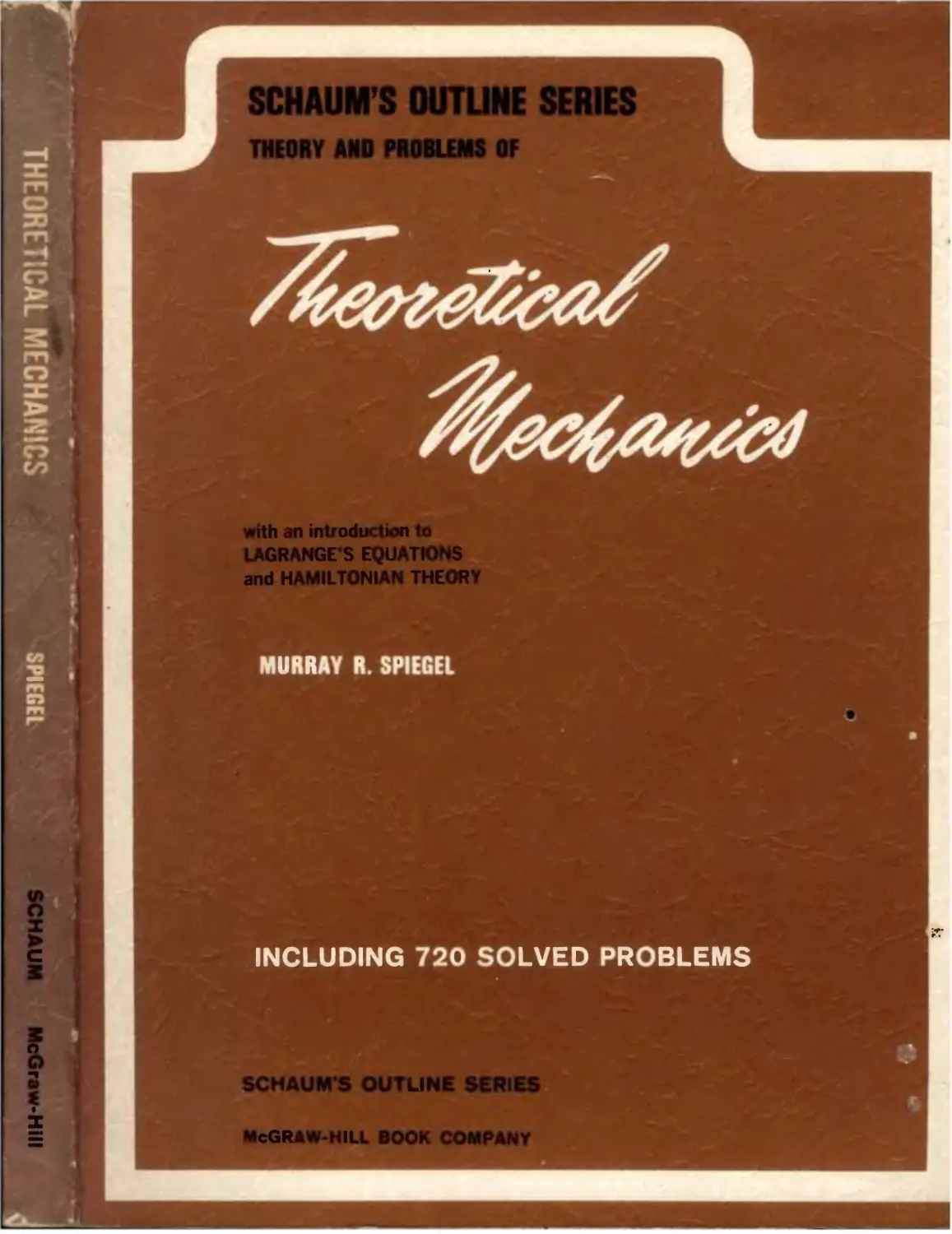
SCHAUM'S OUTLINE OF
THEORY AND PROBLEMS
OF
THEOBETIf;AL MEf;UANIf;S
with an introduction to
Lagrange's Equations
and Hamiltonian Theory
.
BY
MURRAY R. SPIEGEL, Ph.D.
Professor of Mathematics
Rensselaer Polytechnic Institute
.
S
DAUM'S OUTLINE SERIES
McGRAW-HILL BOOK COMPANY
New York, St. Louis, San Francisco, Toronto, Sydney
Copyright @ 1967 by McGraw-HUI, Inc. All rights reserved. Printed in th
United States of America. No part of this publication may be reproduced,
stored in a retrieval system, or transmitted. in any form or by any means.
electronic, mechanical, photocopying, recording, or otherwise, without the prior
written permission of the publisher.
60282
8 9 10 11 12 18 14 15 SH SH 7 5
Preface
In the 17th century, Sir Isaac Newton formulated his now famous laws of mechanics.
These remarkably simple laws served to describe and predict the motions of observable
objects in the universe, including those of the planets of our solar system.
Early in the 20th century it was discovered that various theoretical conclusions de-
rived from Newton's laws were not in accord with certain conclusions deduced from theories
of electromagnetism and atomic phenomena which were equally well founded experimentally.
These discrepancies led to Einstein's relativistic mechanics which revolutionized the con-
cepts of space and time, and to quantum mechanics. For objects which move with speeds
much less than that of light and which have dimensions large compared with those of atoms
and molecules Newtonian mechanics, also called classical mechanics, is nevertheless quite
satisfactory. For this reason it has maintained its fundamental importance in science and
engineering.
I t is the purpose of this book to present an account of Newtonian mechanics and its
applications. The book is designed for use either as a supplement to all current standard
textbooks or as a textbook for a formal course in mechanics. It should also prove useful to
students taking courses in physics, engineering, mathematics, astronomy, celestial me-
chanics, aerodynamics and in general any field which needs in its formulation the basic
principles of mechanics.
Each chapter begins with a clear statement of pertinent definitions, principles and
theorems together with illustrative and other descriptive material. This is followed by
graded sets of solved and supplementary problems. The solved problems serve to illustrate
and amplify the theory, bring into sharp focus those fine points without which the student
continually feels himself on unsafe ground, and provide the repetition of basic principles
so vital to effective learning. Numerous proofs of theorems and derivations of basic re-
sults are included in the solved problems. The large number of supplementary problems
with answers serve as a complete review of the material of each chapter.
Topics covered include the dynamics and statics of a particle, systems of particles and
rigid bodies. Vector methods, which lend themselves so readily to concise notation and to
geometric and physical interpretations, are introduced early and used throughout the book.
An account of vectors is provided in the first chapter and may either be studied at the be-
ginning or referred to as the need arises. Added features are the chapters on Lagrange's
equations and Hamiltonian theory which provide other equivalent formulations of
Newtonian mechanics and which are of great practical and theoretical value.
Considerably more material has been included here than can be covered in most courses.
This has been done to make the book more flexible, to provide a more useful book of
reference and to stimulate further interest in the topics.
I wish to take this opportunity to thank the staff of the Schaum Publishing Company
for their splendid cooperation.
M. R. SPIEGEL
Rensselaer Polytechnic Institute
February, 1967
Chapter 1
CONTENTS
Pale
VECTORS, VELOCITY AND ACCELERATION ...............
Mechanics, kinematics, dynamics and statics. Axiomatic foundations of me-
chanics. Mathematical models. Space, time and matter. Scalars and vectors.
Vector algebra. Laws of vector algebra. Unit vectors. Rectangular unit vec-
tors. Components of a vector. Dot or scalar product. Cross or vector product.
Triple products. Derivatives of vectors. Integrals of vectors. Velocity. Ac-
celeration. Relative velocity and acceleration. Tangential and normal acceler-
ation. Circular motion. Notation for time derivatives. Gradient, divergence
and curl. Line integrals. Independence of the path. Free, sliding and bound
vectors.
1
Chapter 2
NEWTON'S LAWS OF MOTION. WORK, ENERGY
AND M 0 ME NTUM ............................................ 33
Newton's laws. Definitions of force and mass. Units of force and mass.
Inertial frames of reference. Absolute motion. Work. Power. Kinetic energy.
Conservative force fields. Potential energy or potential. Conservation of
energy. Impulse. Torque and angular momentum. Conservation of momentum.
· Conservation of angular momentum. Non-conservative forces. Statics or equi-
librium of a particle. Stability of equilibrium.
Chapter !J
MOTION IN A UNIFORM FIELD. F ALLING BODIES
AND PROJECTILES .......................................... 62
Uniform force fields. Uniformly accelerated motion. Weight and acceleration
due to gravity. Gravitational system of units. Assumption of a flat earth.
Freely falling bodies. Projectiles. Potential and potential energy in a uniform
force field. Motion in a resisting medium. Isolating the system. Constrained
motion. Friction. Statics in a uniform gravitational field.
Chapter 4
THE SIMPLE HARMONIC OSCILLATOR AND
THE SIMPLE PENDULUM .................................... 86
The simple harmonic oscillator. Amplitude, period and frequency of simple
harmonic motion. Energy of a simple harmonic oscillator. The damped har-
monic oscillator. Over-damped, critically damped and under-damped motion.
Forced vibrations. Resonance. The simple pendulum. The two and three
dimensional harmonic oscillator.
Chapter 5
CENTRAL FORCES AND PLANETARY MOTION............. 116
Central forces. Some important properties of central force fields. Equ8:.tions
of motion for a particle in a central field. Important equations deduced from
the equations of motion. Potential energy of a particle in a central field. Con-
servation of energy. Determination of the orbit from the central force. Deter-
mination of the central force from the orbit. Conic sections, ellipse, parabola
and hyperbola. Some definitions in astronomy. Kepler's laws of planetary
motion. Newton's universal law of gravitation. Attraction of spheres and
other objects. Motion in an inverse square field.
Chapter 6
CONTENTS
Page
MOVING COORDINATE SYSTEMS ........................... 144
Non-inertial coordinate systems. Rotating coordinate systems. Derivative
operators. Velocity in a moving system. Acceleration in a moving system.
CorioUs and centripetal acceleration. Motion of a particle relative to the earth.
Coriolis and centripetal force. Moving coordinate systems in general. The
Foucault pendulum.
Chapte.. 7
SYSTEMS OF PARTICLES .................................... 165
Discrete and continuous systems. Density. Rigid and elastic bodies. Degrees
of freedom. Center of mass. Center of gravity. Momentum of a system of
particles. Motion of the center of mass. Conservation of momentum. Angular
momentum of a system of particles. Total external torque acting on a system.
Relation between angular momentum and total external torque. Conservation
of angular momentum. Kinetic energy of a system of particles. Work. Po-
tential energy. Conservation of energy. Motion relative to the center of mass.
Impulse. Constraints. Holonomic and non-holonomic constraints. Virtual dis-
placements. Statics of a system of particles. Principle of virtual work. Equi-
librium in conservative fields. Stability of equilibrium. D'Alembert's principle.
Chapter 8
APPLICATIONS TO VIBRATING SYSTEMS,
ROCKETS AND COLLISIONS ................................. 194
Vibrating systems of particles. Problems involving changing mass. Rockets.
Collisions of particles. Continuous systems of particles. The vibrating string.
Boundary-value problems. Fourier series. Odd and even functions. Con-
vergence of Fourier series.
Chapter 9
PLANE MOTION OF RIGID BODIES .......................... 224
Rigid bodies. Translations and rotations. Euler's theorem. Instantaneous
axis of rotation. Degrees of freedom. General motion of a rigid body. ChasJe's
theorem. Plane motion of a rigid body. Moment of inertia. Radius of gyra-
tion. Theorems on moments of inertia. Parallel axis theorem. Perpendicular
axes theorem. Special moments of inertia. Couples. Kinetic energy and
angular momentum about a fixed axis. Motion of a rigid body about a fixed
axis. Principle of angular momentum. Principle of conservation of energy.
Work and power. Impulse. Conservation of angular momentum. The com-
pound pendulum. General plane motion of a rigid body. Instantaneous center.
Space and body centrodes. Statics of a rigid body. Principle of virtual work
and D' Alembert's principle. Principle of minimum potential energy. Stability.
Chapter 10
SPACE MOTION OF RIGID BODIES .......................... 258
General motion of rigid bodies in space. Degrees of freedom. Pure rotation
of rigid bodies. Velocity and angular velocity of a rigid body with one point
fixed. Angular momentum. Moments of inertia. Products of inertia. Moment
of inertia matrix or tensor. Kinetic energy of rotation. Principal axes of
inertia. Angular momentum and kinetic energy about the principal axes. The
ellipsoid of inertia. Euler's equations of motion. Force free motion. The in-
variable line and plane. Poinsot's construction. Polhode. Herpolhode. Space
and body cones. Symmetric rigid bodies. Rotation of the earth. The Euler
angles. Angular velocity and kinetic energy in terms of Euler angles. Motion
of a spinning top. Gyroscopes.
CONTENTS
Page
Chapter 11
LAGRANGE'S EQU A TIONS ................................... 282
General methods of mechanics. Generalized coordinates. Notation. Trans-
formation equations. Classification of mechanical systems. Scleronomic and
rheonomic systems. Holonomic and non-holonomic systems. Conservative and
non-conservative systems. Kinetic energy. Generalized velocities. Gener-
alized forces. Lagrange's equations. Generalized momenta. Lagrange's equa-
tions for non-holonomic systems. Lagrange's equations with impulsive forces.
Chapter 12
HAMILTONIAN THEORY .................................... 311
Hamiltonian methods. The Hamiltonian. Hamilton's equations. The Hamil-
tonian for conservative systems. Ignorable or cyclic coordinates. Phase space.
Liouville's theorem. The calculus of variations. Hamilton's principle. Can-
onical or contact transformations. Condition that a transformation be canoni-
cal. Generating functions. The Hamilton-Jacobi equation. Solution of the
Hamilton-J acobi equation. Case where Hamiltonian is independent of time.
Phase integrals. Action and angle variables.
APPENDIX A UNITS AND DIMENSIONS ................................... 339
APPENDIX B ASTRONOMICAL DATA ...................................... 342
APPENDIX c SOLUTIONS OF SPECIAL DIFFERENTIAL EQUATIONS .... 344
APPENDIX D INDEX OF SPECIAL SYMBOLS AND NOTATIONS .. . . . . . . . .. 356
IND EX. . . . . . . . . . . . . . . . . . . . . . . . . . . . . . . . . . . . . . . . . . . . . . . . . . . . . . .. 361
Chapter 1
MECHANICS, KINEMATICS, DYNAMICS AND STATICS
Mechanics is a branch of physics concerned with motion or change in position of
physical objects. It is sometimes further subdivided into:
1. Kinematics, which is concerned with the geometry of the motion,
2. Dynamics, which is concerned with the physical causes of the motion,
3. Statics, which is concerned with conditions under which no motion is apparent.
AXIOMATIC FOUNDATIONS OF MECHANICS
An axiomatic development of mechanics, as for any science, should contain the following
basic ingredients:
1. Undefined terms or concepts. This is clearly necessary since ultimately any
definition must be based on something which remains undefined.
2. .Unproved assertions. These are fundamental statements, usually in mathematical
form, whi h it is hoped will lead to valid descriptions of phenomena under study_
In general these statements, called axioms or postulates, are based on experimental
observations or abstracted from them. In such case they are often called laws.
8. Defined terms or concepts. These definitions are given by using the undefined
terms or concepts.
4. Proved assertions. These are often called theorems and are proved from the
definitions and axioms.
An example of the "axiomatic way of thinking" is provided by Euclidean geometry in
which point and line are undefined concepts.
MATHEMATICAL MODELS
A mathematical description of physical phenomena is often simplified by replacing
actual physical objects by suitable mathematical models. For example in describing the
rotation of the earth about the sun we can for many practical purposes treat the earth
and sun as points.
SPACE, TIME AND MATTER
From everyday experience, we all have some idea as to the meaning of each of the
following terms or concepts. However, we would certainly find it difficult to formulate
completely satisfactory definitions. We take them as undefined concepts.
1
2
VECTORS, VELOCITY AND ACCELERATION
[CHAP. I
1. Space. This is closely related to the concepts of point, position,' direction and
displacement. Measurement in space involves the concepts of length or distance,
with which we assume familiarity. Units of length are feet, meters, miles, etc.
In this book we assume that space is Euclidean, i.e. the space of Euclid's geometry.
2. Time. This concept is derived from our experience of having one event taking
place after, before or simultaneous with another event. Measurement of time is
achieved, for example, by use of clocks. Units of time are seconds, hours, years, etc.
3. Matter. Physical objects are composed of "small bits of matter" such as atoms
and molecules. From this we arrive at the concept of a material object called a
particle which can be considered as occupying a point in space and perhaps moving
as time goes by. A measure of the "quantity of matter" associated with a particle
is called its mass. Units of mass are grams, kilograms, etc. Unless otherwise
stated we shall assume that the mass of a particle does not change with time.
Length, mass and time are often called dimensions from which other physical quantities
are constructed. For a discussion of units and dimensions see Appendix A, Page 889.
SCALARS AND VECTORS
Various quantities of physics, such as length, mass and time, require for their specifica-
tion a single real number (apart from units of measurement which are decided upon in
advance). Such quantities are called scalars and the real number is called the magnitude
of the quantity. A scalar is represented analytically by a letter such as t, m, etc.
Other quantities of physics, such as displacement, require for their specification a
direction as well as magnitude. Such quantities are called vector8. A vector is repre-
sented analytically by a bold faced letter such as A in Fig. 1-1. Geometrically it is
represented by an arrow PQ where P is called the initial point and Q is called the terminal
point. The magnitude or length of the vector is then denoted by [AI or A.
Q
p
Fig. I-I
Fig. 1-2
Fig. ]..3
VECTOR ALGEBRA
The operations of addition, subtraction and multiplication familiar in the algebra of
real numbers are with suitable definition capable of extension to an algebra of vectors.
The following definitions are fundamental.
1. Two vectors A and B are equal if they have the same magnitude and direction
regardless of their initial points. Thus A = B in Fig. 1-2 above.
2. A vector having direction opposite to that of vector A but with the same length is
denoted by -A as in Fig. 1-3 above.
3. The sum or resultant of vectors A and B of Fig. 1-4(a) below is a vector C formed
by placing the initial point of B on the terminal point of A and joining the initial
point of A to the terminal point of B [see Fig. 1-4(b) below]. We write C = A + B.
This definition is equivalent to the parallelogram law for vector addition as indicated
in Fig. 1-4(c) below.
CHAP. 1]
VECTORS, VELOCITY AND ACCELERATION
8
)
C = A+B
.-...
C = A + B ...... ......
......
(b)
(0)
Fig. 1.4
Extensions to sums of more than two vectors are immediate. For example,
Fig. 1-5 below shows how to obtain the sum or resultant E of the vectors A, B, C
and D.
)D
B
B
It == A+B+C+ D
Fig. 1..5
4. The difference of vectors A and B, represented by A - B, is that vector C which
when added to B gives A. Equivalently, A - B may be defined as A + (-B). If
A = B, then A - B is defined as the null or zero vector represented by o. This has
a magnitude of zero but its direction is not defined.
5. The product of a vector A by a scalar p is a vector pA or Ap with magnitude
Ipl times the magnitude of A and direction the same as or opposite to that of A
according as p is positive or negative. If p = 0, pA = 0, the null vector.
LAWS OF VECTOR ALGEBRA
"1',
If A, Band C are vectors, and p and q are scalars, then
1. A + B = B + A Commutative Law for Addition
2. A + (8 + C) = (A + B) + C Associative Law for Addition
8. p(qA) = (pq)A = q(pA) Associative Law for Multiplication
4. (p + q)A = pA + qA Distributive Law
5. p(A + B) = pA + pB Distributive Law
Note that in these laws only multiplication of a vector by one or more scalars is
defined. On pages 4 and 5 we define products of vectors.
UNIT VECTORS
Vectors having unit length are called unit vectors. If A is a vector with length A > 0,
then AlA = a is a unit vector having the same direction as A and A = Aa.
RECTANGULAR UNIT VECTORS
The rectangular unit vectors i, j and k are mutually perpendicular unit vectors having
directions of the positive x, 'IJ and z axes respectively of a rectangular coordinate system
4
VECTORS, VELOCITY AND ACCELERATION
[CHAP. 1
[see Fig. 1-6]. We use right-handed rectangular coordinate
systems unless otherwise specified. Such systems derive
their name from the fact that a right threaded screw ro-
tated through 90 0 from Ox to Oy will advance in the posi-
tive z direction. In general three vectors A, Band C which
have coincident initial points and are not coplanar are said
to form a right-handed system or dextral system if a right
thre ded screw rotated through an angle less than 180 0 from
A to B will advance in the direction C [see Fig. 1-7 below].
'Y
x
Fig. 1-6
z
'Y
x
Fig. 1-7
Fig. 1-8
COMPONENTS OF A VECTOR
Any vector A in 3 dimensions can be represented with initial point at the origin 0 of
a rectangular coordinate system [see Fig. 1-8 above]. Let (At, A2, As) be the rectangular
coordinates of the terminal point of vector A with initial point at O. The vectors Ati,
A 2 j and Ask are called the rectangular component vectors, or simply component vectors,
of A in the x, 11 and z directions respectively. At, A 2 and As are called the rectangular
components, or simply components, of A in the x, 'II and z directions respectively.
The sum or resultant of Ati, A 2 j and Ask is the vector A, so that we can write
The magnitude of A is
A = Ati + A 2 j + Ask
A = IAI = V A + A + A:
(1)
(2)
In particular, the position 1JectoT or radius vector r from 0 to the point (x, 'II, z) is
written
r = xi + yj + zk
(8)
and has magnitude r = Irl = V Z 2 + '11 2 + Z2 .
DOT OR SCALAR PRODUCT
The dot or scalar product of two vectors A and B, denoted by A. B (read A dot B)
is defined as the product of the magnitudes of A and B and the cosine of the angle
between them. In symbols,
A. B = AB cos 6,
Note that A. B is a scalar and not a vector.
0 < 8 < 7r
(4)
CHAP. 1]
VECTORS, VELOCITY AND ACCELERATION
5
The following laws are valid:
1. A · B = B. A Commutative Law for Dot Products
2. A · (B + C) = A. B + A. C Distributive Law
3. p(A. B) = (pA). B = A. (pB) = (A. B)p, where p is a scalar.
4. i · i = j. j = k. k = 1, i · j = j. k = k. i = 0
5. If A = Ati+A2j+Ask and B = Bti+B2j+Bsk, then
A.B = AtBl + A 2 B 2 + AsBs
A. A = A 2 = A + A + A:
B · B = B2 = B + B + B:
6. If A. B = 0 and A and B are not null vectors, then A and B are perpendicular.
CROSS OR VECTOR PRODUCT
The cross or vector product of A and B is a vector C = A x B (read A cross B). The
magnitude of A x B is defined as the product of the magnitudes of A and B an.d the sine
of the angle between them. The direction of the vector C = A x B is perpendicular to the
plane of A and B and such that A, Band C form a right-handed system. In symbols,
A x B = AB sin 9 u, 0 <: 9 < 11" (5)
where u is a unit vector indicating the direction of A x B. If A = B or if A is parallel
to B, then sin 9 = 0 and we define A x B = O.
The following laws are valid:
1. A x B = -8 x A (Commutative Law for Cross Products Fails)
2. A x (B + C) = A x B + A x C Distributive Law
3. p(A x B) = (pA) x B = A x (pB) = (A x B)p, where p is a scalar.
4. i x i = j x j = k x k = 0, i x j = k, j x k = i, k x i = j
5. If A = Ali+A2j+Ask and B = Bti+B2j+Bsk, then
i j k
At A 2 As
Bt B 2 Bs
AxB =
6. fAX BI = the area of a parallelogram with sides A and B.
7. If Ax B = 0 and A and B are not null vectors, then A and B are parallel.
TRIPLE PRODUCTS
The scalar triple product is defined as
At A 2 As
A. (8 x C) = B 1 B 2 B3 (6)
Ot 02 Os
where A = Ali + A 2 j + Ask, B = Bli + B 2 j + Bak, C = 01i + Cd + Csk. It represents the
volume of a parallelepiped having A, B, C as edges, or the negative of this volume according
as A, B, C do or do not form a right handed system. We have A. (B x C) = B. (C x A) =
C. (A x B).
The vector triple product is defined as
A x (8 x C) = (A · C)B - (A. B)C (7)
Since (A x B) x C = (A. C)B - (B. C)A, it is clear that A x (B x C) + (A x B) x C.
6
VECTORS, VELOCITY AND ACCELERATION
[CHAP. 1
DERIVATIVES OF VECTORS
If to each value assumed by a scalar variable u there corresponds a vector A(u), or
briefly A, then A(u) is called a (vector) function of u. The derivative of A(u) is defined as
dA = lim A(u + ..:lu) - A(u) (8)
du 6u O u
provided this limit exists. If A(u) = A 1 (u)i + A 2 (u)j + Aa(u)k, then
dA = dAt i + dA 2 . + dA s k ( 9 )
du du du J du
Similarly we can define higher derivatives. For example the second derivative of A(u)
if it exists is given by
d 2 A d 2 At . + d'A2. d 2 Aa
du2 = du2 1 du 2 J + du 2 k
(10)
Example. If A = (2u 2 - 3u)i + 5 COB U j - 3 sin u k, then
:: = (4'it - 3)i - 5 sin 'it j - 3 cos 'it k, : = 4i - 5 cos 'it j + 3 sin 'it k
The usual rules of differentiation familiar in the calculus can be extended to vectors,
although order of factors in products may be important. For example if cp(u) is a scalar
function while A(u) and B(u) are vector functions, then
...!!..-(-I.A ) cf> dA + A ( 11 )
du 'I' du du
d dB dA
- ( A · B ) A · - + -. B ( 12 )
du du du
( A x D ) - A x dB + dA x B ( 18 )
du du du
INTEGRALS OF VECTORS
Let A(u) = Al(U)i + A 2 (u)j + Aa(u)k be a vector function of u. We define the indefinite
integral o.f A(u) as
f A(u) du = i f A 1 (u) du + j f A 2 (u) du + k f As(u) du (14)
If there exists a vector function B(u) such that A(u) = d {B(u)}, then
f A(u) du = f :U {B(u)} du = B(u) + c (15)
where c is an arbitrary constant vector independent of u. The definite integral between
limits u = a and u = f3 is in such case, as in elementary calculus, given by
f f ad
A(u) du = - d {D(u)} du = B(u) + c = D(,8) - D(a)
a a U a
(16)
The efinite integral can also be defined as a limit of a sum analogous to that of elementary
calculus.
VELOCITY
Suppose that a particle moves along a path or curve C [Fig. 1-9 below]. Let the position
vector of point P at time t be r = r(t) while the position vector of point Q at time t + t is
CHAP. 1]
VECTORS, VELOCITY AND ACCELERATION
7
r + Llr = r(t + t). Then the 'Velocity (also call d the instantaneous 'Velocity) of the particle
at P is given by z
dr
v =
dt
lim r
L\t...o t
11
_ Jim r(t + At) - r(t) (17)
At... 0 At
and is a vector tangent to C at P.
If r = r(t) = x(t)i + y(t)j + z(t)k = xi + yj + zk,
we can write
dr
v = - =
dt
dx . + dy . + dz k
dt I dt J dt
(18)
Fig. 1-9
The magnitude of the velocity is called the speed and is given by
'V = Ivl
I ; I = ( r + ( r + ( : r
dB
dt
(19)
where 8 is the arc length along C measured from- some initial point to P.
ACCELERATION
If v = dr/dt is the velocity of the particle, we define the acceleration (also called the
instantaneous acceleration) of the particle at P as
a = dv = lim v(t + At) - v(t) (eO)
dt 6t...O At
In terms of r = xi + yj + zk the acceleration is
d"r d,"z . d,2'IJ . d,2z
a - dt 2 - dt 2 I + dt" J + dt 2 k
(!1)
and its magnitude is
a -
lal
( d2 ) 2 ( d,2'IJ ) I ( d,2Z ) 2
dt 2 + dt 2 + dt 2
(! )
RELATIVE VELOCITY AND ACCELERATION
If two particles P 1 and P 2 are moving with respective velocities Vl and V2 and accelera-
tions al and a2, the vectors .
VP2/PI = VI - VI and ap2/PI = 82 - al
(!8)
are respectively called the relative velocity and relative acceleration of P2 with respect to Pl.
%
TANGENTIAL AND
NORMAL ACCELERATION
Suppose that particle P with position vec-
tor r = r(t) moves along curve C [Fig. 1-10].
We can consider a rectangular coordinate
system moving with the particle and defined
by the unit tangent vector T, the unit princi-
pal normal N and the unit binormal B to
curve C where
Fig. I-to
8
VECTORS, VELOCITY AND ACCELERATION
[CHAP. 1
dr dT
T = ds ' N = R. ds ' B = T X N (24)
8 being the arc length from some initial point to P and R the radius of curvature of C at P.
The reciprocal of the radius of curvature is called the curvature and is given by K = llR.
We can show [see Problem 1.35, page 20] that the acceleration along C is given by
dv 1)2
a = dt T + R N (25)
The first and second terms on the right are called the tangential acceleration and normal
or centripetal acceleration respectively. .
CIRCULAR MOTION
Suppose particle P moves on a circle C of radius
R. If s is the arc length measured along C from
A to P and (J is the corresponding angle subtended
at the center 0, then 8 = R(J. Thus the magnitudes
of the tangential velocity and acceleration are given
respectively by
dB d(J
V = dt = R dt = Roo (26)
dv d 2 s d 2 ()
and dt = dt 2 = R dt 2 == Ra (27) Fig. I-II
We call (I) = d91dt and a = d 2 (Jldt 2 the angular speed and angular acceleration respectively.
The normal acceleration as seen from (25) is given by 1)21R = oo2R.
11
A
:x:
NOTATION FOR TIME DERIVATIVES
We shall sometimes find it convenient to use dots placed over a symbol to denote
derivatives with respect to time t one dot for a first derivative, two dots for a second
derivative, etc. Thus for example r = dr/dt, r = d 2 r/dt 2 , iT = dvldt, etc.
GRADIENT, DIVERGENCE AND CURL
If to each point (x, y, z) of a rectangular coordinate system there corresponds a vector A,
we say that A = A(z,y,z) is a vector function of x,y,z. We also call A(x,y,z) a vector
field. Similarly we call the (scalar) function cfJ(x, y, z) a scalar field.
It is convenient to consider a vector differential operator called del given by
V = i + .:!. + k
ax J iJy az
Using this we define the following important quantities.
(28)
1. Gradient V tp = ( i :x + j :y + k :z ) tp = i :: + j :: + k : (29)
This is a vector called the gradient of 4> and is also written grad .
2. Divergence V.A - (i a: + j a + k : z ). (A 1 i + Ad + Ask)
(90)
_ aA 1 + aA 2 + aA s
ax iJy az
This is a scalar called the divergence of A and is also written div A.
CHAP. 1]
VECTORS, VELOCITY AND ACCELERATION
9
8. Curl vxA (i iJ + j iJ + k ;z ) x (Aii + A + Aak)
. . k
I ]
0 a a (81)
- - -
ax a'll az
At A 2 As
( oAs _ OA2 ) i + ( aAt _ oAa ) . + ( OA2 _ oAt ) k
oy iJz oZ ax] ax oy
This is a vector called the curl of A and is also written curl A.
Two important identities are
div curl A
curl grad cp
v · (V x A) = 0
V x (Vcp) = 0
(8t)
(88)
LINE INTEGRALS
Let r(t) = x(t)i + y(t)j + z(t)k, where r(t) is the position vector of (x, 'II, z), define a
curve C joining points PI and P2 corresponding to t = tl and t = t2 respectively. Let
A = A(x, 'II, z) = A 1 i + A 2 j + A:k be a vector function of position (vector field). The
integral of the tangential component of A along C from Pt to P 2, written as
(Pa A.dr = i A.dr
Pl c
L Aida: + A 2 dy + Asdz
(84)
is an example of a line integral.
If C is a closed curve (which we shall suppose is a simple closed curve, i.e. a curve
which does not intersect itself anywhere) then the integral is often denoted by
£ A.dr = .£ Aida: + A 2 dy + Asdz
(85)
In general, a line integral has a value which depends on the path. For methods of
evaluation see Problems 1.89 and 1.40.
INDEPENDENCE OF THE PATH
The line integral (84) will be independent of the path joining PI and P 2 if and only if
A = V , or equivalently V x A = o. In such case its value is given by
i P1 i Pt
A · dr = dcp =
PI PI
cp(P 2 ) - cp(Pt) - cp(X2, Y2, Z2) - (Xh 'l/t, Zt)
(86)
assuming that the coordinates of Pt and P 2 are (x t , '111' Zt) and (x 2 , '11 2 ' Z2) respectively while
(x, 'Y, z) has continuous partial derivatives. The integral (95) in this case is zero.
FREE, SLIDING AND BOUND VECTORS
Up to now we have dealt with vectors which are specified by magnitude and direction
only. Such vectors are called free vectors. Any two free vectors are equal as long as
they have the same magnitude and direction [see Fig. 1-12(a) below].
10
VECTORS, VELOCITY AND ACCELERATION
[CHAP. 1
y
y
y
(a) Equal free vectors
(b) Equal sliding vectors
Fig. 1-12
Sometimes in practice the particular line of action of a vector is important. In such
case two vectors are equal if and only if they have the same magnitude, direction and line
of action. Such vectors are often called sliding vectors [see Fig. 1-12(b)].
Sometimes it is important to specify the point of action of a vector. Such a vector
[see Fig. 1-12(c)] is called a bound vector. In this case two vectors will be equal if and
only if they are identical.
Most cases with which we shall deal involve free vectors. Cases where sliding vectors
or bound vectors need to be employed will in general be clear from the context.
(c) Bound vector
Solved Problems
VECTOR ALGEBRA
1.1. Show that addition of vectors is commutative, i.e. A + B = B + A. See Fig. 1-13
below.
and
OP + PQ = OQ or
OR + RQ = OQ or
A+B = C
B+A - C
Then A+B - B+A.
p
o
o
Fig. 1-13
Fig. 1-14 .
1.2. Show that the addition of vectors is ssociative, i.e. A + (B + C) = (A + B) + C. See
Fig. 1-14 above.
OP + PQ = OQ = (A + B) and PQ + QB = PB = (B + C)
Since OP + PR = OR = D, i.e. A + (B + C) - D
OQ + QR = OR = D, i.e. (A + B) + C = D
we have A + (B + C) = (A + B) + C.
Extensions of the results of Problems 1.1 and 1.2 show that the order of addition of any
number of vectors is immaterial.
CHAP. 1]
VECTORS, VELOCITY AND ACCELERATION
11
1.3. Given vectors A, Band C [Fig. 1-15(a)] construct (a) A - B + 2C, (b) BC - i(2A - B).
(0)
(c)
Fig. I-IS
1.4. Prove that the magnitude A of the vecto r A =
All + Ad + Ask is A = V A + A: + A:. See
Fig. 1-16.
By the Pythagorean theorem,
(OP)2 = ( OQ )2 + ( QP) 2
-
where OP denotes the magnitude of vector OP, etc.
Similarly, ( OQ )2 = ( OR) 2 + ( RQ) 2.
Then ( OP) 2 = (OR) 2 + (RQ) 2 + ( QP)2 or
A2 = A +A:+A:, i.e. A = vA +A:+A:
1.5. Determine the vector having the initial point
P( h, 1/1, %1) and the terminal point Q( 2, '/J21 Z2)
and find its magnitude. See Fig. 1-17.
The position vector of P is rl = Zl i + 2IIJ + zlk.
The position vector of Q is r2 = Z2 i + lIJi + Z2 k .
rl + PQ = r2 or
PQ = r2 - rl = (Z2 i + lIJi + Z2 k ) - (Zl i + 1I1j + Zl k )
- (z2 - zl)i + b/2 -lIl)j + (Z2 - %t)k
Magnitude of PQ = PQ
- V (z2 - ZI)2 + (712 - 211)2 + (Z2 - ZI)2
Note that this is the distance between points P and Q.
) ,C
t;-v
c, "
G.
,."V
(b)
cP
X
/\
?
\
\
?
\
-1(2A-B)
(cl)
z
:x:
Fig. 1-16
z
z
Fig. 1..;17
12
VECTORS, VELOCITY AND ACCELERATION
[CHAP. 1
1.6. Find (a) graphically and (b) analytically the sum or resultant of the following
displacements:
A, 10 ft northwest; B, 20 ft 30° north of east; C, 35 ft due south. See Fig. 1..18.
G raphicalllJ_
At the terminal point of A place the initial point
of B. At the terminal point of B place the initial
point of C.
The resultant D is formed by joining the initial
point of A to the terminal point of C, i.e. D =
A+B+C.
The resultant is measured to have magnitude of
4.1 units = 20.5 ft and direction 60° south of east.
AnalgticaUIJ_
From Fig. 1-18, if i and j are unit vectors in the
E and N directions, we have
A -10 cos45° i + 10 sin 45° j
B = 20 cos 30° i + 20 sin 30° j
C = - 35j
Then the resultant is
I ,
Unit = 1ft
Q
C
w
E
s
R
Fig. 1-18
D = A+B+C
(- 10 cos 45° + 20 COB 30 0 )i + (10 sin 45° + 20 sin 30° - 35)j
(-5v'2 + 10v'3)i + (5v'2 + 10 - 35)j = 10.25i - 17.93j
Thus the magnitude of D is " (10.25)2 + (17.93)2 = 20.65 ft and the direction is
tan- 1 17.93/10.25 = tan- 1 1.749 = 60°45' south of east
Note that although the graphical and analytical results agree fairly well, the analytical result is
of course more accurate.
THE DOT OR SCALAR PRODUCT
1.7. Prove that the projection of A on B is equal to A. b,
where b is a unit vector in the direction of B.
Through the initial and terminal points of A pass
planes perpendicular to B at G and H respectively as in the
adjacent Fig. 1-19; then
Projection of A on B = GH = EF = A cos (J = A. b
E :F
I I
I I
I I
I I
I I
G H B
Fig. 1-19
1.8. Prove A · (B + C) = A. B + A-C.
Let a be a unit vector in the direction of A; then [see
Fig. 1-20]
Projection of (B + C) on A = projection of B on A
+ projection of C on A
(B+C)-a B.a + C.a
Multiplying by A,
(B + C) · Aa - B · Aa + C. Aa
and (B + C) · A - B · A + C. A
Then by the commutative law for dot products,
A - (B + C) = A · B + A. C
and the distributive law is valid.
I I (8 + C)
I I
I I
I I I
I I I
, , 1
I I I
I I I .
E F G A
Fig. 1-20
CHAP. 1J
VECTORS, VELOCITY AND ACCELERATION
18
1.9. Evaluate each of the following.
(a) i. i - Iii Iii cos 0° (1)(1)(1) - 1
(b) i. k = lillkl cos 90° = (1)(1)(0) = 0
(c) k. j = Iklljl cos 90° = (1}(1)(0) = 0
(d) j. (2i - 8j + k) = 2j. i - 3j · j + j · k = 0 - 3 + 0 = -3
(e) (2i - j) · (3i + k) = 2i. (3i + k) - j · (3i + k) - 6i. i + 2i. k - 3j · i - j · k
= 6+0-0-0 = 6
1.10. If A = Ali + A 2 j + Ask and B = B 1 i + B 2 j + Bdt, prove that A. B == A 1 B 1 + A 2 B2 +
AsBs.
A. B = (Ali + A2i + Ask). (B 1 i + B 2 j + Bsk)
Ali. (B 1 i + B2i + Bsk) + A 2 j · (8 1 i + B 2 j + Bsk) + Ask. (Bt i + BJi + Bsk)
- AIB 1 i. i + AIB 2 i. j + AtBsi.k + A2Btj. i + A2B2i. j + A2B. .k
+ AsBlk · i + AsB2k. j + AsBsk. k
- A 1 B 1 + A 2 B 2 + AsBs
i · i = j. j = k. k = 1 and all other dot products are zero.
since
1.11. If A = A 1 i + A 2 j + Ask, show that A = V A. A = V A + A; + A:.
A. A = (A)(A) cos 0° = A2. Then A = VA . A.
Also, A. A = (A Ii + Ad + Ask) · (Ali + A 2 j + Ask)
= (AI)(A 1 ) + (A2)(A + (As)(As) = A + A + A
by Problem 1.10, takin g B = A.
Then A = V A · A ::::: v' A + Ai + A: is the magnitude of A. Sometimes A. A is written A2.
(41 + 6j). (2i - j) = y (4)2 + (6)2 y (2)2 + (-1)2 COS (J
from which cos (J = 2/(...[52 ..;5) = .1240 and (J = 82°53'.
B (4. 6. 0)
1.12. Find the acute angle between the diagonals of a
quadrilateral having vertices at (0, 0, 0), (8, 2, 0),
(4,6,O), (1,3, 0) [Fig. 1-21].
We have OA = 3i+2j, 08 = 4i+6j, OC = i+3j
from which
CA = OA - OC = 2i - j
Then OB · CA = rOBf ICAI cos 8
i.e.
z
THE CROSS OR VECTOR PRODUCT
1.13. Prove A x B = -B x A.
A
B
(b)
Fig. 1-22
A x B = C has magnitude AB sin' and direction such that A, Band C form a right-handed
system (Fig. 1-22(a) above].
14
VECTORS, VELOCITY AND ACCELERATION
[CHAP. 1
B X A = D has magnitude BA sin fJ and direction such that B, A and D form a right-handed
system [Fig. 1-22{b) above].
Then D has the same magnitude as C but is opposite in direction, i.e. C = -D or A X B = -B X A.
The commutative law for cross products is not valid.
1.14. Prove that
A x (B + C) = A x B + A x C
for the case where A is perpendicular
to B and also to C.
Since A is perpendicular to B, A X B is a
vector perpendicular to the plane of A and B
and having magnitude AB sin 90° = AB or
magnitude of AB. This is equivalent to mul-
tiplying vector B by A and rotating the
resultant vector through 90° to the position
shown in Fig. 1-28.
Similarly, A X C is the vector obtained by
multiplying C by A and rotating the resultant
vector through 90° to the position shown.
In like manner, A X (B + C) is the vector
obtained by multiplying B + C by A and rotat-
ing the resultant vector through 90° to the
position shown.
Since A X (B + C) is the diagonal of the
parallelogram with A X B and A X C as sides,
we have A X (B + C) = A X B + A X C.
1.15.
Prove that A x (8 + C) = A x B + A x C
in the general case where A, Band Care
non-coplanar. See Fig. 1-24.
Resolve B into two component vectors, one
perpendicular to A and the other parallel to A,
and denote them by B.1 and B)I respectively.
Then B = B.L + BII.
If (J is the angle between A and B, then
B .1 = B sin I. Thus the magnitude of A X B .1 is
AB sin (J, the same as the magnitude of A X B.
Also, the direction of A X B.1 is the same as the
direction of AX B. Hence A X B.1 = A X B.
Similarly if C is resolved into two component
vectors CII and C.l' parallel and perpendicular
respectively to A, then A X C.1 = A X C. Fig. 1-24
Also, since B + C = B.1 + BII + C.1 + CII - (B.1 + C .L) + (B II + CII) it follows that
AX(B.i +C.1) = AX(B+C)
Fig. 1-23
BII
A
Now B.1 and C.1 are vectors perpendicular to A and so by Problem 1.14,
A X (B.1 + C.1) = A X B.1 + A X C .1
Then AX(B+C) = AXB+AXC
and the distributive law holds. Multiplying by -1, using Problem 1.13, this becomes (B + C) X A =
B X A + C X A. Note that the order of factors in cross products is important. The usual laws of
algebra apply only if proper order is maintained.
i j k
At A 2 As .
B 1 B 2 Bs
1.16. If A = A1i + A 2 j + Ask and B = B 1 i + Bd + Bsk, prove that A x B
CHAP. 1]
VECTORS, VELOCITY AND ACCELERATION
15
A.X B = (All + A + Ask) X (B 1 1 + B"j + Bik)
- Ali X (Btl + B + Bsk) + A2i X (Bti + B2i + Bsk) + Ask X (B 1 i + B"j + Bik)
- AtBti X i + A 1 B 2 1 X J + AtBsi X k + A 2 B 1 J X 1 + A "j X j + A ai X k
+ AsBtk X i + AsB"k X j + AsBsk X k
- (A"Bs - AsB,,)1 + (AsBt - AIBa)j + (A I B 2 - A"Bt)k =
i j k
Al A 2 As
B 1 B" B8
1.17. If A = Si - j + 2k and B = 2i + Sj - k, find A x B.
. . k
I J 2\__\3 8 -1
-1 2\ + k
AXB 8 -1 2 .
- - I -1 J 2
8 -1 2 8
2 8 -1
- -5i + '1j + llk
1.18. Prove that the area of a parallelogram with
sides A and B is fAX BI.
Area of parallelogram - II, IBI
- IAI sin' IBI
- fAX HI
Note that the area of the triangle with sides A and
B is i fAX HI ·
B
Fig. 1-25
1.19. Find the area of the triangle with vertices at P(2, S, 5), Q(4,2, -1), R(S, 6,4).
PQ = (4-2)i + (2-8)j + (-1-5)k = 21 - j - 6k
PH = (8 - 2)i + (6 - 8)J + (4 - 6)k = i + 8J - k
Area of triangle - ! IPQ X PHI = il (2i - j - 6k) X (I + 8j - k) I
i j k
- ! I 2 -1 -6 , = 11191-4j+ 7k 1
1 S -1
- I V (19)"+ (-4)2+ ('1)" - I V426
TRIPLE PRODUCTS
1.20. Show that A · (B x C) is in absolute value equal
to the volume of a parallelepiped with sides
A, Band C.
Let n be a unit normal to parallelogram 1, having
the direction of B X C, and let II, be the height of the B
terminal point of A above the parallelogram 1. Fig. 1-26
Volume of parallelepiped - (height h)(area of parallelogram 1)
- (A. n)(IB X C()
- A. {IB X CI n} = A. (B X C)
If A, Band C do not form a right-handed system, A. n < 0 and the volume = 1 A · (B X C) I .
1.21. (a) If A = A 1 i + A 2 j + Ask, B = B 1 i + Blj + Bak, C = Cti + C2j + Cak show that
Al A 2 As
A.(BXC) B 1 B 2 Bs
01 02 Cs
16
VECTORS, VELOCITY AND ACCELERATION
[CHAP. 1
(b) Give a geometric significance of the case where A. (B x C) o.
i j k
(a) A. (B X C) - A. B 1 B 2 B8
C 1 C 2 C a
- (A 1 i + Ad + Ask) · [(B 2 C a - B S 0 2 )i + (B a C I - B 1 C a )j + (B 1 0 I - B S 0 1 )k]
At A 2 As
= A I (B 2 C S - BaC,) + A 2 (B a C t - BIC s ) + A s (B 1 C 2 - B 2 C 1 ) - B 1 B 2 Ba
C 1 C 2 0 8
(b) By Problem 1.20 if A. (B X C) = 0 then A, Band C are coplanar, i.e. are in the same plane,
and conversely if A, B, C are coplanar then A. (B X C) = O.
1.22. Find the volume of a parallelepiped with sides A = 3i - j, B = j + 2k, C = i + 5j + 4k.
8 -1 0
By Problems 1.20 and 1.21, volume of parallelepiped - I A · (B X C) 1 = 0 1 2
154
- 1-201 = 20.
1'- If A = i+j, B = 2i-Sj+k, C = 4j-Sk, find (a) (AX B) xC, (b) Ax(BxC).
i j k i j k
(<<) A X B = 1 1 0 = 1- j - 5k. Then (A X B) X C = 1 -1 -5 = 281 + 8j + 4k.
2 -8 1 0 4-3
. j k i . k
. J
(b) B X C = 2 -3 1 = 51 + 6j + 8k. Then A X (B X C) = 1 1 0 = 81-8j+k.
0 4 -3 5 6 8
It follows that, in general, (A X B) X C =#= A X (B X C).
DERIVATIVES AND INTEGRALS OF VECTORS
1.24. If r = (tl + 2t)i - 3e- 2t j + 2 sin 5t k, find (a) , (b) ; , (c) :; , (d) I ; I at t = O.
dr d, d, d.
(<<) dt = (fi(t;8 + 2t)1 + d,t (-Be- 2t )j + d,t (2 SID 5t)k = (3t 2 + 2)i + 6e- 2t j + 10 cos 5t k
At t=o, dr/dt = 2i+6j+l0k.
(b) From «(I), Idr/dtl = " (2)2 + (6)2 + (10)2 = y140 = 2v'35 at t = O.
(0) ::: = i ( ) = :t {(3t 2 + 2)1 + 6e- 2t j + 10 cos 5t k} = 6tl - 12e- 2t j - 50 sin 5t k
At t::t 0, d2:rldt 2 = -12j.
(d) From (c), fd2r/dt 2 1 = 12 at t = o.
d dB dA
1.25. PrOve that - ( A. B ) = A. - + -. B where A and B are differentiable func-
du du du '
tions of u.
CHAP. 1]
VECTORS, VELOCITY AND ACCELERATION
17
Method 1.
d
- (A · B)
du
1 - (A + AA) · (B + B) - A- B
1m
6u-+0 u
1 . A- B + A.B + A- B
1m
.:\u-+O U
Um ( A. AB + AA . B + AA _AB ) _
61£-+0 AU AU Au
dB dA
A-- + --8
du du
Method 2. Let A = A 1 i + A 2 j + Ask, B = B 1 i + B2i + Bak. Then
d d
du (A - B) du (A 1 B 1 + A 2 B 2 + AsBs)
( dB! dB 2 dB s ) ( dAl dA2 dA a )
- At du + A 2 du + As du + du B 1 + du B 2 + du Bs
dB dA
- A- du + du . B
a 2
1.26. If (x, y, z) = x2yz and A = 3x 2 yi + yz2j - xzk, find iJy iJz ( A) at the point (1, -2, -1).
A = ( 2yz)(8 211i + yz2j - zzk) = 3 4y2zi + z2y2 z Sj - x 3 yz 2 k
_ a a (cf>A) = .!.(8 y2zi + z2y2zSj - yz2k} = S 4y2i + S 2y2z2j - 2 Syzk
z az
(cf>A) = .!.. (Sz411 2 i + S 2y2z2j - 2 3yzk) = 6 4yi + 6 2yz2j - 2 Szk
ay az ay
If :x; = 1, 11 = -2, z = -1, this becomes -12i - 12j + 2k.
1.27. Evaluate £:1 A(u) du if A(u) = (3u 2 - l)i + (2u - 3)j + (6u 2 - 4u)k.
The given integral equals
f 2 {(Su2 - l}i + (2u - 3)j + (6u 2 - 4u)k} du
u=l 1 2
= (US - u)i + (u 2 - 3u)j + (2u S - 2u 2 )k
u=1
- {(8 - 2}i + (4 - 6)j + (16 - 8)k} - {(1 -1)i + (1- S)j + (2 - 2)k}
- 6i + 8k
VELOCITY AND ACCELERATION
1.28. A particle moves along a curve whose parametric equations are x = Se- 2t , y = 4 sin St,
z = 5 cos St where t is the time.
(a) Find its velocity and acceleration at any time.
(b) Find the magnitudes of the velocity and acceleration at t = O.
(a) The position vector r of the particle is
r = i + yj + zk = 3e- 2t i + 4 sin St j + 5 cos 8t k
Th,en the velocity is
v = dr/dt = -6e- 2t i + 12 cos St j - 15 sin 8t k
and the acceleration is
a = dv/dt = d 2 r/dt 2 = 12e- 2t i - 36 sin 3t j - 45 COB St k
(b) At t = 0, v = dr/dt = -6i + 12j and a = d 2 r/dt 2 = 12i - 45k. Then
magnitude of velocity at t = 0 is "'; (-6 )2 + (12)2 = 6Vi
magnitude of acceleration at t = 0 is V (12)2 + (-45)2 = 8 V241
18
VECTORS, VELOCITY AND ACCELERATION
[CHAP. 1
1.29. A particle travels so that its acceleration is given by
a = 2e- t j + 5 cos t j - 8 sin t k
If the particle is located at (1, -8, 2) at time t = 0 and is moving with a velocity
given by 4i - Sj + 2k, find (a) the velocity and (b) the displacement of the particle
at any time t > O.
(II) a = : - :; = 2e- t l + 5 cos t j - 3 sin t k
Integrating, v - f (2e- t j + 5 cos t j - 3 sin t k) dt
-2e- t i + 5 sin t j + 3 cos t k + Cl
Since v = 4i - 8j + 2k at t = 0, we have
4i - 3j + 2k = -21 + 3k + Cl or Cl = 61 - 3j - k
v = -2e- t j + 5 sin t j + 3 cos t k + 61 - 3j - k
= (6 - 2e- t )i + (5 sin t - 8)j + (3 cos t - l)k
(b) Replacing v by dr/dt in (1) and integrating, we have
r = f [(6 -2e- t )j + (5 sin t - 3)j + (3 cos t - l)k] dt
= (6t + 2e- t )1 - (5 cos t + 3t)j + (3 sin t - t)k + C2
Since the particle is located at (1, -3,2) at t = 0, we have r = i - 3j + 2k at t = 0, so that
1 - 3j + 2k = 2i - 5j + c2 or c2 = -I + 2j + 2k
Thus r = (6t + 2e- t - 1)1 + (2 - 5 cos t - 3t)j + (3 sin t - t + 2)k (')
Then
(1)
RELATIVE VELOCITY AND ACCELERATION
1.30. An airplane moves in a northwesterly
direction at 125 mi/hr relative to the
ground, due to the fact that there is a -W
westerly wind [i.e. from the west] of
50 mi/hr relative to the ground. Deter-
mine (a) graphically and (b) analyti-
cally how fast and in what direction
the plane would have traveled if there
were no wind.
N
(a) Graphicall,.
Let W - wind velocity
Va - velocity of plane
with wind
Vb - velocity of plane
without wind.
I I
Unit = 25 ml/hr
w
E
s
Then [see Fig. 1-27]
Fig. 1-27
Va == Vb + W or Vb = Va - W = Va + (-W).
V b has magnitude 6.5 units = 163 mi/hr and direction 33° north of west.
(b) Anal,ticaU,.
Letting 1 and j be unit vectors in directions E and N respectively, we see from Fig. 1-27
that
Va = -125 COB 45° i + 125 sin 45° j and W = 60i
Then Vb = Va - W = (-125 cos 4 5 0 - 60)i + 125 sin 4 5° j = -138.39i + 88.39j.
Thus the magnitude of Vb is " (-138.39)2 + (88.39)2 = 164.2 mi/hr and the direction is
tan- 1 88.39/138.39 = tan- t .6387 = 32°84' north of west.
CHAP. 1]
VECTORS, VELOCITY AND ACCELERATION
19
1.31. Two particles have position vectors given by rl = 2ti - t 2 j + (8t 2 - 4t)k and
r2 = (5t 2 - 12t + 4)i + f3j - 3tk. Find (a) the relative velocity and (b) the relative
acceleration of the second particle with respect to the first at the instant where t = 2.
(a) The velocities of the particles at t = 2 are respectively
. 2i - 2tj + (6t-4)k 2i - 4j + 8k
VI - rl - -
t=2
. (lOt - 12)i + 3t 2 j - 3k 8i + 12j - 3k
V2 - r2 -
t=2
Relative velocity of particle 2 with respect to particle 1
= V2 - Vt = (8i + 12j - 3k) - (2i - 4j + 8k) = 6i + 16j - Ilk
(b) The. accelerations of the particles at t = 2 are respectively
. ..
al = VI = rl = -2j + 6k
-2j + 6k
t=2
· .. · 6 .
a2 = v2 = r2 = 101 + tJ
- 10i + 12j
t=2
Relative acceleration of particle 2 with respect to particle 1
= a2-al = (10i+12j)-(-2j+6k) = 10i+14j-6k
TANGENTIAL AND NORMAL ACCELERATION
1.32. Given a space curve C with position vector
r = S cos 2t i + 8 sin 2t j + (8t - 4)k
(a) Find a unit tangent vector T to the curve.
(b) If r is the position vector of a particle moving on C at time t, verify in this
case that v = l1T.
(a) A tangent vector to C is
dr/dt - - 6 sin 2t i + 6 cos 2t j + 8k
The magnitude of this vector is
Jdr/dtl = dB/dt - V (- 6 sin 2t)2 + (6 cos 2t)2 + (8)2 = 10
Then a unit tangent vector to C is
dr/dt dr/dt dr - 6 sin 2t i + 6 COB 2t j + 8k
T = dr/dt - dB/dt = dB = 10
- t sin 2t i + t cos 2t j + t k
(b) This follows at once from «I) since
v = dr/dt = - 6 sin 2t i + 6 cos 2t j + 8k
= (10)(- t sin 2t i + * cos2t j + tk) = 1)T
Note that in this case the Bpeed of the particle along the curve is constant.
1.33. If T is a unit tangent vector to a space curve 0, show that dTlds is no.rmal to T.
Since T is a unit vector, we have T. T = 1. Then dift'erentiating with respect to 8, we obtain
To : + oT = 2T o : = 0 or To : = 0
which states that dT/ds is normal, i.e. perpendicular, to T.
20
VECTORS, VELOCITY AND ACCELERATION
[CHAP. 1
If N is a unit vector in the direction of dT/ds, we have
dT/dB = "N
and we call N the unit principal normal to C. The scalar I( = IdT/dBI is called the curvo,ture,
while R = 1/1( is called the radiu8 of curvature.
1.34. Find the (a) curvature, (b) radius of curvature and (c) unit principal normal N to
any point of the space curve of Problem 1.32.
(a) From Problem 1.32, T = -I sin 2t i + t COB 2t j + tk. Then
dT dT/dt (-6/5) cos 2t i - (6/5) sin 2t j
dB - d8/dt 10
_.L COB 2t i - .!.. sin 2t J .
25 25
Thus the curvature is " = 1 : 1 (- :s cos2t)2 + (- :s sin2t)2 :s
(b) Radius of curvature = R = 1/1( = 25/3
(c) From (a), (b) and Problem 1.33,
1dT R dT
N = ; dB - dB - cos 2t i-sin 2t j
1.35. Show that the acceleration a of a particle which travels along a space curve with
velocity v is given by d 2
1J V
a - dt T + R N
where T is the unit tangent vector to the space curve, N is its unit principal normal
and R is the radius of curvature.
Velocity v = magnitude of v multiplied by unit tangent vector T, or
v = vT
Diiferentiating,
dv
a =
dt
d d'IJ dT
dt (vT) = dt T + vdt
But
tiT dT dB ds vN
dt - ds dt - "N dt = ICvN - R
Then
a =
dv T + ( VN ) = dv T + v 2 N
dt v R dt R
This shows that the component of the acceleration is dv/dt in a direction tangent to the path and
v 2 /R in the direction of the principal normal to the path. The latter acceleration is often called
the centripetal acceleration or briefty normal acceleration.
CIRCULAR MOTION
1.36. A particle moves so that its position vector is given by r = cos (Ot i + sin wt j where
(J) is a constant. Show that (a) the velocity v of the particle is perpendicular to r,
(b) the acceleration a is directed toward the origin and has magnitude proportional
to the distance from the origin, (c) r X v = a constant vector.
dr
(a) v = fit = -w sin (,)t i + (,) COB (,)t j. Then
r · v = [COB (,)t i + sin (,)t j] · [-(,) sin wt i + (a) COB (,)t j]
= (cos (,)t)(-(,) sin wt) + (sin (a)t)«,) cos ",t) = 0
and r and v are perpendicular.
CHAP. 1]
VECTORS, VELOCITY AND ACCELERATION
21
(b) :: = -,,)J cos lilt i - ,;. sin lilt j = -,;. [cos lilt i + sin lilt j] = -"h
Then the acceleration is opposite to the direction of r, i.e. it is directed toward the origin.
Its magnitude is proportional to Jrl which is the distance from the origin.
(c) r X v = [cos ",t i + sin fA)t j] X [-fA) sin wt i + w cos tJJt j]
i j k
cos tJJt sin fA)t 0 = w(cos 2 (a)t + sin 2 wt)k = tJJk, a constant vector.
-tJJ sin wt tJJ cos wt 0
Physically, the motion is that of a particle moving on the circumference of a circle with
constant angular speed",. The acceleration, directed toward the center of the circle, is the
centripetal acceleration.
GRADIENT, DIVERGENCE AND CURL
1.37. If = x 2 yz8 and A = xzi - y2j + 2x 2 yk, find (a) V , (b) V. A, (c) V x A, (d) div
(q,A), (e) curl ( A).
( a) V - ( .!..i +.!.. + k ) = a i + a . + a k
a:x; ay J az t/J a ay J az
(zo2yz8)i + :1/ (:l:2yz8)j + :z (zo2yz8)k = 2:1:1/z8i + :l: 2 z8j + 3zo2yz2k
(b) V. A ( -!.i + j + .!..k ) · ( zi - y2j + 2:x;2yk)
a ay az
a a 8
- a (:x;z) + a'/l (_y2) + az 2:x;211) = z - 2y
(c) V x A = ( ::1: i + :1/ j + :z k ) x (:l:d _1/2j + 2:1:2yk)
i j k
- a/a:x; a/a'/l a/az
:x;z _y2 2zo2y
- ( ..!. (2:x;2y) - .!.. {-1I 2 » ) i + ( 1- (zz) - (2:X;2y» ) j + ( (_y2) - .!.- (:x;Z» ) k
ay 8z az az a:x; ay
- 2z 2 i + (z - 4:x;y)j
(d) div (t/JA) - V. ( A) = V. (:x;3yz4i - 2y3z3j + 2 y2zSk)
a a a
- a (r'/lz4) + ay (-:x;2y3zS) + az (2 2z3)
3z 2 yz4 - 3 2y2z8 + 6z4y2z2
(e) curl (t/JA) - V X (t/JA) = V X (:x;311z4i - z2y8z8j + 2:x;4y2 z 3k)
i j k
a/a:x; a/ay alaz
:x;3yz4 _:x;2yS" 2:x;4y2
- (4:x;4yz3 + 3:x;2y3z2)i + (4z8yz3 - S:x;3y2z3)j - (2:x;y S z3 + z4)k
1.38. (a) If A = (2Xll + z3)i + (x 2 + 211)i + (8xz 2 - 2)k, show that V x A - o.
(b) Find a scalar function such that A = V .
i j k
(a) V X A = a/ax a/ay a/az = 0
2 y + z3 :x;2 + 2y S:X;Z2 - 2
22
VECTORS, VELOCITY AND ACCELERATION
[CHAP. 1
(b) Method 1. If A = V", = :: 1 + :: j + :: k then we must have
(1) or/J - 2 1I + Z3 (S) or/J = 2 + 2y (8) or/J = 8 z2 - 2
iJz all 8z
Integrating, we find
(4) r/J = 21J + z3 + F 1 (11, z) (5) r/J = 2y + 11 2 + F2( ' z)
(6) t/J = z3 - 2z + F3( ' y)
Comparing these we must have Ft(y, z) = 11 2 - 2z, F2( ' z) = z3 - 2z, F s (Z,lI) - 2y + 11 2
and so tp = 2y + z3 + y2 - 2z.
Method 2. We have if A = V t/J,
A.dr ( :: 1 + :: j + k) · (tki + dyj + dzk)
8r/J d + or/J dill + !!2. dz = d""-
8a; ay" 8z "fI
an exact differential. For this case,
dt/J = A · dr (2a;1I + zS) d + ( 2 + 2y) dy + (3 Z2 - 2) dz
[(2 1I + z3) d + 2 dy + 3a;z2 dz] + 2y dy - 2 dz
d( 2y + z3) + d(1I2) + d(-2z)
_ d(a;2y + z8 + '11 2 - 2z)
Then tp = x 2 y + z3 + y2 - 2z. Note that an arbitrary constant can also be added to rfJ.
LINE INTEGRALS AND INDEPENDENCE OF THE PATH
1.39. If A = (3x 2 - 6yz)i + (2y + 3xz)j + (1 - 4 xyz 2)k, evaluate fA. dr from (0, 0, 0) to
(1, 1, 1) along the following paths C: c
( a) z = t I Y = t 2 , Z = f}J.
(b) the straight lines from (0,0,0) to (0, 0, 1), then to (0, 1, 1), and then to (1, 1, 1).
(c) the straight line joining (0, 0, 0) and (1, 1, 1).
Ie A. dr L {( - 61/z)1 + (21/ + 3:1;z)j + (1 - 4zyz2)k} · (ck 1 + d1/ j + dz k)
- .£ (3:1: 2 - 6yz) d:l: + (21/ + 3:1:z) d1/ + (1 - 4:1:1/Z2) dz
(a) If = t, 11 = t 2 , Z = 1,3, points (0,0,0) and (1,1,1) correspond to t = 0 and t = 1 respectively. Then
LA. dr o {3t2 - 6(t2)(t3)} dt + {2t 2 + 3(t)(t 3 )} d(t2) + {1- 4(t)(t2)(t3)2} d(t3)
fl (3t 2 - 6t5) dt + (4t3 + 6t5) dt + (at 2 -12t l1 ) dt - 2
t=O
Another method.
Along C, A = (3t 2 - 6t 15 )i + (2t 2 + 3t4)j + (1 - 4t 9 )k and r = zi + lIJ + zk = ti + t 2 J + t8k,
dr = (i + 2tj + St 2 k) dt. Then
fA. dr - i 1 (3t 2 - 6t5) dt + (4t3 + 6t li ) dt + (3t 2 - 12t U ) dt - 2
c 0
(b) Along the straight line from (0,0,0) to (0,0, 1), = 0, 11 = 0, da; = 0, dll = ° while z varies from
o to 1. Then the integral over this part of the path is
J: o {3(0)2 - 6(O)(z)}O + {2(O) + 3(O)(z)}O + (l - 4(O)(O)(z2)} dz = J: dz - 1
CHAP. 1]
VECTORS, VELOCITY AND ACCELERATION
23
Along the straight line from (0, 0, 1) to (0, 1, 1), x = 0, Z = 1, d = 0, dz = 0 while 'II varies
from 0 to 1. Then the integral over this part of the path is
1 f l
£=0 {3(0)2 - 6(y)(1)}O + {2y + 8(O)(1)} dy + {l- 4(O)(y)(1)2}O - 1/=0 2y dy
1
Along the straight line from (0, 1, 1) to (1, 1, 1), y = 1, Z = 1, dy = 0, dz = 0 while varies
from 0 to 1. Then the integral over this part of the path is
1
o {3:/;2 - 6(1)(1)} da: + {2(1) + 3:/;(1)}O + {I - 4:/;(1)(1)2}O = 1=0 (8:/;2 - 6) da: = -5
Adding, .£ A. dr = 1 + 1 - 5 = -3.
(0) Along the straight line joining (0,0,0) and (1,1,1) we have :x: = t, 'II = t, z = t. Then since
dx = dy = dz = dt,
fe A. dr - .£ (3:/;2 - 6yz) da: + (2y + 3:/;z) dy + (1 - 4:/;yr) dz
- fl (8t 2 --: 6t 2 ) dt + (2t + 3t 2 ) dt + (1- 4t4) dt
t=O
- o (2t + 1 - 4t4) dt 6/5
Note that in this case the value of the integral depends on the particular path.
1.40. If A = (2xy + z3)i + (x 2 + 2y)j + (3xz 2 - 2)k show that (a) J: A. dr is independent
of the path C joining the points (1, -1, 1) and (2,1,2) and (b) find its value.
By Problem 1.38, V X A = 0 or A. dr = dq, = d(:x: 2 '11 +:x:z3 + y2 - 2z). Then the integral is
independent of the path aJ1d its value is
f (2,1,2)
A.dr
(1, -1,1)
f (2,1,2)
d(:x:2y + z3 + y2 - 2z)
(1,-1,1)
1 (2,1,2)
:x:2y + :x:z 3 + y2 - 2z = 18
(1,-1,1)
MISCELLANEOUS PROBLEMS
1.41. Prove that if a and b are non-collinear, then za + yb = 0 implies z = y = o.
Suppose :x: =#= O. Then a + yb = 0 implies :x:a = -yb or a = -('II/ )b, i.e. a and b must be parallel
to the same line (collinear), contrary to hypothesis. Thus:x: = 0; then yb = 0, from which 'II = O.
1.42. Prove that the diagonals of a parallelogram bi-
sect each other.
Let ABCD be the given parallelogram with diagonals
intersecting at P as shown in Fig. 1-28.
Since BD + a = b, BD = b - a. Then BP = :x:(b - a).
Since AC = a + b, AP = 'I/(a + b).
But AD = AP+PB = AP-BP,
i.e. a = y(a + b) - (b - a) = (:x: + y)a + (y - :x:)b.
Since a and bare non-collinear we have by Problem
1.41, + 'II = 1 and '11- = 0, i.e. :x: = 'II = i and P
is the midpoint of both diagonals.
c
A
Fig. 1-28
24 VECTORS, VELOCITY AND ACCELERATION [CHAP. 1
1.43. Prove that for any vector A,
(a) A = (A. i)i + (A. j)j + (A. k)k
(b) A = A(cosai+cos{3j+cosyk)
where a, {3, yare the angles ".hich A makes with i, j, k respectively and cos a, COS {3,
cos yare called the direction cosines of A.
(a) We have A = Ati + A2i + Aak.
A. i
Then
(A Ii + A 2 j + Aa k ) · i At
= (A Ii + A + Aa k ) · j A 2
= (At i + A 2i+Aa k ).k - Aa
A- j
A.k
Thus
A = (A. i)i + (A · j)j + (A. k)k
(b)
IAIlil cos a
IAI iii cos f3 -
IAllkl cosy -
A. i
A. j
A-k
A COSa
A cos f3
A cos y
Then from part (a),
A = (A. i)i + (A - j)j + (A. k)k = A (cos a i + COS 13 j + cos y k)
1.44. Prove that V is a vector perpendicular to the surface cp(x, y, z) = c, where c is a
constant.
Let r = xi + yj + zk be the position vector to any point P( " y, z) on the surface.
Then dr = dx i + dy j + dz k lies in the plane tangent to the surface at P. But
d4> = :: dx + :: dy + :: dz = 0 or ( :: i + :: j + :: k ) · (dx i + dy j + dz k) 0
i.e. V tp · dr = 0 so that V tp is perpendicular to dr and therefore to the surface.
1.45. Find a unit normal to the surface 2x 2 + 4yz - 5Z2 = -10 at the point P(S, -1,2).
By Problem 1.44, a vector normal to the surface is
V (2z 2 + 4yz - 5Z2) = 4 i + 4zj + (4y - lOz}k = 12i + 8j - 24k at (3, -1, 2)
12i + 8j - 24k 3i + 2j - 6k
V (12)2 + (8)2 + (-24)2 7
Then a unit normal to the surface at P is
Another unit normal to the surface at P is
3i + 2j - 6k
7
1.46. A ladder AB of length a rests against a vertical wall OA [Fig. 1-29]. The foot B
of the ladder is pulled away with constant speed vo. (a) Show that the midpoint
of the ladder describes the arc of a circle of radius a/2 with center at O. (b) Find
the velocity and speed of the midpoint of the ladder at the instant where B is distant
b < a from the wall.
(a) Let r be the position vector of midpoint M of AB.
If angle OBA = (J, we have
OB = a cos (J i, OA = a sin (J j
AD = 08 - OA - a cos (J i-a sin (J j
Then
r OA + AM OA + lAB
a sin (J j + l(a, (.os (J i-a sin (J j)
- ia(cos (J i + sin (J j)
Thus Irl == ta, which is a circle of radius a/2
with center at O.
y
A
j
B
i
Fig. 1-29
CHAP. 1]
VECTORS, VELOCITY AND ACCELERATION
25
(b) The velocity of the midpoint M is
= ;t {!lZ(eos, i + sin' j)}
l"( - sin' ;i + cos , ;j)
(1)
.
where ,= d'ldt.
The velocity of the foot B of the ladder is
· d (OB) d ( . ) ... ..
VOl = dt = dt II COS, 1 = - II sIn' 'lor II sIn" - -1.'0
(')
At the instant where B is distant b from the wall we have from (.t),
v a 2 - b 2
sin' = ,
II
. -110 -1.'0
, = -
a sin, v a2 - b 2
Thus from (1) the required velocity of M at this instant is
dr i ( . b . )
- = -.110 I - J
dt Va) - b 2
and its speed is 0,1.'012 "'; a 2 - b 2 .
1.47. Let (r,9) represent the polar coordinates describing the position of a particle. If
rl is a unit vector in the direction of the position vector r and 'I is a unit vector
perpendicular to r and in the direction of increasing 9 [see Fig. 1-30], show that
(a) rl = cos 9 i + sin 9 j, 81 = - sin (J i + cos (J j
(b) i = cos 9 rl - sin 9 8t, j = sin 9 rl + cos 9 '1
(a) If r is the position vector of the particle at any
time t, then ar/a'r is a vector tangent to the
curve , = constant, i.e. a vector in the direc-
tion of r (increasing T). A unit vector in this
direction is thus given by
rl = :/ I : I (1)
11
j
rl
Since
r = a;i + yj = 1" cos, i + r sin' j (I)
as seen from Fig. 1-30, we have
r sin,
: - coSl i + sin, j, 1 : 1
so that
1
o
I
reou
:I
rl = COB' i + sin' j
(8)
Fig. 1-30
Similarly, arIa, is a vector tangent to the curve 1" = constant. A unit vector in this
direction is thus given by
'1 =
ar /l ar l
a, a,
(4)
Now from (.I),
ar
a, - - 1" sin' i + f' COB' j,
1 :; 1 - ..
so that (4) yields
'1 = - sin' i + cos, j
(5)
(b) These results follow by solving the simultaneous equations (8) and (5) for i and j.
26
VECTORS, VELOCITY AND ACCELERATION
[CHAP. 1
1.48. Prove that
. .
(a) rl = (J(J 1
. .
(b) (J 1 = -(Jrt.
(a) From (8) of Problem 1.47 we have
. dr 1
rl = dt -
arl dr + arl d8
ar dt a, dt
- (O)(r) + (- sin' i + cos' j)(;)
.
"I
(b) From (5) of Problem 1.47 we have
. .t a'l dr a't dfJ
'1 = d,t - aT dt + a, dt
.
- (O)(r) + (- cos , i-sin' j)(i)
.
-,rl
1.49. Prove that in polar coordinates (a) the velocity is given by
. .
v = rrl + r(J (J 1
and (b) the acceleration is given by
... ... .
a = (r - r(J2)rl + (r6 + 2r6)' 1
(a) We have r = rrl so that
dr
v = dt -
by Problem 1.48(a).
dr drl
dt rl + r dt -
. .
1Tl + rrl -
. .
rrl + r"t
(b) From part (a) and Problem 1.48 we have
dv d. ·
a = dt dt (rr 1 + r9. 1 )
.. .. .. .. . .
- r rl + "'1 + r9. t + r fJ, 1 + r9, 1
.. . . .. .. ..
- r rl + r(9' 1) + r9' 1 + r9' 1 + (rfJ)(-9rl)
... ....
- (r - r,2)rl + (r, + 2r')'1
Supplementary Problems
VECTOR ALGEBRA
1.50. Given any two vectors A and B, illustrate geometrically the equality 4A + 3(B - A) = A + 3B.
1.51. Given vectors A, Band C, construct the vectors (a) 2A - 3B + !C, (b) C -lA + lB.
1.52. If A and B are any two non-zero vectors which do not have the same direction, prove that pA + qB
is a vector lying in the plane determined by A and B.
1.53. (a) Determine the vector having initial point (2, -1, 3) and terminal point (3,2, -4). (b) Find the
distance between the two points in (a). Ans. (a) i + 3j -7k, (b) V59
1.54. A triangle has vertices at the points A(2, 1, -1), 8(-1,3,2), C(1, -2, 1). Find the length of the
median to the side AB. Ans. iV66
1.55. A man travels 25 miles northeast, 15 miles due east and 10 miles due south. By using an
appropriate scale determine (a) graphically and (b) analytically how far and in what direction
he is from his starting position. Ans. 38.6 miles, 13.2 0 north of east.
CHAP. 1]
VECTORS, VELOCITY AND ACCELERATION
27
1.56. Find a unit vector in the direction of the resultant of vectors A
C = 3i - 2j + 4k. Ans. :t (6i - 2j + 7k)/V89
2i - j + k, B = i + j + 2k,
THE DOT OR SCALAR PRODUCT
1.57. Evaluate I(A + B) · (A - B)f if A = 2i - 3j + 5k and B = 3i + j - 2k.
Ans. 24
1.58. Find a so that 2i - 3j + 5k and 3i + aj - 2k are perpendicular.
Ana. a = -4/3
1.59. If A = 2i + j + k, B = i - 2j + 2k and C = 3i - 4j + 2k, find the projection of A + C in the
direction of B. A ns. 17/8
1.60. A triangle has vertices at A(2, 8, 1), B(-I, 1,2), C(I, -2, 3). Find the acute angle which the
median to side AC makes with side BC. Ans. cos- t V9i 114
1.61. Prove the law of cosines for triangle ABC, i.e. 0 2 = a 2 + b 2 - 2ab cos C.
[Hint. Take the sides as A, B, C where C = A-B. Then use C. C = (A - B) · (A - B).]
1.62. Prove that the diagonals of a rhombus are perpendicular to each other.
THE CROSS OR VECTOR PRODUCT
1.63. If A = 2i - j + k and B = i + 2j - 3k, find 1(2A + B) X (A - 2B)I.
Ana. 25V3
1.64. Find a unit vector perpendicular to the plane of the vectors A = 3i - 2j + 4k and B = i + j - 2k.
A nB. :t (2j + k)/..;5
1.65. Find the area of the triangle with vertices (2, -3,1), (1, -1, 2), (-1,2,3).
Ans. iV3
1.66.
Find the shortest distance from the point (8,2,1) to the plane determined by (1,1,0), (3, -1,1),
( -1, 0, 2). A ns. 2
1.67.
sin A sin B sin C
Prove the law of sines for triangle ABC, i.e. a b c
[Hint. Consider the sides to be A, B, C where A + B + C = 0 and take the cross product of both
sides with A and B respectively.]
TRIPLE PRODUCTS
1.68. If A = 2i + j - 3k, B"= i - 2j + k and C = -I + j - 4k, find (a) A. (B X C), (b) C. (A X B),
(c) A X (B X C), (d) (A X B) X C. Ans. (a) 20, (b) 20, (0) 8i -19j - k, (d) 251 -15j -10k
1.69. Prove that A · (B X C) = (A X B) · C, i.e. the dot and the cross can be interchanged.
1.70. Find the volume of a parallelepiped whose edges are given by A = 2i + 8j - k, B = i - 2j + 2k,
C = 3i - j - 2k. Ana. 31
1.71. Find the volume of the tetrahedron with vertices at (2,1,1), (1, -1, 2), (0,1, -1), (1, -2,1).
Ans. 4/3
1.72. Prove that (a) A. (B X C) = B. (C X A) ::::: C. (A X B),
(b) A X (B X C) = B(A. C) - C(A. B).
1.73. (a) Let rt, r2' ra be position vectors to three points Pt, P 2 , Pa respectively. Prove that the equation
(r - rl) · [(r - r2) X (r - ra)] = 0, where r = i + yi + zk, represents an equation for the plane
determined by Pt, P2 and Pa. (b) Find an equation for the plane passing through (2, -1, -2),
(-1,2, -3), (4,1,0). Am. (b) 2 + y - Sz = 9
DERIV ATIVES AND INTEGRALS OF VECTORS
1.74. Let A = 3ti - (t 2 + t)j + (t3 - 2t 2 )k. Find (a) dA/dt and (b) d2A/dt 2 at t = 1.
Ans. (a) 3i - 3j - k, (b) -2j + 2k
1.75. If r = 8 cos".,t + b sin ".,t, where 8 and b are any constant non-collinear vectors and "., is a constant
scalar, prove that (a) r X dr/dt = ""(8 X b), (b) d2r/dt 2 + ".,2r = O.
28
VECTORS, VELOCITY AND ACCELERATION
[CHAP. 1
1.76.
d
If A = ti - sin t k and B = cos t i + sin t j + k, find dt (A · B).
Ans. -t sin t
] .77.
Prove that
d dB dA
du (A X B) = A X du + du X B
where A and B are differentiable functions of u.
1.78.
If A(u) = 4(u - l)i - (2u + 3)j + 6u 2 k, evaluate
Ana. (II) 6i - 8j + 38k, (b) -28
(a) £3 A(u) du,
(6) f2 (ui - 2k) · A(u) duo
1
1.79. Find the vector B(u) such that d 2 8/du 2 = 6ui - 48u 2 j + 12k where B
i + 5j for u = o. Am. (u 3 + u + 2)i + (5u - 4u 4 )j + (6u 2 - 3)k
2i - 3k and dB/du-
1.80.
f A dA
Prove that A X dt 2 dt = A X dt + C
where c is a constant vector.
I a2R a 2 R I
1.81. If R = 2yi - 2y2zj + y2z2k, find - X - at the point (2, 1, -2).
a 2 ay2
Ans. 16%
t .82.
If A = 2i - yi + zk and B
Ans. -41 + 8j
a 2
- yi + xj - yzk, find a ay (A X B) at the point (1, -1, 2).
VELOCITY AND ACCELERATION
1..83. A particle moves along the space curve r = (t 2 + t)i + (3t - 2)j + (2t3 - 4t 2 )k. Find the
(II) velocity, (b) acceleration, (0) speed or magnitude of velocity and (d) magnitude of accelera-
tion at time t = 2. Ans. (a) 5i + 3j + 8k, (b) 2i + 16k, (c) 7....[2, (d) 2v'65
1.84. A particle moves along the space curve defined by == e- t cos t, y = e- t sin t, z - e- t .. Find
the magnitude of the (II) velocity and (b) acceleration at any time t.
Ans. (a) V3 e- t , (b) % e- t
].85. The position vector of a particle is given at any time t by r = a cos (,)t i + b sin (,)t j + ot 2 k..
(II) Show that although the speed of the particle increases with time the magnitude of the
acceleration is always constant.. (b) Describe the motion of the particle geometrically.
RELATIVE VELOCITY AND ACCELERATION
1.86. The position vectors of two particles are given respectively by rl = ti - t 2 j + (2t + 3)k and
r2 = (2t - 3t 2 )i + 4tj - t3k. Find (II) the relative velocity and (b) the relative acceleration of the
second particle with respect to the first at t = 1. A ns. (a) -5i + 6j - 5k, (b) -6i + 2j - 6k
1.87. An automobile driver traveling northeast at 26 mi/hr notices that the wind appears to be coming
from the northwest. When he drives southeast at 30 mi/hr the wind appears to be coming from
60 0 south of west. Find the velocity of the wind relative to the ground.
Am. 52 mi/hr in a direction from 30 0 south of west
1.88. A man in a boat on one side of a river wishes to reach a point directly opposite him on the other
side of the river. Assuming that the width of the river is D and that the speeds of the boat and
current are V and v < V respectively, show that (II) he should start his boat ups tream at an angle
of sin -1 (v/V) with the shore and (b) the time to cross the river is D / y V2 - 1.'2.
TANGENTIAL AND NORMAL ACCELERATION
1.89. Show that the tangential and normal acceleration of a particle moving on a space curve are given
by d 2 s/dt 2 and le(ds/dt)2 where s is the arc length of the curve measured from some initial point
and Ie is the curvature.
1.90. Find the (II) unit tangent T, (b) principal normal N, (c) radius of curvature R and (d) curvature
Ie to the space curve = t, Y = t 2 /2, z = t.
AnB.. (a) (i + tj + k)/ v' t 2 + 2, (b) (-ti + 2j - tk)/ v' 2t 2 + 4, (0) (t 2 + 2)3/2/...[2, (d)...[2 /(t 2 + 2)3/2
CHAP. 1]
VECTORS, VELOCITY AND ACCELERATION
29
1.91.
A particle moves in such a way that its position vector at any time t is r == ti + it2j + tk.
Find (a) the velocity, (b) the speed, (c) the acceleration, (d) the magnitude of the acceleration,
(e) the magnitude of the tange ntial acceleration, (I) the m agnitude o f the normal acceleration.
Ana. (a) i + tj + k, (b) y t 2 + 2, (c) j, (d) 1, (e) tl y t 2 + 2, (I) ¥2/ v t 2 + 2
1.92.
Find the (a) tangential acceleration and
the ellipse r == a cos".,t i + b sin ".,t j.
".,2(a 2 - b 2 ) sin".,t cos ".,t
Ana. (a)
V a 2 sin 2 ".,t + b 2 cos 2 ".,t
(b) normal acceleration of a particle which moves on
".,2ab
(b) V a 2 sin 2 (j)t + b 2 cos 2 ".,t
CIRCULAR MOTION
1.93. A particle moves in a circle of radius 20 em. If its tangential speed is 40 em/see, find (a) its
angular speed, (b) its angular acceleration, (c) its normal acceleration.
Ana. (a) 2 radians/see, (b) 0 radians/sec 2 , (c) 80 cm/sec 2
1.94. A particle moving on a circle of radius R has a constant angular acceleration a. If the particle
starts from rest, show that after time t (a) its angular velocity is "., = at, (b) the arc length
covered is a == iR".,t2.
1.95. A particle moves on a circle of radius R with constant angular speed ""0. At time t = 0 it starts
to slow down so that its angular acceleration is -a (or deceleration a). Show that (a) it comes to
rest after a time (j)o/ a and (b) has travelled a distance R /2a.
1.96. If the particle in Problem 1.95 is travelling at 3600 revolutions per minute in a circle of radius
100 em and develops a constant deceleration of 5 radians/sec 2 , (a) how long will it be before it
comes to rest and (b) what distance will it have travelled? Ana. (a) 75.4 see, (b) 1.42 X 10 6 em
GRADIENT, DIVERGENCE AND CURL
1.97. If A == zi + (2 2 - y)j - yz 2 k and = 3z2y + y2z3, find (a) V r/J, (b) V. A and (c) V X A
at the point (1, -1,1). Ans. (a) -6i + j + 3k, (b) 2, (c) -i + j + 4k
1.98. If r/J == y + yz + Z and A = z2yi + y2zj + z2a;k, find (a) A. V r/J, (b) V · A and (c) (V r/J) X A
at the point (3, -1, 2). AnB. (a) 25, (b) 2, (c) 56i - 30j + 47k
1.99. Prove that if U, V, A, B have continuous partial derivatives, then (a) V(U + V) - V U + VV,
(b) V. (A + B) = V. A + V - B, (c) V X (A + B) == V X A + V X B.
1.100. Show that V X (r 2 r) == 0 where r = a;i + yj + zk and r == Irl.
1.101. Prove that (a) div curl A = 0 and (b) curl grad r/J = 0 under suitable conditions on A and r/J.
1.102. If A = (2a;2 - 1/z)i + (1/2 - 2a;z)j + a;2z 8 k and = 2y - 8 z2 + 2a;yz, show directly that
div curl A == 0 and curl grad = o.
1.103. If A = 3xz 2 i - yzj + (a; + 2z)k, find curl curl A.
Ana. -6 i + (6z - l)k
1.104. (a) Prove that V X (V X A) = -V2A + V(V - A). (b) Verify the result in (a) if A is as given in
Problem 1.103.
1.105. Prove: (a) V X (UA) = (VU)XA+U(VXA). (b) V-(AXB) = B-(VXA)-A.(VXB).
LINE INTEGRALS AND INDEPENDENCE OF THE PATH
1.106. If F = (311: - 2y)i + (11 + 2z)j - 1I:2k, evaluate f F. dr from (0,0,0) to (1,1, I), where C is a path
c
consisting of: (a) the curve a; = t, 1/ = t 2 , Z = t3; (b) a straight line joining these points; (c) the
straight lines from (0, 0, 0) to (0, 1, 0), then to (0, 1, 1) and then to (1, 1, 1); (d) the curve a; = z2,
Z = y2. AnB. (a) 23/15, (b) 5/3, (c) 0, (d) 13/30
80
VECTORS, VELOCITY AND ACCELERATION
[CHAP. 1
J.J07. Evaluate .( A. dr where A = 3:1: 2 i +- (2:1:% -y)j + zk along (/I) the straight line from (0,0,0)
to (2,1,3), (b) the space curve = 2t 2 , 'II = t, z = 4t 2 - t from t = 0 to t = 1, (c) the curve defined
by 2 = 41/, 3 3 = 8z from = 0 to z = 2. Ans. (a) 16, (b) 14.2, (c) 16
1.108. Find £ F. dr where F = (z - 3y)i + (1/ - 2:1:)j and C is the closed curve in the Z1/ plane,
= 2 cos t, y = 3 sin t, z = 0 from t = 0 to t = 217'. A nB. 617'
1.109. (/I) If A = (4:1:1/ - 3a:2z 2 )i + (41/ + 2:1:2)j + (1- 2z3z)k, prove that LA. dr is independent of the
curve C joining two given points. (b) Evaluate the integral in (a) if C is the curve from the
points (1, -1, 1) to (2, -2, -1). Ans. (b) -19
1.110. Determine whether fA. dr is independent of the path C joining any two points if (/I) A = 2z1/zi +
c
z2zj + a;2yk, (b) 2zzi + ( 2 - y)j + (2z - 2)k. In the case where it is independent of the path,
determine such that A = V q,.
A ns. (a) Independent of path, t/J = 2yz + c; (b) dependent on path
1.111. Evaluate .+: E. dr where E = rr.
A l1S. 0
MISCELLANEOUS PROBLEMS
1.112. If AX B = 8i - 14j + k and A + B = 5i + 3j + 2k, find A and B.
Ans. A = 2i+j-2k, B = 3i+2j+4k
1.113. Let ll' ml' n 1 and l2, mat n2 be direction cosines of two vectors. Show that the angle , between them
is such that cos (J = lll2 + ml m 2 + nln2'
1.114. Prove that the line joining the midpoints of two sides of a triangle is parallel to the third side
and has half its length.
1.115. Prove that (A X B)2 + (A. B)2 = A2J12.
1.116. If A, Band C are non-coplanar vectors [vectors which do not all lie in the same plane] and
1A + Y1 8 + %1 C = 2A + 112 8 + Z2 C , prove that necessarily a;t = 2, 111 = 112' ZI = Z2'
1.117. Let ABCD be any quadrilateral 'and points P, Q, Rand S the midpoints of successive sides. Prove
that (a) PQRS is a parallelogram, (b) the perimeter of PQRS is equal to the sum of the lengths
of the diagonals of ABCD.
1.118. Prove that an angle inscribed in a semicircle is a right angle.
1.119. Find a unit normal to the surface 2y - 2 z + 2y2z4 = 10 at the point (2,1, -1).
Ans. :t (3i + 4j - 6k)/ViIT
dA dA
1.120. Prove that A. dt = A dt ·
1.121. If A(u) is a differentiable function of u and IA(u)1 = 1, prove that dAidu is perpendicular to A.
1.122. Prove V. ( A) = (V ). A + q,(V · A).
1.123. If AX B = A X C, does B = C necessarily? Explain.
1.124. A ship is traveling northeast at 15 mUes per hour. A man on this ship observes that another ship
located 5 miles west seems to be traveling south at 5 miles per hour. (a) What is the actual
velocity of this ship? (b) At what distance will the two ships be closest together?
1.125. Prove that (A X B) · (C X D) + (B X C) · (A X D) + (C X A) · (B X D) = O.
1.126. Solve the equation d2r/dt 2 = -gk where g is a constant, given that r = 0, dr/dt = 'Volt at t = o.
A nB. r = ('Vot - !gt 2 )k
CHAP. 1]
VECTORS, VELOCITY AND ACCELERATION
81
1.127. If r/J = ( 2 + y2 + z2)-1/2, show that V2r/J = V. (V q,) = 0 at all points except (0,0,0).
1.128. The muzzle velocity of a gun is 60 mi/hr. How long does it take for a bullet to travel through the
gun barrel which is 2.2 It long, assuming that the bullet is uniformly accelerated? A nB. .05 see
1.129. A 25 foot ladder AB rests against a vertical wall OA as in Fig. 1-29, page 24. If the foot of the
ladder B is pulled away from the wall at 12 ft/sec, find (II) the velocity and (b) the acce1eration
of the top of the ladder A at the instant where B is 15 ft from the wall.
Am. (II) 9 ft/sec downward, (b) 11.25 ft/sec 2 downward
1.130. Prove that (a) JA + BI <: 'AI + IBI, (b) lA + B + CI <: IAI + IBI + lei. Give a possible geometric
interpretation.
1.131. A train starts from rest with uniform acceleration. After 10 seconds it has a speed of 20 mi/hr.
(a) How far has it traveled from its starting point after 15 seconds and (b) what will be its speed
in mi/hr? Am. (a) 330 ft, (b) 30 mi/hr
1.132. Prove that the magnitude of the accelerat ion of a particle moving on a space curve is
V (dv/dt)2 + v 4 /R2
where 1) is the tangential speed and R is the radius of curvature.
1.133. If T is the unit tangent vector to a curve C and A is a vector field, prove that
L A-dr L A-Tds
where s is the arc length parameter.
1.134. If A = (2a; - y + 4)i + (Sy + 3a; - 6»), evaluate fA. dr around a triangle with vertices at
(0,0,0), (3,0,0), (3,2,0). Am. 12
1.135. An automobile driver starts at point A of a highway and stops at point B after traveling the
distance D in time T. During the course of the trip he travels at a maximum speed V. Assuming
that the acceleration is constant both at the beginning and end of the trip, show that the time
during which he travels at the maximum speed is given by 2D/V - T.
1.136. Prove that the medians of a triangle (II) can form a triangle, (b) meet in a point which divides the
length of each median in the ratio two to one.
1.137. If a particle has velocity v and acceleration 8 along a space curve, prove that the radius of
curvature of its path is given numerically by
B =
v 3
Iv X 81
1.138. Prove that the area of a triangle formed by vectors A, Band C is i I A X B + B X C + C X A ).
1.139. (II) Prove that the equation A X X = B can be solved for X if and only if A. B = 0 and A =#= o.
(b) Show that one solution is X = B X A/A2. (0) Can you find the general solution?
Ans. (0) X = B X AIA2 +).A where ). is any scalar.
1.140. Find all vectors X such that A. X = p.
Ana. X = pAIA2 + V X A where V is an arbitrary vector.
1.141. Through any point inside a triangle three lines are constructed parallel respectively to each of
the three sides of the triangle and terminating in the other two sides. Prove that the sum of the
ratios of the lengths of these lines to the corresponding sides is 2.
1.142. If T, Nand B = T X N are the unit tangent vector, unit principal normal and unit binonnal to
a space curve r = r(u), assumed differentiable, prove that
n clB aN
dB = leN, ds = -TN, dB = .,B - "T
These are called the Frenet-Serret formulas. In these fonnulas " is called the curvature, 'I' is the
tcwBi01l, and their reciprocals B = 111e, t1 = 11., are called the rtuliua of curullture and radius of
torsion.
32
VECTORS, VELOCITY AND ACCELERATION
[CHAP. 1
1.143. In Fig. 1-31, AB is a piston rod of length l. If A moves along horizontal line CD while B moves
with constant angular speed w around the circle of radius a with center at 0, find (a) the velocity
and ( b) the acceleration of A.
p
l
D
I
I
I
DI
I
lJ/
17"
1/
v
Fig. 1-31
Q
Fig.I-3!
1.144. A boat leaves point P [see Fig. 1-32] on one side of a river bank and travels with constant velocity
V in a direction toward point Q on the other side of the river directly opposite P and distance D
from it. If 'r is the instantaneous distance from Q to the boat, , is the angle between r and PQ
and the river travels with speed 'V, prove that the path of the boat is given by
D see (J
'r =
(see' + tan lJ)vlV
1.145. If 1) = V in Problem 1.144, prove that the path is an arc of a parabola.
1..146. (a) Prove that in cylindrical coordinates (p, t/J1J z) [see Fig. 1-33] the position vector is
r = pcos i + psin j + zk
(b) Express the velocity in cylindrical coordinates.
(c) Express the acceleration in cylindrical coordinates.
Ans.
(b) v
(c) a =
PPt + P 4»l + zk
(p. - p 2)pl + (p + 2p ) 1 + ik
z
z
11
'1/
z
:x:
Cylindrical coordinates
Fig. 1-33
Spherical coordinates
Fig. 1-34
1.147. (a) Prove that in spherical coordinates (r", t/J) [see Fig. 1-34] the position vector is
r = r sin, cos t/J i + r sin' sin t/J j + 'r cos , k
(b) Express the velocity in spherical coordinates.
(c) Express the acceleration in spherical coordinates.
Am. (b) v - hi + ri_ 1 + r sin (J 1
(c) a - (r - r;2 - ". 2 sin 2 1)rl + (2;'; + 'r' - 'r 2 sin I cos ')-1
. . . . . .. .
+ (2,.'t/J + 2'r4> SID I + r SID fJ >4» 1
1.148. Show that if a particle moves in the :1:'1/ plane the results of Problems 1.146 and 1.147 reduce to
those of Problem 1.49.
Chapter 2
NEWTON'S LAWS
The following three laws of motion given by Sir Isaac Newton are considered the
axioms of mechanics:
1. Every particle persists in a state of rest or of uniform motion in a straight line
(i.e. with constant velocity) unless acted upon by a force.
2. If F is the (external) force acting on a particle of mass m which as a consequence is
moving with velocity v, then
d . dp
F = dt (mv) - at
(1)
where p = mv is called th momentum. If m is independent of time t this becomes
dv
F = m dt = ma (I)
where a is the acceleration of the particle.
8. If particle 1 acts on particle 2 with a force F12 in a direction along the line joining
the particles, while particle 2 acts on particle 1 with a force F2t, then F2t = -FI2. In
other words, to every action there is an equal and opposite Teaction.
DEF NITIONS OF FORCE AND MASS
The concepts of force and mass used in the above axioms are as yet undefined, although
intuitively we have some idea of mass as a measure of the "quantity of matter in an object"
and force as a measure of the "push or pull on an object". We can however use the above
axioms to develop definitions [see Problem 2.28, page 49].
UNITS OF FORCE AND MASS
Standard units of mass are the gram (gm) in the cgs (centimeter-gram-second) system,
kilogram (kg) in the mks (meter-kilogram-second) system and pound (lb) in the fps (foot-
pound-second) system. Standard units of force in these systems are the dyne, newton (nt)
and poundal (pdl) respectively. A dyne is that force which will give a 1 gIn mass an accelera-
tion of 1 cm/sec 2 . A newton is that force which will give a 1 kg mass an acceleration of
1 m/sec 2 . A poundal is that force which will give a 1 lb mass an acceleration of 1 ft/seel.
For relationships amo g these units see Appendix A, page 841.
INERTIAL FRAMES OF REFERENCE. ABSOLUTE MOTION
It must be emphasized that Newton's laws are postulated under the assumption that
all measurements or observations are taken with respect to a coordinate system or frame
88
34
NEWTON'S LAWS OF MOTION. WORK, ENERGY AND MOMENTUM
[CHAP. 2
of reference which is fixed in space, i.e. is absolutely at rest. This is the so-called assump-
tion that space or motion is absolute. It is quite clear, however, that a particle can be
at rest or in uniform motion in a straight line with respect to one frame of reference and
be traveling in a curve and accelerating with respect to another frame of reference.
We can show that if Newton's laws hold in one frame of reference they also hold in
any other frame. of reference which is moving at constant velocity relative to it [see
Problem 2.8]. All such frames of reference are called inertial frames of reference or
Newtonian frames of reference. To all observers in such inertial systems the force
acting on a particle will be the same, i.e. it will be invariant. This is sometimes called
the classical principle of relativity.
The earth is not exactly an inertial system, but for many practical purposes can be
considered as one so long as motion takes place with speeds which are not too large. For
non-inertial systems we use the methods of Chapter 6. For speeds comparable with the
speed of light (186,000 mi/sec), Newton's laws of mechanics must be replaced by Einstein's
laws of relativity or relativistic mechanics.
WORK
If a force F acting on a particle gives it a
displacement dr, then the work done by the
force on the particle is defined as
dW = F.dr
(8)
since only the component of F in the direction
of dr is effective in producing the motion.
The total work done by a force field (vector
field) F in moving the particle from point Pi
to point P2 along the curve C of Fig. 2-1 is
given by the line integral [see Chap. 1, page 9].
z
Fig. 2-1
i i Ps crs
W = F · dr = F. dr J _ F. dr
C PI rl
where rl and r2 are the position vectors of PI and P 2 respectively.
(4)
POWER
The time rate of doing work on a particle is often called the instantaneous power, or
briefly the power, applied to the particle. Using the symbols Wand cp for work and
power respectively we have
t:n _ dW
-c - dt
(5)
If F is the force acting on a particle and v is the velocity of the particle, then we have
cP = F. v (6)
KINETIC ENERGY
Suppose that the above particle has constant mass and that at times tl and t2 it is
located at PI and P 2 [Fig. 2-1] and moving with velocities VI = drl/dt and V2 = dr2/dt
respectively. Then we can prove the following [see Problem 2.8].
CHAP. 2]
NEWTON'S LAWS OF MOTION WORK, ENERGY AND MOMENTUM
85
Theorem 2.1. The total work done in moving the particle along C from P1 to P 2 is
given by
w = J:Fodr = tm('V -'V )
If we call the quantity T = imv 2
the kinetic energy of the particle, then Theorem 2.1 is equivalent to the statement
Total Work done from PI to P 2 along C
- Kinetic energy at P2 - Kinetic energy at Pt
(7)
(8)
(9)
or, in symbols,
where T 1 = imv , T 2 = imv:.
w = T 2 - Tl
(10)
CONSERVATIVE FORCE FIELDS
Suppose there exists a scalar function V such that F = -VV. Then we can prove the
following [see Problem 2.15].
Theorem 2.2. The total work done in moving the particle along C from PI to P 2 is
W = f PI F ° dr = V(Pl) - V(P 2 ) (11)
JPt
In such case the work done is independent of the path C joining points Pt and P 2 . If the
work done by a force field in moving a particle from one point to another point is
independent of the path joining the points, then the force field is said to be conservative.
The following theorems are valid.
Theorem 2.8. A force field F is conservative if and only if there exists a continuously
differentiable scalar field V such that F = -v V or, equivalently, if and only if
v x F = curl F = 0
identically
(1t)
Theorem 2.4. A continuously differentiable force field F is conservative if and only
if for any closed non-intersecting curve C (simple closed curve)
£ Fodr = 0 (18)
i.e. the total work done in moving a particle around any closed path is zero.
POTENTIAL ENERGY OR POTENTIAL
The scalar V such that F = -VV is called the potential energy, also called the scalar
potential or briefly the potential, of the particle in the conservative force field F. In such
case equation (11) of Theorem 2.2 can be written
Total Work done from PI to P 2 along C
Potential energy at PI - Potential energy at P2
(14)
or, in symbols,
where VI = V(P t ), V 2 = V(P 2 ).
W = V t - V 2
(15)
36
NEWTON'S LAWS OF MOTION. WORK, ENERGY AND MOMENTUM
[CHAP. 2
It should be noted that the potential is defined within an arbitrary additive constant.
We can express the potential as
v = - i r F.dr
"0
where we suppose that V = 0 when r = rOe
(16)
CONSERVATION OF ENERGY
For a conservative force field we have from equations (10) and (15),
T 2 - TI = VI - V 2 or Tl + VI = T 2 + V 2
which can also be written
(17)
(18)
lmv + VI = !mv + V 2
The quantity E = T + V, which is the sum of the kinetic energy and potential energy, is
called the total energy. From (18) we see that the total energy at PI is the same as the
total energy at P 2 . We can state our results in the following
Theorem 2.6. In a conservative force field the total energy [i.e. the sum of kinetic
energy and potential energy] is a constant. In symbols, T + V = constant = E.
This theorem is often called the principle of conservation of energy.
IMPULSE
Suppose that in Fig. 2-1 the particle is located at PI and P 2 at times tl and t2 where it
has velocities Vt and V2 respectively. The time integral of the force F given by
ft s Fdt (19)
tl
is called the impulse of the force F. The following theorem can be proved [see Problem 2.18].
Theorem 2.6. The impulse is equal to the change in momentum; or, in symbols,
f t 2
F dt = mv 2 - mv 1 = P 2 - PI
tl
The theorem is true even when the mass is variable and the force is non-conservative.
TORQUE AND ANGULAR MOMENTUM
If a particle with position vector r moves in a
force field F [Fig. 2-2], we define
A = rxF
(t1)
as the torque or moment of the force F about O.
The magnitude of .A is a measure of the "turning
effect" produced on the particle by the force. We
can prove the following [see Problem 2.20]
Theorem 2.7.
rxF
d
dt {m(r x v)}
(22)
(20)
z
:x:
Fig. 2-2
CHAP. 2]
NEWTON'S LAWS OF MOTION. WORK, ENERGY AND MOMENTUM
87
The quantity
o = m(r x v) = r X p (S8)
is called the angular momentum or moment of momentum about O. In words the theorem
states that the torque acting on a particle equals the time rate of change in its angular
momentum, i.e.,
do
Ii. =-
dt
(S4)
This theorem is true even if the mass m is variable or the force non-conservative.
CONSERVATION OF MOMENTUM
If we let F = 0 in Newton's second law, we find
d
dt (mv) = 0 or mv = constant
(25)
This leads to the following
Theorem 2.8. If the net external forc.e acting on a particle is zero, its momentum
will remain unchanged.
This theorem is often called the principle of conservation of momentum. For the case
of constant mass it is equivalent to Newton's first law.
CONSERVATION OF ANGULAR MOMENTUM
If we let A = 0 in (24), we find
d
dt {m(r x v)} 0 or m(r x v)
This leads to the following
Theorem 2.9. If the net external torque acting on a particle is zero, the angular
momentum will remain unchanged.
This theorem is often called the principle of conservation of angular momentum.
constant
(26)
NON-CONSERVATIVE FORCES
If there is no scalar function V such that F = -VV [or, equivalently, if V x F + 0],
then F is called a non-conservative force field. The results (7), (SO) and (S4) above hold
for all types of force fields, conservative or not. However, (11) and (17) or (18) hold only
for conservative force fields.
STATICS OR EQUILIBRIUM OF A PARTICLE
An important special case of motion of a particle occurs when the particle is, or appears
to be, at rest or in equilibrium with respect to an inertial coordinate system or frame of
reference. A necessary and sufficient condition for this is, from Newton's second law, that
F = 0
(27)
i.e. the net (external) force acting on the particle be zero.
88
NEWTON'S LAWS OF MOTION. WORK, ENERGY AND MOMENTUM
[CHAP. 2
If the force field is conservative with potential V, then a
condition for a particle to be in equilibrium at a point is that
av aV aV
i.e. ax ay - az == 0
necessary and sufficient
v V == 0,
at the point.
STABILITY OF EQUILIBRIUM
If a particle which is displaced slightly from an equilibrium point P tends to return
to P, then we call P a point of stability or stable point and the equilibrium is said to be
stable. Otherwise we say that the point is one of instability and the equilibrium is
unstable. The following theorem is fundamental.
Theorem 2.10. A necessary and sufficient condition that an equilibrium point be one
of stability is that the potential V at the point be a minimum.
Solved Problems
NEWTON'S LAWS
2.1. Due to a force field, a particle of mass 5 units moves along a space curve whose
position vector is given as a function of time t by
r = (2t 3 + t)i + (8t 4 - t 2 + 8)j - 12t 2 k
Find (a) the velocity, (b) the momentum, (c) the acceleration and (d) the force
field at any time t.
(a) Velocity = v = : = (6t 2 + 1)1 + (12t3 - 2t») - 24tk
(b) Momentum = p = mv = 5v = (30t 2 + 5)i + (60t 3 - lOt)j - 120tk
(c) Acceleration = a = :; = :: = 12tl + (36t 2 - 2») - 24k
(d) Force = F = : = m :; = 60ti + (180t 2 - 10») - 120k
2.2. A particle of mass m moves in the xy plane so that its position vector is
r = a cos wt i + b sin wt j
where a, band ware positive constants and a> b. (a) Show that the particle moves
in an ellipse. (b) Show that the force acting on the particle is always directed
toward the origin.
y
(a) The position vector is
r = i + yj = a cos wt i + b sin (a)t j
and so = II COB wt, Y = b sin CaJt which are
the parametric equations of an ellipse having
semi-major and semi-minor axes of lengths II
and b respectively [see Fig. 2-3].
Since
(:1;/a)2 + ('II/b)2 = cos 2 CaJt + sin 2 l1)t = 1
the ellipse is also given by 2/112 + y2/b 2 = 1.
B
A
Fig. 2-3
CHAP. 2]
NEWTON'S LAWS OF MOTION. WORK, ENERGY AND MOMENTUM
89
(b) Assuming the particle has constant mass m, the force acting on it is
F m : = m : = m :;2 [(a COS IoIt)i + (b sin ",t)j]
m[ -w 2 a cos wt i - w 2 b sin wt j]
- -mw 2 [a cos (,)t i + b sin wt j] = -mw 2 r
which shows that the force is always directed toward the origin.
2.3. Two observers 0 and 0', fixed relative to
two coordinate systems Oxyz and O'x'y'z'
respectively, observe the motion of a par-
ticle P in space [see Fig. 2-4]. Show that
to both observers the particle appears to
have the same force .acting on it if and
only if the coordinate systems are moving
at constant velocity relative to each other.
Let the position vectors of the particle in the
O 'Yz and O'rx;'y'z' coordinate systems be rand r'
respectively and let the position vector of 0' :x:
with respect to 0 be R = r - r'. Fig. 2-4
Relative to observers 0 and 0' the forces acting on P according to Newton's laws are given
respectively by J9 r .-J9 ,
F u,- F ' _ u'-r
= m dt 2 ' - m dt 2
-11
The difference in observed forces is
F - F' - m :;2 (r - r')
and this will be zero if and only if
d2R
- m dt2
cPR = 0
dt2
or
dB
- = constant
dt .
i.e. the coordinate systems are moving at constant velocity relative to each other. Such coordinate
systems are called inertial coordinate systems.
The result is sometimes called the classical principle of relativity.
2.4. A particle of mass 2 moves in a force field depending on time t given by
F 24t 2 i + (36t -16)j - 12tk
Assuming that at t = 0 the particle is located at ro = 3i - j + 4k and has velocity
vo = 6i + 15j - 8k, find (a) the velocity and (b) the position at any time t.
(a) By Newton's second law,
2 dv/dt
24t 2 i + (36t - 16)j - 12tk
or
dv/dt - 12t 2 i + (18t - 8)j - 6tk
Integrating with respect to t and calling Cl the constant of integration, we have
v = 4t3i + (9t 2 - 8t)j - 3t 2 k + Cl
Since v = vo = 6i + 15j - 8k at t = 0, we have Cl = 6i + 15j - 8k and so
v = (4t8 + 6)i + (9t 2 - 8t + 15)j - (3t 2 + 8)k
40
NEWTON'S LAWS OF MOTION. WORK, ENERGY AND MOMENTUM
[CHAP. 2
(b) Since v = dr/dt, we have by part (a)
: = (4t3 + 6)1 + (9t 2 - 8t + 15)j - (3t 2 + 8)k
Integrating with respect to t and calling C2 the constant of integration,
r = (t4 + 6t)i + (3t8 - 4t 2 + 15t)j - (t 3 + 8t)k + c2
Since r = ro = 3i - j + 4k at t = 0, we have c2 = 3i - j + 4k and so
r = (t4 + 6t + 3)i + (8t8 - 4t 2 + 15t - l)j + (4 - t 3 - 8t)k
2.5. A constant force F acting on a particle of mass m changes the velocity from VI to V2
in time T.
(a) Prove that F = m(v2 - Vt)/T.
(b) Does the result in (a) hold if the force is variable? Explain.
(a) By Newton's second law,
dv
m- = F
dt
or
dv
at
F
'In
(1)
Then if F and m are constants we have on integrating,
At t = 0, v = Vt so that cl = VI i.e.
v - (F/m)t + Ct
v (F/m)t + VI
v2 - (F/m).,. + VI
F - m(v2 - Vt)/"
(I)
At t=", V=v2 so that
i.e.
<8>
Another method.
Write (1) as m dv = F dt. Then since v = VI at t = 0 and V = V2 at t ="', we have
f V 2 i T
mdv = Fdt
Vl 0
which yields the required result.
or
m(V2 - VI) = F"
(b) No, the result does not hold in general if F is not a constant, since in such case we would not
obtain the result of integration achieved in (a).
2.6. Find the constant force in the (a) cgs system and (b) mks system needed to
accelerate a mass of 10,000 gm moving along a straight line from a speed of
54 km/hr to 108 km/hr in 5 minutes.
Assume the motion to be in the direction of the positive a; axis. Then if VI and V2 are the
velocities, we have from the given data VI = 54i km/hr, V2 = 108i km/hr, m = 10,000 gm,
t=5min.
(a) In the cgs system
m = 10 4 gm, VI
Then
54i km/hr = 1.5 x 10 3 1 em/see, v2 = 3.0 X 10 3 1 em/sec,
( V2 - VI ) ( 1.5 X 10 3 i em/see )
F - ma = m t = (104 gm)
3 X 10 2 sec
- 0.5 X 10s1 gm cm/sec 2 = 5 X 10 4 i dynes
t - 300 sec
Thus the magnitude of the force is 50,000 dynes in the direction of the positive a; axis.
(b) In the mks system
m = 10 kg, VI
54i km/hr
15i m/sec, V2
30i m/see, t
300 see
CHAP. 2]
NEWTON'S LAWS OF MOTION. WORK, ENERGY AND MOMENTUM
41
( V2 - VI ) ( 15i m/sec )
F ma = m t = (10 kg)
300 sec
- O.5i kg m/sec 2 = O.5i newtons
Thus the magnitude is 0.5 newtons in the positive x direction. This result could also have been
obtained from part «(I) on noting that 1 newton = 10 5 dynes or 1 dyne == 10- 5 newtons.
In this simple problem the unit vector i is sometimes omitted, it being understood that tbe
force F will have the direction of the positive axis. However, it is good !)ractice to work this
and similar problems with the unit vector present so as to emphasize the vector character of force t
velocity, etc. This is especially important in cases where velocities may change their directions.
See, for example, Problem 2.46, page 56.
Then
2.7. What constant force is needed to bring a 2000 lb mass moving at a speed of 60 mi/hr
to rest in 4 seconds?
We shall assume that the motion takes place in a straight line which we choose as the positive
direction of the :x: axis. Then using the English absolute system of units, we have
m = 2000 lb, Vt = 601 mi/hr = 88i ft/see, V2 = Oi ft/sec, t = 4 sec
( V2 - VI ) ( -88i ft/see )
Then F ma = m t = (2000 lb)
4 see
- -4.4 X 10 4 i ft Ib/sec 2 = -4.4 X 10 4 i poundals
Thus the force has magnitude 4.4 X 10 4 poundals in the negative direction, i.e. in a direction
opposite to the motion. This is of course to be expected.
WORK, POWER, AND KINETIC ENERGY
2.8. A particle of constant mass m moves in space under the influence of a force field F.
Assuming that at times tl and t2 the velocity is Vt and V2 respectively, prove that
the work done is the change in kinetic energy, i.e.,
f tt
F.dr
tl
2.9. Find the work done in moving an object along a
vector r = 8i + 2j - 5k if the applied force is
F = 2i - j - k. Refer to Fig. 2-5.
Work done (magnitude of force in direction
of motion)(distance moved)
- (F COB B)( r) = F. r
(2i - j - k) · (3i + 2j - 5k)
-6-2+5=9
Work done
f t. F. dr dt
tl dt
.f. ts d
m -!. · V dt
tl dt
f t s
im d(v · v)
tl
!m1J - Im1J
c ts
Jt F. v dt
tl
f t s
m v.dv
t1
I tl
i m1J2
tl
Im1J - im1)
.
r
Fig. 2-5
42
NEWTON'S LAWS OF MOTION. WORK, ENERGY AND MOMENTUM
[CHAP. 2
2.10. Referring to Problem 2.2, (a) find the kinetic energy of the particle at points A
and B, (b) find the work done by the force field in moving the particle from A to B,
(c) illustrate the result of Problem 2.8 in this case and (d) show that the total work
done by the field in moving the particle once around the ellipse is zero.
(a) Velocity = v = dr/dt = - c.)a sin c.)t i + c.)b cos c.)t j.
Kinetic energy = !mv 2 = -j-m(c.) 2 a 2 sin 2 ClJt + c.) 2 b 2 cos 2 wt).
Kinetic energy at A [where cos ClJt == 1, sin c.)t = 0]
Kinetic energy at B [where cos wt = 0, sin c.)t = 1]
- ifn(.) 2 b 2
- t mCAJ2a2
(b) Method 1.
From part (b) of Problem 2.2,
Work done - fB F 0 dr f B (-nkoJ2r) 0 dr
A A
- -!nkoJ 2 s: d(r 0 r) - -t nkoJ2r2 /:
_ !mc.)2 a 2 - !mw 2 b 2 !-1fk,,)2( a 2 - b 2 )
-m fB rodr
A
Method 2. We can assume that at A and B, t = 0 and t = 11'/2c.) respectively. Then:
B
Work done L Fodr
f 1T"26J
[-mc.)2(a cos c.)t i + b sin c.)t j)] · [-c.)a sin c.)t i + c.)b cos c.)t j] dt
o
f 1r'26J
3(a2 - b 2 ) sin c.)t cos c.)t dt
o
1 1r/2CIJ
i m c.)2(a 2 - b 2 ) sin 2 ClJt 0
!mw 2 (a 2 - b 2 )
(c) From parts (II) and (b),
Work done
i mCIJ2 (1I2 - b 2 ) tmw2a2 - i 2b2
kinetic energy at A - kinetic energy at B
(d) Using Method 2 of part (b) we have, since t goes from 0 to t = 211'/CIJ for a complete circuit
around the ellipse,
Work done
('21r/CIJ
J 0 mw 3 (a 2 - b 2 ) sin ClJt cos ClJt dt
I 21r/6J
i mCAJ2 (a 2 - b 2 ) sin 2 ClJt 0
o
Method 1 can also be used to show the same result.
2.11. Prove that if F is the force acting on a particle and v is the (instantaneous) velocity
of the particle, then the (instantaneous) power applied to the particle is given by
cP = F.v
By definition the work done by a force F in giving a particle a displacement dr is
dW :::: F. dr
Then the (instantaneous) power is given by
dW dr
cP = (it = F. dt = F.v
as required.
CHAP. 2]
NEWTON'S LAWS OF MOTION. WORK, ENERGY AND MOMENTUM
48
2.12. Find the (instantaneous) power applied to the particle in Problem 2.1 by the force
field.
By Problem 2.1, the velocity and force are given respectively by
v = (6t 2 + l)i + (12t 3 - 2t)j - 24tk
F = 60ti + (180t 2 - 10)j - 120k
Then the power [by Problem 2.11] is given by
t:p = F. V (60t)(6t 2 + 1) + (180t 2 - 10)(12t 3 - 2t) + (120)(24t)
= 2160t 5 - 120t8 + 2960t
2.13. Find the work done by the force in (a) Problem 2.6, (b) Problem 2.7.
(a) In the cgs system: 'VI = IVll = 1.5 X 10 3 em/see, 'V2 = IV21 = 3.0 X 10³ em/see, m = 10 4 gm.
Then by Problem 2.8,
Work done
change in kinetic energy
!m( v: - 1) )
-1(10 4 gm )(9.0 X 10 6 - 2.25 X 10⁸) cm 2
'"2" sec2
3.38 X 10 10 gin cm 2 _ 3.38 X 10¹⁰ ( gm cm ) (em)
sec 2 sec 2
3.38 X 10 10 dyne em 3.38 X 10 10 ergs
In the mks system we have similarly:
Work done 1(10 kg)(900 - 225) m 2 2
"I Bee
- 3.38 X l03( ks c ) (m)
3.38 X 10 3 newton meters
(b) As in part (a),
Work done
-1(2000 Ib)(882 - 0 2 ) £t 2
'"2" sec2
7.74 X l08(ft) C : )
7.74 X 10 8 ft pdl
CONSERVATIVE FORCE FIELDS, POTENTIAL ENERGY, AND
CONSERVATION OF ENERGY
2.14. Show that the force field F defined by
F = (y2z8 - 6xz 2 )i + 2zy z 3j + (8xy2z2 - 6x 2 z)k
is a conservative force field.
Method 1. The force field F is conservative if and. only if curl F = V X F = O. Now
i
j
a/8'11
2 yz3
k
a/az
8 'II2z2 - 6x 2 z
VxF
a/a
'112Z3 - 6 Z2
i [ !!-(3 Y2Z2 - 6 2Z) - ..!.(2X Y z3) J
ay az
+ j [ .!.. (y2z3 - 6XZ2) - (3 y2z2 - 6 2Z) J
az az
+ k [a (2zyr) - :" (1/ 2 r.- 6Z%2)J
o
Then the force field is conservative.
44
NEWTON'S LAWS OF MOTION. WORK, ENERGY AND MOMENTUM
[CHAP. 2
Method 2.
The force field F is conservative if and only if there exists a scalar function or potential
V(x,y,z) such that F = -grad V = -VV Then
F = -VV - aV i _ aV j _ av k
ax ay az
- (y2z3 - 6xz 2 )i + 2xyz 3 j + (3xy2z2 - 6x 2 z)k
Hence if F is conservative we must be able to find V such that
av/ax = 6xz 2 - y2z3, av/0'll = -2X1lz3, av/az = 6x 2 z - 3xy2z2
(1)
Integrate the first equation with respect to :x: keeping y and z constant. Then
V = 3:x: 2 z 2 - xy2z3 + Ul(y, z)
(2)
where gl(1/, z) is a function of 'Y and z.
Similarly integrating the second equation with respect to y (keeping x and z constant) and the
third equation with respect to z (keeping :x: and 1/ constant), we have
v == -xy2z3 + U2(x, z)
3 2z2 - xy2z3 + U3(X, 1/)
(8)
(4.)
V
Equations (2), (3) and (4) yield a common V if we choose
Ul(y, z) = 0, U2(X, z) = 3x 2 Z 2 + 0, g3(X, 'II) - 0
(5)
where 0 is any arbitrary constant, and it follows that
V = 3x 2 z 2 - xy2z3 + C
is the required potential.
Method 3.
V
f T f (X y %)
- F · dr - (y2z3 - 6xz 2 )dx + 2xy z 3 dy
TO (Xo Yo,zo)
f (x,y,z)
- d( :x:y2z3 - 3X 2 Z 2 )
(xo, yo %0)
2 3 _ 3 2 2
%0 Yo Zo :X:o %0.
+ (3xy2z2 - 6:x: 2 z)dz
3X 2 Z 2 - :x:y2z3 + c
where c =
2.15.
Prove Theorem 2.2, page 85: If the force acting on a particle is given by F = -V V,
then the total work done in moving the particle along a curve C from PI to P 2 is
i P2
F.dr
PI
w
V(Pl) - V(P2)
We have
W = fP2 F.dr
PI
- fP2 -VV.dr
PI
f P2
-dV
PI
-v
P 2
V(P t ) - V(P 2 )
PI
2.16. Find the work done by the force field F of Problem 2.14 in moving a p.article from
the point A(-2, 1,3) to B(l, -2, -1).
f B C A B
Work done - A F.dr - J -VV.dr
f (l -2, -1) 1 <1, -2. -1)
-dV - - V(x, y, z)
(-2,1,3) (-2.1,3)
1 <1, -2,-1)
_3X 2 Z 2 + xy2z3 - C
( - 2, 1, 3)
155
CHAP. 2]
NEWTON'S LAWS OF MOTION. WORK, ENERGY AND MOMENTUM
45
2.17. (a) Show that the force field of Problem 2.2 is conservative.
(b) Find the potential energy at points A and B of Fig. 2-8.
(c) Find the work done by the force in moving the particle from A to B and compare
with Problem 2.10(b).
(d) Find the total energy of the particle and show that it is constant, i.e. demonstrate
the principle of conservation of energy.
(a) From Problem 2(b), F = -'m(.)2r = -m(a)2( i + yj). Then
i j k
iJ/8 al8y a/az
- -'m(.)2y 0
i [ !.. (0) - .!. (-mw 2y ) J + j [ !. (-mw2 ) - L (o> J
ay az' B are
+ k [ .!.(-m(a)2 Y ) - .!. (_'11k.)2 ) J
a:x: iJ'II
o
VXF
Hence the field is conservative.
(b) Since the field is conservative there exists a potential V such that
F = - i - mc.,2yj = - VV == - BV i - BV j - BV k
8 8'11 az
Then aV/8 = 11k.)2 , av/ay = 2y, aV/iJz = 0
from which, omitting the constant, we have
V = i1n(.)2 2 + t y2 = tmc.,2( 2 + y2) = ! 2r2
which is the required potential.
(0) Potential at point A of Fig. 2-3 [where r = a] = i a2.
Potential at point B of Fig. 2-3 [where r = b] = !mw 2 b 2 . Then
Work done from A to B - Potential at A - Potential at B
= t m (a) 2 a 2 - !mw 2 b 2 = !mw 2 (a 2 - b 2 )
agreeing with Problem 2.10(b).
(d) By Problems 2.10(a) and part (b),
Kinetic energy at any point
T - !mv 2 = imr2
- im«a)2a2 sin 2 (a)t + (a) 2 b 2 cos 2 wt)
111k.)2 r 2
- !mw 2 (a 2 cos 2 (a)t + b 2 sin 2 (a)t)
Thus at any point we have on adding and using sin 2 (a)t + cos 2 (a)t = 1,
T + V = t'm(.)2(a 2 + b 2 )
Potential energy at any point = V
which is a constant.
IMPULSE, TORQUE, ANGULAR MOMENTUM, AND
CONSERVATION OF MOMENTUM
2.18. Prove Theorem 2.6, page 36: The impulse of a force is equal to the change in
momentum.
By definition of impulse [see (19), page 36] and Newton's second law, we have
st! F dt = ft! :e (mv) dt = ft! d(mv) = mv I t I = mV2 - mv!
t1 tl tl t 1
46
NEWTON'S LAWS OF MOTION. WORK, ENERGY AND MOMENTUM
[CHAP. 2
2.19. A mass of 5000 kg moves on a straight line from a speed of 540 km/hr to 720 km/hr
in 2 minutes. What is the impulse developed in this time?
Method 1.
Assume that the mass travels in the direction of the positive x axis. In the mks system,
V2 =
540i Ian 540i x 1000 m 1.5 X 10 2 i m
hr 3600 see see
720i km 720i X 1000 m 2.0 x 10 2 i m
-
hr 3600 see see
VI
Then from Problem 2.18,
Impulse
m(v2 - VI) == (5000 kg)(0.5 X 10 2 j m/sec)
- 2.5 X 10 5 i kg m/see == 2.5 X 10 5 i newton see
since 1 newton = 1 kg m/see 2 or 1 newton see = 1 kg m/see.
Thus the impulse has magnitude 2.5 X 10 5 newton see in the positive x direction.
Method 2.
Using the egs system, VI = 540i km/hr = 1.5 X 10 4 i em/see and V2 - 720i km/hr
2.0 X 10 4 i em/sec. Then
Impulse m(v2 - VI) = (5000 X 10 3 gm)(0.5 X 10 4 i em/see)
2.50 X lOlOi gm em/see = 2.50 X 10 10 j dyne see
sinee 1 dyne = 1 gm em/see 2 or 1 dyne see = 1 gm em/see
Note that in finding the impulse we did not have to use the time 2 minutes as given in the
statement of the problem.
2.20. Prove Theorem 2.7, page 86: The moment of force or torque about the origin 0 of
a coordinate system is equal to the time rate of change of angular momentum.
The moment of force or torque about the origin 0 is
d
A = r X F = r X dt (mv)
The angular momentum or moment of momentum about 0 is
o == mer X v) == r X (mv)
d dr d
dt (r X my) = dt X (mv) + r X dt (mv)
d
- v X (mv) + r X dt (mv) = 0 + r X F - A
whieh gives the required result.
Now we have
dO
dt
2.21. Determine (a) the torque and (b) the angular momentum about the origin for the
particle of Problem 2.4 at any time t.
(a) Torque A = r X F
[(t 4 + 6t + 3)i + (3t 3 - 4t 2 + 15t -1)j + (4 - t S - 8t)k] X [24t 2 j + (36t - 16)j - 12tk]
j j k
t;4 + 6t + 3 3t 3 - 4t 2 + 15t - 1 4 - t3 - 8t
24t 2 36t - 16 -12t
- (32t 3 + l08t 2 - 260t + 64)i - (12t 5 + 192t 3 - 168t 2 - 36t)j
- (36t 5 - 80t;4 + 360t 3 - 240t 2 - 12t + (8)k
CHAP. 2]
NEWTON'S LAWS OF MOTION. WORK, ENERGY AND MOMENTUM
47
(b) Angular momentum 0 = r X (mv) = m(r X v)
- 2[(t4 + 6t + 3)1 + (3t 8 - 4t 2 + 15t -l)j + (4 - t 8 - 8t)k]
X [(4t8 + 6)i + (9t 2 - 8t + 15)j - (3t 2 + 8)k]
I i j k
2 . t 4 + 6t + 3 3t8 - 4t2 + 15t - 1 4 - ts - St
4t a + 6 9t 2 - St + 15 -3t 2 - S
(8t4 + 36ts - 130t 2 + 64t - 104)i - (2t e + 4St' - 56t3 - 1St 2 - 96)j
- (6t e - t6t S + 90t4 - SOta - 6t 2 + 48t - l02)k
Note that the torque is the derivative with respect to t of the angular momentum, illustrating
the theorem of Problem 2.20.
2.22. A particle moves in a force field given by F = r 2 r where r is the position vector of
the particle. Prove that the angular momentum of the particle is conserved.
The torque acting on the particle is
A = r X F = r X (rlr) = T 2 (r X r) = 0
Then by Theorem 2.9, page 37, the angular momentum is constant, i.e. the angular momentum is
conserved.
NON-CONSERVATIVE FORCES
2.23. Show that the force field given by F = x 2 yzi - xyz2k is non-conservative.
Weh e i j k
V X F - ala a/8'11 a/az - - z2i + ( 2y + lIz2)j - z2zk
211t, 0 _ 1/Z2
Then since V X F :;IE 0, the field is non-conservative.
STATICS OF A PARTICLE
2.24. A particle P is acted upon by the forces Fh F 2 , Fa, F 4 , Fa and Fe shown in Fig. 2-6.
Represent geometrically the force needed to prevent P from moving.
p
Fig. 2-7
Fig. 2-6
The resultant R of the forces Ft,F2,Fa,F4,Fa and Fe can be found by vector addition as
indicated in Fig. 2-7. We have R = F 1 + F 2 + Fa + F4 + Fa + Fe. The force needed to prevent
P from moving is -R which is a vector equal in magnitude to R but opposite in direction and
sometimes called the equilibra,nt.
48
NEWTON'S LAWS OF MOTION. WORK, ENERGY AND MOMENTUM
[CHAP. 2
2.25. A particle is acted upon by the forces F 1 = 5i -lOj + l5k, F 2 = lOi + 25j - 20k and
Fa = 15i - 20j + lOk. Find the force needed to keep the particle in equilibrium.
The resultant of the forces is
R = Fl + F 2 + Fa = (5i -10j + 15k) + (10i + 25j - 20k) + (15i - 20j + 10k)
= 30i - 5j + 5k
Then the force needed to keep the particle in equilibrium is - R = -30i + 5j - 5k.
2.26.
The coplanar forces as indicated in Fig. 2-8 act on a particle P. Find the resultant
of these forces (a) analytically and (b) graphically. What force is needed to keep
the particle in equilibrium?
11
11
fe
,;
Fig. 2-8
Fig. 2-9
(a) Allal,ticaU,. From Fig. 2-8 we have,
F 1 = 160(cos 45° i + sin 45° j), F 2 = 100(- cos 30° i + sin 30° j),
Fa = 120(- COB 60° i-sin 60° j)
Then the resultant R is
R - F 1 + F 2 + Fa
= (160 cos 45° - 100 cos 30° - 120 cos 60 0 )i + (160 sin 45° + 100 sin 30° - 120 sin 60 0 )j
= -33.46i + 59.21j
Writing R = R cos a i + R sin a j where a is the angle with the positive axis measured
counterclockwise, we see that
R cos a = -33.46, R sin a = 59.21
Thus the magnitude of R is R = y (-33.46)2 + (59.21)2 = 68.0 lb, and the direction a with
the positive :x: axis is given by tan a = 59.21/(-33.46) = -1.770 or a = 119° 28'.
(b) Gra,hicall,. Choosing a unit of 201b as shown in Fig. 2-9, we find that the resultant has
magnitude of about 68 lb and direction making an angle of about 61 ° with the negative
:r; axis [using a protractor] so that the angle with the positive :x: axis is about 119°.
A force -R, i.e. opposite in direction to R but with equal magnitude, is needed to keep P
in equilibri urn.
STABILITY OF EQUILIBRIUM
2.27. A particle moves along the x axis in a force field having potential V = iKX 2 , K> O.
(It) Determine the points of equilibrium and (b) investigate the stability.
(a) Equilibrium points occur where VV = 0 or in this case
dV/d:x: = IC:X: = 0 or :x: = 0
Thus there is only one equilibrium point, at :x: = O.
CHAP. 2]
NEWTON'S LAWS OF MOTION. WORK, ENERGY AND MOMENTUM
49
(b) Method 1.
Since d 2 V /da;2 = Ie > 0, it follows that at a; = 0, V is a minimum. Thus by Theorem 2.10,
page 38, a; = 0 is a point of stability. This is also seen from Problem 2.86 where it is shown
that the particle oscillates about a; = O.
Method 2.
We have F = -VV = - : i = -ICXi. Then
when a; > 0 the particle undergoes a force to
the left, and when a; < 0 the particle under-
goes a force to the right. Thus a; = 0 is a
point of stability.
V(a;)
Method 3.
The fact that a; = 0 is a minimum point can
be seen from a graph of V(a;) vs a; [Fig. 2-10].
s
.=Oil.
minimum
point
Fig. 2-10
MISCELLANEOUS PROBLEMS
2.28. Show how Newton's laws caD be used to develop definitions of force and mass.
Let us first consider some given particle P, assuming for the present that its mass mp is not
defined but is simply some constant scalar quantity associated with P. Axiom 1 states that it P
moves with constant velocity (which may be zero) then the force acting on it is zero. Axiom 2
states that if the velocity is not constant then there is a force acting on P given by mpap where
ap is the acceleration of P. Thus force is defined by axioms 1 and 2 [although axiom 1 is unnecessary
since it can in fact be deduced from axiom 2 by letting F = 0]. It should be noted that force is a
vector and thus has all the properties of vectors, in particular the parallelogram law for vector
addition.
To define the mass mp of particle P, let us now allow it to interact with some particular
particle which we shall consider to be a standard particle and which we take to have unit mass.
If ap and as are the accelerations of particle P and the standard particle respectively, it follows
from axioms 2 and 8 that mpap = -as. Thus the mass mp can be defined as -as/ape
2.29. Find the work done in moving a particle once around a circle C in the xy plane, if
the circle has center at the origin and radius 8 and if the force field is given by
F (2x-y+z)i + (Z+y- Z 2)j + (3x-2y+4z)k
In the plane z = 0, F = (2a; - y)i + (a; + y)j + (Sa; - 211)k and dr = d i + dy j so that the
work done is
f F.dr
c
f [(2a; - y)i + (x + 1I)j + (8a; - 2y)k] · [da; i + d1l j]
c
f (2x - y) tk + (x + y) dy
c
Choose the parametric equations of the circle as a; = 8 cos t,
Y = 8 sin t where t varies from 0 to 217' [see Fig. 2-11]. Then the
line integral equals
:o [2(3 cos t) - 3 sin t] [-3 sin t] dt + [3 COB t + 3 sin t] [3 cos t] dt
= 2" (9 _ 9 sin t COB t) dt = 9t - sin 2 t I:" = 1811'
In traversing C we have chosen the counterclockwise direction indi-
cated in Fig. 2-11. We call this the positive direction, or say that C
has been traversed in the positive sense. If C were traversed in the
clockwise (negative) direction the value of the integral would be -1877'.
11
a;
r = a;i + yj
- 3 cos t i + 8 sin t j
Fig. 2-11
50
NEWTON'S LAWS OF MOTION. WORK, ENERGY AND MOMENTUM
[CHAP. 2
2.30. (a) If F = -VV, where V is single-valued and has continuous partial derivatives,
show that the work done in moving a particle from one point Pt == (XII Yl, Zt) in
this field to another point P2 == (X2 1 Y2, Z2) is independent of the path joining the
two points.
(b) Conversely, if i Fo dr is independent of the path C joining any two points,
show that there exists a function V such that F = -VV.
(a) Work done = fPIFodr = - fPlvvodr
PI PI
- - f;'1 ( :: I + :: j + k ) ° (dz i + dy j + d% k)
f Ps av av av
- -d + -dy + -dz
PI a ay az
- - fPI dV = V(P 1) - V(P 2 ) = V(Ztr Yl' *1) - V(Z2' Y2' z
P1
Then the integral depends only on points PI and P 2 and not on the path joining them.
This is true of course only if V(a;, 11, %) is single-valued at all points PI and P 2 .
(b) Let F = F 1 i + F:aJ + Fak. By hypothesis, f F ° dr is independent of the path C joining any
c
two points, which we take as ( 1' Yb Zt) and ( , '1/, z) respectively. Then
f (X tI ) f (X 1I )
V( , Y, z) - - F · dr - (F 1 da; + F 2 d'l/ + F 8 dz,)
(Xl tll. l) (Xl 1Il. J)
is independent of the path joining ( 1' 'l/t, ZI) and (a;, 'II, z). Thus
V(z, y, z) = -.£ [Fdz, y, z) dz + F 2 (z, y, z) dy + Fa(z, 1/, z) dz]
where C is a path joining (a;t, 'l/t, %1) and ( , '1/, z). Let us choose as a particular path the
straight line segments from ( t, '1/1' '1) to ( , '1/1' %1) to ( , '1/, %t) to ( , '1/, z) and call V( , '1/, z) the
work done along this particular path. Then
V(z, y, z) - f:r: F 1 (z, Yl, Zl) dz - fll F 2 (z, y, *1) d1/ - S* Fa(z, y, z) d,
tl1
I t follows that
aV
8%
- -Fa (x, '1/, z)
aV
811
S aF
- -F2( ' '1/, %t) - T(a;, '1/, z) dz -
%1 '1/
-F2( ' '1/, Zl) - F2( ' '1/, z) I
%1
-F 2 (a;, 'II, %1) - F2( ' '1/, z) + F 2 (z, '1/, ZI)
f aF2
-F2( ' '1/, zl) - _ a ( , '1/, z) dz
1 %
= -F 2 ( , 1/, z)
av
a:x;
f tl aF2 S aFa
-F 1 ( , '111' Z1) - -;-( , '1/, 11) d'l/ - _ a ( , y, z) dz
tl1 U:X; %1 a;
f tl aF f % aF
- -F 1 (a;, '1/1' ZI) - _ a 1 (Xt'l/, Zt) dy - _ a l(x, '1/, z) dz
tll y %1 Z
11
- -F 1 ( , '1/1' '1) - F 1 ( , y, Z1) - Fl( ' 1/, z)
tll 1
-F 1 ( , Yl' ZI) - F 1 ( , y, ZI) + F(a;, Yl, Zt) - F 1 ( , '1/, z) + F( , y, ZI) - -F 1 ( , 11, z)
CHAP. 2]
NEWTON'S LAWS OF MOTION. WORK, ENERGY AND MOMENTUM
51
F = Ft i + F 2j+Fa k = _ av i _ aV j _ 8V k = -VV
a a1/ az
Thus a necessary and sufficient condition that a field F be conservative is that curl F = V X F = O.
Then
2.31. (a) Show that F = (2xy + z3)i + x2j + 8xz 2 k is a conservative force field. (b) Find
the potential. (c) Find the work done in moving aD object in this field from (1, -2, 1)
to (8, 1,4).
(a) A necessary and sufficient condition that a force will be conservative is that curl F = V X" = o.
i j k
Now V X F - a/a a/ay a/az
2 1I + z3 2 3 z2
o.
Thus F is a conservative force field.
(b) As in Problem 2.14, Methods 2 or 3, we find V = -(a;211 + z3).
l (a.l.4)
(c) Work done = -( 2y + z3) = -202..
(1. -2, I)
2.32. Prove that if i PI F - dr is independent of the path joining any two points PI and P2
in a given regio : then f F - dr = 0 for all closed paths in the region and conversely.
Let PIAP2BPI [see Fig. 2-12] be a closed curve. Then
f F-dr - f F-dr + f F-dr
P t AP 2 PaBPt
f F-dr
P 1 AP a BP 1
- f F-dr - f F-dr - 0
P 1 AP I PtBPa
since the integral from PI to P2 along a path through A is
the same as that along a path through B, by hypothesis.
Conversely if f F - dr = 0, then
f F-dr
P 1 AP a BP I
f F-dr +
PtAPa
f F-dr
PIBP t
f F-dr
PIA PI
o
so that, f F - dr
PtAPa
f F - dr.
P 1 BP a
Fig. 2.12
f F-dr
PtBPa
2.33. (a) Show that a necessary and sufficient condition that F 1 dx + F 2 dy + Fa dz be an
exact differential is that V x F = 0 where F = F 1 i + F 2 j + Fak.
(b) Show that (y2z3 cos x - 4x a z) ax + 2z 3 y sin x dy + (Sy2z2 sin x - x 4 ) dz is an exact
differential of a function 4> and find .
(a) Suppose F 1 d + F 2 dll + Fa dz = drfJ = a at/J d + a at/J dll + 8t/J dz, an exact differential. Then
a; y az
since a;,11 and z are independent variables,
52
NEWTON'S LAWS OF MOTION. WORK, ENERGY AND MOMENTUM
[CHAP. 2
F a F - o4J F _ Orp
1 = f):x: ' 2 - ay ' 3 - az
and so F = F 1 i+Fzj+Fsk = :: i + :: j + :: k = V",. Thus V XF = V X V", = O.
Conversely if V X F = 0, then F = V r/J and so F · dr = V r/J · dr = dt/J, i.e. F 1 d +
F 2 dy + F3 dz = dr/J, an exact differential.
(b) F = (1/2z3 cos - 4z8z) i + 2z8y sin j + (31/2Z2 sin - 4) k and V X F is computed to be
zero, so that by part (a) the required result follows.
2.34. Referring to Problem 2.4 find (a) the kinetic energy of the particle at t = 1 and
t = 2, (b) the work done by the field in moving the particle from the point where
t = 1 to the point where t = 2, (c) the momentum of the particle at t = 1 and t = 2
and (d) the impulse in moving the particle from t = 1 to t = 2.
(a) From part (a) of Problem 2.4,
v = (4t 3 + 6)i + (9t 2 - 8t + 15)j - (3t 2 + 8)k
Then the velocities at t = 1 and t = 2 are
VI = 10i + 16j - Ilk, V2-
and the kinetic energies at t = 1 and t = 2 are
T 1 = !mv = -1-(2)[(10)2 + (16)2 + (-11)2]
38i + 35j - 20k
477, T 2 !mv
3069
2
(b) Work done = r F. dr
J t =1
f:l [24t 2 i + (36t -16)j -12tk] · [(4t3 + 6)i + (9t 2 - 8t + 15)j - (8t 2 + 8)k]dt
2
.1:-1 [(24t 2 )'4t3 + 6) + (86t -16)(9t 2 - 8t + 15) + (12t)(8t 2 + 8)]dt = 2592
Note that by part (a) this is the same as the difference or change in kinetic energies
3069 - 477 = 2592, illustrating Theorem 2.1, page 35, that Work done = change in kinetic
energy.
(c) By part (a) the momentum at any time t is
P = mv = 2v = (8t S + 12)i + (18t 2 - 16t + 30)j - (6t 2 + 16)k
Then the momenta at t = 1 and t = 2 are
PI = 20i + 32j - 22k, P2
76i + 70j - 40k
(d) Impulse = f 2 F dt
t=l
2
= r [24t 2 i + (86t - 16)j - 12tk]dt = 56i + 38j - 18k
J t =1
Note that by part (b) this is the same as the difference or change in momentum, i.e.
P2 - PI = (76i + 70j - 40k) - (20i + 32j - 22k) = 56i + 38j - 18k, illustrating Theorem 2.6,
page 36, that Impulse = change in momentum.
2.35. A particle of mass m moves along the x axis under the influence of a conservative
force field having potential V(x). If the particle is located at positions Xl and X2 at
respective times tl and t2, prove that if E is the total energy,
rm i 1 dx
t2 - t 1 = V"2 "'I yE - V(x)
CHAP. 2]
NEWTON'S LAWS OF MOTION. WORK, ENERGY AND MOMENTUM
53
By the conservation of energy,
Kinetic energy + Potential energy E
Then
im(dzldt)2 + V(a;)
(dzldt)2 = (2Im){E - V(z)}
E
(1)
from which we obtain on considering the positive square root,
dt = ym/2 (da;/ v E - V(z»
Hence by integration,
ft. dt = - t 1 = f"'. v E z V(z)
tl V "'2 :1:1
(S)
2.36. (a) If the particle of Problem 2.35 has potential V = iKX 2 and starts from rest at
x = a, prove that x = a cos vi KIm t and (b) describe the motion.
(tI) From (1) of Problem 2.85, (da;ldt)2 = (2/m)(E - !1Ca;2). Since dreldt = 0 where a; = a, we
find E = !lCtl 2 so that
(da;ldt)2 = (1CIm)(tl 2 - 2) or da;I "'; a 2 - x 2 = j: V IClm dt
Integration yields sin -1 (zla) = V KIm t + 01. Since z = a at t = 0, 01 = 11'/2. Then
sin -1 (zIti) = ::t: V IClm t + 1r12 or z = II sin (11'/2 ::t: V IClm t) = II COS V IClm t
(b) The particle oscillates back and forth along the a; axis from a; = II to a; = -tl. The time for
one complete vibration or oscillation from a; = tI back to z = II again is called the period of the
oscillation and is given by P = 211' V ml IC.
2.37. A particle of mass 3 units moves in the xy plane under the influence of a force field
having potential V = 12x(Sy - 4x). The particle starts at time t = 0 from rest at
the point with position vector lOi -10j. (a) Set up the differential equations and
conditions describing the motion. (b) Solve the equations in (a). (c) Find the
position at any time. (d) Find the velocity at any time.
(a) Since V = 12z(3y - 4z) = 36a;y - 48 2, the force field is
F = -VV = - av i _ BV j _ BV k
aa; ay az
(-36y + 96a;)i - 36a;j
Then by Newton's second law,
3 ;: = (-3611 + 96z)i - 86z;
or in component form, using r = zi + yj,
tllz/dt 2 = -12y + 32 , dJ.yldt 2 = -12
where
. .
z = 10, z = 0, y = -10, y = 0
at t = 0
(1)
(S)
using the fact that the particle starts at r = 10i - 10j with velocity v = r = O.
(b) From the second equation of (1), fI: = - l2 d 2 yldt 2 . Substitution into the first equation of (1)
yields
d 4 yldt4 - 32 d,2yldt 2 - 144y = 0 (I)
If a is constant then y = eat is a solution of (I) provided that
a 4 - 32a 2 - 144 = 0, i.e. (0: 2 + 4)(a2 - 36) = 0 or a = ::t:2i, a = :!:6
54
NEWTON'S LAWS OF MOTION. WORK, ENERGY AND MOMENTUM
[CHAP. 2
Thus solutions are e 2it , e- 2it , eSt, e- 6t or cos 2t, sin 2t, e 8t , e- 8t [in terms of real functions]
and the general solution is
'II = 01 cos 2t + 02 sin 2t + oa e8t + 04 e - 6t (4)
Thus from = --h d 2 yldt 2 we find, using (4),
= 1 0 1 eO! 2t + 102 sin 2t - 3caeSt - 3c4e-8t
(5)
Using the conditions (2) in (4) and (5), we obtain
lCl - 30 3 - 30 4 = 10, f C 2 - 180 3 + 1804 = 0,
Cl + 03 + C4 = -10, 2C2 + 60 3 - 6C4 = 0
Solving simultaneously, 01 = -6, C2 = 0, Cs = -2, 04 = -2 so that
z = -6 cos 2t - 2e St - 2e- 8t , y = -2 cos 2t + 6e St + 6e- St
(c) The position at any time is
r = i + yj = (-6 cos 2t - 2e 6t - 2e- 8t )i + (-2 cos 2t + 6e 6t + 6e- St )j
(d) The velocity at any time is
v = r = i + yj = (12 sin 2t - 12e St + 12e- 8t )i + (4 sin 2t + 36e 8t - 36e- St )j
In terms of the hyperbolic functions
sinh at = !(ea t - e- at ), cosh at = !(e at + e- at )
we can also write
r =
(-6 cos 2t - 4 cosh 6t)i + (-2 cos 2t + 12 cosh 6t)j
- (12 sin 2t - 24 sinh 6t)i + (4 sin 2t + 72 sinh 6t)j
.
v - r
2.38. Prove that in polar coordinates (r,9),
VV
aV 1 aV
ar rl + r a6 '1
Let VV = Grl + H't (1)
where G and H are to be determined. Since dr = d, i + dy j we have on using = r COB (J,
Y = r sin (J and Problem 1.47(b), page 25,
dr = (cos' dr - r sin (J)(cos , rl - sin' '1) + (sin' dr + r cos, d')(sin , rl + cos, '1)
or dr = dr rl + r d, '1 (B)
Now
BV av
VV.dr = dV = a,. dr + a, dl
Using (1) and (.2) this becomes
(Grl + H'l). (dr rl + ". d. '1) -
G = aV
Br '
Gdr + HrdB
BV av
- lW dr + a, d'
80 that
1 aV
H = ,. al
Then (1) becomes
vv
BV r + 1 aV ,
a,. 1 r a, 1
2.39. According to the theory of relativity, the mass m of a particle is given by
mo mo
m=
V l - v 2 1 e 2 V i - P"
where v is the speed, mo the rest mass, e the speed of light and P = vIe.
CHAP. 2]
NEWTON'S LAWS OF MOTION. WORK, ENERGY AND MOMENTUM
55
(a) Show that the time rate of doing work is given by
moc 2 ( 1- 132)-1/2
dt
(b) Deduce from (a) that the kinetic energy is
T = (m - mo)c 2 = moc 2 {(1- ,82)-1/2 - l}
(c) If v is much less than c, show that T = !mv 2 approximately.
(a) By Newton's second law,
d d ( mov )
F = -(mv) = -
dt dt v 1 - fJ2
Then if W is the work done,
dW d ( fnov )
dt = F · v = 11 de -VI _ pI
as proved by direct di1rerentiation.
= mo02/3!! ( /3 )
dt V i - /32
d ( 1 )
moc 2 -
dt V i - pi
(b) Since Work done = change in kinetic energy, we have
Time rate of doing work = time rate of change in kinetic energy
or by part (a),
dW dT
dt - dt
Integrating,
T =
d ( 1 )
= mo02-
dt V I - /32
mooS
+ 01
v i - /32
To determine 01 note that, by definition, T = 0 when v = 0 or /3 = 0, so that 01 = -mocl.
Hence we have, as required,
T =
mooS
- moc 2
V i - fJ2
(m - m.o)c 2
(0) For /3 < 1 we have by the binomial theorem,
1 = (1 _ fl2) -1/2 = 1 + ! /32 + 1. 3 fl4 + 1. 3 · 5 /38 +
V i - fJ2 2 2 · 4 2 · 4 · 6
Then
[ 1V2 ] 1
T = moc 2 1 + - - + ... - moc 2 = -mv 2
2 oS 2
approximately
Supplementary Problems
NEWTON'S LAWS
2.40. A particle of mass 2 units moves along the space curve defined by r = (4t 2 - t 3 )i - 5tj + (ti - 2)k.
Find (a) the momentum and (b) the force acting on it at t = 1.
Ans. (a) lOi -lOj + Sk, (b) 4i + 24k
2.41. A particle moving in a force field F has its momentum given at any time t by
p = 3e - tj - 2 cos t j - 3 sin t k
Find F. Ans. -3e- t i + 2 sin t j - 8 cos t k
2.42. Under the infl. uence of a force field a particle of mass m moves along the ellipse
r = a cos (a) t i + b sin (a) t j
If p is the momentum, prove that (a) r X p = mab(a)k, (b) r. p = Im(b 2 - a 2 ) sin 2(a)t.
56
NEWTON'S LAWS OF MOTION. WORK, ENERGY AND MOMENTUM
[CHAP. 2
2.43. If F is the force acting on the particle of Problem 2.42, prove that r X F = O. Explain what this
means physically.
2.". A force of 100 dynes in the direction of the positive x axis acts on a particle of mass 2 gin for
10 minutes. What velocity does the particle acquire assuming that it starts from rest?
Ana. 3 X 10 4 cm/sec
2.45. Work Problem 2.44 if the force is 20 newtons and the mass is 10 kg.
Ans. 1200 m/sec
2.46. (a) Find the constant force needed to accelerate a mass of 40 kg from the velocity 4i - 5j + 3k
m/sec to 8i + 3j - 5k m/sec in 20 seconds. (b) What is the magnitude of the force in (a)?
Ana. (a) 8i + 16j - 16k newtons or (8i + 16j - 16k) X 10 5 dynes
(b) 24 newtons or 24 X 10 5 dynes
2..7. An elevator moves from the top floor of a tall building to the ground floor without stopping.
(a) Explain why a blindfolded person in the elevator may believe that the elevator is not moving
at all. (b) Can the person tell when the motion begins or stops? Explain.
2.48. A particle of unit mass moves in a force field given in terms of time t by
F = (6t - 8)i - 61)t3j + (20t 3 + 36t 2 )k
Its initial position and velocity are given respectively by ro == 2i - 3k and Vo = 5i + 4j. Find the
(4) position and (b) velocity of the particle at t = 2.
A na. (a) 4i - 88j + 77k, (b) i - 236j + 176k
2.49. The force acting on a particle of mass m is given in terms of time t" by
F == a cos wt i + b sin wt j
If the particle is initially at rest at the origin, find its (a) position and (b) velocity at any later time.
An.. (a) (1 - cos wt) i + 2 (wt - sin wt) j, (b) sin wt i + ...!.. (1 - cos wt) j
'mea) fn(a) 11k.) 'mea)
WORK. POWER AND KINETIC ENERGY
2.50. A particle is moved by a force F = 20i - 30j + 15k along a straight line from point A to point B
with position vectors 2i + 7j - 3k and 5i - 3j - 6k respectively. Find the work done.
Am. 315
2.51. Find the kinetic energy of a particle of mass 20 moving with velocity 3i - 5j + 4k.
Ana. 500
2.52. Due to a force field F, a particle of mass 4 moves along the space curve r = (3t 2 - 2t)i + t 3 j - t4k.
Find the work done by the field in moving the particle from the point where t = 1 to the point
where t = 2. Ana. 2454
2.53. At one particular instant of time a particle of mass 10 is traveling along a space curve with velocity
given by 4i + 16k. At a later instant of time its velocity is 81 - 20j. Find the work done on the
particle between the two instants of time. Am. 192
2.54. Verify Theorem 2.1, page 35 for the particle of Problem 2.52.
2.55. A particle of mass m moves under the inftuence of the force field given by F = a{sin wt i + cos tAJt j).
If the particle is initially at rest at the origin, prove that the work done on the particle up to time t
is given by (a 2 /nt(.)2)(1 - cos wt).
2.56. Prove that the instantaneous power applied to the particle in Problem 2.65 is (a 2 /'mM) sin tAJt.
2.57. A particle moves with velocity 5i - 3j + 6k under the inftuence of a constant force F = 201 +
10j + 15k. What is the instantaneous power applied to the particle? Ana. 160
CHAP. 2]
NEWTON'S LAWS OF MOTION. WORK, ENERGY AND MOMENTUM
57
CONSERVATIVE FORCE FIELDS, POTENTIAL ENERGY AND
CONSERV A TION OF ENERGY
2.58. (a) Prove that the force field F = (y2 - 2xyzS)i + (3 +- 2xy - 2z3)j + (6z 3 - 3 2yz2)k is conservative.
(b) Find the potential V associated with the force field in (a).
Ans. (b) y2_ 2yz3+3y+lz4
2.59. A particle moves in the force field of Problem 2.58 from the point (2, -1, 2) to (-1,3, -2). Find the
work done. Am. 55
2.60. (a) Find constants a, b, C so that the force field defined by
F = ( + 2y + az)i + (b - 3y - z)j + (4 + ey + 2z)k
is conservative.
(b) What is the potential associated with the force field in (a)?
Ans. (a) a=4, b=2, c=-1 (b) V = -i 2 +!y2 - z2 - 2 y - 4xz + yz
2.61. Find the work done in moving a particle from the point (1, -1, 2) to (2, 3, -1) in a force field with
potential V = 3 - y3 + 2 y - '11 2 + 4 .. An8. 15
2.62. Determine whether the force field F = (,;2y - z3)i + (3xyz + z2)j + (2 2'11Z + yz4)k is conservative.
An8. Not conservative
2.63. Find the work done in moving a particle in the force field F = 3 2i + (2 z - y)j + zk along
(a) the straight line from (0,0,0) to (2,1,3), (b) the space curve x = 2t 2 , 'II = t, Z = 4t 2 - t from t = 0
to t = 1. Is the work independent of the path? Explain. Ans. (a) 16, (b) 14.2
2.64. (a) Evaluate £ F. dr where F = (:.; - 3y)i + (y - 2:.;)j and C is the closed curve in the :.;y plane
x = 2 cos t, Y = 3 sin t from t = 0 to t = 217'. (b) Give a physical interpretation to the result in (a).
Ans. (a) 617' if C is traversed in the positive (counterclockwise) direction.
2.65. (a) Show that the force field F = -",.ar is conservative.
(b) Write the potential energy of a particle moving in the force field of (a).
(e) If a particle at mass m moves with velocity v = dr/dt in this field, show that if E is the constant
total energy then !m(drldt)2 + !"rO = E. What important physical principle does this illustrate?
2.66. A particle of mass 4 moves in the force field defined by F = -200r/r3. (a) Show that the field is
conservative and find the potential energy. (b) If a particle starts at r = 1 with speed 20, what will
be its speed at r = 2? AnB. (a) V = 2001r, (b) 15v'2
IMPULSE, TORQUE AND ANGULAR MOMENTUM.
CONSERVATION OF MOMENTUM
2.67. A particle of unit mass moves in a force field given by F = (3t 2 - 4t)i + (12t - 6)j + (6t - 12t2)k
where t is the time. (a) Find the change in momentum of the particle from time t = 1 to t = 2.
(b) If the velocity at t = 1 is 4i - 5j + 10k, what is the velocity at t = 2?
Ans. (a) i + 12j - 19k, (b) 6i + 7j - 9k
2.68. A particle of mass m moves along a space curve defined by r = a COB wt i + b sin ,.,t j. Find
(a) the torque and (b) the angular momentum about the origin. AnB. (a) 0, (b) 2ma,b,.,k
2.69. A particle moves in a force field given by F = (r) r. Prove that the angular momentum of the
particle about the origin is constant.
2.70 Find (a) the torque and (b) the angular momentum about the orIgIn at the time t = 2 for the
particle of Problem 2.67, assuming that at t = 0 it is located at the origin.
AnB. (a) - (36i + 128j + 60k), (b) - 44i + 52j + 16k
2.71. Find the impulse developed by a force given by F = 4ti + (6t 2 - 2)j + 12k from t = 0 to t = 2.
AnB. 8i + 12j + 24tk
58
NEWTON'S LAWS OF MOTION. WORK, ENERGY AND MOMENTUM
[CHAP. 2
2.72. What is the magnitude of the impulse developed by a mass of 200 gm which changes its velocity front
5i - 3j + 7k m/sec to 2i + 3j + k m/sec? Ans. 1.8 X 10 5 dyne sec or 1.8 newton sec
STATICS OF A PARTICLE
2.73. A particle is acted upon by the forces F 1 = 2i + aj - 3k, F 2 == 5i + cj + bk, F 3 = bi - 5j + 7k,
F 4 = ci - 6j + ak. Find the values of the constants a, b, c in order that the particle will be in
equilibrium. An8. a = 7, b = 11, c = 4
2.74. Find (a) graphically and (b) analytically the result-
ant force acting on the mass m of Fig. 2-13 where
all forces are in a plane.
Am. (b) 19.5 dynes in a direction making an angle
85 0 22' with the negative x axis
y
2.75. The potential of a particle moving in the xy plane is
given by V = 2 2 - 5:ty + 3y2 + 6 - 7y. (a) Prove
that there will be one and only one point at which a
particle will remain in equilibrium and (b) find the
coordinates of this point. An8. (b) (1, 2)
2.76. Prove that a particle which moves in a force field
of potential
V == x 2 + 4y2 + z2 - 4xy - 4yz + 2xz - 4x + Sy - 4z
can remain in equilibrium at infinitely many points
and locate these points.
A n8. All points on the plane x - 2y + z = 2
Fig. 2-13
STABILITY OF EQUILIBRIUM
2.77. A particle moves on the x axis in a force field having potential V = x2(6 - x).
(a) Find the points at equilibrium and (b) investigate their stability.
An8. x = 0 is a point of stable equilibrium; x = 4 is a point of unstable equilibrium
2.78. Work Problem 2.77 if (a) V = x 4 - Sx 3 - 6x 2 + 24x, (b) V = x 4 .
An8. (a) x = 1,2 are points of stable equilibrium; x :::: -1 is a point of unstable equilibrium.
(b) x = 0 is a point of stable equilibrium
2.79. Work Problem 2.77 if V == sin 277'x.
A n8. If n = 0, :tl, :t2, :f:3, . .. then x = :I + n are points of stable equilibrium, while fe. = 1- + n
are points of unstable equilibrium.
2.80. A particle moves in a force field with potential V = x 2 + y2 + Z2 - Sx + 16y - 4z. Find the points
of stable equilibrium. A n8. (4, -8,2)
MISCELLANEOUS PROBLEMS
2.81. (a) Prove that F = (y2 cos:x: + z3)i + (2y sin x - 4)j + (3xz 2 + 2)k
is a conservative force field. (b) Find the potential corresponding
to F. (c) Find the work done in moving a particle in this field from
(0, 1, -1) to (77'/2, -1,2).
Ans. (a) V = y2 sin x + xz 3 - 4y + 2z + c, (b) 15 + 477' P
2.82. A particle P is acted upon by 3 coplanar forces as indicated in
Fig. 2-14. Find the force needed to prevent P from moving.
Ans. 323lb in a direction opposite to 150 lb force
1001b
2.83. (a) Prove that F =,.5r is conservative and (b) find the correspond-
ing potential. An8. (b) V = -ir4 + c
Fig. 2.14
CHAP. 2]
NEWTON'S LAWS OF MOTION. WORK, ENERGY AND MOMENTUM
59
2.84. Explain the following paradox: According to Newton's third law a trailer pulls back on an auto-
mobile to which it is attached with as much force as the auto pulls forward on the trailer. Therefore
the auto cannot move.
2.85. Find the potential of a particle placed in a force field given by F = -lCr-nr where IC and n are
constants. Treat all cases.
2.86. A waterfall 500 ft high has 440,000 ft 3 of water flowing over it per second. Assuming that the
density of water is 62.51b/ft S and that I horsepower is 550 ft lb/sec, find the horsepower of the
waterfall. A ns. 25 x 10 6 hp
2.87. The power applied to a particle by a force field is given as a function of time t by 'P(t) = St 2 - 4t + 2.
Find the work done in moving the particle from the point where t = 2 to the point where t = 4.
A 118. 36
2.88. Can the torque on a particle be zero without the force being zero? Explain.
.2.89. Can the force on a particle be zero without the angular momentum being zero? Explain.
2.90. Under the influence of a force field F a particle of mass 2 moves along the space curve
r = 6t 4 i - St 2 j + (4t S - 5)k. Find (a) the work done in moving the particle from the point where
t = 0 to the point where t = 1, (b) the power applied to the particle at any time.
AnB. (a) 756 (b) 72t(48t 4 +8t+l)
2.91. A force field moves a particle of mass m along the space curve r = a cos wt i + b sin (,)t j. (a) What
power is required? (b) Discuss physically the case 4 = b. An8. (4) m(a 2 - b 2 )(,)s sin CaJt cos CaJt
2.92. The angular momentum of a particle is given as a function of time t by
n
6t 2 j - (2t + I)j + (12t 3 - 8t 2 )k
Ans. 12i - 2j + 20k
Find the torque at the time t = I.
2.93. Find the constant force needed to give an object of mass 36,0001b a speed of 10 mi/hr in 5 minutes
starting from rest. A rt.B. 1760 poundals
2.94. A constant force of 100 newtons is applied for 2 minutes to a 20 kg mass which is initially at rest.
(a) What is the speed achieved? (b) What is the distance traveled?
An8. (a) 600 m/sec, (b) 36,000 m
2.95. A particle of mass m moves on the :x: axis under the influence of a force of attraction toward origin 0
given by F = -(IC/:x: 2 )i. If the particle starts from rest at :x: = a prove that it will arrive at 0 in a
time given by !1l"a v' ma/21C.
2.96. Work Problem 2.95 if F = -(IC/ S)i.
2.97. A particle of mass 2 units moves in the force field F = t 2 i - 3tj + (t + 2)k where t is the time.
(a) How far does the particle move from t = 0 to t = 3 if it is initially at rest at the origin?
(b) Find the kinetic energy at times t = 1 and t = 3. (c) What is the work done on the particle by
the field from t = 1 to t = 3? (d) What is the power applied to the particle at t = 1? (e) What is the
impulse supplied to the particle at t = I?
2.98. At t = 0 a particle of unit mass is at rest at the origin. If it is acted upon by a force F = 100te- 2t i,
find (a) the change in momentum of the particle in going from time t = 1 to t = 2, (b) the velocity
after a long time has elapsed. AnB. (a) 25e- 2 (3 - 5e- 2 )i, (b) 25
60
NEWTON'S LAWS OF MOTION. WORK, ENERGY AND MOMENTUM
[CHAP. 2
2.99. A particle of mass 3 units moves in the :X;'II plane under the influence of a force field having potential
V = 6:x;3 + 12'11 3 + 36 'II- 48 2. Investigate the motion of the particle if it is displaced slightly
from its equilibrium position.
[Hint. Near = 0, 'II = 0 the potential is very nearly 36:x;y - 48 2 since 6 and 12'11 s are negligible.]
2.100. A particle of unit mass moves on the axis under the inftuence of a force field having potential
V = 6 ( - 2). (a) Show that = 1 is a position of stable equilibrium. (b) Prove that if the mass
is displaced slightly from its position of equilibrium it will oscillate about it with period equal to
41r...;3.
[Hint. Let = 1 + u and neglect terms in u of degree higher than one.]
2.101. A particle of mass m moves in a force field F = -1C i. (a) How much work is done in moving the
particle from = 1 to = 2 1 (b) If a unit particle starts at = 1' wi th speed vl, what is its speed
on reaching = 2? Ans. (a) !IC( - ), (b) v'flj + (1CIm)( - )
2.102. A particle. of mass 2 moves in the y plane under the influence of a force field having potential
V = 2 + y2. The particle starts at time t = 0 from rest at the point (2,1). (a) Set up the differential
equations and conditions describing the motion. (b) Find the position at any time t. (0) Find the
velocity at any time t.
2.103. Work Problem 2.102 if V = 8 y.
2.104. Does Theorem 2.7, page 36, hold relative to a non-inertial frame of reference or coordinate system?
Prove your answer.
2.105. (a) Prove that if a particle moves in the y plane under the inftuence of a force field having potential
V = 12 (3'11- 4 ), then z = 0, 'II = 0 is a point of stable equilibrium. (b) Discuss the relationship
of the result in (a) to Problem 2.37, page 53.
2.106. (a) Prove that a sufficient condition for the point (a, b) to be a minimum point of the function
V( , 'II) is that at (a, b)
( i ) av = av = 0 ( a 2 V ) ( a 2 V ) _ ( a2v ) 2 > 0 a 2 V
a ay , (ii) 4 = a 2 ay2 a ay and a 2 > 0
(b) Use (a) to investigate the points of stability of a particle moving in a force field having potential
V = :x;3 + yS - 3 -12'11. Ans. (b) The point (1,2) is a point of stability
2.107. Suppose that a particle of unit mass moves in the force field of Problem 2.106. Find its speed
at any time.
2.108. A particle moves once around the circle r = a( cos , i + sin 6 j) in a force field
F = (:x;i - yj)/(:x;2 + y2)
(a) Find the work done. (b) Is the force field conservative? (c) Do your answers to (a) and (b)
contradict Theorem 2.4, page 351 Explain.
2.109.
It is sometimes stated that classical or Newtonian mechanics makes the assumption that space and
time are both absolute. Discuss what is meant by this statement.
2.110.
f t 2
Pdt
h · F tl
T e quantIty av = t t
2 - 1
Does the result (8) of Problem 2.5, page 40, hold if F is replaced by F av ? Explain.
is called the ave'rage fO'roe acting on a particle from time t 1 to t 2 .
CHAP. 2]
NEWTON'S LAWS OF MOTION. WORK, ENERGY AND MOMENTUM
61
2.111. A particle of mass 2 gin moves in the force field F == 8 yi + (4 2 - 8z)j - 8yk dynes. If it has
a speed of 4 em/see at the point (-1,2, -1), what is its speed at (i, -It I)? Am. 6 cm/sec
2.112. (a) Find positions of stable equilibrium of a particle moving in a force field of potential
V = 18r2e- 2r .
(b) If the particle is released at r = 1, find the speed when it reaches the equilibrium position.
(c) Find the period for small oscillations about the equilibrium position.
2.113. According to Einstein's special theory of relativ ity the m ass m of a particle moving with speed
v relative to an observer is given by m = mo lV l- v 2 /c 2 where c is the speed of light [186,000
mi/sec] and mo is the rest mass. What is the percent increase in rest mass of (a) an airplane moving
at 700 mi/hr, (b) a planet moving at 25,000 mi/hr, (c) an electron moving at half the speed of light?
What conclusions do you draw from these results?
2.114. Prove that in cylindrical coordinates,
VV BV 1 BV + av
Bp e p + p Bt/J e 8z e
where e p ' eft>, e are unit vectors in the direction of increasing p, r/J and z respectively.
2.115. Prove that in spherical coordinates,
VV = aV 1 BV 1 aV
B,. e r + ". a, ef) + r sin' Bt/J eft>
where e r , ef), e are unit vectors in the direction of increasing r, (J, f/J respectively.
Chapter 3
UNIFORM FORCE FIELDS
A force field which has constant magni-
tude and direction is called a uniform or con-
stant force field. If the direction of this field
is taken as the negative z direction as indi-
cated in Fig. 8-1 and the magnitude is the
constant F 0 > 0, then the force field is given by
F = -Fok (1)
:x:
Fig. 3-1
UNIFORMLY ACCELERATED MOTION
If a particle of constant mass m moves in a uniform force field, then its acceleration
is uniform or constant. The motion is then described as uniformZy accelerated motion.
Using F = ma in (1), the acceleration of a particle of mass m moving in the uniform force
field (1) is given by Fo
a = --k (S)
m
WEIGHT AND ACCELERATION DUE TO GRAVITY
It is found experimentally that near the earth's
surface objects fall with a vertical acceleration
which is constant provided that air resistance is
negligible. This acceleration is denoted by g and
is called the acceleration due to gravity or the
gravitational acceleration. The approximate mag-
nitude of g is 980 cm/sec 2 , 9.80 m/sec 2 or 32 ft/sec 2
according as the cgs, mks or fps system of units
is used. This value varies at different parts of the
earth's surface, increasing slightly as one goes
from the equator to the poles.
Assuming the surface of the earth is repre-
sented by the xy plane of Fig. 8-2, the force acting
on a particle of mass m is given by
W = -mg k
This force, which is called the weight of the par-
ticle, has magnitude W = mg.
62
z
(9)
'Y
x
Fig. 3-2
CHAP. 3] MOTION IN A UNIFORM FIELD. FALLING BODIES AND PROJECTILES 68
GRAVITATIONAL SYSTEM OF UNITS
Because W = mg, it follows that m = Wig. This fact has led many scientists and engi-
neers, who deal to a large extent with mechanics on the earth's surface, to rewrite the
equations of motion with the fundamental mass quantity m replaced by the weight quantity
W. Thus, for example, Newton's second law is rewritten as
W
F =-a
9
(-")
In this equation Wand g can both vary while m = WIg is constant. One system of
units used in ( ) is the gravitational or English engineering system where the unit of F or
W is the pound weight (lb wt) while length is in feet and time is in seconds. In this case
the unit of m is the slug and the system is often called the foot-slug-second (fss) system.
Other systems are also possible. For example, we can take F or W in kilograms weight
(kg wt) with length in meters and time in seconds.
ASSUMPTION OF A FLAT EARTH
Equation (8) indicates that the force acting on mass m has constant magnitude mg and
is at each point directed perpendicular to the earth's surface represented by the xy plane.
In reality this assumption, called the assumption of the flat earth, is not correct first because
the earth is not flat and second because the force acting on mass m actually varies with the
distance from the center of the earth, as shown in Chapter 5.
In practice the assumption of a flat earth is quite accurate for describing motions of
objects at or near the earth's surface and will be used throughout this chapter. However,
for describing the motion of objects far from the earth's surface the methods of Chapter 5
must be employed.
FREELY FALLING BODIES
If an object moves so that the only force acting upon it is its weight, or force due to
gravity, then the object is often called a freely falling body. If r is the position vector and
m is the mass of the body, then using Newton's second law the differential equation of
motion is seen from equation (3) to be
d 2 r d
m dt 2 = -mgk or dt 2 = -gk (5)
Since this equation does not involve the mass m, the motion of a freely falling body is
independent of its mass.
PROJECTILES
An object fired from a gun or dropped from a moving airplane is often called a projectile.
If air resistance is negligible, a projectile can be considered as a freely falling body so that
its motion can be found from equation (5) together with appropriate initial conditions. If air
resistance is negligible the path of a projectile is an arc of a parabola (or a straight line
which caD be considered a degenerate parabola). See Problem 8.6.
64 MOTION IN A UNIFORM FIELD. FALLING BODIES AND PROJECTILES [CHAP. 3
POTENTIAL AND POTENTIAL ENERGY
IN A UNIFORM FORCE FIELD
The potential of the uniform force field, or potential energy of a particle in this force
field, is given by
v = Fo(z-Zo)
(6)
where Zo is an arbitrary constant such that when z = Zo, V = o. We call z = Zo the reference
level.
In particular for a constant gravitational field, Fo = mg and the potential energy of the
particle is
v = mg(z-zo)
(7)
This leads to
Theorem 3.1. The potential energy of a particle in a constant gravitational field is
found by multiplying the magnitude of its weight by the height above some prescribed
reference level. Note that the potential energy is the work done by the weight in moving
through the distance z - Zo.
MOTION IN A RESISTING MEDIUM
In practice an object is acted upon not only by its weight but by other forces as well.
An important class of forces are those which tend to oppose the motion of an object. Such
forces, which generally arise because of motion in some medium such as air or water, are
often called resisting, damping or dissipative forces and the corresponding medium is said
to be a resisting, damping or dissipative medium.
It is found experimentally that for low speeds the resisting force is in magnitude propor-
tional to the speed. In other cases it may be proportional to the square [or some other power]
of the speed. If the resisting force is R, then the motion of a particle of mass m in an
otherwise uniform (gravitational) force field is given by
d2r
m dt 2 = mgk - R
(8)
If R = 0 this reduces to (5).
ISOLATING THE SYSTEM
In dealing with the dynamics or statics of a particle [or a system of particles, as we shall
see later] it is extremely important to take into account all those forces which act on the
particle [or on the system of particles]. This process is often called isolating the system.
CONSTRAINED MOTION
In some cases a particle P must move along some specified curve or surface as, for
example, the inclined plane of Fig. 3-3 or the inner surface of a hemispherical bowl of
Fig. 3-4 below. Such a curve or surface on which the particle must move is called a
constraint and the resulting motion is called constrained motion.
Just as the particle exerts a force on the constraint, there will by Newton's third law
be a reaction force of the constraint on the particle. This reaction force is often described
by giving its components Nand f, normal to and parallel to the direction of motion
respectively. In most cases which arise in practice, f is the force due to friction and is
taken in a direction opposing the motion.
CHAP. 3] MOTION IN A UNIFORM FIELD. FALLING BODIES AND PROJECTILES 65
Fig. 3-3
Fig. 3-4
Problems involving constrained motion can be solved by using Newton's second law
to arrive at differential equations for the motion and then solving these equations subject to
initial conditions.
FRICTION
In the constrained motion of particles, one of the
most important forces resisting motion is that due to
friction. Referring to Fig. 8-5, let N be the magnitude
of the normal component of the reaction of the con-
straint on the particle m. Then it is found experi-
mentally that the magnitude of the force f due to
friction is given by
f = pN
(9)
Fig. 3-5
where p. is called the coefficient of friction. The direction of f is always opposite to the
direction of motion. The coefficient of friction, which depends on the material of both
the particle and constraint, is taken as a constant in practice.
STATICS IN A UNIFORM GRAVITATIONAL FIELD
As indicated in Chapter 2, a particle is in equilibrium under the influence of a system of
forces if and only if the net force acting on it is F = o.
Solved Problems
UNIFORM FORCE FIELDS AND UNIFORMLY ACCELERATED MOTION
3.1. A particle of mass m moves along a Fi
.
straight-line under the influence of a con-
stant force of magnitude F. If its initial
speed is Vo, find (a) the speed, (b) the
velocity and (c) the distance traveled
after time t.
fI:
-I
m
o i
p
:x:
Fig. 3-6
66 MOTION IN A UNIFORM FIELD. FALLING BODIES AND PROJECTILES [CHAP. 3
(a) Assume that the straight line along which the particle P moves is the axis, as shown in
Fig. 3-6 above. Suppose that at time t the particle is at a distance from origin O. If i is a
unit vector in the direction OP and v is the speed at time t, then the velocity is vi. By Newton's
second law we have
;t (mlli) = Fi
or
dv
m- = F
dt
(1)
Thus
dll - dt or f dll = f dt
i.e.
F
1) = -t + 01
m
(B)
where 01 is a constant of integration. To find 01 we note the initial condition that v = Vo at
t = 0 so that from ( ), Cl = Vo and
F
v = -t + Vo or v
m
F
Vo + - t
m
(8)
(b) From (8) the velocity at time t is
vi = voi + F ti
m
or
F
v = Vo + -t
m
where v = vi, va = voi and F = Fi.
(c) Since v = d /dt we have from (8),
= 110 + t or dz = (110 + !it ) dt
Then on integrating, assuming 02 to be the constant of integration, we have
z = 1I 0 t + ( i:n ) t 2 + C2
Since = 0 at t = 0, we find C2 = o. Thus
z = 1I 0 t + ( i:n ) t 2
(4)
3.2. Referring to Pro blem 8.1, sh ow that the speed of the particle at any position x is
given by v = v' v + (2Flm)x.
Method 1.
From (8) of Problem 3.1, we have t = m(v - vo)/F. Substituting into (4) and simplifying,
we find = (m/2F)(v 2 -11 ). Solving for v we obtain the required result.
Method 2.
From (1) of Problem 3.1, we have
d1) F
dt - m'
i.e.
dl1 d F
d; dt -
m
vdv F
- - d:x;
m
or since v = d /dt,
dv
v-
d
_ F
m '
i.e.
Integrating,
11 2
2
F
-:r; + Cs
m
Since v = Vo when = 0, we find Cs = /2 and hence v = v v + (2F/m):r;.
Method 3.
Change in kinetic energy from t = 0 to any time t
= Work done in moving particl e from :x; = 0 to any position (X;
or !mv 2 -lmv = F(:x; - 0). Then 11 = V + (2F/m):x;.
CHAP. 3] MOTION IN A UNIFORM FIELD. FALLING BODIES AND PROJECTILES 67
z
LINEAR MOTION OF FREELY
FALLING BODIES
3.3. An object of mass m is thrown vertically up-
ward from the earth's surface with speed 1Jo.
Find (a) the position at any time, (b) the time
taken to reach the highest point and (c) the
maximum height reached.
F=
11
(a) Let the position vector of m at any time t be
r = a;i + yj + zk. Assume that the object starts
at r = 0 when t = O. Since the force acting on
the object is -mgk, we have by Newton's law, Fig. 3-7
d2r dv dv
m dt 2 = m dt = -mgk or dt - -gk (1)
where v is the velocity at time t. Integrating (1) once yields
v = -gtk + 1 (S)
Since the velocity at t = 0 [i.e. the initial velocity] is "'ok, we have from (2), el = 1Jok so that
v = -gtk + vok = (1.'0 - gt)k (I)
or = (110 - gt)k (4)
Integrating (4) yields
r = (vot - !gt 2 )k + C2
(6)
Then since r = 0 when t = 0, C2 = o. Thus the position vector is
r = (vot -lgt 2 )k
or, equivalently, a; = 0, y = 0, z = vot - !Ut2
(6)
(f)
(b) The highest point is reached when v = ("0 - gt)k = 0, i.e. at time t = volg.
(0) At time t = volg the maximum height reached is, from (7), z = V:/2g.
Another method.
If we assume, as is physically evident, that the object must always be on the z axis, we may
avoid vectors by writing Newton's law equivalently as [see equation (1) above and place r = zk]
c1J.zldt 2 = -g
from which, using z = 0, dzldt ="0 at t = 0, we find
z = vot - igt2
as above. The answers to (b) and (c) are then obtained as before.
3.4. Find the speed of the particle of Problem 8.8 in terms of its distance from origin O.
Method 1. From Problem 3.3, equations (I) and (7), we have
" = Vo - ut, z = vot - !gt 2
Solving for t in the first equation and substituting into the second equation, we find
( v o - V ) ( "0 - " ) 2 112 - v 2
Z = Vo 9 - 19 9 = 0 2g or 1.'2 = v - 2gz
Method 2. From equation (1) of Problem 3.3 we have, since v = vk
d1J dv dz
dt = -g, i.e. dz dt = -g
and v = dzl dt,
dv
,,- = -g
dz
Then on integrating, v 2 /2 = -gz + cs. Since v = Vo at z = 0, Cs = V:/2 and thus
or
11 2 = - 2g..
Method 3. See Problem 3.9 for a method using the principle of conservation of energy.
68 MOTION IN A UNIFORM FIELD. FALLING BODIES AND PROJECTILES [CHAP. 3
MOTION OF PROJECTILES
3.5. A projectile is launched with initial speed
Vo at aD angle a with the horizontal. Find
(a) the position vector at any time, (b) the
time to reach the highest point, (c) the
maximum height reached, (d) the time of
flight back to earth and (e) the range.
(a) Let r be the position vector of the projec-
tile and v the velocity at any time t. Then
by Newton's law
dJ.r
m dt 2 - -mgk (1)
z
x
y
Fig. 3...8
i.e. , dh -gk dv -gk <!)
dt 2 - or dt
Integration yields -gtk + Cl (8)
v ==
Assume the initial velocity of the projectile is in the yz plane so that the initial velocity is
v 0 = 1)0 cos a j + Vo sin a k
Since v = Vo at t = 0, we find from (8),
v = 1.'0 COSa j + (1.'0 sin a - gt)k
Replacing v by dr/dt in (5) and integrating, we obtain
r = (1.'0 cosa)tj + {(vo sin a)t - !gt 2 }k
(-')
(5)
(6)
(7)
or J equivalently,
= 0, y = (1.'0 cos a)t, Z = (1.'0 sin a)t - !gt 2
It follows that the projectile remains in the yz plane.
(b) At the highest point of the path the component of velocity v in the k direction is zero. Thus
1.'0 sin a
1.'0 sin a - gt = 0 and t =
is the required time.
(8)
g
(c) Using the value of t obtained in (b), we find from (7) that
( 1)0 sin a ) ( 1)0 sin a ) 2
Maximum height reached = (vo sin a) 9 - tg g =
1)2 sin 2 a
o
2g
(9)
(d) The time of flight back to earth is the time when z = 0, i.e. when
(1.'0 sin a)t -lgt 2 = t[(vo sin a) - tgt] = °
or since t =#= 0,
t
Note that this is twice the time in (b).
21.'0 sin a
g
(10)
(e) The range is the value of y at the time given by (10), i.e.,
( 2110 sin a ) 2'V sin a cos a
Range = (1.'0 COS a) =
. g g
2 · 2
Vo SIn a
g
3.6. Show that the path of the projectile in Problem 8.5 is a parabola.
From the second equation of (7) in Problem 3.5, we have t = y/(vo COB a). Substituting this
into the third equation of (7) in Problem 3.5, we find
2 = (vo sin a)(ylvo COB a) - 19(ylvo cos a)2 or z = y tan a - (g/211 )1I2 see 2 a
which is a parabola in the yz plane.
CHAP. 3] MOTION IN A UNIFORM FIELD. FALLING BODIES AND PROJECTILES 69
3.7. Prove that the range of the projectile of Problem 3.5 is a maximum when the launch-
ing angle a = 45°.
By Problem 3.5(e) the range is (v sin 2a)/g. This is a maximum when sin 2a = 1, i.e. 2a = 90°
or a = 45 ° .
POTENTIAL AND POTENTIAL ENERGY
IN A UNIFORM FORCE FIELD
3.8. (a) Prove that a uniform force field is conservative, (b) find the potential correspond-
ing to this field and (c) deduce the potential energy of a particle of mass m in a
uniform gravitational force field.
(4) If the force field is as indicated in Fig. 3-1, then F = -Fo.k. We have
VxF
i j k
ala:x: a/ay a/az
o 0 -Fo
o
Thus the force field is conservative.
(b) F = -F o k = -VV == - aV i - aV · - aV k Then av = 0 av = 0 aV = F from which
az a'/l J 8z. a (X; , a'/l ' az 0
V = Foz + c. If V == 0 at z = zo, then 0 = -Fozo and so V = Fo(z-zo).
(0) For a uniform gravitational force field, F = -mgk [see Fig. 3-2, page 62] and corresponds
to Fo = mg. Then by part (b) the potential or potential energy is V = mg(z - %0).
3.9. Work Problem 3.4 using the principle of conservation of energy.
According to the principle of conservation of energy, we have
P. E. at z = 0 + K.E. at z = 0
o
+
i m / v :
P.E. at z + K.E. at z
mgz + !mv 2
Then 1.'2 = vg - 2gz.
MOTION IN A RESISTING MEDIUM
3.10. At time t == 0 a parachutist [Fig. 8-9] having
weight of magnitude mg is located at z = 0 and
is traveling vertically downward with speed Vo.
If the force or air resistance acting on the
parachute is proportional to the instantaneous
speed, find the (a) speed, (b) distance traveled
and (c) acceleration at any time t> O.
o
k
z
m
(a) Assume the parachutist (considered as a particle
of mass m) is located at distance z from origin O.
If k is a unit vector in the vertically downward
direction, then the weight is mgk while the force
of air resistance is -pvk so that the net force
is (mg - pv)k.
Thus by Newton's law,
dv
m dt k = (mg - v)k
- vk
mgk
(1)
Fig. 3-9
70 MOTION IN A UNIFORM FIELD. FALLING BODIES AND PROJECTILES [CHAP. 3
i.e.
d'V
m dt = mg - (J1)
or
md1)
mg - 1) - dt
Integrating,
m
- Ii In (mg - fJ'V) = t + Cl
(I)
m
Since 1) = 1)0 at t = 0, Cl = -Ii In (mg - P1)o). Then from (2),
m m m ( mg - 1)O )
t = Ii In (mg - 1)0) - Ii In (mg - fJ1) = In mg - fJv
Thus
mg - /31)0
mg - {l'V
e fJt1m or 11 = ""/ + (110 - m; ) e-fJt1m
(8)
(b) From (8), dz/dt = mg/p + (1)0 - mg/p)e- 13t1m . Then by integration,
z = m:t - ; (110 - m; ) e- fJt1m + c2
Since z = 0 at t = 0, C2 = (m/fJ)(1)o - mg/ ) and thus
z = mgt + m ( 1)0 _ m u ) (1 - e-13t/m)
/3 fJ
(4)
(c) From (8), the acceleration is given by
a = d1) = _ !! ( 1)O_ mg ) e-13t/m
dt m fJ
( /31)0 )
= g - m e-l3thn
(5)
3.11. Show that the parachutist of Problem 8.10 approaches a limiting speed given by mglf3.
Method 1.
From equation (8) of Problem 3.10, 1) = mg/ + (1)0 - mg/ )e-fJtlm. Then as t increases,
'V approaches mg/fJ so that after a short time the parachutist is traveling with speed which is
practically constant.
Method 2.
If the parachutist is to approach a limiting speed, the limiting acceleration must be zero.
Thus from equation (1) of Problem 3.10 we have mg - f31JUm = 0 or 1)lim = mg/p.
3.12. A particle of mass m is traveling along the x axis such that at t = 0 it is located at x = 0
and has speed Vo. The particle is acted upon by a force which opposes the motion
and has magnitude proportional to the square of the instantaneous speed. Find the
(a) speed, (b) position and (c) acceleration of the particle at any time t> o.
(a) Suppose particle P is at a distance :x: from 0 at
t = 0 and has speed 1) [see Fig. 3-10]. Then the
force F = -,81) 2 i where fJ > 0 is a constant of
proportionality. By Newton's law,
d1) . 2 . d1) P dt
m dt I = - fJ'V 1 or '02 = - m
F = -fJ1) 2 i
.
:x:
-1 p
(1)
o
i
Integrating, -1/'1} = -fJt/m + Ct. Since
when t = 0, we have Ct = -1/1)0. Thus
1 _ pt _ 1-
1) m 1'0
1) = 'Vo
Fig. 3-10
or
11 -
m1)o
1)ot + m
(.I)
which is the speed.
d _ m'Vo
(b) From (2), (it - /31) o t + m ·
Then f d:x: - f mvo dt
/3v o t + m
:x; = ; In (t + p,,:J + C2
m1)o f dt
= vo t + m/ /31)0 or
CHAP. 3] MOTION IN A UNIFORM FIELD. FALLING BODIES AND PROJECTILES 71
Since '" = 0 at t = 0, C2 = _!!! In ( ...!!!... ) . Thus
/3 f3vo
; In(t+ p':o )- ; ln( p':J - ; In(l+ P t )
:x: =
(8)
(c) From (II),
2
dv d ( mvo ) /3mvo
a = dt = dt /3'1)ot + m = - (/3v o t + m)2 (4)
Note that although the speed of the particle continually decreases, it never comes to rest.
3.13. Determine the (a) speed and (b) acceleration of the particle of Problem 8.12 as a
function of the distance x from O.
Method 1. From parts (II) and (b) of Problem 3.12,
m ( f3'IJot + m )
:x: = Ii In m ' and
Then z = ; In ( )
and the acceleration is given in magnitude by
dv /3'IJ0 tk
a = - = --e-/J%/m-
dt m dt
mvo /3v o t + m 110
11 - /311 o t + m or -
m 'I)
or 11 = 11oe-/Jx/m
/3v
_ --e- 2 /Jxlm
m
which can also be obtained from equation (4) of Problem 8.12.
Method 2. From equation (1) of Problem 3.12 we have
d'IJ d11 tk d'l)
m dt = m tk dt = m11 da: = -/311 2
or since 11 =#= 0, m d d11 = -(J11 and d'IJ = - !!",. Integrating, In 11 = -/3zlm + cs. Since v = 110
:x: 11 m
when '" = 0, Cs = In 110. Thus In (vIvo) = -/3:x:lm or v = voe-/Jx/m.
3.14. Suppose that in Problem 8.5 we assume that the projectile has acting upon it a force
due to air resistance equal to -pv where f3 is a positive constant and v is the instan-
taneous velocity. Find (a) the velocity and (b) the position vector at any time.
(II) The equation of motion in this case is
d2r dv
m dt l = -mgk - /3v or m dt + /3v = -mgk (1)
Dividing by m and multiplying by the integrating factor e J /JIm dt = e lJtlm , the equation can
be written as
d
dt {e lJt / m v} = -ge lJt / m k
Integration yields
e/J t / m v =
- mg e/Jt/m k + Cl
/3
(')
The initial velocity or velocity at t = 0 is
v 0 = Vo cos a j + 110 sin a k
(8)
Using this in (S) we find
Cl - 110 COB a j + 110 sin a k + "; k
72 MOTION IN A UNIFORM FIELD. FALLING BODIES AND PROJECTILES [CHAP. 3
Thus (2) becomes on dividing by e 13t / m ,
v = (vo cos a j + 110 sin a k)e- 13t / m - mg (1 - e- 13t / m )k
{J
(-')
(b) Replacing v by dr/dt in (4) and integrating, we find
m m
r = - -(110 cos a j + Vo sin a k)e- 13t / m - -(t + -e- J3t / m )k + C2
{J {J
Since r = 0 at t = 0,
(5)
C2
; (110 cos a j + 110 sin a k) + ""p": k
(6)
Using (6) in (5), we find
r = m;o (cos a j + sin a k)(l- e-/ltltn) - "';:' (t + ; e-/Jtlm - ; ) k
(7)
3.15. Prove that the projectile of Problem 3.14 attains a limiting velocity and find its value.
Method 1.
Refer to equation (4) of Problem 3.14. As t increases, e- J3t / m approaches zero. Thus the
velocity approaches a limiting value equal to vlim = -(mg/l3)k.
Method 2.
If the projectile is to approach a limiting velocity its limiting acceleration must be zero. Thus
from equation (1) of Problem 3.14, -mgk - /3vum = 0 or vUm = -(mg/p)k.
CONSTRAINED MOTION
3.16. A particle P of mass m slides without rolling
down a frictionless inclined plane AB of angle a
[Fig. 3-11]. If it starts from rest at the top A
of the incline, find (a) the acceleration, (b) the
velocity and (c) the distance traveled after
time t.
(a) Since there is no friction the only forces acting
on P are the weight W = -mgk and the re-
action force of the incline which is given by the
normal force N.
Let el and e2 be unit vectors parallel and
perpendicular to the incline respectively. If we
denote by s the magnitude of the displacement
from the top A of the inclined plane, we have
by Newton's second law
m :;2 (Bel) = W + N
a
W = -mgk
-mg cos a
o
B
Fig. 3..11
= mg sin a el
(1)
since the resultant equal to W + N is mg sin a eh as indicated in Fig. 3-11. From (1) we have
d28/ dt 2 = 9 sin a (I)
Thus the acceleration down the incline at any time t is a constant equal to 9 sin a.
(b) Since 11 = ds/ dt is the speed, (2) can be written
dv/dt = 9 sin a or v - (g sin a)t + cl
on integrating. U sing the initial condition v = 0 at t = 0, we have Cl = 0 so that the
speed at any time t is
v = (g sin a)t (8)
The velocity is vel = (g sin a) tel which has magnitude (g sin a)t in the direction el down
the incline.
CHAP. 3] MOTION IN A UNIFORM FIELD. FALLIN BODIES AND PROJECTILES 73
(0) Since 'V:::: d8/dt, (8) can be written
dsldt = (g sin a)t or 8 = i(g sin a)t 2 + c2
on integrating. Using the initial condition s:::: 0 at t = 0, we find 02 = 0 so that the
required distance traveled is
8 = i(g sin a)t 2
(4)
3.17. If the length AB of the incline in Problem 8.16 is l, find (a) the time T taken for the
particle to reach the bottom B of the incline and (b) the speed at B.
(a) Since 8 = l at B, the tim e". to reac h the bottom is from equation (4) of Problem 3.16 given by
l = !(g sin a)T 2 or ". = V 2l/(g sin a).
(b) The speed at B is given from (8) of Problem 3.16 by v = (g sin a)T = " 2g1 sin a.
MOTION INVOLVING FRICTION
3.18. Work Problem 8.16 if the inclined plane has
a constant coefficient of friction p..
(a) In this case there is, in addition to the forces W
and N acting on P, a frictional force f [see Fig.
3-12] directed up the incline [in a direction oppo-
site to the motion] and with magniwde
p.N = pmg COB a (1)
i.e. f = - pmg COB a el (I)
Then equation (1) of Problem 3.16 is replaced by Fig. 3..12
«P( se 1)
m dt 2 - W + N + f = mg sin at el - pmg cos a el
(8)
or d2s/dt 2 = g(sin a - p. cos a) (4.)
Thus the acceleration down the incline has the constant magnitude g(sin a - p. COB a) provided
sin a > p. COS a or tan a > p. (otherwise the frictional force is so great that the particle will
not move at all].
(b) Replacing d2a/dt 2 by dv/dt in (4) and integrating .8 in part (b) of Problem 8.16, we find the
speed at any time t to be
v = g(sin a - p. cos a}t (6)
(0) Replacing 11 by dsldt in (5) and integrating as in part (c) of Problem 3.16, we find
8 = ig(sin a - p cos a)t 2 (6)
3.19. An object slides on a surface of ice along the horizontal straight line OA [Fig. 8-18].
At a certain point in its path the speed is 110 and the object then comes to rest after
traveling a distance Xo. Prove that the coefficient of friction is v 2 /2gzo.
Let z be the instantaneous distance of the
object of mass m from 0 and suppose that at
time t = 0, = 0 and da:/dt = 1.'0.
Three forces act on the object, namely (1) the
weight W = m" (2) the normal force N of the
ice surface on the object, and (3) the frictional
force f.
By Newton's second law we have, if v is the instantaneous speed,
m : i = W+N+f
k N
. f
.
O A
W=m,
Fig.3-1S
(1)
74 MOTION IN A UNIFORM FIELD. FALLING BODIES AND PROJECTILES [CHAP. 3
But since N = -Wand the magnitude of f is f = p,N = p,mg so that f = -p,mgi, (1) becomes
dv . . dv ( )
m dt 1 = -p,mg. or dt = -P,I ,
Method 1. Write ( ) as
d1J d:x;
d dt = -p,g
or
d"
" da; - -p,g
(I)
Then
v dv = -p,g d:x;
Integrating, using the fact that v = Vo at = 0, we find
v 2 /2 = -p,g:x; + 1.'2/2
o
(4.)
Then since v = 0 when a; = :x;o, (4.) becomes
-p.g o + /2 = 0 or p, = /2g 0
(5)
Method 2. From ( ) we have, on integrating and using the fact that 1) = Vo at t = 0,
v = 1.'0 - p,gt or d:x;/dt = Vo - p,gt (6)
Integrating again, using the fact that :x; = 0 at t = 0, we find
x = vot - !p.gt 2
From (7) we see that the object comes to rest (i.e., v = 0) when
"0 - p.gt = 0 or t = vol p,1
(7)
Substituting this into (7) and noting that :x; = :x;o, we obtain the required result.
STATICS IN A UNIFORM GRAVITATIONAL FIELD
3.20. A particle of mass m is suspended in equilibrium by two inelastic strings of lengths
a and b from pegs A and B which are distant c apart. Find the tension in each string.
c
-I B
w
kL
j
-mgk
Fig. 3-14
Fig. 3.US
Let W denote the weight of the particle and T 1 and T 2 the respective tensions in the strings
of lengths a and b as indicated in Fig. 3-14. These forces are also indicated in Fig. 3-15 and are
assumed to lie in the plane of unit vectors j and k. By resolving T 1 and T 2 into horizontal and
vertical components it is clear that
T 1 = T 1 sin a k - T 1 COSa j, T 2 = T 2 sin,8 k + T 2 cos,8 j
where Tl and T 2 are the magnitudes of T 1 .and T 2 respectively and where a and ,8 are the respective
angles at A and B. Also we have
W = -mgk
Since the particle is in equilibrium if and only if the net force acting on it is zero, we have
F Tl + T 2 + W
T 1 sin a k - T 1 COS a j + T 2 sin ,8 k + T 2 COS /3 j - mgk
(T 2 cos,8 - T 1 COS a)j + (T 1 sin a + T 2 sin,8 - mg)k
o
CHAP. 3] MOTION IN A UNIFORM FIELD. FALLING BODIES AND PROJECTILES 75
From this we must have
T 2 cos fl - T 1 COS a
0,
Solving sin1ultaneously, we find
_ mg cos 13
T 1 - sin (a + ,8) ,
T 1 sin a + T 2 sin p - mg
o
T = mgcosa
2 sin (a + (3)
The angles IX and [J can be determined from the law of cosines as
_ ( a 2 + c 2 - b 2 ) _ -1 ( b 2 + c 2 - a 2 )
IX == cos 1 2ac ' 13 - cos 2 bc
From these the tensions can be expressed in terms of a, b, c.
MISCELLANEOUS PROBLEMS z
3.21. An inclined plane [Fig. 3-16] makes an
angle a with the horizontal. A projectile is
launched from the bottom A of the incline
with speed vo in a direction making an
angle 13 with the horizontal.
(a) Prove that the range R up the incline is
given by
R
2v sin (13 - a) cos p
g cos 2 a
A
y
Fig. 3-16
(b) Prove that the maximum range up the incline is given by
v
Rmax =
g(1 + sin a)
and is achieved when 13 = 7r/4 + a/2.
(a) As in Problem 3.5, equation (6), the position vector of the projectile at any time t is
r == (vo cos ,8)tj + {(vo sin ,8)t - lu t2 }k
or y == (vo cos f3)t, Z == (vo sin fl)t - !gt 2
The equation of the incline [which is a line in the yz plane] is
z == ytana
(1)
(2)
(8)
Using equations (2) in (9) we see that the projectile's path and the incline intersect for those
values of t where
(vo sin ,8)t - !gt 2 == [(vo cos ,8)t] tan a
i.e.
and
2vo(sin (3 COS a - cos,8 sin a)
t =
9 cos a
2vo sin (,8 - a)
g COS a
t == 0
The value t == 0 gives the intersection point A. The second value of t yields point B
which is the required point. Using this second value of t in the first equation of (2), we find
that the required range R up the incline is
{ 2V o sin (fl - IX) } 2v sin (fl - IX) COS ,8
R == y sec a == (vo COS (3) sec a == 2
9 cos IX g COS a
(b) Method 1. The range R can be written by using the trigonometric identity
sinAcosB == !{sin(A+B) + sin (A-B)}
11 2
R == O 2 {sin (2fl-a) - sin a}
g COS a
as
76
MOTION IN A UNIFORM FIELD. FALLING BODIES AND PROJECTILES [CHAP. 3
This is a n1aximum when sin (2/3 - a) == 1, i.e. 2fJ - a == 11"/2 or fJ == a/2 + 11"/4, and the
value of this maximum is
1)2 v . v
R = 0 2 (1 - sin a) (1. 2 ) (1 - sm a) ( )
g cos a g - sIn a g 1 + sin a
Method 2.
The required result can also be obtained by the methods of differential calculus for
finding maxima and minima.
3.22. Two particles of masses ml and m2 respectively are
connected by an inextensible string of negligible mass
which passes over a fixed frictionless pulley of negli-
gible mass as shown in Fig. 3-17. Describe the motion
by finding (a) the acceleration of the particles and
(b) the tension in the string.
Let us first isolate mass mi. There are two forces acting
on it: (1) its weight mlg = m1gk, and (2) the force due to
the string which is the tension T == -Tk. If we call a == ak
the acceleration, then by Newton's law
mlak = mlgk - Tk (1)
Next we isolate mass . There are two forces acting
on it: (1) its weight m2g = m2llk, and (2) the tension
T == -Tk [the tension is the same throughout the string
since the mass of the string is assumed negligible and in-
extensible]. Since the string is inextensible, the acceleration
of m2 is -8 = -ak. Then by Newton's law
-m2ak = m2uk - Tk (2)
From (1) and (2) we have
%
T
z
Fig. 3-17
mla == mIU - T,
Solving simultaneously, we find
-m2 a = m2g - T
2mlm2
T = U
ml +m2
Thus the particles move with constant acceleration, one particle rising and the other falling.
In this pulley system, sometimes called Atwood's machine, the pulley can rotate. However,
since it is frictionless and has no mass [or negligible mass] the effect is the same as if the string
passed over a smooth or frictionless peg instead of a pulley. In case the mass of the pulley
is not negligible, rotational effects must be taken into account and are considered in Chapter 9.
ml- m 2
a == ml + g,
3.23. A particle P of mass m rests at the top A of a
frictionless fixed sphere of radius b. The par-
ticle is displaced slightly so that it slides (with-
out rolIing) down the sphere. (a) At what posi-
tion will it leave the sphere and (b) what will
its speed be at this position?
The particle will slide down a circle of radius a
which we choose to be in the xy plane as indicated in
Fig. 3-18. The forces acting on the particle are:
(1) its weight W = -mgj, and (2) the reaction force
N of the sphere on the particle normal to the sphere.
y
Method 1.
(a) Let the position of the particle on the circle be
measured by angle (J and let rl and '1 be unit
vectors. Resolving W into components in direc-
tions rl and (J h we have as in Problem 1.43,
page 24,
A
N
x
Fig. 3-18
CHAP. 3] MOTION IN A UNIFORM FIELD. FALLING BODIES AND PROJECTILES 77
Also,
W - (W. rl)r 1 + (W. '1)'1
(-mgj · rt)rl + (-mgj · '1)'1
N = Nrl
-mg sin (J rl - mg cos 6 '1
Using Newton's second law and the result of Problem 1.49, page 26, we have
... ... .
F - ma = m[(r - r9 2 )rl + (rl + 2r6)'1]
- W + N = (N - mg sin I)rl - mg cos I '1
.. . .. . .
Thus m(r - ,.,2) = N - mg sin It m(rl + 2r9) = -mg cos I
While the particle is on the circle (or sphere), we have r = b. Substituting this into
.
-mbl 2 = N - mg sin I,
..
b I = -g cos I
(1)
(')
('),
(I)
Multiplying the second equation by;, we see that it can be written
b :t ( ) == -g (sin ,)
. .
Integrating, b,2/2 = -g sin' + 01. Now when I = 11'/2, , = 0 so that 01 = 9 and
b;2 = 2g(1 - sin I) (.f.)
Substituting (4) into the first equation of (8), we find
N = mg(3 sin' - 2) (5)
Now as long as N > 0 the particle stays on the sphere; but when N = 0 the particle will
be just about to leave the sphere. Thus the required angle is given by 3 sin I - 2 = 0, i.e.,
sin' = 2/3 or I = sin- 1 2/3 (8)
(b) Putting sin I = * into (4), we find
.
,2 = 2g/3b
Then if v is the speed, we have v = b; so that (7) yields 1.'2 = ibg or v = v'ibg .
(1)
Method 2. By the conservation of energy, using the x axis as reference level, we have
P.E. at A + K.E. at A P.E. at P + K.E. at P
mgb + 0 - mgb sin I + j-mv 2
or 1.'2 = 2gb(1 - sin I> (8)
Using the result of Problem 1.35, page 20, together with Newton's second law, we have, since
the radius .of curvature is b,
F == ma ( rl - '1) = W + N
- (N - mg sin I)rl - l1tg cos I '1
Using only the rl component, we have
11 2 /b = N - mg sin I
(9)
From (8) and (9) we find N = mg(3 sin' - 2) which yields the required angle sin- t (i) as in
Method 1. The speed is then found from (8).
78 MOTION IN A UNIFORM FIELD. FALLING BODIES AND PROJECTILES [CHAP. 3
Supplementary Problems
UNIFORM FORCE FIELDS AND LINEAR MOTION OF
FREELY FALLING BODIES
3.24. An object of mass m is dropped from a height H above th e grou nd. Prove that if air resistance
is negligible, then it will reach the ground (II) in a time y 2H/g and (b) with speed y2gH.
3.25. Work Problem 3.24 if the object is thrown vertica lly downw ard with an initial velocity of magni-
tude 1.'0. Am. (II) ( y v + 2gH - vo)/g, (b) V v: + 2gH
3.26. Prove that the object of Problem 3.3, page 67, returns to the earth's surface (II) with the same
speed as the initial speed and (b) in a time which is twice that taken to reach the maximum height.
3.27. A ball which is thrown upward reaches its maximum height of 100 ft and then returns to the
starting point. (a) With what speed was it thrown? (b) How long does it take to return?
Ans. (a) 80 ft/sec, (b) 5 sec
3.28. A ball which is thrown vertically upward reaches a particular height H after a time "Ion the
way up and a time "2 on the way down. Prove that (II) the initial velocity with which the ball was
thrown has magnitude !g{'Tl + "2) and (b) the height H = Ig"t"2.
3.29. In Problem 3.28, what is the maximum height reached?
AnB. ig("l + "2)2
3.30. Two objects are dropped from the top of a cliff of height H. The second is dropped when the first
has traveled a distance D. Prove that at the instant when the first object has reached the bottom,
the second object is at a distance above it given by 2 yDH - D.
3.31. An elevator starts from rest and attains a speed of 16 ft/sec in 2 sec. Find the weight of a
160 lb man in the elevator if the elevator is (II) moving up (b) moving doWD.
Ans. (a) 200 Ib, (b) 120 lb
3.32. A particle of mass 3 kg moving in a straight line decelerates uniformly from a speed of 40 m/sec
to 20 m/sec in a distance of 300 m. (a) Find the magnitude of the deceleration. (b) How much
further does it travel before it comes to rest and how much longer will this take?
Ans. (a) 2 m/sec 2 , (b) 100 m; 10 see
3.33. In Problem 3.32, what is the total work done in bringing the particle to rest from the speed
of 40 m/sec? AnB. 2400 newton meters (or joules)
MOTION OF PROJECTILES
3.34. A projectile is launched with a muzzle velocity of 1800 mi/hr at an angle of 60° with a
horizontal and lands on the same plane. Find (II) the maximum height reached, (b) the time
to reach the maximum height, (0) the total time of ftight, (d) the range, (6) the speed after
1 minute of ftight, (f) the speed at a height of 82,000 ft.
Ans. (a) 15.5 mi, (b) 71.4 see, (0) 142.8 sec, (cl) 35.7 mi, (e) 934 mi/hr, (f) 1658 mi/hr
3.35. (aJ What is the maximum range possible for a projectile fired from a cannon having muzzle
velocity 1 mi/sec and (b) what is the height reached in this case?
AnB. (a) 165 mi, (b) 41.25 mi
3.36 A cannon has its maximum range given by Rmax . Prove that (a) the height reached in such case
is !Rmax and (b) the time of flight is V Rmax/2g.
3..37. It is desired to launch a projectile from the ground so as to hit a given point on the ground
which is at a distance less than the maximum range. Prove that there are two possible angles
for the launching, one which is less than 45° by a certain amount and the other greater than
45° by the same amount.
3.38. A projectile having horizontal range R reaches a m aximum height H. Prove that it must have
been launched with (a) an initial speed equa l to y g(R2 + 16H2)/8H and (b) at an angle with
the horizontal given by sin-I (4H/ V R2 + t6R2).
CHAP. 3] MOTION IN A UNIFORM FIELD. FALLING BODIES AND PROJECTILES 79
3.39.
A projectile is launched at an angle a from a
cliff of height H above sea level. If it falls into
the sea at a distance D from the base of the
cliff, prove that its maximum height above sea
level is
H
D2 tan 2 a
H + 4(H + D tan a)
Fig. 3-19
MOTION IN A RESISTING MEDIUM
3.40. An object of weight W is thrown vertically upward with speed 1.'0. Assuming that air resistance
is proportional to the instantaneous velocity and that the constant of proportionality is IC, prove
that (a) the object will reach a maximum height of
fVkVo JV2 ( ICVO )
--In 1 + -
1C 2 g ""g W
and that (b) the time taken to reach this maximum height is
W In ( 1 + 1C11 0 )
Kg W
3.41. A man on a parachute falls from rest and acquires a limiting speed of 16 mi/hr. Assuming
that air resistance is proportional to the instantaneous speed, determine how long it takes to reach
the speed of 14 mi/hr. Am. 1.86 see
3.42. A mass m moves along a straight line under the inlluence of a constant force F. Assuming
that there is a resisting force numerically equal to ICV2 where v is the instantaneous speed and I(
( F - ICV 2 )
is a constant, prove that the distance traveled in going from speed 111 to "2 is ;: In F - lC11i .
3.43. A particle of mass m moves in a straight line acted upon by a constant resisting force of magni-
tude F. If it starts with a speed of Vo, (a) how long will it take before coming to rest and
(b) what distance will it travel in this time? An8. (a) mvo/F, (b) mvi/2F
3.44. Can Problem 3.48 be worked by energy considerations? Explain.
3.45. A locomotive of mass m travels with constant speed 1)0 along a horizontal track. (a) How long
will it take for the locomotive to come to rest after the ignition is turned off, if the resistance
to the motion is given by a + V2 where v is the instantaneous speed and a and fJ are constants?
(b) What is the distance traveled? An8. (a) Vm//3 tan- 1 (vo V pIa) , (b) (m/2 ) In (1 + .eV:la)
3.46. A particle moves along the axis acted upon only by a resisting force which is proportional
to the cube of the instantaneous speed. If the initial speed is 1.'0 and after a time 'T' the speed is
ivo, prove that the speed will be 11.'0 in time 5".
3.47. Find the total distance traveled by the particle of Problem 3.46 in reaching the speeds (a) !vo,
(b) 11.'0. Ans. (a) iVO'T'. (b) VO'T'
3.48. Prove that for the projectile of Problem 3.14, page 71,
m ( /31.'0 sin a )
(a) the time to reach the highest point is Ii In 1 + mg ,
mvo 8in a m 2 g ( /31.'0 sin a )
(b) the maximum height is /3 - /32 In 1 + mg ·
CONSTRAINED MOTION AND FRICTION
3.49. A weight of 100lb slides from rest down a 60° incline of length 200 ft starting from the top.
Neglecting friction, (a) how long will it take to reach the bottom of the incline and (b) what is
the speed with which it reaches the bottom? An8. (a) 3.80 see, (b) 105.3 ft/sec
80 MOTION IN A UNIFORM FIELD. FALLING BODIES AND PROJECTILES [CHAP. 3
3.50. Work Problem 3.49 if the coefficient of friction is 0.3.
AnB. (a) 4.18 see, (b) 95.7 ft/see
3.51. (a) With what speed should an object be thrown up a smooth incline of angle a and length I,
starting f rom the bottom , so as to just reach the top and (b) what is the time taken?
An8. (a) V 2g1 sin a, (b) V 2l/(g sin a)
3.52. If it takes a time ., for an object starting from speed 1)0 on an icy surface to come to rest, prove
that the coefficient of friction is 1)oIg.,.
3.53. What force is needed to move a 10 ton truck with uniform speed up an incline of 30° if the
coefficient of friction is 0.1? A nB. 5.87 tons
3.54. A mass m rests on a horizontal piece of wood. The wood is tilted upward until the mass m just
begins to slide. If the angle which the wood makes with the horizontal at that instant is a,
prove that the coefficient of friction is p. = tan tr.
3.55. A 400 kg mass on a 30° inclined plane is acted upon by a force of 4800 newtons at angle 30 0
with the incline, as shown in Fig. 3-20. Find the acceleration of the mass if the incline (a) is
frictionless, (b) has coefficient of friction 0.2. A n8. (a) 5.5 m/sec 2 , (b) 6.0 m/sec 2
Fig. 3-20
Fig. 3-21
3.56. Work Problem 8.55 if the force of 4800 newtons acts as shown in Fig. 3-21.
An8. (a) 5.5 m/sec 2 , (b) 2.6 m/sec 2
STATICS IN A UNIFORM GRAVITATIONAL FIELD
3.57. A 100 kg weight is suspended vertically from the center of a rope as shown in Fig. 8-22.
Determine the tension T in the rope. Am. T = 100 kg wt = 980 nt
100 kg
Fig. 3-22
C
B
Fig. 3-23
Fig. 3-24
3.58. In Fig. 3-28, AB and AC are ropes attached to the ceiling CD and wall BD at C and B respectively.
A weight W is suspended from A. If the ropes AB and AC make angles '1 and '2 with the
wall and ceiling respectively, find the tensions T 1 and T 2 in the ropes.
W COS'2 W sin'l
Ana. T 1 = cos (6 1 - '2) ' T 2 = COS (61 - '2)
3.59. Find the magnitude of the force F needed to keep mass m in equilibrium on the inclined plane
of Fig. 8-24 if (a) the plane is smooth, (b) the plane has coefficient of friction p..
mg sin a ' ( b ) F = mg(sin a - p. cos a)
Ans. (a) F = cos p cos J3
CHAP. 3] MOTION IN A UNIFORM FIELD. FALLING BODIES AND PROJECTILES
81
3.60. How much force is needed to pull a train weighing 320 tons from rest to a speed of 15 mi/hr
in 20 seconds if the coefficient of friction is 0.02 and (a) the track is horizontal, (b) the track is
inclined at an angle of 10° with the horizontal and the train is going upward? [Use sin 10° = .1737,
cos 10° = .9848.] Ans. (a) 17.4 tons, (b) 129.6 tons
3.61. Work Problem 3.60( b) if the train is going down the incline.
A ?lB. 3.6 tons
3.62. A train of mass m is coasting down an inclined plane of angle a and coefficient of fri tion p.
with constant speed 1)0. Prove that the force needed to stop the train in a time" is given by
mg(sin a - p. cos a) + mvo/".
MISCELLANEOUS PROBLEMS
3.63. A stone is dropped down a well and the sound of the splash is heard after t ime". A ssuming the
speed of sound is c, prove that the depth of the water level in the well is ( V C2 + 2gCT - c)2/2g.
3.64. A projectile is launched downward from the top of an inclined plane of angle a in a direction
making an angle y with the incline. Assuming that the projectile hits the incline, prove that
2v sin y cos (y - a)
(a) the range is given by R = and that (b) the maximum range down the
g cos 2 a
1)2
incline is Rmax = (1 0 . ) .
9 - sIn a
3.65. A cannon is located on a hill which has the shape of an inclined plane of angle a with the horizontal.
A projectile is fired from this cannon in a direction up the hill and making an angle /3 with it. Prove
1 ( 2 sin 2a )
that in order for the projectile to hit the hill horizontally we must have /3 = tan - 3 _ cos 2a ·
3.66. Suppose that two projectiles are launched at angles a and J3 with the horizontal from the
same place at the same time in the same vertical plane and with the same initial speed. Prove
that during the course of the motion, the line joining the projectiles makes a constant angle
with the vertical given by l(a + /3).
3.67. Is it possible to solve equation (1), page 33, by the method of separation of variables? Explain.
3.68. When launched at angle '1 with the horizontal a projectile falls a distance D 1 short of its target,
while at angle '2 it falls a distance D 2 beyond the target. Find the angle at which the projectile
should be launched so as to hit the target.
3.69. An object was thrown vertically downward. During the tenth second of travel it fell twice as far
as during the fifth second. With what speed was it thrown? AnB. 16 ft/sec
3.70. A gun of muzzle speed 110 is situated at height h above a horizontal plane. Prove that the angle
at which it must be fired 80 as to achieve the greatest range on the plane is given by
, = i cos- 1 gh/( + gk).
3.71. In Fig. 3-25, AB is a smooth table and masses ml
and m2 are connected by a string over the smooth
peg at B. Find (a) the acceleration of mass m2
and (b) the tension in the string.
m2- m 1
AnB. (4) + g, m2 > ml
m1
m1 m 2
(b) + 9
ml
m1
A
B
: :.
1: m2
Fig. 3-25
3.72. Work Problem 3.71 if the table AB has coefficient of friction p..
3.73. The maximum range of a projectile when fired down an inclined plane is twice the maximum
range when fired up the inclined plane. Find the angle which the incline makes with the horizontal.
Ana. sin- 1 1/3
82
MOTION IN A UNIFORM FIELD. FALLING BODIES AND PROJECTILES [CHAP. 3
3.74. Masses mt and m2 are located on smooth inclined planes
of angles at and «2 respectively and are connected by
an inextensible string of negligible mass which passes
over a smooth peg at A [Fig. 3-26]. Find the accelera-
tions of the masses.
An8. The accelerations are in magnitude equal to
m1 sin a1 - sin a2
m1 +m2 g
Fig. 3-26
3.75. Work Problem 3.74 if the coefficient of friction between the masses and the incline is p.
m! sin at - m2 sin a2 - P. m 1 cos at - P. m 2 cos a2
An8. ml + ,.
3.76. Prove that the least horizontal force F needed to pull
a cylinder of radius II and weight W over an obstacle
of height b [see Fig. 3-27] is given in magnitude by
W V b(2a - b)/(a - b).
3.77. Explain mathematically why a projectile fired from
cannon A at the top of a cliff at height H above the
ground can reach a cannon B located on the ground,
while a projectile fired from cannon B with the same
muzzle velocity will not be able to reach cannon A.
3.78. In Fig. 3-28 the mass nr, hangs from an inextensible string OA.
It is pulled aside by a horizontal string AB so that OA makes
an angle a with the vertical. Find the tension in each string.
An8. Tension in AB = mg tan a; in OA = mg see a
3.79. A particle moving along the :x: axis is acte upon by a resisting
force which is such that the time t for it to travel a distance :x;
is given by t = A:x:2 + B:x: + C where A, Band C are constants.
Prove that the magnitude of the resisting force is proportional
to the cube of the instantaneous speed.
3.80.
A projectile is to be launched so as to go from A to B
[which are respectively at the bases of a double inclined
plane having angles a and as shown in Fig. 3-29] and
just barely miss a pole of height H. If the distance
between A and B is D, find the angle with the horizontal
at which the projectile should be launched.
3.81.
A particle of mass m moves on a frictionless inclined
plane of angle a and length 1. If the particle starts
from rest at the top of the incline, wbat will be its
speed at the bottom assuming that air resistance is equal
to leV where V is the instantaneous speed and" is con-
stant?
Fig. 3-27
B
Fig. 3-28
/
/
/
/
/
I
I
/
I
I
I
.", - .......
........
,
,
\
\
\
\
\
\
\
\
A
H
B
Fig. 3-29
3.82. Suppose that ili Problem 3.28 -the particle P is given an initial speed 1)0 at the top of the circle
(or sphere). (a) Prove that if "0 < V gb , the angle (J at which the particle leaves the circle is given
by sin- t <i + v:/3gb). (b) Discuss what happens if Vo > ...fib.
3.83. A cannon is situated at the top of a vertical cliff overlooking the sea at height H above sea level.
What should be the least muzzle velocity of the cannon in order that a projectile fired from it
will reach a ship at distance D from the foot of the cliff?
3.84. In Problem 3.83, (a) how long would it take the projectile to reach the ship and (b) what is the
velocity on reaching the ship?
CHAP. 3] MOTION IN A UNIFORM FIELD. FALLING BODIES AND PROJECTILES 83
3.85. A uniform chain of total length a, has a portion
o < b < a hanging over the edge of a smooth table
AB [see Fig. 3-30]. Prove t\1at the time taken for
the chain to slide off the table if it starts from rest
is va/g In (a+ v a 2 -b 2 )/b.
A
B
Fig. 3-30
3.86. If the table in Problem 3.85 has coefficient of friction Po, prov e that the time taken is
In { a + va 2 - [b(l + p.) - a,p]2 }
'J b(l + p.) - ap.
3.87. A weight WI hangs on one side of a smooth fixed pulley of neg-
ligible mass [see Fig. 8-31]. A man of weight W 2 pulls himself
up so that his acceleration relative to the fixed pulley is a.
Prove that the weight W 1 moves upward with acceleration given by
[g(W 2 - Wt) - W 2 a]/W t .
3.88. Two monkeys of equal weight are hanging from opposite ends of a
rope which passes over a smooth fixed pulley of negligible mass.
The first monkey starts to climb the rope at a speed of 1 ft/sec
while the other remains at rest relative to the rope. Describe the
motion of the second monkey.
AnB. The second monkey moves up at the rate of 1 ft/sec.
W t
Fig. 3-31
3.89. Prove that the particle of Problem 8.23 will land at a distance from the base of the sphere
given by (4 V290 + 19V6)b/81.
3.90. Prove that if friction is negligible the time taken for a particle to slide down any chord of a
vertical circle starting from rest at the top of the circle is the same regardless of the chord.
3.91. Given line AB of Fig. 3-32 and point P where AB and
P are in the same vertical plane. Find a point Q on
AB such that a particle starting from point P will
reach Q in the shortest possible time.
[Hint. Use Problem 3.90.]
.p
3.92. Show how to work Problem 8.91 if line AB is re-
placed by a plane curve. Can it be done for a space
curve? Explain.
B
A
Fig. 3-32
3.93. Find the work done in moving the mass from the top of the incline of Problem 3.18 to the bottom.
A n8. mgl(sin a - II- cos a)
3.94. The force on a particle having electrical charge q and which is moving in a magnetic field of intensity
or strength B is given by F = q(v X B) where v is the instantaneous velocity. Prove that if the
particle is given an initial speed 1.'0 in a plane perpendicular to a magnetic field B of constant
strength, then it (4) will travel with constant speed 1)0 and (b) will travel in a circular path
of radius m1)o/qB. Assume that gravitational forces are negligible.
3.95. Prove that the period, i.e. the time for one complete vibration, of the particle of Problem 3.94
is independent of the speed of the particle and find its value. Ans. 2rrmlqB
3.96. Work Problem 8.94 if B is constant and the particle is given an initial speed 110 in a plane which
is not necessarily perpendicular to the magnetic field. Can we define a period in this case? Explain.
84 MOTION IN A UNIFORM FIELD. FALLING BODIES AND PROJECTILES [CHAP. 3
3.97.
If a particle of electrical charge q and mass m moves with velocity v in an electromagnetic field
having electric intensity E and magnetic intensity B the force acting on it, called the Lorentz force,
is given by
F = q(E + v x B)
Suppose that Band E are constant and in the directions of the negative y and positive z axes
respectively. Prove that if the particle starts from rest at the origin, then it will describe a
cycloid in the yz plane whose equation is
'JJ = b(tJ - sin tJ), z = b(l - cos 6)
where 6 = qBtlm, b = mE/qB2 and t is the time.
3.98. (a) An astronaut of 80 kg wt on the earth takes off vertically in a space ship which achieves
a speed of 2000 km/hr in 2 minutes. Assuming the acceleration to be constant, what is his apparent
weight during this time? (b) Work part (a) if the astronaut has 180 lb wt on the earth and the
space ship achieves a speed of 1280 mi/hr in 2 minutes. Ana. (a) 117 kg wt, (b) 268lb wt
3.99. In Problem 3.82, how far from the base of the sphere will the particle land?
3.100. In Fig. 3-33 weight WI is on top of weight W 2 which is in turn on a horizontal plane. The
coefficient of friction between WI and W 2 is III while that between W 2 and the plane is P2. Suppose
that a force F inclined at angle a to the horizontal is applied to weight Wt. Prove that if
cot a :> PI > P2, then a necessary and sufficient condition that W 2 move relative to the plane
while WI not move relative to W 2 is that
1l2(W t + W 2 ) P.I WI
< F :::
cos a - P2 sin a cos a - PI sin a
Fig. 3-33
3.101. Discuss the results in Problem 3.100 if any of the conditions are not satisfied.
3.102. Give a generalization of Problem 3.100.
3.103. Describe the motion of the particle of Problem 3.97 if E and B are constants, and have the same
direction.
3.104. A bead of mass m is located on a parabolic wire with its axis
vertical and vertex directed downward as in Fig. 3-34 and
whose equation is cz = z2. If the coefficient of friction is
p, find the highest distance above the z axis at which the
particle will be in equilibrium. A nB. lp 2 c
z
(X;
3.105. Work Problem 3.104 if the parabola is replaced by a vertical
circle of radius b which is tangent to the :x: axis.
Fig. 3-34
3.106. A weight W is suspended from 3 equal strings of length l which are attached to the 3 vertices
of a hori zontal equ ilateral triangle of side B. Find the tensions in the strings.
Am. WI/ y 91 2 - 38 2
3.107. Work Problem 3.106 if there are n equal strings attached to the 11, vertices of a regular polygon
having n sides.
CHAP. 3] MOTION IN A UNIFORM FIELD. FALLING BODIES AND PROJECTILES
85
3.108. A rope passes over a fixed pulley A of Fig. 3-35. At one end
of this rope a mass M 1 is attached. At the other end of the
rope there is a pulley of mass M 2 over which passes another
rope with masses 'm1 and m2 attached. Prove that the accel-
eration of the mass m1 is given by
3m2M2 - m 1 M 1 - m1 M 2 - Ml - 4m1m2
(m! + )(M 1 + M 2 ) + 4ml g
3.109. An automobile of weight W with an engine having constant
instantaneous power CP, travels up an incline of angle a.
Assuming that resistance forces are 'r per unit weight, prove
that the maximum speed which can be maintained up the
· 1 -. t:p
Ine Ine IS W( + . ) ·
r sIn a
ml
Fig. 3-35
3.110. An automobile of weight W moves up an incline of angle a, powered by an engine having
constant instantaneous power CJ'. Assuming that the resistance to motion is equal to 1e11 per unit
weight where 11 is the instantaneous s peed and Ie is a c onstant, prove that the maximum speed
which is possible on the incline is ( v' W2 sin 2 a + 4ICWCP - W sin a)/2IeW.
3.11.1. A chain hangs over a smooth peg with length a on one side and length b, where 0 < b < a, on the
other side. Prove that the time taken for the chain to slide oft' is given by V " 2 + b In ( va + Vb ) .
g va-Vb
3.112. Prove that a bead P which is placed anywhere on a vertical frictionless wire [see Fig. 3-36] in the
form of a cycloid
:x: = b(B + sin B),
y = b(l - cos B)
will reach the bottom in the same time regardless of the starting point and find this time.
Ans. 1r Vb/g
'1/
I
/
",
\
"
"'-
.......
I
/
/
/
.",
-
..-
tl:
Fig. 3-36
Chapter 4-
THE SIMPLE HARMONIC OSCILLATOR
In Fig. 4-1(a) the mass m lies on a friction-
less horizontal table indicated by the x axis.
It is attached to one end of a spring of negligible
mass and unstretched length l whose other end
is fixed at E.
If m is given a displacement along the x axis
[see Fig. 4-1(b)] and released, it will vibrate or
oscillate back and forth about the equilibrium
position o.
To determine the equation of motion, note
that at any instant when the spring has length
l + x [Fig. 4-1(b)] there is a force tending to re- E
store m to its equilibrium position. According
to Hooke's law this force, called the restoring
force, is proportional to the stretch x and is
given by
y
1
E
i :x:
0
(a)
l+
I x
z
o
(b)
Fig. 4-1
F R = -I(xi
(1)
where the subscript R stands for "restoring force" and where K is the constant of propor-
tionality often called the spring cot't8tant, elastic constant, stiffness factor or modulus of
elasticity and i is the unit vector in the positive x direction. By Newton's second law we have
m d2J i) = -Kxi or mx + KX = 0 (2)
This vibrating system is called a simple harmonic oscillator or linear harmonic oscillator.
This type of motion is often called simple harmonic motion.
AMPLITUDE, PERIOD AND FREQUENCY
OF SIMPLE HARMONIC MOTION
If we solve the differential equation (t) subject to the initial conditions x = A and
dxldt = 0 at t = 0, we find that
x = A cos (J)t where (f) = V KIm (9)
For the case where A = 20, m = 2 and f( = 8, see Problem 4.1.
Since cos rot varies between -1 and +1, the mass oscillates between x = -A and x = A.
A graph of. x vs. t appears in Fig. 4-2.
86
CHAP. 4] THE SIMPLE H"ARMONIC OSCILLATOR AND THE SIMPLE PENDULUM 87
P " 00 2".
en =-
.,
.1
T
A
1
t
Fig. 4-2
The amplitude of the motion is the distance A and is the greatest distance from the
equilibrium position.
The period of the motion is the time for one complete oscillation or vibration [some-
times called a cycle] such as, for example, from x = A to x = -A and then back to
:x; = A again. If P denotes the period, then
P = 27r/(1) = 27r ymlK (4)
The frequency of the motion, denoted by I, is the number of complete oscillations or
cycles per unit time. We have
1 w 1
I= P = 2 - - 2
11---; m
(5)
In the general case, the solution of (2) is
x = A cos wt + B sin wt where (1) = YKlm (6)
where A and B are determined from initial conditions. As seen in Problem 4.2, we can
write (6) in the form
:x; = C cos (cut - «/»
where (1) = Yl<lm
(7)
(8)
and where
c = yA 2 + B2 and cp = tan- 1 (BIA)
The amplitude in this case is C while the period and frequency remain the same as in
(4) and (5), i.e. they are unaffected by change of initial conditions. The angle cp is called
the phase angle or epoch chosen so that 0 < cp < 7r. If cp = 0, (7) reduces to (8).
ENERGY OF A SIMPLE HARMONIC OSCILLATOR
If T is the kinetic energy, V the potential energy and E = T + V the total energy of a
simple harmonic oscillator, then we have
and
See Problem 4.17.
T = imv 2 , V = iKX 2
E = !mv 2 + iKX 2
(9)
(10)
THE DAMPED HARMONIC OSCILLATOR
In practice various forces may act on a harmonic oscillator, tending to reduce the
magnitude of successive oscillations about the equilibrium position. Such forces are some-
times called damping forces. A useful approximate damping force is one which is propor-
tional to the velocity and is given by
F D = -pv = -pvi -p : i (11)
88 THE SIMPLE HARMONIC OSCILLATOR AND THE SIMPLE PENDULUM [CHAP. 4
where the subscript D stands for "damping force" and where f3 is a positive constant
called the damping coefficient. Note that F D and v are in opposite directions.
If in addition to the restoring'force we assume the damping force (11), the equation
of motion of the harmonic oscillator, now called a damped harmonic oscillator, is given by
d 2 x dx d 2 x dx
m dt 2 == -KX - f3 dt or m dt 2 + f3 dt + KX 0 (1!)
on applying Newton's second law. Dividing by m and calling
131m = 2y, KIm == 0)2 (18)
this equation can be written
.. .
x + 2yX + 0)2X == 0
where the dots denote, as usual, differentiation with respect to t.
(14)
OVER-DAMPED, CRITICALLY DAMPED AND
UNDER-DAMPED MOTION
Three cases arise in obtaining solutions to the differential equation (1 ).
Case 1, Over-damped motion, y2 > w 2 , i.e. f32 > 4Km
In this case (14) has the general solution
x = e-yt(Ae at + Be-at) where a = v' y2 - w 2 (15)
and where the arbitrary constants A and B can be found from the initial conditions.
..
Case 2, Critically damped motion, y2 = w 2 , i.e. f32 = 4Km
In this case (1 ) has the general solution
x = e-yt(A + Bt)
where A and B are found from initial conditions.
(16)
Case 3, Under-damped or damped oscillatory motion, y2 < 0)2, i.e. f32 < 4Km
In this case (14) has the general solution
x = e-yt(A sin At + B cos At)
= Ce- yt cos (At - q,) where A = v' w 2 - y2 (17)
and where C =: v' A2 + B2, called the amplitude and «p, called the phase angle or epoch,
are determined from the initial conditions.
In Cases 1 and 2 damping is so large that no
oscillation takes place and the mass m simply
returns gradually to the equilibrium position
x = o. This is indicated in Fig. 4-3 where we
have assumed the initial conditions x = Xo,
dx/dt = o. Note that in the critically damped
case, mass m returns to the equilibrium position
faster than in the over-damped case.
In Case 3, damping has been reduced to such
an extent that oscillations about the equilibrium
position do take place, although the magnitude
of these oscillations tend to decrease with time
as indicated in Fig. 4-8. The difference in times
Critieally damped motion, yl = wi
Over-damped motion. yI >
t
Under-damped motion, '1. < wi
Fig. 4-3
CHAP. 4] THE SIMPLE HARMONIC OSCILLATOR AND THE SIMPLE PEND1JLUM 89
between two successive maxima [or minima] in the under-damped [or damped oscillatory]
motion of Fig. 4-3 is called the period of the motion and is given by
p = 217" = 217" 47Tm
A y w 2 _,,2 y 4Km - f32
and the frequency, which is the reciprocal of the pe riod, is given by
1 A Y(1) 2 - y2 y 4Km - {32
! - - - - -
- P - 217" - 217" - 417"m
(18)
(19)
Note that if f3 = 0, (18) and (19) reduce to (4) and (5) respectively. The period and
frequency corresponding to f3 = 0 are sometimes called the natural period and natural
frequency respectively.
The period P given by (18) is also equal to two successive values of t for which
COS(At-cp) = 1 [or COS(At-cp) = -1] as given in equation (17). Suppose that the values
of x corresponding to the two successive values t n and t n + 1 = t n + Pare X n and X n + 1 respec-
tively. Then
XnlXn+ 1 == e-yt./e-y(t. + P) = e YP
(to)
(21)
The quantity 8 = In (Xn/X n + 1) = yP
which is a constant, is called the logarithmic decrement.
FORCED VIBRATIONS
Suppose that in addition to the restoring force -Kxi and damping force -f3vi we impress
on the mass m a force F(t)i where
F(t) == Fo cos at
Then the differential equation of motion is
d 2 x dx
m dt 2 == -KX - {3 dt + Fo COSat
(22)
or
.. .
x + 2 y x + w 2 x = fo COSat
y = f3/2m, ro 2 = KIm, fo == Folm
(23)
(t4)
(25)
where
The general solution of (24) is found by adding the general solution of
.. .
x + 2yx + ro 2 X == 0
(t6)
[which has already been found and is given by (15), (16) or (17)] to any particular solution of
(24). A particular solution of (24) is given by [see Problem 4.18]
x = '0 C08 (at - 4» (27)
y (a 2 - ( 2 )2 + 4y 2 a 2
2 y a
where tan cp = 0 < cp < 17" (28 )
a 2 - ro 2
Now, as we have seen, the general solution of (26) approaches zero within a short time
and we thus call this solution the transient solution. After this time has elapsed, the motion
of the mass m is essentially given by (27) which is often called the steady-state solution.
The vibrations or oscillations which take place, often called forced vibrations or forced
oscillations, have a frequency which is equal to the frequency of the impressed force but
lag behind by the phase angle cp.
90 THE SIMPLE HARMONIC OSCILLATOR AND THE SIMPLE PENDULUM [CHAP. 4
RESONANCE
The amplitude of the steady-state oscillation (27) is given by
fo
y ( - (1)2)2 + 4y 2 a 2
assuming y =F 0, i.e. f3 =F 0, so that damping is assumed to be present. The maximum value
of cA in this case occurs where the frequency a/27r of the impressed force is such that
cA
(29)
(X2 = a = (1)2 - 2y2
(30)
assuming that y2 < i(1)2 [see Problem 4.19]. Near this frequency very large oscillations may
occur, sometimes causing damage to the system. The phenomenon is called resonance and
the frequency cx R /27r is called the frequency 01 resonance or resonant frequency.
The value of the maximum amplitude at the resonant frequency is
to
2y y (1) 2 - y2
The amplitude (t9) can be written in terms of &.R as
fo
y (a 2 - ai)2 + 4y2(w 2 - y2)
A graph of cA vs. a 2 is shown in Fig. 4-4. Note that the graph is symmetric around the
resonant frequency and that the resonant frequency, frequency with damping and natural
frequency (without damping) are all different. In case there is no damping, i.e. y = 0 or
f3 = 0, all of these frequencies are identical. In such case resonance occurs where the
frequency of the impressed force equals the natural frequency of oscillation. The general
solution for this case is
cA max
(81)
cA
(82)
x
A B . t lot. t
= cos (1)t + SIn (r) + 2w sIn w
(88)
From the last term in (33) it is seen that the oscillations build up with time until finally
the spring breaks. See Problem 4.20.
a 2
C 1
I
-.
I 9
I
I
I
I
I
I
I
cA
Resonant frequency
Frequency with damping
Natural frequency
(without damping)
ai = w 2 -2y2
Fig. 4-4
Fig. 4-5
THE SIMPLE PENDULUM
A simple pendulum consists of a mass m [Fig. 4-5] at the end of a massless string or rod
of length l [which always remains straight, i.e. rigid]. If the mass m, sometimes called the
pendulum bob, is pulled aside and released, the resulting motion will be oscillatory.
Calling () the instantaneous angle which the string makes with the vertical, the
differential equation of motion is [see Problem 4.23]
CHAP. 4] THE SIMPLE HARMONIC OSCILLATOR AND THE SIMPLE PENDULUM 91
d 2 () g .
dt2 - 1: sin ()
assuming no damping forces or other external forces are present.
For small angles [e.g. less than 5° with the vertical], sin 9 is very nearly equal to (), where
9 is in radians, and equation (94) becomes, to a high degree of approximation,
d 2 9 g
dt2 - T 9
This equation has the general solution
() A cos Vgll t + B sin Vgll t (96)
-
where A and B are determined from initial conditions. For example, if 9 = ()o, 9 = 0 at
t = 0, then
(84)
(85)
() = 90 cos V gll t (97)
In such case, the motion of the pendulum bob is that of simple harmonic motion. The period
is given by
P = 2-rr Vll g
(88)
and the frequency is given by
! = 1.. = l.. Vg/l ( 89 )
P 2".
If the angles are not necessarily small, we can show [see Problems 4.29 and 4.80]
that the period is equal to
p = 4 rT ("/2 d(J
V Ii J o y l- klsinl(J
_ 27r fl { l + ( ! ) 2k 2 + ( !:! ) 2k 4 + ( 1-8e5 ) 2k8 + .. . } ( O)
V-g 2 2-4 2-4-6
where k = sin (8 0 /2). For small angles this reduces to (98).
For cases where damping and other external forces are considered, see Problems 4.25
and 4.114.
THE TWO AND THREE DIMENSIONAL HARMONIC OSCILLATOR
Suppose a particle of mass m moves in the xy plane
under the influence of a force field F given by
F · e
= -l(t X1 - 1(2 Y J
where 1(1 and 1(2 are positive constants.
In this case the equations of motion of mare
given by
'II
(41)
d 2 x
m dt 2 = -K 1 X,
d 2 y
m dt 2 = -1(2 Y
j
PI = - I,d m
IFI=-K
(4!)
i
a;
and have solutions Fig. 4-6
x = Al cos V Ktlm t + B 1 sin V K 1 /m t, y = A 2 cos V K 2 1m t + B 2 sin V K 2 1m t (49)
where At, B 1 , A2, B 2 are constants to be determined from the initial conditions. The mass m
subjected to the force field (41) is often called a two-dimensional harmonic oscillator. The
various curves which m describes in its motion are often called Lissajou8 curves or figures.
These ideas are easily extended to a three dimensional harmonic oscillator of mass m
which is subject to a force field given by
F = -I(t xi - K 2 yj - Ka zk (44)
where K 1 , K2' K3 are positive constants.
92 THE SIMPLE HARMONIC OSCILLATOR AND THE SIMPLE PENDULUM [CHAP. 4
Solved Problems
SIMPLE HARMONIC MOTION AND THE
SIMPLE HARMONIC OSCILLATOR
4.1. A particle P of mass 2 moves along the x axis attracted toward origin 0 by a force
whose magnitude is numerically equal to 8x [see Fig. 4-7]. If it is initially at rest
at x = 20, find (a) the differential equation and initial conditions describing the
motion, (b) the position of the particle at any time,
(c) the speed and velocity of the particle at any time,
and (d) the amplitude, period and frequency of the
vibration.
(a) Let r = xi be the position vector of P. The acceleration
of P is :;2 (xi) = : i. The net force acting on P is
-8xi. Then by Newton's second law,
2 d2a: · 8 · d2a:
dt 2 1 = - XI or dt 2 + 4x = 0
which is the required differential equation of motion. The initial conditions are
I
I
I
I
I
,
I
0 1
I
I
I
4
-8«:1
1:1
...
.
p
z
Fig. 4-7
(1)
X = 20, dx/dt = 0 at t == 0
(S)
(b) The general solution of (1) is
X = A cos2t + B sin2t
(8)
When t == 0, x = 20 so that A = 20. Thus
X - 20 cos 2t + B sin 2t
(4)
(5)
Then dx/dt -40 sin 2t + 2B cos 2t
30 that on putting t = 0, dxldt = 0 we find B = o. Thus (8) becomes
X == 20 cos 2t
(6)
which gives the position at any time.
(c) From (6) dx/dt = -40 sin 2t which gives the speed at any time. The velocity is given by
da:. 40 . 2t .
dt I = - Sin 1
(d) Amplitude = 20. Period == 211-12 = 'If. Frequency == l/period == 1/11'.
4.2. (a) Show tha t the function A cos rot + B sin rot can be written as C cos «(J)t - )
where C = V A2 + B2 and «p = tan- 1 (BIA). (b) Find the amplitude, period and
frequency of the function in (a).
(a) A cos wt + B sin wt
V A2 + B2 ( A coswt + B sinwt )
V A2+B2 V A2+B2
y A2 + B2 (cos cp cos wt + sin 1> sin wt)
V A2 + 8 2 cos (wt - cp) = C C OS (,->t - cp)
where cos cp = A/y A2+B2 and sincp = B/ V A2+B2, i.e. tan == B/A or = tan-IBIA,
and C == V A2 + B2. We generally choose that value of cp which lies between 0° and 180 0 ,
. 0 <:: <
I.e. = cp = 11'.
(b) Am,litude = maximum value == C = V A2 + B2. Period = 21f/w. Frequency == tIJ/211'.
CHAP. 4] THE SIMPLE HARMONIC OSCILLATOR AND THE SIMPLE PENDULUM 93
4.3. Work Problem 4.1 if P is initially at x = 20 but is moving (a) to the right with speed
30, (b) to the left with speed 80. Find the amplitude, period and frequency in
each case.
(a) The only difference here is that the condition dxldt == 0 at t == 0 of Problem 4.1 is replaced
by dx/dt == 30 at t = O. Then from (5) of Problem 4.1 we find B = 15, and (9) of
Problem 4.1 becomes
x = 20 cos 2t + 15 sin 2t
which gives the position of P at any time. This may be written [see Problem 4.2] as
x - V (20)2 + (15)2 { 20 cos 2t + 15 sin 2t }
"'; (20)2 + (15)2 V (20)2 + (15)2
- 25{ t cos 2t + ! sin 2t} 25 cos (2t - <p)
(1)
,
where
cos <p == t,
. 3
sin if> == "5
(!)
The angle <p which can be found from (!) is often caned the phase angle or epoch.
Since the cosine varies between -1 and + 1, the amplitude == 25. The period and fre-
quency are the same as before, i.e. period = 21T/2 = 1T and frequency == 21211' = l/v.
(b) In this case the condition dx/dt == 0 at t = 0 of Problem 4.1 is replaced by dx/dt == -30
at t == o. Then B == -15 and the position is given by
x == 20 cos 2t - 15 sin 2t
which as in part (a) can be written
x == 25{t cos 2t - ! sin 2t}
== 25{ cos '" COB 2t + sin", sin 2t}
25 cos (2t - ",)
where cos", = t, sin", == -i.
The amplitude, period and frequency are the same as in part (a). The only difference
is in the phase angle. The relationship between '" and tp is '" == <p + 11". We often describe
this by saying that the two motions are 180 0 out of phase with each other.
4.4. A spring of negligible mass, suspended vertically from one end, is stretched a
distance of 20 em when a 5 gm mass is attached to the other end. The spring and
mass are placed on a horizontal frictionless table as in Fig. 4-1(a), page 86, with the
suspension point fixed at E. The mass is pulled away a distance 20 cm beyond the
equilibrium position 0 and released. Find (a) the differential equation and initial
conditions describing the motion, (b) the position at any time t, and (c) the amplitude,
period and frequency of the vibrations.
(a) The gravitational force on a 5 gin mass [i.e. the weight of a 5 gIn mass] is 5g = 5(980) dynes =
4900 dynes. Then since 4900 dynes stretches the spring 20 cm, the spring constant is
Ie == 4900/20 == 245 dynes/em. Thus when the spring is stretched a distance x em beyond the
equilibrium position, the restoring force is -245xi. Then by Newton's second law we have,
if r = i is the position vector of the mass,
5 d2( i) - _ 245 ·
dt 2 - Xl
d2
or dt 2 + 49x
o
(1)
(2)
The initial conditions are
= 20, dx/dt = 0 at t = 0
(b) The general solution of (1) is
x = A cos 7t + B sin 7t
(8)
Using the conditions (2) we find A = 20, B = 0 so that X == 20 COB 7t.
(c) From x = 20 cos 7t we see that: amplitude == 20 cm; period == 2v/7 sec; frequency = 7/2'T/
vibl see or 7/211' cycles/sec.
94 THE SIMPLE HARMONIC OSCILLATOR AND THE SIMPLE PENDULUM [CHAP. 4
4.5. A particle of mass m moves along the x axis, attracted toward a fixed point 0
on it by a force proportional to the distance from O. Initially the particle is at
distance Xo from 0 and is given a velocity V o away from O. Determine (a) the
position at an)T time, (b) the velocity at any time, and (c) the amplitude, period,
frequency, and maximum speed.
(a) The force of attraction toward 0 is -1C i where IC is a
positive constant of proportionality. Then by Newton's
second law,
d2 . . .. IC
m dt2 1 = -"XI or x+ m = 0 (1)
Solving (1), we find
x = A cos V KIm t + B sin v"lm t (2)
We also have the initial conditions
x = xo, dxldt = Vo at t = 0
y
F == - IC J:i
.
xi ...
o
m
z
Fig. 4-8
(8)
From x == Xo at t = 0 we find, using (2), that A = xo. Thus
x = Xo cos v"lm t + B sin v"lm t
so that
d /dt = - o V KIm sin V KIm t + B V KIm cos V KIm t
( )
(5)
From dxldt = Vo at t = 0 we find, using (5), that B = vo vm/K. Thus (4.) becomes
x = o COB v"lnt t + Vo vml" sin V IClm t (6)
U sing Problem 4.2, this can be written
x = v' x + mv /lc cos ( V KIm t - tp) (7)
where r/J = tan- 1 (volxo) vmlK (8)
(b) 'the velocity is, using (6) or (7),
v = d i - (-x o v"lm sin v' KIm t + Vo cos V I(lm t) i
dt
- - v;Jm V + mv f,( sin ( V KIm t - q,) i
- - v' v + K /m sin ( V KIm t - q,) i (9)
(0) The amplitude is given from (7) by v x + mv /".
From (7), the period is P = 211' V KIm. 'fhe frequency is I = lIP = 21f' vmIK.
From (9), the speed is a maximum when sin ( V KIm t - q,) = ::t:l; this speed is V v + ICx /m.
4.6. An object of mass 20 kg moves with simple harmonic motion on the x axis. Initially
(t = 0) it is located at the distance 4 meters away from the origin x = 0, and has
velocity 15 m/sec and acceleration 100 m/sec 2 directed toward x = o. Find (a) the
position at any time, (b) the amplitude, period and frequency of the oscillations, and
(c) the force on the object when t = 7r/10 sec.
(a) If x denotes the position of the object at time t, then the initial conditions are
= 4, dxldt = -15, d 2 xldt 2 = -100 at t = 0
(1)
Now for simple harmonic motion,
x - A cos wt + B sin wt
Differentiating, we find
dxldt -Aw sin wt + Bw cos wt
d 2 xldt 2 - -Aw 2 cos wt - Bw 2 sin wt
(I)
(8)
(4.)
CHAP. 4] THE SIMPLE HARMONIC O.SCILLATOR AND THE SIMPLE PENDULUM 95
Using conditions (1) in (2), (8) and (4), we find 4 = A, -15 = Bw, -100 = -Aw 2 . Solving
simultaneously, we find A = 4, tJJ = 5, B = -3 so that
z = 4 cos5t - 3 sin5t (5)
which can be written
a: = 5 COB (5t- )
where cos tp = -i, sin tp = -I
(6)
(b) From (6) we see that: amplitude = 5 m, period = 21r/5 see, frequency = 5/21r vib/see.
(c) Magnitude of acceleration = d 2 :x:/dt 2 = -100 cos 5t + 75 sin 5t = 75 m/sec 2 at t = 1r/tO.
Force on object = (mass)(acceleration) = (20 kg)(75 m/sec 2 ) = 1500 newtons.
4.7. A 20 lbwt object suspended from the end of a ver-
tical spring of negligible mass stretches it 6 inches.
(a) Determine the position of the object at any time
if initially it is pulled down 2 inches and then re-
leased. (b) Find the amplitude, period and fre-
quency of the motion.
(a) Let D and E [Fig. 4-9] represent the position of the
end of the spring before and after the object is put on
the spring. Position E is the equilibrium position of
the object.
Choose a coordinate system as shown in Fig. 4-9
so that the positive z axis is downward with origin at
the equilibrium position.
By Hooke's law, since 20 lb wt stretches the spring
! ft, 40 lb wt stretches it 1 ft; then 40(.6 + z) lb wt
stretches it (.5 + z) ft. Thus when the object is at
position F there is an upward force acting on it of
magnitude 40(.5 + z) and a downward force due to its
weight of magnitude 20. By Newton's second law we
thus have
D---- ----1-------
.5 ft
---1---r;-
zit
r--, l
F----I 1--- -----
L__J
E---- ..
Fig. 4-9
20 d 2 z
82 dt 2 k
20k - 40(.5 + z)k
or
d 2 z
dt 2 + 64z = 0
Solving,
z = A cos 8t + B sin 8t
(1)
Now at t = 0, z = I and dz/dt = 0; thus A =}, B = 0 and
z = 1 cos 8t
(I)
(b) From (2): amplitude = i ft, period = 21f/8 = 7T/4 see, frequency = 4/7T vib/sec.
4.8. Work Problem 4.7 if initially the object is pulled down 3 inches (instead of 2 inches)
and then given an initial velocity of 2 ft/see downward.
In this case the solution (1) of Problem 4.7 still holds but the initial conditions are: at t = 0,
z = i and dz/dt = 2. From these we find A =! and B = i, so that
z = 1 cos 8t + 1- sin 8t = ..;2/4 cos (St - 1r/4)
Thus amplitude = V2/4 ft, period = 21r/8 = 1r/4 see, frequency = 4/7T vib/sec. Note that the period
and frequency are unaffected by changing the initial conditions.
4.9. A particle travels with uniform angular speed w around a circle of radius b. Prove
that its projection on a diameter oscillates with simple harmonic motion of period
2-rr/tJ) about the center.
Choose the circle in the :x:y plane with center at the origin 0 as in Fig. 4-10 below. Let Q be
the projection of particle P on diameter AB chosen along the x axis.
96 THE SIMPLE HARMONIC OSCILLATOR AND THE SIMPLE PENDULUM [CHAP. 4
'II
If the particle is initially at B, then in time t we will
have L BOP == 9 = wt. Then the position of P at time t is
r = b cos wt i + b sin wt j (1)
The projection Q of P on the x axis is at distance
A
B
a:
r · i == x == b cos wt
(2)
from 0 at any time t. From (2) we see that the projection Q
oscillates with simple harmonic motion of period 21T/W about
the center o.
Fig. 4..10
THE DAMPED HARMONIC OSCILLATOR
4.10. Suppose that in Problem 4.1 the particle P has also a damping force whose magnitude
is numerically equal to 8 times the instantaneous speed. Find (a) the position and
(b) the velocity of the particle at any time. (c) Illustrate graphically the position of
the particle as a function of time t. '1/
(a) In this case the net force acting on P is [see
Fig. 4-11] -8xi - 8 : i. Then by Newton's sec-
ond law,
.
8 . 8 ".
- %1 - -I
dt
2 d2x · 8 . 8 d:x; ·
dt 2 I = - Xl - dt I
d 2 :x; d:x;
or dt 2 + 4 dt + 4x = 0
:x;i
o
i
p
Fig. 4-11
This has the solution [see Appendix, page 352, Problem 0.14]
x == e- 2t (A + Bt)
When t == 0, x == 20 and dx/dt = 0; thus A = 20, B = 40, and :x; = 20e- 2t (1 + 2t) gives
the position at any time t.
:x;
(b) The ve10city is given by
v = i = -80te- 2t i
(c) The graph of x vs. t is shown in Fig. 4-12. It is
seen that the motion is non-oscillatory. The par-
ticle approaches 0 slowly but never reaches it.
This is an example where the motion is critically
damped.
t
Fig. 4-12
4.11.
A particle of mass 5 gm moves along the x axis under the influence of two forces:
(i) a force of attraction to origin 0 which in dynes is numerically equal to 40 times
the instantaneous distance from 0, and (ii) a damping force proportional to the
instantaneous speed such that when the speed is 10 cm/sec the damping force is
200 dynes. Assuming that the particle starts from rest at a distance 20 cm from 0,
(a) set up the differential equation and conditions describing the motion, (b) find
the position of the particle at any time, (c) determine the amplitude, period and
frequency of the damped oscillations, and (d) graph the motion.
(a) Let the position vector of the particle P be denoted by Y
r = xi as indicated in Fig. 4-13. Then the force of attrac-
tion (directed toward 0) is
-40xi
..
-20 (d:x;/dt)i
(1)
II
The magnitude of the damping force f is proportional to
the speed, so that f == {3 dx/ dt where {3 is constant. Then
since f = 200 when dx/dt = 10, we have fJ = 20 and
f == 20 dx/dt. To get I, note that when dx/dt> 0 and
x > 0 the particle is on the positive x axis and moving to
-40xi
xi .
z
o
p
Fig. 4-13
CHAP. 4] THE SIMPLE HARMONIC OSCILLATOR AND THE SIMPLE PENDULUM
97
the right. Thus the resistance force must be directed toward the left. This can only be accom-
plished if
f - -20 fk i
- dt
(I)
This same form for f is easily shown to be correct if :x: > 0, dx/dt < 0, :x: < 0, daJ/dt > 0,
x < 0, dxldt < 0 [see Problem 4.45].
Hence by Newton's second law we have
d 2 :x: .
5 dt 2 1
= -20 d:X: i - 40xi
dt
d2 d:x:
dt 2 + 4 dt + 8x == 0
(3)
or
(4)
Since the particle starts from rest at 20 cm from 0, we have
x = 20, dx/dt == 0
at t = 0
(5)
where we have assumed that the particle starts on the positive side of the :x: axis [we could
just as well assume that the particle starts on the negative side, in which case x = -20].
(b) x == eat is a solution of (4) if
a 2 + 4a + 8 - 0 or
a = !(-4:t " 16 - 32)
-2 :t 2i
Then the general solution is
x = e- 2t (A cos 2t + B sin 2t) (6)
Smce x = 20 at t = 0, we find from (6) that A = 20, i.e.,
x = e- 2t (20 cos 2t + B sin 2t) (7)
Thus by differentiation,
dx/dt == (e- 2t )(-40 sin 2t + 2B cos 2t) + (-2e- 2t )(20 cos 2t + B sin 2t) (8)
Since dx/dt == 0 at t = 0, we have from (8), B = 20. Thus from (7) we obtain
x = 20e- 2 t(cos 2t + sin 2t) = 20V2 e- 2t cos (2t - 1T/4) (9)
using Problem 4.2.
(c) From (9): amplitude == 20y'2 e- 2t cm, period == 21T/2 = 1T sec, frequency = 1/1T vib/sec.
(d) The graph is shown in Fig. 4-14. Note that the amplitudes of the oscillation decrease toward
zero as t increases.
T
r- Period = r eec I
20v'2 em
t
Fig. 4-14
4.12. Find the logarithmic decrement in Problem 4-11.
Method 1. The maxima (or minima) of aJ occur where dxldt = o. From (9) of Problem 4.11,
d:x:/dt == -80e- 2t sin 2t = 0
when t = 0, 1T12, 1T, 377/2, 27T,. 51T12, . . .. The maxima occur when t = 0, 1T, 21T, . . .; the minima
occur when t = 1T12, 37T/2, 511'12, . . .. The ratio of two successive maxima is e- 2 (O>/e- 2 (Tr) or
e- 2 (1T)/e- 2 (211'), etc., i.e. e 2 11'. Then the logarithmic decrement is 8 = In (6 217 ) = 21T.
98 THE SIMPLE HARMONIC OSCILLATOR AND THE SIMPLE PENDULUM [CHAP. 4
Method 2.
From (.9) of Problem 4.11, the difference between two successive values of t, denoted by t n
and t n + 11 for which cos (2t - 7T/4) == 1 (or -1) is 11", which is the period. Then
x 20V2 e- 2t .
n = = e21r and 8 = In (xn/x n + 1) == 211'
x n + 1 20 \1'2 e - 2t n + 1
Method 3. Fron1 (13), (18) and (21), pages 88 and 89, we have
8 = yP == ( tm )( V4: p2 ) == V4; p2
Then since m == 5, fJ == 20, Ie:::: 40 [Problem 4.11, equation (3)1, 8 == 27T.
4.13. Determine the natural period and frequency of the particle of Problem 4.11.
The natural period is the period when there is no damping. In such case the motion is
given by removing the term involving dxldt in equation (3) or (4) of Problem 4.11. Thus
d 2 x/dt 2 + 8x = 0 or x == A cos 2y!2 t + B sin 2\1'2 t
Then: natural period = 2."./2V2 see == 1i/-{2 sec; natural frequency == ...[2/1T' vib/sec.
4.1'4. For what range of values of the damping constant in Problem 4.11 will the motion
be (a) overdamped, (b) underdamped or damped oscillatory, (c) critically damped?
Denoting the damping constant by fJ, equation (3) of Problem 4.11 is replaced by
5 d2:x; · a d:x; 1 . 40 1 . or d2:x; + fJ dx + 8 x = 0
dt2 I - fJ dt - X dt2 5 dt
Then the motion is:
(a) Overdamped if (fJ/5)2 > 32, i.e. fJ > 20V2.
(b) Underdamped if ({3/5)2 < 32, Le. {3 < 20-{2.
[Note that this is the case for Problem 4.11 where fJ = 20.]
(c) Critically damped if (fJ/5)2 == 32, i.e. {3 == 20y'2.
4.15. Solve Problem 4.7 taking into account an external damping force given numerically
in Ib wt by (3v where v is the instantaneous speed in ft/sec and (a) f3 == 8, (b) /3 = 10,
(c) {3 == 12.5.
The equation of motion is
20 d
32 dt2 k == 20k - 40(.5 + z)k - {3 dt k or
d 2 z + 8/3 dz + 64z
dt 2 5 dt
o
(a) If (3 == 8, then d 2 zldt 2 + 12.8 dz/dt + 64z == o. The solution is
z == e - 6.4t(A cos 4.8t + B sin 4.8t)
Using the conditions z = 1/6, dz/dt == 0 at t == 0, we find A = 1/6, B == 2/9 so that
II: = 118 e- 6 . 4t (3 cos 4.8t + 4 sin 4.8t) == 1 5 8 e- 6 . 4t cos (4.8t - 53°8')
The motion is damped o8cillatory with period 2."./4.8 == 517'/12 sec.
(b) If (3 = 10, then d 2 z/dt 2 + 16dz/dt + 64z == O. The solution is
z == e- 4t (A + Bt)
Solving subject to the initial conditions gives A == i, B == t; then z = !e- 4t (1 + 4t).
CHAP. 4] THE SIMPLE HARMONIC OSCILLATOR AND THE SIMPLE PENDULUM 99
The motion is critically damped since any decrease in p would produce oscillatory motion.
(c) If P = 12.5 then d2zldt 2 + 20dzldt + 64% = o. The solution is
% = Ae- 4t + Be- 16t
Solving subject to initial conditions gives A == 1/6, B == -1/24; then z = !e- 4t - l4 e-16t.
The motion is overdamped.
ENERGY OF A SIMPLE HARMONIC OSCILLATOR
4.16. (a) Prove that the force F = -Kxi acting on a simple harmonic oscillator is con-
servative. (b) Find the potential energy of a simple harmonic oscillator.
(a) We have
VxF
i j k
a/ax alay alaz
-,,:x; 0 0
o
so that F is conservative.
(b) The potential or potential energy is given by V where F = -VV or
-I(:x;i = _ ( av i+ ov j+ av k )
ax au az
Then av/ax == leX, av/ay = 0, av/az = 0 from which V = iICx2 + c. Assuming V = 0 cor-
responding to = 0, we find c = 0 so that V = !,, 2.
4.17. Express in symbols the principle of conservation of energy for a simple harmonic
oscillator.
By Problem 4.16(b), we have
Kinetic energy + Potential energy
Total energy
or
i mv2
+
!,, 2
E
which can also be written, since v = d /dt, as !m(d /dt)2 + ilC 2 = E.
Another method. The differential equation for the motion of a simple harmonic oscillator is
m d 2 :x;/dt 2 = -,,:x;
Since d / dt = v, this can also be written as
dv
m- = -leX
dt
or
dv d
m dx dt = -,, ,
i.e.
dv
mv-
d
-I(:X;
Integration yields imv2 + il( 2 = E.
FORCED VIBRATIONS AND RESONANCE
4.18. Derive the steady-state solution (27) corresponding to the differential equation (24)
on page 89.
The differential equation is
.. .
+ 2yx + (a)2x
Consider a particular solution having the form
10 cos at
(1)
x = Cl cos at + C2 sin at
(')
100 THE SIMPLE HARMONIC OSCILLATOR AND THE SIMPLE PENDULUM [CHAP. 4
where Cl and C2 are to be determined. Substituting (2) into (1), we find
(- a2C t + 2yac2 + Cl)2 C1 ) cos at + (-a 2 c2 - 2yacl + w2C2) sin at == 10 COB at
from which
-a2Ct + 2yaC2 + W2Ct = 1 0 , -a 2 c2 - 2yacl + (a) 2 c2 == 0
or
(a 2 - (a)2)Ct - 2yac2 = -10' 2yact + (a 2 - ( 2 )C2 == 0
(3)
(4)
Solving these simultaneously, we find
10 (6)2 - ( 2 )
Cl = (a 2 - 6)2)2 + 4y 2 w 2 '
C2 ==
210 yw
(a 2 - ( 2 )2 + 4y 2 a 2
(5)
Thus (2) becomes
-
f 0 [(6)2 - ( 2 ) COS at + 2ya sin at]
(a 2 - 6)2)2 + 4y 2 a 2
(6)
Now by Problem 4.2, page 92,
(6)2 - ( 2 ) COS at + 2ya sin at = V (w 2 - ( 2 )2 + 4y 2 a 2 cos (at - tp)
where tan tp = 2ya/(a 2 - ( 2 ), 0 -< tp -< 'Ir. Using (7) in (6), we find as required
10
:x: - cos (at - tp)
V (a 2 - ( 2 )2 + 4y 2 a 2
(7)
4.19. Prove (a) that the amplitude in Pr oblem 4 .18 is a maximum where the resonant fre-
quency is determine d fro m a = V 00 2 - 2y2 and (b) that the value of this maximum
amplitude is fo/(2y V 00 2 - y2).
Method 1. The amplitude in Problem 4.18 is
10/ V (a 2 - ( 2 )2 + 4y 2 a 2
(1)
It is a maximum when the denominator [or the square of the denominator] is a minimum. To
find this minimum, write
(a 2 - ( 2 )2 + 4y 2 a 2 _ a 4 - 2( w 2 - 2y2)a 2 + w 4
_ a 4 - 2(w 2 - 2y2)a2 + (w 2 - 2y2)2 + 6)4 - (w 2 - 2y2)2
_ [a 2 - (w2 - 2y2)]2 + 4y2(w 2 - y2)
This is a minimum where the first term on the last line is zero, i.e. when a 2 = w 2 - 2y2, and the
value i s then 4y2(w 2 - y2). Thus the value of the maximum amplitude is given from (1) by
10/(2y y w 2 - y2).
Method 2. The function U == (a 2 - ( 2 )2 + 4y 2 a 2 has a minimum or maximum when
dU
da
2(a 2 - ( 2 )2a + 8y 2 a = 0 or
a(a 2 - 6)2 + 2y2) == 0
i.e. a == 0, a = y w 2 - 2y2 where y2 < !w 2 . Now
d 2 U/da 2 == 12a 2 - 4 w 2 + 8y2
For a == 0, d 2 U /da 2 == -4(w 2 - 2y2) < o. For a == V w 2 - 2y2, d 2 U /da 2 == 8(w 2 - 2y2) > O. Thus
a == V w 2 - 2y2 gives the minimum value.
4.20. (a) Obtain the solution (33), page 90, for the case where there is no damping and the
impressed frequency is equal to the natural frequency of the oscillation. (b) Give a
physical interpretation.
(a) The case to be considered is obtained by putting y = 0 or f3 == 0 and a = w in equations
(23) or (24), page 89. We thus must solve the equation
x + w 2 x == 10 cos wt (1)
CHAP. 4] THE SIMPLE HARMONIC OSCILLATOR AND THE SIMPLE PENDULUM 101
To find the general solution of this equation we add the general solution of
..
x + w 2 x == 0
(!)
to a particular solution of (1).
Now the general solution of (2) is
x = A cos wt + B sin wt
(8)
To find a particular solution of (1) it would do no good to assume a particular solution of the form
x = cl cos wt + C2 sin wt
(4)
since when we substitute (4) [which is identical in form to (9)] into the left side of (1), we would
get zero. We must therefore modify the form of the assumed particular solution (4). As seen
in Appendix C, the assumed particular solution has the form
x == t(Ct cos wt + C2 sin wt)
(5)
To see that this yields the required particular solution, let us differentiate (5) to obtain
.
x = t(- wC t sin wt + wC2 cos 6>t) + (c 1 cos wt + c2 sin wt)
x t(- W2Ct cos 6>t - W 2 C2 sin wt) + 2(- wC t sin wt + 6>C 2 cos wt)
(6)
(7)
Substituting (5), (6) and (7) into (1), we find after simplifying
- 2wc t sin wt + 2WC2 cos 6>t - 10 cos wt
from which Cl == 0 and C2 = 10/2w. Thus the re-
quired particular solution (5) is x = (!0/2w)t sin wt.
The general solution of (1) is therefore
x = A cos wt + B sin fJJt + (/o/2w)t sin wt (8)
./
tl:
t
(b) The constants A and B in (8) are determined
from the initial conditions. Unlike the case with
damping, the terms involving A and B do not become
small with time. However, the last term involving t
increases with time to such an extent that the spring
will finally break. A graph of the last term shown
in Fig. 4-15 indicates how the oscillations build up
in magnitude.
........
.......
Fig. 4-15
4.21. A vertical spring has a stiffness factor equal to 3 lb wt per ft. At t = 0 a force
given in lb wt by F(t) = 12 sin 4t, t > 0 is applied to a 61b weight which hangs in
equilibrium at the end of the spring. Neglecting damping, find the position of the
weight at any later time t.
Using the method of Problem 4.7, we have by Newton's second law,
6 d 2 z .
32 dt 2 = -3z + 12 sIn 4t
d 2 z
dt 2 + 16z == 64 sin 4t
or
(1)
Solving,
z == A cos 4t + B sin 4t - 8t cos 4t
When t = 0, z = 0 and dz/dt = 0; then A = 0, B = 2 and
z == 2 sin 4 t - 8t cos 4 t
(S)
As t gets larger the term -8t cos 4t increases numerically without bound, and physically the
spring will ultimately break. The example illustrates the phenomenon of resonance. Note that
the natural frequency of the spring (4/217' = 2/.".) equals the frequency of the impressed force.
102 THE SIMPLE HARMONIC OSCILLATOR AND THE SIMPLE PENDULUM [CHAP. 4
4.22. Work Problem 4.21 if F(t) = 80 cos 6t, t > O.
In this case the equation (1) of Problem 4.21 becomes
d2z/dt 2 + 16z = 160 cos 5t
and the initial conditions are
z = 0, dz/dt == 0 at t = 0
The general solution of (1) is
(1)
(I)
z - A cos 4t + B sin 4t - 8 cos 6t
<8>
U sing conditions (2) in (8), we find A = 8, B = 0 and
z = 8(cos 4t - cos 6t)
8{cos (5t - t) - cos (5t + t)} = 16 sin t sin 5t
The graph of z vs. t is shown by the heavy curve of Fig. 4-16. The dashed curves are the curves
z = ::t16 sin t obtained by placing sin 5t = ::tl. If we consider that 16 sin t is the amplitude of
sin 5t, we see that the amplitude varies sinusoidally. The phenomenon is known as amplitude
modulation and is of practical importance in communications and electronics.
z
" '
-
Fig. 4.16
t
-
THE SIMPLE PENDULUM
4.23. Determine the motion of a simple pendulum of length l and mass m assuming small
vibrations and no resisting forces.
Let the position of m at any time be determined by 8,
the arclength measured from the equilibrium position 0
[see Fig. 4-17]. Let I be the angle made by the pendulum
string with the vertical.
If T is a unit tangent vector to the circular path of
the pendulum bob m, then by Newton's second law
d 2 8
m dt 2 T - -mg sin I T
(1)
or, since 8 == ll,
d21 _ g.
dt 2 - -1 sIn I
(I)
For small vibrations we can replace sin 6 by I so that
to a high degree of accuracy equation (S) can be replaced by
d 2 , g
dt 2 + 1 I = 0 (I)
which has solution
I = A cos yg/l t + B sin ygll t
......
Fig. 4-17
Taking as initial conditions I = '0' dl/dt = 0 at t = 0, we find A = '0' B = 0 and 80
I = '0 COB V g Il t
From this we see that the period of the pendulum is 21T' Vllg.
CHAP. 4] THE SIMPLE HARMONIC OSCILLATOR AND THE SIMPLE PENDULUM 103
4.24. Show how to obtain the equation (2) for the pendulum of Problem 4.23 by using
the principle of conservation of energy.
We see from Fig. 4-17 that OA == OC - A C == 1 - 1 cos (J == l(1 - cos 6). Then by the conserva-
tion of energy [taking the reference level for the potential energy as a horizontal plane through
the lowest point 0] we have
Potential energy at B + Kinetic energy at B - Total energy E constant
mgl(l - cos 6) + !m(d 8 I dt )2
E
(1)
Since s == l6, this becomes
mgl(l - cos 6) + !ml 2 (d6Idt)2
E
(2)
Differentiating both sides of (2) with respect to t, we find
mgl sin 6 8 + ml 2 ;;. = 0 or -; + (gll) sin 6 0
in agreement with equation (2) of Problem 4.23.
4.25. Work Problem 4.23 if a damping force proportional to the instantaneous velocity is
taken into account.
In this case the equation of motion (1) of Problem 4.23 is replaced by
d 2 s ' r _ · T dB T d2S _ . fJ d8
m dt 2 - -mg sIn 6 - /3 dt or dt 2 - -g SIn 6 - m dt
Using s = 16 and replacing sin 6 by 6 for small vibrations, this becomes
d 2 fJ {J d(} g
dt 2 + m dt + 1: (} ==: 0
Three cases arise:
Case 1. /32/4m 2 < gll
6 =- e-/ H/2m (A cos wt + B sin wt)
where (a) == V gll - {J2/4m 2
This is the case of damped oscillations or underdamped motion.
Case 2. {J2/4m2 == gll
(J == e-/ H/2m (A + Bt)
This is the case of critically damped motion.
Case 9. {J2/4m 2 > oIL
(} = e- t/2m(Ae t + Be- t)
where A == V p2/4m 2 - g/l
This is the case of overdamped motion.
In each case the constants A and B can be determined from the initial conditions. In Case 1
there are continually decreasing oscillations. In Cases 2 and 3 the pendulum bob gradually returns
to the equilibrium position without oscillation.
THE TWO AND THREE DIMENSIONAL HARMONIC OSCILLATOR
4.26. Find the potential energy for (a) the two dimensional and (b) the three dimensional
harmonic oscillator.
(a) In this case the force is given by
F = -Ktxi - K2yj
Since V X F = 0, the force field is conservative. Thus a potential does exist, i.e. there exists
a function V such that F:= -VV. We thus have
F ..
== -"l a - "2YJ ==
-VV == - av i _ BV j _ BV k
ax By Bz
104 THE SIMPLE HARMONIC OSCILLATOR AND THE SIMPLE PENDULUM [CHAP. 4
from which aV/iJx == "Ix, av/ay = "2Y' aV/az == 0 or
V == !"l x2 + t"2y2
choosing the arbitrary additive constant to be zero. This is the required potential energy.
(b) In this case we have F = -".xi - "2yj - "3zk which is also conservative since V X F = O.
We then find as in part (a), aV/ax = "Ix, av/ay == "2Y' av/az = ICSZ from which the required
potential energy is
V = !"tX2 + !K2y 2 + !K3Z2
4.27. A particle moves in the xy plane in a force field given by F = -Kxi - Kyj. Prove that
in general it will move in an elliptical path.
If tHe particle has mass m, its equation of motion is
d 2 r
m dt 2 = F == -"xi - lCyj
(1)
or, since r = xi + yj,
d 2 x d 2 y .
m dt 2 i + m dt 2 J
-"xi - "yj
Then
d 2 x
m dt 2 = -ICX,
d 2 y
m dt2
-ICy
(2)
These equations have solutions given respectively by
x = At cos v,,/m t + A 2 sin v,,/m t,
y = B. cos VIC/m t + B2sin v,,/m t
(3)
Let us suppose that at t == 0 the particle is located at the point whose position vector is
r = ai + bj and moving with velocity dr/dt = vIi + v2j. Using these conditions, we find A. = a,
B 1 == b, A 2 = vt ym/IC, B 2 = v2 ym/" and so
x = a cos wt + c sin wt,
y == b cos wt + d sin wt
( )
where c == VI Vm/", d = v2 ym/". Solving for sin wt and cos wt in (4) we find, if ad ¥= be,
dx-cy
cos wt = db '
a - e
. ay - bx
SIn wt = d b
a - e
Squaring and adding, using the fact that cos 2 wt + sin 2 wt = 1, we find
or
(dx - cy)2 +. (ay - bx)2 = (ad - be)2
(b 2 + d 2 )X 2 - 2(cd + ab)xy + (a 2 + C 2 )y2 = (ad - bc)2
(5)
Now the equation
AX2 + Bxy + Cy2 == D
where A > 0, C > 0, D > 0
is an ellipse if B2 - 4AC < 0, a parabola if B2 - 4AC = 0, and a hyperbola if B2 - 4AC > O.
To determine what (5) is, we see that A = b 2 + d 2 , B = -2(ed + ab), C = a 2 + e 2 so that
B2 - 4AC = 4(ed -f- ab)2 - 4(b 2 + d 2 )(a 2 + c 2 ) = -4(ad - be)2 < 0
provided ad =1= be. Thus in general the path is an ellipse, and if A = C it is a circle. If ad = be
the ellipse reduces to the straight line ay = bx.
MISCELLANEOUS PROBLEMS
4.28. A cylinder having axis vertical floats in a liquid of density (I. It is pushed down
slightly and released. Find the period of the oscillation if the cylinder has weight W
and cross sectional area A.
CHAP. 4] THE SIMPLE HARMONIC OSCILLATOR AND THE SIMPLE PENDULUM 105
Let RB, the equilibrium position of the cylinder, be distant
z from the liquid surface PQ at any time t. By Archimedes'
principle, the buoyant force on the cylinder is (Az)O'. Then by
Newton's second law,
W d2z = -Azu
9 dt 2
d2z + gAu z == 0
dt 2 W
or
Solving,
Z = Cl cos V gAulW t + C2 sin V gA u/W t
and the period of the oscillation is 21r V W IgAu.
Fig. 4-18
4.29. Show that if the assumption of small vibrations is not made, then the period of a
simple pendulum is
{fi 7T/2 dcp
4 - where k = sin (80/2)
g 0 v' l - k 2 sin2<p
The equation of motion for a simple pendulum if small vibrations are not assumed is
[equation (3"-), page 91]
Let d,/dt = u. Then
d 2 , 9 .
dt 2 - -- sIn B
l
d21 du du dl du
dt 2 -- - u-
dt dB dt d,
du - 9 sin I
u-
dB l
and (1) becomes
Integrating (2) we obtain
u 2 9
2 = l COSI + C
(1)
(I)
(8)
Now when I == 80' u = 0 so that c == -(g/l) cos Bo. Thus (3) can be written
u 2 == (2g/l)(cos (J - cos (Jo)
or d,/dt = 'Z- y (2g/l) (cos (J - cos (0)
(-" )
If we restrict ourselves to that part of the motion where the bob goes from I ='0 to fJ = 0,
which represents a time equal to one fourth of the period, then we must use the minus sign in (.'-)
so that it becomes
dfJ/dt == - y (2gll)(cos 8 - cos (Jo)
Separating the variables and integrating, we have
If f d(J
V 2ii V COS B - cos'o
Since t = 0 at , = 80 and t = P/4 at , = 0, where P is the period,
t
p
_ fl i 60 dl
4 V 2U 0 ';COSI - COSIo
(5)
Making use of the trigonometric identity cos 8 == 2 sin 2 (B/2) -1, with a similar one replacing
8 by 80' (5) can be written
p
{T (60 dfJ
2 V Ii J 0 V sin 2 ( (012) - sin 2 ( 1/2)
Now let
sin (1/2)
sin (6 0 /2) sin t/J
(6)
(7)
106 THE SIMPLE HARMONIC OSCILLATOR AND THE SIMPLE PENDULUM [CHAP. 4
Then taking the differential of both sides,
! cos (fJ/2) d9 = sin (90/2) cos tp d
or calling k == sin (90/2),
2 sin (9 0 /2) cos rfJ dtp
V 1 - k 2 sin 2 tp
Also from (7) we see that when 9 = 0, tp = 0; and when (J = 90' tp = '11'/2. Hence (6) becomes,
as required,
d9 =
p
fl f 1T/2 dtp
4 \J Ii 0 Y 1 - k 2 sin 2 tp
(8)
Note that if we have small vibrations, i.e. if k is equal to zero very nearly, then the period (8)
becomes
p
f Tr/2
4 - dtp
g 0
2
(9)
as we have already seen.
The integral in (8) is called an elliptic integral and cannot be evaluated exactly in terms of
eJelnentary functions. The equation of motion of the pendulum can be solved for (J in terms
of elliptic functions which are generalizations of the trigonometric functions.
4.30. Show that period given in Problem 4.29 can be written as
P 21Ty'Ug {1 + ( r k 2 + G:: y k 4 + ( : : : : r k 8 + ...}
The binomial theorem states that if Ix! < 1, then
(1 + x)p = 1 + px + p(p - 1) x2 + pCp - l)(p - 2) x 3 +
2.1 3.2.1
If p = -!, this can be written
1 1.3 1.3.5
(1 + x)-1/2 = 1 - 2 x + 2.4 x 2 - 2.4.6 x 3 +
Letting x = -k 2 sin 2 tp and integrating from 0 to '11'/2, we find
f Tr /2 drfJ
F. 4 V l/ g 'I k 2 . 2
o V - sIn q,
f 1T 12 { I 1 · 3 }
4 yl/g 1 + 2" k 2 sin 2 tp + 2. 4 k 4 sin 4 q, + ... drfJ
o
2 Vl/9 {1 + ( )\2 + G:: Yk4 + ( :::: )\6 + ...}
where we have made use of the integration formula
f Tr/2
sin 2n tp dq,
o
The term by term integration is possible since Ikl < 1.
1 · 3 · 5 · · · (2n - 1) !:
2 · 4 · 6 · · . (2n) 2
4.31. A bead of mass m is constrained to move on a frictionless wire in the shape of a
cycloid [Fig. 4-19 below] whose parametric equations are
x = a(cp - sin 4)), y = a(1 - cos cJ» (1)
which lies in a vertical plane. If the bead starts from rest at point 0, (a) find the
speed at the bottom of the path and (b) show that the bead performs oscillations
with period equivalent to that of a simple pendulum of length 4a.
CHAP. 4] THE SIMPLE HARMONIC OSCILLATOR AND THE SIMPLE PENDULUM 107
(a) Let P be the position of the bead at any time t
and let s be the arclength along the cycloid meas-
ured from point O.
By the conservation of energy, measuring
potential energy relative to line AB through the
minimum point of the cycloid, we have
o
20,
A-------
P.E. at P + K.E. at P == P.E. at 0 + K.E. at 0
mg(2a - y) + !m(ds/dt)2 = mg(2a) + 0 (2)
Thus v 2 == (ds/dt)2 = 2gy o r v = ds/dt =
At the lowest point y == 2a the speed is v = v 2g(2a) = 2 y g4.
11
Fig. 4-19
V 2U'll
(8)
(b) From part (a), (ds/dt)2 = 2gy. But
. . .
(ds/dt)2 == (dx/dt)2 + (dy/dt)2 == 0,2(1 - COS t/J)2q,2 + 0,2 sin 2 t/J q,2 == 20,2(1 - cos )q,2
Then 2a 2 (1 - cos ) 2 == 2ga(1 - cos tp) or 2 = g/o,. Thus
d4/dt = "g/o, and == vg/a t + Cl (4)
When tp = 0, t == 0; when tp = 211", t = P/2 where P is the period. Hence from the second
equation of (. ),
P = 41r va/g = 21r V4a/g
and the period is the same as that of a simple pendulum of length l = 40,.
For some interesting applications see Problems 4.86-4.88.
z
4.32.
A particle of mass m is placed on the inside
of a smooth paraboloid of revolution having
equation cz = Z2 + y2 at a point P which is at
height H above the horizontal [assumed as the
xy plane]. Assuming that the particle starts
from rest, (a) find the speed with which it
reaches the vertex 0, (b) find the time T taken,
and (c) find the period for small vibrations.
It is convenient to choose the point P in the 'IIZ
plane so that a; = 0 and ez = '11 2 . By the principle
of conservation of energy we have if Q is any point
on the path PQO,
11
x
mgH
+
!m(0)2
Fig. '-20
P.E. at Q + K.E. at Q
mgz + Im(dB/dt)2
P.E. at P + K.E. at P
where s is the arclength along OPQ measured from O. Thus
(ds/dt)2 = 2 g(H - z)
or ds/dt = - "; 2g(H - z)
using the negative sign since s is decreasing with t.
(1)
(')
(a) Putting z = 0, we see that the speed is ";2gH at the vertex.
(b) We have, since:x: = 0 and ez = '11 2 ,
( : y = (rey + (: r + ( : Y = ( : r + 4;2 ( r = (1+ 2 ) ( Y
Thus (1) can be written (1 + 4'112 /C2)(dy/d t)2 = 2g(H - y2/e). Then
d'll v eH - 'II"
- v2ge
dt - vel + 4'111
or
ve l + 411 2
- ";2ge dt = dll
" cH - 'III
108 THE SIMPLE HARMONIC OSCILLATOR AND THE SIMPLE PENDULUM [CHAP. 4
Integrating, using the fact that z == H and thus y == V cH at t == 0 while at t = T, Y = 0,
we bave
T
J: - y2gc dt
f o y c2 + 4y2
dy
VCH v cR - y2
or
T
1 f VCii y c2 + 4y2
dy
y2go 0 y cH - y2
Letting y V cH cos (J, th e integral can be written
1 5 1(/2 1 f 1('2
_ V c2 + 4cH cos 2 9 do ..f2iiC V c 2 + 4cH - 4cH sin 2 9 d9
V 2 go 0 2gc 0
and this can be written
T
".
c + 4H 5 1(/2
v i - k 2 sin 2 (J d(J
2g 0
(9)
where
k == V 4H/(c+4H) < 1
(4)
The integral in (3) is an elliptic integral and cannot be evaluated in terms of elementary
functions. It can, however, be evaluated in terms of series [see Problem 4.119].
(c) The particle oscillates back and forth on the inside of the paraboloid with period given by
r;+4ii f 1('2
4 V T 0 V I - k 2 sin 2 9 d9
p
4T
(5)
For small vibrations the value of k given by (4) can be assumed so small so as to be zero
for practical purposes. Hence (5) becomes
P == 21r V (c + 4H)/2g
The length of the equivalent simple pendulum is l = !(c + 4H).
S upplemen tary Probleltls
SIMPLE HARMONIC MOTION AND THE SIMPLE HARMONIC OSCILLATOR
4.33. A particle of mass 12 gm moves along the x axis attracted toward the point 0 on it by a force
in dynes which is numerically equal to 60 times its instantaneous distance x em from O. If the
particle starts from rest at x = 10, find the (a) amplitude, (b) period and (c) frequency of
the motion. Ans. (a) 10 em, (b) 27r/-{5 sec, (0) V5/21r vib/sec
4.34. (a) If the particle of Problem 4.33 starts at x = 10 with a speed toward 0 of 20 em/see, determine
its amplitude, period and frequency. (b) Determine when the particle reaches 0 for the first time.
Ans. (a) Amplitude = 6[5 cm, period = 2."./-{5 see, frequency = V5/21i vib/sec; (b) 0.33 sec
4.35. A particle moves on the x axis attracted toward the origin 0 on it with a force proportional
to its instantaneous distance from O. If it starts from rest at x = 5 em and reaches x = 2.5 cm
for the first time after 2 see, find (a) the position at any time t after it starts, (b) the speed
at x = 0, (c) the amplitude, period and frequency of the vibration, (d) the maximum acceleration,
(e) the maximum speed.
Ans. (a) x = 5 cos (1rt/6); (b) 51r/6 em/see; (c) 5 cm, 12 see, 1/12 vib/sec; (d) 51r 2 /36 cm/sec 2 ;
(e) 57r/6 em/see
4.36. If a particle moves with simple harmonic motion along the x axis, prove that (a) the acceleration
is numerically greatest at the ends of the path, (b) the velocity is numerically greatest in the
middle of the path, (0) the acceleration is zero in the middle of the path, (d) the velocity is zero
at the ends of the path.
4.37. A particle moves with simple harmonic motion in a straight line. Its maximum speed is 20 ft/see
and its maximum acceleration is 80 ft/sec 2 . Find the period and frequency of the motion.
Ans. 1i/2 see, 2/1r vib/sec
CHAP. 4] THE SIMPLE HARMONIC OSCILLATOR AND THE SIMPLE PENDULUM 109
4.38. A particle moves with simple harmonic motion. If its acceleration at distance D from the
equilibrium position is A, prove that the period of the motion is 27T VD/A .
4.39. A particle moving with simple harmonic motion has speeds of 3 cm/sec and 4 cm/see at distances
8 em and 6 cm respectively from the equilibrium position. Find the period of the motion.
Ans. 411" sec
4.40. An 8 kg weight placed on a vertical spring stretches it 20 cm. The weight is then pulled down
a distance of 40 cm and released. (a) Find the amplitude, period and frequency of the oscilIations.
(b) What is the position and speed at any time?
Ans. (a) 40 cm, 21i/7 sec, 7/211' vib/sec
(b) x == 40 COB 7t cm, v = -280 sin 7t em/see
4.41. A mass of 200 gm placed at the lower end of a vertical spring stretches it 20 em. When it is in
equilibrium, the mass is hit and due to this goes up a distance of 8 em before coming down again.
Find (a) the magnitude of the velocity imparted to the mass when it is hit and (b) the period of
the motion. AnB. (a) 56 cm/sec, (b) 211"/7 sec
4.42. A 5 kg mass at the end of a spring moves with simple harmonic motion along a horizontal straight
line with period 3 sec and amplitude 2 meters. (a) Determine the spring constant. (b) What is the
maximum force exerted on the spring?
A ns. (a) 1140 dynes/em or 1.14 newtons/meter
(b) 2.28 X 10 5 dynes or 2.28 newtons
4.43. When a mass M hanging from the lower end of a vertical spring i s set into motion, it oscillates
with period P. Prove that the period when mass m is added is P y l + mIMe
THE DAMPED HARMONIC OSCILLATOR
4.44. (a) Solve the equation d 2 x/dt 2 + 2 dx/dt + 5x == 0 subject to the conditions x == 5, dx/dt = -3
at t = 0 and (b) give a physical interpretation of the results.
A ns. (a) x == !e- t (10 cos 2t - 5 sin 2t)
4.45. Verify that the damping force given by equation (2) of Problem 4.11 is correct regardless of the
position and velocity of the particle.
4.46. A 60lb weight hung on a vertical spring stretches it 2 ft. The weight is then pulled down 3 ft
and released. (a) Find the position of the weight at any time if a damping force numerically
equal to 15 times the instantaneous speed is acting. (b) Is the motion oscillatory damped, over-
damped or critically damped? Ans. (a) x == 3e- 4t (4t + 1), (b) critically damped
4.47. Work Problem 4.46 if the damping force is numerically 18.75 times the instantaneous speed.
Ans. (a) x == 4e- 2t - e- 8t , (b) overdamped
4.48. In Problem 4.46, suppose that the damping force is numerically 7.5 times the instantaneous speed.
(a) Prove that the motion is damped oscillatory. (b) Find the amplitude, period and frequency of
the oscillations. (c) Find the logarithmic decrement.
Ans. (b) Amplitude == 2V3 e- 2t ft, period == 11'/V3 sec, frequency == '13/11' vib/sec; (c) 211'/V3
4.49. Prove that the logarithmic decrement is the time required for the maximum amplitude during
an oscillation to reduce to l/e of this value.
4.50. The natural frequency of a mass vibrating on a spring is 20 vib/sec, while its frequency with
damping is 16 vib/sec. Find the logarithmic decrement. An8. 3/4
4.51. Prove that the difference in times corresponding to the successive maximum displacements of a
dampe d harmo nic oscillator with equation given by (12) of page 88 is constant and equal to
411'm/ v 4Km - fJ2.
4.52. Is the difference in times between successive minimum displacements of a damped harmonic
oscillator the same as in Problem 4.51? Justify your answer.
110 THE SIMPLE HARMONIC OSCILLATOR AND THE SIMPLE PENDULUM [CHAP. 4
FORCED VIBRATIONS AND RESONANCE
4..53. The position of a particle moving along the axis is determined by the equation d,2 /dt2 + 4d:x:/dt +
8x = 20 cos 2t. If the particle starts from rest at :x: = 0, find (a) z as a function of t, (b) the
amplitude, period and frequency of the oscillation after a long time has elapsed.
Ans. (a) x == cos 2t + 2 sin 2t - e- 2 t(cos 2t + 3. sin 2t)
(b) Amplitude =.y5, period = 71', frequency = 1/1T
4.54. (a) Give a physical interpretation to Problem 4.53 involving a mass at the end of a vertical spring.
(b) What is the natural frequency of such a vibrating spring? (0) What is the frequency of the
impressed force? A nB. (b) V2!1T, (c) 1/1T
4.55. The weight on a vertical spring undergoes forced vibrations according to the equation
d 2 x/dt 2 + 4x == 8 sin t where x is the displacement from the equilibrium position and (a) > 0 is a
constant. If at t = 0, x = 0 and dx/dt = 0, find (a) :x: as a function of t, (b) the period of
the external force for which resonance occurs.
Ans. (a) :x: = (8 sin wt - 4 sin 2t)/(4 - (a)2) if CI) '¥= 2; :x: = sin 2t - 2t cos 2t if w = 2
(b) = 2 or period = 1f
4.56. A vertical spring having constant 17 lb wt per ft has a 32 lb weight suspended from it. An
external force given as a function of time t by F(t) = 65 sin 4t, t > 0 is applied. A damping
force given numerically in lb wt by 21.', where v is the instantaneous speed of the weight in ft/sec,
is assumed to act. Initially the weight is at rest at the equilibrium position. (a) Determine the
position of the weight at any time. (b) Indicate the transient and steady-state solutions, giving
physical interpretations of each. (c) Find the amplitude, period and frequency of the steady-state
solution. [Use g = 32 ft/sec 2 .]
Ans. (a) x = 4e- t COB 4t + sin 4t - 4 cos 4t
(b) Transient, 4e- t cos 4t; steady-state, sin 4t - 4 cos 4t
(c) Amplitude = Vf7 ft, period == 1T/2 see, frequency = 2/11' vib/sec
4.57. A spring is stretched 6 em by a force of 60 dynes. A mass of 10 gIn is placed on the lower end
of the spring. After equilibrium has been reached, the upper end of the spring is moved
up and down so that the external force acting on the mass is given by F( t) = 20 cos (a)t, t > O.
(a) Find the position of the mass at any time, measured from its equilibrium position. (b) Find the
value of for which resonance occurs.
A nB. (a) x = (20 cos t)/(l - (a)2) - 20 cos t, (b) (a) = 1
4.58. A periodic external force acts on a 6 kg mass suspended from the lower end of a vertical spring
having constant 160 newtons/meter. The damping force is proportional to the instantaneous speed
of the mass and is 80 newtons when the speed is 2 meters/sec. Find the frequency at which
resonance occurs. Ans. 5/67T vib/sec
THE SIMPLE PENDULUM
4.59. Find the length of a simple pendulum whose period is 1 second. Such a pendulum which registers
seconds is called a seconds pendulum. A nB. 99.3 cm or 3.26 ft
4.60. Will a pendulum which registers seconds at one location lose or gain time when it is moved to
another location where the acceleration due to gravity is greater? Explain.
A ns. Gain time
4.61. A simple pendulum whose length is 2 meters has its bob drawn to one side until the string makes
an angle of 30° with the vertical. The bob is then released. (a) What is the speed of the bob as
it passes through its lowest point? (b) What is the angular speed at the lowest point? (0) What
is the maximum acceleration and where does it occur?
Ans. (a) 2.93 m/sec, (b) 1.46 rad/sec, (0) 2 m/sec 2
CHAP. 4] THE SIMPLE HARMONIC OSCILLATOR AND THE SIMPLE PENDULUM 111
4.62. Prove that the tension in the string of a vertical simple pendulum of length 1 and mass m is given
by mg cos fJ where IJ is the instantaneous angle made by the string with the vertical.
4.63. A seconds pendulum which gives correct time at a certain location is taken to another location
where it is found to lose T seconds per day. Determine the gravitational acceleration at the second
location. A n8. g(1 - T /86,400)2 where g is the gravitational acceleration at the first location
4.64. What is the length of a seconds pendulum on the surface of the moon where the acceleration due
to gravity is approximately 1/6 that on the earth? A ns. 16.5 em
4.65. A simple pendulum of length 1 and mass m hangs vertically from a fixed point O. The bob is given
an initial horizontal velocity of magnitude Vo. Prove that the arc through which the bob swings
in one period has a length given by 41 cos -1 (1 - v:/2g1)
4.66. Find the minimum value of Vo in Problem 4.65 in order that the bob will make a complete
vertical circle with center at O. Ans. 2V/ii
THE TWO AND THREE DIMENSIONAL HARMONIC OSCILLATOR
4.67. A particle of mass 2 moves in the xy plane attracted to the orIgIn with a force given by
F = -18xi - 50yj. At t = 0 the particle is placed at the point (3, 4) and given a velocity
of magnitude lOin a direction perpendicular to the x axis. (a) Find the position and velocity of
the particle at any time. (b) What curve does the particle describe?
Ans. (a) r = 3 cos 3t i + [4 cos 5t + 2 sin 5t]j, v = -9 sin St i + [10 cos 5t - 20 sin 5t]j
4.68. Find the total energy of the particle of Problem 4.67.
Ans. 581
4.69. A two dimensional harmonic oscillator of mass 2 has potential energy given by V = 8(a;2 + 4y2).
If the position vector and velocity of the oscillator at time t = 0 are given respectively by
ro = 2i - j and Vo = 4i + 8j, (a) find its position and velocity at any time t > 0 and (b) deter-
mine the period of the motion.
Ans. (a) r = (2 cos 4t + sin 4t)i + (sin 8t - cos 8t)j, v = (4 cos 4t - 8 sin 4t)i + (8 cos 8t + 8 sin 8t)j
(b) 71'/8
4.70. Work Problem 4.69 if V = 8{ a;2 + 2y2). Is there a period defined for the motion in this case?
Explain.
4.71. A particle of mass m moves in a 3 dimensional force field whose potential is given by
V == !,,(x 2 + 4y2 + 16z 2 ). (a) Prove that if the particle is placed at an arbitrary point in space
other than the origin, then it will return to the point after some period of time. Determine this
time. (b) Is the velocity on returning to the starting point the same as the initial velocity? Explain.
4.72. Suppose that in Problem 4.71 the potential is V = i,,(x 2 + 2y2 + 5z 2 ). Will the particle return
to the starting point? Explain.
MISCELLANEOUS PROBLEMS
4.73. A vertical spring of constant" having natural length l is supported at a fixed point A. A mass m
is placed at the lower end of the spring, lifted to a height h below A and dro pped. Prove that
the lowest point reached will be at a distance below A given by l + mg/I( + v m 2 g 2 /,,2 + 2mghf,c.
4.74. Work Problem 4.78 if damping proportional to the instantaneous velocity is taken into account.
4.75 Given the equation ma; + f3x + "a; = 0 for damped oscillations of a harmonic oscillator. Prove that
if E = tm 2 + !1Ca;2, then E = -{lx 2 . Thus show that if there is damping the total energy E
decreases with time. What happens to the energy lost? Explain.
112 THE SIMPLE HARMONIC OSCILLATOR AND THE SIMPLE PENDULUM [CHAP. 4
4.76. (a) Prove that
where A
Al cos (<.)t - <Pt) + A 2 cos «(a)t - <P2) A cos (wt - <p)
2 2 ( AI sin <Pt + A 2 sin <P2 )
v' At + A 2 + 2AtA2 cos (CPt - <P2)' tp = tan -1 A + A .
I COB <Pt 2 cos tp2
(b) Use (a) to demonstrate that the sum of two simple harmonic motions of the same frequency
and in the same straight line is simple harmonic of the same frequency.
4.77. Give a vector interpretation to the results of Problem 4.76.
4.78. Discuss Problem 4.76 in case the frequencies of the two simple harmonic motions are not equal.
Is the resultant motion simple harmonic? Justify your answer.
4.79. A particle oscillates in a plane so that its distances x and y from two mutually perpendicular
axes are given as functions of time t by
x = A cos (wt + tpl), Y = B cos (wt + <P2)
(a) Prove that the particle moves in an ellipse inscribed in the rectangle defined by x = A,
y := B. (b) Prove that the period of the particle in the elliptical path is 27r/w.
4.80. Suppose that the particle of Problem 4.79 moves so that
x = A cos «(a)t + <PI)' Y == B cos «(a)t + Et + <P2)
where E is assumed to be a positive constant which is assumed to be much smaller than w. Prove
that the particle oscillates in slowly rotating ellipses inscribed in the rectangle x = + A, y = :1:B.
4.81. Illustrate Problem 4.80 by graphing the motion of a particle which moves in the path
x = 3 cos (2t + 1(/4), Y = 4 cos (2.4t)
4.82.
In Fig. 4-21 a mass m which is on a frictionless
table is connected to fixed points A and B by
two springs of equal natural length, of negli-
gible mass and spring constants "1 and "2 re-
spectively. The mass m is displaced horizontally
and then released. Prove that the perio d of
oscillation is given by P = 27f y m/("t + 1(2).
I
A
KI
roooo'
K2
I m OO
B
Fig. 4-21
4.83. A spring having constant K and negligible mass has
one end fixed at point A on an inclined plane of
angle a and a mass m at the other end, as indicated
in Fig. 4-22. If the mass m is pulled down a distance
Xo below the equilibrium position and released, find
the displacement from the equilibrium position at any
time if (a) the incline is frictionless, (b) the incline
has coefficient of friction J.L.
Fig. 4-22
4.84. A particle moves with simple harmonic motion along the x axis. At times to. 2t o and 3t o it is
located at x = a, band c respectively. Prove that the period of oscillation is cos-1 c)/2b '
4.85. A seconds pendulum giving the correct time at one location is taken to another location where
it loses 5 minutes per day. By how much must the pendulum rod be lengthened or shortened in
order to give the correct time?
4.86. A vertical pendulum having a bob of mass m is sus-
pended from the fixed point O. As it oscillates, the
string winds up on the constraint curves ODA [or OC]
as indicated in Fig. 4-23. Prove that if curve ABC is a
cycloid, then the period of oscillation will be the same
regardless of the amplitude of the oscillations. The pen-
dulum in this case is called a cllcloidal pendulum. The
curves ODA and OC are constructed to be evolutes of
the cycloid. [Hint. Use Problem 4.31.]
A
C
Fig. 4-23
CHAP. 4] THE SIMPLE HARMONIC OSCILLATOR AND THE SIMPLE PENDULUM 113
4.87. A bead slides down a frictionless wire located in a vertical plane.. It is desired to find the
shape of the wire so that regardless of where the bead is placed on the wire it will slide under
the influence of gravity to the bottom of the wire in the same time. This is often called the
tautochrone problem. Prove that the wire must have the shape of a cycloid.
[Hint. Use Problem 4.31.]
4.88. Prove that the curves ODA and OC of Problem 4.86 are cycloids having the same shape as the
cycloid ABC.
4.89. A simple pendulum of length l has its point of support moving back and forth on a horizontal line
so that its distance from a fixed point on the line is A sin fA)t, t :> o. Find the position of the
pendulum bob at any time t assuming that it is at rest at the equilibrium position at t = O.
4.90. Work Problem 4.89 if the point of support moves vertically instead of horizontal1y and if at
t == 0 the rod of the pendulum makes an angle 60 with the vertical.
4.91. A particle of mass m moves in a plane under the influence of forces of attraction toward fixed
points which are directly proportional to its instantaneous distance from these points. Prove
that in general the particle will describe an ellipse.
4.92. A vertical elastic spring of negligible weight and having its upper end fixed, carries a weight
W at its lower end. The weight is lifted so that the tension in the spring is zero, and then it is
released. Prove that the tension in the spring will not exceed 2W.
4.93. A vertical spring having constant Ie has a pan on top of it with
a weight W on it [see Fig. 4-24]. Determine the largest fre-
quency with which the spring can vibrate so that the weight
win remain in the pan.
4.94. A spring has a natural length of 50 em and a force of 100 dynes
is required to stretch it 25 em. Find the work done in stretching
the spring from 75 cm to 100 em, assuming that the elastic limit
is not exceeded so that the spring characteristics do not change.
A ns. 3750 ergs
4.95. A particle moves in the xy plane so that its position is given by
x == A cos fA)t, y:=: B cos 2fA)t. Prove that it describes an arc of a
para bola.
w
Fig. 4-24
4.96. A particle moves in the xy plane so that its position is given by x = A cos ( tJJ l t + 1)'
y == B eos (fA)2t + rp2). Prove that the particle describes a closed curve or not, according as fA)t/W2 is
rational or not. In which cases is the motion periodic?
4.97. The position of a particle moving in the y plane is described by the equations d 2 :x;/dt 2 = -4y,
d 2 y/dt 2 == -4x. At time t == 0 the particle is at rest at the point (6,3). Find (a) its position
and (b) its velocity at any later time t.
4.98. Find the period of a simple pendulum of length 1 meter if the maximum angle which the rod
makes with the vertical is (a) 30 0 , (b) 60°, (c) 90°.
4.99. A simple pendulum of length 3 ft is suspended vertically from a fixed point. At t == 0 the bob is
given a horizontal velocity of 8 ft/sec. Find (a) the maximum angle which the pendulum rod
makes with the vertical, (b) the period of the oscillations.
Ans. (a) cos- 1 2/3 == 41 0 48', (b) 1.92 see
4.100.. Prove that the time averages over a period of the potential energy and kinetic energy of a
simple harmonic oscillator are equal to 27T2A2/P2 where A is the amplitude and P is the period
of the motion.
4.10l. A cylinder of radius 10 ft with its axis vertical oscillates vertically in water of density 62.5Ib/ft 3
with a period of 5 seconds. How much does it weigh? Ans. 3.98 X 10 5 lbwt
4.102. A particle moves in the xy plane in a force field whose potential is given by V = :x;2 + a:y + y2.
If the particle is initially at the point (3,4) and is given a velocity of magnitude 10 in a direction
parallel to the positive x axis, (a) find the position at any time and (b) determine the period of
the motion if one exists.
114 THE SIMPLE HARMONIC OSCILLATOR AND THE SIMPLE PENDULUM [CHAP. 4
4.103. In Problem 4.96 suppose that fJJl/fJJ2 is irrational and that at t == 0 the particle is at the
particular point (xo, Yo) inside the rectangle defined by x = A, y == B. Prove that the point
(xo, Yo) will never be reached again but that in the course of its motion the particle will come
arbitrarily close to the point.
4.104. A particle oscillates on a vertical frictionless cycloid with its vertex downward. Prove that the
projection of the particle on a vertical axis oscillates with simple harmonic motion.
4.105. A mass of 5 kg at the lower end of a vertical spring which has an elastic constant equal to
20 newtons/meter oscillates with a period of 10 seconds. Find (a) the damping constant, (b) the
natural period and (c) the logarithmic decrement. An8. (a) 19 nt sec/m, (b) 3.14 see
4.106. A mass of 100 gm is supported in equilibrium by two identical
springs of negligible mass having elastic constant equal to A
50 dynes/em. In the equilibrium position shown in Fig. 4-25
the springs make an angle of 30° with the horizontal and are
100 cm in length. If the mass is pulled down a distance of
2 cm and released, find the period of the resulting oscillation.
4.107. A thin hollow circular cylinder of inner radius 10 cm is fixed
so that its axis is horizontal. A particle is placed on the inner
frictionless surface of the cylinder so that its vertical distance
above the lowest point of the inner surface is 2 cm. Find 100 gm
(a) the time for the particle to reach the lowest point and
(b) the period of the oscillations which take place. Fig. 4-25
4.108. A cubical box of side a and weight W vibrates vertically in water of density u. Prove that the
period of vibration is (21T/a) y ag/W.
4.109. A spring vibr.ates so that its equation of motion is
m d2x/dt 2 + KX = F(t)
If x = 0, dx/dt = 0 at t = 0, find x as a function of time t.
Ans. x = -2- i t F(u) sin VlClm (t - u) du,
ymlC 0
4.110. Work Problem 4.109 if damping proportional to dx/dt is taken into account.
4.111. A spring vibrates so that its equation of motion is
m d 2 x/ dt 2 + KX = 5 cos fJJt + 2 cos 3fJJt
If x = 0, = 1.'0 at t = 0, (a) find x at any time t and (b) determine for what values of '-'
resonance will occur.
4.112. A vertical spring having elastic constant " carries a mass m at its lower end. At t = 0 the
spring is in equilibrium and its upper end is suddenly made to move vertically so that its distance
from the original point of support is given by A sin fA)t, t :> o. Find (a) the position of the mass m
at any time and (b) the values of for which resonance occurs.
4.113. (a) Solve d 2 :x:/dt 2 + x == t sin t + cos t where x = 0, d:x:/dt = 0 at t = 0, and (b) give a physical
interpretation.
4.114. Discuss the motion of a simple pendulum for the case where damping and external forces are
present.
CHAP. 4] THE SIMPLE HARMONIC OSCILLATOR AND THE SIMPLE PENDULUM 115
4.115. Find the period of small vertical oscillations of a cylinder of radius a and height h floating
with its axis horizontal in water of density IT.
4.116. A vertical spring having elastic constant 2 newtons per meter has a 50 gIn weight suspended
from it. A force in newtons which is given as a function of time t by F(t) = 6 cos 4 t, t > 0
is applied. Assuming that the weight, initially at the equilibrium position, is given an upward
velocity of 4 m/sec and that damping is negligible, determine the (a) position and (b) velocity
of the weight at any time.
4.117. In Problem 4.56, can the answer for CI) == 2 be deduced from the answer for (a):F 2 by taking
the limit as (a) -+ 2? Justify your answer.
4.118. An oscillator has a restoring force acting on it whose magnitude is -IC - E 2 where E is small
compared with IC. Prove that the displacement of the oscillator [in this case often called an
anharmonic oscillator] from the equilibrium position is given approximately by
A
= A cos «a)t - tp) + 61( {cos 2«a)t - t/J) - 8}
where A and t/J are determined from the initial conditions.
4.119. Prove that if the oscillations in Problem 4.82 are not necessarily small, then the period is given by
p
C+4H { ( 1 ) 2 ( 1-S ) 2Jc4 ( l-se5 ) 2k8
2v l--k 2 ---- --
2g 2 2-4 3 2-4-6 5
.. J
Then we call the force a central force or central
force field with 0 as the center of force. In sym-
bols F is a central force if and on1y if
F == f(r) rl == f(r) r/r (1)
where rl = r/r is a unit vector in the direction of r.
The central force is one of attraction toward 0 or repulsion from 0 according as
f(r) < 0 or f(r) > 0 respectively.
Chapter 5
CENTRAL FORCES
Suppose that a force acting on a particle of
mass m is such that [see Fig. 5-1]:
(a) it is always directed from m toward or
away from a fixed point 0,
(b) its magnitude depends only on the distance
r from O.
z
:x:
11
Fig. 5-1
SOME IMPORTANT PROPERTIES OF CENTRAL FORCE FIELDS
If a particle moves in a central force field, then the following properties are valid.
1. The path or orbit of the particle must be a plane curve, i.e. the particle moves in
a plane. This plane is often taken to be the xy plane. See Problem 5.1.
2. The angular momentum of the particle is conserved, i.e. is constant. See Problem 5.2.
8. The particle moves in such a way that the position vector or radius vector drawn
from 0 to the particle sweeps out equal areas in equal times. In other words, the
time rate of change in area is constant. This is sometimes called the law of areas.
See Problem 5.6.
EQUATIONS OF MOTION FOR A PARTICLE
IN A CENTRAL FIELD
By Property 1, the motion of a particle in a cen-
tral force field takes place in a plane. Choosing this
plane as the xy plane and the coordinates of the par-
ticle as polar coordinates (r, 8), the equations of mo-
tion are found to be [see Problem 5.3]
.. .
m( r - r( 2 ) == f( r) (2)
.. . .
m(r8 + 2r8) == 0 (9)
where dots denote differentiations with respect to
time t.
116
y
m
(r, I)
:x:
Fig. 5-2
- CHAP. 5]
CENTRAL FORCES AND PLANETARY MOTION
117
From equation (3) we find
.
r 2 f) == constant - h
This is related to Properties 2 and 3 above.
(4)
IMPORTANT EQUATIONS DEDUCED FROM
THE EQUATIONS OF MOTION
The following equations deduced from the fundamental equations (2) and (3) often
prove to be useful.
1.
.. h 2 _ fer)
r- r3 m
d 2 u 1
d(J2 + U = - mh2u 2 f(1/u)
(5)
(6)
2.
where u == 1/r.
8.
d 2 r _ 2 ( dr ) 2 _ r == r4 fer)
d(J2 r df) mh 2
(7)
POTENTIAL ENERGY OF A PARTICLE IN A CENTRAL FIELD
A central force field is a conservative field, hence it can be derived from a potential.
This potential which depends only on r is, apart from an arbitrary additive constant,
given by
VCr) = - f fer) dr
(8)
This is also the potential energy of a particle in the central force field. The arbitrary
additive constant can be obtained by assuming, for example, V = 0 at r = 0 or V -+ 0
as r -+ 00.
CONSERVATION OF ENERGY
By using (8) and the fact that in polar coordinates the kinetic energy of a particle is
.
!m(f.2 + r(}2), the equation for conservation of energy can be written
. .
lm(r + r2f)2) + VCr) = E (9)
or !m(f-2 + ,-29 2 ) - f fer) dr = E (10)
where E is the total energy and is constant. Using (4), equation (10) can also be written as
and also as
2 [ (;; y + r2 ] - f f(r)dr = E
( r 2 + ) - f f( r) dr = E
(11)
(1t)
In terms of u == l/r, we can also write equation (9) as
( dU ) 2
dO + u 2 ==
2(E - V)
mh 2
(1/J)
DETERMINATION OF THE ORBIT FROM THE CENTRAL FORCE
If the central force field is prescribed, i.e. if fer) is given, it is possible to determine
the orbit or path of the particle. This orbit can be obtained in the form
r == ref)
(1 )
118
CENTRAL FORCES AND PLANETARY MOTION
[CHAP. 5
i.e. r as a function of 8, or in the form
r = r(t), fJ == 8(t)
(15)
which are parametric equations in terms of the time parameter t.
To determine the orbit in the form (14) it is convenient to employ equations (6), (7)
or (11). To obtain equations in the form (15), it is sometimes convenient to use (12) together
with (4) or to use equations (4) and (5).
DETERMINATION OF THE CENTRAL FORCE FROM THE ORBIT
Conversely if we know the orbit or path of the particle, then we can find the correspond-
ing central force. If the orbit is given by r == 't(8) or u = u(8) where u = 11r, the central
force can be found from
mh 2 { d 2 r _ 2 ( dr ) 2 _ r}
f(r) = r4 d(J2 r d9
(16)
or j(l/u) = -mh2u 2 {: + U } (17)
which are obtained from equations (6) and (7) on page 117. The law of force can also be
obtained from other equations, as for example equations (9)-(13).
It is important to note that given an orbit there may be infinitely many force fields for
which the orbit is possible. However, if a central force field exists it is unique, i.e. it is
the only one.
CONIC SECTIONS, ELLIPSE, PARABOLA AND HYPERBOLA
Consider a fixed point 0 and a fixed line AB distant D from 0, as shown in Fig. 5-8.
Suppose that a point P in the plane of 0 and AB moves so that the ratio of its distance
from point 0 to its distance from line AB is always equal to the positive constant E.
Then the curve described by P is given in Y A
polar coordinates (r,8) by
See Problem 5.16.
The point 0 is called a focus, the line AB is
called a directrix and the ratio E: is called the
eccentricity. The curve is often called a conic
section since it can be obtained by iqtersecting
a plane and a cone at different angles. Three
possible types of curves exist, depending on the
value of the eccentricity.
Focus
Directrix
r =
P
1 + E COS 9
(18)
d
M
E
,,/ D
",
,,"
.,-
"
,.
B
Fig. 5-3
1. Ellipse: E < 1 [See Fig. 5-4 below.]
If C is the center of the ellipse and CV = CU = a is the length of the semi-major
axis, then the equation of the ellipse can be written as
r = a(l - ) (19)
1 + E: COS 8
Note that the major axis is the line joining the vertices V and U of the ellipse and has
length 2a.
CHAP. 5]
CENTRAL FORCES AND PLANETARY MOTION
If b is the length of the semi-minor axis
[GW or CS in Fig. 5-4] and c is the distance
CO from center to focus, then we have the
important result
c == y a 2 - b 2 = a ( (20)
A circle can be considered as a special case
of an ellipse with eccentricity equal to zero.
2. Parabola: E == 1 [See Fig. 5-5.]
The equation of the parabola is
p
1 + cos8
(21)
r =
We can consider a parabola to be a
limiting case of the ellipse (19) where E -+ 1,
which means that a 4 00 [Le. the major
axis becomes infinite] in such a way that
a(1 - (2) = p.
8. Hyperbola: E > 1 [See Fig. 5-6.]
The hyperbola consists of two branches
as indicated in Fig. 5-6. The branch on the
left is the important one for our purposes.
The hyperbola is asymptotic to the dashed
lines of Fig. 5-6 which are called its asymp-
totes. The intersection C of the asymptotes
is called the center. The distance CV = a
from the center C to vertex V is called the
semi-major axis [the major axis being the
distance between vertices V and U by anal-
ogy with the ellipse). The equation of the
hyperbola can be written as
r = a( -l) ( )
I+Ecos8
w
119
'1/ IA
I
I
I
I
V IE :x;
I
I
I
IB
u
c
b
s
Fig. 5-4
'II
v
z
Fig. 5-5
'1/
p
,
,
,
,
,
"-
p"-,
"
"
"
V / /c " 0'
,/ "
,/ "
/' "-
/' "
/ ,
,/ "
/' ,
/'
:x;
Fig. 5-6
Various other alternative definitions for conic sections may be given. For example, aD
ellipse can be defined as the locus or path of all points the sum of whose distances from two
fixed points is a constant. Similarly, a hyperbola can be defined as the locus of all points
the difference of whose distances from two fixed points is a constant. In both these cases
the two fixed points are the foci and the constant is equal in magnitude to the length of
the major axis.
SOME DEFINITIONS IN ASTRONOMY
A solar system is composed of a star [such as our sun] and objects called planets which
revolve around it. The star is aD object which emits its own light, while the planets do
not emit light but can reflect it. In addition there may be objects revolving about the
planets. These are called satellites.
In our solar system, for example, the moon is a satellite of the earth which in turn is a
planet revolving about our sun. In addition there are artificial or man-made satellites
which can revolve about the planets or their moons.
120
CENTRAL FORCES AND PLANETARY MOTION
[CHAP. 5
The path of a planet or satellite is called its orbit. The largest and smallest distances
of a planet from the sun about which it revolves are called the aphelion and perihelion
respectively. The largest and smallest distances of a satellite around a planet about which
it revolves are called the apogee and perigee respectively.
The time for one complete revolution of a body in an orbit is called its period. This is
sometimes called a sidereal period to distinguish it from other periods such as the period
of earth's motion about its axis, etc.
KEPLER'S LAWS OF PLANETARY MOTION
Before Newton had enunciated his famous laws
of motion, Kepler, using voluminous data accumu-
lated by Tycho Brahe formulated his three laws
concerning the motion of planets around the sun
[see Fig. 5-7].
1. Every planet moves in an orbit which is an
ellipse with the sun at one focus. Fig. 5-7
2. The radius vector drawn from the sun to any planet sweeps out equal areas in
equal times (the law of areas, as on page 116).
3. The squares of the periods of revolution of the planets are proportional to the cubes
of the semi-major axes of their orbits.
NEWTON'S UNIVERSAL LAW OF GRAVITATION
By using Kepler's first law and equations (16) or (17), Newton was able to deduce his
famous law of gravitation between the sun and planets, which he postulated as valid for any
objects in the universe [see Problem 5.21].
Newton's Law of Gravitation. Any two particles of mass ml and m2 respectively and
distance r apart are attracted toward each other with a force
F - _ Gmlm2
- rl
r 2
where G is a universal constant called the gravitational constant.
By using Newton's law of gravitation we can, conversely, deduce Kepler's
Problems 5.13 and 5.23]. The value of G is shown in the table on page 342.
(23)
laws [see
ATTRACTION OF SPHERES AND OTHER OBJECTS
By using Newton's law of gravitation, the forces of attraction between large objects
such as spheres can be determined. To do this, we use the fact that each large object is
composed of particles. We then apply the law of gravitation to find the forces between
particles and sum over these forces, usually by methods of integration, to find the resultant
force of attraction. An important application of this is given in the following
Theorem 5.1. Two solid or hollow uniform spheres of masses ml and m2 respectively
which do not intersect are attracted to each other as if they were particles of the same
mass situated at their respective geometric centers.
Since the potential corresponding to
F =
Gmlm2
r rl
(t4)
CHAP. 5]
CENTRAL FORCES AND PLANETARY MOTION
121
Gmlm2
r
it is also possible to find the attraction between objects by nrst finding the potential and
then using F = -vV. See Problems 5.26-5.33.
is
v =
(25)
MOTION IN AN INVERSE SQUARE FORCE FIELD
As we have seen, the planets revolve in elliptical orbits about the sun which is at one
focus of the ellipse. In a similar manner, satellites (natural or man-made) may revolve around
planets in elliptical orbits. However, the motion of an object in an inverse square field of
attraction need not always be elliptical but may be parabolic or hyperbolic. In such cases
the object, such as a comet or meteorite, would enter the solar system and then leave but
never return again.
The following simple condition in terms of the total energy E determines the path of
an object.
(i) if E < 0 the path is an ellipse
(ii) if E = 0 the path is a parabola
(iii) if E > 0 the path is a hyperbola
Other conditions in terms of the speed of the object are also available. See Problem 5.37.
In this chapter we assume the sun to be fixed and the planets do not affect each other.
Similarly in the motion of satellites around a planet such as the earth, for example, we
assume the planet fixed and that the sun and all other planets have no effect.
Although such assumption is correct as a first approximation, the influence of other
planets may have to be taken into account for more accurate purposes. The problems of
dealing with the motions of two, three, etc., objects under their mutual attractions are often
called the two body problem, three body problem, etc.
Solved Problems
CENTRAL FORCES AND IMPORTANT PROPERTIES
5.1. Prove that if a particle moves in a central force field, then its path must be a plane
curve.
Let F == fer) rl be the central force field. Then
r X F = fer) r X rl == 0 (1)
since rl is a unit vector in the direction of the position vector r. Since F = m dv/dt, this can be
written
r X dv/dt = 0 (2)
or
d
dt (r X v) = 0
(8)
Integrating, we find
rXv=h
(4)
where h is a constant vector. Multiplying both sides of (4) by r e ,
reh = 0
(5)
using the fact that r. (r X v) = (r X r) e V = O. Thus r is perpendicular to the constant vector h,
and so the motion takes place in a plane. We shall assume that this plane is taken to be the
xy plane whose origin is at the center of force.
122
CENTRAL FORCES AND PLANETARY MOTION
[CHAP. 5
5.2. Prove that for a particle moving in a central force field the angular momentum is
conserved.
From equation (4) of Problem 5.1, we have
rXv==h
\vhere h is a constant vector. Then multiplying by mass m,
m(r X v) == mh (1)
Since the left side of (1) is the angular momentum, it follows that the angular momentum is
conserved, i.e. is always constant in magnitude and direction.
EQUATIONS OF MOTION FOR A PARTICLE IN A CENTRAL FIELD
5.3. Write the equations of motion for a particle in a central field.
By Problem 5.1 the motion of the particle takes place in a plane. Choose this plane to be
the xy plane and the coordinates describing the position of the particle at any time t to be
polar coordinates (r,8). Using Problem 1.49, page 27, we have
(mass)(acceleration) net force
... ... .
m{ (r - r8 2 )rl + (r 9 + 2r8)'1} f('r) rl (1)
Thus the required equations of motion are given by
.. .
m( r - r( 2 ) == f(r)
.. ..
m(r 8 + 21"8) == 0
.
5.4. Show that 1. 2 0 == h, a constant.
Method I. Equation (3) of Problem 5.3 can be written
.. . .
1n(1" 8 + 21"8)
m.. ..
- (1" 2 8 + 2'''1"8)
T
Thus
d ·
- (r 2 0) == 0
dt
.
1" 2 9
and so
where h is a constant.
(!)
<8>
m d ( ".
- - 1"-0)
r dt
o
h
(1)
Method 2. By Problem 1.49, page 27, the velocity in polar coordinates is
. .
v = rrl + T8'1
Then from equation (4) of Problem 5.1
h = r X v == r(r X rl) + r6(r X't) == r 2 ek (!)
since r X r 1 == 0 and r X '1 == rk where k is the unit vector in a direction perpendicular to the
plane of motion [the xy plane], i.e. in the direction r X v. Using h == hk in (2), we see that
.
r 2 (J = h.
5.5.
.. .
Prove that r 2 f) = 2A where A is the time rate
at which area is swept out by the position
vector r.
Suppose that in time t the particle moves from
M to N [see Fig. 5-8]. The area A swept out by the
position vector in this time is approximately half the
area of a parallelogram with sides rand !J.1" or [see
Problem 1.18, page 15]
!J.A == ! Ir X !J.rl
Dividing by !J.t and letting t 0,
1 -!J.A I . 1 I !J.r I 1 I X I
Im- = Im-rX- -
6t-+O t 6t-+O 2 t 2 r . v
z
x
y
Fig. 5-8
CHAP. 5]
CENTRAL FORCES AND PLANETARY MOTION
123
. .
i.e., A = ! Ir X vi == ir 2 9
. .
using the result in Problem 5.4. Thus r 2 9 == 2A, as required. The vector quantity
. . .
A = Ak = !(r X v) = !(r 2 9)k
is often called the areal velocity.
5.6. Prove that for a particle moving in a central force field the areal velocity is constant.
. .
By Problem 5.4, r 2 8 = h = a constant. Then the areal velocIty is
. .
A = ir2Bk = !hk = !h, a constant vector
The result is often stated as follows: If a particle moves in a central force field with 0 as
center, then the radius vector drawn from 0 to the particle sweeps out equal areas in equal
times. This result is sometimes called the law of areas.
5.7.
Show by means of the substitution r = l/u
path of the particle in a central field is
d 2 u
d(J2 + u
that the differential equation for the
f(1/u)
mh 2 u 2
From Problem 5.4 or equation (3) of Problem 5.3, we have
r 2 9 == h or 9 == h/r 2 = hu 2
(1)
Substituting into equation (2) of Problem 5.3, we find
m(r - h 2 /r 3 )
f(r)
(2)
Now if r = l/u, we have
.
r
dr
dt
dr dB
--
d9 dt
h dr du
- - == - h-.-
r 2 d6 d9
(8)
..
r
dr == !! ( _ h dU )
dt dt d9
!L ( _ h dU ) dB ==
d9 dfJ dt
d 2 u
- h 2 u 2 -
d9 2
(4)
From this we see that (2) can be written
m( -h 2 u,2 d2u/d9 2 - h 2 u 3 ) = f(l/u)
d2u + It = _ I(l/u)
d{J2 mh 2 u 2
(5)
or, as required,
(6)
POTENTIAL ENERGY AND CONSERVATION OF ENERGY
FOR CENTRAL FORCE FIELDS
5.8. (a) Prove that a central force field is conservative and (b) find the corresponding
potential energy of a particle in this field.
Method 1.
If we can find the potential or potential energy, then we will have also incidentally proved
that the field is conservative. Now if the potential V exists, it must be such that
F · dr == -dV
(1)
where F == f(r) rl is the central force. We have
F · dr = I(r) rl · dr
since r. dr = r dr.
Since we can determine V such that
I(r)! · dr - fer) dr
r
-dV f(T) dT
124
CENTRAL FORCES AND PLANETARY MOTION
[CHAP. 5
for example,
v = - f fer) dr
(2)
it follows that the field is conservative and that (2) represents the potential or potential energy.
Method 2.
We can show that V X F = 0 directly, but this method is tedious although straightforward.
5.9. Write the conservation of energy for a particle of mass m in a central force field.
Method I. The velocity of a particle expressed in polar coordinates is [Problem 1.49, page 27]
. .
v = rrl + r9(J1
so that
. .
v 2 = v. V = r 2 + r 2 6 2
Then the principle of conservation o£ energy can be expressed as
!mv 2 + V = E or i m (r 2 + ,-2;2) - f fer) dr = E
where E is a constant.
Method 2. The equations of motion for a particle in a central field are, by Problem 5.3,
m(;: - r0 2 ) -= f(r)
.. . .
m(r6 + 2r6) = 0
Multiply equation (1) by ;., equation (2) by r9 and add to obtain
. .. . .. . . .
mer r + r 2 6 6 + rr6 2 ) = f(r)r
(1)
(2)
(8)
This can be written
d. · d f
J.m -(r 2 + r 2 6 2 ) = - fer) dr
2 dt dt
(4)
Then integrating both sides, we obtain
!m( 2 + r 2 ;2) - f fer) dr
E
(5)
5.10. Show that the differential equation describing the motion of a particle in a central
field can be written as
mh 2 [( dr ) 2 ] f
2r4 d() + r 2 - f(r) dr
E
From Problem 5.9 we have by the conservation of energy,
!m( + r 2 ;2) - f fer) dr = E
(1)
We also have
.
r
dr
dt
dr d6
--
d6 dt
dr ·
--B
dB
(2)
Substituting (2) into (1), we find
!m [ ( i r + r2 }2 - f fer) dr
E
or
'; 2 [( r + r2 ] - f fer) dr - E
since 9 = h/r 2 .
5.11. (a) If u = 11r, prove that v 2 == r 2 + r 2 0 2 == h 2 {(duld8)2 + u 2 }.
(b) Use (a) to prove that the conservation of energy equation becomes
(duldO)2 + u 2 = 2(E - V)/mh 2
CHAP. 5]
CENTRAL FORCES AND PLANETARY MOTION
125
. . .
(a) From equatIons (1) and (3) of Problem 5.7 we have (J = hu 2 , r = -h, du/dl. Thus
. .
v 2 == 1-2 + r 2 ,2 == h2(du/d9)2 + (1/u 2 )(hu 2 )2 == h2{ (du/d(J) 2 + u 2 }
(b) From the conservation of energy [Problem 5.9] and part (a),
. .
!mv 2 = !m(r 2 + r( 2 ) = E - V or (duldl)2 + u 2 - 2(E - V)/mh 2
DETERMINATION OF ORBIT FROM CENTRAL FORCE,
OR CENTRAL FORCE FROM ORBIT
5.12. Show that the position of the particle as a function of time t can be determined
from the equations
where
t = f[G(r)]-1/2 d r , t = i frd(J
2E 2 f h2
G(r) = m + m f(r) dr - 2m2r2
.
Placing 1 = h/r 2 in the equation for conservation of energy of Problem 5.9,
!m( + hNr 2 ) - f f(r) dr = E
. 2 2E 2 f h,2
r = m + m fer) dr - r 2 = G(r)
or
Then assuming the positive square root, we have
dr/dt == yG(r)
and so separating the variables and integrating, we find
t = f [G(r)] -1/2 dr
.
The second equation follows by writing (J = hlr 2 as dt = r 2 d91h and integrating.
5.13. Show that if the law of central force is defined by
f(r) = -Klr 2 ,
K>O
i.e. an inverse square law of attraction, then the path of the particle is a conic.
Method 1.
In this case f(l/u} == -Ku 2 . Substituting into the differential equation of motion in Problem 5.7,
we find
d 2 u/d(J2 + u = Klmh 2
(1)
This equation has the general solution
u == A cos 9 + B sin (J + Klmh 2
(!)
or using Problem 4.2, page 92,
i.e. ,
u - Klmh 2 + C COB (9 - tp)
1
K/mh 2 + C cos (9 - tp)
(3)
(4)
r =
It is always possible to choose the axes so that tp = 0, in which case we have
1
r -
- Klmh 2 + C cos (J
(5)
126
CENTRAL FORCES AND PLANETARY MOTION
[CHAP. 5
This has the general form of the conic [see Problem 5.16]
r = p
1 + E COS 9
1
lip + (elp) cos 9
(6)
Then comparing (5) and (6) we see that
lip Klmh 2 ,
or
p = mh 2 lK,
E/P = C
e = mh 2 C/K
(7)
(8)
Method 2. Since f(r) == -Klr 2 , we have
V = - f f(r} dr - -Klr + Cl
where Cl is a constant. If we assume that V -+ 0 as r -+ 00, then 01 = 0 and so
(9)
v == -K/r
(10)
U sing Problem 5.10, page 124, we find
mh 2 [( dr ) 2 + r2 ] ==
2r 4 d9
E+ K
r
(11)
from which
dr
- r
d9
2Er2 + 2Kr _ 1
mh 2 mh 2
(12)
By separating variables and integrating [see Problem 5.66] we find the solution (5) where C is
expressed in terms of the energy E.
5.14. (a) Obtain the constant C of Problem 5.13 in terms of the total energy E and (b) thus
show that the conic is an ellipse, parabola or hyperbola according as E < 0, E = 0,
E > 0 respectively.
Method 1.
(a) The potential energy is
V == - f f(r) dr = f (KIr2) dr = -Klr = -Ku
(1)
where we use u = llr and choose the constant of integration so that lim V = o. Now from
equation (5) of Problem 5.13, r.... 00
U = 1/r = Klmh 2 + C cos 9 (2)
Thus from Problem 5.11(b) together with (1), we have
(C sin 6)2 + ( ':';'2 + C cos 6 ) 2 == 2 + ; 2 ( m 2 + C cos 6 )
or
C2 == K2 + 2E
m 2 h 4 mh 2
or
C =
K2 2E
-+-
m 2 h 4 mh 2
(8)
assuming C > o.
(b) Using the value of C in part (a), the equation of the conic becom es
K { / 2Emh 2 }
mh 2 1 + 'J 1 + K2 cos 9
1
u
r
Comparing this with (4) of Problem 5.16, we see that th e eccentricity is
_ 1 + 2Emh2
E - K2
(4)
From this we see that the conic is an ellipse if E < 0 [but greater than -K 2 /2mk 2 }, a parabola
if E == 0 and a hyperbola if E> 0, since in such cases E < 1, E == 1 and E> 1 respectively.
Method 2. The value of C can also be obtained as in the second method of Problem 5.13.
CHAP. 5]
CENTRA:t FORCES AND PLANETARY MOTION
127
5.15. Under the influence of a central force at point 0, a particle moves in a circular orbit
which passes through O. Find the law of force.
Method 1. 11
In polar coordinates the equation of a circle of radius a
passing through 0 is [see Fig. 5-9]
r == 2a COB (J
Then since 'U. == l/r == (sec (I)/2a, we have
du see (J tan (J
d(J - 2a
o
2"
z
d 2 u
d(J2
(see (I)(sec 2 9) + (sec 9 tan 9)(tan 9)
2a
sec 3 9 + sec 9 tan 2 (J
2a
Fig. 5-9
Thus by Problem 5.7,
I(llu)
-mh 2 u 2 ( cPU + U ) == -mh 2 u 2 ( sec 3 9 + see (I tan 2 (J + see ' )
d(J2 2a
flnh 2 u 2 n\k 2 u 2
2a {sec 3 (I + sec (I (tan 2 (J + I)} - 2a · 2 sec 3 (I
-Smh 2 a 2 u 5
or
I(r) ==
8mh 2 a 2
r 5
Thus the force is one of attraction varying inversely as the fifth power of the distance from O.
Method 2. Using
r==
2a cos (I in equation (16), page 118, we have
- m;;.2 {-2a cos' - 2a :os' (-2a sin ,)2 - 2a cos' }
4amh 2 8a2mh 2
r4 cos 9 r 5
I(r)
CONIC SECTIONS. ELLIPSE, PARABOLA AND HYPERBOLA
5.16. Derive equation (18), page 118, for a conic section.
Referring to Fig. 5-3, page 118, by definition of a conic section we have for any point P on it,
rId == E
or
d == rle
(1)
Corresponding to the particular point Q, we have
plD = e
or
p == eD
(!)
But
D == d + r cos ,
r r
- + r cos , == - (1 + E COS 9)
E e
(8)
Then from (2) and (3), we have on eliminating D,
p == 1"(1 + E COS (I)
or
r =
P
1 + E COS 9
(4)
The equation is a circle if E == 0, an ellipse if 0 < E < 1, a parabola if E == 1 and a hyperbola
if e > 1.
5.17. Derive equation (19), page 118, for an ellipse..
Referring to Fig. 5-4, page 119, we see that when (I == 0, r == OV and when (J == 71',
r = OU. Thus using equation ( ) of Problem 5.16,
128
CENTRAL FORCES AND PLANETARY MOTION
[CHAP. 5
OV == p/(1 + f),
OCI
p/(1 - £)
(1)
But since 2a is the length of the major axis,
OV + OU == 2a
or p/(l + £) + p/(1 - £)
2a
(2)
(8)
from which
p = a(1 - £2)
Thus the equation of the eJIipse is
r
a(1 - £2)
1 + £ cos 9
(4)
5.18. Prove that in Fig. 5-4, page 119, (a) OV == a(l - f), (b) au = a(l + f).
(a.) From Problem 5.17, equation (3) and the first equation of (1),
P a ( 1 .- £2 )
OV == -- == = a(l - £)
l+e l+e
(1)
(b) From Problem 5.17, equation (3) and the second equation of (1),
OU == - a(1 - £2) = a(t + £)
1-£ 1-£
(2)
5.19. Prove that c == af where c is the distance from the center to the focus of the ellipse.
a is the length of the semi-major axis and f is the eccentricity.
From Fig. 5-4, page 119, we have c == CO = CV-OV = a-a(l-e) == ae.
An analogous result holds for the hyperbola [see Problem 5.73(c), page 139].
5.20. If a and care as in P roblem 5.19 and b is the length of the semi-minor axis, prove
that (a) c = y a 2 - b 2 , (b) b == a y l- (2.
(a) From Fig. 5-4, page 119, and the definition of an ellipse, we have
ov CV - CO
e == VE =: VE
Q,-c
VE
or
VE
a,-c
(1)
£
Also since the eccentricity is the distance from 0 to W divided by the distance from W
to the directrix AB [which is equal to CE1, we have
OW/CE - e
or, using (1) and the result of Problem 5.19,
ow == E CE :--: E(CV + VE) == e[a + (a - C)/e] = ea + a - c - a
Then (OW)2 == (OC)2 + (CW)2 or a 2 = b 2 + c 2 , i.e. c = v a 2 - b 2 .
(b) From Problem 5.19 and part (a), 01 2 = b 2 + a 2 e 2 or b == a y l - e2.
KEPLER'S LAWS OF PLANETARY MOTION AND
NEWTON'S UNIVERSAL LAW OF GRAVITATION
5.21. Prove that if a planet is to revolve around the sun in an elliptical path with the sun
at a focus [Kepler's first law], then the central force necessary varies inversely as
the square of the distance of the planet from the sun.
If the path is an ellipse with the sun at a focus, then calling r the distance from the sun,
we have by Problem 5.16,
CHAP. 5]
CENTRAL FORCES AND PLANETARY MOTION
129
'r =
P
1 + E COS (J
or
lIE
U == - = - + - cos (J
'r P P
(1)
where e < 1. Then the central force is given as in Problem 5.7 by
f(l/u) = -mh 2 u 2 (d 2 u/d92 + u) = :'-mh 2 u 2 /p
on substituting the value of u in (1). From (2) we have on replacing u by llr,
fer) == -mh 2 /pr 2 == -Klr 2
(2)
(8)
5.22. Discuss the connection of Newton's universal law of gravitation with Problem 5.21.
Historically, Newton arrived at the inverse square law of force for planets by using Kepler's
first law and the method of Problem 5.21. He was then led to the idea that perhaps all objects
of the universe were attracted to each other with a force which was inversely proportional to the
square of the distance r between them and directly proportional to the product of their masses.
This led to the fundamental postulate
F - GMm
- - r 1
,.2
(1)
where G is the universal gravitational constant. Equivalently, the law of force (3) of Problem 5.21
is the same as (1 ) where
K == GMm
(2)
5.23. Prove Kepler's third law: The squares of the periods of the various planets are
proportional to the cubes of their corresponding semi-major axes.
If a and b are the lengths of the semi-major and semi-minor axes, then the area of the
ellipse is 7Tab. Since the areal velocity has magnitude h/2 [Problem 5.6], the time taken to sweep
over area 7Tab, i.e. the period, is
p =
7Tab
h/2
27Tab
1r,
(1)
Now by Problem 5.17 equation (3), Problem 5.20(b), and Problem 5.13 equation (8), we have
b == a y l - e 2 ,
p == a(l- e 2 ) == mh 2 1K
(2)
Then from (1) and (2) we find
p = 211'm 1 / 2 a 3 / 2 /Kl/2
or
p2 = 47T 2 ma 3 I K
Thus the squares of the periods are proportional to the cubes of the semi-major axes.
5.24. Prove that GM = gR2.
On the earth's surface, i.e. r == R where R is the radius, the force of attraction of the earth
on an object of mass m is equal to the weight mg of the object. Thus if M is the mass of the
earth,
GMm/R2 = mg
or
GM = gR2
5.25. Calculate the mass of the earth.
From Problem 5.24, GM == gR2
6.38 X 10 8 cm, g == 980 cm/sec 2 and
1.32 X 10 25 lb.
or M = gR2/G. Taking the radius of the earth as
G = 6.67 X 10- 8 egs units, we find M = 5.98 X 10 27 gIn =
ATTRACTION OF OBJECTS
5.26. Find the force of attraction of a thin uniform rod of length 2a on a particle of
mass m placed at a distance b from its midpoint.
130
CENTRAL FORCES AND PLANETARY MOTION
[CHAP. 5
Choose the x axis along the rod and the y axis
perpendicular to the rod and passing through its
center 0, as shown in Fig. 5-10. Let u be the mass
per unit length of the rod. The force of attraction
dF between an element of mass u dx of the rod and
m is, by Newton's universal law of gravitation,
dF
Gmu dx ( .. . )
x 2 + b 2 sIn (J I - COS (J J
Gmu:x; dx . Gmub d:x; .
(x2 + b 2 )3/2 I - (x 2 + b 2 )3/2 J
'Y
-a.
T
b a d:x;
j
0 i z +0,
z
Fig. 5-10
since from Fig. 5-10, sin (J = xl y x 2 + b 2 , COS (I == bl y x 2 + b 2 . Then the total force of attraction is
F
· f a Gmux dx
I (x 2 + b 2 )3/2
x=-a
. f a Gmub d:x;
o - 2J (x 2 + b 2 )3/2
o
jfG
x=-a
Let x = b tan 8 in this integral. Then when x == 0, (J == 0;
Thus the integral becomes
. f tan- 1 (a/b) b sec 2 8 do
F -2G-mub J (b 2 sec 2 8)3/2
o
Gmub d:x;
(x2 + b 2 )3/2
· f a d:x;
-2Gmab J {x 2 + b 2 )3/2
o
and when x = a, (J = tan- 1 (a/b).
2Gmua .
- - J
b V a2 + b2
Since the mass of the rod is M = 2aa, this can also be written as
F = _ GMm j
b v o, 2 + b 2
Thus we see that the force of attractio n is d irected from m to the center of the rod
and of magnitude 2Gmua/b y a 2 + b 2 or GMm'/b y a 2 + b 2 .
5.27. A mass m lies on the perpendicular through the center of a uniform thin circular
plate of radius a and at distance b from the center. Find the force of attraction
between the plate and the mass m.
Method 1.
Let n be a unit vector drawn from point P where m
is located to the center 0 of the plate. Subdivide the
circular plate into circular rings [such as ABC in
Fig. 5-11] of radius 'J" and thickness dr. If u is the mass
per unit area, then the mass of the ring is u(21Tr dr).
S ince all points of the ring are at the same distance
y r 2 + b 2 from P, the force of attraction of the ring on
m will be
Gu(21TT dr)m
cos tp n
r 2 + b 2
Gu 2n- dr mb
(r 2 + b 2 )3/2 n (1)
where we have used the fact that due to symmetry the
resultant force of attraction is in the direction n. By
integrating over all rings from r = 0 to r == a, we
find that the total attraction is
dF =
Fig. 5-11
j ..a r dr
F = 21TGumb n (r 2 + b 2 )3/2
o
To evaluat e the i ntegral, let r 2 + b 2 == u 2 so that r dr = u dUe Then since u = b when r = 0
and u = y a 2 -t- b 2 when r =: a, the result is
(2)
CHAP. 5]
CENTRAL FORCES AND PLANETARY MOTION
181
i va2+b2 u du ( b )
F == 21TGamb n --s = 21TGO'm n 1-
b U V a2+b2
If we let a be the value of tp when 'r == a, this can be written
F == 2;rGam n (1 - cos a) (8)
Thus the force is directed from m to the center 0 of the plate and has magnitude 21TGcrm(1 - cos tv).
Method 2.
The method of double integration can also be used. In such case the element of area at A is
r dr dfJ where fJ is the angle measured from a line [taken as the x axis] in the plane of the
circular plate and passing through the center O. Then we have as in equation (1),
Ga(r d'r ds)mb
dF = (r 2 + b 2 )3/2 n
and by integrating over the circular plate
f a f 217' r dr dfJ
F = Gumb n r=O //=0 (r2 + b 2 )3/2
f 21Tr dr
Gamb n r= a 0
(r 2 + b 2 )3/2
2 1T Gam n (1 - cos a)
5.28. A uniform plate has its boundary con-
sisting of two concentric half circles of
inner and outer radii a and b respec-
tively, as shown in Fig. 5-12. Find the
force of attraction of the plate on a
mass m located at the center O.
y
C
It is convenient to use polar coordinates
(r,6). The element of area of the plate [shaded
in Fig. 5-12] is dA:=: r dr d9, and the mass is
ar dr d9. Then the force of attraction between
dA and 0 is
:x:
Fig. 5-12
dF G(crr dr dfJ)m ( · + . . )
= r 2 cos 9 I sIn fJ J
Thus the total force of attraction is
(17' f b G(ar dr dtJ)m ( . + . . )
JLJ. r2 cos tJ I sIn 6 J
8=0 r=a
Gam In ( ! ) f 'lr (cos 9 i + sin tJ j) d6
a 6=0
F
2Gum In ( : ) j
Since M = a(!11'b 2 - !1Ta 2 ), we have (T = 2M/11'(b 2 - ( 2 ) and the force can be written
F - 4GMm In ( ! ) ·
- 1T(b2 - 0,2) a J
The method of single integration can also be used by dividing the region between r = a and
r == b into circular rings as in Problem 5.27.
5.29. Find the force of attraction of a thin spherical shell of radius a on a particle P 01
mass m at a distance r > a from its center.
Let 0 be the center of the sphere. Subdivide the surface of the sphere into circular elements
such as ABCDA of Fig. 5-13 below by using parallel planes perpendicular to OPe
The area of the surface element ABCDA as seen from Fig. 5-13 is
21T( a sin tJ)( a dtJ) == 21Ta 2 sin s d9
since the radius is a sin B [so that the perimeter is 27T(a sin 6)] and the thickness is OJ dB. Then
if a is the mass per unit area, the mass of ABCDA is 21Ta 2 a sin 9 d6.
132
CENTRAL FORCES AND PLANETARY MOTION
[CHAP.. 5
Since all points of ABCDA are at the same dis-
tance 1V = AP from P, the force of attraction of
the element ABCDA on m is
G(27ra 2 a sin 9 d6)m (1)
= c n
where we have used the fact that from symmetry the
net force will be in the direction of the unit vector n
from P toward O. Now from Fig. 5-13,
P
10 2 == a 2 + r 2 - 2ar cos 9
(8)
PE
COB tp = AP
PO - EO
AP
r - a cos 6
w
(2)
Using (2) in (1) together with the fact that by the
cosine law
we find
G(2'iia 2 a sin 6 d6)m(r - a cos 9)
(a 2 + r 2 - 2ar cos 6)3/2 n
Then the total force is
dF -
Fig. 5-13
F = 27rGa2am n f 1T (r - a cos 6) sin B d6
(a 2 + r 2 - 2ar cos 6)3/2
6=0
We can evaluate the integral by using the variable w given by (8) in place of (J. When
tJ = 0, 'lV 2 = a 2 - 2ar + r 2 = (r- a)2 so that w = r- a if r > a. Also when 9 = 1T', w 2 =
a 2 + 2ar + r 2 = (r + a)2 so that w == r + a. In addition, we have
2w dw == 2ar sin 6 dB
(-')
( a 2 + r 2 - W 2 )
r - a cos 9 := r - a 2ar
w 2 -a 2 +r 2
2r
Then (4) becomes
F
11'Gaam n f T+a ( r2 - a 2 )
2 1 + 2 dw
r w
r-a
411'Ga 2 am n
r2
5.30. Work Problem 5.29 if r < a.
In this case the force is also given by ( ) of Problem 5.29. However, in evaluating the
integral we note that on making the substitution (8) of Problem 5.29 that (J = 0 yields w 2 = (a - ,.)2
or w = a - r if r < a. Then the result (*) of Problem 5.29 becomes
G j a+r ( 2 2 )
F = 11' Uam n 1 _ a - r dw == 0
r 2 w 2
a-T
Thus there will be no force of attraction of a spherical shell on any mass placed inside. This
means that in such case a particle will be in equilibrium inside of the shell.
5.31. Prove that the force of attraction in Problem 5.29 is the same as if all the mass of
the spherical shell were concentrated at its center.
The mass of the shell is M = 4iTa 2 a. Thus the force is F == (GMmlr 2 )n, which proves the
required result.
5.32. (a) Find the force of attraction of a solid uniform sphere on a mass m placed outside
of it and (b) prove that the force is the same as if all the mass were concentrated
at its center.
(a) We can subdivide the solid sphere into thin concentric spherical shells. If p is the distance
of any of these shells from the center and d p is the thickness, then by Problem 5.29 the
force of attraction of this shell on the mass m is
CHAP. 5]
CENTRAL FORCES AND PLANETARY MOTION
133
dF :::: (4'iiP: d p )1n n
r
(1)
where a is the mass per unit volume. Then the total force obtained by integrating from
r == 0 to r == a is
F == 41TGam n f a 2 d
2 p.p
r
o
G(1. 1Ta 3)a1n n
3
r 2
(2)
(b) Since the mass of the sphere is M =- t1Ta: J a, (2) can be written as F:= (GMmlr 2 )n, which
shows that the force of attraction is the same as if all the mass were concentrated at
the center.
We can also use triple integration to obtain this result [see Problem 5.1301.
5.33. Derive the result of Problems 5.29 and 5.30 by first finding the potential due to the
mass distribution.
The potential dV due to the element ABCDA is
G(2ua 2 a sin (J dB)1n
w
dV =
G(21ia 2 a sin (J dB )m
V a 2 + r 2 - 2ar cos (J
Then the total potential is
V 2 G 2 f 7r sin (J dB
-1Taam
· 0 Va 2 + r 2 - 2ar CO B (J
_ 27TGaam { v' (a + r)2 - y (a - r}2 }
r
If r > a this yields
v -
41TGa 2 am
r
GMm
r
If r < a it yields
v == -41TGaam
Then if r > a the force is
F
-vv = -V ( _ G m ) =
GMm
,.2 rl
and if r < a the force is
F == -VV
- V (-47TGaam) - 0
in agreement with Problems 5.29 and 5.30.
MISCELLANEOUS PROBLEMS
5.34. An object is projected vertically upward from the earth's surface with initial
speed Vo. Neglecting air resistance, (a) find the speed at a distance H above the
earth's surface and (b) the smallest velocity of projection needed in order that the
object never return.
(a) Let r denote the radial distance of the object at time t
from the center of the earth, which we assume is fixed
[see Fig. 5-14]. If M is the mass of the earth and R is
its radius, then by Newton's universal law of gravitation
and Problem 5.29, the force between m and M is
/m
F - GMm
- - r.
,.2
(1)
T
where r) is a unit vector directed radially outward from
the earth's center in the direction of motion of the object.
If v is the speed at time t, we have by Newton's sec-
ond law,
Fig. 5-14
134
CENTRAL FORCES AND PLANETARY MOTION
[CHAP. 5
dv GMm dv GM
m dt rl rl or dt - --;:2
r 2
This can be written as
dv dr GM dv GM
-- -- or v- --
dr dt r 2 dr r 2
Then by integrating, we find v 2 /2 GM/r + Cl
(2)
(8)
(4)
Since the object starts from the earth's surface with speed va' we have v = Vo when r = R
so that Cl = v /2 - GM/R. Then (*) becomes
v 2 = 2GM ( - ) + v (5)
Thus when the object is at height H above the earth's surface, i.e. r = R + H,
v 2 ==
2GM( R H - ) + = v -
2 2GMH
V o - R(R + H)
2GMH
R(R + H)
i.e.,
v =
Using Problem 5.24, this can be written
v =
2 2gRH
V o - R + H
(6)
(b) As H -+ ex) , the limiting speed (6) beconles
or
y v - 2gR
y v - 2GM/R
(7)
since
1 . H 1
H co (R+H) - ·
The minimum initial speed occurs where (7) is zero or where
vo == y 2GM/R = y2gR
(8)
This minimum speed is called the escape speed and the corresponding velocity is called the
escape velocity from the earth's surface.
5.35. Show that the magnitude of the escape velocity of an object from the earth's surface
is about 7 mi/sec.
From equation (8) of Problem 5.34, Vo == V2gR. Taking g == 32 ft/sec 2 and R == 4000 mi,
we find Vo == 6.96 mi/sec.
5.36. Prove, by using vector methods primarily, that the path of a planet around the sun
is an ellipse with the sun at one focus.
Since the force F between the planet and sun is
dv
F == m dt
GMm
r2 rJ
(1)
we have
dv
dt
GM
--r
r2 1
(2)
Also, by Problem 5.1, equation (*), we have
rXv==h
(9)
N ow since r == rrl,
dr drl dr
v == dt = r dt + dt rl.
Thus from (3),
h
r X v = rrl X (r l + rl )
drl
r 2 rJ X dt
(4)
CHAP. 5]
CENTRAL FORCES AND PLANETARY MOTION
135
From (2),
-GMrl X (rl X : )
- -GM { ( rl · d;: )rl - (rl. rl) : }
using equation (4) above and equation (7), page 5.
dv X h
dt
GM
- r2 rl X h
drl
GM dt
But since h is a constant vector,
dv d
dt X h = dt (v X h) so that
d drl
dt (v X h) - GM dt
Integrating,
from which
v X h - GM rl + c
r · (v X h) = GM r · rl + r. c - GMr + rrl. c == GMr + rc cos 9
where c is an arbitrary constant vector having magnitude c, and 9 is the angle between c and rl.
Since r. (v X h) = (r X v). h = h. h == h 2 [see Problem 1.72(a), page 27],
h 2 = GMr + rc cos'
h 2 h 2 /GM
GM + c cosB - 1 + (c/GM) cos9
which is the equation of a conic. Since the only conic which is a closed curve is an ellipse, the
required result is proved.
and so
r =
5.37. Prove that the speed v of a particle moving in an elliptical path in an inverse square
field is given by
v 2
== K ( 2 _ 1 )
m r a
where a is the semi-major axis.
By (8) of Problem 5.13, (4) of Problem 5.14 and (3) of Problem 5.17, we have
p = m;2 = a(l - 02) = a ( _ 2E;:h 2 )
(1)
from which
E = -K12a
(2)
Thus by the conservation of energy we have, using V = -Klr,
Imv 2
"2
K K
E - V = --+-
2a ".
or
v 2
K ( 2 _ ! )
m r a
(9)
We can similarly show that for a hyperbola,
v 2 == K ( 2 + ! )
m r a
while for a parabola [which corresponds to letting a -+ 00 in either (3) or (4)],
v 2 == 2K/mr
( )
5.38. An artificial (man-made) satellite revolves about the earth at height H above the
surface. Determine the (a) orbital speed and (b) orbital period so that a man in the
satellite will be in a state of weightlessness.
(a) Assume that the earth is spherical and has radius R. Weightlessness will result when the
centrifugal force [equal and opposite to the centripetal force, i.e. the force due to the cen-
136
CENTRAL FORCES AND PLANETARY MOTION
[CHAP. 5
tripetal acceleration] acting on the man due to rotation
attraction to the earth. Then if Vo is the orbital speed,
2
mvo GMm gR
R + H = (R + H)2 - (R + H)2
of the satellite just balances his
or
17 0 = R H V (R + H)g
If H is small compared with R, this is yRg approximately.
(b)
Orbital speed
distance traveled in one revolution
time for one revolution, or period
Thus
Vo
21T(R + H)
P
Then from part (a)
p = 27r(R + H) == 27r ( R + H ) R + H
Vo R g
If H is small compared with R, this is 27r yR/g approximately.
5.39. Calculate the (a) orbital speed and (b) period in Problem 5.38 assuming that the
height H above the earth's surface is small compared with the earth's radius.
Taking the earth's radius as 4000 miles and 9 = 32 ft/sec 2 , we find (a) Vo = yRg =
4.92 mi/sec and (b) P == 27r yR/g == 1.42 hr = 85 minutes, approximately.
5.40. Find the force of attraction of a solid sphere of radius a on a particle of mass m at
a distance b < a from its center.
By Problem 5.30 the force of attraction of any spherical
shell containing m in its interior [such as the spherical shell
shown dashed in Fig. 5-15] is zero.
Thus the force of attraction on m is the force due to a
sphere of radius b < a with center at O. If a is the mass
per unit volume, the force of attraction is
G( 7ib3)am/b2 = <f7rGam)b
Thus the force varies as the distance b from the mass to the
center.
Fig. 5-15
Supplementary Problems
CENTRAL FORCES AND EQUATIONS OF MOTION
5.41. Indicate which of the following central force fields are attractive toward origIn 0 and which
are repulsive from O. (a) F == -4r3rt; (b) F == Krl/V"i, K > 0; (c) F = r(r -1)rt/(r 2 + 1);
(d) F == sin trr rt.
Ans. (a) attractive; (b) repulsive; (c) attractive if 0 < r < 1, repulsive if r > 1; (d) repulsive for
2n < r < 2n + 1, attractive for 2n + 1 < r < 2n + 2 where n = 0,1,2,3 . . . .
5.42. Prove that in rectangular coordinates the magnitude of the areal velocity is t( y - y ).
5.43. Give an example of a force field directed toward a fixed point which is not a central force field.
CHAP. 51
CENTRAL FORCES AND PLANETARY MOTION
137
5.44. Derive equation (7), page 117.
5.45. If a particle moves in a circular orbit under the influence of a central force at its center, prove that
its speed around the orbit must be constant.
5.46. A particle of mass m moves in a force field defined by F = -Kr1/r3. If it starts on the positive
x axis at distance a away from the origin and moves with speed Vo in direction making angle
a with the positive :x: axis, prove that the differential equation for the radial position r of the
particle at any time t is (K 2 2 · 2 )
d 2 r - ma V o sIn a
dt 2 = - mr3
5.47. (a) Show that the differential equation for the orbit in Problem 5.46 is given in terms of u = llr by
d 2 u lr
d6 2 + (1 - y)u = 0 where y = ma2 sinl a
o
(b) Solve the differential equation in (a) and interpret physically.
5.48. A particle is to move under the influence of a central force field so that its orbital speed is
always constant and equal to Vo. Determine all possible orbits.
POTENTIAL ENERGY AND CONSERVATION OF ENERGY
5.49. Find the potential energy or potential corresponding to the central force fields defined by
(a) F = -Krl/r1, (b) F = (alr 2 + /31r3)rb (c) F == Krr1' (d) F = rl / Vi, (e) F = sin fT'r rl.
A ns. (a) -K/2r 2 , (b) aIr + f3/2r 2 , (c) !Kr2, (d) 2 Vi, (e) (cos'tTr)/'tT
5.50. (a) Find the potential energy for a particle which moves in the force field F = -Krl/r2. (b) How
much work is done by the force field in (a) in moving the particle from a point on the circle
r == a > 0 to another point on the circle r = b > 01 Does the work depend on the path? Explain.
Ans. (a) -Klr, (b) K(a - b)/ab
5.51. Work Problem 5.50 for the force field F = -Krl/r.
Ana. (a) -K In r, (b) -K In (aib)
5.52. A particle of mass m moves in a central force field defined by F = -Kr 1 /r3. (a) Write an equation
for the conservation of energy. (b) Prove that if E is the total energy supplied to the particle,
then its speed is given by v = y K/mr 2 + 2E/m.
5.53. A particle moves in a central force field defined by F == -Kr2r 1 . It starts from rest at a point
o n the circle r = a. (a) Prove that when it reaches the circle r = b its speed will be
Y 2K(a 3 - b 3 )/3m and that (b) the speed will be independent of the path.
5.54. A particle of mass m moves in a central force field F = Krllrn where K and n are constants.
It starts from rest at r = a and arrives at r = 0 with finite spe ed Vo. (a) Prove that we must
have n < 1 and K > o. (b) Prove that Vo == y 2Ka 1 - n /m(n - 1). (c) Discuss the physical sig-
nificance of the results in (a).
5.55. By differentiating both sides of equation (13), page 117, obtain equation (6).
DETERMINATION OF ORBIT FROM CENTRAL FORCE OR
CENTRAL FORCE FROM ORBIT
5.56. A particle of mass m moves in a central force field given in magnitude by fer) = -Kr where
K is a positive constant. If the particle starts at r = a, () = 0 with a speed Vo in a direction
perpendicular to the x axis, determine its orbit. What type of curve is described?
5.57. (a) Work Problem 5.56 if the speed is Vo in a direction making angle a with the positive a; axis.
(b) Discuss the cases a = 0, a = 11' and give the physical significance.
138
CENTRAL FORCES AND PLANETARY MOTION
[CHAP. 5
5.58. A particle moving in a central force field located at r == 0 describes the spiral r = e- 6 . Prove
that the magnitude of the force is inversely proportional to Ti.
5.59. Find the central force necessary to make a particle
describe the lemniscate r 2 == a 2 cos 28 [see Fig. 5-16].
Ans. A force proportional to r -7.
11
5.60. Obtain the orbit for the particle of Problem 5.46 and
describe physically.
a:
5.61. Prove that the orbits r = e.- 6 and r == 119 are both
possible for the case of an inverse cube field of force.
Explain physically how this is possible.
5.62.
5.63.
5.64.
5.65.
5.66.
5.67.
5.68.
Fig. 5-16
(a) Show that if the law of force is given by
Ar l Brl
F = or F =
r4 cos 9 r 2 cos 3 (J
then a particle can move in the circular orbit r == 2a COS (J. (b) What can you conclude about
the uniqueness of forces when the orbit is specified? (c) Answer part (b) when the forces are
central forces.
(a) What central force at the orIgIn 0 is needed to make a particle move around 0 with a speed
which is inversely proportional to the distance from O. (b) What types of orbits are possible in
such case? A ns. (a) Inverse cube force.
Discuss the motion of a particle nloving in a central force field given by F == (alr 2 + fJlr3)rt.
Prove that there is no central force which will enable a particle to move in a straight line.
Complete the integration of equation (12) of Problem 5.13, page 125 and thus arrive at equation
(5) of the same problem. [Hint. Let r == 1/u.]
Suppose that the orbit of a particle moving in a central force field is given by 9 = (J(r). Prove
mh 2 f29' + r9" + r2(9')3]
r 5 (9')3 where primes denote differentiations with
that the law of force is
respect to r.
(a) Use Problem 5.67 to show that if iJ = 1/r, the central force is one of attraction and varies
inversely as r 3 . (b) Graph the orbit in (a) and explain physically.
CONIC SECTIONS. ELLIPSE, PARABOLA AND HYPERBOLA
5.69. The equation of a conic is r = 3 +12 . Graph the conic, finding (a) the foci, (b) the vertices,
cos 9
(c) the length of the major axis, (d) the length of the minor axis, (e) the distance from the center
to the directrix.
5.70.
Work Problem 5.69 for the conic r -
24
3 + 5 cos (J ·
5.71. Show that the equation of a parabola can be written as r == p sec 2 (912).
5.72. Find an equation for an ellipse which has one focus at the origin, its center at the point (-4,0),
and its major axis of length 10. Ans. r = 9/(5 + 4 cos 6)
CHAP. 5]
CENTRAL FORCES AND PLANETARY MOTION
139
5.73. In Fig. 5-17, SR or TN is called the minor axis of
the hyperbola and its length is generally denoted
by 2b. The length of the major a:x:is VU is 2a,
while the distance between the foci 0 and 0' is 2c
[i.e. the distance from the center C to a focus 0
or 0' is C].
(a) Prove that c 2 == a 2 + b 2 .
(b) Prove that b == a y f.2 -1 where f. is the eccen-
tricity.
(c) Prove that c == af.. Compare with results for
the ellipse.
Fig. 5-17
5.74. Derive equation (22), page 119, for a hyperbola.
5.75. In rectangular coordinates the equatiolls for an ellipse and hyperbola in standard form are given by
2 y2 2 y2
a 2 + b 2 = 1 and a 2 - b 2 = 1
respectively, where a and b are the lengths of the semi-major and semi-minor axes. Graph these
equations, locating vertices, foci and directrices, and explain the relation of these equations to
equations (19), page 118, and (22), page 119.
5.76. Using the alternative definitions for an ellipse and hyperbola given on pages 118-119, obtain the
equations (19) and (22).
5.77. Prove that the angle between the asymptotes of a hyperbola is 2 cos- 1 (1/f.).
KEPLER'S LAWS AND NEWTON'S LAW OF GRAVITATION
5.78. Assuming that the planet Mars has a period about the sun equal to 687 earth days approximately,
find the mean distance of Mars from the sun. Take the distance of the earth from the sun as
93 million miles. A ns. 140 million miles
5.79. Work Problem 5.78 for (a) Jupiter and (b) Venus which have periods of 4333 earth days and
225 earth days respectively. Ans. (a) 484 million miles, (b) 67 million miles
5.80. Suppose that a small spherical planet has a radius of 10 km and a mean density of 5 gm/cm 3 .
(a) What would be the acceleration due to gravity at its surface? (b) What would a man weigh
on this planet if he weighed 80 kg wt on earth?
5.81. If the acceleration due to gravity on the surface of a spherically shaped planet P is Up while its
mean density and radius are given by Up and R p respectively, prove that Up = f1TGR p O'p where G
is the universal gravitational constant.
5.82. If L, M, T represent the dimensions of length, mass and time, find the dimensions of the universal
gravitational constant. Ans. L3M-IT-2
5.83. Calculate the mass of the sun using the fact that the earth is approximately 150 X 10 6 kilometers
from it and makes one complete revolution about it in approximately 365 days. An8. 2 X 10 30 kg
5.84. Calculate the force between the sun and the earth if the distance between the earth and the sun is
taken as 150 X 10 6 kilometers and the masses of the earth and sun are 6 X 10 24 kg and 2 X 10 30 kg
respectively. An8. 1.16 X 10 24 newtons
ATTRACTION OF OBJECTS
5.85. Find the force of attraction of a thin uniform rod of length a on a mass m outside the rod but on
the same line as the rod and distance b from an end. An8. GMmlb(a + b)
5.86. In Problem 5.85 determine where the mass of the rod should be con centrat ed so as to give the
same force of attraction. Ans. At a point in the rod a distance y b(a + b) - b from the end
140
CENTRAL FORCES AND PLANETARY MOTION
[CHAP. 5
5.87.
Find the force of attraction of an infinitely long thin uniform rod on a mass m at distance b
from it. A nB. Magnitude is 2Gma/b
A uniform wire is in the form of an arc of a circle of radius b and central angle,p. Prove that
the force of attraction of the wire on a mass m placed at the center of the circle is given in
magnitude by
5.88.
or
2Gam sin (1/1/2)
b
2GMm sin (1/1/2)
b 2 1/1
where M is the mass of the wire and (T is the mass per unit length. Discuss the cases 1/1 = 11'/2
and 1/1 = 1T'.
5.89. In Fig. 5-18, AB is a thin rod of length 2a and m
is a mass located at point C a distance b from the
rod. Prove that the force of attraction of the rod
on m has magnitude
G:,m sin !(a + /3)
in a direction making an angle with the rod
given by
tan- 1 ( C?S /3 + C?S a )
SIn f3 - SID a
Discuss the case a = f3 and compare with Prob-
lem 5.26.
A
I
\
,
"
......
..........
.......
--
- - .' : :.- . ." . ".-." :.. . ".:' . -. ."
2a
Fig. 5-18
5.90. By comparing Problem 5.89 with Problem 5.88, prove that the rod of Problem 5.89 can be
replaced by a wire in the form of circular arc DEG [shown dashed in Fig. 5-18] which has its
center at C and is tangent to the rod at E. Prove that the direction of the attraction is toward
the midpoint of this arc.
5.91. A hemisphere of mass M and radius a has a particle of mass m located at its center. Find the
force of attraction if (a) the hemisphere is a thin shell, (b) the hemisphere is solid.
Ans. (a) GMm/2a 2 , (b) 36 Mm/2a 2
5.92. Work Problem 5.91 if the hemisphere is a shell having outer radius a and inner radius b.
5.93. Deduce from Kepler's laws that if the force of attraction between sun and planets is given in
magnitude by ym/r2, then y must be independent of the particular planet.
5.94. A cone has height H and radius a. Prove that the force of attraction on a particle of mass m
placed at its vertex has magnitude 6G m ( 1 _ H ) .
a v a 2 +H2
5.95. Find the force of attraction between two non-intersecting spheres.
5.96. A particle of mass m is placed outside of a uniform solid hemisphere of radius a at a distance II
on a line perpendicular to the base through its center. Prove that the force of attraction is
given in magnitude by GMm(V2 -1)/a 2 .
5.97. Work (a) Problem 5.26, (b) Problem 5.27, and (c) Problem 5.94 by first finding the potential.
MISCELLANEOUS PROBLEMS
5.98. A particle is projected vertically upward from the earth's surface with initial speed vo.
(a) Prove that the maximum height H reached above the earth's surface is H = 1J R/(2gR - v ).
(b) Discuss the significance of the case where v = 2gR.
(c) Prove that if H is small, then it is equal to 1J /2g very nearly.
CHAP. 5]
CENTRAL FORCES AND PLANETARY MOTION
141
5.99. (a) Prove that the time taken to reach the maximum height of Problem 5.98 is
R in H { + R 2 H cos- 1 ( : )}
(b) Prove that if H is very small compared with R, then the time in (a) is very nearly ...j 2H/g.
5.100. (a) Prove that if an object is dropped to the earth's surface from a height H, then if air
resistance is negligible it will hit the earth with a speed v = y 2gRH/(R + H) where R is
the radius of the earth.
(b) Calculate the speed in part (a) for the cases where H == 100 miles and H == 10,000 miles
respectively. Take the radius of the earth as 4000 miles.
5.101. Find the time taken for the object of Problem 5.100 to reach the earth's surface in each of
the two cases.
5.102. What must be the law of force if the speed of a particle in a central force field is to be
proportional to r- n where n is a constant?
5.103. What velocity must a space ship have in order to keep it in an orbit around the earth at a
distance of (a) 200 miles, (b) 2000 miles above the earth's surface?
5.104. An object is thrown upward from the earth's surface with velocity Vo. Assuming that it returns
to earth and that air resistance is negligible, find its velocity on returning.
5.105. (a)
(b)
5.106. (a)
(b)
What is the work done by a space ship of mass m in moving from a distance a above the
earth's surface to a distance b?
Does the work depend on the path? Explain.
Ans. (a) GmM(a - b)/ab
Prove that it is possible for a particle to move in a circle of radius a in any central force
field whose law of force is f(r).
Suppose the particle of part (a) is displaced slightly from its circular orbit. Prove that
it will return to the orbit, i.e. the motion is stable, if
af'(a) + S/(a) > 0
but is unstable otherwise.
(c) Illustrate the result in (b) by considering I(r) = l/r n and deciding for which values of n
stability can occur. A ns. (0) For n < 3 there is stability.
5.107. If the moon were suddenly stopped in its orbit, how long would it take to fall to the earth
assuming that the earth remained at rest? Ans. About 4 days 18 hours
5.108. If the earth were suddenly stopped in its orbit, how long would it take for it to fall into the sun?
Ans. About 65 days
5.109. Work Problem 5.34, page 133, by using energy methods.
5.110. Find the velocity of escape for an object on the surface of the moon. Use the fact that the
acceleration due to gravity on the moon's surface is approximately 1/6 that on the earth and
that the radius of the moon is approximately 1/4 of the earth's radius. Ans. 1.5 mi/sec
5.111. An object is dropped through a hole bored through the center of the earth. Assuming that the
resistance to motion is negligible, show that the speed of the particle as it passes through the
cen ter of the earth is slightly less than 5 mil sec.
[Hint. Use Problem 5.40, page 136.]
5.112. In Problem 5.111 show that the time taken for the object to return is about 85 minutes.
142
CENTRAL FORCES AND PLANETARY MOTION
[CHAP. 5
5.113. Work Problems 5.111 and 5.112 if the hole is straight but does not pass through the center of
the earth.
5.114. Discuss the relationship between the results of Problems 5.111 and 5.112 and that of Problem 5.39.
5.115. How would you explain the fact that the earth has an atmosphere while the moon has none?
5.116. Prove Theorem 5.1, page 120.
5.117. Discuss Theorem 5.1 if the spheres intersect.
5.118. Explain how you could use the result of Problem 5.27 to find the force of attraction of a solid
sphere on a particle.
5.119. Find the force of attraction between a uniform circular ring of outer radius a and inner radius b
and a mass m located on its axis at a distance b from its center.
5.120. Two sphce ships move about the earth on the same elliptical path of eccentricity e. If they are
separated by a small distance D at perigee, prove that at apogee they will be separated by the
distance D(1 - E)/(l + E).
5.121. (a) Explain how you could calculate the velocity of escape from a planet. (b) Use your method to
calculate the velocity of escape from Mars. Ans. (b) 5 km/sec, or about 3 mi/sec
5.122. Work Problem 5.121 for (a) Jupiter, (b) Venus.
Ans. (a) about 38 milsec, (b) about 6.3 mi/sec
5.123. Three infinitely long thin uniform rods having the same mass per unit length lie in the same plane
and form a triangle. Prove that force of attraction on a particle will be zero if and only if the
particle is located at the intersection of the medians of the triangle.
5.124. Find the force of attraction between a uniform rod of length a and a sphere of radius b if they
do not intersect and the line of the rod passes through the center.
5.125. Work Problem 5.124 if the rod is situated so that a line drawn from the center perpendicular to the
line of the rod bisects the rod.
5.126. A satellite of radius a revolves in a circular orbit about a planet of radius b with period P.
If the shortest distance between their surfaces is c, prove that the mass of the planet is
41T 2 (a + b + c)3/GP2.
5.127. Given that the moon is approximately 240,000 miles from the earth and makes one complete
revolution about the earth in 271 days approximately, find the mass of the earth.
Ans. 6 X 10 24 kg
5.128. Discuss the relationship of Problem 5.126 with Kepler's third law.
5.129. Prove that the only central force field F whose divergence is zero is an inverse square force field.
5.130. Work Problem 5.32, page 132, by using triple integration.
5.131. A uniform solid right circular cylinder has radius a and height H. A particle of mass m is placed
on the extended axis of the cylinder so that it is at a distance D from one end. Prove that the
force of attraction is directed along the axis and given in magnitude by
2G1'1 m { H + va 2 + D2 - Va 2 + (D + H)2 }
a 2 H
5.132. Suppose that the cylinder of Problem 5.131 has a given volume. Prove that the force of attraction
when the particle is at the center of one end of the cylinder is a maximum when alH == 1(9 - V17).
5.133. Work (a) Problem 5.26 and (b) Problem 5.27 assuming an inverse cube law of attraction.
CHAP. 5J
CENTRAL FORCES AND PLANETARY MOTION
143
5.134. Do the results of Problems 5.29 and 5.30 apply if there is an inverse cube law of attraction?
Explain.
5.135. What would be the velocity of escape from the small planet of Problem 5.801
5.136.
5.137.
5.138.
5.139.
5.140.
5.141.
5.142.
5.143.
5.144.
A spherical shell of inner radius a and outer radius b has constant density u. Prove that the
g-ravitational potential V(r) at distance 'r from the center is given by
r 27TU(b 2 - 11,2) r < a
l 27T0'( b2 - !r2) - 41jua 3 /3r a < r < b
47TU(b 3 - a 3 )/3r r > b
V(r)
If Einstein's theory of relativity is taken into account, the differential equation for the orbit
of a planet becomes
d 2 u K
- - + 1.(, == - + yu 2
d9 2 mh 2
where y == 3Klmc 2 , c being the speed of light. (a) Prove that if
the position r of the planet can be determined approximately from
axes are suitably chosen, then
mk 2 1K
r =
1 + € cos (XI
where a == 1 -- yKlmh 2
(b) Use (a) to show that a planet actually moves in an elliptical path but that this ellipse slowly
rotates in space, the rate of angular rotation being 21TyKlmh 2 . (c) Show that in the case of
Mercury this rotation amounts to 43 seconds of arc per century. This was actually observed, thus
offering experimental proof of the validity of the theory of relativity.
Find the position of a planet in its orbit around the sun as a function of time t measured from
where it is furthest from the sun.
At apogee of 200 miles from the earth's surface, two space ships in the same elliptical path are
500 feet apart. How far apart will they be at perigee 150 miles assuming that they drift without
al tering thei r path in any way?
A particle of mass m is located on a perpendicular line through the center of a rectangular plate
of sides 2a and 2b at a distance D from this center. Prove that the force of attraction of the plate
on the particle is given in magnitude by
GMm . 1 ( ab )
ab Sln- v (a2 + D2)(b2 + D2)
Find the force of attraction of a uniform infinite plate of negligible thickness and density 0'
on a particle at distance D from it. Ans. 27TuGm
.
Points where r = 0 are called apsides [singular, apsisl. (a) Prove that apsides for a central
force field with potential V(r) and total energy E are roots of the equation V(r) + k 2 /2r 2 = E.
(b) Find the apsides corresponding to an inverse square field of force, showing that there are
tV\To, one or none according as the orbit is an ellipse, hyperbola or parabola.
A particle moving in a central force field travels in a path which is the cycloid r == a(l - COB I).
Find the law of force. A ns. Inverse fourth power of r.
Set up equations for the motion of a particle in a central force field if it takes place in a medium
where the resistance is proportional to the instantaneous speed of the particle.
5.145. A satellite has its largest and smalJest orbital speeds given by V max and 'Vrnin respectively. Prove
v - 11 .
that the eccentricity of the orbit in which the satellite moves is equal to hlax nun .
V Ini1X + Vrnin
5.146. Prove that if the satellite of Problem 5.145 h as a peri od equal to '1", then it moves in an eIliptical
path having major axis whose length is ! Y V rnax Vrnin .
11'
Chapter 6
NON-INERTIAL COORDINATE SYSTEMS
In preceding chapters the coordinate systems used to describe the motions of particles
were assumed to be inertial [see page 33]. In many instances of practical importance,
however, this assumption is not warranted. For example, a coordinate system fixed in
the earth is not an inertial system since the earth itself is rotating in space. Consequently-
if we use this coordinate system to describe the motion of a particle r lative to the earth
we obtain results which may be in error. We are led therefore to consider the motion of
particles relative to moving coordinate systems.
ROTATING COORDINATE SYSTEMS
In Fig. 6-1 let XYZ denote an inertial coordinate z z
system with origin 0 which we shall consider fixed
in space. Let the coordinate system xyz having the
same origin 0 be rotating with respect to the XYZ
system.
Consider a vector A which is changing with
time. To an observer fixed relative to the xyz system
the time rate of change of A == A 1 i + A 2 j + A3k is
found to be
dA dAl e + dA 2 . + dA s k ( 1 )
dt M dt I dt J dt
where subscript M indicates the derivative in the
moving (xyz) system.
However, the time rate of change of A relative x x
to the fixed XYZ system symbolized by the subscript
F is found to be [see Problem 6.1] Fig. 6-1.
dA dA + 0) x A
dt F' dt M
where 0) is called the angular velocity of the xyz system with respect to the XYZ system.
y
y
(2)
DERIV ATIVE OPERATORS
Let D F and DM represent time derivative operators in the fixed and moving systems.
Then we can write the operator equivalence
D F = D M + 0) x (9)
This result is useful in relating higher order time derivatives in the fixed and moving
systems. See Problem 6.6.
144
CHAP. 6]
MOVING COORDINATE SYSTEMS
145
VELOCITY IN A MOVING SYSTEM
If, in particular, vector A is the position vector r of a particle, then (t) gives
dr dr
dt F dt M + (I) X r
DFr D.rtAr + CI) x r
(4)
(5)
or
Let us write
V p1F dr/dt IF
V p / M = dr/dt 1M
V M1F = Cl)Xr
Dpr = velocity of partiele P relative to fixed system
DMr = velocity of particle P relative to moving system
velocity of moving system relative to fixed system.
Then (4) or (5) can be written
V p1F = v PI . rtA + V M / F
(6)
ACCELERATION IN A MOVING SYSTEM
If D; = d2/dt2lF and D; = d2/dt2lM are second derivative operators with respect to t
in the fixed and moving systems, then application of (3) yields [see Problem 6.6]
D;r = D;r + (DMCI)) x r + 2(1) X DMr + CI) x (CI) X r) (7)
Let us write
8 p / F d 2 r/dt 2 1F = D r acceleration of particle P relative to fixed system
8PIM d 2 r/ dt2 11\f = D;r = acceleration of particle P relative to moving system
8MIF (D M -) x r + 2_ X DMr + CI) x (CI) X r)
acceleration of moving system relative to fixed system
Then (7) can be written
8PIP = 8PIM + 8MIF
(8)
CORIOLIS AND CENTRIPETAL ACCELERATION
The last two terms on the right of (7) are called the Coriolis acceleration and centripetal
acceleration respectively, i.e.,
Coriolis acceleration
2_ x D Mr = 2_ x V M
(9)
(10)
Centripetal acceleration _ x (CI) X r)
The second term on the right of (7) is sometimes called the linear acceleration, i.e.,
Linear acceleration = (DMfIt) x r = ( ; M) x r (11)
and DMCI) is called the angular acceleration. For many cases of practical importance [e.g. in
the rotation of the earth] CI) is constant and D MCI) = o.
The quantity -(I) x (CI) x r) is often caned the centrifugal acceleration.
MOTION OF A PARTICLE RELATIVE TO THE EARTH
Newton's second law is strictly applicable only to inertial systems. However, by using
(7) we obtain a result valid for non-inertial systems. This has the form
mD;,r = F - m(DMCI) x r - 2m(_ x DMr) - mCl) x (CI) X r) (12)
where F is the resultant of all forces acting on the particle as seen by the observer in the
fixed or inertial system.
146
MOVING COORDINATE SYSTEMS
[CHAP. 6
In practice we are interested in expressing the equations of motion in terms of quantities
as determined by an observer fixed on the earth [or other moving system]. In such case
we may omit the subscript M and write (12) as
11'1 : = F - m{ x r) - 2m{0I X v) - 11'1[01 X (OI X r)] (13)
For the case of the earth rotating with constant angular (I) about its axis, == 0 and
(19) becomes
d 2 r
m dt 2 == F - 2m(I) x v) - m[(I) x (I) X r)]
(14)
CORIOLIS AND CENTRIPETAL FORCE
Referring to equations (19) or (14) we often use the following terminology
.
2m(I) x r) = 2111,(1) X v)
m[(I) x (I) X r)]
-m[(I) x «I) x r)]
Coriolis force
Centripetal force
Centrifugal force
MOVING COORDINATE SYSTEMS IN GENERAL
In the above results we assumed that the coordi-
nate systems xyz and XYZ [see Fig. 6-1] have com-
mon origin O. In case they do not have a common
origin, results are easily obtained from those already
considered.
Suppose that R is the position vector of origin Q
relative to origin 0 [see Fig. 6-2]. Then if it and
.. -
R denote the velocity and acceleration of Q relative
to 0, equations (5) and (7) are replaced respectively
by .
D Fr R + D Mr + (I) X r
· dr x
R+ dt +(I)xr (15)
and
Fig. 6-2
.. 2
R + DMr + (DM(I» X r + 2(1) X D.ur + (I) x (I) x r)
.. d 2 r
R + dt 2 + x r + 2(1) x v + CI) x (CI) X r)
Similarly equation (14) is replaced by
d 2 r ..
m dt 2 = F - 2m(I) x v) - m[(I) x (I) X r)] - 11tR
D 2 r
F
(16)
(17)
THE FOUCAULT PENDULUM
Consider a simple pendulum consisting of a long string and heavy bob suspended
vertically from a frictionless support. Suppose that the bob is displaced from its equilibrium
position and is free to rotate in any vertical plane. Then due to the rotation of the earth,
the plane in which the pendulum swings will gradually precess about a vertical axis. In the
northern hemisphere this precession is in the clockwise direction if we look down at the
earth's surface. In the southern hemisphere the precession would be in the counterclock-
wise direction.
Such a pendulum used for detecting the earth's rotation was first employed by Foucault
in 1851 and is called Foucault's pendulu11t.
CHAP. 6]
MOVING COORDINATE SYSTEMS
147
Solved Problems
ROTATING COORDIN ATE SYSTEMS
6.1. An observer stationed at a point which is fixed relative to an xyz coordinate system
with origin 0 [see Fig. 6-1, page 144] observes a vector A = Ati + A 2 j + Ask and
calculates its time derivative to be d 1 i + d 2 j + d 3 k. Later, he finds that he
and his coordinate system are actually rotating with respect to an XYZ coordinate
system taken as fixed in space and having origin also at O. He asks, "What would
be the time derivative of A for an observer who is fixed relative to the XYZ coordi-
nate system?"
If F and M denote respectively the time derivatives of A relative to the
fixed and moving systems, show that there exists a vector quantity CI) such that
dA dA 1
dt F dt M + (I) x A
To the fixed observer the unit vectors i, j, k actually change with time. Hence such an
observer would compute the time derivative as
dA dAt. dA 2 . dAa di dj dk
dt (it I + (ltJ + (Uk + Al dt + A 2 dt + A S dt
i.e., dAI dAI + di dj dk
dt F - dt M A 1 dt + A 2 dt + A 3 dt
(1)
(!)
Since i is a unit vector, di/dt is perpendicular to
of j and k. Then
i and must therefore lie in the plane
di/dt - atj + a2 k
(8)
(4)
(5)
Similarly,
dj/ dt ask + a4i
dkldt = asi + a6j
From i. j = 0, differentiation yields i. + · j = O. But i. = a4 from <...> and . j = a1
from (3). Thus a4 = -at.
Similarly from i. k = 0, i. ': + . k = 0 and as = -a2; from J. k = 0, j. : + . k = 0
and a6 = -as- Then
dil dt = atj + a2k, djl dt = ask - at i, dkl dt = -a2 i - asi
It follows that
di dj dk
At dt + A 2 dt + As dt - (-at A 2 - a s)i + (atAt - asAs)j + (a l + aa A 2)k (6)
which can be written as
i j k
as -a2 at
At A 2 As
Then if we choose as = (a)b -a2 = (a)2, at = (a)a this determinant becomes
i j k
(a)t
c.>2 (a)S
(l)XA
At A 2 As
where CI) = w1i + w2j + (a)a k .
148
MOVING COORDINATE SYSTEMS
[CHAP. 6
From (2) and (6) we find, as required,
dA
dt F
dA
+ (at X A
dt M
The vector quantity (at is the angular velocity of the moving system relative to the fixed system.
6.2. Let D F and DM be symbolic time derivative operators in the fixed and moving systems
respectively. Demonstrate the operator equivalence
D,.. = DM + CI) x
DMA
dA
dt F'
dA
dt M
derivative in fixed system
By definition
DFA
- derivative in nl0ving system
Then from Problem 6.1,
DFA == DMA + (It X A == (D M + 0) X)A
which shows the equivalence of the operators V,.. = DM + (at X .
6.3. Prove that the angular acceleration is the same in both XYZ and xyz coordinate
systems.
Let A == 0) in Problem 6.1. Then
dO)
dt 1<'
dO)
+ (0 X 0)
dt M
dO)
dt M
Since dO)fdt is the angular acceleration, the required statement is proved.
VELOCITY AND ACCELERATION IN MOVING SYSTEMS
6.4. Determine the velocity of a moving particle as seen by the two observers in
Problem 6.1.
Replacing A by the position vector r of the particle, we have
dr
dt F
dr
dt M + 0) X r
(1)
If r is expressed in terms of the unit vectors i, j, k of the moving coordinate system, then the
velocity of the particle relative to this system is, on dropping the subscript M,
dr
dt
!i . + dy . + dz k
dt 1 dt J dt
(2)
and the velocity of the particle relative to the fixed system is from (1)
dr dr
dt F dt + 0) X r
The velocity (8) is sometimes called the true velocity, while (2) is the apparent velocity.
(8)
6.5. An xyz coordinate system is rotating with respect to an XYZ coordinate system
having the same origin and assumed to be fixed in space [Le. it is an inertial system].
The angular velocity of the xyz system relative to the XYZ system is given by
(f) == 2ti - t 2 j + (2t + 4)k where t is the time. The position vector of a particle at
time t as observed in the xyz system is given by r = (t 2 + l)i - 6tj + 4t 3 k. Find
(a) the apparent velocity and (b) the true velocity at time t = 1.
CHAP. 6]
MOVING COORDINA TE SYSTEMS
149
(a) The apparent velocity at any time t is
dr/dt
2ti - 6j + 12t 2 k
At time t = 1 this is 2i - 6j + 12k.
(b) The true velocity at any time t is
dr/dt + 0) X r = (2ti - 6j + 12t 2 k) + [2ti - t 2 j + (2t + 4)k] X [(t 2 + l)i - 6tj + 4t 3 k]
At time t = 1 this is
2i - 6j + 12k +
i j k
2 -1 6
2 -6 4
34i - 2j + 2k
6.6. .Determine the acceleration of a moving particle as seen by the two observers in
Problem 6.1.
The accelera tion of the particle as seen by the observer in the fixed XY Z system is
D;r = DF(DFr). Using the operator equivalence established in Problem 6.2, we have
Dp(DFr) Dp(DMr + . X r)
(D M + (It X )(DMr + (0 x r)
DM(DMr + 0) x r) + (0 X (DMr + . x r)
D r + DM«(O x r) + . X DMr + . x «(0 X r)
or since D M (. X r) (DM(O) X r + . X (DMr),
2 2'
DFr == DMr + (DMOJ) X r + 20) X (DMr) + CI) X (. X r)
(1)
If r is the position vector expressed in terms of i, j, k of the moving coordinate system, then
the acceleration of the particle relative to this system is, on dropping the subscript M,
d 2 r d2x. + d,2Y. d 2 z k
dt'i - dt2 I dt 2 J + dt 2
The acceleration of the particle relative to the fixed system is given from (1) as
IF :i + ; X r + 2. X ( :; ) + . X (. X r)
(2)
(8)
The acceleration (3) is sometimes called the true acceleration, while (2) is the apparent acceleration.
6.7. Find (a) the apparent acceleration and (b) the true acceleration of the particle in
Problem 6.5.
(a) The apparent acceleration at any time t is
d 2 r d ( dr )
dt 2 = dt dt
:t (2ti - 6j + 12t 2 k)
2i + 24tk
A t time t == 1 this is 2i + 24k.
(b) The true acceleration at any time t is
d2r dr dO)
dt 2 + 2. X dt + dt X r + . X (. X r)
A t time t = 1 this equals
2i + 24k + (4i - 2j + 12k) X (2i - 6j + 12k)
+ (2i - 2j + 2k) X (2i - 6j + 4k)
+ (2i - j + 6k) X {(2i - j + 6k) X (2i - 6j + 4k)}
2i + 24k + (48i - 24j - 20k) + (4i - 4j - 8k) + (-14i + 212j + 40k)
40i + 184j + 36k
150
MOVING COORDINATE SYSTEMS
[CHAP. 6
CORIOLIS AND CENTRIPETAL ACCELERATION
6.8. Referring to Problem 6.5, find (a) the Coriolis acceleration, (b) the centripetal
acceleration and (c) their magnitudes at time t = 1.
(a) From Problem 6.5 we have,
Coriolis acceleration 2. X dr/dt = (4i - 2j + 12k) X (2i - 6j + 12k)
- 48i - 24j - 20k
(b) From Problem 6.5 we have,
Centripetal acceleration - . X (. X r) := (2i - j + 6k) X (32i + 4j -10k)
- -14i + 212j + 40k
(c) From parts (a) and (b) we have
Magnitude of Coriolis acceleration
Magnitude of centripetal acceleration
V(48)2 + (-24)2 + (-20)2 = 4 V205
V (-14)2 + (212)2 + (40)2 = 2 V 11,685
MOTION OF A PARTICLE RELATIVE TO THE EARTH
6.9. (a) Express Newton's second law for the motion of a particle relative to an XYZ
coordinate system fixed in space (inertial system). (b) Use (a) to find an equation of
motion for the particle relative to an xyz system having the same origin as the XYZ
system but rotating with respect to it.
(a) If m is the mass of the particle (assumed constant), d2r/dt 2 IF its acceleration in the fixed
system and F the resultant of all forces acting on the particle as viewed in the fixed system,
then Newton's second law states that
d 2 r I
m dt 2 F = F
(1)
(b) Using subscript M to denote quantities as viewed in the moving system, we have from
Problem 6.6,
d2r I d2r I . dr I
dt 2 F = dt2 M + · X r + 2. X dt M + (0 X (. X r)
(2)
Substituting this into (1), we find the required equation
d2r I · ( dr I )
m dt 2 M = F - m(. X r) - 2m · X dt M
- m[.x(.xr)]
(8)
We can drop the subscript M provided it is clear that all quantities except F are as
determined by an observer in the moving system. The quantity F, it must be emphasized, is the
resultant force as observed in the fixed or inertial system. If we do remove the subscript M
and write dr/dt = v, then (3) can be written
d2r ·
m dt 2 = F - m(. X r) - 2m(. X v) - m[. X (co X r)] (4)
6.10. Calculate the angular speed of the earth about its axis.
Since the earth makes one revolution [211" radians] about its axis in approximately 24 hours =
86,400 see, the angular speed is
(0) = 86 ;00 = 7.27 X 10- 5 rad/sec
The actual time for one revolution is closer to 86,164 sec and the angular speed 7.29 X 10- 5 rad/see.
CHAP. 6]
MOVING COORDINATE SYSTEMS
151
MOVING COORDINATE SYSTEMS IN GENERAL
6.11. Work Problem 6.4 if the origins of the XYZ
and xyz systems do not coincide.
Let R be the position vector of origin Q of the
xyz system relative to origin 0 of the fixed (or inertial)
XYZ system [see Fig. 6-3]. The velocity of the par-
ticle P relative to the moving system is, as before,
dr I = dr == d:x; . + dy . + dz k ( 1 )
dt M dt dt 1 dt J dt
N ow the position vector of P relative to 0 is
p == R + r and thus the velocity of P as viewed in the
XYZ system is
= .!!.(R+r) I
dt dt F
dR I + dr l
dt F dt F
· dr
- R + dt + · X r
(2)
.
using equation (3) of Problem 6.4. Note that R is the
velocity of Q with respect to O. If R == 0 this re-
duces to the result of Problem 6.4.
z
y
Fig. 6-3
6.12. Work Problem 6.6 if the origins of the XYZ and xyz systems do not coincide.
Referring to Fig. 6-3, the acceleration of the particle P relative to the moving system is,
as before,
d 2 r I
dt 2 M
d 2 r
dt 2
d 2 :x; . d 2 y . d 2 z
dt 2 1 + dt 2 J + dt 2 k
(1)
Since the position vector of P relative to 0 is p = R + r, the acceleration of P as viewed in the
XYZ system is
d 2 p I
dt 2 F
IF + : jF
.. d 2 r d. dr
R + dt 2 + dt X r + 2. X dt + fit X (Cd X r)
d 2 I
dt 2 (R + r) J.
(S)
..
using equation (8) of Problem 6.6. Note that R is the acceleration of Q with respect to O. If
R = 0 this reduces to the result of Problem 6.6.
6.13. Work Problem 6.9 if the origins of the XYZ and xyz systems do not coincide.
(a) The position vector of the particle relative to the fixed (XYZ) system is p. Then the
required equation of motion is
d 2p ' I
m dt 2 F
F
(1)
(b) Using the result (2) of Problem 6.12 in (1), we obtain
d2r ...
m dt 2 = F - mR - m(ot X r) - 2m(. X v) - m[. X (. X r)] (2)
.
where F is the force acting on m as viewed in the inertial system and where v = r.
6.14. Find the equation of motion of a particle relative to an observer on the earth's
surface.
152
MOVING COORDINATE SYSTEMS
[CHAP. 6
We assume the earth to be a sphere with center
at 0 [Fig. 6-4] rotating about the Z axis with
angular velocity . == K. We also use the fact that
the effect of the earth's rotation around the sun is
negligible, so that the XYZ system can be taken as
an inertial system.
Then we can use equation (2) of Problem 6.12.
For the case of the earth, we have
;. = 0 (1)
..
R (6 X (. X R) (2)
F GMm (8)
- p
p3
the first equation arising from the fact that the ro-
tation of the earth about its axis proceeds with con-
stant angular velocity, the second arising from the
fact that the acceleration of origin Q relative to 0
is the centripetal acceleration, and the third arising
from Newton's law of gravitation. Using these in
(2) of Problem 6.12 yields the required equation,
z
x
Fig. 6-4
d 2 r GM
dt 2 == -psp - .X(.xR) - 2(.xv) - .X(.Xr)
(4)
assuming that other forces acting on m [such as air resistance, etc.] are neglected.
We can define
GM
g = --p - .X(.XR)
. p3
as the acceleration due to gravity, so that (4) becomes
d2r
dt 2 = g - 2(. X v)
(5)
fit X (. X r)
(6)
Near the earth's surface the last term in (6) can be neglected, so that to a high degree of
approximation,
d 2 r
dt 2 = g - 2(. X v)
(7)
In practice we choose g as constant in magnitude although it varies slightly over the earth's
surface. If other external forces act, we must add them to the right side of equations (6) or (7).
6.15. Show that if the particle of Problem 6.14 moves near the earth's surface, then the
equations of motion are given by
X 2m .cos A Ii
y -2(m cos A X + sin A Z)
Z -g + 2w sin A Y
where the angle A is the colatitude [see Fig. 6-4] and 90° - A is the latitude.
From Fig. 6-4 we have
K (K · i)i + (K. j)j + (K. k)k
(-sin X)i + OJ + (cos X)k = -sin X i + COB X k
and so
.. = CA)K = -CI) sin X i + (a) cos X k
CHAP. 6]
MOVING COORDINATE SYSTEMS
158
Then
.Xv
. X (xi + yj + zk)
i . k
J
-Ca) sin X 0 Ca) cos h
. . .
:x: 'II z
- (-Ca) cos X y)i + (w cos X + w sin A z)j - (w sin X y)k
Thus from equation (7) of Problem 6.14 we have
d 2 r
dt 2
g - 2(. X v)
-gk + 2Ca) cos X 11 i - 2(w cos X x + Ca) sin X z)j + 2Ca) sin X ;, k
Equating corresponding coefficients of i, j, k on both sides of this equation, we find, as required,
2w cos X Y (1)
ii - -2(w cos X + Ca) sin X z) (2)
Z -g + 2Ca) sin X Y (8)
6.16. An object of mass m initially at rest is dropped to the earth's surface from a height
which is small compared with the earth's radius. Assuming that the angular speed
of the earth about its axis is a constant ro, prove that after time t the object is
deflected east of the vertical by the amount lrogt 3 sin A.
Method 1.
We assume that the object is located on the z axis at :x: == 0, y == 0, Z == h [see Fig. 6-4]. From
equations (1) and (2) of Problem 6.15 we have on integrating,
x = 2Ca) cos A Y + cl' Y == -2(w COS X x + w sin z) + c2
. .
Since at t == 0, :x: == 0, y == 0, :x: = 0, Y = 0, z = k we have Cl = 0, C2 == 2w sin X h. Thus
x = 2Ca) cos A Y, Y = -2(w COS A :x: + (a) sin X z) + 2w sin X h (1)
Then (3) of Problem 6.15 becomes
.. + 2 · ·
z == -g w sIn X y
-g - 4w 2 sin A [COS X x + sin X (z - h)]
But since the terms on the right involving w 2 are very small compared with -g we can neglect them
and write z = -g. Integration yields z = -gt + ca. Since z == 0 at t == 0, we have Ca == 0 or
.
z = -gt (
Using equation (2) and the first equation of (1) in equation (2) of Problem 6.15 we find
ii - (-2w cos )(2w cos X y) + (-2w sin X)(-gt)
-4w 2 cos 2 X Y + 2Ca) sin X 9 t
Then neglecting the first term, we have y == 2Ca) sin X gt. Integrating,
y == Ca)g sin X t 2 + C4
Since y = 0 at t = 0, we have c4 = 0 and y = Ca)g sin X t 2 . Integrating again,
y == lwg sin X t 3 + C5
Then since y == 0 at t == 0, C5 == 0 so that, as required,
y == !wg sin A t a
(3)
Method 2.
Integrating equations (1), (B) and (8) of Problem 6.10, We bave
. 2w cos X y + c 1
:x:
. -2«(.a) cos X + w sin X z) + c2
Y -
. -gt + 2w sin X 'Y + c3
Z -
154
MOVING COORDINATE SYSTEMS
[CHAP. 6
U sing the fact that at t == 0,
C2 == 2wh sin , C:J == o. Thus
. . .
x=y==z=O
and
x = 0; y == 0,
z == h, we have
Cl == 0,
.
x 2", cos X y
.
y -2(w cos A x + w sin X z) + 2wh sin A
.
z -gt + 2w sin X y
Integrating these we find, using the above conditions,
t
2", cos X.( Y du
2wht sin - 2w cos X (' t X du -
ILJ 0
x
y
(4)
J -t
2", sin X z du
o
(5)
t
Z k - 19t 2 + 2", sin X f ydu (6)
o
Since the unknowns are under the integral sign, these equations are called integral equations.
We shall use a method called the method of successive approximations or method of iteration to
obtain a solution to any desired accuracy. The method consists of using a first guess for x, y, z
under the integral signs in (-'), (5) and (6) to obtain a b tter guess. As a first guess we can try
x == 0, y == 0, z == 0 under the integral signs. Then we find as a second guess
x == 0, y == 2wht sin X, z == h - igt2
Substituting these in (4), (5) and (6) and neglecting terms involving w 2 , we find the third guess
x == 0, y == 2wht sin A - 2w sin X(ht - 19t 3 ) == !Wgt 3 sin A, Z == h - !gt 2
Using these in (-'), (5) and (6) and again neglecting terms involving w 2 , we find the fourth guess
x == 0, y == !Wgt 3 sin , z == h - !gt 2
Since this fourth guess is identical with the third guess, these results are accurate up to terms
involving w 2 , and no further guesses need be taken. It is thus seen that the deflection is
y == !wgt 3 sin A, as required.
6.17. Referring to Problem 6.16, show that an object dropped from height h above the
earth's su rface hits the earth at a point east of the vertical at a distance
iwh sin A y 2h./ g.
From (2) of Problem 6.16 we have on integrating, z == -!gt 2 + c. Since z = h at t == 0, C == h
and z == h - !gt 2 . Then at z = 0, h == !gt 2 or t == Y2h/g. Substituting this value of t into (9)
of Problem 6.16, we find the required distance.
THE FOUCAULT PENDULUM
6.18. Derive an equation of motion for a simple
pendulum, taking into account the earth's
rotation about its axis.
Choose the xyz coordinate system of Fig. 6-5.
Suppose that the origin 0 is the equilibrium position
of the bob B, A is the point of suspension and the
length of string AB is I. If the tension in the string
is T, then we have
T
(T · i)i + (T. j)j + (T. k)k
T cos a i + T cos P j + T cos y k
-T ( T) i - T ( ) j + T C l z) k (1)
Since the net force acting on B is T + mg, the equa-
tion of motion of B is given by [see Problem 6.14]
d 2 r
m dt 2 == T + mg - 2m(ot X v) - m. X (.. X r) (2)
z
x
y
Fig. 6-5
CHAP. 6]
MOVING COORDINATE SYSTEMS
155
If we neglect the last term in (2), put g = -gk and use (1), then (2) can be written in component
form as
.. .
m - -T( /l) + 2m(a)1I cos
my -T(y/l) - 2m(a)(;; cos X + z sin X)
m z T(l - z)/l - mg + 2'11ka)Y sin X
(I)
(4)
(5)
6.19. By assuming that the bob of the simple pendulum in Problem 6.18 undergoes small
oscillations about the equilibrium position so that its motion can be assumed to take
place in a horizontal plane, simplify the equations of motion.
Making the assumption that the motion of the bob takes place in a horizontal plane amounts
to assuming that z and z are zero. For small vibrations (1- 1,)/1 is very nearly equal to one.
Then equation (5) of Problem 6.18 yields
o T - mg + 2fn,(,)Y sin
or
T - mg - 2m(a)y sin X
(1)
Substituting (1) into equations (8) and (4) of Problem 6.18 and simplifying, we obtain
_ g + 2w:r;y sin X + 2 . '\.
l l (a)y cos I\.
_ gy + 2(a)'II'Y sin X _ 2w cos}...
l l
..
-
..
'U -
(!)
(8)
These differential equations are non-linear because of the presence of the terms involving iI
and 'Uy. However, these terms are negligible compared with the others since (a), and yare
small. Upon neglecting them we obtain the linear differential equations
.. .
x -g /l + 2wy cos X
.
-gyll - 2(a)x COS X
..
y
(4)
(5)
6.20. Solve the equations of motion of the pendulum obtained in Problem 6.19, assuming
suitable initial conditions.
Suppose that initially the bob is in the 1/1, plane and is given a displacement from the 1, axis
of magnitude A > 0, after which it is released. Then the initial conditions are
. .
x = 0, x = 0, y = A, y = 0 at t = 0 (1)
To find the solution of equations (4) and (5) of Problem 6.19, it is convenient to place
K2 = gll, a = (a) cos X (2)
.
so that they become -K2 + 2ay (8)
.
-K2y - 2a (4)
It is also convenient to use complex numbers. Multiplying equation (4) by i and adding to (8),
we find
..
:x; -
..
'U -
;; + iy = -K2( + ill) + 2ah; - i ) = _K2(x + iy) - 2ia(x + iy)
Then calling u = :r; + iy, this can be written
.. K2 2 ..
u = - u- taU
or
ii + 2iau + K 2 u - 0
(5)
If u = Ce"Yt where C and yare constants, this becomes
y2 + 2iay + K2 = 0
so that
y - (-2i a ::t V -4a 2 - 4K2 )/2 = -ia::t i Y a 2 + K2
(6)
Now since a 2 = 6)2 cos 2 A is small compared to K2 = gll, we can write
y = -ia::t iK
(7)
156
MOVING COORDINATE SYSTEMS
[CHAP. 6
Then solutions of the equation are (allowing for complex coefficients)
(C 1 + iC2)e-Ha-KH and (C 3 + iC4)e-HQ+KH
and the general solution is
u = (C 1 + iC2)e-iCa-K>t + (C 3 + iC4)e-Ha+KH
where C b C 2 , C 3 , C 4 are assumed real. Using Euler's formulas
ei8 = cos (J + i sin (J, e- i8 = cos (J i sin (J
(8)
(9)
and the fact that u = x + iy, (8) can be written
x + iy = (C 1 + iC 2 ) {cos (a - K)t - i sin (a - K)t} + (C 3 + iC 4 ) {cos (a + K)t - i sin (a + K)t}
Equating real and imaginary parts, we find
x C 1 COS (a - K)t + C 2 sin (a - K)t + C 3 cos (a + K)t + C 4 sin (a + K)t (10)
y
-C 1 sin (0' - K)t + C 2 COS (a - K)t - C 3 sin (a + K)t + C 4 COS (a + K)t
(11)
U sing the initial condition x = 0 at t == 0, we find from (10) that C 1 + C 3 = 0 or
.
C 3 = -Clo Similarly, using x = 0 at t = 0, we find from (10) that
( K ) _ ( Vgll -6)COS )
C 4 = C 2 K : - C 2
V gll + w COB A
Now since w COB A is small compared with V g/l, we have, to a high degree of approximation,
C 4 = C 2 .
Thus equations (10) and (11) become
x C 1 COS (a - K)t + C 2 sin (a - K)t - C 1 cos (a + K)t + C 2 sin (a + K)t (12)
y - Cl sin (a - K)t + C 2 COS (a - K)t + C 1 sin (a + K)t + C 2 COS (a + K)t (18)
Using the initial condition y = 0, (18) yields C 1 = O. Similarly using y = A at t = 0, we
find C 2 = !A. Thus (12) and (13) become
x - iA sin (a - K)t + !A sin (a + K)t
y !A cos (a - K)t + !A cos (a + K)t
Le. ,
x A cos Kt sin at }
y A cos Kt cos at
X A cos V gll t sin (w cos X t) }
y A cos VU/l t cos (w cos X t)
(14)
or
(15)
6.21. Give a physical interpretation to the solution (15) of Problem 6.20.
In vector form, (15) can be written
r - xi + yj
A cos V gll t n
where
is a unit vector.
The period of cos V g/l t [namely, 2Tf VlIg] is very small compared with the period of n [namely,
2TfI(w cos X)l. It follows that n is a very slowly turning vector. Thus physically the pendulum
oscillates in a plane through the z axis which is slowly rotating (or prece88ing) about the z axis.
Now at t = 0, n = j and the bob is at y = A. After a time t = 2u/(4w cos X), for example,
n = ! Vi i + l Vi j so that the rotation of the plane is proceeding in the clockwise direction as
viewed from above the earth's surface in the northern hemisphere [where cos X > 0]. In the
southern hemisphere the rotation of the plane is counterclockwise.
The rotation of the plane was observed by Foucault in 1851 and served to provide laboratory
evidence of the rotation of the earth about its axis.
n = i sin (w cos X)t + j cos (w cos )t
CHAP. 6]
MOVING COORDINATE SYSTEMS
157
MISCELLANEOUS PROBLEMS
6.22. The vertical rod AB of Fig. 6-6 is rotating with
constant angular velocity 0). A light inextensible
string of length l has one end attached at point 0
of the rod while the other end P of the string has a
mass m attached. Find (a) the tension in the string
and (b) the angle which string OP makes with the
vertical when equilibrium conditions prevail.
Choose unit vectors i and k perpendicular and parallel
respectively to the rod and rotating with it. The unit vector
j can be chosen perpendicular to the plane of i and k. Let
r == l sin (J i - l cos fJ k
be the position vector of m with respect to O.
Three forces act on particle m
(i) The weight, mg == -mgk
(ii) The centrifugal force,
-m{. X (. X r)}
m
III
B
Fig. 6-6
-m{ [(a)k] X ([wk] X [l sin 9 i - l cos (J k])}
- -m{[(a)k] X (wl sinfJ j)} = mw 2 l sinfJ i
(Hi) The tension, T = -T sin fJ i + T cos fJ k
When the particle is in equilibrium, the resultant of all these forces is zero. Then
-mgk + m",2l sin fJ i - T sin fJ i + T cos (J k = 0
i.e.,
('mfJJ2l sin fJ - T sin fJ)i + (T cos 9 mg)k = 0
mw 2 l sin fJ - T sin (J 0
T cos (J - mg == 0
(1)
(I)
or
Solving (1) and (2) simultaneously, we find (a) T == m(a) 2 l, (b) fJ = cos- 1 (g/",2l).
Since the string OP with mass m at P describe the surface of a cone the system is sometimes
called a conical pendulum.
6.23. A rod AOB [Fig. 6-7] rotates in a vertical plane [the yz plane] about a horizontal
axis through 0 perpendicular to this plane [the x axis] with constant angular
velocity (I). Assuming no frictional forces, determine the motion of a particle P of
mass m which is constrained to move along the rod. An equivalent problem exists
when the rod AOB is replaced by a thin hollow tube inside which the particle can move.
B
11
A
Fig. 6-7
At time t let r be the position vector of the particle and, the angle made by the rod with
the 'Y axis. Choose unit vectors j and k in the y and z directions respectively and unit vector
i = j X k. Let rl be a unit vector in the direction rand 91 a unit vector in the direction of
increasing (J.
158
MOVING COORDINA TE SYSTEMS
[CHAP. 6
There are three forces acting on P:
(i) The weight, mg == -mgk ::= -mg sin (J rl - mg cos 9 , 1
(ii) The centrifugal force,
-m[. X (. X r)] - -m[ea>i X (,Ca)i X rrt)]
- -m[ wi(wi · rrt) - rrt (wi · wi)]
-m [0 - ea> 2 rr 1] =: mw 2 rr 1
(iii) The reaction force N = N'l of the rod which is perpendicular to the rod since there are
no frictional or resistance forces.
Then by Newton's second law,
d 2 r
m dt 2 == -mgk + mw2rrt + N't
or
d 2 r
m dt 2 rl -
-mg sin 9 rt - mg cos 9'1 + mw2rrt + N't
(mw 2 r - mg sin 9)rl + (N - mg cos 9)'1
It follows that N = mg cos 9 and
d 2 r/dt 2 = w 2 r - g sin 9
(1)
Since 6 = w, a constant, we have 9 = wt if we assume 9 = 0 at t = O. Then (1) becomes
d 2 r/dt 2 - tJJ 2 r = -g sin wt
If we assume that at t = 0, r == ro, dr/ dt = 110' we find
r == ( ro + 17 0 _ JL ) e t + ( ro _ 17 0 + JL ) e- t + -.!L sin wt
2 2tJJ 4w 2 2 2w 4w 2 2w 2
or in terms of hyperbolic functions,
r = ro cosh 6It + ( - 2 2 ) sinh 6It + 2 2 sin 6It
(!)
(8)
(4)
6.24. (a) Show that under suitable conditions the particle of Problem 6.23 can oscillate
along the rod with simple harmonic motion and find these conditions. (b) What
happens to the particle if the conditions of (a) are not satisfied?
(a) The particle will oscillate with simple harmonic motion along the rod if and only if ro = 0
and vo = g/2tJJ. In this case, r = (g/2w 2 ) sin tJJt. Thus the amplitude and period of the simple
harmonic motion in such case are given by g/2w 2 and 21T/W respectively.
(b) If vo = (g/2w) - wro then r == roe-CJ>t + (g/2w 2 ) sin wt and the motion is approximately simple
harmonic after some time. Otherwise the mass will ultimately fly off the rod if it is finite.
6.25. A projectile located at colatitude A is fired with velocity vo in a southward direction
at an angle a with the horizontal. (a) Find the position of the projectile after time t.
(b) Prove that after time t the projectile is deflected toward the east of the original
vertical plane of motion by the amount
!wg sin A t 3 - roVo cos (a - A) t 2
(a) We use the equations of Problem 6.15. Assuming the projectile starts at the origin, we have
x == 0, y = 0, z = 0
at t = 0
(1)
Also, the initial velocity is v 0 = Vo COS a i + Vo sin a k so that
. ...
fe = 1.'0 COS a, 'II = 0, Z = 1.'0 SIn a
at t = 0
(S)
CHAP. 6]
MOVING COORDINA TE SYSTEMS
159
Integrating equations (1), (2) and (3) of Problem 6.15, we obtain on using conditions
.
y -2(w cos A x + w sin A z)
(2),
(3)
(4)
(5)
.
x 2w cos X y + Vo cos a
.
z -gt + 2w sin A Y + Vo sin a
Instead of attempting to solve these equations directly we shall use the method of iteration
or successive approximations as in Method 2 of Problem 6.16. Thus by integrating and using
conditions (1), we find
z - 2", cos A st y du + (vo cos a)t
o
-2", cos A t X du - 2", sin A .(t Z du
t
Z (vo sin a)t - !gt 2 + 2", sin A i y du
:x: = 0, y = 0, z = 0 under the integral signs.
involving ClJ2,
(6)
y
(7)
(8)
As a first guess we use
become, neglecting terms
Then (6), (7) and (8)
x - (vo cos a)t
y 0
z (vo sin a)t - J..gt 2
2
(9)
(10)
(11)
To obtain a better guess we now use (9), (10) and (11) under the integral signs in (6), (7) and
(8), thus arriving at
x - (vo cos a)t (114)
y - -wvo COS (0: - X) t 2 + !ClJgt 3 sin X (i8)
z (1J o sin a)t - !gt 2 (14)
where we have again neglected terms involving ClJ2. Further guesses again produce equations
(12), (18) and (14), so that these equations are accurate up to terms involving w 2 .
(b) From equation (19) we see that the projectile is deflected toward the east of the xz plane
by the amount lwgt 3 sin A - wVo cos (a - X) t 2 . If Vo = 0 this agrees with Problem 6.16.
6.26. Prove that when the projectile of Problem 6.25 returns to the horizontal, it will be at
the distance
roV 3 sin 2 a
°3g 2 (3 cos a cos..\ + sin a sin.\)
to the west of that point where it would have landed assuming no axial rotation
of the earth.
The projectile will return to the horizontal when z = 0, i.e.,
(vo sin a)t - !gt 2 == 0
or
t == (2vo sin a)/ g
Using this value of t in equation (18) of Problem 6.25, we find the required result.
160
MOVING COORDINATE SYSTEMS
[CHAP. 6
Supplementary Problems
ROTATING COORDINATE SYSTEMS. VELOCITY AND ACCELERATION
6.27. An :x;yz coordinate system moves with angular velocity . = 2i - 3j + 5k relative to a fixed or
inertial XY Z coordinate system having the same origin. If a vector relative to the :x;yz system
is given as a function of time t by A = sin t i - cos t j + e- t k, find (a) dA/dt relative to
the fixed system, (b) dA/dt relative to the moving system.
An8. (a) (6 cos t - 3e- t )i + (6 sin t - 2e- t )j + (3 sin t - 2 cos t - e-t)k
(b) cos t i + sin t j - e - t k
6.28. Find d 2 A/dt 2 for the vector A of Problem 6.27 relative to (a) the fixed system and (b) the moving
system.
Ana. (a) (6 cos t - 45 sin t + 16e- t )i + (40 cos t - 6 sin t - lle- t )j
+ (10 sin t - 23 cos t + 16e- t )k
(b) -sin t i + cos t j + e - t k
6.29. An xyz coordinate system is rotating with angular velocity . = 5i - 4j - 10k relative to a fixed
XYZ coordinate system having the same origin.. Find the velocity of a particle fixed in the :x;yz
system at the point (3, 1, -2) as seen by an observer fixed in the XYZ system.
An8. 18i - 20j + 17k
6.30. Discuss the physical interpretation of replacing . by -. in (a) Problem 6.4, page 148, and
(b) Problem 6.6, page 149.
6.31. Explain from a physical point of view why you would expect the result of Problem 6.3, page 148,
to be correct.
6.32. An xyz coordinate system rotates with angular velocity (It = cos t i + sin t j + k with respect to a
fixed XYZ coordinate system having the same origin. If the position vector of a particle is given
by r = sin t i - cos t j + tk, find (a) the apparent velocity and (b) the true velocity at any
time t. Ans. (a) cos t i + sin t j + k (b) (t sin t + 2 cos t)i + (2 sin t - t cos t)j
6.33. Determine (a) the apparent acceleration and (b) the true acceleration of the particle of
Problem 6.32.
An8. (a) -sin t i + cos t j (b) (2t cos t - 3 sin t)i + (3 cos t + 2t sin t)j + (I - t)k
CORIOLIS AND CENTRIPETAL ACCELERATIONS AND FORCES
6.34. A ball is thrown horizontally in the northern hemisphere. (a) Would the path of the ball,
if the Coriolis force is taken into account, be to the right or to the left of the path when it is not
taken into account as viewed by the person throwing the baIl? (b) What would be your answer
to (a) if the ball were thrown in the southern hemisphere? An8. (a) to the right, (b) to the left
6.35. What would be your answer to Problem 6..34 if the ball were thrown at the north or south poles?
6.36. Explain why water running out of a vertical drain will swirl counterclockwise in the northern
hemisphere and clockwise in the southern hemisphere. What happens at the equator?
6.37. Prove that the centrifugal force acting on a particle of mass m on the earth's surface is a
vector (a) directed away from the earth and perpendicular to the angular velocity vector. and
(b) of magnitude mw 2 R sin h where X is the colatitude.
6.38. In Problem 6.37, where would the centrifugal force be (a) a maximum, (b) a minimum?
Ans. (a) at the equator, (b) at the north and south poles.
6.39. Find the centrifugal force acting on a train of mass 100,000 kg at (a) the equator (b) colatitude 30°.
An8. (a) 35.0kgwt, (b) 17.5kgwt
6.40. (a) A river of width D flows northward with a speed 1'0 at colatitude X. Prove that the left bank
of the river will be higher than the right bank by an amount equal to
( 2Dw1' o cos ;\.)(g2 + 4(a) 2 1' 2 cos 2 i\) -1/2
where (a) is the angular speed of the earth about its axis.
(b) Prove that the result in part (a) is for all practical purposes equal to (2D(a)1'o cos X)/g.
6.41. If the river of Problem 6.40 is 2 km wide and flows at a speed of 5 km/hr at colatitude 45°,
how much higher will the left bank be than the right bank? Am. 2.9 em
CHAP. 6J
MOVING COORDINATE SYSTEMS
161
6.42. An automobile rounds a curve whose radius of curvature is p. If the coefficient of friction is fl,
prove that the greatest speed with which it can travel so as not to slip on the road is V p.pg.
6.43. Determine whether the automobile of Problem 6.42 will slip if the speed is 60 mi/hr, J1. = .05 and
(a) p = 500 ft, (b) p = 50 ft. Discuss the results physically.
MOTION OF A PARTICLE RELATIVE TO THE EARTH
6.44. An object is dropped at the equator from a height of 400 meters. If air resistance is neglected,
how far will the point where it hits the earth's surface be from the point vertically below the
initial position? A nB. 17.6 cm toward the east
6.45. Work Problem 6.44 if the object is dropped (a) at colatitude 60 0 and (b) at the north pole.
A ns. (a) 15.2 cm toward the east
6.46. An object is thrown vertically upward at colatitude X with speed vo. Prove that when it
returns it will be at a distance westward from its starting point equal to (4(a)v sin X)/3g 2 .
6.47. An object at the equator is thrown vertically upward with a speed of 60 mi/hr. How far from
its initial position will it land? Ans. .78 inches
6.48. With what speed must the object of Problem 6.47 be thrown in order that it return to a point
on the earth which is 20 ft from its original position? A nB. 406 mi/hr
6.49. An object is thrown downward with initial speed Vo. Prove that after time t the object is
deflected east of the vertical by the amount
wVo sin t 2 + twg sin X t 3
6.50. Prove that if the object of Problem 6.49 is thrown downward from height h above the earth's
surface, then it will hit the earth at a point e ast of th e vertica l at a distance
Co) : A ( V ll + 2gh - 1I0)2( v' V + 2gh + 2110)
6.51. Suppose that the mass m of a conical pendulu m of l ength l moves in a horizontal circle of
radiu s tJ. Prove that (a) the speed is aVi/ l2 - a 2 and (b) the tension in the string is
mg h/ l 2 - a 2 .
6.52. If an object is dropped to the earth's surface prove that its path is a semicubical parabola.
THE FOUCAULT PENDULUM
6.53. Explain physically why the plane of oscillation of a Foucault pendulum should rotate clockwise
when viewed from above the earth's surface in the northern hemisphere but counterclockwise in
the southern hemisphere.
6.54. How long would it take the plane of oscillation of a Foucault pendulum to make one complete
revolution if the pendulum is located at (a) the north pole, (b) colatitude 45°, (0) colatitude 85°?
Ans. (a) 23.94 hr, (b) 33.86 hr, (c) 92.50 hr
6.55. Explain physically why a Foucault pendulum situated at the equator would not detect the
rotation of the earth about its axis. Is this physical result supported mathematically? Explain.
MOVING COORDINATE SYSTEMS IN GENERAL
6.56. An xyz coordinate system rotates about the z axis with angular velocity .. = cos t i + sin t j
relative to a fixed XYZ coordinate system where t is the time. The origin of the xyz system
has position vector R == ti - j + t 2 k with respect to the XY Z system. If the position vector of
a particle is given by r = (3t + l)i - 2tj + 5k relative to the moving system, find the (a) apparent
velocity and (b) true velocity at any time.
6.57. Determine (a) the apparent acceleration and (b) the true acceleration of the particle in
Problem 6.56.
6.58. Work (a) Problem 6.5, page 148, and (b) Problem 6.7, page 149, if the position vector of the
xyz system relative to the origin of the fixed XYZ system is R = t 2 j - 2tj + 5k.
162
MOVING COORDINATE SYSTEMS
[CHAP. 6
MISCELLANEOUS PROBLEMS
6.59'. Prove that due to the rotation o f the earth about its axis the app arent weight of an object of
mass m at colatitude A is m v (g - w 2 R sin 2 X)2 + (w 2 R sin X cos X)2 where R is thE! radius of
the earth.
6.60. Prove that the angle f3 which the apparent vertical at colatitude X makes with the true vertical
. · b w2 R sin X cos X
IS gIven y tan f3 = 2R. .
g - w sln 2 X
6.61. Explain physically why the true vertical and apparent vertical would coincide at the equator
and also the north and south poles.
6.62. A stone is twirled in a vertical circle by a string of length 10 ft. Prove that it must have a
speed of at least 20 ft/sec at the bottom of its path in order to complete the circle.
6.63.
6.64.
6.65.
6.66.
A car C [Fig. 6-8] is to go completely around the vertical
circular loop of radius a without leaving the track.
Assuming the track is frictionless, determine the height
H at which it must start.
T
H
1
A particle of mass m is constrained to move on a friction-
less vertical circle of radius a which rotates about a fixed
diameter with constant angular speed (a). Prove that the
particle will make small oscillations about i ts equilibr ium
position with a frequency given by 21Taw/ v a 2 (a)4 - g2.
Discuss what happens in Problem 6.64 if w = V g/a.
Fig. 6-8
A hollow cylindrical tube AOB of length 2a [Fig. 6-9]
rotates with constant angular speed fit about a vertical
axis through the center o. A particle is initially at rest
in the tube at a distance b from O. Assuming no fric-
tional forces, find (a) the position and (b) the speed of
the particle at any time.
6)
6.67. (a) How long will it take the particle of Problem 6.66 to
come out of the tube and (b) wha t will b e its speed as
it leaves? Ans. (a)! In (a + v a 2 - b 2 )
w
n. ....... ...... ."
". ':'=:::':-"::'i:::- -:.::i''':;' ':':'' .:;:; .i::..;: .:_;;..:::::::.==:: :.., : . .... «"""'''''';'' . ..............,;;...';».. .x ' .::: ..''jo; :: ,.,;,:, .: . : .: ..
Fig. 6-9
6.68. Find the force on the particle of Problem 6.66 at any position in the tube.
6.69. A mass, attached to a string which is suspended from a fixed point, moves in a horizontal circle
having center verticaIly below the fixed point with a speed of 20 revolutions per minute.
Find the distance of the center of the circle below the fixed point. Am. 2.23 meters
6.70. A particle on a frictionless horizontal plane at colatitude A is given an initial speed 1.'0 in a
northward direction. Prove that it describes a circle of radius 'Vo/(2(a) COS A) with period 1I'/(w cos X).
6.71. The pendulum bob of a conical pendulum describes a horizon tal circ le of radius 0,. If the length
of the pendulum is l, prove that the period is given by 41T 2 V f,2 - a 2 / g.
6.72. A particle constrained to move on a circular wire of radius a and coefficient p. is given an initial
velocity Vo. Assuming no other forces act, how long will it take for the particle to come to rest?
6.73. (a) Prove that if the earth were to rotate at an angular speed given by y 2g/R where R is its
radius and g the acceleration due to gravity, then the weight of a particle of mass m would be
the same at all latitudes. (b) What is the numerical value of this angular speed?
Ans. (b) 1.74 X 10- 3 rad/sec
CHAP. 6]
l\1:0VING COORDINATE SYSTEMS
163
6.74. A cylindrical tank containing water rotates about its axis with constant angular speed CI)
so that no water spills out. Prove that the shape of the water surface is a paraboloid of revolution.
6.75. Work (a) Problem 6.16 and (b) Problem 6.17, accurate to terms involving Cl)2.
6.76. Prove that due to the earth's rotation about its axis, winds in the northern hemisphere traveling
from a high pressure area to a low pressure area are rotated in a counterclockwise sense when
viewed above the earth's surface. What happens to winds in the southern hemisphere?
6.77. (a) Prove that in the northern hemisphere winds from the north,
east, south and west are deflected respectively toward the west,
north, east and south as indicated in Fig. 6-10. (b) Use this to
explain the origin of cyclones.
6.78. Find the condition on the angular speed so that a particle will
describe a horizontal circle inside of a frictionless vertical cone
of angle a.
E
6.79. Work Problem 6.78 for a hemisphere.
S
Fig. 6-10
6.80. The period of a simple pendulum is given by P. Prove that its period when it is suspended from
the ceili ng of a train moving with speed 1.'0 around a circular track of radius p is given by
P..fPiI {t v + p2g2.
6.81. Work Problem 6.25 accurate to terms involving w 2 .
6.82. A thin hollow cylindrical tube 0 A inclined at angle a with the
horizontal rotates about the vertical with constant angular speed
w [see Fig. 6-111. If a particle constrained to move in this tube
is initially at rest at a distance a from the intersection 0 of the
tube and the vertical axis of rotation, prove that its distance 'r
from 0 at any time t is ,. == a cosh (wt cos a).
I
I
-
I
I
I
I
I
I
I
I
I
I
A
6.83. Work Problem 6.82 if the rod has coefficient of friction p..
6.84. Prove that the particle of Problem 6.82 is in stable equilibrium
between the distances from 0 given by
g sin a ( 1 - JL tan a ) and 9 sin a ( 1 + JL tan a )
fJJ2 tan a. + JL w 2 tan a - JL
assuming tan a. < 1/ JL.
0 1
Fig. 6-11
6.85. A train having a maximum speed equal to 1.'0 is to round a curve with radius of curvature p. Prove
that if there is to be no lateral thrust on the ou ter track, then this track should be at a
he.ight above the inner track given by av / V v + p2g2 where a is the distance between tracks.
6.86. A projectile is fired at colatitude X with velocity Vo directed toward the west and at angle a with
the horizontal. Prove that if terms involving Cl)2 are neglected, then the time taken to reach
the maximum height is
110 sin a 2fJJv sin X sin a cos a
g g2
Compare with the case where fJJ == 0, i.e. that the earth does not rotate about its axis.
6.87. In Problem 6.86, prove that the maximum height reached is
2.2 2 3. .2
110 sIn a wVo sIn X SIn a COS a
2g g2
Compare with the case where w == o.
164
MOVING COORDINATE SYSTEMS
[CHAP. 6
6.88. Prove that the range of the projectile of Problem 6.86 is
v sin 2a wvg sin a sin (8 sin 2 a - 6)
g + 3g 2
Thus show that if terms involving w 2 and higher are neglected, the range will be larger, smaller
or the same as the case where w = 0, according as a > 60°, a < 60° or a = 60° respectively.
6.89. If a projectile is fired with initial velocity Vti + v2j + v3k from the origin of a coordinate system
fixed relative to the earth's surface at colatitude A, prove that its position at any later time t
will be given by
x Vlt + wV2t2 cos
y
V2 t
1;'3 t
wt 2 (Vl cos + V3 sin ) + !wgt 3 sin
!gt 2 + wV2t2 sin
z
neglecting terms involving w 2 .
6.90. Work Problem 6.89 so as to include terms involving w 2 but exclude terms involving w 3 .
6.91. An object of mass m initially at rest is dropped from height h to the earth's surface at colatitude X.
Assuming that air resistance proportional to the instantaneous speed of the object is taken into
account as well as the rotation of the earth about its axis, prove that after time t the object is
deflected east of the vertical by the amount
2w sin X
{33 [(g - 2h,82)(1 - e- 13t ) + ,83hte- 13t - ,8gt + !g,82t 2 ]
neglecting terms of order w 2 and higher.
6.92. Work Problem 6.91, obtaining accuracy up to and including terms of order w 2 .
6.93. A frictionless inclined plane of length l and angle a located at colatitude is so situated that
a particle placed on it would slide under the influence of gravity from north to south. If the
particle starts from rest at the top, prove that it will reach the bottom in a time given by
l 2wl sin A COS a
. +
g sIn a 3g
and that its speed at the bottom is
y 2gl sin a - twl sin a cos a sin
neglecting terms of order w 2 .
6.94.
(a) Prove that by the time the particle of Problem 6.93 reaches the bottom it will have undergone
a deflection of magnitude
2lw l
_ 3 . cos (a + )
g sIn a
respectively according as cos (a + A) is greater than or less than zero.
where cos (a + X) = O. (c) Use the result of (a) to arrive at the result
to the east or west
(b) Discuss the case
of Problem 6.17.
6.95.
Work Problems 6.98 and 6.94 if the inclined plane has coefficient of friction p..
Chapter 7
S t:;.E MS..
. . .
.
AR tlCLES
- . : :.:: : : :;-:..: ::: :':. ;:: :.. ..
; :. ; .';.: :..... w.; -: .:;; -:; -' "_: _:_:". ..::.:....;..:,... :.."
':' ': :,-..: : ::; .?-/ : -:: . ?:::.;.:..- .: .,:-/ /:.,: : ..\ ::: ..: .: .:: :"
.. -; .... '".. :...... -:., .... .... .. .. .. .. ..... ..
.. ....:.......... :'.: ::'.:'"
....... :." ... _. _.... . .. - ;:..'.:;"
DISCRETE AND CONTINUOUS SYSTEMS
Up to now we have dealt mainly with the motion of aD object which could be considered
as a particle or point mass. In many practical cases the objects with which we are concerned
can more realistically be considered as collections or systems of particles. Such systems
are called di8crete or continuous according as the particles can be considered as separated
from each other or not.
For many practical purposes a discrete system having a very large but finite number
of particles can be considered as a continuous system. Conversely a continuous system can
be considered as a discrete system consisting of a large but finite number of particles.
DENSITY
For continuous systems of particles occupying a region of space it is often convenient to
define a mass per unit volume which is called the volume density or briefly density.
Mathematically, if M is the total mass of a volume AT of particles, then the density can
be defined as . AM
u 11m - (1)
.6T-+O T
The density is a function of position and can vary from point to point. When the density
is a constant, the system is said to be of uniform density or simply uniform.
When the continuous system of particles occupy a surface, we can similarly define a
surface density or mass per unit area. Similarly when the particles occupy a line [or curve]
we can define a mass per unit length or linear density.
RIGID AND ELASTIC BODIES
In practice, forces applied to systems of particles will change the distances between
individual particles. Such systems are often called deformable or elastic bodies. In some
cases, however, deformations may be so slight that they may for most practical purposes
be considered non-existent. It is thus convenient to define a mathematical model in which
the distance between any two specified particles of a system remains the same regardless
of applied forces. Such a system is called a rigid body. The mechanics of rigid bodies is
considered in Chapters 9 and 10.
DEGREES OF FREEDOM
The number of coordinates required to specify the position of a system of one or more
particles is called the number of degrees of freedom of the system.
Example 1.
A particle moving freely in space requires 3 coordinates, e.g. (x, 'Y, z), to specify its position. Thus
the number of degrees of freedom is 3.
165
166
SYSTEMS OF PARTICLES
[CHAP. 7
Example 2.
A system consisting of N particles moving freely in space requires 3N coordinates to specify its
position. Thus the number of degrees of freedom is SN.
A rigid body which can move freely in space has 6 degrees of freedom, i.e. 6 coordinates
are required to specify the position. See Problem 7.2.
CENTER OF MASS
Let rl, r2, . . ., rN be the position vectors of a system of N particles of masses
ml,m2,.. .,mN respectively [see Fig. 7-1].
The center of mass or centroid of the system of particles is defined as that point C
having position vector
f
mlrl + m2r2 + · . · + mNrN
ml + m2 + · · · + mN
1 N
= M 1nvrv
v=1
(2)
N
where M = mv is the total mass of the system. We sometimes use or simply
v=1 v
N
in place of .
v=1
11
a;
x
Fig. 7-1
Fig. 7-2
For continuous systems of particles occupying a
volume density is u, the center of mass can be written
L (1 r dT
L (1 dT
region '1{ of space in which the
f
(8)
where the integral is taken over the entire region '1{ [see Fig. 7-2]. If we write
f = xi + jjj + zk, rv = xvi + Yvj + zvk
then (8) can equivalently be written as
x
mvxv
M
,
fj
m., Yv
M
L (1 Y dT
M '
,
z -
mv Zv
M
L (1 Z dT
M
(4)
and
i (1 X dT
X = CZ{
M
,
'0-
z -
(5)
where the total mass is given by either
M
M
mv
L (1 dT
(6)
or
(7)
CHAP. 7]
SYSTEMS OF PARTICLES
167
rrhe integrals in (3), (5) or (7) can be single, double or triple integrals, depending on
which may be preferable.
In practice it is fairly simple to go from discrete to continuous systems by merely
replacing summations by integrations. Consequently we will present all theorems for
discrete systems.
CENTER OF GRAVITY
If a system of particles is in a uniform gravitational field, the center of mass is some-
times called the center of gravity.
MOMENTUM OF A SYSTEM OF PARTICLES
If vv == dr ,fdt = rv is the velocity of mil, the total momentum of the system is defined as
p
N
mllvv
v=l
N
mv rv
11=1
(8)
We can show [see Problem 7.3] that
p
Mi
M df =
dt
.
Mf
(9)
where v = dt/dt is the velocity of the center of mass.
This is expressed in the following
Theorem 7.1. The total momentum of a system of particles can be found by multiplying
the total mass M of the system by the velocity iT of the center of mass.
MOTION OF THE CENTER OF MASS
Suppose that the internal forces between any two particles of the system obey Newton's
third law. Then if F is the resultant external force acting on the system, we have [see
Problem 7.4]
F
dp
dt
d 2 f
M dt 2
}l,1 dv
dt
(10)
This is expressed in
Theorem 7.2. The center of mass of a system of particles moves as if the total mass
and resultant external force were applied at this point.
CONSERVATION OF MOMENTUM
Putting F = 0 in (10), we find that
p
N
mv Vv
11=1
constant
(11)
Thus we have
Theorem 7.3. If the resultant external force acting on a system of particles is zero,
then the total momentum remains constant, i.e. is conserved. In such case the center of mass
is either at rest or in motion with constant velocity.
This theorem is often called the principle of conservation of momentum. It is a generaliza-
tion of Theorem 2-8, page 87.
168
SYSTEMS OF PARTICLES
[CHAP. 7
ANGULAR MOMENTUM OF A SYSTEM OF PARTICLES
The quantity
o
N
mll(rv x Vv)
v=1
(1 )
is called the total angular momentum [or moment of momentum] of the system of particles
about origin O.
THE TOTAL EXTERNAL TORQUE ACTING ON A SYSTEM
If Fv is the external force acting on particle v, then rv x Fv is called the moment of the
force FlI or torque about O. The sum
A
N
rv x Fv
v=1
(18)
is called the total external torque about the origin.
RELATION BETWEEN ANGULAR MOMENTUM AND
TOTAL EXTERNAL TORQUE
If we assume that the internal forces between any two particles are always directed
along the line joining the particles [Le. they are central forces], then we can show as in
Problem 7.12 that
A
dO
dt
(14)
Thus we have
Theorem 7.4. The total external torque on a system of particles is equal to the time
rate of change of the angular momentum of the system, provided the internal forces
between particles are central forces.
CONSERVATION OF ANGULAR MOMENTUM
Putting A = 0 in (14), we find that
o
N
mv(rv x v v )
v=1
constant
(15)
Thus we have
Theorem 7.5. If the resultant external torque acting on a system of particles is zero,
then the total angular momentum remains constant, i.e. is conserved.
This theorem is often called the principle of conservation of angular momentum. It is the
generalization of Theorem 2.9, page 37.
KINETIC ENERGY OF A SYSTEM OF PARTICLES
The total kinetic energy of a system of particles is defined as
T 1 2 _ 1 -2
= 2 mvvv - 2 mvrv
v=l v=1
(16)
WORK
If Tv is the force (external and internal) acting on particle v, then the total work done
in moving the system of particles from one state [symbolized by 1] to another [symbolized
by 2] is N 2
W 12 = 1 i 1'P. drp (17)
CHAP. 7]
SYSTEMS OF PARTICLES
169
As in the case of a single particle, we can prove the following
Theorem 7.6. The total work done in moving a system of particles from one state
where the kinetic energy is Tl to another where the kinetic energy is T 2 , is
W 12 = T 2 - Tl (18)
POTENTIAL ENERGY. CONSERVATION OF ENERGY
When all forces, external and internal, are conservative, we can define a total potential
energy V of the system. In such case we can prove the following
Theorem 7.7. If T and V are respectively the total kinetic energy and total potential
energy of a system of particles, then
T + V = constant (19)
This is the principle of conservation of energy for systems of particles.
MOTION RELATIVE TO THE CENTER OF MASS
It is often useful to describe the motion of a system of particles about [or relative to]
the center of mass. The following theorems are of fundamental importance. In all cases
primes denote quantities relative to the center of mass.
Theorem 7.8. The total linear momentum of a system of particles about the center
of mass is zero. In symbols,
N
mv v
v=1
N
.,
mvrv
v=1
o
('0)
Theorem 7.9. The total angular momentum of a system of particles about any point 0
equals the angular momentum of the total mass assumed to be located at the center of mass
plus the angular momentum about the center of mass. In symbols,
N
o r x Mv + mv(r x v ) (21)
v=1
Theorem 7.10. The total kinetic energy of a system of particles about any point 0
equals the kinetic energy of translation of the center of mass [assuming the total mass
located there] plus the kinetic energy of motion about the center of mass. In symbols,
T - 1 M -2 1 , 2 ( at4 )
- 2 v + 2 v mv v v
Theorem 7.11. The total external torque about the center of mass equals the time rate
of change in angular momentum about the center of mass, i.e. equation (14) holds not
only for inertial coordinate systems but also for coordinate systems moving with the
center of mass. In symbols,
A'
dO'
dt
(28)
If motion is described relative to points other than the center of mass, the results
in the above theorems become more complicated.
IMPULSE
If F is the total external force acting on a system of particles, then
170
SYSTEMS OF PARTICLES
[CHAP. 7
ft. F dt
tl
is called the total linear impulse or briefly total impulse.
we caD prove
Theorem 7.12. The total linear impulse is equal to the change in linear momentum.
Similarly if .A. is the total external torque applied to a system of particles about origin 0,
then t
f' Adt (t5)
t 1
is called the total angular impulse. We can then prove
(2 )
As in the case of one particle,
Theorem 7 J.B. The total angular impulse is equal to the change in angular momentum.
CONSTRAINTS. HOLONOMIC AND NON-HOLONOMIC CONSTRAINTS
Often in practice the motion of a particle or system of particles is restricted in some
way. For example, in rigid bodies [considered in Chapters 9 and 10] the motion must be such
that the distance between any two particular particles of the rigid body is always the same.
As another example, the motion of particles may be restricted to curves or surfaces.
The limitations on the motion are often called constraints. If the constraint condition
can be expressed as an equation
cp(rt, r2, . . ., rN, t) = 0 (26)
connecting the position vectors of the particles and the time, then the constraint is called
holonomic. If it cannot be so expressed it is called non-holonomic.
VIRTUAL DISPLACEMENTS
Consider two possible configurations of a system of particles at a particular instant
which are consistent with the forces and constraints. To go from one configuration to
the other, we need only give the vth particle a displacement Brv from the old to the new
position. We call Brv a virtual displacement to distinguish it from a true displacement
[denoted by drv] which occurs in a time interval where forces and constraints could be
changing. The symbol 8 has the usual properties of the differential d; for example,
8(sin 8) = cos 8 8fJ.
STATICS OF A SYSTEM OF PARTICLES.
PRINCIPLE OF VIRTUAL WORK
In order for a system of particles to be in equilibrium, the resultant force acting on each
particle must be zero, Le. F v = o. It thus follows that F v. Brv = 0 where F v. Brv is called
the virtual work. By adding these we then have
N
F v. Brv == 0
v=]
(27)
If constraints are present, then we can write
F == F(a) + FCc) ( 28 )
v v v
where F a) and F C) are respectively the actual force and constraint force acting on the vth
particle. By assuming that the virtual work of the constraint forces is zero [which is true
for rigid bodies and for motion on curves and surfaces without friction], we arrive at
CHAP. 7]
SYSTEMS OF PARTICLES
171
Theorem 7.14. A system of particles is'in equilibrium if and only if the total virtual
work of the actual forces is zero, i.e. if
N
F a) · 8ru
v=1
o
( 9)
This is often called the principle of virtual work.
EQUILIBRIUM IN CONSERVATIVE FIELDS.
STABILITY OF EQUILIBRIUM
The results for equilibrium of a particle in a conservative force field [see page 88]
can be generalized to systems of particles. The following theorems summarize the basic
results.
Theorem 7.15. If V is the total potential of a system of particles depending on
coordinates Ql' q2' . · ., then the system will be in equilibrium if
aV aV
iJql 0, iJq2 - 0, (91)
Since the virtual work done on the system is
av aV
BV = a- BQ1 + a-Bq2 + ...
ql q2
(81) is equivalent to the principle of virtual work.
Theorem 7.16. A system of particles will be in stable equilibrium if the potential V
is a minimum.
In case V depends on only one coordinate, say Ql' sufficient conditions are
aV = 0 a 2 V > 0
a q 'aq2
1 1
Other cases of equilibrium where the potential is not a minimum are called unstable.
D' ALEMBERT'S PRINCIPLE
Although Theorem 7.14 as stated applies to the statics of a system of particles, it can be
restated so as to give aD analogous theorem for dynamics. To do this we note that according
to Newton's second law of motion,
. .
F v = pv or F v - pv = 0
(80)
where p" is the momentum of the vth particle. The second equation amounts to saying
that a moving system of particles can be considered to be in equilibrium under a force
Fv - Pv, i.e. the actual force together with the added force -PI) which is often called the
reversed effective force on particle v. By using the principle of virtual work we can then
arrive at
Theorem 7J.7. A system of particles moves in such a way that the total virtual work
N
(F a) - PI') · Brv = 0
v=1
(81)
With this theorem, which is often called D'Alembert's principle, we can consider dynamics
as a special case of statics.
172
SYSTEMS OF PARTICLES
[CHAP. 7
Solved Problems
DEGREES OF FREEDOM
7.1. Determine the number of degrees of freedom in each of the following cases:
(a) a particle moving on a given space curve; (b) five particles moving freely in a
plane; (c) five particles moving freely in space; (d) two particles connected by a
rigid rod moving freely in a plane.
(a.) The curve can be described by the parametric equations x = xes), Y = Y(B), % = %(8) where
8 is the parameter. Then the position of a particle on the curve is determined by specifying
one coordinate, and hence there is one degree of freedom.
(b) Each particle requires two coordinates to specify its position in the plane. Thus 5 · 2 = 10
coordinates are needed to specify the positions of all 5 particles, i.e. the system has 10 degrees
of freedom.
(c) Since each particle requires three coordinates to specify its position, the system has 5. 3 = 15
degrees of freedom.
(d) Method 1.
The coordinates of the two particles can be expressed by (X., Yt) and ( 2' Y2), i.e. a total
of 4 coordinates. However, since the distance between these points is a constant a [the length
of the rigid rod], we have (Xl - X2)2 + (Yl - Y2)2 = a 2 so that one of the coordinates can be
expressed in terms of the others. Thus there are 4 - 1 = 3 degrees of freedom.
Method 2.
The motion is completely specified if we give the two coordinates of the center of mass
and the angle made by the rod with some specified direction. Thus there are 2 + 1 = 3 degrees
of freedom.
7.2. Find the number of degrees of freedom for a rigid body which (a) can move freely
in three dimensional space, (b) has one point fixed but can move in space about
this point.
(a) Method t.
If 3 non-collinear points of a rigid body are fixed in space, then the rigid body is also fixed
in space. Let these points have coordinates (X., Yh %1), (X2, Y2' %2), (Xa, Ya, %a) respectively, a total
of 9. Since the body is rigid we must have the relations
(Xl - x2)2 + (Yl - Y2)2 + (%1 - %2)2 = constant, (X2 - x3)2 + (Y2 - Ya)2 + (%2 - %3)2 = constant,
(xa - x1)2 + (Ya - Yl)2 + (%a - %1)2 == constant
hence 3 coordinates can be expressed in terms of the remaining 6. Thus 6 independent
coordinates are needed to describe the motion, i.e. there are 6 degrees of freedom.
Method 2.
To fix one point of the rigid body requires 3 coordinates. An axis through this point
is fixed if we specify 2 ratios of the direction cosines of this axis. A rotation about the axis
can then be described by 1 angular coordinate. The total number of coordinates required,
i.e. the number of degrees of freedom, is 3 + 2 + 1 == 6.
(b) The motion is completely specified if we know the coordinates of two points, say ( b 'lib %1)
and (X2' Y2' Z2), where the fixed point is taken at the origin of a coordinate system. But since
the body is rigid we must have
x + + z = constant, x + Y + %: = constant, (Xl - x2)2 + (Yl - Y2)2 + (%1 - %2)2 = constant
from which 3 coordinates can be found in terms of the remaining 3. Thus there are 3 degrees
of freedom.
CENTER OF MASS AND MOMENTUM OF A SYSTEM OF PARTICLES
7.3. Prove Theorem 7.1, page 167: The total momentum of a system of particles can be
found by multiplying the total mass M of the system by the velocity v of the center
of mass.
CHAP. 7]
SYSTEMS OF PARTICLES
173
murv
The center of mass is by definition, f = M .
Then the total momentum is p == mv V v = mv rv
M df/dt
Mv.
7.4. Prove Theorem 7.2, page 167: The center of mass of a system of particles moves
as if the total mass and resultant external force were applied at this point.
Let F v be the resultant external force acting on particle II while fvx is the internal force on
particle II due to particle x. We shall assume that fvv = 0, i.e. particle II does not exert any
force on itself.
By Newton's second law the total force on particle II is
dpv d 2
F v + f' (vx dt dt 2 (m v rv)
where the second term on the left represents the resultant internal
other particles.
Summing over II in equation (1), we find
(1)
force on particle II due to all
F v + fvx
v v x
d 2 f }
dt2 L mp rp
(2)
Now according to Newton's third law of action and reaction, fvx = -f xv so that the double
summation on the left of (2) is zero. If we then ,vrite
F = Fv
v
and
r
1
M mtt rv
v
(3)
(2) becomes
d 2 t
F == M dt 2
(4)
Since F is the total external force on all particles applied at the center of mass t, the required
result is proved.
7.5. A system of particles consists of a 3 gram mass located at (1,0, -1), a 5 gram mass
at (-2, 1,3) and a 2 gram mass at (3, -1, 1). Find the coordinates of the center of mass.
The position vectors of the particles are given respectively by
rl = i - k, r2 = -2i + j + 3k,
Then the center of mass is given by
r3 = 3i - j + k
r =
3(i - k) + 5( -2i + j + 3k) + 2(3i - j + k)
3+5+2
1 . 3. + 7 k
- 10 I + 10 J 5
Thus the coordinates of the center of mass are (- )10 ' 1 3 0 ' t).
7.6. Prove that if the total momentum of a system is constant, Le. is conserved, then the
center of mass is either at rest or in motion with constant velocity.
The total momentum of the system is given by
p = mpvp = mprp = mprp = M :t { ;rv }
M dt
dt
Then if p is constant, so also is df/dt, the velocity of the center of mass.
7.7. Explain why the ejection of gases at high velocity from the rear of a rocket wiJ! move
the rocket forward.
Since the gas particles move backward with high velocity and since the center of mass does
not move, the rocket must move forward. For applications involving- rocket motion, see Chapter 8.
174 SYSTEMS OF PARTICLES
[CHAP. 7
7.8. Find the centroid of a solid region '1{ as in Fig. 7-3.
Consider the volume element ATv of the solid. The
mass of this volume elen1ent is
7.9.
AMv = (Tv A7v = . (Tv AX v Ay v AZv
where O'v is the density [mass per unit volume] and
A[1Jv1 AYv,Az v are the dimensions of the volume element.
Then the centroid is given approximately by
rv AM lI rv (Tv ATlI r ll (Tv A:X: v Ayv Azv
-
AMv (Tv ATv - (Tv A ., Ayv Ilzv
where the summation is taken over all volume elements
of the solid.
Taking the limit as he number of volume elements becomes infinite in
A7v 0 or Ax v -+ 0, Ily v -+ 0, Ilzv 0, we obtain for the centroid of the solid:
t
.(rdM
J:dM
.£ r a dT
CJ{
.( a dT
z
11
a: ...
Fig. '1.3
such a way that
fff radzdydz
'1{
fff adzdydz
'R.
where the integration is to be performed over '1{, as indicated.
Writing r = xi + yj + zk, f = i + iij + ik, this can also be written in component form as
x
fff xadxdydz
'1{
fff adxdydz '
CJ{
y
fff yadxdydz
'1{
fff adxdydz '
CJ{
Find the centroid of the region bounded by the plane x + y + z = a and the planes
x = Ot Y = 0, z = O.
The region, which is a tetrahedron, is indicated in Fig. 7-4. To find the centroid, we use
the results of Problem 7.8.
In forming the sum over all volume elements of the region, it is advisable to proceed in an
orderly fashion. One possibility is to add first all terms corresponding to volume elements
contained in a column such as PQ in the figure. This amounts to keeping :X:v and y.., fixed and
adding over all Zv. N ext keep Xv fixed but sum over all y v. This amounts to adding all columns,
such as PQ, contained in a slab RS, and consequently amounts to summing over all cubes contained
in such a slab. Finally, vary xv. This amounts to addition of all slabs such as RS.
In performing the integration over '1{, we use these z
same ideas. Thus keeping x and y constant, integrate
from Z = 0 [base of column PQ] to Z = a - x - Y [top
of column PQ]. Next keep x constant and integrate
with respect to y. This amounts to addition of columns
having bases in the xy plane [z = 0] located anywhere
from R [where y = 0] to S [where :x: + y = a or 'Y =
a - xJ, and the integration is from y = 0 to y == o,-:x:.
Finally, we add all slabs parallel to the yz plane, which
amounts to integration from x = 0 to x == a. We
thus obtain
fa fa-x f a - x - Ya (xi + yj + zk) dz dy dx
x=o t1=O %=0
S a S a-x ra-X-Y 0' dz dy dx
x=O y==o J =o
f
fff zadxdydz
'1{
fff arkdydz
CJ{
z
a:
y
Fig. 7..4
Since (T is constant in this case, it may be cancelled. The denominator without (T is evaluated
to be a 3 /G, and the numerator without (T is (o, 4 /24)(i + j + k). Thus the center of mass is
t = (a/4)(i + j + k) or x = 0,/4, ii = 0,/4, Z = a/4.
CHAP. 7]
SYSTEMS OF PARTICLES
175
7.10. Find the centroid of a semi-circular region of radius a.
Method 1. Using rectangular coordinates.
Choose the region as in Fig. 7-5. The equation of the circle C is 2 + y2 == a 2 or 'II = V 0,2 - 2
since y > o.
If u is the mass per unit area, assumed constant, then the coordinates of the centroid
are given by
f :I;cr dA f f :x: dy d:x: fa f v a"-x"
:r = -a »=0 :x: dy d:x:
CZ{ 'R. 0
- Sf dy dx i v a2 -x" -
SudA £:-a dy d:x;
CZ{ y=o
f yudA Sf ydyd:x: fa i v a2 -x"
y dy d:x; 20,3/3 40,
Y CJ{ 'R. x= -a y=O
- ff dy d:x: fa f v a2 -x" 1ra2/2 371"
fo-dA
dy d:x;
9{ x= -a y=O
Note that we can write z == 0 immediately, since by symmetry the centroid is on the '1/ axis.
The denominator for ii can be evaluated without integrating by noting that it represents the
semi-circular area which is !1Ta 2 .
y y
:x;
adA
== adydx
-a
a
Fig. '1-5
Fig. '1-6
Method 2. U sing polar coordinates.
The equation of the circle is r = a [see Fig. 7-6]. As before, we see by symmetry that the
centroid must lie on the 'II axis, so that z == O. Since 'II == r sin IJ and dA = r dr d, in polar
coordinates, we can write
g -
i yudA
ludA
CJ{
f" fa (1' sin') l' d1' diJ
8=0 r=O
f" fa l' d1' d,
9=0 r=O
20,3/3
71'0,2/2
40,
317"
7.11. Find the center of mass of a uniform solid hemisphere of radius a.
By symmetry the center of mass lies on the
z axis [see Fig. 7-7]. Subdivide the hemisphere
into solid circular plates of radius r, such as
ABCDEA. If the center G of such a ring is at
distance z from the center 0 of the hemisphere,
r 2 + z2 = 0,2. Then if dz is the thickness of the
plate, the volume of each ring is
7Tr 2 dz == 1T(a 2 - z2) dz
and the mass is 71"u(a 2 - z2) dz. Thus we have
fa 1TUZ( 0. 2 - z2) dz
%=0
fa "u(a.2 - z2) dz
z=O
z
z -
_ S o,
8
Fig. 7-7
176
SYSTEMS OF PARTICLES
[CHAP. 7
ANGULAR MOMENTUM AND TORQUE
7.12. Prove Theorem 7.4, page 168: The total external torque on a system of particles is
equal to the time rate of change of angular momentum of the system, provided that
the internal forces between particles are central forces.
As in equation (1) of Problem 7.4, we have
dpv
dt
Fv + fVA
A
Multiplying both sides of (1) by rv X , we have
rv X Fv + :I rv X fVA
A
d
dt (m v Vv)
(1)
d
rv X dt (mv vv)
(S)
Since
d
rv X dt (mv vv)
d
dt {mv(rv X v v )}
(8)
(2) becomes
rv X Fv + fv X fVA
A
Summing over II in (4), we find
rv X Fv + rv X f VA
v 11 A
d
dt {mJ,(rv X v v )}
(4)
:t { mu(r"xvv)}
(5)
Now the double sum in (5) is composed of terms such as
r v X IVA + r A X fAll
which becomes on writing fAv = -I VA according to Newton's third law,
r v X fVA - r A X f VA
(6)
(rv - r A ) X fVA
(7)
Then since we suppose that the forces are central, i.e. fVA has the same direction as rv - r A , it follows
that (7) is zero and also that the double sum in (5) is zero. Thus equation (5) becomes
rv X Fv
v
:t { mu(ru X V u )}
where .A.
rvXFv' 0
v
mv(rv X vv).
v
or
.A. = dO
dt
WORK, KINETIC ENERGY AND POTENTIAL ENERGY
7.13. Prove Theorem 7.6, page 169: The total work done in moving a system of particles
from one state to another with kinetic energies T 1 and T 2 respectively is T 2 - T 1 .
The equation of motion of the lIth particle in the system is
7v
F v + f VA
A
Taking the dot product of both sides with r v , we have
.
7'v. r v
. .
F v · r v + f VA · r v
A
Since
. d .
rv · dt (m v rv)
1 d..
2 dt {mv(rv. rv)}
(2) can be written
.
7' v · rv
F v. rv + :I fVA · rv
A
Summing over " in equation (3), we find
7v. rv
v
F v · r v + ' VA · r v
v v A
d ·
dt (m v rv)
(1)
. d ·
rv · dt (m v rv)
(S)
1 d ( 2
2 dt mv 1)v)
1 d ( 2 )
2" dt mvvv
(8)
:t ( mu 11 )
(4)
CHAP. 7]
SYSTEMS OF PARTICLES
177
Integrating both sides of ( ) with respect to t from t = t 1 to t = t 2 , we find
W 12
f t 2
,- V · r II dt
v t 1
f taFvorvdt + ft a fv).orvdt
v t 1 v A- t 1
1 f t 2 d
2 dt (mv )dt
v t 1
U sing the fact that ; v dt = dr v and the symbols 1 and 2 for the states at times t 1 and t 2
respectively, this can be written
W 12
f 2'-v. dr v
v 1
2 J 2
f Fv. dry + fv . dry
v 1 II A- 1
T 2 - T 1
(5)
where T 1 and T 2 are the total kinetic energies at t 1 and t 2 respectively. Since
W 12 f2 Tv 0 dr ll (6)
v 1
is the total work done (by external and internal forces) in moving the system from one state to
another, the required result follows.
It should be noted that the double sum in (5) indicating work done by the internal forces,
cannot be reduced to zero either by using Newton's third law or the assumption of central forces.
This is in contradistinction to the double sums in Problems 7.4 and 7.12 which can be reduced to zero.
7.14. Suppose that the internal forces of a system of particles are conservative and are
derived from a potential
V xv (rxv) = V vx (r v ).)
where rxv = rv = V (xx - xv)2 + (Yx - Yv)2 + (zx - zv)2 is the distance between par-
ticles A and v of the system.
(a) Prove that fAv. drv
v x
particle v due to particle A.
(b) Evaluate the double sum f2 fxv. drv of Problem 7.18.
v A J 1
_ 1 dV v where f xv is the internal force on
2 v A-
(a) The force acting on particle v is
av Av av xv
f vA --j - -j
axv ay II
aVAJI
-k
az v
- grad v V XII
- V v V Xv
(1)
The force acting on particle X is
av xv aVAv aVAv
f xv - - i - - j - - k
ax x aYA az x
- grad x VAl,.'
- V x V Xv
-f vx (s)
The work done by these forces in producing the displacements drv and drA- of puticles " and
respectively is
fv · drv + fxv. drx
{ av xv avxv av xv aVAv aVAv aVA-v }
- dxv + -;-- dyv + _ a dzv + --;-- dx x + - dyx + - dz x
u:l: v uY v Zv uXx ayx az
- -dV Xv
Then the total work done by the internal forces is
1
f JI.drv - _ 2 - dV v
JI A- v A-
(8)
the factor! on the right being introduced because otherwise the terms in the summation
would enter twice.
178
SYSTEMS OF PARTICLES
[CHAP. 7
(b) By integrating (8) of part (a), we have
J '2
f I) · dr v
v A 1
1 J .2
-- 2 dV AV
v A I
V OnD _ V(int)
1 2
(4)
where V int) and v int) denote the total internal potentials
1
2 - VAV
v A
(5)
at times t l and t 2 respectively.
7.15. Prove that if both the external and internal forces for a system of particles are
conservative, then the principle of conservation of energy is valid.
If the external forces are conservative, then we have
Fv == - VV v
(1)
from which
f 2Fvedrv
v 1
- f 2 dV"
v 1
v(ext) _ v(ext)
1 2
(S)
where v ext) and v ext) denote the total external potential
Vv
v
at times t l and t 2 respectively.
Using (2) and equation (4) of Problem 7.14(b) in equation (5) of Problem 7.13, we find
T 2 - TI = V ext) - v ext) + v int> - V int)
VI - V 2
(8)
where VI V ext) + V int) and V 2 = V ext) + V int) (4)
are the respective total potential energies [external and internal] at times t l and t 2 - We thus find
from (8),
Tl + V. = T 2 + V 2
or
T + V == constant
(5)
which is the principle of conservation of energy.
MOTION RELATIVE TO THE CENTER OF MASS
7.16. Let r and v be respectively the position vector and velocity of particle v relative to
the center of mass. Prove that (a) mv r == 0, (b) mv v: = o.
v 11
(a) Let rv be the position vector of particle II relative to 0
and f the position vector of the center of mass C relative
to O. Then from the definition of the center of mass,
1
f M :I mvrv
v
(1)
m.,
where M == mv. From Fig. 7-8 we have
II
o
, + -
rv == r v r
(2)
Fig. 7-8
Then substituting (2) into (1), we find
1 ,_
f M ...mv (r 11 + r)
v
1 ,
M mvrv+f
v
from which
mv r: - 0
v
(I)
(b) Differentiating both sides of (3) with respect to t, we have mv v = o.
v
CHAP. 7]
SYSTEMS OF PARTICLES
179
7.17. Prove Theorem 7.9, page 169: The total angular momentum of a system of particles
about any point 0 equals the angular momentum of the total mass assumed to be'
located at the center of mass plus the angular momentum about the center of mass.
Let rv be the position vector of particle" relative to 0, f the position vector of the center of
mass C relative to 0 and r' the position vector of particle J1 relative to C. Then
v
' + -
rv - r II r
(1)
Differentiating with respect to t, we find
. .,. ,
V -r =r + f=v + v
v - v v v
(I)
where v is the velocity of the center of mass relative to 0, vI) is the velocity of particle" relative to
0, and v is the velocity of particle 11 relative to C.
The total angular momentum of the system about 0 is
o = mv(rvXvv) = 1nl){(r:+i')X(v +v)}
v v
mv(r X v ) + mv(r' X v) + mv(f X v ) + mv(t X v)
I) v v v v
(8)
Now by Problem 7.16,
mv(r' X v)
I) v
{ mv<} X v
o
ml)(f X v)
v
f X { mvv }
{ m.} (f X v)
o
mv(f X v )
II
M(t X v)
Then (8) becomes, as required,
o
mv(r' X v') + M(f X v)
v II V
7.18. Prove Theorem 7.10, page 169: The total kinetic energy of a system of particles
about any point 0 equals the kinetic energy of the center of mass [assuming the
total mass located there] plus the kinetic energy of motion about the center of mass.
The kinetic energy relative to 0 [see Fig. 7-8] is
T
1 2
2" m v 1J v
v
1 ..
2" m,,(rv. rv)
II
(1)
Using equation (2) of Problem 7.16 we find
. .., - + '
rv = f + rv = v Vv
Thus (1) can be written
T mv{(v+ v ). (v + v )}
1 -- + _, 1 "
- m V.V m V.V + - m v .V
2 II I) v 2 vv v
v v v
( mv ) Vl + v. { mv v } + mv v 2
1 )I 1 ' 2
2 1f .l. V - + 2 mv V v
v
since m ll v - 0 by Problem 7.16.
v
180
SYSTEMS OF PARTICLES
[CHAP. 7
IMPULSE
7.19. Prove Theorem 7.12: The total linear impulse is equal to the change in linear
momentum.
The total external force by equation (4) of Problem 7.4 is
d 2 f dV
F M dt 2 - M d
Then the total linear impulse is
f t 2 f t2 dV
F dt M d dt
tl tl
where Pt == Mil and P2 = MV 2 represent the total momenta at times t l and t 2 respectively.
MV 2 - Mil
P2 - P1
C'ONSTRAINTS. HOLONOMIC AND NON-HOLONOMIC CONSTRAINTS
7.20. In each of the following cases state whether the constraint is holonomic or non-
holonomic and give a reason for your answer: (a) a bead moving on a circular wire;
(b) a particle sliding down an inclined plane under the influence of gravity; (c) a
particle sliding down a sphere from a point near the top under the influence of gravity.
(a) The constraint is holonomic since the bead, which can be considered a particle, is constrained
to move on the circular wire.
(b) The constraint is holonomic since the particle is constrained to move along a surface which is
in this case a plane.
(c) The constraint is non-holonomic since the particle after reaching a certain location on the
sphere will leave the sphere.
Another way of seeing this is to note that if r is the position vector of the particle
relative to the center of the sphere as origin and a is the radius of the sphere, then the
particle moves so that r 2 > a 2 . This is a non-holonomic constraint since it is not of the
form (26), page 170. An example of a holonomic constraint would be r 2 == a 2 .
STATICS. PRINCIPLE OF VIRTUAL WORK. STABILITY
7.21. Prove the principle of virtual work, Theorem 7.14, page 171.
For equilibrium, the net resultant force F v on each particle must be zero, so that
Fv.c5rv == 0
v
(1)
But since F = F(a) + F(c) where F(a) and F(c) are the actual and constraint forces acting on the
v v v v v
11th particle, (1) can be written
F(a). 8r + F(c). 8r
v v v v
v k
If we assume that the virtual work of the constraint forces is zero, the second sum on the left of
(2) is zero, so that we have
o
(!)
F(a). c5r
v v
v
o
(8)
which is the principle of virtual work.
7.22. Two particles of masses ml and m2 are located on a frictionless double incline and
connected by aD inextensible massless string passing over a smooth peg [see Fig. 7-9
below]. Use the principle of virtual work to show that for equilibrium we must have
sinal m2
sin a 2 ml
where a 1 and tr 2 are the angles of the incline.
CHAP. 7]
SYSTEMS OF PARTICLES
181
Method 1.
Let rl and r2 be the respective position vectors
of masses ml and m2 relative to O.
The actual forces (due to gravity) acting on
ml and m2 are respectively
F a) = mlg, F a) = m21 (1)
According to the principle of virtual work,
F a) · Brv = 0
o
or F' a) · c5rl + F a) · c5r2 0 (2) Fig. '1-9
where 8rl and c5r2 are the virtual displacements of ml and m2 down the incline. Using (1) in (2),
mil · 8rl + m2r - Br2 = 0 (8)
or mtg c5r 1 sin al + m2g 8r2 sin a2 - 0 (4)
Then since the string is inextensible, i.e. Brl + c5r2 = 0 or c5r2 = -c5r., (4) becomes
(mlg sin at - m 2 g sin a2)c5rl = 0
But since c5rl is arbitrary, we must have miD sin al - m2g sin a2
sin al
sin a2
0, i.e.,
m2
-
ml
(5)
Method 2.
When it is not clear which forces are constraint forces doing no work, we can take into account
all forces and then apply the principle of virtual work. Thus, for example, taking into account
the reaction forces R 1 and R 2 due to the inclines on the particles and the tension forces T 1 and T 2 ,
the principle of virtual work becomes
(mil + T 1 + Ht). c5rl + (m 2 1 + T 2 + R 2 ). c5r2 = 0
Now since the inclines are assumed smooth [so that
the reaction forces are perpendicular to the in-
clines] we have
R 1 · 8rl = 0, 8 2 · 8r2 = 0 (7)
Also, since there is no friction at the peg, the ten-
sions T 1 and T 2 have the same magnitude. Thus
we have, using the fact that c5rl and c5r2 are directed
down the corresponding inclines and the fact that
8r2 = - c5r h
T 1 · c5rl + T 2 . 8r2 = -T 1 c5rl - T 2 c5r2
- (T 2 - T1)c5rl = 0 (8)
since T 1 = T 2 . Then using (7) and (8), (6) becomes
mil · c5rl + m.- c5r2 = 0
as obtained in (8).
(6)
Fig. 7-10
7.23. Use Theorem 7.15, page 171, to solve Problem 7.22.
Let the string have length l and suppose that the lengths of string OA and OB on the inclines
[Fig. 7-9J are :x: and l-:x: respectively. The total potential energy using a horizontal plane
through 0 as reference level is
V = -mlg:x: sin at - m2g(l- x) sin a2
Then for equilibrium we must have
av · + · 0
ax = -mlg sin al m2f/ SIn a2 =
or
sin al
sin a2
m2
-
ml
It should be noted that V is not a minimum in this case so that the equilibrium is not stable,
as is also evident physically.
182
SYSTEMS OF PARTICLES
[CHAP. 7
D' ALEMBERT'S PRINCIPLE
7.24. Use D'Alembert's principle to describe the motion of the masses in Problem 7.22.
We introduce the reversed effective forces m 1 rt and m 2 r2 in equation (8) of Problem 7.22 to
obtain
(mtg - mt r l) · 3rl + (m21 - m2 r 2) · 3ri = 0
This can be written
(1)
(mlg sinal - ml r t) 8r l + (m2g sina2 - m2 r 2) 3r 2 = 0
Now since the string is inextensible so that rl + rz = constant, we have
(S)
3rl + 8r2 = 0,
.. ..
rl + r2 = 0
.. ..
or 3r2 = -3"b r2 = -rl- Thus (2) becomes, after dividing by 8rl:#= 0,
. .. . ..
mlg SID al - ml rl - m2U sIn a2 - m2 r l = 0
or
..
rl =
mtg sin al - m,.g sin a2
ml + ""2
Thus particle 1 goes down or up the incline with constant acceleration according as
mlg sin at > m2JJ sin a2 or mlg sin al < m2IJ sin Q2 respectively. Particle 2 in these ca&ea goes
up or down respectively with the same constant acceleration.
We can also use a method analogous to the second method of Problem 7.22.
MISCELLANEOUS PROBLEMS
7.25. Two particles having masses ml and m2 move
so that their relative velocity is v and the veloc-
ity of their center of mass is v . If M = ml + m2
is the total mass and p. = mlm2/(ml + m2) is the
reduced mass of the system, prove that the total
kinetic energy is iMv 2 + ip.v 2 .
Let rh r2 and r be the position vectors with re-
spect to 0 of mass mb mass 1nt and the center of
mass C respectively.
From the definition of the center of mass, we have
ml r l + m2 r 2
t = and
mt +m2
. . .
or using VI = rl, V2 = r2, V = f,
o
flit
Fig. 7-11
.
f -
. .
ml r l + ""2 r 2
ml +m2
(mt + m2)v
(1)
ml v l + m2 v 2
If the velocity of ml relative to m2 is v, then
v = :t (rl- r 2) -
. .
rl - r2
so that
VI - v2 = V
Solving (1) and (I) simultaneously, we find
m2 v
VI = V + ml + '
VI - V2
(B)
ml v
V2 - V - ml +
Then the total kinetic energy is
1 2 1 2
2 ml V t + 2 m2 v 2
ml (v + m; tm2 Y + (v - mlm v y
1 ( ) 2 +! ml m 2 v2 ! M1>2 + _ 2 1 p.V2
2 ml + m2 1> 2 ml + m2 2
T
CHAP. 7]
SYSTEMS OF PARTICLES
7.26. Find the centroid of a uniform semicircular
,vire of. radius a.
By symmetry [see Fig. 7-12] the centroid of
the wire must be on the y axis, so that = o. If a
is the mass per unit length of the wire, then if ds
represents an element of are, we have ds = a dtJ
so that
y
.£ yads
fads
c
2a 2
f1T (a sin B)(a dB)
o
fIT a dB
o
2a
1Ta
1r
183
'II
Fig. '1-12
7.27. Suppose that n systems of particles be given having centroids at i1, f2, . . . J in and
total masses Mt, M 2 , . . ., M n respectively. Prove that the centroid of all the systems
is at
M 1 fl + M 2 r2 + · · · + Mftin
M 1 + M 2 + · · · + M n
Let system 1 be composed of masses mil' m12, ... located at rll' r12' . .. respectively_ Similarly
let system 2 be composed of masses m2lt m22, ... located at r2t. r22, . . .. Then by definition,
'1 -
ml1 r l1 + m12 r 12 + ...
mil + ml2 + -..
m21 r 21 + m22 r 22 + ...
m21+ 2+ ...
mll r l1 + m12 r 12 + ...
M 1
f 2
m21 r21 + m22 r 22 + ...
-
M 2
I"n
m n l r ftl + m n 2 r n2 + ...
m n l + m n 2 + ...
m n l r nt + m n 2 r n2 + ...
M n
But the centroid for all systems is located at
(ml1 r l1 + m12 r 12 + . · .) + (m21 r 21 + m22 r 22 + · · .) + ... + (m n l r nl + m n 2 r n2 + · · · )
(mtJ + m12 + · · .) + (m21 + m22 + · · .) + ... + (m n l + m n 2 + · · · )
f
M l i 1 + M 2 r 2 + ... + Mni n
M 1 + M 2 + ... + M n
7.28. Find the centroid of a solid of constant density
consisting of a cylinder of radius a and height H
surmounted by a hemisphere of radius a [see
Fig. 7-18].
Let r be the distance of the centroid of the solid from the
base. The centroid of the hemisphere of radius a is at dis-
tance fa + H from the base of the solid, and its mass is
M 1 = i1Ta3a (see Problem 7.11].
The centroid of the cylinder of radius a and height H
is at distance !H from the base of the solid and its mass
is M 2 = 1Ta 2 Ha.
Then by Problem 7.27,
(f1ra 3 a) ( fa + H) + (71'a 2 H a)(. H)
f1ra 3 a + 1ra 2 Ha
r
3a 2 + BaR + 6H2
8a + 12H
Fig. 7-13
184
SYSTEMS OF PARTICLES
[CHAP. 7
7.29_ A circular hole of radius al2 is cut out of a circular region of radius a, as shown
in Fig. 7-14. Find the centroid of the shaded region thus obtained.
y v
7fQ, 2 a
-1 7fa2a
fa
:x:
G
Fig. 7-14
Fig. 7-15
By symmetry the centroid is located on the x axis, so that y = o.
We can replace the circular region of radius a by the mass M 1 == 1ra 2 a concentrated at its
centroid Xl == a [Fig. 7-15]. Similarly, we can replace the circular hole of radius a/2 by the
negative mC£88 M 2 = -!7ra 2 a concentrated at its centroid X2 = ia. Then the centroid is located
on the x axis at
MtXt + M 2 x 2
Mt + M 2
(7ra 2 a)(a) + (-17ra2a)(ta)
rra 2 a - lrra 2 0'
5
-a
6
7.30. A uniform rod PQ [see Fig. 7-16] of mass m and length L has its end P resting
against a smooth vertical wall AB while its other end Q is attached by meaDS of an
inextensible string OQ of length l to the fixed point 0 on the wall. Assuming that
the plane of P, Q and 0 is vertical and perpendicular to the wall, show that
equilibrium occurs if
y 4L2 -l2
sin f3 ==
Lv'S
sin a -
y4L2 -l2
lv'S
There is only one actual force, i.e. the weight mg of the
rod. Other forces acting are the force of the wall on the
rod and the tension in the string. However, these are con-
straint forces and can do no work. This can be seen since
if P were to slide down the wall no work would be done,
because the wall is frictionless and thus the force due to
the wall on the rod is perpendicular to the wall. Also if Q
were to drop, it could only move perpendicular to the
string at Q.
Let r be the position vector of the center of mass C
[in this case also the center of gravity] relative to O. Also
let i and j be unit vectors in the horizontal and vertical
directions respectively so that r = xi + lIj.
From Fig. 7-16,
A
o
I
j
Q
p
B
Fig. 7-16
OQ
OQ
OP + PQ
OC+CQ
(1)
(!)
Then from (1), on taking the dot product with i,
OQ.i = OP.i + PQ.i
Since op. i = 0, this reduces to
OQ-i - PQ.i
or
l sin a
L sin /3
(8)
CHAP. 7]
SYSTEMS OF PARTICLES
185
or
Similarly on taking the dot product of both sides of (2) with j,
OQ-j = OC-j + CQ-j
1 cos a == y + iL cos P
N ow a virtual displacement of the center of mass C is given by
8r = 8 i + 8y j
(4)
(5)
Since mg is the only actual force, the principle of virtual work becomes
mg · 8r = 0
Using (5), this becomes
mg 8y = 0 or 8y - 0
(6)
(7)
Now from (8) and (4.), we have
lcosa8a - Lcosfl8fJ
-I sin a Sa - 8y - -j-L sinp 8(3
since I and L are constants and since 8 has the same properties as the differential operator d.
Since 8y = 0 from (7), these equations become
I cos a 8a L cos p 8/3
l sin a Sa - !L sin (3 l>fl
From (8) and (9), we have on division,
(8)
(9)
sin a _ ! sin /3
eosa - 2 cosp
(10)
Now from (8),
sin fJ == (IlL) sin a
cos /3 V I - (l2IV) sin 2 a
(11)
(12)
so that
Thus equation (10) can be written
sin a 1 l sin a
-
V i - sin 2 a 2 VL 2 - 1 2 sin 2 a
(18)
Dividing by sin a and squaring both sides, we find
V4L2 - 1 2
z...;3
sin a
(14.)
and from (11)
sin /3
V4L2 - 1 2
LV3
(15)
as required.
7.31_ A uniform solid consists of a cylinder of radius.a
and height H on a. hemisphere of radius a, as indi-
cated in Fig. 7-17. Prove that the solid is in stable
equilibrium on a horizontal plane if and only if
alH > V2.
By Problem 7.28 the centroid C is at a distance CB
from the cellter B of the hemisphere given by
3a 2 + 8aR + 6H2 6H2 - 3a 2
H - Sa + 12H = 8a + 12H
Then the distance of the centroid C above the plane is
CP - CD + DP = CB cos' + BQ
6H2 - Sa 2
- 8a + 12H cos, + a
Q P
Fig. 7-17
186
SYSTEMS OF PARTICLES
[CHAP. 7
so that the potential energy (or potential) is
( 6H2 - 3a 2 )
V - Mg 8a + 12H COS 8 + a
av ( 3a2 - 6H2 )
Equilibrium occurs where 09 = 0 or Mg 8a + 12H sin 9
Then the equilibrium will be stable if
0, i.e. 9 == o.
02V ( 3a 2 - 6H2 )
oe 2 8=0 Mg 8a + 12H COS 8 8=0
i.e. 3a 2 - 6H2 > 0 or a/H > V2.
( 3a 2 - 6H2 )
Mg 8a + 12H
> 0
7.32. A uniform chain has its ends suspended
from two fixed points at the same hori-
zontal level. Find an equation for the
curve in which it hangs.
Let A and B [Fig. 7-18] be the fixed points.
An element of the chain of length s is in equilib-
rium under the tensions of magnitude T and
T + A. T due to the rest of the chain and also
the weight 0'1 s of the element of chain. Now
from Fig. 7-18 if the directions of the vectors
corresponding to T and T + T make angles
of 9 and 8 + f:18 with the x axis respectively,
we have as the condition for equilibrium [neg-
lecting terms of order ( 9)2 and higher],
'II
A
j
i
(X;
Fig. 7-18
(T + f:1T) cos (8 + 8)i + (T + T) sin (9 + 9)j - (T cos 8 i + T sin 9 j) - agj s - 0
or
(T + AT) cos (9 + 8) = T cos 9
(T + AT) sin (8 + 9) - T sin 9 == ag f:1s
(1)
(2)
Equation (1) shows that the horizontal component T cos 9 must be a constant, which we shan take
as To which corresponds to the tension at the lowest point of the chain, where 9 = o. Thus
T cos 8 == To (3)
From (2) we find on dividing by 8,
(T+AT) sin(8+ 9) - Tsin8
A8
Taking the limit of both sides of (4) as A8 -+ 0, we find
d ds
d9 (T sin 8) ag d9
Using (3) to eliminate T, (5) becomes
s
ug-
AfJ
(4)
(5)
d
d8 (To tan 8)
ds
ug-
d9
(6)
ds To b sec 2 9
or - sec 2 8 -
d9 ag
where b = T o/ag. Now dx cos 9, dy sin 8
dB dB
Thus from (7) and (8),
dx dx dB (cos 8)(b sec 2 8) b sec B
--
d8 dB dfJ
dy dy ds (sin 9)(b sec 2 8) b sec 9 tan B
dfJ ds dB
(7)
(8)
(9)
(10)
CHAP. 7]
SYSTEMS OF PARTICLES
187
Integrating (9) and (10) with respect to (J, we find
:x: - b In (sec 9 + tan 9) + cl
'II b sec (} + c2
(11)
(11)
Let us assume that at the lowest point of the chain, i.e. at (J = 0, = 0 and 'II = b. Then
from (11) and (12) we find Cl = 0, C2 = o. Thus
:x: - b In (sec (J + tan 9) (11)
y - b sec (J (14)
From (18) we have sec (J + tan 9 = e x1b
But sec 2 (J - tan 2 (J (sec (J + tan 9)(sec 9 - tan 9)
1
(15)
(16)
Then dividing (16) by (15), we find
sec (J - tan 9
e- x1b
(17)
Adding (15) to (17) and using (14), we find
b
'II = - (e x1b + e- x1b )
2
:x:
= b cosh b
(18)
This curve is called a catenary [from the Latin, meaning chain].
Supplementary Problems
DEGREES OF FREEDOM
7.33. Determine the number of degrees of freedom in each of the following cases: (a) a particle moving
on a plane curve; (b) two particles moving on a space curve and having constant distance between
them; (c) three particles moving in space so that the distance between any two of them is
always constant. Ans. (a) 1, (b) 1, (0) 6
7.34. Find the number of degrees of freedom for a rigid body which (a) moves paraJlel to a fixed
plane, (b) has two points fixed but can otherwise move freely. Ans. (a) 3, (b) 1
7.35. Find the number of degrees of freedom for a system consisting of a thin rigid rod which can
move freely in space and a particle which is constrained to move on the rod. Ans. 4
CENTER OF MASS AND MOMENTUM OF A SYSTEM OF PARTICLES
7.36. A quadrilateral ABCD has masses 1, 2, 3 and 4 units located at its vertices A(-l, -2,2),
B(3, 2, -1), C(I, -2, 4) and D(3, 1,2). Find the coordinates of the center of mass. Ans. (2,0,2)
7.37. A system consists of two particles of masses ml and m2. Prove that the center of mass of the
system divides the line joining ml to m2 into two segments whose lengths are in the ratio to mi.
7.38. A bomb dropped from an airplane explodes in midair. Prove that if air resistance is neglected,
then the center of mass describes a parabola.
7.39. Three particles of masses 2, 1, 3 respectively have position vectors rl = 5ti - 2t 2 j + (3t - 2)k,
r2 = (2t - 3)i + (12 - 5t 2 )j + (4 + 6t - 3t S )k, rs = (2t - l)i + (t 2 + 2)j - t 3 k where t is the time.
Find (a) the velocity of the center of mass at time t = 1 and (b) the total linear momentum
of the system at t = 1. Ans. «(I) 3i - 2j - k, (b) 18i -12j - 6k
188
SYSTEMS OF PARTICLES
[CHAP. 7
7.40. Three equal masses are located at the vertices of a triangle. Prove that the center of mass is
located at the intersection of the medians of the triangle.
7.41. A uniform plate has the shape of the region bounded by the parabola
y == x 2 and the line y == H in the xy plane. Find the center of mass.
Ans. x = 0, y == - -H
0)
7.42. Find the center of mass of a uniform right circular cone of radius a
and height H.
Ans. That point on the axis at distance !H from the vertex.
7.43. The shaded region of Fig. 7-19 is a solid spherical cap of height H
cut off from a uniform solid sphere of radius a. (a) Prove that the
centroid of the cap is located at a distance !(2a - H)2/(3a - H) from
the base AR. (b) Discuss the cases H == 0, H == a and H = 2a.
7.44. Find the center of mass of a uniform plate bounded by
y == sin x and the x axis. A ns. x == 7T/2, ii = 'lf18
7.45. Find the center of mass of a rod of length l whose den-
sity is proportional to the distance from one end O.
Ans. il from end 0
7.46. Find the centroid of a uniform solid bounded by the
planes 4x + 2y + z = 8, x == 0, y == 0, z == o.
Ans. r == l6 a(i + 2j + 4k)
7.47. A uniform solid is bounded by the paraboloid of revolu-
tion x 2 + y2 == cz and the plane z == H [see Fig. 7-20].
Find the centroid. A 1lS. £ == 0, ii == 0, Z == iH
Fig. 7-19
z
y
Fig. 7-20
ANGULAR MOMENTUM AND TORQUE
7.48. Three particles of masses 2, 3 and 5 move under the influence of a force field so that their
position vectors relative to a fixed coordinate system are given respectively by rl == 2ti - 3j + t 2 k,
r2 == (t + l)i + 3tj - 4k and rg == t 2 i - tj + (2t -l)k where t is the time. Find (a) the total
ngular momentum of the system and (b) the total external torque applied to the system, taken
with respect to the origin.
A ns. (a) (31 - 12t)i + (6t 2 - lOt - 12)j + (21 + 5t 2 )k
(b) -12i + (12t -10)j + 10tk
7.49. Work Problem 7.48 if the total angular momentum and torque are taken with respect to the
center of mass.
7.50. Verify that in (a) Problem 7.48 and (b) Problem 7.49 the total external torque is equal to the
time rate of change in angular momentum.
7.51. In Problem 7.48 find (a) the total angular momentum and (b) the total external torque taken
about a point whose position vector is given by r == ti - 2tj + 3k. Does the total external torque
equal the time rate of change in angular momentum in this case? Explain.
7.52. Verify Theorem 7.9, page 169, for the system of particles of Problem 7.48.
7.53. State and prove a theorem analogous to that of Theorem 7.9, page 169, for the total external
torque applied to a system.
7.54. Is the angular momentum conserved in Problem 7.381 Explain.
CHAP. 7]
SYSTEMS OF PARTICLES
189
WORK, ENERGY AND IMPULSE
7.55. Find the total work done by the force field of Problem 7.48 in moving the particles from their
positions at time t = 1 to their positions at time t = 2. Ans. 42
7.56. Is the work of Problem 7.55 the same as that done on the center of mass assuming all mass
to be concentrated there? Explain.
7.57. Find the total kinetic energy of the particles in Problem 7.48 at times (a) t = 1 and (b) t = 2.
Discuss the connection between your results and the result of Problem 7.55.
Ans. (a) 72.5, (b) 30.5
7.58. Find the total linear momentum of the system of particles in Problem 7.48 at times (a) t = 1 and
(b) t = 2. Ans. (a) 17i + 4j + 14k, (b) 27i + 4j + 18k
'1.59. Find the total impulse applied to the system of Problem 7.48 from t == 1 to t = 2 and discuss
the connection of your result with Problem 7.58. Ans. 10i + 4k
7.60. Prove Theorem 7.13, page 170.
7.61. Verify Theorem 7.13, page 170, for the system of particles in Problem 7.48.
CONSTRAINTS, STATICS, VIRTUAL WORK, STABILITY AND D'ALEMBERT'S PRINCIPLE
7.62. In each case state whether the onstraint is holonomic or non-holonomic and give a reason for
your answer: (a) a particle constrained to move under gravity on the inside of a vertical paraboloid
of revolution whose vertex is downward; (b) a particle sliding on an ellipsoid under the influence
of gravity; (c) a sphere rolling and possibly sliding down an inclined plane; (d) a sphere rolling
down an inclined plane parallel to a fixed vertical plane; (e) a particle sliding under gravity on
the outside of an inverted vertical cone.
AnB. (a) holonomic, (b) non-holonomic, (c) non-holonomic, (d) holonomic, (e) holonomic
7.63.
A lever ABC [Fig. 7-21] has weights W t and W 2
at distances at and a2 from the fixed support B.
Using the principle of virtual work, prove that a
necessary and sufficient condition for equilibrium is
WI at == W 2 a2.
7.64.
Work Problem 7.63 if one or more additional weights
are placed on the lever.
7.65. An inextensible string of negligible mass hanging
over a smooth peg at B [see Fig. 7-22] connects one mass
mt on a frictionless inclined plane of angle a to another
mass m2. Using D'Alembert's principle, prove that
the masses will be in equilibrium if m2 = ml sin a.
7.66. Work Problem 7.65 if the incline has coefficient of fric-
tion p.. A 'nS. m2 = ml (sin a - p. cos a)
W t
I ' I
'". . ... . ... .
i ",
... -
A I
r-- at
B
A
.:.:.0:.....
.I
W 2
r ''"'' ]
.. .,u..,..,.... . ...
._..l l!Wrrg g :
:::. ::K:}::: :: ::: :;: ::
c
Fig. 7-21
A
"'2
Fig. '1-22
7.67. A ladder AB of mass m has its ends on a smooth wall and floor
[see Fig. 7-23]. The foot of the ladder is tied by an inextensible
rope of negligible mass to the base C of the ,vall so that the
ladder makes an angle a with the floor. U sing the principle
of virtual work, find the magnitude of the tension in the rope.
Ans. !mgcota
A
B
7.68. Work (a) Problem 7.63 and (b) Problem 7.65 by using the po-
tential energy method. Prove that the equilibrium in each case
is unstable.
c
Fig. 7-23
190
SYSTEMS OF PARTICLES
7.69. A thin uniform rod of length l has its two ends constrained to move on
the circumference of a smooth vertical circle of radius (I [see Fig. 7-24].
Determine conditions for equilibrium.
7.70. Is the equilibrium of the rod of Problem 7.69 stable or not? Explain.
7.71. A solid hemisphere of radius a is located on a perfectly rough inclined
plane of angle <X.
«(I) Prove that it is in stable equilibrium if a < sin- t (3/8).
(b) Are there any other values of a for which equilibrium can occur?
Which of these, if any, yield stable equilibrium?
[CHAP. 7
Fig. 7-24
7.72. Use D'Alembert's principle to obtain the equations of motion of masses ml and m2 of Problem 7.65.
7.73. Work Atwood's machine problem [see Problem 7.22, page 180] by using D'Alembert's principle.
7.74. Use D'Alembert's principle to determine the equations of motion of a simple pendulum.
MISCELLANEOUS PROBLEMS
7.75. Prove that the center of mass of a uniform circular arc of radius a and central angle a is
located on the axis of symmetry at a distance from the center equal to (a sin a)1 a.
7.76. Discuss the cases (a) a = '/1'/2 and (b) a = 1r in Problem 7.75.
7.77. A circle of radius a is removed from a uniform circular plate
of radius b > a, as indicated in Fig. 7-25. If the distance be-
tween their centers A and B is D, find the center of mass.
Ans. The point at distance a 2 DI(b 2 - (12) below B.
7.78. Work Problem 7.77 if the circles are replaced by spheres.
Am. The point at distance a 3 D/(b 3 - as) below B.
7.79. Prove that the center of mass does not depend on the origin
of the coordinate system used.
7.80. Prove that the center of mass of a uniform thin hemispherical
shell of radius a is located at a distance ia from the center.
Fig. 7-25
7.81. Let the angular momentum of the moon about the earth be A. Find the angular momentum of a
system consisting of only the earth and the moon about the center of mass. Assume the masses
of the earth and moon to be given by Me and M m respectively. Ana. MeA/(Me + M m )
7.82. Does Theorem 7.13, page 170, apply in case the angular momentum is taken about an arbitrary
point? Explain.
7.83. In Fig. 7-26 t AD, BD and CD are uniform thin rods
of equal length a and equal weight w. They are
smoothly hinged at D and have ends A, Band C on a
smooth horizontal plane. To prevent the motion
of ends A, Band C, we use an inextensible string
ABC of negligible mass which is in the form of an
equilateral triangle. If a weight W is suspended
from D so that the rods make equal angles <X with
the horizontal plane, prove that the magnitude of
the tension in the string is lV3 (W + 3w) cot a.
7.84. Work Problem 7.83 if the weight W is removed
from D and suspended from the center of one of
the rods.
D
Fig. 7-26
7.85. Derive an expression for (a) the total angular momentum and (b) the total torque of a system about
an arbitrary point.
CHAP. 7]
SYSTEMS OF PARTICLES
7.86. Prove that the torque about any point P is equal to the time rate of
change in angular momentum about P if and only if (a) P is fixed in
space, (b) P coincides with the center of mass or (c) P is moving with
a velocity which is in the same direction as the center of mass.
7.87. Find the centroid of a solid of constant density consisting of a right
circular cone of radius a and height H surmounted by a hemisphere of
radius a [see Fig. 7-27].
Ans. At height !(a 2 + H2)/(2a + H) above O.
7.88. Work Problem 7.87 if the density of the cone is twice the density of
the hemisphere. Ana. At height f(a 2 + 2H2)/(a + H) above O.
191
o
Fig. 7-27
7.89. A hemisphere of radius a is cut out of a uniform solid cube of side b > 2a [see Fig. 7-28]. Find
the center of mass of the remaining solid.
T
b
1
Fig. 7-28
'II
(X;
Fig. 7-30
7.90. A uniform chain of 45 kgwt is suspended from two fixed supports 15 meters apart. If the sag
in the middle is 20 cm, find the tension at the supports. Ans. 450 kg wt
7.91. A chain of length L and constant density (T is suspended from two fixed points at the same
horizontal level. If the sag of the chain at the middle is at a distance D below the horizontal
line through the fixed points, prove that the tension at the lowest point of the chain is
a(L2 - 4D2)/8D.
7.92. Three particles of masses m h m2, m3 are located at the vertices of a triangle opposite sides having
lengths ah ' a3 respectively. Prove that the center of mass lies at the intersection of the angle
bisectors of the triangle if and only if mIlaI == m2/ a 2 = ma/aa.
7.93. Masses m l and m2 are on a frictionless circular cylinder connected by an inextensible string of
negligible mass [see Fig. 7-29]. (a) Using the principle of virtual work, prove that the system
is in equilibrium if ml sin al = m2 sin a2. (b) Is the equilibrium stable? Explain.
7.94. Work Problem 7.93 if friction is taken into account.
7.95. Derive an expression for the total kinetic energy of a system of particles relative to a point
which may be moving in space. Under what conditions is the expression mathematically
simplified? Discuss the physical significance of the simplification.
7.96. Find the center of mass of a uniform plate shown shaded in Fig. 7-30 which is bounded by the
hypocycloid 2/S + y2/S = 0,2/3 and the lines = 0, 'V = O. [Hint. Parametric equations for the
hypocycloid are = 0, COS 3 9, 'Y = 0, sin 3 B.] A 'nS. = g = 2660,/31517'
192
SYSTEMS OF PARTICLES
[CHAP. 7
7.97. Let m t , m2' m3 be the masses of three particles and V12, V23' V13 be their relative velocities.
(a) Prove that the total kinetic energy of the system about the center of mass is
ml v 2 + m2 m 3 v ;S + mlm3'V 3
ml + m2 + m3
(b) Generalize the result in (a).
7.98. A chain of variable density is suspended from two fixed points on the same horizontal level.
Prove that if the density of the chain varies as the horizontal distance from a vertical line
through its center, then the shape of the chain will be a parabola.
7.99. Discuss the relationship of Problem 7.98 with the shape of a suspension bridge.
7.100. A solid consists of a uniform right circular cone of vertex angle a on a uniform hemisphere of
the same density, as indicated in Fig. 7-31. Prove that the solid can be in stable equilibrium on
a horizontal plane if and only if a > 60 0 .
Fig. 7-31
Fig. 7-32
7.101. A uniform so1id [see Fig. 7-32] consists of a hemisphere of radius a surmounted by a cube of
side b symmetrically placed about the center of the hemisphere. Find the condition on a and b
for stable equilibrium. Am. alb > tt2/1T
7.102. Find the centroid of the area bounded by the cycloid
x = a(B - sin 6), y = a(1 - cos 9)
and the x axis. A ns. (1Ta, 5a/6)
7.103. Prove that if the component of the torque about point P in any direction is zero, then the
component of angular momentum about P in that direction is conserved if (a) P is a fixed point,
(b) P coincides with the center of mass or (c) P is a point moving in the same direction as
the center of mass.
7.104. In Problem 7.103, is the angular momentum conserved only if (a), (b) or (c) occurs? Explain.
7.105. Prove that the virtual work due to a force is equal to the sum of the virtual works which cor-
respond to all components of the force.
7.106. Prove that it is impossible for one sphere to be in stable equilibrium on a fixed sphere which is
perfectly rough [i.e. with coefficient of friction p. = 1]. Is it possible for equilibrium to occur
at all? Explain.
7.107. A uniform solid having the shape of the paraboloid of revolution ez = x 2 + y2, C > 0 rests on
the xy plane, assumed horizontal. Prove that if the height of the paraboloid is H, then the
equilibrium is stable if and only if H < t e .
7.108. Work Problem 7.107 if the 'Xu plane is inclined at an angle a with the horizontal.
CHAP. 7]
SYSTEMS OF PARTICLES
193
7.109. In Fig. 7-33, AC and BC are frictionless wires in a vertical plane making angles of 60° and 30°
respectively with the horizontal. Two beads of masses 3 gm and 6 gm are located on the wires.
connected by a thin rod of negligible mass. Prove that the system will be in equilibriun1
when the rod makes an angle with the horizontal given by tan- 1 (iV3).
A
B
c
Fig. 7-33
7.110. Prove each of the following theorems due to Pappus.
(a) If a closed curve C in a plane is revolved about an axis in the plane which does not intersect
it, then the volume generated is equal to the area bounded by C multiplied by the distance
traveled by the centroid of the area.
(b) If an arc of a plane curve (closed or not) is revolved about an axis in the plane which does
not intersect it, then the area of the surface generated is equal to the length of the arc
multiplied by the distance traveled by the centroid of the arc.
7.111. Use Pappus' theorems to find (a) the centroid of a semicircular plate, (b) the centroid of a semi-
circular wire, (c) the centroid of a plate in the form of a right triangle, (d) the volume of a cylinder.
7.112. Find the (a) surface area and (b) volume of the doughnut shaped region obtained by revolving
a circle of radius a about a line in its plane at a distance b > a from its center.
A ns. (a) 47r 2 ab, (b) 27r 2 a 2 b
Chapter 8
UU.U U '. '..UUUU'U UUUG . 1.;111 SI N su
..jf&_k,VJ.j'.' li_TI.1".
VIBRATING SYSTEMS OF PARTICLES
If two or more particles are connected by springs [or interact with each other in some
equivalent manner], then the particles will vibrate or oscillate with respect to each other.
As seen in Chapter 4, a vibrating or oscillating particle such as the simple harmonic
oscillator or bob of a simple pendulum, has a single frequency of vibration. In the case
of systems of particles, there is generally more than one frequency of vibration. Such
frequencies are called normal !r'equencies. The motions of the particles in these cases are
often called 1nultiply-pe1'iodic vibr.ations.
A mode of vibration [i.e. a particular way in which vibration occurs, due to particular
initial conditions for example] in which only one of the normal frequencies is present is called
a normal1node of vibration or simply a normal mode. See Problems 8.1-8.3.
PROBLEMS INVOLVING CHANGING MASS. ROCKETS
Thus far we have restricted ourselves to motions of particles having constant mass.
An important class of problems involves changing mass. An example is that of a rocket
which moves forward by expelIing particles of a fuel mixture backward. See Problems
8.4 and 8.5.
COLLISIONS OF PARTICLES
During the course of their motions two or more particles may collide with each other.
Problems which consider the motions of such particles are called collision or impact
problems.
In practice we think of colliding objects, such as spheres, as having elasticity. The
time during which such objects are in contact is composed of a compression time during
which slight deformation may take place, and /testitution time during which the shape is
restored. We assume that the spheres are smooth so that forces exerted are along the
common normal to the. spheres through the point of contact [and passing through their
centers] .
A collision can be di1 ect or oblique. In a diTect collision the direction of motion of both
spheres is along the common normal at the point of contact both before and after collision.
A collision which is not direct is called oblique.
Fundamental in collision problems is the following principle called Newton's collision
rule which is based on experimental evidence. We shall take it as a postulate.
Newton's collision rule. Let V 12 and V;2 be the relative velocities of the spheres
along the common normal before and after impact. Then
V 2 == -fV 12
194
CHAP. 8] APPLICATIONS TO VIBRATING SYSTEMS, ROCKETS AND COLLISIONS 195
The quantity €, called the coefficient of restitution, depends on the materials of which the
objects are made and is generally taken as a constant between 0 and 1. If € = 0 the
collision is called perfectly inelastic or briefly inelastic. If £ = 1 the collision is called
perfectly elastic or briefly elastic.
In the case of perfectly elastic collisions the total kinetic energy before and after impact
is the same.
CONTINUOUS SYSTEMS OF PARTICLES
For some problems the number of particles per unit length, area or volume is so large
that for all practical purposes the system can be considered as continuous. Examples are a
vibrating violin string, a vibrating drumhead or membrane, or a sphere rolling down an
inclined plane.
The basic laws of Chapter 7 hold for such continuous systems of particles. In applying
them, however, it is necessary to use integration in place of summation over the number
of particles and the concept of density.
THE VIBRATING STRING
Let us consider an elastic string such as a violin or piano string which is tightly
stretched between the fixed points x = 0 and x = l of the x axis [see Fig. 8-1]. If the
string is given some initial displacement [such as, for example, by plucking it] and is then
released, it will vibrate or oscillate about the equilibrium position.
y
y
z=o
,
=l
Fig. 8-1
Fig. 8-2
If we let Y(x, t) denote the displacement of any point x of the string from the equilibrium
position at time t [see Fig. 8-2], then the equation governing the vibrations is given by the
partial differential equation
a 2 ]( a 2 ](
at 2 = c 2 ax 2 (1)
where if T is the (constant) tension t roughout the string and a is the (constant) density
[mass per unit length of string),
c 2 == T/a
(2)
The equation (1) holds in case the vibrations are assumed so small that the slope iJY/ax
at any point of the string is much less than one.
BOUNDARY-VALUE PROBLEMS
The problem of solving an equation such as (1) subject to various conditions, called
boundary conditions, is often called a boundary-value problem. An important method
for solving such problems makes use of Fourie1" series.
196 APPLICA TIONS TO VIBRATING SYSTEMS, ROCKETS AND COLLISIONS [CHAP. 8
FOURIER SERIES
Under certain conditions [usually satisfied in practice and outlined below] a function
f(x), defined in the interval y < x < y + 2l and having period 2l outside of this interval,
has the series expansion
ao ( n7rX . n7rX )
f(x) "2 + n an cosT + b n SIn T
where the coefficients in the series, called Fourie't coefficients, are given by
1 Ii' + 2l n7rX
an 7: Ji' f(x) COS T dx
1 J i'+2l
b f( ) · n7iX d
11 - I i' X sin T x
Such a series is called the Fourier series of f(x). For many problems y = 0 or -l.
(9)
(4)
(5)
ODD AND EVEN FUNCTIONS
If y == -l, certain simplifications can occur in the coefficients (4) and (5) as indicated
below:
1. If f( -x) = f(x),
2 i 1 n7rX
an = -,; 0 f(x) cosT dx,
b n = 0
(6)
In such case f(x) is called an even function and the Fourier series corresponding to
f(x) has only cosine terms.
2. If f(-x) = -f(x),
an == 0 ,
b 2 i l f() . n7ix d
n == 1: 0 X sin T x
(7)
In such case f(x) is called an odd function and the Fourier series corresponding to f(x)
has only sine terms.
If f(x) is neither even nor odd its Fourier series will contain both sine and cosine terms.
Examples of even functions are x 4 , 3x 6 + 4x 2 - 5, cos x, eX + e- X and the function shown
graphically in Fig. 8-3. Examples of odd functions are x 3 , 2x 5 - 5x 3 + 4, sin x, eX - e- X and
the function shown graphically in Fig. 8-4.
Examples of functions which are neither even nor odd are x 4 + x 3 , x + cos x and the
function shown graphically in Fig. 8-5.
I(:x:)
I(x)
f( )
z
:x:
:x:
Fig. 8-3
Fig. 8-4
Fig. 8-5
If a function is defined in the "half period" x = 0 to x = l and is specified as odd,
then the function is known throughout the interval -l < x < l and so the series which
CHAP. 8] APPLICATIONS TO VIBRATING SYSTEMS, ROCKETS AND COLLISIONS 197
contains only sine terms can be found. This series is often called the half range Fourier
sine series. Similarly, a function defined from x = 0 to x = l which is specified as even
has a series expansion called the half range Fourier cosine series.
CONVERGENCE OF FOURIER SERIES
Let us assume the following conditions on f(x):
1. f(x) is defined in y < x < y + 2l.
2. f(x) and its derivative f'(x) are piece-
wise continuous in y < x < y + 2l. [A
function is said to be piecewise contin-
uous in an interval if the interval can
be divided into a finite number of sub-
intervals in each of which the function
is continuous and bounded, i.e. there
is a constant B > 0 such that
-B < f(x) < B. An example of such a
function is indicated in Fig. 8-6.]
f(z)
z
1(%2 - 0)
y
I
1
/(%1 + 0)
Fig. 8-6
3. At each point of discontinuity, for example, Xl [or X2] in Fig. 8-6, f(x) has finite limits
from the right and left denoted respectively by !(XI + 0) and !(XI - 0) [or l(x2 + 0),
f(X2-0)].
4. f(x) has period 2l, i.e. f(x + 2l) = f(x).
These conditions if satisfied are sufficient to guarantee the validity of equation (8)
[i.e. the series on the right side of (9) actually converges to f(x)] at each point where f(x)
is continuous. At each point where f(x) is discontinuous, (3) is still valid if !(x) is replaced
by ![f(x + 0) + f(x - 0)], i.e. the mean value of the right and left hand limits.
The conditions described above are known as Dirichlet conditions.
Solved Problems
VIBRATING SYSTEMS OF PARTICLES
8.1. Two equal masses m are connected by
springs having equal spring constant 1<,
as shown in Fig. 8-7, so that the masses
are free to slide on a frictionless table
AB. The walls at A and B to which the
ends of the springs are attached are fixed.
Set up the differential equations of
motion of the masses.
Let xli and x2i [Fig. 8-8] denote the dis-
placements of the masses from their equilibrium
positions C and D at any time t.
A B
Fig. 8-7
I .
A i
C 1 xli DJ X2i
I.
:
P Q B
Fig. 8-8
198 APPLICA TIONS TO VIBRATING SYSTEMS, ROCKETS AND COLLISIONS [CHAP. 8
Consider the forces acting on the first mass at P. There will be a force due to the spring on
the right given by IC(X2i - Ii) == tc( 2 - xl)i, and a force due to the spring on the left given by
-tcX 1 i. Thus the net force acting on the first mass at P is
IC(X2 - Xt)i - ICxli
In the same way the net force acting on the second mass at Q is
tc(x] - x2)i - tcX2i
Then by Newton's second law we have
d 2
m dt 2 (xli)
m :;2 (X2 i )
"(X2 - xI)i - ICxli
K(XI - 2)i - tc 2i
or
..
mXI
..
mX2
K(X2 - 2Xt)
tc(Xt - 2X2)
(1)
(I)
8.2. Find (a) the normal frequencies and (b) the normal modes of vibration for the
system in Problem 8.1.
(a) Let Xl = A I cos wt, X2 == A 2 cos wt in equations (1) and (2) of Problem 8.1. Then we find,
after simplifying,
(2K - mw 2 )A I - tcA 2 == 0
-tcA 1 + (2/C - mw 2 )A 2 = 0
(1)
(2)
Now if Al and A 2 are not both zero, we must have
21C - mw 2 -IC
- 0 (8)
-I( 2K - mw 2
or (2K - '1nw 2 ) (2K - mw 2 ) - 1(2 - 0 or m 2 w 4 - 41(mw 2 + SI(2 0
-
Solving for w 2 , we find w 2
4/Cm :t: v'16/C2m 2 - 12tc 2 m 2
2m 2
giving
w 2 == ,,1m and
w 2 == SKIm
(-')
Then the normal (or natural) frequencies of the system are given by
/ == 1... . r;; and f = ...!. . f&
2 'Jnt 2 'J
(6)
The normal frequencies are also called characteristic frequencies and the determinant (8)
is called the characteristic determinant or secular determinant.
(b) To find the normal mode corresponding to w == V KIm , let w 2 == KIm in equations (1) and (2).
Then we find
At == A 2
In this case the normal mode of vibration corresponds to the motion of the masses in the same
direction [i.e. both to the right and both to the left] as indicated in Fig. 8-9.
...-
O OO OOOO 0000 j
.
0000 0000 O OO '-i
Normal mode corresponding to w = Vl(lm
Normal mode corresponding to (a) = ..J SKlm
Fig. 8-9
Fig. 8.10
Similarly to find the normal mode corresponding to w = V 3lelm, let w 2 = SKIm in equations
(1) and (2). Then we find
At = -A 2
CHAP. 8] APPLICATIONS TO VIBRATING SYSTEIVIS, ROCKETS AND COLLISIONS 199
In this case the normal mode of vibration corresponds to the motion of the masses in opposite
directions [i.e. when one moves to the right the other moves to the left, and vice versa] as
indicated in Fig. 8-10 above.
In working this problem we could also just as well have assumed, Xl = B 1 sin wt,
X2 == B 2 sin ",t or Xl = Al cos wt + BI sin wt, X2 == A 2 cos wt + B 2 sin wt or rei == C l e i Cl.)t,
X2 = C 2 e iwt .
8.3. Suppose that in Problem 8.1 the first mass is held at its equilibrium position while
the second mass is given a displacement of magnitude a > 0 to the right of its
equilibrium position. The masses are then released. Find the position of each mass
at any later time.
Writing "'1 == V K/m and W2 = y 3K/"ll t the general motion of both masses is described by
Xl C 1 COS "'1 t + C 2 sin "'1 t + C 3 COB W2 t + C 4 sin W2 t (1)
X2 D 1 COB wI t + D 2 sin "'1 t + Da cos W2 t + D 4 sin "'2 t (2)
where the coefficients are all constants. Substituting these into equation (1) or equation (2) of
Problem 8.1 [both give the same results], we find on equating corresponding coefficients of cos (a) 1 t,
sin WI t, cos W2t, sin W2t respectively,
D 1 = C1» D 2 = C 2 , D3 == -C 3 , D4 == -C 4
Thus equations (.1) and (2) can be written
Xl
C 1 COS "'I t + C 2 sin WI t + C 3 cos "'2 t + C 4 sin "'2 t
X2
C l COS (.)1 t + C 2 sin "'1 t - C 3 cos "'2 t
C 4 sin W2t
(8)
(4)
We now determine CJ, C 2 , Cat C 4 subject to the initial conditions
. .
Xl = 0, X2 = a, XI == 0, X2 = 0 at t = 0
(5)
From these conditions we find respectively
C 1 + C a == 0. C 1 - C 3 == a, C 2 "'1 + C4W2 = 0, C2Wl - C 4 "'2 - 0
From these we find
C 1 == . -a, C 2 == 0. C 3 == -la, C 4 = 0
(6)
Thus equations (8) and (4) give the required equations
Xl !a(cos WIt - cos W2 t )
X2 a(cos"'lt + COSW2t)
(7)
(8)
where "'1 == V ,,1m , w2 = "31C/m .
Note that in the motion described by (7) and (8), both normal frequencies are present. These
equations show that the general motion is a superposition of the normal modes. This is sometimes
called the superposition principle.
CHANGING MASS. ROCKETS
8.4. Derive an equation for the motion of a
rocket moving in a straight line.
Let m be the total mass of the rocket at
time t. At a later time t + 4t suppose that
the mass is m + 4m due to expulsion of a mass
-L\m of gas through the back of the rocket.
Note that -L\m is actually a positive quantity
since L\m is assumed negative.
Let v and v + Av be the velocities of the rocket at times t and t + t relative to an inertial
system with origin at O. The velocity of the mass of gas ejected from the back of the rocket relative
to 0 is v + Vo where -Yo is the velocity of the gas relative to the rocket.
o Ii.
v + Vo
.
mD
-L\m
v+Av
t1@i; ;}i;,;;ll!; :: ..; ,:,,--
m + .6m
Fig. 8-11
200 APPLICATIONS TO VIBRATING SYSTEMS, ROCKETS AND COLLISIONS [CHAP. 8
Since the change in momentum of the system is equal to the impulse, we have
Total momentum at t.f- t1t - total momentum at t
impulse
{(m + t1m)(v + 4V) + (-Am)(v + Yo)} - mv
F t1t
(1)
where F is the net external force acting on the rocket.
Equation (1) can be written as
dV
m t1t
4m t1v
Vo 4t + 4t dm
F
Then taking the limit as 4t -+ 0, we find
dv
m dt
dm
Vo dt
F
(I)
Writing v == vi, Vo == -voi, F == Fi, this becomes
dv dm
m dt + V o dt
F
(8)
8.5. Find the velocity of the rocket of Problem 8.4 assuming that gas is ejected at a
constant rate and at constant velocity with respect to it and that it moves vertically
upward in a constant gravitational field.
If the gas is ejected at constant rate a > 0, then m == mo - at where mo is the mass of the
rocket at t == O. Since F = -mgi (or F = -mg) and dm/dt = -a, equation (8) of Problem 8.4
can be written
dv
(mo - at) dt - avo
-(m o - at)g
or
d1J
dt
avo
-g +
mo - at
(1)
Integrating, we find
v = -gt - Vo In (mo - at) + Cl
(2)
If v = 0 at t = 0, Le. if the rocket starts from rest, then
o == 0 - Vo In mo + Cl
or
Cl
Vo In mo
Thus (2) becomes
v = -gt + Vo In ( mo t )
mo-a
which is the speed at any time. The velocity is v == vi.
Note that we must have mo - at > 0, otherwise there will be no gas expelled from the rocket,
in which case the rocket will be out of fuel.
COLLISIONS OF PARTICLES
8.6. Two masses m1 and m2 traveling in the same straight line collide. Find the velocities
of the particles after collision in terms of the velocities be ore collision.
Assume that the straight line is taken to be
the x axis and that the velocities of the particles
before and after collisions are VI' V 2 and v , v
respectively.
By Newton's collision rule, page 194,
m I O
Vt
Q
V2
..
.. ,;
v - V2 = E(V2 - VI)
(1)
Fig. 8-12
By the principle of conservation of momentum,
Total momentum after collision
total momentum before collision
, + '
mtvt m2 v 2-
mtVt + m2 v 2
(2)
CHAP. 8] APPLICATIONS TO VIBRATING SYSTEMS, ROCKETS AND COLLISIONS 201
Solving (1) and (2) simultaneously,
I
VI
(ml - )Vt + m2(1 + E)V2
mt+
mt(l + E)Vt + (m2 - dn,t)V2
m1 + m2
(I)
V2 -
(4)
8.7. Discuss Problem 8.6 for the case of (a) a perfectly inelastic collision, (b) a perfectly
elastic collision.
(a) Here we put E == 0 in (8) and (4) of Problem 8.6 to obtain
mlVt + m2 v 2
, -
VI -
ml + m2
,
V2 =
mtVt + V2
mt +m2
Thus after collision the two particles move with the same velocity, i.e. they move as if they
were stuck together as a single particle.
(b) Here we put E = 1 in (8) and (4) of Problem 8.6 to obtain
(ml - m2)vl + 2m2v2 2mtvt + ( - mt)v2
vl= v
mt + mt + m2
These velocities are' not the same.
8.8. Show that for a perfectly elastic collision of the particles of Problem 8.6 the total
kinetic energy before collision equals the total kinetic energy after collision.
Using the result of Problem 8.7(b), we have
Total kinetic energy after collision - i ml vi 2 + m2 v 2 2
1 { (m 1 - )Vl + 2m2V2 } 2 1 { 2m t V 1 + ( - 1)V2 } 2
-ml + -m2
2 mt+m2 2 ml+
1 2 1 2
2m1Vt + 2 mv2
total kinetic energy before collision
8.9. Two spheres of masses ml and m2 respectively, collide obliquely. Find their velocities
after impact in terms of their velocities before impact.
i
:x:
Let Vt, V2 and v;, V2 be the velocities of the
spheres before and after impact respectively, as
indicated in Fig. 8-13. Choose a coordinate system
so that the :x:y plane is the plane of Vt and V2, and
so that at the instant of impact the z axis passes
through the centers C 1 and C 2 of the spheres.
By the conservation of momentum, we have
y
j
ml v l + m2 v 2 = mt v l + m2 v 2
(1)
From Fig. 8-13 we see that
Fig. 8-13
VI
1)t(COS 6 1 i-sin'l j)
V2(COS 8 2 i-sin 8 2 j)
1); (cos l i-sin tpt j)
v;(cos 2 i-sin 2 j)
(S)
(8)
(4)
(6)
V2
,
VI
V2
Substituting equations (2)-(5) in (1) and equating coefficients of i and j, we have
202 APPLICATIONS TO VIBRATING SYSTEMS, ROCKETS AND COLLISIONS [CHAP. 8
ml v l cos 9 1 + m2 v 2 COB 9 2
ml v l sin 91 + m2 v 2 sin 9 2
I ,
ml v l cos q,1 + m2 v 2 cos l/J2
mlv sin 4>1 + m2v sin 4>2
(6)
(7)
By Newton's collision rule, we have
Relative velocity after impact along x axis
-E{ relative velocity before impact along x axis}
or
,. ,.
VI - 1 - V2. 1
-E(Vt- i - V2- i )
(8)
which on using equations (2)-(5) becomes
vi cos r/Jl - V COB r/J2 - -E(V 1 cos 9 1 - 1.'2 cos 9 2 )
Furthermore, since the tangential velocities before and after impact are equal,
(9)
VI -j , .
VI -J
V2 - j V2 - j
VI sin 9 1 ' .
or VI sIn CPt
V2 sin 9 2 ' .
v2 sIn CP2
(10)
(11)
(12)
(18)
Equation (7) is automatically satisfied by using equations (12) and (18).
From equations (6) and (9) we find
(ml - m2 E )vl cos 9 1 + m2(1 + E)V 2 COS 9 2
ml + m2
,
VI COB tpl -
1)2 COS q,2 =
ml(1 + E)vl COS 9 1 + (m2 - mt E )V2 COB 9 2
ml + m2
Then using (12) and (13) we find
V; VI (cos tpl i-sin 4>1 j)
(m! - m2E)vl cos 91 i + m2(1 + E)V2 COS 9 2 i
- V 1 sin 9 1 j
ml + m2
V2 V2 (cos 4>2 i-sin tp2 j)
ml(l + E)Vl COB 9 1 i + (m2 - ml E )v2 COB'2 i
- V2 sin 92 j
ml + m2
CONTINUOUS SYSTEMS OF PARTICLES
8.10. Derive the partial differential equation (1), page 195, for the transverse vibrations
of a vibrating string.
y
j
i
x
+ Ax
Fig. 8-14
Let us consider the motion of an element of the string of length 8, greatly magnified in
Fig. 8-14.
The forces acting on the element due to the remainder of the string are given by the tensions,
as shown in Fig. 8-14, of magnitude T(x) and T(x + x) at the ends x and x + x of the element.
CHAP. 8] APPLICATIONS TO VIBRATING SYSTEMS, ROCKETS AND COLLISIONS 203
The net horizontal force in direction i acting on the element is
[T(x + x) cos 6(X + x) - T(x) cos 6(x)]i
The net vertical force in direction j acting on the element is
[T(x + x) sin 6(X + x) - T(x) sin 6(X)]j
(1)
(2)
If we assume that the horizontal motion in direction i is negligible, the net force (1) is zero.
U sing the fact that the acceleration of the element is a 2 Y I at 2 approximately and that its mass is
a 8 where a is the mass per unit length, we have from (2) and Newton's second law,
a 2 Y.
a 8 at 2 J - [T(x + x) sin 6(X + x) - T(x) sin 6(X)]j
(8)
or, dividing by j,
or
8 a 2 Y
a--
x at 2
( y ) 2 a2Y
a 1 + Ax at 2
T(x + x) sin 9(x + x) - T(x) sin e(x)
x
(4)
T(x + &x) sin 8(X + x) - rex) sin 8(X )
x
Taking the limit as x 0, this becomes
( ay ) 2 a2Y
a 1 + ax at 2
- {T sin 8}
ax
(5)
Since
sin 9
tan 8
"'; 1 + tan 2 e
aY lax
v I + (aY lax)2
equa tion (5) can be written
a 1 + ( : r a:t
a { TaYlax }
ax V I + (aYlax)2
(6)
To simplify this equation we make the assumption that vibrations are small so that the slope aYliJx
is small in absolute value compared with 1. Then we can neglect (fJYlax)2 compared with 1 and
(6) becomes a 2 Y ( T ay )
a at 2 ax ax (7)
If we further assume that the tension T is constant throughout the string and that a is also
constant, (7) becomes a 2 Y a 2 Y
a ax2 W
where c 2 == Tla. Unless otherwise specified, when we deal with the vibrating string we shall
refer to equation (8).
8.11. Derive the equation of Problem 8.10 if the string is horizontal and gravity is taken
into account.
In this case we must add to the right hand side of equation (8) of Problem 8.10 the force
on the element due to gravity
-mg == -a 8 gj
The effect of this is to replace equation (8) of Problem 8.10 by
a 2 Y
iJt 2
a 2 Y
c 2 - - g
ax 2
FOURIER SERIES
8.12. Graph each of the foIIowing functions.
{ 3 0<x<5
(a) f(x) = -3 -5 < x < 0 Period = 10
204 APPLICA TIONS TO VIBRATING SYSTEMS, ROCKETS AND COLLISIONS [CHAP. 8
f(x)
I
Period --+-
+
3
-25 -20
-15 -10
-5
o 3
+
5 10
15 20
IS
Fig. 8-15
Since the period is 10, that portion of the graph in -5 < x < 5 (indicated heavy in
Fig. 8-15 above) is extended periodically outside this range (indicated dashed). Note that f(x)
is not defined at x = 0,5, -5, 10, -10, 15, -15, etc. These values are the discontinuities of f(:x:).
{ sin x
(b) I(x) = 0
O < X < 7T
7r < X < 27T
Period = 27r
f( )
- Period --......
,
,
'--
-a,.
,--,
/ ,
/ ,
,
-2.. -..
o
..
,.. ...,
/ ,
, ,
2tr 3..
/
/
4...
z
Fig. 8-16
Refer to Fig. 8-16 above. Note that f(x) is defined for all x and is continuous everywhere.
8.13. Prove
f l k
. kwx 7rX
f SIn - l - dx = cos -l- dx = 0
-[ -I
if k = 1, 2, 3, . . . .
L _1- COS k1TX I' l l
f · k1TX d 0
sIn T x - - - COB k71' + k71' COS (- k71' )
k11' l - I k71'
-1
fl l · k1T(X; r l . k 1- sin (-k71')
k11'X 0
COS --- dx - sIn - - k71' Sin 'if
_[ l k11' l - 1 kv
8.14. Prove
f l
(a)
-I
(b) fl
-1
· m7TX · n7rX d
SIn l SID T X
{
m=n
m7rX n7rX d
cos-z COST x
'(1
1n =1= n
. m7rX n7f'X
sIn-Z cosT dx = 0
where m and n can assume any of the values 1, 2, 3, · · · ·
(a) From trigonometry: cos A cos B = !{ cos (A - B) + cos (A + B)}, sin A sin B = !{ cos (A - B) -
cos (A + B)}.
Then, if m n, by Problem 8.13,
f l m71'X n71':X: 1 f l { (m - n)71' + (m + 'II,)11' } d 0
cos l cosT da; "2 COS l COS l :x:
-1 -1
Similarly if m ¥= n,
f . m1t'X · n1TX d
I sm-Zsm Z (X;
-1
1 S l { (m - n)1T _ (m + 'II,)11'a; } d
"2 cos l cos l X
-1
o
CHAP. 8] APPLICATIONS TO VIBRATING SYSTEMS, ROCKETS AND COLLISIONS 205
If m = n, we have
I
i mm-:x: n.".:x:
cos -Z cos T d:x:
-I
! 2 i I, (1 2n1TX )
. + cos --,;- d:x;
l
f '
. mll'2: . '11/71'2:
sIn -Z SIn I d:x:
-I
1 . )
1 2n1TX
2 f_1 (1 - cos --y- d:x;
1
Note that if m = n = 0 these integrals are equal to 2l and 0 respectively.
(b) We have sin A cos B = !{sin (A - B) + sin (A + B)}. Then by Problem 8.13, if m?'= 11"
i 1 · m1T:X: n1TZ d 1 f t { . (m - n)1Tz + · (m + n)1T:X: } d 0
sIn-Z cosT x - 2 SIn 1 sIn 1 :x:-
-1 -I
If m = n,
f l
. m1T:X: nll'x
sIn -Z cos T d:x:
-1
1 f t . 2n1T d
- SIn - x
2 -I 1
o
The results of parts (a) and (b) remain valid even when the limits of integration -I, l are
replaced by y, y + 2l respectively.
8.15. If
A ( n7rX b · n1l"z )
f(x) + an cosT + nsmT
prove that by making suitable assumptions concerning term by term integration of
infinite series, that for n = 1, 2, 8, . . .,
( ) 1 f l f n1TX
a an = 1 _I (x) cosT dx,
1 f l . n7rX
(b) b n = 1, f(x) SIn T dx,
-1
(c) A -
ao
2.
(a) Multiplying
f(x) - A + :i ( an cos n1T l :X: + b n sin )
n=l 1
b m1T:X: d . te t . f ·
y cos -Z an In gra Ing rom -l to l, uSIng Problem 8.14, we have
(1)
f l
m1T:X:
I(x) cos -z d:x:
-l
l
A f m1TX
cos -z dx
-I
+ n 1 {an 1 1 cos m;:x; cos 1I.;:x; d:x;
aml if m ¥= 0
(2)
f m7TX. n1T:X: }
+ b n I COST smi d:x;
Thus
am
j "l
1 m7rX
I f (:x:) cos -Z d:x:
-l
if m = 1,2, 3, . . .
(b) Multiplying (1) by sin m;x and integrating from -l to l, using Problem 8.14, we have
l
f_1 f(:x;) sin m dx
f '
. m1TX
A slnT dx
-I l
(8)
+ { a f · m7rX n1T:X: d + b f · m1TX . n1TX d }
..;1 n I sm-Z cosT:X; n I sm-Z smT :x;
- bml
206 APPLICATIONS TO VIBRATING SYSTEMS, ROCKETS AND COLLISIONS [CHAP. 8
Thus
b m
1 f l . m1T:X:
I f(x) SID l d:x:
-1
if m = 1, 2, 3, . . .
(c) Integration of (1) from -l to l, usin Problem 8.13, gives
fl f(x) dx = 2Al or A
-1
il f f(x) dx
-l
Putting 1ft = 0 in the result of part (a), we find ao = t f f(x) dx and so A = o .
-l
The above results also hold when the integration limits -l,l are replaced by y, y + 2l.
Note that in all parts above we have assumed interchange of summation and integration.
Even when this assumption is not warranted, the coefficients am and b m as obtained above are
called Fourier coefficients corresponding to f(x), and the corresponding series with these values
of am and b m is called the Fourier series corresponding to f(x). An important problem in this
case is to investigate conditions under which this series actually converges to f(x). Sufficient
conditions for this convergence are the Dirichlet conditions given on page 197.
8.16. (a) Find the Fourier coefficients corresponding to the function
{3 0 -5 < x < 0
f(x) Period = 10
O<x<5
(b) Write the corresponding Fourier series.
(c) How should f(x) be defined at x = -5, x = 0 and x = 5 in order that the Fourier
series will converge to f(x) for -5 < x < 5?
The graph of f(x) is shown in Fig. 8-17 below.
I(a;)
r
Period
-15
-10
-5
.
- -
3
x
5
10
15
Fig. 8-17
(a) Period == 21 = 10 and l == 5. Choose the interval y to y + 2l as -5 to 5, so that y == -5. Then
an
1 f 1' +2l 'n1TX
7: f(x) cosT dx
l'
1 { f 'n1TX
5" . 5 (0) cosT dx
3 ( 5 . n1TX ) 5
- -sln- -
5 n11' 5 0
If n = 0,
i 5
3 01TX
- cos- dx
5 0 5
a. n == ao =
b n
1 f 1' +2l
I f(x} sin n x dx
l'
1 {f . 'n1TX
5" 5 (0) sm 5 dx +
3 ( _ COB n1Tx ) :> _
5 n1T 5 0
1 f 5 n1TX
5 f(rx;) cosT dx
-5
+ 5 (3) cas n x dx }
i 5
3 n7Ta;
- cos- dx
5 0 5
o if 'n::F 0
3 f 5
= 5" 0 dx = 3.
1 f 5 . n11'rx;
5 f(x) SIn T d
-5
5 (3) sin n x drx; }
3(1 - COS 'n1T)
n1T
i s
3 . 'n1TX
- sln- da;
5 0 5
CHAP. 8] APPLICA TIONS TO VI BRA TING SYSTEMS, ROCKETS AND COLLISIONS 207
(b) The corresponding Fourier series is
ao ( n7TX . n7rX )
2 + n l an cosT + b n slnT
3 + i 3(1 - cos n7T) . n1T
- Sln-
2 n=1 'n7T 5
3 + 6 ( . vZ + 1 . 31TZ + 1 . 5w-z + ...)
- - Sln- - Sln- - Sln-
2 7T 5 3 5 5 5
(c) Since I(x) satisfies the Dirichlet conditions, we can say that the series converges to f( ) at all
points of continuity and to f(x + 0) + I(x - 0) at points of discontinuity. At :x: = -5, 0 and 5,
2
which are points of discontinuity, the series converges to (8 + 0)/2 = 3/2 as seen from
the graph. If we redefine I(x) as follows,
3/2 x =-5
0 -5 < x < 0
I(x) - 3/2 :x: =0 Period = 10
3 0<x<5
3/2 :x: =5
then the series will converge to I(x) for -5 <:: x <:: 5.
8.17. If f(x) is even, show that
(a) an
2 i l n7TX
y 0 f(x) cos l dx,
(b) b n = O.
(a)
an
1 f l 'n1TX
I 1(';1;) COS T d:x:
-1
1 f o i l
n7T:X: 1 n7T
I I(:x:) cos T d:x: + 1 I(:x:) cosT d
-I 0
Letting x == -u,
t .f l f(z) cos 1I. Z dz I f(-u) COS ( - 7I'U ) du
since by definition of an even function I(-u) = feu). Then
1 f n7TU 1 i 1 n7TX
I 1 f(u) cosT du + - f(z) cos- dz
o l 0 l
1 i 1 n7TU
7: f(u) cos T du
o
an
i l
2 'n1T:l:
T f(z) cos T dz
o
(b)
1 f · n7TX 1 f · n7TX 1 i . n1T
1 1 f(z) SIni dx - -i 0 f(z) smi dz + I 1 f(z) smT dz
-1 -l 0
If we make the transformation x = -u in the first integral on the right of (1), we obtain
b n
(1)
1 f o · n1TX 1 i · ( -n1TU ) 1 i · n1TU
1 _I f(z) smT dz - I 0 1 f(-u) sm I du - -i 0 1 f(-u) SInT du
1 i · n7TU 1 f · n7T:X:
__ 1 f(u) sm-du _ __ 1 f(z) sm-dx
l 0 l l 0 l
where we have used the fact that for an even function f(-u) = f(u) and in the last step that
the dummy variable of integration u can be replaced by any other symbol, in particular . Thus
from (1), using (2), we have
b n - ! i l I(x) sin n1TX d:x: + ! i 1 I(:x:) sin n1TX d:x:
l 0 l l 0 l
( )
o
8.18. Expand f(x) == x, 0 < x < 2, in a ha]f range (a) sine series, (b) cosine series.
(a) Extend the definition of the given function to that of the odd function of period 4 shown in
Fig. 8-18 below. This is sometimes called the odd eztension of I(:x:). Then 2l = 4, l = 2.
208 APPLICATIONS TO VIBRATING SYSTEMS, ROCKETS AND COLLISIONS [CHAP. 8
I(x)
-2
/
/
/
/
X
2 /4 8
/ /
/ /
/ /
-6 /-4
/
/
/
/
/
/
/
/
/
/
Fig. 8-18
Thus an = 0 and
b n
f l
2 . nux
-,; f(x) sIn T dx
o
f 2
2 . n1TX
- x sIn - dx
2 0 2
{ ( -2 nux )
(x) n;- cos 2
( )} 2
-4 . nux
(1) n21T2 SIn T 0
-4
- COS n1T
n1T
Then
I(x)
-4 . n1TX
--- cos nl7 SIn--
n=l nl7 2
4 ( . 1t'X 1. 21TX 1. 317X )
;. SIn 2 - 2" SIn 2 + 3 SIn T - ...
(b) Extend the definition of I(x) to that of the even function of period 4 shown in Fig. 8-19 below.
This is the even extension of I(x). Then 2l = 4, l = 2.
f(x)
/A /A, /A,
/ " / , / ,
, / , /
-6 -4 -2 2 4 8
Fig. 8-19
Thus b n = 0,
2 i l n7T 2
2 i nll'
an 1 I(x) cosT dx - - x COB - dx
20 2
0
{ (2 . n1T ) ( -4 nux ) } 2
(x) nl7 SIn 2 (1) n 2 172 cos 2 0
4 if n =1= 0
22 (cos nl7 - 1)
nl7
If n = 0, ao - 1 2 x d - 2.
0
Then
I{x)
4 nl7X
1 + 22 (cosn7T -1) cos- 2
n=l n 17
8 ( l7X 1 31TX 1 517X
1 - 17 2 COS"2 + 3 2 cosT + 52 COST +
. . . )
It should be noted that the given function I(x) = x, 0 < x < 2, is represented equally well
by the two different series in (a) and (b).
CHAP. 8] APPLICA TIONS TO VIBRATING SYSTEMS, ROCKETS AND COLLISIONS 209
SOLUTIONS OF VIBRATING STRING PROBLEMS
8.19. }.'ind the transverse displacement of a vibrating string of length l with fixed endpoints
if the string is initially given a displacement f(x) from its equilibrium position and
then released.
Let the transverse displacement of any point x of the string at time t be Y(x, t). Since the
ends x = 0 and x = I of the string are fixed, we must have Y(O, t) == 0 and Y(l, t) == O. Since
the initial displacement is I(x), we have Y(x,O) == I(x); and since the initial velocity is zero, we
have Y t (x, 0) == 0 where Y t denotes the partial derivative with respect to t. We must thus solve
the boundary-value problem
a 2 Y
at 2
a 2 Y
== c 2 -
ax 2
(1)
y(O, t) = 0, Y(l, t) == 0, Y(x,O) == I(x), Y t (x, 0) == 0
(2)
Assume a solution to (1) of the form Y == XT where X depends only on x and T depends
only on t. Then substituting into (1), using X" to denote d 2 Xldx 2 and T" to denote d 2 Tldt 2 , we have
or
X T" - c 2 X" T
X" T" (8)
-
X - c 2 T
Since one side depends only on x and the other side depends on t while x and t are independent,
the only way in which (2) can be valid is if each side is a constant, which we shall take as
-x 2 . Thus
X"
x
T"
- - - -A 2
- c 2 T -
or
X" + X 2 X = 0,
T" + X 2 c 2 t - 0
These equations have solutions
X == At cos Xx + B 1 sin Xx,
T - A 2 cos Xct + B 2 sin Act
Thus a solution is given by
Y(x, t) == XT
(AI COS XX + B 1 sin Ax)(A 2 cos Act + B 2 sin Xct)
(-,)
From the first condition in (2), we have
B 1 (A 2 cos Act + B 2 sin Xct) = 0
so that Al == 0 [since if the second factor is zero then the solution is identically zero, which we
do not want]. Thus
Y( , t) - B 1 sin AX (A 2 cos Xct + B 2 sin Xct)
sin Xx (b cos Xct + a sin Act)
(5)
on writing B 1 A 2 == b, B 1 B 2 == a.
Using the second condition of (2) in (5), we see that sin Al == 0 or Xl == n7T where
n == 1, 2, 3, . . .. Thus A == null and the solution so far is
Y(x, t)
· n7TX ( b n7Tct + . n7Tct )
sin T cos z- a sIn z-
(6)
By differentiating with respect to t, this becomes
. n7TX ( n7Tcb. n7Tct + n7Tca n7Tct )
Sln- --Sln- -cos-
l l l l l
so that the fourth condition in (2) gives
Y t (x, t)
Y t (x, 0)
. n7TX ( n7Tca )
Sln- -
l l
o
from which a == O. Thus (6) becomes
Y(x, t)
. n7TX n7Tct
b slnT cosZ-
(7)
210 APPLICATIONS TO VIBRATING SYSTEMS, ROCKETS AND COLLISIONS [CHAP. 8
To satisfy the third condition of (2) we use the fact that solutions of (7) multiplied by constants
as well as sums of solutions are also solutions [the superposition theorem or principle for linear
differential equations]. Thus we arrive at the solution
Y(x, t)
b . n7TX n7Tct
n s ln- l cos - l
n=1
(8)
U sing the third condition of (2) in (8) we must have
Y(X, 0)
I(x)
00
b · n1TX
n sIn - z
n=l
(9)
But this is simply the expansion of I(x) in a Fourier sine series and the coefficients are given by
l
2 r I( ) · niTX d
I J n X sIn T x
o
b n
Thus the solution is given by
Y(x, t)
00
n=1
{ I l }
2 . n1TX . n7T n1Tot
1: 0 I(x) slnT dx slnTcosT
(10)
The method of solution assuming Y = XT is often called the method of separation of variables.
8.20. A string with fixed ends is picked up at its
center a distance H from the equilibrium
position and released. Find the displace-
ment at any position at any time.
From Fig. 8-20 we see that the initial displace-
ment of the string is given by
Y
I
Fig. 8-20
Y(x, 0)
1(,;)
{ 2HX/l 0 < x < l/2
2H(l-x)/l lI2 < x < l
Now
b n
2 fL
I In I(x)
o
. n1TX d
sIn - - x
l
2 {f l/2 2Hx . n1TX d
- - sIn - x
l 0 l l
8H sin (n1f/2)
1f2 n 2
on using integration by parts to evaluate the integrals. Using this in equation (10) of Problem 8.19,
we find
i t 2H . n1f'; }
+ T (l-x) SIDT dx
l/2
Y(x, t)
8H sin (n1T 12) . n1fX n1fot
2 2 sln- l C OS- l
11' n=1 n
8H { 1 . 1T''; 1fct 1. 31TX 37TOt
11'2 12 slnT cosT - 3 2 slnT cosT
1 . 51rX 51fot }
+ 52 sIn T cos I - ...
8.21. Find the normal frequencies and normal modes for the vibrating string in
Problem 8.20.
The normal mode corresponding to the lowest normal frequency is given by the first term in
the solution of Problem 8.20, i.e.,
8H . 1r 1fct
SIn- cos-
1f2 l l
The frequency is given by 11 where
11'0
211' I 1 = l
or
11
c l_fT
2l - 2l 'J -;
CHAP. B] APPLICATIONS TO VIBRATING SYSTEMS, ROCKETS AND COLLISIONS 211
Since the cosine varies between -1 and +1, the mode is such that the string oscillates as in
Fig. 8-21 from the heavy curve to the dashed curve and back again.
y
y
"" ,." I
----------
:x:
x
Fig. 8-21
Fig. 8-22
The next higher frequency is given by the mode corresponding to the next term in the
series which, except for sign, is
8H . 37T:X: 37TCt
9n-2 SIn I cos l
In this case the frequency is given by
31TC
21T'/3 = l
or
30
13 -
2l
B..IT
2l 'J ;-
The mode is indicated in Fig. 8-22.
The higher normal frequencies are given by
5 rf
f 5 = 2l 'J -; ,
/7 = :l '
The amplitudes of modes corresponding to the even frequencies
2 _ rf
f 2 = 2l 'J -;,
4 _ rf
14 = 2l 'J -;,
are zero, so that these frequencies are not present. In a general displacement, however, they
would be present.
Because of the fact that all higher normal frequencies are integer multiples of the lowest
normal frequency, often called the fundamental frequency, the vibrating string emits a musical
note. The higher frequencies are sometimes called overtones.
8.22. Find the transverse displacement of a vibrating string of length l with fixed end-
points if the string is initially in the equilibrium position and is given a velocity
distribution defined by g(x).
In this case we must solve the boundary-value problem
a 2 y a 2 Y
at 2 = 0 2 ax 2 (1)
Y(O, t) = 0, Y(l, t) = 0, Y(:x:,O) = 0, Y t (x, 0) = g(x)
(I)
The method of separation of variables and appIication of the first two conditions of (2) yields,
as in Problem 8.19, . )
Y( I'I/O , t) · n1T:X: ( b n1Tct + . nn-ct
sln- cos- a sln-
Z l l
However, in this case if we apply the third condition of (2) we find b = 0, so that
Y(x, t)
. n7TX . n7Tct
aSIn- sln-
l l
To satisfy the fourth condition we first note that the superposition principle applies, so that we
arrive at the solution
Y(x, t)
. n1rX . n7Tct
an sIn - z sIn - z
n=l
(8)
212 APPLICA TIONS TO VIBRATING SYSTEMS, ROCKETS AND COLLISIONS [CHAP. 8
From this we have by differentiation with respect to t,
'nuco,n . nux ftuct
Y t (x, t) - n l l sin, cosT
or
Y t (x, 0)
g(x)
ftuca. n . n7TX
Sin -
ft= 1 l l
Then by the method of Fourier series we see that
n7Tca n 2 r I n7TX
l = I JI\ g(x) sini dx or
o
an
1
2 f . 'n7TX
'n7TC J o g(x) sIn, dx
(4)
Thus the required solution is, on using (-') in (8),
Y(x, t) { -.!..- r 1 g(x) sin n7T Z x dX } sin 'n7T l X sin 'n7T l ct
.=1 'n7TC J o
(5)
8.23. Find the transverse displacement of a vibrating string of length l with fixed end-
points if the string initially has a displacement from the equilibrium position given
by f(x) and velocity distribution given by g(x).
The solution to the given problem is the sum of the solutions to the Problems 8.19 and 8.22.
Thus the required solution is
Y (x, t)
{ 2 fl I( ) · n7T'X d } · 'nux 'n7Tct
ft l 1 J o x sIn, x SIn T cos,--
+ { 2 f ( ) · n7TX d } · n7TX . 'n7TCt
..-;: 1 nll'c 0 1 9 X 8m ,X 810, 8m---y-
MISCELLANEOUS PROBLEMS
8.24. A particle is dropped vertically on to a fixed horizontal plane. If it hits the plane
with velocity v, show that it will rebound with velocity -€v.
The solution to this problem can be obtained from the results of Problem 8.6 by letting m2
become infinite and V2 = 0 while VI == v [where subscripts 1 and 2 refer to the particle and
plane respectively]. Then the respective velocities after impact are given by
Urn vi Urn {(mt/m2) - E}V
1 + (m 1 /m2)
m2 ... 00 m2 ... 00
lim v lim (m 1 /m2)(1 + E)V
- 1 + (ml/ )
m2 ... 00 m2 ... 00
-EV
o
Thus the velocity of the particle after impact is -EV. The velocity of the plane of course
remains zero.
8.25. Suppose that the particle of Problem 8.24 is dropped from rest at a height H above
the plane. Prove that the total theoretical distance traveled by the particle before
coming to rest is given by H(l + f2)/(1- f2).
Let v be the speed of the particle just before it hits the plane. Then by the conservation of
energy, !mv 2 + 0 = 0 + mgH or v 2 = 2gH. Thus by Problem 8.24 the particle rebounds with
speed t11 and reaches a height (Ev)2/2g = E 2 H. It then travels back to the plane through the
distance E 2 H. Thus on the first rebound it travels through the distance 2E 2 H.
By similar reasoning we find that on the second, third, ... rebounds it travels through the
distance 2€4H, 2E 6 H, .. .. Then the total theoretical distance traveled before coming to rest is
H + 2 H + 2e4H + 2E 6 H + ... = H + 2 H(1 + + E 4 + . . .) = H + 2e2H = H ( 1 + e2 )
l-e2 l-e2
using the result 1 + r + r 2 + r3 + · .. = 1/(1 - r) if Irl < 1.
CHAP. 8] APPLICATIONS TO VIBRATING SYSTEMS, ROCKETS AND COLLISIONS 213
8.26. Two particles having masses m and M
are traveling on the x axis (assumed
frictionless) with velocities v 1 i and VIi
respectively. Suppose that they collide
and that after the collision (impact) their
velocities are v 2 i and V 2 i respectively.
Prove that the velocities of the center of
mass before and after collision are equal.
o
m M
vii
Vti
x
Fig. 8-23
By the conservation of momentum,
Total momentum before impact
1l1,v 1 i + MVli
total momentum after impact
mV2i + MV 2i
or
mVI + MV l
m112 + MV 2
Let x and X be the respective coordinates of the particles. Then the center of mass is given
by r == (mx + MX)/(m + M).
The velocity of the center of mass before impact is
.
rt == ( mv l + MV 1)/(m + M)
. . .
The velocity of the center of mass after impact is r2 = (mv2 + MV 2)/(m + M). Thus i.. = 1"2.
8.27.
A particle of mass m slides down a frictionless incline of angle a, mass M and
length L which is on a horizontal frictionless plane [see Fig. 8-24]. If the particle
starts initially from rest at the top of the incline, prove that the time for the particle
2L(M + m sin 2 a)
(M+m)g sin a ·
to reach the bottom is given by
Choose a fixed vertical :x;y coordinate
system as represented in Fig. 8-24. Let R be
the position vector of the center of mass C
of the incline, A the (constant) vector from
C to the top of the incline, and 5 the position
vector of the particle relative to the top of
the incline. Then the position vector of par-
ticle m with respect to the fixed coordinate
system is R + A + s. Since the only force
acting on the particle is the weight mg of the
particle, we have by Newton's second law
applied to the particle,
d2
m dt 2 (R + A + s) = mg (1)
d2R d 2 5
or dt 2 + dt 2 = g (I)
y
/
I
/A
mg /
---
--a
j
o i
--
2:
Fig. 8-24
Writing R == Xi + Yj, g = -gj and 5 == 8Sh where 51 is a unit vector down the incline in the
direction of s, (2) becomes
d2X . d 2 s
dt 2 I + dt 2 81 -gj
Multiplying by 81 ., this becomes
d 2 X . d 2 s
dt 2 51. I + dt 2 81 · 81
-g81 · j
or
d 2 X d 2 s
- dt 2 cos {.t + dt 2
g sin a
(8)
214 APPLICATIONS TO VIBHATING SYSTEMS, ROCKETS AND COLLISIONS [CHAP. 8
Since the net horizontal force acting on the system consisting of the particle and incline is zero, the
total momentum in the horizontal direction before and after the particle starts sliding is zero. Then
M : · i + m :t (R + A + s) · i = 0
This can be written as
dX ds
(M + m) dt - m dt COB a = 0
(4)
Differentiating (4.) with respect to t and solving for d 2 X/dt 2 , we find
d,2X m cos a d2s
dt 2 - M + m dt 2
(5)
Substituting into (8) yields
d 2 s
dt 2
eM + m)g sin a
M + m - m cos 2 a
eM + m)g sin a
M + m sin 2 a
(6)
Integrating (6) subject to the conditions s = 0, ds/dt = 0 at t = 0, we find
s =
1 { (M + m)g sin a }
- t 2
2 M + m sin 2 a:
which, when s = L, yields the required time.
8.28. Solve the vibrating string Problem 8.19 if gravity is taken into account.
The boundary-value problem is
a 2 Y a 2 Y
at 2 - c 2 ax2 - g
(1)
Y(O, t) = 0, Y(l, t) = 0, Y(x,O) = I(x), Y t (x, 0) = 0
(S)
Because of the term -g the method of separation of variables does not work in this case. In
order to remove this term, we let
Y(x, t) = Z( , t) + \fI(x)
(8)
in the equation and conditions. Thus we find
a 2 z
at 2 =
a 2 Z
0 2 - + c 2 \f1" - g
ax 2
(4)
Z(O, t) + \fI(O) = 0, Z(l, t) + \fI(l) = 0, Z(x,O) + \fI(X) = f( ), Zt( , 0) = 0 (5)
The equation (4) and conditions (5) become similar to problems already discussed if we choose 1/1
such that
c 2 \f1" - g = 0, ",(0) = 0, 1/;(l) = 0
(6)
In this case (4.) and (5) become
a 2 z
at 2
a 2 z
= c 2 -
ax 2
(7)
Z(O, t) = 0, Z(l, t) = 0, Z(x,O) = I(x) - ",(x), Zt(x,O) = 0
(8)
Now from (6) we find "," = g/02 or 1/I(x) = gx2/202 + 0IX + C2; and since ",(0) = 0, ",(1) = 0,
we obtain 02 = 0, Cl = -gl/2c 2 . Thus
\fI(x) = ..1L (x 2 - lx)
2c 2
CHAP. 8] APPLICATIONS TO VIBRATING SYSTEMS, ROCKETS AND COLLISIONS 215
The solution to equation (7) with conditions (8) is, as in Problem 8.19,
{ 2 (1 . n" } . 'n1TX 'n1TCt
n l 7: J 0 [/(x) - .p(x)} sm T dx sm T cos-z
Z(x, t)
and thus
Y(X, t)
n l { ! [/(X) - 2 (x 2 - Ix) ] sin n;x dX} sin n x cos n ct + 2 (x 2 - Ix)
8.29.
Assume that a continuous string, which is fixed at its endpoints and vibrates
transversely, is replaced by N particles of mass m at equal distances from each other.
Determine the equations of motion of the particles.
We assume that the particles are con-
nected to each other by ta ut, elastic strings
having constant tension T [see Fig. 8-25].
We also assume that the horizontal distances
between particles [i.e. in the direction of the
unit vector i] are equal to a and that the
transverse displacement [i.e. in the direction
of the unit vector j] of particle v is Y V. We
assume that there is no displacement of any
particle in direction i or -i.
It
i
Y.,
I
Y.,+ 1
L
Fig. 8-25
Let us isolate the vth particle. The forces acting on this particle are those due to the (v -l)st
and (v + l)st particles. We have
Transverse force due to (v + l)st particle
( Y v - YV-l ) .
-T J
Q,
( Y P - YV+l ) .
-T J
a
Transverse force due to (v - l)st particle
Then by Newton's second law the total transverse force acting on particle v is
( Y v - YV-l ) . ( Y v - Y v + t ) .
-T J - T J
a II
d2Y II
m dt 2 j
or
d2Y v
m dt 2
T
-(Y p - 1 - 2Y v + Y II + 1 )
a
i.e.
..
Y v
T
- -(Y p - t - 2Y v + Y v + t )
ma
(1)
To take into account the fact that the endpoints are fixed, we assume two particles cor-
responding to 11 = 0 and ,,= N + 1 for which Yo = 0, Y N + 1 = o. Then on putting ,,= 1 and
" = N in equation (1), we find
.. T
Y t = ma (-2Y t + Y 2 ),
.. T
Y N = -(Y N - t -2Y N )
ma
(2)
8.30. Obtain the secular determinant condition for the normal frequencies of the system
of -particles in Problem 8.29.
Let Y v = Av cos wt in equations (1) and (2) of Problem 8.29. Then after simplifying we find
-Av-l + (2 - m(6)2/T)A v - Av+ t = 0
" = 2, . . ., N - 1
(1)
(2)
(2 - maw 2 /T)A t - A 2 = 0,
-A N - 1 + (2 - mt(6)2/T)A N = 0
Putting
these equations can be written
cAt - A 2 = 0, -At + cA 2 - As
2 - 'rrU1NJ2/T = c
(8)
0,
. . .,
-A N - t + CAN - 0
216 APPLICATIONS TO VIBRATING SYSTEMS, ROCKETS AND COLLISIONS [CHAP. 8
Then if we wish solutions such that Av =F 0, we must require that the Nth order determinant
of the coefficients be zero, i.e.,
c -1 0 0 0 0 0 0
-1 c -1 0 0 0 0 0
IlN 0 -1 0 -1 0 0 0 0 0
-
....... ..... .... ............ ..... .......
0 0 0 0 0 -1 c -1
0 0 0 0 0 0 -1 c
The normal frequencies are obtained by solving this equation for the N values of ClJ2.
Although we have used Y v = Av cos ClJt, we could just as well have assumed Y v = Bv sin wt
or Y v = Av cos ClJt + Bv sin ClJt or Y v = C l1 e iCdt . The secular determinant would have come out to be
the same [compare the remarks at the end of Problem 8.2(b)].
8.31. Prove that the normal frequencies in Problem 8.30 are given by
ro 2
a
2T ( CX7r )
ma 1 - COS N+ 1
a == 1, . . ., N
By expanding the determinant Il N of Problem 8.30 in terms of the elements in the first row,
we have
Il N == cll N - l - Il N - 2
(1)
Also,
III == 0, 11 2 = 0 2 - 1
(2)
Putting N = 2 in (1), we see that equations (2) are formally satisfied if we take 110 = 1. Thus
conditions consistent with (1) and (2) are
o == 1, At = c
(8)
To solve the difference equation (1), assume that Il N == pN where p is a constant to be
determined. Substituting this into (1), we find on dividing by pN-2,
o::t ,\/c 2 -4
2
p2 - cp + 1 == 0
or
p =
If we call c = 2 cos 9, then
p == cos 9 + i sin 9 e::!:i9
Thus solutions of the difference equation are
(e i9 )N = e iN9 = cos Ns + i sin Ns
and
(e- i9 )N = e- Ni9 - cos N(J - i sin N9
Since constants multiplying these solutions and sums of solutions are also solutions [as in
the case of linear differential equations], we see that the general solution is
N = G cosN(J + H sinN(J
(4)
Now from equations (8) we have o = 1, III = 2 cos fl so that G = 1, H = cot 9. Thus
Il N
sin Nfl cos (J
cos N 9 + .
sIn 9
sin (N + 1)9
sins
(5)
This is equal to zero when sin (N + 1)9 = 0 or (J = a.,,/(N + 1), a = 1, . . ., N. Thus using (8)
of Problem 8.30, we find
ClJ2
a
2T ( a1/' )
ma 1 - COB N + 1
(6)
CHAP. 8] APPLICATIONS TO VIBRATING SYSTEMS, ROCKETS AND COLLISIONS 217
8.32. Solve for Av in Problem 8.80 and thus find the transverse displacement Y v of particle v.
From equations (1) and (2) of Problem 8.30 we have [on using the normal frequencies (6) of
Problem 8.31 and the superscript a to indicate that the A's depend on al,
A (a) 2A (a) a1r A (a) = 0
- v-I + "COS N + 1 - v+l
together with the end conditions
(1)
Aria> = 0, AJ: 1 = 0 (')
The equation (1) subject to conditions (2) can be solved in a manner exactly like that of Problem 8.81,
and we find
A Ca) C . aJ1'1t'
v = aSlnN+1
where G a are arbitrary constants. In a similar manner if we had assumed Y v = Bp sin t [see
remarks at the end of Problem 8.30] we would have obtained
(a) . aJ1V
Bv == Da SIn N + 1
Thus solutions are given by
C · av'1t'
a sIn N cos t
+1
and since sums of solutions are also solutions, we have
N
sin aV1r (G a cos (a)t + Da. sin (a)t)
a=l N + 1
and
avv .
Da sin N + 1 sIn (a)t
Y v
The constants C a and Da are determined from initial conditions.
The analogy with the continuous vibrating string is easily seen.
SupplelDentary Problems
VIBRATING SYSTEMS OF PARTICLES
8.33. Find the normal frequencies of the vibrations in Problem 8.1, page 197, if the spring constants
and masses are all different.
8.34. Two equa1 masses m on a horizontal frictionless
table as shown in Fig. 8-26 are connected by equal
springs. The end of one spring is fixed "at A
and the masses are set into motion. (a) Set up the
equations of motion of the system. (b) Find the
normal frequencies of vibration. (c) Describe the
norma} modes of vibration.
Ans. (b) /1 == V5-1.[; / == yI5+1.G
411" 'Jm' 2 417 'Jm
A
m
"
m
Fig. 8-26
8.35. Work Problem 8.34 if the spring constants and masses are different.
8.36 Two equal masses m are attached to 1;he ends of a spring of constant " which is on a horizontal
frictionless table. If the masses are pulled apa rt and then released, prove that they will vibrate
with respect to each other with period 217 "'; m/2" .
8.37. Work Problem 8.36 if the masses are different and equal to M 1 and M 2 respectively.
Am. 21r Vp./" where p. = M 1 M,j(M I +M 2 )
218 APPLICATIONS TO VIBRATING SYSTEMS, ROCKETS AND COLLISIONS [CHAP. 8
8.38. I n Fig. 8-27 equal masses m lying on a horizontal
frictionless table are connected to each other and to
fixed points A and B by means of elastic strings of
constant tension T and length I. If the displacements
from the equilibrium position AB <tf the masses are
Y 1 and Y2 respectively, show that the equations of
motion are given by
B
A
.. ..
y 1 == Ie (Y 2 - 2 Y 1), Y 2 == Ie (Y 1 - 2 Y 2)
where Ie == 3T/ml.
Fig. 8-27
A
1 ... {3T and
217' 'J mi
and describe the modes of vibration.
1 /9T
21T 'J mi
8.39. Prove that the natural frequencies of the vibration in Problem 8.38 are given
respectively by
8.40. Find the normal frequencies and normal modes of vibration for the system of
particles of masses ml and m2 connected by springs as indicated in Fig. 8-28.
Fig. 8-28
CHANGING MASS. ROCKETS
8.41. (a) Prove that the total distance traveled by the rocket of Problem 8.5 in time t is given by
8
Vo {t + ( mo at ) In ( mo,:: at )}
1
- - gt 2
2
(b) What is the maximum height which the rocket can reach and how long will it take to
achieve this maximum height?
8.42. Suppose that a rocket which starts from rest falls in a constant gravitational field. At the
instant it starts to fall it ejects gas at the constant rate a in the direction of the gravitational
field and at speed Vo with respect to the rocket. Find its speed after any time t.
A ns. gt - Vo In ( mo J \
mo - at
8.43. How far does the rocket of Problem 8.42 travel in time t1
Am. gt2 _ Vo {t + ( mo at ) In ( mo,:: at )}
8.44. Describe how Problem 8.42 can be useful in making a "soft landing" on a planet or satellite?
8.45. Discuss the motion of a two-stage rocket, i.e. one in which one part falls off and the other
rocket takes over.
COLLISIONS OF PARTICLES
8.46. A gun fires a bullet of mass m with horizontal velocity v into a block of wood of mass M which
rests on a horizontal frictionless plane. If the bullet becomes embedded in the wood, (a) determin
the subsequent velocity of the system and (b) find the loss in kinetic energy.
Ans. (a) mv/(M + m) (b) mMv 2 /2(M + m)
8.47. Work Problem 8.46 if the block is moving away from the gun with velocity V.
8.48. A ball which is dropped from a height H onto a floor rebounds to a height h < H. Determine
the coefficient of restitution. AnB. Vh/H
8.49. A mass ml traveling with speed v on a horizontal plane hits another mass which is at rest.
If the coefficient of restitution is e, prove that there is a loss of kinetic energy equal to
mlm2(1 - e 2 )v 2 /2(ml + m2).
CHAP. 8] APPLICATIONS TO VIBRATING SYSTEMS, ROCKETS AND COLLISIONS 219
8.50. A billiard ball strikes another billiard ball obliquely at an angle of 45° with their line of
centers at the time of impact. If the coefficient of restitution is 1/2, find the angle at which
the first ball will "bounce off". Ans. tan -1 (3/5)
8.51. Let the masses of two colliding particles be mlJ m2 and their respective velocities before impact
be v h V2. If the coefficient of restitution is E, prove that the loss in kinetic energy as a result
of the collision is _ 2 1 m (V1 - v2)2(1 - ).
ml
8.52. Prove that the momentum which is transferred from the first particle of Problem 8.51 to the second
mlm2
is + (1 + E)(VI - V2).
ml m 2
8.53. A ball is dropped from a height h above a horizontal plane on to an inclined plane of angle a which
is resting on the horizontal plane. Prove that if the coefficient of restitution is E, then the ball will
next hit the incline at a point which is at a distance 4E(1 + E)h sin a below the original point
of impact.
FOURIER SERIES, ODD AND EVEN FUNCTIONS, FOURIER SINE AND COSINE SERIES
8.54. Graph each of the following functions and find their corresponding Fourier series using properties
of even and odd functions wherever applicable.
(a) I(x) = {
-:
0<x<2
2<x<4
Period 4
(c) I(x) = 4x, 0 < x < 10,
Period 10
(b) I(x) = { -: -4 II: < 0 Period 8
tIV 0 < x < 4
AnB. (a) 16 :i (1 - COB n1i) sin n1T:kJ
1r n=l 11, 2
{ 2X 0 < x < 3
(d) I(x) = 0 -3 < x < 0
(c) 20 - 40 .! sin n1rX
1r n=l 11, 5
Period 6
(b) 2 8 (1 - cos n17') n17'X
- - cos-
17'2 n=1 11,2 4
(d) 3 + { 6(COS 11,17' - 1) n17':l: 6 cos n17' . n17':l: }
2" n=1 n 2 1r 2 cosT - 11,17' slnT
8.55. In each part of Problem 8.54, tell where the discontinuities of I(x) are located and to what value
the series converges at these discontinuities.
A ns. (a) x = 0, ::t2, ::t4, . . .; 0 (c) x = 0, + 10, ::t20, . . .; 20
(b) no discontinuities (d) x = :t:3, + 9, ::t15, . . .; 3
{ 2 - x 0 < x < 4
8.56. Expand I(x) = :l: _ 6 4 < x < 8 in a Fourier series of period 8.
A nB. ; { cos 11'4 X + ;2 COS 3 1I: + :2 COS 5 1I: + .. J
8.57. (a) Expand f(x) = cos x, 0 < x < 'iT, in a Fourier sine series.
(b) How should I(x) be defined at x = 0 and x == 17' so that the series will converge to f(x) for
o < x <: 17?
Am. ( a ) 11, sin 2nx ( b ) 1( 0 ) I( )
1r n =-1 4n 2 - 1 = 'IT = 0
8.58. (a) Expand in a Fourier series f{x) == cos x, 0 < x < 'IT' if the period is 17'; and (b) compare with
the result of Problem 8.57, explaining the sinlilarities and differences if any.
Ans. Answer is the same as in Problem 8.57.
220 APPLICA TIONS TO VIBRATING SYSTEMS, ROCKETS AND COLLISIONS [CHAP. 8
8.59.
Ex.pand
f(x) == { X
8-x
0<x<4
4<x<8
in a series of (a) sines, (b) cosines.
Ans.
( ) 32 1 . '11,11" . n11"X
a "2 '2 sln- 2 sln- 8
11" n=1 n
( b ) 16 ( 2 cos n11"/2 - cos n11" - 1 ) '11,11':1:
2 M 2 cos 8
11' n==l n
THE VIBRATING STRING
8.60. (a) Solve the boundary-value problem
a 2 Y
at 2
a 2 Y
4 8a;2
o < x < 11", t > 0
Y x (0, t) == 0, Y(11", t) = h, Y(x,O) == 0, Y t (x, 0) 0
(b) Give a physical interpretation of the probiem in (a).
8k 00 (-I)n
Ans. Y(x, t) = - 2 _ 1 sin ('11, - !)x sin (2n -l)t
11" n=l '11,
8.61. Solve the boundary-value problem
Y tt = Yxx-g
o < x < 1T', t > 0
Y(O, t) == 0, Y(1T', t) == 0, Y(x,O) = P, X(1T - x), Y t (x, 0) 0
and interpret physically.
4(2p:l: + g) 00 1 .
11' ]1 (2'11, -1)3 SIn (2'11, - l)x cos (2n - l)t - !gx(1T' - x)
Ans.
Y(x, t)
8.62.
(a) Find a solution of the equation a:t = 4 ;;
Y(1T, t) == 0, Y(x,O) = 0.1 sin x + 0.01 sin 4x, Yt(x,O) = 0
cally the boundary conditions in (a) and the solution.
A ns. (a) Y(x, t) = 0.1 sin x cos 2t + 0.01 sin 4x cos 8t
which satisfies the conditions Y(O, t) = 0,
for 0 < x < 1T', t > o. (b) Interpret physi-
8.63.
a 2 Y a 2 Y
(a) Solve the boundary-value problem at 2 = 9 ax 2 subject to the conditions Y(O, t) == 0,
Y(2, t) == 0, Y(x,O) == 0.05x(2 - x), Y t (x, 0) = 0, where 0 < x < 2, t > o. (b) Interpret physically.
A ( ) Y ( t ) - 1.6 1 . (2'11, - 1)1T'x 3(2'11, - l)1Tt
ns. a x, - -n-3 n 1 (2'11, _ 1)3 sIn 2 cos 2
8.64. Solve Problem 8.63 with the boundary conditions for Y(x,O) and Y t (x, 0) interchanged, i.e.
Y(x,O) = 0, Y t (x, 0) = 0.05x(2 - :1:), and give a physical interpretation.
3.2 1 . (2'11, - 1)#':I: . 3(2'11, - l)11"t
Ans. Y(x, t) = 311'4 n l (2'11, _ 1)4 sIn 2 SIn 2
MISCELLANEOUS PROBLEMS
8.65. A spherical raindrop falling in a on"stant gravitational field grows by absorption of moisture from
its surroundings at a rate which is proportional to the instantaneous surface area. Assuming
that it starts with radius zero, determine its acceleration. A nB. 19
8.66. A cannon of mass M rests on a horizontal plane having coefficient of friction p. It fires a
projectile of mass m with muzzle velocity Vo in a direction making angle a with the horizontal.
Determine how far back the cannon will move due to the recoil.
8.67. A ball is thrown with speed 110 onto a smooth horizontal plane in a direction making angle a with
the plane. If E is the coefficient of restitution, prove that the velocity of the ball after the impact
is given by vo Y l- (1- ) sin 2 a in a direction making angle tan- 1 (E tan a) with the horizontal.
CHAP. 8] APPLICA TIONS TO VIBRATING SYSTEMS, ROCKETS AND COLLISIONS 221
8.68. P rove that the total theoretical time taken for the particle of Problem 8.67 to come to rest is
V 2H/g (1 + e)/(1- e).
8.69. Prove that while the particle of Problem 8.27, page 213, moves from the top to the bottom of the
incline, the incline moves a distance (mL cos a)/(M + m).
8.70. Prove that the loss of kinetic energy of the spheres of Problem 8.9 is 1-p( VI COS 91 - V2 cos 92)2 (1 - e 2 )
where p is the reduced mass m l m2/(ml + m2).
8.71. Prove that the acceleration of a double incline of mass M [Fig.. 8-29] which is on a smooth
(ml sin al COS at - m 2 sin a2 cos (2)g
table is given by
M + ml sin 2 al + m2 sin 2 a2
8.72. If A is the acceleration of the incline in Problem 8.71, prove that the accelerations of the masses
ml (A cos al + g sin at) + m2(A cos a2 - g sin (2)
relative to the incline are given numerically by
ml + m2
Fig. 8-29
Fig. 8-30
8.73. A mass m slides down an inclined plane of the same mass which is on a horizontal plane with
coefficient of friction p. Prove that the inclined plane moves to the right with acceleration equal
to (1 - 3p)/(3 - p). See Fig. 8-30.
8.74. A gun of mass M is located on an incline of angle a which in turn is on a smooth horizontal plane..
The gun fires a bullet of mass m horizontally away from the incline with speed vo. Find the
recoil speed of the gun. Ans. (1nv cos a)/M up the incline
8.75. How far up the plane will the gun of Problem 8.74 move before it comes to rest if the incline is
(a) frictionless, (b) has coefficient of friction p.?
8.76. A weight W is dropped from a height H above the plate AB of
Fig. 8-31 which is supported by a spring of constant IC. Find the
speed with which the weight rebounds.
A
B
8.77. A ball is thrown with speed V o at angle a with a horizontal plane.
If it rebounds successively from the horizontal plane, determine
its location after n bounces. Assume that the coefficient of restitution
is E and that air resistance is negligible.
Fig. 8-31
8.78. Work Problem 8.77 if the horizontal plane is replaced by an inclined plane of angle (3 and the
ball is (a) thrown downward, (b) thrown upward.
8.79. Obtain the equation (1), page 195, for the vibrating string by considering the equations of motion
for the N particles of Problem 8.29, page 215, and letting N co.
8.80. Prove that as N -+ co the normal frequencies as given in Problem 8.31, page 216, approach those
for the continuous vibrating string.
8.81. Prove that for 0 <: X <: v,
(a) x(v - x) 1T 2 _ (COS2Z + cos 4x + cos 6x + . . . )
6 1 2 2 2 3 2
(b) x(ir - x) !! ( Sin Z + sin 3x + sin fix + ..-)
v 1 3 3 3 53
222 APPLICA TIONS TO VIBRATING SYSTEMS, ROCKETS AND COLLISIONS [CHAP. 8
8.82.
Use Problem 8.81 to show that
(a) 4 1r 6 2, (b) (-1);-1 _
71=1 n 71=1 n
17'2
12 '
(c) (-1)n-1
n=1 (2n -1)3
11'3
32 ·
Prove that Y f(x + ct) + g(:x: - ct) is a solution of the equation
a 2 Y a 2 Y
at 2 = c 2 ax 2
and discuss the connection of this solution with the problem of the vibrating string.
8.83.
8.84.
T i t ( aY ) 2
(a) Prove that the total potential energy of a vibrating string is V = 2 o:x: dx.
o
_ 1T 2 T 2 ( n1Tct . n1Tct ) 2
(b) Thus show that V - 4"f n 1 n an cos I + b n sin I ·
8.85. (a) Prove that the total kinetic energy of the vibrating string is K.E. = lIT £1 ( y dt.
0'1T 2 C 2 00 ( n1Tct . n1Tct )
(b) Thus show that K.E. = 41 n l n 2 an cos -r - b n sm I 2.
(c) Can the kinetic energy be infinite? Explain.
6 E 11'2 T 2 2 b 2
8.8. Prove that the total energy of a vibrating string is = - 4l .6l n (an + n).
71=1
8.87. Find the potential energy, kinetic energy and total energy for the string of (a) Problem 8.20,
page 210, (b) Problem 8.28, page 214.
8.88. If damping proportional to the instantaneous transverse velocity is taken into account in the
problem of the vibrating string, prove that its equation of motion is a; + fl aa = c2 : ·
8.89. P rove that the frequencies of vibration for the damped string of Problem 8.88 are given by
v n 2 'fr2c 2 /l 2 - fJ2/4, n = 1,2,3,....
8.90. Solve the problem of the damped vibrating string if the string is fixed at the endpoints a; = 0 and
x = l and the string is (a) given an initial shape f(x) and then released, (b) in the equilibrium
position and given an initial velocity distribution g(x), (c) given an initial shape I(x) and velocity
distribution g(x).
8.91. Work the problem of the damped vibrating string if gravitation is taken into account.
8.92. Work (a) Problem 8.84(a), (b) Problem 8.85(a), (c) Problem 8.86, (d) Problem 8.88 for the
case where the string is replaced by N particles as in Problem 8.29, page 215.
8.93. In Fig. 8-32 the double pendulum system is free to vibrate in a vertical
plane. Find the normal frequencies and normal modes assuming small
vibrations.
8.94. Work Problem 8.93 if there is an additional mass m3 suspended from m2 by
a string of length la.
8.95. Generalize the motion of (a) Problem 8.1, (b) Problem 8.34 to N equal
particles and springs.
8.96. In Problem 8.95 investigate the limiting case as N -+ 00. Discuss the
physical significance of the results.
1nJ
Fig. 8.32
CHAP. 8] APPLICA TIONS TO VIBRA TING SYSTEMS, ROCKETS AND COLLISIONS 223
8.97. Solve the boundary-value problem
a 2 Y iJ2Y
at 2 c 2 dX 2 + a sin wt
Y(O, t) == 0, Y(l, t) == 0, Y(x,O) -= f(x), Y t (x, 0) 0
and give a physical interpretation.
8.98. Work Problem 8.97 if the condition Y t (x, 0) = 0 is replaced by Y t (x, 0) = g(z).
8.99. Work Problem 8.97 if the partial differential equation is replaced by
a 2 Y + /3 aY C 2 u2Y + a sin wt
at 2 at ax 2
and interpret physically.
8.100. Set up the differential equations and initial conditions for the motion of a rocket in an inverse
square gravitational field. Do you believe these equations can be solved? Explain.
8.101. Two bodies r such as the sun and earth or earth and moon] of masses ml and m2 move relative
to each other under their mutual inverse square attraction according to the universal law of
gravitation. If r 1 and r2 are their position vectors relative to a fixed coordinate system, and
r == rl - r2' prove that their equations of motion are given by
.. Gm2(rt - r2) .. GmI (r2 - rl)
rt = - r3 r2 = - r3
This is called the problem of two bodies.
8.102. In Problem 8.101 choose a new orIgIn at the center of mass of the two bodies, i.e. such that
mlr) + n1,2r2 == O. Thus show that if we let r be the position vector of mt relative to m2, then
.. G(ml + m2)rt .. G(ml + m2)r2
rl == - r3 r2 == - r3
or, on subtracting,
..
r =
G(mt + m2)r
r3
Thus show that the motion of ml relative to m2 is exactly the same as if the body of mass m2 were
fixed and its mass increased to mt + m2.
8.103.
Using Problenl 8.102, obtain the orbit of mass ml relative to m2 and compare with the results of
Chapter 5. Are Kepler's first and second laws modified in any way? Explain.
8.1 04.
If P is the period of revolution of ml about m2 and a is the senli-major axis of the elliptical path of
ml about m2' prove that
p2
a 3
417'2
G(ml + m2)
Compare this result with Kepler's third law: In the case of the earth [or other planet] and sun,
does this modified Kepler law have much effect? Explain.
8.105. Set up equations for describing the motion of 3 bodies under a mutual inverse square law of
attraction.
8.106. Transform the equations obtained in Problem 8.105 so that the positions of the bodies are described
relative to their center of mass. Do you believe these equations can be solved exactly?
8.107. Work Problems 8.105 and 8.106 for N bodies.
Chapter 9
RIGID BODIES
A system of particles in which the distance between any two particles does not change
regardless of the forces acting is called a rigid body. Since a rigid body is a special case
of a system of particles, all theorems developed in Chapter 7 are also valid for rigid bodies.
TRANSLATIONS AND ROT A TIONS
A displacement of a rigid body is a change from one position to another. If during
a displacement all points of the body on some line remain fixed, the displacement is called
a rotation about the line. If during a displacement all points of the rigid body move in
lines parallel to each other the displacement is called a translation.
EULER'S THEOREM. INSTANTANEOUS AXIS OF ROTATION
The following theorem, called Euler's tkeo'rem, is fundamental in the motion of rigid
bodies.
Theorem 9.1. A rotation of a rigid body about a fixed point of the body is equivalent
to a rotation about a line which passes through the point.
The line referred to is called the instantaneous axis of rotation.
Rotations can be considered as finite or infinitesimal. Finite rotations cannot be
represented by vectors since the commutative law fails. However, infinitesimal rotations
can be represented by vectors.
GENERAL MOTION OF A RIGID BODY. CHASLE'S THEOREM
In the general motion of a rigid body, no point of the body may be fixed. In such case
the following theorem, called Chasle's theorem, is fundamental.
Theorem 9.2. The general motion of a rigid body caD be considered as a translation
plus a rotation about a suitable point which is often taken to be the center of mass.
PLANE MOTION OF A RIGID BODY
The motion of a rigid body is simplified considerably when all points move parallel
to a given fixed plane. In such case two types of motion, called plane motion, are possible.
1. Rotation about a fixed axis. In this case the rigid body rotates about a fixed axis
perpendicular to the fixed plane. The system has only one degree of freedom [see Chap-
ter 7, page 165] and thus only one coordinate is required for describing the motion.
224
CHAP. 9]
PLANE MOTION OF RIGID BODIES
225
2. General plane motion. In this case the motion can be considered as a translation
parallel to the given fixed plane plus a rotation about a suitable axis perpendicular to
the plane. This axis is often chosen so as to pass through the center of mass. The num-
ber of degrees of freedom for such motion is 3: two coordinates being used to describe
the translation and one to describe the rotation.
The axis referred to is the instantaneous axis and the point where the instantaneous
axis intersects the fixed plane is called the instantaneous center of rotation [see page 229].
We shall consider these two types of plane motion in this chapter. The motion of a
rigid body in three dimensional space is more complicated and will be considered in
Chapter 10.
MOMENT OF INERTIA
A geometric quantity which is of. great importance in discussing the motion of rigid
bodies is called the moment of inertia.
The moment of inertia of a particle of mass m about a line or axis AB is defined as
I = mr 2
(1)
where r is the distance from the mass to the line.
The moment of inertia of a system of particles, with
masses mt, m2, . . ., mN about the line or axis AB is defined as
N
I = mvr2 = m r 2 + m r 2 + ... + m r 2 ( 2 )
11=1 VII 2 2 N N
where Tt, r2, . . ., rN are their respective distances from AB.
The moment of inertia of a continuous distribution of
mass, such as the solid rigid body of Fig. 9-1, is given by
I = 1: r2 dm (8)
where r is the distance of the element of mass dm from AB.
RADIUS OF GYRATION
N
Let I = mvr: be the moment of inertia of a system of particles about AB, and
N v=l
M = mv be the total mass of the system. Then the quantity K such that
v=l
K2
I
M
m.,
v
m.,
v
(4.)
is called the radius of gyration of the system about AB.
For continuous mass distributions (4) is replaced by
I 1: r dm
M - f
J"l{ dm
K2
(5)
226
PLANE MOTION OF RIGID BODIES
[CHAP. 9
THEOREMS ON MOMENTS OF INERTIA
1. Theorem 9.3: Parallel Axis Theorem. Let I be the moment of inertia of a system
about axis AB and let Ie be the moment of inertia of the system about an axis parallel to
AB and passing through the center of mass of the system. Then if b is the distance between
the axes and M is the total mass of the system, we have
I = I + Mb 2
c
(6)
2. Theol.em 9.4: Perpendicular Axes Theorem. Consider a mass distribution in the
xy plane of an xyz coordinate system. Let Ix, Iy and I z denote the moments of inertia about
the x, y and z axes respectively. Then
I z = Ix + I y
(7)
SPECIAL MOMENTS OF INERTIA
The following table shows the moments of inertia of various rigid bodies which arise in
practice. In all cases it is assumed that the body has uniform [i.e. constant] density.
Rigid Body Moment of Inertia
1. Solid Circular Cylinder
of radius a and mass M !Ma 2
about axis of cylinder.
2. Hollow Circular Cylinder
of radius a and mass M Ma 2
about axis of cylinder.
Wall thickness is negligible.
3. Solid Sphere
of radius a and mass M Ma2
5
about a diameter.
4. Hollow Sphere
of radius a and mass M Mo, 2
about a diameter.
Sphere thickness is negligible.
5. Rectangular Plate
of sides a and band
mass M about an axis t\ M(a 2 + b 2 )
perpendicular to the plate
through the center of mass.
6. Thin Rod
of length a and mass M
a bou t an axis perpendicular ...1...M 0,2
12
to the rod through the
center of mass.
COUPLES
A set of two equal and parallel forces which act in
opposite directions but do not have the same line of action
[see Fig. 9-2] is called a couple. Such a couple has a turning
effect, and the moment or torque of the couple is given
by r x F.
The following theorem is important.
Fig. 9-2
CHAP. 9]
PLANE MOTION OF RIGID BODIES
227
Theorem 9.5. Any system of forces which acts on a rigid body can be equivalently
replaced by a single force which acts at some specified point together with a suitable couple.
KINETIC ENERGY AND ANGULAR MOMENTUM ABOUT A FIXED AXIS
:
Suppose a rigid body is rotating about a fixed axis with
angular velocity . which has the direction of the axis AB
[see Fig. 9-8]. Then the kinetic energy of rotation is
given by
T = ilw 2 (8)
where I is the moment of inertia of the rigid body about
the axis.
Similarly the angular momentum is given by
o == I. (9)
Fig. 9-3
MOTION OF A RIGID BODY ABOUT A FIXED AXIS
Two important methods for treating the motion of a rigid body about a fixed axis are
given by the following theorems.
Theorem 9.6: Principle of Angular Momentum. If A is the torque or the moment of
all external forces about the axis and 0 = I CI) is the angular momentum, then
A = :t (1.) = 1ft, = Jill (10)
where « is the angular acceleration.
Theorem 9.7: Principle of Conservation of Energy. If the forces acting on the rigid
body are conservative so that the rigid body has a potential energy V, then
T + V = II ro 2 + V = E = constant
WORK AND POWER
.
Consider a rigid body '1{ capable of rotating in a
plane about an axis 0 perpendicular to the plane, as
indicated in Fig. 9-4. If A is the magnitude of the torque
applied to the body under the influence of force F at
point A, the work done in rotating the body through
angle dO is
dW = A d6
and the instantaneous power developed is
en = dW
-r dt = A (J)
where ro is the angular speed.
We have the following
(12)
(19)
(11)
Fig. 9-4
Theorem 9.8. The total work done in rotating a rigid body from an angle 61 where
the angular speed is (J)t to angle 6 2 where the angular speed is W 2 is the difference in the
kinetic energy of rotation at W t and W 2 . In symbols,
J: 82
A dB = !I(r): - il(l)
81
(1.f.)
228
PLANE MOTION OF RIGID BODIES
[CHAP. 9
IMPULSE. CONSERVATION OF ANGULAR MOMENTUM
The time integral of the torque
.!J == i t2 A dt
t)
is called the angular impulse from time t 1 to t2_
We have the following theorems.
Theorem 9.9. The angular impulse is equal to the change in angular momentum. In
symbols i t2
A dt O 2 - 0 1
t 1
(15)
(16)
Theorem 9.10: Conservation of Angular Momentum. If the net torque applied to a
rigid body is zero, then the angular momentum is constant, Le. is conserved.
THE COMPOUND PENDULUM
Let CJ{ [Fig. 9-5] be a rigid body which is free to oscillate
in a vertical plane about a fixed horizontal axis through 0
under the influence of gravity. We call such a rigid body a
compound pendulum.
Let C be the center of mass and suppose that the angle
between OC and the vertical OA is (J. Then if 10 is the
moment of inertia of <:J{ about the horizontal axis through 0,
M is the mass of the rigid body and a is the distance OC,
we have for the equation of motion,
.. Mga
() + sin (J == 0 ( 17)
10
For small oscillations the period of vibration is
P = 27r yl o/Mga
The length of the equivalent simple pendulum is
l = lo/Ma
A
Fig. 9-5
(18)
(19)
The following theorem is of interest.
Theorem 9.11. The period of vibration of a compound pendulum is a minimum when
the distance OC = a is equal to the radius of gyration of the body about the horizontal
axis through the center of mass.
GENERAL PLANE MOTION OF A RIGID BODY
The general plane motion of a rigid body can be considered as a translation parallel to
the plane plus a rotation about a suitable axis perpendicular to the plane. Two important
methods for treating general plane motion of a rigid body are given by the following
theorems.
Theorem 9.12: Principle of Linear Momentum. If r is the position vector of the center
of mass of a rigid body relative to an origin 0, then
!!.(Mr) = Mr = F (20)
dt
where M is the total mass, assumed constant, and F is the net external force acting on
the body.
CHAP. 9]
PLANE MOTION OF RIGID BODIES
229
Theorem 9.13: Principle of Angular Momentum. If Ie is the moment of inertia of the
rigid body about the center of mass, 0) is the angular velocity and Ac is the torque or
total moment of the external forces about the center of mass, then
Ac = :t (I c.) = Ic. (21)
Theorem 9.14: Principle of Conservation of Energy. If the external forces are conser-
vative so that the potential energy of the rigid body is V, then
T + V = !mr2 + !I c ro 2 + V = E = constant (22)
Note that !mr2 = !mv 2 is the kinetic e1'tergy of translation and !lero 2 is the kinetic
energy of rotation of the rigid body about the center of mass.
INSTANTANEOUSCENTE
SPACE AND BODY CENTRODES
y
Suppose a rigid body '1{ moves parallel to a given
fixed plane, say the xy plane of Fig. 9-6. Consider
an x'y' plane parallel to the xy plane and rigidly
attached to the body.
As the body moves there will be at any time t
a point of the moving x'y' plane which is instan-
taneously at rest relative to the fixed xy plane.
This point, which mayor may not be in the body,
is called the instantaneous center. The line perpen-
dicular to the plane and passing through the instan-
taneous center is called the instantaneous axis. Fig. 9-6
As the body moves, the instantaneous center also moves. The locus or path of the
instantaneous center relative to the fixed plane is called the space locus or space centrode.
The locus relative to the moving plane is called the body locus or body centrode. The motion
of the rigid body can be described as a rolling of the body centrode on the space centrode.
The instantaneous center can be thought of as that point about which there is rotation
without translation. In a pure translation of a rigid body the instantaneous center is
at infinity.
:x;'
o
:x;
STATICS OF A RIGID BODY
The statics or equilibrium of a rigid body is the special case where there is no motion.
The following theorem is fundamental.
Theorem 9.15. A necessary and sufficient condition for a rigid body to be in equilibrium
is that
F = 0, A = 0
(29)
where F is the net external force acting on the body and A is the net external torque.
PRINCIPLE OF VIRTUAL WORK AND D' ALEMBERT'S PRINCIPLE
Since a rigid body is but a special case of a system of particles, the principle of virtual
work and D'Alembert's principle [see page 171] apply to rigid bodies as well.
280
PLANE MOTION OF RIGID BODIES
[CHAP. 9
PRINCIPLE OF MINIMUM POTENTIAL ENERGY. STABILITY
At a position of equilibrium the net external force is zero, so that if the forces are
conservative and V is the potential energy,
F = -VV
o aV = 0 av = 0
, ay , oZ
or in components,
av
ax
o
(24,)
(25)
In such case V is either a minimum or it is not a minimum. If it is a minimum the
equilibrium is said to be stable and a slight change of the configuration will restore the
body to its original position. If it is not a minimum the body is said to be in unstable
equilibrium and a slight change of the configuration will move the body away from its
original position. We have the following theorem.
Theorem 9.16. A necessary and sufficient condition for a rigid body to be in stable
equilibrium is that its potential energy be a minimum.
Solved Problems
RIGID BODIES
9.1. A rigid body in the form of a triangle ABC
[Fig. 9-7] is moved in a plane to position
DEF, i.e. the vertices A, Band C are car-
ried to D, E and F respectively. Show that
the motion can be considered as a transla-
tion plus a rotation about a suitable point.
Choose a point G on triangle ABC which cor-
responds to the point H on triangle DEF. Perform
the translation in the direction GH so that triangle
ABC is carried to A'B'C'. Using H as center of
rotation perform the rotation of triangle A'B'C'
through the angle (J as indicated so that A'B'C' is
carried to DEF. Thus the motion has been accom-
plished by a translation plus a rotation.
F B'
F;;,, . c'
I 'l
."'11'
A
D
Fig. 9-7
9.2. Give an example to show that finite rotations cannot be represented by vectors.
Let Ax represent a rotation of a body [such as the rectangular parallelepiped of Fig. 9-8(a)]
about the :x: axis while Ay represents a rotation about the y axis. We assume that such rotations
take place in a positive or counterclockwise sense according to the right hand rule.
z Z Z
1/
:x:
(a)
(b)
Fig. 9-8
'II
11
z
CHAP. 9]
PLANE MOTION OF RIGID BODIES
231
z
z
z
y
'Y
'Y
z
(a)
(b)
(c)
Fig.. 9-9
In Fig. 9-8(a) we start with the parallelepiped in the indicated position and perform the rotation
Ax about the x axis as indicated in Fig. 9-8(b) and then the rotation about the y axis as indi-
cated in Fig. 9-8(c). Thus Fig. 9-8(c) is the result of the rotation Ax + Ay on Fig. 9-8(").
In Fig. 9-9(a) we start with the parallelepiped in the same position as in Fig. 9-8(a), but this
time. we first perform the rotation Ay about the y axis as indicated in Fig. 9-9(b) and then the
rotation Ax about the x axis as indicated in Fig. 9-9(c). Thus Fig. 9-9(c) is the result of the
rotation Ay + Ax on Fig. 9-9(a).
Since the position of the parallelepiped of Fig. 9-8(c) is not the same as that of Fig. 9-9(c),
we conclude that the operation Ax + Ay is not the same as Ay + Ax. Thus the commutative
law is not satisfied, so that Ax and Ay cannot possibly be represented by vectors.
MOMENTS OF INERTIA
9-3. Two particles of masses ml and m2 respectively are connected by a rigid massless
rod of length a and move freely in a plane. Show that the moment of inertia of the
system about an axis perpendicular to the plane and passing through the center of
mass is p.,a 2 where the reduced mass
I.t = mlm2/(ml + m2).
Let rl be the distance of mass ml from the
center of mass C. Then a - rl is the distance
of mass m2 from C. Since C is the center
of mass,
Fig. 9-10
mlrl = m2(a - r1)
from which
a
rl = ml +
and
ml a
" - rl =
m1+
Thus the moment of inertia about an axis through C is
( '"'24 ) 2 ( mla ) 2 mlm2
ml + m2(a- r l)2 = ml + + m2 + = a 2
ml m2 ml m2 ml +
pa 2
9.4. Find the moment of inertia of a solid circular cylinder of radius a, height hand
mass M about the axis of the cylinder.
y
Method 1, using single integration.
Subdivide the cylinder, a cross section of which appears
in Fig. 9-11, into concentric rings one of which is the ele-
ment shown shaded. The volume of this element is
(Area)(thickness) = (2ur dr)(h) = 21Trh dr
and the element of mass is dm = 21Tarh dr.
The moment of inertia of dm is
r 2 dm = 27T(1,-sh dr
where (1 is the density, and thus the total moment of inertia is
I = .. 2w-ar3h dr = ttTuha 4 (1)
Jr=o
z
Fig. 9-11
232
PLANE MOTION OF RIGID BODIES
[CHAP. 9
Then since the mass is
M
£:0 27Tarh dr
u71'a 2 h
we find I == !Ma 2 .
Method 2, using double integration.
Using polar coordinates (r, 9), we see from Fig. 9-12 that
the moment of inertia of the element of mass dm distant
r from the axis is
y
(2)
r 2 dm == r 2 uhr dr d9 = uhr3 dr dtJ
since hr dr d9 is the volume element and a is the mass per
unit volume (density). Then the total moment of inertia is
I :: £:0 uhr3 dr dB
The mass of the cylinder is given by
dm = ukr dr d9
x
!71'uha 4
(1)
Fig. 9-12
M :: £:0 uhr dr dB - u7Ta 2 h (.e)
which can also be found directly by noting that the volume of the cylinder is 1ra 2 h. Dividing
equation (1) by (2), we find 11M = ia2 or I == !Ma 2 .
9.5. Find the radius of gyration, K, of the cylinder of Problem 9.4.
Since K2 = 11M = !a 2 , K = alV2 == !aV2.
9.6. Find the (a) moment of inertia and (b) radius of gyration of a rectangular plate
with sides a and b about a side.
Method 1, using single integration.
(a) The element of mass shaded in Fig. 9-13 is (1b dx, and its moment of inertia about the 11 axis is
(ab dx)x 2 == abx 2 dx. Thus the total moment of inertia is
I £:0 uba;2 da; - tubaS
Since the total mass of the plate is M = abu, we have 11M == ta2 or I = lMa 2 .
(b) K2 == 11M == la 2 or K = alVi = laVi.
11
11
dx -....J j..-
T
b
x
T
b
x
dm = u dy dx
a
I
x
a
-I
x
Fig. 9-13
Fig. 9-14
Method 2, using double integration.
Assume the plate has unit thickness. If dm == a dy d:x; is an element of mass [see Fig. 9-14],
the moment of inertia of dm about the side which is chosen to be on the 'Y axis is x 2 dm == (1:x;2 d'll Ik.
Then the total moment of inertia is
I £:0 £:0 u 2 dy ax t uba3
The total mass of the plate is M = abu. Then, as in Method 1, we find 1 == !Ma 2 and K == ttJVi.
CHAP. 9.1
PLANE MOTION OF RIGID BODIES
283
9.7. Find the moment of inertia of a right circular cone of height h and radius a
about its axis.
Method 1, using single integration.
The moment of inertia of the circular cylindrical
disc one quarter of which is represented by PQR in
Fig. 9-15 is, by Problem 9.4,
!( 1Tr 2 a dz) (r 2 ) == 11Tar4 dz
since this disc has volume 1Tr 2 dz and radius r.
. h - z r ( h - Z )
From FIg. 9-15, h := a or r:= a h ·
Then the total moment of inertia about the z axis is
z
11
I t 7TIT fh {a(h h z)fdz -L1Ta 4 ah
10
%=0 a;
A Iso, Fig. 9-15
M 7TIT i:o {a (h h %) r dz I1Ta 2 ha
Thus 1 = -LMa 2 . z
10
Method 2, using triple integration.
Subdivide the cone, one quarter of which is
shown in Fig. 9-16, into elements of mass dm as indi-
cated in the figure.
In cylindrical coordinates (r, I, z) the element of
mass dm of the cylinder is dm:= ar dr dl dz where
a is the density.
The moment of inertia of dm about the z axis is
r 2 dm == ar3 dr dB dz
As in Method 1, h;% = : or z = h( a:r ).
Then the total moment of inertia about the z axis is
a;
'Y
dm == trr d1' d, dz
Fig. 9-16
I
f 21T f a f h<a-r>,a
arS dr dfJ dz
8=0 r=O %==0
.l.1Ta 4 ah
10
The total mass of the cone is
M - £:: £:0 i::-r)/r ur dr d8 dz - r a2her
which can be obtained directly by noting that the volume of the cone is !1Ta 2 h.
Thus I == 1 3 0 Ma 2 .
9.8. Find the radius of gyration K of the cone of Problem 9.7.
K2 = 11M = t 3 0 a2 and K == a v 1 ) := lo aV30.
THEOREMS ON l\fOMENTS OF INERTIA
9.9. Prove the parallel axis theorem [Theorem 9.3, page 226].
Let OQ be any axis and ACP a parallel axis through the centroid C and distant b from OQ.
In Fig. 9-17 below, OQ has been chosen as the z axis so that AP is perpendicular to the (lJ'II plane
at P.
234
PLANE MOTION OF RIGID BODIES
If b 1 is a unit vector in the direction OP,
then the vector OP is given by
b = bb 1 (1)
where b is constant and is the distance between
axes.
Let r v and r be the position v.ectors of
mass mv relative to 0 and C respectively. If t
is the position vector of C relative to 0 then
we have
r - ' + -
v - rv r
(2)
The total moment of inertia of all masses
mv about axis OQ is
N
I == mv(rv. b 1 )2
v=1
(8)
Q
[CHAP. 9
x
The total moment of inertia of all masses mv about axis ACP is
N
Ie == mv(r . b 1 )2
v=1
Then using (2) we find
I
N
mv(rv. b l )2
v=1
N
mv(r . b l + f · b 1 )2
v=l
y
Fig. 9-17
(4)
N
+ mv(t. b 1 )2
v=1
N N
m,,(r . b t )2 + 2 mv(r . b 1 )(f · b t )
v=1 v=l
Ie + 2b (" 1 m. r ) · b 1 + b 2 " 1 mIl
since f. b i = b,
N
v=1
N
v=1
,
mvrv
== 0 [Problem 7.16, page 178].
m = M
v
and
- Ie + Mb 2
The result is easily extended to continuous mass systems by using integration in place of
summation.
9.10. Use the parallel axis theorem to find the moment of inertia
of a solid circular cylinder about a line on the surface of
the cylinder and parallel to the axis of the cylinder.
Suppose the cross section of the cylinder is represented as in
Fig. 9-18. Then the axis is represented by C, while the line on the
surface of the cylinder is represented by A.
If a is the radius of the cylinder, then by Problem 9.4 and the
parallel axis theorem we have
I A = Ie + Ma 2 == !Ma 2 + Ma 2 == i Ma2
9.11. Prove the perpendicular axes theorem [Theorem
9.4, page 226].
Let the position vector of the particle with mass mv
in the xy plane be
rv == xvi + yvj
[see Fig. 9-19]. The moment of inertia of mv about the
.. I 1 2
z aXIS IS mv rv ·
Then the total moment of inertia of all particles
about the z axis is
Fig. 9-18
z
,;
y
Fig. 9-19
CHAP. 9]
PLANE MOTION OF RIGID BODIES
235
N N
I - mIl fr v f2 m,,(z + )
v=l v=l
N N
- mJl + m,, - Ix + Iy
11=1 1'==1
where I and 1 are the total moments of inertia about the axis and y axis respectively.
x 11
The result is easily extended to continuous systems.
Find the moment of inertia of a rectangular plate with sides a and b about an axis
perpendicular to the plate and passing through a vertex.
Choose the rectangular plate [see Fig. 9-20] in the
y plane with sides on the and 'II axes. Choose the
z axis perpendicular to the plate at a vertex.
From Problem 9.6 we have for the moments of
inertia about the a; and 'Y axes,
9.12.
Ix = !Mb 2 , Iy = lMa 2
Then by the perpendicular axes theorem the moment
of inertia about the z axis is
1% = (x; + I, -lM(b 2 + a 2 )
- lM(a 2 + b 2 )
z
2;
'Y
Fig. 9-20
COUPLES
9.13. Prove that a force acting at a point of a rigid body can be equivalently replaced
by a single force acting at some specified point together with a suitable couple.
Let the force be F 1 acting at point PI as in
Fig. 9-21. If Q is any specified point, it is seen that
the effect of F 1 alone is the same if we apply two
forces '1 and -'1 at Q.
In particular if we choose 'I = -F lI i.e. if 'I
has the same magnitude as F 1 but is opposite in
direction, we see that the effect of Ft alone is the
same as the effect of the couple formed by F 1 and
'I = -Pi [which has moment rl X F 1 ] together with the
force -f 1 = Fl.
9.14. Prove Theorem 9.5, page 227: Any system of forces which acts on a rigid body caD
be equivalently replaced by a single force which acts at some specified point together
with a suitable couple.
By Problem 9.13 we can replace the force Fv
at Pv by the force FI! at Q plus a couple of moment
rv X Fv. Then the system of forces F 1 , F 2 , . . ., FN at
points P t, P 2' · · ., P N can be combined into forces
Ft, F 2 , . · ., FN at Q having resultant
F = Ft + F 2 + ... + FN
together with couples having moments
rl X F h r2 X F 2' ..., rN X F N
which may be added to yield a single couple. Thus
the system of forces can be equivalently replaced by
the single force F acting at Q together with a couple.
Fig. 9-21
.P 2
.P I
Q
.Pa
Fig. 9-22
236
PLANE MOTION OF RIGID BODIES
[CHAP. 9
KINETIC ENERGY AND ANGULAR MOMENTUM
9.15. If a rigid body rotates about a fixed axis with
angular velocity _, prove that the kinetic energy
of rotation is T = IIw 2 where I is the moment of
inertia about the axis.
Choose the axis as AB in Fig. 9-23. A particle P of
mass mv will rotate about the axis with angular speed w.
Then it will describe a circle PQRSP with linear speed
V v == wr v where rv is its distance from axis AB. Thus its
kinetic energy of rotation about AB is !mv v = !mv w 2 r ,
and the total kinetic energy of all particles is
N
T = .lm w 2 r 2
2 II II
v=1
! C t mv ) 002
:11 w 2
:!
N
where I = mv r is the moment of inertia about AB.
v=1
The result could also be proved by using integration in
place of summation.
Fig. 9-23
9.16. Prove that the angular momentum of the rigid body of Problem 9.15 is 0 == I..
The angular momentum of particle P about axis AB is mv r .. Then the total angular
momentum of all particles about axis AB is
o
N
mv .
v=t
(it mv ) ·
I.
where I =
N
:I
v=t
2
mvrv
is the moment of inertia about AB.
The result could also be proved by using integration in place of summation.
MOTION OF A RIGID BODY ABOUT A FIXED AXIS
9.17. Prove the principle of angular momentum for a rigid body rotating about a fixed
axis [Theorem 9.6, page 227].
By Problem 7.12, page 176, since a rigid body is a special case of a system of particles,
A. = dO/dt where A. is the torque or moment of all external forces about the axis and 0 is the
total angular momentum about the axis.
Since 0 = I,. by Problem 9.16,
d
A. == dt (I.) -
I d . = I..
dt
9.18. Prove the principle of conservation of energy for a rigid body rotating about a
fixed axis [Theorem 9.7, page 227] provided the forces acting are conservative.
The principle of conservation of energy applies to any system of particles in which the forces
acting are conservative. Hence in particular it applies to the special case of a rigid body rotating
about a fixed axis. If T and V are the total kinetic energy and the potential energy, we thus have
T + V = constant = E
Using the result of Problem 9.15, this can be written !I + V = E.
CHAP. 9]
PLANE MOTION OF RIGID BODIES
287
WORK, POWER AND IMPULSE
9.19. Prove equation (12), page 227, for the work done in rotating a rigid body about a
fixed axis.
Refer to Fig. 9-4, page 227. Let the angular velocity of the body be . = t.)k where k is a
unit vector in the direction of the axis of rotation. The work done by F is
dW = F · dr F · dr dt == F · v dt == F · (... X r) dt
dt
(r X F) · 0) dt .A · . dt = AtIJ dt - A dB
where in the last two steps we use .A == Ak, . = wk and w == dB/dt.
9.20. Prove equation (13), page 227, for the power developed.
From Problem 9.19 and the fact that dBldt = w,
cP = dW/dt == A dB/dt AtIJ
9.21.
Prove Theorem 9.8, page 227.
We have A. = I d.ldt so that
dB == w dt, we have
J 82
Work done == A dB
81
A == I dw/dt. Then from Problem 9.19 and the fact that
f t 2 dw r 2
= I dt wdt = )1. Iwdw == IIw - 11
t 1 1
9.22. Prove Theorem 9.9, page 228: The angular impulse is equal to the change in
angular momentum.
f t 2
Adt
t.
i t2 dO
dt dt
t 1
O 2 - 0 1
9.23. Prove Theorem 9.10, page 229, on the conservation of angular momentum if the net
torque is zero.
From Problem 9.22, if A. == 0 then O 2 = 0 1 .
THE COMPOUND PENDULUM
9.24. Obtain the equation of motion (17), page 228, for
a compound pendulum.
Method 1.
Suppose that the vertical plane of vibration of the
pendulum is chosen as the xy plane [Fig. 9-24] where
the z axis through origin 0 is the horizontal axis of
suspension.
Let point C have the position vector 8 relative to O.
Since the body is rigid, lal == a is constant and is the
distance from 0 to C.
The only external force acting on the body is its
weight Mg = -Mgj acting vertically downward. Thus
we have
A = total external torque about z axis
= 8 X Mg == -8 X Mgj = aMg sin (J k (1) Fig. 9-24
where k is a unit vector in the positive z direction [out of the plane of the paper toward the reader}.
Also, the instantaneous angular velocity is
.. = -..,k = - : k = -;k (I)
so that if 10 is the moment of inertia about the z axis
y
x
238
PLANE MOTION OF RIGID BODIES
[CHAP. 9
o == angular momentum about z axis - 10.
.
-1 0 9 k
Substituting from (1) and (2) into A == dOldt,
d .
aMg sin 6 k =: dt (-1 0 6 k)
or
.. + Mga .
6 ---r;; Sin 9
o
(3)
Method 2.
The force Mg:=: -Mgj is conservative, so that the potential energy V is such that
-vv == _ BV i _ aV j _ aV k == -Mgj
ax oy oZ
or
aV aV av
a:x: == 0, ay == M g, CJz = 0
from which
v == Mgy + c == -Mga cos 9 + c
(4)
since y == -a cos (J. This could be seen directly since 1/ == -a cos 9 is the height of C below the
x axis taken as the reference level.
By Problem 9.15, the kinetic energy of rotation is
conservation of energy gives
.
i l o w2 == i l 0 92 .
Then the principle of
T+V
.
== !109 2 - Mga cos (J
constant
E
(5)
Differentiating equation (5) with respect to t,
. .. .
109 e + Mga sin 9 9 == 0
or, since 6 is not identically zero, 10 i/ + Mga sin (J == 0 as required.
9.25. Show t hat for small vibrations the pendulum of Problem 9.24 has period
P = 27r y Mga/lo.
For small vibrations we can make the approximation sin (J == 9 so that the equation of motion
becomes
.. + Mga 0
9 -9 ==
10
Then, as in Problem 4.23, page 102, we find that the period is P == 21r y 1oIMga.
(1)
9.26. Show that the length l of a simple pendulum equivalent to the compound pendulum
of Problem 9.24 is l = Io/Ma.
The equation of motion corresponding to a simple pendulum of length l suspended vertically
from 0 is [see Problem 4.23, equation (2), page 102]
,l + g sin (J == 0 (1)
l
Comparing this equation with (1) of Problem 9.25, we see that l = 1 0 1Ma.
GENERAL PLANE MOTION OF A RIGID BODY
9.27. Prove the principle of linear momentum, Theorem 9.12, page 228, for the general
plane motion of a rigid body.
This follows at once from the corresponding theorem for systems of particles [Theorem 7-1,
page 167] , since rigid bodies are special cases.
9.28. Prove the principle of angular momentum, Theorem 9.13, page 229, for general
plane motion of a rigid body.
This follows at once from the corresponding theorem for systems of particles [Theorem 7-4,
page 168], since rigid bodies are special cases.
CHAP. 9]
PLANE MOTION OF RIGID BODIES
289
9.29. A solid cylinder of radius a and
mass M rolls without slipping dOW11
an inclined plane of angle a. Show
that the acceleration is constant and
equal to ig sin a.
Suppose that initiaHy the cylinder has
point 0 in contact with the plane and that
after time t the cylinder has rotated
through angle fJ [see Fig. 9-25].
The forces acting on the cylinder at
time t are: (i) the weight Mg acting verti-
cally downward at the center of mass C;
(ii) the reaction R of the inclined plane act-
ing perpendicular to the plane; (iii) the
frictional force f acting upward along the
incline.
Fig. 9-25
Choos the plane in which motion takes place as the :x:y plane, where the :x: axis is taken as
positive down the incline and the origin is at O.
If r is the position of the center of mass at time t, then by the principle of linear momentum,
Mr == Mg + R + f (1)
But g == 9 sin a i - 0 cos a j, R == Rj, f == -fie Hence (1) can be written
Mr == (Mg sin a - f)i + (R - Mg cos a)j ( )
The total external torque about the horizontal axis through the center of mass is
A. == 0 x Mg + 0 x R + CD X f = CD X f :;= (-aj) X (-Ii) = -afk (8)
The total angular momentum about the horizontal axis through the center of mass is
. .
o == Ieot == Ie(-(Jk) == -Ie' k (-')
where leis the moment of inertia of the cylinder about this axis.
.. ..
Substituting (3) and (4) into A. == dO/dt, we find -a/k == -IefJ k or Ie (J = al.
Using r == xi + yj in (2), we obtain
M ..
x ==
Mg sin a - I,
..
M y == R - Mg cos a
(5)
Now if there is no slipping, x = afJ or fJ == x/a. Similarly, since the cylinder remains on the
incline, y = 0; hence from (5), R = MO cos a.
Using fJ == xla in Ie;l == aI, we have f == lex/a2. From Problem 9.4, Ie = Ma2. Then
substituting I == !M x into the first equation of (5), we obtain x = io sin a as required.
9.30. Prove that in Problem 9.29 the coefficient of friction must be at least I tan a.
The coefficient of friction is p. == fIR.
From Problem 9.29 we have I = !M x == !Mg sin a and R = Mg cos a. Thus in order that
slipping will not occur, p. must be at least fIR == 1- tan a.
9.31. (a) Work Problem 9.29 if the coefficient of friction between the cylinder and inclined
plane is p. and (b) discuss the motion for different values of p..
(a) In equation (5) of Problem 9.29, substitute f == p.R = p.Mg cos a and obtain
.. ( . )
x == g sIn a - J.L cos a
Note that in this case the center of mass of the cylinder m.oves in the same manner as
a partic]e sliding down an inclined p1ane. However, the cylinder may slip as well as roll.
240
PLANE MOTION OF RIGID BODIES
[CHAP. 9
The acceleration due to rolling is
.. a,2f a,2p.Mg cos a
a (J = - - = 2p.g cos a.
Ie IMa 2
.. ..
x - a (J = g(sin a - 3p. cosa).
The acceleration due to slipping is
(b) If (sin a - 3JL cos a) > 0, i.e. p. < ! tan a, then slipping will occur. If (sin a - 3p. cos a) < 0,
i.e. p. :> -1 tan a, then rolling but no slipping will occur. These results are consistent with
those of Problem 9.30.
9.32. Prove the principle of conservation of energy [Theorem 9.14, page 229].
This follows from the corresponding theorem for systems of particles, Theorem 7-7, page 169.
The total kinetic energy T is the sum of the kinetic energy of translation of the center of mass
plus the kinetic energy of rotation about the center of mass, i.e.,
.
T := !mr2 + !le w2
If V is the potential energy, then the principle of conservation of energy states that if E
is a constant,
.
T + V = !mr + i1cw2 + V = E
9.33. Work Problem 9.29 by using the principle of conservation of energy.
The potential energy is composed of the potential energy due to the external forces [in this
case gravity] and the potential energy due to internal forces [which is a constant and can be
omitted]. Taking the reference level as the base of the plane and assuming that the height of
the center of mass above this plane initially and at any time t to be Hand h respectively, we have
!Mr 2 + IIew2 + Mgh :::::: MgH
· · · · . · 0
or, using H - h = x sin a and r 2 = :t 2 + y2 = z2 sInce y = ,
.
!Mx 2 + !Iew2 = Mgx sin a
Substituting w = ; = x/a and Ie = !Ma 2 , we find x 2 = i-gx sin a. Differentiating with respect to
t, we obtain
· .. 4..
2x x = '3 gx sIn a
or
a; = -ig sin a
INSTANTANEOUS CENTER. SPACE AND BODY CENTRODES
9.34. Find the position vector of the instantaneous center for a rigid body moving
parallel to a given fixed plane.
:x:
Choose the XY plane of Fig. 9-26 as the fixed
plane and the xy plane as the plane attached to
and moving with the rigid body '1{. Let point P of
the xy plane [which mayor may not be in the
rigid body] have position vectors Rand r relative
to the XY and zy planes respectively. If v and
VA are the respective velocities of P and A relative
to the XY system,
v == V A + .. X r = VA + .. X (R - R A ) (1)
where R A is the position vector of A relative to O.
If P is to be the instantaneous center, then v = 0
so that
. X (R - R A ) == -v A (2)
Multiplying both sides of (2) by fit X and using (7),
page 5,
x
o
Fig. 9-26
.{.. (R - R A )} - (R - R A )(.. .)
-.. X V A
Then since fit is pel"pendicular to R - R A , this becomes
(R - R A )W 2 = . X VA or R
R + .. X vA
A 2
w
(8)
CHAP. 9]
PLANE MOTION OF RIGID BODIES
241
9.35. A cylinder moves along a horizontal plane. Find the (a) space centrode, (b) body
centrode. Discuss the case where slipping may occur.
(a) The general motion is one where both rolling
and slipping n1ay occur. Suppose the cylinder
is moving to the right with velocity VA [the
velocity of its center of mass] and is rotating
about A with angular velocity..
Since . = -C-'k and VA = vAi, we have
. x VA = -wvAi so that (3) of Problem 9.34
becomes ( ) .
(a)V A J v A
R = R A - 2 - R A - - j
f.) f.)
In component form,
Xi + Yj = XAi + aj - (vAIC-')j
.or
y
VA
.
x
Fig. 9-27
x = X A , Y = a - vAlw
Thus the instantaneous center is located vertically above the point of contact of the cylinder
with the ground and at height a - vAlw above it.
Then the space centrode is a line parallel to the horizontaJ and at distance a - v AI w
above it. If there is no slipping, then v A = aw and the space centrode is the X axis while
the instantaneous center is the point of contact of the cylinder with the X axis.
(b) The body centrode is given by Irl = vo/w, or a circle of radius vo/C-'. In case of no slipping,
Vo = aw and the body centrode is the circumference of the cylinder.
9.36. Solve Problem 9.29 by using the instantaneous center.
By Problem 9.35, if there is no slipping then
the point of contact P of the cylinder with the
plane is the instantaneous center. The motion of
P is paralJel to the motion of the center of mass,
so that we can use the result of Problem 7.86(0),
page 191.
The moment of inertia of the cylinder about
P is, by the parallel axis theorem, !M a 2 + M a 2 =
iMa 2 . The torque about the horizontal axis through
P is Mga sin a. Thus
d a ·
dt (2 Ma2 (J) = Mga sin'
.. 2g
or (J = - sin'
Sa
Since :x: = aB, the acce1eration is x = iu sin B.
STATICS OF A RIGID BODY
9.37. A ladder of length l and weight W, has one end
against a vertical wall which is frictionless and
the other end on the ground assumed horizontal.
The ladder makes an angle a with the ground.
Prove that a man of weight W m will be able to
climb the ladder without having it slip if the
coefficient of friction between the ladder and
h d · I W m + WI
t e groun IS at east W m + WI cot a.
Let the ladder be represented by AB in Fig. 9-29 and
choose an xy coordinate system as indicated.
Fig. 9-28
11
A
:K:
w'"
j
o
Fig. 9-29
242
PLANE MOTION OF RIGID BODIES
[CHAP. 9
The most dangerous situation in which the ladder would slip occurs when the man is at the
top of the ladder. Hence we would require that the ladder be in equilibrium in such case.
The forces acting on the ladder are: (i) the reaction R 1 = R1i of the wall; (ii) the weight
W m = - W mj of the man; (Hi) the weight Wi == - W,j of the ladder concentrated at C, the center of
gravity; (iv) the reaction R 2 == R 2 j of the ground; (v) the friction force f == -fie
For equilibrium we require that
F == 0, A. == 0 (1)
where F is the total external force on the ladder and A. the total external torque taken about a
suitable axis which we shall take as the horizontal axis through A perpendicular to the :1:'11 plane.
We have
F == R 1 +W m +W l +R 2 +f = (R t -/)i+(-W m -W r +R 2 )j = 0
if
R 1 - I == 0
and
- W m - W L + R 2 == 0
( )
Also,
A.
(0) X Rt + (0) X W m + (AC) X W l + (AB) X R 2 + (AB) X f
(0) X (R 1 i) + (0) X (--Wtnj) + (ll coso: i -!l sin a j) X (-W1j)
+ (l cos a i-I sin 0: j) X (R 2 j) + (l cos a i - l sin a j) X (-Ii)
- -!lW 1 COS a k + lR 2 COB 0: k - If sin a k 0
if
-I WI COS a + R 2 COS a - I sin 0:
o
(8)
Solving simultaneously equations (2) and (3), we find
f = Rl = (W m + lW l ) cot 0: and
R 2 == W m + WI
Then the minimum coefficient of friction necessary to prevent slipping of the ladder is
i Wm+!W I
p. R 2 W m + WI cot a
MISCELLANEOUS PROBL.EMS
9.38. Two masses ml and m2 are connected by an inextensible string of negligible mass
which passes over a frictionless pulley of mass M, radius a and radius of gyration K
which can rotate about a horizontal axis through C perpendicular to the pulley.
Discuss the motion.
Choose unit vectors i and j in the plane of rotation
as shown in Fig. 9-30.
If we represent the acceleration of mass m1 by Aj,
then the acceleration of mass m2 is -Aj.
Choose the tensions T 1 and T 2 in the string as shown
in the figure. By Newton's second law,
ml A j = T 1 + mIl -T 1 j + m1gj (1)
-m j = T 2 + m21 - -T 2 j + m2llj (1',)
Thus ml A == 'mtD - T 1 , m2 A - T 2 - g (8)
or T 1 == m1(g - A), T 2 - = (g+A) (4)
jr
The net external torque about the axis through C is
A = (-ai) X (-T1j) + (ai) X (-T2i) - a(T l - T 2 )k
Fig. 9-30
(5)
The total angular momentum about 0 is
o = Ic- - Ic(,)k
.
Ic Bk
(6)
Since A == dO/dt, we find from (5) and (6),
a(T 1 - T 2 )
.. ..
Ic (J = MK2 (J
(7)
CHAP. 9]
PLANE MOTION OF RIGID BODIES
248
If there is no slipping about the pulley, we also have
..
A == afJ
Using (8) in (7),
T 1
MK2
T 2 = A
a
(8)
(9)
Using (4) in (9),
(ml - m,Ju
A -
- ml + m2 + Mk 2 /a 2
(10)
Thus the masses move with constant acceleration given in magnitude by (10). Note that if M = 0,
the result (10) reduces to that of Problem 3.22, pa 76.
9.39. Find the moment of inertia of a solid sphere about a diameter.
Let 0 be the center of the sphere and AOB be the
diameter about which the moment of inertia is taken
[Fig. 9-31]. Divide the sphere into discs such as QRSTQ
perpendicular to AOB and having center on AOB at P.
Take the radius of the sphere equal to a, OP = z,
SP = r and the thickness of the disc equal to dz. Then
by Problem 9.4 the moment of inertia of the disc about
AOB is
A
!(1rr 2 g dz)r 2 = l'ITur4 dz
(1)
From triangle OSP, r 2 = a 2 - z2. Substituting into (1),
the total moment of inertia is
1 = f !W"I,(a 2 - Z2)2dz
= -a
.!..1rua 5
15
(2)
The mass of the sphere is
M - f 2Tu(a 2 - Z2) dz
= -a
which could also be seen by noting that the volume of the sphere is j1Ta 3 .
!'lTa 3 cr
3
(8)
From (2) and (8) we have 11M = fa 2 or I = IMa 2 .
9.40. A cube of edge 8 and mass M is suspended vertically from one of its edges. (a) Show
that the period for small vibrations is P = 2-rr V12 V B/8g. (b) What is the length of
the equivalent simple pendulum?
(a) Since the diagonal of a square of side 8 has length V B! + 8 2 = 8.../2,
the distance OC from axis 0 to the center of mass is iBV2.
The moment of inertia 1 of a cube about an edge is the same as
that of a square plate about a side. Thus by Problem 9.6,
1 = !M(S2 + 8 2 ) = IMs2.
Then the period for small vibration s is, by Problem 9.25,
p = 21T " *Ms2/[Mg( sV2)] = 27rW vs/3U
(b) The length of the equivalent simple pendulum is, by Problem 9.26,
l = i M82 /[M(ls¥2)] = i¥2 8
Fig.9-1!
9.41. Prove Theorem 9.11, page 228: The period of smalJ vibrations of a compound
pendulum is a minimum when the distance OC = a is equal to the radius of gyration
of the body about a horizontal axis through the center of mass.
If Ie is the moment of inertia about the center of mass axis and 10 is the moment of inertia
about the axis of suspension, then by the parallel axis theorem we have
244
PLANE MOTION OF RIGID BODIES
[CHAP. 9
10 = Ie + Ma 2
Then the square of the period for small vibrations is given by
2
p2 == 411' 2 1 0 = 411'2 ( Ie + a ) = 41T2 ( Ke + a )
Mga 9 Ma 9 a
where K == [elM is the square of the radius of gyration about the center of mass axis.
Setting the derivative of p2 with respect to a equal to zero, we find
K 2 )
(P2) == 411'2 ( - + 1 = 0
da 9 a 2
from which a == Kc. This can be shown to give the minimum value since d 2 (P2)/da 2 < O. Thus
the theorem is proved.
The theorem is also true even if the vibrations are not assumed small. See Problem 9.147.
9.42.
A sphere of radius a and mass m rests on top of a fixed rough sphere of radius b.
The first sphere is slightly displaced so that it rolls without slipping down the second
sphere. Where will the first sphere leave the second sphere?
Let the :x;y plane be chosen so as to pass
through the centers of the two spheres, with the
center of the fixed .sphere as origin 0 [see Fig.
9-33]. Let the position of the center of mass C of
the first sphere be measured by angle 6, and sup-
pose that the position vector of this center of
mass C with respect to 0 is r. Let r 1 and '1 be
unit vectors as indicated in Fig. 9-33.
Resolving the weight W = -mgj into com-
ponents in directions rl and 'I. we have [compare
Problem 1.43, page 24]
W (W · rl)rl + (w. '1)'1
- (-mgj. rl)rl + (-mgj. '1) '1
x
- -mg sinB rl - mg COSB'l
The reaction force N and frictional force (
are N = Nrb f = 1'1. Using Theorem 9.12,
page 228, together with the result of Problem 1.49,
page 26, we have
1/
Fig. 9-33
F = ma m[(;: - r;2)rl + (r ij + 2;';)'11
- W+N+f
(N - mg sin B)r 1 + (I - mg cos B)'l
from which
.. .
m(r - rB2) = N - mg sin B,
.. . .
m(r6 + 2r9) == I - mg COSB
(1)
Since r = a + b [the distance of C from 0], these equations become
. ..
-m(a+b)B2 = N - mgsin(J, m(a+b), == f - mgcoS6
We now apply Theorem 9.13, page 229. The total external torque of all forces about the
center of mass C is [since Wand N pass through C],
.A. = (-art) X f == (-arl) X (f'l) -afk
Also, the angular acceleration of the first sphere about C is
d 2 .. ..
a = - dt 2 (r/J + .y)k == - (cp + -fi)k
Since there is only rolling and no slipping it follows that arc AP equals arc BP, or br/J = a-fi.
Then r/J = 11'12 - Band 1/1 == (b/a)(rr/2 - B), so that
.... ( .. b . . ) ( a + b ) ..
a = -( cp + ",)k = - -, - a (J k = a 6 k
CHAP. 9}
PLANE MOTION OF RIGID BODIES
245
Since the moment of inertia of the first sphere about the horizontal axis of rotation through C
is 1 == ima2, we have by Theorem 9.13,
A = la. -a./k. = i ma2 ( a.; b )ik
or
..
f = -fm(a+ b)'
Using this va1ue of f in the second equation of (1), we find
.. 5g
fJ = - '1(0, + b) cos,
(!)
Multiplying both sides by ; and integrating, we find after using the fact that ; = 0 at t = 0 or
, = '11'/2,
-2 - 109 (1 . )
, - 7(0,.+ b) - SIn 6
(8)
Using (8) in the first of equations (1), we find N = +mg(17 sin fJ -10). Then the first sphere
leaves the second sphere where N = 0, i.e. where , = sin- 1 10/17.
Supplementary Problems
RIGID BODIES
9.43. Show that the motion of region 'l{ of Fig. 9-34 can
be carried into region 'l{' by means of a translation
plus a rotation about a suitable point.
9.45. If Ax, Ay, Az represent rotations of a rigid body about
the x, y and z axes respectively, is it true that the
associative law applies, i.e. is Ax + (A y + Az) -
(Ax + Au) + Az? Justify your answer.
9.44. Work Problem 9.1, page 230, by first applying a
translation of the point A of triangle ABC.
Fig. 9..34
MOMENTS OF INERTIA
9.46. Three particles of masses 3, 5- and 2 are located at the points (-1,0,1), (2, -1, 3) and (-2,2,1)
respectively. Find (II) the moment of inertia and (6) the radius of gyration about the g; axis.
An8. 71
9.47. Find the moment of inertia of the system of particles in Problem 9.46 about (a) the 11 axis,
(b) the z axis. AnB. (a) 81, (b) 44
9.48. Find the moment of inertia of a uniform rod of length l about an axis perpendicular to it and
passing through (a) the center of mass, (b) an end, (c) a point at distance 1/4 from an end.
Ans. (a) l2 M12, (b) !M12, (c) IsM l2
9.49. Find the (a) moment of inertia and (b) radius of gyration of a square of side a about a diagonal.
An8. (a) 1 1 2 Ma 2 , (b) laV3
9.50. Find the moment of inertia of a cube of edge a about an edge.
Ans. iMa2
9.51. Find the moment of inertia of a rectangular plate of sides II and b about a diagonal.
AnB. IMa 2 b 2 /(a 2 + b 2 )
9.52. Find the mOlnent of inertia of a uniform parallelogram of sides a and b and included angle a
about an axis perpendicular to it and passing through its center. Am. fiM(1I 2 + b 2 ) sin 2 a
246
PLANE MOTION OF RIGID BODIES
[CHAP. 9
9.53. Find the moment of inertia of a cube of side a about a diagonal.
9.54. Find the moment of inertia of a cylinder of radius a and height h
about an axis parallel to the axis of the cylinder and distant b from
its center. Ans. j-M(a 2 + 2b 2 )
T
h
1
9.55. A solid of constant density is formed from a cylinder of radius a
and height k and a hemisphere of radius a as shown in Fig. 9-35.
Find its moment of inertia about a vertical axis through their
centers. Ans. M(2a 3 + 15a 2 h)/(10a + 15h)
9.56. Work Problem 9.55 if the cylinder is re»laced by a cone of radius a
and height h.
9.57. Find the moment of inertia of the uniform solid region bounded
by the paraboloid cz = 2 + y2 and the plane z = h about the
z axis. Ans. IMch
Fig. 9..35
9.58. How might you define the moment of inertia of a solid about (a) a point, (b) a plane? Is there
any physical significance to these results? Explain.
9.59. Use your definitions in Problem 9.58 to find the moment of inertia of a cube of side a about
(a) a vertex and (b) a face. Ans. (a) Ma 2 , (b) IMa 2
KINETIC ENERGY AND ANGULAR MOMENTUM
9.60. A uniform rod of length 2 ft and mass 6 lb rotates with angular speed 10 radians per second
about an axis perpendicular to it and passing through its center. Find the kinetic energy of
rotation. A ns. 100 lb ft 2 /sec 2
9.61. Work Problem 9.60 if the axis of rotation is perpendi.cular to the rod and passes through an end.
Ans. 400 Ib ft 2 /sec 2
9.62. A hollow cylindrical disk of radius a and mass M rolls along a horizontal plane with speed 1).
Find the total kinetic energy. Ans. Mv 2
9.63. Work Problem 9.62 for a solid cylindrical disk of radius a.
Ans. !Mv 2
9.64. A flywheel having radius of gyration 2 meters and mass 10 kilograms rotates at angular
speed of 5 radians/see about an axis perpendicular to it through its center. Find the kinetic
energy of rotation. A nB. 1000 joules
9.65. Find the angular momentum of (a) the rod of Problem 9.60 (b) the flywheel of Problem 9.64.
All.B. (a) 5 lb ft 2 /see, (b) 200 kg m 2 lsec
9.66. Prove the result of (a) Problem 9.15, page 236, (b) Problem 9.16, page 236, by using integration
in place of summation.
9.67. Derive a "parallel axis theorem" for (a) kinetic energy and (b) angular momentum and explain
the physical significance.
MOTION OF A RIGID BODY. THE COMPOUND PENDULUM.
WORK, POWER AND IMPULSE
9.68. A constant force of magnitude F 0 is applied tangentially to a ftywheel which can rotate about a
fixed axis perpendicular to it and passing through its center. If the flywheel has radius a, radius
of gyration K and mass M, prove that the angular acceleration is given by Foa/MK2.
9.69. ow long win it be before the flywheel of Problem 9.68 reaches an angular speed Wo if it starts
from rest? Ans. MK2wolFoa
9.70. Assuming that the flywheel of Problem 9.68 starts from rest, find (a) the total work done,
(b) the total power developed and (0) the total impulse applied in getting the angular speed
up to WOe Ans. (a) !MK2(1) , (b) FoQ,Cl)o, (0) MK2 o
CHAP. 91
PLANE MOTION OF RIGID BODIES
247
9.71. Work (a) Problenl 9.68, (b) Problem 9.69 and (c) Problem 9.70 if Fo == 10 newtons, a == 1 meter,
K == 0.5 meter, M == 20 kilograms and Wo == 20 radians/sec.
A n8. (a) 2 rad/sec 2 ; (b) 10 see; (c) 250 joules, 200 joules/see, 100 newton sec
9.72. Find the period of smaH vibrations for a simple pendulum assuming that the string supporting
the bob is replaced by a uniform rod of length 1 and mass M while the bob has mass m.
A 118. 271'
2(M + 3m)l
3(M + 2m)g
9.73. Discuss the cases (a) M == 0 and (b) 'In = 0 in Problem 9.72.
9.74. A rectangular plate having edges of lengths a and b respectively hangs vertically from the edge
of length a. (a) Find the pe riod fo r snlall oscillations and (b) the length of the equivalent simple
pendulum. Ans. (a) 2u y 2b/3g, (b) ib
9.75. A uniform solid sphere of radius a and mass M is suspended vertically downward from a point
on its surface. (a) Find the period for small oscill ations in a plane and (b) the length of the
equivalent simple pendulum. Ans. (a) 271' y 7a/5g, (b) 7al5
9.76. A yo-yo consists of a cylinder of mass 80 gm around which a string of length 60 cm is wound.
If the end of the string is kept fixed and the yo-yo is allowed to fall vertically starting from rest,
find its speed when it reaches the end of the string. A ns. 280 em/see
9.77. Find the tension in the string of" Problem 9.76.
Ans. 19,600 dynes
9.78. A hollow cylindrical disk of mass M moving with constant speed Vo
comes to an incline of angle a. Prove that if there is no slipping
it will rise a distance v /(g sin a) up the incline.
9.79. If the hollow disk of Problem 9.78 is replaced by a solid disk, how
high will it rise up the incline? AnB. 3v /(4g sin a)
9.80. In Fig. 9-36 the pulley, assumed frictionless, has radius 0.2 meter
and its radius of gyration is 0.1 meter. What is the acceleration of
the 5 kg mass? Ans. 2.45 m/sec 2
10 kg
5 kg
Fig. 9-36
INSTANTANEOUS CENTER. SPACE AND BODY CENTRODES
9.81. A ladder of length 1 moves so that one end is on a vertical wall and the other on a horizontal
floor. Find (a) the space centrode and (b) the body centrode.
A n8. (a) A circle having radius 1 and center at point 0 where the floor and wall meet.
(b) A circle with the ladder as diameter
9.82. A long rod AB moves so that it remains in contact with
the top of a post of height h while its foot B moves on a
horizontal line CD [Fig. 9-37]. Assuming the motion
to be in one plane, find the locus of instantaneous centers.
A
9.83. What is the (a) body centrode and (b) space centrode
in Problem 9.82?
B
9.84. Work Problems 9.82 and 9.83 if the post is replaced
by a fixed cylinder of radius a.
c
D
Fig. 9-37
STATICS OF A RIGID BODY
9.85. A uniform ladder of weight Wand length 1 has its top against a smooth wall and its foot on a
floor having coefficient of friction p.. (a) Find the smallest angle a which the ladder can make
with the horizontal and still be in equilibrium. (b) Can equilibrium occur if p. = O? Explain.
248
PLANE MOTION OF RIGID BODIES
[CHAP. 9
9.86. Work Problem 9.85 if the wall has coefficient of friction ILl.
9.87. In Fig. 9-38, AB is a uniform bar of length l and weight W supported at C. It carries weights Wi
at A and W 2 at D so that AC == a and CD == b. Where must a weight W 3 be placed on AC
so that the system will be in equilibrium?
WI
J:!J
On "u
A
W 3
[!Ie
A
W 2
[:]
........ ::
D
B
A
e
u 6.
D
U A
.. o. .0..0... 1
B
Fig. 9-38
Fig. 9-39
9.88. A uniform triangular thin plate hangs from a fixed point 0 by strings OA, OB and OC of
lengths a, band c respectively. Prove that the tensions T., T 2 and T3 in the strings are such that
T 1 /a == T 2 /b == T 3 /c.
9.89. A uniform plank AB of length l and weight W is supported
at points e and D distant a from A and b from B respec-
tively [Fig. 9-39]. Determine the reaction forces at C and D
respectively.
A
9.90. In Fig. 9-40, OA and OB are uniform rods having the same
density and connected at 0 so that AOB is a right angle.
The system is supported at 0 so that AOB is in a vertica1
plane. Find the angles a and /3 for which equilibrium occurs.
A 'nS. a == tan -1 (a/b), /3:= 7T/2 - tan - t (a/b)
B
Fig. 9-40
MISCELLANEOUS PROBLEMS
9.91. A circular cylinder has radius a and height h. Prove that the moment of inertia about an axis
perpendicular to the axis of the cylinder and passing through the centroid is l2 M (h 2 + 3a 2 ).
9.92.. Prove that the effect of a force on a rigid body is not changed by shifting the force along its line
of action.
9.93. A cylinder of radius a and radius of gyration K rolls without slipping down an inclined plane of
angle a and length l, starting from res t at the top of the in cline. Prove that when it reaches the
bottom of the incline is speed will be V (2gla 2 sin 0l)/(a 2 + K2) .
9.94. A cylinder resting on top of a fixed cylinder is given a slight displacement so that it rolls without
slipping. Determine where it leaves the fixed cylinder.
Ans. , = sin -14/7 where (J is measured as in Fig. 9-33, page 244.
9.95. Work Problem 9.42 if the sphere is given an initial speed 'Vo.
9.96. Work Problem 9.94 if the cylinder is given all initial speed 'Vo.
9.97. A sphere of radius a and radius of gyration K about a diameter rolls without slipping down
an incline of angle a. Prove that it descends with constant acceleration given by (ga 2 sin a)/(a 2 + K2).
9.98. Work Problem 9.97 if the sphere is (a) solid, (b) hollow and of negligible thickness.
Ana. (a) g sin a, (b) tn sin a
9.99. A hollow sphere has inner radius a and outer radius b. Prove that if M is its mass, then the
moment of inertia about an axis through its center is
2M ( a 4 + aSb + a 2 b 2 + ab 3 + b 4 )
5" 0,2 + ab + b 2
Discuss the cases b = 0 and a = b.
CHAP. 9]
PLANE MOTION OF RIGID BODIES
249
9.100. Wooden plates, all having the same rectangular
shape are stacked one above the other as indicated
in Fig. 9-41. (a) If the length of each plate is
2a, prove that equilibrium conditions will prevail
if the (n + l)th plate extends a maximum distance
of a/n beyond the nth plate where n = 1, 2, 3, . . . .
(b) What is the maximum horizontal distance
which can be reached if more and more plates
are added?
9.101. Work Problem 9.100 if the plates are stacked on
a sphere of radius R instead of on a flat surface
as assumed in that problem.
9.102. A cylinder of radius a rolls on the i nner s urface of a smooth cylinder of radius 2a. Prove that
the period of small oscillations is 21T V 3a/2g .
Fig. 9-41
9.103. A ladder of length l and negligible weight rests with one end against a wall having coefficient of
friction ILl and the other end against a floor having coefficient of friction P2. It makes an angle a
with the floor. (a) How far up the ladder can a man climb before the ladder slips? (b) What is
the condition that the ladder not slip at all regardless of where the man is located?
A ns. (a) IL2l(ILt + tan a)/(ILtP2 + 1), (b) tan a > II IL2
9.104. Work Problem 9.103 if the weight of the ladder is not
negligible.
B
9.105. A ladder AB of length l [Fig. 9-42] has one end A on an
incline of angle a and the other end B on a vertical wal1.
The ladder is at rest and makes an angle p with the incline.
If the wall is smooth and the incline has coefficient of
friction p., find the smallest value of P so that a man of
weight W m will be able to climb the ladder without having it
slip. Check your answer by obtaining the result of Problem
9.37, page 241, as a special case.
9.106. Work Problem 9.105 if the wall has coefficient of friction P.l.
Fig. 9-42
9.107. A uniform rod AB with point A fixed rotates about a vertical axis so that it makes a constant
angle a with the vertical [Fig. 9-43]. If t he length of the rod is l, prove that the angular
speed needed to do this is w = V (3g sec a)/2l .
c
Fig. 9-43
Fig'. 9-44
. Fig. 9-45
9.108. A circular cylinder of mass m and radius a is suspended from the ceiling by a wire as shown in
Fig. 9-44. The cylinder is given an angular twist 60 and is then released. If the torque is assumed
proportional to the angle through which the cylinder is turned and the constant of pro porti onality
is X, prove that the cylinder will undergo simple harmonic motion with period 211'a vm /2X.
9.109. Find the period in Problem 9.108 if the cylinder is replaced by a sphere of radius a.
AM. 21Ta y 2m/5>-..
9.110. Work (a) Problem 9.108 and (b) Problem 9.109 if damping proportional to the instantaneous
angular velocity is present. Discuss physically.
9.111. A uniform beam AB of length l and weight W [Fig. 9-45] is supported by ropes AC and BD of
lengths a and b respectively making angles a and p with the ceiling CD to which the ropes
are fixed. If equilibrium conditions prevail, find the tensions in the ropes.
250
PLANE MOTION OF RIGID BODIES
9.112. In Fig. 9-46 the mass m is attached to a rope which is wound around
a fixed pulley of mass M and radius of gyration K which can rotate
freely about O. If the mass is released from rest, find (a) the angular
speed of the pulley after time t and (b) the tension in the rope.
9.113. Prove that the acceleration of the mass m in Problem 9.112 is
ga 2 /(a 2 + K2).
9.114. Describe how Problem 9.112 can be used to determine the radius of
gyration of a pulley.
9.115. A uniform rod AB [Fig. 9-47] of length l and weight W having its
ends on a frictionless wall OA and floor OB respectively, slides
starting from rest when its foot B is at a distance d from 0.. Prove
that the other end A will l eave the wall when the foot B is at a
distance from 0 given by i V 5l2 + 4d 2 .
9.116. A cylinder of mass 10 Ib rotates about a fixed horizontal axis through
its center and perpendicular to it. A rope wound around it carries
a mass of 20 lb. Assuming that the mass starts from rest, find its
speed after 5 seconds. A ns. 128 ft/see
[CHAP. 9
Fig. 9-46
A
B
o
Fig. 9-47
9.117. What must be the length of a rod suspended from one end so that it will be a seconds pendulum
on making small vibrations in a plane? A 118. 149 cm
9.118. A solid sphere and a hollow sphere of the same radius both start from rest at the top of an
inclined plane of angle a and roll without slipping down the incline. Which one gets to the
bottom first? Explain. An8. The solid sphere
9.119. A compound pendulum of mass M and radius of gyration K about a horizontal axis is displaced
so that it makes an angle 60 with the vertical and is then released. Prove that if the center of
mass is at distance a from the axis, then the reaction force on the axis is given by
M
K2 .: a 2 ...; ([K2 + 2a 2 ] COB 6 - a 2 cos 90)2 + (K2 sin 8)2
9.120. A rectangular parallelepiped of sides a, b, and c is suspended vertically from the side of length a.
Find the period of small oscillations.
9.121. Find the least coefficient of friction needed to prevent the sliding of a circular hoop down an
incline of angle a. A ns. i tan a
9.122. Find the period of small vibrations of a rod of length l suspended vertically about a point i l
from one end.
9.123. A pulley system consists of two solid disks of radius rl and T2
respectively rigidly attached to each other and capable of rotating
freely about a fixed horizontal axis through the center 0.. A weight
W is suspended from a string wound around the smaller disk as shown
in Fig. 9-48. If the radius of gyration of the pulley system is K
and its weight is w, find (a) the angular acceleration with which the
weight descends and (b) the tension in the string.
AnB. (a) Wgrt/(Wr1 + WK2), (b) WwK2/(Wr + WK2)
9.124. A solid sphere of radius b rolls on the inside of a smooth hollow
sphere of ra dius a. Pr ove that the period for small oscillations is
given by 211' y 7(a - b)/5g .
9.125. A thin circular solid plate of radius a is suspended vertically from a
horizontal axis passing through a chord AB [see Fig.. 9-49]. If it
makes small oscillations about this axis, prove that the frequency
of such oscillations is greatest when AB is at distance a/2 from
the center.
Fig. 9-48
Fig. 9-49
CHAP. 9]
PLANE MOTION OF RIGID BODIES
251
9.126. A uniform rod of length 5l is suspended vertically from a string of length 21 which has its other
end fixed. Prove that the normal frequencies for small oscillations in a plane are :'/1' # and
iw. Vii , and describe the nonnal modes.
9.127. A uniform rod of mass m and length l is suspended from one of its ends. What is the minimum
speed with which the other end should be hit so that it will describe a complete vertical circle?
9.128. (a) If the bob of a simple pendulum is a uniform solid sph ere of radiu s a rather than a point
mass, prove that the period for small oscillations is 21r y l/g + 2a 2 /5gl.
(b) For what value of l is the period in (a.) a minimum?
9.129. A sphere of radius a and mass M rolls along a horizontal plane with constant speed Vo. It comes
to an incline of angle a. Assulning that it roEs without slipping, how far up the incline will it
travel? A ns. 10v /(7 g sin a)
9.130. Prove that the doughnut shaped solid or torus of Fig. 9-50 has
a moment of inertia about its axis given by IM(3a 2 + 4b 2 ).
9.131. A cylinder of mass m and radius a rolls without slipping down
a 45° inclined plane of mass M which is on a horizontal friction-
less table. Prove that while the rolling takes place the incline
will move with an acceleration given by mg/(3M + 2m).
9.132. Work Problem 9.131 if the incline is of angle a.
A ns. (mg sin 2a)/(3M + 2m - m cos 2a)
Fig. 9-50
9.133. Find the (a) tension in he rope and (b) accelera-
tion of the system shown in Fig. 9-51 if the radius
of gyration of the pulley is 0.5 m and its mass
is 20 kg.
200 kg
p =.2
9.134. Compare the result of Problem 9.133 with that
obtained assuming the pulley to have negligible mass.
100 kg
9.135. Prove that if the net external torque about an axis
is zero, then it is also zero about any other axis.
Fig. 9-51
9.136. A solid cylindrical disk of radius a has a circular hole of l"adius b whose center is at distance c
from the center of the disk. If the disk rolls down an inclined plane of angle a, find its acceleration.
[ See Fig. 9-62.]
11
:x:
Fig. 9..52
Fig. 9-53
9.137. Find the moment of inertia of the region bounded by the lemniscate ,-2 = a 2 cos 2, [see Fig. 9-53]
about the x axis. Ans. Ma 2 (S1T - 8)/48
9.138. Find the largest angle of an inclined plane down which a solid cylinder will roll without slipping
if the coefficient of friction is p.
9.139. Work Problem 9.138 for a solid sphere.
252
PLANE MOTION OF RIGID BODIES
[CHAP. 9
9.140. Discuss the motion of a hollow cylinder of inner radius a and outer radius b as it rolls down an
inclined plane of angle Q.
9.141. A table top of negligible weight has the form of an equilateral triangle ABC of side 8. The legs
of the table are perpendicular to the table top at the vertices. A heavy weight W is placed on
the table top at a point which is distant a from side BC and b from side AC. Find that part
of the weight supported by the legs at A, Band C respectively.
Ans. 2Wa , 2Wb , W ( 1 _ 2a + 2b )
sV3 sV3 BV3
9.142. Discuss the motion of the disk of Problem 9.136 down the inclined plane if the coefficient of
friction is p..
9.143. A hill has a cross section in the form of a cycloid
x = a(6 + sin 6), y = a(l - cos 6)
as indicated in Fig. 9-54. A solid sphere of
radius b starting from rest at the top of the hill
is given a slight displacement so that it rolls
without slipping down the hill. Find the speed
of its c enter when it reaches the bottom of the hill.
A nB. v' 10g(2a - b)/7
y
x
Fig. 9-54
9.144. Work Problem 3.108, page 85, if the masses and moments of inertia of the pulleys are taken
into account.
9.145. Work Problem 9.38, page 242, if friction is taken into account.
9.146. A uniform rod of length l is placed upright on a table and then allowed to fall. Assuming that its
point of contact with the table does not move, prove that its angular velocity at th e instant when
it makes an angle 6 with the vertical is given in magnitude by .y 3g(1 - cos 9)/21 .
9.147. Prove Theorem 9.11, page 228, for the case where the vibrations are not necessarily small.
Compare Problem 9.41, page 243.
9.148. A rigid body moves parallel to a given fixed plane. Prove that there is one and only one point
of the rigid body where the instantaneous acceleration is zero.
9.149. A solid hemisphere of radius a rests with its convex surface on a horizontal table. If it is
displaced slightly, prove that it will undergo oscillations with period equal to that of a simple
pendulum of equivalent length 4a/3.
9.150. A solid cylinder of radius a and height h is suspended from axis AB
as indicated in Fig. 9-55. Find the period of small oscillations about
this axis.
A;<'..
.B
9.151. Prove that a solid sphere will roll without slipping down an inclined
plane of angle a if the coefficient of friction is at least t tan a.
9.152. Find the least coefficient of friction for an inclined plane of angle a
in order that a solid cylinder will roll down it without slipping.
AnB. -i tan a
Fig. 9-55
. ';' :.: :. :.:: ::;.:. :::: .: :::.t:: :.. : : ::r:' : : :: '? : :;: : :: ; : ::: .::. .::: ::\3:? : ) ; :::t: rU ' :H: :(: t:} ( } gqF;.:: .:. '. '.: . .:\: ': :: :::.: : . : ..- '.-. '.. '. :.:: :: '.:. -:. : :::.? .::: : : .:.::. ::. .::t \ : r:::(:t:):
I gc , ;,;;,J tiS!!lfilC E Iller 10 Nk;j'f it IJii! 1aII
11 i!I - ; ' iliii 1Iml'G 1 D" tlioD;"iE' fl 'lllfll
Chapter 10
GENERAL MOTION OF RIGID BODIES IN SPACE
In Chapter 9 we specialized the motion of rigid bodies to one of translation of the
center of mass plus rotation about an axis through the center of mass and perpendicular
to a fixed plane. In this chapter we treat the general motion of a rigid body in space.
Such general motion is composed of a translation of a fixed point of the body [usually th
center of mass] plus rotation about an axis through the fixed point which is not necessarily
restricted in direction.
DEGREES OF FREEDOM
The number of degrees of freedom [see page 165] for the general motion of a rigid body
in space is 6, i.e. 6 coordinates are needed to specify the motion. We usually choose 3 of
these to be the coordinates of a point in the body [usually the center of mass] and the
remaining 3 to be angles ,[for example, the Euler angles, page 257] which describe the
rotation of the rigid body about the point.
If a rigid body is constrained in any way, as for example by keeping one point fixed,
the number of degrees of freedom is of course reduced accordingly.
PURE ROTATION OF RIGID BODIES
Since the general motion of a rigid body can also be expressed in terms of translation
of a fixed point of the rigid body plus rotation of the rigid body about an axis through the
point, it is natural for us to consider first the case of pure rotation aDd later to add the
effects of translation. To do this we shall first assume that one point of the rigid body
is fixed in space. The effects of translation are relatively easy to handle and caD be obtained
by using the result (10), page 167.
.
V p = rv = (I) X rv
(1)
VELOCITY AND ANGULAR VELOCITY OF
A RIGID BODY WITH ONE POINT FIXED
Suppose that point 0 of the rigid body '1{ of Fig. 10-1
is fixed. Then at a given instant of time the body
will be rotating with angular velocity (I) about the in-
stantaneous axis through O. A particle P of the body
having position vector rv with respect to 0 will have
an instantaneous velocity V p given by
See Problem 10.2.
Fig. 10-1
258
254
SPACE MOTION OF RIGID BODIES
[CHAP. 10
ANGULAR MOMENTUM
The angular momentum of a rigid body with one point fixed about the instantaneous
axis through the fixed point is given by
o - mv(rv x VV) mV{rV x (. X rv)} (2)
where mv is the mass of the vth particle and where the summation is taken over all
particles of '1{.
MOMENTS OF INERTIA. PRODUCTS OF INERTIA
Let us choose a fixed xyz coordinate system having origin 0 and let us write
o = nxi + Oyj + n)t, (I) = wxi + wyj + w)t
rv == xvi + Yvj + zvk
(8)
Then equation (2) can be written in component form as [see Problem 10.3].
ax I xxWx + I xyCJ}y + I xzWz
0 lyXwX + Iyyw y + IyZw Z
-.y
Q Izxwx + IZYw y + Izzw z
z
where Ixx mv( + z;), I yy = mv(z + x ), I zz mv( + y )
Ixy - mvxvYv I yx
/yz - mvYvzv Izy
I zx - mvzvxv I xz
(4)
(5)
(6)
The quantities lxx, I yy , I zz are called the moments of inertia about the x, y and z axes respec-
tively. The quantities Ixy,l xz , . .. are called products of inertia. For continuous mass
distributions these can be computed by using integration.
Note that the products of inertia in (6) have been defined with an associated minus
sign. As a consequence minus signs are avoided in (4).
MOMENT OF INERTIA MATRIX OR TENSOR
The nine quantities I xx, l:ry, . . ., I zz can be written in an array often called a matrix or
tensor given by
Ixx I xy I:l:z
I yx 11JY l Y2
IZ:l: I zy 1 22
(7)
and each quantity is called aD element of the matrix or tensor. The diagonal consisting
of the elements I xx, I yy, I zz is called the principal or main diagonal. Since
I xy == I yx, I xz == I zx, 1 yz == I zy (8)
it is seen that the elements have symmetry about the main diagonal. For this reason (7)
is often referred to as a symmetric matrix or tensor.
KINETIC ENERGY OF ROTATION
The kinetic energy of rotation is given by
T !(I xxw= + 1 yyw: + I zzw + 21 xywx(J)y + 21 XzWxWz + 21 yz(J)yCJ}z)
- .1;.". n
- 2 - &...
(9)
CHAP. 10]
SPACE MOTION OF RIGID BODIES
255
PRINCIPAL AXES OF INERTIA
A set of 3 mutually perpendicular axes having origin 0 which are fixed in the body
and rotating with it and which are such that the products of inertia about them are zero,
are called principal axes of inertia or briefly principal axes of the body.
An important property of a principal axis [which can also be taken as a definition]
is that if a rigid body rotates about it the direction of the angular momentum is the same
as that of the angular velocity. Thus
o = I.
(10)
where I is a scalar. From this we find [see Problem 10.6] that
(I xx - I)ro:r; + I Xy(J)y + I x (J) - 0
I yx(J):r; + (I yy - I)ro y + I y roz 0
l x(J)% + 1%y(J)y + (I Z % - I)ro z - 0
(11)
In order that (11) have solutions other than the trivial one ro x = 0, (J)y = 0, (1)% = 0, we
require that
Ixx -I Ixu I xz
Iyx I yy - I I yz 0 (12)
I%x l%y 1%% - 1
This leads to a cubic equation in I having 3 real roots 11,1 2 ,13. These are called the
principal moments of inertia. The directions of the principal axes can be found from (11),
as shown in Problem 10.6 by finding the ratio ro x : ro y : (1)2.
An axis of symmetry of a rigid body will always be a principal axis.
ANGULAR MOMENTUM AND KINETIC ENERGY ABOUT
THE PRINCIPAL AXES
If we call rol' ro 2 , ro 3 and 01' O 2 , 0 3 the magnitudes of the angular velocities and angular
momenta about the principal axes respectively, then
n l = Itro l , O 2 = 1 2 (J)2' 03 = I 3 ro 3
(19)
The kinetic energy of rotation about the principal axes is given by
T = !(llro + 12(1) + 1 3 (J)i)
which can be written in vector form as [compare equation (9)]
T = i..O
(14)
(15)
THE ELLIPSOID OF INERTIA
Let n be a unit vector In the direction of (I). Then
(I) = ron = ro{cosai+cospj+cosyk}
(16)
where cos a, COS p, cos y are the direction cosines of 0) or n with respect to the x, y and z
axes. Then the kinetic energy of rotation is given by
T = !/(J)2
(17)
256
SPACE MOTION OF RIGID BODIES
[CHAP. 10
where
I
I xx COS 2 IX + Iyy COS 2 f3 + I z COS 2 Y
+ 21 xy cos a cos f3 + 21 yz cos f3 cos y + 21 xz cos IX cos y
By defining a vector
p = n/Vl
(18)
(19)
where p = Pxi + Pyj + Pzk, (18) becomes
Ixxp + Iyyp: + Izzp + 2IXYpXpy + 21yZpypZ + 21uPzpx
1
(to)
In the coordinates PXI Py' Pz equation (20) represents an ellipsoid which is called the
ellipsoid of inertia or the momental ellipsoid.
If the coordinate axes are rotated to coincide with the principal axes of the ellipsoid,
the equation becomes
I1P + 12P + Ispi = 1
where PI' P2' P3 represent the coordinates of the new axes.
(21)
EULER'S EQUATIONS OF MOTION
It is convenient to describe the motion of a rigid body relative to a set of coordinate
axes coinciding with the principal axes which are fixed in the body and thus rotate as the
body rotates. If AI' A 2 , .A 3 and (f)I' 00 2 , (f)3 represent the respective components of the external
torque and angular velocity along the principal axes, the equations of motion are given by
It Jt + (1 3 -1 2 )tJJ 2 (f)a = At
1 2 ro 2 + (II - 1 3 )tJJ s (f)1 A 2
1 3 w 3 + (1 2 - I t )(f)t(f)2 = As
These are often called Euler's equations.
FORCE FREE MOTION.
THE INVARIABLE LINE AND PLANE
Suppose that a rigid body is rotating about a
fixed point 0 and that there are no forces acting
on the body [except of course the reaction at the
fixed point]. Then the total external torque is
zero. Thus the angular momentum vector 0 is
constant and so has a fixed direction in space as
indicated in Fig. 10-2. The line indicating this
direction is called the invariable line.
Since the kinetic energy is constant [see
Problem 10.34], we have from (15)
CI) · 0 = constant
(23)
(tt)
o
Fig. 10-2
This means that the projection of 0) on 0 is constant, so that the terminal point of 0)
describes a plane. This plane is called the i'nvariable plane.
As the rigid body rotates, an observer fixed relative to the body coordinate axes would
see a rotation or precession of the angular velocity vector fI) about the angular momentum
vector o.
CHAP. 10]
SPACE MOTION OF RIGID BODIES
257
POINSOT'S CONSTRUCTION. POLHODE. HERPOLHODE.
SPACE AND BODY CONES
As noted by Poinsot, the above ideas can
be geometrically interpreted as a rolling
without slipping of the ellipsoid of inertia
corresponding to the rigid body on the
invariable plane. The curve described on the
invariable plane by the point of contact with
the ellipsoid is called the herpolhode [see
Fig. 10-3]. The corresponding curve on the
ellipsoid is called the polhode.
To an observer fixed in space it would
appear that the vector (I) traces out a cone
which is called the space cone. To an
observer fixed on the rigid body it would
appear that (I) also traces out a cone which is
called the body cone. The motion can then
be equivalently described as a rolling without
slipping of one cone on the other. See
Problem 10.19.
o
Fig. 10-3
SYMMETRIC RIGID BODIES. ROTATION OF THE EARTH
Simplifications occur in the case of a symmetric rigid body. In such case at least
two principal moments of inertia, say II and 1 2 , are equal and the ellipsoid of inertia
is an ellipsoid of revolution. We can then show [see Problem 10.17] that the angular
velocity vector (I) precesses about the angular momentum vector 0 with frequency given by
I == 1 13 - II A
27r 11
the component of the angular velocity in the direction of the
(24)
where the constant A is
axis of symmetry.
In the case of the earth, which can be assumed to be an ellipsoid of revolution flattened
slightly at the poles, this leads to a predicted precession period of about 800 days. In
practice, however, the period is found to be about 430 days. The difference is explained as
due to the fact that the earth is not perfectly rigid.
THE EULER ANGLES
In order to describe the rotation of a rigid
body about a point we use 8 angular coordinates
called Euler angles. These coordinates denoted
by <p, 0, t/J are indicated in Fig. 10-4. In this
figure the xyz coordinate system can be rotated
into the x'y'z' system by successive rotations
through the angles cJ> and then () and then .p
[see Problem 10.20]. The line OA is sometimes
called the line of nodes.
In practice the x', y', z' axes are chosen as
the principal axes or body axes of the rigid
body while the x, y and z axes or space axes
are fixed in space.
z
z'
Fig. 10-4
258
SPACE MOTION OF RIGID BODIES
[CHAP. 10
ANGULAR VELOCITY AND KINETIC ENERGY
IN TERMS OF EULER ANGLES
In terms of the Euler angles the components WI' W 2 ' 00 3 of the angular velocity along the
x', y' and z' axes are given by
. .
(I) · (I)t <p sin 0 sin .p + o sin t/J
x
. .
00' W 2 cp sin 0 cos.p o sin .p (25)
y
. .
(I)z' (°3 <p cos 0 + .p
The kinetic energy of rotation is then given by
T == !(l t W i + 12oo + 13oo )
where- It, 1 2 , 13 are the principal moments of inertia.
(t6)
MOTION OF A SPINNING TOP
An interesting example of rigid body motion
occurs when a symmetrical rigid body having one
point on the symmetry axis fixed in space is set
spinning in a gravitational field. One such example
is that of a child's top as shown in Fig. 10-5, where
point 0 is assumed as the fixed point.
For a discussion of the various kinds of motion
which can occur, see Problems 10.25-10.82 and 10.86.
z
y
x
Fig. 10-5
GYROSCOPES
Suppose a circular disk having its axis mounted in gimbals [see Fig. 10-6] is given a
spin of angular velocity (I). If the outer gimbal is turned through an angle, the spin axis
of the disk will tend to point in the same direction as previously [see Fig. 10-7]. This
assumes of course that friction at the gimbal bearings is negligible.
In general the direction of the spin axis remains fixed even when the outer gimbal,
which is attached to some object, moves freely in space. Because of this property the
mechanism, which is called a gyroscope, finds many applications in cases where maintaining
direction [or following some specified course] is important, as for example in navigation
and guidance or control of ships, airplanes, submarines, missiles, satellites or other moving
vehicles.
A gyroscope is another example of a symmetric spinning rigid body with one point on
the symmetry axis [usually the center of mass] taken as fixed.
t/
Spin
axis
Inner
gimbal
Spin
axis
Outer
gimbal
Fig. 10-6
Fig. 10-7
CHAP. 10]
SPACE MOTION OF RIGID BODIES
259
Solved Problems
GENERAL MOTION OF RIGID BODIES IN SPACE
10.1. Find the number of degrees of freedom for a rigid body which (a) can move freely
in space, (b) has one point fixed, (c) has two points fixed.
(a) 6 [see Problem 7.2(a), page 172]
(b) 3 [see Problem 7.2(b), page 172]
(c) If two points are fixed, then the rigid body rotates about the axis JOInIng the two fixed
points. Then the number of degrees of freedom is 1, such as for example the angle of rotation
of the rigid body about this axis.
10.2. A rigid body undergoes a rotation of angular velocity (I) about a fixed point O. Prove
that the velocity v of any particle of the body having position vector r relative to 0
is given by v = (I) x r.
This follows at once from Problem 6.1, page 147, on noting that the velocity relative to the
moving system is dr/dtl M = dr/dtl b = o.
ANGULAR MOMENTUM. KINETIC ENERGY.
MOMENTS AND PRODUCTS OF INERTIA
10.3. Derive the equations (4), page 254, for the components of angular momentum in terms
of the moments and products of inertia given by equations (5) and (6), page 254.
The total angular momentum is given by
N N
o mv(rv X v v ) - mv{rv X (. X rv)}
v=l v=l
where we have used Problem 10.2 applied to the vth particle.
Now by equation (7), page 5, we have
rv X (. X rv) .(r v · rv) - r v (.. rv)
(wxi + wyj + wzk)(x + y + z )
- (xvi + yvj + zvk)(wx v + wyYv + wzz v )
{wx(Y + z ) - wyxvY" - wz vzv} i
+ {Wy(x + ) - CJ>xxvYv - wzyvzv}j
+. {wz(x + y ) - wx vzv - wyYvzv}k
Then multiplying by mv, summing over" and equating the coefficients of i, j and k to nx' ny and n z
respectively, we find as required
n x - t 1 m,,(71 + Z ) } 61", + {- " 1 m"z"y J/ } "'II + {- J/i mJ/zJ/zJ/} "'2
I XxWx + I xyW y + I XzWz
nil { - J/ 1 mJ/z"y,,} 61", + {,, 1 mJ/(z + )} 61 11 + {- " 1 m"y"zJ/} "'z
I xyW x + I yyW y + I yzW z
n z - {- J/i m"Z"ZJ/} "'", + {- " 1 m"y"z,,} 61 11 + {.i m,,( + trv)} "'2
I XzWx + I yz"'y + I zzW z
For continuous mass distributions of density CT, we can obtain the same results by starting with
o
i l7(r X v) d-r
'1{
f l7{r X (.. X r)} d.,.
260
SPACE MOTION OF RIGID BODIES
[CHAP. 10
10.4. If a rigid body with one point fixed rotates with angular velocity CI) and has angular
momentum 0, prove that the kinetic energy is given by T == !_ · o.
T
.1 m v 2 ==
2 v v
1 ( .. · )
2" mv rv rv
! mv{(1I) X rv). (. X rIJ)}
ill) · mllr v X (. X rv)
! mv{Ct». [rv X (. X rv)]}
.1-.0
2-
N
where we have used the abbreviation in place of .
v=l
10.5. Prove that the kinetic energy in Problem 10.4 can be written
T = t(l x:r(J) + I yyW; + I zzw; + 21 xy(J):r(J)y + 21 XzWx(J)z + 21 YZWyW z )
From Problem 10.4, we have
T == -k-. {)
!(wxi + wyj + wzk) · (!1 x i + !1 y j + !1 z k)
t(Wzf!z + wyf!y + w z !1 z )
t{wz(lxzwz + Ixyw y + Ixzwz)
+ wy(1 yxWz + 1 yyW y + I YZw z )
+ wz(/zxwx + lzyw y + Izzw z )}
. (Ixzw + Iyyw + Izzw; + 2I xy w x w y + 2I zz w z w z + 2I yz w y w z )
using the fact that I xy == Iyx, I xz = Izx, Iyz == lzy.
PRINCIPAL MOMENTS OF INERTIA AND PRINCIPAL AXES
10.6. Derive equations (11), page 255, for the principal moments of inertia and the
directions of the principal axes.
Using
n == I.
(1)
together with equations (3) and (4-), page 254, we have
Ixxwz + lzyw y + Ixzwz Iw x
I yzW z + I yyW y + 1 yzW Z I W y
I XzWz + I yzW y + I ZzW z - I W z
or
(Ixx - I)w x + IxytJJ y + Ixzwz
Iyxwx + (I yy - I)w y + Iyzw z
o
o
(2)
Ixzwx + Iyzw y + (/zz - I)w z 0
The principal moments of inertia are found by setting the determinant of the coefficients of
WX' W y ' W z in (2) equal to zero, i.e.,
Ixx - I
Iyx
lxz
I xy
Iyy - I
Iyz
I x %
Iyz
I zz - I
o
This is a cubic equation in I leading to three values 111 1 2 , 13 which are the principal moments
of inertia. By putting I == 11 in (2) we obtain ratios for W x : w y : wz which yields the direction of .
or the direction of the principal axis corresponding to 11' Similarly, by substituting 1 2 and 13
we find the directions of the corresponding principal axes.
CHAP. 10]
SPACE MOTION OF RIGID BODIES
261
10.7. Find the (a) moments of inertia and (b) products of inertia of a uniform square
plate of length a about the x, y and z axes chosen as shown in Fig. 10-8.
(a) The moment of inertia of an element d:x: dy of the plate
about the :x: axis if the density is u is uy2 dx dye Then the
moment of inertia of the entire plate about the x axis is
Ixx = f f ay 2 dxdy = lO'a 4 = !Ma 2 (1)
x=o 11=0
since the mass of the plate is M = ua 2 .
S"imilarly, the moment of inertia of the plate about
the y axis is
lyy = .f a f o 0':JC2dx dy = i aa4 - !Ma 2 (2)
x=o y=o
as is also evident by symmetry.
y
x
z
Fig. 10-8
The moment of inertia of dx dy about the z axis is a(:x: 2 + y2) dx dy, and so the moment of
inertia of the entire plate about the z axis is
I"" fO f 0'(x2 + y2) dz dy
x=o y=o
This also follows from the perpendicular axes theorem [see page 226].
l..Ma 2 + 1 Ma2
3 '3"
Ma2
8
(8)
(b) The product of inertia of the element dx dy of the plate about the x and y axes is uxy dx dy,
and so the product of inertia of the entire plate about these axes is
Ixy Iyx - [=0 o O'zy dx dy -10'a 4 -!Ma 2 (4)
The product of inertia of the element dx dy of the plate about the x and z axes is the
product of a dx dy by the distances to the yz and xy planes, which are x and 0 respectively.
Thus we must have
I X% = 1 zx = 0,
and similarly
ly% = lzy = 0
(5)
10.8. Find the (a) principal moments of inertia and (b) the directions of the principal
axes for the plate of Problem 10.7.
(a) By Problem 10.6 and the results (1)-(5) of Problem 10.7, we obtain
tMa 2 - 1
3"
- Ma2
4
-!Ma 2
IMa2 - 1
o
Ma2 - 1
3
o
o
o
o
(1)
or
[(lMa 2 - l)(lMa 2 -I) - (-!Ma2)(-lMa2)][iMa2 - I]
o
which can be written
[12 - iMa21 + 1 M2Q,4][iMa2 - 1] - 0
Setting the first factor equal to zero and using the quadratic formula to solve for I, we
find for the three roots of (1),
11 = l t 2 Ma2 , 1 2 == ?2 Ma2 , 13 = i Ma2
which are the principal moments of inertia.
(2)
(b) To find the direction of the principal axis corresponding to 11' we let 1 = 11 = l2 Ma2 in
the equations
( .1Ma 2 -I ) w - :!.Ma 2 w + 0 w
3 x 4 Y %
-lMa 2 w + ( iMa 2 - l) w + 0 w
4' Z 1J Y z
OWa; + OW y + (i Ma2 - I )w%
: }
(8)
262
SPACE MOTION OF RIGID BODIES
[CHAP. 10
The first two equations yield W y - W x while the third gives W z == o. Thus the direction
of the principal axis is the same as the direction of the angular velocity vector
($ == wxi + w lI j + wzk == "'xi + "'xj == wx(i + j)
Then the principal axis corresponding to It is in the direction i + j.
Similarly, by letting I == 1 2 == T7j,Ma 2 in (3) we find
W y -W;n W z == 0 so that the direction of the correspond-
ing principal axis is . == wxi - w.rj = w.r(i - j) or i - j.
If we let I == 13 == *Ma 2 in (3) we find W.t: == 0,
W y =: 0 while W z is arbitrary. This gives ($ wzk which
shows that the third principal axis is in the direction k.
The directions of the principal axes are indicated by
i + j, i - j and k in Fig. 10-9. Note that these are
mutually perpendicular and that i + j and i - j have the
directions of the diagonals of the squaJ. e plate which are
lines of symmetry. z
The principal moments of inertia can also be deter-
mined by recognizing the lines of symmetry.
y
.x
Fig. 10-9
10.9. Find the principal moments of inertia at the center of a uniform rectangular plate
of sides a and b.
The principal axes lie along the directions of symmetry and thus must be along the :x: axis,
y axis and z axis [the last of which is perpendicular to the xy plane] as in Fig. 10-10.
By Problems 9.6, 9.9 and 9.11 the principal moments of inertia are found to be 11 = hMa2.
1 2 == It 2 Mb 2 , 13 == 112 M(a2 + b 2 ).
y Z
I 6-,
I
I
a
0
--
x
dx
x
Fig. 10-10
Fig. 10-11
10.10. Find the principal moments of inertia at the center of the ellipsoid
x 2 y2 Z2
2: + b 2 + 2 1
a c
One eighth of the ellipsoid is indicated in Fig. 10-11. The moment of inertia of the volume
element dT of mass a dT about the z axis or "3" axis is (x 2 + y2)a dT, and the total moment of
inertia about the z axis is
1. 1> s f a i b V l - x 2 /a 2 f C V l - (x 2 /o2+y2/b 2 )
. (x 2 + y2)a dz dy d
x=O y= z=o
Integration with respect to z gives
8aC£ a =o b = V o l-x2Ia2
(x 2 + y2) V l - (x 2 /a 2 + y2/b 2 ) dy dx
To perform this integration let x == aX, y == bY where X and Yare new variables. Then the
integral can be written .
1 (v l-X 2
817abc i J (a 2 X2 + b 2 Y2) ...,I I - (X 2 + Y2) dY ax
x=o ¥=o
CHAP. 10]
SPACE MOTION OF RIGID BODIES
263
Introducing polar coordinates R, e in this XY plane, this becomes
8aabc S:=o :: (a 2 R2 cos 2 e + b 2 R2 sin 2 e) vI - R2 R dR de
21Taabc(a 2 + b 2 ) .(1=0 R3 vI - R2 dR 1 ...aabc(a2 + b 2 )
where we use the substitution 1 - R2 := U2 in evaluating the last integral.
Since the volume of the ellipsoid is 7Tabc, the mass is M == r,-aabc and hence 13 == !M(o, 2 + b 2 ).
By symmetry we find 1 1 == !M(b 2 + c 2 ), 1 2 == A-M(a 2 + c 2 ).
10.11. Suppose that the ellipsoid of Problem 10.10 is an oblate spheroid such that a = b
while c differs slightly from a or b. Prove that to a high degree of approximation,
(13 -1 1 )//1 = 1 - cIa.
From Problem 10.10, if a == b then 13 - It - a 2 - c 2 - .(a- c)(a + c) But if c differs
1 1 a 2 + c 2 0,2 + c 2
only slightly from a then a + c = 20, and a 2 + c 2 = 2a 2 . Thus, approximately,
(1 3 -1 1 )// == (a - c)(2o,)/2a 2 == 1 - cIa
10.12. Work Problem 10.11 for the case of the earth assumed to be an oblate spheroid.
Since the polar diameter or distance between north and south poles is very nearly 7900 miles
while the equatorial diameter is very nearly 7926 miles, then taking the polar axis as the "3" axis
we have 2c == 7900, 20, == 7926 or c == 3950, a == 3963.
Thus by Problem 10.11, (1 3 - 1 1 )/1. -:::: 1 - 3950/3963 == .00328.
ELLIPSOID OF INERTIA
10.13. Suppose that the moments and products of inertia of a rigid body '1{ with respect
to an xyz coordinate system intersecting at origin 0 are lxx, I yy , I zz , Ixy, lxz, lyz respec-
tively. Prove that the moment of inertia of CJ{ about an axis making angles a, f3, y
with the x, y and z axes respectively is given by
I I xx cos 2 a + I yy cos 2 f3 + I zz cos 2 y
+ 21:ry cos a cos fJ + 21 xz cos a COS y + 21 yz cos f3 cos y
A unit vector in the direction of the axis is given
i
j
k
y
by
o = COS a i + cos fJ j + cos y k
Then if mv has position vector rv, its moment of inertia
about the axis OA is mvD where Dv == Irv X nl. But
rv X n
Xv
Yv
Zv
cos a cos {3 cos y
(Yv cos y - Zv cos fJ)i
+ (zv cos a - Xv cos y)j
+ (xv cos 13 - Yv cos a)k
x
Fig. 10-12
and
Jrv X 01 2
(Yv cos y - Zv COS 13)2 + (Zv COS a - Xv COS y)2 + (Xv cos 13 - Y v COS a)2
(Y + Z ) cos 2 a + (x + Z ) cos 2 f3 + (X; + y ) cos 2 y
- 2xvY v COS a. COS {3 - 2xvzv COS a. COS y - 2yv z v cos /3 COS y
264
SPACE MOTION OF RIGID BODIES
[CHAP. 10
Thus the total moment of inertia of all masses mil is
I mllD
- { mv(y + Z;)} Cos2 a + { mv(X + } Cos 2 f3 + { mv(X + 1fv) } cos 2 y
+ 2 { - mvxvYv} cos a COS f3 + 2 { - mvxvzv} cos a COS Y
+ 2 { - mvYvzv} cos f3 COS Y
Ixx COS 2 a + Iyy cos 2 13 + Izz cos 2 y
+ 21 xy cos a: cos {3 + 21 IZ COS a COS Y + 21 yz cos {3 cos y
10.14. Find an equation for the ellipsoid of inertia corresponding to the square plate of
Problem 10.7.
We have from Problem 10.7,
I.rx == !Ma 2 , Iyy == lMa 2 , Izz == i Ma2 , I xy == -:lMa 2 , I xz == 0, Iyz == ()
Then the equation of the ellipsoid of inertia is by equation (20), page 256,
.1Ma 2 p 2 + iMa 2 p 2 + Ma2 p 2 - .1Ma 2 p P = 1
3 x 3 Y 3 z 2 xy
or
2 + 2 +2 23 _ 31M 2
Px Py pz - PxPy - a
EULER'S EQUATIONS OF MOTION
10.15. Find a relationship between the time rate of change of angular momentum of a rigid
body relative to axes fixed in space and in the body respectively.
If the rigid body axes are chosen as principal axes having directions of the unit vectors
el' e2 and e3 respectively, then the angular momentum becomes
n Ilwlel + 12w2e2 + 13Wae3
Now by Problem 6.1, page 147, if 8 and b refer to space (fixed) and body (moving) axes
respectively, then
dO l
dt 8
dO l +
dt b
(dXO
ll lel + 1 2 w 2 e 2 + 13 3ea
+ (wlel + w2 e 2 + waea) X (1 1 W t e l + 1 2 w 2 e 2 + 1 3 w 3 e 3)
{IlWl + (/ 3 - 1 2 )W2 W a}el + {/ 2 W 2 + (It -[3)Wt W 3}e2
+ {/ a W 3 + (/ 2 - I l )w2 W t}e3
10.16. Derive Euler's equations of motion (22), page 256.
By the principle of angular momentum, we have
A. dO I
dt 8
(1)
where A. is the total external torque. Writing
A = Alel + A 2 e 2 + A3e3
where A l , A2' As are the components of the external torque along
use of (1) and Problem 10.15, we find
I t W I + (/ a - 1 2 )w2 w s
12W2 + (1 1 - 1 3 )"'3 W l
Igw3 + (1 2 - I l)"'tW2
(2)
the principal axes and making
AI }
= A 2
== A3
(8)
CHAP. 10j
SPACE MOTION OF RIGID BODIES
265
FORCE FREE MOTION OF A RIGID BODY. ROTATION OF THE EARTH
10.17. A rigid body which is symmetric about an axis has one point fixed on this axis.
Discuss the rotational motion of the body, assuming that there are no forces acting
other than the reaction force at the fixed point.
Choose the axis of symmetry coincident with one of the principal axes, say the one having
direction e:J. Then I I == 1 2 and Euler's equations become
Il . + (1 3 - 1.)w2 w 3 0 (1)
1 1 ;'2 + (I. - I3)w3wJ - 0 (I)
-O
Froln (3), Ws == constant == A so that (1) and (2) become after dividing by 1 h
1 + ( 13 ;. 11 ) A"'2 - 0
2 + ( 11 ;. 13 )A"'1 0
(4)
(5)
Differentiating (5) with respect to t and using (4), we find
2 + ( 13 ;. 11 r A 2"'2 0
(6)
or
.. + 9 0
w2 "-"'2 ==
(7)
where
Ie ==
13 - II
11 A
(8)
Solving (7), we find
W2
B cos Kt + C sin let
If we choose the time scale so that W2 == 0 when t == 0, then
W2 C sin let
Then from (5) we have
Thus the angular velocity is
.. = w1e. + W2 e 2 + w3 e 3
= C cos let el + C sin let e2 + Ae3
WI
C cos Kt
(9)
(10)
z
(11)
y
From this it follows that the angular vel ocity is
constant in magnitude equal to (a) = I-I = ...; C2 + A 2
and precesses around the "3" axis with frequency
Ie 113 - III
! - - - A (12)
- 2u - 2'Ul.
as indicated in Fig. 10-13.
Note that the vector _ describes a cone about the
"3" axis. However, this motion is relative to the
body principal axes which are in turn rotating in
space with angular velocity 0).
x
Fig. 10-13
10.18. Calculate the precession frequency of Problem 10.17 in the case of the earth rotating
about its axis.
Since the earth rotates about its axis once in a day, we have W3 == A = 27T radians/day. Then
the precessional frequency is fr('m Problems 10.12 and 10.17,
! == 1- ( 13 - 11 ) A = ..!.. ( 1 - E. ) A = 2 1 (.00328)(27T) == .00328 radians/day
2'U 11 2'27' a 7r
The period of precession is thus P = 1/! == 305 days. The actual observed period is about 430 days
and is explained as due to the non-rigidity of the earth.
266
SPACE MOTION OF RIGID BODIES
[CHAP. 10
THE INVARIABLE LINE AND PLANE.
POLHODE, HERPOLHODE, SPACE AND BODY CONES
10.19. Describe the rotation of the earth about its axis in terms of the space and body cones.
Fron1 Problem 10.17 the angular velocity fit and angular momentum ° are given respectively by
0) - Ca)tel + W2e2 + Ca)Se3 == C(cos let e. + sin let e2) + Ae3
o l1Ca)le. + l1Ca)2e2 + l3wses = I.C (cos let e. + sin let e2) + l e3
Let a be the angle between flt3:= W3e3 == Ae3 and O. Then
-3 · ° =
I-st lot cos 0: =
A V 12(J2 + 12A2 COS 0:
. 3
I3 A2
and
I3 A
y l2C 2 + nA2
1 . 3
coso:
Similarly, let f3 be the angle between fits and.. Then
-3 · - = 1-3! 1(1)1 cos f3
A y C2 + A2 cosf3
and cosp
A
y C2 + A2
From (1) and (!) we see that
sin a
lie
Y lfC2 + qA2
ll C
tan a - 1 3 A'
tanp
sin ,8
Thus
or
tan a
tanp
11
13
(1)
A2
(2)
e
V G2 + A2
(8)
C
A
(4)
(5)
Now for the earth or any oblate spheroid [flattened at the poles] we have II < 13. It follows
that a < /3.
The situation can be described geometrically by Fig. 10-14. The cone with axis in the direction
° is fixed in space and is called the space cone. The cone with axis 0)3 = W3eS is considered as
fixed in the earth and is called the body cone. The body cone rolls on the space cone so that the
element in common is the angular velocity vector fit. Now
el
e2
e3
A
-AI.C sin let el + A/IC cos let e2
0)3 X _
o
o
IIC cos let IIG sin let 13A
Thus
0. (0)3 X.) - (/ 1 G cos let el + IIG sin let e2 + IsAea)
· (-AIIG sin let el + A/IC cos let e2)
= 0
It follows from Problem 1.21(b), page 16, that 0, Gt3 and -
lie in one plane.
An observer fixed in space would see the vector _
tracing out the space cone [see Fig. 10-14]. An observer
fixed in the body would see the vector _ tracing out the body
cone.
In the case of the earth the space cone is inside the
body cone due to the fact that I I < 13. For the case of a
prolate spheroid the reverse situation is true, i.e. 11 > I a and
the space cone is outside the body cone [see Problem 10.121].
Fig'. 10-14
CHAP. 10]
SPACE MOTION OF RIGID BODIES
267
THE EULER ANGLES
10.20. Show by using three separate figures how the xyz coordinate system of Fig. 10-4,
page 257, is rotated into the x'y'z' coordinate system by successive rotations through
the Euler angles cp, 0 and tJ;.
Refer to Figures 10-16, 10-16 and 10-17. Fig.
10-15 indicates a rotation through angle of the x and 1/
axes into an X and Y axis respectively while keeping
the same z or Z axis.
In Fig. 10-16 a rotation about the X axis through
angle 9 is indicated so that the Y and Z axes of
Fig. 10-15 are carried into the Y' and Z' axes of
Fig. 10-16 respectively.
In Fig. 10-17 a rotation about the Z' or z' axis
through angle 1/1 is indicated so that the X' and Y' axes
are carried into the x' and y' axes respectively.
In the figures we have indicated unit vectors on the
x, y, z axes; X, Y, Z axes; X', Y', Z' axes and x', y', z'
axes by i, j, k; I, J, K; I', J', K' and i', j', k' respectively.
z
Z' or z'
Fig. 10-16
y
x X
Fig. to-IS
z
Fig. 10-17
10.21. Find the relationships between the unit vectors (a) i, j, k and I, J, K of Fig. 10-15,
(b) I, J, K and I', J', K' of Fig. 10-16, (c) I', J', K' and i', j', k' of Fig. 10-17.
(a) From Fig. 10-15,
i
(i · 1)1 + (i. J)J + (i. K)K
(j · 1)1 + (j. J)J + (j. K)K
(k · 1)1 + (k. J)J + (k. K)K
cos tp I - sin cp J
sin cp I + cos cp J
K
j
k
(b) From Fig. 10-16,
1 (I · 1')1' -1- (I. J')J' + (I. K')K' I'
J (J · 1')1' + (J. J')J' + (J. K')K' cos () J' - sin () K'
K (K · 1')1' + (K. J')J' + (K. K')K' - sin (J J' + cos 9 K'
(c) From Fig. 10-17,
I' - (I' · i')i' + (I'. j')j' + (I'. k')k'
J' (J' · i')i' + (J'. j')j' + (J'. k')k'
K' - (K' · j')i' + (K'. j')j' + (K'. k')k'
cos i' - sin j'
sin 1/1 i' + cos 1/1 j'
k'
268
SPACE l\10TION OF RIGID BODIES
lCHAP.10
10.22. Express the unit vectors i, j, k in terms of i', j', k'.
From Problem 10.21,
i
I - )'
--. ,
cos <p I - sin <p J, j
sin cp I + cos <p J, k = K
J
cos (J J' -- sin (J K',
K
sin (J J' + cos (J K'
Then
I' - cos t/J i' - sin t/J j',
i - cos cp I - sin <p J
-
J'
sin t/J i' + cos t/J j',
K' -= k'
cos <p I' - sin q, cos (J J' + sin <p sin (} K'
cos q, cos t/J i' -- cos cp sin t/J j'
- sin cp cos (} sin t/J i' - sin cp cos (J cos t/J j' + sin <p sin (J k'
(cos cp cos t/J - sin <p cos (J sin ..p )i'
-t-" (- cos <p sin t/J - sin <p cos (J cos t/J )j' + sin cp sin (J k'
j sin <p I + cos J = sin <p I' + cos <p cos (J J' - cos cp sin (J K'
sin <p cos t/J i' - sin <p sin j'
+ cos cp cos (J sin t/J i' + cos cp cos (J cos t/J j' - cos <p sin (J k'
(sin cp cos t/J + cos cp cos (} sin t/J )i'
+- (- sin <p sin t/J + cos <P cos (} cos..p )j' - cos cp sin 9 k'
k sin (J J' + cos (J K' = sin (J sin if; i' + sin (J cos t/J j' + cos (J k'
10.23. Derive equations (2/;), page 258.
(at -
w<t>k + wol' + wl//K' = k + 91' + K'
sin (J sin t/J i' + sin (J cos '" j' + cos (J k'
. . .
+ (J cos t/J i' .- (J sin t/J j' + ",k'
(J> sin (J sin,p + 9 cos '" )i'
+ ( sin (J cos'" - 8 sin v')]' + ( cos 9 + )k'
Then since ., + ., + k'
(at = '-'.r,1 w ll 'J W z ',
. .
W x ' WI <p sin (} sin t/J + (J cos '"
. .
W y ' - W2 <p sin (J cos t/J (J sin '"
-
. .
W z ' - W: - <p cos (J + t/J
-
10.24. (a) Write the kinetic energy of rotation of a rigid body with respect to the principal
axes in terms of the Euler angles. (b) What does the result in (a) become if 1 1 = 1 2 ?
. (a) Using Problen1 10.23, the required kinetic energy is seen to be
T !(IIWi + 12w + Iswi)
- !11( sin (J sin + 9 cos t/J)2
+ 12{ sin (J cos - 8 sin )2 + !1:1( cos (} + J.)2
(b) If 11 == l , the result can be written
T :-:: .}It ( 2 sin 2 (J + 8 2 ) + !l :1( cos (} + )2
MOTION OF SPINNING TOPS AND GYROSCOPES
10.25. Set up equations for the motion of a spinning top having fixed point 0 [see Fig. 10-18].
CHAP. 10]
SPACE MOTION OF RIGID BODIES
269
z
Let xyz represent an inertial or fixed set
of axes having origin O. Let x'y'z' represent
principal axes of the top having the same
origin. Choose the orientation of the x'y'
plane so that Oz, Oz' and Oy' are coplanar.
Then the x' axis is in the xy plane. The
line ON in the x' y' plane making an angle '"
with the x' axis is assumed to be attached
to the top.
The angular velocity corresponding to
the rotation of the x'y'z' axes with respect to
the xyz axes is
. = Ca)l e l + Ca)2 e 2 + Ca)gea (1)
In obtaining the angular momentum we must
use the fact that in addition to the com-
ponent Ca)3 due to rotation of the x'y'z' system
there is also the component s = se3 = e3
since the top is spinning about the z' axis.
Then the angu1ar momentum is
y'
y
,
,
.........
.........
..........
'N
x
Fig. 10-18
° = llCa)lel + 1 2 w 2 e 2 + 1 3 (Ca)3 + s)e3
(I)
Now if we let subscripts f and b denote the fixed system and body system respectively, we have
by Problem 6.1, page 147,
dO l
dt f
dO l
dt b + · X 0
(8)
Using (1) and (2) in (3), we find
dO l
dt I ==
{ll W l + (I a -1 2 )Ca)2Ca)3 + 1 3 w 2 8 }el
+ {12 2 + (II - 1 3 )WICa):1 - 1 3 Ca)1 8 }e2
+ {I3( 3 + 8) + (1 2 - 11)wlw2}eg
(4)
The total torque about 0 is
A. = (leg) X (mg) == (le3) X (-mgk)
(5)
Since
k
(k. el)el + (k. e2)e2 + (k. ea)e3 = cos (11'/2 - 6)e2 + COB 6 e3
- sin 8 e2 + cos fJ e3
the torque is
A. = -mgl(e3 X k)
mgl sin (J e l
(6)
Then using A.
: 1/ with I( = 1 2 . we find from (4) and (6),
11 1 + (/ 3 - 1 1 )W2 W S + I g w 2 8
II W 2 + (11 - I g )Ca)1Ca)8 - 1 3 wIS
. .
1 3 (Ca)g + 8)
mgl sin (J }
= 0
== 0
(7)
10.26. Express equations (7) of Problem 10.25 in terms of the Euler angles (J and cp of
Fig. 10-18.
The components Ca)1' Ca)2' W3 can be obtained from Problem 10.23 by formally letting 1f = o.
We find
WI = 8, Ca)2 = sin (J,
.
W3 == cp cos fJ
(1)
Then equations (7) of Problem 10.25 become
270
SPACE MOTION OF RIGID BODIES
[CHAP. 10
.. . 11 ij +. .(1 3 - Il) 2 sin (J coso + 13 8 sin. (J = mgl sin (J }
1 1 ( SIn 9 + 8 cos 8) + (11 - 1 3 )8q, cos 9 - 1398 == 0 .
.. . .. .
1 3 ( q, cos 9 - q,9 sIn 9 + 8) == 0
The quantities , 9 and s are often known as the magnitudes of the angular velocity 0/ preces8ion,
of nutation and of spin respectively.
(2)
10.27. Prove that the equations (2) of Problem 10.26 can be written as
... .
(a) [1() - l 1 q,2sinOcosO + 1 3 Aq,sin() mglsin()
.. . . .
(b) 1 1 ( q, sin () + 2q,(J cos ()) - 1 3 AO 0
where A is a constant.
From the third equation in (7) of Problem 10.25,
(a)3 + s == A
or 8 == A - w3
(1)
Then substitution into the first and second of equations (7) yields
[I W l - 1 1 "'2"'3 + 13w2A m.gl sin 9
[1 2 + 1 1 <-)1<.)3 - 13"'lA == 0
(2)
(8)
Using the results (1) of Problem 10.26, we find that equations (2) and (3) reduce to the required
equations.
10.28. (a) Find the condition for steady precession of a top.
(b) Show that two precessional frequencies are possible.
Since 8 is constant so that 9 == 0, we have from Problem 10.27(a),
(11 2 cos 9 - 13A + mgl) sin 9 == 0
from which
.
cp
. .
[1 2 COS 8 - 13 Aq, + mgl = 0
13A :i: v/iA2 - 4mgll 1 cos 9
21 1 COS 9
(1)
or
Thus there are two frequencies provided that
I A2 > 4mgll 1 cos 9
(2)
If I:A2 == 4mglll cos 9 only one frequency is possible.
If A is very large, e.g. if the spin of the top is very great, then there are two frequencies,
one large and one small, given by
1 3 AI(1 1 COS 9), mgll1 3 A
(3)
10.29. Prove that
. .
(a) !11(()2 + cf>2 sin 2 ()) + !13A2 + mgl cos () constant E
(b) 11 sin 2 {I + 13A cos () constant K
and give a physical interpretation of each result.
(a) Multiply equations (7) of Problem 10.25 by Wi' w2 and W3 + s respectively, and add to obtain
11 (WtWl + W2c:,2) + 1 3 (W3 + S)(c:,3 + s) = mgl sin (J 9
which can be written as
d d
dt {!I 1 (wi + "' ) + !1 3 (W3 + 8)2} = dt (-mgl cos 8)
Integrating and using W3 + s = A as well as the results "'1 == 9 and "' ! = sin (J, we find
1/1(o2 + 2 sin 2 9) + !I3A2 + mgl cos 9 == E (1)
CHAP. 10]
SPACE MOTION OF RIGID BODIES
271
where E is constant. The result is equivalent to the principle of conservation of energy,
since the kinetic energy is
T = -j-/ 1 (9 2 + 2 sin 2 6) + i / 3 A2
while the potential enel-gy is
v = mgl cos 6
(')
(8)
and T + V == E is the total energy.
(b) Multiplying the result of Problem 10.27(b) by sin (J,
I.;; sin 2 6 + 2/. ; sin 6 cos (J - 1 3 A; sin' - 0
\vhich can be written
;t (1 1 4) sin 2 19 + 13 A COS 19) = 0
Integrating,
I. sin 2 , + IsA cos (J = constant = K
(4)
To interpret this result physically, we note that the vertical component of the angular
momentum is II,), sin 2 (J + 13A cos (J [see Problem 10.123], and this must be constant since the
torque due to the weight of the top has zero component in the vertical direction.
10.30. Let u = cos (). Prove that:
(a) u 2 == (0: - pu)(l- u 2 ) - (1 - 8U)2 = f(u)
where a == 2(E - !lsA2)/lt, f3 == 2mgllll, 1 = KII., 8 = fsA/f.;
(b)
t
f du
.. rii:::'I + constant
v f(u)
(a) From Problem 10.29,
. .
-1-1.(62 + cp2 sin 2 6) + !/sA2 + mgl cos (J
11 sin26+13AcoS8 = K
E
(1)
(2)
From (2),
.
tp -
K - I3A COS6
11 sin 2 6
(8)
Substituting this into (1),
. (K - IsA COS (J)2
lIt 92 + 21. 2 + -I.J S A2 + mgl COB' = E
I sIn (J
Letting u == cos (J so that
· .. d
'U == -Sin (J (J an
sin 2 (J == 1 - u 2 , this becomes
u2 (K - I3Au)2
III 1 _ u 2 + 21 1 (1- u 2 ) + mglu == E - !IsA2
Thus
( K - 1 3 AU ) 2 2mglu(1 - u 2 )
". £ 2 + +
II I.
2(1;. u 2 ) (E -}13 A2 )
which can be written as
where
u 2 == (a - fJu)(l - u 2 ) - (y - 8u)2 == f(u)
a == (2E - 1 3 A2)/1 1 , 13 == 2mgl/l 17 y == K/l h 8 == IsA/I.
(4)
(5)
Note that with this notation (3) can be written
.
rp =
y - 8u
1 - u 2
(6)
272
SPACE MOTION OF RIGID BODIES
[CHAP. 10
.
(b) From the result of (a) we have, since u > 0,
. du
u := dt
v f{u)
Integrating,
t
or
dt
du
vf(u)
f du + c
V feu)
(7)
The integral can be evaluated in terms of elliptic functions which are periodic.
.
10.31. (a) Prove that 0 == 0 at those values of u for which
f(u) = (0: - ,Bu)(l- u 2 ) - (y - 8U)2 = 0
(b) Prove that the equation in (a) has three real roots Ut, U2, Us but that in general
not all the angles corresponding to these are real.
(1)
(a) From Problem 10.BO(a), 1t 2 = f{u) == (a - fJu)(1 - u 2 ) - (y - 8u)2
Since it == -sin 9 9, it follows that 9 = 0 where it == 0 or feu) = o.
roots of the equation
.
Thu3 9 = 0 at the
feu) = (a - ,Bu)(1 - u 2 ) - (y - 8u)2 = 0
(2)
(b) Equation (1) can be written as
feu) == {Jus - (8 2 + a)u 2 + (2y8 - (J)u + a - y2
Since f3 > 0, it follows that
f( ) == 00,
f(1) == -(y - 8)2,
Thus there is a change of sign from
- to + as u goes from 1 to 00, and
consequently there must be a root, say
us, between 1 and 00 as indicated in
Fig. 10-19.
Now we know that in order for
the motion of the top to take place we
must have feu) = u 2 > o. Also, since
o < 9 < 7T/2, we must have 0 < U < 1.
It thus foIJows that there must be two
roots Ul and Uz between 0 and 1, as
indicated in the figure.
It follows that in general there are
two corresponding angles 9 1 and 9 2 such
that cos 91 =: Ul, COS 9 2 = U2. In special
cases it could happen that Ut = u2 or
U2 = Us = 1.
(B)
f(-oo) = -00
f(-I) = -(y + 8)2
feu)
Fig. 10-19
10.32. Give a physical interpretation of the results found in Problem 10.81.
The fact that there are two roots 'Ul and U2 corresponding to 91 and 9 2 respectively, shows
that the motion of the top is such that its axis always makes an angle (J with the vertical which
lies between 91 and 92. This motion, which is a bobbing up and down of the axis between the
limits 81 and 62, is called nutation and takes place at the same time as the precessional motion
of the axis of the top about the vertical and the spinning of the top about its axis. Because
the motion can be expressed in terms of elliptic functions [see Problem 10.104], we can show
that it is periodic.
In general the tip of the axis of the top will describe one of various types of curves such as
indicated in Figs. 10-20, 10-21 and 10-22. The type of curve will depend on the root of the
equation [see equation (6) of Problem 10.30]
.
q> =
y - 8u
1 - u 2
- 0
(1)
CHAP. 10]
SPACE MOTION OF RIGID BODIES
273
If this root given by "1/8 is greater than u2' the curve of Fig. 10-20 occurs. If it is the same as
U2, the curve of Fig. 10-21 obtains. If it is between 1.£1 and U2 the curve of Fig. 10-22 occurs. Other
cases can arise if the root is the same as ttl or is less than Ut [see Problems 10.124].
"1/8 > U2
Fig. 10-20
"1/8 == U2
Fig. 10-21
1tl < Y /8 < U2
Fig. 10-22
Aside from the general motion which is made up of nutation and precession, there are
various special cases which can arise. One of these is the case of steady precession with no
nutation [see Problem 10.28]. In this case UI = U2 so that 6t == (J2 or 6 = constant. Another
case is the "sleeping top" which occurs where tt2 == U3 == 1 and the axis of the spinning top always
remains vertical [see Problem 10.36].
MISCELLANEOUS PROBLEMS
10.33. If T is the total kinetic energy of rotation of a rigid body with one point fixed,
prove that dTldt == CI). A where all quantities refer to the body principal axes.
Multiplying both sides of the Euler equations (9) of Problem 10.16 by Wit W2, W3 respectively
and adding, we obtain
l I W l;'. + 1 2 w 2;'2 + 1 3 w 3;'3 = WtAl + w2 A 2 + W3 A 3
(1)
But
11"'1 1 + lz"' 2 + 1 3 "'3:'3 = :t (11"' + 1 2 ",i + 13"' ) =
(2)
and
WtAI + w2 A 2 + W3 A 3 - (wle. + W2 e 2 + W3 e 3) - (Aiel + A 2 e 2 + A 3 e 3)
Thus (1) becomes
.-4.
dT/dt
.. - A.
(3)
(4)
10.34. (a) Prove that if there are no forces acting on a rigid body with one point fixed,
then the total kinetic energy of rotation is constant. (b) Thus prove that (I) - 0 ==
2T = constant.
(a) Since there are no forces, A. == O. Then by Problem 10.33, dT/dt == 0 or T:= constant.
(b) Since 0 == 1 1 wl e l + 12w2e2 + Isw3e3 and ..:= Wtel + W2e2 + W3 e 3,
.. 0 == 1tw + 12w + 13w = 2T == constant
10.35. Find the precession frequency of Problem 10.17 in terms of the kinetic energy and
angular momentum of the rigid body.
The kinetic energy is
T = !(llw + 12w + 13w ) = !(ItW + 11w + 13wi> - !(l t C2 + 13A2)
so that
l 1 C2 + 13A2 = 2T
(1)
274
SPACE MOTION OF RIGID BODIES
[CHAP. 10
The angular momentum is
o l1Wtet + 12w2e2 + Igwae3 == ItWlet + Itw2e2 + I s w:J e 3
ItC(cos let et + sin "t e2) + 13Ae3
so that n = 101 == '; 1:C 2 + liA2 or
I C2 + I A 2
n 2
(2)
Solving (1) and (2) simultaneously, we find
2T13 - 0 2
02=
1 1 (/ 3 -II) ,
0 2 - 2T/ 1
A2 =
/ 3 (1 3 -It)
(3)
Then from Problem 10.17, equation (12), the precession frequency is
I
1
2,,/ 1
l(n 2 - 2Tl 1 )(1 3 -1 1 )1
13
(-')
10.36_ Find the condition for a "sleeping top".
For a "sleeping top" we must have f) == 0 and 6 == 0, since the axis must remain vertical
and no nutation can take place. Then from Problem 10.29,
IsA == K, IsA2 == 2(E - mgl)
Also, from Problem 10.30 we have Q == 2mgl/l., f3 == 2mgl/I 1 , Y == 13AIII' 8 == laAlll- Thus a == /3
and y == 8, and so
feu) == (a - ,8u)(l - u 2 ) - (y - 8U)2 == a(l - u)(l - u 2 ) - y2(1 - U)2 == (1 - U)2 [a(l + u) - y2]
It follows that feu) == 0 has a double root at u == 1, while the third root is given by
2 1 2 A 2
L-l_ 3 -1
a 2mgll 1
Then the top will "sleep" if this root is greater than or at most equal to 1, so that
A2 > 4mglll ll ;
Of course, even though this condition may apply at the beginning, energy will in practice
be diminished due to friction at the support so that after some time we will have A2 < 4mgll1/1 .
In such case precession combined with nutation will be introduced. Further loss of energy will
ultimately cause the top to fall down.
10.37. Find the torque needed to rotate a rectangular plate of sides a and b [see Fig. 10-23]
about a diagonal with constant angular velocity 0).
By Problem 10.9 the principal moments of inertia of the
plate at the center 0 are given by
fit - (.-i)i + (.-j)j
f.
T
a
1-
b ------j
11 = l2 M0,2, 1 2 == hMb2, 13 = fiM(a 2 + b 2 ) (1)
We have
o,. wb .
1 - J
v a! + b 2 y a 2 + b 2
(2)
Fig. 10-23
Thus
-wa
WI == 'W2
v 0,2+b 2
-wb
Y 0,2 + b 2 '
W3
o
(8)
Substituting (1) and (3) into Euler's equations
1 1 :'1 + (1 3 - 1 2 )w2 w 3 At
12 2 + (11 - 1 3 ) Ca)3Ca) 1 - A 2
1 3 (,,3 + (1 2 - I t )W1Ca)2 As
CHAP. 10] SPACE MOTION OF RIGID BODIES
275
we find At = 0, A 2 = 0, A3 = M ;; ) t4l . Thus the required torque about 0 is
.& = M(b 2 - a 2 )ab6)2
A 12(a 2 + b 2 ) k
Note that if the rectangular plate is a square, i.e. if a = b, then A = O.
(-')
Supplementary Problems
GENERAL MOTION OF RIGID BODIES IN SPACE
10.38. Find the number of degrees of freedom of (a) a sphere free to roll on a plane, (b) an ellipsoid
free to rotate about a fixed point, (c) an airplane moving in space.
A n8. (a) 3, (b) 3, (c) 6
10.39. In Fig. 10-24 a displacement of a tetrahedron in
space is indicated. Show directly that the dis-
placement can be accomplished by a translation
plus a rotation about a suitable axis, thus
illustrating Chasle's theorem [page 224] for
space.
B
c'
10.40. Give an illustration similar to that of Problem
10.39 involving a rigid body whose surfaces are
not plane surfaces.
D'
A
D
10.41. Derive the result of Problem 10.2, page 259,
without using Problem 6.1, page 147.
(a)
(b)
Fig. 10-24
ANGULAR MOMENTUM. KINETIC ENERGY. MOMENTS AND PRODUCTS OF INERTIA
10.42. A rigid body consists of 3 particles of masses 2,1,4 loeated at (1, -1, 1), (2,0,2), (-1,1,0) respec-
tively. Find the angular momentum of the body if it is rotated about the origin with angular
velocity . == 3i - 2j + 4k. An8. -6j + 42k
10.43. Determine the (a) moments of inertia about the x, y and z axes and (b) the products of inertia
for the rigid body of Problem 10.42.
Am. (a) Ixx = 12, Iyy = 16, lzz = 16; (b) Ixy = 6, Iy% = 2, lX% = -6
10.44. What is the kinetic energy of rotation for the system of Problem 10.421
Ans. 180
10.45. Find the (a) moments of inertia and (b) products of inertia of a uniform rectangular plate
ABCD of sides AB = a and AD = b taken about axes AB, AD and the line perpendicular to
the plate at B.
AnB. (a) Ixx = 1Mb 2 , Iyy = IMa 2 , IZ% = !M(a 2 + b 2 )
(b) Ixy == -!Mab, Iy% = 0, IX% = 0
calling axes through AB and AD the x and y axes respectively.
10.46. Find the (a.) moments of inertia and (b) products of inertia of a cube of side a taken about :1:, y, Z
axes coinciding with three intersecting edges of the cube.
Ans. (a) Ixx = IYll == IZ% = i Ma2 , (b) Ixy == Iyz = I xz = -l Ma2
10.47. Find the (a) angular momentum and (b) kinetic energy of rotation of the cube of Problem 10.46
about the point of intersection 0 of the three edges if the cube has an angular velocity
. == 2i + 5j - 3k about O. Ans. (a) l2 Ma2(10i + 43j - 45k), (b) 185Ma 2 /12
276
SPACE MOTION OF RIGID BODIES
[CHAP. 10
10.48. Find the (a) moments of inertia and (b) products of inertia of the uniform solid sphere
x 2 + y2 + z2 = a 2 in the first octant, i.e. in the region :x: :> 0, y > 0, z > o.
AnB. (a) Ixx = lyy == lzz = fMa 2 , (b) lxy = lyz = I xz = -2Ma,2/51T
PRINCIPAL MOMENTS OF INERTIA. PRINCIPAL AXES. ELLIPSOID OF INERTIA
10.49. Prove that the principal moments of inertia for a system consisting of two particles of masses
ml and m2 connected by a massless rigid rod of length 1 are It = 1 2 = mt m 2 tJ./(mt + m2), 13 = o.
10.50. Find the (a) principal moments of inertia and (b) directions of the principal axes for the system
of Problem 10.42.
Ans. (a) II == 18, 1 2 == 13 - v'73, 13 == 13 + v'73
(b) j + k, -1(1 + v'73)i - j + k, 1(1- v'73)i - j + k,
y
10.51. Determine the (a) principal moments of inertia and
(b) directions of the principal axes for right triangle ABC
of Fig. 10-25 about point C.
B
x
a
10.52. Find the principal moments of inertia at the center of a
parallelogram of sides a and b and acute angle a.
c
b
10.53. Find the (a) principal moments of inertia and (b) direc-
tions of the principal axes for the cube of Problem 10.46. Fig. 10-25
AnB. (a) 11 = 1 2 = 1 Ma2, 13 == IMa 2
(b) Axis associated with 13 is in the direction of the diagonal from the origin. Axes
associated with II and 1 2 have any mutually perpendicular directions in a plane perpen-
dicular to this diagonal.
10.54. Find the principal moments of inertia of a uniform cylinder of radius a and height h.
Ans. 11 = 1 2 == l2M (3a2 + h 2 ), Is = i Ma2
10.55. Obtain the principal moments of inertia and directions of principal axes for a rectangle of
sides a and b by using Problem 10.45 and equations (11), page 255. Compare with Problem 10.9,
page 262.
10.56. Find the lengths of the a xes of th e ellip soid of inertia corresponding to the rectangle of
Problem 10.55. Ans. 4 V 3/Ma 2 , 4 V 3/Mb 2 , 4 V 3/M(a 2 + b 2 )
10.57. Find the lengths of t he axes of th e ellip soid of inertia corresponding to the cube of Problem 10.46.
Ans. 4 v 3/11Ma2, 4 v' 3/11Ma 2 , 2 V 6 / Ma2
10.58. Prove that the ellipsoid of inertia for a regular tetrahedron is a sphere and determine its radius.
10.59. If It, 1 2 , Is are the principal moments of inertia, prove that
11 -< 1 2 + 1 3 , 1 2 -< 11 + 1 3 , 13 -< 11 + 1 2
10:60. Under what conditions do any or all of the equality signs hold in Problem 10.59?
10.61. Prove that if a rigid body is a solid of revolution about a line L, then L is a principal axis
corresponding to any part of L.
10.62. Suppose that a rigid body is symmetrical about a plane P. Prove that if L is a line perpendicular
to P at point 0, then L is a principal axis corresponding to point O.
EULER'S EQUATIONS OF MOTION
10.63. A rigid body having one point 0 fixed and no external torque about 0, has two equal principal
axes of inertia. Prove that it must rotate with constant angular velocity.
CHAP. 10]
SPACE MOTION OF RIGID BODIES
277
10.64. Write Euler's equations for the case of plane motion of a rigid body and discuss their physical
significance.
10.65. Solve the problem of a compound pendulum by using Euler's equations.
10.66. Describe how Euler's equations can be used to discuss the motion of a solid cylinder rolling down
an inclined plane.
10.67. Write Euler's equations in case the axes are not principal axes.
FORCE FREE MOTION. INVARIABLE LINE AND PLANE.
POLHODE, HERPOLHODE, SPACE AND BODY CONES
10.68. If two principal moments of inertia corresponding to the fixed point about which a rigid body
rotates are equal, prove that (a) Poinsot's ellipsoid is an ellipsoid of revolution, (b) the polhode
is a circle and (c) the herpolhode is a circle.
10.69. Discuss the (a) invariable line and plane, (b) polhode and herpolhode and (c) space and body
cones for the case of a rigid body which moves parallel to a given plane, i.e. plane motion of a
rigid body.
10.70. (a) How would you define the instantaneous axis of rotation for space motion of a rigid body?
(b) What is the relationship between the instantaneous axis of rotation and the space and body
cones?
10.71. Prove that relative to its center of mass the axis about which the earth spins in a day will
rotate about an axis inclined at 23.5° with respect to it in 25,780 years.
THE EULER ANGLES
10.72. Using the notation of Problem 10.20, page 267, find: (a) I,J,K in terms of i,j,k; (b) I',J',K' in
terms of I, J, K; (c) i', j', k' in terms of 1', J', K'.
A M. (a) I = cos i + sin tp j, J = -sin tp i + cos tp j, K = k
(b) I' I, J' = cosl J + sin 9 K, K' = -sin 6 J + cOS(J K
(c) i' = cos'" I' + sin", J' J J' = -sin", I' + cos'" J', k' = K'
10.73. Prove the results
. .
'-'x I cos + '" sin 9 sin tp
. . ..
ClJ y - (J SIn - '" sIn 9 cos tp
.
(a)z - + '" cos 9.
10.74. If 1 1 = 1 2 = 1 3 , prove that the kinetic energy of rotation of a rigid body referred to principal
. . . ..
axes is T = -111 ( 2 + 9 2 + ",2 + 2tp'" cos 9).
MOTION OF SPINNING TOPS AND GYROSCOPES
10.75. A top having radius of gyration about its axis equal to 6 cm is spun about its axis. The spinning
point is fixed and the center of gravity is on the axis at a distance 3 cm from this fixed point.
If it is observed that the top precesses about the vertical at 20 revolutions per minute, find the
angular speed of the top about its axis. Ans. 3.10 rev/sec or 19.5 rad/sec
10.76. A uniform solid right circular cone of radius a and height h is spun so that its vertex is fixed
and its axis is inclined at a constant angle a with the vertical. If the axis precesses about the
vertical with period P, determine the angular speed of the cone about its axis.
10.77. Work Problem 10.76 if the cone is surmounted by a uniform solid hemisphere of radius II and the
same density.
10.78. Explain physically why the spin axis of the gyroscope of Figures 10-6 and 10-7, page 258,
should maintain its direction.
278
SPACE MOTION OF RIGID BODIES
[CHAP. 10
10.79. Explain how a gyroscope can be used to enable a ship, airplane, submarine or missile to follow
some specified course of motion.
MISCELLANEOUS PROBLEMS
10.80. A uniform solid cube of side a and mass M has its edges lying on the positive :1:, 'Y and z axes
of a coordinate system with vertex at the origin O. If it rotates about the z axis with constant
angular velocity _, find the angular momentum. Ans. - l2 Ma2w(3i + 3j - 8k)
10.81. Find the moment of inertia of a uniform solid cone of radius a, height h and mass M about
(a) the base, (b) the vertex. A'n8. (a) 110 Ma 2 , (b) 1 3 0 M (2h 2 + a 2 )
10.82. Find the principal moments of inertia at the center of a uniform elliptical plate having semi-major
axis a and semi-minor axis b. Ans. II = !Mb 2 , 1 2 == !Ma 2 , Is == !M(a 2 + b 2 )
10.83. A top has the form of a solid circular disk of radius a and mass M
with a thin rod of mass m and length l attached to its center
[see Fig. 10-26]. Find the angular velocity with which the top
should be spun so as to "sleep". Assume that the base point 0
is fixed.
10.84. Work Problem 10.83 for a cone of radius a, height h and mass M.
10.85. Work Problem 10.83 for a cone of radius a, height h and mass M
surmounted by a hemisphere of radius a and mass m.
10.86. A coin of radius a is set spinning about a vertical axis with
angular velocity .. [see Fig. 10-27]. Prove that the motion is stable
if w 2 > 4g/a.
10.87. Suppose that the coin of Problem 10.86 is spun with angular speed
s about a diameter which is inclined at an angle a with the vertical
and which is fixed at point O. Assuming there is no nutation,
find the angular speed with which the coin precesses about the
vertical.
10.88. Discuss how gyroscopes can be used to control the motions of a ship
on a stormy sea.
F'ig. 10-26
Fig. 10-27
10.89. The vertex of a uniform solid cone of radius a, height h and mass M is fixed at point 0 of a
horizontal plane. Prove that if the cone rolls on the plane with angular velocity w about an axis
3Mh 2 (0,2 + 6h 2 )w 2
40(0,2 + h 2 )
perpendicular to the plane through 0, then the kinetic energy of rotation is
10.90. Explain how the principal axes of a rigid body can be found if the direction of one of the
principal axes is known.
10.91. A uniform solid cone has the radius of its base equal to twice
its altitude. Prove that the ellipsoid of inertia corresponding
to its vertex is a sphere.
10.92. Explain how a gyroscope can be used as a compass, often
called a gyrocompass.
10.93. A dumbbell consists of two equal masses M attached to a
rod ABC of length l and negligible mass Isee Fig. 10-28].
The system rotates about a vertical axis DCE with constant
angular velocity . such that the rod makes a constant
angle 60 with the vertical. Prove that the angular momentum
o of the system describes a cone of angle 11'/2 - 80 about .
and has magnitude IMl2w sin 60.
E
B
D
Fig. 10-28
CHAP. 10]
SPACE MOTION OF RIGID BODIES
279
10.94. (a) Prove that the magnitude of the torque needed to keep the system of Problem 10.93 in motion
is !Ml2(a)2 sin 260. (b) What is the direction of the torque?
10.95. Work (a) Problem 10.93 and (b) Problem 10.94 if the rod ACB has mass m.
10.96. A thin solid uniform circular plate of radius a has its center
attached to the top of a thin fixed vertical rod OA [see
Fig. 10-29]. It is spun with constant angular speed 6)0 about
an axis which is inclined at angle a with the normal OB to
the plate. (a) Prove that the angular velocity vector ..
precesses about the normal OB with period 2rr/(6)O cos a).
(b) Pro ve that the axis OB describes a space cone with period
21T/(Ca)o v t + 8 cos 2 a).
10.97. In Problem 10.96 find the angle through which the plate
turns during the time it takes OB to describe the space cone.
10.98. Find the principal moments of inertia of a uniform solid cone
of radius a, height h and mass M taken about the (a) vertex,
(b) center of mass.
Ans. (a) 1 1 = 1 2 = foM(a 2 + 4h 2 ), 13 = loM a 2
(b) 11 = 1 2 = ;oM (h 2 + 40,2), 13 = 13 0 M a 2
Fig. 10-29
10.99. A cOlnpound pendulum of mass M oscillates about a horizontal axis which makes angles a, /3, y
with respect to the principal axes of inertia. If the principal moments of inertia are 11,/ 2 ,/3
respectively and the distance from t he cen ter of mass to the axis of rotation is i, prove that for
small oscillations the period is 21T y Mgl/I where I = Ml2 + 11 cos 2 a + 1 2 cos 2 {3 + 13 COS 2 y.
10.100. Find the period of small oscillations of a uniform solid
cone which rotates about a horizontal axis attached to
the vertex of the cone.
10.181. An elliptical plate [see Fig. 10-30] having semi-major
and semi-minor axes of lengths a and b respectively is
rotated with constant angular speed '-'0 about an axis
making a constant angle a with the major axis. Find
the torque required to produce this motion.
10.102. Work Problem 10.101 if the elliptical plate is replaced
by an ellipsoid.
6
Fig.tO-30
10.103. Given Euler's equations of motion for a rigid body having zero external torque about a fixed
point 0, i.e.,
l 1 W l + (I a -/ 2 )'-'26)3 = 0,
1 2 ;'2 + (II -/ 3 )6)3'-'1 = 0,
prove that
116) + 12(a) + 1 3 ,-,i
If (a) + I (a) + 1 Ca)i
1 3 :'3 + (12 -/ 1 )'-'16)2 = 0
constant 2T
and
constant - H2
10.104. Prove fro m Problem 10. 103 that "'lJ 6)2 and "'3 satisfy a differential equation of the form
dyldx = "'; (1- 2)(1- k 2 x 2 ), and thus show that the angular velocity can be expressed in terms
of elliptic functions.
10.105. Find the moment of inertia of a uniform solid cone of radius a, height h and mass M about a
line which lies in its surface. Ans. 2 Ma2(a2 + 6h 2 )/(a 2 + h 2 )
10.106. The moments and products of inertia of a rigid body about the x, y and z axes are Ixx = 3,
IlJY = 10/3, 1%% = 8/8, Ixy = 4/3, I:r:% = -4/3, 1,% = O. Find (a) the principal moments of inertia and
(b) the directions of the principal axes.
Ans. (a) 1 1 = 3, 1 2 = 2, 13 = 4
(b) el = i - 2j - 2k, e2 = -2i + j - 2k, e3 = -2i - 2j + k
280
SPACE MOTION OF RIGID BODIES
[CHAP. 10
10.107. A cone having semi-vertical angle a rolls with constant angular speed (a) on a horizontal plane with
its vertex fixed at a point O. Prove that the axis of the cone rotates about the vertical axis
through 0 with angular speed (a) tan a.
10.108. A horizontal plane rotates about a vertical axis with constant angular velocity Gt. A uniform
solid sphere of radius a is placed on this plane. Prove that the center describes a circle with
angular velocity given in magnitude by ;w.
10.109. Work Problem 10.108 if the sphere is not necessarily of constant density.
Ans. (a)K2/(K2 + a 2 ) where K is the radius of gyration about a diam ter
10.110. Show how to find the relative maximum and minimum distances from the origin to the ellipsoid
cJ> = A 2 + By2 + Cz 2 + Dxy + Eyz + F'Xz = 1.
[Hint. Maximize or minimize the function v == x 2 + y2 + z2 subject to the condition «1>:= 1.
To do this use the method of Lagrange multipliers, i.e. consider the function G = + + AcI» where
is the (constant) Lagrange multiplier and set aGlax, aGliJy, aGlaz equal to zero.]
10.111. Explain the relationship of Problem 10.110 to the method of page 255 for obtaining principal
moments of inertia and directions of principal axes.
10.112. (a) Find the relative maximum and minimum distances from the origin to the ellipsoid
9x 2 + 10y2 + 8Z2 + 4xy - 4xz = 3.
(b) Discuss the connection of the results of (a) with those of Problem 10.106.
10.113. Find the moment of inertia of the system of particles of Problem 10.42 about a line through the
point (2, -1,3) in the direction 3i - 2j + 4k.
10.114. Prove that the motion of the "sleeping top" of Problem 10.36 is stable if A2 :> 4mglll/1 .
10.115. Find the moment of inertia of the lemniscate r 2 = a 2 cos 29 about the z axis.
An8. lMa 2
10.116. A plane rigid body (lamina) has an xy and x'y' coordinate system with common origin 0 such
that the angle between the x and x' axes is a [see Fig. 10-31]. Prove that
(a) Ix'z' - lxx cos 2 a - 2Ixy sin a cos a + Iyy sin 2 a
(b) ly'Y' = Ixx sin 2 a + 2Ixy sin a COS a + lyy sin 2 a
y
x'
x
Fig. 10-31
10.117. Use Problem 10.116 to prove that
lx'z' + ly'Y' = Ixx + Iyy
and give a physical interpretation.
10.118. Referring to Problem 10.116, find an expression for Ix'y' in terms of lxx, Ixy, IY!I and a.
10.119. Use the results of Problems 10.116 and 10.118 to prove that for a plane region having moments
and products of inertia defined by lxx, [Xy, Iyy corresponding to a particular 'Xy coordinate system,
the principal axes are obtained by a rotation of these axes through an angle a given by
tan 2a = lxy/(lyy -l xx ).
10.120. Prove that the lengths of the principal axes in Pro blem 10.116 ar e given by
!(lxz + lyy) + 1-(/ xx -11Jy)2
CHAP. 10]
SPACE MOTION OF RIGID BODIES
281
10.121. Discuss Problem 10.19, page 266, if 11 > 13.
10.122. Find the moment of inertia of a uniform semicircular wire of mass M and radius (I about its
center. AnB. 2M(1T - 2)(12/17'
10.123. Prove that the expression on the left side of equation (4) in Problem 10.29 is the vertical
component of the angular momentum.
10.124. Discuss Problem 10.32 if the root of equation (1) is (a) equal to U1. (b) less than Ut.
10.125. A rigid body consists of 3 particles of masses m h m2 and m3. The distance between ml and m2;
m2 and m3; m3 and m1 are l12' l23 and l31 respectively. Prove that the moment of inertia of the
system about an axis perpendicular to the plane of the particles through their center of mass is
given by 2 2 2
ml m 2 l 12 + m2 m 3 l 23 + m3 m 1 l 31
ml + m2 + m3
10.126. Derive a "parallel axis theorem" for products of inertia and illustrate by means of an example.
10.127. Prove that the principal moments of inertia of a triangle of sides a, b, c and mass M about the
center of mass are given by
11 = 1 2 = (/J2+b2+c2:!::2 v a4+b4+c4-a2b2-b2c2-c2a2). 13 - (a2+b2+c2)
10.128. A coin of radius 1.5 em rolls without slipping on a horizontal table such that the plane of the
coin makes an angle of 60° with the table. If the center of the coin moves at a speed of 3 m/sec,
prove that the coin moves in a circular path and find its radius. A nB. 2.5 m
Chapter 11
'" - ,-,>, ""H"'H' '" ' , " <, "" ",,-'<', " '" "";: i:;.;;;;!I 1;:;;:,':: ::;6 : ::;;,;:.; ;:. nr.i «
...... -..,.......... - "-. ".--
GENERAL METHODS OF MECHANICS
Up to now we have dealt primarily with the formulation of problems in mechanics by
Newton's laws of motion. It is possible to give treatments of mechanics from rather
general viewpoints, in particular those due to Lagrange and Hamilton.
Although such treatments reduce to Newton's laws, they are characterized not only
by the relative ease with which many problems can be formulated and solved but by their
relationship in both theory and application to such advanced fields as quantum mechanics,
statistical mechanics, celestial mechanics and electrodynamics.
GENERALIZED COORDINATES
Suppose that a particle or a system of N particles moves subject to possible constraints,
as for example a particle moving along a circular wire or a rigid body nloving along an
inclined plane. Then there will be a minimum number of independent coordinates needed
to specify the motion. These coordinates denoted by
q 1, q 2, . . ., q n
(1)
angles or quantities relating to
number of degrees of freedom
are called gene1"alized coordinates and can be distances,
them. The number n of generalized coordinates is the
[see page 165].
Many sets of generalized coordinates may be possible
strategic choice can simplify the analysis considerably.
in a given problem, but a
NOTATION
In the following the subscript a will range from 1 to n, the number of degrees of
freedom, while the subscript l' will range from 1 to N, the number of particles in the
system.
TRANSFORMATION EQUATIONS
Let rv = xvi + Yvj + zvk be the position vector of the vth particle with respect to an
xyz coordinate system. The relationships of the generalized coordinates (1) to the position
coordinates are given by the t1"ansformatio1 equations
Xv Xt l ( ql, q2, . . . , qn, t)
Yv Yv( ql, q2, . . ., qn, t) (2)
Zv Zv(ql, q2, . . ., qn, t)
where t denotes the time. In vector form, (2) can be written
rv = r v (Ql, q2, . . ., qn, t)
(9)
The functions in (2) or (3) are supposed to be continuous and to have continuous derivatives.
282
CHAP. 11]
LAGRANGE'S EQUATIONS
283
CLASSIFICATION OF MECHANICAL SYSTEMS
Mechanical systems can be classified according as they are scleronomic or rheonomic,
holonomic or non-holonomic, and conservative or non-conservative as defined below.
SCLERONOMIC AND RHEONOMIC SYSTEMS
In many mechanical systems of importance the time t does not enter explicitly in the
equations (2) or (3). Such systems are sometimes called scle1'onomic. In others, as for
example those involving moving constraints, the time t does enter explicitly. Such systems
are called rheonomic.
HOLONOMIC AND NON-HOLONOMIC SYSTEMS
Let qt, q2, . . ., qn denote the generalized coordinates describing a system and let t
denote the time. If all the constraints of the system can be expressed as equations having
the form cp(Ql, q2, . . ., qn, t) == 0 or their equivalent, then the system is said to be holonomic;
otherwise the system is said to be non-holonomic. Compare page 170.
CONSERVATIVE AND NON..CONSERV ATIVE SYSTEMS
If all forces acting on a system of particles are derivable from a potential function
[or potential energy] V, then the system is called conservative, otherwise it is non-con-
servative.
KINETIC ENERGY. GENERALIZED VELOCITIES
The total kinetic energy of the system is
T 1 -2
= 2 mvrv
v=t
( )
The kinetic energy can be written as a quadratic form in the generalized velocities qa.
If the system is scleronomic [i.e. independent of time t explicitly], then the quadratic form
has only terms of the form aot/iqaQIi. If it is rheonomic, linear terms in tIa are also present.
GENERALIZED FORCES
If W is the total work done on a system of particles by forces Fv acting on the vth
particle, then
dW
n
<Pa dqa
a=1
(5)
where
CPa
N
F. . iJr.
v=l aqa
(6)
is called the generalized force associated with the generalized coordinate qa. See
Problem 11.6.
LAGRANGE'S EQUATIONS
The generalized force can be related to the kinetic energy by the equations [see
Problem 11.10]
d ( aT )
dt aqOl
aT
--
aqa
CPa
(7)
284
LAGRANGE'S EQUATIONS
[CHAP. 11
If the system is conservative so that the forces are derivable from a potential or potential
energy V, we can write (7) as
where
d ( aL ) iJL
dt aqa - aqa
L==T-V
o
(8)
(9)
is called the Lagrangian function of the system, or simply the Lagrangian.
The equations (7) or (8) are called Lagrange's equations and are valid for holonomic
systems which may be scleronomic or rheonomic.
If some of the forces in a system are conservative so as to be derivable from a potential
V' while other forces such as friction, etc., are non-conservative, we can write Lagrange's
equations as
( :t ) - : (10)
where L == T - V' and <P are the generalized forces associated with the non-conservative
forces in the system.
GENERALIZED MOMENTA
We define
aT
-.--
oqa
to be the generalized momentum associated with the generalized coordinate qa. We often
call POl the momentum conjugate to qa, or the conjugate momentum.
If the system is conservative with potential energy depending only on the generalized
coordinates, then (11) can be written in terms of the Lagrangian L = T - V as
iJL
---.-
oqa
POl
(11)
POl
(1t)
LAGRANGE'S EQUATIONS FOR NON-HOLONOMIC SYSTEMS
Suppose that there are m equations of constraint having the form
Aa dqa + A dt - 0, Ba dqa + B dt
a a
0,
(19)
or equivalently
Aa qa + A - 0, Ba qa + B = 0,
a a
(14)
We must of course have m < n where n is the number of coordinates qa.
The equations (13) or (14) mayor may not be integrable so as to obtain a relationship
involving the qa'S. If they are not integrable the constraints are non-holonomic or non-
integrable; otherwise they are holonomic or integrable.
In either case Lagrange's equations can be replaced by
d ( aT ) aT - cl>a + AtAa + A2Ba + ...
dt aqa - 8qa -
where the m parameters All A2, . .. are called Lagrange multipliers [see Problem 11.18].
If the forces are conservative, (15) can be written in terms of the Lagrangian
L=T-Vas.
(15)
d ( aL ) iJL_
dt aqa - iJqa -
AIAa + A2Ba + ...
(16)
It should be emphasized that the above results are applicable to holonomic (as well as
non-holonomic) systems since a constraint condition of the form
cp( Ql, Q2, . . ., qn, t) = 0
can by differentiation be written as
iJct> dqa + iJct> dt
a iJqa at
CHAP. 11]
LAGRANGE'S EQUATIONS
o
which has the form (13).
LAGRANGE'S EQUATIONS WITH IMPULSIVE FORCES
Suppose that the forces Fv acting on a system are such that
lim fT F p dt !Jv
T-+O J o
interval. Then we call FII i1npulsive
285
(17)
(18)
(19)
forces and c.9v are called
where T represents a time
im.pulses.
If we let the subscripts 1 and 2 denote respectively quantities before and after appli-
cation of the impulsive forces, Lagrange's equations become [see Problem 11.28]
( : ) 2 - ( : ) 1
1'a
where
rya
!Jv . arv
v aqa
(20)
(21)
If we call 1'0: the generalized impulse, (20) can be written
Generalized impulse = change in generalized momentum
which is a generalization of Theorem 2.6, page 36.
Solved Problems
(22)
GENERALIZED COORDINATES AND TRANSFORMATION EQUATIONS
11.1. Give a set of generalized coordinates needed to completely specify the motion of
each of the following: (a) a particle constrained to move on an ellipse, (b) a circular
cylinder rolling down an inclined plane, (c) the two masses in a double pendulum
[Fig. 11-3] constrained to move in a plane.
(a) Let the ellipse be chosen in the xy plane of Fig. 11-1. The particle of mass m moving on the
ellipse has coordinates (x, y). However, since we have the transfonnation equations x == a cos 9,
y == b sin 6, we can specify the motion completely by use of the generalized coordinate 9.
y
:r;
Fig. 11-1
Fig. 11-2
y
x
m2
(x2, Y2)
Fig. 11-3
286
LAGRANGE'S EQUATIONS
[CHAP. 11
(b) The position of the cylinder [Fig. 11-2 above] on the inclined plane can be completely specified
by giving the distance traveled by the center of mass and the angle , of rotation turned
through by the cylinder about its axis.
If there is no slipping, x is related to , so that only one generalized coordinate [either or ,]
is needed. If there is slipping, two generalized coordinates x and , are needed.
(c) Two coordinates '1 and '2 completely specify the positions of masses ml and m2 [see Fig. 11-3
above] and can be considered as the required generalized coordinates.
11.2. Write the transformation equations for the system in Problem 11.1(c).
Choose an xy coordinate system as shown in Fig. 11-3. Let ( 1' Yl) and (x2" Y2,) be the rectangular
coordinates of ml and m2 respectively. Then from Fig. 11-3 we see that
Xl II COS 9 1 Yl II sin'l
x2 = i 1 COS 9 1 + l2 cos 92 Y2 -= II sin 91 + l2 sin 92
which are the required transformation equations.
We have
.
orv arv
fJqOl aqOl.
rv = rv(ql' q2' .. ., qn, t). Then
. or v .
r == - q l +
v oql
orv . orv
+ oqn qn + ot
(1)
11.3. Prove that
Thus
.
orv
oqa
orv
oqOl
(2)
We can look upon this result as a "cancellation of the dots".
.!£ ( arv ) == ai v
11.4. Prove that d ·
t oqa iJqa
We have from (1) of Problem 11.3,
. i)r v .
r v = oql ql
+ ...
i)r v . i)r v
+ -qn + -
oqn at
(1)
Then
orv
oqOl
a 2 r v .
ql + ...
oqOl aql
o2rv. a2rv
+ qn +
oqOl oqn oqa ot
( )
Now
d ( iJr v )
dt 8qOl =
o ( orv ) dql a ( i)r v ) dqn iJ ( orv )
fJql fJqa dt + ... + 8qn oqa dt + ' at oqa '
o2rv . 82rv. o2rv
ql oq ", ql + ... + i) qn + t
(] aqn qOl a aqa
(8)
Since rv is assumed to have continuous second order partial derivatives, the order of differ-
entiation does not matter. Thus from (2) and (3) the required result follows.
The result can be interpreted as an interchange of order of the operators, i.e.,
( a:J = a:a ( )
CLASSIFICATION OF MECHANICAL SYSTEMS
11.5. Classify each of the following according as they are (i) scleronomic or rheonomic,
(ii) holonomic or non-holonomic and (iii) conservative or non-conservative.
(a) A sphere rolling down from the top of a fixed sphere.
CHAP. 111
LAGRANGE'S EQUATIONS
287
(b) A cylinder rolling without slipping down a rough inclined plane of angle a.
(c) A particle sliding down the inner surface, with coefficient of friction JL, of a
paraboloid of revolution having its axis vertical and vertex downward.
(d) A particle moving on a very long frictionless wire which rotates with constant
angular speed about a horizontal axis.
(a) scleronomic
non..holonomic
conservath"e
(b) scleronomic
holonomic
conservative
(c) scleronomic
holonomic
non-conservative
(d) rheonomic
holonomic
conservative
[equations do not involve time t explicitly]
[since rolling sphere leaves the fixed sphere at some point]
[gravitational force acting is derivable from a potential]
[equation of constraint is that of a line or plane 1
[since force due to friction is not derivable from a potential]
[constraint involves time t explicitly 1
[equation of constraint is that of a line which involves t explicitly]
WORK, KINETIC ENERGY AND GENERALIZED FORCES
11.6. Derive equations (5) and (6), page 283, for the work done on a system of particles.
Suppose that a system undergoes increments dql, dq2' . . . , dqn of the generalized coordinates.
Then the vth particle undergoes a displacement
n or
drv - :I dqa
a=1 fJqa
N {n ar} n
:I F p · dqa cf»a dqa
p=l a= 1 qa a=1
N iJr v
<l»a F .-
p=1 v oqa
Thus the total work done is
N
dW == F · dr
Jf;j p p
v=1
where
We call <l>a the generalized force associated with the generalized coordinate qa.
11.7. Prove that <l>a = aWIEJqa.
aw
We have dW = :I _ a dqa. Also, by Problem 11.6, dW
qa
<l>a dqa. Then
( " - :: ) dqa = 0
Thus since the dqa are independent, all coefficients of dqa must be zero, so that <l>a = iJw/aqa.
11.8. Let F p be the net external force acting on the vth particle of a system. Prove that
d { . iJr v } . ar v
dt mvrv.;-- - mvrv. q
v uqa v u a
Fv . ar"
v iJqa
By Newton's second law applied to the vth particle, we have
..
mv rv = F"
(1)
.. or v . d ( ar v )
r.-+r.- -
v oqa v dt oqa
.
.. orv . iJr v
- r.-+r.-
v aqa v oqa
288
LAGRANGE'S EQUATIONS
Then
.. iJr v
mvrv. a-
qa
dr v
= F.-
v iJqa
Now by Problem 11.4,
!! ( . . or v ) _
dt rv oqa -
Thus
.. ar v
r .-
v iJqa,
!:- ( . . or v )
dt rv oqa
Hence from (I) we have, since mv is constant,
.
d ( . iJr v ) . or v
dt mvrv. oqa - mvrv. oq(Jl
[CHAP. 11
<B)
<8>
.
. or v
r .-
v iJqa
(4)
orv
F .-
v oqa
Summing both sides with respect to " over all particles, we have
{ } .
d . iJr v . iJr v
dt mvrv. - - mvrv. _ a
v iJqa v qa
iJr v
F .-
v v iJqa,
11.9. Let T be the kinetic energy of a system of particles. Prove that
( ) aT . ai-v b) aT . ar v
a -;- = .. mvrv. a -, ( q . = mvrv.-;-
uqa II qa, U a v uqa
1 . .
2 ,6, mv r v · r V.
v
. ar v
Jf;j mvrv. a-
v qa,
(a) The kinetic energy is
T 1 -2_
- 2 ,6,m V r V -
v
aT
aqa,
Thus
(b) We have by the "cancellation of the dots" [Problem 11.3, page 286],
aT
--.--
aqa,
.
. iJr v
mvrv.;;e-
qa
LAGRANGE'S EQUATIONS
d ( aT ) aT
11.10. Prove that d
t aqa - aqa,
. iJr v
mvrv. - iJ
qa,
8rv
<l»a, a = 1, . . ., n where CI = Fv · a q ·
v a
From Problem 11.8,
d { . iJr v }
- m"r .-
dt v II aq a,
.
. ar v
mvrv. - iJ
v qa
From Problems 11.9(a) and 11.9(b),
.
. iJr u
,6, mv r 11 · a-
v qa
. iJr v
mv rv · a-
v qa,
Then substituting (I) and (3) in (1), we find
d ( aT ) aT
dt iJqa - iJqa
ar v
F .-
v v iJqa
(1)
iJT
iJqa
iJT
--.--
iJqa
(B)
(I)
cl»a
(4)
iJT
The quantity Pa = -.- (5)
iJqa
is called the generalized momentum or conjugate momentum associated with the generalized coordi-
nate qa.
CHAP. II}
LAGRANGE'S EQUATIONS
289
11.11. Suppose that the forces acting on a system of particles are derivable from a potential
function V. i.e. suppose that the system is conservative. Prove that if L = T - V is
the Lagrangian function, then
d ( aL ) aL
dl aqa - aqa = 0
If the forces are derivable from a potential V, then [see Problem 11.7],
<I» = aW _ _ aV
a aqa - Bqa
Since the potential, or potential energy is a function of only the q's [and possibly the time t],
a +(T _ V) B?,
aq(l Bqa afa
Then from Problem 11.10,
!! ( aL ) _ aT _
dt aqa aqa-
or
d ( aL ) aL
- - --
dt aqot Bqa
o
av
aqa
11.12. (a) Set up the Lagrangian for a simple pendulum and
(b) obtain an equation describing its motion.
(a) Choose as generalized coordinate the angle, made by string
OB of the pendulum and the vertical OA [see Fig. 11-4].
If l is the length of OB, then the kinetic energy is
. .
T = imv2 = im(l,)2 = !ml2,2 (1)
where m is the mass of the bob.
The potential energy of mass m [taking as reference
level a horizontal plane through the lowest point A] is given
by
V = mg(OA - OC) mg(l - l cos 6)
- mgl(l - cos B)
(S)
Thus the Lagrangian is
Fig. 11-4
L
.
T - V = -!m12,2 - mgl(l - COB')
(8)
(b) Lagrange's equation is
d CL) aL 0
- - -- -
dt a; a,
aL aL .
- - - mgl sin 9, ai m1 2 ,
a,
From (8),
Substituting these in (4), we find
m,l2i. + mgl sin, = 0
(4)
(6)
or
.. 9
(J + - sin' = 0
l
(6)
which is the required equation of motion [compare Problem 4.23, page 102].
11.13. A mass M 2 hangs at one end of a string which passes over a fixed frictionless nOD-
rotating pulley [see Fig. 11-5 below]. At the other end of this string there is a
non-rotating pulley of mass M 1 over which there is a string carrying masses ml and m2.
(a) Set up the Lagrangian of the system. (b) Find the acceleration of mass M2.
Let Xl and X 2 be the distances of masses M 1 and M 2 respectively below the center of the fixed
pulley. Let XI and a;2 be the distances of masses ml and m2 respectively below the center of the
movable pulley MI.
Since the strings are fixed in length,
XI + X 2 = constant - a, a;1 + a;2 - constant b
290
LAGRANGE'S EQUATIONS
[CHAP. 11
Then by differentiating with respect to time t,
. . . .
Xt + X 2 0 or X 2 = -Xl
and . . . . l I
Xl + x2 - 0 or 2 = - 1
X 2
Thus we have XI .
. t
Velocity of M I Xl
. -
Velocity of M 2 X 2 - -X
t
d . - Xl
Velocity of ml dt (XI + I) Xl + XI L
d . . . .
Velocity of m2 dt (XI + X2) Xl + X2 XI - I mt
Then the total kinetic energy of the system is
-2 -2 .. ..
T = !MIX t + iM2Xl + !mt(X t + XI)2 + !-m2(X I - XI)2
Fig. 11-5
(1)
The total potential energy of the system measured from a horizontal plane through the center
of the fixed pulley as reference is
V -MIgX I - M2Il X 2 - mlg(Xt+XI) - m2g(X t +X2)
-MtUXl - M 2 g(a - Xl) - mlu(X I + Xl) - m2g(X I + b - Xt) (2)
Then the Lagrangian is
L T-V
.2 -2 · - ..
tMtXt + !M 2 X 1 + !ml(X I + XI)2 + !m2(X I - XI)2
+ MIUXI + M 2 g(a - Xl) + mlg(X I + XI) + m2g(X I + b - Xl)
(8)
Lagrange's equations corresponding to XI and XI are
d ( aL ) aL
dt -.- - aX = 0,
aX I 1
d ( aL ) aL
dt aXt - a l
o
(4)
From (8) we have
aL
aX I
aL
--;-
aX I
aL
aX1
M 1 g - M 2 g + mlg + m2g = (M I -M 2 +ml +m2)g
- . -. -. ..
MIX I + M 2 X I + ml(X I +xl) + m2(X I -a;t) = (M I +M 2 +ml+m2)X I + (ml- m 2)xl
mlU - m2fJ = (ml - m2)g
aL
.. ..
ml(X t + I) - m2(X t - xl)
. .
(ml - m2)X I + (mt + m2)xI
.
aX1
Thus equations (4) become
.. ..
(M I +M 2 +mt+ m 2)X 1 + (ml-m2) 1
.. ..
(mt - m2)X 1 + (mt + ) Xt
(M I - M 2 + ml + m2)g
(mi - m2)g
Solving simultaneously, we find
..
XI
(M I -M 2 )(ml +m2) + 4mtm2
g
(M I + M 2 )(ml + m2) + 4mlm2
2M 2 (ml - m2)
g
(M I + M 2 )(ml + m2) + 4mlm2
..
Xl
Then the downward acceleration of mass M 2 is constant and equal to
.. ..
X 2 = -Xl =
(M! - Mt)(ml + m2) - 4mlm2
g
(M 1 + M 2 )(mt +ma) + 4mlm2
CHAP. 11]
LAGRANGE'S EQUATIONS
291
11.14_ Use Lagrange's equations to set up the differential equation of the vibrating masses
of Problem 8.1, page 197.
Refer to Figs. 8-7 and 8-8 of page 197. The kinetic energy of the system is
-2 -2
T = imxI + Imx2
(1)
Since the stretches of springs AP, PQ and QB of Fig. 8-8 are numerically equal to 1t 2 - 1 and
X2 respectively, the potential energy of the system is
V == !ICX + 1,,(x2 - Xt)2 + IlCx (I)
Thus the Lagrangian is
L = T-V
!mx + !m - ilCx - ilC(X2 - XI)2 - !ICX
(8)
Lagrange's equations are
.!! ( aL ) _ CJL - 0
dt aX1 aX1 - ,
.!! ( aL ) _ aL = 0
dt a 2 aX2
(4)
Then since
aL
aX1
- -ICXI + lC(x2 - Xl)
IC(X2 - 2XI),
aL .
. - mX1
0 1
aL .
- - mX2
.
aX2
aL
= -1C(X2 - Xl) - fCX2 == K(Xl - 2X2)'
aX2
equations (4) become
.. ) ..
m Xl = 1C( 2 - 2X1 , m x2 == 1C( 1 - 2X2)
(5)
agreeing with those obtained in Problem 8.1, page 197.
11.15. Use Lagrange's equations to find the differential equation for a compound pendulum
which oscillates in a vertical plane about a fixed horizontal axis.
Let the plane of oscillation be represented by the xy plane
of Fig. 11...6, where 0 is its intersection with the axis of rota- Y
tion and C is the center of mass.
Suppose that the mass of the pendulum is M, its moment
of inertia about the axis of rotation is 10 == MK2 [K = radius
of gyration], and distance OC = h.
If (J is the instantaneous angle which OC makes with the
.
vertical axis through 0, then the kinetic energy is T = !/o9 2 =
!MK 2 6 2 . The potential energy relative to a horizontal plane
through 0 is V == -Mgh cos 6. Then the Lagrangian is
.
L = T - V == !MK2(J2 + Mgh cos 9
Since oLlo6 = -Mgh sin fJ and aLIa; = MK2lJ, Lagrange's
equation is
i.e.,
( aL ) _ aL = 0
dt 06 CJ,
or
.. Uk.
(J + K2 SIn fJ
X
..
Ml(2 fJ + Mgk sin fJ = 0
o
Compare Problem 9.24, page 237.
Fig. 11-6
11.16. A particle of mass m moves in a conservative force field. Find (a) the Lagrangian
function, (b) the equations of motion in cylindrical coordinates (p, <p, z) [see Problem
1.147, page 32].
(a) The total kinetic energy T = !m[p2 + p2 2 + z2]. The potential energy V = V(p, cf>, z). Then
the Lagrangian function is
L = T - V = !m[p2 + p2;'2 + %2] - V(p, cf>, z)
292
LAGRANGE'S EQUATIONS
[CHAP. 11
(b) Lagrange's equations are
d CL) aL d · ( · av) .. . iJV
- --- = 0, i.e. -(mp) - mpq,2 - - = 0 or m( p - pq,2) --
dt iJp iJp dt fJp op
d CL) aL 0, i.e. d · iJV 0 d · iJV
dt iJ dq, -(m p 2q,) +- or m - (p2q,) - _.-
dt dq, dt dr/J
d CL) aL d · aV .. av
- - -- 0, i.e. dt (mz) + iJz 0 or mz --
dt az iJz iJz
11.17. Work Problem 11.16 if the particle moves in the xy plane and if the potential
depends only on the distance from the origin.
In this case V depends only on p and z = o. Then Lagrange's equations in part (b) of Problem
11.16 become
... aV
m(p - pq,2) = --,
ap
d ·
- (p2q» = 0
dt
These are the equations for motion in a central force field obtained in Problem 5.3, page 122.
LAGRANGE'S EQUATIONS FOR NON-HOLONOMIC SYSTEMS
11.18. Derive Lagrange's equations (15), page 284, for non-holonomic constraints.
Assume that there are m constraint conditions of the form
Aa dq(X + A dt = 0, Ba dqa + B dt
a a
0,
where m < n, the number of coordinates qa.
As in Problem 11.10, page 288, we have
Y a
d ( aT )
dt aqOl
aT
iJqa
.. ar ll
Jf;jm r e-
II II V aqa
If 8r p are virtual displacements which satisfy the instantaneous constraints [obtained by consider-
ing that time t is a constant], then
8rv
iJr p
a q 8qa
a a
N ow the virtual work done is
8W
mvrll · 8rv -
v
.. ar ll
mil rv · a - 8qa
v a qa
Y a 8qa
a
Now since the virtual work can be written in terms of the generalized forces a as
8W
:I «I>a 8qa
a
we have by subtraction of (4) and (5),
(Y a - (I) a) 8 q ex = 0
a
Since the 8qa are not all independent, we cannot conclude that Y Ol = cl»a which would lead to
Lagrange's equations as obtained in Problem 11.10.
From (1), since t is constant for instantaneous contraints, we have the m equations
Aa 8qa = 0, Ba 8qa = 0,
a a
Multiplying these by the m Lagrange multipliers ].'h X2, ... and adding, we have
(X1A a + 'X2 B OC + · · .) 8qa = 0
a
(1)
(I)
(8)
(4)
(5)
(6)
(7)
(8)
CHAP. 11]
LAGRANGE'S EQUATIONS
293
Subtraction of (6) and (8) yields
(Y a - a - lAa - A2 B a - .. · ) 8qa = 0
a
(9)
Now because of equations (7) we can solve for m of the quantities Bqa [say 8ql . . ., 8qm] in terms
of the remaining 8qa [say 8qm+ l' . . . t 8qn]. Thus in (9) we can consider 8Q1' . . ., 8qm as dependent
and 3qm + l' · . ., 3qn as independent.
Let us arbitrarily set the coefficients of the dependent variables equal to zero, i.e.,
Y - cf> - ' 1 A - ' 2 B -... - 0
a a" a 1\ a -,
a = 1,2, . . ., m
(10)
Then there will be left in the sum (9) only the independent quantities 3qa and since these are ar-
bitrary it follows that their coefficients will be zero. Thus
Y a - cJ>a - XI A a - A2 B a - ... = 0,
a = m+l, . . ., n
(11)
Equations (2), (10) and (11) thus lead to
;t ( : ) - : = 4>.. + AlA.. + A a + ... a = 1,2, . . ., n
as required. These equations together with (1) lead to 'n + m equations in n + m unknowns.
(12)
11.19. Derive equations (16), page 284, for conservative non-holonomic systems.
From Problem 11.18,
d ( aT ) aT
dt --;- - a - = a + AI A a + 2Ba + ...
aqa qa
Then if the forces are derivable from a potential, a = -av /aqa where V does not depend on
tIa. Thus (1) can be written
where L = T - V.
d ( aL )
dt aqa
aL
--
aqa
AtAa + A2 B a + ...
(!)
If we call ql = p, q2 = 4>, q3 = z and compare (2) with
the equations (7) of Problem 11.18, we see that
A 1 = 2p, A 2 = 0, A3 = -a
11.20. A particle of mas'S m moves under the influence
of gravity on the inner surface of the paraboloid
of revolution x 2 + y2 = az which is assumed
frictionless [see Fig. 11-7]. Obtain the equations
of motion.
By Problem 11.16, the Lagrangian in cylindrical co...
ordinates is given by
. . .
L = !m(p2 + p2q,2 + z2) - mgz (1)
Since 2 + y2 == p2, the constraint condition is p2 - az = 0
so that
2p t,p - a t,z = 0
(2)
(1)
z
y
x
Fig. 11-7
(8)
since only one constraint is given. Lagrange's equations [see Problem 11.19] can thus be written
d ( aL ) aL
dt at/a - aqa == AtAa
d ( aL ) iJL
dt i}p - iJp
Using (1), these become
2 X tP,
.!! ( iJL ) _ aL _
dt a atp - 0,
i.e.,
a = 1,2,3
d ( aL ) aL
dt az - iJz
-Ala
294
LAGRANGE'S EQUATIONS
[CHAP. 11
m(p - p 2) = 2X I P
d .
m dt (p2(J) = 0
(4)
(5)
(6)
..
mz = -mg - Xla
We also have the constraint condition
2pp - az = 0
The four equations (4), (5), (6) and (7) enable us to find the four unknowns p, q" Z, AI.
(7)
11.21. (a) Prove that the particle of Problem 11.20 will describe a horizontal circle in the
plane z = h provided that it -is given an angular velocity whose magnitude is
w = v' 2g/a.
(b) Prove that if the particle is displaced slightly from this circular path it will
undergo oscillations about the path with frequency given by (1/-rr) y2 gla.
(c) Discuss the stability of the particle in the circular path.
(a) The radius of the circle obtained as the intersection of the plane z = h with the paraboloid
p2 = az is
Po = Viiii
(1)
Letting z = h in equation (6) of Problem 11.20, we find
Xl = -mgla
Then using (1) and (2) in equation (4) of Problem 11.20 and calling
2 (-mg/a)po or (a)2 = 2gla from which _ rn::-;-::
(a) = V 2glQ,
The period and frequency of the particle in this circular path are given respectively by
(I)
= (a), we :find m( -Poc,,2) =
(8)
Pi = 27T
and
I _l g
1 --
271' Q,
(4)
(b) From equation (5) of Problem 11.20, we find
.
p2rfJ == constant = A
Assuming that the particle starts with angular speed w, we find A = ahw so that
.
q, = ah(a)1 p2
(5)
(6)
Since the vibration takes place very nearly in the plane Z = h, we find by letting z = h
in equation (6) of Problem 11.20 that
Xl = -mgla
Using (6) and (7) in equation (4) of Problem 11.20, we find
p - a 2 h 2 w 2 /p3 = -2gpla
N ow if the path departs slightly from the circle, then p wi:11 depart slightly from Po.
are led to make the transformation
(7)
(8)
Thus we
p = po+u
in (8), where u is small compared with Po. Then (8) becomes
(9)
.. Q, 2 h 2 (a)2
u-
(po + U)3
2g
--(Po+u)
a
(10)
But to a high degree of approximation,
1 1 = P 1 0 3 ( 1 + P U O ) -3 = P o ( 1 - S p U o . )
(po + u)3 p (l + UIPO)3
by the binomial theorem, where we have neglected terms involving U2, u3, . . .. Using the
values of Po and w given by (1) and (8) respectively, (10) becomes
CHAP. 11]
LAGRANGE'S EQUATIONS
295
ii + (8gla)u = 0
(6)
whose solution is 'tt = £1 COS y8g/a t + £2 sin V8g/a t. Thus
P = Po + u = VOJI, + £1 cos v8g/a t + £2 sin V8g/a. t
It follows that if the particle is displaced slightly from the circular path of radius Po = .yak,
it will undergo oscillations about the path with frequency
1 2 1... .f8U _ ! . (6)
2 1V (I 1V cz
or period P2 - 71' (7)
It is interesting that the period of oscillation in the circular path given by (4) is twice
the period of oscillation about the circular path given by (7).
(c) Since the particle tends to return to the circular path when it is displaced slightly from it,
the motion is one of stability.
11.22. Discuss the physical significance of the Lagrange multipliers Al, A2, . .. in Problem
11.18.
In case there are no constraints the equations of motion are by Problem 11.10,
!! ( aT ) _ aT _
dt aqa aqa cI> a
In case there are constraints the equations are by Problem 11.18,
d ( aT ) aT
dt · cf>a + AI A a + X2 B a + ...
- aqa - aqa
It follows that the terms XIAa + >"2 B a + ... correspond to the generalized forces associated with
constrain ts.
Physically, the Lagrange multipliers are associated with the constraint forces acting on the
system. Thus when we determine the Lagrange multipliers we are essentially taking into account
the effect of the constraint forces without actually finding these forces explicitly.
LAGRANGE'S EQUATIONS WITH IMPULSIVE FORCES
11.23. Derive the equations (20), page 285.
For the case where forces are finite we have by Problem 11.10,
1:.. ( aT ) _ aT - cI>
dt at/a iJqa - a
ar v
a Fv.---
II iJqa
(1)
where
(S)
so that
Integrating both sides of (1) with respect to t from t = 0 to t = T,
aT .!! ( ) dt - f T at - f T <l>a dt
J o dt aqa 0 aqa 0
( aT ) -.f dt - v {( f o T Fv dt ) . :r q : }
oqa t=o 0 iJqa '""'
(8)
( : )t=T
(4)
Taking the limit as T 0, we have
! {( :[ )t=T- ( : )t=J - fOT : dt -
{( Jim f T F vdt ) . or V }
v T-+O 0 aqa
296
LAGRANGE'S EQUATIONS
[CHAP. 11
or
8r'll
., /Jv · B q
JI a
1'a
( :r )2 - ( :r )1
U n 1 . i T aT dt O . aT. fi . t
si g 1m - = sInce _ a IS nl e,
T-+O 0 Bfa qa
and Um S T F" dt = /J ".
1"...0 0
11.24. A square ABCD formed by four rods of length
2l and mass m hinged at their ends, rests on a
horizontal frictionless table. An impulse of
magnitude !J is applied to the vertex A in the
direction AD. Find the equations of motion.
After the square is struck, its shape wil1 in gen-
eral be a rhombus [Fig. 11-8].
Suppose that at any time t the angles made by
sides AD (or Be) and AB (or CD) with the :x: axis
are 6t and 62 respectively, while the coordinates of
the center M are (:x:, y). Thus:x:, y, 9t, (J2 are the gen-
eralized coordinates.
From Fig. 11-8 we see that the position vectors
of the centers E, F, G, H of the rods are given re-
spectively by
rE - (:x: - l cos 9t)i + (y - l sin 9t)j
rF - (x + l cos (2)i + (y - l sin 62)j
ra (x + l cos 91)i + (y + l sin 9tH
rH - (x - l cos 92)i + (y + l sin (J2)j
The velocities of E, F, G and H at any time are given by
VE - rE ( + l sin 61 ;t)i + (y - l COS 61 ;l)j
.. .. .
vF - rF - (:x: - l sin 92 '2)i + (y - l COS 92 (J2)j
rG (x - l sin (Jl ;t)i + (y + l COS '1 ;l)j
rH ( + l sin '2 92)i + (y + l co.s 92 62)j
Va
VH
y
D
A
C
r - , " " M
I / I '......1
E / l L' '
//B'
/ "
// "
/ (Jl 92
"
,
"
a;
o
Fig. 11-8
The kinetic energy of a rod such as AB is the same as the kinetic energy of a particle of
mass m located at its center of mass E plus the kinetic energy of rotation about an axis through
E perpendicular to the :x:y plane. Since the angular velocity has magnitude ;2 and the moment of
inertia of a rod of length 2l about its center of mass is lAB = i ml2 , the total energy of rod AB is
TAB = !m;' + i l AB6
Similarly, the total kinetic energies of rods BC, CD and AD are
1 .2.2 i. 2 1 .2
T BC = ¥mrF + !I Bc ,!, T CD = ""2" mr a + Il cD (J2'
TAD = lmr + .!IAD;
Thus the total kinetic energy is [using the fact that I = lAB = I BC = lCD = lml2]
T TAB + T BC + T CD + TAD
!m(r: + : + r + r ) + I(9 + 6;)
!m(4 2 + 4y2 + 2l29i + 2129 ) + iml2(9 + ; )
2m(x 2 + y2) + iml2(9 + ; )
Let us assume that initially the rhombus is a square at rest with its sides parallel to the
coordinate axes and its center located at the origin. Then we have
. . . .
x = 0, y = 0, '1 = 11'/2, (J2 = 0, :x: = 0, y = 0, 9t = 0, '2 = 0
If we use the notation ( )1 and ( )2 to denote quantities before and after the impulse is applied, we
have
( r ) 1
.
(4m:x:)t = 0
( aT ) ·
(4mY)1 = 0
ay 1 ==
( :[ ) I
o
( ) - (Jm12;:Jl = 0
: 1 -
8 ·
(sml2(J 1) 1
CHAP. 11]
LAGRANGE'S EQUATIONS
297
( )2 -( )1 = x
( )2 - ( )1 - u or 4my = u
( : )2-( : )1 91 or ;ml291 - 91
( : )2- (: )1 = 92 or fml292 - 92
where for simplicity we have now removed the subscript ( )2°
( aT ) . .
--.- = (4m:t;)2 = 4mx
a:x: 2
( 0: ) = (fml291)2 = 1ml 2 91
a'l 2
Then
( aT ) .
--. == (4mY)2
iJy 2
( 0; ) == Jml 2 92 _
a'2 2
.
4my
8 ·
3 ml2 '2
or
.
4mx
'Fx
(1)
(I)
(8)
(4)
To find l' x' 'F Y' 1'61' 1'6 2 we note that
iJr II
1'a - 11 c.911 · aqa (6)
where .9 v are the impulsive forces. We thus have
arA arB arc arD (6)
1'x c9A · - + c!JB · - + /Ie · - + c9D · -
az 8:x; a:x; ax
orA arB arc arD (7)
'F y - c!JA · - + !JB · - + !Jc · - + /)D · -
a'll 8y ay ay
arA arB orc arD (8)
l' 6 1 - c9A · - + /lB · a'l + c!Je · - + c9D.aiJ
a'l afJ 1 1
1' 8 2 iJrA arB arc arD (9)
- A · - + /)B · - + ,!)e · - + !JD · -
a'2 8'2 a'2 a'2
Now from Fig. 11-8 we find the position vectors of A, B, C, D given by
(x - l COS'1 - 1 cos '2)i + (y - l sin' 1 + 1 sin '2)j
(x - 1 COS'1 + 1 cos '2)i + (y - 1 sin 'I - 1 sin '2)j
(:x; + 1 COS'I + 1 cos fJ2)i + (y + l sin '1 - 1 sin (2)j
(:x; + 1 COS'I - 1 cos (2)i + (y + 1 sin' 1 + 1 sin '2)j
rA
rB
re -
rD
Since the impulsive force at A is initially in the direction of the positive y axis, we have.
(10)
.9A == !Jj
Thus equations (6)-(9) yield
1'x = 0, 'F y - 8, 1'6 1
Then equations (1)-(4) become
4mx = 0, 4my == (.g, ml2;1
-!Jl COS 'I' l' 8 2
!Jl cos '2
(11)
-!i l COS 'I'
8 ·
a ml2 '2 == !il cos '2
(12)
11.25. Prove that the kinetic energy developed immediately after application of the impulsive
forces in Problem 11.24 is T = !J2/2m.
From equations (12) of Problem 11.24, we have
. .!J. 3/J
x = 0, y == 4m ' 9 1 == - 8ml COS'I,
. 3(.9
9 2 = 8ml cos 92
298
LAGRANGE'S EQUATIONS
[CHAP. 11
Substituting these values in the kinetic energy obtained in Problem 11.24, we find
(.9 2 3( 9 2
T == - + - -- (COS 2 61 + COS 2 ( 2 )
8m 8m
(1)
But immediately after application of the impulsive forces, 6 1 = 1i/2 and 62 == 0 approximately.
Thus (1) becomes T = !J2/2m.
MISCELLANEOUS PROBLEMS
11.26. In Fig. 11-9, AB is a straight frictionless wire
fixed at point A on a vertical axis OA such that
AB rotates about OA with constant angular
velocity 0). A bead of mass m is constrained to
move on the wire. (a) Set up the Lagrangian.
(b) Write Lagrange's equations. (c) Determine
the motion at any time.
(a) Let r be the distance of the bead from point A of
the wire at time t. The rectangular coordinates
of the bead are then given by
x - r sin a cos wt
y 1 9 sin a sin wt
z
h-rcosa
where it is assumed that at t = 0 the wire is in
the xz plane and that the distance from 0 to A is h.
The kinetic energy of the bead is
z
x
y
Fig. 11-9
. . .
T !m(x 2 + y2 + z2)
!m{ (';. sin a cos wt - 6)r sin ex sin 6)t)2
+ (r sin a sin wt + 6)r sin a cos (a)t)2 + (-;. cos a)2}
!m(r 2 + 6) 2 r 2 sin 2 a)
The potential energy, taking the xy plane as reference level, is V = mgz == mg(h - r cos a).
Then the Lagrangian is
.
L = T - V == !-m(r 2 + (a) 2 r 2 sin 2 a) - mg(h - r cos a)
(b) We have
aL
iJr
= mw 2 r sin 2 a + mg cos a,
and Lagrange's equation is
if ( a ) _ aL = 0 or
dt ar ar
aL
.
mr
.
or
m.;' - (mw 2 r sin 2 a + mg cos a) 0
i.e.,
..
r - (w 2 sin 2 a)r == g COS a
(1)
(c) The general solution of equation (1) with the right hand side replaced by zero is
Ct e (6) sin cdt + C2 e -- (6) sin a)t
( ) · t t " I Solut . l " On I . S -g COB a Th the
Since the right hand side of 1 IS a constan, a par ICU ar w 2 sin 2 a · us
general solution of (1) is
r = 0l e (6) sin a)t + C2 e - (6) sin a)t
g cosa
w 2 sin 2 a
(2)
This result can also be written in terms of hyperbolic functions as
. ) · h ( " ) t g cos a
r = 0 3 cosh (w sIn a t + 04 sIn w sIn a - 2 · 2
w SIn a
(8)
CHAP. 11]
LAGRANGE'S EQUATIONS
299
11.27_ Suppose that in Problem 11.26 the bead starts from rest at A. How long will it take
to reach the end B of the wire assuming that the length of the wire is l?
.
Since the bead starts from rest at t = 0, we have r = 0, r = 0 at t = o. Then from equa-
tion (2) of Problem 11.26,
u COS a
01 + 02 = 2. 2
CI) SIn a
and
Cl - C2 = 0
Thus 01 = 02 = 2 g2 c s: and (2) of Problem 11.26 becomes
w sIn a
r =
9 cos a {e(6) sin a)t + e- (6) sin a>t}
2w 2 sin 2 a
U COsa
w 2 sin 2 a
(1)
or
'1' =
9 COB a . )
2 · 2 {cosh (w sIn a t - I}
w sIn a
(J)
which can also be obtained from equation (8) of Problem 11.26. When r = l, (2) yields
lw 2 sin 2 a
cosh (w sin a)t = 1 +
9 cos a
so that the required time is
t =
cosh -1 ( 1 + [w 2 sin 2 a )
'" sIn a U cos 2 a
1 {( ru2. 2 )
I 1 + (,W sin a +
w sin a n 9 cos 2 a
( 1 + lc.J2 Sin 2 a ) 2 - I }
U cos 2 a
11.28. A double pendulum [see Problem 11.1(c) and Fig. 11-8, page 285] vibrates in a
vertical plane. (a) Write the Lagrangian of the system. (b) Obtain equations for
the motion.
(a) The transformation equations given in Problem 11.2, page 286,
XI - II COS'1 Yl II sin 91
2 - II COS'I + 1 2 COS 92 Y2 II sin 61 + l2 sin 62
yield . -11;1 sin 8 1 - -
xI Yl ll'l COS'1
- -ll;1 sin'l - l2;2 sin '2 - - -
2 Y2 - 1 1 9 1 COS'1 + 1 2 8 2 COS 82
The kinetic energy of the system is
-2 -2 -2-2
iml( 1 + 111) + i ( 2 + Y2)
2-2 2-2 2-2 · -
!ml l 1'1 + !m2[lt'1 + l292 + 21 1 1 2 '1'2 cos (91 - (2)]
T
The potential energy of the system [taking as reference level a plane at distance II + l2
below the point of suspension of Fig. 11-3] is
V = mlu[ll + - II COS'1] + m 2 g[ll + 1 2 - (il COB 9 1 + l2 cos '2)]
Then the Lagrangian is
L T-V
- imll ; + i""2[l ; + z:; + 2I 1 1 2 ;1;2 cos (91 - (2)] (1)
-mlu[ll + l2 - II cos 9 1 ] - m2g[ll + - (ll COS'1 + l" cos (2)]
(b) The Lagrange equations associated with '1 and 9 2 are
d d t ( O ) - : = 0, d d t ( a ) a dL
a'l (Jul - 09 2 - '2
o
(!)
300
LAGRANGE'S EQUATIONS
[CHAP. 11
From (1) we find
aLl a91
.
aLlfJfJ 1 -
aLlfJ9 2 --
.
aLl fJ9 2
. .
-m2 l t l 2 9 t 9 2 sin (91 - ( 2 ) - mlgll sin 9 1 - m2g l 1 sin 9 1
2. 2. ·
mIt91 + m2 l 1 9 1 + m2 l 1 l 2 9 2 cos (91 - (2)
. .
m2 l 1 l 2 9 1 9 2 sin (8} - ( 2 ) - m2g 1 2 sin 92
2- ·
m2 1 2 9 2 + m2 l 1 l 2 9 1 cos (9 1 - (2)
Thus equations (2) become
2 .. 2 .... .. ·
m 1 l 1 9 1 + m2 l 1 9 1 + m2 l 1 l 2 9 2 COS (91 - (2) - m2 l 1 l 2 9 2(91 - (2) sin (91 - 92)
. .
= -m2 l 1 l 2 9 1 9 2 sin (91 - ( 2 ) - mIgl! sin 91 - m2g l 1 sin 9 1
2 .... .. ·
and m2l292 + m2l1l291 cos (9 1 - ( 2 ) - m2 l 1 I 2(JI(91 - ( 2 ) sin (9 1 - ( 2 )
== m2 1 1 l 2 9 1 9 2 sin (91 - ( 2 ) - m2g l 2 sin 92
which reduce respectively to
2 .... .2
(ml + m2)l1 91 + m2 l 1 l 2 9 2 cos (91 - '2) + m2 l 1 l 2 9 2 sin (9 1 - 92)
-(m 1 -1- m2)gll sin 91 (9)
and
2 .... .2
m2 l 2 9 2 + m2 1 1 l 2 9 1 COS (9 1 - ( 2 ) - m2 l 1 1 2 9 1 sin (91 - 92) - -m2g l z sin 9 2
(4)
11.29. Write the equations of Problem 11.28 for the case ml = m2 = m and II = l2 = l.
Letting ml = m2, II = 1 2 in equations (3) and (4) of Problem 11.28 and simplifying, they
can be written
.... .2
2191 + I 92 cos (9 1 - ( 2 ) + 192 sin (9 1 - 92)
.. ..-2
l 91 COS (91 - (2) + 192 - 19 1 sin (91 - (2)
-2g sin 9 1
(1)
(2)
-g sin 9 2
11.30. Obtain the equations of Problem 11.29 for the case where the oscillations are assumed
to be small.
Using the approximations sin 9 = 9, cos 9 = 1
tions (1) and (2) of Problem 11.29 become
2l ill + l 9.2
.
and neglecting terms involving 9 2 9, the equa-
.. ..
19 1 + l 92
-2g9 1
-g92
11.31. Find the (a) normal frequencies and (b) normal modes corresponding to the small
oscillations of the double pendulum.
(a) Let 91 = Al cos wt, 92 == A 2 cos wt [or A l e i Cl.lt, A 2 e icut ] in the equations of Problem 11.30.
Then they can be written
2(g -l( 2 )Al - lw 2 A2 = O }
-lw2AI + (g - l( 2 )A2 = 0
(1)
In order for A 1 and A 2 to be different from zero, we must have the determinant of the coefficients
equal to zero, i.e.,
2(g -l( 2 )
-lw 2
o
-lw 2 g - lw 2
or l2w 4 - 4lg",2 + 2g 2 = o. Solving, we find
4lg :!: V 16l2g2 - 8l2g2
21 2
(2 -:1=. {2 )g
l
(2 - {2)g
l
(!)
(JJ2 =
or
2
"'1 -
(2 + {2)g
l
2
"'2 -
CHAP. 11]
LAGRANGE'S EQUATIONS
301
Thus the normal frequencies a re given by
_ (,)1 _ 1.. (2 + .y2)g
/t - 217 - 217 l
and
_ (,)2 _ 1 (2 - .y2)g
/2 - - - - l
217 217
(3)
(b) Substituting w 2 = Ca) = (2 + Y2)g/l in equations (1) of Part (a) yields
A 2 = -v'2 A t
(4)
This corresponds to the normal mode in which the bobs are moving in opposite directions.
Substituting w 2 = w = (2 - V2 )g/l in equations (1) of Part (a) yields
A 2 = v'2 A t
(5)
This corresponds to the normal mode in which the bobs are moving in the same directions.
11.32. (a) Set up the Lagrangian for the motion of a symmetrical top [see Problem 10.25,
page 268] and (b) obtain the equations of motion.
(a) The kinetic energy in terms of the Euler angles [see Problem 10.24, page 268] is
. . . .
T = i(/tCa) + 12w + Isw ) = i1t(ep2 sin 2 , + ( 2 ) + !f3(ep cos 9 + 1/1)2 (1)
The potential energy is
v = mgl cos (J
(!)
as seen from Fig. 10-18, page 269, since distance OC == l and the height of the center of
mass C above the :x;y plane is therefore 1 cos 9. Thus
. . . .
L = T - V := }It(cf>2 sin 2 , + ( 2 ) + !13(cp COS IJ + ",)2 - mgl cos 9 (9)
(b)
aL/a9
.
aLI89
aL/aep
.
8L/acf>
aL/a -
.
aL/a
It 2 sin 9 cos 9 + 13( cos 9 + )(- sin 9) + mgl sin 9
.
It s
o
11 sin 2 9 + 13( COS 9 + ) CQS 6
o
. .
f s(cp cos (J + )
Then Lagrange's equations are
d ( 8L ) aL d ( aL ) aL
dt a; - ai = 0, dt a - aef> = 0,
... .. .
or It (J - Itcp2 sin (J cos, + fa(ef> cos 9 + y.,)ef> sin 9
!£ ( a ) _ aL = 0
dt a", a",
- mgl sin 9 == 0
(4)
(5)
d. · ·
dt [ltef> sin 2 9 + [s(ep cos 9 + ",) cos 9] = 0
d. ·
dt [/s(ep cos 9 + ",)] == 0
(6)
11.33. Use the results of Problem 11.82 to obtain agreement with the equation of
(a) Problem 10.29(b), page 270, and (b) Problem 10.27(a), page 270.
(a) From equations (5) and (6) of Problem 11.32 we obtain on integrating,
. . . .
Itcp Sln 2 9 + Is(c/J COS 9 + ",) COS 9 constant == K
. .
cp cos (J +,p = A
(1)
(S)
Using (2) in (1), we find
11 sin 2 (J + 13 A cos 9 - K
(b) Using (2) in equation ( ) of Problem 11.32, we find
... .
11 (J - 1 1 ep2 sin (} cos 9 + I sA cp sin 6
mgl sin 9
302
LAGRANGE'S EQUATIONS
[CHAP. 11
11.34. Derive Euler's equations of motion for a rigid body by use of Lagrange's equations.
The kinetic energy in terms of the Euler angles is [see Problem 10.24, page 268]
T - !(l t wi + 12(a) + 1 3 wi)
- !It( sin 9 sin", + 6 cos",)2 + iI2( sin9 cOS-.p - 9 sin-.p)2 + !I3( cos9 + )2
Then
aT/at/; =
. .. .
ll( sin 9 sin -.p + 9 cos y;)(q, sin 9 cos - 9 sin-.p)
+ 12( sin 8 COB - 9 sin,p)( -; sin 8 sin,p - 9 COB,p)
I t w t W 2 + l2(W2)(-Wl) = (11 - 1 2 )WIW2
.
aT/d-.p
. .
1 3 (q, cos 8 + ",) == 13w3
Then by Problem 11.10, page 288, Lagrange's equation corresponding to '" is
d ( aT ) aT
dt a - a", <l>t/1
l3 w 3 + (I 2 -I t )wIW2 == <l>tJs
(1)
or
This is Euler's third equation of (22), page 256. The quantity <I)t/1 represents the general-
ized force corresponding to a rotation '" about an axis and physically represents the component
A3 of the torque about this axis [see Problem 11.102].
The remaining equations
I 1 W l + (Is -12)w2, w 3 At (2)
12w2 + (11-/3) 3Wl - A 2 (9)
can be obtained from symmetry considerations by permutation of the indices. They are not directly
obtained by using the Lagrange equations corresponding to () and but can indirectly be deduced
from them [see Problem 11.79].
11.35. A bead s1ides without friction on a frictionless
wire in the shape of a cycloid [Fig. 11-10]
with equations
x == a(O - sin 8), y == a(1 + cos 0)
where 0 < () < 27f. Find (a) the Lagrangian
function, (b) the equation of motion.
y
- -- - - - - -1- -- - - -
m 2a
:x:
Fig. 11-10
(a) Kinetic energy == T
. .
- im(x2 + y2)
. .
- !ma 2 {[(1 - cos 9)6]2 + [-sin () ()]2}
.
ma 2 (1 - cos 9)9 2
Potential energy == V == mgy = mga(l + cos 8)
Then
.
Lagrangian = L = T - V == ma 2 (1 - cos 9)8 2 - mga(l + cos 9)
(b) :t ( ) - = 0, i.e. t-[2ma2(1 - cos 8)9] - [ma 2 sin 8 9 2 + mga sin 8] 0
or
d.. · g.
- [(1 - COS ()9} - ,\. SIn 9 9 2 - -- SIn () = 0
dt 2a
which can be written
(1 - cos 9);l + ! sin 9 9 2 - la sin 9 == 0
11.36. (a) Show that the equation of motion obtained in part (b) of Problem 11.35 can be
written d 2
dt + fa U = 0 where u = cos (9/2)
CHAP. 11]
LAGRANGE'S EQUATIONS
303
and thus (b) show that the bead oscillates with period 2-rr V 4a /g.
(a) If u = cos (9/2), then
du _ ·
df -- -! sin (8/2)9,
d 2 u
dt 2
-- .
-! sin (9/2) 9 - !- COS (8/2)8 2
Thus + JL u
dt 2 4a
o is the same as
-! sin (8/2) -; - ! COS (9/2)9 2 + :a cos (6/2) 0
which can be written as
9- + ! cot (9/2)9 2 - fa cot «()/2) == 0
Since cot (9/2) == cos (8/2) = 2 sin (8/2) cos (9/2) = sin tJ
sin (e/2) 2 sin 2 (8/2) 1 - cos 9
it follows that equation (1) is the same as that obtained in Problem 11.35(b).
(.()
(b) The solution of the equation is
u = cos (9/2) = Cl cos y4a/g t + C2 sin y4a/g t
from which we see that cos (8/2) returns to its original value after a time 27r Y4a/g which
is the required period. Note that this period is the same as that of a simple pendulum with
length l = 4a.
An application of this is the cycloidal pendulum. See Problem 4.86, page 112.
11.37. Obtain equations for the rolling sphere of Problem 9.42, page 244 by use of Lagrange's
equations.
Refer to Fig. 9-33 in which tp and represent generalized coordinates. Since the sphere of
radius CP == a rolls without slipping on the sphere of radius OP = b, we have
. .
b dtp/dt == a d /dt or bq, == a
which shows that if cp == 0 when tf == 0, then
btp == a
Thus tp and [and therefore dq, and d or 8tp and 8",] are not independent.
The kinetic energy of the rolling sphere is
.
T !m(a + b)2tp2 + tI(a)2
. . .
== !m(a + b)2q,2 + !<i ma2 )(q, + )2
(1)
using the fact that I == ima2 is the moment of inertia of the sphere about a horizontal axis
through its center of mass.
The potential energy of the rolling sphere [taking the horizontal plane through 0 as reference
level] is
v == mg(a+ b) cOStp
Thus the Lagrangian is
L=T-V
. . .
!m(a + b)2 2 + ima2(q, + )2 - mg(a + b) cos tp
(S)
We use Lagrange's equations (16), page 284, for non-holonomic systems. From (1) we have
b 8cp - a 8tf == 0 (8)
so that if we call ql == q, and q2 = 1/; and compare with equation (7) of Problem 11.18, page 292,
we find
At = b,
A 2 = -a
(4)
Thus equations (16), page 284, become
d ( aL ) aL
- - ---
dt a aq,
d ( oL ) aL
dt a - iJ1/I
lb
(6)
-Xla
(6)
304
LAGRANGE'S EQUATIONS
[CHAP. 11
Substitution of (2) int6 (5) and (6) yields
.. .. ..
m(a + b)2 t/J + fma 2 (tp + 1/1) - mg(a + b) sin tp
.. ..
i ma2 ( tp + ",) == -X 1 a
Substituting ,p = (bla)tp [from (1)] into (7) and (8), we find
m(a + b)2:; + fma 2 (1 + bla);; - mg(a + b) sin tp
..
fma 2 (1 + bla) tp = -Xla
lb
(7)
(8)
X 1 b
(9)
(10)
Now from (10) we have
Xl = -im(a+b)
and using this in (9) it becomes after simplifying and solving for ,
.. _ 5g .
tp - 7(a + b) SIn tp
This is the same equation as that of ( ) in Problem 9.42, page 244, with tp = .,,/2 -,. To find the
required angle At which the sphere falls off, see Problem 11.104.
11.38. (a) Solve the equations of motion obtained in Problem 11.24, page 296, and (b) inter-
pret physically.
(a) From the first of equations (12) in Problem 11.24 we have
(k': = constant = 0
since :x: = 0 at t = o. Similarly, from the second of equations (12) we have
- t
y 4m
(1)
(2)
since 'Y = 0 at t = O.
From the third of equations (12) we find on separating the variables,
3!J
sec 9 1 d'l = - 8ml dt
or on integrating,
( 71' '1 ) 3!Jt
In cot "4 - 2" = - 8mi .+ °1
i.e.,
( 71' (1 )
tan 4 - 2 =
C263!Jt/8ml
Thus since '1 = 71'/2 at t = 0, we have c2 = O. This means that for all time we must
have '1 = 71'/2.
From the fourth of equations (12) in Problem 11.24 we have similarly,
d 3(.l} dt
sec 92 92 = 8ml
or on integrating,
( 71' (2 )
In cot 4 - 2
3!Jt
= 8ml + C3
i.e. ,
( 71' (2 )
tan 4 -2"
= C4 e - 3 !JtI8ml
Now when t = 0, 92 = 0 so that 04 = 1.
tan ( - i ) = e-S/Jt/8ml
Then
or
92 -
1r
2
2 tan -1 (e-8(..QtI8ml )
(b) Equations (1) and (2) show that the center moves along the y axis with constant speed 814m.
The rods AD and BC are always parallel to the y axis while rods AB and CD slowly rotate until
finally [t -+ 00] the rhombus collapses, so that all four rods will be on the y axis.
CHAP. 11]
LAGRANGE'S EQUATIONS
305
Supplementary Problems
GENERALIZED COORDINATES AND TRANSFORMATION EQUATIONS
11.39. Give a set of generalized coordinates needed to completely specify the motion of each of the follow-
ing: (a) a bead constrained to move on a circular wire; (b) a particle constrained to move on a
sphere; (c) a compound pendulum [see page 228]; (d) an Atwood's machine [see Problem 3.22,
page 76]; (e) a circular disk rolling on a horizontal plane; (I) a cone rolling on a horizontal plane.
11.40. Write transformation equations for the motion of a triple pendulum in terms 'of a suitable set of
generalized coordinates.
11.41. A particle moves on the upper surface of a frictionless paraboloid of revolution whose equation
is x 2 + y2 = cz. Write transformation equations for the motion of the particle in terms of a suit-
able set of generalized coordinates.
11.42. Write transformation equations for the motion of a particle constrained to move on a sphere.
CLASSIFICATION OF MECHANICAL SYSTEMS
11.43. Classify each of the following according as they are (i) scleronomic or rheonomic, (ii) holonomic
or non-holonomic, and (Hi) conservative or non-conservative:
(a) a horizontal cylinder of radius a rolling inside a perfectly rough hollow horizontal cylinder of
radius b > a;
(b) a cylinder rolling [and possibly sliding] down an inclined plane of angle a;
(c) a sphere rolling down another sphere which is rolling with uniform speed along a horizontal
plane;
(d) a particle constrained to move along a line under the influence of a force which is inversely
proportional to the square of its distance from a fixed point and a damping force proportional
to the square of the instantaneous speed.
Ans. (a) scleronomic, holonomic, conservative
(b) scleronomic, non-holonomic, conservative
(c) rheonomic, non-holonomic, conservative
(d) scleronomic, holonomic, non-conservative
WORK, KINETIC ENERGY AND GENERALIZED FORCES
11.44. Prove that if the transformation equations are given by rv = rv(ql' Q2, ..., q",), i.e. do not involve
the time t explicitly, then the kinetic energy can be written as
T
n n
aal3 qa ql3
a=113=1
where aal3 are functions of the qa.
11.45. Discuss Problem 11.44 in case the transformation equations depend explicitly on the time t.
11.46. If F('Ax, >..y >..z) = n F(x, y, z) where>.. is a parameter, then F is said to be a homogeneous function
of order n. Determine which (if any) of the following functions are homogeneous, giving the order
in each case:
(a) x 2 + y2 + z2 + xy + 1/Z + :x;z (e) :x;3 tan -1 (y/a;)
(b) 8 - 2y + 4z (f) 4 sin 'II
(c) xyz + 2a;y + 2xz + 2yz .(g) (x + y + z)/(x 2 + y2 + z2)
(d) (x + 'II + z)/
Ans. (a) homogeneous of order 2, (b) homogeneous of order 1, (c) non-homogeneous, (d) homo-
geneous of order zero, (e) homogeneous or order 3, (I) non-homogeneous, (g) homogeneous of
order -1.
11.47. If F( , y, z) is homogeneous of order n [see Problem 11.46], prove that
aF aF aF
- + y- + z- = nF
ax ay az
This is called Euler's theorem on homogeneous functions.
[Hint. Differentiate both sides of the identity F("Ax, J...y, AZ) = XnF(x, y, z) with respect to >.. and
then place X = 1.]
11.48. Generalize the result of Problem 11.47.
806
LAGRANGE'S EQUATIONS
[CHAP. 11
11.49. Prove that if the transformation equations do not depend explicitly on time t, and T is the kinetic
energy, then T
_ aT . aT . a
ql -;.- + q2;e- + + qn _ a - = 2T
{]q. {]q2 qn
Can-you prove this directly without the use of Euler's theorem on homogeneous functions [Problem
11.47] ?
LAGRANGE'S EQUATIONS
11.50. (a) Set up the Lagrangian for a one dimensional harmonic oscillator and (b) write Lagrange's
equations. Ans. (a.) L = !mx 2 - !IeX 2 , (b) m x + leX = 0
11.51. (a) Set up the Lagrangian for a particle of mass m falling freely in a uniform gravitational field
and (b) write Lagrange's equations.
11.52. Work Problem 11.51 in case the gravitational force field varies inversely as the square of the dis-
tance from a fixed point 0 assuming that the particle moves in a straight line through O.
11.53. Use Lagrange's equations to describe the motion of a particle of mass m down a frictionless in-
clined plane of angle a.
11.54. Use Lagrange's equations to describe the motion of a projectile launched with speed Vo at angle
a with the horizontal.
11.55. Use Lagrange's equations to solve the problem of the (a) two-dimensional and (b) three-
dimensional harmonic oscillator.
11.56.
A particle of mass m is connected to a fixed point P on a horizontal plane by a string of length
l. The plane rotates with constant angular speed w about a vertical axis through a point 0 of the
plane, where OP = a. (a) Set up the Lagrangian of the system. (b) Write the E quations of motion
of the particle.
11.57.
The rectangular coordinates (x, y, z) defining the position of a particle of mass m moving in a force
field having potential V are given in terms of spherical coordinates (r, 9, tp) by the transformation
equa tions
x = r sin tp cos 9,
y = r sin tp sin 9,
z = r cos tp
Use Lagrange's equations to set up the equations of motion.
.. . - ] aV
Am. m[ r - rtp2 - r9 2 cos 2 tp = - or
[ d.. ] 1 aV
m dt (r2tp) + r 2 e 2 sin tp cos tp == - - -;-
r {]9
( 2- · 2 ) _ _ 1 av
m dt r 9 SIn tp - r sin IJ a
11.58. Work Problem 11.56 if the particle does not necessarily move in a straight line through O.
11.59. Work Problem 4.23, page 102, by use of Lagrange's equations.
LAGRANGE'S EQUATIONS FOR NON-HOLONOMIC SYSTEMS
11.60.. (a) Work Problem 11.20, page 293, if the paraboloid is replaced by the cone x 2 + y2 = C 2 z 2 .
(b) What modification must be made to Problem 11.21, page 294, in this case?
11.61. Use the method of Lagrange's equations for non-holonomic systems to solve the problem of a
particle of mass m sliding down a frictionless inclined plane of angle a.
11.62. Work Problem 3.74, page 82 by using the method of Lagrange's equations for non-holonomic
systems.
LAGRANGE'S EQUATIONS ,WITH IMPULSIVE FORCES
11.63. A uniform rod of length l and mass M is at rest on a horizontal frictionless table. An impulse of
magnitude !J is applied to one end A of the rod and perpendicular to it. Prove that (a) the
velocity given to end A is 4!J/M, (b) the velocity of the center of mass is !JIM and (c) the rod
rotates about the center of mass with angular velocity of magnitude 6!J/Ml.
CHAP. 11]
LAGRANGE'S EQUATIONS
807
11.64. In Fig. 11-11, AB and BC represent two uniform rods
having the same length l and mass M smoothly hinged
at B and at rest on a horizontal frictionless plane.
An impulse is applied at C normal to BC in the di-
rection indicated in Fig. 11-11 so that the initial
velocity of point C is Yo. Find (a) the initial vel-
ocities of points A and B and (b) the magnitudes of
the initial angular velocities of AB and BC about
their centers of mass.
Ans. (a) vol7, - 2vo/7; (b) 3vo/7l, - 91Jo/7l
A B C
. t
Fig. 11.11
11.65. Prove that the total kinetic energy developed by the system of Problem 11.64 after the impulse
is tM v .
11.66. A square of side a and mass M, formed from 4 uniform rods which are smoothly hinged at their
edges, rests on a horizontal frictionless plane. An impulse is applied at a vertex in a direction
of the diagonal through the vertex so that the vertex is given a velocity of magnitude 110. Prove
that the rods move about their centers of mass with angular speed 3110/4a.
11.67. (a) If!J is the magnitude of the impulse applied to the vertex in Problem 11.66, prove that the
kinetic energy developed by the rods is given by 5!J2/4M. (b) What is this kinetic energy in terms of
110? (c) Does the direction of the impulse make any difference? Explain.
11.68. In Problem 11.24, page 296, suppose that the impulse is applied at the center of one of the rods in
a direction which is perpendicular to the rod. Prove that the kinetic energy developed is !J2/Sm.
MISCELLANEOUS PROBLEMS
11.69. A particle of mass m moves on the inside of a smooth hollow hemisphere of radius a having its
vertex on a horizontal plane. With what horizontal speed must it be projected so that it will
remain in a horizontal circle at height h above the vertex?
11.70. A particle of mass m is constrained to move inside a
thin hollow frictionless tube [see Fig. 11-12] which is
rotating with constant angular velocity .. in a hor-
izontal xy plane about a fixed vertical axis through
O. U sing Lagrange's equations, describe the motion.
y
11.71. Work Problem 11.70 if the xy plane is vertical.
:x:
11.72. A particle of mass m moves in a central force field
having potential V(r) where r is the distance from
the force center. Using spherical coordinates, (a)
set up the Lagrangian and (b) determine the equa-
tions of motion. Can you deduce from these equa-
tions that the motion takes place in a plane [compare
Problem 5.1, page 121]?
Fig.lt-12
11.73. A particle moves on a frictionless horizontal wire of radius a, acted upon by a resisting force which
is proportional to the instantaneous speed. If the particle is given an initial speed 1)0' find the
position of the particle at any time t.
Ans. (J = (mv o hc)(1 - e-Ktlmo) where (J is the angle which a radius drawn to m makes with a fixed
radius such that (J = 0 at t = 0, and" is the constant of proportionality.
11.74. Work Problem 11.73 if the resisting force is proportional to the square of the instantaneous speed.
m ( m + 1C11 0 t )
AnB. (J = -In
lea 'WI,
11.75. A spherical pendulum is fixed at point 0 but is otherwise free to move in any direction. Write
equations for its motion.
11.76. Work Problem 9.29, page 239, by use of Lagrange's equations.
308
LAGRANGE'S EQUA'rIONS
[CHAP. 11
11.77. Work Problem 11.20 if the paraboloid of revolution is r placed by the elliptic paraboloid
az == bx 2 + cy2 where a-, b, c are positive constants.
11.78. Prove that the generalized force corresponding to the angle of rotation about an axis physically
represents the component of the torque about this axis.
11.79. (a) Obtain Lagrange's equations corresponding to (I and in Problem 11.34, page 302, and show
that these are not the same as equations (2) and (8) of that problem. (b) Show how to obtain
equations (2) and (9) of Problem 11.34 from the Lagrange equations of (a).
11.80. Two circular disks, of radius of gyrations K l' K 2 and masses mh m2
respectively, are suspended vertically on a wire of negligible mass [see
Fig. 11-13]. They are set into motion by twisting one or both of the
disks in their planes and then releasing. Let (It and (J2 be the angles
made with some specified direction.
(a) Prove that the kinetic energy is
7' == !(mlK 82 + m2K 6;)
(b) Prove that the potential energy is
2
V == !['TI(ll + T2(92 - '1)2]
where T1 and T2 are torsion constants, i.e. the torques required to
rotate the disks through one radian.
(c) Set up Lagrange's equations for the motion.
Fig. 11-13
11.81. Solve the vibrating system of Problem 11.80, finding (a) the normal frequencies and (b) the normal
modes of vibration.
11.82. Generalize the results of Problem 11.80 and 11.81 to 3 or more disks.
11.83. (a) Prove that if ml ¥= m2 and 1 1 :# 1 2 in the double pendulum of Problem 11.28, then the normal
frequencies for small oscillations are given by w/21f where
(ml + )(ll + 1 2 ) v(ml + m2)[ml(ll -1 2 )2 + m2(ll + 1 2 )2-
2l 1 l 2 ml g
w 2 =
(b) Discuss the normal modes corresponding to the frequencies in (a).
11.84. Examine the special case II == l2' m} :# m2 in Problem 11.83.
11.85. Use Lagrange's equations to describe the motion of a sphere of radius a rolling on the inner surface
of a smooth hollow hemisphere of radius b > a.
11.86. A particle on the inside surface of a frictionless paraboloid of revolution az = x 2 + y2 at a height
HI above the vertex is given a horizontal velocity Vo. Find the value of Vo in order that the particle
oscillate between the planes z == HI and z:::::: H 2 . Ans. Vo = y 2gH 2
11.87. Find the period of the oscillation in Problem 11.86.
11.88. A sphere of radius a is given an initial velocity Vo up a frictionless inclined plane of angle a in a
direction which is not along the line of greatest slope. Prove that its center describes a parabola.
11.89. A bead of mass m is constrained to move on a frictionless horizontal circular wire of radius a
which is rotating at constant angular speed 6) about a fixed vertical axis passing through a point
on the wire. Prove that relative to the wire the bead oscillates like a simple pendulum.
CHAP. 11]
LAGRANGE'S EQUATIONS
309
11.90. If a particle of mass m and charge e moves with velocity v in an electric field E and magnetic
field B, the force acting on it is given by
F = e(E + v X B)
In terms of a scalar potential <I» and a vector potential A the fields can be expressed by the relations
E = -V - aA/at, B == V X A
Prove that the Lagrangian defining the motion of such a particle is
L = !mv2 + e(A. v) - e
11.91. Work Problem 10.86, page 278, by use of Lagrange's equations.
11.92. A uniform rod of length l and mass M has its ends constrained to move on the circumference of a
smooth vertical circular wire of radius a > ll2 which rotates about a vertical diameter with con-
stant angular speed w. Obtain equations for the motion of the rod.
11.93. Suppose that the potential V depends on qv as well as qv. Prove that the quantity
is a constant.
T V · aV
+ -,61 qv-;;-
uqv
11.94. Use Lagrange's equations to set up and solve the two body problem as discussed in Chapter 5
[see for example page 121.]
11.95. Find the acceleration of the 5 gm mass in the pulley system of
Fig. 11-14. A nB. 71g/622
11.96. A circular cylinder of radius a having radius of gyration K
with respect to its center, moves down an inclined plane of
angle a. If the coefficient of friction is p., use Lagrange's
equations to prove that the cylinder will roll without slip.ping
K2
if p. < a 2 + K2 tan a. Discuss the cases where p. does not
satisfy this inequality.
11.97. Use Lagrange's equations to solve Problem 8.27, page 213.
11.98. Describe the motion of the 'rods of Problem 11.64 at any time
t after the impulse has been applied.
5gm
Fig. II-It!
11.99. In Fig. 11-15, AB represents a frictionless horizontal plane
having a small opening at O. A string of length l which A
passes through 0 has at its ends a particle P of mass m and
a particle Q of equal mass which hangs freely. The particle
P is given an initial velocity of magnitude Vo at right angles
to string OP when the length OP = B. Let r be the in-
stantaneous distance OP while 9 is the angle between OP and
some fixed line through O.
(a) Set up the Lagrangian of the system.
(b) Write a differential equation for the motion of P in terms of'r.
(c) Find the speed of P at any position.
. .
A M. (a) L = im[2r2 + r2tJ2] + mg(l - r)
(b) r - a2 /r2 - g
(c) ;. = V 2a + 2g(a - r) - 2a2 /r
O
",mo.
p
B
-,11,
Q
Fig. 11-15
11.100. Work Problem 11.99 if the masses of particles P and Q are ml and m2 respectively.
310
LAGRANGE'S EQUATIONS
[CHAP. 11
11.101. Prove that if Vo = vag the particle P of Problem 11.99 remains in stable equilibrium in the circle
r = a and that if it is slightly displaced from this e quilibrium position it oscillates about this
position with simple harmonic motion of period 2." V 2a,/8g.
11.102. Prove that the quantity I/I in Problem 11.34, page 302, physica1ly represents the component As
of the torque.
11.103. Describe the motion of the system of (a) Problem 11.63 and (b) Problem 11.66 at any time t after
the impulse has been applied.
11.104. Show how to find the angle at which the sphere of Problem 11.87, page 303, falls off.
11.105. (a) Set up the Lagrangian for the triple p ndulum of Fig. 11-16.
(b) Find the equations of motion.
11.106. Obtain the normal frequencies and normal modes for the triple pendulum of Problem 11.105 assuming
small oscillations.
11.107. Work Problems 11.105 and 11.106 for the case where the masses and lengths are unequal.
m
Fig. 11-16
Fig. 11-17
11.108. A vertical spring [Fig. 11-17] has constant Ie and mass M. If a mass m is placed on the spring and
set into motion, use Lagrange's e quations to prove that the system will move with simple harmonic
motion of period 211' V (M + 3m)/8IC.
Chapter 12
i . i . l " . : . > . ci' "; . ;'i . '<'<t(;* . . : . ' . I . [' H i , . J l M '(£' I L T ' . ::. n.' . N . .1 .'. A' . . . ;.' N ' '. ..: ;l.; c;i;;f " ;
..:. -. : . :. ..=-..:. . ,:: ,,; : ':. ,:}.-- .<,:. .:-: - .:.-: . . .".".--
. _. . -.; -:. . . -co ::;;_ ._.: -...;-. -:: " . .. . . ' . :" . . ' : . : " : . .. .. . =- . . . .. . : .. .. . .
. -. :.;-- -: :? . .. : :.. .
HAMILTONIAN METHODS
In Chapter 11 we investigated a formulation of mechanics due to Lagrange. In this
chapter we investigate a formulation due to Hamilton known collectively as Hamiltonian
methods or Ha'lniltonian theory. Although such theory can be used to solve specific prob-
lems in mechanics, it develops that it is more useful in supplying fundamental postulates
in such fields as quantum mechanics, statistical mechanics and celestial mechanics.
THE HAMILTONIAN
Just as the Lagrangian function, or briefly the Lagrangian, is fundamental to Chapter
11, so the Hamiltonian function, or briefly the Hamiltonian, is fundamental to this chapter.
The Hamiltonian, symbolized by H, is defined in terms of the Lagrangian L as
H
ft.
Pa qa - L
0:=1
(1)
and must be expressed as a function of the generalized coordinates qa and generalized
momenta Pa. To accomplish this the generalized velocities tIa must be eliminated from (1)
by using Lagrange's equations [see Problem 12.3, for example]. In such case the function
H can be written
H(Pl, . . ., pn, QI, . . ., Qn, t)
(2)
or briefly H(Pa, Qa, t), and is also called the Hamiltonian of the system.
HAMILTON'S EQUATIONS
In terms of the Hamiltonian, the equations of motion of the system can be written in
the symmetrical form
· iJH
pa = - iJqa
. aH
qQ == -
&Pa
These are called Hamilton's canonical equations, or briefly Hamilton's equations. The
equations serve to indicate that the Pa and Qa play similar roles in a general formulation
of mechanical principles.
(9)
THE HAMILTONIAN FOR CONSERVATIVE SYSTEMS
If a system is conservative, the Hamiltonian H can be interpreted as the total energy
(kinetic and potential) of the system, i.e.,
H=T+V
Often this provides an easy way for setting up the Hamiltonian of a system.
(4)
311
312
HAMILTONIAN THEORY
[CHAP. 1
IGNORABLE OR CYCLIC COORDINATES
A coordinate qa which does not appear explicitly in the Lagrangian is called an ignorable
or cyclic coordinate. In such case
· aL
Pa == - == 0
aqa
so that Pa is a constant, often called a constant of the 1notion.
In such case we also have aH/aqa = O.
(5)
PHASE SPACE
The Hamiltonian formulation provides an obvious symmetry between the 'POl and qa
which we call momentum and position coordinates respectively. It is often useful to imagine
a space of 2n dimensions in which a representative point is indicated by the 2n coordinates
(PI, . · ., pn-, qI, · . ., q,,,.)
(6)
Such a space is called a 2n dimensional phase space or a pq phase space.
Whenever we know the state of a mechanical system at time t, i.e. we know all position
and momentum coordinates, then this corresponds to a particular point in phase space.
Conversely, a point in phase space specifies the state of the mechanical system. While the
mechanical system moves in the physical 3 dimensional space, the representative point
describes some path in the phase space in accordance with equations (8).
LIOUVILLE'S THEOREM
Let us consider a very large collection of conservative mechanical systems having the
same Hamiltonian. In such case the Hamiltonian is the total energy and is constant, i.e.,
H(pt, . . ., Pn, ql, . . ., Qn) == constant = E
(7)
which can be represented by a surface in phase space.
Let us suppose that the total energies of all
these systems lie between E 1 and E 2 . Then the
paths of all these systems in phase space will lie
between the two surfaces H = E 1 and H = E 2
as indicated schematically in Fig. 12-1.
Since the systems have different initial condi-
tions, they will move along different paths in the
phase space. Let us imagine that the initial points
are contained in region '1{1 of Fig. 12-1 and that
after time t these points occupy region '1{2. For
example, the representative point corresponding to
one particu1ar system moves from point A to
point B. From the choice of '1{1 and 9{2 it is clear
that the number of representative points in them
are the same. What is not so obvious is the follow- Fig. 12-1
ing theorem called Liouville's theorem.
Theorem 12.1: Liouville's Theorem. The 2n dimensional volumes of '1{1 and 'l{2 are the
same, or if we define the number of points per unit volume as the density then the density
is constant.
CHAP. 12]
HAMILTONIAN THEORY
313
We can think of the points of '1(t as particles of an incompressible fluid which move from 'l{1
to '1(2 in time t.
THE CALCULUS OF VARIATIONS
A problem which often arises in mathematics is that of finding a curve y = Y(x) joining
the points where x = a and x = b such that the integral
i b F(x, y, y') dx
(8)
where y' = dy/dx, is a maximum or minimum, also called an extremum or extreme value.
The curve itself is often called an extremal. It can be shown [see Problem 12.6] that a
necessary condition for (8) to have an extremum is
d ( aF ) aF
dx ay' - ay
o
(9)
which is often called Euler's equation. This and similar problems are considered in a
branch of mathematics called the calculus of variations.
HAMILTON'S PRINCIPLE
The obvious similarity of (9) to Lagrange's equations leads one to consider the problem
of determining the extremals of
i t2
L(ql, .. -, qn, qt, ..., qn, t)dt
t 1
(10)
or briefly,
it! L dt
t 1
where L = T - V is the Lagrangian of a system.
We can show that a necessary condition for an extremal is
d ( aL ) aL
dt oqa - oqa = 0
(11)
which are precisely Lagrange's equations. The result led Hamilton to formulate a general
variational principle known as
Hamilton's Principle. A conservative mechanical system moves from time t 1 to time
t 2 in such a way that
i t2
L dt
tl
(12)
sometimes called the action integ'fal, has an extreme value.
Because the extreme value of (12) is often a minimum, the principle is sometimes I'eferred
to as Hamilton's principle of least action.
The fact that the integral (12) is an extremum is often symbolized by stating that
i t2
8 L dt =
tl
o
(18)
where 8 is the variation symbol.
314
HAMILTONIAN THEORY
[CHAP. 12
CANONICAL OR CONT.l\CT TRANSFORMATIONS
The ease in solution of many problems in mechanics often hinges on the particular
generalized coordinates used. Consequently it is desirable to examine transformations
from one set of position and momentum coordinates to another. For example if we call
qa and Pa the old position and momentum coordinates while Qa and P a are the new position
and momentum coordinates, the transformation is
P a = P ex (PI, . . ., Pn, ql, . . ., qn, t), Qa == Qa(Pl, . . ., Pn, ql, . . ., qn, t) (14)
denoted briefly by
Pa = Pa (Pa, qa, t), Qa = Qa(Pa, qa, t)
(15)
We restrict ourselves to transformations called canonical or contact tran.r;formations for
which there exists a function ,9[ called the Hamiltonian in the new coordinates such that
e a cJl
Pa = --
aQa'
Q e _ a l 9l
a - aPa
(16)
In such case we often refer to Qa and Pa as canonical coordinates.
The Lagrangians in the old and new coordinates are L(Pa, qex, t) and (P a , Qa, t) re-
spectively. They are related to the Hamiltonians H(Pa, qa, t) and cJl(Pa, Qa, t) by the
equations
H = POl qa - L,
<.9£ = PaQa - J:.
(17)
where the summations extend from a = 1 to n.
CONDITION THAT A TRANSFORMATION BE CANONICAL
The following theorem is of interest.
Theol 4 em 12.2. The transformation
Pa = Pa (Pa, qa, t), Qa = Qa(Pa, qa, t)
is canonical if
padqa - PadQa
(18)
(19)
is an exact differential.
GENERATING FUNCTIONS
By Hamilton's principle the canonical transformation (14) or (15) must satisfy the con-
i t2 f t2
ditions that L dt and dt are both extrema, i.e. we must simultaneously have
tl tl
i t2
8 L dt == 0
tl
and
8 f t. J:. dt - 0
tt
. (to)
These will be satisfied if there is a function G such that
de:; = L _
dt
(21)
See Problem 12.11. We call G a generating function.
By assuming that G is a function, which we shall denote by 0', of the old position co-
ordinates Qa and the new momentum coordinates P a as well as the time t, i.e.,
CHAP. 12]
HAMILTONIAN THEORY
315
G == E>l( qOl P a, t)
we can prove that [see Problem 12.13]
aC?J
POl = aqa '
(22)
_ aC?J
Qa - aPa '
del
!Jl = -+H
at
(ta)
where
· a&,e
Pa = - aQa' Q"
a$,
aP a
(24)
Similar results hold if the generating function is a function of other coordinates [see
Problem 12.12].
THE HAMILTON-JACOBI EQUATION
If we can find a canonical transformation leading to !Jl = 0, then we see from (24) that
Pa and Qa will be constants [i.e., POl and Qa will be ignorable coordinates]. Thus by means of
the transformation we are able to find POl and qOl and thereby determine the motion of the
system. The procedure hinges on finding the right generating function. From the third
equation of (29) we see by putting $, == 0 that this generating function must satisfy the
partial differential equation
aC?J
at + H(POl, qOl, t) =
o
(25)
aeJ ( iJel )
at + H iJqa ' qOl, t
This is called the H amilton-J acobi equation.
o
(t6)
or
SOLUTION OF THE HAMILTON-JACOBI EQUATION
To accomplish our aims we need to find a suitable solution of the Hamilton-Jacobi
equation. Now since this equation contains a total of n + 1 independent variables, i.e.
Ql, Q2, · · ., qn and t, one such solution called the complete solution, will involve n + 1 con-
stants. Omitting an arbitrary additive constant and denoting the remaining n constants by
!3h !32, · · ., 13n [none of which is additive] this solution can be written
ef = ef(ql, q2, ..., qn, 13h !32, ..., 13n, t)
(27)
When this solution is obtained we can then determine the old momentum coordinates by
aC?J
POl = - (28)
aqa
Also, if we identify the new momentum coordinates P a with the constants !30l, then
aef
Q" = ap" = Y a ( 9)
where Y a , a = 1, . . . J n are constants.
Using these we can then find q as functions of (J , Y and t, which gives the motion of
a a a
the system. .
CASE WHERE HAMILTONIAN IS INDEPENDENT OF TIME
In obtaining the complete solution of the Hamilton-Jacobi equation, it is often useful to
assume a solution of the form
316
HAMILTONIAN THEORY
[CHAP. 12
== Sl(Ql) + S2(Q2) + ... + Sn(qn) + F(t) (80)
where each function on the right depends on only one variable [see Problems 12.15 and
12.16]. This method, often called the method of separation of variables, is especially useful
when the Hamiltonian does not depend explicitly on time. We then find that F(t) = -Et,
and if the time independent part of eJ is denoted by
S == SI(ql) + S2(Q2) + · · · + Sn(qn) (81)
the Hamilton-Jacobi equation (26) reduces to
H ( : ' qa) = E (32)
where E is a constant representing the total energy of the system.
The equation (32) can also be obtained directly by assuming a generating function S
which is independent of time. In such case equations (23) and (24) are replaced by
as as
Pa = aqa ' Qa = aPa ' .j(. = H = E (33)
where
· a .!Jl ·
POl = - aQa ' Qa
a.!Jl
aPa
(94)
PHASE INTEGRALS. ACTION AND ANGLE VARIABLES
Hamiltonian methods are useful in the investigation of mechanical systems which are
periodic. In such case the projections of the motion of the representative point in phase
space on any Paqa plane will be closed curves Ca. The line integral
J a .c Padqa (35)
jC a
is called a phase integral or action variable.
We can show [see Problems 12.17 and 12.18] that
S = S( ql, . . ., qn, J 1, . . ., J n)
(96)
where
as
pa = aqa '
as
Qa == 8J a
(87)
It is customary to denote the new coordinates QOl by W a so that equations (41'7) are re-
placed by
as
POl == aqa '
as
Wa == -
aJ a
(98)
Thus Hamilton's equations become [see equations (33) and (34)]
· a . a!Jl
J a = - aw a ' W a aJ a
where ,9( = E in this case depends only on the constants J a.
tion in (39),
(39)
Then from the second equa-
W a = fat + C a
(40)
where fa and C a are constants. We call Wa angle variables. The frequencies fa are given by
See Problems 12.19 and 12.20.
a
I a == aJ a
(41)
CHAP. 12]
HAMILTONIAN THEORY
817
Solved Problems
THE HAMILTONIAN AND HAMILTON'S EQUATIONS
12.1. If the Hamiltonian H - POl qa - L, where the summation extends from
a = 1 to n, is expressed as a function of the coordinates qa and momenta POl, prove
Hamilton's equations,
. aH
POl = - aq Ol '
. aR
qa == apa
regardless of whether H (a) does not or (b) does contain the variable time t explicitly.
(a) H does not contain t explicitly.
Taking the differential of H == POl qOl - L, we have
dB = P.. dq.. + q.. dp.. - ] : dq.. - : dq..
Then using the fact that POl = aL/iJqa and Pa = iJL/iJqa, this reduces to
(1)
dH = qa dpOl - Pa dqa
(!)
But since H is expressed as a function of POl and qOl' we have
dH
aH iJH
iJP.. dp.. + 61 iJq.. dq..
(I)
Comparing (2) and (8) we have, as required,
. aH
qa = iJpOl '
. iJH
Pa - --
iJqcr
( b) H does contain t explicitly.
In this case equations (1), (!) and (9) of part (a) are replaced by the equations
· aL aL. aL
dB Pa dqOl + qa dPa ;- dqOl --;- dqOl -;- t dt
uqa aqa u
dH d . d aL dt
qa POl POl qOl at
(4)
(5)
dB
:H dpa + H dqOl + aH dt
UPol uqOl at
(6)
Then comparing (5) and (6), we have
. aH
qa = aPa '
. aH
Pa - - aqa '
aH
at
aL
at
12.2. If the Hamiltonian H is independent of t explicitly, prove that it is (a) a constant and
is (b) equal to the total energy of the system.
(a) From equation (2) of Problem 12.1 we have
dB
dt
qa POl - Pa qOl
o
Thus H is a constant, say E.
(b) By Euler's theorem on homogeneous functions [see Problem 11.47, page 305],
. aT
. qa. ;;- - 2T
uqOl
318
HAMILTONIAN THEORY
[CHAP. 12
where T is the kinetic energy. Then since pO/. =: aL/aqOl == aT laqa [assuming the potential V
does not depend on qa], we have POt «la =: 2T. Thus as required,
H = Pa qa - L = 2T - (T - V) == T + V = E
12.3. A particle moves in the xy plane under the influence of a central force depending only
on its distance from the origin. (a) Set up the Hamiltonian for the system. (b) Write
Hamilton's equations of motion.
(a) Assume that the particle is located by its polar coordinates (r,8) and that the potential due to
the central force is V(T). Since the kinetic energy of the particle is T = -j-m(';2 + ,-2;2), the
Lagrangian is
We ha e
L == T - V == !m(r 2 + r 2 ;2) - V(r)
.. ..
P T :::: aLlar == mr, p() = aLla(J = mr 2 (J
so that
r = p.,lm,
.
B = p()lmr 2
(1)
(I)
(8)
Then the Hamiltonian is given by
n
H == POI. qa - L = p.,r + pe6 - {-j-m(r 2 + r 2 ;2) - V(r)}
01.=1
- Pre :;) + Pe ( ) - {i m ( :!. + ,-2- : ) - Vcr)} W
2 2
p,. + + V ( T )
2m 2mr 2
Note that this is the total energy expressed in terms of coordinates and momenta.
Thus
qa = aH/aPa, Pa = -aH laqa.
,; = aH/ap,. = 'P,.lm, ; = aHlap() -= Pe/mr2
(5)
(6)
(b) Hamilton's equations are
p,. -aRlar = p:lmr3 - V(r), P8 = -aHlaB = 0
Note that the equations (5) are equivalent to the corresponding equations (8).
PHASE SPACE AND LIOUVILLE'S THEOREM
12.4. Prove Liouville's theorem for the case of one degree of freedom.
We can think of the mechanical system as P
being described in terms of the motion of rep-
resentative points through an element of vol-
ume in phase space. In the case of a mechanical
system with one degree of freedom, we have a
two dimensional (p, q) phase space and the vol-
ume element reduces to an area element dp dq
[Fig. 12-2].
Let p = p(p, q, t) be the density of rep-
resentative points, i.e. the number of repre-
sentative points per unit area as obtained by
an appropriate limiting procedure. Since the
speed with whicb representative points enter
through AB is ti, the number of representative
points which enter through AB per unit time is
.
pqdp
.
C(q+dq, p+dp)
Ii
A(q, p)
D(q + dq, p)
q
(1)
Fig. 12-2
The number of representative points which leave through CD is
{pq + :q (pq) dq } dp
(!)
CHAP. 12]
HAMILTONIAN THEORY
319
Thus the number which remain in the element is (1) minus (2), or
fJ · d
- iJq (pq) pdq
(8)
Similarly the number of representative points which enter through AD and leave through BC are
respectively
.
ppdq
and
{pp + .J (pp) dp } dq
Thus the number which remain in the element is
iJ ·
- fJp (pp) dp dq
(4)
The increase in representative points is thus [adding (8) and (4)]
_ { a(pq) + O(pp> } dp d
oq op q
Since this is equal to op dp dq, we must have
at
ap + { fJ(pq) + (J(pp> } _ 0
at aq op
or
. .
iJp + iJq + ap . + iJp + iJp .
at P iJq oq q p iJp ap P
o
(5)
. .
Now by Hamilton's equations p = -aH/oq, q = iJH/ap so that
fJp = _ iJ2H oq = a 2 H
op fJp aq , aq aq ap
Thus since we suppose that the Hamiltonian has continuous
that iJp/iJp = -iJq/oq. Using this in (5), it becomes
iJp + op · + op · 0
ot iJq q iJp P -
second order derivatives, it follows
(6)
But this can be written
dp/dt = 0
(7)
which shows that the density in phase space is constant and thus proves Liouville's theorem.
12.5. Prove Liouville's theorem in the general case.
In the general case the element of volume in phase space is
dV = dql... dqn dPI . · . dPn
In exactly the same manner as in Problem 12.4 the increase of representative points in dV is found
to be
_ { .J(PQ1) + ... + .J(pq,,) + .J(PPt) + ... + a(pp,,) } dV
fJql fJqn apl 8p.",
and since this is equal to : dV, we must have
op + iJ(pqt) + ... + iJ(pqn) + 8(PPt) + ...
at oql oqn iJPt
. .
a iJ(pqa) + 8(PPa)
or -..E. +
at a=1 aqa a=1 8Pa
.
+ iJ(PPn) _ 0
iJPn
o
This can be written as
n · ·
: + a l ( ::a Ita + :;) 'a) + a l P G:: + :: )
o
(1)
320
HAMILTONIAN THEORY
[CHAP. 12
Now by Hamilton's equations POI. = -aH/iJqa, tia = aH/apex so that
ap a a 2 H aqOl. a 2 H
fJpo: ap a iJqa ' aPa aqOl apOI.
H . ·
ence apa/aPa = -aqOl./Bqa and (1) becomes
ap ( fJ P . a p . )
at + 0I. 1 oqOl. qa + fJpo: Po:
o
(!)
i.e.,
dp/dt
o
(3)
or p = constant.
Note that we have used the fact that if p = p(q., . . ., qfl' PI, . . ., Pn, t) then
d p
dt
i ( op dqOl. + dp d P a ) + ap
a=1 iJqOl. dt oPOl. dt at
n ( )
dp. + fJp .
-q -P
01.= 1 oqa 01. oPa 01.
+ iJp
at
CALCULUS OF VARIATIONS AND HAMILTON'S PRINCIPLE
12.6. Prove that a necessary condition for 1 = fb F(x, y, y') dx to be an extremum [maxi-
.. ] . d ( aF ) aF 0 a
mum or minimum IS dx 8y' - ay = ·
Suppose that the curve which makes I an extremum is given by
11 = Y(x),
a < < b
(1)
(2)
Then
y - Y( ) + E "1(x) = Y + E"1
where E is independent of x, is a neighboring curve through = a and x = b if we choose
"1(0,) = "1(b) = 0
(9)
The value of I for this neighboring curve is
1(.) fb F(x, Y + ''1, Y' + .,,') dx
a
(4)
This is an extremum for . = O. A necessary condition that this be so is that \'=0 = O. But by
differentiation under the integral sign, assuming this is valid, we find
\'=0
b ( " + :: 'I') dx
o
which can be written on integrating by parts as
f b aF "1 dx + aF ." b - f b "1 ( aF ) dx
ax ay' a dx By'
a a
_ b" { _ :x G: ) } dx - 0
where we have used (8). Since "1 is arbitrary, we must have
fJF _.!!:...- ( aF ) - 0
ay dx iJy' -
or
.!!:... ( aF ) _ aF == 0
dx ay' ay
which is called Euler's or Lagrange's equation. The result is easily extended to the integral
fb F(x, Yl. y , Y2' y , ..., Yn' y ) dx
a
and leads to the Euler's or Lagrange's equations
CHAP. 12]
HAMILTONIAN THEORY
821
d ( aF ) aF - 0
d2: ay - iJyOt -
By using a Taylor series expansion we find from (4) that
I(e) - 1(0) = e f b ( aF " + aF, ,,, ) d:x; + higher order terms in , eS, etc. (5)
ay ay
a.
The coefficient of e in (5) is often called the variation of the integral and is denoted by
8 fb F(z, 1/, 1/') dz
a
a = 1,2, . . . , n
The fact that fb F(z, 1/,1/') dz is an extremum is thus indicated by
a
8 r F(z, 1/, 1/') dz = 0
a
12.7.
Discuss the relationship of Hamilton's principle with Problem 12.6.
.
By identifying the function F(:x;, y, y') with the Lagrangian L(t, q, q) where :x;, y and y'
placed by t, q, q respectively, we see that a necessary condition for the action integral
ft! L dt
t 1
to be an extremum [maximum or minimum] is given by
d ( aL ) aL_
dt iJq - aq - 0
Since we have already seen that ( ) describes the motion of a particle, it follows that such motion
can also be achieved by requiring that (1) be an extremum, which is Hamilton's principle.
For systems involving n degrees of freedom we consider the integral (1) where
are re-
(1)
(!)
.. .
L = L(t, qh qt, q2' q2' · · ., qn' qn)
. which lead to the Lagrange equations
d ( iJL )
dt aqa
aL
--
iJqOt
o
(t = 1, 2, . . ., n
12.8. A particle slides from rest at one point on a
frictionless wire in a vertical plane to another
point under the influence of gravity. Find the
total time taken.
Let the shape of the wire be indicated by curve
C in Fig. 12-8 and suppose that the starting and fin-
ishing points are taken to be the origin and the point
A(xo, Yo) respectively.
Let P(:x;, y) denote any position of the particle
which we assume has mass m. From the principle
of conservation of energy, if we choose the horizontal
line through A as reference level, we have
Potential energy at 0 + kinetic energy at 0
o
fe
1/
A (2:0' 'Yo>
Fig. 12-3
potential energy at P + kinetic energy at P
or mgyo + 0 mg(yo - y) + im(ds/dt)2
where ds/dt is the instantaneous speed of the particle at time t. Then
ds/dt = +"';2gy (1)
If we measure the arc length 8 from the origin, then 8 increases as the particle moves. Thus ds/dt
is positive, so that ds/dt = y2gy or dt = ds/ y2gy .
The total time taken to go from y = 0 to y = Yo is
322
HAMILTONIAN THEORY
[CHAP. 12
.,.
iT dt
o
f YO dB
y=o y2gy
But (ds)2 = (dx)2 + (dy)2 or ds == V 1 + y,2 dx. Thus t he req uired time is
1 f YO V I + y,2
'T - - dx
Y2i y=o VY
( )
12.9. If the particle of Problem 12.8 is to travel from point 0 to point A in the least pos-
sible time, show that the differential equation of the curve C defining the shape of
the wire is 1 + y,2 + 2yy" = o.
A necessary condition for the time T given by equation (2) of Problem 12.8 to be a minin1um
is that
!£ ( aF ) _ aF - 0
dx fJy' ay-
2
F = (1 + y' )1/2 y-1/2
(1)
where
( )
Now
aF/iJy' = (1 + y,2)-1/2 y' y-1/2, aF/ay == -!(1 + y,2)1/2 y-3/2
Substituting these in (l)t performing the indicated differentiation with respect to and simplifying,
we obtain the required differential equation.
The problem of finding the shape of the wire is often called the brachistochrone problem.
12.10. (a) Solve the differential equation in Problem 12.9 and thus (b) show that the required
curve is a cycloid.
(a) Since:x: is missing in the differential equation, let y' == u so that
du du dy _ du , du
y" == dx = dy dx - dy Y == u dy
Then the differential equation becomes
du
1 + u 2 + 2yu dy
o
or
2u du + dy _ 0
1 + u 2 Y
Integration yields
In (1 + u 2 ) + In y - In b
or
(1 + u 2 )y
b
w:ttere b is a constant. Thus
U=y,= = by Y
since the slope must be positive. Separating the variables and integrating, we find
:x; = f b y y dy + c
Letting y = b sin29t this can be written
:x:
f
b · 2
sIn 9 . 2b sin (J cos 9 dlJ + C
b cos 2 9
2b f sin 2 9 d9 + C b f (1 - cos 29) d9 + C
!b(28 - sin 29) + C
Thus the parametric equations of the required curve are
:x: == ib(29 - sin 29) + c, y = b sin 2 9 == !b(l - cos 29)
Since the curve must pass through the point x = 0, y = Ot we have c = O. Then letting
== 28, a = !b
the required parametric equations are
x == a( - sin ), y = a(1 - cos )
(1)
(S)
CHAP. 12]
HAMILTONIAN THEORY
323
(b) The equations (2) are parametric equations of a cycloid [see Fig. 12-4]. The constant a must
be determined so that the curve passes through point A. The cycloid is the path taken by a
fixed point on a circle as it rolls along a given line r see Problem 12.89].
o
x
I \
/ ,
"" "-
"
-- - -."",
y
Fig. 12-4
CANONICAL TRANSFORMATIONS AND GENERATING FUNCTIONS
if there exists a function G such that
12.11. Prove that a transformation is canonical
dGldt = L- .
f t 2
The integrals
. . tl
tlons are zero, I.e.,
Thus by subtraction,
L dt and ft. ..c. dt must simultaneously be extrema so that their varia-
t 1
8 ft. L dt = 0
tl
8 ft. (L - ..c.) dt = 0
t 1
This can be accomplished if there exists a function g such that
and
/) ft. ..c. dt = 0
tl
L - == dg/dt
since in such case 8 f t 2 dr; dt == 8 { (i( t 2 ) - (j( tt)} 0
dt
t 1
The function (j is called a generating function.
12.12. Suppose that the generating function is a function 'T of the old and new position co-
ordinates qa and Qa respectively as well as the time t, i.e. 'T = 'T(qal Qa, t). Prove that
aT aT aT · a!Jl. a!Jl
pa = aqa ' Pa = - aQa ' $, = at + H where Pa == - aQa ' Qa = aP Ot
By Problem 12.11,
dT
dt
- L -..c. = Paqa - H - { PaQa-.9l}
- Paqa - PaQa + !Jl - H
or
dT = Padqa - PadQa + CfJl-H)dt
(1)
But if T = T(qa' Qa, t), then
d'T = :T dqa + aT dQ + aT dt
{]q« aQa a at
Comparing (1) and (2), we have as required
aT
Pa = aqa.' P a -
(S)
aT
- aQa '
!Jl - H
aT
at
· a!Jl · a!Jl
The equations P - Q-
a aQa ' a ap a
follow from the fact that c!Jl is the Hamiltonian in the coordinates POl' Qa so that Hamilton's equa-
tions hold as in Problem 12.1.
324
HAMILTONIAN THEORY
[CHAP. 12
12.13. Let ef be a generating function dependent only on qa, Pa, t. Prove that
ad ad aeJ · a!Jl. a!Jl
Pa == aqa ' Qa = aPa ' !Jl = -at + H where POl - aQa ' Qa aPa
or
From Problem 12.12, equation (1), we have
d7" Padqa - PadQa + ( -R)dt
Pa dqa - d { P a Qa} + Qa dP a + C!Jl - H) dt
d ( T + P a Qa ) = Pa dqa + Qa dP a + C!Jl- H) dt
de5 == POl dqa + Qa dP a + t!Jl- H) dt
(1)
I.e.,
(2)
where
cJ == T + PaQa
(8)
But since ('5 is a function of qa, Pol' t,
d r ef d q ", + iJ p ef dP IV + iJef dt
eJ ... u qa .... iJ a " at
(4)
Comparing (2) and (4),
The results
ad Qa aeJ !J{ ad
Pa - = ap , at+ H
aqa ,
a
. iJ . acJ{
Pa - -- Qa
aQa , aPa
follow as in Problem 12.12, since c.9l is the Hamiltonian.
12.14. Prove that the transformation P == !(p2 + q2), Q == tan- 1 (qjp) is canonical.
Method 1.
Let the Hamiltonians in the coordinates P, q and P, Q be respectively H(p, q) and <.g.{(P, Q) so
that R(p, q) == !J{(P, Q). Since p, q are canonical coordinates,
. iJH . aR (1)
p == q -
aq , dp
. ap p + d P Q . aq p + iJq Q
But p q (2)
iJp aQ' iJP aQ
aH iJ!Jl ap iJ!Jl aQ aR a!Jl ap iJ!Jl aQ (3)
- - fJP -aq + aQ aq ' - - --+--
;)q ;)p ap ap fJQ ap
From the given transformation equations we have
ap ap aQ -q
ap = p, aq == q, ap = p2 + q2'
aQ = p
aq p2 + q2
Also, differentiating the transformation equations with respect to P and Q respectively, we find
1 ap + iJq 0 == (p aq _ q a p ) p2 + q2)
:= p iJp q iJp , iJP iJp / '
iJp aq
o = p aQ + q aQ ,
1
( iJq a p )) .
p___ _ q_ (p2 + q2)
aQ aQ
Solving simultaneously, we find
ap p
ap - p2 + q2'
aq _ q
ap p2 + q2 '
fJp _ _q, aq
aQ aQ
p
(4)
CHAP. 12]
HAMILTONIAN THEORY
325
Then equations (1) and (2) become
. p..
p - p2 + q2 P - qQ,
aH
aq
a!Jl p a c.9l
q ap + p2 + q2 aQ '
q. .
p2 + q2 P + pQ
aR iJ!Jl q a!Jl
ap - p ap - p2 + q2 aQ
(6)
.
q
(5)
Thus from equations (1), (5) and (6) we have
p . .
p2+q2 P - qQ
a c!Jl p a !Jl
-q ap - p2 + q2 aQ
q . .
2 + 2 P + pQ
p q
p a(9[ _ q a!Jl
ap p2 + q2 aQ
S lving these simultaneously we find
· a c.g{ · a 3l
P - - aQ ' Q - ap (7)
which show that P and Q are canonical and that the transformation is therefore canonical.
Method 2.
By Theorem 12.2, page 314, the transformation is canonical if
Padqa - PadQa
(8)
is an exact differential. In this case (8) becomes
p dq - P dQ - p dq - !(p2 + q2) ( p dq - q dp )
p2+q2
- !(p dq + q dp) = d(!pq)
an exact differential. Thus the transformation is canonical.
THE HAMILTON-JACOBI EQUATION
12.15. (a) Write the Hamiltonian for the one dimensional harmonic oscillator of mass m.
(b) Write the corresponding Hamilton-Jacobi equation. (c) Use the Hamilton-Jacobi
method to obtain the motion of the oscillator.
(a) Method 1.
Let q be the position coordinate of the harmonic oscillator, so that q is its velocity. Since
the kinetic energy is T = !mq2 and the potential energy is V = !lCq2, the Lagrangian is
L = T - V = !mq2 - ! lCq 2 (1)
The momentum is
. .
p = aL/aq = mq
so that
.
q = p/m
(2)
(9)
Then the Hamiltonian is
H - Pa qQ - L = pq - <j-mq2 - !lCq2)
}p2/m + !lCq2
(4)
Method 2.
By Problem 12.2, since the Hamiltonian is the same as the total energy for conservative
systems,
.
H = !mq2 + ! lCq 2 = t m (p/m)2 + iICq2 = !p2/ m + i"q2
326
HAMILTONIAN THEORY
[CHAP. 12
(b) Using p = aef/iJq and the Hamiltonian of part (a), the Hamilton-Jacobi equation is [see equa-
tion (26), page 315]
aef 1 ( iJd ) 2
-+- - +11Cq2 = 0
at 2m iJq Y
(5)
(c) Assume a solution to (5) of the form
ef = 8t(q) + 8 2 (t)
(6)
Then (5) becomes
1 ( d8 ) 2
- -!. + lCq2
2m dq ¥
dS 2
--
dt
(7)
Setting each side equal to the constant /3, we find
( dSl ) 2 + " q 2 = Q
2m dq Y p,
dS 2
dt
- -/3
whose solutions, omitting constants of integration, are
8 1 - f V 2m(/3 -1"q2) dq, 8 2 -/3t
-
so that (6) becomes cf - f y 2m«(J - -t"q2) dq {3t
(8)
(9)
Let us identify (3 with the new momentum coordinate P. Then we ha'Vt: for the new position
coordinate,
Q
ad
iJ/3
i) {f y2m(f3 - i"q2) dq - f3 t }
y2m f dq - t
2 V /3 - !"q2
But since the new coordinate Q is a constant y,
or on integrating,
v2m f dq
- t
2 V /3 - t"q2
ym/IC sin -1 (q V,,/2/3 ) = t + y
y
Then solving for q,
q = V2/3/" sin V K./m (t + y)
(10)
which is the required solution. The constants (3 and y can be found from the initial conditions.
It is of interest to note that the quantity 13 is physically equal to the total energy E of the
system [see Problem 12.92(a)]. The result (9) with fJ = E illustrates equation (31) on page 316.
12.16. Use Hamilton-Jacobi methods to solve Kepler's problem for a particle in an inverse
square central force field.
The Hamiltonian is
2
1 ( pe ) K
H = - p2+_ --
2m r r 2 r
(1)
Then since Pr = def/ar, Pe = ad/ a 9, the Hamilton-Jacobi equation is
ad .l l ( a d ) 2 + !. ( aef ) 2 } _ K
at + 2m 1 iJr r 2 d9 r
o
(2)
Let
8f
St(r) + 8 2 (9) + Sa(t)
(3)
CHAP. 12]
HAMILTONIAN THEORY
327
Then (2) becomes
{( dS 1 ) 2 + 1- ( dS 2 ) 2 }
2m dr r 2 d8
K
r
dS a
--
dt
Setting both sides equal to the constant {13' we find
dS 3 /dt = -{33
(4)
2... {( dS 1 ) 2 + 1- ( dS 2 ) 2 } _ K
2m dr r 2 do r
fJ3
(5)
Integration of (4) yields, apart from a constant of integration,
S3 == - fJ3 t
Multiply both sides of (5) by 2mr 2 and write it in the form
( dS 2 ) 2 { 2mK ( dS l ) 2 }
d8 = r 2 2m{13 + --;;:- - dr
Then since one side depends only on 9 while the other side depends only on r, it follows that each
side is a constant. Thus
d8 2 /d9 == fJ2
or
8 2 == {12 9
(6)
and
{ 2mK ( dS 1 ) 2 }
r 2 2m{13 + ----:r- - dr
- a 2
- fJ2
or
dS 1
dr == V 2m {33 + 2mK/r - /3il r2
(7)
on taking the positive square root. Then
f Y 2mPa + 2mKlr - P /r2 dr
8 1
(8)
Thus
ef = f V 2m Pa + 2mKlr - /r2 dr + P2(J - Pat
(9)
Identifying {12 and /33 with the new momenta P rand P 8 respectively, we have
aGf
Qr ==
a/32
a 2 f y 2mPa + 2mKlr - fJilr 2 dr + (J = Yl
Qe = : = a: 3 f V 2m Pa + 2mKlr - /r2 dr - t = Y2
since Qr and Q(J are constants, say '11 and Y2. On performing the differentiations with respect to
fJ2 and P3, we find
f f32 dr == (J - '11
r2 V 2m/33 + 2mKIr - 13 /r2
(10)
f mdr
== t + Y2
y 2mfJs + 2mKlr - /3 /r2
(11)
The integral in (10) can be evaluated by using the substitution r == llu, and after integrating we
find as the equation of the orbit,
r ==
f3;lmK
1 - V 1 + 2f33f3 /mK2 cos (8 + 11'/2 - '11)
(1!)
The constant (3s can be identified with the energy E [see Problem 12.92(b)], thus illustrating equation
(31), page 316. If E == fJ3 < 0, the orbit is an ellipse; if E == {33 == 0, it is a parabola; and if
E == fJ3 > 0, it is a hyperbola. This agrees with the results of Chapter 5.
The equation (11) when integrated yields the position as a function of time.
328
HAMILTONIAN THEORY
[CHAP. 12
PHASE INTEGRALS AND ANGLE VARIABLES
12.17. Let e5 be a complete solution of the Hamilton-Jacobi equation containing the n constants
fi I, · · ., fi fl. Let J Ol f POl dqOl. Prove that the JOl are functions of the fi Ol only.
We have
eJ
Sl(qt, (31, ..., /3n) + ... + Sn(qn, PI' · . o, (3n) - {3tt
(1)
where the constant f31 == E, the total energy. Now
ad
iJqa
Pot =
dB a
dqot
(2)
Thus
Jot
f POl dqOl
" dB a
J' dqa dqa
(3)
But in this integration qot is integrated out, so that the only quantities remaining are the con-
stants Ph. . . , {3 no Thus we have the n equations
J a == J a ({31'..o, (3n) a == 1, . " ., n (4)
Using (4) we can solve for {31,..o .,Pn in terms of J 1 ,.. o,J n and express (1) in terms of the J a .
12.18. (a) Suppose that the new position and momentum coordinates are taken to be W a and
J a respectively. Prove that if !J{ is the new Hamiltonian,
. .
J a == -;)!Jl/ aW a1 W ot = a!Jl/ aJ a
(b) Deduce from (a) that
J a == constant
and
Wa
1 at + C a
where 101. and Cot are constants and '01. == a!Jl/aJ a .
(a) By Hamilton's equations for the canonical coordinates Qa, Pol.'
.
Pol.=: -a !JllaQa,
.
Qa == a!Jll ap a
(1)
Then since the new position and momentum coordinates are taken as Qa = u'a and Pol. == J a'
these equations become
. .
J a == -a !J{law a , w a == a !J{laJ a
(2)
(b) Since !Jl = E, the new Hamiltonian depends only on the J a and not on the Wet" Thus from (2)
we have
. .
J 01. == 0, W a == constant == I ot
(3)
where / a = a!J{laJ a . From (3) we find, as required,
J 01. == constant,
W a == I at + c a
(4)
The quantities J a are called action variables while the corresponding integrals
f pOldqOl == J",
(5)
where the integration is performed over a complete cycle of the coordinate qa, are called
phase integrals. The quantities w a are called angle variables.
12.19. (a) Let i1W a denote the change in W a corresponding to a complete cycle in the particu-
lar coordinate qT. Prove that
Wot
{
l . f
a = 1"
if a =F r
CHAP. 12]
HAMILTONIAN THEORY
329
(b) Give a physical interpretation to the result in (a).
(a)
Wa
" aW a
:J' ilqr dq.,.
f a: r ( :JJ dqr
f a;a ( ::J dqr
a "as
ilJ a :J' aqT dqT
aJr
iJJ a
{
if a = r
if a::p r
where we have used the fact that w a = as/aJa [see Problems 12.17 and 12.18] and have as-
sumed that the order of differentiation and integration is immaterial.
(b) From (a) it follows that W a changes by one when qa goes through a complete cycle but that
there is no change when any other q goes through a complete cycle. It follows that qa is a
periodic function of W a of period one. Physically this means that the I a in equation (4) of
Problem 12.18 are frequencies.
12.20. Determine the frequency of the harmonic oscillator of Problem 12.15.
A complete cycle of the coordinate q [see equation (10), Problem 12.15J consists in the motion
from q == - y2{3/ Ie to q = + V2{3f,c and back to q = - v2/3/1,. Then the action variable is
f pdq f V2 /U K f " 2J3 /K
J - 2 V 2m({3 - l"q2) dq - 4 vi 2m({3 - i"q2) dq
- "2fJllC 0
- 27T fJ v m/ "
Thus fJ E J and I a!Jl 1
27T m aJ 27T m
12.21. Determine the frequency of the Kepler problem [see Problem 12.16].
A complete cycle of the coordinate r consists in the motion from r = r min to r max and back to
r = rmin' where rmin and r max are the minimum and maximum values of r given by the zeros
of the quadratic equation [see equation (10), Problem 12.16]
2m/33 + 2mK/r - /3 /r2 = 0
(1)
We then have from equations (6) and (7) of Problem 12.16,
J I} = f PI} d6 = f d6 = f :2 d6 = .f21r fJ2 d6 = 27/'fJ 2
o
(I)
J T
f Pr dr = f aa dr =
"dB 1 CTrnax
y' dr dr = 2 J__ V 2mP3 + 2mK/r - /3:/ r2 dr
Tmin
27TmK l.'; -2mfJ3 - 27T fJ 2
(8)
From (2) and (3) we have on elimination of {32'
J 8 + J T = 21rmK/ V - 2m /33
(4)
Since fJ3 = E, (4) yields
E
21r2mK2
(J 6 + J,.)2
so that
..!Jl-
27T 2 mK2
(J 8 + J r )2
Then the frequencies are
a!Jl
I() = -
aJ(J
41r 2 mK2
(J () + J ,.)3 '
a!Jl 4w- 2 mK2
/ r == aJ,. = (J e + J,.)3
Since these two frequencies are the same, i.e. there is only one frequency, we say that the
system is degenerate.
330
HAMILTONIAN THEORY
[CHAP. 12
MISCELLANEOUS PROBLEMS
12.22. A particle of mass m moves in a force field of potential V. Write (a) the Hamiltonian
and (b) Hamilton's equations in spherical coordinates (r, 8, 4».
(a) The kinetic energy in spherical coordinates is
.. .
T = !m(r 2 + r 2 9 2 + r 2 sin 2 9 <p2) (1)
Then the Lagrangian is
.. .
L = T - V = -!m(r 2 + r 2 9 2 + r 2 sin 2 9 cp2) - VCr, 9, q,)
We have
. .
Pr == iJLlar = mr,
. .
Pe := iJLlas = mr 2 8 ,
Pr · Pe ·
9 = A..
m ' mr2 ' 'fI
. .
P</> = aL/oq, = mr 2 sin 2 8 rp
P</>
- mr 2 sin 2 9
(I)
(8)
(4)
and
.
r
The Hamiltonian is given by
H Pa cia - L
. . . .. .
Prr + Pe9 + p</><p - !m(r 2 + r 2 8 2 + r 2 sin 2 S cp2) + V(r, 8, cp)
222
Pr + + P(/> + V C r 9 )
2m 2mr 2 2mr 2 sin 2 8 ' , rp
where we have used the results of equations (4).
We can also obtain (5) directly by using the fact that for conservative systems the
Hamiltonian is the total energy, i.e. H = T + V.
(5)
(b) Hamilton's equations are
· aR. aR
qa := oPa ' Pa == - aqa ·
Then from part (a),
. aH P.,. . aR
r - 9 -
apT m' ape
. aH
Pr - --
ar
Pe
mr 2 '
.
<p
aR
ap(/>
P4>
mr 2 sin 2 IJ
P 2 P
-!!.... + .,..
mr3 mr3 sin 2 (J
av
--
ar
.
Pe
aH
--
afJ
2
P4> cos 9
mr 2 sin 3 9
av
--
a9
.
Pcb
aH
a</>
av
o</>
12.23. A particle of mass m moves in a force field whose potential in spherical coordinates
is V = -(K COB O)/r 2 . Write the Hamilton-Jacobi equation describing its motion.
By Problem 12.22 the Hamiltonian is
H = ( 2 + P: + P: )
2m Pr r 2 r 2 sin 2 9
K cos 9
r 2
(1)
a ad ad
Writing Pr = ar ' Pe == afJ ' P4> = a</> ' the required Hamilton-Jacobi equation is
ad 1 {( ad ) 2 1 ( iJd ) 2 1 ( iJd ) 2 } K cos (J
at + 2m ar + r 2 ai + r 2 sin 2 9 a - r 2
o
(2)
12.24. (a) Find a complete solution of the Hamilton-Jacobi equation of Problem 12.23 and
(b) indicate how the motion of the particle can be determined.
(a) Letting d == St(r) + 8 2 (9) + 8 3 (</» - Et in equation (2) of Problem 12.23, it can be written
CHAP. 12]
HAMILTONIAN THEORY
881
1 ( dS 1 ) 2 1 ( dS 2 ) 2 1 ( dS S ) 2 K COS, E
2m dr ..:- 2mr 2 d, + 2mr 2 sin 2 , dt/J - r2 -
(1)
Multiplying equation (1) by 2mr 2 and rearranging terms,
( dS 1 ) 2 ( dS2 ) 2 1 ( dS s ) 2
r2 - - 2mEr2 = - - - . - + 2mK cos,
dr d, sln 2 , df/J
Since the left side depends only on r while the right side depends on fJ and r!J, it follows that
each side must be a constant which we shall call /31. Thus
( dS 1 ) 2
r2 dr - 2mEr 2 = /31
(')
and
_ ( dS 2 ) 2 _ . 1 ( dS s ) 2 + 2mK cos (J - /31
d, sIn 2 , dt/J
<I)
Multiplying equation (8) by sin 2 (J and rearranging terms,
( :3 / = 2mK sin2, COS' - fJI sin2, - sin 2 , ( :2 Y (..)
Since the left side depends only on tp while the right side depends only on (J each side must be a
constant which we can call /32. However, since
ad
P(/> = afjJ
dS s
d
(5)
we can write /32 = P:. This is a consequence of the fact that tp is a cyclic or ignorable co-
ordinate. Then (4.) becomes
. ( dS 2 ) 2 2
2mK sin 2 9 COB (J - /31 sin 2 (J - sln 2 (J d9 = p
(6)
By solving equations (2), (6) and (5), we obtain
8 1 = f y2mE + fJ l /r 2 dr, 8 2 = f y2mK cos' - p: csc 2 (J - fJI d" 8 3 = p."tfJ
where we have chosen the positive square roots and omitted arbitrary additive constants. The
com plete solution is
ef = f y2mE + fJ l /r2 dr + f y2mK cos (J - 1i CSC 2 8 - fJI do + p."tfJ - Et
(b) The required equations of motion are found by writing
ad ad
a/31 = Yl' aE
aef
Y2 , ap = Y3
and then solving these to obtain the coordinates r,8,tp as functions of time using initial condi-
tions to evaluate the arbitrary constants.
12.25. If the functions F and G depend on the position coordinates qa, momenta POl and time
t, the Poisson bracket of F and G is defined as
[F, G] ( aF aG aF aG )
a apa aqa - aq« apOl
Prove that (a) [F, G) = -[G, F], (b) [FI + F 2 , G] = [FI, G] + [F2, G], (c) [F, qr] -
aF/iJpr, (d) [F, PrJ = -aF/aqr.
(a)
( aF aG aF aG ) = _ ( aG aF _ aG aF ) = -[G, F]
a ap a iJqa - aqa aPa a aPa aqa iJqa aPa
This shows that the Poisson bracket does not obey the commutative law of algebra.
[F, G]
332
HAMILTONIAN THEORY
[CHAP. 12
(b)
[Ft + F 2 , G]
{ a(F t + F 2 ) aG _ a(F 1 + F 2 ) aG }
a apa aqOl. aqa. a POI.
_ ( aFt aG _ aFt aG ) ( aF 2 aG iJF 2 aG )
01. aPa aqa aqa. apel + a ap a aqa - aq( apa.
[Fv G) + [F2' G]
This shows that the Poisson bracket obeys the distributive law of algebra.
(c)
[F, qr] == ( aF iJqr _ aF a q r ) == aF
ex aPa iJqa aqOl. aPa apT
since aq,./aqa = 1 for a = rand 0 for a =F= r, while iJqr/apa = 0 for all a. Since r is ar-
bitrary, the required result follows.
(d)
[F, Pr] = ( aF ap,. _ aF apr )
ex apOl. iJqa aqOl. apel
since aPr1aqa = 0 for all a, while aPr1apOl. = 1 for a = r
bitrary, the required result follows.
aF
aqr
and 0 for a =#= r. Since r is ar-
12.26. If H is the Hamiltonian, prove that if f is any function depending on position, momenta
and time, then
df
dt
af
at + [H, f]
or
df = { dt + ( iJ dqa + iJ a d P a )
df aj + ( iJf . + af · )
dt at a aqa qOl. apOl. POI.
(1)
(S)
But by Hamilton's equations,
.
qOl.
aH ·
- , POI.
o POI.
aR
--
oqa
(8)
Then (!) can be written
df
dt
_ aj + ( ..EL aH _ af aR ) - af + [H, f]
at a. iJqa. iJpOl. CJPa CJqa at
Supplententary Problents
THE HAMILTONIAN AND HAMILTON'S EQUATIONS
12.27. A particle of mass m moves in a force field of potential V. (a) Write the Hamiltonian and (b) Ham-
ilton's equations in rectangular coordinates (x, y, z).
A nB. (a) H = (p; + p + p )/2m + V(x, y, z)
(b) x = Px1m, Y = py/m, z = pz/m, Px == -av/ax, py = -av/ay, pz == -av/az
12.28. Use Hamilton's equations to obtain the motion of a particle of mass m down a frictionless inclined
plane of angle a.
12.29. Work the problem of small oscillations of a simple pendulum by using Hamilton's equations.
12.30. Use Hamilton's equations to obtain the motion of a projectile launched with speed 1.'0 at angle a
with the horizontal.
CHAP. 12]
HAMILTONIAN THEORY
888
12.31. Using Hamilton's equations, work the problem of the harmonic oscillator in (a) one dimension,
(b) two dimensions, (c) three dimensions.
12.32. Work Problem 3.27, page 78 by u ing Hamilton's equation.
PHASE SPACE AND LIOUVILLE'S THEOREM
12.33. Explain why the path of a phase point in phase space which represents the motion of a system of
particles can never cross itself.
12.34. Carry out the details in the proof of Liouville's theorem for the case of two degrees of freedom.
CALCULUS OF VARIATIONS AND HAMILTON'S PRINCIPLE
12.35. Use the methods of the calculus of variations to find that curve connecting two fixed points in a
plane which has the shortest length.
12.36. Prove that if the function F in the integral fb F(a:, y, y') da: is independent of a:, then the integral
a
is an extremum if F - y'Fy' == c where c is a constant.
12.37. Use the result of Problem 12.36 to solve (a) Problem 12.9, page 322, (b) Problem 12.35.
12.38. It is desired to revolve the curve of Fig. 12-5 hav-
ing endpoints fixed at P(:X:t, Yt) and Q(X2' Y2) about
the :x: axis so that the area I of the surface of
revolution is a minimum.
(a) Show that 1 = 271' f%s Y V 1 + y'Z da:.
Xt
(b) Obtain the differential equation of the curve.
(c) Prove that the required curve is a catenary.
Ana. (b) 1IY" = 1 + (y')2
y
12.39. Two identical circular wires in contact are placed
in a soap solution and then separated so as to
form a soap film. Explain why the shape of the
soap film surface is related to the result of Prob-
lem 12.38.
Q(X2' Y2)
x
Fig. 12-5
12.40. Use Hamilton's principle to find the motion of a simple pendulum.
12.41. Work the problem of a projectile by using Hamilton's principle.
12.42. Use Hamilton's principle to find the motion of a solid cylinder rolling down an inclined plane of
angle a.
CANONICAL TRANSFORMATIONS AND GENERATING FUNCTIONS
12.43. Prove that the transformation Q = p, P == -q is canonical.
12.44. Prove that the transformation Q = q tan p, P == In sin p is canonical.
12.45. (a) Prove that the Hamiltonian for a harmonic oscillator can be written in the form H = tP2/m +
1-"q2.
(b) Prove that the transformation q == P/Y;; sin Q, p = mPY;; COS Q is canonical.
(c) Express the Hamiltonian of part (a) in terms of P and Q and show that Q is cyclic.
(d) Obtain the solution of the harmonic oscillator by using the above results.
334
HAMILTONIAN THE.OoRY
[CHAP. 12
12.46. Prove that the generating function giving rise to the canonical transformation in Problem 12.45(b)
is S == !vf; q2 cot Q.
12.47. Prove that the result of two or more successive canonical transformations is also canonical.
12.48. Let II be a generating function dependent only on Qa, PCX' t. Prove that
au a'U al1
P a == - aQa ' qOl. = - ap a ' c.!Jl == at + H
12.49. Let 'V be a generating function dependent only on the old and new momenta POI. and P ex respectively
and the time t. Prove that
acv
qo: = -8'
Pa
av
Qa = lJP ,
a
$, = aV + H
at
12.50. Prove that the generating function 11 of Problem 12.48 is related to the generating function T of
Problem 12.12 by 11 = 'T - Pa qa.
12.51. Prove that the generating function CV of Problem 12.49 is related to the generating function 'T
Problem 12.12 by CV == T + Po: Qa - :I Pa qa.
THE HAMILTON-JACOBI EQUATION
12.52. Use the Hamilton-Jacobi method to determine the motion of a particle falling vertically in a uniform
gravitational field.
12.53. (a) Set up the Hamilton-Jacobi equation for the motion of a particle sliding down a frictionless
inclined plane of angle a. (b) Solve the Hamilton-Jacobi equation in (a) and thus determine the
motion of the particle.
12.54. Work the problen1 of a projectile launched with speed Vo at angle a with the horizontal by using
Hamilton-J acobi methods.
12.55. Use Hamilton-Jacobi methods to describe the motion and find the frequencies of a harmonic oscil-
lator in (a) 2 dimensions, (b) 3 dimensions.
12.56. Use Hamilton-Jacobi methods to arrive at the generating- function of Problem 12.46.
PHASE INTEGR.ALS AND ANGLE VARIABLES
12.57. Use the method of phase integrals and angle variables to find the frequency of a simple pendulum
of length I, assuming that oscillations are small. An!. 1T
12.58. Find the frequencies of (a.) a 2 dimensional harmonic oscillator, (b) a 3 dimensional harmonic
oscillator.
12.59. Obtain the frequency of small oscillations of a compound pendulum by using phase integrals.
12.60. Two equal masses m connected by equal
springs to fixed walls at A and B are free
to slide in a line on a frictionless plane AB
[see Fig. 12-6]. Using phase integrals deter-
mine the frequencies of the normal modes.
12.61. Discuss Problem 12.57 if oscillations are not
assumed small.
Fig. 12.6
MISCEl,LANEOUS PROBLEMS
12.62. A particle of mass m moves in a force field having potential V(p, q" z) where p, q" z are cylindrical
coordinates. Give (a) the Hamiltonian and (b) Hamilton's equations for the particle.
Ans. (a) H = (p +p /p2+ )/2m+V(p, ,z)
(b) p = pp/m, J, == p<t>/lnr 2 , Z = pz/m, PP = p /mp3 - av/ap, Pf/J = -av/aq" pz = -aV/az
CHAP. 12]
HAMILTONIAN THEORY
835
12.63. A particle of mass m which moves in a plane relative to a fixed set of axes has a Hamiltonian
given by the total energy. Find the Hamiltonian relative to a set of axes which rotates at constant
angular velocity.. relative to the fixed axes.
12.64. Set up the Hamiltonian for a double pendulum. Use Hamilton-Jacobi methods to determine the
normal frequencies for the case of small vibrations.
12.65. Prove that a necessary condition for 1 = ft. F(t, II:, . Z) dt to be an extremum is that
tl
iJF d ( aF ) d2 ( aF )
iJ:x: - dt ax + dt 2 ax 0
Can you generalize this result?
12.66. Work Problem 3.22, page 76, by Hamiltonian methods.
12.67. A particle of mass m moves on the inside of a frictionless vertical cone having equation 2 + 1/2 =
Z2 tan 2 a. (a) Write the Hamiltonian and (b) Hamilton's equations using cylindrical coordinates.
p sin 2 a P:
AnB. (a) H == + - + mgp cot a
2m 2 mp 2
(b) p
'P p sin! a
m
. P:
P p == - - mg cot a
m p 3
12.68. Use the results of Problem 12.67 to prove that there will be a stable orbit in any horizontal plane
z = h > 0, and find the frequency in this orbit.
12.69. Prove that the product of a position coordinate and its canonically conjugate momentum must
have the dimension of action or energy multiplied by time, i.e. ML2T-t.
12.70. Perform the integration of equation (10) of Problem 12.16 and compare with the solution of the
Kepler problem in Chapter 5.
12.71. Verify the integration result (8) of' Problem 12.21.
12.72.
Prove that Euler's equation (9), page 313, can be written as
"a 2 F + ' a 2 F + (J2F aF
y fly'2 Yay' 8y ay' az - fly
o
12.73.
A man can travel by boat with speed 1)1 and can walk
with speed 1)2. Referring to Fig. 12-7, prove that in
order to travel from point A on one side of a river
bank to a point B on the other side in the least time
he must land his boat at point P where angles 'I and
'2 are such that
A
sin '1 1)1
- -
sin (J2 "'2
Discuss the relationship of this result to the refrac-
tion of light in the theory of optics.
Fig. 12-7
12.74.
Prove that if a particle moves under no external
forces, i.e. it is a free particle, then the principle of
least action becomes one of least time. Discuss the
relationship of this result to Problem 12.73.
12.75. Derive the condition for reflection of light in optical theory by using the principle of least time..\
\.
336
HAMILTONIAN THEORY
[CHAP. 12
12.76. It is desired to find the shape of a curve lying in a plane and having fixed endpoints such that its
moment of inertia about an axis perpendicular to the plane and passing through a fixed origin is a
minimum.
(a) Using polar coordinates (r, '), show that the problem is equivalent to minimizing the integral
1 fr. r2 yl + r2(d(Jldr)2 dr
r=rl
where the fixed endpoints of the wire are (rh'I), (r2, (2).
(b) Write Euler's equation, thus obtaining the differential equation of the curve.
(c) Solve the differential equation obtained in (b) and thus find the equation of the curve.
A n8. (c) r3 = Cl sec (38 - (2) where Cl and C2 are determined so that the curve passes through
the fixed points.
12.77. Use the Hamilton-Jacobi method to set up the equations of motion of a spherical pendulum.
12.78. Use Hamilton-Jacobi methods to solve Problems 11.20, page 293, and 11.21, page 294.
12.79. If [F, GJ is the Poisson bracket [see Problems 12.25 and 12.26], prove that
(a) [F 1 F 2 , G] == F 1 [F2' G] + F 2 [Fh G]
(6) :t [F, G] [ 0: , G ] + [F, J
(c) d [F, G] - [ ' G ] + [F, J
12.80. Prove that (a) [qa' qa] = 0,
= { l if a = {3
where al3
o if a ¥= (3
(b) [POl' Pa] = 0, (c) [POl' ql3] = 8a13
is called the Kronecker delta.
12.81. Evaluate [H, t] where H is the Hamiltonian and t is the time. Are Hand t canonically conjugate
variables? Explain.
12.82. Prove Jacobi's identity for Poisson brackets
[Fit [F2' F 3 ]] + [F2' [F3' F 1 ]] + [F3' [Fv F 2 ]] = 0
12.83. Illustrate Liouville's theorem by using the one dimensional harmonic oscillator.
12.84. (a) Is the Lagrangian of a dynamical system unique? Explain.
(b) Discuss the uniqueness of the generalized momenta and Hamiltonian of a system.
12.85. (a) Set up the Hamiltonian for a string consisting of N particles [see Problem 8.29, page 215]
(b) Use Hamilton-Jacobi methods to find the normal modes and frequencies.
12.86. Prove that the Poisson bracket is invariant under a canonical transformation.
12.87. Prove that Liouville's theorem is equivalent to the result ap/at = rp, H].
n n
12.88. (a) Let Qa = aap, qlL' P ex = bap, P IL where a cxlL and bap, are given constants and
1L=1 1L=1
a = 1,2, . . ., n. Prove that the transformation is canonical if and only if bap, = 4 a lJ./ 4
where 4 is the determinant.
all a12 a 1n
a21 a22 a2n
.................
ani a n 2 ann
and (){IL is the cofactor of the element a cxlL in this determinant.
(b) Prove that the conditions in (a) are equivalent to the condition Pol Qa = POl qa.
12.89. Prove that the path taken by a fixed point on a circle as it rolls along a given line is a cycloid.
CHAP. 121
HAMILTONIAN THEORY
337
12.90. (a) Express as an integral the total potential energy of a uniform chain whose ends are suspended
from two fixed points. (b) Using the fact that for equilibrium the total potential energy is a mini-
mum, use the calculus of variations to show that the equation of the curve in which the chain
hangs is a catenary as in Problem 7.32, page 186. fHint. Find the minimum of the integral subject
to the constraint condition that the total length of the chain is a given constant.1
12.91. Use the methods of the calculus of variations to find the closed plane curve which encloses the
largest area.
12.92. Prove that the constants (a) /3 in Problem 12.15 and (b) 113 in Problem 12.16 can be identified with
the total energy.
12.93. If the theory of relativity is taken into account in the motion of a particle of mass m in a force
field of potential V, the Hamiltonian is given by
H = v p 2 c 2 +m 2 c4 + V
where c is the speed of light. Obtain the equations of motion for this particle.
12.94. Use Hamiltonian methods to solve the problem of a particle moving in an inverse cube force field.
12.95. Use spherical coordinates to solve Kepler's problem.
12.96. Suppose that m of the n coordinates qt, q2, . . ., qn are cyclic [say the first m, i.e. qt, q2, . . ., qm]. Let
m
C a tia - L
a=l
where
.
C a = aL/iJqa
Prove that for a = m + 1, . . . , n (: ) :
The function <:J{ is called Routh's function or the Routhian. By using it a problem involving n
degrees of freedom is reduced to one involving n - m degrees of freedom.
12.97. Using the properties 8L = t 8y + : 8y', (8y)' = 8y'
of the variational symbol 3 [see Problem 12.6] and assuming that the operator 3 can be brought
under the integral sign, show how Lagrange's equations can be derived from Hamilton's principle.
12.98. Let P = pep, q), Q == Q(p, q}. Suppose that the Hamiltonian expressed in terms of p, q and P, Q
are given by H = R(p, q) and t..9l = !Jl(P, Q) respectively. Prove that if
· · H
q = aH/ap, p - -;) /aq
then
.
Q = a!Jl/ap,
.
P
-iJ(9{/aQ
provided that the Jacobian determinant [or briefly Jacobian]
;)(P, Q)
a (p, q)
ap/ap ap/aq
aQ/ap aQ/aq
1
Discuss the connection of the results with Hamiltonian theory.
12.99. (a) Set up the Hamiltonian for a solid cylinder rolling down an inclined plane of angle a.
(b) Write Hamilton's equations and deduce the motion of the cylinder from them.
(0) Use Hamilton-Jacobi methods to obtain the motion of the cylinder and compare with part (b).
12.100. Work Problem 7.22, page 180, by Hamilton-Jacobi methods.
888
HAMILTONIAN THEORY
[CHAP. 12
12.101. Write (a) the Hamiltonian and (b) Hamilton's equations for a particle of charge e and mass m
moving in an electromagnetic field [see Problem 11.90, page 309].
A n8. (a) H = 2 1 (p - eA)2 + e<l>
nt
1
(b) v == ;n(p-eA), it = -eV +eV(A.v)
12.102. (a) Obtain the Hamilton-Jacobi equation for the motion of the particle in Problem 12.101. (b) Use
the result to write equations for the motion of a charged particle in an electromagnetic field..
12.103. (a) Write the Hamiltonian for a symmetrical top and thus obtain the equations of motion. (b) Com-
pare the results obtained in (a) ,vith those of Chapter 10.
12.104. Prove Theorem 12.2, page 314.
12.105. An atom consists of an electron of charge -e moving in a central force field F about a nucleus of
charge Ze such that
F == _ Ze2r
r1
where r is the position vector of the electron relative to the nucleus and Z is the atomic number.
In Bohr's quantum theory of the atom the phase integrals are integer multiples of Planck's con-
stant h, i.e., ,( ,(
:J' Pr dr == nl h. :J' Po d9 = n2 h
Using these equations, prove that there will be only a discrete set of energies given by
E == _ 2n-2mZ2e4
n n 2 h 2
where n == nl + nz = 1, 2, 3, 4, . .. is called the orbital quantum number.
A pperulix A
Units and Dimensions
UNITS
Standardized lengths, times and masses in terms of which other lengths, times and
masses are measured are called units. For example, a distance can be measured in terms of
a standard foot or meter. A time interval can be measured in terms of seconds, hours or
days. A mass can be measured in terms of pounds or grams. Many different types of units
are possible. However, there are four main types in use at the present time.
centimeter-gram-second system.
meter-kilogram-second system.
foot-pound-second system.
foot-slug-second system, also called the
English gravitational or engineering system.
The first two are sometimes called metric systems, while the last two are sometimes called
English systems. There is an increasing tendency to use metric systems.
The following indicates four consistent sets of units in these systems which caD be used
with the equation F = ma:
1. The CGS or
2. The MKS or
8. The FPS or
4. The FSS or
CGS System:
MKS System:
FPS System:
FSS System:
F (dynes)
F (newtons)
F (poundals)
F (pounds weight)
m (grams) x a (cm/sec 2 )
m (kilograms) x a (m/sec 2 )
m (pounds) x a (ft/sec 2 )
m (slugs) x a (ft/sec 2 )
In the third through sixth columns of the table on page 840, units of various quantities in
these systems are given.
In the table on page 841, conversion factors among units of the various systems are
given.
DIMENSIONS
The dimensions of all mechanical quantities may be expressed in terms of the funda-
mental dimensions of length L, mass M, and time T. In the second column of the table on
page 340, the dimensions of various physical quantities are listed.
889
340
UNITS AND DIMENSIONS
[APPENDIX A
UNITS AND DIMENSIONS
Physical Quantity Dimension eGS System MKS System FPS System FSS System
Length L em m ft ft
Mass M gm kg lb slug
Time T sec see see see
Velocity LT-l em/see m/sec ft/see ft/sec
Acceleration LT-2 cm/sec 2 m/sec 2 ft/see 2 ft/sec 2
Force MLT-2 gm cm/sec 2 kg m/see 2 lb ft/sec 2 sl ug ft/ sec 2
= dyne == newton = poundal == Ibwt
Momentum, Impulse MLT-l gm cm/see kg m/see lb ft/see sl ug ft/ see
= dyne see = nt see == pdl see = Ibwt see
gIn cm 2 /sec 2 kg m 2 /sec 2 Ib ft 2 /sec 2 slug ft 2 /see 2
Energy, Work ML2 T-2 = dyne em := ntm
= erg = joule == ft pdl = ft lbwt
gm cm 2 /see 3 kg m 2 /sec 3 Ib ft 2 /sec 3 sl ug ft 2 / sec 3
Power ML2 T-3 = dyne em/see = joule/see
- erg/see = watt = ft pdl/see == ft lbwt/sec
-
Volume L3 em 3 m 3 ft 3 ft S
Density ML-3 gm/cm 3 kg/m 3 Ib/ft 3 slug/ft 3
Angle - radian (rad) rad rad rad
Angular velocity T-l rad/see rad/see rad/sec radl see
Angular acceleration T-2 rad/sec 2 rad/ sec 2 rad/ see 2 rad/ sec 2
Torque ML2 T-2 gm em 2 /see 2 kg m 2 /sec 2 Ib ft 2 /sec 2 slug ft 2 /sec 2
= dyne em = ntm = ft pdl = ft lbwt
Angular momentum ML2T-l gm cm 2 /sec kg m 2 /sec Ib ft 2 /sec sl ug ft 2 / see
Moment of inertia ML2 gm cm 2 kgm 2 lb ft 2 slug ft 2
Pressure ML-t T-2 gm/ (em sec 2 ) kg/ (m see 2 ) pdl/ft 2 Ibwt/ft 2
== dyne/em 2 = nt/m 2
APPENDIX A]
UNITS AND DIMENSIONS
841
Length
Area
Volume
CONVERSION FACTORS
1 kilometer (Ian) - 1000 meters 1 inch (in.) - 2.540 em
1 meter (m) - 100 centimeters 1 foot (ft) 30.48 cm
1 centimeter (cm) 10- 2 m 1 mile (mi) - 1.609 km
1 millimeter (mm) 10- 3 m 1 mil 10- 3 in.
1 micron (/L) - 10- 6 m 1 centimeter 0.3937 in.
1 millimicron (mp) - 10- 9 m 1 meter 39.37 in.
1 angstrom (A) - 10- 10 m 1 kilometer 0.6214 mile
1 square meter (m 2 ) - 10.76 ft 2 1 square mile (mi 2 ) 640 acres
1 square foot (ft 2 ) 929 cm 2 1 acre - 43,560 ft 2
1 liter (l) = 1000 cm 3 = 1.057 quart (qt) 61.02 in 3 0.03532 ft 3
1 cubic meter (m 3 ) = 1000 l = 35.32 ft 3
1 cubic foot (ft S ) = 7.481 U.S. gal = 0.02832 m 3 = 28.32 l
1 U.S. gallon (gal) = 231 in 3 = 3.785 l; 1 British gallon = 1.201 U.S. gallon = 277.4 in 3
Mass 1 kilogram (kg) = 2.2046 lb = 0.06852 slug; 1 lb = 453.6 gm == 0.03108 slug
1 slug = 32.1741b = 14.59 kg
Speed
Density
Foree
Energy
Power
Pressure
Angle
1 km/hr = 0.2778 m/sec = 0.6214 mi/hr = 0.9113 ft/sec
1 mi/hr = 1.467 ft/sec - 1.609 km/hr = 0.4470 m/sec
1 gm/cm 3 == 10 3 kg/m 3 62.43 Ib/ft 3 == 1.940 slug/ft 3
1 Ib/ft 3 = 0.01602 gm./cm 3 ; 1 slug/ft 3 = 0.5154 gm/cm 3
1 newton (nt) = 10 5 dynes = 0.1020 kgwt = 0.2248 lbwt
1 pound weight (lbwt) = 4.448 nt = 0.4536 kgwt == 32.17 poundals
1 kilogram weight (kgwt) = 2.205 Ibwt == 9.807 nt
1 U.S. short ton == 20001bwt; 1 long ton = 2240 Ibwt; 1 metric ton = 2205lbwt
1 joule = 1 nt m = 10 7 ergs == 0.7376 ft lbwt == 0.2389 eal == 9.481 X 10- 4 Btu
1 ft Ibwt == 1.356 joules = 0.3239 cal == 1.285 X 10- 3 Btu
1 calorie (cal) = 4.186 joules = 3.087 ft lbwt = 3.968 X 10- 3 Btu
1 Btu == 778 ft lbwt = 1055 joules = 0.293 watt hr
1 kilowatt hour (kw hr) = 3.60 X 10 6 joules = 860.0 kcal == 3413 Btu
1 electron volt (ev) == 1.602 X 10- 19 joule
1 watt = 1 joule/see == 10 7 ergs/see = 0.2389 cal/see
1 horsepower (hp) ::: 550 ft lbwt/sec = 33,000 ft lbwt/min = 745.7 watts
1 kilowatt (kw) == 1.341 hp == 737.6 ft lbwt/sec == 0.9483 Btu/sec
1 nt/m 2 = 10 dynes/cm 2 == 9.869 X 10- 6 atmosphere = 2.089 X 10- 2 Ibwt/ft 2
1 Ibwt/in 2 = 6895 nt/m 2 = 5.171 em mercury = 27.68 in. water
1 atmosphere (atm) 1.013 X 10 5 nt/m 2 == 1.013 X 10 6 dynes/cm 2 = 14.70Ibwt/in 2
= 76 em mercury == 406.8 in. water
1 radian (rad) - 57.296 0 ; 1 0 == 0.017453 rad
APPendix B
Astronomical Data
THE SUN
Mass 4.4 X 10 30 lb or 2.0 X 10 30 kg
Radius 4.32 X 10 5 mi or 6.96 X 10 5 km
Mean density 89.2 Ib/ft 3 or 1.42 gm/cm 8
Mean surface gravitational 896 ft/sec 2 273 m/see 2
accelera tion or
Escape ve10city 385 mi/sec 620 km/sec
at surface or
Period of rotation 25.38 days 2.187 X 10 6 see
about axis 01"
Universal gravitational 1.068 X 10- 9 6.673 X 10- 8 cm 3 /gm-sec 2
constant G ft 3 /lb-sec 2 or
THE MOON
Mean distance from earth 239 X 10 3 mi or 8.84 X 10 5 km
Period of rotation 27.3 days 2.36 x 10 6 sec
about earth or
Equatorial radius 1080 mi or 1738 km
Mass 1.63 X 10 23 lb or 7.88 X 10 22 kg
Mean density 208 Ib/ft 3 or 3.34 gm/cm 3
Mean surface gravitational 5.80 £t/ see 2 1.62 m/sec 2
acceleration or
Escape velocity 1.48 mi/sec or 2.38 km/ sec
Period of rotation 27.3 days 2.86 X 10 6 see
about axis or
Orbital speed .64 mil sec or 1.02 km/sec
Orbital eccentricity .055
342
APPENDIX B]
E
z
A-
lii
:I:
...
e
=
s::
.s ]
1"""4 1""'4
X X
o 0
t- .....
co Q)
10
-=
=
Z
.8 ]
1"""4 1""'4
X X
10 00
0)
t-
CN
fIJ
:s
=
lot
.s ]
o 0
"f"""4 1"""4
X X
1""'4
00 l:-
t- 00
"f"""4 C\I
e
.B
as
rn
.P"4 S
S
co U>
o 0
1"""4 1""'4
X X
t- t-
oo C\J
00
1"""4
.B
.,.
=-
...,
.s ]
U>
o 0
1"""4 1""'4
X X
00
00 t-
t-
rn
.
.s ]
co co
o 0
1"""4 1""'4
X X
,.... t-
CN
1"""4 CN
'5
,..
.
.s .!
co co
o 0
1"""4 Y'""f
X X
0) 0
LO
0) 1"""4
fIJ
=-
-=
.:.
.s ]
co co
o 0
1"""4 Y'""f
X X
C\I 00
0
co 1"""4
t:
:s
u
lot
G.»
.s ]
co
o 0
1"""4 Y'""f
X X
CN
00
LO
Q) s::
fa
Q) oS d
M
..... 0
rIJ
,..
o
00
o CN
0)
rn
,..
"0
00
,..... co
<5"f"""4
co
UJ
"0 >a
o
co 00
<5
rn
,..
"0
o
o CN
,....
UJ
>. ;..
"0 co
00
,....
,....
rn
"0
o 00
a:..:
00 1"""4
co
rn
J.f
oS
"0
co 8
CN
10 Y'""f
co
>a Jot
>a
10
t- Y'""f
co
CN 0
rn J.f
>a
1"""4
o
CN
00 0
00
't-t
o 0 ::s
"'d . .... rn
0....
. P"4 .8 ::s
too
,...
.- S
S
o 0
10 co
00
,.... C\I
.... S
S
o 0
o 0
CQ
etS' C\I'"
1""""1 C\I
.... a
s
o 0
o 0
00 00
1"""4 C'1
.s ]
o 0
o 0
10
0
C'f.) co
.- a
s
o 0
t- 0
CQ
..;,....
t-
.8 ]
o 0
1"""4 0
1"""4
C\J CQ
.s ]
CQ 00
co t-
O) CQ
co
.s
o 0
10 0
00 CN
CQ co
.s ]
o 0
o CN
LO
1"""4 CN
.....
oS
.-
J.f =
o .....
"O
oS
&J.f
ASTRONOMICAL DATA
,.Q bO
11:1
IN t.:'iI
o 0
1"""4 1"""4
X X
C\]
1"""4 .c
:9
o 0
,...c 1"""4
X X
t-
CN 1""'4
,.Q bo
.....
to
IN
o 0
1""'4 ,....
X X
t-
1""'4 00
;S
1"""4 1""'4
X X
co 0
t-
1"""4 10
,.Q bO
..... ,.!i4
Y'""f r-t
X X
o 0
CN 0
0)
1""'4
1""'4 S
X x
1"""4 co
o 0
,.Q
.....
o IN
Y'""f
X X
CN 00
1"""4 10
=a J
o 0
1"""4 1"""4
X X
0)
Y'""f
:9 J
1"""4 0
X 1"""4
X
1""'4 C\J
CQ
o 0
rn
rn
0)
$ S
Cf-I C.)
o
11."':) 0
CN
cw:I
$ fa
C+-4 C.)
-... -...
a
.-4 bO
00
CN
cw:I
s
C+-4 C.)
g co
1"""4
1"""4
cw:I
$ 5
];
0
t-
o
cw:I
S
i;:t C.)
'!
1""'4 CQ
00
cw:I
$ S
i
t- 10
0)
cr.)
5
....... .......
:9
o CN
10
.c
Vol
S
'H C.)
];
co LO
0)
C')
$ S
C.)
'!
CQ CQ
..0
=.t'
oS.....
Q) rn
"0
N 't
C.) Q)
Q) rn
rn .........
a
co
CN 00
C'I
IN C)
C.) Q)
Q) rn
rn .........
a
tt-4
0)
10
1""'4
IN
C.) Q)
Q) rn
.........
S
1"""4
C'f,) 0)
C'I
CiI C.)
C.) Q)
Q) rn
m .........
S
'H
to-
CQ 1"""4
,....
Q) m
m .........
S
't-t 0
10
00 CN
IN
Q) C.)
m Q)
......... m
.........
'H S
1"""4 C'f,)
C'I C'I
C.) C.)
Q) Q)
m rn
....... .........
a
CN Y'""f
00
C'f,)
C'I C'I
C.)
m i
..................
s
00 10
CN 00
C'I C'I
C.) C.)
Q) Q)
m rn
.......
t+-I S
CN co
1"""4
';j =
.n =.g
-o
... C.)._ oS
oSoS J.f
Q) .fi Q)
::s ..... 'i
fI1 C.)
f
bo
C.) C.)
Q) Q)
rn
:;:;. S
S
co 0
1""'4
C.) C.)
Q) Q)
rn rn
....... .........
..... a
S
co 10
1"""4 CN
C.) C.)
Q) Q)
m m
]]
1""'4 CN
C.) C.)
Q)
.......
.s ]
CQ t-
CN
r1J m
....... .......
.s ]
00 1""'4
CQ co
C.) C.)
Q) Q)
m m
....... .........
..... s
S
1""'4
cr.) 10
C.) C.)
Q) Q)
m m
s
S
o CN
,....
C.)
C.) Q)
Q) m
m .........
]
C\1
0
1""'4
C.) C.)
Q) Q)
r1J m
......... .......
.s ]
co C\I
Q)t'
.....
oS C.)
C.) 0
m .....
C.)
,.. Q)
..= rn
o 0
o
co
1"""4 t-'"
10
C.)
Jot Q)
..= rn
to- 0
1C
1""'4
10
C.)
Jot Q)
..c: rn
00 0
o g
1""'4 00
CQ
J.4 C.)
CQ 0
CN
d 00
,....
C'f,)
C.)
.EJ
0
00 CQ
0) .c
C'f,)
C.)
Jot
..=
1""'4 0
co 00
10
CN 00
00
Jot
..c: rIJ
CQ
0) co
1""'4
CN
00
'""'
m 't::S
>a Jj
oS
't::S S
o .....
CQ
Q)
""-'
u
Q)
rn rIJ
>a
oS 0
1"""4
o X
00 00
00 LO
'H rIJ
o .P"4
o H
't::S ..... oS
.9
J.f 6
2..c
oS
C.) C.)
Q) Q)
rn m
......... .........
..... s
S
10 10
t-
C.) C.)
Q) Q)
rn m
....... .......
.... a
fa
00
CQ
cQ ..0
C.) C.)
Q) Q)
m
.s ]
CN 0
CN 00
C.) C.)
Q) Q)
r1J m
......... .......
.s ]
o 10
o co
0)
C.) C.)
Q) Q)
rn r1J
....... .........
.s
CN 1""'4
1"""4 cQ
00 1""'4
C.) c.>
Q) Q)
m m
]]
c:> 1"""4
1C
1"""4 CN
C.) C.)
Q) Q)
rIJ rn
]]
10 00
00 0)
,.... CN
C.)
Q) rIJ
.......
..... s
s
,.... 10
CN CQ
C.) C.)
Q) Q)
r1J m
a
s
00 0)
0) a:..:
.....
.8
..... Q)
Q)
o tIJ
343
to-
C\1
d
0)
o
o
o
to-
o
d
10
10
o
o
00
o
o
CQ
o
o
to-
1"""4
c:>
o
00
co
o
o
o
co
o
CN
o
.ta
..... . P"4
oS .
J.f
,.Q
,.. s::
o
C.)
Q)
Appendix C
Solutions of Special
Differential Equations
DIFFERENTIAL EQUATIONS
An equation which has derivatives' or differentials of an unknown function is called a
differential equation. The order of the differential equation is the order of the highest
derivative or differential which is present. A solution of a differential equation is any
relationship between the variables which reduces the differential equation to an identity.
Example 1.
The equation = 2y is a differential equation of first order, or order 1. A solution of this equation
is 'II = oe 2 % where c is any constant, since on substituting this into the given differential equation we have
the identity
2ce 2x = 2ce 2x
Example 2.
The equation x 2 dx + va dy = 0 is a differential equation of first order. A solution is x3/3 + y4/4 = c
where 0 is any constant, since taking the differential of the solution we have
d(x 3 /3 + y4/4) = 0 or x 2 dx + y3 dy = 0
Example 3.
T d2y _
he equation dx 2
1/ = 01e% + C2 e2 % + 2x + 3
d:ly _ 3 dy + 2
da:2 dx 'II
3 : + 2y = 4 is a differential equation of second order. A solution is
since
= (OteX + 4c2e2x) - 3(oteX + 202e + 2) + 2(cte% + 02e2x + 2x + 3) = 4x
In the above examples we have used x as independent variable and 11 as dependent
variable. However, it is clear that any other symb01s could just as well have been used.
Thus, for instance, the differential equation of Example 8 could be
d 2 x dx
dt 2 - 8 dt + 2x 4t
with independent variable t and dependent variable x and solution x == cle t .+ c2e 2t + 2t + 8.
The above equations are often called ordinary differential equations to distinguish them
fro partial differential equations such as a; = c2 : involving two or more independent
vanables.
ARBITRARY CONSTANTS. GENERAL AND PARTICULAR SOL.UTIONS
In the above examples the constants c, Cl, C2 can take on any values and are called
arbitrary constants. In practice an nth order differential equation will have a solution
involving exactly n independent arbitrary constants. Such a solution is called the general
8olution. All special cases of the general solution obtained by giving the constants special
values are then called particular solutions. For instance in Example 8 above if we let
Cl = 5, C2 = -3 in the general solution y = Cle% + c2e2% + 2x + 8, we obtain the particular
solution y = 5e% - 8e 2x + 2x + 8.
844
APPENDIX C]
SOLUTIONS OF SPECIAL DIFFERENTIAL EQUATIONS
845
Particular solutions are often found from certain conditions imposed on the problem
. and sometimes called boundary or initial conditions. In Example 8 for instance, if we wish
to satisfy the conditions y = 5 when x = 0 and y' = dy/dx = 1 when x = 0, we obtain
Cl = 5, C2 = -3.
A problem in which we are required to solve a differential equation subject to given
conditions is often called a boundary-value problem.
SOLUTIONS TO SOME SPECIAL FIRST ORDER EQUATIONS
The following list shows some important methods for finding general solutions of first
order differential equations.
1. Separation of Variables
If a first order equation can be written as
F(x) dx + G(y) dy 0 (1)
then the variables are said to be separable and the general solution obtained by direct
integration is
f F(x) dx + f G(y) dy
c
(t)
2. Linear Equations
A first order equation is called linear if it has the form
+ P(x) y = Q(x)
Multiplying both sides by e J p dx, this can be written
{ t!PdX } QefPdX
dx y
Then integrating, the general solution is
(8)
f Pdx
ye ==
f QefPdXdx + c
or y e-fPdx f QefPdXdx + ce-fPdx
The factor e J P dx is often called an integrating factor.
(4)
3. Exact Equation
The equation
M dx + N dy = 0
(5)
where M and N are functions of x and y is called an exact differential equation if
M dx + N dy can be expressed as an exact differential dU of a function U(x, y). In such
case the solution is given by U(x, y) = c.
A necessary and sufficient condition that (5) be exact is
aM aN
= ax (6)
In some cases an eq 1 .lation is not exact but caD be made exact by first multiplying
through by a suitably chosen function called an integrating factor as in the case of the
linear equation.
346
SOLUTIONS OF SPECIAL DIFFERENTIAL EQUATIONS
[APPENDIX C
4. Homogeneous Equation
If an equation has the form
dy == F ( Y ) (7)
dx x
it is called a homogeneou8 equation and can be solved by the transformation y = vx.
U sing this, (7) becomes
dv dx dv
v + x - d = F(v) or F( ) (8)
x . x v-v
in which the variables have been separated. Then the general solution is
S dx S dv
- + c
x - F(v) - v
where v == y/x
(9)
Occasionally other transformations, which mayor may not be evident from the form
of a given differential equation, serve to obtain the general solution.
SOLUTIONS OF HIGHER ORDER EQUATIONS
The following list shows certain equations of order higher than one which can often
be solved.
dny _
1. dx n - F(x).
In this case the equation can be integrated n times to obtain
y = f... f F(x) dx n + Cl + C2X + C3X 2 + ... + c n x n - 1
2. = F (x, ). In this case y is missing and if we make the substitution dyldx = v
we find that the equation becomes
dv
dx = F(x, v)
a first order equation. If this can be solved we replace v by dy/dx, obtaining another
first order equation which then needs to be solved.
3. = F (y, ) .
noting also that
Here x is missing and if we make the substitution dy/dx = v,
d 2 y _ dv _ dv dy _ dv
- - -- v-
dx 2 - dx - dy dx - dy ,
the given equation can be written as a first order equation
which then needs to be solved.
dv
v dy = F(y,v)
LINEAR DIFFERENTIAL EQUATIONS OF ORDER HIGHER THAN ONE
We shall consider solutions of linear second order differential equations. The results
can easily be extended to linear higher order equations.
A linear second order equation has the form
d 2 y dy
dx 2 + P(x) dx + Q(x) y R(x) (10)
APPENDIX C]
SOLUTIONS OF SPECIAL DIFFERENTIAL EQUATIONS
847
If Yc is the general solution of the equation
d 2 y dy
dx 2 + P(x) dx + Q(x) y - 0 (11)
[obtained by replacing the right hand side of (10) by zero] and if Yp is any particular solution
of (10), then the general solution of (10) is
y = yc + yp (12)
The equation (11) is often called the complementary equation and its general solution is
called the complementary solution.
LINEAR EQUATIONS WITH CONSTANT COEFFICIENTS
The complementary solution is easily obtained when P(x) and Q(x) are constants A and
B respectively. In such case equation (11) can be written
d 2 y + A dy + By 0 ( 19 )
dx 2 dx
If we assume as solution y = e ClX where a is constant in (11), we find that a must satisfy
the equation
a 2 + Aa + B
o
This equation has two roots, and the following cases arise.
1. Roots are real and distinct, say a l # a 2 .
In this case solutions are e CllX and e Cl2X . It also follows that c1e CltX and c 2 e Cl2X are solu-
tions and that the sum c l e CllX + c 2 e Cl2X is the general solution.
2. Roots are real and equal, say a 1 = a 2 .
In this case we find that solutions are eClt X and xe CllX and the general solution is
c 1 e CllX + c 2 xe CllX .
3. Roots are complex.
If A and B are real, these complex roots are conjugate, i.e. a + bi and a - bi. In such
case solutions are e(a+bi)x = e ax e bix = e QX (cos bx + i sin bx) and e(a-bi>x (CDS bx - i sin bx).
The general solution can be written e QX (c l cos bx + c 2 sin bx).
P ARTICULAR SOLUTIONS
To find the general solution of
dJy + A dy + By R(x ) (1-'->
dx 2 dz
we must find a particular solution of this equation and add it to the general solution of (18)
already obtained above. Two important methods serve to accomplish this.
1. Method of Undetermined Coefficients.
This method can only be used for special functions R(x) such as polynomials and the
exponential or trigonometric functions having the form e Px , CDS px, sin px where p
is a constant, together with sums and products of such functions. See Problems C.l7
and C.l8.
2. Method of Variation of Parameters.
In this method we first write the complementary solution in terms of the constants
c 1 and c 2 . We then replace c 1 and c 2 by functions 11 (x) and 1 2 (x) so chosen as to satisfy
the given equation. The method is illustrated in Problem C.19.
348
SOLUTIONS OF SPECIAL DIFFERENTIAL EQUATIONS
[APPENDIX C
Solved Problems
DIFFERENTIAL EQUATIONS. ARBITRARY CONSTANTS.
GENERAL AND PARTICULAR SOLUTIONS
C.l. (a) Prove that y == ce--. X + x - 1 is the general solution of the differential equation
dy
--x+y 0
dx
(b) Find the particular solution such that y == 3 when x == o.
(a) If y == ce- X + x - 1, then dy/dx = -ce- X + 1 and so
dy/dx - x + y == (-ce- X + 1) - x + (ce- X + x - 1) = 0
Thus y = ce- x + x-I is a solution; and since it has a number of arbitrary constants
(namely one) equal to the order of the differential equation, it is the general solution.
(b) Since y = 3 when x == 0, we have from y == ceo-X + x-I, 3 == c -1 or c == 4. Thus
y = 4e- x + x - 1 is the required particular solution.
C.2. (a) Prove that x = c 1 e t + c 2 e- 3t + sin t is the general solution of
x & .
dt 2 + 2 dt - 3x = 2 cos t - 4 SIn t
(b) Find the particular solution such that x = 2, dxldt = -3 at t = O.
(a) From x = Clet + C2e-3t + sin t we have
dx
- = C l et - 3c 2 e-3t + cos t
dt '
d 2 x
- == C l e t + 9C 2 e-3t - sin t
dt 2
Then
d 2 x d:x;
dt 2 + 2 dt - 3x
(Clet + 9c2e-3t - sin t) + 2(Clct - 3C2e-3t + cos t)
- 3(c 1 e t + c 2 e- 3t + sin t)
2 cos t - 4 sin t
Thus x == Clet + C2e-3t + sin t is a solution; and since it has two arbitrary constants while the
differential equation is of order two, it is the general solution.
(b) From part (a), letting t == 0 in the expressions for x and dx/dt, we have
{ 2 = Cl + C2 or { Cl + C2 = 2
-3 == Cl - 3C2 + 1 c1 - 3C2 = -4
Solving, we find CI = 1/2, C2 == 3/2. Then the required particular solution is
x = !e t + !e - 3t + sin t
SEPARATION OF VARIABLES
C.3. (a) Find the general solution of (x + xy2) dx + (y + x 2 y) dy = o.
(b) Find the particular solution such that y = 2 when x = 1.
(a) W rite the equation as x(l + y2) dx + y(1 + x 2 ) dy = O. Dividing by (1 + :x;2)(1 + y2) 0 to
separate the variables, we find
xdx + ydy
1+x21+y2
o
(1)
Then we have on integrating,
f :x; dx f y dy
1+x 2 + 1+y2
Cl
or
! In (1 + x 2 ) + 1- In (1 + y2) = Cl
APPENDIX C]
SOLUTIONS OF SPECIAL DIFFERENTIAL EQUATIONS
849
This ean be written 1- In {(1 + x 2 )(1 + 1/2)} = cl or
(1 + x 2 )(1 + y2)
which is the required general solution.
C2
(2)
(b) Since y = 2 when x = 1, we have on substitution in (2), c2 = 10; thus the required particular
sol ution is
(1 + x 2 )(1 + y2) = 10
or
x 2 + y2 + x 2 y2 = 9
C.4. Solve = R 2 t 2 if R = 1 when t = 1.
Separating the variables, we have = t 2 dt. Integrating both sides,
1 t 3
R g+c
Substituting t:= 1, R = 1 we find c = -4/3. Thus
1
--
R
t 3 4
-- -
3 3
or
R
3
4 - t 3
LINEAR EQUATION
C.S. Solve : + 2xy = x 3 + x if y = 2 when x = O.
This is a linear equation of the form (3), page 345, with P = 2x, Q = x3 + x. An integrating
factor is e J 2x dx = e x2 . Multiplying the given equation by this factor, we find
e x2 dy + 2xye X2
dx
(x3 + x)e X2
which can be written
(y e X2 ) == (x3 + x)e X2
d:x:
Integrating,
ye Z2 = f (z3 + Z)11""2 dz + c
or" making the substitution v = x 2 in the integral,
2 1 2
Y eX := 2"x 2 eX + c
Thus
Y - .1x 2 + ce- x2
- 2
Since y:= 2 when x = 0, we find c = 2. Thus
y == }x 2 + 2e- x2
Check: If y:= }x 2 + 2e- x2 , then dy/dx = x - 4xe- x2 . Thus
dy + 2xy = x - 4xe- x2 + 2X(.1 2 X 2 + 2e- 2)
drx;
x 3 + rx;
C.G. Solve = 3U + 1 if U::::: 0 when t = O.
Writing the equation in the form
dU _ 3U
dt
1
(1)
850
SOLUTIONS OF SPECIAL DIFFERENTIAL EQUATIONS
[APPENDIX C
we see that it is linear with integrating factor e f -3 dt = e- 8t . Multiplying (1) by e- 3t , it can be
written as
d
-(Ue- St ) = e- 3t
dt
Integrating, we have
Ue- 3t = -le- 3t + c
Since U = 0 . when t = 0, we obtain c = 1- Thus
Ue- 3t = -le-at + 1
or
U = i(e 3t -1)
(S)
Another method. The equation can also be solved by the method of separation of variables. Thus
we have
Integrating t
dU
3U+ 1
! In (3U + 1)
- dt
t + c
Since U = 0 when t = 0, we find c = 0 so that lln (3U + 1) = t. Thus U = !(e 3t - 1).
EXACT EQUATIONS
C.7. Solve (8x 2 + y cos x) dx + (sin x - 4 y 3) dy = O.
Comparing with M drx; + N dy = 0, we bave M = 3x 2 + y cos x, N = sin x - 4 y 3. Then
iJM/ay = cos x = aN/arx; and so the equation is exact. Two methods of solution are available.
Method 1.
Since the equation is exact, the left side must be an exact di1ferential of a function U. By
grouping terms, we find that the equation can be written
3x 2 dx + (y cos x dx + sin x dy) - 4y3 dy = 0
i.e.,
d(x 3 ) + d(y sin x) + d(-y4) = 0
or
d(x S + 'Y sin x - y4) - 0
Integration then gives the required solution, x3 + 'II sin x - y4 = c.
Method 2.
The given equation can be written as
(3rx;2 + 'II cos rx;) drx; + (sin x - 41/3) dll -
dU
aU drx; + au d
- 8:x: 81J 'II
Then we must have
(1)
au
- = 3rx;2 + 'II cos rx;
8rx;
(S)
au
8'11
sin rx; - 4 y 8
Integrating (1) with respect to rx;, keeping y constant, we have
U = x3 + y sinrx; + F(y)
Then substituting this into (S), we find
sin x + F'(y) := sin x - 4y3
or
F'(y) = -4y3
where F'(y) = dF/dy. Integrating, omitting the constant of integration, we have F(y) = _y4 so
that
U = x3 + y sin x - y4
Then the given differential equation can be written
dU = d(x 3 + y sin x - y4) 0
and so the solution is x 3 + y sin rx; - y4 = c.
APPENDIX C]
SOLUTIONS OF SPECIAL DIFFERENTIAL EQUATIONS
351
HOMOGENEOUS EQUATIONS
C.8. Solve d d Y = e'IJ/X + y .
x X
Let y = va;. Then the equation can be written
dv
v + x - = e V + v or
d
dv
z- = 8"
dz
d:x;
Separating the variables, - = e-vdv. Integrating, In:x; = -e-" + c. Thus the general solution is
In x + e- Y / X = c. z
SOLUTIONS OF HIGHER ORDER EQUATIONS
d 2 U
C.9. Solve dt 2 = 1 + cos t where U = 2, dU/dt = 3 at t = O.
Integrating once,
dU/dt = t + sin t + Cl
Then since dU /dt = 3 at t = 0, we find Ct = 3. Thus
dU/dt = t+sint+S
Integrating again,
U = !t 2 - cos t + St + c2
Now since U = 2 at t = 0, we find C2 = 3. The required solution is
U = !t 2 - cos t + St + 8
C.IO. Solve xy" + 2y' = x 2 where y' = dy/dx, y" = d 2 y/dx 2 .
Since y is missi"1g, let y' == dy/d:x; = v. Then the equation can be written
(1)
dv
:x; - + 21.' = 2
d:x;
or
(!)
dv 2
-+-v = a;
da;
This is a linear equation in 'V with integrating factor e f (2/x) d:r: = e2 In :r: = e ln x2 = a;2. Multiplying
( ) by x 2 , it can be written as
d
- ( 2V)
d:r;
= :x;3
Then by integration, :x;2V = z4/4 + Cl or
v = dy/dx
Integrating again, y = z3/12 - Ct/:X; + C2.
:x;2/4 + Cl/:x;2
C.II. Solve yy" + (y')2 = 0 where y' = dy/dz, y" = d 2 y/dx 2 .
Since :x; is missing, let 'II' == d'll/da; = v. Then
d11
y" =
d
dv d'll
- -.-
dy d:x;
dv
v-
dy
and the given equation can be written
dv
y v dy + 1.'2 - 0
or
V(1/ : +V) - 0
dv
y- + v = 0
d'll
so that
(1)
1.'=0
or
(!)
From (1), y' = 0 or y = Ct. From (I), dv + dy = 0, i.e. In v + In y = C2 or In (vy) = C2 SO
that vy = C3 and v y
352
SOLUTIONS OF SPECIAL DIFFERENTIAL EQUATIONS
[APPENDIX C
v == dy/d:x: == ca/Y
or
y dy == C3 dx
Integrating,
y2/2 == C3X + C4
or
y2 == Ax + B
Thus solutions are y = Cl and y2 = Ax + B. Since the first is a special case of the second, the
required general solution can be written y2 = Ax + B.
LINEAR EQUATIONS WITH CONSTANT COEFFICIENTS
d 2 y dy
C.12. Solve dx 2 - 4 dx - 5y O.
Letting y = e ax in the equation, we obtain
(a 2 - 4a - 5)e ax == 0 or
a 2 - 4a - 5 = 0
Thus (a - 5)(a + 1) = 0 and a = 5, -1. Then solutions are e 5x and e- X and the general solution is
y = Cte5% + C2 e - x .
C 13 S I d2y + 10 dy + 25y
· · 0 ve dx 2 dx
Letting y = e ax , we find a 2 + lOa + 25 = 0, i.e. (a + 5)(a + 5) = 0, or a = -5, -5. Since
the root is repeated, solutions are e- 5x and xe- 5x . Then the general solution is 'II = 01e-5x + c2 e-5x.
o.
d 2 z dx
C.14. Solve dt 2 + 4 dt + 4x O.
Letting x = eat, we find a 2 + 4a + 4 = 0 or a == -2, -2. Then the general solution is
x == c t e- 2t + C2te-2t == e- 2t (Cl + C2 t ).
C 15 S I d2y + 2 dy + 5 0
· · 0 ve dx 2 dx 11 ·
Letting y == e ax , we find a 2 + 2a + 5 = 0 or a = -1 :t 2i. Then solutions are e(-1 + 20x =
e- x e 2ix = e-x(cos2 + i sin2:x:) and e(-1-20x = e- x e- 2ix == e-X(cos2a7 - i sin2x). The general
solution is y = e- x (cl cos 2x + C2 sin 2x}.
C.16. Solve d 2 yldx 2 + ro 2 y = O.
Letting y = e ax , we find a 2 + (a)2 = 0 or a = :t u". Then solutions are e Wx = cos (a) + i sin (a)
and e- iCcJx = cos (a)X - i sin (a)X. The general solution is thus 'II = Cl cos wX + C2 sin (,) .
METHOD OF UNDETERMINED COEFFICIENTS
C 17 S 1 d2y 4 dy 5 2 + 2e 3X .
· · 0 ve dx 2 - dx - Y tN
By Problem C.12 the complementary solution, i.e. the general solution, of
d 2 y _ 4 dy - 5y _ 0
dx 2 d
is
Yc = Cl e5 :t + C2 e - x
(1)
Since the right side of the given equation contains a polynomial of the second degree (i.e. 2)
and an exponential (2e 3x ), we are led to the trial particular solution
yp = Ax2 + Bx + C + De 3x (.e)
where A, B, C, D are constants to be determined.
Substituting (S) for y in the given equation and simplifying, we find
(2A - 48 - 5C) + (-8A - 5B) - 5Ax 2 - 8De 3x = x 2 + 2e 3 %
Since this must be an identity, we must have
APPENDIX C]
SOLUTIONS OF SPECIAL DIFFERENTIAL EQUATIONS
353
2A - 4B - 5C = 0, -SA - 5B = 0, -5A = 1, -SD 2
Solving, we find A = -k, B = 2 ' C = - ::5 ' D = -t. Then from (I),
1 2 + 8 42 1 3
Yp = -5 x 25 x - 125 - '4 e %
Thus the required general solution of the given equation is
Y = Y + Y = C l e5z + C 2 e-x - lx 2 + x - .1!.. - !e3:r
c p 5 25 125 4
which can be checked by direct substitution.
C.IS. Solve
d2y + lO dy + 25y
dx 2 dx
The complementary solution [by Problem C.1S) is
20 cos 2x.
Y c = Cte-5x + c2 xe - 5X
Since the right side has the term cos 2x, we are led to the trial solution
'lip = A cos 2x + B sin 2x
Substitution into the given equation yields, after simplifying,
(21A + 20B) cos 2x + (21B - 20A) sin 2x == 20 cos 2x
Equating coefficients of like terms, we have 21A + 208 = 20, 21B - 20A = o. Solving, we find
A = 420 B = 400 so that the P articular solution is
841' 841
(1)
(I)
- 420 S 2 "'" + 400 . 2
Yp - 841 co 841 sin x
and the general solution of the given equation is
y = Y c + Y p = Cle-5x + c2 e-5x + : cos 2x + : sin 2
METHOD OF VARIATION OF PARAMETERS
C.19. Solve d 2 yldx 2 + y = taD X.
The complementary solution is as in Problem C.16 with (a) = 1:
Yc = 01 cos x + C2 sin x
(1)
We now assume that the solution to the given equation has the form
'II = 11 cos + 12 sin (I)
where 11 and 1 2 are suitable functions of . From (2) we have, using primes to denote difFerentiation
with respect to x,
dyllk = -11 sin x + 1 2 COS + I COB + f sin x (8)
Before finding d 2 y/dx 2 let us observe that since there are two functions 1 1 and 12 to be determined
and only one relation to be satisfied [namely that the given difFerential equation must be satisfied]
we are free to impose one relation between 'I and 12. We choose the relation
I cos x + f sin = 0 (4)
so as to simplify (8) which then becomes
dyldx
-11 sin x + f 2 COS X
(6)
Another differentiation then leads to
d 2 yldx 2 = -/1 COSX - 1 2 sin - I; sin x + f cos
From (2) and (6) we see that the given differential equation can be written
d,2yldx 2 + y = -I; sin x + f COS = tan
(6)
Thus
-f sin x + f cos
tan
(7)
(8)
From (4) and (8) we find f: = - sin 2 x/cos x, 1 2 = sin x. Thus
354
SOLUTIONS OF SPECIAL DIFFERENTIAL EQUATIONS
[APPENDIX C
11
- J sin2 dx
cos
J 1 - cos 2 X
- dx
cosx
- f (see x - eos x) dx
1 2
- In (see x + tan x) + sin x + 01
f sin x dx
- cos x + 02
Substituting in (2) we find the required general solution,
y = Cl COS x + C2 sin x - COB X In (see x + tan x)
SuppleD1entary Problems
DIFFERENTIAL EQUATIONS. ARBITRARY CONSTANTS.
GENERAL AND PARTICULAR SOLUTIONS
C.20. Check whether each di1ferential equation has the indicated general solution.
d 2 a; dx
(a) dt 2 - 2 dt + x = t; x = (01 + c2t)et + t + 2
( b ) t dU + U = t 2 . t;3 - 3tU = c
dt '
C.2t. (a) Show that z == e- t (cl sin t + 02 cos t) is a general solution of
dJ-z dz
dt 2 + 2 dt + 2z = 0
(b) Determine the particular solution such that z = -2 and dz/dt = 5 at t = o.
Ana. (b) z = e- t (3 sin t - 2 cos t)
SOLUTIONS TO SPECIAL FIRST ORDER EQUATIONS
C.22. Solve dy/d = -2 y if y = 4 when = o. Ant. '// = 4e- x2
C.Z3.
dz _ t v 1 - Z2
Solve
dt - zV 1 - t 2 .
Am. "'; 1- t 2 - "'; 1- Z2 = c
C.24.
Solve d'll - 2y = if y(l) = 5.
d
Am. y = 6x 2 -x
C.Z5. Solve (x + 2'11) dx + (2x - 511) dy = 0 if 'II = 1 when x = 2.
Ans. x 2 +4xy-5 y 2 = 7
C.26.
Solve d'll _ 'II + y2
d - x 2 '
An8. In x + ( /y) - c
C.Z7. Solve (ye Z - e- 1I ) dx + (xe-'II + e%) dy = o.
Ans. ye X - xe- Y = c
C.28. Solve (x + X1/) dx + (xy + 'II) dy = O.
Ans. (x + l)(y + 1) == ce x + y
C.29. Show that the differential equation (41/ - x 2 ) dx + xdy = 0 has an integrating factor which de-
pends on only one variable and thus solve the equation. Am. x4y -lx 6 == °
SOLUTIONS OF HIGHER ORDER EQUATIONS
C.30. Solve d2U/dt 2 = t + e- t if U = 3, dU/dt = 2 at t = O.
A ns. U == -II t3 + e -- t + 3 t + 2
C.31.
Solve :r; d:ly - 3 d'l/ = 2
dx 2 dx ·
An8. y = -!x 3 + C1 x4 + 02
APPENDIX CJ
SOLUTIONS OF SPECIAL DIFFERENTIAL EQUATIONS
855
C.32. Solve U + 2 ( Y = o.
An8. U3 = clt + C2
C.33. Solve [ 1 + ( :: YT = ( Z Y ·
Am. ( - A)2 + (y - 8)2
1
LINEAR HIGHER ORDER DIFFERENTIAL EQUATIONS
d 2 y dill
C.34. Solve d 2 - 2 d; - 8y = O. An8. y = Cl e4 % + c2e-
C.35.
C.36.
C.37.
C.38.
C.39.
C.40.
C.41.
C.42.
C.43.
C.44.
d2U dU
Solve dt 2 + 4 dt + 4U - 0 if U = 1, dU/dt = 0 at t = o.
An8. U = (1 + 2t)e- 2t
d 2 z dz
Solve dt 2 + 4 dt + 5z - O.
An8. Z = e- 2t (c 1 COS t + C2 sin t)
d 2 y
Solve 4 d:x;2 + 25y
o if 1/(0) = 10, 11'(0) = 25.
An8. 11 = 10 (cos + sin )
Solve d2y _ 4 d'll - y = O.
dx 2 tk
Am. y = e 2x (cle V5 % + c2 e - v'5 )
Solve 4y" - 20y' + 25y = O.
Ans. (Cl + c2 )e5%/2
Solve d2y + 3 d1l + 2111 == e-3%.
tJ,x2 d:x: '
Am. y = cle- + c2e- + ie-sx
d,2U dU
Solve dt 2 + dt - 2U = 6t - 10 cos2t + 5.
An8. U = Ct e - 2t + C2 et - 3t - 4 + I sin 2t - i cos 2t
Solve y" + y = see x by use of the method of variation of parameters.
A n8. y = Cl sin x + C2 COS x + a; sin x - cos In sec a;
Solve (a) Problem C.40 and (b) Problem C.41 by variation of parameters.
Solve each of the following equations by any method.
(a) 11" - 5y' + 6y = 50 sin 4x (c) 1/" + 4y = cae 2a;
(b) y" + 21/' - 3y = xe-% (d) 1/" + 8y' + 25y = 25 + 33 + 18e-%
Ans. (a) 1/ = Cte2X + C2e3x + 2 cos 4a; - sin 4
(b) y = Clex + C2e-3:C - !xe- X
(c) y = Cl cos 2 + c2 sin 2x - i x cos 2 - 1- sin 2a; In (csc 2 )
(d) y = e- 4x (Ct cos 3x + C2 sin 3a;) + x + 1 + e-%
C.45. Solve y" + 41/' + 4y = e- k .
Ana. y = (CI + c2 )e-2% + ! 2e-
C.46. Solve simultaneously: dx/dt + y = e t , - d1lldt = t.
A n8. x = Cl cos t - C2 sin t + iet + t,
y = Cl sin t + C2 cos t + let - 1
C.47. Solve y" + y = 4 cos t if 1/(0) = 2, 11'(0) = -1. Is the method of undetermined coefficients ap-
plicable? Explain. A ns. 'II = 2 cos t - sin t + 2t sin t
C.48. Show how to solve linear equations of order higher than two by finding the general solutions of
(a) 11'" - 6y" + 11y' - 6y = 36 , (b) y(iv) + 21/" + y = 2.
Am. (a) y = Clez + C2e2x + cse 3z - 6 - 11
(b) y = Cl COS a; + C2 sin a; + (C3 cos + C4 sin ) + xl - 4
Appendix D
Index of Special Symbols
a nd Notations
The following list shows special symbols and notations used in this book together with
the number of the page on which they first appear. All bold faced letters denote vectors.
Cases where a symbol has more than one meaning will be clear from the context.
a
8P2/Pl
A
A
.
A
cA
cA max
D F , DM
el' e2, es
fvx
f
fa
F
F 12
Fav
F D
Fv
F(a) F(C)
II , II
l'a
I'll
Symbols
a
length of semi-major axis of ellipse or hyperbola, 38, 118, 119
Fourier cosine coefficients, 196
acceleration, 7
acceleration of particle P 2 relative to particle PI' 7
area, 122
vector potential of electromagnetic field, 309
areal velocity, 122
amplitude of steady state oscillation, 90
maximum amplitude of steady state oscillation, 90
length of semi-minor axis of ellipse or hyperbola, 38, 118, 119
Fourier sine coefficients, 196
magnetic intensity, 83
unit binormal, 7
speed of light, 54
an
b
b n
B
B
c
c
curve, 6
time derivative operator in fixed and moving systems, 144
unit vectors, 72
total energy, 36
electric intensity, 84
force due to friction, 65
internal force on particle p due to particle , 173
frequency, 89
frequencies, 316
force, 33
force of particle 1 on particle 2, 33
average force, 60
damping force, 87
impulsive forces, 285
actual and constraint forces acting on particle P, 170
generalized impulse, 285
force (external and internal) acting on particle J1 of a system of particles, 168
E
E
f
856
APPENDIX D]
g
G
(j
h
H
I
Ie
lxx, lyy, 1%%
Ixy,lyz,lx%
1.,1 2 ,1 3
!Jv
c9
i
Ja.
k
K
l
L
J:.
m
mO
M
Pa.
p
p
Pa.
p
q
qa.
Qa
'r
r
r
r 1
r'
v
Rmax
R
R
9{
9{
INDEX OF SPECIAL SYMBOLS AND NOTATIONS
357
i
acceleration due to gravity, 62
gravitational constant, 120
generating function, 314
Planck's constant, 338
Hamiltonian, 311
Hamiltonian under a canonical transformation, 314
unit vector in direction of positive x axis, 3
moment of inertia, 225
moment of inertia about axis through center of mass, 226
moments of inertia about x, 'Y, z axes, 254
products of inertia, 254
principal moments of inertia, 255
impulses, 285
angular impulse, 228
unit vector in direction of positive y axis, 3
phase integral or action variable, 316
unit vector in direction of positive z axis, 3
radius of gyration, 225
length, 90
Lagrangian, 284
Lagrangian under a canonical transformation, 314
mass, 33
rest mass, 54
total mass of a system of particles, 166
number of degrees of freedom, 282
orbital quantum number, 338
normal component of reaction force, 65
number of particles in a system, 166
unit normal, 7
generalized or conjugate momenta, 284
momentum, 33
period, 89
new generalized momenta under a canonical transformation, 314
power, 34
electrical charge, 84
generalized coordinates, 282
new generalized coordinates under a canonical transformation, 314
spherical coordinate, 32
position vector or radius vector, 4
position vector of center of mass, 166
unit vector in radial direction, 25
position vector of particle II relative to center of mass, 169
radius of curvature, 8
range, 75
maximum range, 75
resisting force, 64
resultant of forces, 47
rigid body, 228
Routh's function or Routhian, 337
arc length, 7
spin angular velocity, 269
generating function, 316
generating function depending on old position coordinates and new momenta, 314
n
n
N
N
N
R
R
8
5
S
ef
858
VUm
V max , Vmin
v
V
Vl 2/Pl
v'
11
I
V12' Vl2
V
V
W a
W
W
INDEX OF SPECIAL SYMBOLS AND NOTATIONS
[APPENDIX D
time, 6
kinetic energy, 35
tension, 74
unit tangent vector, 7
generating function depending on old and new position coordinates, 323
generating function depending on new coordinates and old momenta, 334
limiting speed, 70
maximum and minimum orbital speeds, 143
velocity, 7
velocity of center of mass, 167
velocity of particle P 2 relative to particle PI, 7
velocity of particle 11 relative to center of mass, 169
relative velocities of particles along common normal before and after impact, 194
potential or potential energy, 35
generating function depending on old and new momenta, 334
angle variables, 316
work, 34
weight, 62
complementary solution, 347
particular solution, 347
transverse displacement of vibrating string, 195
cylindrical coordinate, 32
atomic number, 338
t
T
T
T
T
11
Y c
Y p
Y
z
Z
f3
f3
/3
y
B
B
8a13
X
Xl' 2' 3' . · ·
At, A2' As
A.
Ac
Greek Symbols
a
angle made by vector with positive direction, 24
index of summation, 282
angular acceleration, 29
angle made by vector with positive y direction, 24
damping constant, 88
ratio of speed of particle to speed of light, i.e. vIe, 54
angle made by vector with positive z direction, 24
logarithmic decrement, 89
variation symbol, 313
Kronecker delta, 336
determinant, 336
coefficient of restitution, 195
eccentricity, 118
cylindrical coordinate, 32
Euler angle, 257
polar coordinate, 25
spherical coordinate, 32
unit vector perpendicular to radial direction, 25
curvature, 8
spring constant, 86
colatitude, 152
Lagrange multipliers, 280, 284
components of torque along principal axes, 256
torque or moment, 36
torque or moment about center of mass, 229
a
a
(
(
fJ
fJ
fJ
(J
'1
"
Ie
APPENDIX D]
INDEX OF SPECIAL SYMBOLS AND NOTATIONS
859
Wi' w2' (a)3
Oz, Oy, O
0 1 , O 2 , 0 3
o
coefficient of friction, 65
reduced mass, 182
index of summation, 166
cylindrical coordinate, 32
density in phase space, 318
density, 114
torsion, 31
radius of torsion, 31
time, 81
volume, 166
Euler angle, 257
phase angle or epoch, 88
spherical coordinate, 32
scalar potential, 309
generalized force, 283
angular speed, 8
components of angular velocity along principal axes, 256
angular velocity, 144
components of angular momentum along x, y, z axes, 254
components of angular momentuln along principal axes, 255
angular momentum, 37
JL
p.
"
p
p
(T
(T
".
".
".
<I»
<l»Q
(a)
fit
1A\
AB
A.B
AXB
A. (B X C)
A X (B X C)
A(u)
A(x, 1/, z)
tp(u)
tp(x, 11, z)
. ..
A,A
f A(u) du
.f! A(u) du
a f
C
j
v
V = grad tp
V · A =: div A
V X A = curl A
f(r)
[F, G]
Notations
magnitude of A, 4
magnitude of distance from A to B, 11
dot or scalar product of A and B, 4
cross or vector product of A and B, 5
scalar triple product, 5
vector triple product, 5
vector function of u, 6
vector function of :1:, Y, Z, 8
scalar function of u, 6
scalar function of x, y, z, 8
time derivatives of A, i.e.. dA/dt, d 2 Aldt 2 , 8
indefinite integral of A(u), 6
definite integral of A(u), 6
integral along curve C, 9
integral around a closed path, 9
del operator, 8
gradient of , 8
divergence of A, 8
curl of A, 9
magnitude of central force, 116
Poisson bracket of F and G, 331
INDEX
Absolute motion, 34, 60
Acceleration, 1, 7, 17-20
along a space curve, 8, 20
angular, 8, 145, 148
apparent, 149
centrifugal, 145
centripetal, 8, 20, 21, 150
Coriolis, 145, 150
due to gravity, 62
in cylindrical coordinates, 32
in moving coordinate systems,
145, 146, 148, 149
in polar coordinates, 26
in spherical coordinates, 32
instantaneous, 7
linear, 145
normal, 7, 8, 19, 20
relative, 7, 18, 19
tangential, 7, 8, 19, 20
true, 149
uniform, 62, 65, 66
Action and reaction, 33
Action integral, 313
Action variables, 316, 328
Actual force, 170
Air resistance, 63, 69-72
Amplitude, 86, 87
modulation, 102
of damped oscillatory motion, 88
of steady-state oscillation, 90
Angle variables, 316, 328, 329
Angular acceleration, 8, 145, 148
Angular impulse, 170, 228, 237
Angular momentum, 37, 45-47
about principal axes, 255
conservation of, 37, 45-47, 168, 228, 237
of a rigid body, 227, 236, 254, 259, 260
of a system of particles, 168, 169, 176, 179
of the earth about its axis, 150
principle of, 227, 229, 236, 238
relationship to torque, 37, 46,
168, 169, 176
Angular speed, 8 (see also Angular velocity)
Angular velocity, 144, 148
in terms of Euler angles, 258
of rigid body, 253
Anharmonic oscillator, 115
Aphelion, 120
Apogee, 120
Approximations, method of successive, 154, 159
Apsides, 143
Arbitrary constants, 344, 348
861
Arc length, 7
Areal velocity, 122, 123
Area, of parallelogram, 15
of triangle, 31
Areas, law of, 116, 123
Associative law, 3, 1.0
for rotations, 245
Astronomical data, 842, 343
Astronomy, definitions in, 119, 120
Asymptotes, 119
Attraction, 120, 121, 129-133, 136
Atwood's machine, 76, 305
Axioms, 1
Binomial theorem, 106
Binormal, 7, 8
Bob, of simple pendulum, 90
Body axes, 257
Body centrode or lo( us, 229, 240, 241
Body cone, 257, 266
Bohr's quantum theory, 338
Boundary value problems, 195, 345
Bound vectors, 9, 10
Brachistochrone problem, 322
Calculus of variations, 313, 320-333
connection with Hamilton's principle, 321
Canonical coordinates, 314
Canonical equations, Hamilton's, 311
Canonical transformations, 314, 323-325
condition for, 314
Celestial mechanics, 311
Cen.ter, of ellipse, 118
of force, 116
of gravity, 167
of hyperbola, 119
Center of mass, 166, 172-175, 183-186
motion of, 167
motion of system relative to, 169, 178, 179
Central field, 116 (sE e also Central force)
equations of motion for particle in,
116, 122, 123
potential energy of particle in,
117, 123-125
Central force, 116, 121, 122, 168, 318
(see also Central field)
determination of, from orbit, 118, 125-127
Centrifugal acceleration, 145
force, 146
Centripetal acceleration, 8, 20, 21, 150
force, 146, 150
Centrode, space and body, 229, 240, 241
362
Centroid (see Center of mass)
Cgs system, 33, 62, 3'39, 340
Chain, hanging, 186, 187
sliding, 83
Characteristic determinant, 198
frequencies, 198
Chasle's theorem, 224, 275
Circular motion, 8, 20, 21, 95, 96
Clock, 2
Coefficient of friction, 65
Colatitude, 152
Collinear vectors, 23
Collisions of particles, 194, 195, 200-202
Comet, 121
Commutative law, for dot and cross
products, 3, 5, 10, 13, 14
for Poisson brackets, 331
for rotations, 230, 231
Complementary equation and solution, 347
Components, of a vector, 4
Compound pendulum, 228, 237, 238, 279, 291
Compression time, 194
Conical pendulum, 157
Conic section, 118, 127, 128
Conjugate momentum, 284, 288
Conservation, of angular momentum,
37, 45-47, 168, 228, 237
of energy, 36, 43-45, 124,
169, 227, 229, 236, 240
of momentum, 37, 167,173
Conservative force fields, 35, 43-45, 283,
286, 287
condition for, 35, 50, 51
Constant of the motion, 312
Constrained motion, 64, 65, 72, 73
Constraint force, 170
Constraints, 170, 180
holonomic and non-holonomic, 170, 180,
283, 284, 286, 287
reaction due to, 64, 65
Contact transformations (8ee Canonical
transforma tions)
Continuous functions, piecewise, 197
Continuous systems of particles, 165, 195
Conversion factors, table of, 341
Coordinate systems, 3, 4
inertial, 34, 39
moving, 144-164
non-inertial, 144
Coplanar vectors, condition for, 16
Coriolis acceleration, 145, 150
force, 146
Cosines, direction, 24
law of, 27
Couples, 226, 227, 235
Critically damped motion, 88, 96, 98, 99
Cross products, 5, 13-15
deternlinant expression for, 14, 15
distributive law, 5, 14
failure of commutative law for, 5, 13, 14
Curl, 8, 9, 21, 22
of gradient, 9, 29
INDEX
Curvature, 8, 20
radius of, 8, 20
Cycle, 87
Cyclic coordinates, 312
Cycloid, 84, 85, 106, 107, 302, 322, 323
Cycloidal pendulum, 112, 308
Cyclones, 163
Cylinder, vibrations of, 104, 105
Cylindrical coordinates, 32
acceleration in, 32
gradient in, 61
Lagrange's equations in, 291, 292
velocity and acceleration in, 32
D'Alembert's principle, 171, 182, 229
Damped harmonic oscillator, 87, 88, 96-99
Damped oscillatory motion, 88, 98
Damping coefficient, 88
Damping forces, 64, 87
Deceleration, 29
Decrement, logarithmic, 89, 97, 98
Definite integrals, 6
Definitions, 1
Deformable bodies, 165
Degrees of freedom, 165, 172, 224, 225, 253, 282
of a rigid body, 172, 253, 259
Del, 8
Density, 165
in phase space, 312
Derivatives, in moving coordinate systems,
144, 145, 147, 148
notation for time, 8
of vectors, 6, 16, 17
Determinant, characteristic, 198
Jacobian, 337
secular, 198, 215
Dextral system, 4
Diagonal, main or principal, 254
Difference equation, 216
Difference of vectors, 3
Differential and derivative operators, 8, 144, 148
Differential equations, 344-355
partial, 195, 344
Differential, exact, 51, 52
Dimensions, 2, 339, 340
Direct collision, 194
Direction, 2
cosines, 24
Directrix, 118
Dirichlet conditions, 197, 206, 207
Discontinuities, 197, 204, 207
Discrete system of particles, If>5
Displacement, 2, 224
true, 1 70
virtual, 170
Dissipative forces, 64
Distance, 2
between two points, 11
Distributive law, 3
for Poisson brackets, 332
Divergence, 8, 21, 22
of curl, 9, 29
Dot products, 4, 5, 12, 13
Dot products (cont.)
commutative law for, 5
distributive law for, 5, 12
Double pendulum, 285, 286, 299-301
Drumhead, vibrating, 195
Dumbbell, 278
Dynamics, 1
Dyne, 33
Earth, flat, 68
motion of particle relative to, 145
rotation of, 150, 257, 265
Eccentricity, 118
Einstein's laws of relativity, 34, 61
Elastic bodies, 165
Elastic collisions, perfectly, 195, 201
Elastic constant, 86
Elasticity, 194
modulus of, 86
Elastic string, vibrations of
(see Vibrating string)
Electrical charge, 83, 84
Electromagnetic field, 84, 309
Hamiltonian for particle in, 338
Lagrangian for particle in, 309
Ellipse, 38, 104, 118, 119, 121, 127, 128
Ellipsoid of inertia, 255, 256, 263, 264
Elliptic functions, 106, 272, 279
integrals, 106, 108
Energy, conservation of, 36, 43-45, 124, 169,
227, 229, 236, 240
kinetic, (see Kinetic energy)
of simple harmonic oscillator, 87, 99
potential (see Potential energy)
total, 36
English systems, 63, 339
Epoch, 87, 88, 93
Equality of vectors, 2
Equilibrant, 47
Equilibrium, 37, 171
in a uniform gravitational field, 65, 66, 74, 75
of a particle, 37, 38, 47, 48
of a rigid body, 229, 241, 242
of a system of particles, 170, 180, 181
position, 86
stable, 38, 48, 49, 60, 141, 171, 230
Escape speed or velocity, 134
Euclidean geometry, 1, 2
Euler angles, 253, 257, 267, 268, 301
angular velocity in terms of, 258
Euler's equations of motion, 256, 264
from Lagrange's equations, 302
Euler's or Lagrange's equations, 313, 320
Euler's theorem, 224
on homogeneous functions, 305, 306, 317
Even extension of a function, 208
Even functions, 196
Event, 2
Evolute, 112
Exact differential, 51, 52
Exact differential equation, 345, 350
Extremal, 313
Extremum or extreme value, 313
INDEX
868
Field, scalar or vector, 8
Flat earth, 63 (8ee also Earth)
Focus, 118
Force, 33
axiomatic definition of, 33, 49
centrifugal and centripetal, 145, 146, 150
constraint, 170
damping, 64, 87
generalized, 283
units of, 33, 339, 340
Forced vibrations, 89, 99-102
resonance and, 90, 100, 101
Force fields, conservative (Bee Conservative
force fields)
non-conservative, 37, 47
uniform, 62, 65, 66
Foucault pendulum, 146, 154-156
Fourier coefficients, 196, 206
Fourier series, 195-197, 203-208
convergence of, 197
half range, 197, 207, 208
Fourier coefficients for, 196, 206
solution of vibrating string by
(see Vibrating string)
Fps system, 33, 62, 339, 340
Frames of reference, Newtonian, 33, 34
Freely falling bodies, 63, 67
Free vectors, 9, 10
Frenet-Serret formulas, 31
Frequencies, characteristic, 198
Frequency, fundamental, 211
natural, 89, 98
obtained by Hamiltonian methods, 316, 329
of precession, 257, 265, 270, 273, 274
of resonance, 90
of simple harmonic motion, 86, 87
Friction, 65
coefficient of, 65
motion involving, 73
Fss system, 63, 339, 340
Function, scalar and vector, 8
Fundamental frequency, 211
Generalized coordinates, 282, 285, 286
forces, 283
impulse, 285
momenta, 284, 288
velocities, 283
General solution of differen tial equation,
344, 348
Generating functions, 314, 315, 323-325
Geometry, Euclidean, 1, 2
Gimbal, of a gyroscope, 258
Gradient, 8, 21, 22
curl of, 9, 29
in cylindrical and spherical coordinates, 61
Gram, 33
Gravitation, universal law of (see Universal
law of gravitation)
Gravitational constant, universal, 120
Gravitational potential, 120, 121, 133, 143
Gravitational system of units, 63, 339
364
Gravity, 62
center of, 167
vibrating string under, 214, 215
Gyration, radius of, 225
Gyrocompass, 278
Gyroscopes, 258, 268-273
Half range Fourier sine and cosine series
197, 207, 208
Hamiltonian, 311, 317, 318, 330
for conservative systems, 311
for particle in electromagnetic field, 338
Hamilton-J acobi equation, 315, 325-327, 330, 331
for Kepler's problem, 326, 327
for one dimensional harmonic oscillator,
325, 326
solution of, 315, 316
Hamilton's equations, 311, 317, 318
Hamilton's principle, 313, 320-323
Harmonic oscillator, damped, 87, 88, 96-99
simple, 86-90, 92-102
two and three dimensional, 91, 103, 104
Herpolhode, 257, 266
Holonomic, 170, 180, 283, 284, 286, 287
Homogeneous equation, 346, 351
Homogeneous functions, 305
Euler's theorem on, 305, 306, 317
Hooke's law, 86
Hyperbola, 104, 119, 121, 127, 128
Hyperbolic functions, 54
Ignorable coordinates, 312, 315
Impact, 194
Impulse, 36, 45-47, 169, 170, 180
angular, 170, 228, 237
generalized, 285
relation to momentum, 36
Impulsive forces, 285, 295-298
Inclined plane, 64, 65, 72
motion of particle down, 72, 73
D),otion of sphere down, 239, 240
projectile motion on, 75, 76, 81
Incompressible fluid, 313
Indefinite integrals of vectors, 6
Independence of path, 9
condition for, 50, 51
Inelastic collisions, perfectly, 195, 201
Inertial frames of reference, 33, 34, 39
classical principle of relativity for, 39
Inertial system, 34, 39
Initial point, of a vector, 2
Instability, 38
Instantaneous, acceleration, 7
axis of rotation, 224, 225, 229
center of rotation, 225, 229, 240, 241
power, 34 (see also Power)
velocity, 7
Integral equations, 154
Integrals of vectors, 6, 16, 17
line (see Line integrals)
Integrating factor, 345, 351
Internal forces, 177, 178
Invariable line and plane, 256, 257, 266
INDEX
Invariant, 34
Isolation, of a system, 64
Iteration, method of, 154, 159
Jacobian determinant, 337
Kepler's laws, 120, 128, 129, 223
deduction of from Newton's universal
law of gravitation, 125, 126, 129
Kilogram, 33
weight, 63
Kinematics, 1
Kinetic energy, 34, 35, 41-43
about principal axes, 255
in terms of Euler angles, 258, 268
in terms of generalized velocities, 283, 287, 288
of a rigid body, 227, 236, 259, 260
of a system of particles, 168, 169, 179, 182
of rotation, 229
of translation, 229
relationship to work, 35, 41, 169
relativistic, 55
Kronecker delta, 336
Lagrange multipliers, 280, 284, 292, 295
Lagrange's equations, 282-310, 320
and calculus of variations (see Calculus
of variations)
for conservative systems, 284, 288-292
for non-conservative systems, 284
for non-holonomic systems, 284, 285,
292-295, 303
with impulsive forces, 285, 295-298
Lagrangian function, 284, 311
for particle in electromagnetic field, 309
Latitude, 152
Laws, 1
Lemniscate, 138
Length, 2
Light, speed of, 34, 54
Limiting speed or velocity, 70, 72
Line, 1
of action of a vector, 10
Linear equations, 345-347, 349, 350, 352
Linear harmonic oscillator, 86 (see also
Harmonic oscillator)
Linear impulse (see Impulse)
Linear momentun1 (8ee Momentum)
Line integrals, 9, 22, 23
evaluation of, 22, 23
independence of path of, 9, 23
Liouville's theorem, 312
proof of, 318-320
Lissajous curves or figures, 91
Logarithmic decrement, 89, 97, 98
Lorentz force. 84
Magnetic field, 88
Main diagonal, of moment of inertia
matrix, 254
Major axis, of ellipse, 118
of hyperbola, 139
INDEX
-
Mass, 2, 33
axiomatic definition of, 49
center of (see Center of mass)
changing, 194
of the earth, 129
reduced, 182, 231
rest, 54, 61
units of, 33
Mathematical models, 1
Matrix, moment of inertia, 254
Matter, 1, 2
Mechanics, 1
relativistic, 34
Membrane, vibrating, 195
Meteorite, 121
Metric system, 339
Minor axis, of ellipse, 119
of hyperbola, 139
Mks system, 33, 62, 339, 340
Mode of vibration, normal, 194
Models, mathematical, 1
Modulation, amplitude, 102
Modulus of elasticity, 86
Moment, of couple, 226
of force, 36
of momentum, 37 (Bee also Angular momentum)
Momental ellipsoid, 256
Moments of inertia, 225, 231-233, 254, 259,
260, 263, 264
matrix, 254
principal (sce Principal moments of inertia)
special, 226
theorems on, 225, 233-235
Momentum, 33, 167
angular (see Angular momentum)
conjugate, 284, 288
conservation of, 37, 167, 173
generalized, 284, 288
moment of, 37 (see also Angular momentum)
of a system of particles, 167, 169, 172, 173
principle of, 238
Momentum coordinates, 312
Moon, 119, 342
Multiply-periodic vibrations, 194
Musical note, 211
Normal (cont.)
to a surface, 24
N ull vector, 3
Nutation, 270, 272
Oblique collisions, 194
Odd extension, of a function, 207
Odd functions, 196
Operators, derivative, 144
Optics, 335
Orbit, 116, 120
determination of froDt c ntral force,
117, 118, 125-127
weightlessness in, 135, 136
Order of a differential equation, 344
Oscillations, forced, 89 (see also
Forced vibrations)
Oscillator, anharmonic, 115
harmonic (see Harmonic oscillator)
Overdamped motion, 88, 98, 99
Overtones, 211
Natural frequency and period, 89, 98
Newton, 33
Newtonian frames of reference, 34
Newton's collision rule, 194, 202
laws of motion, 33-41
universal law of gravitation (Bee
Universal law of gravitation)
N odes, line of, 257
Non-holonomic, 170, 180, 283, 284, 286, 287
Non-inertial systems, 144, 145
Normal frequencies, 194, 198
for a double pendulum, 300, 301, 308
for a vibrating string, 210, 211
for a vibrating system of particles, 215, 216
Normal modes of vibration, 194, 198, 199
for a vibrating string, 210, 211
Normal, principal, 7, 8, 20
Pappus. theorems of, 193
Parabola, 63, 104, 119, 121, 127, 128
as curve of motion of projectile, 68
Paraboloid of revolution, 107, 108
Parachutist, motion of, 69, 70
Parallel axis theorem, 226, 233, 234
Parallelepiped, volume of, 5, 15, 16
Parallelogram, area of, 5, 15
Parallelogram law, 2
Partial differential equation, 195, 344
of vibrating string (see Vibrating string)
Particles, 2
equilibrium of, 37, 38
systems of, 165-193
vibrations of, 194, 197-199
Particular solutions, 344, 345, 347, 348
Path, independence of, 9, 50, 51
Pendulum, bob, 90
compound, 228, 237, 2: 8, 279, 291
conical, 157
cycloid aI, 112, 303
double, 285, 286, 299-301
Foucault, 146, 154-156
seconds, 110
simple (see Simple pendulum)
Perigee, 120
Perihelion, 120
Period, 53
natural, 89
of damped motion, 89
of harmonic oscillator, 87
of motion in a magnetic field, 83
of simple harmonic motion, 86, 87
of simple pendulum, 91, 105, 106
orbital, 135, 136
sidereal, 120
Perpendicular axes theorem, 226, 234, 235
Phase, angle, 87, 88, 93
integrals, 316, 328, 32{J
out of, 93
space, 312, 318-320
866
Piano string, vibrations of, 195
(see also Vibrating string)
Piecewise continuous functions, 197
Planck's constant, 338
Planets, 119, 343
Poinsot's construction, 257
Point, 1, 2
Poisson bracket, 331, 332
Polar coordinates, 25, 26
gradient in, 54
velocity and acceleration in, 26
Polhode, 257, 266
Position, 2
coordinates, 312
vector, 4
Potential, 35 (see also Potential energy)
relation to stability, 38
scalar, 35, 309
vector, 309
Potential energy, 35, 36, 43-45
(see also Potential)
in a central force field, 117, 123-125
in a uniform force field, 64, 69
of a system of particles, 169, 176-178
principle of minimum, 230
relation of to work, 35, 44
Pound, 33
weight, 63
Poundal, 33
Po,ver, 34, 41-43, 227, 237
relation to work, 42
Precession, 156, 256, 270, 272
frequency of, 257, 265, 270, 273, 274
Principal axes of inertia, 255, 260-263
Principal diagonal, 254
Principal moments of inertia, 255, 260-263
method of Lagrange multipliers for, 280
Principal normal, unit, 7, 8, 20
Products of inertia, 254, 259, 260
Products of vectors, by a scalar, 3
cross (see Cross products)
dot (see Dot products)
Proj ectiIes, 62, 63
maximum height of, 68
motion of, 68, 69, 71, 72
on an inclined plane, 75, 76, 81
range of (see Range of projectile)
time of flight, 68
Pulley, 76, 289, 290
Quantum mechanics, 311
Quantum number, orbital, 338
Quantum theory, 338
Radius, of curvature, 8, 20
of gyration, 225
of torsion, 31
Radius vector, 4
Range of projectile, 68
maximum, 69
on inclined plane, 75, 76
on rotating earth, 164
Reaction, 33
INDEX
Reaction (cont.)
due to constraints, 64, 65
Rectangular coordinate systems, 3, 4
right handed, 4
Reduced mass, 182, 231
Reference level, 64
Relative acceleration, 7, 18, 19
velocity, 7
Relativistic mechanics, 34
Relativity, classical principle of, 34, 39
Einstein's laws of, 34, 61
theory of 54, 55, 61, 143, 337
Representative point, 312
Resistance, air, 63, 69-72
Resisting forces, 64
Resisting medium, motion in, 64, 69-72
Resonance, 90, 100, 101
Restitution, coefficient of, 195
Restitution time, 194
Rest mass, 54, 61
Restoring force, 86
Resultant of vectors, 2
Rheonomic, 283, 286, 287
Right handed system, 4
Rigid bodies, 165, 170, 224, 230, 231, 236
equilibrium of, 229, 241, 242
force free motion of, 256, 257, 265
general motion of, 224, 253, 259
motion of, about a fixed axis, 236
plane motion of, 224-252
synlmetric, 257
Rockets, 173, 194, 199, 200
motion of, 199, 200
Rotating coordinate systems, 144, 147, 148
Rotation, 224, 253
associative and commutative laws for, 230,
231, 245
finite, 230, 231
of the earth, 150, 257, 265
pure, 253
Routh's function or Routhian, 337
SatelJ ites, 119
Scalar function, 8
Scalar potential, 35
for electromagnetic field, 309
Scalar product (see Dot produ( t)
Scalar triple product, 5
Scalars, 2
Scleronomic, 283, 286, 287
Seconds pendulum, 110
Secular determinant, 198, 215
Semi-major and Ininor axes, 118, 119, 129
Separation of variables. 210, 316, 345, 347, 348
Sidereal period, 120
Simple closed curve, 9
Simple harmonic motion, 86
(see also Simple harmonic oscillator)
amplitude, period and frequency of, 86, 87
Simple harmonic oscillator, 86-90, 92-102
amplitude, period and frequency of, 86, 87
damped, 87, 88
energy of, 87, 99
Simple harmonic oscillator (cont.)
forced vibrations of, 89, 99-102
resonance and, 90, 100, 101
Lagrange's equations for, 306
Simple pendulum, 86, 87, 90, 91, 102, 103
length of equivalent, 228
Sines, law of, 27
Sliding vector, 9, 10
Slug, 63
Solar system, 119
So]ution of differential equation, 344
Space, 1, 2
S pace axes, 257
Space centrode or locus, 229, 240, 241
Space cone, 257, 266
Special relativity (see Relativity)
Speed, 7 (8ee also Velocity)
angular, 8
escape, 134
of light, 34
orbital, 135, 136
Sphere, particle sliding down, 76, 77 t 82
sphere rolling down, 244, 303, 304
Spherical coordinates, 32
gradient in, 61
Lagrange's equations in, 306
velocity and acceleration in, 32
Spin, 270, 272
Spring constant, 86
Spring, vibrations of, 86, 93-95
Stability of equilibrium, 38, 48, 49, 60, 141,
171,230
Stable point, 38
Star, 119
Statics, 1, 37, 38, 47
in a uniform gravitational field, 65, 66, 74, 75
of a parti( le, 37, 38, 47, 48
of a rigid body, 229, 241, 242
of a system of particles, 170, 180, 181
Statistical mechanics, 811
Steady-state solution, 89
Stiffness factor, 86
Sum of vectors, 2
obtained graphically and analytically, 12, 48
Sun, 119.. 342
Superposition principle, 199
Surface, normal to, 24
Symmetric matrix or tensor, 254
Systems of particles, 165-193
Tangent vector, unit, 7, 8, 19
Tautochrone problem, 113
Tension, 74, 76
Tensor, moment of inertia, 254
Terminal point, of a vector, 2
Theorems, 1
Time. 1, 2
principle of least, 335
Top, 258, 268-273, 274
Lagrange's equations for motion of, 301, 302
motion of, 258, 268-273
sleeping, 274
INDEX
367
Top (cont.)
steady precession of, 270
Torque, 36, 45-47, 168, 176
of a couple, 226
relation to angular momentum, 37, 46, 168,
169, 176
Torsion, 31
constant of, 308
radius of, 31
Transformation equations, 282, 285, 286
canonical, 314, 323-325
Transient solution, 89
Translation, 224, 253
Transverse vibration of a string
(see Vibrating string)
Triple products, 5, 15, 16
scalar, 5
vector. 5
Two and three body problems, 121, 223
Underdamped motion, 88, 98
Undetermined coefficients, method of, 347,
352, 353
Uniform acceleration, 62, 65, 66
force field, 62, 65, 66
Uniformly accelerated motion, 62, 65, 66
Units, 2, 339-341
U nit vectors, 3
rectangular, 3, 4
Universal law of gravitation, 120, 128, 129
deduction from Kepler's laws, 128, 129
Unstable equilibrium, 171, 230
Variation of an integral, 321
Variation of parameters, method of, 347, 353, 354
Variation symbol, 313, 337
Variations, calculus of
(see Calculus of variations)
Vector algebra, laws of, 3, 10-12
Vector field, 8
Vector function, 8
Vector potential, 309
Vector product (see Cross product)
Vector triple product, 5
Vectors, 1, 2
algebra of, 2, 3
bound, 9, 10
components of, 4
definition of, 2
free, 9, 10
magnitude of, 11, 13
sliding, 9, 10
Velocity, 1, 6, 7, 17-19
angular (see Angular velocity)
apparent, 148
areal, 122, 123
escape, 134
generalized, 283
in cylindrical coordinates, 32
in moving cordinate systems, 145, 148, 149
in polar coordinates, 26
in spherical coordinates, 32
368
Velocity (cont.)
instantaneous, 7
limiting, 70, 72
of a rigid body, 253, 259
relative, 7
true, 148
Vertices, of ellipse, 118
of hyperbola, 119
Vibrating string, 195, 202, 203, 209-212
considered as a system of particles, 215-217
under gravity, 214, 215
Vibrating systems of particles, 194, 197-199
Vibrations, of a cylinder, 104, 105
forced (see Forced vibrations)
Violin string, vibrations of, 195
(see also Vibrating string)
Virtual displacements, 170
Virtual work, Lagrange's equations and, 292
INDEX
Virtual work, principle of, 170, 229
Weight, 62
apparent, 162
Weightlessness, 135, 136
Work, 34, 41-43, 168, 169, 176-178, 237
generalized forces and, 283, 287, 288
in rotation of a rigid body, 227
relationship of to kinetic energy, 168, 169,
176,177
relationship of to potential energy, 44
virtual (see Virtual work)
x direction, 4
y direction, 4
z direction, 4
Zero vector, 2
o ....
,..
c
..
.
-.
.
%
--
-
-