/


Author: Taylor T.S.
Tags: engineering rockets aviation aircraft technology aviation equipment rocket technology rocket engineering
ISBN: 978-1-4987-7232-7
Year: 2017



Text
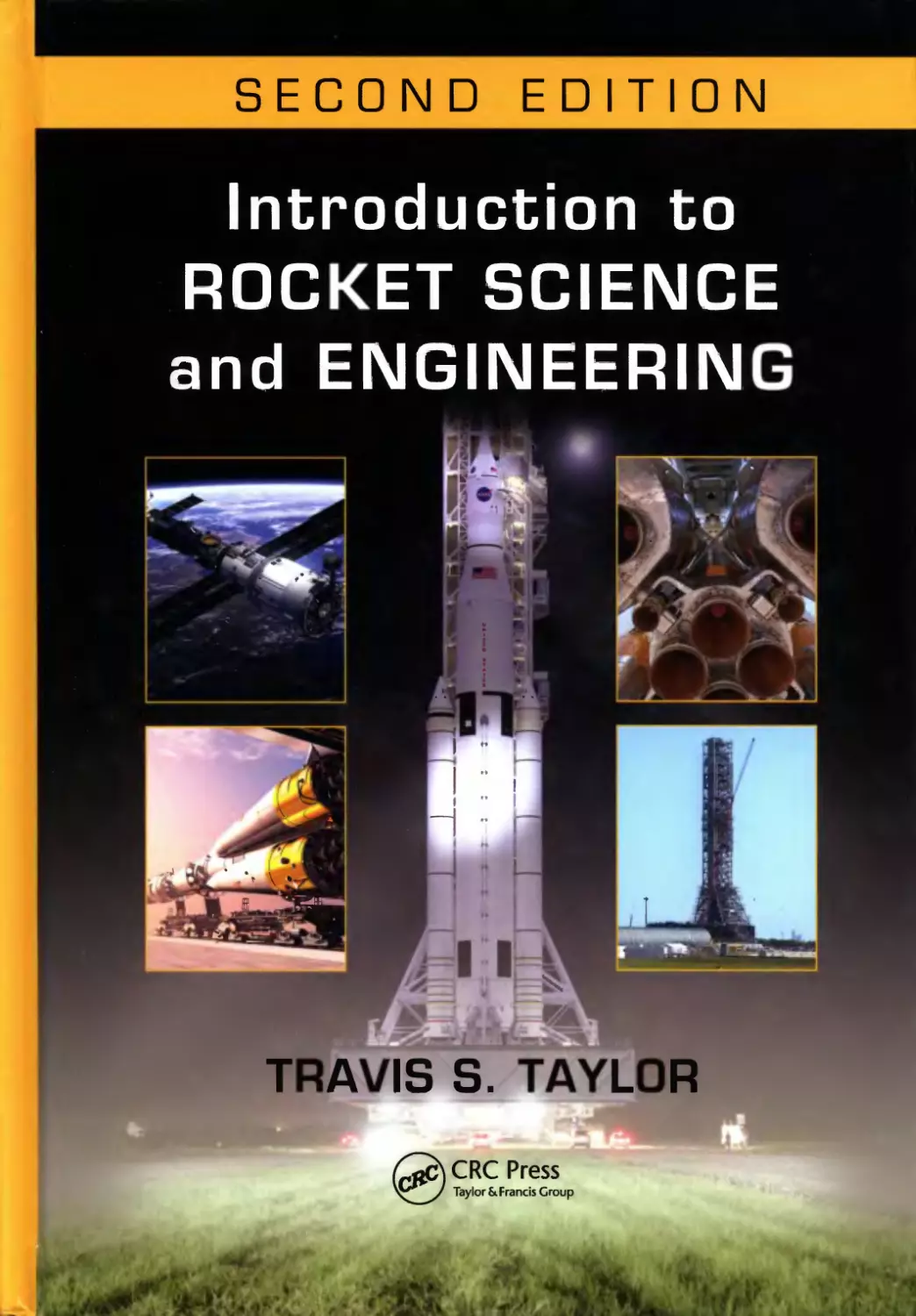
                    SECOND EDITION
Introduction to
ROCKET SCIENCE
and ENGINEERING
Introduction to Rocket
Science and Engineering
Second Edition

Introduction to Rocket
Science and Engineering
Second Edition
Travis S. Taylor
CRC Press
Taylor & Francis Croup
Boca Raton London New York
CRC Press is an imprint of the
Taylor & Francis Group, an informa business
CRC Press
Taylor & Francis Group
6000 Broken Sound Parkway NW, Suite 300
Boca Raton, FL 33487-2742
© 2017 by Taylor & Francis Group, LLC
CRC Press is an imprint of Taylor & Francis Group, an Informa business
No claim to original U.S. Government works
Printed and bound in India by Replika Press Pvt. ltd.
Printed on acid-free paper
Version Date: 20170124
International Standard Book Number-13: 978-1-4987-7232-7 (Hardback)
This book contains information obtained from authentic and highly regarded sources. Reasonable efforts have been made to
publish reliable data and information, but the author and publisher cannot assume responsibility for the validity of all materi-
als or the consequences of their use. The authors and publishers have attempted to trace the copyright holders of all material
reproduced in this publication and apologize to copyright holders if permission to publish in this form has not been obtained.
If any copyright material has not been acknowledged please write and let us know so we may rectify in any future reprint.
Except as permitted under U.S. Copyright Law, no part of this book may be reprinted, reproduced, transmitted, or utilized in
any form by any electronic, mechanical, or other means, now known or hereafter invented, including photocopying, micro-
filming, and recording, or in any information storage or retrieval system, without written permission from the publishers.
For permission to photocopy or use material electronically from this work, please access www.copyright.com (http://www
.copyright.com/) or contact the Copyright Clearance Center, Inc. (CCC), 222 Rosewood Drive, Danvers, MA 01923,978-750-
8400. CCC is a not-for-profit organization that provides licenses and registration for a variety of users. For organizations that
have been granted a photocopy license by the CCC, a separate system of payment has been arranged.
Trademark Notice: Product or corporate names may be trademarks or registered trademarks, and are used only for identi-
fication and explanation without intent to infringe.
Library of Congress Cataloging-in-Publication Data
Name: Taylor, Travis S., author.
Title: Introduction to rocket science and engineering I Travis S. Taylor.
Description: Second edition. | Boca Raton : Taylor & Francis, a CRC title, part of the Taylor & Francis
imprint, a member of the Taylor & Francis Group, the academic division of T&F Informa, pic, [2017]
| Includes bibliographical references and index.
Identifiers: LCCN 2016038572] ISBN 9781498772327 (hardback : acid-free paper)
| ISBN 9781498772334 (ebook)
Subjects: LCSH: Rocketry.
Classification: LCC TL782 .T395 2017 | DDC 621.43/56- dc23
LC record available at https://lccn.loc.gov/2016038572
Visit the Taylor & Francis Web site at
http://www.taylorandfrancis.com
and the CRC Press Web site at
http://www.crcpress.com
To all those rocket scientists and engineers throughout history who have successfully
designed the vehicles and technologies for spacecraft missions that fuel mankind's sense of
wonder and dreams of space and to all those who will in the future, I dedicate this work.

Contents
List of Figures..................................................................xiii
List of Tables....................................................................xxv
Preface.........................................................................xxvii
Author...........................................................................xxix
Introduction.....................................................................xxxi
1.	What Are Rockets?...............................................................1
1.1	The History of Rockets.....................................................1
1.1.1	400 BCE............................................................1
1.1.2	100 to ОВСЕ........................................................2
1.1.3	Oto 100 AD.......................................................  2
1.1.4	850 AD.............................................................3
1.1.5	904 AD.............................................................3
1.1.6	1132 to 1279 AD....................................................3
1.1.7	1300 to 1600 AD....................................................4
1.1.8 1600 to 1800 AD.....................................................4
1.1.9 1800 to 1900 AD.....................................................5
1.1.10 1900 to 1930 AD....................................................6
1.1.10.1 A Perspective.............................................7
1.1.11	1930 to 1957 AD....................................................7
1.1.12	1957 to 1961 AD....................................................9
1.1.13	1961 to Present...................................................12
1.1.14	X PRIZE...........................................................17
1.1.15	Other Space Agencies..............................................18
1.2	Rockets of the Modern Era.................................................20
1.2.1	ESAandCNES........................................................20
1.2.2	ISRO (India)......................................................21
1.2.3	ISA (Iran)........................................................21
1.2.4	Israeli Space Agency..............................................22
1.2.5	J AX A (Japan)....................................................22
1.2.6	CNSA (People's Republic of China).................................23
1.2.7	Russian FSA (also known as RKA	in Russian—Russia/Ukraine).........24
1.2.8	United States of America: NASA and the U.S. Air Force.............25
1.2.9	Other Systems Are on the Way......................................27
1.2.10 NASA Constellation	Program........................................29
1.2.11 NASA SLS Program..................................................32
1.3	Rocket Anatomy and Nomenclature...........................................33
1.4	Chapter Summary...........................................................37
Exercises......................................................................38
2.	Why Are Rockets Needed?........................................................39
2.1	Missions and Payloads.....................................................39
2.1.1 Missions...........................................................40
2.1.2 Payloads...........................................................40
vii
viii
Contents
2.2	Trajectories..........................................................42
2.2.1	Example 2.1: Hobby Rocket......................................43
2.2.2	Fundamental Equations	for	Trajectory Analysis................46
2.2.3	Missing the Earth..............................................47
2.2.4	Example 2.2: Dong Feng	31	1CBM........................47
2.3	Orbits................................................................49
2.3.1	Newton's Universal Law of Gravitation..........................49
2.3.2 Example 2.3: Acceleration due to Gravity
on a Telecommunications Satellite.....................................50
2.3.3	A Circular Orbit...............................................52
2.3.4	The Circle Is a Special Case of an Ellipse.....................55
2.3.5	The Ellipse Is Actually a Conic Section........................57
2.3.6	Kepler's Laws..................................................58
2.3.7	Newton's Vis Viva Equation.....................................61
2.4	Orbit Changes and Maneuvers...........................................65
2.4.1	In-Plane Orbit Changes.........................................65
2.4.2	Example 2.4: Hohmann Transfer Orbit............................67
2.4.3	Bielliptical Transfer..........................................68
2.4.4	Plane Changes..................................................69
2.4.5	Interplanetary Trajectories....................................69
2.4.6	Gravitational Assist...........................................71
2.5	Ballistic Missile Trajectories........................................74
2.5.1	Ballistic Missile Trajectories Are Conic Sections..............74
2.6	Chapter Summary.......................................................75
Exercises...................................................................76
3.	How Do Rockets Work?......................................................79
3.1	Thrust................................................................79
3.2	Specific Impulse......................................................82
3.2.1	Example 3.1: Is/, of the Space Shuttle Main Engines............85
3.3	Weight Flow Rate......................................................85
3.4	Tsiolkovsky's Rocket Equation.........................................86
3.5	Staging...............................................................91
3.5.1 Example 3.2: Two-Stage Rocket...................................93
3.6	Rocket Dynamics, Guidance, and Control................................94
3.6.1 Aerodynamic Forces..............................................95
3.6.2 Example 3.3: Drag Force on the Space Shuttle....................97
3.6.3 Rocket Stability and the Restoring Force........................97
3.6.4	Rocket Attitude Control Systems...............................102
3.6.5	Eight Degrees of Freedom......................................103
3.6.6	Inverted Pendulum.............................................106
3.7	Chapter Summary......................................................112
Exercises..................................................................113
4.	How Do Rocket Engines Work?..............................................117
4.1	Basic Rocket Engine..................................................117
4.2	Thermodynamic Expansion and the Rocket Nozzle........................119
4.2.1 Isentropic Flow................................................121
Contents	ix
4.3	Exit Velocity..........................................................125
4.4	Rocket Engine Area Ratio and Lengths...................................132
4.4.1	Nozzle Area Expansion Ratio.....................................132
4.4.2	Nozzle Design...................................................133
4.4.3	Properly Designed Nozzle........................................135
4.4.4	Expansion Chamber Dimensions....................................137
4.5	Rocket Engine Design Example...........................................138
4.6	Chapter Summary........................................................143
Exercises...................................................................143
5.	Are All Rockets the Same?...................................................145
5.1	Solid Rocket	Engines..................................................145
5.1.1	Basic	Solid Motor Components..................................146
5.1.2	Solid	Propellant	Composition..................................148
5.1.3	Solid	Propellant	Grain Configurations.........................148
5.1.4	Burn	Rate....................................................149
5.1.4.1 Example 5.1: Burn Rate of the Space Shuttle SRBs........151
5.2	Liquid Propellant Rocket Engines.......................................151
5.2.1	Cavitation......................................................154
5.2.2	Pogo............................................................154
5.2.3	Cooling the Engine..............................................155
5.2.4	A Real-World Perspective: The SSME Ignition Sequence............156
5.3	Hybrid Rocket Engines..................................................156
5.4	Electric Rocket Engines................................................158
5.4.1	Electrostatic Engines...........................................158
5.4.2 Example 5.2: The Deep Space Probe's NASA Solar Technology
Application Readiness Ion Engine.......................................160
5.4.3	Electrothermal Engines..........................................163
5.4.4	Electromagnetic Engines.........................................164
5.4.5	Example 5.3: The PPT Engine.....................................166
5.4.6	Solar Electric Propulsion.......................................169
5.4.7	Nuclear Electric Propulsion.....................................170
5.5	Nuclear Rocket Engines.................................................175
5.5.1	Solid Core......................................................175
5.5.2	Liquid Core.....................................................177
5.5.3	Gas Core........................................................177
5.6	Solar Rocket Engines...................................................178
5.6.1	Example 5.4: The Solar Thermal Collector........................178
5.6.2	Example 5.5: The STR Exit Velocity, ls/„ and Thrust.............179
5.7	Photon-Based Engines...................................................181
5.8	Chapter Summary........................................................186
Exercises...................................................................187
6.	How Do We Test Rockets?.....................................................189
6.1	Systems Engineering Process and Rocket Development.....................190
6.1.1	Systems Engineering Models......................................193
6.1.2	Technology, Integrated, and Systems	Readiness...................195
X
Contents
6.2	Measuring Thrust........................................................198
6.2.1	Deflection-Type Thrustometers...................................199
6.2.2	Hydraulic Load Cells............................................201
6.2.3	Strain Gauge Load Cells.........................................201
6.3	Pressure Vessel Tests...................................................210
6.4	Shake 'n' Bake Tests....................................................218
6.5	Drop and Landing Tests..................................................219
6.6	Environment Tests.......................................................222
6.7	Destructive Tests.......................................................225
6.8	Modeling and Simulation.................................................226
6.9	Roll-Out Test...........................................................227
6.10	Flight Tests...........................................................227
6.10.1	Logistics.......................................................229
6.10.2	Flight Testing Is Complicated...................................230
6.11	Chapter Summary.........................................................235
Exercises....................................................................236
7.	How Do We Design Rockets?...................................................239
7.1	Designing a Rocket......................................................239
7.1.1 Derived Requirements.............................................240
7.1.2 OpenRocket.......................................................242
7.1.2.1 OpenRocket Step #1: Choose a Body Tube for the First
Stage........................................................242
7.1.2.2 OpenRocket Step #2: Choose an Inner Tube Engine
Mount and Engine for the First Stage.........................242
7.1.2.3 OpenRocket Step #3: Fix the Center of Gravity (eg)
and the Center of Pressure (cp)..............................242
7.1.2.4	OpenRocket Step #4: Add New Stage.......................243
7.1.2.5	OpenRocket Step #5: Add New Stage.......................243
7.1.2.6	OpenRocket Step #6: Finish the Top and Place the Payload... 243
7.1.2.7	OpenRocket Step #7: Simulate, Modify, Simulate, Modify..243
7.1.2.8	OpenRocket Step #8: Realization.........................244
7.1.3 From OpenRocket to Real Design...................................248
7.1.4 Fineness Ratio and Structural Design.............................249
7.2	Designing Bigger Rockets................................................251
7.2.1 DRM #2: Orbital Liquid-Fueled Rocket.............................251
7.3	Reverse Bifurcation Designing...........................................260
7.4	Chapter Summary.........................................................262
Exercises....................................................................262
8.	How Reliable Are Rockets?...................................................265
8.1	Probability and Parts Count.............................................265
8.1.1	The Probability of Success and Quality Control..................266
8.1.2	Single Point Failure............................................267
8.2	Testing Our Rockets for Reliability.....................................268
8.2.1	Reliability versus Testing......................................268
8.3	Redundant Systems and Reliability.......................................269
8.3.1	Reliability Is Costly...........................................270
8.3.2	Reliability and Series Systems..................................271
Contents	xi
8.3.3 Reliability and Parallel	Systems.................................271
8.3.4 Reliability and Mixed Series and Parallel Systems................272
8.4	Chapter Summary.........................................................274
Exercises....................................................................274
9.	Are We Thinking Like Rocket Scientists and Engineers?........................277
9.1	Weather Cocking.........................................................277
9.2	Propellant Sloshing.....................................................280
9.3	Propellant Vorticity....................................................281
9.4	Tornadoes and Overpasses................................................284
9.5	Flying Foam Debris......................................................285
9.6	Monocoque...............................................................287
9.7	Space Mission Analysis and Design Process...............................289
9.8	"Back to the Moon"......................................................291
9.9	A Perspective on the Big Picture, Rockets, and Dinosaurs................299
9.10	Chapter Summary.........................................................301
Exercises....................................................................301
Suggested Reading for Rocket Scientists and Engineers............................303
Index............................................................................305

List of Figures
Figure 1.	1 Hero of Alexandria's aeolipile demonstrates Newton's Third Law
of action and reaction, which is the driving principle behind modern rocketry.....2
Figure 1.	2 The Chinese fought the Mongols using arrows and bombs as depicted
in this painting, circa 1293 AD...................................................3
Figure 1.	3 Russian high school math teacher Konstantin Tsiolkovsky is arguably
the father of modern astronautics.................................................5
Figure 1.	4 Robert Goddard and his first successful liquid fuel rocket engine
that made him one of the founders of modern rocket science........................7
Figure 1.	5 Sputnik 1 was the first orbital spacecraft launched by man. It was
launched by the Soviets in 1957...................................................9
Figure 1.	6 Sergei Korolev was the Chief Designer and the spark of the Soviet
space program.....................................................................9
Figure 1.	7 William Pickering, James Van Allen, and Wernher von Braun holding
up a model of the Explorer 1 satellite. The rocket in the background is a model
of the Jupiter-C launch vehicle..................................................10
Figure 1.	8 The Vanguard 1 is the oldest artificial satellite orbiting the Earth.11
Figure 1.	9 The flight profile of Yuri Gagarin's historic first manned flight
into space aboard Vostok 1.......................................................12
Figure 1.1	0 The Vostok rocket launching Yuri Gagarin into space.................13
Figure 1.1	1 The Redstone rocket launching Alan Shepard and Freedom 7 into space... 14
Figure 1.1	2 The Saturn V rocket launched the first manned flight to the Moon
on July 16,1969..................................................................15
Figure 1.1	3 (a) The LEM used rockets to descend to and ascend from the Moon.
(b) The Space Shuttle uses reusable SRBs, three SSMEs, and an expendable ET. The
Orbiter carries the crew and payload and reenters using thermal protection tiles.
The vehicle lands like an unpowered airplane.....................................16
Figure 1.1	4 The Shenzhou 5 spacecraft carried the Chinese Taikonaut Yang Liwei
into Space on October 15, 2003. The capsule was launched on a Long March rocket...17
Figure 1.1	5 SpaceShipOne architecture overview shows the basic components
of the spacecraft vehicle........................................................18
Figure 1.1	6 The White Knight carrying SpaceShipOne, SpaceShipOne spacecraft
in flight, and on the runway.....................................................19
Figure 1.1	7 The Ariane 5 Launch Vehicle is the primary rocket for ESA payloads...20
Figure 1.1	8 PSLV and the GSLVs of the ISRO.......................................21
xiii
xiv
List of Figures
Figure 1.1	9	The Shahab-3D suborbital rocket has a range of approximately 3,225 km.... 21
Figure 1.2	0	The Shavit launch vehicle of the Israeli Space Agency................22
Figure 1.2	1	The Japanese H-II and M-V launch vehicles............................23
Figure 1.2	2	The Chinese Long March Family of launch vehicles.....................23
Figure 1.2	3	The Russian and Ukraine launch vehicles demonstrate a heritage
of space launch capabilities.......................................................24
Figure 1.2	4 The U.S. EELVs demonstrate a heritage of space launch capabilities
and are the current workhorses of the U.S. unmanned space fleet. The Atlas
and Delta rockets were developed by Lockheed Martin and Boeing, respectively........26
Figure 1.2	5 The SpaceX Falcon family of launch vehicles will compete
with the Atlas and Delta rockets...................................................28
Figure 1.2	6 The SpaceX Dragon will launch on a Falcon 9 and carry a crew
of seven to the ISS................................................................28
Figure 1.2	7 The Ares V and Ares I launch vehicles of the NASA Constellation
Program are the two vehicles to take America back to the Moon and beyond...........30
Figure 1.2	8 The major launch vehicles of NASA compared. The Ares I and Ares V
vehicles will do the missions of both the Saturn V and the Space Shuttle...........31
Figure 1.2	9	The Orion spacecraft and the LSAM....................................31
Figure 1.3	0	The Constellation Program mission profile for going to the Moon......32
Figure 1.3	1	Space Launch System..................................................33
Figure 1.3	2	Block diagram showing the components	of a rocket...................34
Figure 1.3	3 The German V2 liquid-fueled rocket and major components.
This image is a modified "Wikimedia Commons" image.................................35
Figure 1.3	4 A hobby rocket is a simple solid-fueled rocket system................36
Figure 1.3	5 The Ares I rocket is a very complex system that combines solid
and liquid propulsion, as well as multiple stages..................................37
Figure 2.	1 The Lunar Reconnaissance Orbiter and its instruments will carry out
science missions from lunar orbit and will be the payload on an Atlas V rocket......42
Figure 2.	2 The hobby rocket trajectory, as described in Example 2.1..............43
Figure 2.	3 The trajectory of the hobby rocket as described in Example 2.1
and Equation 2.9...................................................................45
Figure 2.	4 Shown above are the five equations that describe the ballistic trajectory
of a rocket from MECO to target impact.............................................46
Figure 2.	5 Multiple ICBM traces for different initial flight path angles show
that 45° is optimum for maximum downrange and that a point downrange
other than the maximum range can be reached by two complementary values
for the initial flight path angle..................................................47
List of Figures
XV
Figure 2.	6 Trajectories for an ICBM with different initial velocities (burnout
velocity) show that the missile will miss the Earth with velocity of 11.2 km/s or greater....48
Figure 2.	7 The Chinese DF-31 ICBM can deliver a 1-megaton nuclear warhead
at a range of about 8,000 km.........................................................48
Figure 2.	8 The acceleration due to gravity drops off as an inverse square of altitude.50
Figure 2.	9 A projectile thrown from a mountaintop might not fall all the way
to Earth if it is thrown fast enough.................................................53
Figure 2.1	0 A rocket, if traveling at the right speed, can maintain a circular orbit
about the Earth......................................................................53
Figure 2.1	1 The terms defining the ellipse are important to orbital mechanics
and will be referenced throughout this text..........................................56
Figure 2.1	2	The circle, ellipse, parabola, and hyperbola	are	all conic sections....57
Figure 2.1	3	The Cartesian coordinate equations	for the	conic sections.............58
Figure 2.1	4 The force acting on a spacecraft due to Earth's gravity holds
it in an elliptical orbit that follows Kepler's laws.................................60
Figure 2.1	5	Kepler's Laws for planetary motion.....................................62
Figure 2.1	6 Newton's Laws of Motion are necessary tools for understanding
the basics of rocketry...............................................................62
Figure 2.1	7 The basic mathematical tools for understanding orbits are listed
here. Orbits map out conic sections, follow Kepler's laws, and can be described
by Newton's vis viva equation...........................................................65
Figure 2.1	8 Coplanar orbit changes are reversible and can be done simply
by adding velocity......................................................................66
Figure 2.1	9 Rocket engine burns are needed for the Shuttle to reach the HST.
This circular-to-elliptical-to-circular maneuver is called a Hohmann transfer........67
Figure 2.2	0 Three rocket burns are required for the more efficient bielliptical
transfer maneuver. The maneuver is complicated and seldom used.......................69
Figure 2.2	1 In order to conduct a plane change or change in inclination, Av must
be added where the orbits intersect..................................................70
Figure 2.2	2 Typical mission profile for a planetary mission........................71
Figure 2.2	3 The Pioneer 10 spacecraft conducted a flyby of Jupiter and used
the planet's gravity for an extra velocity boost.....................................72
Figure 2.2	4 Gravity assist maneuver................................................73
Figure 2.2	5 The ballistic missile trajectory is actually an elliptical conic section..74
Figure 3.1 The liquid rocket engine's system mass varies with time as the fuel
and oxidizer are burned in the combustion chamber, generating exhaust gases
that are accelerated through the nozzle-generating thrust............................80
xvi
List of Figures
Figure 3.2 The Deep Space 1 probe before it was launched in 1998. This view gives
a good vantage point of the ion engine that fired successfully for 678 days........84
Figure 3.	3 Various rocket engines shown as thrust versus IS},.......................86
Figure 3.	4 As the rocket engine fires, the total mass of the rocket decreases,
propellant is burned, and the exhaust is accelerated...............................87
Figure 3.	5	Mass ratio, MR, versus Ду for various lSf1 values.....................90
Figure 3.	6	Mass ratio, MR, versus 1 for various Ду values........................90
Figure 3.	7	Burn time in seconds versus the mass ratio............................90
Figure 3.	8	Two standard types of booster staging.................................91
Figure 3.	9 The Delta IV Medium + to Heavy rockets use hybrid staging
including parallel strap-on boosters and serial upper-stage boosters..................92
Figure 3.1	0 The forces acting on a rocket...........................................95
Figure 3.1	1 The airflow velocity and atmospheric density against the Space
Shuttle versus time after launch...................................................96
Figure 3.1	2	Dynamic pressure, Q, against the Space Shuttle versus time after launch.97
Figure 3.1	3	Center of gravity of a rocket is calculated as shown above...........99
Figure 3.1	4	Center of pressure of a rocket is calculated as shown above.........100
Figure 3.1	5	Three modes of rocket flight stability..............................101
Figure 3.1	6	Four types of rocket attitude control...............................102
Figure 3.1	7	Rocket roll, pitch, and yaw maneuvers...............................103
Figure 3.1	8 Attitude control circuit for a rocket system. Note that the diagram
is only for the roll control of the vehicle.......................................104
Figure 3.19 Attitude control circuit output as a function of time for various values
of the control parameter coefficients. Ideal response would be immediately settling
with no ringing...................................................................105
Figure 3.2	0	Balancing an upside-down broom is an inverted pendulum..............107
Figure 3.2	1	Diagram of inverted pendulum on a cart..............................108
Figure 3.2	2	Time domain transfer function of inverted pendulum system...........Ill
Figure 3.2	3 Magnitude of the maximum force, F„lttx, required to compensate
inverted pendulum as a function of angular acceleration...........................112
Figure 3.2	4 Diagram of stacked blocks for Exercise 3.30.........................114
Figure 4.	1 Shown are the basic components of a rocket engine....................118
Figure 4.	2 The RS-68 of the Delta IV and the J-2X of the Ares I are two modern
liquid rocket engines.............................................................119
Figure 4.	3 The relationship of pressure versus temperature of air using the ideal
gas law	121
List of Figures	xvii
Figure 4.	4 Velocity flow through a convergent-divergent or de Laval nozzle
increases from left to right.....................................................125
Figure 4.	5 Exit velocity through a convergent-divergent nozzle as a function
of pressure. M = 12, Tc = 3,215 K, and Pc = 5 MPa................................127
Figure 4.	6 Exit velocity through a convergent-divergent nozzle as a function
of pressure with varying chamber temperatures. M = 12 and Pc = 5 MPa.............128
Figure 4.	7 Exit velocity through a convergent-divergent nozzle as a function
of pressure with varying molecular weights (deuterium, carbon, oxygen, xenon).
Tc = 3,215 К and Pc = 5 MPa......................................................128
Figure 4.	8 Flow density versus pressure for two different exhaust gases
(carbon and xenon). Tc = 3,215 К and Pc = 5 MPa..................................130
Figure 4.	9 Thrust density versus pressure for two cases where only the isentropic
expansion factor and chamber pressure are the same...............................131
Figure 4.1	0 Thrust density versus pressure for two cases where the isentropic
expansion factors are different..................................................131
Figure 4.1	1 Area ratio versus pressure ratio for four different values of
the isentropic expansion factor. As the isentropic expansion factor goes up,
the ratio goes down..............................................................133
Figure 4.1	2 Converging-diverging nozzle design parameters are shown.............134
Figure 4.1	3 The converging-diverging nozzle compared to the de Laval nozzle.
In actuality, the de Laval nozzle is usually shorter than the conical one........135
Figure 4.14 The RS-68 engine nozzle is a bell-shaped de Laval nozzle.............135
Figure 4.15 Proper nozzle expansion is imperative in order to efficiently generate
thrust...........................................................................136
Figure 4.1	6 Shown is the flow through the rocket engine from the combustion
chamber to	the exit of the nozzle..............................................137
Figure 4.1	7	Design parameters for a rocket engine...............................139
Figure 4.1	8	Nozzle exit area versus pressure....................................140
Figure 4.1	9	Shown is the nozzle exit radius versus pressure.....................141
Figure 4.2	0 Rocket engine design example parameters and calculated values.
This engine design is very similar to the SSMEs..................................142
Figure 5.	1 Solid rocket motors range from hobby rocket size to the Space Shuttle
SRBs	146
Figure 5.	2 Schematic of the solid rocket motor..................................147
Figure 5.	3	Space Shuttle SRB reusable casing retrieval from the ocean...........147
Figure 5.	4	Shown are solid rocket motor grain configuration shapes..............148
Figure 5.	5	Images of solid rocket motor grain perforation configurations........149
Figure 5.6	Solid rocket motor thrust versus time profiles.......................150
xviii
List of Figures
Figure 5.	7 Solid rocket motor grain perforation configurations and their thrust
versus time profiles.........................................................150
Figure 5.	8 Space Shuttle SRB burn profile as a function of time after launch.
Note that the profile is regressive, then progressive just around the max-Q,
and regressive again until burnout...........................................151
Figure 5.	9 Schematic of a liquid fuel rocket engine.........................152
Figure 5.1	0 Schematic of a liquid fuel rocket engine injection, mixing,
and combustion...............................................................153
Figure 5.1	1	SSME propellant flow diagram....................................153
Figure 5.1	2	High oxygen/hydrogen ratio causes cavitation damage of SSME.....154
Figure 5.1	3	Regenerative cooling of the SSME nozzle.........................155
Figure 5.1	4	Schematic of a hybrid rocket engine.............................157
Figure 5.1	5	The hybrid engine of the SpaceShipOne...........................157
Figure 5.1	6 Electric field lines between two parallel conductor plates separated
by a distance d, and connected to a voltage source as shown..................158
Figure 5.1	7 Schematic of the DS-1 ion thruster. The positive and negative grids
shown are the conductor plates depicted in Figure 5.16.......................160
Figure 5.1	8	The DS-1 NSTAR ion engine.......................................161
Figure 5.1	9	Schematic of a Hall effect thruster.............................162
Figure 5.2	0	Image of a 2-kW Hall effect thruster in operation...............163
Figure 5.2	1	Image of a 20-pN colloid thruster...............................163
Figure 5.2	2 Schematic and image of the VASIMR concept invented by astronaut
Franklin Chang-Diaz..........................................................164
Figure 5.2	3	Schematic diagram of a pulsed plasma thruster...................165
Figure 5.2	4 EO-1 PPT engine prototype.......................................166
Figure 5.2	5	Charging and discharging of an RC circuit used to drive a PPT engine... 167
Figure 5.2	6	Components of an electric propulsion system.....................168
Figure 5.2	7	Brightness of the sun versus radius away from it................169
Figure 5.2	8	The solar panels of the ISS cover over 375 m2 and	generate over 100 KW... 170
Figure 5.2	9	The Deep Space 1 spacecraft demonstrated SEP....................170
Figure 5.3	0	The GPHS-RTG power source used for the Cassini probe............171
Figure 5.3	1	The SNAP-10A fission reactor system.............................172
Figure 5.3	2	The basic components of an NEP system...........................172
Figure 5.3	3	Artist's rendering of the NEP spacecraft Tombaugh Orbiter.......173
Figure 5.3	4	Schematic of the NEP spacecraft Tombaugh Orbiter................174
List of Figures	xix
Figure 5.3	5 Schematics and images of the SAFE30 fission reactor design simulator
and testbed....................................................................174
Figure 5.3	6	Artist's rendering of the JIMO NEP spacecraft.....................175
Figure 5.3	7	Schematic of an NTR engine........................................176
Figure 5.3	8	The NERVA rocket engine...........................................176
Figure 5.3	9	The Kiwi reactor at the Nevada Test Site in the 1960s.............177
Figure 5.4	0	Schematic of solar thermal rocket.................................178
Figure 5.4	1	Artist's rendering of the STR experiment called Shooting Star.....179
Figure 5.4	2	Schematics of the Shooting Star STR...............................180
Figure 5.4	3	Image of the Shooting Star STR refractive secondary concentrator..180
Figure 5.4	4 Delta-v of a 1-kg mass due to incident photon momentum transfer
requires large numbers of photons for small velocity increases.................182
Figure 5.4	5 Graph showing energy as a function of the number of photons
for 575-nm light...............................................................183
Figure 5.4	6 Graph showing the thrust on a mirror versus the reflective surface
area of the mirror at 1 AU from Sol............................................184
Figure 5.4	7 Graph showing the thrust on a mirror versus the mirror length
at 1 AU from Sol...............................................................185
Figure 5.4	8 Typical solar sail configuration..................................185
Figure 5.4	9 Shown are various modern solar sail design configurations. Note that
none of the schematics are drawn to scale. The payloads would be too small, to say,
at real scales.................................................................186
Figure 6.	1 NASA program life cycle shows the steps of a large-scale development
space program..................................................................191
Figure 6.	2 NASA program life cycle shows the steps of a spacecraft development
space program..................................................................192
Figure 6.	3 Standard systems engineering V is the template used by many
programs to maintain best systems engineering practices........................193
Figure 6.	4	NASA systems engineering engine...................................194
Figure 6.	5	Spiral development systems engineering	model......................195
Figure 6.	6	NASA Technology readiness levels..................................196
Figure 6.	7	NASA Technology and Integrated readiness levels...................196
Figure 6.	8 The systems readiness level is the pathway to success for rocket
development....................................................................197
Figure 6.	9 Basic thrustometer.................................................199
Figure 6.1	0 Simple spring and pencil thrustometer.............................199
XX
List of Figures
Figure 6.1	1	The spring constant versus mass required to deflect a spring by 1 cm.200
Figure 6.1	2	Deflection bar thrustometer......................................201
Figure 6.1	3	Hydraulic load cell thrustometer.................................202
Figure 6.1	4	Schematic of a C-type load cell..................................202
Figure 6.1	5	Bar-type load cell...............................................203
Figure 6.1	6	T-97 Thrust Measurement System for testing SRBs..................203
Figure 6.1	7	A solid rocket booster firing on the T-97 test stand.............204
Figure 6.1	8	Titan IV solid rocket motor test.................................204
Figure 6.1	9	Redstone rocket on test stand in Huntsville, Alabama.............205
Figure 6.2	0	Saturn V rocket Fl engine test...................................206
Figure 6.2	1	An SSME test.....................................................206
Figure 6.2	2	An SSME gimbal test..............................................207
Figure 6.2	3	Multiple test stands at Stennis Space Center Test Complex........208
Figure 6.2	4	The J-2X engine being lowered into a vacuum chamber for testing..208
Figure 6.2	5	A schematic of the Plum Brook Facility in Sandusky, Ohio.........209
Figure 6.2	6 The hybrid rocket engine test stand at NASA Ames in Mountain
View, California...................................................................209
Figure 6.2	7 A wax-based hybrid rocket engine test at NASA Ames in Mountain
View, California...................................................................210
Figure 6.2	8 A typical pressure vessel test setup.............................211
Figure 6.2	9 Burst test facility at White Sands, New Mexico...................212
Figure 6.3	0 Materials compatibility test facility at White Sands, New Mexico.
These tanks failed when exposed to rocket propellants under pressure...........212
Figure 6.3	1	Space Shuttle Orbiter OMS tank under heat soak thermography	test.214
Figure 6.3	2	Space Shuttle Orbiter OMS tank thermography test results.........214
Figure 6.3	3	Schematic of a Michelson shearography interferometer.............215
Figure 6.3	4	Michelson shearography interferometer test of Space Shuttle OMS tank... 215
Figure 6.3	5 Michelson shearography interferometer test results of Space Shuttle
OMS tank...........................................................................216
Figure 6.3	6 Space Shuttle OMS tank with stress sensors and circumference bulge
gauges bonded to it................................................................216
Figure 6.3	7 Space Shuttle OMS tank with electromagnetic sensors attached.........217
Figure 6.3	8 SpaceShipOne hybrid engine tank testing..............................217
Figure 6.3	9 Cutaway view of the Space Shuttle External Tank......................218
List of Figures	xxi
Figure 6.4	0 Space Shuttle External Tank being loaded onto test stand in 1977...219
Figure 6.4	1 Space Shuttle Orbiter being loaded onto the MSPC Dynamic Test
Stand for Mated Vertical Ground Vibration testing...............................220
Figure 6.4	2 Saturn V on the Dynamic Test Stand at Marshall Space Flight Center
in 1966	220
Figure 6.4	3	Orion vehicle drop test............................................221
Figure 6.4	4	Aircraft Landing Dynamics Facility at Langley (Virginia)...........221
Figure 6.4	5	Supersonic wind tunnel	testing of the Centaur rocket design.......222
Figure 6.4	6	Supersonic wind tunnel	testing of the Centaur rocket design.......223
Figure 6.4	7 The Atmospheric Entry Simulator at NASA Ames (Mountain View,
California).....................................................................223
Figure 6.4	8 Shadowgraph data from reentry vehicle design tests.................224
Figure 6.4	9 Space Shuttle Orbiter tile undergoing reentry heating test.........224
Figure 6.5	0 A large parafoil undergoing wind tunnel testing at the world's largest
wind tunnel at NASA Ames Research Center, Mountain View, California.............225
Figure 6.5	1 Destructive test of the Kiwi nuclear rocket engine reactor........226
Figure 6.5	2 Computational fluid dynamics modeling and simulation of the Space
Shuttle Orbiter reentry.........................................................227
Figure 6.5	3 Saturn V test vehicle during roll-out test.........................228
Figure 6.5	4 NASA MSFC test engineer Vince Huegele, former NASA engineer
and author Homer Hickam, and the manager of the Ares Projects Office Steve Cook
launching a 1/100th scale of the Ares I rocket..................................229
Figure 6.5	5 The Constellation Program requires serious attention to logistics..230
Figure 6.56 The Apollo test program schedule was tedious and included many
flight tests over a decade......................................................231
Figure 6.57	The Apollo test program compared to the Constellation test program.232
Figure 6.58	The Apollo test program compared to the Constellation test program.233
Figure 6.59	Constellation Program Ares I and Orion vehicle test program........233
Figure 6.60	Ascent abort flight test profile for the Ares 1....................234
Figure 6.61 The Ares I-X flight test will be the first of many for the crew launch
vehicle.........................................................................234
Figure 6.62 The Ares I-Y flight test will test high-altitude abort and Orion vehicle
recovery........................................................................235
Figure 7.	1	OpenRocket design parameters for DRM #1 rocket.....................244
Figure 7.	2	OpenRocket components list (part 1) for DRM #1 rocket..............245
Figure 7.3	OpenRocket components list (part 2) for DRM #1 rocket..............246
xxii
List of Figures
Figure 7.	4	Stage 7 motor thrust curve for DRM #1 rocket...........................246
Figure 7.	5	Stage 6 motor thrust curve for DRM #1 rocket...........................247
Figure 7.	6	Stages 5 and 4 motor thrust curve for DRM #1 rocket....................247
Figure 7.	7	Stage 3 motor thrust curve for DRM #1 rocket...........................247
Figure 7.	8	Stage 2 motor thrust curve for DRM #1 rocket...........................248
Figure 7.	9	Stage 1 motor thrust curve for DRM #1 rocket...........................248
Figure 7.1	0	Fineness ratio of rocket body versus	diameter.........................249
Figure 7.1	1	Rocket body failure critical pressure	versus	fineness.................250
Figure 7.1	2	Rocket design for DRM #2..............................................260
Figure 7.1	3	Reverse bifurcation design process....................................261
Figure 8.	1 Probability of rocket failure versus quality control factors
and the number of parts.............................................................266
Figure 8.	2 Engine reliability versus number of test fires.........................268
Figure 8.	3 Probability of successful engine performance is unknown for low test
fire numbers.........................................................................269
Figure 8.	4 Probability and reliability assessment of DRM #2 rocket based
on the probability of engine success.................................................270
Figure 8.	5	Probability of success	for series components...........................271
Figure 8.	6	Probability of success	for parallel components.........................272
Figure 8.	7	Probability of success	for series and parallel components..............273
Figure 8.	8	Probability of success	for N series and M parallel components..........273
Figure 9.	1 A rocket flying through a crosswind will experience a self-induced
maneuver called weather cocking.....................................................278
Figure 9.	2 Weather cocking limits the maximum altitude the rocket can reach........279
Figure 9.	3 Weather-cocking altitude limitation as a function of wind speed.........280
Figure 9.	4 Propellant slosh makes the rocket mass distribution asymmetric
and continuously changing as propellants are burned and sloshed.....................280
Figure 9.	5 There are many types of slosh baffles. Shown here are three common
types	281
Figure 9.	6 A swirling motion is induced into the propellant when it is drained
or pumped into the rocket engine. The swirling motion is called vorticity...........282
Figure 9.	7 Vorticity in the propellant tank adds unwanted angular momentum
to the rocket body..................................................................283
Figure 9.	8 Vorticity in the propellant tank adds unwanted angular momentum
to the rocket body and might cause precession.......................................284
List of Figures
xxiii
Figure 9.	9 A rocket scientist or engineer should realize why an overpass is NOT
the place to be during a tornado!..............................................285
Figure 9.1	0 The left bipod foam ramp is suspected of being the piece of foam
that impacted the Columbia Orbiter and subsequently causing the heat tile failure.286
Figure 9.1	1 Falcon 1 uses monocoque propellant tanks..........................288
Figure 9.1	2 The Atlas rockets used monocoque propellant tanks to the dismay
of the German rocket scientists................................................288
Figure 9.1	3	SM AD process.....................................................290
Figure 9.1	4	The WBS for a typical space mission or development effort.........291
Figure 9.1	5	Gene Cernan was the last man on the	Moon..........................292
Figure 9.1	6	Walt Disney and Wernher von Braun.................................299

List of Tables
Table 2.	1 The Sphere of Influence for the Planets of Our Solar System................52
Table 2.	2 The Gravitational Parameters for the Bodies of Our Solar System............71
Table 3.1 Specific Impulse for Various Rockets.........................................84
xxv

This book was written with the hope of being both accessible and practical for instructors
teaching rocket science and engineering, for students taking classes in the subject, and for
the enthusiast or professional needing further training in the topic. That being said, there
are some recommended steps for reading and using this book.
Recommendation #1: Download OpenRocket onto your computer and download the lat-
est technical document that goes along with it. This is free open-source code that is very
good at designing and simulating rockets of various sizes. We will show how to use it to
design an orbital launch vehicle in a later chapter of this book. Along with OpenRocket,
you will also need to download the Thrust Curve Tool. The Thrust Curve Tool software
will allow you to generate thrust curves of measured or even fictional engines that can
then be ported into OpenRocket. OpenRocket can be found at
http://openrocket.sourceforge.net/
and Thrust Curve Tool can be found at
http://www.thrustgear.com/software.html.
We will use OpenRocket and Thrust Curve Tool to design a rocket later in the book. For
the instructors, I have found it useful when teaching rocket science and engineering to
announce on day one a design project that would require OpenRocket and other software
such as Mathcad® (my preference) and MATLAB®. I have found it useful to announce at
the first class that, before the final project is due, I will require each student to develop a
design for a rocket that can place a certain payload into a specific orbit or altitude.
Recommendation #2: You will need some type of math-modeling and simulation soft-
ware to become a rocket scientist or engineer. I prefer Mathcad, though I also use MATLAB
from time to time and even spreadsheets like Excel.
Recommendation #3: Build, test, and fly a rocket. Design a small rocket in the modeling
software and then actually build and fly it. If possible, use an altimeter to determine how
closely the actual flight correlates with the model. Seeing the actual rocket hardware being
constructed and integrated for flight is absolutely priceless in details that the modeling
and simulation cannot teach. The students will learn that things such as fasteners, glues,
bolt-and-nut combinations, shear pins, batteries, tape, and materials all come together in a
way that simply cannot be fully understood without actually doing it. If class time allows
or there is a corresponding lab, put a team together and build a bigger and more complex
rocket.
Recommendation #4: If actually building a rocket is not in the cards, then purchase
a rocket kit online and have the piece parts in the classroom for students to look at. Or,
better yet, have them design them in a computer-aided design software package and
three-dimensionally print them. Having the actual component available to point to when
discussing it often helps.
xxvii

Author
Travis S. Taylor ("Doc" Taylor to his friends) has earned his soubriquet the hard way:
he has a doctorate in optical science and engineering, a doctorate in aerospace systems
engineering, a master's degree in physics, and a master's degree in aerospace engineering,
all from the University of Alabama in Huntsville. Added to this is a master's degree in
astronomy from the University of Western Sydney (Australia) and a bachelor's degree in
electrical engineering from Auburn University (Alabama). Dr. Taylor has worked on vari-
ous programs for the Department of Defense and NASA for the past two decades. He is
currently working on several advanced propulsion concepts, very large space telescopes,
space-based beamed energy systems, next-generation space launch concepts, directed-
energy weapons, nanosatellites, and low-cost launch vehicle concepts for the U.S. Army
Space and Missile Defense Command. Dr. Taylor was one of the principal investigators of
the Ares I Flight Test Planning effort for NASA Marshall Space Flight Center and was the
principal investigator for the NASA Marshall Space Flight Center and Teledyne Brown
Engineering effort to study and develop a Pluto-Kuiper belt orbiting probe using nuclear
electric rocket engines.
In his copious spare time, Doc Travis is also a black-belt martial artist, a private pilot,
and a SCUBA diver and races mountain bikes. He has also competed in triathlons, is a
marathon runner and a CrossFitter, and has been the lead singer and rhythm guitarist of
several hard rock bands. He has written 16 science fiction novels, two textbooks (including
this one), and over a dozen technical papers. Dr. Taylor has appeared and starred in sev-
eral television programs including the History Channel's The Universe and Life After People,
National Geographic Channel's hit shows Rocket City Rednecks and When Aliens Attack, and
The Weather Channel's 3 Scientists Walk Into a Bar. He currently lives with his wife and two
children in north Alabama just outside of Huntsville in view of the Saturn V rocket that is
erected at the U.S. Space and Rocket Center.
xxix

Introduction
This book was written to be an introduction to the history and basics of rocket theory,
design, experimentation, test, and applications. The book was written as an introductory
overall view of the vast spectrum of knowledge the practicing rocket scientist or engi-
neer must have to be successful. The knowledge covers areas from advanced mathematics,
chemistry, and physics to logistics, systems engineering, and, yes, even politics. The great
successful rocket scientists of history like Wernher von Braun, Robert Goddard, and Sergei
Korolev understood what it truly meant to be rocket scientists from all aspects of the term.
When most people think of rocket scientists, they think of the stereotypical nerd with
horn-rimmed glasses and the pocket protector. Sure, there are rocket scientists who fit that
description, but the new generation of rocket scientists are probably too young to recall
von Braun and Walt Disney presenting concepts to the world through motion picture and
television media with the polish that only a Disney production can produce. In those films,
von Braun was far from stereotypical. The rocket scientist must be versatile indeed.
The material herein was compiled and written with the undergraduate student in mind.
However, it is applicable and essential for any military or civilian space operator, manager,
or designer who wants to achieve a better understanding of how rockets are designed
and how they operate. The book was also written to be a good introduction and hope-
fully to spark excitement about the field and encourage those wishing to develop a more
detailed and advanced understanding and study of the topic. By all means, go on to gradu-
ate school or further and become a true "rocket scientist."
xxxi

1
What Are Rockets?
The 20th and 21st centuries brought forth the development of rockets that have enabled
mankind to escape the bonds of planet Earth and go into the great "final frontier" that has
mystified mankind since the first human looked up at the sky. Rockets have become com-
monplace in our everyday vernacular and culture to the extent that they are accepted tech-
nologies. We see them on television, in movies, in video games, and in books. Children
have toys that apply general principles of rocket science and engineering and, for decades,
have built rockets from kits that soar into the sky, generating excitement and enthusiasm.
Rockets are exciting; it is as plain and simple as that!
That said, there is absolutely nothing "plain" or "simple" about a rocket. What the gen-
eral "nonscientists" or "nonengineers" tend to misunderstand is how complicated and
technically involved rockets actually are. The basic principles of rocket science might be
easily explained to primary school-age students, but the devil is indeed in the details.
It is often stated as a major achievement of mankind that the Space Shuttle had some-
thing on the order of 2 million parts. The workings and functions of each of these parts are
beyond the scope of this book, of course, but the understanding for the need of so many
parts is something that will try to be emphasized herein. Rocket science and engineering
are not a simple subject by any means; otherwise, the old joke about "it ain't rocket science"
wouldn't be as funny as it is.
Therefore, this chapter will discuss a bit about how rockets were discovered and devel-
oped over mankind's history. The basic principles governing rockets and rocket science
will also be discussed and will hopefully lead the readers to a point where the old joke has
a much deeper and profound meaning.
1.1 The History of Rockets
1.1.1 400 BCE
One of the earliest mentions of anything rocket-like in history appears to be from the writ-
ings of Aulus Gellius, a Roman. Gellius writes about a Greek individual named Archytas
who is from the city of Tarentum, a part of what is now known as Southern Italy. In this
story by Gellius, the character Archytas uses a wooden pigeon suspended by wires and
propelled by steam to amaze and mystify the Tarentum locals. This is related to the his-
tory of rockets simply because it is the earliest known mention of man using Newton's
Third Law of action and reaction for a means of propulsion. It is especially interesting in
that Newton's laws would not be developed for about 20 more centuries to come.
1
2
Introduction to Rocket Science and Engineering
1.1.2 100 to 0 BCE
Sometime in the 1st century BCE, the Greek inventor Hero of Alexandria (70 to 10 BCE) is
noted to have invented the device known as the aeolipile. The aeolipile was a steam-driven
device that, like Archytas's pigeon, also implemented Newtons Third Law of action and
reaction. Figure 1.1 shows an artist's rendition of the aeolipile. It should also be noted here
that the device is sometimes described as Hero's engine.
The engine consisted of a fire to heat a reservoir of water, which was converted to steam.
The steam then rose through tubes to a sphere, which collected the steam and became
a pressure vessel as more and more steam became compressed into it. The sphere was
suspended such that it could freely spin about a horizontal axis. On opposite sides of the
sphere, orthogonal to the spin axis, were two small outlets for the steam. As the pressur-
ized steam forced its way out of the pressure vessel and through the outlet "nozzles,"
the force of the steam caused the sphere to rotate about the spin axis. In actuality, Hero's
engine contains most parts of a simple thermal rocket engine.
It is thought that the Chinese were also developing rockets in the form of fireworks
sometime during this 1st century BCE. It is somewhat unclear as to the actual date when
the first true rockets appeared, but it is certain that stories of rocket-like devices appear
sporadically throughout this period in time. Some references suggest the Chinese had
fireworks as early as the 2nd century BCE; however, others debate the claims.
1.1.3 0 to 100 AD
The Chinese most certainly began experimenting with compounds made from saltpeter
(potassium nitrate, KNO3), realgar (arsenic sulfide, As4S4), sulfur (S), and charcoal (car-
bon, C) by this time period, three of which are the basic ingredients to gunpowder. (Realgar
FIGURE 1.1
Hero of Alexandria's aeolipile demonstrates Newton's Third Law of action and reaction, which is the driving
principle behind modern rocketry.
What Are Rockets?
3
is not really required for gunpowder.) And, perhaps, the Chinese were experimenting with
fireworks fashioned from these compounds.
1.1.4 850 AD
The earliest certain record of gunpowder is likely from the book written in 850 AD, trans-
lated as Classified Essentials of the Mysterious Tao of the True Origin of Things. In this book, it is
indicated that Taoist alchemists derived gunpowder in their efforts to develop an 'elixir of
immortality." The book describes the alchemists being burned and even the building they
were in burning down. It is believed that many Chinese alchemists were searching for this
"elixir of immortality." It is likely that some of them found what they were searching for
by accidentally blowing themselves up. There are historical reports of large repositories
of gunpowder ingredients causing major fatal accidents in ancient China during this era.
1.1.5 904 AD
The Chinese began using gunpowder in warfare as incendiary projectiles by this time.
These projectiles were known as "flying fires." They were fired as arrows, grenades, and
catapults.
1.1.6 1132 to 1279 AD
Chinese military began to expand on the flying fires and began to use gunpowder as
a propellant. The earliest recorded experiments were mortars being fired from bamboo
tubes.
Around 1232 AD, the Chinese reportedly used the first true rocket in their fight with the
Mongols (Figure 1.2). It was reported that, at the battle of Kai-Keng, the Chinese used a
tube, which was capped at one end and contained gunpowder, that was lit from the open
end. The ignition of the gunpowder within the capped tube created heat, smoke, and other
exhaust gases that were forced out of the open end of the tube, creating thrust. The tube
was controlled by placing a stick along its side that stabilized the solid rockets flight path
in the same way that a stick on a bottle rocket is used. Also, during this time frame, the
FIGURE 1.2
The Chinese fought the Mongols using arrows and bombs as depicted in this painting, circa 1293 AD.
4
Introduction to Rocket Science and Engineering
English monk and alchemist Roger Bacon improved the formula for gunpowder for rock-
ets. His work notably improved the range of rockets of the period.
1.1.7 1300 to 1600 AD
Frenchman Jean Froissart discovered a means of improving the accuracy of rockets.
He realized that rockets were more accurate when launched from a tube. This was the
birth of the bazooka and actually the launch tube. It is often published in textbooks that
T. Przypkowski became the first European to study rocketry in detail in 1380 AD; however,
Froissart and an Italian, Joanes de Fontana, were also studying the topic, de Fontana actu-
ally developed a rocket-powered torpedo. Joan of Arc, as well, was known to have used
rockets at the battle of Orleans in 1449.
There is a tale of a Chinese official named Wan-Hu building a rocket chair and launch-
ing himself. The story says that 47 rockets and 2 kites were attached to a chair, and then
Wan-Hu had himself launched by assistants. Once the fuses were lit, there was, accord-
ing to the story, smoke and a loud roar, and then, when the smoke cleared, Wan-Hu was
nowhere to be found. Gunpowder those days was quite unstable and was just as likely to
explode as to burn in a rocket. It is more likely that Wan-Hu launched himself to oblivion
in millions of tiny pieces rather than into the sky. Of course, it is not certain if this story is
true or just that, a story. But, it is a good one, nonetheless.
In 1591, Johann von Schmidlap wrote a book about the nonmilitary uses of rockets. He
described the use of sticks for stabilization and the possibility of mounting rockets on top
of rockets—staging.
1.1.8 1600 to 1800 AD
This period offered a great deal of development in the understanding of rockets and the
principles that drive them. In 1650, the Polish artillery expert, Kasimiez Siemienowicz,
published designs for a staged rocket that would offer more destructive capabilities and
potentially a farther range.
In 1696, the Englishman Robert Anderson published a document on how to build solid
rockets. He described how to mix the propellants and then to pour them into molds. He
also described how to prepare the molds. This is sometimes suggested as the first step in
the mass production of rockets.
And, of course, in 1643, Sir Isaac Newton was born. In his publication, De Motu Corporuni
in 1684, he had the precursor to his laws of motion that would be later completed and
published in Principia in 1687. It was through these laws of motion that other scientists and
engineers could understand the whys and hows of rockets and rocket science.
Standing on Newton s foundations and with the development of calculus by him and
Gottfried Leibniz (independently), the 1700s brought forth even greater understanding of
rocketry. Leonhard Euler and Daniel Bernoulli both developed detailed understandings
of the fluid dynamics of gas flow inside the rocket engine and of the aerodynamics of flow-
ing air about the exterior.
In 1720, the Dutch professor, Willem Gravesande, was known for constructing model cars
that were propelled by steam rockets. And, about this same time, German and Russian sci-
entists were experimenting with heavy rockets that could lift as much as 45 kg. It is reported
that these rockets were so powerful that they burned deep holes in the ground where they
were launched. Also, during this time frame, rockets were seeing more use in military oper-
ations across Europe and India, with the latter using rockets in their fight with the British.
What Are Rockets?
5
1.1.9 1800 to 1900 AD
British Admiral Sir William Congreve had apparently seen ample rocket use in the con-
flicts with India and had put his observations to task. He refined what he had seen to
improve the understanding and application of rocketry for the British military. He carried
on rocket experiments for this purpose.
In 1806, Frenchman Claude Ruggieri launched small animals in rockets equipped with
parachutes. Perhaps this is the first mention of actual rocket passengers or occupants that
were returned with some, at least potentially, safe method.
In 1807, Congreve's rockets were used against Napoleon and, in 1809, Congreve opened
two rocket companies, and his rockets were later used against the United States in the
War of 1812. It is reported that Congreve's rockets were fired against Fort McHenry and
are the rockets mentioned in the American national anthem, "The Star-Spangled Banner."
In the late 1820s, the Russians used Alexander Zasyadko's rockets against the Turks in the
Russo-Turkish War.
In 1841, a patent was granted in England for the first-ever "rocket airplane." The pat-
ent was granted to one Charles Golightly. The idea apparently employed a steam-driven
rocket. No prototype was ever constructed.
In 1844, the Congreve rockets were replaced by ones designed by the English inventor
William Hale. Hale had been developing the "stickless rocket" for nearly two decades. The
Congreve rockets used the stick concept for stabilization much in the same way seen on
modern bottle rockets. Hale used three fins mounted on the rocket for stabilization. The
rocket was also known to spin when launched and was often referred to as the "rotary
rocket." This was actually the development of spin stabilization, which is used by many
modern rockets today.
In the late 1800s, the era of modern rocketry was about to begin. In 1857 and in 1882, the
two true founders of modern rocket science and engineering were born. One of them was
Russian and the other an American.
The Russian schoolteacher Konstantin Tsiolkovsky (Figure 1.3) was born in Izhevskoye,
Russia, to a middle-class family in 1857. As a child, Tsiolkovsky contracted scarlet fever
and, as a result, developed a hearing impairment, which led to him being homeschooled
until the age of 16.
FIGURE 1.3
Russian high school math teacher Konstantin Tsiolkovsky is arguably the father of modern astronautics.
6
Introduction to Rocket Science and Engineering
1.1.10 1900 to 1930 AD
Tsiolkovsky reportedly worked as a high school mathematics teacher until he retired in 1920.
In 1903, he published what has become known to the rocket science community as the first
true book or treatise on the subject. The Exploration of Cosmic Space by Means of Reaction Devices
describes most of the aspects and intricacies of modern rocket science. Over the years, he
would publish hundreds of papers on the topic. Mainly, he is noted for the idea of multistage
rockets for cosmic rocket trains. For the details and theories in this treatise, Tsiolkovsky is
often referred to as the father of modern astronautics. (The Russians sometimes call it cosmo-
nautics.) In the book Modeling Ships and Spacecraft: The Science and Art of Mastering the Oceans and
Sky (2013), Tsiolkovsky was quoted as being inspired by the science-fiction author Jules Verne:
I do not remember how it got into my head to make the first calculations related to rock-
ets. It seems to me the first seeds were planted by famous fantaseour, J. Verne, (p. 200)
Robert Goddard was born in 1882 in Worcester, Massachusetts. Goddard suffered from
stomach problems as a child and, as a result, fell two years behind in his schoolwork. As
he matured, he became deeply interested in reading and reportedly made regular visits
to his local library. He received a bachelor's degree in physics from Worcester Polytechnic
Institute in 1908, a master's degree from Clark University in 1910, and a PhD from Clark
University in 1911. In 1912, he moved to Princeton University on a research fellowship.
Goddard's earliest experiments were with solid rockets, and, after various experiments in
1915, he became more and more convinced that liquid rocket fuel would enable the rocket
to carry more payload to higher altitudes. Undoubtedly, World War 1 helped fund and fuel
the need for Goddard's and others' research. In 1919, he published a book titled A Method of
Reaching Extreme Altitudes, which is one of the reasons he is known as one of the founders of
modern rocketry. He set about experimenting with liquid engines and launched his first suc-
cessful flight on March 26, 1926. Figure 1.4 shows Goddard and his rocket. The flight lasted
2.5 sec and traveled a ground distance of about 56 m. The rocket peaked at only 12.5 m.
Another quite notable scientist of the era was Hermann Oberth who was born in Romania
in 1894. In 1922, Oberth wrote to Goddard asking for a copy of his book on liquid rockets.
Just one year later, Oberth published The Rocket into Planetary Space, which discussed the
possibilities of manned flight and the effects that rocket flight would have on the human
body. He also showed through Newtonian mechanics that a rocket could travel faster than
its exhaust gas and how a rocket could place a satellite into space. As a result of his writings,
many space clubs and organizations formed around the world. One of the most notable
was the Verein fur Raumshiffahrt (VfR), which translates as the Society for Space Travel.
Some other notable events also occurred. In 1928, the first of nine volumes on inter-
planetary travel was published by the Russian professor Nikolai Rynin. The first manned
rocket-powered car was tested by Opel, Valier, and others in Germany that same year. In
the summer of 1928, a manned rocket glider was flown by Friedrich Staemer. The vehicle
traveled nearly 2 km. In 1929, Goddard launched a rocket carrying a camera, a barometer,
and a thermometer into space, which were all recovered after the flight. This was probably
the first reconnaissance payload ever launched.
During this period, an event occurred that would not be important until the 1950s. In
1907, the Russian-Ukrainian Sergei Korolev (sometimes transliterated as Sergey Korolyov)
was born. Korolev would become the catalyst and spark of the Russian space program that
would eventually spawn the Cold War space race. He was to the Soviet space program
what Wernher von Braun was to the American space program.
What Are Rockets?
7
FIGURE 1.4
Robert Goddard and his first successful liquid fuel rocket engine that made him one of the founders of modern
rocket science. (Courtesy of NASA.)
1.1.10.1 A Perspective
An interesting perspective on this era in time was the publicly perceived lack of under-
standing of the physics involved in rocketry and the opposition met by the founders of the
field. It is often described in history books and television programs that scientists around
the country and world opposed the idea that a rocket could travel to extremely high alti-
tudes because there would be no air for the exhaust gases to push against. From the above
historical discussion in Sections 1.1.1 through 1.1.10, it can be seen quite clearly that the
knowledge and theoretical development were in place for such notions to be simply dis-
missed as physically incorrect.
In other words, Newton's laws had been published for centuries. The understanding of
fluid dynamics about the vehicle and within it had been developed. And, at least Tsiolkovsky
and Oberth, in two separate countries, understood that such a concept of high altitude and
even space flight was possible. Looking back at history makes one wonder just how preva-
lent was this notion that rockets to space was impossible, or is this just a few particular
statements made by a few scientists who failed to think through their statements that caused
history to be described as it has? Were the statements of a few misguided scientists over-
played historically, and thus were the rocket scientists of the era all so incorrect? This topic
would make a great discussion or historical study to determine which situation really was
the case.
1.1.11 1930 to 1957 AD
The American Rocket Society was founded by David Lasser, G. Edward Pendray, and 10
others in April 1930. The purpose of the society was to promote public interest in the
notion of space travel. During this time, Goddard had moved his rocket tests to New
8
Introduction to Rocket Science and Engineering
Mexico near Roswell. He launched a rocket that reached over 800 km per hour and over
600 m in altitude.
A year later in 1931, Lasser published his book The Conquest of Space in the United States,
and the Austrians launched a mail-carrying rocket. In Germany, the VfR launched a liq-
uid fuel rocket. Another of the noted rocket scientists of history, Wernher von Braun, was
involved with the experiments of the VfR where he assisted Oberth with his liquid fuel
rocket tests.
In 1933, the Soviets fired off a rocket that consisted of both solid and liquid engines.
The launch was near Moscow and reached over 400 m. The same year, the American
Interplanetary Society also launched a rocket that reached over 75 m. In 1933, Wernher von
Braun was awarded a research grant from the German Army Ordnance Department to
study rocketry and was subsequently awarded his doctorate of physics from the University
of Berlin in July of 1934. The complete contents of his work were kept classified until 1960
or so, but we now know that the thesis was titled Construction, Theoretical, and Experimental
Solution to the Problem of the Liquid Propellant Rocket. In 1934, as an outcome of his work, von
Braun and his team launched two rockets that both achieved altitudes of 2.2 and 3.5 km.
The same year, one of Goddard's rockets broke the speed of sound. In 1936, the California
Institute of Technology began testing rockets near Pasadena, California. This eventually
became the Jet Propulsion Laboratory.
The rocket development community continued along at a steady pace through the
early 1930s. But, in 1937, when the Nazis disbanded the VfR, or rather conscripted them to
Peenemimde on the shore of the Baltic Sea, the pace quickened. The German rocket scien-
tists were concentrated in this facility to develop weapons for Hitler. The Germans, includ-
ing Oberth, were led by von Braun to develop the most advanced rockets ever known to
man. It should be noted here that, up until about 1939, von Braun had some level of tech-
nical correspondence with Goddard and in fact had used the American rocket scientist's
publications and plans to design the Aggregat line of rockets. The most famous of this line
were the VI and V2.
Throughout the early 1940s, the German rockets, VI and V2, saw continued development
and use for military applications during World War II. The V2 could travel nearly 200 km
and had a payload that could destroy entire city blocks. Once the war was over, some of
the scientists were captured by Russia and the United States; von Braun was among those
who went to the United States.
The war saw other aspects of rocketry as well. In 1941, the United States launched a
rocket-assisted airplane and then launched its first air-to-air and air-to-surface rockets in
1942. And, in 1945, at the end of the war, the Secretary of War ordered over 50 of the cap-
tured German scientists delivered to White Sands, New Mexico, to work on further rocket
development. On August 10 of that year, Goddard died of cancer.
Following the war through the late 1940s, the United States made some progress with the
development of liquid hydrogen- and liquid oxygen-based rockets at the Lewis Research
Center in Cleveland, Ohio. Walter T. Olson directed this work. Also, the Soviets and the
United States began launching rockets on a fairly steady basis, trying to reach space or
perhaps merely to develop what would one day become intercontinental ballistic missiles
(ICBMs). In 1949, President Harry Truman signed a bill making Cape Canaveral (later
renamed Cape Kennedy), Florida, a rocket test range, and the Secretary of the Army relo-
cated the German scientists from New Mexico to Huntsville, Alabama. The small north
Alabama farm town soon boomed into the "Rocket City," which, nowadays, is still home
to one of the largest concentrations of advance-degreed rocket scientists, both military and
civil, than any other place in the United States.
What Are Rockets?
9
1.1.12 1957 to 1961 AD
The space race between the Soviets and the Americans exploded into public purview when
the Soviet Sputnik 1 was launched into orbit on October 4, 1957. Sputnik (Figure 1.5) was
not only the first vehicle launched into space by mankind, but it was also the first orbital
vehicle. The small satellite and launch program was led by Sergei Korolev (Figure 1.6) who
was the driving force of the Soviet space program. His identity was kept completely secret,
and, even to the workers of the project, he was known only as the Chief Designer. He
FIGURE 1.5
Sputnik 1 was the first orbital spacecraft launched by man. It was launched by the Soviets in 1957
FIGURE 1.6
Sergei Korolev was the Chief Designer and the spark of the Soviet space program.
10
Introduction to Rocket Science and Engineering
would continue his efforts in spacecraft development up until his untimely death in 1966.
Korolev was, by trade, an aircraft designer but is described as being very good at what
today would be called systems engineering. He used talents of design integration, pro-
gram planning, and large effort organization to successfully build the first orbital rocket
capabilities.
Sputnik triggered a great fervor, as well as fear, in the Americans. There was significant
concern that, if the Soviets could launch a spacecraft into orbit, then they could just as
easily launch nuclear weapons from space platforms. The driving force behind the Soviet
program economically was the need to develop better ICBMs that could deliver nuclear
pay loads to the United States. It was Korolev who seized the opportunity to demonstrate
spacecraft capabilities using the ICBM development programs.
In November of the same year, the Soviets launched Sputnik 2. This time, the spacecraft
carried a dog, Laika. Laika was the first animal in space.
At the same time, the U.S. program was struggling to get off the launch pad and, in fact,
had an unsuccessful firing of a Vanguard rocket. But, the next year, Satellite 1958 Alpha,
dubbed Explorer 1, was launched on top of a modified Jupiter-C rocket developed by the
Army Ballistic Missile Agency (ABMA). The satellite was the first to be launched by the
United States, and its mission was to study the radiation enveloping the Earth. The project
originators were William Pickering from the Jet Propulsion Laboratory, James Van Allen
from the University of Iowa, and Wernher von Braun at the ABMA in Huntsville, Alabama.
The Van Allen radiation belts around Earth were discovered with this mission. Figure 1.7
shows Pickering, Van Allen, and von Braun at the news conference after the successful
mission holding up a model of the Explorer 1 spacecraft. Also, in 1958, the United States
launched the first successful Vanguard rocket. Figure 1.8 shows the little spacecraft, which
is still orbiting the Earth. It is the oldest artificial satellite orbiting the Earth, although it
has lost power and is quiet. It was launched by a navy program to test three-stage launch
vehicles. The Vanguard 1 telemetry data enabled scientists to discover that the Earth has
FIGURE 1.7
William Pickering, James Van Allen, and Wernher von Braun holding up a model of the Explorer I satellite. The
rocket in the background is a model of the Jupiter-C launch vehicle. (Courtesy of NASA.)
What Are Rockets?
11
FIGURE 1.8
The Vanguard 1 is the oldest artificial satellite orbiting the Earth. (Courtesy of NASA.)
an asymmetry and is shaped something like a pear, with the small end of the pear at the
North Pole.
One of the most important actions for space exploration was made in 1958 when Congress
approved the Space Act creating the National Aeronautics and Space Administration
(NASA). NASA became the spearhead organization for all civil space research, develop-
ment, and testing in the United States.
In 1959, the Soviets launched the Luna 1 spacecraft. Luna 1 was the first spacecraft to
reach escape velocity of the Earth and travel onward into space to within 5,995 km of the
Moon and then to travel onward into a heliocentric orbit (about the Sun) between Earth
and Mars.
Luna 2 actually made it to the Moon and crashed there. The spacecraft impacted the
surface of the Moon east of the Mare Serenitatis. Luna 2 is most famous for discovering the
solar wind by using sensors that had been designed to detect ions in space. Luna 2 also
confirmed that the Moon was lacking a magnetic field of any significance.
Luna 3 actually orbited the Moon and sent back images of the far side. The spacecraft
used a camera to take photographs, which were developed onboard. The photographs
were then scanned and sent back to Earth using technology very similar to a facsimile
machine.
The year 1960 brought forth a new era for the world in weather prediction and warning.
The first television weather satellite Tiros 1 was launched into orbit. Also, the first com-
munications satellite, Echo 1, was launched. The Soviets launched two dogs on Sputnik 5
and successfully returned them to Earth. Strelka and Belka were the first cosmonauts to
safely return home from space.
In 1961, the manned era of space exploration began. On April 12, 1961, the Soviet cos-
monaut Yuri Gagarin became the first human to travel in space. He was launched atop a
Vostok 1 with the call sign "Cedar." His flight lasted 60 minutes, and the mission profile
is shown in Figure 1.9. The Vostok 1 rocket was a direct derivative of the Soviet R-7 ICBM.
The rocket burned kerosene and liquid oxygen as propellant. The rocket carrying Gagarin
into space is shown in Figure 1.10.
On May 3, 1961, Alan Shepard became the first American in space with a suborbital
flight. Shepard flew aboard the Freedom 7 spacecraft atop a U.S. Army-derived Redstone
12
Introduction to Rocket Science and Engineering
Begin orientation
for retro burn at
8,000 km from
landing site
at 9:51 mt л
Retro burn and
instrument module
separation at 10:25 mt
begin reentry at 10:55 mt
Final stage shut down,
orbit insertion at 676 sec
Jettison
shroud
at 156 sec.
Jettison core stage,
final stage ignition
300 sec.
Cosmonaut
separates
from seat
at 4,000 m
Cosmonaut lands
in Saratov region
at 11:05 mt [est.]
Deploy main
chute at
2600 m
Launch from Baikonur
Kosmodrome at Leninsk
at 9:07 mt
Jettison match at 7,000 m
cosmonaut ejects 2 sec.
later at 10:55 mt
Jettison match at
4,000 m and deploy
braking chute
FIGURE 1.9
The flight profile of Yuri Gagarin's historic first manned flight into space aboard Vostok 1. (Courtesy of NASA.)
• Separate strap-on
stages at 119 sec.
rocket (Figure 1.11). The rocket was developed by the ABM A in Huntsville, Alabama, and
was derived from the German V-2 under the leadership of the German rocket scientist
Wernher von Braun. The rocket burned alcohol and liquid oxygen.
On July 4, the United States flew a second suborbital flight with astronaut Virgil I. "Gus"
Grissom. Then, on August 6, the Soviets orbited Gherman Titov for more than 25 h around
the Earth, making him the first human to orbit for longer than a day.
1.1.13 1961 to Present
It was at this point (in 1961) that the manned space program started with extreme vigor
fueled by the Cold War desire to be first to reach the Moon. The Soviets and the Americans
launched flight after flight into space with new technologies and experiments to show that
man could indeed perform in space. The improvements in rocketry were on levels of how
much payload could be lifted into orbit and even to escape Earth and enter orbits about the
Moon. Docking in space, living in space for prolonged periods of time, spacecraft control and
guidance, and a sundry of other experiments eventually led to Americans walking on the
Moon and Russians living for very long periods orbiting in space stations around the Earth.
What Are Rockets?
13
FIGURE 1.10
The Vostok rocket launching Yuri Gagarin into space. (Courtesy of NASA.)
On July 16, 1969, a Saturn V spacecraft (Figure 1.12) launched Neil Armstrong, Edwin
"Buzz" Aldrin, and Michael Collins into space and to the Moon on the NASA Apollo 11
mission. Once reaching the Moon, Armstrong and Aldrin descended in the lunar excur-
sion module (LEM) (Figure 1.13a) to the lunar surface, where (on July 20, 1969) they were
the first humans to set foot on an extraterrestrial body. The two men spent about 2.5 h on
the lunar surface in extravehicular activity suits. They then launched the lunar module
(LM) ascent stage and rendezvoused with Collins aboard the command module in lunar
orbit. The three men returned to Earth and splashed down in the North Pacific Ocean on
July 24,1969. (Author note: That was my first birthday.)
The intricacies of rocket science and engineering were indeed refined during this Apollo
era and long before there were handheld calculators, laptops, and smartphones. The mod-
ern rocket scientists often fail to comprehend the level of dependence on modern com-
putational tools they have. Imagine how difficult the millions of calculations, designs,
blueprints, meeting notes, and data logging that were done with pencil, paper, and slide
rules. The Apollo era effort was indeed Herculean!
14
Introduction to Rocket Science and Engineering
FIGURE 1.11
The Redstone rocket launching Alan Shepard and Freedom 7 into space. (Courtesy of NASA.)
At the end of the initial space race in the mid-1970s, the Cold War, Vietnam, and stressed
economies of the United States and Russia could no longer afford to maintain the pace of
spacecraft development. At this point in history, mankind did what has been described by
some as the "great retreat from the Moon" in which humanity would not return at least
until the second decade of the 21st century.
From the 1970s to the present, the experimentation with reusable launch vehicles was
a particularly exciting development effort. The United States constructed a fleet of Space
Shuttles (Figure 1.13b) that were partially reusable and implemented solid and liquid fuel
systems. The Soviets attempted to copy the American Shuttle but had little success. The
American program actually lost two of its Space Shuttles over the years of the program.
The Space Shuttle Challenger exploded shortly after takeoff on January 28,1986, killing all
of its crew. On February 1, 2003, the Space Shuttle Columbia fell apart and disintegrated
upon reentry, killing all of its crew.
The accidents and the cost of the Space Shuttle program, as well as the cost of the
International Space Station construction for the most part, debilitated NASA and the
American space program. From a manned-flight perspective, very little exciting events
What Are Rockets?
15
379 liters monomethylhydrazine
(reaction control system)
227 liters nitrogen tetroxide
(reaction control system)
9,500 liters nitrogen tetroxide
8,000 liters hydrazine/unsymmetrical
dimethyl hydrazine
Lunar module
3,800 liters nitrogen tetroxide
(lunar module ascent/descent stage)
4,500 liters hydrazine/
unsymmetrical dimethyl hydrazine
(lunai module ascent/descent stage)
253,200 liters liquid hydrogen
92,350 liters liquid oxygen
95 liters nitrogen tetroxide
(auxiliary propulsion system)
114 liters monomethylhydrazine
(auxiliary propulsion system)
1,000,000 liters liquid hydrogen
1 pitch motor (solid) 13,300 newtons thrust
1	1 tow'er jettison motoi (solid) 178,000 newtons thrust
... Launch escape system
1 launch escape motor (solid) 667,000 newtons thrust
Apollo command module
12 control engines (liquid) 390 newtons thrust each
16 control engines (liquid) 445 newtons thrust each
Service module
1 engine P-22K S (liquid) 97,400 newtons thrust
16 attitude control engines (liquid) 445 newtons thrust each
1 ascent engine (liquid) 15,700 newtons thrust
1 descent engine (liquid) 4,670 to 46,700 newtons thrust
(variable)
Instrument unit
Third stage
6 attitude control engines (liquid) 654 newtons
thrust each
2 I Jllage motors (solid) 15,100 newtons thrust each
2 Ullage engines (liquid) 320 newtons thrust each
4 retromotors (solid) 158 800 newtons thrust each
1J-2 engine (liquid) 889,600 newtons thrust
Second stage
8 Ullage motors (solid) 101,000 newtons
thrust each
5 J-2 engines (liquid) 889 600 newtons thrust each
(later uprated to 1,023,000 newtons)
First stage
FIGURE 1.12
The Saturn V rocket launched the first manned flight to the Moon on July 16,1969. (Courtesy of NASA.)
llillll
happened between the mid-1970s and 2004. There were program successes, and indeed
the Space Shuttle was the most complex workhorse spacecraft ever designed by man. The
rocket science and engineering involved in keeping the Shuttle flying required quite an
effort and is why a major portion of NASA's budget was absorbed by it.
There were a few bright spots that occurred during this time frame. The Chinese devel-
oped a manned space program and joined the Russians and the Americans as having their
own manned space vehicles. The Chinese based their launch systems on the ICBM tech-
nology of the Dong Feng Missile systems. They created a family of rockets called the Long
March rockets that propelled the Shenzhou 5 spacecraft (Figure 1.14) carrying Yang Liwei
into orbit on October 15,2003. The Chinese have had other manned missions and began an
unmanned lunar exploration program with hopes of landing a Chinese Taikonaut on the
16
Introduction to Rocket Science and Engineering
(a)
FIGURE 1.13
(a) The LEM used rockets to descend to and ascend from the Moon, (b) The Space Shuttle uses reusable SRBs,
three SSMEs, and an expendable ET. The Orbiter carries the crew and payload and reenters using thermal pro-
tection tiles. The vehicle lands like an unpowered airplane. (Courtesy of NASA.)
What Are Rockets?
17
FIGURE 1.14
The Shenzhou 5 spacecraft carried the Chinese Taikonaut Yang Liwei into Space on October 15, 2003. The cap-
sule was launched on a Long March rocket. (Modified GNU Free Documentation License images.)
Moon in the near future. The Chinese vigorous- manned space program plan sparked new
interest in the American space community to return to the Moon.
1.1.14 X PRIZE
In 1995, Dr. Peter Diamandis addressed the National Space Society's (NSS's) International
Space Development Conference and suggested a prize for nongovernment-funded rocket
programs to demonstrate the first truly reusable manned spacecraft. The X PRIZE was
modeled after many of the aviation prizes, such as the Orteig Prize that Charles Lindbergh
won for his solo flight across the Atlantic Ocean. The X PRIZE was described as a
$10-million award to the first team to launch a piloted spacecraft, carrying at least three
crewmembers (or one human and mass equivalent of two others) to a 100-km altitude and
return safely. Then, the mission would have to be repeated within two weeks from the first
launch. The vehicle had to be the same with less than 10% of the vehicle replaced between
missions. Several teams began developing launch vehicle concepts following the prize
being announced.
On June 21, 2004, Scaled Composites, the small company owned by Burt Rutan, teamed
with Tier One and Mojave Aerospace Ventures and launched the SpaceShipOne on its
maiden suborbital flight. The venture was called the Tier One project. The spacecraft was
completely developed by commercial or private funds and implemented several inno-
vations. The spacecraft consisted of two stages. A larger mother ship called the White
Knight carried the SpaceShipOne to an altitude of 14 km where it launched from there
to over 100 km. The vehicle implemented a unique reentry design of moving wings that
18
Introduction to Rocket Science and Engineering
Elevons actuated by pilot’s center stick
(primarily for subsonic pitch and roll control)
Redundant cold-gas roll RCS
thrusters at each wingtip
Hybrid rocket propulsion
system nitrous oxide and
rubber propellant ablative
Feather actuation and
lock pneumatic
operated
Upper rudders actuated by pilot’s pedals
(for subsonic yaw control)
Main landing gear
hydraulic brakes
Nose skid
aids runway braking
FIGURE 1.15
SpaceShipOne architecture overview shows the basic components of the spacecraft vehicle. (Courtesy of © 2004
Mojave Aerospace Ventures LLC, photograph by Scaled Composites. SpaceShipOne is a Paul G. Allen Project.)
Redundant pitch and yaw
RCS thrusters
top, bottom, and sides of
fuselage
Electric servo full-flying horizontal
stabilizers and lower rudders
(for trim and supersonic flight
control)
adjusted to the drag as the atmosphere grows denser as the vehicle plummeted back to
Earth. Once the vehicle was in thick-enough air to fly as an aircraft, it did so, gliding back
to Earth safely. A second launch of the completely reusable spacecraft was successful on
October 4, 2004. Mike Melvill piloted the first flight and Brian Binnie, the second. This
effort was truly the first commercial manned spaceflight venture. Figure 1.15 shows an
overview of the SpaceShipOne architecture. Figure 1.16 shows the White Knight carrying
the SpaceShipOne vehicle to launch altitude and the SpaceShipOne on the in flight and on
the runway. As can be seen in Figure 1.16, SpaceShipOne was designed with an inherently
stable reentry system. The rotating wings of the vehicle adjust the angle of attack based
on the atmospheric drag against them. The wings, therefore, remove the need for an exotic
and much more expensive thermal protection system, such as using a capsule with a heat
shield and then ballistic recovery parachutes or the thermal protection tiles that are used
on the Space Shuttle. The design is nothing short of brilliant, as well as inexpensive. The
actual cost of the Tier One project is often debated, but is approximated to be somewhere
around $20 million in 2004. That is very inexpensive compared to other manned spacecraft
designs.
1.1.15 Other Space Agencies
From the beginning of the space race to the present, several other countries have devel-
oped spacecraft and rocket technologies. Only the Americans, Russians, and Chinese
have successful manned programs. However, the European Space Agency (ESA) has had
astronauts fly on the Space Shuttle and on Russian Soyuz missions to the International
What Are Rockets?
19
FIGURE 1.16
The White Knight carrying SpaceShipOne, SpaceShipOne spacecraft in flight, and on the runway. (Courtesy of
© 2004 Mojave Aerospace Ventures LLC, photograph by Scaled Composites. SpaceShipOne is a Paul G. Allen
Project.)
Space Station. Other countries, such as Canada and Israel, have flown astronauts on the
American or Russian vehicles as well.
Many countries or coalitions of countries have their own space agency, but only a hand-
ful of them have their own launch vehicle core. Some of these include the following:
•	ESA
•	Centre National d'Etudes Spatiales (CNES—France)
•	Indian Space Research Organization (ISRO—India)
•	Iranian Space Agency (ISA—Iran)
•	Israeli Space Agency
•	Japan Aerospace exploration Agency (JAXA—Japan)
•	China National Space Administration (CNSA—People's Republic of China)
•	Russian Federal Space Agency (FSA or RKA—Russia/Ukraine)
•	NASA, U.S. Air Force (United States of America)
20
Introduction to Rocket Science and Engineering
1.2 Rockets of the Modern Era
To begin understanding rocket science and engineering, it is a good supplement to have
some knowledge of the rockets in use by many of the space agencies around the world.
Therefore, in this section, a description of the launch vehicles of the space agencies listed
in Section 1.1.15 is provided. New vehicles are continually being developed, so it is impos-
sible to determine if this list is exhaustive or not. Also, many countries have missile pro-
grams or have purchased missiles with at least some suborbital capabilities; those will not
be discussed here.
1.2.1 ESA and CNES
Currently, the ESA has the Ariane 5 and the Soyuz launch vehicles. The Ariane 5 is
truly an ESA vehicle, whereas the Soyuz is purchased from the Russians. Figure 1.17
shows the details of the Ariane 5. More details of the Soyuz will be discussed in Section
1.2.7. It should also be noted that the ESA is developing a launch vehicle called Vega in
cooperation with the Italian Space Agency. The Vega rocket is expected to be a single-
body launcher with three solid stages and one upper liquid stage. It should be noted
FIGURE 1.17
The Ariane 5 Launch Vehicle is the primary rocket for ESA payloads. (Modified C.NU Free Documentation
License images.)
What Are Rockets?
21
that CNES is also a partner with the Ariane 5 launch vehicle, and it is its primary
vehicle as well.
1.2.2 ISRO (India)
Figure 1.18 shows the Polar Satellite Launch Vehicle (PSLV) and the Geosynchronous
Satellite Launch Vehicle (GSLV) of the ISRO fleet. These two rockets have been used to
launch many satellites into low Earth orbit (LEO) and to a geosynchronous Earth orbit
(GEO). The PSLV has been flying since 1993 and the GSLV since 2001.
1.2.3 ISA (Iran)
The ISA has been developing satellite launch vehicles based on the North Korean
Taepodong 2 missile system. The Shahab family of rockets' (Figure 1.19) main purpose is
as that of the ICBMs, although the ISA is continuing research in space launch technology
Polar satellite launch
vehicle (PSLV)
Height	44 m
Diameter	1.0-2.8 m
Mass	294,000 kg
Stages	4 with 6 solid strapons
Geosynchronous satellite
launch vehicle (PSLV)
Height	49 m
Diameter	3.4 m
Mass	401,000 kg
Stages	3 with 4 liquid strap-ons
N
D
I
FIGURE 1.18
PSLV and the GSLVs of the ISRO.
FIGURE 1.19
The Shahab-3D suborbital rocket has a range of approximately 3,225 km.
22
Introduction to Rocket Science and Engineering
improvements of these rockets. It is also known that the Iranian scientists have been pres-
ent at many North Korean rocket tests.
1.2.4 Israeli Space Agency
Figure 1.20 illustrates the Shavit launch vehicle that has been launched four times. Two
of the flights were unsuccessful. It is a three-staged system with solid rocket motors;
however, there is a fourth-stage option that is a liquid engine. It should also be noted
here that the Israeli Space Agency has opted to use the ISRO's PSLV for some of its spy
satellites. To date, the PSLV has proved to be a much more reliable launch system than
the Shavit.
1.2.5 JAXA (Japan)
The Japanese H-IIA and H-IIB launch vehicles are pictured in Figure 1.21. The rockets are
liquid-fueled systems developed by Mitsubishi and ATK Thiokol. The H-IIA began flying
in 2001, and the H-IIB first flew in 2006 and is still under development. The H-IIB rocket is
to be the vehicle that JAXA will use to support the ISS in the future.
The M-V line of launch vehicles was designed by Nissan using the LG-118A Peacekeeper
ICBM as a model. There were initial concerns that the M-V resembled an ICBM more
than a launch vehicle. The vehicle is all solid propellant. The Japanese political leaders
insist that the M-V is a space launch vehicle, even though there are some in the missile
community that suggest the M-V could be converted into a weapon very easily and
rapidly.
FIGURE 1.20
The Shavit launch vehicle of the Israeli Space Agency. (GNU Free Document License image.)
What Are Rockets?
23
FIGURE 1.21
The Japanese H-II and M-V launch vehicles. (Courtesy of JAXA.)
1.2.6 CNSA (People's Republic of China)
The Long March family of rockets shown in Figure 1.22 has been in evolution since the
1970s and is mostly derivatives of the Dong Feng ICBMs. In English, the rocket nomen-
clature for the Long March rockets is sometimes an LM and sometimes a CZ. More
commonly, the CZ seems to be used for some reason. The rockets typically use liquid pro-
pellants, such as unsymmetrical dimethylhydrazine (UDMH) and a tetroxide (dinitrogen
tetroxide) oxidizer. The rockets range in capabilities from small payloads for LEO to heavy
payloads for GEO.
FIGURE 1.22
The Chinese Long March Family of launch vehicles.
24
Introduction to Rocket Science and Engineering
The CZ-2F, which is also shown in Figure 1.14, was used to lift the first Chinese Taikonauts
into orbit. The rocket can lift as much as 9,200 kg to LEO. The CZ-3B can lift as much as
5,100 kg to geosynchronous transfer orbit (GTO). The CNSA is developing future evolu-
tions of the Long March rockets in order to increase payload to orbit capacity.
From a business standpoint, the Long March launch vehicles have launched many satel-
lites. A significant number of the Iridium satellites were launched on CZ-2Cs. The Chinese
space program continues to be very active and, in 2006, launched as many as 6 Long March
rockets and as many as 94 since 1970.
1.2.7 Russian FSA (also known as RKA in Russian—Russia/Ukraine)
Actually, the National Space Agency of Ukraine (NSAU) and the RKA are two separate
entities, although the NSAU launches are in cooperative programs with the RKA. Clearly
the Russian and the American space race led to both countries having very mature launch
vehicle programs. Figure 1.23 shows the Russian/Ukraine families of rockets currently in
use. The launch vehicles range in capabilities from the Rockot's small 2 tons for LEO to the
Proton's 5 tons to interplanetary orbit capabilities. The Rockot is a three-stage, liquid sys-
tem based on the former Soviet ICBM designated UR-100N (SS-19 by the U.S. Department
of Defense [DoD]). There was also an ESA version called the Eurockot.
The Kosmos rocket is a two-stage, liquid-fueled launch vehicle. It is capable of lifting
1.5 tons to LEO. The latest versions of the Kosmos rocket are designated as the Kosmos
3MU and implements digital control over the second stage burning of fuel for a more effi-
cient rocket system.
The Dnepr is a converted ICBM three-stage, liquid-fueled rocket system. It is capable
of launching 3 tons to LEO and 2 tons to a sun-synchronous orbit. Another claim to fame
Rokot
Proton
FIGURE 1.23
The Russian and Ukraine launch vehicles demonstrate a heritage of space launch capabilities.
What Are Rockets?
25
for the Dnepr is that it launches the so-called CubeSats on a secondary payload fairing.
The CubeSats are small satellite busses that are about 10 cm on a side and often built by
students and amateurs.
The Tsyklon was based on the R-36 ICBM and is a liquid-fueled, three-stage rocket man-
ufactured in the Ukraine. The rocket's third stage is restartable.
The Soyuz rocket was originally based on the R-7 ICBM. The rocket is a liquid-based,
three-stage launch vehicle and has become the most used launch vehicle in the world.
The Soyuz vehicle is used to launch Progress supply spacecraft to the ISS. The Soyuz also
is the launch vehicle for the Soyuz spacecraft, which are used to carry crew to the ISS, as
well as other manned cosmonaut missions. The vehicle is also the first manned vehicle to
carry a true "space tourist" Dennis Tito, who reportedly paid $20 million for a ride to the
ISS and back.
The Zenit rocket is a three-stage liquid vehicle. It is capable of lifting about 5 tons to GTO
and about 13 tons to LEO. It is manufactured in the Ukraine.
The Proton is the heavy lift vehicle for the Russians. It is comparable to the American
Delta IV or Atlas 5 in capabilities. The liquid-fueled rocket is capable of launching over
22 tons to LEO and more than 5 tons to interplanetary destinations. It was originally
designed to be a "super ICBM" capable of throwing very large nuclear warheads (more
than 10 megatons) to ranges of more than 12,000 km. It was also considered as a launch
vehicle to launch a two-manned spacecraft into a lunar injection orbit, but that was never
attempted. The Proton rocket was used to launch the Salyut space stations, several Mir
modules, and the Zarya and Zvezda modules for the ISS.
1.2.8 United States of America: NASA and the U.S. Air Force
Until about 2011, the United States had the largest fleet of launch vehicles in operation,
and they consisted of both manned and unmanned systems. The previous manned
program was NASA's Space Shuttle program, which is known officially as the Space
Transportation System (STS). A picture of the Space Shuttle is seen in Figure 1.13. The
STS fleet consisted of the Discovery, Atlantis, and the Endeavor. The fleet also included
the Enterprise, which was a test vehicle that only flew in drop tests; the Challenger, which
exploded 73 sec after launch on January 28,1986; and the Columbia, which disintegrated
on reentry on February 1, 2003.
Although the STS program had two major accidents in which both crews were lost, the
shuttle had a long successful flight history of placing large payloads into orbit, including
the Hubble Space Telescope and several of the components and modules for the ISS. The
shuttle fleet was the workhorse of the American space program from the 1980s through
the first decade of the 21st century. Between 1981 and 2011, the system flew 135 missions.
The launch system could lift approximately 23,000 kg into LEO and at many different
inclinations. The STS program was scheduled for decommission in 2010 and was officially
put out to pasture in 2011. Unfortunately, there is no current replacement manned launch
system in place to perform the shuttle's duties of carrying payloads and astronauts to LEO.
However, NASA does have a development program under way for the shuttle's replace-
ment (this will be discussed later in this section).
The United States also has quite a fleet of unmanned launch vehicles. Figure 1.24 shows
the major workhorses of this fleet. These widely used expendable launch vehicles are the
Atlas family built by Lockheed Martin and the Delta family built by Boeing. After some
question of industrial espionage by Boeing, Lockheed Martin and Boeing formed the
United Launch Alliance, which now acts as a one-stop shop for the U.S. government and
26
Introduction to Rocket Science and Engineering
FIGURE 1.24
The U.S. EELVs demonstrate a heritage of space launch capabilities and are the current workhorses of the U.S.
unmanned space fleet. The Atlas and Delta rockets were developed by Lockheed Martin and Boeing, respec-
tively. (Courtesy of NASA.)
commercial customers to purchase a launch. Both Atlas and Delta rockets are constructed
at the Boeing rocket plant in Decatur, Alabama, and the engineering operations are con-
ducted at a Lockheed Martin complex in Littleton, Colorado. The two families of launch
vehicles are similar in design and capabilities and were developed through the air force's
evolved expendable launch vehicle (EELV) program.
What Are Rockets?
27
The Delta IV rockets implement liquid hydrogen and liquid oxygen for propellant and
oxidizer on the main stage and, in some cases, use added "strap-on" solid boosters made by
Alliant Techsystems. The Delta I, Delta III, and the Atlas rockets use refined petroleum-1
(RP-1) and liquid oxygen for propellant and oxidizer, respectively, for their main-stage
boosters.
Interestingly enough, the heavy-payload workhorses of the fleet, the Delta IV and the
Atlas V, are similar in construction and as a requirement by the EELV program have the
same payload fairing designs. The Atlas V uses a Russian-derived engine now manufac-
tured by Pratt & Whitney known as the RD-180 for its main stage engine. The Delta IV
uses a redesigned, modernized, and simplified version of the Space Shuttle Main Engines
(SSMEs) built by Rocketdyne known as the RS-68.
The two families of vehicles can carry pay loads into LEO and to GTO. The maximum
payload to GTO is just under 11,000 kg for the Delta IV and just over 8,000 kg for the
Atlas V. Several interplanetary probes have been launched on the Atlas V. While NASA
seems to have historically preferred the Atlas V for its launches, the DoD, for some reason,
has historically preferred the Delta IV. Lately, in the past few years since the formation of
ULA the preferred launch vehicles for the United States has been the Atlas V.
1.2.9 Other Systems Are on the Way
There are other launch vehicles being tested and flown in the United States by commercial
and government teams. Boeing created an international venture with Russia, Norway, and
Ukraine to develop a rocket system based on the Zenit rocket that launches from the sea.
The venture is known as Sea Launch and has had over 20 successful launches.
Lockheed Martin has successfully launched the Athena rocket many times and in differ-
ent configurations. Lockheed Martin has also had several other successful launch vehicles,
such as the Titan systems that have recently been decommissioned.
The company SpaceX founded by Elon Musk (cofounder of PayPal) has and is develop-
ing a family of launch vehicles to be competitive with the Delta and Atlas rockets known
as the Falcon rockets. Figure 1.25 shows the Falcon 1, Falcon 5, and Falcon 9 rockets. The
development of the vehicles has been supported by the Defense Research Projects Agency
(DARPA), NASA, and the U.S. Air Force, as well as personal venture investments.
The Falcon 1 was launched in March 2006 but failed after 29 sec into flight. SpaceX
believes they understand what caused the malfunction and have long since corrected it.
Not long into the Falcon 1 effort the company to a change in direction and decided to focus
mainly on the heavy launch vehicle Falcon 9 and moved forward with its development.
The Falcon rockets are still being developed and SpaceX has been contracted by the U.S.
Air Force for several launches. In August of 2006, NASA awarded SpaceX a contract for
$278 million to develop the Falcon 9 to deliver a manned capsule, called Dragon, to the
ISS. In 2011 the contract was amended and increased to a value of about $396 million. This
contract addition was for Falcon 9 development, testing, and Dragon capsule testing and
demonstration. Also, in 2008, NASA gave SpaceX a contract for $1.6 billion for 12 resupply
missions to ISS. The Dragon space vehicle and is supposed to be able to deliver seven crew-
members or cargo to LEO for ISS missions. The SpaceX Dragon is shown in Figure 1.26.
It should be noted here that the media, as well as SpaceX, NASA, and various politicians,
claim that the Falcon 9 is a "commercial space" vehicle and was developed purely by pri-
vate industry. From the previous paragraph, it is clear that this is not the case. The Falcon
9 development was supplemented by the U.S. government to the tune of almost $2 billion.
Even Elon Musk admits that the vehicle would have matured much more slowly without
28
Introduction to Rocket Science and Engineering
Falcon 1
Falcon 5 Falcon 9
Falcon 9-S5	Falcon 9-S9
FIGURE 1.25
The SpaceX Falcon family of launch vehicles will compete with the Atlas and Delta rockets. (Modified GNU
Free Documentation License images.)
FIGURE 1.26
The SpaceX Dragon will launch on a Falcon 9 and carry a crew of seven to the ISS. (Courtesy of DARPA.)
the NASA contracts. It seriously does not take a rocket scientist to see that the Falcon 9 is
mostly an extension of the EELV program but with a different contractor and spacecraft/
rocket design concept.
The Falcon 9 has had fairly good success. It has been developed in three versions: The
Falcon 9 vl.O (retired), Falcon 9 vl.l (retired), and the current version the Falcon 9 full
thrust. Its current configuration is a two stage vehicle which implements nine Merlin ID
engines on stage 1 and one Merlin ID Vacuum rated engine for stage 2. It can carry over
13,150 kg to LEO and as much as 5,300 kg to geosynchronous transfer orbit (GTO).
What Are Rockets?
29
Currently SpaceX is testing a concept to reuse the stage 1 booster of the Falcon 9 by hav-
ing it return to the landing site under rocket powered flight. Several tests of the Falcon 9R
(reusable) have occurred to various degrees of success. On December 21, 2015, a first-stage
booster was successfully brought back to Earth under rocket-powered flight and landed
safely.
A company created by Richard Branson of Virgin Group and by the X PRIZE winning
team Tier One (see Section 1.1.14) known as Virgin Galactic is currently developing a
SpaceShipTwo/White Knight Two combination for launching paying customers into sub-
orbital flights. A SpaceShipThree/White Knight Three combination for LEO flights would
be the next phase. The launch vehicle system is based on the SpaceShipOne concept.
1.2.10 NASA Constellation Program
On January 14, 2004, President George W. Bush announced his "Vision for Space
Exploration." This vision included the following steps:
•	Complete 1SS by 2010. (accomplished)
•	Retire STS by 2010. (accomplished)
•	Develop the Orion space vehicle formerly known as CEV (Crew Exploration
Vehicle) by 2008 with its first manned mission by 2014. (never happened)
•	Develop so-called "Shuttle-Derived Launch Vehicles." (stalled by 2009)
•	Explore the Moon with unmanned missions by 2008. (never happened)
•	Launch manned missions to the Moon by 2020. (unlikely at present pace)
•	Explore Mars and other destinations with unmanned and manned missions
(although no time frames given for these), (maybe someday)
Following President Bush's announcement, NASA went through several months of
study efforts to determine the best approach to carry out this vision with the budget avail-
able. NASA decided on a move away from the aircraft-looking vehicle designs, such as
the Space Shuttle and other X-vehicles developed through the 1980s and 1990s, to a more
familiar looking rocket design. Figure 1.27 shows the Ares I and Ares V rockets that were
down-selected to by the NASA launch vehicle community. The designs use "typical-
looking" rockets with a space capsule atop them. The space capsule was to operate and
reenter much in the same way as the capsules of the Apollo and Soyuz era doing away
with the need for the exotic tiles that caused so many problems within the STS program.
The Ares I vehicle was to be developed first and was slated for flight testing in the 2009 time
frame. The Ares I was to be used to launch the Orion space capsule to LEO carrying astronauts
to space, as well as some cargo. This vehicle was to be used to transport astronauts to the ISS
when the shuttle was retired. The Ares I main stage was a five-stage solid rocket booster (SRB)
derived from the STS SRB design. The second stage engine was a liquid hydrogen and liquid
oxygen (LH2/LOX) engine derived from the Saturn IB and Saturn V J-2 engine, called the J-2X.
Note that the "spike" on top of the Orion craft, which sits atop the Ares I, was an abort booster
that could lift the spacecraft away from the launch vehicle in the event of an emergency.
The Ares V was to be the heavy lift-capable vehicle that would carry cargo or, for
Moon missions, the Earth Departure Stage (EDS) and the Lunar Surface Access Module
(LSAM). The EDS would dock with the Orion spacecraft in LEO and then travel onward
to the Moon. The Ares V first stage was to consist of five RS-68 LH2/LOX engines and two
30
Introduction to Rocket Science and Engineering
FIGURE 1.27
The Ares V and Ares I launch vehicles of the NASA Constellation Program are the two vehicles to take America
back to the Moon and beyond. (Courtesy of NASA.)
shuttle-derived SRBs. The EDS was the second stage and was to be propelled by a J-2X
engine. The NASA plan was to have the first manned Moon mission by 2019. Figure 1.28
pictures the Saturn V of the Apollo program, the shuttle, and the Ares rockets for com-
parison. It should be noted here that although the rockets look like a "blast from the past,"
the systems were to be completely modern based on lessons learned through the Apollo
and STS programs. The cockpit of the Orion spacecraft was planned to be a "glass cockpit,"
meaning that the control systems are computer based rather than older avionics displays
and instruments. It was also planned to reenter like the Apollo capsules did, then para-
chute to Earth, and land on ground like the Soyuz spacecraft.
Illustrated in Figure 1.29 is the planned configurations for the Orion crew vehicle and
the LSAM (which later became known as Altair). The Orion vehicle was be similar to
the Apollo Command and Service Module (CSM) and the LSAM was to be similar to the
Apollo LEM. However, as with the Ares I and Ares IV, the Orion and LSAM would be
modern spacecraft with new technologies and updated systems (according to NASA).
They were to also each be able to carry more payload and passengers.
Figure 1.30 is a slide from a NASA briefing on the expected mission profile for the Ares I,
Ares V, Orion, and Altair vehicles. This diagram will help the readers in understanding
what the major components of these rocket systems were to be used for in the Moon mis-
sion scenario. Even though the missions will never take place using these concepts, any
future missions to the Moon using standard modern rocket technology and architectures
would be similar in steps and activities to the Constellation mission concept.
What Are Rockets?
31
400 г
300
100
Saturn V
Ares V
| 200
0
FIGURE 1.28
The major launch vehicles of NASA compared. The Ares I and Ares V vehicles will do the missions of both the
Saturn V and the Space Shuttle. (Courtesy of NASA.)
FIGURE 1.29
The Orion spacecraft and the LSAM. (Courtesy of NASA.)
32
Introduction to Rocket Science and Engineering
LSAM Performs LOI
t
V
expended
Service
module
.expended
Earth departure
stage expended
Direct entry
land landing e
Going to the moon—current approach
Vehicles are not to scale
Ascent
100 km
Low lunar
orbit
FIGURE 1.30
The Constellation Program mission profile for going to the Moon. (Courtesy of NASA.)
MIB 11
In February of 2010, President Barrack Obama proposed cancelling the Constellation
program. After many activities from the White House and Capitol Hill, a new rocket pro-
gram known as the Space Launch System (SLS) was started.
1.2.11 NASA SLS Program
The latest rocket development program at NASA is the SLS, which will take concepts
of the Ares I and Ares V from the Constellation program and combine them into one
rocket known as the Space Launch System. There is no particular plan such as going to the
Moon for the SLS, but it is being designed to be a workhouse superheavy lift capability.
Figure 1.31 shows an artist's rendering of the SLS Block 1 in flight. The Block 1 will employ
both parallel staging through shuttle-derived SRBs on the side of stage 1 and serial stag-
ing using four shuttle-derived main engines on stage 1 and one RL10B-2 engine (EELV
upper-stage engine) on stage 2. It is planned that the SLS Block 1 will be capable of putting
between 70,000 and 130,000 kg into LEO. Future variants of the SLS are proposed to have
similar capabilities. The SLS Block 1 engines all use liquid hydrogen and liquid oxygen for
propellants.
It should be noted here that this section has been an overview of some of the rockets of
the modern era. There are likely many candidates that were not discussed due to the fact
that the field of rocketry is ever growing across the planet (such as the Orbital Sciences
Corporation's Pegasus rocket that can carry small payloads to LEO). The commercializa-
tion of space has sparked several companies around the globe to begin rocket development
efforts. Hopefully, this section has educated the student on the types of rocket systems that
are available and some of the details about them.
What Are Rockets?
33
National Aeronautics and Space Administration
MEET THE
NASA
ROCKET
If you wonder how NASA's space launch system,
or SLS, compares to earlier generations of NASA
‘au »< vehicks...
Orion
spacecraft
(Astronauts)
NASA's
SLS block 1
Launch Vehicle
Spa s uf e
cargo
Upper stage
(Liquid fuel)
www.nasa.gov/sls #SLSinspires
FIGURE 1.31
Space Launch System. (Courtesy of NASA.)
1.3 Rocket Anatomy and Nomenclature
So what are rockets made of? What are the pieces? Before discussing the physics and
engineering principles behind rocketry, it is a good idea to learn some of the basic lan-
guage of the discipline. It is likely throughout Sections 1.1 and 1.2 that there were some
terms that were confusing and perhaps even foreign to a student first being exposed to
rocket science. This is to be expected. Hopefully, Section 1.4 will clear up some of these
34
Introduction to Rocket Science and Engineering
questions before we get into the math, physics, chemistry, and other details of how rock-
ets truly work.
Figure 1.32 is a block diagram of the major components of a rocket. Although the dia-
gram is fairly detailed, it is only a very high-level description of the components of a rocket.
There are other components on this level, such as the ground segment components, that
are not given. Because the emphasis of this book is on rocket science and engineering,
the diagram takes into account only the major components that are physically part of the
rocket These components and their functions include the following:
•	Structure: Provides support structure for all the components, protects the inner
workings of the vehicle, contains fairings and interfaces for subsystems and stages,
and houses and/or supports moving components.
•	Propulsion: Contains the fuel, oxidizer, flow systems, combustion chamber, noz-
zles, and other aspects needed for propelling the vehicle.
•	Power: This subsystem contains power storage, conditions that power for use, and
distributes it accordingly.
•	Guidance, navigation, and control (GN&C): Contains attitude control system (ACS)
and reaction control systems; these might include thrust vector controls (TVC)
and control surfaces, such as fins or wings; navigational sensors, such as inertial
navigation units and star trackers; and has computer subsystems to run GN&C
functions.
Rocket
components
Propulsion
Communications
Structure
♦	Airframe
♦	Section
fairings
♦	Environment
protection
♦	Support
structures
♦	Mechanisms
Fuel
Oxidizer
Pumps
Combustion
chamber
Igniters
Nozzles
Flow
systems
GN&C
Thrust
vectoring
Control
surfaces
ACS/RCS
Nav sensors
Computers
C&DH
Power
♦	Power storage
♦	Power
conditioning
♦	Power transfer
Radios
Antennas
Command
computers
Data processing
Data storage
Data distribution
Reentry system
Braking system
Thermal protection
system
Payload
♦	Mission
components
♦	Payload fairing
•	LV interface
♦	Deployment
systems
Landing system
Parachutes
Impact dampening
system
Emergency
systems
♦	Abort systems
♦	Fire control
♦	Redundant systems
FIGURE 1.3	2
Block diagram showing the components of a rocket.
What Are Rockets?
35
•	Payload: This is the reason for the rocket and contains the science instruments,
cargo, or crew.
•	Command and data handling (C&DH): Has command computers, data processors,
data storage systems, and the data distribution protocols and infrastructure.
•	Communications (Comm): Contains radios, low- and high-gain antennas, and telem-
etry systems.
•	Reentry systems: These are for rockets that must safely return a payload to Earth
and contain braking systems, such as the orbital maneuvering system thrusters on
the Space Shuttle, and reentry thermal protection, such as the shuttle tiles or the
ceramic shields on the Apollo capsules.
•	Emergency systems: These systems are for use in fault condition situations and
include sensors for leak, fire, and damage detection, backup systems, and abort
systems like the abort rockets on the Ares I, as discussed in Section 1.2.10.
•	Landing systems: For return vehicles, there must be some means of landing the
payload safely on Earth, which could include parachutes, wings, airbags, or even
rockets.
Figure 1.33 is a diagram of the German V2 rocket showing the major components of that
fairly basic rocket system. The rocket was designed to be a ballistic missile and, therefore,
FIGURE 1.3	3
The German V2 liquid-fueled rocket and major components. This image is a modified "Wikimedia Commons"
image.
36
Introduction to Rocket Science and Engineering
did not contain landing system components. Also, in the case of the V2, the payload was a
warhead. Interestingly enough, the V2 warhead was not high explosives because the pay-
load container reached temperatures as high as 1,200 degrees Fahrenheit (1200°F), which
would have detonated the higher-order explosive materials. The V2 could have used a
better thermal protection system.
The V2 used a mixture of alcohol and water for fuel and LOX for the oxidizer and had a
burn time of about 65 sec. The rocket implemented both control surfaces and TVC for ACS.
The wings of the vehicle supplied aerodynamic stability.
For an even simpler description of a rocket, the best example is the hobbyist's model
rocket. The types of model rockets that we all built as kids and launched with small card-
board cylinders filled with solid propellant are not really a "model rocket." In essence, the
small cardboard, plastic, and balsa wood vehicles are truly rockets. Figure 1.34 shows the
major components of the hobby rockets. It is useful to think about the small rocket systems
with the components shown in Figures 1.32 and 1.33 in mind. A comparison of the figures
also shows the difference in complexity between a liquid- and a solid-fueled rocket system.
For a more complex rocket design, Figure 1.35 gives a good view of the major subsystems
of NASA's Ares I rocket. The first stage is a five-segment SRB that connects to the second
stage via an interstaging cylinder. The final upper stage is the Orion spacecraft. This rocket
combines the simplicity of a solid motor with the complexity of a liquid-fueled system. It
also includes the added complexity of multiple stages.
Compare the vehicles in Figures 1.32 through 1.34 to gain a better understanding of
the various components of a rocket. Realize that rockets can be as complex as the NASA
vehicles or as simple as the hobby rocket. The key common ingredients become clear when
comparing the three rockets. All the rockets use some sort of propellant, combustion
Landing system
Nose cone-
Thermal
protection
wadding
Rocket
structure
Thrust
structure
Parachute
Wing
Ignition power source
End cap
Ejection
charge
Delay
charge Solid rocket motor
Propellant
-— Nozzle
Case
FIGURE 1.34
A hobby rocket is a simple solid-fueled rocket system.
What Are Rockets?
37
FIGURE 1.35
The Ares I rocket is a very complex system that combines solid and liquid propulsion, as well as multiple stages.
(Courtesy of NASA.)
chamber, nozzle, structure, and flight control system. Note that the flight control system
for the hobby rocket consists of passive control via the fixed wing surfaces.
1.4 Chapter Summary
In Chapter 1, we have discussed in some detail the history of rocketry and where and
when and by whom some of the key discoveries and developments in the field were made.
There are, of course, many details left out as the history of rocketry itself could fill at least
one textbook, if not many.
We also discussed the launch vehicles of the modern era and what types of rockets are
available in the first decade of the 21st century. From the list of rockets that were discussed,
it is clear that rocketry is a global endeavor and will likely continue to be so. We also see
that multinational and commercial efforts are ongoing to develop new types of launch
vehicles with a broad range of flight capabilities.
Finally, we briefly touched on the anatomy of a rocket. A block diagram of the major
components of rockets was given, and examples of various vehicles were used to demon-
strate these components. It is clear that rockets can be as simple as the hobby solid rockets
38
Introduction to Rocket Science and Engineering
made of cardboard, wood, and plastic or as complex as the aluminum-lithium composite
structures of NASA vehicles.
Exercises
1.1	Discuss the relevance of the aeolipile to rocket science and why it was considered
the first demonstration of the principles of rocketry.
1.2	What are the main components of gunpowder?
1.3	What was Principia, and why is it relevant to rocket science?
1.4	Why were William Hale's rockets "better" than William Congreve's?
1.5	Compare and contrast the contributions to the development of rocketry by
Konstantin Tsiolkovsky and Robert Goddard. Which one could be considered
the "father of rocket science" and which one the "father of rocket engineering?"
1.6	Who was known as the Chief Designer and why?
1.7	Who was the Chief Designer's counterpart in the American space program?
1.8	What is the oldest spacecraft still in orbit?
1.9	What is UDMH? What is it used for? What is nitrogen tetroxide?
1.10	Draw a simple liquid fuel rocket and label all the major subcomponents.
2_____________________
Why Are Rockets Needed?
As discussed in Chapter 1, it is clear that rockets have been around for thousands of years.
Only for the last 200 years or so have they really had viable uses other than for entertain-
ment purposes or psychological warfare. So, why are rockets needed?
The cost of a launch vehicle can reach as high as several hundred million dollars and
require a small army of people to build, prepare, and fly. There must be a good reason
to expend such resources on such things; otherwise, people simply would not go to the
trouble.
In this chapter, we will discuss why rockets are needed from a "top-level" answer of
the economic, philosophical, and strategic point of view. Likewise, we will also discuss
the "bottom-level" answer in detail of why the physics of the universe forces us to use
rockets to complete particular activities. Once a good understanding of why rockets
are needed is achieved, then, in Chapter 3, we will begin to discuss the details of how
rockets work.
2.1 Missions and Payloads
After reading the history of rockets in Chapter 1, it might be a common perception to
ascertain that from the beginning rockets were developed as missiles to deliver an explo-
sive payload to the enemy at a distance. This perception is mostly true; however, the need
for the rocket has a dichotomy that should not be overlooked. In fact, modern rocketry
had two starts. The first major one can be traced to 1919 and the Treaty of Versailles that
officially ended World War I. The treaty was between the Allied and Central powers and
the German Empire. Among many things, this treaty would prevent Germany from being
able to develop long-range artillery technology. From that point on, the Germans became
very interested in developing rocket technology to take the place of the long-range artil-
lery. It was the impact of the Treaty of Versailles that sparked the V2 missile development
and successful launches. World War II saw over 3,000 V2 missile launches by the Germans.
The success of the V2 led the Americans and the Soviets to long-range missile development
efforts of their own that continued throughout the Cold War.
The second part of the dichotomy of modern rocketry development was sparked by
the launch of Sputnik and the advent of the space race between the Americans and the
Soviets. While the missile development efforts improved the rapid launch technologies,
guidance and control, and throw-weight versus range capabilities, the space race led
to the development of rocketry that would place payloads into orbit and even safely
return them. The space race added an element from a scientific curiosity standpoint,
in that science teams began seeing rockets as a means for sending payloads into orbit,
39
40
Introduction to Rocket Science and Engineering
deep space, and even to extraterrestrial bodies, such as the Moon, Venus, and Mars. The
combination of these closely coupled, yet parallel, efforts is what led to the modern era
of rocketry.
So, from the modern era history of rockets, we see that the need for rockets is to place
a payload at some distance as rapidly as possible to locations where it is the only viable
technological solution.
2.1.1 Missions
The mission for which a rocket system is used is driven by many factors. Military missions
might need to deliver a payload to a target or place a craft, such as a spy satellite, into a
particular orbit in space. There might be a need for telecommunications satellites to be
placed in orbit. A new and interesting idea is the U.S. Marine mission known as Hot Eagle,
which would be a rapid response vehicle that could deliver a small contingent of marines
to any point on the globe within 2 h. The only present technology that can do this is rocket
technology. Of course, this is just a concept mission, and no vehicle has been developed
for such a task.
Commercial missions might include the need for telecommunications or delivering sat-
ellite television broadcasts globally or even space tourism. The great thing about commer-
cial missions is that there are endless possibilities for potential missions. The key is to find
a way to make money from the mission. For example, Deep Space Expeditions (a subset of
Space Adventures) is planning to sell seats on a Soyuz spaceflight, which will orbit around
the Moon for the sum of $100 million each. There are already potential buyers.
And, of course, there are science missions. The science missions to space, from lower
Earth orbit (LEO) to the Kuiper belt and beyond, drive the rocket technologies to new
capabilities. An example of this type of science mission would be to study the deep space
or to determine if there is water or ice on the Moon or liquid water on Mars. The mission
is typically designed to improve our understanding of the universe, as well as satisfy a
scientific curiosity.
Whatever the mission might be, groups of experts in these fields define the requirements
for a mission to as great a level of detail as possible. Then, once the needs are understood
as well as can be with the knowledge of the problem and resources available, a payload is
designed to accomplish the mission.
2.1.2 Payloads
The payload is the reason for building the rocket. Whether the payload is a warhead, a
science instrument, or a communications device, the only known technology for deliver-
ing that payload is with a rocket. The absolute standard textbook in the space mission
preparation community is called Space Mission Analysis and Design, 3rd ed. (2005; there are
later editions now available, and the book is known as the SMAD, pronounced "smad")
and is edited by James R. Wertz and Wiley J. Larson. It gives the following description
for a payload:
... the term payload includes all hardware above the launch-vehicle-to-spacecraft inter-
face, excluding the payload's protective fairing, which is usually part of the launch sys-
tem ... payload consists of the entire spacecraft above the booster adapter interface.
Why Are Rockets Needed?
41
For the Shuttle, it is customary to speak of the payload as the spacecraft to be deployed
or the sortie mission payload to be operated from the payload bay ... (p. 719)
The description only tells us how to physically discern the payload from the launch
vehicle. The payload is really the means for which a mission can be accomplished. In other
words, the pay load truly is the "means to an end" for the mission.
A very recent example of how mission requirements lead to the definition of a pay-
load is the NASA Lunar Reconnaissance Orbiter (LRO) Measurement Announcement of
Opportunity (AO) that was declared on June 18, 2004. The mission statement of the AO
was as follows:
NASA established an external group entitled the LRO Objectives/Requirements
Definition Team (ORDT) that met in March 2004 to assist in defining specific LRO mis-
sion goals and measurement objectives needed for the initial steps in lunar robotic
exploration. From the results of this external group, NASA has established the follow-
ing high priority objectives for the initial robotic elements in the Lunar Exploration
Program:
•	Characterization of the global lunar radiation environment and its biological
impacts and potential mitigation, as well as investigation of shielding capabili-
ties and validation of other deep space radiation mitigation strategies involv-
ing materials.
•	Determination of a high spatial resolution global geodetic grid for the Moon
in three dimensions:
a.	Global geodetic knowledge by means of spatially resolved topography,
and
b.	Detailed topographic characterization at landing site scales.
•	Assessment of the resources in the Moon's polar regions (and associated land-
ing site safety evaluation), including characterization of permanently shad-
owed regions and evaluation of any water ice deposits.
•	High spatial resolution global resources assessment including elemental com-
position, mineralogy and regolith characteristics.
Of course, the mission statement had much greater detail than the summary of the
objectives above (73 more pages), but this illustrates the general idea of how a science mis-
sion statement might read. The payloads derived from the LRO Measurements AO will
meet these requirements as best as the state-of-the-art instruments can provide. Figure
2.1 shows the current conceptual configuration for the LRO and a brief description of the
onboard science instruments. The LRO Measurements mission was defined, and the LRO
payload was designed from them. The payload will be launched by an Atlas V rocket in
the fall of 2008.
Whatever the mission and whatever the payload, there is always the need for the under-
standing of the rocket science and engineering principles governing how to put the pay-
load where it needs to be and how to control it once it arrives at its mission destination.
Once the LRO is launched on a launch vehicle, it will be hurled toward the Moon, and the
larger vehicle will be left behind and expended. Along the route to the Moon, the LRO
will have to make orbit corrections with small rockets, and it will have to stabilize itself
in order to make measurements as it orbits the Moon. The aspects of rocket science and
engineering are embedded into every aspect of such a mission.
42
Introduction to Rocket Science and Engineering
Lunar Reconnaissance Orbiter
CRaTER
The primary goal of CRaTER is to characterize the
global lunar radiation environment and its biological
impacts.
DIVINER
DIVINER will be measuring lunar surface temperatures
at scales that provide essential information for future
surface operations and exploration.
LAMP
Reflected Lyman sky-glow and starlight produce sufficient
signal for even a small UV instrument like LAMP to see in
the Moon’s permanently shadowed regions.
LEND
LEND will provide measurements, create maps, detecting
possible near-surface water ice deposits.
LOLA
The Lunar Orbiter Laser Altimeter (LOLA) investigation
will provide a precise global lunar topographic model and
geodetic grid that will serve as the foundation of this
essential understanding.
LROC
The Lunar Reconnaissance Orbiter Camera (LROC) has
been designed to address the measurement requirements
of landing site certification and polar illumination.
Mini-RF
The mini-RF is a technology demonstration of an
advanced single aperture radar (SAR) capable of
measurements in X-band and S-band. Mini-RF will
demonstrate new lightweight SAR, communication
technologies and locate potential water-ice.
FIGURE 2.1
The Lunar Reconnaissance Orbiter and its instruments will carry out science missions from lunar orbit and will
be the payload on an Atlas V rocket. (Courtesy of NASA.)
2.2 Trajectories
The LRO spacecraft mentioned in Section 2.1.2 will be a very complicated mission, a very
complicated payload, and a very complicated spacecraft and will require a complicated set
of calculations to determine the proper launch trajectories, lunar injection, and lunar orbit-
ing maneuvers. From the characteristics of the orbits planned for the mission, the rocket
scientists and engineers determined the appropriate launch vehicle, upper-stage rockets,
and onboard thrusters to complete the mission successfully. Understanding how to put
a spacecraft where it needs to be is the first step in understanding rocketry. As with all
things, it is best to understand the basics before getting into the more complex problems.
Therefore, we will start with some basics of simple trajectories and how to calculate them.
Once a rocket is launched, it burns its fuel until it is gone (or the engines are shut off),
and, at that point, the vehicle has reached the so-called burnout velocity. At that point on
the rocket's path, it becomes a freely flying projectile, unpowered, and forced to succumb
to the laws of physics of projectile motion.
Why Are Rockets Needed?
43
The basics of a projectile in motion are actually quite easy to understand if the following
are accounted for properly and the right assumptions are made:
•	Acceleration due to gravity is assumed constant.
•	Neglect air resistance.
•	Assume the Earth is flat.
•	Assume the Earth's rotation has no impact on the motion of the projectile.
On a small scale of a few kilometers of payload and even a range of a few hundred kilo-
meters, these assumptions work well (except for assumption 2, as wind often shows up in
the real world). For now, we will accept these assumptions.
2.2.1 Example 2.1: Hobby Rocket
Let's start with the simple analysis of a hobby rocket's trajectory. Assume that the rocket
starts from rest on the ground at x = 0 and у = 0 where x is horizontal and у is vertical.
The rocket will be launched at a 75° angle with the x-axis. The rocket engine burns for
3 sec until main engine cutoff (MECO) when the solid propellant has been used up and
has reached an altitude, ybof of 300 m, a downrange distance, xbo, of 100 m, and a burnout
velocity, vbo, of 50 m/sec. Again, assuming no air friction or wind, how high will the rocket
reach, how far will it travel, and what will the trajectory look like? Figure 2.2 shows the
rocket flight scenario.
In order to determine the trajectory of this rocket, we first need to know the laws of
projectile motion. Projectile motion is described by velocity, position, and time and is as
follows:
vx = v0 cos 0
=v„ sin 6-gf
(2-1)
(2.2)
FIGURE 2.2
The hobby rocket trajectory, as described in Example 2.1.
44
Introduction to Rocket Science and Engineering
.v(f) = (^,cose)f
(2.3)
= siney- 1 gf2.
(2.4)
Here, v0 is the velocity of the rocket at MECO and, therefore, equal to the burnout veloc-
ity vbo; g is the acceleration due to gravity equal to 9.8 m/s2. The angle 0 is the angle that the
flight path velocity vector makes with the horizontal axis or
tane= v-
vx
(2.5)
Solving for t in Equation 2.3 yields
Vo COS0’
Substitute Equation 2.6 into Equation 2.4, and the result is
(2.6)
y(x) = (i>,, sin 0)	' -
v0 cos 0
X
v0 cos 0
(2.7)
1
2

Simplifying Equation 2.7 and substituting vbo for vo yields
/
i/(x) = (tan 0)x -
cos2 e )
(2-8)
Equation 2.7 is the expression for the position of the rocket as it travels along its trajec-
tory after MECO. In order to account for the altitude the rocket has already reached at
MECO, we must add i/(0) = ybo to Equation 2.8:
y(x) =!//„,+ (tan e)x-
g
< 2vl, cos2 e
(2.9)
It should be noted here that Equations 2.8 and 2.9 are equations for a parabola. This tells
us that the trajectory of the rocket follows a parabolic flight path. Also note that, if nec-
essary, solving for an equation for x(y) could be done easily enough using the quadratic
formula. (This is left as an exercise for the students). Figure 2.3 shows a graph of the hobby
rocket's trajectory as calculated from Equation 2.9. Note that the x-axis of the graph is x +
xbo in order to account for the distance the rocket has traveled downrange at MECO.
Figure 2.3 describes the rocket's flight path from MECO to impact with the ground.
There are a couple of ways to determine the flight's maximum height and range. The
first way to determine the maximum range or impact point is simply to input у = 0 into
Equation 2.9 and solve for x. Or, we could look at where the plot crosses the x-axis and see
Why Are Rockets Needed?
45
X + xho
Meters
FIGURE 2.3
The trajectory of the hobby rocket as described in Example 2.1 and Equation 2.9.
that it is around 285 m. For the maximum height, again, looking at the graph tells us that
the peak height is around 420 m.
In order to exactly determine the maximum height and the impact values, we need to do
some more math. For maximum height, we need to realize that, once the rocket reaches the
peak of the trajectory, for that brief instant, the velocity vector in the у direction is zero. In
other words, Equation 2.2 is zero. Solving Equation 2.2 when v4 = 0 for t gives
x v0 sin 9
fymax =	? —.	(2.10)
Substituting Equation 2.10 into Equation 2.4, recalling that v0 = vbo, and then adding ybo to
account for the height at MECO result in
Equation 2.11 shows the maximum height the rocket reaches. Substituting the numbers
from Example 2.1 gives ymax = 419 m, which agrees well with the value we chose from the
graph in Figure 2.3.
In order to determine the maximum range of the rocket, we have to modify Equations
2.3 and 2.4 to account for xbo and ybo, so they become
x(0 = xh( + (i’/„cose)f	(2.12)
1	7
y(O = y/w + (^>sin0y- -gf .	(2.13)
46
Introduction to Rocket Science and Engineering
Solve Equation 2.13 for i/(fYmax) = 0 and a quadratic equation for fvmax is the result. After
some calibration in algebra, an equation for xmax is found to be
Xm.ix =xhl+(ph,cose)
Vf^sine +	sin2 0 +
£
(2.14)
Substituting the numbers from the Example 2.1 above gives xmax = 283.4 m, which agrees
well with the graph in Figure 2.3.
2.2.2 Fundamental Equations for Trajectory Analysis
We have now developed five equations that describe the flight path in position and time
for our hobby rocket system (realizing that we made certain assumptions to begin with)
that will work just as well for any other rocket following a similar path. In other words, if
a rocket is a downrange missile, and we want to know what it does after MECO and where
it will impact the ground, Equations 2.9 and 2.11 through 2.14 are the main equations for
describing that rocket's flight path trajectory and are recaptured in Figure 2.4.
An important thing to notice in Equations 2.9,2.11, and 2.14 is what happens to the equations
if there is no gravity, or g = 0. In Equation 2.9, if there is no gravity, then the equation becomes
linear with x, and the rocket will travel upward at the original angle forever. This is really
emphasized in Equations 2.11 and 2.14 where the zero is in the denominator and, therefore,
causing infinities. In other words, the values for i/max and xmax become infinity if there is no
gravity, and the rocket would travel along at vbo forever in a straight path at the original angle.
Another very interesting aspect of Equation 2.9 is illustrated in Figure 2.5. The figure
shows several trajectories of an ICBM, as calculated by Equation 2.9. For a burnout altitude
of 300 km, downrange distance at burnout of 100 km, and a burnout velocity of 5 km/sec,
several trajectories were calculated using different flight path angles. There are two very
important points to take from the figure. The first is that the initial flight path angle of 45°
at MECO is the optimum angle for achieving maximum range. The second point is that
there are two trajectory solutions to each downrange point at the MECO altitude (other
than the maximum downrange point, which has only one trajectory solution at 45°). The
two solutions for each point have complementary angles, the sum of which is 90°. It should
The fundamental equations for a rocket’s flight path

y(*) = У bo + (tanfl)x -
/2
Утах У bo +
vb() sin26
2v^o cos20
(^„cose)
-_se
v/,„sine + л/i'L sin2e + 2gyh
(2.9)
(2.11)
(2.12)
(2.13)
(2.14)
g
FIGURE 2.4
Shown above are the five equations that describe the ballistic trajectory of a rocket from MECO to target impact.
Why Are Rockets Needed?
47
X + xbo
Meters
FIGURE 2.5
Multiple ICBM traces for different initial flight path angles show that 45° is optimum for maximum downrange
and that a point down range other than the maximum range can be reached by two complementary values for
the initial flight path angle.
also be noted here that, although the two different angles allow the rocket to pass through
the same point downrange, the transit times and maximum altitudes are different.
2.2.3 Missing the Earth
Consider an ICBM launching from one side of the planet Earth and maintain the assump-
tions mentioned on Section 2.2.2 for simple trajectory calculations. We will use a flight
angle of 45°. Also, for simplicity, we will assume that the MECO height and the downrange
distance are zero. This means that the missile would be at vbo from the surface rather than
at some point above the surface of the Earth. This is obviously not a real-world situation,
but it will be useful to illustrate an interesting point. Figure 2.6 shows the trajectory for the
missile at several burnout velocities ranging from 5 km/sec to 12.5 km/sec. The figure also
has a photo of the Earth scaled to the same scale as the graph and overlaid upon it. (The
black dotted line simulates the circumference of the Earth; also, realize that the radius of
the Earth is about 6,370 km.) Note that, once the burnout velocity reaches 11.2 km/sec, the
missile trajectory downrange distance becomes equal to the diameter of the Earth. This
simulation shows us that, for a parabolic trajectory, a rocket with a burnout velocity of
11.2 km/sec or greater will escape from the Earth. This is the so-called escape velocity and
will be discussed in greater detail later in the chapter.
2.2.4 Example 2.2: Dong Feng 31 ICBM
The Chinese ICBM DF-31 is a three-stage solid-fueled rocket that can carry a 1-megaton
nuclear warhead payload, which is approximately 700 kg. Assume MECO at 100-km
48
Introduction to Rocket Science and Engineering
FIGURE 2.6
Trajectories for an ICBM with different initial velocities (burnout velocity) show that the missile will miss the
Earth with velocity of 11.2 km/s or greater.
downrange and in altitude and a burnout velocity of 8.75 km/sec. Why should this missile
be of concern to the American public (as well as many other parts of the world)? Assume
an initial flight path angle, 0, of 45°.
We have all the data necessary to analyze this problem. Using Equation 2.9 and sub-
stituting in the values given, the trajectory for the DF-31 can be calculated, as shown
in Figure 2.7. The figure shows that the DF-31 missile has a maximum range of about
8,000 km.
x + ^bo
Meters
FIGURE 2.7
The Chinese DF-31 ICBM can deliver a 1-megaton nuclear warhead at a range of about 8,000 km.
Why Are Rockets Needed?
49
2.3 Orbits
2.3.1 Newton's Universal Law of Gravitation
It has been documented that, one day in 1666, Sir Isaac Newton was visiting his mother
in Cambridge, and, while he was in "a contemplative mood," he was "occasioned by the
fall of an apple." The fall of that apple (whether it hit him on the head or not, as the folks
at Schoolhouse Rock! convinced my generation, is unlikely) sparked Newton to develop
the law of gravity and publish in 1667 his Mathematical Principles of Natural Philosophy,
Newton's Universal Law of Gravitation tells us that every particle in the universe attracts
every other particle by a gravitational force in a way that can be described as
Gm} m2
(2-15)
The attractive force, F, between two masses, /7/, and m2, is inversely proportional to the
square of the distance, r, between the two masses. G is a proportionality constant and is
known as the gravitational constant, which has been experimentally verified and measured
to be
G = 6.672x10“"
Nm2
kg2 '
(2.16)
Newton considered many different aspects of falling bodies and how they interact
through his law of gravitation given in Equation 2.15. A simple calculation to explain the
acceleration of a falling object (such as an apple plummeting to the ground) due to Earth's
gravity can be made by realizing that the force on a falling object, which is determined by
F = -mg
(2-17)
is due to gravitation and should be equal to Equation 2.15 or
GM-f^rth т(1щ}[е
= ~"4>pleg = ~2
l^Earth
Where RKl]l.th is the radius of the Earth, solving for g and simplifying results in
_ _ _ Earth
^Earth
(2-18)
(2-19)
This simple relationship given in Equation 2.19 is very powerful when it comes to under-
standing the acceleration due to gravity on any planet. For example, in order to calculate
the acceleration due to gravity on the Moon, we would simply substitute the mass and
50
Introduction to Rocket Science and Engineering
FIGURE 2.8
The acceleration due to gravity drops off as an inverse square of altitude.
radius for the Moon instead of the Earth. A slight modification to Equation 2.19 tells us
another interesting thing. The modification is
GM Earth
(Rimi, + h)2 '
(2.20)
Equation 2.20 shows that the acceleration due to gravity drops off with altitude, //, above
the Earth's surface, which will become important as we study rocketry in more detail.
Figure 2.8 shows a graph of the acceleration due to gravity on Earth as a function of dis-
tance from the Earth. Note that the acceleration becomes fairly negligible at altitudes over
20,000 km.
2.3.2 Example 2.3: Acceleration due to Gravity on a Telecommunications Satellite
Consider a telecommunications satellite in a geostationary orbit at approximately 35,000-km
altitude. What is the formula for determining the force on the satellite due to the Earth's
gravity?
Starting with Equation 2.20a, we can determine the formula for g, which, with the num-
bers, is
_______________________
(K£rtr//,+35,000,000m)2
(2.20a)
Substituting Equation 2.20a into Equation 2.17 gives the answer:
C — __И1	Q- — __144	_______________Lllltll________#
satellite о	satellite / r~)	 о гг елглел гаглга \2
(RFm.th + 35,000,000ш)
(2-21)
Why Are Rockets Needed?
51
Thus far, we have considered the force between two objects due to gravity. Now, we will
investigate how this force of gravity influences the energy of the two object systems. In
order to do this, we first have to determine the potential energy due to a gravitational force.
Because gravity is a conservative force, we can calculate the potential energy between two
points within a gravitational field as
ul-ui
GM‘fnidr = -GMljlrlhm
(2.22)
If we assume the initial reference point to be at infinity, then that means the initial poten-
tial energy is zero, and, therefore, we can write Equation 2.22 as
1 1
и f - о =
GMiMi.m
rf
Or simply,
u = _GMFjLrll,nj
(2.23)
(2.24)
Equations 2.15 and 2.24 are important in describing how two objects interact with each
other in a gravitational field, and they tell us that force due to gravity drops off as 1/r2,
while energy due to gravity falls off as 1/r. Also, Equation 2.24 tells us that the energy
potential is negative. What does that mean? Negative potential energy?
Actually, what Equation 2.24 is telling us is that the objects are inside a ''potential well."
In this case, the objects are in a "gravitational potential well." More importantly, in order
to get one of the objects out of the potential well of another one would require that, in
some manner, an amount of work would have to be expended to move that object out
of the well. This gravitational potential well concept can be readily understood by con-
sidering the planet Earth as our major body and a rocket as the small body. The rocket
sitting on the launch pad is at the bottom of the gravitational potential well (actually, the
center of the Earth would be the center, but we will assume the rocket can only sit on the
surface), and gravity is holding it to the ground. By expending the rocket's fuel in a very
energetic combustion process, the rocket generates a force that pushes it up the well. From
Equation 2.24, it is clear that as the distance, r, between the rocket and Earth gets larger
and larger, the potential energy between them decreases. At a certain distance, the effect
of the gravitational potential well of the Earth becomes negligible compared to other forces
acting on it (such as the gravitational pull of the Moon or the Sun), and the rocket is said
to be out of the Earth's "sphere of influence." The term is only applicable for three or more
body systems and can be described as
2
^^smallerbodi/
^hir^erbody
(2.25)
52
Introduction to Rocket Science and Engineering
TABLE 2.1
The Sphere of Influence for the Planets of Our Solar System
Planet	rsol in km	rS()l in Body Radii
Mercury	1.12 x 10s	45
Venus	6.16 x КГ	100
Earth	9.25 x 10s	145
Moon	6.61 x 10⁴	38
Mars	5.77 x 10s	170
Jupiter	4.82 x Ю7	677
Saturn	5.48 x Ю7	901
Uranus	5.17 x Ю7	2025
Neptune	8.67 x Ю7	3866
Pluto	3.31 x 1(P	2753
Here, ap is the length of the semimajor axis of the smaller body's orbit relative to the
larger body. Semimajor axis is a term used to define the radius of an elliptical orbit along
the long dimension of the ellipse. (This will be discussed more later in this chapter.) Table
2.1 shows a list of the planets of our solar system and the value for the radius of the sphere
of influence, rsol.
In our discussion of a rocket within the Earth's sphere of influence, we talk about the
rocket trying to leave the Earth's gravitational potential well. But, what if we simply wanted
the rocket to circle the Earth at some altitude above it without ever falling back to the sur-
face? Could that be done? In other words, what if we wanted the rocket to orbit the Earth?
2.3.3 A Circular Orbit
In the third book of Isaac Newton's Principia titled De mundi systeniate or On the System of
the World (1726), Newton drew a figure to describe what he thought would happen to a
projectile being thrown from the top of a high mountain. The figure is shown in Figure 2.9.
Newton described the figure and idea as follows:
... the greater the velocity ... with which (the projectile) is projected, the farther it goes
before it falls to the Earth. We, therefore, may suppose the velocity to be so increased, that
it would describe an arc of 1, 2, 5,10, 100, 1000 miles before it arrived at the Earth, till at
last, exceeding the limits of the Earth, it should pass into space without touching, (p. 517)
From the passage above, it is clear that Newton realized that the Earth was a sphere and
that objects fell due to the Law of Universal Gravitation. What he suspected was that, if the
projectile moved fast enough horizontally, as it fell, it would only fall the distance of the
drop-off due to the curvature of the spherical Earth. Figure 2.9 illustrates his point quite
well.
Let us consider Newton's concept in a little more detail and apply it to a real-world situ-
ation. In order for the projectile not to be slowed by atmospheric drag, it would need to be
at an altitude just above where significant atmospheric drag occurs. We will assume that
an altitude, y, of 100 km above the Earth will suffice.
Now, we need to determine what the drop-off due to the curvature of the Earth is for
a given distance along the surface. Figure 2.10 shows a circle representing the Earth and
the orbit we wish to maintain and how to go about calculating the rate of drop-off of the
Why Are Rockets Needed?
53
FIGURE 2.9
A projectile thrown from a mountaintop might not fall all the way to Earth if it is thrown fast enough. According
to Newton, "Let AFB represent the surface of the Earth, C its center, VD, VE, VF, the curved lines which a body
would describe if projected in a horizontal direction from the top of a mountain sufficiently with more and
more velocity." (From Newton's On the System of the World.)
FIGURE 2.10
A rocket, if traveling at the right speed, can maintain a circular orbit about the Earth.
54
Introduction to Rocket Science and Engineering
curvature of the orbit in order to keep our rocket at that orbit height. We should note here
that, once the rocket reaches our orbit altitude and velocity, it would no longer use any
engines to continue propulsion. With no drag from the atmosphere, it should continue
along at the same horizontal velocity while falling vertically due to Earth's gravity.
If the rocket were to travel a distance x in a straight path above the surface of the Earth
at a distance у in a tangent line with the orbit circle, the distance to the rocket is found by
R = J(Rf;.,rt/,+y)2 + *2.
(2-26)
The distance, d, between the tangent line and the desired orbit height is
t/ = R-(R£,,rtft+y).
(2.27)
The drop-off of the Earth as a function of horizontal distance traveled is then
By substituting values into Equations 2.26 through 2.28, the drop-off of the Earth can be
found. Assuming x = 1 km, у = 100 km, and the radius of the Earth is 6,370 km allows for
the calculation to be completed, giving a value for the drop-off of the Earth as
Дл: _ d _ .00007728 km drop
Ay x 1 km horizontal travel
(2.29)
Now, consider that an object at rest at a height, d, when dropped, will reach a velocity
in the у direction, uv, after falling through that distance. The velocity in the у direction is
determined by setting the potential energy equal to the kinetic energy and solving for it.
Mathematically, this means
(2.30)
Solving for vy yields
(2.31)
Equation 2.31 describes the final velocity the rocket will have reached as it fell through
the distance y. Using Equation 2.4 and realizing that the initial velocity in the у direction
is zero, the time, t, required for the rocket to fall a distance d is found by
(2.32)
Why Are Rockets Needed?
55
When we substitute values into Equation 2.32, we see that a time of 0.1256 sec is required
for the rocket to fall a distance from the tangent line to the orbit circle, as shown in Figure
2.10. More simply put, the rocket must travel 1 km horizontal to the surface of the orbit
with the 0.1256 sec required for it to drop vertically by the distance d, as found in Equation
2.27. Rewriting this mathematically,
1km
0.1256 s
= 7.96 km/s.
(2.33)
Equation 2.33 tells us that Newton was right. If a projectile (in our case, a rocket) has a
tangential velocity to the surface of the Earth of 7.96 km/sec (and is sufficiently above the
atmosphere), it will remain in a circular orbit about the Earth without the need of further
propulsion or acceleration from engines. At this point, it would benefit the reader to work
back through this section and try different orbit altitudes to calculate the orbital velocity
needed for different circular orbits.
2.3.4 The Circle Is a Special Case of an Ellipse
Considering the rocket discussed in Section 2.3.3, we see that it can indeed travel in a cir-
cular orbit above the Earth if it has the right tangential velocity to match the vertical drop
due to gravitational acceleration to the horizontal drop due to the curvature of the planet.
The spacecraft traveling along this circular orbit can be described by
r2 =(x-x„)2+(i/-j/„)2.	(2.34)
Here, r is the radius of the circular orbit from the center of the Earth, and x0 and y0 are the
coordinates for the center of the circle. Assuming x0 and y0 are at the origin, then Equation
2.34 becomes
r2=x2+y2.	(2.35)
The above equation is the simplest expression for a circle in Cartesian coordinates.
Figure 2.11 shows an ellipse and its various labeled aspects. As our discussion of orbits
progresses, we will see that the terms that describe the ellipse will be the language for
orbital mechanics as well. The following is a list of the geometrical aspects of the ellipse
and their definitions:
Apoapsis = the point on the ellipse farthest from the major focus
a = semimajor axis length
b = semiminor axis length
c = linear eccentricity of the ellipse
Foci = two focus points from which the ellipse is drawn by attaching a string to each
focus and stretching the string into a triangle and drawing the ellipse at the vertex
of the triangle (the same as the one center focus of a circle)
Major focus = a convention used in this book for the focus nearest the periapsis
56
Introduction to Rocket Science and Engineering
Periapsis
Apoapsis
Focus Major axis
Major focus
Major axis
FIGURE 2.11
The terms defining the ellipse are important to orbital mechanics and will be referenced throughout this text.
p = semilatus rectum, which is the distance from the focus of the ellipse to the ellipse
itself
Periapsis = the point on the ellipse closest to the major focus
r = radius in polar coordinates from the major focus to the ellipse. (For convenience,
the origin is usually placed at the major focus.)
= the distance from the major focus to the apoapsis
rv = the distance from the major focus to the periapsis
v = the angle between the major axis and the radius vector known as the "true
anomaly"
Similar to Equations 2.34 and 2.35 that describe the circle, the ellipse is described, thus
where the origin is not the center of the ellipse and
(2.37)
where it is. Note that if the semimajor axis length, a, is equal to the semiminor axis length,
b, or a = b, then Equation 2.37 can be rewritten as
(2.38)
Solving Equation 2.38 for /7,
(2.39)
Why Are Rockets Needed?
57
which is the equation for a circle with r = a. Therefore, we see that the circle is the special
case of an ellipse when the semimajor axis length and the semiminor axis length are equal.
So, the circular orbit described in Section 2.3.4 is actually an elliptical one.
2.3.5 The Ellipse Is Actually a Conic Section
We have discussed circles as ellipses, and now we need to consider another important
aspect of the ellipse. Actually, the ellipse is a particular case of something called a conic
section. A conic section is a curve that is created by the intersection of the surface of a right
circular cone and a plane. Figure 2.12 shows the possible configurations of these conic
sections.
More precisely than the equations for the circle and ellipse, in Cartesian coordinates, the
equation for the conic section is
Ax2 + Bxy + Cy2 + Dx + Ey + F = 0
(2.40)
where А, В, C, D, E, and F are constant coefficients. The mathematics for solving Equation 2.40
for all of the conic section equations is a "hairy" algebraic undertaking and is beyond the
scope of this text. The solutions for the equation are given in Figure 2.13.
The equations in Section 2.3.5 are useful in describing the conic sections in Cartesian
coordinates, but are not as useful when describing orbits for the more convenient polar
coordinate system. Equation 2.40 can be converted to polar coordinates and solved for the
radius as a function of the true anomaly angle, resulting in one equation that describes
all the conic sections rather than the four shown in Figure 2.13. In polar coordinates, the
equation is
n£l-e2)
14- e cos v *
(2.43)
FIGURE 2.12
The circle, ellipse, parabola, and hyperbola are all conic sections.
58
Introduction to Rocket Science and Engineering
Circle
r2 = x2+y2
Ellipse
— +^ = 1
a2 b2
Parabola
y2 = 4rpx
Hyperbola
— _2? = 1
a2 h2
(2.35)
(2.37)
(2.41)
(2.42)
FIGURE 2.13
The Cartesian coordinate equations for the conic sections.
In Equation 2.43, the lowercase e is not to be confused with the base value of the natural
logarithm (e = 2.71828...) and is called the eccentricity of the conic section. The eccentricity
is defined as
(2.44)
The numerator of Equation 2.43 is equal to the semilatus rectum or
p = <?(!-1’2).
(2-45)
Also, it is important to realize that the different values for the eccentricity define the dif-
ferent conic sections as
Circle: e - 0
Ellipse: 0 < e < 1
Parabola: e = 1
Hyperbola: e > 1
2.3.6 Kepler's Laws
So what does all this detailed discussion about ellipses and conic sections have to do with
rocket science? The information about the conic sections in Section 2.3.5 will prove quite
important in the development of orbits and trajectories, but we need a little more informa-
tion about the physics involved with rockets and spacecraft and how they interact with
planets and gravitational fields.
We have already discussed Newton's Law of Universal Gravitation, and now we will
add to that discussion the physics governing uniform circular motion. Consider a space-
craft in a circular orbit about the Earth. Gravity pulls the spacecraft to the Earth, and the
spacecraft pulls the Earth toward it. The magnitude of the force is given by
Why Are Rockets Needed?
59
GM hi ynwuft
“Пк+’Т)2 •
(2.46)
In the above equation, R is the distance from the center of the Earth (larger mass) to the
center of mass of the two-body system, and r is the distance from the center of mass to the
spacecraft (smaller mass). Because the mass of the Earth is much larger than the mass of
the spacecraft, the distance between the center of the Earth and the center of mass of the
two-body systems is very small compared to the distance to the spacecraft, and Equation
2.46 can be rewritten as
GA4Spl}cccrilfl
r2
(2.47)
The spacecraft travels around the Earth in the circular orbit and is traveling with an
angular velocity, co, and the force opposing the gravitational force is called the centrifugal
force. The centrifugal force is

(2.48)
Because the orbit is closed and the spacecraft stays locked in a path around the Earth,
the gravitational force in Equation 2.47 must be equal to the centrifugal force in Equation
2.48. Therefore,
Г

(2.49)
Simplifying Equation 2.49 results in
GMElirlh
2 2
= (О Г .
(2.50)
Realizing that the angular velocity is 2л/Т where T is the period of the orbit in seconds,
we can now solve for the period of the orbit (or time for the spacecraft to travel once around
the planet) in Equation 2.50. Substituting cd = 2n/T into Equation 2.50 yields
4я2г3
GMEarth
(2.51)
Equation 2.51 tells us that the square of the period of the orbit is proportional to the cube
of the radius of the orbit. This holds true for elliptical orbits as well where r is replaced
with a in Equation 2.51. We have just derived Kepler's third law. Johannes Kepler discov-
ered this law after more than 16 years of analysis of his mentor's (Tycho Brahe) lifelong
data collection of the motion of the planets and stars visible to the naked eye. Also, from
these data, he derived that all the planets map out elliptical orbits about the sun, which
is Kepler's first law. He discovered this without the benefit of Newton's Law of Universal
Gravitation.
60
Introduction to Rocket Science and Engineering
FIGURE 2.14
The force iicting on a spacecraft due to Earth's gravity holds it in an elliptical orbit that follows Kepler's laws.
Figure 2.14 shows a spacecraft in an elliptical orbit about the Earth. The force due to
gravity acting on the spacecraft is radially inward toward the center of the Earth. Any
force that acts toward or away from a fixed point radially is called a central force. The equa-
tion for describing the torque on the spacecraft due to a central force is
t = rxF
(2-52)
where т is the torque, r is the radius vector from the Earth to the spacecraft, and F is the
force vector due to gravity. The two vectors are both parallel to each other, and the cross
product of parallel vectors is zero, so
т = r x F = rr x Fr = rF sin 0 = rF sin(0) = 0
(2.53)
where the angle 0 is the angle between the vectors r and E Torque is defined as the time
rate of change of angular momentum L, which is the first derivative of the angular momen-
tum or
dL

dt'
(2.54)
The angular momentum is defined as
L = r x mo.
(2.55)
Here, v is the velocity vector of the spacecraft. Because in Equation 2.53, we can see that
the torque is zero; then, we can set Equation 2.54 equal to zero and integrate it once. The
integration shows us that the angular momentum is a constant. Equation 2.55 tells us that
the angular momentum is also the spacecraft mass multiplied by the cross product of the
radius vector and the velocity vector of the spacecraft. In other words,
L = rxmv= constant.
(2.56)
So, L is a constant. Rewriting Equation 2.56 might give us some perspective as to what it
truly means. Placing the constants on one side of the equation gives
Why Are Rockets Needed?
61
= r X V.
(2.57)
Equation 2.57 still does not tell us much useful information about the spacecraft-Earth
system, but, with a little more manipulation, it might. Consider Figure 2.14 where the
shaded triangle represents the area, dA, that the spacecraft's radius vector sweeps out in
an incremental time dt. The area of the triangle is one-half the base, vdt, multiplied by the
height, r. If we multiply both sides of Equation 2.57 by dt/2, we find
(2.58)
Taking the magnitude of each side yields
The middle part of Equation 2.59 is actually the area of the triangle in Figure 2.14, so
(2.60)
Solve for the time derivative of dA (effectively dividing through by dt) and we get
Equation 2.61 is Kepler's second law. What it states is that the radius vector to the
central body of an orbit to the orbiting body sweeps out equal areas over equal times. In
other words, any 1-sec interval along the path of the spacecraft's orbit will sweep out a
triangle with an area equal to any other 1-sec interval along any other part of the space-
craft's orbit.
We have thus far derived Kepler's third law and second law and stated Kepler's first
law. Succinctly put, Kepler's laws are shown in Figure 2.15. Kepler developed these laws
to describe the motion of planets orbiting the Sun, but we should be able to realize at this
point that these laws will hold for any smaller body orbiting any larger body in any ellip-
tical orbit. Orbits that follow these three laws are said to be following "Keplerian orbits."
We also know now that these Keplerian orbits are particular cases of conic sections, as
discussed in Section 2.3.5. In the next two sections, we will see where the other two cases
of conic sections are important.
2.3.7 Newton's Vis Viva Equation
We have already discussed in detail Isaac Newton's Law of Universal Gravitation. We just
spent a great deal of effort discussing conic sections and then Kepler's Laws. But our basic
62
Introduction to Rocket Science and Engineering
Kepler’s First Law
All planets move in elliptical orbits with the Sun at one
of the focal points.
Kepler’s Second Law
The radius vector joining any planet to the Sun sweeps
out equal areas in equal times.
Kepler’s Third Law
The square of the period of an orbit is proportional to
the cube of the radius of that orbit.
FIGURE 2.1	5
Kepler's Laws for planetary motion.
toolbox needed to grasp rocket science is not quite complete. There are four more basic
tools that are critical to our understanding of the subject.
The first three of these tools are the so-called Newton's laws of motion. We have actu-
ally been using the premise of these three laws throughout this chapter and will con-
tinue to do so for the rest of this book. Therefore, we will formally state them here in
Figure 2.16.
As Newton developed these laws, along with the Law of Universal Gravitation, he was
aware of Kepler's earlier work. In fact, until Newton, Kepler's Laws were practically a curve
fit to experimental data. It was Newton who, through his laws of motion and of universal
gravitation, proved that Kepler's Laws were correct.
Interestingly enough, Newton worked these proofs out years before he published them.
It was not until Edmund Halley, who discovered Halley's Comet, asked Newton what
shape an orbit of a planet would be if it were coasting along in a gravitational field. Newton
immediately told Halley that the planet would follow an elliptical orbit and that he had
already worked out the math on it years before.
Newton actually could not find his previous work and set about solving the problem
once again. When he finished, he not only had developed a very detailed understanding
of planetary orbits as Kepler's Laws describe, but he also formalized them to describe the
orbital motion of any smaller body orbiting a larger one. It was through his brilliant combi-
nation of the laws of motion and gravity that he developed the so-called vis viva equation.
Newton’s First Law—"the law of inertia”
An object in a state of uniform motion tends to remain in
that state of motion unless an external force is applied to
it. Likewise, an object at rest will remain at rest unless an
outside force is acting on it.
Newton’s Second Law—“F = ma”
The rate of change of momentum is proportional to the
force impressed upon an object and is in the same
direction of the force. The force, F, and acceleration, a,
are both vectors and are expressed by the relationship
with the object’s mass, m, as F = ma.
Newton’s Third Law—“the law of action and reaction”
For every action, there is an equal and opposite reaction.
FIGURE 2.1	6
Newton's Laws of Motion are necessary tools for understanding the basics of rocketry.
Why Are Rockets Needed?
63
Vis viva is Latin for the phrase "living force" in which, in the case of orbits, the living
force is gravity. Consider the potential energy of a satellite body orbiting a larger body,
such as the Earth, as described by the potential energy form of Newton's Law of Universal
Gravitation in Equation 2.24. Also, realize that the kinetic energy of the satellite is 1/2 mv1.
Therefore, the total energy of the satellite in its orbit is the sum of the kinetic and potential
energies and is given as
1	2 GMMlm
E - mv -
2	r
(2-62)
The above equation is sometimes referred to as the specific mechanical energy equation. In the
above, equation E is a constant and will remain the same at any point along the orbit. So,
we can rewrite Equation 2.62 for two different points on the orbit as
E = 1 mv} -	= 1 mv} - GM^-m
2	' r, 2	2 r2
(2.63)
Reducing some common factors from Equation 2.63 yields
1 2 GMMl _ 1 2
О 1 I	“ n 2
2 r} 2 r2
(2-64)
From our discussion in Section 2.3.5 about ellipses, we know that the radius at the peri-
apsis of an elliptical orbit is given by Equation 2.43 when the true anomaly angle is zero
degrees and is, therefore,
Г periapsis	^(1
(2.65)
Also, we need to know here that the velocity of the satellite at the periapsis is
— I^^Earf/i~
^periaps.-^ «
(2.66)
Substituting Equations 2.65 and 2.66 into Equation 2.64 results in
1 ^2 _ GMpl]l.til _ f GMMl ( 1 + e _ GMj^rth
2 1 r, 2 a 1 - e J a(l - e) *
(2.67)
Reducing some common factors in this equation gives
1 v2 _	_ GMЕ(Ш11 f 1 + e __ CMfor^ ( 1 +
2 1 r} fl(l-t’)l 2	) я(1-с)1/2 2 J
(2.68)
(2.69)
1 ??2 _ GM for^ _ GM forth ( (1 e)
2 1 r,	a(l-e)11	2 J
GMri1rth
2a
64
Introduction to Rocket Science and Engineering
Solving for v2 results in

(2.70)
Equation 2.70 is the vis viva equation. In most cases, the term CMEarlh is written as p, and so
the equation is usually written as
2
r
1
a
y2(r) = M
or
(2.71a)
/2цц
v(r) = d -
N r a
(2.71b)
It should be mentioned here that Equation 2.71a is often referred to as the orbital energy
conservation equation.
Equation 2.71a and b are equations for the conic sections that describe orbits, as dis-
cussed in Section 2.3.5. If the conic section is for a circular orbit, then a = r, and the equation
becomes
f2(r) = - .
r
(2.72)
or,
(2.73)
Now, consider an elliptical orbit where the apoapsis is at infinity. In other words, the
satellite would never reach the apoapsis and would continue traveling away from Earth.
This is the situation when the spacecraft has reached the escape velocity and is
2Ц Ц = 2ц_ц = 2ц
r a N r oo \ r
(2.74)
We have now developed the major equations needed in order to understand the basics of
conic section orbits. With the polar coordinate equation for the conic sections in Equation
2.43, the shape of any section can be defined depending on the eccentricity and the true
anomaly. A subset of Equation 2.43 when the eccentricity is in the range for elliptical orbits
is a statement of Kepler's first law. Equations 2.61 and 2.51, respectively, describe Kepler's
second law and Kepler's third law. Equation 2.71 allows us to calculate the velocity of a
given orbit including the special cases given in Equations 2.73 and 2.74. Figure 2.17 is a
summary of these equations, which are the basic mathematical tools for understanding
orbital mechanics.
Why Are Rockets Needed?
65
«(1 -e2)
r =--------------
1 + e cosi'
Orbits map conic
sections (a subset
where 0<e<l is
Kepler’s First Law)
T> = 4nV
И
Kepler’s Third Law
dA L
dt 2m
Kepler’s Second Law
Circular orbit
Parabolic orbit or
escape velocity
FIGURE 2.1	7
The basic mathematical tools for understanding orbits are listed here. Orbits map out conic sections, follow
Kepler's laws, and can be described by Newton's vis viva equation.
2.4 Orbit Changes and Maneuvers
2.4.1 In-Plane Orbit Changes
Consider a spacecraft in a circular orbit at radius, r. If, for some reason, our mission
required that the spacecraft needed to change its present circular orbit to an elliptical one,
this can be done by adding velocity to the spacecraft. Actually, any conic section orbit can
be transferred into any other conic section orbit simply by adjusting the velocity and pro-
viding that both orbits are in the same plane or coplanar.
So, let's assume the spacecraft is to be placed into an elliptical orbit of periapsis r = r and
apoapsis r(l. From Figure 2.11, in our ellipse discussion, we can see that the semimajor axis,
a, of the orbit can be found as
(2.75)
Equation 2.73 is the velocity of a circular orbit, and we can use Equation 2.71b to determine
the velocity for the elliptical orbit. Substituting r, = r into Equation 2.73 gives us
(H =
(2-76)
66
Introduction to Rocket Science and Engineering
and Equation 2.75 into Equation 2.71b results in
z?(r) =
2Ц 2ц
(2.77)
The velocity change or Ду (pronounced "delta-vee") needed to go from the circular orbit to
the elliptical orbit is then
bv = v-vdrc
2Ц_._.?Ц__
r,, ra + rf, r(,'
(2.78)
Simplifying Equation 2.78 gives us an equation for simple coplanar orbit changes from
circular to elliptical orbits:
Av =
Ц 2ц
r r + r
'll 'p
(2.79)
Add velocity with a
rocket engine burn to
go to elliptical orbit
Figure 2.18 illustrates this maneuver. It should also be mentioned here that the amount
of Ду required to change from a circular orbit to an elliptical one is the same as the amount
of Ду required to go from the elliptical orbit back to a circular one. All coplanar orbital
maneuvers are reversible.
Add velocity with a
rocket engine burn to
go to circular orbit
FIGURE 2.18
Coplanar orbit changes are reversible and can be done simply by adding velocity.
Why Are Rockets Needed?
67
2.4.2 Example 2.4: Hohmann Transfer Orbit
When the Space Shuttle is in orbit, it is typically at LEO in a circular orbit at approximately
325-km altitude. On occasion, the Shuttle has been used to service or deploy satellites at
higher altitudes. One particular set of examples are the Hubble Space Telescope (HST)
service missions. The HST orbit altitude is approximately 500-km high. Using the copla-
nar orbit change process described in Figure 2.18 and Equation 2.79, the Av requirements
to push the Shuttle into an elliptical orbit that will reach the HST altitude and then to
circularize the orbit can be determined. Figure 2.19 shows the rocket burns needed for the
Shuttle to reach the HST orbit.
The initial burn is calculated just as in the discussion in Section 2.4.1. Substituting the
values given into Equation 2.79,
л M
Av = I -
‘ rt, + rr
398,600kmVs2
(325+ 6,370) km
= 0.876 km/s.
2(398,600 km3/s2)________
(500 + 6,370) km + (325 + 6,370) km
(2.80)
Add velocity with a
rocket engine burn to
go to circular orbit
FIGURE 2.19
Rocket engine burns are needed for the Shuttle to reach the HST. This circular-to-elliptical-to-circular maneu-
ver is called a Hohmann transfer.
68
Introduction to Rocket Science and Engineering
So, a Ar = 0.876 km/sec is required to enter into the elliptical orbit with a periapsis at the
lower orbit and an apoapsis at the HST orbit.
Once the Shuttle reaches the apoapsis of the elliptical transfer orbit, it must then conduct
a burn to speed up into the circular orbit of the HST. In order to calculate the Az’ needed
for this circularization, we must realize that the circular orbit radius is ra and that we are
subtracting the elliptical orbit velocity from the circular orbit velocity, so there is a sign
change, and Equation 2.79 must be rewritten as
(2.81)
Substituting values into Equation 2.81,
л	2|1	p
Ar=	—-----—
V	+ r})	ra
_	|	2(398,600 km3/s2) _	398,600km3/s2
" \ (500 + 6,370) km + (325 + 6,370)’km (500 + 6,370) km
(2.82)
= 2.076 km/s.
We see from this calculation that the burn required to circularize the Shuttle into the HST
orbit must supply a Ai? = 2.076 km/sec. For the Shuttle to return to its lower orbit, it simply
has to do the same burns, but pointed in the opposite directions. Also note here that the
timing of the Shuttle reaching the apoapsis of the transfer ellipse and the HST approach-
ing the same point in space is critical for them to rendezvous.
The orbit maneuver discussed in this example is known as the Hohmann transfer. It was
discovered by the German engineer Walter Hohmann in 1925. Applying Kepler's third law
enables us to determine the time it would take for the Hohmann transfer. First, we must
calculate the semimajor axis, a,
ra + r	(500+ 6,370)km + (325+ 6,370)km z _oncl
---- = ----------------------------= 6,782.5 km
The period of the transfer ellipse is then
/4я2а3	/4я2(6,782.5 km)3 c n
J-----= ------------x—=5,556.2 s.
VP V 398,600km3/s2
(2.84)
The orbit transfer is actually half the period, as can be seen from Figure 2.18. Therefore, the
transfer time is 1,567.8 sec or about 26 min.
2.4.3 Bielliptical Transfer
Figure 2.20 shows the bielliptical transfer maneuver. This maneuver is a three-burn method
of transferring from one circular orbit to another. In cases where the larger orbit radius is
Why Are Rockets Needed?
69
Add velocity with a
rocket engine burn
Add velocity with a rocket
engine burn to go to final
circular orbit
FIGURE 2.20
Three rocket burns are required for the more efficient bielliptical transfer maneuver. The maneuver is compli-
cated and seldom used.
15.58 times larger than that of the smaller orbit radius, it is actually more energy efficient
by as much as 8%. However, the added burn makes the maneuver more complicated and,
therefore, more risky that a failure could occur. So, the maneuver is seldom used in space-
craft missions, but it is worth mentioning here.
2.4.4 Plane Changes
To this point, we have only discussed coplanar orbital maneuvers. Now, we will con-
sider changing an orbit's inclination or the plane within which the orbit lies. The Space
Shuttle actually has to do this on occasion because the International Space Station (ISS)
is at an inclination of 51.6°, but it typically does this on ascent. However, if the shuttle
were already in an orbit at 28° where the HST is located and needed to change planes to
the ISS inclination, it could, though it would require a lot of fuel. A simple plane change
is shown in Figure 2.21, and the	required at the point where the two orbits
intersect is
<4/.	= 2i’sin
(2.85)
where А/ is the change in inclination angle desired.
2.4.5 Interplanetary Trajectories
We have yet to discuss in detail the hyperbolic conic section, which represents orbits with
eccentricities greater than 1. The vis viva equation is a little different for such orbits because
70
Introduction to Rocket Science and Engineering
FIGURE 2.21
In order to conduct a plane change or change in inclination, Ди must be added where the orbits intersect.
they have excess energy at infinity and, therefore, have a slightly different solution. In our
discussion of the elliptical orbits in Section 2.3.5, we showed from the energy in Equation
2.62 that the energy of the system is a constant and is balanced between kinetic and poten-
tial energy. Also, when the apoapsis is at infinity, the ellipse is a parabola, and both the
kinetic and potential energy at that point are zero. For a hyperbolic orbit, this is not the
case. There is excess kinetic energy at infinity. This results in the vis viva equation for a
hyperbolic trajectory to be
.. Ец ц Ep T~
r(r) = J- + - = J- + C3
V г a V r

(2.86)
In Equation 2.85, the C3 is called the characteristic energy and sometimes the launch energy. It
is equal to the square of the hyperbolic excess velocity. Quite often, orbital mechanics are heard
discussing the "see three" of a mission profile, and it is this characteristic energy to which
they are referring. C3 is a measure of the amount of speed a spacecraft needs to lose before it
can achieve an orbit around a particular planet. It is also a measure of the amount of speed
a spacecraft must gain in order to leave a circular orbit and achieve escape velocity. Adding
C3 to the circular orbit velocity in Equation 2.73 gives the escape velocity in Equation 2.74.
If a spacecraft is launched such that it has a C3 greater than zero, then it will escape
from Earth on a hyperbolic trajectory. This is how interplanetary spacecraft missions
are planned. Figure 2.22 shows a typical mission profile for an interplanetary mission.
For example purposes, we will assume a mission from Earth to Mars. The spacecraft is
launched with excess velocity, and, once it has escaped Earth's sphere of influence, as
described in Equation 2.25 and Table 2.1, it is then in the coasting phase. Occasionally,
there are trajectory correction burns conducted in order to optimize the trajectory, but
these are for navigation and control, not for speed. The spacecraft coasts until it reaches
the Martian sphere of influence. (Again, see Equation 2.25 and Table 2.1.) At this point, a
braking burn must be done in order to shed the C3 (relative to Mars) so that it can enter a
stable Mars orbit. Subsequent rocket burns can be conducted to circularize to the desired
orbit. Also note that Table 2.2 gives gravitational parameters for many bodies in the solar
system that are useful for calculating orbits around other planets.
Why Are Rockets Needed?
71
FIGURE 2.22
Typical mission profile for a planetary mission.
TABLE 2.2
The Gravitational Parameters for the
Bodies of Our Solar System
Body	p in km3/s2
Sun	132,712,440,018
Mercury	22,032
Venus	324,859
Earth	398,600
Moon	4,903
Mars	42,828
Jupiter	126,686,534
Saturn	37,931,187
Uranus	5,793,947
Neptune	6,836,529
Pluto	1,001
2.4.6 Gravitational Assist
Another example of interplanetary mission is the flyby where the spacecraft only comes
close to a planet or body. This is done sometimes for scientific reasons and others for what
is sometimes called a "gravitational assist" or "slingshot." Figure 2.23 shows the Pioneer 10
spacecraft trajectory profile for the Jupiter flyby. The spacecraft conducted various course
corrections and optimizations soon after launch and then coasted with hyperbolic excess
velocity to Jupiter's sphere of influence. At this point, the spacecraft swung by the planet,
conducted various experiments, then picked up velocity due to the gravitational assist of
Jupiter, and then traveled onward on a trajectory that would lead it out of the solar system.
72
Introduction to Rocket Science and Engineering
FIGURE 2.23
The Pioneer 10 spacecraft conducted a flyby of Jupiter and used the planet's gravity for an extra velocity boost.
(Courtesy of NASA.)
There are a lot of misconceptions about gravitational velocity assists. The gravity of
the flyby planet does not add velocity to the vehicle because it is falling inward and
picks up speed. In fact, the spacecraft will lose the same amount of speed as it leaves
the planet's gravity as it gained by falling inward to it. This is easily demonstrated by
tossing a ball upwards in the air. As the ball leaves your hand, it will have an initial
velocity; as it reaches its peak, it has zero velocity and begins to fall back to Earth.
When the ball lands back in your hand, neglecting air resistance, it will have the same
velocity as when it was thrown upward. The same can be said for a rocket entering into
a planet's gravitational field and then leaving it. Energy must be conserved so that no
excess velocity is given to the spacecraft due to the gravitational field. So where does
it come from?
The mechanism of the velocity boost from a gravitational assist can be cleared up by a
simple discussion of velocity and momentum. Consider a man sitting in a boat afloat in a
lake moving away from shore at a constant velocity. His buddy is standing on the bank of
the lake and tosses the boater a baseball. (Assume the ball is thrown in the same direction
of travel as the boat.) The man in the boat catches the baseball, and the boat has imparted
to it the momentum of the baseball. In actuality, the ball has much less mass than the boat
and is not traveling exceedingly fast so the momentum imparted to the boat is too small
for the boater to notice, but there is a momentum transfer nonetheless. The velocity change
is calculated from the law of conservation of momentum:
^^ball+boat^bull+boat ^^bull^ball + ^hiouf^boub
Solving for the velocity of the boat after the ball is caught gives
_ injnillVbaJI^ boat Vboat
^btill+bont
Wball+boai
(2.87)
(2.88)
Why Are Rockets Needed?
73
Now, if the boater, in return, throws the baseball back to his buddy on the bank, the same
amount of momentum is again imparted to the boat due to Newton's third law. After some
algebra, the final velocity of the boat is found to be
7)	=	_i_ 7,
V boatfinal	' i-'boat'
Ml boat
(2.89)
This momentum transfer is what happens during a gravitational assist to a spacecraft.
The ball becomes the planet, and the boat becomes the spacecraft. The velocities are sun-
centered trajectory (heliocentric or sun-relative) velocities, and Equation 2.88 becomes
_ planet Vplanet
M spacecraft final ~	+ ^spacecraft.
Ml spacecraft
(2.90)
Note that the velocities are written as vectors because the spacecraft and the planet
have planar dimensions. From Equation 2.89, it can be determined that a significant boost
in velocity vector can be achieved by approaching a planet. The planet is slowed down
slightly, but even far less so than the boater is sped up by the baseball. The loss of velocity
of the planet is determined by
2 Ml spacecraft ^spacecraft
M planet final	+ planet •
Mlplanel
(2.91)
From Equation 2.90, it is clear that, because the mass of the planet is much larger than the
mass of the spacecraft, the velocity of the planet after the gravity assist is practically the
same as it was before the assist. Figure 2.24 illustrates the gravity assist maneuver.
FIGURE 2.24
Gravity assist maneuver.
74
Introduction to Rocket Science and Engineering
2.5	Ballistic Missile Trajectories
2.5.1 Ballistic Missile Trajectories Are Conic Sections
We have discussed trajectories and orbits in enough detail at this point to look deeper at
the flight path of ballistic missiles. In actuality, the flight path of a ballistic missile consists
of three parts: (1) powered flight, (2) free-flight, and (3) reentry. Figure 2.25 illustrates these
flight path components, as well as the fact that the free-flight trajectory of the missile is
actually an elliptical conic section. The free-flight trajectory can be assumed to be a sym-
metrical ellipse that begins at MECO or at missile propellant burnout and continues until
reentry. Reentry height, hre, and burnout height, hbo, are equal to each other. Also note that
the periapsis of the ellipse is inside the radius of the Earth; otherwise, the missile would be
in an elliptical orbit about the planet. There are solutions where the periapsis is outside the
radius of the Earth, but the path of the ellipse is not. Such cases are not clear orbits about
the planet and are instead a trajectory.
If the burnout height and some of the elliptical parameters are known, the free-flight
trajectory ellipse can be written as
1 + e cos v/)(, ’
The total range angle, A, that the missile traverses is given by
A = T + 4' + Q.
(2.92)
(2.93)
Apoapsis
Missile reentry
Reentry angle
Atmospheric drag
alters course
Free-flight range
angle
Free-flight trajectory
Missile burnout
Earth
Penapsis
Missile-powered
flight path
Powered flight range
angle
FIGURE 2.25
The ballistic missile trajectory is actually an elliptical conic section.
*Note that this is also
referred to as MECO.
Why Are Rockets Needed?
75
Figure 2.25 and Equations 2.90 and 2.91 give an overview of the flight path charac-
teristics of a ballistic missile. There are many other factors, such as the rotation of the
Earth, and the oblateness of the Earth, accounting for launch inclination, and many
others that complicate the missile trajectory model. The devil is indeed in the details,
and, very quickly, it becomes clear why any antiballistic missile becomes a very com-
plex beast. The ranges and angles are very large and accuracies out to many decimal
places are required in order to allow for a ballistic missile intercept. The slightest error
over such long ranges and large angles can cause missile intercepts to miss by many
kilometers.
As complex as the problem of understanding missile trajectories is, this section gives a
good general overview of the topic. The ballistic missile problem is truly beyond the scope
of this text and, in fact, can fill complete volumes all by itself.
2.6	Chapter Summary
In this chapter, we have actually given the reason for rocket propulsion. In Section 2.1,
we discussed missions and payloads, which are the things we desire to accomplish and
how we plan to accomplish them. Realizing that many missions require placing payloads
at long ranges very rapidly (such as missiles delivering explosive payloads to a target) or
placing payloads into orbit, the only technological solution known to date for doing this is
the rocket. Hence, we understand the need for rockets and rocket science.
In Section 2.2, we began discussing in more detail some of these mission parameters.
Missiles typically deliver payloads on a ballistic trajectory. In order to truly understand
what a rocket must do in order to deliver a payload, we looked into the details of trajecto-
ries and how to mathematically model them.
Likewise, in Section 2.3, we discussed the details of orbits and how to calculate them.
We learned of Newton's laws of motion and universal gravitation and of Kepler's Laws. We
also derived the so-called vis viva equation, which is the most powerful equation in under-
standing orbits. We also learned that orbits are mathematically described as the conic sec-
tion, and we discussed in detail some aspects of conic sections.
In Section 2.4, we discussed orbital maneuvers and changes and how to calculate them.
Also discussed in this section was how to convert an elliptical orbit to a circular one and
how to transfer from one orbit to another via some different approaches. We also investi-
gated interplanetary trajectories and how to fly-by a distant planet, how to enter into an
orbit about a distant planet, and how to use a planet's gravity well for a heliocentric veloc-
ity boost in a gravity assist maneuver.
Finally, in Section 2.5, we revisited the ballistic missile trajectory with the tools that we
learned in the earlier sections in this chapter. Now, we realize that a missile trajectory is
actually a conic section and that it can be described in much the same way that an elliptical
orbit is modeled.
Chapter 2 has given us an understanding of why rockets are needed and some math-
ematical tools that are the basics of trajectory and orbital mechanics. The tools used by any
good trajectory or orbital mechanic to "fix" any flight path are rockets. This is why we have
rocket science and engineering. Without the rocket scientists and engineers, there would
be no such tools. From a more romantic aspect, as well as practical (not that anyone has
ever confused romantics and practicality), we can note that scientists and mathematicians
76
Introduction to Rocket Science and Engineering
were imagining and calculating interplanetary orbits and trajectories centuries before
they had any idea how to achieve them. It is the rocket scientists and engineers who now
have offered us the means to attain these flights of fancy.
Exercises
2.1	Discuss the dichotomy of rocket science in the modern era.
2.2	In your own words, give a definition for a rocket mission.
2.3	What is a payload?
2.4	What is the so-called "SMAD"?
2.5	Give the four basic assumptions required for understanding the basics of projec-
tile motion.
2.6	Define MECO.
2.7	Equation 2.9 gives the parabolic flight path of a rocket trajectory as height, i/, as
a function of range, x, or i/(x). Use the quadratic equation to solve for x as a func-
tion of у to give a range equation as a function of height.
2.8	A rocket is launched with a burnout velocity of 75 m/sec, a burnout altitude of
300 m, and a burnout range of 100 m. Assuming a flight path angle of 75°, calcu-
late the final range of the rocket when it impacts the ground.
2.9	Calculate the maximum altitude reached by the rocket in Exercise 2.8.
2.10	Redo Exercise 2.8 to determine the range at MECO altitude. What is the range at
MECO if the initial flight path angle is 15°?
2.11	What is the force due to gravitational attraction between the Earth and the
Moon? Assume the Moon is 400,000 km from Earth and the mass of the Earth is
5.99 x Ю24 kg, and the mass of the Moon is 7.36 x 10²² kg.
2.12	A satellite is in a circular orbit at 100 km above the Earth. What is the orbital
velocity of the satellite? How long does it take for the satellite to make one com-
plete orbit around the Earth?
2.13	What is the semilatus rectum?
2.14	Give the equation for a conic section.
2.15	A spacecraft is traveling in an orbit with a periapsis at 100 km and an apoapsis
at 1,000 km. What is the eccentricity of the orbit? This orbit is what type of conic
section?
2.16	Calculate the semilatus rectum of the spacecraft orbit in Exercise 2.15.
2.17	What is the period of the orbit described in Exercise 2.15?
2.18	What is the velocity of the spacecraft in Exercise 2.15?
2.19	Calculate the Ar needed to circularize an elliptical orbit with an apoapsis at
500 km above the Earth and a periapsis at 325 km above the Earth. (Hint: See
Example 2.3.)
2.20	Calculate the Ar burns needed to conduct a Hohmann transfer from a 300-km
circular orbit around Earth to a 35,000-km circular orbit around Earth.
Why Are Rockets Needed?
2.21	Calculate the transfer time for the Hohmann transfer given in Exercise 2.20.
2.22	A Space Shuttle is in a 325-km circular orbit in a 28° inclination. How much Av
is needed to move the Shuttle to a 51° inclination?
2.23	What is C3?
2.24	A Mars probe leaves Earth's sphere of influence with a C3 of 16 km2/sec2. How
much Av is required for the probe to enter a Mars orbit with a periapsis at 100 km
and an apoapsis at 1,000 km?
2.25	In order to go from Equations 2.87 to 2.88 (as well as Equations 2.89 and 2.90),
some algebra was needed. Do the algebra calculation showing all the steps.
2.26	A ballistic missile has a powered flight range angle of 4° and a reentry range
angle of 5°. If the missile has a total ground range of 8,000 km, what is its free-
flight range angle? (Hint: Assume the 8,000-km range is the distance the mis-
sile travels around the circumference of the Earth. The radius of the Earth is
6,370 km.)

How Do Rockets Work?
In Chapter 1, we briefly answered the question, what are rockets? It began by talking about
the history of rocket science and engineering and the key incidents in history that led to
the development of the modern rocket era. We also discussed some of the types of modern
rockets, as well as a very basic description of the components and subsystems required to
build a rocket. We also talked a little about the types of rocket development programs that
are being initiated to assure the future of rocketry.
We then, in Chapter 2, discussed why rockets are needed. We explored the ideas of mis-
sion requirements and payloads. We discussed in some detail trajectories and orbits, which
are the places and velocities that we would like to place payloads and conduct missions.
In order to conduct these missions along these trajectories or from these orbits, we must
be able to reach the trajectories and orbits that we desire. That is why rockets are needed.
In this chapter, we will begin to explain how rockets can actually accomplish the goals
set forth for them in Chapter 2. How do rockets work? That is a question that has taken
centuries of development of the laws of nature and engineering practices to answer. In
order to understand the answer to this question, we have to begin our discussion with a
dialogue about thrust, momentum, and impulse. From there, we will derive the so-called
"rocket equation" and then understand the basics of how rockets work.
3.1 Thrust
First and foremost, thrust is a force and is measured in newtons (N). Older rocket scientists
might often revert to using pounds of thrust, but we will stick to the International System
of Units here. It is a force generated by some propulsive element in order to overcome other
forces acting on a body in order to manipulate that body's position and velocity vector. It
is the force that is used to propel a rocket or a spacecraft to the destination trajectory or
orbit or the landing site desired. Airplanes use propellers or jet engines to generate thrust.
Rockets use rocket engines to generate thrust.
Mathematically speaking, thrust is the net external force acting on an object that can be
calculated as the rate of change of the momentum of the body. In other words,
p = mv
(3-1)
where p is the momentum of a mass, m, moving with scalar velocity, v. The average force
on the mass, therefore, is
Thrust = F = ma =
dp
dt
dv dm
= m — + v —.
dt dt
(3.2)
79
80
Introduction to Rocket Science and Engineering
Equation 3.2 describes the conservation of momentum of a mass that is moving with
a varying velocity plus the possibility that some of the system is at constant velocity, but
changing in mass. What does this really mean?
Figure 3.1 shows a rocket with both fuel and oxidizer tanks. As the fuel is burned with
the oxidizer in the combustion chamber, high-pressure gases are created from the chemi-
cal combustion process. As the gases push against the combustion chamber walls with
higher pressure than the outside ambient pressure, they are forced out the opening at the
bottom of the chamber called the throat, through a nozzle where the velocity of the exhaust
is accelerated, and then out into the space behind the rocket. It is the escaping of these
highly accelerated exhaust gases that propel the rocket through Newton's Third Law.
It should be noted here that Newton's Third Law is a restatement of the law of conserva-
tion of momentum for this system. The simplest rocket would have one particle for pro-
pellant (like the baseball and boat example given in Chapter 2). As the propellant mass is
thrown from the main mass of the rocket, the rocket is accelerated in the other direction,
and momentum is conserved. As the calculation of momentum conservation and veloc-
ity change for a ball being thrown from a boat was already discussed in Chapter 2, we
will not redo it here. If the concept is confusing to the readers at this point, then it can be
reexamined.
With Figure 3.1 in mind, we will reconsider Equation 3.2. The thrust equation can be
rewritten as
dm	dv
Fv,n,fl =-,tV+ "l = nWe + '»4-
dt	dt
(3.3)
Exhaust particles of
mass m moving at
exhaust velocity ve
FIGURE 3.1
The liquid rocket engine's system mass varies with time as the fuel and oxidizer are burned in the combustion
chamber, generating exhaust gases that are accelerated through the nozzle-generating thrust.
How Do Rockets Work?
81
For convenience, the rate of change convention of placing a dot over the variable is used,
and, for example, the "m-dot" is used to describe the time rate of change of mass from
the rocket. The escaping gases have an exhaust velocity vc. The left part of the right-hand
side of Equation 3.3 is a useful and understandable quantity. The m-dot tells us the rate at
which the rocket engine is burning fuel and oxidizer and is controlled by the throttle of
the vehicle. This is the same type of throttling that occurs when you step on the accelerator
pedal of an automobile. When you hear the expression, "Roger, Shuttle, go at throttle up"—
this is exactly what is taking place. The astronauts onboard the Space Shuttle are increas-
ing the throttle, or, in other words, they are increasing the m-dot. The exhaust velocity is
a constant and is determined by the chemicals used in the combustion process, as well
as the geometrical design of the chamber, throat, and nozzle. Once the rocket engine is
designed and built, the exhaust velocity does not change unless a different fuel or oxidizer
is used (which is typically not good for the rocket as they are not usually designed but for
one fuel/oxidizer combination).
The right part of the right-hand side of Equation 3.3 is a bit more erroneous and does not
immediately suggest to us design parameters. However, "v-dot" is acceleration by defini-
tion, and, thus, the right part can be described as the force component due to the exhaust
mass escaping the rocket that is being accelerated by the diverging nozzle. Another way
to look at this is that the exhaust gas is quickly flowing out of this nozzle and is being
accelerated faster and faster as it approaches the exit. When the gas exits the nozzle, the
flowing gas leaving the rocket in the opposite direction then pushes the rocket forward. To
quantify this, we must first realize that force can also be written as pressure, P, multiplied
by the area, A, that the pressure is incident upon or
F = PA.
(3.4)
Therefore, if the pressure inside the nozzle just before it exits is the exhaust pressure P(>,
and the pressure outside the nozzle is P(„ then the force due to the pressure difference on
the nozzle exit surface area Ae is
^.=(С-Я)Л-
(3.5)
Substituting the right-hand side of Equation 3.5 into Equation 3.2 gives us the rocket thrust
equation

(3.6)
Equation 3.6 is an important design equation for rocketry. From it, we can design a
rocket engine in general terms. The exhaust velocity and pressure is determined by the
fuel/oxidizer combination, throat, and nozzle design. The nozzle design drives the defini-
tion of the exit area of the nozzle. Therefore, from Equation 3.6, a rocket can be designed
to generate a particular desired thrust. The equation is also powerful in allowing us to
analyze a particular engine and determine the thrust that it can generate given its par-
ticular design.
82
Introduction to Rocket Science and Engineering
3.2 Specific Impulse
As we discussed in Section 3.1, thrust is the force generated by the rocket engine that pro-
pels a rocket along its trajectory through the air and space. Specifically, the engine houses
a combustion process where a gas is heated and expanded and then forced out the rear
of the rocket in the opposite direction as that of the motion of the rocket itself. As we will
discuss in Chapter 4, this gas is forced out the back of the rocket through a converging,
diverging nozzle system that accelerates the gas flow. For now, just consider the fact that
the gas flow is accelerated out of the rocket engine and that that is the main purpose of the
rocket engine—to accelerate exhaust gas flow.
To better understand the thrust generated by this accelerated gas flow, a few physics
concepts need to be discussed. In classical physics, there is a phenomenon where momen-
tum is imparted to a baseball by a bat (assuming the batter keeps his eye on the ball) called
impulse. Impulse, I (sometimes called total impulse), in its purist sense, is defined as the total
integrated force with respect to time and is written as
1 = Jft/f.	(3.7)
Here, F is force as a constant or a function of time, and dt is the incremental time change
variable. Recall from Newton's Second Law that force can be written as the derivative of
momentum with respect to time or
JFrt=
f>=
J dt
dp = Ap.
(3.8)
Equation 3.8 is referred to as the impulse-momentum theorem. And, once again, the theorem
basically tells us that a force applied to an object over a given amount of time produces an
effect, and that effect is an impulse. Another way to think of impulse is that it is the change
in momentum of an object due to an applied force. Recall the baseball's momentum being
changed by hitting a bat. Also note from Equation 3.8 that impulse will have the same
units as momentum of kg m/sec or a N • s. Integrating Equation 3.8 yields
I = Ft = bp.
(3-9)
Considering a force generated by a changing mass with a constant velocity, the impulse
can be written as
1	f Л Л /	X
I = I г —dt = Ар = (и/, - m f )v.
J dt
Mf
(3.10)
As our discussion continues, it will become clear why Equation 3.10 might be useful.
Clearly, if we have a rocket that is in need of a course change or even a liftoff, we must
change its momentum, and Equation 3.10 shows us how. If we start off with an initial mass
How Do Rockets Work?
83
for the rocket and apply an impulse by ejecting propellant mass out of the back of it at a
constant exhaust velocity, we can rewrite the equation as
I =	- ni f )v = ve.	(3.11)
Solving for the exhaust velocity results in
(3.12)
^propellant
Before we go further with this line of reasoning, we need to identify something. We said
in Equation 3.6 that we defined thrust as something more than simply the m-dot times
the exhaust velocity. Reexamining that equation and defining a new parameter called the
equivalent velocity or sometimes the effective exhaust velocity, C, we rewrite Equation 3.6 as
Pflnust = ПГОС + (?e ~ ^)Л- =	(3.13)
and we see that Equations 3.11 and 3.12 should really be the equivalent velocity rather than
just the exhaust velocity, thus,
1	- = C.	(3.14)
propellant
This equation tells us that the total impulse imparted to a rocket divided by the propellant
mass ejected is equal to the equivalent velocity. The relation is useful in describing the
total rocket thrust, but it doesn't really tell us anything about the rocket itself. By defining
a new parameter, we can make some very powerful assessments with Equation 3.14.
That parameter is known as the specific impulse, I . This is a more useful parameter
(given in seconds only) and is written as
I C
lsl, = .---------= -•	(3.15)
propellant S	R
What Equation 3.15 tells us is that the / of a rocket engine is the total number of seconds
that the rocket can deliver thrust equal to the weight of the total propellant mass under
acceleration due to one standard Earth gravity, g. This is an efficiency number that we use
to describe rocket engines. The higher the Is/„ the more efficiently the engine can apply A-v
to the spacecraft. Table 3.1 shows some specific impulse values for various rocket systems.
From that data, it becomes clear that specific impulse is not the only important parameter
when it comes to discussing rockets. For example, a launch vehicle engine will have ISft
typically around 200-500 sec. An ion engine for a deep space mission will have much
higher Is/, values, upwards of 3,000 sec. Why are they so different, and why would we use
one over the other?
84
Introduction to Rocket Science and Engineering
TABLE 3.1
Specific Impulse for Various Rockets
Rocket	L,, in s
SSME	363
RS-68	365
SRB	269
NSTAR	3,100
NERVA	800
Launch vehicles are typically employed to lift very heavy payloads into orbit or on an
interplanetary trajectory as quickly as possible. The key component needed for such mis-
sions is thrust—as much thrust as usually can be applied within engineering capabilities.
Applying this much thrust in such a short time requires a large amount of propellant mass.
This is why launch vehicle rockets are mostly propellant and oxidizer with small areas on
top for payloads. An example of this is the Delta IV heavy launch vehicle that employs three
common booster core liquid hydrogen fuel- and liquid oxygen oxidizer-driven Boeing/
Rocketdyne RS-68 engines, as discussed in Chapter 1. Each of the three engines can supply
just under 3.4 MN (meganewtons) of thrust with an I of 362 sec at sea level.
On the other hand, interplanetary missions (after launch) typically need to apply thrust
continuously for a long period of time. These are usually the small payloads that are atop
the launch vehicles; thus, they have very little mass budget for fuel. This means that they
cannot apply large thrusts for long periods of time, or they will run out of fuel. Hence, a
more propellant-efficient engine, such as an ion thruster, is needed. The ion thrusters use
small amounts of propellant mass at a time, but accelerate that mass to very high equiva-
lent velocities. Figure 3.2 illustrates images of NASA's Deep Space Probe 1 that used an ion
engine that only generated 0.09 N of thrust but had an / of over 3,100 sec.
FIGURE 3.2
The Deep Space 1 probe before it was launched in 1998. This view gives a good vantage point of the ion engine
that fired successfully for 678 days. (Courtesy of NASA.)
How Do Rockets Work?
85
3.2.1 Example 3.1: lsp of the Space Shuttle Main Engines
The three Space Shuttle Main Engines (SSMEs) of the Orbiter each provide about 1.8 MN of
thrust with an /s/, of 363 sec at sea level. What is the mass flow rate of an SSME?
The first step is to determine the equivalent velocity, C, of the engine. From Equation
3.15, we see that C = g /s/, = 3,557.4 m/sec. Then, from Equation 3.13, we can solve for the
mass flow rate, ///, which is
F 1 R у 1 n6
/ii =	=	= 505.99 kg/sec.
C 3,557.4	6
In other words, one SSME uses about a half ton of propellant each second. Do not forget
that there are three of them.
3.3	Weight Flow Rate
What we have learned from Sections 3.1 and 3.2 is that the two parameters, thrust and
specific impulse, are key in defining rocket engines for particular applications. Knowing
these parameters tells us a lot on how to size the rocket engine for a particular mission.
There is another parameter that we should also mention here. Let us reconsider Equation
3.15 by rewriting it as
I________C_ ^thrust_ Ffhri&t
propellant cS <S	propellant	propellant
At
(3.16)
Realizing that the change in propellant mass over the period of time thrusting occurs
multiplied by the gravitational acceleration of one standard Earth gravity is the parameter
known as weight flow rate, W, then it becomes
F
j _ L thrust
(3.17)
Another way to look at Equation 3.17 is that the weight flow rate is the ratio of rocket thrust
to specific impulse,
rthrnst
h,.
(3.18)
Two different rocket engines will likely have different values for 1 , thrust, and weight
flow rate, but it is these three parameters that enable rocket engineers to begin the initial
sizing of the engine. The thermodynamic properties of the engine (combustion, gas dynam-
ics, and nozzle design) will determine the Is/,. The overall weight of the spacecraft and rocket
86
Introduction to Rocket Science and Engineering
NSTAR Ion
engine
3,100
FIGURE 3.3
Various rocket engines shown as thrust versus / . (Courtesy of NASA.)
combination will drive the thrust requirement. And, having these two values allows us,
through Equation 3.18, to determine the weight flow rate of propellant mass needed, which
will lead to design knowledge about how big the nozzle throat of the rocket must be. Figure
3.3 shows a graphic of the thrust versus the specific impulse for a few engines. From Equation
3.18, we see that the weight flow rate is the slope of this graph. This is a useful design tool
telling us that, for a given thrust and specific impulse, we will need to construct an engine
that can handle the flow rates shown on the graph and determined by Equation 3.18.
3.4	Tsiolkovsky's Rocket Equation
As discussed in Chapter 1, the father of rocket science was the Russian mathematics
teacher Konstantin Eduardovich Tsiolkovsky. In 1903, he published a paper in which he
derived the so-called rocket equation. It is this derivation that shows us the basis for rocket
propulsion. He even went so far as to describe using multistaged rockets, which we will
discuss in Section 3.5.
It turns out that the derivation for the rocket equation is not an extremely complicated
one. Most certainly, the tools were available to make the discovery as far back as Newton's
time. In fact, that is where the derivation starts, with Newton's Second Law of Motion.
Consider the rocket system shown in Figure 3.4 where there is a rocket vehicle and pro-
pellant with total mass, M, an equivalent exhaust velocity, C, and a mass flow rate, ///. The
thrust then follows Newton's Second Law and is written as
FVinist=,iiC=d^C.	(3.19)
dt
How Do Rockets Work?
87
Total rocket
mass M changes
as fuel is burned
Propellant is burned
at a rate of m
Propellant exhaust is
accelerated to an
equivalent exhaust velocity,
C, producing thrust
FIGURE 3.4
As the rocket engine fires, the total mass of the rocket decreases, propellant is burned, and the exhaust is
accelerated.
Also applying Newton's Second Law in that the total force of the rocket can be defined by
the total mass of the rocket vehicle and propellant times the total acceleration, then
R = Ma = M —
dt
(3.20)
where v is the velocity of the rocket. Setting the right-hand sides of Equations 3.19 and 3.20
equal to each other and realizing that they are forces in the opposite direction (Newton's
Third Law) give
_ . dv	dM _
M— =-----c.
dt	dt
(3.21)
Simplifying Equations 3.19 and 3.20 leads to the following differential equation:
J ^dM
dv = -C-.
M
(3.22)
Assuming that the rocket starts out with a velocity of v0 and ends with velocity and the
initial mass is Mo and the final mass is Mf> then we can solve Equation 3.22 by integrating
it through these limits:
jA’ = ~c
dM
M ’
(3.23)
88
Introduction to Rocket Science and Engineering
Integrating and applying the limits result in the rocket equation
v f - v0 = -C(ln(M f) - ln(M„)) = C In
(3.24)
Realizing that the left-hand side of Equation 3.24 is the change in velocity, Ди, then it can
be rewritten as
Au = Cln
(3.25)
In many textbooks or when talking to rocket scientists and engineers, it is likely to hear the
ratio of the initial mass of the rocket to the final mass in the argument of the natural loga-
rithm of Equation 3.25 as the mass ratio, or sometimes the propellant mass ratio, and some-
times as the mass fraction. In some cases, the mass ratio is given as MR, making Equation
3.25 look like
Au = Cln(MR).
(3.26)
For the purposes of clarity in this book, we will stick to Equation 3.25.
Now, simplifying Equation 3.25 by dividing both sides by C and raising each side to the
exponent yield
M = Mfec.
(3.27)
From Equation 3.15, we see that C = g-I . Substituting this value into Equation 3.27 gives
M„ = M/1''
(3.28)
This is yet another formulation of the rocket equation and is expressed in useful rocket sci-
ence and engineering terms. As we saw in Chapter 2, the Д-и is an all-important parameter,
and we are realizing within this chapter the importance of the other terms in Equation 3.28.
Now, let's reconsider this derivation taking into account the gravitational force on a
launching rocket. We will start by writing the total force on the rocket as
F = Ma = M . = -Fflirust - Mg.
dt
(3.29)
Again, force due to thrust is the right-hand side of Equation 3.19; thus, Equation 3.29
becomes
(3.30)
How Do Rockets Work?
89
Simplifying and integrating
dM
M
dt,
(3.31)
(p, -p„) = cIn I M' -gltf-t,,).
(3.32)
Again, realizing the left-hand argument is Au and the time argument on the right-hand
side is the Af or time of rocket burn, tb, then Equation 3.32 becomes
Au = Cln
m;
(3.33)

Finally, moving the time of burn segment to the right-hand side, taking the exponent of
each side, and substituting in for C result in the adjusted-for gravity rocket equation
M„ = Mfe .
(3.34)
The initial and final mass notation in Equations 3.28 and 3.34 might become confus-
ing, especially because the mass diminishes with time. It is common to see these masses
described as the "full-of-fuel" or just "full" mass of the rocket and the "empty" mass of the
rocket. Thus, the equations are sometimes written as
M - Me/lt/)h/i
(3.35)
and
M full -
(3.36)
Figures 3.5 and 3.6 show graphs of the mass ratio as a function of the A-и and the specific
impulse, respectively. It is clear that the A-и goes up as the MR goes up, but the Is/, goes
down as MR goes down.
Equation 3.36 is a fairly useful tool in that it can be used to design parameters around
a mission. Assuming that we use the procedures found in Chapter 2 to develop the Au
needed for a space mission for a particular craft, then we can use Equation 3.36 to deter-
mine the MR required to do this, at what Is/„ and for how long of a burn time. Taking the
natural log of both sides gives us the burn time equation
/
= In

Др
X
(3.37)
90
Introduction to Rocket Science and Engineering
MRl(Av)
MR2(Av)
M/?3(Av)
AF/?4(Av)
Av in m/s
FIGURE 3.5
Mass ratio, MR, versus Ar for various values.
FIGURE 3.6
Mass Ratio, MR, versus l>}, for various Ar values.
FIGURE 3.7
Burn time in seconds versus the mass ratio.
How Do Rockets Work?
91
Figure 3.7 shows a graph of the burn time as a function of the mass ratio for a required
Д-и of 7,700 m/sec and for several values of 7 . Clearly, as the specific impulse increases,
the burn time and the mass ratio reduce.
3.5	Staging
We now see that as a launch vehicle rocket lifts itself up, it discards a lot of fuel and oxi-
dizer mass, as can be seen by the MR of the system. From some of the figures of launch
vehicle rockets shown in Chapter 1, Section 1.2, it is quite clear that these systems are very
large in size, and, even though they are made of lightweight space-age materials, they are
still quite heavy. Therefore, it makes sense that throwing away the empty fuel and oxidizer
tanks, and the structure supporting them, and the engines that used them would enable
the use of a secondary rocket system that has a smaller initial or full mass and, therefore,
change the performance of the rocket, as described by Equations 3.35 through 3.37.
This concept is called the staging of the launch vehicle. Figure 3.8 illustrates the two basic
types of staging that are typical with rocket systems. The first type of staging is serial stag-
ing, and the second is parallel staging. Serial rocket staging is a system that stacks stages one
atop the other, whereas parallel staging is a system that straps boosters beside each other.
FIGURE 3.8
Two standard types of booster staging. (Courtesy of NASA.)
92
Introduction to Rocket Science and Engineering
The Space Shuttle is an example of parallel staging, whereas the Saturn V of the Apollo
program was serial-staged rockets.
There is another type of staging, which we will call hybrid staging. Hybrid staging is
a combination of the two basic types. An example of a hybrid-staged rocket system is
the Delta IV family of launch vehicles, as discussed in Chapter 1 and shown in detail
in Figure 3.9. This vehicle has parallel strap-on boosters (solid Gem 60s for the normal
and medium class and liquid RS-68s for the heavy class), as well as an upper-stage liquid
booster (RL-10B-2 engine).
Before we can develop a model for staging rockets, we need to discuss the impact stag-
ing has on some of the rocket's parameters. Specifically, we should take a closer look at
describing the rocket's mass. The basic components of the rocket vehicle are the structure,
which houses the engines and tanks for each stage; the fuel and oxidizer, which we will
just call propellant for now; and the payload, which consists of instruments and, some-
times, astronauts. Each of these contribute to the rocket system's mass, and, thus, the total
full mass of the rocket system can be written as
+ ^propellant + ^payload’	(3.38)
For a two-staged rocket, Equation 3.38 becomes
^tota! ^sta^e\>tnictnre "1” ^^>ta^e\ propellant ^^sla^e2>trnclnre + ^^sta^e2propellant payload’ (3.39)
FIGURE 3.9
The Delta IV Medium + to Heavy rockets use hybrid staging including parallel strap-on boosters and serial
upper-stage boosters. (Courtesy of NASA.)
How Do Rockets Work?
93
For convenience from this point onward, we will use subscripts of s for structure and p for
propellant with a number to denote the stage it represents. Hence, Equation 3.39 is more
simply written as
MMul = Msl + Ml>t + Ms2 + mii2 +
(3.40)
For a multistaged rocket, Equation 3.40 can be written as
Mm„i = MS1 + Mrl + Ms2 + M,,2 +... + M,N + M/lN +	(3.41)
Now, consider how a system like the one described by Equation 3.41 impacts the calcu-
lation of the mass ratio and, therefore, the rocket equation. The approach to account for
this is to develop a mass ratio calculation for each stage. The MR for the initial state of the
multistaged rocket for the first-stage burn is
MR} =
M total ~ Mpl
MS1 +	+ Ms2 + A4p2 j-... + MsN + M./)N + M})ljyl0lhj
Mi + Ms2 + M/)2 +... + MsN + M/)N + Mf)ltyl01ld
(3.42)
After the first stage is expended and jettisoned, the rocket then becomes smaller, and the
new mass ratio becomes
_ M? +	+ • • • + Мл/ + M/)N +
М2 +... + MsN + MpN + Mf)llyi0lld
(3.43)
Likewise, the mass ratio for the Nth stage is
ллр _ ^sN + MpN + M[m/l01ld
N~ MsN+MpaylMd
(3.44)
Using the above mass ratio formulas for the multiple stages, along with Equation 3.36,
the performance of the rocket at each stage can be determined. This approach allows
rocket scientists and engineers to determine how many stages are needed to achieve the
final desired Au for the mission payload. We should note that there is an optimum mass
ratio for each of the stages. It is outside the scope of this text to prove this here, but it turns
out that the optimum for the rocket system is to design it such that the mass ratios for each
stage are equal to one another if each stage uses the same type of propellant or engines
with similar performance parameters. Using this knowledge, rocket engineers can deter-
mine what mass for structure and propellant can be allowed for each stage.
3.5.1 Example 3.2: Two-Stage Rocket
Given a two-stage rocket with each stage of equal mass and same engines, find the equa-
tion that describes the total A-и achieved by the rocket after second-stage burnout.
94
Introduction to Rocket Science and Engineering
Start with Equation 3.35 and solve for the total Д-v, which is
= shp In

(3.45)
The mass ratio for stage 1 is
Мщ = 4i +	+Ms2L+ м1>2 + м111П/М
MMll - M,„ Msl + M.2 + Mp2 +
So, the Ду for the first stage is
Ду, = gfs/, In
4i + M,„ + Ms2 + M,,2 + M,,
4 + Ms2 + M,,2 +
(3.47)
The mass ratio for stage 2 is
4 + M,,2 +
A4s2 +
(3.48)
The Ду for stage 2 is then
Ду2 = gfs/, In
Ms2+M,,2 + M,wyW
Ms2 +
(3-49)
The total Ду for the two-stage rocket, therefore, is written as
= Ду, + Ду2
/
= glspl"
41 + 4'1 + 4г + Mp2 +
4i + Ms2 + Mll2 + MmilM,t
(3.50)
Ms2 + M,,2 +
+g/s/«
V
Ms2 +
3.6	Rocket Dynamics, Guidance, and Control
To this point in our development of rocket science and engineering understanding, we
have discussed details of the anatomy of a rocket (see Section 1.3) and, in this chapter, we
How Do Rockets Work?
95
Direction
of flight
FIGURE 3.10
The forces acting on a rocket.
have discussed the basic components of propulsion and staging. At the most basic level, a
rocket can be described as four major subsystems:
1.	Payload system that carries instruments and astronauts
2.	Propulsion system that contains the engines, pumps, and propellants
3.	Structural system that houses all components and is also called the "frame"
4.	Guidance and control system
All of the components interact with each other and are integral subsystems to the overall
rocket vehicle system.
The guidance and control system is impacted by the rocket design because tanks, struc-
ture, propellant mass, engine mass, and the location within or on the rocket of all these
units change the rocket vehicle system's center of gravity. Figure 3.10 shows a graphic of a
rocket with all the dynamic forces impinging on it. These forces include (1) aerodynamic
lift, (2) aerodynamic drag, (3) the weight, and (4) the rocket engine thrust. These are the
basic four forces on all rockets.
3.6.1 Aerodynamic Forces
The lift and drag on the rocket vehicle are only applicable if the rocket is in an atmosphere.
Note that, sometimes, the atmosphere can be perceived to be a vacuum when it really isn't.
96
Introduction to Rocket Science and Engineering
The International Space Station (ISS) is at an orbit of over 400 km and is in a vacuum that
is deadly to astronauts without spacesuits. However, the drag on the ISS is appreciable
enough even at that orbital altitude that it often has to be reboosted in order to maintain
its orbit. Although the number of molecules of air (atomic oxygen at that altitude mostly)
is extremely small, the surface area of the ISS is large enough, and the relative velocity
between the atmosphere and the spacecraft is fast enough that a significant drag force is
imparted to the space station.
Of course, the aerodynamic forces are particular to the size and shape of the vehicle, as
well as the angle of attack of that shape with respect to the direction of motion. The lift
force, L, is found by
L = C,A^ .	(3.51)
In Equation 3.51, C, is the lift coefficient, A is the effective area of the surface impacting
the air, p is the atmospheric density at the altitude of flight, and v is velocity of the rocket.
Similar to the lift, the drag force is calculated as
D = CnA^	(3.52)
where Cp is the drag coefficient of the vehicle. We should note that the quantity pv2/2 in
both of the above equations is known as the dynamic pressure and is often referred to as
Q. During a shuttle launch just before the announcement that the shuttle is "go at throttle
up," it is usually announced that the shuttle has just passed through "max-Q." Max-Q is the
point where the spacecraft has just pushed through the atmosphere at the highest dynamic
pressure it will meet during the flight trajectory. Max-Q for the Space Shuttle is at an alti-
tude of about 11 km and at a velocity of about 442 m/sec. Figure 3.11 shows a graph of the
velocity of the airflow against the Space Shuttle versus the time of flight. It also shows the
density of the atmosphere the Shuttle meets as it flies through its trajectory. Somewhere
FIGURE 3.11
The airflow velocity and atmospheric density against the Space Shuttle versus time after launch.
How Do Rockets Work?
97
FIGURE 3.12
Dynamic pressure, Q, against the Space Shuttle versus time after launch.
around 60 sec, the vehicle goes through max-Q. Figure 3.12 shows the dynamic pressure
on the Space Shuttle versus flight time. The peak pressure is around 35,000 Pa (pascals).
The dynamic pressure due to the aerodynamic forces on the Space Shuttle is the reason
that we hear the "go at throttle up" call around 68 sec or so. This is because the rocket
system is not designed to plow through the atmosphere at maximum velocity prior to
this because the max-Q would be too large. It is not necessarily too large for the frame to
handle, but throttling more fuel through the engines would be an inefficient use of fuel
by pushing harder and harder against the pressure for only slight changes in A-г with
huge fuel penalties. Therefore, waiting just a few seconds more at a lower mass flow rate
until the dynamic pressure starts dropping off rapidly is a more fuel-efficient flight profile.
After passing through the max-Q, the rocket then goes full throttle.
3.6.2 Example 3.3: Drag Force on the Space Shuttle
Given the information in this section, the affective area diameter of the shuttle is about
20 m, and that the drag coefficient, CD, for the shuttle is about 0.2, calculate the drag force
on the vehicle at max-Q.
Using Equation 3.52 and substituting in the numerical values, we see
D = CdA = 0.2n(10 m)2(3,500 Pa) = 2.199 x 10⁶ N = 2.2 MN. (3.53)
3.6.3 Rocket Stability and the Restoring Force
Now that we understand weight, thrust, lift, and drag, we can discuss how they impact the
flight dynamics of a rocket in a little more detail. Refer back to Figure 3.10 and the forces
on a rocket. The weight is directed downward from the center of gravity of the rocket, as
shown. The thrust is parallel with the direction of travel of the rocket. The drag is parallel,
98
Introduction to Rocket Science and Engineering
but in the opposite direction of the thrust. And, the lift forces are typically perpendicular
to the flight path unless the rocket structure is of an unorthodox design. Another crucial
aspect of the flight dynamics is that the four forces incident on the rocket are changing.
So far, we have treated these forces as scalar quantities, but, in actuality, they are vectors
that are changing in direction and magnitude throughout the flight path. As standard
practice for understanding forces acting on a body, we sum up the four force vectors to
determine the total force, and it is written as
X F = F"-™> +	+ L + D.	(3.54)
Note that, in this case, the gravitational parameter g was used as a vector. The direction of
g would be radially inward from the center of gravity, eg, (the gray dot in Figure 3.10) of the
rocket to the center of the Earth and can be in whatever coordinate system deemed appro-
priate. Another important parameter mentioned in Figure 3.10 that is key in Equation 3.54,
but is not shown, is the angle of displacement, a. The angle of displacement is the angle
between the flight path line and the vertical. This is sometimes referred to as just the dis-
placement angle.
Again, refer back to Figure 3.10. An important parameter shown as the black dot is the
center of pressure, cp. The two parameters eg and cp are very important to stable rocket
flight and, therefore, deserve some discussion here. We'll start with the eg.
The center of gravity is sometimes referred to as the "center of mass" of a system when
talking about two bodies. But, in rocketry and in reference to a rocket vehicle, the eg is the
term used the most. The eg of a solid object (assuming uniform, or near-uniform density)
is defined as average position of all particles making up that object weighted by the masses
of the particles and is typically the geometric centroid of the object and is a distance mea-
sured in meters. Mathematically speaking, the eg is
7 Wjd; 7 Illi yd; 7 Hl id i
« = 4^	-----=Ф	(3-55)
Zj™^ Zj™1
Note that Equation 3.55 shows that the eg is the same, whether it is measured as the cen-
ter of weight or the center of mass, and, hence, the usage center of gravity makes the most
sense. We should also note that, without the aid of detailed engineering drawings of all
components with known densities, it is easier just to weigh the components as opposed to
calculating their masses. In some cases, it is not.
Figure 3.13 shows a typical liquid-fueled rocket lying horizontally with the eg marked
with a large dot. The components (or particles, as from our definition in Equation 3.55)
making up the rocket are the payload (in the nose cone), the oxidizer, fuel, structure,
engine, and the guidance fins. The total weight, W, of the rocket times the location of the
eg measured from a reference line at the rear of the rocket is equal to the sum of the weight
of each of the components listed in the previous sentence multiplied by their respective
distances from the reference line. Mathematically speaking, the eg times the weight of the
rocket is found from the following equation:
cgW	w pijyl0(lddyay[onij + woxdox + w fiie[d
+ W structuredstructure + W engined engine + W fbis^fins
(3.56)
How Do Rockets Work?
99
wpayload payload + ^ox ^ox + wfuel ^fuel + wstructure ^structure + wengine ^engine + wfins ^fins
FIGURE 3.13
Center of gravity of a rocket is calculated as shown above.
Or, from Equation 3.55, we see that
TV payload^ payload + TV0Xdox + W fuefCi^/t,/ + Wntntchtre^structure	en^hie^citrine + TV flllsd fms
w
Also,
C£ =
Шpmfloaddpayload + ^ох^их fnel^fuel + structure^structure + ^enginedе1ц,111е + 111 pmsdj.-ms
(3.57)
(3.58)
M Ма1
Again, both Equations 3.57 and 3.58 are useful in that sometimes, it is easier to weigh the
components of the vehicle, and, sometimes, it is not. Think of the Space Shuttle that has
over 2 million moving parts. It would take quite some time to weigh all precisely with pro-
pellants and lubricants flowing through them. It would also be difficult to raise a vehicle
like the Shuttle on a pendulum or balance (like a teeter-totter) to determine the eg. Various
methods for calculating the eg for such vehicles are used that include some measurements,
as well as detailed engineering solid modeling. Yet, another tool needed for modern rocket
experts is that of three-dimensional solid modeling on high-performance computers.
Let us now talk about the center of pressure. The cp is the location on a solid body where
the sum of all the forces from pressure fields (in our case, mostly aerodynamic pressure
fields) act while creating no moment about that location. In other words, the cp of a solid
object with a total surface area, A, is defined as the average position of all particles having
an exterior surface areal component making up that object weighted by the area of the
100
Introduction to Rocket Science and Engineering
FIGURE 3.14
Center of pressure of a rocket is calculated as shown above.
individual particles and is a distance measured in meters. The cp is shown as the large dot
in Figure 3.14. Mathematically speaking, the cp is
Ел A
(3.59)
Like Equations 3.57 and 3.58, it can be mathematically calculated via the following equation:
cp =
^nosc”uose + structure”structure + ^fius^fius
Л
(3.60)
One other note here is that, in some reference, the cp is measured from the nose of the
vehicle as opposed to the same reference line as the eg. In this text, we will always use the
same reference line (the rear- or bottommost point on the rocket) as the reference line for
both parameters.
Now that we have defined eg and cp, we can continue with our development of rocket
flight stability. Figure 3.15 shows three flight conditions of a rocket in flight. These condi-
tions are (1) powered, (2) stable, and (3) coasting.
In the real world, there are things that cannot always be accounted for, such as wind
gusts, shear forces, pings from flying foam insulation debris, geese, lightning, and any
myriad things that can perturb the rocket's flight path. These external forcing functions
add what is sometimes referred to as "wobble" to the vehicle. This wobble is simply a
perturbation to the normal attitude vector of the rocket. If such a perturbation occurs dur-
ing powered flight (while the engines are thrusting), the rocket will be displaced by some
How Do Rockets Work?
101
Flight direction
Flight direction
Drag
Powered
FIGURE 3.15
Three modes of rocket flight stability.
: Drag
Stable
displacement angle, and the vehicle, while still traveling along the same flight path, will
not be aligned in the optimum aerodynamic configuration. The lift and drag forces of the
rocket will increase, creating a torque about the eg. The same happens if the rocket is in
the coasting mode (the engines are off), except the lift and drag forces create a torque in the
opposite direction.
A very important aspect of rocket design is that the cp MUST be below the eg, and here
is why. If the cp is below the eg, then the torques created by the perturbing forces during
both powered and coasting flight will be in directions that self-correct the perturbation and
place the rocket back into a properly optimized aerodynamic attitude. This is known as
the restoring force, and this force puts the rocket back into the stable flight mode.
If, for some reason, the cp is above the eg, then any perturbing forces will create torques
that have a destabilizing effect and will send the rocket spinning madly out of control.
Any true model rocket enthusiast has seen this at least once during his or her life. A nose
cone that is too light or a motor that is too heavy will push the eg down the rocket body. If
the eg is too close to the cp or below it, then the rocket will be unstable. A rocket designed
like this is susceptible to very slight perturbations that can cause the rocket to fall head
over heels, so to speak. At that point, the eg is above the cp and the model rocket, which
is still perturbed and under a torque that is spinning the rocket body about the center of
mass, will spin back over to the point with the top-heavy tail on top. Still, under the pertur-
bations of spin, it will fall over once again placing the cp on top and so on until the rocket
goes careening into oblivion or atop the neighbor's roof. Either case is not an optimum
stable flight attitude.
In the ideal situation, the eg is above the cp, and, therefore, if the eg starts to cause the rocket
to fall over, the dynamic pressure or restoring force against the lower body self-corrects the
rocket's attitude. It is possible to make the nose too heavy or the counteracting lower body
102
Introduction to Rocket Science and Engineering
restoring force too low (fins too small, for example) such that the rocket cannot handle much in
the way of perturbing forces. In this case, the rocket is likely to fall head over heels once again.
Some missile systems in use today still use simple solid motors with aerodynamic stabil-
ity systems (fins). It is important in the design phase of these systems to heed the above
section closely. However, most modern larger rocket systems do not rely on aerodynamic-
driven control systems. In fact, most modern rockets adjust the attitude by tilting the
thrust of the main engine. This technique is known as thrust vector control (TVC) and is
what is happening when we see the nozzles of launch vehicles moving around at the base
of the rocket. This is also the reason why most modern launch vehicles do not need fins.
3.6.4 Rocket Attitude Control Systems
Figure 3.16 shows the four basic types of systems for attitude control for rockets. They are
moveable aerodynamic structures, such as fins, gimbaled thrust, vernier thruster rockets,
and thrust vanes. Moveable aerodynamic structures, such as fins, function in the same
way as ailerons and rudders on aircraft and require the rocket to be in an atmosphere
that is dense enough for the control surface to be of any use. The other three methods,
gimbaled thrust, vernier thruster rockets, and thrust vanes, are all variations on the same
technique known as TVC.
TVC works by actually redirecting the thrust vector by swiveling the main engine noz-
zles, using smaller vernier rockets to thrust with a desired vector, or moving a vane in
front of the main engine thrust to redirect it.
Gimbaled thrust is the technique employed on the Space Shuttle Orbiter. The SSMEs
of the system, as well as the nozzles of the solid rocket boosters, are gimbaled and are
used throughout the Earth-to-orbit phase to correct and optimize the flight trajectory. The
Soyuz rocket uses combinations of aerodynamic fins and vernier thrusters. The Shuttle
Orbiter actually has vernier rockets in the nose in order to adjust attitude while in orbit.
Movable
fins
FIGURE 3.16
Four types of rocket attitude control.
thrust
rockets
vane
How Do Rockets Work?
103
The Mercury, Gemini, and Apollo spacecraft also employed vernier thrusters for in-space
maneuvering and control. The German V2 rockets of the World War II era used thrust
vanes for control. Thrust vanes are typically seen on modern fighter jets and have also
been implemented on some experimental rocket vehicles.
3.6.5 Eight Degrees of Freedom
Figure 3.17 shows a rocket in flight along the x-axis. If the rocket spins about the x-axis, this
is called a roll or a rolling maneuver. If the rocket rotates its nose up or down and, therefore,
spins about the у-axis, this is called a pitch or a pitching maneuver. If the rocket rotates the
nose toward the у-axis or the negative у-axis about the z-axis, this is called a yaw or yaw
maneuver. The rocket can also have motion in the forward or backward directions along
the x-axis due to drag or thrust. We have just described eight degrees of freedom of motion
for the rocket. Rocket scientists and engineers will often refer to this as 8-DOF of motion.
Sometimes, we will hear the term 6-DOF, but this is when drag and thrust are neglected.
So, the 8-DOF dynamics can be described as follows:
Positive roll, 0V
Negative roll, -0V
Positive pitch, 0(/
Negative pitch, -0V
Positive yaw, 0,
Negative yaw, -0.
Forward thrust, Ax
Drag or negative thrust, -Ax
In order for the rocket to correct for perturbations and disturbances along its flight path,
attitude corrections within these 8-DOFs must be continually made. Accomplishing this
controlled flight is quite an endeavor.
FIGURE 3.17
Rocket roll, pitch, and yaw maneuvers.
104
Introduction to Rocket Science and Engineering
Figure 3.18 shows a typical attitude control system (ACS). Note that there is a different
circuit for each axis. This is because the control for each axis can be separated from the
others, simplifying the dynamics and complexity of the ACS itself. Do note, however, that
there are inputs from each of the other two axes into the disturbance torque to account for
any errors that an attitude correction for one axis might induce on another.
The initial state of the rocket is input into the circuit and is compared to the attitude
from sensor data giving an attitude error value. Then, a control processor (computer) takes
the difference data (error in attitude) and calculates if there are attitude correction thrusts
that need to be generated. Also, at this point, the command unit can input other attitude
maneuver commands into the system. Here is where a pilot's input from a joystick might
come into play.
The commands for correction thrusts are then sent to the ACS thrusters, which fire for
the calculated amount of time and with the appropriate force. Then, the control actions
and external forcing disturbances move the rocket vehicle in space, as well as the bending,
flexing, and sloshing components of the rocket. The rocket achieves a new state of attitude,
which is then fed back into the initial-state input side of the circuit for the process to start
all over. The controller circuit will determine through the same process if the external
forces and the correction thrusts placed the rocket in the optimum attitude and will decide
if too great or too little correction thrusts were made. This is a continuous process as long
as the rocket is in flight.
Though it is beyond the scope of this text to develop the control algorithm in detail for
a rocket vehicle, we can discuss it in general. The ACS control circuit shown in Figure 3.18
implements what is known as a proportional, integral, derivative (PID) controller. The open-
loop PID control circuit is described mathematically as
i
e„„l(0 = K/,e,„(f)+K, [е^ол + к., J0"'(O	(3.61)
J	at
о
Here, K{, is the proportional gain, K, is the integral gain, and Ktl is the derivative gain.
The proportional gain is equivalent to a thrust in one direction, which would lead the
rocket attitude to vibrate like an undamped mechanical spring. It is this proportional gain
that determines the largest corrections. For example, if the attitude is incorrect by 7°, then
the proportional controller sends a signal to the thrusters to correct for 7°. The derivative
control component adds a damping thrust. It determines the rate at which a thrust should
decrease or increase to damp out the disturbance. The integral controller looks at a longer
period of time of the changing attitude and looks for longer-acting attitude errors. These
FIGURE 3.18
Attitude control circuit for a rocket system. Note that the diagram is only for the roll control of the vehicle.
How Do Rockets Work?
105
errors are usually instantaneously small, but can cause large course errors over time. The
integral component is needed as a check and balance to each of the other more abrupt
control components to maintain flight path accuracy.
It should also be noted that, sometimes, in the literature, the PID controller is also called
a position, integral, derivative controller. Due to the large mechanical forces involved with
rocket systems, the PID controller is quite ideally suited for the task of rocket ACS.
It is beyond the scope of this text to develop in detail a complete closed feedback loop
model for a rocket's ACS. However, a typical system follows the math of a damped oscilla-
tor similar to a damped mechanical spring. A general solution for such a system is
(0 = e,„ - е„л’Чи' cos(wf+p).	(3.62)
Here, 0,„ is the input state of the controller or the initial condition of the attitude of the rocket,
£ is the damping coefficient, (o is the frequency of the system, and p is the center frequency of
the bandwidth of the system. With a much more detailed analysis of a rocket system, these
coefficients can be solved in terms of the PID coefficients, and the equation might vary in
complexity from system to system, but developing that solution is unnecessary here as we
are merely trying to get an idea of how the controller for the ACS works. Complete text-
books and doctoral dissertations are written on the complex issues involving detailed ACS.
Figure 3.19 shows a graph of Equation 3.62 for several combinations of values for the
control equation coefficients. Notice that it takes a certain amount of interplay between all
FIGURE 3.19
Attitude control circuit output as a function of time for various values of the control parameter coefficients.
Ideal response would be immediately settling with no ringing.
106
Introduction to Rocket Science and Engineering
three of them for the system to be stable where the oscillations are completely damped out.
As an exercise for the readers, model Equation 3.62 in a math-modeling software package
like Mathcad® and compare outputs due to different values for the three constants. When
the right gains are used, the rocket's many degrees of attitude freedom can be controlled.
3.6.6 Inverted Pendulum
To this point, we have discussed the control of the rocket while in flight. What we have
learned, but have not emphasized the design importance yet, is one of three rocket design
rules that will be discussed in a later chapter. That rule is shown in Figure 3.15 and can be
stated simply as follows:
Rocket design rule #1: For a rocket to have stable flight, the eg MUST be higher up the
rocket than the cp.
A caveat to this rule is that, with a complicated-enough control algorithm, the rocket can
be forced into proper flight attitude. However, it is not efficient to create such a complex
control system when we could just design the rocket right in the first place, which is, actu-
ally, a statement of the second of the three rules. But we are getting ahead of ourselves.
The thing to take away from the discussion of stable flight is that a well-designed rocket
will be top heavy. While in flight, this is not a problem because the restoring force keeps it
stable. But what causes the restoring force?
Once the rocket is moving fast enough, a laminar flow of air is moving over the rocket
body. It is this aerodynamic drag between the flow and the rocket's body and aerodynamic
surfaces that causes the restoring force and hence the stable flight attitude. But what about
before the rocket reaches a flight velocity that is within the stable flight regime? What
about just as it comes off the pad or the launch rail?
Consider a well-designed rocket with the eg above the cp. In other words, it is top heavy.
Just as soon as it comes off the pad, the rocket is unstable. Another situation when it would
be unstable would be if it were performing a vertical landing like the SpaceX Grasshopper
or the Blue Origin's New Shepard. While landing, these rockets are moving too slowly for
the restoring force to be of any use.
A perfect demonstration for this situation is to take a broom and attempt to balance the
broom upside down in the palm of your hand, as shown in Figure 3.20. In order to keep the
broom end upright, we see that we must continuously adjust the position of our hand and
therefore apply a force to "restore" the broom's upright attitude. It is a difficult task, but the
human brain can master the task with practice. It actually turns out that a FID controller,
as discussed in Section 3.6.4, has difficulty controlling this type of system. There are other
controllers, such as the linear quadratic regulator and the state space controller, that do a
better job but are outside the scope of this text.
We must realize that the upside-down broom is what is commonly referred to as the
"inverted spherical pendulum" problem. Allowing the system to move in all directions is very
complicated to model and is outside the scope of this text. However, the two-dimensional ver-
sion, or simply, "the inverted pendulum on a cart" problem, is very apropos to study herein.
Consider the inverted pendulum on a cart shown in Figure 3.21. The pendulum is made
of a massless stiff rod of length, /, with a mass, m, at the top. It is pinned to the cart at the
bottom such that it can only swing in the x-z plane. The cart has a mass, ЛЛ, and is also con-
strained to motion in the x-z plane. The rod, when off the vertical axis, will make an angle,
0. We will apply a force to the cart on either side as our controlling force, which would
be analogous to the thrust required of retro rockets, or from a gimbaled main engine, or
thrust vane, or aerodynamic surface.
How Do Rockets Work?
107
FIGURE 3.20
Balancing an upside-down broom is an inverted pendulum.
The equations of motion are found from the Lagrangian of the system, whereas
L = T-V.
(3.63)
T is the kinetic energy, and V is the potential energy of the system. The kinetic energy of
the pendulum on the cart system is
1	1
T = Mu? + mvl
2	' 2	2
(3.64)
and the potential energy system is
V = mglcosffi).
(3.65)
108
Introduction to Rocket Science and Engineering
FIGURE 3.21
Diagram of inverted pendulum on a cart.
The Lagrangian becomes
1	7	1	7
L = — Mvy + ~ mvz - mglcostfi).
(3.66)
The velocity of the cart and the velocity of the pendulum mass are found by taking the
derivative of their positions on the x-axis respectively. So,
v2 = x2
(3.67)
and
u22
(x - lsin(ty) + ~ (lcos(G))
dt	J \_dt
Performing the derivative operations and simplifying Equation 3.68 yield
vf = x2 - 2/xO cos(0) + /202.
Finally, the Lagrangian becomes
L = 1 (Al + m)x2 - m/xOcos(0) + ш/202 - mglcos(Q),
•2
(3.68)
(3.69)
(3.70)
How Do Rockets Work?
109
The equations of motion are found from the Lagrangian by the following:
	d dL dL r (3.71) dt dx dx
and	d dL dL n = 0.	(3.72) dt эе эе
Substituting Equation 3.70 into Equations 3.71 and 3.72, we get the two equations of motion
to be
	(M + ni)x - mid cos(0) + mid2 sin(0) = F	(3.73)
and	/0-gsin(0) = xcos(0).	(3.74)
Now, we must realize that we want to keep the pendulum (a.k.a our rocket) in the upright
position and as close to the vertical flight path axis as possible. In other words, we want 0 to
be as close to the vertical as possible, and therefore it remains a small angle. We can linear-
ize the equations of motion and simplify them if we use the small angle approximations
	cos(0) ~ 1	(3.75)
and	sin(0) ~ 0.	(3.76)
Also, note that	02 ~ 0.	(3.77)
The equations of motion become
	(M + m)x - mid = F	(3.78)
and	/0-g0 = x.	(3.79)
Equations 3.77 and 3.78 are somewhat easier to deal with since they are linearized. They
can be solved in an ordinary differential equation solver in MATLAB® or Mathcad.
110
Introduction to Rocket Science and Engineering
Now, in order to determine how to control this spacecraft, we need a single controller
transfer function. In other words, we need to equate the thrust force with the angle of the
pendulum. First, we will take the Laplace transform of Equations 3.78 and 3.79 to get
(M + m)X(s)sI 2 - mie(s)s2 = F(s)
and
/0(s)s2-g0(s) = X(s)s2.
(3.80)
(3.81)
We can now solve Equation 3.81 for X(s) and substitute it back into Equation 3.80 to get
(М + И1) /0(5)-^
s2 - ml(d(s)s2 = F(s).
(3.82)
Simplifying Equation 3.82 and solving for the transfer function of H(s) = 0(s)/F(s) result in
the following:
(3.83)
(M + m)g
Ml
I
Let (M + m)g = b and — = a and rewrite Equation 3.83 as
(3.84)
Equation 3.84 is the open-loop transfer function for the inverted pendulum system. Taking
the inverse Laplace transform gives us the time-varying transfer function and gives the
time domain transfer function as
H(f) =	= basinh(at).
(3.85)
Figure 3.22 shows a plot of the time domain transfer function with arbitrary values for
the constants. The plot shows that the system is unbounded and quickly becomes uncon-
trollable. This means we must put a controller like the PID controller discussed in Section
3.6.4 in loop with the system in order to control it. This is actually common sense if we
How Do Rockets Work?
Ill
FIGURE 3.22
Time domain transfer function of inverted pendulum system.
think about it. If the top-heavy pendulum is perturbed off vertical, then we will need a
control force to push the bottom of the rod back underneath the top. This is how rockets
are controlled before they reach the stable flight regime. While the devil is in the details of
designing a good controller for a rocket to achieve stable flight, or for an inverted pendu-
lum to sit upright for that matter, we can look at the analysis in this section and get some
understanding about rocket design choices.
A key parameter to investigate is that of the maximum control authority required by
our retro rockets to keep the rocket body upright and flying straight. This force can be
approximated from Equation 3.78 by realizing a couple of things. First, let a = 0, which
is the angular acceleration of the mass at the top of the pendulum, or our rocket, which is
top heavy. Second, we must realize that x is the acceleration of the system in the x direc-
tion, which is the acceleration due to gravity, g, times the sine of the angle, 0. Rewriting
Equation 3.78 gives us
f,,,,,, («) = (M + w)gs»j(0) - "'/a-
(3.86)
From the inspection of Equation 3.86, it is clear that the worst case of control force needed
to upright the rocket would be in the instant before a control thrust in the wrong direction
had been given and the left part of the equation on the right-hand side is negative. This
occurs and is maximum when 0 = - K, and Equation 3.86 becomes
F„m.(a) = -(M + nz)g-n7/a.
(3.87)
Figure 3.23 shows a graph of Equation 3.87. The graph shows us the thrust requirement
to overcome perturbations in angular accelerations of the rocket or pendulum.
112
Introduction to Rocket Science and Engineering
FIGURE 3.23
Magnitude of the maximum force, F„„n, required to compensate inverted pendulum as a function of angular
acceleration.
3.7 Chapter Summary
In this chapter, we have learned a great deal about how rockets work. We started in Section
3.1 and developed the concept of thrust from Newton's laws of motion. From the laws of
motion, we developed definitions for mass flow rate and how this impacts rockets through
throttling. And we found the rocket thrust equation, which is a good tool that is useful for
designing a rocket engine for a particular mission.
The derivation of the thrust led us to understanding another key parameter for rocket
engine design, and that is the specific impulse. In Section 3.2, we developed the calculation
for specific impulse, and we discussed how this parameter is important when describing
the efficiency of a rocket engine.
Likewise, the final design parameter for rocket engines discussed in this chapter was
developed in Section 3.3. The weight flow rate was discussed, and it is clear now that with
the thrust, specific impulse, and the weight flow rate, a rocket scientist or an engineer has
most of the information needed to understand the capabilities of a given rocket engine.
These are also important tools in the first steps of mission design. Knowing the type of
mission tells the engineer if a high thrust is needed, such as for a launch vehicle, or if a
high specific impulse is needed, as in interplanetary missions. The weight flow rate then
tells the designer something about the actual physical size needed for the rocket engine to
achieve the desired thrust and/or specific impulse.
In Section 3.4, we found the famous Tsiolkovsky rocket equation. This is the bread and
butter for rocket scientists and engineers. The rocket equation allows us to understand
how a rocket functions over a complete flight trajectory, from the beginning of the flight,
when its fuel tanks are full, to the end of it, when all the propellant has been burned up
and the tanks are empty. The equation tells us that there is a ratio of full-to-empty mass
of the rocket that is the key parameter in determining how much Av the rocket can supply
to a payload. And, finally, the equation leads us to realize that, in some cases, it is better
How Do Rockets Work?
113
to have multiple stages of rocket engines for a more efficient system design. Staging was
discussed in detail in Section 3.5.
To complete our discussion of how rockets work, we discussed in Section 3.6 the flight
dynamics and how to control the attitude of a rocket vehicle during flight. We developed
important concepts of rocket makeup including the center of gravity and the center of
pressure. We showed how to calculate these parameters and why they are important to
rocket scientists and engineers. Then, we developed the actual process for controlling the
rocket's attitude during flight and discussed the PID controller. We also discussed the
inverted pendulum and how it pertains to rockets in the stage of flight before enough
dynamic pressure is available for stable flight. This occurs right at liftoff and for vertical
landing scenarios. We learned that the inverted pendulum is directly applicable in describ-
ing rockets and how to determine the control forces required to maintain upright stability.
From the basics of thrust to the complexity of ACS, we now have a basic understanding
of rocket vehicles and rocket flight. From Chapter 1, Chapter 2, and now Chapter 3, we are
beginning to see how intricately detailed and massively complex the field of rocket sci-
ence and engineering has become. And we have yet to discuss combustion chambers and
nozzles in any detail. That will come in the next chapter.
Exercises
3.1	What do you call the opening at the bottom of the combustion chamber?
3.2	Highly accelerated exhaust gases leaving the rocket engine nozzle propel the
spacecraft through which of Newton's laws of motion?
3.3	Why is m-dot important to the astronaut phrase "throttle up"?
3.4	What does "throttle up" mean?
3.5	What is the impulse momentum theorem, and what does it tell us?
3.6	What is the difference between the effective exhaust velocity and the equivalent velocity?
3.7	Define equivalent velocity.
3.8	Define specific impulse.
3.9	What is the importance of the weight flow rate?
3.10	What are three key parameters for rocket engine design?
3.11	What is the propellant mass ratio? What else is it sometimes called?
3.12	What is hybrid staging?
3.13	What are three types of staging?
3.14	Describe the four major subsystems of a rocket.
3.15	What is max-Q?
3.16	Why do most launch vehicles wait until after max-Q to "go at throttle up"?
3.17	What are three rocket flight conditions?
3.18	What is the restoring force?
3.19	Discuss the four types of attitude correction systems.
3.20	What is a PID controller?
114
Introduction to Rocket Science and Engineering
3.21	Given a rocket nozzle with an exit area of 1 m2 and an exit pressure of 101,325 Pa,
what is the force on the nozzle due to the pressure difference inside and outside
the rocket if the rocket is at sea level?
3.22	In Exercise 3.21, calculate the force on the nozzle if the rocket is in space and the
pressure outside the rocket is zero.
3.23	In Exercises 3.21 and 3.22, determine the force on the rocket if the m-dot of the
engine is 1 kg/sec and the exhaust velocity is 400 m/sec.
3.24	A rocket engine has an 1 of 363 sec and can produce a thrust of 2 MN. Calculate
the equivalent velocity for the engine.
3.25	In Exercise 3.24, determine the m-dot of the engine.
3.26	In Exercises 3.24 and 3.25, determine the mass ratio required to reach a Д-и of
7,700 m/sec.
3.27	In Exercises 3.24 through 3.26, determine the burn time required to achieve the
Д-и of 7,700 m/sec assuming the mass ratio calculated in Exercise 3.26.
3.28	Given a two-stage launch vehicle with an engine that produces an IS(1 = 400 sec, a
payload mass of 10,000 kg, stage 1 structure mass of 10,000 kg, and stage 2 struc-
ture mass of 10,000 kg, determine the mass ratio and the total mass of propellant
required to reach low Earth orbit. Assume the total Д-z? required is 7,700 m/sec.
Determine the Д-z? after each stage and the propellant mass for each stage.
3.29	Assume that the drag coefficient for the ISS is 0.2 and its velocity is 27,744 km/h.
The density of the atmosphere at ISS's orbit is about 1 x 10-11 kg/m3. If the surface
area of the ISS is about 3,000 m2, what is the drag force?
3.30	Consider three blocks of density 1 kg/m3. Block 1 is 1 m per side in dimension.
Block 2 is 2 m per side in dimension. Block 3 is 3 m per side in dimension. The
blocks are oriented in such that the largest block, Block 3, is on the bottom. Block
2 is then stacked on Block 3, and then Block 1 is stacked on Block 2. The faces
of the blocks are aligned, and the center of each the blocks make a straight line
upward through them. Figure 3.24 shows the blocks and how they are stacked.
Axis of symmetry
FIGURE 3.24
Diagram of stacked blocks for Exercise 3.30.
How Do Rockets Work?
115
With the bottom of the stack as the reference line, calculate the center of gravity
of the stack of blocks.
3.31	In Exercise 3.29, if Block 1 was twice as tall and the three blocks remain in the
same stacked configuration, calculate the center of gravity.
3.32	In Exercise 3.29, calculate the center of pressure for the stacked blocks.
3.33	In Exercise 3.30, calculate the center of pressure for the stacked blocks.
3.34	Define 8-DOF and explain each component in detail.

4__________________________________________
How Do Rocket Engines Work?
In Chapter 1, we discussed how rocketry and rockets were developed over history. That
gave us a detailed understanding of when breakthroughs in the science and engineer-
ing of rockets came about chronologically. In Chapter 2, we learned why the rockets are
needed, which is to put something into orbit or to launch a payload on a trajectory. And,
in Chapter 3, we developed the basics of rocketry and learned the concepts of thrust,
specific impulse, weight flow rate, staging, and the rocket equation. So, we now have an
understanding of rocketry from a historical, mission-need, and overall system perspec-
tive. Mostly, we talked about things that were outside of the rocket or acting upon the
rocket. Though we did discuss thrust coming from the rocket, we didn't really talk about
how the rocket generates that thrust. Now we shall.
The question we will answer in this chapter is what goes on inside the rocket system
to generate the propulsion force. Mainly, this will be a discussion of the rocket engine, its
components, and the physics involved in the generation of the propulsive force.
4.1 Basic Rocket Engine
Figure 4.1 shows a block diagram and a photo depicting the basic components of a rocket
engine. To begin with, the engine needs some form of propellant. This includes both fuel
and oxidizer. The main energy that will be converted to propulsion energy is stored in the
propellant if it is a combustion-type engine. If the engine is simply a thermal engine, then
the energy could be stored electrically or in nuclear fissile material. In the purely thermal
engines, a heat source is used to heat an exhaust gas. The exhaust gas is practically inert
and might be something as simple as water. In these cases, the propellant is simply a
means to convert the heat energy into propulsive energy.
But, in most typical modern rocket engines, the heat is generated through a chemical
reaction between the propellant chemicals. The fuel and the oxidizer are typically mixed
together in an exothermic reaction. An exothermic reaction is defined as a reaction where
chemical bonds are broken with less energy required than that needed to make the bonds.
The excess energy is released as heat. A more simple definition is that an exothermic reac-
tion is any reaction that releases heat. A very pertinent example of such a reaction is the
mixing of liquid hydrogen, H2, with liquid oxygen, O2. The chemical reaction is as follows:
2H2 + O2 + Ignition Heat —> H2O + Excess Heat.	(4.1)
A spark for ignition on the left side of the equation enables the burning of the liquids
together to produce water and a large amount of heat as the by-products of the reaction.
As can be seen in Equation 4.1, there is a proper mixing ratio of liquid hydrogen to liquid
117
118
Introduction to Rocket Science and Engineering
Fuel and

Inert gas
Propellants
Ignition transfers
energy to propellan*
1 nergy t rom
nuclear or
electric source
transfers energs
to propellant
Released energy is
converted to exhaust
mass to generate thrust
Stored energy in
propellant released
Ignition
energy
I added and
stored
energy
released in
combustion
chamber
FIGURE 4.1
Shown are the basic components of a rocket engine.
oxygen. Two diatomic hydrogen molecules per one diatomic oxygen need to be in the cham-
ber for an efficient use of the propellants. This ratio is known as the stoichiometric ratio and
is what we all became familiar with in high school chemistry when the teachers had us bal-
ancing chemical equations. Don't be misled, though. Even though there are twice as many
diatomic hydrogen molecules needed in the mix, it doesn't mean that there is twice as much
by mass. Recall that the molecular weight of hydrogen is much less than that of oxygen.
The reaction in Equation 4.1 is that which occurs inside the engines of the Space Shuttle.
The Space Shuttle Main Engines (SSMEs) react liquid hydrogen and liquid oxygen together
to generate the thrust that drives the rocket into space. With each mole of liquid oxygen
burned, 483.6 kJ of heat are produced. The SSMEs burn about 500,000 kg of O2 during launch.
Using the molecular weight of diatomic oxygen, we can find the number of moles burned as
# moles = —— - ^5 625,000 moles.	(4.2)
0.032 kg/mole
Multiplying the number of moles by the heat generated per mole gives the total heat, ДН,
released to be
AH = (15,625,000 moles)(483.6 kj/mole) = 7,556,250,000 kJ = 7.6 TJ. (4.3)
That is quite a bit of heat, indeed.
The calculation in Equation 4.3 shows us that the exothermic reaction within a rocket
engine releases a tremendous amount of heat energy, which, in turn, heats up the remain-
ing gas products. In the case of the SSMEs, the combustion by-product is water, as shown
in Equation 4.1. As these products (water vapor) get superheated inside the combustion
How Do Rocket Engines Work?
119
chamber, they are forced out of the rear of the engine and are accelerated by a nozzle
as they exit. Once they reach the exit of the nozzle at extremely high exhaust velocities,
the result is a net reaction force against the rocket following the law of conservation of
momentum and Newton's Laws (as discussed in Chapter 3).
In some instances, as with the SSMEs, the fuel and the oxidizer need an igniter to
spark the reaction. Simply mixing the propellant fluids isn't enough to start the reac-
tion; therefore, energy is added to the system. As the SSMEs prepare to fire, they use
spark plugs to ignite an internal "blowtorch" of hydrogen and oxygen, which blows the
flame through the rest of the combustion chamber. Once the reaction is started, it will
continue to burn as long as there is propellant flow. Often, people confuse the sparks
they see flying across the bottom of the SSMEs just before launch as the igniters. These
sparks are used to keep any excess propellant gas from pooling in dangerous quantities
underneath the engines. The spark shower keeps any propellant clouds ignited before
they have time to pool.
In some engines, no igniter is needed, such as in the Space Shuttle orbital maneuvering
system (OMS) thrusters. Those smaller rocket engines implement a single engine based
on the Apollo Service Module's Service Propulsion System. The engine uses monometh-
ylhydrazine (MMH) for fuel and nitrogen tetroxide (N2O4) for oxidizer. When the two
propellants are mixed, they are volatile enough to spark the reaction without an external
ignition source. A self-starting reaction like this is called hypergolic. The advantages of
using hypergolic systems are fairly obvious. The mechanical systems are much less com-
plex. The combustion rate of a hypergolic engine can be controlled by two flow control
valves: one to control the fuel and one the oxidizer. Another advantage to hypergolic pro-
pellants is that large explosive quantities can't gather in one place. This is because the two
compounds are volatile with each other, and, as they come into contact, they start to burn.
A disadvantage of hypergolic systems is that they typically have a significantly lower /
than nonhypergolic ones.
RS-68 engine
FIGURE 4.2
The RS-68 of the Delta IV and the J-2X of the Ares I are two modern liquid rocket engines.
120
Introduction to Rocket Science and Engineering
Once the propellants are mixed and reacted within the combustion chamber of the
rocket, they expand, and the force of the combustion is redirected out of the chamber
through a nozzle. The simplest description of a rocket nozzle is that it is a component
of a rocket (or an air-breathing engine like a jet) that produces thrust by the redirection
and acceleration of exhaust gases. The nozzle converts the thermal energy of the chemical
reactions in the combustion chamber (or the heated gas in a nuclear thermal engine) into
kinetic energy through thermodynamic expansion by directing the kinetic energy vector
along the axis of the rocket s flight path, which is in line with the nozzle axis. Figure 4.2
shows the J-2X engine that was evolved from the ones used on the Saturn IV upper stage
and will be used on the Ares-I upper stage and the RS-68, which is used on the Delta IV
and will be utilized as the main engines of the Ares V.
4.2 Thermodynamic Expansion and the Rocket Nozzle
Inside the combustion chamber of the rocket engine, for some reason, there is heat.
Depending on the rocket engine type, there is a combustion process or, at the very least,
a thermal expansion process taking place. What is thermal expansion? As the gas inside the
combustion chamber is heated by the heating source (reaction, or heater), the gas fol-
lows the laws of physics and expands. If the walls of the chamber are rigid and will not
expand, then the pressure inside the chamber increases. For a chemical rocket, there will
be a fuel and an oxidizer burning (as discussed in Section 4.2) that generates superheated
gases as by-products. Nuclear thermal rockets (NTRs) use a fission reactor to heat water
or other fluids and gases into steam within the chamber. Solar thermal propulsion (STP)
uses sunlight to convert the liquid fuel to pressurized heated gases. In each of these types
of engines, this thermal energy is trapped within the combustion chamber. The pressure
within the chamber can be determined by
P = p^T = pRT	(4.4)
where P is the pressure within the chamber, p is the density of the gas, Rlt is the universal
gas constant 8,314.41 J/kmol K, R is the specific gas constant, M is the molecular mass of
the gas, and T is the temperature of the gas in K. From Equation 4.4, we can see that the
hotter the combustion process in the chamber gets, the higher the pressure of the gas in
the chamber will be. This equation is a statement of the ideal gas law, and this relationship
between temperature and pressure is shown in Figure 4.3.
As mentioned earlier in this section, the combustion chamber is rigid, and the gas is
not allowed to expand as it is heated there. So, the chamber is attached to a converg-
ing nozzle, as was shown in Figure 3.1 where the pressurized gas escapes and is forced
down through it. As it flows through the converging nozzle, the gas is compressed
and accelerated until it reaches the throat of the converging nozzle where a diverging
nozzle is attached. If the nozzle is designed properly, the converging side will acceler-
ate the flow of gas to the speed of sound at the throat. As the gas exits from the diverg-
ing nozzle, it is expanded and accelerated to supersonic velocities. Note: An important
How Do Rocket Engines Work?
121
PCD
In pascals
FIGURE 4.3
The relationship of pressure versus temperature of air using the ideal gas law.
phenomenon of fluid flow is that subsonic velocity-flowing fluids actually accelerate
in converging nozzles, whereas supersonic flows accelerate in diverging nozzles. Some
other properties to note about the flow of these heated gases through the rocket engine
are the following:
•	The flow is adiabatic, which means that, once it is heated in the combustion cham-
ber and becomes adiabatic, no heat is transferred into or out of it.
•	The flow is reversible, which means that, if the flow goes the other direction, the
supersonic gases will slow down as they go backward through the diverging noz-
zle (now converging) and vice versa; energy is conserved in the system.
•	The flow is isentropic by definition because an isentropic flow is both adiabatic and
reversible.
•	All chemical reactions and/or thermal energy additions take place within the
combustion chamber before the flow becomes isentropic; this is called frozen
flow.
•	Because energy and momentum are conserved, then mass flow must remain con-
stant (no throttling); this is known as steady flow.
4.2.1 Isentropic Flow
In the study of thermodynamics, we find that an isentropic process is defined as a pro-
cess, whereas a system's entropy always remains constant. The second law of thermody-
namics states that the temperature of a system multiplied by the change in entropy, AS,
of that system is greater than or equal to the heat gained by the system, AQ. In other
words,
TAS > AQ.
(4-5)
122
Introduction to Rocket Science and Engineering
This is the law of thermodynamics that is often stated as "all things tend toward disorder."
However, if the process is reversible, then the relationship becomes
TAS = AQ.
(4-6)
It is important to realize that Equation 4.6 tells us that the process is closed off from outside
influence and that there is no transfer of heat energy outside the system. This also means
that the process is adiabatic, and, as we mentioned in Section 4.2, a reversible and adiabatic
system or process is isentropic. Therefore, we have come to a good general description of
the isentropic flow, which is, "No energy enters or leaves the flow."
Isentropic flow typically only occurs when all flow variables change slowly and with
small amplitude variations. This is the case with the converging-diverging nozzle. But,
before we can go further in understanding the flow in the nozzle, we need to develop a
few more mathematical tools.
The enthalpy, H, of the system is
H = U + PV	(4.7)
where LZ is the internal energy of the system, P is pressure, and V is volume. The total
energy per mass in a fluid system or process is known as the specific enthalpy, h, and is
written as
h =	=	+ P = и + Pv
m mm
(4.8)
where h is the specific enthalpy of the system, m is the mass of the ideal gas flowing in the
system, и is the specific internal energy, and vsp is the specific volume (which is the inverse
of density).
As the flow is forced down the converging nozzle and is accelerated, this suggests that
the kinetic energy of the gas is increasing. But, we know that within the engine is an isen-
tropic flow, so there must be a trade-off in the overall energy of the flow somewhere. This
is governed by the Bernoulli Principle, which states
1 ?
h + — v = constant	(4.9)
where v is the velocity of the flow, and the velocity-squared segment of the equation is
known as the specific kinetic energy. Equation 4.9 shows us that, if the specific kinetic
energy of the flow increases due to an increase in velocity, then the specific enthalpy must
go down because the sum of the specific enthalpy and the specific kinetic energy must
remain constant. The opposite must be true as well.
This tells us how the gas flows from the combustion chamber, down the converging nozzle,
and to the throat of the converging nozzle. At this point, the nozzle begins to expand becom-
ing a diverging nozzle. As the area of the nozzle increases, the flow is accelerated. Why?
Before we can answer this question, we need to discuss some aspects of supersonic flow.
A nozzle that is designed properly will accelerate the subsonic flow in the converging
How Do Rocket Engines Work?
123
part of the nozzle until it reaches the throat. At the throat, the nozzle passes through the
sound barrier hopefully without a shock wave being generated, and then it accelerates out
the diverging side of the nozzle as supersonic flow or flow that is faster than the speed of
sound. The speed of sound, a0, in a material (in the case of the rocket engine flow, the mate-
rial is made up of exhaust gases) is given by
«> = д/укт
(4.Ю)
where у is the ratio of the heat capacity at constant pressure, C;„ to the heat capacity at
constant volume, Cv, and is also called the specific heat ratio and sometimes the isentropic
expansion factor. The velocity of the flow divided by the speed of sound in the flow is called
the Mach number, M#, and is
M. =
Я,,
(4.И)
The mass flow rate through the converging diverging nozzle of cross-sectional area A is
m = pvA = constant.
(4.12)
Taking the derivative of Equation 4.12 results in
vAdp + pAdv + pvdA = 0.
(4.13)
Divide Equation 4.13 by pvA:
dp dv dA
-- + — + — = 0.
p v A
(4.14)
We must now introduce an isentropic flow equation, which is
dP dp
T=v
(4.15)
Rewriting Equation 4.15 and recalling that P = yRT, we get
dP = yP = yRTdp.
P
(4.16)
Substituting Equation 4.10 into Equation 4.16 results in
dP - a^dp.
(4-17)
124
Introduction to Rocket Science and Engineering
The conservation of momentum of the gas flow can be written as follows:
pvdv = -dP.	(4.18)
Substituting Equation 4.17 into this gives us
	pvdv = -a^dp.	(4-19)
Rewriting Equation 4.19 and	multiplying by v/v, we get
	v2 v</v = -dp-. va„	p	(4.20)
or	v2 dv _ dp Cl2„ V	p'	(4.21)
and, finally,	v p	(4.22)
Now, substitute Equation 4.22 into Equation 4.14 to get
, dv dv dA
Mi— 4- — + — = 0.
v v A
(4.23)
Simplifying
v ' V A
(4-24)
Equation 4.24 is a flow equation describing the flow through a nozzle system in relation
to the velocity of the flow field, the Mach number, and the effective cross-sectional area.
The equation shows us that if the Mach number is greater than 1, then a positive area
change in the nozzle indicates a positive velocity change. For Mach numbers less than 1,
if the area change is positive, then the velocity change is negative. This is the proof that
we were looking for as to why the converging nozzle speeds up the subsonic flow and the
diverging nozzle speeds up the supersonic flow.
Figure 4.4 shows a converging-diverging nozzle illustrating the different regimes of
flow and how the velocity increases as the area changes, which was described by Equation
2.24. The convergent-divergent nozzle design is also known as the de Laval nozzle after
the Swedish inventor Gustaf de Laval who developed it in the 19th century. As mentioned
earlier in this section, the subsonic flow on the converging side breaks the sound barrier
How Do Rocket Engines Work?
125
Flow ---------------
FIGURE 4.4
Velocity flow through a convergent-divergent or de Laval nozzle increases from left to right. (GNU free docu-
mentation license image.)
at the throat if the engine is designed properly. If M# = 1 at the throat, then the mass flow
through the nozzle is said to be a choked flow or sometimes just choked.
4,3 Exit Velocity
We have discussed the exit velocity in previous sections, but we only defined it as a param-
eter of a rocket engine. We will now use the idea of the thermodynamic expansion and the
isentropic flow used in Sections 4.2 and 4.2.1 to actually derive the exit velocity in terms
of the combustion chamber and nozzle system. We will start by writing an equation for
the heat in the combustion chamber and equating that to the kinetic energy of the exhaust
particles as follows:
AQ = K,
(4.25)
1 7
тС,ДТ = — mvf
1	2	1
(4.26)
Realizing that ДТ = TC- Tc, where Tc is the combustion chamber temperature and Te is the
exit temperature of the exhaust gases. Solving for the exit velocity yields
v^=2Ct,M = 2C,,(Tc-Te).	(4.27)
At this point, we need the following definitions:
c = 7
Y-1M'
(4.28)
Y
TeP^' = constant,
(4.29)
126
Introduction to Rocket Science and Engineering
Y
TcPy~A = constant.
(4.30)
Because the flow is isentropic, then the constants on the right-hand side of Equations 4.29
and 4.30 are equal, and, therefore, dividing Equation 4.29 by Equation 4.30 results in
Y
TcPy~} _ constant
constant
p pY-l
(4-31)
Rearranging Equation 4.31 gives us a relationship between the temperature and pres-
sure ratios as
(4-32)
Now substitute Equation 4.32 into Equation 4.27, and we get
= 2C,,(7]. -Te) = 2C,,T( 1 - у = 2CJ,.
(4.33)
Inserting Equation 4.28,
<	Y~l
= _2yr.<t
- -iM Ы J
(4.34)
Equation 4.34 is a design equation of sorts for the nozzle of the rocket engine. If the
nozzle is designed properly, then the pressure of the flow at the nozzle exit is equal to the
ambient pressure. If the nozzle is designed for space where the ambient pressure is effec-
tively zero, then Equation 4.34 can be written as
2Y t
y-1 M ‘
(4.35)
Though we will mostly use Equations 4.34 and 4.35 as they are written in their squared
form, it is useful to see them as simply the exit velocity as well. So, taking the square root
of the two equations gives the final equation for the exit velocity to be
How Do Rocket Engines Work?
127
( r1
i_f2LYY
y-1M c Ipj
and
(4.36)
JY Ktl
y-1 M
(4-37)
Note that the two equations for the exit velocity are functions only of the chamber tem-
perature and pressure, the exit pressure, the molecular mass of the gas, and the isentropic
expansion factor. All of these parameters can be fixed through design choices.
Figure 4.5 shows the exit velocity as a function of flow pressure. There are four graphs,
each with varying isentropic expansion factor. You will notice that the difference is small
between each of the graphs. Figure 4.6 illustrates the exit velocity as a function of flow
pressure with four different chamber temperatures, and Figure 4.7 has four different
molecular weights. The most significant changes in all three figures are when the molecu-
lar weight of the exhaust gas is changed. Also note from each of the graphs that the maxi-
mum exit velocities occur when the pressure ratio is zero. In other words, when the exit
pressure of the rocket is zero, a maximum thrust output is achieved. What this tells us is
that rocket engines produce the most thrust in the vacuum of space.
Figure 4.7 also tells us something else, and that is the heavier the exhaust gas particles
are, the lower the exit velocity. This might immediately lead us to believe that propellants
with lower molecular weights are optimum. This is misleading. Recall that the key param-
eters of rocket engine performance include thrust, specific impulse, and mass flow rate
through the engine. Each of these parameters is coupled to the exit velocity, so trade-offs
must be made.
FIGURE 4.5
Exit velocity through a convergent-divergent nozzle as a function of pressure. /И = 12, T = 3,215 K, and P, =
5 MPa.
128
Introduction to Rocket Science and Engineering
FIGURE 4.6
Exit velocity through a convergent-divergent nozzle as a function of pressure with varying chamber tempera-
tures. /И = 12 and P( = 5 MPa.
FIGURE 4.7
Exit velocity through a convergent-divergent nozzle as a function of pressure with varying molecular weights
(deuterium, carbon, oxygen, xenon). T( = 3,215 К and Pt = 5 MPa.
We will develop a formula for the m-dot through the engine in much the same way as
we did the exit velocity to perhaps shed some light on these trade-offs. Before we begin, we
will need to add a few more mathematical tools to our toolbox. They are
M
P. = Pe
R,X
(4.38)
(4.39)
How Do Rocket Engines Work?
129
and
2
n м f p V
p=p. — —
(4.40)
These three equations will come in handy at some point.
Now, consider the equation for m-dot and Equation 4.36:
m = pveA = pA
y-1 M cl ;
(4.41)
Moving the density inside the square root and substituting Equation 4.40 for it give
m = A
(4.42)
Simplifying Equation 4.42 gives us an equation for the m-dot to be
(4.43)
We should also realize at this point that this is an equation for pressure throughout the
nozzle, not just at the exit. Therefore, Equation 4.43 can be written more generally as
m - PCA
1(	Y-l A
2y M ( P V ( P V
у-ikxUJ l Ш ,
(4.44)
Equation 4.44 is powerful in that it tells us the mass flow rate through the nozzle, but,
because the flow is isentropic, the mass flow rate is constant. What varies in the equation
is the cross-sectional area of the nozzle at any given point along the nozzle's axis, as well
as the pressure of the flow. Thus, by rewriting Equation 4.44 as
2 (	y-1 A
™ _ p м ( p у ( p V
a~	,
(4.45)
130
Introduction to Rocket Science and Engineering
we obtain an equation for the so-called flow density. In actuality, the flow density is really
the m-dot passing through a given surface area and is truly an areal density. But, suffice
it to say that most rocket scientists and engineers call it the flow density, and it is given
in units of kg/m2. Figure 4.8 is a graph of the flow density as a function of the pressure
through the nozzle. The graph actually tells us the correct shape of the nozzle. Where
the flow pressure is equal to the chamber pressure at the nozzle s input, the mass flow
per area is a minimum. Also, at the exit where the exit pressure is a minimum, the mass
flow per area is a minimum. This tells us that the area of the inlet and outlet sides of the
nozzle is a maximum. In the middle of the graph around P/Pc = 0.6, the flow is at a maxi-
mum. Therefore, at some point between the inlet (expansion chamber) and the outlet of
the nozzle, there is a minimum area. This is the throat. And this equation and graph reveal
that we need a converging-diverging nozzle, and the only thing we need to know about
the rocket engine is the isentropic expansion factor, the molecular weight of the exhaust
gas, the temperature inside the expansion chamber, and the pressure inside the expansion
chamber. All are thermodynamic properties that lead us to design parameters and decide
the actual physical shape of the rocket nozzle.
A quick comparison of Figures 4.7 and 4.8 is worthwhile. The rocket engine parameters
are the same for each of the graphs, and, therefore, they are directly comparable to each
other. Note that, as the exit velocity is decreased by an increase in molecular weight, the
flow density increases. If we multiply Equation 4.36 by Equation 4.45, we get the thrust of
the engine divided by the cross-sectional area, which we will call the areal normalized thrust
or the thrust density:
fthrust _ m
A	~ A	1
p 2y m fpV i-f-V 2y r"t
W Ду-IM
(4.46)
Flow density(P)
Flow density 1(P)
In
kg/m2
FIGURE 4.8
Flow density versus pressure for two different exhaust gases (carbon and xenon). Tt = 3,215 К and P, = 5 MPa.
How Do Rocket Engines Work?
131
Figure 4.9 is a graph of the thrust density as a function of the normalized pressure
through the system. The graph is of two of the scenarios given in Figures 4.7 and 4.8,
but note that there is only one curve. This shows us that the thrust through the engine
will be the same when any of the design variables are changed, except for the isentropic
expansion factor or the chamber pressure. Figure 4.10 shows the thrust density of the
engine with different isentropic expansion factors. This change does indeed cause the
two thrust density curves to differ with otherwise the same engine design parameters.
The lower isentropic expansion factor (approaching 1.0) allows for the higher thrust den-
sity. What we can learn from these variations is that the engine thrust performance is
basically a function of the thermodynamics of the exhaust gas itself. Unfortunately, the
isentropic expansion factor is typically a value of 1.2 for hydrocarbon fuel and oxidizer
exhaust gases and only varies slightly. Also, the other potential means of increasing the
thrust density would be to raise the chamber pressure. However, the chamber pressure
is limited by the strengths of materials of the engine walls. If the walls are built too rigid,
then they become impractically heavy to a point of diminishing returns. This is part of
the reason that the performance of thermodynamic rocket engines is limited by the very
physics of their design.
FIGURE 4.9
Thrust density versus pressure for two cases where only the isentropic expansion factor and chamber pressure
are the same.
FIGURE 4.10
Thrust density versus pressure for two cases where the isentropic expansion factors are different
132
Introduction to Rocket Science and Engineering
4.4 Rocket Engine Area Ratio and Lengths
4.4.1 Nozzle Area Expansion Ratio
Although we talked in fairly great mathematical detail about the pressure and mass flow
through the rocket engine and how its cross-sectional area must change along the engine s
axis, we didn't really discuss how to actually design a rocket nozzle from all of that math.
In this section, we will go a step closer to being able to physically design a rocket nozzle.
First, we need to reexamine Equation 4.45. Solving the flow density equation for the cross-
sectional area gives us
(4.47)
Now, we need to define the parameter known as the expansion ratio, e, to be
A
£" A
(4.48)
where Ae is the cross-sectional area of the exit of the nozzle, and At is the cross-sectional
area of the throat of the nozzle. Note that, in some textbooks, the throat area is also denoted
as A* and is pronounced "А-star." Substituting Equation 4.47 with appropriate subscripts
for the exit and throat pressures, as well as doing some simplifying, yields
e =
(4.49)
Equation 4.49 gives us a means of calculating the expansion ratio of the rocket engine
using only the design parameters of the chamber pressure and the exit pressure. However,
it also involves the throat pressure, which is not straightforward to determine. It is non-
trivial to show that, by differentiating Equation 4.47 and realizing that the minimum
occurs at the throat, the area of the throat can be found by
(4.50)
How Do Rocket Engines Work?
133
FIGURE 4.11
Area ratio versus pressure ratio for four different values of the isentropic expansion factor As the isentropic
expansion factor goes up, the ratio goes down.
Plugging Equation 4.50 into Equation 4.49 gives us
e =
(4.51)
Now, we have an equation for the expansion ratio that is dependent only on the isen-
tropic expansion factor, the exit pressure, and the chamber pressure of the rocket engine.
Figure 4.11 shows the expansion ratio as a function of the pressure ratio and different
isentropic expansion factors. Note that the higher the isentropic expansion factor is, the
smaller the expansion ratio becomes. We should also note here, but we won't derive it, that
Equation 4.51 can also be written in terms of the Mach number as
Ae
A
1
M#
1 + +-^M2
2	*
y + l
2
Y+l
2(y-l)
(4.52)
4.4.2 Nozzle Design
Figure 4.12 shows a typical nozzle with an inlet area, an exit area, and a throat area as
depicted. Standard rocket nozzles use a nozzle divergence half-angle, 9, of 15°. It is nontrivial
to show that the optimum half-angle divergence is between 12° and 18° and is beyond the
134
Introduction to Rocket Science and Engineering
FIGURE 4.12
Converging-diverging nozzle design parameters are shown.
scope of this text. However, we will assume the median of that range is the standard. We
can now use the expansion ratio and the nozzle divergence half-angle to determine the
length of the diverging nozzle to be
к 1
V я tan(0)
(4.53)
We can now determine the expansion ratio for our engine based on the properties of the
engine propellants and performance we need, then we can use Equation 4.53 to determine
how long the engine nozzle must be from the throat to the exit. What about the cone size
from the inlet to the throat?
As shown in Figure 4.12, there is also a nozzle convergence half-angle, [3, and it is optimal
around 60°. Again, it is nontrivial to prove this, and we will accept it as standard here.
There is also a contraction ratio of the inlet area to the throat area in that the pressure at the
inlet should equal the combustion chamber pressure, and then it should converge to the
throat area pressure. The standard rule for the contraction ratio is that the area of the inlet
must be at least three times the area of the throat. The contraction ratio, %, therefore, is
Ac
A,
(4.54)
Or more simply put,
A > зд.
(4.55)
With Equation 4.55 and the nozzle convergence half-angle, we can then determine the
length of the converging cone between the combustion chamber and the throat. The length
of the converging nozzle, Lc„, is
L. = A 1	1
V я tan(P)	V я tan(P)
(4.56)
How Do Rocket Engines Work?
135
It seems simple enough to basically take two appropriately sized nozzles and weld them
together at their throats, thus giving us a convergent-divergent nozzle. The end result
would look like two cones attached at their points. Unfortunately, the abrupt change from
converging to diverging would create a shock wave as the flow went supersonic. The shock
wave would likely disrupt the flow and put out the engine. At a minimal case, the shock
wave would make the engine very inefficient. Sharp edges and supersonic flows are never
a good combination.
Hence, the converging nozzle will start to curve gently into the throat; then, the curve
will turn into a diverging one, smoothly transitioning to the cone. Actually, the design of
two cones connected with a smooth throat transition is fine for a rocket nozzle. In fact, this
is exactly how many modern rocket nozzles are constructed. The de Laval nozzle, as dis-
cussed in Section 2.4.1, is slightly different. The divergent part of the nozzle isn't a straight
FIGURE 4.13
The converging-diverging nozzle compared to the de Laval nozzle. In actuality, the de Laval nozzle is usually
shorter than the conical one.
The RS-68 nozzle
FIGURE 4.14
The RS-68 engine nozzle is a bell-shaped de Laval nozzle.
136
Introduction to Rocket Science and Engineering
cone, as can be seen in Figure 4.13. It is a bell shape and is slightly shorter than the nozzles
designed from the cone approach. The bell-shaped nozzle is slightly lighter than the cone
simply because its construction can be shorter and uses less material. In some cases, the
design complexity is not worth the trade in performance. In some cases, it is. Figure 4.14
shows the RS-68 engine nozzle. Notice that it is a bell-shaped system.
4.4.3 Properly Designed Nozzle
If a nozzle is designed for optimum performance, it will expand the flow so that the exit
pressure of the nozzle is equal to the ambient pressure outside the rocket engine. In space,
this would mean that the exit pressure should be zero. At sea level, the exit pressure
should be 101,325 Pa. The exit pressure for the perfectly designed rocket nozzle would
vary between the sea-level pressure to zero in real time as it ascended during launch. This
would require the nozzle to change shape continuously throughout the flight, which is an
impractical and extremely difficult engineering feat. Instead, rocket engines are designed
for optimum exit pressures where it is expected that they will expend most of their fuel. If
a thruster is planned only for use in space, it will be designed for a vacuum exit pressure.
But why is this important?
Figure 4.15 shows three nozzles. The first nozzle is designed in such a way that its exit
pressure is greater than the ambient pressure outside the rocket engine. In this case, the
exhaust plume will expand in a diverging flow behind the engine. From simple vector
physics, we can understand that some of the thrust is being converted to horizontal vector
components and is not useful in lifting the rocket. This is called an underexpanded nozzle
because the nozzle isn't large enough to allow the flow to expand to ambient pressure.
The second nozzle is similar in its inefficiency, but in an opposite way. In this case, the
nozzle is designed for an exit pressure that is smaller than the outside ambient pressure.
The exhaust flow plume will converge to a point behind the rocket. Again, some of the
FIGURE 4.15
Proper nozzle expansion is imperative in order to efficiently generate thrust.
How Do Rocket Engines Work?
137
thrust is converted to horizontal vector components, and, therefore, the engine is not prop-
erly designed. This is an overexpanded nozzle.
If the nozzle is designed properly, the exhaust flow plume will exit the nozzle in a perfect
cone with all of the thrust lifting the rocket. In this case, the exit pressure and the outside
ambient pressure are equal. This is called an ideally expanded nozzle.
In some very extreme design cases, it is possible to create a nozzle that will create a
thrust vector in the opposite direction of the flight path. If the nozzle is extremely under-
expanded, the exhaust flow will exit the nozzle and converge so much so that it will
actually turn 180° and flow in the direction of the rocket path—an extremely inefficient
design, indeed.
4.4.4 Expansion Chamber Dimensions
Figure 4.16 shows the complete rocket engine flow path from the expansion or combus-
tion chamber, through the converging nozzle, through the throat, and out the diverg-
ing end of the nozzle. To this point, we have learned how to calculate the size of the
throat, the exit area of the nozzle, and the length of the nozzle. Another useful design
parameter is the length of the expansion chamber. The combustion chamber of a liquid
fuel engine is typically a cylinder. It is sized so that it will be large enough for the pro-
pellant liquids to fully mix and react together. The mixing length, L* of the chamber
is found as
L = T'	(4-57)
FIGURE 4.16
Shown is the flow through the rocket engine from the combustion chamber to the exit of the nozzle
138
Introduction to Rocket Science and Engineering
where Vc is the volume of the chamber and is found by calculating the volume of a cylin-
der, and, thus, Equation 4.57 becomes
Vc nr2Lc
L = --- = — L
A A,
(4.58)
where rc is the radius of the cylinder. Solving for the length of the cylinder, Lc, is also the
combustion chamber length and is
J =A'L*
Tir2
(4.59)
This gives us the design length for the combustion chamber. We should realize here that
the mixing length is a function of the types of propellant liquids used, but it ranges typi-
cally between about 0.5 and 1.5 m.
Because we learned how to calculate the area of the inlet nozzle, this tells us the cross-
sectional area of the combustion chamber as they are equal. Equation 4.59 tells us how to
determine the length of the chamber. The chamber must also be designed to withstand the
high temperatures and pressures inside of it. In order to determine how thick the chamber
should be, we need to understand what the stress will be in the cylinder walls. The stress,
oc, is
Pr
(4.60)
where twtlU is the thickness of the combustion chamber wall. The stress is limited by the
design material properties and is easily found in metal properties tables. Solving for the
wall thickness results in
(4.61)
4.5 Rocket Engine Design Example
In this chapter thus far, we have developed the tools to completely design a rocket engine.
We have skipped the examples up until now in order to spend the time to develop the tools
necessary to perform a design of an engine. The equations we have developed are fairly
complex and tedious and are best implemented through simulation and modeling. At this
point, it would behoove the student to follow this design example using his or her favor-
ite math-modeling software package like Mathcad®, MATLAB®, or equivalent, or even to
write a program in a high-level computer language.
How Do Rocket Engines Work?
139
We will start with some givens. Figure 4.17 shows a complete rocket engine including
the expansion chamber, convergent nozzle, throat, and diverging nozzle with all the geo-
metrical variables marked and shown. So, to summarize, we are given the rocket engineer-
ing job to design an engine around these parameters:
У = 1-2
Tc = 3,500
M = 12
Pe = 20 MPa
pe = po = 101 KPa
e = 77.5
lsp = 400 sec at sea level
F„/r,, = 1.5MN
0 = 15°
(3 = 60°
= 55 MPa
The variables we need to find are Ac, re, At, rt, Lt1n, Ac, rc, Lcn, Lc, and twall.
The first step in our design process is to find some of the needed parameters for calcu-
lating the dimensions listed in Figure 4.17. Let us start by trying to find the exit area, the
exit radius, and the throat area and radius. We start by finding the m-dot from the thrust
equation:
Flllnisl = mn- + (fj. - P,,)Ae = mC.	(4.62)
Because Pc = Po, then the thrust is simply
₽n,™s, = mvc = mC.	(4.63)
FIGURE 4.17
Design parameters for a rocket engine.
140
Introduction to Rocket Science and Engineering
From Equation 4.63, it is clear that ve = C = glsp and, therefore,
v,. = (9.8 m/s2)(400 s) = 3,920 m/s.	(4.64)
The m-dot is then found by rewriting Equation 4.63 as
th = FihrusL =	= 38265k /s	(4.65)
v,.	3,920 m/s	6
We can use Equation 4.47 and the exit pressure to calculate the exit area. At this point,
it is a good idea to model the equation in a math-modeling software package. Figure 4.18
shows the exit area as a function of pressure. The point on the graph where the pressure
equals the exit pressure is the exit area and is about 0.92 m2. Figure 4.19 is a similar graph,
but of the exit radius. From the graph, at the pressure equal to the exit pressure, we find
that the radius of the nozzle is about 0.56 m.
At this point, we have the exit area and radius, and, from Equation 4.48 and the given
expansion ratio of 77.5, we can find the throat area as
H^=(7T)(0W =00127m2
e 77.5
(4.66)
and
0.0127
л
= 0.064 m.
(4-67)
Calculating the length of the diverging cone is straightforward and is
lAt,-At 1	/0.92-0.0127	1
7i tan(0) у л tan(15)
(4.68)
In pascals
FIGURE 4.18
Nozzle exit area versus pressure.
How Do Rocket Engines Work?
141
In pascals
FIGURE 4.19
Shown is the nozzle exit radius versus pressure.
The area of the inlet at the combustion chamber is found from
Ac > 3At = 3(0.0127 m2) = 0.0381 m2.
(4.69)
And, likewise, the radius of the chamber is
(д’ /0.0381 nl1
= J— = J----------= 0.11 m
\ n N Я
(4.70)
The length of the converging nozzle is
T lAc - At 1	/0.0381-0.0127	1
L.lf = J - —L-------= J-----------------------= 0.052 m
V я tan(p) v я tan(60)
Choosing the median L* value of 1 m, the length of the combustion chamber is
L.= al: = (0.0127 m2)(l m) = 0 334m
nr2 n(0.11m)2
(4.72)
Finally, we can find the wall thickness of the combustion chamber if we assume the
chamber is made of a nickel and copper alloy, which can withstand a stress of over 55 MPa.
The minimum wall thickness of the combustion chamber is
P.r. (20,000,000 Pa)(0.11 m) n n.
-- = —---------------------- = 0.04 m,
oc 2(55,000,000)
(4.73)
142
Introduction to Rocket Science and Engineering
We have now developed our rocket engine. Figure 4.20 shows the engine design with
all the parameters listed. This engine is within a few percent, give or take, of the SSME
design. The nozzle exit area is a bit smaller because we designed our engine for sea level.
The SSME nozzle is about 1.2 m in radius at the exit. Thus, using Figure 4.19, we can look at
the graph where the radius is 1.2 m and determine the exit pressure the SSME is designed
for, which is around 17 kPa. This corresponds to an altitude of somewhere between 12 and
13 km. The SSMEs are designed for optimal thrust at 12.5 km, so our model is right on
target.
By the way, recall from Chapter 3 that the Space Shuttle goes through max-Q at about
11-km altitude. Is it coincidence or design that the engines are optimized for an altitude
just past that? "Roger, Shuttle. You are go at throttle up!"
This section has given us the basic design tools for rocket engine design. The calcula-
tions used within it should be coded into a computer model so that all the user needs to do
is to input the given components, and the model will give design output choices tabulated,
as in Figure 4.20. That way, the readers can play around with the models and parameters
and see what happens to the rocket engine designs as they are varied.
Rocket Engine Design Worksheet for SSME-Like Engine
Given parameters:
Y = 1-2
Tc = 3,500
M= 12
Pc = 20 MPa
Pe = Po = 101 KPa
£ = 77.5
Isp = 400 s at sea level
^thrust = 1-5 MN
e = 15°
P = 60°
oc. = 55 MPa
Calculated parameters:
Ae = 0.92 m2
re = 0.56 m
= 0.0127 m2
rt = 0.064 m
Ld„ - 2.01 m
Ac = 0.038 m2
rc = 0.11 m
Lat = 0.052 m
Lc = 0.334 m
twau = 0.04 m
FIGURE 4.20
Rocket engine design example parameters and calculated values. This engine design is very similar to the
SSMEs.
How Do Rocket Engines Work?
143
4.6 Chapter Summary
In this chapter, we have built on our understanding of rocket science as formed in the
previous chapters and have taken a step into rocket engineering. We started learning
the basic components of the rocket engine in Section 4.1. After learning the details of the
convergent-divergent nozzle and the combustion chamber, we began developing tools
that would enable us to not only understand what goes on inside a rocket engine but also
how to design one.
In Section 4.2, we learned of the all-important thermodynamic expansion properties of
ideal gases that are truly the science behind rocket engine engineering. We learned that
maintaining an isentropic flow within the engine enables us to make design calculations
of the engine's physical dimension. We learned, in the subsequent sections, to manipulate
that understanding.
In Sections 4.3 and 4.4, we took the isentropic process and thermodynamic properties a
step further and developed equations for sizing the combustion chamber, converging noz-
zle, throat, and the diverging nozzle. These tools for rocket engine design finally allowed
us to do some real rocket engineering in Section 4.5.
In the final section, we showed the complete design process for a rocket engine and, in
essence, developed the design model for the SSMEs without realizing it. If any part of this
book is learned in great detail, it should be the process in this section. A computer model
of the design process should be made that will enable the student to make engineering
decisions on rocket engine design that could be useful in a real-world day-to-day rocket
engineer's job. Aside from all of that, this section was just plain fun.
Exercises
4.1	Define and describe the basic components of a rocket engine.
4.2	What is an exothermic reaction?
4.3	What is the stoichiometric ratio?
4.4	Calculate the number of moles of O2 the SSMEs burn during launch.
4.5	Calculate the energy released by burning liquid H2 and liquid O2 together in the
SSMEs during launch.
4.6	What type of engine doesn't need an igniter to spark the propellants to react?
4.7	Give some advantages and disadvantages of using a hypergolic engine.
4.8	What is thermal expansion?
4.9	What is an isentropic process?
4.10	What are the conditions for isentropic flow?
4.11	Define the isentropic expansion factor.
4.12	If a missile is traveling 3,000 km/h at an altitude where the speed of sound in
the local atmosphere is 800 km/h, what is the Mach number?
144
Introduction to Rocket Science and Engineering
4.13	A spacecraft slows down by atmospheric drag after reentry until it generates
sonic booms at an altitude of 11 km where the vehicle's velocity is measured to
be 1,063 km/h. What is the speed of sound at that altitude?
4.14	Discuss the importance of Equation 4.24 and how it determines the shape of a
rocket nozzle.
4.15	What is choked flow?
4.16	Discuss the significant differences between Equations 4.36 and 4.37. What
important fact does this difference tell us about the thrust of a rocket engine?
4.17	Define the expansion ratio.
4.18	The SSMEs have a nozzle exit radius of about 1.2 m. The expansion ratio is 77.5.
What is the throat diameter of the rocket engine?
4.19	For an isentropic expansion factor of 1.3 and a Mach number at the exit of the
rocket nozzle of 2.2, what is the expansion ratio?
4.20	In Exercise 4.19, assume a throat radius of 0.15 m. What is the exit nozzle radius?
4.21	In Exercise 4.20, what is the minimum combustion chamber radius?
4.22	In Exercises 4.19 and 4.20, determine the converging nozzle length. What is the
diverging nozzle length?
4.23	In Exercises 4.19 through 4.22, determine the combustion chamber length and
radius.
4.24	In Exercises 4.19 through 4.23, find the wall thickness of the combustion cham-
ber if it is made of a material that can withstand a stress of 55 MPa.
4.25	Develop a computer model of the engine design process, as shown in this chap-
ter. Generate graphs that describe the engine dimensions as functions of the
pressure ratio and of the exit pressure. Use the model to learn how to optimize
an engine design for a given external ambient pressure. In other words, learn
how to optimize an engine for a particular altitude or in space operations.
5
Are All Rockets the Same?
Are all rockets the same? That is a loaded question. No two rockets are really the same
unless they are manufactured in precisely the same way from exactly the same blueprints.
But that really isn't the point of that question in the context used herein. The point of ask-
ing this question is to bring to light the fact that there are many different types of rocket
engines, and they all do not necessarily function in the same way. Though it is likely that
there will be very common components, such as an exit diverging nozzle, a combustion
chamber, and some sort of propellant, it is just as likely that there will be components
of the rocket engines that are completely specific to that type of engine. An example of
this specific difference is that nuclear thermal rockets (NTRs) do not have a combustion
chamber where chemical propellants are reacted together. Instead, they have an expansion
chamber where a propellant liquid or gas is heated by the nuclear reactor core. That pro-
pellant expands as it is superheated, and then the common convergent-divergent nozzle
approach comes into play.
Another example of how some components are specific to some engine types and not to
others is the obvious difference of solid rocket motors and all others. Any rocket engines
that require flowing between propellants as either fluids or gases will require pressure
vessels or at least tanks, pumps, valves, and an assortment of other flow loop hardware.
The solid motor has fuel and an oxidizer built in as a combustible solid material inside
the housing, and the propellant itself already sits within the confines of the combustion
chamber. No flow hardware is needed.
Thus, from the above two examples alone, we see immediate differences in the engine
components and design. What we will do in this chapter is to discuss several different
types of rocket engines to give the readers a flavor of how broad a range of knowledge the
rocket scientist or the engineer must acquire.
5.1 Solid Rocket Engines
Perhaps the most widely understood and well known is the solid rocket engine. It is inter-
esting to note that the rocketry community tends to refer to solid rocket engines as "solid
rocket motors." They are referred to as solid boosters when the complete rocket system is
being discussed. Solid rocket motors come in so many sizes and shapes that it would be
difficult to discuss them all. They range from fireworks size to hobby rocket motors to
upper-stage kick-motors to the solid rocket boosters (SRBs) on the Space Shuttle to every
variation in between. Figure 5.1 shows some of these motors and the thrust they provide
in comparison with each other. The figures are clearly not to scale, but their basic physical
dimensions can be extrapolated from other scale references within the images.
145
146
Introduction to Rocket Science and Engineering
Alliant Tech Systems
Hobby rocket motors ~ 10-30 N Gem-40 ~ 500 KN Space Shuttle SRBs ~ 12.45 MN
FIGURE 5.1
Solid rocket motors range from hobby rocket size to the Space Shuttle SRBs. (Images of Gem-40 and the Space
Shuttle are courtesy of NASA.)
5.1.1 Basic Solid Motor Components
The key advantage to solid rocket motors is that they are fairly simple machines. There are
no moving parts involved unless a thrust-vectoring control system is used. The propellant
is typically stable and can be stored for years before use. Figure 5.2 shows a typical solid
rocket motor and its basic components. At the top of the motor is an igniter, which is used
to start the engine. Once the solid rocket is started, it can't be turned off until it burns
itself out. Igniters can range from fuses like in bottle rockets to electrically activated com-
ponents that generate enough heat quickly enough to spark the solid propellants to burn.
The propellant is known as the grain and is the bulk of the motor. The grain of typical
solid rocket motors makes up about 85% of the rocket motor's total mass. The grain is
mostly solid with a burning surface built into it. The burning surface is where the propel-
lant is burned during operation. Some motors have a cylindrical channel along the central
axis of the rocket, whereas the wall of the open cylindrical channel is the burning surface.
Some engines have no hole in them, and they simply burn from the flat end of the grain.
Others have more exotic burning surfaces, which we will discuss later.
Exterior to the grain is some sort of thermal insulation barrier. This barrier protects the
outer casing of the motor from the extreme temperatures and pressures of the rocket motor.
The casing is typically the only part of a solid motor that can be reused. The Space Shuttle's
SRBs have a reusable casing that is recovered from the ocean after each launch (Figure
5.3). The casings are refurbished and then refilled with grain for future use. The Ariane 5
boosters have a similar design, but they are not reused. However, the cases do survive and
are recovered for postflight inspection.
The part of the solid motor within the casing that houses the grain and the burning surface
is the combustion chamber. As discussed in Chapter 4, we now understand the importance
of the combustion chamber design and how it mates to the isentropic flow components of
the rest of the rocket engine. Solid rocket motors implement various shapes and sizes to
Are All Rockets the Same?
147
FIGURE 5.3
Space Shuttle SRB reusable casing retrieval from the ocean. (Courtesy of NASA.)
optimize the combustion chamber for efficient burning of the propellant and for generat-
ing the desired thrust profile. Figure 5.4 shows several different solid motor configurations
including the cylindrical, spherical, conocyl, and finocyl shapes. At the bottom of the combus-
tion chamber (no matter which shape it is), the inlet to the convergent-divergent nozzle is
connected where the flow is accelerated out of the engine to generate the desired thrust.
148
Introduction to Rocket Science and Engineering
Spherical
FIGURE 5.4
Shown are solid rocket motor grain configuration shapes.
5.1.2 Solid Propellant Composition
The grain of the solid rocket motor is an interesting mixture of materials that are practi-
cally the consistency of a rubber elastomer. In fact, the grain is a mixture of fuel, oxidizer,
catalyst, some elastomer binder compound, plasticizer, curing agents, and, in some cases,
other additives. The additives and binding materials may vary from manufacturer to man-
ufacturer, but the most common fuel used is an elastomer binder and fuel combination.
The two most common are hydroxyl-terminated polybutadiene (HTPB) and polybutadiene acry-
lonitrile (PBAN). HTPB is a clear viscous polymer belonging to the class known as polyols
and is commonly used in the manufacture of polyurethane. PBAN is a copolymer and is
less toxic during the curing process.
The binder, whether it be HTPB or PBAN, is mixed with an oxidizer. The most common
oxidizer is ammonium perchlorate. Then, a catalyst and any other additives are mixed
in, and the resulting compound is a solid rocket propellant. This mixture is commonly
referred to as the ammonium perchlorate composite propellant (APCP).
The SRBs of the Space Shuttle are a good example of large-scale solid motors. According
to the National Aeronautics and Space Administration (NASA) fact sheet for the SRB, their
propellant composition is the following:
Ammonium perchlorate (oxidizer) = 69.8%,
Atomized aluminum powder (fuel) = 16%,
PBAN (binder and fuel) = 12%,
Epoxy curing agent = 2%,
Iron oxide powder (catalyst) = 0.2%.
The aluminum powder is added to improve the performance of the engine, and the iron
oxide assists in the combustion process.
5.1.3 Solid Propellant Grain Configurations
Figure 5.5 shows diagrams of several grain configurations. As mentioned in Section
5.1.1, there is a burning surface where the propellant is ignited and burned, creating a
Are All Rockets the Same?
149
End burn grain
Internal
burning tube
Rod and tube
Internal burning
tube and slots
Internal burning
multiple
perforations
Internal
burning star
FIGURE 5.5
Images of solid rocket motor grain perforation configurations.
combustion chamber. Different geometrical configurations of the burning surface allow
for different thrust profiles and performance capabilities. The burning surface can range
from the flat end of the grain to a complex dendrite-shaped pattern. The Space Shuttle
SRBs use an 11-point star shape.
The geometry of the channel is important in that the burning surface area is different.
This channel is sometimes called the perforation. The burning surface area inside the perfo-
ration determines if the thrust increases, decreases, or remains constant during the rocket
motor burn. There are three modes of burn:
1.	Regressive: The thrust, pressure, and burning surface area decrease with burn time.
2.	Progressive: The thrust, pressure, and burning surface area increase with burn time.
3.	Neutral: Thrust, pressure, and burning surface area remain approximately con-
stant throughout burn.
Figure 5.6 shows the profile of thrust as a function of time for the three types of grain
burn modes listed above. Figure 5.7 illustrates several perforation designs and their respec-
tive grain burn modes.
Figure 5.8 shows the thrust profile of the Space Shuttle SRBs. Note that the burn is ini-
tially regressive, and then, at around 50 sec, the burn starts to increase again and is pro-
gressive until about 75 sec. Why is this? We have already discussed max-Q for the Space
Shuttle. Well, this is the reason. The SRBs drop off to less thrust as the spacecraft pushes
through max-Q, and then they burn with more thrust for a while until they turn back into
a regressive thrust and finally burn out.
5.1.4 Burn Rate
The rate at which a solid propellant is burned inside the motor is mainly a function of the
chamber pressure and follows Saint-Robert's law, which is
r = aPf,
(5.1)
150
Introduction to Rocket Science and Engineering
FIGURE 5.6
Solid rocket motor thrust versus time profiles.
burning tube
Progressive
Time
burning star
Internal burning
multiple
perforations
Neutral
Time
Neutral
Time
FIGURE 5.7
Solid rocket motor grain perforation configurations and their thrust versus time profiles.
where r is the burn rate, a is the burn rate coefficient and sometimes called the temperature
coefficient and is based on the ambient grain temperature with units of mm/(sMPan),and
n is the pressure exponent, also called the combustion index, and is dimensionless. Equation
5.1 tells us how fast the motor burns, but cannot be developed theoretically. The values off?
and n are only found through measurement and are different for each propellant mixture
recipe.
Are All Rockets the Same?
151
FIGURE 5.8
Space Shuttle SRB burn profile as a function of time after launch. Note that the profile is regressive, then pro-
gressive just around the max-Q, and regressive again until burnout.
5.1.4.1 Example 5.1: Burn Rate of the Space Shuttle SRBs
The Space Shuttle SRBs have a burn rate coefficient of а = 5.606 mm/(sMPan) and a combus-
tion index of n = 0.35. Calculate the burn rate of the boosters if the chamber pressure of the
booster is 4.3 MPa.
Using Equation 5.1, we see that
r = aP" =
5.606 —I (4.3 MPa)0'35 = 9.34 mm/s.
sMPa0'35 )
The burn rate of the propellant in the motor governs the m-dot as
m = Abrpb = AbpbaP”,
(5.2)
(5.3)
where Ab is the burning surface area, and p;, is the density of the solid propellant. Equation
5.3 can be used in conjunction with the rocket engine design equations given in Chapter 4
to develop a solid booster design. However, don't forget that the values defining the solid
motor's burn rate are specific to an engine and have to be obtained from the manufacturer
or through experiment.
5.2 Liquid Propellant Rocket Engines
We have already discussed liquid rocket engines to some degree throughout this book.
Like the solid rocket engine is oftentimes called a solid motor, the liquid-fueled rocket
engine is mostly referred to as a rocket engine. Figure 5.9 shows the basic components of
a liquid rocket engine. The parts include fuel and oxidizer tanks, a gas generator, flow
152
Introduction to Rocket Science and Engineering
FIGURE 5.9
Schematic of a liquid fuel rocket engine.
plumbing, pump systems, a combustion chamber, and, of course, the nozzle. Because we
have already discussed the pressure chamber and nozzles in great detail in Chapter 4, we
will not repeat it here.
Some engines use cryogenic propellants, and some do not. The type of propellant liq-
uids may add to the complexity of the tanks that hold them. In most cases, however, the
propellants are fed out of the storage tanks by introducing a high static pressure into them.
This is typically done by heating some of the propellant to its gaseous state and reintro-
ducing it back into the tank. The propellant vapor pressurizes the tank, forcing it to flow
out. Due to the high static pressure within the propellant tanks, they must be constructed
of strong materials. Also, note that, in high-performance engines like the SSMEs or the
RS-68 or the J-2X, a turbopump is used to flow the propellants from the tanks to the engines.
The turbopumps are driven by propellant gas being ignited to spin the turbines within
them. The turbopumps then force the propellants into the combustion chamber where the
fuel and the oxidizer are mixed together through injectors.
The injectors are used to mix the propellants in the most efficient stoichiometric ratio for
burning (see Chapter 4). Figure 5.10 illustrates a basic configuration for propellant injec-
tion into the combustion chamber. The propellants are forced through tiny nozzles and
sprayed together in vapor streams where they mix and are then vaporized and combusted.
In some cases, a premixer is used to mix the liquids together, and then they are sprayed
into the combustion chamber.
In order to make the flow and mix of propellants fast and even, fairly complicated sys-
tems are sometimes required. Figure 5.11 shows the SSME propellant flow schematic. Both
propellants are released from their tanks through an inlet valve and low-pressure pumps
(the low-pressure fuel turbopump [LPFTP] and the low-pressure oxidizer turbopump
[LPOTP]). The low-pressure pumps flow the propellants into two preburner chambers
Are All Rockets the Same?
153
FIGURE 5.10
Schematic of a liquid fuel rocket engine injection, mixing, and combustion.
FIGURE 5.11
SSME propellant flow diagram. (Courtesy of NASA.)
154
Introduction to Rocket Science and Engineering
that combust the propellants to drive high-pressure turbopumps. The high-pressure fuel
turbopump (HPFTP) implements three turbines to force the liquid hydrogen fuel at high
pressure through the rest of the flow system, as well as around the nozzle for cooling. The
high-pressure oxidizer turbopump (HPOTP) forces the liquid oxygen through the engine
systems as needed. The preburned propellants not only drive the turbopumps, but they
also supply heat for the power head of the engine. This is where the oxidizer and fuel are
heated and forced through the injectors, mixed, vaporized, and ignited into the main com-
bustion chamber.
5.2.1 Cavitation
A problem with using high-pressure turbines in rocket engines that must be controlled
is cavitation. This phenomenon occurs when propellers (or turbines in the case of a rocket
engine) force a liquid to flow so fast near the surface of the turbine vane that it reaches a
pressure level below its vapor pressure. Some of the fluid then boils off into vapor, forming
a bubble. When the bubble flows into the cooler or higher-pressure region, it collapses back
into a liquid state, which is much smaller in volume. The collapse of the bubble creates an
acoustic wave within the flow. Depending on the flow characteristics, this acoustic wave
can be quite intense. Figure 5.12 shows the blades of the SSME HPFTP after a test where the
mix of oxidizer to fuel was too high, allowing cavitation to start. The blades of the turbine
were damaged dramatically during the test.
5.2.2 Pogo
Another effect within liquid fuel rocket engines that can reduce performance and be dam-
aging to the engine is called pogo. This effect is created when the propellant is accelerated
through the pump inlet due to the thrust of the rocket. This can be detrimental in that the
increase in pressure at the pumps will change the combustion process slightly because
the flow rate changed. As a result, the thrust will change, once again placing a different
acceleration at the pump inlet creating a different change in flow rate into the combustion
chamber. It is clear that this is an uncontrolled feedback loop between the propellant flow
and the thrust, which, in turn, can cause oscillations and even chaotic fluctuations in the
FIGURE 5.12
High oxygen/hydrogen ratio causes cavitation damage of SSME.
Are All Rockets the Same?
155
thrust profile. These oscillatory pressures within the engine can cause severe damage to
the components. The way to fix this is to foresee the problem. Instead of leaving the uncon-
trolled feedback loop to run wild, a flow capacitor is placed into the system to create nega-
tive feedback. This flow capacitor is nothing more than a small volume of extra propellant.
The capacitive volume either injects extra propellant at the inlet pump if the pressure is too
low or sucks in extra propellant and, therefore, removes it from the flow if the pressure is
too high at the inlet pump.
5.2.3 Cooling the Engine
Figure 5.13 shows a close-up of the SSME nozzle. Note that there are pipes running down
the nozzle connecting to channels that are rings around the bell part of the nozzle. The
pipes flow liquid hydrogen fuel into these rings, which are known as cooling channels.
The cold liquid propellant flows around the nozzle to keep it cool for two main reasons.
The simplest of the reasons is for structural integrity. The temperature and pressure
inside the SSME nozzle are quite high, placing the material in a very extreme environ-
ment. Keeping the nozzle wall materials cool helps maintain the material strength. The
other reason is to keep the temperature of the nozzle walls as constant as possible. Hot
spots can cause the flow to be disturbed and, therefore, will make the engine less effi-
cient. Cooling the engine this way is called regenerative cooling.
With some rocket engines, the nozzle walls are made up of a very-high-temperature
material. Once the engine heats up, the nozzle will reach a state of thermal equilibrium,
and it will glow white or red hot. The excess heat is radiated away into space. This is called
radiation cooling.
Cooling rings
FIGURE 5.13
Regenerative cooling of the SSME nozzle. (Courtesy of NASA.)
Liquid hydrogen
fuel flows
through these
pipes into the
rings for cooling
of the nozzle
156
Introduction to Rocket Science and Engineering
5.2.4 A Real-World Perspective: The SSME Ignition Sequence
At the beginning of a Space Shuttle launch, sparks are seen shooting out of igniters near
the base of the engine nozzles. These sparks at the base of the SSMEs are started up in
order to keep the hydrogen propellant from pooling beneath them. The power head is
fired up on each of the SSMEs to within a tenth of a second of each other in sequential
order. They don't start up at the same time. Upon the start-up of each engine, they are
pointed as far away from each other as possible. This is because their gimbals are set free
from the hydraulic controls, allowing them to jump wildly around at first, and, if the noz-
zles collided, they could be damaged. They are set free so that the ignition and initiation
of thrust don't damage the hydraulic thrust vector control mechanisms, which are called
steering linkages.
Before full power is reached, the exhaust flow separates from the inside walls of the
nozzle, disrupting the flow. It is this disruption in flow that causes the random vectors in
the thrust, which jolt the nozzles around wildly. Once the engines have reached full-start
status, the steering linkages are reconnected to the engines, and they are then under con-
trol of the thrust vectoring system. The engines are gimbaled to the optimum vector for
liftoff, which causes the shuttle to tilt forward. Shuttle engineers often refer to this as the
"twang." The twang motion settles, and the Space Shuttle is then in the proper orientation
for launch. The SRBs are fired up, and the explosive hold-down nuts are blown free. If the
nuts fail to blow free, the stress of the SSMEs and the two SRBs is enough to break the bolts
off from their moorings. At this point, the Space Shuttle has lifted off.
5.3	Hybrid Rocket Engines
In Sections 5.1 and 5.2, we discussed the solid rocket and the liquid rocket engines,
respectively. The solid uses a mixture of fuel and oxidizer that solidifies into the propel-
lant material. The liquid engine uses a liquid oxidizer and fuel and mixes them together
in a combustion process. It is possible to use a solidified fuel only and flow an oxidizer
through the perforation. This type of engine is called a hybrid rocket engine. Figure 5.14
shows a schematic of a hybrid rocket. Gas pressurization is generated by heating some of
the liquid oxidizer similar to the way it is done for a liquid engine. The oxidizer is flowed
through the perforation of the solid fuel where it is ignited. Oxidizer is only present on
the burning surface of the solid fuel, and, therefore, it will only burn when the oxidizer is
flowing. This concept allows for the shutdown and restarts of the engine, which cannot be
accomplished with a solid motor, as discussed in Section 5.2.4. Also, various perforation
configurations can be implemented as with a typical solid motor to alter the burn rates
and thrust profiles.
It is also possible to use a liquid propellant and a solid oxidizer. A rocket engine of this
type is called a reverse hybrid. In such an engine, liquid hydrogen would be burned with
solid oxygen.
A recent example of a hybrid engine being used successfully is that of SpaceShipOne (see
Chapter 1). SpaceShipOne implemented a four-port perforated, solid fuel motor (HTPB)
and nitrous oxide (N2O) as an oxidizer. The rocket produced a thrust of 74 kN with a
specific impulse of 250 sec. The engine had a burn time of 87 sec. The engine was of very
simple design, as can be seen in the schematic in Figure 5.15.
Are All Rockets the Same?
157
FIGURE 5.14
Schematic of a hybrid rocket engine.
Forward bulkhead:
The oxidizer tank is
filled and vented through
the tank’s forward
bulkhead. This keeps
those functions away
from the hot side of
the tank, improving
safety.
r- Oxidizer tank: Self-pressurizing liquid nitrous oxide (N2O) tank with interface flanges.
/ The tank is both an integral part of the spaceship fuselage and the mounting point for the
CTN. The tank is bonded to the fuselage skin through an elastomeric compound. The
large bond area is lightly loaded, damage tolerant, and isolates vibration.
— Main valve bulkhead: Includes slosh baffle/valve/injector/igniter components. The
primary joint is at the rear flange where the CTN is bolted onto the oxidizer tank.
This flange has O-rings to prevent gas leakage. The valve and injector are mounted on
a bulkhead inside the oxidizer tank, eliminating a possible leak path. Burying the
valve and injector inside the tank also eliminates the need for additional plumbing
capable of expanding and contracting during the engine run (a requirement in
traditional designs).
CTN: Motor case, throat and nozzle that contains the
solid fuel. The one-piece motor design minimizes the
number of possible leak paths. The cantilevered
mounting can accommodate various motor lengths and
diameters without changing mount or tank designs.
The propulsion system used on SpaceShipOne is a hybrid rocket motor
Hybrids are among the safest and simplest rocket motors. They combine
the performance advantages of liquids with the simplicity of solids.
Neither the fuel nor the oxidizer are hazardous to transport or store.
Two companies, SpaceDev and Environmental
Aeroscience, are in competition for the
propulsion contract. Each is responsible for the
main valve bulkhead, valve, injector, fuel grain,
motor controller, ignition system, and ground
test firings. Both vendors will complete the
ground test phase but only one will fly on
SpaceShipOne.
FIGURE 5.15
The hybrid engine of the SpaceShipOne. (Courtesy of Scaled Composites. SpaceShipOne is a Paul G. Allen Project.)
158
Introduction to Rocket Science and Engineering
5.4	Electric Rocket Engines
To this point, we have discussed rocket engines that react or burn some type of propel-
lant in order to generate thrust. Electric propulsion is a completely different concept. The
electric rocket uses stored electrical energy in some clever manner to generate thrust. Most
electric propulsion concepts are not designed for high thrust. Instead, they are very effi-
cient engines that are used to generate very high specific impulses. The electric propulsion
concept dates back to Robert Goddard who, in 1906, wrote about the concept in his per-
sonal notes, and, in 1911, when Tsiolkovsky actually published the idea.
5.4.1 Electrostatic Engines
Electrostatic engines make use of static electric fields in order to accelerate a propellant
material. The driving physical force is the electrostatic force, which is governed by Coulomb's
law. Coulomb's law is stated as
The scalar magnitude of the electrostatic force between any two electric point charges
is directly proportional to the product of the two charges and inversely proportional to
the square of the distance between them. (Coulomb 1785a, pp. 569-577)
Mathematically, Coulomb's law is
F = k^'	(5.4)
where qj and q2 are the charges in coulombs, к is the Coulomb's constant, and r is the distance
between them. The electric field, E, in volts per meter created by a single point charge, q, is
E = k^-	(5.5)
If two parallel plates at a distance, d, from each other are charged (as shown in Figure
5.16) where one is positively charged and the other is negatively charged, the electric field
strength between them is given as
c V
E = -7.	(5.6)
FIGURE 5.16
Electric field lines between two parallel conductor plates separated by a distance d, and connected to a voltage
source as shown.
Are All Rockets the Same?
159
where V is the electric potential difference between the plates in volts, and d is the distance
between them. If a charge, q, is placed between the plates in the electric field, the force on
that charge is
r r V
F = qE = -q~d'
(5.7)
The work done on the charge by the electric field is found as
W = Fs.
(5.8)
In this equation, s is the total distance the charged particle could move. Assume the
charged particle is an ion with a positive charge and is released from the surface of the
positively charged plate. The field will move the particle to the opposite plate. Therefore,
the distance s becomes d, and we then have
W = Fs = Fd = qEd = -qV,
(5.9)
The kinetic energy of the electron can be equated to the work in Equation 5.9 to give
^mv2 = W = -qV.
(5.10)
Solving for the velocity achieved by the particle results in
Щ-дУ)
m
(5.И)
Note that the minus sign will be taken care of by either the charge of the particle or the
voltage drop, and all the values will multiply together to be positive before taking the
square root. So, the velocity calculated in Equation 5.11 will be a real number, and, for
simplicity, the minus sign can be dropped.
Now, consider the schematic shown in Figure 5.17. This is a schematic of an ion
thruster. Gas particles are flowed into a chamber where they are bombarded with a
stream of electrons. The gas is ionized, and a plasma mix of electrons and ions fills
the chamber. The plasma is then flowed past a screen, which is the positively charged
plate of a parallel plate pair. A distance, d, from that screen is a second screen, which
is negatively charged. The potential between the two screens is V and is maintained
by connecting a high-voltage power supply to them, as shown in the figure. Equation
5.11 tells us the exit velocity of the ions as they leave the system. We also have to place
an electron gun just outside the system to fire electrons into the ion exhaust stream, or
the entire system will eventually have a net negative charge. This is the description of
an ion thruster.
160
Introduction to Rocket Science and Engineering
Propellant
iniection
Electrons emitted
by hollow cathode
traverse discharge
and are collected by
anode
Magnetic field
enhances ionization
efficiency
Magnet
Ions electrostatically
accelerated
Electrons injected
into beam for
neutralization
Electrons impact
atoms to create
ions
neutralizer
FIGURE 5.17
Schematic of the DS-1 ion thruster. The positive and negative grids shown are the conductor plates depicted in
Figure 5.16. (Courtesy of NASA.)
If our thruster has a continuous mass flow rate of ions through it, then the thrust gener-
ated by the thruster is
= riiv = lii
2qV
m
(5-12)
In this case, the m is the mass of the individual ion, and its charge is 1.602 x 10⁻¹⁴ C.
5.4.2 Example 5.2: The Deep Space Probe's NASA Solar
Technology Application Readiness Ion Engine
NASA's Deep Space Probe DS1 used a NASA Solar Technology Application Readiness
(NSTAR) ion engine, as shown in Figure 5.18. The accelerator grids had a high-voltage
potential difference of about 1,000 V and used xenon gas for propellant. What was the
thrust and specific impulse supplied by the thruster if it continuously flowed xenon gas
through the engine for 20 months? Assume a total fuel mass of 117.5 kg.
First, we must find the exit velocity of the exhaust material, which is xenon ions. The
mass of a xenon ion is basically the mass of a xenon atom and, in kilograms, is found by
dividing the molecular weight by Avogadro's number or about 2.18 x 10 2S kg per atom.
The velocity is
[2qV_ 12(1.602 xl0"14C)l, 000 V
N m	2.18xl0“25kg
(5.13)
Are All Rockets the Same?
161
FIGURE 5.18
The DS-1 NSTAR ion engine. (Courtesy of NASA.)
Realizing that, in this case, the exit velocity is the equivalent velocity, the specific impulse
of the engine is
c = t. = ?8^Z5 = 3,910s
g g 9.8 m/s
(5.14)
The average m-dot of the system is found by dividing the total mass of the fuel by the total
thrust time of 20 months. This gives us an m-dot of about 1.6 x 10⁻⁶ kg/sec. The thrust,
therefore, is found from Equation 5.12 to be
Flhnisl = mv = (1.6 x 10’6 kg/s)(38,327m/s) = 0.115 N = 115mN.	(5.15)
Hence, the specific impulse and thrust of the NSTAR are calculated to be 3,910 sec and
115 mN (micronewtons), respectively. NASA references the values of specific impulse and
thrust for this engine to be 3,100 sec and 92 mN. Why are our calculations different from
the actual values?
In order to understand why, we must recall the actual physical construction configu-
ration of the engine. A quick review of Figures 5.17 and 5.18 illustrates the answer. The
xenon ions are accelerated between the charged screens. Some of these ions, however, do
not make it out of the thruster. The negatively charged screen near the exit of the thruster
captures some of the positively charged ions. An examination of the photo in Figure 5.18
of the engine shows that there is a significant portion of the exit nozzle blocked by the
screen material. This is the main reason for the difference. The difference is even slightly
worse because the actual voltage drop between the anode and cathode acceleration screens
is about 1,300 V, as opposed to the 1,000 V we used in our calculations. The ions imping-
ing on the molybdenum screens turn out to be the most detrimental force on this type
of thruster, and this is called screen erosion. However, the NSTAR engine did function for
more than a year and a half with little degradation in performance.
Another type of electrostatic thruster is the Hall thruster, which also uses an electro-
static field to accelerate xenon ions to high-exhaust velocities. Figure 5.19 shows a typi-
cal Hall thruster schematic. No grids are used. A strong magnetic field is supplied by
162
Introduction to Rocket Science and Engineering
FIGURE 5.19
Schematic of a Hall effect thruster.
electromagnets that trap the electrons in place at the exit of the engine, acting as sort of
a virtual negatively charged screen. This screen of electrons swirls about the axis of the
thruster due to the interaction of their charge, the radial magnetic field, and the static
electric field. The electrons swirling about are important to the thrust aspect of the Hall
thruster as they act as a negatively charged screen with which to accelerate the ions. The
swirling electrons are also very important in that they are used for charge neutralization
as they recombine with some of the ions as they are thrust out of the engine through the
area with the high density of swirling electrons. The ions are accelerated due to a potential
across the anode and the swirling electron screen in basically the same premise as with
the ion thruster discussed in Section 5.4.1. There is also a cathode just outside of the elec-
tron screen that adds to this effect and is also used for charge neutralization. Although
the ions do have a spiraling motion imparted to them by the magnetic field, it is much less
dominant to them as is the electric field simply due to the mass of the ions being much
greater than the mass of the electrons. Therefore, the ions are not trapped by the magnetic
field and are accelerated through the electron swirl outward from the engine. The quickly
accelerated ions pull some of the electrons along with them, reducing the need for a lot of
charge neutralization. There is a cathode neutralizer to account for any charge difference
that may occur because the net change in charge of the system must be zero. A typical Hall
thruster can deliver 80 mN of thrust with a specific impulse of over 1,500 sec and uses
a few kilowatts of power. Figure 5.20 shows a 2-kW Hall thruster in operation. Note the
brightness of the plasma within the anode ring and at the cathode neutralizer.
Another form of electrostatic propulsion is that of the field emission electric propulsion
(FEEP) thruster. They are essentially the same as the aforementioned ion thruster except
that the ions are supplied by a liquid metal source, such as cesium. FEEP thrusters sup-
ply very low thrust and are only useful for very-low-thrust applications on the order of
micronewtons.
Are All Rockets the Same?
163
FIGURE 5.20
Image of a 2-kW Hall effect thruster in operation.
FIGURE 5.21
Image of a 20-pN colloid thruster. (Courtesy of NASA.)
A colloid thruster also works just like an ion thruster, but, instead of ions being used as
propellant, a liquid spray is used. The liquid droplets are charged and are then accelerated
by an electrostatic field. Figure 5.21 shows a picture of a colloid thruster. Like the FEEP, this
type of thruster is a micronewton-class engine and only good for fine adjustment, station
keeping, and attitude control.
5.4.3 Electrothermal Engines
Electrothermal engines use electric and magnetic fields in order to improve the perfor-
mance of a propellant. This is done by increasing the thermal energy of the system by
turning the propellant into a hot plasma by arcing an electric current flow through it, ion-
izing it with microwaves, or ionizing it with radio waves. The electrothermal engine might
also make use of the electromagnetic fields to accelerate the ionized propellants. A typi-
cal example of an electrothermal engine is the Variable Specific Impulse Magnetoplasma
Rocket (VASIMR) concept invented by astronaut Franklin Chang-Diaz. Figure 5.22 is a
photo of the VASIMR tested and a diagram of the concept. The engine consists of super-
conducting magnetic cells, a plasma source, a radio- frequency (RF) booster, and magnetic
164
Introduction to Rocket Science and Engineering
Superconducting magnet coils
Power
FIGURE 5.22
Schematic and image of the VASIMR concept invented by astronaut Franklin Chang-Diaz. (Courtesy of NASA.)
field lines shaped to act as a nozzle. A neutral gas is injected into an ionization chamber
where the plasma energy is boosted by RF electromagnetic waves. The ionized plasma is
accelerated by the magnetic nozzle to generate thrust. The VASIMR can generate specific
impulses in a large range between 3,000 and 30,000 sec with thrust up to half of a newton.
5.4.4 Electromagnetic Engines
Electromagnetic engines operate mostly through the Lorentz force interaction between
charged particles and electric and magnetic fields. The easiest-to-understand engine of
this type is the pulsed plasma thruster (PPT).
The basics of the PPT are not at all unlike a rail gun. In fact, the function is practically
identical. Figure 5.23 shows the basic schematic for an electromagnetic engine. A high-
voltage power supply is connected across the electrodes of a capacitor to charge it. The
capacitor is connected through a switch to electrode rails, as shown in the figure. When
the switch is closed, the capacitor discharges rapidly, allowing a current flow between
the rails, either through a physical piece of conductor, such as a metal bar, or a plasma arc
that can be initiated in a propellant gas. The current loop created by the completed circuit
generates a strong vector magnetic field, B, out of the plane of the circuit in the negative
z direction, as shown in Figure 5.23. The force on the bar or plasma is due to the Lorentz
force, Id x B, and is calculated as
F = m — = ldxB = ldB„(x),	(5.16)
dt
Are All Rockets the Same?
165
FIGURE 5.23
Schematic diagram of a pulsed plasma thruster.
where I is the current in amperes, Bo is the magnitude of the magnetic field, m is the mass
of the bar of propellant in the current flow, d is the length of the bar, v is the velocity of the
bar, and x is the vector direction out of the thruster along the axis of the rails. Integrating
Equation 5.16 and realizing that the motion is all in the x direction, we can solve for the
scalar velocity, which is
u(f)= -
m
(5.17)
Integrating Equation 5.17 gives us the position as a function of time:
*(0 =
IdBot2
2 m
(5.18)
Assume x to be the finite length of the electrode rails, and solving for t yields
t _ 12xm
\ldBn
(5-19)
Substituting Equation 5.19 into Equation 5.17 results in an equation for the exit velocity of
the bar as a function of design space parameters only. The resulting equation is
IdB()t _ IdB0 l2xm
m m у IdB0
(5.20)
166
Introduction to Rocket Science and Engineering
Diverging
Solid fuel
teflon
substrate
H.	Plasma
14
High-voltage
F . A
FIGURE 5.24
EO-1 PPT engine prototype. (Courtesy of NASA.)
In many PPTs, the propellant is a solid material like Teflon™ that is vaporized during the
initiation of the arc between the rails. The m-dot of the thruster is based on how rapidly
the capacitor can be recharged and fired again and on how much surface area of Teflon is
burned off with each arc. Figure 5.24 shows a photo of the Earth Observer 1 (EO-1) PPT
engine launched in 2000. The thruster was developed at NASA Glenn Research Center in
Cleveland, Ohio, and demonstrated 860 pN of thrust, an exhaust velocity of 13,700 m/sec,
an m-dot of 8.3 x 10⁻⁸ kg/sec, and an Is/, of about 1,400 sec.
Other configurations of this type of thruster implement varying electromagnetic fields,
different geometrical configurations, and various propellant gases. But the premise of
electromagnetic thrusters is that they implement the Lorentz force in some manner. Other
thrusters of this type are often called magnetoplasmadynamic thrusters, pulsed inductive
thrusters, and even electrodeless plasma thrusters. Each of these includes clever electromag-
netic field configurations, but, in essence, is still based on the Lorentz force; however, we
will not discuss them further here.
5.4.5 Example 5.3: The PPT Engine
Consider the PPT engines shown in Figures 5.23 and 5.24. If the thruster has an exhaust
velocity of 13,700 m/sec, an average thrust of 860 pN, an average m-dot of 8.3 x IO-8 kg/sec,
and an IS[1 of 1,400 sec, the discharge capacitor is 1 pF, and the capacitor is charged to
2,000 V, what are the values of the charging and discharging resistors in order to maintain
the thruster performing at this level of operation?
The first step is to determine how much of the Teflon fuel is ejected with each pulse of
the high-voltage capacitor discharging across it. The way to do this is to equate the energy
stored in the capacitor with the energy of the exhaust velocity. So, we have
1 CV2 = 1 mv2.
2	2
(5.21)
In Equation 5.21, the C is capacitance in farads, V is electric potential in volts, m is the
mass of the exhaust due to one capacitor discharge across the Teflon, and v is the exhaust
Are All Rockets the Same?
167
velocity of the ionized Teflon plasma. Simplifying the equation and solving for the mass of
the plasma discharge exhaust yield
m = CV= = (lx 10^X2.000 V)t = 2 ]3x](r,
v2 (13,700m/s)2
(5.22)
Because we know the average m-dot of the thruster, we can see how many discharges
per second is required to maintain the average thrust and specific impulse by dividing the
m-dot by the mass found above:
S) = (8.3 x 10~8kg/s)(l s) = 3 9
in 2.13xl0“8kg
(5.23)
Thus, in order to maintain the average thrust performance of the PPT, we must have a
minimum of four pulses per second. This means that the capacitor must be charged com-
pletely to 2,000 V and then discharged completely to 0 V at least four times per second.
Figure 5.25 shows a graph of charging and discharging voltage of a resistor-capacitor
(RC) circuit versus time. The equation for the electric discharge circuit is
V(0 = All-e Кс"“'^С
_ Rilischiirxiii$C
for 0 < t < 5т
for 5т < t < 0
(5.24)
in which A is the amplitude of the voltage the capacitor is to be charged to (in this example,
A = 2,000 V), is the value of the charging resistor in ohms, Rdischar^ is the value of the
Vcharge(r)
Vdischarge(f)
In volts
FIGURE 5.25
Charging and discharging of an RC circuit used to drive a PPT engine.
168
Introduction to Rocket Science and Engineering
discharging resistor in ohms, t is time, and C is the capacitance in farads. We will assume
that the charging and discharging resistor are the same value; therefore, we can drop the
subscripts. Also, the constant т is actually equal to RC and is known as the circuit's time
constant and is measured in seconds. It takes five time constants for an RC circuit to charge
or to fully discharge to more than 99% of the amplitude value desired. Now, we can deter-
mine the resistor values because we know the number of times the rocket thruster must
fire per second. The engine must fire four times per second, and, therefore, it must charge
up and then discharge down four times per second. Because a full charge requires 5 r and
a full discharge 5 t, we see that we will need to allow for 40 r per second. In other words,
т = --s = 0.025 s = RC.
40
We were given the value of C, and thus R is
R = 0025s = 0.025 - 25x103Q = 25 KQ.
C lx10F
(5.25)
(5.26)
We need a minimum of a 25-kQ (kiloohm) resistor for the charging and one for the discharg-
ing circuits in order to maintain the average thrust desired for the PPT system in this example.
We have discussed the basic types of engines that are used for electric propulsion, but
have not really discussed the source of power that the electric engines use. The engines
can use anything, from batteries to solar panels to radioisotope thermal generators (RTGs) to
nuclear fission reactors. The key is that the power source must supply enough power for
the electric thrusters to fire as long as propellant is available. Figure 5.26 shows the basic
FIGURE 5.26
Components of an electric propulsion system.
Are All Rockets the Same?
169
components of electric propulsion and how the power source plays its role. Whether the
source is the sun, batteries, or a fission reactor, the key to electric propulsion is that all the
power sources are converted to electrical power, which is then used to drive the engine
for thrust.
5.4.6 Solar Electric Propulsion
In the case of solar electric propulsion (SEP), the power source is actually our sun, Sol. At
the surface of the sun, there is a luminosity, LSol, of about 3.86 x 1026 W of power from light
leaving its surface. The brightness (also called irradiance by optical scientists and electrical
engineers and is typically represented as I), bSoi, of light energy per square meter at a given
distance, r, from the sun is found by
^ = 7^-	(5-27)
Figure 5.27 shows a graph of the brightness in W/m2 as a function of distance from the
sun. Note that, at 1 AU from the sun, the brightness is about 1,355 W/m2. This means that,
for every square meter in a plane 1 AU from the sun, there is about 1 kW of light power
continuously. (Actually, it is on a spherical surface of 1 AU in radius, but that is such a
large sphere that it appears flat to the human scale.) Standard solar panels are anywhere
from 8% to 15% efficient in converting that light power into electrical power; thus, a typi-
cal commercial solar panel that is a square 1 m on a side can supply about 100 W while in
direct sunlight. The solar panels on spacecraft are a little bit more efficient than the ones
used for powering houses here on Earth. For example, the solar panels on the International
Space Station (ISS), as shown in Figure 5.28, cover over 375 m2 and deliver about 100 kW.
The efficiency of these panels is state of the art at about 19%.
The ISS doesn't use the solar power for propulsion, however. The Deep Space Probe DS1,
as mentioned in Section 5.4.2 and shown here in Figure 5.29, was actually a successful
FIGURE 5.27
Brightness of the sun versus radius away from it.
170
Introduction to Rocket Science and Engineering
FIGURE 5.28
The solar panels of the ISS cover over 375 m2 and generate over 100 KW. (Courtesy of NASA.)
FIGURE 5.29
The Deep Space 1 spacecraft demonstrated SEP. (Courtesy of NASA.)
demonstration of this concept. The DS1 used solar panels to power the NSTAR ion thruster
electric engine on board.
5.4.7 Nuclear Electric Propulsion
Another way to power the electric engines is by using nuclear power. This can be done
by using radioactive materials that decay slowly and generate heat that is then converted
through special diodes into electrical energy. These systems are called radioisotope ther-
mal generators and have been used for decades on space missions. Figure 5.30 shows the
GPHS-RTG used to power the Cassini probe. The standard RTGs use plutonium oxide,
Are All Rockets the Same?
171
FIGURE 5.30
The GPHS-RTG power source used for the Cassini probe. (Courtesy of NASA.)
PuO2, as the radioactive source. Similar power sources have been used on Pioneer 10,
Pioneer 11, Voyager 1, Voyager 2, Galileo, Ulysses, Cassini, New Horizons, the Viking land-
ers, and on several of the Apollo missions. The Russians have also launched spacecraft
using RTGs. Many of them have used strontium, 9l)Sr.
RTGs are well understood and supply stable power for very long periods of time. The
power systems for the Voyager spacecrafts are still functioning at over 80% of their origi-
nal designed performance. The disadvantage with RTGs is that they can only supply a few
hundred watts of power. Therefore, RTGs are not a good candidate for high-power propul-
sion sources for electric engines.
Nuclear fission reactors, on the other hand, are great candidate power sources for electric
propulsion engines. Using nuclear fission reactors isn't a new idea for powering spacecraft.
In fact, both the United States and the Russians have considered the idea since the begin-
ning of the space program, and each of them have flown reactors in space. The U.S. reactor
that flew is called the System for Nuclear Auxiliary Power or SNAP-10A (Figure 5.31). The
basic components of a nuclear electric propulsion (NEP) system are shown in Figure 5.32. A
nuclear power plant creates heat from the radioactive fission reaction taking place within
it. The heat is transferred through some means, such as heating liquid metal and flowing
that liquid through pipes to a power conversion unit. Both the nuclear power system and
the heat transfer system are typically designed to be within a radiation-shielded environ-
ment. The reason for shielding is to avoid having the radioactive decay particles escape
and impinge on other spacecraft systems. This could influence sensitive measurements of
onboard instruments or even damage some of the required spacecraft avionics.
The power conversion can implement a number of power conversion cycles, such as
Brayton, Stirling, or Rankine. The most commonly studied conversion cycles make use of
Brayton or Stirling generators. The nature of these generators is that moving parts are set
in motion by the flowing liquids. These moving parts, in turn, generate electricity. Further
detail is beyond the scope of this book.
Because the conversion cycles are only 20% to 30% efficient in converting heat to electrical
power, there is a need to handle the excess heat of the system. If a reactor generates 300 kW
172
Introduction to Rocket Science and Engineering
Snap 10A
Reactor
Thermoelectric
pump
Control
drum
drive
Be
reflector
Drum
position
transducer
Fuel
elements
Nak
inlet
Thermal
switch
wells
Nak
outlet
Ejection
springs
Shield
Reflector
retainer
band
Control
drum
7580-105120
FIGURE 5.31
The SNA P-10 A fission reactor system. (Courtesy of the U.S. Department of Energy.)
Radiation
shielding
Excess
thermal
handling
Electric
propulsion
FIGURE 5.32
The basic components of an NEP system.
of thermal energy (usually denoted as 300 kWt), it could produce 100-kW electric (100 kWe),
leaving an extra 200 kWt to deal with. In space, heat transfer becomes an issue as there is
no air flowing around the spacecraft for which to transfer the heat. Hence, large radiators
must be used to radiate the thermal energy into space.
Once the power is converted from heat to electricity, it is then conditioned to the voltage
and current format that the electric thruster needs. The electrical power is then applied
to the thruster. Propellant is flowed through the thruster, along with the electrical power,
and thrust is generated.
In 2001, a new interest in NEP was created when a joint team from NASA Marshall
Space Flight Center and Teledyne Brown Engineering began studying the concept and
Are All Rockets the Same?
173
then proposed the Tombaugh Orbiter for a deep space probe to orbit and study the planetoid
Pluto, its moon Charon, and then to move on into the Kuiper belt. The NEP-driven space-
craft is shown in Figures 5.33 and 5.34. The spacecraft design implemented a fission reac-
tor developed by NASA, and the Department of Energy called the Safe Affordable Fission
Engine (SAFE) reactor as it became to be known. The engine was discussed in many ver-
sions, ranging from a tested SAFE-30, which would produce 30 kWt, to a SAFE-400, which
would produce 400 kWt. Figure 5.35 shows some schematics of the SAFE-30 testbed used
in developmental testing.
The Tombaugh Orbiter was to implement a SAFE-300 reactor, Stirling cycle generators
for power conversion, and six 30-kW ion thrusters under development at the time by NASA
Glenn Research Center. The ion thrusters were scaled-up versions of the NSTAR engine
used in the Deep Space DS1 mission mentioned in Section 5.4.2.
We should note here that, for the mission to Pluto, NASA did choose a different spacecraft
design (New Horizons) that uses a 240-W RTG for power, but uses hydrazine thrusters for
attitude control rather than any version of electric propulsion. Although the Tombaugh
Orbiter was not chosen for the Pluto mission, it did reignite interest in the idea of NEP.
Immediately following the Pluto-Kuiper mission design call from NASA, the Tombaugh
Orbiter design was passed around the space community and was partly responsible for
the beginning of a new NASA initiative called the Jupiter Icy Moons Orbiter (JIMO) and
Project Prometheus.
The new NEP-driven initiative was to develop a spacecraft to travel to Jupiter and to
orbit around the Jovian system to study all of the planet's moons. Figure 5.36 shows an
artist's rendering of the final design concept for the JIMO spacecraft. It would have used a
FIGURE 5.33
Artists rendering of the NEP spacecraft Tombaugh Orbiter. (Courtesy of Teledyne Brown Engineering.)
174
Introduction to Rocket Science and Engineering
Marshall Space
Flight Center
TELEDYNE
Fl BROWN ENGINEERING, INC.
High-gain antenna
FIGURE 5.34
Schematic of the NEP spacecraft Tombaugh Orbiter. (Courtesy of Teledyne Brown Engineering.)
FIGURE 5.35
Schematics and images of the SAFE30 fission reactor design simulator and testbed. (Courtesy of NASA.)
Are All Rockets the Same?
175
FIGURE 5.36
Artist's rendering of the JIMO NEP spacecraft. (Courtesy of NASA.)
SAFE-400 reactor for the power source, Bray ton-cycle power conversion generators, a large
radiator, and eight large ion thrusters. The project was killed in 2005 as NASA reorganized
its internal funding plans and realigned for the new launch vehicle and Moon programs.
5.5	Nuclear Rocket Engines
Figure 5.37 shows a diagram of the NTR. Unlike the NEP concept discussed in Section
5.4.7, the NTR is truly a rocket engine. A nuclear fission reactor is the key component in
this rocket engine that enables thermodynamic expansion of propellant gases. A fissile
source, such as reactor-grade uranium (U235), is used to generate heat. The level of the
radioactive fission process is controlled by moderator control rods and by reflectors of the
same material (typical graphite, boron carbide, and beryllium). The propellant is normally
flowed through the fission reactor as coolant to the reactor system. In turn, the propel-
lant is superheated and thermodynamically expanded in the expansion chamber of the
rocket engine. At this point, the rocket engine functions just like any other inasmuch as
the heated flow is forced from the expansion chamber into a convergent-divergent nozzle.
5.5.1 Solid Core
The diagram in Figure 5.37 illustrates an NTR system that uses solid fuel rods for the
nuclear reactor core. The solid core is the most traditional. In fact, Figure 5.38 shows the
176
Introduction to Rocket Science and Engineering
FIGURE 5.37
Schematic of an NTR engine.
Nozzle skirt extension
disc shield
FIGURE 5.38
The NERVA rocket engine. (Courtesy of NASA.)
Nuclear Engine for Rocket Vehicle Application (NERVA). The NERVA engine was based
on the Kiwi nuclear reactor shown in Figure 5.39, which is not unlike the SAFE reactor
described in Section 5.4.7. The NERVA engine was developed in the 1960s by NASA and
was originally investigated as a replacement for the J2 liquid engine upper stage on the
Saturn V. NERVA produced 867 kN of thrust, an Isp of 380 sec at sea level and 825 sec
in vacuum, with a burn time of about 1,200 sec. It used liquid hydrogen as the coolant/
propellant. At sea level, the engine did not perform as well as the SSMEs, but, in space, it
outperformed them by a factor of two or more.
There are other solid core designs that use pebbles and dust of the fissile material as the
heat source. These reactors have been shown to have the potential for improving the rocket
engine performance to over 1,000 sec of specific impulse. There are still questions about
the cost effectiveness of such designs.
Are All Rockets the Same?
177
FIGURE 5.39
The Kiwi reactor at the Nevada Test Site in the 1960s. (Courtesy of NASA and the U.S. Department of Energy.)
5.5.2 Liquid Core
A liquid core engine uses a liquid material as the fissile source. Because the core in these
types of reactors is already in liquid form, they can be heated to temperatures above the
melting point of the core materials, and, therefore, the heat source can grow much hot-
ter. The limiting factors in how hot such a reactor can get is the stress the container wall
can handle and the melting point of the reflectors and moderators. Liquid core engines
could potentially deliver specific impulses as high as 1,500 sec. However, how to go
about building such an engine safely is still in question. The radioactive fluids must be
maintained inside the engine. The process of transferring the heat between the radio-
active fluid and a propellant gas is a difficult one and has yet to be completely worked
out. There are some concepts for liquid core engines; however, more research needs to
be done.
5.5.3 Gas Core
A gas core engine would use a pocket of gaseous uranium as the fuel of the reactor. In
order to prevent the gas escaping from the rocket engine, it must be housed in a very-
high-temperature quartz container. This "nuclear lightbulb" would sit in the middle of the
expansion chamber where hydrogen is flowed around it and superheated. The expanded
hydrogen gas would then flow through a convergent-divergent nozzle. Studies suggest
that such an engine could attain specific impulses of over 2,000 sec.
178
Introduction to Rocket Science and Engineering
5.6	Solar Rocket Engines
Like the NTR concept, a similar rocket engine design is the solar thermal rocket (STR). In
the case of the STR, a large lightweight mirror or lens is used to focus sunlight onto the
thermodynamic expansion chamber. The focused sunlight then heats a propellant liquid
and expands it until it is then forced out the convergent-divergent nozzle. Figure 5.40
shows a basic diagram of the STR concept. As was mentioned in Section 5.4.6, there is
about 1,355 W/m2 of sunlight at 1 AU from Sol. Thus, with a modest-sized, solar-collecting,
optical element (lens or mirror), a significant amount of thermal energy can be transferred
to the propellant gas. This concept is not unlike using a magnifying glass to burn paper. A
small lens on the order of a few centimeters in diameter is more than ample size to collect
enough sunlight and then to focus it onto a tiny spot. The number of watts of power within
the beam stays the same, but the area it is contained within is decreased dramatically. The
brightness of the spot, as we have already seen, is in W/m2 or power per area. As the area
goes down, the brightness goes up.
5.6.1 Example 5.4: The Solar Thermal Collector
Consider a lens of 5 m in radius in Earth orbit. The area of that lens would be 78.53 m2.
Thus, with the incident irradiance from the sun being 1,355 W/m2, the lens can collect
^collector = B&M = (1,355 W/m2)(78.53 m2) = 106,421.5 W.	(5.28)
Sunlight
Propellant can be
combustible or inert
depending on design
Lightweight
mirror or lens
Sunlight focused onto
pressure/combustion
chamber
FIGURE 5.40
Schematic of solar thermal rocket.
Are All Rockets the Same?
179
FIGURE 5.41
Artist's rendering of the STR experiment called Shooting Star. (Courtesy of NASA.)
We see that a modest lens can collect a tenth of a megawatt. Now, depending on the
design of the lens, more than 87% can be put into a single spot at a very small diameter on
the order of 10 mm. That makes the brightness of the spot at the focus
h =	= 106>421.5W = L x 4 w 2
p А л(.005т2)
(5-29)
This is by far hot enough to weld metal.
If the expansion chamber is designed properly, the focused sunlight is absorbed by the
expansion fluid propellant. The propellant can be water, hydrogen, hydrazine, or any other
gas that is deemed appropriate.
Example 5.4 is a bit misleading in that putting a full gigawatt into an expansion cham-
ber is not physically simple. Figure 5.41 is an artist's rendering of NASA's Shooting Star
Experiment, which was an STR project. The concentrator was constructed of polymer mate-
rials and had several design possibilities. The concentrator could be inflated or rigidized
depending on the manufacturing process chosen. Figure 5.42 shows the schematic of the
coupling mechanism used to get the focused sunlight into the rocket chamber. The cou-
pling mechanism was a refractive lens device that was used to spread the sunlight into the
expansion chamber. Figure 5.43 shows the actual device, which was called the refractive
secondary concentrator.
5.6.2 Example 5.5: The STR Exit Velocity, /sp, and Thrust
Assume the STR design as given in Example 5.4. The propellant fluid is water. The m-dot
of the rocket design is 0.001 kg/sec when in operation. Also, assume that 10% of the sun-
light collected is actually converted to heat energy and that the material properties of the
rocket engine will only allow it to be in direct sunlight for 0.1 sec at a time before a 10-sec
cooling time is required. In other words, the rocket pulses with 0.1-sec pulse lengths with
a minimum of 10 sec between pulses. Assume the isentropic expansion factor is 1.2. Also
note that the mass of propellant in the expansion chamber at any given time is 10 kg.
Determine the exit velocity, specific impulse, and thrust from one pulse of the engine.
180
Introduction to Rocket Science and Engineering
Sunlight
from
primary
optic
FIGURE 5.42
Schematics of the Shooting Star STR. (Courtesy of NASA.)
FIGURE 5.43
Image of the Shooting Star STR refractive secondary concentrator. (Courtesy of NASA.)
From Example 5.4, we saw that the solar concentrator in direct sunlight could deliver
about 0.14 GW of power to the engine. If we use the 10% efficiency factor given in the prob-
lem definition, then there will be 0.014 GW of power converted to heat. Because the rocket
can only handle direct sunlight exposure for 1 sec, then we can find the energy converted
to heat by
H = (1.4 x 10* W)(0.1 s) = 0.14 GJ.
(5.30)
Are All Rockets the Same?
181
The change in temperature can be determined from combining the heat equation and
Equation 4.28:
у R
H = mCAT = m r " AT.
1 у -1 M
(5.31)
From Equations 5.30 and 5.31 and the given information, we can find the change in tem-
perature of the expansion chamber to be
18kg/kmol
AT = Y 1 -M (H) = —------------.........-......(0.14GJ) = 5,051K.
Y niR„ 1.2 10 kg(8,314.41 J/kmolK)
(5.32)
From Equation 4.37, we can find the exit velocity:
2(1.2) 8,314.41 J/kmolK	51K=	915
0.2 18kg/kmol
(5.33)
Calculating the specific impulse is straightforward at this point:
v,-
g
5'29^ = 540s.
9.8 m/s
(5.34)

2Y T =
y-1 M ‘
The thrust is a bit more confusing in that we assumed the m-dot was 0.001 kg/sec, but the
rocket only pulses for 0.1 sec. So, for the duration of the pulse, the rocket will produce a
thrust of
Flhrusl = mve =(0.001 kg/s)(5,291.5 m/s) = 5.3 N.
(5.35)
What we see from this example is that perhaps our concentrator is too large for our
engine design because if it were kept in continuous sunlight for longer than a tenth of a
second or more, the temperature inside the chamber would far exceed the melting point
of any construction materials, and the rocket would burst open or simply destroy itself.
A more efficiently designed system can be achieved by the equations given in this section
and by careful choice of the proper materials, propellants, and component geometry.
5.7 Photon-Based Engines
This chapter wouldn't really be complete without discussing thrust that can be achieved
from momentum transfer from light particles. We can describe light as if it were made of
particles called photons. Although these photons have no discernable mass, they do have
momentum that is due to an intrinsic property of photons called spin angular momentum.
Further discussion of the quantum mechanical properties of photons is outside the scope
182
Introduction to Rocket Science and Engineering
of this text, but suffice it to say that an individual photon does have momentum, and it is
calculated as
(5.36)
where p is the momentum, h is Planck's constant, 6.626 x 10 34 Js, and X is the wavelength
of the light making up the photons (e.g., the yellow-green light from Sol is about 575 nm).
Each photon has momentum; although it is very, very small, it is there. Equation 5.36 is for
one photon. If there are n photons, it is
h
p = n~.
(5.37)
If a beam of photons is incident on a mass, m, we can see how much Av it will impart to
the mass by
h
p = n— = mv
r у
(5.38)
nh
тк'
(5.39)
Figure 5.44 shows a graph of the Av for a 1-kg mass versus the number of photons. From
that figure, we see that more than 1020 photons are required to generate a velocity of about
1 X 10⁶
1 x IO"9
1 x IO"12
Av(h) 1 x 1°
m/s 1 x IO-18
1 x IO"21
1 x IO"24
1 x IO27
1 x 10³ 1 x 10⁶ 1 x 10⁹ 1 x 10¹² 1 x 10¹⁵ 1 x 10¹⁸ 1 x IO21
FIGURE 5.44
Delta-v of a 1-kg mass due to incident photon momentum transfer requires large numbers of photons for small
velocity increases.
Are All Rockets the Same?
183
1 pm/sec. It is easy enough to determine how bright of a beam of light this is. The energy
of a beam of light is found by
r, he
E = n —
X
(5.40)
where c is the speed of light. Figure 5.45 shows the energy of a beam of light versus the
number of photons in it. From that figure, it is clear that the energy in a beam of 1020 pho-
tons is on the order of about 50 J or so. It is also easy to show that the irradiance, /, of a beam
of light (if we are talking about light from the sun, we will call it brightness, as mentioned
in Section 5.4.6, but, for a generic beam of light, we will talk of irradiance) is
he
E = n— = lAt
X
(5.41)
where A is the cross-sectional area of the beam, and t is the length of time the beam is inci-
dent on the surface of the mass. From Equation 5.41, we can find the irradiance of a beam
of light if we know the area, duration, and the energy within it. Also, if we are considering
the sun as the source, then the energy from it is practically constant over time. So, dividing
Equation 5.41 by t gives the power, P, as a function of irradiance and area.
Another good relation to discuss is light pressure and the force due to light pressure. We
have just shown that light momentum will actually impart a momentum to an object. We
can also describe this effect in terms of pressure and force. The light pressure due to an
incident beam of light on an object is
(5.42)
Equation 5.42 gives the pressure in pascals of an incident beam of light on an object. Note
that there is a 2 in the numerator. This 2 is there because we actually get a momentum
FIGURE 5.45
Graph showing energy as a function of the number of photons for 575-nm light
184
Introduction to Rocket Science and Engineering
transfer once when the photon hits the object and once if it bounces off the object due
to Newton's Third Law. This implies that our object is reflective to the beam of light. We
know that force is pressure incident on an area; thus,
Г	DA 2IA
FUm,sl = PA = - .	(5.43)
Equation 5.43 shows the relationship between thrust on an object generated by an incident
beam of light. This is important to note.
What we have just discovered is that a beam of light will actually push an object. It will
push a reflective object twice as hard. Now, consider a very thin reflective mirror at 1 AU
from the sun. Figure 5.46 shows the thrust generated by sunlight hitting the mirror as a
function of the area of that mirror. Figure 5.47 shows the thrust on the mirror versus the
length of a side, assuming a square mirror. In order to attain a thrust of 10 N at 1 AU from
the sun, we would need a square mirror more than 1 km in length on a side. That is one
big mirror.
If the mirror was much closer to the sun, however, we could get much more thrust or use
a smaller area. Recall Equation 5.27 and Figure 5.27 where we showed that the brightness
of the sun drops off with the inverse square of the distance. Very close to the sun, the irra-
diance on an object due to the brightness of the sun is quite significant. The inverse is true
as well. If we look very far away from the sun (say, 5 AU or so), the sun's brightness is very
much smaller. In the distant case, there is very little need in trying to gather thrust with a
mirror because the size of the mirror required would be ridiculously large.
What we have described here is a solar sail. A solar sail is a rocket engine that uses
light pressure to generate thrust. Another way of thinking of them is that they are photon
thrusters, whereas the large mirror (called a sail for the same reason as a sail on a sail-
boat) acts as the rocket nozzle and redirects the photons in order to impart a thrust to the
spacecraft. The idea of solar sailing has been around for a long time, and solar sail physics
is fairly well understood, even though no solar sail spacecraft has yet flown. Figure 5.48
shows a schematic of a typical solar sail design. (Note that the design shown is most like
the Halley's Comet Rendezvous design considered by NASA in 1977.) The sail uses smaller
FIGURE 5.46
Graph showing the thrust on a mirror versus the reflective surface area of the mirror at 1 AU from Sol.
Are All Rockets the Same?
185
In m
FIGURE 5.47
Graph showing the thrust on a mirror versus the mirror length at 1 AU from Sol.
Halley’s Comet rendezvous
solar sail design considered
by NASA in 1977.
(Courtesy of NASA.)
Note: Halley’s
Comet
rendezvous
design did not
use movable
boom.
Control vane
Control vane
Payload on i
movable boom
Lightweight
reflective sail
\Control vane
Control vane
Lightweight high-
tensile-strength
support strings
Lightweight
support structure
FIGURE 5.48
Typical solar sail configuration.
sails called vanes on the periphery for generating off-axis vectors for steering, just like a
sailboat moves a rudder against the water or tilts a sail into the wind. The payload can be
at the center of pressure, or it can be moved around (as shown in the figure) to place the
center of mass at a different location from the center of pressure. This is another method
of steering the solar sail. Note that the movable boom concept was not part of the Halley's
Comet Rendezvous design.
There have been several technology development efforts to fly solar sails both through
governments and private enterprises, but none have yet flown. Figure 5.49 shows several
186
Introduction to Rocket Science and Engineering
Steerable fan blade solar
sail with payload at
center. (Cosmos 1 design
used by The Planetary
Society.)
Spin-stabilized heliogyro
sail uses centrifugal force
to maintain sail rigidity.
(Courtesy NASA.)
Square sail supported by
booms only and movable
boom for steering the
center of mass. (Courtesy
of NASA.)
Spin-stabilized disk sail
uses centrifugal force to
maintain sail rigidity.
(Courtesy of NASA.)
Hoop-supported sail with
hoop control vanes and
payload suspended on a web.
Multiple miniature
hoop-supported sail array.
FIGURE 5.49
Shown are various modern solar sail design configurations. Note that none of the schematics are drawn to scale.
The payloads would be too small, to say, at real scales.
different solar sail design configurations that have been proposed over the years. Between
about 1997 and 2004, NASA had a significant solar sail propulsion project, but changes in
the space administration's policy and budget have forced the program to be canceled.
We should also note here that the sail does not have to be driven by sunlight. Many tech-
nical studies have shown that large lasers could drive the spacecraft as well. The physics
remains basically the same, except that, instead of the sun, lasers are used for the incident
photons. At any rate, the idea is still that of a photon engine where a sail is used to redirect
photons to generate thrust for a spacecraft.
In the near future, solar sails seem to be the only technology available (barring the
invention of some new physics like warp drives from science fiction) that could propel
a spacecraft into really deep space and maybe even the nearest star. Many studies have
been performed to show that with very, very large and very, very lightweight solar sails,
velocities approaching a hundredth or even a tenth the speed of light might be possible.
However, there are some technological hurdles involved in developing, manufacturing,
deploying, and flying such large structures in deep space.
5.8 Chapter Summary
In this chapter, we have really begun to see the details of rocketry and how an engineer or
a scientist must understand a very broad spectrum of subject areas to truly become a prac-
ticing rocketeer. The rocket scientist and the engineer must understand the chemistry and
construction of solid rocket engines, as shown in Section 5.1, as well as being well versed
Are All Rockets the Same?
187
in the aspects of flow, turbo pumps, heat exchange, and liquid propellants for the liquid
rocket engine, as discussed in Section 5.2.
Then, we showed in Section 5.3 that solids and liquids can be successfully married
together to create a hybrid rocket engine that operates much like both solid and liquid
engines. The aspects of solid fuel combined with flow of liquid oxidizer (or vice versa)
come in to play.
In Section 5.4, we discussed electric propulsion. The different types of electrically driven
engines require the rocket scientist and the engineer to have a deep understanding of elec-
tricity, magnetism, and electromagnetic theory. Plasma physics is also important in this
type of engine. We also showed that, depending on where the electrical power is coming
from, the rocket scientist and the engineer must have some working knowledge of nuclear
reactors and of solar panel design and the nuances of the two power source technologies.
In Section 5.5, we discussed NTR engines that actually use a nuclear reactor to heat a
propellant. We showed that there are several types of reactor and rocket design combina-
tions possible. There are enough variations on the NTR theme that a rocket scientist or an
engineer could make an entire career out of studying them.
The same goes for solar thermal rocket engines, as discussed in Section 5.6. An under-
standing of the solar brightness and material properties is a must with this type of engine.
We showed that, very quickly, a poorly designed STR will destroy itself. In this section,
we discussed the fact that optics is another area of physics and engineering required to
understand modern rocketry.
Finally, in Section 5.7, we discussed photon-based engines. This type of rocket engine
uses a different type of nozzle and propellant. The photon-based engine uses external
incident photons of light from the sun or a laser source and redirects them via a large,
lightweight reflector to generate thrust. The photon-based engines are solar and laser sails,
and, indeed, they do redirect the flow of energy through the spacecraft in much the same
way that nozzles are used to redirect the flow of thermal energy through a spacecraft to
generate thrust.
Exercises
5.1	What is an igniter?
5.2	What is the propellant in a solid motor called?
5.3	Define burning surface.
5.4	What is the purpose of the thermal insulation barrier on a solid rocket motor?
5.5	Define HTPB.
5.6	Define PBAN.
5.7	WhatisAPCP?
5.8	Describe the mix of the Space Shuttle SRB grain.
5.9	What is the perforation?
5.10	Describe several types of perforations and explain the type of thrust profile they
produce.
5.11	Define the three solid motor modes of burn and sketch their thrust profiles as a
function of time.
188
Introduction to Rocket Science and Engineering
5.12	Using the data given in Example 5.1, model the burn rate of the SRBs and develop a
sketch of the burn rate versus the burn rate coefficient and of the pressure exponent.
5.13	Use Equation 5.3 to show that the m-dot of a model rocket engine with no perfo-
ration is a function of the radius of the engine. What would the thrust profile of
this engine look like?
5.14	What are injectors?
5.15	How are injectors and the stoichiometric ratio of fuel and propellant related?
5.16	What is cavitation?
5.17	What is pogo?
5.18	How is pogo controlled?
5.19	Discuss two types of liquid rocket engine cooling.
5.20	Describe a hybrid rocket engine.
5.21	Describe a reverse hybrid rocket engine.
5.22	Define the Coulomb force.
5.23	What is the Lorentz force?
5.24	An ion thruster has a grid voltage of 4,000 V and uses xenon for propellant.
What is the exit velocity of the engine?
5.25	If the engine in Exercise 5.24 fires for 10 days continuous, what is the / of the
engine? Assume a total fuel mass of 117.5 kg.
5.26	In Exercises 5.24 and 5.25, determine the thrust of the ion engine.
5.27	In a Hall thruster, describe the purpose of the swirling electron field.
5.28	What is FEEP?
5.29	A PPT has an exit velocity of 14,000 m/sec, produces 1 mN of thrust, has an
m-dot of 9 x 10⁻⁸ kg/s, and has an Isp of 1,200 sec. If the engine has a 10,000-V
charge on a 10-pF capacitor, what values of discharging and charging resistors
are required?
5.30	What is NEP?
5.31	What is SEP?
5.32	Define luminosity.
5.33	How are brightness and irradiance different?
5.34	What is NTR?
5.35	What is STR?
5.36	Discuss how a solar sail is analogous to a rocket engine and why it is called a
photon-based engine.
6
How Do We Test Rockets?
So far in the book, we have discussed a lot of details about rocket history, rocket concepts
and architectures, rocket science, and rocket engineering. An extremely important aspect
of rocketry is getting ready to fly. After all, the whole point of building a rocket to begin
with is so that we can fly the thing.
This chapter will discuss testing rocket components, subsystems, systems, and complete
products. It covers all the steps involved in taking a rocket concept, from the first drawings
and calculations sketched on a whiteboard (or, in some cases, even a bar-room napkin) to
flight readiness.
An actual example of a successful space mission starting with a bar-room napkin is the
Clementine mission. In 1989, Stuart Nozette (soon to be at Lawrence Livermore National
Laboratory), Pete Worden (from the White House National Space Council), and Geoff
Tudor (a congressional staffer at the time) were having a drink and discussing ways to
transition new technologies developed by the Strategic Defense Initiative Office (SDIO) to
the National Aeronautics and Space Administration (NASA) and the civil space commu-
nity. Nozette sketched out an idea on a napkin. Five years later, the ideas on that napkin
were launched, and the spacecraft flew to the Moon, gathering some brilliant data with
new instruments. There was a lot of work that took place between the napkin and the
flight. Testing was a major part of the effort, as it is with most flight programs.
For a rocket vehicle program where new engines, flight bodies, moving parts, aerody-
namic structures, and other flight avionics systems and subsystems are required, detailed
analysis, modeling and simulation, and testing must be conducted in order to reduce the
risk of vehicle failure on launch or throughout the mission. This analysis, modeling and
simulation, and testing are conducted to gain detailed knowledge of how the design func-
tions under simulated flight conditions. These three steps reveal weak aspects of the rock-
et's design, and, therefore, redesign is conducted. Then, the analysis of the test data leads
to new modeling and simulation and verification that the design change should function
properly. At that point, testing is redone. The new test data are analyzed to determine if
the component performed properly. If it did, it is ready for the next level of integration with
other parts and systems or maybe even flight testing. If the component did not perform
properly, the analysis, modeling and simulation, redesign, and retesting process continues.
This performance refinement process is known as systems engineering, which is a major
part of rocketry. The importance of this process becomes clear when a large launch vehicle
development effort, such as the Space Shuttle, is considered. The Space Shuttle has over
2 million parts. Each of these parts must operate within particular standards throughout
the flight profile of the vehicle, from launch to touchdown. Although there are built-in
redundant parts in critical areas, the reliability of each of these parts must be extremely
high. Each must also interact with all the other parts properly as to not cause an overall
systems failure. A single part or even all 2 million parts might be built to design specifica-
tions, but, until they are put together as a working system, it is difficult to determine if they
will function as a piece in a larger machine without first testing them together.
189
190
Introduction to Rocket Science and Engineering
Thus, the rocket scientist and the engineer must learn how to conduct tests that will
identify where critical items might fail when working with other components. Also, if
one or more items might fail, the impact of that failure on the rest of the larger system
must be understood. An analysis is performed to determine the level of severity of loss of
functionality on the system, which, in turn, defines the part's criticality within the larger
system. This type of analysis is called failure mode effects analysis (FMEA) and is a key tool
in rocketry design and testing and the overall systems engineering of rockets.
In this chapter, we will discuss the basics of the systems engineering process imple-
mented in most rocket programs today, and then we will discuss specifically how to
conduct tests in order to measure the basic performance characteristics of rockets and com-
ponents that will lead to design refinement and successful flight testing. We will discuss
in detail NASA's Apollo and Constellation Program development efforts and the flight test
programs in order to illustrate the complexity of such large rocket programs and the test-
ing required. Also, it is in this chapter where we begin to see that there is more to rocket
science and engineering than making a bunch of calculations, then slapping together a
rocket, and lighting the fuse. Designs typically never work right the first time, or the sec-
ond, or the third, and so on. In fact, there were over 30 tests of the Apollo program. This is
why we test. And now, we shall discuss how we go about it.
6.1 Systems Engineering Process and Rocket Development
As we have seen throughout this book, rockets are very complex machines. Developing
a rocket and its subsequent test programs and operational life cycle is an even larger and
more complex endeavor than the machine itself. Though we have talked mainly about the
hard science and technical engineering aspects of rocket science and engineering thus
far, we need to look at the systems engineering aspect of rocketry before we truly discuss
the "nuts and bolts" of testing the hardware. According to the NASA Systems Engineering
Handbook (2007),
Systems engineering is a methodical, disciplined approach for the design, realization,
technical management, operations, and retirement of a system. A "system" is a con-
struct or collection of different elements that together produce results not obtainable
by the elements alone. The elements, or parts, can include people, hardware, software,
facilities, policies, and documents; that is, all things required to produce system-level
results, (p. 3)
In other words, a system is a complex thing made up of many pieces and functions that sys-
tems engineers often refer to as "elements." It is sometimes these millions of elements that
make up the overall development effort that includes the hardware and software of the func-
tioning device, all of the support infrastructure, the life-cycle elements, from conception to
the end of life, and any other aspect involved with the project. NASA isn't the only organiza-
tion that follows this philosophy. The Department of Defense (DoD) uses it. Software devel-
opers use it. Most large system commercial manufacturers use it. Scientists and engineers
can make an entire career out of studying the ins and outs of systems engineering.
Figure 6.1 shows the NASA program life cycle. Programs are defined as the overall effort
like putting a man on the Moon or Mars, or studying the outer planets, or creating a new
How Do We Test Rockets?
191
Post-launch assessment review
Production readiness review
CDR
CERR
PLAR
PRR
Critical design review
Critical events readiness review
DR	Decommissioning review	P/SDR	Program/system definition review
FRR	Flight readiness review	P/SRR	Program/system requirements review
KDP	Key decision point	PSR	Program status review
MCR	Mission concept review	SAR	System acceptance review
MDR	Mission definition review	SDR	System definition review
ORR	Operational readiness review	SIR	System integration review
PDR	Preliminary design review	SRR	System requirements review
PFAR	Post-flight assessment review	TRR	Test readiness review
PIR	Program implementation review
FIGURE 6.1
NASA program life cycle shows the steps of a large-scale development space program. (Courtesy of NASA.)
access to space. Programs are big endeavors, and they include two major components:
(1) formulation and (2) implementation. The formulation phase is the study and development
of the ideas, while the implementation phase is the actual performance of the concept and
achieving the end result. The Apollo Program is an example of such a program, and the
more recent NASA Constellation Program is another. The Apollo Program included many
projects, such as the development of the Lunar Excursion Module (LEM) or the Saturn
V rocket or the Command and Service Module. Likewise, the Constellation Program is
as equally complex. The development of the Ares rockets, Lunar Surface Access Module
(LSAM), and the Orion capsule are examples of projects. Figure 6.2 shows the NASA proj-
ect life cycle. It is this life cycle that is most relevant to the development of a rocket system.
The program and project life cycles enable the rocket scientists and engineers to catego-
rize all the element goals of the mission program and the subsets of rocket development
efforts that must be reached in order to reach a successful conclusion. The cycles include
many so-called "key decision points" (KDPs), which is government speak for "go or no go."
The project life cycle includes phases A through E, which are defined as follows:
•	Phase A: Concept and Technology Development (i.e., define the project and iden-
tify and initiate necessary technology).
•	Phase B: Preliminary Design and Technology Completion (i.e., establish a prelimi-
nary design and develop necessary technology).
192
Introduction to Rocket Science and Engineering
Key decision
points
Human space
flight reviews
Robotic mission
reviews
Peer reviews, subsystem reviews, and system reviews
Supporting
reviews
CDR	Critical design review	PLAR	Post-launch assessment review
CERR	Critical events readiness review	PRR	Production readiness review
DR	Decommissioning review	P/SDR	Program/system definition review
FRR	Flight readiness review	P/SRR	Program/system requirements review
KDP	Key decision point	PSR	Program status review
MCR	Mission concept review	SAR	System acceptance review
MDR	Mission definition review	SDR	System definition review
ORR	Operational readiness review	SIR	System integration review
PDR	Preliminary design review	SRR	System requirements review
PFAR	Post-flight assessment review	TRR	Test readiness review
PIR	Program implementation review
FIGURE 6.2
NASA program life cycle shows the steps of a spacecraft development space program. (Courtesy of NASA.)
•	Phase C: Final Design and Fabrication (i.e., complete the system design and build/
code the components).
•	Phase D: System Assembly, Integration and Test, Launch (i.e., integrate compo-
nents, and verify the system, prepare for operations, and launch).
•	Phase E: Operations and Sustainment (i.e., operate and maintain the system).
•	Phase F: Closeout (i.e., disposal of systems and analysis of data).
The program and project life cycles really do offer an outline or a template for any large-
scale technology development effort. In order to implement the life cycles, we must follow
the systems engineering process (SEP).
The SEP is the process for describing the path for mitigating program and project risks.
The risks can be cost, technical, managerial, safety, part availability, logistics, and a myriad
other things. An example of cost risk is the collision of the International Space Station
(ISS) and Space Shuttle programs' overall funding. The ISS development and construction
continued to spiral out of control with never-ending budget overruns. Because NASA's
How Do We Test Rockets?
193
overall budget was and is finite money from other programs, such as the Space Shuttle,
upgrades were continuously cut in order to maintain the ISS schedule. The cost risk was
even further increased with the Challenger and Columbia accidents (due to technical and
safety risks). The overall ISS program, including its implementation, is now at risk because
the Space Shuttles are being grounded immediately following the ISS construction final-
ization. Therefore, there will be no way to get crew and supplies up to and down from the
station without relying on the Russian launch vehicles. Using the SEP has led NASA to
the Ares I rocket development and the Orion space capsule to fill the void that will be left
when the Space Shuttle program is grounded.
6.1.1 Systems Engineering Models
What does SEP look like, and how does it work? Figure 6.3 is the "standard V model" of
systems engineering. It starts at the top of the left side of the V with a "top-down" view
and is where the "big picture" is generated. Here is where the idea of the overall architec-
ture for the system begins to take shape. System-level design requirements are defined
but at a very top level in the system functional review (SFR). Then, the path of the SEP flows
down the leg of the V where individual components' design requirements are developed
in the preliminary design review (PDR). Once the design requirements of the complete sys-
tem down to the component level are developed, then a critical design review (CDR) is held
to make final adjustments to the blueprints before components are built and tested. The
nomenclature here is important as any modern rocket scientist or engineer will often be
working hard to meet the PDR or CDR deadlines.
Afterwards, the CDR fabrication of components begins. The components are integrated
together into a larger system of subsystems, and testing begins following the test readiness
review. Following rigorous testing, the system goes through the system verification review
where the analysis of all the data of the SEP to date is conducted to determine if the rocket
is ready to move forward into operational status. If the analysis suggests that more devel-
opment is needed, then the process starts over again at the top of the left side of the V.
Time
FIGURE 6.3
Standard systems engineering V is the template used by many programs to maintain best systems engineering
practices. (Courtesy of the U.S. Air Force.)
194
Introduction to Rocket Science and Engineering
We should also note here that NASA is making a step away from the V model and is
implementing a systems engineering engine (SE engine), as shown in Figure 6.4. In the 1995
version of the NASA Systems Engineering Handbook, the V model was quite prevalent. In
the 2007 version of the handbook, there is no mention of the V, and it is replaced by the
SE engine. Even though the SE engine is not totally unlike the V, it is tailored more to
NASA-type programs and projects. After all, the SEP is meant to be a living and update-
able process and is not set in stone as the only way; rather, it is a template for a process.
The SE engine is just the next step in refining the SEP. (Note here that the argument can be
made that the SE engine is just a restatement of the V model, but displayed in a different
manner.) A closer look at the SE engine reveals that it shows a bit of resemblance to an H,
though nobody has yet started calling it that. DoD still uses the V model, and so do many
other organizations. The point of this section isn't to debate which one is better, but merely
to show that the two methods exist. There are other SEPs, such as "spiral development,"
which is again possibly just another way to display the SEP. Figure 6.5 shows the typi-
cal spiral development process. These SEP tools should be implemented to aid the rocket
scientists and engineers in the rocket development efforts. One or all three or even others
might be implemented, but, in reality, it is the fact that an SEP is put in place for the rocket
development that is most important.
Requirements flow down	Realized products
from level above	to level above
FIGURE 6.4
NASA systems engineering engine. (Courtesy of NASA.)
How Do We Test Rockets?
195
FIGURE 6.5
Spiral development systems engineering model. (GNU free document license image.)
6.1.2 Technology, Integrated, and Systems Readiness
Now that we have an understanding of the process for large system development, how do
we gauge where the rocket is in the life cycle? The NASA and DoD community uses a con-
cept known as readiness levels that describe the maturity of components and integration.
The individual components are described by technology readiness levels (TRLs), which
range from TRL 1 to TRL 9. Figure 6.6 shows the definition of the NASA TRLs. There are
other definitions of TRL, but the NASA TRLs are most directly applicable to rockets as that
is what they were designed for. The beginning rocket scientists and engineers must learn
these definitions, as discussions, meetings, tests, and presentations of rocket development
efforts always end up in an argument as to what TRL a particular component has matured.
It is typically analysis, modeling and simulation, and testing of the SEP that lead to the
particular rocket component being matured to the next TRL with the goal of reaching
TRL 6, where a flight experiment can be conducted, and then reaching TRL 9 where flight
operations can begin.
Figure 6.7 shows the NASA TRL definitions along with the integrated readiness level
(IRL) definitions. Where TRL describes the maturity level of an individual component,
IRL describes the maturity of multiple components working together as a subsystem. The
development of a rocket system requires that we integrate all the components together
and show that they function properly together without causing unwanted interactions
196
Introduction to Rocket Science and Engineering
System test, launch and operations	u	TRL 9
System/subsystem		TRL 8
development
		TRL 7
Technology		—
demonstration			TRL 6
	1	——
Technology		TRL 5
development
		TRL 4
Research to prove
feasibility	L—	TRL3

Basic technology		TRL 2
research
		TRL1
Technology readiness levels summary
TRL 1 Basic principles observed and reported
TRL 2 Technology concept and/or application formulated
TRL 3 Analytical and experimental critical function and/or
characteristic proof-of-concept
TRL 4 Component and/or breadboard validation in laboratory
environment
TRL 5 Component and/or breadboard validation in relevant
environment
TRL 6 System/subsystem model or prototype demonstration in a
relevant environment (ground or space)
TRL 7 System prototype demonstration in a space environment
TRL 8 Actual system completed and “flight qualified" through test and
demonstration (ground or space)
TRL 9 Actual system "flight proven” through successful mission
operations
FIGURE 6.6
NASA Technology readiness levels. (Courtesy of NASA.)
“SEE DISCLAIMER"
Technology and integration readiness levels
TRL {Technology focused)
IRL {Vehiclefocused)
Actual technology flight proven in operation
Actual technology flight qualified by demonstration
Technology prototype demonstration in an operational
environment
Technology model or prototype demonstration in a
relevant environment
Component and/or breadboard validation in a
relevant environment
Component and/or breadboard validation in
laboratory environment
Analytical and experimental critical function proof-of-
concept
Technology concept and/or application formulated
Basic principles observed and reported
5
4
3
2
1
Operational system fabrication, launch and
operations
Prototype/demonstrator subjected to
representative flight environments
System physical mockup or prototype,
subjected to ground test environment
Detailed system design analyses completed
Concept systems analyses completed
Vehicle system integration is a
nontrivial activity, even with
high TRL technologies
FIGURE 6.7
NASA Technology and Integrated readiness levels. (Courtesy of NASA.)
How Do We Test Rockets?
197
between the subsystems and components. An example of how TRL and IRL are important
might be in the development of a spacecraft that is to implement a pulsed plasma thruster
(PPT). The PPT generates enormous amounts of electromagnetic noise with each pulse.
This noise could induce electrical energy onto the command-and-control avionics, which
could be catastrophic to the vehicle. While both the command and control avionics and the
PPT engine might be at TRL 6 individually, when integrated together in an integration test,
we would see that the IRL is low. Once proper electromagnetic shielding or high-voltage
pulse issues are addressed, then the subsystem IRL would increase, and the risk of flying
the two components would decrease. Or, from a more optimistic description, the success-
ful implementation of the PPT and the avionics would likely follow with both high TRL
and IRL.
This leads us to another tool in the discussion of readiness. Figure 6.8 is a graph of IRL
versus TRL and shows that there is a "pathway to success" that we will define as the sys-
tems readiness level (SRL). Where the TRL gives us a metric of the readiness of individual
components and the IRL gives a metric of the readiness of the level to which the compo-
nent has been tested with the larger system that the component is to be connected to, the
SRL gives us a metric of the complete rocket system development effort. Systems with high
TRL and low IRL or low TRL and high IRL will prove to be less likely to be successful than
if they had both high TRL and high IRL. Also, the SRL pathway demonstrates that there
is a more efficient route for the development resources. Spending too much of the project's
resources too early on TRL improvement might be wasteful as later IRL developments
(like with the PPT and the avionics example) force a redesign of components. The SRL is
the diagonal line between the two. Because the SRL is along the diagonal of the TRL and
IRL, it is related mathematically to them by
TRI 1
SRL = IRL- 2 -2.	(6.1)
(Low IRL, high TRL)
Less likely to be successful
FIGURE 6.8
The systems readiness level is the pathway to success for rocket development.
198
Introduction to Rocket Science and Engineering
Thus, an SRL of zero is the optimal readiness for the system. If the SRL is a posi-
tive value, then too much effort is being expended on integration development and
not enough on component technology readiness. If the SRL is negative, then too much
effort is being expended on the component development and not enough on the systems
development.
The knowledge gained from Chapters 1 through 5 gives us the basis to define a rocket
system and mission. With the program and project life cycles, the SEP, TRL, IRL, and the
SRL pathway to success, the rocket scientists and engineers have the tools to implement a
rocket development effort. Once the definition of the rocket is developed and the maturity
level of the concept is determined, the refinement of the design takes place and the fabri-
cation of test components begins. As the SEP unfolds, more and more tests are required;
the analysis of test data and the modeling and simulation of new refinements lead to new
more detailed and integrated tests. By applying a good SEP and the tools discussed in
this section, more efficient tests can be devised that will identify many parameters in sin-
gle tests that, without an SEP, would require multiple tests and, therefore, more budget
and resources. A good SEP is a means of developing an optimum test program for a lim-
ited budget and time. The rest of this chapter will be involved with the types of testing
required for rocket development, and some examples of large integrated test programs
will be discussed.
6.2 Measuring Thrust
As we have shown throughout the previous chapters (most specifically Chapters 3 and 4),
thrust is a force. The force is created by various mechanisms depending on the type of
rocket engine used, but, in general, the force is created by exhaust gases escaping out
the end of a nozzle at high velocities. In order to characterize a new engine to determine
if it performs as predicted through the theory and design parameters, it must be tested.
Clearly, one of the most important parameters of a rocket engine that needs to be well
characterized is thrust. So, how is thrust measured?
Figure 6.9 shows a schematic of a basic thrustometer, which is a tool used to measure
rocket engine thrust. It is often referred to as a "thrust gauge" or a "thrust meter," but,
for our purposes, we will call it a thrustometer. A test stand is the main structure of the
apparatus and holds the pieces together, including the engine, for the test purposes. The
schematic shown in Figure 6.9 is for a vertical (downward thrusting) test. The rocket
engine is placed upside down on top of a load cell or scale, which is the tool that measures
the actual force due to thrust much in the same way that the bathroom scale measures
the force on body mass due to gravity. The simplest amateur rocket thrustometers actu-
ally use a bathroom scale for this piece of the apparatus. More complex thrustometers
use hydraulic- or strain gauge-type load cells that can handle much higher incident forces
on them.
From the force-measuring component, a data-acquisition system is connected. The data-
acquisition system might consist of fast video cameras; high-speed analog-to-digTlal volt-
age and current sensors; acoustic sensors (like microphones); accelerometers; cables; and a
computer or multiple computers to capture, store, and analyze the data.
How Do We Test Rockets?
199
FIGURE 6.9
Basic thrustometer.
6.2.1 Deflection-Type Thrustometers
Figure 6.10 shows the simplest deflection thrustometer. A spring scale is used as the thrust-
measuring component. A pencil is attached to the deflection needle of the scale, and, as
the rocket is fired and thrusted downward, the needle deflects and makes a mark on a
piece of paper, giving the peak magnitude of the thrust force delivered by the engine. If a
video camera is added to this setup, then how far the needle is deflected versus time can
be recorded as well, giving a thrust profile for the engine. The scale can be calibrated with
known masses, and this is why this type of thrustometer is quite popular in the amateur
FIGURE 6.10
Simple spring and pencil thrustometer.
200
Introduction to Rocket Science and Engineering
rocketry community. From a mathematical perspective, the spring-scale thrustometer is
quite simple. The force on a spring can be found as
F = -kx,
(6-2)
where к is the spring constant and x is the deflection (compression or tension) distance of
the spring. The spring scale is calibrated by determining what mass causes what deflec-
tion. This is calculated by
F = -kx = nig.
(6.3)
Figure 6.11 shows a graph of the spring constant versus mass for a 1-cm deflection of
the spring. This graph is useful in designing the thrust scale because it tells us what the
spring constant and, therefore, material properties the spring must have. Realizing that
Equation 6.3 can also be rewritten in terms of rocket thrust, we see that
= -b = liiC.
(6.4)
Thus, with some knowledge of the engine to be tested, we can not only measure the
thrust by watching the deflection of the spring, but we can also determine the mass flow
rate if we know the equivalent velocity. Note that the negative sign only signifies the
direction.
Figure 6.12 shows a deflection bar thrustometer. The deflection bar works similar to the
spring scale discussed earlier in this section, except that the spring is replaced by a
metal bar that spans across a gap between two supports. Like the spring, there is a fairly
FIGURE 6.11
The spring constant versus mass required to deflect a spring by 1 cm.
How Do We Test Rockets?
201
Rocket thrust
FIGURE 6.12
Deflection bar thrustometer.
straightforward mathematical description of the bar's deflection if a force is incident on it
in its midspan, as shown in Figure 6.12. The thrust of the engine is given by
г
1 thrust
16 x Ew^tj^jr
tir
(6.5)
where x is the measured deflection of the bar, E is the modulus of elasticity of the bar, wbllr
is the bar width, tbin. is the bar thickness, and lbar is the bar length between the support
points of the span. The technique for measuring the beam deflection is the component
of this type of thrustometer that determines its sophistication. Something as simple as
the moving needle and the video camera can be used, which is typical with the amateur
community. More sophisticated force transducers can be implemented that enable digital
collection of the deflection via a computer.
Equation 6.5 is used to design the thrustometer to match the level of thrust expected to
be measured. If a steel bar is to be used, then the modulus of elasticity of the bar will be
about 200 x 104 N/m2. Therefore, the width, thickness, and length of the bar can be opti-
mized for the thrust levels expected.
6.2.2 Hydraulic Load Cells
Figure 6.13 shows a different type of load cell for measuring thrust. This thrustometer
makes use of a hydraulic system. The resistance to the thrust is due to compression against
a hydraulic fluid in a piston. The fluid can be compressible or incompressible, but a com-
pressible fluid adds complication to the calculations. If the fluid is a simple incompressible
fluid, then the force on the hydraulic load cell is
E? — ID Л — p
1 thrust 1 saHXi’fipisloii 1	piston
(6.6)
where P c is the pressure measured by the gauge, Apj.l0ll is the cross-sectional area of the
piston, and r/,/s/()„ is the radius of the piston. We can use Equation 6.6 to design the thrust-
ometer to the scale we need to measure the expected thrust from the engine by sizing the
radius for a range of expected pressure and thrust.
6.2.3 Strain Gauge Load Cells
The most common type of thrustometer used in modern rocket tests is based on the
strain gauge load cell. Strain gauges measure the change in resistance of a material due to
202
Introduction to Rocket Science and Engineering
FIGURE 6.13
Hydraulic load cell thrustometer.
compression and bending. A tiny circuit is bonded to a beam or structure, and, as a load
on that structure will generate stress and strain, the circuit is also stressed and strained.
The mechanical stress causes a change in the circuit's electrical parameters, which is mea-
sured and enables a strain measurement In fact, these types of gauges are commonly used
because the output of them is an electrical signal that is easily measured as a function of
time through an analog-to-digital data-acquisition system and computer.
Figure 6.14 shows a typical C-type load cell. It is called a C-type because it is in the shape
of the letter C. A load cell of this type is designed such that the actual physical displace-
ment of the cell components is very small. The electrical strain gauge has no difficulty in
measuring small flexures, while, at the same time, no large dynamic changes in the test
FIGURE 6.14
Schematic of a C-type load cell.
How Do We Test Rockets?
203
setup increase the safety and reliability of the test. The strain measured on the gauge must
be calibrated against known force sources (such as known masses in known gravity or
hydraulic pistons). The strain in the C-type gauge is given by
SF^pb + D-L)
AlhritstEicell(L- D)2
(6.7)
where b is the distance from the edge of the load cell to the incident thrust point, D is the
diameter of the hole, L is the length of the load cell, tcell is the thickness of the cell, Alhl.llsf is
the cross-sectional area of the pressure point due to the thrust, and E is the modulus of
elasticity for the material of the load cell. Equation 6.7 should be used to design the strain
gauge load cell for the level of thrust expected during any tests planned.
There are other configurations of strain gauge load cells that range from simple in geom-
etry to quite complex. Figure 6.15 shows a simple bar-type strain gauge load cell. Load cells
can be as simple as the bar type to extremely complex.
Figure 6.16 shows a schematic of the T-97 Thrust Measurement System at ATK Alliant
Techsystems in Utah. The T-97 test stand is used by NASA to measure the thrust
FIGURE 6.15
Bar-type load cell.
Ihrusl abutment plates
Hydraulic-powered
+ FZ Vertical thrust
*k +FX Axial thrust
Aft skirt kick ring
Forward thrust adapter
Spacers between thrust
abutment plates
Keystone block
(live bed)
Standard load train _
to calibrate forward
side force
Tension and compression
load trains
to measure thrust,
10 places
Load train to measure
forward side force
Ground frame
A043694a
| Aft test stand ]
’When one side is in tension, the other side is in compression
F.. Side thrust
Aft saddle
Aft diagonal struts 2 required
from saddle to live bed, 2 places
Roll strut, 2 places
Hydraulic-powered
jack screws to
calibrate aft side
thrust, 4 places
Standard load train to
calibrate aft side thrust load train,
4 places (2 tension and 2 compression)*
Live bed, 2 places
Aft vertical struts, 8 places
(4 compression and 4 tension)
Longitudinal load train, 2 places (not visible)
(1 compression and 1 tension)
Side beam, 2 places (omitted for clarity)
Load train to measure aft (side beams tie the 2 live beds together)
„	. f	side thrust, 2 places
Ground frames	ц tension and 1 compression)*
Forward vertical struts, 2 places
(1 compression and 1 tension)
| Forward test stand |
FIGURE 6.16
T-97 Thrust Measurement System for testing SRBs. (Courtesy of NASA.)
204
Introduction to Rocket Science and Engineering
FIGURE 6.17
A solid rocket booster firing on the T-97 test stand. (Courtesy of NASA.)
FIGURE 6.18
Titan IV solid rocket motor test. (Courtesy of the U.S. Air Force.)
How Do We Test Rockets?
205
generated by the Space Shuttle solid rocket boosters (SRBs). The stand uses tension
and compression load cells in 10 different locations to measure thrust. Other load cells
are used to measure off-axis sliding forces. Figure 6.17 is a picture of the T-97 Thrust
Measurement System with an SRB in place and firing. The SRB generates more than
12.45 MN of thrust.
Other test stands have been utilized throughout the history of rocket programs for
thrust measurement. Figure 6.18 shows the Titan IV Solid Rocket Motor Test Stand while
the motors are firing. The stand was designed to measure the more than 7.5 MN of thrust
from the motor.
Figure 6.19 shows the Redstone rocket test stand in Huntsville, Alabama. The Redstone
rocket was integral in the Mercury project that first launched men into space. The rocket
was a liquid rocket system that generated over 350 kN of thrust.
Figure 6.20 shows the Saturn V engines on a test stand. The rocket used five Fl engines
that generated over 34 MN of thrust. The rocket was the one that first landed man on the
moon (see Chapter 1).
Figure 6.21 shows the Space Shuttle Main Engine (SSME) on the test stand at Stennis
Space Center in Hancock County, Mississippi. Figure 6.22 shows the SSME thrusting
FIGURE 6.19
Redstone rocket on test stand in Huntsville, Alabama. (Courtesy of NASA.)
206
Introduction to Rocket Science and Engineering
FIGURE 6.20
Saturn V rocket F1 engine test. (Courtesy of NASA.)
FIGURE 6.21
An SSME test. (Courtesy of NASA.)
How Do We Test Rockets?
207
FIGURE 6.22
An SSME gimbal test. (Courtesy of NASA.)
while tilted. This photo was taken during a gimbal test. As was discussed in Chapter 5,
Section 5.2.4, the SSMEs must be able to gimbal while thrusting to maintain thrust vector
control. This test enabled the SSME engineers to determine the thrust vector incident on
the gimbals and other control mechanisms.
Figure 6.23 shows the complexity of NASA's Stennis Space Center Test Complex. The
complex is home to five separate test stands. The Al test stand was designed for testing the
Saturn V. A2 was designed for testing the SSMEs, and A3 is under construction for testing
of the J-2X engine for the Ares rockets. The B-l/B-2 test stand was built to test the Delta
IV rocket engines. And the E-Complex is used for testing of smaller rocket engines and
support components.
The J-2X engine has also been tested at the Plum Brook Facility in Sandusky, Ohio.
Figure 6.24 shows the J-2X being lowered into the vacuum chamber before a test firing at
that facility. Figure 6.25 is a schematic of the entire test facility illustrating the complex-
ity of test apparatus required to test modern rocket engines in space-like environments.
The facility enables the firing of the engines while in a vacuum to simulate the vacuum of
space. Recall from the definitions of TRL that there is a need to test in operational environ-
ments before flight readiness is achieved.
Figure 6.26 shows the NASA Ames Test Facility for test firing hybrid rocket engines.
The test facility needs the complexity of testing both liquid engines and solids.
Figure 6.27 shows an environmentally friendly wax-based hybrid engine on the stand
while firing.
208
Introduction to Rocket Science and Engineering
FIGURE 6.23
Multiple test stands at Stennis Space Center Test Complex. (Courtesy of NASA.)
FIGURE 6.24
The J-2X engine being lowered into a vacuum chamber for testing. (Courtesy of NASA.)
How Do We Test Rockets?
209
Water
Test
luiy*r
Coolin p, towers
Refrigeration
building
Overhead crane
Steam ejectors
Intercondensors
T.)<cap
Space simulation
test chamber
Space vehicle
Equipment
building
Sp! j<f1»amber	<
pumps
* haust duct
Fast-opening * lv
FIGURE 6.25
A schematic of the Plum Brook Facility in Sandusky, Ohio. (Courtesy of NASA.)
FIGURE 6.26
The hybrid rocket engine test stand at NASA Ames in Mountain View, California. (Courtesy of NASA.)
210
Introduction to Rocket Science and Engineering
FIGURE 6.27
A wax-based hybrid rocket engine test at NASA Ames in Mountain View, California. (Courtesy of NASA.)
6.3 Pressure Vessel Tests
There are tanks on almost all rockets. In rocket scientist/engineer lingo, we say "tank-
age." The tankage onboard these rockets vary from liquid fuels and oxidizers to pres-
surized gases. As we saw in Chapter 5, Sections 5.2.1 and 5.2.2, sometimes, tanks are
needed for nonoptimal performance control, such as the control of pogo and cavita-
tion. There are tanks on hybrid engine rockets that hold either the oxidizer or the fuel,
depending on if the engine is a reverse hybrid or not. Ion thrusters use tanks to store
propellant gases such as xenon. And, on all engines, there is a combustion chamber of
some sort.
All of these tanks and chambers are vessels for holding contents under potentially very
high pressures. Therefore, these tanks are known as pressure vessels. As was shown in
Chapter 4 in our rocket design example, we had to design the wall thickness of the com-
bustion chamber to withstand the expected pressure within it during operation; likewise,
we must do the same for the other pressure vessels on the rocket.
So, how do we test these pressure vessels? First of all, we must realize that there are
many types of pressure vessels. There are metal tanks that are made with smooth walls
and welded together to make a sphere or cylinder or some other desired shape. Some
metal tanks have ribs and bands added to the outside for strength. There are composite
tanks made of materials like fiberglass, Kevlar14, spun fibers and other epoxies, and many
combinations of different materials (even carbon nanotubes). Some of these tanks are then
slipped into a sock or web of extremely strong fiber materials to add tensile strength to it
as the bands and ribs would on metal tanks. There are tanks made of metal and composite
materials, as with the NASA X-33 program. And, it was where the metal hard points met
the composite walls that the tanks would typically fail during testing. There are tanks
that are a solid material for structure with a bladder on the inside to house the fluid.
Pressurized gas is then forced between the tank wall and the bladder to squeeze it and,
therefore, force the fluid propellants out of the tank and through the flow system. This
type of tank/bladder configuration is often used for microgravity applications.
How Do We Test Rockets?
211
Once the type of tank to be tested has been identified, then the test plan can be config-
ured. From a pressure vessel standpoint, there are several things that need to be tested.
Figure 6.28 shows a typical pressure vessel test setup. The vessel is connected to propellant
or at least a liquid propellant (or gas, if it is a gas tank) stimulant to be flowed into and out
of the tank. The flow in and out is regulated in order to increase and decrease the pressure
in a controlled manner. There are pressure gauges connected to the flow loop, as well as
directly in line with the tank. Strain gauges are also typically bonded to the tank around
its geometry and at potential weak points like weld joints or hard points and seams. Video,
infrared (IR), and many other sensors are also typically implemented.
The simplest test to be performed on a pressure vessel design is the burst test. A burst
test is exactly what it sounds like. The vessel is pressurized until it fails. This type of test
can be dangerous because, when the pressure vessel fails, it might explode, or it might
be as anticlimactic as springing a leak. However, consider a balloon as a simple pressure
vessel test. If the balloon is filled too full, it pops, loudly. A balloon made of superstrong
materials and pressurized to extremely high pressures might pop quite violently. Safety
precautions must be taken with such tests. Figure 6.29 shows the NASA burst test facility
at White Sands, New Mexico, and one composite tank after a burst test. The tank failed
with an outward rupture of the material wall.
On the other side of extreme pressure for a tank is the vacuum test. This test gives another
measure of the strength of the pressure vessel, as the extreme low pressure inside means
that the outside ambient air pressure is putting great stress inward on the tank. This
type of test allows for measurements of the stress the tank can handle from outside high-
incident pressure.
A variant of the burst and vacuum tests requires a drop test of the tank beforehand. The
tank is dropped from a high altitude, and then it is put through the rigors of the burst and
vacuum tests again. This test enables the engineers to determine what type of impacts the
tank can withstand and still function properly (or at least not fail catastrophically).
Computer for data
acquisition
FIGURE 6.28
A typical pressure vessel test setup.
212
Introduction to Rocket Science and Engineering
Burst test safety
Vessels during long
exposure time to high
pressure
FIGURE 6.29
Burst test facility at White Sands, New Mexico. (Courtesy of NASA.)
Figure 6.30 shows some vessels after a chemical compatibility test. Rocket propellants can
often be very nasty and reactive chemical compounds. The compatibility test is used to
determine if the tank can withstand long-term exposure to such reactive chemicals. Clearly,
the tanks in Figure 6.30 could not. Again, safety must be considered in all of these tests as
the chemical reactions might be dangerous in many ways. The chemicals themselves can
be corrosive or even explosive. Some of the reaction products might be hazardous as well.
Fluids compatibility
♦ Fluids compatibility testing
- Expose COPV to fluid and burst test
- Cryogenic fluids
- MMH, NTO, LN2, hydrazine, and
unsymmetrical dimethylhydrazine
FIGURE 6.30
Materials compatibility test facility at White Sands, New Mexico. These tanks failed when exposed to rocket
propellants under pressure. (Courtesy of NASA.)
How Do We Test Rockets?
213
Along with drop-testing the vessels, they might be put under other stress and strain
tests where they are loaded with forces or tensions at certain points on their geometry.
Impulse response testing is also conducted. This type of testing is sometimes referred to
as "vibrational" or "modal analysis" and it consists of impacting the tank with a known
impact force (an impulse like a hammer strike) and measuring how the tank "rings." All
objects have natural acoustic frequencies, which they vibrate when once excited by an
impulse. This test allows the engineers to determine the frequencies at which the tanks
ring. If they vibrate too abruptly at particular frequencies, they might shake themselves
loose from their connections to the rocket structure. Or, they might shake themselves to
pieces much like the vibrato of a soprano can break the fine wine glass.
Because many of these vessels are expensive to construct, it is undesirable to destroy
them every time they are tested. Thus, there are many types of nondestructive evaluation
(NDE) tests that are used. Tanks can be x-rayed to look for faults in the material structures
and to check welds and seams and microcracks. Neutron radiation is also used to measure
variations in wall thickness and density. Ultrasound systems are used to look for acous-
tic attenuation properties of the tanks and for microcracking. Electrical properties of the
tanks are studied to determine if there are abnormal electrical conductivity regions of the
material, which might suggest other structural defects. Radio and microwave imagery of
the vessels are implemented for measuring the dielectric properties of the vessels. Even
magnetic resonance imaging (MRI) is used to possibly identify impurities and abnormali-
ties in the chemical structure.
There is a large array of NDE tests being studied to find new ways of examining pres-
sure vessels without destroying them or damaging them beyond reuse. Optical and ther-
mal imagery can be manipulated in certain ways that enable the engineers to see where
potential stress points might be on tank surfaces. Laser profilometry, interferometry, and
speckle interferometry are used to test for strain.
A typical instrumentation and NDE test plan for a composite tank might include:
Visual Inspection: External overwrap inspection for visible damage.
Flash Thermography: Quickly heating surface and watching cooling as a function of
time gives insight to subsurface layer delamination.
Borescope Inspection: Inspect the internal liner of the tank for damage and buckling
signs.
IR Heat Soak Thermography: Fully heat soak vessel and observe heat signature decay
will give insight to delamination.
Shearography: Uses laser image measurements before, during, and after testing and
comparing them shows small shears in the surface.
Fiduciary Marking: Marking the tanks before, during, and after tests allows for seeing
any tank surface movement.
Pressure, Temperature: Time, pressure, and temperature measurements.
Cabled Girth: Checking for circumferential displacement and disfiguration.
Boss Movement: Do boss hard points move during any/all tests.
Strain Gauge: Gauges are located all over surface to measure disfiguration due to stress.
Fiber Bragg Grating: A fiber optic cable is wrapped around the tank and an optical
Bragg grating is set up inside the cable, which allows for detection of very small
circumferential changes of the tank.
214
Introduction to Rocket Science and Engineering
Acoustic Tests: Impulse response measurements.
Electromagnetic Properties Tests: Uses various electric probes to determine changes in
the thickness of the vessel walls.
Chemical and Fluids Tests: Chemical compatibility and fluid flow measurements.
Drop Test and repeat all above.
Figure 6.31 shows a vessel under thermography testing and Figure 6.32 shows a close-
up of some of the imagery from that test. The thermography illustrates where there are
potential weak spots in the vessel.
Figure 6.33 shows a schematic of a Michelson-type shearography interferometer used to
measure strain and surface changes in the vessel. Figure 6.34 shows a Space Shuttle Orbital
Maneuvering System (OMS) tank under a shearography test. Figure 6.35 pictures some
images from the shearography test showing composite layer delamination near the end
boss of the tank as well as some displacement and deformation in the Kevlar materials.
FIGURE 6.31
Space Shuttle Orbiter OMS tank under heat soak thermography test. (Courtesy of NASA.)
FIGURE 6.32
Space Shuttle Orbiter OMS tank thermography test results. (Courtesy of NASA.)
How Do We Test Rockets?
215
FIGURE 6.33
Schematic of a Michelson shearography interferometer. (Courtesy of NASA.)
FIGURE 6.34
Michelson shearography interferometer test of Space Shuttle OMS tank. (Courtesy of NASA.)
Figure 6.36 shows a tank covered with sensors and strain gauges to measure stress and
surface shape changes. Figure 6.37 shows the tank with electromagnetic sensors attached
as well. Also note the fiber optic cable wrapped at the equator of the tank. This is a girth
sensor that measures how much the tank expands while under pressure.
Figure 6.38 shows the tankage of SpaceShipOne's hybrid engine. The tank was a com-
posite pressure vessel with a graphite epoxy overwrap. The figure demonstrates several of
the tests that the tank underwent prior to being flown.
216
Introduction to Rocket Science and Engineering
Shearography image interpretation
•	Shearography shows surface deformation derivatives due to pressure change in tank.
•	White areas are surfaces sloping towards the camera, dark areas are sloping away from the camera.
•	Deviation from a neutral gray value of 128 (8-bit. 256 gray levels) determine deformation amplitude.
•	Features yielding a strain response due to low internal pressure change:
____________Kevlar tape delamination, impact damage, СОРУ design strain concentrations________
at the equator over Kevlar tape placement and thinner
liner circumferential composite between wraps
COPV Test standard
girth weld
Impact damage
on а СОРУ at WSTF.
damaged areas
are 1.3 in. diam.
compared to the
0.25 in. visual dent
on the surface.
FIGURE 6.35
Michelson shearography interferometer test results of Space Shuttle OMS tank. (Courtesy of NASA.)
FIGURE 6.36
Space Shuttle OMS tank with stress sensors and circumference bulge gauges bonded to it. (Courtesy of NASA.)
How Do We Test Rockets?
217
Electromagnetic
sensors
FIGURE 6.37
Space Shuttle OMS tank with electromagnetic sensors attached. (Courtesy of NASA.)
N2O tank
manufacture
Tank liner lamination
Liner pressure test
Graphite/epoxy overwrap
Tank proof test
FIGURE 6.38
SpaceShipOne hybrid engine tank testing. (Courtesy of Scaled Composites. SpaceShipOne is a Paul G. Allen
Project.)
218
Introduction to Rocket Science and Engineering
Orbiter aft attachment
propellant feed, pressurization lines,
and electrical umbilicals
FIGURE 6.39
Cutaway view of the Space Shuttle External Tank. (Courtesy of NASA.)
Perhaps the most famous tankage is the Space Shuttle External Tank (ET). Figure 6.39
shows a cutaway view of the ET. There are actually two tanks inside the ET: one for the
liquid oxygen and one for liquid hydrogen. The ET goes through rigorous testing before
each flight.
6.4	Shake 'n' Bake Tests
Rocket scientists and engineers will often be overheard discussing the "shake 'n' bake"
tests. These tests really are exactly what they sound like. They are designed to shake the
rocket vehicle to test for vibrational modes that could prove destructive to the vehicle. And
they are designed to bake the rocket vehicle to make certain that the system can handle the
large temperature changes that it is likely to be exposed to during flight.
The ride from Earth to orbit is filled with dynamic forces that will shake a rocket to pieces
if it isn't designed properly. Therefore, the rocket vehicle is placed on very large shake
tables and put through a simulation of the launch and flight environment. This test is also
referred to as a "ground vibration test" (GVT). Figure 6.40 shows the ET being loaded into
a shake test stand where it was put through a GVT in 1977. Figure 6.41 shows the Space
Shuttle Orbiter being loaded into the Dynamic Test Stand at Marshall Space Flight Center
in Huntsville, Alabama. The test was called the Mated Vertical Ground Vibration Test and
was the first time that all the shuttle elements (Orbiter, ET, and SRBs) were mated together
for a vibrational test. The Dynamic Test Stand used for the Space Shuttle testing was origi-
nally designed for the Saturn V. Figure 6.42 shows the Saturn V in the Dynamic Structural
Test Facility that was built in 1964. It was later upgraded and used for Space Shuttle testing
and could potentially be used to test other vehicles, such as the Ares I or Ares V.
The bake test's name is a bit misleading in that it not only measures how the vehicle
holds up to extremely high temperatures, but also to extremely low temperatures. In space,
the rocket is likely to see temperature swings from as high as 122°C while in sunlight to
-122°C while in shadow. Once the rocket is put through the bake test, it is examined with
How Do We Test Rockets?
219
FIGURE 6.40
Space Shuttle External Tank being loaded onto test stand in 1977. (Courtesy of NASA.)
x-rays, neutrons, lasers, microwaves and radio, ultrasound, electrical, and other techniques
(including visual examination) for any type of cracking or failure modes to determine if it
stood up to the heat and cold extremes.
6.5	Drop and Landing Tests
We have mentioned drop-testing the pressure vessels already, but rocket components that
will be exposed to high-impact forces also need to be tested. The best way to do this is
through drop testing. Space capsules, such as those used in the Mercury, Gemini, and
Apollo programs, landed in the ocean, but still were exposed to significant impact. The
Russian spacecrafts typically landed on land and, therefore, were exposed to harder
impacts. Drop testing enables the scientists and engineers to design the structure and
force dampening couches and other systems to withstand these tremendous impacts.
There are other components that are exposed to large impulses due to other mission needs.
Stage separation often requires pyrotechnics, which impose an impulse on the spacecraft.
Engine startup or restart might also impose an impulse on the rocket system. Drop testing
allows for an easy way to measure the effects of these impulses.
220
Introduction to Rocket Science and Engineering
FIGURE 6.41
Space Shuttle Orbiter being loaded onto the MSPC Dynamic Test Stand for Mated Vertical Ground Vibration
testing. (Courtesy of NASA.)
FIGURE 6.42
Saturn V on the Dynamic Test Stand at Marshall Space Flight Center in 1966. (Courtesy of NASA.)
How Do We Test Rockets?
221
Figure 6.43 shows the Orion spacecraft undergoing a drop test at NASA Langley
(Hampton, Virginia). The Orion spacecraft is designed to land on the surface rather than
in the ocean, and, therefore, it must be able to withstand the impact forces. The landing
system of these vehicles can be tested during such tests.
For vehicles that land like an airplane or even like the LEM on the Moon missions, they
need to be tested as well. Landing and drop test are specifically useful in experimentally
verifying the design of the landing gear of these vehicles. Figure 6.44 shows a landing test
taking place at the NASA Aircraft Landing Dynamics Facility at Langley. This particular test
examines how landing gear interacts with the runway during touchdown at high speeds.
FIGURE 6.43
Orion vehicle drop test. (Courtesy of NASA.)
FIGURE 6.44
Aircraft Landing Dynamics Facility at Langley (Virginia). (Courtesy of NASA.)
222
Introduction to Rocket Science and Engineering
6.6	Environment Tests
As we have already discussed in Section 6.1.2, part of the technology readiness path is
to test the components, subsystems, and systems of the rocket in an environment that is
like the environment in which the vehicle will have to operate. This requires test facilities
that can simulate the vast envelope of environments seen by the rocket from the ground,
through the large dynamic pressure of ascent to the vacuum and temperature extremes,
micrometeoroid and particle bombardment, and electromagnetic field exposure to intense
friction heating of reentry and the final descent to landing.
All of these extreme environments are simulated through vacuum chambers, particle
accelerators, electromagnetic interference chambers, wind tunnels, and other types of test
apparatus. Figure 6.45 is a photo from 1963 where a l/10th-scale Centaur rocket was tested
in the Supersonic Wind Tunnel at NASA Glenn Research Center (Cleveland, Ohio). The
test was to determine if a safety system for venting fuel was designed properly. The fuel
is being vented out of the rocket, and the wind tunnel data show if the vent is moving
the fuel far enough from the body of the rocket to prevent it from igniting as it passes
the exhaust of the rocket's engine. Figure 6.46 shows a high-velocity projectile impact-
ing a solid surface in the NASA Ames Hypervelocity Ballistic Range (Mountain View,
California). The test simulates impacts with orbital debris.
Figure 6.47 shows the Atmospheric Entry Simulator at NASA Ames. The large tank
holds air under extremely high pressure and is forced down a trumpet-shaped nozzle that
expands the air flow to simulate the change in density of the atmosphere versus altitude.
There is also a gun at this facility that fires test models into the stream at reentry velocities
near 25,000 km/h. The test facility enables rocket scientists and engineers to test reentry
vehicle design performance. Figure 6.48 shows several different types of reentry vehicle
FIGURE 6.45
Supersonic wind tunnel testing of the Centaur rocket design. (Courtesy of NASA.)
How Do We Test Rockets?
FIGURE 6.46
Supersonic wind tunnel testing of the Centaur rocket design. (Courtesy of NASA.)
FIGURE 6.47
The Atmospheric Entry Simulator at NASA Ames (Mountain View, California). (Courtesy of NASA.)
224
Introduction to Rocket Science and Engineering
Research contributing to project mercury
Initial concept
Blunt body concept 1953
Missile nose cones 1953-1957
FIGURE 6.48
Shadowgraph data from reentry vehicle design tests. (Courtesy of NASA.)
Manned capsule concept 1957
concepts and how the air flows around them during reentry. These data were gathered as
a part of the Mercury project. The test showed that a blunt body would remain cooler than
sharp, pointy vehicles.
The Space Shuttle reentry protection uses a special thermal insulation tile. Figure 6.49
shows a Space Shuttle tile in a test at NASA Langley. The tile was tested under extreme
temperatures and forces to simulate reentry.
Figure 6.50 shows the test of a recover parachute in a wind tunnel test. The parafoil is the
Pioneer Aerospace Parafoil, also called the Advanced Recovery System II. The parafoil was
tested in the NASA Ames' large wind tunnel facility.
FIGURE 6.49
Space Shuttle Orbiter tile undergoing reentry heating test. (Courtesy of NASA.)
How Do We Test Rockets?
225
FIGURE 6.50
A large parafoil undergoing wind tunnel testing at the world's largest wind tunnel at NASA Ames Research
Center, Mountain View, California. (Courtesy of NASA.)
6.7	Destructive Tests
We have already discussed the destructive and nondestructive testing of pressure vessels,
but there are other aspects to testing a system to failure. Sometimes, the best way to deter-
mine all the failure modes of a system of components is to run the system under environ-
mental conditions until it fails. This also is sometimes referred to as life-cycle testing. This
type of testing is crucial for systems that have moving parts as they tend to wear out over
time. If the system is a "use-once-and-throw-away" type of system like the RS-68 engines
on the Delta IV, then life-cycle testing to destruction is not that critical. However, for a
system like the NASA Solar Technology Application Readiness engine on the DS1 that
flew for over 17 months, this type of testing is very important. For longer missions to the
outer planets where the ion drive would have to fire for years, there is a potential for grid
degradation. There are moving parts in the power-conversion units if they use generators
of any sort. All of these components must be tested to failure. This process is part of the
failure mode effects analysis that was mentioned in the introduction of this chapter.
Sometimes, a totally destructive test is the only way to measure the threat to safety and
environmental impacts. What if a nuclear rocket is flown, and it fails in midascent? If the
reactor is critical at the time and it falls to Earth, how hazardous would it be? Could it
explode and scatter radioactive materials over the area and, in essence, be an unintentional
dirty bomb?
Most modern reactor designs would prevent such an event, but the general populace is
always afraid of nuclear systems they don't understand. The testing and dissemination of
the test results help alleviate such fears. Figure 6.51 shows a destructive test of the Kiwi
nuclear reactor at the Nuclear Rocket Development Station in Jackass Flats, Nevada. This
226
Introduction to Rocket Science and Engineering
FIGURE 6.51
Destructive test of the Kiwi nuclear rocket engine reactor. (Courtesy of NASA.)
test was implemented as part of the NASA Nuclear Engine for Rocket Vehicle Application
program for testing nuclear thermal rockets. The reactor was put into failure conditions
in order to test rapid shutdown situations. The excess heat in the reactor forced it to burst
apart in quite an exciting manner.
6.8	Modeling and Simulation
As part of the SEP and the goal to achieve system readiness, all and more of the tests men-
tioned in this chapter are performed. Data are collected and analyzed and compared to
the original design requirements and performance criteria for the rocket vehicle. The new
test data enable the rocket scientists and engineers to refine their mathematical models of
the vehicle. These mathematical models can be run through simulations where external
stimulus is simulated and applied to the vehicle model to calculate the possible outcome.
More testing is done to verify the models, and then design changes are done, as they are
deemed appropriate.
The advent of modern high-performance computers enables extremely detailed and
complex analysis of the rocket vehicle to be conducted, whereas, in the Apollo era, the only
How Do We Test Rockets?
227
FIGURE 6.52
Computational fluid dynamics modeling and simulation of the Space Shuttle Orbiter reentry. (Courtesy of
NASA.)
way to find an answer to certain questions was to build a test object and fly it. Figure 6.52
shows a computational fluid dynamics simulation of the Space Shuttle Orbiter on reentry.
The calculations are very useful in design analysis and are much more cost effective than
constructing scaled models and performing multiple wind tunnel tests. The simulations
allow for the optimization of the test configuration, limiting the number of expensive tests
that must be performed to achieve flight readiness.
6.9	Roll-Out Test
Figure 6.53 is a picture of a Saturn V test vehicle designated, the Apollo Saturn 500F,
being rolled out to Launch Complex 39A from the vehicle assembly building (VAB) at the
Kennedy Space Center. This rocket was not launched for the Moon, but instead was used
to test the capability and processes of getting the large launch vehicle from the VAB to the
launchpad. It was also used to verify that the launch facilities were designed and operat-
ing properly and to train launch crews. The test also enabled the development of checkout
procedures. Similar tests are done with most other large rocket systems.
6.10	Flight Tests
Once the rocket design and development effort has gone from the whiteboard to the com-
puter model to component and system testing in simulated flight environments, it is time
to test it in the real environment. In other words, it is time to flight-test the rocket. In the
228
Introduction to Rocket Science and Engineering
FIGURE 6.53
Saturn V test vehicle during roll-out test. (Courtesy of NASA.)
amateur rocketry community, this is quite simple. The amateur builds the rocket and
then sets it up on the stand and launches it. Sometimes, they work, and, sometimes, they
don't. Figure 6.54 shows just such a flight test of an amateur rocket actually launched by
three rocket scientists. The figure shows NASA MSFC test engineer Vince Huegele, former
NASA engineer and author Homer Hickam, and the manager of the Ares Projects Office,
Steve Cook, launching a 1/lOOth scale of the Ares I rocket.
Even with amateur rockets, the flight test should follow some minimal protocols to
ensure the safety of the test participants and viewers. There is a general safety code for
amateur rocketry that has been initiated by that community. With larger rockets used for
commercial and government use, there is actually a safety standard put in place by the
Federal Aviation Administration, as well as a guidebook by the American Institute for
Aeronautics and Astronautics. These protocols, at a minimum, should be strictly adhered
to for safety. Most launch vehicle test ranges have far more stringent protocols than the
minimum standards for the simple fact that rockets can be dangerous. This is part of the
reason that most test facilities are in the middle of nowhere and why launch sites are many
kilometers from populated areas. And, even when the safety protocols are adhered to,
sometimes, accidents happen. In 2007, Scaled Composites was testing components of the
hybrid engine for SpaceShipTwo when disaster struck, killing three and injuring others.
This was in a ground test and not a flight test, but it does show the seriousness of safety
and rocketry.
How Do We Test Rockets?
229
FIGURE 6.54
NASA MSFC test engineer Vince Huegele, former NASA engineer and author Homer Hickam, and the manager
of the Ares Projects Office Steve Cook launching a 1/100th scale of the Ares I rocket. (Courtesy of NASA.)
In 1960, a Russian R-16 ICBM exploded on the launchpad, killing 126 people. In 1980, a
Russian Vostok rocket exploded while being fueled, killing 48 people. In 1996, a Chinese
Long March rocket veered off course a couple of seconds after launch and reportedly
killed 56 people, according to the Chinese government. The U.S. intelligence officials
estimated more than 200 were killed by the incident because the rocket crashed into
a nearby village. No matter which government or private entity was responsible, all
of these accidents were extremely serious. Safety cannot be emphasized enough to the
rocket scientist or the engineer. So, to repeat the previous statement in this section,
rockets can be very dangerous.
6.10.1 Logistics
Before the flight test occurs, many pieces of the complex plan must exactly fall into place,
or there will be delays and difficulties in the test process. Parts for the support of the
test will need to be available. Most such parts can't be bought at the local appliance or
hardware store and might have long lead time to deliver. Planning ahead for such parts
230
Introduction to Rocket Science and Engineering
Ames
•	Lead Orion "Thermal
protection system
ADP
•	Ares analysis
support
•	Mission and ground
ops support
•	Program data
systems support
•	Program SE&I an
T&V support
Constellation leverages unique skills and capabilities
throughout NASA and the Aerospace Industry
Gl'nn
*	Lead Orion service module
and spa ecraft adapter
integration
•	Ares upper sta^> support and
development for ADFT D upper
stage module
*	Program SE&l and T&V support
•	Power and comm avionics and
informations for EVA project
G Idard
»Communications
support
» ।' I Support
NASA
Drvcb »<
•	Lead Orion abort’
flight test
integ/ops
•	Abort test boostei
procurement
•	Flight test article
devt/integ
>PL
•	Program SE&I
and T&V support
•	Mission ops
support
•	Orion thermal
protection system support
White sanfs
•	Orion abort test
booster test
site
Marshall
management
• Orion LAS and SM
SF&I support
• ’rogram SE&I and
T&V support
• Ares analysis support
• Program SE&I and T.
support
Kennedy
• Ci ound ops project
management
• I eads'ground
processing launch
and hnling/recover
planning and
execution
• Program SE&l and
T&\ support
Johnson
•	Constellation program managi
♦	Orion project management and integration
•	Lead crew module integration
♦	Mission ops project management
•	EVA project management
Mi hand
.SRB
assembly
Stennis
• Rocket propulsion
testing for ares
♦ Program SE&l and
T&V support
•	L ad Orion launch
abor t system
integration and landin.
system A DP
•	1 tad ares ADFT-O
FIGURE 6.55
The Constellation Program requires serious attention to logistics! (Courtesy of NASA.)
is a must. There are also data from ground testing and simulation that must be avail-
able in order to plan the flight test appropriately. Making certain that all these pieces of
the flight testing puzzle are in place on schedule is a logistics effort (and a complex one,
indeed). Figure 6.55 shows a map of the United States with the major components of the
NASA Constellation Program overlaid on it. There are major components constructed and
tested all across the country thousands of kilometers distant from each other. In order to
have all these components meet engineering and schedule requirements and to be at the
launchpad in functioning order all at the same time is a logistics nightmare. Attention to
the when, where, and how of all these parallel efforts taking place is critical to success in
the flight-testing phase.
6.10.2 Flight Testing Is Complicated
Figure 6.56 shows the Apollo test program schedule, starting from the robotic precur-
sor missions up to the second manned landing on the Moon. The test schedule was
extremely detailed and expensive as it spanned over a decade and several rocket
How Do We Test Rockets?
231
I960	1961	1962	1963	1964	1965	1966	1967	1968	1969
Robotic precursors
Mercury- Redstone
Mercury-Atlas
Gamini-Titan II
Apollo
Saturn 1
Saturn I
Block II
Saturn IB
Pad abort
Little Joe II
Saturn V
JklH	L_2_314 1 2] Ц4 J 1 J 2 [ 3 ] 4 1,2.3[4
*7erl* АЛ.Л „ • .	„ * .	Ran^9 SuTOr- мЧиг7<>гЛ Л Л Surveyor 7
Ranger 5
Ranger 9
Ranger 5 Ranger 7 Ranger
Lunar orbitorz
unar orbitor
MR-2 MR-OD
Freedom 7ж ж Liberty bell
MR-3 ’ w MR-4
• MA 2* I I fMA-5
MA 1 MA-3 MA-4
Friendship 7 *
Aurora 7
MA 7
3/10
Ranger missions were not designed to land
but rather to take photographs until im. act
S^Aa8
MA-6
10/27
4/25
Faith 7
MA 9
Titan II R & Dprogram
11/16
3/28
4/9
7/5
10
11/29
5/28 9/18
SA-6 SA-7
UP
Pad abort 1*15/13
А-001»
5/13
2/16 5/25
7/20
Pegasus 1.2.3
BP BP BP
7/5
1/22
CSM
Pad abort 216/29
A-0024 A-0034
12/5	5*5
A-004J
1/20
2/21
Apollo 5
LU-1
f Sub-orbital
(J) Orbital
• | 1 Lunar orbit
Lunar landing
• Unsuccessful
Successful
 Manned
Apollo 1
Fire on 1/27/57	11 5	44
Apollo 4»	»
CSM Apollo 6
CSM/LTA 12/21
Apollo 5 f
CSM/LTA* 30
Apollo 9 t
CSM/LM .'10
CSM
Apollo 10
CSM/LM
Apollo 11 A A
Apollo
12

FIGURE 6.56
The Apollo test program schedule was tedious and included many flight tests over a decade. (Courtesy of
NASA.)
designs. Figure 6.57 shows the Apollo flight test schedule as compared to the initial
proposed flight test schedule for the NASA Constellation Program. Note that many of
the Constellation Program flight tests will do the same type of testing that took several
tests during the Apollo era. This is mainly due to modern knowledge of SEPs and how to
implement those processes in large programs that were not available in the Apollo days.
There is also a learning curve that NASA gained by the Apollo program and the Space
Shuttle program and the development of the Delta IV and Atlas V vehicles that will not
have to be relearned.
Unfortunately, as with any large development effort, there are some lessons that have
been forgotten over the decades and will have to be relearned or were never uncovered
and will be learned for the first time. The hope is that all of those lessons are foreseen,
planned for, and not ones that will happen unexpectedly like the Apollo 1 fire, the Apollo
13 accident, and the Challenger and Columbia disasters. Figure 6.58 shows the flight test
program summary for the Constellation Program.
Figures 6.57 and 6.58 were the early attempts at generating a flight test plan for the
Constellation Program. The vernacular and acronyms have changed somewhat since then,
and NASA has gained a better understanding of the type of flight testing that needs to
be done at a much more detailed level. The refined plan for the Ares I vehicle is shown in
Figure 6.59. Figures 6.60 through 6.62 are details of the ascent abort flight tests, the Ares
I-X flight test, and the Ares I-Y test. From the test plans shown in this section, it is quite
clear that the process of flight testing a new launch vehicle is a Herculean undertaking.
This explains why such programs are always overbudget and behind schedule and why
the end results are, in the end, spectacular.
232
Introduction to Rocket Science and Engineering
LES-1 thru 3	2009-2011
Max O-LES tower
Tumbling-SM
Max G/Мах heating-SM
Launch vehicle (tbd)
RRF-1	2010
•	Mass simulator for CEV
no upper stage, LES test
. RSRB only for launch vehicle
RRF-2	2011
Medium fidelity CEV with
LES tower
Heat shield test
Full CLV to 30x160 nm
payload drop off orbit
RRF-3	2011
•	CEV full up proto-Qual
article, test of CM and SM
systems, reentry, and
recovery systems
•	CLV launch vehicle
Con-1	2017
EDS full up production
article and block 2 CEV
Circum lunar, lunar
velocity entry.
HLLV
Con-2	2017
•	LSAM to low lunar orbit
. HLLV
Apollo 7 •	1st Apollo crewed flight •	LEO checkout of CM and SM .	Saturn 1В launch vehicle

2011
ISS-1
• 1st Constellation crewed flight
• LEO checkout of CM and SM
. CLV
Apollo 8 . LLO checkout of CM and SM • Saturn V launch vehicle	I* eJ	Con-1	2017 •	EDS full up production article and block 2 CEV •	Circum lunar, lunar velocity entry. . HLLV
Apollo 9
. LEO checkout of CM and SM and LM
• Saturn V launch vehicle
Con-2
•HLLV. EDS TLI and insertion
•LSAM to low lunar orbit
2017
Apollo 10 . LLO checkout of CM and SM and LM • Saturn V launch vehicle	W	Con-3	2018 • LLO checkout of CEV and LSAM then lunar orbit crew mission-uncrewed LSAM landing . 2xHLLV
Apollo 11 • Lunar landing . Saturn V launch vehicle

Con-4 . Lunar landing	2018
• Crew LV plus 2 cargo LV
FIGURE 6.57
The Apollo test program compared to the Constellation test program. (Courtesy of NASA.)
How Do We Test Rockets?
233
FIGURE 6.58
The Apollo test program compared to the Constellation test program. (Courtesy of NASA.)
CONSTELLATION
Constellation’s integrated flight test strategy manifest
AA 1
Max Q
abort
i
Development flight tests
Pad abort flight tests
Ascent abort flight tests
AA-2
transonic
, abort
PA-2
AA 3
Max Q
tumble
abort
4
FIGURE 6.59
Constellation Program Ares I and Orion vehicle test program. (Courtesy of NASA.)
234
Introduction to Rocket Science and Engineering
FIGURE 6.60
Ascent abort flight test profile for the Ares I. (Courtesy of NASA.)
Ares I-X flight test
FIGURE 6.61
The Ares I-X flight test will be the first of many for the crew launch vehicle. (Courtesy of NASA.)
How Do We Test Rockets?
235
Ares 1-Y high-altitude abort validation flight test
illustration/animation
High-altitude abort initiated
Abort motor firing
First stage tumbles
US discarded
USMs still firing
BTMs firing \
Ц.
FS tumble start
IS/Frustum sep
LAS re-orientation
BTMs initiated to tumble FS
V
♦ Ullage setting motor (USM)
♦ Booster deceleration motor (BDM)
♦ Booster tumble motor (BTM)
FIGURE 6.62
The Ares 1-Y flight test will test high-altitude abort and Orion vehicle recovery. (Courtesy of NASA.)
6.11 Chapter Summary
In this chapter, we have been exposed to how rockets are tested and developed into a flight
vehicle status. The process of development and testing starts with a good systems engi-
neering process and an understanding of how to manage, develop, test, integrate, and fly
within the confines of mammoth programs. After all, the development of a launch vehicle
is a mammoth or Herculean effort. Good SEPs will make the development of the rocket
system evolve more smoothly and efficiently. We also learned about TRLs, IRLs, and SRLs
and why they are important to rocket development.
In Sections 6.1 through 6.9, we discussed specific types of testing and how those tests
have been implemented in past and present rocket programs. These tests include the
following:
•	Thrust measurement tests
•	Pressure vessel tests
•	Shake 'n' bake tests
•	Drop and landing tests
•	Environment tests
•	Destructive tests
•	Modeling and simulation
•	Roll-out tests
236
Introduction to Rocket Science and Engineering
In Section 6.10, we discussed flight tests and their complexity. We learned that large-
scale flight tests programs are extremely complex and require tremendous attention to
logistics and planning in order for them to be successful. We also looked at the Apollo and
Constellation Program flight test plans and compared them. Diving into the Constellation
Program flight test schedule gives some insight into the events that are expected to occur
at each new step of a flight test program.
This entire chapter is an introduction to modern rocket science and engineering ver-
nacular, nomenclature, history, systems engineering processes, flight test planning, and
safety protocols from a very hands-on perspective. Although many tests were discussed, a
complete list of tests required for a flight test program is way beyond the scope of the chap-
ter. However, we have shown that a lot of testing is indeed important and required. Also,
within this chapter, the rocket scientist and the engineer start to see how broad a scope
of knowledge is required to move forward with a successful rocket program and how to
actually apply some of that knowledge to real hardware, software, and tests. Hopefully,
this chapter answers the question (at least from an introductory level), "How do we test
rockets"?
Exercises
6.1	Define FMEA.
6.2	What is systems engineering?
6.3	What is a system?
6.4	What are the many pieces and components of a system called?
6.5	What is a KDP?
6.6	What are the phases of a project life cycle according to the NASA systems engi-
neering process?
6.7	Define SEP.
6.8	What is the PDR?
6.9	What is the CDR?
6.10	Define the V model.
6.11	What is the SE engine?
6.12	Define TRL.
6.13	If a rocket engine has been tested in the laboratory only and not in an environ-
ment chamber, at what TRL is it likely to be?
6.14	A concept that has only been developed as far as the laboratory whiteboard
would be at what TRL level?
6.15	What is the TRL of the Space Shuttle?
6.16	Define IRL.
6.17	What IRL is the Delta IV rocket?
6.18	Define SRL.
6.19	What is the "pathway to success"?
How Do We Test Rockets?
237
6.20	A rocket system has an average TRL of 6 and an IRL of 2. Calculate the SRL.
6.21	Is the rocket system in Exercise 6.20 on the pathway to success? Should compo-
nents or systems be focused on to fix this?
6.22	What is the SRL of the Atlas V rocket?
6.23	What is a thrustometer?
6.24	What is a test stand?
6.25	A rocket engine on a spring scale deflects the spring by 1 cm. If the spring con-
stant is 0.1 N/m and the m-dot of the rocket is 1 mg/sec, what is the equivalent
velocity?
6.26	Develop a computer model for the deflection bar thrustometer and study how
variations in the bar geometry and the modulus of elasticity change the level of
thrust that can be measured.
6.27	The pressure gauge on a hydraulic load cell thrustometer measures 10 MPa. The
diameter of the thrust point is 0.25 m. Calculate the thrust measured by the
device.
6.28	Develop a computer model for the strain gauge load cell thrustometer and study
how variations of the load cell geometry (assume a C-type) change the thrust
levels that can be measured.
6.29	What are pressure vessels?
6.30	Why is logistics important in flight test programs?

How Do We Design Rockets?
Up to this point, we have discussed the history of rockets, their various styles and configu-
rations, how they are used, the basics of rocket engine design, the basics of rocket system
design, and how they are tested. But we have yet to start with a blank sheet of paper and
design a rocket to perform a task. So, how is that done? How do we design rockets for a
specific task?
As we stated at the beginning of Chapter 2, the cost of a launch vehicle can reach as high
as several hundred million dollars and require a small army of people to build, prepare,
and fly. And, on top of that, it costs even more to design, build, and test a new design to
bring it out of experimental status and up to operational flight status. There must be a good
reason to expend such resources on such things; otherwise, people simply would not go to
the trouble. So, typically, we start with a need such as putting a particular mass payload in
a low Earth orbit at a particular altitude and inclination. Another example might be to send
a particular payload mass on an escape trajectory toward the Moon or Mars. Or, perhaps,
the need is to place a certain mass to a certain altitude or distance. Whatever the need, we
are beginning to create the tools to develop such rockets based on the "requirements" for it.
In this chapter, we will walk through the process for creating a rocket design from mis-
sion requirements. The best way to do this is through examples, so we will choose a par-
ticular "design reference mission" (DRM) and design a rocket to achieve that task. We will
make use of tools such as Mathcad or MATLAB®, whichever you prefer (I use Mathcad),
and we will also use OpenRocket for the first time in this design effort.
7.1 Designing a Rocket
The first step in designing a rocket for a particular need is to determine what the actual
need is. This part of the process is called the requirements definition process. It is also some-
times called the stakeholder requirements definition process. According to the International
Council on Systems Engineering's (INCOSE's) INCOSE Systems Engineering Handbook v. 3.2
(January 2010), the requirements definition process' main purpose is to
...define the requirements for a system that can provide the services needed by users
and other stakeholders in a defined environment, (pp. 54-55)
Oftentimes, this part of the process comes from an idea for an experiment, or a deficiency
in a system, or even a concept for offering a completely new capability. Sometimes, part
of the process is to create what is known as a design reference mission, which is a made-
up mission that might be similar to a future need. The DRM is often used to determine if
rocket designers can actually develop a rocket concept to accomplish tasks that might have
similar requirements as the DRM. Many times, the DRM never turns out to be the mission
actually flown, but it is where the design effort started.
239
240
Introduction to Rocket Science and Engineering
An example mission, we will call DRM #1, might be that a college electrical engineering
and computer science research team desires to place a cell phone at a 60-km altitude to
determine if it the data rates change and if the signal integrity is maintained. A side effort
might be to determine if the phone could actually survive the environment and forces
from whatever means needed to get it there, but the electrical engineers and computer
scientists are typically not concerned with such matters as that is the job of the aerospace
engineers and the rocket scientists.
In this case, the payload is the cell-phone experiment. The payload designers would
soon realize that aircraft and high-altitude balloons would most likely not be able to sup-
port such a mission, and, therefore, a rocket would be the most likely choice. At this point,
they would either turn to a rocket development team or become one themselves. Typically,
developing a payload is a job within itself, and the team would turn to rocket developers.
Either way, it is at this point that the team must sit down and start writing down the mis-
sion requirements in detail so that they can be relayed to the rocket development team.
From the rocket designer's standpoint, it matters not why the payload designers desire to
put their payload in the position and environment; it only matters that they desire to get it
there. There will be a need to interact as the design process continues such that each knows
how to interface to the other component of the mission. The rocket designers will have to
discuss how harsh the flight will be to the payload, and the payload designers will have to
discuss how fragile or robust the payload is. If the rocket flight destroys the payload, then
the reason for flying becomes moot. This is a "spiral" interaction between the integrated
mission team.
7.1.1 Derived Requirements
Our college payload design team delivers a first set of "mission requirements" to the rocket
design team. These DRM #1 requirements are as such:
Requirement #1: Deliver an iPhone 6 Plus to an altitude of 60 km.
Requirement #2: Return the iPhone 6 Plus back to Earth safely and undamaged.
These are the only two "mission requirements." From these requirements, the rocket
design team must develop the "derived requirements." In other words, they will take
requirements 1 and 2 and derive other features of the rocket design from there.
Sometimes, it is not obvious where to start in the process, and the best approach is to just
jump in and tackle whichever design parameter comes to mind. In the case of DRM #1, we
begin by writing down what we know.
Given: The iPhone 6 Plus's dimensions are 15.81 x 7.78 x 0.71 cm.
The iPhone 6 Plus's mass is about 0.172 kg.
From these known parameters, we can immediately derive two more requirements:
Derived Requirement #1: Payload shroud must be larger than 15.81 x 7.78 x 0.71 cm
with enough margin to house mounting hardware for the phone.
Derived Requirement #2: The rocket's payload mass is a minimum of 0.172 kg, and
sufficient margin must be allowed for support structure.
There also needs to have some durability information about the payload to start with. So
our rocket design team either does some literature searching, or they buy some iPhone 6
Pluses, and they test them. Either will cost money as it takes time to do a literature search,
How Do We Design Rockets?
241
and it takes money and time to buy and test the phones. But, after some quick implemen-
tation of "Google-fu," our rocket team finds papers suggesting that a drop of the phone
from about 1 m is all it can take. In other words, it is suggested that, if the payload impacts
anything with an impulse comparable to impacting the ground after a 1-m fall, then the
phone is damaged. See Requirement #1.
Now, we have the ability to derive a third requirement—maximum acceleration and
jerk. If a 0.2-kg mass falls from 1-m height, then the velocity of the mass under one grav-
ity is
u = J2g/I= 2x9.8™xlm =4.43 m/s.
(7-1)
With no safety margin, the maximum impact velocity is now known. Other informa-
tion about the test must be used to derive more, but assume it was known that the phone
impacted the ground and made a 1-mm divot, d, in the surface. We can therefore find the
impact force by equating the work and energy of the test. In other words,
W = Fd = mu2 = — m(2g/i)
(7.2)
solving for F,
.	0.2kgx9.8^xlm
f = 4^1 =	s2
d	0.001 m
= 1,960 N.
(73)
We know that F = ma and can solve for the maximum acceleration to be about 9,800 m/s2
or about 100 g. If we also know that the impact took approximately 1 msec, then the jerk,
/, is found as
. ha
(9,800-9.8)™
_____ _s
0.001 s
= 9.8xl06 m/s3.
(7.4)
Now, we have several derived requirements for our rocket. For each of these, we need to
add what is known as a "safety margin" or a "safety factor," which is a simple multiplier.
For this experiment, a safety factor of 2 is most likely enough. For missions with more
expensive payloads or with manned flights, the safety margin is sometimes as much as 10
or more.
So,	our rocket must not accelerate our payload with more than 50 g or a jerk of roughly
4.9 mega m/s3 or 0.5 g/s. Also, our recovery system must land it softer than these
requirements. This tells us that the parachute for the recovery system must be sized to
land the payload mass at a velocity slower than 2.2 m/s, as found from Equation 7.1. From
these derived requirements, we can begin to design our rocket. As the design, build, and
test process continued in any rocket development efforts, new requirements are uncovered
each day, but a complete rocket program is beyond the scope of this text. That being said,
it is not necessarily beyond the scope of the readers.
242
Introduction to Rocket Science and Engineering
7.1.2 OpenRocket
At this point, we will begin to design our rocket to perform the DRM #1 mission based on
the requirements, both given and derived. We will implement a tool known as OpenRocket,
which is a simulation open-source software program developed for designing and build-
ing rockets. Step one is to go to
http://openrocket.sourceforge.net/
and download the program. Once it has been downloaded and installed, the user should
spend some time studying the examples that come with it and modifying them just to see
what happens. Once you become familiar with the software, it will be time to start to work.
What the rocket design team will first have to realize is that it is unlikely that any com-
mercially available motors will be able to push the DRM #1 payload to altitude with one
stage. Our rocket will therefore be a multistage system. While the stage-optimization
problem is a little outside what we want to do here, we can use years of rocket testing and
historical knowledge to suggest to us that a two- or three-stage rocket might do the trick.
But it might not either. We will start with a three-stage system and see if that works by
changing various parameters within the program simulations. If two stages don't accom-
plish the requirements, we will simply add a stage. OpenRocket is very modifiable and
easy to work with in this regard.
7.1.2.1 OpenRocket Step #1: Choose a Body Tube for the First Stage
Once we click the body tube icon, a window will open up with the parameters defining
the type of materials to be used, as well as physical dimensions of the tube. In order to
fly as high as required, we will need very large engines on the order of N or О sizes. The
body tube will have to be sized in order to fit these engines, but don't worry about that yet
because we can always adjust the sizes of parameters easily.
7.1.2.2 OpenRocket Step #2: Choose an Inner Tube Engine Mount
and Engine for the First Stage
Choose the inner tube icon and place the tube inside the main body tube. We will need to
click on the inner tube to make it a motor mount. We can also click the "Cluster" tab and
make multiple tubes in case we decide to use multiple engines. Then, once we are back in
the main screen, we can click the tab that says "Motors & Configuration" to choose from
the list of motors.
7.1.2.3 OpenRocket Step #3: Fix the Center of Gravity (eg) and the Center of Pressure (cp)
This step will be iterative throughout your design effort. Recall here Rocket Design Rule #1,
as discussed in Chapter 3.
Rocket Design Rule #1: For a rocket to have stable flight, the eg MUST be higher up the
rocket than the cp
A good approach is to place a nose cone on the end of the tube and fins on the tail and see
how the eg and cp move. Also, the stage can be simulated in the "Flight simulation" tab as a
single-stage rocket. Do a new simulation and plot the results. The software also shows the
How Do We Design Rockets?
243
apogee, the maximum velocity, and the maximum acceleration, along with other param-
eters on the main page in the design window. Keeping an eye on all these parameters as
we build up our rocket is quite useful.
Also note that, at this point, we can add bulkheads and centering rings and all sorts of
other components that will be required for a final rocket blueprint, but this tool is best
used for the first simulation of performance. The more detailed design comes later, and
likely uses a professional computer-aided design tool like SolidWorks™ or similar.
7.1.2.4 OpenRocket Step #4: Add New Stage
This step is just like the previous steps reiterated. Pick a body tube size, an inner tube,
engines, fins, etc. If we decide to use a smaller-diameter stage body tube, we will also need
to use a transition component.
7.1.2.5 OpenRocket Step #5: Add New Stage
Again, this step is just like the previous steps reiterated.
7.1.2.6 OpenRocket Step #6: Finish the Top and Place the Payload
Finally, choose a nose cone, a payload mass, and a parachute-recovery system. Once we do
this, we keep an eye on the apogee in the bottom-left corner of the screen and see if we've
reached our mission requirement goal. I doubt we did.
7.1.2.7 OpenRocket Step #7: Simulate, Modify, Simulate, Modify...
We need to note here that there are a significant amount of details left for the readers to fig-
ure out in each of the steps mentioned above. Some of these include choosing materials for
each component, fin shapes, and sizes, when each engine in each stage fires relative to the
previous-stage burnout, paint thickness, the nose-cone style, locations of components, and
so on. Rockets have many parts, and optimizing each of them when coupled to all the others
is difficult, complicated, and time consuming. The best way to do this is to run a new simula-
tion for each modification, study the output, make a modification, run another simulation,
study the output, and continue to iterate until we reach the design requirements. It is during
this part of the process that we can truly see what is meant by our second rocket design rule:
Rocket Design Rule #2: If we touch the rocket ANYWHERE, we have touched the rocket
EVERYWHERE.
This design rule means that, anytime we modify our rocket design, even in the smallest, and
sometimes seemingly insignificant way, the rocket performance changes completely. It also
means that changing one component on the rocket will change how that rocket interacts
with all the other parts of the rocket and can actually cause unforeseen and unexpected
deleterious effects. Once a change is made, new simulations and tests will be required.
At this point in the design effort, we should take a significant amount of time to vary
the components in the OpenRocket model, run a simulation, and watch how these things
change the rocket's performance. A common example that can be seen is to watch for a
tumbling warning. Sometimes, moving or sizing a fin forward or backwards or up or
down by a centimeter can make all the difference. Moving bulkheads, changing body-tube
materials and sizes, and even changing the ignition delay after the burnout of the previous
244
Introduction to Rocket Science and Engineering
stage by a single second can cause vast improvements or disruptions in the rocket's flight
performance.
Play around with all the toggles and buttons and tabs for a while. Then and only then
will the importance of Rocket Design Rule #2 start to become clear. Until we actually build
the rocket and test it, we will still only have a notion as to how important this rule is. But,
we are learning this lesson right from the very beginning of our design effort.
7.7.2.8 OpenRocket Step #8: Realization
After multiple iterations, we finally realize that there isn't just enough "umpf" in a three-
stage rocket using the engines in the OpenRocket database to push our smartphone pay-
load to above 60 km. Once we come to this realization, we go back to Step #7 and modify
our design. This time, we do so by adding more stages. We will continue the process until
we find the right combination of engines, stages, fins, body tubes, etc., that will achieve our
objectives and meet the mission requirements.
Figure 7.1 shows a final DRM #1 Rocket Design that meets the mission requirements. It
is quite possible that many other designs exist. This is only a particular or point solution
Rocket design
Rocket
Stages: 7
Mass (with motors): 117338 g
Stability: 0.477 cal
eg: 687 cm
cp: 697 cm
-P; 2xN4800T-P; 2x21062-03400-IM-P
Altitude	63731 m	Motor	Avg Thrust	Burn time	Max thrust	Total impulse	Thrust to wt	Propellant wt	Size
Flight time Time to apogee	Vij / Л 111 255 s	L1222	1218 N	3.03 s	2725 N	3694 Ns	17.82:1	3900 g	75/1340
									mm
	170 s	L200	188 N	13 9 s	312 N	2620 Ns	1.58:1	1594 g	111/724
Optimum delay	79.3 s								mm
Velocity off pad	12.1 m/s	Ml 000	972 N	9.25 s	1482 N	9029 Ns	4.28:1	4174 g	111/1147
Max velocity	1023 m/s	О							mm
Velocity at	N/A	M1000	972 N	9.25 s	1482 N	9029 Ns	2.90:1	4174 g	111/1147
deployment		о							mm
Landing velocity	N/A	M1010	954 N	9.65 s	1473 N	9222 Ns	2.13:1	4276 g	111/1147
		о							mm
		N4800T	4119 N	4.66 s	6008 N	19274 Ns	5.30:1	9766 g	98/1201
		(x2)							mm
		21062-	3421 N	6.14 s	4699 N	21041 Ns	2.97:1	11272 g	98/1239
		03400- IM (x2)							mm
		Total:				114224 Ns	5.95:1	60195 g
FIGURE 7.1
OpenRocket design parameters for DRM #1 rocket
How Do We Design Rockets?
245
for the design. Note that the solution required seven stages, with motor sizes varying
from type О to L. Figures 7.2 and 7.3 show the design components for the DRM #1 Rocket
Design. Using Figures 7.1 through 7.3, the rocket can be reproduced and simulated.
Figures 7.4 through 7.9 show the thrust curves for each of the motors used in the design.
The types of curves used varied from progressive to neutral to regressive, and some of
them were quite complex. It is very interesting to change the motors, and therefore the
thrust curves, and see how the rocket performance changes. As an example of this, the
M10100 and M10000 thrust curves are very, very similar, but swapping one for the other on
their respective stages has a significant impact on the rocket's performance.
Parts detail
Sustainer
Nose cone		Fiberglass (1.85 g/cm3)	Conical	Len: 48 cm	Mass: 269 g
A	Unspecified		Diaout: 8.5 cm		Mass: 300 g
ХД	Transition	Fiberglass (1.85 g/cm3)	Fore dia: 10 cm Aft dia: 8 cm	Len: 12.5 cm	Mass: 128 g
и i	Body tube	Carbon fiber (1.78 g/cm3)	Diain: 7.6 cm Diaout: 8 cm	Len: 138 cm	Mass: 1204 g
	Trapezoidal fin set (4)	Carbon fiber (1.78 g/cm3)	Thick: 0.3 cm		Mass: 53.4 g
	Parachute	Ripstop nylon (67 g/m’)	Diaout: 30 cm	Len: 2.5 cm	Mass: 7.98 g
	Shroud lines	Elastic cord (round 2 mm, 1/16 in) (1.8 g/m)	Lines: 6	Len: 30 cm
X	Bulkhead	Carbon fiber (1.78 g/cm ’)	Diaout: 7.6 cm	Len: 0.2 cm	Mass: 16.1 g
Booster stage
xj	Transition	Fiberglass (1.85 g/cm3)	Fore dia: 8 cm Aft dia: 12 cm	Len: 11.5 cm	Mass: 133 g
fl 1	Body tube	Carbon fiber (1 78 g/cm )	Diain: 11.6 cm Diaout: 12 cm	Len: 81 cm	Mass: 1069 g
	Trapezoidal fin set (4)	Fiberglass (1.85 g/cm ’)	Thick: 0.3 cm		Mass: 55.5 g
Booster stage	Body tube	Carbon fiber (1.78 g/cm3)	Diain: 11.6 cm Diaout: 12 cm	Len: 135 cm	Mass: 1782 g
_ZZJ	Trapezoidal fin set (4)	Fiberglass (1.85 g/cm3)	Thick: 0.3 cm		Mass: 130 g
	Inner tube	Fiberglass (1.85 g/cm3)	Diain: 7 cm Diaout: 7.1 cm	Len: 105 cm	Mass: 215 g
Booster stage	Body tube	Carbon fiber (1.78 g/cm3)	Diain: 11.6 cm Diaout: 12 cm	Len: 135 cm	Mass: 1782 g
	Trapezoidal fin set (4)	Fiberglass (1.85 g/cm3)	Thick: 0.3 cm		Mass: 130 g
jS	Inner tube	Fiberglass (1.85 g/cm3)	Diain: 7 cm Diaout: 7.1 cm	Len: 105 cm	Mass: 215 g
FIGURE 7.	2
OpenRocket components list (part 1) for DRM #1 rocket.
246
Introduction to Rocket Science and Engineering
Booster stage
e	Body tube	Fiberglass (1.85 g/cm3)	Diain: 11.6 cm Diaout: 12 cm	Len: 145 cm	Mass: 1989 g
	Trapezoidal fin set (4)	Carbon fiber (1.78 g/cm3)	Thick: 0.3 cm		Mass: 167 g
	Inner tube	Fiberglass (1.85 g/cm3)	Diain: 7 cm Diaout: 7.1 cm	Len: 105 cm	Mass: 215 g
Booster stage	Transition	Cardboard (0.68 g/cm ’)	Fore dia: 12 cm Aft dia: 21 cm	Len: 7.5 cm	Mass: 60.8 g
fl I	Body tube	Carbon fiber (1.78 g/cm3)	Diain: 20.3 cm Diaout: 21 cm	Len: 134 cm	Mass: 3117 g
	Trapezoidal fin set (4)	Fiberglass (1.85 g/cm3)	Thick: 0.3 cm		Mass: 159 g
1	Inner tube	Fiberglass (1.85 g/cm3)	Diain: 7 cm Diaout: 7.1 cm	Len: 105 cm	Mass: 430 g
Booster stage	Body tube	Fiberglass (1.85 g/cm3)	Diain: 20.6 cm Diaout: 21 cm	Len: 133 cm	Mass: 321o g
	Trapezoidal fin set (4)	Carbon fiber (1.78 g/cm3)	Thick: 0.3 cm		Mass: 254 g
L_.	Inner tube	Fiberglass (1.85 g/cm )	Diain: 7 cm Diaout: 7.1 cm	Len: 105 cm	Mass: 430 g
FIGURE 7.	3
OpenRocket components list (part 2) for DRM #1 rocket.
3,000
2,500
C
| 2,000
c
.S 1,500
1л
£ 1,000
500
LI2222 thrust curve
0
FIGURE 7.	4
Stage 7 motor thrust curve for DRM #1 rocket.
It is at this point that we should emphasize that the design reaches a fairly high veloc-
ity and is greater than Mach 1. OpenRocket and other design tools that are available
typically have accuracy problems in the supersonic regions. So, we must realize that this
design is a starting point. More detailed analysis and testing will be required. There are
other codes out there that will handle the super and hypersonic regions of flight, such as
RASAero II, which would be a good tool to graduate to once we become truly proficient
with OpenRocket. There are others as well, and, of course, the students are always encour-
aged to explore new tools and to create their own.
How Do We Design Rockets?
247
L200 thrust curve
400
FIGURE 7.5
Stage 6 motor thrust curve for DRM #1 rocket.
Ml0000 thrust curve
FIGURE 7.6
Stages 5 and 4 motor thrust curve for DRM #1 rocket.
M10100 thrust curve
Time in seconds
FIGURE 7.7
Stage 3 motor thrust curve for DRM #1 rocket.
248
Introduction to Rocket Science and Engineering
N4800T thrust curve
FIGURE 7.8
Stage 2 motor thrust curve for DRM #1 rocket.
Time in seconds
FIGURE 7.9
Stage 1 motor thrust curve for DRM #1 rocket.

7.1.3 From OpenRocket to Real Design
At this point, we will begin to design our rocket to perform the DRM #1 mission based on the
OpenRocket simulation. This is where we draw the detailed blueprints and diagrams and
truly figure out how one component is mated and attached to others. During this phase of
designing a rocket, we determine where to put avionics computers, staging charges and/or
igniters, ignition-control circuits, recovery systems, thrust structures, launch lugs, and other
components required to keep the rocket upright during the buildup of the stack. This is the
phase where we realize that the motors are bolted into something: a thrust structure bulk-
head or similar. Only once we figure out these details will we have a good mass model of the
rocket design, and only then will we truly have a robust simulation. Then, we will build and
test. And as we do so, we MUST keep in mind Rocket Design Rule #'s 1 and 2 along the way.
At this point, we should also realize the need for a third design rule, and that is the following:
Rocket Design Rule #3: Keep it simple. Simple is almost always better than complex
and less likely to fail.
How Do We Design Rockets?
249
By following the three main rules we have now, we will be moving in the right direction
toward a successful rocket design, build, test, and flight. The details of a complete rocket
design is a book within itself. At this point, there is no better teacher than looking at other
designs and building techniques through a literature search and then actually building a
rocket for yourselves. The rocket design for DRM #1 is likely too expensive as some of the
motors themselves will cost several thousand dollars. But, now would be a great time for
a lab exercise to design a smaller rocket and then actually go through the design, build,
test, and fly process. A good trial would be to take the requirements for the NASA Student
Launch Initiative and design a rocket to meet those needs. Information for the interna-
tional high school through college rocket competition can be found at
http://www.nasa.gov/audience/forstudents/studentlaunch/handbook/index.html.
Whether or not the NASA competition is for you, at this point, in your path to becoming
a rocket scientist or engineer, you need to build some rockets. At least build one. Even if
the rocket is a low-cost cardboard hobby rocket, going through the design process above
and seeing it take shape and then take flight are of immeasurable importance in gaining
insight into how to design and build a rocket for a purpose.
7.1.4 Fineness Ratio and Structural Design
We need to discuss a bit about a parameter known as the "fineness ratio" of a rocket body.
We will denote this ratio as/,,:
fi^~-	(7-5)
Here, L is the length of the rocket body, and D is the diameter of the tube. Figure 7.10 is
a graph of the fineness ratio showing for a fixed L. The figure gives us insight into how
the fineness changes with diameter of the rocket. The total length of our DRM #1 rocket
Normalized diameter of
rocket in arbitrary units
FIGURE 7.10
Fineness ratio of rocket body versus diameter.
250
Introduction to Rocket Science and Engineering
is 9.83 m with a maximum diameter of 0.21 m. The minimum fineness of this rocket is
46.81. The minimum diameter is 0.08 m, giving a maximum fineness of 122.88. The longest
portion of our rocket is the middle section, which is 5-m long and 0.12 m in diameter. The
fineness of this section is 41.67. The smaller diameter is only at the top stage of the rocket,
in a 2-m long section. The fineness of the top stage is only 25. The average of these gives us
an average fineness ratio of 59.09. For perspective, the fineness ratio of the SpaceX Falcon 9
is about 18, and the Delta IV is about 12. High fineness ratios suggest very "bendy" rockets
that could fail through buckling or become difficult to control because they "wiggle" and
"flop" during flight.
Our DRM #1 rocket has a very high fineness for a rocket and is likely to fail because
of this. However, a detailed buckling analysis would have to consider the metal cases
for the rocket motors and other internal structures that will improve structural integrity.
Assuming our rocket is a hollow carbon-fiber composite cylinder, we can determine if it
will buckle from a critical pressure, PCI:
where E is the Young's modulus for the material, and I is the moment of inertia of the
rocket. If we assume the rocket is a thin-walled cylinder of mass, M, and radius, R, then
I = MR2 and Equation 7.6 becomes
n2EMR2
L2
(7.7)
It is at the dynamic pressure incident on the rocket during flight equal to the critical pres-
sure calculated from Equation 7.7 where the rocket will buckle and fail. This type of buck-
ling is called "Euler buckling." If simulations suggest that the dynamic pressure on the
rocket during flight exceeds this critical pressure, then we will need to rethink our design.
Fineness ratio of rocket body
FIGURE 7.11
Rocket body failure critical pressure versus fineness.
How Do We Design Rockets?
251
Again, don't forget that the rocket has structure on the inside to help with this. If we look
at Equation 7.8 closely, we realize it can be rewritten as a function of fineness:
л2 EM
Чь
(7.8)
The modulus, E, for carbon fiber is about 150 x 109 N/m2. From Figure 7.11, we can see that
the critical pressure that will cause Euler buckling with our rocket is about 20 G N/m2. If the
Delta IV and Falcon 9 were made of the same material, they would be able to handle an
order of magnitude more pressure simply because of their smaller fineness values.
7.2 Designing Bigger Rockets
In Section 7.1, we discussed designing rockets using commercially available enthusiast
rocket motors and parts and designing such a rocket using the open-source code called
OpenRocket. While OpenRocket, and other tools, are very useful as both teaching/learning
and design tools, it does have its limitations. There are other codes available; some are
expensive; others are open source, but, in some cases, if we have learned rocket science
fundamentals, we can create our own design tools that are just as effective.
In this section, we will consider a larger rocket problem. What if we need to design an
orbital rocket or larger? We first need to learn how to size our rocket motors, and then we
can look for commercially available ones or use the information given in Chapters 4 and 5
to design and build a new one.
7.2.1 DRM #2: Orbital Liquid-Fueled Rocket
In Section 7.1, we designed a rocket based on commercial hobby/enthusiast solid rocket
motors. These types of rockets will be useful and are great learning tools, but they are
limited in capability.
Consider the problem of placing a 200-kg payload into a minimum circular orbit of 600 km
(our mission requirement). Using Equation 2.73 from Chapter 2, we can determine that
the velocity required to maintain such an orbit is about 7.56 km/s. Let's also assume that
we have nine available liquid oxygen and methane (LOX/LCH4) liquid fuel engines for
our design effort. Each of these engines will deliver 250 kN of thrust with / of 275 s. We
are also given engine test data that tell us that, with the proper nozzle configuration, our
engines will have an exhaust velocity at sea level, vexl, of 3,000 m/s, in midrange altitudes,
vex2, of 3250 m/s, and at upper altitudes to space, vex3, of 3,500 m/s. The engines require
a fuel/oxidizer mixture ratio of 3:1. Each of the engines has a mass of 100 kg. We have also
been given a decommissioned Peacekeeper missile nose cone and asked to use this for our
payload shroud. The shroud is made of aluminum, is 4.07-m tall, and is 2.34 m in diameter
with 1.7-cm thick walls. We have also been asked to keep the rocket to a maximum of three
stages due to launchpad limitations.
Have we developed enough tools thus far to at least determine the feasibility of such
a rocket? Our OpenRocket exercise taught us some of the intricacies, difficulties, and
252
Introduction to Rocket Science and Engineering
complexities of rocket designing. However, we do have the tools and information within
the previous chapters of this book to at least build ourselves a design tool to solve this
problem. We will design this rocket using Mathcad.
First lets define our given parameters for the design calculations. These are shown in
Mathcad Window 7.1.
*******************************************j^j^2Lcad Window
72**************************************
dnoseinner := 2.323
hnose := 4.07
dnoseouter := 2.34
dnoseouter
rl outer :=---------
2
Mpayload := 200
pAl := 2810
Mnose := 352
MEngine := 100
mixtureratio := 3
pfuel := 422.36
plox := 1141
rlinner := rlouter - 0.005 outer skin is 0.5 cm thick
|rlouter = 1.17 |
|rlinner = 1.1651
*********************************************************************************************************
The inputs are shown in Mathcad Window 7.1, and most are self-explanatory. All units are
based on the meter-kilogram-second (mks) system of units. Note that rlouter and rlinner
are the values assigned as the inner and outer radii of stage 1 and are calculated to mate
exactly with the Peacekeeper nose-cone shroud. We make the design choice assumption here
that the skin of the rocket will be 0.5-cm-thick aluminum. We will build our rocket body
from aluminum, which has a density of 2,810 kg/m3. The density of LOX is 1,141 kg/m3,
and the density of our fuel LCH4 (liquid methane) is 422.36 kg/m3.
Now, we need to develop a calculation for the mass of the propellants in the first stage.
The following Mathcad code windows will have boxes within them. The values within
these boxes are calculated by the code. These enclosed values are our sought-after design
parameters. Also note that, in order to begin a design effort, some design choices have to
be made to start with. We will start with a design choice of a first-stage propellant mass of
20,000 kg. We can always change the parameters later if we need to.
*******************************************Ma thcad Wi ndo w
Mpropellantsstagel := 20,000
,	Mpropellantsstagel
Mloxstagel := —- ------------—
mixtureratio
Mfuelstagel := Mpropellantsstagel - Mloxstagel
Mfuelstagel
Volumefuelstage 1 :=-----------
pfuel
Mloxstagel
Volumeloxstagel :=-----------
plox
72**************************************
Mloxstagel = 6.667 x 10³
Mfuelstagel = 1.333 x 10⁴
rfuelouterl 1.0025
rfuelinnerl := 1
rloxouterl := 1.0025 tanks are 1/4 cm thick
rloxinnerl := 1
How Do We Design Rockets?
253
. „ , Volumefuelstaeel	r——-----------1
hfuel 1 : -----------2— • 1 1	|hfuell = 11053]
и rfuelinnerl
hloxl = Volumeloxstagel tл	|Ыох1 = 204б|
n rfuelinnerl
Vfueltankl := n(rfuelouterl2 - rfuelinnerl2)hfuell
Mfueltankl := pAl-Vfueltankl
Vloxtankl := n(rloxouterl2 - rloxinnerl2)hloxl
Mloxtankl p Al-Vloxtankl
******************************************************************************************************
Mathcad Widow 7.2 shows the next step in the code. Here, we calculated from the total
propellant mass and the known mixture ratio the mass of the LOX and the mass of the
liquid methane fuel. With known densities for the propellants, we also calculated the vol-
ume of each of them. We made an assumption that the propellant tanks were aluminum
and have a wall thickness of 0.25 cm. We also made a design choice of limiting the tank's
inner radii to 1 m. Note the 1.1 multiplier factors on the height of the fuel and LOX. This
is a multiplier used to allow for structural components and mounting for the propellant
tanks and ullage volume if needed.
Next, we will need to account for any mass required from structural ribs and supports
for the exterior of the rocket. We will use thin-wall aluminum rectangular tubing. And we
will use one support rib per meter of circumference. So there will be, N, supports found by
the algorithm shown in Mathcad Window 7.3.
*******************************************М^{.рц-,£}с[ Window 7 з**************************************
Lsupportout := 0.05
Wsupportout := 0.05
Lsupportin := 0.0475
Wsupportin := 0.0475
2n rlinner
|N = 7.32 I
*********************************************************************************************************
So there will be on the order of seven or eight supports inside the rocket stage running
from top to bottom.
At this point, we can begin to calculate the height of our first stage using the calcula-
tions completed thus far. The height of the first stage is found by implementing Mathcad
Window 7.4.
254
Introduction to Rocket Science and Engineering
*******************************************
Mathcad Window 74**************************************
hbodyl := (hfuell + hloxl)l.l
|hbodyl= 14.409 I
*********************************************************************************************************
Again, note the 1.1 multiplier is for structure and attachment componentry. Our rocket
now has first-stage dimensions identified and calculated. From these, we can determine
the "dry mass" of the first stage and the total mass.
*******************************************М^{.^с^с| Window 7 5**************************************
Vbodytubel := и (rlouter2 - rlinner2)hbodyl
Mbodytubel := p Al-Vbodytubel
Mbodystructurel := hbodyl • [[(Lsupportout - Lsupportin)-[(Wsupportoul - Wsupportin)-N]]]
Mdrystagel := (MEngine-3 + Mbodytubel + Mbodystructurel + Mfueltankl + Mloxtankl)-! 2
Mdrystagel = 2.837 x 10³
Mtotalstagel := Mdrystagel + Mpropellantsstagel
Mtotalstagel = 2.284 x 10⁴
*********************************************************************************************************
The multiplier in the case of the total dry mass of stage 1 is 1.2. This gives more design
margin for structural elements. Mathcad Window 7.5 completes the analysis for designing
the mass properties and basic physical dimensions of the first stage of the rocket.
We now repeat the process for stages 2 and 3. The process is shown in Mathcad Windows
7.6 through 7.9. Note that the design choices made for the second and third stages for total
propellant mass were 7,000 kg and 4,000 kg, respectively.
*******************************************M^thcad window 76**************************************
Mpropellantsstage2 := 7000
Mloxstage2 := MEL2ESlla'^stagc2
mixtureratio
Mfuelstage2 := Mpropellantsstage2 - Mloxstage2
Volumefuelstage2 := Mfutlstage2 pfuel ,, .	.	Mloxstage2 Volumeloxstage2 plox	Mloxstage2 = 2.333 x 10³ Mfuelstage2 = 4.667 x 10³
How Do We Design Rockets?
255
rfuelouter2 := 1.0025 rloxouter2 := 1.0025 tanks are 1/4 cm thick
rfuelinner2 := 1	rloxinner2 := 1
hfUel2:=V0lUmefuelStage2.l.l	|hfue!2 = 3.869 |
tt rfuelinner2
hlox2;=V°lumelOXStage2-l.l	|hlox2 = 0.716|
n rtuelinner2
Vfueltank2 := n(rfuelouter22 - rfuelinner2)hfue!2
Mfueltank2:- pAl-Vfueltank2
Vloxtank2 := n(rloxouter22 - rloxinner22)hlox2
Mloxtank2 := pAl-Vloxtank2
****ч-****************************************************************************************************
**x^***************************************Mathcad Window 77**************************************
hbody2 := (hfue!2 + hlox2)l.l
Vbodytube2 := n (rlouter2 - rlinner2)hbody2
| hbody2 = 5.04з]
Mbodytube2: pAl-Vbodytube2
Mbodystructure2 := hbody2 [[(Lsupportout - Lsupportin) [(Wsupportout - Wsupportin) N]]]
Mdrystage2 := (MEngine • 3 + Mbodytube2 + Mbodystructure2 + Mfueltank2 + Mloxtank2)1.2
Mdrystage2 = 1.227 x 10³
Mtotalstage2 := Mdrystage2 + Mpropellantsstage2
Mtotalstage2 = 8.227 x 10³
*********************************************************************************************************
256
Introduction to Rocket Science and Engineering
*******************************************Mathcac[ YVindow
у g**************************************
Mpropellantsstage3 := 4000
,	Mpropellantsstage3
Mloxstage3 := E E------------—
mixtureratio
Mfuelstage3 := Mpropellantsstage3 - Mloxstage3
, r ,	Mfuelstage3
Volumefuelstage3 :=------------
pfuel
,	Mloxstage3
Volumeloxstage3 :=------------
plox
rfuelouter3 := 1.0025 rloxouter3 := 1.0025 tanks are 1/4 cm thick
rfuelinner3 := 1	rloxinner3 1
hfue!3 = Volumefuelstage3 t	| hfue13 = 2.2111
и rfuelinner3
Mloxstage3 = 1.333 x 10³
Mfuelstage3 = 2 667 x 103
hi з Volumeloxstage3
tt rfuelinner3
|hlox3 = 0.409|
Vfueltank3 := n (rfuelouter32 - rfuelinner32)hfuel3
Mfueltank3 := pAl-Vfueltank3
Vloxtank3 := n (rloxouter32 - rloxinner32)hlox3
Mloxtank3 := pAl-Vloxtank3
*********************************************************************************************************
*******************************************M^|.hc^d Yyjpdow 79**************************************
hbody3 := (hfuel3 + hlox3) l.l
Vbodytube3 := n (rlouter2 - rlinner2)hbody3
| hbody3 = 2.882]
Mbodytube3 := pAl-Vbodytube3
Mbodystructure3 := hbody3  [[(Lsupportout - Lsupportin) [(Wsupportout - Wsupportinl-N]]]
Mdrystage3 := (MEngine -3 + Mbodytube3 + Mbodystructure3 + Mfueltank3 + Mloxtank3)1.2
| Mdrystage3 = 855.362 |
Mtotalstage3 := Mdrystage3 + Mpropellantsstage3
Mtotalstage3 = 4.855 x 10³
*********************************************************************************************************
How Do We Design Rockets?
257
Now, we need to allow for interfaces between the stages, componentry, and subsys-
tems of the rocket. This is done by using a multiplier again. We simply take the combined
weights of all the stages and multiply it. We will use a multiplier of 5% or 0.05. Using all of
the given and calculated mass values, we can determine the mass ratio of the rocket stages.
These calculations are given in Mathcad Windows 7.10 and 7.11.
******************************************Mathcac[ Window 720**************************************
Minterfaces := 0.05(Mdrystagel + Mdrystage2 + Mdrystage3 + Mnose)
MtotaldryMdrystagel + Mdrystage2 + Mdrystage3 + Mnose + Minterfaces + Mpayload
Mtotaldry = 5.739 x 10³
Mtotalpropellants := Mpropellantsstagel + Mpropellantsstage2 + Mpropellantsstage3
Mtotalpropellants = 3.1 x 10⁴
MtotalwetMtotaldry + Mtotalpropellants
Mtotalwet = 3.674 x 10⁴
MRstagel :
Mtotalwet
Mtotalwet - Mpropellantsstagel
| MRstagel= 2.195 |
*********************************************************************************************************
******************************************Mathcad Window 7 21**************************************
MRstage2 :=
Mtotalwet - Mdrystagel- Mpropellantsstagel
Mtotalwet - Mpropellantsstagel - Mpropellantsstage2 - Mdrystagel
|MRstage2 = 2.0151
Mpropstagel := Mpropellantsstagel
Mpropstage2 := Mpropellantsstage2
Mpropstage3 := Mpropellantsstage3
Convert to shorter variables
Mtotalwet - Mdrystagel - Mpropstagel - Mdrystage2 - Mpropstage2
MRstage3 :=--------------------------------------------------------------------------
Mtotalwet - Mpropstagel - Mpropstage2 - Mpropstage3 - Mdrystagel - Mdrystage2
| MRstage3 = 3.394 |
*********************************************************************************************************
258
Introduction to Rocket Science and Engineering
Note that, in Mathcad Window 7.11, some of the variables were converted to variables with
shorter names for convenience.
Given the exhaust velocities, Isp, the propellant masses, and the mass ratios, we can deter-
mine the mass flow rate, m-dot, and the time to burnout, tbo, for each stage. These are
calculated in Mathcad Window 7.12.
**********H-******************************Mathcad Window
712**************************************
Ispl := 275
Avstagel := 9.8Isplln(MRstagel)
Isp2 := 275
Isp3 := 275
Avstage2 := 9.81sp21n(MRstage2) Avstage3 := 9.8 Isp31n(MRstage3)
Avstagel = 2.119 x 10³
Avstage2 = 1.888 x 10³
Avstage3 = 3.293 x 10³
ThrustperEngine250,000
vex := 3000
, ThrustperEngine-3
mdot :=-----------------
vex
| mdot - 250 |
, Mpropellantsstagel
tbol :=-----------------
mdot
ThrustperEngine2 := 250 000
vex2 := 3250
ThrustperEngine2-3
vex2
|mdot2 = 230.7691
ThrustperEngine3 := 250,000
vex3 := 3500
*3 ThrustperEngine3-3
vex3
| mdot3 - 214 2861
| tbol = 80|
Mpropellantsstage2
mdot2
| tbo2 = 30.333~|
tb 3 Mpropellantsstage3
mdot3
| tbo3 - 18.6671
Н-Ч-*******************************************************************************************************
The final step of the design analysis is to determine if we can achieve the altitude
required, as well as the orbital velocity required. Recall from the description of DRM #2
that our requirements are to place a 200-kg payload into a 600-km orbit, which requires
about 7.56 km/s velocity to maintain. From the given information and all of the calculated
information in the previous Mathcad Windows, we can now use the rocket equation as
defined in Equation 3.32 to calculate the burnout velocities after each stage. The final veloc-
ity will be the burnout velocity after stage 3. The final calculations of the design are shown
in Mathcad Window 7.13.
How Do We Design Rockets?
259

Mathcad Window 713**************************************
vbol vex-ln(MRstagel) - 9.8-tbol
vbol = 1.575 x 10³
vbol2
ymaxl : --------
2-9.8
vbo2 := vex21n(MRstage2) - 9.8-tbo2 + vbol
vbo2 = 3.554 x 10³
vbo22
ymax2 :=--------+ ymaxl
2-9.8
ymaxl = 1.265 x 10⁵
in meters
ymax2 = 7.71 x 10⁵
in meters
ymaxl
ymaxlkm :=-----
1000
ymax2
ymax2km :=-----
1000
|ymaxlkm = 126.518| in kilometers
|ymax2km = 771.014| in kilometers
vbo3 vex3-ln(MRstage3) - 9.8-tbo3 + vbo2
vbo3 = 7.648 x 10³
vbo32
ymax3 :=------+ ymax2
2-9.8
ymax3 = 3.755 x 10⁶
in meters
ymax3
утахЗкт :=-----
1000
утахЗкт = 3.755 x 10³
in kilometers
Avtotal := vbo3
Avtotal = 7.648 x 10³

Our Mathcad program enabled us to develop a concept architecture for a launch vehicle
that could deliver about 7.65 km/s of Ar with a payload of 200 kg. The final altitudes and
orbital velocity calculated are sufficient to perform the required mission. Our concept has
three stages with three engines per stage. There are mass design parameters calculated and
sizes and volumes for the components and structure, as well as the total propellant needs. As
the details of the rocket become more and more defined, these initial calculated parameters
will be used as design envelopes. If the actual final rocket components grow in size or mass,
then the flight analysis will need to be recalculated and iterated with each change. Also note
that this is just the concept for the design. For a final real design, aerodynamic flight models
and simulations must be completed. Vibrational and mechanical analyses must be completed.
And, at some point, the control electronics and avionics will have to be designed, built, and
tested. This is truly the very first step just to determine if building such a rocket to meet
particular requirements is possible. At this point, it would appear that such a rocket could
be constructed. Figure 7.12 shows a drawing of what our DRM #2 rocket concept looks like.
260
Introduction to Rocket Science and Engineering
2.34 m
◄r—►
4.07 m
2.882 m
5.043 m
14.409 m
26 404 m
t
FIGURE 7.12
Rocket design for DRM #2.
7.3 Reverse Bifurcation Designing
In Sections 7.1 and 7.2, we discussed designing rockets using open-source software and
Mathcad. We also talked about aspects and approaches to designing a rocket based on mis-
sion requirements and how to derive further requirements from them. The rocket design
process can be quite complicated. When starting with a simple set of mission requirements
and a blank page, it can be overwhelming as to where to start. The problem is like a simile
for eating an elephant. How does one eat an elephant? One bite at a time! The concept
sounds simple until we look at the elephant and realize that we have no idea which part
we should eat first. This is exactly how the rocket scientist and the engineer can be over-
whelmed while staring at that blank page. There truly is no right place to start. We simply
must pick a point and start chewing.
How Do We Design Rockets?
261
While the design process might seem as overwhelming as our pachyderm delight must
be to a lion, years of rocket development programs and systems engineering processes
developed during them does lead us toward the means of narrowing down our design
parameters. Figure 7.13 shows how we might go through a process of elimination and cre-
ate a backward flowing or reverse bifurcation design tree that will lead to a final design
concept.
Assume we desire for whatever reason to design a rocket much like the one used in the
DRM #2, but a new mission requirement is to make the rocket as low cost as possible. We
must start by eliminating some design possibilities by making some design choices. A
first choice might be to decide if we plan to build a reusable or expendable vehicle. Then,
we can choose the types of engines, propellants, control methods, and so on. The reverse
bifurcation allows us to look at all the available possibilities and then eliminate some and
keep others. Once we reach a final concept, we can then simulate them with our design
tools and make decisions whether or not to back up the bifurcation and take a different
design choice branch.
Note that the bifurcation shown in Figure 7.13 is notional and not intended to be all
encompassing of every possible design choice available to mankind. Feel free to make your
own design chart and see what other components might be added to it. Your end result
will be a good starting point for your next rocket design concept.
LOX/RP
Turbopumps
Propellants
LOX/LH'2
Experimental
Pressure fed
Solid
Pumps
Liquid
Hybrid
Engines
Pyro
Electric
Pneumatic
Expendable path
Low-cost
rocket
Piston pumps
Single tank \
Cylindrical
Multiple tanks
Spherical
Complex7
External skeletal
Other?
•Monocoque
Stage Isp/thrust
requirements
Semimonocoque
Internal skeletal
Mechanisms
Structure
Power
Sensors
Coms
Flight
computers
Hybrid
Hybrid
Distributed
Single
Serial
Hybrid
Gimbaled thrust
Singly located
Aerosurfaces
Vernier rockets
Thrust vanes
Differential thrust
Propulsion and
Parallel _2XStaeing
GNC
C&DH
FIGURE 7.13
Reverse bifurcation design process.
262
Introduction to Rocket Science and Engineering
7A Chapter Summary
In this chapter, we have finally put all of the information in the book thus far to work for
us by designing two rocket concepts for two completely different purposes.
In Section 7.1, we began by discussing the requirements defining process and how to
"derive requirements" from given mission requirements. We continued through the devel-
opment of our understanding of requirements by developing a launch vehicle based on a
set of given mission requirements. At this point, we introduced the open-source software
rocket-simulation tool called OpenRocket. We worked through our example using the
OpenRocket code and developed a concept for a sounding rocket using all commercially
available hobby rocket parts to perform a mission need. We also discussed the fineness
ratio of a rocket body and how it can potentially impact rocket performance and failure
risk. We then extrapolated the fineness ratio with the critical pressure for Euler buckling
and showed how the two are related.
Likewise, in Section 7.2, we discussed the details of designing even larger rockets. In
this section, we introduced a new set of mission requirements, as well as a new means for
calculating and simulating rocket performance. A Mathcad code was given and imple-
mented to derive a concept rocket architecture that could place a 200-kg payload into a
600-km orbit. The Mathcad code could easily be modified to analyze other rocket designs
for other needs.
Chapter 7 has demonstrated for us how to start in a rocket design effort. We learned the
three basic rules for rocket design. At some point, we actually have to put some numbers
in place and begin thinking through our rocket designs. With the tools discussed in this
chapter, we can now do more than just think about our designs; we can actually begin
to design the rockets. Once several iterations of simulation with OpenRocket and/or the
Mathcad code have been completed, it will then be time to develop even more detailed
engineering models and eventually blueprints and mass models with details of every last
nut and bolt in the vehicle.
Use the tools in this chapter for educational, experimental, and developmental purposes.
The more we design rockets of different types for different needs, the more proficient we
will become at understanding the intricacies and complexities required in rocket science
and engineering.
Exercises
7.1	What is INCOSE?
7.2	In your own words, give a definition for the requirements defining process.
7.3	What is a DRM?
7.4	What is a derived requirement?
7.5	The U.S. Army has a call for proposals to deliver a 400-kg payload to an altitude
of 40 km with a downrange distance impact point of at least 70 km. You are
evaluating the proposals for the army. One proposed solution "requires" solid
rocket motors only. Would this be a derived requirement, a mission require-
ment, or a design choice?
How Do We Design Rockets?
263
7.6	Give the three rocket design rules and discuss what they mean.
7.7	Use OpenRocket to design a hobby rocket using an F-class motor. The mission
requirement is to reach the highest altitude possible and deliver the rocket safely
back to Earth. Show all components of the rocket including centering rings,
motor tubes, thrust structure/bulkheads, parachutes, nose cones, engines, cou-
plers, etc. Simulate and plot the flight to ensure it is stable.
7.8	A rocket is 7-m tall and 1.4-m in diameter. Calculate the fineness. How does it
compare to a Delta IV?
7.9	If the rocket in Exercise 7.8 is made of 6061 aluminum that has a Young's modu-
lus, E, of 69 GPa (69 x 109 N/m2), and a density of 2,700 kg/m3, and we assume
after structure and tanks that it has an effective wall thickness of 25 mm, calcu-
late the critical pressure for the buckling of the rocket.
7.10	Use a computer program (such as Mathcad) to graph the critical pressure of the
rocket in Exercises 7.8 and 7.9 versus a wall thickness ranging from 1 to 50 mm.
Also, plot the mass of the rocket versus the wall thickness.
7.11	Use the Mathcad algorithm/code given in Section 7.2 to reanalyze DRM #2, but
this time with a 300-kg payload. Note: feel free to convert the Mathcad code to
MATLAB or any other software you prefer.
7.12	In Exercise 2.8, we studied the following rocket:
A rocket is launched with a burnout velocity of 75 m/sec, a burnout altitude
of 300 m, and a burnout range of 100 m. Assuming a flight path angle of 75°,
calculate the final range of the rocket when it impacts the ground.
Use OpenRocket to simulate as best you can the rocket in this exercise.
Simulate and plot your results.
7.13	What does OpenRocket calculate for the maximum altitude reached by the
rocket in Exercise 2.8?
7.14	Design, build, and fly a rocket using any motor and materials of your choice.

8
How Reliable Are Rockets?
So far, in this text, we have discussed many details about the complexities of rockets and
how to design, build, and test them. One consideration that every rocket scientist and
engineer must make from the start is that rockets can fail. They might just sit on the pad
and do nothing. They might also catastrophically explode, causing serious damage and
possibly injuries or death, as has been the case in many experimental rocket programs
throughout history. Recall from Chapter 1 the story of the Chinese official Wan-Hu who
attempted to build a rocket chair and, in the process, vanished in a puff of smoke. Since
rockets are so volatile, like holding onto the tail of a fire-breathing dragon, how do we plan
for and determine the likelihood of a rocket failing or being successful? Just how do we
determine the "reliability" of the rocket we are designing?
As we design rockets, it is of utmost importance to consider reliability from the begin-
ning. If our rocket development program requires us to deliver a rocket that will perform
the mission objectives 99% of the time without failure, or if it only requires 80% completion
of objectives, this requirement will drive the type of components to be used in the design,
as well as the amount of testing required to achieve the desired reliability.
If our rocket is to carry a manned crew, then it is most likely to require better than 99%
reliability to be built into the design. Such high reliability will require multiple redundant
systems, subsystems, and components, as well as very exhaustive and extensive testing.
The required increased number of redundant systems and testing will drive the cost of the
vehicle up. This is why Space Shuttles and other manned systems are so expensive.
If the rocket is to deliver inexpensive nanosatellites to low Earth orbit and, to do so at
very low cost as per our design reference missions (DRMs) in Chapter 7, then it is likely
that a significant amount of the redundancy and testing might be forgone, provided that
the user will accept the riskier possibility of the rocket failing catastrophically. It is impor-
tant for us to understand a bit about the probability of failure based on parts count, the
number of redundant systems, and the amount of testing to be performed. In this chapter,
we will see the coupling between system complexity, testing, and reliability and why we
need at least a rudimentary understanding of this coupling in order to design a launch
vehicle (LV) successfully.
8.1	Probability and Parts Count
The complexity of any rocket design in general continues to grow as the concept archi-
tecture matures, and more detail about systems, subsystems, and components becomes
clearer. While the complexity of the design becomes more defined and the nonredundant
parts count increases, the risk of the vehicle design failing will increase accordingly. This
is the point during the design process when, with good design practices, the rocket design-
ers should begin to shrink the rocket design space. It is very likely that there will still
265
266
Introduction to Rocket Science and Engineering
be many "black-box" or "placeholder" components and subsystems still in the design and
therefore leaving many risks that are simply not quantifiable based on the available level
of analysis and design maturation, and, therefore, the said risks remain unknown. In the
early design process, there is likely to be a large number of items of unknown maturity, and,
likewise, it is very difficult to determine the projected reliability of the test articles and, ulti-
mately, the flight vehicle. However, it is possible to calculate the rough order of magnitude
reliability. And, for rocket scientists and engineers, sometimes, the rough order of magni-
tude reliability calculation is enough to tell us if an idea is a "go" or a "no-go" concept.
8.1.1 The Probability of Success and Quality Control
Figure 8.1 demonstrates this phenomenon of reliability versus the number of single-point-
of-failure articles. The articles can be modeled as systems, subsystems, or even single
components if that single component will cause the loss of mission. By definition, in this
example, the loss of an item means the loss of the vehicle/mission, so these items are the
critical performance technologies such as an engine combustion chamber, a turbopump, a
guidance, navigation, and control (GNC) system, or a main thrust structural component.
It is straightforward to calculate the reliability of this type of system based on Bernoulli
trial statistics and processes discussed in MIL-STD 882C and other reliability sources. At
this point, it is recommended for readers to go to the Internet and download a copy of the
MIL-STD 882C as it is a good reference for how the U.S. Defense Department implements
reliability calculation standards.
Consider a system with N parts. Each part has a reliability or quality control, QC, value
ranging between 0.0 and 1.0. A QC = 1 means it never fails, and a QC = 0 means it always
fails. If all parts are the same part with the same QC value, then the probability of the sys-
tem being successful is
P^=QCN.	(8.1)
PFaiilO (PPart)
PFaillOO (PPart)
PFaillOOO (PPart)
PFaillO.OOO (PPart)
QC
FIGURE 8.1
Probability of rocket failure versus quality control factors and the number of parts.
How Reliable Are Rockets?
267
And, likewise, the probability of system failure is given by
^ = 1-^	(8.2)
From Equation 8.2 and Figure 8.1, it becomes clear that the greater number of single-point-
of-failure items leads to a high probability of system failure.
An understanding of the system parts count; the quality control of each part; and an
assessment of single-point-of-failure components, subsystems, and systems will enable the
rocket designers to determine if their design space is growing in risk. While it may be
impossible to prevent the parts count of single-point-of-failure items from growing into
something as complex as an LV, tracking the reliability with this growth will illuminate if
there is a need to add redundant systems to the design.
8.1.2 Single Point Failure
Let's consider an example of single-point-of-failure items in our rocket design. Assume
for now that our rocket design is to use semimonocoque liquid propellant tanks for each
of three stages. There is an oxidizer and a fuel tank on each stage. Each tank requires two
structural ribs (hence, the semimonocoque construction), and each rib is a single point
of failure component of the propulsion system of the rocket. In other words, there are
four single-point-of-failure ribs on each stage. And, therefore, there are 12 of these items
with no redundancy. It is highly likely that adding redundant structural members would
increase the mass of the rocket and, in turn, increase the thrust required from the engines.
Recall our number-two rule of rocket design:
Rocket Design Rule #2: If we touch the rocket ANYWHERE, we have touched the rocket
EVERYWHERE.
Using Figure 8.1 and allowing for 2 of the structural ribs to be perfect (which is non-
sense), leaving 10 with some QC value less than unity, it becomes clear that even if the
single-point-of-failure items are successful with a QC = 0.999, the probability of the rocket
failing based on 10 structural ribs alone is only 1%. And this is only the tankage support
members (and only 10 out of 12 of them). There will clearly be many other components of
the rocket system design that are single point failures. It is extremely important for the
rocket scientists and engineers who are designing the rocket to keep the parts count of
single-point-of-failure items in mind and to maintain appropriate documentation express-
ing the number of single- or even multiple-point-of-failure systems (systems with redun-
dancy) from the beginning to the end of the design process.
A "probability and reliability assessment" (PRA) needs to be conducted only at the top-
level rocket block diagram with the onset of the rocket development effort. And the PRA
should be continuously updated as the rocket design is matured. Doing so will aid the
rocket development team in determining what analyses must be conducted in order to
understand failure risks, which, in turn, will drive the types and number of component,
subsystem, and system tests to be implemented during the test phase.
The only way to gather some of the system information that will lead to a meaningful
PRA is to perform analysis and/or tests until the details of the vehicle are understood.
In many cases, the complexity of the system is too great for analysis, and a detailed
test effort must be conducted. Most manned rocket development efforts have histori-
cally ended up with vehicles consisting of millions of parts. That's right, MILLIONS
of parts.
268
Introduction to Rocket Science and Engineering
With the advent of modern computational systems and an understanding of reliability
probability mathematics, it is possible to track the reliability of so many items. However,
analysis will only take the design team so far, and there are always unknowns that can't be
calculated. This is where a rigorous and well-conducted test program is required. Neither
analysis nor testing by themselves is adequate. As is usually the case, a well-documented
PRA is often a requirement for range testing and is certainly a requirement for Federal
Aviation Administration (FAA) flight safety. In other words, if we want to actually be able to
fly our rocket that we build, we had better be continually updating the PRA and document-
ing it along the way. Otherwise, the FAA and most flight test ranges will not let us fly it.
8.2	Testing Our Rockets for Reliability
While an increasing parts count decreases rocket reliability, sometimes, there is just no
way around having a complex arrangement of multiple parts. In that case, there is only one
real way to drive the risk of failure down. We test, and test, and test, and test some more.
An increase in testing will improve the reliability. This is due to the testing enabling a
better understanding of potential failure modes and improving and verifying component
quality control knowledge. The more we test our rocket design, the more we will under-
stand how it might fail and how to keep it from doing so.
8.2.1 Reliability versus Testing
Figure 8.2 shows a historical perspective of liquid-fueled rocket engine development
efforts versus the number of tests required to quantify the reliability of the engines.
Note that Figure 8.2 shows heritage liquid propellant engines that have been used
recently or are in use to date, ranging from the Space Shuttle Main Engines (SSMEs) to the
Engine reliability
Ntestfires
FIGURE 8.2
Engine reliability versus number of test fires.
How Reliable Are Rockets?
269
1
0.505
0.802
0.703
0.604
0.901
egion
0.406
0.307
0.208
0.109
0.01
0	300	600	900 1,200 1,500 1,800 2,100 2,400 2,700 3,000
Test
FIGURE 8.3
Probability of successful engine performance is unknown for low test fire numbers.
Uhknown
RS-68s used on the Delta IV rocket. The figure shows that testing with over 150 hot fires, as
in the case of the LE-7 engine, only leads to a reliability assessment of the engines to about
85%. It takes upwards of thousands of tests to lead to greater than 99% engine reliability.
Figure 8.2 suggests that a new rocket engine design effort will require hundreds of
hot fire engine tests that are likely to be outside of the scope and available budget for
the program. Figure 8.3 shows the same graph as given from Figure 8.2, but extrapolated
to the regime of testing where a lower-budget small rocket design program might reside.
In the region with fewer than 150 or so hot fire tests, an understanding of the reliability of
the engine is in a heretofore unknown region. Since there are no real data of rocket engine
development with so few engine hot fire tests, it is unclear if the curve extrapolation truly
means anything.
What it does suggest, however, is that so little testing leaves our engine reliability as
an unknown. The standard approach with the large-budget programs allows for design-
build-test-fa il-fix-re test and then to continue along this path for many iterations. The
lower-budget programs certainly cannot afford the luxury of such a test program.
Hence, it is likely that a true assessment of the engine reliability will only be illuminated
after much analysis, the test program, and many operational flights in the future. This
graph illustrates a significant risk due to having an unquantifiable engine reliability. This
is a risk with lower-cost development efforts that the community and users will have to
determine for themselves if they are willing to accept the risk. Projects and companies
such as Virgin Galactic, Xcor, and others in the commercial space industry must deal with
this type of unknown risk and plan their design space around it or simply accept it as a
high and potentially very dangerous risk.
8.3 Redundant Systems and Reliability
The best way to begin a PRA for a rocket design is to start early with the most top-level
block diagram or picture of the rocket system available. There are basic components of any
270
Introduction to Rocket Science and Engineering
rocket such as the payload shroud, stages, and engines. Starting with only a handful of
top-level systems and applying a reliability analysis will offer insight as to critical subsys-
tems and redundancy requirements.
8.3.1 Reliability Is Costly
Figure 8.4 shows the probability of our DRM #2 rocket design (from Chapter 7) success if
the only failure items considered are the engines on each stage and the payload shroud
separation (Pshroud probability assumed 99.99% successful). There are, of course, many
other subsystems and components that could fail, but this figure emphasizes the point of
needing to understand the reliability of the engines (and other subsystems and compo-
nents). Assume for now that we stay with the design choice of three engines per stage as in
our DRM #2 design from Chapter 7. Let's add a mission requirement that our rocket is 80%
reliable. That means 8 out of 10 times, it will deliver our payload to the prescribed orbit.
The figure shows that, in order to reach the DRM goal of 80% launch reliability, the
engines must be about 97% reliable each. According to Figure 8.2, our development effort
would require thousands of hot fire tests (and/or flights) to have this type of reliability
assessment knowledge. That would be very expensive.
The total probability of a successful flight based on only the parameters in Figure 8.4 is
calculated by
Pio,.! ~ Р$1а^е\Р^е2Р$1а^езР^1ппн1*	(8*3)
Ptotul	I	P>hioiul’
(8-4)
What is being suggested and emphasized here is that extreme care and due diligence
must be maintained in all aspects of the rocket design program in order to reduce as much
DRM #2 rocket: 3 stages,
3 engines per stage,
1 payload shroud
Assume stage reliability
only related to engine
reliability and shroud
reliability is 99.99%
PRA (pengine)
Pengine
FIGURE 8.4
Probability and reliability assessment of DRM #2 rocket based on the probability of engine success.
How Reliable Are Rockets?
271
risk as possible and to reveal the unknown and unquantifiable risks. It should be reiter-
ated here that our DRM model is very much like the fledgling commercial space industry,
whereas the small companies do not have the budget to identify all the unknown variables
through testing. The emphasis that should be taken away from this analysis is that while
the low-budget effort-developed rocket design might one day reach 80% reliability, dur-
ing the testing phases, the reliability is for all intents and purposes unquantifiable. That
is why developing new rockets on a shoestring budget is indeed such a trailblazing and
Herculean effort, and the development teams and their customers should not lose sight of
this fact. Гт not so certain I would want to be a passenger on a rocket that is only going to
reach its destination 8 times out of 10. Imagine how much harder, meaning expensive, it is
to push the reliability upwards to 99% and higher!
8.3.2 Reliability and Series Systems
Once the top-level PRA, such as shown in Section 8.3.1, is complete, the next step is to
drive downward deeper into the block diagram of the LV. At this point, we begin to add
more details of the subsystems and determine which subsystems are single point of failure
ones. If there are too many single-point-of-failure subsystems, it will be necessary to con-
sider the addition of redundant subsystems. Again, realizing that any additional systems,
subsystems, and components will impact overall rocket performance and increase the
requirements on the thrust and / of the engines, with each additional redundant system
added, a new rocket performance analysis must be conducted.
As shown in Equation 8.3, single-point-of-failure items impact reliability as a multiplica-
tive value. These types of items are known as series items. These items can be components,
subsystems, or entire systems as long as the overarching "black box" describing them is
represented as a single reliability value.
Figure 8.4 shows a typical reliability block diagram (RBD) for a series system. The items
are represented schematically in the same manner as series components in an electrical
circuit diagram. The probability of success of the system is calculated as
p - p p p p
1 Mill success] success!1 success!1 success 4
(8-5)
(8.6)
Each of the items represented in the RBD in Figure 8.5 is a single-point-of-failure item.
8.3.3 Reliability and Parallel Systems
For items that are redundant, they are placed in parallel, as shown in Figure 8.6, and the
probability of success is calculated differently. The system is then known as a parallel
FIGURE 8.5
Probability of success for series components.
ТП
Introduction to Rocket Science and Engineering
Psuccess 1
Psuccess!
P ST
1 successN
FIGURE 8.6
Probability of success for parallel components.
system. The parallel system is successful unless all the items in it fail. The probability of
failure of the system in Figure 8.6 is therefore
^failure ~ И ^successl )(1 ^success! )0 ^success! )'' ’ U ?s
(8.7)
N
РИип.=П(1’^
(8.8)
And, likewise, the probability of success is
N
Psuaess = 1" Pf^n- = ’ Ц(8.9)
Placing items in parallel is the process of adding redundancy.
8.3.4 Reliability and Mixed Series and Parallel Systems
While redundancy is beneficial, in many cases, it is not required every time. Some items
are not single-point-of-failure items, are not in the critical function path, or are extremely
unlikely to fail.
So, in most realistic cases, a system will be a mix of parallel (redundant) and series
(nonredundant) items. If, as in Figure 8.5, for example, we wanted to make one of the items
redundant in order to improve the PRA value, then the redundant item would be placed in
parallel with the initial one, as shown in Figure 8.7. The probability of success of the hybrid
system shown in Figure 8.6 is given by
P = 1 — P
1 success x 1 failure
(8.10)
(8.11)
How Reliable Are Rockets?
273
FIGURE 8.7
Probability of success for series and parallel components.
Example 8.1
Calculate the probability of success (reliability) of the complex system shown in
Figure 8.8. For the system, use the following values: R1 = R3 = RN = 0.99, R2 = 0.98,
M = 6, and N = 5.
(8.12)
= (0.99) 1 -JJ(l-0.98), JJ(0.99);
(8.13)
Ps„..„ss = (0.99)[l - (0.02)6 ](0.99)3 = 0.96.	(8.14)
So, the system shown in Figure 8.8 has a probability of success of 96%.
Now that we have seen how to calculate the probability of success of a complex system,
the process can be used to evaluate the likelihood of success of a rocket design based on
the knowledge of the components. As the rocket design becomes mature and the block
diagram is filled in with more details, estimates of the PRA become more realistic.
FIGURE 8.8
Probability of success for N series and M parallel components.
274
Introduction to Rocket Science and Engineering
The proper approach to developing a PRA is to begin as we have already discussed here.
The starting point should always be to use a system RBD and build the PRA calculations
from a "top-down" perspective. During the design process, there will be occasions when
detailed information about all parts on the rocket will be available and will likely be kept
in a spreadsheet fashion. The rocket scientists or engineers must be cautious not to start
from the "bottom-up" perspective, and they must use the industry reliability values given
for each component and allow the spreadsheet to generate a PRA value. The value will
be erroneous at best from the start but will improve as the design matures. A PRA must
follow the proper flow of redundancies and account for serial and parallel items from the
topmost RBD level down to the component level in order for it to be a reliable calcula-
tion. A spreadsheet format could be implemented for such a calculation, provided that the
appropriate formulation based on the RBD is used.
8.4 Chapter Summary
In this chapter, we developed an understanding of how parts count plays a part in the
reliability of a rocket design. The design engineer must take into account how increased
complexity of the rocket and supporting systems will, in turn, decrease the likelihood of
success. In order to improve the reliability of the rocket, past development programs show
that increased testing is very important. As budget allows, the rocket design effort should
plan to test as much as possible. However, in some cases, there is not enough budget to
test exhaustively, and the rocket scientists and engineers must take this into account when
making choices on design parameters versus acceptable risks.
A major point to take away from this chapter is the importance of starting off in the
design process with a block diagram of the rocket. Without a block diagram of the rocket,
it would be almost impossible to develop the RBD. In fact, the rocket block diagram is the
top-level RBD. The RBD therefore becomes a very useful tool for the rocket design engi-
neer to use to maintain a detailed understanding of critical items in the rocket that can
singularly cause mission failure. If the RBD is developed appropriately, it is truly the com-
plete picture of the rocket design and will give a good and reliable estimate on the rocket's
chances for success or failure.
Exercises
8.1	What is a PRA?
8.2	In your own words, give a definition for the RBD.
8.3	What is the difference between series and parallel components when it comes to
calculating reliability?
8.4	What does QC stand for?
8.5	If a rocket system is determined to be extremely low reliability because of com-
plexity in design, how can the reliability risk be reduced?
How Reliable Are Rockets?
275
8.6	The Russian Proton rocket has six engines on the first stage, three on the second,
and one on the third. Assuming no other risky components exist on the rocket
(engine-based assessment only), determine how reliable each engine must be to
make the Proton 90% reliable.
8.7	Explain how Rocket Design Rule #2 is important when it comes to improving a
rocket's reliability.
8.8	Calculate the probability of success (reliability) of the complex system shown in
Figure 8.8. For the system, use the following values: R1 = R3 = RN = 0.91, R2 =
0.8, M = 8, and N = 9.
8.9	If a rocket system has been tested less than 150 times, should its PRA be reliable,
unreliable, or unknown?
8.10	For the hobby rocket you designed in OpenRocket for Exercise 7.7, draw an RBD
to the maximum level of detail available.
8.11	For the RBD developed in Exercise 8.10, calculate the PRA. Make reliability
assumptions as best you can based on test data, personal experience, and litera-
ture available on the Internet and within OpenRocket.

9__________________________________________________
Are We Thinking Like Rocket
Scientists and Engineers?
Throughout this text, we have been developing a knowledge base from historical to future
rocket programs, orbital mechanics, the laws of rocketry, types of rockets, systems engi-
neering, testing, and modeling and simulation, and various other fields of science and
engineering. What we have learned thus far is merely scratching the surface of the com-
plexity of rocketry. We have barely even discussed the chemistry of rocket fuels, for exam-
ple. Rocket chemistry for solids, liquids, hybrids, and gels is an amazingly complicated
topic within itself and beyond an introductory text. There is cutting-edge materials science
for rockets that a scientist could study for an entire career. The point is that most rocket
scientists and engineers never really become experts at all facets of the field. Instead, they
become experts at a particular subset while maintaining a generalist's knowledge of the
field as a whole. So, from an introductory standpoint, rather than attempting to become
experts in a particular subset of rocketry, we will learn to think in general about rockets
from a big picture, and start learning to think like rocket scientists and engineers must.
In order to think like rocket scientists, we will start using what we've learned to iden-
tify some unusual quirks of rockets that must be considered when designing, developing,
or implementing them. By no means will this chapter be exhaustive of the nonobvious
aspects of rockets. In fact, scratching the surface would be an optimistic description. We
will be scratching the scratch on the surface in the topic of unexpected and unusual rocket
problems. Also, by no means will the descriptions and calculations in this chapter be of
great detail or the complete story. Instead, they will be "back-of-the-envelope" calculations
that will be conducted to offer insight into the issues.
By pointing out some of these more devilish concepts, ideas, and aspects, we will begin
to see that the rocket scientist and the engineer must have a very open mind, be very
clever, and truly think "out of the box" because the array of multidiscipline problems one
must face is vast. Sometimes, unforeseen combinations of the laws of nature will occur
that can be catastrophic to rocket systems, and, therefore, the rocket scientist or the engi-
neer must learn to think of the unusual, unlikely, and unthinkable.
9.1 Weather Cocking
We will start our foray into thinking like a rocket scientist by considering what happens
to rockets upon launch if there is a prevalent crosswind. A simple experiment with hobby
rockets makes a good demonstration of crosswind impact on ascent trajectory. Following
liftoff in a crosswind, the model rocket can be seen clearly turning into the wind, but the
model rocket has no active control surfaces. How does the rocket make such a maneuver?
How does it know?
277
278
Introduction to Rocket Science and Engineering
This maneuver is caused by the aerodynamic forces from the crosswind on the rocket
surfaces in the same way that a weather vane on the rooftop of a barn turns into the wind
or a windsock at an airport turns into the wind. The phenomenon is called weather cocking.
The aerodynamic forces, lift and drag, on the rocket increase with the square of the veloc-
ity of the rocket, as shown in Chapter 3, Equations 3.51 and 3.52. In a perfectly stagnant
atmosphere, the path of the rocket would be a perfect vertical line. With a crosswind pres-
ent, an overall pressure against the rocket's body is generated at the center-of-pressure
point. Because our rocket was designed properly, the center of gravity will be above the
center of pressure (see Chapter 3), and, therefore, the crosswind pressure will create a
torque on the rocket body rotating it into the wind, as shown in Figure 9.1.
Also shown in Figure 9.1 is that a new flow path is generated around the rocket once
it has completed the weather-cocking maneuver, and the torque on the rocket due to the
crosswind becomes zero. At this point, the flight path of the rocket is inclined at an angle
0 with the vertical and is calculated by
tan (90° - 0) = -,	(9.1)
w
where v is the velocity of the rocket and w is the velocity of the wind. With the uncon-
trolled rocket, weather cocking limits the maximum altitude the rocket can achieve, as
shown in Figure 9.2. The lost altitude, Ay, is determined by
Ay = i/max(l-cos(e)),	(9.2)
Adjusted flight
direction
Original flight direction
Wind direction
FIGURE 9.1
A rocket flying through a crosswind will experience a self-induced maneuver called weather cocking.
Are We Thinking Like Rocket Scientists and Engineers?
279
Original flight
direction
Ушах
Projected
MECO
altitude
Launch
FIGURE 9.2
Weather cocking limits the maximum altitude the rocket can reach.
Thus, something as simple as a crosswind will limit the altitude of an uncontrolled
rocket. For a controlled rocket, trade-offs must be made as to maximum altitude needed
versus fuel and/or other energy spent to maintain vertical flight. If the rocket's application
is not maximum height oriented, then the loss due to the crosswind might not be of any
concern. But, how does the crosswind affect the overall trajectory?
The crosswind will force the rocket naturally into a trajectory that flies into the wind. If
the rocket is a missile intended to deliver a payload to a target that is not directly upwind,
then some expenditure of control will be required simply due to the weather-cocking
phenomenon.
Using Equations 9.1 and 9.2, the max altitude loss as a function of the crosswind velocity
can be found as
A.V = ym.,x
1-cos 90-arctan
V \
(9-3)
Figure 9.3 shows a graph of the loss in altitude versus the crosswind velocity for a hobby
rocket with a velocity of 100 m/sec and a max altitude of 1,000 m. Note that crosswinds of
up to 100 m/sec will decrease the max altitude by about 300 m. But, a 100-m/sec crosswind
is present in extreme conditions, and the rocketeer should be at home in a storm shelter
rather than out launching hobby rockets.
280
Introduction to Rocket Science and Engineering
FIGURE 9.3
Weather-cocking altitude limitation as a function of wind speed.
9.2 Propellant Sloshing
Consider the liquid fuel rocket as shown in Figure 9.4. The rocket shown in the figure
shows the propellant tanks during flight and partially full. Note that if the rocket is flying
on a trajectory that is off the vertical axis, then the propellant will flow to one side. This is
an obvious scenario and is as simple as tilting a glass partially filled with water and see-
ing that the liquid level remains level with the horizontal due to acceleration from gravity
(and the rocket engines). With the propellant more to one side of the tanks, as shown in
Figure 9.4, then the center of gravity for the rocket is shifted off the vertical axis through
the rocket because the mass distribution is no longer symmetric about the rocket's axis.
The thrust force acting on the off-axis center of mass of the rocket will create a torque
about the center of gravity (eg). This torque will force the rocket to rotate further increasing
Propellant liquids slosh
due to gravity and
acceleration forces on
the rocket changing the
eg
FIGURE 9.4
Propellant slosh makes the rocket mass distribution asymmetric and continuously changing as propellants are
burned and sloshed.
Are We Thinking Like Rocket Scientists and Engineers?
281
Elastic
cantilevers
Free-floating
screen baffle
Hinged
cantilevers
FIGURE 9.5
There are many types of slosh baffles. Shown here are three common types.
the off-axis eg problem as the liquid propellants gather to one side of the vehicle. A control
action must be taken to force the rocket back to vertical orientation, but, when this hap-
pens, the liquid fuel will flow to the other side of the tanks as a reaction causing the vehicle
eg to shift to the opposite side and off-axis, again. This problem is known as propellant slosh-
ing. The sloshing of the propellant creates a significant wobble to the rocket that must be
accounted for and corrected.
In Chapter 6, Figure 6.39 shows a schematic of the Space Shuttle External Tank (ET). Note
that the liquid oxygen (LOX) tank at the top of the schematic shows slosh baffles. Slosh
baffles are usually annular ring structures within a tank that suppress the sloshing of the
fuel. Because they are rigidly attached to the internal structure of the tank, there must be
a number of them at different height levels in order to suppress sloshing as the propellant
level decreases as it is burned. The Saturn V rocket used many baffles with a total weight
of several tons. Hence, rigid slosh baffles cause a severe mass penalty, but are a necessary
evil because the effect of the sloshing on rocket stability is large. In fact, slosh was one of
the problems that occurred in the second flight test of the Space-X Falcon 1 launch vehicle,
which failed before it could complete its flight plan.
The Space Shuttle actually adjusts the thrust vector of the three Space Shuttle Main
Engines (SSMEs) so that they all thrust through the eg as it changes due to propellant use.
Any sloshing of the propellant within the ET that doesn't get baffled can be adjusted for
by the SSMEs if need be.
Figure 9.5 gives some examples of other possible slosh baffle designs. These range from
free-floating covers to elastic cantilever fingers. Slosh has been studied in great detail over
the years of rocket development, but no perfect solution has yet been developed.
9.3 Propellant Vorticity
Just as sloshing of the fuel can cause undesirable effects on a rocket's stability, so can
vorticity. Anybody who has ever flushed a bathroom toilet has seen vorticity, which is
the swirling motion the water makes as it drains out of the bottom of the bowl. A liquid
rocket tank is not entirely unlike a toilet bowl (or more precisely a bathtub, but the toilet
analogy is funnier as amateur rocketeers have probably flown one at some point because
282
Introduction to Rocket Science and Engineering
they seem to enjoy strapping rocket engines to nearly anything). Like the tub, the propel-
lant tank is a large reservoir filled with liquid, and it has a drain orifice in the bottom
of it. When the drain is opened, the fluid flows down and out of the tank in a swirl with
the drain at the center of the swirling motion. In the case of rocket tanks, pumps and
positive pressure are sometimes used to suck the fluid propellants out of them at high
speeds.
Consider the diagram shown in Figure 9.6 of a cylindrical propellant tank. As the fuel is
pulled out of the bottom of the tank, a vortex is created. The details of why vorticity occurs
are beyond the scope of this text, but suffice it to say that it does indeed occur. The liquid
propellant begins to swirl with an angular velocity, (tipropentt„t, about the cylindrical tank of
radius, RllJllk. The moment of inertia, ftl//, of the fluid is
1
2 ™propelland\ank-
The kinetic energy of the swirling propellant is
1	2	1	2	2
propellant	2^ cy№ propellant	4^ propellant ^tank^ propellant'
(9.4)
(9-5)
The propellant is inside the rocket, and, therefore, the rocket itself will react to the angu-
lar moment of inertia in Equation 9.4 by spinning in the opposite direction, as shown in
Figure 9.7. (Note that this analysis neglects fluid friction with the inner tank surfaces.) The
rocket body can be described as a hollow cylinder, which is a good approximation of it
geometrically. Therefore, the rocket's moment of inertia is
(9.6)
I rocket	^rocket rocket
Propellant
tank
Propellant swirling
motion caused by
draining propellant
from tank just like
water draining from
a tub
FIGURE 9.6
A swirling motion is induced into the propellant when it is drained or pumped into the rocket engine. The
swirling motion is called vorticity.
Are We Thinking Like Rocket Scientists and Engineers?
283
Rocket counterrotates due to
angular momentum induced
from propellant vorticity
Propellant
vorticity
FIGURE 9.7
Vorticity in the propellant tank adds unwanted angular momentum to the rocket body.
Note that the Vi is dropped because we are considering the rocket to be a hollow cylin-
der. Applying the law of conservation of energy to the swirling propellant and the now-
spinning rocket, we see that
^propellant ^rocket
1
4
propellant ^hink^^nopellanl ry	nx'ket^rocket^rocket
(9.7)
(9.8)
Solving for the angular velocity of the rocket gives
rocket
1 № propellant ^tank^ propellant
2	H Locket R rocket
(9.9)
The vorticity inside the propellant tank will induce upon the rocket vehicle a spin with the
angular velocity given in Equation 9.9. What if we don't want our rocket to spin?
Even worse than spinning, there is a chance that precession could occur. Consider the
rocket shown in Figure 9.8. While in the ascent phase of its trajectory, the rocket is in
the Earth's gravitational field. The swirling propellant will induce a gyroscopic precession to
the rocket, as shown in Figure 9.8. The precession angular velocity is calculated by
m propellant
Ш propellant _________
^precession j	-i
‘ propellant^ propellant _ и;	d2 (.
t lpropellant ^tank^propellant
Zgh
Rfank^ propellant
(910)
where h is the distance between the center of the tank and the eg of the rocket.
284
Introduction to Rocket Science and Engineering
Precession
FIGURE 9.8
Vorticity in the propellant tank adds unwanted angular momentum to the rocket body and might cause
precession.
Equation 9.10 shows us that the vorticity inside the propellant tanks can cause the rocket
to precess about the vertical through the eg. If this precession is too large for the control
system to dampen out, the rocket could be forced into an unstable tumble and fail cata-
strophically. Hence, we definitely don't want vorticity occurring in the tanks.
In order to prevent a vortex from forming around a drain, vorticity baffles can be installed.
These baffles are generally constructed of grids of holes over the drain orifice. The size and
spacing of the holes are calculated in complex fluid dynamics simulations of the propel-
lant flow and are optimized to prevent a vortex from forming. Sometimes, multiple baf-
fles must be implemented with a slight distance separation and horizontal offset between
them to create more disruption to the fluid flow parameters.
Pogo and cavitation can also be the results of both sloshing and vorticity. Most modern liq-
uid rockets implement baffles to prevent (or at least minimize) these two potentially devastat-
ing fluid flow phenomena. Again, there has been no perfect solution for the problem to date.
9.4 Tornadoes and Overpasses
At first glance, this section seems to be out of place in this book. However, it is a good test
to see if we are thinking like rocket scientists and engineers yet. It is a very common mis-
conception that taking shelter underneath an overpass while a tornado passes overhead
is the safest place to be. This is, in fact, the absolute worst place to be, and a good rocket
scientist or engineer should be able to tell us why.
Figure 9.9 shows a typical overpass configuration. The first thing that should literally
jump off the page at the rocket scientist is that the area where the overpass meets the edge
Are We Thinking Like Rocket Scientists and Engineers?
285
Area under the overpass is convergent from the
open air and therefore acts like a rocket nozzle
FIGURE 9.9
A rocket scientist or engineer should realize why an overpass is NOT the place to be during a tornado!
of the span looks an awful lot like the converging end of a rocket nozzle. So, what hap-
pens when subsonic airflow (as with a tornado) is forced through a converging nozzle? We
discussed in detail in Chapter 4 that the converging nozzle will accelerate subsonic flow.
Thus, the overpass actually makes the air flow faster underneath it than outside and away
from it. And, the apex of the overpass where it meets the edge of the span acts like a nozzle
throat area where the acceleration is at a maximum. The apex area is most definitely not
safe. In fact, anywhere underneath the overpass the flow will converge and accelerate and,
therefore, is a very unsafe place to be during a tornado. A good rocket scientist or engineer
should understand this and be able to explain it.
Don't feel bad if you didn't get this at first. While this book was being written, the tor-
nado and overpass question was posed to a room full of NASA Marshall Space Flight
Center rocket scientists and engineers ranging from fresh out of college to older, graybeard
status, and not a single one of them could answer the question. The instant the answer
was explained to them, there was a simultaneous smacking of foreheads and the remark,
"duh."
9.5	Flying Foam Debris
What better time to discuss flying foam debris than following a brief discussion of tor-
nadoes. There are all sorts of things that the rocket scientist and engineer must be able to
analyze, and, in some cases, the analysis is following a mission failure. The Space Shuttle
Columbia failed upon reentry on February 1, 2003, as a result of flying foam debris during
launch ascent a few days earlier. We will roughly analyze this problem to understand how
this happened.
The ET is covered with an insulation foam that, much like the Orbiter's heat tiles, has
had a tendency to peel loose during launch. Unfortunately, and occasionally, this foam
286
Introduction to Rocket Science and Engineering
would fly off the upper parts of the ET and impact into the Orbiter. Why is this important?
The insulation foam is, well, foam. How could foam damage a Space Shuttle Orbiter to the
point that it would fall apart upon reentry? After all, it's just foam, right?
Figure 9.10 is a photo of the left bipod foam ramp of the ET. It is this piece of foam
that is suspected of flying off the ET and hitting the left wing of the orbiter. The foam
culprit is about 0.7-m long and 0.3-m wide. (These are approximations made from look-
ing at the photo in Figure 7.10 and from other newscasts about the accident.) The Space
Shuttle memorial Website states that this foam piece weighed about 2.5 lbs. in English
units. That is about 1.13 kg. Also, the investigation shows that the impact occurred at
81 sec after launch (not long after max-Q—think about that). The velocity of the Space
Shuttle at that point in the ascent trajectory was about 900 m/sec. At that altitude, the
density of the air is around 0.3 kg/m3. Using Equation 3.53 in Chapter 3, the force on the
block of foam due to the atmospheric drag can be calculated. We should note here that
the foam starts out at the same velocity as the Space Shuttle; thus, the relative velocity
between them is zero when the foam flies free, but the airflow velocity relative to the
free piece of foam would be 900 m/sec. If we use 0.8 as the drag coefficient (which is
the coefficient for a cube, so it is a close approximation), we find the drag force on the
block to be
D - C„A = 0.8(0.7 m)(0.3 m) (°-3 kg/m3X900 m/s>~
(9-И)
= 20,412 N = 20 kN.
The block fell approximately 15 m before it impacted the orbiter (again, an educated guess
made from watching videos of the foam block falling). The work done on the block by the
drag force is, therefore,
W = Ds = 20 kN(15 m) = 300 kJ.
(9.12)
Bipod ramp
(-Y, left hand)
Intertank to
liquid
hydrogen
tank flange
closeout
Bipod ramp
(+Y, right hand)
Bipod
struts
Liquid
oxygen
feedline
Jack Pad
standoff
closeouts
FIGURE 9.10
The left bipod foam ramp is suspected of being the piece of foam that impacted the Columbia Orbiter and sub-
sequently causing the heat tile failure.
Are We Thinking Like Rocket Scientists and Engineers?
287
The velocity of the block after it traveled that far is found by equating the work done in
Equation 9.12 with the kinetic energy of the block of foam just before impact and then solv-
ing for the velocity:
W = Ds = 20 kN(15 m) = 300 kJ = | mv2.
(9.13)
Thus, v is
v =
2(300 kJ) _ /2(300 kJ)
m
1.13
= 710 m/s.
(9-14)
In other words, the foam collided with the Columbia's wing with a relative velocity of
710 m/sec and a kinetic energy of over 300 kJ. That, in relative terms, would be the kinetic
energy of a 1,000-kg car traveling at about 25 m/sec. For those of you who haven't converted
from English speeds yet, that is a sports car doing about 55 mph. The Shuttle did an amaz-
ing job withstanding the impact as long as it did, and it is incredible that it didn't fail on
ascent. Even if the foam (because it was, well, foam) absorbed 99% of the impact (which is
unlikely), more than 3 kJ would still have been imparted to the Orbiter's wing, which is still
like being hit by the sports car at 8.8 km/h (or 5 mph) or a bowling ball at about 278 km/h
(173 mph). The bowling ball analogy is more realistic because it is more the size of the foam
block. Even if only 1% of the energy of the foam block was imparted to the Columbia, we see
that it was a tremendous blow. When the Columbia reentered the Earth's atmosphere a few
days later, the damage to the left wing where the foam hit was enough that superheated air
was vented into the inner workings of the wing. The superhot plasma weakened the wing
spar, and, eventually, it failed completely under the extreme aerodynamic loading of reen-
try. Once the wing collapsed, the Orbiter fell apart, killing the crew. As was mentioned in
Chapter 6, flying rockets (and riding on top of them) are extremely dangerous.
9.6	Monocoque
Monocoque (French for "single shell") is a structure design technique where the structural
integrity is supplied by the skin of the structure. A beer or soda can is an example of a mono-
coque structure. Because the structure of the can is nothing but the thin walls of the cylinder
(its skin), the only structural integrity is supplied in these thin walls. A simple experiment of
standing on a beer can will tell us some important information about how monocoque struc-
tures function. If the can is empty, it will collapse under much less loading than it will when
it is full and unopened. The beer inside the can offers much more resistance to external pres-
sure than unpressurized air in the empty can. So, why do rocket scientists care about this?
Two immediate examples are the SpaceX Falcon 1 shown in Figure 9.11 and the Atlas rocket
shown in Figure 9.12. Each of these rockets use monocoque structures of thin metal skin
pressurized with gas and propellants to make them very stable and rigid. When the rockets
are unfueled and the tanks are empty, they cannot support the weight of the rocket structure
and payload. In fact, Wernher von Braun often referred to the Atlas rocket as a "blimp" or
288
Introduction to Rocket Science and Engineering
FIGURE 9.11
Falcon 1 uses monocoque propellant tanks.
FIGURE 9.12
The Atlas rockets used monocoque propellant tanks to the dismay of the German rocket scientists. (Courtesy
of NASA.)
Are We Thinking Like Rocket Scientists and Engineers?
289
as the "inflated competition" to the Army Redstone rocket. But the "stainless-steel balloon"
Atlas rocket performed well and was even used to put the first American into orbit. The
monocoque design was used on the Atlas II and Atlas III launch vehicles' propellant tanks
as well. The tanks were designed as so-called "balloon tanks" of very thin stainless steel and
reduced the need for structural mechanisms and, therefore, weight, in the tankage.
The cleverness of the monocoque rocket and/or tankage designs is in the fact that far
less material is needed for structural integrity. With less mass in the structure and more
mass in the fuel, as we learned in Chapter 3, improves the mass fraction and, therefore, the
performance of the rocket. The reason that the balloon tanks are no longer used on most
rockets in the United States stems from a historical German fear of them. The German
rocket scientists brought to this country after World War II never could come to grips with
the concept. Even after they were allowed to beat on the pressurized tanks with a mallet
and produced no damage to them, the Germans still had a prejudice against the balloon
tanks. Though NASA and the U.S. Air Force no longer are using the monocoque rockets,
other commercial groups, such as SpaceX, are.
9.7	Space Mission Analysis and Design Process
As the rocket scientists and engineers develop their skills, they will transition from just
developing components and rocket systems to complete missions and applications of the
rockets. This aspect of rocket science will follow a larger systems engineering approach, as
shown in Chapter 6, but will carry the program through not just development but also to
operation and even closeout, as discussed in the program life-cycle discussion. The overall
mission design for a space mission requires detailed analysis and design iteration and is
often referred to as the space mission analysis and design process. (Some also refer to it as the
"smad" or SMAD process based on the fact that they likely learned the process from the
textbook of the same name by Wertz and Larson.)
The SMAD process truly does follow a mixture of the NASA systems engineering pro-
cess, the systems engineering (SE) engine, the V model, and the spiral development models
we discussed in Chapter 6. It also includes elements of the program and project life-cycle
models. These are just the programmatic components. Also included in the SMAD process
is all of the rocket science and engineering calculations required to successfully define,
develop, and implement a space mission. This may include developing a brand new rocket
technology or pulling an already available rocket off the shelf for the mission. The basics
of the SMAD process are the following:
•	Kick-off: The actual point in time in which the program officially starts.
•	Space mission requirements definition: The requirements for a successful mission
completion are defined.
•	Identification of concept mission architecture candidates: What candidate elements
could be used to meet the mission requirements.
•	Characterization of concept candidates: The individual candidates are considered in
design reference missions (DRMs, sometimes the same as "case studies").
•	Concept candidate element definitions: The individual candidates are defined at the
subsystem level for the characterization study in the DRMs.
290
Introduction to Rocket Science and Engineering
•	Trade candidates: The larger number of concept candidates are downselected to a
few leading competitors.
•	System requirements review: Details of the system's design are developed to trade
against the downselected candidates.
•	Process iteration: Perform next level of analyses and/or experiments to scrutinize
downselected candidates.
•	System definition review: The final mission design is defined, and a final candidate
set is chosen.
•	Process iteration: The final system definition requirements are used to update the
blueprints of the downselected system.
•	Preliminary design review (PDR): Last chance for design changes of a medium scale;
otherwise, program risk increases.
•	Process iteration: Fix any problems in designs found at PDR and correct design.
•	Critical design review: Last chance to make changes before hardware and software
are constructed.
•	Production and deployment: It is at this phase where the actual mission systems are
manufactured and loaded into position for launch.
•	Mission operational: Launch.
Figure 9.13 shows the flow of the SMAD process for a general space mission. Figure
9.14 is a typical organizational and work breakdown structure for a space mission. The
Space mission analysis and design process

Space mission
requirements
definition
i
Identify concept
mission architecture
candidates
i
Characterize concept
candidates
Kick-off
Candidate #1
Trajectory selection
AV Budget
Flyby/orbital/impact?
Launch requirements
Upper-stage requirements
Orbit/trajectory
selection
Data delivery process
Concept candidates
element definition
Trade candidates
FIGURE 9.13
SMAD process.
Concept of operations ”►
Spacecraft
preliminary design
♦	Tasking and scheduling
♦	Comm, architecture
♦	Mission operations
♦	Preliminary timeline
♦	Bus requirements
♦	Weight budgets
♦	Power budgets
•	Propellant budget
•	Reliability/risk mitigation
♦	Launch interface
♦	Environment protection
Are We Thinking Like Rocket Scientists and Engineers?
291
Organizational and work breakdown structure
Program manager
।Chief scientist/principal
,	investigator
Chief systems engineer
Mission architecture j1
Requirements analysis
[ Configuration control
[ Performance budgets f
[	Mass properties
[	Action items log	f
Special security officer ]
Contract compliance ]
Computers ]
Clerical/administrative ]
Science advisory panel j
Space segment
Launch segment
S/C bus
Payload
Launch
vehicle
Orbits and
trajectories
IVHM
Ascent
Systems engineering
integration and test
Launch impact to S/C
Launch
operations
Facilities
PreP
FIGURE 9.14
The WBS for a typical space mission or development effort.
process for mission design is quite complex with almost as many moving parts as a rocket
itself. This is why some rocket scientists and/or engineers are required to become program
managers of the rocket programs. They truly need to have been rocket scientists at some
point in order to manage the rocket development or space mission program. Two very
good examples of such rocket scientist/program managers were Sergei Korolev and von
Braun. Both of these men dealt with day-to-day problems involving complex rocketry to
mind-boggling program management to the constant fight with politicians and the public
in order to maintain program funding.
9.8	"Back to the Moon"
As we discussed in Section 9.7, there are many aspects and talents needed in order to become
a rocket scientist or engineer. Not all of these are purely technical training, mathematical
understanding, and engineering prowess. Indeed, as was just shown, some of the talents
needed to become a rocket scientist involve the skill to complete a research and develop-
ment effort on budget and/or schedule, or to overcome major logistics hurdles as discussed
in Chapter 6, Section 6.1, or to maintain program funding by educating the general public
on the topic, and, of course, there is always politics. The rocket scientists and engineers who
aspire to run BIG rocket programs like the Soviet Soyuz program or the Chinese Long March
development or the NASA Apollo, Shuttle, Constellation Programs, and now the Space
Launch System. A rocket scientist in a program, such as in the now-canceled Constellation
Program where the Ares I and Ares V vehicles were being developed in order to send man
292
Introduction to Rocket Science and Engineering
back to the Moon, must learn how to not only be brilliant at the concepts of rocketry, but at
the larger programmatic picture aspects of rocket science as well. And all of the elements of
the program from nuts to votes are part of the overall holistic subject of rocket science and
engineering. And, alas, the rocket scientist and engineer must be a dynamic proponent of
the program or it will go the way of the dinosaur just like the Constellation Program. This is
a perfect example of how not having a von Braun or Korolev driving an effort, it is likely to
go away. We will discuss this further at the end of this next essay.
The following essay is an article that was first written after the announcement of the
Constellation Program and was written by (an excited) Travis S. Taylor and published in
the popular science fiction e-magazine, Jim Baen's Universe. Some of the vernacular, nomen-
clature, and acronyms might have changed since that time, but the general concept of the
Constellation Program and how NASA was then planning to go back to the Moon are cov-
ered in the article. It also discusses in detail why the then new approach was a good idea
and how it might save time and money based on previous program heritage. The essay is
included here to offer the new rocket scientist or engineer some insight into the "big-picture"
things with which they might have to deal one day. More discussion on the "big picture" will
follow the essay.
Back to the Moon!
History Repeats Itself?
"As I take these last steps from the surface for some time in the future to come, Id just
like to record that America's challenge of today has forged mans destiny of tomorrow.
And as we leave the Moon and Taurus-Littrow, we leave as we came, and, God willing,
we shall return, with peace and hope for mankind." These are the words said by astro-
naut Gene Cernan (see Figure 9.15) the commander of Apollo 17 as he stepped from the
Moon in preparation to return to Earth.
FIGURE 9.15
Gene Cernan was the last man on the Moon. (Courtesy of NASA.)
Are We Thinking Like Rocket Scientists and Engineers?
293
On December 14, 1972, astronauts Harrison Schmitt and Eugene Cernan climbed
aboard their Lunar Excursion Module (LEM) and humanity left the Moon not to return
for at least 40 years. Due to the Cold War, lingering aspects of the Viet Nam era, political,
socio-economical, and public opinion issues the general public in America seemed to
lose interest in any return to our closest celestial neighbor, the Moon. The three decades
that followed the Apollo program saw a floundering and almost dying American space
program. The days of "Better, Faster, Cheaper" removed the hope of mankind ever
returning to altitudes much higher than Low Earth Orbit (LEO).
Atop the failing space program initiatives were also the failing NASA budget and
the failing of its leadership. Poor leadership led to the horrible tragedies of both the
Challenger and Columbia accidents. These tragedies all but devastated the already lack-
luster American space efforts.
But as Apollo 17 astronaut Harrison Schmitt is wont to say, "We do things in fits and
starts." And that is exactly where humanity is today—at the beginning of an all new
fit... an all new start.
On January 14, 2004, President George W. Bush said:
Our ... goal is to develop and test a new spacecraft, the Crew Exploration Vehicle,
by 2008, and to conduct the first manned mission no later than 2014. The Crew
Exploration Vehicle will be capable of ferrying astronauts and scientists to the Space
Station after the shuttle is retired. But the main purpose of this spacecraft will be to
carry astronauts beyond our orbit to other worlds. This will be the first spacecraft of
its kind since the Apollo Command Module.
The following is a statement made by the newly appointed NASA Administrator
Michael Griffin on the second anniversary of President Bush's announcement of the
plan to return to the Moon, travel to Mars and destinations beyond—a Vision for Space
Exploration.
Two years ago this week, President Bush committed our nation to the Vision for
Space Exploration. This Vision commits America to a journey of discovery and
exploration with new and exciting plans to return astronauts to the moon. From
there, to voyage to Mars and beyond, while continuing to engage in groundbreak-
ing space science and pioneering advances in innovation, creativity and technology.
Together with the partnerships we have in the International Space Station program,
our nation has the tremendous opportunity and solemn responsibility to lead the
way toward the dawn of a new space age.
There is a whole lot more history that took place over the next couple of years between
contractors, internal NASA issues, and contractor selection. The project originally
started under NASA Administrator [Sean] O'Keefe. He had his way of doing things—a
way that was most apparently the status quo.
Issues began to arise with the contractors and the teams. One of which was that Burt
Rutan's team was basically "run off" from the competition due to the "high paperwork
burden" required. Burt Rutan and his Scaled Composites team had built the first com-
mercial manned and reusable space vehicle, but NASA's approach somehow led to
Rutan's team leaving the competition.
The final competition came down to the usual suspects, Lockheed Martin on one side
and Northrop Grumman and Boeing on the other. Lockheed Martin's team basically
tried to resell the dead penguin lifting body design that killed the X-33 program and
Boeing's design was more like the old Apollo approach with some modifications.
These programs were to go through a spiral development approach following then
NASA Administrator Sean O'Keefe's direction. O'Keefe put Rear Admiral (retired)
Craig Steidle in charge of the development program. Steidle had used the spiral devel-
opment effort—quite successfully—for the F-35 Joint Strike Fighter development
294
Introduction to Rocket Science and Engineering
program. However, that program was a Department of Defense large acquisition pro-
gram that operates quite differently than the spacecraft development community is
accustomed to. The spiral approach was beginning to bog down when the new NASA
Administrator Griffin took over.
On June 28, 2005, Griffin made his distaste for the previous management approach
quite clear to Congress.
You asked, what will we be doing different? First of all, 1 hope never again to let the
words spiral development cross my lips. That is an approach for large systems very
relevant to DoD acquisition requirements, but I have not seen the relevance to NASA
and I have preferred a much more direct approach, and that is what we will be rec-
ommending and implementing.
... I hope that you will see ... a straightforward plan to replace the shuttle and a very
straightforward architecture for a lunar return, that, on the face of it, will seem to
you that if we are to do these things, that the approach being recommended is a logi-
cal, clean, simple, straightforward approach.
So, we now have a new Presidential initiative to return to deeper space as we did for
the Apollo era. And we have a new NASA Administrator that is fired up to make some
changes to the old ways and to move forward—and back—to the Moon. Do we have a
plan? How will we do it?
How Wc Will Make it Back to the Moon?
The new approach at NASA has been a complete change to the previous develop-
ment approach. In the summer of 2004, Griffin, while at Johns Hopkins Applied
Physics Laboratory before he was named O'Keefe's successor, participated in a study
for NASA called Extending Human Presence into the Solar System. The study suggested
three stages.
Stage 1: Develop the crew exploration vehicle (CEV), finish the International
Space Station (ISS), retire the Shuttle Orbiter as soon as possible.
Stage 2: Develop an uprated CEV capable of multiple month-long manned mis-
sions, components required to enable human flight to the Moon and Mars,
Lagrange points, and various near-Earth asteroids.
Stage 3: Develop human-rated planetary landers, such as the LEMs of the Apollo
era.
The new program is called Project Constellation and President Bush's budget request
in 2005 was for $428 million and $6.6 billion over the next five years. The budget request
was for the development of the CEV and, in fact, was confirmed by Congress with the
full amount of funding requested by the President.
So, what to do now? Well, NASA, under the new Administrator Griffin, set up a
study to determine what would be the best way to really get started back to space. The
Exploration Systems Architecture Study, affectionately referred to as "ESAS" in NASA-
speak, was initiated. In large, the ESAS study derived similar conclusions as the study
effort previously done by the Extending Human Presence into the Solar System effort.
The ESAS study has led to the development of some new space vehicles. These vehicles
are known now as the Exploration Launch Vehicles. The Exploration Launch Vehicles
Office has developed the scope of the development effort as such:
Crew Launch Vehicle (CLV, which is now the Ares I): A single five-segment reuse-
able solid rocket booster that is human-rated (RSRB/M) and has an upper
stage that is powered by a single engine derived from the old Saturn V J-2
rocket engine.
Are We Thinking Like Rocket Scientists and Engineers?
295
Cargo Launch Vehicle (CaLV, which is now the Ares V): A system that has a core
stage derived from the Space Shuttle External Tank with five Space Shuttle
Main Engines (SSMEs) powering it (note that the engines now to be used will
be the J-2X engines rather than SSMEs). Atop the core stage is a large cargo
container. Also attached to the core are two of the five segment RSRB/Ms.
Earth Departure Stage: This component of the Exploration Vehicles scope is the
upper stage that is attached to the CaLV and will be the all important system
for getting out of Earth's orbit and to the Moon. The upper stage component
uses tankage derived from the Space Shuttle's External Tank and is powered
by a single J-2X engine.
The concept is actually brilliant from a paperwork and reinventing the wheel per-
spective. In order to put a human being on top of any spacecraft, a literal mountain
of paperwork must be completed. Most of the paperwork involves proving that each
individual component of the spacecraft down to the screws, nuts, and bolts have flown
before and are of a quality that they have an extremely low risk of failure. A spacecraft
of the CLV or CaLV stature will have as many as two million separate parts. If each of
those parts has a handful of forms to be filled out, checked off, and so on, the paperwork
nightmare becomes apparent.
But, what if there were a whole bunch of parts that have already had the paperwork
completed on them? In that case, there would be no need to reinvent the wheel and fill
out all that paperwork again. So, the ESAS group developed the brilliant Exploration
Launch Vehicles plan.
The CLV is based on the SRBs flown with the shuttle and an upper stage engine flown
in the Apollo program. The CaLV and Earth Departure Stage follow the same approach.
But were there not problems with the shuttles that caused the Challenger and Columbia
incidents?
Of course there were, but again this is really clever, those components are left out. The
problems that caused the Challenger incident were due to the [solid rocket boosters]
SRBs having thrust exhaust leaks around the segments of them. This hot exhaust heated
up the External Tank and caused it to explode. That problem was due to the old SRB
design and the operation protocols being violated. That problem was fixed long ago.
The Columbia accident was due to foam falling off the External Tank and damaging
the Orbiter's heat shield tiles. That problem was solved by there no longer being an
Orbiter and all of the crew and payload components are above the tankage. Therefore,
nothing can fall off the tankage and damage the crew components. Oh, and by the way,
the crew will be returned in a capsule and reenter just like the Apollo astronauts did
except that they will land on land instead of water the way the Russians do it.
Brilliant!
Sounds a lot like the old Apollo doesn't it? Well, Apollo worked well and the SRBs
in the shuttle program have worked well. So, the new plan is to take the best of both
worlds and marry them together with modern computers, modern design and fabrica-
tion techniques, and new flight systems and avionics.
The Mission Profile
So, here is how a mission might go. The crew of three to six astronauts will climb
aboard the crew exploration vehicle (CEV now the Orion capsule) atop the CLV. They
will launch about the same time the unmanned CaLV is launched. Atop the CaLV in the
cargo compartment is the Lunar Surface Access Module or LSAM, which is an updated
version of the Apollo LEM.
The RSRB/Ms will fall back to Earth to be refurbished for future launches just as the
SRBs do with the shuttle. The CLV upper stage will meet and dock with the CaLV upper
stage, which contains the Earth Departure Stage and the LSAM. The docking will be
296
Introduction to Rocket Science and Engineering
much like the Agena module and the Gemini spacecraft docked or the same as the
Apollo Command Service Module (CSM) and the LEM docked in LEO.
Now all mated together, the Earth Departure Stage fires its modernized J-2X engine.
The thrust from the engine places the CEV and the LSAM into a translunar insertion
trajectory and the Earth Departure Stage is then jettisoned.
As the CEV/LSAM approaches the Moon, a burn of the LSAM engine is made to put
the spacecraft into a lunar orbit. This is called a lunar orbit insertion maneuver. Then
the CEV and the LSAM separate just as the CEV and the LEM of the Apollo program
did. The CEV will continue to orbit the Moon while the LSAM descends to a lunar
landing.
At this point the LSAM is on the Moon. Whatever the lunar mission of the day is will
be undertaken. Once the mission is completed, the crew will climb back into the LSAM
and fire the Ascent Stage. The Ascent Stage portion of the LSAM lifts the crew back up
to meet with the CEV. Once the CEV and the Ascent Stage dock the crew will leave the
Ascent Stage. The CEV is then sealed up and the Ascent Stage is jettisoned.
The CEV then fires its engine in a transEarth injection maneuver. Once the CEV
engine is used up, it is jettisoned leaving just the Crew capsule. The Crew capsule then
reenters Earth's atmosphere directly and will land with parachutes at a predesignated
land-based landing zone.
Mission completed and everything is A-OK!
How Does the New Spacecraft Compare to the Apollo?
The CLV is the smallest of the two new spacecraft systems. It will be about 309 feet tall
with a total lift-off mass of 2 million pounds. It will be able to lift about 55 thousand
pounds to LEO. Recall that this spacecraft will implement one five-segment RSRB/M
with an upper stage that uses the modified J-2 engine (J-2X). The J-2X engine uses liquid
oxygen and liquid hydrogen for oxidizer and fuel.
The CLV will stand 358 feet tall and will have a total lift-off mass of about 6,400,000
pounds. It can lift 121,000 pounds to a trans-lunar injection. This spacecraft uses two of
the RSRB/Ms and five SSMEs for the core stage (now 5 J-2Xs) and a single J-2X engine
for the upper stage.
The original Apollo spacecraft was the Saturn V. It stood 364 feet high and had a total
lift-off mass of about 6,500,000 pounds. It consisted of three stages. The first stage con-
sisted of five F-l engines that ran off of liquid oxygen and rocket propellant. The second
stage was five J-2 engines. The third stage was one J-2 engine.
When we consider the combination of the CLV and the CaLV spacecraft designs and
compare them to the Apollo spacecraft, we can realize that the new system is indeed an
upgrade and not simply a copy of the old ideas. The CLV/CaLV (Ares I/Ares V) combi-
nation will enable a larger payload to be delivered to the Moon. This means more crew
and more science will be enabled.
There is another need for the two different spacecraft: the CLV and the CaLV. The
CLV will be needed immediately to carry crew and small amounts of supplies to the
International Space Station. The CLV will be the first system developed to flight readi-
ness most likely.
The CaLV has a complete other use that most people have yet to realize. We no longer
have any Titan rockets and, if the Space Shuttle is decommissioned, the United States
will have lost its capability to place heavy payloads into Earth orbit. An example of these
payloads might be the Hubble Space Telescope. Only the Space Shuttle or a Titan could
lift such a payload to the proper orbit. If the shuttle is gone before the James Webb Space
Telescope is completed, how do we expect to get the thing into orbit?
What about other national assets that are needed for defense purposes and intelli-
gence gathering purposes? It is likely that those payloads are large as well. What about
Are We Thinking Like Rocket Scientists and Engineers?
297
commercial, very large, relay systems like the Tracking and Data Relay Satellite System
or TDRSS? How will we get next generation systems up without the Shuttles or Titans?
The CaLV can do it! We will not need the upper Earth Departure Stage. Instead of
that part of the vehicle, we can place the heavy payloads. The CaLV might even offer us
the capability to launch systems with payloads larger than Delta IVs and Atlas Vs can
handle to higher orbits, such as geosynchronous ones.
So, in the near term as the shuttles are decommissioned we might have to take these
new NASA spacecraft and implement them with a dual use. That is a good idea. That is
one of the smarter things NASA could do or would have done in the last few decades. At
this point, it is unclear if NASA has thought of this potential dual use of the Exploration
Launch Vehicles. On the other hand, it is likely that the Air Force has. And, with Griffin's
previous ties to DoD and the intelligence community, it is most likely that he has con-
sidered this as well. (In fact, NASA has since set up an office to study dual use capabili-
ties of the Ares V rocket.)
So What Are the Long-Term Goals? Why Should We Go Back?
An overview of the program does not really reveal any hard technology problems. Most
all of the technologies being considered for the Exploration Launch Vehicles are flight
tested from heritage spacecraft, such as the Shuttles and the Apollo programs. The big-
gest hurdle appears to be maintaining enthusiasm for the mission. What do we do once
we get to the Moon?
We are no longer in a Cold War era space race with the Soviets—although many would
argue that we are in a Cold War-like space race with the Chinese—so getting there first
cannot be our goal. NASA Administrator Griffin has created a team of high-ranking
NASA officials to investigate our long-term Moon goals. Why are we going back?
Well, to start with, the Moon is a lot closer to Mars and is a good place to practice leav-
ing Earth and going to another space body with manned systems. If we can't go back
and forth between the Moon, how do we expect to go to Mars? It will be good practice
and an excellent method of flight testing our concepts and technologies.
We have no idea what the Moon is all about. We have studied the Moon with probes
and a few manned missions and from telescopes, but there is a lot about the Moon
that we simply do not know. There are deep craters near the poles that have perpetual
shadows over the floor and some of these have given confusing readings to various
probes. Some of the probes have detected high levels of hydrogen and other substances
that seem out of place. We simply do not fully understand what the Moon is, how it got
there, and what we can do with it. We never knew there was gold in California until we
got there and started digging around in the dirt. Perhaps the Moon will hold similar
riches. Keep in mind that the riches will have to be large as to overcome the cost of the
expedition through space to the Moon.
What about for other scientific purposes? The far side of the Moon is an ideal place
for radio astronomy as there is no "noise" from terrestrial radio communications there.
It would also offer a platform for other astronomical observation posts as the Moon has
no atmosphere to interfere with the electromagnetic signals coming from outer space.
Finally, there should be a military outpost there. What? A military base on the Moon?
Why not? Think of it this way. What if global diplomacy collapsed and China or Russia
or any other country decided to destroy the United States of America's defense capabili-
ties. If somehow all of our bases and military resources were wiped out, then we would
be defenseless. But, if there was a contingent of forces on a base at the Moon, they would
offer us a last resort. As with Heinlein's The Moon is a Harsh Mistress, we could implement
a railgun on the Moon that could hurl projectiles to Earth, which would cause destruction
of enemy targets far better than nuclear devices without the undesirable radiation fallout.
Of course, there are some major technical hurdles for such a system, but it is feasible.
298
Introduction to Rocket Science and Engineering
Also consider that same railgun system as a possible defense for asteroids, meteors,
and comets that might be on an impact trajectory with Earth in the future. This could be
a major reason for having a military base on the Moon. As it stands currently, we have
no line of defense for such impacts.
And then there is the other big science fiction possibility—mathematically, it is a finite
probability—that the Earth is invaded by aliens. Having our military in multiple loca-
tions might be useful in that situation. Having humanity spread out in multiple places
wouldn't be a bad idea either.
Well, one thing for certain though, militarization of the Moon is a long way off. So,
if you are one of those types that are opposed to such an idea, then don't panic. There
is plenty of civilian exploration to be had on the Moon. There is plenty of science to
discover and uncover on the Moon. Perhaps some smart entrepreneur will develop an
economically viable business model for Moon missions. Maybe there will be a Club
Med Tranquility Base in the not so distant future.
Whatever the outcome is the thing to remember is that there is a big, bright future
for space exploration that starts on the Moon. And, if there are ideas that you have for
reasons of going and staying on the Moon, by all means don't keep them to yourself.
NASA is looking for great ideas and applications for space travel. What to do once we
get to the Moon is such a question that Administrator Griffin had these words to pass
along in an e-mail to his upper echelon advisors:
The next step out is the Moon. We're going to get, and probably already are getting,
the same criticisms as for ISS. This is the 'why go to the Moon?' theme.
We've got the architecture in place and generally accepted. That's the 'interstate
highway' analogy I've made. So now, we need to start talking about those exit ramps
I've referred to. What ARE we going to do on the Moon? To what end? And with
whom? I have ideas, of course. (I ALWAYS have ideas; it's a given.) But my ideas don't
matter. Now is the time to start working with our own science community and with
the Internationals to define the program of lunar activity that makes the most sense
to the most people. I keep saying—because it's true—that it's not the trip that mat-
ters, it's the destination, and what we do there. We got to get started on this.
... and the International Partners to get started down the track on pulling together
an international coalition. They are annoyed and impatient with our delays since the
Vision speech. We need to be, and be seen to be, proactive in seeking their involve-
ment. We need to work with them, not prescribe to them, regarding what we can do
together on the Moon.
Beyond the Moon is Mars, robots first. Most of the Internationals are at present more
interested in Mars, as I hear the gossip. Fine, we can't tell them what to be interested
in. But our road to Mars goes through the Moon, and we should be able to enlist
them to join on that path.
Everyone ... wants to be part of making Exploration what NASA does. It won't sur-
vive if all we worry about is getting there. That was the essential first step. But it has
to sell itself on what it is that we DO there.
So When Are We Coing?
As the program currently stands, NASA plans to be testing the systems for the CLV as
early as this year. Design studies and reviews are to begin no later than 2008. Suborbital
flight testing of the spacecraft is to begin sometime around 2009 to 2010. There are at
least three so-called "risk reduction flights" scheduled between 2010 and 2012 [see
Section 6.10]. The hopes are to have the CLV flight proven and ready for operation by
2012. This will allow decommissioning of the shuttles as the CLV will be able to trans-
port crewmembers to the ISS.
Are We Thinking Like Rocket Scientists and Engineers?
299
The heavy launch vehicle, CaLV, will be developed parallel to the CLV. However, the
flight readiness of the CLV seems to have priority status. The current NASA plan is to
implement what Griffin refers to as the "Lunar Sooner" plan that will see flight testing
of the CaLV sometime between 2013 to 2016 with flight readiness soon after. The "Lunar
Sooner" plan optimistically has the CLV and CaLV ready for the first manned Moon
mission by March of 2017! That is only 11 years away and is three years ahead of the
original schedule suggested by President Bush. So just be patient, we are liable to make
it back to the Moon within the lifetimes of the majority of people that are reading this
article!
Travis S. Taylor
First published in Jim Baen's Universe, 2006. (Reprinted with permission.)
9.9	A Perspective on the Big Picture, Rockets, and Dinosaurs
During the Apollo era, there was always a fear of budget being pulled and the program
being cancelled. Having the Soviets in a race helped keep the program alive most assur-
edly; however, there was a lot of money being spent, and, at times, the American public
wasn't sure why. Von Braun was clever enough to realize that public sway was extremely
important. He then went to Walt Disney for help (see Figure 9.16).
Together, they devised short movies and cartoons to play on television and before other
Disney movies that explained the space program and how important it was in a way that
excited not just adults but also the children. Once the children were excited, the parents
became excited, and parents vote. This was not a side effect, it was intentional and planned.
The two visionary men used their holistic understanding of how things work to help keep
FIGURE 9.16
Walt Disney and Wernher von Braun. (Courtesy of NASA.)
300
Introduction to Rocket Science and Engineering
one of the greatest endeavors of mankind alive. This is an aspect that has been lost on the
space era for some time—pretty much since the deaths of the two men.
There are other visionaries and personalities doing what they can to keep the dream
alive and to keep mankind building rockets and exploring, but it is a difficult task, and it is
indeed one of the most difficult aspects of rocket science. Consider the fledgling commer-
cial rocket programs (not SpaceX) such as Virgin Galactic, Bigelow Aerospace, and Xcor to
name a few. SpaceShipOne was built on a budget of a few tens of millions of dollars. As
we saw in Chapter 8, the reliability of a rocket is directly coupled to the number of times
it has been tested. Rocket testing is extremely expensive, and, therefore, it is difficult for
the small aerospace endeavors to fully test their rockets and determine if they are reliable
enough. These efforts are truly risky, daring, and quite dangerous simply because of the
lack of budget available to do more testing and better reliability assessments.
As we discussed in Chapter 1, SpaceX has at least had more budget for testing, which is
why they have been more successful. Some might argue that Elon Musk is the new "big
personality" for the modern space era, and, indeed, he has spent a considerable amount
of his own money. But, as discussed in Chapter 1, SpaceX would still be much like the
other fledgling aerospace companies, were it not for the U.S. government putting nearly
$2 billion into the Falcon 9 development. Perhaps, Elon Musk learned from von Braun and
Disney in a sense; however, he has captured political help, not the excitement of the general
public—at least not in the way von Braun and Disney did.
We as rocket scientists and engineers simply cannot lose sight of the big picture because
we never know until it is too late what the ramifications will be. A perfect example of this
is the cancellation of the Space Shuttle program. The general public has very little compre-
hension as to how the cancellation of this program has impacted space exploration and
science.
As we discussed in previous chapters, the Space Shuttle used liquid hydrogen and LOX
as propellants. The tanks aboard the orbiter were quite large and held a significant vol-
ume. When the shuttle would carry crew and cargo up to the ISS it would dock there for
some time. What most people don't realize is that the shuttle didn't need all of the remain-
ing LOX in the tanks so it would "top off" the LOX tanks used for breathing on the ISS
each time it would visit. Other rockets that are filling in for the shuttle now that it has
been decommissioned do not have this capability. In other words, the ISS tanks do not get
topped off with fresh oxygen each time a new crew or cargo arrives. So what was the "big-
picture" impact? Fewer extravehicular activities (EVAs).
That's right. Each time astronauts conduct EVAs outside the ISS, some amount of oxygen
is lost in the air locks and used up in the suits. During the shuttle era, there was plenty of
oxygen on the ISS, and EVAs were not limited, at least due to lack of oxygen. Now, there
are much fewer EVAs allowed because there simply is not enough oxygen available up
there, and we don't have a big-enough rocket to take it up often enough. EVAs are vital to
our repairing the ISS, conducting experiments, and learning how to work in space. Who
knew that the cancellation of a rocket program would hinder us in such a way? Who was
thinking of the big picture?
This brings us to the status of SLS. Who knows if it will go the way of the dinosaur
as Constellation did? As political administrations come and go, so will these programs
unless there are public excitement and drive to maintain them. The programs will con-
tinue to start and stop based on political change as opposed to technical change. Here
is where the modern rocket scientist and engineer must not only learn from history and
step up to do more than just the devilish details within the rocket calculations but also be
mindful of the big picture and be the next von Braun or Korolev. Otherwise, the rocket
Are We Thinking Like Rocket Scientists and Engineers?
301
programs will go the way of the dinosaurs. We all know what happened to the dinosaurs.
And, we know why what happened to the dinosaurs happened to them. The dinosaurs
didn't have any rocket scientists or engineers!
9.10	Chapter Summary
This chapter has been an overall mix of rocket science and/or engineering concepts rang-
ing from the details of aerodynamics and fluid flow to the large-scale holistic view of
large program management and public opinion improvement. All of these components
are key pieces of rocket science and engineering. In some cases, the rocket scientist or
engineer will desire to remain in the lab and develop new twists on an interesting piece
of hardware for his or her entire career. Or, he or she might desire to develop new meth-
ods of modeling and simulating the esoteric components of rockets or orbits or thermal
management or any of a thousand other things. Or, he or she might be interested in
learning how to keep large development programs in motion and how to make certain
that such Herculean efforts are successful through the implementation of systems engi-
neering and program management techniques. A lot about rocket science is personality,
and it all depends on what part of rocket science or engineering you are interested in.
There are, for example, rocket scientists whose jobs are to be staffers to politicians and
explain in layman's terms what the rocket scientists and engineers need from the com-
munity in order to do their jobs. And there are rocket scientists and engineers who ride
in the Space Shuttle and who will go back to the Moon and to Mars. No matter what type
of rocket scientist or engineer you will become, this book was meant as a starting line.
The starting pistol has been fired, and it is now up to you to continue on your own race in
whichever direction you desire. The important part is that you use the tools within this
book to build on your Introduction to Rocket Science and Engineering and that you learn to
think like rocket scientists and engineers.
Exercises
9.1	What is weather cocking?
9.2	If a rocket has a vertical velocity of 17 m/sec and the crosswind velocity is 1 m/
sec, what is the weather-cocking angle?
9.3	In Exercise 9.2, what is the lost height due to the crosswind?
9.4	Why did the Saturn V rocket have several tons of baffles installed inside the
propellant tanks?
9.5	Define slosh.
9.6	Write a computer code to model the precession of a rocket due to vorticity in the
propellant tanks. Simulate various designs and graph the results.
9.7	In our discussion of vorticity, we neglected the friction of the propellant fluid
with the inner tank surface. What effect would this friction have if not neglected?
302
Introduction to Rocket Science and Engineering
9.8	We discussed tornadoes and overpasses. With that discussion in mind, why is
it usually not a good idea to open both the front door and the balcony door of a
beachfront condo at the same time?
9.9	How much energy would be imparted to a rocket if it had a head-on collision
with a sea gull weighing about 0.5 kg? Assume the rocket velocity is 300 m/sec.
9.10	Why was the mass fraction of the Atlas rocket better than its competition at the
time?
9.11	What does monocoque mean?
9.12	Discuss the systems engineering processes in Chapter 6 in comparison with
the SMAD process. Be sure to explain why and where the SE processes fit in the
SMAD and vice versa.
9.13	Why is using heritage designs from the Apollo- and Space Shuttle- era pro-
grams a good idea for the Constellation program? (Hint: paperwork)
9.14	How does the Ares rocket design immediately improve safety by reducing the
falling foam risk of the Shuttle if it still plans to implement ET-like components?
9.15	Discuss the overall holistic subject matter and talent pool required for the rocket
scientist and/or the engineer.
9.16	Name at least one impact on other programs and/or technologies cancellation of
the Space Shuttle program had.
9.17	Why are dinosaurs extinct?
9.18	MOST DIFFICULT PROBLEM IN THE BOOK: Use all the information in this
book and at https://en.wikipedia.org/wiki/Falcon_9_full_thrust to create a cal-
culation and simulation of the Falcon 9 Full Thrust. Determine the fineness of
the rocket, as well as an estimate on the critical pressure. Make assumptions
where information is not available. Also, complete a PRA for the rocket at the
block diagram level and thus creating an RBD. Determine, using techniques like
in the Mathcad code in Chapter 7, how the loss of engines will impact the deliv-
ery of maximum payload to orbit from 1 to 9.
Suggested Reading for Rocket
Scientists and Engineers
There are plenty of books out there about rocketry, rocket science, and rocket engineer-
ing, but there are few of them that read like an introductory text. Most books on rocket
science and engineering concepts are reference style and assume the readers already have
a working knowledge of the field. The following is a list of books (in no particular order)
that should be within reach for any practicing rocket scientist or engineer. The list is by no
means exhaustive but is a good starting point following the information in this book. And,
as always, if there is a bit of information that can't be found in these books, the best place
to start is at http://www.google.com. The Internet has a vast source of data on rocketry out
there. The trick, though, is finding, compiling, and absorbing them all in a useful manner.
Books
Roger R. Bate, Donald D. Mueller, & Jerry E. White. 1971. Fundamentals of Astrodynamics. Dover
Publications, Inc., New York.
Charles D. Brown. 1998. Spacecraft Mission Design, Second Edition. Al A A Education Series, Reston,
Virginia.
Bruce A. Campbell & Samuel Walter McCandless, Jr. 1996. Introduction to Space Sciences and Spacecraft
Applications. Gulf Publishing Company, Houston, Texas.
Ronald W. Humble, Gary N. Henry, & Wiley J. Larson. 1995. Space Propulsion Analysis and Design.
McGraw-Hill Companies, Inc., New York.
Tom Logsdon. 1998. Orbital Mechanics Theory and Applications. John Wiley & Sons, Inc., New York.
Sampo Niskanen. 2013. OpenRocket technical documentation. Available at http://openrocket
.sourceforge.net/.
Jerry Jon Sellers et al. 2005. Understanding Space: An Introduction to Astronautics, Third Edition.
McGraw-Hill Companies, Inc., New York.
George P. Sutton. 2001. Rocket Propulsion, Seventh Edition. John Wiley & Sons, Inc., New York.
William Tyrrell Thomson. 1986. Introduction to Space Dynamics. Dover Publications, Inc., New York.
Martin J. L. Turner. 2006. Rocket and Spacecraft Propulsion Principles, Practice and New Developments,
Second Edition. Springer Praxis, Chichester, UK.
James R. Wertz (Editor), David F. Everett (Editor), & Jeffery J. PuschelL 2011. Space Mission Engineering:
The New SMAD. Microcosm Press, El Segundo, California.
John H. Wickman. 2006. How to Make Amateur Rockets, Second Edition. CP Technologies, Casper,
Wyoming.
303

Index
Page numbers followed by f and t indicate figures and tables, respectively.
A
Acceleration, gravity on telecommunications
satellite, 50-52, 52t
Accidents, Space Shuttle program, 14
Acoustic tests, 214
ACS (attitude control systems), for rockets,
102-103,102f, 104-105,104f, 105f
Adiabatic flow, of heated gases, 121,122
Aeolipile, 2
Aerodynamic forces, 95-97, 96f, 97f
Aircraft Landing Dynamics Facility, 221
Aldrin, Edwin "Buzz," 13
Alliant Techsystems, 27
Altair, 30
Aluminum, 251-253
American Institute for Aeronautics and
Astronautics, 228
American Interplanetary Society, 8
American Rocket Society, 7
Ames Hypervelocity Ballistic Range, NASA,
222
Ames Research Center, NASA, 224, 225f
Ames Test Facility, NASA, 207, 209f
Ammonium perchlorate, 148
Ammonium perchlorate composite propellant
(APCP), 148
Anatomy, rocket, 33-37
Anderson, Robert, 4
Angular momentum, defined, 60
Apoapsis, defined, 55
Apollo flight test schedule, 231, 232f
Apollo program, 13, 29, 30,191, 230, 231f, 292,
293, 294
Areal normalized thrust, 130
Area ratio and lengths, rocket engine, 132-138
expansion chamber dimensions, 137-138,
137f
nozzle area expansion ratio, 132-133,133f
nozzle design, 134-135,134f, 135f
properly designed nozzle, 136-137,136f
Ares I vehicle, 231, 233f, 234f
Ares I-X flight test, 231, 234f
Ares I-Y flight test, 231, 235f
Ares Projects Office, 228, 229f
Ares rockets, 29-31, 30f, 31f, 36, 37f, 119f
Ariane 5
boosters, 146
launch vehicle, 20-21, 20f
Armstrong, Neil, 13
Army Ballistic Missile Agency (ABMA), 10,12
Athena rocket, 27
ATK Alliant Techsystems, 203-204
ATK Thiokol, 22
Atlantis, STS fleet, 25
Atlas rockets, 26, 27, 28f, 41-42, 289
Atmospheric Entry Simulator, 222, 223f
Attitude control systems (ACS), for rockets,
102-103,102f, 104-105,104f, 105f
В
Back to the Moon!, 292-299
Bacon, Roger, 4
Baffles, vorticity, 284
Ballistic missile trajectories, 74-75, 74f
Bar-type strain gauge load cell, 203, 203f
Belka, 11
Bernoulli, Daniel, 4
Bernoulli Principle, 122
Bielliptical transfer maneuver, 68-69, 69f
Bigelow Aerospace, 300
Bigger rockets, design, 251-260
orbital liquid-fueled rocket, 251-260, 260f
overview, 251
Binnie, Brian, 18
Boeing rockets, 25-26, 27, 293
Borescope inspection, 213
Boss movement, 213
Brahe, Tycho, 59
Branson, Richard, 29
Brayton-cycle power conversion generators,
175
Brayton generators, 171
Brightness
defined, 169
graph of, 169,169f
Burn, rocket motor
modes, 149,150f
rate, 149,150-151
305
306
Index
Burst test, 211, 212f
Bush, George W., 29, 293
C
California Institute of Technology, 8
Cargo Launch Vehicle (CaLV), 295, 296, 297, 299
Casings, of solid rocket motors, 146
Cassini probe, 170-171,171 f
Cavitation, 154,154f
CDR (critical design review), 193
Center of gravity (eg), 98-99,100,101,106-112,
242, 278, 280-281, 284
Center of mass, 98, 280
Center of pressure (cp), 98, 99-101,106-112, 242,
278
Central force, defined, 60
Centre National d'Etudes Spatiales (CNES),
France, 19, 20-21
Centrifugal force, defined, 59
Cernan, Eugene, 293
Cernan, Gene, 292, 292f
CEV (crew exploration vehicle), 294, 295, 296
Challenger, 14, 25,193, 293, 295
Chang-Diaz, Franklin, 163
Characteristic energy, defined, 70
Charon, 173
Chemical and fluids tests, 214
Chemical compatibility test, 212, 212f
China National Space Administration (CNSA),
19, 23-24, 23f
Circle, special case of ellipse, 55-57, 56f
Circular orbit, 52-57, 53f, 56f
Classified Essentials of the Mysterious Tao of the
True Origin of Things, 3
Clementine mission, 189
CLV (Crew Launch Vehicle), 294, 295, 296,
298-299
CNSA (China National Space Administration),
19, 23-24, 23f
Coasting flight mode, 101,101 f
Cocking, weather, 277-280, 278f, 2791, 280f
Collins, Michael, 13
Colloid thruster, 163,163f
Columbia, 14, 25,193, 293, 295
Combustion chamber
design, importance, 146-147
dimensions, 137-138,137f
length of, 141
wall thickness of, 141
Combustion index, defined, 150
Command and Service Module (CSM), 30, 296
Compatibility test, chemical, 212, 212f
Congreve, William, Sir, 5
Conic sections
ballistic missile trajectories, 74-75, 74f
Cartesian coordinate equations, 57, 58f
configurations, 57, 57f
defined, 57
polar coordinate equation for, 64
in polar coordinates, 57-58
The Conquest of Space, 8
Constellation Program, NASA, 29-32,191, 230,
231, 233f, 292
Construction, Theoretical, and Experimental
Solution, 8
Contraction ratio, of inlet area, 134
Control system, rocket, 94-112
ACS, 102-103,102f, 104-105,104f, 105f
aerodynamic forces, 95-97, 96f, 97f
drag force on Space Shuttle, 97
eight degrees of freedom, 103-106,103f, 104f,
105f
inverted pendulum, 106-112,107f, 108f, lllf,
112f
overview, 94-95, 95f
stability and restoring force, 97-102, 99f, lOOf,
lOlf
Converging-diverging nozzle, 124-127,127f,
128f, 130,133-135,134f, 135f
Cook, Steve, 228
Cooling, engine, 155,155f
Cooling channels, defined, 155
Coplanar orbital maneuvers, 69
Costs
reliability, 270-271, 270f
Space Shuttle program, 14-15
Tier One project, 18
Coulomb's law, 158
CRaTER, 42f
Crew exploration vehicle (CEV), 294, 295, 296
Crew Launch Vehicle (CLV), 294, 295, 296,
298-299
Critical design review (CDR), 193
Crosswind velocity, for hobby rockets, 277-280,
278f, 279f, 280f
C-type load cell, 202-203, 202f
CubeSats, 25
D
Debris, flying foam, 285-287, 286f
Deep Space Expeditions, 40
Deep Space Probe, NASA
DS1, 84, 84f, 160-163,161 f, 162f, 163f, 169-170,
170f
Index
307
ion engine, use, 84, 84f
NSTAR ion engine, 160-163,161 f, 162f, 163f
solar panels, use, 169-170,170f
Defense Research Projects Agency (DARPA), 28
Deflection bar thrustometer, 200, 200f
Deflection-type thrustometers, 199-201,199f,
200f, 201 f
de Fontana, Joanes, 4
de Laval, Gustaf, 124
de Laval nozzle, 124,125f, 135,135f
Delta rockets, 25-27, 28f, 92, 92f, 119f
De Mot и Corporuni, 4
Department of Energy, 173
Derived requirements, rocket design team,
240-241
Design reference mission (DRM)
DRM #1 rocket
design for, 249
fineness ratio and structural design,
249-250, 249f
mission, 242, 248
motor thrust curve for, 245, 246f, 247f, 248f
OpenRocket components list, 245, 245f,
246f
OpenRocket design parameters, 244-245,
244f
requirements, 240-241
total length, 249, 250
DRM #2 rocket
orbital liquid-fueled rocket, 251-260, 260f
probability of, 270-271, 270f
overview, 239-240
Designs, rocket, 239-262
bigger rockets, 251-260
orbital liquid-fueled rocket, 251-260, 260f
overview, 251
derived requirements, 240-241
engine
example, 138-142,139f, 140f, Ulf, 142f
nozzle, 134-135,134f, 135f
fineness ratio and structural design, 249-251,
249f, 250f
OpenRocket, 242-249
body tube for first stage, 242
components list for DRM #1 rocket, 245,
245f, 246f
defined, 242
design parameters for DRM #1 rocket,
244-245, 244f
modification and simulation, 243
motor thrust curve for DRM #1 rocket,
246f, 247f, 248f
overview, 242
to real design, 248-249
realization, 242-248, 244f, 245f, 246f, 247f,
248f
overview, 239-240
reverse bifurcation designing, 260-261, 261 f
rule #1, 242-243
rule #2, 243-248
rule #3, 248-249
Destructive tests, 225-226, 226f
Development, rocket
SEP and, 190-198
models, 193-195,193f, 194f, 195f
overview, 190-193,191f, 192f
program and project life cycles, 191-192,
192f
TRLs, IRLs, and SRLs, 195-198,196f, 197f
Diamandis, Peter, Dr., 17
Dinosaurs, perspective on, 299-301
Discovery, STS fleet, 25
Displacement angle, defined, 98
DIVINER, 42f
Dnepr, 24-25
Dong Feng 31 ICBM, 47, 48, 48f
Dong Feng Missile systems, 15
Drag force, on Space Shuttle, 97
Dragon, 27, 28f
DRM, see Design reference mission (DRM)
Drop test, 211, 214, 219, 221, 221f
Dynamic pressure, defined, 96
Dynamics, rocket, 94-112
ACS, 102-103,102f, 104-105,104f, 105f
aerodynamic forces, 95-97, 96f, 97f
drag force on Space Shuttle, 97
eight degrees of freedom, 103-106,103f, 104f,
105f
inverted pendulum, 106-112,107f, 108f, lllf,
112f
overview, 94-95, 95f
stability and restoring force, 97-102, 99f, lOOf,
lOlf
Earth
curvature, 52
missing, 47, 48f
Earth Departure Stage (EDS), 29-30, 295, 296,
297
Earth Observer 1 (EO-1) PPT engine, 166,166f
Eccentricity
defined, 58
different values for, 58
Echo 1, communications satellite, 11
308
Index
Effective exhaust velocity, defined, 83
Eight degrees of freedom, 103-106,103f, 104f, 105f
Electric rocket engines, 158-175
Deep Space Probe's NSTAR ion engine,
160-163,161f, 162f, 163f
electromagnetic engines, 164-166,165f, 166f
electrostatic engines, 158-160,158f, 160f
electrothermal engines, 163-164,164f
NEP system, 170-175
components, 171,172f
JIMO spacecraft, 173,175f
nuclear fission reactors, 171
RTGs, 170-171,171f
SAFE reactor, 173,174f, 175
SNAP-10A, 171,172f
Tombaugh Orbiter, 173,173f, 174f
overview, 158
PPT engines, 166-169,167f, 168f
SEP, 169-170,169f, 170f
Electrodeless plasma thrusters, 166
Electromagnetic engines, 164-166,165f, 166f
Electromagnetic properties tests, 214
Electrostatic engines, 158-160,158f, 160f
Electrothermal engines, 163-164,164f
Ellipses
conic section, 57-58, 57f, 58f
geometrical aspects, 55-57, 56f
Endeavor, STS fleet, 25
Enterprise, STS fleet, 25
Environment tests, 222-225,222f, 223f, 224f, 225f
Equivalent velocity, defined, 83
Escape velocity, 64
Euler, Leonhard, 4
Euler buckling, defined, 250
Eurockot, 24
European Space Agency (ESA), 18-19, 20-21
Evolved expendable launch vehicle (EELV)
program, 26,26f, 27, 28
Exit area, nozzle, 140-142,140f, 141 f
Exit pressure, of nozzle, 136,140,140f, 141 f
Exit velocity
rocket engine, 125-131,127f, 128f, 130f, 131 f
STR, 179,180-181
Exothermic reaction, defined, 117
Expansion chamber
design, importance, 146-147
dimensions, 137-138,137f
length of, 141
wall thickness of, 141
Expansion ratio
defined, 132
nozzle area, 132-133,133f
for rocket engine, 134
Exploration Launch Vehicles, 294, 297
The Exploration of Cosmic Space by Means
of Reaction Devices, 6
Exploration Systems Architecture Study
(ESAS), 294
Explorer 1 satellite, 10
Extending Human Presence into Solar System, 294
External Tank (ET), Space Shuttle, 218, 218f,
219f, 281, 285-286
Extravehicular activities (EVAs), 300
F
Failure mode effects analysis (FMEA), defined,
190, 225
Falcon rockets, 27-29,28f
Father of modern astronautics, 5, 6
Federal Aviation Administration (FAA), 228,
268
Fiber Bragg grating, 213
Fiduciary marking, 213
Field emission electric propulsion (FEEP)
thruster, 162,163
Fineness ratio, of rocket, 249-251, 249f, 250f
Flash thermography, 213
Flight tests, 227,228-235
complicated, 230-235, 231 f, 232f, 233f, 234f,
235f
logistics, 229-230,230f
overview, 227,228-229,229f
Flow density
defined, 130
equation, 132
graph of, 130,130f
Flying fires, 3
Flying foam debris, 285-287, 286f
Fort McHenry, 5
Freedom 7 spacecraft, 11-12,14
Froissart, Jean, 4
Frozen flow, defined, 121
G
Gagarin, Yuri, 11,12,13
Gas core engines, 177
Gellius, Aulus, 1
Geosynchronous Earth orbit (GEO), 21, 23-24
Geosynchronous Satellite Launch Vehicle
(GSLV), 21, 21 f
Geosynchronous transfer orbit (GTO), 24, 25,
27,28
German V2 rocket, 35-36, 35f
Gimbaled thrust, 102
Index
309
Glenn Research Center, NASA, 173, 222
Goddard, Robert, 6-8,158
Golightly, Charles, 5
Google-fu, 241
GPHS-RTG, 170-171,171f
Grain(s)
configurations, 148-149,149f, 150f, 151f
of solid rocket motors, 146,148
Gravesande, Willem, 4
Gravitational assist, 71-73, 72f, 73f
Gravitational constant, defined, 49
Griffin, Michael, 293, 294, 297, 298, 299
Grissom, Virgil I. "Gus," 12
Ground vibration test (GVT), 218
Guidance, navigation, and control (GNC)
system, 266
Guidance system, rocket, 94-112
ACS, 102-103,102f, 104-105,104f, 105f
aerodynamic forces, 95-97, 96f, 97f
drag force on Space Shuttle, 97
eight degrees of freedom, 103-106,103f, 104f,
105f
inverted pendulum, 106-112,107f, 108f, lllf,
112f
overview, 94-95,95f
stability and restoring force, 97-102,99f, lOOf,
101 f
Gyroscopic precession, to rocket, 283-284, 284f
H
Hale, William, 5
Halley, Edmund, 62
Hall thruster, 161-162,162f, 163f
Hickam, Homer, 228, 229f
High-pressure fuel turbopump (HPFTP), 154
High-pressure oxidizer turbopump (HPOTP),
154
H-ПА and H-IIB launch vehicles, 22
History, of rockets, 1-19
0 to 100 AD, 2, 3
100 to 0 BCE, 2
400 BCE, 1
850 AD, 3
904 AD, 3
1132 to 1279 AD, 3-4
1300 to 1600 AD, 4
1600 to 1800 AD, 4
1800 to 1900 AD, 5
1900 to 1930 AD, 6-7
1930 to 1957 AD, 7-8
1957 to 1961 AD, 9-12
1961 to present, 12-17
other space agencies, 18-19
X PRIZE, 17-18
Hobby rockets
components, 36, 36f
crosswind velocity for, 277-280, 278f, 279f,
280f
trajectory, 43-46,43f, 45f
Hohmann, Walter, 67-68
Hohmann transfer orbit, 67-68, 67f
Hot Eagle, 40
Hubble Space Telescope (HST), 25, 67-68
Huegele, Vince, 228, 229f
Hybrid rocket engines, 156,157f
Hybrid staging, 92, 92f
Hydraulic load cell thrustometer, 201,
202f
Hydroxyl-terminated polybutadiene (HTPB),
148
Hyperbolic excess velocity, 70
Hypergolic systems, 119
I
ICBMs, see Intercontinental ballistic missiles
(ICBMs)
Ideal gas law, 120,121 f
Ideally expanded nozzle, defined, 137
Igniters, defined, 146
Ignition sequence, SSME, 156
Impulse
defined, 82
impulse-momentum theorem, 82
response testing, 213
specific, 82-85, 84f, 84t
total, 82
INCOSE Systems Engineering Handbook, 239
Indian Space Research Organization (ISRO),
19,21
Injectors, 152
In-plane orbit changes, 65-66, 66f
Integrated readiness level (IRL), 195-197,196f,
197f
Intercontinental ballistic missiles (ICBMs)
development, 8
Dong Feng 31 ICBM, 47,48, 48f
LG-118A Peacekeeper model, 22
spacecraft capabilities using, 10
technology, Dong Feng Missile systems,
15,23
three-stage, liquid-fueled rocket system,
24-25
trajectories of, 46, 47,47f, 48f
UR-100N, 24
310
Index
Interferometer, Michelson-type shearography,
214, 215f, 216f
International Council on Systems Engineering
(INCOSE), 239
International Space Development Conference,
17
International Space Station (ISS)
construction finalization, 193
cost of, 14
development and construction, 192-193
inclination, 69
LEO for, 27
solar panels on, 169,170f
Soyuz rocket, 18,19, 25
surface area of, 96
Interplanetary trajectories, 69-71, 70f, 71 f, 71t
Inverted pendulum, 106-112,107f, 108f, lllf,
112f
Inverted spherical pendulum problem, 106
Ion engine, NSTAR, 160-163,161f, 162f, 163f
Ion thrusters
continuous mass flow rate, 160
propellant-efficient engine, 84
schematic of, 159,160f
iPhone 6 Plus, 240-241
Iranian Space Agency (ISA), 19, 21-22
IR heat soak thermography, 213
Iridium satellites, 24
IRL (integrated readiness level), 195-197,196f,
197f
Isentropic expansion factors
defined, 123
different values of, 133
Isentropic flow, of heated gases, 121-125,125f
defined, 121
law of thermodynamics, 121-122
specific enthalpy, 122
Israeli Space Agency, 19, 22
ISS, see International Space Station (ISS)
Italian Space Agency, 20
J
J-2X engine, 119,119f, 207, 208f, 295, 296
James Webb Space Telescope, 296
Japan Aerospace exploration Agency (JAXA),
19, 22, 23f
Jet Propulsion Laboratory, 8,10
Jim Baen's Universe, 292
Johns Hopkins Applied Physics Laboratory, 294
Jupiter-C rocket, 10
Jupiter Icy Moons Orbiter (JIMO) spacecraft,
173,175f
К
Kepler, Johannes, 58-61, 62, 64, 68
Keplerian orbits, 61
Kepler's laws, 58-61, 60f, 62, 62f, 64, 65f, 68
Kiwi nuclear reactor, 176,177f, 225
Korolev, Sergei, 6, 9-10, 291, 292
Kosmos rocket, 24
Kuiper belt, 173
L
Laika, 10
LAMP, 42f
Landing test, 219, 221, 221 f
Larson, Wiley J., 40-41
Lasser, David, 7, 8
Launch energy, defined, 70
Law of thermodynamics, 121-122
Leibniz, Gottfried, 4
LEM (lunar excursion module), 13,16,191, 293,
296
LEND, 42f
LEO (Low Earth orbit), 21, 23-24, 25, 27, 28, 29,
293, 296
Lewis Research Center, 8
LG-118A Peacekeeper, 23
Life-cycle testing, defined, 225
Lindbergh, Charles, 17
Liquid core engines, 177
Liquid oxygen (LOX) tank, 29-30, 36, 251, 252,
253, 281, 300
Liquid propellant rocket engines, 151-156
basic components, 151-152,152f
basic configuration for propellant injection,
152,153f
cavitation, 154,154f
cooling, engine, 155,155f
overview, 151-154,152f, 153f
pogo, 154,155
SSME ignition sequence, 156
SSME propellant flow schematic, 152,153f
Lockheed Martin, 25, 26, 27, 293
Logistics, flight tests, 229-230, 230f
Long March rockets, 15, 23-24
Lorentz force, 164
Low Earth orbit (LEO), 21, 23-24, 25, 27, 28, 29,
293, 296
LOX (liquid oxygen) tank, 29-30, 36, 251, 252,
253,281,300
LSAM (Lunar Surface Access Module), 29-31,
191, 295-296
Luna 1, 2, and 3,11
Index
311
Lunar excursion module (LEM), 13,16,191, 293,
296
Lunar Orbiter Laser Altimeter (LOLA), 42f
Lunar Reconnaissance Orbiter (LRO), 41-42, 42f
Lunar Reconnaissance Orbiter Camera (LROC),
42f
“Lunar Sooner" plan, 299
Lunar Surface Access Module (LSAM), 29-31,
191, 295-296
Mach number
defined, 123
flow equation and, 124
Magnetic resonance imaging (MRI), 213
Magnetoplasmadynamic thrusters, 166
Main engine cutoff (MECO), 43, 44,46, 46f
Maneuvers, orbit, see Orbit changes and
maneuvers
Mare Serenitatis, 11
Marking, fiduciary, 213
Marshall Space Flight Center, 218, 285
Mass ratio (MR), 88-91, 90f
Mated Vertical Ground Vibration Test, 218
Mathcad °, 106,109,138, 239, 252-260
Mathematical Principles of Natural Philosophy, 49
MATLAB00,109,138, 239
Max-Q, 96-97
M-dot
equation for, 129
formula for, 128-130
NSTAR ion engine, 161
rocket design, 179
from thrust equation, 139-140
of thrusters, 166,167
use, 81
Measurement, thrust, 198-210
deflection-type thrustometers, 199-201,199f,
200f, 201 f
hydraulic load cells, 201, 202f
overview, 198,199f
strain gauge load cells, 201, 202-210
bar-type, 203, 203f
C-type load cell, 202-203, 202f
J-2X engine, 207, 208f
NASA Ames Test Facility, 207, 209f
NASA's Stennis Space Center Test
Complex, 207, 208f
Plum Brook Facility, 207, 209f
Redstone rocket test stand, 205, 205f
Saturn V engines, 205, 206f
SSME test, 205, 206f, 207, 207f
T-97 Thrust Measurement System,
203-205, 203f, 204f
Titan IV Solid Rocket Motor Test Stand,
204f, 205
wax-based hybrid rocket engine test, 207,
210f
Melvill, Mike, 18
Merlin ID engines, 28
A Method of Reaching Extreme Altitudes, 6
Michelson-type shearography interferometer,
214, 215f, 216f
Mini-RF, 42f
Missing, the Earth, 47, 48f
Missions, rocket system, 39-40
Mitsubishi, 22
Modeling, 226-227, 227f
Modeling Ships and Spacecraft, 6
Models, SEP, 193-195,193f, 194f, 195f
Modern era, rockets of, 20-33
CNSA (People's Republic of China), 23-24,
23f
ESA and CNES, 20-21
ISA (Iran), 21-22
Israeli Space Agency, 22
ISRO (India), 21
JAXA (Japan), 22, 23f
NASA and U.S. Air Force (United States),
25-27
NASA constellation program, 29-32
NASA SLS program, 32-33
other systems, 27-29
Russian FSA, 24-25, 24f
Mojave Aerospace Ventures, 17
Monocoque, 287-289, 288f
Monomethylhydrazine (MMH), for fuel, 119
Moon, 292-299
Moon is a Harsh Mistress, 297
Motor thrust curve, for DRM #1 rocket, 246f,
247f, 248f
Multistaged rocket, 93
Musk, Elon, 27-28,300
M-V line, of launch vehicles, 22
N
NASA, see National Aeronautics and Space
Administration (NASA)
NASA Solar Technology Application Readiness
(NSTAR) ion engine, 160-163,161f,
162f, 163f
NASA Systems Engineering Handbook, 190,194
National Aeronautics and Space
Administration (NASA)
312
Index
Ames Hypervelocity Ballistic Range, 222
Ames Research Center, 224, 225f
Apollo 11 mission, 13
Apollo and Constellation Program, 190
Constellation Program, 29-32,190,191, 230,
231, 233f, 292
Deep Space Probe 1, 84, 84f
fact sheet for SRB, 148
Falcon rockets, 27-28
Glenn Research Center, 173, 222
LRO Measurement, 41
Marshall Space Flight Center, 172-173
NASA Ames Test Facility, 207, 209f
NEP-driven spacecraft, 173,174f
NSTAR ion engine, 160-163,161f, 162f, 163f
Nuclear Engine for Rocket Vehicle
Application, 226
overview, 25-27
program life cycle, 190-192,191f, 192f
SLS program, 32-33
Solar Technology Application Readiness
engine, 225
Space Act, 11
Space Shuttle program, 14-15,16, 25
Stennis Space Center Test Complex, 207, 208f
National Space Agency of Ukraine (NSAU), 24
National Space Society (NSS), 17
NEP, see Nuclear electric propulsion (NEP)
system
Neutral mode, of burn, 149,150f
Neutron radiation, 213
Newton, Isaac, Sir, 4, 49-50, 52, 61-65, 86-87
Nissan, 23
Nitrogen tetroxide (N2O4), for oxidizer, 119
Nomenclature, rocket, 33-37
Nondestructive evaluation (NDE) tests
plan for composite tank, 213-214
pressure vessels, 225
types, 213
Northrop Grumman, 293
Nozette, Stuart, 189
Nozzle, rocket
area expansion ratio, 132-133,133f
bell-shaped, 135
convergence half-angle, 134
converging-diverging, 124-127,127f, 128f,
130,133-135,134f, 135f
de Laval, 124,125f, 135,135f
design, 134-135,134f, 135f
divergence half-angle, 133-134
exit pressure of, 136
expansion chamber dimensions, 137-138,
137f
properly designed, 134-135,134f, 135f
SSME, 142,155,155f
thermodynamic expansion and, 120-125
NSTAR (NASA Solar Technology Application
Readiness) ion engine, 160-163,161 f,
162f, 163f
NTRs (nuclear thermal rockets), 120,145,
175-177,176f, 177f
Nuclear electric propulsion (NEP) system,
170-175
components, 171,172f
J1MO spacecraft, 173,175f
nuclear fission reactors, 171
RTGs, 170-171,171 f
SAFE reactor, 173,174f, 175
SNAP-10A, 171,172f
Tombaugh Orbiter, 173,173f, 174f
Nuclear Engine for Rocket Vehicle Application
(NERVA) rocket engines, 176,176f
Nuclear fission reactors, 171,175
Nuclear Rocket Development Station, 225
Nuclear rocket engines, 175-177
gas core, 177
liquid core, 177
NERVA, 176,176f
NTRs, 120,145,175-177,176f, 177f
solid core, 175-176,176f, 177f
Nuclear thermal rockets (NTRs), 120,145,
175-177,176f, 177f
О
Obama, Barrack, 32
Oberth, Hermann, 6, 7, 8
Objectives/Requirements Definition Team
(ORDT), LRO, 41
O'Keefe, Sean, 293, 294
Olson, Walter T, 8
OpenRocket, 239, 242-249
body tube, selection, 242
eg and cp, fixing, 242
components list for DRM #1 rocket, 245, 245f,
246f
defined, 242
design parameters for DRM #1 rocket,
244-245, 244f
inner tube engine mount and engine,
selection, 242
modification and simulation, 243
motor thrust curve for DRM #1 rocket, 246f,
247f, 248f
new stage, addition, 243
overview, 242
Index
313
payload, placing, 243
to real design, 248-249
realization, 242-248, 244f, 245f, 246f, 247f,
248f
top, finishing, 243
Orbital energy conservation equation, defined,
64
Orbital liquid-fueled rocket, 251-260, 260f
Orbital maneuvering system (OMS), Space
Shuttle
tank, 214, 214f, 215, 215f, 216f, 217f
thrusters, 119
Orbit changes and maneuvers, 65-73
bielliptical transfer, 68-69, 69f
gravitational assist, 71-73, 72f, 73f
Hohmann transfer orbit, 67-68, 67f
in-plane orbit changes, 65-66, 66f
interplanetary trajectories, 69-71, 70f, 71f, 71t
plane changes, 69, 70f
Orbits, 49-65
acceleration, gravity on telecommunications
satellite, 50-52, 521
circle, special case of ellipse, 55-57, 56f
circular, 52-55, 53f
curvature, 52, 54
ellipse, conic section, 57-58, 57f, 58f
Kepler's laws, 58-61, 60f, 62, 62f, 64, 65f
Newton's vis viva equation, 61-65, 62f, 65f
universal law of gravitation, 49-50, 50f
Orion spacecraft, 29, 30, 31 f, 221, 221f
Orteig Prize, 17
Overexpanded nozzle, defined, 137
Overpasses, 284-285, 285f
Oxidizers, in hybrid rocket engines, 156
Parallel staging, 91-92, 91 f
Parallel systems, reliability and, 271-272,
272-274, 272f, 273f
Parts count, 265-268
Pay loads
cell-phone experiment, 240
developing, 240
placing, 243
rocket system, 35, 39-42, 42f
PayPal, 27
Pendray, G. Edward, 7
Perforation, defined, 149
Periapsis, defined, 56
Photon-based engines, 181-186,182f, 183f, 184f,
185f
Pickering, William, 10
Pioneer Aerospace Parafoil, 224
Pitching maneuver, 103,103f
Plane changes, 69, 70f
Plum Brook Facility, 207, 209f
Pluto, 173
Plutonium oxide, RTG, 170-171
Pogo, 154,155
Polar Satellite Launch Vehicle (PSLV), 21, 21 f, 22
Polybutadiene acrylonitrile (PBAN), 148
Polyols, defined, 148
Powered flight, 100-101, lOlf
PPT, see Pulsed plasma thruster (PPT)
Pratt & Whitney, 27
Precession, gyroscopic, 283-284, 284f
Preliminary design review (PDR), 193, 290
Pressure exponent, defined, 150
Pressure vessel tests, 210-218
burst test, 211, 212f
chemical compatibility test, 212, 212f
defined, 210
drop test, 211
External Tank (ET), Space Shuttle, 218, 218f
impulse response, 213
Michelson-type shearography
interferometer, 214, 215f, 216f
setup, 211, 211f
SpaceShipOne's hybrid engine, 215, 217f
Space Shuttle OMS tank, 214, 214f, 215, 215f,
216f, 217f
strength, 211
under thermography testing, 214, 214f
types, 210
vacuum test, 211
Principia, 4, 52
Probability, 265-268
single point failure, 267-268
of success, 266-267, 266f
Probability and reliability assessment (PRA),
267, 268, 273, 274
Programs, defined, 17,190-191
Progressive mode, of burn, 149,150f
Projectile motion, laws of, 43-44
Project Prometheus, 173
Propellant(s)
aluminum, 251-253
liquid, see Liquid propellant rocket engines
in PPTs, 166
sloshing, 280-281,280f, 281f
solid
composition, 148
grain configurations, 148-149,149f, 150f,
151f
vorticity, 281-284, 282f, 283f, 284f
314
Index
Properly designed nozzle, 136-137,136f
Proportional, integral, derivative (PID)
controller
coefficients, 105
defined, 104
for rocket ACS, 105-106
Proton rocket, 25
Przypkowski, T, 4
Pulsed inductive thrusters, 166
Pulsed plasma thruster (PPT)
basics, 164
configurations, 166
engines, 166-169,167f, 168f
EO-1 PPT engine, 166,166f
implementation, 197
propellants in, 166
schematic diagram, 165f
Q
Quality control, 266-267, 266f
R
Radiation cooling, defined, 155
Radioisotope thermal generators (RTGs), 168,
170-171,171f
Readiness levels, 195-198,196f, 197f
Reasons, for building rockets, 39-76
ballistic missile trajectories, 74-75, 74f
missions, 39-40
orbit changes and maneuvers, 65-73
bielliptical transfer, 68-69, 69f
gravitational assist, 71-73, 72f, 73f
Hohmann transfer orbit, 67-68, 67f
in-plane orbit changes, 65-66, 66f
interplanetary trajectories, 69-71, 70f, 71 f,
71t
plane changes, 69, 70f
orbits, 49-65
acceleration, gravity on
telecommunications satellite, 50-52,52t
circle, special case of ellipse, 55-57, 56f
circular, 52-55, 53f
ellipse, conic section, 57-58, 57f, 58f
Kepler's laws, 58-61, 60f, 62, 62f, 64, 65f
Newton s vis viva equation, 61-65, 62f, 65f
universal law of gravitation, 49-50, 50f
overview, 39
payloads, 35, 39-42, 42f
trajectories, 42-48
analysis, fundamental equations for,
46-47, 46f, 47f
Dong Feng 31 ICBM, 47,48, 48f
Earth, missing, 47,48f
hobby rockets, 43-46, 43f, 45f
Redstone rocket, 14f, 205, 205f
Redundant systems, reliability and, 269-274;
see also Reliability
Regenerative cooling, defined, 155
Regressive mode, of burn, 149,150f
Reliability, 265-274
cost, 270-271, 270f
overview, 265
parallel systems and, 271-272, 272-274, 272f,
273f
probability and parts count, 265-268
single point failure, 267-268
success and quality control, 266-267, 266f
redundant systems and, 269-274
series and parallel systems, 272-274, 273f
series systems, 271, 271f, 272-274, 273f
testing rockets for, 268-269, 268f, 269f
Reliability block diagram (RBD)
mixed series and parallel systems, 274
for series system, 271
Requirements, derived, 240-241
Requirements definition process, defined, 239
Restoring force
causes, 106
defined, 101
rocket, 97-102, 99f, lOOf, 101 f
Reverse bifurcation designing, 260-261, 261 f
Reverse hybrid rocket engines, 156
Reversible flow, of heated gases, 121,122
Rocketdyne, 27
Rocket engines, 117-142
area ratio and lengths, 132-138
expansion chamber dimensions, 137-138,
137f
nozzle area expansion ratio, 132-133,133f
nozzle design, 134-135,134f, 135f
properly designed nozzle, 136-137,136f
basic components, 117-120,118f, 119f
defined, 151
design example, 138-142,139f, 140f, 141f, 142f
exit velocity, 125-131,127f, 128f, 130f, 131f
isentropic flow of heated gases, 121-125,125f
thermodynamic expansion and rocket
nozzle, 120-125
types, 145-186
electric, see Electric rocket engines
hybrid, 156,157f
liquid propellant, see Liquid propellant
rocket engines
nuclear, see Nuclear rocket engines
Index
315
overview, 145
photon-based engines, 181-185,182f, 183f,
184f, 185f
solar, sec Solar thermal rocket (STR)
solid, see Solid rocket engines
The Rocket into Planetary Space, 6
Rockets
anatomy and nomenclature, 33-37
components, 34-35, 34f
design, see Designs, rocket
development, systems engineering process
and, see Development, rocket
equation, Tsiolkovsky, 86-91, 87f, 90f
history, 1-19; see also History, of rockets
modern era, 20-33; see also Modern era,
rockets of
need for, 39-76
nozzle, thermodynamic expansion and,
120-125
overview, 1
perspective on, 299-301
reasons; see also Reasons, for building
rockets
reliability, sec Reliability
scientists and engineers, see Scientists
and engineers
testing, sec Testing, rockets
working, see Working, rocket
Rolling maneuver, 103,103f
Roll-out test, 227, 228f
Rotary rocket, 5
RS-68 engine nozzle, 135f, 136
RTGs (radioisotope thermal generators), 168,
170-171,171f
Ruggieri, Claude, 5
Russian Federal Space Agency (RKA), 19, 24-25,
24f
Rutan, Burt, 17, 293
Rynin, Nikolai, 6
S
Safe Affordable Fission Engine (SAFE) reactor,
173,174f, 175,176
Sail, solar, 184-186,185f, 186f
Saint-Robert's law, 149,150
Saturn V engines, 205, 206f
Saturn V spacecraft, 13,15f, 30, 31
Scaled Composites, 17
Schmitt, Harrison, 293
Scientists and engineers, 277-301
back to the Moon, 291-299, 292f
flying foam debris, 285-287, 286f
monocoque, 287-289, 288f
overview, 277
perspective on big picture, rockets,
and dinosaurs, 299-301
propellant sloshing, 280-281, 280f, 281f
propellant vorticity, 281-284, 282f, 283f,
284f
space mission analysis and design process,
289-291, 290f, 291f
tornadoes and overpasses, 284-285, 285f
weather cocking, 277-280, 278f, 279f, 280f
Screen erosion, defined, 161
Sea Launch, 27
Semimajor axis, defined, 52
Serial rocket staging, 91-92, 91f
Series systems, reliability and, 271, 271 f,
272-274, 273f
Shahab family, of rockets, 21-22, 21 f
Shake 'n' bake tests, 218-219, 219f, 220f
Shavit launch vehicle, 22, 22f
Shearography
interferometer, Michelson-type, 214, 215f,
216f
NDE test plan for composite tank, 213
Shenzhou 5 spacecraft, 15,17f
Shepard, Alan, 11-12,14
Shock wave, creation, 135
Siemienowicz, Kasimiez, 4
Simulation, 226-227, 227f
Single point failure, 267-268
Slingshot, 71-73, 72f, 73f
Sloshing, propellant, 280-281, 280f, 281 f
SLS (Space Launch System) program, NASA,
32-33, 33f
Solar electric propulsion (SEP), 169-170,169f,
170f
Solar panels, on ISS, 169,170f
Solar rocket engines, see Solar thermal rocket
(STR)
Solar sail, 184-186,185f, 186f
Solar thermal collector, 178,179,179f, 180f
Solar thermal propulsion (STP), 120
Solar thermal rocket (STR), 178-181
basic diagram, 178,178f
exit velocity and thrust, 179,180-181
overview, 178,178f
Shooting Star, 180f
solar thermal collector, 178,179,179f, 180f
Solid boosters, defined, 145
Solid core, nuclear rocket engines, 175-176,176f,
177f
Solid propellant grain configurations, 148-149,
149f, 150f, 151 f
316
Index
Solid rocket booster (SRB) rocket, 29-30, 36,145,
151,151 f, 203,204f, 205
Solid rocket engines, 145-151
burn rate, 149,150-151
motor components, 146-148,147f, 148f
overview, 145,146f
propellant composition, 148
propellant grain configurations, 148-149,
149f, 150f, 151f
Solid rocket motor, components, 146-148,147f,
148f
Solid Works1'1, 243
Soviet R-7 ICBM, 11
Soyuz rockets, 20-21, 25, 29, 30,40,102, 291
Space Act, 11
Space Launch System (SLS) program, NASA,
32-33, 33f
Space Mission Analysis and Design, 40-41
Space mission analysis and design (SMAD)
process, 289-291, 290f, 291 f
SpaceShipOne, 17-18,18f, 19f, 156,157f, 215, 2171,
300
Space Shuttle
drag force on, 97
External Tank (ET), 218, 218f, 219f, 281,
285-286
OMS
tank, 214, 214f, 215, 215f, 216f, 217f
thrusters, 119
Orbiter, 102-103, 218
program, 14-15,16, 25
reentry vehicle, 222, 224, 224f
SRBs, burn rate of, 151
Space Shuttle Main Engines (SSMEs)
gimbaled thrust, technique, 102
ignition sequence, 156
liquid hydrogen and oxygen, 118,119
nozzle, 142,155,155f
of Orbiter, 85
propellant flow schematic, 152,153f
by Rocketdyne, 27
test, 205, 206f, 207, 207f
thrust vector of, 281
Space Transportation System (STS) program, 25
SpaceX, 27-29, 28f
Spark plugs, 119
Specific enthalpy, defined, 122
Specific heat ratio, defined, 123
Specific impulse, 82-85, 84f, 84t, 161
Specific kinetic energy, defined, 122
Specific mechanical energy equation, defined,
63
Spin angular momentum, defined, 181-182
Sputnik, 9,10,11, 39
SSMEs, see Space Shuttle Main Engines
(SSMEs)
Stability, rocket, 97-102, 99f, lOOf, 101 f
Stable flight mode, 101,101 f
Staemer, Friedrich, 6
Staging, rocket, 91-94
defined, 91
hybrid, 92, 92f
impact, 92, 93
multistaged, 93
parallel, 91-92, 91 f
serial, 91-92, 91 f
two-stage, 93-94
Stakeholder requirements definition process,
239
Steady flow, defined, 121
Steering linkages, defined, 156
Steidle, Craig, 293-294
Stennis Space Center Test Complex, NASA, 207,
208f
Stirling generators, 171
Stoichiometric ratio
for burning, 152
defined, 118
Strain gauge load cells, 201, 202-210
C-type load cell, 202-203, 202f
J-2X engine, 207, 208f
NASA Ames Test Facility, 207, 209f
NASA's Stennis Space Center Test Complex,
207, 208f
Plum Brook Facility, 207, 209f
Redstone rocket test stand, 205, 205f
Saturn V engines, 205, 206f
simple bar-type, 203, 203f
SSME test, 205, 206f, 207, 207f
T-97 Thrust Measurement System, 203-205,
203f, 204f
Titan IV Solid Rocket Motor Test Stand, 204f,
205
wax-based hybrid rocket engine test, 207,
210f
Strategic Defense Initiative Office (SDIO), 189
Strelka, 11
Strontium, RTG, 171
Structural design, of rocket, 249-251, 249f, 250f
Supersonic flow, rocket nozzle and, 122-123
System for Nuclear Auxiliary Power (SNАР-
МА), 171,172f
System functional review (SFR), 193
Systems engineering
defined, 189
engine, 194,194f
Index
317
Systems engineering process (SEP), 190-198
models, 193-195,193f, 194f, 195f
overview, 190-193,191f, 192f
program and project life cycles, 191-192,
192f
TRLs, IRLs, and SRLs, 195-198,196f, 197f
Systems readiness level (SRL), 197-198,197f
System verification review, 193
T-97 Thrust Measurement System, 203-205,
203f, 204f
Technology readiness levels (TRLs), 195-197,
196f, 197f
Teflon, 166-167
Telecommunications satellites
gravity on, acceleration, 50-52, 52t
need for, 40
Teledyne Brown Engineering, 172-173
Testing, rockets, 189-235
destructive tests, 225-226, 226f
drop and landing tests, 219, 221, 221 f
environment tests, 222-225, 222f, 223f, 224f,
225f
flight tests, 227, 228-235
complicated, 230-235, 231f, 232f, 233f,
234f, 235f
logistics, 229-230, 230f
overview, 227, 228-229, 229f
modeling and simulation, 226-227, 227f
overview, 189-190
pressure vessel tests, 210-218
burst test, 211, 212f
chemical compatibility test, 212, 212f
defined, 210
drop test, 211
External Tank (ET), Space Shuttle, 218,
218f
impulse response, 213
Michelson-type shearography
interferometer, 214, 215f, 216f
OMS tank, Space Shuttle, 214, 214f, 215,
215f, 216f, 217f
setup, 211, 211 f
SpaceShipOne's hybrid engine, 215,
217f
strength, 211
under thermography testing, 214, 214f
types, 210
vacuum test, 211
for reliability, 268-269, 268f, 269f
roll-out test, 227, 228f
SEP, rocket development and, 190-198
models, 193-195,193f, 194f, 195f
overview, 190-193,191 f, 192f
program and project life cycles, 191-192,
192f
TRLs, IRLs, and SRLs, 195-198,196f, 197f
shake 'n' bake tests, 218-219, 219f, 220f
thrust, measuring, 198-210
deflection-type thrustometers, 199-201,
199f, 200f, 201f
hydraulic load cells, 201, 202f
overview, 198,199f
strain gauge load cells, see Strain gauge
load cells
Test readiness review, 193
Test stand, 198
Thermal insulation barrier, 146
Thermodynamic expansion
defined, 120
rocket nozzle and, 120-125
Thermography testing, pressure vessel under,
214, 214f
Thrust
density, graph of, 130-131,131 f
ion thrusters, 84
launch vehicle rockets and, 84
measuring, 198-210
deflection-type thrustometers, 199-201,
199f, 200f, 201 f
hydraulic load cells, 201, 202f
overview, 198,199f
strain gauge load cells, see Strain gauge
load cells
NSTAR, 161
overview, 79-81, 80f
PPT, see Pulsed plasma thruster (PPT)
STR, 179,180-181
weight flow rate and, 85-86, 86f
Thrust gauge, defined, 198
Thrust meter, defined, 198
Thrustometers
basic, 198,199f
deflection-type, 199-201,199f, 200f, 201f
hydraulic load cells, 201, 202f
simple spring and pencil, 199-200,199f
strain gauge load cells, see Strain gauge load
cells
Thrust vanes, 103
Thrust vector control (TVC), defined, 102
Tier One, 17, 29
Tiros 1, television weather satellite, 11
Titan IV Solid Rocket Motor Test Stand, 204f,
205
318
Index
Titan systems, 27
Tito, Dennis, 25
Titov, Gherman, 12
Tombaugh Orbiter, NEP spacecraft, 173,173f,
174f
Tornadoes, 284-285, 285f
Torque, defined, 60
Tracking and Data Relay Satellite System
(TDRSS), 297
Trajectories, rockets, 42-48
analysis, fundamental equations for, 46-47,
46f, 47f
ballistic missile, 74-75, 74f
Dong Feng 31 ICBM, 47,48,48f
Earth, missing, 47, 48f
hobby rockets, 43-46,43f, 45f
interplanetary, 69-71, 70f, 71 f, 71t
Treaty of Versailles, 39
True anomaly, defined, 56
Truman, Harry, 8
Tsiolkovsky, Konstantin Eduardovich, 5, 6, 7,
86-91,158
Tsiolkovsky's rocket equation, 86-91, 87f, 90f
Tsyklon, 25
Tudor, Geoff, 189
Turbopumps
defined, 152
HPFTP and HPOTP, 154
Twang motion, 156
Two-stage rocket, 93-94
U
Underexpanded nozzle, defined, 136
United Launch Alliance, 25-26
United States Air Force, 25-27
Universal Law of Gravitation, 49-50, 50f, 61, 62,
63
Unsymmetrical dimethylhydrazine (UDMH),
23
Uranium, reactor-grade, 175
V
Vacuum test, 211
Van Allen, James, 10
Vanes, defined, 185
Vanguard rocket, 10-11
Variable Specific Impulse Magnetoplasma
Rocket (VASIMR) concept, 163-164,
164f
V-dot, 81
Vega rocket, 20
Vehicle assembly building (VAB), 227
Verne, Jules, 6
Vernier thruster rockets, 102-103
VfR, 8
Vibrational testing, 213
Virgin Galactic, 300
Virgin Group, 29
Visual inspection, 213
Vis viva equation, Newton, 61-65, 62f, 65f,
69-70
V model, SE engine, 194
von Braun, Wernher, 6, 8,10,12, 287, 292, 299,
300
von Schmidlap, Johann, 4
Vorticity, propellant, 281-284, 282f, 283f,
284f
Vostok rocket, 11,12,13f, 229
Voyager spacecrafts, 171
W
Wan-Hu, 4
Wax-based hybrid rocket engine test, 207,
210f
Weather cocking, 277-280, 278f, 279f, 280f
Weight flow rate, 85-86, 86f
Wertz, James R., 40-41
White Knight, 17,18,19f, 29
Wobble, to vehicle, 100
Worden, Pete, 189
Working, rocket, 79-113
dynamics, guidance, and control, 94-112
ACS, 102-103,102f, 104-105,104f, 105f
aerodynamic forces, 95-97,96f, 97f
drag force on Space Shuttle, 97
eight degrees of freedom, 103-106,103f,
104f, 105f
inverted pendulum, 106-112,107f, 108f,
lllf, 112f
overview, 94-95, 95 f
stability and restoring force, 97-102, 99f,
lOOf, 101 f
rocket engines, see Rocket engines
specific impulse, 82-85, 84f, 84t
SSMEs, 85
staging, 91-94
defined, 91
hybrid, 92,92f
impact, 92, 93
multistaged, 93
parallel, 91-92, 91 f
serial, 91-92,91 f
two-stage rocket, 93-94
Index
319
thrust, 79-81, 80f
Tsiolkovsky's rocket equation, 86-91, 87f,
90f
weight flow rate, 85-86, 86f
Y
Yang Liwei, 15
Yaw maneuver, 103,103f
X	Z
Xcor, 300
Xenon ions, mass of, 160
X PRIZE, 17-18
Zasyadko, Alexander, 5
Zen, it rocket, 25, 27
Mechanical
SECOND EDITION
Introduction to
ROCKET SCIENCE
and ENGINEERING
“This book is an excellent reference for the rocket en-
thusiast and for anyone interested in participating in any
kind of rocket competition. It is a very useful complement
to the library of anyone teaching a rocket class.”
— Riccardo Bonazza, University of Wisconsin - Madison, USA
Introduction to Rocket Science snd Engineering, Second Edition,
presents the history and basics of rocket science, and examines
design, experimentation, testing, and applications. Exploring how
rockets work, the book covers the concepts of thrust, momentum,
impulse, and the rocket equation, along with the rocket engine, its
components, and the physics involved in the generation of the pro-
pulsive force. The text also presents several different types of rocket
engines and discusses the testing of rocket components, subsys-
tems, systems, and complete products. The final chapter stresses
the importance for rocket scientists and engineers to creatively deal
with the complexities of rocketry
FEATURES
•	Presents a unique perspective on the overall process of per-
forming rocket science and becoming a rocket scientist start-
ing at basic levels
•	Elucidates the general rules and basic physics behind the de-
sign of a rocket engine
•	Covers aspects of orbital mechanics, rocket propulsion, rocket
design, and rocket engineering
•	Discusses the history of rocket science from ancient times to
the modern era
•	Includes expanded coverage of thermodynamics and propulsion
in the new edition
CRC Press
Taylor & Francis Croup
an informa business
www.taylorandfrancisgroup.com
6000 Broken Sound Parkway, NW
Suite 300, Boca Raton, FL 33487
711 Third Avenue
New York, NY 10017
2 Park Square, Milton Park
Abingdon, Oxon 0X14 4RN, UK
К5ПЧП?
ISBN: •зтй-х-ч’зат-тгзв-?
www.crcpress.com